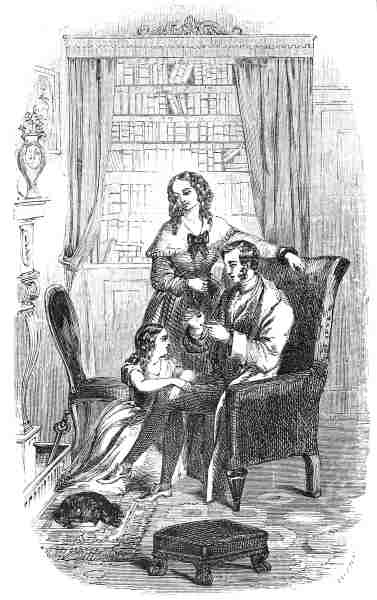
"Shall I relate to you the history of that particular louis,—all the adventures it has met
with, and to how many uses it has been applied?"—P. 3.
BY
MADAME GUIZOT
TRANSLATED FROM THE FRENCH
BY
MRS. L. BURKE
LONDON
GEORGE ROUTLEDGE AND SONS
THE BROADWAY, LUDGATE
NEW YORK: 416 BROOME STREET
PREFACE.
The writings of Madame Guizot are highly
celebrated in France, and though something of
this celebrity may be due to her position as the
wife of an illustrious statesman and historian,
it must also be remembered, that this very position
was calculated to draw forth a severer
criticism than would usually be passed on one
less favourably circumstanced. But the works
themselves have merits of far too decided an
order not to command attention in any case,
and they especially deserve the notice of English
parents, from their entire freedom from the
exaggeration of sentiment and love of effect, so
often justly complained of in a certain portion
of the Literature of France.
In her Tales, it has been the aim of Madame
Guizot to secure the attention of her youthful
readers by an attractive narrative, in which the
chief personages are children like themselves, and
the events and situations such as might occur
in their own experience, and then to lead their
minds to important conclusions by the natural
course of the story, and without the repulsive intervention
of mere lecturing or argumentation; and
we think it will be admitted, that in the present
series, she has been eminently successful. These
Tales are so simple and natural, that they may be
understood by even younger children than they are
actually intended for, while at the same time they
are so full of good sense, and touch so vividly
those springs of action which influence alike
both the young and the old, that many of them
will be read with as much interest, and sometimes
even with as much advantage, by the parent as by
the child. Though perfectly unpretending in
structure and language, the most fastidious taste
will acknowledge them to be the productions of a
highly refined and cultivated mind, while they
equally display all the charms of an affectionate
and parental disposition, conjoined with a lofty,
though a gentle and rational morality.
It is only necessary to observe, in conclusion,
that the Translator has endeavoured to preserve
throughout the simplicity of style which distinguishes
the original, and to convey its meaning
with all the fidelity which the difference of the
two idioms would permit. A few unimportant
expressions have been modified or omitted as
unsuitable to English taste, or likely to convey,
in translation, a different impression from that
actually intended, but beyond this no liberty
has been taken with the text.
THE HISTORY OF A LOUIS D'OR. — LITTLE PETER. — CONTINUATION OF THE HISTORY OF A LOUIS D'OR. — THE RENT. — CONTINUATION OF THE HISTORY OF A LOUIS D'OR — THE WEEK. — CONTINUATION OF THE HISTORY OF A LOUIS D'OR. — THE TEMPTATIONS. — CONCLUSION OF THE HISTORY OF A LOUIS D'OR.
MORAL TALES.
Ernestine was passing with her mother through
the arcades of the Palais Royal, stopping at every
shop, longing for all she saw, now and then sighing
heavily, and at each moment making the
happiness of life consist in the possession of some
attractive object, the remembrance of which was
effaced the moment after by some other, destined
in like manner to be as speedily forgotten. She
was, however, more especially interested by a toy-shop;
not that Ernestine had any wish for dolls,
little carts, or bureaus, in which she could not
even have put her thimble, the drawers were so
small: she was, indeed, too old for that, for she
was already eleven; but the sight of a moving
picture, in which were to be seen two men fighting,
a dog turning a spit, a laundress, a paviour,
and a stonecutter, inspired her with a fancy, which
appeared to her much more reasonable. She
stopped her mamma in order to examine it more
leisurely, and her mother was kind enough to
indulge her; but the picture was then motionless.
Ernestine thought it would be delightful to see all
those figures in action, especially the dog turning
the spit, and asked if it would not be possible to
beg of the shopkeeper to wind it up.
"Certainly not," replied Madame de Cideville,
"he did not place it there for the amusement of
the passers-by; he would think I wished to purchase
it."
"It would surely be very dear?" said Ernestine.
"One louis," replied the shopkeeper, who had
overheard her.
"Oh! mamma," whispered Ernestine, "how
cheap!" for she had imagined that a thing so
beautiful, and so ingenious, must have cost an
enormous sum. "How delightful it would be,"
she continued, "to obtain that for one louis!"
"There are," said her mother, "many better
ways of employing it;" and she passed on, to the
great vexation of Ernestine, who wondered to herself
how it could happen that her parents, who
were so rich, did not think it proper to spend a
louis on so charming a thing as a moving picture,
in which a dog was to be seen turning a spit: for
Ernestine, like all children, and upon this point
she was more than usually inconsiderate even for
her age, thought her parents much richer than
they really were; besides, she was not aware that
there is no fortune, however large, which justifies
unnecessary expense. On reaching home, she spoke
to her father about the picture.
"Only fancy, papa, it might have been had for
one louis. Oh! how happy I should have been
if I had had a louis of my own!"
"You would not surely have spent it upon
that?" replied her father.
"Oh! papa, how could I have spent it on anything
more delightful?"
"Doubtless," replied M. de Cideville, "it would
have been quite impossible to have found anything
more delightful; but you might have found something
more useful."
"For a louis, papa! What is there so very
useful that can be bought for one louis?"
As she said these words, Ernestine tossed in
her hands her mamma's purse, which Madame de
Cideville, on entering, had laid upon the table.
A louis d'or fell out of it. "See," said Ernestine,
as she picked it up, "to what very important use
can this little yellow thing be put?"
"To what use?" replied her father; "if I were
to tell you all the important uses to which it
might be applied, all the trouble that is sometimes
required to gain it, all the danger there is in
spending it badly, all the good it may do to those
who are in want of it, all the evil it may make
them commit in order to obtain it, you would
wonder how any one could be even tempted to
throw it away upon useless objects. Shall I relate
to you the history of that particular louis, all the
adventures it has met with, and to how many
uses it has been applied?"
"Oh! yes, papa; but how came you to know
all this?"
"That I will tell you afterwards. At present I
want you to look at it merely; it is not very
ancient, it belongs to the coinage of 1787, so that
it is scarcely five-and-twenty years old. Now,
listen to all that has happened to it."
Ernestine drew a chair to her father's side, that
she might listen more attentively, and M. de
Cideville began thus:—
I will not tell you how much labour and time
were required to extract from the earth the small
quantity of gold of which this louis is composed,
to separate it from the other substances which are
generally found mixed with it, to melt it, to coin
it, &c. It was in the year 1787, that it came for
the first time into the Royal treasury, and that it
was afterwards given out, in payment of a regiment,
to which, I know not by what chance,
several months' arrears were due. As the soldiers
received five sous a day, this louis served to discharge
what was owing for more than three
months' pay to a poor fellow who, had there been
war, might, during this time, have fought in a
dozen battles, have been killed, or at least wounded,
have died of hunger in a besieged city, perished
at sea, or been eaten by savages, had he been
sent to fight in America. But as it was a time of
peace, he had only caught an inflammation on
the chest, in consequence of having had to mount
guard during one of the severest nights of winter,
and afterwards a cutaneous disease, from having
slept in the hospital in the same bed with a comrade
who had it. At length he recovered, and as
he was an industrious and well-conducted man,
and had managed by his occupation of barber to
the regiment, to make some little savings, he was
able, notwithstanding what I have mentioned, to
send this louis to his father, a poor peasant, at
that very moment on the point of being imprisoned
for a debt of one louis, which he could not pay.
The creditor was on the spot, threatening him,
and announcing his determination of sending for
the sheriff's officer: the peasant's second son, the
brother of the soldier, furious at seeing his father
thus menaced, had taken up a hatchet with which
he was going to kill the creditor, notwithstanding
the interposition of his mother, who, uttering
piercing cries, rushed forward to prevent him, and
was thrown down by him, without his perceiving
it, so violent was his passion. The person who
had brought the louis from the soldier, arrived in
the midst of this tumult. She had, at first, much
difficulty in making herself heard; but when they
did begin to understand what she was saying,
peace was restored. The father paid his creditor,
the son rejoiced that he had not killed him, and
thus this louis d'or saved a man's life, probably
the lives of two men; for the son would have been
punished for his crime: perhaps, indeed, it saved
a whole family, for the father and mother, who
had only this son to assist them in their labours,
would, in all probability, have died of misery and
grief.
The creditor who had exacted this louis with so
much severity, belonged to the same village, and
was really in absolute want of the money, because,
his harvest having failed, he had not the necessary
provisions for his family during the winter. Had
the soldier's louis not arrived, however, it would
have been useless for him to have put the father
in prison; he would have gained nothing, as the
old man possessed nothing; but with this louis he
bought twenty or five-and-twenty bushels of potatoes,
which were then very cheap, and these served
to support himself and his children.
The woman, however, from whom he had purchased
the potatoes, and who belonged to another
village, having the imprudence to cross in the
dark a wood, through which the road to her house
lay, three villains of the neighbourhood in which
she had sold her potatoes, who had seen her receive
the louis, agreed to wait for her in the wood, and
rob her of it. When, therefore, she had penetrated
into the thicket, they burst upon her,
threw her from her horse, took the louis, and were
about to tear off her clothes, and perhaps kill
her, when, fancying they heard a noise, they ran
off in different directions. He who held the
louis, endeavoured to escape from his companions,
that he might not share it with them; but they
met him that same evening at a tavern where he
was spending it in drink. They demanded their
share, quarrelled, fought, and discovered all their
secrets. They were arrested and sent to the
galleys. The tavern-keeper interposed in the lawsuit;
he wished to have the louis, as it had been
spent at his house; the woman who sold the
potatoes, and who had recovered and again
mounted her horse, also claimed it, as it had
been stolen from her. I know not whether they
were indemnified, but the louis, after having
served as a proof of the theft, because it was the
only one in the country, none of this particular
coinage having been before introduced there, passed
into the hands of an old lawyer, who quarrelled
with an elderly lady, after a friendship of
thirty years, because she had won it of him at
piquet, during the course of six months, and had
told him, besides, that he did not know how to
play. This old lady sent it as a new-year's gift
to one of her little granddaughters in Paris, who
was saved by it from a very considerable annoyance.
Her brother, who, though treated with a
good deal of severity, was, nevertheless, very disobedient
and ill-behaved, had taken from her
father's library, notwithstanding his having been
forbidden to touch it, a book which contained
prints; while reading it, he had let an inkstand
fall upon it, and in order that he might not
be suspected, had carried it into the anteroom.
All this he communicated to his sister, as a great
secret, making her solemnly promise to say nothing
about it, so that the servant might be suspected.
As her father was very particular about his books,
the young girl knew that the servant would be
dismissed; still she could not denounce her brother.
The book had been put in the anteroom,
during the evening, and she wept all night at the
thought of what was to happen next day; for she
was extremely kind and just. In the morning,
on awaking, the first thing she beheld was the
louis, which had been put upon her bed as a present
from her grandmamma; her joy was extreme,
and she immediately sent for a copy of the book,
as her brother, who had also received a louis,
finding himself screened, would not spend his in
this manner. However, she consoled herself, by
thinking of the terrible pain she would have
experienced in seeing an innocent person punished,
without daring to justify him. The book cost
exactly one louis; this louis passed into the hands
of a librarian, and had a great influence on the
destiny of a little boy, whose history I am about
to relate to you.
Little Peter, when ten years old, had entered
the service of M. Dubourg, a worthy man, who
passed his life in the study of Greek and Latin,
and was so much taken up with what happened
three thousand years ago, that he did not even
think of troubling himself with what was actually
passing around him; for he was consoled for every
inconvenience, provided he could apply to it an
example or a maxim drawn from antiquity. If he
cut his finger, or hurt his foot, his first movement
was an exclamation of impatience, but immediately
afterwards he checked himself and grew
calm, saying, "The philosopher Epictetus suffered
his leg to be broken by his master, who was
beating him, without making any complaint beyond
these words: 'I told you you would break
my leg.'" One day, while dining in town, he
found himself in company with some very ill-bred
military men, who could talk of nothing but the
stories of their regiment, and the number of bottles
of wine they had drunk at a mess dinner.
The mistress of the house, in order to make him
some kind of apology for a conversation which
wearied him, said, laughing, "You must allow, M.
Dubourg, that I have made you dine in very bad
company."
"Madame," replied M. Dubourg, "Alcibiades
knew how to accommodate himself to every grade
of society, to every company, and even to the
customs of every nation;" and in order to follow
the example of Alcibiades, he commenced talking
to them of the battle of Salamis, and the feasts
of Bacchus. As to the rest, M. Dubourg only
dined out six times a year; this was a rule which
he had laid down for himself, however numerous
might be the invitations which he received. The
only irregularity he allowed himself was in the
periods. Thus, for instance, he might one year
dine out on the 6th of March, and the following
year on the 7th or the 10th; it might even happen
that he accepted two invitations in the same
month, though as a general rule he placed them
as nearly as possible at equal distances; but if by
any extraordinary chance, the six dinners were
expended by the month of July, no consideration
would induce him to dine away from home during
the rest of the year. His expenditure was regulated
as strictly as his manner of life. With a
very small income, M. Dubourg wished to live in
such a manner as to be perfectly independent of
every one, and especially so as never to be reduced
to the necessity of borrowing, which he regarded
as the greatest of all faults; "for," said he, "one
can never be sufficiently sure of repaying." Thus,
his dinners were furnished by a restaurateur, who,
for the same sum, brought him every day the
same thing. On one occasion the restaurateur
wished to increase his charge. "It is all the same
to me," said M. Dubourg, "I shall take less;
Diogenes was able, by mere philosophy, to bring
himself to drink out of his hand, although he had
still a wooden cup of which he might have made
use." It was probably less out of respect for
philosophy, than from the fear of disobliging a
customer, that the restaurateur, by the means of
certain arrangements, agreed to furnish him, for
the old price, a dinner of pretty nearly the same
kind.
The other expenses of the day were calculated
with the same precision, so that, without ever
counting, M. Dubourg, had always a year's income
in advance, and was consequently never
inconvenienced by having to wait for his returns.
He had, besides, a sum in reserve for extraordinary
cases; such as an illness, an accident, or
even a goblet broken, or a bottle of ink overturned,
&c. It might also happen, on a rainy
day, that he had to pay for crossing a stream upon
a plank, or, in winter, to give a sous to the little
sweeper who cleaned the crossing; all these expenses
fell upon the extraordinary fund, for as to
coaches, M. Dubourg had only hired two during
the whole course of thirty years. One was to
pay a visit to a rich man from whom he had accepted
an invitation to dinner, and to whose house
he was told he must not go splashed. This broke
off their acquaintance, and he never would go
again, however much he was pressed. The other
he took when going to declare his sentiments to a
young lady whom he had been persuaded to fancy
himself desirous of marrying. He took it for
fear that the wind should shake the powder out of
his hair, and it gave him an opportunity of reflecting,
as he proceeded, on the disorders into
which the passions lead us. On arriving at the
young lady's house, he paid the coachman, returned
home on foot, and renounced for ever the
idea of marrying. His reserved fund was always
maintained in the same state, by means of a portion
of his income regularly set apart for this purpose.
When it did not happen to be all spent by
the end of the year, M. Dubourg gave the remainder
to the poor, otherwise, he neither gave
nor lent; for he said that "it is not proper to give
unless we are certain of not being obliged to ask,
and that he who, in order to lend, exposes himself
to the chance of being obliged to borrow, places
his integrity at the mercy of a bad paymaster."
It may be seen then, that with some follies, M.
Dubourg was a man highly to be esteemed for his
integrity.
Little Peter passed with him the happiest of
lives. Provided he was careful not to arrange the
books that were scattered or heaped together upon
the desk or floor, which M. Dubourg called disarranging
them; provided he took care to sweep
the room only once a fortnight, when M. Dubourg
had taken away certain fine editions, which he did
not wish to have exposed to the dust; provided
he was careful never to remove the cobwebs,
that he might not run the risk of upsetting the
busts of Homer, of Plato, of Aristotle, of Cicero,
of Virgil, &c., which adorned the top of the
library, little Peter might do pretty nearly what
he pleased. If he happened to be out at the hour
at which the restaurateur brought, every day,
M. Dubourg's dinner, so that it had to be left at
the door, M. Dubourg having forbidden the man
ever to ring, for fear of interrupting his studies,
and if M. Dubourg found his dinner quite cold,
or partly eaten by the cat, Peter merely excused
himself by saying, that he had been detained by
some business. Then M. Dubourg would say to
him: "It is quite natural, Peter, that you should
occupy yourself principally with your own affairs;
you are not my slave; I have not purchased you
with my money: but were you my slave, the case
would be very different." Then, whilst taking his
dinner, he would explain to him the duties and
condition of slaves; and how it was that their
masters possessed over them the power of life and
death, which was indeed but just, since they had
purchased them; "But as for me, Peter," he
would add, "I am not permitted to do you the
least harm, for you are not my slave." And, in
fact, he would not give him a caning, even when
he learned his Latin grammar badly; this was,
nevertheless, the greatest annoyance Peter could
cause M. Dubourg; who, on this point, sometimes
got into violent passions, quite at variance with
his general character; for he could not understand
how it was possible for any one to dislike so excellent
a thing as the Latin grammar. This dislike,
however, was very sincere on the part of little
Peter, who had no fancy for study, and who,
though he had learned to read and to write, had
done so much against his will. When M. Dubourg,
who did not wish any one to live with him
without understanding Latin, first put an Accidence
into his hand, his parents were delighted at
the idea of his making, as they thought, little
Peter a learned man like himself; but Peter had
not the slightest wish to resemble M. Dubourg,
who passed the whole day in poring over books;
who often only half dined, for fear of allowing a
Greek passage to escape him, the meaning of which
he was beginning to seize; who took water, scarcely
coloured, because wine disturbed the judgment,
and had, he said, caused Alexander the Great to
commit many crimes; and who, finally, as his
only pleasure, walked for two hours every day in
the gardens of the Tuileries, with three other
learned men, who, on their part, met there for the
purpose of conversing together, after the manner
of the Peripaticians.
Little Peter, fancying that Latin led to nothing
better than this, could not perceive in it anything
very attractive, and only learned his Accidence, ill
or well as the case might be, for the sake of pleasing
M. Dubourg, who wept with joy when he had
repeated his lesson well. He read, however, with
tolerable pleasure, some books of history which
M. Dubourg had lent him, and he passed the
remainder of his time with his parents, to whom
M. Dubourg had promised to send him for several
hours each day, and to whom Peter, according to
custom, remitted a very considerable portion of
the hundred francs which he annually received as
his wages; for they said that, having consented to
place him with M. Dubourg at an age in which
his labour might have been useful to them in
their trade of braziers, they ought to be indemnified,
in some other manner, for the expenses
he had occasioned them in his childhood. Little
Peter, better fed and better clothed than he could
have been at home, ought to have considered himself
very well off; but he was discontented, because
he could not run about like other boys of his age,
and because he had not the free disposal of his
money; in fact he regretted all the follies which
he could not commit, and then the Rudiments
greatly disgusted him. Besides, little Peter
affected to be ambitious; he must make his fortune,
and that was an impossibility so long as
he remained with M. Dubourg. He related his
troubles to a little groom with whom he became
acquainted, from having seen him at the door of
a house, situated between the residence of M.
Dubourg and his father's shop. One day this
groom, whose name was John, told him that if
he wished he would procure him a good situation,
with a young gentleman, a friend of his
master, who was in want of a groom. He would
have to take his meals with the other servants
of the family, as long as the young gentleman
resided with his parents, and receive a hundred
francs a year, as with M. Dubourg, besides a louis
d'or for his new-year's gift, not to mention the
perquisites, which, according to John's account,
would amount to three times as much as his
wages. Peter felt himself greatly tempted by the
louis d'or, which he hoped to keep for himself,
and by the livery, which he thought much finer
than his grey jacket, forgetting, that from his
grey jacket he might pass to a better dress without
the change being remarked, whereas livery is a
costume which once seen upon a person is never
forgotten. John had taught him to groom a
horse, and this pleased him much more than the
Rudiments; he thought it would be very delightful
to have to groom one every day, and, besides, it
seemed to him that he should have his own way
much more. However, he told John that the
thing was impossible; that he could not leave M.
Dubourg; but as he went along he could think of
nothing else. His parents, seeing him thus preoccupied,
said to him a dozen times, "Peter, are
you ill?" He replied that he was not, and left
them much earlier than usual, to go and find
John; not that he knew what answer to give him,
but simply that he might hear him talk of the
situation, of the louis d'or, of the perquisites, and
of the horse.
The desire he felt to obtain the situation increased
at every moment. John told him that
nothing was easier; that he had only to allow him
to speak to M. and Madame Jerôme,—these were
the parents of little Peter; and that he would
make them listen to reason. Peter took him at
his word, and told him to come with him. John
went, and as he was a boy of great determination,
he represented, in glowing colours, to M. and
Madame Jerôme, all the advantages of the situation
which he proposed, with the exception,
however, of the louis d'or, to which Peter had
begged him not to allude, as he wished to keep it
for himself. "But see, Madame Jerôme," said
John, "the master he will have, lays aside his
clothes almost new, and I will wager that, every
year, Peter will be able to bring a suit to M.
Jerôme; but that is on condition that you let him
have a little more of his wages."
"We shall see, we shall see," said Madame
Jerôme, who was quite captivated with the idea of
her husband's having a smart coat to walk out
with her on a Sunday. M. Jerôme urged that
Peter could not leave M. Dubourg, who bestowed
so much pains on his education. "Excellent!"
replied Madame Jerôme; "no doubt Peter will be
very well off when he is as learned as M. Dubourg.
They say in the neighbourhood, that that is not
the way to get bread." And as Madame Jerôme
always made her husband do just what she
pleased, it was agreed that Peter should accept
the situation. John went to his master to solicit
it; the latter mentioned it to his friend, who sent
for little Peter, and as he was without a servant,
it was arranged, that if Peter brought him a good
character from M. Dubourg, he should enter his
service the following day.
Peter returned home to M. Dubourg, whose
dinner had been waiting at the door a quarter of
an hour. He was so bewildered, that in laying
the cloth, he put the chair on the side of the
window instead of on that of the door, a thing
which had not been done for five-and-twenty
years; and he forgot, when giving M. Dubourg
something to drink, that it was an inviolable rule
with him to put the wine into the glass before the
water. His master looked at him with astonishment,
saying, "Are you ill, Peter?" He again
replied that he was not, and continued his duties;
but he was completely embarrassed, and the more
so as M. Dubourg spoke to him with even more
than his usual kindness, calling him my child, his
term of endearment for those whom he particularly
liked. He said to him, "You will soon be
thirteen years old; this is precisely the age at
which the Romans took the Prætexta. I even
think that I might find instances in which it was
taken earlier, though, indeed, this may have been
in corrupt times. But no matter: I think I can
in conscience, allow you to leave off your grey
jacket. Since you have been with me, I have
made it a rule never to dust the covers of my
books with my sleeve, as I was accustomed to do,
and I have only failed once, and then through
pure forgetfulness. Besides, although this coat
has nearly served its time, for I buy one every
three years, it is in a sufficiently good condition
to be done up for you. And," added M. Dubourg,
patting him on the head with an air of gaiety,
"you will look like a little gentleman."
Little Peter felt extremely troubled; this kindness,
and then this coat, which was to make him
look like a gentleman, had completely upset all
his ideas. He left the room as soon as he could,
and did not enter it again that evening. The
following morning, Madame Jerôme came to inform
M. Dubourg that her son wished to leave
him, and to ask him for a character. However
great was his astonishment, he only uttered these
words: "Little Peter is not my slave; I have no
right to detain him against his will." He promised
the character, and when Madame Jerôme
was gone, he called Peter, who had not dared to
show himself. "Peter," said he, "if you were
my slave, you would deserve to be beaten with
rods, or even worse, for wishing to leave your
master; but you are not my slave, therefore you
may go."
He said this in a tone of so much feeling, that
little Peter, already much moved, began to cry.
"Why do you wish to leave me, my child?" continued
M. Dubourg; "you will forget all you
know, with another master."
"Oh! Sir," said Peter, shaking his head, "it
is not my lot to be a learned man."
"You are mistaken, Peter; you are mistaken,
my child. If you could once get over the rule of
que retranché, you would get on very well." And
thereupon he began to cite to him, with great
earnestness, the examples of many celebrated
men, who had at first displayed but little talent,
but who afterwards astonished the world by the
extent of their learning. "You have the opportunity
of becoming what they were, Peter," exclaimed
M. Dubourg, "and yet you renounce it."
He was so sure of his case, and spoke with so much
enthusiasm, that little Peter, quite carried away,
felt himself on the point of losing his fortune.
"Oh! Sir," he exclaimed, "only consent to
give me one louis more a year, and I will remain
with you all my life."
At these words, the enthusiasm of M. Dubourg
was changed into consternation. "If that is what
is required," said he, "it is impossible. You
know yourself, that it is impossible." Peter remained
silent and confounded, for he knew that
his master, before engaging him, had refused a
boy who asked him five louis, because this would
have occasioned an irregularity of twenty francs
in the expenses of the year. He retired in confusion.
M. Dubourg, without uttering another
word, gave him a favourable character, to which,
however, he considered himself obliged, as a matter
of conscience, to add, that Peter had always shown
but little inclination for the Latin grammar.
Little Peter soon got over his vexation; he
thought himself so fine in his livery, especially
when John had taught him some of his grand
airs, that he was as proud of it as if there had
really been some merit or honour in wearing it,
and when, by chance, he had to drive his master's
cabriolet through the streets, he would not have
exchanged conditions with any of those triumphant
heroes whose history M. Dubourg had made him
read. One day when he was behind this cabriolet,
he saw M. Dubourg in danger of being knocked
down by the horse, and cried out, "Take care,
take care!" in a louder, though less imperious
tone than usual. M. Dubourg recognised the
voice, and looked up. Peter did not very well
know whether to be pleased or ashamed, that he
should thus be seen by him in all his glory.
M. Dubourg gave a heavy sigh: "Is it possible,"
he said, "that a person who was beginning to
understand the Latin grammar could mount
behind a cabriolet!" And he continued his way
home, in a thoughtful mood.
As for Peter, he did not think of the circumstance
very long, he only thought of amusing
himself. John had taught him, according to his
own account, the best means of doing so; that is,
he took him to the public-house, and to places
where cards and billiards were played. There he
lost his money, and when his master paid him his
first quarter's wages, he owed the whole of it.
For three days, he did not dare to go near his
parents; for he knew very well that they would
require their share. At length, John advised him
to say, that he was to be paid only every six
months, assuring him that by that time he would
regain all that he had lost. On the contrary, he lost
more, and only got deeper in debt. At the end of
the six months, he said that he had been mistaken,
and that his master paid only once a year. His
parents began to disbelieve him, and, besides, the
coat that John had promised to M. Jerôme was
not forthcoming. If Peter had received perquisites,
he had sold them to obtain money. Still his debts
increased daily; he dared not pass down the street
in which a certain tavern-keeper lived, because he
had had drink in his house, for which he had
not paid; in the neighbouring street a petty
dealer in hardware, from whom he had obtained,
on credit, a chain of false gold, in order to appear
to wear a watch, insulted him every time he saw
him. At every moment, he met comrades to
whom he was still indebted, for money which they
had won from him, while his parents, on the other
hand, were very much displeased with him, and
threatened to go and ask his master whether he
told them the truth. Little Peter knew not
where to hide his head.
One morning his master's mother, who was
almost as precise a person as M. Dubourg, gave
him eighteen francs to carry to a shopkeeper, to
whom she owed the balance of an account, for
some things purchased of him the previous evening.
Peter went out, proceeding with great
precaution and looking on every side, as he was
accustomed to do, since he had become constantly
fearful of meeting persons to whom he owed
money. He was absolutely obliged to pass through
the street in which the hardware-dealer lived; he
looked out from a distance, saw him engaged
in conversation, and hoped to pass by unperceived.
But as he approached, the person with whom he
was talking turned round. It was the tavern-keeper,
who called to him, and demanded his
money, in no very polite terms. The hardware-man
joined him, and they placed themselves
in the middle of the street, so as to prevent
him from passing, telling him that he must pay
them. Peter glided between the wall and a
carriage, which was standing there, and ran on
with all his might; he heard them cry after him,
that it was well to have good legs when one had
not a good conscience, but that he might spare
himself the trouble of running away, as they would
catch him again. As he continued his flight,
and was rapidly turning a corner, he ran against
a man who was coming towards him. This man
turned out to be a groom of his acquaintance, to
whom he owed some money, won at cards. He
was half-intoxicated, and seizing little Peter by
the collar, and swearing at him, said that he must
have his money, for the publican demanded it of
him, and that he would drag Peter before him
and beat him until he had paid it. Peter defended
himself with all his strength. A crowd gathered
round, and allowed them to continue. At length
he heard some one cry out, "Villain, leave
off beating that child!" He recognised the voice
of M. Dubourg, and saw him, with uplifted cane,
approaching to his assistance. The fear of being
recognised, gave him even more strength than the
fear of being beaten; he tore himself out of the
hands of the groom, who had likewise turned
round, on hearing himself thus spoken to, and
whom M. Dubourg, with his cane still upraised,
prevented from following Peter.
Peter, who now continued his flight with even
greater rapidity than before, came at last to a
street where he no longer saw any one likely to
recognise him, and sat down trembling, upon
a bench, not knowing what was to become of
him. He had heard the groom also say that he
would catch him, and he had no doubt that he
was watching for his return. On raising his eyes,
he perceived that he was before a tavern to which
his comrades had taken him to play at cards, and
where he had seen one of them win a hundred
francs. His heart beat high at the idea of
gaining as much, and a detestable thought took
possession of his mind. Perhaps in hazarding
thirty sous only of the eighteen francs with which
he had been intrusted, he might regain all that
he owed; but if he happened to lose! This reflection
made him tremble. He went away; then
returned, the temptation increasing every moment.
At last, picking up a stone, he said to
himself, "If in throwing this against the wall, I
hit the mark that I see there, it will be a sign
that I shall win!" He placed himself very near
the wall, that he might not miss it, threw the
stone, hit the spot, and went in. He was so excited,
that he scarcely knew what he was about.
Never before had he committed so bad an action,
nor would he have committed it now, doubtless,
had he been in his right mind. But it is one of
the consequences of bad actions that they place us
in circumstances which disturb the judgment, and
deprive it of the strength necessary for directing
our conduct. Had any one, at this moment, told
Peter that he was committing the act of a thief,
he would have trembled from head to foot; yet
such was, nevertheless, the fact; but he did not
think of it. At first he only hazarded thirty
sous, and won: he won again, and fancied himself
already rich. Had he stopped there, he would
have had, if not sufficient to get out of difficulty,
at least enough to satisfy, in some degree, one or
two of his creditors; but by doing this, he would
have been rewarded for his fault, and by a law
of Providence, evil-doers never know how to stop
at the point where their faults would be unattended
with danger. He who, in doing wrong, relies
upon his prudence to protect him from exposure,
always finds himself deceived; the love of gain, or
of pleasure, ends by dragging him on to the action
which is to bring about his punishment. Peter
was desirous of gaining more, and he lost not only
what he had won, but his stake also. The hopes
that he had at first formed, rendered him only
the more ardent in the game, and, besides, how
was he to replace the thirty sous? He hazarded
thirty more, lost them, then more; at last the
whole eighteen francs are gone. He left the
house in despair, and wandered through the
streets unconsciously, neither knowing where he
was, nor what he was doing, still less what he
intended to do. He heard it strike four o'clock,
and remembered that at five he had to wait at
table. He would be asked by his mistress's mother
whether he had paid the eighteen francs, and
though for some time past he had got into the
habit of telling falsehoods, his conscience accused
him so vehemently, that he felt he should not be
able to reply. However, like a man who throws
himself into a river without knowing whether he
shall get out of it again, he took, mechanically,
the way to the house; but as he approached it,
he fancied he saw the shop girl belonging to the
tradesman, to whom he had been ordered to carry
the eighteen francs, coming out of it. He had
no doubt that she had been to ask for the money,
and feeling that it would be quite impossible for
him to enter again his master's dwelling, he turned
away, and recommenced running, without knowing
whither he went. It was winter: night came
on, and he at last stopped, and sat down upon a
step, and felt that he was without a home.
Nothing in the world would have induced him to
return to his parents, and it would have been
equally impossible for him to expose himself to
the look of the honest M. Dubourg. The cold increased
with the night, and it began to freeze rather
severely. Peter had eaten nothing since the
morning, and though his heart was oppressed, yet
hunger began to make itself felt at last. All he
could do, however, was to weep; for what resource
was left to him in the world? At times this
hunger, cold, suffering, and despair weighed so
heavily upon him, that he would start up, and
run away, whither he knew not, but determined to
find some spot where he should suffer less. Then
again, he would suddenly stop; for he felt that he
had not the courage to show himself anywhere, or
to endure the questions or the looks of any one;
so he would slowly return, sit down again, and
weep anew, while the cold wind, blowing upon his
face, froze up the traces of his tears.
At last, overcome by fatigue and exhaustion, he
fell asleep, or rather he became numbed; his
state was a kind of half-sleep, which, although
leaving him no distinct ideas, still left him the
consciousness of the cold and hunger, and grief.
In the middle of the night, he was awakened by
some one who shook him violently. He opened
his eyes, and saw around him several armed men.
It was the watch, who finding a child asleep in
the street, wanted to know why he was there,
and to whom he belonged. Peter had at first
some difficulty in collecting his ideas, and when
he had succeeded in doing so, he only felt the
more vividly the impossibility of replying. He
dared not say to whom he belonged. He cried,
and entreated them to leave him there, as he
was doing no harm to any one. They would not
listen to him, but told him that he must go to
the guardhouse. One of them took him by the
shoulders, and as he resisted, another gave him a
blow across the legs to make him proceed. Peter
walked on trembling. The snow began to fall so
heavily, that they could scarcely see their way,
and added to this, the wind was so strong, that it
extinguished all the lamps, and drove the snow
full into their faces. At length, the soldier who
held little Peter had his cap blown off by a violent
gust, and left him in order to run after it. The
others, blinded by the snow, got dispersed; they
sought each other; they called out. As to Peter,
stupified by the wind, the snow, and all that had
happened to him, he knew not where he was,
what he was doing, or what he ought to do.
Motionless on the spot where he had been left, he
heard the soldiers inquiring for him, and asking
whether he had not escaped. This brought him
to himself, and finding one of them approaching,
he drew back softly, in order to get as near
as possible to the wall. As he retired farther
and farther, he was still unable to feel the wall,
and at last perceived that he had entered a
bye-street, which the thickness of the snow had
prevented him from seeing. He then walked
faster, and soon ceasing to hear the soldiers, he
regained a little courage, and after many windings,
he at last stopped, and crouched down at
the corner of an old building.
After remaining there some time, he again fell
asleep, and when he awoke day was breaking. He
tried to get up, but the cold and the uneasy posture
in which he had remained, had so benumbed
his limbs, that he could not move a step, nor
even stretch his legs; while the violent effort which
he made in order to move forward, threw him to
the ground. In falling, his head struck the curbstone
so violently that he become unconscious.
He did not, however, altogether faint, and after a
short time he had a confused perception of persons
speaking and acting around him. It also
seemed to him that he was taken up and carried
away; but all was so indistinct that he had no
proper consciousness of anything. He had neither
any fear of what was going to happen to him, nor
any wish to be better, nor any recollection of
what he had done. He came to himself, however,
by degrees, and his first sensation was a violent
oppression of the heart. Poor little fellow! this is
a feeling which he will henceforth always experience,
as often as he calls to mind what he has
done. At present he does not call this to mind,
he simply feels that he has committed a terrible
fault. He also feels that he is suffering in every
part of his body, but, at the same time, he perceives
that he is in a bed, and in a room; at
length he regained complete consciousness and
saw that he was at M. Dubourg's, and that M.
Dubourg and his mother Madame Jerôme were by
his side.
His first impulse on perceiving them was to
hide his head in the bedclothes and weep. As
soon as his mother saw that he was conscious, she
asked him what had happened to him, and why he
had fled from his master. She told him that,
finding he did not return during the day, they
had sent at night to inquire for him at her house;
that this had made her very uneasy, and that she
had gone to his master's early in the morning,
and learning that he had not slept there, she had
run in great terror to M. Dubourg, who told her
that he had not seen him; and finally, that on
leaving his house, she had found him at the
corner of the street stretched upon the ground,
totally insensible, and surrounded by several
women of the neighbourhood, who were exclaiming,
"Oh! it is little Peter! What can have happened
to him! What will Mother Jerôme say!
He must have been drinking, and got intoxicated,
and the cold has seized him." At the same time,
the woman who attended to M. Dubourg's house
had gone to tell him the news, and he in great
uneasiness came out in his dressing-gown and
nightcap, a thing which had never happened
to him before in the whole course of his life.
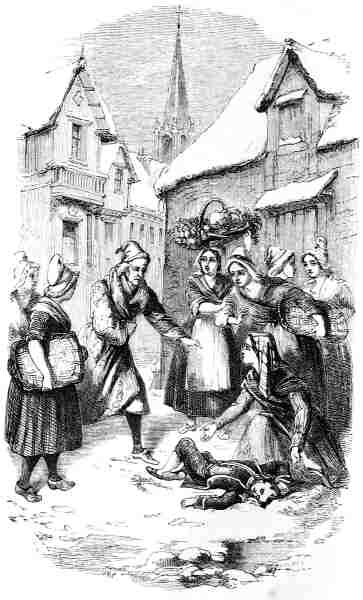
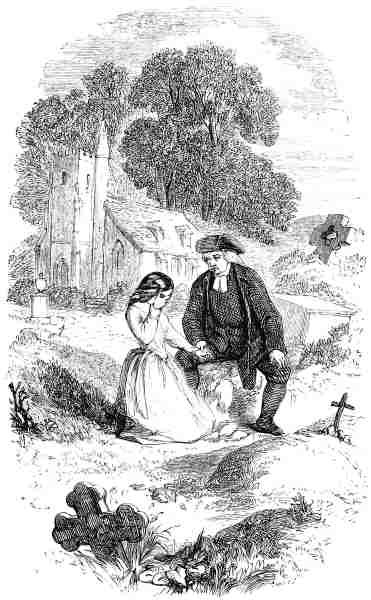
She had found him at the corner of the street, totally insensible, and surrounded
by several women of the neighbourhood—P. 27.
At the conclusion of this recital, intermingled
with reproofs, Madame Jerôme renewed her questions;
but little Peter wept without replying.
The physician who had been sent for, now arrived,
and told them that he must not be tormented, as
a severe fever was coming on; and indeed a
violent excitement soon succeeded to the weakness
from which he had just recovered. His fault
represented itself to him in the most frightful
colours, and threw him into fits of despair, of
which they were at a loss to conjecture the cause.
At length, when Madame Jerôme had gone home
to inform her husband of what had happened, and
of the necessity there was of her remaining to
nurse Peter, he raised himself in his bed, and
throwing himself on his knees, with clasped hands
called M. Dubourg, and said to him, "Oh! M.
Dubourg, I have committed a great crime."
M. Dubourg, thinking him delirious, told him to
keep himself quiet, and lie down again. "No,
M. Dubourg," he repeated, "I have committed a
great crime." And then with the quickness and
volubility which the fever gave him, he related all
that had passed, but with so much minuteness of
detail, that it was impossible to consider what he
said as the effect of delirium. M. Dubourg made
him he down again, and stood before him pale and
shocked.
"Oh! Peter, Peter!" said he at last, with a
deep sigh, "I had so earnestly hoped to have been
able to keep you with me!"
Peter, without listening to him, uttered aloud all
that the torments of his conscience dictated; he
said that his master's mother would have him
apprehended, and in moments when his reason
wandered more than usual, he declared that the
guard were in pursuit of him. M. Dubourg, after
reflecting for some time, went to his secretary,
counted his money, closed his desk again, and
Madame Jerôme returning at the same moment,
he related to her what he had just learned, adding,
"Madame Jerôme, little Peter, according to his
own account, has committed a great crime, which
prevents my keeping him with me as I had hoped
to do, for I had provided the necessary means.
My mind has never been easy, from the day I saw
him behind a cursed cabriolet. He had offered to
remain with me for one louis more a year, and I
thought of procuring it by my labour. You see,
Madame Jerôme, how valuable and profitable a
thing is learning. I had indeed made it a rule
never to publish anything; but I considered that
there were works which might be written, without
compromising one's tranquillity. I have composed
an almanac, in which I have recorded the feasts
and epochs of the year among the ancients. It
cannot but be very interesting to know, that on
such a day began the Ides of March, or, as the
case may be, the Feasts of Ceres. I demanded of
the publisher one louis for it, that being all I
stood in need of. He gave it immediately, and
will give me the same every year, for a similar
almanac." M. Dubourg was going on to explain
to Madame Jerôme how he would manage to
insure accuracy, notwithstanding the irregularity
of the ancient calendar; "but," said he, "it is
not necessary for you to know all this:" and then
added, "I had intended this louis for little Peter.
I can dispose of it in his favour, and the more
easily as we are now at the end of the year, and I
have in my reserved fund more than sufficient to
defray the expenses of his illness. I was afraid at
first that I should be encouraging vice; but I have
since considered that the evil is now done, and
that it is the innocent who has suffered from it.
Take, then, this louis, Madame Jerôme, and carry
the eighteen francs to the shopkeeper." This,
said M. de Cideville, was the precise louis d'or
whose history I am relating to you.
Madame Jerôme, he continued, had been waiting
anxiously for the end of this discourse, which
she did not very well understand, but which
she had not ventured to interrupt. As she
was a very honest woman, the conduct of her son
had so overwhelmed her with grief and shame,
that she almost threw herself at the feet of M.
Dubourg, to thank him for affording her the
means of repairing it without being obliged to
pay a sum very considerable for a poor woman
burdened with a family. She hastened out, though
not without addressing some reproaches to her
son, who scarcely understood them, and ran to
pay the shopkeeper. As it happened, no inquiries
had been made of him, nor had he, on his
part, sent for the money. Peter, therefore, had
been mistaken, and as yet nothing was known
about the affair. His mother, on her return,
found him better; the fever had begun to abate,
and he was also comforted by the intelligence she
brought. But if he had escaped exposure, he
could not escape from the remorse of his own
conscience, or from the reproaches of his mother,
who was inconsolable. Her lamentations, however,
distressed him less than the cold and serious
manner of M. Dubourg, who no longer approached
his bed, or spoke to him, but took care
that he should want for nothing, without ever
directly asking him what he wished to have.
Little Peter had, more than once, shed bitter
tears on this account, and to this grief was added,
when he began to recover, the fear of returning
to his father, who had come to see him during his
illness, and who, being a man of great integrity, had
severely reprimanded, and even threatened him.
Peter entreated his mother to ask M. Dubourg
to keep him. M. Dubourg at first refused;
but Madame Jerôme having promised him that
Peter should not go out, and that he should study
the whole of the day, he went to consult his
Xenophon, and saw that Socrates in his youth
had been addicted to every vice; there was reason
therefore, for hoping that labour would reform
little Peter, as it had reformed Socrates.
Peter was obliged to keep his word. His illness
had left a debility which long continued, and
he was further restrained from going out by the
fear of meeting those to whom he owed money.
Study being his only amusement, he ended by
becoming fond of it: and as he possessed good
abilities, his progress was such as to give his
master much satisfaction. But the honest M.
Dubourg was ill at ease with Peter, and no longer
spoke to him with his accustomed familiarity.
Peter felt this, and was unhappy: then he redoubled
his efforts to improve. One day, having
made a translation which gave M. Dubourg great
satisfaction, the latter promised, that if he continued
to improve, he would have the coat, which
he still kept for him, arranged. Peter, after much
hesitation, begged to be allowed to sell it instead,
so that its price, together with the louis which he
was to receive at the end of the year, might serve
to pay a part, at least, of his debts. M. Dubourg
consented, and was greatly pleased that this idea
had occurred to him. While waiting, therefore,
for two years, until the new coat had served its
time, he continued to wear his old grey jacket,
which he was obliged to mend almost every day,
and the sleeves of which had become about four
inches too short. But during this time he succeeded
in completely gaining the friendship of M.
Dubourg, who, having received a small legacy,
employed it in increasing the salary of Peter,
whom he elevated to the rank of his secretary.
From this moment he treated him as a son; but
Peter, who was now called M. Jerôme, could not
perceive, without profound grief, that whenever
any allusion was made in his presence to a defect
of probity, M. Dubourg blushed, cast down his
eyes, and did not dare to look at him. As for
himself, whenever anything was mentioned that
could have reference to his fault, he felt a severe
pang shoot through his heart. When money was
concerned, he was timid, always trembling, lest
his honesty should be suspected. He did not
dare, for several years, to propose to M. Dubourg
that he should spare him the trouble of carrying
the money to the restaurateur at the end of each
month. The first time his master intrusted
him with it, he was delighted, but still felt humiliated
by the very pleasure he experienced.
However, he became accustomed to it: a life of
steady honesty has at last restored to him the
confidence which every man of honour ought to
possess; but he will not dare to relate this history
to his children for their instruction, until he has
become so old, and so respectable, that he is no
longer the same person as little Peter, and he will
always remember, that to M. Dubourg, and his louis
d'or, he owes the preservation of his character.
One day after breakfast, M. de Cideville having
a leisure hour, Ernestine begged him to continue
the history of the louis d'or, and he began thus:—
The shopkeeper to whom Madame Jerôme
had carried the louis, was just going out as she
gave it to him. He took it, returned her in
change a six-franc piece, which was lying on the
counter, gave the louis to his wife to be locked
up, and departed. As the woman was on the point
of putting it by, she heard her little girl, a child
of two years old, screaming so violently in the
adjoining room, that she thought she must have
fallen into the fire. She ran to her, and found
that she had only caught her finger in a door.
Having succeeded in pacifying her, she returned
to lock up the louis, but it was not to be found.
Her shopwoman, Louisa, searched for it also, with
great uneasiness. No one had entered the shop;
she had been alone, and she felt persuaded that
her mistress, who did not much like her, and who
often quarrelled with her without just cause,
would accuse her of having taken it: nor was she
mistaken. It was in vain that she asserted her
innocence, that she emptied her pockets, and even
undressed herself in the presence of her mistress,
to prove to her that she had not concealed it.
She was not to be convinced, and she was the
more enraged from knowing that her husband
would be angry with her for not having locked it
up immediately. On his return, she related what
had happened, and expressed her confidence that
Louisa had taken the money. He was not so sure
of that, however, for he knew her to be an honest
girl; but he was out of temper, and Louisa suffered
for it, and was dismissed.
She went away heart-broken, yet carrying with
her, without being aware of it, the louis d'or in
her shoe. At the moment that her mistress, hearing
the cries of her little girl, ran to her aid, she
laid the louis upon the counter, on which Louisa
had mounted for the purpose of arranging a bandbox,
placed very high. She wore thick shoes,
to which, in order to render them still stronger,
and better suited for keeping out the damp, she
had had another sole put; but this sole, which
was not very good, was worn out at the side, and
Louisa, making a false step upon the counter with
these heavy shoes, the louis was forced into the
opening between the two soles. She felt, as she
descended, something catch at her foot, but
imagined it to be a nail coming out of her shoe,
and as she was very active, and did not willingly
interrupt anything upon which she was engaged,
she merely struck her foot against the bottom of
the counter, in order to drive in what inconvenienced
her. This made the louis enter entirely
into the opening, and as high heels were then
worn, the action of the foot made it slip towards
the toe, where it was no longer felt, and Louisa
wandered through Paris in search of a new situation,
carrying with her everywhere this louis
which had driven her from her old one.
Not having a character from her master, she
could not obtain an engagement. She was an
orphan, and had no relations in Paris, so that to
avoid perishing from want, she was obliged to
station herself at the corner of a street, as a
mender of old clothes. This occupation was a very
painful one for Louisa, who had been well brought
up, her parents having been respectable tradespeople,
who had failed, and died in poverty. It
had required all the gentleness of her disposition
to enable her to live with the wife of the
shopkeeper, by whom she was badly treated, but
as she was a well-conducted girl, she endured
everything in order to continue in a respectable
situation. Now, she was compelled to hear the
oaths of the street people, and the talk of
drunkards, who often addressed her in a very disagreeable
manner, to say nothing of the cold, the
wind, and the rain, from which she suffered
greatly; but as her occupation did not require
much walking, she had not worn out her shoes,
so that she always carried about with her the
louis which had occasioned her so much harm.
One day, in spring, when the sun had been
very warm, there came on suddenly a terrible
storm, which, in a few minutes, swelled the kennels
to such a degree, that in several places they
touched the walls of the street. Louisa had left
her station to take refuge under an opposite doorway,
where she found herself by the side of a
lady, dressed in a manner which indicated
affluence. She was not young, appeared to be in
bad health, and was much embarrassed about
having to cross, in her thin shoes, the deep pools
of water formed before her. She was not in the
habit of going on foot; but this morning, the
weather being very fine, and the church in which
she usually heard mass, being near her residence,
she had not ordered her carriage in going to it.
Having found it, however, very full, she went to
another at some distance, and while there, had
sent her servant on an errand. She had returned
alone, had been overtaken by the storm, and was
much afraid that the damp would bring on a
severe cold, from which she was but just recovered.
"If I had only some other shoes!" she said.
Louisa very timidly offered hers.
"But what will you do?" asked the lady.
"Oh, I can go barefoot," replied Louisa; "but
you, madam, cannot possibly go in those shoes."
And Louisa really believed what she said, for
poor people, accustomed to see us surrounded
with so many conveniences, which they manage
to do without, sometimes imagine it would be
impossible for us to support things which they
endure as a matter of course. But although they
entertain this opinion, we ought not to share
it. We must not persuade ourselves that their
skins are much less sensitive than our own, nor
that they are constituted in a different manner to
ourselves; but, accustomed to pain, they do not
exaggerate it, and thus endure, without much
suffering, things which we should think it impossible
for us even to attempt, and which, nevertheless,
would not do us more harm than they do
them.
However, continued M. de Cideville, in the
present case, it was not so. Louisa was young,
and in good health, the lady aged, and an invalid.
It was quite reasonable, therefore, that she should
accept Louisa's offer, and she did so. Louisa
making many apologies for not being able to present
her shoes in better condition, accompanied
her barefoot, and supported her, as she could not
walk very well in such large and heavy shoes.
When they reached the lady's residence, she made
Louisa go in, in order to dry herself, and at the
same time to reward her for the service she had
rendered her. She also ordered her shoes to be
dried before they were returned to her. They
were placed near the kitchen fire; Louisa likewise
seated herself there, and while talking with the
servants, the kitchen-maid took one of the shoes in
order to clean it, and accidentally raised up the
outer sole which the water had almost entirely
detached. The louis d'or fell out. For a moment
Louisa was as much astonished as the rest, but
she suddenly uttered a cry of joy, for she remembered
that something had entered her shoe
on the day she had been accused of taking the
louis. She related her story, and the servants,
greatly astonished, went and told it to their mistress.
Louisa entreated the lady to give her a
certificate of what had happened, that she might
get a character from her master, and thus be able
to obtain a situation. The lady caused inquiries
to be made, not only at the shopkeeper's, where
she learned that Louisa's account was entirely
true, but also in the neighbourhood, where she
had always been regarded as a very honest girl,
and where no one believed that she had stolen the
louis. The lady also perceived by her manners
and conversation, that she was much superior to
the station in which she had found her; she therefore
took her into her service, in order to assist
her lady's maid, who was old and infirm. She
sent to the shopkeeper the amount of his louis
in silver, and gave to Louisa the louis d'or, which
had occasioned her so much injury, and so much
good.
As often happens with uneducated persons,
Louisa was superstitious. She imagined that her
good fortune was attached to this louis d'or,
which she had so long carried about her, without
being aware of it. She therefore would not think
of spending it, but still continued to carry it about
her. It happened that her mistress while going
to her country seat, which lay at some considerable
distance from Paris, turned aside, for a few
leagues, in order to spend a day with a friend,
whose house was nearly on her route. She left
Louisa at the post-house, with her luggage, where
she was to take her up the following morning. As
Louisa had nothing to do, she seated herself upon
a bench before the door which faced the high
road. Presently she beheld a young man riding
up to the house, at full speed. He rode so rapidly
that the postilion, by whom he was accompanied,
could not keep pace with him, and was obliged to
follow at some considerable distance behind. He
was pale, apparently much fatigued, and also
greatly agitated. He alighted from his horse, and
ordered another to be saddled immediately; the
ostlers could not make sufficient haste. As he was
preparing to remount, he sought for money to
defray his expenses, but he had not his purse. He
searched all his pockets, and then perceived that at
the last stage but one, where he had been obliged
to change everything, in consequence of his horse
having thrown him into a ditch full of water, he
had forgotten his portmanteau, his purse, and his
watch. He was greatly distressed and agitated.
"What!" he exclaimed, "not a louis upon me!
A louis would save my life." He inquired for the
master of the inn, and was told that he was in the
fields, and that there was no one in the house
except his son, a lad of fifteen, and some postilions.
"Can you not," he said, "find one
louis to lend me? I will give you a cheque for ten."
The men looked at each other without replying.
He told them he was the Count de Marville, and
that he was going two leagues further on. His
wife was lying there ill, very ill, without a physician,
and surrounded by persons who did not
understand her constitution, and who were
giving her remedies quite unsuitable to her
state. The news had reached him at Paris: he
had consulted his physician, and in order not to
lose time, had taken post horses and travelled
night and day. His servant, too weak to follow
him, had been obliged to stop by the way, and as
for himself, he had just travelled a double post, so
that he was four leagues from the place where he
had left his luggage, and had not a single louis to
continue his journey, and save, perhaps, the life
of his wife. But to all this, the men made no
reply; they merely dispersed; the very agitation
of the count destroyed their confidence in what he
said. Besides, the postilion who had accompanied
him, and to whom he had promised a liberal
reward, in order to induce him to ride a double
stage, was extremely dissatisfied, at not being even
paid his hire, and complained, swore, and threatened
to appeal to the mayor of the place. M. de
Marville thought of nothing but the delay, and in
his anxiety it seemed to him that the loss of a
single hour might be fatal to his wife. Louisa
heard all this; she knew the name of de Marville,
having heard it mentioned by her mistress. She
thought of her louis; it was the only money she
had about her, for in travelling she placed the
little she possessed in the care of her mistress,
except the louis, which she could not part with.
She thought it very hard to give it up: still it had
drawn her from a state of so much misery, that
she felt it would be a sin not to allow another to
be benefited by it when it was in her power to do
so. Taking it, therefore, out of the little pocket
in which she always carried it, she offered it to
M. de Marville, who, greatly delighted, asked her
name, and promised that she should hear from
him; then paying the postilion, and remounting
his horse, he rode off; while Louisa, though she
did not repent of what she had done, felt, nevertheless,
a little uneasy, and the more so as the
people of the inn assured her that she would never
see her money again.
The following day, her mind was set at rest, by
the return of her mistress, who was acquainted
with M. de Marville, and had learned that his
wife was in fact lying very ill, at the distance of
two leagues from where they were. Louisa's sole
anxiety now was to regain her louis, which was
still at the post-house where M. de Marville had
changed it, and it became henceforward more
precious than ever in her estimation. M. de
Marville did not forget what he owed her. He
had found his wife extremely ill, and whether
from the good effects of his treatment, or from
some other cause, he had the delight of seeing
her restored to health. He attributed her cure to
Louisa, and as he was extremely attached to his
wife, he considered himself under great obligations
to one whom he regarded as her preserver.
He went to see her at the seat of her mistress,
repaid the louis, and also settled upon her a small
annuity. On this occasion, his man-servant, who
had some property, became acquainted with Louisa.
He married her, and shortly after entered into the
service of the same mistress. As he was a reasonable
man, he wished her to spend the louis, for he
knew that it was ridiculous to imagine that anything
of this kind could bring good fortune; but
Louisa would only consent to part with it, in
payment of the first two months' nursing of her
first child. The nurse of this child was a tenant
of M. d'Auvray, the father of a little girl called
Aloïse. To him she gave the louis, when paying
the rent of her farm, and you shall presently see
what use was made of it.
Aloïse had for some time been very uneasy.
Janette, the woman who used to bring her every
other day a bunch of fresh chickweed for her
bird, had not been near her for a whole week,
and each time she thought of it, she said to her
nurse, "I am sure my poor little Kiss will be ill,
for want of some chickweed, for there is no shade
in his cage when he is at the window, and the
sun is shining over his head." And Aloïse actually
feared that her bird would receive a coup de soleil.
This fear, indeed, did not often occupy her
thoughts, only whenever she went to talk to Kiss,
she would say, "This naughty Janette, will she
never come?"
Janette arrived at last, and Aloïse, when she saw
her, gave her a good scolding, and hastily seizing a
bunch of chickweed, and without giving herself
the time to unfasten it, she tore a handful, and
carried it to her bird, saying, "Poor Kiss! the
sun is dreadfully hot!"
"Oh yes! Miss," said Janette, "it is indeed
very hot, especially when one has just recovered
from a fever."
"Have you had a fever?" asked Aloïse, whose
whole attention was now turned to Janette, and
whom, indeed, she perceived to be very much
altered. Janette told her that her illness had
been caused by grief, for her rent was due, and
she was unable to pay it, and her landlord had
threatened to turn her and her three children out
of doors, and take away her bed, which was all
she possessed in the world.
"What," said Aloïse, "have you no chairs?"
Janette replied that she had had two wooden
stools and a table, but that during the winter
before last, which was that of 1789, she had been
forced to burn them, for the cold was so intense,
that one morning she found one of her children
almost dead. A short time previously, she had
lost her husband, after a long illness, which had
exhausted all their resources, so that this was the
third quarter's rent which she had been unable to
pay. Her landlord had given her some further
indulgence, but now told her, that if she did not
pay by the next quarter, both she and her children
should be turned into the street. "And well will
it be for us," continued Janette, "if we find there
a little straw on which to lie down and die, for we
are too miserable to be taken in by any one."
Saying this, she began to cry, and Aloïse, who
was extremely kind and compassionate, felt ready
to cry also. She asked Janette if her rent was
very high. It was six francs a quarter. Three
quarters were due, a louis would, therefore, be
owing in July; and this was a sum which she
could not possibly hope to pay, for her only means
of living was the sale of her chickweed, together
with a few flowers in summer, and some baked
apples in the winter, all which was scarcely sufficient
to find food for her children. She added
that during her illness, they must have died of
hunger, had it not been for the charity of some
neighbours, and that she was now hastening home
in order to get them some bread, as they had
eaten nothing all day. Aloïse took from her
drawer forty sous, which was all that remained of
her month's allowance, for as she was very careless,
she was never rich. These she gave to
Janette, and the nurse added twenty more, thus
making in all half a crown. The nurse also gave
her, for the children, some old shoes which Aloïse
had cast aside, and poor Janette went away
delighted, forgetting for the time her unhappy
condition, for the poor sometimes endure such
pressing hardships, that when they find themselves
for a moment freed from them, the happiness
which they experience prevents them from thinking
of the misery which awaits them.
After Janette's departure, Aloïse and her nurse
continued talking of her for a long time. Aloïse
would gladly have saved from her allowance eight
francs a month, in order to make up the louis required
by Janette, but this was impossible; she
had lost her new gloves, and was obliged to buy
others; a new pair of prunella shoes was to be
brought home to her on the first of the month, to
replace those she had spoiled by imprudently
walking in the mud; besides, her thimble, her
needles, her scissors, her thread, all of which she
was constantly losing through her want of order,
formed a source of considerable expense. Although
she was eleven years of age, nothing had been
able to cure her of this want of order, a defect
which resulted from great vivacity, and from the
fact, that when once an idea had taken possession
of her mind, it so completely engrossed it that,
for the moment, it was impossible for her to think
of anything else. At present, it was Janette who
occupied her thoughts. She would have been
delighted to have had a louis to give her by the
time her rent became due, but she did not dare to
ask her parents for it, for she saw that, without
being in any way embarrassed, they nevertheless
lived with a certain degree of economy; besides,
she knew them to be so kind, that if they could
do anything, they would do it without being
asked. When she went down to her mother's
room, she spoke of Janette, of her grief for her,
and of her desire to assist her. Twenty times she
went over her calculations aloud, in order to let it
be understood that she could not do so out of her
allowance. Twenty times she repeated, "This
poor Janette says that she must die upon straw,
if she cannot pay her rent." Her mother,
Madame d'Auvray, was writing, and her father
was occupied in looking over some prints; neither
of them appeared to hear her. Aloïse was in
despair, for when she once wished for anything,
she had no rest until she had either obtained it,
or forgotten it. She was told that her drawing-master
was waiting for her. Quite taken up with
Janette and her grief, she left, as was almost invariably
the case with her, her work upon the
chair, her pincushion under it, her thimble on the
table, and her scissors on the ground. Her
mother called her back.
"Aloïse," said she, "will you never put away
your work of your own accord, and without my
being obliged to remind you of it?" Aloïse replied
mournfully that she was thinking of something
else.
"Of Janette, was it not?" said her father.
"Well, then, since you are so anxious to get her
out of trouble, let us make a bargain. Whenever
you put away your work without being reminded
of it by your mother, I will give you ten sous; in
forty-eight days, therefore, you will be able to
gain the louis, which will not be required by
Janette for three months."
Oh! how delighted was Aloïse. She threw
herself into her father's arms; her heart was
freed from a heavy load.
"But," said M. d'Auvray, "in order that the
agreement may be equal, it is necessary that you
should pay something whenever you fail. It
would be just to demand from you ten sous, but,"
added he, smiling, "I do not wish to make too
hard a bargain for poor Janette; I will, therefore,
only require of you five sous; but mind, I shall
show no mercy, and you must not expect a fraction
of the louis, unless you gain the whole.
Here it is," said he, as he took it out of his pocket
and placed it in a drawer of Madame d'Auvray's
secretary; "now try to gain it."
Aloïse promised that it should be hers; her
parents seemed to doubt it. It was, however,
agreed, that Madame d'Auvray and Aloïse should
each keep an account, in order to secure accuracy.
And Aloïse was so pleased, and so eager to communicate
the arrangement to her nurse, that she
ran out of the room without putting away her
work. Fortunately, she remembered it at the
door; she ran back again, seized upon it, and
beheld her father laughing heartily. "At all
events," she exclaimed, "mamma did not remind
me of it," and for once the excuse was admitted.
For some time Aloïse was very exact, and the
more so as she had related the affair to Janette,
who without daring to remind her of it, now and
then dropped a word concerning her landlord,
who was a very severe man. During a whole
month the work had only been forgotten six times;
thus, in twenty-four days, Aloïse had gained her
ten sous, but as there were six days of negligence,
during each of which she had lost five sous, there
remained six times five, or three times ten sous,
to be deducted from what she had gained; she
had, therefore, secured but twenty-one, out of the
forty-eight days.
But Aloïse did not reckon in this manner. As
her carelessness extended to everything, she
sometimes forgot that on the six days on which
she had not put away her work, she had not
gained her ten sous; at other times she forgot
that on these days she had lost five also, so that
she never considered that she had lost more than
five or ten sous, on those days on which her negligence
had really made her lose fifteen. At the
end of the month, her mother had the greatest
difficulty in the world to make her understand
this calculation, and when she did understand it,
she forgot it again. She had begun to keep her
account in writing, and then had neglected it;
she begged her mother to let her examine hers;
she did so, at the same time warning her that
it was for the last time. Aloïse recommenced
writing, but lost her paper; she then tried to
reckon mentally, but got confused in her calculations.
Unfortunately, also, the hour for her
dancing lesson, which she took in her mother's
apartment, was changed, and now fell at the time
that Janette called; she therefore saw her less
frequently, and began to forget her a little: nevertheless
the orderly habits which she had begun to
contract were tolerably well kept up. She often put
her work away, but she also frequently neglected
it: still it seemed to her that she had attended to
it so many times, that she felt quite easy on the
subject, and did not even think of examining the
day of the month.
One morning she rose extremely happy; she was
going to spend a day in the country. The party
had been long arranged, and Aloïse had drawn a
brilliant picture of the pleasure which she anticipated
from it. The weather, too, was delightful.
She had just finished dressing, when a man
came to her room in the garb of a workman; he
wore a leathern apron and a woollen cap, which he
scarcely raised as he entered. He appeared very
much out of humour, and said in a rough manner
to the nurse, that he had come on account of the
woman who had served her with chickweed for
her birds; that he was her landlord; that she
owed him four quarters' rent, which she was
unable to pay, and had entreated him to go and
see if any one there could assist her. "It is not
my business," he added in a surly tone, "to go
about begging for my rent. However, I was
willing to see if anything was to be got. If not,
let her be prepared; to-morrow, the eighth of
July, she must quit. At all events, her moving
will not be a very heavy one!"
Aloïse trembled in every limb, at finding herself
in the same room with this terrible landlord,
of whom she had so often heard Janette speak,
and whose manner was not calculated to tranquillize
her fears. Not daring to address him herself,
she whispered to her nurse, that she would
go and ask her mamma for the louis.
"But have you gained it?" said the nurse.
"Oh! certainly," said Aloïse, and yet she began
to be very much afraid she had not. She drew
herself in as much as possible, in order to pass
between the door and the man who stood beside
it, and who terrified her so much that she would
not have dared to ask him to move. She ran
quite flushed and breathless into her mother's
room, and asked for the louis.
"But does it belong to you?" said her mother.
"I do not think it does."
"Oh, mamma," replied Aloïse, turning pale, "I
have put away my work more than forty-eight
times."
"Yes, my child, but the days on which you
have not put it away?"
"Mamma, I have put it away very often, I
assure you."
"We shall see;" and Madame d'Auvray took
the account from her secretary. "You have put
it away sixty times," said she to her daughter.
"You see, mamma!" cried Aloïse, delighted.
"Yes, but you have neglected it thirty-one
times, for the month of May has thirty-one
days."
"Oh! mamma, that does not make...."
"My dear! thirty-one days, at five sous a day,
make seven livres fifteen sous, which are to be
deducted from the thirty francs that you have
gained. Thus thirty-five sous are still wanting to
complete the louis." Aloïse turned pale and
clasped her hands.
"Is it possible," she said, "that for thirty-five
sous...."
"My child," said her mother, "you remember
your agreement with your father."
"Oh! mamma! for thirty-five sous! and this
poor Janette!"
"You knew very well what would be the consequence,"
said her mother; "I can do nothing
in the matter."
Aloïse wept bitterly. Her father coming in,
asked the reason. Madame d'Auvray told him,
and Aloïse raised her hands towards him with
supplicating looks.
"My child," said M. d'Auvray, "when I make
a bargain I keep to it, and I require that others
should act in the same manner towards me. You
have not chosen to fulfil the conditions of this
agreement, therefore let us say no more about it."
When M. d'Auvray had once said a thing, it
was settled. Aloïse did not dare to reply, but she
remained weeping. "The horses are ready," said
M. d'Auvray, "we must set off; come, go and
fetch your bonnet."
Aloïse then knew that all hope was lost, and
she could not restrain her sobs. "Go and get
your bonnet," said her father in a firmer tone,
and her mother led her gently to the door. She
remained outside the room, leaning against the
wall, unable to move a step, and crying most
bitterly. Her nurse entered softly, and asked
whether she had got the money, as the man was
becoming impatient. Indeed Aloïse heard him in
the hall speaking to the servant, in the same surly
ill-tempered tone. He said he had not time to
wait; that it was very disagreeable and inconvenient
to be sent there for nothing; and that
Janette might rest assured she would have to
be off pretty quickly. The tears of Aloïse were
redoubled; her nurse endeavoured to console her,
and the old servant who was passing at the
moment, not knowing the cause of her grief, told
her that she was going to amuse herself in the
country, and would soon forget her trouble.
"To amuse myself!" cried Aloïse, "to amuse
myself!" And she remembered that during this
time Janette would be in despair, and turned into
the street with her three children.
"Oh! dear," she exclaimed, "could they not
have punished me in some other manner?"
"Listen," said her nurse, "suppose you were
to ask for some other punishment?"
Aloïse turned towards her a hesitating and
frightened look. She saw very well that she was
going to propose to her to give up her visit to the
country; and although she promised herself very
little pleasure from it, she had not the courage to
renounce it. But the servant came to tell her
that the man was tired of waiting, and was going
away. And in fact she heard him open the door,
saying in a loud voice, "She shall pay for
having made me come here for nothing." Aloïse
with clasped hands, entreated the servant to run
after him and stop him for a moment, and told
her nurse to go and beg of her parents to change
her punishment, and instead of it to deprive her
of the pleasure of going into the country. The
nurse having done so, Madame d'Auvray came
out immediately and said to her daughter,
"My child, our wish is not to punish you, but
to fix in your mind something of consequence
which we have not yet succeeded in impressing
on it. Do you think the regret you will feel in
not going into the country with us, will have
sufficient effect upon you, to make you remember
to be a little more orderly in what you do?"
"Oh! mamma," said Aloïse, "I do assure you
that the grief I have had, and that which I shall
still have," she added, redoubling her tears, "in
not going into the country, will make me well
remember it."
"Very well, then," said Madame d'Auvray,
and she gave her the louis, which Aloïse charged
her nurse to carry to the man. As for herself,
she remained leaning against the door, through
which her mother had returned into her room.
Her nurse, having ordered the kitchen-maid to
follow the man, and carry the louis to Janette,
found her there still crying; and told her that
as she had taken her course, she ought to show
more courage, and dry up her tears, and go and
bid farewell to her parents, who would otherwise
think she was sulking, which would not be
proper. Aloïse dried her eyes, and endeavouring
to restrain herself, entered the room. As
she approached her father, in order to kiss him,
he took her on his knee, and said, "My dear
Aloïse, is there no way of engraving still more
deeply on your memory, that which you ought
not to forget?" Aloïse looked at him. "Would
it not be," he continued, "by taking you with us
into the country, relying upon the promise which
you will give us never again to forget to put your
work away?"
"Never!" said Aloïse, with an agitated look;
"but if I should forget it on some occasion?"
"I am sure that you will not do so," replied
her mother; "your promise, the recollection of
our indulgence, all this will force you to remember
it."
"But, oh dear! oh dear! if after all I were
to forget it!"
"Well," said her father, kissing her, "we
wish to force you to remember it."
Aloïse was greatly affected by all this kindness;
but she felt tormented by the fear of not keeping
the promise on which her parents relied; and
whilst her nurse, who had heard what was said,
ran joyfully to fetch her bonnet, she remained
pensive, leaning against the window. At length,
turning eagerly to her mother, "Mamma," she
said, "I will beg of God every day in my prayers
to give me grace to keep my promise."
"That will be an excellent means," replied her
mother, "make use of it at once;" and Aloïse
raised her eyes to heaven and her heart to God,
and felt encouraged. Nevertheless she preserved
throughout the day, amidst the amusements of
the country, something of the emotions which had
agitated her in the morning. At night she did
not forget to renew her prayer; the next morning
she thought of it on waking, and in order not to
forget it, she imposed upon herself the rule of
attending to it before she did anything else. She
succeeded, by this means, in impressing upon her
mind the duty prescribed to her. Once only,
did she seem on the point of going away without
arranging her work.
"Aloïse," said her mother, "have you said
your prayers this morning?"
This question reminded her both of her prayer,
which, indeed, for some time past, she had said
with less attention, as she now thought herself
secure, and also of her promise, which she had run
the risk of forgetting; and she was so much terrified
that she never again fell into the same danger.
One day when her mother was speaking to her about
the manner in which she had corrected herself,
she said timidly, "But, mamma, in order to
correct me, you surely would not have had the
heart to allow poor Janette to be turned out of
doors?"
Her mother smiled and said, "You must at all
events allow that you are at present very happy for
having been afraid of this." Aloïse assented.
The louis d'or had enabled her to acquire a good
habit, from which she derived more advantages
than she had at first expected; for the money
which she saved, by not having constantly to
replace things lost through carelessness, gave her
the means of doing something additional for
Janette, for whom also work was found, as well as
various little commissions, so that she and her
children were no longer in danger of dying of
hunger, or of being turned out of their miserable
garret.
Here M. de Cideville, being obliged to go out,
interrupted his narrative, deferring its continuation
to another day.
M. de Cideville having one day, of his own
accord, continued the history of the louis d'or, said
to his daughter, You have already seen, by the
several adventures which I have related, of what
importance may be, under certain circumstances,
a sum apparently so trifling as a louis d'or. You
will soon see all the advantages which may be
derived from it; but I must first tell you in what
manner it passed out of the hands of the landlord,
to whom Janette had given it in payment of her
rent.
This landlord was a shoemaker; his house was
very small, very disagreeable, and very dirty, as
may be imagined by the sum paid by Janette for
rent, and he was himself the porter. He was
very avaricious, and would not go to the expense
of keeping it in a moderately decent condition, or
even of repairing it, so that it was occupied only
by very poor people, or by those who had been
guilty of bad actions, for, provided his tenants
paid him, he did not trouble himself about their
honesty. There was one among them, named
Roch, whom he knew to be a rogue, and who had
several times concealed stolen goods. The shoemaker
shut his eyes to this, because on these occasions
he almost always received some little present.
One day, as the shoemaker was looking in
the narrow court, which separated his house from
that of his neighbour, for old pieces of linen sometimes
thrown there, and of which, after having
washed them, he made use as linings for his shoes,
he stooped down to pick up one of them, when
his pipe, which he had in his mouth, caught in
something, and slipping from him, fell through a
grating into his neighbour's cellar. He would
have been glad to have gone and asked for it, but
he did not dare to do so, for misers are always
ashamed of those actions which their avarice leads
them to commit. Whilst leaning over the grating,
in the hope that it might have lodged on the slope
of the wall within, and that he should be able to
regain it, there suddenly burst from the opening
such a volume of smoke, that he was nearly
stifled. The pipe had fallen upon some straw,
recently unpacked, and which, not having yet imbibed
the damp of the cellar, caught fire almost
immediately. The shoemaker knew very well
what was likely to follow, and ran away, in order
that he might not be suspected as the cause of the
mischief; but trembling for his own house, to
which the fire might extend, he gave an alarm,
saying that he perceived a strong smell of smoke;
and in order that assistance might be promptly
rendered, he guided the people so well in the
direction of the fire, that the truth was immediately
suspected.
The flames quickly spread to a heap of faggots,
thence to a quantity of goods which were near,
and before there was time to suppress them, they
had injured the building. The landlord entered
a process against the shoemaker, in order to make
him pay the damages, saying that it was he who
had set the place on fire, which, indeed, there was
every reason for suspecting. It was known that
he was in the habit of searching in the court for
rags, and suchlike things, that happened to be
thrown from the windows. There had also been
found in the ashes underneath the grating and on
the spot occupied by the heap of straw, the remains
of a pipe which had not been consumed.
It was observed that when the shoemaker gave
the information, he was without his pipe, a thing
quite extraordinary for him. He was also known
to have bought a new one on the same day, and
every one was aware that he was not a man to
buy a new pipe if he had an old one in his possession.
It was then more than probable that it was
his pipe which had fallen into the cellar, and set
it on fire. Besides, two persons believed that they
had seen him, from a distance, going out of the
court.
The shoemaker had nothing to oppose to these
charges, but the assertion that he was not on the
spot when the place took fire; but in order to
have this assertion received, he must find witnesses
who would consent to give a false testimony.
He thought Roch might do him this
service, and he reminded him of all the indulgence
which he had granted to him. Roch made
no objections; he was so great a knave, that he
seemed to take a pleasure in doing what was
wrong. He simply demanded, as the reward of
this service, that the shoemaker should introduce
and recommend him, as a servant, to M. de la
Fère, a gentleman for whom the shoemaker
worked, and who at that time was in want of a
servant. Roch was very desirous of getting this
place, but quite at a loss as to the means of doing
so, as he could find no one willing to give him a
character. The shoemaker consented; for we can
never ask others to do what is wrong for us without
being obliged to do at least as much for them
in return. But two witnesses were requisite.
Roch undertook to procure another, on condition
that the shoemaker should give him a louis d'or.
The latter, at first, made many objections; for
he valued his money more than his conscience,
but there was no alternative in the case. He
therefore gave him the very louis d'or that
Janette had paid him, and Roch and his comrade
both affirmed on oath, that the shoemaker was
returning home in their company, at the time that
he perceived from the street the smell of the
smoke then issuing from the court. They also
affirmed, that during their walk, a porter had
knocked against him so roughly, that his pipe was
thrown out of his mouth, and that in stepping
forward to gain his balance, he had trodden upon
it, and crushed it. To give their assertions a
greater appearance of truth, they repeated the
remarks which they pretended to have made
upon the occasion. The shoemaker gained his
cause. Roch kept the louis, giving only twelve
francs to his comrade, and entered the service
of M. de la Fère, who was on the point of leaving
France, where, like many others, he did
not consider himself in safety; for it was the
close of the year 1792. Neither his man-servant
nor his wife's maid was willing to accompany
them; so that being in a great hurry to leave,
they were compelled to take Roch without inquiry,
and upon the sole recommendation of the
shoemaker, whom they believed to be an honest
man. They were desirous of obtaining gold for
their journey, as being more convenient than
silver, and at that time the value of the louis d'or
was high, for it was much in request, as many
families were leaving France for the same cause
as M. de la Fère. Roch therefore sold to his
master the louis which he had received from the
shoemaker. It thus came into the possession of
M. de la Fère, and you shall see presently all that
it produced. As for Roch, before his departure
with M. de la Fère, he defrauded the shoemaker
out of the amount of a rather heavy bill which his
master had ordered him to pay. He produced a
false receipt, and kept the money. The shoemaker
did not become aware of his departure till
several days afterwards, and thus found himself
punished for recommending a rogue. We must
now see what the louis produced in the hands of
its new possessor.
It was at the commencement of the year 1793,
that M. de la Fère, accompanied by his wife, his
son Raymond, a lad of fifteen, and his daughter
Juliette, who was thirteen, his servant Roch, and
his wife's new maid, left France, to establish themselves
in a small town in Germany. They had
brought with them sufficient money to enable
them, if necessary, to remain away for several
years, and the more easily, as having chosen a
town in which no French had as yet arrived, and
where they were not acquainted with any Germans,
they hoped to lead the kind of life which
suited them, without being obliged to incur
greater expenses than they wished. Thus they
hoped, by means of a reasonable, but not inconvenient
economy, to pass the period of trouble in
comfort and tranquillity, attending to the education
of their children, who, delighted with the
change of scene, thought only of enjoying the
various new objects which their journey presented
to them.
Although much afflicted at leaving their
country, and deeply grieved for the misfortunes
which were daily occurring there, M. and Madame
de la Fère would not depress the spirits of their
children, by recurring to events over which they
had no control; but on the contrary, they procured
for them such pleasures as were compatible
with their situation. They had somewhat prolonged
their journey, in order to show them
various interesting objects situated at a short distance
from their route, and had been settled in
the town in which they intended to reside only a
few days, when their host, M. Fiddler, spoke of a
rather curious kind of fair which was then being
held at some distance from that place. They
hired one of the carriages of the country, and
wishing to take advantage of the opportunity
which the occasion afforded of enjoying the
scenery of the neighbourhood, which was very
beautiful, they set out early, carrying with them
sufficient provisions to enable them to pass the
whole day in the fields. It was in the month of
June; they prolonged their walks so much, that
it was ten o'clock in the evening when they
reached town. They were surprised, on arriving,
to find that the servant, whom they had left in the
house, did not come to assist them. They supposed
that he must have gone to the fair on his
own account, together with the maid, whom they
also called for in vain. They were at a loss to
get in, as the door of the house was locked,
M. Fiddler having also gone to the fair. At last,
a little boy who had been left in charge of it, and
who likewise had been amusing himself, came
back, opened the door, and procured a light from
a neighbour, who presented to M. de la Fère a
letter which had arrived during his absence. M.
de la Fère stopped to read it, and then entered
the house, so completely absorbed, that he did
not notice the exclamations of distress which
were uttered by his wife and children. At last
they ran to him, spoke to him, roused him from
his abstraction, and showed him all their cupboards
open and emptied, the secretary forced, and their
money and jewels carried off: there was nothing
left. Roch and the maid, who had also been
taken without sufficient inquiry, and who was an
equally ill-disposed person, had several times,
during their journey, given them cause for distrusting
them, and it was their intention to send
them back to France. They had apparently suspected
this intention, and profited by their absence
to rob them. This they could very easily
do, as the pavilion, which was the part of the residence
occupied by M. and Madame de la Fère,
was separated from the rest of the house, and on
one side opened upon the fields. On this side,
the open doors and windows showed traces of
their flight; but there was no possibility of following
them at that hour, nor any hope of otherwise
arresting them. The town was situated on
the frontiers of two small German states, and there
was no doubt that they had entered the neighbouring
one, as, from several circumstances which
were then recollected, it might be presumed that
they had taken their precautions beforehand.
However, M. de la Fère went to the magistrate of
the town to lodge his complaints, and to take the
necessary proceedings.
When he returned, his family had not yet had
time to recover from their consternation. Juliette
was crying, and her mother, though herself overwhelmed
with grief, was endeavouring to soothe
her; Raymond, who understood German, was talking
to M. Fiddler, who hearing of their misfortune
on his return from the fair, had hastened
with great kindness to offer them his assistance.
All this Raymond communicated to his mother
and sister. M. de la Fère also thanked him in
German, for M. Fiddler did not understand
French, and told him that though they had indeed
experienced a most serious misfortune, he hoped,
nevertheless, that they would be able to extricate
themselves from it; and M. Fiddler, who was very
considerate, fearing to be importunate, immediately
retired.
When they were alone, assembled round a
candle which M. Fiddler had lent them, M. de la
Fère, after tenderly embracing his wife and children,
made them sit down by him, and remained
for some time silent, as if he knew not what to
say to them.
At length Raymond, who had heard his father's
reply to M. Fiddler, broke the silence.
"Papa," he said, "you told M. Fiddler that we
should be able to extricate ourselves from our
difficulties; does the letter, which you have just
received, say that money will be sent to us from
France?"
"On the contrary, my child."
"What! on the contrary?" exclaimed Madame
de la Fère, with a movement of alarm. Her
husband pressed her hand, and she restrained
herself. He had accustomed her to preserve her
self-command in the presence of their children, in
order not to give them exaggerated ideas of what
might happen to them.
"My beloved friends," continued M. de la
Fère, taking his daughter on his knees, and retaining
the hand of his wife within his own, "we
must not rely, at least for a very long time to
come, on any assistance from France; for all our
property is seized, and God only knows when we
shall regain possession of it."
Madame de la Fère turned pale, but said
nothing. Juliette wept and trembled, and Raymond,
leaning on the back of a chair, listened
attentively to his father, whose calm and firm
manner completely reassured him. M. de la Fère
continued—
"Of all our effects there remains absolutely
nothing, but what we have upon us, and a small
trunk of linen, which I see in the corner there,
and which they seem to have forgotten. Of all
our money, there remains but this louis d'or,"
said he, holding it up, "which I had in my pocket."
"Good heavens," exclaimed Juliette, in a tone
of despair, "what will become of us?"
Her father pressed her in his arms. "Have a
little patience, sister," said Raymond, quickly.
He saw that his father had something to propose,
and whatever it might be, he was eager to execute
it. M. de la Fère continued—
"A louis, my dears, may still become a resource,
provided one knows how to turn it to
account. We cannot live without work: we must,
therefore, find the means of working."
Madame de la Fère replied, that she and her
daughter could embroider, and that M. Fiddler
would be able to recommend them in the town.
"Yes," replied M. de la Fère, "but that is not
sufficient. Before these recommendations have
produced their effect, before we receive work, and
before that work is finished, our louis d'or may
very easily be spent; and my watch, which is the
only thing left us that we can sell, for they have
taken Raymond's, will not afford us a very considerable
resource: we must, therefore, devise
some plan for not exhausting too rapidly our
means of existence."
Juliette said that M. Fiddler, who had so
kindly offered his aid, would be able to assist them
until their work afforded them the means of
living.
"We must only accept assistance from others,"
said M. de la Fère, "when we can do absolutely
nothing for ourselves. Do you feel the courage
to impose upon yourselves, for one week only, the
most severe privations?"
All answered "Yes!" "Even if it be to live
on bread and water," said Raymond. M. de la
Fère pressed his son's hand with an air of satisfaction.
But Juliette turned towards her father
with a somewhat terrified expression, and Madame
de la Fère looked first upon her husband, and
then upon her children, and could not restrain a
few tears. M. de la Fère, making a great effort
to preserve his firmness, said to them:
"Listen, my dears, and I hope you will agree
with me, that a week's courage is a very trifling
matter, if it can insure our preservation. This is
my calculation. Our rent is paid three months
in advance. We have in the trunk as much linen
as we shall want for three weeks, without requiring
anything washed; as it is summer, we shall
not need any fire; the days being long, if we get
up and go to bed with the sun, there will be no
necessity for candles; thus, without expending
anything, we are secured on all these points, from
all suffering, and indeed from every real inconvenience,
for more than a week. We have only our
food to pay for. In limiting ourselves for a week
only to what is absolutely necessary,—to bread,
my dear Juliette," said he, tenderly embracing
his daughter, whom he still held upon his knee, "it
will be possible for us to employ a part of this
louis on the purchase of materials to enable you
to embroider, and myself and Raymond to paint
boxes and screens, and various other things which
M. Fiddler doubtless will enable us to sell. In a
week we shall probably have gained something by
our labour. If we are compelled to wait longer, I
have still my watch, and I will answer for it, that
before its price is expended, we shall be free from
anxiety."
Raymond, animated by the manner in which
his father pronounced these words, embraced his
mother, and then his sister, who was still weeping
a little. "Consider, Juliette," he said, "a week
is so soon over!"
Hitherto, indeed, Raymond had always been
much more of an epicure than his sister, and
much more eager in the pursuit of what pleased
him; but at the same time, he had more determination,
and was better able to make a sacrifice,
where any great object was to be attained.
Besides, the present moment had inspired him
with what a great misfortune ought always to
inspire a man—an increased amount of sense
and courage; whilst Juliette, on the contrary,
somewhat overcome by the fatigues of the day,
had not been able to recover from the surprise
and terror of the first moment. Their ill-lighted
room gave her melancholy impressions, everything
seemed dark around her, and she felt excessively
unhappy, without being exactly able to tell why.
The caresses of her parents calmed her a little;
her mother made her go to bed, and she soon
sunk into that sound sleep which grief usually
produces at her age; and on awakening the following
morning, she felt entirely reanimated. Her
mother had already made the purchases necessary
for commencing work. It had been the fashion
in France, for some time before their departure,
to wear lawn handkerchiefs, embroidered in coloured
silks; and this custom, though now rather
antiquated, had not yet reached the town in which
they were residing, although its inhabitants affected
to follow the French fashions. She bought sufficient
lawn for a handkerchief, silks to embroider
it, and some card-board and colours for her
husband and son. These cost rather less than
fourteen francs; the remaining ten were carefully
reserved for the maintenance of the family. Madame
de la Fère felt her heart a little oppressed
when she beheld this trifling sum, but the recollection
of the watch gave her confidence that her
children would not want for bread; and besides,
accustomed to rely upon her husband, of whose
courage and firmness she was well aware, so long
as she saw him tranquil, she could not feel very
uneasy. As M. de la Fère was returning with
the bread he had purchased for the family, he
met M. Fiddler, who expressed his grief for the
inconveniences which he suffered, and once more
offered his services. M. de la Fère again thanked
him, promising that if he really stood in need of
assistance, it would be to him that he would
apply; and M. Fiddler, being a man of the greatest
discretion, did not press the matter further.
When Juliette entered the room in which the
family was assembled, she found her mother and
Raymond already occupied in arranging an old
embroidery-frame, which they had found in a
corner of the apartment, while M. de la Fère was
drawing upon the piece of lawn, the wreath with
which it was to be embroidered. The sun shone
brilliantly into the apartment, which looked
out upon a magnificent landscape, and Juliette,
forgetting the troubles of the previous evening,
set herself gaily to assist her mother and brother.
The wreath was soon drawn, the frame soon
mounted; the tasks were distributed, and each
commenced his labour. During this time, M. de
la Fère began to design the ornaments for a work-box,
whilst Raymond, who was tolerably adroit,
cut and gummed the card-board, and even assisted
his father in the less difficult ornaments. After
working for some time, Juliette began to feel
hungry. She was afraid to say anything as yet;
Raymond, however, having asked his father if it
was not time for breakfast, opened a cupboard in
which the bread had been placed, and exclaimed,
laughing, "Behold our week's provisions!" then
he cut for his mother and sister some slices of
bread, which he assured them had been selected
with great care. As to himself, he separated his
own into five or six pieces, calling one a cutlet,
another a leg of mutton, and so on. This made
them laugh, and thenceforth they constantly
amused themselves, while eating their bread, with
bestowing upon it the names of the most refined
dishes.
Although Madame de la Fère often made
Juliette leave her work and walk with her brother
in the road that passed beneath their windows,
yet in three days the handkerchief was embroidered,
and M. de la Fère, on his part, had completed
a box, the top of which, painted in bistre,
represented one of the points of view to be seen
from his window, while the sides were ornamented
with arabesques, also in bistre. M. Fiddler, to
whom M. and Madame de la Fère had communicated
their determination of living by their labour,
recommended them to a lady in the town, the
only one who understood French. Madame de la
Fère called upon her, accompanied by Juliette,
who although somewhat ashamed at being presented
under such circumstances, nevertheless felt
a certain degree of pride, in thinking that her
work should be of some consequence. The German
lady, to whom M. Fiddler had related their
misfortunes, received them with great kindness.
She purchased the handkerchief, at the price of a
louis, in the money of the country, and also the
work-box for twelve francs, and told Madame de
la Fère that she would enable her to sell others.
They returned delighted. "Mamma," said Juliette,
on their way home, "since we have been so successful,
I think for to-day at least, we might have
something to eat with our bread."
Madame de la Fère replied that that must
depend upon her father; but when, after relating
their success, Juliette renewed her proposition;
"My dears," said M. de la Fère, looking at his
children, for Raymond had listened to his sister's
proposition with great attention, "if we break
our fast to-day, it will be more difficult to keep it
to-morrow, and if we do not maintain it until the
end of the week, the fruit of our courage will be
lost, for we shall still be inconvenienced to purchase
the materials necessary for continuing our
labours; whereas our having a little in advance
will make us quite comfortable."
"Come," said Raymond, running to the cupboard,
and cutting a large slice of bread, "here is
my sturgeon pasty for this day."
"My dear Juliette," said M. de la Fère to his
daughter, who seemed a little sad, "it is merely
an advice which I have given you. The money
which we possess is in part gained by your labour,
and it would be unjust to prevent you from
spending it according to your fancy; if you wish;
we will give you your share, and you can do what
you please with it." Juliette threw her arms
round her father's neck, and told him that she
always wished to do as he did, and whatever he
pleased; and the money was immediately employed
in purchasing new materials.
If Juliette had rather more difficulty, on this
day, and the following ones, in eating her bread,
to which her brother in vain gave the most tempting
names, she consoled herself by calculating
with her mother, the number of hours, of minutes
even, which must intervene before the close of the
last day; and then how many minutes were
required to work a flower. This shortened the
time; for when Juliette had not finished her task
in the period which she had allotted to it, she
found the time pass much too quickly. She was
greatly delighted that the watch had not been
sold, and felt a certain pride in thinking that
they might be able to preserve it by their industry.
As constant work suggests methods of abridging
labour, they this time finished, in five days,
two handkerchiefs and three boxes, and to complete
their happiness, on the evening of the eighth
day, the German lady sent to inquire if any more
were ready. She had given a party on the
previous evening; her handkerchief had been admired;
she had shown her box also, and several
of her friends expressed a wish to purchase similar
articles of both kinds. When Madame de la Fère
and her daughter called upon her the following
morning, she not only took all that were finished,
but gave orders for a fresh supply. Juliette could
not contain her joy. She had eaten her dry bread
very cheerfully before starting, thinking that,
according to all appearances, they would have a
better dinner; and now on their return, she
assisted her mother in preparing it; she could
never have believed it possible for her to have experienced
so much pleasure as she now felt, in
peeling onions, touching greasy spoons, or broiling
herself in skimming saucepans, on a hot summer's
day. Her mother wished that, for this day, she
should entirely lay aside all other work. Raymond
and she, therefore, passed the morning in
laughing till tears came into their eyes, at the
thousand absurdities which their joy prompted
them to utter; and M. and Madame de la Fère,
delighted at seeing them so happy, forgot for a
time that they had ever experienced sorrow.
With what delight Juliette helped her brother
to set the table, to lay the cloth, to place the
covers and plates lent them by M. Fiddler. Just
at the moment that she was about to serve up the
dinner, she heard exclamations of joy from Raymond,
who came running to tell her that the
Chevalier de Villon, an old friend of his father,
whom they had not seen for several years, as he
had left France a long time before them, had just
arrived in the town, and was coming to dine with
them. "How fortunate!" said Raymond, "that
he did not come yesterday;" and he ran out to
rejoin the chevalier.
"He comes to diminish our dinner," said Juliette,
in a tone of ill temper, which she was not
able to control; for it seemed to her that the least
alteration must interfere with the happiness she
anticipated.
"Juliette," said her mother, "if during the
past week you had found a friend, who was willing
to share his dinner with you, you would have
been very glad, even though you thought that he
would thereby deprive himself of something."
"It is because I think M. de Villon does not
stand in need of it," said Juliette, completely
ashamed of what she had said. At this moment
the chevalier entered, his clothes in rags, and
himself so pale and so thin, that Madame de la
Fère, on beholding him, could not suppress a cry
of grief; as for him, with his Gascon vivacity, he
ran to embrace her.
"You see," said he, "to what I am reduced.
This is now the uniform of a French gentleman,
my dear Madame. Why I am not sure that I
have eaten anything these two days."
Madame de la Fère turned to Juliette, who with
a supplicating look seemed to entreat her to forget
what she had said. The chevalier sat down, for
he could scarcely stand; nevertheless his gaiety
never forsook him, as long as his strength remained;
but they felt that it was sinking with
every sentence. Juliette laid a cover for him, and
placed a chair at the table, for he was so much
fatigued that he seemed scarcely able to move.
When the soup was served, and the chevalier,
with his accustomed politeness, wished to pass to
her the first plate, she entreated him to keep it
with so much earnestness, that he could not refuse.
She then raised her eyes to her mother as
if to ask forgiveness: Madame de la Fère smiled,
and joy returned to Juliette's heart. She was at
length helped in her turn, and thought she had
never enjoyed anything so much; while Raymond,
who, until then, fancied he disliked carrots
and turnips, did not leave a single bit of them
upon his plate. A piece of beef, and a dish of
vegetables, appeared to all this family a magnificent
repast. How happy the poor chevalier felt,
at finding himself once more seated, and at table,
and in the midst of his friends! How he amused
Raymond and Juliette, by relating his campaigns
and adventures! M. Fiddler, knowing that M. de
la Fère had a friend to dinner, had requested permission
to send in a couple of bottles of good
wine, and M. de la Fère, who was no longer
afraid of being obliged to have recourse to compassion,
considered that he ought not to refuse a
friendly present. The wine completely restored
to the chevalier his strength, his originality, and
even his hopes. By the time the dinner was over,
he had completely forgotten that he had not a
sou, that he had not a shirt, that his shoes were
without soles, and his coat almost without sleeves;
his friends had equally forgotten it, for on this
day no one thought of the future, and it passed
away in the enjoyment of a degree of happiness
of which those who have never suffered can form
no conception. At night, M. Fiddler lent them
a bed, and the chevalier slept in the room occupied
by M. de la Fère and Raymond, who could
hardly sleep from the joy he felt at having a new
companion.
The following morning, M. de la Fère said to the
chevalier: "Well! you remain with us; but every
one in this house works,—what can you do?"
"Faith, not much," said the chevalier. "I
can attend to the house, go of errands, and see to
the cooking, when there is any," for they had related
to him the history of the eight days' fast.
"Oh, I forgot," he continued, "I have a marvellous
talent for mending old clothes. Look!" and
he showed them his coat, which was hanging in
tatters at all points. Every one laughed; but on
a closer examination, they found, that if indeed
the chevalier's coat was thus torn, it had been
previously well mended. "This," said he, "is the
only talent I have as yet needed; set me to work,
and perhaps some other will spring up." It was
agreed that, for the present, he should confine
himself to the exercise of his talents as a tailor,
upon the remains of his coat, in order to make
it look somewhat more respectable, while he was
waiting for a better; and that he should undertake
the rough work, while the family was occupied
in executing the orders, which were now
numerous and pressing. A few days after, M.
Fiddler consented to let them have, instead of the
pavilion which they occupied, and which was unsuited
to their present circumstances, a much
smaller dwelling, to which was attached a little
garden; this the chevalier undertook to cultivate,
and it supplied them with some fruit and vegetables.
He also prepared the card-board for the
boxes and screens, and even chimney ornaments,
and pendule cases, which were made by M. de la
Fère and his son. These productions, as well as
those of Madame de la Fère, became quite the
fashion in the country. The chevalier took them
to the neighbouring fairs, where, at the same time,
he found opportunities of making more advantageous
purchases than in the town. M. de la
Fère gave him a per-centage on all he bought and
sold for him, so that in a short time he was able
to carry on a small trade on his own account, in
which he displayed considerable ability. Raymond
often accompanied him in these excursions,
and thus began to acquire a knowledge of business.
As for Madame de la Fère, who added to her skill
in embroidery, a talent for millinery, she had soon
so much to do that she was obliged to take work-women,
and she opened a shop, to which people
came from all parts, to get the French fashions, of
which the chevalier, by his activity, contrived to
obtain for her the patterns. When their circumstances
had so much improved, that there was no
longer any danger of another fast, M. de la Fère
said to Raymond and Juliette, "My children, you
have hitherto worked for the benefit of the community,
it is but just that you should also work
for yourselves; I give you each a louis d'or, you
now know what it is capable of producing, turn it
to profit on your own account."
They did turn it to so good a use, that it
served for their maintenance during the remainder
of the time they continued abroad. M. and
Madame de la Fère, when they returned to
France, had acquired by their industry, a sufficient
sum to repurchase a portion of their property
which had been sold, and the Chevalier de
Villon, who remained with them, was in a condition
to pay them a small sum annually. As to
Raymond, he had acquired habits of business and
industry, and Juliette those of activity and economy.
She had also learned never to close her
heart to the miseries of others, as sometimes happens
with those who are very much engrossed
by their own trials; but it was in the midst of the
anxieties of a most painful position, that Juliette
had seen how little it sometimes costs to alleviate
a great misfortune, and it was the louis d'or which
had taught her all this.
The louis d'or paid by Madame de la Fère to the
merchant from whom she had bought the lawn for
her first handkerchiefs, was passed by him to a fellow-tradesman,
who was going to another town of
Germany, where he was established as a dealer in
lace. Among the workpeople who supplied him,
was a young girl named Victorine, a refugee like M.
and Madame de la Fère. Victorine worked for the
support of her godmother, Madame d'Alin, an
elderly person who had formerly been well
off; but the dread of the revolution had seized
upon her to such a degree, that almost at the very
outbreak she precipitately quitted France, without
taking any precautions to preserve her property,
and without any money but what she happened to
have at the moment for her current expenses.
Thinking only of flight, she took no one with
her but her godchild Victorine, the daughter
of one of her old servants, whom she had brought
up. She had had her instructed in every kind
of female employment; and when they fell into
misfortune, Victorine, who, though scarcely seventeen
years of age, possessed both sense and courage,
set herself vigorously to work for her godmother,
whom age, delicate health, and weakness of character,
rendered incapable of overcoming the
difficulties of such a situation.
The first thought of Victorine, when they found
themselves without means, had been to sell a
piece of lace, which she had just finished for herself.
Having succeeded in disposing of it, she
continued this kind of work. She could not
devote to it as much time as she wished, having to
attend to the domestic arrangements, and to wait
upon Madame d'Alin, who was not accustomed to
do anything for herself. Occasionally also she
had to read aloud to Madame d'Alin, who was
sometimes a little vexed that she could not do so
more frequently. Victorine often felt annoyed at
being disturbed from her work, but she did not
display this feeling; for she knew that her godmother
was so kind, that had she perceived it, she
would have deprived herself of many pleasures
and dispensed with many services, which habit
had rendered necessary to her.
Notwithstanding these interruptions, Victorine's
labour was sufficient to provide for their ordinary
wants; but it was only just sufficient. The least
additional expense would have deranged everything,
and since they had been in Germany, their
wardrobes had not been renewed. Madame d'Alin
suffered no inconvenience on this account, because
she went out so rarely that her dresses were
but little used, so that the clothes she had
brought with her were sufficient for a long time;
but Victorine's stock, never very considerable,
was soon exhausted, and the poor girl, notwithstanding
her good sense, was not insensible to the
annoyance of going out in a dress the different
parts of which did not well match the pattern,
and the sleeves of which only reached half way
down her arm; for she had grown. Madame
d'Alin, who was kindness itself, and who was
extremely fond of Victorine, endeavoured to improve
matters by giving her some of her own
dresses; but the dresses of Madame d'Alin, who
was small and thin, while Victorine was very tall
and rather stout, suited her still worse than those
which had, at least, been made for her; and
although her godmother's bonnet and old mantle
preserved her from the cold and rain, they gave
her so strange an appearance, that she could not
help being a little uncomfortable when she had to
go into the streets thus muffled up, and especially
when she entered the shop where she sold her
lace. She longed for the time when she should
be able to buy a dress and bonnet in the fashion
of the country, and as everything was very cheap
there, and Victorine had no desire to dress expensively,
she hoped to be able to accomplish her
wish for a sum of about a louis.
The possession of this louis, then, was the object
of her ambition: she thought of it night and day,
and pictured to herself the delight she should feel
the first time she went out dressed like other
people: but she must first be able to spare a louis,
and to accomplish this was no easy matter; for
Victorine, from the situation in which she was
placed, and the whole responsibility of which
devolved upon her, had acquired such habits of
economy, that she would never have run the risk
of spending so considerable a sum, without having
in advance sufficient money and work for several
months. She had then put a louis aside, but
determined not to purchase her dress and bonnet
until she had collected a certain sum. At first
she was very far from the point, then some weeks
of cheapness and the talent which she had acquired
for economy enabled her to increase her
store. Sometimes it augmented so rapidly that
she hoped to see it soon complete; but all at once
the price of vegetables was raised, or the bushel of
charcoal had gone more quickly: then the treasure
ceased to increase: Victorine no longer knew when
it would be complete, and the slightest accident
which happened to diminish it made her lose all
hope. Then would she add another patch to her
dress, which, in the anticipation of a new one, she
had a little neglected, and for several days her heart
would be sad, and she would feel some difficulty in
working with her usual diligence and pleasure.
One day when she happened to be in a happier
mood, she carried her work to the dealer, who,
in paying her, said, "See! here is some of the
money of your own country." And he showed
her the louis. Victorine, on beholding it, was
greatly moved; it was so long since she had seen a
French coin. Oh! how she longed to possess it!
But it was in vain that she calculated; the sum
owing to her in the currency of the country did
not amount to a louis. At last she begged the
shopkeeper to save it for her, promising in a
short time to bring sufficient work to make up the
amount. In fact, the desire of possessing this
louis redoubled her energies. Shortly afterwards
she went to obtain it, brought it away with great
delight, and as everything was referred to her
favourite idea, she determined to purchase with it
her dress and bonnet, as soon as she was able.
This was the louis d'or which she had put by, and
which she kept so carefully.
The increased quantity of work which she had
for some time executed, in order to obtain it the
sooner, together with a few weeks favourable to
her economy, brought her near the accomplishment
of her wishes. At length the day arrived
when the work she was to take home would complete
the necessary amount, provided the provisions
she had to purchase did not exceed a certain price.
The provisions happened to be cheap, and Victorine,
overjoyed, stopped on her way back at the
shop of a linendraper with whom she was acquainted,
and selected a pattern, in order to increase
the pleasure she would have in buying it;
and perhaps, also, that she might the sooner have
the gratification of telling some one that she was
going to purchase a dress. She had not yet communicated
her intention to Madame d'Alin, but
she felt quite sure of her approbation. After
having made her choice, she returned home,
almost running, to leave her provisions, and to
fetch her louis. On entering, she opened the door
so hastily, that Madame d'Alin, who did not expect
her, started, and her spectacles, which were
lying on her knee, fell, and both the glasses were
broken. "Good heavens!" exclaimed Madame
d'Alin, partly from fright, and partly from the
vexation she felt at having broken her glasses.
As for Victorine, she remained motionless. The
pleasure which she had promised herself was so
great, that her vexation was proportionally extreme.
At length, taking the spectacles from the
hands of Madame d'Alin, with a movement of
impatience, which she could not control, she said,
"Now, then, there are some glasses to be bought!"
"No, my child," replied Madame d'Alin,
mildly, "I will do without them." Victorine felt
that she had done wrong; and telling her godmother,
in a tone of greater gentleness, that she
could not do without glasses, she went out to replace
them. However, in calling on the linendraper
to tell him that she should not buy the
dress, she had to turn away her head, that he
might not see the tears which started to her eyes.
She purchased the glasses, returned home,
and was greatly astonished at finding with
Madame d'Alin a man, whom she did not at
first recognize, so little did she think it possible
for him to be there. It was the steward
of the little estate on which Madame d'Alin
usually resided. He had come from France for the
purpose of informing his mistress that there
was no longer the slightest danger in returning;
that she had not been put upon the list of
emigrants; that her tenant, who was an honest
man, had punctually paid his rent; and that he
himself, having been unable to transmit to her
the money, had allowed it to accumulate, and had
now come to seek her, in order that she might
return home. Madame d'Alin, while listening to
him, was agitated between hope and fear; and as
for Victorine, she was so troubled, that she knew
not what she felt. Though she had longed to
revisit France, yet this had appeared to her a
thing so impossible, that she had never dwelt upon
the idea; but from this moment it took such possession
of her mind, that she could think of
nothing else, and her entreaties and arguments,
added to those of the steward, as well as the representations
of several of the friends of Madame
d'Alin, from whom he had brought letters, which
her spectacles now enabled her to read, made
her resolve on returning. The day was fixed
for their departure; and Victorine, for whom her
godmother immediately bought a dress and bonnet,
having no need of her louis for this purpose,
reserved it, in order to buy, when she got back to
France, something which might afford her very
great pleasure.
On her return, she was for a long time unable
to decide on the manner in which she should
employ it. Madame d'Alin, who regarded her as
her own child, supplied her abundantly with
everything she required, and as she was too much
accustomed to economy to have any very strong
fancies, she always kept it for some better opportunity
than had as yet presented itself. Besides,
when after some stay in Paris, they returned to
the little estate of Madame d'Alin, Victorine was
placed at the head of her household, and as she
found many things which required to be put in
order, she was too much occupied to think about
spending her louis. At length, one of her relatives,
a servant, in a town a few leagues distant,
having occasion to visit her, spoke of the difficulty
she felt in managing with her low wages, having
her mother to support, whose strength no longer
permitted her to do much. Victorine thought
that the best use she could make of her louis, was
to give it to her friend; the latter promised to
send it as soon as possible to her mother, who
was called Old Mathurine, and who resided two
leagues distant from her. As to Victorine, she
shortly after married the son of the honest steward,
who had so well preserved the fortune of his mistress.
While Madame d'Alin lived, they took
care of her, as if they had been her own children,
and at her death, she left them a considerable
part of her property.
You see, continued M. de Cideville, how much
time and trouble are sometimes required in
order to obtain a louis d'or. The following story
will show you how many vexations might sometimes
be avoided by the possession of a sum much
less considerable.
Madame de Livonne, after having been in affluent
circumstances, had fallen into a state of great
poverty. Being left a widow, with her daughter
Euphemia, who was about twelve years of age,
and having only distant relations, who were far
from wealthy, and to whom she did not wish to be
a burden, she took the reasonable and courageous
resolution of providing, by her own exertions,
for herself and daughter. She therefore established
herself in a small town where she was unknown,
that she might be able to live as she
pleased, without being obliged to go into company,
or receive visits. She applied herself to
plain work, with Euphemia, who was gentle and
reasonable, and who loved her mother, whom she
had seen very unhappy, so tenderly, that provided
she saw her tranquil, nothing troubled her.
It was not because Euphemia did not, at first, experience
much difficulty in accustoming herself to
certain privations which daily increased, or to
duties somewhat repugnant to her feelings; but
she found her mother so ready to neglect herself
on her account, and so anxious to spare her as
much as possible everything that was disagreeable,
that she felt eager to anticipate her, and made a
pleasure of what would otherwise have been a
pain. Thus, for instance, she had no fancy for
counting the linen, or washing the dishes, but
if she could manage to be the first to see the
laundress, she hastened to give her the clothes,
delighted with the thought that her mother
would not have to do it; and after dinner she
generally contrived to surprise her, by washing
and arranging the things before Madame de
Livonne rose from table, who, upon seeing what
was done, would embrace her child with the
greatest tenderness.
With the happiness which these attentions
caused, would sometimes mingle a feeling of
melancholy and uneasiness, relative to the future
prospects of Euphemia; but Madame de Livonne
possessed so much fortitude, that she was enabled
to overcome her fears, and to place her trust in
Providence. Besides, there could not well be any
sadness where Euphemia was, for she laughed and
sung over all she did, and her mother, who was
still young, and had a pleasing voice, often joined
in her songs. In the evening, when the weather
was fine, they walked into the country, and
Euphemia, after having been shut up all day,
enjoyed with transport the beauty of the weather
and the freshness of the air; and, satisfied with
having worked with diligence, she thought with
pleasure of the duties of the succeeding day. To
see and hear her, one would have imagined that
she was the happiest creature in the world; and
in truth she was happy, for she did nothing wrong,
she had no fancies that tormented her, she was
never wearied, and always spent her time in useful
occupations.
Madame de Livonne was so economical, and proportioned
so well her expenses to her means, that
since they had been compelled to work for their
living, they had never been embarrassed. But
she was taken ill, even dangerously so. However,
Euphemia's joy, when she beheld her convalescent,
was so great, that she could scarcely
think of the situation in which they were soon to
be placed. Almost all their money had been
spent during the time that Madame de Livonne
had been unable to work, and when Euphemia,
occupied in nursing her, her heart always heavy,
and her eyes full of tears, was scarcely able to
work either. It was not what the poor child had
eaten during this time that cost much, but
medicines and nourishing food had been required
for her mother. Several persons of the town who
esteemed Madame de Livonne, on account of her
fortitude and her virtues, had, indeed, sent her
various things, of which she stood in need, but
this assistance ceased as soon as she was better,
and she herself even, in order not to encroach
upon their kindness, had assured them that
such things were no longer necessary for her.
They therefore found themselves in such a state
of destitution, that as soon as Madame de Livonne
had, in some degree, regained her strength, she
determined to go to a town, about two leagues
distant from where they lived, in order to collect
some money for work sent home before her illness.
They set out very early one morning, and
when just on the point of starting, the daughter
of Mathurine called upon them. It was in this
town that she was in service, and her mother
lived in the one to which they were going. She was
acquainted with them, as they worked for her mistress,
and being aware of their intended journey,
she begged them to carry to her mother the louis
d'or that Victorine had given her. They willingly
took charge of it, and set off full of spirits.
Euphemia was so delighted to breathe the morning
air, that, although repeatedly reminded by her
mother that they had four leagues to walk during
the day, she could not refrain from jumping
about, and running on before, and into the fields,
on each side of the road; so that when the heat
increased, she became very thirsty, and the more
so as she had eaten, while skipping about, a
large piece of bread. Her mother exhorted her
to bear the inconvenience with patience, as
there was no means of procuring anything to
drink. Euphemia said no more about it, as she
did not wish to grieve her mother needlessly; but
presently she uttered a cry of joy.
"Oh, mamma, there is a man selling gooseberries;
we can buy a pound to refresh ourselves."
"My poor child," said her mother, "you know
we have no money."
"I thought," replied Euphemia, timidly, "that
they would not be very dear."
"But I have no money at all, my dear Euphemia;
none whatever."
"I thought, mamma, that this man might
change for us old Mathurine's louis d'or, and
when we arrived, we could give her her money,
together with what we had borrowed from it."
"But we have neither the permission of Mathurine,
nor of her daughter, to borrow from this
money; it was not given us for that purpose."
"Oh! I am quite sure," continued Euphemia,
in a sorrowful tone, "that if they knew how
thirsty I am, they would gladly lend us sufficient
to buy a pound of gooseberries."
"My poor child," replied her mother, still more
sorrowfully, "we can be sure only of our own
will, and dispose only of that which belongs to
us. As this money does not belong to us, is it not
the same as if we had not got it at all?"
As she spoke, she put her arms round her
daughter's neck, and embraced her tenderly, regarding
her with a look of distress, as if to entreat
her not to persist in a request which she
could not grant. Euphemia kissed her mother's
hand, and turned away her head, that she might
not see the basket of gooseberries which was passing
by them at the moment; and hearing her
mother sigh heavily, she determined not to give
her any more uneasiness.
"Are you still very thirsty?" said Madame de
Livonne to her, some time afterwards.
"Yes, mamma;" and she added, "this is like
the child of Hagar in the desert." But seeing
that her comparison brought tears to her mother's
eyes, she continued gaily, "But I shall not die of
it," and she began to skip about, in order to show
that she was not overcome by the heat and thirst.
Nevertheless, she was very much flushed, and her
mother, looking at her with great anxiety, saw
that she was really suffering. She stopped, and
looked around her. "Listen, Euphemia," said
she to her daughter; "it is possible that behind
this rising ground, which overhangs the road, we
may find a hollow, and perhaps some water. Get
up and see."
Euphemia ascended, and at first saw nothing
but a vast plain covered with corn, without a tree,
without the least verdure indicative of water.
For the moment, she felt ready to cry; she stood
on tiptoe, and notwithstanding the heat of the
sun, which was shining full upon her head, she
could not make up her mind to come down and
resign the hope of quenching her thirst. At
length she heard a dog bark not far from the spot
where she stood. After hearing it several times,
she remarked that the sound always proceeded
from the same place, and that it was, moreover,
the voice of a large dog, and not that of a shepherd's
dog. She judged that the animal must be
at the door of some dwelling, and running in the
direction of the sound, she discovered, to her
extreme joy, a house which had been hidden by
the elevation on which she stood. She announced
the news to her mother, who telling her to go on,
followed after her. Before Madame de Livonne
arrived, Euphemia had drunk off a large glass of
water, with a little wine in it, which a good-natured
woman had given her, although Euphemia
at first refused the wine, as she had no money to
pay for it. She also asked for a glass for her
mother, and ran to meet her; and Madame de
Livonne, delighted at seeing the poor child refreshed
and comforted, forgot half her own
fatigues.
Having fully rested and refreshed themselves,
and warmly thanked their kind entertainer, they
again set out on their journey, by a path which
she had pointed out to them, as shorter and
pleasanter than the high road. Euphemia, quite
reanimated, could not refrain from congratulating
herself on her good fortune, and a little also on
her cleverness, in having inferred that there was
a house there.
"You must allow," said her mother, "that you
would not have shown so much discrimination,
had you not been so thirsty. Necessity is the
parent of invention."
"Oh, most certainly," replied Euphemia, "if I
had eaten the gooseberries, we should not have
sought for something to drink, and I should not
have had that good glass of wine and water,
which has done me so much more good."
Whilst thus conversing, a poor woman approached
them, carrying an infant, which was
very pale, and so weak, that it could not hold up
its head; she herself was frightfully emaciated,
and her eyes were red and hollow from weeping;
she asked them for alms.
"Good Heavens! we have nothing," said Euphemia,
in a most sorrowful tone.
"Only enough to buy something for my poor
child, who has had no milk for two days! only
enough to save it from dying!"
"I have nothing in the world," said Madame
de Livonne, with inexpressible anguish. The poor
woman sat down on the ground and burst into
tears. Euphemia, her heart torn with grief,
clasped her hands and exclaimed, "Mamma,
mamma, shall we leave this poor child and its
mother to die of hunger? Would not that be
worse than borrowing from Mathurine's money?
We are still near the house; let me go and change
the louis." Madame de Livonne cast down her
eyes, and for a moment appeared to reflect.
"Euphemia," said she, "have you forgotten
that as this money does not belong to us, it is the
same as if it were not in our possession?"
Euphemia began to cry bitterly, hiding her face
in her hands. The poor woman, seeing them
stop, got up and again approached Madame de
Livonne.
"For the love of God," she exclaimed, "and
that he may preserve your young lady, take pity
on my poor child!"
"Tell me," said Madame de Livonne, "have you
sufficient strength to reach the town?" The
poor woman replied that she had, and Madame
de Livonne, drawing from her pocket the cover of
a letter, on the back of which she wrote a few
lines in pencil, told her to take it to the Curé of
the town in which she resided, promising her that
he would give her assistance. Euphemia, hearing
the poor woman thank her mother, felt courage at
last to turn to her her tearful face. The expression
of her pity seemed to shed a gleam of comfort over
the heart of this unhappy creature. She looked
alternately at Euphemia and at her child, as if to
tell him also to thank her. Euphemia just then
remembering that she had in her bag a piece of
bread, left from her breakfast, gave it to the
poor woman, who went away loading them with
blessings, for she plainly saw that they had done
for her all that was in their power. They continued
their journey: their minds were relieved,
but they were serious. Euphemia could talk of
nothing but the poor woman. "You see, my
child," said her mother, "that there are sometimes
terrible temptations in life."
"Oh, mamma! so terrible that I do not know
how it is possible to resist them."
"By fully persuading ourselves that there is
nothing truly impossible but a breach of duty."
"But, mamma, if you had not been able to
write to the Curé, could you have made up your
mind to allow this poor woman to die, rather than
change Mathurine's louis?"
"I would rather have begged for her."
This reply, in proving to Euphemia that resources
are never wanting to him who has the
courage to employ all those which are allowable,
calmed a little the alarm inspired by the severity
of certain duties.
At length they reached the town. One of the
two persons with whom Madame de Livonne had
business, lived at its entrance, and she felt a little
uneasy at seeing the shutters of the house closed.
Nevertheless she made inquiries. A servant, the
only one remaining in the house, informed her
that her mistress was gone to see her sister, who
was ill, and living at a distance of thirty leagues.
Euphemia looked at her mother with dismay;
however, she thought it very fortunate that they
had not touched Mathurine's louis. They then
went to the other customer; but she no longer
resided in the town. A neighbour told them
that she had only stayed there a short time, and
that no one knew where she was gone to. On
receiving this reply, Madame de Livonne sat down
on a step. Her daughter saw her turn pale, and
lean for support, as if she was going to faint; and
indeed it was only her courage which had until
then supported her against the debility left by her
malady, the fatigues of the journey, and the vexation
occasioned by her first disappointment. Now
her strength entirely gave way, and she fainted
outright. Euphemia, trembling, and in despair,
embraced her as long as she was able, and called
her, and shook her, in order to make her revive.
She was afraid to leave her for the purpose of
seeking assistance; brought up in habits of self-restraint,
she dared not cry out, and no one
happened to be passing by; every one was in the
fields. At length, the neighbour who had spoken
to them again coming out, Euphemia called her,
and pointed to her mother. Two other old women
also come up and gave their aid in restoring her
to consciousness. Madame de Livonne opened
her eyes, and turned them upon her daughter, who
kneeling by her side, kissed her hands, and exclaimed
in a transport of joy, "Mamma, here I
am;" for at this moment she thought of nothing
but the happiness of being once more restored to
each other.
However, she soon become very anxious about
their return home; but her mother told her not to
torment herself, as she would soon recover her
strength; and yet at every moment she seemed on
the point of fainting again. Every time she
closed her eyes, Euphemia turned pale and was
ready to burst into tears, but restrained herself,
in order not to grieve her mother, and clasping
her hands, she murmured in a suppressed voice,
"My God! what shall we do? how are we to get
home?" One of the women told her that a coach
would be passing in two hours which would take
them back, but Euphemia knew very well that
they had no money to pay for their places, and
besides she thought that it would be impossible
for her mother, weak as she was, to continue her
journey without taking some refreshment. However,
she had not once thought of making use of
Mathurine's money; but at last it occurred to her
that if she were to carry it to her, she might perhaps
lend them a part of it. Delighted with this
idea, she forgot her timidity, and hastily searching
for the louis in her mother's pocket, and begging
one of the women to accompany her to Mathurine's
house, she looked at her mother for permission.
Madame de Livonne by a sign gave her consent,
and Euphemia set off, walking so quickly that the
woman who accompanied her had some difficulty
in following her. Her heart beat violently as she
reached the house; the door was locked; Mathurine
had gone four leagues off to assist in the harvest,
and was not to return until the following day.
Euphemia looked at the person who gave her this
information without uttering a word. She was
unable to speak, for her heart was bursting, and
her ideas were confused to such a degree, on
receiving an intelligence which destroyed her last
hope, that, happily for her, she no longer felt all
the misery of her situation. She returned slowly,
looking mechanically around her, as if seeking
some one who might give her aid; but all she saw
seemed poorer than herself, though she felt that
at that moment there were none of them so
wretched. Presently the air resounded with the
cracking of postilions' whips; a travelling carriage
drove up, and stopped at the inn: it occupied the
whole of the narrow street, and obliged Euphemia
and her companion to stop. A lady, her husband
and daughter, and a lady's-maid, descended from
it, and were quickly surrounded by poor asking
for alms. This sight made Euphemia weep, without
very well knowing why. She watched them,
and listened to the lady's soft voice; she looked at
her husband, whose countenance was good and
amiable, and at the young girl, who was nearly of
her own age; she could not make up her mind to
pass on. At last she heard the husband, in a
tone of kindness, say to the poor who were begging,
"My children, I can give you nothing here;
but come to Béville, ask for the château, and you
shall have work."
A thought suddenly struck Euphemia: they
might perchance give her work too. She rushed into
the yard, regardless of the horses that were crossing
it, and stood before the lady, who was just
entering the house; but once in her presence, she
stopped, cast down her eyes, and was afraid to
speak. Madame de Béville, such was the lady's
name, seeing before her a young girl neatly
dressed and in tears, asked her kindly what she
wanted. Euphemia hesitated, stammered, but at
length the thought that her mother was waiting
for her, and perhaps uneasy, forced her to make
an effort, and with clasped hands, and downcast
eyes, for she dared not look at Madame de
Béville, she said in a low voice, "Let me have
some work too."
"Some work, my child? certainly I will, but
how—what sort of work?"
Madame de Béville, seeing before her a young girl neatly dressed,
and in tears, asked her kindly what she wanted.—P. 92.
Euphemia could not reply; the little girl then
approached her, and said in the most encouraging
tone, "Come, speak to mamma."
Euphemia took courage, and addressing Madame
de Béville in her former manner, said, "But I
want to be paid in advance, immediately; and
then," she added, raising her head, and in a tone
of great earnestness, "then, I will work for you
as long and as much as you please."
She stopped, trembling. Madame de Béville
questioned her with great kindness, and Euphemia
related her troubles; but while speaking, the louis
d'or, which she held in her hand, fell to the
ground. The little girl picked it up, and returned
it to her, blushing, grieved at the thought that
Euphemia had been trying to deceive them.
"My child," said Madame de Béville, in a reproachful
tone, "why did you tell me that you
had no money?"
"It is not ours," replied Euphemia with simplicity,
"it has been intrusted to us for another,
and therefore we cannot touch it."
The young girl, much moved, looked at Madame
de Béville, who kissed Euphemia, and asked
to be conducted to the place where she had left
her mother. At this moment, Madame de Livonne
entered the yard, supported by M. de
Béville, who had recognised her from having often
seen her in Paris, and who begged his wife to join
him in persuading her to pass a few days with
them, in order to regain her strength. Madame
de Béville, deeply affected by Euphemia's narrative,
pressed the hand of Madame de Livonne,
entreating her, in the kindest manner, to accompany
them. Madame de Livonne turned to Euphemia,
who smiled at her with a look of entreaty;
the little girl had already taken her by the arm to
lead her away. Madame de Livonne could no
longer hesitate, and they entered the carriage of
Madame de Béville, whose horses had arrived to
conduct them to the château, which was only a
few leagues distant. Euphemia could not contain
her joy when she saw her mother seated in that
comfortable carriage, and surrounded by persons
who took care of her; and her pleasure was enhanced
by the thought of the delightful time
they should pass at Béville. The following day
the louis was sent to Mathurine by a confidential
person.
Madame de Livonne only required rest, and was
soon perfectly restored. M. and Madame de
Béville, greatly pleased with the principles she had
impressed upon the mind of her daughter, and
knowing besides that she was well educated, and
very talented, told her that, as they could not obtain
in the country, where they lived the greater
part of the year, such masters as they wished for
their daughter, they would be delighted if she
would remain with them, and assist them in her
education. Madame de Livonne, although for
herself she would have preferred her independence,
nevertheless accepted a proposition, which insured
to Euphemia a happier existence, and probably,
also, a valuable protection.
As to Euphemia, she was delighted beyond
measure at the thought of having to live with
Mademoiselle de Béville, with whom she had
already formed a most intimate friendship; and
while rejoicing with her mother at this good
fortune, she remarked that it would not have
happened to them, if they had been so weak as to
change Mathurine's louis d'or.
"We have done our duty," she added, "and
God has rewarded us."
"My child," said her mother, "our present
situation is a blessing bestowed on us by God, but
not a reward."
"And why so, mamma?"
"Because this is not the kind of recompense
he assigns to the fulfilment of duty. Do you remember
the lines I made you read to me the
other day from an English book?—
"It is not by giving to the virtuous the means
of living, that God rewards them, but by giving
them the satisfaction of having done their duty,
and obeyed his will. This, sometimes, is their
only reward in the present world; sometimes,
even, they are unhappy during the whole of their
lives: do you suppose from this that God is unjust
to them?"
"No, mamma."
"And do you not think that among these virtuous
yet afflicted people, there must have been
many who have had much more difficult duties to
fulfil than ours, and who have fulfilled them without
obtaining those things which you look upon as
a reward?"
"Oh, certainly, mamma."
"It is not, then, probable, that God has wished
to reward us, in preference to others, who have
better merited a recompense."
"But, mamma, nevertheless, it is because we
have done our duty, that we are now so happy."
"Yes, my child; and things like this should
often happen, for a very simple reason. God, who
has willed that the accomplishment of our duties
should be rewarded by peace of mind, has also
permitted that happiness should usually be the
portion of those who take the most pains to attain
it. Now, it is certain, that he who feels no hesitation
in neglecting his duty, will not, in a case of
emergency, trouble himself with the search of any
more difficult resource than this."
"That is quite clear."
"Whereas, he who is anxious not to fail in his
duty, will exert all the energies of his mind, in
order to discover some other means of success;
and as the Gospel says, 'Seek, and ye shall find.'
Thus it may often happen, that the efforts we
make to avoid a breach of duty, enable us to discover
many important resources, which would not
otherwise have occurred to us."
"Yes, mamma, just as with the pound of gooseberries.
And if, also, when I saw you so ill, I had
considered myself justified in making use of Mathurine's
louis, I should not have thought of
addressing myself to Madame de Béville, which
has been so much more advantageous to us."
At this moment, the poor woman whom they
had met upon the road presented herself. Her
child was quite restored, and she herself, though
still very thin, appeared happy. The Curé had at
first relieved her, and afterwards sent her to a
manufactory, where she obtained employment.
Assured of a subsistence, she had come to announce
her happiness to those who had been the
means of procuring it, and to bring her child for
Mademoiselle Euphemia to kiss, now that he had
become handsome again.
"Mamma! mamma," said Euphemia, overwhelming
it with caresses, "it is still because you
would not change Mathurine's louis, that you
sent them to the Curé. Oh! how much good this
louis has done us!"
Here M. de Cideville paused.
"Is that all?" asked Ernestine.
"Yes," replied her father, "I think that is the
whole history of the louis d'or; and that from
old Mathurine it has come to me, without any
adventures."
"And now, papa," said Ernestine, "you forbade
me to question you until the end of the
story; but is it not true, that you do not know
whether all the adventures you have related,
have really happened to the louis d'or you showed
me?"
M. de Cideville smiled, and said, "It is true
that I do not exactly know whether these adventures
have really happened; but you must
allow that they are possible." Ernestine assented.
"You must also allow, that if some of them
are rather romantic, some at least are probable,
and may have occurred without any very extraordinary
combination of accidents." She again
assented.
"Well, then, my child," replied M. de Cideville,
"it is partly for want of knowing the truth, and
partly for want of sufficient imagination to supply
its place, that I have not related many other
histories, all more simple and more interesting
than my own, in which you might have seen a
louis d'or, or even a much smaller sum, prevent
the greatest misfortunes. Picture to yourself a
family which had eaten nothing for three days:
can you imagine the delight with which they
would receive a louis d'or, which would afford
them time to await, without dying, such other
assistance as might save them entirely? And
again, the unhappy wretch whose reason has been
so far disturbed by excess of misery, that he is led
to attempt his own life, can you doubt that a louis
d'or, by delaying the moment, would often give
him time to return to calmer feelings, and seek
some better resource than an act of crime? I give
you only two examples, but I repeat, that there
are thousands remaining, of which it would be
impossible to think, without losing every wish to
spend such a sum in a frivolous manner."
"But, papa," said Ernestine, "is it then never
allowable to spend a louis on pleasure?"
"My child," said M. de Cideville, "if we impose
upon ourselves restrictions too severe, on one
point, we run the risk of failing in others. There
are duties proportioned to every situation in life.
It is proper that those who enjoy a certain degree
of affluence, should occupy in the world a position
suitable to their means, and also that they should
mix in society, which they cannot do without
some expense; for it is highly important that
society should be kept up, since it binds men
together, and gives them opportunities of mutually
instructing each other. It is also good for the
poor, because the expenses of the rich give them
the means of exerting their industry, and maintaining
their families. It is necessary, too, that
those employed in important labours, as I am
every morning in my study, should be able sometimes
to repose the mind by occupations of a less
serious nature, as otherwise they would end by
losing the means of fulfilling the duties of their
station. It is for reasons of this kind that many
expenses which do not appear directly useful, are
nevertheless proper and necessary. But a mind
accustomed to judge of the real value of things,
will easily draw a distinction between money
spent in this manner, and that which is thrown
into the sea, as the saying is; and while such a
person will never feel tempted to indulge in expenses
of the latter kind, he will permit himself
to enjoy the others without remorse. I know very
well, my dear Ernestine, that you may easily
deceive yourself in regard to your pleasures: at
your age, every pleasure appears of great importance;
but I am anxious that you should at least
understand the value of what you bestow upon it;
therefore, I promise to give you this louis as soon
as you have found a really useful means of employing
it."
Ernestine, quite enchanted, promised to seek
one; we shall see whether she succeeded in her
search.
For a whole week, Ernestine could think of
nothing but her louis, and the use she was to make
of it, but she found none that suited her. The
stories which her father had related, made her reflect
on what might really be useful, and as her
parents supplied her abundantly with everything
necessary, and even interested themselves in her
pleasures, whenever they were reasonable, she saw
nothing that could justify her in spending it on
herself; besides, she had determined to apply it
to some benevolent purpose. But, at her age, she
was ignorant of the best means of doing good.
She often met poor people, and delighted in relieving
them; but as her little monthly allowance
was almost sufficient for these acts of charity, she
would have been very sorry to have expended her
louis upon them. Besides, she did not know whether
one of these poor people was in greater need than
another, nor could she tell how to ascertain this;
she therefore experienced great anxiety on this
head; but the arrival of the season of gaiety dissipated
her cares. She went to five or six balls;
she had never danced so much in her life, and her
head was so completely turned with joy, that she
forgot her louis; for, of course, she would never
have thought of spending it upon her toilette. At
length the time arrived for their departure into the
country; and seeing her father paying some money
at the inn, she recollected her louis d'or, and mentioned
it to him. M. de Cideville told her that it
was in the country she would find the best means
of employing it to advantage, as it was there that
the greatest amount of good might be done, with
the smallest amount of money.
They had only been a few days at Saulaye, the
estate of M. de Cideville, when Ernestine came
running to her father, quite out of breath, to tell
him that she required her louis, for that one of
the villagers, named Marianne, whom he knew
very well, as she had assisted at his haymaking
the previous year, had just had her leg broken in
the fields, by a kick from a horse. The surgeon
of the neighbouring town, who was also the
medical attendant at the château, happened fortunately
to pass by while she lay upon the
ground, screaming dreadfully. He set the leg
immediately, and had her taken home. But this
was not all; Marianne would require remedies,
and she was very poor; her husband was in the
army, and she had only a very small garden and
her labour to depend upon, for the maintenance
of herself and a little girl, eight years of age. It
was, therefore, absolutely necessary to assist her.
M. de Cideville agreed to this. "But," said he
to his daughter, "have you well considered the
manner of employing your louis, so as to render
it as beneficial to her as possible?"
"If I give it to her, papa, she will be able to
buy what is necessary with it."
"Do you think she will be able to buy much?"
"Oh! dear, no; but that is always the way."
"But if you could so employ it as to make it
yield a considerable profit to her? Do you remember
the advantages which the family of M. de
la Fère derived from a louis d'or?"
"Yes, papa, but their history is not true," said
Ernestine, quickly.
"It is quite sufficient that it is possible."
"Yes; but if it be necessary," said Ernestine,
with a sorrowful and embarrassed look, "to bring
oneself, as they did, to bread and water...."
"You are not reduced to this extremity: this
is one of those resolutions which we ought to
have the courage to take, when necessity demands
them, but which would be ridiculous when unnecessary?"
These words restored Ernestine's cheerfulness.
"Whilst we are talking," said she to her father,
caressing him, "poor Marianne does not know
that we are coming to her aid."
Her father reassured her. M. de Cideville had
been informed of the accident before Ernestine
came to tell him, and had given orders to the
housekeeper, who was a confidential person, to
attend for the moment Marianne's wants. "But
henceforward," said M. de Cideville, "it is to you
we look for her being taken care of, and for seeing
that she wants for nothing: do you think your
louis will be sufficient for this?"
"Good gracious, no! What is to be done?"
"What do you think she will stand in need
of?"
"Why, first of all, she must be nursed, for she
can do nothing for herself, and Suzette, her daughter,
is too young to attend upon her."
"She has many neighbours about her, and I
am sure they will relieve each other in nursing,
and taking care of her, as long as it is necessary.
You already see how much these poor women can
do without the aid of money."
"Yes, but I cannot do what they do."
"Therefore you ought to do something else.
Will she not require medicines?"
"We must buy some for her."
"The greater part of the herbs, of which her
draughts and poultices will probably be composed,
grow wild in the fields: we know them, and will
teach you to distinguish them also. If you like
to employ your walks in seeking for them, you
may, I think, easily gather a good provision of
such of them as are most required, and we will
show them to the surgeon, in order to be quite
sure that we are not mistaken."
"There, again, is the surgeon! I never thought
of him; he, too, must be paid."
"He attends the château, and receives a certain
sum annually; we treat him well, and he is satisfied
with us; besides, he is a very worthy man,
and attends gratuitously to the poor of the village,
as much from humanity as from the wish to oblige
us; while some presents from our produce, as a
cask of our wine, for instance, enable us, from
time to time, to testify our gratitude to him."
"But, papa, it is you and other people who do
all this; it is not I."
"You can do but little of yourself, my child,
since you have neither strength, nor wealth; but
it is precisely because you are dependent on us
for all your wants, that you ought to count among
your resources the pleasure we feel in obliging
you, in everything that is reasonable, and the
predisposition which people feel to comply with
your requests, when you ask for what is proper."
"Oh papa, to ask! but that is so difficult. I
should never have the courage to do that."
"It is in this, my child, that the greatest merit
of charity often consists. I could relate to you
many admirable stories on this subject. In order
to do good, we must often be able to conquer our
pride, which makes us dislike to have recourse
to others; our idleness, which makes us dislike
exertion; our indolence or thoughtlessness, which
makes us lose a thousand things which would be
useful. We must learn to do much, with little
means; otherwise, we shall never manage to accomplish
anything of importance. Those who
only give money soon exhaust all they have to
give, whereas the contrivances of charity, in aid of
the unfortunate, are inexhaustible."
"Dear papa, I shall beg you to teach me to
find the herbs; but I assure you I am very much
afraid I shall not be able to discover anything
else."
"You will see: meanwhile, here is your louis;
if you take my advice, you will not spend it,
except in the purchase of such things as you
cannot otherwise obtain. As for the others, seek
the means of procuring them. In a house of any
consideration there are always many things which
may be given away without any positive expense,
as they would be otherwise lost, or nearly so.
You can ask us for these, and in this way, we will
aid you, with the greatest pleasure, in succouring
poor Marianne, whom from this moment I place
under your care."
Ernestine, though a little frightened at a duty,
which she was afraid of not fulfilling in a proper
manner, still felt proud and happy in having some
one under her protection. Madame de Cideville
entering at this moment, her husband informed
her of the important charge he had committed to
her daughter; and as a servant came to say that
Marguerite, one of the women who took care of
Marianne, wanted some old linen for her, Madame
de Cideville said, "It is to Ernestine you
must apply."
Ernestine looked at her mother, with an air of
utter astonishment. "But, mamma," she said, "I
have no old linen."
"And you cannot think of any means of procuring
some?"
"Madame Bastien" (this was the housekeeper's
name) "has plenty; the old sheets and napkins
belonging to the house serve her for making bandages;
but she is always angry when any one
applies for them. Last year, when my nurse hurt
her foot, she hardly even dared to ask her for any."
"Nevertheless, you must endeavour to obtain
some between this and to-morrow, for to-morrow
they will be needed for Marianne."
"Mamma, if you were to tell Madame Bastien
to give me some?"
"She would give them to you, most assuredly;
but do you think she would do so with less ill-humour?
She is well aware that I wish her to
give to all who require it, but as she has sometimes
to supply a great many persons, she is afraid
that each will take too much; perhaps too she
likes to show her authority a little; therefore, you
may be quite sure that whatever she does, she
will do it with a much better grace for the sake
of obliging you, than she would if I were to
order it."
As Ernestine was going out, she met Marguerite,
and told her that she would endeavour to have
some linen to send her, for the following day.
Marguerite replied that it was absolutely necessary,
for without it she could not change Marianne's
poultices. Ernestine was very much embarrassed;
she was afraid of Madame Bastien, who
had been in the family thirty years, and possessed
great authority. The servants feared her, because
she was exact and economical, and Ernestine,
without knowing why, did the same. At that
moment, she would have been very glad if her
papa and mamma had themselves undertaken to
provide for Marianne's wants. She saw in this
charge a host of embarrassments, from which she
knew not how to extricate herself, but she did not
dare to say so. While standing, thoughtfully, on
the spot where Marguerite had left her, she saw
Madame Bastien approaching. She blushed, for
she thought of what she had to ask her, and
stooped down as if to look at her Hortensia, which
was placed upon the step, at the side of the yard.
Madame Bastien stopped to look at it, and remarked
that it was very beautiful. Ernestine,
who was anxious to prolong the conversation,
showed her two slips from it which she had planted
the preceding year; they each bore two buds
which were beginning to swell. Madame Bastien
admired these also.
"Will you accept of them?" asked Ernestine,
with eagerness. Madame Bastien refused, saying
she did not like to deprive her of them.
"Oh yes! yes!" said Ernestine, and taking the
two pots under her arm she lightly descended the
steps and ran to place them on the window of the
lower room, where Madame Bastien usually worked.
Madame Bastien followed her, thanking her very
much for this present, with which she seemed to
be greatly pleased, and at the same time admiring
the hortensias. Ernestine went and got some
water for them, wiped the leaves, and changed the
sticks intended for their support, but which were
beginning to be too short for them. Madame
Bastien hardly knew how to thank her sufficiently
for so much attention.
"Madame Bastien," said Ernestine, as she tied
the last prop, "could you not give me some old
linen for poor Marianne? Mamma has given me
permission to ask you for some."
"Very willingly," said Madame Bastien, in the
best-humoured manner in the world; "the poor
woman shall have as much as she requires; she is
laid up for a long time;" and she took Ernestine
to the linen closet, where she made up a large
parcel, which Ernestine, her heart bounding with
joy, carried off, and hastened to show it triumphantly
to her mother, who allowed her to take it
herself to Marianne. Whilst waiting on the step
for her nurse, she saw Suzette, Marianne's little
girl, enter the yard, walking slowly by the side of
the wall, looking first on one side, and then on
the other, as if fearful, yet anxious to be seen.
Ernestine descended a few steps and called to
her.
"How is your mother?" she asked. "Pretty
well," replied Suzette, with a heavy sigh.
"What are you looking for?"
"Nothing;" and this nothing was followed by
a sigh still heavier than the former. She began
to look at Ernestine's flowers, and said, "What
beautiful flowers!" then, as if continuing the conversation,
she added:
"I have had no dinner to-day."
"You have had no dinner?"
"No, and I don't think I shall get any."
"Why not?"
"Because mother cannot give me any."
"Stay, then," said Ernestine, and running to
her mother, she exclaimed, "Mamma, here is
Suzette, and she has had no dinner."
"Very well, my child, something must be done
for her."
"Yes, mamma; do you think," and she hesitated—"do
you think it would be a positive
expense if Suzette were to be fed here? It seems
to me that there is sufficient in the pantry...."
"I think, my dear, there is; there would only
be the bread...."
"Oh, yes; but, mamma, they bake at home for
the servants; would it be necessary to bake more
on account of Suzette?"
"I think not, provided at least that you will
not waste it as you are in the habit of doing, by
cutting large slices to give to Turc, who ought to
have only the fragments."
Ernestine promised, and Madame de Cideville
consented to Suzette's being fed at the château,
during her mother's illness. While now waiting
for her dinner, Ernestine got her a piece of bread,
to which she added, as it was the first time, a little
gingerbread cake which she brought from her
own room, as it belonged to her. In passing by
Turc, who as soon as he saw her, came out of his
kennel, and got as near to her as the length of
his chain would permit, all the time wagging his
tail and lowering his ears: "My poor Turc,"
said she, "you will have nothing now but the
pieces." Nevertheless she begged Suzette to give
him a bit of her bread, as a mark of friendship,
and promised herself to go and look for some in the
piece-basket, in order not to forfeit Turc's good
graces.
She would carry the bundle of linen herself,
although it was rather heavy. Fortunately, Marianne
lived quite close to the château. On
reaching her house, all flushed with pleasure as
well as embarrassment, she said, "Here, Marianne,
here is some old linen I have got for you."
"I assure you," said the nurse, "she was very
anxious to bring it to you."
"It is very kind, Mademoiselle Ernestine," said
one of the women who was there, "to come and
comfort poor people."
This speech gratified Ernestine, but embarrassed
her still more. Children, and especially girls, are
timid with the poor, because they have seen little
of them, are unaccustomed to their manners and
language, and do not know how to talk to them.
This timidity, which they do not sufficiently endeavour
to overcome, often causes them to be
accused of haughtiness. Fortunately for Ernestine,
Suzette, who had followed her, came forward
eating, with good appetite, a piece of bread. She
was asked where she got it, and replied that
Mademoiselle Ernestine had given it to her.
"I have asked mamma," said Ernestine, addressing
Marianne, "to let her be fed at the
château, all the time you are ill."
"This is just what was wanted to cure her,"
said the woman who had before spoken, "for she
has done nothing for a long time but cry, and say,
'Who will take care of my poor child?' I told her
that if she tormented herself in that manner her
blood would be curdled."
"Suzette shall want for nothing, my poor
Marianne," said Ernestine, with great earnestness,
"nor you either, I hope."
Joy and gratitude were painted on the suffering
countenance of Marianne; she clasped her hands
under the bedclothes, for she had been forbidden
to move. An old woman who was seated near
her bed, let fall her crutch, and taking the hand
of Ernestine within her own, said to her, "You
are a good young lady, and God will bless you."
Ernestine was so moved, that tears almost came
to her eyes. She now felt more at her ease and
her nurse having questioned the women who were
there as to what had been done, and what ordered
by the surgeon, she joined in the conversation,
and in a short time her embarrassment quite
vanished. When she left, Marianne raised her
feeble voice to bless her; and the old woman
again said, "You are a good young lady." The
other woman followed her to the door and looked
after her. She felt that they would talk about her
in that poor cottage, and say that she was good,
and this thought made her experience a pleasure
which had hitherto been unknown to her. Suzette,
who followed her like her shadow, she considered
as under her especial protection, and she seemed to
herself to be older and more reasonable, now that
she was able to protect some one. At this moment,
she would not have exchanged the pleasure
of having Marianne under her charge for all the
enjoyments in the world. She hastened to communicate
to her parents all the joy she experienced,
and they shared it with her. She told her
mother that there was still one thing which she
had to beg of her, but she hoped that it would be
the last. It was some broth for Marianne; "I
could easily," she said, "boil her some meat, but
then I should require wood, and besides meat
would not be good for her. If the broth were
made for two days, it would turn at the first
storm; and, besides, it would give more trouble
to her neighbours. Perhaps some could be sent
to her from here without increasing the expense."
"I see," said her mother, smiling, "that you
begin to understand what you are about." This was
the result of her conversation with the women
who took care of Marianne. Madame de Cideville
permitted her to ask M. François the cook
for some broth, and M. François promised to give
her some with great pleasure, provided Mademoiselle
Ernestine did not incessantly say to him,
"M. François, do not so often give us melted
butter with asparagus in it;" "M. François, the
spinach had no taste to-day;" or else, "I do not
like pease soup!"
Ernestine promised to be satisfied with everything,
and she was, at all events, perfectly satisfied
with her day's work.
In the afternoon, she gathered in the fields
several of the herbs which she had been told
might be required for Marianne. She also learned
to distinguish a few which grew in the uncultivated
parts of the park, and even in the crevices
of the walls. They were shown to the surgeon,
who thought many of them very good; some
others were necessary, and these he promised to
supply himself; Ernestine asked him the price.
"Nothing to you, my dear young lady," he replied,
"I do not wish to ruin so pretty a sister of
charity." Ernestine blushed and thanked him,
and from that moment treated him with a degree
of respect and politeness, which charmed the good
doctor so much, that he redoubled his attentions
to Marianne. He gave Ernestine an account of
her condition, and told her what was necessary to
be done, and Ernestine thanked him in a manner
which completely won his heart. He joked with
her, she laughed with him; they became the best
friends imaginable. One day a rather expensive
drug was wanted: Ernestine insisted on paying
for it; he would not allow it; "I am also an
apothecary," he said; "I prepare that myself."
"Yes, but you would sell it."
"That is not certain. There are drugs which
must be prepared in advance, in order that they
may always be ready in case of need, and which,
nevertheless, if kept too long, run the risk of
being spoiled. This risk we are obliged to charge
against those who have money, by making them
pay a higher price, which is but just; but it is
also just that the poor should profit by it in receiving
for nothing what might otherwise be spoiled."
Ernestine was satisfied with the surgeon's arguments,
but she told her mother that as she wished
to make him a present which would not be very
expensive to her, she had determined to embroider
a waistcoat for him, which would suit his portly
person wonderfully well. Her mother approved
of her idea, and even assisted her, and when the
waistcoat was completed, the surgeon was invited
to dinner. Ernestine placed it under his napkin,
and it gave him so much pleasure, that there was
certainly nothing in the world which he would not
have done to oblige his little sister of charity, as he
always called her.
From the moment that Marianne began to improve,
she had required soup, and the surgeon
wished it to be made of lighter bread than that
which was baked for the servants, that it might
not injure a stomach weakened as much by want
as by illness. Ernestine, at first, bought some,
but she afterwards remarked that large pieces
were frequently left from that served at their own
table, which no one made use of, and which were
only thrown into the refuse-basket. She had, at
first, some scruples as to the propriety of making
use of these.
"Mamma," said she to Madame de Cideville, "is
it not wrong to collect pieces for Marianne as we do
for Turc?"
"It is not at all the same thing, my child; for
they ought only to be given to Turc, on the supposition
that they cannot be put to any other
use. If you gave them to Marianne only because
they were refused by every one else, that would
undoubtedly be wrong, for you know that God
punished the wicked rich man, because he did
nothing for Lazarus, except permitting him to eat
the crumbs that fell from his table. Instead of
performing an act of charity, you would show a
cruel and odious contempt of the poor; but so far
from its being a contempt of Marianne, that you
collect this bread, you do it, on the contrary, for
the sake of having additional means of benefiting
her."
Ernestine, though thus encouraged by her
mother, nevertheless felt rather embarrassed when
she carried these pieces to Marianne, after having
cut them as neatly as possible. She wished to
take them herself, although Suzette was her usual
messenger in these cases, and she blushed, as she
showed them to the neighbour who was to prepare
the soup. The latter showed them to
Marianne, who seemed much pleased at the prospect
of having such pieces every day, and Ernestine
saw plainly that where there is real kindness,
there is never any danger of hurting the feelings
of those whom we oblige; it is only intentional
slight, or inattention, which can really wound.
From this time Ernestine carefully made the
round of the table each day, after breakfast, and
after dinner, and sometimes, in order that she
might carry to Marianne a little loaf quite whole,
she said at breakfast that she preferred the household
bread with her milk and butter.
Under all this care, the health of Marianne improved
daily, but Ernestine looked with anxiety to
the moment when her patient would again have
to provide for herself and daughter, more especially
as during her illness she had been obliged
to neglect her little garden, which supplied her
with vegetables. One day Ernestine saw Geneviève,
the daughter of Jacques, the gardener, returning
from catechism, crying. She was to make
her first communion this year, and went to catechism
to be instructed; but as she had no mother,
and as her father had not time to hear her repeat
her lesson, Geneviève, who was naturally indolent,
always learned it badly, and was reprimanded.
Ernestine, who was much more advanced, although
younger than Geneviève, offered to go over her
lessons with her, and by dint of pains at last succeeded
in fixing them in her mind. Her only
object, at first, had been to be useful to Geneviève,
but the same day, the gardener having asked her
how Marianne was getting on, she replied, "Pretty
well, but I am afraid her garden is doing very
badly, for no one takes care of it."
"We must see to that," said Jacques, and
Ernestine smiled graciously as he went away. The
next day, while in the garden hearing Geneviève
her lesson, she saw Jacques returning from Marianne's,
in whose garden he had been planting a
few cabbages. He ordered Geneviève to go in
the afternoon, and pull up the weeds, and promised
Ernestine, who thanked him warmly, to
take care of it as long as it might be necessary.
She put Geneviève in a condition to receive her
first communion, and when on leaving the church,
Geneviève came to thank her, Ernestine experienced
great delight, and a very pardonable
pride, in seeing herself already useful to several
people.
She was rewarded for her benevolence to Marianne
in more ways than one; for as she had often
favours to ask for, she became obliging to every
one, and displayed a degree of attention and kindness
which she had never previously manifested,
so that every one became eager to gratify her.
Her nurse, especially, had never before been so
pleased with her, and hardly knew how to express
her satisfaction. She took her to Marianne as
often as she wished, and offered to teach Suzette
to work; they also taught her to take care of her
mother, as soon as she became convalescent, in
order that her neighbours might return to their
own affairs. They showed her, besides, how to
weed and water the garden. Ernestine made her
do this under her own superintendence, while one
of the servants of the château, whom she politely
begged to assist them, drew the buckets of water
from the well. Ernestine often watered it herself;
it was her chief recreation, for she no longer took
pleasure in childish sports.
The serious and useful occupations in which she
was engaged, inspired her with rational tastes, and
she could no longer amuse herself with childish
frivolities. At the same time, she had never felt
so happy or less disposed to ennui; for when she
had nothing else to do, she would take her knitting,
and make a petticoat for Marianne, or she
would arrange an old dress for Suzette, or work
for herself; for her mother had promised her that
the money she saved by making her own dresses,
should be spent in wine for Marianne.
At length the time arrived when Marianne was
allowed to get up. "I cannot yet walk," said she
to Ernestine, "but I am able to work. If I had
some hemp, I could spin." Ernestine bought her
some, and Marianne, who was very industrious,
and terribly wearied from having so long remained
idle, spun from morning till night. She sent the
thread to a weaver, who, in exchange, gave her a
certain quantity of coarse linen cloth, which
Madame de Cideville purchased of her for the use
of the kitchen. She procured some fresh hemp,
and began to spin again. A short time after
Marianne's accident, Ernestine had bought for
her a little pig, which she had obtained very
cheap. A sty had been made for it in the yard
of the château, out of some old planks, and it was
fed from the refuse of the kitchen. Ernestine
had taught Suzette to collect for it everything
that could serve as food, and as it was now grown
large, she gave it to Marianne. The garden had
afforded a good crop of potatoes, and Ernestine
was able to return to Paris, at the beginning of
the winter, without any anxiety about the subsistence
of her protegée, whose health was now
quite re-established.
"Well, are you satisfied with the use you have
made of your louis?" said M. de Cideville, when
they were in the carriage. Ernestine threw her
arms round her father's neck. This louis had
made her so happy! It is true she had spent
something additional, and had besides been well
assisted.
"You have laid us under contribution for Marianne,"
said M. de Cideville, smiling. "When you
are older, you will know that we ought not to concentrate
the whole of our benevolence on a single
object, but endeavour to make all the unfortunate
who are within our reach, partakers of our bounty."
"But, papa, I was only able to take care of
Marianne."
"Undoubtedly, and I am not blaming you; but
as you will hereafter have greater means, you
will, I hope, know how to combine your resources
in such a manner that many may be benefited by
them. Meanwhile, you have made so good a use
of your louis, that I promise to give you one
every three months, to be disposed of in a similar
manner."
Ernestine clapped her hands with an exclamation
of surprise and joy, and again threw herself
into her father's arms.
"But remember," he said, "that this sum
ought to form the smallest portion of the means
you employ in doing good, and that you ought
only to have recourse to it when you cannot
manage otherwise."
Ernestine assured him that this was her intention,
and that she would be very careful to spare
her money.
"We ought to spare expense," replied her
father, "whenever we can supply its place by
care, industry, and order. The true use of money
is to give us those things which we could not
otherwise obtain; for instance, we cannot make
our own shoes or clothes; therefore, we pay for
having them made; and according to the usages of
society, we cannot enjoy a certain position, and
still wait upon ourselves; we therefore pay, in
order to have servants. But a lady who, instead
of taking care of her own household, and superintending
her servants, pays another to do it in her
place, makes but a bad use of her money; for it
is absurd to employ it in purchasing from others
what we can do ourselves. The same may be said
of those who, instead of employing their activity
and care in doing good, only make use of their
money. They spend a great deal, and accomplish
very little; for he who does everything with
money, has never sufficient."
"It seems to me," said Ernestine, "that we
also lose the pleasure of doing good; for if I had
had ten louis to give to Marianne, they would not
have afforded me so much happiness as the care
which you have allowed me to take of her all the
summer."
M. de Cideville informed his daughter, that
there were many persons who believed they could
render themselves happy by getting rid of everything
which occasioned them the slightest trouble,
but who, on the contrary, gave themselves up to
the most frightful ennui. He told her that this
happened to all those who shrank from struggling
with the first difficulties and annoyances of a
project: and, in fact, Ernestine remembered that,
at the first moment, she would gladly have transferred
to her parents, had she dared to do so, the
care of providing for Marianne's wants, and thus
have lost all the happiness she had since enjoyed.
Ernestine has grown up. It is usually on her
father's estate that she employs, every year, the
four louis, and especially the astonishing talent
she has acquired of doing a great deal of good
with very little money. She is adored by every
one in the village, and as she has rendered services
to many among them, she readily obtains
from them assistance for those who stand in need
of it. Thus her resources multiply. She has
sown, in a corner of her father's park, those medicinal
plants which are most generally required,
and has also learned to dry them. She hopes
that Suzette, who is becoming a pretty good
workwoman, will soon, under her direction, be
able to instruct the other girls of the village. She
and her nurse have also taught her to read.
As for herself, she endeavours to learn everything
which can aid her in doing good, without spending
too much money, and she laughs very heartily
when she calls to mind the regret she once felt at
not being able to spend a louis on a moving
picture.
FRANÇOU.
As Madame d'Inville was one day walking
along the Boulevard, accompanied by her grandson
Eugène, and her granddaughter Mélanie,
they saw a concourse of people collected, in the
form of a circle, around one of those men who
perform difficult and perilous feats. He had with
him a little girl, dressed partly as a boy and
partly as a girl. Her hair was arranged in female
fashion, as was the upper part of her dress, but
the lower part terminated in trousers. This little
girl was walking upon her hands, with her head
downwards, and her feet in the air, and performing
a variety of tricks, which amused the children
very much, so that Madame d'Inville was kind
enough to stop and look at them for some time.
At length, after giving them some money, she
went away. It was not that Madame d'Inville
felt much pleasure in giving to persons who follow
useless occupations; but as her grandchildren had
been much amused, she thought it but right to
pay for the pleasure they had received.
As they were walking along, Mélanie expressed
her admiration of the dress of the little girl, all
covered with spangles and chains of different
colours. Eugène remarked that it was all dirty
and torn, and that most of the things she saw
glittering were nothing more than strips of gilt
paper. Nevertheless, Mélanie appeared to be so
dazzled with this costume, that her grandmamma
jestingly proposed that she should go and take
the little girl's place. Mélanie exclaimed against
this, and Eugène said, "Probably Mélanie would
not mind being beaten, as perhaps that poor little
thing is every morning, before putting on her
beautiful dress."
"And why beaten?" asked Mélanie.
"To make her work. You saw the other day
that man who was making the dogs dance, and
you remember how sorry you were when he beat
one of them, because he would not make a bow in
the minuet. Well, it must be pretty nearly the
same thing in the present case."
"It is quite bad enough to beat a dog," said
Mélanie. "I hope people don't beat their children
in the same way."
"Perhaps the little girl," continued Madame
d'Inville, "does not belong to this mountebank.
Sometimes poor people, not being able to maintain
their children, confide them to the first person
who will take charge of them, and who hopes
to gain something by making them work. These
poor children, removed from their parents, learn
nothing good, and are often unhappy. I knew
one...."
"You knew one, dear grandmamma!" cried
both the children at once.
"It was a little girl," said Madame d'Inville,
"who was taken away from her native province
by a fortune-teller; she was in danger of perishing
of hunger, and of being crippled, and what
is much worse, she ran the risk of becoming a
thief."
"Oh! dear! how much I should like to know
her history!" said Mélanie. As they had reached
the Champs-Elysées, Madame d'Inville sat down,
the two children seated themselves on the stool
which she put under her feet, and, holding each
other round the neck, to avoid falling, they
listened to the history of Françou.
Françou, whose real name was Françoise, had
lost her parents before she was five years old.
They were so poor, that they had left nothing
whatever for the maintenance of their child, and
Françoise was placed with her uncle, her father's
brother, who being himself very poor and having
lost his wife, found it quite difficult enough to
provide for the two little boys which she had left
him, without the additional charge of a little girl.
While he was grieving over this matter, there
came into the village in which he lived a man
named Jacques, whom he knew from having
worked with him at the harvest, during the previous
year.
Jacques was a native of Auvergne, and a long
way from his own province, for what was formerly
called Auvergne, is, as you remember,
Eugène, that part of the country where the departments
of the Puy-de-Dôme, du Cantal, &c.,
are now situated, and he was then in Maine,
which is at present the department of the Sarthe.
The natives of Auvergne are much in the habit of
travelling beyond the limits of their own province.
They leave it, while very young, to make what
they call their Tour of France. As long as they
are little, they sweep chimneys, like the Savoyards,
and more than half of those children we meet with
in the streets and call Savoyards, are really natives
of Auvergne: they also go of errands in the town,
and work in the country when they can get any
to do. Many are travelling blacksmiths, and you
may often meet them, carrying on their shoulders
old shovels, old tongs, or old pots, which they
buy, mend, and sell again. When they have
gained a little money, they return to their own
country, and marry. They are generally very
honest and industrious people, but Jacques did
not resemble them.
He thought himself possessed of more wit than
others, because, instead of working, he invented a
thousand deceptions to get a living. Sometimes
he told fortunes, that is to say, he foretold what
would happen to people, on the next day, or the
following days, as if he really knew, and he found
many foolish enough to believe him and to pay for
his predictions. At other times, he would make
up little bundles of herbs, which he gathered in
the fields, and sell them to the country people, as
certain remedies for the tooth-ache, or the bite of
a mad dog. He would then go and spend in
drink, the money obtained by this knavery. At
other times, he would beg; but he never worked,
while it was possible for him to do anything
else.
The uncle of Françoise told him of his embarrassments.
Françoise was very pretty, and
very quick and intelligent for her age. "Give
her to me," said Jacques, "I will teach her to tell
fortunes." The truth was, that at that time
Jacques was forced to beg, as he had squandered
all his money, and he thought also that it would
be much more interesting to have with him a
little girl whom he could pass off as his daughter,
and to whom more would be given than to him.
It was not, in truth, very convenient for a man
without money, and who was constantly wandering
from place to place, to burden himself with a
little girl only five years old; but persons like
Jacques never think of the future; and besides, if
ever she happened to stand in the way of his
interests, he was not one who would feel much
scruple in leaving her on the first road he
came to, whenever it happened to suit his convenience.
Her uncle made no inquiries about all this; he
was so rejoiced to get rid of Françoise that he did
not even trouble himself to consider that fortune-telling
is a very disreputable trade, since it is a
system of deceptions. However, as he was rather
ashamed of thus abandoning his brother's child,
he told in the village that Jacques was going to
take her to her mother's native place, which was
a long way off, and leave her with a relation who
would take care of her; so that no one thought
any more of Françoise, and she remained entirely
in the power of Jacques, who could do what he
pleased with her.
The first few days, she found it pleasant enough
to run about the country. Jacques did not travel
very rapidly, for as soon as he obtained any
money, on account of the pretty face of Françoise,
he stopped at a public-house, in order to spend it
in drink. Françoise liked this well enough, for
on these occasions she always got something to
eat; nevertheless, if Jacques remained too long,
she become weary, cried, and ended by falling
asleep.
At last the fatigue of this sort of life made her
ill. Then Jacques taught her to remain on his
back with her arms round his neck, and seated in
a kind of sack, the strings of which he held in
front of him. Thus equipped, he begged for his
sick child, and by this means obtained much more
than before.
One evening when he was intoxicated, he lost
his hold of the sack, and poor Françoise fell down,
hurt her head very much, and almost dislocated
her arm. As she screamed a good deal, Jacques
was annoyed, and threatened to throw her into a
ditch. She was dreadfully afraid of him, for he
had already beaten her several times, especially
when he was intoxicated; she therefore ceased,
and after having wept in silence for a long time,
she fell asleep by his side in a ditch where he
passed the night.
The following day she was in a violent state of
fever. It is difficult to say what Jacques would
have done with her, had not a carrier, who fortunately
happened to be passing by, given him for
charity, a place in his cart, for himself and his
sick child, and in this manner they arrived at
Cavignat, which was Jacques's native village. Poor
little Françoise was almost dying. She was
stretched on the straw of the cart, her head leaning
down, and her little face, all pale, and bruised
from the fall, was covered with tears, which
flowed abundantly from her closed eyes.
The vehicle was quickly surrounded by the
women of the village, who questioned one another
as to who this child could be, for they had always
understood that Jacques was unmarried, and they
were therefore greatly astonished at seeing a little
girl with him.
Whilst he was fabricating a story on this subject,
Madame Pallois, the Curé's sister, happened
to pass. She was a very virtuous and benevolent
woman, and although not affluent, did a great
deal of good in the village, where she visited and
took care of the poor, worked for them, and frequently
even served them for a doctor. She saw
immediately that Françoise especially required
food and rest. She had her carried at once into
Jacques's house, as she believed her to be his
daughter. She herself brought her some soup
and a little wine, as well as some sheets to sleep
in: she examined and dressed her arm, which was
very much swollen, and desired that great care
should be taken of her; and as Madame Pallois
was highly respected in the village, her orders
were always obeyed.
Jacques's house was inhabited by his mother.
This house, which was nothing more than a poor
hut, half-destroyed, was her only property, for
her son had compelled her to sell some small
patches of land which she possessed, in order to
give him the price of them. He now came back
to see whether there was anything else he could
take from her; but she could not give him anything
more, unless she consented to sell her house
and sleep in the street, and this she refused to do.
Then this detestable son became angry, he abused
her, and even appeared on the point of beating
her, so much so that the inhabitants of the village,
filled with indignation at his conduct, forced him
to leave it, threatening if he again entered it
during his mother's lifetime, to denounce him to
the authorities of the place. Françoise was not
sufficiently restored to be able to accompany him,
but this did not disturb him, as his head was now
filled with other projects. He therefore left her,
and she, on her part, was perfectly satisfied never
to see him again.
She remained with his mother, who was called
in the village old Catichou, which in the patois of
Limousin, and of a part of Auvergne, is equivalent
to Catherine, just as Françoise was called Françou.
She soon recovered, and old Catichou, who believed
her to be her grandchild, was very fond of her.
Catichou was, on the whole, a tolerably good sort
of woman, though she had so worthless a son,
whom she had brought up very badly, not having
very correct principles herself. Madame Pallois
also was kind to Françou, and always gave her
something when she went to see her, such as fruit,
nuts, a little bacon, butter, or cheese. Françou,
who was generous always gave at least half of
everything to Catichou, to whom she was much
attached, especially when she compared her with
Jacques. Catichou was fond of good living, and
at the same time very poor; on these occasions,
therefore, she received Françou with such kindness,
that the child was so delighted at being able
to carry her something, that she went every day
to seek for food in the village, where she was considered
very pretty, and much liked. If nothing
was given to her, she asked for anything that took
her fancy; and it sometimes happened that when
not observed, she took without asking whatever
came within her reach, scarcely knowing that she
did wrong; and when she brought home a few
carrots or eggs that she had found the means of
secreting, or some hemp or beans which she had
taken from the fields, or from the places where
they had been laid to dry, old Catichou troubled
herself but little how they were obtained, quite
satisfied with profiting by them. Madame Pallois,
indeed, endeavoured to instil correct principles
into the mind of Françou, and often exhorted her
to conduct herself properly; but as she was not
aware of her propensity to theft, she had not
thought of alluding to that subject.
Old Catichou died, and Jacques returned to the
village, to the great annoyance of every one, for
he was a worthless fellow. Madame Pallois especially
was grieved to think that he would set a bad
example to Françou, and teach her many evil
habits; but there was no means of preventing him
from coming to his own house, or from having
with him one who was believed to be his daughter,
for he had forbidden her to say he was not her
father, as he did not wish it to be known that
he had been into Maine, where he had been guilty
of many fraudulent practices, which he feared
might be discovered. Françou said nothing about
the matter at first, or if she did, what she said
had not been understood, as she could not speak
the patois of the country, and after a time she
ceased to think of it. She cried very much when
Catichou died; but she was indifferent about seeing
Jacques again, for she no longer felt afraid of
him. Three years had passed since his departure,
and she had forgotten his ill treatment. She was
now eight years of age, clever, active, and determined:
she was, besides, kind-hearted in the
highest degree, always ready to oblige, going of
errands for one, and assisting another in driving
his donkey, or weeding his garden. In fine, every
one loved her, and, indeed she would have well
merited this love, had it not been for that one bad
propensity, of which all were as yet ignorant.
Perhaps she might have overcome this fault, for
loving Jacques much less than Catichou, she had
no wish to carry anything to him, and she never
thought of stealing for herself. Besides, she saw
little of him, for he had connected himself with a
band of smugglers—people who fraudulently import
merchandise without paying the duty. He
frequently passed whole days and nights away
from home; and had it not been for the inhabitants
of the village, Françou would often have run
the risk of perishing of hunger.
One day when she complained of his not
giving her anything to eat, he told her, in a brutal
tone, that he had nothing to give her, and that
she must go and earn her living by asking for
alms on the high road, where just then many
persons were expected to pass on their way to
a neighbouring fair. Françou at first refused;
Jacques told her that he would beat her, and not
allow her to enter the house, if she did not bring
something back with her in the evening. She
went, therefore.
The first person who passed by, refused to give
her anything; the second called her a lazy thing,
and a little boy made game of her. Françou had
often heard it said that she was pretty, and such
compliments had rendered her proud, neither was
she accustomed to insults; she therefore returned
home, her heart burning with shame, and her eyes
filled with tears, and declared that she would
never beg again. Jacques beat her, and the following
day led her by force upon the high road;
but the moment he was out of sight she went
away. In the evening, he asked her how much
she had received.
"Nothing," she replied, "I did not remain
upon the road." He beat her again: she began
to scream, and in the midst of her tears protested
a thousand times, that no one should force
her to be called a little lazy thing. Jacques
turned her out of the house, and she passed the
whole night out of doors. In the morning he
found her half-dead with cold: "Do you mean to
go upon the road to-day?" he asked.
"Yes," she replied, "but it will be to go away
altogether."
In a transport of fury Jacques raised his hand.
"I am going," she said, running away.
"I will lock you up," exclaimed Jacques.
"So much the better; then I shall not have to
go upon the road."
Jacques saw plainly that he should gain nothing
by these proceedings; besides, he had business to
attend to; his comrades were waiting for him at
the public-house.
Françou, seeing him take his bag, as he was accustomed
to do when he went on long excursions,
concluded that he would not return that evening,
and felt somewhat more tranquil. That day, and
the following one, she lived on the food given her
by the good people of the village, who heaped
maledictions upon Jacques for having thus left
her to die of hunger: but, on the evening of the
second day, she saw him returning in the distance,
and was greatly frightened, for she remembered
the terrible beating she had received on the night
before the last.
It was then too late for her to go away, and
besides she had not the courage to do so; neither
could she apply to Madame Pallois, as that lady
had accompanied her brother to a neighbouring
village. At length she thought of the plan which
had so often procured her a good reception from
Catichou. She entered the kitchen of Madame
Pallois, saw there a fowl which had just been
killed for the next day's dinner, and took it away
unperceived. The servant, who returned a short
time after, thought that the cat must have stolen
it. Françou made her escape trembling; besides
she felt grieved to take anything from Madame
Pallois, who was so good to her, and whom she had
always heard called throughout the whole of the
village the mother of the poor. But children
always imagine that those who are a little better
off than themselves, cannot want for anything,
and she did not think she was doing her much
harm; besides, she was so terribly afraid of being
beaten. As it happened, she was not beaten on
this occasion; on the contrary, Jacques received
her tolerably well, and Françou perceiving that
this was the means of securing her peace, became
confirmed in this shocking habit. But as it was
not so easy to satisfy Jacques as Catichou, she
began to take things of more importance.
At length suspicions were excited in the village,
although Françou was not exactly accused as yet;
but she would soon have been discovered, expelled
with Jacques, and thus ruined for life, had it not
been for an occurrence which took place at this
time.
Madame Pallois, wishing to keep her as much as
possible out of Jacques's company, made her come
to her to learn to read; and Françou, delighted at
the prospect of knowing something of which
others were ignorant, felt very grateful: therefore it
rarely happened that she took anything from Madame
Pallois. Besides, she was very fond of Babet,
the servant, who told her that she had been scolded
for having let the cat eat the fowl; so that she
would have been sorry to have got her again into
disgrace.
One day, when she was nine years old, she entered
the house without being observed. It was
not her intention to steal in, but still she had not
been seen. In this manner she went as far as
Madame Pallois's room. No one was there. She
saw half a crown lying on the mantelpiece; she
looked at it: Jacques on the previous evening
had brought home a shilling, which had dropped
from the pocket of a person who was walking
before him, and he had greatly exulted in his
good fortune. The present coin was much larger
than the one Jacques had picked up. How pleased
he would be to have it! As he no longer beat her,
she began to like him rather more than formerly.
She no longer thought either of Babet or of
Madame Pallois, but solely of the pleasure which
Jacques would feel. She turned the piece over
and over: she blushed: she had never as yet
taken money, and she thought that it was much
worse to take it than anything else. Besides,
the evening before, she had seen a woman led
to prison for having committed a theft, and her
dreadfully dejected appearance had very much
excited her compassion. She thought of the
circumstance at this moment, and was on the
point of replacing the money; but while still
holding it, she fancied she heard a noise, and
grasping it tightly in her hand, she ran out. No
sooner was she outside, than, regretting more than
ever what she had done, she was on the point of
returning to try to replace the money on the
mantelpiece without being seen; but at this
moment she beheld Madame Pallois enter the
house, and she hid herself, in great trepidation.
There was no longer any chance of replacing it.
When Madame Pallois had disappeared, Françou
came out of her hiding-place, and walked
slowly away. She no longer thought of giving
the money to Jacques, her only concern was to
find the means of returning to the house when
Madame Pallois was out, and replacing the money
unperceived. While still retaining it tightly in
her hand, she met Jacques, who gave her a faggot
to carry home. In taking hold of it she dropped
the money; Jacques picked it up. "Ah! ah!" said
he, "where did you get this?" and without waiting
for a reply he carried it off. Françou did not
dare to run after him, she did not dare to cry out,
for she would be asked how the money came into
her possession. She only sat down on her faggot
and wept bitterly. At that moment she would
have given the world not to have committed so
disgraceful an action. Just then the Curé passed
by; she quickly wiped away her tears, and without
perceiving that she had been crying he told her to
go and fetch his cane, which he had left at home.
The idea of seeing Madame Pallois, whom she
knew to be at the time in the house, made her
tremble from head to foot. Nevertheless, she must
obey, for the Curé was waiting. At first she
walked very slowly; he called to her to make more
haste: she took her resolution and rushed into the
house. There she found Madame Pallois greatly
excited, and the servant in tears. "You may say
what you please, Babet," said Madame Pallois, in
a tone of severity, "you are the only person who
can have entered this room during my absence,
and I am quite certain that this half-crown was on
the mantelpiece when I went out."
The servant again protested her innocence.
"Be silent," continued Madame Pallois; "for some
time past I have perceived several things missing;
I give you till to-morrow to leave the house; but
until then I shall so carefully watch your proceedings,
that you need not hope to profit by the
time you still remain."
The unfortunate girl sobbed violently; and
struck her head with both her hands. Françou
wept also, but she had not the courage to declare
what she had done. At length she threw herself
on her knees, and entreated pardon for Babet.
Madame Pallois herself, softened by the despair
of the poor girl, turned towards her.
"Babet," she said, in an agitated voice, "perhaps
want has led you to commit this crime; if so,
I will forgive you, provided you confess all."
Babet again loudly protested her innocence.
"Leave the house," said her mistress angrily.
Babet fell on her knees in the middle of the room.
"See, Françou," continued Madame Pallois, "to
what a condition crime reduces us." Françou hid
her face in her apron; she was on the point of
avowing her fault; but she looked at Madame Pallois,
and her tongue seemed frozen in her mouth.
"See what mischief you have done," continued
Madame Pallois, addressing Babet with an air
of deep concern, while her eyes filled with tears.
"This was the last half-crown which I had at my
disposal at the present moment, and I had promised
it to poor Bernard, in order that he might
call a doctor to his dying wife."
"It is not I," cried Babet once more; but
Madame Pallois would not listen to her. Babet
wrung her hands, and Françou rushed out of the
house in search of Jacques. He was not at home;
she ran to the tavern, and reached it half-suffocated
with grief and the rapidity of her course.
"Oh," cried she, clasping her hands, "give me
back the half-crown that you took away from me!"
Jacques, already intoxicated, got up in a fury, and
gave her a kick that threw her on the ground.
"Give it me back! give it me back!" she
exclaimed, with outstretched arms, and without
rising from the ground.
Jacques was again on the point of striking her,
but she was taken away from him, put out of the
house, and the door closed against her. She
threw herself on her knees before the door, and
entreated them to open it: but no one attended
to her. At last, she sat down on a bench to wait
until Jacques came out; but her eyes were heavy
with weeping, and she fell asleep. Hearing no
one in the tavern, she returned home. Jacques
had come back, but he was plunged into the
heavy sleep of intoxication, and it was impossible
to rouse him. Françou then went to the Curé's
house; everything was quiet there. "Oh," she
said, "perhaps they have pardoned Babet." She
returned, lay down on her bed, and passed the night
in alternate hopes and fears. The day dawned,
and Jacques awoke. Françou again asked for the
money, sometimes angrily, sometimes in tones of
supplication.
"The money!" said Jacques, with a stupified
look, for he was not yet sober; "Ah!" he continued
with an oath, "it is all gone: not a sous left!"
Françou arose; she had formed a project during
the night. She gathered together the few rags
which still remained to her from what old Catichou
had left, made a bundle of them, and taking also
a little silver cross given to her by Madame
Pallois, she bent her steps towards the Curé's
house. Babet was in the yard leaning against the
wall; she approached her. "Babet," said she,
"has Madame Pallois forgiven you?"
"No," replied Babet gloomily.
"Well," continued Françou timidly, at the
same time offering her bundle, and taking from
her neck the little silver cross; "give her these,
perhaps they will be worth as much."
"Oh! they are not worth half as much," said
Babet sighing; "and besides, what good would
it do me? My character is lost, and Bernard
will think that I have caused the death of his
wife."
Françou sat down in dismay.
"Go and see Madame Pallois," said Babet:
"go," she continued impatiently, as if eager to
get rid of her, and as the child arose to depart she
added with much emotion—
"Good bye, Françou, will you kiss me?"
Françou seemed afraid to approach.
"Oh!" said Babet sorrowfully, "I see that
you too will not kiss me." She turned her head
and wept, for she believed that Françou also took
her for a thief, and did not wish to kiss her.
"Oh! yes, yes," said Françou, as she threw
herself into Babet's arms, who embraced her tenderly,
and then said in a stifled voice:
"Go, Françou, go to Madame Pallois, she is
waiting for you."
Françou walked slowly away, uncertain what to
do. On reaching the door of Madame Pallois's
room, her courage failed her, and instead of
entering she ran out towards the yard. There
she beheld Babet standing on the brink of the
well, looking down as if intending to throw herself
into it. She rushed forward, uttering a piercing
shriek; Babet turned her head, and Françou had
just time to seize hold of her.
"Oh! it is I!" she cried, falling on her knees
and holding Babet by the skirts with all her
strength. While Babet tried to disengage herself,
Madame Pallois came up.
"Oh!" exclaimed Françou, sinking on the
ground, "don't let her throw herself into the
well! It was I took the money."
Babet and Madame Pallois stood motionless
with astonishment. Françou still continued prostrate
on the ground, sobbing violently. Babet
raised her up, though she herself could scarcely
stand.
Madame Pallois made her sit down; then, turning
to Françou, "Are you quite sure that what
you say is true, Françou?" she asked, somewhat
sternly.
"Ask my father," said Françou, hiding her face
against the wall.
"And what have you done with it?"
"My father took it from me," she replied, sobbing.
"I begged him to give it back to me, but
he has spent it. I brought all this to give you
instead, but Babet says it is worth nothing." At
these words her sobs were redoubled.
"Babet," continued Madame Pallois, turning
towards the poor girl, who, unable to support her
joy, was leaning against the wall, breathing with
difficulty: "can you forgive me, for accusing you
of so disgraceful an act? Will you permit me to
kiss you?"
Babet seized the hand of her mistress, then
ran to Françou, who had again fallen on the
ground, and presented her to Madame Pallois,
begging her to forgive her.
"No! no!" exclaimed Françoise; "poor Bernard!"
"Françou," said Madame Pallois, "I am going
to Bernard's cottage. You must come with me."
"Oh! no, no," cried Françou, "I would rather
die first."
"I insist upon it, Françou; come, dry your
eyes, and follow me."
Françou dared not resist. Madame Pallois took
her by the hand, and was compelled to support her
at every instant. At last they arrived. Bernard
came to the door.
"Madame," said he in a tone of the deepest
affliction, "you must permit me to fetch the
doctor in the course of the morning; my wife is
in despair, and thinks that he alone can save her."
"Let us go in," said Madame Pallois. At this
moment she dropped the hand of Françou, who
immediately made her escape, and ran off with all
her might. By the time she reached the gate of
the village, her mind was made up. The physician's
house was situated only a short distance
from Cavignat. Françou knew it; she ran there
as fast as her strength would permit, and soon
reached it.
"Oh," she cried to the physician, sobbing,
"come and relieve poor Bernard's wife; Madame
Pallois had only one half-crown to pay for your
visit, and I took it. If you do not come, she will
die. Do, pray, come;" she continued, clasping
her hands, and dragging him by his dressing-gown.
Greatly astonished, and affected by the
condition in which he saw her, the physician interrogated
her, and she related what had occurred,
with every sign of the deepest despair. He consoled
her, and promised to go and see the wife of
poor Bernard without making any charge for his
visit. Transported with joy, Françou wanted him
to set off in his dressing-gown and nightcap, but
he represented to her that he should be able to go
much quicker in his gig, and that he could dress
himself while the horse was harnessed. He had
great difficulty in making her listen to reason, but
at last the horse was put to, and the gig drove off.
They arrived, and entered the house. Françou
kept behind the physician, not daring to come forward,
and as the attention of every one was fixed
on the patient, who was in a state of great suffering,
Françou remained for a time unnoticed.
When the invalid was a little more tranquil, and
the physician had given his advice, Madame Pallois
asked him how it happened that he had
arrived so quickly, and why Bernard had not
returned with him.
"I have not seen Bernard," said the doctor. "I
was called by this little angel," he added, turning
to Françou, on whom Madame Pallois had just
cast a stern look. He then related what had
taken place. Madame Pallois reflected for a moment;
then, calling Françou, "Promise me," she
said, "that this shall be the last time, and I will
forgive you." Françou promised, and she kept
her word. Besides, she was no longer subjected
to the same temptations. The knaveries of
Jacques were discovered, and he was obliged to
fly from the village for fear of being arrested as a
smuggler. It was also ascertained that Françou
was not his daughter; he had said so while intoxicated,
and Françou, on being questioned, confirmed
the statement.
The physician asked to take her into his service,
to milk the cow and attend to the fowls. As
he was a very excellent and strictly honest man,
and treated her well, she had nothing but good
examples before her. His wife instructed her in
her religious duties, and she regularly attended
the catechism of M. le Curé, at Cavignat, and
when she had reflected more on what she had
done, she could not look Babet in the face
without blushing; especially as Babet had told
her that she had bitterly repented of her wish to
throw herself into the well, which was a thing so
strictly forbidden, and for which M. le Curé had
great difficulty in giving her absolution.
"Poor Babet!" said Mélanie, with a heavy sigh,
for she had scarcely breathed during the termination
of the story.
"Poor Françou!" said Eugène, "she would
certainly have died of grief if Babet had thrown
herself into the well."
"My children," said Madame d'Inville, "thank
God for having given you good parents, and remember,
Mélanie, when they take so much pains
to give you good habits, how unreasonable it is
not to pay attention to them, or to say when you
are told to do anything, 'I don't want to do this,'
or 'I won't do that.'"
At this moment, Mélanie saw a poor man passing
with a little girl. "Oh! dear grandmamma,"
said she, "that is just like the story of Jacques.
I am sure that little girl is not his daughter."
"And why not, my child?"
"Oh! see, he has such a bad look."
"Because you fancy so, because he is in rags,
and appears to be ill. Look at me, Mélanie; just
imagine, if I were covered with rags, and had
been laid up with fever for a week, do you think
I should look very well?"
"Oh! dear grandmamma!"
"He is old; I too am old; and whereas I take
my granddaughter out to walk for her pleasure,
he, on the contrary, takes his out to beg for her
bread."
"Do you think so, grandmamma?"
"It is at least possible, my dear; and as we know
nothing to the contrary, we have no right to regard
as dishonest a man who may be quite the
reverse, and who has so much need of our good
opinion."
Mélanie carried to the poor man a sou which
Madame d'Inville had given her, and, touched by
her grandmamma's words, she added another
from her own store.
M. LE CHEVALIER.
"Stop them! Stop them!" was re-echoed through
the Rue St. Honoré. "Madame la Marquise is
running down the street! This way! Madame la
Vicomtesse is dragging her dress through the
mud! Oh! M. le Baron has lost his wig! and
M. le Chevalier?... William, where is M.
le Chevalier?"
And William ran right and left, endeavouring
to bring back a number of dressed-up dogs, such
as are seen parading the streets, in little carriages.
They had just escaped from their kennel, while
their owners were occupied with their morning
toilet. This toilet was a tedious and difficult
affair, for whilst they were washing one, the one
which had just gone through the operation, never
failed to go and put his paws into the gutter.
While M. le Baron was made to stand on his hind
feet, in order to have his fore paws put through
the sleeves of his coat, Madame la Marquise,
seizing the first opportunity to make use of her
legs, set off running all round the yard, in her
petticoat, which being then much too long, and
getting entangled between her legs, threw her
down; and whilst they ran after her, all the
others would make their escape, half-dressed in
their finery. On the present occasion, the gate
of the yard happened accidentally to be opened,
while one of these scenes was enacted, and all the
dogs made their escape into the street, troubling
themselves very little as to the state in which they
appeared before the eyes of the public.
However, William, the owner's son, had succeeded
in catching almost all of them, and, saving
the loss of M. le Baron's wig, and the unfortunate
accident which had happened to the hat and
feathers of Madame la Vicomtesse, when she
rolled in a heap of rubbish, and the rent which
Madame la Marquise had made in her blue petticoat,
all would have been set to rights, if M. le
Chevalier could have been found. M. le Chevalier
was a very important personage. He was the only
one who was able to waltz with Madame la Présidente.
Everybody was delighted to see them take
each other by the neck, with their fore paws, and
dance in time on their hind feet. Now, Madame
la Présidente could not waltz all alone; thus two
talents were lost at the same time. The owner
was in despair; he was to go that day to Clichi,
to the fair of St. Médard, and he built his chief
hopes of success upon the waltz. But it was in
vain that William went to every house in the
neighbourhood, asking whether any one had seen
M. le Chevalier. "And who is M. le Chevalier?"
he was everywhere asked; and William replied,
"He has a yellow waistcoat, no trousers, pointed
ears, a sword at his side, and his tail is bald at
the end." Notwithstanding this luminous description,
no one could give him any information
respecting M. le Chevalier. At length, as it was
growing late, the master decided on setting off
with the rest of his troop, telling William to follow
him with M. le Chevalier, if he succeeded in
finding him.
William had a second time searched all the
streets in the vicinity, and was returning home
sorrowfully, when he met one of his neighbours
coming from market. He asked her, as he
had done every one else, whether she could give
him any information about M. le Chevalier.
"Bah!" said she, "has he not returned? This
morning, when your dogs ran away, I was just
going to market, and I saw him enter the alley
opposite, and go into M. Bucquet's, the linendraper.
Has he really not come back, then?
Oh, I'll wager that it is little Roussel who has
kept him."
George Roussel lived with his father and
mother in the house of M. Bucquet; he was a
good boy, and very fond of his parents, and he
also gave great satisfaction at school, where he
regularly attended, as day-scholar: in other respects,
however, he was the most mischief-loving
urchin imaginable. As his father, who was employed
at a banker's, and his mother, who gave
lessons in writing, passed much of their time away
from home, George was quite his own master out
of school hours, and this time he employed in
playing tricks on the neighbours; nor was it
sufficient for him to spend in this manner the
hours of daylight, the night also was often
employed in similar practices. He slept at the
back of the house, in a small room, the windows
of which looked upon the roofs and leads. Through
this window he passed to go and hunt the cats,
and when he succeeded in catching two or three,
he tied them together by their tails. Then when
every one was asleep, he would throw them into
the house, through a staircase window opening
upon the same leads, and run with all speed to
his own room as soon as he perceived that the
neighbours were awakened by the frightful uproar
which they made in their unavailing efforts to get
loose. Immediately all the doors would open,
every one rushing out to know what could be the
matter. Then they would run after the cats, which,
of course, did not suffer themselves to be easily
caught, but kept crying and mewing, as if they
had been burned, and scratching every one who
attempted to separate them. Another time, a
neighbour's dog would return to his mistress,
covered with oil, from the ears to the tail, so that
no one could touch him without being greased,
nor could he approach anything without leaving
on it a stain. On a cold winter's day, George
would contrive to attach a piece of ice to the
handle of a door-bell, and the first person who
wanted to ring would snatch his hand away,
struck with cold and surprise; or else he would
cut the wire attached to the bell, so that people
would pull for a quarter of an hour without producing
any effect. He also hampered the locks,
and hid the keys, if they happened to be left in
the doors; and, in fact, every day brought fresh
complaints; but they were of little use. George
was an only child, born when his parents were
already advanced in life, and after they had been
married many years without having any children.
M. and Madame Roussel loved him, therefore,
with such a foolish fondness, that they overlooked
all his faults. When complaints were made of
him to M. Roussel, he would shrug his shoulders,
and say, "Well, youth must have its day."
Nevertheless, he scolded George a little, for the
gratification of the neighbours, but afterwards
he had the weakness to laugh at his tricks.
Madame Roussel was still more unreasonable, for
she became so angry when complaints were made
of her son, that no one dared to speak to her on
the subject. Had they not been very good
tenants, and very punctual in their payments,
though their rent was high, M. Bucquet would
have given them notice to leave twenty times
over, so disagreeable had George become to the
whole house.
Besides, everything that happened was laid to
his charge; if any one slipped on the stairs by
treading on a cherrystone, it was always George
who had scattered them through malice: not a
pane of glass was broken in the hall or passages,
but it was always George who had done it; in
fact, his reputation was spread throughout the
entire neighbourhood. William had heard him
spoken of, and could not doubt that the conjecture
of his acquaintance was well founded, and
the more so as another neighbour asserted that he
had heard George a few days before saying to
little Bucquet, "Wouldn't it be nice, Joseph, to
have a dog like that? We should get a famous
price for it!"
In consequence of this information, William
went to M. Bucquet's, and asked him in what
part of the house M. Roussel lived, as he wanted
to inquire for his dog, which had been taken by
little Roussel.
"He would be likely enough to do so," said
M. Bucquet; "but I think he went out with his
father before your dogs took the liberty of walking
off. Is it not so, Joseph?"
Joseph, who was occupied in arranging a box of
gloves over the counter, answered "Yes," without
raising his head, and William did not perceive
that he blushed very much. As it was known
that M. le Chevalier had really entered the
house, William begged permission to go and
inquire of all the lodgers. No one had seen him;
but on passing by a door that was locked, and
which he supposed to be that belonging to M.
Roussel, he knocked very loudly, and then listened
attentively. At the second knock, he thought he
heard a bark, and fancied he recognised the voice
of M. le Chevalier. Transported with joy, he
hastened down again, and was astonished at seeing
Joseph, who had softly followed him at some distance,
endeavouring to make his escape the
moment he was observed. William returned to the
shop, exclaiming, "He is there; M. le Chevalier
is there. I have heard him bark;" and seeing
Joseph re-enter the shop, he added, "Yes, and I'll
wager that M. Joseph knows very well that he is
in M. Roussel's apartments."
"Indeed!" said M. Bucquet, "I should like to
see him interfering with the tricks of that little
rascal George. You may rest assured that he has
not meddled with your dog. If he had, I should
very soon settle him."
William inquired whether M. Roussel would be
long away, and was informed that he was gone to
Clichi for the fête, to pass the day with his brother,
who was steward of the château, and that he
would not return till the evening. William
wanted to have the door forced; but M. Bucquet
would not consent to such a thing. William therefore
determined to carry the intelligence he had
received to his father, purposing to return immediately,
and place himself as sentinel at M.
Roussel's door, in order to prevent anything
being removed without his permission. Meanwhile
he begged the neighbours to watch, in case
M. Roussel returned during his absence; and they
promised to do so.
His departure relieved Joseph from a heavy
burden, for it was he who had taken the dog. He
had long shared in George's mischievous tricks
without any one being aware of it. As he stood
in great awe of his father, who sometimes treated
him very severely, he had been for a long time
extremely quiet and orderly, but at length the
example and the solicitations of George, who was
dying to have a companion in his sports, had led
him away, without rendering him any the more
courageous. Younger and weaker than George,
he preferred such tricks as were of a secret and
underhand character, while George delighted in
more daring exploits. If a falsehood was to be
told, it was Joseph always who undertook to tell it,
and George, who had never spoken anything but
the truth to his own parents, did not consider how
wrong it was to be continually leading Joseph to
deceive his. He had shown him the way by the
leads, in order that he might enter the room in
which he slept without passing by the apartments
occupied by M. and Madame Roussel. The morning
that M. le Chevalier had entered the alley,
Joseph met him at the foot of the stairs, and
thinking it a capital opportunity, he took him
up, and carried him by way of the leads into
George's room, never doubting that the latter,
like himself, would be enchanted at the prospect
of having him to sell. He had felt very much
alarmed while William was knocking; but George's
room being separated from the outside door by
three other rooms, all the doors of which were
closed, William had heard but faintly the barking
of M. le Chevalier. It had been his first intention
to watch for George on his return from
Clichi, and tell him what he had done, in order
that he might prevent any one from entering his
room until the dog had been disposed of; for he
generally left George to extricate himself, as well
as he could, out of the scrapes in which he not
unfrequently placed him. However, after William's
departure, thinking that the dog would
most certainly be reclaimed, and that it would be
impossible to conceal him, he determined to repass
the leads, fetch him, and turn him out of the
house. As soon, therefore, as he saw his father
occupied, he ran up the stairs, and passing through
the window, he reached M. Roussel's rooms, and
thinking that perhaps he might only have taken
the key without locking the door outside, he
hoped to be able to open it from within and turn
out the dog, without being suspected. But he
found the door locked, so that it was necessary to
return by the usual way. At this moment, he
heard his father's voice, calling him at the foot of
the stairs. M. le Chevalier had concealed himself
under a bed, from which it was impossible for
Joseph to make him move. Besides, how was he
to return through the staircase window with the
dog? His father might be coming up, and see
him; it was quite hazardous enough to get back
alone. Joseph decided, therefore, on taking this
latter course, leaving M. le Chevalier in quiet
possession of the post to which he had retreated.
He found his father and mother waiting for him at
the bottom of the stairs, and told them that he
had been to listen at M. Roussel's door in order to
ascertain whether the dog was there. As it was
Sunday, they closed the shop, and went out to
dine. Joseph accompanied them, somewhat uneasy
as to what might be the result of this affair,
but still hoping to return sufficiently early to tell
George, and determined, at all events, to deny
having the least share in the theft.
Meanwhile, George, who knew nothing of the
matter, was amusing himself at Clichi to his
heart's content. In the morning, he had rowed
upon the Seine, in a boat belonging to the château.
Afterwards, he had witnessed the target-shooting,
had run at the ring, and balanced himself in the
swing. After dinner, he returned to see the
various exhibitions in the square. In one corner
were the puppets; in another, William's dogs,
notwithstanding the absence of M. le Chevalier,
attracted round them a large concourse of spectators.
George saw them from a distance and
recognised them; he hastened immediately to the
spot, called his father, mother, uncle, and all the
company, to whom he was delighted to introduce
his friends the dogs. He mingled with the spectators,
explained everything, in fact did the
honours. "I know them," he said, "they live
opposite to us." He enumerated their various
talents and expatiated upon their acquirements,
calling each by his own name, as people do in
speaking of persons with whom they are very
anxious to appear particularly connected. "This
is M. le Baron," said he, "do you see Madame
la Vicomtesse? it is she who executes the lady's-chain
with Madame la Présidente; and M. le
Chevalier? Oh! where is M. le Chevalier?"
At this exclamation, which reawakened all
William's regrets, he turned his head, recognised
George, and pointed him out to his father. The
latter approached George in a very rough manner.
"Ah! ah!" said he, "it is you then who have
stolen my dog?" "Ladies and gentlemen," he
continued, "you would have been still more
gratified if this thief had not stolen from me a
new dog which I hoped to have had the honour of
presenting to you. A most admirable dog! Ladies
and gentlemen, had you beheld him, you would
have said his equal was nowhere to be found."
At this epithet of thief, George, though he
could not understand how it was applicable to
himself, became red with anger. M. Roussel and
the uncle looked at each other, and with great
warmth commanded the owner of the dogs to
explain himself. He recommenced his grievances
and invectives, and swore that they should pay the
value of what he had lost by M. le Chevalier,
who assuredly would have tripled the receipts.
George, his father, and his uncle replied, became
warm, and at length got into a rage, whilst poor
Madame Roussel, greatly agitated, wanted to get
away. The master of the dogs, on his side, vociferated
louder and louder, and began to gesticulate.
In the heat of the dispute, William, who had
finished his collection, came to his father's aid.
"It is he," he exclaimed, pointing to George;
"he stole him in order to sell him; I heard M. le
Chevalier bark in his room."
"That's false," said George, accompanying his
reply with a blow, which upset all the money
that William had collected in his hat. The latter
wanted both to pick up the money and return the
blow at the same time, but George did not give
him the opportunity, for he fell upon him with redoubled
violence. William then seriously thought
of defending himself.
D'Aumale est plus ardent, plus fort, plus furieux;
Turenne est plus adroit, et moins impétueux.
La Henriade.
D'Aumale is more ardent, stronger, more furious;
Turenne, less impetuous, displays more skill.
George gave most blows, but William was more
skilful in parrying, and while his hands were employed
against George, he endeavoured with his
feet to keep off the little boys, who had rushed to
pick up the money. One of these, in order to
escape a kick which he perceived was likely to fall
to his share, took hold of William by the leg, and
thus threw him on the ground, while George, who
was holding him by the hair, fell with him. They
were picked up, and separated. The owner of
the dogs now swore that they should not only pay
for the loss of M. le Chevalier's day's work, but
the amount of the collection also. M. Roussel
insisted on knowing positively what it was they
complained of. Madame Roussel, more dead than
alive, wished to have the man paid, in order to get
away; and her husband consented, provided the
dog was found in their apartments, of which he
showed the key, and which he also promised
should not be opened, except in the presence of
the owner of the dogs, whom he invited to return
with him to Paris. "And we shall see," said
George, doubling his fist at William, whom he
promised himself to pay off in a very different
manner.
They all returned, William dragging the dogs
in their carriage; M. Roussel giving his arm to
his wife, who could not support herself: the master
of the dogs and M. Roussel at one moment
talking angrily, at another more reasonably,
and William and George, who were carefully
kept apart, gesticulating at a distance, and often
accompanying their gestures with words, for want
of better means of annoyance. With them came
many persons returning to Paris after the fête,
who were curious to see the termination of this
affair, while all the little boys of the village ran
after them, trotting with their bare feet in the
dust.
The troop reached Paris very much diminished,
but sufficiently considerable to attract the attention
of the passers by, and to be followed by a
crowd of idle people. M. Bucquet, who beheld all
this assemblage collected at his house, asked what
it was all about; and while they were giving him
an explanation, Joseph found an opportunity of
taking George on one side, and relating to him
the whole affair. George was furious, and commanded
him to go at once and take the dog
away, which Joseph refused to do for fear of being
seen.
"I will say that it was you," exclaimed George.
"I will say that you tell a falsehood," replied
Joseph.
George took him by the ears in order to force
him up stairs.
"I'll scream," said Joseph.
George, notwithstanding his anger, saw that
there was but one course to be pursued. He left
Joseph, ran up stairs, attained the leads, entered
his room and sought for the dog, determined, if
requisite, to pass the night with him upon the
roof; but he sought in vain. As Joseph had left
the doors open, M. le Chevalier had had all the
apartments at his disposal. Where could he be
hidden? It was getting dusk, and the dog was
small, George could not perceive him anywhere,
and he was persuading himself that Joseph had
been making game of him, and was about returning
by the way that he had entered, when
the animal scenting his master at the door, rushed
from under a bed, howling most lamentably.
"Do you hear?" exclaimed the owner.
"It is impossible," exclaimed M. Roussel, precipitately
opening the door. He stood perfectly
stupified when he beheld his son and the dog in
the middle of the room, without being able to understand
in the least by what means they had got
there.
"I knew it would be so," said William triumphantly.
George, stifled with shame and anger, and
rendered furious by the invectives with which he
was overwhelmed from all sides, protested that it
was not he, but Joseph who did it. The neighbours,
delighted at finding him in fault, were
indignant that he should throw the blame upon
another. M. Bucquet, who knew that if Joseph
were the culprit, he should have to pay the
damages, flew into a violent passion with George;
and Madame Bucquet, terrified lest her husband
should beat Joseph, became still louder and more
violent in her invectives: M. Roussel thought
that, right or wrong, he ought to take his son's
part; William and his father were clamouring to
be paid, and M. le Chevalier howled like a dog who
had had no dinner.
In the midst of this fearful uproar, a venerable
clergyman who lived in the house came up.
Every one respected him, and he was the only
person on whom George had not dared to play
his tricks. He made every effort to restore peace,
but when he had stilled the tumult for a moment,
some voice was raised, every one replied, and the
whole thing was renewed. At length he succeeded
in persuading the people to disperse, with
the exception of the owner of the dogs, who
wanted to take M. Roussel before the magistrate to
make him pay. M. Roussel did not desire anything
better, and George was anxious to accompany
them, in order to justify himself, but Madame
Roussel wept and entreated her husband to
pay: and the clergyman reminded him that he
had promised to do so if the dog was discovered
on his premises: he was therefore obliged to
submit; and then the master of the dogs, perfectly
satisfied, went away, holding M. le Chevalier
under his arm, and saying, "Monsieur, Madame,
very sorry to have troubled you."
M. and Madame Roussel retired to their own
rooms, together with the clergyman, whom they
had invited to accompany them. George sat in a
corner, tearing his hair in despair. They asked
him the truth of the story, which he explained,
and M. Roussel and his wife were terribly enraged
against Joseph.
"But," said the clergyman, "who taught him
to pass by the leads?"
George agreed that it was he.
"And who accustomed him to do these mischievous
tricks?"
George was compelled again to own that he had
done so.
"Behold the effect of bad example!" continued
the clergyman; "evil is done without very bad
intentions, but he whom we instruct in committing
it, learns the evil without heeding the intentions.
Joseph has seen you keep dogs in
your possession, in order to set their masters
hunting for them, and he thought it quite as
reasonable to conceal one in order to sell it: therefore,
it is you who are answerable for all that he
has done."
George had nothing to say. The clergyman
lectured him for some time longer, and left him
completely ashamed of himself, and determined to
correct his faults: but his parents were obliged
to leave the house and the neighbourhood, for
George could never go into the streets, without
hearing himself called a dog-stealer. For a time
it was the same at school also, where some of
the other boys had related the story; but as he
was very much liked, and besides one of the
strongest, his explanation and a few blows soon
re-established him in the esteem of his companions.
In the end, the truth was discovered in the
neighbourhood also, but it was long before the
prejudices against him were quite overcome.
As for Joseph, it is asserted that he was well
beaten by his father, but this only corrected him
of the desire of playing tricks on his neighbours.
He continued all his life a coward from disposition,
and a liar from the instructions of George;
therefore, whenever George heard any evil of
him, he felt pained, because he knew that he had
increased the number of his bad habits.
EUDOXIA; OR LEGITIMATE PRIDE.
Madame d'Aubonne beheld her daughter Eudoxia,
who had attained the age of thirteen,
increase every day in judgment, talent, and good
dispositions of all kinds. It was with a feeling of
intense happiness, that she discovered in her the
germ and hope of every virtue. Nothing was
wanting to Eudoxia, but the consciousness that
virtues were given to us for our own practice, and
not for the purpose of judging the conduct of
others. Her own earnest love of all that was
good, and her constant endeavour to do what she
considered best, disposed her to blame others with
severity, and to exact from them a rectitude,
equal to that which she herself displayed in all
her actions.
Though Eudoxia was too reserved, and even too
timid to express her opinions to any one but her
mother, to whom she confided everything, and
who, on her part, had the most entire confidence
in her daughter, nevertheless Madame d'Aubonne
carefully opposed this tendency; for she knew
that it was not sufficient to watch over words
only, but that we must also regulate our thoughts;
and those of Eudoxia appeared to her, in this
respect, neither just nor reasonable. However,
she had rarely occasion to reprimand her on this
account, for with the exception of her cousin
Constance, who was much younger than herself,
and to whom, as she was very fond of her, she
was, consequently, more indulgent, she saw
scarcely any but older persons, and such as she
would never have presumed to censure.
Madame d'Aubonne had resided many years in
the country, attending to her invalid father;
having had the misfortune to lose him, she returned,
to Paris, which she again left, for the purpose
of passing a couple of months at Romecourt,
with Madame de Rivry, an old friend, who resided
there with her daughter Julia, whom Eudoxia
scarcely knew, not having seen her for six years.
Madame d'Aubonne found at Romecourt her
aunt, Madame de Croissy, who was to spend
there the same time as herself. Madame de Croissy
was educating her two granddaughters, Adèle and
Honorine, with whom Eudoxia was as little acquainted
as with Julia, although they were her
cousins. Her timidity, therefore, made her look
with much terror on this new society, especially
as the other three girls, though much about her
own age, were very far from being as reasonable
as herself.
Julia, though at heart a very good-dispositioned
child, was very much spoiled by her mother, and
sometimes answered her with a degree of impertinence
which made every one present shrug their
shoulders. Adèle regarded an untruth as the
simplest thing in the world; she told falsehoods
in sport; she told them in earnest; she even told
them at the very moment in which she might
have been convicted of the fallacy of her assertions.
As to Honorine, she was a perfect wild colt,
without discipline, without reflection; never for a
moment dreaming that her fancies could meet
with the slightest opposition, nor that those things
which gave her pleasure could be attended with
any inconvenience. Madame de Croissy troubled
herself very little about their education; provided
they made no noise, and did not attempt to join
in conversation, she always considered girls to be
quite sufficiently well brought up; therefore she
habitually left them with the servants, and felt
annoyed, that at Romecourt they were almost
always kept in the drawing-room, because Eudoxia
and Julia were very little away from their mothers.
This plan was equally disagreeable to the two
girls, but little accustomed to the society of their
grandmamma, who, when at home, never concerned
herself about them, any further than to tell them
to hold themselves upright whenever she thought
of it, or to be silent whenever their voices were
heard above a whisper. They would have been
much better pleased if left with their grandmother's
servants, with whom they were accustomed
to associate, provided, however, that they
could have had Julia with them; for as to Eudoxia,
they cared very little for her.
It is true that she had not been very amiable
towards them, for she was quite horrified at their
giddy manners, their want of obedience, and their
tone of mockery, to which she was not accustomed.
Astonished beyond measure, at their ignorance of
almost every principle which, from her childhood,
she had been taught to respect, she blushed to the
eyes when she beheld Honorine reading without
scruple a letter which she found open, playing
tricks with the gardener's son, or standing at the
park railing, in front of the high road, chatting
with all the little boys and girls of the village.
She trembled when she saw Adèle, even at her
grandmamma's side, and under her very spectacles,
cut the needleful with which she was embroidering,
in order to shorten it, and be able to say that
her task was finished. Nor, in fine, could she recover
from her surprise, when she saw that the
very moment in which Julia received an order
from her mother to do anything, was precisely
that which she selected for doing the opposite.
At these times she imagined herself transported
into a new world, where all was strange and incomprehensible
to her: she avoided conversing
with her companions, as she had nothing to say
which would be agreeable to their tastes; and,
besides, she would scarcely have known how to
reply to them, had they spoken to her. She
therefore left them as soon as she was able, and
took refuge with her mother.
The others easily perceived, that though Eudoxia
said nothing to them, she did not approve of their
conduct; they were, therefore, very ill at ease in
her society, and in no way pleased when Madame
d'Aubonne, who was anxious that Eudoxia should
accustom herself to live with others, adapt herself
to their habits, and tolerate their defects, sent her
to share in their amusements and conversation.
Neither was Eudoxia at all agreeable to
Madame de Croissy, whose principles of education
had so little affinity with those of Madame
d'Aubonne, and whose grandchildren bore no resemblance
to her daughter. As Madame de
Croissy was the sister of Madame d'Aubonne's
father, she had paid him a visit a short time before
his death, but unaccompanied by her grandchildren.
On that occasion she had seen Eudoxia,
whose good qualities and happy dispositions were
extolled by every one in the neighbourhood in
which the family resided. As Madame de Croissy
had never heard her grandchildren so praised,
she felt annoyed; and, besides, she considered
that Madame d'Aubonne conversed a great
deal too much with her daughter, reasoned with
her too much, and altogether occupied herself too
much about her, though this was never at the expense
of others. She therefore told every one,
and was herself firmly persuaded that Madame
d'Aubonne "would never make anything of this
little prodigy but a little pedant."
Her annoyance had been redoubled since she
had been in the country, by the striking contrast
which the conduct of Eudoxia presented to that
of her cousins; therefore, in her quality of grand-aunt,
she perpetually contradicted her, either
directly or by indirect allusions. Her looks were
turned to her at every moment, as if she were
watching her, and ready to seize instantly upon
the slightest fault which might escape her. Nor
did she ever call her anything but Mademoiselle
Eudoxia. Eudoxia would, therefore, have found
but very little enjoyment in the country, had it
not been for the happiness she felt in conversing
with her mother, who spoke to her as a reasonable
person, and who, even when reprimanding
her, concealed nothing of her affection, nor even,
we may add, of her respect; for with the exception
of this want of toleration, which marred a
little her good qualities, Eudoxia merited all
the respect that a child of her years could
merit.
One morning the four girls were at work in the
drawing-room. Eudoxia, at her mother's side,
occupied herself diligently with what she was engaged
upon; the other three, collected in a corner,
talked, laughed in an under tone, dropped their
work, forgot to pick it up, and never did three
stitches successively; and even when told to go
on, they did so for a moment only, and with
every indication of languor and ennui. Eudoxia,
from time to time, looked at them, and then at
her mother, with an expression which sufficiently
explained her sentiments. Madame de Croissy
caught one of these glances, and was led to notice
her granddaughters.
"Have the kindness to continue your work,
young ladies," she said to them, very harshly.
"Do you not see how much you shock Mademoiselle
Eudoxia?"
Adèle and Honorine pretended to go on with
their work, and Eudoxia, greatly confused, cast
down her eyes, and did not dare to raise them
again during the time they remained in the
drawing-room. When they had retired to their
own apartment, Madame d'Aubonne observed,
"You were very much occupied with those
young ladies."
"Oh! mamma, they were so foolish."
"And do you derive pleasure from foolish
things or persons?"
"Quite the reverse, mamma, I assure you."
"Think again, my child; it cannot be quite
the reverse; for they made you raise your eyes
from your work more than twenty times, and yet
I know that your work interested you."
"Nevertheless, I assure you, mamma, it was
not pleasure that I felt."
"It was at least a great interest; and did not
this interest arise from the satisfaction you experienced
at seeing them more unreasonable than
yourself?"
"Oh, mamma!"
"Come, my dear Eudoxia, it is in the examination
of our evil emotions that courage is required,
the good ones are easily discovered. Ask your
conscience what it thinks of the matter."
"Mamma," said Eudoxia, somewhat confused,
"I assure you that I did not at first think it was
that."
"I believe you, my child; it is a feeling which
steals upon us unperceived. Many persons experience
it as well as you, and imagine that the bad
actions of others increase the merit of their own.
But tell me, my dear Eudoxia, would there not be
still greater pleasure in being superior to such
persons, than in merely being superior to your
companions in industry and attention?"
Eudoxia assented to this, and promised to
attend to it. She was always happy when any
duty was pointed out to her, so great was the
pleasure she felt in endeavouring to accomplish
it. Having gone down to fetch something from
an apartment adjoining the drawing-room, the
door of which was open, she heard Madame de
Croissy observe to Madame de Rivry,—
"I have always said that Mademoiselle Eudoxia
would never be anything but a little
pedant."
Madame de Rivry, although she liked Eudoxia,
agreed that she busied herself much more in
finding fault with her companions, than in making
herself agreeable to them.
"That would be compromising her dignity,"
replied Madame de Croissy.
From that moment Eudoxia endeavoured to
overcome her dislike and timidity. She mingled
more frequently in the amusements of her companions,
and at last took pleasure in them. But
being now more at her ease with her playfellows,
she told them more freely what she thought, and
when she could not make them listen to reason,
she would leave them with emotions of impatience,
which she was unable to control.
"But why do you get impatient?" said her
mother to her one day; "do they fail in their
duty towards you, by not being as reasonable as
you are?"
"No, mamma, but they fail in their duty to
themselves, when they are so unreasonable, and it
is that which irritates me."
"Listen, Eudoxia," continued her mother, "do
you remember how irritable you used to be with
your cousin Constance, because she paid so little
attention to what she did, and broke everything
that came in her way? One day you happened,
by a carelessness of the same kind, to upset the
table on which my writing-desk was placed; and
I remember that from that time you have never
been impatient with her."
"Oh! no, mamma, I assure you."
"Did you consider the fault of less importance
because you happened to commit it yourself?"
"Quite the reverse, mamma, but that showed
me that it was more difficult to avoid it than I had
at first imagined."
"This is what experience teaches us every day,
my child, with regard to faults which we have not
as yet committed. Thus," she added, laughing,
"I do not despair of seeing you indulgent towards
these young ladies, if one day you discover by the
same means, that it is difficult not to be an arguer,
like Julia; a story-teller, like Adèle; and a lover of
mischief, like Honorine."
"As to that mamma," replied Eudoxia, warmly,
"that is what I shall never learn."
"Are you quite sure, my child?"—"Oh! quite
sure."
"Are you then so differently constituted, as to
be able to persuade yourself, that what appears to
them so easy, would be impossible to you?"
"It must be so," said Eudoxia, really piqued.
"How then, in that case," said her mother,
smiling, "can you expect them to do the same
things as yourself? You do not expect Julia, who
is much smaller than you are, to reach as high as
you do; you only expect this from Honorine, who
is as tall as yourself."
"But, mamma," replied Eudoxia, after reflecting
for a moment, "perhaps, then, as they are less
reasonable, they are not obliged to do as much as
other people."
"It would be very wrong for them to think so,
my child, for every one ought to do as much good
as lies in his power; but every one is likewise
enjoined to inquire into his own duties, and not
into those of others; therefore attend only to
your own. Do you consider it just and reasonable
to enjoy the pleasure of feeling that you are better
than they are, and at the same time to get impatient
with them, because they are not as good
as yourself?"
"Mamma, are we then permitted to consider
ourselves better than other people?"
"Yes, my child; for to think ourselves better
than others is simply to feel that we possess more
strength, more reason, more means of doing good,
and consequently to consider ourselves bound to
do more than them."
This conversation gave Eudoxia a feeling of
satisfaction which rendered her more indulgent,
and more patient with her companions; but in
this indulgence there might perhaps be discovered
a slight degree of pride; it had something of the
kindness of a superior being always thinking of
keeping herself sufficiently above others to avoid
being hurt by their not acting with as much propriety
as herself.
Eudoxia insensibly acquired the habit of considering
her companions as children, and almost
of treating them as such. One day when the
four girls were working together, they compared
their various performances, and Honorine's, which
was like Eudoxia's, happened to be much worse
done.
"That is a very difficult stitch," said she, with
the same air as if she were making an excuse for
a child of six years old.
It did not occur to her that the remark was
equally applicable to herself. The others burst
out laughing.
"Be quiet," said Honorine, "do you not see
that Eudoxia has the kindness to protect me?"
Eudoxia felt so much hurt that the tears started
to her eyes. She was satisfied with herself, and
believed she had a right to be so, and yet she met
with nothing but injustice and mockery. She
again began to withdraw herself from her companions.
Her mother perceived this, and inquired the
reason. Eudoxia felt some difficulty in confessing
it, though she considered herself in the right.
The ridicule that had been cast upon her had
given rise to a species of shame. At last, however,
she stated the cause.
"You were, then, very much hurt, were you
not?" asked Madame d'Aubonne, "because
Honorine appeared to think that you affected to
protect her? It seems that you would have considered
such a thing very ridiculous."
"Oh! mamma, it is not necessary that a thing
should be ridiculous for them to laugh at it."
"But tell me, Eudoxia, if by chance they had
ridiculed you because you love me, because you
listen to me, because you do all that I desire,
would that have given you pain?"
"No, indeed, mamma, I should have laughed
at them then, in my turn."
"And why did you not pursue the same course
when they laughed at the manner you assumed
towards Honorine? If you thought that this
patronizing manner was the most suitable, what
did it matter to you that they should think otherwise?
Are you not more reasonable than they
are, consequently better able to judge of what is
right?"
"Mamma," said Eudoxia, after a moment's
silence, "I now think I was wrong in manifesting
towards Honorine a manner which displeased
her, but I only wished to show indulgence
for the faults she had made in her work."
"My dear child, we ought to be indulgent
towards the faults of every one, but we ought not
to let this indulgence be manifest to those whose
conduct does not concern us, unless they wish us
to do so; for otherwise, as it is not our business
to reprimand them, so neither is it to pardon
them. This is an office which we have no right
to assume without their permission."
"But what then is to be done, mamma, when
they commit faults?"
"Try not to see them, if possible, and instead of
pardoning, try to diminish them; endeavour to
discover in Honorine's work all that is good,
so that what is bad may be forgotten; but to do
this you must not be very glad that your work
has been found better than hers; your whole
pride should consist in being superior to these
trifling advantages."
Eudoxia profited by her mother's advice, and
became every day more gentle and sociable. Madame
de Croissy had scarcely anything to say
against her, and her companions began to take
pleasure in her society. She was completely in
their confidence, at least as much as she desired
to be; and when she saw the fears and vexations
to which their inconsiderate conduct often exposed
them, when she saw them blush at the least word
that could have any reference to a fault which
they had concealed, and even found them manifest
towards herself a species of deference which
they no longer refused to her good sense, when
it was not exercised at their expense, she felt
daily more and more, how great is the pleasure
of self-respect.
"And yet," said her mother, "you are still very
far from knowing its full value; this you will not
ascertain until you have paid its price, until you
have purchased it by painful sacrifices."
Eudoxia could not conceive that any sacrifices
could be difficult which conferred such an advantage.
Madame de Rivry, who was extremely kind,
and who took great interest in the amusements
of young people, proposed to visit a very beautiful
park, situated about four leagues from
Romecourt; they were to spend the day there,
and return home in the evening.
Eudoxia and her companions were delighted at
the thought of this party; but on the evening
before it was to take place, when they were
thinking of the arrangement of the carriages, they
found that Madame de Rivry's calèche would
only hold four persons, therefore as it was necessary
that she herself should be one of the four,
the whole of the girls could not be with her; one
of them must necessarily go in Madame de
Croissy's carriage, with that lady and Madame
d'Aubonne. This made a great difference in the
pleasure of the journey.
Madame de Rivry, obliged to do the honours
of her house, decided that it must be Julia who
was to go in the carriage. Julia exclaimed loudly
against this, and declared she would much prefer
not going at all. She answered her mother in the
disrespectful manner which she always assumed
when anything displeased her, and said that it
was very convenient for her mother, who was
going in the calèche, to put her to be wearied to
death in the carriage.
Madame de Rivry endeavoured in vain to induce
her daughter to listen to reason; but as her
indulgence did not extend so far as to make
her forget what she owed to others, she resisted all
her complaints.
Madame de Croissy offered to take one of her
grandchildren with her, but this offer was not
made with any emphasis, as she was desirous of
seeing justice done, and would have been very
sorry if, on this occasion, Madame de Rivry had
yielded to her daughter. Madame d'Aubonne
said nothing, for she saw that it would have been
quite useless.
Julia sulked, and even cried, the whole afternoon.
She was so much accustomed to have her
own way, that the slightest contradiction was a
violent grief to her. During their walk she was
constantly wiping her eyes, while Madame de
Rivry tried to console her, but to no purpose.
This distressed Eudoxia so much, that she whispered
to her mother, "If I dared, I would beg
Madame de Rivry to give my place to Julia."
"It would do no good," said her mother; "but if
you like, as you have a slight cold, I will say to-morrow
that I should prefer your not going in
the calèche, I think that will be better."
"Oh no, mamma," said Eudoxia quickly, "I
assure you the calèche will not do my cold any
harm."
"I agree with you, my child, that the inconvenience
is not of sufficient importance to deprive
you of this pleasure, neither should I have proposed
it to you, had I not thought that you
wished to give up your place to Julia."
"And I do wish to do so, mamma, but...."
"You would like perhaps to propose it in such
a way that her mother would refuse it?"
"Oh! no, mamma, I do assure you."
"Or else you wish it to be known that it is
you who give it up to her?"
"But, mamma, is it not natural to wish Julia
to know that it is I who would give her this
pleasure, and not any one else?"
"And even if that were possible, do you think
that this mode of affording Julia pleasure would
be agreeable to her? Suppose, for instance, that
you had behaved in as childish a manner as she
has done, and that any one of your age had
offered to yield her place to you, and thus shown
how very good she was, and how much the reverse
you were, would you not have felt greatly humiliated
by this kindness?"
"Oh! yes, mamma, that is very true."
"Nevertheless this is the humiliation you wish
to impose on Julia, as the price of the pleasure
you would afford her."
"I assure you, mamma, I have no wish whatever
to humble her."
"No, but you wish to prove to her, as well as to
every one else, that you are better than she is; for
it does not seem to be sufficient for you to know
this yourself."
"But, mamma, is it only allowable to be a
little satisfied with ourselves, when we conceal
from others what we do for them?"
"When the result of what we do for them is to
cause ourselves to be esteemed much more than
them, and at their expense, we only barter one
advantage for another, and we have no reason to
be very proud of ourselves, for we have made no
great sacrifices for them."
"Mamma," said Eudoxia, after a moment's
reflection, "if you like, you can tell Madame
de Rivry that I have a cold."
"Just as you please, my child," and they said
no more about the matter.
The following day the weather was superb, and
Eudoxia beheld the calèche waiting in the yard,
the horses pawing the ground, impatient to be off.
"My cold is almost gone," she said.
"I think, indeed," said Madame d'Aubonne,
"that the calèche will do you no great harm."
"You know, mamma," said Eudoxia, with a
sigh, "that it is not I who am going in it."
"You can still do as you like, my child, for I
have not spoken on the subject to Madame de
Rivry; you are not obliged, therefore, to make
this sacrifice, if it be painful to you."
"But, mamma, I think it would be right to
make it," said Eudoxia, with sadness.
"My dear child, when once the idea of performing
a generous action has occurred to us, if
we do not perform it we run the risk of having to
reproach ourselves afterwards. It is possible that
when you are in the calèche, the thought that
Julia is moping in the carriage may greatly interfere
with your pleasure: that is all; for I again
repeat, that there is no duty which obliges you to
yield your place to her."
"Unless it be, mamma, that I think I have more
courage than she has to bear this contradiction."
"I agree with you, as we have before observed,
that there are particular duties imposed upon
those who feel themselves possessed of more
strength and reason than others."
"Mamma, I will go in the carriage."
"Are you quite sure that you really wish to do
so, my child?"
"I am quite sure, mamma, that I wish Julia to
go in the calèche."
Madame d'Aubonne tenderly embraced her
daughter, for she was extremely pleased with her
conduct. They entered the drawing-room, and
she expressed her desire of keeping Eudoxia in
the carriage; the request was granted without
difficulty.
The good-natured Madame de Rivry was very
glad to be able to spare her daughter any annoyance,
without being wanting in attention to her
friends. Eudoxia said nothing, but this occasioned
no surprise, as all were accustomed to her
obedience. Julia, though delighted, nevertheless
blushed a little, for it is very humiliating to find
that one has had the weakness to grieve over a
misfortune, which after all does not happen; but
no one, however, was discontented with the
arrangement except Madame de Croissy, who lost
the pleasure of seeing a spoiled child contradicted
at least once in her life.
"I should have imagined," said she, ironically,
"that the education of Mademoiselle Eudoxia
would have made her less afraid of catching
cold."
Madame d'Aubonne looked at her daughter
with a smile, and this smile prevented Eudoxia
from being irritated by the remark.
When in the carriage, Madame de Croissy, feeling
too warm, wished to put down one of the
windows, "provided," she again said, "that it will
not give Mademoiselle Eudoxia cold." Madame
d'Aubonne and her daughter again glanced at
each other, with a scarcely perceptible smile, and
Eudoxia found that there is a great pleasure
in feeling, in our own conscience, that we are
better than others take us to be.
She enjoyed herself very much in the park. In
the evening, she felt some regret at losing the
drive home in the calèche, on a beautiful moonlight
night; but at last she retired to rest, pleased
with the day's amusement, pleased with herself,
and pleased with the satisfaction she had given
her mother, who, during the whole day, was
more than usually attentive to her, calling her
whenever she saw anything pretty, and experiencing
no pleasure unless shared by her.
The following morning, a painter, with whom
Madame de Rivry was acquainted, called en passant
at Romecourt; he was on his way back to Paris,
and had only half an hour to spend at the château.
Whilst the breakfast was preparing, he expressed
a wish to see the drawings of the young ladies,
and Adèle was ordered to show them. Eudoxia
and herself had undertaken to copy from the
antique a beautiful head of a vestal, and Adèle,
though according to custom, she had scarcely
worked at all, yet, according to custom also, she
had told her grandmamma that her drawing was
finished, and Madame de Croissy, who never
looked at her work, made no further inquiries
about it. However, as she could not exhibit this
drawing, she determined to show as her own the
one which Eudoxia had done. The artist was
delighted with it, and it was, indeed, the best
thing Eudoxia had ever done. While he was
still examining it, Madame de Croissy called
Adèle into the garden, and with her usual thoughtlessness
she ran off without putting away the
drawing; during this time Madame d'Aubonne
and Eudoxia entered by another door.
"Here is a beautiful head drawn by Mademoiselle
Adèle!" said the painter.
"By Adèle?" said Eudoxia, blushing, and looking
at her mother.
"I do not think it can be Adèle's," said
Madame d'Aubonne.
"Oh! I beg your pardon," said the painter,
"she told me so herself;" and going to the door
which led into the garden, where Adèle was
standing on the step, talking to her grandmamma,
he said to her, "Is not the drawing you have just
shown me your work, mademoiselle?"
"Yes, sir," said Adèle, scarcely turning her
head, for fear her grandmamma should notice it,
and ask to see the drawing.
The painter then resumed his praise of it.
Eudoxia waited for her mamma to speak, but she
said nothing, and Eudoxia finding her silent, did
not dare to speak herself.
The artist wished to see some of her drawings;
she said that she had nothing to show; but perceiving
a portfolio, inscribed with her name, he drew
from it an old study, with which Eudoxia was not
at all satisfied, and which she had brought into the
country to correct. He pointed out its defects,
coldly praised the talent it indicated, and again
reverted to the head of the vestal.
"I do not think it can be Adèle's," said Madame d'Aubonne.—P. 176.
Eudoxia's heart was bursting, and she looked at
her mother as if to entreat her to speak; but the
breakfast was announced. The painter being
asked what he thought of the drawings, spoke
courteously relative to the talents of the other
three young ladies, but asserted that Adèle would
be very successful.
"Ah! not so much so as Mademoiselle Eudoxia,"
said Madame de Croissy, casting upon
Eudoxia a look of ironical satisfaction.
"I assure you, madame," said the painter, "that
the head of the vestal which Mademoiselle Adèle
showed me, displays the very highest promise."
Adèle's face became alternately pale and crimson,
and she did not dare to raise her head.
"I assure you, nevertheless," said Madame de
Croissy, in the same tone, "that if you had heard
Mademoiselle Eudoxia, and the advice she gives,
you could not doubt that she was the most skilful
young lady of her age."
The painter looked at Eudoxia with astonishment.
She felt indignant, but her mother, who
was seated near her, pressed her hand beneath the
table, in order to calm her. She could not eat,
and immediately after breakfast, she went into
the garden, where her mother followed her, and
found her crying with vexation and impatience.
"What is the matter, my dearest Eudoxia?"
said she, pressing her tenderly in her arms.
"Really, mamma," said Eudoxia, much agitated,
"this is very hard, and Madame de Croissy
again...."
"What does the injustice of Madame de Croissy
matter to you? Which of us believes a word
of what she says?"
"But the painter will believe it. Indeed I
should have said nothing before her; but why
must he think that my drawing was done by
Adèle? Mamma, you have encouraged Adèle's
falsehood," she added, in a tone of reproach.
"I have nothing to do with the education of
Adèle," replied Madame d'Aubonne, "whereas I
am responsible for yours; it is my duty to foster
your virtues as I would my own, and to point out
to you your duty, without thinking of that of
other people."
"It was not my duty," replied Eudoxia, more
mildly, "to allow it to be thought that my drawing
was Adèle's."
"It was certainly not the duty of one who
aspires to nothing more than to be able to draw
well, but it was the duty of one who wishes to
possess more strength and virtue than another,
not to sacrifice the reputation of a companion to
her own self-love. Tell me, my child, if in order
to save yourself the slight vexation of being considered
less clever than Adèle, you had in the
presence of this artist covered her with the disgrace
of having told a falsehood, would you not now
feel very much embarrassed in her presence?"
"I think, indeed, I should, mamma."
"And it would be natural for you to feel so, for
you would not have had the courage to make a
trifling sacrifice, in order to save her from a great
humiliation."
"That is true, mamma; but it is sometimes
necessary to do very difficult things, in order to
be always satisfied with one's self."
"And if this pleasure could be attained without
difficulty, do you not suppose, my child, that
every one would be as anxious as yourself to
secure it?"
Although softened by this conversation with
her mother, Eudoxia, nevertheless, could not help
feeling some degree of bitterness against Adèle,
and during a part of the day she avoided speaking
to her. But she saw Adèle so ashamed when in
her company, so occupied in endeavouring to give
her pleasure without daring to approach her, or
address her directly, that her anger was changed
into compassion. She felt that the severest trial
we can experience, is the having a serious fault
to reproach ourselves with; and also that it
is impossible to preserve any resentment against
one who was suffering under so great an evil.
She therefore spoke to Adèle as usual, and as
soon as her irritation vanished, her grief also
ceased.
But she had still to pass through a severe ordeal.
Honorine, whom nothing ever restrained when
once she took a fancy into her head, having one
day found the park-gate open, thought it would
be very pleasant to go and walk upon the high
road. Eudoxia was alone with her at the time,
and feeling how improper it was to act in this
manner, she entreated her to return. Perceiving
some one approaching, and trembling lest Honorine
should be noticed, she ventured, in order to
call her back, to pass the threshold of the gate
herself, and standing quite close to the railing,
she exclaimed,
"Honorine, my dear Honorine, come back! I
entreat you to come back."
Just at this moment she fancied she heard the
voice of Madame de Croissy, and rushed forward
to hasten Honorine, who was not returning fast
enough: her dress caught in the gate, she was
thrown down, while the door was drawn forward
and closed, and thus they were both outside, without
any means of getting back. Eudoxia tried to
open the gate, by passing her hand through the
bars, but in vain; the lock was stiff; perhaps
even it had a secret spring; she could not succeed.
Greatly distressed, she wanted to call out
for some one to open it for them, determined,
without throwing any blame upon Honorine, to
explain what had happened to herself: but Honorine,
who had as little courage to encounter a
slight reprimand, as she had sense to avoid meriting
a great one, entreated her not to do so. She
knew that her grandmamma was walking in the
garden, and might hear them, and therefore
thought it would be better to return to the
château by the back entrance. To reach this,
however, it was necessary to make a considerable
circuit, and Eudoxia did not wish to leave the
gate; but at last Honorine having taken her
own course, she was obliged to follow her, as by
calling after her, she would have led to a discovery
of her imprudent conduct.
She followed her with trembling steps, keeping
close to the park walls, and walking as quickly as
possible, fearful of being seen, and constantly calling
to Honorine, who, on the contrary, was much
amused at her alarm, and kept running from side
to side, and even into the fields. While still at a
considerable distance from the yard of the château,
they saw coming along the road, which crossed in
front of them, a carriage filled with company,
going to dine at Romecourt.
Eudoxia was now more than ever in despair, as
she imagined that she had been recognised; she
therefore redoubled her speed, while Honorine,
who was beginning to be afraid, on the contrary
slackened hers, in order to defer, as long as
possible, the moment of danger.
Their fears were not groundless; they had been
perceived. As soon as the carriage arrived at
Romecourt, they were sought for, together with
Adèle and Julia, in order to entertain a young
lady, who had accompanied her mother and two
other ladies; but they were not to be found.
"I think," said a gentleman, who had accompanied
the carriage on horseback, "that I saw
them on the road."
"On the road alone!" exclaimed Madame de
Croissy.
"I thought it very strange," said one of the
ladies, "nevertheless it was certainly them."
A new search was made everywhere; Adèle did
not know where her sister was, neither could
Madame d'Aubonne tell what had become of her
daughter. She had gone down to the drawing-room,
and was beginning to feel very uneasy,
when a servant who observed them enter the
yard, exclaimed, "Here they are!"
Every one ran out upon the step, and the two
girls perceived, from a distance, the assembly that
awaited them. Eudoxia, though almost ready
to faint with fear and shame, was, nevertheless,
obliged to drag Honorine, who would not advance.
They had hardly reached the middle of the yard
when they heard Madame de Croissy calling out
to them, "Is it possible, young ladies! Is it to be
believed!..." Madame d'Aubonne hastened
to meet her daughter: "Eudoxia," said she, "what
can have happened? How is it"....
Eudoxia did not dare to reply, on account of
Honorine, who was by her side, but she pressed
and kissed her mother's hand, looked at her, and
then at Honorine, in such a way that Madame
d'Aubonne was convinced that her daughter had
done nothing wrong.
They reached the house at last, still accompanied
by the reproofs and exclamations of Madame
de Croissy, who while they were ascending
the steps, turned towards the company and said,
"I beg you at all events to believe, that Honorine
is not so ill brought up, as to have thought of
such an escapade as this, of her own accord. It
was Mademoiselle Eudoxia who led her away,
and almost by force too; I was a witness to
this." Eudoxia was on the point of exclaiming—"Yes,
Mademoiselle," continued Madame de
Croissy, with an air of command, "I was walking
in the shrubbery near the railings, when you said,
'Come, I entreat you.' I was not then aware of
the nature of your request; I see it now, but
should never have imagined it. Deny it if you
dare."
Madame de Croissy had indeed heard, but misunderstood
what Eudoxia had said, in order to induce
Honorine to return. Eudoxia did not deny the
charge, but cast down her eyes, and burst into
tears. Madame d'Aubonne looked at her anxiously,
and led her aside, when Eudoxia, weeping,
related what had occurred.
"I do not know, my niece, what tale she may
be fabricating," cried Madame de Croissy, "but
I heard her with my own ears, and I hope I
am to be believed, as much as Mademoiselle
Eudoxia."
"Aunt," said Madame d'Aubonne, with firmness,
"Eudoxia is not fabricating any tales; and if
I am satisfied with her conduct, I beg to say, with
all deference, that no one else shall interfere with
her."
"Most assuredly, I shall not take that liberty,"
replied Madame de Croissy, very much irritated,
"but she will have the kindness not to go near her
cousins, and she may then make herself as ridiculous
as she pleases; I shall trouble myself very
little about it."
Eudoxia was no longer able to support herself;
her mother led her away, embraced and consoled
her. "Mamma," she said, weeping, "without
you, I never should have had resolution enough."
"I am sure, my child, that you would. You
would have borne everything rather than have
exposed Honorine to the anger of her grandmamma;
but we are both in the same predicament,
and must mutually aid and support each
other. Do you not imagine that they think me
as much to blame as yourself?"
Eudoxia embraced her mother with transport;
she was so happy and proud at being placed by her
on the same level with herself. "But, mamma,"
she said, "although we say nothing to Madame
de Croissy, we might at least explain the truth
to the others."
"Would you then let them know that Honorine
had the cowardice to allow you to bear the blame
of a fault which she herself had committed?
Would you wish to be weak in your turn? Your
not accusing Honorine was an act of simple kindness
merely; many others would have done as
much; if you stop at this point, you have no right
to consider yourself more generous than others."
"Mamma, this pleasure then must be very
dearly purchased?"
"My child, it is only granted to those who
have sufficient resolution to sacrifice every other
pleasure to it."
Eudoxia, strengthened by her mother's words,
returned with her resolutely to the drawing-room,
where pardon had already been obtained for
Honorine, whom Madame de Croissy would have
sent to dine by herself in her own room. The
modest but tranquil countenance of Eudoxia, and
the tender but unaffected manner in which her
mother treated her, imposed silence on Madame
de Croissy, while the others began to suspect that
she could not be so much in fault as Madame de
Croissy had supposed; and Madame de Rivry,
who knew her well, had already told them that
the thing appeared to her quite impossible. Julia,
by dint of questioning, at length extracted the
truth from Honorine, and told her mother, on
condition that nothing should be said to Madame
de Croissy; but the company were informed of
it, and from that moment treated Eudoxia with a
degree of attention which proved to her that the
approbation of others, although we ought not to
calculate upon it, is still almost invariably accorded
to those whose actions are performed
solely from a sense of duty.
EDWARD AND EUGENIA; OR THE EMBROIDERED BAG AND THE NEW COAT.
"Oh! I do love you so!" said Eugenia to
little Agatha, her schoolfellow, to whom she had
taken a violent fancy; and as she said this, she
almost smothered her with kisses.
"And I love you very much too," said Agatha,
disengaging herself from her arms. "But why
do you not like me to play with Fanny?"
"Because you would love her more than me."
"Is Fanny then more amiable?" asked one of
the governesses, who had overheard her.
"Certainly not," said Eugenia, whom this supposition
very much displeased. "But I do not
wish her to love Fanny even as much as she loves
me."
"You do not then know how to be sufficiently
amiable to make yourself more loved than
another?"
"Oh! yes, I do," replied Eugenia, with increasing
irritability, "but I do not wish her to play
with Fanny." Thus saying, she took Agatha by
the hand, and made her run with her in the walk
before them. The governess allowed them to go,
quite sure of finding an opportunity of renewing
the conversation. After they had run about for
some time, Eugenia, feeling fatigued, as it was a
holiday, seated herself on a bench in the garden,
with a book of tales, which had been given her on
the previous evening, and which amused her very
much. But Agatha, who was not fond of reading,
wished to continue playing. She walked
round and round Eugenia, trod upon her dress,
and pulled the marker of her book, in order to
prevent her from reading. At length she came
behind her with a handful of grass, and holding
it above her head, she let it fall before her eyes,
upon her person, and upon the page with which
she was occupied. Eugenia become angry, tore
the grass from her hands, and told her to let her
alone, for she annoyed her.
"Agatha, go and play with Fanny," said the
governess, who was passing at the moment.
"Why do you wish her to go and play with
Fanny," asked Eugenia, hastily rising, and ready
to fly into a passion, had she dared to do so. At
the same time, she threw down the book, in order
to go and catch Agatha, who had already set off.
"You do not wish to play with her; probably
Fanny might be more obliging...."
"But I have already been playing."
"It seems that it pleased you then, while it
does not please you now. As you like to employ
the time according to your own fancy, she
has a right to employ it according to hers, and I
advise her to go and look for Fanny."
Eugenia, who had nothing to urge, recommenced
playing with Agatha, but in such ill
humour, that she only tried to contradict her,
making her run to the right and to the left
against her inclination; pulling her arm sometimes
forward, sometimes backward, sometimes
upward, for she was taller than Agatha. Agatha
got angry, tried in vain to stop her, and not being
able to extricate herself from her hands, cried out
with all her might to be let go. But Eugenia
still went on, saying, "You wished to run, then
let us run."
They were, however, stopped at the entrance of
an arbour, by the governess, who was walking on
this side. "If I were you," she said, addressing
Agatha, "I should go and play with Fanny; she
would not pull you so roughly by the arm."
"What does she want?" replied Eugenia. "I
am doing what she wishes."
"But you do not do it in the manner that she
wishes, and since you have no right over her,
you can only retain her by doing whatever she
pleases. Thus, the moment that you contradict
her in the least thing, that you do not yield to all
her whims, that you do not accommodate yourself
to all her caprices, she will do quite right to go
and play with Fanny if Fanny suits her better."
"Very well, let her go," replied Eugenia.
"She shall not touch my great doll any more, nor
look at my book of prints; and she shall not have
the chaplet of horse-chestnuts that I was going to
make for her."
"But I did not say that I would go and play
with Fanny," replied Agatha, almost crying at the
thought of not having the chaplet of horse-chestnuts,
"only do not pull my arm so violently."
Peace was made. It was now the time for going
in; besides, Agatha, dreadfully frightened at the
thought of losing the chaplet, did all day just
whatever Eugenia pleased; so there were no more
quarrels on that occasion.
But they soon recommenced. The mistress
said to Eugenia, "Try to love Agatha a little more
if you would not have her prefer Fanny."
"And do I not love her enough?" said Eugenia.
"I am constantly making her presents, and only
the day before yesterday, I gave her my prettiest
work-box."
"Yes, after having refused it to her for three
days, although you saw that she longed for it very
much! But when she thought of telling you that
Fanny had one quite as pretty, which she had
almost promised her, then with a very bad grace
you gave her yours. You did not care about
giving her this pleasure, but you were afraid lest
another should give it. If you took half the pains
to make her love you, that you take to prevent her
loving others, you would succeed much better."
But Eugenia did not understand this. She
loved Agatha as a doll which amused her, and
with which she did what she pleased. She carried
her on her shoulders for her own sport, sent her
to fetch her handkerchief, or her work, when she
had forgotten it, made herself absolute mistress
of the little garden which had been given to
them in common, and carefully watched that she
did not obey the wishes of others, as she would
then have been less attentive to hers. Agatha
liked Eugenia because she made her presents,
and gave her little card-board carriages and other
things which amused her, but above all because,
being much older, cleverer, and more advanced
than herself, she did almost all her work for her
unknown to the mistresses. Eugenia never restrained
on her account either her ill-humour or
her caprices. She left her to weary herself when
she was not disposed to amuse her, and when the
others were too much occupied to do so in her
place. She was especially jealous of Fanny,
because she knew that Fanny, who was sensible,
and manifested a friendship for Agatha, would
have paid her more attention than she herself
cared to be at the trouble of paying.
The holidays were at hand: Eugenia was going
to pass three weeks in the country, at her home,
but Agatha, whose parents resided at a great distance,
could not go away. Eugenia felt sorry to
leave her, but she was consoled by the thought
that Fanny was going as well as herself. It so happened
that Agatha after being completely ennuyée
during the first few days, took it into her head to
work, in order to amuse herself. As Eugenia was
not there for her to depend upon, she endeavoured
to succeed by herself. She was praised for her
application; this encouraged her, and she became
so fond of working, that she made, especially in
embroidery, astonishing progress. She mentioned
nothing of this in her letters to Eugenia, as she
wished to surprise her; but when the latter returned,
Agatha showed her a beautiful bag that
she had commenced. "It is very well," said
Eugenia coldly, for she never willingly gave praise;
then taking the work out of her hands, she was
going to do some of it; but Agatha no longer
wished any one to touch her work, and therefore
prevented her. Eugenia became angry, and when
Agatha asked her advice on some point, she said,
"Oh, you can do very well without it, you have
become so clever." Afterwards wishing to know
for whom the work was intended, and Agatha
refusing to tell her, she asserted that it was for
Fanny, or for some new friend which she had
made during her absence. Agatha merely laughed,
and continued her work. However, she performed
many little acts of friendship for Eugenia, who
repelled them because she saw her also kind to
her other schoolfellows, whom she was very glad
to see again. The ill-humour of Eugenia was still
further increased by finding that Agatha, who
was now more industrious and more tractable,
and disturbed the other girls less in their work
and in their games, was better received among
them, while she on her part felt more pleasure
in their society. Still she always preferred
Eugenia; but as the latter passed her time in
quarrelling with her, they frequently separated in
anger.
One day when Agatha had just finished her
work-bag, had lined it with rose-colour, and
had put in the strings, the girls showed it to
one another, and admired it, and all were astonished
at the progress she had made. Agatha,
greatly pleased, glanced at Eugenia, who ought to
have guessed her intention, but her ill temper
completely blinded her.
"It is very tiresome," she said, "to hear
people constantly talking of the same thing."
"What!" replied Agatha, "are you sorry to
hear them speak well of me?"
"What does it signify to me," said Eugenia,
"since you no longer love me." Then, taking the
bag from the hands of the girl who held it, "Let
me see this beautiful bag," she continued, "I am
the only one to whom you have not shown it!"
then seizing it roughly, she crumpled it, soiled it,
and rolling it up into a little ball, she began
running about and tossing it up in her hands.
She thought it was for Fanny, because for two
days she and Agatha had held long consultations
together respecting the manner of putting in
the strings. Agatha ran after her crying, and
quite in despair at seeing her work thus pulled
about. All the other girls also pursued Eugenia,
who seeing herself surrounded, wanted to put it
under her feet, in order to be able to retain it, or
perhaps to tear it to pieces. But just at the
moment, when she was stooping down for this
purpose, one of the girls pulled her by the dress
and made her fall upon the grass. The bag was
left free: Fanny picked it up and carried it in
triumph to Agatha, who being the smallest had
arrived the last. She threw herself upon Fanny's
neck, exclaiming, "It was for Eugenia, it shall
now be for you. It is you who shall be my friend."
Eugenia, as she had only herself to blame, became
all the more enraged, and declared that she would
never have another friend.
Agatha, however, was grieved at having given
her pain, and wished to be reconciled to her; even
Fanny, who was kind and gentle, wanted to give
up the bag to her; but Eugenia, still angry,
declared that if she took it, it would only be to
throw it over the garden walls; nor would she
speak to Agatha, except to call her a little ungrateful
thing.
"Did she owe you then much gratitude?"
asked the governess.
"Certainly she did, for all that I have done for
her?"
"And what did she owe you for all that you
have refused her?"
"Was I then obliged to yield to all her whims?"
"It would appear so, since you wished her to
yield to all yours."
"That would have been a difficult matter to
settle," said Eugenia pettishly.
"And you see that it has not been settled.
What motive could Agatha have to induce her to
comply with your wishes?"
"I complied with hers often enough."
"Yes, but when your inclinations were opposed,
why should it be hers that must yield? For
myself I cannot see why."
"It was because she did not love me."
"And because you did not love her either,
since you did not yield to her more."
"I certainly loved her much more than she
loved me, for I always wished to be with her;
but as for her, so long as she was amused, it was
much the same to her whether she was with me
or not."
"You should then have tried to become necessary
to her."
"I do not know how I should have done that."
"Nothing would have been more easy, if you
had shown yourself pleased whenever she expressed
pleasure, no matter whence that pleasure
came. If, for instance, when Louisa called her to
look at her book of prints, instead of being angry
at her leaving you, you had appeared glad that
she was going to be amused, then as her joy
would have been increased, by her seeing you
pleased, she would never have looked at a picture
without wishing to show it to you; for her pleasure
could never be perfect unless you partook of it,
and she would have ended quite naturally, by not
desiring those enjoyments which you could not
share; but for this you ought to have begun by
interesting yourself in her pleasures rather than
in your own."
"It was hardly worth the trouble of loving
her," said Eugenia bitterly, "if it was to have
been for her pleasure, and not for my own."
"Then it was yourself that you loved, and not
her."
This conversation did not correct Eugenia.
She perceived, indeed, the truth of what had
been said to her, but she was deficient in that
sentiment of friendship which leads us to think of
others before ourselves. As her first impulse,
always, was to consider what she wished others to
do for her, her second was a feeling of annoyance at
their not having acted sufficiently to her liking; in
such a case, it was useless to hope that she would
think of what she owed to them. Always commencing
by imagining that they had acted wrongly
towards her, she did not consider herself under
any obligation to them; she was ignorant of the
delight that is experienced, in making a sacrifice
for those we love; and being constantly dissatisfied
with others, she never enjoyed the pleasure of
feeling satisfied with herself.
She did not endeavour to make new friends in
the school. What had passed between her and
Agatha, and the conversations of the governess,
had convinced her, that in order to do so, she
had too much to overcome in her own disposition.
Besides, the adventure of the embroidered
bag had caused her companions to form a worse
opinion of her than she deserved. She was therefore
passing her time very drearily, when a great
misfortune befel her. She lost her father, and
this loss was the more grievous, as her mother had
been long dead, and she was now consequently left
quite an orphan. Her companions displayed
much concern for her affliction, and especially
Fanny, who, grieved at having given her pain, on
account of Agatha, was constantly seeking opportunities
of being with her. For a time, as all
were occupied about her, Eugenia was pleased
with every one; and as this state of mind rendered
her more gentle and considerate, they imagined
that her character had altered, and again began to
love her. But when, after having occupied themselves
for some time with her griefs, her companions
returned to their ordinary games and conversations,
she was as much shocked at hearing them
laugh, as if they had all lost their parents. The
mistress one day found her in tears, and complaining
that no one any longer took an interest in
her misfortunes.
"Eugenia," said the governess, "who is there
among your companions for whom, in a similar
case, you would have interrupted for a longer
period your ordinary occupations and amusements?"
Eugenia only replied by saying, "that no
one loved her in that school, and that she wished
she could leave it." This satisfaction was soon
granted to her. Her father's life had been shortened
by the grief occasioned by the bad state of
his affairs. When he was dead, his creditors
came together, and made a small annual allowance
to his children; this, however, was not
sufficient to defray the expenses of Eugenia's
education, and that of her brother Edward, who
was pursuing his studies in one of the colleges
of Germany. It was therefore arranged that
they should both be placed with a cousin, an
elderly lady, who consented to be satisfied with
the allowance made. Eugenia was transported
with joy, at the thought of living with her
brother, whom she had not seen for ten years,
but who wrote her such charming letters, and
who besides, as she was his only sister, ought
certainly to love her better than any one else in
the world.
She was still more enchanted when she saw
him. She was then fourteen years of age, and her
brother seventeen; he was tall and handsome, as
well as mild, amiable, and intelligent. He was
exceedingly kind to her, and promised to teach
her all he knew himself; he told her that since
they had no fortune, he must try to make one for
them, and began by giving her half the little
money he had brought with him from Germany.
Eugenia wept for joy at the kindness of her
brother. When he was gone, she could talk of
nothing else. She asked all her companions,
whether they had seen him, and whether they did
not think him handsome; she related the slightest
particular of their conversation, and all that he
had done and all that he had seen: there was not
a town through which he had passed the name of
which she did not pronounce with some emphasis.
If she forgot anything, she said, "I will ask him
to-morrow when he comes." "Is he coming,
then?" said the little ones, who, always inquisitive,
had formed the project of putting themselves
in ambuscade near the door, in order to see what
Eugenia's brother was like. "Oh! he cannot
fail," said Eugenia, with an air of importance;
she already seemed to think that her brother lived
only for her convenience, and had nothing to do
but to come and see her.
The next day came, but Edward did not make
his appearance. Eugenia, greatly agitated, watched
the door and the clock. "He must have mistaken
the hour," said she. But it was not the
hour apparently, but the day that he had mistaken,
for it passed and still he did not come. Neither
did he make his appearance on the following day.
Eugenia's heart was bursting with grief and vexation,
and her annoyance was increased by the
derision of the little girls, who incessantly repeated,
"Oh! he cannot fail to come."
"I shall scold him well," said Eugenia, pretending
to laugh. The following day she was
sent for, as a person had come to take her to her
cousin's house. She did not doubt that her
brother had also come; but she only saw her
cousin's old cook, who told her in a grumbling
tone to make haste because the coach must only
be kept an hour, and that it was already dear
enough. But Eugenia did not understand her.
Quite bewildered at not seeing Edward with her,
she already thought herself forgotten and abandoned.
She scarcely embraced her companions,
who had surrounded her to bid her farewell, but
throwing herself into the coach began to weep,
while the cook kept grumbling between her teeth,
"that it was well worth the trouble of coming to
eat other people's bread only to complain under
their very eyes." It was nevertheless certain
that the small sum paid for the board of Eugenia
and Edward was an advantage to their cousin,
who was not rich; but the cook was avaricious, and
out of humour, and did not reflect, so that thus
she only saw the extra expense. Besides, she was
accustomed to govern her mistress, who, provided
she had every day a dinner which suited her dog
and her cat, fresh chickweed for her birds, and
nuts for her parrot, allowed the cook to do just as
she pleased. The arrival of these two additional
guests quite disconcerted her. Eugenia felt distressed
and humiliated, but did not, however, dare
to complain. She was no longer with persons to
whom she had been accustomed to exhibit her ill
humour, and her new position intimidated her.
As to her cousin, with whom she was acquainted,
she knew very well that she would not torment
her, but she also knew that she would in no way
trouble herself about her; and it was especially
requisite to Eugenia's happiness that people should
take an interest in her. Therefore it was of
Edward alone that she thought. It was he whom
she was anxious to see, in order to let the whole
weight of her vexation fall upon him; it was
on his account that she was careful on entering
not to conceal her eyes too much under her
bonnet, so that he might clearly see that she had
been weeping.
She entered the room, but he was not there.
The table was laid, but only for two: she saw that
Edward would not come, would not dine with her
on the day of her arrival. She did not inquire
for him, for she could not speak. Her cousin
wished her good morning, just as if she had seen
her on the previous evening, and did not even
perceive that her eyes were red with crying. But
the moment she began to eat her bosom swelled,
and a sob escaped her which made her cousin
raise her eyes.
"You are sorry to leave your school, my dear,"
she said; "that is quite natural, but you will soon
get over that." Then, without thinking any more
about it, or even troubling herself to see whether
Eugenia was eating or not, she began to give
the cat and dog their dinners, and to talk to
Catau, who, being very ill-mannered, either did not
reply at all or gave wrong answers, so that she
had to repeat the same question twenty times
over. After dinner, an old lodger in the house
came up to play a game at piquet, which lasted
until the evening. Eugenia could therefore torment
or comfort herself, or sulk at her leisure,
without there being any one to call her to account
for it. At last she heard Edward arrive; she was
so greatly delighted, that she endeavoured to
frown as much as possible on receiving him, and
succeeded so well in giving a gloomy expression to
her face, that Edward, who ran eagerly to embrace
her, drew back a step or two to inquire
what was the matter with her.
"Oh! nothing is the matter with me," she
said drily.
He insisted upon knowing, and as she persisted
in giving similar answers to his inquiries, he at
last pretty well conjectured the cause of her annoyance,
and explained to her that during the last
three days he had been occupied in visiting some
of his father's relations, whom he wished to conciliate,
in order to see if they could obtain any
employment for him; and on this day he had
been to visit one of them who lived at a considerable
distance, and who could not be seen until
four o'clock, so that he had been unable to return
by dinner-time. He then reminded her, that it
was very unreasonable to be so vexed, and tried
to joke with her; but seeing that she neither
yielded to reason nor pleasantry, he went off singing,
and seated himself for a moment beside
the piquet-players. Presently after he went to
his room, having first gaily kissed his sister, in
order to prove to her, that for his part he was not
out of humour.
Eugenia was very much annoyed that he took
the matter so easily; and although she had a little
recovered, she thought she ought to preserve her
dignity as an offended person. Thus, when
Edward, on the following morning, asked her
whether she would like him to give her some
lessons in drawing, she replied coldly, "that she
did not know, that she would see." Edward, believing
that she was indifferent about the matter,
did not urge it further, and she was very much
annoyed that he had taken quite literally what
she had said. He went out, and she became
angry with him for leaving her, although she had
not accepted his proposition to remain. He returned
to dinner, greatly delighted at having met
one of his old companions. His friend had introduced
him to his father, and the latter had invited
him to spend a few days with them in the country
during the summer. Eugenia observed drily,
that he was in a great hurry to leave them.
"It is not just now, and it is only for a few
days," replied Edward. "Would you not have
taken advantage of a similar offer if it had presented
itself to you?"
"Oh! as to that, no such offer would have been
made to me."
"And is it then on this account that you are
sorry I should profit by it?" said Edward, with
still more gentleness than before.
Eugenia began to cry: she felt the injustice of
that egotism, which could not endure that those
she loved should enjoy any pleasure which she did
not share; but it was in her heart, and she did
not know how to conquer it. Edward kissed her,
comforted her, and passed the whole evening with
her, talking to her of their affairs, of his projects,
and of a thousand other rational subjects.
Eugenia, quite delighted, thought, when she went
to bed, that no one could have a more amiable
brother than herself. The following days passed
off very well. He had proposed to her to employ
a part of their mornings in reading English together,
and this they had done; but as he was
very anxious to gain information, he had been
advised to attend some of the public lectures, and
to visit the manufactories. The mornings being
thus taken up, he proposed to defer the English
until the evening; but Eugenia, who was displeased
that the lesson did not take precedence of
everything else, replied that she did not like
studying at night. Edward said no more about
the matter.
By degrees he ceased altogether to speak about
his affairs. He would have had the greatest
pleasure in giving her an account of his proceedings,
but Eugenia was always annoyed at those
occupations which took him away from home, and
listened to his accounts of them in so cold and
listless a manner, and sometimes even she was so
much displeased, that, fancying she took no interest
in his pleasures, he soon became silent, and
did not again recur to them. Certain of not
being able to speak a word without giving her
pain, he became uncomfortable and constrained
in her society. In the evening, after having spent
some time behind the piquet-table of his cousin,
in studying his words, he either retired to his
room, or went out. As for Eugenia, she could
never go out, for her cousin was subject to rheumatism,
and would not have dared to expose herself
to the air; and, besides, would not have put
herself out of the way on Eugenia's account.
Tears often started into Edward's eyes, when he
looked upon his sister, and thought of the melancholy
life she led; but if he wished to speak a
kind word to her, she repulsed him with so much
asperity, that he renounced the hope of ever being
able to render her happy.
As he was extremely sensible for his age, his
father's friends had introduced him into several
families, where he had been well received, and
was sometimes invited to spend the evening with
them. The idea that he could amuse himself
while she was wearied to death, threw Eugenia
into despair. The house that he mostly frequented,
was that of Fanny's aunt, with whom
Fanny had resided since she left school, as her
mother had been long dead. Eugenia was indignant
that Fanny had not sought to renew their
acquaintance, though Edward had assured her
that she had the greatest wish to do so, but was
not permitted by her aunt, on account of their
old cousin, whom she did not like. Eugenia persuaded
herself, however, that Fanny had not done
as much as she could have done. She was angry
with the aunt, with the niece, and with Edward,
who took pleasure in their society, and who no
longer dared to speak to her of Fanny's amiability
and kindness, as on two or three occasions he had
attempted to do.
Eugenia sometimes saw Mademoiselle Benoît.
This lady was the governess who had so vainly
endeavoured to make her more reasonable. Her
griefs were the only topic of their conversation,
and Edward was the text.
"Oh! my poor Eugenia," said Mademoiselle
Benoît, with an air of compassion, "why do you
not love him more? You would then take an
interest in his pleasures."
"No," replied Eugenia warmly; "it is because
I love him, that I cannot endure that he should
abandon me, to go and amuse himself and forget
me."
Her disposition became daily more and more
morose: a profound melancholy seemed to take
possession of her mind; she no longer took pleasure
in anything, and even her health began to
give way. Edward perceived all this with the
deepest grief, but without knowing how to remedy
it. On the other hand, a situation which he had
hoped to obtain had been given to another; an
office in which he had been promised an engagement
was never established; the money he had
brought with him from Germany was all gone,
and he saw nothing before him but unhappiness
for both. Their mutual friendship would have
alleviated it, but Eugenia's disposition marred
everything.
One morning, when she was in the hall, she
heard Edward, in the passage, talking to the cook.
"Catherine," said he, in a low voice, "could
you not occasionally look to my linen? Nothing
has been done to it since I have been here, and
soon I shall not have a shirt that is not torn."
"Indeed," cried Catherine, in a very loud
voice, probably that Eugenia might hear her, "I
have so much time to amuse myself in that way!
Give them to Mademoiselle Eugenia; she might
very well undertake to keep them in order, but
she thinks of nothing but playing the fine lady."
"Catherine," replied Edward, in a very firm
though low voice, "Eugenia gives you no trouble,
she asks no favours of you; and consequently,
what she does, or what she leaves undone, does
not concern you in any manner."
Eugenia, who had approached the door, did not
lose a word of this reply: her heart beat with a
joy such as she had not experienced for a long
time. She would gladly have gone and embraced
her brother, but she did not dare to do so; some
undefinable feeling restrained her. However, she
opened the door, when a servant came from
Fanny's aunt, to invite Edward to pass the evening
with them. He said that he would go. The
heart of Eugenia was again oppressed: she closed
the door. "That does not prevent him from
going out to enjoy himself," she said. And she
threw herself into a chair weeping, and thinking
herself more unhappy than ever. The bare idea
of what the cook had said, threw her into a
violent passion, without, however, leading her to
regret her negligence, so much did the thought of
her own wrongs prevent her from thinking of
those which she inflicted upon others.
At dinner she was more than usually sad, and
Edward appeared sad too. A short time after
they had left the table, he said that he was going
to his own room to study; "And then to spend
the evening out?" said Eugenia, with that tone of
bitterness which had become habitual to her.
"No," said Edward, "I shall not go."
"And by what wonderful chance?"
Edward told her, that when he was going to
dress, he had found his coat so much torn, that
he was obliged to resolve on remaining at home.
"That," said Eugenia, "is what happens to me
every day."
"Well, Eugenia," he replied, "if that can
console you, it will henceforward also happen to
me every day." With these words, he went out
of the room. Eugenia saw that she had grieved
him, and, for the first time in her life, she thought
she might be in the wrong. It was, also, the first
time she had seen Edward sad and unhappy, and
this circumstance so occupied her mind, that she
was prevented from thinking so much of herself.
Nevertheless, she was not very sorry that he was
obliged to remain in the house. When she returned
to her room, she heard Catherine, who
was very cross with him, crying out, that Madame
did not understand having so many candles burnt,
that there were none in the house, and that she
would not give him any. Until that time, both
Edward and Eugenia had bought candles for
themselves, in order to avoid Catherine's ill
temper; but now Edward had no money left.
Whilst Catherine went away grumbling, Edward
remained leaning against the wall, with his arms
folded, and his head bent down. He was pale
from the effort he had made to prevent himself
from answering Catherine. Although it was beginning
to get dark, Eugenia was so struck with
the pallid and melancholy expression of his usually
animated countenance, that at that moment she
would have given the world to prevent his wanting
anything. She timidly proposed to him to
come and sit in her room, as she had still some
candle left. He took his book, and commenced
reading. Eugenia was careful not to interrupt
him; it seemed as if she were afraid, that by
hearing him speak, she should discover the extent
of his melancholy; and, besides, what she most
wished at this time, was to have Edward to do as
he pleased. Two notes of invitation were brought
to him, one to a concert, which was to take place
the following day, and to which he had a great
wish to go, the other to a ball, where he was to
have danced with Fanny. He threw them into
the fire. "All that is past;" he said, "I must
think no more of it."
Oh, how these words pierced the heart of
Eugenia! How she reproached herself for what
she had said, and for the joy she had at first experienced.
Edward went to bed early. As for
herself, she could not sleep all night; she thought
how wrong she had been in neglecting Edward's
wardrobe, and she remembered that he had never
even reproached her. She determined not to
lose a moment in putting it in order. If she
could also mend his coat! If he could go to
the concert! She waited with great impatience
until it was daylight, and until Edward had gone
out in his morning wrapper. She then ran and took
his coat, sought among her wools for one to match
it, found one, and full of zeal, began her work;
but the hole was so large, that she tried in vain to
cover it. A dozen times she unpicked what she
had done, and did it over again; but this kind of
work upon a worn-out material only increased
the evil. Greatly excited, all flushed and heated,
the more she tried to get on, the less she advanced.
At length, when she had almost lost all
hope of success, she heard Edward return. She
began to cry, and when he entered, he saw her
with the coat upon her knees, and her eyes filled
with tears.
"Here," said she, "I had hoped you might
have been able to go to the concert, and I have
only made the hole larger." Edward embraced
her tenderly; he was delighted to find her attentive,
and occupied about him; he called her his
dear, his good Eugenia, but all these marks of
affection only increased her tears. She could not
reconcile herself to the thought of Edward's passing
the whole winter without going out.
"I shall be like you then, my dear Eugenia,"
said Edward.
"Oh, don't think about me."
This was the first time she had made use of
such an expression. It was the first time such a
sentiment had entered her heart; but she had at
length discovered that the griefs of those we love
are much more distressing than our own.
As soon as Edward had left her room, she ran
to her drawers, gathered together her few trinkets,
and a louis that still remained of the money that
Edward had given her, and wrote to Mademoiselle
Benoît, telling her that she wanted most urgently
to see her. Mademoiselle Benoît came that very
evening. Eugenia told her everything, and said
that with her trinkets and this money she must
buy a coat for Edward; but the trinkets were of
too little value to answer the purpose. Eugenia
was in despair. Mademoiselle Benoît proposed a
plan to her.
"I have taught you to make flowers," she said;
"buy some materials, and I will lend you some
instruments, and also assist you. The winter is
coming on, ornaments will be required, we shall
sell cheap, and shall have as many customers as
we desire."
Eugenia embraced Mademoiselle Benoît in a
transport of joy. All the vivacity she had formerly
employed in making Agatha and her companions
angry, now returned, and she determined
to commence on the following day. She sometimes
worked while Edward was present, but the
greater part of her work was executed in his absence.
She would not lose an instant. All her
cheerfulness and bloom returned, and Edward
was astonished at the change. He thought it
arose from her being no longer jealous at seeing
him go out without her; and notwithstanding his
kindness, he would sometimes have been tempted
to be a little vexed, if the uneasiness she manifested
when she saw him sad, and the industry
with which she occupied herself, when not busy
with her flowers, in putting his linen in order, had
not led him to forgive what he regarded as a
weakness.
At length, after two months' work, the necessary
sum was completed. The coat was ordered,
made, brought home, and placed upon Edward's
bed. Eugenia had learned from Mademoiselle
Benoît, that Fanny's aunt was to give a ball, and
she got Edward invited. He came home; she saw
him pass, and trembled for joy. He beheld the
coat, and could not conceive where it came from.
Eugenia had no wish to conceal herself.
"It is I!" she exclaimed. "It is from my
work—from my flowers; and here is a note inviting
you to a ball at Fanny's this evening."
"What!" said Edward, "are you occupying
yourself about my pleasures, while leading so
dreary a life?"
"Oh! do not make yourself uneasy; I have
discovered a plan of amusing myself; I shall work
for you."
Edward was deeply moved; he could not express
to his sister all the tenderness he felt for her,
nor the esteem with which her conduct inspired
him. She would let him have no peace, however,
until he was dressed; until he had cast aside his
old soiled coat, for the beautiful new one. She
was never tired of looking at him, so much did
she think him improved. She arranged his cravat
and his hair. She was anxious that everything
should be in order, and she hurried him to the
ball, where she imagined that every one must be
delighted to see him, and she felt inexpressible joy
at beholding him depart. Mademoiselle Benoît, who
came that evening to see her, found her as much
animated as if she had been at the ball herself.
"Do you think you love your brother as much
now," she said, smiling, "as when you were annoyed
at his leaving you?"
"Oh! a great deal more."
"And have you had to complain of him during
these two months?"
"I have never even thought of such a thing."
"I think, indeed, my dear child," said Mademoiselle
Benoît, "that an excellent plan to avoid
complaining of people is to endeavour to render
them pleased with us."
Edward returned home early. Eugenia scolded
him for doing so; but he came because he had
good news to tell her. Although, from a feeling
of proper pride, he did not like to speak of
his happiness, he, nevertheless, was not proud
with Fanny, who was so kind and sensible; besides,
he wanted to tell her what Eugenia had
done for him. Whilst he was relating the affair,
one of Fanny's relations, who was behind them,
heard a part of what was said, and wished to learn
the remainder. As he was Fanny's guardian, and
a person in whom she had great confidence,
she related the circumstance to him, and spoke,
moreover, of Edward's position. This guardian
was an excellent man; he conversed with Edward,
and found that he possessed both intelligence and
good feelings: he was a banker, and he told him
that he would take him into his counting-house
and give him a salary: and, indeed, Edward entered
on his new duties the following day. His
first month's salary was partly employed in purchasing
a dress for Eugenia. She was sorry for it,
though not excessively so, for the dress was so
pretty, and it was so long since she had a new
one. But the following month he bought her a
bonnet to match the dress. This time, she
scolded him seriously.
"Very well," said he, "take my money, and let
us spend it in common."
Eugenia became his manager; she bought
nothing for herself, but she was delighted when
she could put in order or mend any of Edward's
clothes. She purchased, bargained, and economised
for him, and was so careful of his money,
that she would not always let him have some when
he asked for it, so that he sometimes tried to
steal a part of it from her, in order to make her
presents.
Edward related to her every evening, what he
had seen and what he had done. If sometimes
she felt disposed to be a little vexed because he
returned home rather later than usual, she took
one of his shirts to mend, and thought no more
of her ill humour. Mademoiselle Benoît, finding
her once thus occupied, said to her, "You must
allow, that when we make our happiness consist
in the attentions which others bestow upon us, we
may often be disappointed, because they are not
always disposed to grant these attentions; whereas,
when we make it consist in what we do for them,
we have it always at our own command."
The banker's wife, who was as kind as her husband,
had just returned from a journey; Edward
soon spoke to her of Eugenia. She wished to see
her: called on her, took her to her house, where
Eugenia even passed some days with her, while
their cousin, delighted at having saved her favourite
canary from a violent attack of the cramp, troubled
herself as little at seeing her go out as she
had done at seeing her stay within, wasting away
with ennui. The banker's wife also introduced
her to Fanny's aunt, and the two girls were soon
united in the most tender friendship.
The affairs of Edward and Eugenia were arranged,
they succeeded to a small inheritance, and
are now in easy circumstances. A marriage is
spoken of between Edward and Fanny, and it is
also possible that Eugenia may marry the
banker's son. She is very happy, since affection
has conquered the defects of her character.
She still finds them starting up occasionally, but
when she feels disposed to be irritable, jealous, or
exacting, she always succeeds, by dint of reasoning,
in convincing herself that her ill humour is
unjust; and if it be directed against any one she
loves, she says, "I suppose I do not yet love them
sufficiently."
MARIE; OR THE FEAST OF CORPUS CHRISTI.
At the commencement of the revolution, Madame
d'Aubecourt had followed her husband
into a foreign country. In 1796, she returned to
France, with her two children, Alphonse and
Lucie, for, as her name did not stand on the list
of emigrants, she was able to appear there without
danger, and to exert herself to obtain permission
for her husband's return. She remained two
years in Paris with this intent; but at length,
having failed in her efforts, and being assured by
her friends that the time was not propitious for
her purpose, she determined to quit the capital
and proceed to the seat of her father-in-law, old
M. d'Aubecourt, with whom her husband wished
her to reside, until he was able to rejoin her:
besides, having no resources but the money sent
her by her father-in-law, she was glad to diminish
his expenses by residing with him. Every letter
which she received from him, was filled with complaints
of the hardness of the times, and with
reflections on her obstinacy, in persevering in
such useless efforts; and to all this he never failed
to add, that as for himself, it would be altogether
impossible for him to live in Paris, since it
was difficult enough for him to manage in the
country, where he could eat his own cabbages
and potatoes. These complaints were not suggested
by poverty, for M. d'Aubecourt was tolerably
rich, but like the majority of old people, he
was disposed to torment himself on the score of
expense, and his daughter-in-law perceived that
however economically she might live in Paris, her
only means of tranquillizing him, was to go and
live under his own eyes.
She therefore set out with her children, in the
month of January, 1799, for Guicheville, the estate
of M. d'Aubecourt. Alphonse was then fourteen
years of age, and Lucie nearly twelve: shut up
for two years in Paris, where her mother, overwhelmed
with business, had but little time to
devote to them, they were delighted to go into
the country, and were but little troubled about
what she told them, respecting the great care
they would have to take not to teaze and irritate
their grandpapa, whom age and the gout had
rendered habitually discontented and melancholy.
They mounted the diligence full of joy; but as
the cold gained upon them, their ideas sobered
down. A night passed in the carriage served to
depress them completely; and when, on the following
evening, they reached the place where they
were to leave the diligence, they felt their hearts as
sad as if some terrible misfortune had just befallen
them. Guicheville was still a league distant, and
this they must travel on foot, across a country
covered with snow, as M. d'Aubecourt had only
sent a peasant to meet them with an ass to carry
their luggage. When the man proposed starting,
Lucie looked at her mother with a frightened air,
as if to ask her if that were possible. Madame
d'Aubecourt observed that as their conductor had
managed to come from Guicheville to the place
where they were, there was nothing to prevent
them from going from that place to Guicheville.
As to Alphonse, the moment he regained the
freedom of his limbs, he recovered all his gaiety.
He walked on before them, to clear their way as
he said, and to sound the ruts, which he called
precipices. He talked to the ass, and endeavoured
to make him bray, and in fact made such a noise,
with his cries of, "Take care of yourselves, take
care of the bogs!" that he might have been mistaken
for a whole caravan; he even succeeded so
well in cheering Lucie, that, on arriving at their
destination, she had forgotten the cold, the night,
and the snow. Their merry laugh as they crossed
the court-yard of the château, called forth two or
three old servants, who, from time immemorial,
had not heard a laugh at Guicheville, and the
great dog barked loudly at it, as at a sound quite
unknown to him. They waited in the hall for
some time, when presently M. d'Aubecourt appeared
at the dining-room door, exclaiming,
"What a racket!" These words restored quiet;
and seeing all three of them wet and muddy,
from head to foot, he said to Madame d'Aubecourt,
"If you had only come six months ago, as I continually
pressed you to do ... but there was
no getting you to listen to reason." Madame
d'Aubecourt gently excused herself, and her
father-in-law ushered them into a large room
with yellow wainscoting and red furniture,
where, by the side of a small fire, and a single
candle, her children had time to resume all their
sadness. They presently heard Miss Raymond,
the housekeeper, scolding the peasant, who had
conducted them, because, he had put their packages
upon a chair instead of upon the table.
"See," she said, in a tone of ill temper, "they
have already begun to put my house into disorder."
The instant after, Alphonse, rendered thirsty by
the exercise he had given his legs, went out to
get a glass of water, and perhaps also to obtain a
moment's recreation by leaving the room; he had
the misfortune to drink out of his grandfather's
glass, and Mademoiselle Raymond, perceiving it,
ran to him, as if the house had been on fire.
"No one is allowed to drink out of M. d'Aubecourt's
glass," she exclaimed: Alphonse excused
himself by saying that he did not know it was
M. d'Aubecourt's glass. Mademoiselle Raymond
wished to prove to him that he ought to have
known it; Alphonse replied; Mademoiselle Raymond
became more and more vexed, and Alphonse
getting angry in his turn, answered her in no
very polite terms, and then returned to the dining-room,
slamming the door after him with considerable
violence. Mademoiselle Raymond immediately
followed him, and shutting the door with
marked precaution, said to M. d'Aubecourt, in
a voice still trembling with passion, "As you
dislike any noise with the door, you will have
the kindness to mention it yourself to your grandson;
for, as to me, he will not allow me to speak
to him." "What do you say, Mademoiselle?"
replied M. d'Aubecourt, "is this the style in
which children are brought up in the present day?
must we bow to them?"
Fortunately Madame d'Aubecourt was by the
side of her son; she pressed his arm to prevent
him from answering his grandfather, but he
stamped his feet impatiently, and did not speak a
word until supper-time. At table they ate but
little, and spoke still less, and immediately after
Madame d'Aubecourt asked permission to retire.
When they were in the room which she and her
daughter were to occupy, Lucie, who had until
then restrained herself, began to cry, and Alphonse,
walking about the room, in great agitation, exclaimed,
"This is a pretty beginning!" then he continued,
"Mademoiselle Raymond had better take
care how she speaks to me again in that style."
"Alphonse," said his mother with some little
severity, "remember that you are in your grandfather's
house."
"Yes, but not in Mademoiselle Raymond's."
"You are where it is your grandfather's will
that she should be treated with respect."
"Certainly, when she does not clamour in my
ears."
"I believe, indeed, that you would not be guilty
of any want of respect towards her, did she treat
you as she ought to do."
"And if she does not, I owe her nothing."
"You owe her all that you owe to the wishes of
your grandfather, to whom you would be greatly
wanting in respect, were you capable of misconducting
yourself towards a person who possesses
his confidence. There are persons, Alphonse,
whose very caprices we are bound to respect, for
we ought to spare them even their unjust displeasure."
Then she added, with more tenderness,
"My dear children, you do not yet understand
what caprice and injustice are; you have never
been accustomed to them, either from your father
or me; but you will do wrong to imagine that you
will be able to pass your lives, as you have hitherto
done, without having your rights infringed, or
your actions restrained, when they are proper in
themselves. You must now begin to learn,—you,
Alphonse, to repress your hastiness, which may
lead you into many serious faults, and you, Lucie,
to overcome your weakness, which may render
you unhappy." Then she added, smiling, "We
will serve together our apprenticeship in patience
and courage." Her children embraced her affectionately;
they had unbounded confidence in her,
and besides, there was so much sweetness in her
disposition, that it was impossible to resist her.
Lucie was quite consoled by her mother's words,
and Alphonse went to bed, assuring her, however,
that he was so much excited, that he should not
be able to sleep the whole night. Nevertheless,
he no sooner laid his head upon his pillow, than
he fell into a sound sleep, which lasted until the
following morning.
When he awoke, he was astonished to hear the
warbling of the birds, for he had persuaded himself,
since the previous evening, that they would
not dare to sing at Guicheville. As for them,
however, deceived by the warm sun and mild
atmosphere, which melted the snow, they seemed
to fancy that the spring was commencing.
This idea rendered them quite joyous, and
Alphonse began to be joyous also. He ran about
the park in the sabots which his mother had
bought for him on the previous evening: then he
returned for his sister, whom, somewhat against
her inclination, he dragged through the mud of
the park, from which she did not so easily extricate
herself as he did. At first she found her
sabots very heavy, and very inconvenient: one of
them she nearly left in a hole, and two or three
times she almost gave up in despair. Alphonse
sometimes assisted her; sometimes laughed at
her, promising to harden her to it. He returned
home, pleased with everything, and disposed to
put up with a good deal from Mademoiselle Raymond,
whom he found to be better tempered than
on the previous evening.
Madame d'Aubecourt had not brought a maid
with her. Mademoiselle Raymond, therefore, proposed
that she should take into her service a
young girl named Gothon, who was her goddaughter,
and Madame d'Aubecourt accepted this
proposal with her usual grace and sweetness, saying
that, recommended by Mademoiselle Raymond,
she was sure she would suit her. Mademoiselle
Raymond, enchanted, drew herself up, bewildered
herself in complimentary phrases, and ended
by saying that Mademoiselle Lucie had her
mother's sweet look, and that M. Alphonse,
though a little hasty, was very amiable.
M. d'Aubecourt's temper experienced the good
effects of this return to a friendly understanding.
When Mademoiselle Raymond was out of humour,
every one in the house was so likewise, for every
one was scolded. She was naturally kind-hearted,
but easily offended. Subject to prejudices, and
being accustomed to have her own way, she
feared everything that might interfere with her
authority. But when she saw that Madame
d'Aubecourt interfered with nothing in the house,
she laid aside all the bitterness which had at first
been produced by her arrival. M. d'Aubecourt,
who had hesitated between the desire of spending
less money, and the dread of the confusion which
might result from the establishment of his daughter-in-law
at the château, was comforted when he
learned that Madame d'Aubecourt had refused to
pay any visits in the neighbourhood, alleging
that her present situation, and that of her husband,
did not permit of her seeing any one.
Besides, she was careful to conform to all his
habits, so that everything went on smoothly, provided
that Alphonse and Lucie scarcely spoke at
dinner, because M. d'Aubecourt, accustomed to
take his meals alone, asserted that noise interfered
with his digestion; provided they were careful
never to exceed a smile, for a burst of laughter
would make M. d'Aubecourt start as violently as
a pistol-shot; and provided they never entered
his private garden, which he cultivated himself,
and where every day he counted the buds and the
branches. He could not without trembling see
Alphonse, who was always impulsive and ever
bustling from side to side, go into it, or even
Lucie, whose shawl might accidentally catch and
break some of the branches as she passed by.
Madame d'Aubecourt had been about six weeks
at Guicheville, when she received a letter from her
husband, informing her that one of their relations,
little Adelaide d'Orly, was living at a village
two leagues off. Adelaide was at that time about
the age of Lucie; she had lost her mother at her
birth, and had been placed at nurse with a
peasant, on the estate of M. d'Orly. As she was
extremely delicate, and had been benefited by the
country air, she was left there a long time. The
revolution having broken out, her father left
France, and not being able to carry with him a
child who was only three years old, he thought
it best to leave her, for the present, with
her nurse, hoping to be able to return soon, and
take her away. Things turned out otherwise,
however: M. d'Orly died soon after his arrival in
a foreign land; his property was sold, and Adelaide's
nurse having lost her husband, married
again, and left the province, taking Adelaide with
her, as she was now her sole protector. For a
long time it was not known where she had gone
to, but at last it was ascertained, and M. d'Aubecourt,
who had received information of it from
another relative, begged his wife to see her.
M. d'Orly was the nephew of old M. d'Aubecourt,
and had been an intimate friend of his
son's, whom at his death, he had entreated to take
care of his daughter. M. d'Aubecourt had several
times mentioned the matter in his letters to
his father, but the latter had remained silent on
the subject, from which the son had concluded
that he was ignorant of the fate of the child.
Such, however, was not the case, for the nurse
having discovered, the year before, that he was
Adelaide's grand-uncle, had come to see him. M.
d'Aubecourt, who feared everything that might
put him out of his way, or lead to expense, had
tried to persuade himself that she had made a
false statement, and that Adelaide was really dead,
as had been rumoured. Mademoiselle Raymond,
who did not like children, confirmed him in this
opinion, which possibly she believed to be well
founded, for we are always tempted to believe
what we desire to be true. The nurse having
met with an indifferent reception, and, besides,
not caring to have Adelaide, whom she loved as
her own child, taken from her, did not insist further,
and the child, therefore, remained with her.
As soon as Madame d'Aubecourt had received
this intelligence, she communicated it to her
father-in-law, at the same time informing him
of her intention of going to see Adelaide. M.
d'Aubecourt appeared embarrassed, and Mademoiselle
Raymond, who happened to be in the
room, assured her that the roads were very bad,
and that she would never be able to get there.
Madame d'Aubecourt saw plainly that they were
already in possession of the information which she
had supposed herself the first to communicate,
and she also perceived that her project was not
very agreeable to M. d'Aubecourt; nevertheless,
however great might be her desire to oblige him,
she did not consider herself justified in renouncing
her intention. Her extreme gentleness of disposition,
did not prevent her from possessing great
firmness in everything that she considered a duty.
She set out then, one morning, with Lucie, who
was enchanted at making acquaintance with her
cousin, and with Alphonse, who was delighted at
having to travel four leagues on foot.
As they approached the village, they asked each
other what kind of person their cousin was likely
to be, brought up as she was among the peasantry.
"Perhaps something like that," said Alphonse,
pointing to a young girl, who, in company with
two or three little boys, ran out to see them pass.
There was a pool of water by the side of the road
where they were walking, and the children, in
order to see them closer, ran into it, splashing
them all over. Alphonse wanted to throw stones
at them, but his mother prevented him.
"It would be a good joke," said he, "if it
turned out to be my cousin, at whom I was going
to throw stones."
Lucie exclaimed against such an idea, and one
of the little boys having called the girl Marie,
she was comforted by thinking that it was not her
cousin Adelaide d'Orly, whom she had seen dabbling
about with a troop of little idle urchins.
On reaching the cottage, in which Adelaide's
nurse lived, they found her laid up with an illness
resulting from debility, and from which she had
suffered for six months. Madame d'Aubecourt
having given her name, the poor woman recognised
her, and said she was thankful to see her
before she died, and that finding herself unable to
go out, it had been her intention to ask the mayor
to write to M. d'Aubecourt, "for," said she, "my
child" (it was thus she always called Adelaide)
"will have no one to look to when I am gone."
She had lost her second husband; and had no
children of her own, and she did not doubt
that her brother-in-law would come and take possession
of everything, and turn her child out of
doors, who would not then have even bread to eat,
for she had nothing to leave her; and the poor
woman began to weep. She added, that she had
been to see M. d'Aubecourt, who would not listen
to her, and she went on to complain of the cruelty
of Adelaide's relations, who thus left her a burden
upon a poor woman like her. Madame d'Aubecourt
interrupted her to inquire whether she had
any documents. The nurse showed her an attestation
from the mayor and twelve of the principal
inhabitants of the parish which she had left, certifying
that the child whom she took with her,
was truly the daughter of M. d'Orly, and baptized
under the name of Marie Adelaide, and also another
from the mayor of the parish in which she
was now residing, certifying that the girl living
with her under the name of Marie, was the same
that she brought with her into the parish, and
whose age and description corresponded exactly
with those of Marie Adelaide d'Orly.
"Marie," exclaimed Lucie, when she heard this
name.
"Yes, indeed," said the nurse, "the Holy Virgin
is her true patron; she has saved her in a dangerous
illness: this is her only name in the village."
Lucie and her brother looked at each other, and
Alphonse began to laugh, amused at the idea of
having been on the point of throwing stones at his
cousin. At this moment Marie made her appearance,
singing in a loud voice, and carrying a
faggot, which she had gathered. She threw it
down as she entered, and was somewhat astonished
on seeing with her nurse the very ladies whom she
had splashed, and the young gentleman who was
going to throw stones at her.
"Embrace your cousin, Marie," said the nurse,
"if Mademoiselle will be so good as to allow you."
Marie did not advance a step, nor Lucie either.
"Oh! she also was made to wear fine clothes,"
continued the nurse, "but what more could a
poor woman like me do?"
Madame d'Aubecourt assured her that all the
family were under great obligations to her, and
Lucie, on a sign from her mother, went, blushing, and
embraced her cousin. It was not pride that had at
first withheld her, but the idea of having a peasant
cousin had astonished her; and everything that
astonished, also embarrassed her. Marie, equally
surprised, had allowed herself to be kissed, without
moving, or without returning the salutation.
Madame d'Aubecourt took her by the hand, and
drew her kindly towards her, remarking how much
she resembled her father. The resemblance, in
fact, was striking. Marie was very pretty; she
had fine dark, brilliant, though at the same time
very soft eyes; but the way in which she had been
brought up, had given a certain brusquerie to her
manners. She had beautiful teeth, and would
have had a pretty smile, had it not been spoiled by
awkwardness, shyness, and the habit of making
grimaces. Her complexion, somewhat sun-burnt,
was animated, and glowing with health; she was
well formed, tall for her age, and had it not been
for her awkward carriage, would have displayed
nobility even under her coarse dress. It was impossible
to make her raise her head, or answer a
single word to Madame d'Aubecourt's questions.
Her nurse was in despair: "That is the way with
her," she said; "if she takes a thing into her
head, you will never get it out of it;" and she began
scolding Marie, who did not appear in the
slightest degree moved by what she said. Madame
d'Aubecourt made an excuse for her, on
account of her embarrassment, and said that she
had a gentle look. The nurse immediately began
praising her with as much warmth as she had
displayed in scolding her. Marie smiled, and
looked at her with affection, but still without
saying a word, or stirring from her place.
Madame d'Aubecourt promised the nurse that
she should soon hear from her again, and took
away the documents relating to Marie, and which
the nurse, with some hesitation, confided to her.
She felt sure that she should be able to induce
her father-in-law to receive Marie; he was
her nearest relative in France, and it was quite
impossible that he should not feel what duty
required of him in regard to her; still she well
knew how much annoyance this would cause him.
The children could talk of nothing else during
their return to Guicheville, and M. d'Aubecourt
awaited, with some anxiety, the result of the visit.
He had nothing to oppose to the proofs she
brought with her; nevertheless he said that further
information was necessary. Madame d'Aubecourt
wrote to every one whom she thought likely
to give her any. All agreed with the first. There
was, therefore, no longer any doubt of Marie's
being really Adelaide d'Orly.
Then M. d'Aubecourt said, "I will think of it;"
but the nurse, feeling herself worse, and not
hearing from Madame d'Aubecourt, who had been
prevented from going to see her, by a severe cold,
had got the mayor to write to M. d'Aubecourt.
It was also known, since Marie had been talked
about at the château, how much people complained
in the neighbourhood, of his neglect of his
grandniece. Madame d'Aubecourt's visit to the
nurse had spread the intelligence, that at last he
was going to receive her. He heard this mentioned
by the Registrar, by the Curé, and especially
by Mademoiselle Raymond, who was much
annoyed at it, and who, consequently, was perpetually
talking of it. In order, therefore, to get rid
of a subject which tormented him, he gave his
consent in a moment of impatience, and Madame
d'Aubecourt hastened to take advantage of it, for
she felt extremely anxious about the situation of
Marie, and grieved that so much time should not
merely be lost to her education, but actually employed
in giving her a bad one.
Having sent to inform the nurse of the day on
which she would fetch Marie, Madame d'Aubecourt
and her children set off one morning,
mounted upon donkeys. The one that was to
carry Marie, being mounted by a peasant girl,
whom Madame d'Aubecourt had engaged to attend
the nurse during her illness, which she was
grieved to see would not be of long duration.
As she could not reward her for all that she had
done for Marie, she wished at least to do all that
was in her power for her. She had already sent
her some medicines suited to her condition, and
some provisions rather more delicate than those to
which she was accustomed, and she had learned
with great satisfaction, that this good woman was
in comparatively easy circumstances.
When they reached the cottage they found the
door locked. They knocked, but remained for
some time unanswered, and Madame d'Aubecourt
began to feel excessively uneasy, for she feared
the nurse might be dead, and in that case what
had become of Marie? At length, the nurse herself,
notwithstanding her debility, came and opened
the door, telling them that she had been obliged
to fasten it, as on the previous day, Marie, imagining
that it was the one fixed for her departure,
had fled from the house, and did not return until
night, and she had been anxious to prevent the
recurrence of the same thing on that day. Marie
was standing in a corner, her eyes swoln and red
with crying. She no longer wept, but stood perfectly
motionless, and silent. Madame d'Aubecourt
approached, and gently endeavoured to
induce her to accompany them, promising that
she should return to see her nurse. Lucie and
Alphonse went to kiss her, but she still continued
fixed and silent. Her nurse exhorted her, scolded
her, and then began to grieve and weep at the idea
of losing her. But all this did not extract a
single syllable from Marie, only when she saw her
nurse weep the tears rolled down her own cheeks.
At length, Madame d'Aubecourt seeing that nothing
was to be gained by these means, went over to
her, and taking her by the arm, said in a firm
tone, "Come, come, Marie, this will not do; have
the kindness to come with me immediately."
Astonished at this authoritative tone, to which she
was not accustomed, Marie allowed herself to be
led. Alphonse took her other arm, saying, "Come
along, cousin." But when she came near her
nurse, she threw her arms round her, weeping and
sobbing as if her heart would break. The nurse
wept as violently as the child, and Madame
d'Aubecourt, though herself greatly affected, was
nevertheless obliged to exercise her authority in
order to separate them.
At length Marie was mounted on her donkey,
she went on in silence, only now and then allowing
large tears to escape from her eyes. By
degrees, however, she began to laugh at the caracoles
which Alphonse endeavoured to make his
animal perform. All at once Lucie's donkey
began to bray, and was going to lie down. Marie
jumped off hers before either of the others, and
ran to Lucie's assistance, who was crying out and
unable to retain her seat. She scolded and beat
the animal, and at length reduced him to obedience;
but perceiving that he was about to recommence,
she insisted that Lucie should mount hers,
which was more gentle, saying that she would
soon manage the other. This little incident established
a good understanding between the two
cousins. Marie began to be cheerful, and to defy
Alphonse in the race, and had quite forgotten her
griefs and troubles, when, on arriving at Guicheville,
the sight of Mademoiselle Raymond and
M. d'Aubecourt, again rendered her silent and
motionless. She was, however, soon roused by
Mademoiselle Raymond's dog, who came forward
barking with all his might. Like the generality
of dogs brought up in the house, he had a great
antipathy to ill-dressed people, and Marie's dress
quite shocked him. He rushed upon her as if
about to bite her, but Marie gave him so violent a
kick, that it sent him howling into the middle of
the room. Mademoiselle Raymond ran forward
and took him up in her arms, with a movement of
anger which sufficiently announced all she was
going to say, and which she would have said without
hesitation, had not the presence of Madame
d'Aubecourt in some degree restrained her.
Alphonse forestalled her by saying, that if her
dog had been better brought up, he would not
have drawn such treatment upon himself. Mademoiselle
Raymond could no longer contain herself.
Madame d'Aubecourt, by a sign, imposed silence
upon her son, who was about to reply. This sign,
though not addressed to Mademoiselle Raymond,
nevertheless obliged her also to restrain her feelings,
and she left the room, carrying with her her
dog and her resentment.
From this moment war was declared. Zizi, who
did not forget the kick which Marie had given him,
never saw her without showing his teeth, and if he
came too near her, another kick sent him off
again, without softening his resentment. Alphonse
never met him without threatening him, either
with his hand or his cane, and Mademoiselle
Raymond, constantly occupied in running after her
dog, and protecting him from his enemies, had
not a moment's repose between her fears for Zizi's
safety and her aversion for Marie, whose follies
she eagerly seized upon; and Marie's follies were
almost as frequent as her actions.
However, she did not often commit any before
M. d'Aubecourt; she scarcely dared either to
speak or move in his presence. At meals, during
the first few days, it was impossible to make her
eat; but as soon as they had risen from table,
she could take a large slice of bread, and eat it
while running in the garden, where Alphonse
speedily joined her. With him she agreed better
than with any one else in the house. Both were
gay, livery, thoughtless, and enterprising, and
vied with each other in all kinds of tricks and
follies. Marie, who was very expert, taught
Alphonse to throw stones at the cats, as they ran
along the leads, and during this apprenticeship he
had twice managed to break some panes of glass,
one of which belonged to the window of Mademoiselle
Raymond's room. In return, he taught
his cousin to fence, and they often entered the
house with their faces all scratched. Marie had
also a method of pinning up her dress, so as
to enable her to climb upon the trees and walls.
Madame d'Aubecourt sometimes surprised her
while engaged in this amusement, and reprimanded
her severely. Marie immediately became
quiet and modest, for she felt great respect for
Madame d'Aubecourt, and would never have
thought of disobeying her to her face, but as soon
as she was out of sight, whether from thoughtlessness,
or from not being aware of the necessity
of obedience, a thing to which she had never
been accustomed, she seemed to forget all that
had been said to her. Alphonse occasionally reminded
her of it, and to him she willingly listened,
for she had great confidence in him. Neither was
she obstinate, but she had never been taught to
reflect, and her thoughts seldom extended beyond
the moment; so that when she took a fancy into
her head, she could think of nothing else. She
spoke but little, and was almost constantly in
motion. Motion, indeed, seemed to constitute
her very existence. When her timidity compelled
her to remain quiet, this repose was not turned to
any advantage, in the way of reflection: the constraint
she felt absorbed her mind, and she could
think of nothing but the speediest means of
escaping from it. Unlike other children, she
made no remarks on what she saw around her.
When asked whether she did not think the château
de Guicheville much more beautiful than her
nurse's cottage, she replied that she did; still she
never thought of enjoying its comforts and conveniences,
and she had more pleasure in sitting
upon the tables than upon the chairs. Madame
d'Aubecourt had a frock made for her like the
every-day dress worn by Lucie, and she was delighted
at seeing herself attired like a lady, but
she always managed to have it too much on one
side or the other, while the string belonging to
the neck was very usually tied with that which
belonged to the waist. She was constantly forgetting
to put her stockings on, and her hair,
which had been cut and arranged, was almost
always in disorder. A pair of stays had been
made for her, and she allowed them to be put on
without any opposition, for she never resisted; but
the moment afterwards the lace was burst and
the bones broken; they were mended two or three
times, and at length given up. On one occasion,
Madame d'Aubecourt had sent her, accompanied
by Gothon, to see her nurse. While the girl was
gone into the village to execute a commission,
Marie made her escape into the fields, in order to
avoid being taken back. Half a day was consumed
in seeking for her, and everything was in
commotion at Guicheville, on account of the uneasiness
occasioned by her protracted absence.
All these facts were carefully noted by Mademoiselle
Raymond; nor had she any trouble in becoming
acquainted with them, for they formed a
perpetual subject of conversation between Lucie
and Gothon. Lucie could not reconcile herself to
the manners of her cousin; besides, her arrival at
Guicheville had afforded her very little amusement,
for Madame d'Aubecourt, fearful lest she
should contract any of Marie's bad habits, left
them but little together. Lucie, too, saw much
less of her brother than formerly, for the moment
he had finished his lessons, he ran off in search of
Marie, to join him in those sports which were
little suited to his sister's disposition, so that she
sought amusement in discussing the new subjects
for blame or astonishment, which Marie's conduct
perpetually supplied. Gothon, her confidante,
spoke of them in her turn to her godmother,
Mademoiselle Raymond, and Mademoiselle Raymond
discussed them with M. d'Aubecourt. He
attached but little importance to them, so long as
they did not decidedly affect himself; but after
some time, when Marie had become accustomed
to the persons and things about her, the circle of
her follies widened, and at last reached him. Since
she had dared to speak and move at table, she
seldom spoke without a burst of noise; and if she
turned round to look at anything, it was with so
hasty a movement, that she upset her plate upon
the floor, or shook the whole table. If she climbed
upon an arm-chair in the drawing-room, for the
purpose of reaching anything, she upset the chair,
and fell with it, breaking one of its arms, and
with the foot tearing a table-cover, which happened
to be near it. Alphonse had frequently
warned her not to enter his grandfather's garden;
but this advice was forgotten as soon as the
garden happened to be the shortest way from one
place to another; or that the shuttlecock had
chanced to fall into it, or that she wanted to pursue
a cat, or a butterfly. On such occasions, M.
d'Aubecourt always found a branch broken off, a
rose-bush or a border trodden down; and Mademoiselle
Raymond, whose window looked upon
the garden, had always seen Marie either going
in, or coming out of it. These multiplied vexations
tormented M. d'Aubecourt all the more, from his
not complaining of them openly, but only by indirect
allusions, as is often the case with the aged.
Sometimes he would say that, at his time of
life, one could seldom hope to be master of his own
house, and that it was natural that people should
trouble themselves very little about the aged, or
their inconveniences. At another time, he would
assure them that they might do just what they
pleased with his garden, and that he should not
trouble himself any more about it. Madame
d'Aubecourt understood all this, and was greatly
grieved, and as she perceived that Marie's presence
occasioned him a constantly increasing
annoyance, she kept her away from him as much
as possible.
But the necessity of doing this was very painful
to her, for she felt that the only means of making
anything of Marie was by gaining her confidence,
which could only be done by degrees; by seldom
quitting her, by taking an interest in what amused
and pleased her, by endeavouring to give her an
interest in things with which she was as yet unacquainted,
by talking to her, in order to oblige
her to reflect, and thus implant some ideas in her
mind, which was naturally quick enough, but
totally devoid of culture. Could she have followed
her own wishes, she would, in the first instance,
have overlooked all faults arising from impetuosity,
want of reflection, or ignorance, reserving
her severity for grave occasions, or rather without
making use of any severity, she might have succeeded
in leading Marie by the sole desire of
giving her satisfaction. Whereas, instead of that,
obliged to be incessantly scolding her for faults
slight enough in themselves, but seriously annoying
to M. d'Aubecourt, she had no means of insisting,
with particular emphasis, on more important
matters. Besides, it happened that, for
the first time in his life, M. d'Aubecourt had a
violent attack of the gout, and as he was unable to
walk, the society of his daughter-in-law had become
indispensable to him, and she seldom quitted
his room; so that Marie was more than ever left
to herself, with no other guardian or preceptor
than Alphonse.
Nor was he altogether useless to her. Her
want of sense rendered him more reasonable: the
defects of her education made him appreciate the
advantages he had derived from his own; he corrected
her whenever she made use of any vulgar
expressions; he taught her to speak French, and
scolded her if she happened to repeat any word
for which she had already been reprimanded, and
by his mother's advice he made her repeat the
reading lesson which Madame d'Aubecourt gave
him every morning. Marie took great pleasure
in doing everything required by Alphonse, who
was fond of her, and liked to be with her, and
whose presence never embarrassed her, as he had
similar tastes with herself. Therefore, when she
had read well, and he perceived she took pains to
pronounce the words he had taught her, he would
not patiently suffer her to be found fault with;
and he was fond of boasting of her dexterity and
intelligence in their games, and of the vivacity
and at the same time gentleness of her disposition.
And in truth, as he observed to his mother, no
one had ever seen Marie in a passion, nor had she
ever been known to exhibit any impatience at
being kept waiting, or any irritability when contradicted.
Always ready to oblige, the ball of
worsted had no sooner fallen on the floor, than
she had picked it up, and she was always the first
to run and fetch Madame d'Aubecourt's handkerchief
from the other end of the room. If, while
eating her breakfast, she saw any poor person, she
was sure to give him almost the whole of her
bread; and one day, when a cat had flown at
Zizi, and was biting him, Marie, notwithstanding
the scratching and anger of the animal, tore him
from Zizi's back, where he had already drawn
blood, and threw him to a great distance; at the
same time becoming angry with Alphonse, for the
first time in her life, because he laughed at Zizi's
predicament, instead of trying to extricate him.
Alphonse laughed still more at his cousin's anger,
but he related the circumstance to his mother.
Lucie, who had also seen what Marie had done,
told Gothon of it, and she informed Mademoiselle
Raymond; but Mademoiselle Raymond was so
much excited against Marie, that she would not
have been moved by anything that came from her,
even had Zizi himself related it to her.
However, these various manifestations of Marie's
kindness began to increase her cousin's affection
for her. The feast of Corpus Christi was drawing
near, and Lucy had worked for several days with
great industry upon an ornament, designed for the
altar which was to be erected in the court-yard
of the château. Marie had watched her working
with much pleasure; she had a great respect for
the ceremonies of the church, and this was about
the whole amount of the religious education her
nurse had been able to impart to her. Deprived
for a long time of the clergy and the mass, the
poor woman had regretted them exceedingly, and
when the practices of religion were re-established,
she experienced great delight, in which Marie
shared, though without very well knowing why,
for her knowledge did not extend very far; but
she was always angry when the little boys of the
village made use of any irreligious expressions,
and told them that God would punish them. She
had learned by heart the prayers, in order to sing
them at church with the priests, and Lucie was
somewhat embarrassed by this, because it attracted
attention to them; but Madame d'Aubecourt
allowed her to continue the practice, as she sung
with earnestness, and was thereby kept quiet
in church. She was fond of going to church,
because her nurse had told her to pray for her;
and now she thought she was performing a meritorious
act, in standing by Lucie's frame, while the
latter worked the ornament for the altar, and
assisting her by cutting her silks, threading her
needles, and handing her the scissors.
Since the day that she made her escape into
the fields in order to avoid returning to Guicheville,
she had never been allowed to visit her
nurse; this favour was denied under pretence of
punishing her, but in reality because the poor
woman was so ill that she no longer seemed conscious
of anything. Madame d'Aubecourt had
been several times to see her, but without being recognised.
She took care that she wanted nothing
that could alleviate her condition, but she was
anxious to spare Marie so sad a scene. Marie,
taken up with a crowd of objects, only thought of
her nurse occasionally, and then she manifested
great impatience to go and see her. She had no
idea of her being in danger, and flattered herself,
as she had been led to expect, that when she
recovered, she would come to Guicheville. The
evening before the fête, being in the yard, she saw
a peasant who had come from the village in which
her nurse lived. She ran to him, asked him how
her nurse was, and whether she would soon be
able to come to Guicheville.
"Oh! poor woman," said the peasant, shaking
his head, "she will go nowhere but to the other
world, every one says that she will not be long
here."
Marie was struck as with a thunderbolt. This
idea had never occurred to her. Pale and trembling,
she asked the man whether her nurse
had got worse, and how and when she had
become so.
"Oh! Mademoiselle Marie," said he, "ever
since you left her she has been declining; that
is what has brought her to the state she is in."
He was, however, wrong in this opinion, for
during the few conscious moments that she had
enjoyed since Marie's departure, she had greatly
rejoiced that her mind was at rest on her account,
but what the man had said was the rumour of the
village. Marie, weeping and sobbing, ran to find
Alphonse, for she was afraid to address herself
directly to Madame d'Aubecourt, and she entreated
him to ask his mother to let her go and see her
nurse. "I will come back," she said, clasping
her hands; "tell her that I promise to come back
the moment Gothon tells me." Alphonse much
moved, rose to beg his mother to grant the permission
which Marie solicited; he met his sister,
who whispered to him that they had just learnt that
the nurse had died the previous evening,—the
peasant had slept at the town, and therefore
was not aware of what had happened. Marie,
who followed Alphonse at some distance, saw
him stop to speak to Lucie, and exclaimed, "Oh!
do not prevent him from asking if I may go to
see her, I promise you I will return." Her look
was so suppliant, and the expression of her sorrow
so intense, that Lucie had great difficulty in
restraining her tears while listening to her. They
made a sign to her to tranquillize herself, and
hastened to their mother to state her request.
Madame d'Aubecourt did not wish to inform
her at that moment of her nurse's death, for
though Marie had usually excellent health, yet
during the last few days she had exhibited, on
two or three occasions, feverish symptoms, consequent
upon her rapid growth, and Madame
d'Aubecourt was afraid that this intelligence
might be injurious to her. She hastened to Marie
and endeavoured to calm her, promising that in a
few days she should do as she wished, but that at
the present moment it was impossible, as Gothon,
Lucie, and herself were busy in working for the
festival of the following day. She assured her
also, that it was quite a mistake to suppose that it
was her departure which had made her nurse so ill,
and at length she succeeded in tranquillizing her a
little. But for the first time in her life, Marie
experienced a sorrow which fixed itself upon her
heart, and would not leave it. She thought of
her poor nurse, of the last time she had embraced
her, of her grief when she saw her depart, and
then she uttered cries of anguish. She prayed to
God, and several times in the night she woke
Lucie, by repeating, in an under-tone, as she kneeled
on her bed, all the prayers she knew. She
thought that the following day, being a grand
festival, it would be the most favourable time to
beg of God to restore her nurse to health, and as
her devotion was not very rational, she imagined
that to merit this grace, the best thing she could
do was to contribute to the adornment of the
altar, which was to be erected in the court-yard of
the château. She therefore rose before it was
light, and left her room unheard, for the purpose
of seeking, in a particular part of the park, for
some flowers which she had observed growing
there, and of which she intended to make some
bouquets and garlands; but on reaching the spot,
she perceived, to her great grief, that a heavy
rain which had fallen the evening before, had
destroyed all the blossoms on the trees. She
could not find a single branch that was not faded,
and in the rest of the park there were scarcely
any but lofty trees. She saw no chance of meeting
with anything of which she could make a
bouquet. Whilst looking about, however, she
passed by M. d'Aubecourt's garden, which at daybreak
exhaled a delightful perfume; she thought
that if she were to take a few flowers they would
not be missed. She began by gathering them
cautiously, in different places; then, when she had
plucked a very beautiful one, another like it was
requisite to form a pendant, on the other side of
the altar; thus her zeal, and her love of symmetry,
led her at every moment into fresh temptations,
and then she remembered that M. d'Aubecourt
had the gout, that he could not leave the house,
and would not see his flowers, that they would be
of no use to any one and that no one would
know what she had done: at last she forgot all
prudence, and the garden was almost entirely
stripped.
Just as she had finished her collection, she perceived
from the terrace, the peasant who had
spoken to her, passing along the road, at the
bottom of the park; she called to him and begged
him to tell her nurse not to be too much grieved,
that she should soon go and see her, for they had
promised to allow her to do so.
"Oh! poor woman," said the man, "you will
never see her again, Mademoiselle Marie, they
are deceiving you, but that is not my business."
With these words he struck his horse, and galloped
off. Marie, in the greatest anxiety, threw
down her flowers, and ran into the yard, to see if she
could find any one who could explain to her what
the man meant. She saw the kitchen-maid, who
was drawing water from the well, and asked her
whether Madame d'Aubecourt had sent the previous
evening to inquire about her nurse. "Sent,
indeed!" said the girl, "it was not worth while."
Marie became dreadfully uneasy, and began to
question her, but the girl refused to reply. "But
why," said Marie, "why did Peter tell me I
should never see her again?"
"I suppose," replied the servant, "he had
his own reasons for saying so," and she went
away, saying that she must attend to her work.
Marie, though it had not yet occurred to her
that her nurse was dead, nevertheless was very
unhappy, for she perceived that something was
concealed from her, and being timid in asking
questions, she was at a loss to know how to obtain
the information she wanted. At this moment she
perceived one of the small doors of the yard open.
She had so long been in the habit of running
alone in the fields, that she could not believe
there was any great harm in doing so, and, accustomed
to yield to all her emotions, and never to
reflect upon the consequences of her actions, she
ran out while the servant's back was turned,
determined to go herself and learn something
about her nurse.
She walked as fast as she could, agitated with
anxiety, at one moment for her nurse, at another
for herself. She knew she was doing wrong,
but having once begun, she continued. She
thought of what Alphonse would say, who, though
always ready to excuse her before others, would,
nevertheless, scold her afterwards, and sometimes
severely enough, and she remembered her promise
to him, only a few days before, to be
more docile, and more attentive to what Madame
d'Aubecourt said to her. She thought, too, that
it might be for her want of due submission,
that God had thus punished her, for she had
yet to learn that it is not in this world that
God manifests his judgments. However, she
did not think of returning; she felt as if she
could not go back; and then the idea of seeing
her nurse again, and of comforting her, filled her
with anticipations of pleasure, which it was impossible
for her to renounce. Poor Marie! the
nearer she drew, the more she dwelt upon all this,
and the more lively became her joy. The anxieties
which had tormented her, began to vanish.
She hurried on, reached the village, ran to her
nurse's door, and found it closed: she turned pale,
but yet without daring to conjecture the truth.
"Has my nurse gone out?" was all she could
ask of a neighbour, who was standing at her door,
and who looked at her with an air of sadness.
"She has gone out, never to return," was the
reply. Marie trembled, and with clasped hands
leaned against the wall.
"She was carried to her grave yesterday evening,"
added the woman.
"To her grave!... Yesterday!... How?...
Where have they taken her?"
"To Guicheville; the cemetery is at Guicheville."
Marie experienced an emotion indescribably
painful, on learning that, the evening before,
and so near to her, the funeral had taken place,
without her knowledge. She recollected having
heard the tolling of the bells, and it appeared
to her, that not to have known it was for her
poor nurse they were tolled, was like losing
her a second time; then, as the thought of never
seeing her again passed before her mind, she sat
down on the ground by the door, and wept
bitterly.
During this time, the neighbour told her that
her nurse had regained her consciousness a few
hours before her death, and had prayed to God for
her little Marie, and had also spoken of her to
the Curé of Guicheville, whom Madame d'Aubecourt
had sent to see her. Marie wept still more.
The woman tried to induce her to return to
Guicheville, but she would not listen to it.
At length, after she had cried for a long time, the
good woman took her to her cottage, and succeeded
in making her drink a little milk, and eat
a piece of bread, when, seeing her more calm, she
again endeavoured to persuade her to return home.
But Marie, who was now capable of reflection,
could not endure the idea of facing Madame
d'Aubecourt, whom she had disobeyed: still, what
was to become of her? Her sorrow for the loss
of her nurse was redoubled. "If she were not
dead," said she, sobbing, "I should have remained
with her." But these regrets were to no purpose:
this the neighbour tried to make her understand,
and this Marie felt but too well; nevertheless, as
her reason did not restrain her when she was
about to leave Guicheville, neither did it in the
present instance induce her to return, although
she knew it was necessary; but Marie had never
learned to make use of her reason, to control either
her impulses, her wishes, or her antipathies.
At length, the woman perceiving, after two
hours of entreaty, that she could gain nothing,
and that Marie still continued there, either pensive
or crying, without saying a word or deciding
on anything, she determined to send to Guicheville,
and inform Madame d'Aubecourt; but when
she returned from the fields, where she had gone
to seek her son to send him with the message,
Marie was not to be found. She sought for her
in vain through the whole village, and at length
learned that she had been seen going along a
road which led to Guicheville. She immediately
suspected that she must have gone to the cemetery,
and in fact Marie had gone there, but not
by the direct way, for fear of meeting any of the
inmates of the château. As the boy had not yet
started, his mother ordered him to take the shortest
way to the house, and tell them that it was in the
direction of the cemetery they must look for
Marie.
During Marie's absence, a terrible scene had
been enacted at the château. M. d'Aubecourt,
who she imagined would be confined to his room
for another week, feeling much better, wished
to take advantage of a lovely morning to go
and see his garden. As he approached it, leaning
on the arm of Mademoiselle Raymond, he perceived
Marie's hat half-filled with the flowers
which she had collected, and part of which lay
scattered on the ground, where she had dropped
them, after having spoken to the peasant. He
recognised his streaked roses, and his tricoloured
geraniums; he picked them up, anxiously examined
them, and looked at Mademoiselle Raymond,
who, shaking her head, observed, "It is
Mademoiselle Marie's hat." He hurried on to his
garden; it seemed as if an enemy had passed
through it: branches were broken, bushes had
been separated in order to get at a flower which
happened to be in the midst of them, and one border
was quite spoiled, for Marie had fallen upon it
with her whole length, and in her fall had broken
a young sweetbrier, recently grafted.
M. d'Aubecourt, whose sole occupation and
pleasure consisted in his flowers, and who was accustomed
to see them respected by every one, was
so disturbed at the condition in which he beheld
his garden, that the shock, increased, perhaps, by
the effect of the air, or by his having walked too
fast, made him turn pale, and lean on the arm of
Mademoiselle Raymond, saying that he felt faint.
Greatly frightened, she called out for assistance.
At this moment, Madame d'Aubecourt came up:
she was calling for Marie, and very uneasy at not
finding her anywhere.
"You want Mademoiselle Marie," said Mademoiselle
Raymond: "see what she has done!"
and she pointed to M. d'Aubecourt, to the pillaged
garden, and to the hat filled with flowers.
Madame d'Aubecourt did not in the least understand
what all this meant, but she hastened to her
father-in-law, who said to her in a feeble voice,
"She will kill me." He was carried to his bed,
where he remained a long time in the same state.
He experienced suffocating paroxysms, which
scarcely permitted him to breathe. The gout had
mounted to his chest, and they feared every moment
that he would be stifled. Madame d'Aubecourt
perceiving that the mere name of Marie redoubled
his agitation, endeavoured, though in vain,
to impose silence on Mademoiselle Raymond, who
was incessantly repeating, "It is Mademoiselle
Marie who has brought him to this condition."
Lucie, quite ignorant of what had happened,
came to tell her mother that Marie was nowhere
to be found, and that perhaps it would be advisable
to send some one to the village, where
her nurse had resided.
"Yes! look for her everywhere," said M.
d'Aubecourt in a low voice, interrupted by his difficulty
of breathing. "Yes! look for her everywhere,
in order that she may kill me outright."
Madame d'Aubecourt entreated him to be
calm, assuring him that nothing should be done
but what he wished, and that Marie should not
come into his presence without his permission.
In the mean time, the news of what Mademoiselle
Raymond called Marie's wickedness, soon
spread through the château. Alphonse was thunderstruck,
not that he believed in any bad motive
on the part of his cousin, but, accustomed to respect
his own duties, he could not conceive how any
one could so forget themselves. Lucie, who was
beginning to be fond of Marie, felt grieved and
anxious; the servants talked over the matter
amongst themselves, without much regretting
Marie, who had not made herself loved by them;
for it is not enough to be kind-hearted, it is
necessary to use sufficient reflection to render our
kindness agreeable and beneficial to others.
Marie, sometimes familiar with the servants,
would very often not listen to them when they
spoke to her, or would deride their remonstrances.
She always laughed when she saw the cook, who
was deformed, pass by, and she had several
times told the kitchen-maid that she squinted.
She had never asked herself whether these remarks
gave pain or pleasure to those to whom they were
addressed.
Almost the whole of the morning was passed in
anxiety, and the man who had been sent to the
village, had not returned, when the Curé came to
the château, and requested to see Madame d'Aubecourt.
As he was leaving the church, after having
finished the service, he met the son of the neighbour
with whom Marie had spoken, and being acquainted
with him, he asked him if he knew what
had become of Marie, for he had been informed
of her disappearance. The peasant told him what
had taken place, and added, that he thought she
must be in the cemetery. They immediately went
there, and looking over the hedge, they beheld
Marie seated on the ground, crying. They saw
her kneel down with clasped hands, then kiss the
earth, and afterwards seat herself again, and
weep, with a depth of sorrow which penetrated
them to the soul. It was evident that at that
moment Marie believed herself alone in the world,
and abandoned by every one. She entreated her
nurse to pray for her.
They did not enter the cemetery for fear of
frightening her, but the Curé, leaving the peasant
as sentinel, went to communicate his discovery to
Madame d'Aubecourt. She was very much embarrassed;
she could not leave her father-in-law,
though he was beginning to recover, for the
slightest agitation might cause a relapse, and she
was satisfied that neither Mademoiselle Raymond,
nor any one belonging to the house, would succeed
in inducing Marie to return. She hoped
the Curé would be able to effect this, and as
she did not wish her to enter the château at the
present moment, for fear the news might reach
M. d'Aubecourt, she requested the clergyman to
take her to his house, where his sister, who had
been a nun, now resided with him.
In consequence of this determination, the Curé
returned to the cemetery, where he found Marie
still in the same attitude. When she saw him, she
turned pale and blushed alternately; yet, however
she may have stood in awe of him, she felt so
completely abandoned, since she no longer dared
to return to the château, that she experienced an
emotion of joy on seeing some one whom she
knew.
"Marie, what have you done?" said the Curé,
addressing her with some degree of severity. She
hid her face in her hands, and sobbed. "Do you
know what has taken place at the château?" he
continued. "M. d'Aubecourt has been so overcome
by the ingratitude you have evinced in
devastating his garden, which you knew was his
sole delight, that he has had a relapse, and
Madame d'Aubecourt has passed the whole morning
agitated by the anguish occasioned by his
condition, by her anxiety on account of your flight,
and by her grief for the impropriety of your
conduct."
"Oh, M. le Curé," exclaimed poor Marie, "it
was not from wickedness, I assure you. I wanted
to adorn the altar, that God might grant me the
grace of curing my poor nurse; and she was
already there," she said, pointing to the ground,
and redoubling her sobs.
The Curé, profoundly touched by her simplicity, seated himself by her side,
upon a bank of turf.—P. 248.
The Curé, profoundly touched by her simplicity,
seated himself by her side, upon a bank of turf, and
said to her with more gentleness, "Do you think,
Marie, that the way to please God, and obtain his
favours, is to distress your uncle, who has received
you into his family, and to disobey Madame
d'Aubecourt, who shares with you the little she
has reserved for her own children. If anything
can afflict the souls of the just, you have distressed
that of your poor nurse, who looks down
upon you, I hope, from heaven, for she was a
worthy woman. She regained her consciousness
for some hours before her death. I visited her at
the request of Madame d'Aubecourt, and in speaking
of you, she said, 'I hope God will not punish
me for not having done all that was necessary to
restore her sooner to her relations. I loved her
so much, that I had not the resolution to separate
myself from her. I know very well that a poor
woman like me could not give her an education.
She has often grieved me also, because she would
not go to school, and because I had not the heart
to oppose her. Oh, M. le Curé, entreat her for
my sake, to learn well, and to be obedient to
Madame d'Aubecourt, in order that I may not
have to answer before God for her ignorance and
her faults.'"
Marie still continued weeping, but less bitterly.
She had again knelt down, and clasped her hands;
it seemed as if she was listening to her nurse herself,
and entreating her forgiveness for the grief
she had caused her. After the Curé had admonished
her for some time longer, she said to him
in a low voice, "M. le Curé, I entreat of you to ask
forgiveness for me of Madame d'Aubecourt; beg
Alphonse and Lucie to forgive me; say that I will
do all they tell me, and learn all they wish."
"I do not know, my child," said the Curé,
"whether you will again be permitted to see them.
M. d'Aubecourt is so extremely angry with you,
that your mere name redoubles his sufferings, and
I am afraid you cannot return to the château."
This intelligence struck Marie like a thunderbolt:
she had just clung to the idea that she
would do all she possibly could to please her relations,
and now they abandoned her—cast her off.
She uttered cries almost of despair. The Curé
had much difficulty in calming her, with the
assurance that he would exert himself to obtain
her pardon, and that if she would aid him by her
good conduct, he hoped to succeed. She allowed
herself to be led without resistance. He took her
to his own house, and gave her into the charge of
his sister, a very worthy woman, though somewhat
severe. Her first intention had been to reprimand
Marie; but when she saw her so unhappy,
and so submissive, she could think of nothing
but consoling her.
The Curé returned to the château to give an
account of what he had done. Madame d'Aubecourt
and Lucie were affected as he had been himself
by the sentiments of poor Marie, and Alphonse,
with his eyes moist with tears, and at the same
time sparkling with joy, exclaimed, "I said so."
He had not, however, said anything, but he had
thought that Marie could not be altogether in
fault. It was arranged that as her return to the
château was out of the question for the present,
she was to remain as a boarder with the Curé.
Madame d'Aubecourt, on leaving Paris, had sold
some of her remaining jewels, and had destined
the money she received from them for the support
of herself and her children. It was out of this
small sum that she paid in advance, the first
quarter's salary for Marie, for she well knew that
the present was not the time to ask M. d'Aubecourt
for anything.
Alphonse and Lucie rejoiced at the arrangement,
as it did not remove Marie away from them,
and Alphonse promised himself to be able to go
and continue her reading lessons; but the following
day the Curé came to announce to them that
his sister had received a letter from her superior,
inviting her to rejoin her, and a few other nuns
of the same convent, whom she had gathered
together. He added that his sister proposed to
set out at once, and that if they consented to it,
she would take Marie, who would thus pass with
her the time of her penitence. Alphonse was on
the point of protesting against this proposition,
but his mother made him feel the necessity of accepting
it, and all three went to take leave of
Marie, who was to set out on the following day.
Marie was extremely grieved when she learned
the mode in which they disposed of her; she felt
much more vividly her attachment to her relations
since she had been separated from them, and it
now seemed to her that she was never to see them
again, and she said, crying, "They took me from
my nurse in the same way, and she is dead." But
she had become docile; and, besides, Madame
Sainte Therèse,—such was the name of the Curé's
sister,—had something in her manner which awed
her a good deal. When she heard of the arrival
of Madame d'Aubecourt and her children, she
trembled very much, and had she been the Marie
of a former time, she would have made her escape;
but a look from Madame Sainte Therèse restrained
her. Lucie, on entering, went and threw her arms
round her neck, and she was so much moved by
this mark of affection, when she only expected
severity, that she returned the embrace with
her whole heart, and began to weep. Alphonse
was exceedingly sad, and she scarcely dared to
speak to him, or look at him. "Marie," he said,
"we are all very grieved at losing you." He could
say no more, for his heart was full, and he knew
that a man ought not to display his sorrow too
much, but Marie clearly perceived that he was
not angry with her. Madame d'Aubecourt said
to her, "My child, you have occasioned us all very
great grief in compelling us to separate ourselves
from you, but I hope all will yet be well, and
that by your good conduct you will afford us the
opportunity of having you back again." Marie
kissed her hand tenderly, and assured her that she
would conduct herself properly, she had promised
it, she said, to God and to her poor nurse.
They were astonished at the change that had
been wrought in her by two days of misery and
reflection. She save sensible answers to all that
was said to her, she remained quiet upon
her chair, and already looked to Madame Sainte
Therèse from time to time, for fear of saying
or doing anything which might displease her.
The austere look of this lady somewhat terrified
Alphonse and Lucie, on their cousin's account,
but they knew that she was a very virtuous
person, and that there is nothing really
alarming in the severity of the virtuous, because
it is never unjust, and can always be
avoided by doing one's duty. Alphonse gave
Marie a book, in which he begged her to read a
page every day for his sake, and he also gave her
a little silver pencil-case, for the time when she
should be able to write. Lucie gave her her
silver thimble, her ornamented scissors, an ivory
needlecase, and a ménagère, furnished with
threads, because Marie had promised to learn to
work. Madame d'Aubecourt gave her a linen
dress, which she and Lucie had made for her in
two days. Marie was greatly consoled by all this
kindness, and they separated, all very melancholy,
but still loving each other much more truly than
they had done during the two months they had
passed together, because they were now much
more reasonable.
Marie departed; M. d'Aubecourt recovered; and
quiet was again restored in the château: but this
sending away of Marie was a subject of great surprise
in the village, and as Mademoiselle Raymond
had not concealed her aversion for her, she was
looked upon as its cause. She herself was not
liked, and an increased interest was therefore felt
in Marie's fate. Philip, the gardener's son, who
regretted Marie because she played with him, told
all the little boys of the village that Zizi was the
cause of Mademoiselle Raymond's antipathy to
her, and whenever she passed through the streets
with Zizi, she heard them say, "Look, there's the
dog that got Mademoiselle Marie sent away!" She
therefore did not dare to take him out with her,
except into the fields, and this consequently increased
her ill feeling towards Marie.
As to M. d'Aubecourt, on the contrary, being
kind-hearted, though subject to whims and ill-temper,
he had ceased to be irritated against
her, now that she was no longer in his way.
He permitted Madame d'Aubecourt to talk of
her, and even to read to him the letters in
which Madame Sainte Therèse gave an account of
her good conduct; and, finally, as no one knew
better than Madame d'Aubecourt how to persuade
people to do what was right, because all were won
by her extreme sweetness, while her good sense
inspired confidence in her judgment, she induced
him to pay the trifling salary of Marie; and he
even sent her a dress. It was Alphonse who communicated
all this good news to her, at the
same time adding, that both his sister and himself
endeavoured to do everything they could to
please their grandfather, that when he was very
much satisfied with them, he might grant them a
favour, which would give them more pleasure than
anything else in the world, namely, the permission
for her to return. He told her that he had begun
a pretty landscape for M. d'Aubecourt's fête,
which was that of St. Louis, and that Lucie was
working him a footstool on which to support his
lame foot.
Marie was enchanted at receiving this letter,
which she was already sufficiently advanced to
read herself. The brother of one of the nuns,
who had a garden in the neighbourhood of the
place in which she resided, and who was very
fond of Marie, had given her two very rare trees;
she would have been delighted could she have sent
them to M. d'Aubecourt for his fête, but she
hardly dared to do so, and besides, how was she
to send them?
Madame Sainte Therèse encouraged her, and it
so happened, that a relative of one of the nuns
had occasion to go, precisely at that time, in the
direction of Guicheville. He was kind enough to
take the trees with him, and had them carefully
secured on all sides, so as to prevent their being
too much shaken in the journey. They arrived
in very good condition, and were secretly committed
to Madame d'Aubecourt, and on the morning
of St. Louis's day, M. d'Aubecourt found
them at his garden gate, as if they had not dared
to enter it. On them was this inscription: From
Marie, repentant, to her benefactor, written in large
letters, with Marie's own hand, for she could as
yet only write in large hand. M. d'Aubecourt
was so much affected by this present, and its
inscription, that he wrote a letter to Marie, in
which he told her that he was very much satisfied
with the account that had been given him of her
conduct, and that if she persevered he should be
very glad to see her again at the château. This
was a great joy for Madame d'Aubecourt and her
children, to whom M. d'Aubecourt read his letter,
and they all wrote to Marie. She had sent word
to Alphonse by the traveller, that Madame Sainte
Therèse had forbidden her to read in the book
which he had given her, because it consisted of
tales; that this had very much grieved her, and
she begged him to choose from among the
books which Madame Sainte Therèse did permit
her to read, one in which she could every day read
more than a page for his sake. She asked Lucie
to send her a strip of muslin, which she wished to
scallop for her, because she was beginning to work
well, and she sent word to Madame d'Aubecourt
that she kept for Sundays the dress which she
and Lucie had given her, the day of her departure.
These messages were faithfully delivered.
Alphonse, by his mother's advice, selected for her,
Rollin's Ancient History. Lucie sent at the first
opportunity, two trimmings for handkerchiefs, to
be scalloped, one for Marie and another for herself,
and Madame d'Aubecourt added an English
belt to wear on Sundays with her dress.
From this moment the children redoubled their
care and attention to their grandfather. Lucie
wrote his letters, under his dictation, and Alphonse,
who had found means of constituting himself sole
manager of Marie's trees, because he had received
the instructions of the man who brought them,
entered every day into the garden to attend to
them, and he occasionally watered M. d'Aubecourt's
flowers, who soon looked to him so much
for the care of his garden, that he frequently consulted
him as to what was to be done in it.
Lucie was also admitted to the council, and Madame
d'Aubecourt likewise gave her opinion occasionally.
The garden had become the occupation
of the whole family, and M. d'Aubecourt received
much greater pleasure from it than when he had
it all to himself.
One day when they were all together, one
watering, another weeding, and a third taking
insects from the trees: "I am sure," said Alphonse,
replying to his own thoughts, "that Marie would
take care of them now with as much pleasure and
attention as ourselves."
Lucie blushed and glanced at her brother, not
daring to look at M. d'Aubecourt. "Poor Marie!"
said Madame d'Aubecourt, with tenderness,
though not with any sadness, for she began to
feel quite sure that she would return. "We
shall see her again, we shall see her again," said
M. d'Aubecourt. The subject was not pursued
further at that time, but two days afterwards,
when they were all in the drawing-room, Madame
d'Aubecourt received a letter from Madame Sainte
Therèse, who informed her that in the spring of
the following year, she intended to pass three or
four months with her brother, prior to her settling
finally in the place where she then was, and that
being anxious that Marie should edify the village
of Guicheville, where she had set such a bad
example, she would bring her there to make her
first communion. Lucie uttered a cry of joy, "Oh!
mamma," she said, "we shall make it together!"
for it was also in the following year that she was
to make her first communion. Alphonse, much
affected, looked at his grandfather, "Yes, but,"
said he, after a moment's silence, "Marie will
then go away again."
"After her first communion," said M. d'Aubecourt,
"we shall see."
Lucie, who was seated by her grandfather,
quietly knelt down on the footstool upon which
his feet were placed, and as she gently bent her
head over his hands, in order to kiss them, he felt
the tears of joy fall upon them. Alphonse was
silent, but his hands were tightly clasped together,
and an expression of happiness pervaded his whole
countenance.
"If she is as good a child as you two," said
M. d'Aubecourt, "I shall be delighted to have her
back with us."
"Oh! she will be! she will be!" said both the
children, their hearts swelling with pleasure.
They said no more, fearing to importune M.
d'Aubecourt, who loved tranquillity, and had accustomed
them to restrain their feelings; but they
were very happy.
There was great satisfaction throughout the
château; Marie's faults were forgotten, while her
disgrace was pitied. Mademoiselle Raymond was
the only person who felt any annoyance; not that
she was really ill disposed, but when once she
took up any prejudices, she seldom overcame them.
Besides, the continued reproaches made to her
for her dislike of Marie had the effect of increasing
it; and as the other servants made a sort of
triumph of her return, she was all the more displeased
with it. But she had insensibly lost much
of her ascendancy over the mind of M. d'Aubecourt,
who, now that he was surrounded by more
amiable society, was less dependent on her and less
afraid of her ill temper; for Madame d'Aubecourt
spared him the trouble of giving his orders himself,
and thus freed him from a thousand petty
annoyances. Mademoiselle Raymond therefore
manifested nothing of her displeasure before her
superiors, and the end of February, the time fixed
for Marie's return, was looked forward to with
great impatience.
Marie arrived in the beginning of March. For
more than a week, Alphonse and Lucie went
every day to wait for the diligence, which passed
by the château. At length it stopped, and they
saw Marie descend from it. They scarcely recognised
her at first, she had grown so much
taller, fairer, and handsomer; her bearing was so
much improved, and her deportment so modest
and reserved. She threw herself into Lucie's
arms, and also embraced Alphonse; Madame
d'Aubecourt, who had perceived her from the
window, hastened to meet her. All the servants
ran out; Zizi also ran out barking, because all this
commotion displeased him, and besides, he remembered
his former aversion for Marie. Philip
gave him a blow with a switch, which made him,
howl terrifically. Mademoiselle Raymond, who
was slowly approaching, rushed towards him, took
him in her arms and carried him away, exclaiming,
"Poor fellow! you may now consider that your
days are numbered." The servants heard this,
and glanced slyly at her and Zizi.
Marie was led to the château, and Madame
Sainte Therèse, who had gone to her brother's,
left word that she should soon come and fetch her.
M. d'Aubecourt had given permission for her to
be led to him; he was in his garden; she stopped
at the gate, timid and embarrassed.
"Go in, Marie, go in," said Alphonse; "we all
go there now, and you shall go in and take care of
it as we do."
Marie entered, walking with great care, for fear
of injuring anything as she passed along. M.
d'Aubecourt appeared very glad to see her; she
kissed his hand, and he embraced her. They
happened to be standing near the two plants which
she had given to him. Alphonse showed her how
much they had prospered under his care. He
also pointed out such trees as were beginning to
bud, and all the early flowers which were making
their appearance. Marie looked at everything with
interest, and found everything very beautiful.
"Yes, but beware of the Feast of Corpus
Christi," said M. d'Aubecourt, laughing.
Marie blushed, but her uncle's manner proved
to her that he was no longer displeased with her;
she again kissed his hand with a charming vivacity,
for she still retained her liveliness, though it was
now tempered by good sense. She spoke but
little,—she had never indeed been talkative, but
her replies were to the purpose, only she constantly
blushed. She was timid, like a person
who had felt the inconvenience of a too great
vivacity. Madame Sainte Therèse returned. Marie
seemed to feel in her presence that awe which
respect inspires; nevertheless, she loved her,
and had great confidence in her. Madame Sainte
Therèse said that she had come for Marie. This
grieved Alphonse and Lucie excessively. They
had hoped their cousin would have remained at
the château the whole of the day, and they had
even been anticipating a further extension of the
visit; but Madame Sainte Therèse said that as Marie
had commenced the exercises for her first communion,
it was necessary that she should remain
in retirement until she had made it, and that she
was not to go out, except for her walk, nor
were her cousins to see her more than once a
week. They were obliged to submit to the
arrangement. Although Madame d'Aubecourt
did not approve of this excessive austerity, which
belonged to the customs of the convent in which
Madame Sainte Therèse had passed the greater
part of her life, she was so virtuous a person, and
they were under so many obligations to her for
all that she had done for Marie, that they did not
consider it right to oppose her. When Marie
was gone, Alphonse and Lucie were eloquent in
their praises of her deportment, and the grace of
her manners: their mother agreed with them, and
M. d'Aubecourt also expressed his satisfaction,
and consented positively that immediately after
her first communion, she should again become an
inmate of the château.
It was decided that the first communions of the
village should be made on the feast of Corpus
Christi, and that until then, Madame d'Aubecourt
should go every other Thursday to pass the afternoon
at the Curé's house, where Marie expected
them with great delight. She saw them besides
every Sunday at church, when, of course, she did
not speak to them, but they exchanged a few words
on coming out, and sometimes, though rarely, they
met in their walks; thus they did not lose sight of
each other, but were able to converse about their
various occupations. Marie had read the whole of
her Rollin: Alphonse pointed out to her other
historical works, and she gave him an account of
what she read. He applied with great zeal to
his studies, in order to be able to give her, hereafter,
lessons in drawing and English; and Lucie
never learned a new stitch, or busied herself with
any particular work, without saying, "I will show
it to Marie." Every one was happy at Guicheville,
and all hoped to be still more so.
The feast of Corpus Christi was drawing near;
the two girls, equally inspired with piety and fervour,
beheld its approach with mingled joy and
fear. Alphonse thought of the happy day which
was to bring back Marie, and to exhibit her,
as well as his sister, as an example to the young
girls of the village. He would have been glad to
have signalized it by some fête, but the seriousness
and holiness of such a day would not permit
of amusement, or even of any distraction. He
determined at least to contribute as much as he
possibly could to those attentions which were
allowable. Madame d'Aubecourt had provided
for Lucie and Marie two white dresses, both
alike; Alphonse wished them to have veils and
sashes also alike. From the money which his
grandfather had given him for his new year's gift,
and which he had carefully saved for this occasion,
he sent to purchase them at the neighbouring
town, without saying anything on the subject to
Lucie, who did not consider it proper to occupy
herself with these matters, and left them all to
her mother's care. Madame d'Aubecourt was the
only person admitted into his council, and with
her permission, the last evening but one before
the festival, he sent Philip, with the veil and sash,
to Marie, accompanied by a note, in which he
begged her to wear them at her first communion.
Philip was very much attached to Alphonse and
Marie; this was almost his only merit; in other
respects he was coarse, quarrelsome, and insolent,
and had an especial aversion to Mademoiselle
Raymond; and as he and his father were the only
persons in the house who were but slightly dependent
upon her, he amused himself by provoking
her whenever he could find an opportunity. He
never met her with Zizi without making some disagreeable
remark about the animal, to which he
always added, "It's a great pity they don't let you
eat Mademoiselle Marie," at the same time threatening
him with his hand. Mademoiselle Raymond
would get angry, while he would go off laughing.
If he chanced to meet Zizi in a corner, a thing
which very rarely happened, because his mistress
no longer dared to let him go about,
he would tie a branch of thorns to his tail,
a stick between his legs, or cover his face with
paper; in fact he thought of everything which
could displease Mademoiselle Raymond, who thus
lived in a state of perpetual apprehension.
As Alphonse was very anxious that Lucie should
have the surprise of seeing Marie dressed exactly
like herself, he had told Philip to go to the presbytery
without being observed, and Philip, who
was very fond of doing what he ought not to do,
took a fancy to get there by climbing over the
wall, which was not very high. When on the top,
he perceived Marie, who was reading on a slight
elevation which had been raised near the wall, for
the purpose of enjoying the very beautiful view
which it commanded. He called to her in a low
voice, and threw her the packet which Alphonse
had confided to him, and was preparing to descend,
when he perceived Mademoiselle Raymond
walking by the side of the wall, with Zizi
panting before her. As she approached, Philip,
finding under his hand a piece of flint belonging
to the wall, threw it at Zizi, and hid himself
among the trees which overhung the wall at this
spot: Mademoiselle Raymond, who was stooping
down at the moment for the purpose of removing
something from Zizi's throat, received the flint on
her forehead, where it left rather a large wound.
She screamed, and raised her head. Perceiving
Marie on the mound, who, having heard her cry,
stood up, and was looking at her, she did not
doubt that it was she who had thrown the stone.
Redoubling her speed, she hastened to the presbytery
to complain, without perceiving Philip, who,
nevertheless, was not very well concealed, but
whom she had no idea of finding there. As
to him, the moment she had passed, he jumped
down and made his escape as fast as he
could. Mademoiselle Raymond found no one at
home but Madame Sainte Therèse. The Curé
had gone to the neighbouring town on business,
and would not return until the following evening.
She related to her what had occurred, showing
her forehead, which was bleeding, though the
wound was not very deep; she also showed the
stone, which she had picked up, and which might
have killed her. She asserted that it was Marie
who had thrown it; but Madame Sainte Therèse
could not believe such a thing. She, however,
accompanied her to the garden, in search of
Marie.
When Marie saw them approaching, she hid her
packet under a cluster of rosebushes, for, being as
yet unaware of what had occurred, she was afraid
that Philip had done something wrong, and in
order not to be compelled to say that he had been
there, she did not wish what he had brought to be
seen; however, she blushed and turned pale alternately,
for she was afraid of being questioned,
and did not wish to be guilty of an untruth.
Madame Sainte Therèse, on coming up to her, was
struck with her air of embarrassment, and Mademoiselle
Raymond said to her, "See, Mademoiselle
Marie, how well you employ the last evening
but one before your first communion! After that
you will be called a saint in the village. I shall
only have to point to my forehead." Saying this,
she showed it to Marie, who blushed still more at
the thought that Philip could have committed so
disgraceful an act.
"Is it possible, Marie," said Madame Sainte
Therèse, "that it can be you who have thrown a
stone at Mademoiselle Raymond?" and as Marie
hesitated, seeking for an answer, she added, "You
must surely have hit her unintentionally; but
nevertheless, this would be an amusement very
unbecoming your age, and the duty for which you
are preparing yourself."
"Madame," replied Marie, "I assure you that
I have not thrown any stone."
"It seems, then, to have come of its own accord,"
said Mademoiselle Raymond, in a tone of
great asperity, at the same time pointing to the
spot where she stood when the stone struck her:
it was evident that it could only have come from
the garden, and from an elevated position.
Madame Sainte Therèse interrogated Marie with
increased severity, and Marie, trembling, could
only reply, "I assure you, Madame, that I have
not thrown any stone."
"All that I can see in the matter," continued
Mademoiselle Raymond, "is that I doubt whether
Mademoiselle Marie will make her first communion
the day after to-morrow."
"I am very much afraid that she has rendered
herself unworthy of doing so," replied Madame
Sainte Therèse. Marie began to weep, and Mademoiselle
Raymond hastened to relate her adventure
at the château, and to say that probably
Marie would not make her first communion. She
referred to her talent for throwing stones at the
cats, as they ran along the leads, and added,
"She makes a fine use of it."
Lucie was horrified. Alphonse, quite bewildered,
ran to question Philip, and to know whether,
when he executed his commission, he had
observed anything amiss at the Curé's house, and
whether Marie appeared sad. Philip assured him
that he had not perceived anything whatever
wrong; at the same time carefully avoiding any
mention of the means by which he had transmitted
the packet to Marie; and he so represented
matters, that Alphonse did not suspect anything.
Madame d'Aubecourt, being very uneasy,
wrote to Madame Sainte Therèse, who replied
that she could not at all understand what had happened,
but that it seemed to her impossible that
Marie should not be greatly in fault: and during
the course of the following day, they learned from
Gothon, who had received her information from
the Curé's servant, that Marie had cried almost
all the day, and that Madame Sainte Therèse
treated her with great severity, and had even
made her fast that morning upon bread and water.
In the evening, Lucie went to confession to the
Curé, who had returned, and saw Marie coming
out of the confessional, sobbing violently. Madame
d'Aubecourt went to Madame Sainte Therèse,
and asked her whether Marie was to make her
first communion on the following day. Madame
Sainte Therèse replied, in a sad and severe tone,
"I do not at all know."
As they were in the church, nothing more was
said. Marie cast upon her cousin, as she passed
by, a look which, notwithstanding her tears, expressed
a feeling of satisfaction. She whispered
something to Madame Sainte Therèse, who led
her away, and Lucie entered the confessional.
After having finished her confession, she was
timidly preparing to ask the Curé what she so
much desired to know; but before she could summon
courage to begin, he was sent for to a sick
person, and hurried away, so that she had no
time to speak to him.
She passed the whole of that evening and night
in inexpressible anxiety, which was so much the
more intense, from the manner in which she
reproached herself for every thought which wandered
from the sacred duty of the morrow. Then
she prayed to God for her cousin, thus uniting
her devotion with her anxieties, and the thought
of the happiness which was in store for her, with
the supplications which she breathed for her dear
Marie. The morning came; she dressed herself
without speaking, collecting all her thoughts, so
as not to allow a single one to escape her which
could occasion her any uneasiness. She embraced
her brother, and begged the blessing of M. d'Aubecourt
and her mother, which they gave her with
great joy, and M. d'Aubecourt added, that he
blessed her both for himself and for his son.
All sighed that he was not present at such a time,
and after a moment's silence, they repaired to
the church.
The girls who were to make their first communion
were already assembled. Lucie, notwithstanding
her self-possession, surveyed them with a
glance, but Marie was not among them. She
turned pale and leaned upon the arm of her
mother, who sustained and encouraged her, and
telling her to commit her griefs to God, led her
into the row of girls, and passed with M. d'Aubecourt
into the chapel at the side. Behind the
girls, stood Mademoiselle Raymond and Gothon,
and the principal people of the village. "I was quite
sure she would not be there," said Mademoiselle
Raymond. No one answered her, for all were
interested in Marie, whom they had often seen in
the cemetery during the past months, fervently
praying at the foot of the cross which she had
begged might be erected over the grave of her
poor nurse. Lucie had heard Mademoiselle Raymond's
remark, and, violently excited, she prayed
to God with all her strength to preserve her from
all improper feelings; but her agitation, and the
restraint she had imposed upon her thoughts,
affected her so much, that she could scarcely support
herself. At length, the door of the sacristy
opened, and Marie appeared, conducted by the
Curé and Madame Sainte Therèse; she came
forward with the white veil upon her head,
beautiful as an angel, and as pure. A murmur of
satisfaction ran through the church. Marie crossed
the choir, and, after bending before the altar,
went and knelt at the feet of M. and Madame
d'Aubecourt, to ask their blessing. "My child,"
said the Curé to her, sufficiently loud to be heard,
"be always as virtuous as you are now, and God
also will bless you."
Oh! what joy did Lucie feel! She raised
to heaven her eyes moistened with tears, and
believed that in the happiness she then experienced,
she felt the assurance of divine protection
throughout the whole of her future life.
M. and Madame d'Aubecourt, deeply affected,
bestowed their blessing upon Marie, who knelt
before them, while Alphonse, standing behind,
his face beaming with joy and triumph, looked
at her with as much respect as affection.
Madame d'Aubecourt herself led Marie to
Lucie's side. The two cousins did not utter a
word, nor give more than a single look, but that
look reverting to Madame d'Aubecourt before it
fell, expressed a degree of happiness which no
words could have conveyed, and the eyes of Madame
d'Aubecourt replied to those of her children.
The long-wished-for moment had arrived at last;
the two cousins approached the altar together.
Lucie, more feeble, and agitated by so many emotions
which she had been forced to repress, was
almost on the point of fainting: Marie supported
her, her countenance beaming with angelic joy.
Having received the communion, the cousins
returned to their places, prayed together, and
after having passed a part of the morning in the
church, went to dine at the château, where
Madame Sainte Therèse and the Curé had been invited.
Marie and Lucie talked but little, but it
was evident that they were very happy. Alphonse,
his relations, the servants, all appeared happy too;
but this joy was silent, it seemed as if they feared
to disturb the perfect calm which these young
souls, pure and sanctified, ought to enjoy. The
looks of all were unconsciously turned towards
them, and they were waited upon with a kind of
respect which could not suggest any sentiments
of pride.
After having again gone to church in the
afternoon with Lucie, Marie came back with her,
to take up her abode at the château. The evening
was very happy, and even a little gay. Alphonse
ventured to laugh, and the two cousins to smile,
In the room in which they slept, and next to the
bed occupied by Madame d'Aubecourt, Marie
found one exactly like Lucie's. All the furniture
was alike; henceforth they were two sisters. From
the following day, she shared in all Lucie's occupations,
and especially in her care of M. d'Aubecourt,
who soon became as fond of her as he was of
his grandchildren. Mademoiselle Raymond having
fallen ill some time afterwards, Marie, who was very
active, and had been accustomed to attend to her
poor nurse, rendered her so many services, went
so often to her room, to give her her medicines,
was so careful each time to caress Zizi, and even
occasionally to carry him a bit of sugar to pacify
him, that the feelings of both were changed
towards her: and if Zizi, who was the most
vindictive, still growled at her now and then, he
was scolded by his mistress, who begged pardon
for him of Marie.
Marie had related to Alphonse and Lucie, but
under the strictest secrecy, all that had taken
place. She told them that Madame Sainte Therèse,
having questioned her to no purpose, had treated
her with much severity; that she had said nothing,
fearing, that if the truth were known, Philip
might be discharged, but that she had been very
unhappy during those two days; that at length,
the Curé having returned, she took the resolution
of consulting him in confession, well assured that
he would then say nothing about the matter; and
that he advised her to confide what she had done to
Madame Sainte Therèse, on her promising inviolable
secrecy. This she had done, so that they
were reconciled. She, moreover, told Lucie that
the reason of her crying so much on leaving the
confessional, was because the Curé had exhorted
her in a most pathetic manner, in recalling to her
mind her poor nurse, who had been carried to the
grave precisely on the same day, and at the same
hour, the preceding year. Alphonse scolded Philip
very severely, and forbade him ever to do any
harm to Zizi, or anything which might displease
Mademoiselle Raymond. The latter, being freed
from annoyance on this point, consoled herself for
not being so completely mistress of the château as
formerly, by the reflection, that Madame d'Aubecourt
and her children, in relieving her of many
cares, left her more at liberty. Besides, the regard
they had for her on account of her fidelity and
attachment, flattered her self-love, so that her ill-humour
perceptibly decreased; so that song and
laughter were now as frequently heard at Guicheville,
as murmuring and scolding had been during
many previous years.
M. d'Aubecourt returned to France. He found
but little of his property remaining, but still sufficient
for the support of his wife and children.
Marie, on the contrary, had become rich: her
right had been recognised, not only to her
mother's fortune, but even to that of her father
also, as he had died before the laws against the
emigrants had been enacted. The elder M. d'Aubecourt
was her guardian, and as, though a minor,
she enjoyed a considerable income, she found a
thousand opportunities of making this family,
which was so dear to her, partake in its enjoyment;
in fine, in order to unite herself entirely to it, she
is going to marry Alphonse, who loves her every
day with a deeper affection, because every day
she becomes more amiable. Lucie is transported
with joy at the prospect of becoming in reality
Marie's sister: Madame d'Aubecourt is also very
happy, and Marie finds that the only thing wanted
to render her own happiness complete, is the power
of making her poor nurse a partaker in her joy.
Every year she has a service celebrated for her at
Guicheville, and all the family look upon it as a
duty to assist at it, in order to show respect
to the memory of one who so generously protected
the childhood of Marie.
THE LITTLE BRIGANDS.
"Peter, Jacques, Louis, Simon, listen! listen!"
cried Antony to his companions, a set of little
vagabonds belonging to the village of Marcieux,
who were playing at quoits upon the village green.
A postchaise had just passed by, from which had
been thrown a paper, containing the remains of a
pie. Antony had immediately seized it: it
chanced to be the Journal de l'Empire, of the
22nd of February, 1812, and as he was able to
read, for he was the son of the village schoolmaster,
he had discovered, while eating the
crumbs which it contained, the following paragraph:—
"Berne, January 26th, 1812.—A certain number
of students, of the second and third classes of
our college, between the ages of twelve and thirteen
years, who had read during their hours of
recreation, romantic tales of brigands, formed
themselves into a company, elected a captain and
officers, and gave themselves the names of different
brigands. They had secret meetings, in
which they smoked, held their orgies, and bound
themselves by oath to preserve secrecy in all their
operations, &c."
This was what he wished to read to his comrades.
"Oh! brigands! brigands!" they all exclaimed,
after having heard it. "That's capital!
Let us all be brigands. Charles, will you be
one?" they cried to the Curé's nephew, who was
coming up at the time.
"What is it? what is it? Oh, yes, I don't
mind," said Charles, without knowing what they
wanted. Charles was a good boy, but he had one
great fault, and that was disobedience to his
uncle, the Curé, who had forbidden him to associate
with the other little boys of the village,
almost all of whom were mischievous and bad.
Instead of obeying this order, he stopped whenever
he could find an opportunity, to play with
one or other of them; he even made appointments
to meet them at different places, through
which he would have to pass, when his uncle sent
him out on any commission. When in their company,
they led him into many follies, which he
did not willingly commit, but he was unable to
resist their persuasions. He was very angry when
he saw them throw stones to bring down the
fruit, or walk in the fields of ripe corn, or spoil
the asparagus-beds: on these occasions, he declared
he would never play with them again, but
he invariably returned, nevertheless. He now said
he would be a brigand because he thought it was
a game.
It was first determined that they must have
sticks; they therefore ran to a heap of faggots,
and drew out from it some of the thickest
branches. Charles urged in vain, that these faggots
belonged to his uncle, the Curé, who had
purchased them that morning; they replied, that
brigands were not afraid of curés, and that all the
curés in the world had only to come to them, and
they would find their match. Charles laughed at
all these follies, and Simon, the one of whom he
was most fond, because he was gay and good-natured,
although a very naughty boy, having
selected a stick for him, he took it. Then they
began brandishing their sticks, raising their heads,
and assuming as wicked an expression as they
possibly could, after which they began to deliberate
on what was to be done next.
"We must first of all swear that we are
brigands," said Antony, "and then," added he,
referring to the paper, "then we'll steal everything
we can find, and we'll hold our orgies."
"We'll steal!" repeated Charles, who was beginning
to find this rather an extraordinary kind
of game.
"Certainly, since we are brigands."
"I won't steal."
"Oh, you'll steal, you'll steal," cried all the
little boys. "You are a brigand, so you must
steal."
"I will not steal."
"What does it signify to us," said Simon, who
was always anxious to accommodate matters, "if
you won't steal, so much the worse for yourself,
that's all."
"Yes, if you are such a fool," said the others,
"so much the worse for yourself—you'll get
nothing."
"But what is the meaning of holding orgies?"
said one of the troop. Charles explained that it
meant to get tipsy.
"Ah! yes, and to smoke too," said Antony,
again consulting his paper; "we will go together
to the tavern."
"Of course they'll let you go there!" said
Charles.
"Oh, brigands are not afraid of anything, and
besides no one will know it. We'll go to Troux,
that's a league from here. Brigands don't want
leave, they do just what they please, and set every
one at defiance." And the little wretches again
brandished their sticks in the air with greater
fierceness than before.
"Come," said Antony, "we must swear that
we are brigands."
"Nonsense!" said Charles, "let us leave off
this stupid game, and play at quoits. Simon, come
and play at quoits; I owe you a revenge, you
know," and Simon was willing enough to go and
have his revenge; but he was withheld by the
others, who told him he must take the oath, and
that Charles might go if he liked, because he was
a fool. Charles ought to have gone; nevertheless
he remained. Antony said they must have some
wine; and as he had been reading history in an
old Latin and French book, which his father used
in teaching Latin, he said that they would do as
the conspirators of former times had done, that is,
they would put a little of their blood into the
wine, and afterwards drink it, and then they
would be bound to be brigands all their lives.
This they thought would be delightful.
"But how shall we get blood?" said one of
them.
"Oh, we must prick our fingers," said another.
"I have a large pin which fastens my trousers."
They agreed to make use of the pin, each one
determining in his own mind not to go very deep.
But they wanted some wine; this was a great
embarrassment. They asked Louis, who was the
son of the wine-merchant, to go and steal some
from his father's cellar. Louis replied that he
would not go in the daylight, for fear of being
seen, and beaten. They said that, for a brigand,
he was very cowardly; still none of them would
go in his stead. At length Simon, who was the
most daring, went and begged some of the innkeeper's
servant, who liked him because, when
he met her in the streets, heavily laden, he
assisted her in carrying her jugs. She gave him
a little that remained at the bottom of a measure,
and he carried it off triumphantly in an old broken
sabot, into which he had poured it. Antony was
the first to prick his finger, but as he felt it hurt
him, he said that it bled quite enough, although
it did not bleed at all. The others then pretended
to prick their fingers, and they shook them very
much, as if they really had bled a great deal.
Charles alone refused to imitate them, and Jacques
struck him violently with the pin, and caused the
blood to flow. He was very angry, and fought
with Jacques. Simon took his part, and beat
Jacques. Charles, being in a rage, wanted to
upset the wine, which was in the sabot, but the
others prevented him, and told him he refused to
drink and take the oath, because he was a traitor,
and wanted to inform against them. Even Simon
himself said, that if he did not drink with them,
it would prove that he was a traitor. This was
painful to Charles, especially as Simon had just
been defending him. "You promised to be a
brigand," they all cried. Charles assured them
that he had no wish to inform against them but
that he would not be a brigand. They again exclaimed,
with greater vehemence, "You must be
a brigand, you promised to be one," and Simon
held the sabot to his mouth. Charles resisted,
but they asserted that he had drunk, and therefore
was a brigand. He went away very angry,
declaring that it was not true.
However, he did not long retain his anger
against Simon, who on the following day waited
for him as he passed down the street, for the purpose
of telling him to come and see a large sausage
which they had found the means of snatching
from the hooks of a pork-butcher's shop in the
village. Charles at first positively refused to go,
but Simon said so much about the size of the
sausage, that he became curious to see what it
really was. He therefore went in the afternoon
upon the green, where they were eating it. It was
indeed very large. They told him how they had
managed to get it, their fear of being seen by the
shopkeeper, and the tales with which Simon had
amused him outside the shop, while one of them
stole into it. All this made Charles laugh, and
he so completely forgot the evil of such actions,
that when they invited him to taste the sausage,
he took a piece and ate it. But he had no sooner
swallowed it, than he felt distressed at what he
had done. He immediately left them without
saying a word, and the more he thought of it, the
more he was tormented. His anxiety increased
after he got home, for his uncle made him repeat
the lesson in the catechism, which on that day
happened to fall on the commandment, "Thou
shalt not steal."
His uncle explained to him that those who took
what did not belong to them, were not the only
thieves, but that those also were such who bought
without paying, whose expenses were greater than
their means, who borrowed what it was not possible
for them to return, and above all, those who
profited by what others had stolen.
Charles became pale and red by turns; fortunately
for him, it was getting dark, and his uncle
did not observe his agitation. He made no reply,
and as soon as he could get away, he went and
concealed himself, in order to give vent to his
tears. At supper he ate nothing, saying that he
was sick, and in truth the piece of sausage he had
taken, had made him feel ill. He could not sleep;
his conscience reproached him with having participated
in the theft, since he had profited by it,
and he felt that he could no longer tell them that
they had done wrong, since they would say, "That,
however, did not prevent you from eating some
of the sausage."
He knew, and his uncle had often repeated it
to him, that one cannot hope for forgiveness from
God, without at least returning the value of
what has been stolen. He would most willingly
have given the little he possessed to be delivered
from so heavy a burden; but how was he to make
the butcher accept it? It would be necessary to
explain everything, and accuse his companions.
This he would not have thought of doing, even
if he had not considered himself bound by his
promise; he therefore determined to go and
lay the four sous, which was all the money he
possessed, upon the door-step of the pork-butcher's
shop, thinking that he would take them up, supposing
them to belong to him. He passed before
the door two or three times, without daring to
carry his plan into execution; at last, at a moment
when he was not perceived, he laid them on
the threshold, and ran away to the corner of the
street, in order to see what would happen. He
had no sooner stationed himself there, than he saw
Antony come up, who, prowling about the shop,
and perceiving that its owner's back was turned,
stooped down to pick up the money. Charles
rushed upon him to prevent him. Antony struggled,
and the shopkeeper turned round at the
noise. "What are you doing in front of my
shop?" he exclaimed, in an angry tone; for he
remembered what had been stolen from him.
"What does M. Charles mean by lurking about
here for a whole hour? Be off with you; I do
not accuse you, M. Charles, but I don't want any
one in front of my shop."
"He ought to be accused as much as any one
else," said Antony, and Charles in despair beheld
himself driven away, without daring to resist,
as he would have done on any other occasion. He
ran after Antony, in order to get back his four
sous, saying that they belonged to him, but
Antony only laughed at him. He dared not compel
him to give them back, for Antony had over
him the advantage of a scamp, who laughs at
everything that can be said to him, while Charles
did not possess that of an honest man, which consists
in having nothing to conceal, for his conduct
had not always been irreproachable.
As he stood there, sad and ashamed, Jacques
and Simon happened to pass by. "Oh," said
Simon, in a low voice, "we have got such a beautiful
basket of peaches, which Dame Nicholas was
going to carry into the town, and which we took
from off her donkey, while she was gone to pick
up sticks by the side of the park walls. We have
hidden it there in the ditch. Come and see it."
"No, I will not," said Charles.
"Well, they are not for him," replied Jacques,
"he has had no trouble in getting them; he is a
cowardly brigand."
"I am not a brigand," said Charles, "and I do
not care for your peaches."
"You were not so squeamish about the sausage,
though."
Charles, on any other occasion, would have replied
by a blow; but now he was humbled, and
remained silent, and Jacques went away, singing
at the top of his voice, to the air of "C'est un
enfant," he's a child:—
"He's a coward,
He's a coward."
"Why will you not come?" asked Simon.
"Simon," replied Charles, who wished to reform
him, "it is very wrong to steal, and to keep
company with those who steal."
"That's all very fine! but you did not think so
yesterday."
"But since then I have bitterly repented of it."
"Very well, you may repent again to-morrow,
come along;" and Simon, who was accustomed to
make him do pretty nearly what he pleased,
dragged him along by the arm.
"No, no. I will not go."
"Very well, don't come, then;" and he pushed
him rudely back: "I see very well it's because
you won't let me have my revenge."
"But, Simon, how am I to do it? I have no
more money."
"You have still the four sous that you won
from Louis and me."
Charles related what he had done, and what
followed; Simon laughed so heartily, that Charles
almost laughed to see him laughing: however, he
became impatient. "If I could only make him
restore them," he said.
"Oh," said Simon, "brigands never restore
anything; but come presently and play at quoits
upon the green. Since it is that rascally Antony
who has stolen them from you, we shall easily
find the means of winning them again from him."
"No," said Charles, "I will not go."
"Very well, as you like. I shall win them for
myself then."
As Charles, notwithstanding his misfortunes,
was rather more satisfied with himself, he dined
better than he had supped on the previous
evening. Nevertheless, he thought it would have
been very pleasant to have won back his money
from Antony. The following day was Sunday,
and his uncle gave him the key of his garden,
desiring him to carry it to Madame Brossier, one
of his parishioners, who was very old and infirm.
She lived at the distance of four or five hundred
paces from the village, and in going to mass had
a much shorter journey to make, by crossing
the Curé's garden, than by going round by the
streets.
Charles set out. His way lay near the green, and
as he passed, he looked towards it, walking more
slowly, and endeavouring to discover what his comrades,
whom he saw there assembled, were about.
In this manner he approached them, found that
they were playing at quoits, and drew still nearer,
in order to ascertain whether it was Simon who was
winning. The latter observed him, and called to
him, inviting him to go halves with him. Charles
at first made no reply; Simon renewed his proposal:
it was against Antony that he was playing,
and Charles therefore agreed, forgetting that he
had no right to play, since he had no money to
pay if he lost. This idea occurred to him in the
midst of the game, and he became so terribly
alarmed at the thought of losing, that he could
hardly breathe. He watched the game with
anxious attention; and on two occasions he fancied
he saw Simon, with whom he was to share, take
an opportunity, while approaching for the purpose
of measuring, to push his quoit in such a way
as to make it appear that he had won, when in
reality he had lost. However, he did not dare to
say anything; but whether it was for the sake of
not injuring Simon, or for the sake of not losing,
he could not decide, so much was he confused.
He won a sou, and went away, still more troubled,
if possible, than on the previous evening. He
thought that Simon had cheated, and that from
this dishonesty had come what he himself had
gained; and that though Antony had stolen
the money from him, still this was no reason why
he should steal it in his turn. He would have
been glad to have asked some one whether he had
any right to keep this money, or whether, on the
contrary, he ought not also to return even what
Simon had gained, since he had not given notice
that he was cheating. But whom was he to ask?
It is one of the misfortunes of those who have
been guilty of any disgraceful act, that they dare
not seek advice, even though it be for the purpose
of repairing their fault. Charles's conscience tormented
him so much, that he tried to distract his
thoughts, in order not to feel his self-reproaches.
He therefore began running, to try and shake off
his painful impressions, but on reaching Madame
Brossier's door, he perceived that he had not the
key of the garden. He imagined at first that he
must have dropped it while running, and therefore
searched for it for some time, but at last recollecting
that he had lent it to Simon to measure
the distance of the quoits, he went back to ask
him for it. Simon, however, was not there, nor
Jacques either, and the others declared that they
had not got his key. Charles was going to run
after Simon.
"Don't go," said Antony, "he'll come back presently,
and you will miss him. Let's have a game
instead."
Charles was just in a condition for committing
faults; he did not know whether the money he
had belonged to him or not, and it would seem
that those who have had the misfortune of rendering
their duties so difficult and complicated,
that they no longer know how to extricate themselves
from their embarrassments, are apt to
abandon altogether the care of their conscience,
and become reckless, so that they go on from bad to
worse, and thus deprive themselves of the means
of repairing their errors.
Charles played, and lost not only his sou, but
four others which he did not possess; still he
wanted his revenge, but Antony refused to play
any longer, and Simon did not return. Charles
thought but little of this, so much was he occupied
with his game; however he had once inquired
if Simon was not coming back. "Yes, yes! when
the fowls get teeth," replied Antony, deriding
him. Charles had scarcely heard him. Whilst
he was asking for a last game, which would probably
have again made him lose what he did not
possess, Jacques arrived at full speed, and without
perceiving Charles, for it was beginning to get
dark, he called out from a distance, though in
a suppressed voice, "It's the key of the garden
sure enough, we have tried it, and are going to
fetch some baskets."
Charles perceived that they were talking of
his key, and saw clearly that he had been expressly
detained, in order to allow Jacques and
Simon time to take it away. He was going
to run after Jacques, but Antony retained him:
"Pay me my four sous first," said he.
"I will pay you them to-morrow, but I must
have my key."
"Are you afraid any one will eat your key?"
"No, but I don't want any one to go to my
uncle's garden and steal his fruit, as they did the
basket of peaches, and the sausage;" and he continued
to struggle, but Antony kept him back.
"There is a great deal of harm," said Louis "in
picking up the fruit which has fallen, and is rotting
on the ground." But Charles, who knew very
well that they would not content themselves with
this, struggled still more violently.
"You will have to let me go in the end," said
he, "and then I will run and tell my uncle to
make them give up his key."
"And I will tell him," said Antony, "to make
you give me my four sous."
"Very well! Let me go; I will say nothing
about it."
"Swear it on the faith of a brigand."
"But I am not a brigand."
"You are, you are a brigand," exclaimed all
the little boys at once, taking hold of each other's
hands, and dancing round him in such a manner
as to prevent him from getting away. "Swear
it on the faith of a brigand." Charles stamped,
cried, and made every effort to get away, but in
vain; he was obliged to swear on the faith of a
brigand, that he would not tell, and that he would
pay the four sous on the following day; that is to
say, he promised to give what he did not possess:
but his first faults had led him into a bad path,
and now he could not get out of it.
As soon as he got free, he began to run as fast
as he could in the direction of the house, but at
some distance he met his uncle, who stopped him
and inquired whether he had given the key to
Madame Brossier. Charles, dismayed and confused,
stammered, and could only repeat:
"The key, the key ... the key, uncle."
"Have you lost it?"
"Yes, uncle," said Charles, delighted at this
excuse. The Curé was a good quiet man, who
never got angry: he merely said, "Very well! we
must look for it."
"What uncle, at this hour? it is almost dark."
"We shall have much more difficulty in finding
it when it is quite dark;" and he began to look
for it, Charles pretending to do the same. They
met Antony and his companions, who were returning
to the village; the Curé inquired for his
key; they replied that they had not found it, and
Charles, filled with indignation, heard them as
they went away, laughing among themselves, and
saying, "It will be found, M. le Curé, it will be
found." He saw them running, and felt convinced
that they were hastening to take advantage of his
uncle's absence to effect their purpose. He trembled
for his uncle's beautiful apricot-tree, so laden
with fruit that some of the branches had to be
supported; but above all, he trembled for Bébé, a
beautiful little lamb, which the Curé's servant had
brought up, and of which Charles was passionately
fond, for it knew him, would run to him, as far as
the length of its cord would allow, the moment it
perceived him, would caress him, and eat from his
hand. It was tied in the garden, and if these
good-for-nothing fellows were to take it away, and
hurt it, the poor thing might bleat as much as it
pleased, without any possibility of the servant's
hearing it, as the garden was at some distance
from the house, and only connected with it by a
narrow path, passing along the back of the church.
He could not endure the thought. "Uncle,"
said he, in great agitation, "let me go; if any
one has found the key, he may get into the
garden; I will put something in the lock to prevent
them from opening it."
"No! no!" said the Curé, "you would spoil
my lock:" Charles had already set off. The Curé
again cried out to him, forbidding him to put
anything into the lock. Charles promised not
to touch it, and ran on, and his uncle, seeing it
was getting too dark to leave any chance of finding
the key, went to pay a visit in the village.
Charles reached home, quite out of breath; he
found everything perfectly quiet. Bébé was in
her old place, and came to lick his hand; he
breathed more freely, but he was still in constant
fear of hearing the little brigands arrive. What
was he to do then? He had placed himself in
the most distressing dilemma in which a man can
be placed, that of either failing in his word, or of
allowing a wrong to be committed, which he had
the power of preventing. His uncle had forbidden
him to put anything in the lock, but he thought
that if the ladder which was used for mounting
the trees, were placed across the door, it might
hinder its being opened. He had just begun to
drag it along with much difficulty, when he heard
several persons speaking in a low voice outside the
wall, and close to the door; he saw that there was
no time to reach it with the ladder, and therefore
rushed forward, that he might at least push it with
all his might; but at that moment the key was
put into the lock, and the door suddenly burst
open. Charles was almost thrown down, and he
beheld the five little brigands enter the garden.
"Go back! go back!" he said, "go back, or
I'll call out."
"Go and call outside then!" said Jacques,
pushing him out of the garden, the door of
which he closed, after having taken out the key.
Charles did in fact cry out, and knock, but they
threw a flower-pot over the wall, which fell upon
his shoulder and hurt him a good deal. He saw
another coming, and concluded that he could not
stay there. Being obliged to go round, he made
all the haste possible, though his fears made him
tremble; he found the gate of the yard open, ran
along the walk without being seen from the house,
and heard Bébé bleating in so pitiable a manner,
that it filled him with terror.
"Tie it tight round her neck," said Jacques;
"tie it very tight." Charles uttered a loud cry.
Simon rushed upon him, placed his hands before
his mouth, and aided by Antony, retained them
there, notwithstanding his struggles, while the
others endeavoured to tighten the cord round
the neck of the lamb, already half-choked. Poor
Bébé, however, uttered a last and feeble cry;
Charles heard it; despair gave him strength; he
tore himself from the hands that restrained him,
and screamed out "Help! help!" He was heard;
the Curé, who had been looking for him, and the
servant who was coming to take in Bébé, hurried
to the spot. The little brigands saw themselves
discovered, and fled to different parts of the garden.
They tried to make their escape, but they
had closed the door. The servant had already
recognised and boxed the ears of two or three,
whilst Charles, solely occupied with Bébé, untied
her so that she could breathe, and kneeling beside
her, kissed her, cried over her, and tried to induce
her to eat the grass he offered her. After having
severely reprimanded the little brigands, and
driven them out, the Curé and the servant returned
to Bébé. Charles was surprised to hear
the servant say that there were four of them,
Simon's name not being mentioned. He thought
he must have contrived to escape; but as he
was walking along a narrow path behind the
others, and leading Bébé, who was still so much
frightened that she would hardly allow herself to
be conducted, he perceived Simon crouched behind
a large lilac-tree. He was at first on the
point of crying out, recollecting that it was he
who had placed his hands upon his mouth, while
the others were trying to strangle Bébé; but a
feeling of generosity, and the recollection of his
own faults, restrained him. He beckoned to him
to follow quietly, and whilst the Curé and the
servant entered the house, he gave him the means
of escaping through the gate of the yard. On
being questioned by the Curé, Charles took the
determination of humbly confessing his faults, and
of asking pardon of God, and of his uncle, who
treated him with kindness, but, nevertheless, imposed
a penance upon him. Charles begged him
to advance the little sum which he allowed him
monthly, that he might pay Antony, and also return
the money which Simon and himself had won
from him, in no very honourable manner. He
wished, besides, to give something to the pork-butcher.
The Curé consented, although he had a
great dislike to see money given to Antony, who
would be sure to make a bad use of it. Nevertheless
Charles owed it, and his uncle made him
observe, that the inconveniences of bad conduct
often continue long after the fault has been corrected,
and still compel people to do things which
they very much regret. As for the money for the
shopkeeper, Charles did not wish to give it himself,
and his uncle approved of this, because there
are faults so disgraceful, that unless we are compelled
to avow them, for the sake of avoiding
falsehood, they ought not to be confessed before
any one but God. His uncle promised to give this
money back as a restitution with which he had
been intrusted. Charles expressed his fear that
in this case, the quarter from whence it came
might be suspected; but his uncle reminded him,
that as he had been so little afraid of suspicion in
doing the wrong, he must brave it in repairing
his fault, and that an irreproachable conduct was
the only means of re-establishing his reputation,
which might very well be injured by this adventure.
The others endeavoured to tighten the cord round the neck of the lamb,
already half choked.—P. 288.
And it was so, indeed, for some time. The
Curé, in his sermon the following day, having
spoken against theft, without naming any one,
and warned the parents to watch over their
children who were acquiring dangerous habits, all
those who had children were very uneasy, and endeavoured
to discover what he meant by this.
The servant, notwithstanding her master's injunctions
to the contrary, could not help relating the
whole affair. The little brigands were severely
punished by their parents, who, afterwards, however,
asserted that Charles was the worst amongst
them, as he had opened the door to them, and
then betrayed them. The little boys, on their
side, insulted him whenever they saw him. Simon
was the only one who was not angry with him.
Charles, when he happened to meet him, for he
no longer sought his company, tried to persuade
him to reform, and Simon made many promises to
that effect, but he did not keep them, and he became
at last so bad, that Charles was obliged to
give up speaking to him altogether. Neither did
he regret doing so, as Simon soon lost the good
qualities which he naturally possessed; for there
is no virtue that can stand against the constant
habit of doing wrong, nor any sentiment which
will not, in the end, be entirely smothered by
want of principle.
OLD GENEVIÈVE.
"How stupid you are! How absurdly you
have put in that pin! You have laced me all on
one side. Oh! I shall be horribly dressed; this is
unbearable: I never saw anything so awkward."
It was pretty much in this style that Emmeline
was in the habit of speaking to old Geneviève,
whose duty it was to wait upon her, since she had
lost her nurse, and after having seen Emmeline
quite an infant, she never expected to be treated
by her in this way; but it had been observed that
for some time past, Emmeline, though naturally
kind and gentle, and even rather timid, had nevertheless
assumed with the servants haughty airs, to
which she had not previously been accustomed.
She no longer thanked them when they waited
upon her at table, and asked for what she wanted
without even saying, if you please. Up to this
time, she had never followed her mother through
an antechamber, where the servants rose as
they passed, without acknowledging by a slight
bow, this mark of their respect; but now she
seemed to think it would be derogatory to her
dignity, not to pass among them with her head
higher than usual. It might, however, be seen that
she blushed a little, and that it required an effort
on her part to assume these manners, which were
not natural to her. Her mother, Madame d'Altier,
who began to perceive this change, had more than
once reprimanded her on account of it, so that
Emmeline did not dare to give herself too
many of these airs in her presence. She chiefly
affected them when in the society of Madame
de Serres, a young woman of seventeen, who had
been a year and a half married, and who from her
childhood, had been greatly spoiled, as she was
very rich and had no parents. Even now she was
spoiled by her mother-in-law, who had been very
anxious that she should marry her son, and also by
her husband, who, almost as young as herself,
allowed her to do just what she pleased. As she
was not in the habit of inconveniencing herself
in the least for any one, she did so still less for
her servants; consequently she was incessantly
complaining of their insolence, because the severe
and imperious manners she assumed towards them,
sometimes led them to forget the respect they
owed her, while the extravagance of her whims
rendered them impatient.
Emmeline, who was at that time fourteen
years of age, and desirous of playing the grand
lady, imagined that she could not do better than
imitate the manners of her cousin, whom she saw
almost every day, because Madame de Serres,
when in Paris, resided in the same street as Madame
d'Altier, and in the country occupied a
neighbouring château. Emmeline had not, however,
dared to display the whole of her impertinence
towards her mother's servants, who had
been a long time in the family, and accustomed to
be well treated, and who, the first time she manifested
these arrogant and impertinent airs, would
probably have laughed outright at her. She therefore
contented herself with being neither kind
nor civil to them. They did not serve her any the
less on this account, because they knew it was
their duty to attend to her; but when they compared
her with her mother, who showed so little
anxiety to exercise the right which she really had
to command them, they thought the conduct of
Emmeline very ridiculous.
Emmeline, indeed, was sometimes conscious of
this, and became mentally impatient, because she
did not dare to subject them to her authority; but
she revenged herself upon Geneviève, who, born on
the estate of M. d'Altier, was accustomed to regard
with great respect, even the little children of
the family of her seigneurs; besides, until lately,
she had never had the honour of being completely
attached to the château, though she had been
employed there almost daily during the last
twenty years, in some inferior occupations; consequently,
when Madame d'Altier, on her arrival in
the country this year, knowing her respectability,
had engaged her to assist Emmeline in dressing,
and to attend to her room, she considered herself
elevated in condition, but without being any the
more proud on this account. She looked upon
Emmeline, whom she had not seen for ten years,
as a person whom she was bound to respect, and
from whom she ought to endure everything. When
the latter, therefore, thought proper to exercise
her authority over her, by making use of any
harsh expression she could think of (and she
would have used many more had she not been too
well brought up to be familiar with them), Geneviève
never replied; she only made all the haste
she could, either to get away, or to avoid irritating
her further, and in consequence, she was only the
more awkward, and the more harshly treated.
One day, while she was arranging Emmeline's
room, it happened that the latter wished to send
her on an errand into the village; but as Geneviève
continued her occupation, Emmeline became angry,
considering it very strange that she was not
obeyed. Geneviève represented to her that if,
after breakfast, when she returned to her room to
draw, she did not find it in order, she would scold
her, and that, nevertheless, it was necessary to
have time for everything. As she was right,
Emmeline ordered her to be silent, saying that
she provoked her. Madame d'Altier, who from
the adjoining room, had overheard the conversation,
called to her daughter, and said, "Are you
quite sure, Emmeline, that you were right in your
discussion with Geneviève? because, after having
assumed such a tone as that with a servant, it
would be extremely annoying to find, in the end,
that you had been wrong."
"But, mamma," replied Emmeline, a little
ashamed, "when instead of doing what I tell her,
Geneviève amuses herself with answering me, it is
necessary to stop her."
"You are then certain, before having examined,
or even heard her reasons, that they cannot be
good?"
"It seems to me, mamma, that a servant is
always wrong in arguing, instead of doing what
she has been ordered to do."
"That is to say, she is wrong even when she is
right, and when she is ordered to do anything
which is impossible."
"Oh! mamma, these people always find things
impossible, because they do not like them."
"This is the way your cousin would talk: I
wish, Emmeline, you had spirit enough to invent
ridiculous airs for yourself, instead of assuming
those of other people."
"I don't stand in need of my cousin," said
Emmeline, much piqued, "to know that Geneviève
never does half she is told to do."
"If you have no other means of obtaining her
obedience than those you have just employed, I
am sorry for it; I must take her away from you,
for I pay her to wait upon you, and not to be
ill treated; I have never paid any one for that
purpose."
Madame d'Altier said these words in so firm a
tone, that her daughter did not dare to reply.
However, she consoled herself in talking to her
cousin, who came to spend an hour with her, and
they both agreed that Madame d'Altier did not
know how to manage her servants. This was an
unlucky day for Emmeline; the conversation
with her cousin had taken place in one of the
garden-walks, and just as she had terminated it,
she saw her mother coming from a neighbouring
one. Madame d'Altier smiled at the prattle of
these little personages, who presumed to set themselves
up as judges of her conduct. She looked at
her daughter, who blushed excessively, and seeing
Geneviève, she called to her to remove some
branches, which were in her way. Geneviève replied,
that she would come as soon as she had
carried some food to the turkeys, which were
screeching like mad things, because they were
hungry. "In truth," said Madame d'Altier, "it
is evident, as you very justly observed, that I do
not know how to get served before my turkeys;
I suppose, therefore, I must be thought more
reasonable and less impatient than they are.
But at this moment they beheld Geneviève, who
putting, or rather throwing, on the ground the
vessel she held in her hand, began to run with the
utmost precipitation towards the house. "Gracious
me!" she cried, as she ran along, "I have forgotten
to close the window in Mademoiselle Emmeline's
room, as she ordered me. I must make
haste," she repeated, quite out of breath. "I
congratulate you, my child," said Madame d'Altier,
"I see that you have more talent than my turkeys
even, in getting waited upon."
Emmeline said nothing, but she glanced at
her cousin as she was accustomed to do, whenever
anything was said which displeased her. Madame
de Serres, who considered herself interrupted in
her important conferences with her cousin, and
who was afraid to display all her fine ideas in the
presence of her aunt, of whose good sense and
raillery she stood in awe, returned to her carriage,
for the purpose of paying a visit in the neighbourhood,
accompanied by her lady's-maid, who always
attended her in her drives, because she was still too
young to go alone. She promised to come back to
dinner, and Emmeline went to attend her flowers.
"Oh, dear," she exclaimed, as she reached
the terrace, where the pots were arranged, which
served for the decoration of her room, "last
night's rain has scattered the blossoms of all my
roses, and my jasmine has not a single flower left
upon it. Geneviève might have taken them in
last night, but she can do nothing. She never
thinks of anything."
"But, mademoiselle," said old Geneviève, who
happened to be close at hand, "I dare not
touch your flowerpots, for fear of breaking
them."
"Did you take in mine?" said Madame
d'Altier.
"Oh! yes, madame."
"I am very glad to find," said Madame
d'Altier, looking at her daughter, "that I can be
attended to without compelling attention."
"But, mamma, I never told her not to touch
my flowerpots," replied Emmeline.
"No; but probably for the smallest thing she
breaks, you scold her so much, that she is afraid
to run the risk of again exposing herself to your
anger."
"It is absolutely necessary, mamma," she said,
as she ascended the steps to take in her flowers,
"Geneviève is so awkward, and pays so little attention,
that...." As she uttered these words,
one of the flowerpots slipped from her hands, fell
on the steps, and was broken into a thousand
pieces.
"She is so awkward," rejoined Madame
d'Altier, "that precisely the same thing happens
to her sometimes, that would happen to you as
well, had you the same duties to perform."
"Indeed, mamma," said Emmeline, very much
irritated, "what has happened to me is quite disagreeable
enough without...."
"Without what, my child?"
Emmeline paused, ashamed of her impatience.
Madame d'Altier took her hand, and made her
sit down by her. "When your ill-humour is
over, my child, we will reason together." Emmeline
kissed in silence the hand of her mother, who
said, "Is it then so very vexatious a matter, my
child, to have broken this pot of coloured earth,
which can be immediately replaced by one from
the greenhouse, where you know you can choose
for yourself?"
"No, mamma, but...."
"It cannot be on account of your anemone,
which is past flowering, and which you told me
you would return to the beds. You are spared
the trouble of unpotting it." Emmeline smiled.
"Yes, mamma, but on these occasions one
always feels something disagreeable, which makes
one dislike...."
"To be tormented; is it not so, my dear? And
yet it is precisely these moments you select to scold
and ill-treat Geneviève, when any accident of this
kind happens to her, as if to add to her vexation
and confusion."
"But, mamma, it is her duty to pay attention
to what she is doing."
"Is it more her duty than it is yours, when
you are attending to your own business? Do you
wish her to be more careful of your interest than
you can be yourself, and require that her anxiety
to serve you should make her escape accidents,
which you cannot avoid, for your own sake?"
"But, nevertheless, what I break is my own,
and I am quite sufficiently punished, whereas
she...."
"Cannot be sufficiently punished, I perceive,
for having caused you a momentary vexation; and
not only is this your own opinion, but you want
it to be hers likewise, for you would consider it
very improper if she wished to prove to you that
you were wrong."
"Undoubtedly, mamma, it would be very absurd
if Geneviève took it into her head to argue
with me, when I told her to do anything."
"I understand. When you are out of humour,
Geneviève ought to say to herself, 'I am a servant,
it is consequently my duty to be rational and
patient, for the sake of Mademoiselle Emmeline,
who is incapable of being so. If my age, my infirmities,
or, in fine, any weakness of my nature,
render my duties at certain time more difficult to
perform, I ought resolutely to surmount every
obstacle, for fear of causing Mademoiselle Emmeline
a moment's disappointment or contradiction,
as she would not have sufficient strength of mind
to endure it. If her impatience wounds my feelings,
if her ill-temper provokes me, if her fancies
appear to me ridiculous and unbearable, still I
ought to submit to them, as she is a poor little
creature, from whom one cannot expect anything
better.'"
"Geneviève would show very little attachment,"
replied Emmeline, greatly piqued, "if she could
entertain such thoughts as these."
At this moment Madame de Serres arrived,
very much agitated and angry. "Just imagine,
my dear aunt," she said to Madame d'Altier, as
she approached, "my maid is going to leave me.
She selected the time when she was in the carriage
with me, to announce her intention; therefore
I had her set down in the road, and she may
get back as she pleases. Will you have the kindness
to allow your maid to accompany me home?
I had this person in my service long before my
marriage, and she leaves me for a situation which
she says suits her better. Who can rely on the
attachment of such people?"
"Were you very much attached to her?"
asked Madame d'Altier, carelessly.
"Oh! not at all; she is slow and disagreeable.
I should have taken another could I have found
one."
Madame d'Altier laughed. It seemed to her
excessively absurd that it should be a perpetual
subject of complaint and astonishment, that a
servant is not more attached to the master
whom he has served many years, while the master
considers it quite a matter of course to care
nothing about the servant, by whom he has been
served during all this time. Madame de Serres
did not perceive that her aunt was laughing at
her, but Emmeline observed it, and it sometimes
happened that even she thought her cousin rather
ridiculous. Madame de Serres consoled herself
by jesting about the pleasure she should have in
being under the protection of Mademoiselle Brogniard,
Madame d'Altier's lady's-maid, who took
her pinch of snuff with such gravity, and when in
the open fields, walked as uprightly, and made
her courtesy as regularly as if she had been in a
drawing-room, in the midst of fifty people. It was
agreed, as the weather was fine, and the distance
but trifling across the fields, that Madame de
Serres should walk, and that Emmeline should
accompany her with Mademoiselle Brogniard, and
also that they should call and take some milk at
a farm, which lay almost on their road. They
set off soon after dinner; but scarcely had they
reached the farm, when the weather, which up to
that time had been fine, suddenly changed, and
the rain began to fall in torrents. When, after
the lapse of an hour, it had ceased, and
they resolved to continue their way, the country
was so completely inundated, that they sank
ankle-deep into the mud. Madame de Serres was
in great distress because she had not returned
home in her carriage. Emmeline, rather shocked
at observing that she thought of no one but herself,
exclaimed, as she perceived Geneviève coming
towards her with a parcel,
"Well! as for me, here's Geneviève bringing
my cloak and boots."
"No," replied Geneviève, "but I have brought
Mademoiselle Brogniard's fur shoes, and wadded
dress, for I thought that with her rheumatism the
damp might do her a great deal of harm."
"You might at least, at the same time," said
Emmeline, angrily, "have brought my boots."
"But you did not tell me to do so, Mademoiselle."
"Neither did Mademoiselle Brogniard tell you
to bring hers."
"But she knew, Mademoiselle Emmeline," replied
Mademoiselle Brogniard, sententiously emphasising
every word, "that I should be greatly
obliged to her; and indeed, Geneviève, I am extremely
obliged to you."
"I have only done my duty," said Geneviève,
as she assisted Mademoiselle Brogniard to put on
her dress. She then went away, leaving Emmeline
extremely annoyed at finding that Geneviève
considered herself bound to be more attentive to
Mademoiselle Brogniard than to her. Madame
de Serres tried to jest on account of Mademoiselle
Brogniard being the best clad and the best served
of the three; but as the latter said very little, her
pleasantry soon terminated, and her lamentations
about the carriage recommenced. At last, as
they drew near the high road, she perceived it
slowly returning, and in a transport of delight
ran forward towards it.
"Mademoiselle Brogniard," she said, "I shall
soon be at the château; it will be unnecessary for
you to accompany me any further: farewell, my
dear," she cried out to Emmeline, "I am delighted
to spare you the rest of the way," and she
departed, without once thinking that she could
have saved Emmeline a walk in the mud, by
taking her back in her carriage, at least as far as
the avenue of her mother's château. Emmeline
reflected upon this, and saw clearly that her
cousin's plan of not troubling herself about the
comfort of those who were in her service, formed
part of a much more extensive plan, which was
that of not troubling herself about any one.
These reflections, and the representations of her
mother, had the effect of sparing Geneviève some
haughty airs, and some caprices; but Emmeline
could not treat her with kindness. Her orders
were always delivered in a brief and dry manner,
and she was constantly giving orders. She took
no pains to discover whether what she ordered
could be easily or more conveniently done at one
time, or in one manner than another, neither did
she take any interest in anything that concerned
Geneviève, for Emmeline imagined that this
kind of familiarity would have made her appear
childish.
Towards the end of the summer, Madame
d'Altier and her daughter went with Madame
de Serres to spend some days at a château in the
neighbourhood. Madame de Ligneville, the mistress
of the château, was a young woman twenty-two
years of age, extremely gentle and amiable,
and especially remarkable for her kindness to her
servants, the greater part of whom had surrounded
her from her childhood. Her housekeeper
had been her former governess, and Madame
de Ligneville was not afraid of allowing
authority in her household to one who had formerly
possessed it over her own person; for in proportion
as she became reasonable, her governess
became as submissive as she had formerly been
rigorous in exacting obedience. Her lady's-maid
was the daughter of this governess, and had been
brought up with her, but she was not on this
account the less zealous or respectful. Her footman
had belonged to her father, her gardener was
in the family before her birth, and sometimes related
to her how, when a child, she used to plant
bits of apricot, in order that they might become
apricot-trees. Every one adored her; everything
in her household seemed regulated by an invisible
machinery, and without anything being ever said;
an order appeared like an advertisement to which
every one hastened to attend. It was a matter of
doubt whether Madame de Ligneville had ever
scolded her servants, and they themselves did not
believe that she had; for if at any time she was
obliged to reprove them, they were more conscious
of their own fault than of the reprimand
of their mistress. Emmeline saw with
astonishment that this kindness on her part
did not in the least detract either from her
elegance or her dignity. It even seemed, that
without ever commanding, she had much more
the appearance of being mistress than Madame
de Serres, who could only obtain obedience
by dint of talking, tormenting, and scolding.
She also observed, that although people were
sometimes amused by the little haughty airs
and caprices of her cousin, Madame de Ligneville
was treated with much more respect and friendship.
They had been staying with her for some days,
when all the company of the château were invited
to a fête, which was to be held at a few leagues'
distance. Madame de Serres and Madame de
Ligneville took a fancy to go there in the costume
of a peasant of the province. Emmeline
had a dress of this kind, which was immediately
sent for to serve as a pattern for the others; but
on examining it, Madame de Ligneville found it
rather complicated, and was afraid her maid would
not have time to complete it for the following day,
as they were to set out early.
"Oh! my maid must find time to finish mine,"
said Madame de Serres. "I do not put up with
her fancies in this way. You spoil your servants,
my dear," she said, addressing Madame de Ligneville.
"I know it through Justine, who I believe
is cousin to your Sophie; but I warned her
that she need not expect to be treated in the same
manner; for, believe me, you will get nothing from
them in this way."
Madame de Ligneville did not reply, for she
was not at all anxious to enforce her opinions on
others. Madame de Serres hastened to give her
orders, and Justine immediately set to work.
At night, when her mistress retired to her
room, the costume was considerably advanced,
but it did not suit her fancy. She became angry;
said she would never wear such a frightful thing
as that, and ordered her to begin it all over again.
Justine replied that it would be impossible to finish
it in that case, unless she sat up all night.
Madame de Serres told her that she must do so,
adding that it was no great hardship. Justine
asserted that she could not, as she was very much
fatigued already from having worked the whole
of the evening. Her mistress told her that she
was an impertinent creature, and that she must
either contrive to bring her the dress by the time
she awoke on the following morning, or never
again appear in her presence.
On awaking the following morning, she found
her dress in precisely the same condition as she
had left it the previous night. Justine told her,
that as it seemed to be her intention to discharge
her, she had come to ask for her dismissal.
Madame de Serres flew into a passion; ordered
her to leave the room; desired her never to come
into her presence again, and sent to ask Mademoiselle
Brogniard to assist her in dressing; in fine,
she made so much noise about what she termed
Justine's insolence, and was altogether so unreasonable,
that the whole house soon became
aware of what had occurred, and all were greatly
amused by it, for they had already heard of several
similar incidents which had happened to her.
At breakfast, she affected a manner more than
usually easy, to conceal the ill-humour which was
nevertheless perceptible through it. She made no
allusion to her dress, neither did Madame de
Ligneville, as she had resolved not to put on her
own, should it even be completed; while Emmeline,
very sad because her mother, in order not
to annoy her cousin, would not allow her to
wear hers, although it was very becoming to
her, began to think that Madame de Serres had
acted very improperly in her treatment of Justine.
After breakfast, all were preparing to go and
dress, when their attention was drawn to Madame
de Ligneville's room, in order to see a singular
flower, which her gardener had brought her.
While there, Sophie entered by one of the inner
doors of the apartment, holding in her hand
Madame de Ligneville's dress, completely finished,
and the prettiest thing imaginable: every one
looked at it, and all felt tempted to glance at
Madame de Serres, who, although she blushed, yet
hastened to express her approbation.
"Indeed, Sophie," said Madame de Ligneville,
very much embarrassed, "I had given it up altogether,
for I never could have thought you would
have been able to finish it."
"Oh, madame," said Sophie, heedlessly, "my
cousin helped me, and we got up very early."
This cousin was Justine. Madame de Serres
blushed still more, and Madame de Ligneville did
the same; but every one else felt disposed to
laugh. Emmeline perceived this, and from that
moment her cousin appeared to her as ridiculous
as she was in reality. All insisted that Madame
de Ligneville should wear her dress; Emmeline,
consequently, wore hers also; and as Madame de
Ligneville pretended to be her elder sister, they
passed the day together. This was very gratifying
to Madame d'Altier, as Madame de Ligneville
was an extremely sensible woman, and Emmeline
found her so kind and so charming, that she became
very much attached to her. Two or three times
Madame de Ligneville remarked, as she looked at
her dress, "There really is a great deal of work
in it; that poor Sophie must have laboured very
hard." And Emmeline, because she was pleased
with her, considered as very charming what
a short time previously she would have regarded
as beneath her dignity; and she also felt that it
might be very gratifying to receive such proofs of
affection. She enjoyed the fête very much. However,
the heat of the weather, and the fatigue she
had undergone, brought on, after her return, a
slight illness, which confined her for some time to
her bed. One day during her indisposition, she
heard Geneviève, who had paid great attention to
her, say, "I must take care of her, poor little
thing, though I am quite sure that when she gets
well she will vex me very much." She felt humiliated
at finding herself in need of Geneviève's
generosity. During her convalescence, she also
frequently required her assistance, for she was
very weak, and Geneviève had to aid her in almost
every movement. She was therefore obliged
to lay aside some portion of her pride, and learn
that the authority and dignity of one who can do
nothing for herself is, after all, no very great
affair. She felt that, if servants have need of
masters for their support, masters, whom custom
and wealth have habituated to a multitude of
luxuries, have also constant need of servants,
for their comfort and convenience. She likewise
learned, in the end, that an industrious and
honest servant can always find a master willing
to pay him, whereas a master who is willing to
pay, is not always sure of meeting with a servant
who will serve him with zeal and affection, and
consequently that it is particularly important
to masters that their servants should be contented.
She thus returned to her natural disposition,
which was that of wishing to have every one
satisfied with her, and she found that there was
no other state of mind either so agreeable or so
convenient as this.
JULIA; OR THE STORY OF MADAME CROQUE-MITAINE. — MADAME CROQUE-MITAINE: A TALE.
Two years had elapsed since Madame de Vallonay
had placed her daughter at school, in
order to go and nurse her husband, who was ill at
a fortified town, in which he commanded, and
which was at any moment liable to attack. Circumstances
having changed, M. and Madame de
Vallonay returned to Paris, and brought their
daughter home again. Julia was thirteen, she was
sufficiently intelligent and sufficiently advanced
for her age; but a child of thirteen, however
advanced, cannot possibly understand all that is
said by persons older than herself. She had, however,
acquired a habit of regarding everything that
she did not understand as ridiculous. Accustomed
to the chit-chat of school-girls, who among themselves
discussed, criticised, and decided upon everything,
she fancied she understood a thing when
once it had formed the subject of conversation at
school. Thus, if any circumstance was spoken of,
Julia maintained that the fact had happened
differently; she was quite sure of it, for Mademoiselle
Josephine had heard so in the holidays.
If told that such or such a style of dress
was in bad taste, "Oh, but it must be fashionable,
nevertheless, for three of our young ladies
have adopted it for ball dresses this winter." It
was the same on more serious matters: whatever
one of the elder girls related, from having heard
her parents mention it, whether about peace or
war, or the theatre, to which she had never been,
it became a general opinion, to which neither
Julia nor her companions ever thought there
could be anything to oppose.
Thus, there never was a visit paid to her parents,
that Julia did not exclaim, the moment the persons
were gone, "Oh! mamma, what an absurd
thing Monsieur or Madame So-and-so said!" Her
mother permitted her to express her opinion
in this manner when she was alone with her, in
order to have an opportunity of proving to her,
either that she did not understand what had
been said, or that she did not understand what
she wanted to say herself; but when there was
company, she carefully watched, that her daughter
did not give way to any rudeness, such as whispering,
while laughing or looking at some one,
making signs to a person at the other end of
the room, or seeming to be unable to restrain her
laughter.
Julia, who stood in awe of her mother, usually
behaved pretty well in company. One day, however,
when two or three of her schoolfellows had
come to dine at Madame de Vallonay's, the Curé
of the Vallonay estate, being in Paris on business,
dined there also. He was a very worthy and sensible
man, who said many excellent things, though
in a rather more tedious manner than other people,
while he introduced into his conversation old proverbs,
very useful to remember, but which appeared
to Julia excessively ridiculous, because she was unaccustomed
to this style of speaking. Moreover, she
had never before seen the Curé, and it was her
habit always to discover something extraordinary
in persons whom she saw for the first time. Her
companions were as foolish as herself. Before
dinner they amused themselves by mimicking the
gestures of the Curé, whom they saw from an
adjoining apartment, walking up and down the
drawing-room with M. de Vallonay; this had put
them into such a mocking humour, that during the
whole of dinner, there was a constant succession of
whisperings and laughings, for which they sought
a thousand frivolous pretexts. Sometimes it was
the dog who scratched himself in a droll manner,
or who, in putting his paw upon Julia's knee to
beg for something to eat, pulled her napkin, or else
Emily had drunk out of her glass, or had taken her
fork or her bread. Madame de Vallonay, though
excessively annoyed, was nevertheless fearful of
allowing her displeasure to be visible, lest the Curé
should suspect its cause, but in the evening, when
the company had departed, she scolded her daughter
very seriously, and made her feel the rudeness,
and even absurdity, of such conduct, and assured
her that if such a thing occurred again, she would
not allow her to associate with companions,
who encouraged her in such disagreeable habits.
Finally, as she was anxious to accustom her to
reflect upon the motives of her actions, she asked
her what there was so very remarkable in the conversation
of the Curé de Vallonay.
"Oh! mamma, he said everything so oddly."
"As, for example:"—
"Well, mamma, he took the trouble of telling
me that more flies were to be caught with a
spoonful of honey than with a barrel of vinegar."
"And, it appears to me, Julia, that this maxim
was never better applied; and it would have
been a fortunate thing had it recalled to your
mind at that moment, that love is gained by
doing what is pleasing to others, not by mockery
and disagreeable behaviour."
"And then he recited to papa, who apparently
knew it very well beforehand, that verse of
La Fontaine—
"Plus fait douceur que violence."
Gentleness does more than violence.
"Which means...?" asked Madame de
Vallonay.
"Which means ... which means...."
And Julia, probably rather annoyed by the conversation,
was entirely taken up with pulling with
all her strength the string of her bag, which had
become entangled with the key of her work-box.
"Which means," continued Madame de Vallonay,
"that you would do much better, were you
gently to untie the knot in that string, instead of
tightening it as you are doing, by pulling it in this
irritable manner. I see, Julia, that you will often
require to be reminded of the Curé's proverbs."
"But, nevertheless, mamma, they are things
which everybody knows, and it was that which
wearied me, and made me laugh with those girls."
"Which everybody knows? which you, Julia,
know, do you not?"
"I assure you I do, mamma."
"You, who might learn something from every
one! You, who might find something instructive
in the story of Madame Croque-Mitaine, if indeed,
you were capable of understanding it!"
"The story of Madame Croque-Mitaine!" exclaimed
Julia, very much piqued: "that story for
babies, which my cousin brought the other day
for my little sister?"
"Exactly so, the one he made for her, when I
showed him that bad engraving which I had given
her, and which represented Madame Croque-Mitaine,
with her bag and stick, threatening all the
little children that she will take them away, if
they are not good."
"What, mamma! and you really believe that I
should learn something from that story?"
"No, because I am not sure that you have
penetration enough to understand its utility.
Come, let us see, here is the paper, read it...,
come, read on."
"Oh! mamma."
"Oh! my child, you will have the kindness to
read it aloud to me; if my dignity is not hurt by
hearing it, surely yours need not be so by reading
it."
Julia, half-laughing, half-pouting, took the manuscript,
and read aloud the following story:
"Come away! come away, Paul," said little
Louisa to her youngest brother, "we have more
time than we want; the shop where they sell
flowers and toys is at the end of the next street;
mamma is dressing, and before she has finished we
shall be back again, you with your whip, and I
with my nosegay, and we will bring back one for
mamma too, which will please her."
Taking Paul by the hand, she walked off with
him as fast as their little legs could carry them.
Louisa was nine years old, and Paul only seven,
and they were two of the prettiest children imaginable.
Louisa was dressed in a frock of snow-white
cambric, and a rose-coloured sash encircled
her little waist. As she walked along, she admired
her red shoes, while her fair hair fell in ringlets
over her shoulders. Paul's hair was neither less
fair nor less beautiful; he wore a nankeen dress,
quite new, an embroidered waistcoat, and an open
worked shirt; but all these were nothing in comparison
with the pleasure which awaited them.
Their mother had promised to take them to the
fair of Saint Cloud, and they were to set out in an
hour. In the country, where, up to the present
time, they had resided, they had been permitted
to run about in the park, and sometimes even into
the village; since they had come to Paris, however,
they had been forbidden ever to venture beyond
the carriage-gate, but the habit of attending
to these injunctions was not yet confirmed, and
besides, Louisa wanted to have a bouquet to take
with her to Saint Cloud, and Paul wanted a whip,
that he might whip his papa's horses, for he had
promised to take him by his side in front of the
calèche, and they hastened to buy these things unknown
to their mother, with the money that she
had just given them for their week's allowance.
All the passers-by stopped to look at them:
"What pretty children!" they said, "how can they
be allowed to go in the streets alone at their age?"
And Louisa pulled Paul by the hand, in order to
walk faster, so as not to hear them. A cabriolet
which was coming very quickly behind them, made
them redouble their haste. "Let us run fast,"
said Louisa, "here comes a cabriolet," but the
cabriolet also ran, and Louisa, in her fright, turned
to the right instead of to the left, and passed the
flower-shop without perceiving it. The cabriolet
still followed them, every instant drawing nearer;
the noise of the wheels so bewildered Louisa, that
thinking it was upon her heels, she rushed into
another street. The vehicle took the same direction,
and in turning round, the horse trotting in
the middle of the gutter, sent up such a shower
of mud and water, that our two terrified children
were completely covered by it.
Paul instantly burst into tears: "My embroidered
waistcoat is spoiled," he exclaimed.
"Be quiet," said Louisa, "we shall be observed,"
and she cast an anxious and melancholy
look, sometimes around her, and sometimes on
her cambric dress, which was even more splashed
than Paul's waistcoat.
"Shall we soon reach the toy-shop?" asked
Paul, still crying, though in a lower tone.
"We have only to go back," said Louisa, "for
I think we have come too far; if we take the
same way back, we shall soon be there," and she
pulled Paul still more forcibly, while she kept
close up to the wall, in the hope of not being
seen; nevertheless, she did not know how she
could venture to enter the toy-shop, or return
home to her mother, with her dress in this
condition.
All the streets seemed alike, and a child knows
only the one in which it lives. Louisa did not return
through the same streets by which the cabriolet
had followed her. The farther she went,
the more uneasy did she become, at not reaching
the shop, and she dragged Paul's arm, who, not
being able to walk so fast, said to her, "Don't go
so fast, you hurt me." They went down a little
street, which somewhat resembled one in the
neighbourhood of their own house through
which Louisa had sometimes passed, but at the
end of it they found no passage, and instead of
their road, they beheld ... Madame Croque-Mitaine,
rummaging with her crook in a heap of
rags.
You know Madame Croque-Mitaine. You have
seen her humped back, her red eyes, her pointed
nose, her dark and wrinkled face, her dirty and
withered hands, her petticoat of all colours, her
sabots, her bag, and that long stick with which
she turns up and examines every heap of rubbish
she meets with.
At the noise made by the two children in running,
she raised her head, looked at them, and
guessed, without much difficulty, from their frightened
looks, and by the tears which still flowed down
Paul's cheeks, and the sobs which swelled the
bosom of Louisa, that they ought not to be where
they were.
"What are you doing here?" she asked of
them.
Louisa, without replying, leaned against the
railing, holding Paul still more firmly.
"Have you a tongue?" continued Madame
Croque-Mitaine. "You have at all events very
good legs to run with," and she took Louisa by
the hand, saying, "Hold up your head, my little
one, what has happened to you?"
Louisa was so unaccustomed to speak to persons
whom she did not know; the stories which her
nurse had been foolish enough to repeat to her
about old women who take away little children;
the wrinkles, the ill-tempered look, the costume,
and the first words addressed to her by Madame
Croque-Mitaine, had so much terrified her, that
notwithstanding the softened tone in which she
now spoke to her, Louisa did not dare either to
raise her eyes, or to reply.
"Well," said the old woman, "I see that I
shall not get a word from them, nevertheless, I
will not leave the poor children here. Will you,"
she said, addressing Paul, "will you tell me where
you come from, and where you are going to?
Are you also dumb like your sister?"
"We are going to the toy-shop," said Paul.
"And we have lost our way," rejoined Louisa,
who began to feel a little less afraid of Madame
Croque-Mitaine.
"Your mamma, surely, did not allow you to go
out?" continued the old woman.
Louisa cast down her eyes.
"Well! well! you must first come to my house,
in order that I may get rid of some of this mud
for you; you are almost as dirty as I am."
"No! no!" exclaimed Louisa, who began
again to be frightened at the recollection of the
stories of her nurse.
"What do you mean by 'No?' Are you afraid
that I shall eat you? Oh! I see they have made
you afraid of Madame Croque-Mitaine; but make
yourself easy, she is not so bad as they have told you."
And, indeed, this Madame Croque-Mitaine was
only what they all are; that is a poor old woman,
who had no other means of gaining a living, than
by picking up rags here and there, and selling
them afterwards to persons as poor as herself.
She threw her stick into her bag, took the two
children by the hand, who still walked with hesitating
steps, and went down one of the narrow
streets.
Every one looked with astonishment, both at
the conductor, and those whom she conducted;
their pretty dresses, all splashed as they were,
nevertheless formed a singular contrast with hers,
and it was quite evident, by their looks of shame,
that they had met with some accident, occasioned
by their own fault.
"I verily believe," said a man, "that those are
the two children I met some time since, and who
were walking along so gaily, holding each other
by the hand."
"What has happened to them?" asked another.
Louisa wished, notwithstanding the fear which
she had not yet entirely overcome, to hasten the
steps of Madame Croque-Mitaine, in order to
escape from the looks of the curious.
"Stop! stop!" said the old woman, "do not
pull me so much, I have my sack to carry, and I
cannot go so fast."
At last they arrived in front of a dirty little
house, into which they entered, through a door
half-mouldered away. Madame Croque-Mitaine
opened it, and made the children go in before her.
She followed them, put down her sack, and called
her daughter, saying, "Charlotte, bring some
water and a cloth here, to wash these poor little
creatures." Charlotte came out of a corner
where she was spinning some coarse hemp; her
clothes were as ragged as those of her mother, and
she was only two or three years older than Louisa;
but when the latter saw her, she felt a little more
confidence. Charlotte washed Louisa, while the
old woman did the same service for little Paul. The
cloth was very coarse, and the maids not very
careful. Paul cried, and said they rubbed him
too hard, but Louisa was too much ashamed to
venture any complaint.
When this operation was over, "Now," said
the old woman, "you will tell me where you live,
that I may take you home."
"In the Rue d'Anjou," said Louisa, immediately.
"Ha! ha! You can speak now without waiting
to be pressed; come along, then; it is not very far
from here," and she set off with the two children,
who were now quite comforted.
As she had left her sack at home, they could
walk faster. When once they had reached the
Rue d'Anjou, Louisa went direct to her own door.
They found, on entering, the whole house in commotion.
They had been sought for ever since
they had left. All the servants had dispersed
themselves in different directions in search of
them; and their mother, in great anxiety, had
also gone out to look for them. The moment the
portress saw them, she uttered a cry of joy, and
ascended with them to the apartments. "Here
they are! here they are!" she cried out from a
distance, to the nurse, who was quite in despair at
not having watched them more carefully; and
Louisa ran and threw herself into her arms, crying
with shame, fear, and pleasure. At the same
moment their mother returned, a prey to the
deepest anguish. Transported with joy at finding
them again, she never thought of scolding them as
they deserved. "What has happened to you?
What have you done?" she asked, taking them upon
her knees, and covering them with tears and kisses.
"They lost their way, madame," said Madame
Croque-Mitaine, for Louisa did not dare to reply.
"I met them in a cul-de-sac, at some distance
from here: the little girl told me that she was
going to buy nosegays for herself and you, and a
whip for her brother; but surely it must have been
without your permission."
"Good heavens, yes!" replied the mother, still
trembling, "and is it you, good woman, who have
brought them back to me?"
"Yes, madame, but I first went and washed
them at my house. No doubt they must have
been splashed by a coach; if you had only seen
the state they were in!" And Louisa, greatly
ashamed, would have been glad to hide her dress,
which was covered with mud; while Paul, on the
contrary, showed his waistcoat to his mother, saying,
"But, mamma, I shall want another waistcoat
to go to Saint Cloud."
"Oh, my dears," said their mother, "no Saint
Cloud for this day. I am still trembling with the
fright you have caused me. It is already late,
and your papa is still seeking for you. If you had
not ventured out alone, and without my permission,
you would neither have been splashed nor
lost, and we should now have been on our way to
Saint Cloud; it is right you should be punished for
your fault; go then and change your clothes."
Paul was very much disposed to cry and pout;
but Louisa, feeling the justice of her mother's
words, took his hand, and left the room with him,
followed by her nurse.
Their mother remained with Madame Croque-Mitaine.
"These poor children were very much
afraid of me, madame," said the old woman.
"They would scarcely go with me, and I had
great difficulty in inducing them to enter my
hovel."
"How much I am indebted to you!" replied
the mother. "Had it not been for you, they
would not now be here, and God only knows
what might have happened to them. Oh, how
much I owe you!"
"Oh, nothing at all, madame; if my daughter
had lost herself, and you had chanced to find her,
you would have done as much for her."
"Have you a daughter, my good woman?"
"Yes, one twelve years old, may it please you,
madame; Charlotte is very pretty, though I say
so."
Louisa returned at this moment.
"Louisa," asked her mother, "did you see little
Charlotte?"
"Oh yes, mamma, it was she who washed me."
"Well, shall we go and pay her a visit?"
"Oh yes, mamma, I should like that very
much."
"Come, then, with me, my child."
Louisa followed her mother into her room, and,
at her suggestion, hastily made up a packet containing
two dresses, still very good; some underclothing,
a cap, two handkerchiefs, and two pair
of stockings.
"Come, then, let us take these things to Charlotte,"
said her mother; and Louisa, greatly delighted,
exclaimed, "Oh, mamma, I think they will
just fit her; she is not much bigger than I am."
"Will you conduct us to your house, my good
woman," said the mother to Madame Croque-Mitaine,
who was greatly rejoiced by this visit.
"Charlotte will not have gone out, will she?"
demanded Louisa, blushing.
"No! certainly not," replied the old dame,
"she never goes out without my permission;"
and they quickly descended.
Their walk did not occupy much time. Louisa
almost ran. As they entered the house, Madame
Croque-Mitaine made numberless apologies for
the dirty floor, and the worn-out door. Louisa
had already gone to look for Charlotte, in
the corner where she was spinning. The little
girl was rather ashamed of coming so badly
dressed into the presence of such a grand lady.
"Come forward, miss," said her mother. "Make
a courtesy; this is the mamma of Mademoiselle
Louisa, whom you washed a short time since.
Oh, I assure you, madame, she did it very cheerfully,"
and Charlotte, not daring to look up at such
a great lady, glanced at Louisa, and smiled. The
latter wanted immediately to dress her in her
frock, to put on her white stockings, a handkerchief,
and a cap, in order that she might have the
pleasure of looking at her.
"Let her do that, herself," said her mother; "she
will dress herself when she likes. Tell me, my
little girl, would you like to come and live near
Louisa?"
Charlotte looked at her mother, as if to ask her
what she ought to reply.
"Answer, child," said the latter.
"You shall not leave your mother," continued
the lady, "for I have a proposition to make to her.
My doorkeeper is going away, and I have not yet
engaged another in her place. Would you like to
take the lodge, my good woman? We do not
keep late hours at my house, and you will not have
much trouble."
Madame Croque-Mitaine was overjoyed at this
offer; it was a good and secure situation, and she
accepted it with the most lively gratitude. It was
agreed that she should enter upon her duties on
the following day, and Louisa returned home with
her mother. Her father, who had just come in,
scolded her a little for what she had done, a fault
of which she had not at first felt the full extent;
and Louisa, while acknowledging her fault, said,
nevertheless, that her nurse ought not to have
told her bad stories about Madame Croque-Mitaine,
and that she was much better pleased at
having had an opportunity of doing a service to
Charlotte than if she had gone to St. Cloud.
"Well, my child," said Madame de Vallonay to
Julia, when she had finished reading, "what
useful reflections do you deduce from the story of
Madame Croque-Mitaine?" Julia smiled, but
said nothing, as if she imagined that her mother
was laughing at her. But Madame de Vallonay
having pressed for an answer, she said, with a
contemptuous expression, "Indeed, mamma, if
you made me read it, in order to teach me not to be
afraid of old women, who go about picking up rags
in the streets, I think I knew that much before."
"And do you see nothing else in it?"
"What! mamma, that we ought not to be disobedient?
this is a thing one scarcely needs to learn
at my age."
"I am very glad," said Madame de Vallonay,
smiling, with a slight tinge of sarcasm, "that this
lesson has become quite useless to you. But cannot
you see any others?"
"What others can there be?"
"As for that, my child, I will not point them
out to you. You might then find that I was only
repeating what all the world knows. Look for
them yourself."
With these words, Madame de Vallonay went
to her husband's study, as she wished to speak
with him, and left Julia with her work, her books
of history, and her sonata to practise. When she
returned, it was ten o'clock, and as she opened the
door, Julia screamed and started from her chair
greatly frightened.
"What is the matter, my dear?" said her mother.
"Oh! nothing, mamma, I was only frightened."
"Frightened at what?"
"Because you startled me."
"What childish nonsense! Come, it is late,
you must go to bed."
"Are you coming, mamma?"
"No, I have a letter to write."
"Well, mamma, I will wait until you have
finished it."
"No, I wish you to go to bed."
"But, mamma, if you will let me, as I pass by,
I will carry your desk and lamp into your bedroom,
you will be able to write there more comfortably."
"No, my dear, I shall write much more comfortably
here. Cannot you go to bed without me?"
Julia did not move. She looked at the wax
taper, which her mother told her to take, with an
expression of dismay, and without lighting it, and
seemed from time to time, to listen anxiously in
the direction of the door. Her mother could not
conceive what was the matter with her.
"Indeed, my dear," she said, smiling, "I think
you must be afraid of meeting Madame Croque-Mitaine
by the way."
Julia smiled too, though with some embarrassment,
and confessed that she had been reading in
a book which lay upon the table, a story of robbers
and assassins, which terrified her so much
that she had not courage to go alone to her room,
which was separated from the boudoir by the
drawing-room and her mother's bedroom.
"We had agreed, Julia, that you should not
read anything without my permission. I think
it would not have been quite so useless if
Madame Croque-Mitaine had taught you not to
disobey."
"Mamma, I did not think I was doing much harm,
because it was a book for young people, and you
had already allowed me to read some of the
tales."
"You should have waited until I had given
you permission to read the whole, and the story of
Madame Croque-Mitaine ought to have taught
you, that children should not undertake to interpret
the wishes of their parents, as they can
seldom understand the reasons on which they are
founded. Louisa and Paul, like you, thought
they were doing no great harm, and like you, too,
they fell into the very inconvenience from which
it was intended to preserve them. Go, my child,
go to bed, and if your fear prevents you from
sleeping, you can reflect on the moral contained
in the story of Madame Croque-Mitaine."
Julia saw she had no alternative; she lighted
the taper as slowly as she could, and as she went
out, left the door of the boudoir open; but her
mother called her back to shut it. Then, seeing
herself alone, she began to walk so fast that the
taper went out at the door of her room. She was
obliged to retrace her steps. When she reached
her room a second time, her heart beat violently;
she started at every creaking of the floor, nor
could she go to sleep, until her mother came.
These absurd fears tormented her for two or three
days, though she did not dare to speak of them,
for fear of being again reminded of Madame
Croque-Mitaine; but she had not yet escaped
from her.
One of Julia's companions had been presented
with two little white mice, the prettiest little things
imaginable. They were inclosed in a large glass-case,
through which they could be seen; a kind of
little wheel had been suspended from the lid, which
they turned round with their paws, like squirrels,
in trying to climb upon it, and thus they fancied
they were travelling a great distance. As her
friend could not carry them with her to school,
where she had still to remain for a year, Julia
begged that she would lend them to her for that
time, promising to take great care of them; and,
indeed, she attended to them herself. Her mother
would not allow her to have animals to be
taken care of by the servants, for she thought
such things can amuse only when one attends to
them oneself, and that if they do not amuse, they
are not worth the trouble of having. Julia gave
them their food frequently enough, but she frequently
forgot to shut the case; then they made
their escape. They had hitherto been always
caught, but one day, when they were out enjoying
themselves, and when Julia, according to custom,
had been so careless as to leave her door open,
a cat entered, and Julia, who returned at that
moment, saw her eating one of the mice without
any power of preventing it. She was in despair,
and exclaimed twenty times, "Oh! the vile cat!
the horrid cat!" and declared that had she known
this, she would never have taken charge of the
mice.
"My dear child," said her mother, when she
was a little pacified, "all your misfortune comes
from your not having again read, at that time, the
story of Madame Croque-Mitaine."
"But, mamma," said Julia impatiently, "what
could that have to do with it?"
"You would have seen then, that we ought
never to undertake anything without being sure
of having the power of accomplishing it. For
what happened to Louisa and Paul arose from
their not sufficiently considering, before they went
out to the toy-shop, whether they should be able
to reach it without going astray, and without
being afraid of the carriages; just as you did not
sufficiently consider, before you took charge of the
mice, whether you were able to take proper care
of them."
"But, mamma, it would have been necessary
to have foreseen."
"That you would have been careless; that the
mice would escape from an open case; that when
they were out, the cat would eat them. All this
you might very easily have thought of, had you
been able to profit by the story of Madame Croque-Mitaine."
Julia thought her mother's raillery very disagreeable,
but she was soon consoled, for her
friend, to whom she wrote an account of her misfortune,
told her, in reply, that she was not angry
with her, and besides, she was invited to a ball,
the first to which she had been since she had left
school. Julia danced pretty well. During the
two years she had passed at school, she had been
one of those selected to dance the gavotte, at the
distribution of prizes, and as always happens in
polished society, many compliments had been paid
her, so that she felt the greatest desire to dance
the gavotte at a ball. Scarcely had she arrived
at this one, when she communicated her wishes to
the daughter of her hostess, who was her cousin,
and the mother having become acquainted with
her desire, arranged one for her, towards the
middle of the ball. Madame de Vallonay being
quite ignorant of the matter, was greatly astonished
when they came for Julia to dance. She
at first refused to let her go, but the lady of the
house had calculated upon her performing this
dance with her son, and thought it would be
very pretty to see them in it, as they were
nearly of a size, and also much alike. Madame
de Vallonay, finding that she made a point of it,
that the company were already arranged for the
gavotte, and that this discussion attracted general
attention, consented to let her daughter go,
although with extreme reluctance, because she
considered it absurd to take up in this manner
the attention of every one, in looking at persons
who do not possess any talent capable of affording
amusement.
Not so with Julia: convinced that she was
going to delight every one, she walked across
the room with a lofty air, which caused much
laughter. She heard this, and reddened with
anger, especially when she saw one lady speaking
in a whisper, while looking at her with a quizzical
air, and heard another behind her saying, "How
ridiculous to interrupt the ball, in order to let
that little girl dance the gavotte!" However,
she was not discouraged; she did her best, held
her head still higher than usual, and displayed all
those graces which had obtained her such brilliant
success at school. She was, therefore, dreadfully
annoyed when, at the end, the ironical laughter
which mingled with the applause, and even the
exaggeration of the applause itself, showed her that
she was an object of ridicule. Scarcely had she
finished her last courtesy, when the young ladies
and gentlemen crowded forward to take their places
in the country dance. Julia, as with difficulty she
passed through them, conducted by her partner,
who was wiping his brow, heard it murmured
around her, "It is well that that is over; it has
been a very stupid affair."
She felt deeply humiliated; her heart was oppressed,
and she cast down her eyes: she supposed
that no one would again ask her to dance, and indeed,
two country dances had taken place without
her having been invited to join. Anticipating,
therefore, nothing but vexation from this ball, from
which she had promised herself so much pleasure,
she told her mother that she was tired, and entreated
her to go home. Madame de Vallonay
easily guessed the cause of her fatigue; but that she
might not increase her annoyance, she did not
mention the subject that evening. The following
day, however, she wished to know whether it was
she who requested to dance the gavotte. Julia,
though very much ashamed, confessed that it was.
"It has turned out very unfortunately for you,
my poor Julia," said Madame de Vallonay; "what
a pity that you did not call to mind at that moment
the story of Madame Croque-Mitaine."
"And what use would it have been to me?"
"It would have taught you that we always run
the risk of committing folly, when we wish to
follow one general course of action, without reflecting
whether the circumstances are altered.
Thus, Louisa and Paul, who were accustomed to
run about alone, in the country, in places where
there was no danger of their meeting with carriages,
or cabriolets, or passers by, never thought
that in the streets of Paris, it would be quite a
different affair; and you, who were in the habit of
dancing the gavotte at school, where you were
applauded, because the strangers who were there
were anxious to please the mistress, did not reflect
that it would be quite another matter when
you danced it in the midst of a large number of
persons, who took no interest in you, and who
were assembled there to dance themselves, and
not to look at you."
"But, mamma," said Julia, who was anxious to
turn the conversation, "you find everything in
Madame Croque-Mitaine."
"I could find many other things also; and if
you wish, we shall have enough there for a long
time to come."
"Oh! no, no, mamma, I entreat you."
"I shall be very glad not to speak of it any
more, my child, but only on one condition, which
is, that for the future, you will not take it into
your head to imagine that what is said by grownup
people can be a fit subject of raillery for a little
girl like you; and that, when their conversation
wearies you, instead of pretending that it does so,
because it is ridiculous, you will, on the contrary,
say to yourself, that it is because you have
not sufficient penetration to understand it, or
sufficient sense to profit by it. Take care, for if
you fail, I shall send you again for instruction to
the story of Madame Croque-Mitaine."
AGLAÏA AND LEONTINE; OR MANŒUVRING.
Aglaïa resided in a provincial town, with her
grandmother, Madame Lacour, the widow of a respectable
notary. As Madame Lacour was in easy
circumstances, and, moreover, exact and economical,
she was enabled to live very agreeably, associating
only with persons of her own class, without
seeking those who were distinguished by a
more elevated rank, or greater wealth. She received
company every Thursday, and spent the
other evenings in visiting her friends at their own
houses. Aglaïa, who always went with her, met
on these occasions young people of her own age,
and these in like manner accompanied their
parents on the Thursdays to Madame Lacour's
soirées. In the summer they made up parties for
the country, and spent the day in the gardens belonging
to one or other of the society. These
gardens not being very distant, the young people
walked there, while the elder ones rode upon
donkeys. They amused themselves in the fields,
and returned home in the evening very tired, but
very happy, and a few days afterwards commenced
again.
Aglaïa, who was mild and amiable, was very
much beloved by her companions; but her greatest
friends were Hortense Guimont, and her brother
Gustave, the children of the physician of the
town. Hortense was fourteen years of age, Aglaïa
a year younger, while Gustave was sixteen.
Though Aglaïa was less familiar with him than
with Hortense, she was still very fond of him.
She even felt for him a certain degree of deference,
for Gustave was much advanced for his age,
highly esteemed in the town for his diligence and
success in his studies, and looked upon as one destined
to obtain honourable distinction in his
future career. Even those who had known him
from his childhood, no longer called him little
Guimont, but young Guimont. Some even said
M. Guimont. Parents held him up as a model to
their sons, and his companions were proud of him,
and always treated him with respect.
His sister, Hortense, was also very amiable and
sensible. M. Guimont, their father, brought
them up very judiciously. Although his society
was much courted by the most distinguished
families of the town, not only on account of his
talents as a physician, but also on account of his
amiability and conversational powers, he would
never take his children into the high circles
which he occasionally frequented himself. "I
wish my daughter," he said, "to remain among
those with whom she is destined to pass her life;
and as to my son, if his talents procure him hereafter
the means of being well received in the
world, I shall be delighted; but I will not inspire
him with a taste for elevated society, until I am
quite sure that he will be able to maintain his
position there with honour."
It was sometimes said to him, "With your extensive
connection, you might easily advance your
son." He replied, "If my son has merit, he will
advance himself; and if he has not, I would not
wish to place him in a position in which he would
only discover his own incapacity;" and he added,
"Gustave is in a much better position than I
was when I began, for there are many persons, I
believe, who will be disposed to take an interest
in him on my account; he must do the rest for
himself, and he will be able to do it much better
than I could do it for him, for I cannot make
people take an interest in him on his own account."
Nevertheless, M. Guimont could not
entirely resist the importunities of some friends,
who were particularly attached to him, and who
pressed him very much to bring his son to visit
them. However, Gustave, who was proud, felt ill
at ease in the society of persons with whom he
was not on an equality, and who thought they
were conferring an honour on him, in receiving
him into their circle; and he was equally ill at
ease with the young people of this class, since he
could not treat them as companions. He was
afraid of being too cold, and did not wish to be
too polite, because an excess of politeness might
have been regarded as adulation; neither did he
wish to be too attentive, because he felt that his
attentions could not be flattering to any one.
He therefore entreated his father not to take him
again into such company, and resolved to devote
his energies to the acquirement of personal merit,
that he might hope one day to be sought for on
his own account, to confer, in his turn, honour on
those who received him, and see them attach importance
to his attentions.
He always felt happy at Madame Lacour's, who
was a woman of good sense, and an intimate
friend of his father. He was very fond of Aglaïa,
who had been brought up by her grandmother, as
well as any young lady could be in a country
town, and who showed a disposition to improve
her mind. Madame Lacour had begged him to
revise her exercises, and he was a severe master;
indeed, Aglaïa was more afraid of his disapprobation
than of that of her grandmother. Whenever
he was dissatisfied with her, it was always Hortense
who restored peace between them, and being
older and more advanced than Aglaïa, she generally
looked over her exercises before they were
shown to Gustave, so much was she afraid of his
finding fault with her. Notwithstanding all this,
however, they agreed very well, and, next to his
sister, Aglaïa was the person in whom he reposed
most confidence. She was very proud of this, for
all the young people with whom she was acquainted,
attached great value to Gustave's friendship.
The nobility and people of wealth seldom spent
more than the winter in the town. In summer
all went to their country seats. The town, however,
was not on this account any the less gay for
Aglaïa, or the reunions of Madame Lacour; but
as it was more quiet, every unusual occurrence
created a proportionate sensation. People were
therefore very much taken up with M. d'Armilly,
and his daughter Leontine, who had just arrived
there. M. d'Armilly had recently purchased a
château in the environs, which being uninhabitable,
he was having rebuilt; and in order to be
able to superintend the operations, he had established
himself in the town: but he was very seldom
at home, and usually slept at a neighbouring
farm, that he might be nearer his workmen. He
left his daughter under the care of a confidential
person, who acted as her governess, and who could
have educated her very well, as she was herself
well educated, had she not, for the sake of pleasing
M. d'Armilly, who quite spoiled his daughter,
allowed her to have her own way in everything.
Leontine was as foolish as a spoiled child, and
excessively proud. She was fifteen years old, just
the age when ridiculous ideas are most apt to
enter the head of a young girl. Having some relations
of high rank, she had lived in Paris in the
most fashionable society, and had assumed some
of the airs of a woman, while adding to them all
the follies of a child. Her father and herself
having been received, on their arrival, with all the
respect with which an innkeeper is usually inspired
by the sight of one of the greatest landowners
of his neighbourhood, she thought she
must maintain her dignity by corresponding manners.
She asked if at that time there was any
one in the town whom she could visit; they
named Madame Lacour, M. Guimont, M. André,
a linen-manufacturer, M. Dufour, a wholesale
wine-merchant, &c. She inquired about some
persons of higher rank, whom she knew were resident
there, but all were then out of town; and
Leontine, satisfied with having indicated by her
questions the kind of society to which she had
been accustomed, did not dare, however much she
may have felt inclined to be impertinent, to display
more than half the ridiculous airs which she
had prepared to mark her contempt for the more
humble names.
Reduced to the society of her governess, and
to a few excursions made with her father to the
château which was in course of erection, Leontine's
only amusement was to select from her
wardrobe whatever was most novel, and best
calculated to produce an extraordinary sensation
in a provincial town, and then to go daily and display
her haughty airs on the public promenade.
Every one looked at her, but this was what she
wished; every one ridiculed her without her being
aware of it, but in secret all the young girls
began to imitate her. It was soon observed that
they carried their heads much higher, and that an
innovation was made in the manner of fastening
their sashes. Aglaïa had already turned and returned
her bonnet in two or three different ways,
in the hope of imparting to it something of the
style which Leontine's displayed, and she had
also tried two or three modes of arranging the
folds of her shawl.
Gustave had remarked this, and laughed at her,
and though she would not admit the charge, she
still felt very much annoyed with him, because he
would not appreciate the beauty of a bow, which
she had succeeded in placing in precisely the same
manner in which Leontine's had been arranged
on the previous evening.
The excitement became general: even Hortense,
accustomed as she was to defer to her brother's
opinion, had already twice disputed with him,
maintaining that it did not follow, that because a
fashion had been introduced by Leontine, it was
not pretty; and that if it was pretty, it was quite
rational to adopt it. Gustave, almost as much a
child, in his own way, as Aglaïa in hers, would
not allow that Leontine should be imitated in anything,
so much was he annoyed at the importance
attached to everything she did. In fact, she
could not take a step, but it was known;
people were informed of what her father's cook
had bought for dinner, and various intrigues
were resorted to in order to discover what she ate
for breakfast. It was known whether she heard
mass attentively or not, and this at least proved
that the observers had been inattentive; in a
word, she could not pass down the street without
every one rushing to the window to see her.
One may judge of the excitement at Madame
Lacour's, when one morning, Leontine, accompanied
by her governess, Mademoiselle Champré,
called there to pay a visit. Madame Lacour's
husband, who for many years had been a notary
in another province, had rendered M. d'Armilly
important services in his affairs. This gentleman,
having discovered that his widow resided in the
town, desired his daughter to call upon her, as he
was too much occupied at the moment to go himself;
and Leontine, who began to get very dull,
was not sorry to have a pretext for laying aside
her dignity. Madame Lacour, who had shared
but little in the extreme interest taken in all her
actions, was but moderately excited by her visit,
but Aglaïa blushed a dozen times before Leontine
had spoken to her, and a dozen times more
while answering her.
It is not so easy as may be imagined to assume
airs with persons who are not accustomed to them,
and whose simplicity interferes with them at every
moment; when not sustained by a suitable concurrence
of circumstances, and by the example of
others, a person relapses into his natural manners
in spite of himself, and the studied tones of
impertinence only return at intervals, and as it
were by an effort of the memory. Leontine was
much less ridiculous than could have been supposed.
Madame Lacour, with her customary
indulgence, was pleased with her, and Aglaïa
thought her charming.
It was Thursday: in the evening at Madame
Lacour's soirée, nothing was talked of but the
morning's visit. "She has then, at last, made up
her mind," said some of the ladies; "I suppose she
will do us also the honour of paying us a visit;"
and they were not a little shocked that Leontine
had commenced with Madame Lacour. Others
took refuge in their dignity, and professed to care
nothing at all about her. Others, again, less reserved,
asked what she had said, calculated the
day she would call upon Madame Dufour or Madame
André, and whispered among themselves
that she would probably not visit Madame Simon,
whom they considered as somewhat inferior to
themselves, and they agreed that it was quite
natural that she should not call on her. The
young ladies in their circle repeated very much
the same things as their mothers, and with still
greater volubility. As for Aglaïa, she narrated,
explained, and repeated her story, in the most
imposing and animated tones; but while in the
midst of her excitement, she perceived that Gustave
was watching her from his part of the room, and
shrugging his shoulders with an ironical smile.
This disconcerted her exceedingly; but seeing
Hortense listening to her with more attention
than her brother, she resumed the conversation,
and would willingly have continued it throughout
the entire evening. It was with pain that she
heard any other subject introduced, and she contrived
to revert to her favourite topic every moment.
"That is precisely," she would say, "what
Mademoiselle Leontine d'Armilly was telling me
this morning." If any particular place in the
neighbourhood was alluded to, "Mademoiselle
Leontine d'Armilly has not yet seen it," said
Aglaïa. Some one spoke of the excessive heat of
the day, "Mademoiselle Leontine d'Armilly was
surprised to find grandmamma's room so cool,"
observed Aglaïa.
At this moment she was balancing herself on
her chair, the two front legs slipped backwards, and
both Aglaïa and the chair fell. Every one hastened
to help her up, and Gustave amongst the
rest; but seeing that she was unhurt, he said, "I
suppose Mademoiselle Leontine d'Armilly did that
too." Every one laughed: Aglaïa, very much
ashamed, and very angry, did not again pronounce
Leontine's name, neither did she speak to Gustave
the whole evening. Though she was afraid of
vexing him too much, still it is certain that she
began to withdraw her confidence from him, for
she could not speak to him on the subject that
chiefly occupied her thoughts. She was also a
little afraid of Hortense, and thus she was ill at
ease with those whom she most loved, because
they did not share in the ridiculous pleasures of
her vanity.
The others, while ridiculing the importance she
attached to Leontine's visit, were not the less
anxiously looking forward to a similar visit for
themselves. For two or three days, at the hour
at which Leontine had called on Madame Lacour,
all the young ladies kept themselves fully prepared,
and constantly on the look-out; she did
not, however, make her appearance; but they
learned that she had invited Aglaïa to breakfast
with her; and in the evening, at the assembly,
Aglaïa hardly dared to speak of the breakfast in
the presence of Gustave, and she merely said that
Leontine was to fetch her on the following day
for a walk. Her companions drew themselves
up with an expression of mortification. All the
annoyance produced by this preference was quite
evident: one of them, named Laurette, less proud
and more thoughtless than the rest, said to Aglaïa,
"Very well, I shall ask mamma to let me call on
you at that hour, and I shall be included in the
party." Aglaïa, very much embarrassed, stammered
out some excuses; she said that Leontine
was not acquainted with Laurette, and that she
did not know whether such a thing would be
agreeable to her. Laurette said that it was all
the same to her, that she should find others to
walk with her, and immediately made a proposal to
that effect to two or three other girls, who accepted
it, saying, "Oh! as for us, it does not become us to
be so proud." One of the mothers overheard this
conversation; fortunately it was not Laurette's,
for she would have made a scene. However, the
lady in question did make some observations
on the imprudence of exposing oneself to insults,
together with other remarks full of bitterness,
which were repeated by the young people. The
evening passed in the most disagreeable manner.
Madame Lacour being indisposed, had remained
at home, and at night M. Guimont, having called
for his own children, also accompanied Aglaïa
home. She kept close to him, in order to avoid
speaking to Hortense or Gustave, whose displeasure
she had noticed, though they had said
nothing; and though Hortense, with her accustomed
kindness, had several times tried to interrupt
the conversation, when she thought it likely
to be disagreeable to Aglaïa. Had the latter
reflected, she would have felt that the pleasure of
being preferred to bear Leontine company was
but a poor equivalent for the embarrassment she
suffered in the society of those she loved; but
vanity blinded her, and she did not see how much
she lowered herself, in looking upon such distinction
as an honour.
The following day, Aglaïa, dressed in her gayest
attire, accompanied Leontine to the promenade.
Her manner sufficiently betrayed the pride she
felt, at being thus an object of attention, while at
the same time it showed her embarrassment with
Leontine, with whom she was not at her ease,
being constantly afraid of saying something which
might appear unbecoming. What was most extraordinary
in all this was, that whilst it gave her
no uneasiness to make herself ridiculous in the
eyes of a great number of persons with whom she
was destined to pass her life, the bare idea of
appearing ridiculous to a single person whom she
scarcely knew, and with whom she would only
associate for a couple of months, at the utmost,
would have caused her inexpressible vexation.
Every one was on the promenade. The mothers
passed close to Aglaïa, with lofty and displeased
looks, making ill-natured remarks, which she
dreaded might reach the ear of Leontine. Some
of the young ladies too, assumed all their dignity.
The young men all bowed to her; but on that day
she thought some of them so common-looking,
and so deficient in style, that they were extremely
annoyed at the manner in which she returned
their salutation, watching, as it were, for the
moment when she could do so without being
observed by Leontine. The latter had already
asked her the names and professions of several;
and Aglaïa had answered her with some degree of
pain, as they had not very brilliant titles for
presentation. When she perceived any grounds
for criticising either their persons or their dress,
she eagerly seized upon it, fearing that Leontine
might suppose she had not observed it. Never
before had she discovered so many defects in her
friends and acquaintances. At length she perceived
at a distance Hortense and her brother.
"Oh!" said she, "those two are very amiable."
She was dying to introduce them to Leontine, for
she fancied they would be as pleased to be acquainted
with her as she herself was, for, notwithstanding
their disagreements, she really loved
them. Besides, she was proud of Gustave, proud
of his talents, and of his reputation, and she was
delighted to be able to boast of them to Leontine;
she began, therefore, to praise him with great
warmth, assuring her that he composed most
charming verses, and that every one considered him
destined to shine in the very best society of Paris.
"To do that, my dear," replied Leontine, with
the air of one who understood all these sort of
things, "to do that, he must acquire a little more
style, for at present he looks very much like a
schoolboy;" saying this she glanced carelessly at
Hortense and Gustave, and began to speak of
something else.
Aglaïa blushed, partly for Gustave and partly on
her own account, for she felt that she had compromised
herself. By this time her two friends were
close to her; she would willingly have stopped and
spoken to them, and she slackened her pace for
that purpose, but Leontine, whose head was turned
in another direction, continued to walk on, and
Aglaïa followed her, casting towards Hortense, for
she dared not look at Gustave, a glance of mingled
shame and sadness, which seemed to say, "See, I
know not what to do." Gustave shrugged his
shoulders at beholding his weak-minded little
friend reduced to such slavery.
The following day nothing was talked of in the
town but the impertinences of Aglaïa. One
said that she had pretended not to see her; a
third, that she had not bowed to her; another,
that she had looked at her with a laugh, while
joining Leontine in ridiculing her. The young
men were divided in their opinion, some being
for, others against her. Gustave was the only one
who said nothing, but he appeared sad, and Hortense
endeavoured to palliate her faults.
Two days afterwards, Aglaïa took Leontine for a
walk into Madame Lacour's garden. As she did
not know what refreshment to give her, she had
persuaded the servant to bring her some milk and
cakes, but she dared not say a word to her grandmamma
on the subject, for fear she should tell
her to invite her other friends also. Aglaïa would
indeed have found this much more pleasant than
her tête-à-tête with Leontine; but then she did
not know whether such a thing would be agreeable
to her visitor, and she was so childish, that
she felt more timid with her than with a grownup
person. Whilst they were in the garden,
Laurette happened to pass by the gate, and seeing
it open, went in. She was returning with the
servant from her father's garden, where she had
been gathering some fruit and salad. She had
her basket on her arm, and wore her every-day
dress, which was not over clean, as she was rather
careless. The servant had the manners and
coarse voice of a peasant, and was carrying in a
cloth a ham, which a few days before she had
buried in the ground, in order to render it more
tender, and which she had now been to fetch.
Judge of Aglaïa's embarrassment at such a visit.
Had she been a sensible girl, had she possessed
any real dignity, she would, in an unaffected manner,
have accustomed Leontine from their very first
acquaintance to see in her the simple habits suitable
to a small fortune, and thus have prepared
her for similar habits in the persons of her acquaintances.
To do this, there would have been
no need of discoursing about household duties, a
subject of conversation by no means amusing; it
was simply required that she should not carefully
shun all allusion to them as something humiliating.
Thus, for instance, she need not have resorted
to a thousand evasions to conceal from
Leontine, that it was herself and her grandmother
who made all their preserves, and prepared for the
winter their pickled cucumbers, their vegetables,
and their dried fruits. Leontine, had she known
this, might perhaps have considered it more pleasant
not to be obliged to take all this trouble, but
she certainly would never have ventured to make
it a subject of contempt; for that which is reasonable,
if performed in an unaffected manner, without
either shame or ostentation, always carries
with it something which is imposing, even in the
estimation of those who are not reasonable. Had
Aglaïa acted in this manner, she would have felt
no embarrassment at this apparition of Laurette,
with her salad, and of her servant with the ham;
but as it was, all the fine-lady airs which she had
assumed, were completely upset, and she therefore
gave Laurette a very bad reception. Indeed, had
it not been for Mademoiselle Champré, who
made room for her on the grass where they were
seated, she would have left her standing. Laurette,
who was very ill-bred, made many absurd remarks,
and the servant also joined several times
in the conversation. Aglaïa was in torture. At
last Laurette went away, for the servant, annoyed
at being kept waiting, detailed all that had to be
done in the house, in order to hasten her departure.
In the evening, at Madame Dufour's soirée,
to which Laurette accompanied her mother, it was
whispered that Aglaïa had given a luncheon to
Leontine, in her grandmother's garden, to which
no one had been invited; that Laurette had gone
there by chance, and that she had not even been
asked to take anything. This caused a great deal of
excitement, and it was resolved that, as Madame
Lacour allowed her granddaughter to be guilty of
such rudeness, they would not go to her soirée on
the following Thursday.
Madame Lacour knew nothing of all this; she
had been ill for a week, and had seen no one but
M. Guimont, who took no interest in such absurdities.
She received company on the Thursday
for the first time, and was astonished to find that
nobody came. She supposed they still considered
her ill, and finding it getting late, sent her servant
to the houses of two or three of her neighbours,
to tell them she was waiting for them. They replied,
that they could not come. This answer was
given in the presence of an old lady, who, having
no daughter, did not consider herself bound to
share in the resentment occasioned by Aglaïa's
conduct; besides, being fond of news and gossip,
she was glad to have an opportunity of ascertaining
what was going on at Madame Lacour's;
whether the agreement which had been made
would be adhered to; what Madame Lacour
would think of it, and what Aglaïa would say.
When, therefore, Madame Lacour expressed her
astonishment at being thus abandoned, "It is not
at all surprising," said the old lady, "after what
has happened."
"What has happened then?" asked Madame
Lacour.
Hereupon the old lady detailed, with all the exaggerations
usual in such cases, the misconduct of
Aglaïa, and the consequent indignation of her
friends. During this recital, Aglaïa was in the
most painful situation; she made excuses, endeavoured
to justify herself, denied some things, and
explained away others; but all this did not prevent
Madame Lacour from being excessively angry
with her. She told her that she felt disposed to
send her that very moment to apologize to all
those ladies, but that, at all events, she should
have to apologize. M. Guimont and his children
entering at this moment, found her in tears. "I
hope, at least," added Madame Lacour, "that
your rudeness has not extended to the children
of my friend M. Guimont; for this is a thing I
would never forgive."
Hortense blushed a little, and ran to embrace
Aglaïa; Gustave was silent, but Madame Lacour
having asked him, whether it was because he was
displeased with Aglaïa, that he had not come to
correct her exercises for several days past, he
assured her that he had been very much occupied,
a statement which his father confirmed, and he
proposed to look over them at once. Aglaïa, trembling,
went and brought her papers, and gave them
to him, not daring, however, to raise her eyes; he
corrected them, but without talking to her, as he
was accustomed to do, and when he had finished,
he went over to see the game which M. Guimont
was playing with Madame Lacour and the old
lady. Aglaïa's heart was very heavy. Hortense
consoled herself as well as she could, and said to
her, "We shall have plenty of other things to
chat about now; a German lady, the Princess de
Schwamberg, arrived about an hour ago; she will
be obliged to remain here for some days, because
her governess, of whom she is very fond, and
whom she treats like a friend, has been taken ill.
It turns out that the governess, who is a French-woman,
is a relative of Mademoiselle Champré.
It was my father who informed them that she was
here, with Mademoiselle d'Armilly, and the princess
intends, with M. d'Armilly's permission, to
send her daughters to spend a portion of their
time with Mademoiselle Leontine."
Aglaïa, notwithstanding her grief, thought with
a certain degree of satisfaction, that she should
see these German princesses; her vanity rejoiced
extremely at the idea of being admitted into such
distinguished society. She put many questions to
Hortense, to which the latter was unable to reply,
as her father never conversed with her about such
frivolities; besides, the game was over, and Gustave
approached them; Aglaïa therefore became silent.
The following day, Madame Lacour was still too
angry for Aglaïa to think of asking permission to
visit Leontine, but she hoped that perhaps Leontine
might send and invite her. However, she
heard nothing of her, either on that day or the
next. It had been agreed that, on the following
Sunday, Leontine was to take her for a drive
in her father's carriage. Madame Lacour, when
apprized of this arrangement, was extremely unwilling
to give her consent, but as it was made,
she did not like to interfere with it. She, however,
again severely reprimanded Aglaïa for her
misconduct, and ordered her to show the greatest
politeness to all her acquaintances whom she might
chance to meet. At the hour appointed, Aglaïa
went to Leontine's house. She was told that she was
on the parade with the Mesdemoiselles Schwamberg,
where the carriage was to take them up.
She went there, and seeing the carriage in the
distance, hurried on, and arrived, quite out of
breath, expressing her fear that she had kept them
waiting. "Oh! not at all," said Leontine, "we
were not waiting for you, for there is no room."
"What!" exclaimed Aglaïa, with astonishment,
"did you not tell me...." "You see clearly,
my dear," replied Leontine, in a tone of impatience,
"that there is no room: Mesdemoiselles
de Schwamberg, Mademoiselle Champré, and
myself make up four."
Mademoiselle Champré was going to speak, and
one of the princesses proposed to make room for
her. "No! no!" said Leontine, "we should be
stifled; it must be for another time."
At this moment the coachman mounted his
box; Leontine gave Aglaïa a patronising bow, and
the carriage drove off. Aglaïa remained stupified.
All who were on the promenade had been drawing
near during the debate, and had witnessed
her humiliation. She heard their titterings and
whisperings, and on raising her eyes, beheld
several of her acquaintances looking at her with
an air of derision, while others turned away,
shrugging their shoulders. She made her escape,
her heart swelling with shame and anger. Some
ill-bred young men followed her, ridiculed her, and
made a thousand offensive remarks, which reached
her ears. One of them, leaving his companions,
passed before her, and taking off his hat, said,
"This is what Mademoiselle Leontine d'Armilly
does." The servant who accompanied Aglaïa,
became angry with them, and said that their
parents should be informed of their conduct.
This, however, only increased their laughter and
mockery. Aglaïa walked as fast as she could, in
order to escape from them, and reached home
heated and weeping. Interrogated by her grandmother,
she was obliged to relate what had happened,
and she had the additional mortification of
being told that it was quite right, and that she had
only received what she deserved. Nevertheless,
Madame Lacour determined, without communicating
her intentions to her granddaughter, to
give a lesson to those ill-bred young men, through
M. Guimont, who possessed great authority in all
the circles of the town.
Aglaïa spent two days very unhappily; she
would not have ventured out at all, had not her
grandmother absolutely ordered her to do so, so
much did she dread to meet any of those persons
who had ridiculed her. Twice she had met Leontine,
who, laughing and talking with Mesdemoiselles
de Schwamberg, had scarcely noticed her. No
one had visited her, not even Hortense. She knew
that on the Wednesday there was to be a réunion
at Madame Dufour's garden, and she had not
been invited. She was grieving at seeing herself
thus abandoned by every one, when on the Wednesday
Hortense came to see her. She was very
much astonished, for she thought that she was at
the garden with the others. Hortense told her
that her father had permitted her and her brother
to refuse the invitation. Aglaïa timidly asked why.
"Because I preferred spending the day with
you."
"And Gustave?" said Aglaïa, still more timidly.
"Gustave," replied Hortense, somewhat embarrassed,
"would not go, because you had not
been invited, and gave this as his reason, because
he did not wish it to be supposed that he had
quarrelled with you, but he said that he should
come to the house as little as possible, 'because,'
he observed, 'I can no longer rely upon Aglaïa,
who can abandon her old friends to accommodate
herself to the caprices of Mademoiselle d'Armilly.'"
Aglaïa wept bitterly, Hortense endeavoured to
console her, but she could not venture to hold out
any decided hopes that her brother would relent,
for he appeared to be very decided, and Aglaïa felt
more than ever that the friendship of Gustave was
much more honourable than the momentary partiality
of Mademoiselle d'Armilly. While Hortense
and she were sitting together very sorrowfully,
Gustave came in. He still looked
somewhat serious, but he was less cold. They
both blushed with surprise and pleasure at seeing
him. "Aglaïa," he said, "must come to
the parade with us; I have asked my father to
take us, and he is now dressing to come. I have
just learned," he continued very warmly, "that
there is a report that Aglaïa is afraid to show herself
on the parade after what has recently occurred;
we must prove that this is not the case;
every one will be there on their way home from
Madame Dufour's garden, and we must show
them that she has still her ... former friends to
support her."
He had hesitated, not knowing what to say.
Aglaïa, greatly affected, threw herself into the arms
of Hortense, as if to thank Gustave, but she was
grieved that he had hesitated, that he had only
spoken of former friends. "Are you not still my
friends?" she exclaimed, leaning her head on
Hortense's shoulder. Hortense embraced her,
and endeavoured to console her. Gustave said
nothing, but when for an instant she raised her
eyes towards him, she perceived that his face
wore a softer and less serious expression. Madame
Lacour was not in the room at this moment, as
he had availed himself of her absence to relate
what he had heard, for, as she was still an invalid,
they wished to say as little as possible to her
about these broils, which were beginning to annoy
her, and might end in making her seriously angry
with those acquaintances with whom M. Guimont
was anxious to reconcile her. They therefore
simply asked her to allow Aglaïa to walk out
with M. Guimont and his children. To this she
willingly consented, being delighted to have
her granddaughter in such good company. M.
Guimont arrived. Hortense took her father's
arm, and Gustave offered his to Aglaïa. She trembled
a little, and did not dare to say a word. At
length a stone caught her foot in such a way that
she must have fallen, had he not supported her:
he inquired with such eagerness and kindness
whether she were hurt, that she began to gain
courage. She spoke of her exercises, told him
what she had done, and asked his advice. At
length she summoned up courage to say, "Will
you always be angry with me?"
Gustave did not reply. Tears started to Aglaïa's
eyes; she held down her head, but Gustave nevertheless
perceived that he had grieved her. "We
are not angry," he said, with some degree of
emotion; "but what grieves us is, that you could
so readily forget your old friends for a mere
stranger."
Aglaïa's tears now flowed fast. "I did not forget
you," she murmured, "for all my anxiety was
to make you acquainted with Leontine."
Gustave crimsoned, and replied with warmth,
"We would not have formed acquaintance with
Mademoiselle d'Armilly. Her society does not
suit us. We wish to associate with those only
who treat us as their equals."
Aglaïa understood by this reply how much he
must have felt humiliated on her account, in consequence
of the slavish deference she had manifested
in Leontine's presence; she had reflected
much on this subject during the last two days,
and at this moment Gustave's pride made her
blush for it still more. "Very well," she said,
after a moment's silence, "how must I act towards
Leontine? for perhaps she may wish to see me
again; perhaps even I may now meet her on the
parade."
"Ask my father," said Gustave; for he was too
sensible to trust altogether to his own judgment
in such a case. They approached M. Guimont,
and Gustave repeated to him her question.
"My dear child," said M. Guimont, "how
would you act if it were Laurette, or Mademoiselle
Dufour, who had treated you as Mademoiselle
d'Armilly has done? You would not quarrel with
her on this account, for that would be to attach
too much importance to such things; but as it
would have been evident that she cared little
about your society, since she neglected to show
you those attentions which alone could render
hers agreeable to you, you would treat her with
great reserve, and carefully avoid everything that
could lead her to suppose that you wish to retain
her acquaintance. You ought to act in the same
manner with Mademoiselle d'Armilly. According
to the usages of society, you are not her equal,
since she is richer and of higher birth than you
are; these usages have their reasons, whether
good or bad, and we must conform to them.
Therefore, you ought to regard it as a matter of
course, that those who occupy a more elevated
station than yours, should not seek your society;
and you ought to endure good humouredly the
petty distinctions which they think themselves
entitled to claim. But no one is obliged to associate
with those who do not treat him in a manner
congenial to his feelings; therefore, you ought
not to think of associating with a person of
superior station to your own, except when she
altogether forgets this inequality, and treats you
as she does her other acquaintances." Gustave
listened with great pleasure to these observations
of his father, in whose judgment he had
full confidence, and who sometimes had to check
his rather exaggerated notions of self-respect.
Aglaïa thanked M. Guimont, and promised to act
towards Leontine with proper reserve.
"Oh, if you see her again," said Gustave, "she
will resume her influence over you, and we shall
have the same thing over again." Aglaïa assured
him that he was mistaken; but Gustave seemed
sceptical on the subject.
"Aglaïa would be in no danger," said M. Guimont,
"if she were always accompanied by a sensible
person; but her excellent grandmamma cannot
always be with her."
"Very well," said Aglaïa, taking the arm of
Hortense, while she still held that of Gustave, "in
order that I may always have some one to support
me, if M. Guimont will consent, and my grandmamma
permit, I will never go anywhere when
she is not with me, unless I can have Hortense
and Gustave by my side."
"That might perhaps be inconvenient to you
sometimes," said Gustave, who nevertheless was
greatly pleased with her declaration.
"No, no," she exclaimed; for she felt at that
moment that nothing could confer on her such
happiness or honour, as to be always surrounded
by those good and worthy friends. They reached
the parade: it was already crowded. Aglaïa
held the arm of Hortense, and Gustave walked by
her side with a proud and satisfied bearing. The
young men who had ridiculed her, now bowed
with a disconcerted air, for M. Guimont, who
had already reprimanded them, gave them a look
of severity, which made them cast down their
eyes. Aglaïa blushed a little, but she felt protected,
and rejoiced in her position. Madame and
Mademoiselle Dufour passed by. M. Guimont, with
a smile, took their arms, and obliged them, after
some little manœuvring, to walk with them. The
friends who were with Madame Dufour, followed,
and thus Aglaïa saw herself in the midst of that
society which had been so dissatisfied with her
conduct. At first no one spoke to her, and even
some disagreeable allusions were allowed to escape;
but the presence of M. Guimont restrained them,
especially as he had already spoken to several of
these persons about the absurdity of their bickerings.
Still Aglaïa felt very uncomfortable, but at each
unkind word, Hortense tenderly pressed her hand,
and Gustave approached her, to show her some
mark of attention, or to offer a kind word; and
this friendliness was very consoling to her. At
length they ceased to torment her, but she trembled
at beholding Leontine coming towards them,
accompanied by Mesdemoiselles de Schwamberg.
Leontine approached her, and said something expressive
of her regret at not having been able to
take her in the carriage two days previously.
Mademoiselle Champré had at last taken upon
herself to make her feel how ridiculous her behaviour
had been: and as the young princesses, who
were very polite, had been extremely grieved at
the annoyance which Aglaïa had experienced on
their account, Leontine, therefore, in order to
retain their good opinion, endeavoured in some
degree to repair an error, which she assured them
had been committed through mere thoughtlessness.
She made her excuses with an awkward air,
which she meant to be easy. Aglaïa was silent,
and this silence, together with the number of
people who surrounded her, embarrassed Leontine
extremely, and she said to her, with some degree
of brusquerie, "Will you take a turn with us?"
"No," said Aglaïa, indicating by her looks the
persons by whom she was surrounded, "I am
with these ladies." Leontine blushed, bowed,
and went away, with an air of considerable annoyance.
Aglaïa's refusal had a very good effect;
nothing was now thought of but Leontine. She
was examined at every turn of the walk, with a
degree of attention which ended in embarrassing
her very much, though she affected an air of
hauteur which disconcerted no one. The next
Thursday, Madame Lacour was again surrounded
by most of her friends. There were some few
complaints and expostulations, but the lovers of
peace interfered, and put a stop to them as quickly
as possible, and at last everything went on as formerly.
When the princesses were gone, Leontine
wished to renew her intimacy with Aglaïa, but
the latter sent word that she could not go out;
though with her grandmamma's permission, she invited
her to their party. Leontine, to while away
her time, twice accepted the invitation, but she
felt no enjoyment. Surrounded by persons who
were entire strangers to the manners to which she
was accustomed, she knew not how to act towards
them, and was continually doing something
amiss. A fortnight previously, Aglaïa would have
proclaimed silence, in order that she might be
heard, but now she had discovered that it was not
her good opinion which it was of consequence to
obtain. Leontine, dissatisfied, ceased to seek her
society, and ended by being so completely wearied,
that she obtained her father's permission to pass
the remainder of the summer with one of her
aunts. Aglaïa's companions still kept up, for some
time, a little of their resentment against her, but
she was sustained by the friendship of Hortense
and Gustave, to whom she attached herself more
and more, and at last she felt at a loss to conceive
how she could for a moment have preferred, to
the happiness she found in their society, the discomfort
and constraint to which she had submitted
in the company of Leontine.
OH! OH! OH! A TALE.
"Oh! Oh! Oh!" cried little Louis, "see, my
tooth moves again, I cannot eat;" and he put
his breakfast down upon the table.
"And it will continue to move until it is taken
out," said his mother.
"I don't want to have it taken out, it would
hurt me so."
"Do not complain then of its being loose."
"But I can't eat."
"In that case let me take it out, it is only a
first tooth, and has scarcely any hold."
"Oh! indeed! It has scarcely any hold! I am
sure it has very long fangs."
"As you prefer to let it remain, you must put
up with the annoyance it causes you."
Louis did not reply, and his mother urged him
no further; she wished to direct and mould the
inclinations of her children, not to constrain them;
she therefore gave few commands or prohibitions.
A command cannot correct a fault, nor
can a prohibition prevent an inclination to disobedience;
therefore she preferred to wait with
patience, and teach her children to correct themselves.
Louis again tried to eat his breakfast,
but his tooth clattered and shook at every mouthful,
and being persuaded that by moving it,
it hurt him, he put down his bread and his apple,
and went to play with Fidèle.
Fidèle was a charming dog, of a very gentle
disposition, and accustomed to allow himself to be
tormented, without manifesting any displeasure.
Louis took him by the paws: "There, stand up,
Fidèle; make a bow; give me your paw; no,
not that, the other one;" and Fidèle obeyed him
with the best grace imaginable, though this kind
of sport did not at all please him. With a docile
dog, almost anything may be done. Louis, in
order to prolong his game, took it into his head to
take hold of Fidèle by the tail, and thus to force
him to rise upon his fore-paws, and then to turn a
somerset. At the first attempt, Fidèle contented
himself with resisting, with a slight growl merely;
at the second, the growl became louder, but at
the third, Louis pulled his tail so violently,
that Fidèle, quite angry, turned upon him and
slightly bit his little finger. "Oh! oh! oh!" cried
Louis, "the horrid dog has bitten me; mamma!
Fidèle has bitten me; oh! how my finger pains
me!"
"Let me see, my boy; oh! that's nothing, I
can hardly see the mark of his teeth; what were
you doing to him?"
"I only took hold of his tail, to teach him to
turn a somerset, but he wouldn't stand on his fore-paws."
"You certainly hurt him much more by pulling
his tail, than he has hurt you by his bite; why
do you expect him to be more patient than you
are?"
"I will never play with him again."
"You can do as you like as to that, he will not
complain."
Louis went away, and as he passed by Fidèle,
the dog began to growl. "Go away," said the
child, "I don't wish to be bitten again," and he
held his little finger in his other hand, as if it had
been dreadfully wounded. He went to look for
his little sister Henriette, to come and play with
him, but she had just pricked her finger with her
needle, and being as little able to bear pain as
himself, she received his proposition with a very
bad grace. "Let me alone," she said, "I have
pricked my finger," and she watched the blood
which scarcely tinged the water into which she
had plunged it.
"That's a funny sort of a wound!" said Louis,
"Why the blood doesn't come!"—"A funny sort
of a wound? Oh! you shall see if it is so funny,"
and she immediately pricked him with the needle,
which she still held in her hand. "Oh! oh! oh!
nurse, Henrietta has pricked me, give me a glass
of water, oh!" The nurse brought him the
water without looking at him, she was leaning her
head upon her left hand.
"Just look, nurse, how she has pricked me."
"What am I to look at? What a terrible
affair: what would you say if you had such a
tooth-ache as I have?"
"Have you the tooth-ache?"
"Yes: I have had no sleep these three nights,
and I shall certainly go to-morrow and have the
tooth which torments me taken out; for I don't
want to let my work lie there," and she went and
resumed her sewing.
When Louis, after having well squeezed his
finger, could make no more blood flow from it, he
was greatly embarrassed. How was he to amuse
himself? Fidèle still growled at him, Henriette
was out of temper, and his nurse had the tooth-ache
and was busy; every one was taken up with
his own sufferings. Louis did not find the house
very gay; he therefore went back to his mother,
who, at all events, was not a grumbler. At this
moment he heard on the stairs the voice of little
Charles, one of his companions. He rushed forward
to open the door. Charles, accompanied by
his tutor, had come to ask him to join him and
five or six other boys of his age, in a walk to
the Canal de l'Ourcq, to see the skating. Louis,
transported with joy, obtained his mother's consent:
he put on his great coat and his fur gloves,
and they set off.
It was the middle of winter, but the weather
was dry, and the sun brilliant. The little boys
ran and jumped about the whole of the way.
Louis did the same at first, but by degrees he felt
his nose getting cold, and one of his hands was
fully employed in holding it and keeping it warm.
His fingers soon became numb; he put the hand
he was not using into his pocket, and complained
of being obliged to leave the other exposed to the
air; then his feet became cold. It was quite useless
to tell him that if he ran about, he would
soon get warm again.
"How am I to run," he replied, "when my feet
are frozen?"
He dragged himself along, with great difficulty,
by the side of the tutor, slipping at every step,
notwithstanding the slowness of his pace, and
every now and then withdrawing his hand from
his nose to breathe upon his fingers, and then
hurriedly replacing it, with an appearance of the
utmost concern. They reached the side of the
canal, which was covered with skaters, who, with
a free and unrestrained air, with head erect, and
arms sometimes crossed, sometimes in motion,
glided rapidly over the smooth expanse, on which
the timid walker could scarcely maintain his
footing.
The children, with the permission of their
guide, went down upon the ice in order to have a
slide. Louis suffered himself to be persuaded to
follow them, and soon, by sliding in the same
place, they had formed a long path, as polished as
a mirror, over which, after taking a slight run, they
glided with the rapidity of lightning. Louis had
not yet dared to venture upon it.
"Come, Louis, have a slide," said one of his
companions, "how can you avoid being frozen if
you do not move about?"
Louis made up his mind to do so; he took a
run of a few steps, reached the glistening path, and
ventured on it, still holding his nose with one hand
and keeping the other in his pocket. He proceeded,
and maintained his equilibrium; but a
mischievous little boy, who was more used to this
sport, rushed after him, and reaching him before
he got to the end, gave him a push, which made
him fall with some violence upon the ice.
"Oh! oh! oh!" exclaimed Louis. "Oh! oh!
oh! who has thrown me down? I can't get up;
help me to get up. Oh! oh!" and he continued
on the spot where he had fallen, because he would
not make use of one of his hands to lean upon
the ice. His companions laughed both at his
awkwardness and his misfortune. The tutor went
to him, raised him up, and endeavoured to console
him, telling him that such falls only gave a little
pain, which was soon over. But Louis cried, and
became angry, left the canal, and went and stood
against a tree, which was growing on the banks,
turning his back to the skaters. An old soldier
passed by him, laughing heartily.
"What a pity I have a wooden leg!" He had
one, in fact. "What is the matter with you, my
little friend," he said to Louis, seeing his loneliness
and melancholy. "Why are you not down
there with the rest?"
"But can I skate?"
"You do not know how to skate? Go quickly
then and learn; I wish I were your age, to be
able to do the same: at all events you can amuse
yourself by sliding."
"Yes, to have them push me, and throw me
down."
"Well, if they push you, you can push them in
return, and if you fall, you can get up again."
"Yes, and freeze my hands by putting them
upon the ice."
"Oh! you are afraid of freezing your hands;
poor child! what would you have done, if, like
me, you had fallen into a deep ditch, in the midst
of a battle, and when it was intensely cold?"
"Into a ditch? Oh! they would soon have
come and taken me out."
"You think so, do you? but I can tell you,
that before any one would have come and taken
you out, you would have been frozen to death.
Oh! if I had not broken my leg, how I should
have returned to the action!"
"What is the matter with you, my little friend?" he said to Louis,
seeing his depression and melancholy.—P. 364.
"If your leg was broken, how did you get out
of the ditch?"
"The deuce! would you have had me remain in
it? It was not very comfortable there, I assure
you. I dragged myself along upon my hands,
and in less than five minutes I was out of it."
"And what did they do to your leg afterwards?"
"What did they do to it? why, they cut it off;
thank God! no harm came of it; and I manage to
get along pretty well upon my wooden leg. Come
along, my little friend, we will both go upon the
ice; you shall learn to slide, and I will protect
you from being pushed."
Louis, who had been interested and cheered by
the conversation of the pensioner, followed him.
The tutor, who had overheard what was said,
allowed him to do so. He walked at first upon
the ice with great precaution; the good soldier
allowed him to hold his hand for a few minutes.
"Now," said he, "you must go alone. You
have your two legs, and I am going to look at you.
Forward, march!"
Louis began to slide.
"Take your hand out of your pocket," cried
the pensioner, "and let go of your nose; are you
afraid it will fall off? Make use of your arms to
balance yourself; hold up your head; stretch out
your leg; bravo! that's the way; leave yourself
free, unbutton your great coat, don't you see how
it hinders you?"
Louis unbuttoned his coat, stretched out his
arms, and allowed himself to go on without fear.
In a quarter of an hour he had learned to slide as
well as any of the little boys on the canal.
"Listen," said the pensioner, "let us join your
comrades; they have not seen you. You shall go
upon their slide, and in your turn push the boy
who threw you down a little while ago. Keep
yourself up, at all events."
They made a slight circuit; the moment arrived;
Louis started.
"Ha! ha! here's Louis," was exclaimed from
all sides. He reached his adversary in the middle
of the slide, pushed him, made him come down
with considerable force, then turned round, and
finished his course in grand style; while the
other, somewhat ashamed, got up without saying
a word.
"Who taught you to slide?" asked all the
children.
"I did, young gentlemen," said the man with
the wooden leg, "and I warrant you he is not
afraid of any of you now."
The boys, very much astonished, resumed their
sports, and Louis maintained his place amongst
them very well. When the hour for departure
came, he went to say good bye to his friend the
pensioner, who pressing his hand warmly, said,
"Good bye, comrade, till we meet again; if I
happen to be here when you return, I will teach
you to skate."
As they went home, Louis did not complain
of the cold, did not put his hands in his pockets,
left his nose exposed to the air, ran about
like the rest, and reached the house not only
without having grumbled, but without having
suffered. As he was running towards his mother
to tell her his tale, he saw her talking to a poor
old woman, who was crying, and who seemed to
be asking assistance. "Oh! madame," said she,
"you could never imagine what my Jacques has
done. He is my only support, and though he is
not yet fourteen, he works so well at his master's,
who is the carpenter at the corner, that every
evening he brings me home tenpence for his
day's wages. We have nothing but that to live
upon, for it is very little I can do. Well, about
a fortnight ago, my poor Jacques had the misfortune
to put his wrist out of joint, in carrying a
wainscoting. He came home in great trouble;
fortunately I had saved during six months ten
shillings, to buy him a waistcoat. I gave them to
him, and told him to go immediately and have
his wrist set by the surgeon of the district, who is
very clever. He went out, and I supposed that
he had done so. Nothing of the kind. He was
afraid that it would cost too much. Our neighbour,
the blacksmith, offered to set it for half a
crown; he allowed him to do so, and brought me
home the remainder, saying that he had not been
asked for more; but certainly his wrist must have
been badly set, for since that time, it has been
swelling, and getting numb; and on looking at it,
I saw clearly that the bones were not in their right
place. By dint of questioning, I at last got the
truth from him. We have been to the surgeon,
who says that it can be cured, but that it will take
a long time, and much medicine, and we have no
means of getting any, as my poor Jacques has not
worked for a fortnight, and will not be able to
work for a long time to come. In God's name,
madame, you, who are so good, have pity on us!"
Here the poor woman ceased.
Louis had listened to her with great attention.
His mother, very much affected herself, observed
how this recital led him to reflect upon his own
want of fortitude in bearing pain; she did not
know that he had already begun to be ashamed
of it. "My good woman," she said, "give yourself
no uneasiness, as your son can be cured, he
shall be cured. Let us go for him. I will take
him myself to the surgeon's, who will again examine
his arm, and I will pay the expenses of the
treatment. Will you come, Louis?"
"Oh! yes, mamma, I want to see Jacques very
much."
Henriette, who was working at her embroidery,
in a corner of the drawing-room, exclaimed, "And
I too, mamma."
"Yes, you too, my child; come, be quick,
Jacques's cure must not be delayed."
They set off at once. There were no complaints
of the cold during the whole of the way. On
arriving, they found Jacques employed in making
the handle of a tool with his remaining hand. His
mother informed him, with tears of joy, of the
success of her visit. "He did not want me to
apply to you, madame," she added; "he said that
other people ought not to be tormented with his
troubles." Jacques advanced, and expressed his
thanks, with some embarrassment.
"It must have given you a great deal of pain,
Jacques, did it not?"
"Oh! not much, madame, if I could only have
worked!"
"Come, come, cheer up, you shall be cured as
soon as possible. You are a good and a brave
boy;" and Jacques bowed with an air of increased
embarrassment.
They went to the surgeon's, who was not acquainted
with Jacques's whole history, because he
would not allow his mother to relate it at their
former visit. As soon as he learned it, he took the
most lively interest in the courageous child, and
his attentions were soon efficacious. At the end
of a fortnight, the swelling began to decrease.
They were obliged to prevent Jacques from working
so soon as he wished, but they gave him hope that
it would not be long before he was again in a condition
to handle the plane; and in the mean time
he wanted for nothing. Louis, on his return
home, said to his mother, "Mamma, tie a thread
round my tooth," and he immediately pulled it
out himself, having learned by the example of the
pensioner, as well as by that of Jacques, never to
cry out, "Oh! oh! oh!" for so slight a cause as a
little cold, or a prick of a pin.
HELEN; OR THE FAILURE.
"Take care, Helen!" said Madame d'Aubigny,
to her daughter, "when you are going one way,
you are looking another; in this manner you will
never go straight anywhere."
And such was exactly the case. Whether in the
street, or on the promenade or even when running
in the fields, Helen seldom thought of looking
before her, or watching her steps; her attention
was constantly directed to one side or the other,
to see if any one noticed her; and when she
fancied herself observed, she gave herself all sorts
of airs and graces. Often when at the Tuileries,
she was so completely absorbed in endeavouring
to give a graceful turn to her head, or in casting
down her eyes, when she considered it suitable to
do so, or in looking at the leaves with an air of
abstraction, according as one or other of these
different movements appeared to her best calculated
to attract attention, that she struck against
a tree, or against some one coming in an opposite
direction. Often when wishing to jump gracefully
over a pool of water, she fell into the middle of it,
and was covered with mud. In fine, Helen did
nothing in a simple manner, like other people,
and merely for having the thing done; she
neither walked, nor ate, nor drank, for the sake
of walking, or eating, or drinking, but in order
that people might see the grace she was able to
throw into all her movements; and had there been
any one to observe her while sleeping, she would
certainly have contrived the means of sleeping
gracefully.
She little thought how much all these efforts
tended to defeat the very object which she had in
view, and yet she might easily have perceived,
that if, while doing one thing, her thoughts were
on another, it was quite impossible that she should
do the thing well, and consequently impossible
that she should be favourably noticed. If, when
she saw some one entering the room, in whose
eyes she wished to appear agreeable, she began to
talk with greater animation to the person near
her; if she threw more vivacity into her gestures,
and made her gaiety more conspicuous, still, as
she was not really amused, but only supposed that
she had the appearance of being so, her laugh was
not hearty, her gestures were unnatural, and
her gaiety so obviously forced, that no one could
possibly fancy that she was really gay, while
the pretence of being so occupied her thoughts.
In like manner, no one who saw her bestowing
alms would have supposed that she was really
kind-hearted, and yet Helen gave when she was
not observed, and she gave with good will; but if
there happened to be any one near to notice her,
it was no longer of the poor that she thought, but
of the pleasure of being seen bestowing alms. Her
pity then assumed an appearance of exaggeration
and eagerness, which made it quite apparent that
her object was to display it. Her eyes indeed
expressed compassion, but instead of being fixed
upon the beggar, they were turned towards the
persons present, so that it might have been said
that it was they, and not the beggar, who had
caused her emotion.
Madame d'Aubigny had continually reprimanded
her daughter for this tendency, which she
had displayed from her childhood, and had succeeded
in correcting the most absurd and gross of
her affectations; and Helen herself, as she advanced
in age, became more skilful in detecting
such as were likely to appear too glaring; but as
her affectations also increased in number, she
merely took a little more pains to conceal them,
without being able to persuade herself that, while
she had them at all, they could not possibly be
concealed. "My child," her mother would sometimes
say to her, "there is but one way of obtaining
praise, and that is by acting well; and as
there is nothing commendable in an action done
for the sake of commendation, it is impossible
that such actions should secure you praise: rest
assured, therefore, that to make praise and reputation
your aim, is a certain way of never obtaining
it." Helen felt, to some extent, the truth of
these remarks, and she promised herself to conceal
her vanity with greater care, but it returned at the
first opportunity; and besides, where is the girl
who fully believes all her mother says to her?
In the same house with Madame d'Aubigny,
there lodged one of her relations, Madame de
Villemontier, whose daughter Cecilia was Helen's
particular friend. Cecilia was so full of kindness
and simplicity, that she did not even perceive
Helen's affectation, and was continually disputing
on this subject with the old Abbé Rivière, the
former preceptor of M. de Villemontier, Cecilia's
father, and who, after having educated his son,
and resided with him at the college, where he
finished his studies, had returned to take up his
abode in the house, where he was respected as a
father, and where he occupied himself in the
education of Cecilia, whom he loved as his own
child. They never quarrelled, except on Helen's
account, whose affectation appeared so absurd to
the Abbé Rivière, that he was incessantly ridiculing
it. Accustomed to speak exactly what he
thought, he did not restrain himself in her presence,
though there was all the more necessity for
doing so, as Helen, who had always heard him
spoken of with great consideration at Madame de
Villemontier's, and had witnessed the pleasure
caused by his return, and the respect with which
he was treated, felt extremely anxious to gain his
good opinion. This desire was increased by the
praises he constantly bestowed on Cecilia. It
was not that she was jealous; for, notwithstanding
her vanity, she was incapable of any meanness,
she only thought that she merited the same praises
as her friend, and indeed, she would have done
so, had she not sought for them. But her desire
of being noticed by the Abbé Rivière destroyed
all the means she would have had of gaining his
esteem; therefore, did he torment her with provoking
jokes, which had only the effect of rendering
her more anxious to gain his approbation,
and induced her to make redoubled, though
always awkward and misdirected efforts to obtain
it. The Abbé was a very well-informed man.
Helen could not be so foolish as to make a parade,
in his presence, of the small amount of knowledge
which a girl of her age is capable of possessing;
but she never allowed a day to pass without finding
some indirect means of alluding to her love of
study. Some remark was made about walking:
she said that she took very little pleasure in it,
without a book: it was also one of her greatest
griefs that her mother would not permit her to
read before going to bed; and then she related
how, during the morning, she had so completely forgotten
herself, that three hours had passed without
her being conscious of it. The Abbé pretended
not to hear her; this was one of his mischievous
ways; then she emphasized, and varied her expression.
"Yes," she said, as if speaking to
herself, "I commenced at a quarter to one, and
when, for the first time, I looked at the timepiece,
it was four o'clock; so that more than three hours
had elapsed without my having perceived them."
"There was nothing lost, however," said the
Abbé, "for you took very good notice of them
afterwards."
Helen became silent, but she did not the less
begin again on the following day.
What the Abbé most praised in Cecilia's conduct,
was her attention to her mother, who was in
very delicate health. One evening, Madame
d'Aubigny happened to faint. Helen, who was
in the habit of taking her work, and sitting with
Madame de Villemontier almost every evening,
did not come down on this occasion, except for a
moment, to relate the accident, and to have the
pleasure of speaking of the anxiety which it had
caused her. She began by expatiating so much
upon the alarm she felt, when she beheld her
mother pale and almost unconscious, that the
Abbé could not help saying, "I see clearly all
that Mademoiselle Helen has suffered from her
mother's accident, but I should like to know what
Madame d'Aubigny has suffered."
The following day, Madame d'Aubigny, though
still indisposed, insisted that her daughter should
go as usual, and pass the evening with Madame
de Villemontier. She entered with an air of languor
and fatigue, saying that she was very sleepy,
in order that they might understand that she had
passed a bad night. As the questions to which
she was anxious to reply, were not put to her, she
endeavoured to lead to them in another way. She
observed that the weather was delightful at five
o'clock that morning: that her mother had been
very restless until two, but that at three o'clock
she slept quietly; from which it was evident that
Helen must have got up at these various hours,
for the purpose of ascertaining how her mother
was. Several times she requested to know the
hour, saying that although her mamma had given
her permission to remain until ten o'clock, she
should certainly return to her at nine. She inquired
again at half-past eight, and again at a quarter to
nine. During this time, Cecilia, without being
observed, had two or three times raised her eyes
to the clock. A minute before nine she rang the
bell; her mother asked her why she did so. "You
know, mamma," said Cecilia, "that it is time for
you to take your broth." Helen immediately
jumped up, with a loud exclamation, and put
away her work in a great hurry, for fear of staying
beyond the hour.
"These two young ladies," said some one present,
"are very punctual, and very attentive."
"Yes," murmured the Abbé, between his teeth,
and looking at Helen, with a provoking smile,
"Cecilia is wonderfully careful of her mother,
and Mademoiselle Helen of her reputation."
Helen blushed and hastened to depart, dreading
some fresh sarcasm; but Madame de Villemontier,
having requested the Abbé to accompany
her, and to bring word how Madame d'Aubigny
was, he took the candle and followed her. She
walked so fast, that he could not keep up with
her. "Wait for me," said he, quite out of breath,
as they drew near, "you will break your neck."
"I am so anxious to know how mamma is!"
"How fortunate you are," said the Abbé,
taking her arm, "to be able in the midst of your
anxiety, to think of so many other things! As
for me, if any one of whom I am very fond was ill,
I should be so taken up with his illness, that it
would be impossible for me to notice what I did
for him, still less to think of making others
observe it; but women are so strong minded."
"Really, M. l'Abbé," said Helen, whom this
remark embarrassed, "you can never let a minute
pass without tormenting me!"
"That is to say, without admiring you. We
admire others for their general conduct; we love
and admire them because they have acted with
propriety, during a long space of time, and on
various occasions; but we must admire Mademoiselle
Helen on every occasion. Every action,
every thought, every movement of hers, demands
an eulogium."
And the mischievous Abbé, with his eyes fixed
upon Helen, and holding the candle in such a
position as fully to display the sarcastic expression
of his countenance, stopped at every step, and
emphasized every word, prolonging as much as
possible both his remarks and his journey. They
did, however, at last reach the apartments of
Madame d'Aubigny, and Helen was delighted to
free herself from his arm, and make her escape.
The Abbé's raillery greatly pained her, but still
she saw beneath it so much kind feeling, that she
could not be angry with him. He, on the other
hand, touched by the gentleness with which she
received his reproofs, and the desire she manifested
to gain his esteem, felt anxious to correct
her, especially as he perceived that, notwithstanding
her affectation, she was really kind-hearted
and sensible.
Madame d'Aubigny had an old servant who
was rough and ill-tempered, although he was all
day long reading moral and religious books. She
had allowed him to have with him a little nephew, to
whom he pretended to give a good education. This
man's sole talent for teaching consisted in beating
little François when he did not know his lesson in
history or in the catechism; and François, to whom
this plan did not impart any taste for study, never
knew a word of it, and was consequently beaten
every day. One morning, Helen saw him coming
down stairs sobbing loudly; he had just received
his usual correction, and was to receive twice as
much if he did not know his lesson when his
uncle, who had gone out on an errand, returned.
Helen advised him to make haste and learn it;
the boy said he could not.
"Come, come," said Helen, "we will learn it
together, then," and she led him into the room,
where she set to work so diligently to make him
repeat it, that the Abbé Rivière, who came to see
Madame d'Aubigny, entered without her hearing
him.
"Make haste," said she to François, "so that
no one may know that it was I who taught it to
you."
"Ha!" said the Abbé, "I have at last caught
you doing good for its own sake."
Helen blushed with pleasure; this was the first
time she had ever heard him seriously praise her.
But at the same moment, vanity usurped the place
of the good feelings which had animated her: her
manners ceased to be natural, and though she
continued precisely the same occupation, it was
evident that she was no longer actuated by the
same motive.
"Well! well!" said the Abbé, "I am going
away, resume your natural simplicity, no one is
going to look at you."
In the evening, at Madame Villemontier's,
Helen found an opportunity of speaking of François.
The Abbé shook his head, aware of what
was coming; and Helen, who had her eye upon
him, understood him, and checked herself. However,
her tendency got the better of her discretion,
and half an hour afterwards she returned to the
same subject, though in an indirect manner. The
Abbé happened to be near her: "Stop, stop," said
he in a whisper, touching her elbow, "I see you
want me to relate it, and, indeed, it is best that
I should," and hereupon he began:—
"This morning, François ..." and he
assumed a manner so emphatic and comical, that
Helen did all she could to make him desist: "Let
me go on," he whispered, "and when there is
anything that you wish to be made known or particularly
remarked, merely give me a sign."
Helen, ashamed, pretended not to understand
him, but yet could not keep from laughing. It
may easily be imagined that she lost all desire of
speaking of François during that evening, and
from that moment, the Abbé, as he had told her,
assumed the part of trumpeter. As soon as she
opened her lips to insinuate anything to her own
advantage, he immediately caught the word, and
broke forth into a pompous panegyric. If her
movements indicated any desire of attracting
attention, "Look!" he would say, "what grace
Mademoiselle Helen displays in all her movements."
If she uttered a loud and forced laugh,
"I beg you will observe," he said to every one,
"How gay Mademoiselle Helen is to-day:" then
he would afterwards approach her and whisper,
"Have I fulfilled my functions properly? I shall
do better another time," he would add, "but you
do not give me notice, and I can only speak of
what I perceive," and nothing escaped him; still
there was mixed up with all this, something so
comic, and at the same time so kind, that Helen,
at once annoyed, embarrassed, and obliged to
laugh, insensibly corrected herself, as well from
her dread of the Abbé's remarks, as from his presenting
her affected manners in a light so ridiculous,
that she could not help being herself struck
by their absurdity.
She has at last succeeded in entirely correcting
herself of them, and she endeavours to gratify
her self-love by more substantial and reasonable
pleasures, than that of having people observing
her at every moment of the day, and of directing
attention to her most insignificant actions. She
acknowledges that she owes this change to the
Abbé Rivière, and says, that if all the young girls
who feel disposed to give themselves affected airs,
had, in like manner, an Abbé Rivière at their
side, to show them, at each repetition of them,
the impression which they produce on those who
witness them, they would not long take the trouble
of making themselves ridiculous.
ARMAND; OR THE INDEPENDENT LITTLE BOY.
M. de Saint Marsin, on entering one day into
the apartment of his son Armand, found him in a
violent passion, and heard him say to his tutor,
the Abbé Durand, "Very well! Of course I
shall obey you; I must do so, because you are the
strongest, but I can tell you that I do not recognise
your right to compel me, and I shall hate
you as unjust, and a tyrant."
After this speech, on turning round with a
movement of irritability, he perceived his father
standing at the door, which he had found open,
and looking at him with a calm and attentive
countenance. Armand turned pale, then blushed;
he feared and respected his father, who, though
exceedingly kind, had something very imposing
both in countenance and manner, so that he had
never dared to resist him directly, or put himself
in a passion in his presence. Dismayed, and with
downcast eyes, he awaited what M. de Saint Marsin
was going to say; when the latter, having
entered, sat down near the table, upon which Armand
had been writing, and which formed the
subject of his quarrel, for the Abbé Durand had
insisted on his removing from the window, as it
diverted his attention from his work.
"Armand," said M. de Saint Marsin, in a
serious but calm tone, "you think, then, that no
one has a right to force you to obey?"
"Papa," said Armand, confused, "I did not say
that to you."
"But you did say it to me, for the power which
M. l'Abbé possesses, he holds directly from me,
his rights are founded upon mine, and these I
have transmitted to him. Are you not aware of
this?"
Armand was well aware of it, but he could not
make up his mind to obey the Abbé Durand, as
he did his father; or rather obedience was in all
cases extremely disagreeable to him, and fear
alone prevented him from manifesting his sentiments
before M. de Saint Marsin; for Armand,
because he was thirteen years of age, and possessed
of some intelligence, considered himself a very
important personage, and his pride was habitually
wounded, because he was not allowed to follow his
own inclinations: he therefore rebelled against
what he was commanded to do, not because he considered
it unreasonable, but simply because it was
commanded, and he several times hinted to the
Abbé Durand, that if parents ruled their children, it
was simply because they were the strongest, and not
because they had any legitimate right to do so.
M. de Saint Marsin, who was aware of all this,
was very glad to have an opportunity of coming
to an understanding with him on the subject.
"Tell me," he continued, "in what respect I
commit an injustice, in obliging you to obey me,
and I am ready to repair it."
Armand was confused, but his father, having
encouraged him to reply, he said, "I do not say,
papa, that you commit an act of injustice towards
me, only I do not exactly see how it can be just
for parents to compel their children to follow their
wishes; for children have wills as well as parents,
and they have as much right to follow them as
their parents have to follow theirs."
"I suppose it is because children, not being
reasonable, it is necessary that their parents
should be reasonable for them, and compel them
to be so too."
"But," said Armand, hesitatingly, "if they do
not wish to be reasonable, it seems to me that
that is their affair; and I cannot understand how
any one can have the right of compelling them to
be so."
"You therefore consider, Armand, that if a
child of two years of age took a fancy to put his
hand into the fire, or to climb up to a window at
the risk of falling out of it, that no one would
have a right to prevent him from doing so."
"Oh, papa, what a difference!"
"I see none: the rights of a child of two
years of age, appear to me quite as sacred as those
of a child of thirteen; or if you admit that age
makes any difference, then you must allow that a
child of thirteen ought to have less than a man of
twenty."
Armand shook his head, and remained unconvinced;
his father having encouraged him to state
his opinion, "I have no doubt," he replied, "that
there are some good reasons to oppose to this,
although I cannot discover them; but even allowing
that it may be to the advantage of children
to be forced to obey, still I do not see how any one
can have a right to benefit another against his will."
"Well, then, Armand, you do not wish me to
force you to be reasonable by obeying me."
"Oh, papa, I did not say that, but...."
"But I understand it very well; and as I do
not wish that you should be able to consider me
unjust, I promise you that I will not again compel
you to obey me until you tell me you wish me
to do so."
"Until I wish you to force me to obey you,
papa?" said Armand, half-laughing and half-pouting,
as if he imagined that his father was ridiculing
him. "You know it is impossible that I
should ever wish that."
"That remains to be proved, my son. I wish
to have the pleasure of seeing it; and from this
moment, I resign my authority, until you request
me to resume it. You must make up your mind
to do the same, my dear Abbé," said M. de Saint
Marsin, addressing the Abbé Durand. "Your
rights cease at the same time as mine."
The Abbé, who understood the intentions of
M. de Saint Marsin, smiled, and promised to conform
to them. As for M. de Saint Marsin, he
still retained his grave expression, and Armand
looked from one to the other, with an air of uncertainty,
as if to ascertain whether they were in
earnest or not. "I do not know," continued his
father, "what was the act of obedience so exceedingly
displeasing to Armand, but after these new
arrangements, he ought to be exempted from it."
"That is a matter of course," replied the Abbé.
"Come, my boy," said M. de Saint Marsin,
"use your liberty without restraint, and do not
think of renouncing it until you are quite sure
that you no longer wish to retain it, for I warn
you that then, in my turn, I shall exercise my
authority without scruple."
Armand saw him depart with a stupified look,
and could not bring himself to believe what he
had heard. As the first essay of his liberty, he
replaced by the side of the window the table which
he had begun to remove from it, and the Abbé
Durand, who took up a book, allowed him to do
so without appearing to notice him; he merely
observed, when Armand sat down to continue his
exercise, "I do not know why you take so much
trouble to settle yourself so comfortably, for I
suppose, that now you are master of your own
actions, we shall have but few lessons."
"I do not know, sir," replied Armand, "on what
grounds you imagine that. I should think I am
not so much of a baby as to require to be put into
leading-strings, and you may rest assured I shall
require no force to induce me to do what I know
to be reasonable."
"Very well!" said the Abbé, and continued
his reading, while Armand, in order to prove his
assertion, never once looked towards the window,
but did his exercise twice as rapidly and
twice as well as usual. The Abbé complimented
him upon it, and added, "I hope your liberty
will always answer as well as it has done on this
occasion."
Armand was enchanted, but his pleasure was
somewhat diminished in the evening, when,
on asking his tutor whether they should go
out for a walk, the Abbé replied, "Certainly
not, for if you took it into your head to walk
faster than me, or run about, or go through a
different street to that which I wished to take,
I should have no power to prevent you, and I am
too old and too stout to run after you. I cannot
undertake to conduct through the streets a giddy
fellow, over whom I possess no authority." Armand
became angry, and contended that the Abbé
was unreasonable. At last he said, "Very well, I
promise not to walk faster than you do, and to go
just where you please."—"That is all very well,"
replied the Abbé; "but you might take some fancy
into your head, which I ought to oppose, and as I
have no power to restrain you, you might bring
me into trouble."
"I am willing to promise obedience during
our walk," said Armand.
"Very well! I will go and inform M. de Saint
Marsin, that you renounce the treaty, and wish to
replace yourself under authority again."
"No! no! it is only for the period of our
walk."
"So," replied the Abbé, "you not only wish
to follow your own will, but you want to make me
do the same. You wish me to resume my authority
when it suits you, and to relinquish it when
you no longer desire it. I must say in my turn,
no! no! no! If I consent to resume my authority,
it will be to continue it; therefore, my dear Armand,
you must make up your mind, either to
renounce the treaty, or to give up your walk for
the future."
"But papa wishes me to walk," replied Armand
drily.
"Yes, but he does not require me to walk with
you, when I can be of no use to you. He has
no right over my actions, except in so far as he
gives me a right over yours. When he intrusted
to me a part of his authority, it was quite natural
that he should prescribe the manner in which he
wished me to exercise it. Now that he intrusts
nothing to me, of what have I to render him an
account?"
"As to that," said Armand, "I do not know
what should prevent my going out by myself."
"No one in the world will hinder you. You
are as free as the air."
"The proof that I am not so," replied Armand
carelessly,—"the proof that this is all a fairy
tale, is, that I am still with you, M. l'Abbé."
"Not at all," said the Abbé calmly, "it is your
father's wish that I should give you lessons, as
long as you are disposed to take them, but this
does not bind you to anything: it is also his wish,
that as long as I remain with him, I should share
the apartment which he gives you; he has a right
to do what he pleases with it, and I have a right
to comply with his wishes if I choose to do so.
As to the rest, you can do in it whatever you think
best, provided you do not annoy me, for in that
case, I shall exercise the right of the strongest,
and endeavour to prevent you. With this exception,
you may go out or you may remain, just as
you please; it is all the same to me. I shall see
you do the things which I have heretofore forbidden,
without troubling myself in the slightest
degree. And if you wish that we should not
speak to each other, or even look at each other,
I do not ask for anything better: that will be exceedingly
convenient to me."
"Why, M. l'Abbé, you are carrying things to
extremes!"
"Not in the least, everything is quite natural.
What interest would you have me take in your
conduct, when I am not responsible for it?"
"I thought you had more friendship for me."
"I have as much as I can have. Are you of
any use to me? Can I talk to you as to a friend,
of the books which I read, and which you would
not understand? Can I speak to you of the ideas
which interest me? You, whom a serious book
sends to sleep, and who feel no interest in history,
except for its battles? Can you render me any
service? Can I rely on you, in any case in which
I may stand in need of good advice, or useful
aid?"
"So, I perceive that people are loved only
when they can be useful. This truly is admirable
morality and friendship!"
"I beg your pardon; we also love people because
we can be useful to them; we become attached to
them because they have need of us, and it is on
this account that we are fond of children. We
are interested in what they do, from the hope we
entertain of teaching them to do well: we love
them, notwithstanding their faults, because we
believe that we possess the power of correcting
those faults; but the moment you deprive me of
all influence over your conduct, the moment I
become useless to you, what interest can I have in
troubling myself about you?"
"But we have passed many years together.
You have seen me every day."
"If we are to become attached to a child,
merely from seeing him every day, why am I not
equally attached to Henry, the porter's son, who
waits upon us? I have seen him for as long a
time; he has never refused to do anything I asked
him: he has given me no annoyance; I always
find him in good humour; he renders me a thousand
services, and is far more useful to me than
you can be."
"Nevertheless, it would be rather strange if
you liked Henry better than me."
"If up to the present time I have liked you
better than him, it is because, as you were confided
to my care, the submission you were obliged
to render me gave you the desire of pleasing me,
and this made you deserve my friendship; and
because also, as your interests were confided to
me, I acted for you as I would have acted for
myself, and even with more zeal than I could have
felt in my own case. But now that you have
undertaken to think for yourself, I have nothing
more to do but to think for myself."
Armand had nothing to reply; he thought to
himself that the way to force those on whom he
was dependent to have as much affection for him,
as when he was under their authority, was to conduct
himself as well, as if he were still obliged to
obey them, and he determined to adopt this
method. But Armand did not yet possess either
sufficient sense, or sufficient firmness of character,
to adhere to such resolutions, and it was precisely
this which rendered it necessary for him to be
guided and controlled by the will of others; left
to himself, he was not as yet capable of meriting
their affection.
Many children will, doubtless, be astonished,
that Armand did not profit by his liberty to throw
aside his studies, run about alone, and do a thousand
absurdities; but Armand had been well
brought up, and his disposition was good,
notwithstanding the caprices which occasionally
passed through his brain; and at thirteen years
of age, though children have not always sufficient
strength to do what is right, they begin, at least,
to know what is right, and to desire to be regarded
as rational beings; and, besides, notwithstanding
all his fine arguments, he had acquired
the habit of obedience, and would have found it very
difficult to oppose directly, any command of his
father or tutor, in such a way that it might come
to their knowledge. However, the following
morning, he thought his liberty might surely extend
so far as to send and buy a rasher of ham
for his breakfast, a thing of which he was very
fond, but which he was very rarely allowed to
have. He wanted to send Henry for it; but
Henry, who at that moment had something else to
do, said that he could not go. He was usually
rather insolent to Armand, who, on his part, often
became excessively angry with him, because he did
not obey him as readily as M. de Saint Marsin or
the Abbé Durand. On the present occasion,
elated by the new importance which he thought
he had acquired, he assumed a more imperious
tone, and expressed his anger more loudly than
usual, but this only increased Henry's ridicule. He
even affected to lecture Armand, saying that M. de
Saint Marsin did not allow him to send out of the
house for anything, and reminded him that he had
been already scolded for that very thing.
"What does that matter to you," said Armand,
still more angrily, "have I not a right to send you
where I please?"
"No, my son," replied M. de Saint Marsin,
who happened to be passing at the moment,
"Henry is not under your orders, but under
mine."
"But, papa, do you not wish him to wait upon
me?"
"Undoubtedly, my son, he has my commands
to that effect, and I trust he will not neglect
them; but he will wait upon you according to the
orders I give him, and not according to those you
give him."
"Nevertheless, papa, it is necessary that I
should ask him for what I want."
"You need only let me know what you want,
and what I tell him to do for you he will do."
"But I think, papa, you have often allowed me
to give him my commands myself."
"That was at a time when there were things
which I could allow you to do, because there were
others which I could forbid. I could then, without
danger, allow you to have some authority in
my house, because, as you could only do what I
pleased, your authority was subordinate to mine.
I did not fear that you would give my servants
any orders at variance with my wishes, since I had
the right to forbid your doing anything which
displeased me; but now that you are at liberty to
do whatever suits you, if I gave you the right of
commanding my servants, it might suit you to
send them to all the four corners of Paris, at the
very moment that I required their services here,
and I should have no means of preventing you.
You might tell them to go to the right while I
told them to go to the left; there would be two
masters in the house, and that would never answer.
Impress this fact upon your mind, my son,
that you can have no authority over any one, unless
I give it to you, and that I cannot give it to
you, unless I have the power of compelling you to
make a reasonable use of it." Then, turning to
the boy, who while pretending to be busily occupied
in cleaning Armand's shoes, was, in reality,
amusing himself all the while with what was
passing,—
"Listen, Henry; you will do with great care
for Armand's service, everything which I order you,
but you will do nothing whatever that he orders."
"It is well worth while to be free," said Armand,
discontentedly.
"My child," said M. de Saint Marsin, "I do
not interfere with you in any respect, not even
with your giving orders to Henry, if that affords
you any pleasure; but then, you must, in turn,
allow me to have the privilege of forbidding him
to execute them."
Saying this, he went away; and when he had got
to some distance, Henry began laughing, and said,
"It is a fine thing to order one's servants, when
one has got any to order!"
Armand was enraged, and attempted to give him
a kick, but Henry avoided it, saying, "I have had
no orders to allow myself to be beaten; therefore
mind what you are at," and he took up a boot
with which he was preparing to defend himself.
Armand would not compromise his dignity by
contending with him, and therefore left him, saying
that he was an insolent fellow, and that he
would pay him off some day.
"Yes! yes! and I will pay you, when you pay
me for the ham which I have bought for you this
morning."
This recollection redoubled Armand's ill-humour;
he felt inclined to go and get it himself;
but in addition to his being unaccustomed to go
out alone, he was proud, and could not make up
his mind to stop at the shop of the pork-butcher,
especially as the man knew him, from having seen
him frequently pass by with the Abbé Durand,
and it would have been very annoying to him to
explain to such a person the reason of his coming
himself, and of his being alone. To have profited
by his liberty, Armand ought to have been
better able to manage for himself, and to overcome
his repugnance to a thousand things, which he
could not bring himself to do. He began to discover
that he was made to pay dearly for a
freedom from which he hardly knew how to
extract any advantage; nevertheless he had nothing
to complain of. No one controlled his
actions, and he could not help acknowledging,
that the Abbé Durand had a right to refuse to
take him out, and his father a right to forbid his
servants to execute his orders. He felt that the
kindness which these servants had hitherto manifested
towards him, could result only from their
submission to the authority of his father and his
preceptor; still he persuaded himself that the
latter, by acting as they did, took an unfair
advantage of the need he had of their protection.
He did not remember, that when we cannot
do without people, we must make up our minds to
be dependent on them.
Being out of temper this day, he learned his
lessons badly; then interrupted them, and did not
finish them. The manner in which he had gone
through his morning's tasks left him in no humour
for the evening's studies: he therefore passed the
afternoon in playing at battledore and shuttlecock
in the yard with Henry, with whom he was very
glad to be on better terms again; but when he saw
his father return, he hid himself. The remainder
of the day he was afraid to meet him, for fear of
being asked whether he had been at work. At
night, he returned to his room, much embarrassed,
and scarcely daring to look at the Abbé, who,
however, said nothing, but treated him as usual.
It was of no avail for Armand to say to himself that
no one had a right to scold him, and that he was
free to do as he pleased: he was, nevertheless,
ashamed of wishing for and doing what was unreasonable;
for the man who is most completely
master of his actions, is no more at liberty to
neglect his duties, than a child whom we compel
to fulfil them: the sole difference is, that the man
possesses reason and strength to do what is right,
and that it is because the child does not yet possess
these qualities, that he stands in need of being
sustained by the necessity of obedience. Nothing
would be more unhappy than a child left entirely
to himself; half the time he would not know what
he wanted; he would commence a hundred things,
and never finish one of them, and would pass his
life without knowing how. Even he who considers
himself reasonable, and who, on this account,
thinks that there is no necessity for his
being commanded, does not perceive that all his
reasonableness springs from his doing what is
commanded without repugnance, and without ill-temper;
and that if he had no one to guide him,
he would be quite incapable of guiding himself.
Armand had some notion of all this, but it was a
confused one: he did not reflect much upon the
matter, and merely thought that, after all, there
was no such great pleasure in being free.
The next day, which was Sunday, two of his
companions, the sons of an old friend of M. de
Saint Marsin, came to see him. They were about
fifteen or sixteen years of age, frank and thoughtless,
and often amused Armand by relating anecdotes
of their college, and of the tricks of the
boys; but they sometimes shocked him also, by
their coarse and disagreeable manners. They, on
their side, often ridiculed him for being too
orderly, too neat, and too elegant. As their father
was not rich, he had only placed them at college
as day-scholars; and as they always went there
alone, they laughed at Armand, who could not
move a step without his tutor. He was therefore
delighted to be able to tell them that he was free
to do whatever he pleased.
"That's good," said they, "we shall have fine
fun: we will go to the place where we went last
Sunday; one can play at ball there with all the
people of the neighbourhood, who are dressed in
their Sunday clothes: they swear, they fight; it's
capital sport! Jules was near getting a thrashing
from one of the players, because he laughed at
him for never sending back the ball." "And
Hippolyte," said the other, "had his nose and
lips swelled for three days, from having been hit
by the ball, in the face; and then they drink beer.
Though we were sent to stay here the whole
morning, we were determined to go there; will
you come with us?"
"Certainly not," replied Armand, to whom this
sport offered few attractions: he had no ambition
to contend with a porter, nor be struck by a
ball, nor to drink beer at a tavern. "You must
come," continued his companions. "Oh, we'll polish
you up; we'll show you how to amuse yourself."
"I wish to amuse myself in my own way,"
said Armand, who endeavoured, but in vain, to
extricate himself from his friends, who had each
taken one of his arms, in order to drag him against
his will out of the yard where they were. Armand
cried out and struggled, and, seeing his father at
the window, "Papa," said he, "don't let them
drag me away by force."—"I! my son," replied
M. de Saint Marsin, "why do you ask me to
prevent these young gentlemen from doing anything?
You know very well that every one is
free here. My friends, amuse yourselves according
to your own fancy. Armand, do just what
you please. I have no wish to restrain you in
any respect," and he withdrew from the window.
The two lads laughed outrageously, repeating, as
they held Armand tightly by the arm, "Armand,
do just what you please;" and seeing that M. de
Saint Marsin left them a clear stage, they forced
Armand to run along the streets, in spite of his
cries and struggles. As they passed along, people
exclaimed, "Look at those young rascals fighting!"
and, indeed, Armand did not make a very respectable
appearance; he was without cravat, or hat;
he had on a soiled over-coat, and his stockings
were tied in a slovenly manner; it was
this which delighted his mischievous companions,
for they knew he had a great objection
to be seen in public, unless when well dressed,
and they had sometimes fancied, when walking
with him, that he had manifested some degree of
pride, in consequence of being better dressed than
they were. The remarks which were made on them
increased his annoyance and anger. "Let me
go!" he exclaimed, "you have no right to hold
me against my will." "Hinder us, then," said
his tormentors; but Armand was strong in arguments
only, so that in order to avoid being dragged
along by force, he was obliged to promise that he
would go with them voluntarily; but he was indignant
at the treatment he had received, and
might perhaps, notwithstanding his promise, have
been tempted to make his escape, had not his two
tormentors kept constant guard over him, "Don't
be a baby," they said, "you don't know how
much you'll be amused."
They soon reached a kind of tavern-garden,
where several men were playing at ball. Jules'
first joke was to push Armand in amongst them;
a ball struck him on the left ear, and the man
whose throw he had interfered with, gave him a
blow with his fist on the right shoulder, in order
to push him out of the way. This threw him on
the feet of another man, who sent him off with a
second blow, at the same time swearing at him,
and telling him to mind what he was about. He
had not time to reply to this one, before the ball
came bounding close to him, and one of the men
who ran after it, for the purpose of sending it
back again, threw him on the ground with an
oath, at the same time falling with him; every one
laughed, and especially Jules and Hippolyte.
Armand had never in his life felt so enraged, but
seeing that his anger was impotent, his heart was
ready to burst, and had not his pride restrained
him, he would have cried with vexation. However,
he restrained himself, and withdrawing from
the players, he seized the moment when Jules and
Hippolyte, who had probably had sufficient of this
kind of sport, were no longer watching him, and
leaving the garden, he hastened home as fast as he
could, trembling lest he should see them coming
after him. His heart swelled with anger and a
sense of degradation, to find that he was unable
either to defend himself, or to punish those who
had so unworthily used their strength against
him. He reached home at last: his father was
coming out as he entered, and asked him, somewhat
ironically, whether he enjoyed his walk.
Armand could no longer contain himself; he said
it was a shame to have encouraged Jules and
Hippolyte to drag him away by force, as they had
done: "If it was to punish me," he continued,
"for the agreement you pretended to make with
me, I ought to have been told of it. I did not ask
you to make such an agreement."
"My child," said M. de Saint Marsin, "I have
no wish to punish you; I have nothing to punish
you for; I have no right to punish you. On the
other hand, what right had I to prevent your companions
from doing what they pleased with you.
When you were dependent upon me, I could say,
I do not wish him to do such and such things,
consequently I will not allow any one to force him
to do them. I could exercise my authority, and
even my strength, if necessary, to protect you
from those who might desire to interfere with
you. I could not permit any one to infringe my
rights, by compelling you to obey them, but
now you depend upon yourself only; it is your
business to defend yourself, to say I will not, and
to discover what your will is worth. So long as
you are unwilling to be dependent upon any one,
no one is obliged to assist you."
"I see, then," said Armand, in a tone of irritation,
"that because I am not dependent upon
you, if you saw any one going to kill me, you
would say that you had no right to defend me."
"Oh! no," said M. de Saint Marsin, smiling.
"I do not think my forbearance would extend
quite so far as that: however, I will think
about it. I have not yet examined the case. I
do not very well see what are the duties of a father
towards a child who does not consider himself
bound to obey his father. And remember that
this is not my fault, for I never before met with
a child who entertained these ideas."
With these words he went away. Armand,
who clearly perceived that they were making game
of him, began to weary of these pleasantries; but
at the same time, he was becoming confirmed in
the idea of following his own will. Near the
place where he had seen the ball-playing, he had
noticed another spot where they were firing at a
target, and the idea of this had recurred to him
since his return. His father, when in the country,
had begun to teach him the use of firearms, and
had even occasionally allowed him to accompany
him on a shooting excursion, an amusement which
greatly delighted Armand. But M. de Saint
Marsin would not permit him to use firearms in
Paris, notwithstanding his earnest assurances that
he would employ them with the greatest prudence.
This prohibition was very grievous to Armand,
who, in his wisdom, was quite satisfied that he
would be able to amuse himself in this way without
any danger. As he had no fancy for practising
with such people as he had just escaped
from, it occurred to him that he might at least
have a target in his father's garden, or shoot at
the sparrows. He went to fetch from his father's
study, where they were always kept, his gun and
some pistols which had been given him by one of
his uncles. It was a mere chance that he got at
them, for since he had been intrusted with his
liberty, M. de Saint Marsin, fearing he might
make a dangerous use of them, had always been
careful to keep them locked up; but his valet de
chambre having to get something from the place
where they were kept, had, notwithstanding the
strict injunctions given to him, forgotten to relock
the place, and take away the key. Armand therefore
found the gun, the pistols, and some ammunition.
On descending to the garden, he observed
a cat running along the cornice of a neighbouring
house; he took aim, missed, and walked on.
He entered the garden, and there shot away right
and left, and kept up a firing sufficient to alarm
the whole neighbourhood.
After exhausting his ammunition, he was returning
across the yard, loaded with his artillery, when
a man, who was talking very vehemently with the
porter, rushed towards him, saying, "Oh! that's
him! that's him! I knew very well it came from
here. It is you, then, sir, who have been breaking
my windows and my furniture, and were very
near killing my son. Oh, you shall pay well for
this! I will be paid; if not I'll go and fetch the
police, and take you before a magistrate!" He
was in such a rage, that he poured forth a torrent
of words, without allowing himself time to take
breath, and all the while he shook Armand by the
arm. "Yes, yes, I'll take him before a magistrate,"
he said to the gossips of the neighbourhood,
who began to crowd round the gate.
"That's right," said one; "with his gun and
pistol shots, one would have supposed that the
enemy was at hand."
"The balls hit our walls," said another, "and
I didn't know where to hide myself."
"Our poor Azor barked as if he was mad,"
said a third, "and I am still trembling all
over."
"They shall pay me," continued the man.
Armand, confounded, neither knew what had happened,
nor what they wanted. At length he
became aware that the shot which he had fired
at the cat, had struck a window above the ledge
along which the animal was walking. He had
loaded his gun with ball, thinking that small shot
would not be sufficient to kill it, and the ball had
entered the window of one of the finest apartments
in a furnished house, and had broken a
looking-glass worth two thousand francs, shattered
a pendule, and knocked off the hat of the
landlord's son, who happened to be standing near
the chimney-piece. At every incident the man
related, he shook the arm of Armand, who was
making fruitless efforts to escape from him.
"You shall pay me," he continued, "as sure as
my name is Bernard, and something more into
the bargain, to teach you not to fire at other
people's houses."
"He would be rather puzzled to pay, I should
think," said one of the women.
"If he pays," added another, "it will not be
out of his own purse."
"It's all the same to me," said Bernard. "I
must be paid: I don't care by whom. Where is
M. de Saint-Marsin? I wish to speak with M.
de Saint-Marsin!"
"Here I am," said M. de Saint-Marsin, who
entered at the moment. "What do you want of
me?"
At the sight of his father, Armand turned
pale; yet his presence gave him confidence of
protection. Whilst they were explaining the
facts of the case, he timidly raised his eyes,
but immediately cast them down again, like a
criminal awaiting his sentence. When M. de
Saint-Marsin understood the cause of all this
commotion, he said, "M. Bernard, I am very
sorry for the misfortune that has happened to
you, but I can do nothing in the matter. If it
be really my son who has broken your looking-glass,
you must arrange with him, it is not my
business."
"But it must of necessity be your business,
Sir," replied M. Bernard, "otherwise who is to
pay me?"
"I know not, Sir, but if my son has done it, it
was during my absence, so that no one can suppose
I have had anything to do with it. I do
not answer for his actions."
Then turning towards Armand, he said, "You
must see, Armand, that this is just; that I cannot
be responsible for your actions, when I have no
means of making you obey my wishes."
Armand was unable to reply, and stood with
his eyes cast down, and his hands clasped, while
large tears rolled down his cheeks. M. Bernard,
in a terrible fury, insisted on taking M. de Saint-Marsin
before the magistrate.
He ran to take refuge with his father, round whom he clung
with all his strength.—P. 403.
"It is not I who ought to go, it is my son,"
said M. de Saint-Marsin.
"Oh, your son may be sent to prison."
"I am very sorry, Sir, but I can do
nothing."
"To the correctional police," continued M.
Bernard.
"I shall be exceedingly grieved, but I cannot
prevent it."
Armand at each word sobbed violently, and
raised his eyes and clasped hands towards his
father. Some one whispered to M. Bernard,
"Here is the commissary of police passing by."
Armand heard him, and uttering a loud scream,
he tore himself from the hands of M. Bernard,
and ran to take refuge with his father, round
whom he clung with all his strength, exclaiming,
"Oh, papa, do not let the commissary take me
away; have pity on me!... Do not let me go
to prison!"
"What right have I to prevent him, my son?
or in what respect is it my duty to do so? Have
you not renounced my protection?"
"Oh, restore it to me! restore it to me! I will
obey you, I will do everything you wish."
"Do you promise me this? Do you really
desire that I should resume my authority?"
"Oh! yes! yes! Punish me in any way you
please, but do not let me go to prison."
"Follow me," said M. de Saint-Marsin; and
turning to M. Bernard, he said, "M. Bernard, I
trust this matter may be arranged without the
intervention of the magistrate; have the goodness
to wait here for me a few minutes."
When he entered the house, he said to
Armand, "My dear son, I do not wish to take
advantage of a moment of trouble; think well
of what you are going to do: have you made
up your mind to obey me, and are you now convinced
that I have a right to exact obedience? I
will not conceal from you, that if M. Bernard
takes any proceedings, it will in all probability be
against me, and that after having compelled me
to pay the damages, I shall be ordered to prevent
you from committing similar acts for the future.
Will you believe, then, that you are bound to
submit to my authority, or will you wait for the
magistrate to order you to do so?"
"Oh! no, no, papa!" said Armand, confused,
and kissing his father's hand, which he covered
with tears. "Forgive me, I entreat you."
"My dear child," said his father, "I have
nothing to forgive you: in granting you your
liberty, I knew very well that you would abuse
it. I knew that by allowing you to follow
your own judgment, I exposed you to the danger
of committing many faults; but it is for this
reason that you ought to feel the necessity of
sometimes submitting to my judgment."
Armand was unable to express his gratitude
for so much indulgence and kindness. M. de
Saint-Marsin returned to M. Bernard, and told
him he would have an estimate made of the
amount of damage done, which fortunately was
not so great as M. Bernard had at first represented.
Nevertheless it was considerable, and
Armand, who happened to be in his father's
study on the day when they came to demand
payment, did not dare to raise his eyes, so much
was he ashamed of what he had done.
"You now understand, my son," said M. de
Saint-Marsin, "that parents have a right to prevent
the follies of their children, since they have
to pay for them; but it is not only for such faults
as they have to pay for, that they are responsible,
but for all the faults of their children, when they
have the power of preventing them."
"To whom are they responsible, papa?"
"To God and to the world. To God, who requires
that men should be good, reasonable, and
as much as possible enlightened, but who does not
require that children should become all this, by
their own unaided efforts. He has, therefore,
intrusted their education and instruction to their
parents, and for this purpose has given them
the authority necessary for compelling them to
receive instruction, and to endeavour to become
virtuous. On the other hand, as the world also
demands that children should be so brought up,
as to become worthy members of society, when
they conduct themselves ill, when they manifest
vicious propensities, it is the parents who are reproached:
they ought therefore to possess the
means and authority of correcting and controlling
their actions, until they attain sufficient
strength and reason to be rendered responsible
for themselves."
Armand felt the truth of these arguments. He
still occasionally found obedience troublesome, but
he no longer obstinately clung to his own ideas,
for he perceived that there are many things which
cannot possibly be thoroughly understood by a
boy of thirteen.
THE SECRET OF COURAGE. — THE FORMIDABLE MONSTERS. [B]
While rummaging one day in her mamma's
drawers, Clementia found a tale, which had been
written by one of Madame de Laumont's friends,
for the purpose of throwing ridicule on the absurd
fears of her daughter, as well as upon a scene
to which those fears had given occasion. She
asked her mother's permission to read it, this
Madame de Laumont granted, and she read as
follows:—
[B] This tale is not from
my own pen, it was given to me by a friend, who composed it on a scene which actually took place.
In the time of the fairies, when every story
commenced with There was once upon a time,
many wonderful things were to be seen. The
learned men who have discovered that the bones
of animals found at Montmartre, do not belong to
any species existing at present, ought to endeavour
to ascertain whether they may not have
belonged to some animals of that period. I am
going to speak of two of the most singular that
then existed, and to relate the terror caused by
their apparition, in a fairy castle, where dwelt the
princess Tantaffaire and the princess Morgeline.
One day in the beginning of December, an
animal, almost as large and strong as a man, was
observed to enter the castle, walking on his hind
legs, and enveloped in a covering which resembled
the skin of a rhinoceros. His skull alone was
covered with a species of hair, of a deep black,
and the fore part of his head presented a skin
nearly of the same colour as the rest of his body.
He had large black and white eyes, which rolled
incessantly, and which appeared to possess an extraordinary
degree of vivacity, while to the two
jaws of his wide mouth were attached teeth, as
white as those of the elephant, and which seemed
disposed to devour everything they could seize
upon. The strangely-articulated growling which
escaped him, seemed to indicate that he wanted
something in the house, whereupon the servants
eagerly chased him from room to room, until he
reached the one occupied by the two princesses
of whom I have spoken. In this room there was
a long tube, which extended as far as the upper
terraces, which were frequently visited by the cats.
As soon as the monster perceived this tube, which
had become blackened by the dust and smoke
from the fire usually lighted in it, he took off one
of the thick skins which covered the upper part of
his body, and disclosed in one of his large paws, a
new claw, flat and sharp, and suddenly darting
into the tube, he showered after him, a black
powder as offensive as the vapours of the infernal
regions.
The princess Morgeline, at this unexpected
sight, could not help uttering the most fearful
cries. Every one tried in vain to calm her; every
one pointed out to her, that the creature had not
injured any one; she was not to be quieted until
she had seen him disappear by the chimney, for I
had forgotten to tell you that this smoky tube
was precisely what at the present day is called a
chimney.
The princess Tantaffaire, who was older than
Morgeline, and possessed a clear and sound judgment,
endeavoured to persuade her that it was
absurd to be afraid; since these animals come
every year, and never do anything more than pass
up the tubes, and take away the dust which, in
some way or other, seemed to supply them with
food. Morgeline would listen to nothing. The
reasonings of the other princess were soon troubled
by a frightful noise, made by the monster, when
he had reached the upper end of the tube. Similar
cries proceeded from the neighbouring houses at
the same moment, and seemed to unite in the
most dreadful discord, as if to deafen the inhabitants
of the country for a quarter of a league
round. It appeared to be the habit of these animals
to march in troops, and to spread themselves
nearly all at once over the same district, for the
purpose of seeking food.
However, Tantaffaire, still courageous, asserted
that Morgeline, who did not know where to hide
herself, ought to make an effort to overcome
her fears; that she ought to be compelled to remain
and see the monster again when he descended
from the tube, in order to convince herself
that there was nothing dangerous about him.
"If we allow her to run away," she argued, "she
will be again frightened at another time. Let us
force her to examine, and then she will be at rest
for the future."
The princess Tantaffaire reasoned very well,
but all at once there came out from behind
the wainscoting a little creature, which could
scarcely be perceived, so rapid was its flight;
it seemed to be of a dark-grey colour, and nearly
as large and as formidable as a sparrow.
"Let us fly!" exclaimed the princess Tantaffaire;
"run, Morgeline!" and she herself fled with
the utmost precipitation.
"But what is the matter?" said the servants,
who had not observed anything, and who were
occupied in cutting some bread and pouring out
something to drink for the first monster, who had
descended from the chimney, twice as black as
he was before, and who was making horrible
efforts to get rid of the soot which he had
swallowed.
"What, Mademoiselle Tantaffaire, are you now
afraid of the chimney-sweep?"
"No! no!" she cried, "no! but there is a
mouse."
At that moment the fairy who presided over
the house, entered, accompanied by a beautiful
yellow cat, which, smelling the mouse, hunted for
it and caught it.
The fairy turned towards poor Tantaffaire:
"You see, Mademoiselle, that it does not require
the power of a fairy, nor even that of an
ordinary woman, to free oneself from the terrible
object which made you run away. I have only
had to bring in a cat, a feeble animal, which the
Savoyard who terrified Morgeline could strangle
with the greatest ease: nevertheless, you had the
sense not to be afraid of the latter; you reasoned
very correctly while encouraging your little friend;
but when it became necessary to apply to yourself
the principles you so well laid down, you have
altogether failed; nor have you even had the
strength of mind to conceal, so far as not to infect
others, a childish fear, with which you have been
reproached from your infancy."
The fairy said a great deal more to the same
effect, for the fairies, who have the power of doing
so many things with their wands, have also the
power of saying still more; but it will be sufficient
for you to know, that during this lecture, Tantaffaire
seemed very much ashamed, and that it is
asserted, that she succeeded, in the end, in overcoming
in herself, those fears which she considered
so blamable and ridiculous in others.
And now, perhaps, you will ask me what there
is so extraordinary in my tale? What! do we
still meet with reasoning princesses who are afraid
of these little creatures, a thousand times smaller
than themselves, which neither bite, nor pinch,
nor scratch, and which run so rapidly, that they
can scarcely be perceived?
"Mamma," said Clementia, "I saw immediately
that it was a chimney-sweep, and then a mouse
that was meant;" and after a moment's reflection,
she added, "One ought not, certainly, to be afraid
of either chimney-sweeps or mice; but I do not
think it was so ridiculous in the princess Tantaffaire,
to have been more afraid of a mouse than of
a chimney-sweep."
"Why so, my dear?"
"Why, mamma, because we know very well
that the chimney-sweep is a man."
"And I think no one can be ignorant that a
mouse is a mouse."
"No; but we know why the sweep comes,
and what he wants to do; whereas this little
creature, which runs nobody knows how, and nobody
knows from where, and which goes and
returns hardly giving one time to see it.... In
fact, mamma, many persons who are grown up are
afraid of mice, but no one is afraid of a chimney-sweep."
"And yet they are perfectly aware," said Madame
de Laumont, "that the one does no more
harm than the other."
"Oh! mamma, as if one was afraid of nothing
but what does harm. When we are in the
country, and the wind whistles through the corridors
of the château, when I hear it moan in the
night through the crevices of the door or of the
window, I know that it can do me no harm, and
yet I am so frightened, that I cover my head with
the sheet, and pull the clothes as tightly round
me, as if I had to protect myself from some great
danger. When it thunders, I am quite aware
that the peal which we hear, can do no harm,
since this noise is only the echo of the sound,
which has already passed, and yet you know,
mamma, that at those two terrific claps of
thunder which we had last year in the country,
if you had not absolutely forbidden me, I
could not have helped running about and
screaming, as people do when they are very much
afraid."
"And, when I forbade you, that prevented you
from doing so; I am sure that if I were to forbid
your rolling yourself up in your sheets, when you
hear the wind whistle, it would prevent you from
doing that also?"
"Oh! yes, certainly, mamma."
"Very well, then I forbid your doing so. Do
you consider that that will prevent you from being
afraid?"
Clementia reflected a moment, and then told
her mother that she did not suppose it would.
"What do you think about," asked her mother,
"when the wind whistles, and you roll yourself
up in your sheets?"
"I do not think about anything, mamma, I
assure you; I am afraid, that is all."
"And when you hear it without tightening
your sheets, since I have forbidden you to do so,
what will you think about then?"
"I shall think, mamma, of what you have forbidden
me," said Clementia. Then, after a moment's
reflection, she added, "I think, perhaps,
that this idea might prevent me from being
afraid; for I remember, when it thundered so
loudly last year, that at the second peal I thought
of your having forbidden me to cry out at the
first; I thought of restraining myself, and consequently
thought less of being afraid."
"This is what always happens, my child. The
best means of overcoming fear, is to think of
something which may divert our thoughts from it.
Those who are afraid of mice, are quite capable
of being afraid of chimney-sweeps, if, when one
made his appearance, they did not think he came
to sweep the chimney, and that it is desirable that
chimneys should be swept, in order to prevent
their catching fire; in fact, if they did not
think of many things which prevent them from
dwelling upon the impression which his disagreeable
appearance might make upon them. If mice
were as useful to every one as sweeps are, no one
would be afraid of them."
"Do you think so, mamma?"
"You know well enough, for instance, that if it
were the custom to make ragouts of them, Catherine,
who runs away the moment she sees one,
would, instead of doing so, think only of catching
it, and would be no more afraid of it than she is
of the eel, which twists about in her hand like a
serpent, and which you think it would be impossible
for you to touch. In the same way she would
think only of the ragout she was going to prepare,
and not of her absurd fears."
"But, mamma, one cannot always conjure up
an idea which will enable us to overcome fear."
"Nothing is easier. You see that by a simple
prohibition, I have given you sufficient means to
diminish your fear of the thunder, and of the
wind; as to those things which I do not forbid,
you have only to forbid them yourself."
"One cannot always find something to forbid
oneself."
"Always, my child, when we are disposed to
yield to fear, for we are led to do many things
which we ought to think of forbidding ourselves,
and when we do not yield to them, we soon lose
the habit of doing so. Do you remember the
habit you had two years ago, of looking, before
you went to bed, both under your own bed and
mine, and of examining all the closets and doors
of the apartment? When I compelled you to go
to bed without all these precautions, were you any
longer tormented by fear?"
"Oh! dear, no, mamma; the following day I
thought no more about it; but I am quite sure,
however, that if I had missed of my own accord, I
should have fancied that that was the very time
when there would be some one concealed."
"Because you were not then convinced that it
was unreasonable, and that you ought not to yield
to it. The idea of resisting a bad habit, by reasoning
against it, would have diverted your mind, as
much as my prohibition, from the fear which had
induced you to form it."
"In fact, mamma, those who are afraid of
nothing, must, I should suppose, be thus fearless,
because they never think about fear, otherwise I
could not comprehend them."
"And those who are afraid of everything, are so
because they are in the habit of thinking about
what may frighten them. Do you suppose that
the soldiers in a battle, if they allowed themselves
to think of all the balls which might reach them,
would have sufficient courage to stand their ground
for a minute? Instead of this, they think only of
what they have to do, of repelling the enemy, of
gaining ground upon him, or of distinguishing
themselves, in order to gain reward. It is thus
they forget the bullets and press forward; it is
thus also that you, who are so afraid of a little
pain, do not, when you romp with your brother,
regard the blows you may receive, because you
think only of those you wish to give. Think of
anything but that which may cause fear. In this,
my child, lies the whole secret of courage."
In the evening, Clementia, having occasion to
pass through some of her mother's apartments,
and afterwards through a long corridor, wanted to
take a light. Her mother asked her whether she
did not know the way well enough to do without
it. Clementia did, but she felt timid; her mother
perceived this, and Clementia acknowledged it.
After having reasoned with her respecting the
kind of danger she might encounter, "Come, let
us make a trial," she said, "go very slowly, examine
well whether you are afraid, and of what you
are afraid, so that you may give me an account of
what you have felt; if you feel too much afraid,
come back."
Clementia hesitated; her mother's pleasantries,
by making her laugh, diminished a little her fear.
At the first emotion of terror which she experienced,
she stopped, according to her mother's
advice, in order to ascertain what had caused it;
she felt that it had no reasonable foundation, and
continued her way: she stopped again at the entrance
of the dark corridor, to consider whether
she should retrace her steps; but she thought she
was not sufficiently frightened to return, and when
she entered the corridor, she found she was not so
much afraid as she had at first expected to be,
because indeed there was no cause for fear. Having
reached the spot to which she was going, she returned
with much less difficulty, and agreed with
her mother that her fear had been less than usual.
Repeated experiments rendered her quite courageous
against the night, the mice, and all other
imaginary dangers. As to real dangers, every one
knows that we ought not to expose ourselves to
them without necessity, and she learned, by her
own experience, that in these cases, it is not of
the danger we think. She had occasion to attend
upon a person, of whom she was very fond, through
a contagious disease, and every one was astonished
that she had no fear on her own account. It was
because her mind was so much occupied with the
illness which she was attending, that she had no
fear of that to which she exposed herself.
THE DREAM; AN EASTERN TALE.
Narzim was a pious child, filled with filial
love, and ever obedient to his mother Missour, a
poor widow who lived with him, in a little hut, in
the environs of the mighty Delhi. With them
also lived the young Elima, the daughter of
Missour's sister. Elima had large black eyes, a
mild expression, and a sweet smile. Narzim would
sometimes say to her, "Elima, you shall be my
wife, and we will not leave Missour: when her
sight, which daily becomes weaker, has altogether
gone, we will lead her under the palm-trees, and
the pleasure of hearing you will make her forget,
for a few moments, that she is no longer able to
see. I shall be strong then; I will cultivate our
fields of rice, and the sweet voice of Elima will
render my labour light." Elima smiled, and rejoiced
at the thought of never leaving Missour.
Their union was their only happiness. Missour's
husband had been killed by robbers, who had
ravaged his field, and since that time Missour had
been able to cultivate only a portion of it, hardly
sufficient for herself and family. Often the remembrance
of her husband's death, of his last
looks, and of his last words, would occasion her
inexpressible anguish. In those moments, when
she was overwhelmed with fatigue, misery embittered
her heart; and, ready to murmur against the
Author of her being, she would say, "Has Brama
then created us for the purpose of rendering us
unhappy?" Then she would shed torrents of
bitter tears. Narzim and Elima beheld her weep,
and wept also: without being able to understand
the whole amount of her grief, they felt it; it
surrounded them with a dark cloud, filling their
hearts with sadness; at those times their childish
sports were suspended, and even their voices died
away upon their lips, for they could only have
uttered words of sorrow. Elima no longer dared
to smile; Narzim remained motionless, while the
vivacity of his age which boiled within him made
him rebel against the grief with which he felt
himself overwhelmed, and he repeated to Brama
the words he had heard his mother Missour
utter, "Why hast thou created us to render us
unhappy?"
One evening he fell asleep in the midst of these
sad and culpable thoughts. Scarcely had slumber
sealed his eyelids, when a soothing balm seemed
to flow through his veins, and calm the agitation
of his soul. A celestial form appeared before
him: it was that of a young and handsome man;
his eyes were as soft as those of Elima, and his
hair fell in ringlets round his neck, like that of
Narzim. White and glittering wings sustained
him in the air, where his light and pliant limbs
seemed to float, like the folds of his garments.
Narzim recognised in him one of the angels[C]
commissioned to execute the will of the great
Brama.
[C] In the East
these angels are denominated Deptas.
"Narzim," said the angel, in accents so sweet,
as almost to conceal the reproach which they conveyed,
"you think that you were created to be
unhappy."
"Mighty Depta," replied Narzim, "from the
moment of my birth, misfortune has constantly
been my lot: without the affection of Missour
and of Elima, I should know no happiness on
earth, and even this happiness is embittered by
their misfortunes."
"Narzim," replied the angel, "it is the will of
Brama that you should be happy; but such is the
condition of mortals, that happiness cannot be
attained without some sacrifices. The great
Brama will render them for you as light as possible,
he only requires you to renounce one of the
blessings you possess; and in the place of this
single one, all the happiness of the earth shall be
yours. Come, you are about to enjoy riches and
pleasure."
With these words, he took him in his arms,
and raised him into the air; at least so it seemed
to Narzim in his dream. It also appeared to him,
that in proportion as he withdrew from the earth,
his heart became torn with anguish, while the air
resounded with his cries. "Let me return to
Missour and Elima," he said. "What will they
think of my absence? what will become of them?"
"The happiness of seeing them," said the
genius, "is the sacrifice which is demanded from
you. You must renounce them for ever."
"Without them," replied Narzim, "what happiness
can I enjoy? Pleasures and riches would
only be a torment to me."
"You will forget them," said the angel. "A
breath will erase from your mind every trace of
their remembrance."
"Stop!" exclaimed Narzim, turning away his
face, for already he thought he felt the icy breath
which was to destroy all his tenderness for the
objects of his affection. "Stop! it is far better
to suffer with them than to forget them."
At these words, the angel opened his arms, and
Narzim felt as if he were descending gently
towards the earth. "You have refused happiness
at the price at which it was offered to you," said
the angel, as he flew away; "but Brama is good;
when you can no longer endure your misfortunes,
call to me, and I shall be ever at hand to aid
you."
He disappeared, and Narzim imagined in his
dream that years passed rapidly before him; he
seemed to have arrived at manhood, and to have
acquired a friend. This friend said to him, "We
will dwell in the same cottage. Missour shall be
my mother; Elima shall be my sister. We will
cultivate together the field of rice; the labour of
our hands will render their subsistence more
abundant." Afterwards it appeared to him that
he went one day to the city of Delhi, to sell a little
rice, a portion of the surplus of their crop; and
that on his return he found neither his friend nor
Elima. Missour, dying with grief, informed him
that his friend, assisted by two men as wicked as
himself, had carried her away by force; that she
had never ceased to call her dear Narzim to her
aid; that for a long time she had heard her cries;
and that for herself, overwhelmed by the loss of
Elima, and by the ill-treatment she had received
in endeavouring to defend her, she felt that she
was on the point of death. And indeed Missour
expired shortly after she had said these words.
Such, at least, was the dream of Narzim.
He fell into the deepest despair. "For them,"
he said, "I have refused both riches and pleasures,
and, behold, they are both torn from me."
"Come, then," said the angel, suddenly presenting
himself before him, "the sacrifice shall
this time be very light. The faint hope of recovering
Elima, is all that Brama desires you
to abandon, in exchange for the delights that he
will heap upon you."
"May I still preserve this hope then?" exclaimed
Narzim.
"Brama," said the angel, "has given me no
commands to take it from you, but I can do
nothing to restore Elima to you."
"Mighty Depta, I will hasten to seek Elima
through the whole world. The hope which you
leave me is a blessing, which I cannot exchange
for any other."
"Go! and when you are still more unhappy,
call upon me. Brama has commanded me never
to refuse you my aid."
Narzim sold his little inheritance and departed,
seeking everywhere for his lost Elima, sometimes
believing himself on the point of discovering
her, at others despairing of ever beholding her
again; and though often ready to sink overcome by
grief, fatigue, and hunger, he never felt tempted
to call upon the Depta, who would have required
him to renounce the hope of finding her.
It seemed to him in his dream, that one evening,
having sunk down at the gates of a large city, no
longer able to struggle with his misfortunes, he
awaited death, and did not desire to live. The
angel presented himself before him, surrounded
with a great light.
"Narzim," said he, "you may live, you may
revive to joy and health; Elima, even, may be restored
to you. Listen only to this man, and learn
from him what sacrifice Brama demands for so
many benefits."
Narzim turned round, and by the light that
emanated from the body of the angel, he saw beside
him a man richly clad, but pale and trembling,
and with looks gloomy and terrified.
"Hearken," said the man, hurriedly. "A shameful
crime has just been committed; I am the author
of it; I have been discovered; I am pursued, and
shall soon be taken; the condemnation, which I
cannot escape, will deprive me of my honours and
of my wealth; you, poor unfortunate, have nothing
to lose; a slight but ignominious punishment will
be the only chastisement that you have to fear;
take this dress, which will be recognised, give me
yours, declare yourself the culprit, and you shall
enjoy for the remainder of your days, the wealth
which will be insured to you by the necessity I
have for your secrecy."
Narzim remained silent.
"Quick! the moments are precious: you hesitate,
miserable wretch, who have not two hours to
breathe the air of the living? Can you value their
esteem?"
"Let me die," said Narzim, "unknown to men;
I aspire not to their esteem, but I could not live
an object of their contempt."
The angel disappeared, and darkness again
enveloped Narzim. The culprit was still beside
him, endeavouring to force upon him the exchange,
which was to load him with the appearance
of crime: but the presence of the
angel had restored all his strength to the son of
Missour; he defended himself. The vigilant eyes
which had discovered the crime, had pierced the
darkness, even to the very spot where the criminal
had taken refuge; he was seized; and Narzim,
freed and restored to misery, did not regret the
disgrace which would have enriched him.
However, his ideas became confused, as often
happens during sleep; and without being able to
follow the thread of his destiny, he found himself
plunged into new and deeper misfortunes. Accused
of a murder which he had not committed,
he had been thrown into a dungeon, and was on
the point of suffering the punishment of the crime.
Mute, overwhelmed with the deepest despair, he
saw the angel appear before him.
"What do you now require of me?" he said;
"What sacrifice can I offer to Brama? There is
nothing left to me. I have no longer anything to
relinquish in exchange for the happiness which he
would offer me."
The celestial messenger, without replying, looked
at him with an anxious and tender expression.
"You are mistaken," said a voice which seemed
to proceed from the depths of his own thoughts,
without striking upon his ears; "there still remains
one sacrifice for you to make, by which you may
be saved. Behold, sleeping near you that man
formerly so powerful; if he sleeps, it is because
misery has suspended his faculties; he has attempted
the life of his sovereign, nothing can save
him; neither his former power, nor his gold, nor
his jewels, with which, even in his prison, he has
surrounded himself, can seduce in his favour
guards who would pay with their lives a moment
of weakness, or even of negligence; but you, an
obscure criminal, scarcely known to those who are
about to punish you, take possession of his treasures;
you can do so without difficulty; they will
open for you the gates of your prison, they will
cover your flight until you reach a place of safety.
Lose not a moment; you can yet purchase your
life by the sacrifice of your virtue."
Narzim raised his eyes towards the angel, and
still beheld the same expression of tenderness and
compassion, and felt that such words could not
have come from a messenger of heaven. He
looked at the riches spread out before him; they
dazzled not his eyes, and he felt that it would be
easier to walk to the scaffold, than to lay a hand
on what did not belong to him. He again raised
his eyes towards the angel: he raised them filled
with an expression of noble joy, for Narzim had
just discovered how much he loved virtue. The
angel read his thoughts.
"Well, Narzim," he said, with a smile almost
divine, "at this moment do you consider yourself
created solely for misery?"
"Mighty Depta," said the son of Missour, with
a transport such as he had never before experienced,
"at this moment Narzim feels that he is
happy."
"You see," said the angel, "that even in the
deepest distress, there still remain to you possessions
so precious, that you cannot make up your
mind to part with them. Cease, then, to complain,
and never again dare to say that beings capable
of loving virtue are created solely for misery."
At this moment the eyes of the angel sparkled
with a flame so dazzling, that Narzim could not
endure its brightness. He prostrated himself on
the ground, and on rising, beheld neither the
angel nor his dungeon, nor the wretch who shared
his chains. His eyes opened; he awoke; daylight
was shining into his cottage; Elima and
Missour still reposed there. Narzim had lost
nothing; he felt his heart expand with joy. It
flowed into it as from an inexhaustible fountain,
which the words of the angel had unsealed. There
was strength in his soul, and it seemed to communicate
itself to his limbs. He appeared to
himself to have passed over the days of his childhood,
to such an extent did a new vigour animate
his whole being. The virtue he had just contemplated
presented itself to him, with all his
duties; and in the fulfilment of these duties he
perceived the seeds of happiness.
"Mother," said he to Missour, as soon as she
had opened her eyes to the dawning day, "I complained
of misery without thinking that I had
not yet purchased happiness. Solely occupied in
sharing the sports of Elima, I have too far prolonged
my childhood, and your tenderness for me
has too long forgotten the years which, as they
pass, ought to bring with them the time for
labour. Look at the arms of Narzim, they are
strong, and shall cultivate for you our field of
rice."
His mother smiled, and placed in his hands the
instruments of labour. Narzim learned to use
them, and use increased his strength. Missour
was no longer overpowered by fatigue, nor was
the end of her days overshadowed by that
despair which an exhausted body sheds over
a sick mind. Joy again returned to the lips of
Elima, and to the eyes of Narzim. Sometimes he
raised them towards heaven, as he had done at
the moment when he first learned how much he
loved virtue: then his soul became filled with a
holy and sweet confidence, and with a deep sense
of gratitude towards that great Being who has
placed in the heart of man the germ of a happiness
of which nothing can deprive him, but his
own will.
THE END.
WYMAN AND SONS, PRINTERS, GREAT QUEEN STREET, LONDON.
Transcriber's note
Obvious printer errors have been silently corrected. Original
spelling was kept. Variant spellings were made consistent when a
predominant preference was found.
Chapter headings have been harmonized and made consistent both in
text and in Table of Contents. Illustrations have been moved so that
they do not break up paragraphs while remaining close to the text
they illustrate.
The following changes were made:
Page v: in the Table of Contents, page '313' replaced by page '309'
Page 46: 'on' replaced by 'in' (in twenty-four days)
Page 70: 'Juliet' replaced by 'Juliette' (Madame de la Fère turned to Juliette)