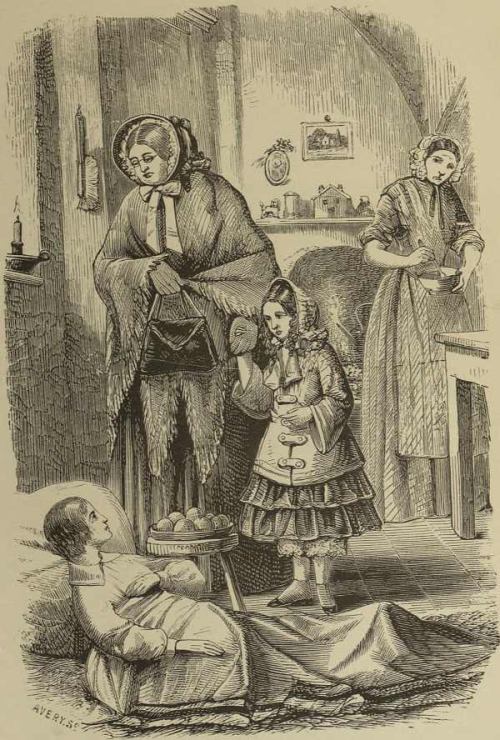
THE GYPSIES AT LAST.
 NE pleasant day, when the woods and
hills of Glen Eagle were lying in the
yellow afternoon sunshine, Morag and
Blanche wandered into their old trysting-place,
the fir-wood, which they had rather
deserted of late.
NE pleasant day, when the woods and
hills of Glen Eagle were lying in the
yellow afternoon sunshine, Morag and
Blanche wandered into their old trysting-place,
the fir-wood, which they had rather
deserted of late.
The precious holiday afternoons had most
frequently been spent in the ben-end of Kirsty's
cottage, and a staunch friendship had sprung
up between the old woman and the little girls.
These visits had become a great and daily happiness
to Morag. Kirsty's illness lasted for
some time, and Morag often thought that but
for it she should never have felt so much at
home in the cottage, which she had so long
watched from afar with a mingled feeling of
curiosity and dislike; and now she knew every
stone and cupboard of it by heart. For had
she not helped Kirsty on her recovery to make
a thorough cleaning of both but and ben, for
which the old woman's active fingers had
longed, as soon as she was "to the fore" again.
Already, the little untaught maiden had learnt
from her old friend many useful household arts
and wise maxims, and the keeper's home began
to bear traces of Kirsty's thrifty ways and
cleanly habits. Every morning during the old
woman's illness, Morag had started for the cottage
after her own work was done, taking the
short cut through the heather, and gathering,
as she went, a little bundle of sticks for the
fire-lighting. Then, after Kirsty's morning
wants were supplied—and she was not an
exacting invalid—Morag would take her seat
on a little low wooden stool which Kirsty
named "Thrummy," from its being covered
with shreds of cloth fastened to the wood. It
was made by her long ago for a vanished child,
who once had been the light of that now lonely
home. Morag often sat on it in these days,
listening with eager, upturned face to Kirsty's
solemn reading of the book she loved. Her
rough northern tongue sounded very different
from the silvery flow of the little English lady;
but Morag felt that the words which she heard
in the cottage were no mere tale to Kirsty,
"no vain thing, but her life."
Slowly, the words of Jesus began to sink
into the little girl's heart, and gradually she
came to understand, after the first chill of disappointment
was past, that though the earthly
voice of the Son of Man was heard no longer,
nor His ministering touch felt among the people,
as it used to be in those early days of
which the Gospels told, yet He was still the
loving, listening Helper of all who came to
Him. Kirsty's belief that He was not dead,
nor very far away, but a very present Friend
to be listened to and spoken to at all times
with a certainty that He would both hear and
help, had in some degree penetrated Morag's
soul; and she, too, ventured to bring her little
cares and troubles to this new-found Friend,
and had already a spiritual record of help
given and difficulties met in the name and
strength of Jesus.
And so it happened that Kirsty's cottage
became quite a rival to the fir-wood, which
seemed to Morag like a dearly-loved, but neglected
friend, as she trod among the soft moss
and brown fir-needles on this afternoon. After
visiting a few of the historical spots sacred to
the memory of the first days of their acquaintance,
Blanche proposed that they should make
an exploring tour to a part of the forest which
she had never visited; and the little girls made
their way through the fir-trees to where the
Shadows were darkest, and the arching green
boughs almost shut out the day. Blanche was
gay and talkative as usual, dancing hither and
thither, singing snatches of songs, and making
the great aisles of pine re-echo with her laughter
and fun. She kept stopping as usual to
gather various treasures from the great floor
of the forest—"specimens," she called them;
but it is to be feared that they never reached
a calm state of museum classification. Blanche
meant that these "specimens" should travel to
London with her—and stowed them away in
corners of her room with that intention, though
her design was frustrated in most cases, however,
by their being deposited in the dust-bin
by Ellis, while she remarked to cook that she
"never did see the like of missy for fillin' her
room with rubbage of all kinds."
Chance had chosen to remain at home on
this afternoon, notwithstanding Blanche's pressing
invitation that he should accompany them.
He had replied to it by shaking his head,
knowingly, as if to say, "No, no, my little
mistress, I'm not going to be taken in. Shag
is not going, I see; so you are only going to
loiter about in an aimless manner, and I should
certainly be bored. Much nicer here," he
thought, as he stretched himself lazily on the
warm stones of the old court-yard, where the
sun was striking, and snapped at a fly,—pretending
to look the other way when Blanche
made her final appeal to his honor and conscience.
Perhaps he felt a few twinges of remorse
at having so determinately chosen to
neglect his duty, for he rose presently and
stood looking after the girls as they disappeared
among the birk-trees; but he did not
repent, evidently, for he went and lay down
again, deciding that there was no use of a fellow
putting himself about for two silly little
girls on a hot afternoon like this.
Morag and Blanche wandered into the forest
till they reached the old road skirted by a
low, lichen-spotted wall, which was the entrance
to the glen, and divided the forest.
And now Morag's clock—the afternoon sun—told
her that it was more than time for them
to be turning their steps in a homeward direction,—especially
since, that very afternoon,
before they started, she had received strict injunctions
from Miss Prosser to see that her
charge was not again late for tea, since the
flight of time seemed to pass quite unnoticed
by Miss Clifford. It was by no means an easy
matter to be time-keeper to such an inconsequent
young lady as Blanche, who never realized
the unpleasantness of being late till she
was brought face to face with Miss Prosser.
She was now wandering about in all directions,
adding to her lapful of gatherings, and
talking pleasant nonsense, while Morag's rare
laugh was sometimes heard joining in her
merriment.
At last they started on their homeward
way, and Morag was congratulating herself
that she would be able to present her erratic
wee leddy in time for tea, when Blanche noticed
a plantation of larches, which looked so
pretty and feathery through the dark firs that
she thought she should like to inspect them
more closely, and coaxed Morag to come on
with her.
An old grey dyke separated the fir forest
from the larches. The girls followed its windings
for a little, and presently Blanche climbed
across the loose stones, and went a little way
into the larch plantation to explore. Morag
felt impatient to proceed, and walked on to try
and discover which would be the most direct
route home through the firs. Presently she
heard a sound, which her accustomed ear detected
as an unusual one in that silent sanctuary
of hers. She hastily turned a sharp corner to
see what the next winding of the dyke would
disclose, and, in doing so, she almost ran up
again a sort of tent. It was a very rude erection,
and consisted of a few large branches
which had been driven loosely into the ground,
and partly rested against the old wall for support.
A tarpaulin was thrown over them, but
it was evidently too small to cover the abode,
and was supplemented by a tartan plaid, which
hung across the front stakes, so that no entrance
was visible. This was not Nature's doing, evidently,
and Morag was seized with a great panic
when she saw the unexpected human habitation.
She had heard wild stories of terrible deeds done
on lonely moors and in lonely woods, and felt
more frightened than she had ever done in her
life when she thought how far they were from
home, and that the precious wee leddy was unprotected,
save by her. However, she saw no
terrific personage as yet, and she began to hope
that the inmates of the tent might be from
home. But there was that sound again, and
this time it seemed like the moaning of a voice
in pain. Morag felt that safety lay in immediate
flight, and she quietly turned to meet
Blanche, and to make a sign of silence. But,
before she had time to do so, the wee leddy's
voice rang out in gleeful tones, concerning the
varied delights of the larch plantation, which
the dwellers under the tartan could not fail to
hear. Whenever Blanche caught a glimpse of
Morag's startled face, she knew that there must
be something very far wrong, and she stood looking
at her in questioning silence. Presently,
a rustling sound made them both turn, and
Blanche's eye caught sight of the rude tent.
For a moment she stood riveted gazing at it,
while Ellis's stories and prophecies concerning
the gypsies chased each other through her mind,
and she thought with terror that they had all
come true at last.
Presently there was a fluttering of the tartan
awning, and a hand appeared among its
fringes, as if to make a passage out.
Blanche's face grew white with fear, and she
clutched Morag's arm with a scream of terror.
The little mountain maiden kept quite silent,
though her face looked as terror-stricken as that
of her companion. Seizing Blanche's arm, she
began to pull her along, running as nearly as
possible in a homeward direction. On they galloped,
breathless and speechless; but the fir needles
were slippery, and the trees were in the way.
At last Morag felt that the wee leddy's steps
were beginning to flag; and, worse than all, she
fancied that she heard footsteps behind. It
was a terrible effort, but the suspense began
to be insupportable, and without slackening her
pace she turned to look. There, sure enough,
was a man behind them, gaining ground upon
them very fast, too. Poor Blanche kept up
bravely in the race for a while, but now she
began to fail. First, her hat fell off, and even
Morag did not venture to turn to pick it up;
then her lapful of gatherings dropped one by
one, tripping her as they fell; finally she stumbled,
and the golden crown was down, down
among the fir-needles, and the tears were falling
fast. No entreaties of Morag's could persuade
her to move, and the footsteps of the
pursuer sounded nearer every minute. The
little mountaineer could have outrun almost
anybody, but she never dreamt of leaving
Blanche; and now she seated herself quietly
beside her bonnie wee leddy, determined to
protect her to the death. In her distress she
cried to the unseen, listening Friend, whom in
these last days she had been learning to know:
"O Lord Jesus, dinna let the gypsies get hand
o' us; and may no ill come ower the bonnie
wee leddy here," she added as she seized her
hand, and made a last effort to rouse her to run
again. She knew that the pursuer, whoever he
might be, must be close at hand now, but she
did not dare to look back. Blanche at last
raised her head, and now, for the first time,
she heard the sound of the footsteps behind.
With a shriek of terror she rose to run again;
Morag followed, but this time she did not feel
quite so frightened, somehow, as she had done
before, and, at last, a sudden impulse caused
her to turn round to face her pursuer, and
await her fate.
Hurrying through the fir trees, she saw,
not a terrific-looking gypsy, but a pale, slender
boy, with a gentle-looking face, considerably
taller than herself. He was signing to her,
and called something when he saw her turn
round at last. Morag's terror began to abate
in some degree, and the boy presently joined
her, breathless after his chase, and rather frightened-looking
also. He was holding Blanche's
hat in his hand, which he shyly restored to
Morag. "She dropt it," he said, pointing to
Blanche, who still continued to run at full
speed without turning to look. The restoration
of the dropped hat looked promising; Morag
began to feel reassured, and at the same
time rather ashamed of herself.
"Will you be so kind as tell me where I
can find some water?" asked the boy in a quiet
tone; "we are strangers, and mother is very
sick;" and his voice faltered.
Morag's little motherly heart was melted
in an instant. "I'm real sorry yer mother's
no weel," she replied in sympathizing tones.
"I'll maybe find a drop o' water for ye, but
it's some far frae here. The wee leddy and
me were terribly frightened, and we couldna
jist help runnin'," she added apologetically.
Blanche had halted in her flight, not hearing
Morag's step behind, and her astonishment
was as great as her terror had been the
previous moment when she turned and saw
Morag calmly engaged in conversation with
the object of their fear. She did not venture
to join them; but a feeling of curiosity, which
is a great dispeller of fear, took possession of
her, and she stood waiting breathlessly to see
what was going to happen next.
Presently Morag came running to her to
explain and consult. The lad slowly followed,
looking rather more abashed than before, when
he saw Blanche. He turned to Morag again
and said, eagerly, "Will you not come and
see my mother? I think it might cheer her
to see you. We have come a long way,
and the water is done, and she is so tired and
thirsty. I'm afraid she is very ill—she says
she's dying." It was a fine manly face; but
the gray eyes filled with tears as he looked
imploringly, first at one and then at the other
of the little girls.
"Oh yes, certainly; we shall be glad to go
and see your mother. I do hope she is not
so very ill. And, of course, we must find
some water, though we have to go right home
for it, Morag," said the impulsive little Blanche,
every trace of her former fear having vanished
in a moment. "You must have thought it
very queer of Morag and me to run away as
we did. But, indeed, we were dreadfully
frightened, and quite thought you were dangerous
gypsies, you know."
The boy's face flushed, but he made no
reply. Meanwhile, Morag was silently planning
what would be the best thing to do. It
was now more than time that Blanche should
have returned to the castle, and yet here was
an appeal which it would require a harder
heart than Morag's to resist.
"Of course we must help him, Morag,"
whispered Blanche, noticing her hesitation.
"Don't you see how sad he is about his sick
mother? I really don't think there could be
any harm in going to see her. He seems
so very anxious. Come, let's go for one minute."
And so they turned to retrace their steps
along the path over which they had hurried in
such terror a few minutes before, with their
dreaded pursuer walking calmly and inoffensively
by their side.
When they reached the tent, Morag recognized
the moaning voice which had at first
roused her alarm. The boy drew aside the
tartan folds and stepped in before them, and
presently they heard a feeble voice say, "Kenneth!
Kenneth! you've been long away.
Don't leave me, my boy—it won't be long
now you'll have to stay. I would like to have
lived to see her, though. We must surely
be near the place now. The last milestone
said three miles from the kirk town of Glen
Eagle, didn't it? The Highlander said she
was still alive, you know. You'll seek her out
when I'm gone—she's good and kind, he always
said. Bring her here, and she'll help
you with everything there will be to do—after
I'm gone. I would fain have seen her once before
I died, though; but you'll tell her I have
gone to meet her long lost Kenneth, who is
safe in the happy home of God. You will
follow Jesus, and He will lead you safe home,
my boy."
Morag had been listening intently to the
feeble, broken sentences, and now she could
hear that Kenneth gave a great sob, as he said,
"O mother! don't speak like that! I'm sure
you'll feel better again, when we find grandmother.
You've often been nearly as ill before.
There's a nice little girl I met in the wood,
going to try to get some water, and maybe
you'll be better after you get a drink."
"A girl did you say, Kenny? where is
she?" asked the sick woman, turning restlessly
about.
Kenneth drew aside the tartan screen, and
beckoned to Morag, who stepped in softly, followed
by Blanche.
In a corner of the tent, on some loose straw,
lay the dying woman, with her head resting on
one of the lichen-spotted stones of the old dyke.
She turned her large, bright, restless eyes on
the little girls as they entered the tent. Raising
herself a little, so that she might see the
strangers, she said, in a feeble, though excited
tone, "I'm very ill, you see. I've come a long,
long way to die in this lonely forest. I didn't
think once that I should end my days like
this." A fit of coughing came on, and after it
was over she lay back exhausted.
Blanche had never seen anybody very ill
before, and she felt rather afraid of the bright,
hollow eyes and the strange sound of the short,
gasping breath, and was much relieved when
Morag stepped forward and put her little
brown hand into the white, wasted fingers.
The little girl could not think of anything to
say, but she stood, with a pitying look, holding
the hand of the sick woman, who seemed
pleased, and smiled kindly on her. Suddenly
she seemed to recollect something, and starting
up, she asked Morag, in an eager tone, "Can
you tell me where Glen Eagle is? it surely
can't be far from here;" and before Morag
had time to reply, she added, "Did you ever
hear of a Mrs. Macpherson who lives near
there, in a little cottage all alone?"
Morag pondered for a moment, and then,
turning to Blanche, she said, "Will that no be
Kirsty?"
"Yes, yes; it is Kirsty! Christian was her
name. He used to say they called her Kirsty,"
exclaimed the sick woman, eagerly.
Kenneth had been mending a fire which
he had kindled between two of the loose
stones. As he got up from his knees to listen,
a ray of hope flitted across his pale, anxious
face.
"Oh, we know Kirsty perfectly well!"
burst in Blanche, glad to be able to say something
pleasant. "Morag and I go to see her
almost every day. She is such a nice old
woman, and lives in such a pretty cottage!"
"Do you think you could bring her here to
see me?" said the sick woman, entreatingly.
"I do so want to see her once before I die."
Morag glanced doubtfully at Blanche. "It's
no jist terrible far frae here til Kirsty's cottage;
but she hasna been weel, and it's a lang road
for her to come, I'm thinkin'. But I wouldna
be long o' runnin' to see."
"God be thanked. He has granted me the
desire of my heart," said the dying woman,
clasping her hands. "The Lord reward you,
child. Tell Christian Macpherson that her
Kenneth's wife is lying dying here, and wants
to see her—to come soon—soon," and she sank
back, exhausted with the effort of speaking.
"We had better start at once, Morag,"
whispered Blanche, eagerly. "I do hope Kirsty
will be able to come. It is certainly very far
for her to walk. Never mind me, Morag," she
added, seeing her friend look perplexed as to
the best course of action. "Of course I shall
be hopelessly late; but I'll tell papa all about
it, and I'm sure he won't be angry. He will
have come from the moors, I daresay, by the
time we get home."
"I'm so thirsty; do you think you could
find me some water? It might keep me up till
she comes," said the woman, turning wearily
to Morag.
And then a new difficulty arose; for the
nearest spring was quite half-way to Kirsty's
cottage, and Morag foresaw that there could not
possibly be time before dark to fetch the supply
of water, and bring Kirsty too; and Kenneth
could not go, for the poor woman was
evidently too ill to be left alone.
"I'll tell you what we must do," said
Blanche, quickly perceiving the difficulty. "I
can't go to Kirsty's, because I shouldn't know
the way through the wood, you see! But I
can stay with your mother," continued Blanche,
turning to Kenneth, and trying hard to look as
if she were making an ordinary arrangement,
she added; "and you can go with Morag and
fetch the water, while she goes on to the cottage."
It was certainly a great effort for Blanche
to make this proposal, but she was very anxious
to be brave and helpful in the midst of this
sad scene, and she insisted on its being carried
out, though Morag felt very doubtful as to the
propriety of leaving her bonnie wee leddy all
alone there. Still there seemed no help for it,
so she consented at last, and was soon hurrying
towards the spring with Kenneth. They
walked along the narrow path through the
forest for a long time without breaking the
silence. At last Kenneth said in a stammering
tone, "You've been very kind to us,
strangers; I'll never forget it, and I'm sure
mother won't. I think she'll be all right again
when she has seen grandmother. She has been
fretting so about finding her."
"Is Kirsty Macpherson your grandmother?"
said Morag in a surprised tone, raising her
downcast eyes, and looking at Kenneth. "She
never telt me about ye," she added, musingly.
They had now reached the spring, and Kenneth
having quickly filled his pitcher, and
looking gratefully at Morag, turned to retrace
his steps in the direction of the tent.
The little girl ran on eagerly, more anxious
than ever to fulfil her mission. Emerging
from the forest at last, she crossed a small hillock,
and came down at the back of Kirsty's
cottage. She found the old woman seated at
the door, knitting busily, as she watched the
sunset. The amber clouds were beginning to
gather round the dying sun, and Kirsty sat
watching the cloudland scene with a far-away
look in her tranquil gray eyes.
"Na! but is this you, my dawtie? I'm
richt glad to see ye. I some thocht ye might
be the nicht; but how cam' ye roun' by the
back o' the hoose?" asked Kirsty, smiling as
she welcomed her little friend, when she appeared
round the gable of the cottage.
Instead of answering her question, Morag
asked, hurriedly, "Kirsty, will ye be fit for a
good bit o' a walk the nicht, think ye?"
"Weel, bairn, I wouldna min' a bittie, in
this bonnie gloamin'; but I'll no say I'll gang
sae fast or sae far as I ance could hae done,"
replied the old woman, smiling at Morag's
breathless eagerness.
"D'ye think ye could gang as far as the
other end o' the fir-wood, Kirsty?"
"Na, bairn; but I'm thinkin' ye're makin'
a fule o' me the nicht. Ye ken brawly I hinna
gaen that length this mony a day," said Kirsty,
looking up with a shade of irritation in her
calm face at the thoughtlessness of her usually
considerate little friend.
"Weel, Kirsty, I'm thinkin' ye'll need to
try it the nicht. There's somebody lyin' there
that's terrible anxious to see ye." Morag's
voice trembled, as she continued, "I've a message
for ye, Kirsty. Your ain lost Kenneth's
wife is lyin' i' the firwood, and wants to see ye
afore she dees!"
For a moment Kirsty looked bewildered;
but there was no mistaking the slowly spoken
words of the message. Presently she held
out her hand to Morag to help her from her
low seat, with a sigh; and, leaning against the
door, she stood thinking. Her usually calm
eyes looked hungrily at the little messenger,
and her voice sounded faint and hollow as she
asked, "Is he there himsel?" And then she
added, shaking her head, mournfully, "Na, it
couldna be; he would hae come til his mither
surely."
"There is a Kenneth, but I'm thinkin' he's
no yer ain, Kirsty," replied Morag, with a
pitying glance at the poor mother's yearning
face.
"Tak' me til her, Morag. Kenneth's wife!—she's
dyin' i' the fir-wood! The Lord grant
me the strength to gang." And the old woman
laid her trembling hand on the little girl's
shoulder as she moved to go.
Very soon they were toiling across the hillock
together, and not till they were far into
the forest was the silence broken.
Meanwhile, Blanche had seated herself on
the grey dyke, and was keeping watch beside
the sick woman. It was a strange vigil to
keep, alone in the darkening fir-wood, beside
this tossing, wild-eyed, dying woman; but,
somehow, Blanche did not feel frightened in
the least degree. Since she had taken her
post, it began to seem the most natural thing
in the world that she should be there. The
sick woman took no notice of the little girl for
some time, and, indeed, seemed hardly aware
of her presence, till, turning round suddenly,
she saw her seated there, her fair curls gleaming
in the half darkness. She looked at her
restlessly for a little, and said presently, "How
came you here, my pretty dear. You're surely
far from home. Will your mamma not be getting
anxious about you? It seems so dark in
that wood."
"I haven't got a mamma," replied Blanche,
vivaciously. "Miss Prosser will be cross, I
daresay; but I don't think she'll mind when
I explain. I'm sure Morag won't be longer
than she can help in bringing in Kirsty,"
added Blanche in a comforting tone, for she
noticed that the weary eyes wandered restlessly
toward the entrance of the tent.
Presently a terrible fit of a breathlessness
came on, and the poor woman sank back exhausted
on her hard stone pillow when it was
over. Blanche gazed pityingly at the sufferer,
and longed for the morrow, when she meant
to return with various needful comforts. She
had made up her mind to enlist Mrs. Worthy's
sympathy, believing her to be more amiable
than Ellis.
Meanwhile, she took off her soft jacket, and
folding it, she slipped it under the poor restless
head on the hard stone. The sick woman
noticed the pleasant change, and smiled gratefully.
And as Blanche looked at her, she
thought how pretty she must once have been,
before the cheeks had got so hollow, and the
eyes so sunken.
It was beginning to get very dark within
the tent, and Blanche was not sorry to see
Kenneth make his appearance with his pitcher
filled with clear water from the spring. The
sick woman seemed greatly refreshed by the
draught, which she drank eagerly. But presently,
she began to get very restless, and kept
moaning, "Kenny! Kenny! are they not within
sight yet? It's so long since that little girl
went away."
At last, after Kenneth had drawn aside the
tartan folds several times, he brought back the
news that the little girl and an old bent woman
were coming through the trees.
"Oh, it's all right!—Kirsty and Morag—here
they come!" cried Blanche, joyfully, as
she sprung out to meet them, saying eagerly
to Kirsty, "Do come quickly; she's so very
anxious to see you, Kirsty!"
The old woman made no reply, but walked
silently towards the tent, looking intently at
Kenneth, who stood in front of it. "My ain
Kenneth's bairn," she murmured, as she laid
her trembling hand on his head. Morag heard
him say, "Grandmother, we've found you at
last! Mother will be so glad!" and he led
her to where the dying woman lay, and the
tartan folds shut them out from sight.
In the meantime, two figures might be seen
wandering through the forest, searching hither
and thither in all directions. They were Ellis
and the keeper, who had started in company to
look for the missing girls. Blanche's maid was
in a state of high nervous agitation concerning
her little mistress. She had been consigning
her to various imaginary harrowing fates since
she left the castle in search of her, but the
keeper had smiled his grim smile, and assured
her that girls were like kittens, and had nine
lives. Nevertheless, he too began to feel rather
anxious about them, after he had reluctantly
led the way to Kirsty's cottage, where he expected
to find them safely housed; but, to his
surprise, they found it quite tenantless. Ellis
began to wring her hands in despair when she
detected a shade of anxiety on the keeper's
face, after the neighborhood of the cottage had
been searched without any result. Then Dingwall
decided that the fir-wood must be thoroughly
explored, for he knew that it was one
of Morag's favorite haunts. They wandered
on, searching everywhere, till at last the keeper's
keen eye discovered, through the fir-trees,
the dark tent resting against the old dyke,
with its back-ground of pale larches. He began
to feel rather uneasy, and to wish that he had
brought some defensive weapon with him, for
there was no trace of the girls, and it was more
than likely they had been picked up by the
gypsies, and sharp measures might be necessary
for their recovery. He did not, however,
confide his fears to Ellis, but went forward
to take a nearer inspection of the encampment.
Meanwhile, the little girls were hovering
about the tent, wondering what would happen
next. Morag had quite made up her mind that
the wee leddy must instantly be conducted
homewards, and was relieved to find that she
was not unwilling to go—the reason being that
Blanche was full of hospitable ideas concerning
the dwellers under the tartan, and she felt impatient
to get home again to enlist all the sympathy
possible in their favor.
Morag, before starting for the castle, had
gone to reconnoitre a little round the tent, to
try to find an opportunity of whispering to
Kirsty that she would return presently, provided
her father would allow her. Just at that
moment, Blanche spied Ellis and the keeper
hovering about among the trees, and ran forward
to meet them.
Ellis's anxiety immediately changed to indignation
when she perceived that her little mistress
was safe and sound, and she was about to
break forth in angry words of remonstrance
when Blanche held up a warning finger and
pointed to the tent, which the little fire within
was making more visible in the darkness.
"Gypsies, I declare!" shrieked Ellis.
"You've been kidnapped. We're just in time
to save her!" she added, wringing her hands,
and turning to the keeper, who in his turn
began to feel a shade of anxiety regarding his
Morag, as she was nowhere visible.
"Hush, Ellis; they aren't gypsies a bit.
There is a very sick woman lying there—dying,
she says, but I hope she isn't quite that. They
are strangers, and have come a long way."
"Didn't I tell you? They always come
from the hends of the earth. Gypsies, as sure's
my name's Ellis. Are you kidnapped, missie—tell
me now?" But Blanche appeared still in
possession of a wonderful amount of freedom,
and glanced with an amused smile at the keeper
as she listened to her maid's suggestions. So
Ellis continued, in an angry tone—
"What have you ever been about so long,
missie? Miss Prosser's well-nigh into a fit
about you, and Mrs. Worthy says she can't sit
two minutes in one place for anxiety. And
there's cook, as declares she has miscooked master's
dinner for the first time in her life—all on
account of her hagitation concernin' you." And
Ellis went on to give a chronicle of the various
distracted feelings of each separate member of
the household.
"Has papa come home, then? and what
did he say about my being so late?" interposed
Blanche at last.
"Oh, well, you see the master is a quiet
gentleman, and never does make much ado,"
replied Ellis, rather crestfallen that she had
nothing sensational to narrate from that quarter.
"But he said we would be sure to find you
at that old woman what's-her-name's cottage,
where you're so fond of going to; and you see
we didn't. Really, missie, it's too bad! I'm
near wore off my feet between the fear and the
draggin' after you. I only hope you won't be
let go out at the door again without Miss Prosser—that's
all I've got to say."
Blanche hoped it was, but she feared not.
She had a painful consciousness that she was
jacketless, and felt certain that, sooner or later,
that fact would be discovered and inquired into.
Meanwhile, Morag joined them, not having
been able to get a word with Kirsty, though
she could hear her voice mingle soothingly with
the eager, gasping tones of the dying woman,
who appeared to have a great deal to say to
this long-sought friend. Morag seemed to feel
more relief than alarm at the sight of Ellis in
possession of her little charge. But when she
discovered her father's tall form leaning against
one of her pillars of fir, she started, and looked
nervously towards the tent. The keeper accosted
her rather sternly, saying, "I wonder at
ye, Morag. I thocht ye had mair wit—takin'
up wi' a set o' tinkers, and bidin' oot so lang,
forby."
Morag did not venture to explain the cause
of their delay, nor did she mention that Kirsty
Macpherson was so near at hand. She observed
that, though her father seemed quite
willing now that she should go to see the old
woman, yet he evidently wished to avoid meeting
her; and Morag felt sure that to disclose
the fact that Kirsty was one of the alleged tinkers
within the tartan folds, would not help to
smooth matters.
"Missie! wherever is your jacket?—well,
I never!" screamed the maid, with uplifted
hands, when, for the first time, she observed
the absence of that garment.
"My jacket? Oh, never mind, Ellis; it
isn't cold," replied Blanche, looking rather uneasy,
but attempting to assume a careless tone.
"Never mind! Did I ever know the like?
Where's your jacket, missie? I insist on knowing!"
screeched the excited Ellis. "Stolen by
them vagrants you've been a-takin' up with,
I'll be bound," and the maid looked at the
keeper, as if she thought he ought to take immediate
steps towards the recovery of the stolen
property.
Morag glanced anxiously at Blanche. She
did not know what had become of the missing
jacket, and she began to wonder whether it
could have been dropped in their flight from
the supposed dangerous gypsy. She was about
to suggest that she might go to look for it,
when the indignant Ellis continued—
"Well, keeper, what is to be done? You
see Miss Blanche doesn't even deny that
they've stolen her jacket—her beautiful ermine
one, too. I gave it her on because she sneezed
this morning. Pity there isn't a policeman to
set at them," snorted Ellis, in great wrath, as
she glanced at the keeper, who stood stolid and
immovable, looking at Blanche.
The little lady began to feel at bay, and,
being again challenged by her maid to tell
what had become of the missing garment, she
planted herself against a fir-tree, and flinging
back her curls, she folded her arms, saying in a
dramatic tone—
"Now, Ellis, listen! I'd rather suffer all
the tortures we read of yesterday at Kirsty's, in
Foxe's Book of Martyrs, than tell you where
that jacket is!"
Morag had been about to expostulate with
the wee leddy; but now she felt much too
awed to utter a word. As she stood gazing at
her, the fir-tree was immediately transformed
in her imagination to a stake, and visions of
lighted faggots and rising flames coursed
through her brain. Ellis, too, seemed rather
impressed, and Blanche took advantage of her
position to remark in her most imperious tone,
as she quitted her dramatic pose, "Now, Ellis,
if you say another word about that jacket, I
shan't go home with you a step. Perhaps to-morrow
I may tell you what has become of it,"
she added, bending her head graciously, as she
volunteered to start for home under these conditions.
At this juncture, Kirsty suddenly emerged
from the tartan folds. She had been reminded
that the little girls still waited by hearing the
sound of voices, and she came now to urge
them to return home at once.
The moon was now giving a clear, plentiful
light. It shone on Kirsty's placid face, and
showed her another face which she had not
looked on for many a year, and it seemed
strange that she should see it to-night. The
keeper looked as much startled as if he had
seen a ghost, when the old woman moved
slowly towards him, and holding out her hand,
said, solemnly, "Alaster Dingwall, is that
you?" and still holding his hand, she added,
"Weel do I min' the nicht I saw ye last. But
come ben, and hear o' the goodness o' the Lord
frae this dyin' woman. Eh! but He's slow to
anger, and plenteous in mercy. The soul o'
my lang-lost Kenneth is safe wi' Himsel'. He
has granted me the desire o' my hert. Com
ben, and see Kenneth's wife!"
Dingwall's usually inflexible face showed
traces of strong emotion as he listened to Kirsty.
He made no reply, but was about to follow her
into the tent, when Ellis, more mystified than
ever by these strange dealings with these disreputable
gypsies, who had already given her so
much trouble that afternoon, shouted in angry
tones, "Well, keeper, if you're going to stay in
this wood longer, I'm not. Come along, missie,
we must find our own way as best we can."
And without waiting for a reply, the indignant
maid hurried off with her reluctant charge.
Morag stood watching her father, as he followed
Kirsty, bending his tall figure to creep
into the low tent, and then she sat down on the
old grey dyke outside, to await the next scene
of this strange evening. She could not help
feeling very glad that her father and Kirsty
were going to be friends at last, though it was
such a sorrowful occasion which seemed to have
brought the reconciliation about. Presently
she saw Kenneth slip out of the tent, looking
very grave and sad. He came and leant silently
against one of the fir-trees, and stood
gazing into the pale larch plantation, with its
long dark grass shimmering in the white moonlight.
Morag knew that he was looking so sorrowful
because his mother was going to leave
him, and she felt very sorry too, and longed
to be able to do something to comfort him;
but she thought that perhaps it was best to
keep quite quiet there, and let him think his
own thoughts. She wondered whether Kenneth
knew and loved his grandmother's Friend,
and was able now to tell Him all his trouble.
When the keeper entered the tent, the dying
woman fixed her great restless eyes upon
him, and looked questioningly at Kirsty. The
old woman stooped down, and said, "It's Alaster
Dingwall—him, ye ken, that was Kenneth's"—friend,
she was going to say; and
then she glanced sadly at the keeper, and did
not finish her sentence. But presently she added,
"Eh! but He's been good and forgien us
muckle, and we maun be willin' to forgie," and
taking the thin, white fingers, she laid them in
the keeper's broad, brown palm.
"Yes, yes," gasped the woman; "I remember
the name. My husband said something
about him when he was dying, too; but I can't
recollect now." Her memories of the troubled
past were growing dim in the haze of death.
"My boy, where is he?" she asked, presently,
turning to Kirsty. "I've brought him
to you—you'll love him for your own Kenneth's
sake, won't you? He's a good boy; it's
hard to leave him in this wicked world alone;
but you will look to him, won't you?" and she
looked beseechingly at Kirsty. "We've travelled
many a weary mile to reach you—he'll
tell you all about it after. But it's all over
now—all past, and the rest is coming," she
murmured, and then she lay quite still for
a few minutes, and her lips moved as if in
prayer.
Presently she seemed to remember something,
and, putting her hand into her breast,
she drew out a little bag with one or two gold
pieces in it. Handing it to Kirsty, she said,
"It's all there is left—he's very ragged I'm
afraid, and I'll be to bury. But you are good
and kind, he always said, and you'll be kind to
my boy, for Christ's sake, and for your own
Kenneth's, grandmother, won't you? I haven't
remembered all his messages, I'm so tired to-night.
He wanted your forgiveness so much—but
you'll see him again—we'll both be waiting
you and Kenny!"
"Eh! my bairn; but ye mauna forget that
a sicht o' Christ's ain face will be better than
a' the lave," said the old woman earnestly, as
she wiped the cold damps of death from the
white forehead.
"It's so cold, and gets so very dark," she
moaned restlessly. "There was a candle left
in the basket, I think; why doesn't Kenny
light it? Where is he? why does he go
away?"
The candle was already burning near its
socket, and Kirsty saw that the haze of death
was fast dimming the eyes that would see no
more till they awoke in that city "where they
need no candle, neither light of the sun, for
the glory of God doth lighten it; and there
shall be no night there."
The old woman went to call Kenneth, who
was still leaning silently against the fir-tree.
"Come ben to yer mither, my laddie! Ye
winna hae lang to bide wi' her noo, I'm thinkin'."
And the boy came and knelt beside his
mother. The keeper had been standing with
folded arms, looking silently on, but now he
crept away, and sitting down in a corner of the
tent, he covered his face with his hands. The
sins of his youth came crowding to his memory;
one dark spot stood out in terrible relief,
and made him cower with shame and remorse
in the presence of this boy, and his mother on
her lowly dying bed.
Meanwhile, Kirsty went out to look for
Morag, whom she had not forgotten. Seeing
her seated on the old dyke, she beckoned to
her, saying, "Come awa, dawtie, dinna bide
there yer lane! Puir thing, she winna be lang
here, noo. It's a sair sicht for a young hert,
but come ben, Morag. 'Deed they're best aff
that's nearest their journey's end," murmured
the old woman, as she stepped under the tartan
folds again.
Morag followed, and stood gazing sorrowfully
at the dying woman. She had been lying
quietly for several minutes, but presently she
looked wildly round, and, stretching out her
arms, she cried, "Kenny, Kenny, lift me up!"
Kirsty stepped forward, and raised the
weary head on her arm, saying, in her low,
firm tones, "Dinna be feert, my bairn. The
valley is dark eneuch, but there's licht on the
tither side. Jist ye haud His han' siccar, and
ye'll see His face gin lang." For a few moments
she lay peacefully, with her hand resting
on Kirsty's breast, but presently a great
spasm of agony crossed the wasted face, some
lingering breaths were drawn, and the poor,
quivering frame lay at rest.
Neither of the children knew that it was
death. After a long silence Kenneth rose from
his knees, and whispered to Kirsty—"She's
gone to sleep; we must not wake her for a
while—it's so long since she slept before."
"Ay, ay, my laddie," replied Kirsty, shaking
her head, mournfully; "she's gane to sleep,
til her lang, lang sleep. Nae soun' o' ours will
waken her noo; it will be His ain blessed voice
i' the Day that's comin'."
Poor Kenneth understood now. With a
low cry of agony, he knelt beside the body,
which Kirsty had laid tenderly on its lowly bed
among the brown fir-needles again. And as
she did so, Morag caught a glimpse of the wee
leddy's missing jacket; she understood now
why she was so vehemently unwilling that it
should be searched for.
The keeper had been a silent spectator of
the sad scene. At last he turned to Kirsty,
and brushing a tear from his eye, he said, in
a husky voice—"Kirsty, woman, I've whiles
afore rued yon dark nicht's work sore eneuch,
and all that came o't, but I niver rued it sae
muckle as I do the nicht."
"Dinna say nae mair, Alaster Dingwall,"
replied Kirsty, holding out her hand. "I'll no
say that it wasna sair upo' me for mony a day,
but I see it a' the nicht. Ye were jist the instrument
in His hands for sendin' the puir
prodigal safe hame til the Father's hoose.
Will you no come intilt yersel', man? The far
countrie o' sin is an unca lonesome place, Alaster
Dingwall," and Kirsty laid her hand on his
arm, and looked earnestly into his face.
"It's no easy wark for an auld sinner like
me, Kirsty; but, I'll try," Dingwall replied, as
he glanced kindly and pityingly at the orphan
boy, and lifted him from his dead mother's side.
"Noo, keeper, ye and Morag mauna bide a
minute longer. The puir lassie maun be deid
tired," said Kirsty, rousing herself to think
what must be done next. "I'se watch aside
the corp; and maybe, when the morn's come,
ye'll hae the kindness to speir gin the wricht i'
the village will come ootby here, and we'll lay
her in her lang hame, and the puir laddie will
come hame and bide wi' me."
The keeper would not hear of leaving her,
and Morag seated herself on the dyke, saying
quietly, "I canna be goin' home and leavin'
Kirsty, father."
The poor boy seemed so faint from grief
and fasting, that Dingwall at last decided to
take him away from the sorrowful scene, and
to leave Morag, who determinately clung to
her old friend.
Kenneth stood gazing mournfully at the
silent form, murmuring, "Mother, mother!"
in a low monotone of agony. He would not
be persuaded to quit the spot till Kirsty unfastened
the tartan plaid from the stakes, and
laying it reverently on the body, she covered
the dead face out of sight. And as she unwound
the plaid from its fastenings, she remembered
with a sharp pang of sorrow the
morning on which she had last seen that old
plaid. While the keeper and Kenneth are wandering
through the fir-wood on their way to
the shieling among the crags, and the old
woman, with Morag by her side, keeps her
strange, lonely watch beside the dead, we
shall explain why it was so terrible for the
keeper to remember, and so difficult for Kirsty
to forget, the events of a certain night long
years ago, which had driven the older Kenneth
from the Glen an outlawed man, and left his
mother a desolate, childless woman.
Kirsty's husband had been the village
smith. He was a much-liked and respected
inhabitant of the little hamlet. He was suddenly
cut off by fever at a comparatively early
age, leaving his wife one son, who was henceforth
to be her sole earthly hope and care.
The smith had been a sober and diligent man,
and Kirsty was a frugal housewife, so a little
money was saved, and the widow had been
able to move to the pretty cottage in the Glen,
which had been her home ever since.
Kirsty had one earthly ambition, and one
which she shared in common with many a
Scotch peasant—namely, that her son should
become a scholar. This desire seemed, however,
to meet with no response from the boy
himself. He hated books, and loved, above
all things, to roam about the Glen, finding
his pleasure there, frequently, when he should
have been at school in the village. Thither
every quarter-day his mother duly went, full
of anxiety to hear about his progress, and
with the school fees wrapt in a corner of
her pocket-handkerchief, while a small offering
for the schoolmaster's wife, from the garden
or barn-yard, was never forgotten. But she
always returned from these visits crestfallen
and grieved. "He does not take to his books,
Mrs. Macpherson; I fear we'll never be able
to make a scholar of him," the parish schoolmaster
would say, shaking his head, and adding,
as he noticed the mother's disappointed
face, "He's a fine, manly, truthful boy, though;
you'll find he will be good for something
yet."
But Kirsty was not satisfied, and went on
praying that God would give her son a hearing
ear and an understanding heart in things
intellectual and spiritual. And so the years of
boyhood passed, and Kenneth grew up a great
anxiety to his widowed mother. Sometimes
he would leave home for whole nights and
days of rambling among the hills with other
lads. He was an immense favorite among his
companions, and their chosen leader in every
wild exploit. Bold and frank and fearless he
certainly was, and possessed much of seeming
unselfishness, but it was a quality of a very
different kind from that which his mother
practised at home. Nobody could wile so
many trouts from the river as Kenneth; and
nobody so generously shared his basketful
among his comrades. He knew every foot of
the Glen by heart, every lonely pass, each
deceptive bog. He had set his heart on being
a gamekeeper, but his mother looked upon it
as an idle trade, and always hoped that he
might yet show some leaning towards another
employment.
Alaster Dingwall was many years older than
Kenneth, though a great friendship sprang up
between the two. Dingwall had been under-gamekeeper
at some distance from the Glen,
but he had lost his situation, and returned to
lounge about the village, on the outlook for
work. He admired the bold, reckless young
Kenneth, and the boy was greatly attracted by
his older companion, and felt flattered by his
appreciation. Kirsty noticed that the companionship
only served to foster Kenneth's idle
habits, and she did all she could to discourage
it, but in vain.
One Sunday evening Kenneth had been
induced to stay quietly indoors, and sat reading
to his mother, who was feeling intensely
happy in having him with her. But presently
she heard a whistle outside, which she had
learned to know and dread, for she knew that
it was a summons for her boy to join his idle
companions.
"That's Dingwall's whustle; I ken it fine.
Dinna gang out til him, Kenny—bide wi' me
the nicht, my laddie. He'll no want ye for
ony guid."
But the warning, "My son, if sinners entice
thee, consent thou not," fell unheeded on the
foolish Kenneth's ear, and a sorrowful reaping-time
for all after-life was the result of this brief
sowing-time of folly.
"It's only for a bit o' a walk, mother.
There's no ill," pleaded Kenneth, as he hurriedly
shut the book; and taking his bonnet,
he prepared to go out. "I'll no be long,
mother," he added, as he went out whistling,
and Kirsty could hear through the clear frosty
air his merry laugh re-echoing among his
companions, and stood listening to it at the
door of the cottage till the sound died away in
the distance. Then the mother went back to
the empty room, and prayed for her son till
the grey morning broke, and still he did not
return.
At last she crept away to bed, and in the
morning she was awakened from her troubled
slumbers by a loud knocking. On opening
the door, she saw Kenneth standing, pale and
haggard, with blood-besmeared clothes, between
two strange men. One of them stepped
forward, and said to the bewildered Kirsty—
"Sorry for it, missus; but this chap must
go with me. Found a snare set in the larch
plantation yonder—all but caught him at it, in
fact. It's not the first offence, I'm thinking.
There's been a deal of poaching lately in the
neighborhood; but we've caught the thief at
last."
"Mother, I didna do it! I never set the
snare! I didna even ken that it was amang
the grass!" gasped Kenneth, looking pleadingly
at his mother, as if he cared more that
she should not think him guilty of the deed
than for the serious consequences which seemed
to threaten him, whether he was guilty or not.
And his mother looked into his eyes and knew
that he was innocent, as indeed he was. He
had been simply used as a tool by his false
friend.
Since he had been out of employment,
Dingwall had gained his livelihood by poaching.
But, having reason to suspect at last
that he was being watched, he resolved to shift
the suspicions on Kenneth by enlisting him
in the service, and offering him a share of the
gains. He thought, too, that if the offence
were discovered, it was more likely to be
lightly treated if the offender were a mere
boy, like Kenneth, so he resolved on that evening
to divulge the plan to his boy-friend, who,
as yet, was entirely ignorant of the way in
which Dingwall gained a livelihood, and little
guessed on what mission he was being led into
the larch plantation.
Kenneth had seated himself on the lichen-spotted
dyke to smoke, while the more cautious,
because guilty, Dingwall stood darkly
by, having slipped his pipe into his pocket long
before they reached the wood. He was pondering
how he should best confide his secret
to Kenneth, and was about to propose that he
would show him the snare which he had set,
when his keen eye detected traces of danger
and discovery. He immediately crept away
in base silence to hide himself, and presently
his innocent boy-friend was seized by the emissaries
of the law. Then Kenneth understood
that he had been betrayed; but he would not
betray in return. He simply asserted that he
had not set the snare, and knew nothing whatever
about it.
"Come, come, now; that's all very fine—didn't
do it, forsooth. Strange place for a
walk on a winter night—the larch plantation,"
said the man, smiling sneeringly to his companion,
as he listened to Kenneth assuring his
mother that he was innocent, while they stood
at the cottage door.
"Come along with us. In the meantime,"
he continued, as he laid his hand on Kenneth's
arm to drag him away, "if you're able to prove
that you didn't do it, all the better for you, my
boy, I can tell you."
Kenneth turned with a look of anguish to
his mother, who stood gazing at him with a face
of marble. She asked no questions; it was no
time for reproaches then, and, somehow, Kenneth
felt that she understood how it had all
happened, she looked so pitiful and so loving.
When she saw that the men were really going
to take him away, she went and prepared him
some breakfast; but Kenneth said he could not
eat, and turning to the men, volunteered to
accompany them at once. He looked cold and
faint in that chilly November morning: and
just as he was starting, his mother brought his
father's plaid, and wrapped it tenderly round
him, but she did not utter a word.
"Come now, there must be no more coddling
of this bird, old lady! Time's valuable, and
there isn't a minute to spare!" said the man
roughly, as he led the boy away.
When Kenneth had got beyond the garden
gate, and was being hurried along the highway
by his jailer, he turned and looked with unutterable
agony and remorse toward his mother,
who stood, stricken and desolate, at the door of
his home, which was to be blighted during so
many years for his sake.
A few weeks afterwards he was tried, and
sentenced to a short term of imprisonment. He
had pleaded not guilty; but could not explain
how he came to be in the larch plantation at
such an hour, and declined to give any information
concerning the real offender.
Kirsty knew him to be none other than
Alaster Dingwall. In her anguish she went to
him, and implored that he would not sacrifice
the innocent, speaking burning words from the
depths of her broken mother's heart; but she
only met with the sneering rejoinder that she
would find some difficulty in proving that he
had anything to do with the matter.
And then the news came that the wretched
boy had escaped from prison; and from that day
forward Kirsty heard nothing of her son. Seventeen
long years she sat at her lonely fireside,
waiting, and hoping, and praying! For a long
time she left the door nightly open, in the hope
that he might at least come and visit her in the
dark. But he never came; and long ago Kirsty's
deferred hope had changed itself into a
prayer, that wherever he might be roaming
throughout the wide world, they might meet
in the home of God at last.
Sometimes, after a long night of prayer for
her lost son, the mother felt as if she heard a
voice, saying, "I have seen his ways, and I will
heal him;" and she would begin the lonely day
with lightened heart. And now, at last, she
had the joy of knowing from the lips of his
dying wife that the wanderer, who feared to
come again to the Glen, and had sought refuge
for his blighted life in distant lands, had, at
last, been led unto the fold above, and had
learnt to know the Shepherd's voice, and to
follow it in the midst of many earthly trials
and hard experiences through which he had to
pass.
So this sorrowful night was mingled with
great joy to Kirsty, as she kept watch in the
fir-wood. Morag felt sure that she must have
much to say to her unseen Friend, as she sat
resting her head on her long thin hand, and
gazing into the red embers among the stones.
The little girl crouched silently by her side,
often glancing at the tartan folds that covered
the weary sleeper below, and pondering over
the events of this strange afternoon.
And as she sat keeping vigil, there came to
her memory the story of a very sorrowful
night, of which she had been reading with
Kirsty only the day before. It was the scene
in the old garden of Gethsemane, where the
Lord Jesus Christ spent those terrible hours,
"exceeding sorrowful even unto death."
It was the first time that Morag had heard
of it, and the hot tears of pity stole down her
face as she listened. Kirsty had looked up,
and said gently, as she laid her hand on her
head, "Bairn, I dinna wonder though ye greet.
It was a sair dark nicht i' the history o' the
warl'. But jist ye read a bittie farther on,
aboot how they garred Him tak' His ain cross
up the brae; the women grat for verra pity,
and syne He turned Himsel', and spak' til
them, sayin', 'Daughters o' Jerooslem, weep
no for me, but for yersels and for yer children.'"
And Morag thought that she understood
why Jesus was called the "Lamb of God,
who taketh away the sin of the world."
At last the chill grey morning light came
stealing through the dark green boughs and
among the tall fir-trees. Presently the lonely
watch was broken by the arrival of messengers
from the castle, bringing with them every
comfort which could be stowed away in a huge
hamper.
"'Deed it's richt mindfu' o' the wee leddy
o' the castle to sen' sic a hantle o' things,"
said Kirsty, rising slowly to receive the servants.
"An' I'm thinkin' she left her bonnie
white coatie yestreen to mak' a safter heid for
the puir lamb. Ye'll jist tak' it wi ye noo,
gin it please ye, sirs—and a' the ither things,
forby. We dinna need them here. Tell ye
the wee leddy that the puir weary craeter she
saw lyin' sae low yestreen i' the fir-wood is
awa this mornin' among the green pasters and
the still waters o' the Father's hoose, where
there's nae mair hunger, nor sorrow, nor cryin',
for the auld things hae passed awa."


 O you know the joyous feeling of opening
your eyes on the first morning after
your arrival among new scenes, and of
seeing the landscape, which has been
shrouded by darkness on the previous evening,
lying clear and calm in the bright morning
sunlight?
O you know the joyous feeling of opening
your eyes on the first morning after
your arrival among new scenes, and of
seeing the landscape, which has been
shrouded by darkness on the previous evening,
lying clear and calm in the bright morning
sunlight? N one of the southern counties there
stood a stately English home, with
silent halls and closed gates, awaiting
the time when Blanche Clifford should
be of age. It had been her birthplace, though
she never remembered having seen it. Her
young and beautiful mother had died there
on the Christmas Eve when Blanche was born,
and her father had not cared to revisit it since.
Even his baby-daughter had been only a painful
reminder of his loss, and he had left her in
his great dreary London house, with a retinue
of servants to wait upon her, and had gone
away for years of travel in many lands.
N one of the southern counties there
stood a stately English home, with
silent halls and closed gates, awaiting
the time when Blanche Clifford should
be of age. It had been her birthplace, though
she never remembered having seen it. Her
young and beautiful mother had died there
on the Christmas Eve when Blanche was born,
and her father had not cared to revisit it since.
Even his baby-daughter had been only a painful
reminder of his loss, and he had left her in
his great dreary London house, with a retinue
of servants to wait upon her, and had gone
away for years of travel in many lands. HAT a glorious day it is, Ellis! How
I wish I could spend the whole of it
out of doors!" exclaimed Blanche,
as she lazily stretched herself, before
making the supreme effort of getting out of
bed. "You've no idea how dreadful it is to
be shut up for a whole morning in that horrid
schoolroom, with the 'History of England,' and
that wearisome geography book. I have got
the boundaries of China, and ever so much, for
my lesson to-day. I'm sure I don't care to
know how China is bounded. I shall certainly
never go there, on any account. Do you know,
Ellis, the Chinese are so cruel? They shut up
women, and pinch their toes, and all kinds of
things."
HAT a glorious day it is, Ellis! How
I wish I could spend the whole of it
out of doors!" exclaimed Blanche,
as she lazily stretched herself, before
making the supreme effort of getting out of
bed. "You've no idea how dreadful it is to
be shut up for a whole morning in that horrid
schoolroom, with the 'History of England,' and
that wearisome geography book. I have got
the boundaries of China, and ever so much, for
my lesson to-day. I'm sure I don't care to
know how China is bounded. I shall certainly
never go there, on any account. Do you know,
Ellis, the Chinese are so cruel? They shut up
women, and pinch their toes, and all kinds of
things." HE day after Blanche's ride was very
stormy. The peaceful Glen seemed
suddenly thrown into a wild tumult.
Now and then a long low rattle of thunder
sounded along the mountains, and the great
fir-trees creaked and swung, making all manner
of weird choruses among the aisles of pine.
The rain had fallen in torrents during the night,
and there seemed still an inexhaustible supply
in the gray sheets of mist that hovered over the
nearer hills. The little mountain rills hurried
white and foaming to the river, which moaned
and raged along the valley, carrying with it on
its wild way to the sea more than one wooden
bridge which had been wrenched from its frail
moorings by the spate. It was a true Highland
storm, the first Blanche had ever seen, and
she stood watching it with mingled feelings of
interest and disappointment. She knew well
what she meant to do with this holiday, if only
the sun had kept its golden promises of last
night. But this storm had upset all her plans,
and she was filled with remorse at the thought
of the neglected tryst in the fir-wood, and felt
out of sorts with herself and all the world.
Her last hope of any fun that afternoon departed
as she stood in the old hall, and watched
her father and his guests get into their waterproofs
and prepare to start on an expedition to
see the swollen river. She would gladly have
accepted an invitation, laughingly given by the
old Major, that she should join the party, but
Miss Prosser had been quite shocked by the
suggestion. "It was improper at any time for
a young lady to go out in rain, and in a deluge
like the present, quite out of the question," she
replied, from the side of the school-room fire,
where she sat shivering. Nothing was to be
seen from the window, except the rain, which
came plash, plash on the soaking turf in a
dreary monotone of dulness, and Blanche contrived
to make her escape while Miss Prosser
had fallen into brief, though sound slumbers.
She took refuge in Ellis's society, whom she
found sewing busily in her room. But here
things did not go to her mind any more than
in the school-room, for Ellis had taken the opportunity
of warning her little mistress that if
she were ever found 'addressin' of that tramp'
again, she would feel in duty bound to inform
Miss Prosser, nor could any coaxing of
Blanche's persuade her to promise silence.
HE day after Blanche's ride was very
stormy. The peaceful Glen seemed
suddenly thrown into a wild tumult.
Now and then a long low rattle of thunder
sounded along the mountains, and the great
fir-trees creaked and swung, making all manner
of weird choruses among the aisles of pine.
The rain had fallen in torrents during the night,
and there seemed still an inexhaustible supply
in the gray sheets of mist that hovered over the
nearer hills. The little mountain rills hurried
white and foaming to the river, which moaned
and raged along the valley, carrying with it on
its wild way to the sea more than one wooden
bridge which had been wrenched from its frail
moorings by the spate. It was a true Highland
storm, the first Blanche had ever seen, and
she stood watching it with mingled feelings of
interest and disappointment. She knew well
what she meant to do with this holiday, if only
the sun had kept its golden promises of last
night. But this storm had upset all her plans,
and she was filled with remorse at the thought
of the neglected tryst in the fir-wood, and felt
out of sorts with herself and all the world.
Her last hope of any fun that afternoon departed
as she stood in the old hall, and watched
her father and his guests get into their waterproofs
and prepare to start on an expedition to
see the swollen river. She would gladly have
accepted an invitation, laughingly given by the
old Major, that she should join the party, but
Miss Prosser had been quite shocked by the
suggestion. "It was improper at any time for
a young lady to go out in rain, and in a deluge
like the present, quite out of the question," she
replied, from the side of the school-room fire,
where she sat shivering. Nothing was to be
seen from the window, except the rain, which
came plash, plash on the soaking turf in a
dreary monotone of dulness, and Blanche contrived
to make her escape while Miss Prosser
had fallen into brief, though sound slumbers.
She took refuge in Ellis's society, whom she
found sewing busily in her room. But here
things did not go to her mind any more than
in the school-room, for Ellis had taken the opportunity
of warning her little mistress that if
she were ever found 'addressin' of that tramp'
again, she would feel in duty bound to inform
Miss Prosser, nor could any coaxing of
Blanche's persuade her to promise silence. ORAG was at length fairly installed as
Blanche's companion in her rides, and
many a pleasant ramble they had together
in the long bright autumn afternoons.
The little mountaineer was still very
silent and reserved; but her propensity for
running away had quite vanished now, and
she could laugh at the shy follies of those
first days of her acquaintance with the little
châtelaine. It must be allowed, however, that
the daily intercourse in no degree diminished
the deep reverence and admiration with which
she regarded the bonnie wee leddy, who had
seemed such a fairy princess when she saw
her first; rather indeed these early feelings
were deepening into that intense, undying
devotion which is one of the characteristics
of her race, and one which has often made
them faithful to death towards unworthy,
thankless heroes. Occasionally the little pony
Shag was left behind in his stable, while
Blanche, with her big retriever Chance, sallied
forth to meet Morag, at the trysting-place in
the fir-wood. These afternoons were golden-letter
days in little Morag's calendar, for then
the books were brought, and as she lay among
the soft moss, surrounded by the thronging
pillars of pine, with their roof of green,
arched boughs, this child of the mountains
made her first entrance to that tower of learning,
which, after all, is only one of the many
gateways to the great temple of knowledge.
ORAG was at length fairly installed as
Blanche's companion in her rides, and
many a pleasant ramble they had together
in the long bright autumn afternoons.
The little mountaineer was still very
silent and reserved; but her propensity for
running away had quite vanished now, and
she could laugh at the shy follies of those
first days of her acquaintance with the little
châtelaine. It must be allowed, however, that
the daily intercourse in no degree diminished
the deep reverence and admiration with which
she regarded the bonnie wee leddy, who had
seemed such a fairy princess when she saw
her first; rather indeed these early feelings
were deepening into that intense, undying
devotion which is one of the characteristics
of her race, and one which has often made
them faithful to death towards unworthy,
thankless heroes. Occasionally the little pony
Shag was left behind in his stable, while
Blanche, with her big retriever Chance, sallied
forth to meet Morag, at the trysting-place in
the fir-wood. These afternoons were golden-letter
days in little Morag's calendar, for then
the books were brought, and as she lay among
the soft moss, surrounded by the thronging
pillars of pine, with their roof of green,
arched boughs, this child of the mountains
made her first entrance to that tower of learning,
which, after all, is only one of the many
gateways to the great temple of knowledge. AVE you heard your pupil's latest request,
Miss Prosser?" asked Mr. Clifford,
laughingly, as he turned from
Blanche, who had been pleading her
suit in low, coaxing tones. "She actually
wants to go to the kirk in the village for some
high festival occasion next Sunday—and in
company with that wonderful Kirsty, too,
whom we hear so much about just now. She
refuses with disdain my kind offer of the carriage
for herself and party—wants to go in a
wheel-barrow, or something of that description—is
it not, Blanche?"
AVE you heard your pupil's latest request,
Miss Prosser?" asked Mr. Clifford,
laughingly, as he turned from
Blanche, who had been pleading her
suit in low, coaxing tones. "She actually
wants to go to the kirk in the village for some
high festival occasion next Sunday—and in
company with that wonderful Kirsty, too,
whom we hear so much about just now. She
refuses with disdain my kind offer of the carriage
for herself and party—wants to go in a
wheel-barrow, or something of that description—is
it not, Blanche?" COLD north wind that smelled of winter
had been sweeping through the glen for
several days, making the great fir-forests
creak and swing, and the ash and birk-trees
down in the hollow shiver and drop their
leaves at each gust. The nights had begun to
draw in visibly, and the mornings felt chilly,
and looked sad and grey. Everything seemed
to proclaim that the pleasant autumn days at
Glen Eagle were nearly done. The purple
bloom had quite faded from the heather, and
the hills began to look stern and bleak in the
cheerless afternoon.
COLD north wind that smelled of winter
had been sweeping through the glen for
several days, making the great fir-forests
creak and swing, and the ash and birk-trees
down in the hollow shiver and drop their
leaves at each gust. The nights had begun to
draw in visibly, and the mornings felt chilly,
and looked sad and grey. Everything seemed
to proclaim that the pleasant autumn days at
Glen Eagle were nearly done. The purple
bloom had quite faded from the heather, and
the hills began to look stern and bleak in the
cheerless afternoon. LANCHE'S temporary maid was a very
silent woman, and was therefore regarded
by her little mistress as an
extremely dull, uninteresting attendant.
She longed for Ellis's return to her post; forgetting
all the passages-at-arms which had taken
place between them during her reign. And
especially since the evening at the pantomime,
she wanted to have somebody to talk to about
the poor fairy. Grant merely replied to her
remarks in the briefest possible way; and
Blanche decided that she was hard-hearted as
well as uninteresting, for, if she were not, she
could not fail to express her sympathy for the
poor little girl who seemed in such pain, and
had such a dreadful mother. The remembrance
of the little pinched face quite haunted her.
She went over the scene again and again in
her mind; and wondered where her home
was, and what would become of her. Miss
Prosser assured her that she would certainly
be taken to the hospital, and very well cared
for; but still Blanche was not satisfied. Whenever
she went out to walk, she looked eagerly,
among the faces in the crowd, for the face of
the terrible mother, and she resolved that however
dreadful she looked, she would go to her
and inquire about her little girl.
LANCHE'S temporary maid was a very
silent woman, and was therefore regarded
by her little mistress as an
extremely dull, uninteresting attendant.
She longed for Ellis's return to her post; forgetting
all the passages-at-arms which had taken
place between them during her reign. And
especially since the evening at the pantomime,
she wanted to have somebody to talk to about
the poor fairy. Grant merely replied to her
remarks in the briefest possible way; and
Blanche decided that she was hard-hearted as
well as uninteresting, for, if she were not, she
could not fail to express her sympathy for the
poor little girl who seemed in such pain, and
had such a dreadful mother. The remembrance
of the little pinched face quite haunted her.
She went over the scene again and again in
her mind; and wondered where her home
was, and what would become of her. Miss
Prosser assured her that she would certainly
be taken to the hospital, and very well cared
for; but still Blanche was not satisfied. Whenever
she went out to walk, she looked eagerly,
among the faces in the crowd, for the face of
the terrible mother, and she resolved that however
dreadful she looked, she would go to her
and inquire about her little girl.