THIS IS NO. 619 OF EVERYMAN’S
LIBRARY. THE PUBLISHERS WILL
BE PLEASED TO SEND FREELY TO ALL
APPLICANTS A LIST OF THE PUBLISHED
AND PROJECTED VOLUMES, ARRANGED
UNDER THE FOLLOWING SECTIONS:
TRAVEL ❦ SCIENCE ❦ FICTION
THEOLOGY & PHILOSOPHY
HISTORY ❦ CLASSICAL
FOR YOUNG PEOPLE
ESSAYS ❦ ORATORY
POETRY & DRAMA
BIOGRAPHY
REFERENCE
ROMANCE
IN FOUR STYLES OF BINDING: CLOTH,
FLAT BACK, COLOURED TOP; LEATHER,
ROUND CORNERS, GILT TOP; LIBRARY
BINDING IN CLOTH, & QUARTER PIGSKIN
London: J. M. DENT & SONS, Ltd. New York: E. P. DUTTON & CO.
THIS IS
FAIRY
GOLD,
BOY; AND
’TWILL
PROVE SO
SHAKESPEARE
MOPSA The
FAIRY
BY JEAN
INGELOW
EVERY
MAN
I WILL
GO
WITH
THEE &
BE THY
GVIDE
IN THY
MOST
NEED
TO
GO
BY THY
SIDE
LONDON & TORONTO
PUBLISHED BY J·M·DENT
& SONS Ltd & IN NEW YORK
BY E·P·DUTTON & CO
First Issue of this Edition 1912 Reprinted 1919
THE Temple PressLetchworth
ENGLAND
INTRODUCTION
Jean Ingelow may be said to have begun her study of
the art of writing child-rhymes and the tales that are
akin to them under Jane and Ann Taylor. A friendship
had sprung up between the families at Walton-on-the-Naze
in Essex, where the Ingelow youngsters used to
stay; and “Greedy Dick” and “Mrs. Duck, the
notorious glutton,” were among their favourite characters.
In her first book, however, Jean Ingelow showed
that she had a note and a child-fantasy of her own.
They are seen in her fairy-ballad of Mimie and of the
forest where the child-fairy lived:
“When the clouded sun goes in—
Waiting for the thunder,
We can hear their revel din
The moss’d greensward under.
“And I tell you, all the birds
On the branches singing
Utter to us human words
Like a silver ringing.”
Her earliest impressions are reflected in some lines
found in Mopsa, which tell of a ship coming up the
river with a jolly gang of towing men. She was born at
Boston, Lincolnshire, on the 17th of March 1820; the
daughter of a banker who had married a Scottish wife,
Jean Kilgour. Her grandfather owned some of the
ships that came up the Boston water; and the scenery
of that fen country entered into her inner mind. Her
fine ballad, “High Tide on the Coast of Lincolnshire,”
was one outcome of those early days. In middle life
she came to live in London, and she wrote of the city
and its shifting and unending throng; but her best
pages are those, whether verse or prose, that reflect the
things of the seashore and waterside, the “empty sky,”
the “world of heather,” which she knew as a child in
Lincolnshire and Essex. Ipswich, Filey Brig in Yorkshire,
and other places are to be counted in her own
history; and some of the memories that are a picture
of her early days may be found in her long story Off the
Skelligs, where she sketches her birthplace, and the
house by the wharves, with a room in the rooftree overlooking
the ships and a long reach of the river.
Jean Ingelow died in Kensington in 1897; and a
memorial brass is to be seen bearing her name in the
church of St. Barnabas there.
Her works include the following stories and volumes
of poems:—
Works: A Rhyming Chronicle of Incidents and Feelings, 1850;
Allerton and Dreux, 1851; Tales of Orris, 1860; Poems, with 4th
edition in same year, 1863; illustrated by Pinwell, Poynter, and
others, 1866; Studies for Stories, 1864; 5th edition, 1868; Stories
Told to a Child, 1865; another edition, 1892; Home Thoughts and
Home Scenes, 1865; Little Rie and the Rosebuds, 1867; The
Suspicious Jackdaw, and the Life of John Smith, 1867; The
Grandmother’s Shoe, 1867; The Golden Opportunity, 1867;
Deborah’s Book, and The Lonely Rock, 1867; A Story of Doom,
and other Poems, 1867; The Moorish Gold and The One-Eyed
Servant, 1867; The Minnows with Silver Tails, and Two Ways of
Telling a Story, 1867; The Wild-Duck Shooter, and I Have a Right,
1867; A Sister’s Bye-Hours, 1868; Mopsa the Fairy, 1869; another
edition, 1871; The Little Wonder-Horn, 1872; another edition,
1877; Off the Skelligs, 1872; 2nd edition, 1879; Fated to be Free,
1873; 2nd edition, 1875; other editions, 1876, 1879; Poems, 2nd
series, 1876; Poems, new edition in 2 vols., Vol. I. from 23rd edition,
Vol. II. from 6th edition, 1879; Sarah de Berenger, 1879; other
editions, 1880, 1886; Don John: a story, 1881; another edition,
1881; High-Tide on the Coast of Lincolnshire 1571, 1883; Poems
of the Old Days and the New, 1885; John Jerome, 1886; Lyrical
and other Poems selected from the Writings of J. I., 1886; The
Little Wonder-Box, 1887; Very Young, and Quite Another Story,
1890; Selections, edited by Mackenzie Bell (Poets and Poetry of
the Century), 1892; The Old Man’s Prayer, 1895; Poetical Works of
J. I., 1898; Laura Richmond, 1901; The Black Polyanthus, and
Widow Maclean, 1903; Poems (Muses’ Library), 1906; Poems,
with an Introduction by Alice Meynell (Red Letter Library), 1908;
Poems, selected and arranged by Andrew Lang (Longman’s Pocket
Library), 1908.
Life: Short biography in Poets and Poetry of the Century
edition of Poems, by Mackenzie Bell, 1892; some Recollections of
Jean Ingelow and her Early Friends, 1901.
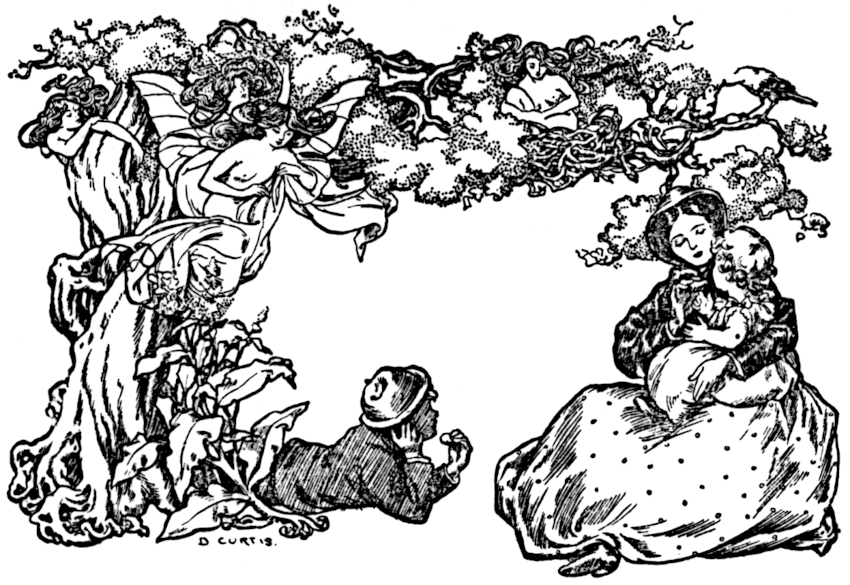
A boy, whom I knew very well, was once
going through a meadow, which was full of
buttercups. The nurse and his baby sister
were with him; and when they got to an old
hawthorn, which grew in the hedge and was
covered with blossom, they all sat down in
its shade, and the nurse took out three slices
of plum-cake, gave one to each of the children,
and kept one for herself.
While the boy was eating, he observed that
this hedge was very high and thick, and that
there was a great hollow in the trunk of the
old thorn-tree, and he heard a twittering, as
if there was a nest somewhere inside; so he
thrust his head in, twisted himself round, and
looked up.
It was a very great thorn-tree, and the
hollow was so large that two or three boys
could have stood upright in it; and when he
got used to the dim light in that brown, still
place, he saw that a good way above his head
there was a nest—rather a curious one too,
for it was as large as a pair of blackbirds
would have built—and yet it was made of
fine white wool and delicate bits of moss; in
short, it was like a goldfinch’s nest magnified
three times.
Just then he thought he heard some little
voices cry, “Jack! Jack!” His baby sister
was asleep, and the nurse was reading a story
book, so it could not have been either of them
who called. “I must get in here,” said the
boy. “I wish this hole was larger.” So he
began to wriggle and twist himself through,
and just as he pulled in his last foot, he
looked up, and three heads which had been
peeping over the edge of the nest suddenly
popped down again.
“Those heads had no beaks, I am sure,”
said Jack, and he stood on tiptoe and poked
in one of his fingers. “And the things have
no feathers,” he continued; so, the hollow
being rather rugged, he managed to climb up
and look in.
His eyes were not used yet to the dim light;
but he was sure those things were not birds—no.
He poked them, and they took no
notice; but when he snatched one of them
out of the nest, it gave a loud squeak, and
said, “O don’t, Jack!” as plainly as possible,
upon which he was so frightened that he lost
his footing, dropped the thing, and slipped
down himself. Luckily, he was not hurt, nor
the thing either; he could see it quite plainly
now: it was creeping about like rather an
old baby, and had on a little frock and
pinafore.
“It’s a fairy!” exclaimed Jack to himself.
“How curious! and this must be a fairy’s
nest. Oh, how angry the old mother will be
if this little thing creeps away and gets out
of the hole!” So he looked down. “Oh,
the hole is on the other side,” he said; and
he turned round, but the hole was not on
the other side; it was not on any side; it
must have closed up all on a sudden, while
he was looking into the nest, for, look whichever
way he would, there was no hole at all,
excepting a very little one high up over the
nest, which let in a very small sunbeam.
Jack was very much astonished, but he
went on eating his cake, and was so delighted
to see the young fairy climb up the side of
the hollow and scramble again into her nest,
that he laughed heartily; upon which all the
nestlings popped up their heads, and, showing
their pretty white teeth, pointed at the slice
of cake.
“Well,” said Jack, “I may have to stay
inside here for a long time, and I have nothing
to eat but this cake; however, your mouths
are very small, so you shall have a piece;”
and he broke off a small piece, and put it into
the nest, climbing up to see them eat it.
These young fairies were a long time
dividing and munching the cake, and before
they had finished, it began to be rather dark,
for a black cloud came over and covered the
little sunbeam. At the same time the wind
rose, and rocked the boughs, and made the
old tree creak and tremble. Then there was
thunder and rain, and the little fairies were
so frightened that they got out of the nest
and crept into Jack’s pockets. One got into
each waistcoat pocket, and the other two
were very comfortable, for he took out his
handkerchief and made room for them in the
pocket of his jacket.
It got darker and darker, till at last Jack
could only just see the hole, and it seemed to
be a very long way off. Every time he
looked at it, it was farther off, and at last
he saw a thin crescent moon shining through it.
“I am sure it cannot be night yet,” he said;
and he took out one of the fattest of the
young fairies, and held it up towards the hole.
“Look at that,” said he; “what is to be
done now? the hole is so far off that it’s
night up there, and down here I haven’t done
eating my lunch.”
“Well,” answered the young fairy, “then
why don’t you whistle?”
Jack was surprised to hear her speak in
this sensible manner, and in the light of the
moon he looked at her very attentively.
“When first I saw you in the nest,” said
he, “you had a pinafore on, and now you
have a smart little apron, with lace round it.”
“That is because I am much older now,”
said the fairy; “we never take such a long
time to grow up as you do.”
“But your pinafore?” said Jack.
“Turned into an apron, of course,” replied
the fairy, “just as your velvet jacket will
turn into a tail-coat when you are old enough.”
“It won’t,” said Jack.
“Yes, it will,” answered the fairy, with an
air of superior wisdom. “Don’t argue with
me; I am older now than you are—nearly
grown up in fact. Put me into your pocket
again, and whistle as loudly as you can.”
Jack laughed, put her in, and pulled out
another. “Worse and worse,” he said;
“why, this was a boy fairy, and now he has
a moustache and a sword, and looks as fierce
as possible!”
“I think I heard my sister tell you to
whistle?” said this fairy, very sternly.
“Yes, she did,” said Jack. “Well, I
suppose I had better do it.” So he whistled
very loudly indeed.
“Why did you leave off so soon?” said
another of them, peeping out.
“Why, if you wish to know,” answered
Jack, “it was because I thought something
took hold of my legs.”
“Ridiculous child!” cried the last of the
four, “how do you think you are ever to get
out, if she doesn’t take hold of your legs?”
Jack thought he would rather have done a
long-division sum than have been obliged to
whistle; but he could not help doing it when
they told him, and he felt something take
hold of his legs again, and then give him a
jerk, which hoisted him on to its back, where
he sat astride, and wondered whether the
thing was a pony; but it was not, for he
presently observed that it had a very slender
neck, and then that it was covered with
feathers. It was a large bird, and he presently
found that they were rising towards the hole,
which had become so very far off, and in a
few minutes she dashed through the hole,
with Jack on her back and all the fairies in
his pockets.
It was so dark that he could see nothing,
and he twined his arms round the bird’s neck,
to hold on, upon which this agreeable fowl
told him not to be afraid, and said she hoped
he was comfortable.
“I should be more comfortable,” replied
Jack, “if I knew how I could get home again.
I don’t wish to go home just yet, for I want
to see where we are flying to, but papa and
mamma will be frightened if I never do.”
“Oh no,” replied the albatross (for she was
an albatross), “you need not be at all afraid
about that. When boys go to Fairyland,
their parents never are uneasy about them.”
“Really?” exclaimed Jack.
“Quite true,” replied the albatross.
“And so we are going to Fairyland?”
exclaimed Jack; “how delightful!”
“Yes,” said the albatross; “the back way,
mind; we are only going the back way. You
could go in two minutes by the usual route;
but these young fairies want to go before they
are summoned, and therefore you and I are
taking them.” And she continued to fly on
in the dark sky for a very long time.
“They seem to be all fast asleep,” said Jack.
“Perhaps they will sleep till we come to
the wonderful river,” replied the albatross;
and just then she flew with a great bump
against something that met her in the air.
“What craft is this that hangs out no
light?” said a gruff voice.
“I might ask the same question of you,”
answered the albatross sullenly.
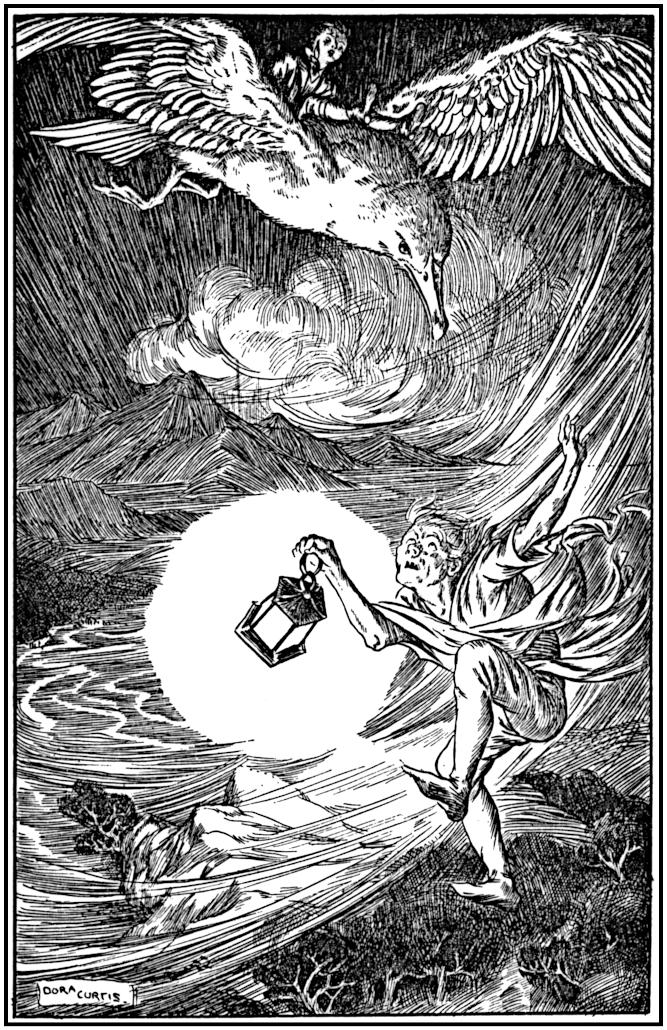
“I’m only a poor Will-o’-the-wisp,” replied
the voice, “and you know very well that I
have but a lantern to show.” Thereupon a
lantern became visible, and Jack saw by the
light of it a man, who looked old and tired,
and he was so transparent that you could see
through him, lantern and all.
“I hope I have not hurt you, William,”
said the albatross; “I will light up immediately.
Good night.”
“Good night,” answered the Will-o’-the-wisp.
“I am going down as fast as I can;
the storm blew me up, and I am never easy
excepting in my native swamps.”
Jack might have taken more notice of Will,
if the albatross had not begun to light up.
She did it in this way. First, one of her eyes
began to gleam with a beautiful green light,
which cast its rays far and near, and then,
when it was as bright as a lamp, the other eye
began to shine, and the light of that eye was
red. In short, she was lighted up just like a
vessel at sea.
THEREUPON A LANTERN BECAME VISIBLE.
Jack was so happy that he hardly knew
which to look at first, there really were so
many remarkable things.
“They snore,” said the albatross, “they
are very fast asleep, and before they wake I
should like to talk to you a little.”
She meant that the fairies snored, and so
they did, in Jack’s pockets.
“My name,” continued the albatross, “is
Jenny. Do you think you shall remember
that? because when you are in Fairyland and
want some one to take you home again, and
call ‘Jenny,’ I shall be able to come to you;
and I shall come with pleasure, for I like boys
better than fairies.”
“Thank you,” said Jack. “Oh yes, I shall
remember your name, it is such a very easy
one.”
“If it is in the night that you want me,
just look up,” continued the albatross, “and
you will see a green and a red spark moving in
the air; you will then call Jenny, and I will
come; but remember that I cannot come
unless you do call me.”
“Very well,” said Jack; but he was not
attending, because there was so much to be
seen.
In the first place, all the stars excepting a
few large ones were gone, and they looked
frightened; and as it got lighter, one after
the other seemed to give a little start in the
blue sky and go out. And then Jack looked
down and saw, as he thought, a great country
covered with very jagged snow mountains
with astonishingly sharp peaks. Here and
there he saw a very deep lake—at least he
thought it was a lake; but while he was
admiring the mountains, there came an
enormous crack between two of the largest,
and he saw the sun come rolling up among
them, and it seemed to be almost smothered.
“Why, those are clouds!” exclaimed Jack;
“and O how rosy they have all turned! I
thought they were mountains.”
“Yes, they are clouds,” said the albatross;
and then they turned gold colour; and next
they began to plunge and tumble, and every
one of the peaks put on a glittering crown;
and next they broke themselves to pieces, and
began to drift away. In fact, Jack had been
out all night, and now it was morning.
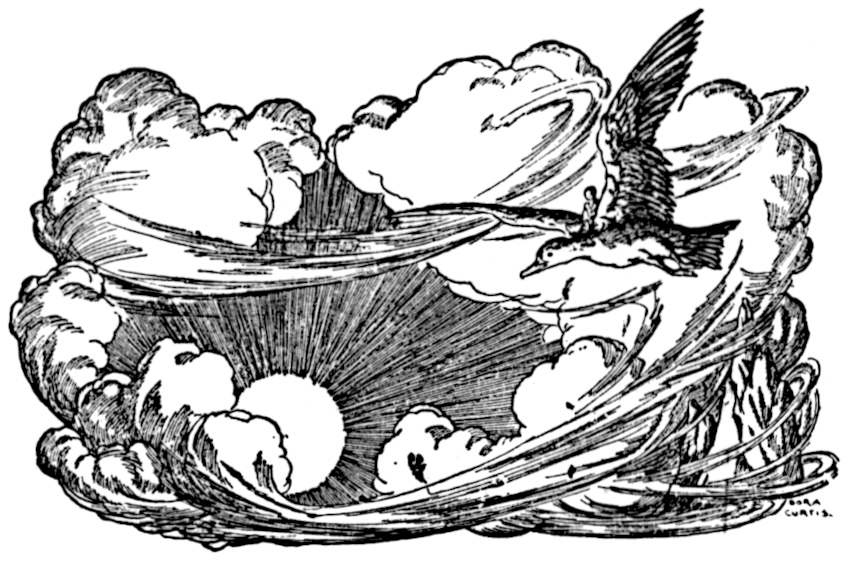
He saw the sun come rolling up among them.
CHAPTER II CAPTAIN JACK
“It has been our lot to sail with many captains, not
one of whom is fit to be a patch on your back.”—Letter
of the Ship’s Company of H.M.S.S. Royalist to Captain
W. T. Bate.
All this time the albatross kept dropping
down and down like a stone till Jack was quite
out of breath, and they fell or flew, whichever
you like to call it, straight through one of the
great chasms which he had thought were lakes,
and he looked down as he sat on the bird’s back
to see what the world is like when you hang a
good way above it at sunrise.
It was a very beautiful sight; the sheep
and lambs were still fast asleep on the green
hills, and the sea birds were asleep in long
rows upon the ledges of the cliffs, with their
heads under their wings.
“Are those young fairies awake yet?”
asked the albatross.
“As sound asleep as ever,” answered Jack;
“but, Albatross, is not that the sea which
lies under us? You are a sea bird, I know,
but I am not a sea boy, and I cannot live in
the water.”
“Yes, that is the sea,” answered the
albatross. “Don’t you observe that it is
covered with ships?”
“I see boats and vessels,” answered Jack,
“and all their sails are set, but they cannot
sail because there is no wind.”
“The wind never does blow in this great
bay,” said the bird; “and those ships would
all lie there becalmed till they dropped to
pieces if one of them was not wanted now and
then to go up the wonderful river.”
“But how did they come there?” asked
Jack.
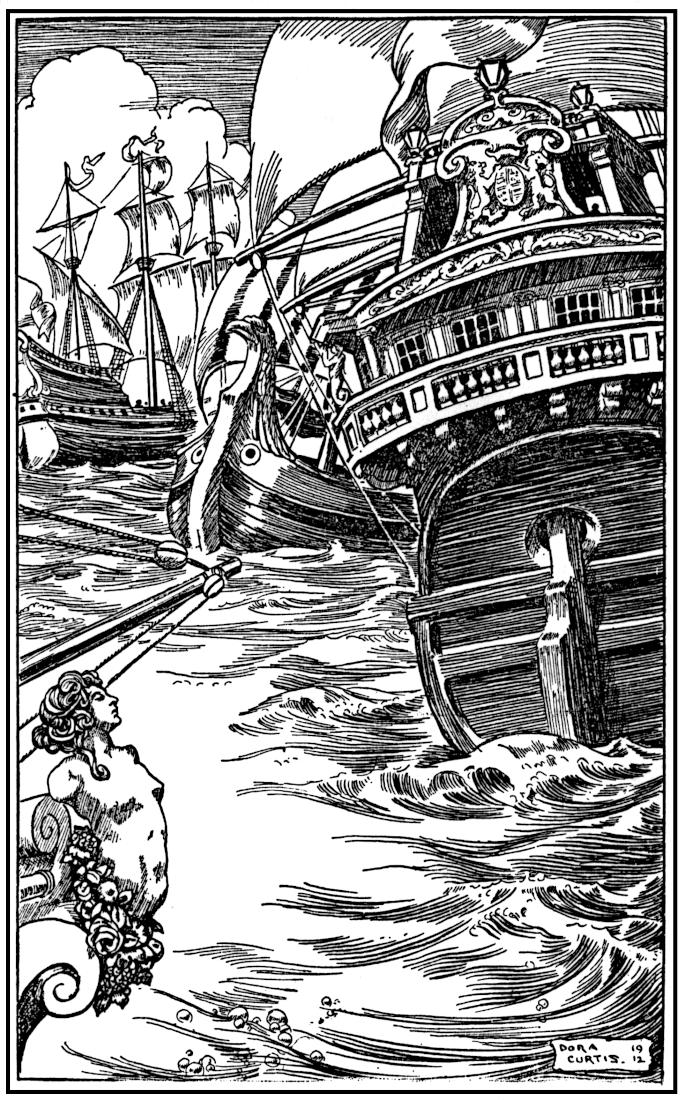
“THOSE FIVE GRAND ONES WITH HIGH PROWS ... WERE PART
OF THE SPANISH ARMADA AND THOSE OPEN BOATS WITH THE
BLUE SAILS BELONGED TO THE ROMANS.”
“Some of them had captains who ill-used
their cabin-boys, some were pirate ships, and
others were going out on evil errands. The
consequence was, that when they chanced to
sail within this great bay they got becalmed;
the fairies came and picked all the sailors out
and threw them into the water; they then
took away the flags and pennons to make
their best coats of, threw the ship-biscuits
and other provisions to the fishes, and set all
the sails. Many ships which are supposed by
men to have foundered lie becalmed in this
quiet sea. Look at those five grand ones
with high prows, they are moored close
together, they were part of the Spanish
Armada; and those open boats with blue
sails belonged to the Romans, they sailed
with Cæsar when he invaded Britain.”
By this time the albatross was hovering about
among the vessels, making choice of one to take
Jack and the fairies up the wonderful river.
“It must not be a large one,” she said,
“for the river in some places is very shallow.”
Jack would have liked very much to have
a fine three-master, all to himself; but then
he considered that he did not know anything
about sails and rigging, he thought it would be
just as well to be contented with whatever
the albatross might choose, so he let her set
him down in a beautiful little open boat, with
a great carved figure-head to it. There he
seated himself in great state, and the albatross
perched herself on the next bench, and
faced him.
“You remember my name?” asked the
albatross.
“Oh yes,” said Jack; but he was not
attending—he was thinking what a fine thing it
was to have such a curious boat all to himself.
“That’s well,” answered the bird; “then,
in the next place, are those fairies awake yet?”
“No, they are not,” said Jack; and he took
them out of his pockets, and laid them down
in a row before the albatross.
“They are certainly asleep,” said the bird.
“Put them away again, and take care of
them. Mind you don’t lose any of them, for I
really don’t know what will happen if you do.
Now I have one thing more to say to you, and
that is, are you hungry?”
“Rather,” said Jack.
“Then,” replied the albatross, “as soon as
you feel very hungry, lie down in the bottom
of the boat and go to sleep. You will dream
that you see before you a roasted fowl, some
new potatoes, and an apple-pie. Mind you
don’t eat too much in your dream, or you will
be sorry for it when you wake. That is all.
Good-bye! I must go.”
Jack put his arms round the neck of the bird,
and hugged her; then she spread her magnificent
wings and sailed slowly away. At first
he felt very lonely, but in a few minutes he
forgot that, because the little boat began to
swim so fast.
She was not sailing, for she had no sail, and
he was not rowing, for he had no oars; so I
am obliged to call her motion swimming,
because I don’t know of a better word. In
less than a quarter of an hour they passed
close under the bows of a splendid three-decker,
a seventy-gun ship. The gannets who
live in those parts had taken possession of
her, and she was so covered with nests that
you could not have walked one step on her
deck without treading on them. The father
birds were aloft in the rigging, or swimming
in the warm green sea, and they made such a
clamour when they saw Jack that they nearly
woke the fairies—nearly, but not quite, for the
little things turned round in Jack’s pockets,
and sneezed, and began to snore again.
Then the boat swam past a fine brig. Some
sea fairies had just flung her cargo overboard,
and were playing at leap-frog on deck. These
were not at all like Jack’s own fairies; they
were about the same height and size as himself,
and they had brown faces, and red flannel
shirts and red caps on. A large fleet of the
pearly nautilus was collected close under the
vessel’s lee. The little creatures were feasting
on what the sea fairies had thrown overboard,
and Jack’s boat, in its eagerness to get on,
went plunging through them so roughly that
several were capsized. Upon this the brown
sea fairies looked over, and called out angrily,
“Boat ahoy!” and the boat stopped.
“Tell that boat of yours to mind what she
is about,” said the fairy sea-captain to Jack.
Jack touched his cap, and said, “Yes, sir,”
and then called out to his boat, “You ought to
be ashamed of yourself, running down these
little live fishing-vessels so carelessly. Go at
a more gentle pace.”
So it swam more slowly; and Jack, being
by this time hungry, curled himself up in the
bottom of the boat, and fell asleep.
He dreamt directly about a fowl and some
potatoes, and he ate a wing, and then he ate
a merrythought, and then somebody said to
him that he had better not eat any more, but
he did, he ate another wing; and presently
an apple-pie came, and he ate some of that,
and then he ate some more, and then he
immediately woke.
“Now that bird told me not to eat too
much,” said Jack, “and yet I have done it.
I never felt so full in my life,” and for more
than half an hour he scarcely noticed anything.
At last he lifted up his head, and saw
straight before him two great brown cliffs,
and between them flowed in the wonderful
river. Other rivers flow out, but this river
flowed in, and took with it far into the land
dolphins, sword-fish, mullet, sunfish, and
many other strange creatures; and that is one
reason why it was called the magic river, or the
wonderful river.
At first it was rather wide, and Jack was
alarmed to see what multitudes of soldiers
stood on either side to guard the banks, and
prevent any person from landing.
He wondered how he should get the fairies
on shore. However, in about an hour the
river became much narrower, and then Jack
saw that the guards were not real soldiers, but
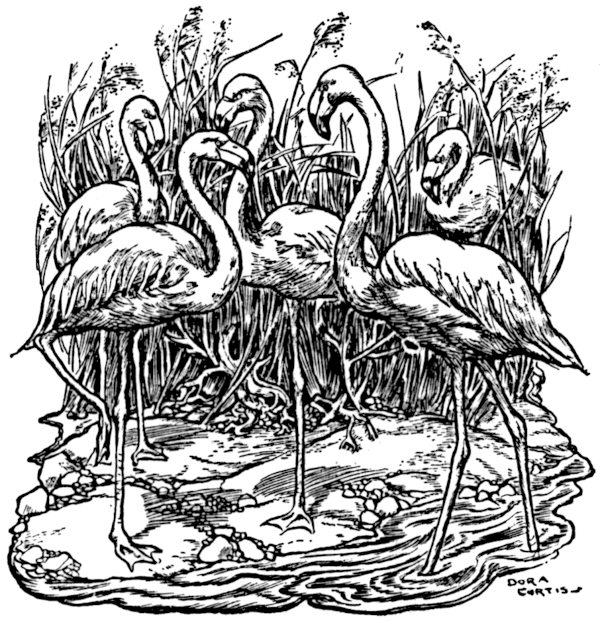
rose-coloured flamingos. There they stood,
in long regiments, among the reeds, and never
stirred. They are the only foot-soldiers the
fairies have in their pay; they are very fierce,
and never allow anything but a fairy ship to
come up the river.
They guarded the banks for miles and miles,
many thousands of them, standing a little
way into the water among the flags and rushes;
but at last there were no more reeds and
no soldier guards, for the stream became
narrower, and flowed between such steep rocks
that no one could possibly have climbed them.
CHAPTER III WINDING-UP TIME
“I’M WILLING TO GEE AND I’M AGREEABLE TO WO.”
“‘Wake, baillie, wake! the crafts are out;
Wake!’ said the knight, ‘be quick!
For high street, bye street, over the town
They fight with poker and stick.’
Said the squire, ‘A fight so fell was ne’er
In all thy bailliewick.’
What said the old clock in the tower?
‘Tick, tick, tick!’
“‘Wake, daughter, wake! the hour draws on;
Wake!’ quoth the dame, ‘be quick!
The meats are set, the guests are coming,
The fiddler waxing his stick.’
She said, ‘The bridegroom waiting and waiting
To see thy face is sick.’
What said the new clock in her bower?
‘Tick, tick, tick!’”
Jack looked at these hot brown rocks, first on
the left bank and then on the right, till he was
quite tired; but at last the shore on the right
bank became flat, and he saw a beautiful little
bay, where the water was still, and where
grass grew down to the brink.
He was so much pleased at this change,
that he cried out hastily, “Oh how I wish my
boat would swim into that bay and let me
land!” He had no sooner spoken than the
boat altered her course, as if somebody had
been steering her, and began to make for the
bay as fast as she could go.
“How odd!” thought Jack. “I wonder
whether I ought to have spoken; for the boat
certainly did not intend to come into this bay.
However, I think I will let her alone now, for
I certainly do wish very much to land here.”
As they drew towards the strand the water
got so shallow that you could see crabs and
lobsters walking about at the bottom. At
last the boat’s keel grated on the pebbles;
and just as Jack began to think of jumping
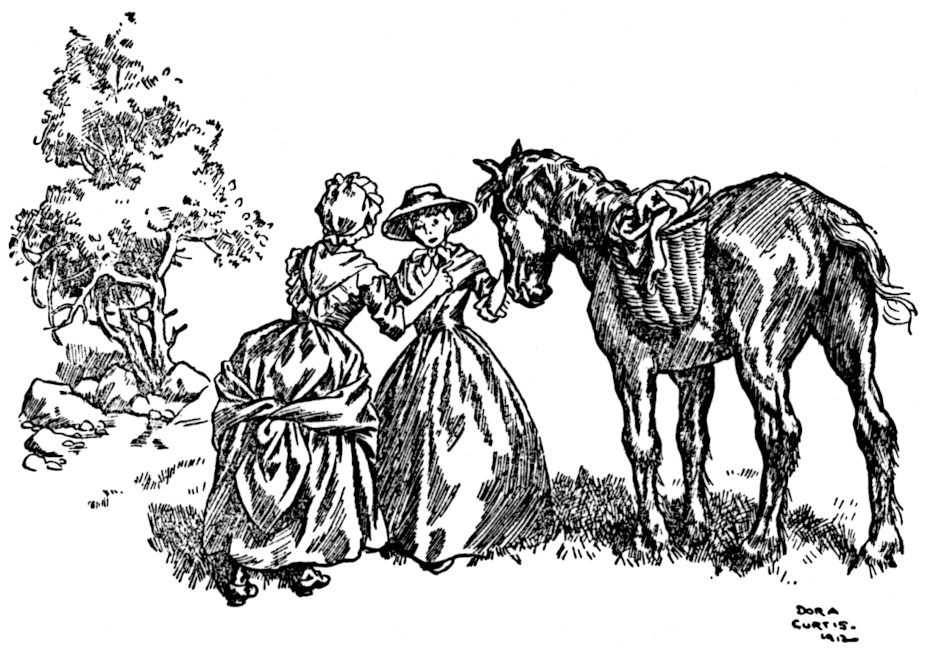
on shore, he saw two little old women approaching
and gently driving a white horse
before them.
The horse had panniers, one on each side;
and when his feet were in the water he stood
still; and Jack said to one of the old women,
“Will you be so kind as to tell me whether
this is Fairyland?”
“What does he say?” asked one old
woman of the other.
“I asked if this was Fairyland,” repeated
Jack, for he thought the first old woman might
have been deaf. She was very handsomely
dressed in a red satin gown, and did not look
in the least like a washerwoman, though it
afterwards appeared that she was one.
“He says ‘Is this Fairyland?’” she
replied; and the other, who had a blue satin
cloak, answered, “Oh, does he?” and then
they began to empty the panniers of many
small blue, and pink, and scarlet shirts, and
coats, and stockings; and when they had
made them into two little heaps they knelt
down and began to wash them in the river,
taking no notice of him whatever.
Jack stared at them. They were not much
taller than himself, and they were not taking
the slightest care of their handsome clothes;
then he looked at the old white horse, who
was hanging his head over the lovely clear
water with a very discontented air.
At last the blue washerwoman said, “I
shall leave off now; I’ve got a pain in my
works.”
“Do,” said the other. “We’ll go home
and have a cup of tea.” Then she glanced
at Jack, who was still sitting in the boat, and
said, “Can you strike?”
“I can if I choose,” replied Jack, a little
astonished at this speech. And the red and
blue washerwomen wrung out the clothes,
put them again into the panniers, and, taking
the old horse by the bridle, began gently to
lead him away.
“I have a great mind to land,” thought
Jack. “I should not wonder at all if this is
Fairyland. So as the boat came here to
please me, I shall ask it to stay where it is, in
case I should want it again.”
So he sprang ashore, and said to the boat,
“Stay just where you are, will you?” and he
ran after the old women, calling to them:
“Is there any law to prevent my coming
into your country?”
“Wo!” cried the red-coated old woman,
and the horse stopped, while the blue-coated
woman repeated, “Any law? No, not that
I know of; but if you are a stranger here you
had better look out.”
“Why?” asked Jack.
“You don’t suppose, do you,” she answered,
“that our Queen will wind up strangers?”
While Jack was wondering what she meant,
the other said:
“I shouldn’t wonder if he goes eight days.
Gee!” and the horse went on.
“No, wo!” said the other.
“No, no. Gee! I tell you,” cried the first.
Upon this, to Jack’s intense astonishment,
the old horse stopped, and said, speaking
through his nose:
“Now, then, which is it to be? I’m
willing to gee, and I’m agreeable to wo; but
what’s a fellow to do when you say them both
together?”
“Why, he talks!” exclaimed Jack.
“It’s because he’s got a cold in his head,”
observed one of the washerwomen; “he
always talks when he’s got a cold, and there’s
no pleasing him; whatever you say, he’s not
satisfied. Gee, Boney, do!”
“Gee it is, then,” said the horse, and began
to jog on.
“He spoke again!” said Jack, upon which
the horse laughed, and Jack was quite
alarmed.
“It appears that your horses don’t talk?”
observed the blue-coated woman.
“Never,” answered Jack; “they can’t.”
“You mean they won’t,” observed the old
horse; and though he spoke the words of
mankind, it was not in a voice like theirs.
Still Jack felt that his was just the natural
tone for a horse, and that it did not arise
only from the length of his nose. “You’ll
find out some day, perhaps,” he continued,
“whether horses can talk or not.”
“Shall I?” said Jack, very earnestly.
“They’ll TELL,” proceeded the white horse.
“I wouldn’t be you when they tell how
you’ve used them.”
“Have you been ill used?” said Jack, in an
anxious tone.
“Yes, yes, of course he has,” one of the
women broke in; “but he has come here to
get all right again. This is a very wholesome
country for horses; isn’t it, Boney?”
“Yes,” said the horse.
“Well, then, jog on, there’s a dear,” continued
the old woman. “Why, you will be
young again soon, you know—young, and
gamesome, and handsome; you’ll be quite
a colt by and by, and then we shall set you
free to join your companions in the happy
meadows.”
The old horse was so comforted by this
kind speech, that he pricked up his ears and
quickened his pace considerably.
“He was shamefully used,” observed one
washerwoman. “Look at him, how lean he
is! You can see all his ribs.”
“Yes,” said the other, as if apologising for
the poor old horse. “He gets low-spirited
when he thinks of all he has gone through;
but he is a vast deal better already than he
was. He used to live in London; his master
always carried a long whip to beat him with,
and never spoke civilly to him.”
“London!” exclaimed Jack; “why that
is in my country. How did the horse get
here?”
“That’s no business of yours,” answered
one of the women. “But I can tell you he
came because he was wanted, which is more
than you are.”
“You let him alone,” said the horse in a
querulous tone. “I don’t bear any malice.”
“No; he has a good disposition has Boney,”
observed the red old woman. “Pray, are
you a boy?”
“Yes,” said Jack.
“A real boy, that wants no winding up?”
inquired the old woman.
“I don’t know what you mean,” answered
Jack; “but I am a real boy, certainly.”
“Ah!” she replied. “Well, I thought you
were, by the way Boney spoke to you. How
frightened you must be! I wonder what will
be done to all your people for driving, and
working, and beating so many beautiful
creatures to death every year that comes?
They’ll have to pay for it some day, you may
depend.”
Jack was a little alarmed, and answered
that he had never been unkind himself to
horses, and he was glad that Boney bore no
malice.
“They worked him, and often drove him
about all night in the miserable streets, and
never let him have so much as a canter in a
green field,” said one of the women; “but
he’ll be all right now, only he has to begin at
the wrong end.”
“What do you mean?” said Jack.
“Why, in this country,” answered the old
woman, “they begin by being terribly old
and stiff, and they seem miserable and jaded
at first, but by degrees they get young again,
as you heard me reminding him.”
“Indeed,” said Jack; “and do you like
that?”
“It has nothing to do with me,” she
answered. “We are only here to take care
of all the creatures that men have ill used.
While they are sick and old, which they are
when first they come to us—after they are
dead, you know—we take care of them, and
gradually bring them up to be young and
happy again.”
“This must be a very nice country to live
in then,” said Jack.
“For horses it is,” said the old lady, significantly.
“Well,” said Jack, “it does seem very full
of haystacks certainly, and all the air smells
of fresh grass.”
At this moment they came to a beautiful
meadow, and the old horse stopped, and,
turning to the blue-coated woman, said,
“Faxa, I think I could fancy a handful of
clover.” Upon this Faxa snatched Jack’s
cap off his head, and in a very active manner
jumped over a little ditch, and gathering some
clover, presently brought it back full, handing
it to the old horse with great civility.
“You shouldn’t be in such a hurry,”
observed the old horse; “your weights will
be running down some day, if you don’t
mind.”
“It’s all zeal,” observed the red-coated
woman.
Just then a little man, dressed like a groom,
came running up, out of breath. “Oh, here
you are, Dow!” he exclaimed to the red-coated
woman. “Come along, will you?
Lady Betty wants you; it’s such a hot day,
and nobody, she says, can fan her so well as
you can.”
The red-coated woman, without a word,
went off with the groom, and Jack thought he
would go with them, for this Lady Betty
could surely tell him whether the country
was called Fairyland, or whether he must get
into his boat and go farther. He did not like
either to hear the way in which Faxa and
Dow talked about their works and their
weights; so he asked Faxa to give him his cap,
which she did, and he heard a curious sort of
little ticking noise as he came close to her,
which startled him.
“Oh, this must be Fairyland, I am sure,”
thought Jack, “for in my country our pulses
beat quite differently from that.”
“Well,” said Faxa, rather sharply, “do you
find any fault with the way I go?”
“No,” said Jack, a little ashamed of having
listened. “I think you walk beautifully;
your steps are so regular.”
“She’s machine-made,” observed the old
horse, in a melancholy voice, and with a deep
sigh. “In the largest magnifying-glass you’ll
hardly find the least fault with her chain.
She’s not like the goods they turn out in
Clerkenwell.”
Jack was more and more startled, and so
glad to get his cap and run after the groom
and Dow to find Lady Betty, that he might
be with ordinary human beings again; but
when he got up to them, he found that Lady
Betty was a beautiful brown mare! She was
lying in a languid and rather affected attitude,
with a load of fresh hay before her, and two
attendants, one of whom stood holding a
parasol over her head, and the other was
fanning her.
“I’m so glad you are come, my good Dow,”
said the brown mare. “Don’t you think I am
strong enough to-day to set off for the happy
meadows?”
“Well,” said Dow, “I’m afraid not yet;
you must remember that it is of no use your
leaving us till you have quite got over the
effects of the fall.”
Just then Lady Betty observed Jack, and
said, “Take that boy away; he reminds me
of a jockey.”
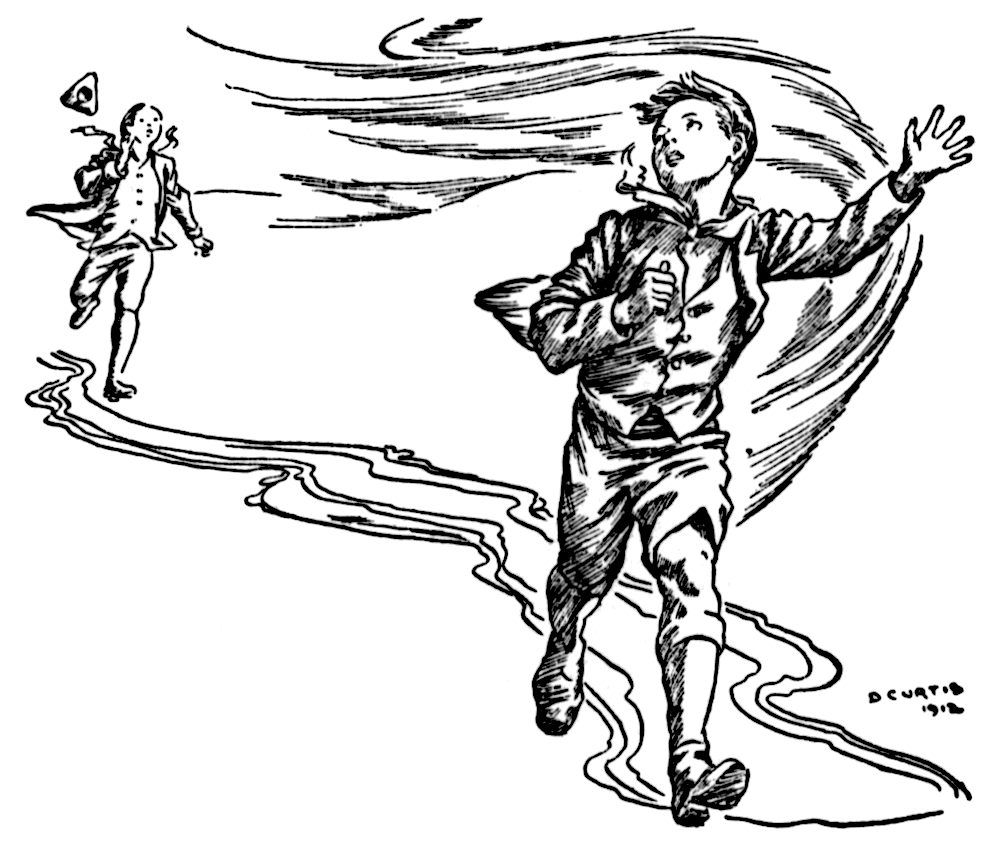
The attentive groom instantly started forward,
but Jack was too nimble for him; he
ran and ran with all his might, and only
wished he had never left the boat. But still
he heard the groom behind him; and in fact
the groom caught him at last, and held him so
fast that struggling was of no use at all.
“You young rascal!” he exclaimed, as he
recovered breath. “How you do run! It’s
enough to break your mainspring.”
“What harm did I do?” asked Jack. “I
was only looking at the mare.”
“Harm!” exclaimed the groom; “harm,
indeed! Why, you reminded her of a jockey.
It’s enough to hold her back, poor thing!—and
we trying so hard, too, to make her
forget what a cruel end she came to in the old
world.”
“You need not hold me so tightly,” said
Jack. “I shall not run away again; but,”
he added, “if this is Fairyland, it is not half
such a nice country as I expected.”
“Fairyland!” exclaimed the groom, stepping
back with surprise. “Why, what made
you think of such a thing? This is only
one of the border countries, where things are
set right again that people have caused to go
wrong in the world. The world, you know,
is what men and women call their own
home.”
“I know,” said Jack; “and that’s where I
came from.” Then, as the groom seemed no
longer to be angry, he went on: “And I wish
you would tell me about Lady Betty.”
“She was a beautiful fleet creature, of the
racehorse breed,” said the groom; “and she
won silver cups for her master, and then they
made her run a steeplechase, which frightened
her, but still she won it; and then they made
her run another, and she cleared some terribly
high hurdles, and many gates and ditches,
till she came to an awful one, and at first she
would not take it, but her rider spurred and
beat her till she tried. It was beyond her
powers, and she fell and broke her forelegs.
Then they shot her. After she had died
that miserable death, we had her here, to
make her all right again.”
“Is this the only country where you set
things right?” asked Jack.
“Certainly not,” answered the groom;
“they lie about in all directions. Why, you
might wander for years, and never come to
the end of this one.”
“I am afraid I shall not find the one I am
looking for,” said Jack, “if your countries
are so large.”
“I don’t think our world is much larger
than yours,” answered the groom. “But
come along; I hear the bell, and we are a
good way from the palace.”
Jack, in fact, heard the violent ringing of a
bell at some distance; and when the groom
began to run, he ran beside him, for he thought
he should like to see the palace. As they ran,
people gathered from all sides—fields, cottages,
mills—till at last there was a little crowd,
among whom Jack saw Dow and Faxa, and
they were all making for a large house, the
wide door of which was standing open. Jack
stood with the crowd, and peeped in. There
was a woman sitting inside upon a rocking-chair,
a tall, large woman, with a gold-coloured
gown on, and beside her stood a table, covered
with things that looked like keys.
“What is that woman doing?” said he to
Faxa, who was standing close to him.
“Winding us up, to be sure,” answered
Faxa. “You don’t suppose, surely, that we
can go for ever?”
“Extraordinary!” said Jack. “Then are
you wound up every evening, like watches?”
“Unless we have misbehaved ourselves,”
she answered; “and then she lets us run
down.”
“And what then?”
“What then?” repeated Faxa, “why, then
we have to stop and stand against a wall, till
she is pleased to forgive us, and let our friends
carry us in to be set going again.”
Jack looked in, and saw the people pass in
and stand close by the woman. One after
the other she took by the chin with her left
hand, and with her right hand found a key
that pleased her. It seemed to Jack that
there was a tiny keyhole in the back of their
heads, and that she put the key in and wound
them up.
“You must take your turn with the others,”
said the groom.
“There’s no keyhole in my head,” said
Jack; “besides, I do not want any woman
to wind me up.”
“But you must do as others do,” he persisted;
“and if you have no keyhole, our
Queen can easily have one made, I should
think.”
“Make one in my head!” exclaimed Jack.
“She shall do no such thing.”
“We shall see,” said Faxa quietly. And
Jack was so frightened that he set off, and
ran back towards the river with all his might.
Many of the people called to him to stop, but
they could not run after him, because they
wanted winding up. However, they would
certainly have caught him if he had not been
very quick, for before he got to the river he
heard behind him the footsteps of those who
had been first attended to by the Queen, and
he had only just time to spring into the boat
when they reached the edge of the water.
No sooner was he on board than the boat
swung round, and got again into the middle of
the stream; but he could not feel safe till not
only was there a long reach of water between
him and the shore, but till he had gone so
far down the river that the beautiful bay had
passed out of sight, and the sun was going
down. By this time he began to feel very
tired and sleepy; so, having looked at his
fairies, and found that they were all safe and
fast asleep, he laid down in the bottom of the
boat, and fell into a doze, and then into a
dream.
They would certainly have caught him if he had not
been very quick.
CHAPTER IV BEES AND OTHER FELLOW-CREATURES
“The dove laid some little sticks,
Then began to coo;
The gnat took his trumpet up
To play the day through;
The pie chattered soft and long—
But that she always does;
The bee did all he had to do,
And only said ‘Buzz.’”
When Jack at length opened his eyes, he
found that it was night, for the full moon was
shining; but it was not at all a dark night, for
he could see distinctly some black birds, that
looked like ravens. They were sitting in a
row on the edge of the boat.
Now that he had fairies in his pockets, he
could understand bird-talk, and he heard one
of these ravens saying, “There is no meat so
tender; I wish I could pick their little eyes
out.”
“Yes,” said another, “fairies are delicate
eating indeed. We must speak Jack fair if
we want to get at them.” And she heaved up
a deep sigh.
Jack lay still, and thought he had better
pretend to be asleep; but they soon noticed
that his eyes were open, and one of them
presently walked up his leg and bowed, and
asked if he was hungry.
Jack said, “No.”
“No more am I,” replied the raven, “not
at all hungry.” Then she hopped off his leg,
and Jack sat up.
“And how are the sweet fairies that my
young master is taking to their home?” asked
another of the ravens. “I hope they are safe
in my young masters pockets?”
Jack felt in his pockets. Yes, they were all
safe; but he did not take any of them out,
lest the ravens should snatch at them.
“Eh?” continued the raven, pretending to
listen; “did this dear young gentleman say
that the fairies were asleep?”
“It doesn’t amuse me to talk about fairies,”
said Jack; “but if you would explain some
of the things in this country that I cannot
make out, I should be very glad.”
“What things?” asked the blackest of the
ravens.
“Why,” said Jack, “I see a full moon lying
down there among the water-flags, and just
going to set, and there is a half-moon overhead
plunging among those great grey clouds,
and just this moment I saw a thin crescent
moon peeping out between the branches of
that tree.”
“Well,” said all the ravens at once, “did
the young master never see a crescent moon in
the men and women’s world?”
“Oh yes,” said Jack.
“Did he never see a full moon?” asked the
ravens.
“Yes, of course,” said Jack; “but they are
the same moon. I could never see all three of
them at the same time.”
The ravens were very much surprised at
this, and one of them said:
“If my young master did not see the moons
it must have been because he didn’t look.
Perhaps my young master slept in a room,
and had only one window; if so, he couldn’t
see all the sky at once.”
“I tell you, Raven,” said Jack, laughing,
“that I KNOW there is never more than one
moon in my country, and sometimes there is
no moon at all!”
Upon this all the ravens hung down their
heads, and looked very much ashamed; for
there is nothing that birds hate so much as to
be laughed at, and they believed that Jack
was saying this to mock them, and that he
knew what they had come for. So first one
and then another hopped to the other end of
the boat and flew away, till at last there was
only one left, and she appeared to be out of
spirits, and did not speak again till he spoke
to her.
“Raven,” said Jack, “there’s something
very cold and slippery lying at the bottom
of the boat. I touched it just now, and I
don’t like it at all.”
“It’s a water-snake,” said the raven, and
she stooped and picked up a long thing
with her beak, which she threw out, and then
looked over. “The water swarms with them,
wicked, murderous creatures; they smell the
young fairies, and they want to eat them.”
Jack was so thrown off his guard that he
snatched one fairy out, just to make sure that
it was safe. It was the one with the
moustache; and, alas! in one instant the
raven flew at it, got it out of his hand, and
pecked off its head before it had time to wake
or Jack to rescue it. Then, as she slowly rose,
she croaked, and said to Jack, “You’ll catch
it for this, my young master!” and she flew
to the bough of a tree, where she finished eating
the fairy, and threw his little empty coat into
the river.
On this Jack began to cry bitterly, and to
think what a foolish boy he had been. He
was the more sorry because he did not even
know that poor little fellow’s name. But he
had heard the others calling by name to their
companions, and very grand names they were
too. One was Jovinian—he was a very fierce-looking
gentleman; the other two were
Roxaletta and Mopsa.
Presently, however, Jack forgot to be unhappy,
for two of the moons went down, and
then the sun rose, and he was delighted to find
that however many moons there might be,
there was only one sun, even in the country
of the wonderful river.
So on and on they went; but the river was
very wide, and the waves were boisterous.
On the right brink was a thick forest of trees,
with such heavy foliage that a little way off
they looked like a bank, green and smooth
and steep; but as the light became clearer,
Jack could see here and there the great stems,
and see creatures like foxes, wild boars, and
deer, come stealing down to drink in the river.
It was very hot here; not at all like the
spring weather he had left behind. And as
the low sunbeams shone into Jack’s face he
said hastily, without thinking of what would
occur, “I wish I might land among those
lovely glades on the left bank.”
No sooner said than the boat began to
make for the left bank, and the nearer they
got towards it the more beautiful it became;
but also the more stormy were the reaches of
water they had to traverse.
A lovely country indeed! It sloped gently
down to the water’s edge, and beautiful trees
were scattered over it, soft mossy grass
grew everywhere, great old laburnum trees
stretched their boughs down in patches over
the water, and higher up camellias, almost
as large as hawthorns, grew together and
mingled their red and white flowers.
The country was not so open as a park, it
was more like a half-cleared woodland; but
there was a wide space just where the boat
was steering for, that had no trees, only a few
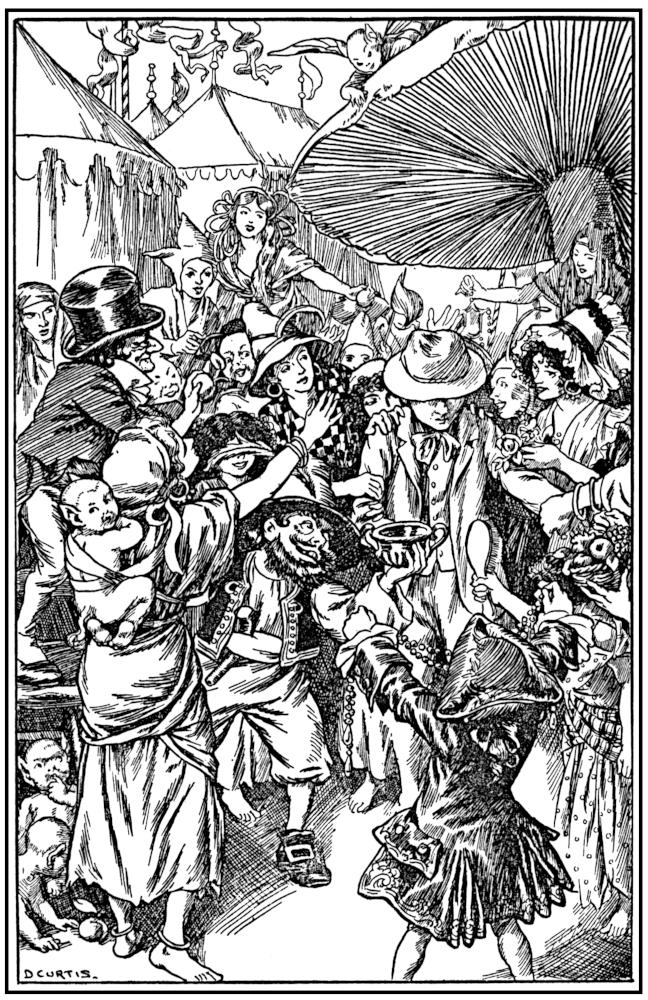
flowering shrubs. Here groups of strange-looking
people were bustling about, and there
were shrill fifes sounding, and drums.
Farther back he saw rows of booths or
tents under the shade of the trees.
In another place some people dressed like
gipsies had made fires of sticks just at the
skirts of the woodland, and were boiling their
pots. Some of these had very gaudy tilted
carts, hung all over with goods, such as
baskets, brushes, mats, little glasses, pottery,
and beads.
It seemed to be a kind of fair, to which
people had gathered from all parts; but there
was not one house to be seen. All the goods
were either hung upon the trees or collected
in strange-looking tents.
The people were not all of the same race;
indeed, he thought the only human beings
were the gipsies, for the folks who had tents
were no taller than himself.
“WHAT’LL YOU BUY?—WHAT’LL YOU BUY, SIR?”
How hot it was that morning! and as the
boat pushed itself into a little creek, and made
its way among the beds of yellow and purple
iris which skirted the brink, what a crowd of
dragonflies and large butterflies rose from
them!
“Stay where you are!” cried Jack to the
boat; and at that instant such a splendid
moth rose slowly, that he sprang on shore
after it, and quite forgot the fair and the
people in his desire to follow it.
The moth settled on a great red honey-flower,
and he stole up to look at it. As
large as a swallow, it floated on before him. Its
wings were nearly black, and they had spots
of gold on them.
When it rose again Jack ran after it, till he
found himself close to the rows of tents where
the brown people stood; and they began to
cry out to him, “What’ll you buy? what’ll
you buy, sir?” and they crowded about him,
so that he soon lost sight of the moth, and
forgot everything else in his surprise at the
booths.
They were full of splendid things—clocks
and musical boxes, strange china ornaments,
embroidered slippers, red caps, and many
kinds of splendid silks and small carpets. In
other booths were swords and dirks, glittering
with jewels; and the chatter of the people
when they talked together was not in a
language that Jack could understand.
Some of the booths were square, and
evidently made of common canvas, for when
you went into them and the sun shone you
could distinctly see the threads.
But scattered a little farther on in groups
were some round tents, which were far more
curious. They were open on all sides, and
consisted only of a thick canopy overhead,
which was supported by one beautiful round
pillar in the middle.
Outside, the canopy was white or brownish;
but when Jack stood under these tents, he saw
that they were lined with splendid flutings of
brown or pink silk: what looked like silk, at
least, for it was impossible to be sure whether
these were real tents or gigantic mushrooms.
They varied in size, also, as mushrooms do,
and in shape: some were large enough for
twenty people to stand under them, and had
flat tops with a brown lining; others had
dome-shaped roofs; these were lined with
pink, and would only shelter six or seven.
The people who sold in these tents were as
strange as their neighbours; each had a little
high cap on his head, in shape just like a bee-hive,
and it was made of straw, and had a
little hole in front. In fact, Jack very soon
saw bees flying in and out, and it was evident
that these people had their honey made
on the premises. They were chiefly selling
country produce. They had cheeses so large
as to reach to their waists, and the women
trundled them along as boys do their hoops.
They sold a great many kinds of seed too, in
wooden bowls, and cakes and good things to
eat, such as gilt gingerbread. Jack bought
some of this, and found it very nice indeed.
But when he took out his money to pay for
it, the little man looked rather strangely at
it, and turned it over with an air of disgust.
Then Jack saw him hand it to his wife, who
also seemed to dislike it; and presently Jack
observed that they followed him about, first
on one side, then on the other. At last, the
little woman slipped her hand into his pocket,
and Jack, putting his hand in directly, found
his sixpence had been returned.
“Why, you’ve given me back my money!”
he said.
The little woman put her hands behind her.
“I do not like it,” she said; “it’s dirty; at
least, it’s not new.”
“No, it’s not new,” said Jack, a good deal
surprised, “but it is a good sixpence.”
“The bees don’t like it,” continued the little
woman. “They like things to be neat and
new, and that sixpence is bent.”
“What shall I give you then?” said Jack.
The good little woman laughed and blushed.
“This young gentleman has a beautiful whistle
round his neck,” she observed, politely, but
did not ask for it.
Jack had a dog-whistle, so he took it off and
gave it to her.
“Thank you for the bees,” she said.
“They love to be called home when we’ve
collected flowers for them.”
So she made a pretty little curtsey, and
went away to her customers.
There were some very strange creatures
also, about the same height as Jack, who had
no tents, and seemed there to buy, not to sell.
Yet they looked poorer than the other folks and
they were also very cross and discontented;
nothing pleased them. Their clothes were
made of moss, and their mantles of feathers;
and they talked in a queer whistling tone of
voice, and carried their skinny little children
on their backs and on their shoulders.
They were treated with great respect by the
people in the tents; and when Jack asked his
friend to whom he had given the whistle what
they were, and where they got so much money
as they had, she replied that they lived over
the hills, and were afraid to come in their best
clothes. They were rich and powerful at
home, and they came shabbily dressed, and
behaved humbly, lest their enemies should
envy them. It was very dangerous, she said,
to fairies to be envied.
Jack wanted to listen to their strange
whistling talk, but he could not for the noise
and cheerful chattering of the brown folks,
and more still for the screaming and talking of
parrots.
Among the goods were hundreds of splendid
gilt cages, which were hung by long gold
chains from the trees. Each cage contained
a parrot and his mate, and they all seemed to
be very unhappy indeed.
The parrot could talk, and they kept
screaming to the discontented women to buy
things for them, and trying very hard to
attract attention.
One old parrot made himself quite conspicuous
by these efforts. He flung himself
against the wires of his cage, he squalled, he
screamed, he knocked the floor with his beak,
till Jack and one of the customers came
running up to see what was the matter.
“What do you make such a fuss for?”
cried the discontented woman. “You’ve set
your cage swinging with knocking yourself
about; and what good does that do? I
cannot break the spell and open it for you.”
“I know that,” answered the parrot,
sobbing; “but it hurts my feelings so that
you should take no notice of me now that I
have come down in the world.”
“Yes,” said the parrot’s mate, “it hurts
our feelings.”
“I haven’t forgotten you,” answered the
woman, more crossly than ever; “I was buying
a measure of maize for you when you
began to make such a noise.”
Jack thought this was the queerest conversation
he had ever heard in his life, and he was
still more surprised when the bird answered:
“I would much rather you would buy me a
pocket-handkerchief. Here we are, shut up,
without a chance of getting out, and with
nobody to pity us; and we can’t even have
the comfort of crying, because we’ve got
nothing to wipe our eyes with.”
“But at least,” replied the woman, “you
CAN cry now if you please, and when you had
your other face you could not.”
“Buy me a handkerchief,” sobbed the parrot.
“I can’t afford both,” whined the cross
woman, “and I’ve paid now for the maize.”
So saying, she went back to the tent to fetch
her present to the parrots, and as their cage
was still swinging Jack put out his hand to
steady it for them, and the instant he did so
they became perfectly silent, and all the other
parrots on that tree, who had been flinging
themselves about in their cages, left off
screaming and became silent too.
The old parrot looked very cunning. His
cage hung by such a long gold chain that it
was just on a level with Jack’s face, and so
many odd things had happened that day that
it did not seem more odd than usual to hear
him say, in a tone of great astonishment:
“It’s a BOY, if ever there was one!”
“Yes,” said Jack, “I’m a boy.”
“You won’t go yet, will you?” said the
parrot.
“No, don’t,” said a great many other
parrots. Jack agreed to stay a little while,
upon which they all thanked him.
“I had no notion you were a boy till you
touched my cage,” said the old parrot.
Jack did not know how this could have told
him, so he only answered, “Indeed!”
“I’m a fairy,” observed the parrot, in a
confidential tone. “We are imprisoned here
by our enemies the gipsies.”
“So we are,” answered a chorus of other
parrots.
“I’m sorry for that,” replied Jack. “I’m
friends with the fairies.”
“Don’t tell,” said the parrot, drawing a
film over his eyes, and pretending to be asleep.
At that moment his friend in the moss petticoat
and feather cloak came up with a little
measure of maize, and poured it into the cage.
“Here, neighbour,” she said; “I must say
good-bye now, for the gipsy is coming this
way, and I want to buy some of her goods.”
“Well, thank you,” answered the parrot,
sobbing again; “but I could have wished it
had been a pocket-handkerchief.”
“I’ll lend you my handkerchief,” said Jack.
“Here!” And he drew it out and pushed it
between the wires.
The parrot and his wife were in a great
hurry to get Jack’s handkerchief. They
pulled it in very hastily; but instead of using
it they rolled it up into a ball, and the parrot-wife
tucked it under her wing.
“It makes me tremble all over,” said she,
“to think of such good luck.”
“I say!” observed the parrot to Jack, “I
know all about it now. You’ve got some of
my people in your pockets—not of my own
tribe, but fairies.”
By this Jack was sure that the parrot really
was a fairy himself, and he listened to what
he had to say the more attentively.
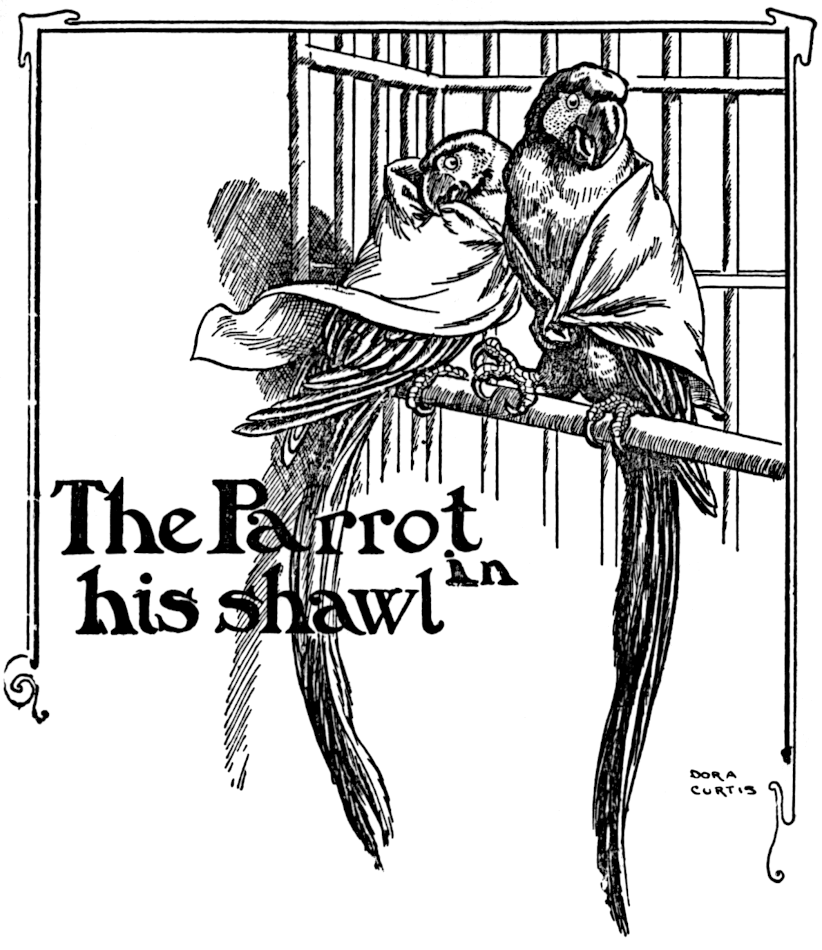
CHAPTER V THE PARROT IN HIS SHAWL
“That handkerchief
Did an Egyptian to my mother give:
She was a charmer, and could almost read
The thoughts of people.”—Othello.
“That gipsy woman who is coming with her
cart,” said the parrot, “is a fairy too, and
very malicious. It was she and others of her
tribe who caught us and put us into these
cages, for they are more powerful than we.
Mind you do not let her allure you into the
woods, nor wheedle you or frighten you into
giving her any of those fairies.”
“No,” said Jack; “I will not.”
“She sold us to the brown people,” continued
the parrot. “Mind you do not buy
anything of her, for your money in her palm
would act as a charm against you.”
“She has a baby,” observed the parrot-wife,
scornfully.
“Yes, a baby,” repeated the old parrot;
“and I hope by means of that baby to get
her driven away, and perhaps get free myself.
I shall try to put her in a passion. Here she
comes.”
There she was indeed, almost close at hand.
She had a little cart; her goods were hung all
about it, and a small horse drew it slowly on,
and stopped when she got a customer.
Several gipsy children were with her, and as
the people came running together over the
grass to see her goods, she sang a curious kind
of song, which made them wish to buy them.
Jack turned from the parrot’s cage as she
came up. He had heard her singing a little
way off, and now, before she began again, he
felt that already her searching eyes had found
him out, and taken notice that he was different
from the other people.
When she began to sing her selling song, he
felt a most curious sensation. He felt as if
there were some cobwebs before his face, and
he put up his hand as if to clear them away.
There were no real cobwebs, of course; and
yet he again felt as if they floated from the
gipsy-woman to him, like gossamer threads,
and attracted him towards her. So he gazed
at her, and she at him, till Jack began to
forget how the parrot had warned him.
He saw her baby too, wondered whether
it was heavy for her to carry, and wished he
could help her. I mean, he saw that she had
a baby on her arm. It was wrapped in a
shawl, and had a handkerchief over its face.
She seemed very fond of it, for she kept hushing
it; and Jack softly moved nearer and
nearer to the cart, till the gipsy-woman smiled,
and suddenly began to sing:
“My good man—he’s an old, old man—
And my good man got a fall,
To buy me a bargain so fast he ran
When he heard the gipsies call:
‘Buy, buy brushes,
Baskets wrought o’ rushes.
Buy them, buy them, take them, try them,
Buy, dames all.’
“My old man, he has money and land,
And a young, young wife am I.
Let him put the penny in my white hand
When he hears the gipsies cry:
‘Buy, buy laces,
Veils to screen your faces.
Buy them, buy them, take and try them,
Buy, maids, buy.’”
When the gipsy had finished her song, Jack
felt as if he was covered all over with cobwebs;
but he could not move away, and he did not
mind them now. All his wish was to please
her, and get close to her; so when she said, in
a soft wheedling voice, “What will you please
to buy, my pretty gentleman?” he was just
going to answer that he would buy anything
she recommended, when, to his astonishment
and displeasure, for he thought it very rude,
the parrot suddenly burst into a violent fit of
coughing, which made all the customers stare.
“That’s to clear my throat,” he said, in a
most impertinent tone of voice; and then he
began to beat time with his foot, and sing, or
rather scream out, an extremely saucy
imitation of the gipsy’s song, and all his
parrot friends in the other cages joined in
the chorus.
“My fair lady’s a dear, dear lady—
I walked by her side to woo.
In a garden alley, so sweet and shady,
She answered, ‘I love not you,
John, John Brady,’
Quoth my dear lady,
‘Pray now, pray now, go your way now,
Do, John, do!’”
At first the gipsy did not seem to know
where that mocking song came from, but when
she discovered that it was her prisoner, the
old parrot, who was thus daring to imitate
her, she stood silent and glared at him, and
her face was almost white with rage.
When he came to the end of the verse he
pretended to burst into a violent fit of sobbing
and crying, and screeched out to his wife,
“Mate! mate! hand up my handkerchief.
Oh! oh! it’s so affecting, this song is.”
Upon this the other parrot pulled Jack’s
handkerchief from under her wing, hobbled
up, and began, with a great show of zeal, to
wipe his horny beak with it. But this was
too much for the gipsy; she took a large brush
from her cart, and flung it at the cage with all
her might.
This set it violently swinging backwards
and forwards, but did not stop the parrot, who
screeched out, “How delightful it is to be
swung!” And then he began to sing another
verse in the most impudent tone possible, and
with a voice that seemed to ring through
Jack’s head, and almost pierce it.
“Yet my fair lady’s my own, own lady,
For I passed another day;
While making her moan, she sat all alone,
And thus and thus did she say:
‘John, John Brady,’
Quoth my dear lady,
‘Do now, do now, once more woo now,
Pray, John, pray!’”
“It’s beautiful!” screeched the parrot-wife,
“and so ap-pro-pri-ate.” Jack was
delighted when she managed slowly to say
this long word with her black tongue, and he
burst out laughing. In the meantime a good
many of the brown people came running
together, attracted by the noise of the parrots
and the rage of the gipsy, who flung at his cage,
one after the other, all the largest things she
had in her cart. But nothing did the parrot
any harm; the more violently his cage swung,
the louder he sang, till at last the wicked
gipsy seized her poor little young baby, who
was lying in her arms, rushed frantically at
the cage as it flew swiftly through the air
towards her, and struck at it with the little
creature’s head. “Oh, you cruel, cruel
woman!” cried Jack, and all the small
mothers who were standing near with their
skinny children on their shoulders screamed
out with terror and indignation; but only
for one instant, for the handkerchief flew off
that had covered its face, and was caught in
the wires of the cage, and all the people saw
that it was not a real baby at all, but a bundle
of clothes, and its head was a turnip.
Yes, a turnip! You could see that as
plainly as possible, for though the green
leaves had been cut off, their stalks were
visible through the lace cap that had been tied
on it.
Upon this all the crowd pressed closer,
throwing her baskets, and brushes, and laces,
and beads at the gipsy, and calling out, “We
will have none of your goods, you false
woman! Give us back our money, or we will
drive you out of the fair. You’ve stuck a
stick into a turnip, and dressed it up in baby
clothes. You’re a cheat! a cheat!”
“My sweet gentlemen, my kind ladies,”
began the gipsy; but baskets and brushes
flew at her so fast that she was obliged to sit
down on the grass and hold up the sham baby
to screen her face.
While this was going on, Jack felt that the
cobwebs which had seemed to float about his
face were all gone; he did not care at all any
more about the gipsy, and began to watch
the parrots with great attention.
He observed that when the handkerchief
stuck between the cage wires, the parrots
caught it, and drew it inside; and then Jack
saw the cunning old bird himself lay it on the
floor, fold it crosswise like a shawl, and put it
on his wife.
Then she jumped upon the perch, and held
it with one foot, looking precisely like an old
lady with a parrot’s head. Then he folded
Jack’s handkerchief in the same way, put it
on, and got upon the perch beside his wife,
screaming out, in his most piercing tone:
“I like shawls; they’re so becoming.”
Now the gipsy did not care at all what
those inferior people thought of her, and she
was calmly counting out their money, to
return it; but she was very desirous to make
Jack forget her behaviour, and had begun to
smile again, and tell him she had only been
joking, when the parrot spoke, and, looking
up, she saw the two birds sitting side by side,
and the parrot-wife was screaming in her mate’s
ear, though neither of them was at all deaf:
“If Jack lets her allure him into the woods,
he’ll never come out again. She’ll hang him
up in a cage, as she did us. I say, how does
my shawl fit?”
So saying, the parrot-wife whisked herself
round on the perch, and lo! in the corner of
the handkerchief were seen some curious
letters, marked in red. When the crowd saw
these, they drew a little farther off, and
glanced at one another with alarm.
“You look charming, my dear; it fits
well!” screamed the old parrot in answer.
“A word in your ear, ‘Share and share alike’
is a fine motto.”
“What do you mean by all this?” said the
gipsy, rising, and going with slow steps to the
cage, and speaking cautiously.
“Jack,” said the parrot, “do they ever eat
handkerchiefs in your part of the country?”
“No, never,” answered Jack.
“Hold your tongue and be reasonable,”
said the gipsy, trembling. “What do you
want? I’ll do it, whatever it is.”
“But do they never pick out the marks?”
continued the parrot. “O Jack! are you
sure they never pick out the marks?”
“The marks?” said Jack, considering.
“Yes, perhaps they do.”
“Stop!” cried the gipsy, as the old parrot
made a peck at the strange letters. “Oh!
you’re hurting me. What do you want? I
say again, tell me what you want, and you
shall have it.”
“We want to get out,” replied the parrot;
“you must undo the spell.”
“Then give me my handkerchief,” answered
the gipsy, “to bandage my eyes. I
dare not say the words with my eyes open.
You had no business to steal it. It was
woven by human hands, so that nobody can
see through it; and if you don’t give it to me,
you’ll never get out—no, never!”
“Then,” said the old parrot, tossing his
shawl off, “you may have Jack’s handkerchief;
it will bandage your eyes just as well.
It was woven over the water, as yours was.”
“It won’t do!” cried the gipsy in terror;
“give me my own.”
“I tell you,” answered the parrot, “that
you shall have Jack’s handkerchief; you can
do no harm with that.”
By this time the parrots all around had
become perfectly silent, and none of the
people ventured to say a word, for they feared
the malice of the gipsy. She was trembling
dreadfully, and her dark eyes, which had
been so bright and piercing, had become dull
and almost dim; but when she found there
was no help for it, she said:
“Well, pass out Jack’s handkerchief. I will
set you free if you will bring out mine with you.”
“Share and share alike,” answered the
parrot; “you must let all my friends out too.”
“Then I won’t let you out,” answered the
gipsy. “You shall come out first, and give
me my handkerchief, or not one of their cages
will I undo. So take your choice.”
“My friends, then,” answered the brave
old parrot; and he poked Jack’s handkerchief
out to her through the wires.
The wondering crowd stood by to look, and
the gipsy bandaged her eyes tightly with the
handkerchief; and then, stooping low, she
began to murmur something and clap her
hands—softly at first, but by degrees more
and more violently. The noise was meant to
drown the words she muttered; but as she
went on clapping, the bottom of cage after
cage fell clattering down. Out flew the parrots
by hundreds, screaming and congratulating one
another; and there was such a deafening din
that not only the sound of her spell but the
clapping of her hands was quite lost in it.
But all this time Jack was very busy; for
the moment the gipsy had tied up her eyes,
the old parrot snatched the real handkerchief
off his wife’s shoulders, and tied it round her
neck. Then she pushed out her head through
the wires, and the old parrot called to Jack,
and said, “Pull!”
Jack took the ends of the handkerchief,
pulled terribly hard, and stopped. “Go on!
go on!” screamed the old parrot.
“I shall pull her head off,” cried Jack.
“No matter,” cried the parrot; “no matter—only
pull.”
Well, Jack did pull, and he actually did
pull her head off! nearly tumbling backward
himself as he did it; but he saw what the
whole thing meant then, for there was another
head inside—a fairy’s head.
Jack flung down the old parrot’s head and
great beak, for he saw that what he had to do
was to clear the fairy of its parrot covering.
The poor little creature seemed nearly dead,
it was so terribly squeezed in the wires. It
had a green gown or robe on, with an ermine
collar; and Jack got hold of this dress,
stripped the fairy out of the parrot feathers,
and dragged her through—velvet robe, and
crimson girdle, and little yellow shoes. She
was very much exhausted, but a kind brown
woman took her instantly, and laid her in
her bosom. She was a splendid little creature,
about half a foot long.
“There’s a brave boy!” cried the parrot.
Jack glanced round, and saw that not all the
parrots were free yet, the gipsy was still
muttering her spell.
He returned the handkerchief to the parrot,
who put it round his own neck, and again
Jack pulled. But oh! what a tough old
parrot that was, and how Jack tugged before
his cunning head would come off! It did,
however, at last; and just as a fine fairy was
pulled through, leaving his parrot skin and
the handkerchief behind him, the gipsy untied
her eyes, and saw what Jack had done.
“Give me my handkerchief!” she screamed
in despair.
“It’s in the cage, gipsy,” answered Jack;
“you can get it yourself. Say your words
again.”
But the gipsy’s spell would only open
places where she had confined fairies, and no
fairies were in the cage now.
“No, no, no!” she screamed; “too late!
Hide me! O good people, hide me!”
But it was indeed too late. The parrots
had been wheeling in the air, hundreds and
hundreds of them, high above her head; and
as she ceased speaking, she fell shuddering on
the ground, drew her cloak over her face, and
down they came, swooping in one immense
flock, and settled so thickly all over her that
she was completely covered; from her shoes
to her head not an atom of her was to be seen.
All the people stood gravely looking on.
So did Jack, but he could not see much for
the fluttering of the parrots, nor hear anything
for their screaming voices; but at last he
made one of the cross people hear when he
shouted to her, “What are they going to do
to the poor gipsy?”
“Make her take her other form,” she replied;
“and then she cannot hurt us while she stays
in our country. She is a fairy, as we have
just found out, and all fairies have two forms.”
“Oh!” said Jack; but he had no time for
more questions.
The screaming, and fighting, and tossing
about of little bits of cloth and cotton ceased;
a black lump heaved itself up from the ground
among the parrots; and as they flew aside, an
ugly great condor, with a bare neck, spread
out its wings, and, skimming the ground,
sailed slowly away.
“They have pecked her so that she can
hardly rise,” exclaimed the parrot fairy.
“Set me on your shoulder, Jack, and let me
see the end of it.”
Jack set him there; and his little wife, who
had recovered herself, sprang from her friend
the brown woman, and sat on the other
shoulder. He then ran on—the tribe of
brown people, and mushroom people, and the
feather-coated folks running too—after the
great black bird, who skimmed slowly on
before them till she got to the gipsy carts,
when out rushed the gipsies, armed with poles,
milking-stools, spades, and everything they
could get hold of to beat back the people and
the parrots from hunting their relation, who had
folded her tired wings, and was skulking under
a cart, with ruffled feathers and a scowling eye.
Jack was so frightened at the violent way
in which the gipsies and the other tribes were
knocking each other about, that he ran off,
thinking he had seen enough of such a
dangerous country.
As he passed the place where that evil-minded
gipsy had been changed, he found the
ground strewed with little bits of her clothes.
Many parrots were picking them up, and
poking them into the cage where the handkerchief
was; and presently another parrot
came with a lighted brand, which she had
pulled from one of the gipsies’ fires.
“That’s right,” said the fairy on Jack’s
shoulder, when he saw his friend push the
brand between the wires of what had been his
cage, and set the gipsy’s handkerchief on fire,
and all the bits of her clothes with it. “She
won’t find much of herself here,” he observed,
as Jack went on. “It will not be very easy
to put herself together again.”
So Jack moved away. He was tired of the
noise and confusion; and the sun was just setting
as he reached the little creek where his boat lay.
Then the parrot fairy and his wife sprang
down, and kissed their hands to him as he
stepped on board, and pushed the boat off.
He saw, when he looked back, that a great
fight was still going on; so he was glad to get
away, and he wished his two friends good-bye,
and set off, the old parrot fairy calling after
him, “My relations have put some of our
favourite food on board for you.” Then they
again thanked him for his good help, and
sprang into a tree, and the boat began to go
down the wonderful river.
“This has been a most extraordinary day,”
thought Jack; “the strangest day I have had
yet.” And after he had eaten a good supper
of what the parrots had brought, he felt so
tired and sleepy that he lay down in the boat,
and presently fell fast asleep. His fairies
were sound asleep too in his pockets, and
nothing happened of the least consequence;
so he slept comfortably till morning.
A great fight was still going on.
CHAPTER VI THE TOWN WITH NOBODY IN IT
“‘Master,’ quoth the auld hound,
‘Where will ye go?’
‘Over moss, over muir,
To court my new jo.’
‘Master, though the night be merk,
I’se follow through the snow.
“‘Court her, master, court her,
So shall ye do weel;
But and ben she’ll guide the house,
I’se get milk and meal.
Ye’se get lilting while she sits
With her rock and reel.’
“‘For, oh! she has a sweet tongue,
And een that look down,
A gold girdle for her waist,
And a purple gown.
She has a good word forbye
Fra a’ folk in the town.’”
Soon after sunrise they came to a great city,
and it was perfectly still. There were grand
towers and terraces, wharves, too, and a large
market, but there was nobody anywhere to be
seen. Jack thought that might be because
it was so early in the morning; and when the
boat ran itself up against a wooden wharf and
stopped, he jumped ashore, for he thought this
must be the end of his journey. A delightful
town it was, if only there had been any
people in it! The market-place was full of
stalls, on which were spread toys, baskets,
fruit, butter, vegetables, and all the other
things that are usually sold in a market.
Jack walked about in it. Then he looked
in at the open doors of the houses, and at last,
finding that they were all empty, he walked
into one, looked at the rooms, examined the
picture-books, rang the bells, and set the
musical-boxes going. Then, after he had
shouted a good deal, and tried in vain to make
some one hear, he went back to the edge of
the river where his boat was lying, and the
water was so delightfully clear and calm, that
he thought he would bathe. So he took off
his clothes, and folding them very carefully,
so as not to hurt the fairies, laid them down
beside a haycock, and went in, and ran about
and paddled for a long time—much longer
than there was any occasion for; but then he
had nothing to do.
When at last he had finished, he ran to the
haycock, and began to dress himself; but he
could not find his stockings, and after looking
about for some time he was obliged to put on
his clothes without them, and he was going to
put his boots on his bare feet, when, walking
to the other side of the haycock, he saw a little
old woman about as large as himself. She had
a pair of spectacles on, and she was knitting.
She looked so sweet tempered that Jack asked
her if she knew anything about his stockings.
“It will be time enough to ask for them
when you have had your breakfast,” said she.
“Sit down. Welcome to our town. How
do you like it?”
“I should like it very much indeed,” said
Jack, “if there was anybody in it.”
“I’m glad of that,” said the woman.
“You’ve seen a good deal of it; but it pleases
me to find that you are a very honest boy. You
did not take anything at all. I am honest too.”
“Yes,” said Jack, “of course you are.”
“And as I am pleased with you for being
honest,” continued the little woman, “I shall
give you some breakfast out of my basket.”
So she took out a saucer full of honey, a roll of
bread, and a cup of milk.
“Thank you,” said Jack, “but I am not a
beggar-boy; I have got a half-crown, a shilling,
a sixpence, and two pence; so I can buy this
breakfast of you, if you like. You look very
poor.”
“Do I?” said the little woman, softly; and
she went on knitting, and Jack began to eat
the breakfast.
“I wonder what has become of my stockings,”
said Jack.
“You will never see them any more,” said
the old woman. “I threw them into the
river, and they floated away.”
“Why did you?” asked Jack.
The little woman took no notice; but
presently she had finished a beautiful pair of
stockings, and she handed them to Jack, and
said:
“Is that like the pair you lost?”
“Oh no,” said Jack, “these are much more
beautiful stockings than mine.”
“Do you like them as well?” asked the
fairy woman.
“I like them much better,” said Jack,
putting them on. “How clever you are!”
“Would you like to wear these,” said the
woman, “instead of yours?”
She gave Jack such a strange look when she
said this, that he was afraid to take them,
and answered:
“I shouldn’t like to wear them if you think
I had better not.”
“Well,” she answered, “I am very honest,
as I told you; and therefore I am obliged to
say that if I were you I would not wear those
stockings on any account.”
“Why not?” said Jack; for she looked
so sweet tempered that he could not help
trusting her.
“Why not?” repeated the fairy; “why,
because when you have those stockings on,
your feet belong to me.”
“Oh!” said Jack. “Well, if you think
that matters, I’ll take them off again. Do
you think it matters?”
“Yes,” said the fairy woman; “it matters,
because I am a slave, and my master can make
me do whatever he pleases, for I am completely
in his power. So, if he found out that I had
knitted those stockings for you, he would
make me order you to walk into his mill—the
mill which grinds the corn for the town; and
there you would have to grind and grind till
I got free again.”
When Jack heard this, he pulled off the
beautiful stockings, and laid them on the old
woman’s lap. Upon this she burst out crying,
as if her heart would break.
“If my fairies that I have in my pocket
would only wake,” said Jack, “I would fight
your master; for if he is no bigger than you are,
perhaps I could beat him, and get you away.”
“No, Jack,” said the little woman; “that
would be of no use. The only thing you
could do would be to buy me; for my cruel
master has said that if ever I am late again
he shall sell me in the slave-market to the
brown people, who work underground. And,
though I am dreadfully afraid of my master,
I mean to be late to-day, in hopes (as you are
kind, and as you have some money) that you
will come to the slave-market and buy me.
Can you buy me, Jack, to be your slave?”
“I don’t want a slave,” said Jack; “and,
besides, I have hardly any money to buy you
with.”
“But it is real money,” said the fairy
woman, “not like what my master has. His
money has to be made every week, for if there
comes a hot day it cracks, so it never has time
to look old, as your half-crown does; and that
is how we know the real money, for we cannot
imitate anything that is old. Oh, now, now
it is twelve o’clock! now I am late again! and
though I said I would do it, I am so frightened!”
So saying, the little woman ran off towards
the town, wringing her hands, and Jack ran
beside her.
“How am I to find your master?” he said.
“O Jack, buy me! buy me!” cried the
fairy woman. “You will find me in the slave-market.
Bid high for me. Go back and put
your boots on, and bid high.”
Now Jack had nothing on his feet, so he left
the poor little woman to run into the town by
herself, and went back to put his boots on.
They were very uncomfortable, as he had no
stockings; but he did not much mind that,
and he counted his money. There was the
half-crown that his grandmamma had given
him on his birthday, there was a shilling, a
sixpence, and two pence, besides a silver four-penny-piece
which he had forgotten. He
then marched into the town; and now it was
quite full of people—all of them little men
and women about his own height. They
thought he was somebody of consequence,
and they called out to him to buy their goods.
And he bought some stockings, and said,
“What I want to buy now is a slave.”
So they showed him the way to the slave-market,
and there whole rows of odd-looking
little people were sitting, while in front of
them stood the slaves.
Now Jack had observed as he came along
how very disrespectful the dogs of that town
were to the people. They had a habit of
going up to them and smelling at their legs,
and even gnawing their feet as they sat before
the little tables selling their wares; and what
made this more surprising was that the people
did not always seem to find out when they
were being gnawed. But the moment the
dogs saw Jack they came and fawned on him,
and two old hounds followed him all the way
to the slave-market; and when he took a
seat one of them laid down at his feet, and
said, “Master, set your handsome feet on my
back, that they may be out of the dust.”
“Don’t be afraid of him,” said the other
hound; “he won’t gnaw your feet. He
knows well enough that they are real ones.”
“Are the other people’s feet not real?”
asked Jack.
“Of course not,” said the hound. “They
had a feud long ago with the fairies, and they
all went one night into a great cornfield which
belonged to these enemies of theirs, intending
to steal the corn. So they made themselves
invisible, as they are always obliged to do till
twelve o’clock at noon; but before morning
dawn, the wheat being quite ripe, down came
the fairies with their sickles, surrounded the
field, and cut the corn. So all their legs of
course got cut off with it, for when they are
invisible they cannot stir. Ever since that they
have been obliged to make their legs of wood.”
While the hound was telling this story Jack
looked about, but he did not see one slave who
was in the least like his poor little friend, and he
was beginning to be afraid that he should not find
her, when he heard two people talking together.
“Good day!” said one. “So you have
sold that good-for-nothing slave of yours?”
“Yes,” answered a very cross-looking old
man. “She was late again this morning, and
came to me crying and praying to be forgiven;
but I was determined to make an example of
her, so I sold her at once to Clink-of-the-Hole,
and he has just driven her away to work in
his mine.”
Jack, on hearing this, whispered to the
hound at his feet, “If you will guide me to
Clink’s hole, you shall be my dog.”
“Master, I will do my best,” answered the
hound; and he stole softly out of the market,
Jack following him.
“Master, I will do my best,” answered the hound.
CHAPTER VII HALF-A-CROWN
CLINK-OF-THE-HOLE.
“So useful it is to have money, heigh ho!
So useful it is to have money!”
A. H. Clough.
The old hound went straight through the
town, smelling Clink’s footsteps, till he came
into a large field of barley; and there, sitting
against a sheaf, for it was harvest time, they
found Clink-of-the-Hole. He was a very ugly
little brown man, and he was smoking a pipe
in the shade; while crouched near him was
the poor little woman, with her hands spread
before her face.
“Good day, sir,” said Clink to Jack.
“You are a stranger here, no doubt?”
“Yes,” said Jack; “I only arrived this
morning.”
“Have you seen the town?” asked Clink,
civilly; “there is a very fine market.”
“Yes, I have seen the market,” answered
Jack. “I went into it to buy a slave, but I
did not see one that I liked.”
“Ah!” said Clink; “and yet they had
some very fine articles.” Here he pointed to
the poor little woman, and said, “Now that’s
a useful body enough, and I had her very
cheap.”
“What did you give for her?” said Jack,
sitting down.
“Three pitchers,” said Clink, “and fifteen
cups and saucers, and two shillings in the
money of the town.”
“Is their money like this?” said Jack,
taking out his shilling.
When Clink saw the shilling he changed
colour, and said, very earnestly, “Where did
you get that, dear sir?”
“Oh, it was given me,” said Jack, carelessly.
Clink looked hard at the shilling, and so did
the fairy woman, and Jack let them look some
time, for he amused himself with throwing it
up several times and catching it. At last he
put it back in his pocket, and then Clink
heaved a deep sigh. Then Jack took out a
penny, and began to toss that up, upon which,
to his great surprise, the little brown man fell
on his knees, and said, “Oh, a shilling and a
penny—a shilling and a penny of mortal coin!
What would I not give for a shilling and a
penny!”
THE LITTLE BROWN MAN FELL ON HIS KNEES AND SAID,
“OH, A SHILLING AND A PENNY.”
“I don’t believe you have got anything to
give,” said Jack, cunningly; “I see nothing
but that ring on your finger, and the old
woman.”
“But I have a great many things at home,
sir,” said the brown man, wiping his eyes;
“and besides, that ring would be cheap at a
shilling—even a shilling of mortal coin.”
“Would the slave be cheap at a penny?”
said Jack.
“Would you give a penny for her, dear sir?”
inquired Clink, trembling with eagerness.
“She is honest,” answered Jack; “ask
her whether I had better buy her with this
penny.”
“It does not matter what she says,” replied
the brown man; “I would sell twenty such
as she is for a penny—a real one.”
“Ask her,” repeated Jack; and the poor
little woman wept bitterly, but she said “No.”
“Why not?” asked Jack; but she only
hung down her head and cried.
“I’ll make you suffer for this,” said the
brown man. But when Jack took out the
shilling, and said, “Shall I buy you with this,
slave?” his eyes actually shot out sparks, he
was so eager.
“Speak!” he said to the fairy woman;
“and if you don’t say ‘Yes,’ I’ll strike
you.”
“He cannot buy me with that,” answered
the fairy woman, “unless it is the most
valuable coin he has got.”
The brown man, on hearing this, rose up in
a rage, and was just going to strike her a
terrible blow, when Jack cried out, “Stop!”
and took out his half-crown.
“Can I buy you with this?” said he; and
the fairy woman answered, “Yes.”
Upon this Clink drew a long breath, and his
eyes grew bigger and bigger as he gazed at
the half-crown.
“Shall she be my slave for ever, and not
yours,” said Jack, “if I give you this?”
“She shall,” said the brown man. And
he made such a low bow, as he took the money,
that his head actually knocked the ground.
Then he jumped up; and, as if he was afraid
Jack should repent of his bargain, he ran off
towards the hole in the hill with all his might,
shouting for joy as he went.
“Slave,” said Jack, “that is a very ragged
old apron that you have got, and your gown
is quite worn out. Don’t you think we had
better spend my shilling in buying you some
new clothes? You look so very shabby.”
“Do I?” said the fairy woman, gently.
“Well, master, you will do as you please.”
“But you know better than I do,” said Jack,
“though you are my slave.”
“You had better give me the shilling,
then,” answered the little old woman; “and
then I advise you to go back to the boat, and
wait there till I come.”
“What!” said Jack; “can you go all the
way back into the town again? I think you
must be tired, for you know you are so very
old.”
The fairy woman laughed when Jack said
this, and she had such a sweet laugh that he
loved to hear it; but she took the shilling, and
trudged off to the town, and he went back to
the boat, his hound running after him.
He was a long time going, for he ran a
good many times after butterflies, and then
he climbed up several trees; and altogether
he amused himself for such a long while that
when he reached the boat his fairy woman was
there before him. So he stepped on board,
the hound followed, and the boat immediately
began to swim on.
“Why, you have not bought any new
clothes!” said Jack to his slave.
“No, master,” answered the fairy woman;
“but I have bought what I wanted.” And
she took out of her pocket a little tiny piece
of purple ribbon, with a gold-coloured satin
edge, and a very small tortoiseshell comb.
When Jack saw these he was vexed, and
said, “What do you mean by being so silly?
I can’t scold you properly, because I don’t
know what name to call you by, and I don’t
like to say ‘Slave,’ because that sounds so
rude. Why, this bit of ribbon is such a little
bit that it’s of no use at all. It’s not large
enough even to make one mitten of.”
“Isn’t it?” said the slave. “Just take
hold of it, master, and let us see if it will
stretch.”
So Jack did. And she pulled, and he
pulled, and very soon the silk had stretched
till it was nearly as large as a handkerchief;
and then she shook it, and they pulled again.
“This is very good fun,” said Jack; “why
now it is as large as an apron.”
So she shook it again, and gave it a twitch
here and a pat there; and then they pulled
again, and the silk suddenly stretched so wide
that Jack was very nearly falling overboard.
So Jack’s slave pulled off her ragged gown
and apron, and put it on. It was a most
beautiful robe of purple silk, it had a gold
border, and it just fitted her.
“MASTER, DO YOU KNOW WHAT YOU HAVE DONE?”
“That will do,” she said. And then she
took out the little tortoiseshell comb, pulled
off her cap, and threw it into the river. She
had a little knot of soft grey hair, and she let
it down, and began to comb. And as she
combed the hair got much longer and thicker,
till it fell in waves all about her throat. Then
she combed again, and it all turned gold
colour, and came tumbling down to her waist;
and then she stood up in the boat, and combed
once more, and shook out the hair, and there
was such a quantity that it reached down to
her feet, and she was so covered with it that
you could not see one bit of her, excepting
her eyes, which peeped out, and looked bright
and full of tears.
Then she began to gather up her lovely
locks; and when she had dried her eyes with
them, she said, “Master, do you know what
you have done? look at me now!” So she
threw back the hair from her face, and it was a
beautiful young face; and she looked so happy
that Jack was glad he had bought her with his
half-crown—so glad that he could not help
crying, and the fair slave cried too; and then
instantly the little fairies woke, and sprang
out of Jack’s pockets. As they did so,
Jovinian cried out, “Madam, I am your most
humble servant;” and Roxaletta said, “I
hope your Grace is well;” but the third got on
Jack’s knee, and took hold of the buttons
of his waistcoat, and when the lovely slave
looked at her, she hid her face and blushed
with pretty childish shyness.
“These are fairies,” said Jack’s slave;
“but what are you?”
“Jack kissed me,” said the little thing;
“and I want to sit on his knee.”
“Yes,” said Jack, “I took them out, and
laid them in a row, to see if they were safe,
and this one I kissed, because she looked such
a little dear.”
“Was she not like the others, then?”
asked the slave.
“Yes,” said Jack; “but I liked her the
best; she was my favourite.”
Now, the instant these three fairies sprang
out of Jack’s pockets, they got very much
larger; in fact, they became fully grown—that
is to say, they measured exactly one foot
one inch in height, which, as most people
know, is exactly the proper height for fairies of
that tribe. The two who had sprung out
first were very beautifully dressed. One had
a green velvet coat, and a sword, the hilt of
which was encrusted with diamonds. The
second had a white spangled robe, and the
loveliest rubies and emeralds round her neck
and in her hair; but the third, the one who
sat on Jack’s knee, had a white frock and a
blue sash on. She had soft, fat arms, and a
face just like that of a sweet little child.
When Jack’s slave saw this, she took the
little creature on her knee, and said to her,
“How comes it that you are not like your
companions?”
And she answered, in a pretty lisping voice,
“It’s because Jack kissed me.”
“Even so it must be,” answered the slave;
“the love of a mortal works changes indeed.
It is not often that we win anything so
precious. Here, master, let her sit on your
knee sometimes, and take care of her, for she
cannot now take the same care of herself that
others of her race are capable of.”
So Jack let little Mopsa sit on his knee; and
when he was tired of admiring his slave, and
wondering at the respect with which the other
two fairies treated her, and at their cleverness
in getting water-lilies for her, and fanning
her with feathers, he curled himself up in
the bottom of the boat with his own little
favourite, and taught her how to play at
cat’s-cradle.
When they had been playing some time,
and Mopsa was getting quite clever at the
game, the lovely slave said, “Master, it is a
long time since you spoke to me.”
“And yet,” said Jack, “there is something
that I particularly want to ask you
about.”
“Ask it, then,” she replied.
“I don’t like to have a slave,” answered
Jack; “and as you are so clever, don’t you
think you can find out how to be free again?”
“I am very glad you asked me about that,”
said the fairy woman. “Yes, master, I wish
very much to be free; and as you were so
kind as to give the most valuable piece of
real money you possessed in order to buy me,
I can be free if you can think of anything
that you really like better than that half-crown,
and if I can give it you.”
“Oh, there are many things,” said Jack.
“I like going up this river to Fairyland much
better.”
“But you are going there, master,” said
the fairy woman; “you were on the way
before I met with you.”
“I like this little child better,” said Jack;
“I love this little Mopsa. I should like her
to belong to me.”
“She is yours,” answered the fairy woman;
“she belongs to you already. Think of something
else.”
Jack thought again, and was so long about
it that at last the beautiful slave said to
him, “Master, do you see those purple
mountains?”
Jack turned round in the boat, and saw a
splendid range of purple mountains, going up
and up. They were very great and steep,
each had a crown of snow, and the sky was
very red behind them, for the sun was going
down.
“At the other side of those mountains is
Fairyland,” said the slave; “but if you
cannot think of something that you should
like better to have than your half-crown, I
can never enter in. The river flows straight
up to yonder steep precipice, and there is a
chasm in it which pierces it, and through
which the river runs down beneath, among
the very roots of the mountains, till it comes
out at the other side. Thousands and thousands
of the small people will come when
they see the boat, each with a silken thread
in his hand; but if there is a slave in it, not
all their strength and skill can tow it through.
Look at those rafts on the river; on them are
the small people coming up.”
Jack looked, and saw that the river was
spotted with rafts, on which were crowded
brown fairy sailors, each one with three green
stripes on his sleeve, which looked like good-conduct
marks. All these sailors were
chattering very fast, and the rafts were coming
down to meet the boat.
“All these sailors to tow my slave!” said
Jack. “I wonder, I do wonder, what you
are?” But the fairy woman only smiled,
and Jack went on: “I have thought of something
that I should like much better than my
half-crown. I should like to have a little
tiny bit of that purple gown of yours with the
gold border.”
Then the fairy woman said, “I thank you,
master. Now I can be free.” So she told
Jack to lend her his knife, and with it she cut
off a very small piece of the skirt of her robe,
and gave it to him. “Now mind,” she said;
“I advise you never to stretch this unless you
want to make some particular thing of it, for
then it will only stretch to the right size; but
if you merely begin to pull it for your own
amusement, it will go on stretching and
stretching, and I don’t know where it will
stop.”
CHAPTER VIII A STORY
“In the night she told a story,
In the night and all night through,
While the moon was in her glory,
And the branches dropped with dew.
“’Twas my life she told, and round it
Rose the years as from a deep;
In the world’s great heart she found it,
Cradled like a child asleep.
“In the night I saw her weaving
By the misty moonbeam cold,
All the weft her shuttle cleaving
With a sacred thread of gold.
“Ah! she wept me tears of sorrow,
Lulling tears so mystic sweet;
Then she wove my last to-morrow,
And her web lay at my feet.
“Of my life she made the story:
I must weep—so soon ’twas told!
But your name did lend it glory,
And your love its thread of gold!”
By this time, as the sun had gone down, and
none of the moons had risen, it would have
been dark but that each of the rafts was
rigged with a small mast that had a lantern
hung to it.
By the light of these lanterns Jack saw
crowds of little brown faces, and presently
many rafts had come up to the boat, which
was now swimming very slowly. Every
sailor in every raft fastened to the boat’s side
a silken thread; then the rafts were rowed
to shore, and the sailors jumped out, and
began to tow the boat along.
These crimson threads looked no stronger
than the silk that ladies sew with, yet by
means of them the small people drew the boat
along merrily. There were so many of them
that they looked like an army as they marched
in the light of the lanterns and torches. Jack
thought they were very happy, though the
work was hard, for they shouted and sang.
The fairy woman looked more beautiful
than ever now, and far more stately. She
had on a band of precious stones to bind back
her hair, and they shone so brightly in the
night that her features could be clearly seen.
Jack’s little favourite was fast asleep, and
the other two fairies had flown away. He
was beginning to feel rather sleepy himself,
when he was roused by the voice of his free
lady, who said to him, “Jack, there is no one
listening now, so I will tell you my story. I
am the Fairy Queen!”
Jack opened his eyes very wide, but he was
so much surprised that he did not say a word.
“One day, long, long ago,” said the Queen,
“I was discontented with my own happy
country. I wished to see the world, so I set
forth with a number of the one-foot-one
fairies, and went down the wonderful river,
thinking to see the world.
“So we sailed down the river till we came
to that town which you know of; and there,
in the very middle of the stream, stood a
tower—a tall tower built upon a rock.
“Fairies are afraid of nothing but of other
fairies, and we did not think this tower was
fairywork, so we left our ship and went up
the rock and into the tower, to see what it
was like; but just as we had descended into
the dungeon keep, we heard the gurgling of
water overhead, and down came the tower.
It was nothing but water enchanted into the
likeness of stone, and we all fell down with it
into the very bed of the river.
“Of course we were not drowned, but there
we were obliged to lie, for we have no power
out of our own element; and the next day
the townspeople came down with a net and
dragged the river, picked us all out of the
meshes, and made us slaves. The one-foot-one
fairies got away shortly; but from that
day to this, in sorrow and distress, I have had
to serve my masters. Luckily, my crown
had fallen off in the water, so I was not known
to be the Queen; but till you came, Jack, I
had almost forgotten that I had ever been
happy and free, and I had hardly any hope
of getting away.”
“How sorry your people must have been,”
said Jack, “when they found you did not
come home again.”
“No,” said the Queen; “they only went
to sleep, and they will not wake till to-morrow
morning, when I pass in again. They will
think I have been absent for a day, and so will
the apple-woman. You must not undeceive
them; if you do, they will be very angry.”
“And who is the apple-woman?” inquired
Jack; but the Queen blushed, and pretended
not to hear the question, so he repeated:
“Queen, who is the apple-woman?”
“I’ve only had her for a very little while,”
said the Queen, evasively.
“And how long do you think you have been a
slave, Queen?” asked Jack.
“I don’t know,” said the Queen. “I
have never been able to make up my mind
about that.”
And now all the moons began to shine, and
all the trees lighted themselves up, for almost
every leaf had a glowworm or a firefly on it,
and the water was full of fishes that had
shining eyes. And now they were close to the
steep mountain side; and Jack looked and
saw an opening in it, into which the river
ran. It was a kind of cave, something like
a long, long church with a vaulted roof, only
the pavement of it was that magic river,
and a narrow towing-path ran on either
side.
As they entered the cave there was a hollow
murmuring sound, and the Queen’s crown
became so bright that it lighted up the whole
boat; at the same time she began to tell Jack
a wonderful story, which he liked very much
to hear, but every fresh thing she said he
forgot what had gone before; and at last,
though he tried very hard to listen, he was
obliged to go to sleep; and he slept soundly
and never dreamed of anything, till it was
morning.
He saw such a curious sight when he woke.
They had been going through this underground
cavern all night, and now they were
approaching its opening on the other side.
This opening, because they were a good way
from it yet, looked like a lovely little round
window of blue and yellow and green glass,
but as they drew on he could see far-off
mountains, blue sky, and a country all
covered with sunshine.
He heard singing too, such as fairies make;
and he saw some beautiful people, such as
those fairies whom he had brought with him.
They were coming along the towing-path.
They were all lady fairies; but they were not
very polite, for as each one came up she took
a silken rope out of a brown sailor’s hand and
gave him a shove which pushed him into the
water. In fact, the water became filled with
such swarms of these sailors that the boat
could hardly get on. But the poor little
brown fellows did not seem to mind this
conduct, for they plunged and shook themselves
about, scattering a good deal of spray.
Then they all suddenly dived, and when they
came up again they were ducks—nothing but
brown ducks, I assure you, with green stripes
on their wings; and with a great deal of
quacking and floundering they all began to
swim back again as fast as they could.
Then Jack was a good deal vexed, and he
said to himself, “If nobody thanks the ducks
for towing us I will;” so he stood up in the
boat and shouted, “Thank you, ducks; we
are very much obliged to you!” But neither
the Queen nor these new towers took the least
notice, and gradually the boat came out of
that dim cave and entered Fairyland, while
the river became so narrow that you could
hear the song of the towers quite easily; those
on the right bank sang the first verse, and
those on the left bank answered:
“Drop, drop from the leaves of lign aloes,
O honey-dew! drop from the tree.
Float up through your clear river shallows,
White lilies, beloved of the bee.
“Let the people, O Queen! say, and bless thee,
Her bounty drops soft as the dew,
And spotless in honour confess thee,
As lilies are spotless in hue.
“On the roof stands yon white stork awaking,
His feathers flush rosy the while,
For, lo! from the blushing east breaking,
The sun sheds the bloom of his smile.
“Let them boast of thy word, ‘It is certain;
We doubt it no more,’ let them say,
‘Than to-morrow that night’s dusky curtain
Shall roll back its folds for the day.’”
“Master,” whispered the old hound, who
was lying at Jack’s feet.
“Well?” said Jack.
“They didn’t invent that song themselves,”
said the hound; “the old apple-woman
taught it to them—the woman whom they
love because she can make them cry.”
Jack was rather ashamed of the hound’s
rudeness in saying this; but the Queen took
no notice. And now they had reached a
little landing-place, which ran out a few feet
into the river, and was strewed thickly with
cowslips and violets.
Here the boat stopped, and the Queen rose
and got out.
Jack watched her. A whole crowd of one-foot-one
fairies came down a garden to meet
her, and he saw them conduct her to a beautiful
tent with golden poles and a silken covering;
but nobody took the slightest notice of
him, or of little Mopsa, or of the hound, and
after a long silence the hound said, “Well,
master, don’t you feel hungry? Why don’t
you go with the others and have some breakfast?”
“The Queen didn’t invite me,” said Jack.
“But do you feel as if you couldn’t go?”
asked the hound.
“Of course not,” answered Jack; “but
perhaps I may not.”
“Oh, yes, master,” replied the hound;
“whatever you can do in Fairyland you
may do.”
“Are you sure of that?” asked Jack.
“Quite sure, master,” said the hound;
“and I am hungry too.”
“Well,” said Jack, “I will go there and
take Mopsa. She shall ride on my shoulder;
you may follow.”
So he walked up that beautiful garden till
he came to the great tent. A banquet was
going on inside. All the one-foot-one fairies
sat down the sides of the table, and at the top
sat the Queen on a larger chair; and there
were two empty chairs, one on each side of her.
Jack blushed; but the hound whispering
again, “Master, whatever you can do you
may do,” he came slowly up the table towards
the Queen, who was saying as he drew near,
“Where is our trusty and well-beloved the
apple-woman?” And she took no notice of
Jack; so, though he could not help feeling
rather red and ashamed, he went and sat in
the chair beside her with Mopsa still on his
shoulder. Mopsa laughed for joy when she
saw the feast. The Queen said, “O Jack, I
am so glad to see you!” and some of the one-foot-one
fairies cried out, “What a delightful
little creature that is! She can laugh!
Perhaps she can also cry!”
Jack looked about, but there was no seat
for Mopsa; and he was afraid to let her run
about on the floor, lest she should be hurt.
There was a very large dish standing before
the Queen; for though the people were small,
the plates and dishes were exactly like those
we use, and of the same size.
This dish was raised on a foot, and filled
with grapes and peaches. Jack wondered at
himself for doing it, but he saw no other place
for Mopsa; so he took out the fruit, laid it
round the dish, and set his own little one-foot-one
in the dish.
Nobody looked in the least surprised; and
there she sat very happily, biting an apple
with her small white teeth.
Then, as they brought him nothing to eat,
Jack helped himself from some of the dishes
before him, and found that a fairy breakfast
was very nice indeed.
In the meantime there was a noise outside,
and in stumped an elderly woman. She had
very thick boots on, a short gown of red print,
an orange cotton handkerchief over her
shoulders, and a black silk bonnet. She was
exactly the same height as the Queen—for of
course nobody in Fairyland is allowed to be
any bigger than the Queen; so, if they are
not children when they arrive, they are
obliged to shrink.
“How are you, dear?” said the Queen.
“I am as well as can be expected,” answered
the apple-woman, sitting down in the empty
chair. “Now, then, where’s my tea? They’re
never ready with my cup of tea.”
Two attendants immediately brought a
cup of tea, and set it down before the apple-woman,
with a plate of bread and butter;
and she proceeded to pour it out into the
saucer, and blow it, because it was hot. In
so doing her wandering eyes caught sight of
Jack and little Mopsa, and she set down the
saucer, and looked at them with attention.
Now Mopsa, I am sorry to say, was behaving
so badly that Jack was quite ashamed of her.
First, she got out of her dish, took something
nice out of the Queen’s plate with her fingers,
and ate it; and then, as she was going back,
she tumbled over a melon, and upset a glass of
red wine, which she wiped up with her white
frock; after which she got into her dish again,
and there she sat smiling, and daubing her
pretty face with a piece of buttered muffin.
“Mopsa,” said Jack, “you are very
naughty; if you behave in this way, I shall
never take you out to parties again.”
“Pretty lamb!” said the apple-woman;
“it’s just like a child.” And then she burst
into tears, and exclaimed, sobbing, “Its
many a long day since I’ve seen a child. Oh
dear! oh deary me!”
Upon this, to the astonishment of Jack,
every one of the guests began to cry and sob
too.
“Oh dear! oh dear!” they said to one
another, “we’re crying; we can cry just as
well as men and women. Isn’t it delightful?
What a luxury it is to cry, to be sure!”
They were evidently quite proud of it; and
when Jack looked at the Queen for an explanation,
she only gave him a still little
smile.
But Mopsa crept along the table to the
apple-woman, let her take her and hug her,
and seemed to like her very much; for as she
sat on her knee, she patted her brown face
with a little dimpled hand.
“I should like vastly well to be her nurse,”
said the apple-woman, drying her eyes, and
looking at Jack.
“If you’ll always wash her, and put clean
frocks on her, you may,” said Jack; “for
just look at her—what a figure she is already!”
Upon this the apple-woman laughed for
joy, and again every one else did the same.
The fairies can only laugh and cry when they
see mortals do so.
“I should like vastly well to be her nurse,” said
the apple-woman.
CHAPTER IX AFTER THE PARTY
“Stephano. This will prove a brave kingdom to me,
Where I shall have my music for nothing.”
The Tempest.
When breakfast was over, the guests got up,
one after the other, without taking the least
notice of the Queen; and the tent began to
get so thin and transparent that you could
see the trees and the sky through it. At last,
it looked only like a coloured mist, with blue,
and green, and yellow stripes, and then it
was gone; and the table and all the things on
it began to go in the same way. Only Jack,
and the apple-woman, and Mopsa were left,
sitting on their chairs, with the Queen between
them.
Presently, the Queen’s lips began to move,
and her eyes looked straight before her, as
she sat upright in her chair. Whereupon the
apple-woman snatched up Mopsa, and, seizing
Jack’s hand, hurried him off, exclaiming,
“Come away! come away! She is going to
tell one of her stories; and if you listen, you’ll
be obliged to go to sleep, and sleep nobody
knows how long.”
Jack did not want to go to sleep; he wished
to go down to the river again, and see what
had become of his boat, for he had left his cap
and several other things in it.
So he parted from the apple-woman—who
took Mopsa with her, and said he would find
her again when he wanted her at her apple-stall—and
went down to the boat, where he
saw that his faithful hound was there before
him.
“It was lucky, master, that I came when I
did,” said the hound, “for a dozen or so of
those one-foot-one fellows were just shoving
it off, and you will want it at night to sleep in.”
“Yes,” said Jack; “and I can stretch the
bit of purple silk to make a canopy over head—a
sort of awning—for I should not like to
sleep in tents or palaces that are inclined to
melt away.”
So the hound with his teeth, and Jack with
his hands, pulled and pulled at the silk till it
was large enough to make a splendid canopy,
like a tent; and it reached down to the water’s
edge, and roofed in all the after part of the
boat.
So now he had a delightful little home of
his own; and there was no fear of its being
blown away, for no wind ever blows in Fairyland.
All the trees are quite still, no leaf
rustles, and the flowers lie on the ground
exactly where they fall.
After this Jack told the hound to watch his
boat, and went himself in search of the apple-woman.
Not one fairy was to be seen, any
more than if he had been in his own country,
and he wandered down the green margin of
the river till he saw the apple-woman sitting
at a small stall with apples on it, and cherries
tied to sticks, and some dry-looking nuts.
She had Mopsa on her knee, and had washed
her face, and put a beautiful clean white
frock on her.
“Where are all the fairies gone to?” asked
Jack.
“I never take any notice of that common
trash and their doings,” she answered.
“When the Queen takes to telling her stories
they are generally frightened, and go and sit
in the tops of the trees.”
“But you seem very fond of Mopsa,” said
Jack, “and she is one of them. You will
help me to take care of her, won’t you, till she
grows a little older?”
“Grows!” said the apple-woman, laughing.
“Grows! Why you don’t think, surely, that
she will ever be any different from what she
is now!”
“I thought she would grow up,” said
Jack.
“They never change so long as they last,”
answered the apple-woman, “when once they
are one-foot-one high.”
“Mopsa,” said Jack, “come here, and I’ll
measure you.”
Mopsa came dancing towards Jack, and he
tried to measure her, first with a yard measure
that the apple-woman took out of her pocket,
and then with a stick, and then with a bit of
string; but Mopsa would not stand steady,
and at last it ended in their having a good
game of romps together, and a race; but
when he carried her back, sitting on his
shoulder, he was sorry to see that the apple-woman
was crying again, and he asked her
kindly what she did it for.
“It is because,” she answered, “I shall
never see my own country any more, nor any
men and women and children, excepting such
as by a rare chance stray in for a little while
as you have done.”
“I can go back whenever I please,” said
Jack. “Why don’t you?”
“Because I came in of my own good-will,
after I had had fair warning that if I came at
all it would end in my staying always. Besides,
I don’t know that I exactly wish to go
home again—I should be afraid.”
“Afraid of what?” asked Jack.
“Why, there’s the rain and the cold, and
not having anything to eat excepting what
you earn. And yet,” said the apple-woman,
“I have three boys of my own at home; one
of them must be nearly a man by this time,
and the youngest is about as old as you are.
If I went home I might find one or more of
those boys in jail, and then how miserable I
should be.”
“But you are not happy as it is,” said Jack.
“I have seen you cry.”
“Yes,” said the apple-woman; “but now
I live here I don’t care about anything so
much as I used to do. ‘May I have a satin
gown and a coach?’ I asked when first I
came. ‘You may have a hundred and fifty
satin gowns if you like,’ said the Queen, ‘and
twenty coaches with six cream-coloured horses
to each.’ But when I had been here a little
time, and found I could have everything I
wished for, and change it as often as I pleased,
I began not to care for anything; and at last
I got so sick of all their grand things that I
dressed myself in my own clothes that I came
in, and made up my mind to have a stall and
sit at it, as I used to do, selling apples. And I
used to say to myself, ‘I have but to wish with
all my heart to go home, and I can go, I know
that;’ but oh dear! oh dear! I couldn’t wish
enough, for it would come into my head that
I should be poor, or that my boys would have
forgotten me, or that my neighbours would
look down on me, and so I always put off
wishing for another day. Now here is the
Queen coming. Sit down on the grass and
play with Mopsa. Don’t let her see us talking
together, lest she should think I have been
telling you things which you ought not to
know.”
Jack looked, and saw the Queen coming
slowly towards them, with her hands held out
before her, as if it was dark. She felt her
way, yet her eyes were wide open, and she was
telling her stories all the time.
“Don’t you listen to a word she says,”
whispered the apple-woman, and then, in
order that Jack might not hear what the
Queen was talking about, she began to
sing.
She had no sooner begun than up from the
river came swarms of one-foot-one fairies to
listen, and hundreds of them dropped down
from the trees. The Queen, too, seemed to
attend as they did, though she kept murmuring
her story all the time; and nothing that
any of them did appeared to surprise the
apple-woman—she sang as if nobody was
taking any notice at all:
“When I sit on market-days amid the comers and the goers,
Oh! full oft I have a vision of the days without alloy,
And a ship comes up the river with a jolly gang of towers,
And a ‘pull’e haul’e, pull’e haul’e, yoy! heave, hoy!’
“There is busy talk around me, all about mine ears it hummeth,
But the wooden wharves I look on, and a dancing, heaving buoy,
For ’tis tidetime in the river, and she cometh—oh, she cometh!
With a ‘pull’e haul’e, pull’e haul’e, yoy! heave, hoy!’
“Then I hear the water washing, never golden waves were brighter,
And I hear the capstan creaking—’tis a sound that cannot cloy.
Bring her to, to ship her lading, brig or schooner, sloop or lighter,
With a ‘pull’e haul’e, pull’e haul’e, yoy! heave, hoy!’
“‘Will ye step aboard, my dearest? for the high seas lie before us.’
So I sailed adown the river in those days without alloy.
We are launched! But when, I wonder, shall a sweeter sound float o’er us
Than yon ‘pull’e haul’e, pull’e haul’e, yoy! heave hoy!’”
As the apple-woman left off singing, the
Queen moved away, still murmuring the
words of her story, and Jack said:
“Does the Queen tell stories of what has
happened, or of what is going to happen?”
“Why, of what is going to happen, of
course,” replied the woman, “Anybody
could tell the other sort.”
“Because I heard a little of it,” observed
Jack. “I thought she was talking of me.
She said, ‘So he took the measure, and Mopsa
stood still for once, and he found she was only
one foot high, and she grew a great deal after
that. Yes, she can grow.’”
“That’s a fine hearing, and a strange hearing,”
said the apple-woman; “and what did
she mutter next?”
“Of how she heard me sobbing,” replied
Jack; “and while you went on about stepping
on board the ship, she said, ‘He was very
good to me, dear little fellow! But Fate is
the name of my old mother, and she reigns
here. Oh, she reigns! The fatal F is in her
name, and I cannot take it out!’”
“Ah!” replied the apple-woman, “they all
say that, and that they are fays, and that
mortals call their history fable; they are
always crying out for an alphabet without
the fatal F.”
“And then she told how she heard Mopsa
sobbing too,” said Jack; “sobbing among
the reeds and rushes by the river side.”
“There are no reeds and no rushes either
here,” said the apple-woman, “and I have
walked the river from end to end. I don’t
think much of that part of the story. But you
are sure she said that Mopsa was short of her
proper height?”
“Yes, and that she would grow; but that’s
nothing. In my country we always grow.”
“Hold your tongue about your country!”
said the apple-woman, sharply. “Do you
want to make enemies of them all?”
Mopsa had been listening to this, and now
she said, “I don’t love the Queen. She
slapped my arm as she went by, and it hurts.”
Mopsa showed her little fat arm as she
spoke, and there was a red place on it.
“That’s odd too,” said the apple-woman;
“there’s nothing red in a common fairy’s
veins. They have sap in them: that’s why
they can’t blush.”
Just then the sun went down, and Mopsa
got up on the apple-woman’s lap and went
to sleep; and Jack, being tired, went to his
boat and lay down under the purple canopy,
his old hound lying at his feet to keep guard
over him.
The next morning, when he woke, a pretty
voice called to him, “Jack! Jack!” and he
opened his eyes and saw Mopsa. The apple-woman
had dressed her in a clean frock and
blue shoes, and her hair was so long! She
was standing on the landing-place, close to
him. “O Jack! I’m so big,” she said. “I
grew in the night; look at me.”
Jack looked. Yes, Mopsa had grown
indeed; she had only just reached to his knee
the day before, and now her little bright head,
when he measured her, came as high as the
second button of his waistcoat.
“But I hope you will not go on growing so
fast as this,” said Jack, “or you will be as tall
as my mamma is in a week or two—much too
big for me to play with.”
And now her bright little head ... came as high as
the second button of his waistcoat.
CHAPTER X MOPSA LEARNS HER LETTERS
THE CRAKEN.
“A——apple-pie.
B——bit it.”
“How ashamed I am,” Jack said, “to think
that you don’t know even your letters!”
Mopsa replied that she thought that did not
signify, and then she and Jack began to play
at jumping from the boat on to the bank, and
back again; and afterwards, as not a single
fairy could be seen, they had breakfast with
the apple-woman.
“Where is the Queen?” asked Jack.
The apple-woman answered, “It’s not the
fashion to ask questions in Fairyland.”
“That’s a pity,” said Jack, “for there are
several things that I particularly want to
know about this country. Mayn’t I even
ask how big it is?”
“How big?” said Mopsa—little Mopsa
looking as wise as possible. “Why, the same
size as your world, of course.”
Jack laughed. “It’s the same world that
you call yours,” continued Mopsa; “and when
I’m a little older, I’ll explain it all to
you.”
“If it’s our world,” said Jack, “why are
none of us in it, excepting me and the apple-woman?”
“That’s because you’ve got something in
your world that you call Time,” said Mopsa;
“so you talk about NOW, and you talk about
THEN.”
“And don’t you?” asked Jack.
“I do if I want to make you understand,”
said Mopsa.
The apple-woman laughed, and said, “To
think of the pretty thing talking so queenlike
already! Yes, that’s right, and just what
the grown-up fairies say. Go on, and explain
it to him if you can.”
“You know,” said Mopsa, “that your
people say there was a time when there were
none of them in the world—a time before
they were made. Well, THIS is that time.
This is long ago.”
“Nonsense!” said Jack. “Then how do
I happen to be here?”
“Because,” said Mopsa, “when the albatross
brought you, she did not fly with you a
long way off, but a long way back—hundreds
and hundreds of years. This is your world,
as you can see; but none of your people are
here, because they are not made yet. I don’t
think any of them will be made for a thousand
years.”
“But I saw the old ships,” answered Jack,
“in the enchanted bay.”
“That was a border country,” said Mopsa.
“I was asleep while you went through
those countries; but these are the real Fairylands.”
Jack was very much surprised when he
heard Mopsa say these strange things; and
as he looked at her, he felt that a sleep was
coming over him, and he could not hold up
his head. He felt how delightful it was to
go to sleep; and though the apple-woman
sprang to him, when she observed that he was
shutting his eyes, and though he heard her
begging and entreating him to keep awake,
he did not want to do so; but he let his head
sink down on the mossy grass, which was as
soft as a pillow, and there under the shade
of a Guelder rose-tree, that kept dropping
its white flowrets all over him, he had this
dream.
He thought that Mopsa came running up
to him, as he stood by the river, and that he
said to her, “Oh, Mopsa, how old we are!
We have lived back to the times before Adam
and Eve!”
“Yes,” said Mopsa; “but I don’t feel old.
Let us go down the river, and see what we
can find.”
So they got into the boat, and it floated
into the middle of the river, and then made
for the opposite bank, where the water was
warm and very muddy, and the river became
so very wide that it seemed to be afternoon
when they got near enough to see it clearly;
and what they saw was a boggy country, green,
and full of little rills, but the water—which,
as I told you, was thick and muddy—the
water was full of small holes! You never
saw water with eyelet-holes in it; but Jack
did. On all sides of the boat he saw holes
moving about in pairs, and some were so close
that he looked and saw their lining; they
were lined with pink, and they snorted!
Jack was afraid, but he considered that this
was such a long time ago that the holes, whatever
they were, could not hurt him; but it
made him start, notwithstanding, when a
huge flat head reared itself up close to the
boat, and he found that the holes were the
nostrils of creatures who kept all the rest of
themselves under water.
In a minute or two, hundreds of ugly flat-heads
popped up, and the boat danced
among them as they floundered about in the
water.
“I hope they won’t upset us,” said Jack.
“I wish you would land.”
Mopsa said she would rather not, because
she did not like the hairy elephants.
“There are no such things as hairy
elephants,” said Jack, in his dream; but he
had hardly spoken when out of a wood close
at hand some huge creatures, far larger than
our elephants, came jogging down to the water.
There were forty or fifty of them, and they
were covered with what looked like tow. In
fact, so coarse was their shaggy hair that they
looked as if they were dressed in door-mats;
and when they stood still and shook themselves,
such clouds of dust flew out that, as it
swept over the river, it almost stifled Jack and
Mopsa.
“Odious!” exclaimed Jack, sneezing.
“What terrible creatures these are!”
“Well,” answered Mopsa, at the other end
of the boat (but he could hardly see her
for the dust), “then why do you dream of
them?”
Jack had just decided to dream of something
else, when, with a noise greater than
fifty trumpets, the elephants, having shaken
out all the dust, came thundering down to
the water to bathe in the liquid mud. They
shook the whole country as they plunged; but
that was not all. The awful river-horses rose
up, and, with shrill screams, fell upon them,
and gave them battle; while up from every
rill peeped above the rushes frogs as large as
oxen, and with blue and green eyes that
gleamed like the eyes of cats.
“THE AWFUL RIVER-HORSES ROSE UP AND, WITH SHRILL
SCREAMS, FELL UPON THEM.”
The frogs’ croaking, and the shrill trumpeting
of the elephants, together with the cries
of the river-horses, as all these creatures fought
with horn and tusk, and fell on one another,
lashing the water into whirlpools, among
which the boat danced up and down like a
cork—the blinding spray, and the flapping
about of great bats over the boat and in it—so
confused Jack that Mopsa had spoken to
him several times before he answered.
“O Jack!” she said at last; “if you
can’t dream any better, I must call the
Craken.”
“Very well,” said Jack. “I’m almost
wrapped up and smothered in bats’ wings,
so call anything you please.”
Thereupon Mopsa whistled softly, and in a
minute or two he saw, almost spanning the
river, a hundred yards off, a thing like a rainbow,
or a slender bridge, or still more, like
one ring or coil of an enormous serpent; and
presently the creature’s head shot up like a
fountain, close to the boat, almost as high as
a ship’s mast. It was the Craken; and when
Mopsa saw it, she began to cry, and said, “We
are caught in this crowd of creatures, and we
cannot get away from the land of dreams.
Do help us, Craken.”
Some of the bats that hung to the edges of
the boat had wings as large as sails, and the
first thing the Craken did was to stoop its
lithe neck, pick two or three of them off, and
eat them.
“You can swim your boat home under my
coils where the water is calm,” the Craken
said, “for she is so extremely old now, that
if you do not take care she will drop to
pieces before you get back to the present
time.”
Jack knew it was of no use saying anything
to this formidable creature, before whom the
river-horses and the elephants were rushing
to the shore; but when he looked and saw
down the river rainbow behind rainbow—I
mean coil behind coil—glittering in the sun,
like so many glorious arches that did not reach
to the banks, he felt extremely glad that this
was a dream, and besides that, he thought to
himself, “It’s only a fabled monster.”
“No, it’s only a fable to these times,” said
Mopsa, answering his thought; “but in spite
of that we shall have to go through all the
rings.”
They went under one—silver, green, and
blue, and gold. The water dripped from it
upon them, and the boat trembled, either
because of its great age, or because it felt the
rest of the coil underneath.
A good way off was another coil, and they
went so safely under that, that Jack felt himself
getting used to Crakens, and not afraid.
Then they went under thirteen more. These
kept getting nearer and nearer together, but,
besides that, the fourteenth had not quite
such a high span as the former ones; but
there were a great many to come, and yet they
got lower and lower.
Both Jack and Mopsa noticed this, but
neither said a word. The thirtieth coil
brushed Jack’s cap off, then they had to stoop
to pass under the two next, and then they had
to lie down in the bottom of the boat, and
they got through with the greatest difficulty;
but still before them was another! The boat
was driving straight towards it, and it lay so
close to the water that the arch it made was
only a foot high. When Jack saw it, he
called out, “No! that I cannot bear. Somebody
else may do the rest of this dream. I
shall jump overboard!”
Mopsa seemed to answer in quite a pleasant
voice, as if she was not afraid:
“No, you’d much better wake.” And then
she went on, “Jack! Jack! why don’t you
wake?”
Then all on a sudden Jack opened his eyes,
and found that he was lying quietly on the
grass, that little Mopsa really had asked him
why he did not wake. He saw the Queen too,
standing by, looking at him, and saying to
herself, “I did not put him to sleep. I did
not put him to sleep.”
“We don’t want any more stories to-day,
Queen,” said the apple-woman, in a disrespectful
tone, and she immediately began
to sing, clattering some tea-things all the
time, for a kettle was boiling on some sticks,
and she was going to make tea out of
doors:
“The marten flew to the finch’s nest,
Feathers, and moss, and a wisp of hay:
‘The arrow it sped to thy brown mate’s breast;
Low in the broom is thy mate to-day.’
“‘Liest thou low, love? low in the broom?
Feathers and moss, and a wisp of hay,
Warm the white eggs till I learn his doom.’
She beateth her wings, and away, away.
“‘Ah, my sweet singer, thy days are told
(Feathers and moss, and a wisp of hay)!
Thine eyes are dim, and the eggs grow cold.
O mournful morrow! O dark to-day!’
“The finch flew back to her cold, cold nest,
Feathers and moss, and a wisp of hay.
Mine is the trouble that rent her breast,
And home is silent, and love is clay.”
Jack felt very tired indeed—as much tired
as if he had really been out all day on the
river, and gliding under the coils of the Craken.
He however rose up, when the apple-woman
called him, and drank his tea, and had some
fairy bread with it, which refreshed him very
much.
After tea he measured Mopsa again, and
found that she had grown up to a higher
button. She looked much wiser too, and
when he said she must be taught to read she
made no objection, so he arranged daisies
and buttercups into the forms of the letters,
and she learnt nearly all of them that one
evening, while crowds of the one-foot-one
fairies looked on, hanging from the boughs
and sitting in the grass, and shouting out the
names of the letters as Mopsa said them.
They were very polite to Jack, for they
gathered all these flowers for him, and
emptied them from their little caps at his
feet as fast as he wanted them.
“While crowds of the one-foot-one fairies looked on,
hanging from the boughs.”
CHAPTER XI GOOD MORNING, SISTER
“Sweet is childhood—childhood’s over,
Kiss and part.
Sweet is youth; but youth’s a rover—
So’s my heart.
Sweet is rest; but by all showing
Toil is nigh.
We must go. Alas! the going,
Say ‘good-bye.’”
Jack crept under his canopy, went to sleep
early that night, and did not wake till the sun
had risen, when the apple-woman called him,
and said breakfast was nearly ready.
The same thing never happens twice in
Fairyland, so this time the breakfast was not
spread in a tent, but on the river. The
Queen had cut off a tiny piece of her robe,
the one-foot-one fairies had stretched it till
it was very large, and then they had spread
it on the water, where it floated and lay like
a great carpet of purple and gold. One
corner of it was moored to the side of Jack’s
boat; but he had not observed this, because
of his canopy. However, that was now looped
up by the apple-woman, and Jack and Mopsa
saw what was going on.
Hundreds of swans had been towing the
carpet along, and were still holding it with
their beaks, while a crowd of doves walked
about on it, smoothing out the creases and
patting it with their pretty pink feet till it
was quite firm and straight. The swans then
swam away, and they flew away.
Presently troops of fairies came down to
the landing-place, jumped into Jack’s boat
without asking leave, and so got on to the
carpet, while at the same time a great tree
which grew on the bank began to push out fresh
leaves, as large as fans, and shoot out long
branches, which again shot out others, till
very soon there was shade all over the carpet—a
thick shadow as good as a tent, which
was very pleasant, for the sun was already hot.
When the Queen came down, the tree
suddenly blossomed out with thousands of
red and white flowers.
“You must not go on to that carpet,” said
the apple-woman; “let us sit still in the boat,
and be served here.” She whispered this as
the Queen stepped into the boat.
“Good morning, Jack,” said the Queen.
“Good morning, dear.” This was to the apple-woman;
and then she stood still for a moment
and looked earnestly at little Mopsa, and sighed.
“Well,” she said to her, “don’t you mean
to speak to me?” Then Mopsa lifted up her
pretty face and blushed very rosy red, and said,
in a shy voice, “Good morning——sister.”
“I said so!” exclaimed the Queen; “I
said so!” and she lifted up her beautiful eyes,
and murmured out, “What is to be done now?”
“Never mind, Queen dear,” said Jack.
“If it was rude of Mopsa to say that, she is
such a little young thing that she does not
know better.”
“It was not rude,” said Mopsa, and she
laughed and blushed again. “It was not
rude, and I am not sorry.”
As she said this the Queen stepped on to
the carpet, and all the flowers began to drop
down. They were something like camellias,
and there were thousands of them.
The fairies collected them in little heaps.
They had no tables and chairs, nor any plates
and dishes for this breakfast; but the Queen
sat down on the carpet close to Jack’s boat,
and leaned her cheek on her hand, and seemed
to be lost in thought. The fairies put some
flowers into her lap, then each took some, and
they all sat down and looked at the Queen,
but she did not stir.
At last Jack said, “When is the breakfast
coming?”
“This is the breakfast,” said the apple-woman;
“these flowers are most delicious
eating. You never tasted anything so good
in your life; but we don’t begin till the Queen
does.”
Quantities of blossoms had dropped into
the boat. Several fairies tumbled into it
almost head over heels, they were in such a
hurry, and they heaped them into Mopsa’s
lap, but took no notice of Jack, nor of the
apple-woman either.
At last, when every one had waited some
time, the Queen pulled a petal off one flower,
and began to eat, so every one else began;
and what the apple-woman had said was
quite true. Jack knew that he never had
tasted anything half so nice, and he was quite
sorry when he could not eat any more. So,
when every one had finished, the Queen leaned
her arm on the edge of the boat, and, turning
her lovely face towards Mopsa, said, “I want
to whisper to you, sister.”
“Oh!” said Mopsa, “I wish I was in Jack’s
waistcoat pocket again; but I’m so big now.”
And she took hold of the two sides of his
velvet jacket, and hid her face between them.
“My old mother sent a message last night,”
continued the Queen, in a soft, sorrowful voice.
“She is much more powerful than we are.”
“What is the message?” asked Mopsa; but
she still hid her face.
So the Queen moved over, and put her
lips close to Mopsa’s ear, and repeated it:
“There cannot be two queens in one hive.”
“If Mopsa leaves the hive, a fine swarm
will go with her,” said the apple-woman.
“I shall, for one; that I shall!”
“No!” answered the Queen. “I hope
not, dear; for you know well that this is my
old mother’s doing, not mine.”
“Oh!” said Mopsa; “I feel as if I must
tell a story too, just as the Queen does.”
But the apple-woman broke out in a very
cross voice, “It’s not at all like Fairyland,
if you go on in this way, and I would as lieve
be out of it as in it.” Then she began to sing,
that she and Jack might not hear Mopsa’s story:
“On the rocks by Aberdeen,
Where the whislin’ wave had been,
As I wandered and at e’en
Was eerie;
There I saw thee sailing west,
And I ran with joy opprest—
Ay, and took out all my best,
My dearie.
“Then I busked mysel’ wi’ speed,
And the neighbours cried, ‘What need?
’Tis a lass in any weed
Aye bonny!’
Now my heart, my heart is sair.
What’s the good, though I be fair,
For thou’lt never see me mair,
Man Johnnie!”
While the apple-woman sang Mopsa finished
her story; and the Queen untied the fastening
which held her carpet to the boat, and
went floating upon it down the river.
“Good-bye,” she said, kissing her hand
to them. “I must go and prepare for the
deputation.”
So Jack and Mopsa played about all the
morning, sometimes in the boat and sometimes
on the shore, while the apple-woman
sat on the grass, with her arms folded, and
seemed to be lost in thought. At last she said
to Jack, “What was the name of the great
bird that carried you two here?”
“I have forgotten,” answered Jack. “I’ve
been trying to remember ever since we heard
the Queen tell her first story, but I cannot.”
“I remember,” said Mopsa.
“Tell it, then,” replied the apple-woman;
but Mopsa shook her head.
“I don’t want Jack to go,” she answered.
“I don’t want to go, nor that you should,”
said Jack.
“But the Queen said, ‘there cannot be
two Queens in one hive,’ and that means
that you are going to be turned out of this
beautiful country.”
“The other fairy lands are just as nice,”
answered Mopsa; “she can only turn me
out of this one.”
“I never heard of more than one Fairyland,”
observed Jack.
“It’s my opinion,” said the apple-woman,
“that there are hundreds! And those one-foot-one
fairies are such a saucy set, that if I
were you I should be very glad to get away
from them. You’ve been here a very little
while as yet, and you’ve no notion what goes
on when the leaves begin to drop.”
“Tell us,” said Jack.
“Well, you must know,” answered the
apple-woman, “that fairies cannot abide cold
weather; so, when the first rime frost comes,
they bury themselves.”
“Bury themselves?” repeated Jack.
“Yes, I tell you, they bury themselves.
You’ve seen fairy rings, of course, even in
your own country; and here the fields are
full of them. Well, when it gets cold a
company of fairies forms itself into a circle,
and every one digs a little hole. The first
that has finished jumps into his hole, and his
next neighbour covers him up, and then
jumps into his own little hole, and he gets
covered up in his turn, till at last there is
only one left, and he goes and joins another
circle, hoping he shall have better luck than
to be last again. I’ve often asked them why
they do that, but no fairy can ever give a
reason for anything. They always say that
old Mother Fate makes them do it. When
they come up again, they are not fairies at
all, but the good ones are mushrooms, and the
bad ones are toadstools.”
“Then you think there are no one-foot-one
fairies in the other countries?” said Jack.
“Of course not,” answered the apple-woman;
“all the fairy lands are different.
It’s only the queens that are alike.”
“WELL, YOU MUST KNOW,” ANSWERED THE APPLE-WOMAN, “THAT
FAIRIES CANNOT ABIDE COLD WEATHER.”
“I wish the fairies would not disappear for
hours,” said Jack. “They all seem to run
off and hide themselves.”
“That’s their way,” answered the apple-woman.
“All fairies are part of their time
in the shape of human creatures, and the rest
of it in the shape of some animal. These can
turn themselves, when they please, into
Guinea-fowl. In the heat of the day they
generally prefer to be in that form, and they
sit among the leaves of the trees.
“A great many are now with the Queen,
because there is a deputation coming; but
if I were to begin to sing, such a flock of
Guinea-hens would gather round, that the
boughs of the trees would bend with their
weight, and they would light on the grass all
about so thickly that not a blade of grass
would be seen as far as the song was heard.”
So she began to sing, and the air was
darkened by great flocks of these Guinea-fowl.
They alighted just as she had said, and kept
time with their heads and their feet, nodding
like a crowd of mandarins; and yet it was
nothing but a stupid old song that you would
have thought could have no particular meaning
for them.
LIKE A LAVEROCK IN THE LIFT
I
It’s we two, it’s we two, it’s we two for aye,
All the world and we two, and Heaven be our stay.
Like a laverock in the lift, sing, O bonny bride!
All the world was Adam once, with Eve by his side.
II
What’s the world, my lass, my love! what can it do?
I am thine, and thou art mine; life is sweet and new.
If the world have missed the mark, let it stand by,
For we two have gotten leave, and once more we’ll try.
III
Like a laverock in the lift, sing, O bonny bride!
It’s we two, it’s we two, happy side by side.
Take a kiss from me thy man; now the song begins:
“All is made afresh for us, and the brave heart wins.”
IV
When the darker days come, and no sun will shine,
Thou shalt dry my tears, lass, and I’ll dry thine.
It’s we two, it’s we two, while the world’s away,
Sitting by the golden sheaves on our wedding-day.
“So she began to sing.”
CHAPTER XII THEY RUN AWAY FROM OLD MOTHER FATE
“A land that living warmth disowns,
It meets my wondering ken;
A land where all the men are stones,
Or all the stones are men.”
Before the apple-woman had finished, Jack
and Mopsa saw the Queen coming in great
state, followed by thousands of the one-foot-one
fairies, and leading by a ribbon round its
neck a beautiful brown doe. A great many
pretty fawns were walking among the fairies.
“Here’s the deputation,” said the apple-woman;
but as the Guinea-fowl rose like a
cloud at the approach of the Queen, and the
fairies and fawns pressed forward, there was a
good deal of noise and confusion, during which
Mopsa stepped up close to Jack and whispered
in his ear, “Remember, Jack, whatever you
can do you may do.”
Then the brown doe laid down at Mopsa’s
feet, and the Queen began:
“Jack and Mopsa, I love you both. I had
a message last night from my old mother, and
I told you what it was.”
“Yes, Queen,” said Mopsa, “you did.”
“And now,” continued the Queen, “she has
sent this beautiful brown doe from the country
beyond the lake, where they are in the greatest
distress for a queen, to offer Mopsa the crown;
and, Jack, it is fated that Mopsa is to reign
there, so you had better say no more about it.”
“I don’t want to be a queen,” said Mopsa,
pouting; “I want to play with Jack.”
“You are a queen already,” answered the
real Queen; “at least, you will be in a few
days. You are so much grown, even since
the morning, that you come up nearly to
Jack’s shoulder. In four days you will be
as tall as I am; and it is quite impossible that
any one of fairy birth should be as tall as a
queen in her own country.”
“But I don’t see what stags and does can
want with a queen,” said Jack.
“They were obliged to turn into deer,”
said the Queen, “when they crossed their own
border; but they are fairies when they are at
home, and they want Mopsa, because they are
always obliged to have a queen of alien birth.”
“If I go,” said Mopsa, “shall Jack go too?”
“Oh, no,” answered the Queen; “Jack
and the apple-woman are my subjects.”
“Apple-woman,” said Jack, “tell us what
you think; shall Mopsa go to this country?”
“Why, child,” said the apple-woman, “go
away from here she must; but she need not
go off with the deer, I suppose, unless she likes.
They look gentle and harmless; but it is very
hard to get at the truth in this country, and
I’ve heard queer stories about them.”
“Have you?” said the Queen. “Well you
can repeat them if you like; but remember that
the poor brown doe cannot contradict them.”
So the apple-woman said, “I have heard,
but I don’t know how true it is, that in that
country they shut up their queen in a great
castle, and cover her with a veil, and never
let the sun shine on her; for if by chance the
least little sunbeam should light on her she
would turn into a doe directly, and all the
nation would turn with her, and stay so.”
“I don’t want to be shut up in a castle,”
said Mopsa.
“But is it true?” asked Jack.
“Well,” said the apple-woman, “as I told
you before, I cannot make out whether it’s
true or not, for all these stags and fawns look
very mild, gentle creatures.”
“I won’t go,” said Mopsa; “I would
rather run away.”
All this time the Queen with the brown
doe had been gently pressing with the crowd
nearer and nearer to the brink of the river, so
that now Jack and Mopsa, who stood facing
them, were quite close to the boat; and
while they argued and tried to make Mopsa
come away, Jack suddenly whispered to her
to spring into the boat, which she did, and he
after her, and at the same time he cried out:
“Now, boat, if you are my boat, set off as
fast as you can, and let nothing of fairy birth
get on board of you.”
No sooner did he begin to speak than the
boat swung itself away from the edge, and
almost in a moment it was in the very middle
of the river, and beginning to float gently
down with the stream.
Now, as I have told you before, that river
runs up the country instead of down to the
sea, so Jack and Mopsa floated still farther up
into Fairyland; and they saw the Queen, and
the apple-woman, and all the crowd of fawns
and fairies walking along the bank of the river,
keeping exactly to the same pace that the
boat went; and this went on for hours and
hours, so that there seemed to be no chance
that Jack and Mopsa could land; and they
heard no voices at all, nor any sound but the
baying of the old hound, who could not swim out
to them, because Jack had forbidden the boat
to take anything of fairy birth on board of her.
Luckily, the bottom of the boat was full of
those delicious flowers that had dropped into
it at breakfast-time, so there was plenty of nice
food for Jack and Mopsa; and Jack noticed,
when he looked at her towards evening, that she
was now nearly as tall as himself, and that her
lovely brown hair floated down to her ankles.
“Jack,” she said, before it grew dusk, “will
you give me your little purse that has the
silver fourpence in it?”
Now Mopsa had often played with this
purse. It was lined with a nice piece of pale
green silk, and when Jack gave it to her she
pulled the silk out, and shook it, and patted
it, and stretched it, just as the Queen had
done, and it came into a most lovely cloak,
which she tied round her neck. Then she
twisted up her long hair into a coil, and
fastened it round her head, and called to the
fireflies which were beginning to glitter on
the trees to come, and they came and alighted
in a row upon the coil, and turned into
diamonds directly. So now Mopsa had got a
crown and a robe, and she was so beautiful
that Jack thought he should never be tired
of looking at her; but it was nearly dark now,
and he was so sleepy and tired that he could
not keep his eyes open, though he tried very
hard, and he began to blink, and then he began
to nod, and at last he fell fast asleep, and did
not awake till the morning.
Then he sat up in the boat, and looked
about him. A wonderful country, indeed!—no
trees, no grass, no houses, nothing but red
stones and red sand—and Mopsa was gone.
Jack jumped on shore, for the boat had
stopped, and was close to the brink of the
river. He looked about for some time, and
at last, in the shadow of a pale brown rock,
he found her; and oh! delightful surprise,
the apple-woman was there too. She was
saying, “O my bones! Dearie, dearie me, how
they do ache!” That was not surprising, for
she had been out all night. She had walked
beside the river with the Queen and her tribe
till they came to a little tinkling stream,
which divides their country from the sandy
land, and there they were obliged to stop;
they could not cross it. But the apple-woman
sprang over, and, though the Queen
told her she must come back again in twenty-four
hours, she did not appear to be displeased.
Now the Guinea-hens, when they had come
to listen, the day before, to the apple-woman’s
song, had brought each of them a grain of
maize in her beak, and had thrown it into her
apron; so when she got up she carried it with
her gathered up there, and now she had been
baking some delicious little cakes on a fire of
dry sticks that the river had drifted down,
and Mopsa had taken a honey-comb from
the rock, so they all had a very nice breakfast.
And the apple-woman gave them a
great deal of good advice, and told them if
they wished to remain in Fairyland, and not
be caught by the brown doe and her followers,
they must cross over the purple mountains,
“For on the other side of those peaks,” she
said, “I have heard that fairies live who have
the best of characters for being kind and just.
I am sure they would never shut up a poor
queen in a castle.
“But the best thing you could do, dear,”
she said to Mopsa, “would be to let Jack call
the bird, and make her carry you back to his
own country.”
“The Queen is not at all kind,” said Jack;
“I have been very kind to her, and she should
have let Mopsa stay.”
“No, Jack, she could not,” said Mopsa;
“but I wish I had not grown so fast, and I
don’t like to go to your country. I would
rather run away.”
“But who is to tell us where to run?” asked
Jack.
“Oh,” said Mopsa, “some of these people.”
“I don’t see anybody,” said Jack, looking
about him.
Mopsa pointed to a group of stones, and
then to another group, and as Jack looked he
saw that in shape they were something like
people—stone people. One stone was a little
like an old man with a mantle over him, and
he was sitting on the ground with his knees
up nearly to his chin. Another was like a
woman with a hood on, and she seemed to be
leaning her chin on her hand. Close to these
stood something very much like a cradle in
shape; and beyond were stones that resembled
a flock of sheep lying down on the bare sand,
with something that reminded Jack of the
figure of a man lying asleep near them, with
his face to the ground.
That was a very curious country; all the
stones reminded you of people or of animals,
and the shadows that they cast were much
more like than the stones themselves. There
were blocks with things that you might have
mistaken for stone ropes twisted round them;
but, looking at the shadows, you could see
distinctly that they were trees, and that what
coiled round were snakes. Then there was a
rocky prominence, at one side of which was
something like a sitting figure, but its shadow,
lying on the ground, was that of a girl with a
distaff. Jack was very much surprised at all
this; Mopsa was not. She did not see, she
said, that one thing was more wonderful than
another. All the fairy lands were wonderful,
but the men-and-women world was far more
so. She and Jack went about among the
stones all day, and as the sun got low both
the shadows and the blocks themselves became
more and more like people, and if you went
close you could now see features, very sweet,
quiet features, but the eyes were all shut.
By this time the apple-woman began to
feel very sad. She knew she should soon
have to leave Jack and Mopsa, and she said
to Mopsa, as they finished their evening meal,
“I wish you would ask the inhabitants a few
questions, dear, before I go, for I want to
know whether they can put you in the way
how to cross the purple mountains.”
Jack said nothing, for he thought he would
see what Mopsa was going to do; so when she
got up, and went towards the shape that was
like a cradle he followed, and the apple-woman
too. Mopsa went to the figure that sat by
the cradle. It was a stone yet, but when
Mopsa laid her little warm hand on its bosom
it smiled.
“Dear,” said Mopsa, “I wish you would
wake.”
A curious little sound was now heard, but
the figure did not move, and the apple-woman
lifted Mopsa on to the lap of the
statue; then she put her arms round its neck,
and spoke to it again very distinctly: “Dear!
why don’t you wake? You had better wake
now; the baby’s crying.”
Jack now observed that the sound he had
heard was something like the crying of a baby.
He also heard the figure answering Mopsa.
It said, “I am only a stone!”
“Then,” said Mopsa, “I am not a queen
yet. I cannot wake her. Take me down.”
“I am not warm,” said the figure: and
that was quite true, and yet she was not a
stone now which reminded one of a woman,
but a woman that reminded one of a stone.
All the west was very red with the sunset,
and the river was red too, and Jack distinctly
saw some of the coils of rope glide down from
the trees and slip into the water; next he
saw the stones that had looked like sheep
raise up their heads in the twilight, and then
lift themselves and shake their woolly sides.
At that instant the large white moon heaved
up her pale face between two dark blue hills,
and upon this the statue put out its feet and
gently rocked the cradle.
Then it spoke again to Mopsa: “What was
it that you wished me to tell you?”
“How to find the way over those purple
mountains,” said Mopsa.
“You must set off in an hour, then,” said
the woman, and she had hardly anything of
the stone about her now. “You can easily
find it by night without any guide, but nothing
can ever take you to it by day.”
“But we would rather stay a few days in
this curious country,” said Jack; “let us
wait at least till to-morrow night.”
The statue at this moment rubbed her hands
together as if they still felt cold and stiff.
“You are quite welcome to stay,” she
observed; “but you had better not.”
“Why not?” persisted Jack.
“Father,” said the woman, rising and
shaking the figure next to her by the sleeve,
“Wake up!” What had looked like an old
man was a real old man now, and he got up
and began to gather sticks to make a fire, and
to pick up the little brown stones which had
been scattered about all day, but which now
were berries of coffee; the larger ones, which
you might find here and there, were rasped
rolls. Then the woman answered Jack,
“Why not? Why, because it’s full moon
to-night at midnight, and the moment the
moon is past the full your Queen, whose
country you have just left, will be able to
cross over the little stream, and she will want
to take you and that other mortal back.
She can do it, of course, if she pleases; and
we can afford you no protection, for by that
time we shall be stones again. We are only
people two hours out of the twenty-four.”
“That is very hard,” observed Jack.
“No,” said the woman, in a tone of indifference;
“it comes to the same thing, as we live
twelve times as long as others do.”
By this time the shepherd was gently
driving his flock down to the water, and round
fifty little fires groups of people were sitting
roasting coffee, while cows were lowing to be
milked, and girls with distaffs were coming to
them slowly, for no one was in a hurry there.
They say in that country that they wish to
enjoy their day quietly, because it is so short.
“Can you tell us anything of the land
beyond the mountains?” asked Jack.
“Yes,” said the woman. “Of all fairy
lands it is the best; the people are the gentlest
and kindest.”
“Then I had better take Mopsa there than
down the river?” said Jack.
“You can’t take her down the river,”
replied the woman; and Jack thought she
laughed and was glad of that.
“Why not?” asked Jack. “I have a boat.”
“Yes, sir,” answered the woman, “but
where is it now?”
“Yes, sir,” said the woman, “But where is it now?”
CHAPTER XIII MELON SEEDS
“Rosalind. Well, this is the forest of Arden.
“Touchstone. Ay, now am I in Arden: the more fool I;
when I was at home I was in a better place; but
travellers must be content?”—As You Like It.
“Where is it now?” said the stone-woman;
and when Jack heard that he ran down to the
river, and looked right and looked left. At
last he saw his boat—a mere speck in the
distance, it had floated so far.
He called it, but it was far beyond the reach
of his voice; and Mopsa, who had followed
him, said:
“It does not signify, Jack, for I feel that
no place is the right place for me but that
country beyond the purple mountains, and I
shall never be happy unless we go there.”
So they walked back towards the stone-people
hand in hand, and the apple-woman presently
joined them. She was crying gently,
for she knew that she must soon pass over
the little stream and part with these whom
she called her dear children. Jack had
often spoken to her that day about going
home to her own country, but she said it was
too late to think of that now, and she must
end her days in the land of Faery.
The kind stone-people asked them to come
and sit by their little fire; and in the dusk
the woman whose baby had slept in a stone
cradle took it up and began to sing to it. She
seemed astonished when she heard that the
apple-woman had power to go home if she
could make up her mind to do it; and as she
sang she looked at her with wonder and pity.
“Little babe, while burns the west,
Warm thee, warm thee in my breast;
While the moon doth shine her best,
And the dews distil not.
“All the land so sad, so fair—
Sweet its toils are, blest its care.
Child, we may not enter there!
Some there are that will not.
“Fain would I thy margins know,
Land of work, and land of snow;
Land of life, whose rivers flow
On, and on, and stay not.
“Fain would I thy small limbs fold,
While the weary hours are told,
Little babe in cradle cold.
Some there are that may not.”
“You are not exactly fairies, I suppose?”
said Jack. “If you were, you could go to
our country when you pleased.”
“No,” said the woman; “we are not
exactly fairies; but we shall be more like
them when our punishment is over.”
“I am sorry you are punished,” answered
Jack, “for you seem very nice, kind people.”
“We were not always kind,” answered the
woman; “and perhaps we are only kind now
because we have no time and no chance of
being otherwise. I’m sure I don’t know
about that. We were powerful once, and we
did a cruel deed. I must not tell you what
it was. We were told that our hearts were
all as cold as stones—and I suppose they
were—and we were doomed to be stones all
our lives, excepting for the two hours of
twilight. There was no one to sow the crops,
or water the grass, so it all failed, and the
trees died, and our houses fell, and our
possessions were stolen from us.”
“It is a very sad thing,” observed the
apple-woman; and then she said that she
must go, for she had a long way to walk before
she should reach the little brook that led to
the country of her own queen; so she kissed
the two children, Jack and Mopsa, and they
begged her again to think better of it, and
return to her own land. But she said No;
she had no heart for work now, and could not
bear either cold or poverty.
Then the woman who was hugging her little
baby, and keeping it cosy and warm, began to
tell Jack and Mopsa that it was time they
should begin to run away to the country over
the purple mountains, or else the Queen would
overtake them and be very angry with them;
so, with many promises that they would mind
her directions, they set off hand in hand to
run; but before they left her they could see
plainly that she was beginning to turn again
into stone. However, she had given them a
slice of melon with the seeds in it. It had
been growing on the edge of the river, and was
stone in the daytime, like everything else.
“When you are tired,” she said, “eat the
seeds, and they will enable you to go running
on. You can put the slice into this little red
pot, which has string handles to it, and you
can hang it on your arm. While you have it
with you it will not turn to stone, but if you
lay it down it will, and then it will be useless.”
So, as I said before, Jack and Mopsa set off
hand in hand to run; and as they ran all the
things and people gradually and softly settled
themselves to turn into stone again. Their
cloaks and gowns left off fluttering, and hung
stiffly; and then they left off their occupations,
and sat down, or lay down themselves;
and the sheep and cattle turned stiff and
stonelike too, so that in a very little while all
that country was nothing but red stones
and red sand, just as it had been in the
morning.
Presently the full moon, which had been
hiding behind a cloud, came out, and they
saw their shadows, which fell straight before
them; so they ran on hand in hand very
merrily till the half-moon came up, and the
shadows she made them cast fell sideways.
This was rather awkward, because as long as
only the full moon gave them shadows they
had but to follow them in order to go straight
towards the purple mountains. Now they
were not always sure which were her shadows;
and presently a crescent moon came, and still
further confused them; also the sand began
to have tufts of grass in it; and then, when
they had gone a little farther, there were
beautiful patches of anemones, and hyacinths,
and jonquils, and crown imperials, and they
stopped to gather them; and they got among
some trees, and then, as they had nothing to
guide them but the shadows, and these went all
sorts of ways, they lost a great deal of time,
and the trees became of taller growth; but
they still ran on and on till they got into a
thick forest where it was quite dark, and here
Mopsa began to cry, for she was tired.
“If I could only begin to be a queen,” she
said to Jack, “I could go wherever I pleased.
I am not a fairy, and yet I am not a proper
queen. Oh, what shall I do? I cannot go
any farther.”
So Jack gave her some of the seeds of the
melon, though it was so dark that he could
scarcely find the way to her mouth, and then
he took some himself, and they both felt
that they were rested, and Jack comforted
Mopsa.
“If you are not a queen yet,” he said, “you
will be by to-morrow morning; for when our
shadows danced on before us yours was so
very nearly the same height as mine that I
could hardly see any difference.”
When they reached the end of that great
forest, and found themselves out in all sorts
of moonlight, the first thing they did was to
laugh—the shadows looked so odd, sticking
out in every direction; and the next thing
they did was to stand back to back, and put
their heels together, and touch their heads
together, to see by the shadow which was the
taller; and Jack was still the least bit in the
world taller than Mopsa; so they knew she
was not a queen yet, and they ate some more
melon seeds, and began to climb up the
mountain.
They climbed till the trees of the forest
looked no bigger than gooseberry bushes, and
then they climbed till the whole forest looked
only like a patch of moss; and then, when
they got a little higher, they saw the wonderful
river, a long way off, and the snow glittering
on the peaks overhead; and while they
were looking and wondering how they should
find a pass, the moons all went down, one after
the other, and, if Mopsa had not found some
glow-worms, they would have been quite in the
dark again. However, she took a dozen of
them, and put them round Jack’s ankles, so
that when he walked he could see where he
was going; and he found a little sheep-path,
and she followed him.
Now they had noticed during the night
how many shooting-stars kept darting about
from time to time, and at last one shot close
by them, and fell in the soft moss on before.
There it lay shining; and Jack, though he
began to feel very tired again, made haste to
it, for he wanted to see what it was like.
It was not what you would have supposed.
It was soft and round, and about the colour of
a ripe apricot; it was covered with fur, and
in fact it was evidently alive, and had curled
itself up into a round ball.
“The dear little thing!” said Jack, as he
held it in his hand, and showed it to Mopsa;
“how its heart beats! Is it frightened?”
“Who are you?” said Mopsa to the thing.
“What is your name?”
The little creature made a sound that
seemed like “Wisp.”
“Uncurl yourself, Wisp,” said Mopsa.
“Jack and I want to look at you.”
So Wisp unfolded himself, and showed two
little black eyes, and spread out two long
filmy wings. He was like a most beautiful bat,
and the light he shed out illuminated their
faces.
“It is only one of the air fairies,” said
Mopsa. “Pretty creature! It never did
any harm, and would like to do us good if it
knew how, for it knows that I shall be a queen
very soon. Wisp, if you like, you may go
and tell your friends and relations that we
want to cross over the mountains; and if they
can they may help us.”
Upon this Wisp spread out his wings, and
shot off again; and Jack’s feet were so tired
that he sat down, and pulled off one of his
shoes, for he thought there was a stone in it.
So he set the little red jar beside him, and
quite forgot what the stone woman had said,
but went on shaking his shoe, and buckling
it, and admiring the glow-worms round his
ankle, till Mopsa said, “Darling Jack, I am
so dreadfully tired! Give me some more
melon seeds.” Then he lifted up the jar, and
thought it felt very heavy; and when he put in
his hand, jar, and melon, and seeds were all
turned to stone together.
THEY SPREAD OUT LONG FILMY WINGS.
They were both very sorry, and they sat
still for a minute or two, for they were much
too tired to stir; and then shooting-stars
began to appear in all directions. The fairy
bat had told his friends and relations, and
they were coming. One fell at Mopsa’s feet,
another in her lap; more, more, all about,
behind, before, and over them. And they
spread out long filmy wings, some of them a
yard long, till Jack and Mopsa seemed to be
enclosed in a perfect network of the rays of
shooting-stars, and they were both a good
deal frightened. Fifty or sixty shooting-stars,
with black eyes that could stare, were enough,
they thought, to frighten anybody.
“If we had anything to sit upon,” said
Mopsa, “they could carry us over the pass.”
She had no sooner spoken than the largest of
the bats bit off one of his own long wings,
and laid it at Mopsa’s feet. It did not seem
to matter much to him that he had parted
with it, for he shot out another wing directly,
just as a comet shoots out a ray of light sometimes,
when it approaches the sun.
Mopsa thanked the shooting fairy, and,
taking the wing, began to stretch it, till it was
large enough for her and Jack to sit upon.
Then all the shooting fairies came round it,
took its edges in their mouths, and began to
fly away with it over the mountains. They
went slowly, for Jack and Mopsa were heavy,
and they flew very low, resting now and then;
but in the course of time they carried the
wing over the pass, and half-way down the
other side. Then the sun came up; and the
moment he appeared all their lovely apricot-coloured
light was gone, and they only looked
like common bats, such as you can see every
evening.
They set down Jack and Mopsa, folded up
their long wings, and hung down their heads.
Mopsa thanked them, and said they had
been useful; but still they looked ashamed,
and crept into little corners and crevices of the
rock, to hide.
CHAPTER XIV REEDS AND RUSHES
“’Tis merry, ’tis merry in Fairyland,
When Fairy birds are singing;
When the court doth ride by their monarch’s side,
With bit and bridle ringing.”
Walter Scott.
There were many fruit-trees on that slope of
the mountain, and Jack and Mopsa, as they
came down, gathered some fruit for breakfast,
and did not feel very tired, for the long ride
on the wing had rested them.
They could not see the plain, for a slight
blue mist hung over it; but the sun was hot
already, and as they came down they saw a
beautiful bed of high reeds, and thought they
would sit awhile and rest in it. A rill of clear
water ran beside the bed, so when they had
reached it they sat down, and began to
consider what they should do next.
“Jack,” said Mopsa, “did you see anything
particular as you came down with the shooting
stars?”
“No, I saw nothing so interesting as they
were,” answered Jack. “I was looking at
them and watching how they squeaked to one
another, and how they had little hooks in their
wings, with which they held the large wing
that we sat on.”
“But I saw something,” said Mopsa.
“Just as the sun rose I looked down, and in
the loveliest garden I ever saw, and all among
trees and woods, I saw a most beautiful castle.
O Jack! I am sure that castle is the place I
am to live in, and now we have nothing to do
but to find it. I shall soon be a queen, and
there I shall reign.”
“Then I shall be king there,” said Jack;
“shall I?”
“Yes, if you can,” answered Mopsa. “Of
course, whatever you can do you may do.
And, Jack, this is a much better fairy country
than either the stony land or the other that we
first came to, for this castle is a real place!
It will not melt away. There the people can
work, they know how to love each other:
common fairies cannot do that, I know.
They can laugh and cry, and I shall teach
them several things that they do not know
yet. Oh! do let us make haste and find the
castle.”
So they arose; but they turned the wrong
way, and by mistake walked farther and
farther in among the reeds, whose feathery
heads puffed into Mopsa’s face, and Jack’s
coat was all covered with the fluffy seed.
“This is very odd,” said Jack. “I thought
this was only a small bed of reeds when we
stepped into it; but really we must have
walked a mile already.”
But they walked on and on, till Mopsa
grew quite faint, and her sweet face became
very pale, for she knew that the beds of reeds
were spreading faster than they walked, and
then they shot up so high that it was impossible
to see over their heads; so at last Jack
and Mopsa were so tired, that they sat down,
and Mopsa began to cry.
However, Jack was the braver of the two
this time, and he comforted Mopsa, and told
her that she was nearly a queen, and would
never reach her castle by sitting still. So she
got up and took his hand, and he went on
before, parting the reeds and pulling her
after him, till all on a sudden they heard the
sweetest sound in the world: it was like a
bell, and it sounded again and again.
It was the castle clock, and it was striking
twelve at noon.
As it finished striking they came out at the
farther edge of the great bed of reeds, and
there was the castle straight before them—a
beautiful castle, standing on the slope of a
hill. The grass all about it was covered with
beautiful flowers; two of the taller turrets
were over-grown with ivy, and a flag was
flying on a staff; but everything was so
silent and lonely that it made one sad to look
on. As Jack and Mopsa drew near they trod
as gently as they could, and did not say a
word.
All the windows were shut, but there was a
great door in the centre of the building, and
they went towards it, hand in hand.
What a beautiful hall! The great door
stood wide open, and they could see what a
delightful place this must be to live in: it was
paved with squares of blue and white marble,
and here and there carpets were spread, with
chairs and tables upon them. They looked
and saw a great dome overhead, filled with
windows of coloured glass, and they cast
down blue and golden and rosy reflections.
“There is my home that I shall live in,”
said Mopsa; and she came close to the door,
and they both looked in, till at last she let go
of Jack’s hand, and stepped over the threshold.
The bell in the tower sounded again more
sweetly than ever, and the instant Mopsa was
inside there came from behind the fluted
columns, which rose up on every side, the
brown doe, followed by troops of deer and
fawns!
“Mopsa! Mopsa!” cried Jack, “come
away! come back!” But Mopsa was too
much astonished to stir, and something
seemed to hold Jack from following; but he
looked and looked, till, as the brown doe
advanced, the door of the castle closed—Mopsa
was shut in, and Jack was left outside.
So Mopsa had come straight to the place
she thought she had run away from.
“But I am determined to get her away from
those creatures,” thought Jack; “she does
not want to reign over deer.” And he began
to look about him, hoping to get in. It was
of no use: all the windows in that front of the
castle were high, and when he tried to go
round, he came to a high wall with battlements.
Against some parts of this wall the
ivy grew, and looked as if it might have grown
there for ages; its stems were thicker than
his waist, and its branches were spread over
the surface like network; so by means of them
he hoped to climb to the top.
He immediately began to try. Oh, how
high the wall was! First he came to several
sparrows’ nests, and very much frightened
the sparrows were; then he reached starlings’
nests, and very angry the starlings were; but
at last, just under the coping, he came to jackdaws’
nests, and these birds were very friendly,
and pointed out to him the best little holes for
him to put his feet into. At last he reached
the top, and found to his delight that the
wall was three feet thick, and he could walk
upon it quite comfortably, and look down
into a lovely garden, where all the trees were
in blossom, and creepers tossed their long
tendrils from tree to tree, covered with puffs
of yellow, or bells of white, or bunches and
knots of blue or rosy bloom.
He could look down into the beautiful
empty rooms of the castle, and he walked
cautiously on the wall till he came to the west
front, and reached a little casement window
that had latticed panes. Jack peeped in;
nobody was there. He took his knife, and
cut away a little bit of lead to let out the pane,
and it fell with such a crash on the pavement
below that he wondered it did not bring the
deer over to look at what he was about.
Nobody came.
He put in his hand and opened the latchet,
and with very little trouble got down into the
room. Still nobody was to be seen. He
thought that the room, years ago, might have
been a fairies’ schoolroom, for it was strewn
with books, slates, and all sorts of copybooks.
A fine soft dust had settled down over everything—pens,
papers, and all. Jack opened
a copybook: its pages were headed with
maxims, just as ours are, which proved that
these fairies must have been superior to such
as he had hitherto come among. Jack read
some of them:
“Turn your back on the light, and you’ll follow a
shadow.”
“The deaf queen Fate has dumb courtiers.”
“If the hound is your foe, don’t sleep in his kennel.”
“That that is, is.”
And so on; but nobody came, and no sound
was heard, so he opened the door, and found
himself in a long and most splendid gallery,
all hung with pictures, and spread with a
most beautiful carpet, which was as soft and
white as a piece of wool, and wrought with a
beautiful device. This was the letter M, with
a crown and sceptre, and underneath a beautiful
little boat, exactly like the one in which he
had come up the river. Jack felt sure that
this carpet had been made for Mopsa, and he
went along the gallery upon it till he reached
a grand staircase of oak that was almost black
with age, and he stole gently down it, for he
began to feel rather shy, more especially as he
could now see the great hall under the dome,
and that it had a beautiful lady in it, and many
other people, but no deer at all.
These fairy people were something like the
one-foot-one fairies, but much larger and more
like children, and they had very gentle, happy
faces, and seemed to be extremely glad and
gay. But seated on a couch, where lovely
painted windows threw down all sorts of
rainbow colours on her, was a beautiful fairy
lady, as large as a woman. She had Mopsa in
her arms, and was looking down upon her
with eyes full of love, while at her side stood
a boy, who was exactly and precisely like Jack
himself. He had rather long light hair and
grey eyes, and a velvet jacket. That was all
Jack could see at first, but as he drew nearer
the boy turned, and then Jack felt as if he was
looking at himself in the glass.
Mopsa had been very tired, and now she
was fast asleep, with her head on that lady’s
shoulder. The boy kept looking at her, and
he seemed very happy indeed; so did the lady,
and she presently told him to bring Jack
something to eat.
It was rather a curious speech that she made
to him; it was this:
“Jack, bring Jack some breakfast.”
“What!” thought Jack to himself, “has he
got a face like mine, and a name like mine
too?”
So that other Jack went away, and presently
came back with a golden plate full of nice
things to eat.
“I know you don’t like me,” he said, as he
came up to Jack with the plate.
“Not like him?” repeated the lady; “and
pray what reason have you for not liking my
royal nephew?”
“O dame!” exclaimed the boy, and
laughed.
The lady, on hearing this, turned pale, for
she perceived that she herself had mistaken
the one for the other.
“I see you know how to laugh,” said the
real Jack. “You are wiser people than those
whom I went to first; but the reason I don’t
like you is, that you are so exactly like
me.”
“I am not!” exclaimed the boy. “Only
hear him, dame! You mean, I suppose, that
you are so exactly like me. I am sure I don’t
know what you mean by it.”
“Nor I either,” replied Jack, almost in a
passion.
“It couldn’t be helped, of course,” said the
other Jack.
“Hush! hush!” said the fairy woman;
“don’t wake our dear little Queen. Was it
you, my royal nephew, who spoke last?”
“Yes, dame,” answered the boy, and again
he offered the plate; but Jack was swelling
with indignation, and he gave the plate a
push with his elbow, which scattered the fruit
and bread on the ground.
“I won’t eat it,” he said; but when the
other Jack went and picked it up again, and
said, “Oh, yes, do, old fellow; it’s not my
fault, you know,” he began to consider that
it was no use being cross in Fairyland; so he
forgave his double, and had just finished his
breakfast when Mopsa woke.
He gave the plate a push with his elbow.
CHAPTER XV THE QUEEN’S WAND
“One, two, three, four; one, two, three, four;
’Tis still one, two, three, four.
Mellow and silvery are the tones,
But I wish the bells were more.”
Southey.
Mopsa woke: she was rather too big to be
nursed, for she was the size of Jack, and
looked like a sweet little girl of ten years, but
she did not always behave like one; sometimes
she spoke as wisely as a grown-up
woman, and sometimes she changed again
and seemed like a child.
Mopsa lifted up her head and pushed back
her long hair: her coronet had fallen off while
she was in the bed of reeds; and she said to
the beautiful dame:
“I am a queen now.”
“Yes, my sweet Queen,” answered the lady,
“I know you are.”
“And you promise that you will be kind
to me till I grow up,” said Mopsa, “and love
me, and teach me how to reign?”
“Yes,” repeated the lady; “and I will love
you too, just as if you were a mortal and I
your mother.”
“For I am only ten years old yet,” said
Mopsa, “and the throne is too big for me to sit
upon; but I am a queen.” And then she
paused, and said, “Is it three o’clock?”
As she spoke, the sweet clear bell of the castle
sounded three times, and then chimes began
to play; they played such a joyous tune that
it made everybody sing. The dame sang,
the crowd of fairies sang, the boy who was
Jack’s double sang, and Mopsa sang—only
Jack was silent—and this was the song:
“The prince shall to the chase again,
The dame has got her face again,
The king shall have his place again
Aneath the fairy dome.
“And all the knights shall woo again,
And all the doves shall coo again,
And all the dreams come true again,
And Jack shall go home.”
“We shall see about that!” thought Jack
to himself. And Mopsa, while she sang those
last words, burst into tears, which Jack did
not like to see; but all the fairies were so very
glad, so joyous, and so delighted with her for
having come to be their queen, that after a
while she dried her eyes, and said to the wrong
boy:
“Jack, when I pulled the lining out of your
pocket-book there was a silver fourpence in
it.”
“Yes,” said the real Jack, “and here it is.”
“Is it real money?” asked Mopsa. “Are
you sure you brought it with you all the way
from your own country?”
“Yes,” said Jack, “quite sure.”
“Then, dear Jack,” answered Mopsa, “will
you give it to me?”
“I will,” said Jack, “if you will send this
boy away.”
“How can I?” answered Mopsa, surprised.
“Don’t you know what happened when the
door closed? Has nobody told you?”
“I did not see any one after I got into the
place,” said Jack. “There was no one to tell
anything—not even a fawn, nor the brown
doe. I have only seen down here these fairy
people, and this boy, and this lady.”
“The lady is the brown doe,” answered
Mopsa; “and this boy and the fairies were the
fawns.” Jack was so astonished at this that
he stared at the lady and the boy and the
fairies with all his might.
“The sun came shining in as I stepped
inside,” said Mopsa, “and a long beam fell
down from the fairy dome across my feet.
Do you remember what the apple-woman told
us—how it was reported that the brown doe
and her nation had a queen whom they shut
up, and never let the sun shine on her? That
was not a kind or true report, and yet it came
from something that really happened.”
“Yes, I remember,” said Jack; “and if
the sun did shine they were all to be turned
into deer.”
“I dare not tell you all that story yet,” said
Mopsa; “but, Jack, as the brown doe and
all the fawns came up to greet me, and passed
by turns into the sunbeam, they took their
own forms, every one of them, because the
spell was broken. They were to remain in the
disguise of deer till a queen of alien birth
should come to them against her will. I am
a queen of alien birth, and did not I come
against my will?”
“Yes, to be sure,” answered Jack. “We
thought all the time that we were running
away.”
“If ever you come to Fairyland again,”
observed Mopsa, “you can save yourself the
trouble of trying to run away from the old
mother.”
“I shall not ‘come,’” answered Jack,
“because I shall not go—not for a long while,
at least. But the boy—I want to know why
this boy turned into another ME?”
“Because he is the heir, of course,”
answered Mopsa.
“But I don’t see that this is any reason at
all,” said Jack.
Mopsa laughed. “That’s because you
don’t know how to argue,” she replied.
“Why, the thing is as plain as possible.”
“It may be plain to you,” persisted Jack,
“but it’s no reason.”
“No reason!” repeated Mopsa, “no
reason! when I like you the best of anything
in the world, and when I am come here to be
queen! Of course, when the spell was broken
he took exactly your form on that account;
and very right too.”
“But why?” asked Jack.
Mopsa, however, was like other fairies in this
respect—that she knew all about Old Mother
Fate, but not about causes and reasons. She
believed, as we do in this world, that
“That that is, is,”
but the fairies go further than this; they say:
“That that is, is; and when it is, that is the reason that it is.”
This sounds like nonsense to us, but it is all
right to them.
So Mopsa, thinking she had explained everything,
said again:
“And, dear Jack, will you give the silver
fourpence to me?”
Jack took it out; and she got down from
the dame’s knee and took it in the palm of
her hand, laying the other palm upon it.
“It will be very hot,” observed the dame.
“But it will not burn me so as really to hurt,
if I am a real queen,” said Mopsa.
Presently she began to look as if something
gave her pain.
“Oh, it’s so hot!” she said to the other
Jack; “so very hot!”
“Never mind, sweet Queen,” he answered;
“it will not hurt you long. Remember my
poor uncle and all his knights.”
Mopsa still held the little silver coin; but
Jack saw that it hurt her, for two bright tears
fell from her eyes; and in another moment he
saw that it was actually melted, for it fell in
glittering drops from Mopsa’s hand to the
marble floor, and there it lay as soft as quick-silver.
“Pick it up,” said Mopsa to the other Jack;
and he instantly did so, and laid it in her hand
again; and she began gently to roll it backwards
and forwards between her palms till
she had rolled it into a very slender rod, two
feet long, and not nearly so thick as a pin;
but it did not bend, and it shone so brightly
that you could hardly look at it.
Then she held it out towards the real Jack,
and said, “Give this a name.”
“I think it is a——” began the other
Jack; but the dame suddenly stopped him.
“Silence, sire! Don’t you know that what
it is first called that it will be?”
Jack hesitated; he thought if Mopsa was a
queen the thing ought to be a sceptre; but it
certainly was not at all like a sceptre.
“That thing is a wand,” said he.
“You are a wand,” said Mopsa, speaking to
the silver stick, which was glittering now in a
sunbeam almost as if it were a beam of light
itself. Then she spoke again to Jack:
“Tell me, Jack, what can I do with a wand?”
Again the boy-king began to speak, and
the dame stopped him, and again Jack considered.
He had heard a great deal in his
own country about fairy wands, but he could
not remember that the fairies had done anything
particular with them, so he gave what he
thought was true, but what seemed to him a
very stupid answer:
“You can make it point to anything that
you please.”
The moment he had said this, shouts of
ecstasy filled the hall, and all the fairies clapped
their hands with such hurrahs of delight that
he blushed for joy.
The dame also looked truly glad, and as for
the other Jack, he actually turned head over
heels, just as Jack had often done himself on
his father’s lawn.
Jack had merely meant that Mopsa could
point with the wand to anything that she saw;
but he was presently told that what he had
meant was nothing, and that his words were
everything.
“I can make it point now,” said Mopsa,
“and it will point aright to anything I please,
whether I know where the thing is or not.”
Again the hall was filled with those cries of
joy, and the sweet childlike fairies congratulated
each other with “The Queen has got a
wand—a wand! and she can make it point
wherever she pleases!”
Then Mopsa rose and walked towards the
beautiful staircase, the dame and all the fairies
following. Jack was going too, but the other
Jack held him.
“Where is Mopsa going? and why am I not
to follow?” inquired Jack.
“They are going to put on her robes, of
course,” answered the other Jack.
“I am so tired of always hearing you say
‘of course,’” answered Jack; “and I wonder
how it is that you always seem to know what
is going to be done without being told. However,
I suppose you can’t help being odd
people.”
The boy-king did not make a direct answer;
he only said, “I like you very much, though
you don’t like me.”
“Why do you like me?” asked Jack.
So he opened his eyes wide with surprise:
“Most boys say Sire to me,” he observed;
“at least they used to do when there were
any boys here. However, that does not
signify. Why, of course I like you, because
I am so tired of being always a fawn, and you
brought Mopsa to break the spell. You
cannot think how disagreeable it is to have
no hands, and to be all covered with hair.
Now look at my hands; I can move them and
turn them everywhere, even over my head
if I like. Hoofs are good for nothing in
comparison: and we could not talk.”
“Do tell me about it,” said Jack. “How
did you become fawns?”
“I dare not tell you,” said the boy; “and
listen!—I hear Mopsa.”
Jack looked, and certainly Mopsa was
coming, but very strangely, he thought.
Mopsa, like all other fairies, was afraid to
whisper a spell with her eyes open; so a
handkerchief was tied across them, and as
she came on she felt her way, holding by the
banisters with one hand, and with the other,
between her finger and thumb, holding out
the silver wand. She felt with her foot for
the edge of the first stair; and Jack heard
her say, “I am much older—ah! so much
older, now I have got my wand. I can feel
sorrow too, and their sorrow weighs down my
heart.”
Mopsa was dressed superbly in a white
satin gown, with a long, long train of crimson
velvet which was glittering with diamonds;
it reached almost from one end of the great
gallery to the other, and had hundreds of
fairies to hold it and keep it in its place. But
in her hair were no jewels, only a little crown
made of daisies, and on her shoulders her robe
was fastened with the little golden image of a
boat. These things were to show the land
she had come from and the vessel she had
come in.
So she came slowly, slowly down stairs
blindfold, and muttering to her wand all the
time:
“Though the sun shine brightly,
Wand, wand, guide rightly.”
So she felt her way down to the great hall.
There the wand turned half round in the hall
towards the great door, and she and Jack and
the other Jack came out into the lawn in front
with all the followers and trainbearers; only
the dame remained behind.
Jack noticed now for the first time that,
with the one exception of the boy-king, all
these fairies were lady-fairies; he also observed
that Mopsa, after the manner of fairy
queens, though she moved slowly and blindfold,
was beginning to tell a story. This
time it did not make him feel sleepy. It
did not begin at the beginning: their stories
never do.
These are the first words he heard, for she
spoke softly and very low, while he walked
at her right hand, and the other Jack on her
left:
“And so now I have no wings. But my
thoughts can go up (Jovinian and Roxaletta
could not think). My thoughts are instead of
wings; but they have dropped with me now,
as a lark among the clods of the valley.
Wand, do you bend? Yes, I am following,
wand.
“And after that the bird said, ‘I will come
when you call me.’ I have never seen her
moving overhead; perhaps she is out of sight.
Flocks of birds hover over the world, and
watch it high up where the air is thin. There
are zones, but those in the lowest zone are
far out of sight.
“I have not been up there. I have no
wings.
“Over the highest of the birds is the place
where angels float and gather the children’s
souls as they are set free.
“And so that woman told me—(Wand,
you bend again, and I will turn at your bending)—that
woman told me how it was: for
when the new king was born, a black fairy
with a smiling face came and sat within the
doorway. She had a spindle, and would
always spin. She wanted to teach them how
to spin, but they did not like her, and they
loved to do nothing at all. So they turned
her out.
“But after her came a brown fairy, with a
grave face, and she sat on the black fairy’s
stool and gave them much counsel. They
liked that still less; so they got spindles and
spun, for they said, ‘She will go now, and we
shall have the black fairy again.’ When she
did not go they turned her out also, and after
her came a white fairy, and sat in the same
seat. She did nothing at all, and she said
nothing at all; but she had a sorrowful face,
and she looked up. So they were displeased.
They turned her out also; and she went and
sat by the edge of the lake with her two
sisters.
“And everything prospered over all the
land; till, after shearing-time, the shepherds,
because the king was a child, came to his
uncle, and said, ‘Sir, what shall we do with
the old wool, for the new fleeces are in the
bales, and there is no storehouse to put them
in?’ So he said, ‘Throw them into the
lake.’
“And while they threw them in, a great
flock of finches flew to them, and said, ‘Give
us some of the wool that you do not want;
we should be glad of it to build our nests
with.’
“They answered, ‘Go and gather for yourselves;
there is wool on every thorn.’
“Then the black fairy said, ‘They shall be
forgiven this time, because the birds should
pick wool for themselves.’
“So the finches flew away.
“Then the harvest was over, and the
reapers came and said to the child-king’s
uncle, ‘Sir, what shall we do with the new
wheat, for the old is not half eaten yet, and
there is no room in the granaries?’
“He said, ‘Throw that into the lake also.’
“While they were throwing it in, there
came a great flight of the wood fairies, fairies
of passage from over the sea. They were in
the form of pigeons, and they alighted and
prayed them, ‘O cousins! we are faint with
our long flight; give us some of that corn
which you do not want, that we may peck it
and be refreshed.’
“But they said, ‘You may rest on our land,
but our corn is our own. Rest awhile, and go
and get food in your own fields.’
“Then the brown fairy said, ‘They may be
forgiven this once, but yet it is a great
unkindness.’
“And as they were going to pour in the
last sackful, there passed a poor mortal beggar,
who had strayed in from the men and women’s
world, and she said, ‘Pray give me some of
that wheat, O fairy people! for I am hungry,
I have lost my way, and there is no money to
be earned here. Give me some of that wheat,
that I may bake cakes, lest I and my baby
should starve.’
“And they said, ‘What is starve? We
never heard that word before, and we cannot
wait while you explain it to us.’
“So they poured it all into the lake; and
then the white fairy said, ‘This cannot be
forgiven them;’ and she covered her face with
her hands and wept. Then the black fairy
rose and drove them all before her—the prince,
with his chief shepherd and his reapers, his
courtiers and his knights; she drove them
into the great bed of reeds, and no one has
ever set eyes on them since. Then the brown
fairy went into the palace where the king’s
aunt sat, with all her ladies and her maids
about her, and with the child-king on her
knee.
“It was a very gloomy day.
“She stood in the middle of the hall, and
said, ‘Oh, you cold-hearted and most unkind!
my spell is upon you, and the first ray of
sunshine shall bring it down. Lose your
present forms, and be of a more gentle and
innocent race, till a queen of alien birth shall
come to reign over you against her will.’
“As she spoke they crept into corners, and
covered the dame’s head with a veil. And
all that day it was dark and gloomy, and
nothing happened, and all the next day it
rained and rained; and they thrust the dame
into a dark closet, and kept her there for a
whole month, and still not a ray of sunshine
came to do them any damage; but the dame
faded and faded in the dark, and at last they
said, ‘She must come out, or she will die; and
we do not believe the sun will ever shine in
our country any more.’ So they let the poor
dame come out; and lo! as she crept slowly
forth under the dome, a piercing ray of sunlight
darted down upon her head, and in an
instant they were all changed into deer, and
the child-king too.
“They are gentle now, and kind; but where
is the prince? where are the fairy knights and
the fairy men?
“Wand! why do you turn?”
Now while Mopsa told her story the wand
continued to bend, and Mopsa, following, was
slowly approaching the foot of a great
precipice, which rose sheer up for more than a
hundred feet. The crowd that followed looked
dismayed at this: they thought the wand
must be wrong; or even if it was right, they
could not climb a precipice.
But still Mopsa walked on blindfold, and
the wand pointed at the rock till it touched
it, and she said, “Who is stopping me?”
They told her, and she called to some of
her ladies to untie the handkerchief. Then
Mopsa looked at the rock, and so did the two
Jacks. There was nothing to be seen but a
very tiny hole. The boy-king thought it led
to a bees’ nest, and Jack thought it was a
keyhole, for he noticed in the rock a slight
crack which took the shape of an arched door.
Mopsa looked earnestly at the hole. “It
may be a keyhole,” she said, “but there is no
key.”
But still Mopsa walked on blindfold.
CHAPTER XVI FAILURE
“We are much bound to them that do succeed;
But, in a more pathetic sense, are bound
To such as fail. They all our loss expound;
They comfort us for work that will not speed,
And life—itself a failure. Ay, his deed,
Sweetest in story, who the dusk profound
Of Hades flooded with entrancing sound,
Music’s own tears, was failure. Doth it read
Therefore the worse? Ah, no! So much to dare,
He fronts the regnant Darkness on its throne.—
So much to do; impetuous even there,
He pours out love’s disconsolate sweet moan—
He wins; but few for that his deed recall:
Its power is in the look which costs him all.”
At this moment Jack observed that a strange
woman was standing among them, and that
the train-bearing fairies fell back, as if they
were afraid of her. As no one spoke, he did,
and said, “Good morning!”
“Good afternoon!” she answered correcting
him. “I am the black fairy. Work is
a fine thing. Most people in your country
can work.”
“Yes,” said Jack.
“There are two spades,” continued the fairy
woman, “one for you, and one for your double.”
Jack took one of the spades—it was small,
and was made of silver; but the other Jack
said with scorn:
“I shall be a king when I am old enough,
and must I dig like a clown?”
“As you please,” said the black fairy, and
walked away.
Then they all observed that a brown woman
was standing there; and she stepped up and
whispered in the boy-king’s ear. As he
listened his sullen face became good tempered,
and at last he said, in a gentle tone, “Jack,
I’m quite ready to begin if you are.”
“But where are we to dig?” asked Jack.
“There,” said a white fairy, stepping up
and setting her foot on the grass just under
the little hole. “Dig down as deep as you
can.”
So Mopsa and the crowd stood back, and
the two boys began to dig; and greatly they
enjoyed it, for people can dig so fast in Fairyland.
Very soon the hole was so deep that they
had to jump into it, because they could not
reach the bottom with their spades. “This
is very jolly indeed,” said Jack, when they had
dug so much deeper that they could only see
out of the hole by standing on tiptoe.
“Go on,” said the white fairy; so they dug
till they came to a flat stone, and then she
said, “Now you can stamp. Stamp on the
stone, and don’t be afraid.” So the two
Jacks began to stamp, and in such a little time
that she had only half turned her head round,
the flat stone gave way, for there was a hollow
underneath it, and down went the boys, and
utterly disappeared.
Then, while Mopsa and the crowd silently
looked on, the white fairy lightly pushed the
clods of earth towards the hole with the side
of her foot, and in a very few minutes the hole
was filled in, and that so completely and so
neatly, that when she had spread the turf on
it, and given it a pat with her foot, you could
not have told where it had been. Mopsa said
not a word, for no fairy ever interferes with a
stronger fairy; but she looked on earnestly,
and when the white stranger smiled she was
satisfied.
Then the white stranger walked away, and
Mopsa and the fairies sat down on a bank
under some splendid cedar-trees. The beautiful
castle looked fairer than ever in the afternoon
sunshine; a lovely waterfall tumbled
with a tinkling noise near at hand, and the
bank was covered with beautiful wild flowers.
They sat for a long while, and no one spoke:
what they were thinking of is not known, but
sweet Mopsa often sighed.
At last a noise—a very, very slight noise,
as of footsteps of people running—was heard
inside the rock, and then a little quivering
was seen in the wand. It quivered more and
more as the sound increased. At last that
which had looked like a door began to shake
as if some one was pushing it from within.
Then a noise was distinctly heard as of a key
turning in the hole, and out burst the two
Jacks, shouting for joy, and a whole troop of
knights and squires and serving-men came
rushing wildly forth behind them.
Oh, the joy of that meeting! who shall
describe it? Fairies by dozens came up to
kiss the boy-king’s hand, and Jack shook
hands with every one that could reach him.
Then Mopsa proceeded to the castle between
the two Jacks, and the king’s aunt came out to
meet them, and welcomed her husband with
tears of joy; for these fairies could laugh and
cry when they pleased, and they naturally
considered this a great proof of superiority.
After this a splendid feast was served under
the great dome. The other fairy feasts that
Jack had seen were nothing to it. The prince
and his dame sat at one board, but Mopsa sat
at the head of the great table, with the two
Jacks one on each side of her.
Mopsa was not happy, Jack was sure of
that, for she often sighed; and he thought this
strange. But he did not ask her any questions,
and he, with the boy-king, related their
adventures to her: how, when the stone gave
way, they tumbled in and rolled down a
sloping bank till they found themselves at the
entrance of a beautiful cave, which was all
lighted up with torches, and glittering with
stars and crystals of all the colours in the
world. There was a table spread with what
looked like a splendid luncheon in this great
cave, and chairs were set round, but Jack and
the boy-king felt no inclination to eat anything,
though they were hungry, for a whole
nation of ants were creeping up the honey-pots.
There were snails walking about over
the table-cloth, and toads peeping out of some
of the dishes.
So they turned away, and, looking for some
other door to lead them farther in, they at
last found a very small one—so small that only
one of them could pass through at a time.
They did not tell Mopsa all that had
occurred on this occasion. It was thus:
The boy-king said, “I shall go in first, of
course, because of my rank.”
“Very well,” said Jack, “I don’t mind. I
shall say to myself that you’ve gone in first to
find the way for me, because you’re my double.
Besides, now I think of it, our Queen always
goes last in a procession; so it’s grand to go
last. Pass in, Jack.”
“No,” answered the other Jack; “now you
have said that I will not. You may go first.”
So they began to quarrel and argue about
this, and it is impossible to say how long they
would have gone on if they had not begun to
hear a terrible and mournful sort of moaning
and groaning, which frightened them both
and instantly made them friends. They took
tight hold of one another’s hand, and again
there came by a loud sighing, and a noise of
all sorts of lamentation, and it seemed to
reach them through the little door.
Each of the boys would now have been very
glad to go back, but neither liked to speak.
At last Jack thought anything would be less
terrible than listening to those dismal moans,
so he suddenly dashed through the door, and
the other Jack followed.
There was nothing terrible to be seen.
They found themselves in a place like an
immensely long stable; but it was nearly dark,
and when their eyes got used to the dimness,
they saw that it was strewed with quantities
of fresh hay, from which curious things like
sticks stuck up in all directions. What were
they?
“They are dry branches of trees,” said
the boy-king.
“They were table-legs turned upside down,”
said Jack; but then the other Jack suddenly
perceived the real nature of the thing, and he
shouted out, “No; they are antlers!”
The moment he said this the moaning
ceased, hundreds of beautiful antlered heads
were lifted up, and the two boys stood before
a splendid herd of stags; but they had had
hardly time to be sure of this when the beautiful
multitude rose and fled away into the
darkness, leaving the two boys to follow as
well as they could.
They were sure they ought to run after the
herd, and they ran and ran, but they soon
lost sight of it, though they heard far on in
front what seemed at first like a pattering of
deer’s feet, but the sound changed from time
to time. It became heavier and louder, and
then the clattering ceased, and it was evidently
the tramping of a great crowd of men. At
last they heard words, very glad and thankful
words; people were crying to one another to
make haste, lest the spell should come upon
them again. Then the two Jacks, still
running, came into a grand hall, which was
quite full of knights and all sorts of fairy men,
and there was the boy-king’s uncle, but he
looked very pale. “Unlock the door!” they
cried. “We shall not be safe till we see our
new Queen. Unlock the door; we see light
coming through the keyhole.”
The two Jacks came on to the front, and
felt and shook the door. At last the boy-king
saw a little golden key glittering on the floor,
just where the one narrow sunbeam fell that
came through the keyhole; so he snatched it
up. It fitted, and out they all came, as you
have been told.
When they had done relating their adventures,
the new Queen’s health was drunk.
And then they drank the health of the boy-king,
who stood up to return thanks, and, as
is the fashion there, he sang a song. Jack
thought it the most ridiculous song he had
ever heard; but as everybody else looked
extremely grave, he tried to be grave too. It
was about Cock-Robin and Jenny Wren, how
they made a wedding feast, and how the wren
said she should wear her brown gown, and the
old dog brought a bone to the feast.
“‘He had brought them,’ he said, ‘some meat on a bone:
They were welcome to pick it or leave it alone.’”
The fairies were very attentive to this song;
they seemed, if one may judge by their looks,
to think it was rather a serious one. Then
they drank Jack’s health, and afterwards
looked at him as if they expected him to sing
too; but as he did not begin, he presently
heard them whispering, and one asking
another, “Do you think he knows manners?”
So he thought he had better try what he
could do, and he stood up and sang a song
that he had often heard his nurse sing in the
nursery at home.
“One morning, oh! so early, my beloved, my beloved.
All the birds were singing blithely, as if never they would cease;
’Twas a thrush sang in my garden, ‘Hear the story, hear the story!’
And the lark sang, ‘Give us glory!’
And the dove said, ‘Give us peace!’
“Then I listened, oh! so early, my beloved, my beloved,
To that murmur from the woodland of the dove, my dear, the dove;
When the nightingale came after, ‘Give us fame to sweeten duty!’
When the wren sang, ‘Give us beauty!’
She made answer, ‘Give us love!’
“Sweet is spring, and sweet the morning, my beloved, my beloved;
Now for us doth spring, doth morning, wait upon the year’s increase,
And my prayer goes up, ‘Oh, give us, crowned in youth with marriage glory,
Give for all our life’s dear story,
Give us love, and give us peace!’”
“A very good song too,” said the dame, at
the other end of the table; “only you made
a mistake in the first verse. What the dove
really said was, no doubt, ‘Give us peas.’
All kinds of doves and pigeons are very fond
of peas.”
“It isn’t peas, though,” said Jack. However,
the court historian was sent for to write
down the song, and he came with a quill pen,
and wrote it down as the dame said it ought
to be.
Now all this time Mopsa sat between the
two Jacks, and she looked very mournful—she
hardly said a word.
When the feast was over, and everything
had vanished, the musicians came in, for there
was to be dancing; but while they were
striking up, the white fairy stepped in, and,
coming up, whispered something in Jack’s ear;
but he could not hear what she said, so she
repeated it more slowly, and still he could
neither hear nor understand it.
Mopsa did not seem to like the white fairy:
she leaned her face on her hand and sighed;
but when she found that Jack could not hear
the message, she said, “That is well. Cannot
you let things alone for this one day?” The
fairy then spoke to Mopsa, but she would not
listen; she made a gesture of dislike and
moved away. So then this strange fairy
turned and went out again, but on the doorstep
she looked round, and beckoned to Jack
to come to her. So he did; and then, as
they two stood together outside, she made him
understand what she had said. It was this:
“Her name was Jenny, her name was
Jenny.”
When Jack understood what she said he
felt so sorrowful; he wondered why she had
told him, and he longed to stay in that great
place with Queen Mopsa—his own little Mopsa,
whom he had carried in his pocket, and taken
care of, and loved.
He walked up and down, up and down,
outside, and his heart swelled and his eyes
filled with tears. The bells had said he was
to go home, and the fairy had told him how
to go. Mopsa did not need him, she had so
many people to take care of her now; and
then there was that boy, so exactly like himself
that she would not miss him. Oh, how
sorrowful it all was! Had he really come up
the fairy river, and seen those strange
countries, and run away with Mopsa over
those dangerous mountains, only to bring her
to the very place she wished to fly from, and
there to leave her, knowing that she wanted
him no more, and that she was quite content?
No; Jack felt that he could not do that.
“I will stay,” he said; “they cannot make
me leave her. That would be too unkind.”
As he spoke, he drew near to the great
yawning door, and looked in. The fairy folk
were singing inside; he could hear their pretty
chirping voices, and see their beautiful faces,
but he could not bear it, and he turned away.
The sun began to get low, and all the west
was dyed with crimson. Jack dried his eyes,
and, not liking to go in, took one turn more.
“I will go in,” he said; “there is nothing
to prevent me.” He set his foot on the step
of the door, and while he hesitated Mopsa
came out to meet him.
“Jack,” she said, in a sweet mournful tone
of voice. But he could not make any answer;
he only looked at her earnestly, because her
lovely eyes were not looking at him, but far
away towards the west.
“He lives there,” she said, as if speaking to
herself. “He will play there again, in his
father’s garden.”
Then she brought her eyes down slowly
from the rose-flush in the cloud, and looked at
him and said, “Jack.”
“Yes,” said Jack; “I am here. What is
it that you wish to say?”
She answered, “I am come to give you
back your kiss.”
So she stooped forward as she stood on the
step, and kissed him, and her tears fell on his
cheek.
“Farewell!” she said, and she turned and
went up the steps and into the great hall; and
while Jack gazed at her as she entered, and
would fain have followed, but could not stir,
the great doors closed together again, and he
was left outside.
SO SHE STOOPED FORWARD AS SHE STOOD ON THE STEP.
Then he knew, without having been told,
that he should never enter them any more.
He stood gazing at the castle; but it was
still—no more fairy music sounded.
How beautiful it looked in the evening sunshine,
and how Jack cried!
Suddenly he perceived that reeds were
growing up between him and the great doors:
the grass, which had all day grown about the
steps, was getting taller; it had long spear-like
leaves, it pushed up long pipes of green
stem, and they whistled.
They were up to his ankles, they were
presently up to his waist; soon they were as
high as his head. He drew back that he
might see over them; they sprang up faster
as he retired, and again he went back. It
seemed to him that the castle also receded;
there was a long reach of these great reeds
between it and him, and now they were growing
behind also, and on all sides of him. He
kept moving back and back: it was of no use,
they sprang up and grew yet more tall, till
very shortly the last glimpse of the fairy castle
was hidden from his sorrowful eyes.
The sun was just touching the tops of the
purple mountains when Jack lost sight of
Mopsa’s home; but he remembered how he
had penetrated the bed of reeds in the morning,
and he hoped to have the same good
fortune again. So on and on he walked,
pressing his way among them as well as he
could, till the sun went down behind the
mountains, and the rosy sky turned gold colour,
and the gold began to burn itself away, and
then all on a sudden he came to the edge of the
reed-bed, and walked out upon a rising ground.
Jack ran up it, looking for the castle. He
could not see it, so he climbed a far higher
hill; still he could not see it. At last, after a
toilsome ascent to the very top of the green
mountain, he saw the castle lying so far, so
very far off, that its peaks and its battlements
were on the edge of the horizon, and the
evening mist rose while he was gazing, so that
all its outlines were lost, and very soon they
seemed to mingle with the shapes of the hill and
the forest, till they had utterly vanished away.
Then he threw himself down on the short
grass. The words of the white fairy sounded
in his ears, “Her name was Jenny;” and he
burst into tears again, and decided to go home.
He looked up into the rosy sky, and held out
his arms, and called, “Jenny! O Jenny! come.”
In a minute or two he saw a little black
mark overhead, a small speck, and it grew
larger, and larger, and larger still, as it fell
headlong down like a stone. In another
instant he saw a red light and a green light,
then he heard the winnowing noise of the
bird’s great wings, and she alighted at his feet,
and said, “Here I am.”
“I wish to go home,” said Jack, hanging
down his head and speaking in a low voice,
for his heart was heavy because of his failure.
“That is well,” answered the bird. She
took Jack on her back, and in three minutes
they were floating among the clouds.
As Jack’s feet were lifted up from Fairyland
he felt a little consoled. He began to
have a curious feeling, as if this had all
happened a good while ago, and then half the
sorrow he had felt faded into wonder, and the
feeling still grew upon him that these things
had passed some great while since, so that he
repeated to himself, “It was a long time ago.”
Then he fell asleep, and did not dream at all,
nor know anything more till the bird woke him.
“Wake up now, Jack,” she said; “we are
at home.”
“So soon!” said Jack, rubbing his eyes.
“But it is evening; I thought it would be
morning.”
“Fairy time is always six hours in advance of
your time,” said the bird. “I see glow-worms
down in the hedge, and the moon is just rising.”
They were falling so fast that Jack dared
not look; but he saw the church, and the
wood, and his father’s house, which seemed
to be starting up to meet him. In two seconds
more the bird alighted, and he stepped down
from her back into the deep grass of his
father’s meadow.
“Good-bye!” she said; “make haste and
run in, for the dews are falling;” and before
he could ask her one question, or even thank
her, she made a wide sweep over the grass,
beat her magnificent wings, and soared away.
It was all very extraordinary, and Jack felt
shy and ashamed; but he knew he must go
home, so he opened the little gate that led into
the garden, and stole through the shrubbery,
hoping that his footsteps would not be heard.
Then he came out on the lawn, where the
flower-beds were, and he observed that the
drawing-room window was open, so he came
softly towards it and peeped in.
His father and mother were sitting there.
Jack was delighted to see them, but he did not
say a word, and he wondered whether they
would be surprised at his having stayed away so
long. The bird had said that they would not.
He drew a little nearer. His mother sat
with her back to the open window, but a
candle was burning, and she was reading
aloud. Jack listened as she read, and knew
that this was not in the least like anything
that he had seen in Fairyland, nor the reading
like anything that he had heard, and he began
to forget the boy-king, and the apple-woman,
and even his little Mopsa, more and more.
At last his father noticed him. He did not
look at all surprised, but just beckoned to him
with his finger to come in. So Jack did, and
got upon his father’s knee, where he curled
himself up comfortably, laid his head on his
father’s waistcoat, and wondered what he
would think if he should be told about the
fairies in somebody else’s waistcoat pocket.
He thought, besides, what a great thing a man
was; he had never seen anything so large in
Fairyland, nor so important; so, on the whole,
he was glad he had come back, and felt very
comfortable. Then his mother, turning over
the leaf, lifted up her eyes and looked at Jack,
but not as if she was in the least surprised, or
more glad to see him than usual; but she
smoothed the leaf with her hand, and began
again to read, and this time it was about the
Shepherd Lady:—
I
Who pipes upon the long green hill,
Where meadow grass is deep?
The white lamb bleats but followeth on—
Follow the clean white sheep.
The dear white lady in yon high tower,
She hearkeneth in her sleep.
All in long grass the piper stands,
Goodly and grave is he;
Outside the tower, at dawn of day,
The notes of his pipe ring free.
A thought from his heart doth reach to hers:
“Come down, O lady! to me.”
She lifts her head, she dons her gown:
Ah! the lady is fair;
She ties the girdle on her waist,
And binds her flaxen hair,
And down she stealeth, down and down,
Down the turret stair.
Behold him! With the flock he wons
Along yon grassy lea.
“My shepherd lord, my shepherd love,
What wilt thou, then, with me?
My heart is gone out of my breast,
And followeth on to thee.”
II
“The white lambs feed in tender grass:
With them and thee to bide,
How good it were,” she saith at noon;
“Albeit the meads are wide.
Oh! well is me,” she saith when day
Draws on to eventide.
Hark! hark! the shepherd’s voice. Oh, sweet!
Her tears drop down like rain.
“Take now this crook, my chosen, my fere,
And tend the flock full fain:
Feed them, O lady, and lose not one,
Till I shall come again.”
Right soft her speech: “My will is thine,
And my reward thy grace!”
Gone are his footsteps over the hill,
Withdrawn his goodly face;
The mournful dusk begins to gather,
The daylight wanes apace.
III
On sunny slopes, ah! long the lady
Feedeth her flock at noon;
She leads them down to drink at eve
Where the small rivulets croon.
All night her locks are wet with dew,
Her eyes outwatch the moon.
Over the hills her voice is heard,
She sings when light doth wane:
“My longing heart is full of love.
When shall my loss be gain?
My shepherd lord, I see him not,
But he will come again.”
When she had finished, Jack lifted his face
and said, “Mamma!” Then she came to
him and kissed him, and his father said, “I
think it must be time this man of ours was
in bed.”
So he looked earnestly at them both, and as
they still asked him no questions, he kissed
and wished them good-night; and his mother
said there were some strawberries on the sideboard
in the dining-room, and he might have
them for his supper.
So he ran out into the hall, and was
delighted to find all the house just as usual,
and after he had looked about him he went
into his own room, and said his prayers.
Then he got into his little white bed, and comfortably
fell asleep.