A LONG time ago there lived a King and
a Queen who loved each other dearly.
They had both fallen in love at first sight;
and as their love began so it went on through all
their life. Yet this, which was the cause of all
their happiness, was the cause also of all their
misfortunes.
In his youth, when he was a beautiful young
bachelor, the King had had the ill-luck to attract
the heart of a jealous and powerful Fairy; and
though he never gave her the least hope or encouragement,
when she heard that his love had been
won at first sight by a mere mortal, her rage and
resentment knew no bounds. She said nothing,
however, but bided her time.
After they had been married a year the Queen
presented her husband with a little daughter;
before she was yet a day old she was the most
beautiful object in the world, and life seemed to
promise her nothing but fortune and happiness.
The family Fairy came to the blessing of the
new-born; and she, looking at it as it lay beautifully
asleep in its cradle, and seeing that it had
already as much beauty and health as the heart
could desire, promised it love as the next best gift
it was within her power to offer. The Queen, who
knew how much happiness her own love had
brought her, was kissing the good Fairy with all
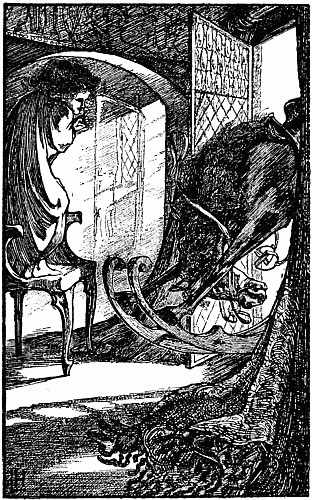
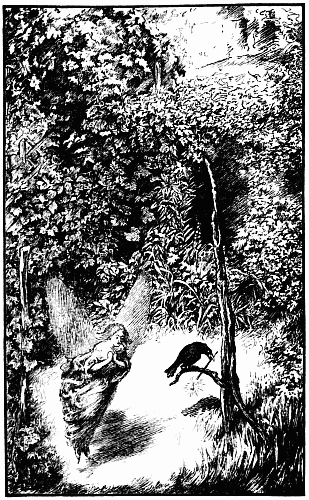
the warmth of gratitude, when a black kite came
and perched upon the window-sill crying: "And
I will give her love at first sight! The first living
thing that she sets eyes on she shall love to distraction,
whether it be man or monster, prince or
pauper, bird, beast or reptile." And as the wicked
Fairy spoke she clapped her wings, and up through
the boards of the floor, and out from under the
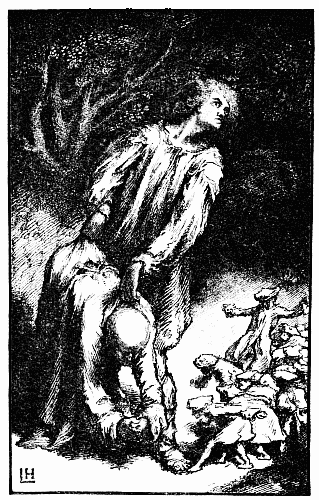
bed, and in through the window, came a crowd
of all the ugliest shapes in the world. Thick and
fast they came, gathering about the cradle and
lifting their heads over the edge of it, waiting for
the poor little Princess to wake up and fall in love
at first sight with one of them.
Luckily the child was asleep; and the good
Fairy, after driving away the black kite and the
crowd of beasts it had called to its aid, wrapped the
Princess up in a shawl and carried her away to a
dark room where no glimmer of light could get in.
She said to the Queen: "Till I can devise a
better way, you must keep her in the dark; and
when you take her into the open air you must
blindfold her eyes. Some day, when she is of a
fit age, I will bring a handsome Prince for her; and
only to him shall you unblindfold her at last, and
make love safe for her."
She went, leaving the King and Queen deeply
stricken with grief over the harm which had befallen
their daughter. They did not dare to present
even themselves before her eyes lest love for them,
fatal and consuming, should drive her to distraction.
In utter darkness the Queen would sit and
cherish her daughter, clasping her to her breast,
and calling her by all sweet names; but the little
face, except by stealth when it was sound asleep,
she never dared to see, nor did the baby-Princess
know the face of the mother who loved her.
By and by, however, the family Fairy came
again, saying: "Now, I have a plan by which your
child may enjoy the delights of seeing, and no ill
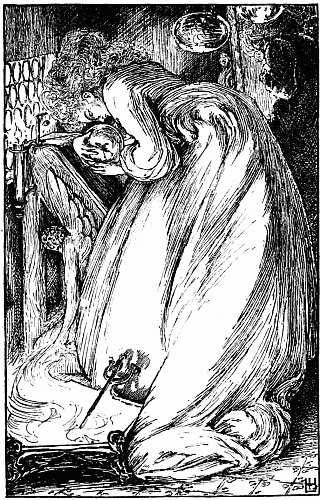
come of it." And she caused to be made a large
chamber, the whole of one side of which was a
mirror. High up in the opposite wall were windows
so screened that from below no one could
look out of them, but across on to the mirror came
all the sweet sights of the world, glimpses of wood
and field, and the sun and the moon and the stars,
and of every bird as it flew by. So the little Princess
was brought and set in a screened place looking
towards the mirror, and there her eyes learned
gradually all the beautiful things of the world.
Over the screen, in the glass before her, she learned
to know her mother's face, and to love it dearly in
a gentle child-like fashion; and when she could
talk she became very wise, understanding all that
was told her about the danger of looking at anything
alive, except by its reflection in the glass.
When she went out into the open air for her
health, she always wore a bandage over her eyes,
lest she should look, and love something too well:
but in the chamber of the mirror her eyes were free
to see whatever they could. The good Fairy,
making herself invisible, came and taught her to
read and make music, and draw; so that before she
was fifteen she was the most charming and accomplished,
as well as the most beautiful Princess of
her day.
At last the Fairy said that the time was come for
her world of reflections to be made real, and she
went away to fetch the ideal Prince that the Princess
might at first sight fall in love with him.
The very day after she was gone, as the morning
was fine, the Princess went out with one of her
maids for a wait through the woods. Over her
patient eyes she wore a bandage of green silk,
through which she felt the sunlight fall pleasantly.
Out of doors the Princess knew most things by
their sounds. She passed under rustling leaves,
and along by the side of running water; and at
last she heard the silence of the water, and knew that
she was standing by the great fish-pond in the
middle of the wood. Then she said to her waiting-woman,
"Is there not some great bird fishing
out there, for I hear the dipping of his bill, and the
water falling off it as he draws out the fish?"
And just as she was saying that, the wicked
Fairy, who had long bided her time, coming softly
up from behind, pushed the waiting-woman off the
bank into the deep water of the pond. Then she
snatched away the silk bandage, and before the
Princess had time to think or close her eyes, she had
lost her heart to a great heron that was standing
half-way up to his feathers fishing among the reeds.
The Princess, with her eyes set free, laughed for
joy at the sight of him. She stretched out her arms
from the bank and cried most musically for the bird
to come to her; and he came in grave, stately
fashion, with trailing legs, and slow sobbing creak
of his wings, and settled down on the bank beside
her. She drew his slender neck against her white
throat, and laughed and cried with her arms round
him, loving him so that she forgot all in the world
beside. And the heron looked gravely at her with
kind eyes, and, bird-like, gave her all the love he
could, but not more; and so, presently, casting his
grey wings abroad, lifted himself and sailed slowly
back to his fishing among the reeds.
The waiting-woman had got herself out of the
water, and stood wringing her clothes and her hands
beside the Princess. "O, sweet mistress," she cried,
with lamentation, "now is all the evil come about
which it was our whole aim to avoid! And what,
and what will the Queen your mother say?"
But the Princess answered, smiling, "Foolish
girl, I had no thought of what happiness meant till
now! See you where my love is gone? and did
you notice the bend of his neck, and the exceeding
length of his legs, and the stretch of his grey wings
as he flew? This pond is his hall of mirrors, wherein
he sees the reflection of all his world. Surely I,
from my hall of mirrors, am the true mate for him!"
Her maid, seeing how far the evil had gone, and
that no worse could now happen, ran back to the
palace and curdled all the court's blood with her
news. The King and the Queen and all their
nobility rushed down, and there they found the
Princess with the heron once more in her arms,
kissing and fondling it with all the marks of a sweet
and maidenly passion. "Dear mother," she said,
as soon as she saw the Queen, "the happiness, which
you feared would be sorrow, has come; and it is such
happiness I have no name for it! And the evil
that you so dreaded, see how sweet it is! And
how sweet it is to see all the world with my own
eyes and you also at last!" And for the first
time in her life she kissed her mother's face in the
full light of day.
But her mother hung sobbing upon her neck,
"O, my darling, my beautiful," she wept, "does
your heart belong for ever to this grey bird?"
Her daughter answered, "He is more than all
the world to me! Is he not goodly to look upon?
Have you considered the bend of his neck, the length
of his legs, and the waving of his wings; his skill also
when he fishes: what imagination, what presence
of mind!"
"Alas, alas," sorrowed the Queen, "dear
daughter, is this all true to you?"
"Mother," cried the Princess, clinging to her
with entreaty, "is all the world blind but me?"
The heron had become quite fond of the Princess;
wherever she went it followed her, and, indeed,
without it nowhere would she go. Whenever it
was near her, the Princess laughed and sang, and
when it was out of her sight she became sad as night.
All the courtiers wept to see her in such bondage.
"Ah," said she, "your eyes have been worn out
with looking at things so long; mine have been kept
for me in a mirror."
When the good family Fairy came (for she was
at once sent for by the Queen, and told of all that
had happened), she said, "Dear Madam, there are but
two things you can do: either you can wring the
heron's neck, and leave the Princess to die of grief;
or you can make the Princess happy in her own way,
by——" Her voice dropped, and she looked from
the King to the Queen before she went on. "At
her birth I gave your daughter love for my gift;
now it is hers, will you let her keep it?"
The King and the Queen looked softly at each
other. "Do not take love from her," said they,
"let her keep it!"
"There is but one way," answered the Fairy.
"Do not tell me the way," said the Queen weeping,
"only let the way be!"
So they went with the Fairy down to the great
pond, and there sat the Princess, with the grey
heron against her heart. She smiled as she saw
them come. "I see good in your hearts towards
me!" she cried. "Dear godmother, give me the
thing that I want, that my love may be happy!"
Then the Fairy stroked her but once with her
wand, and two grey herons suddenly rose up from the
bank, and sailed away to a hiding-place in the reeds.
The Fairy said to the Queen, "You have made
your daughter happy; and still she will have her
voice and her human heart, and will remember you
with love and gratitude; but her greatest love will
be to the grey heron, and her home among the reeds."
So the changed life of the Princess began; every
day her mother went down to the pool and called,
and the Princess came rising up out of the reeds,
and folded her grey wings over her mother's heart.
Every day her mother said, "Daughter of mine,
are you happy?"
And the Princess answered her, "Yes, for I love
and am loved."
Yet each time the mother heard more and more
of a note of sadness come into her daughter's voice;
and at last one day she said, "Answer me truly, as
the mother who brought you into the world, whether
you be happy in your heart of hearts or no?"
Then the heron-Princess laid her head on the
Queen's heart, and said, "Mother, my heart is
breaking with love!"
"For whom, then?" asked the Queen astonished.
"For my grey heron, whom I love, and who loves
me so much. And yet it is love that divides us, for
I am still troubled with a human heart, and often it
aches with sorrow because all the love in it can never
be fully understood or shared by my heron; and I
have my human voice left, and that gives me a hundred
things to say all day, for which there is no word
in heron's language, and so he cannot understand
them. Therefore these things only make a gulf
between him and me. For all the other grey herons
in the pools there is happiness, but not for me who
have too big a heart between my wings."
Her mother said softly, "Wait, wait, little
heron-daughter, and it shall be well with you!"
Then she went to the Fairy and said, "My
daughter's heart is lonely among the reeds, for the
grey heron's love covers but half of it. Give her
some companions of her own kind that her hours may
become merry again!"
So the Fairy took and turned five of the Princess's
ladies'-maids into herons, and sent them down to
the pool.
The five herons stood each on one leg in the
shallows of the pool, and cried all day long; and their
tears fell down into the water and frightened away
the fish that came their way. For they had human
hearts that cried out to be let go. "O, cruel, cruel,"
they wept, whenever the heron-Princess approached,
"see what we suffer because of you, and what they
have made of us for your sake!"
The Princess came to her mother and said, "Dear
mother, take them away, for their cry wearies me,
and the pool is bitter with their tears! They only
awake the human part of my heart that wants to
sleep; presently, maybe, if it is let alone, it will
forget itself."
Her mother said, "It is my coming every day also
that keeps it awake." The Princess answered,
"This sorrow belongs to my birthright; you must
still come; but for the others, let the Fairy take them
away."
So the Fairy came and released the five ladies'-maids
whom she had changed into herons. And
they came up out of the water, stripping themselves
of their grey feather-skins and throwing them back
into the pool. The Fairy said, "You foolish maids,
you have thrown away a gift that you should have
valued; these skins you could have kept and held
as heirlooms in your family."
The five maids answered, "We want to forget
that there are such things as herons in the world!"
After much thought the Queen said to the Fairy,
"You have changed a Princess into a heron, and five
maids into herons and back again; cannot you
change one heron into a Prince?" But the Fairy
answered sadly, "Our power has limits; we can
bring down, but we cannot bring up, if there be
no heart to answer our call. The five maids only
followed their hearts, that were human, when I
called them back; but a heron has only a heron's
heart, and unless his heart become too great for a
bird and he earn a human one, I cannot change him
to a higher form." "How can he earn a human
one?" asked the Queen. "Only if he love the Princess
so well that his love for her becomes stronger than
his life," answered the Fairy. "Then he will have
earned a human body, and then I can give him the
form that his heart suits best. There may be a
chance, if we wait for it and are patient, for the
Princess's love is great and may work miracles."
A little while after this, the Queen watching, saw
that the two herons were making a nest among the
reeds. "What have you there?" said the mother
to her daughter. "A little hollow place," answered
the heron-Princess, "and in it the moon lies." A
little while after she said again, "What have you
there, now, little daughter?" And her daughter
answered, "Only a small hollow space; but in it two
moons lie."
The Queen told the family Fairy how in a hollow
of the reeds lay two moons. "Now," said the Fairy,
"we will wait no longer. If your daughter's love has
touched the heron's heart and made it grow larger
than a bird's, I can help them both to happiness;
but if not, then birds they must still remain."
Among the reeds the heron said in bird language
to his wife, "Go and stretch your wings for a little
while over the water; it is weary work to wait here
so long in the reeds." The heron-Princess looked
at him with her bird's eyes, and all the human love
in her heart strove, like a fountain that could not
get free, to make itself known through them; also
her tongue was full of the longing to utter sweet
words, but she kept them back, knowing they were
beyond the heron's power to understand. So she
answered merely in heron's language, "Come with
me, and I will come!"
They rose, wing beating beside wing; and the
reflection of their grey breasts slid out under them
over the face of the water.
Higher they went and higher, passing over the
tree tops, and keeping time together as they flew.
All at once the wings of the grey heron flagged, then
took a deep beat; he cried to the heron-Princess,
"Turn, and come home, yonder there is danger
flying to meet us!" Before them hung a brown
blot in the air, that winged and grew large. The two
herons turned and flew back. "Rise," cried the
grey heron, "we must rise!" and the Princess knew
what was behind, and struggled with the whole
strength of her wings for escape.
The grey heron was bearing ahead on stronger
wing. "With me, with me!" he cried. "If
it gets above us, one of us is dead!" But the
falcon had fixed his eye on the Princess for his
quarry, and flew she fast, or flew she slow, there
was little chance for her now. Up and up she
strained, but still she was behind her mate, and
still the falcon gained.
The heron swung back to her side; she saw the
anguish and fear of his downward glance as his head
ranged by hers. Past her the falcon went, towering
for the final swoop.
The Princess cried in heron's language, "Farewell,
dear mate, and farewell, two little moons
among the reeds!" But the grey heron only kept
closer to her side.
Overhead the falcon closed in its wings and fell
like a dead weight out of the clouds. "Drop!"
cried the grey heron to his mate.
At his word she dropped; but he stayed, stretching
up his wings, and, passing between the descending
falcon and its prey, caught in his own body
the death-blow from its beak. Drops of his blood
fell upon the heron-Princess.
He stricken in body, she in soul, together they
fell down to the margin of the pool. The falcon
still clung fleshing its beak in the neck of its prey.
The heron-Princess threw back her head, and,
darting furiously, struck her own sharp bill deep
into the falcon's breast. The bird threw out its
wings with a hoarse cry and fell back dead, with
a little tuft of the grey heron's feathers still upon
its beak.
The heron-Princess crouched down, and covered
with her wings the dying form of her mate; in her
sorrow she spoke to him in her own tongue, forgetting
her bird's language. The grey heron lifted
his head, and, gazing tenderly, answered her with
a human voice:
"Dear wife," he said, "at last I have the happiness
so long denied to me of giving utterance in
the speech that is your own to the love that you
have put into my heart. Often I have heard you
speak and have not understood; now something
has touched my heart, and changed it, so that I
can both speak and understand."
"O, beloved!" She laid her head down by his.
"The ends of the world belong to us now. Lie
down, and die gently by my side, and I will die
with you, breaking my heart with happiness."
"No," said the grey heron, "do not die yet!
Remember the two little moons that lie in the
hollow among the reeds." Then he laid his head
down by hers, being too weak to say more.
They folded their wings over each other, and
closed their eyes; nor did they know that the
Fairy was standing by them, till she stroked them
both softly with her wand, saying to each of them
the same words:
"Human heart, and human form, come out of
the grey heron!"
And out of the grey heron-skins came two human
forms; the one was the Princess restored again to
her own shape, but the other was a beautiful
youth, with a bird-like look about the eyes, and
long slender limbs. The Princess, as she gazed on
him, found hardly any change, for love remained
the same, binding him close to her heart; and,
grey heron or beautiful youth, he was all one to
her now.
Then came the Queen, weeping for joy, and
embracing them both, and after them, the Fairy.
"O, how good an ending," she cried, "has come
to that terrible dream! Let it never be remembered
or mentioned between us more!" And
she began to lead the way back to the palace.
But the youth, to whom the Fairy gave the name
of Prince Heron, turned and took up the two
heron-skins which he and his wife had let fall, and
followed, carrying them upon his arm. And as
they came past the bed of reeds, the Princess went
aside, and, stooping down in a certain place drew
out from thence something which she came carrying,
softly wrapped in the folds of her gown.
With what rejoicing the Princess and her husband
were welcomed by the King and all the
Court needs not to be told. For a whole month
the festivities continued; and whenever she showed
herself, there was the Princess sitting with two
eggs in her lap, and her hands over them to keep
them warm. The King was impatient. "Why
cannot you send them down to the poultry yard
to be hatched?" he said.
But the Princess replied smiling, "My moons
are my own, and I will keep them to myself."
"Do you hear?" she said one day, at last;
and everybody who listened could hear something
going "tap, tap," inside the shells. Presently the
eggs cracked, and out of each, at the same moment,
came a little grey heron.
When she saw that they were herons, the Queen
wrung her hands. "O Fairy," she cried, "what
a disappointment is this! I had hoped two
beautiful babies would have come out of those
shells."
But the Fairy said, "It is no matter. Half of
their hearts are human already; birds' hearts do
not beat so. If you wish it, I can change them."
So she stroked them softly with her wand, saying
to each, "Human heart, and human form, come
out of the grey heron!"
Yet she had to stroke them three times before
they would turn; and she said to the Princess,
"My dear, you were too satisfied with your lot
when you laid your moon-children. I doubt if
more than a quarter of them is human."
"I was very satisfied," said the Princess, and
she laughed across to her husband.
At last, however, on the third stroke of the wand,
the heron's skins dropped off, and they changed
into a pair of very small babies, a boy and a girl.
But the difference between them and other children
was, that instead of hair, their heads were
covered with a fluff of downy grey feathers; also
they had queer, round, bird-like eyes, and were
able to sleep standing.
Now, after this the happiness of the Princess was
great; but the Fairy said to her, "Do not let your
husband see the heron-skins again for some while,
lest with the memory a longing for his old life
should return to him and take him away from you.
Only by exchange with another can he ever get
back his human form again, if he surrenders it of
his own free will. And who is there so poor that
he would willingly give up his human form to
become a bird?"
So the Princess took the four coats of feathers—her
own and her husband's and her two children's—and
hid them away in a closet of which she alone
kept the key. It was a little gold key, and to make
it safe she hung it about her neck, and wore it
night and day.
The Prince said to her, "What is that little key
that you wear always hung round your neck?"
She answered him, "It is the key to your happiness
and mine. Do not ask more than that!"
At that there was a look in his face that made her
say, "You are happy, are you not?"
He kissed her, saying, "Happy, indeed! Have
I not you to make me so?" Yet though, indeed,
he told no untruth, and was happy whenever she
was with him, there were times when a restlessness
and a longing for wings took hold of him; for, as
yet, the life of a man was new and half strange to
him, and a taint of his old life still mixed itself
with his blood. But to her he was ashamed to say
what might seem a complaint against his great
fortune; so when she said "happiness," he thought,
"Is it just the turning of that key that I want
before my happiness can be perfect?"
Therefore, one night when the early season of
spring made his longing strong in him, he took the
key from the Princess while she slept, and opened
the little closet in which hung the four feather
coats. And when he saw his own, all at once he
remembered the great pools of water, and how they
lay in the shine and shadow of the moonlight, while
the fish rose in rings upon their surface. And at
that so great a longing came into him to revisit
his old haunts that he reached out his hand and
took down the heron-skin from its nail and put it
over himself; so that immediately his old life took
hold of him, and he flew out of the window in the
form of a grey heron.
In the morning the Princess found the key gone
from her neck, and her husband's place empty.
She went in haste to the closet, and there stood
the door wide with the key in it, and only three
heron-skins hanging where four had used to be.
Then she came crying to the family Fairy, "My
husband has taken his heron-skin and is gone!
Tell me what I can do!"
The Fairy pitied her with all her heart, but
could do nothing. "Only by exchange," said she,
"can he get back his human shape; and who is
there so poor that he would willingly lose his own
form to become a bird? Only your children, who
are but half human, can put their heron-skins on
and off as they like and when they like."
In deep grief the Princess went to look for her
husband down by the pools in the wood. But now
his shame and sorrow at having deceived her were
so great that as soon as he heard her voice he hid
himself among the reeds, for he knew now that,
having put on his heron-skin again, he could not
take it off unless some one gave him a human form
in exchange.
At last, however, so pitiful was the cry of the
Princess for him, that he could bear to hear it no
more; but rising up from the reeds came trailing
to her sadly over the water. "Ah, dear love!"
she said when he was come to her, "if I had not
distrusted you, you would not have deceived me:
thus, for my fault we are punished." So she sorrowed,
and he answered her:
"Nay, dear love, for if I had not deceived you,
you would not have distrusted me. I thought I
was not happy, yet I feared to tell it you." Thus
they sorrowed together, both laying on themselves
the blame and the burden.
Then she said to him: "Be here for me to-night,
for now I must go; but then I shall return."
She went back to the palace, and told her mother
of all that had happened. "And now," she said,
"you who know where my happiness lies will not
forbid me from following it; for my heart is again
with the grey heron." And the Queen wept, but
would not say her no.
So that night the Princess went and kissed her
children as they slept standing up in their beds,
with their funny feather-pates to one side; and
then she took down her skin of feathers and put it
on, and became changed once more into a grey
heron. And again she went up to the two in their
cots, and kissed their birdish heads saying: "They
who can change at will, being but half human,
they will come and visit us in the great pool by
the wood, and bring back word of us here."
In the morning the Princess was gone, and the
two children when they woke looked at each other
and said: "Did we dream last night?"
They both answered each other, "Yes, first we
dreamed that our mother came and kissed us; and
we liked that. And then we dreamed that a grey
heron came and kissed us, and we liked that better
still!" They waved their arms up and down.
"Why have we not wings?" they kept asking.
All day long they did this, playing that they were
birds. If a window were opened, it was with the
greatest difficulty that they were kept from trying
to fly through.
In the Court they were known as the "Feather-pates";
nothing could they be taught at all.
When they were rebuked they would stand on one
leg and sigh with their heads on one side; but
no one ever saw tears come out of their birdish
eyes.
Now at night they would dream that two grey
herons came and stood by their bedsides, kissing
them; "And where in the world," they said when
they woke, "are our wings?"
One day, wandering about in the palace, they
came upon the closet in which hung the two little
feather coats. "O!!!" they cried, and opened
hard bright eyes at each other, nodding, for now
they knew what they would do. "If we told, they
would be taken from us," they said; and they waited
till it was night. Then they crept back and took
the two little coats from their pegs, and, putting
them on, were turned into two young herons.
Through the window they flew, away down to
the great fish-pond in the wood. Their father and
mother saw them coming, and clapped their wings
for joy. "See," they said, "our children come to
visit us, and our hearts are left to us to love with.
What further happiness can we want?" But when
they were not looking at each other they sighed.
All night long the two young herons stayed with
their parents; they bathed, and fished, and flew,
till they were weary. Then the Princess showed
them the nest among the reeds, and told them all
the story of their lives.
"But it is much nicer to be herons than to be
real people," said the young ones, sadly, and became
very sorrowful when dawn drew on, and their mother
told them to go back to the palace and hang up the
feather coats again, and be as they had been the day
before.
Long, long the day now seemed to them; they
hardly waited till it was night before they took down
their feather-skins, and, putting them on, flew out
and away to the fish-pond in the wood.
So every night they went, when all in the palace
were asleep; and in the morning came back before
anyone was astir, and were found by their nurses
lying demurely between the sheets, just as they had
been left the night before.
One day the Queen when she went to see her
daughter said to her, "My child, your two children
are growing less like human beings and more like
birds every day. Nothing will they learn or do,
but stand all day flapping their arms up and down,
and saying, 'Where are our wings, where are our
wings?' The idea of one of them ever coming to
the throne makes your father's hair stand on end
under his crown."
"Oh, mother," said the heron-Princess, "I have
made a sad bed for you and my father to lie on!"
One day the two children said to each other,
"Our father and mother are sad, because they want
to be real persons again, instead of having wings and
catching fish the way we like to do. Let us give up
being real persons, which is all so much trouble, and
such a want of exercise, and make them exchange
with us!" But when the two young herons went
down to the pond and proposed it to them,
their parents said, "You are young; you do not
know what you would be giving up." Nor would
they consent to it at all.
Now one morning it happened that the Feather-pates
were so late in returning to the palace that the
Queen, coming into their chamber, found the two
beds empty; and just as she had turned away to
search for them elsewhere, she heard a noise of wings
and saw the two young herons come flying in through
the window. Then she saw them take off their
feather-skins and hang them up in the closet, and after
that go and lie down in their beds so as to look as if
they had been there all night.
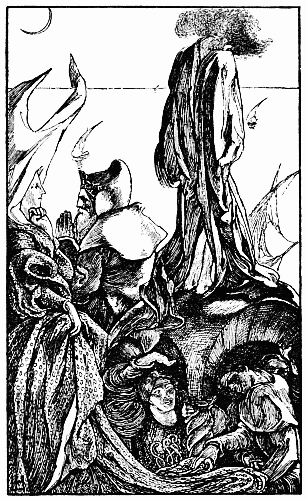
The Queen struck her hands together with horror
at the sight, but she crept away softly, so that they
did not know they had been found out. But as
soon as they were out of their beds and at play in
another part of the palace, the Queen went to the
closet, and setting fire to the two heron-skins where
they hung, burnt them till not a feather of them was
left, and only a heap of grey ashes remained to tell
what had become of them.
At night, when the Feather-pates went to the
closet and found their skins gone, and saw what
had become of them, their grief knew no bounds.
They trembled with fear and rage, and tears rained
out of their eyes as they beheld themselves deprived
of their bird bodies and made into real persons for
good and all.
"We won't be real persons!" they cried. But
for all their crying they knew no way out of it.
They made themselves quite ill with grief; and
that night, for the first time since they had found
their way to the closet, they stayed where their
nurses had put them, and did not even stand up in
their beds to go to sleep. There they lay with gasping
mouth, and big bird-like eyes all languid with
grief, and hollow grey cheeks.
Presently their father and mother came seeking
for them, wondering why they had not come down
to the fish-pond as they were wont. "Where are
you, my children?" cried the heron-Princess,
putting her head in through the window.
"Here we are, both at death's door!" they cried.
"Come and see us die! Our wicked grandam has
burnt our feather-skins and made us into real persons
for ever and ever, Amen. But we will die rather!"
The parent herons, when they heard that, flew
in through the window and bent down over the
little ones' beds.
The two children reached up their arms. "Give
us your feathers!" they cried. "We shall die if you
don't! We will die if you don't! O, do!" But
still the parent birds hesitated, nor knew what to do.
"Bend down, and let me whisper something!"
said the boy to his father: and "Bend down, and
whisper!" cried the girl to her mother. And
father and mother bent down over the faces of their
sick children. Then these, both together, caught
hold of them, and crying, "Human heart, and
human form, exchange with the grey heron!"
pulled off their parents' feather-skins, and put them
upon themselves.
And there once more stood Prince Heron and the
Princess in human shape, while the two children
had turned into herons in their place.
The young herons laughed and shouted and
clapped their wings for joy. "Are you not happy
now?" cried they. And when their parents saw
the joy, not only in their children's eyes, but in each
other's, and felt their hearts growing glad in the
bodies they had regained, then they owned that the
Feather-pates had been wise in their generation,
and done well according to their lights.
So it came about that the Prince and the Princess
lived happily ever after, and the two young herons
lived happily also, and were the best-hearted birds
the world ever saw.
In course of time the Prince and Princess had
other children, who pleased the old King better
than the first had done. But the parents loved none
better than the two who lived as herons by the great
fish-pond in the wood; nor could there be greater
love than was found between these and their younger
brothers and sisters, whose nature it was to be real
persons.