Le bon sens nous dit que les choses de la terre n’existent que bien
peu et que la vraie réalité est dans les rêves. Charles Baudelaire,
Les Paradis Artificiels (Dédication).
Except during a period of some four centuries and
a half, from about 940 till the palmy days of
Mojopahit, when declining Hindu civilisation, for
reasons as yet unexplained, sought a refuge farther
east, Central Java and especially that part of it
known in our time as the Principalities, i.e. Surakarta
and Jogjakarta, has always been the heart of
the island. There lived and live the true Javanese,
the people of heaven’s mercy, cherishing their old
traditions; these and the beautiful scenery of their
fire-mountains and fertile valleys are still theirs,
whatever else may fail: glory, power and freedom.
They lived and live in their world of custom and
formality a life unintelligible in its inner workings
to the western brain, impenetrable to the western
eye. There are forces hidden in the Javanese
mind, the resultant of a strangely moved past,
which we can never understand, though we may
admire their creative energy, revealed in the now
conventional designs guiding the hand of the potter,
the wood-carver, the goldsmith, the armourer, the
batikker,[49] hereditary practisers of dying arts and
crafts; in the remains of a marvellous architecture
long since altogether dead. No chapter in the
whole history of eastern art, says Fergusson, is so
full of apparent anomalies or upsets so completely
our preconceived ideas of things as they ought to
be, as that which treats of the architectural history
of the island of Java ...; the one country to which
they (the Hindus) overflowed, was Java, and there
they colonised to such an extent as for nearly a
thousand years to obliterate the native arts and
civilisation and supplant it by their own ...; what
is still more singular is, that it was not from
the nearest shores of India that these emigrants
departed but from the western coast.... A linga,
erected in the Kadu in the year 654 Saka (A.D. 732),
a Sivaïte symbol of generation, marks the origin of
an artistic activity whose most brilliant period, the
classical one of central Javanese architecture, as
G. P. Rouffaer styles it rightly, begins with the
construction of such buildings as the Buddhist
chandi Kalasan or Kali Bening. The inscription of
King Sanjaya in Venggi characters, and vestiges of
Vaishnav tendencies in the Suku and Cheto temples
of a much later date, point to the worship of Vishnu,
while Brahma’s four sublime conditions and more
subtle transcendentalism do not seem to have
attracted the Javanese converts to Hinduïsm.
They could grasp the unity of Siva’s threefold
functions much better and accepted him as Mahadeva
at the head of the Trimoorti. The advent of
Buddhism in its mahayanistic form, the creed of the
northern church so called, served to emphasise
native tolerance. Sivaïsm and whatever there was
of Vishnuïsm, harmonised with Buddhism to the
extent of borrowing and lending symbols, emblems
and divine attributes; Hindu gods played puss in
the corner with Bodhisatvas, as already remarked
upon in the preceding chapter; the chandi Chupuwatu
surprises us with a stupa-linga;[50] a Javanese
prince of the thirteenth century bears the expressive
name of Siva-Buddha; the old Javanese Sang
Hiang Kamahayanikan contains the dictum: Siva
is identical with Buddha.[51] If more inscriptions had
been found, more light might have been thrown on
the anomalous ornamentation of, for instance, the
Prambanan temples and the Mendoot; but Sivaïte
records of the kind leaving the matter unexplained,
Buddhist information is still scantier, perhaps a
consequence of Baghavat’s followers not excelling
in epigraphy or literary labours of any description.
If the backwash of great political events or
religious discussion when the Islām superseded
older creeds, may have aided Kala, the Destroyer,
in demolishing a good many buildings of the
classical period, whose sites even are sought in
vain, it is certain that the pioneers of western
civilisation, proud of their superiority, willfully and
wantonly undid in many places work that had
been spared by time and earthquakes and volcanic
eruptions and enemies born of the soil, devastating
with fire and sword their brethren’s hearths and
houses. Christian zealots regarded the ancient
monuments as assembly-rooms of the Devil where
the benighted heathen used to foregather in idolatry,
lodges of abomination the sooner razed the better,
a pious feeling often translated into action on
grounds of utility: the stones offered excellent
building material. Officials and particulieren[52] of
broader views, besides acknowledging the serviceableness
of chandis in this respect, went recho-hunting[53]
for the adornment of their houses and
gardens. Quite a collection has been formed in the
residency grounds at Jogjakarta, the nucleus of
which was moved thither from the estate Tanjong
Tirta, whose former occupants, like most of the
landed gentry, made exceedingly free with the
temples and monasteries in that neighbourhood.
As neither they nor the others bothered about
noting where they got this or that piece of sculpture,
we are entirely at sea concerning the meaning of
several beautiful statues. This is the case, e.g.,
with one of remarkably fine execution, a crowned
goddess, sitting on a lotus cushion and encircled by
a flaming aureole, pressing her hands to her bosom.
She has been fortunate enough to escape the fate
of some deities who shared her sequestration and
were left to the care of the convicts detailed to keep
the Resident’s compound in trim, a duty performed
by whitewashing or daubing them with a grayish
substance, excepting the hair of the head, the eyebrows,
the eyeballs and the prabha, which the
gentlemen-artists of the chain-gang are in the habit
of painting black, enhancing the general effect by
“restoring” lost hands and feet and damaged faces
after methods nothing short of barbarous, but therefore
the better in keeping with the traditional attitude
of those in authority. For this infamous disfiguration
and desecration, which makes any one
unaccustomed to Dutch East Indian processes
shudder with horror, never disturbed the aesthetic
sense or equanimity of the several occupants of the
residency who, during the last thirty-five years, saw
it going on under their very eyes, the eyes of the
representatives of a Government lavish in circulars[54]
recommending the country’s antiquities to their
care. Neither are those eyes shocked by the
“museum” adjoining the residency, a jumble of
plunder from chandis far and near; nor by the
chaotic mass of torsos, arms and legs, fragmentary
evidence of wholesale spoliation behind that pitiful
exhibition of archaeology turned topsyturvy.
So much for the statuary removed from the
chandis, as far as it can be traced. Concerning the
chandis themselves, it should be remembered that
the greater part has wholly disappeared. Hillocks,
overspread with brushwood, sometimes awaken hopes
that by digging foundations and portions of walls may
be discovered; heaps of debris, tenanted by lizards
and snakes, point to structures of which nothing
that is left, indicates the former use; shattered
ornamental stones speak of magnificent buildings
fallen or pulled down—glimmerings of splendour
that was. The temples still standing are reduced
to ruins and diminish almost visibly in attractiveness
and size. Rouffaer[55] gave an interesting example
of their fate in the story of the spiriting
away of the chandi Darawati: in 1889 tolerably
well preserved, though two large statues of the
Buddha had been dragged off to the dwelling of a
European in the dessa Gedaren, it was gone in 1894—vanished
into air! The temples constructed of
brick, like the chandi Abang, have suffered even
more, of course, than those of stone, the memory of
whose grandeur is retained in a few ghastly wrecks.
Reserving the Buddhist remains for later treatment
and passing by the Sivaïte caves with rectangular
porches in the Bagelen, mentioned by Fergusson,
I shall deal here with the chandis Suku and Cheto,
and the most noteworthy ruins in the southern
mountains. The latter comprise the kraton of Ratu
Boko, Mboq Loro Jonggrang’s father, as the natives
call it, and the temple group of the Gunoong Ijo.
Of the legendary kingly residence little more is left
than a square terrace with portions of a wall and
the sill of a gate. The chandi Ijo consists of a
large temple of the usual polygonal form with ten
smaller ones and a pit which contained two stone
receptacles and strips of gold-leaf with the image
of a deity and an inscription; the buildings are in
a sad condition, but decay has not impaired their
beauteous dignity and the landscape alone repays
a visit to Soro Gedoog, an estate whose gradual
reclamation of the jungle led to their discovery in
1886 when ground was cleared for an extension of
the plantations.
The chandis Suku and Cheto are situated
respectively on the western and northern slope of
the Gunoong Lawu, a volcano on the boundary
between Surakarta and Madioon, not less expressive
in its scenery of what heaven has done for this
delicious island. Shortly after the mysterious
pyramids of Suku had drawn the attention of
Resident Johnson, in the British Interregnum,
Thomas Horsfield visited them and made some
drawings. The inscriptions and the sculptured
ornament of Cheto were reported upon by C. J.
van der Vlis, in 1842. The groups belong to the
latest, most decadent period of Hindu architecture
in Java and their foundation, Suku being a few
years older than Cheto, must have coincided with
the introduction of the Islām. Bondowoso, the son
of the recluse Damar Moyo, who assisted the King of
Pengging against Ratu Boko and took such signal
revenge upon the latter’s daughter, Loro Jonggrang,
for rejecting him, the uncouth slayer of her father,
is supposed to have erected the buildings at Suku.
Those at Cheto owe their origin to a prince of
Mojopahit, who quarrelled with his brother, the
ruler of that empire, or, according to another
legend, to a certain Kiahi Patiro, who refused to
become a convert to the new faith and repaired to
the Lawu, where he lived as a hermit and was killed
by Pragiwongso, an emissary of the Moslim King
of Demak. Linga-worship returned in the temple
groups of the Lawu to its crudest modes of expression,
and Fergusson, who mentions the dates 1435
and 1440, speaks of a degraded form of the Vishnuïte
religion, the garuda,[56] the boar, the tortoise, etc.,
being of frequent occurrence in the ornamentation.
Junghuhn described the staircases he found, which
connected the terraces, and the statues, which hardly
came up to the artistic standard of Prambanan and
the Boro Budoor, one of them distinguishing itself
by a colossal head whose measurement from chin
to crown was three feet, half of the whole height.
Comparing his description with the actual state of
things, much must have been removed, heaven
knows whither! Notwithstanding the obvious truth
of Fergusson’s remark that a proper illustration of
Suku and Cheto, and, I may be permitted to add,
of the remains on the summit of the mountain,
whether originally tree-temples or consecrated to
devotional exercises in the open, à l’instar of West
Java, promises to be of great importance to the
history of architecture in the island, very little has
been done in that direction or even for the conservation
of the ruins where recho-hunters and a luxurious
vegetation vie in obliterating the traces of most
interesting antiquities. Junghuhn sounded a note
of warning apropos of the falling in of the peculiarly
constructed pyramidal temple, May 1838, but this
and the other monuments have been suffered since,
as before, to crumble quietly away and the easily
removable sculpture to be carried off. Ganesa, in
his manifold reproductions, seconds on the Lawu
his father Siva, head of the Trimoorti, continuing
the lead obtained seven centuries earlier in the
plain of Prambanan, and a systematic study of the
reliefs, now covered with moss and lichens, might
shed a good deal of light on several unsettled
questions. One of those reliefs, blending the human
and the divine in the manner of the allusions to the
Brata Yuda on the Diëng plateau and the Rama
legend on the walls of the chandi Loro Jonggrang,
represents a complete armoury, with Ganesa, protector
of arts and crafts, between the armourer
himself and his assistant who works the bellows.
If, with Rouffaer, we divide the long era during
which the Hindus, first as immigrants and then as
rulers, merged gradually in the aboriginal population,
into a Hindu-Javanese period of Central Java
and a Javanese-Hindu period of East Java, the
monuments of Suku and Cheto belong evidently
to the epoch of Javanese-Hindu decline, decadent
art flowing back to its classical source, tarnishing
original Hindu-Javanese conceptions. Leaving
Buddhist architecture to be dealt with in the last
chapters, and before turning to the chandis of East
Java, a short historical review may aid in the
appreciation of this decline and subsequent paralysis
of the creative faculty. Kartikeya, the god of war,
a younger son of Siva and Parvati, had his strong
hand in this, and how he invested and divested
mighty princes, who conquered or were defeated
and finally passed away, causing the rise and fall
of glorious kingdoms, is written in the babads, the
Javanese chronicles, by no means such old wives’
tales as Dominee Valentijn tried to make them out,
but containing in their extravagance a kernel of
stern reality, not the less explanatory of the condition
of the fairy island Java because the magnanimes
mensonges of a vivid imagination animate the dull
facts.
Of the Hindu empire Mataram in Central Java
nothing tangible is left except the ruins referred to,
a few objects in metal and stone, accidentally unearthed
or dug up by treasure-seekers, and some
inscriptions, title-deeds, etc., the scanty “genuine
charters of Java” as van Limburg Brouwer defined
them. The name Mataram has been preserved on
a copper plate, dating from about 900, which agrees
in this respect with four other records, discovered
in East Java; the capital of the Maharaja i
Mataram is called Medang. For two centuries,
from the beginning of the eighth until the beginning
of the tenth, Mataram seems to have flourished as
the most powerful state in the island, especially
aggressive towards the east. Native tradition, in
fond exaggeration of her importance, makes her
sway the destinies of the world. Her star waned
suddenly; by what cause is unknown; but whether
it was the invasion of a mightier enemy or a natural
catastrophe, the same as that which overtook the
builders of the Diëng and the plain of Prambanan,
forcing them to leave their work unfinished, ancient
Mataram sank into insignificance. From the middle
of the tenth until the beginning of the sixteenth
century, the successors of her former eastern vassals,
that is whichever of them happened to be on top in
the continual struggle for supremacy, did in East and
Central Java as they pleased, warring, intermarrying,
annexing their neighbours’ domains, only to lose
them again and their own kingdoms to boot, to
usurpers, ambitious ministers, popular governors
of provinces, enterprising condottieri or mere
adventurers favoured by Dame Fortune. In that
overflowing arena of high rivalry, dynasties succeeding
one another with amazing rapidity, Daha,
situated in what is now Kediri, secured paramount
influence after Kahuripan, situated in what is now
Southern Surabaya; then Tumapel, situated in
what is now Pasuruan, became ascendant; then
Daha once more and, last of the great Hindu
empires, Mojopahit, about 1300, to be overthrown,
after two centuries of preponderance, by the sword
of Islām. Jayabaya, King of Daha, from about
1130 till about 1160, has been called[57] the Charlemagne
of Java, in whose reign learning and letters
were encouraged; or the Javanese King Arthur,
whose life among his heroes, in peace and war, is
reflected in the idylls of the Panji-cycle, at whose
Court the famous poet Mpu Sedah began his version
of the Mahabharata, the Brata Yuda, finished by
Mpu Panulooh, author of the Gatotkachasraya,
while Tanakoong wrote the Wretta-Sansaya, a sort
of Epistola de Arte Poetica. When Tumapel expanded,
especially under Ken Angrok, troublous
times arrived for Daha, which could hardly hold
her own against the encroachments of that unscrupulous
monarch. Ken Angrok or Arok, born
in 1182 at Singosari, had seized the royal power
after assassinating the old King in 1222 or 1223.
The kris he used, had been ordered expressly for
that deed from the famous armourer Mpu Gandring,
who was its first victim because he tarried in
delivering it, the tempering of the steel having
taken more time than suited the usurper’s patience.
Dying under the murderous stroke, Mpu Gandring
uttered a prophetic curse: This kris will kill Ken
Angrok; it will kill his children and grandchildren;
it will kill seven kings. The prophecy came true
with wonderful exactness. Ken Angrok having
married Dedes, the widow of the old King he had
despatched, was himself killed as the third victim
of Mpu Gandring’s kris in the hand of a bravo
commissioned by their son Anusapati, the Hamlet
of Javanese history. And how blood followed blood
during the hundred years of Tumapel’s hegemony,
how Ken Angrok’s descendants harassed their
neighbours before the curse took effect upon each
of them, appearing like luminous stars in the sky of
politics and war, and then disappearing behind the
shadowy cloud of untimely death, is it not written
in the Pararaton or Book of the Kings of Tumapel
and Mojopahit?
The foundation of Mojopahit has been attributed
to scions of several royal families, among them to
Raden Tanduran, a prince of Pajajaran in West Java
which, it will be remembered, owed its origin to
princes of Tumapel. The most widely accepted
reading is, however, that a certain Raden Wijaya,
commander of the army of King Kertanegara,
great-grandson of Ken Angrok, profiting from his
master’s quarrels with Jaya Katong, ruler of Daha
in those days, carved out a kingdom for himself,
reclaiming, always with that end in view, a large
area of wild land, Mojo Lengko or Mojo Lengu,
near Tarik in Wirosobo, the present Mojokerto.
King Kertanegara who, by branding the Chinese
envoy Meng Ki, had stirred up trouble with the
Flowery Empire, was unable to punish this act of
arrogance, and his violent death in a battle won by
the legions of Daha, meant the inglorious end of
Tumapel. This happened in 1292 and the expeditionary
force sent from China to chastise him
for his ungracious treatment of ambassadors to
his Court, consequently found their object accomplished
or, more correctly speaking, unaccomplishable
when landing in 1293. But its leader indemnified
his martial ardour by entering the service of
Raden Wijaya who, with his assistance, subjugated
Daha, which had tried to reassume her former
precedence. Firmly established on the throne of
the realm he had fashioned out of Daha, Tumapel
and his own territory near Tarik, he refused,
however, to pay the price stipulated by his Chinese
ally and when the auxiliary troops asked the fulfilment
of his promises, arms in hand, he proved to
them that superior strength is the ultimate arbiter
of right and sent them home much diminished in
numbers and pride. The Emperor of China, wroth
that the beautiful princesses of Tumapel, daughters
of the late King Kertanegara, whom he had deigned
to accept as concubines, were not forthcoming, but
stayed behind to adorn the harem of the self-made
King of Mojopahit, ordered his unsuccessful generalissimo
to be flogged by way of example to
other commanding officers. Raden Wijaya who,
with the kingly title, had assumed the name of
Kertarajasa, enjoyed his royal dignity only until
1295 and his ashes were entombed in two places not
yet located: in the dalem (the inner, private part)
of his palace conformably to the Buddhist, and at
Simping conformably to the Sivaïte ritual, not
otherwise than King Kertanegara received last
honours in the guise of Siva-Buddha at Singosari
and in the guise of a Dhyani Buddha at Sakala,
and the remains of King Kertarajasa’s successor
were interred in three places according to the
Vishnuïte ritual, circumstances from which we
may conclude that in East as in Central Java the
different creeds lived together in most amiable
harmony.
The kris of Mpu Gandring might limit the
earthly term of the descendants of Ken Angrok, it
could not check their prowess while they were still
up and doing. Overlords of East and Central Java,
extending their rule to Pajajaran, they even looked for
conquest to the other islands of the Malay Archipelago.
Under Hayam Wurook or Rajasa Nagara,
in the latter half of the fourteenth century,
Mojopahit reached her zenith; a record of 1389
mentions Bali as being tributary since about 1340;
Aru, Palembang and Menangkabau in Sumatra,
Pahang with Tumanik in Malacca, Tanjong Pura in
Borneo, Dompo in Soombawa, Ceram and the
Goram islands acknowledged Nayam Wurook’s
suzerainty too. Seeing no more worlds to subdue,
he died and, as in the case of Alexander the Great,
his empire fell to pieces; in East Java itself
Balambangan seceded from Mojopahit proper and
the Muhammadan propaganda, fanning discord
between the Hindu princes of old and new dynasties,
prepared their common doom. The beginnings of
the Islām in East Java have already been spoken of,
with Gresik as a missionary centre, Maulana Malik
Ibrahim as the first wali in that region and the
conversion into Moslim vassal states of the dependencies
of Mojopahit, whose princes, combining
under the auspices of Demak against their liege
lord, sealed his fate. Raden Patah of Demak was a
man of war and destiny. The fire of the new faith
burning fiercely within him, he hurled his defiance
at the stronghold of the heathen, speaking to the
last King of Mojopahit, his father or grandfather
according to tradition, as Amaziah, King of Juda,
spoke to Joash, the son of Jehoahaz, the son of Jehu,
King of Israël: Come, let us see one another in
the face,—but with a different result: the challenger
from Demak came out victorious and Mojopahit
ceased to exist, an issue fraught with grave
consequences. This occurred about the year 1500[58]
and Raden Patah, pursuing the royal family on their
flight, defeated the King or one of his sons again
at Malang, where a last stand was made. But Gajah
Mada, the Prime Minister of Mojopahit, founded a
new empire, Supit Urang, which comprised much
of the territory once belonging to Singosari. The
Saivas also held out at Pasuruan, which was invested
by Pangeran Tranggana, a successor of Raden Patah,
but after his assassination by one of his servants,
the troops of Demak returned home. Pasuruan and
Surabaya reverted, later on, to the Regent of
Madura, a son-in-law of Pangeran Tranggana. Yet,
Hinduïsm lingered on in the island; its political
power was only broken with the conquest of
Balambangan by the East India Company in 1767,
and the population of the Tengger mountain region
did not commence to accept the Islām until very
recently.
In the confusion which resulted after the death of
Pangeran Tranggana from the disruption of his
domains into Cheribon, Jayakarta and Bantam in
the western, Gresik and Kediri in the eastern, and
Demak proper and Pajang in the central part of the
island, the latter territory absorbed Jipang and its
Prince Tingkir, a scion of the royal family of
Mojopahit, was proclaimed Sooltan by the spiritual
authority of Gresik, the first time we find that title
mentioned in the history of Java. Sooltan Tingkir
appointed one of his trusted servants, Kiahi Ageng
Pamanahan, governor of the tract of land which had
preserved the name of Mataram. Kiahi Ageng
Pamanahan improved the condition of the people
and his son Suta Wijaya, who had married a
daughter of the Sooltan, making himself independent
by rebelling, by poisoning his father-in-law after
his having been captured and pardoned, finally by
taking possession of the regalia in the subsequent
war of succession, became master of the situation
and laid in New Mataram the foundation of another
state which, in the reign of his successor Ageng,
1613-1646, gained the ascendency over the rest
of Java with Madura, subjugating even Sukadana
in West Borneo. Not, however, without strenuous
exertion for Balambangan gave a good deal of
trouble in the East and the conquest of Sumedang
in the West, in 1626, taxed the military strength
of the rising empire to its utmost. When the East
India Company began to make its influence felt,
Moslim solidarity proved a valuable asset as, for
instance, in the relations with Bantam and Cheribon,
whose Pangeran proposed the title of Susuhunan
for Ageng (1625) before Mecca promoted him to the
Sooltanate (1630). In 1628 and 1629 he ventured
to attack Batavia, the new settlement of the Dutch,
but had to retire and, what was even worse, by
provoking those upstart strangers, he damaged his
trade: they closed the channels of export to
Malacca and other foreign ports of rice, the
principal produce of the land. “Mataram must now
become our friend,” wrote the Governor-General
to his masters, the Honourable Seventeen, and,
indeed, Mangku Rat I., Ageng’s son, found himself
obliged to sign a treaty of friendship with the
Company—a dangerous friendship! Differences
between their “friend” and Bantam with Cheribon
were sedulously fostered by the authorities at
Batavia; the Company took a hand in the putting
down of disturbances created in East Java by
Taruna Jaya of Madura and Kraëng Galesoong of
Macassar; the Company patronised and protected
the reigning Sooltans, who moved their residence
from Karta to Kartasura, against pretenders and
exacted payment in land, privileges, concessions,
monopolies, etc., shamelessly in excess of the real or
pretended assistance afforded in quelling purposely
manufactured anarchy—precisely as we see it happen
nowadays wherever western civilisation offers her
“disinterested” services to eastern countries of
promising complexion for exploitation by western
greed.
Mataram, trying to escape from the extortionate
friendship of the honey-tongued strangers at Batavia,
whose thirst for gold seemed unquenchable, has its
counterparts in benighted regions now being
“civilised” after the time-honoured recipe: interference
which upsets peace and order, more interference
to restore peace and order with the naturally
opposite result, occupation until peace and order
will be restored, gradual annexation. The East
India Company’s mean spirit of haggling was held
in utter contempt by the native princes, grands
seigneurs in thought and action, too proud to pay
the hucksters with their own coin, though bad
forebodings must have filled the mind, for instance,
of Susuhunan Puger, recognised at Batavia as
Mataram’s figurehead under the name of Paku
Buwono I.,[59] when near his capital a Dutch fort was
built and garrisoned with Dutch soldiers to back
him in his exactions for the benefit of alien usurers
and sharpers. Like the rat of Ganesa, they penetrated
everywhere and the tale of their relations to
the lords of the land is one of tortuous insinuation
until they had firmly established themselves and
could give the rein to their sordid commercialism
in always more exorbitant claims. Paku Buwono
II., feeling his end approach, was prevailed upon, in
1749, to bequeath his realm to the Company, but
one of the most influential members of the imperial
family decided that this was carrying it a little too
far: Mangku Bumi,[60] brother of Paku Buwono II.,
supported by Mas Saïd, son of the exiled Mangku
Negara,[61] and other pangerans (princes of the blood),
stood up in arms to defend their country’s rights
and inflicted severe losses on the Dutch troops in
stubborn guerrilla warfare. This led to the partition
of Mataram between Paku Buwono III. and
his uncle Mangku Bumi, both acknowledging the
supremacy of the Company, the latter settling at
Jogjakarta, the old capital Karta, under the title
and name of Sooltan Mangku Buwono,[62] while Mas
Saïd, who did not cease hostilities before 1757,
gained also a quasi-independent position as Pangeran
Adipati Mangku Negara, which in 1796 became
hereditary. With three reigning princes for one,
the power of Mataram was definitely broken and
Batavia assumed the direction of her affairs quite
openly, the “thundering field-marshal” Daendels
emphasising her state of decline and the British
Interregnum bringing no change.
In 1825 the divided remnant of Mataram, viz.
Surakarta with the Mangku Negaran and Jogjakarta
with the Paku Alaman,[63] was deeply stirred by
Pangeran Anta Wiria calling upon his compatriots
to chase the oppressors away. Born from a woman
of low descent among the wives of Mangku
Buwono III., Sooltan of Jogjakarta, it seems that,
nevertheless, hopes of his succession to the throne
had been held out to him when he assisted his
father against the machinations of his grandfather,
Sooltan Sepooh (Mangku Buwono II.), banished by
Raffles in 1812. However this may be, he resented
the settlement of the Sooltanate on the death of
Mangku Buwono III. upon Jarot, an infant son,
and other circumstances adding to his dislike of
Dutch control, he raised the standard of revolt.
The Javanese responded with alacrity to an appeal
which bore good tidings of delivery as the wind,
ridden by the Maroots who make the mountains to
tremble and tear the forest into pieces, bears good
tidings of coming rain to a parched earth. Anta
Wiria, under his more popular name of Dipo Negoro,
and his lieutenants Ali Bassa Prawira Dirja, or
Sentot, and Kiahi Maja, gave the Dutch troops
plenty of bloody work in the five years during
which the Java war lasted, 1825-1830. It was the
last eruption on a large scale of the fire imprisoned in
the native’s heart, the last sustained effort at regaining
his independence, crushed by the white man’s
superiority in military appliances, but occasional
throbbings, ruffling the surface as in Bantam (1888),
the Preanger Regencies (1902), Kediri (1910), etc.,
show that the volcano is by no means an extinguished
one. Though “kingdoms are shrunk to provinces
and chains clank over sceptred cities,” the love
of liberty, laid by as a sword which eats into itself,
does not own foreign dominion, and the native
princes, especially the Susuhunan of Surakarta and
the Sooltan of Jogjakarta, remain objects of worshipful
homage. Their genealogy remounts to the gods
whose essence took substance in the illustrious
prophet Adam who begat Abil and Kabil on the
goddess Kawa; the history of their house begins
with the arrival in the island, in the Javanese
year 1, of Aji Soko; they are the panatagama
and sayidin (shah ad-din), directors and leaders
of religion; their Courts set the fashion in
high native society, Solo[64] being more gay and
extravagant, Jogja[64] more sedate and solid, as a
writer at the end of the eighteenth century already
remarked.
The Dutch Government recognises the imperial
or royal dignity of Susuhunan and Sooltan by the
superior position of its Residents in the capitals of
their Principalities, who, directly responsible to the
Governor-General, correspond in rank to the general
officers of the army, while the administrative heads
of the other residencies have to content themselves
with the honours due to a colonel; also by the
institution of dragoon body-guards whose ostensibly
ornamental presence can be and has been turned to
good account when the mental intoxication arising
from meditation on gilded disgrace, charged with
the lightning of passion, produces effects irreconcilable
with the fiction that all is for the best in this
best of worlds. With the Government steadily
encroaching on the native princes’ ancient rights,
bitterness grows apace and irritation at the recoiling
weight of bondage lives on, though colonial reports
represent it as dead. Truly, in the three centuries
during which it pleased Kuwera, the fat god of
wealth, to inspire the strangers from the West, rich
in promise but slow in performance, exacting and
pitiless, to deeds of unprincipled rapacity, the people
have learned to hide their thoughts that worse may
not follow, hoping that time will set things right.
But as everything points more clearly to the fixed
purpose of the Dutch Government to avail themselves
of every pretext for swallowing the Principalities
as all the rest has been gobbled up, there
are those who cherish the memory of Dipo Negoro
and consider the necessity of new man-offerings:
the greater the need, the greater must be the
propitiation. On the whole, however, better counsel
prevails, deliverance being sought on planes of
mystic exercise, silent submission being practised
in expectation of the consummation of a higher
will, and this is the native’s secret as he repeats
the lessons inculcated in the Wulang Reh, the
treatise on ethics written by one of the eminent of
the past, Sunan Paku Buwono IV.: May ye imitate
our ancestors, who were endowed with supernatural
strength, and may ye qualify for penitence, heeding
closely the perfection of life; this is my prayer for
my children; be it granted! Meanwhile taxation
increases, but who can object to that when in days
of old the good people had to pay for the privilege
of looking at the public dancers, whether they cared
to look at them or not; when compulsory contributions
to the exchequer were levied upon one-eyed
persons for their being so much better off than the
totally blind; etc.... Fancy a Minister of Finance
in Holland defending a vexatious new assessment
on the ground of arbitrary cesses in the Middle
Ages!
Hindu art had lost its vitality when the second
empire of Mataram arose in Central Java and the
cult of the ideal was effected by modernising currents
from the eastern part of the island. Sanskrit, as the
vehicle of thought in Venggi and Nagari characters,
made place for Kawi which, related in its oldest
forms to Pali and in its symbols to the Indian
alphabets, evolved soon afterward into a specific
Javanese type. Sivaïte literature paved the way
for the Manik Maya, the Bandoong, the Aji Saka,
the Panji- and the Menak- or Hamza-cycles, the
Damar Wulan; as to Buddhist literature, Burnouf’s
comment upon its inferiority holds also good for
Java: no trace exists even of a life of the Buddha,
of jataka-tales, except such as have originated in
the eastern kingdoms at a comparatively late date.
Literary culture in the seventeenth and eighteenth
centuries was a continuation of and throve on the
efforts of the great authors hospitably entertained
at the Courts of Mojopahit and Kediri. The
Javanese language with the wealth of words it
acquired and the diversity of expression it
developed,[65] exercised and still exercises in its
four dialects[66] a vivifying influence upon the
Soondanese speech in the west and the Madurese
in the east. Its script, like the people who speak
and write it, and cling to their hadat, the manners
and customs of the jaman buda, which, notwithstanding
their Islāmitic veneer, they prefer to the
law of the Prophet,—its script rejects Moslim interference
and refuses to employ the Arabic characters,
sticking to its equally beautiful aksaras and
pasangans. Religions succeeding one another,
generally without discourteous haste, Muhammadanism
penetrated Central Java but slowly from
the north, first by the conversion of the great and
mighty who profited by the example of Mojopahit,
then by grafting the idea of the one righteous god
upon the godless Buddhist or pantheistic Hindu
creed of the orang kechil, the man of slight importance
who, up to this day, though fervent in his
outward duties as a Moslim, shows in every act
that his individual and national temperament is
rooted in pre-Islāmic idiosyncrasies. The heroes
of the Brata Yuda and Ramayana are just as dear
to him as the pre-Islāmic saints whose legends are
gathered in the story of Raja Pirangon and the
Kitab Ambia, as the forerunners, companions and
helpers of the Apostle of God.
The sacred waringin, never wanting in the aloon
aloon, the open places before the dwellings of the
rulers of the land and their deputies, what is it but
the bo-tree, the tree of enlightenment? One of
venerable age in the imperial burial-ground of
Pasar Gedeh, planted, according to tradition, by
Kiahi Ageng Pamanahan or his son Suta Wijaya,
announces without fail the demise of a member of
one of the reigning families either at Solo or at
Jogja, by shedding one of its branches. Pasar
Gedeh, Selo and Imogiri are silent spots, peopled
with the dead whose lives’ strength made history
and is mourned as the strength of a glorious past.
Selo, an enclave belonging to Surakarta, in Grobogan,
residency Samarang, contains the ancestral tombs
of the rulers of Mataram; Imogiri and Pasar Gedeh
in Jogjakarta, which latter marks the site of the
original seat of empire and was comparatively
recently put to its present use, are the cemeteries
common to the royalty of both Principalities, and
guarded by officials, amat dalam with the title of
Raden Tumenggoong, appointed by mutual consent.
A Polynesian bias to ancestor-worship, unabated by
Hinduïsm, Buddhism and Muhammadanism, accounts
for the almost idolatrous adoration[67] of the graves of
the Susuhunans and Sooltans, their ancestors and
also their progeny that did not attain to thrones,
receptacles of once imperial dust, feeding the four
elements from which it proceeded and to which it
returns like meaner human clay. Look, says Kumala
in the Buddhist parable, all in the world must perish!
The religious brethren of his faith used to repair at
night to the sepulchres of those taken to bliss and
spend the lone hours in pondering on the instability
of conscious existence, desiring to gain the Nirvana
by their undisturbed meditations, but Sivaïte
associations people the old graveyards of Java with
raksasas, monstrous giants, eaters of living and
dead men and women, and santons, bent on prayer
amid the last abodes of the departed, have been
terrified, especially at Pasar Gedeh, by weird noises
and apparitions signalling their approach, commending
hasty retreat to the wise. It is advisable
to distrust darkness there and rather to choose the
day for acts of devotion, even if annoyed by worldlings
who come to consult the big white tortoise in
the tank, ancient Kiahi Duda, widower of Mboq
Loro Kuning, presaging the better luck the farther
he paddles forth from his subaqueous habitation.
At a little distance is the sela gilang, a bluish stone
with a more than half effaced inscription, only the
lettering of the border being legible. Tradition
calls it the dampar (throne) of Suta Wijaya, sitting
on which he killed Kiahi Ageng Mangir, his rival
and owner of the miraculous lance Kiahi Baru, who
had been lured into his presence by one of his
daughters to do homage by means of the ujoong,
the kissing[68] of the knee; near by are a stone mortar
and large stone cannon-balls, the largest possessing
the faculty of granting untold wealth to those strong
enough to carry it three times without stopping
round the sela gilang, whose legend, carved by a
prisoner of war, either a spirit of the air or a
magician, reveals in its marginal commentary a
philosophic mind coupled with linguistic talents:
zoo gaat de wereld—così va il mondo—ita movet tuus
mundus—ainsi va le monde.
Selo, Imogiri and Pasar Gedeh: so goes the
world indeed, and the nameless prisoner of war’s
motto, preserved near the pasarahan dalam, the
imperial garden of rest, would be hardly less
appropriate over the gates leading to the kratons,
the residences[69] of the Susuhunan of Surakarta and
the Sooltan of Jogjakarta, where they do the grand
in the grand old way, cherishing the memories of a
power gone by. A visit to the Principalities without
an invitation to attend some function at Court
cannot be called complete and it is a treat to watch
the ceremonial exercises connected with one of the
three garebegs[70] or with the salutations on imperial
birthdays and coronation-days in the roomy pendopos,
the open halls whose general style betrays its
Hindu origin no less than the aspect, the dresses,
the movements of the native nobility, officials and
retainers, an assemblage of a fairy tale, betray their
Hindu parentage. The bangsal kenchono, the
audience-chamber of the Sooltan at Jogja, is a
masterpiece of construction in wood, the carved
beams and joists, richly gilt and painted in bright
colours, forming a ceiling of wonderful airiness and
elegance; in the bangsal witono the Sooltan shows
himself to the people on days of great gala; in the
bangsal kemandoongan, a hall in one of the many
open squares of the palace grounds, seated on his
dampar or throne, he used to witness the execution
of his subjects sentenced to death, who were krissed[71]
against the opposite wall; another of these open
squares was dedicated to pleasures which remind
of the munera gladiatoria, more especially of the
ludi funebres, and kindred amusements with a good
deal of local colour: we find it chronicled of
Sunan Mangku Rat I., Java’s Nero, that once
he beguiled a tedious afternoon in his kraton at
Kartasura by stripping a hundred young women
and letting a few tigers loose among them. The
dining-hall (gedong manis: room of sweets) in the
kraton at Jogja, to the south of the audience-chamber,
can easily hold three hundred guests with
the host of servants they require; at Solo the
imperial stables and coach-houses[72] are scarcely
inferior in interest to the friend of horses, riding,
driving and coaching, than the Kaiserlich-Königliche
Marstall at Vienna or the Caballerizas Reales at
Aranjuez. But of all the sights at the Courts of
the Principalities of Central Java it is the human
element that fascinates most, a waving mass of
silent figures in the magnificent setting which
reflects centuries of Sturm und Drang, the new to
the visitor’s eye being nothing but the very, very
old; men taught by fate to treasure their thoughts
up in their hearts, as their mountains do the hidden
fire, worshipping tempu dahulu, sustained by l’amour
du bon vieulx tems, l’amour antique, even the rising
generation remaining apparently unaffected by the
example of western fickleness, an inconstancy ever
more pronounced since the illustrious citizen of
Florence, of the Porta San Piera, commented on it:
Che l’uso de’ mortali è come fronda
In ramo, che sen va, ed altra viene.
[73]
The country-seats of Susuhunans and Sooltans,
where they sought repose from cares of state, often
contained temples erected, if not in the name then
in the spirit of their kind of sacrifice, to Kama, the
god of love, smuggled into the practice of a later
creed. They had no wish to become the victims
of their virtue like the excellent King Suvarnavarna;
they did not aspire to the fame accruing to Rama in
his relations to the female demon Shoorpanakha,
personification of sublunar temptations. And the
manifold functions assigned to water in their
pleasances, to the limpid, running water of the cool
mountain rills, are characteristic of an island where
a bath, at least twice a day, preferably in the open,
is both a necessity and a luxury which the poorest
does not dream of denying himself. Observe the
crowds of men, women and children, always chaste
and decent, disporting themselves in lakes and rivers,
every morning and every evening; note the names
of Pikataän, Kali Bening, Banyu Biru, idyllic spots
and equal to the classic chandi Pengilon, Sidamookti
and Wanasari to the lover of a plunge and a swim,
screened by flowers and foliage, with the blue heaven
smiling on his joy. Passing by Ambar Winangoon
and Ambar Rookma, the remains of the so-called
water-castle at Jogjakarta convey some notion of the
manner in which royal personages sought recreation,
amusing themselves in their parks of delight, fragrant
and tranquil like the restful Loombini, where Maya
gave birth to the Buddha; toying with their women
in and round the crystalline fluid. An abundant
spring within the boundaries of the palace grounds
led to the conception of this retreat or, rather, these
retreats, for there were two, connected by a system
of canals which speaks highly for native hydraulics,
though the buildings erected to obey a capricious
will, show in their present ruinous state how architecture
had degraded since the Hindu period, its
flimsy productions being unable to withstand the
first serious earthquake. Of Pulu Gedong, to the
northeast of the aloon aloon kidool, nothing is left
but crumbling portions of the walls which jealously
guarded the privacy of the Sooltan’s watersports.
Of Taman Sari and Taman Ledok, situated in the
western part of the kraton, a good deal is still
recognisable, especially the structures on Pulu
Kenanga in the largest of the artificial lakes which
are now dry ground, the one here meant being
incorporated into a kampong, one of the several
groups of native dwellings inhabited by the Sooltan’s
numerous retainers. The whilom islands convey
in quite a picturesque way the lesson that human
works must die like the hands that fashioned
them.
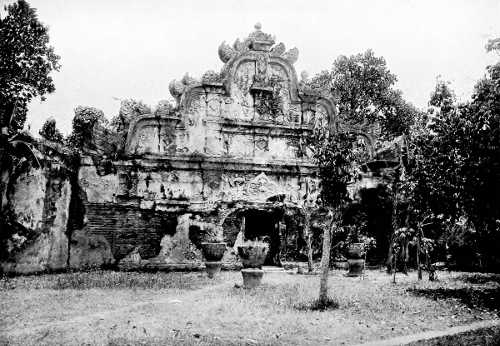
XIII. WATER-CASTLE AT JOGJAKARTA
(Centrum.)
The building of the “water-castle”, whose
pavilions, artificial lakes, tanks and gardens spread
over an area of about twenty-five acres, was begun
in 1758 by a Buginese architect under the orders
of Mangku Buwono I., a great raiser of edifices, as
Nicolaas Hartingh[74] wrote in 1761, and maker of
“fountains, grotto-work and conduits which, though
completed, he orders immediately to be pulled down,
not finding them to his taste, thus squandering some
little money.” We possess a description[75] of the
kraton at Jogjakarta, dated September 1791, from
the hand of Carl Friedrich Reimer,[76] who speaks of
“a collection of gardens, fish-ponds and pleasure-pools.”
He probably visited Pulu Gedong before
proceeding to Taman Sari[77] and expatiates on the
spaciousness of the dwelling room in Pulu Kananga,
where it seems that the Court could find plenty
of accommodation. But what made the greatest
impression on the expert in hydraulics was the
arrangement of passages and an apartment for
prayer and meditation under water, as if the Sooltan
deemed it an advantage to worship surrounded
by the babbling stream, light and fresh air being
provided through turrets rising above the surface.
In the place called Oombool Winangoon, situated
on a low level, with three tanks, fed from the great
lake of Taman Sari, was a cool retreat where the
Sooltan used to rest a while after his bath, refreshing
himself with a cup of tea. Alluding to the Sumoor
Gumuling, Reimer remarks that the architect must
have chosen a round form for his structure to make
it the better resist the pressure of the water all
round. The strange building which went by that
name and consisted of two concentric walls with a
flat roof,[78] taken for a subaqueous house of prayer
by the visitor of 1791, has also been very differently
explained: some see in its remains a dancing-school,
awakening visions of the Sooltan’s corps de ballet
practising in the first storey to the dulcet tones of the
gamelan, the native orchestra, that ascended from the
basement and aided them in going through their
paces; others connect it with functions never referred
to in polite society and which have nothing in common
with praying, either with the heart or with the feet,
more correctly speaking: with the arms, hands and
hips, for Javanese dancing is no loose skipping and
hopping about, but a graceful and expressive play
of the body and more particularly of the upper limbs
in rhythmic, undulating motion. Passing from one
lake to the next, the Sooltan’s means of conveyance
was the prahu Niahi Kuning, a gorgeously decorated
barge, given to him by the East India Company;
other boats, plying between Taman Sari and Taman
Ledok, were at the disposal of the ladies of the
royal household desirous of an outing with their
babies; two small skiffs left their moorings every
night alternately, at a signal given on a bendeh, to
feed the fishes, which knew the sound and assembled
in shoals. The guard-rooms near the northern
watergate, of which the remaining one, i.e. the
one not altogether fallen into ruin, shelters in
the morning a motley crowd of sellers of fruit,
vegetables, sweetmeats, etc., witnesses to the
Company’s dragoons, protecting and shadowing
their Highnesses of Surakarta and Jogjakarta with
the princes of their blood, already having been
entrusted with that task in the days of Mangku
Buwono I.
Of the delicately carved woodwork hardly a trace
remains, but some foliage and birds among flowers,
executed in stucco, give evidence of a good taste
which knew how to make old motives subservient
to new requirements. Though a Muhammadan
pleasance, designed by a Muhammadan architect for
a Muhammadan prince, the garuda over one of the
entrances, the Banaspatis on gables and fronts in
Taman Sari and Taman Ledok, the nagas coping
the balustrades of the staircases, show that Hindu
conceptions continued to leaven Javanese art. The
relations with China and the consequent influx of
Chinamen have also borne their fruit in Central
Java as in Cheribon and the eastern kingdoms:
Reimer informs us that the galleries and tops (now
gone) of the several buildings were constructed like
pointed vaults, and were wrought “in the manner
of Chinese roofs”; Pulu Gedong was famous for
the lofty Chinese tower erected near the spring
which furnished the water for the “castle”, its lakes,
ponds, tanks and canals, and for the irrigation of its
grounds. The orchards, renowned for their mangoes
and pine-apples, the vegetable-, sirih- and flower-gardens
had a great reputation in the land; assiduous
attention was paid to horticulture on the principle,
well understood by oriental gardeners, that flower-beds,
ornamental groves and bowers are like women;
that however much art and pains are bestowed on
their make-up, the art of arts is the concealment
thereof.... Writing this it occurs to me how properly
a western version of that universally approved
maxim has been put in the mouth of Gärtnerinnen,
niedlich and galant:
Denn das Naturell der Frauen
Ist so nah mit Kunst verwandt.[79]
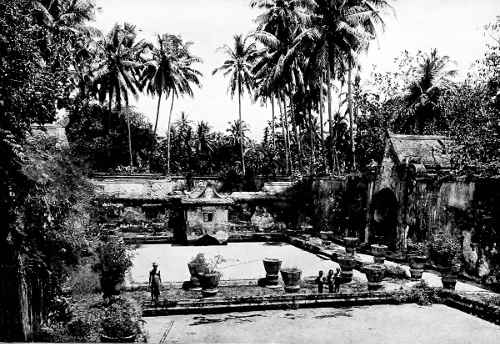
XIV. WATER-CASTLE AT JOGJAKARTA
(Centrum.)
Though Mangku Buwono I. was a contemporary
of Goethe, his knowledge of Faust is extremely
doubtful, but being an artist in his own way, he
took care that the natural scenery, assisted by art,
should contribute to a pleasant general impression
in the distribution of the dwellings for his retinue:
native princes (and of his rank too!) do not move an
inch inside or outside their kratons without numberless
attendants at their heels. In the “water-castle”
were apartments, not only for the Sooltan,
for the Ratu, his first legitimate spouse, for his other
wives and concubines, for the little family they had
presented him with, but for the dignitaries of his
Court, officials of all degrees, secretaries, servants
of every description, various artificers from the
armourers down to the kebon kumukoos, the makers
of tali api (fire-rope), necessary for lighting his
Highness’ cigars. There were reception-, dining-,
living- and sleeping-rooms for the Sooltan, his Ratu
and female relatives, each apart; common rooms for
the selir (wives of lower degree); rooms for the
instruction of their children; rooms where his
Highness’ daughters spent a few hours every day in
batikking; guard-rooms for the prajurits, the male
guards; guard-rooms for the female guards under
command of the Niahi Tumanggoong, a lady of
consequence, who kept and keeps the dalam, the
interior of the kraton, under constant observation so
that no illicit amourettes shall occur in the women’s
quarters, and yet—! There were store-rooms,
kitchens, workshops, prisons, halls set apart for the
dancers, male and female; the cream of the female
dancers, the srimpis and girl bedoyos, were probably
housed in or near the principal pavilion on Pulu
Kananga, of which the Sooltan occupied the eastern
and the Ratu the western portion. Above all there
were the bath-rooms, dedicated to Kama and his
wife Rati of Hindu memory; and since the parrot
is the vahana of that frivolous god, many are the
unspeakable tales of revived rites of his luxurious
worship.
The etiquette at Court is fitly illustrated by the
two tea-houses of Taman Sari, the eastern one for
the Grand Pourer-out-of-Tea of the Right, who
presided over the preparation of the delectable
beverage for the Sooltan, and the western ditto for
the Grand Pourer-out-of-Tea of the Left, who provided
for the Ratu. A scrupulous punctilio is ingrained
in Javanese habits and customs, from high
to low, on great and small occasions, the native’s
mentality always reverting to things which were,
but never more can be. The homage done to
sacred objects, arms, gamelans, etc., by giving them a
human name and a title,[80] venerating them as if endowed
with supernatural faculties, recalls Polynesian
fetishism, Hinduïsm being blended with it in Siva’s
trishula, Vishnu’s chakra, etc., which are still carried
behind the native princes among their ampilan.[81]
The upacharas or imperial and royal pusakas[82] are
treated with the utmost reverence when shown at
the appearance in public of Susuhunan or Sooltan,
and their bearers, the koncho ngampil, who hold an
honoured position at the Courts of Solo and Jogja,
may be considered direct successors of the envoys
of King Dasharatha on the reliefs of the chandi
Loro Jonggrang, who bore his regalia when meeting
Rama and Lakshama. The strange ceremonial,
preserved from the time when gods walked amongst
men, seems hardly antiquated, on the contrary very
germane to siti-inggil[83] surroundings. One need
not visit the kratons though, to notice how the spirit
of the past permeates all things Javanese; any well-dressed
native getting out of his sado[84] at the railway
station or repairing thither on foot for a journey
with the fire-carriage, will do. Even if he cannot
afford the few doits[85] necessary and must impair his
dignity by going afoot, he has his retainers to look
after his box and, stuck behind, he has his magnificent
kris in a sheath of gold, with a beautifully carved
ivory handle, in nine cases out of ten a pusaka,
cherished like the kris Kolo Munyang of the Prince
of Kudoos or, as others allege, of a Susuhunan of
Surakarta, who sent the weapon, which killed its
master’s enemies without human direction, to the
assistance of Pangeran Bintoro, then oppressed by a
king of Mojopahit. The chronology of this legend
is evidently a little faulty, but, O! the wonders
of Java’s golden age, and, O! the superstitious
honour in which their memory is held by these
lovable people, whose actual existence is a dream of
days gone by. And that happy dream, they ween,
is a presage of the future, prophesying the restoration
of their fathers’ heritage. If, nevertheless, the
hour draws near of unconditional surrender, the
Dutch Government steadily and surely arrogating
to itself the externals with the substance of power
in the Principalities, they will silently submit to the
nivarana of their ancient faith, the hindrance arising
from torpor of mind appointed to them in the
sansara, the rotary sequence of the world, and seek
consolation in the promise of their new faith that
the Lord will not deal wrongly with his servants.
The life of nations, like the life of men, starts
running as the mountain torrent and meets many
an obstacle before it swells to a broad river in the
plains and flows tranquilly and mightily to the sea;
also for Java it is written:
... Non anche,
l’opra del secol non anche è piena.[86]