1749-1755
SIDELIGHTS OF CIVIC PROGRESS
III
PETER KALM—THE FIRST SWEDES IN MONTREAL—THE FRENCH WOMEN
CONTRASTED WITH THOSE OF THE AMERICAN COLONIES—DOMESTIC
ECONOMY—THE MEN EXTREMELY CIVIL—MECHANICAL TRADES
BACKWARD—WATCHMAKERS—THE TREATY OF AIX-LA-CHAPELLE
CELEBRATED—PAPER MONEY—WAGES—PEN PICTURE OF MONTREAL
IN 1749—ITS BUILDINGS AND THEIR PURPOSES—FRIDAY, MARKET
DAY—THERMOMETRICAL AND CLIMATIC OBSERVATIONS—NATURAL HISTORY
CULTIVATED—MONTREAL THE HEADQUARTERS OF THE INDIAN TRADE—THE
GOODS FOR BARTER—THE LADIES MORE POLISHED AND VOLATILE AT
QUEBEC BUT MORE MODEST AND INDUSTRIOUS AT MONTREAL—ECONOMIC
FACTS—WINE AND SPRUCE BEER—PRICES AND COST OF LIVING—CONSENTS
TO MARRIAGE—SOCIAL AND DOMESTIC CUSTOMS—FRANQUET'S JOURNEY FROM
QUEBEC TO MONTREAL BY RIVER, FIVE DAYS—POUCHOT'S APPRECIATIONS OF
CANADIANS—THE TRADE SYSTEM OF THE COUNTRY—GOVERNMENTAL MAGAZINES
AND UP-COUNTRY FORTS—PRIVATE TRADE AT THE POSTS—ITINERANT
PEDDLERS. NOTE: THE DEVELOPMENT OF THE PARISH CHURCH.
For a final picture of Montreal life in the closing years before the
Seven Years' War, which ended in the capitulation of the city, we may
rely on a visitor's account.
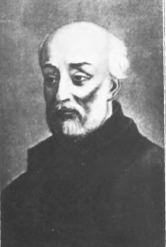
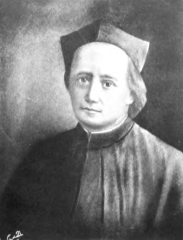
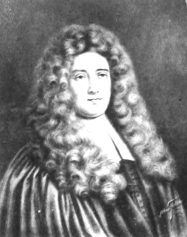
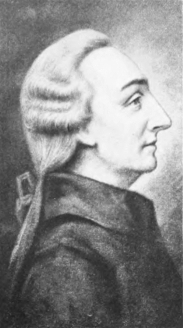
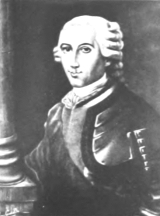
In the year 1749 Peter Kalm, a professor of economy in the University
of Aobo in Swedish Finland, and a member of the Swedish Royal Academy
of Sciences, was in Canada and visited Montreal. He had also in the
preceding years been in the English states, and he afterwards published
his "Travels into North America," containing its natural history, with
the civil, ecclesiastical and commercial state of the country, the
manners of the inhabitants and several curious and important remarks
on various subjects. This work was translated into English by John
Reinhold Forster, F. A. S., and printed in 1771, from which little
known work we quote.
On July 24th on his arrival at Montreal he was met at the gate of the
town by a great crowd of people, anxious to see the Swedes. "We were
assured we were the first Swedes that ever came to Montreal." He was
most courteously
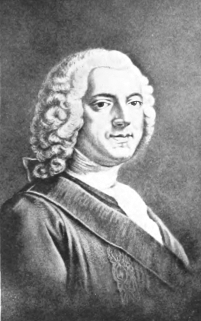
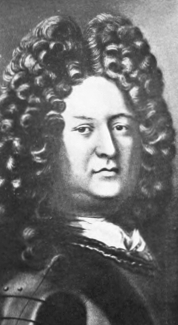
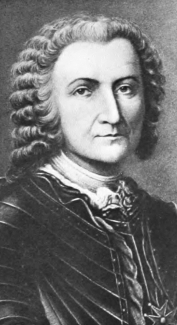
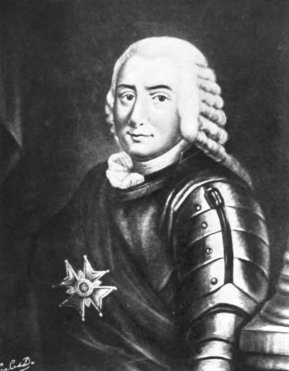
received by Baron de Longueuil, then vice governor,
but daily expecting his promotion from France.
[181]
"The difference," he remarks, "between the manner and customs of
the French in Montreal and Canada, and those of the English in the
American Colonies, is as great as that between the manners of those two
nations in Europe. The women in general are handsome here; they are
well bred, and virtuous with an innocent and becoming freedom. They
dress out very fine on Sundays, and though on the other days they do
not take much pains with other parts of their dress, yet they are very
fond of adorning their heads, the hair of which is always curled and
powdered, and ornamented with glittering bodkins and aigrettes. Every
day but Sunday they wear a little neat jacket, and a short petticoat
which hardly reaches half the leg, and in this particular they seem to
imitate the Indian women. The heels of their shoes are high, and very
narrow, and it is surprising how they walk on them.
"In their knowledge of economy, they greatly surpass the English
women in the plantations, who indeed have taken the liberty of throwing
all the burthen of housekeeping upon their husbands and sit in their
chairs all day with folded arms. The women in Canada on the contrary
do not spare themselves, especially among the common people, where they
are always in the fields, meadows, stables, etc., and do not dislike
any work whatsoever. However, they seem rather remiss in regard to the
cleaning of the utensils and apartments; for sometimes the floors, both
in the town and country, were hardly cleaned once in six months, which
is a disagreeable sight to one who comes from amongst the Dutch and
English, where the constant scouring and scrubbing of the floors is
reckoned as important as the exercise of religion itself. To prevent
the thick dust which is thus left on the floor, from being noxious to
the health, the women wet it several times a day, which renders it more
consistent; repeating the aspersion as often as the dust is dry and
rises again. Upon the whole, however, they are not averse to the taking
a part in all the business of housekeeping; and I have with pleasure
seen the daughters of the better sort of people, and of the governor
himself, not too finely dressed, and going into kitchens and cellars,
to look that everything be done as it ought.
"The men are extremely civil and take their hats off to every person
indifferently whom they meet on the streets. It is customary to
return a visit the day after you have received one; though one should
have some scores to pay in one day." After some digressions on the
natural history of the country, he continues: "Mechanics, such as
architecture, cabinet making, turning and the like, were not as yet so
forward here as this ought to be; and the English in that respect
outdo the French. The chief cause of this is that scarce any other
people than dismissed soldiers come to settle here, who have not had
any opportunity of learning a mechanical trade but have sometimes
accidentally and through necessity been obliged to turn to it. There
are, however, some who have a good notion of mechanics, and I saw a
person here who made very good clocks, and watches, though he had but
very little instruction."
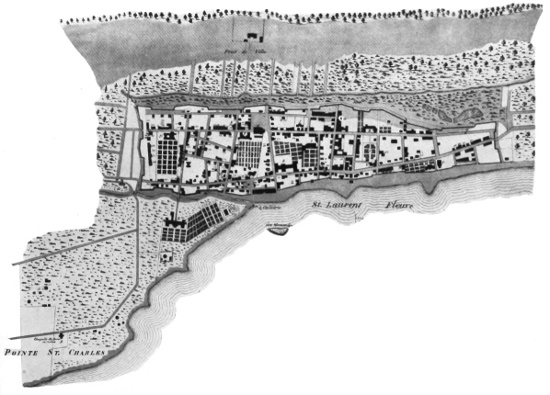
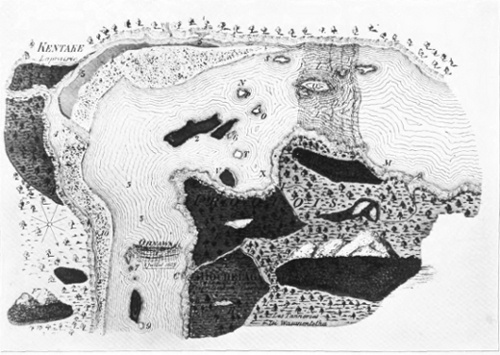
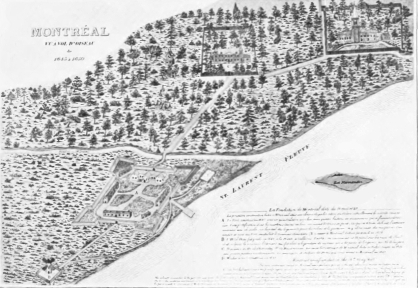
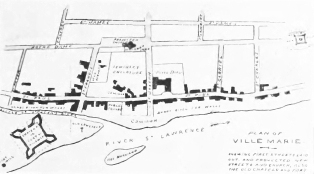
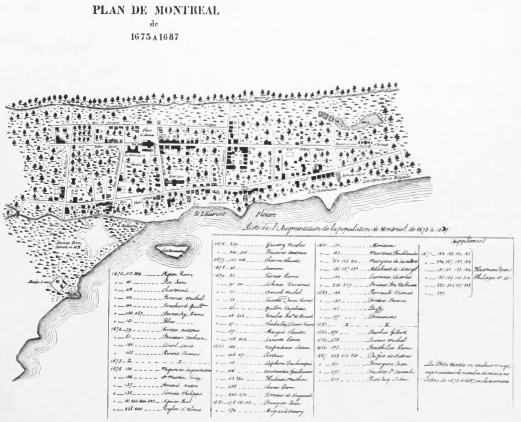
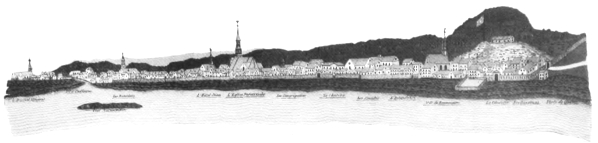
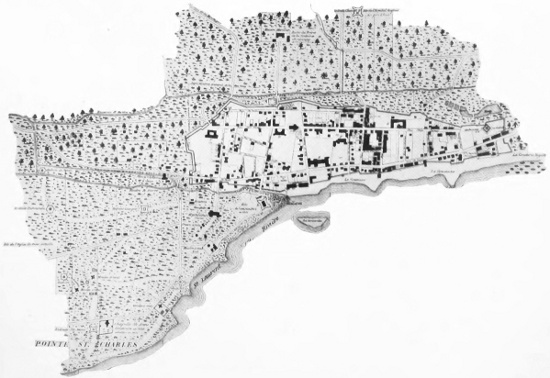
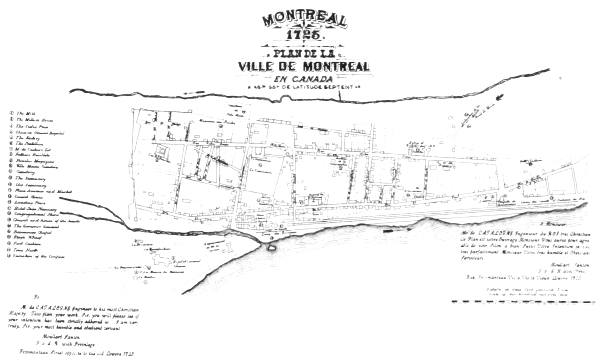
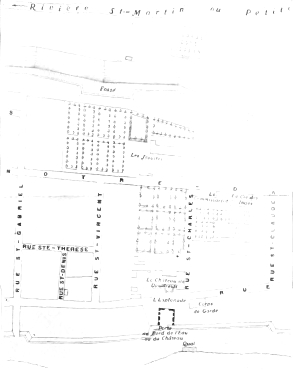
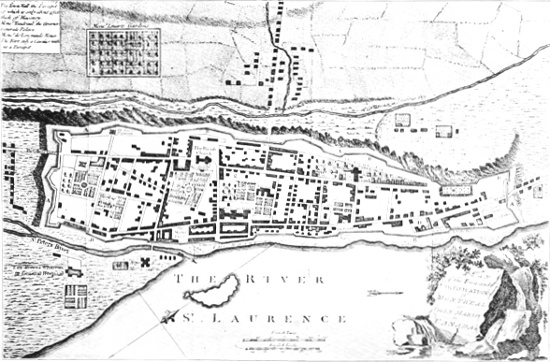
PLAN OF MONTREAL 1724-1760
Reference: A. Chapelle Ste. Anne. B. Hospital Général. C. Residence
de Mr de Callières. D. Monastère des Récollets. E. Tribunaux. F.
Séminaire. G. Eglise Paroissiale N-D. H. Hôtel-Dieu. I. Congrégation
N-D. J. Prison. K. Jésuites. L. Château Vaudreuil. M. L'Intendance. N.
Résidence de M. de Ramezay. O. Ancien site de la Citadelle. P. Eglise
Bonsecours.
M. Benjamin Sulte on this remarks: "A few years before the conquest
there was a Canadian named Dubois, a carpenter by trade, residing in
Montreal. I believe he was the man alluded to by Kalm. Dubois, having
been asked on several occasions to repair and regulate timepieces
belonging to people who had procured them from France, readily
perceived that he could understand their mechanism and he soon went
into that business on an extensive scale. His name became famous all
around the island and his customers increased considerably. Most of the
tools required for the art he had thus adopted were not to be obtained
in Canada, but his imaginative power was great and he made them himself
without much trouble. It is said that he even invented new models for
clocks and introduced many clever improvements, which were looked upon
in those days as really marvelous."
Another Canadian, called Champagne, also a carpenter of Montreal,
closely followed Dubois' steps. His remarkable skill often attracted
the attention of men of high class. He seems to have been gifted with
indomitable energy. One day, M. Brassier, a priest of St. Sulpice
congregation, described to him some of the beautiful clocks he had seen
while living in France (before 1745), especially those ornamented with
carillons (chimes), sounding the hours and other fractions of time.
Champagne dreamed over this and finally set to work. The result was an
elaborate and astonishing mechanism, to which the whole of Montreal
paid a tribute of admiration. (See "Le Spectateur," Montreal, 16
September, 1813.) Champagne died about the year 1790.
In an entry on July 27th, Kalm alludes probably to the treaty of
Aix-la-Chapelle, proclaimed on October 8, 1748: "The peace, which was
concluded between France and England, was proclaimed this day. The
soldiers were under arms, the artillery on the walls was fired off,
and some salutes were given by the small fire-arms. All night some
fireworks were exhibited and the whole town was illuminated. All the
streets were crowded with people till late at night. The governor
invited me to supper and to partake of the joy of the inhabitants.
There were present a number of officers and persons of distinction; and
the festival concluded with the greatest joy."
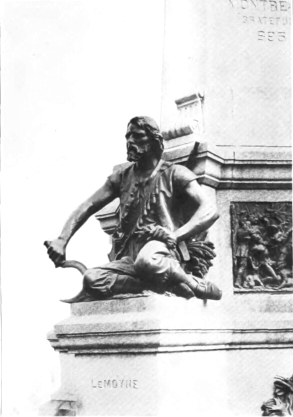
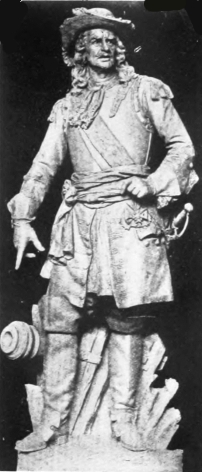
On July 28th Kalm went with the governor, now Charles Le Moyne, 2d
Baron de Longueuil, to a little island named Magdalene, "which is his
own property." For August 1st he remarks that the governor general,
though commonly residing in Quebec, so as to be near the ships
arriving in summer, spent the winter in Montreal. "The Governor de la
Galissonière
[182]
is said to like Montreal better than Quebec, and indeed
the situation of the former is by far the more agreeable one."
Kalm adds to our knowledge some notes to explain the practice at this
period of the card money already recorded as instituted by de Meulles.
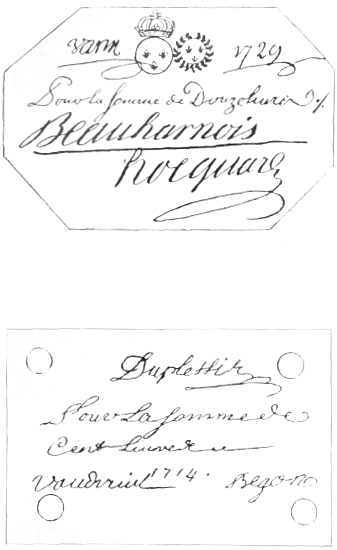
"They have in Canada," he recites, "scarce any other but paper money.
I hardly ever saw any coin, except French sols, consisting of brass,
with a very small mixture of silver; they were quite thin by constant
circulation, and were valued at a sol and a half. The bills are not
printed, but written. Their origin is as follows: The French king
having found it very dangerous to send money
for the pay of the
troops, and other purposes, over to Canada, on account of privateers,
shipwrecks, and other accidents; he ordered that instead of it the
intendant, or king's steward, at Quebec, or the commissary at Montreal,
is to write bills for the value of the sums which are due to the
troops, and which he distributes to each soldier. On these bills is
inscribed, that they bear the value of such or such a sum, till next
October; and they are signed by the intendant, or the commissary;
and in the interval they bear the value of money. In the month of
October, at a certain stated time, every one brings the bills in his
possession to the intendant at Quebec, or the commissary at Montreal,
who exchanges them for bills of exchange upon France, which are paid
there in lawful money, at the king's exchequer, as soon as they are
presented. If the money is not yet wanted, the bill may be kept till
next October, when it may be exchanged by one of those gentlemen, for a
bill upon France. The paper money can only be delivered in October, and
exchanged for bills upon France. They are of different values, and some
do not exceed a livre, and perhaps some are still less. Towards autumn
when the merchants' ships come in from France, the merchants endeavor
to get as many bills as they can and change them for bills upon the
French treasury. These bills are partly printed, spaces being left for
the name, sum, etc. But the first bill, or paper currency is all wrote,
and is therefore subject to be counterfeited, which has sometimes been
done, but the great punishments, which have been inflicted upon the
authors of these forged bills, and which generally are capital, have
deterred people from attempting it again; so that examples of this kind
are very scarce at present. As there is a great want of small coin
here, the buyers, or sellers, were frequently obliged to suffer a small
loss, and could pay no intermediate prices between one livre and two."
The wages given could not fail to interest this student of affairs.
"They commonly give one hundred and fifty livres a year to a faithful
and diligent footman, and to a maid-servant of the same character, one
hundred livres. A journeyman to an artist gets three or four livres
a day, and a common labouring man gets thirty or forty sols a day.
The scarcity of labouring people occasions the wages to be so high;
for almost everybody finds it so easy to set up as a farmer in this
uncultivated country, where he can live well, and at a small expense,
that he does not care to serve and work for others."
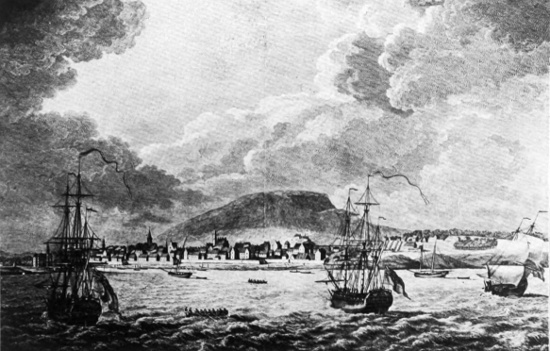
We have given pen pictures of Montreal at various periods. Here is
Kalm's for 1749: "Montreal is the second town in Canada, in regard to
size and wealth; but it is the first on account of its fine situation
and mild climate. Somewhat above the town, the river St. Lawrence
divides into several branches, and by that means forms several islands,
among which the Isle of Montreal is the greatest. It is ten French
miles long, and near four broad, in its broadest part. The town of
Montreal is built on the eastern side of the island, and close to one
of the most considerable branches of the river St. Lawrence; and thus
it receives a very pleasant and advantageous situation. The town has
a quadrangular form, or rather it is a rectangular parallelogram, the
long and eastern side of which extends along the great branch of the
river. On the other side it is surrounded with excellent corn-fields,
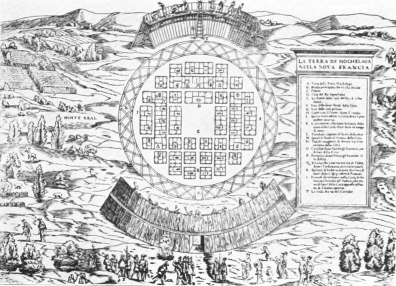
charming meadows, and delightful woods. It has got the name of Montreal
from a great mountain, about half a mile westwards of the town, and
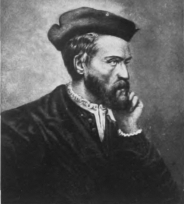
lifting its head far above the woods. Mons. Cartier, one of the first
Frenchmen who surveyed Canada more accurately,
called this mountain,
on his arrival in this island, in the year 1535, when he visited the
mountain, and the Indian town Hochelaga near it. The priests who,
according to the Roman Catholic way, would call every place in this
country after some saint or other, called Montreal, Ville Marie, but
they have not been able to make this name general, for it has always
kept its first name.
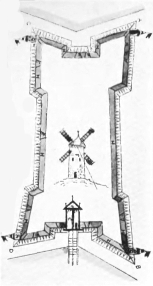
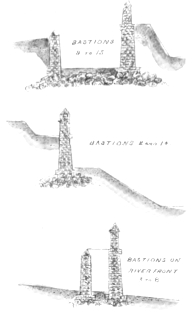
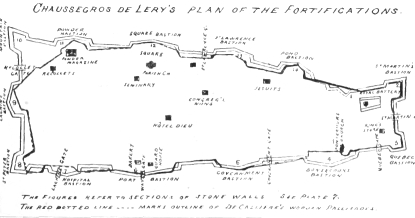
"It is pretty well fortified, and surrounded with a high and thick
wall. On the east side it has the river St. Lawrence, and on all
the other sides a deep ditch filled with water, which secures the
inhabitants against all danger from the sudden incursions of the
enemy's troops. However, it cannot long stand a regular siege, because
it requires a great garrison, on account of its extent; and because
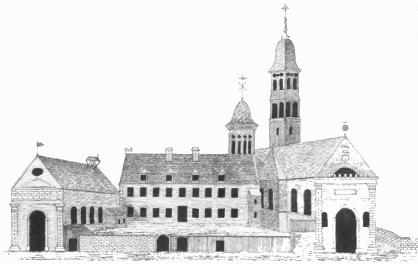
it consists chiefly of wooden houses. Here are several churches, of
which I shall only mention that belonging to the friars of the order
of St. Sulpitius, that of the Jesuits, that of the Franciscan friars,
that belonging to the nunnery, and that of the hospital, of which the
first is, however, by far the finest, both in regard to its outward
and inward ornaments, not only in this place, but in all Canada. The
priests of the Seminary of St. Sulpitius have a fine, large house,
where they live together. The college of the Franciscan friars is
likewise spacious, and has good walls, but it is not so magnificent as
the former. The college of the Jesuits is small, but well built. To
each of these three buildings are annexed fine large gardens, for the
amusement, health and use of the communities to which they belong.
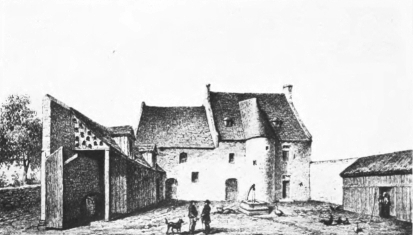
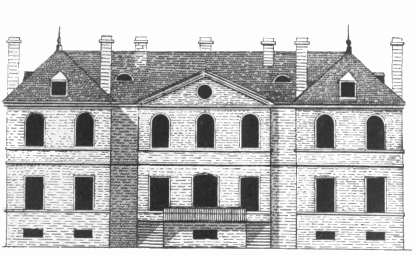
"Some of the houses in the town are built of stone, but most of them
are of timber, though very neatly built. Each of the better sort of
houses has a door towards the street, with a seat on each side of it,
for amusement and recreation in the morning and evening. The long
streets are broad and strait, and divided at right angles by the
short ones; some are paved, but most of them very uneven. The gates
of the town are numerous; on the east side of the town towards the
river are five, two great and three lesser ones; and on the other side
are likewise several. The governor general of Canada, when he is at
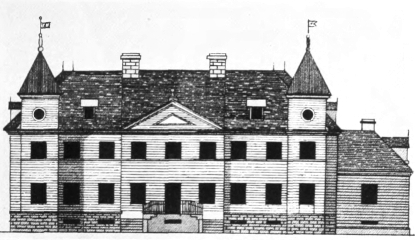
Montreal, resides in the castle, which the government hires for that
purpose of the family of Vaudreuil; but the governor of Montreal is
obliged to buy or hire a house in town; though I was told that the
government contributed towards paying the rents.
"In the town is a nunnery, and without its walls half a one;
[183] for
though the last was quite ready, however, it had not yet been confirmed
by the pope. In the first they do not receive every girl that offers
herself; for their parents must pay about five hundred écus, or crowns,
for them. Some indeed are admitted for three hundred écus, but they are
obliged to serve those who pay more than they. No poor girls are taken
in.
"The king has erected a hospital for sick soldiers here. The sick
person there is provided with everything he wants, and the king pays
twelve sols every day for his stay, attendance, etc. The surgeons
are paid by the king. When an officer is brought to this hospital, who
is fallen sick in the service of the crown, he receives victuals and
attendance gratis; but if he has got sickness in the execution of his
private concerns, and comes to be cured here, he must pay it
out of his
own purse. When there is room enough in the hospital, they likewise
take in some of the sick inhabitants of the town and country. They have
the medicines, and the attendance of the surgeons, gratis, but must
pay twelve sols per day for meat, etc.
"Every Friday is a market-day, when the country people come to the town
with provisions, and those who want them must supply themselves on that
day, because it is the only market-day in the whole week. On that day
likewise a number of Indians come to town, to sell their goods and buy
others."
He had some conversations with the priests of the seminary, one of
whom, Monsieur Gillion, who had a particular taste for mathematics and
astronomy, had drawn a meridian in the garden of the seminary, which
Kalm said he had examined repeatedly by the sun and stars and found
to be very exact. According to Monsieur Gillion's observation, the
latitude of Montreal is forty-five degrees and twenty-seven minutes....
He then viewed the thermometrical observations made in Montreal by
Monsieur Pontarion from the beginning of 1749. He made use of Réaumur's
thermometer, which he placed sometimes in a window half open, and
sometimes in one quite open, and accordingly it will seldom mark the
greatest degree of cold in the air. However, I shall give a short
abstract of his observations for the winter months:
"In January the greatest cold was on the 18th day of the month, when
the Réaumurian thermometer was twenty-three below the freezing point.
The least degree of cold was on the 31st of the same month, when it was
just at the freezing point, but most of the days of this month it was
from twelve to fifteen degrees below the freezing point. In February
the greatest cold was on the 19th and 25th, when the thermometer was
fourteen degrees below freezing point; and the least was on the 3rd day
of that month, when it rose eight degrees above the freezing point;
but it was generally eleven degrees below it. In March the greatest
cold was on the 3rd, when it was ten degrees below the freezing
point, and on the 22nd, 23rd and 24th it was mildest, being fifteen
degrees above it; in general it was four degrees below it. In April
the greatest degree of cold happened on the 7th, the thermometer being
five degrees below the freezing point; the 25th was the mildest day, it
being twenty-five degrees above the freezing point; but in general it
was twelve degrees above it. These are the contents chiefly of Mons.
Pontarion's observations during those months. But I found, by the
manner he made his observations, that the cold had every day been from
four to six degrees greater than he had marked it."
He had likewise marked in his journal that the ice in the River St.
Lawrence broke on the 3d of April at Montreal, and only on the 20th
day of that month at Quebec. "On the 3d of May some trees began to
flower at Montreal, and on the 12th the hoary frost was so great that
the trees were quite covered with it, as with snow. The ice in the
river close to this town is every winter above a French foot thick,
and sometimes it is two of such feet, as I was informed by all whom I
consulted on that head.
"Several of the friars here told me that the summers were remarkably
longer in Canada, since its cultivation, than they used to be before;
it begins earlier, and ends later. The winters, on the other hand, are
much shorter; but the friars were of opinion that they were as hard as
formerly, though they were
not of the same duration; and likewise,
that the summer at present was no hotter than it used to be. The
coldest winds at Montreal are those from the north and northwest."
Kalm in several places speaks in praise of the efforts of the
advancement of natural history in Canada.
"Great efforts are here made for the advancement of natural history,
and there are few places in the world where such good regulations are
made for this useful purpose." He speaks of the governor's interest in
it.
On August 2d early in the morning he set out on the river with the
second major of Montreal, M. de Sermonville, for Quebec. On September
15th he returned to Montreal in the evening at 4 o'clock.
His next item of historical interest occurs on September 22d in his
journal. As it has relation to Montreal as the headquarters of the
Indian trade, it is worth reproducing.
"September the 22d. The French in Canada carry on a great trade
with the Indians; and though it was formerly the only trade of this
extensive country, yet its inhabitants were considerably enriched
by it. At present, they have besides the Indian goods, several
other articles which are exported from hence. The Indians in this
neighbourhood, who go hunting in winter like the other Indian nations,
commonly bring their furs and skins to sale in the neighbouring French
towns; however this is not sufficient. The Indians who live at a
greater distance, never come to Canada at all; and, lest they should
bring their goods to the English as the English go to them, the French
are obliged to undertake journeys, and purchase the Indian goods in the
country of the Indians. This trade is chiefly carried on at Montreal,
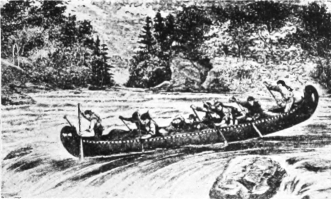
and a great number of young and old men every year, undertake long and
troublesome voyages for that purpose, carrying with them such goods as
they know the Indians like, and are in want of. It is not necessary
to take money on such a journey, as the Indians do not value it; and
indeed I think the French, who go on these journeys, scarce ever take a
sol or penny with them.
"I will now enumerate the chief goods which the French carry with them
for this trade, and which have a good run among the Indians.
"Muskets, powder, shot, and balls. The Europeans have taught the
Indians in their neighbourhood the use of fire-arms, and they have
laid aside their bows and arrows, which were formerly their only
arms, and make use of muskets. If the Europeans should now refuse to
supply the Indians with muskets, they would be starved to death; as
almost all their food consists of the flesh of the animals, which they
hunt; or they would be irritated to such a degree as to attack the
Europeans. The Indians have hitherto never tried to make muskets or
similar fire-arms; and their great indolence does not even allow them
to mend those muskets which they have got. They leave this entirely
to the Europeans. As the Europeans came into North America, they were
very careful not to give the Indians any fire-arms. But in the wars
between the French and English, each party gave their Indian allies
fire-arms, in order to weaken the force of the enemy. The French lay
the blame upon the Dutch settlers in Albany, saying that they began,
in 1642, to give their Indians fire-arms, and taught them the use of
them in order to weaken the French. The inhabitants of Albany, on the
contrary, assert, that the French first introduced this custom, as they
would have
been too weak to resist the combined force of the Dutch
and English in the colonies. Be this as it will, it is certain that
the Indians buy muskets from the Europeans, and know at present better
how to make use of them, than some of their teachers. It is likewise
certain, that the Europeans gain considerably by their trade in muskets
and ammunition.
"Pieces of white cloth, or of a coarse uncut cloth. The Indians
constantly wear such pieces of cloth, wrapping them round their bodies.
Sometimes they hang them over their shoulders; in warm weather, they
fasten them round the middle; and in cold weather, they put them over
the head. Both their men and women wear these pieces of cloth, which
have commonly several blue or red stripes on the edge.
"Blue or red cloth. Of this the Indian women make their petticoats,
which reach only to their knees. They generally choose the blue colour.
"Shirts and shifts of linen. As soon as an Indian fellow, or one of
their women, have put on a shirt, they never wash it, or strip it off,
till it is entirely torn in pieces.
"Pieces of cloth, which they wrap round their legs instead of
stockings, like the Russians.
"Hatchets, knives, scissors, needles, and a steel to strike fire with.
These instruments are now common among the Indians. They all take these
instruments from the Europeans, and reckon the hatchets and knives much
better, than those which they formerly made of stones and bones. The
stone hatchets of the ancient Indians are very rare in Canada.
"Kettles of copper or brass, sometimes tinned in the inside. In these
the Indians now boil all their meat, and they have a very great run
with them. They formerly made use of earthen or wooden pots, into
which they poured water, or whatever else they wanted to boil. They do
not want iron boilers, because they cannot be easily carried on their
continual journeys, and would not bear such falls and knocks as their
kettles are subject to.
"Ear-rings of different sizes, commonly of brass, and sometimes of tin.
They are worn by both men and women, though the use of them is not
general.
"Vermillion. With this they paint their face, shirt, and several parts
of the body. They formerly made use of a reddish earth, which is to be
found in the country; but, as the Europeans brought them vermillion,
they thought nothing was comparable to it in colour. Many persons
have told me, that they had heard their fathers mention, that the
first Frenchmen who came over here, got a great heap of furs from the
Indians, for three times as much cinnabar as would lie on the tip of a
knife.
"Verdigrease, to paint their faces green. For the black colour, they
make use of the soot at the bottom of their kettle, and daub their
whole face with it.
"Looking glasses. The Indians are very much pleased with them, and
make use of them chiefly when they want to paint themselves. The men
constantly carry their looking glasses with them on all their journeys;
but the women do not. The men, upon the whole, are more fond of
dressing than the women.
"Burning glasses. These are excellent pieces of furniture in the
opinion of the Indians, because they serve to light the pipe without
any trouble, which an indolent Indian is very fond of.
"Tobacco is bought by the northern Indian, in whose country it will not
grow. The southern Indians always plant as much of it as they want for
their own consumption. Tobacco has a great run amongst the northern
Indians, and it has been observed that the further they live to the
northward, the more they smoke of tobacco.
"Wampum, or, as they are here called, porcelanes. They are made of a
particular kind of shells, and turned into little short cylindrical
beads, and serve the Indians for money and ornament.
"Glass beads, of a small size, and white or other colours. The Indian
women know how to fasten them in their ribbands, pouches, and clothes.
"Brass and steel wire, for several kinds of work.
"Brandy, which the Indians value above all other goods than can be
brought them; nor have they anything, though ever so dear to them,
which they would not give away for this liquor. But, on account of the
many irregularities, which are caused by the use of brandy, the sale
of it has been prohibited under severe penalties; however, they do not
always pay an implicit obedience to this order.
"These are the chief goods which the French carry to the Indians, and
they have a good run among them.
"The goods which they bring back from the Indians consist entirely in
furs. The French get them in exchange for their goods, together with
all the necessary provisions they want on the journey. The furs are of
two kinds; the best are the northern ones, and the worst sort those
from the South.
"It is inconceivable what hardships the people in Canada must undergo
on their journeys. Sometimes they must carry their goods a great way
by land; frequently they are abused by the Indians, and sometimes they
are killed by them. They often suffer hunger, thirst, heat, and cold,
and are bit by gnats, and exposed to the bites of poisonous snakes,
and other dangerous animals and insects. These destroy a great part
of the youth in Canada, and prevent the people from growing old. By
this means, however, they become such brave soldiers, and so inured
to fatigue, that none of them fear danger or hardships. Many of them
settle among the Indians far from Canada, marry Indian women, and never
come back again."
Under the same date, September 22d, he reverts to the ladies of
Montreal. Having seen those of Quebec he can now compare them. Montreal
ladies owe him a debt of gratitude.
"The ladies in Canada are generally of two kinds; some come over from
France, and the rest native; the former possess the politeness peculiar
to the French nation; the latter may be divided into those of Quebec
and Montreal. The first of these are equal to the French ladies in good
breeding, having the advantage of frequently conversing with the French
gentlemen and ladies, who come every summer with the king's ships, stay
several weeks at Quebec, but seldom go to Montreal. The ladies of this
last place are accused by the French of partaking too much of the pride
of the Indians, and of being much wanting in French good breeding. What
I have mentioned above of their dressing their heads too assiduously,
is the case with all the ladies throughout Canada. Their hair is always
curled, even when they are at home in a dirty jacket, and short, coarse
petticoat, that does not reach to the middle of their legs. On those
days when they pay or receive visits, they dress so gayly that one is
almost induced to
think their parents possessed the greatest dignities
in the state. The Frenchmen, who considered things in their true
light, complained very much that a great part of the ladies in Canada
had got into the pernicious custom of taking too much care of their
dress, and squandering all their fortunes, and more, upon it instead
of sparing something fur future times. They are no less attentive to
have the newest fashions; and they laugh at each other, when they are
not dressed to each other's fancy. But what they get as new fashions,
are grown old, and laid aside in France; for the ships coming but once
every year from thence, the people in Canada consider that as the new
fashion for the whole year, which the people on board brought with
them, or which they imposed upon them as new.
"The ladies in Canada, or especially at Montreal, are very ready to
laugh at any blunders strangers make in speaking; but they are very
excusable. People laugh at what appears uncommon and ridiculous.
In Canada nobody ever hears the French language spoken by any but
Frenchmen; for strangers seldom come thither; and the Indians are
naturally too proud to learn French, but oblige the French to learn
their language. From hence it naturally follows that the nice Canada
ladies cannot hear anything uncommon without laughing at it. One of the
first questions they propose to a stranger is, whether he is married?
The next, how he likes the ladies in the country and whether he thinks
them handsomer than those of his own country? And the third, whether
he will take one home with him? There are some differences between the
ladies of Quebec and those of Montreal; those of the last place seemed
to be generally handsomer than those of the former. Their behaviour
likewise seemed to me to be somewhat too free at Quebec, and of a more
becoming modesty at Montreal.
"The ladies at Quebec, especially the unmarried ones, are not very
industrious. A girl of eighteen is reckoned very poorly off, if she
cannot enumerate at least twenty lovers. These young ladies, especially
those of a higher rank, get up at seven, and dress till nine, drinking
their coffee at the same time. When they are dressed, they place
themselves near a window that opens into the street, take up some
needlework, and sew a stitch now and then; but turn their eyes into
the street most of the time. When a young fellow comes in, whether
they are acquainted with him or not, they immediately lay aside their
work, sit down by him, and begin to chat, laugh, joke, and invent
double-entendres; and this is reckoned being very witty. In this manner
they frequently pass the whole day, leaving their mothers to do all the
business in the house.
"In Montreal, the girls are not quite so volatile, but more
industrious. They are always at their needlework, or doing some
necessary business in the house. They are likewise cheerful and
content; and nobody can say that they want either wit, or charm.
Their fault is, that they think too well of themselves. However, the
daughters of people of all ranks, without exception, go to market,
and carry home what they have bought. They rise as soon and go to bed
as late as any of the people in the house. I have been assured that,
in general, their fortunes are not considerable; which are rendered
still more scarce by the number of children, and the small revenues
in a house. The girls at Montreal are very much displeased that those
at Quebec get husbands sooner than they. The reason of this is, that
many young gentlemen who come over from France with the ships, are
captivated by the ladies at Quebec, and marry them; but as these
gentlemen seldom go up to Montreal, the girls there are not often so
happy as those of the former place."
A few economic facts noted by Kalm on this second visit are:
"Wine is almost the only liquor which people above the vulgar are used
to drink.
[184]
They make a kind of spruce beer of the top of the white
fir, which they drink in summer; but the use of it is not general; and
it is seldom drank by people of quality. Thus great sums go annually
out of the country for wine; as they have no vines here, of which they
could make a liquor that is fit to be drank. The common people drink
water; for it is not yet customary here to brew beer of malt; and there
are not orchards large enough to supply the people with apples for
making cider. Some of the people of rank, who possess large orchards,
sometimes, out of curiosity, get a small quantity of cider made. The
great people here, who are used from their youth to drink nothing but
wine, are greatly at a loss in time of war, when all the ships which
brought wine are intercepted by the English privateers. Towards the end
of the last war, they gave two hundred and fifty francs and even one
hundred écus, for a barrique, or hogshead of wine.
"The present price of several things, I have been told by some of the
greatest merchants here, is as follows: A middling horse costs forty
francs and upwards; a good horse is valued at an hundred francs or
more. A cow is now sold for fifty francs; but people can remember
the time when they were sold for ten écus. A sheep costs five or six
livres at present; but last year, when everything was dear, it cost
eight or ten francs. A hog of one year old, and two hundred, or an
hundred and fifty pound weight, is sold at fifteen francs. M. Couagne,
the merchant, told me that he had seen a hog of four hundred weight
among the Indians. A chicken is sold for ten or twelve sols; and a
turkey for twenty sols. A minot of wheat sold for an écu last year;
but at present it costs forty sols. Maize is always of the same price
with wheat because here is but little of it; and it is all made use
of by those who go to trade with the Indians. A minot of oats costs
sometimes from fifteen to twenty sols; but of late years it has been
sold for twenty-five or thirty sols. Pease bear always the same price
with wheat. A pound of butter costs commonly about eight or ten sols;
but last year it rose up to sixteen sols. A dozen of eggs used to
cost but three sols; however, now are sold for five. They make no
cheese at Montreal; nor is there any to be had, except what is got from
abroad. A watermelon generally costs five or six sols; but if of a
large size, from fifteen to twenty.
"There are as yet no manufacturers established in Canada; probably
because France will not lose the advantage of selling off its own goods
here. However, both the inhabitants of Canada and the Indians are very
ill off for want of them in times of war.
"Those persons who want to be 'married must have the consent of their
parents. However, the judge may give them leave to marry, if the
parents oppose their union, without any valid reason. Likewise, if the
man be thirty years of age, and the woman twenty-six, they may marry,
without further waiting for their parents' consent."
A few social customs may conclude this chapter, as illuminative of
the times. According to M. Gaspé, the frugality of the Canadians
was exemplary. Meats only appeared on the table on feast days, or
days of great rejoicing. A vegetarian diet mostly required but milk,
eggs, fish, pea soup, a porridge of crushed Indian wheat, pancakes,
coarse bread, fruit and vegetables, did not prevent them from
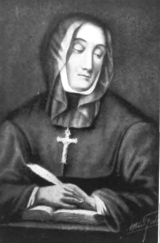
enjoying vigorous health and strength. "A poor man," says Marie de
l'Incarnation, "would have eight children or more, who during the
winter go bare-headed and barefooted, with a little covering on their
backs and living only on eels and a little bread; with all that, they
are big and fat."
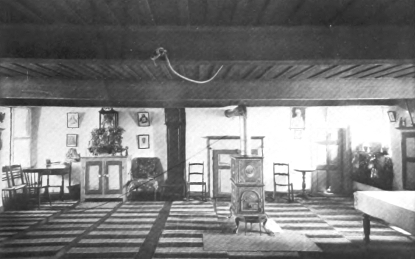
Simplicity ruled at table; pocket knives served the habitants at
their meals, the men having homemade ones. A blacksmith manufactured
the blade, and the wooden handles made by the man were decorated with
engravings on tin. As these instruments were not supplied with a
spring, the owners had to constantly keep the blade down in position
by the pressure of their fingers. But the ingenious made the operation
easier by means of a little button placed at the part of the blade
joining the handle. The practiced habitant was quite skillful
in its use, but the novice pinched his fingers horribly—a little
apprenticeship being necessary. The women made use of ordinary pocket
knives bought at the shop keeper's.
[185]
The habitants, says M. de Baudoncourt, did not drink tea. Each one
carried his knife when invited to dinner anywhere. For breakfast in the
morning, a small crust of bread moistened in cognac sufficed.
In the Province of Quebec the ancient dîme (tithe) still exists. It
consists in the twenty-sixth of all the crops. To be exempt, it is
sufficient to declare that one is not a Catholic. This dîme is paid
without difficulty and is even popular. The curé himself pays it also,
in this wise: when a family has a twenty-sixth child it is taken with
great pomp to the presbytery, and the curé becomes its godfather and is
charged with its upbringing. The fecundity of the French Canadian race
is such that this method of reprisal on the curé is not rare. One of
the late ministers of state was a "twenty-sixth" child, brought up by
the curé of his parish.
[186]
The children of the farming classes formerly did not eat at table with
their parents, until after their first communion. In the families of
easier circumstances, a little low table was reserved for their use;
but generally the children took their meal on a log block. There were
many of these in the kitchen, which was sometimes the only room the
habitant possessed. These logs supplied the dearth of chairs and were
useful also to cut up and chop the meat upon, for the mince pies and
patés for feast days. It was only necessary to turn the block over,
according to need.
[187]
Travel in this period was a very difficult matter. There were few roads
and these not very passable; there were no highroads but the rivers
and lakes. We have an idea of the length of a journey from Quebec to
Montreal from the narration of Franquet, who, as king's engineer, was
visiting Canada in 1750. He left Quebec on July 24th, at 2:30 P. M.,
and did not arrive at Montreal until July 30th, at 10 A. M. But he
had stayed a day at Three Rivers, and thus the journey was only of
five days' duration! However, it was very enjoyable on the intendant's
gondola, for Bigot was always hospitable and he wined and dined the
distinguished official under the silken awnings of the cabin on his
flat bateau.
M. Pouchot's "Memoirs upon the Late War in North America between the
French and English, 1755-60," gives a contemporary impression of value,
which may fill up the gallery of pictures of Montreal life before the
close of the French régime.
"It appears strange," he says, "from the little care and aid given to
increase it, that this colony, which was so long very feeble and often
ready to perish with misery, for the little help it got from France,
should, notwithstanding this, have gained a population of 30,000
souls.
[188]
From this we may infer that the climate is fine and the soil
fertile. It is not unusual to find from grandfather to grandchildren as
many as sixty persons.
"The Canadians are very well formed. Robust, active, endure pain and
fatigue admirably, and are accustomed to long and painful journeys for
their trade, which they accomplish with great address and patience.
These voyages are usually made very deliberately, on account of the
kind of life which they lead on these occasions. They are brave, love
war, and are ardent patriots. They evince a strong attachment to their
mother country, and their little knowledge of the world renders them
volunteer braggarts and liars, being little informed upon any subject.
"There is no country where women lead a happier life than in Canada.
The men show them great attentions and spare them all the fatigues
they can. We might also add that they deserve all this, being modest,
of comely figure, vivacious in spirit and full of intrigue. It is only
through them that their husbands procure employment, which puts them at
ease and above the common lot. There prevails in the villages a tone
of good society which we could not expect in a country so remote. They
dance and demean themselves very gracefully, and this without master."
Before concluding this chapter we may here also quote Pouchot's
appreciation of the trade conditions of Canada at the end of the French
régime, since it supplements former notes on this head and helps us to
understand the position of Montreal as the center of the up-country fur
trade at the end of the French régime.
The trade of Canada, he tells us, "is made on the king's account and by
individuals. The intendant has the general direction of this business.
The king has magazines at Quebec, Montreal, St. Johns, Chambly and
Carillon, and for the posts further up at La Présentation, Niagara,
Frontenac, the fort at the Portage, at Presqu'lle, Rivière aux Bœufs
and at Fort Duquesne.
"The magazine at Quebec is a dépôt to supply that at Montreal and
also issues supplies for trade with our domiciliated Indians, the
Abenakis, and others down the river. The magazine at Montreal furnishes
merchandises to all the posts above mentioned. Its trade directly
with them was but small until the king appointed a commissary. These
magazines furnish all the provisions for the war, as well as for trade
and for the king's service. They also in part supply the artillery.
"The king has at all these places storekeepers nominated by the
intendant, to whom they report direct. The intendant has under him a
commissary of ordnance of the marine, who remains at Montreal to attend
to the details of the upper country."
The writer criticizes as unsuitable for Indians much of the merchandise
sent out, as mirrors mounted on morocco, silk stuffs and remnants
of various other fabrics, handkerchiefs, hose, and in short, all
the remnants of the shops. There was much waste for the king—much
reversion of his profits—but still it was a very profitable trade.
"The Indians gave in exchange for these goods the skins of roebucks,
stags, bears, beavers, otters, pécans, squirrels, martens, lynxes,
foxes, muskrats, wood-rats, wolves, caribous and moose. They trade
also for bread, pork, salt, prunes, molasses, all kinds of meats and
fish, bears' oil, which they value more than goose oil, and the down
of aquatic birds. All these different exchanges are reduced in value
to the beaver skin, which is commonly reckoned as a bottle of brandy
at thirty sols. A pound of castor is valued at four livres, ten
sols, and skins weigh from two and a half to three pounds. The price
of our goods varies with the distance of the localities."
The second kind of trade was carried by individuals.
The posts in the interior were assigned to officers in favour. They
took with them a storekeeper to trade for them. "As they had no money,
they found merchants at Quebec and Montreal who supplied, upon credit,
all the goods necessary, which they called equipping them. They agreed
upon their prices, and gave peltry to the merchants in return. They had
to earn profits for both parties. These officers had often to negotiate
for the king with the natives near the posts and to give them goods as
presents. They were paid by the intendant upon the approval and order
of the governor. This occasioned many hypothecated accounts which
turned to the most certain profit of these commandants, especially in
time of war.
"These commandants, as well as private traders, were obliged to take
out licenses from the governor, which cost from four to five hundred
livres, in order to be allowed to carry their goods to the post and
to charge some effects to the king's account. This feature always
presented a prominent obstacle to trade establishments of Canada, as
they were obliged to take out these licenses every time they wished
to go into the interior of the country. The most distant posts in the
Northwest were the most highly coveted, on account of the abundance and
low prices of peltries and the high price of goods.
"A third kind of trade was followed by these traders, or coureurs de
bois, who, having laden some canoes with merchandise and halving the
licenses, went to the homes of the natives outside the gates of our
posts, where they awaited the Indians in their villages, to which they
followed them, till their return from
the chase, and came back
after trading with their canoes laden, at considerable profit. Those
especially who were in condition to purchase goods at first hand made a
fortune very quickly; but to do this it was necessary to determine to
lead a most miserable and painful life. These different traders, upon
their return to France, might show an amount of 2,500,000 livres."
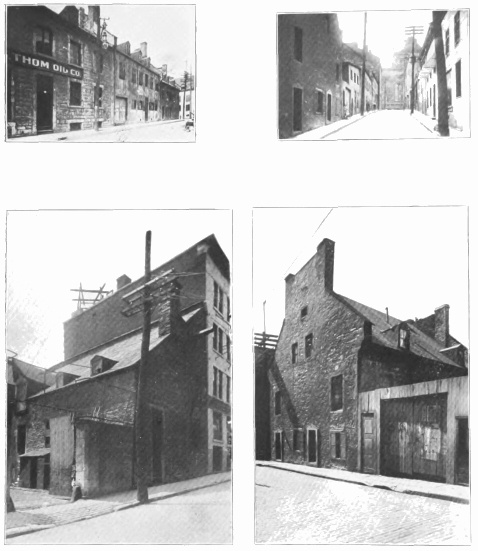
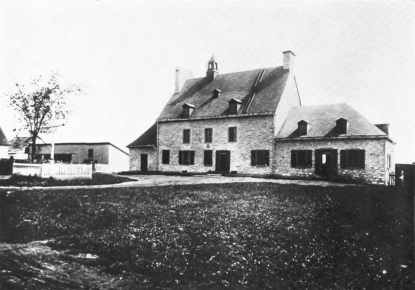
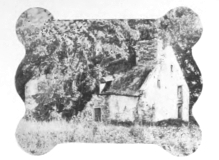
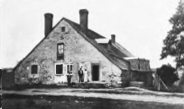
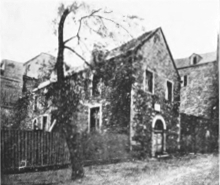
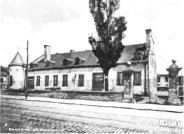
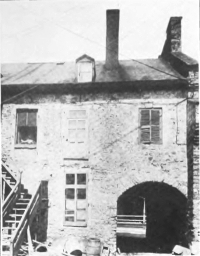
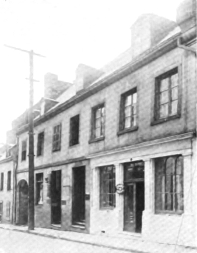
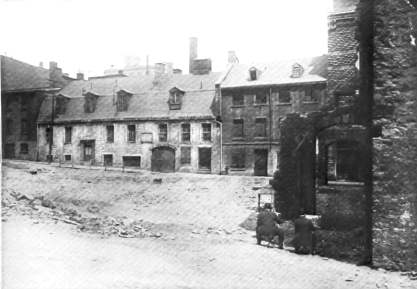
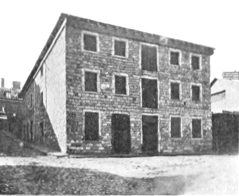
HOUSES OF THE LATTER PART OF THE FRENCH REGIME, ON ST.
GABRIEL, ST. THERESE AND ST. VINCENT STREETS, STILL STANDING AFTER A
PROCESS OF GRADUAL MODERNIZATION
NOTE
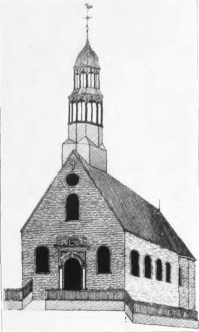
THE DEVELOPMENT OF THE PARISH CHURCH
The parish church, being the center of many of the activities of the
small community, deserves special mention, as its history affords
students of manners and customs interesting glimpses of the period.
The new parish church was not finished till 1678. Examination of
the records of the church will supplement the previous chapters of
"sidelights" of the spirit and practices of the time.
1675, April 15th, there is a donation to the church of a miraculous
statue of the Blessed Virgin by M. de Fancamp, with a certificate of a
miracle operated in his presence by the said image.
1678, MM. Charles Lemoyne, of Longueuil, and Jacques LeBer, merchants,
give a lamp of silver of the weight of ten marks, or about the value of
492 livres of French money.
1683, June 16th, there is the blessing of a bell, given by M. l'Abbé?
Pierre Chevrier, Baron de Fancamp, January, 1683.
In 1691 there is a record on July 2d of a deliberation on the
construction of benches for the church.
1694, January 24th, there is mention of increase of wages of thirty-six
livres for Tourangeau, the bedel, on condition that he will take
charge of winding the clock of the church.
1697, March 21st, this is a mandement of Mgr. de St. Vallier
approving of the building of the church and inducing the Marguilliers
to undertake the construction of a tower and a choir.
In 1697 Pierre LeBer, bourgeois, of Montreal, touched with the
particular devotion to the Blessed Anne, mother of the Blessed Virgin,
formed the design of building, in her honour, a chapel outside the town
on the common, and having addressed himself for that purpose to M.
Dollier de Casson, superior of the seminary, he was granted an arpent
square on May 11, 1697, and the chapel was built. The place was known
as St. Anne's. The ruins of the chapel were to be seen in 1823.
1700, January 17th, the right of sepulture in the chapel of L'Enfant
Jesus, built on the right hand transept of the church, was granted to
the sisters of the Congregation.
In 1706, at a meeting on August 20th, the citizens contributed the
sum of 1,414 livres, of which 1,000 was from M. de Belmont for the
seminary, for the erection of the tower.
1708, April 19th, M. de Belmont, superior of the seminary, and M. Yves
Priat, curé, made a vow to build a chapel in honor of St. Roch. This
was apparently built at the base of the bell tower meanwhile erected.
1708, August 25th, and 1710, 1712, January 12, 1713, record foundations
for masses in perpetuity by Mlle. Jeanne LeBer, Mme. Jeanne Dumouchel,
Pierre Biron, merchant, the latter's husband, and M. François de
Belmont and M. and Mme. Pierre Biron respectively. Such donations occur
regularly in after years.
In 1713 the organist, M. Dubrisson, was given on May 1st, 100 livres
salary for a year.
1720, July 20th, there was a meeting on the subject of the tower again
and the construction of a portail, or entrance façade.
1720, August 4th, there is recorded a deliberation for the construction
of a belfry, capable of housing four bells, the whole in cut stone,
with "une flèche de charpentier couverte d'ardoise," and 375 livres
were given by the citizens to the effect.
1722, June 4th, at a meeting of the church wardens it is determined
that the belfry cannot be placed in front of the church but on the
southeast, and that one shall be made to the right of the portail
similar to the first one. This was approved by the citizens on June
21st.
1722, June 24th, there is a change of opinion recorded. At a meeting
of wardens and citizens it was resolved that the belfry should not
be continued on the southeast corner, but on the northwest. This
regulation was never afterwards changed.
1723, February 24th, a contract for masonry was made with one Jourdain
for the construction of a belfry.
1723, June 27th, Nicholas Bourdeau is named the second bedel in place
of the late Quenneville, first bedel, with 150 livres salary; he is
to furnish besom brushes, water for the blessed waters at Easter and
Pentecost, to clear away the spider webs, to make visits every evening
around the church, to close the door well and finally to do all that
the late Quenneville did; he is to see after the payment of bench dues
under the Marguilliers, to sweep the church, to take care to close the
doors well morning and evening, to sound the "Angelus" and ring the
bells in times of thunder storms.
1725, May 1st, the benches in the rood loft are to be let for hire,
ten livres for the first row, those four behind, one livre less
in proportion for each until the last; moreover, ten livres are
to be charged for their making. On the same day a capot and vest
of Kazamet, valued at forty-five livres, was to be given to the
organist, Caron, each year.
1725, June 10th, the tower is commenced, but as the rain and bad
weather are damaging it and funds are low for affairs, a loan of money
is to be obtained.
1728, May 1st, a Sieur Pierre Latour, a founder, engages to make a
bell for the parish of the weight of 1,200 pounds, or thereabouts, the
"fabrique" furnishing him the materials and paying him besides 400
livres in addition to his salary of fifteen francs a month until
the work is finished.
1730, September 8th, the same engages to make another bell on similar
terms.
1731, January 14th, it is agreed that there shall be a canvass for the
building of St. Amable Chapel.
1734, February 14th, a chapel to St. Anne parallel to that of St.
Amable is determined, upon the ground chosen for burial purposes.
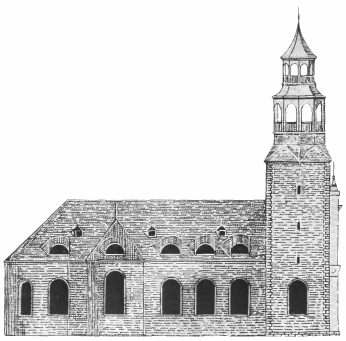
NOTRE DAME CHURCH
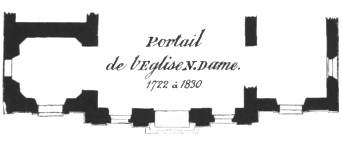
PORTAL OF NOTRE DAME
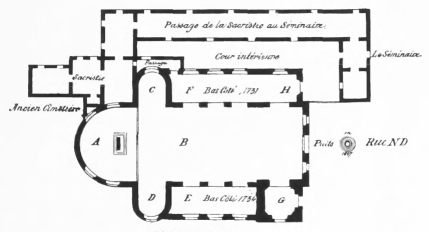
PLAN OF NOTRE DAME
Reference: A. Choir. B. Nave. C. Chapel dedicated to the Infant Jesus.
D. Chapel dedicated to St. Joseph. E. Chapel dedicated to St. Ann.
F. Chapel dedicated to St. Amable. G. Tower built in 1722, steeple
erected in 1777, cross erected in 1778. H. Chapel dedicated to souls of
Purgatory.
1734, March 14th, it is agreed that the Chapel of St. Anne shall extend
from the apse of the St. Joseph Chapel to the tower which serves as
a belfry, that it shall have three casements similar to those of the
tower and of the same height, a doorway below four feet long, the
window sashes glazed and fixed with iron fittings, with timber work,
covering and vault following the plan given by Sieur Anger; that it
shall have a cellar of the length and breadth of the chapel, dug eight
feet below with a stone vaulting, with an opening to pass the bodies to
be buried there, and to be whitewashed above; that the excavation shall
be transported to the "new cemetery" or the Hôtel Dieu Cemetery, as the
second burial place was sometimes called.
1739, February 15th, there shall be a chapel joining the church of this
parish on the cemetery side when the Chapel of St. Amable is built,
following the plan and arrangement made with Sieur Labrosse. December
27th, Périnault dit le Marche, the organist, is given the sum of
thirty livres annually.
1742, April 29th, an agreement is made with Dominique Janson de la
Palme for the windows of the church in consideration of 100 francs for
each window.
1743, June 30th, the nomination occurs of Pierre Compe, second bedel,
in place of the defunct Mongineau, chief bedel, without other salaries
and perquisites. December 27th, the sacristy is to be lengthened.
1751, May 1st, a "suisse," or head porter, shall be appointed for the
guardianship of the church.
1755, September 28th, an indication of war alarms is seen in the
authorization of M. Thomas Dufy Desaulniers to have brought over from
France the tapestry hangings for the reposoire for Holy Thursday, but
if war is declared he is not to have them come.
For the year 1757 the parish church, commenced in 1672, being found too
small, a larger one was thought of and the principal citizens, in view
of building a church of 300 feet in length, agreed among themselves to
buy certain lands (afterwards bought in 1823).
It was agreed on January 30, 1757, at a meeting of the church wardens,
that a suitable place for the church would be the Place d'Armes,
and that it would be necessary to buy another place for the Place
d'Armes;
[189]
that opposite the Jesuit residence there were several
pieces of land belonging to private individuals, among others a plot
of about sixty feet frontage and eighty feet in depth belonging to
Mlle. Demuy. The Place d'Armes then commenced in the middle of what
was afterwards St. James Street and occupied the site on which the
Bank of Montreal and the Royal Trust buildings stand in 1914. The
war interrupted their building projects till 1823. The intervening
poverty caused by their losses and the departure of many of their rich
parishioners was a cause of the delay.