It was an amazing fact, but a significant one,
that four-year-old Joanina had never been allowed
to feel herself.
As she lay in her carved-wood cradle, a bundle
of cooing, pink delight, she felt for her toes,
that she might assure herself of her own identity
as represented in those wriggling lumps
of flesh. But Joanina’s mother bound the little
limbs in swaddling bands and the bambino lost her
toes temporarily. When she was a bit older, and
was allowed to bask, kitten-like, on a rug in the
garden path, she was charmed to hold her flower-like
baby hands up to the light, watching the
Roman sunshine trickle through outstretched fingers
as she tried to count them. But, always, her
emotional, kindly intentioned madre would toss a
bright-colored ball into the reaching hands or,
bending over the baby, would play pat-a-cake with
her, or she would suggest a romp up and down the
garden. Her self-imposed quiet was always interrupted
by her mother’s unrest.
As Joanina grew to a slim little girl of Italy,
whose great, wistful brown eyes reflected a large
curiosity and awe at the surprises of the world
in which she found herself, she was daily surrounded
by forces that drew her away from herself.
Her home was full of glaring colored pictures
hung on vividly dyed wall paper. Her
mother and father talked together in high-pitched,
shrill voices, and through the wide casement windows
came the harsh sounds of traveling street
musicians and brawling venders. Always, as a
treat on Sunday or a festa, Joanina was taken to
see a procession or to a band concert in one of
the parks. The crowded, hot stone streets, the
noisy cracking of the cab-drivers’ whips, the struggle
to make her own short legs keep up with the
longer steps of the madre, wearied and excited the
little maid.
But she grew accustomed to noise and boisterousness
in her days; she grew to expect them as
well. Then she came to depend upon outside
forces for keeping the motor of her baby spirit
going. She begged for new toys, exhausting
quickly the pleasure to be found in old playthings.
She asked for new frocks, aping the vanity of her
mother and the other women she saw on the Corso
on feast days. She allowed her child playmates to
plan her games. She cried to be taken into the
turbid streets. From a placid, reposeful baby,
Joanina developed into a restless, passionate, distraction-seeking
little girl. Germs of discontent,
disquiet, hysteria were planted in her child soul.
When Joanina found herself one morning in the
Trionfale Children’s House, she experienced an unconscious
feeling of peace. The very wide spaces
of the two rooms where the little ones busily and
happily worked; the cool gray walls unbroken in
their sweep save by a blue and white terra-cotta
bas-relief here and there; the plain brown linen
curtains that softened and toned the yellow sunlight
and rippled with a flower-scented breeze—these
helped to make Joanina’s peace. Dropping
into one of the little white chairs, she looked about
her with eyes that again melted into the calm
wonder of her babyhood. She could not have explained
it, but there was already at home in her
life a new, quiet repose.
Surrounding her was a child republic that
opened its heart to her. Some of the children, in
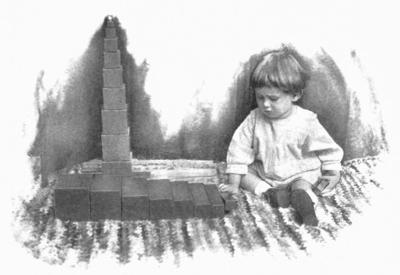
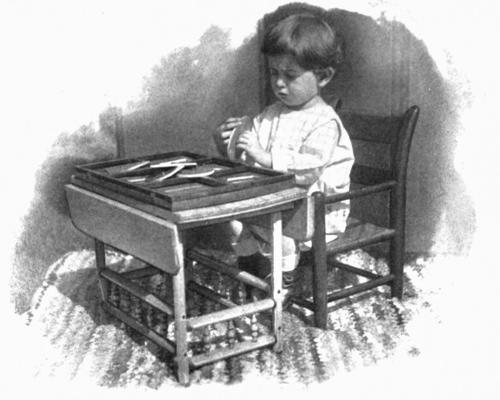
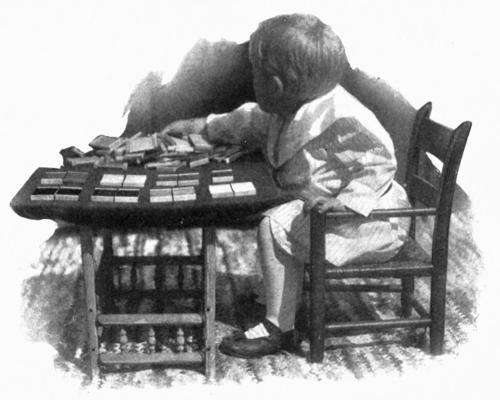
groups, were sorting and grading with quiet skill
scores of the silk-wound color spools. Others,
alone, were testing their knowledge of dimension
and form with the solid and geometric insets. In
a corner, a determined baby was trying to button
the apron of another baby. All were entertained,
yet no one was entertaining them. They were
making their own content.
Without warning, the directress turned from
the child whom she had been giving a lesson in
numbers with the counting case, moved to the
front of the room, and wrote upon the blackboard
one word, Silence. Then she waited, herself silent
and facing the little ones. Joanina, too, waited.
She did not understand; she was curious.
The children, recognizing the written word, one
by one laid down their work, dropped into positions
of quiet repose, their eyes closed. Some laid
their heads upon their folded arms. The room
became so hushed that such faint sounds as the
low ticking of the clock, the hum of a buzzing fly,
the gentle rise and fall of breathing, became vibrant.
The children’s faces were full of calm joy,
their bodies were completely motionless. They
had gone away from their small republic of work
and play for a space. Who could tell where they
were? Each child was feeling himself; for the
time being he was listening to the call of his own
personality.
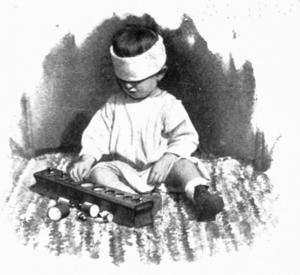
Joanina, interested in the game of silence, closed
her eyes. She folded her restless fingers. She
waited, rapt, immobile as a little chiseled cherub.
It was perhaps the first time in her four years’
apprenticeship to Life that she had been given an
opportunity to listen to her own heart throbs, feel
the grip of her own personality. The experience
was satisfying to her. She heard and felt a great
many inner voices and mental forces that she had
never listened to or obeyed before. She heard the
voices of happiness in her new, peaceful environment
and love for the other children and joy at
the complete freedom that surrounded her. She
felt the impulse to do and learn as she had seen
the other children doing and learning.
For several minutes, the silence held the children
in its spell. Then, out of the stillness the whispered
voice of the directress floated. As a singing
wind of a far-away forest, a mountain echo, or the
low voice of a mother as it first makes itself audible
to a new-born babe, came the voice: “Joanina.”
The little girl opened her eyes, meeting the
smiling ones of the directress, who made a gesture
indicating that Joanina should go to her quietly.
Poised on tiptoe, Joanina crossed the room noiselessly,
threw herself into the outstretched arms of
the directress.
“Mario, Otello,” softly the other children were
called until all had, as silently as Joanina, left
their places and surrounded the directress. Their
eyes shone, their faces glowed as if they had been
refreshed by an elixir bath. Yet the Montessori
silence game which had brought about this inspiration
and refreshing in the life of soul-starved little
Joanina might have been a part of her home life.
Your child needs it; you need it.
There is, perhaps, no more significant phase of
the Montessori system of education than the calm,
quiet habit of self-contemplation aroused by the
game of silence. The self-control, the poise, the
power of long concentration that one sees in the
Montessori children at Rome amazes the world.
They are completely lacking in self-consciousness;
they ask for help in their work only when it is
absolutely necessary; they are sure of themselves.
In writing about the game of silence, it has
been suggested that the game has an hypnotic
quality; that the calm, beautifully poised directress
imposes her own personality upon the children,
controls them as the hypnotist controls his
subject. This is not true. As the didactic materials
furnish the right means for the child’s
mental development, so the opportunity given
by the game of silence makes possible the
child’s moral and spiritual development. It
gives him a chance to listen to the “still,
small voice” that is a speaking voice in childhood
but which is drowned by the babel of world
tongues that we allow to make our song of life in
adult years.
The story of Joanina, the little Roman girl, is
retold in almost every American home. As we,
ourselves, depend upon public opinion, outside
amusements, entertaining friends, the judgment of
the press, the fashions of the day for filling our
lives, so we make our children, also, dependent
upon similar forces for forming their characters.
We surround children with gossip, we teach them
to depend upon excitement for their pleasure; we
build their ideals of conduct upon what the world
will think instead of what their conscience dictates.
We make of our little ones modern Babes in
the Woods who lose themselves in a forest of bewildering,
overgrown paths. We give them no
chance to blaze their own trails.
What is the application to the American home
of the Montessori game of silence?
It begins with the American mother who must
cultivate a habit of quiet self-contemplation. She
must be able to shut out the world as did the stoics,
listening to the good voice of her own soul. It
means, also, that she will be less dependent upon
her environment for her daily thinking and happiness
and more adept at creating her own joys.
We are very restless, to-day, discontented unless
we are surrounded by friends or obsessed by passion
of some sort, or we must go somewhere. We
will try to slip back into the simple living of our
great-grandmothers, who had resources in themselves
and could be radiantly happy, pottering
over the lavender in their gardens or reading their
Bibles in the candlelight of some long-ago evening—alone.
The mother who cultivates in herself a habit of
repose will have reposeful children.
The game of silence, as it may be put into practice
in the training of children, begins with ear-training.
Shut out harsh sounds from the home
where there are little children. To command a
child in a loud voice often results in disobedience;
it makes him mentally deaf for the time being.
He does not hear what is said to him; it dulls
his senses. We all know how the memory of some
gentle voice that either sang or spoke to us in
childhood comes back to us, now, as a forceful
memory. It was the softness of that voice that
made the lasting record in our minds.
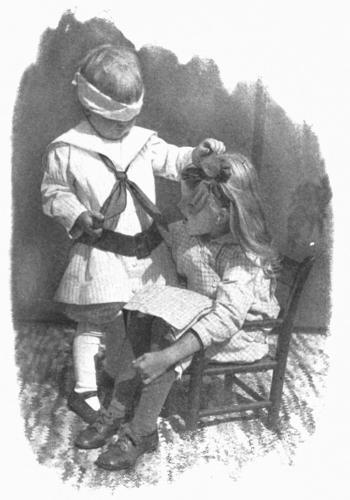
Often a mother may whisper a sentence to a
child, or call softly from different parts of the
house, asking the little one to locate her by the
sense of hearing. This will quicken and cultivate
the child’s power to listen and concentrate upon
the use of one sense. And we should eliminate all
unnecessary noises from our homes; the slamming
of doors, the crashing of dishes, harsh popular
music, and crude songs.
As the children’s sense of hearing is refined, we
will lead them to listen to the very small sounds
in the world about them, the soft breathing of
the sleeping baby, the far-away ticking of a clock,
the hum of insects, distant footsteps, the patter
of rain, the song of the wind.
Then when this fine power of listening has been
cultivated, we may introduce the game of silence
itself. The mother may show the child that she
is able to sit quietly, immobile, relaxed for a short
period of time—only thinking. Then the little ones
may be encouraged to attempt the game, waiting
in perfect silence, with closed eyes, until mother
calls them in a soft whisper to “come back” to
the world again. To darken the room a little
during the game adds to its power. Gradually the
periods of the silence may be lengthened, and results
will show in the child’s life in greater control,
quiet, and life balance. In this repose and
silence, Dr. Montessori tells us, both adults
and children gather strength and newness of
life.
A little maid of three had been having her first
birthday party. Light and music and romping
games and many gifts had filled the afternoon
with unexperienced delights for the child. She was
trembling with delight, on tiptoe with excitement
when the children marched out to the dining-room
and were seated about the beautifully laid, rose-strewn
table. At a signal the curtains were drawn
and the children were told to be silent and close
their eyes for a space. There was a vibrant hush,
a space of time passed, then one child after another
raised her head and opened her eyes. The room
was still darkened, but in the center of the table
had been placed the huge, white birthday cake
surrounded by a wreath of flowers; the only light
was the starry shining of three white candles on
the top. The little birthday child looked in wonder.
Then she drew a long breath and said in a
whisper, “Nearer, my God, to Thee.”
No one quite understood the little one. It
seemed to have been a vagary, a precocity on her
part. It was an unusual manifestation, but quite
explainable as we grew to realize the inspirational
possibilities of the Montessori silence.
When it is not possible, because we are dealing
with an isolated child, to put into practice the
game of silence as it is used in the Children’s
Houses, we can still lead the child to know and feel
silence. A quiet hour in the twilight after the
work and play of the daytime are over, a trip to
some still, lovely spot in the woods, a few moments
spent in the hushed interior of a church,
will remain as reposeful memories in the life of the
child. More than repose, even, they may be inspirational,
as, shut away from the noise and activity
of the world, the child is able to hear the call
of his own spirit.
We all know and love Bastien-Lepage’s painting
of the maid, Jeanne d’Arc, listening to the
voices in her garden. The grass dotted with
flowers, the bending apple tree, the other homely
surroundings of the humble home that were all
Jeanne had known, fade away as the voice of the
prophetic soul speaks to her; as she sees the vision
of herself, the saviour of France.
Jeanne d’Arc was only thirteen when she began
to hear the voice of her spirit.
Millet, as a boy, saw nature with his spirit eyes.
He showed his father colors playing over the
rough sod of his home fields which no one else
could see. Rousseau, in boyhood, declared that he
was able to converse with his beloved trees and
they told him the secrets of their beauty. Samuel
was only a very little boy when he heard and
interpreted his Master’s voice. The boy Christ
heard a message that he was able to carry to the
doctors.
May we not give our little ones an opportunity
to step across the threshold of the present into
that great silence which begins life and also ends
it, and which is melodious for those who are trained
to listen?
THE END
By DOROTHY CANFIELD FISHER
Author of The Squirrel-Cage, Hillsboro People, etc.
A MONTESSORI MOTHER
Illustrated, 8th printing, $1.25 net
This authoritative book, by a trained writer who
has been most intimately associated with Dr. Montessori,
tells just what American mothers, and most
teachers, want to know about this system.
A simple, untechnical account of the apparatus, the
method of its application, and a clear statement of the
principles underlying its use.
“Fascinating reading and likely to be the most interesting to the
average mother of all the many books on the subject.”—Primary Plans.
“What would I not give to have had at the beginning of my children’s
upbringing such a guide to the fundamental principles underlying
their best growth and development.”—Mrs. Robert M. La Follette
in La Follette’s Magazine.
MOTHERS AND CHILDREN
Just ready, $1.25 net
After the publication of A Montessori Mother two
years ago, Mrs. Fisher was overwhelmed with personal
letters from all over the country asking special advice.
Mothers and Children, running along its easy, half-humorous
way, answers all these questions and gives
the clue to the answer of ten thousand more.
“The Tarnishing Eye of Relations” is the title of
one chapter. Some other chapters are “The Sliding
Scale for Obedience”; “A New Profession for
Women: Question Answerer”; “When I Am a Grandmother”;
“Nurse or Mother”; “Mothers-by-Chance
and Mothers-by-Choice.”
“A book of help for the most complicated and important enterprise
in the world—the rearing of children. It gives the wisdom of an expert
in the language of a friend ‘just talking.’”—New York Evening Post.
HENRY HOLT AND COMPANY
34 West 33rd Street (11’14) NEW YORK
BOOKS ON AND OF SCHOOL PLAYS
By Constance D’Arcy Mackay
HOW TO PRODUCE CHILDREN’S PLAYS
The author is a recognized authority on the production
of plays and pageants in the public schools, and combines enthusiastic
sympathy with sound, practical instructions. She
tells both how to inspire and care for the young actor, how
to make costumes, properties, scenery, where to find designs
for them, what music to use, etc., etc. She prefaces it
all with an interesting historical sketch of the plays-for-children
movement, includes elaborate detailed analyses of performances
of Browning’s Pied Piper and Rosetti’s Pageant
of the Months, and concludes with numerous valuable analytical
lists of plays for various grades and occasions.
$1.20 net (Feb., 1914).
PATRIOTIC PLAYS AND PAGEANTS
Pageant of Patriotism (Outdoor and Indoor Versions):—Princess
Pocahontas, Pilgrim Interlude, Ferry Farm Episode,
*George Washington’s Fortune, *Daniel Boone: Patriot,
Benjamin Franklin Episode, Lincoln Episode, Final Tableau.
Hawthorne Pageant (for Outdoor or Indoor Production):—Chorus
of Spirits of the Old Manse, Prologue by the
Muse of Hawthorne, In Witchcraft Days, Dance Interlude,
Merrymount, etc.
The portions marked with a star (*) are one-act plays
suitable for separate performance. There are full directions
for simple costumes, scenes, and staging. 12mo. $1.35 net.
THE HOUSE OF THE HEART
Short plays in verse for children of fourteen or younger:—“The
House of the Heart” (Morality Play)—“The Enchanted
Garden” (Flower Play)—“A Little Pilgrim’s Progress” (Morality
Play)—“A Pageant of Hours” (To be given Out of
Doors)—“On Christmas Eve.” “The Princess and the Pixies.”
“The Christmas Guest” (Miracle Play.), etc. $1.10 net.
“An addition to child drama which has been sorely needed.”—Boston
Transcript.
THE SILVER THREAD
And Other Folk Plays. “The Silver Thread” (Cornish);
“The Forest Spring” (Italian); “The Foam Maiden” (Celtic);
“Troll Magic” (Norwegian); “The Three Wishes” (French);
“A Brewing of Brains” (English); “Siegfried” (German);
“The Snow Witch” (Russian). $1.10 net.
HENRY HOLT AND COMPANY
PUBLISHERS NEW YORK
BOOKS TO MAKE ELDERS YOUNG AGAIN
By Inez Haynes Gillmore
PHOEBE AND ERNEST
With 30 illustrations by R. F. Schabelitz. $1.35 net.
Parents will recognize themselves in the story, and laugh
understandingly with, and sometimes at, Mr. and Mrs. Martin
and their children, Phoebe and Ernest.
“Attracted delighted attention in the course of its serial publication.
Sentiment and humor are deftly mingled in this clever book.”—New
York Tribune.
“We must go back to Louisa Alcott for their equals.”—Boston Advertiser.
“For young and old alike we know of no more refreshing story.”—New
York Evening Post.
PHOEBE, ERNEST, AND CUPID
Illustrated by R. F. Schabelitz. $1.35 net.
In this sequel to the popular “Phoebe and Ernest,” each
of these delightful young folk goes to the altar.
“To all jaded readers of problem novels, to all weary wayfarers on the
rocky literary road of social pessimism and domestic woe, we recommend
‘Phoebe, Ernest, and Cupid’ with all our hearts: it is not only cheerful, it’s
true.”—N. Y. Times Review.
“Wholesome, merry, absolutely true to life.”—The Outlook.
“All delicious—humorous and true.”—The Continent.
“Irresistibly fascinating. Mrs. Gillmore knows twice as much about
college boys as ——, and five times as much about girls.”—Boston Globe.
JANEY
Illustrated by Ada C. Williamson. $1.25 net.
“Being the record of a short interval in the journey thru
life and the struggle with society of a little girl of nine.”
“Our hearts were captive to ‘Phoebe and Ernest,’ and now accept
‘Janey.’ … She is so engaging. … Told so vivaciously and
with such good-natured and pungent asides for grown people.”—Outlook.
“Depicts youthful human nature as one who knows and loves it.
Her ‘Phoebe and Ernest’ studies are deservedly popular, and now, in
‘Janey,’ this clever writer has accomplished an equally charming portrait.”—Chicago
Record-Herald.
HENRY HOLT AND COMPANY
PUBLISHERS NEW YORK