When I was passed fit for Active Service,
after some time in hospital, I left England
for Egypt with five other officers. Four of these
had strange histories. One is, perhaps, the most
romantic figure of the war, another now governs
a great Province, while two, after many adventures,
were prisoners of war in Turkey, for different but
dreary periods.
I was sent to the East because it had been my
fortune to have travelled widely, and I had a fairly
fluent smattering of several Eastern languages. On
arriving at Gibraltar about December 14, 1914,
we heard the first news of submarines. One of
these was reported to have passed through into
the Mediterranean a few days previously.
When I reached Egypt just before Christmas,
superficially everything was calm. This calm did
not last very long. I was given Intelligence work
to do, under Colonel Clayton, who has played
a very great part in achieving our success in the
East. Reports constantly came in from Minia,
Zagazig and Tanta of Turkish and German intrigues.
General Sir J. Maxwell commanded the Forces
in Egypt. Prince Hussein had just been proclaimed
Sultan, and Egypt had been declared to be under
British protection. Rushdy Pasha was Prime
Minister and a triumvirate of Sir Milne Cheetham
at the Residency, Sir R. Graham as Adviser to
the Ministry of the Interior, and Lord Edward
Cecil as Adviser to the Ministry of Finance, directed
the Government.
It was difficult to believe that the Egyptian,
who then had all the advantages of neutrals without
any of the disadvantages, really meant mischief.
Most people, I think, agreed with Lord Cromer,
and believed that his policy of making taxes light
and life easy for the Egyptian had succeeded, but
the East is never logical, as we all know, and the
natural consequence constantly does not follow
the parental cause. Mecca rose to join us after
Kut had fallen; the rebellion in Egypt only took
place when the English had achieved a complete
victory over Turkey, and held Palestine and Syria.
I quote the following incident as an illustration
of the difficulty of sometimes following this
mentality:—
A Syrian reported to me that a great Egyptian
family, whom I will call the Ashakas, had conspired
to bring 15,000 rifles into the country
and to engineer a rising. The rifles were to be
imported from the Greek islands and from Greece,
by means of Greek sponge-fishers. One of these,
who had the pleasant and appropriate name of
Son-of-the-Dagger, met me in a café in an obscure
side street in Cairo. There he revealed the conspiracy,
explaining that only the landing-place
for the arms had still to be decided upon. He
and his companions were to receive a commission
on every rifle landed, and he wanted to know what
the British Government would be ready to pay
for his betrayal of his patrons.
On reporting this to the proper authorities,
I was told that they were aware of the existence
of this plot. The next day frantic messages from
the Greek came, and I met him, disturbed in his
mind. He said that the Ashakas had become
suspicious of him and the other Greeks, and that
he feared for his life. He asked to be arrested
immediately after the seizure of the arms and thrown
into prison with the Egyptians, and then to be
flogged before them, in order to convince them
that he was acting honourably by them. He
was very anxious to be paid for both pieces of
treachery, by the Egyptians and by us. On making
my report to the authorities I learned that the
Ashakas had betrayed the Greeks by denouncing
them as traitors.
The whole affair had been a result of Levantine
nerves. The Ashakas in the past had been
strong Nationalists. When the war between the
Turks and ourselves broke out, in spite of the
fact that it seemed possible, and indeed likely,
that Egypt might again become a Turkish province,
their politics changed, and they hastily became
Anglophile, but their past record haunted them.
They feared the British Government almost as
much as the Turks, and yearned to prove themselves
loyal.
After much thought it appeared to them that the
simplest way of achieving this would be to supply
valuable military information to the British. That,
however, was an article which they did not possess,
and they therefore hit upon the idea of getting up
a bogus conspiracy in order to be able to denounce
it. This seemed the simplest way to safeguard
themselves, and they hurriedly adopted the plan.
The instruments that they chose were subtle
Greeks, who were more proficient in the art of
intrigue than the Ashakas, and had an even more
degraded morality. It took only a few days for
the Ashakas to realize the infidelity of the Greeks,
and to inform against them still more hurriedly,
but meanwhile the Greeks had spoken first. In
the end, when the hair of the Ashakas had turned
grey, they made a clean breast of the whole affair
to the British authorities, and were, I believe,
forgiven.
“Happy is the country that has no history”
is a proverb which is often untrue, but Egypt was
certainly happy, compared with the rest of the
world, early in 1915. Then history moved rapidly
towards us. The thunder of the guns in France
was no longer something remote and irrelevant. The
Turks massed across the desert, and prepared to
attack the Canal. Many of the English thought
that we were living on a sleeping volcano, but
there was general confidence, and no one doubted
our power to cope with the situation. The Turks
attacked skilfully and bravely, but the odds against
them were too heavy. They were, however, able
to shell H.M.S. Harding in the Canal, and a few
of their men swam across to Egypt. Complete
serenity reigned in Cairo. I remember going to
the Opera that night. General Sir John Maxwell
was listening, quite unruffled, to the performance.
I heard a civilian say in a scandalized voice to
him: “They have gone and broken the Harding.
What next?” To which Sir John answered:
“Well, they’ll have to mend it, I suppose.” Two
ladies landed at Port Said and had their train
shelled as it steamed slowly along the banks of
the Canal to Cairo. They wondered placidly if
this was the normal state of things in Egypt.
These attacks added to the labours and quickened
the energies of the Intelligence in Egypt,
but still there were only vague rumours to
be heard. One of these foretold that there was to
be a general rising of Islam on April 27th.
I remember long conversations with a specialist
with regard to this possibility; he disbelieved in
it, then or at any time, for, as he said very rightly,
Islam had to contend with great difficulties from
the point of view of communications—waterless
deserts, impassable seas, mountain ranges, unbridged
by our telegraph. My friend, who was remarkable,
would not have an office like any other man in his
position; he disconcerted friend and foe alike by
changing his address every few days, and when
one wished to see him, and after the unusual event
of catching him, he would make an appointment
such as: “The third lamp-post in the Street
of Mohammed Ali at dusk.” When he had gone
beyond recall, one remembered that the Mohammed
Ali Street was several miles long, and that he had
not said at which end was the appointed lamp-post;
so he was well qualified to speak of the
disadvantages accruing from lack of communications.
Prisoners began coming in, but not much news
was to be obtained from them. They were mostly
shattered and rather pathetic men. The first to
arrive were some escaped Syrian schoolmasters,
who had been conscripted by the Turks, and gave
a very graphic account of a hot and harassing
journey ahead of their comrades to Egypt, where
their friends and relations lived. Then came a
blind old gentleman of eighty, who fell into our
front-line trench. It had been his habit, every
two years, to visit his son in Egypt, and he had
not realized that there was a war going on.
Amongst the Turkish prisoners of the first attack
there was one old quartermaster seriously ill, whose
manners and courage made him the friend of all
his captors, but, like the rest, he told us nothing.
There was probably more information amongst
the prisoners who had been interned, if they had
been willing to speak, but they were not. I met
one of these to whom fate had been unusually
cruel. He was an Albanian whose home had been
in Montenegro. When the amiable Montenegrins
seized the land of the Albanians, he had been beaten
and cast out; thence he had gone to Turkey, but
the Albanians had been the first to attack the
Turks, and were, indeed, the main cause of the
ruin of the Ottoman Empire, so in Turkey he was
bastinadoed and thrown into prison. Somehow
he managed to escape and arrived in Egypt. In
Egypt he was arrested as a Turk, and again thrown
into prison. In prison he was continually beaten
by his fellow-prisoners, who were Turks, as an
Albanian and an enemy of Islam.
There were no tangible proofs of a conspiracy;
one used sometimes to get black looks in the bazaar,
and scowls from the class of the Effendis. On the
other hand, we were very strongly supported by
men of the type of the late Sultan Hussein and
Adly Yeghen Pasha.
It would be difficult to meet a more attractive
or courteous gentleman than the late Sultan. He
was of the advanced school of enlightened Islam;
neither his literary tastes, his philosophy, nor his
pleasure in European society allowed him to forget
his own people for a moment. Adly Yeghen Pasha,
then Minister of Education, is an exceptional and
outstanding figure in Egypt, with a marked personality.
The other Ministers mixed freely with
European society, and there was no sign of anything
but friendliness.
At the end of February I was sent on the battleship
Bacchante, commanded by Captain Boyle,1
which lay for about a fortnight off Alexandretta,
occasionally bombarding telegraphs, or wagons
that were said to be loaded with artillery wheels.
One morning we saw two carts crawling along,
drawn by bullocks, carrying the alleged wheels
of artillery northward from Alexandretta. In
order to warn the two drivers shells were fired
from the great battleship a hundred yards ahead
of them. The men left their oxen, taking refuge
in a neighbouring ditch, while the oxen went slowly
forward alone, like automata. Our guns then
fired upon the carts, which were about half a mile
distant, and one of the oxen was immediately
hit. On this one of the two Turks left the ditch,
cut the wounded animal free, and continued to
lead the two carts. Again our guns fired ahead
of him to give him warning, but he went on steadfastly
at about a mile an hour to what was certain
death. In the end he was left lying by his dead
oxen and his broken cart. We had given him
every chance that we could, and if the admiration
of a British ship for his courage could reward a
dead Anatolian muleteer, that reward was his.
Life outside Alexandretta was uneventful. Occasionally
a Turkish official came out to discuss various
questions that arose. He used to sway and bow
from the tiller of his boat while I swayed and bowed
from the platform below the gangway of the
cruiser. It is perhaps worth saying that when I
expressed to him Captain Boyle’s regret for the
death of the Turkish muleteer it was an event that
he would not condescend to notice.
We discovered one curious fact of natural history,
that with a searchlight you can see the eyes of
dogs or jackals at night more than half a mile
away. A previous ship had reported that men
came down to the shore with electric torches, and
it was only after some days that we discovered that
these will-o’-the-wisp appearances were in reality the
eyes of dogs.
But though life was uneventful, it was very pleasant
on the ship, and all were sorry when the cruise
came to an end.
I remember the last night at dinner in the wardroom
the name of a distinguished Admiral occurred
in the conversation. He was a man who had a
great reputation for capacity and also eccentricity,
that came mainly from his habit of concentrated
thinking. When he was deep in thought and his
eyes caught any bright object, he would go up
to it like a magpie and play with it. He would
sometimes go up and fiddle with the button of a
junior officer on the quarter-deck, looking at it
very attentively, to the great discomfort of the
junior officer, or even with that of a stranger to
whom he had been introduced. The legend grew
from this idiosyncrasy, that those may believe
who wish to. It was said that one night at a dance
he sat out for a long time with a girl in a black
dress. His eye caught a white thread on her
shoulder, and unconsciously while he talked he
began pulling at it. The story goes on to say
that when the girl went home she said to her mother:
“I know I went out with a vest to-night, and now
I wonder what has happened to it.”
I remember at the same dinner Dr. Levick, who
had been with Captain Scott in the Antarctic voyage,
told a curious story of prophecy. He had been
to a fortune-teller after the idea of going with
Captain Scott had occurred to him, but before
he had taken any steps. The fortune-teller gave
a description of the melancholy place where he was
to live for two years, of the unknown men who were
to be his companions, and particularly one who
had strangely flecked hair.
I returned to Cairo and office work with some
reluctance. Friends of mine and I took a house,
which somehow managed to run itself, in Gezireh.
It was covered with Bougainvillea and flowers of
every colour, and was a delight to see. Sometimes
it lacked servants completely, and at other times
there was a black horde. Gardeners sprang up
as if by enchantment, and made things grow almost
before one’s eyes.
I quote from my diary of March 8, 1915:—
News to-day that King Constantine won’t have
Greece come in, and that Venizelos has resigned.
At a guess, this means that either Greece or King
Constantine is lost. If Constantine goes, Venizelos
might shepherd his son through his minority.
March 14, 1915. I left Luxor Tuesday night,
after a wonderful time. My guide was a Senoussi—something-or-other
Galleel. He had a tip of white
turban hanging, which he said was a sign of his
people. He was rather like one of the Arabs out
of a Hichens book, and I expect about as genuine.
A snake-charmer came with us. He gave me the
freedom of the snakes as a man is given the freedom
of a city, but as one scorpion and two snakes—one
of them a so-to-speak soi-disant cobra—stung
and bit him during the day, it’s not likely
to be of much help to me. He did some very
mysterious things, and called snakes from every
kind of place—one from a window in the wall,
a 5-foot long cobra, and a Coptic cook found its
old skin in the next window.
In justice to the snake-charmer it ought to be
said that he was only stung and bitten as a consequence
of a quarrel with an archæologist.
In Egypt every archæologist looks upon the
local magician or snake-charmer as his competitor,
and hates him. When the archæologist is telling
the tourist the history of Rameses II the attention
of the tourist is distracted by a half-naked man
doing the mango trick. My archæologist friend,
irritated by the presence of the snake-charmer,
declared that his snakes were all doped and his
scorpions were tame town scorpions, green, and not
yellow like the country scorpions. He found a
bucolic scorpion under a stone, of the proper colour,
which instantly stung the snake-charmer; he then
insisted upon stirring up his snakes with a stick,
with the unfortunate results that have already
been mentioned.
The Egyptian has always seemed to me harder
to understand than his neighbours. It may be
because there is less in him to understand. The
Greeks, Turks, and Arabs have all got very salient
characteristic qualities, but though the characteristics
of the Egyptians are probably as strongly
marked, they are less conspicuous to the foreigner’s
eye; in other words, the Egyptian has less in common
with the outer world than any of the Asiatic, or
even African, peoples who surround him. Lane,
in his Modern Egyptians, says that they refused
to believe that the ordinary traveller was not an
agent for the Government, because they could
not understand the desire for travel, and their
character has not changed since his day. Here is
a story of Egyptian guile and credulity:—
An Egyptian was anxious to get some job profitable
to himself done, and he went to one of the
kavasses (guards) at the Agency for advice. The
kavass professed himself able to help. He said:
“The man for you to go to is Mr. Jones, that high
English official. He will get what you want done,
but I warn you that Mr. Jones is an expensive
man. Give me three hundred pounds, and I will
see what can be done.” The three hundred pounds
was duly paid, and for a long time nothing happened.
The petitioner grew impatient and importunate,
and was eventually satisfied for the moment by
an invitation to lunch with a Levantine who passed
himself off as Mr. Jones. At luncheon the Levantine,
who was of German extraction, wore his hat, banged
his fist on the table, smoked a pipe, interrupted,
and generally acted as an Englishman abroad is
supposed by some to behave. Then occurred an
interval of inaction; the petitioner again grew
restive, and this time he complained to the
authorities. Finally the transaction was discovered,
and the kavass was sent to gaol.
Events moved in Egypt. The Australian and
New Zealand troops poured in, and splendid
men they were. But there was little love lost
between the Australians and the Egyptians, though
the British troops and the natives fraternized
occasionally. The native Egyptian was, it must
be admitted, constantly very roughly treated, for
the average Australian, while he was at first apt
to resent superiority in others, felt little doubt
about his own claim to it. The Australian and
New Zealand Corps was commanded by General
Birdwood, and the New Zealand and Australian
Division by General Godley.
I joined the New Zealand Division as Interpreter
and Intelligence officer, and we all made preparations
to start early in April. I was anxious to buy a
beautiful snow-white Arab, that had won most of
the races at Cairo, from a friend of mine, but General
Godley spoke simply but firmly. “You aren’t
the Duke of Marlborough,” he said. “You can’t
have that white pony unless he’s dyed, and even
then it would wash off in any rain-storm. You
may get yourself shot, but not me.” I agreed
with the less reluctance because I had found that
the pony pulled furiously and would certainly
lead any advance or retreat by many miles.
The day for our departure approached. The
golden sunlight and tranquillity of Egypt was
tragic in its contrast to what was coming.
Every Intelligence officer was a Cassandra with
an attentive audience. In every discussion there
was, as far as I saw, unanimity between military,
naval, and political officers, who all wished the
landing to take place at Alexandretta, and deplored
(not to use a stronger word) the project of the
Dardanelles, which the Turks had been given
ample time to fortify.
The heat increased, and the English officers’
wives, who had come to Egypt to be with their
husbands, were given a taste of a ferocious khamsin
that affected their complexions. In the spring
of 1915 this wind came in waves and gusts of lurid
heat. It was like a Nessus shirt, scorching the
skin and making slow fire of one’s blood. After
the khamsin, which has the one advantage of
killing insects with its heat, locusts came. They
made a carpet on the ground and a shadow against
the sun. Life was intolerable out of doors, and
they followed one into the recesses of the house.
A friend of mine said to me: “What on earth
had they got to grumble about in Egypt in the
time of the Pharaohs? They had one plague
at a time then; we are having all the lot at once.”
I quote from my diary:—
Yesterday I saw Todd, who had been on the
Annie Rickmers when she was torpedoed off Smyrna.
The crew was Greek. There were five Englishmen
on board, and a good many wounded. The Greeks
were all off at once, taking all the boats. They
had no interpreter with them. He said the English
in Smyrna were angry at being bombarded, and
came aboard with Rahmy Bey, the Vali, to complain.
Rahmy was always Anglophile.
Early in April Sir Ian Hamilton came and went.
He had a great review of the troops in the desert
on a glorious day. It was a very splendid sight,
and one I should have enjoyed better if I had not
been riding a mountainous roan horse that bolted
through the glittering Staff.
Many old friends, Ock Asquith, Patrick Shaw-Stewart,
Charles Lister, and Rupert Brooke, had
come out to Egypt in the Naval Division, and we
lunched, dined, and went to the Pyramids by moonlight.
The first week in April we made our preparations
for leaving, and I went to say good-bye to native
friends. One of them was an old Albanian Abbot
of the Bektashi sect, whose monastery was in the
living rock in a huge cave behind the Mokattan
Hills. He had a fine face and a venerable beard,
and I spent much time talking to him, drinking
his coffee, by a fountain in the cool garden outside
his home. I was sorry to say goodbye to the
delightful Zoo in Cairo, with the hawks calling
unceasingly in the sunlight, and a hundred different
birds. Another pleasure there was Said, an attractive
and intellectual hippopotamus, who performed a
number of tricks.
On April 10th I went to Alexandria to report
aboard the German prize ship Lutzow, and on the
12th we sailed. We discovered that night at dinner
that the puritanical New Zealand Government
had ordained that this boat should be a dry one,
but it made no difference to our mess, which was
very pleasant. On April 13th we made a new
discovery, that the boat was even drier than we
expected, as there was not enough water, and the
men had to shave in salt water. On April 15th
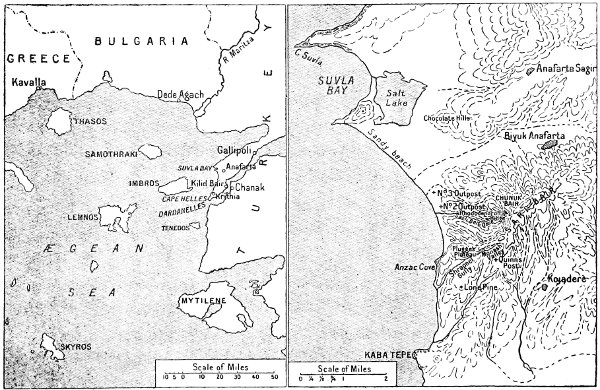
we came into Lemnos Harbour, with a keen wind
and a rustling deep blue sea, and white-crested
waves, with cheer on cheer from French and English
warships, from German prizes with British crews,
from submarines, and even from anchored balloons.
The next day I went ashore with a couple of
other officers to buy donkeys, who were to carry
our kits. Mudros was not too bad a town, and
was a very curious spectacle in those days. There
were great black Senegalese troops with filed teeth
who chased the children in play, though if the
children had known what their home habits were
the games would probably have ceased abruptly.
There were Greeks dressed in fantastic costume
and British troops of all sorts. Many old friends
from the East were there, among them Colonel
Doughty Wylie, who in a few days was to win his
V.C. and lose a life of great value to his country.
I met a friend, Bettelheim, nicknamed “Beetle,”
whose life had been one long adventure. When
last I had seen him he had been an official in Turkey,
and in a rising had been dragged from his carriage
on Galata Bridge in Constantinople by the mob,
with his companion, the Emir Arslan. Emir Arslan
was torn to pieces, but “Beetle,” with his marvellous
luck, escaped.
Many of us lunched together under a vine, drinking
excellent wine at a penny a glass. Everybody
was extremely cheerful, and there was great elation
in the island air. The talk was, of course, about
the landing. A friend of mine said: “This is
a terrible business; entire Staffs will be wiped out.”
He seemed to think that the Staffs were the most
important thing.
After lunch I went to see the Mayor, to help
me buy all that I wanted. He was rather shaky
with regard to his own position, as Lemnos had not
yet been recognized by us as Greek, and our recognition
was contingent on the behaviour of the Greek
Government. He was a very good linguist, talking
French, a little English, Italian, Greek, Turkish
and Arabic. I think it was he who quoted to me
the story of the Khoja Nasr-ed-Din. Nasr-ed-Din
was lent a saucepan by a friend; he returned
it with another small saucepan, saying it had
produced a child. Next year the friend offered a
huge saucepan at the same date, which the friend
considered the breeding time of saucepans. Later
on, when his friend applied for the return of the
saucepan, Nasr-ed-Din said: “It is dead.” His
friend expostulated: “How can a saucepan die?”
“Well,” said Nasr-ed-Din, “if it can have a child,
why can’t it die?”
Lemnos itself, though then it was a pageant,
is on the whole a dreary island. The land was green,
as all lands are in the spring, but there was not the
carpet of anemones that one finds in Crete, Cyprus,
and other islands, nor was there even asphodel.
On Friday, April 16th, we heard that the Manitou
had been torpedoed, and that a number of men
had been drowned. This was not the case, though
she had had three torpedoes fired at her.
At this time we believed that we were to make
three simultaneous attacks, the New Zealanders
taking the centre of the Peninsula. A rather
melancholy call to arms was issued by General
Birdwood, the pith of which was that for the first
few days there would be no transport of any kind.
This made it all the more necessary to obtain the
donkeys, and with the help of the Mayor of Mudros
I bought six, and one little one for £1 as a mascot. It
was a great deal of trouble getting them on board.
The Greek whose boat I had commandeered was
very unfriendly, and I had to requisition the services
of some Senegalese troops.
Diary. April 21, 1915. Mudros. Inner Bay.
Monday, the 19th, I tried to dine on H.M.S. Bacchante,
but failed to find her. Dined on the Arcadia.
Came back with Commodore Keyes.... Met ——
(a journalist turned censor). He said that the
Turks had thirty 15-inch howitzers on Gallipoli,
also wire entanglements everywhere. The general
impression is that we shall get a very bad knock,
and that it may set the war back a year, besides
producing an indefinite amount of trouble in the
East.
Tuesday, April 20th. I went ashore to get
porters, but the Mayor was in a nervous state,
and I failed. I tried to get back in a dinghy with
a couple of Greeks, and we nearly swamped. A
gale got up. Finally I made the Imogen, tied up
by the Hussar, and at last reached my destination.
Great gale in the night. I hope we don’t suffer
the fate of the Armada. It is said that our orders
are to steam for the outer harbour at once.
It was curious to see the Imogen, once the Ambassador’s
yacht at Constantinople. In those days she
was treated with reverent care. The Mediterranean
had to be calmed by the finest of weather before
she travelled. Now she had to sink or swim with
the rest. Her adventures did not end at Lemnos.
Travellers may see her name written proudly on
the harsh cliffs of Muscat in the Persian Gulf, and
to-day she is probably at Kurna, the site of the
Garden of Eden.
On Thursday, April 22nd, I was able to get
two Greek porters, Kristo Keresteji (which being
interpreted means Kristo the Timber-merchant) and
Yanni, of the little island of Ayo Strati. Kristo
was with me until I was invalided in the middle
of October. He showed the greatest fidelity and
courage after the first few days. The other man
was a natural coward, and had to be sent away
when an opportunity offered, after the landing.
Diary. Friday, April 23rd. I have just seen
the most wonderful procession of ships I shall ever
see. In the afternoon we left for the outer harbour.
The wind was blowing; there was foam upon the
sea and the air of the island was sparkling. With
the band playing and flags flying, we steamed past
the rest of the fleet. Cheers went from one end of
the harbour to the other. Spring and summer
met. Everybody felt it more than anything that
had gone before.
After we had passed the fleet, the pageant of
the fleet passed us. First the Queen Elizabeth,
immense, beautiful lines, long, like a snake, straight
as an arrow. This time there was silence. It
was grim and very beautiful. We would rather
have had the music and the cheers.... This
morning instructions were given to the officers
and landing arrangements made. We leave at
1.30 to-night. The Australians are to land first.
This they should do to-night. Then we land....
Naval guns will have to cover our advance, and the
men are to be warned that the naval fire is very
accurate. They will need some reassuring if the
fire is just over our heads. The 29th land at Helles,
the French in Asia near Troy. This is curious,
as they can’t support us or we them. The Naval
Division goes north and makes a demonstration....
The general opinion is that very many boats must
be sunk from the shore. Having got ashore, we
go on to a rendezvous. We have no native guides....
The politicians are very unpopular.
The sea was very quiet between Lemnos and
Anzac on April 24th. There were one or two alterations
in plans, but nothing very material. We
expected to have to land in the afternoon, but this
was changed, and we were ordered to land after
the Australians, who were to attack at 4.30 a.m.
Some proposed to get up to see the first attack at
dawn. I thought that we should see plenty of
the attack before we had done with it, and preferred
to sleep.
Diary. Sunday, April 25th. I got up at 6.30.
Thoms, who shared my cabin, had been up earlier.
There was a continuous roll of thunder from the
south. Opposite to us the land rose steeply in
cliffs and hills covered with the usual Mediterranean
vegetation. The crackle of rifles sounded and
ceased in turns.... Orders were given to us to
start at 8.30 a.m.... The tows were punctual....
We were ordered to take practically nothing but
rations. I gave my sleeping-bag to Kyriakidis,
the old Greek interpreter whom I had snatched
from the Arcadia, and took my British warm and
my Burberry.... The tow was unpleasantly open
to look at; there was naturally no shelter of any
kind. We all packed in, and were towed across
the shining sea towards the land fight.... We
could see some still figures lying on the beach to
our left, one or two in front. Some bullets splashed
round.
As we were all jumping into the sea to flounder
ashore, I heard cries from the sergeant at the back
of the tow. He said to me: “These two men
refuse to go ashore.” I turned and saw Kristo
Keresteji and Yanni of Ayo Strati with mesmerized
eyes looking at the plops that the bullets made
in the water, and with their minds evidently fixed
on the Greek equivalent of “Home, Sweet Home.”
They were, however, pushed in, and we all scrambled
on to that unholy land. The word was then, I
thought rather unnecessarily, passed that we were
under fire.
It was difficult to understand why the Turkish
fire developed so late. If they had started shelling
us during our landing as they shelled us later,
our losses would have been very heavy. We
frequently owed our salvation in the Peninsula
to a Turkish weakness and a Turkish mistake.
They were constantly slow to appreciate a position
and take full advantage of it, and their shrapnel
was generally fused too high. Hardly any man
who landed escaped being thumped and bumped
on different occasions by shrapnel, which would,
of course, have killed or seriously wounded him
if the burst had not been so high. I remember
on the afternoon of the first landing a sailor was
knocked down beside me, and I and another man
carried him to what shelter there was. We found
that, while the bullet had pierced his clothes, it
had not even broken his skin. Said the sailor:
“This is the third time that that’s ’appened to
me to-day. I’m beginning to think of my little
grey ’ome in the West.” So were others.
We had landed on a spit of land which in those
days we called Shrapnel Point, to the left of what
afterwards became Corps Headquarters, though
later the other spit on the right usurped that name.
I took cover under a bush with a New Zealand
officer, Major Browne. This officer had risen from
the ranks. He fought through the whole of the
Gallipoli campaign, and in the end, to the sorrow
of all who knew him, was killed as a Brigadier
in France.
The shrapnel fire became too warm to be pleasant,
and I said: “Major, a soldier’s first duty is to
save his life for his country.” He said: “I
quite agree, but I don’t see how it’s to be done.”
We were driven from Shrapnel Point to the north,
round the cliff, but were almost immediately driven
back again by the furious fire that met us.
Diary. We were being shot at from three sides.
All that morning we kept moving. There were
lines of men clinging like cockroaches under the cliffs
or moving silently as the guns on the right and
left enfiladed us. The only thing to be done was
to dig in as soon as possible, but a good many
men were shot while they were doing this. General
Godley landed about twelve, and went up Monash
Gully with General Birdwood. We remained on
the beach.... We had no artillery to keep the
enemy’s fire down.
We spent a chilly night, sometimes lying down,
sometimes walking, as the rain began to fall after
dark, and we had not too much food. My servant,
Jack, who was a very old friend, and I made ourselves
as comfortable as we could.
There was a great deal of inevitable confusion.
We were very hard pressed; as every draft landed
it was hurried off to that spot in the line where
reinforcements were most needed. This naturally
produced chaos amongst the units, and order was
not re-established for some time. It was a terrible
night for those in authority. I believe that, had
it been possible, we should have re-embarked that
night, but the sacrifices involved would have been
too great. Preparations for the expedition had
been totally inadequate. The chief R.A.M.C.
officer had told me the ridiculously small number of
casualties he had been ordered to make preparations
for, and asked my opinion, which I gave him with
some freedom. As it was, we had to put 600
men on the ship from which we had disembarked in
the morning, to go back to hospital in Egypt, a
four days’ journey, under the charge of one officer,
who was a veterinary surgeon.
Diary. Monday, April 26th. At 5 o’clock
yesterday our artillery began to land. It’s a very
rough country; the Mediterranean macchia everywhere,
and steep, winding valleys. We slept on
a ledge a few feet above the beach.... Firing
went on all night. In the morning it was very
cold, and we were all soaked. The Navy, it appeared,
had landed us in the wrong place. This made the
Army extremely angry, though as things turned out
it was the one bright spot. Had we landed anywhere
else, we should have been wiped out.
I believe the actual place decided on for our
landing was a mile farther south, which was an open
plain, and an ideal place for a hostile landing
from the Turkish point of view.
Next morning I walked with General Godley
and Tahu Rhodes, his A.D.C., up the height to
the plateau which was afterwards called Plugges
Plateau. The gullies and ravines were very steep,
and covered with undergrowth. We found General
Walker, General Birdwood’s Chief of the Staff,
on the ridge that bears his name. Bullets were
whining about, through the undergrowth, but were
not doing much harm, though the shelling on the
beach was serious.
Diary. We believed that the Turks were using
16-inch shells from the Dardanelles, and we were
now able to reply. The noise was deafening,
and our firing knocked down our own dugouts.
The Generals all behaved as if the whole thing
was a tea-party. Their different Staffs looked
worried for their chiefs and themselves. Generals
Godley and Walker were the most reckless, but
General Birdwood also went out of his way to
take risks. The sun was very hot, and our clothes
dried while the shrapnel whistled over us into
the sea.
At noon we heard the rumour that the 29th
were fighting their way up from Helles, and everybody
grew happy. We also heard that two
Brigadiers had been wounded and one killed.
The Australians had brought with them two
ideas, which were only eliminated by time, fighting,
and their own good sense. The “eight hours’
day” was almost a holy principle, and when they
had violated it by holding on for two or three days
heroically, they thought that they deserved a
“spell.” Their second principle was not to leave
their pals. When a man was wounded his friends
would insist upon bringing him down, instead of
leaving him to the stretcher-bearers. When they
had learned the practical side of war, both these
dogmas were jettisoned. In Egypt the Australians
had human weaknesses, and had shown them;
in Gallipoli they were the best of companions.
Naturally, with the New Zealand Division, I saw
more of the New Zealanders, who had the virtues
of the Australians and the British troops. They
had all the dash and élan of the Australians, and the
discipline of the Englishmen.
Diary. Tuesday, April 27th. Last night, or
rather this morning at about 1 o’clock, I was
called up by C. He said: “We are sending up
40,000 rounds of ammunition to Colonel Pope.”
Greek donkey-boys, with an Indian escort, were to
go up with this ammunition. I asked if any officer
was going, and was answered “No”; that there
was no officer to go. I said that I would go if I
could get a guide, but that I did not talk Hindustani,
and that the whole thing was risky, as we were
just as likely without a guide to wander into the
Turks as to find our own people; also that if we
were attacked we should be without means of communicating,
and that the Greeks would certainly
bolt. At the Corps Headquarters I found an
absolutely gaga officer. He had an A.D.C. who
was on the spot, however, and produced a note
from Colonel Pope which stated that he had all
the ammunition he wanted. The officer, in spite
of this, told me to carry on. I said it was nonsense
without a guide, when Pope had his ammunition.
He then told me to take the mules to one place
and the ammunition to another. I said that I
had better take them both back to my own Headquarters,
from which I had come. He then tried
to come with me, after saying that he would put
me under arrest, but fell over two tent-ropes and
was nearly kicked by a mule, and gave up in
mute despair.
I may add that this officer was sent away shortly
afterwards. The next night he was found with
a revolver stalking one of the Staff officers, who
was sleeping with a night-cap that looked like a
turban, to shelter his head from the dew. My
persecutor said that he thought he was a Turk.
Diary. Three of us slept crowded in one dugout
on Monday night. The cliff is becoming like a
rookery, with ill-made nests. George Lloyd and
Ian Smith have a charming view, only no room to
lie down in. Everybody’s dugout is falling on his
neighbour’s head. I went round the corner of the
cliff to find a clean place to wash in the sea, but
was sniped, and had to come back quick. The
Gallipoli Division of Turks, 18,000 strong, is
supposed to be approaching, while we listened to
a great artillery duel not far off. An Armenian
who was captured yesterday reported the Gallipoli
Division advancing on us. On Tuesday night things
were better. I think most men were then of the
opinion that we ought to be able to hold on, but
we were clinging by our eyelids on to the ridge.
The confusion of units and the great losses in officers
increased the difficulty.
This was the third day of battle. My dugout
was twice struck. A tug was sunk just in front
of us.... The interpreters have all got three days’
beards which are turning white from worry. The
shells to-day did not do so much damage; they
whirled over us in coveys, sometimes hitting the
beach and flying off singing, sometimes splashing
in the sea, but a lot of dead and wounded were
carried by.
About this time the spy mania started, which
is one of the inevitable concomitants of war. Spies
were supposed to be everywhere. In the popular
belief, that is “on the beach,” there were enough
spies to have made an opera. The first convincing
proof of treachery which we had was the story
of a Turkish girl who had painted her face green
in order to look like a tree, and had shot several
people at Helles from the boughs of an oak. Next
came the story of the daily pigeon post from Anzac
to the Turkish line; but as a matter of fact, the
pigeons were about their own business of nesting.
We had with us, too, a remarkable body of men
who were more than suspect, and whose presence
fed the wildest rumours. These were called Zionists,
Zionites, and many other names. They were the
Jewish exiles from Syria, who looked after the
mules, and constituted the Mule Corps, under
Colonel Patterson, of lion-hunting fame. They
performed very fine service, and gave proof of the
greatest courage. On several occasions I saw the
mules blown to bits, and the men of the Mule Corps
perfectly calm, among their charges. One night
it did seem to me that at last we had got the genuine
article. A panting Australian came to say that
they had captured a German disguised as a member
of the Mule Corps, but that he had unfortunately
killed one man before being taken. When I examined
this individual he gave his name as Fritz
Sehmann, and the language in which we conversed
most easily was German. He was able to justify
himself in his explanation, which turned out to be
true. He had been walking along the cliff at night
with his mule, when the mule had been shot and
had fallen over the cliff with Fritz Sehmann.
Together they had fallen upon an unfortunate
soldier, who had been killed by the same burst.
It was a work of some difficulty to explain to the
Colonial troops that many of the prisoners that we
took—as, for instance, Greeks and Armenians—were
conscripts who hated their masters. On one occasion,
speaking of a prisoner, I said to a soldier:
“This man says he is a Greek, and that he hates the
Turks.” “That’s a likely story, that is,” said the
soldier; “better put a bayonet in the brute.”
The trouble that we had with the native interpreters
is even now a painful memory. If they were
arrested once a day, they were arrested ten times.
Those who had anything to do with them, if they
were not suspected of being themselves infected
by treachery, were believed to be in some way
unpatriotic. It was almost as difficult to persuade
the officers as the men that the fact that a man
knew Turkish did not make him a Turk. There
was one moment when the interpreters were flying
over the hills like hares.
Diary. Wednesday, April 28th. I got up at
4 a.m. this morning, after a fine, quiet night, and
examined a Greek deserter from the Turkish Army.
He said many would desert if they did not fear
for their lives. The New Zealanders spare their
prisoners.
Last night, while he was talking to me, Colonel C.
was hit by a bit of shell on his hat. He stood quite
still while a man might count three, wondering
if he was hurt. He then stooped down and picked
it up. At 8 p.m last night there was furious shelling
in the gully. Many men and mules hit. General
Godley was in the Signalling Office, on the telephone,
fairly under cover. I was outside with Pinwell,
and got grazed, just avoiding the last burst. Their
range is better. Before this they have been bursting
the shrapnel too high. It was after 4 p.m. their
range improved so much. My dugout was shot
through five minutes before I went there. So was
Shaw’s....
Colonel Chaytor was knocked down by shrapnel,
but not hurt. The same happened to Colonel
Manders. We heard that the Indian troops were
to come to-night. Twenty-three out of twenty-seven
Auckland officers killed and wounded.
11 a.m. All firing except from Helles has ceased.
Things look better. The most the men can do
is to hang on. General Godley has been very
fine. The men know it.
4.30 p.m. Turks suddenly reported to have
mounted huge howitzer on our left flank, two or
three miles away. We rushed all the ammunition off
the beach, men working like ants, complete silence
and furious work. We were absolutely enfiladed,
and they could have pounded us, mules and
machinery, to pulp, or driven us into the gully
and up the hill, cutting us off from our water and
at the same time attacking us with shrapnel. The
ships came up and fired on the new gun, and proved
either that it was a dummy or had moved, or had
been knocked out. It was a cold, wet night.
The material which General Birdwood and General
Godley had to work upon was very fine. The
Australians and the New Zealanders were born
fighters and natural soldiers, and learnt quickly on
Active Service what it would have taken months
of training to have taught them. But like many
another side-show, Anzac was casual in many ways,
as the following excerpt from this diary will
show:—
Diary. Thursday, April 29th. Kaba Tepé. I
was woken at 2.30 a.m., when the New Zealanders
stood to arms. It was wet and cold, and a wind
blew which felt as if it came through snowy gorges.
The alarm had been given, and the Turks were
supposed to be about to rush the beach from
the left flank in force. Colonel Chaytor was sent
to hold the point. He told me to collect stragglers
and form them up. It was very dark, and the
stragglers were very straggly. I found an Australian,
Quinn, and told him to fetch his men along to the
gun emplacement, beyond the graves, on the point
where Chaytor was. Every one lost every one.
I found Colonel Chaytor with an Australian
officer. He said to him: “Go out along the flank
and find out where the Canterbury Battalion is,
and how strong. On the extreme left there is a
field ambulance. They must be told to lie down,
so that the Turks will not shoot them.” I said
I would look after them. We started. I heard
the Australian, after we had gone some hundreds
of yards, ordering the Canterburys in support to
retire. I said: “But are your orders to that
effect? A support is there to support. The Canterburys
will be routed or destroyed if you take this
support away.” He said: “Well, that’s a bright
idea.” He went back, and I heard him say, in the
darkness: “This officer thinks you had better
stay where you are.” I don’t know if he was a
Colonel, or what he was, and he did not know
what I was.
I found the field ambulance, a long way off,
and went on to the outposts. The field ambulance
were touchingly grateful for nothing, and I had
some tea and yarned with them till morning, walking
back after dawn along the beach by the graves.
No one fired at me.
When I got back I heard the news of Doughty’s2
death, which grieved me a great deal.... He
seems to have saved the situation. The description
of Helles is ghastly, of the men looking down into
the red sea, and the dying drowned in a foot of
water. That is what might have, and really ought
to have happened to us.
One hears the praise of politicians in all men’s
mouths....
A beautiful night, last night, and a fair amount
of shrapnel. Every evening now they send over
a limited number of howitzers from the great guns
in the Dardanelles, aimed at our ships. That
happens also in the early morning, as this morning.
To-night an aeroplane is to locate these guns, and
when they let fly to-morrow we are to give them
an immense broadside from all our ships.
At this time the weather had improved, but we
were living in a good deal of discomfort. We
were not yet properly supplied with stores, the
water was brackish, occasionally one had to shave
in salt water, and all one’s ablutions had to be done
on the beach, with the permission of the Turkish
artillery.
The beach produced a profound impression on
almost all of us, and has in some cases made the
seaside distasteful for the rest of our lives. It
was, when we first landed, I suppose, about
30 yards broad, and covered with shingle. Upon
this narrow strip depended all our communications:
landing and putting off, food and water, all came
and went upon the beach—and the Turkish guns
had got the exact range. Later, shelters were
put up, but life was still precarious, and the openness
of the beach gave men a greater feeling of insecurity
than they had in the trenches.
Diary. Our hair and eyes and mouths are full
of dust and sand, and our nostrils of the smell of
dead mules.
There were also colonies of ants that kept in
close touch with us, and our cigarettes gave out.
Besides these trials, we had no news of the war
or of the outer world.
Diary. Tahu and I repacked the provisions
this morning. While we did so one man was shot
on the right and another on the left. We have been
expecting howitzers all the time, and speculating
as to whether there would be any panic if they
really get on to us. The Turks have got their
indirect, or rather enfilading, fire on us, and hit
our mules. One just hit a few yards away....
Imbros and Samothrace are clear and delicate
between the blue sea and the hot sky. The riband
of beach is crowded with transport, and Jews,
Greeks, Armenians, New Zealanders, Australians,
scallywag officers, and officers that still manage to
keep a shadow of dandyism between their disreputable
selves and immaculate past. And there’s
the perpetual ripple of the waves that is sometimes
loud enough to be mistaken for the swish of shrapnel,
which is also perpetual, splashing in the sea or
rattling on the beach. There is very little noise
on the beach in the way of talk and laughter. The
men never expected to be up against this. When
we left Lemnos we saw one boat with an arrow
and in front of it “To Constantinople and the
Harem.” Precious few of those poor fellows will
ever see Constantinople, let alone the Harem.
May 1st. A beautiful dawn, but defiled by a
real hymn of hate from the Turks. Last night
the Torgut Reiss sent us some shells. This morning
it was supposed to be the Goeben that was
firing. I woke to hear the howitzers that everybody
had been talking of here droning over us, and watched
them lifting great columns of water where they hit
the sea. Then there came the sigh and the snarl
of shrapnel, but that to the other is like the rustle
of a lady’s fan to the rumble of a brewer’s dray.
This hymn of hate went on for an unusually long
time this morning from the big stuff. A lot of
men were hit all round, and it has been difficult
to wash in the sea. All the loading, unloading,
etc., is done at night. The picket-boats are fairly
well protected. The middies are the most splendid
boys. We are all very cramped and the mules add
to the congestion. We shall have a plague of
flies before we are done, if we don’t have a worse
plague than that. The New Zealanders are all
right....
Colonel White, Rickes and Murphy, all hit at
breakfast this morning, but not hurt. One of the
Greek donkey-boys says he is a barber. This
would be a great advantage if he wasn’t so nervous
and did not start so much whenever there is a burst.
There is a fleet of boats in front of us, and even
more at Helles; the Turks must feel uncomfortable,
but another landing, between us, would be pretty
risky. They are fighting splendidly. Opinions are
divided as to what would happen if we fought our
way to Maidos. Many think we could be shelled
out again by the Goeben. This expedition needed
at least three times the number of men. The
Indians have not come, and the Territorials cannot
come for a long time.
General Godley wants to change Headquarters
for us. Colonel Artillery Johnston’s battery is on
our right, facing the Turks, and only a few yards
away. The Turks spend a lot of time shooting
at it, missing it, and hitting us. Another man
killed just now. Shrapnel, heaps of it, is coming
both ways on us. Nobody speaks on the beach.
We have two tables on the top of the dugout.
One is safe, and the other can be hit. The punctual
people get the safe table.
B. has lunched. He says that Rupert Brooke died
at Lemnos. I am very sorry; he was a good fellow,
and a poet with a great future. B. was blown
up by a shell yesterday. He has to go back to-night.
While we lunched a man had his head blown off
20 yards away....
Orders have come that we are to entrench impregnably.
We are practically besieged, for we
can’t re-embark without sacrificing our rear-guard,
and if the howitzers come up we shall be cut off
from the beach and our water. A lot more men
have been killed on the beach....
Sunday, May 2nd. 6 a.m. Shrapnel all round
as I washed. Beach opinion is if this siege lasts
they must be able to get up their heavy guns. The
Indians have gone to Helles, and the Naval Division
is being taken away from us. New Turkish Divisions
are coming against us. There are no chaplains
here for burial or for anything else.
Waite took a dozen prisoners this morning—gendarmes,
nice fellows. They hadn’t much to
tell us. One of them complained that he had been
shot through a mistake after he had surrendered.
There ought to be an interpreter on these occasions....
It is a fiery hot day, without a ripple on the clear
sea, and all still but for the thunder coming from
Helles. I bathed and got clean. The beach looks
like a mule fair of mutes, for it is very silent. We
are to attack to-night at seven. We have now been
here a week, and advanced a hundred yards farther
than the first rush carried us. There is a great
bombardment going on, a roaring ring of fire,
and the Turks are being shelled and shelled.
At night the battleships throw out two lines of
searchlights, and behind them there gleam the
fires of Samothrace and Imbros. Up and down
the cliffs here, outside the dugouts, small fires
burn. The rifle fire comes over the hill, echoing
in the valleys and back from the ships. Sometimes
it is difficult to tell whether it is the sound of ripples
on the beach or firing.
Monday, May 3rd. I was called up at 3 a.m.
to examine three prisoners. Our attack has failed,
and we have many casualties, probably not less
than 1,000. The wounded have been crying on
the beach horribly. A wounded Arab reported
that our naval gun fire did much damage.
The complaint is old and bitter now. We insist
that the Turks are Hottentots. We give them
notice before we attack them. We tell them what
we are going to do with their Capital. We attack
them with an inadequate force of irregular troops,
without adequate ammunition (we had one gun
in our landing) in the most impregnable part of
their Empire. We ask for trouble all over the East
by risking disaster here.
The Goeben is shelling the fleet, and (11.30) has
just struck a transport. The sea is gay, and a
fresh wind is blowing, and the beach is crowded,
but there is not a voice upon it, except for an
occasional order....
The Turks are now expected to attack us. We
suppose people realize what is happening here
in London, though it isn’t easy to see how troops
and reinforcements can be sent us in time—that is,
before the Turks have turned all this into a fortification.
A good many men hit on the beach to-day.
The mules cry like lost souls.
Tuesday, May 4th. The sea like a looking-glass,
not a cloud in the sky, and Samothrace looking
very clear and close. The moon is like a faint
shadow of light in the clear sky over the smoke
of the guns. Heavy fighting between us and
Helles. A landing is being attempted. Pessimists
say it is our men being taken off because their
position is impossible. The boats coming back
seem full of wounded. It may have been an attempt
at a landing and entrenching, or simply a repetition
of what we did the other day at Falcon Hill or
Nebronesi, or whatever the place is.
The attack has failed this morning. Perfect
peace here, except for rifles crackling on the hill.
Ian Smith and I wandered off up a valley through
smilax, thyme, heath and myrtle, to a high ridge.
We went through the Indians and found a couple of
very jolly officers, one of them since killed. There
are a good many bodies unburied. Not many
men hit. We helped to carry one wounded man
back. The stretcher-bearers are splendid fellows,
good to friend and enemy. At one place we saw a
beastly muddy little pond with a man standing
in it in trousers, shovelling out mud. But the water
in a tin was clear and cool and very good....
General Godley and Tahu Rhodes got up to the
Turkish trenches, quite close to them. The Turks
attacked, threw hand-grenades, and our supports
broke. The General rallied the men, but a good
many were killed, amongst them the General’s
orderly, a gentleman ranker and a first-rate fellow.
Wednesday, May 5th. Kaba Tepé. The other
day, when our attack below failed, the Turks allowed
us to bring off our wounded. This was after that
unfortunate landing.
Went on board the Lutzow to-day, and got some
of my things off. Coming back the tow rope parted,
and we thought that we should drift into captivity.
It was rough and unpleasant.
Thursday, May 6th. Very cold night. The dead
are unburied and the wounded crying for water
between the trenches. Talked to General Birdwood
about the possibility of an armistice for burying
the dead and bringing in the wounded. He thinks
that the Germans would not allow the Turks to
accept.
Colonel Esson3 landed this morning. He brought
the rumour that 8,000 Turks had been killed lower
down on the Peninsula. We attacked Achi Baba
at 10 a.m. There was an intermittent fire all
night.
This morning I went up to the trenches with
General Godley by Walker’s Ridge. The view was
magnificent. The plain was covered with friendly
olives.... General Birdwood and General Mercer,
commanding the Naval Brigade were also there.
The trenches have become a perfect maze. As
we went along the snipers followed us, seeing Onslow’s
helmet above the parapet, and stinging us with
dirt. Many dead. I saw no wounded between
the lines. On the beach the shrapnel has opened
from a new direction. The Turks were supposed
to be making light railways to bring up their howitzers
and then rub us off this part of the Peninsula. This
last shell that has just struck the beach has
killed and wounded several men and a good many
mules....
Friday, May 7th. A bitter night and morning....
This morning a shell burst overhead, when I heard
maniac peals of laughter and found the cook flying
up, hit in the boot and his kitchen upset; he was
laughing like a madman. It’s a nuisance one has
to sit in the shade in our dining place and not in
the sun. They have got our exact range, and are
pounding in one shell after another. A shell has
just burst over our heads, and hit a lighter and
set her on fire.
The mules, most admirable animals, had now
begun to give a good deal of trouble, alive and dead.
There were hundreds of them on the beach and
in the gullies. Alive, they bit precisely and kicked
accurately; dead, they were towed out to sea, but
returned to us faithfully on the beach, making bathing
unpleasant and cleanliness difficult. The dead mule
was not only offensive to the Army; he became
a source of supreme irritation to the Navy, as he
floated on his back, with his legs sticking stiffly
up in the air. These legs were constantly mistaken
for periscopes of submarines, causing excitement,
exhaustive naval manœuvres and sometimes
recriminations.
My special duties now began to take an unusual
form. Every one was naturally anxious for Turkish
troops to surrender, in order to get information,
and also that we might have fewer men to fight.
Those Turks who had been captured had said
that the general belief was that we took no prisoners,
but killed all who fell into our hands, ruthlessly.
I said that I believed that this impression, which
did us much harm, could be corrected. The
problem was how to disabuse the Turks of this
belief. I was ordered to make speeches to them
from those of our trenches which were closest to
theirs, to explain to them that they would be well
treated and that our quarrel lay with the Germans,
and not with them.
Diary. Friday, May 7th. At 1.30 I went up
Monash Valley, which the men now call the “Valley
of Death,” passing a stream of haggard men, wounded
and unwounded, coming down in the brilliant
sunlight. I saw Colonel Monash4 at his headquarters,
and General Godley with him, and received
instructions. The shelling overhead was terrific,
but did no damage, as the shells threw forward,
but the smoke made a shadow between us and
the sun. It was like the continuous crashing of
a train going over the sleepers of a railway bridge.
Monash, whom I had last seen at the review in
the desert, said: “We laugh at this shrapnel.”
He tried to speak on the telephone to say I was
coming, but it was difficult, and the noise made
it impossible. Finally I went up the slope to
Quinn’s Post, with an escort, running and taking
cover, and panting up the very steep hill. It felt
as if bullets rained, but the fact is that they came
from three sides and have each got about five
echoes. There’s a décolleté place in the hill that
they pass over. I got into the trench, and found
Quinn, tall and openfaced, swearing like a trooper,
much respected by his men. The trenches in
Quinn’s Post were narrow and low, full of exhausted
men sleeping. I crawled over them and through
tiny holes. There was the smell of death everywhere.
I spoke in three places.
In conversations with the Turks across the trenches
I generally said the same thing: that we took
prisoners and treated them well; that the essential
quarrel was between us and the Germans and not
between England and the Turks; that the Turks
had been our friends in the Crimea; and I ended
by quoting the Turkish proverb “Eski dost dushman
olmaz” (An old friend cannot be an enemy).
These speeches probably caused more excitement
amongst our men than in the ranks of the Turks,
though the Constantinople Press declared that a
low attempt to copy the muezzin’s call to prayer
had been made from our lines. There were many
pictures drawn of the speech-maker and the shower
of hand-grenades that answered his kindly words.
It must be admitted that there was some reason for
these caricatures. Upon this first occasion nothing
very much happened—to me, at any rate. Our lines
were very close to the Turkish lines, and I was
able to speak clearly with and without a megaphone,
and the Turks were good enough to show some
interest, and in that neighbourhood to keep quiet
for a time. I got through my business quickly,
and went back to the beach. It was then that the
consequences of these blandishments developed,
for the places from which I had spoken were made
the object of a very heavy strafe, of which I had
been the innocent cause, and for which others
suffered. When I returned two days later to make
another effort at exhortation, I heard a groan
go up from the trench. “Oh, Lord, here he comes
again. Now for the bally bombs.” On the first
occasion when not much had happened it had been:
“Law, I’d like to be able to do that meself.”
Diary. Friday, May 7th. On getting back here
we had a very heavy fire, which broke up our dinner
party, wounded Jack Anderson, stung Jack (my
servant), hit me. Jack is sick.... Here are three
unpleasant possibilities:—
1. Any strong attack on the height. The Navy
could not help then. We should be too mixed
in the fighting.
2. The expected blessed big guns to lollop over
howitzers.
3. Disease. The Turks have dysentery already.
There is an uncanny whistling overhead. It
must come from the bullets and machine-guns
or Maxims a long way off. It sounds eldritch.
T. very sick after seeing some wounded on the beach,
and yet his nerves are very good. Eastwood told
me that he was sure to get through. I told him not
to say such things. He had three bullets through
his tunic the other day. I went on the Lutzow
to get the rest of my stuff off, and found Colonel
Ryan (“Turkish Charlie”)5 full of awful descriptions
of operations. Many wounded on the boat, all very
quiet.... Had a drink with a sailor, the gloomiest
man that ever I met. He comes from Southampton,
and thinks we cannot possibly win the war. It’s
become very cold.
Most of the diary of May 9th is too indiscreet
for publication, but here are some incidents of the
day:—
Worsley6 says it’s very hard to get work done
on the beach; in fact its almost impossible. It
was said that the gun which had been enfilading
us was knocked out, but it is enfilading us now,
and it looks as if we shall have a pretty heavy bill
to pay to-day. The beach is holding its breath,
and between the sound of the shrapnel and the
hiss there is only the noise of the waves and a few
low voices.... Harrison, who was slightly wounded
a few days ago, was yesterday resting in his dugout
when he was blown out of it by a shell. To-day
he was sent to the Lutzow, and we watched him
being shelled the whole way, his boat wriggling.
It seems as if the shells know and love him. I
am glad he won’t be dining with us any more;
a magnet like that is a bore, though he is a very
good fellow. The land between us and the 29th
is reported to be full of barbed wire entanglements.
Monday, May 10th. Raining and cold. Jack
better.
Colonel Braithwaite woke me last night with
the news of the sinking of the Lusitania. Last
night we took three trenches, but lost them again
this morning. S. B. came last night; I was glad
to see him.
S. B. had been a great friend of mine in Egypt
and brought me and others letters, of which we
were badly in need, and stores, which were very
welcome. We met upon the beach, and decided
to celebrate the occasion in the Intelligence dugout,
for my friend had actually got some soda and a
bottle of whisky, two very rare luxuries on the
beach.
Diary. We went into the Intelligence dugout
and sat there. Then a shell hit the top of the
dugout. The next one buzzed a lot of bullets
in through the door. The third ricochetted all
over the place and one bullet grazed my head.
I then said: “We’d better put up a blanket
to save us from the ricochets.” At the same
time J. was shot next door and Onslow’s war
diary was destroyed. A pot of jam was shot
in General Cunliffe Owen’s hand, which made him
very angry. V., the beachmaster, dashed into our
Intelligence dugout gasping while we held blankets
in front of him. Two days ago a man was killed
in his dugout next door, and another man again
yesterday. Now two fuses had come straight
through his roof and spun like a whipping-top on
the floor, dancing a sort of sarabande before the
hypnotized eyes of the sailors....
Also S. B.’s whisky was destroyed in the luncheon
basket. He broke into furious swearing in Arabic.
Wednesday, May 12th. Rain, mud, grease, temper
all night, but we shall long for this coolness when
it really gets hot. No bombardment this morning,
but the Greek cook, Christopher of the Black Lamp,
came and gave two hours’ notice, with the rain and
tears running down his face. I am not surprised
at his giving notice, but why he should be meticulous
about the time I can’t think. Conversation about
the shelling is getting very boring.
Had a picturesque walk through the dark last
night, past Greeks, Indians, Australians, across a
rain-swept, wind-swept, bullet-swept hillside. Many
of the Colonels here are business men, who never
in their wildest dreams contemplated being in
such a position, and they have risen to the occasion
finely. The Generals have at last been prevailed
upon not to walk about the beach in the daytime....
Two German and one Austrian submarine
expected here. The transports have been ordered to
Mudros.
Thursday, May 13th. Very calm morning, the
echoes of rifle fire on the sea. I went with C. to
take General Russell7 up from Reserve Gully to
Walker’s Ridge. It was a beautiful morning, with
the sky flaming softly, not a cloud anywhere, and
the sea perfectly still. The scrub was full of wild
flowers; not even the dead mules could spoil it.
Guns thundered far off.... After breakfast
examined an intelligent Greek prisoner, Nikolas,
the miller from Ali Kenì. Then I was telephoned
for by Colonel Monash in great haste, and went off
up his valley with a megaphone as quickly as possible.
In the valley the men were in a state of nerves
along the road because of the snipers. The Turks
had put up a white flag above their trenches opposite
Quinn’s Post. I think this was an artillery flag
and that they hoped to avoid the fire of the fleet
by this means.... The people at Helles aren’t
making headway, and it seems unlikely, except
at tremendous cost, and probably not then, that
they will. We are pretty well hung up except
on our left; why not try there? The Turks are
not yet entrenched or dug in there as in other
places.... I had to bully Yanni of Ayo Strati
till he sobbed on the cliff. I then threatened to
dismiss him, after which he grew cheerful, for it
was what he wanted....
The Turks have again got white flags out. Have
been ordered to go up at dawn.
Friday, May 14th. 4 a.m. Walked up the
valley. The crickets were singing in the bushes
at the opening of the valley and the place was cool
with the faint light of coming dawn. Then a line
of stretcher-bearers with the wounded, some quiet,
some groaning. Then came the dawn and the
smell of death that infects one’s hands and clothes
and haunts one.
They weren’t over-pleased to see me at first,
as after my speech the other day they had had an
awful time from hand-grenades, and their faces
fell when I appeared. I spoke from the same
place. Then I went to another, and lastly to a
trench that communicated with the Turkish trench.
The Greek who had surrendered last night came down
this trench and the Turks were said to be five to
ten yards off. It was partly roofed, and there were
some sandbags, between two and three feet high,
that separated us from them. Leading into this
was a big circular dugout, open to heaven. I
got the men cleared out of this before speaking.
In the small trench there were two men facing the
Turks and lying on the ground with revolvers
pointed at the Turks. I moved one man back
out of the way and lay on the other—there wasn’t
anything else to be done—and spoke for five minutes
with some intervals. Once a couple of hand-grenades
fell outside and the ground quivered, but
that was all. I then got the guard changed....
The loss of the Goliath is confirmed and the
fleet has gone, leaving a considerable blank on
the horizon and a depression on the sunlit beach.
Four interpreters were arrested to-day and handed
over to me.
I put them on to dig me a new dugout, round
which a colony of interpreters is growing: Kyriakidis,
who is a fine man and a gentleman; Ashjian, a young
Armenian boy, aristocratic-looking, but very soft,
whom I want to send away as soon as possible;
and others. My dugout is in the middle of wild
flowers, with the sea splashing round. Since the
ships have all gone we are, as a consequence, short
of water.... The Turks have been shelling our
barges hard for an hour. We are to make an
attack to-night and destroy their trenches.
Saturday, May 15th. The attack has failed.
There are many of our wounded outside our lines.
Have been told to go out with a white flag. Was
sent for by Skeen8 to see General Birdwood in half
an hour. While Colonel Skeen and I were talking
a shell hit one man in the lungs and knocked Colonel
Knox on the back without hurting him. General
Birdwood was hit yesterday in the head, but won’t
lie up, General Trottman the day before. While
we talked water arrived. A message came from
Colonel Chauvel to say there were only two wounded
lying out.... In a few minutes a telephone message
arrived from the doctor in the trenches that the
two wounded had died.... I came back to Headquarters,
and heard General Bridges9 asking the
General if he might go up Monash Valley. In
a few minutes we heard that he was shot in the
thigh. The snipers are getting many of our men.
If the Germans were running this show they would
have had 200,000 men for it.
Last night Kyriakidis heard a nightingale. I
notice that the cuckoo has changed his note, worried
by the shrapnel. I don’t blame the bird. My
new dugout is built. It has a corridor and a patio,
and is sort of Louis Quinze. The food is good,
but we are always hungry.
Went out with Colonel N. He is a very great
man for his luxuries, and looks on cover as the
first of these. He is very funny about shelling,
and is huffy, like a man who has received an insult,
if he gets hit by a spent bullet or covered with earth.
They have got the range of our new Headquarters
beautifully—two shells before lunch, one on either
side of the kitchen range. The men and the mess
table covered with dust and stones. The fact
is our ships have gone; they can now do pretty
much as they like.
Most people here agree that the position is hopeless,
unless we drive the Turks back on our left
and get reinforcements from Helles, where they
could quite well spare them.
Sunday, May 16th. A day fit for Trojan heroes
to fight on. As a matter of fact, there is a good
deal of Trojan friction. Went into the Intelligence
dugout, as five men were hit below it. They have
just hit another interpreter, and are pounding
away at us again. I was warned to go out with
a flag of truce and a bugler this afternoon.
Monday, May 17th. I walked out to the left
with S. B., and bathed in a warm, quiet sea. Many
men bathing too, and occasionally shrapnel also.
There was a scent of thyme, and also the other
smell from the graves on the beach, which are
very shallow. I got a touch of the sun, and had
to lie down. When I got back I heard that Villiers
Stuart had been killed this morning, instantaneously.
He was a very good fellow, and very good to me.
Tuesday, May 18th. Last night Villiers Stuart
was buried. The funeral was to have been at
sunset, but at that time we were savagely shelled
and had to wait. We formed up in as decent a
kit as we could muster, and after the sun had set in
a storm of red, while the young moon was rising,
the procession started. We stumbled over boulders,
and met stretcher-bearers with dead and wounded,
we passed Indians driving mules, and shadowy
Australians standing at attention, till we came to
the graves by the sea. The prayers were very short
and good, interrupted by the boom of our guns
and the whining of Turkish bullets overhead. His
salute was fired above his head from both the
trenches....
We shelled the village of Anafarta yesterday,
which I don’t much care about. A good many
here want to destroy the minaret of the mosque.
I can see no difference in principle between this
and the destruction of Rheims Cathedral. Kyriakidis
told me a Greek cure for sunstroke. You
fill the ears of the afflicted one with salt water;
it makes a noise like thunder in his head, but the
sunstroke passes. Christo thereupon got me salt
water in a jug without telling me, and several
thirsty people tried to drink it....
A German submarine seen here.... A day
of almost perfect peace; rifle fire ceased sometimes
for several minutes together, but 8-inch shells
were fired into the trenches.... Men are singing
on the beach for the first time, and there is something
cheerful in the air. The enfilading gun has been,
as usual, reported to be knocked out, but gunners
are great optimists. No news from Helles....
Turkish reinforcements just coming up. Attack
expected at 3 a.m. We stand to arms here.
Wednesday, May 19th. Work under heavy shell
fire. This grew worse about 6.30. Several heavy
shells hit within a few yards of this dugout and the
neighbouring ones, but did not burst. A little
farther off they did explode, or striking the sea,
raised tall columns and high fountains of white
water. Colonel Chaytor badly wounded in the
shoulder. A great loss to us. He talked very
cheerfully. I have got leave to send away Ashjian....
This, after all, is a quarrel for those directly
concerned. The Germans have brought up about
twelve more field-guns and four or five Jack Johnsons,
and the shelling is very heavy. Saw a horrid
sight: a barge full of wounded was being towed
out to the hospital ship. Two great Jack Johnsons
came, one just in front of them; then when they
turned with a wriggle, one just behind them, sending
up towers of water, and leaving two great white
roses in the sea that turned muddy as the stuff
from the bottom rose. They had shells round
them again, and a miraculous escape. It’s cruel
hard on the nerves of wounded men, but of course
that was bad luck, not wicked intentions, because
the enemy couldn’t see them.
If the Turks had attacked us fiercely on the top
and shelled us as badly down here earlier, they
might have had us out. Now we ought to be all
right, and they can hardly go on using ammunition
like this. Their losses are said to be very great.
New Turkish reinforcements said to be at Helles.
They have done what we ought to have done.
Now they are throwing 11-inch at us. It’s too bad....
I saw Colonel Skeen. He said to me: “You
had better be ready to go out this afternoon. We
have just shot a Turk with a white flag. That will
give us an excuse for apologizing”; quite so: it will
also give the Turk an excuse for retaliating. A
Turkish officer just brought in says that the real
attack is to be this afternoon, now at 1.30. I
spent an hour in the hospital, interpreting for
the Turkish wounded. The Australians are very
good to them. On returning I found the General’s
dugout hit hard. Nothing to be done but to dig
deeper in.
From the third week in May to the third week
in June was the kernel of our time at Anzac. We
had grown accustomed to think of the place as
home, and of the conditions of our life as natural
and permanent. The monotony of the details of
shelling and the worry of the flies are of interest
only to those who endured them, and have been
eliminated, here and there, from this diary.
During this month we were not greatly troubled.
The men continued to make the trenches impregnable,
and were contented. It was in some ways
a curiously happy time.
The New Zealanders and the Australians were
generally clothed by the sunlight, which fitted
them, better than any tailor, with a red-brown
skin, and only on ceremonial occasions did they
wear their belts and accoutrements.
Our sport was bathing, and the Brotherhood of
the Bath was rudely democratic. There was at
Anzac a singularly benevolent officer, but for all
his geniality a strong disciplinarian, devoted to
military observances. He was kind to all the
world, not forgetting himself, and he had developed
a kindly figure. No insect could resist his contours.
Fleas and bugs made passionate love to him, inlaying
his white skin with a wonderful red mosaic.
One day he undressed and, leaving nothing of his
dignity with his uniform, he mingled superbly with
the crowd of bathers. Instantly he received a
hearty blow upon his tender, red and white shoulder
and a cordial greeting from some democrat of
Sydney or of Wellington: “Old man, you’ve been
amongst the biscuits!” He drew himself up to
rebuke this presumption, then dived for the sea,
for, as he said, “What’s the good of telling one
naked man to salute another naked man, especially
when neither have got their caps?”
This month was marked by a feature that is
rare in modern warfare. We had an armistice
for the burial of the dead, which is described in
the diary.
On the Peninsula we were extremely anxious
for an armistice for many reasons. We wished,
on all occasions, to be able to get our wounded in
after a fight, and we believed, or at least the
writer was confident, that an arrangement could be
come to. We were also very anxious to bury the
dead. Rightly or wrongly, we thought that G.H.Q.,
living on its perfumed island, did not consider how
great was the abomination of life upon the cramped
and stinking battlefield that was our encampment,
though this was not a charge that any man would
have dreamed of bringing against Sir Ian Hamilton.
Diary. Wednesday, May 19, 1915. Kaba Tepé.
General Birdwood told me to go to Imbros to talk
to Sir Ian Hamilton about an armistice, if General
Godley would give me leave.
Thursday, May 20, 1915. Kaba Tepé. Have
been waiting for four hours in Colonel Knox’s
boat, which was supposed to go to Imbros. Turkish
guns very quiet.... Hear that Ock Asquith and
Wedgwood are wounded. A liaison officer down
south says: “When the Senegalese fly, and the
French troops stream forward twenty yards and
then stream back twenty-five yards, we know
that we are making excellent progress.” There is
a Coalition Government at home. We think that
we are the reason of that; we think the Government
cannot face the blunder of the Dardanelles
without asking for support from the Conservatives.
6 p.m. “Arcadian.” Found George Lloyd. Have
been talking to Sir Ian Hamilton with regard
to the armistice.... Clive Bigham10 was there.
He lent me some Shakespeares.
Friday, May 21, 1915. Kaba Tepé. Saw Sir
Ian Hamilton again this morning. The Turks
are said to have put up a white flag and to have
massed behind it in their trenches, intending to
rush us. Left with four “Arcadians.”
There was a parley yesterday while I was away.
The Turks had put up some white flags, but it was
not a case of bad faith as the “Arcadians” believed.
We are said to have shot one Red Crescent man by
mistake. General Walker went out to talk to the
Turks, just like that. Both sides had, apparently,
been frightened. I walked back to Reserve Gully
with the General, to see the new brigade. The
evening sun was shining on the myrtles in all the
gullies, and the new brigade was singing and
whistling up and down the hills, while fires crackled
everywhere.
Saturday, May 22, 1915. Kaba Tepé. S. B. was
sent out yesterday to talk to the Turks, but he
did not take a white flag with him, and was sniped
and bruised.... This morning, suddenly, I was
sent for. S. B. and I hurried along the beach
and crossed the barbed wire entanglements. We
went along by the sea, through heavy showers of
rain, and at last met a fierce Arab officer and a
wandery-looking Turkish lieutenant. We sat and
smoked in fields splendid with poppies, the sea
glittering by us.
Then Kemal Bey arrived, and went into Anzac
with S. B., while I went off as hostage.
S. B. and Kemal Bey, as they went, provided
the Australian escort with much innocent laughter.
Our barbed wire down to the sea consisted only
of a few light strands, over which the Turk was
helped by having his legs raised high for him.
S. B., however, wished him, as he was blindfolded,
to believe that this defence went on for at least
twenty yards. So the Turk was made to do an
enormously high, stiff goose-step over the empty
air for that space, as absurd a spectacle to our
men as I was to be, later, to the Turks. The
Australians were almost sick from internal laughter.
Diary. Kemal Bey asked for a hostage, and I
went out. They bandaged my eyes, and I mounted
a horse and rode off with Sahib Bey. We went
along by the sea for some time, for I could hear
the waves. Then we went round and round—to
puzzle me, I suppose—and ended up in a tent in
a grove of olives, where they took the handkerchief
off, and Sahib Bey said: “This is the beginning
of a life-long friendship.”
At one moment, as I was riding along, the soldier
who was supposed to be leading my horse had
apparently let go and had fallen behind to light
a cigarette or pick flowers. I heard Sahib Bey
call out: “You old fool! Can’t you see he’s
riding straight over the cliff?” I protested loudly
as I rode on, blind as fate.
We had cheese and tea and coffee, Sahib Bey
offering to eat first to show me that it was all right,
which I said was nonsense. He said: “It may
not be political economy, but there are some great
advantages in war. It’s very comfortable when
there are no exports, because it means that all
the things stay at home and are very cheap.” He
tried to impress me with their well-being. He
said he hated all politicians and had sworn never
to read the papers. The Turks had come sadly
into the war against us, otherwise gladly. They
wanted to regain the prestige that they had lost
in the Balkans.... He said, after I had talked
to him: “There are many of us who think like
you, but we must obey. We know that you are
just and that Moslems thrive under you, but you
have made cruel mistakes by us, the taking of those
two ships and the way in which they were taken.”
He asked me a few questions, which I put aside.
He had had a conversation with Dash the day
before, when we parleyed. Dash is a most innocent
creature. He had apparently told him that G.H.Q.
was an awful bore, and also the number of Turkish
prisoners we had taken....
Sunday, May 23, 1915. Kaba Tepé. We landed
a month ago to-day. We now hold a smaller
front than then. Also the Albion has gone
ashore. The rest of the fleet has left; she remains
a fixture. All the boats are rushing up to tow
her off. The Turks are sending in a hail of
shrapnel.... It will be a bad business if they
don’t get her off.... They have got her off,
thank the Lord, and every one is breathing more
freely.
We wonder if all the places with queer, accidental
names will one day be historical: Johnson’s Jolly,
Dead Man’s Ridge, Quinn’s Post, The Valley of
Death, The Sphinx, Anzac—by the way, that’s
not a name of good omen, as “anjak” in Turkish
means barely, only just—Plugge’s Plateau. Plugge
is a grand man, wounded for the second time.
The New Zealanders are all most gallant
fellows....
The big fight ought to come off, after the armistice.
Two more divisions have come up against us. All
quiet last night, but a shell came into the New
Zealand hospital on the beach and killed four
wounded men and a dresser and some more outside.
It’s these new guns whose position we still do not
know.
Tuesday, May 25, 1915. Kaba Tepé. We had
the truce yesterday. I was afraid something might
go wrong, but it all went off all right. Skeen,
Blamey,11 Howse, V.C.,12 Hough and I started early.
Skeen offered me breakfast but, like a fool, I refused.
He put some creosote on my handkerchief.
We were at the rendezvous on the beach at 6.30.
Heavy rain soaked us to the skin. At 7.30 we met
the Turks, Miralai Izzedin, a pleasant, rather sharp,
little man; Arif, the son of Achmet Pasha, who
gave me a card, “Sculpteur et Peintre,” and “Etudiant
de Poésie.” I saw Sahib and had a few words
with him, but he did not come with us. Fahreddin
Bey came later. We walked from the sea and
passed immediately up the hill, through a field of
tall corn filled with poppies, then another cornfield;
then the fearful smell of death began as we
came upon scattered bodies. We mounted over
a plateau and down through gullies filled with
thyme, where there lay about 4,000 Turkish dead.
It was indescribable. One was grateful for the
rain and the grey sky. A Turkish Red Crescent
man came and gave me some antiseptic wool with
scent on it, and this they renewed frequently.
There were two wounded crying in that multitude
of silence. The Turks were distressed, and Skeen
strained a point to let them send water to the first
wounded man, who must have been a sniper crawling
home. I walked over to the second, who lay with
a high circle of dead that made a mound round
him, and gave him a drink from my water-bottle,
but Skeen called me to come on and I had to leave
the bottle. Later a Turk gave it back to me. The
Turkish Captain with me said: “At this spectacle
even the most gentle must feel savage, and the
most savage must weep.” The dead fill acres of
ground, mostly killed in the one big attack, but
some recently. They fill the myrtle-grown gullies.
One saw the result of machine-gun fire very clearly;
entire companies annihilated—not wounded, but
killed, their heads doubled under them with the
impetus of their rush and both hands clasping
their bayonets. It was as if God had breathed
in their faces, as “the Assyrian came down like
the wolf on the fold.”
The line was not easy to settle. Neither side
wanted to give its position or its trenches away.
At the end Skeen agreed that the Turks had been
fair. We had not been going very long when we
had a message to say that the Turks were
entrenching at Johnson’s Jolly. Skeen had, however,
just been there and seen that they were doing
nothing at all. He left me at Quinn’s Post, looking
at the communication trench through which I
had spoken to the Turks. Corpses and dead men
blown to bits everywhere. Richards was with me
part of the time: easy to get on with; also a gentleman
called indifferently by the men Mr. or Major Tibbs.
A good deal of friction at first. The trenches
were 10 to 15 yards apart. Each side was on the
qui vive for treachery. In one gully the dead had
got to be left unburied. It was impossible to bury
them without one side seeing the position of the
other. In the Turkish parapet there were many
bodies buried. Fahreddin told Skeen he wanted
to bury them, “but,” he said, “we cannot take
them out without putting something in their place.”
Skeen agreed, but said that this concession was
not to be taken advantage of to repair the trench.
This was a difficult business.
When our people complained that the Turks
were making loopholes, they invited me into their
trench to look. Then the Turks said that we
were stealing their rifles; this came from the dead
land where we could not let them go. I went
down, and when I got back, very hot, they took
my word for it that we were not. There was some
trouble because we were always crossing each
other’s lines. I talked to the Turks, one of whom
pointed to the graves. “That’s politics,” he said.
Then he pointed to the dead bodies and said:
“That’s diplomacy. God pity all of us poor
soldiers.”
Much of this business was ghastly to the point
of nightmare. I found a hardened old Albanian
chaoush and got him to do anything I wanted.
Then a lot of other Albanians came up, and I said:
“Tunya tyeta.”13 I had met some of them in Janina.
They began clapping me on the back and cheering
while half a dozen funeral services were going on
all round, conducted by the chaplains. I had to
stop them. I asked them if they did not want
an Imam for a service over their own dead, but
the old Albanian pagan roared with laughter and
said that their souls were all right. They could
look after themselves. Not many signs of fanaticism.
One huge, savage-looking Anatolian looked
curses at me. Greeks came up and tried to surrender
to me, but were ordered back by the Turks
pretty roughly.
Considering the number of their men we had
killed, they remained extraordinarily unmoved and
polite. They wouldn’t have, if we had been
Russians. Blamey came to say that Skeen had
lost H. and wanted me, so he, Arif and I walked
to the sea. The burying had not been well done.
It was sometimes impossible to do it.... As we
went, we took our rifles from the Turkish side,
minus their bolts, and gave the Turks their rifles
in the same way....
Our men gave cigarettes to the Turks, and
beyond the storm-centre at Quinn’s Post the feeling
was all right. We sat down and sent men to look
for Skeen. Arif was nervous and almost rude.
Then Skeen came. He told me to get back as
quickly as possible to Quinn’s Post, as I said I was
nervous at being away, and to retire the troops
at 4 and the white-flag men at 4.15. I said to
Arif: “Everybody’s behaved very well. Now
we must take care that nobody loses his head.
Your men won’t shoot you and my men won’t
shoot me, so we must walk about, otherwise a
gun will go off and everybody will get shot.” But
Arif faded away. I got back as quickly as possible.
Blamey went away on the left. I then found that
the Turks’ time was eight minutes ahead of ours,
and put on our watches. The Turks asked me to
witness their taking the money from their dead,
as they had no officer there. They were very worried
by having no officer, and asked me if any one were
coming. I, of course, had no idea, but I told
them I would see that they were all right. They
were very patient....
The burying was finished some time before the
end. There were certain tricks on both sides.
Our men and the Turks began fraternizing,
exchanging badges, etc. I had to keep them apart.
At 4 o’clock the Turks came to me for orders. I
do not believe this could have happened anywhere
else. I retired their troops and ours, walking
along the line. At 4.7 I retired the white-flag
men, making them shake hands with our men.
Then I came to the upper end. About a dozen
Turks came out. I chaffed them, and said that
they would shoot me next day. They said, in
a horrified chorus: “God forbid!” The Albanians
laughed and cheered, and said: “We will never
shoot you.” Then the Australians began coming up,
and said: “Good-bye, old chap; good luck!” And
the Turks said: “Oghur Ola gule gule gedejekseniz,
gule gule gelejekseniz” (Smiling may you go and
smiling come again). Then I told them all to get
into their trenches, and unthinkingly went up to
the Turkish trench and got a deep salaam from
it. I told them that neither side would fire for
twenty-five minutes after they had got into the
trenches. One Turk was seen out away on our
left, but there was nothing to be done, and I think
he was all right. A couple of rifles had gone off
about twenty minutes before the end, but Potts
and I went hurriedly to and fro seeing it was all
right. At last we dropped into our trenches,
glad that the strain was over. I walked back
with Temperley. I got some raw whisky for the
infection in my throat, and iodine for where the
barbed wire had torn my feet. There was a hush
over the Peninsula....
Wednesday, May 26, 1915. Kaba Tepé. This
morning I was talking to Dix, asking him if he
believed there were submarines. “Yes,” he said,
and then swore and added: “There’s the Triumph
sinking.” Every picket-boat dashed off to pick
up the survivors. The Turks behaved well in not
shelling. There was fury, panic and rage on the
beach and on the hill. I heard Uncle Bill, half
off his head, saying: “You should kill all enemies.
Like a wounded bird, she is. Give them cigarettes.
Swine! Like a wounded bird. The swine!” He
was shaking his fist. Men were crying and cursing.
Very different from yesterday’s temper.
This afternoon I went round past Monash Gully,
towards Kaba Tepé, and bathed. I got shelled,
and came back over the ridges having a beastly
time from the shrapnel which hunted me.
We have now got a sap under Quinn’s Post.
The flies and ants are past endurance.
Thursday, May 27, 1915. Kaba Tepé. A very
wet night. I wish the Turks would forget how to
shoot. Here we are for an indefinite period without
the power of replying effectively and with the
knowledge that we are firmly locked outside the
back door of a side-show....
Went with the General to General Russell’s
trenches. They are very much improved. The
men call an ideal trench a Godley-Braithwaite
trench; that is, tall enough for General Godley
and broad enough for Colonel Braithwaite. Bathed.
Charlie Bentinck arrived. His destroyer lay just
off the beach and was shelled. Some sailors and
five soldiers killed. Forty-five wounded. Very
unfortunate. If they had come yesterday, it would
have been all right—a quiet day, though we had
thirty men sniped. The Majestic reported sunk
off Helles. Off to Mudros to get stores.
Friday, May 28, 1915. Mudros. Left after
many delays, and slept on deck. Very cold. It’s
a pretty tall order for the French to put black
Senegalese cannibals into Red Cross uniform....
Saturday, May 29, 1915. Lemnos. Drove across
the island to Castro. There was a delightful spring
half a mile from Castro and a café kept by a Greek.
His wife had been killed by the Turks. Great
fig-trees and gardens. I met two naval officers,
who told me Wedgwood had died of wounds. I
am very sorry; he was a very fine man. I admired
him a lot. Castro is beautiful, with balconies
over the narrow streets, half Turk and half Greek,
and shady gardens. I bathed in a transparent
sea, facing Athos, which was gleaming like a diamond.
I watched its shadow come across the eighty miles
of sea at sunset, as Homer said it did. I found a
Greek, who had been Cromer’s cook. He said he
would come back and cook for me, if there was no
danger. He said he knew that G.H.Q. cooks were
safe, but his wife would not let him go on to the
Peninsula. He said her idea of warfare was wrong.
She always thought of men and bullets skipping
about together on a hillside.
Sunday, May 30, 1915. Mudros. I bathed
before dawn and went back to Mudros with masses
of mosquito-netting, etc. Turkish prisoners of the
French were being guarded by Greeks. It was
rather like monkeys looking after bears. They
wore uniforms that were a cross between Ali Pasha
of Janina and Little Lord Fauntleroy. I saw
H., who had been on the River Clyde. He looked
as if he were still watching the sea turn red with
blood, as he described the landing on Gallipoli.
Jack was sick, and I had to leave him with my
coat. Went and saw my friend the Papas of the
little Greek church on the hill.
Monday, May 31, 1915. Anzac. I saw Hutton
this morning, slightly wounded. Bathed at the
farthest point towards Kaba Tepé, but had to
fly with my clothes in my hand, leaving my
cigarettes....
Wednesday, June 2, 1915. Kaba Tepé. Had a
picturesque examination of a Greek peasant this
morning. It was a fine picture, with the setting
of the blue sea and the mountains. The man
himself was patriarchal and biblical, surrounded
by tall English officers and half-naked soldiers.
Last night we sent up bombs from Japanese mortars
by Quinn’s. It sounded beastly. This morning
I went to Reserve Gully with the General. Monash’s
Brigade is resting there for the first time for five
weeks. The General, looking like a Trojan hero,
made them a fine speech from a sort of natural
throne in the middle of the sunlit amphitheatre,
in which they all sat, tier after tier of magnificent-looking
fellows, brown as Indians. Bullets swept
over all the time, sometimes drowning the General’s
voice.... Have just heard that Quinn is killed.
I am very sorry. He was a fine, jolly, gallant
fellow.
Friday, June 4, 1915. Anzac. Nothing doing.
George Lloyd came over. Very glad to see him.
This morning I went with Shaw to the extreme
left, through fields of poppies, thyme and lavender.
We saw a vulture high overhead, and the air was
full of the song of larks. At Helles there was a
savage attack going on. There was very bad
sniping. In some places the trenches are only
knee-high; in other places there are no trenches
and the Turks are anything from four to eight
hundred yards off. Yesterday seventeen men were
hit at one place, they said, by one sniper. At
one place on the way, we ran like deer, dodging.
The General, when he had had a number of bullets
at him, also ran. Sniping is better fun than shrapnel;
it’s more human. You pit your wits against
the enemy in a rather friendly sort of way. A lot
of vultures collecting.
Saturday, June 5, 1915. Anzac. Examined sixteen
prisoners. Food good, munitions plentiful,
morale all right. The individuals fed up with the
war, but the mass obedient and pretty willing.
No idea of surrendering. They think they are
going to win. There was one Greek, a Karamanly,
who only talked Turkish. He did not say until
to-night that he was wounded. The flies are bad.
Sunday, June 6, 1915. Anzac. Went to the
service this morning with the General, in the
amphitheatre. The sermon was mainly against
America for not coming into the war, and also
against bad language. The chaplain said he could
not understand the meaning of it. The men laughed.
So did I.
Monday, June 7, 1915. Kaba Tepé. This morning
the land was sweet as Eden and there was
the calm of the first creation. H. has been made
a new Uriah the Hittite, but not because of
Mrs. H. Last night I was invaded by mice. There
is tremendous shelling going on now. This afternoon
S. B., Onslow and I climbed a hill and had a
beautiful view. Every one is rather ill and feverish.
I have no news about Jack. The Intelligence
office has been moved to a higher and safer place.
Pirie Gordon, poor chap, has gone sick a long time
ago. I rather liked the stuffy old place, which
was called “The Mountain Path to the Jackal’s
Cave.”
The attack last night failed, but the drone of
the rifles went on unceasingly, like the drone of
a dry waterfall. We shall not get to Constantinople
unless the flat-faced Bulgars come in.
Yesterday I lunched with Temperley at the H.Q.
of Monash Valley. Times have changed: it’s fairly
safe going there through a long sap they have dug,
and the noise is less bad.
Colonel —— had seen a lot of the Crown Prince
in India, and said he was a very good fellow. Dined
with Woods, Dix, S. B. and Edwards. Lots of
champagne for once; a very good dinner.
I went to No. 2 Outpost with the General. There
is a sap all the way now. Only one sniper the whole
way. The Turkish birds were singing beautifully
as we went. There was also a Turkish snake,
which I believed was quite harmless, but Tahu
killed it. The men are getting pretty tired. They
are not as resigned as their ten thousand brother-monks
over the way at Mount Athos.
Friday, June 11, 1915. Kaba Tepé. The Australians
and New Zealanders have given up wearing
clothes. They lie about and bathe and become
darker than Indians. The General objects to this.
“I suppose,” he says, “we shall have our servants
waiting on us like that.” The flies are very bad,
so are the mice, and so is the shelling....
Sunday, June 13, 1915. Kaba Tepé. A lot of
mules and several men hit yesterday. Last night,
S. B. and I were on the beach, when a man on a
stretcher went by, groaning rhythmically. I thought
he had been shot through the brain. Later on I
went into the hospital to find a wounded Turk,
and found that this man had never been hit at all.
He had been doing very good work till a shell
exploded near him and gave him a shock. Then
he went on imitating a machine-gun. Some men
in a sap up at Quinn’s have been going off their
heads.
Awful accounts of Mudros: flies, heat, sand,
no water, typhoid. To-day are the Greek elections.
Am dining with H. Woods. “The beach” now
says that Ot has been poisoned by the Greek
guides, whom he illtreats and uses as cooks. I
shouldn’t wonder. The shelling is bad. I am
going to make a new dugout to get away from
the flies and mice. The Turkish prisoners will
do this. I pay them a small sum.
Tuesday, June 15, 1915. Kaba Tepé. Colonel
Chauvel14 has pleurisy, Colonel Johnston15 enteric.
The sea’s high and the Navy depressed.... One
man and two mules killed in our gully this morning;
the body of one mule blown about 50 yards both
ways.
Wednesday, June 16, 1915. Kaba Tepé. Rain. I
was to have gone to Helles with Woods to see Dedez,
but no boats went; it was too rough. I was going
to talk about spies to S. B., when General Cunliffe
Owen said to me: “Wait a bit. The shelling is
too bad. We will go along together.” But I was
in too much of a hurry. A shell fell in the gully
as I crossed, and Woods came out to see where
it had hit. It went into Machonochie’s dugout,
where H. was, and blew him out of his dugout,
black and shaken. It destroyed his furniture. I
felt sorry for him. Ot tried to turn him out of
the Intelligence dugout, but we protested.
The General has come back with the latest
casualty lists from France....
Thursday, June 17, 1915. Helles. Thirty men
killed and wounded on the beach to-day. This
morning I came to Helles with Woods. As we
got there a submarine had two shots at one of our
transports by us. I was to have seen Dedez, but
he had gone off to see Gouraud. George Peel
walked in and took me round the beach, two miles
on. We climbed on to the headland, in what he
called “the quiet track of the Black Marias.”
He talked of every mortal thing—the future Liberal
and Socialist, the possibility of touching the heart
of the people, the collapse of Christianity, our past
and our policy. I left him and walked back across
thyme and asphodel, Asia glowing like a jewel
across the Dardanelles in the sunset. At night I
talked late and long with Dash. Every Department
is jealous, every one is at cross-purposes, no co-operation
between the War Office and the Foreign
Office.
Walked in the morning to the H.Q. of the R.N.D.
with Whittall. We were shelled most of the way
in the open landscape. There was no cover anywhere.
It felt unfamiliar. I was unfavourably
impressed with the insecurity of life in this part
of the world, and wished for Anzac. In the evening
we drank mavrodaphne and tried to get rid of——
Friday, June 18, 1915. Kaba Tepé. I left
Helles in the middle of very heavy shelling, a star
performance. A lot of horses killed this morning.
A submarine popped up last night. As we came
back to Anzac the Turks shelled our trawler and
hit her twice, but without doing any damage.
Shelling grew worse at Anzac, and sickness began
to make itself felt. Men were sent across to Imbros
when it was possible to rest.
Diary. On June 25th I went across to Imbros
with H. Woods and the Greek miller, Nikolas.
Hawker was there, and E. of Macedonia. E. is
very unpopular. If he takes a dislike to a man
he digs around his dugout, until it falls in on him.
The chief R.A.M.C. officer, an Irishman, was mourning
over the ruins of his home. We slept uncomfortably
on the ground, with flies to keep us warm.
As I was writing this a shell burst outside my
dugout, a lot of shrapnel coming through, and one
bullet glancing off the typewriter, which has just
come. At the same time Jack was hit across the
gully going from my dugout to his. Conolly,
the escort, and I carried him down, after binding
his leg up, under heavy fire. Then I nipped back
to get some of his stuff to take off, but on going
back to the beach found that he had gone. Many
men hit on the beach. Thousands of flies on
the wounded. The General’s blankets riddled with
bullets. They have our range, pat. Two days
ago Colonel Parker had his chair and table smashed
while he was in his dugout. He left it to have
tea with Wagstaffe. There he was reading when
another bullet tore his paper in two. I have been
covered with dirt several times in the last days.
L. S. Amery came with K. I only saw him for a
minute, worse luck, but he is coming back to-morrow,
I hope, when we can have a talk. G.H.Q.
turned up in force, and walked about like wooden
images.
We have a clerk here, Venables. He has got
tired of writing, and, wanting to change the pen
for the sword, borrowed a rifle and walked up to
the front line at Quinn’s Post. There he popped
his head in and said: “Excuse me, is this a private
trench, or may any one fire out of it?”
The sound of battle has ended. Men are bathing.
The clouds that the cannonade had called up are
gone, and the sea is still and crimson in the sunset
to Imbros and Samothrace.
Tuesday, June 29, 1915. Anzac. We have
advanced 1,000 yards down at Helles, but no
details yet. Many men shot here yesterday by
the Anafarta gun. I should think this gun had
as good a tale of killed and wounded as any gun
in the war. Every day it gets its twenty odd
on the beach. The Australians attacked on the
right yesterday. Fifty killed and wounded; they
think the Turks suffered more heavily. I went
with the General to the extreme left. Terrific
heat. We came to a valley filled with thyme and
lavender, which the Maoris are to inhabit. The
men were bathing beyond Shrapnel Point. They
say the Turks let them. I had two letters—one
two months old, a curious one to receive here, from
an Englishwoman, wife of the ex-Grand Vizier of
Afghanistan. He was a progressive man, and is
therefore in an Afghan prison. She wants work
for her son. Wants him to be a saddler, a job
a lot of men here would like. All my stuff looted
coming from Egypt.
Men are practising bomb-throwing, all over the
place. They are mostly half-naked, and darker
than Red Indians. It’s a day of blessed peace,
but there’s a lot of feeling about the Anafarta
gun, and bathing is stopped on the beach till
night.
Wednesday, June 30, 1915. Anzac. Last night
I went down to the hospital and was inoculated
for cholera by C., a witty man. A trench had
been blown in, and men were lying groaning on
the floor, most of them suffering from shell-shock,
not wounds, but some of the wounds horrible....
I asked C. why the wounded were not sent to
Cyprus instead of Mudros. He said: “Because it’s a
splendid climate and there is heaps of water.” The
chief doctor at Mudros is useless, the second ——
(With regard to the second doctor I regret that
the diary is libellous.) Anyway, what is certain
is that the condition of the sick and wounded is
awful. This morning it’s very rough, and I can’t
get out to Jack at the hospital ship, as prisoners
are coming in....
July 1, 1915. Anzac. I examined the prisoners,
amongst them a tall Armenian lawyer, who talked
some English. I asked him how he had surrendered.
He said: “I saw two gentlemen with
their looking-glasses, and came over to them.”
By this he meant two officers with periscopes. He
said that the psychology of the Turks is a curious
thing. They do not fear death, yet are not
brave....
No water came in yesterday. The storm wrecked
the barges and the beach is covered with lighters.
We got brackish water from the hill. I could not
get to Jack for work.
At lunch I heard there were wounded crying
on Walker’s Ridge, and went up there with Zachariades.
We found a first-rate Australian, Major
Reynell. We went through the trenches, dripping
with sweat; it was a boiling day, and my head
reeled from inoculation. We had to crawl through
a secret sap over a number of dead Turks, some of
whom were in a ghastly condition, headless and
covered with flies. Then out from the darkness
into another sap, with a dead Turk to walk
over. The Turkish trenches were 30 yards off, and
the dead lay between the two lines.
When I called I was answered at once by a Turk.
He said he could not move.... I gave him a drink,
and Reynell and I carried him in, stumbling over
the dead among whom he lay. I went back for
my water-bottle, but the Turks began shooting
as a warning, and I had to go back into the trench.
An awful time getting the Turk through the
very narrow trench. I got one other, unwounded,
shamming dead. We threw him a rope, and in
he came.
The taking of the second Turk was a curious
episode that perhaps deserves a little more description
than is given by the diary. The process
of catching Turks fascinated the Australians, and
amongst them an R.A.M.C. doctor who came round
on that occasion. This officer prided himself upon
neatness and a smart appearance, when the dust
and heat of the Dardanelles had turned every one
else into scallywags. After he had attended to
the first wounded man, he pointed out the second
Turk lying between our trenches and the Turks’
and only a few yards from either. “You go out
again, sir,” said the Australians; “it’s as good
as a show.” I, however, took another view. I
called out to the Turk: “Do you want any water?”
“By God,” he whispered back, “I do, but I am
afraid of my people.” We then threw him a rope
and pulled him in. He told us that the night
before he had lost direction in the attack. Fire
seemed to be coming every way, and it had seemed
to him the best plan to fall and lie still amongst
his dead comrades. The doctor gave him some water,
with which he rinsed his mouth, and I left him
under the charge of the R.A.M.C. doctor. This
is what happened subsequently. They had to
crawl back through the secret sap, from which
the bodies of the dead Turks had by that time been
removed and left at the entrance. The Turk
was blindfolded, but he was able to see under the
handkerchief, and when he saw his dead comrades,
over whose bodies he had to step, he leapt to the
conclusion that it was our habit to bring our prisoners
to one place and there to kill them. He gave
one panic-stricken yell; he threw his arms round
the neck of the well-dressed officer; they fell and
rolled upon the corpses together, the Turk in convulsions
of fear clinging to the neck of the doctor,
pressing his face to the faces of the dead till he
was covered with blood and dust and the ghastly
remains of death, while the soldiers stood round
saying to the Turk: “Now, don’t you carry on so.”
Diary. Friday, July 2. Anzac. This morning
I had a magnificent bathe with General
Birdwood. At night a great storm blew up. The
lightning played in splendid glares over Imbros
and Samothrace. The sea roared, the thunder
crashed and rain spouted down. After a time
that stopped and a cloud, black as ink, came down
upon us like a pall.
Yesterday mourning met the two Whittalls going
to Helles with General de Lotbiniere and his
periscopes.
I went off to the Sicilia to see Jack, and had a lot
of trouble about a pass. I saw Jack. He said
they had re-bound his leg on the beach, but that
it had not been looked at for eighteen hours on
the boat. It had swelled to double its size. Then
a doctor came and said the bandage had been done
too tight, and there was a chance of his losing
his leg. I felt absolutely savage.... Saw General
House,16 V.C., on shore and got him to promise
to do what he could. We had a bad time going
home. We were slung off the ship in wooden cases.
It was very rough indeed, and when the wooden
case hit the flat barge it bounced like anything.
Then we were towed out on this flat barge, open
to the great waves and shrapnel, to a lighter, and
left off Anzac for a couple of hours. The Turks
sent a few shells, absent-mindedly. Finally, a
trawler brought us off, very angry.
S. dined, a scholarly fanatic, interesting about
the next war, which he thinks will be with
Russia, in fifteen years. A lot of people going
sick.
I saw Cox to-night, who said that this is the worst
storm we have had. We have only one day’s
water supply. We could have had as much as
we had wanted, but many of the cans stored on
the beach are useless, as they have had holes
knocked in them by the shrapnel. We are not as
abstemious as the Turks, who had been lying for
so many hours under the sun, and shall suffer
from thirst badly.
Saturday, July 3, 1915. Anzac. Macaulay has
come as our artillery officer. I dined with him and
H. Woods last night. Yesterday it rained. Jack’s
boat has gone. We are being badly shelled here.
I shall have to change my dugout, if this goes on.
The guide Katzangaris has been hit in the mouth.
Sunday, July 4. Saw the Maoris, who had just
landed. General Godley made them a first-class
speech. They danced a very fine Haka with
tremendous enthusiasm in his honour when he
had finished. They liked digging their dugouts,
and seemed to like it when they came to human
remains.... More people going sick. Doctor F.
told me that he and another doctor had asked to
be allowed to help on board the hospital ships
where they have more wounded than they can
deal with, short-handed as they are, but have
been refused permission by the R.A.M.C.
There has been a great explosion at Achi Baba.
Macaulay saw a transport of ours sunk this afternoon....
G. L. came ashore with depressing
accounts of Russia. He is probably going to come
on this beach. Hope he does. Went off and
bathed with Macaulay. Saw Colonel Bauchop, who
promised me a present of some fresh drinking-water
to-morrow.
Monday, July 5, 1915. Kaba Tepé. A breathless,
panting morning, still and blue and fiery hot,
with not a ripple on the sea. Colonel Bauchop,
commanding the Otago Mounted Rifles, was shot
in the shoulder last night. This morning we have
had an exhibition of “frightfulness” in the shape
of vast shells. They burst with a tremendous
roar that echoes to the sky and across the sea for
more than a minute. Their case or bullets fall
over the sea in a great area. They started by
striking the sea and raising great columns of water.
Now they burst and fall on land and sea.
It has had the great result of getting rid of Mr.
Lock, the Socialist Czech, from the doorway of
my dugout. He was an undergraduate at ——
and afterwards a Labour candidate. Now he is
Colonel P.’s cook.
The transport that Macaulay saw go down was
French. Six lives lost. The explosion down south
was a French ammunition store. This shelling
makes one’s head ache.
Tuesday, July 6th. Kaba Tepé. Yesterday I
went to Quinn’s Post with General Godley in
the morning. There was a fair amount of shelling.
They had just hit thirteen men in Courtney’s before
we got there. We went into a mine that was being
dug towards and under the Turkish trenches. At
the end of the sap the Turks were only six to eight
feet away. We could hear them picking. The
time for blowing in had very nearly come. These
underground people take it all as a matter of course.
I should hate fighting on my stomach in a passage
two feet high, yards under the ground. The Turks
were throwing bombs from the trenches, and these
hit the ground over us, three of them, making it
shudder. Down below they talk in whispers. We
went round the trenches. Saw none so fine as last
time, when we came to the Millionaires’ Sap, so
called because it was made by six Australians,
each the son of a millionaire.
In the afternoon I tried to sleep, but there was
too much shelling. Kyumjiyan was hit, and has
gone; S. B. was grazed. It was 11.2 shells filled
with all kinds of stuff. We answered with a monitor
whose terrific percussions shook my dugout, bringing
down dust and stones. A submarine appeared,
and all the destroyers were after her. Then two
aeroplanes started a fight as the sun set down
towards Helles, appearing and vanishing behind
crimson clouds. Captain Buck, the Maori doctor
and M.P., dined with us, to wind up an exciting
day.
This morning is like yesterday. No breath of
air, but the day is more clear, and Samothrace
and Imbros look very peaceful. Early again the
shelling began. As I was shaving outside three
shells hit the beach just in front. I wasn’t watching
the third, but suddenly heard a great burst of
laughter. At the first shell a bather had rushed
back to his dugout; the shell had come and
knocked it in on the top of him, and he was dug
out, naked and black, but smiling and none the
worse. “Another blasted sniper,” he said, which
made the men laugh.
Active preparations are being made to fight
the gas, as the Intelligence says it is going to be
used. Am going out with the General at 9.30.
Was sent to get Colonel Parker, but found him sick,
and under pretty heavy fire, having a new dugout
built. Came back and stood with the General,
Thoms and others outside Headquarters. A shell
burst just by us, bruised the General in the ribs,
and filled his eyes with dirt. Went out with Colonel
Anthill and Poles. Talked of arranging a truce
to bury the Turkish dead on our parapet. They
said that otherwise our men must get cholera;
the heat and sand and flies and smell is awful.
We met Colonel Bauchop with his arm in a sling,
but the bullet out of his shoulder, and Colonel
White with his head still bandaged. The Australians
very cheerful.
Wednesday, July 7, 1915. Kaba Tepé. A fierce,
expectant dawn. We shelled furiously at 4.30 a.m.
Now absolute peace on a glassy sea. Last night
Bentinck, Jack Anderson and I bathed. I was
at the end of the pier; as I was beginning to dress
a shell burst very close, the smoke and powder in
my face. I fled half dressed; Colonel P. rose like
Venus from the sea and followed with nothing.
A calm marine gave me my cigarette-holder.
One of the prisoners reported that on the occasion
of the armistice Turkish Staff officers had put on
Red Crescent clothes in order to have a look at
our trenches.... No news of Jack.
The Turks put up five crosses yesterday, all of
which we shot down. I first thought it was probably
Greeks or Armenians who wanted to show they
were Christians, wishing to surrender, and telephoned
to Courtney’s to see if I could get into
touch with them, but now I think it’s probably
Turks who were anxious to make us shoot at the
sign of our own religion. In this they succeeded.
Colonel Johnson, Commanding the New Zealand
Infantry Brigade, gone sick. I persuaded the mess
to get inoculated for cholera. Last night I dined
with Woods and Macaulay. They told Eastern
stories, and we had a very contented time, drinking
mavrodaphne and looking at the sea.
The Turks shelled a little after eight, in answer to
our tiresome provocative monitor fire. This morning
Tahu arrived from Egypt with letters. The Turks
are bombing something cruel from Kaba Tepé....
It’s a beautiful sight—a sea like lapis-lazuli and a
burning sun, with columns of water like geysers
where the shells hit. A good many men hit here
to-day.
Saturday, July 10, 1915. Kaba Tepé. I went
with General Godley to the Triad, and dined with
Admiral de Robeck. Took the General’s things
to put them on board the picket-boat, but as I
got there a shell struck her and knocked a hole
in her. There was another one, and we sat and
waited uncomfortably in this till he came....
Found Alec Ramsay on board. Slept in Commodore
Roger Keyes’ cabin. Very comfortable. He was
very kind. Went to G.H.Q. and had lunch with
L. and Bob Graves.
Sunday, July 11th. Felt much better. Went
ashore and saw Colonel Hawker and the Turkish
prisoners.... Came back late at night, after some
very jolly days. Best week-end I ever spent. The
Turks have asked for another armistice in the
south. This has been refused. If they attack,
they will have to do it across their dead, piled high,
and this is not good for morale.
By this time the persecutions of the interpreters
had greatly diminished. They were still badly
treated by a man called Ot, but to a large extent
they had won the respect of the troops by their
behaviour. The chief interpreter was an old Greek
of some sixty-two or sixty-three years, Mr. Kyriakidis,
who was given a medal for conspicuous
gallantry at the bombardment of Alexandria and
had served with General Stuart’s unfortunate
expedition. He was a gentleman, and one of
the straightest men I have met. His simplicity,
courtesy and unfailing courage had gained him
many friends. He was also endowed with considerable
humour.
A relation had sent me a gas mask, at that time
a rarity at Anzac. I did not believe that I should
need it, and made a present of it to the first man
I met, who happened to be Mr. Kyriakidis. He
went down and played poker with the other interpreters
on the beach. He put on my respirator
as a poker mask, with much swagger. This put
the fear of death into the interpreters, who sent a
deputation to G.H.Q. Intelligence, insisting that
they should also be provided with masks.
Monday, July 12, 1915. Kaba Tepé. By the
way, an unhappy shadow was shot yesterday,
an interpreter of whom we none of us knew anything,
and who was on no list. Things are not
very comfortable. The fire is increasingly heavy.
All the air is full of thudding and broken echoes.
No one minds anything much, but high explosive....
The hospitals are being moved. They had too
many casualties where they were before.
Tuesday, July 13th. Kaba Tepé. Tremendous fire
round Achi Baba yesterday. French advanced 150
and we 200 yards. Don’t know what the losses
were. I went with Macaulay and Woods to No. 3
Post, to Bauchop’s Fountain. They can snipe there
very close, and killed a man a couple of days ago,
two yards off under the olives, and wounded his
mate, who crawled back into the sandy way. On
both sides there is tall wild lavender and what
M. calls pig’s parsley.
We crawled down a sandy path to the sea, M.
rather sick. Met the General going back, who told
us not to bathe. In the evening Tahu got out his
gramophone and we had some good songs when
the shooting was not too much.
Ramadan began to-day. George Lloyd arrived
this afternoon and said they wanted to send me
to Tenedos for a special job.
Yesterday evening General Godley went to
Courtney’s Post. As he got there the Turks shelled
with heavy stuff, killing and wounding about twenty
men. Reynell came to see me. I like him very
much indeed.
Diary. Sunday, July 18, 1915. Kaba Tepé.
They are now shelling the pier, and killed a doctor,
cutting off both his legs, and several other people,
when I was bathing from the pier. Everybody is
again going sick. The situation is changing. Every
night we are landing guns. The moon is young
now and growing. It seems, therefore, reasonable
to expect that we cannot land forces of men that
take time before the nights are moonless; that is,
in about a month’s time the preparations ought to
be ready.
A few days ago we had an attack on Achi Baba,
won about 400 yards and lost about 5,000 men.
Two battalions got out of touch and were lost
for a considerable time. The “Imbros Journal,”
“Dardanelles Driveller,” or whatever it’s called,
said “their return was as surprising as that of
Jonah from the belly of the whale.” Good, happy
author!
A German Taube over us throwing bombs and
also heavy stuff, but not much damage lately.
George Lloyd17 was here this afternoon, and while
we talked a shell burst and hit four men.
Monday, July 19, 1915. Kaba Tepé. My dugout
has now become a centre for Australian and New
Zealand officers, all good fellows. I had it made
small on purpose, so that no one would offer to share
it with me, and that makes it less convenient for
the crowd that now sit in it. Two old friends
come when the day’s work is over, and grow sentimental
by moonlight; both ill and, I am afraid,
getting worse. All the talk is now about gassing.
It is thought that they will do it to us here.
As usual, new troops are reported to be coming
against us.
Tuesday, July 20, 1915. Kaba Tepé. There is
always something fresh here. Now a lot of sharks
are supposed to have come in. During the last
two days there has been absolute silence, no shelling
at all, nothing but the sound of crickets and at
night a singsong chorus as the men drag up the
great tanks prepared for water. S. B. yesterday
worked out a theory to prove that the Turks were
to attack us last night. (1) No gunfire yesterday;
the reason being they (the Turks) were moving
troops. They didn’t want us to fire at their
troops, therefore didn’t draw fire by shooting at
us. (2) Ulemas have come down. There must
be a special reason for this. (3) 10,000 coming
up. Gas being prepared. All this means an attack
on Anzac. To wipe us out would be a great feather
in their cap. I am inclined to doubt another
great attack.... Tempers all a bit ruffled. General
Birdwood is sick. The heat is fierce and the
stillness absolute. This afternoon I heard from
Dedez, who asked me to go to Tenedos for a
time....
Wednesday, July 21, 1915. Kaba Tepé. There
is something uncanny about this calm. No shots
at all. News that the Italian Ambassador at
Constantinople has gone nap. We have had very
little news of Italy.... I wonder if the Turks
are likely to attack on the eve of Constitution Day.
Saturday, July 24, 1915. Imbros. On Wednesday
I went over to G.H.Q. and met old friends among
the war correspondents. Met some of the New
Zealanders who had come over for a rest, but were
coming back for the expected attack. Meanwhile,
they had been kept on fatigue most of the time,
and were unutterably weary. At Imbros I was
ordered to go to Tenedos and Mytilene.
Thursday, July 22nd. Came back to Anzac in
the same boat with Ashmead Bartlett and Nevinson,18
and got leave to take them round in the
afternoon.
Later on, during one of the worst days of the
Suvla fighting, I met my friend Nevinson picking
his way amongst the wounded on their stretchers
under fire. “After this,” he said, decisively, “I
shall confine myself strictly to revolutions.”
Diary. July 23rd. Started for Imbros and went
in the Bacchante pinnace, which was leaking badly
from a shell hole. There were six of us on deck,
and one man was hit when we were about a hundred
yards out. We put back and left him on shore.
Saturday, July 24th. Imbros. Went for a ride
on a mule, and had a bathe.
At this point in the campaign, though the morale
was excellent, depression began to grow. There
was a great deal of sickness, from which practically
no one escaped, though it was less virulent in its
form than later in the summer. I had been ill
for some time, and was very anxious to avoid being
invalided to Egypt, and was grateful for the chance
of going to the islands for a change of climate and
light work, for the few days that were sufficient
to give another lease of health.
The feeling that invades almost every side-show,
sooner or later, that the home authorities cared
nothing and knew nothing about the Dardanelles,
was abroad. The policy and the strategy of the expedition
were bitterly criticized. I remember a friend
of mine saying to me: “All this expedition is like
one of Walter Scott’s novels, upside down.” Walter
Scott generally put his hero at the top of a winding
stair, where he comfortably disposed, one by one, of
a hundred of his enemies. “Now,” he said, “what
we have done was, first of all to warn the Turks
that we were going to attack by having a naval
bombardment. That made them fortify the Dardanelles,
but still they were not completely ready.
We then send a small force to attack, to tell them
that we really are in earnest, and to ask them if
they are quite ready. In fact, we have put the man
who ought to be, not the hero, but the villain of
the piece, at the top of the corkscrew stair, and we
have given him so much notice that when the hero
attacks the villain has more men at the top of the
circular stair than the hero has at the bottom.
It’s like throwing pebbles at a stone wall,” he said,
mixing his metaphors.
Diary. Sunday, July 25, 1915. On the Sea. I
left for Tenedos; a most beautiful day. We have
just been to Anzac, very burnt and wounded
amongst the surrounding greenery. Pretty peaceful
there, only a few bullets coming over.
Perhaps the record of a sojourn in the Greek
Islands on what was really sick-leave, as the work
was of the lightest, should not be included in a war
diary, but the writer looks back with amusement
and pleasure to days that were not uneventful.
They were passed with friends who were playing
a difficult and most arduous part, and whose services,
in many cases, have not received the recognition
that was their due.
It was pleasant once again to be lord of the
horizon, to have space through which to roam,
and lovely hills and valleys to ride across in the
careless, scented air of the Mediterranean summer,
with the sea shining a peacock-blue through the
pines. It is this space and liberty that men cramped
in a siege desire, more than the freedom from the
shelling of the enemy’s guns. There was much,
too, that was opéra bouffe in the Islands, that made
a not unpleasant contrast to the general life at
Anzac.
If there was spy mania on the Peninsula, it was
multiplied tenfold, and quite reasonably, on the
Islands, where part of the population were strongly
pro-Ally, another part pro-German, while others
were anti-British by an accidental kind of ricochet.
These were the royalist followers of King Constantine,
who hated Venizelos, and consequently the
friends of Venizelos, Great Britain and France.
The situation on the Islands was one with which
it was extremely hard to cope. We were very
anxious to safeguard the lives of our men, and to
prevent information going to the enemy, and, at
the same time, not to pursue German methods. It
was unceasing work, with a great strain of responsibility.
There was an inevitable va et vient between
the Peninsula and Imbros. From Imbros boats
could slip across to Tenedos, Mytilene or the mainland.
The native caïques would drop in at evening,
report, be ordered to stay till further notice, and
would drift away like ghosts in the night. Men,
and women, performed remarkable feats, in appearing
and disappearing. They were like pictures on
a film in their coming and their going. Watchers
and watched, they thrust and parried, discovered
and concealed, glowed on the picture and darkened.
Anatasio, a Serbian by birth, was one of our
workers, conspicuous for his quickness and intelligence.
At the outbreak of the war he had
already been five months in an Austrian prison
at Cattaro, but the prospect of battle stimulated
his faculties, and he escaped. One day at luncheon
I asked him where it was that he had learned
Italian, which he did not talk very well. “While
I was in prison at Smyrna,” said he. “What
for?” said I. “For stabbing a Cretan,” said
he, and added that he would rather be five years
in prison in Turkey than one in Austria. Then
there was Avani, one of the most vivid personalities
that I have ever met. He was a poet and a clairvoyant,
a mesmerist and a masseur, a specialist
in rheumatism and the science of detection, once
a member of General Chermside’s gendarmerie
in Crete, and ex-chief of the Smyrna fire brigade.
The stories of him are too many, and too
flamboyant, to tell.
Diary. Avani mesmerized the wife of the Armenian
dragoman. Unfortunately it went wrong.
Her obedience to his volition was delayed and she
only obeyed his commands in the wrong company
some hours after.
He had given proof of rare courage, and also
considerable indiscretion. On one occasion, armed
to the teeth, he burst into a perfectly innocent
house at night, and, revolver in hand, hunted a
terrified inhabitant. His only evidence against this
man was, that when he had been caught and hurled
to the ground and sat upon, his heart had beaten
very fast, which would not happen, insisted Avani,
if he had not been guilty of some crime.
Amongst our opponents were the romantic but
sinister Vassilaki family, two brothers and three
lovely sisters. Talk about them in the Islands
was almost as incessant as was talk about shelling
on the Peninsula.
Diary. Monday, July 26, 1915. Tenedos. Yesterday
I was very ill, and again to-day, but was
injected with something or other and feel better,
but weak. Tried to sleep yesterday, but one of
our monitors at Rabbit Island bombarded hugely,
shaking the bugs down on me. This place is clean,
but there are bugs and some lice. Last night I
dined with the Governor, Colonel Mullins, and a
jolly French doctor, and Thompson, who has
fallen ill. Am carrying on for him at the
moment.
Tuesday, July 27, 1915. Tenedos. Went to
the trenches at Tenedos. They face the enemy.
That is the most military thing about them. Thompson
went out to see the inhabitants. I was going
with him, but felt worse and went to rest. The
Turks here are in a very bad way. We do not
allow them to work. It’s inevitable. They mayn’t
fish or work at the aerodrome.
Wednesday, July 28, 1915. Tenedos. Interpreted
for the Governor of Tenedos, who, like Jupiter,
rules with might, in the afternoon. In the evening
I saw the Mufti, who had a list of starving, widows
and indigent.... Last night the Cretan soldiers
started ragging the Turks and singing, till I stopped
them. They were quite good.
Still ill, but better. Had a beautiful walk in
the evening, and a long talk with the Greek refugees
working in the vines by the edge of the sea.
The old patriarch addressed me all the time as
“chorbaji”—that is, Possessor of the Soup, the
Headman of the village.
Thursday, July 29, 1915. Tenedos. Yesterday
I rode over to the French aerodrome, coming late
for luncheon, but had coffee with about twenty
French officers, all very jolly. Promised to let me
fly over the Dardanelles. I went on to the Cretans
in a pinewood. Their officer, a Frenchman, very
keen on a show in Asia Minor.... The elder
Vassilaki has been arrested. His brother saw him
go by in a trawler. Am going to Mytilene, then
return after three days, and leave here on Tuesday
for Anzac. No news of anything happening. Tenedos
is a beautiful town in its way, surrounded by
windmills, with Mount Elias in the background.
Its streets are narrow, picturesque and hung with
vines that make them cool and shady. At the end
of the town there is a very fine old Venetian fortress,
but its magnificence is outside; inside it is furnished
with round stone cannon-balls, ammunition for
catapults. In the last war the Greeks took the
island, but one day a Turkish destroyer popped
her nose in. All the Greeks fled, and the Mufti
and the Moslems went and pulled the Greek flag
down. Then in came a Greek destroyer, and the
Turkish one departed. The Mufti and the Turks
were taken off to Mudros, where he and they were
beaten. He narrowly missed being killed....
Friday, July 30, 1915. Tenedos. Slept very
badly again. Had a letter from the O.C. Poor
Onslow killed, lying on his bed by his dugout.
A good fellow and a fine soldier. Aden nearly
captured. I prophesied its capture in Egypt. I
shall be recalled before anything happens.
The radiant air of Tenedos gave health as it did
in Homeric times, and I left with the desire that
others should have the same chance as myself of
using that beautiful island as a hospital; but all
the pictures there were not bright. Under the
windmills above the shining sea there were the
motionless, dark-clad, desolate Moslem women,
sitting without food or shelter. Their case, it is
true, was no harder than that of the thousands of
Greek refugees who had been driven from their
homes, but these at any rate were living amongst
kindred, while the unfortunate Moslems were without
help or sympathy, except that which came
from their enemies, the British.
Diary. Friday, July 30, 1915. Mytilene. I left
by the Greek boat yesterday. On the boat I met
a man who might be useful as an interpreter,
Anibal Miscu, Entrepreneur de Travaux Publiques,
black as my hat, but talks English, French, German,
Italian, Spanish, Turkish, Greek, Arabic, Bulgar,
Russian and something else. The boat was stopped
by our trawler, No. ——, and searched for contraband
of war. The Greeks were furious. I landed
at Mytilene, not having slept much and feeling bad.
Avani said they had tried to bribe him to allow
some raisins through, and kicked up the devil of
a row. He seemed to think that the raisins were
dynamite. He was left guarding the raisins, all
night, I believe, with his revolver.
I was given a warm welcome by Compton
Mackenzie in Mytilene. He, fortunately for me,
had been sent there by G.H.Q. I found several
old friends—Heathcote-Smith, the Consul, whose
work it would be impertinent for me to praise,
and Hadkinson, whom I had last seen at my own
house in England, where he was staying with me
when the Archduke Franz Ferdinand had been
murdered. Hadkinson had passed most of his life
on his property in Macedonia. Of the Eastern
and Southern languages he talked Greek, Italian,
Turkish, Bulgarian, Serbian and Albanian. His
voice was as delightful as his knowledge of Balkan
ballads was wide, and his friends made him sing
the endless songs of the mountaineers. His personality
had carried him through experiences that
would have been disastrous to most men; battles
decisive in European history had raged in front
of his doors, while his house had remained untouched;
brigands of most of the Balkan races
had crossed his farm, rarely driving off his stock,
and most of the local peasantry in their misfortunes
had come to him for help, for advice, doctoring
or intercession. Until the European war had
crashed upon the world, Hadkinson had been a
good example of the fact that minorities, even
when they are a minority of one, do not always
suffer.
The people of Mytilene, at that time, were very
pro-English, though the officials were of the faction
of King Constantine. The desire I frequently
heard expressed was that Great Britain should
take over Mytilene, as she did the Ionian Islands,
and that when Mytilene had been put in order
it should be restored to Greece.
Diary. Friday, July 30, 1915. Mytilene. ——
and Hadkinson have gone out with a motor-boat
and a machine-gun. The Vassilakis, or some of
them, have been deported, Vassilaki to Imbros
and the beautiful sisters to Mudros.... It’s a
blazing, burning day.
Saturday, July 31, 1915. Mytilene. A gaming-house.
Moved from my first hotel to a larger and
more disreputable one. Lunched with Hadkinson
and Compton Mackenzie19.... At Thasos the
Greeks have arrested our agents under the orders
of Gunaris. Have worked, and am feeling better.
Later. The three Miss Vassilakis have not gone
to Mudros. They turned up this morning, and I
was left to deal with them. Not as beautiful,
except one, as I had been led to believe. They
got Avani out of the room and wept and wept.
I told them their brother would be all right....
They wanted to know who prevented them leaving.
I said it was the Admiral. That good man is far
away.
Sunday, August 1, 1915. Mytilene. Avani went
off with the three Miss Vassilakis, in hysterics,
last night. They were very angry with us. It
seems probable that we shall have a landing on the
mainland here to divert attention from the Peninsula.
Sir Ian Hamilton is coming down to have a look.
A good deal of friction over the blockade. The
present system causes much inconvenience to all
concerned.
They were enchanting days of golden light or
starlit darkness, while one drank health almost
in the concrete from the hot pine-scented air and
the famous wine of Mytilene. The conditions of
others was unfortunately less happy. There were
some 80,000 Greek refugees from the mainland, for
whom the Greek Government had done practically
nothing, while the patriotic Greek communities of
England and America had not had the opportunity
of relieving their necessities. We all did what we
could to help these people.
There was another question allied to this to be
considered: whether a Greek Expeditionary Force,
largely composed of these refugees, should be sent
into Asia Minor. The danger of such a campaign
to the native Greeks was obvious; mainly for this
reason it was not undertaken. But while no
expedition occurred, there was much talk about
one. The fact that Sir Ian Hamilton had come
was widely known. It was said that great preparations
were being made, and these rumours
probably troubled the Turks and kept troops of
theirs in a non-combatant area.
Diary. Sunday, August 1, 1915. Mytilene.
Lunched with Mavromati Bey. He was very heroic,
saying he preferred to die rather than to live under
the German yoke, but there were no signs of a
funeral at luncheon, which was delicious.
Dined with Hadkinson, and was taken ill, but
got all right and went off with him on the motor-boat
Omala after dinner. H. said that for a long
time he had felt that I was coming, and had
ordered a lamb for me to be executed the following
day; told the cook, too, to get some special
herbs.
The object of our journey was to find a wonderful
woman, lithe as a leopard and strong as a
horse, and put her somewhere near Aivali to gain
information.
Monday, August 2, 1915. “Omala.” Off Moskonisi.
At dawn this morning we came to Moskonisi,
luminous in the sea. A decrepit shepherd led a
flock of sheep along the beach. His name is Panayotis
and he has a Homeric past; he killed two
Turkish guards who courted a beautiful sister-in-law
before marriage. Then he killed two others
for a pusillanimous brother-in-law after marriage,
and he has also sent two other Turks to their rest,
though H. does not know the reason for their death.
Hadkinson had collected a large band of Palikaris,
but the motor-boat only held a few, the cream of
them. He had English names for most of them—Little
John, Robin Hood, etc. They were tall
men, with very quick, clever eyes and lithe movements,
picturesquely dressed. One of them had a
cross glittering in his kalpak, and A. M. (for Asia
Minor) on both sides of the cross. He said to me,
pointing to Aivali: “There is my country; we are
an orphan people. For 150 years we have shed our
blood and given our best to Greece. Now in her
hour of triumph and in our day of wretchedness
she denies us help. May she ever be less!” Another
Greek had been to Mecca as a soldier and
stayed there and in the Yemen for some years.
The Captain was a quiet man, but apparently
very excitable. They were delighted with their
army rifles. The woman, Angeliko Andriotis, did
not turn up at Gymno, so we went on to Moskonisi,
the men often playing on a plaintive flute, and
sometimes singing low together. At breakfast, soon
after dawn, we had a sort of orchestra.
We arrived opposite to Aivali. The Turks have
sunk three mauna.... Hadkinson saw one of
their submarines.
The situation at Aivali is curious. It lies at
the head of a bay. Above it there are hills, not
high hills, but high enough, the men said who were
with us, to prevent its being bombarded by the
Turks. They looked at it with longing eyes. Their
families were there. They kept on cursing the
“black dogs” and saying they would eat them.
There were 35,000 people in Aivali, now only
25,000; 10,000 have left lately. The sword of
Damocles hangs over the rest of them, for they
might be sent off into the interior at any moment.
We went on to the channel between Moskonisi
and Pyrgos. There we found the child of the
woman, who was sent with a note to her. Men
were moving in the olives and the scrub some
distance off, whom the Greeks said were their own
compatriots.
The boy, who was thirteen, took the letter and
put it under his saddle. He went off calmly to
get past the Turks, without any air of adventure
about him. The others realized the stage on which
they were acting, and swaggered finely. I got
off on Pyrgos with Hadkinson, and went to a small,
rough chapel, where they were bringing the eikons
back in triumph.
The beauty of it all was beyond words. I bathed
on a silver sand in transparent water between the
two islands. Moskonisi, by the way, doesn’t mean
the Island of Perfume, but takes its name from a
great brigand who practically held the island against
the Turks about thirty years ago.
After a time the boy returned with a letter from
his mother, and a peasant with binoculars. He
and the peasant both said that they had seen a
great oil-pool in Aivali Bay. We thought that
this must be from a submarine, and dashed round
there at full speed, but found nothing. Then we
decided to come home. We picked up some of the
men we had dropped en route; and they brought
us presents of gran Turco, basilica and sweet-scented
pinks. Then they played their flutes as
the sun set, and Hadkinson sang Greek, Bulgarian
and Turkish songs, singing the “Imam’s Call”
beautifully and, to the horror of his Greek
followers, reverently.
We might have bagged the twenty-five Turks,
or whatever number there were, quite easily, but
H. thought this would have produced reprisals. He
was probably right.
Tuesday, August 3, 1915. Mytilene. We got
back last night after dinner and heard that Sir
Ian Hamilton, George Lloyd and George Brodrick
had been here.... One of the poor Whittall boys
very badly wounded. They were a fine pair.
August 4, 1915. Mytilene. Yesterday we heard
that the Turks had sent the town-crier to the
equivalent of the capital of Moskonisi to say that
any Greek going beyond a certain line would be
put to death. Miss Vassilaki turned up, and said
that she and her sister would come with me to
Tenedos. I said they couldn’t.
We dined with General Hill and his Staff and
slept on the Canopus.... Mackenzie no better....
A good deal of friction in Tenedos. Athanasius
Vassilaki has escaped, and every one is annoyed.
Some men have been arrested for signalling.
Thursday, August 5, 1915. Tenedos. Most of the
officers sick. I was asked to stay on at Tenedos,
but felt I must get back at once. Christo says
that it’s dull here, and Kaba Tepé is better than
this house. Turkish guns have been firing at our
trawlers. A couple of men wounded. Examined
a man just escaped from Constantinople. Constantinople
is quite cheery: theatres, carriages,
boats, etc. The Germans say we can’t hold out
on the Peninsula when the bad weather comes.
Then I examined a Lebanon French soldier who
had arrested a child and an old man for signalling....
Here there are some pages of my diary missing,
but the events that occurred are still vividly in
my mind.
In company with other officers I went first to
Imbros, hearing the thunder of the guns from
Helles. In passionate haste we tried every means
to get on to the Peninsula for the great battle. I
left Christo to follow with my kit, if he could, with
the future doubtful before him, and no certainty,
except that of being arrested many times.
In the harbour at Imbros on that night there was
a heavy sea, and in a small, dancing boat we quested
through the darkness for any ship sailing to Anzac.
One was found at last that was on the point of
sailing, and off we went.
The instructions of my friend Ian Smith were
to get to Suvla, and luck favoured him, for at dawn
we lay off Suvla, and a trawler took him ashore.
Along the heights and down to the sea-shore
the battle growled and raged, and it was difficult
to know what was the mist of the morning or battle
smoke. I got off at Anzac, which was calm, realizing
that I had missed the first attack.
Diary. Saturday, August 7, 1915. Kaba Tebé.
I went out to Headquarters, which are now beyond
Colonel Bauchop’s old Headquarters. He, poor
fellow, had just been hit and was said to be dying.
Dix20 again wounded in the leg and Cator killed
when he had just been promoted. I saw the General;
on the way out I met 300 Turkish prisoners and
was ordered to return and embark them. We
came to the pier on the beach, then three shells
fell on and beside it; both S. B. and I thought we
were going to have a very bad time, packed like
sardines, with panicky prisoners. Embarking them
took time; we were all very snappy, but we got
them off. I was glad to find S. B. and Woods.
All the dugouts here are desolate. I saw General
Birdwood, who was very sad about Onslow.21 He
talked of the water difficulties. He was cheerful,
as usual, and said he thought we should know which
way things were going by 5 o’clock. S. was less
cheerful.
I went back to Headquarters, a weary trudge
of two hot, steaming miles, past masses of wounded.
The saps were constantly blocked. Then back to
Anzac for a few hours’ sleep, till I can get my kit.
Sunday, August 8, 1915. Near Anafarta. Slept
badly last night at Anzac. The place was very
desolate with every one away. I got up before a
clear dawn and went out to the observation post,
where I found General Godley and General Shaw.
Our assault began. We saw our men in the growing
light attack the Turks. It was a cruel and beautiful
sight, for it was like a fight in fairyland; they went
forward in parties through the beautiful light, with
the clouds crimsoning over them. Sometimes a tiny,
gallant figure would be in front, then a puff would
come and they would be lying still. We got to
within about forty yards of the Turks; later we
lost ground. Meanwhile, men were streaming up,
through awful heat. There were Irish troops
cursing the Kaiser. At the observation post we
were being badly shelled. The beauty of the place
was extraordinary, and made it better than the
baldness of Anzac, but we were on an unpropitious
hillside, and beyond there were mules and men,
clustered thickly.
Then I was sent back to Kaba Tepé, where I
found a lot of wounded prisoners, who had not been
attended to. I woke a doctor who had not slept
for ages. He talked almost deliriously, but came
along and worked like a real good man. I saw
General House, V.C., and suggested attaching one
doctor to the prisoners, so that we should not get
contagious diseases.
Returned to Bauchop’s Post and examined a
couple of Germans from the Goeben. Got a good
deal of information. Then I was telephoned for
to interrogate a wounded Greek, who had, however,
got lost. I went back outside the hospital, where
there were many wounded lying. I stumbled upon
poor A. C. (a schoolfellow), who had been wounded
about 3 a.m. the day before, and had lain in the
sun on the sand all the previous day. He recognized
me, and asked me to help him, but was light-headed.
There were fifty-six others with him; M. and I
counted. It was awful having to pass them. A lot
of the men called out: “We are being murdered.”
The smells were fearful.... I went down a sap
to the north to find the Greek. Fierce shelling
began. The sap was knocked down in front and
behind.
I came to a field hospital, situated where the
troops were going through. There no one knew
where Taylor’s Hollow, the place where the Greek
was supposed to be, was. While I was there shelling
was bad. Several of the wounded hit again. One
man was knocked in on the top of me, bleeding
all over. I returned to meet Thoms, who said he
knew the way. We ran the gauntlet....
I had a curious, beautiful walk, looking for the
wounded Greek, going to nineteen hospitals. Many
wounded everywhere. First I saw one of our
fellows who had met ten Turks and had ten bayonet
wounds. He was extremely cheerful. Then a
couple of Turks in the shadow of some pines, one
dying and groaning, really unconscious. I offered
the other water from my bottle, but he refused
because of his companion, using Philip Sidney’s
words in Turkish.
Men were being hit everywhere. After going
by fields and groves and lanes I came back to where
the wounded were lying in hundreds, in the sap
going to the sea, near Bauchop’s Fountain. There
a man called to me in French. He was the Greek I
was looking for, badly wounded. He talked a great
deal. Said 200,000 reinforcements were expected
from Gallipoli. No gas would be used here....
Monday, August 9, 1915. No. 3 Outpost. Slept
uncomfortably on the ground. Went before the
dawn to observation post; returned to examine
prisoners. Had an unsuccessful expedition with
Hastings to find some guns which he said had
been lost between the lines.
Bullets came streaming down our valley, and we
put up a small wall, of sacks, 3 feet high, behind
which we slept. I was sitting at breakfast this
morning listening to Colonel Manders22 talking,
when suddenly I saw Charlie B. put his hand to
his own head and say: “By G——, he’s killed!”
Manders fell back dead, with a bullet through his
temple. He was a very good fellow.
Sir Ian Hamilton came ashore. I saw him for
a moment. Then to Kaba Tepé; going and coming
one passes a line of bodies, some dreadful, being
carried for burial. Many still lying out. The
last wounded have been more pitiful than anything
I have seen. Cazalet is badly wounded; I hope
he will recover; he is a good boy. Colonel Malone
was killed last night and Jacky Hughes wounded.
Lots of shelling.
Coming back I had to go outside the crowded sap,
and got sniped. Thoms and I had a very lively
time of it.
Came back for Manders’ funeral. I was very
fond of him. General Godley read a few sentences
with the help of my electric torch, which failed.
Four others were buried with him. Later I saw
a great shell strike the grave. A cemetery, or rather
lots, growing up round us. There are dead buried
or half buried in every gully.
Tuesday, August 10, 1915. No. 3 Outpost.
Christo arrived with my kit and some grapes last
night. While we were eating these, two men, one
of whom was our cook, were hit, and he being the
second cook, it was decided to change our quarters,
as a lot of bullets streamed down the gully and we
had been losing heavily. I was called up in the
night to see about some wounded. The General
had said they had better go by boat, because of
the difficulty of the saps, but there were no boats,
and Manders’ death had caused confusion at the
hospital. The doctor on the beach said he could
not keep the wounded there any longer, because
of the rifle fire. I woke Charlie B. We got
200 men from the Canterbury reinforcements.
They had been fighting without sleep since Sunday
morning, but evacuated about 300 wounded to
below Walker’s Ridge. There were no complaints.
The Turks still had to be left. They called to me
at night and at dawn. I gave them drinks, and later,
after sunrise, shifted them into the shade, which
made them cheerful. The General had not slept
for three nights. The day went badly for us.
We lost Chunuk Bair, and without it we cannot
win the battle. The Turks have fought very
finely, and all praise their courage. It was wonderful
to see them charging down the hill, through the
storm of shrapnel, under the white ghost wreaths
of smoke. Our own men were splendid. The N.Z.
Infantry Brigade must have ceased to exist.
Meanwhile the condition of the wounded is indescribable.
They lie in the sand in rows upon rows,
their faces caked with sand and blood; one murmur
for water; no shelter from the sun; many of them
in saps, with men passing all the time scattering
more dust on them. There is hardly any possibility
of transporting them. The fire zones are desperate,
and the saps are blocked with ammunition transport
and mules, also whinnying for water, carrying
food, etc. Some unwounded men almost mad
from thirst, cursing.
We all did what we could, but amongst so many
it was almost impossible.... The wounded Turks
still here. I kept them alive with water. More
prisoners in, report another 15,000 men at Bulair
and a new Division, the 7th, coming against us here.
I saw General Cooper,23 wounded, in the afternoon,
and got him water. His Staff had all been killed
or wounded....
If the Turks continue to hold Chunuk Bair and
get up their big guns there, we are, as a force, far
worse off than at Anzac. What has happened is
roughly this: we have emerged from a position
which was unsatisfactory but certain, into one
that is uncertain but partly satisfactory. If the
Turks have the time to dig themselves in, then we
are worse off than before, because we shall again
be held up, with the winter to face, and time running
hard against us, with an extended front. The Turks
will still have land communications, while we shall
only have sea communications, and though we
ourselves shall be possibly better off, because we
shall now have a harbour, the Turks some time
will almost certainly be able to break through,
though possibly not able to keep what they take.
But the men at Helles will not be freed as our
move proposed to free them.
I thought one of the wounded Turks had cholera
to-day. There is very little water, and we have
to give them water out of our own bottles. We
have a terrible view here: lines of wounded
creeping up from the hospital to the cemetery
like a tide, and the cemetery is going like a
live thing to meet the wounded. Between us
and the sea is about 150 yards; this space is
now empty of men because of the sniping.
There are a number of dead mules on it, which
smell horribly but cannot be moved. A curious
exhibition of sniping took place just below us this
evening, about 50 yards away. Two men were
on the open space when a sniper started to shoot
at them. They popped into a dry well that practically
hid them, but he got his bullets all round
them—in front and behind and on the sides. They
weren’t hit. The camp watched, laughing.
Thursday, August 12, 1915. No. 3 Outpost. At
4.30 in the morning I got up and walked with the
General. We went up to Rhododendron Ridge to
have a look at the Turks. It is a steep, beautiful
walk, and a glorious view—trees everywhere
and cliffs. We are fastening the cliffs up, and
camouflaging the trenches.
I took Nikolas the miller round the observation
post in the morning. A new Division is supposed
to be against us, the 8th. In the afternoon walked
into Anzac to get a drink of water as have had
fever and a cruel thirst. The dugouts smell, and
washing’s difficult. Anglesey gave me excellent
water.
Friday, August 13, 1915. No. 3 Outpost. Nothing
doing. Bullets singing about, but nobody
getting hit. The heat’s ferocious, and everybody’s
feeling ill. Macaulay’s wounded.
Worked yesterday morning, also started on new
dugout. In the afternoon went with Turkish papers
to Anzac. I saw C. He said that this beach for
cruelty had beaten the Crimea.... Savage feeling
with the R.A.M.C....
Streams of mules took water out in the evening
as the sun set. I met several men with sunstroke
coming in. I saw George Hutton, Royal Welsh
Fusiliers, who has become a Colonel. He had a
hand-to-hand bayonet tussle with a Turk, in the
last fight. Another man came up, and killed the
Turk with his bayonet. Then, he said, the man,
instead of pulling his bayonet out, dashed to
another man and asked him for his bayonet,
saying: “I have left mine in the Turk.”
The battle-cries, by the way, were for the Turks
the sonorous, deep-voiced “Allah, Allah,” and
“Voor” (“God, God,” “Strike”); while the New
Zealanders used often to shout: “Eggs is cooked.”
This apparently irrelevant, unwarlike slogan had
its origin in Egypt. There, on field days in the
desert, when the men halted to rest, Egyptians
would appear magically with primitive kitchens
and the cry of “Eggs is cooked!”
Diary. Monday, August 16, 1915. No. 3
Outpost. Christo will spit on my razor-strop;
otherwise he is a good servant.... Bathed with
Charlie B. yesterday afternoon.... I don’t think
we want Roumania in. If she has no ammunition
and takes a very bad knock from Germany, it would
give Germany a very strong strategic position.
The Turks who have come in do not really seem
very disheartened.
At about this time the Expeditionary Force
entered upon a new phase. The agony of the struggle
had passed its crisis. Both sides sat down grimly,
to wait for the winter. In many ways our position
had distinctly improved. There was more room,
and space banished the sense of imprisonment that
had afflicted us. The country was not as battle-scarred
as Anzac, and walking over the heights at
sunset was a feast of loveliness.
We moved our Headquarters again, and I went
up to a large dugout in what had been a Turkish
fort. The troops quartered in this fort were an
Indian Field Battery and sixty-three New Zealanders,
all that was left of their battalion. These men
had been in the first landing. They had, every
one of them, had dysentery or fever, and the
great majority were still sick and over-ripe for
hospital.
As time went on, and illness increased, one often
heard men and officers say: “If we can’t hold
the trenches with sound men, we have got to hold
them with sick men.” When all was quiet, the sick-list
grew daily. But when the men knew that there
was to be an attack, they fought their sickness,
to fight the Turk, and the stream to the hospitals
shrank.
I admired nothing in the war more than the
spirit of these sixty-three New Zealanders, who
were soon to go to their last fight. When the day’s
work was over, and the sunset swept the sea, we
used to lean upon the parapet and look up to where
Chunuk Bair flamed, and talk. The great distance
from their own country created an atmosphere
of loneliness. This loneliness was emphasized by
the fact that the New Zealanders rarely received
the same recognition as the Australians in the Press,
and many of their gallant deeds went unrecorded
or were attributed to their greater neighbours.
But they had a silent pride that put these things
into proper perspective. The spirit of these men
was unconquered and unconquerable. At night,
when the great moon of the Dardanelles soared and
all was quiet except the occasional whine of a
bullet overhead, the voices of the tired men continually
argued the merits of the Expedition, and
there was always one end to these discussions:
“Well, it may all be a —— mistake, but in a war
of this size you will have mistakes of this size, and
it doesn’t matter a —— to us whether we are for it
here or in France, for we came out to do one job,
and it’s nothing to us whether we finish in one
place or another.” The Turks were not the only
fatalists in those days.
We were now well supplied with water, but food
of the right kind was a difficulty. It was very
hard to obtain supplies for sick men, and here,
as always, we met with the greatest kindness from
the Navy.
Horlick’s Malted Milk and fruit from the Islands
did us more good than anything else. Relations
of mine in Egypt sent me an enormous quantity
of the first, which I was able to distribute to the
garrison of the fort. Later, when I was invalided,
I bequeathed the massive remnants to a friend
who had just landed. Greedily he opened my
stores, hoping for the good things of the world—tongues,
potted ham and whisky—only to find a
wilderness of Horlick’s Malted Milk.
Our position had at last been appreciated at
home, and we were no longer irritated, as in the
early days, by the frivolity and fatuousness of
London. Upon one occasion, shortly after the
first landing, one of the illustrated papers had a
magnificent picture entitled, if I remember right,
“The Charge that Won Constantinople.” The picture
was of a cavalry charge, led quite obviously
by General Godley—and those were the days when
we were living on the edge of a cliff, where only
centipedes could, and did, charge, and when we
were provided with some mules and my six donkeys
for all our transport.
There was a remarkable contrast between our
war against the Germans and the Turks. In France
the British soldier started fighting good-naturedly,
and it took considerable time to work him up to
a pitch of hatred; at Anzac the troops from the
Dominions began their campaign with feelings of
contempt and hatred, which gradually turned to
respect for the Moslems. At the beginning the
great majority of our men had naturally no knowledge
of the enemy they were fighting. Once,
looking down from a gun emplacement, I saw a
number of Turks walking about, and asked why
they had not been shot at. “Well,” said one
man, “it seems hard on them, poor chaps. They
aren’t doing any harm.” Then up came another:
“Those Turks,” he said, “they walk about as if
this place belongs to them.” I suggested that it
was their native land. “Well,” he said, “I never
thought of that.”
Diary. Monday, August 16, 1915. No. 2 Outpost.
It’s curious the way the men speak of the Turks
here. They still can’t be made to wear gas helmets,
because they say the Turks are clean fighters and
won’t use gas....
It’s good to be high up in this observation post,
above the smells, with a magnificent view of hill
and valley. We shoot from here pretty often
at the Turkish guns. Last night the Dardanelles
droned on for hours. This morning the machine-guns
on both sides were going like dentists’ drills.
To-day it’s absolutely still, with only the whirr
of aeroplanes overhead.
Bartlett turned up to-night. He had not much
hope.... Poor Bauchop is dead. News came to-night....
A gallant man.
On Wednesday, August 18th, I was sent to
G.H.Q. at Imbros, and heard a full account of
the tragic battle down at Helles, and the condition
of the wounded at Mudros.
When men have gone to the limits of human
endurance, when blood has been spilled like water,
and the result is still unachieved, bitter and
indiscriminate recrimination and criticism inevitably
follow. But Anzac had one great advantage.
Our leaders had the confidence of their men. The
troops were able to see General Birdwood and General
Godley every day in the front trenches with themselves,
walking about under fire as if they had been
on a lawn in England, and the men knew that
their own lives were never uselessly sacrificed.
The work of many of the doctors on the Peninsula
was beyond all praise, but there was black rage
against the chiefs of the R.A.M.C. at Imbros and
in Egypt. The anger would have been still greater
if their attitude of complacent self-sufficiency had
been known.
Diary. Thursday, August 19, 1915. No. 3 Outpost.
Returned to the Peninsula with Bettinson
and Commander Patch and Phillips, the navigator.
When we had come up to the fort I told them
not to show their heads at the observation post,
as the fort did not belong to me, and I did not
want to become unpopular. I got Perry, Captain
of the fort, and he sat them down on the parapet,
showing them the lines of our trenches. While
we talked, a sniper shot at Patch, just missing
him, and hitting the parapet beside him. They
were very pleased, though the others said I had
paid a man to shoot in order to give them fun.
Perry said in a friendly way: “That’s a good
sniper; he’s thirteen hundred yards off, so it was
a pretty decent shot.” Then he talked to them,
and they felt what any one must feel talking to these
men. They gave us a lot of things, and are sending
all sorts of things to-morrow for the men here.
Friday, August 20, 1915. No. 2 Outpost. Last
night was the first cold night. This morning I
went out with the General, who was like a bull-dog
and a cyclone. We met Birdwood, who was there
to see the last Australians arrive, 17th and 18th
Brigades, in Reserve Gully. They looked a splendid
lot, and it did one’s heart good to see them. Some
more officers from the Bacchante turned up with
stores, and special cocoa for me. I was just going off
to find Perry when I met him. He is off out;
there is a fight to-morrow. I gave him the cocoa.
He was glad to have it.... The men are all tired
out with heat and dysentery and digging and fighting.
The General and I went up to Sazli Beit Deri.
I didn’t think it over-safe for him.
Saturday, August 21, 1915. No. 2 Outpost. Work
in the morning. Was to have gone with the General
in the afternoon, but prisoners came in to be examined.
They said: “Curse the Germans! We
can’t go on. There are no more men left.” One
of them was killed by their own fire after I left.
G. L. came to luncheon. Charlie B., he and I
started off together, I feeling pretty bad. It was
very hot. We went at a great pace over two
or three ridges and across valleys, our guns
thundering about us. Finally, I felt so bad I let
them go on, and came back.... The battle
developed and the shooting was fierce and general.
While I hunted for General Monash’s Headquarters
I met Colonel A. J., who was rather worried. We
had a close shave.... I left him, and had an odd
adventure.... Went home alone through deafening
noise, all the valleys under fire.... Got at last
into a shallow nullah that led into a regular gully,
and so home.
That day I saw an unforgettable sight. The
dismounted Yeomanry attacked the Turks across
the salt lakes of Suvla. Shrapnel burst over
them continuously; above their heads there was
a sea of smoke. Away to the north by Chocolate
Hill fires broke out on the plain. The Yeomanry
never faltered. On they came through the haze
of smoke in two formations, columns and extended.
Sometimes they broke into a run, but they always
came on. It is difficult to describe the feelings
of pride and sorrow with which we watched this
advance, in which so many of our friends and
relations were playing their part.
Diary. August 21st. Charlie B. and G. L. came
back all right.... The Turks had come over
in three waves down Chunuk Bair. The first two
were destroyed by naval fire; the third got home
into our trenches. Charlie B. was full of admiration
for one old fellow whom he had seen holding up
his finger and lecturing to the men when they
hung back.
Hutton is wounded again.
Sunday, August 22, 1915. No. 2 Outpost. Last
night, or this morning at 1 o’clock, I was called
up. They said there were 150 Turks in one place
and others elsewhere, anxious to surrender. I
took the miller, Zachariades and Kyriakidis out
to Headquarters. Sent back Kyriakidis and the
miller, as there was nothing doing and I wanted
to keep Kyriakidis. Went on with Zachariades
and guides sent by Poles to Colonel Agnew to his
H.Q. There we lay on the ground, very cold.
They said the Turks had wished to surrender,
but there had been no interpreter, and they had
been fired on. The Turks were then attacking
heavily. Eastwood telephoned that they had fourteen
prisoners. I went back to see if they could
give any news about our immediate front.
Every one worried. The —— Battalion of Australians
had gone wrong. Nobody knew where they
were. I sent my escort to try and find them.
The Hampshires, who ought to have arrived, had
not come.... They came along gradually.
We attacked at about four in the morning. The
Turkish fire tarried a little, then got furious. We
went towards Monash, and met the Hampshires, very
tired and wayworn. Bullets sang very viciously,
and burst into flame on the rocks. There was
a thunder of rifle fire and echoes in the gullies,
men dropping now and then. Lower down the
gully I found the Hampshires running like mad
upwards to the firing line; beyond this a mixed
crowd of men without an officer.... My guide,
wild as a hawk, took us up a ridge. I fell over a
dead man in the darkness and hurt my ankle.
We had to wait. There seemed a sort of froth
of dust on the other side of the ridge, from the
rifle fire, and I told the escort to take us down and
round the ridge across the valley. He admitted
afterwards we had no chance of crossing the other
way. In the valley the bullets sang. We came
to the half-nullah where I had taken such unsatisfactory
cover in the afternoon. There we waited
a bit, and then ran across the hundred yards to
the next gully. Zachariades and the escort grazed.
Found the prisoners; the other Zachariades examined
them.... Spent bullets falling about, but the
Greeks never winked. A surrendered Armenian
could only tell us that the Turks were very weak
before us. The rifle fire died away in the end,
and we walked back at dawn, getting here by
sunrise. Then examined more prisoners till about
11, and slept till 1.
The position is still indefinite. It’s on the same
old lines, on the hills we are the eyebrows and the
Turks are the forehead.
Monday, August 23, 1915. No. 2 Outpost. Perry
is wounded, but not badly, I hope, in the arm.
There is hardly any one in the fort. The interpreter
question becoming very difficult. They are all
going sick. Had a quiet evening last night, and
read on the parapet. It will be very difficult to
keep these old troops here during the winter. The
Australians and New Zealanders who have been
here a long time are weak, and will all get pneumonia.
There was a great wind blowing and the sound
of heavy firing. I went to Anzac to-day, and found
men bombing fish. They got about twenty from
one bomb, beautiful fish, half-pounders.
Tuesday, August 24th. No. 2 Outpost. General
Shaw has gone sick to England; General Maude
has taken his place. He commands the 13th.
He and Harter dined here last night. Longford
was killed, Milbanke said to be killed or wounded,
and the Hertfordshires have suffered.
This morning we talked about the winter seriously
and of preparations to be made. I am for a hillside.
The plain is a marsh and the valley a water-course.
We ought to have fuel, caves for drying
clothes, cooking, etc., and mostly this hill is made
of dust and sand. A great mail came in last night,
but the machine-guns got on to the men as they
passed by the beach in the moonlight, killed some
and wounded five men. So there are the mails lying
now, with the machine-guns playing round them....
I advised Lawless yesterday at Anzac to move
out from the beach, lest the sea should rise and
take him like a winkle from his shell.
Saw D. to-day. He has a curious story to tell
of the other night, when I was telephoned for. He
said I was called three hours too late. A lot of
Turks had come out of their trenches, some unarmed
and some armed and some with bombs. He had
gone out and pointed his revolver at one of them,
who shouldered arms and stood to attention. Some
of the Turks came right up, and the New Zealanders
said: “Come in here, Turkey,” and began pulling
them into the front trench. D. had feared that the
Turks, who were about 200, might rush the trench,
and had waved them back and finally fired his
revolver and ordered our fellows to fire. It was
a pity there was no one there who could talk. Later
I saw Temperley, who said when we took Rhododendron
Ridge there were 250 Turks on the top.
They piled their arms, cheered us and clapped
their hands.
To-night I went to Chaylak Dere with the General
and saw General Maude, and his Staff, who looked
pretty ill, also Claude Willoughby, who was anxious
to take the Knoll by the Apex.
There was a tremendous wind, and dust-storms
everywhere. In the gullies men were burying the
dead, not covering them sufficiently. My eyes
are still full of the dust and the glow of the camp-fires
on the hillside, and the moonlight. It is
an extraordinary country to look across—range
after range of high hills, precipice and gully, the
despair of Generals, the grave and oblivion of
soldiers.
Here the diary stops abruptly, and begins again
on Saturday, September 23rd.
No. 2 Outpost. After writing the above I had
a bad go of fever, and was put on to hospital ship.
Went aboard with General Birdwood, General
Godley and Tahu Rhodes. The Generals had come
to inspect the New Zealand hospital ship, which
was excellent. That night there was a very heavy
fire. I felt some friend of mine would be hit on
shore, and the next morning I found Charlie B.
on board, not badly wounded, hit in the side.
My friend Charlie B. had a temper, and was
often angry when others were calm, but in moments
of excitement he was calm to the point of phlegm.
When we were off Mudros there was a great crash,
and a jarring of the ship from end to end. I went
into Charlie B.’s cabin and said: “Come along.
They say we’re torpedoed. I’ll help you.” “Where
are my slippers?” he asked. I said: “Curse
your slippers.” “I will not be hurried by these
Germans,” answered Charlie B., and he had the
right of it, for we had only had a minor collision
with another boat.
At Mudros the majority of the sick and wounded
on our hospital ship were sent to England, but my
friend and I were luckily carried on to Egypt.
Diary. September 23rd. There was a remarkable
man on board the Manitou, Major K. He had
led 240 men into a Turkish trench; three had returned
unwounded, but he got most of his wounded
back with eighteen men. The Adjutant was killed
on his back. He himself had already been wounded
twice. Finally, he left the trench alone, and turned
round and faced the Turks at 200 yards. They
never fired at him, because, he said, “they admired
me.” This officer found a D.S.O. waiting for him
in Egypt, and has since earned the V.C. in France,
for which he had been previously recommended
in South Africa. He and I returned to the Dardanelles
together while he still had a long, unhealed
bayonet wound in his leg.
At Alexandria, fortunately for myself, I had
relations who were working there. I went to the
hospital of a friend. It was a great marble palace,
surrounded by lawns and fountains, and made,
at any rate, gorgeous within by the loves of the
Gods, painted in the colours of the Egyptian sunset
on the ceilings.
The Englishwomen in Alexandria were working
like slaves for the wounded and the sick. They
did all that was humanly possible to make up for
the improvidence and the callousness of the home
medical authorities. Thanks to their untiring and
unceasing work, day and night, these ladies saved
great numbers of British lives.
One day the Sultan came to inspect the hospital
where I was a patient. For reasons of toilette,
I should have preferred not to have been seen on
that occasion by His Highness, but the royal eye
fixed itself upon my kimono, and I was taken
aside for a few minutes’ conversation.
Diary. (Subsequently written on the Peninsula.)
The Sultan said that he was very grieved about
the Conservative party, because of the Coalition,
I suppose, and also about Gallipoli. There I
cordially agreed.
I went up to Cairo for a few days, and found
the city and life there very changed. Shepheard’s
was filled with the ghosts of those who had left
on and since April 12th.
In Egypt the danger of the Canal had passed,
but anxiety had not gone with it. There was
much doubt as to what the Senoussi would be
likely to do and what consequences their action
would have. They had little to gain by attacking,
but all knew that this would not necessarily deter
them. I was in Cairo when Fathy Pasha was
stabbed, and those in authority feared for the life
of the Sultan.
My friend Charlie B. and Major K. and I left
Alexandria in brilliant moonlight. Our boat could
do a bare twelve knots an hour. On the journey
rockets went up at night, S.O.S. signals were sent
us, all in vain: we were not to be seduced from our
steady spinster’s course to Mudros. When we again
reached that place we found that our sister-ship,
the Ramadan, had been torpedoed.
Diary. (Written September 23rd.) General Godley
was on the Lord Nelson. He had been sick for
some time, and had been taking three days off.
Roger Keyes desperately anxious to go up the
Dardanelles, come what may. He is the proper
man to do it, but I think it’s only singeing the
King of Spain’s beard.
At Imbros the General, Charlie B. and I had a
stormy row ashore and a long walk to G.H.Q.,
where I found Willy Percy, who had been badly
wounded, now recovering. I saw Tyrrell, G. L.
and Dedez. The news had just come through of
Bulgaria’s mobilization, but they did not know
against whom. I wonder if the Bulgars will attack
both the Serbs and the Turks. That would be
a topsy-turvy, Balkan thing to do, and might suit
their book. We ought to have had them in on
our side six months ago. From G.H.Q. we came
back to Anzac. The General has had my dugout
kept for me in the fort, where Christo and I now
live in solitude, for all the rest are gone. I found
a lot of new uniforms and a magnificent cap. When
I put this on Christo cried violently: “No, no, no,
not until we ride into Constantinople as conquerors.”
H.Q. are on the other side of the Turkish fort,
in a tiny valley across which you can throw a stone.
They have all the appearance of a more comfortable
Pompeii, and are scarcely more alive; it is the
quietest town I have ever seen; there lies in front
a ridge of valley, a dip of blue sea and a good deal
of the Anafarta plain. The first night on arriving
the cold was bitter, also next morning. Pleurisy
has already started. This morning the General
went up to the Apex and behind it. He was not
at all pleased with the fire trenches. He nearly
drove C., the officer at that moment instructing
the Australians, mad, first by criticizing everything—I
thought pretty justly—and then by standing about
in view of the Turks and not worrying about shells
or bombs. I did my best to get him in. The
Australians were all laughing at C. for his caution
and fussiness. Incidentally, one of the big mortar-bombs
fell in the trench as we arrived. Hastings
is Intelligence officer. It’s luck to have got him.
Sunday, September 24, 1915. No. 2 Outpost.
A lovely morning. There was a bracing chill of
autumn and yet warm air and a smiling, southern
look across Anafarta plain, with great hills on
the other side, stately and formidable. Swallows
everywhere. Up till now it’s been very silent.
I thought that the noise of war was past, but bullets
and shells have been whining and moaning over
us. At Anzac yesterday morning they had about
twenty men hit by one shell, and I saw a lot of
mules being dragged down to the sea as I went in.
We walked through the “Camel’s Hump” with
Colonel Chauvel and Glasgow, on to No. 1 Outpost,
now deserted, with the beautiful trench made by
the six millionaires. I wonder what has happened
to them all.
Cazalet, of whom I had grown very fond, is dead,
Hornby’s missing. I was very sad to hear that
Reynell was killed on the night of the 27th, when
we left. A fine man in every way. His men
worshipped him....
A lot of French transports were leaving Egypt as
we left, maybe for Asia. We shall do nothing more
here unless we have an overwhelming force. We
have never done anything except with a rush.
Directly we have touched a spade we have ceased
to advance, and have gone on adding bricks to
the wall which we first built and then beat our
heads against.
This morning we had a service in the valley,
which is extraordinarily beautiful. The flies are
awful, horrible, lethargic; they stick to one like
gum. The men in the trenches are wearing the
head-dresses that Egypt has sent. I went with
the General in the afternoon to Anzac. We walked
back as shelling began. We had one whizz round
us, and a man fell beside me on the beach. I
heard a tremendous smack, and thought he was
dead, and began to drag him in to cover, but he
was all right, though a bullet had thumped him.
The flies and their habits deserve to live in a
diary of their own. They were horrible in themselves,
and made more horrible by our circumstances
and their habits. They lived upon the dead,
between the trenches, and came bloated from their
meal to fasten on the living. One day I killed
a fly on my leg that made a splash of blood that
half a crown would not have covered.
Diary. Monday, September 27, 1915. No. 2
Outpost. Last night F. dined. He said that the
Indians could get back from Mudros if they gave
the hospital orderly ten rupees. The hospital orderly
would then certify them as having dysentery. Most
of them did not want to go back, some did. When
they were reluctant about fighting, he thought
it was due to the fact that it was Moslems they
were against.
This morning the General and I went round
Colonel Anthill’s trenches. Billy H. was there,
as independent and casual as ever. He came
out here as a sergeant and is now Acting Brigade
Major. I am giving him a shirt.
Billy H. was not the only member of his family
who was independent. His father, a well-known
Australian doctor, on one occasion gave one of
the chiefs of the British R.A.M.C. his sincere
opinion about the treatment of the sick and
wounded. After a while the chief of the R.A.M.C.
said: “You don’t seem to understand that it is I
who am responsible for these things.” “Oh yes, I
do,” said the Australian doctor, “but it’s not you
I’m getting at; it’s the fool who put you there.”
Diary. Thursday, September 28, 1915. No. 2
Outpost. Last night I dined with S. B. and H.
Woods. Walked back through a still, moonlit night,
with the sea and the air just breathing. Very
bright stars. We sent up flares. The General
was ill this morning, so did not go out. The Greek
interpreters have been called up for mobilization.
This Greek mobilization ought to do some good
about the German submarines. Last night at Anzac
they had iron needles dropped from aeroplanes.
I always objected to this. This morning over
our heads there was a Taube firing hard at something
with a machine-gun. It produces an unpleasant
impression, I suppose because it is unfamiliar,
to hear the noise straight above one. Two bombs
were dropped—at least, I suppose they were. They
fell with a progressive whistle, but not close to
us; another big one, however, an 8-inch one,
I believe, from the Dardanelles, fell with a tired
and sensuous thud just over the ridge.
Wednesday, September 29, 1915. No. 2 Outpost.
The General went out at nine this morning, P.
and I with him. He went to the Apex and round.
In the evening Kettle and I talked in the fort.
Friday, October 1, 1915. No. 2 Outpost. Yesterday
morning General Godley, General Birdwood,
de Crespigny and I went round the trenches, Apex,
Anthill’s, etc., from 9.30 until 3. A very hot day;
I wish that Generals were a hungrier, thirstier race.
We had some light shelling, into which the Generals
walked without winking or reason, though they
made us take intervals.
G. L. has gone home. Ross turned up last night;
glad to see him again. He said that a statement
was to be made almost at once, and that we weren’t
going to be here for the winter. He had a notion
that the Italians were going to take our place....
This morning there was a very heavy mist; the
hills and the sea were curtained in it. My clothes
were wringing wet. The Greek interpreters have
been called up by the Greek mobilization and have
gone to Imbros, some of them to try to avoid going.
They have, says Christo, “kria kardia” (cold feet.)
Xenophon, in a moment of enthusiasm, changed
Turkish for Greek nationality. He now speaks
of the days of his Ottoman nationality with a
solemn and mournful affection, as of a golden
age. He envies his cousin, Pericles, who was not
so carried away. Kyriakidis is too old to go,
thank goodness.
Going into Anzac with the General, and glad to
be quit of the trenches. It’s a weary business
walking through these narrow mountain trenches,
hearing the perpetual iteration of the same commands.
The trenches are curiously personal. Some
are so tidy as to be almost red-tape—the names
of the streets, notices, etc., everywhere—and others
slums. (Later.) I went into Anzac with the
General to see General Birdwood, but he had
gone out to see the bombardment from the sea.
The General went off to the New Zealand hospital
ship, Mahino. I went to get P. off, who was ill.
The General and I had a very philosophical talk
coming back. There was a radiance over Anzac;
the sunken timbership shone against the sunset,
with the crew half of them naked. Shells screamed
over us, and in the Headquarters hollow parts of
them came whimpering down.
Saturday, October 2, 1915. No. 2 Outpost. This
morning General Godley, Colonel Artillery Johnson
and I went round to see the guns, all across the
Anafarta plain. Yesterday they had been shelling
a good deal and had killed some Gurkhas....
We trudged about in the open, the Turkish hills
in a semicircle round us. We kept about fifty
yards apart.... I thought it very risky for the
General; however, nothing happened. Have been
meeting various school acquaintances these days....
Sunday, October 3, 1915. The General and
Charlie B. went to Suvla. I lunched with S. B.
and H. Woods. We played chess. A good deal
of shelling. A fair number hit....
Monday, October 4, 1915. Changed my dugout
this morning with an infinity of trouble, I didn’t
like doing it; it involved men standing on the
roof, and if one of them had been hit I should have
felt responsible. However, we did it all right.
I stole some corrugated iron, and am well off. This
morning the Turks had a fierce demonstration.
The bullets kicked up the dust at the mouth of the
gully. Colonel Artillery Johnson just missed being
hit, but only one man struck. They shelled us with
big stuff that came over tired and groaning, bursting
with a beastly noise and torrents of smoke. General
C. lunched. He said people sent curiously inappropriate
stores sometimes. In the middle of the
summer they had sent us here mufflers and cardigan
jackets, and two thousand swagger canes. These
were now at Mudros. Chauvel has taken over
command while the General is sick. He borrowed
all my novels.
Tuesday, October 5, 1915. General C.O. turned
up. He said we are going to attack through
Macedonia. Heaven help us! Bulgaria has been
given twenty-four hours’ ultimatum by Russia.
Went into Anzac, to go by boat to Suvla. Met
C., who was at W—— (my private school). He
said there was no boat. I went on and played
chess, coming back through one of the most beautiful
evenings we have had, the sea a lake of gold
and the sky a lake of fire; but C. and I agreed we
would not go back to Anzac or to W——, if we
could help it.
Wednesday, October 6, 1915. I was going into
Suvla with Hastings, but in the morning a Turkish
deserter, Ahmed Ali, came in. He promised to
show us two machine-guns, which he did (one
German, immovable, and the other Turkish,
movable), and seven guns which he had collected;
this he failed to do, and also to produce three
more comrades by firing a Turkish rifle as a
signal.
In the afternoon I had a signal from S. B. to say
he was leaving, sick, for Egypt. I walked in to
see, and found he had gastritis....
Thursday, October 7, 1915. N.Z. and A. H.Q.
This morning we went up with Ahmed Ali, and lay
waiting for the Turkish deserters until after six.
One Turkish rifle shot, a thicker sound than ours,
was fired at Kidd’s Post, but no Turks came. Ahmed
Ali was distressed. The dawn was fine; clouds of
fire all over the sky.
The Turkish deserters and prisoners were put
through a number of inquisitions. There was first
of all the local officer, who had captured the Turk
and was creditably anxious to anticipate the discoveries
of the Intelligence. Then there was G.H.Q.,
intensely jealous of its privileges, and then Divisional
H.Q., waiting rather sourly for the final
examination of the exhausted Turks.
The Turkish private soldiers, being Moslems,
were inspired rather with the theocratic ideals of
comradeship than by the esprit de corps of nationality,
and spoke freely. They were always well
treated, and this probably loosened their tongues,
but Ahmed Ali was more voluble than the majority
of his comrades, and I append information which
he supplied as an illustration of our examinations
and their results. The two sides of Turkish character
were very difficult to reconcile. On the one hand,
we were faced in the trenches by the stubborn and
courageous Anatolian peasant, who fought to the
last gasp; on the other hand, in our dugouts we had
a friendly prisoner, who would overwhelm us with
information. “The fact is you are just a bit above
our trenches. If only you can get your fire rather
lower, you will be right into them, and here exactly
is the dugout of our Captain, Riza Kiazim Bey,
a poor, good man. You miss him all the time.
If you will take the line of that pine-tree, you will
get him.”
Diary. Saturday, October 9, 1915. A. and N.Z.
H.Q. Ahmed Ali proposed coming to England
with me when I went there.... Last night we
had bad weather; a sort of whirlwind came down.
It whizzed away the iron sheeting over my dugout
and poured in a cascade of water, soaking everything.
Iron sheeting was flying about like razors;
it was not possible to light candles. Finally, Ryrie
came and lent me a torch, and I slept, wet but
comfortable, under my cloak. Our people and
the Turks both got excited, and heavy rifle fire
broke out, as loud as the storm. An angry dawn,
very windy and rifles crackling.
At this point the diary ends, for the writer was
evacuated on the hospital ship, and did not return
to Active Service for several months. Of all those
who had sailed from Egypt with General Godley
on April 12th, the General himself remained the
only man who saw the campaign through from
the first to the last day, with the rare exception
of a few days of sickness.