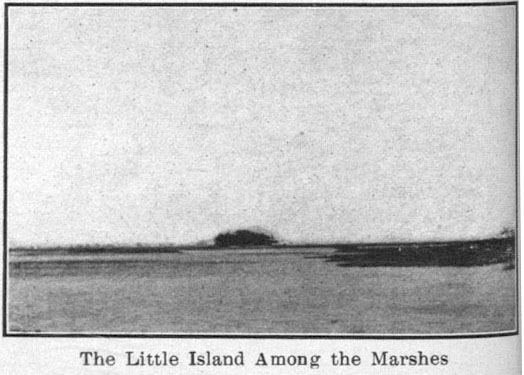
This is the story of the buried treasure
on Money Island, which lies in Greenville
Sound, not far from Wilmington, North
Carolina. It was told by Mr. Jonathan
Landstone many years ago, and is a part
of another story which follows, and which
will explain something further about the
mysterious little island that blinks in the
sunlight and tries to hide its secret. The
words are Mr. Landstone's and were written
by him, to make sure that the story
would be told correctly when the time
came to publish it.
(Mr. Landstone's MS.)
My grandfather lived in Charleston,
S.C. My home is in Philadelphia. In
my boyhood I visited him several times.
He was a fine old man, and was very fond
of me. He used to tell me many stories
of the good old colonial days. He said
his father was a pirate; but that pirates
in those days were gentlemen. Although
they made game of the King's revenue
on the high seas, it was regarded as nothing
very wrong; and, although they
played havoc with the Spanish shipping,
it was but the assertion of a time-honored
right of Englishmen, who never did
love Spaniards. They were, many of
them, ingloriously hanged, it is true, but
it was by the King's officers, and not by
the people.
However, not to defend pirates, or indeed
to condemn them, I will tell you
what my grandfather narrated about his
father, who was Capt. John Redfield. He
was a gallant seaman, who consorted with
Charles Vane and other doughty corsairs
of those days of romance upon the seas.
When Captain Kidd forsook the King's
commission to run down the pirates on
the American coast, and organized his
formidable squadron, Captain Redfield
was chosen as his trusted counsellor, to
accompany the brilliant leader on his adventures.
He gave up his own ship, and
was with Captain Kidd on many voyages,
being entrusted with many a commission
of importance.
One fine spring morning, while off the
Carolina coast, Captain Kidd was pacing
his deck, enjoying the warm splendor of
the early sunshine. He had just returned
from a successful voyage among
the Spanish colonies of the south, and
was gaily attired after the manner of a
Spanish cavalier. He wore a cocked hat,
decked with a yellow band and a black
plume, and a coat of black velvet which
reached down to his knees. His trousers
were blue, and were adorned by large
golden knee-buckles. He wore massive
silver buckles on his shoes. With his
well-proportioned body, neatly trimmed
beard, and steady, alert eyes, he presented
as fine a picture of a man as could
have anywhere been found. His manner
had the dignity and repose of a beneficent
prince, as he gave his orders for the day
and received the salutations of his men.
The ship had passed the Cape of Fear,
and was making in towards the shore-line,
which Captain Kidd was observing
with great interest. Some near-by point
was evidently the destination. At length,
at his orders, the sails were lowered and
the anchor dropped. "We will lie here
to-day," he remarked, "and have a little
rest."
This information met the ready approbation
of the men, who soon disposed
themselves in careless groups about the
ship. They knew it would be a day of
idleness; because there were no forays to
be made upon the land, for the reason
that there wore no human habitations in
those parts. To the buccaneers the locality
was well known as furnishing a safe
retreat when retirement from active work
was desired.
During the day there were singing,
dancing, feasting. It was a day such as
only a gallant corsair could have with
his merry crew. The hours sped swiftly;
and at dusk anchors were weighed, and
the ship moved a few miles to the northward.
Captain Kidd, standing at the prow,
called Captain Redfield to him. "Captain,"
said he, "I wish to entrust you
with a most important service. I am
somewhat overstocked. I have not failed
to be generous to the men; but still I do
not feel at ease for a journey to New England.
You appreciate the situation. I
wish to make a deposit; and, as our interests
along the coast are now beginning
to be extensive, I desire to detail
you as a resident of Carolina to keep an
oversight for me. You will live on this
coast near the location of to-night's deposit.
You will find the climate agreeable,
and other things favorable. I will
hand you for your own use, in case of
need, gold to the value of one thousand
pounds. Is it agreeable, Captain?"
"Aye, sir; your wishes are my orders."
"Then, swear by the Holy Virgin that
you will faithfully watch over the stuff;
that you will not touch the chests or their
contents, nor give any information or
suggestion that might lead any one to
their discovery—in fact, that you will
not disclose to any one the object of your
residence in this secluded place."
Captain Redfield doffed his hat, and, raising
his right hand, said, "Captain, I so
swear."
"Your hand with the oath, Redfield.
You are a trusty fellow, and I have the
fullest confidence in you."
"Thank you, Captain."
"But, hold," Captain Kidd continued in
his great benevolent voice, "I had forgotten
the conditions. They are: You are
to keep the engagement, if necessary, for
five years. Our calling; as you know, is
a little uncertain. At the end of that
period, if I have not returned, you will
be at liberty to take up the smaller chest
to be deposited to-night, and use the contents,
subject to such division—not to
exceed one-half to each of us—as I may
demand on my return. The same conditions
will apply to the other chest for an
additional period of five years. In the
event, however, of any special need, I
may send an order for some of the stuff.
But look you for my signet. See!" And
he drew from his pocket a piece of resin
upon which he had stamped his signet.
"Keep that to prove the genuineness of
my written orders. Is everything satisfactory,
Redfield?"
"Everything is satisfactory, Captain."
Captain Redfield was a man of stalwart
build. His height was six feet or more,
and his movements were quick and firm.
His face was beardless and wore an expression
of stability and energy.
The two stood for some time upon the
prow of the ship, and discussed the locality
of the proposed hiding of the precious
booty. Then Captain Kidd called
two men by name, who promptly responded.
He said, "I have trusted you in
times past, and I desire to do so again.
I believe you will not betray my confidence.
We are going to make another
deposit to-night. I have long had the location
in mind. Now, swear by the Holy
Virgin that you will not disturb the stuff
yourselves, nor in any way aid or abet
any one else in doing so."
They swore with deep earnestness.
The group continued there awhile, until
the moon rose and shed its silver splendor
on the rolling water about them,
touching the white-capped breakers with
a soft and magic radiance as they dashed
upon the near-by beach.
Then orders were given for the lowering
of the boat.
Captain Kidd proceeded to the lockers
of the ship, which opened into his cabin;
and, with the aid of Captain Redfield,
drew forth two iron chests. These he
carried to the outer deck, and carefully
lowered them to the boats by means of
ropes. From a respectful distance the
sailors who had no hand in this work
watched the proceedings with eager interest.
Firearms, shovels, and axes were then
placed in the boat. Four rowers took
their positions; and Captains Kidd and
Redfield climbed down the rope ladder,
and sat in the stern. Everything was
ready, and word was given to ply the
oars.
Soon the ship became a mystic shape
in the dim distance; and, as the inlet was
entered, it was lost entirely to view. By
tortuous passages among the marshes,
they drew up at the island—Money
Island.
"Island the fourth!" said Captain Kidd
jocularly. "Magnificent indeed will be
the buccaneer's castle in Merry England
when they all give up their wealth! Ha,
a fine life this; but I suppose as fine a
one when the retired merchant from the
South Seas brings his well-earned fortune
to a corner of old England. Not Captain
Kidd then, men, but John So-and-So, a
wise and revered merchant. Ha! Do
you see the game?"
The sailors sprang upon the land and
pulled the boat well in from the water.
The officers stepped lightly ashore, and
railed against the low-lying branches,
which whipped their faces. The trees
were thick and low, making passage beneath
them arduous and slow. However,
the whole island was small and soon traversed;
and, finally, a spot was selected
as being accessible and suitable to the
purpose.
Two deep holes about ten feet apart
were dug, and the chests brought and
deposited within them. Some of the
earth was replaced; and then they sought
two small trees to plant above the chests.
This was accomplished slowly and carefully,
so that the growth of the trees
would not be stopped.
At length the task was completed; and
the little island bore within its bosom
wealth sufficient to buy an earldom. The
silence of the dreary solitude sealed the
secret; and there was no man who might
discover it, other than those who laid the
chests in their earthly hiding place. The
moon gave testimony to the hidden treasure,
and bore its silent witness through
the many decades that followed.
Upon leaving the island, they rowed
to the mainland, which was but a short
distance away; and there Captain Redfield
hid in three places in the ground
the money which Captain Kidd had supplied
him for his own needs, and as compensation
for his services until his return.
The axes and shovels, also, were secreted
in the woods.
It was past midnight when they returned
to the ship, which set sail at
break of day towards the north. By
sunset they reached Albemarle Sound,
the rendezvous of some companion buccaneers;
and there waited for several
days feasting and engaging in jovial pastimes.
Meantime, a small sloop was procured
for Captain Redfield; and, having been
supplied with necessary provisions and
household comforts, and manned by four
sturdy men who knew naught of the buried
treasure, but engaged for the service
on goodly pay, it sailed for the captain's
new home near Money Island.
Upon reaching their destination, the
pioneer residents set to work at once to
construct temporary quarters, and were
soon provided with a comfortable house.
According to the plans of the Commander-in-Chief,
the men who accompanied
Captain Redfield were to understand that
they were to engage in any service that
might come to hand. They were to clear
the land and till it, build houses and
fences, and do such other work as might
tend to prepare the locality for a more
permanent settlement in case it should
be desired to inaugurate such an enterprise.
The sloop gave them communication
with the outside world, enabling them to
visit Charleston, where a colony had been
lately planted, and the several settlements
to the north. It also afforded Captain
Redfield opportunity to find a wife,
whom he brought to Rindout, as he
styled his new home. There the party
lived in the quiet enjoyment of a life with
nature, which abundantly supplied, during
the frequent periods of recreation,
every facility for hunting, fishing, and
other sports.
One year passed, and another reached
its seventh month; and the party had experienced
nothing to arouse more than a
passing interest. There had been no visitors
to their settlement, not even an Indian.
On one October morning, however, a
ship was seen lying off the inlet. This
was a sight which caused a considerable
stir among them. Captain Redfield debated
the question within himself whether
or not it was the ship of the Commander-in-Chief,
and if it would be wise to
go out and pay her a visit. But he hesitated,
not wishing to jeopardize the commission
imposed upon him.
Finally, a boat was seen approaching
the shore, bearing a flag at its prow. In
due course this was recognized as the ensign
of Captain Kidd; and everything
wag hastily arranged to receive the leader
with due honor and welcome.
As the boat drew near, though, it was
discovered that he was not among the
occupants; but on a seat at the stern, and
with dignified mien, sat Max Brisbau, an
old shipmate of Captain Redfield's, and
a former companion in the service of
Captain Kidd.
Brisbau alighted, and, extending his
hand to Captain Redfield with suave complacency,
stated that he had came upon
a little service for Captain Kidd, and
would later communicate his object. He
showered courtly attentions upon his
host, who exhibited unfeigned pleasure
in welcoming him.
The visiting boat's crew consisted of
six men, who enjoyed the companionship
of Captain Redfield's assistants, mingling
with them in their various pursuits. All
the graces of hospitality were generously
displayed, and mirth and good cheer
possessed the men.
In the afternoon Captain Redfield was
entertaining his guest in his private room.
Brisbau said he would now advise him
regarding the commission upon which he
was sent; which was, in fact, none other
than the execution of an order from Captain
Kidd for the two cheats that he had
secreted in that neighborhood. Captain
Redfield was to be awarded a generous
portion, and his arduous service as guardian
of the treasure would terminate. In
the name of Captain Kidd, he graciously
extended thanks for the faithfulness
which Captain Redfield had shown in the
discharge of his duties, and gave him assurances
of the high esteem and confidence
of the gallant leader.
The words were very pleasing; but
Captain Redfield hesitated to make answer.
"It may or may not be true," said
he after a pause, "that Captain Kidd has
buried possessions in this immediate
locality. It is not to be denied that he has
secreted treasure along the coast, but
where? That is the question. I have
some knowledge of the hiding place of
some of it, but must have some written
order over the signature and seal of the
Captain to warrant me in disclosing it."
Brisbau promptly responded that he
had such a communication from Captain
Kidd, and proceeded to draw it from an
inner pocket of his coat. He failed to
find it, and with a great show of annoyance
and a sudden recollection, he exclaimed
with an oath that he had left it
on the dressing table on his ship.
What was to be done? He would send
immediately out to the ship, and have the
paper brought to him. No, that was
hardly worth while. He assured Captain
Redfield that he would hand him the paper
on their return to the ship, with Captain
Redfield accompanying him.
That, Captain Redfield replied, would
hardly be satisfactory. His obligation
was to give information as to the hidden
treasure only upon a well attested written
order from Captain Kidd. Brisbau
cajoled, implored, and vehemently asserted
the injury to his feelings which
the foolish reluctance of his friend caused
him.
By intuition, Captain Redfield became
convinced, on account of a certain weakness
in the attitude of Brisbau in defending
his request, that there were deceit
and treachery in his conduct. Therefore,
he coolly stated his determination to
make no movement in the matter without
the authority about which he had spoken.
At this Brisbau rose in great anger and
exclaimed, "I shall have the money, or
your life will be no more than Jack Kettle's,
who flaunted his opposition before
Captain Kidd himself!"
Hardly had he spoken when Captain
Redfield in the flash of a thought for self-preservation,
sprang upon him. Brisbau,
equally as quick, met the onset and
moved as best he could to avoid the
grasp that threatened him.
They were quite alone. Redfield was
entirely unarmed, but his opponent wore
a sword at his side, with pistol and knife
hanging from his belt. Having made the
assault, the only safety for Redfield lay
in his gaining the ascendency over his
opponent by sheer physical effort, to enable
him to keep Brisbau from using the
weapons at his side. He missed the
hold around both arms which he had
planned, but firmly secured Brisbau's
right arm, while his own right hand
grasped the other's wrist. These advantages
he succeeded in holding, although
he could do nothing towards disarming
Brisbau or binding him more securely as
a captive.
They struggled long and furiously.
Redfield, whose position required his utmost
exertion, gradually became exhausted;
but he had a desperate determination
to win the mastery over Brisbau,
who was likewise weary from the
struggle and doggedly angry. He feared
a result disastrous to himself if he gave
his opponent an opportunity to use his
weapons.
Finally, just at a critical moment, Mrs.
Redfield appeared. She started at the
sight which met her eyes; but, seeing
the situation at a glance, she ran back
into the room out of which she had come,
and quickly reappeared with a rope.
With a woman's ready wit, she had found
the means of bringing victory to her husband.
She threw the rope around Brisbau's
shoulders and wound it over his
arms until he was powerless to resist further.
He was then easily bound and tied,
body and legs, to a chair, grumbling his
angry displeasure at the turn of affairs.
Captain Redfield paused a little while
to recover his balance, and sat down
to cogitate the matter of the disposition
of his prisoner; and, also, to watch for
the return of his men from an excursion
they had gone upon for the entertainment
of their guests. They were slow in coming,
and an annoying suspicion grew upon
him. He could not tell what the attitude
of Brisbau's men might be; or if a
conflict between them and his own men
were to occur, what consequences might
ensue. At any rate, he wished to avoid
such a conflict if it were by any means
possible; but he feared it could not be
done. His good wife was greatly concerned,
and urged upon him some amicable
settlement with Brisbau, even to the
delivery of part of the treasure; for, after
all, she thought, his claim might be just.
An hour later, one of Captain Redfield's
men returned; and, to his great dismay,
informed him that an agreement had been
made with the visiting seamen which
would affect their standing with him, but
would work him no harm. He said that,
upon the arrival of the other men, the
matter would be discussed with the Captain,
and meantime he would take no
steps toward providing a defense for him
in a conflict which was not likely to occur.
This disclosure was startling, and a
shock to the spirit which had upheld
Captain Redfield. His first impulse was
to attack the man for what he considered
the basest treachery, but he desisted.
Parley with him he could not. He could
only await the consequences of the compact
which had been hinted at. But
upon one thing he was determined—not to
disclose any knowledge of the secreted
treasure without first having in hand the
credentials from Captain Kidd which he
had demanded. His honor had been
pledged to such a course, and he would
not forsake his trust.
The men came. But they looked with
indifference upon the bound prisoner.
There was no display of the strong feelings
which had been anticipated. The
situation was obvious. So far as Captain
Redfield was concerned, he felt that he
had been forsaken, betrayed. There was
no man who stood with him. In vain he
pleaded with his men to stand by him in
his defense against a most dastardly plan
to wrong him. He then inquired their
attitude towards Brisbau, and received
an evasive answer.
At length he gave up the struggle, and
sought to learn the purpose of the men
who had all now gathered before him;
those of his own company, and those who
had come with Brisbau. One of them as
spokesman, a new-comer, informed him
that he and his friends had accompanied
Captain Brisbau for the purpose of securing
some of the buried treasure, which
was known to be in that neighborhood;
and they intended to find the booty before
leaving. He also stated that Captain
Redfield's men, upon learning about the
hidden treasure, had agreed to become
confederates; and that their master would
be treated in every way as a friend, and
be given a full share of the treasure, provided
he would properly inform them and
Captain Brisbau, whom they intended to
release immediately, as to its location.
If he for any reason should refuse so to
favor them, he and his wife would be
treated as prisoners, and dealt with as
might seem best—until, of course, he
would consent to aid them in their project.
The response that came was firm and
unmistakable. The brave custodian
averred that he would not betray his
trust, even in the very face of death.
Nor did days of urging and threatening
turn him from his purpose.
Brisbau was released, and given to understand
that the men were in control of
affairs; and that his animosity towards
Captain Redfield must cease.
The woods were scoured for the treasure.
Days passed, and weeks, and the
search was incessant; but there was no
discovery made. Captain Redfield and
his wife, now prisoners in chains, were
urged and implored; but he could not be
persuaded to give the information, although
the mental tension he suffered
was almost unbearable.
One day on a sudden determination,
Brisbau set sail with his men and
companions, together with the prisoners.
His purpose was to take a short cruise
and then return; meantime allowing Captain
Redfield a further opportunity to disclose
his secret; otherwise—and he repeated
his threat made upon his first day
at Rindout.
The ship stopped at Charleston, and,
almost immediately upon its arrival, it
was seized under a suspicion of piracy,
and a search made for evidences of the
unlawful traffic. The prisoners were released
through some favor of the authorities,
but Brisbau and his men were imprisoned.
In the hands of the king's officers
their lives were in great jeopardy,
but they finally escaped the scaffold.
As to Captain Redfield and his wife,
the unexpected release was a most welcome
boon. For her he had felt the tenderest
and most agonized solicitude. The
temptation to acquiesce in the demand of
his captors and thus free her from the
trying situation came often to him with a
weight under which he almost broke
down. When it was over, the joy of freedom
was as great as the suffering had been
while they were prisoners. He lived
thereafter at Charleston, and soon outgrew
the suspicion with which he was
at first regarded, of having being connected
with the buccaneers. He determined
to settle down to an honest, industrious
life. My grandfather was born soon after.
Captain Redfield was never afterwards
known to refer to anything connected
with a pirate in conversation with any
one; and I have never learned whether
or not he ever afterwards visited Rindout.
I know he was wealthy; but then he
worked hard and saved his earnings, and
I do not believe he increased his store from
the hidden chests on Money Island. The
story I have now written he told to my
grandfather in his old age, and, upon relating
it, he urged the greatest caution in
his use of it.
Twice my grandfather made unsuccessful
efforts to find the chests. He
urged that I, his grandchild, should keep
the knowledge of the treasure as a family
heritage; but that I might do as I
liked about it. After giving the subject
very careful thought, I have now given
up the secret of Money Island, and have
not withheld a single detail which was
told me. Of course, nearly a century and
a half has elapsed since the precious
booty was hidden. The story, therefore,
is old, but I do not believe it has suffered
from age. Captain Kidd was executed
in London not long after the hiding
of the treasure, and his associates
gave up their old calling; and probably
no one has since disturbed the precious
chests.
Now, as to when I first heard Mr. Landstone's
story. It was when I was a boy
in the early forties, and the events connected
with its telling have modified its
conclusion, as will presently be seen. I
have heretofore spoken very little of the
subject to any one; and when I have
done so at all, it has been to one or two
intimate friends as a matter of particular
confidence. In my old age, however, I
am going to let my tale forsake its hiding-place
and become public property.
My parents owned a summer home on
Greenville Sound not far from Money Island.
To us children it was the very
heart of life. The best pleasure of the
year was confined to the four months spent
there from the first of June to the last
day of September. We rowed, sailed,
fished, swam, hunted, frolicked, and ran
the whole gamut of youthful delights.
Those good days are yet vivid in memory;
and it is a matter of regret with me that
my grandchildren—as fine boys and girls
as ever lived—cannot have the same wild,
wholesome fun at the Sound as fell to my
lot when I was a boy.
The time that I now speak of, however,
was about the middle of May, the
balmy month of soft breezes and bright
flowers. I had been particularly studious
in school, and my father agreed to
let me spend three days at the Sound in
company with a young friend. We arranged
our food supply, took the old family
rockaway, and set out early in the
morning, as happy a pair of boys as ever
started on a project of pleasure.
After spending an hour or two at the
Sound house, arranging our fishing tackle
and looking after the boats, which had
been hauled up for the winter, we started
out on a sail towards the beach. It was
a fine day for sailing, and the breeze bore
us away as smoothly and quickly as if
we had been in a balloon. As we passed
Money Island, we observed a boat moored
on the south side, and tried to locate
the occupants; but we could see nobody,
and concluded that it belonged to a fishing
party who had, for some reason, left
the boat tied there.
We sailed on; and when we had gone
perhaps half a mile away. I happened to
turn around, and was surprised to see
two men stealthily embarking in the boat
with what appeared to be shovels and
rods of some kind. This sight was too
much for our youthful imagination. So
we decided at once to change our course,
and essayed to follow at a distance the
movements of the other boat. This we
had no difficulty in doing; and we afterwards
learned that we were successful
in our efforts to avoid the suspicion of
purposely following it.
The men sailed down the Sound a short
distance to the south, and made for the
shore in a little cove at a somewhat secluded
place.
We were familiar with the locality, and
decided to wait until later for a closer
observation. Accordingly, we bore once
again toward the beach, and enjoyed an
hour watching the breakers roll upon the
shore, and in picking up curios, such as
are always to be found upon the sea
beach.
Upon our return, we passed close to
the little cove into which the boat had
gone, and could readily discern through
the trees a tent not far inland; in front of
which were seated the two strangers,
watching a pot hung over a fire made
upon the ground. This excited an additional
flutter of wonderment with us. Indeed,
what we had seen, coupled with
the current tradition regarding Money
Island, soon wrought us up into a fever
of excitement; for it was very suggestive
of a search for the treasure on the
island.
I had heard from my early childhood
that Captain Kidd, the historic and lordly
pirate, who reigned supreme upon the
high seas during the seventeenth century,
was supposed to have buried some of
his booty on Money Island. Everybody
was familiar with the tradition; and I
doubt if there is, even now, a single person
reared in the town of Wilmington, of
in the vicinity of the Sound, who has not
likewise been told the same indefinite
story about the little island. But the
presence of these two strangers, and their
somewhat mysterious conduct, gave the
tradition a touch of reality such as it
could never have otherwise had.
We concluded that these men had evidently
some positive information on the
subject, and were showing their confidence
in that information by prosecuting
a search for the hidden treasure, at much
trouble and expense. This was clear to
us, and we talked the matter over that
night with eager interest. We surmised
every possible case that might have furnished
the strange visitors with a working
clue to the discovery of the treasure.
Speculation ran high. But there was one
thing that we became agreed upon, and
that was, to become, if possible, parties
to the secret enterprise. We pondered
with boys' shrewdness how this should
be done. This we could not decide upon;
but we determined to play a venture toward
the desired end. The attitude of
innocent curiosity seemed best suited to
our purpose. So we planned to draw up
at Money Island in the morning if we observed
that the men were there; and to
approach them in an unsuspicious manner,
as if we had just happened to stop at
the Island without any definite motive.
This should work as a capital ruse, and,
we felt confident, it would initiate a connection
on our part with the mysterious
search.
That point settled, we concluded to investigate
the tent and its occupants as
well as we might under the cover of darkness,
and we promptly set out upon that
project. We approached within a hundred
feet of the tent, and saw the men
still sitting in the light of the fire at the
tent door; but there was no discovery of
importance. They were merely talking
quietly and carelessly about some ship
that one of them seemed to be interested
in. We could hear their conversation
distinctly, and we were also able to take
a good observation of their appearance.
One of them was a man upwards of sixty,
of robust build and gray hair and
beard. He had a kind face, which bore
the aspect of one accustomed only to the
quieter walks of life, unfamiliar with adventure
and ill-suited to an enterprise
such as they were now apparently engaged
upon. The other man had a
weather-beaten face with a long nose,
and a swagger of manner which betokened
the sailor. This, we afterwards learned,
had been his occupation. We watched
them for about an hour; but finally
withdrew in the hope of making a better
acquaintance in the morning.
Soon after daylight we began eagerly
to watch for the boat, which appeared
around a bend in the Sound after the lapse
of an hour or so and headed straight for
the Island. We loitered about the yard
a little while longer, and then made ready
our yacht without any appearance of
haste.
On setting sail, we made for the beach;
but, upon reaching there, turned back at
once and sailed for Money Island in an
indirect course. We soon reached there
and stepped upon the shore. The men
immediately dropped their implements.
They returned our salutation pleasantly.
We observed with much surprise the disturbed
state of the ground and the holes
which had been dug; and then began to
make inquiries as innocently as we could
as to their object. Our plans of the night
before began to work successfully.
By sheer force of persistence, we won
our way into their confidence, and worked
with them until late in the afternoon.
For they were indeed on a determined
search for Captain Kidd's buried treasure.
We were in constant expectation of
discovering the chests of gold—two iron
chests, which Mr. Landstone, the elder
gentleman, assured us he felt positive
were there. But the discovery was not
made, and they said this had been the
fourth day of labor on the Island.
The conclusion was reached that, either
the surrounding water had encroached
upon that portion of the Island where the
treasure had been buried, and had thus
imposed an almost impossible barrier to
its being unearthed; or that the chests
had become imbedded beneath the massive
roots of two dwarfed old oaks which
stood gnarled and storm-worn in the centre
of the island. To the task of removing
these trees the men felt entirely unequal
after their days of work; and,
therefore, it was decided to wait a day
or two, and approach the task of doing so,
if at all, with renewed spirit.
Upon invitation, we boys accompanied
the men to their camp and had supper
with them. We were entertained by stories
of adventure and travel, of sea voyage,
of Indian warfare; and, finally, after
several requests of Mr. Landstone, with
the story of Money Island. He said he
would tell it upon condition that its secrecy
would be kept inviolate, at least
for many years. So, in the weird light of
a large pine-wood fire among the trees,
we had the story of Money Island, told
in the living voice of a capital story-teller,
in almost the same words as are used in
the MS he gave me that night, and which
has now been publicly printed.
When Mr. Landstone finished, we boys
sat in breathless amazement, overcome
by the glamour of romance which the
story had thrown around the mysterious
little island.
The old sailor forgot his pipe, which
turned over and dropped its contents to
the ground. "Aye, sir," he exclaimed,
"we will surely uproot those trees in the
morning!" And that became the decision
of us all.
I remember that, after a long pause, I
asked, to reassure myself, "Mr. Landstone,
do you really believe that story?"
He laughed and said, "Well, you see I
am on an undertaking I have had in mind
for nearly fifty years. Yes, I believe
those chests are there."
That was enough. I did not sleep an
hour that night; and the next morning
we were early at the task of searching
for the treasure. And a stupendous undertaking
it proved to be. All day we
labored at one tree. The roots were massive
and wide-spread, and the work of
cutting and removing them required the
utmost exertion. Finally, just before
sunset, we completed the task, and began
to dig for the treasure in the earth below.
Already water had begun to percolate
into the hole, and ere we had gone much
deeper, it flooded it so that we found it
impossible to continue the excavation.
Then we resorted to our sounding rod
again for a last ray of hope, and almost
immediately it struck something hard!
Our spirits rose within us.
I tore off my clothes, and jumped into
the water. After working for some time,
with the aid of a shovel, I brought to the
surface a piece of rusty sheet iron. Nothing
more could be found. We gathered
round the worn sheet of metal, and held
a solemn consultation.
The conclusion was reached that the
piece of iron which we found was in reality
a part of one of Captain Kidd's chests,
which had become rust-eaten and crumbled,
and which had been torn asunder
by the growing roots of the tree, and
parts of it carried in various directions by
them as they had spread, scattering the
contents through the ground.
We became animated with a new purpose;
and the old sailor seized a shovel
and began vigorously to throw more
earth from the excavation; but darkness
was falling, and we urged him to wait
until the next morning.
"What about the sand already thrown
out?" some one exclaimed at this juncture.
The suggestion had hardly been
offered before we all bent forward, and
thrust our hands into the pile of wet,
black sand lying about us.
I at once felt something round and suggestive.
"Look at this!" I cried. It was
a blackened gold coin! In the darkness
we hurriedly sifted the sand with our
fingers; and each one soon found several
pieces of money.
With feverish energy, we thus labored
until late in the night, meeting with
constant success; and, when we stopped, every
one had a precious pile to carry back
to the shore. The coins were all corroded
and misshapen through the action of the
salty mud in which they had lain, and
the disturbance caused by the roots of
the trees. A few silver coins were found,
but all were in a very worn condition;
some being little more than ragged discs
of the thickness of paper. Others, or
the remains of them, crumbled into a
black powder at the touch of our fingers.
The gold was in better preservation; and
we secured a goodly store of it.
We secreted our treasure in the woods
on shore, and early the next morning returned
to our work. I can well remember
our exultant feeling as we set out in
our boats. "Boys," Mr. Landstone called
out, as we were sailing over the narrow
stretches of water toward the island,
"how do you feel?"
"I feel like—like—" I answered, rising
in my seat and lifting my hat to cheer.
"None of that!" he said quickly—but
I knew I was about to express the excited
feeling of us all.
As to our further success, I would say
that it was unabated during nearly the
whole day. I think we secured every
piece of precious metal that had been
buried beneath the tree. The following
day we uprooted the other tree, but failed
to find any trace of more booty. We
concluded that the remaining chest had
probably been removed; but that is still
an unsettled question.
Besides the coin, we had discovered the
remains of much silver plate; but it was
of little value, being almost entirely destroyed.
But the gold—there was an
abundance of it, and we were all made
rich!
In the meantime our parents appeared
on the scene to learn the cause of our
protracted absence from home. It is
needless to say that there was no rod of
correction held over us that day.
If I had taken care of my share of the
treasure as I should have done after my
father's death, I would be living in luxury
and comfort to-day; but, even regretting
my poor judgment, I can now thank
a good Providence that I have been sustained
through a long life, which has had
an undue share of misfortune, by the
splendid fortune which came to me in
that happy May of long ago.