Human beings have been variously compared
by imaginative persons to pawns on a chessboard;
storm-tossed boats on the sea of life; pilgrims
on a weary way, and other things of no resemblance
whatever to the foregoing.
Molly, marching stoically along the lonely
road under the impression that she was on her
way to Wellington when she was really turned
toward Exmoor, might have fitted into any of
those comparisons rather more literally than was
intended.
She was certainly a storm-tossed pilgrim if
not a boat; the way was decidedly weary and as
pawn, pilgrim or ship, whichever you will, she
was about to come in contact with another of
life’s pawns, pilgrims or ships, to the decided
advantage of the one and amazement of the
other.
This new pawn, pilgrim or ship was now advancing
down the road, and Molly, mindful of
the fact that she was not getting anywhere when
she felt sure that by this time she should at least
have reached the lake, was not sorry to see a
human being.
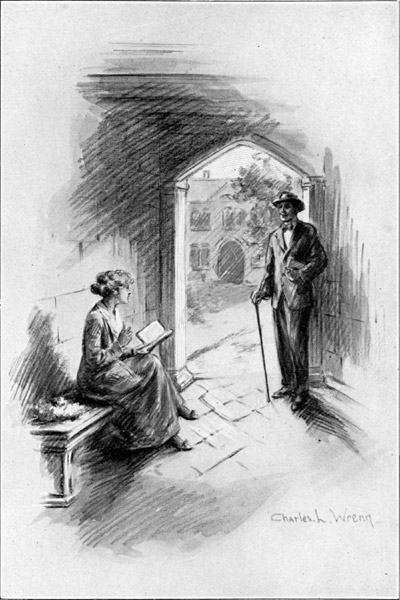
The stranger looked decidedly like the pilgrim
of romance. He wore an old black felt hat with
a broad slouching brim and a long Spanish cape
reaching below his knees; his staff was a rosewood
cane with a silver knob.
He was about to pass Molly without even
glancing in her direction when she stopped him.
“Would you mind telling me if it’s very far
from Wellington?” she asked. “I’m afraid I’m
lost.”
“Do you imagine you are going to Wellington?”
he demanded, looking up.
Instantly Molly recognized him. He was the
man she had seen the night before in Professor
Green’s study.
“I did think so,” she answered meekly.
“I would advise you to go in the opposite direction,
then,” he said. “Exmoor lies that way.”
He pointed down the road with his stick.
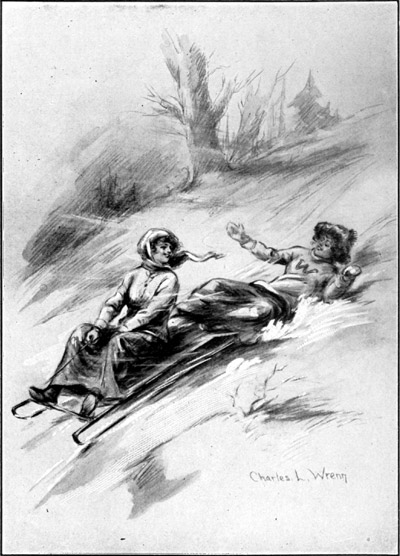
“How stupid of me!” exclaimed Molly. “I
was coasting and tumbled off the sled. I was
completely dazed, I suppose, when I crawled out
of the drift.”
The two walked along in silence. Molly gave
the man a covert glance. He was very distinguished
looking and vaguely reminded her of
someone.
“You are one of the students of Wellington?”
he asked presently.
“Yes, sir,” answered Molly respectfully.
The stranger smiled.
“You are from the south. I never heard a
girl across the boundary line use ‘sir.’”
“I am,” she answered briefly.
“And from what part, may I ask?”
“From Carmichael Station, Kentucky.”
The man stopped as if he had been struck a
blow in the face.
“Carmichael Station, Kentucky,” he repeated
in a half whisper. Drawing a leather wallet from
his inside pocket, he took out a folded legal cap
document and opened it. “Ahem. Not far to
go,” he said in a low voice, running down a list
with one finger. “Your name——”
“Brown.”
“Mildred Carmichael Brown, I presume.”
“No, Mary. My sister’s named Mildred.”
The old man refolded the document, put it
carefully back in the wallet, which he returned
to his pocket. Then he resumed his walk, muttering
to himself.
“Strange! Strange!” Molly heard him say.
“Here in a snowstorm, in the wilderness, on
Christmas day, too, I should happen to meet—I
can’t get away from them,” he cried angrily,
waving his cane. “Victims, victims! Everywhere.
They rise up and confront me when I’m
sleeping or waking—like ghosts of the past——”
His mutterings gradually became inarticulate
as he wrapped his cape around him and stalked
through the snow.
“Hunted—hunted—hounded about——” he began
again. Suddenly he stopped, took off his hat
and held his face up to heaven as if he were about
to address some unseen power.
“I’m tired,” he cried. “I’ve had enough of
these wanderings; these eternal haunting visions.
Let me have peace!” He shook his cane impotently
at the overcast skies.
It was then that Molly recognized him. On
that very day but one, a year ago, had she not seen
Judith Blount stand under a wintry sky and defy
heaven in the same rebellious way?
Judith’s father had come back from South
America and was hiding in the Professor’s room
at Wellington! And how like they were, the father
and daughter; the same black eyes, too close
together; the same handsome aquiline noses, and
the same self-pitying, brooding natures.
Evidently, Mr. Blount had suffered deeply.
Molly thought he must be very poor. Looking
at him closely, she noticed the shabby gentility of
his appearance; the shiny seams of his Spanish
cape which had been torn and patched in many
places; his old thin shoes, split across the toes,
and his worn, travel-stained hat.
She wondered if he had any money. She suspected
that he was very hungry and her soul was
moved with pity for the poor, broken old man who
had once been worth millions.
“Mr. Blount,” she began.
“How did you know my name?” he cried, shivering
all over like a whipped dog. “I didn’t mention
it, did I? I haven’t told any one, have I?
I came down here in disguise.” He laughed
feebly. “Disguised as a broken old man. I went
to Edwin’s rooms,” he wandered on, forgetting
that he had asked Molly a question. “You know
where they are?”
Molly nodded her head. She knew quite well
that the Professor lodged in one of the former
college houses built on the old campus, used long
ago before the Quadrangle had been built flanking
the new campus.
“The housekeeper recognized me as a relation
and I waited in his room some hours,” went on
the old man in a trembling voice.
“And where did you spend the night?”
“In the cloister study. I found the key on his
desk. It was marked ‘cloister study.’”
“But where did you eat?” asked Molly gently.
The melting sympathy in her eyes and voice
encouraged the old man to pour out his woes.
Evidently it was a great relief to him to talk after
his miseries and hardships.
“I’ve been living off apples,” he said. “Very
fine apples. There was a big basket of them on
Edwin’s study table.”
“But there’s an inn in the village,” she exclaimed.
He smiled grimly.
“I have come all the way from Caracas to Wellington,”
he said. “I was poor when I started;
yes, miserably, wretchedly poor. I am an old
man, old and broken. I want peace, do you understand?
Peace.”
They had reached the lake and in fifteen minutes
would arrive at the Quadrangle. Mr. Blount
was leading the way, occasionally hitting the
ground savagely with his cane.
Molly thrust her hand into her blouse and
drew out a chamois skin bag which hung by a
silk tape around her neck. Since the pilfering
had been going on at Wellington she carried
what little money she had with her during the
day and hid it under her pillow at night.
Extracting ten dollars from the bag, she hurried
to the old man’s side and touched him on the
shoulder.
“Mr. Blount, I’m under great obligations to
your cousin. He has been very kind to me—always—and
I’d like you to—I’d——”
It was difficult to know what to say. Was it
not strange for her, a poor little school girl, to
be offering money to a man who had so recently
been a millionaire?
“Won’t you take this money?” she began
again, resolutely. “I don’t think anyone will recognize
you at the inn. It’s just a little country
place and you will be quite comfortable there
until I find Professor Green. I may get word
to him to-night, or to-morrow at any rate.”
Mr. Blount eyed the money as a hungry dog
eyes a bone. Evidently hunger and fatigue had
got the better of his pride. He took the bill and
touched it lovingly. Then he put it in his pocket.
“You’re a nice girl,” he said. “I thank you.”
“Would you like to see George Green?” asked
Molly timidly.
“No, no, no!” he answered fiercely. “Not that
young fool. I don’t suppose Judith is here?” he
added presently in a tremulous voice.
“No, sir. She’s in New York for the holidays.”
They shook hands and separated. Mr. Blount
took the path down the other side of the lake
across the links to the village and Molly followed
the path on the college side. As she cut through
the pine woods she heard a shout.
“Molly Brown, where have you been? We
have had a search for you!” cried Judy, rushing
up, followed by the three boys.
“I reckon I’ve been a good deal like the pig
who thought he was going to Cork when he was
really going to Dublin,” laughed Molly. “If I
hadn’t asked the way, I suppose I’d have been
almost to Exmoor by this time. I am a poor person
to find my way about. My brother used to
tell me to take the direction opposite to the one
my instincts told me to take and then I’d be going
right.”
“In other words, first make sure you’re right
and then take the other way,” said Lawrence
Upton, laughing.
“You’d make a good explorer, Miss Molly,”
remarked Andy McLean. “You might discover
the South Pole and think all the time it was the
North Pole.”
“That would be of great benefit to humanity,”
answered Molly, “but you may be sure I’d stop
and ask a policeman before I reached the
equator.”
“It’s your proper punishment for cutting
church this morning,” here put in George Green.
“I don’t know whether it was because it was a
good excuse to go sleighing, but a lot of people
were at the ten service. Even old Edwin came
in the trail of Alice Fern.”
“What a pretty name!” said Molly. “It sounds
so woodsy.”
“She’s a cousin,” George went on, “and a winner,
too. They’ve got a jim-dandy place ten miles
the other side of Wellington, Fern Grove. We
spent last New Year’s with them and had a
cracker-jack time.”
“George Theodore Green!” ejaculated Judy,
“I never heard so much slang. I wonder you are
allowed inside Exmoor.”
“Oh, I cut it out there. I only use it when it’s
safe.”
“I regard that as a slight on present company,”
broke in Andy. “I think you’ll just have
to take a little dose of punishment for that, Dodo.
Get busy, Larrie.”
There was a wild scramble in the snow, and
finally Dodo, who had developed into a big, strapping
fellow, stronger than either of his friends,
intrenched himself behind a tree and began
throwing snowballs with the unerring aim of
the best pitcher on the Exmoor team. Molly
hastened on to the Quadrangle, while Judy with
true sportsman taste waited to see the fun.
Molly went straight to the telephone booths in
the basement corridor. By good fortune, the
haughty being who presided at the switchboard
was hovering about waiting for a long distance
call from a “certain party” in New York.
That she alone in all the world was concerned
in this call and that she wished to have this corner
of the globe entirely to herself for the full
enjoyment of it were very evident facts when
Molly asked for “Fern-16-Wellington.”
“I’m not working to-day,” announced the operator
shortly, arranging her huge Psyche knot at
the mirror beside her desk.
Molly looked into the girl’s implacable face.
No feminine appeal would melt that heart of
stone, but perhaps the magic name of man might
fix her.
“Would you do it to oblige Professor Green?
I have an important message for him.”
“I guess that’s different,” announced the owner
of the Psyche knot, with a high nasal accent.
“Why didn’t you say so at first? I guess Professor
Green is about the nicest gent’man around
here.”
Sitting down at the switchboard, she slipped
on the headpiece with a professional flourish.
Then, with a hand-quicker-than-the-eye movement,
she pushed several organ stops up and
down, stuck the end of a green tube into a hole
and remarked in a high pitched voice that had
great projective powers:
“Wellington Exchange? Hello! Yes, I know
it’s Christmas. On hand for a long distance, are
you? Oh, you-u-u. Well, say, listen. To oblige
a certain party—a very attractive gent’man—call
up ‘Fern-16-Wellington.’”
Then there was a detached monologue about
a certain party in you know where—same
gent’man that was down Thanksgiving time.
Suddenly, with professional alertness, the telephone
girl stopped short.
“Fern-16-Wellington? Here’s your party.
Booth 3,” she added to Molly, in a voice so radically
different that Molly had a confused feeling
that the young person who operated the Wellington
switchboard might be a creature of two personalities.
She retired timidly to the booth.
“Is this the residence of Miss Alice Fern?”
she asked.
“It is,” came the voice of a woman from the
other end.
“I would like to speak to Professor Edwin
Green.”
“He’s very much engaged just now. Is it
important?”
“I think it is,” hesitated Molly.
“What name?”
“Now what earthly difference does it make
to her what my name is?” Molly reflected with
some irritation. “Would you please tell him it’s
a message from the University?”
“I’ll tell him nothing until you tell me your
name.”
Could this be Miss Alice Fern? Molly was
fairly certain it was. Perhaps she also had two
personalities.
“It doesn’t do any good to tell my name. I
have nothing to do with the message. I’m only
delivering it for someone else. But if you want
to know, it’s ‘Brown.’”
“Mrs. or Miss Brown?”
Suddenly Molly heard the Professor’s voice
quite close to the telephone saying:
“Alice, is that someone for me?”
“Yes, an individual of the illuminating name
of Brown wishes to speak to you. I don’t see
why they can’t leave you alone for one day in
the year.”
Molly smiled. Why was it that down deep
in the unexplored caverns of her soul there lurked
an infinitesimally tiny feeling of relief that Miss
Alice Fern was plainly a vixen?
“How do you do, Professor Green? This is
Molly Brown.”
“How do you do? Is anything the matter?”
answered the Professor in rather an anxious
tone.
“I wanted to tell you that Mr. Blount is here.
Old Mr. Blount.”
The Professor seemed too surprised to answer
for a moment. Or it might have been that Miss
Alice Fern was lingering at his elbow and embarrassed
him.
“Where?” he asked.
“He spent last night in the cloister study.
Now, he’s at the inn. He asked me to let you
know. I met him on the road. He’s very unhappy.”
“How did he happen to be in the study?”
“He—he had no money.”
“And now he’s at the inn? Has he seen anyone
but you?”
“No.” Molly blushed hotly.
“I’ll come right over. Thank you very much.”
“Now, Edwin, what a nuisance!” broke in the
voice of Miss Fern.
“Good-bye. Thank you again. I really must,
Alice. Very impor——”
The receiver had been hung up and the connection
lost.
“Oh, these cousins!” Molly reflected with a
laugh as she hurried up to her room.
**********
There was a gay party at the McLeans’ that
night and one unexpected guest arrived just before
dinner. It was Professor Green. They
squeezed him in somehow at the end of the table
with the doctor, and the two made merry together
like school boys. Molly had never seen
the Professor of English Literature in such joyous
spirits. After dinner, when the dancing commenced,
he sought her out and led her to a secluded
sofa in the back hall. She began at once
by asking about Mr. Blount, but the Professor
was not listening.
“That’s one of the prettiest dresses I’ve seen
you wear,” he interrupted. “Yellow is not becoming
to most people, but it is to you. Probably
because it has the same golden quality that’s
in your hair.”
“I’m glad you like it,” said Molly, turning red
under his steady gaze.
“I found your note on my study floor,” he
went on.
“I was afraid you wouldn’t remember what
I was talking about, after all,” she exclaimed.
“But I had to write it. I have never really been
happy since I said that cruel thing to you. I was
so wretched the day afterward, and when I
rushed to find you in your study, you were gone!”
she broke off with a tearful glance into his eyes.
The Professor beamed upon her.
“So you were unhappy,” he said, as if the
statement was not entirely unpleasing.
“Oh, yes. I know now that you were quite
right to tell Miss Walker about that silly episode
of the burying of the slipper.”
“But I never told her. I know the story, of
course, and the explanation. The President told
me herself.”
“But who did tell, then?”
“That I can’t say.”
It was now Molly’s turn to beam on the Professor.
“I am glad you didn’t tell her,” she exclaimed
in tones of great relief. “You see, you didn’t
inform on Judith Blount that time, and I was
hurt. I couldn’t help from being. I was really
awfully sore.”
“My dear child,” said the Professor hurriedly,
“promise hereafter to regard me as a faithful
friend. Never doubt my sincerity again.”
“I promise,” answered Molly, feeling intensely
proud without knowing why.
Then the talk drifted to Mr. Blount.
“And you haven’t mentioned meeting him?”
he asked. “Not even to Miss Kean?”
Molly shook her head.
“You are a very unusual young woman, Miss
Brown. It’s important to keep Mr. Blount’s
presence here a secret. If word got out that he
had come back, there would be a great hue and
cry in the papers. I have him with me now at
my rooms until Richard gets here. The family
will be very grateful to you for your kindness
to him.”
Lawrence Upton was coming down the hall to
claim Molly for a dance.
“Are you going back to the Ferns’ to-morrow?”
she asked hurriedly.
“I think not,” answered the Professor with
the ghost of a smile. “I am detained here on
business.”
The next morning Molly received a short note
from Professor Green, inclosing a ten dollar bill.
There was a postscript which said:
“I’ve opened a barrel of greenings. Better
come around and get some.”