It was Sunday morning and Molly had been washing her head. She had
spread a towel on the window-sill and now hung her hair out of the
window that sun and wind might play upon her auburn locks.
"I always heard it was better to dry the hair by the sun than by a fire;
hot air dries up the natural oils," she observed to Nance in a muffled
voice.
Nance was engaged in the meditative occupation of manicuring her nails.
As she rubbed them back and forth on a chamois buffer her thoughts were
busy in far other fields.
"Yes," she replied absently to Molly's observation. "I suppose you
learned that from Judy's new friend," she added, coming back to her
present beautifying occupation. "She'll be introducing rouge to us
next," Nance went on in a disgusted tone.
Molly smiled and gave her hair a vigorous shake in the breeze. In the
bright sunlight it sparkled with glints of gold as if a fairy wand had
touched it.
"No, I didn't, really," she answered. "I read it on the beauty page of a
Sunday paper, but I knew it anyhow instinctively before I read it."
"Do you think her hair is naturally red," asked Nance, punching the dull
end of her orange stick into a sofa cushion with unusual force.
"I suppose lots of people ask the same question about mine," Molly
answered evasively.
"Never," Nance asserted hotly. "I don't know much about the subject but
I do know that no dyes have ever been invented that could imitate the
color of your hair."
"How do you know it, Nance, dear?"
"Well, because so many people would dye their hair that color. There
would be no more drab browns like mine, or rusty blacks or faded tans."
"But, Nance, your hair is lovely. It's smooth and glossy and fine and
thick. Has that girl been talking to you about your looks?"
"They both have," admitted Nance. "They've got me to thinking I'm plain
but would be greatly improved if I wore a rat and waved my bang and did
my hair in a bunch of curls in the back like Jessie."
"But Jessie's hair curls naturally," put in Molly.
"Yes, of course, and mine doesn't. It would be a fearful nuisance, but
one can't help listening to such talk when it concerns oneself. You know
how Judy does run away to things, and there is something convincing
about Adele's arguments."
"She's very bright," admitted Molly. "What do you think she wants me to
do, Nance? Something much worse than crimping."
"There is no telling. Probably lather your face with that horrible
white-wash stuff called 'Youthful Bloom,' Judy was telling us about."
"No, worse still. She says my face is too thin and that I am getting
lines from nose to mouth. She wants me to have it filled."
Nance gave a wild whoop of derision.
"Can't you see Judy Kean's head being stuffed with such nonsense until
it bursts?" she cried, breaking off suddenly as the door opened and Judy
herself appeared on the threshold.
"May I bring in a visitor?" she asked stiffly, feeling from the sudden
stillness that her own name had been under discussion. "Nobody likes to
have her name bandied back and forth even between intimate friends," she
thought with some indignation. But Judy's little fly-ups never lasted
long and when Molly called out hospitably: "Yes, indeed, delighted," and
Nance said: "Certainly, Judy," her sensitive feelings immediately
withdrew into the dark caverns of her mind.
"I've brought a friend up to see our rooms," Judy went on, putting
special emphasis on friend.
Judy had introduced a new member to the Old Queen's circle and while
that body was only exclusive in the matter of intelligence and good
breeding, and the new member seemed to meet both requirements, still the
circle as a whole was not entirely agreeable to Judy's latest find.
The new girl had a very grand sounding name, "Adele Windsor," and Judy
was hurt when Edith Williams demanded if Adele was related to "The Widow
of Windsor." Adele was certainly very handsome,—tall, with a beautiful
figure, dark eyes and hair more red than brown.
"She dresses with artful simplicity," Margaret had remarked, but hardly
a girl in college had handsomer clothes than Adele Windsor.
Nobody could cast aspersions against her intelligence, either. She had
entered the junior class of Wellington as a special; which was pretty
good work, in the opinions of our girls. If any name could be given to
the objections they all secretly felt for Judy's new friend, it was that
she was so excessively modern. She was a product of New York City; and
so thoroughly up to date was this bewildering young person regarding
topics of the day, from fashions and beauty remedies to international
politics, that she fairly took the breath away even of such advanced
persons as Margaret Wakefield.
Adele now followed Judy into the room, and Molly, shaking back the hair
from her face, bowed and smiled politely. Nance was not so cordial in
her greeting. She had already prophesied what the history of Judy's
friendship with this girl would be.
"Judy will get terribly intimate and then awfully bored. I know her of
old."
"You're right in the fashion, Miss Brown," observed Adele, taking a seat
near Molly and regarding her hair with admiration.
"That's the first time anybody ever said such a thing about me,"
exclaimed Molly with a laugh. "I'm usually three years behind. Now, you
couldn't mean this gray kimono, could you? Or maybe it's my pumps," she
added. "I know low heels are coming back again." Thrusting out one of
her long, narrow feet, she looked at it quizzically.
"No, no, it's your hair," replied Adele. "Red hair is the fashion now.
You see it everywhere; at the theaters, in society, at the opera——"
"You mean everywhere in New York," corrected Nance.
Adele smiled, showing a row of even white teeth. She was really very
handsome.
"Well, isn't New York the hub of the world?" put in Judy.
"No," answered Nance firmly. "Boston and San Francisco and Chicago and
St. Louis are just as much hubs as New York—to say nothing of the
smaller cities. Any place with telegraph wires and competent people at
both ends can keep up with the times nowadays——"
"Yes, but what about the theaters and operas," Judy began hotly.
"And clothes," added Adele softly, with a quick glance at Molly's old
blue suit which had been well brushed and cleaned that morning and hung
on the back of a chair to dry. Molly had not even noticed the glance.
She was looking across the campus in the direction of the infirmary and
at the same time forming a resolution to go over and inquire for
Professor Green as soon as she could arrange her tumbled hair.
But Nance had caught the slightly contemptuous expression in Adele's
eyes and resented it with warm loyalty.
"I don't see what clothes have to do with it," she asserted. "Because in
New York people look at one's clothes before they look at one's face, it
doesn't follow that they are more advanced than people in other places."
"New York only shows one how to improve one's clothes and one's face,"
put in Adele calmly.
Nance felt somehow reproved by this elegant cold-blooded creature whom
Judy had thrust upon them. And now Judy must needs take a flying leap
into the discussion.
"Nance, you are behind the times," she cried. "There is no excuse now
for women to be badly dressed or plain. Even poor people can dress in
taste and there are ways for improving looks so that the most ordinary
face can be beautified."
"Can you make little eyes big?" demanded Nance.
"Don't be silly," said Judy.
And it looked for a moment as if a quarrel were about to be precipitated
between the friends, when Molly, glancing at Adele Windsor, began to
laugh.
"And all this because somebody said red hair was the fashion," she said,
but she had an uncomfortable feeling that Adele was fond of starting a
fight in order to look on and see the fun, and she wished in her heart
that her beloved Judy had not taken up with such a dangerous young
woman. She now tactfully changed the subject to the theater.
Adele had signed photographs of almost all the actors and actresses in
the country and could give interesting bits of personal history about
many of them. Having launched the company on this safe topic, Molly
seized the old blue suit and departed into her bedroom. Judy and
presently Nance also were soon absorbed in an account of Miss Windsor's
visit at the home of a famous actress. Molly, indeed, was careful to
leave her door open a crack in order not to miss a word. After all, it
was fun to live at "the hub," as Judy called it, and know great people
and see the best plays and hear all the best music. But this stunning
metropolitan person did make one feel dreadfully provincial and shabby.
She wondered if Adele had noticed the shabby dress. Molly sighed.
"I don't think clothes would interfere so much with my good times," she
thought, "if only I didn't love them so."
Then she resolutely pinned on the soft blue felt, which at least was new
if not expensive, slipped on her jacket and returned to the next room.
"I'll see you at dinner, girls," she said. "Good-bye, Miss Windsor."
"I'm going to dinner with Adele at Beta Phi," announced Judy.
Adele occupied what the girls now called the "hoodoo suite" at Beta Phi.
This was none other than Judith Blount's old apartment, afterwards
sub-let to the unfortunate Millicent Porter.
"Shall Nance and I call by for you on the way to vespers, then?" asked
Molly.
"I'm not going to vespers. You don't mind, do you, Molly?"
Ever since they had been at college the three girls had kept their
engagement for vespers on Sunday afternoons. They had actually been
known to refuse other invitations in order to keep this friendly
compact. And Judy was breaking away from what had come to be an
established custom. Of course, it was just this once and absurd to feel
disappointed, only Molly, glancing over Judy's head at Adele standing by
the window, had caught a glint of triumph in her eyes. What was she
after, anyway? Did she wish to wean the tempestuous Judy from her old
friends? The two girls exchanged a quick, meaningful look.
"We'll miss you, Judy," said Molly, and went into the corridor, closing
the door softly behind her. Hardly had she reached the head of the
staircase, when Judy came tearing after her.
"You aren't angry with me, Molly, dearest?" she cried. "Adele and I have
a wonderful scheme on hand. I'll tell you what it is some day. Don't you
think she's perfectly fine? So handsome—so clever——"
"Yes, indeed," answered Molly, trying to be truthful. "I hope you'll
have a beautiful time, Judy, but we'll miss you just the same,
especially on the walk afterwards. Had you forgotten about the walk?"
"Oh dear, Molly, you are hurt," ejaculated Judy, who couldn't bear to be
in anybody's black books, yet, nevertheless, desired to have her own
way.
"I'm not, indeed, Judy. We can't tie ourselves to Sunday afternoon
engagements. Nance and I wouldn't have you feel that way for anything."
The stormy Judy, calmed by these assuring words, returned to her rooms,
while Molly hurried downstairs and across the campus toward the
infirmary.
A number of people had gathered at the door of the hospital. Dr.
McLean's buggy and a doctor's motor car waited outside. There was an
ominous look about the picture that filled Molly with dark forebodings.
Most of the people in the group at the door were members of the
faculty, Miss Pomeroy, Miss Bowles and the Professor of French
literature. They were talking in low voices. Dodo Green and Andy McLean
leaned against the wall of the house, their hands thrust deep in their
pockets, their faces the very picture of dejection. Molly began to run.
"He's dead!" a voice cried in her heart. "Oh, Dodo," she exclaimed to
the Professor's young brother, who had run out to meet her, "please tell
me quickly what has happened."
"The old boy's had a tough time, Miss Molly," said Dodo, struggling hard
to keep his voice from breaking. "He had one of those infernal sinking
spells about ten this morning. It was his heart, they say. It's been
something awful, just a fight to keep him alive. But he's come through
it. The doctor from Exmoor came over to help Andy's father." Dodo paused
and gulped back his tears and Molly did not dare trust herself to speak.
"Let's walk a little way down the avenue," he said presently. "I feel
all bowled over from anxiety and waiting around so long."
"I know, I know, poor Dodo," said Molly sympathetically. "But he'll get
well, now. I'm sure of it. The doctor said his fine constitution would
carry him along."
"The doctor was thinking of what Edwin used to be, say a year ago. The
old boy has been overworking. The truth is," he added in a burst of
confidence, "he got into debt somehow; borrowed money on prospects that
didn't materialize, or something."
Instantly the thought of the comic opera came into Molly's head.
"And he worked all summer without taking any vacation, night and day.
Grace was abroad or she never would have allowed it. He just weakened
his constitution until he was ready to take any disease that happened to
be floating around."
It was a great relief to Dodo's pent-up feelings to talk and he now
poured out his troubles to listening, sympathetic Molly.
"Grace and I don't know what he wanted to use the money for——"
"Maybe it was for the opera."
"No, I know for a fact it wasn't that infernal old opera, though writing
it was one of the things, that pulled him down. But the debt's all paid
now and the good old boy is lying at death's door as a result. By the
way," he added, drawing a key from his pocket, "Sister wants me to get
something out of Edwin's office on the cloisters. Will you come with me,
Miss Molly? There are such a lot of girls always in the court on
Sunday."
"I only wish I could do more for you, Dodo," answered Molly, as the two
young people hastened across the campus.
"I guess you know as much about the old boy's office as I do, Miss
Molly," said Dodo opening the study door. "I'm glad you came along to
help me find what I am looking for."
"What are you looking for?"
"Did you ever see a blue paper weight on his desk?"
"Oh, yes. Lots of times."
"Well, that's just what he wants. He's got a sort of delirious notion in
his poor old head that he'd like that blue paper weight. It's enough to
make a strong man shed tears, and he's so weak he couldn't pick up a
straw. Alice Fern brought it to him from Italy."
"Oh," said Molly.
They found the blue paper weight in one of the drawers of the desk and
Dodo thrust it into his pocket. There was a strong smell of over-ripe
apples in the office and Molly presently discovered two disintegrated
wine saps in the Japanese basket on the table.
"We'd better take these," she said, seizing one in each hand and
following Dodo into the corridor.
The young people parted in the arcade and Molly went into the library
and hid herself in one of the deep window embrasures with a book she
only pretended to be reading. That afternoon the Reverend Gustavus
Larsen repeated the prayers for the sick, and Molly in a far back pew
hoped that Nance could not see the tears that trickled down her cheeks.
Contents
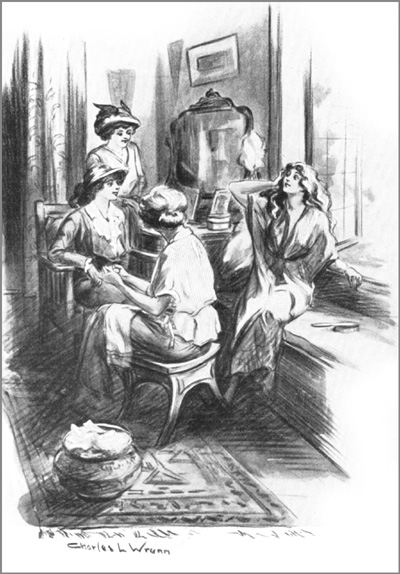 "You're right in the fashion, Miss Brown," observed
Adele.—Page 25.
"You're right in the fashion, Miss Brown," observed
Adele.—Page 25.