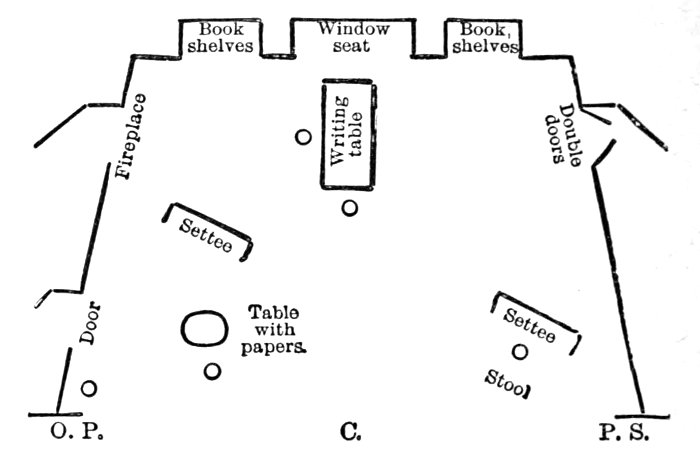
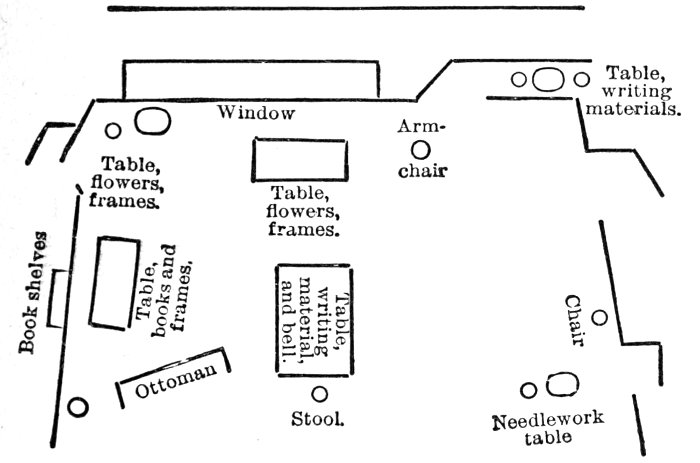
Time of Representation, thirty-five minutes.
PROPERTIES USED.
- Neck wrap.
- Basket (containing) sweets, jelly and scarf.
- Times paper.
- Telegram and telegram form.
ACT III.
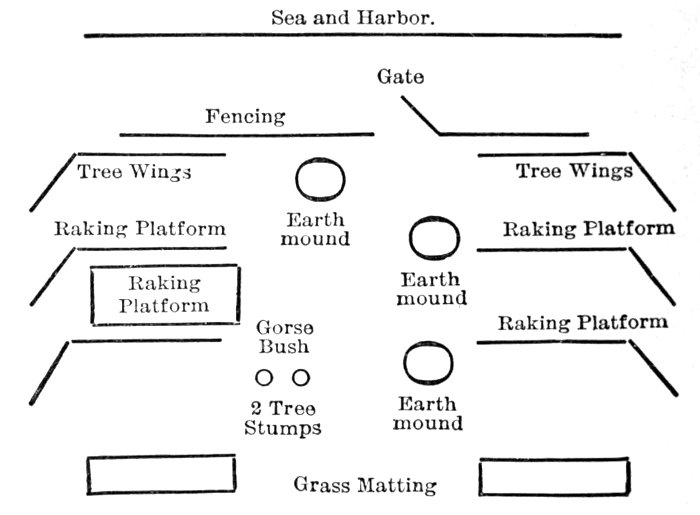
The garden of Mr. Mollentrave's house in Swanage.
A low fence runs at back, with a thick
hedge; behind is the sea, to which a winding
path leads, down the rock. There are alleys
running to right and left. Miss Treable is
seated on the tree L. C. with Dexter standing
before her. A week has elapsed since the last
Act.
Dexter. (C.) Yes, Miss Treable, he is a great
man—a very great man! His powers of insight
are most extraordinary! I trust you do not
resent his—as it were—stripping off the pigment
and exposing the unvarnished canvas?
Miss Tre. (is sitting R. tree trunk, haughtily)
I have no doubt that what Mr. Mollentrave says
may be true of some women—but certainly not of
ME!
Dexter. (bowing) You are naturally an exception.
His remarks must be taken as applying
generally to the sex. (down L. C.)
Miss Tre. Regarded from that point of view—
Dexter. (up C.) Ah, Miss Treable, in my own
humble life I have derived the greatest benefit
from Mr. Mollentrave's teaching! And like all
geniuses—he is so modest! One of his most brilliant
aphorisms was—I say it with pride—inspired
by me.
Miss Tre. (indifferent) Indeed?
Dexter. (R. C. resting on L. tree trunk) I
assure you. You must know that my wife has a
large circle of relations. I will confess to you
that I somewhat resented their constant interference
in our affairs. I mentioned the matter to
Mr. Mollentrave. Without a moment's hesitation
that remarkable man dictated the line: "Marital
happiness begins when the wife's relations—leave
off!"
Miss Tre. (sarcastic) Profound. Very.
Dexter. (sit on L. trunk) He has permitted
me to compile a little volume of extracts, "The
Mollentrave Birthday Book"—one coruscation
for every day of the year. A good idea, is it not?
(rising)
Miss Tre. (rising) Admirable! But I doubt
whether many women will buy the book. (down
R.)
Dexter. (moving off) If all those who consider
themselves exceptions purchase it, Miss
Treable, I shall be perfectly satisfied. (goes up
C.)
(He goes through the gate. Sir Joseph comes
stealthily along looking worried and haggard
R. 3 E.)
Miss Tre. (R. C. brightly) Good morning, Sir
Joseph.
Sir J. (C.) Good morning. I had hoped to
find Mr. Mollentrave here. Do you happen to
know—
Miss Tre. Would you wish me to tell him?
Sir J. I should be much obliged.
(Miss Treable exits R. 3 E.)
(Sir Joseph throws himself on the grass L. and
plucks savagely at it, muttering to himself.
After a moment Margaret comes running from
the house R. 3 E., looks round, and gives a glad
cry as she sees Sir J. The cry becomes reproachful
when she finds he is lying on the
grass. She carries a small basket in her hand.)
Marg. Oh, Joseph, dear Joseph, how could
you! Lying on the grass! (puts basket down R.
C. and helps Sir J. to rise.)
Sir J. (L.) (getting up. Miserably) H'm
I—
Marg. (L. C.) Wicked man! With your rheumatism!
And no muffler! I found it in the hall!
Oh, naughty, naughty! (she produces it from the
basket) Here it is, sir! Put it on at once!
(puts muffler round him) (taking him to R. C.)
(he sits R. trunk of tree) And it's twelve o'clock!
I've brought your essence—here—and a spoon.
(she produces them from the basket and feeds
him) What would you do without me?
Sir J. Impossible to conceive!
Marg. (she sits on his L.) Take it, sir! (he
laps it up piteously) To think of you all these
years, having to look after yourself, and hide, because
he wouldn't let his little girl see how ill he
was! Oh, poor, poor! (she feeds him a second
time and wipes his mouth with the muffler) But
she'll take care of him now! Only wasn't it
wicked of you to slip off like that? You had only
dictated for an hour and a half!
Sir J. I thought you were tired!
Marg. (with enthusiasm) Tired! I could go
on forever! It's immensely interesting—fascinating.
Oh, how wonderful you are!
Sir J. (clearing his throat) H'm—I—
Marg. Constitutional Law, one would think
would be a dry subject. To me it's a fairy tale.
Sir J. Er—
Marg. Perhaps because you are speaking!
You! Nouns and adjectives cease to be parts of
speech—they become parts of—you!
Sir J. (with a great effort) I have frequently
had occasion to remark to you, Margaret, that I
have a great distaste for sentimentality. I have
explained to you—the month of probation—
Marg. One week has expired. Has it been a
week? Can the days have flown so quickly?
Sir J. They have evidently contrived to. Although—
Marg. (rise, up C.) See how the sun is shining—how
radiant the water is—and the sky! The
dancing sunlight! Oh, what does it say to you,
the sunlight! (down R. C. to Sir J.)
Sir J. (impatiently) It says to me that it's
very hot—and that we're talking nonsense.
Marg. Oh, let us, for once! I've been so good!—Joseph,
you coughed! You must take a lozenge.
(she produces a box from the basket) You must!
Mr. Mollentrave says that you have the beginnings
of asthma.
(She opens the box, takes out a lozenge, and
forces it between his lips. He swallows it,
pathetically.)
Miss Treable and I are practising first aid, in
case you should fall down—
Sir J. (savagely) And why in the name of
goodness should I fall down?
Marg. Mr. Mollentrave told me that your limbs
are rather unsteady—
Sir J. (clenching his fists) Ah, Mollentrave,
Mollentrave!!
Marg. (kneeling on his L. She puts his arm
on her shoulders, fondly) But have no fear, dear
one! You shall lean on me—I shall be your
crutch, your support! Oh, the thought of us two
in our cottage—just you and I! I dream of it!
Sir J. (growling, taking arm away) No
dances—no theatres—not even a visitor—
Marg. Shall I want any of these—when I have—you!
You, who have given up all—for my sake—for
me!
Sir J. (fidgeting) H'm—but still—I fancy
you'll find it dull—
Margaret. I? Never! You don't know me
yet—not altogether, I mean. Oh, if you would let
me speak to you—about myself—
Sir J. (rise and cross C., throwing lozenge
away—fretfully) That theme is barred—by consent.
Don't you think you had better go back to
the house? Unless you would like to bathe?
Margaret. (rise, firmly) No—you do not
bathe—I shall not either. No pleasure in which
you cannot join, can henceforth be a pleasure to
me!
Sir J. (turning up stage—groaning) Come—we'll
go back to Law! (he rises)
Margaret. Yes, yes—let us! But stay—I have
a word to say to you—
Sir J. More words?
Margaret. Not of myself this time—nor of you—but
of—Everard!
Sir J. (with a gleam of hope) Everard!
Margaret. (reproachfully) Oh, Joseph, my
own Joseph, what a suspicion! Could you imagine!
Oh!
Sir J. (groaning again) He is more of your
age—I thought—I told you I should not blame
you—
Margaret. Never dare to hint at such a thing
again! I regard him—it is my duty to regard
him—with the serene, but affectionate eyes, of an—aunt,
(sit R. C.)
Sir J. (C.) Aunt!
Margaret. And—I confess—it grieves me—to
see him—so much taken up with—Lady Claude.
Sir J. (eagerly) Ah, you have noticed—
Margaret. Day after day he is with her—with
her all the time. She—ah, Joseph, you may
not have observed it—but women have quick eyes!
Lady Claude was a friend of yours once, I know—but
she is a designing woman!
Sir J. (angrily) I say! Look here!
Margaret. Oh, I mean nothing unkind. Women
of that age—she is at least thirty-five—naturally
crave to be—admired. And it is perfectly
plain to me that she—is drawing Everard on.
Sir J. (grimly) Really!
Margaret. She flirts with him outrageously!
She won't let him out of her sight! I've been
looking forward to finding him a wife—you and
I together—some girl who would make him happy....
But Lady Claude!
Sir J. (cunningly) Everard certainly seems
to admire her—
Margaret. Is it not incomprehensible! She's
so old.
Sir J. H'm, if it's the disproportion of age
that shocks you, think of us! I—fifty—and you
nineteen!
Margaret. (rise, and up to him) My love
shall twine round you so softly that we shall
divide my youth—shall share it. And, in the
days to come, we shall ask—which one is old—Joseph—or
Margaret?
Sir J. (sulkily) Conundrums of that kind
will be useful, on winter evenings, with the wind
howling down the chimney, and the rain coming
through the roof—(turn away L.)
Margaret. (getting on Sir J.'s L.) There can
be no wind when you are near me, and no rain
can come through the roof of our love!
Sir J. (throwing up his hands in despair)
Oh, no more at present, please!
Margaret. (laying a hand on his arm) You'll
speak to Everard?
Sir J. Why on earth should I?
Margaret. Joseph! Shall we let the poor boy
throw himself away on—
Sir J. (R. C. laughing hysterically) Ha, ha!
Oh, that's very good! Throw himself away on—Lady
Claude!
Margaret. (C.) (offended) You think it's
impossible? But I tell you I've seen—
Sir J. My child, we've talked nonsense enough
for one morning. Let's go. (takes her hand and
is about to lead her away R. Mollentrave
comes in breezily up L. C.) Ah, there's Mollentrave.
I must have a word with him. Run on to
the house—I'll follow. (giving her the basket)
Margaret. (fondly R.) Come soon, dear one—come
soon. When my eyes do not rest on you
they grow tired with waiting!
Sir J. (R. C.) Please go, there's a good girl!
(Margaret departs regretfully R. 3 E. Mollentrave
has been coming from the other side. He
wears his usual air of supreme satisfaction)
Mollen. (up L. C.) You want me, Balsted?
All going well?
Sir J. (savagely R. C. takes muffler off) Oh,
wonderfully well. The way we're progressing is
extraordinary—very!
Mollen. (his head on one side) The trained
observer would almost detect a suspicion of—satire.
Sir J. Satire! Heaven forbid! It's true that
the girl grows fonder and fonder—
Mollen. She has only tasted the jam so far—but
the powder's working!
Sir J. She Josephs me from morning till
night! She'll be calling me Joey soon. (down
R. C.)
Mollen. (C.) No, no, Balsted! I should not
encourage her in the use of the diminutive!
Sir J. (savagely) Gurrh! Look here, Mollentrave—
Mollen. Impatient person! I said a month,
did I not? So far but a week has passed—(Mollentrave
sits L. C.)
Sir J. (sit R. C.) Another week will drive me
crazy. I dictate law to her—the dullest stuff I
can find—I tell you she likes it, she never wants
me to stop!
Mollen. You will forgive me, my dear Balsted—but
have we been quite—senile—enough?
Sir J. Senile! Have I been senile? Haven't
I simulated aches and pains, and congenital insanity,
till I simply detest myself? Man, she
loves me the more for it!
Mollen. (airily) Merely the first stage, Balsted!
Peeling!
Sir J. I can't go on—I tell you I can't! The
fact is, Mollentrave, that you've been hopelessly
wrong.
Mollen. (emphatically) Events are following
exactly the path that I had marked out; they
are, with unerring precision, pursuing to a hairs-breadth
the line I had indicated in my mind.
Sir J. (sarcastic) Indeed! Then perhaps
you'll explain—
Mollen. My dear Balsted, believe that I make
not the slightest reflection upon your intelligence
when I remark that a general's plans are rarely
comprehensible to his subalterns.
Sir J. (pettishly) This is not a case—
Mollen. (rise and go C.) Pardon me, but it
is. If I may borrow an analogy from your legal
jargon, I am the leader here, and you the junior.
Is that not so?
Sir J. I have made up my mind. I shall tell
her the truth.
Mollen. Do—and they'll drag up her body on
Swanage beach to-morrow.
Sir J. Absurd!
Mollen. Let that sentimental girl realize that
she has been fooled—she'll take her life. That's
certain. And as her hair's long she'll choose the
sea. (away L. and up L. C.)
Sir J. Unfortunately I've lost my faith in you,
Mollentrave.
Mollen. (shrugging his shoulders) That, of
course, is a pity.
Sir J. Am I not justified? See your great
scheme about Everard! She isn't jealous at all.
Mollen. Has she spoken about him?
Sir J. Yes—she wants to find him a wife.
Mollen. And not a word about Rosamund?
Sir J. She thinks Lady Claude flirts with him,
and doesn't seem to like it. But, beyond that—
Mollen. (triumphantly) Beyond that! And
you complain! Balsted, that's love! The real
girl creeping up, through the cotton wool! My
dear fellow! Couldn't be better! It couldn't indeed!
Sir J. I don't know—she didn't speak like that
at all. And the boy has been odd—he avoids me—he
doesn't address one word to Margaret—
Mollen. (with emphasis) The boy follows
the rule! He nurses his passion. Rosamund consoles
him—she always talks about Margaret!
What more do you want? And the girl thinks
they flirt! He watches her hungrily—oh, I've observed
it!—he waits for his hour. You'll see.
Sir J. (with a gleam of hope) You really
think that? You really think that?
Mollen. (sits on Joseph's L.) I give you my
word I never believed matters could be so far advanced.
Sir J. Then perhaps I had better go on?
Mollen. (rise. Sir J. rises) Would you
turn back, with the harbour lights in sight?
Look here, I'll knock off a fortnight! I ask for
one week more—just one week! And before that's
out you'll have them both on their knees to you.
(Lady Claude comes in R. 3 E. and crosses L. C.)
Rosamund, Rosamund! Balsted has been complaining—losing
heart! Tell us about Everard!
He's always talking of Margaret?
Lady C. (up C. sadly) Always, always!
For hours at a time.
Mollen. (up R. C. turning triumphantly to Sir
J.) Balsted!
Lady C. (plaintively) She's a very sweet girl,
and I'm fond of her—but—the subject's beginning
to pall!
(Margaret off cries "Joseph")
Mollen. She's calling you, Balsted.
Sir J. (down R. sulkily) Let her call.
(Margaret off louder "Joseph! Joseph!")
Mollen. You must go to her, Balsted! Play
the game. One week more—
Sir J. I'd rather spend it in gaol, picking
oakum. (Margaret off, "Joseph! Joseph!!")
Oh, Mollentrave, if it were not for your daughter,
how I'd wish that I never had met you!
(He goes—miserably—R. 3 E.)
Mollen. (coming down R. shaking his head)
And that man, Rosamund, is one of our most eminent
lawyers!
Lady C. (down R. C.) Papa, I must tell you—it's
strange—though Everard and I talk of
nothing but Margaret every day, from two till
seven—
Mollen. Well?
Lady C. (pathetically) Think of it! From
two till seven—every day!
Mollen. Science must have its martyrs! Tell
yourself that you're watching human love wriggle—under
the microscope!
Lady C. Though he recounts, with minutest
detail, every word she has spoken to him since
they first met—what she said, what he said, how
she looked, what she wore, the gestures she made—still,
and for all that, I have a feeling at times,
a kind of idea—
Mollen. (waving his arm) My child, you
know my opinion of feminine intuition! In my
book I class it under the head of popular fallacies.
(with a change of voice, and sudden energy)
Rosamund, I imagine the moment to be almost
ripe for my grand coup! (takes Lady Claude's
hands and sits her R. C. on his L.)
Lady C. What will you do?
Mollen. (sitting R.) I shall now proceed to
work on the clay. I will provoke Everard to
frenzy.
Lady C. How?
Mollen. He knows of course of the month of
probation—he builds on that. To-day he shall
learn that Balsted proposes, at the earliest possible
moment, to lead Margaret to the altar!
Lady C. (doubtfully) You will tell him that?
Mollen. I will. And the result? A scene between
the two young people before which the most
passionate episodes of Romeo and Juliet pale into
insignificance! For I shall also tell Margaret
that you have fallen desperately in love with
Everard!
Lady C. (protesting) Papa! You will never
say that!
Mollen. Discreetly—by nods and jerks—oh,
you may trust me! And there ensues—in chemical
parlance—a liberation of two gases—that
meet—and explode!
Lady C. (rise, up C.) Oh, I hope that they'll
explode soon! See, there he is—under the trees!
He is waiting.
Mollen. (rise and up R.) Let him come—I
will leave you. Prepare him, Rosamund—pave
the way—lay down the stones—then I shall come—the
steam roller! I have every confidence in
you, my child.
(He skips off nimbly R. 3 E.—after an instant
Everard comes in L. 3 E.)
Lady C. (C.) Ah, Everard—my father has
just left me—we were talking of Margaret.
Everard. (C. on her L.) (indifferently) Ah?
Lady C. The sweet girl! How beautiful she
looks to-day!
Everard. She has a certain prettiness—
Lady C. Oh, Everard, her eyes! I don't think
I ever have seen such eyes! One moment so
tender—another so deep and glowing—
Everard. As your father says, Lady Claude,
those qualities are common to the optic organs of
all mammals. And—let me ask you—why will
you always speak about Margaret?
Lady C. Because I admire her so much! She
has youth—ah, youth! (sit R. C.) And besides,
dear Everard, it seems to me that Margaret has
been a favourite topic—with us both!
Everard. (sit R. C. on her L.) To-day at least
I decline to talk of her—but of you—only of you.
Lady C. There is nothing to say of me, dear
Everard. I—was. Among you young people I
seem to move like a—tradition. Margaret says
the things I used to say—she dreams my dead
dreams. And I am fond of her—because I see in
her—my old self.
Everard. (eagerly) That self has not suffered—time
only has mellowed it—wisdom has crowned
it—
Lady C. (cheerfully) You must not waste
those pretty speeches on me! And tell me, why
this affected indifference? Do I not know how
passionately you adore her?
Everard. (rising) Lady Claude, I will confess
to you, frankly and honestly, there was a
time when I believed I loved Margaret—
Lady C. (staring) When you believed—!
Everard. As your father observes—quoting
Tolstoy, I think—I was attracted by a well-fitting
jersey and a pair of Paris shoes.
Lady C. Everard!
Everard. But it was, I need scarcely say, the
merest infatuation—
Lady C. What!!!
Everard. Could it have been other—since now
I am conscious—how wholeheartedly I love—you!
Lady C. (wildly) Me! You love me!
Everard. You. My feeling for Margaret was
immature sex-attraction. At your feet (kneeling
on her L.) I lay the profound and reasoned devotion—of
a man. Rosamund, I love you. I ask
you to marry me. Be my wife!
Lady C. (aghast and helpless, rise and cross
L.) You can't mean this? (He tries to take her
hand, she rises hurriedly and eludes him. Sir J.
comes from R. 3 E.) (L. C.) There is your uncle.
Leave us, leave us!
Everard. (C.) Why? I will tell him—
Lady C. No, no! Go to my father! Let him
know! Please!
Everard. Since you wish it. (He goes up R.,
passing Sir J. haughtily) I shall return for my
answer. (he goes)
Lady C. (L. C.) He has proposed!
Sir J. (R. C.) What!!!
Lady C. Imagine it! He has fallen in love—with
me!
Sir J. (slowly) Everard has fallen—in love—with
you?
Lady C. Yes! Imagine it! A catastrophe!
Sir J. (dully, down R. C. and sitting) Very
awkward. Very.
Lady C. (C.) How could one conceive it!
I've been sympathetic—that's all! Talked about
Margaret! Oh, I assure you, I've done nothing
but talk about Margaret!
Sir J. There's something odd about boys and
girls nowadays. But, of course, it's all Mollentrave—(he
clenches his fist)
Lady C. What must I do? Tell me—advise
me!
Sir J. You haven't accepted him?
Lady C. (indignantly) Sir Joseph!
Sir J. You see, things are just a trifle topsy-turvy.
My—bride—grows more and more devoted.
Lady C. I'm completely bewildered! The poor
boy seemed terribly in earnest—
Sir J. So does the poor girl! I'd like to shake
them both in a bag! Well, you'll have a week of
it now.
Lady C. How to refuse him without—
Sir J. You'd better accept him—why not?
You'll find, we'll both have to marry them. Then,
some day perhaps, they'll elope together—and
Mollentrave on Women will rub his hands and
cry "There!"
Lady C. (very distressed) What am I to say
to Everard? Oh, what?
Sir J. Be senile! Boil your milk!
Lady C. (indignantly) Sir Joseph! Is this
your sympathy? (sit L.)
Sir J. (meekly and deprecatingly, rise and to
L. C.) My dear friend, I've had seven days of
Margaret. I thought my brain was fairly strong
—but it's giving. I tell you I'm growing helpless—turning
to pulp—
Lady C. But advise me—advise me!
Sir J. I can't. You know—it sounds absurd—I
did have some hopes of marrying you myself—I
did indeed. (away R.) Well, now Everard
claims you—and I shall soon be led by Margaret
to the altar, with Miss Treable propping me up
on the other side. We can't do anything—that's
how matters are!
Lady C. Do you think I will marry Everard?
Sir J. (helplessly sit R. C.) I don't know—I
don't think at all. Mollentrave does the thinking—Mollentrave!
(Mollentrave bustles in, beaming, R. 3 E.)
Mollen. (C.) (looking wonderingly from one
to the other) Dear me, why this air of depression?
Lady C. (both rise and up to knoll) Depression!
Papa! Have you seen Everard?
Mollen. (C.) I have, this very moment.
| Sir J. |
(excitedly) Well? Well? |
| Lady C. |
Mollen. (looking from one to the other)
Rosamund! Balsted! You surely wouldn't have
me believe that you are not pleased?
Sir J. (amazed) Pleased!
Mollen. (emphatically) Yes, sir, I say
pleased—at this magnificent development of my
scheme!
Lady C. When Everard wants to marry me!
Sir J. And has ceased to love Margaret!
Mollen. (more in sorrow than in anger)
Amazing! You, Balsted, you—well—you don't
surprise me. But Rosamund—my own child—no,
I should not have believed it!
Sir J. Did he, or did he not, inform you that
he had proposed to your daughter?
Mollen. He most undoubtedly did.
Sir J. And was that what you wanted?
Mollen. Can you ask? What else?
Lady C. (reproachfully) Papa! When you
said—
Mollen. My dear child, I do not admit even
you into my closest confidence. You have done
your share, both of you—now leave me to do mine.
Sir J. Will you condescend to inform us—
Mollen. You will continue the treatment as
before.
Sir J. (madly) I am to go on with Margaret—
Mollen. (calmly) You are.
Lady C. (helplessly) And—I?—
Mollen. Will persistently—sympathise—with
Everard.
Lady C. But he has proposed! What am I to
do?
Mollen. Be flattered—in case of need even
affectionate.
Lady C. (horror stricken) Affectionate!
(away L., and sitting.)
Mollen. Discreetly—remotely—let us say, in
a spiritual and disembodied fashion. You may,
if you wish it, hint at Lord Contareen—
Sir J. (looking up eagerly) Lord Contareen?
Mollen. Ah, didn't you know? He and my
daughter—(Margaret calls "Joseph" and comes
in with the "Times" in her hand.) Pardon me—there's
the girl. I'll send her away—I have to
give you further instructions. Wait here—I
shan't be a moment.
(He goes quickly to Margaret off R. 3 E., and
walks her off, talking eagerly to her.)
Sir J. (across to L. C., sitting) (excitedly.)
What is this about Lord Contareen?
Lady C. A foolish creature, whom Papa wishes
me to marry.
Sir J. (aghast) Marry! What, what! Marry—you!
Lady C. Yes. And he thinks—
Sir J. Rosamund! Is there a man in the
world whom you can marry—but me!
Lady C. Sir Joseph! You said just now—
Sir J. (kneeling on her R.) Rosamund, I love
you! I always have loved you! You know it!
Lady C. (embarrassed) I—I—
Sir J. During this diabolic week there has at
least been you! You'll marry me, won't you?
Lady C. Oh, Sir Joseph, is this the time—
Sir J. It is, it is! To the devil with all the
rest! We'll elope!
Lady C. Elope?
Sir J. Yes—and leave Mollentrave to settle
matters! Rosamund, tell me!
Lady C. What can I tell you? What?
Sir J. That you care for me! Will you?
Lady C. But you are not free!
Sir J. (wildly) Not free, not free! But
when I am—as I shall be, I swear it! then—?
Lady C. Then—oh, then I shall say "yes"
many times!
Sir J. (rise and raising her) Rosamund—dearest!
(He rushes towards her—she stays him, with a
gesture.)
Lady C. Hush! He's coming back!
(Sir Joseph gets back R.)
(Mollentrave bustles in R. 3 E., holding the
"Times" in his hand.)
Mollen. (C.) She was bringing you the
"Times"—here it is—she assures me it has been
warmed and all the microbes boiled out of it!
You are so fussy, Balsted! Here! (He hands
him the paper.)
(Sir Joseph takes paper, goes up R. C.)
Lady C. (L. C.) Papa! Does Margaret
know?
Mollen. About Everard? Oh yes. And of
course she's indignant. Although she adores our
friend Balsted, she resents the desertion of an ancient
admirer.
Sir J. (coming down C.) I fail to see how
this helps us.
Mollen. (R. C.) Balsted, Balsted, you surely
affect this denseness! I've told Everard, by the
way, that he has my full consent and approval.
Lady C. (L. C.) Papa!
Mollen. That the decision rests with my
daughter—
Lady C. (cross to C.) With me! What am I
to say to him?
Sir J. (L. C.) (whispering to her) We'll
elope!
Mollen. In the meantime Balsted will be
good enough to overwhelm Margaret with his
elderly devotion—
Sir J. I won't!
Mollen. You will! Where you were doddery
before, you will now be paralytic! You will, for
the next week, refuse to stir from the house, or
let Margaret do as much as budge from your side!
Sir J. (ironic) Really?
Mollen. Yes. And Rosamund does more or
less the same with Everard.
Lady C. Papa, I can't! I tell you I can't!
Mollen. You must! I tell you, you must!
(Lady C. goes up C.)
(Margaret calls "Joseph" and appears at the
same place as before. Balsted is L.)
(Down L. C.) The girl again! Balsted, we will
leave you with her. Read your paper—she
mustn't think we've been plotting. Read it, I
say—at present you're simply glaring!
Lady C. (up R. C. intercepting Margaret—speaking
very gently) Margaret—my dear
Margaret!
Margaret. (up R. coldly) I congratulate
you, Lady Claude.
Lady C. You congratulate me! You believe—
Mollen. (up C.) (sternly) Rosamund, I
want you! Come!
(He marches her off L. U. E., Margaret looks scornfully
after her, then sits on the grass, close to
Sir J. who holds the paper as a shield.)
(Sir Joseph crosses R. and sits.)
Margaret. (C., reproachfully) Joseph, I
warned you! You refused to take any steps!
Now you see!
(Sir Joseph turns over the paper wildly.)
Margaret. It is unpardonable of them both,
but he, the poor boy, is at least to be pitied.
There really should be a law against elderly women
marrying mere boys! But it's our duty to
do something, isn't it, Joseph? We really can't
stand by and allow him to be so foolish—can we?
(Everard comes in, R. 3 E.)
Ah, Everard, Everard! We have heard the—news.
Your uncle has something to say to you—haven't
you, Joseph?
(Comes down R. C., taps him on the arm, Sir
Joseph suddenly leaps up R. C. with a wild
yell)
(Everard comes down L. C.)
Margaret. Oh, what is it? Another attack,
Joseph?
Sir J. (flourishing the paper and pointing to
a paragraph) Here, here, who has done this?
I say, who has done this?
Everard. (amazed at his vehemence) Why,
uncle—
Margaret. (rushing up with smelling salts)
Joseph, you know you should not get excited!
Sir J. (shaking her off) Leave me alone!
Go away! I want to know how it got into the
papers! (cross to C.) Who said it? Who?
Margaret. (R. C.) Said what, Joseph dear?
What has happened?
Sir J. (C. fiercely) There's an announcement
here that I mean to resign the House, and
give up the Bar!
Margaret. Oh! That wretched man must
have put it in!
Sir J. (glaring at her) Man! What man?
Margaret. He called to see you yesterday,
while you were resting. I couldn't disturb you,
of course—so I—
Sir J. (choking with rage) You saw him?
You?
Margaret. And I told him—I was so proud!
Sir J. You told him! But it's not true!
Margaret. (staggering) What!!!
Sir J. (wild with excitement and fury) No—it's
not true—it's none of it true! Oh, you—idiot!
Everard. (L. C. advancing, horror-stricken)
Uncle! How dare you!
Sir J. (ignoring Everard and still glaring at
Margaret) None of it true! All sham and humbug,
you—wretched little idiot!
(He rushes off wildly R. 3 E., Margaret bursts into
a torrent of hysterical sobs, and sinks on to the
seat R. Everard is deeply moved—following
Sir Joseph to R. and then impetuously to her.)
Everard. (R. C. deeply pained) Margaret!
Don't cry! Don't!
Margaret. (between her sobs) Go—go—leave
me! Go to your Lady Claude! Who cares
about me!
Everard. (humbly) Margaret!!!
Margaret. He has deceived me—I see it all
now! The cottage in the country—the beautiful
book—(wringing her hands) (rise and cross
L.) Oh, can men be so wicked!
(Everard follows her L. C.)
(Feebly) It was so sweet—his giving up all—for
me! His being so helpless, and wanting me,
so much! And now—oh, wretched girl that I am!
(her sobs burst forth afresh, go up C. and sit,
pushing Everard away)
Everard. (up R. C.) Margaret! Don't! I
can't stand it!
Margaret. The wickedness of it! Oh, the
wickedness!
Everard. But you loved him! You told me
you loved him! When he proposed—
Margaret. It was such a surprise—and I was
so flattered! But love! How could I love—an
old man!
Everard. (more and more bewildered, sits up
C. on her R.) Margaret!
Margaret. An—ugly—old man!
Everard. What—what!
Margaret. And I—I admired him, of course.
But I confess that at first—only then, when Mr.
Mollentrave told me of all his diseases—Everard!
His heart isn't weak?
Everard. (rise) No!
Margaret. His limbs aren't feeble?
Everard. Not in the least!
Margaret. He's not even asthmatic?
Everard. No more than I am!
Margaret. (raising her hands pathetically to
Heaven) Oh!!! And yet how great his love must
be, for him to have stooped to this!
Everard. (scornfully) His love! He has
called you an idiot! You!
Margaret. (sobbing again) Yes—a wretched—little—idiot!
And what had I done to deserve
it! (Everard sits C.) Oh, leave me, leave me!
Go to your Lady Claude!
Everard. (trembling with excitement) You
can't marry him now!
Margaret. Will he let me escape, do you think?
All this week, the hungry love in his eyes!
Everard. But you—if you don't love him?
Margaret. I loved what I thought was him.
And I—I am faithful—I do not change—I don't
says things to one woman one week and then make
love to another! Why do you stay here, Everard?
Your bride is waiting!
Everard. (desperately) Do you think I want
to marry Lady Claude?
Margaret. (scornfully) Would you have proposed
to her, if you didn't?
Everard. I proposed out of pique, because
you—
Margaret. (excitedly) What, what!
Everard. I read Mr. Mollentrave's wicked
book, and believed it! Oh, Margaret, Margaret,
can you think that any other woman in the
world—
Margaret. (trembling) Then—then—
Everard. I always have loved you—always—always!
But when I found that you—
Margaret. I see it all! You proposed to Lady
Claude—for my sake!
Everard. I was so unhappy!
Margaret. And you don't love her? Then I
have ruined your life!
Everard. It's not too late!
Margaret. It is—it is! Can we break both
their hearts? Oh, Everard—we must be noble!
Everard. Poor Lady Claude! I'm afraid I've
been very cruel!
Margaret. And your uncle—think of your
uncle! Imagine if he—suspected! The blow to
him! No, no, we mustn't, we can't. We must
make the sacrifice, Everard! We must do what
is right!
(Leaning against each other.)
Everard. But tell me, at least! You do love
me?
Margaret. Oh, Everard, I always have loved
you—but I didn't know!
Everard. (desperately) I don't want to
marry Lady Claude!
Margaret. Nor I your uncle! But we must!
They love us, the poor old things!
(They fall into each other's arms. Mollentrave
comes in briskly L. U. E. and stares, in utter
amazement)
Mollen. (triumphantly) Ah! The liberation
of two gases, that meet, and explode!
(Everard and Margaret turn, horror-stricken, and
rise)
Everard. (up R. C. releasing Margaret) Mr.
Mollentrave! Oh!!!
Margaret. (down R. shamefaced) You
mustn't think—oh, you mustn't! We were
merely bidding each other good-bye!
Mollen. (C.) That of course was evident!
But, Everard—for a man who half-an-hour ago
proposed to my daughter—
Everard. (miserably) Mr. Mollentrave!
Mollen. Are there many other young ladies—whom
you have to say good-bye to, Everard?
Everard. Be merciful, sir! Oh, Mr. Mollentrave.
I love Margaret! (going to her)
Margaret. (reproachfully) Everard!
Everard. I do, I do! And she loves me! Oh,
Mr. Mollentrave, help us!
(Both kneel C. holding hands)
Margaret. Yes, yes, help us!
Mollen. What a position for a father! When
I think of my Rosamund—the blow to her! And
Balsted—poor, doting Balsted!
Margaret. (crawling towards Mollentrave,
humbly) We've been very wicked, we know!
But we'll do what you tell us!
Mollen. (both rise) Arise, my children! I
will befriend you!
Everard. (up R. C.) Oh, Mr. Mollentrave, you
are the noblest of men!
Margaret. (down R. C.) The best, the
kindest!
Mollen. (C.) (raising them both) I will
break the dreadful news to them—ah, very gently—We
must not be brutal! Not a word to them
yet—They must hear it from me!
Margaret. Yes—oh yes!
Mollen. Oh, the cruelty of youth! Go now—go—let
me consider what had best be done.
Everard. (seizing his hand and wringing it)
How to thank you!
Margaret. (caressing the other hand) Dear
Mr. Mollentrave!
Mollen. Whatever it cost me, you have my
promise!
(They go off, hand-in-hand R. 2 E. Left alone,
Mollentrave laughs quietly to himself, and
expresses his supreme satisfaction by a kind of
elderly dance. Dexter comes in R. 2 E. with a
telegram, and stares.)
Dexter. (R. C.) Mr. Mollentrave!
Mollen. (with dignity C.) Dexter, this exhibition
of agility may seem undignified, but it is
symbolic of a certain inward feeling of legitimate
pride.
Dexter. (puzzled) Sir?
Mollen. Dexter, I have done it—like that!
(he snaps his fingers) I waved my wand—and
they walked—I piped, and they danced! (to
Dexter R. C. speaking with profound conviction)
Dexter there are moments when my power strikes
me as somewhat uncanny....
Dexter. (R. C.) May I ask, sir—
Mollen. No, no, these matters are not for you.—What
have you there?
Dexter. A telegram, sir. The boy is waiting.
(Dexter hands him the telegram.)
Mollen. (fumbling for his glasses) Yes—a
little uncanny! (C.) But—fortunately for mankind,
I make a good use of that power! (He adjusts
his spectacles, opens the telegram, and
reads) What, what!
Dexter. (R. C.) No bad news, sir, I hope?
Mollen. (L. C.) (fuming) Contareen! The
ass, the triple ass! Engaged to Lady Gladys. I
am d—— (going up C. and down R. C.)
Dexter. Sir?
Mollen. And he gloats! He dares to gloat!
Dexter. (R. C.) Any answer, sir? I have
brought a form.
Mollen. Answer—no—no answer! Stay,
though—there shall be—yes, there shall! Ah, he
gloats, does he, that—moon-calf! Write, Dexter,—write!
Sit here and write!
(Dexter sits R. C.)
"Delighted at news. My daughter and Sir
Joseph Balsted, who were engaged yesterday"—
Dexter. (open-mouthed) Sir???
Mollen. (C. pettishly) I say, who were engaged
yesterday—"join in congratulations."
Have you got it?
Dexter. Do I understand you to say—
Mollen. You do, sir—you do! Is that down?
Dexter. Yes, sir. "My daughter and Sir
Joseph Balsted, who were engaged yesterday, join
in congratulations."
Mollen. Good. Now take that telegram, give
it to the boy—and mind, not a word to anyone
here! (down L.)
Dexter. (going) Very well, sir. (is going
R. 2 E.)
Mollen. (R. C.) Stay, I had better make sure.
Give me the telegram, Dexter—I'll hand it to the
boy myself. And do you go off, through that gate,
and take the next train back to town.
(Dexter crosses L. C.)
Dexter. (up L. C.) Sir! Don't you trust my
discretion?
Mollen. (R. C.) Implicitly, Dexter—but I
prefer to know it's in London. Go at once, please.
I shall let you know when to return.
(Dexter goes through the gate, L. U. E.)
Mollen. (C. and down L. C.) (moving off)
More work for my hands! But can I let that
creature gloat? (is going up R. 3 E.)
(As he goes, he meets Sir Joseph and Lady
Claude.)
Mollen. (pushing between them) Ah, Balsted,
Rosamund, wait for me here. I have news—strange
news! I shall be back in a moment!
(he goes R. 3 E.)
Sir J. (coming down stage on her R. slowly
walking down R. and across L. C.) News! Some
fresh scheme, no doubt! We have done with him—done!
Rosamund, I'll go now to the post-office,
and wire my clerk to get a special license—
Lady C. No, no, it's impossible! Oh, Joseph,
think of our eternal remorse—if anything happened!
Sir J. Remorse! I tell you, if we stay here,
we shall both of us be caught!
Lady C. We should never have lent ourselves
to this deception!
Sir J. It's too late now to moan over things!
Your father's responsible for it all—let him put
things right!
Lady C. Think of poor Margaret! Ninety-nine
girls out of a hundred, I said—what if she
be the hundredth?
Sir J. I don't care if she be the thousandth!
I won't marry her!
Lady C. And Everard! The blow to him!
Oh, how can I have been so blind!
Sir J. He and Margaret will console each
other!
Lady C. (L.) Oh Joseph, Joseph, they are so
young, but youth can know sorrow! Margaret
adores you—and I—oh, what have I done to poor
Everard!
Sir J. (L. C.) I don't care, I don't care! I
tell you—
(Everard and Margaret come in R. 2 E.; they
start at seeing the others.)
Lady C. Look, look! Here they are!
(A panic falls on all four of them; they eye each
other furtively, and both pairs stand whispering
at opposite corners of the stage.)
Margaret. (down R. C. to Everard down R.)
They've seen us—we can't go back.
Lady C. (up L. to Sir Joseph up L. C.)
Ah, Joseph! The poor little girl!
Everard. (to Margaret) He can't have told
them yet!
Margaret. (to Everard) Oh no—impossible!
But—how sad they are! As though they suspected!
Lady C. (to Sir Joseph) The poor boy, the
poor boy! We must be very gentle!
Everard. (to Margaret) I've behaved very
cruelly to poor Lady Claude!
Sir J. (to Lady Claude) I'm afraid Margaret
has been crying—
Lady C. (to Sir Joseph) It will break her
heart when she knows—
Everard. (to Margaret) Why not tell them?
This is a chance—
Margaret. (to Everard) Oh, think of the
shock! Your poor uncle! Oh, my heart fails
me!
(They fall into whispers. Mollentrave comes in,
and chuckles at finding them all together.
Both couples start guiltily and try to go, Margaret
and Everard R. 2 E., Sir Joseph and Lady
Claude L. 2 E.)
Mollen. (C.) No, no, don't go—sit down
please—I've something to say to you—all!
(They sit all of them in the greatest embarrassment,
avoiding each other's eyes, Margaret and
Everard R. and R. C., Sir Joseph up L. C., Lady
Claude down L.)
Mollen. (C.) (striking an attitude) The
poets have babbled of love since the first introduction
of rhyme;—but all that we know, or need
know, is that Cupid is—young! (he turns to Sir
Joseph) Balsted! The elderly fisherman baits
his fat hook and thinks he has landed the salmon—down
below, a barefoot boy wades in, and captures
the prize! As a lover, Balsted, you have
every quality—every one in the world that appeals
to a beautiful girl—every one, with the exception
of youth!
Margaret. (R. C.) (falling on her knees before
Sir Joseph) Forgive me!
Sir J. (staggered) Margaret! (crosses to
R. C.)
Mollen. (down L. C.) You must forgive her!
Balsted, it was your brain, your massive brain,
that attracted poor Margaret—but to-day, as she
sat beside Everard, two pair of lips met, quite by
chance—and your brain was forgotten!
(Lady Claude still sitting L.)
Everard. (rising R.) (appealingly) Lady
Claude!
Mollen. (L. C.) Rosamund, you too will pardon,
and grant absolution. Rosamund, Balsted,
rise to superior heights—and, from your loftiness,
smile on our lovers!
Sir J. (C.) Margaret, you are free!
Marg. (R. C.) What! Can you!
Sir J. I release you!
Mollen. (up L. C.) Go now, my children—leave
me—to pour balm on their wounds!
(He waves them off; they rush out gleefully,
hand in hand, R. 2 E.)
Sir J. (up R. C.) A miracle! But how—
Mollen. (C.) The infallible working of an
undeviating law!
Sir J. Mollentrave, I love your daughter. And
she—
Lady C. (rising and to L. of Mollen.) Papa,
this will be a disappointment to you, I know. But
I—
Mollen. (C.) Disappointment! The dearest
wish of my heart!
Sir J. What!!
Mollen. My scheme of schemes, at which I
have labored since first I set eyes on our friend!
Every single event, all that has happened, was
merely the inlay, the minute fragments that dovetailed—and
produced this!
Sir J. Marvellous! Mollentrave, I have no
words—to express my admiration!
Mollen. (taking Sir Joseph's hand and placing
it in Lady Claude's) After all, my dear fellow,
what is it? A little knowledge of human
nature!
CURTAIN.
- Mollentrave.
- Sir Joseph.
- Lady Claude.