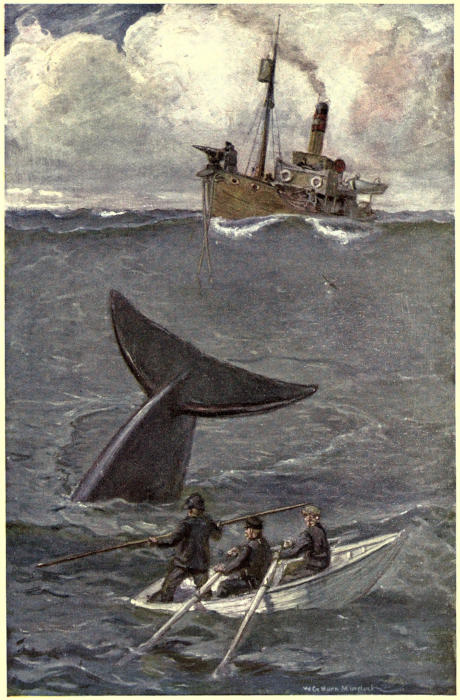
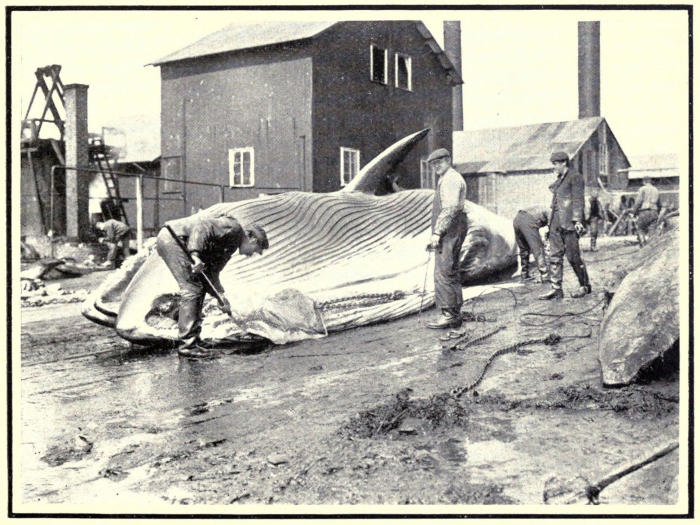
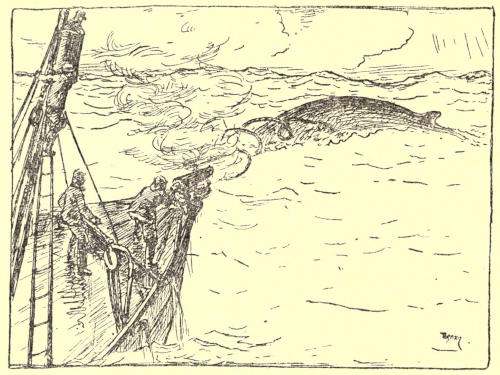
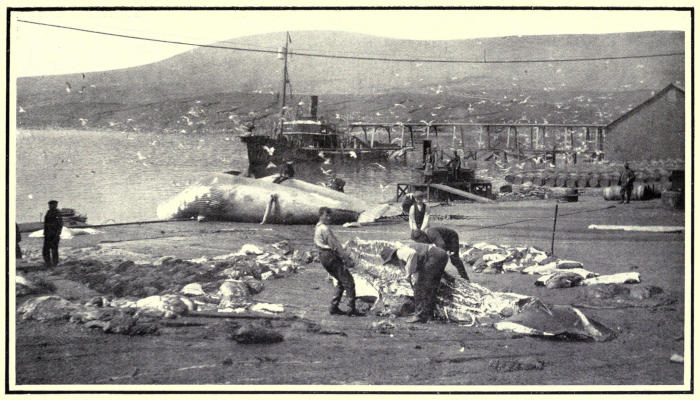
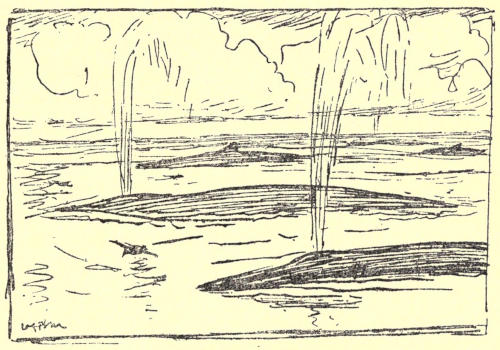
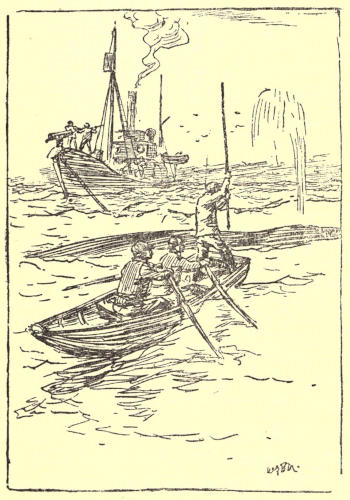
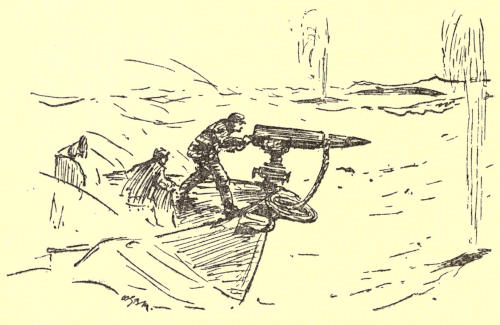
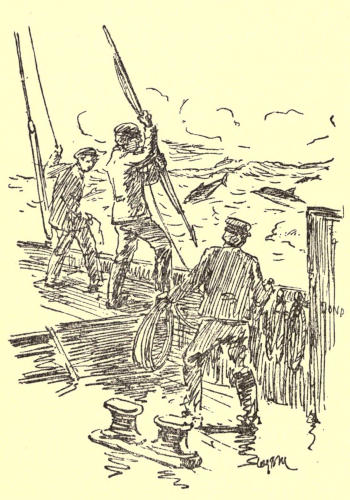
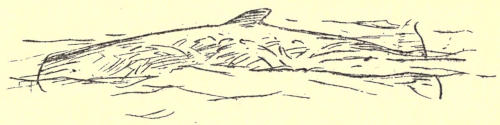
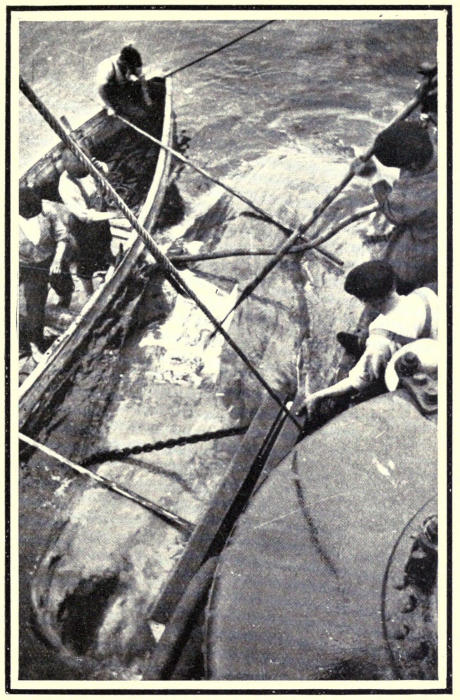
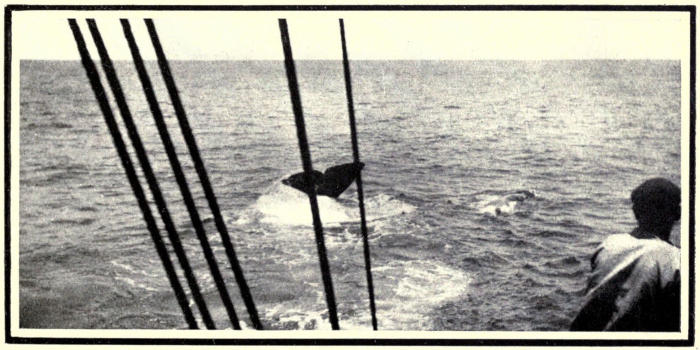
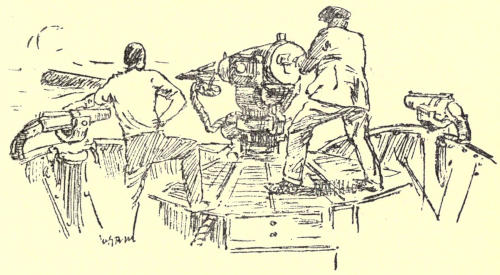
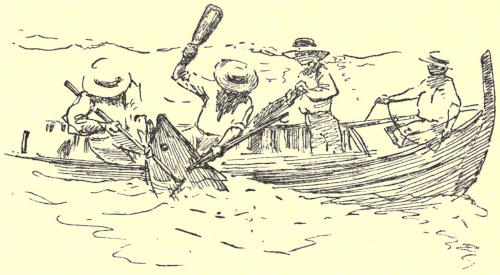
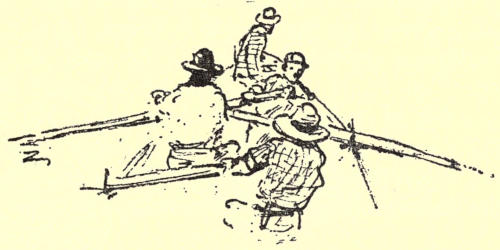
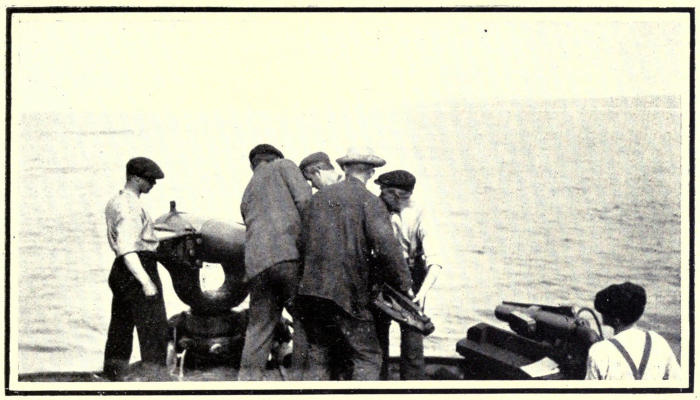
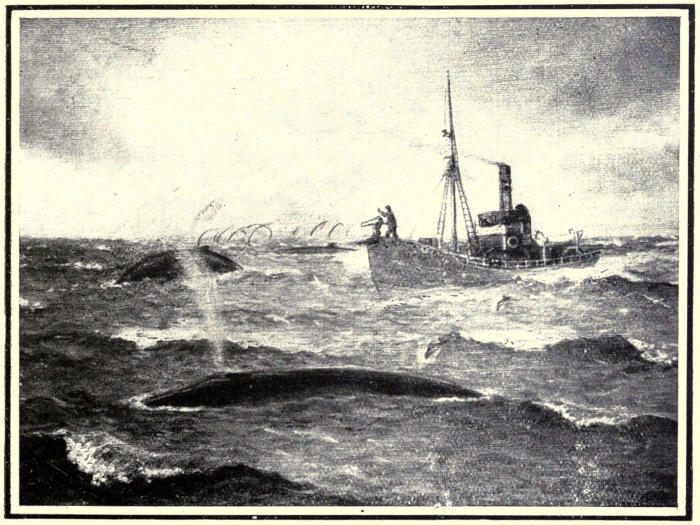
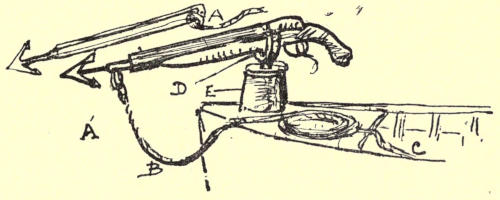
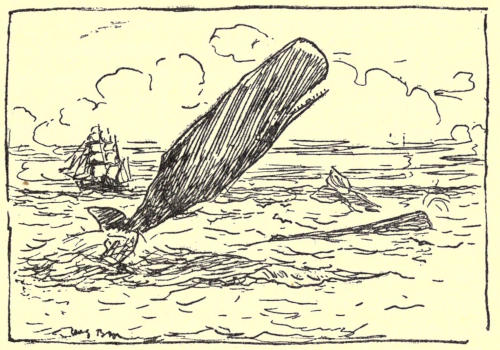
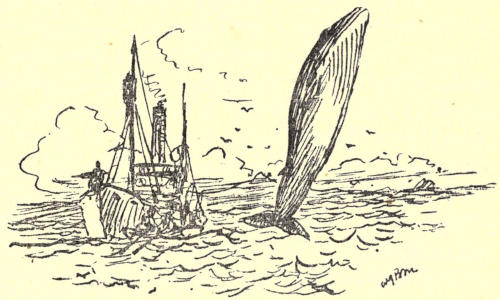
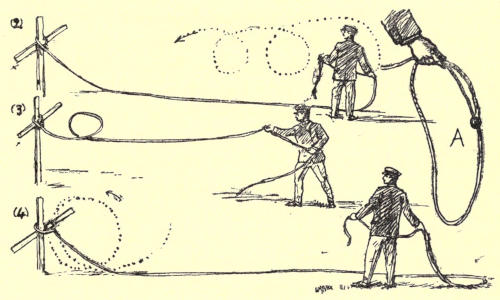
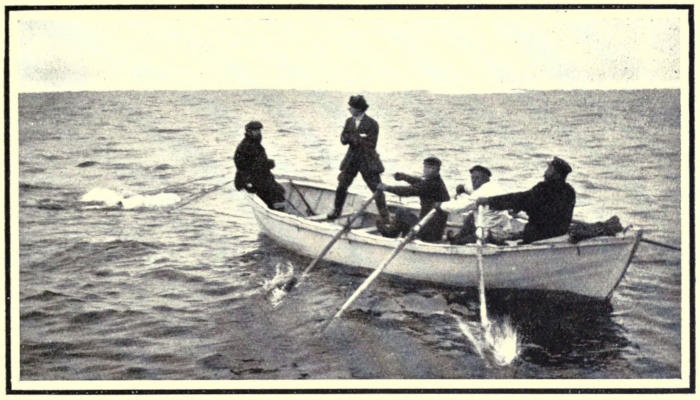
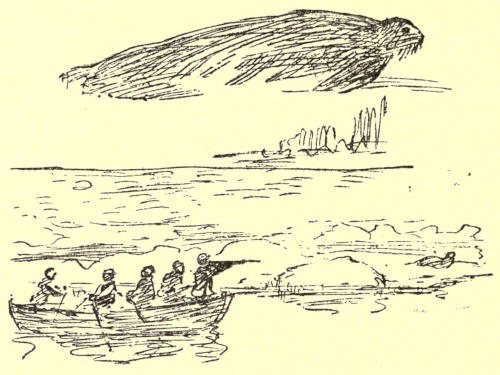
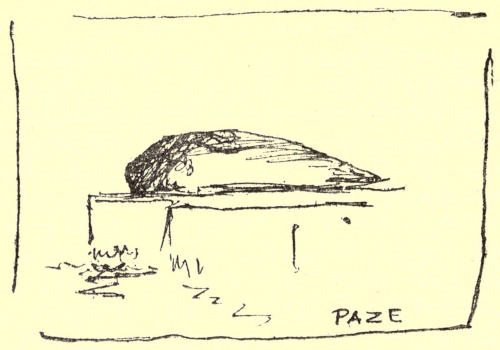
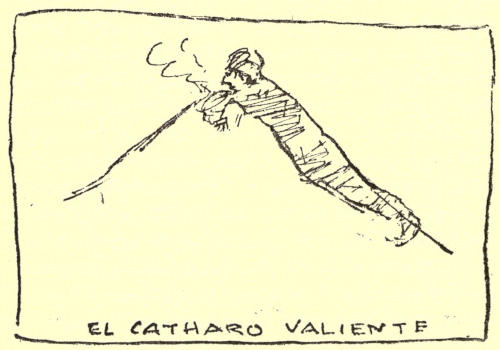
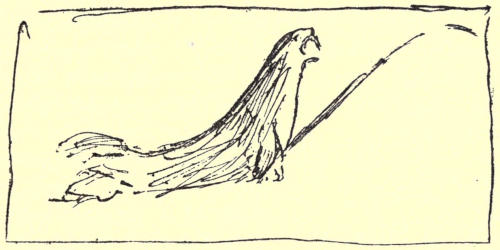
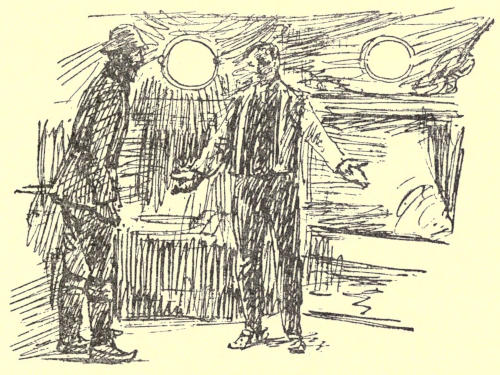
An eighteen-foot spear is the lance—half iron half wood. The pram is
swung out; and Jensen is handed the lance. We reach the whale and Jensen
makes a lunge, and the spear goes in five feet and is twisted out of his
hand; the vast body rolls over, the tail rises up and up and comes down
in a sea of foam.
MODERN WHALING
&
BEAR-HUNTING
A RECORD OF PRESENT-DAY WHALING WITH
UP-TO-DATE APPLIANCES IN MANY PARTS
OF THE WORLD, AND OF BEAR
AND SEAL HUNTING IN THE
ARCTIC REGIONS
BY
W. G. BURN MURDOCH, F.R.S.G.S. AUTHOR OF
“FROM EDINBURGH TO THE ANTARCTIC”
“AN ILLUSTRATED PROCESSION OF SCOTTISH HISTORY”
“FROM EDINBURGH TO INDIA AND BURMAH” &c. &c. &c.
With 110 Illustrations
chiefly from Drawings & Photographs
by the Author
LONDON
SEELEY, SERVICE & CO. LIMITED 38 Great Russell Street
1917
PUBLISHERS’ NOTE
The readers of this book will be interested to learn
that the expedition from Dundee which set out for
the Antarctic regions in 1892 to the Weddell Sea,
south and east of Graham’s Land, and in which the author
of the present volume took part, was the first of its kind since
the famous expedition commanded by Sir James Ross in
1842. Dr W. S. Bruce, the distinguished polar traveller and
oceanographer, was the scientific naturalist, and Mr Burn
Murdoch, the author of this volume, was the artist and
historian of the expedition, which is described by his pen in
“From Edinburgh to the Antarctic.” It consisted of three
whaling vessels specially built of great strength to withstand
ice pressure, barque rigged and fitted with auxiliary steam
power. They were accompanied by a Norwegian barque of
similar type. The chief object of the expedition was the
capture of the Right or Bowhead whale by old methods,
from small boats. For three months these vessels were continuously
amongst the thick pack ice and enormous bergs on
the east side of Graham’s Land.
The publication of the above-mentioned book, and lectures
by Dr Bruce and Mr Burn Murdoch, revived both at home
and abroad interest in the Antarctic regions, and in 1897 the
Belgica expedition followed in their wake, and this again was
followed by expeditions of various European nations.
During the expedition of 1892-1893 vast numbers of the
largest-sized finner whales were observed in the neighbourhood
of Erebus and Terror Gulf, and between South Georgia
and the South Shetland Islands. The report brought home
of these whales being in such numbers led to the development
of the present great whaling industry in the Southern
Seas. Companies were formed and modern steam whalers
were sent South to hunt these powerful rorquals or finner
whales. The extent of this industry and the methods of
modern whaling are described in the first part of this volume.
In the second part, which is concerned principally with
bear-hunting in the Arctic regions, some description is also
given of the old style of harpooning narwhals from small
boats.
The publication of this volume has been held over owing
to the war. Part of the text was printed off, and it contains
references to events, current at the time, which, without
this explanation, might puzzle the reader. The prices of
the products of the whaling industry are for the same reason
more up to date in the Appendix than in the text.
LIST OF CONTENTS
PAGE
CHAPTER I
Planning a Modern Whaler—Towing a Whale—Our Whaler,
the Haldane, in Shelter—Balta Sound, Shetland—We plan
a Company—Our New Whaler, the St Ebba, in Tonsberg
Norway to Tonsberg—Comparison between the Old Viking
Ships and our Modern Vessel—Similarity of Lines—Modern
Methods of Whaling—“Modern Whales” compared
with Old Style—Whales, Sperm—Right Whales—Finners—Tackling
a Finner with Old Style of Gear—Whaling
Stations—Utilisation of Whole Carcass—Whale
Products—Modern Whaling in Southern Hemisphere—Stations
round the World—Decrease and Increase in
Numbers of Whales—Natural Close Season—Increase of
Biscayan Whale
In Southern Norway—Building our Whaler—Cutting Lance
Shafts—Tanks—Whale Lines—Outfit for Prolonged
Cruise—Rigging and Arrangements of Hull—Our Harpoon
Guns—The Henriksens of Tonsberg—Svend Foyn inventor—The
Henriksen Works—Early Experiments
with Modern Harpoon—Tonsberg Yacht Club—Tonsberg
Whaling Captains—Successors of Svend Foyn—Development
of Modern Whaling in South Atlantic—Weary
Waiting—Trial Run of Engine—Provisioning—At the
Rope Factory—Spinning our Whale Lines—Norwegian
Hospitality—The St Ebba’s First Journey—Studying
Charts—The Winch
Clear St Ebba from Quay Side—Anchor in Sheltered Fiord—Getting
our Fishing Gear, Guns, etc., in order—Adjusting
Compass—Final Provisioning—Ammunition—The Islands
in the South Atlantic we hope to visit—A Fault in our
Accounts—Harpoon Gun Drill
Leave South Norway for the Shetlands—Anchors foul—At
Sea at Last—Down the Skagerak in Calm—Picking up
Lights—Unpromising Weather—Half a Gale—Digging
into same Hole—Full Gale—St Ebba a Dry Ship—Hove
to—A Sick Crew—Our Cook—Engine will not start—Drifting
across North Sea to Yorkshire Coast—Recollection
of a Previous Whaling Voyage—All Hands to Air
Pump
Drifting—Gale falling—Engines start—Set Sail—The Name
St Ebba—We put aside our Plans for Arctic Whaling—Fair
Isle Light—Sumburgh Light—Bressay and Lerwick—Quiet
and Greyness of Lerwick—Shetland Anæmic
The Waiting Part of Whaling—Before “grassing a Fish”—Waiting
in Japanese Seas—Poultry on a Whaler—Small
Whale Yarn—Tied up in Lerwick—“Customs” on Board—“Tearing
Tartan”—Entangled in Red Tape—Are we
Pirates?—A Mass of Fish and Cormorants—Shetlands
held in Pawn—A Burly Type of Old Whaler—About the
Old Dundee Whaling Captains—The Registrar braves
a Storm—Herring Catchers versus Whalers—British
Restrictions on Whaling Industry
Visit to R. C. Haldane at Lochend—Return to St Ebba—Captain
Henriksen entertains the Board of Trade Inspector—Registers
our Tonnage at Sixty-nine Tons—A
Sunday Saturnalia of Shag Shooting—How to cook Shag
(Cormorants)—The Quiet of Lochend—Haldane’s White
House, Peat Fire and Illuminated Missals—Stories—Our
Shetland Whaling Station
Extracts from Whaling Log and Sketch-Book—In Shetland—Sea-Trout
in the Voe—The Whaler Haldane calls for the
Writer—The Forty-Mile Limit—Seals and Birds—The
Modern Whale Gun—Difficulty of shooting it—Various
Whales—Their Names—Idyllic Sea—A Bad Day for
Whaling—Hunting—Freedom of the Sea—Try to blow
up Mackerel—Sabbath Calm—No Whales—Fascination
of watching for a Blow—Hark back to Shetland—New
Departure—A Bag of Wind—Across the Limit again—Fine
Weather—Æsthetics on a Whaler—A Blast, Whales
at last!—A Rough Chase—A Bull’s Eye at Forty Yards—Lost!
Better Luck—Spectacular Effect—Whales and Rainbow—On
Chase—The Sea teems with Life—Our Chance comes—Heart-stopping
Excitement—A Close Shave—In Tow—Seventy
Tons in the Basket—Ten Whales in a Day—Vexatious
Government Restriction—Uses of Whale Meat,
Oil, and some Values in £ s. d.
Whaling has its seamy Side—A Whale Hunt—Colours of the
Sea and Whales—In Tow—Whale is killed—Another
Whale—“Thrilling Dangers” of Whaling and Exceptional
Behaviour of Whales—Dangers of Whaling—Whale
Steak—Whale Guano as Fertiliser—Lancing a
Whale—Exquisite Colour of Whales—Pedigree of Whales—Rolling
Home, Two Whales in Tow
Back to the St Ebba on West of Shetland—Fine Weather—No
Competition—All Hands busy but no Whales—Our Last
Night in Port—Out to the West—The Ramna Stacks as
Targets for H.M.S.—A Sailing Ship once more
A Fine Weather Chantey “California”—Back to Lochend—Cormorant
Hash—Up Anchor and leave the Shetlands—Cape
Wrath—Lewis—Dunvegan—Picking up Lights—South
to Tobermory—Our West Coast on a Dark Night—Ardnamurchan
and Coll—Morar, the Most Beautiful
Country in the World—Drimnin next, Glen Morven—Tobermory—Relatives
and the Lady of Aros Castle
The British Fleet at Oban—A Union Jack made in Norway—St
George versus Imperial Idea—Violation of British
Constitution—John Knox a Sunday Golfer—Wives at Sea—A
Yarn—A Spy in Tobermory—The Tobermory Policeman
Harvest Moon—Across the Irish Sea—Belfast—Origin of our
Name Scotland—Erin go Bragh—What brought us to
Ulster Day and the Covenant—The Crew’s Adventures—Greenhorns
in Ballymacarack Street—Down Channel for
the Azores—Spun Yarn—Deep-sea Swell—Inspection of
Rifles
N.E. Gale—“Oot o’ this intil a waur”—Into Deep Soundings—It
Blows Hard—Black Night and Phosphorescent
Wake—Oil on the Waters—Driving through—A Scrap of
Sail—Attempt at Dolphin Spearing—A Whale in Phosphorescent
Sea—An Idyllic Sunday—A Shoppie or Sale of
Clothes from the Slop Chest—Æsthetic Music—Grieg on
a Melodeon—M’Crimmon on Practice Chanter—Men who
have dreamed—A Demonstration on flensing a Whale—Dolphin
Steak and Onions—The Islands of the World
A New Land (to us)—St Michael of the Azores—Bens and
Glens—Colour of the Island—Portuguese Pilot—Talk by
Signs—About Sperm Whales—Ponta Delgada—Its
Remarkable Beauty—Arcades—Colour Reflections—The
Inner Harbour—Sea Fishing—Bonita—A Trammel Net—Hunting
for Whales round the Island—Distress Signals—The
Wreck
Notes about the Island—Compared with Madeira—Its Sights—The
Streets of Delgada—A Café—Vino Tinto—Guitar
Melody—Costumes—Chase Small Whales—Whales’
Ocean Routes—“The Ladies’ Gulf”
A Sudden Gale—Driving on to a Lee Shore—Bad Night—Engine
Trouble—Killers attacking Whale—Recollections
of the Antarctic—Oddments—An Eight-Foot Ray
or Skate—A Jaunt on Shore—The Writer’s Excursion
to “The Seven Cities”—Up the Hills—Wind up Affairs
in Delgada—Up Anchor
Leave the Azores and San Miguel—Madeira in Prospect and
Tunny Fishing—Whales at Last!—Sperm—A Chase—Prospects
of Success—Long Chase—Fast!—A Straight
Shot—A Bull Sperm—Cutting up a Sperm Whale’s
Anatomy—Sharks—Creeling a Shark Single-handed—Spermaceti
Oil—Blubber like Marble—Cooking Process—£.
s. d. on the Horizon—Sharks and Pilot Fish—General
Satisfaction—Whaling off Madeira
Madeira at Dawn from the Sea—Description—Funchal
Flowers—Tunny Fishing—Early Morning Start—Splendid
Colours of Native Boats and Crews—Small Fry for
Bait—A Large Tunny caught by next Boat—Our Tunny
and Pulley-haul Fight—Sailing Back
We leave the North Atlantic—Engine Troubles—Slow Voyage
to Cape Town—New Engineer puts Diesel Engine right—Up
the East Coast of Africa—The Seychelles Islands—Many
Whales—We decide to make a Land Station—Apply
to Government for Licence
Going to the Arctic—Objects in View—Our Little Company in
the Fonix—Rough Weather—The First Ice—Draw for
Watches—A Party lost in the Ice and a possible Cure for
Scurvy—A Lunatic in the Ice—The Coming Spanish
Arctic Expedition—Clay Pigeons—Fencing—We aim at
Shannon Island—North-East Greenland—Ice Floes and
Mist
Arctic Ice compared to Antarctic Ice—Colours of the Floes—First
Blood—Habits of Arctic Seals compared with those
of the Antarctic—Stopped in the Floes—Cobalt Ice Water—White
Bears’ “Protective Colouring”?—Watching a
Bear Hunt—Flea of Ursus Maritimus—Scoresby on the
Danger of Bear-hunting
Six Bears in the Twenty-four Hours—A Bear’s Meal—C. A.
Hamilton’s Veteran Bear—The Writer and a Bear stalk
each other—Tips for Animal Painters—Sensation facing
a Bear at Three in the Morning—Bear Flesh as Food—The
colour of the Polar Regions—Method of pulling a
live Bear on Board—A Bear eating a Seal
Waiting for Whales—Narwhals at last!—Our She-Cook—An
Arctic Sanatorium—A Shark—Arctic Seals and Seals of
the Antarctic—Our Bear’s Food—L’éscrime—Rifle,
Pistol, Lasso—Lasso our Starboard Bear—Morning
Watch in the Ice—Ivory Gulls, Fulmars, Skuas—Small
Life—More Bears—A Bear Stalk before Breakfast—Fears
about reaching Greenland—Bears on Board—Cachés in
Franz Joseph Land—Bear Stories—“The Ends of our
Garden”
A Walk on the Floe—Bear takes a Football—Lasso Practice—A
Piece of Driftwood—The Bagpipes—Pushing West—A
Cold Bath—Chasing a Bear and Cubs—Lost in Mist—Clever
Mother Bear—Bear-hunting, a Man killed—Expectations
of Walrus
A Narwhal and a Bear in the Bag—Missing Whales—Old
Style of Whale Gun—Svend Foyn’s Cure for Toothache—Is
Whaling an “Industry” or a “Speculation”?—Whales
“Tail up”—Excitement of Whaling—Svend
Foyn overboard—Floe Rats—Bears struggle for Freedom—Size
and Strength of Bears—The Silence of the Arctic—Seals—Painting
Ice Effects—Our Gifted Steward and our
Vivandière on the Ice—A Bear on the Floe Edge
Arctic and Antarctic Floes compared—The Writer, the Bear
and our “She-Cook”—Bear bids for Freedom—Rope-throwing—An
Artist’s Points in a Little Seal Stalk—Man
and his Works in Arctic and Antarctic—Whales’ Food
All Hands to secure the Bears—Two Bear Cubs captured—Invidious
Comparisons between the Starboard and Port
Bear—Another Bear for the Larder—Greenland’s Icy
Mountains—A Blue Seal—“Starboard” makes more
Trouble—A Spanish Yarn—Why the Harp Seal blows its
Nose
Bear Cubs, “Christabel” and “William the Silent”—Bottle-nose
Whales—Bear versus Bull—The Dons back the Bull!—Getting
out of the Pack to Open Water—Meet Spitzbergen
Ice
We get out of the Ice—Open Sea again—Spanish Airs—Killers—A
Whaler’s Esperanto—Killers attacking a
Rorqual—A Gleam of Sun—Then Rough Weather—Then
Shelter in a Fiord—Beards off and Shore Togs—Our
Engineer’s Children and the Bagpipes
Trömso again—Down the Coast—Selling our Bears—Bears
Escape—Eat the Fish in Market-place—We put our Bears
into New Cages—Notes amongst the Norwegian Islands—Recollections
of Hunting—Fishing—Music—A Viking Air—Talk
in the Smoking-room—Drawings of Whale’s
Structure
It blows, it blows, at Balta Sound, a cold, strong wind,
and yet we are in June. I think it always blows at
this northern end of Shetland, but we on our little
steam-whaler, the Haldane, are sheltered from the sea by
the low green shore and the low peaty hills half shrouded
in mist.
One after another herring steam-drifters come up the
loch and collect round the hulk of a retired sailing-ship to
sell their catch on board it by auction. The hull of the
wooden ship is emerald-green and the small sombre-coloured
steamers crowd around it. On their black funnels each shows
its registered number in white between belts of vivid scarlet,
blue or yellow.
Our Haldane lies at anchor somewhat aloof from these
herring-boats, as becomes our dignity and position, for we
are whalers!—in from deep-sea soundings—hunters of the
mighty leviathan of the deep, the Balænoptera Sibbaldii, the
Balænoptera Borealis, the Balænoptera musculus: commonly
called Blue, all of which we call Finners, the largest mammals
living or extinct. We are smaller than the herring-drifters.
They are a hundred to a hundred and twenty feet long and
we are only ninety-five, still we consider ourselves superior:
are we not distinguished by a crow’s nest at our short foremast,
and all the lines of our hull are classic—bow and stern
somewhat after the style of the old Viking ships—meant for
rapid evolutions, not merely for carrying capacity?
Our colour is light greenish khaki, and if red lead paint
and rust show all over our sides, it is an honourable display
of wounds from fights with sea and whales—better
than herring scales!
We enjoy the enforced rest: all last night we towed a big
whale alongside—seventy tons’ weight in a rising gale! The
bumps and thumps and jerks and aroma were very tiresome.
We towed it ninety miles from the outer ocean to our station
at Colla Firth, on Mr R. C. Haldane’s property of Lochend, in
the early morning (it is light all night here), and left it
floating at the buoy, went alongside the trestle pier, helped
ourselves to more coal, and slipped away again before the
station hands had time to rub their eyes or show a foot.
We came up through the islands, ran to the north of
Shetland, passed Flugga Light, then turned tail like any
common fishing-boat and ran back before a rising gale to
this Balta Sound on the east for shelter.
Our little Haldane doesn’t care a straw for heavy weather,
but we on board her can’t harpoon well or manage a whale in
heavy seas, so “weathering it out” only means waste of
coal.
Therefore we spend the morning in shelter, tramping our
very narrow bridge (three steps and a spit, as the sailors say),
and we talk and sometimes go into our tiny chart-room
and draw; and Henriksen plays Grieg on the melodeon!
Henriksen is a whaler by profession, an artist under the
skin; and the writer is an artist by profession and harpooneer
on this journey from choice and after long waiting.
As we draw and chat we notice with admiration Swedish
line-boats like the Norwegian pilot-boat in type, sailing-boats
with auxiliary motors, coming up the loch with their sails
down, pit-put-a-put, dead in the wind’s eyes! We know
they have been cod and ling fishing in the North Atlantic
for several months, and are now full of fish packed in ice.
“Ah,” sighs Henriksen, “if I had a boat half the size of
this Haldane, with a motor and crude oil like them, I’d make
a good thing of whaling round the world,” and the artist
agrees, for both have seen many whales in far-away seas.
Henriksen knows the Japanese seas where there are Right
whales—Australis with bone, and Sperm, or Cachalot, with
spermaceti; and the writer has seen sperm in other warm
seas in numbers, and big Finners or Rorquals in the Antarctic
seas by the thousand. So we blow big smokes in the chart-room
and draw plans in the sketch-book of a new type of
whaler. And she will be a beauty!
The Haldane we are on is second to none of the modern
kind of steam-whaler, and we have killed many whales with
her up to seventy or eighty tons in weight. But she requires
to be frequently fed with coal, and has to tow her catch
ashore, possibly one or two whales, or even three at a time,
for thirty, forty or even ninety miles to leave them to be cut
up at the station.
We plan a vessel that shall be able to keep the sea for a
long time without calling for fuel like these Swedish motor-boats,
and that will hunt whales and seals round the world,
and carry the oil and bone of its catch on board.
Can there be any drawing more fascinating than the designing
of a new type of vessel for whaling round the world,
for warm seas where the grass and barnacles will grow on
her keel, and for high latitudes where cold seas and perhaps
ice will polish her plates all clean again?
So after some more whaling and planning, round the
Shetlands in fine weather and storm, the writer goes south
with rough plans, and in a few days two good men and true
have agreed to be directors of a little whaling company;
and, the whaling season over, Henriksen goes home to Norway,
and with a shipbuilder they draw out our plan in detail, for
a new patent Diesel motor-whaler for hunting all kinds of
whales and whaling-grounds round the world, a combination
of the old style and new, with sails and motor to sail round
the world if need be with never a call at any port for food
or fuel.
All winter Henriksen the whaler and another Henriksen
a shipbuilder toiled at the planning and building of the St
Ebba, Henriksen driving every day from his farm five miles
into Tonsberg with his sleigh behind slow Swartzen; and the
writer pursued his calling in Edinburgh, receiving occasionally
fascinating drawings or detail plans of the whaler in white
line on blue paper, and then he joined Henriksen in summer
in South Norway and both together they drove out and in to
Tonsberg, behind slow Swartzen, day after day for weeks,
till weeks ran into months, and it seemed as if our ship would
never be done.
A coal strike in Britain was the first cause of delay, our
Colville plates were kept back by that. Still, we had her
launched in little more than a twelvemonth from the time
we first planned her, which we thought after all was not
half bad.
We called her the St Ebba—why, it is hard to say.
It would take volumes to describe the trouble there is in
preparing a boat for such a purpose, especially a new type
such as ours. Further on in this book the reader will be
able to understand from the drawings and descriptions the
different styles of whalers of the past and present.
CHAPTER II
In August I went to Tonsberg, the capital of the old
Viking days, and over the wooden housetops saw the
two bare pole masts of our ship and a little later
saw her entire hull! How infinitely satisfactory, to see
our dream of a year ago in Balta Sound realised in hard iron
and pine on the slip. She is one hundred and ten feet over all,
with twenty-two-foot beam—just a few feet longer than
the Viking ship of the Norwegian princes that was found a
year or two ago buried within a mile and a half of where our
vessel is being built. Tonsberg was the Viking centre, now
it is the centre of the modern whaling industry of the world.
Years ago we thought of whaling as connected with the
hunting of whales in the Arctic regions, or of cachalot or
sperm whaling in sub-tropical seas, carried on by sailing-vessels
which had several small boats and large crews: in
the eighteenth century 35,000 men and 700 vessels hunted
the Greenland Right whale.
This modern whaling, however, that I write about just
now is a new kind of whaling of only forty-eight years’
growth. It has grown up as the old styles went more or
less out of practice.
Two or three New Bedford sailing-ships still prosecute the
old style of sperm whaling south of the line, but the Greenland
Right whale hunting has been almost entirely given up
within the last two years. The Dundee whalers gave it up
in 1912, because this new whaling brought down the price
of whale oil, and because the Right whale or whalebone
whale, Balæna Mysticetus, had become scarce and so wary
that it could not be killed in sufficient numbers to pay
expenses.
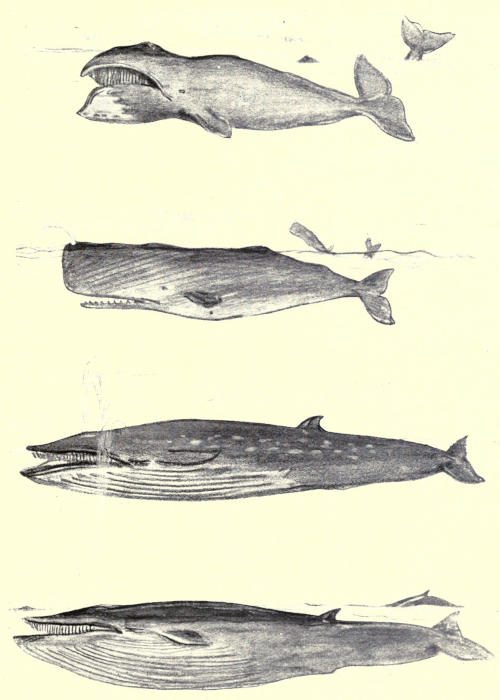
This Balæna or whalebone whale has no fin on its back.
A large Right whale, or Bowhead, as it is sometimes called,
has nearly a ton of whalebone in its mouth, which a few years
ago was worth about £1500 per ton; previously it was worth
as much as £3000 per ton, so one good whale paid a trip. It
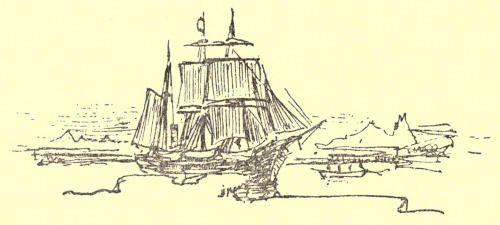
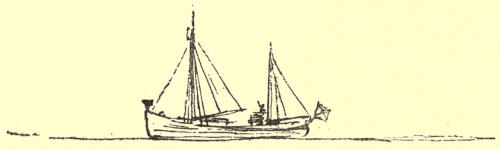
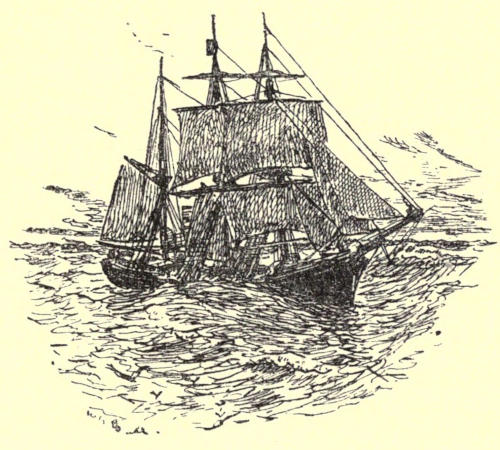
was pursued from barques like the one below—sailing-ships
with auxiliary steam and screw, fifty men of a crew, and small
boats, each manned with five men, with a harpoon gun in
its bows, or merely a hand harpoon. When the harpoon was
fired and fixed into the whale, it generally dived straight
down, and when exhausted from want of air, came up and
was dispatched with lances or bombs from shoulder guns;
they measured from forty to fifty-five feet.
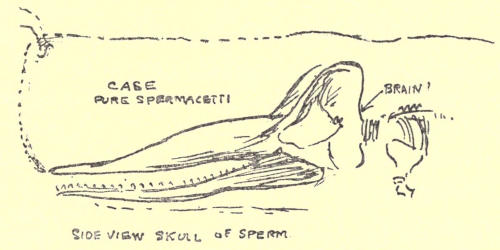
On another page is a small picture of the sperm or
cachalot, valuable for its spermaceti oil, and for ambergris,
a product found once in hundreds of whales caught. It is a
toothed whale and carries no whalebone.
But during the centuries these Right whales and sperm
were being killed there were other larger and much more
powerful whales, easily distinguished from the “Right
whales” by the fin on their backs. These were to be
found in all the oceans and were unattacked by men. They
have only a little whalebone in their mouths and were much
too powerful to be killed by the old methods.
Once or twice the old whalers by accident harpooned one
of these “modern whales” or finners, and the tale of their
adventure, as told by one of Mr Bullen’s Yankee harpooneers,
bears out exactly what we ourselves experienced down in
the Antarctic, off Graham’s Land, in 1892-1893, when one of
our men tried to do the same. We had been for months
hopelessly looking for Right whale and only saw these big
finners in great numbers close alongside of our boats, so one
of our harpooneers in desperation fastened to one.
In his book, “The Cruise of the Cachalot,” Mr Bullen
describes sighting a finner whilst they were hunting the
more pacific sperm or cachalot. Bullen asks his mentor,
a coloured harpooneer, why he doesn’t harpoon it, when
Goliath the harpooneer turns to him with a pitying look,
as he replies:
“Sonny, ef yeu wuz to go and stick iron into dat ar fish
yew’d fink de hole bottom fell eout kerblunk. Wen I wiz
young’n foolish, a finback ranged ’longside me one day off
de Seychelles. I just gone miss’a spam whale, and I was
kiender mad—muss ha’ bin. Wall, I let him hab it blam
’tween de ribs. If I lib ten tousan year, ain’t gwine ter fergit
dat ar wan’t no time ter spit, tell ye; eberybody hang ober
de side ob de boat. Wuz-poof! de line all gone, Clar to glory,
I neber see it go. Ef it hab ketch anywhar, nobody ever see
us too. Fus, I fought I jump ober de side—neber face de
skipper any mo’.”
I have described our similar experience elsewhere—Weddel
sea in the Antarctic—with the old-style whaling tackle and
a hundred to one hundred and ten foot blue whale or finner.
It took out three miles of lines from our small boats—the
lines were got hold of from board ship, and the whale towed
the procession for thirty hours under and over ice, on to rocks;
then the harpoons drew, and it went off “with half Jock
Todd’s smithy shop in its tail”—our sailor’s parlance for its
going off with most of our shoulder gun explosive bombs in
its lower lumbar regions. These big fellows were so numerous
in the ice off Graham’s Land that we sometimes thought it
advisable to keep them off our small boats with rifle bullets.
Now we can kill these big fellows. Captain Svend Foyn,
a Norwegian, mastered them by developing a new harpoon.
Svend Foyn and the engineer Verkseier H. Henriksen in
Tonsberg worked it out together. A big harpoon fired from
a cannon, a heavy cable and a small steamer combined
made the finner whales man’s prey. Captain Foyn had
made a considerable fortune at Arctic seal-hunting, and
thereafter spent five years of hard and unsuccessful labour
before he perfected his new method in 1868. Eighteen years
later there were thirty-four of such steamers engaged in the
industry in the North Atlantic, to-day there are sixty-four
hunting from the Falkland Islands and other dependencies.
In the neighbourhood of Cape Horn last year their gross
return amounted to £1,350,000.
These Balænoptera, averaging fifty to ninety feet, are fast
swimmers and when harpooned go off at a great speed and
require an immense harpoon to hold them, and when dead
they sink, and their weight is sufficient to haul a string of
small boats under the sea. To bring them to the surface a
very powerful hawser is attached to the harpoon, and is
wound up by a powerful steam winch on the ninety-foot
steamer, which can be readily towed by the whale, but which
is also sufficiently buoyant to pull it to the surface when it
is dead and has sunk.
In order that a whale may not break this five-inch hawser
(or five and a half inches in circumference) the little vessel
or steamer must be fairly light and handy, so as to be easily
swung round. If the steamer were heavy and slow, the hawser,
however thick, would snap, as it sometimes does even with
the small vessel when the whale puts on a sudden strain.
In the old style the Greenland whale which floated when
it was dead was pulled alongside the sailing-vessel, when
the whalebone was cut out of its mouth and stowed on
board, as was also the fat or blubber, and the carcass was
left to go adrift. The sperm also floats when dead.
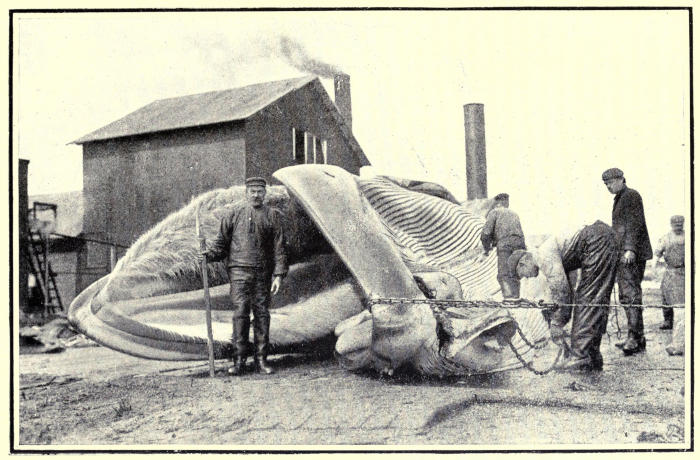
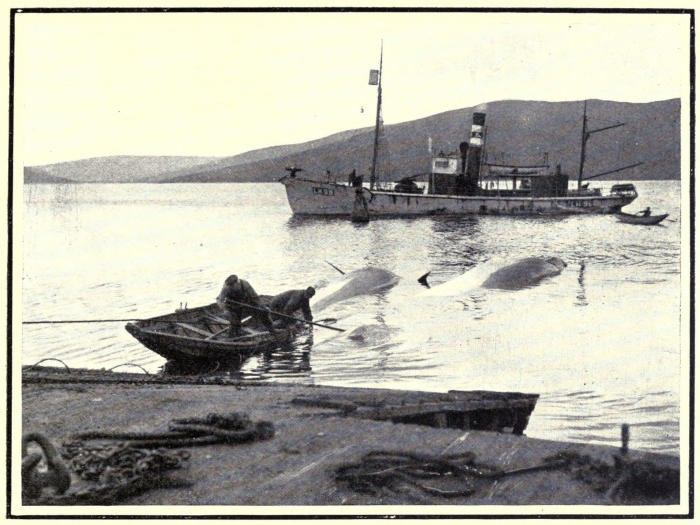
But the “modern whales,” as I call them, when killed are
towed ashore and pulled upon a slip at a station or alongside
a great magazine ship anchored in some sheltered bay and are
there cut up, whilst the little steam-whaleboat killer goes off
in search of other whales. All parts of the body, at a fully
equipped shore station, even the blood, of these finners are
utilised, the big bones and flesh being ground up into guano
for the fertilisation of crops of all kinds, and the oil and small
amount of whalebone are used for many purposes. The oil
is used for lubrication, soap, and by a new “hardening
process” is made as firm as wax and is used for cooking,
etc. Some of the whalebone fibre is used for stiffening silk
in France, but of these uses of the products we may only
give the above indication, for every year or two some new
use is being found for whale products.
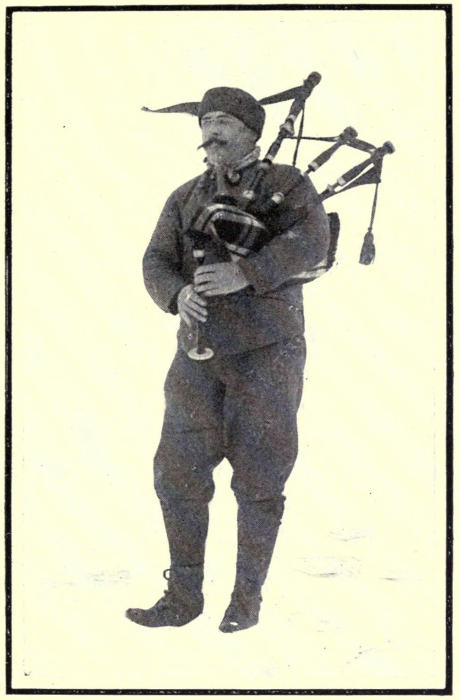
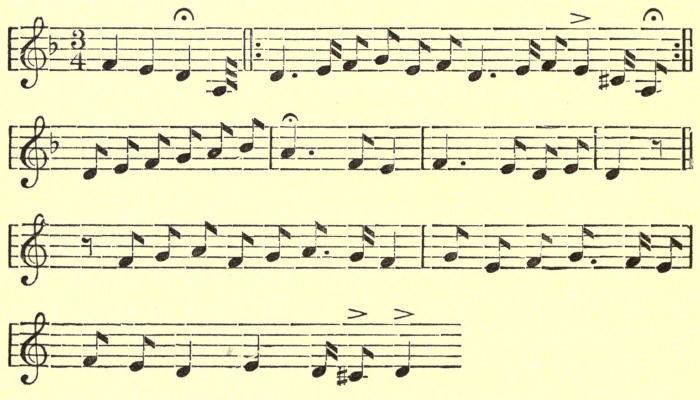
Piping in the Arctic
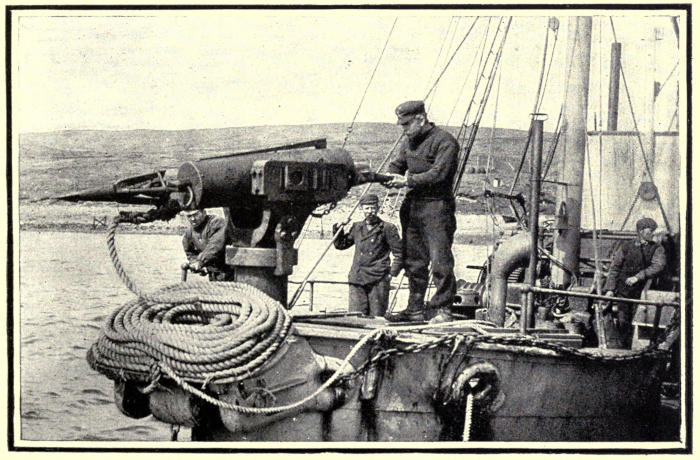
Modern Whale Gun and Harpoon
Ready for firing.
Though so large, these whales are not nearly so valuable as
the Greenland whale; still their numbers make up for their
comparatively small value.[1]
In the last five or six years these finner whales, formerly
unattacked by man, have been hunted all round the world.
In 1911 there were one hundred and twenty modern steam-whalers
working north of the Equator, and in the Southern
Hemisphere there were eighty-six. The total value of the
catch for the year was estimated at two and three quarter
million sterling.
These whales are rapidly becoming more shy and wary, still
the catches increase and the value of oil goes up. The more
unsophisticated whales in unfished oceans will have soon to
be hunted. There is not the least fear of whales ever being
exterminated, for long before that could happen, owing to
reduced numbers and their increased shyness, hunting them
will not pay the great cost incurred. So there will some day
be a world-wide close season—just as has happened in the
case of the Greenland whale, which is now enjoying a close
season and is increasing in numbers in the Arctic seas.
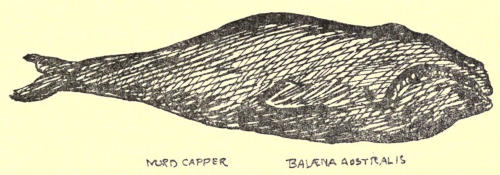
NORD CAPPER
BALÆNA AUSTRALIS
Captain T. Robertson of the Scotia in 1911, though he
came home with a “clean ship,” saw over forty of the
Mysticeti east of Greenland, but could not get near them, for
they kept warily far in amongst the ice floes.
The sperm whale is also recovering in numbers. I have
seen them in great numbers only last year in warm southern
waters, where twenty years ago they had become very
scarce.
We must mention here another whale that was actually
supposed to be extinct. This is the Biscayensis, commonly
called a Nordcapper; it is a small edition of the Greenland
Right whale and is practically identical with the Australis
of the Southern Seas.
This is the first whale we read of being hunted; in the
Bay of Biscay and along the west of Europe it was supposed
to have become extinct, but of recent years we have found
them in considerable numbers round the coasts of Shetland
and Ireland; a few years ago there were, I think, eighty of
them captured in the season.
CHAPTER III
It does not surprise me that the Vikings of the olden
days used to leave the southern coast of Norway for
summer visits to our Highlands and western isles, for
the climate in this Southern Norway in August is most
relaxing; there is absolutely nothing of that feeling of
“atmospheric champagne” that you expect to enjoy in
Northern Norway in summer.
We drive into Tonsberg from Henriksen’s farm every
morning, and after spending the day in the shipyard, come
out again in the evening with our ears deafened with the
rattle of steam-hammers on iron bolts, rivets and plates.
And at night in the quiet of the country we pore over
Admiralty charts of the world, especially those of islands
down in the South Atlantic, about which we have special
knowledge, where we hope our new whaler will pick up
cargoes of whales and of seals.
Our first Sunday off work, 4th August, came as quite
a relief, the quiet of the country was so welcome. We
wandered through the fields of Henriksen’s farm with his
wife and their jolly children, and Rex, the liver-and-white
collie, smuggled into Norway from Shetland, then through
woods and heather till we came by an ancient road to the
summit of a little hill and the remains of a Viking watch-tower,
where we lay amongst blaeberries and heather and
enjoyed the wide view of sea and islands at the entrance to
Christiania Fiord, a pretty place to dream in and plan raids
to the Southern Seas. As we rambled homewards through
the pine wood that belongs to the farm we selected fir-trees
to be cut down later for boat masts, lance shafts and flensing
blades.
By the end of August we realise that our small ship is
rapidly approaching completion. What a little while ago
was only unkindly iron ribs and plates, with the added
woodwork of the deck and masts, has now become a little
more personal, and more homelike. We have had our engine
hoisted from the slipside by a great crane and slowly and
tenderly sunk into the engine-room, a very modern six-cylinder
Diesel motor made in Stockholm. The fo’c’sle is
well aired and lighted, and is fitted up with comfortable
bunks and mattresses on wire stretchers. Each man has a
long chest beside his bed, for we believe in making the men
as comfortable as the after-guard.
The binnacle is now on the bridge, in front of the wheel;
its bright new brass looks resplendent; and two hermetically
closed boilers we have fixed on deck on either side under
the bridge for boiling down whale blubber at sea.
Our hull forward of the engine-room is made up of iron
tanks, and in these we hold crude oil for the engine. They
will be filled, we hope, by whale oil and whalebone as we use
up the crude oil for the engine’s fuel.
Above the most forward tanks is the hold, where we shall
stow our whale lines—light lines for sperm or cachalot, or
the small Right whale, Australis, of the Southern Seas, and
our heavy lines for the great fighting finners will be in two
bins to port and starboard. Forward of the hold there is the
fo’c’sle and men’s quarters, with more space under their
floor in the peak for more spare lines and sailcloth, and many
other necessaries for a prolonged whaling cruise.
We have a small cabin aft, below deck, with four
little cabins off it—to starboard, the captain’s; the writer’s
temporary berth is to port, to be used later for any
extra officer or pilot or for stores; the first mate’s and
first engineer’s cabin are a little aft on either side of the
companionway.
The iron galley with its small cooking-stove is forward, on
deck, and attached to it we have a mess-room, into which
four or even five of us can squeeze at one time for meals.
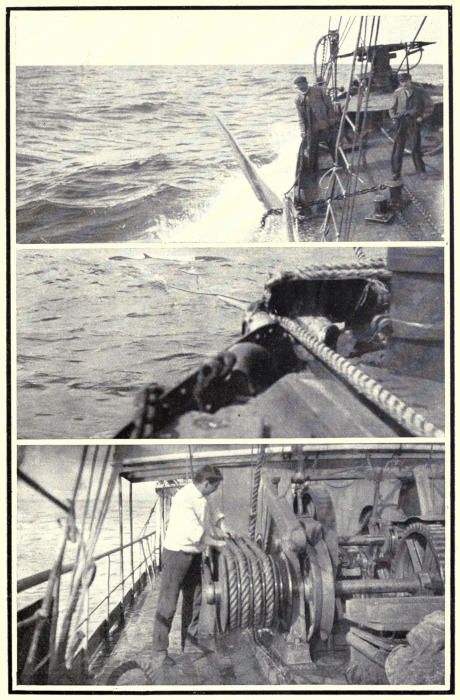
Aft of this mess-room and the foremast we have a very
important part of our gear, a powerful winch driven by a
donkey steam-engine. This is our reel, to wind up or let out
our line, the five-inch cable when we play a finner. The line
passes five or six times round two grooved barrels of the
winch, and with it we haul up to the surface the dead whale.
But more about this winch when we tackle a whale.
The 9th of August was a great day for us, for we started
our 200 h.p. engines, and drove them at half-speed for an
hour and never moved an inch, for the very good reason
that our bows were still against the quayside. How quietly
and simply they work. We then got our big traveller fixed
across our deck for the sheet of our foresail. We are schooner
rigged, foresail and mainsail both the same size, and count
on doing eight to ten knots with engine, and six or seven with
a fine breeze and sails alone.
In the morning we look at our guns in the harpoon factory.
The gun or cannon for the bow weighs about two tons. It is
already in position; the bollard on which it pivots is part
of the iron structure of the bows and goes right down to
our forefoot. Its harpoons weigh one and a half hundredweight:
we shall take twenty-five of these, and forty
smaller harpoons for sperm or cachalot or Right whale.
On either side of the bows there is a smaller gun pivoting
on a bollard to fire these harpoons. These two small
guns and our twenty-five big harpoons and forty of the
smaller size we find arranged in order at the works—a
charming sight to us. Harold Henriksen, the builder
of our ship, takes us to these works, where his brother
Ludwig and his father make the harpoons and guns that are
now sent all over the world. The father is very greatly
respected in Tonsberg; he is called the “Old Man Henriksen,”
to distinguish him from the younger member of his
family. I have already mentioned him as being co-partner
with the famous Svend Foyn, the inventor of the new big
harpoon for finner whales.
He has made many inventions for marine work on all
kinds of ships, for which he has received many medals, and
only lately he received a decoration from the hands of his
king, which is shown in the portrait given by him to the
writer, a rare and highly appreciated gift.
He is seventy-eight years old and sails his own cutter
single-handed. I wish there were space here to tell of his
experiences whilst working with Svend Foyn developing
the big harpoon. He takes us round the works, where forty
years of fire and iron have made their mark; remains of
failures are there; of burnt building and scrapped metal,
but, besides, there are these fascinating stacks of modern
harpoons and piles of their shell points to be used for great
hunting in all seas.
The “Old Man” chuckles as we wander from forge to
forge and out amongst the geraniums in the yard as he tells
me how the first harpoon they tried went over the walls of
the works and landed through the umbrella of an old lady
in the street, and stood upright between the cobblestones.
You may believe they practised out of town after that!
Though old—seventy-eight years to-day—he is enthusiastic
about our new plan of whaling. He has formed a yacht
club; everyone yachts at Tonsberg. It is on a small island
of little plots of grass between boulders and small fir-trees.
We were invited there to-day for the celebration of his birthday.
There were ladies in pretty summer dresses in groups,
cakes, teas, fruit and pleasing drinks, coffee and cigars, and
wasps by the thousands. Norwegian ladies cultivate coolness,
and merely brush these away as they hand us cakes
and wine; and they would be greatly offended if a man were
to attempt to hand tea cakes. For the carpet knight there
is no show. I wish he could be exterminated at home. Do
the gods not laugh when they see our menkind in frock
coats or shooting kit handing tea and cakes to females?
These pretty groups of summer-clad figures amongst
lichen-covered rocks and rowans, fir-trees, oaks and honey-suckle
were all reflected in the still water. As the sun sank
low and a mosquito or two began to sing, fairy lamps were
lit amongst the trees, and softly shone on groups of men and
women in light raiment in leafy bowers. The light from the
yellow and red lamps contrasted with the last blue of day.
There was warm air and moths, cards and smokes, and then
came music, and a perfect ballroom floor and blue eyes and
light feet—a kindly welcome to the stranger in Gamle Norge.
In the dark before dawn, with lighted Japanese lanterns,
ladies and men threaded their way over the flat rocks to
motor launches and bade good-bye to the hosts. I shall not
soon forget the long walk home across our island, the low
mist, the warm, dark night, and wringing wet fields.
There is one place in Tonsberg of which I must make a
note before I come back to our shipbuilding. It is the
Britannia. Anyone who wishes to learn all there is to know
about modern whaling must get an introduction to that cosy,
old-world club. It is a low-roofed wooden house, with low-roofed
rooms; one big room adjoins a kitchen, in which
broad, kindly Mrs Balkan, wife of my friend the engineer
on the whaler Haldane, sits behind a long counter and rules
supreme. You leave the shipyard and drop in there for middag-mad,
or shelter if it rains. It seemed to rain very often
in August. The “old man” Henriksen’s portrait and one
of the great Svend Foyn are, of course, in evidence, and
Svend Foyn’s whaling successors come there for middag-mad
or aften-mad, and some of them drink, I dare say, a silent
skaal of gratitude to the memory of Svend Foyn, who gave
them the lead to success, to become small landholders, each
with his home, farm, and family.
Burly fellows are his successors, the pick of Norse sailor
captains. One is just home from the South Shetlands. I saw
these desolate, unhabitated, snow-clad islands many years
ago, and saw there finner whales, thousands of them! and
knew they must some day be hunted, but I did not calculate
to a penny that there would be over a million pounds sterling
invested in whaling stations there to-day; in one bay alone
in Clarence Island, and that round these islands in 1911,
twenty-two whalers would bag 3500 whales. So whaling
here is an assured industry. In Britain the few who hear
about it call it a speculation.
Another ruddy-faced, broad-shouldered, fair-haired captain
comes from South Georgia and tells me of my friend
there, Sorrensen, the bigger of two big brothers, both great
harpooneers—they are both quite wealthy men now. They
whaled with us from our Shetland station a few years ago,
and between hunts we talked of a whaling station we were
going to start in South Georgia; two or three years at this
station has set them up for life.
Most of the men who come into the Britannia have been
over all the world; half-a-life’s experience of any of them
would fill a book. But of them all I think I’d sooner have
my friend Henriksen’s experiences. Young as he is, he has
perhaps had more experience in whaling than any of them.
He was whaling for the Japanese when they opened fire on
the Russian fleet. At least he had been—he stopped when
the guns began to fire, and took his little whaling steamer
behind an island, and he and another Norsk whaling skipper
climbed to the top of it and viewed the fight from shelter. I
believe they were almost the only Europeans besides the
Russians who saw that spectacle. Henriksen has a red
lacquered cup—a present from the Mikado in recognition of
his services for supplying food in shape of whale to Yusako
during the war. In time of peace there they eat the whole
whale, paying several dollars a kilo for best whale blubber
and as much or little less for the meat.
We in the Shetlands turn the fat oil into lubricants, etc., and
the meat into guano for the fertilisation of crops. I suppose
it comes to the same thing in the end, if “all flesh is grass.”
So the talk, as can be imagined, wanders far afield in the
Britannia. I heard a skipper asked by a layman what
corners of the world he had been in, and he paused to consider
and replied: “Well, I’ve not been in the White Sea.”
From Arctic to Antarctic he’d sailed a keel in every salt sea
in the world bar the White Sea and the Caspian. The telephone
interrupts many a yarn; perhaps Jarman Jensen, our
ship’s chandler, calls up someone about provisioning a
station, say for three years—food, etc., for one hundred men
for that time or longer; or perhaps there is a less important
order from Frau Pedersen ringing up her husband from their
little farm, telling him to call at the grocer on his way home,
and he perhaps tells her he thinks he may not get out in time
for dinner, and “Oh, buy a house in town, Olaus” is possibly
the jesting answer—a great saying here in Tonsberg, where
men sometimes are said by their wives to dawdle away the
afternoon in the Britannia, when they are really deep in
whaling finance, planning whaling stations for islands known,
or almost unknown down south on the edge of the Antarctic,
or on the coast of Africa or the Antipodes.
Here is the 12th of August, day of Saint Grouse, and we
should be treading the heather at home, but we are still
on the island of Nottero, with rain every day; and every
morning the same slow drive behind Swartzen into Tonsberg,
longing all the time for our ship to be ready for sea. We
hoped to have had it ready in June!
We have, however, made almost our last payment, and have
her insured. What a lot it all costs!
We tried to console ourselves to-day with the interest of our
first trial run of our engine as against loss of pleasant company
and grouse at home, also we have the pleasure of seeing the
last of our whale lines being made and we get our chronometer
on board, stop watch, etc., and spend hours in Jarman Jensen’s
little back shop with three skippers giving us advice, as we
draw up lists of provisions for the St Ebba for a twelvemonth.
In the rope factory run by Count Isaacksen we watched
the last of our great whale lines being spun; three five-inch
lines we have to port and three to starboard, one hundred
and twenty fathoms each—that is, we can let a whale run
out three times one hundred and twenty fathoms on our port
lines, three hundred and sixty or two thousand one hundred
and sixty feet. I have seen that length run straight out in
a few seconds at the rate of sixty miles per hour, with
engine going eight knots astern and brakes on, and then
it snapped; for some big blue whales five of these lines
are attached to give greater weight and elasticity, because,
you see, there is no rod used in whale-fishing.
The rope factory and Jarman Jensen’s store are two
wonders of Tonsberg. The store is a small front shop, generally
pretty full of townspeople making domestic purchases,
butter, potatoes, coffee. Jensen, with perfect calm and
without haste, weighs out a pound of butter, wraps it in
paper and hands it with a bow to some customer, gives a
direction to one or two heated assistants, and comes back to
us in the den behind the shop and continues to tot up the
provisioning for our ship for a year, or the stores for some
far bigger whaling concern running to thousands of pounds.
So much business done in so small a space and with such
complete absence of fuss! Jensen in his leisure hours is
antiquarian and poet. He possesses a valuable library in
Norse antiquities and will write a Saga while you wait. He
must have burned a good deal of midnight oil over the
splendid saga he wrote about our St Ebba which was rich
with historical reference to the amenities between Scots and
the Norwegians in ancient days.
The slowest part of the outfitting for our whaler was, for
me, the customary expressions of hospitality. I hope my
Norwegian friends will understand and forgive my criticism.
It is the result of my being merely British, with only a limited
knowledge of Norse and a comparatively feeble appetite. A
quiet little dinner given to us as a visitor and representative
of our Whaling Company would begin at three P.M. and wind
up at ten—eating most of the time—plus aquavit and the
drink of my native land, which seems to be almost as popular
in Norway as it is in England.
Think of it—five or six hours’ smiling at a stretch, pretending
to understand something of the funny stories in
Norsk and joining in the hearty laughter! I could have
wept with weariness. They are to be envied, these Norse,
with their jolly heartiness, the way they can shake their sides
with laughter over a funny story. The world is still young
for them. I remember that our fathers laughed and told
long stories like these people.
One chestnut I added as new to their repertoire. I believe
it has spread north as far as Trömso, about the man with a
new motor who, when asked about its horse-power, drawled
in reply it was said to be twenty horse-power, but he thought
eighteen of the beggars were dead! And as to speed, it had
three—slow—damned slow—and stop! It seemed to translate
all right—saghte—for-dumna-saghte, and, Stop! fetched
the audience every time. At least it did so when Henriksen
told the story, but he is a born raconteur, and infuses the
yarn with so much of his own humour and jollity that everyone,
especially the womenfolk, who are very attentive to him,
laugh till they weep.
A perfect wonder to me is the way in which women here can
prepare meals and entertain a lot of people single-handed, or
with, say, the help of one maid, at a couple of hours’ notice;
have a spise-brod ready—a table covered with hors-d’œuvres
at which you can ruin the best appetite with all sorts of
tasty sandwiches, aquavit, liqueurs and beer till the Real
dinner is ready, say, of four substantial courses and many
wines, custards and sweets. Between times she will possibly
see her own children off to bed, probably alongside some of
the visitors’ children; then she will sing and play accompaniments
on the piano, and join heartily in the general talk,
and later will serve a parting meal and a deoch-an-doris,
and walk a Scotch escort of a mile or two with the parting
guest as the morning sun begins to show.
They seem very jolly though they are so busy. Everyone
on this island knows everyone else: they were all at
school together, as were their parents before them. Most
of the married people have a little farm. The wife looks
after this when the husband is at sea-whaling. The women
have the vote too! They voted solid a year or two ago
for a neatly dressed, plausible young orator who came
round the island, and when their husbands came home
after the whaling season was over, found he was a Socialist;
and if anyone’s interests are damaged by the Socialist in
Norway, it is the whaler’s. So the vote for some time was
not a favourite subject of conversation here when ladies
were present. I think the wealthiest family in Tonsberg, a
millionaire’s household, runs to two maidservants.
But this is dangerous ground; let us upstick and board
the St Ebba. “Once on board the lugger” we cast off wire
hawsers, let on the compressed air with a clash in the
cylinders, then petrol, then crude oil, back her, stop her,
then motor ahead easily.
The St Ebba’s first journey! We passed down between
Nottero and the mainland, rapidly passing the small motor
craft that seemed to be timing us, travelling at nine and
three quarter knots. She seems to go as quickly as our steam-whaler
the Haldane—less “send” in calm water. The
Haldane and her like pitch a little, St Ebba makes no turn
up behind to speak of at half speed, which is fast enough
for actual whaling. She seems particularly quick in turning,
and in a very small circle.
We had charts out all the morning planning our southern
route, possibly to the Crozets, possibly the Seychelles or the
Antipodes. We have information about whaling in these
waters; I wrote our directors about the possibility of running
a shore station with St Ebba, and painted the St Ebba flag.
Then we went by our launch, a Berlinda motor-boat fitted
with bollard or timber-head at the bow for small harpoon gun
for killing sperm or Australis. We found St Ebba’s engineer
very busy, and worried. The cooling water inflow was
stopped by something from outside. The British engineer
was also very busy with our Cochran steam boiler for our
winch. This winch seems very satisfactory—a sixty-horse-power
salmon reel, with ratchet and noise in proportion.
We continued working at the engines till seven P.M., then
motored in the St Ebba launch down the side of the island,
and got home in the dark at ten-thirty.
I must cut down these day-to-day notes. “Launching a
whaler” sounds interesting enough till you come to read
about details. Little troubles and big troubles and worries
arose to delay the getting afloat, signing on men took time,
signing off an engineer who got drunk, and getting another
in his place caused another delay; and delays occurred
getting our papers audited. They had all to be sent back
to Christiania to get a “t” crossed or an “i” dotted. Rain
came and helped to delay getting our lines on board. Then
we had to have an official trip, with representatives of Government,
etc., etc., on board, a curious crowd all connected with
the sea, most of them captains, a Viking crew on a British
ship, still with the Norwegian flag astern!
At the next trip, however, given by us, when we had
accepted deliverance, we unfolded the Union Jack and had
what I’ve heard called a cold collation on our main hatch.
There were the captain’s and friends’ relatives, photographers,
reporters and skippers all intensely interested in our new
type of whaler.
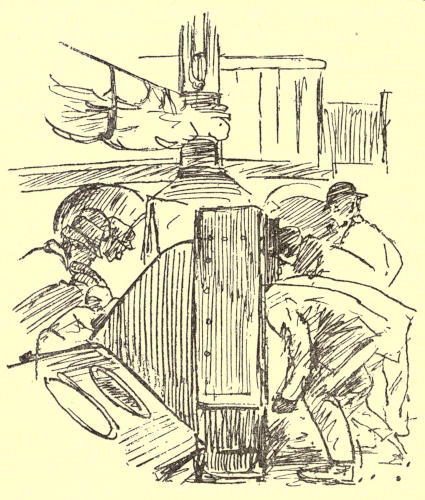
On page 36 are depicted figures looking into the engine-room,
because there was no room inside! There our engineer
is discoursing to whaling and mercantile skippers, showing
how he can be called from his bunk and have the engine
going full speed ahead in less than four minutes; and all the
wonders of a modern Diesel motor.
And one by one the carpers climb down, each in his own
way—for you see almost all the “men-who-knew” said
something or other would happen or wouldn’t work. But
once they saw our engine work and the arrangement of
harpoons, guns, lines, and oil tanks, all of them prophesied
success.
CHAPTER IV
At last! on the 23rd of August, the St Ebba was ready
to be taken away from the slip, and the town, and the
noise of the builders’ yard, and one morning, with
rain blotting out the grey stone hills and threshing the trees,
and the country a swamp, Henriksen, Mrs Henriksen and the
writer went into town for the last time about St Ebba’s
affairs, motoring in our whale-launch nine knots through the
spray. It shows how hard some people are to please, for Mrs
Henriksen vowed she preferred her recollection of the motion
of a Rolls Royce in Berwickshire on a dead smooth road.
Fancy comparing metal springs and the hard high road to
the silky rush over spuming surge down the fir-clad fiord, the
wind right aft, and each wave racing to catch us.
So we took St Ebba from town and the grime of the quayside
and cleaned her decks and laid her alongside a wooden
pier a few miles from Tonsberg, brought a flexible pipe on
board and filled her tanks with sixty tons of solar oil from an
oil refinery, enough to take her at one ton a day to Australia
without a call! That went on board in eight and a half
hours, one man on watch with his hands in his pockets.
How different from the work and dirt of coaling!
Then clang goes the bell for stand by—let go, fore, and aft—half-speed
astern and we back away from the pier, with
Henriksen on the bridge, our crew young and nimble as
kittens and our young mate or styrmand forward alert
and the picture of smartness. He is twenty-one, is
Henriksen’s brother, and has held master’s certificate for
three years.
Round we come with the wind out of shelter into rougher
sea—half-speed ahead—full speed—and away we go, our first
trip with no one but ourselves aboard, no pilot or town ties—ready
for a year at sea.
But we have arrangements to make on board yet, arranging
lines, and guns, and testing them, and a lot of small work with
wood which we will do ourselves down the fiord opposite
Henriksen’s home, a sheltered nook with fir-trees round,
five miles from Tonsberg. Knarberg they call this little bay
or arm at Kjolo, in Nottero, where long ago Viking ships were
built, where Henriksen’s father sailed from, and his father
before him in the days before steam. Now we revive
the past glories with a split-new up-to-date six-cylinder
Diesel motor-whaler!
We slide down the fiord before the wind and rain and
squalls, smiling with pleasure at our freedom from the wharf-side.
With a foremast tackle the port anchor is heaved up
and hung over the side—the chain stopped by a patent catch;
it is the first time we have gone through the manœuvre in the
St Ebba, so even anchoring is full of interest. And in a few
minutes more we swing to windward in the narrow Knarberg
and drop port anchor and swing to starboard and drop
starboard anchor, drop astern and lie where all the winds
can blow and never move us.
One anchor might have been enough. But, as Henriksen
said to his young brother: “Styrmand, you remember, father
always put down two anchors, we will do the same.”
Then we open out the foresail and spread it over the boom
above the main hatch, and our little crew gets to work,
sheltered from the rain, shifting and arranging our goods
and chattels below, laying timber balks over the tanks under
our main hold so as to form a flooring to support the weight
of casks and spare gear, furnace, anvils, lance shafts, etc.,
that must lie on top.
A glow comes up from the red-painted ironwork on to the
faces of the crew that is almost like the effect of sunlight.
Our whaling lines we have to stow away carefully; it
takes eight men with a tackle to lift one hank of line on deck,
one hundred and twenty fathoms of five-inch rope. And
there are stacks of fascinating harpoons, large and small,
to be arranged.
We have adjusted the compass to-day by bearings, a
long process requiring a specialist down from Tonsberg.
The operation gave us a good chance to test our engines—so
much backing and going ahead and turning in small circles,
just the manœuvres we will require in pursuit of whales.
More homely work consisted in getting potatoes on board
from Larsen’s farm—a retired American naval man—whose
farm adjoins Henriksen’s. He has cut the spruce shafts in
our wood for lances, light and pliable, carefully chosen for
the quality of each stem, and so as to leave room for growth
of the younger trees. And we have cut down a venerable
oak, for we need a stout hole for our anvil, and other smaller
pieces for toggles for whale-flensing. Anvil and forge are
of goodly size, for we shall have heavy ironwork making
straight the big harpoons (three-and-a-half-inch diameter)
after they have been tied into knots by some strong rorqual.
A turning lathe we must have, and an infinity of blocks,
bolts, chains, and shackles. Veritably our little one-hundred-and-ten-foot
motor, sailing, tank, whaling, sealing, cookery
ship is multum in parvo, and parva sed apta.
We have got our ammunition on board. We brought it
from Tonsberg yesterday ourselves, on our Bolinder launch,
so saved freight and fright! for the local boat-owners were a
little shy. Henriksen packed the powder in tins on the floor
of our launch in the stern sheets, rifles and cartridges on top,
and he himself with his pipe going sat on top of all. I think
he smoked his pipe to ease my mind, to make me feel quite
sure that he thought it was quite safe, now the ammunition
is being stowed away under my bunk! Two thousand express
rifle cartridges with solid bullets we have, for we will
call on the sea-elephants at a seldom-visited island we know
of just north of the Antarctic ice. One load we should surely
get in a few weeks’ time: their blubber is about eight inches
thick, and is worth £28 per ton; a load of one hundred and
sixty tons (I think we could carry as much as that at a
pinch) at £28 per ton will equal £4480, not a bad nest egg,
and why not two or three loads in the season, not to
speak of the excitement of landing through surf and the
struggle through tussock grass. Man versus beast, with the
chances in favour of man, but not always; men I know
have been drowned, and others nearly drowned, in the
kelp and surf that surrounds these islands in the far
South Atlantic. Once I had to swim in it, and do not wish
to do so again, and it’s one bite from a sea-elephant or
sea-leopard and good-bye to your arm or leg.
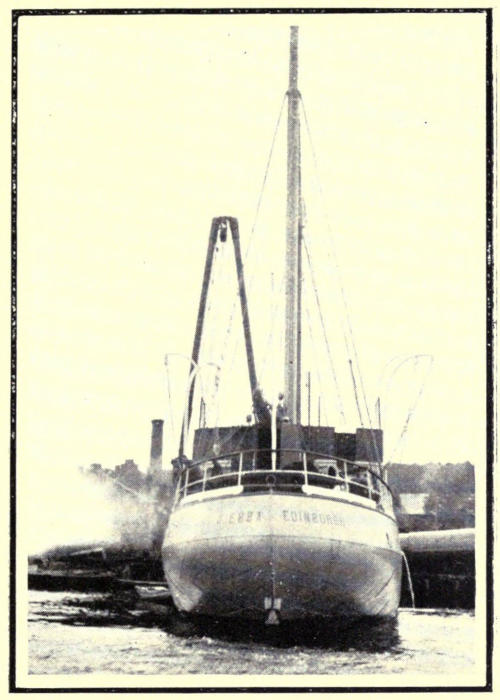
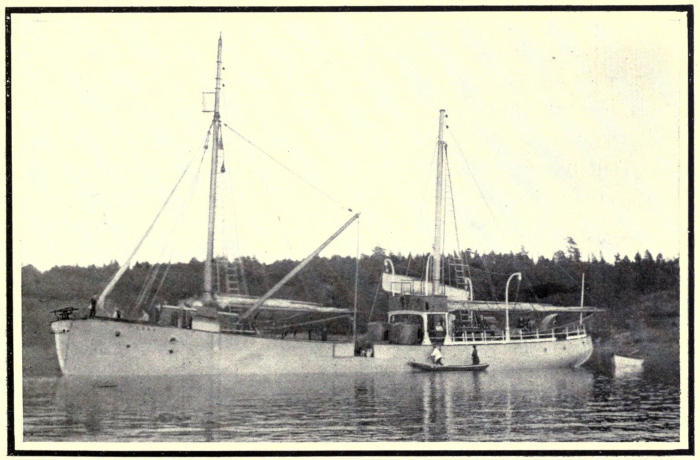
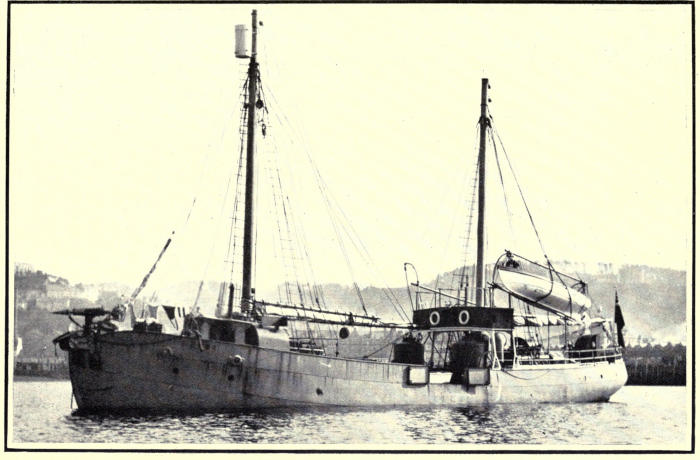
Stern View of the “St. Ebba” at Tonsberg
The “St. Ebba” in the Fiord of the Vikings
We now have salted ox on board, oxen grown at Kjolo
and salted down last winter by Henriksen; and Larsen, the
neighbour, brought us vegetables. He is almost a giant, and
as he stood in our flat-bottomed dory with two men rowing
he made a picture to be remembered, for he was surrounded
by lance shafts, sacks of potatoes, red carrots and white
onions, so that the dory was down to the water’s edge! I
prayed she might not upset. Larsen himself stood amidships
with three enormous green balloons in his arms—such giant
cabbages I have never seen before—each seven-and-a-half
kilos (fifteen pounds), in weight, the result of whale guano.
The children of the neighbourhood played on our decks;
Henriksen’s two boys and daughter soon knew every corner
of the ship, just as he learned every part of his father’s vessel
when he lay at Kjolo, only in those days there were higher
masts to climb, and yards to lie out on, and tops to pause in,
to admire the view and get courage to go higher. Our crow’s
nest on our pole-foremast is the highest they can attain to
on the St Ebba. The aftermast—or mainmast, I suppose I
should call it, as we are schooner rigged—is of hollow iron cut
short above the top (this is technical, not a bull); this forms
the exhaust from the engine. You see only a little vapour,
still, it does seem a trifle odd even to see faint smoke
coming out of a mast! We will rig up topmasts in the
South Seas, and have topsails in fine winds and the Trades,
when we do not need the motor, and will then look quite
conventional.
Here is a photograph of some of the children that play on
our decks and round about the St Ebba in boats. They are
of the sea. “It is in the blood,” as Mrs Henriksen replied to
me when I asked her how she got accustomed to her husband’s
long voyages and absence from home. It is their tradition
to go to sea, and Elinor, Henriksen’s daughter, will be surprised
if her brothers William and Henrik do not follow their
father to sea in a few years. In ancient days it was the same
here, womenfolk thought little of the men who had not done
four or five years’ Viking cruising, gathering gear from
their own coast or from their neighbours’.
We hope that this Monday, the 22nd of September, will
be our last day on shore, and it rains and rains, and we long
for the shelter of board-ship where there is no soppy ground
or puddles, and there will be the fun of going somewhere
instead of inhabiting this one spot of earth for days, till
days become weeks and weeks months for ever and for ever
without getting anywhere farther.
We have now almost everything on board, books, charts,
bags of clothes, but we have still to wait for some spare
parts for the engine from the makers at Stockholm, which
they advise us to get before going on a southern voyage.
We intended to have got away in time to do a preliminary
canter, as it were, for whales up north to the edge of the ice—not
into it—for bottle-nose and finners, so as thoroughly to
test our engine and crew before going to the Southern Seas.
Now it is too late for that, so we shall only go “north-about”
round Shetland, where we may be in time for the
last of the whaling season, and then proceed south.
The spare parts of the motor arrived, but it rains and blows
a fierce gale from S.W., and we could get out of our fiord but
no farther against such a gale, so we cool our heels and
Henriksen works at accounts, a serious matter. It is a new
departure, a captain acting in so many capacities, manager,
navigator, harpooneer, etc.
This is my fifth week of waiting here, the most wearisome
time I have ever spent in my life. So much for whale-fishing
and its preliminaries! The time actually spent in connection
with the ship’s affairs passes pleasantly enough, and
curiously the sense of weariness goes, once on board. Perhaps
getting off clay soil on to salt water accounts for this.
The sea-water in the fiord here stands abnormally high
all these days. It came running in two days ago in calm
weather. So outside the North Sea and Skagerak we
knew it must be blowing hard. To-day, though finer, the
fiord water still remains high, so we know from that and the
newspapers that there is strong southerly wind outside.
For two days past a cloud has hung over us. Henriksen
found a deficiency in his accounts, found that the outfit for
the St Ebba cost 10,000 kroner more than the receipts
vouched for, and went over and over accounts, till yesterday
we made another pilgrimage to Tonsberg and interviewed a
banker and said politely, “How the deuce can this be?” And
he cast his eye over his account-book and found his clerk had
merely omitted a figure in addition; a trifle of 10,000 kroner
= £550! So we came away smiling, but it gave us a bit of a
shake, rather an aggravating and superfluous piece of worry
added to vexatious delays and bad weather.
We motored back in the launch much relieved, and on
reaching the St Ebba practised big harpoon-gun drill.
Henriksen and I are the only men on board who are familiar
with its workings, but one or two of the crew have used the
smaller bottle-nose or Right whale guns. It was interesting
watching Henriksen’s demonstration to all hands. Smartly
they picked up the drill; quickly, for all of them have served
in the naval reserve or army, and anything to do with a
tumble about or small craft they are familiar with from childhood
to old age. Yesterday you could readily fancy one of
these old Viking fights, for a boatload of ten small boys was
fighting another boatload, a free fight, legs and arms in the
air, a fearful turmoil, and two boatloads of yellow-haired
girls smilingly looked on.
“Old Man Henriksen,” the oldest of the Tonsberg inhabitants,
came down the fiord from Tonsberg to-night to
wish us God-speed. He sailed down in his cutter single-handed,
shot into the wind round our port bow, jibbed and
swung alongside round our stern; seventy-eight years old
and sailing his home-built, prize-winning twenty-footer as
well as the best of his juniors. On board we had the tiniest
skaal, which finished our last bottle of whisky, the remnant
of our hospitality in the trial trip; we are drawing our beer
and whisky teeth, as the sailors say, before taking the high
seas.
Then he went off in the twilight, as the lights began to
show in the gloom of the pines on shore, alone, sailing single-handed,
against the wishes of the family, who say he is old
enough and rich enough to employ a crew. He will spend
the night alone on Faarman Holme, at the club he started
there; in the morning he will dip his flag to us as we
pass.
We all go for our last night on shore, walking home in the
dark. Not all—I forgot. William and Henrik are curled
up in their father’s bunk in great glee at being left to look
after St Ebba, along with the crew for its last night in the
fiord of the Vikings.
CHAPTER V
Then it’s hey! and it’s ho! for Scotland, chilly
Lerwick and the Shetlands and kindly English-speaking
people. My heart warms at the prospect
of seeing our western hills and heather and relatives
and a language we know.
It rains again, tropical rain. We stand and bid farewell
in the homestead, round the little dining-room table, each
with a liqueur glass in hand. Suddenly I see eyes are wet,
and the stranger nearly pipes an eye too, for it is a bit
harrowing even to cold hearts to see married people with
children still lovers. My host has been, for him, at home
so long, nearly eleven months now! So the parting from
wife, children, homestead, farm, woods, horse and hound, all
of which he loves, must be sore for however hardened a
seafarer.
Our last cargo from home goes to the ship on a hand-cart
towed by the children and Rex the collie in great glee—curious
luggage—Japanese wicker-work baskets and parcels of
foreign-looking clothes for their father. The writer goes ahead
with them, leaving the lovers to follow their lone, past the little
home they built after Henriksen’s first success at whaling,
on a three months’ spell from sea, down the road and past
the school in the birches where they played as children
together, down to the brig or rocks where their fathers before
them careened their ships and made the same sad partings.
Perhaps the captain is the only sad man to-day. From
first mate downwards eyes are sparkling, in spite of the dull
day of rain, at the prospect of the rough, bracing, salt seas
in front of us. We think nothing just now of cold, wet, dark,
dangerous nights; the future is all couleur de rose, whale-hunting,
new lands and people, sea-elephants, movement and
life for us, death to them and profit for us all!
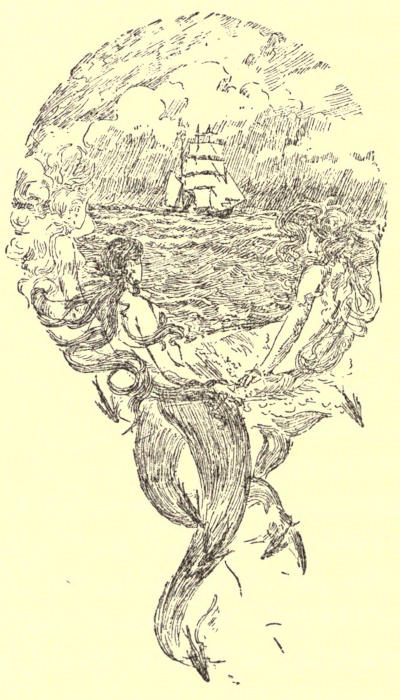
Was it lucky or unlucky that our anchors held to Norway
and the sea-maids’ hair or grass, like grim death? A sailor
would be interested, perhaps, in a description of how the two
chains were fouled or twisted, how one shackle opened and
the starboard chain went slap into the water. I thought, we
are in for more delay, trying to pick it up. But Henriksen
spotted that it had caught on the port chain, and his young
brother, our mate, promptly slid down it—a nice muddy
slide down and to his waist in water—got a rope through its
links and stopped it on the port chain, and so we got both
back. All the sea fairies of Norwegian seas could not have
given us more trouble in taking our British ship from the
Norse anchorage.
As we motored from sheltered Knarsberg to Christiania
fiord we passed Faarman Holme and the yacht club and
dipped our Union Jack, and saw the Norse flag dipped in
return, no doubt by old Henriksen, who had stopped the
night there to flag us adieu in the morning.
There was more heart-string-breaking before we left. Mrs
Henriksen and the children, and Hansen the steward’s
newly married wife, came part of the way, and we dropped
them a few miles down the fiord in a motor-launch we had in
tow. There are tender hearts in Norway, tender and brave.
And now we are out of the great Christiania fiord or firth,
passing Færder Light that marks its entrance, Norway faint
on our right and Sweden over the horizon to our left, the sun
shining for the first day this summer. The sea has a silky
swell. We have shaken off all things earthy except a little
mud on our anchors now being stowed away, and three or
four green oak leaves and moss on the hole of the oak-tree
brought for the anvil.
Henriksen and I stand for a little on the bow and rejoice
in the heave and send, and compare the movement of St
Ebba with that of the Haldane and other whalers we know,
and we think that she makes good. There is sun, sea, cloud-land,
rippling swell and fresh, cold air, with a luxurious roll;
and we feel an hour of such a day at sea is reward for all
the months of worry and waiting and planning on shore.
A pleasure in store for us will be setting our new sails.
But even now, with the motor alone and fully loaded—with
sixty tons of fresh water alone—we make nine and a half
knots! but with our canvas unloosed and a light breeze
behind us might even reel off eleven to twelve.
Not many miles out at sea a Killer (or Orca gladiator)
appeared coming from starboard. Our guns were all covered
with canvas so we did not clear for action, and the Killer is
not of much value. He came towards us and passed forty
yards astern, a fact which greatly comforted us, for “those
who know” on shore informed us a motor would drive away
whales, but how they knew it is hard to say. Then it was
said so often, and with such a sense of conviction, that without
acknowledging it, we had a slight sense of chill. This
Cetacean, a whale of, say, thirty feet, took not the least
notice of our crew, and as our fortunes depend on being able
to approach the leviathans of the ocean, without frightening
them, the incident, though apparently small, gave us
considerable encouragement.
Our first day at sea has passed very busily and we go
below for a spell to our blankets, early, and tired, but with
a joy beyond words at turning in again to a cosy bunk
with everything at hand—pipe, books, paints, even music
(practice pipe chanter), all within arm’s-reach, an open port
and chilly, clean air, and the faintest suggestion of movement;
such luxuries you may not have on shore.
The sea did not hide its teeth for long. After sundown
skirts of rain appeared from threatening clouds on the
distant Norse coast. Gradually they spread across our
track, bands of little ripples, like mackerel playing, appeared
on the smooth swell, and these spread and joined till all the
sea was dark with a breeze, which in a few hours grew to a
strong wind against us.
As we passed Ryvingen Light on the south of Norway the
night grew dismal and rough; we watched its revolving
four-flash light, which seemed to be answered by the three
flashes we saw lit up the sky from the light on Hentsholme
in Denmark, over forty miles to our south, and the gloomy
sky over the Skagerak was lit with occasional angry flashes
of lightning.
Unpromising weather for our first night at sea!
By two in the night we were digging into the same hole,
making little or no way, with more than half-a-gale from
sou’-west.
In the morning we were a very sad lot of whaler sailors.
Fore and aft all were sick, or at least very sorry for themselves.
All but Henriksen and the mate and the writer and
one man were really ill, and we, I believe, only pretended to
be well—such is the effect of the motion of a small whaler
vessel on even old sailors on their first experience of them.
I have known Norsemen who have been at sea all their
lives on large craft refuse to go on a modern whaler at any
pay.
We aim at getting up the Norse coast as far as Bergen,
then going west towards north of Shetlands and, given fine
weather, we ought to pick up a whale or two before putting
in to Lerwick, where we must re-register our vessel.
But the wind increases to a full gale. All the sea is white
and the sky hard, and rain and sun alternate and our nine-and-a-half-knot
speed is reduced to about four.
But St Ebba is a dry ship. She proves that at least.
Any other vessel I have been in, whaler or other, would ship
more water than we do.
There is no use trying to steam or motor against this
N.E. gale, so it’s up close-reefed fore and mainsail and staysail;
only four men to do it, and that for the first time of this
ship at sea, and in a gale. Reef points are made and all got
ready; then it’s “Haul away on throat and peak” and up
goes the scrap of sail, and what clouds of spray burst over the
oilskin-clad figures as they haul away cheerily! The writer,
at the wheel on the bridge, even comes in for a bit of the
rather too refreshing salt spray.
Now the after or main sail is set like a board, and we are
transformed into a sailing-ship.
A ring on the bell and the engine and sick engineer get
respite; a point or two off the wind and there is the silence
of a sailing-ship—no engine vibrations. True, we make
little or no progress and some leeway, but the motion is
heavenly compared to the plugging away of an engine into
a head sea.
A Dead Seal on the Floe Edge
The decks get dry though the sea is very rough, another
proof of the St Ebba quality. We wish, however, we were
further on our road to “our ain countrie.”
The mess-room of St Ebba is not extensive, a little iron
house built round the foremast. One third of it is the
steward’s or cook’s galley. He acts both parts. He is almost
like a fair Greek, rather thin, with golden hair and a skin as
white as his jacket; poor fellow, he is sick, but sticks to his
pans, and tries to forget the young wife he left behind him.
His galley is about three feet by six feet beam, and his
stove and pans and coal-box just leave him room to stand in.
Our mess-room is what I consider a very cosy room for a
whaler; it is fully five feet by six feet beam of iron, grained
yellow oak—iron ties and bolts grained like oak. It may
not be æsthetic, still in some ways it is the best part of the
ship. It seems to be the pivot of our movements. There
is a round port-hole or bolley to port, and two looking aft
towards our stern and a little round-topped iron door on
the starboard. Through the two ports astern comes the
sunlight and the iron door keeps out sea and wind, so in this
stormy weather our mess-room has its points. There is
another round-topped door from it to the galley. So
Hansen (cook and steward) has merely to stretch his arm
round to us to hand the coffee-pot, or sardines.
Sardines and brown bread are on the table this morning.
I notice about two sardines have been eaten by our after-guard,
so even if we claim not to be sea-sick we cannot claim
any great appetite. Poor cook—he has upset a pail and
dishes in the galley. I help him with his stores a bit, but it
is no use—he is a bit on edge, so the bridge is the place to
sit on and sketch, for one must do something to keep the mind
occupied in rough weather. And it is precious cold and
comfortless. You have to twist a limb round something to
prevent being flung about, steering requires gymnastics.
There is a pale wintry sun, but the air is cold and clammy—all
right on shore, I should say, for a September day.
Two masts and a funnel go driving across our track, almost
hull down before the gale, a wreath of black smoke dispersing
to leeward in wind and spray. I almost regret I am not on
board, with steam and the wind aft. I’d be in Leith before
many hours, then with Old Crow and the dogs on dry stubble.
Just the day this for shore, and partridges, or to look for
hares on St Abb’s Head.
One or two of the crew are reviving this afternoon, though
it is still very rough, but the first engineer, a Swede, is still
very sick.
One of the crew this morning told me as he steered:
“Dem mens forward all seek, but me no seek, so I have six
eggs to mineself”; but he looked pale, and in a minute or two
he gave the wheel to me and went to the side of the bridge and
came back wiping his mouth with the back of his hand, and
took the spokes again, muttering: “Fordumna, now I’se
loss dem.” Such details of life at sea you find in the
Argonautica; they give colour and conviction; only the
Argonauts in their days were laid out on the beach with too
much purple wine.
Yesterday morning about four we tried the engine, but the
Swede could not start it. Either he had let the compressed-air
supply run out or water had collected and blew into first
cylinder or—or—anyway, sick or well, all hands had to pump
on till late last night, and only raised pressure to over sixty
pounds and it requires to come up to one hundred and fifty.
Henriksen has been saying the wind is going to moderate
by such and such a time; when I see a sky such as this round
the horizon, with haze and cold, I give several days of
gale.
It is very wearisome; Henriksen is pretty quiet. At
breakfast we have each half-a-cup of coffee! We are simply
drifting across this shallow and somewhat dangerous sea,
sometimes called the German Ocean, a crablike course to
Yorkshire coast, or will it be St Abb’s Head we are to knock
against if the wind does not change or the engine go?
It would be an interesting point to get wrecked at, for I’ve
a bet on that the lifeboat a lady started there won’t save ten
lives in the next ten years. It is only allowed out if the
wind is off shore and if the cox first gets her leave. It
costs £700 yearly to keep it up, for motor-slip, man’s
house and storehouses. Seven hundred pounds per year
for a lady’s whim seems an extravagant way of running the
Lifeboat Fund.
With a few hours’ lull the engineers would get well, and
possibly get the engine air-starting apparatus to work;
meantime it is a bit trying having the elements against
us, plus engine difficulty, as no engine, no success to our
whaling. Thank heaven we have sails; but we must be
absolutely sure of our powers of starting the motor, and that
at short notice, or St Ebba dare not venture into certain
anchorages we hope to visit, such as the east of Crozets
and other islands.
Wind always N. by W.; we are drifting close hauled S.W.
There was watery sunlight this forenoon, now in the afternoon
the wind is even stronger, and it is dull with spits of
rain, and spindrift; everything is quivering, and throbbing,
with the strain, and we shall have to take in staysail. I think
of my first whaling voyage many years ago, when for twenty
days we lay hove to, out west of Ireland about Rockall.
Days of gale are totting up for this trip now! And yet our
waist is full of water only now and then! On that old
Balæna, barque-rigged, and twice as big as this little St
Ebba, it was knee-deep on an average, and waist-high at
times. This boat is marvellously dry; of course we planned
her from a very seaworthy type of boat, the Norsk pilot-boat
shape such as those we saw come into Balta Sound last
year; after they had been three months north of Shetland,
they had never taken a drop of sea-water on board, and we
think we have improved on them.
As afternoon wore on the wind grew very heavy indeed,
and the sea was very high. It was Henriksen’s worst experience
of the North Atlantic. We watched on the bridge all
afternoon, and took in the reefed foresail, so we have only
the close-reefed mainsail, and we watched it anxiously lest
it should burst. But it is of new strongest sailcloth, Greenock
make, and it held.
The watch taking in foresail was a pleasant sight to see.
The young fellows, all deep-sea sailors, sprang at the boom
like kittens and struggled with the billowing hard wet canvas,
tooth and nail, till it was brailed up. I was too cold and wet
to get my camera, but what a scene, say, for a cinematograph—figures
on deck swaying at the halyards and figures clinging
pick-a-back to the sail on the boom!
Oh, it was a beast of a day! even though the wave effects
were fine; of about five or six I thought each would be our
last. But we lay so far over with gunwales under so that we
simply shot to leeward with a heavy sea, so there was much
“keel water” which, rising from under us to windward,
seemed to prevent the waves breaking over our beam.
The crew are all taking turns at air-pumping; they kept
at it all day yesterday, and till one o’clock to-day, and we
are soon going to see if the pressure will start the engine—it
is rather critical.
CHAPTER VI
We drifted about ninety miles S.W. in the three
days’ storm, S.W. of Norway, and now
are just the same distance from Lerwick as
when we started.
Nine watches with the engine going will take us there.
It is blue and sunny to-day, wind N.E., so we have set
staysail and mainsail and go along in a real sailing-ship style.
But the old sea still runs high from N.W. and the wind
blows little ripples down the long furrows, and the lumpy
waves stop our way down to four or five knots.
In smoother water and with all hands free we would get
a jib and topsail on; meantime we want the engine to work.
At night the blasts became gradually less furious and the
seas less precipitous.
At two-forty as I write, rolling along through lumpy blue
sea at four knots, the engineer lets on the air all have been
labouring at, clash goes the engine, subsiding into its steady
business-like stroke, and away we ramp; cheers from some
of us. The St Ebba vindicates itself.
How our feelings are changed! “How is the air pressure?”
is a question which will be poked at the engineers for many
a fine day to come; and they will take care, sick or not sick,
never again to let it run out. We surely do twelve knots
with sails drawing and engine running. The log line will
soon show....
We run all afternoon finely—sails, wind and motor—till
the wind heads us and the foresail comes down, and we roll,
roll as I think only a whaler can roll, and the expression on
faces changes. But our engineer—mechanicien, we call
him—is now no more sick and has the engine going, and is
washed and is as spry as usual again.
Evening meal comes (aften-mad) with ship’s provender,
which is not bad, and what is called tea in Norway; and the
surges come over our bow and we sit in the tiny galley,
Henriksen, styrmand, mechanicien and myself, and St
Ebba rolls dishes, pots and pans all about. But what care
we, reeling off eight to nine knots against wind with little
or no water in our waist; an ordinary tramp at three knots
against the same tumble of sea would be half under water.
Night falls, the Plough lights up, and our pole mast and
crow’s nest and steamer light go swinging against it.
We ought to sight Fair Isle and Sumburgh Light and
Bressay Light, Lerwick, to-night about twelve. The breeze
is northerly and for these parts the air is clear and chilly and
bracing, giving the energy of the northern electrical condition
that we cannot explain but which we know does exist.
We overhauled all our charts this morning in the little
cabin after marking our position—a pleasing pastime; charts
are better pictures than the most valued engravings if you
have fancy enough to see coral islands and waving palms
where are only copper-plate engraved lines. Our Arctic
charts we roll away in the very centre of our other charts,
for alas, we are now months too late for Davis Straits: the
polar bears and white whales and Arctic poppies and the
bees humming in the white heather we must visit some other
time. These are the happy regions the old whalers speak
of with glistening eyes as they recall the joys, the hauls of
salmon in nets, the reindeer flesh, and the Right whale hunting.
No, no long sunny nights for us this journey. Possibly
there will be room for some such description further on in
this book, perhaps of whaling and sealing by the light of the
midnight sun in the Antarctic or the Arctic.
We must make the best of this northern latitude and get
braced up a little with Shetland, which is astonishingly
bracing, before going south again. A dip into its cold, salt,
crystalline water as you get out of bed is a better tonic than
quinine for fever; and against the grey skies and grey houses
of Lerwick and its pale, yellow-haired and kindly people we
will picture before us the blue of the south, say the hot side
of Madeira with the brown, bare-legged grape-pickers, the
sugar cane and the deep blue sea or the hot volcanic dust and
fruit at the Azores, the Canaries and Cape Verde, and the
hunting and waiting for the cachalot or sperm, small game
for our big harpoon, but worth much money.
Perhaps we may have a chance down there of Tunny
Bonita Sharks and flying fish to put in our bag, and possibly
even a turtle.
Fair Isle flashes N.W. at eight-twelve P.M., then Sumburgh
Head.
We have been doing eight knots with the wind against us,
consuming two tons of oil, from Tonsberg to Shetland, which
would have taken sixteen tons of coal.
Then Bressay Light red and white, the night hazy, wind
going to S.W. As we come into lee of the island we slow
down to three miles an hour, for Lerwick and its light on
Bressay Island are only a few miles off and—well, it is just
as good fun going into harbour by daylight—so we go slow
and the St Ebba’s engines start a new chant. This music of
our engine we hear sometimes, and do not quite understand.
And now Henriksen hears the music; we lean over the bridge
in heavy coats in “the black dark and feen rain,” as he calls
it, and he hears the singing. Yes, at “Slow” we have the
full chorus of voices coming up from the engine-room into
the silent night, the general theme a chant, of young voices
repeating musically the creed, these change to sopranos, and
interludes of deeper women’s voices speaking low-toned instructions—then
all united! It is just as if we stood at the
entrance of some Gothic cathedral at night.
But I leave the fascination of deck and “feen rain and
black dark” plus cathedral music to Henriksen and light the
midnight oil, and Henriksen hangs on to Mousa green light
and dodges fishermen’s nets and boats, and in the grey
morning tells me it blew up from sou’-west and got very cold.
I was not the least aware of above, as we slipped into
Lerwick at five, but yesterday’s rapid rise of glass promised
as much.
Lerwick at five A.M. in the morning in summer is the same as
at any other hour in the twenty-four; it is always light and
grey. Green fields and low peaty hills lie behind grey stone
houses, and the grey clouds hang low on the hills. The sea-water
is grey-green. You might call the houses a sort of
lilac-grey, to be flattering. One or two of them painted
white and a black steamer or two on their sea-front give relief
to the greyness, and the white steam from their banked fires
gives a slight sense of life and joins the grey below to the
grey above. Always Lerwick seems instinct with this sense
of coming life; here it always seems to be on the point of
dawn or beginning of twilight.
Not all the herring-boats, herring men and herring women
that congregate here in summer, not even the most brilliant
blue summer day, can do away with this twilight; people
and boats come and go but Lerwick preserves the same
pleasing grey expression of quiet reserve.
To let you into the secret, Lerwick and the Shetlands are
slightly anæmic! The best blood of several countries has
been flowing into the islands for ages, yet always intelligence
remains in excess of physical vigour, always the Scots and
Norse say: “Let us go and make use of these islands.”
“Look at the wealth there is there of sea-fish and sea-birds,”
says the Norseman, “give me one little island there and I
will envy no man.” But they forget their starting-points are
lands of assured summer, where trees grow (and, for Norsemen,
where wild fruit ripens), and they come, and have come,
conquering or peacefully hunting, catching sea-trout, whales
or herring, and either go away again, or stay, and become
like the islanders anæmic, and slightly socialistic, and lose
the sense of industrial enterprise, and other people come and
take the herring and whales and sea-trout from their doors.
It is greatly a matter of geographical position and climatic
conditions. The one tree that grows on the islands could
tell you this if you could hear it speak to you of its struggle
for existence.
CHAPTER VII
Whaling is like salmon-fishing, but the waiting
part is on an enormous scale, bigger in proportion
than even the game or the tackle, however huge
that is. Fancy waiting and fishing for nine months for
your first fish. That was my first whaling. Henriksen
in Japanese seas on his first whaling command was, I think,
a year before he saw a whale. Then he had a lot of shots
in succession and missed every time, till he discovered the
powder was at fault, and then he killed about ninety in
three months.
He sometimes gives me thumb-nail jottings of his
experiences.
Once he ran into port. Yusako, I believe, and the harpoon-gun
on the bows was still loaded, and the Japanese Bos’n
fiddled with it and let it off. Two white chickens were resting
on the forego (coils of rope under muzzle of gun), and Jap
shoemakers, tailors with their goods and chattels, were on
foredeck, sitting on the line, and they were all upset by
its tautening suddenly. The boom brought Henriksen on
deck, he found his bos’n standing pale as china, and a few
white feathers floating in the air—a rather Whistleresque
picture, is it not? Another time he himself upset all his
poultry. He had quite a lot of hens on board, and they rather
took to him. He had stood for hours on hours chasing
two finners that never gave him a chance of harpooning them,
and just at twilight he grew tired waiting and let drive a
long shot on chance, never noticing that the fowls had
collected round his feet and on the coiled forego. Overboard
they went, every hen and chick of them, and great was the
retrieving in the pram.[2]
Another curious mistake by a gunner I have heard of.
He’d been chasing for a long time and fired at a whale, as
he thought, but could not see where the harpoon went for the
smoke. “Have I got the beggar?” he said, turning round
to the Jap at the wheel. “Yes, captain, veree good shot.”
The smoke cleared and a moak or gull lay with its head off,
a bight of the forego had chopped it off; the Jap on bridge
had seen no whale and thought the captain fired at the gull.
The gunner’s expletives followed, and he threw his hat overboard,
and stamped and swore accordingly.
And now here we are tied up, waiting again in Lerwick
in September, and on the 1st of June we should have started
fishing between Iceland and South Greenland, at a place we
know there are certain to be the small but valuable Atlantic
Right whale, Biscayensis, or Nord-Capper, as the Norse
call it, a small edition of the Greenland Bowhead or
Mysticetus (see page 26).
We waited and waited all that August in Norway, our
grouse-shooting has gone, and now partridges are going,
and we wait still. This last wait is due to an entanglement
in red tape, a difficulty in getting our vessel registered here.
We have the British Consul’s form of registration, a temporary
affair from Norway, that has to be renewed here.
Soon after dropping anchor those agreeable and necessary
officials, the Customs officers, came on board, in oilskins,
which they discarded, disclosing blue jumpers and his
Majesty’s brass buttons, all showing the effect of the climate,
and they set to work overhauling our stores most carefully.
If officials are to be maintained work must be found for them
and we must all pay; we have assisted the Norwegian and
British governments incalculably for weeks and months past.
They earn their country’s pay by overhauling poor mariners’
tobacco and provender, only intended to be chewed and eaten
far away in the North or the Southern Seas. Their chief, I
knew at once, came from our west or north coast, by his soft
accent, which was much to my taste; how much there must
be in a voice if it makes even a seafarer almost welcome a
Customs officer!
As he opened the stores and checked coffee and tobacco, we
“tore tartan” a little. I said my heart was in Argyll but
my people came from Perthshire, and suggested he might be
from Islay. And from Islay he came! the island of Morrisons
and whisky. But MacDiarmid was his name. “But that’s
a Perthshire name,” I said. “Yes, yes,” said he, “to be
sure, from Perthshire my people came.” “And from Glen
Lyon, possibly?” I said, “and the Seven Kings?” And
“Yes, yes,” he said, “to be sure, and it is Glen Lyon you
know? Well, well, and that is the peautiful glen—and that
wull be suxty poonds of coot tobacco, and wan hundred and
suxty poonds of black twust. And did you see the Maclean
was back to Duart Castle? Aich, aich! it was a ferry fine
proceeding! You see, his mother’s grandmother’s daughter’s
niece she would come from Glen Islay, and so it wass they
came to their own again. Noo hoo much tae will you have
here—we must mark it a’ doon seeing you may be callin’ at
another Brutish port or in the back parts o’ Mull or maybe
in Ireland too.”
His junior was Irish, with a Bow Bells accent, and the
speech of both was very pleasant to me after months of
Norse. The junior leant against the galley door as I had
morning coffee, and leisurely interviewed our very busy
cook—told him about Lerwick, asked him, “Did yew ’ave a
good viyage, stooard?” to which pale Hansen with the
golden hair answered, “Yah, yah, goot,” indifferently, but
he brightened up when told of the fish to be had in Lerwick.
“Wy, yuss, for a shillin’ you can git as much ’ere as will
feed all ’ands, woy, for a sixpence or fourpence you can git a
cod ’ere of saiy fourteen or sixteen pounds!” “Yah, yah,
but vill it be goot?” said incredulous Hansen. “Yuss,
you bet y’r loife. Ain’t no Billinsgaite fish ’ere, matey!
wot I mean is you git ’em ’ere ’alf aloive! But did ye
git any wyles?” he continued, “on yer weigh accrost?”
“Wyles?” repeated Hansen. “Wy, yuss, wyles, wyles
I say; you’re a wyler, ain’t yer?” and it dawned at last on
Hansen—“Vales! nay, nay, ikke vales—no seed none.”
We went ashore with the brass-bounders rowing hard
against wind over the fizzling sea amongst hundreds of tame
herring gulls, most of them in their young brown plumage,
and amongst armies of these sea-robbers, scarts, or
cormorants, that are here as tame as chickens and numerous
as sparrows. Why they are allowed to exist is what we trout
and salmon fishers wonder at; in Norway the Government
pays fourpence a head. I wish we were as fond of eating
them as the Norwegians are.
On shore we got fairly messed up with red tape at the
Customs office. The officials were charmingly polite and
really wished to be of assistance, but duty first; and the very
young man in authority showed us, with the utmost patience,
how essential it was for the interests of everybody that we
should be able to prove that the makers of the St Ebba made
it really for us, and that the British Consul in Norway should
also believe this, and certify that the Norwegian builders had
really built it, and also that they had done so to our order,
for if they had not done so, it might belong to someone else.
Consequently if they, his Majesty’s Customs House officers
in Lerwick, were to register it as ours, and it wasn’t ours,
many things might happen, and so on and so forth. And we
went back and forward to the ship to get papers and more
papers, and each helped, but each and all were smilingly
explained to be not absolutely the documents necessary to
satisfy his Majesty’s Government that—that—we weren’t
bloody pirates. So give us School Board education and
Socialist officialdom and we see the beginning of lots of
trouble. Finally, after much pow-wow, we telegraphed the
gist of this to Norway, asking the Consul there, in polite
language, why the devil he hadn’t given us the papers needed
to prove we were we, and the St Ebba was the St Ebba, and
not another ship, and that it belonged to her owners—that is,
to a little private British Whaling Company.
And poor Henriksen, who had spent days and more days
getting all these formalities arranged with the Consul in
Norway (whilst I used to wait outside under the lime-trees
flicking flies off Swartzen), seemed to be almost at breaking-point
of patience, and I wondered in my soul how ships ever
got out and away to sea free from red-tape entanglements.
A pleasing interlude and soothing was the pause we sometimes
made between ship and office to watch the fish in the
clear green water along the edge of the quiet town. The
water was clear as glass above white sand, and against the
low stone quay or sea face were driven, by cormorants, shoals
of fish, dark, velvety-green compact masses, of saith or coal-fish,
actually as thick as fish in a barrel. These ugly dusky
divers paid little heed to people on shore, but in regular order
circled round the shoals, coming to within eight yards of us,
and every now and then one would dive under the mass of
fish and fill itself as it went, and an opening through the mass
would show its horrid procedure as it straddled across white
sand under the fish, till it came up with a bounce at our feet,
shaking its bill with satisfaction and then go back to do its
turn at rounding up, whilst another of its kind took its turn
at eating the piltoch.
No wonder, with this wealth of fish and fowl round the
shore, that the Norsemen rather hanker after their old
islands; they cure these saith and eat them through winter,
and very good they are, and they also eat the cormorants (I
give you my word, they are bad; I’ve eaten many kinds of
sea-fowl and the cormorant is the worst). The reader may
have heard that Norwegians claim the Shetlands, for they
say Scotland only holds them in pawn, for the dowry of
Margaret Princess of Denmark, wife of King James III.,
estimated at 50,000 florins, which has not yet been paid.
So when Norway offers the equivalent, plus interest, which
now amounts to several million pounds sterling, the islands
may be returned to Norway. Possibly international law,
recognising the amalgamation of the two companies, Scotland
& Co. and England & Co., into Great Britain & Co., may
not now admit the claim.
A specimen of a really stout Shetlander came on board
with the Customs House men, Magnus Andersen, a burly,
ruddy type, not so intellectual or finely drawn as the typical
Shetlander—a pilot by profession—what seamen call a real
old shell-back, with grizzled beard and ruddy cheeks—about
a hundred years old and straight as a dart, stark and strong,
with a bull’s voice and a child’s blue eyes. I said: “Why
don’t you have an oilskin on?” It was raining a little and
blowing. “I’ve been at sea all my days,” he said, smiling,
“and never wore an oilskin”; one of the old hardy school,
with a look of “Fear God, but neither devil, man, nor
storm.”
He spoke of all the lines he’d been on—old flyers like the
Thermopylae, and others, sailing cracks that we read of,
Green & Smith companies, and the old tea traders, and then
he told me he had been at the Greenland whaling, and
mentioned a Captain Robertson, and I said: “D’ye mean
‘Café Tam’?” and he looked at me with a little surprise,
but was so pleased to hear the nickname of his old skipper.
“Why,” I said, “I was with him on board his last ship, the
Scotia, in Dundee, not a year ago, and, bar a slight limp, he’s
as good as a two-year-old.” And from that we started off
yarning for as long as there was time, which was not much.
Old “Bad-Weather” and B⸺ Davidson I asked about.
He knew them from their boyhood: old B.-W. came here to
Lerwick on his last voyage and ordered Magnus on board.
He was to go whether he did a hand’s turn of work or not.
Magnus admired B.-W., even though he had the common
failing; but now he has gone——? may peace be with him.
Magnus blamed the steward and mate for his end, on that
last voyage, blamed them for not having his temptation in
greybeards thrown overboard. My opinion is that the ice
finished him. Take a boy as a mill hand and let him struggle
through the fo’c’sle to be bos’n—second mate—first mate
and master, then keep him whaling year after year with ice
perils and whaling problems and the intense strain and
excitement of Arctic ice navigation, and he must die before
seventy! Ice navigation is a severe strain.
I’ve known of a strong man, a Norwegian skipper, who
when he saw the ice for the first time, and got his vessel
well into it, was so scared that he locked himself into his
cabin and was fed through the skylight for a week!
Another old whaler (I mean this time a man of thirty-five)
I met in Lerwick. I heard he wanted to see me, for he said
he had been a “shipmate” of mine; “shipmate” to one
who only plays hide-and-seek with the sea sounded rather
pleasant, so we shook hands very heartily for a few seconds,
but we had no time for a “gam,” for I had to go about our
business with these horrid Custom affairs. He seemed to be
doing well; he had some harbour office and was neatly
dressed—his name was Tulloch. I must meet him again and
have a yarn when there is more leisure.
We have additional worry here besides the registration.
We have to have our vessel remeasured to satisfy our Board
of Trade. I fear it gave the registrar some trouble to come
from Aberdeen in rough weather, and he was very sick; if
his eye ever falls on these lines, here are my thanks and sympathy.
If we had gone to him at Aberdeen he would have
put us into dry dock and kept us for weeks, but here we knew
there were no dry docks.
At this point in our proceedings the writer left the St Ebba
and took the high road over the island, and left the measurement
business to Henriksen, for that is a matter that required
tact and patience rather than the English language.
I went to see my friend R. C. Haldane, who has the property
of Lochend on Colla Firth, also to see our Alexandra
whaling station there, of which this writer is a Director. I
hardly dare mention this in Lerwick for the herring-fishers
are jealous of whalers—whaling, they say, has spoiled their
herring-fishing—and yet the herring-fishing is better than it
ever was! The fact is, if the Man in the Moon made a half-penny
more than they did, at his trade, which I am told is
cutting sticks, they would eat their fingers off. Being
numerically superior to us whalers they carry the vote—and
so our Government has forbidden us to kill whales within forty
miles of our Shetland shores during the best of the season, whilst
any Dane, Dago or Dutchman may kill them up to the three-mile
limit!
CHAPTER VIII
I have just come over the island and on board ship after
a week-end trip to the north of this main island to my
friend R. C. Haldane, of the distinguished family of
that name, associated in historians’ minds with Halfdan
the Viking leader, and to newspaper readers with a younger
brother—late War Minister and present Lord Chancellor.
I came over the island in a single-cylinder motor-car, a
splendid new departure for these parts, over the windy, wet
moorland track, four hours to do forty miles, but what
glorious speed compared with only the other day, when we
stiffened for long hours doing the same journey in a slow
dog-cart.
The old whaler, Magnus Andersen, took me off to St Ebba
in the wind and dark and splashing sea in a leaky cobble.
How jolly and cheery it is to be back in the cosy, lamplit
cabin. The first mate is busy at his log, trying to write in
English, and soon there is the bump of a boat alongside, and
down the companionway comes our burly youth of a captain,
and what a hearty handshake he gives, as if we had been
away for weeks, or months, instead of only a week-end: and
we compare notes. His day has been full to overflowing.
He had prepared the fatted calf—tinned meat and fish balls
and beer, and whisky and soda, against the Board of Trade
inspector’s visit for measurement and registration; and
then he turned out to be a teetotaller and vegetarian! We
had telegraphed to Aberdeen for this poor man and he had
torn himself from the bosom of his family, faced two days’
gale and arrived white as paper and rather on edge. But
he was profoundly clever, all admitted that, and he was impressed
with Henriksen’s books in the cabin, three big shelves,
all of them scientific sea-books, and directories. And he said:
“Where are the novels?” And there were none! At least
there were none visible. I have two or three about heroes
and heroines of Park Lane and country mansions, into which
I sometimes dip a little just to give renewed zest for the wide
horizon and the tang of wind and sea out-by. And he
measured this and that, and, much to our joy, he practically
accepted the Norwegian Lloyd registration, and put us down
at sixty-nine tons instead of a larger figure, which we feared;
now, registered as under seventy tons we need not have pilots,
and we save in many ways on entering port.
Sunday afternoon with Norwegians is a playtime and
holiday, so our master and mates and engineers had a Saturnalia
of shag or cormorant shooting and rather shocked the
natives of Lerwick who heard the shooting. Our men
rejoice more heartily at banging down these marauders than
you and I, gentle reader, would rejoice at clawing down the
highest birds in Britain, and we all eat them. To cook them,
we skin them first, then lay breast and limbs, without the
back, in vinegar and water for a night, and wash them in milk
and water next morning, then they are stewed; there is a
good deal of trouble taken with the cooking, and when done
they are extremely bad to eat!
My Sunday, however, was passed in unbroken peace and
quiet at Lochend on the west of Shetland. There is a silence
at Lochend and on the silvery shingle beach, and over the
crystalline rippling green bay that is astounding; a bee
humming over the patch of yellow oats sounds quite loud,
and a collie barking in the distance beside one of the grey
thatched cottages sounds quite close. Haldane’s white, thick-walled
stone house looks out on to a silvery shingle that
makes a perfect crescent between a fresh-water lake of brown
peaty water and the sea-loch where the water is green above
the white sand, and purple above tangle.
Ah! the purity of the air there, with its scent of peat!
How I have longed for it in town, and even in warm South
Norway counted on breathing it again, and at every breath
thanked heaven for its restorative energy. The morning
dive was past expectation—how the Shetland sea makes the
blood tingle and the skin glow! And the contrast from the
outside keen air, after days buffeting on the North Atlantic
or North Sea, to come into the warm stone house, to sit by
the glowing peats and coal, surrounded by books of travel,
illuminated missals and natural history, to read or to listen
to my host telling tales of the times of our fathers, told as
they told them, without haste and with exquisite inflection
and skill in picturing peoples and places at home or abroad.
One family story he told me should be of national, or even
international interest, so I must make it a classic. It was
in the first days of trains in this country that my host and
his brother were coming back to school in Edinburgh from
Cloan in Perthshire with their father. The father was considered
a splendid traveller, for he could actually sleep in
these Early-Victorian carriages! As he lay asleep with a red
rug drawn over him—which Haldane says figures largely in
his boyish recollections—he and his brother plugged cattle and
engine-drivers and various things as they passed, or at the
stations, with their catapults, till at Larbert old Haldane
awakened and saw the instruments and asked the boys what
they were. “Never had such things when I was a boy,”
he said. They explained to him how to fit a stone into the
leather, and he did so and held the catapult out of the window
and let fly, and with inexpressible joy the boys watched the
stone go hurtling into the centre of the stationmaster’s
window. Old Haldane promptly pulled the red plaid over
his head, and out came the wrathful stationmaster, and the
guard, and a boy clerk, who took them to the Haldane
carriage. Wrathfully the stationmaster pulled open the
door, and met the gaze of the cherubic innocents. Then
angrily he pulled the red rug aside and disclosed the stem,
judicial features of Haldane senior.
“How dare you, sir, disturb me in this rude manner?” he
demanded of the guard he knew so well, and “Och, sir!
Save us!—It’s you, Mr Haldane! A’ maist humbly apologise.
A’ maun hae made a mistake,” and he bustled away, angrily
elbowing the boy clerk and muttering: “Yon’s Mr Haldane,
ye fuil, ye gowk, Haldane o’ Cloan, yin o’ the biggest shareholders
o’ the Company.” “Ye may ca’ him what ye like,”
said the clerk, “but A’ saw him let flee yon stane.”
As the train proceeded, Haldane père emerged from the
red rug again and the three laughed long and loud, and the
juniors told their father more about catties and what they
did with them at school. And this led to talk of fights, and
they asked their father if he ever fought at school, and he
confessed to having done so and pointed to two metal teeth,
mark of an ancient fray or “bicker” between the Edinburgh
Academy boys and the boys of the Old Town on the mound.
It is at this point that this domestic tale becomes of national
interest, for the present Viscount and our Lord Chancellor
appears on the scene; he was much the junior of these two
elder brothers, and soon after this, when they had all got
back to their respective schools, “Campy” and his brother
asked Bob, the Benjamin, if he ever had a fight, and jeered at
him for being at such a school where they didn’t fight—I
forget which it was, possibly Henderson’s, and he replied that
they were taught at school that it was very wrong to fight,
and they referred to the two metal teeth of their father,
and gentle Bobby went away thinking. A few days later
he came home from school with two black eyes, and his
poor little nose pointing north by south, and Lispeth, the old
family nurse, was nearly broken-hearted. “Oh, wae’s me,
puir wee lambie, wha’s gaun an’ made sic a sicht o’ ma bonnie
wee bairn?” And he explained. He was top of his class,
and “I thought I ought to fight, so I looked at the other
boys, and there was one long one, at the bottom of the class,
and I just gave him one on the eye—and he licked me.”
And there were poultices applied to the black eyes—and his
nose you have seen—and much pity from Lispeth for her
bonnie wee laddie.
So the elder brother, R. C. Haldane, after travelling the
wide world o’er, has found the most quiet, most restful spot
in Ultima Thule, and the youngest is, we trust, still fighting
for universal service, we trust, in London, England.
On this Haldane senior’s property we have the land
station of our little whaling company, the Alexandra Company,
which by our Government is allowed to run two small
whaling steamers only, and incidentally to employ many
Shetlanders at 23s. a week. More steamers we may not
have. Ask herring-fishers why we may not!
CHAPTER IX
Perhaps it will be as well for me to hark back here
and make some extracts from my last year’s whaling
log and sketch-books, for who knows when this St
Ebba will fall in with whales; in this way the reader will
the sooner be made acquainted with the procedure in
“Modern Whaling.”
The extracts that follow have appeared in magazines—in
The Nineteenth Century, The Scottish Field, and in Chambers’s
Magazine, and Badminton, but possibly the reader may not
have seen them; and I am sure that the illustrations have
not yet been submitted to the criticism of the general
public.
The first begins one evening in June a year or two ago,
when we were fishing sea-trout in the Voe at Lochend, beside
our whaling station, putting in the time till our whaler came
in from the outer sea.
On the evening of the second day of waiting a fair-haired,
rosy-cheeked boy with great grey eyes and a ragged red
waistcoat came down from the hill bare-footed and breathless,
and said: “She is there!” and went off in astonishment
at the unfamiliar silver. Then we got our bag down
to the shore and waited for the smoke above the headland
which would tell us that our little steam-whaler had been into
the Colla Firth station and had left the last captured whale
there, had taken coal on board, and was coming out again
for the high seas.
Henriksen has heard of our arrival and, as she swings into
the bay in front of Haldane’s house down comes her pram,
and two Norsemen come off in it and take the writer on
board.
Ah! it is good to feel again the rolling deck, on “the road
to freedom and to peace,” to the open sea and big hunting,
and to read in a note from the Works Manager that we
have at last to act as harpooneer.
Yell Sound is calm as a mill-pond, with swiftly running
tides as we go south and east past the Outer Skerries. We
aim at a latitude N.E. of the Shetlands beyond the “forty-mile
whaling limit” made against British whalers only.
Even with a glassy calm a steam-whaler has a rolling send.
She seems to make her own swell to plunge over, but it’s a
silky, quick, silent motion that, once accustomed to, you
never notice; though old seamen are prostrated with it when
they first experience it. Round about the islands we see
many seals and an endless variety of divers and other sea-birds
and some herring-hog or springers, a small finner whale
(Balænoptera Vaga), and porpoises in great numbers, so we
practise swinging and aiming our gun in the bows at them,
against the time when we have to fire at the mighty Fin
whale (A), Blue whale (B), Seihvale (C), Nord Capper (D), or
Sperm (E),[3] for even Sperm and the Nord Capper we have killed
in the last two years off the Shetlands, yet the Nord Capper or
Atlantic Right whale, Biscayensis, was supposed to be extinct!
and the sperm or cachalot is a warm-water whale and only
occasionally is found as far north as the Northern Shetlands,
or as far south as the South Shetlands south of Cape Horn.
The modern whale gun or swivel cannon is on the steamer’s
bow and is swung in any direction by a pistol grip. It weighs
about two tons, but it is well balanced when it has the one-and-a-half
hundredweight harpoon in it so that a hefty man can
swing it fairly easily in any direction. The difficulty for the
landsman shooting is, of course, in his sea-legs—you must be
absolutely unconscious of them and of the vessel’s movement,
or of pitch and roll, and the wet of cold, bursting seas that
may come over you at any time in the pursuit; but, given
good sea-legs and indifference to a wetting, and there is nothing
in ordinary circumstances to prevent, say, a fairly quick
pistol shot from killing his whale, a certain amount of strength
and nerve is required for the final lancing from the pram or
small boat, but that is seldom done nowadays, for a second
or third harpoon is usually resorted to, as being more effective
and less risky.
At midnight we turn in with regret from the pink light
and calm sea, for Henriksen the master, and the writer, have
much to talk of about whales in other seas; but a few hours’
sleep we must have if we are to be steady in the morning.
You turn in “all standing” on a whaler, you have no time
to dress when the call comes; so much time is saved out
north-east. At three A.M. perhaps you tumble out, there is
enough daylight to read by all night, but between eleven
and twelve, and three o’clock, you are pretty safe to have
a nap, for you cannot then see a whale’s blast beyond a
mile or two.
We are now (five A.M.) going N.E.—a lovely smooth sea—nothing
more idyllic we think than at five in the morning to
be steadily pegging away over the silky swell seventy miles
north of the Shetlands into the sunrise on a warm morning,
watching the circle of horizon for a blow. One man is in
the crow’s nest on our short foremast, another at the wheel,
and you lie your length on the bridge, on the long chest used
for the side lights, which of course are never used here, with
glass in hand, watching. The gun is ready in the bow, and
the harpoon and line are all in order. There is no hurry for a
blow, you have to-day, and to-morrow, and the next day
before you to hunt in, food and fuel for a week, and the wide
sea to roam over in what direction you please, towards whichever
cloud castle you choose, and if rough weather comes,
you are confident your little ninety-five-foot whaler will ride
out anything, if she is not pressed.
It is turning out a beast of a morning for whaling. Oily
calm but a lumpy swell, making us crash about, and never a
blow in sight; I have been handling gun for practice, an
excellent opportunity in this swell from the N.W. crossing
the swell from N.E., the gun muzzle yaws a bit and our feet
are apt to be insecure on the little platform in the bows, and
there is nothing to hold on to but the pistol grip of the gun.
We pursue our north-easterly course, then go at forty-five
degrees, say ten miles N., then say ten miles N.E. again, a
simple way of keeping our position on the chart. Of course
whenever there is anything like “a blow,” we swing about
in that direction; rather a charming feeling after the usual
experiences of travelling at sea in one dead straight line. It
makes you feel as if the ocean really belonged to you, and
you are not merely a ticketed passenger sent off by the time-table.
In the forenoon we fall in with three whalers from Olna
Firth, the station of the Salvesens of Leith, and all of his had
been scouting in different directions, over hundreds of miles,
and not one had seen a spout, and yet where we are, there
were numerous whales only a few days ago. Like trout,
whales seem to be unaccountably on the rise one day, and
utterly disappear the next. So we resort to music and painting.
Henriksen plays Grieg on the weather-worn melodeon
and the artist paints sea studies.
At twelve comes a meal, usually called middag-mad on a
Norse whaler, Henriksen calls it tiffen. It is simple enough—a
deep soup plate of hasty pudding (flour and water boiled),
on this you spread sugar half-an-inch thick, and then half-a-packet
of cinnamon, on your left you have a mug of tinned
milk and water, on your right a spoon, and you buckle to and
eat perhaps half-way through or till you feel tired; it is
awfully good; then you eat smoked raw herrings in oil
from a large tin, black bread, margarine and coffee, such
good coffee. I’d defy anyone to be hungry afterwards or
ill-content. Dolphins pass us and we pick up a drifting rudder.
Henriksen sniffs at its workmanship and says: “Made in
Shetland,” so I quote the Norse saying: “The family is
the worst, as the fox said of the red dog.”
However, I suppose we will stay out till we do find whales
or finish coal. It almost looks as if whales could stay below
and sleep. One day’s blank waiting seems a long time from
three A.M. to eleven or twelve P.M. We growl together on
the bridge, skipper, self, man at wheel and the cook. There
is no hard-and-fast distinction of rank on a Norwegian
whaler’s bridge, and Henriksen counts up our mileage, one
hundred and sixty-nine since last night. “We might be
having cream and fruit in Bergen,” he remarks; we are
about half-way across, and we all wish we were there.
Henriksen says, by way of consolation: “Well, I was once six
months whaling for Japs off the Korean coast, and I never saw
a fin, and fine weather just like this”; and I tell him of our
being surrounded in the Antarctic with hundreds of whales
up to and over a hundred feet in length without sufficiently
strong tackle to catch them; don’t we both long for one of
these huge Southern fellows in this empty ocean.
At evening meal, or aften-mad, are potatoes, tinned meat
and anchovies, bread, butter and coffee, and we feel vexed that
we do not have whale steak and onions as we expected. The
cook explains that owing to warm weather his last supply
went bad, a grievous disappointment, for whale meat is
worth travelling far to eat[4]; it is superior to the best beef,
in this way, that after eating it you always feel inclined for
more. The evening we wiled away by making an invention
to kill mackerel, of course keeping a keen watch all the time
for a blow. Mackerel shoals appeared in every direction in
patches, rippling the smooth sea for miles. Our plan, inside
the three-mile limit may sound infernal; a hundred miles out
it didn’t seem so wicked, especially as we had keen appetites
for fresh fish. We filled a quart bottle half full of gunpowder,
put a cork and foot of fuse into it, slung a piece of iron under
it, lit the fuse and dropped it into a shoal of mackerel, and
sheered off. The result ought to have been lots of stunned
fish. A little thread of smoke came quietly up through the
falling sea—and then—nothing happened!—a faulty fuse, we
supposed. We tried a dynamite cartridge and fuse later, but
the fish had gone, and of course, it went off; and gave our
little whaler a knock underneath as if with a hammer, then
we hove to, and all went asleep, and the Haldane watched
alone in the half light of the Northern night for a few hours.
At three A.M. Sunday, we were under steam again, the day
very grey and the wind rising slightly from W. by S. “Like
to be vind,” said a young, blue-eyed Viking with long fair hair
and a two-weeks’ beard, but I doubted it; youth is apprehensive
or too sanguine—age is indifferent. Which is best?
Mouth of a Finner Whale
Showing the hairy surface of the whalebone plates on the palate.
We are heading west again, east to west and back again
and north and south, we go in any direction we fancy, but
never a whale, so the Sabbath is devoted to the melodeon
and painting. We have a book to read but the cloud pictures
and their reflections always take our eyes from the print.
So we live on a whaler, in old clothes, seldom changed.
I think we rather affect worn, patched clothes. Our cook
or steward, a man of means, I have no doubt, in his own
country, has a faded blue jersey, the darning of which must
have pleasingly occupied many of the few hours of leisure
he has on board, and the men, too, have most artistic patches
on their clothes. They differ from their superior the skipper
in that their coats are torn and darned, and his is torn and
not darned. The writer’s is neither, but will be shortly, and
the crease in the trousers is a memory; it goes soon on a
whaler, where you waste no time changing clothes—certainly
not oftener than once a week. But, though we are roughly
clad, we have Grieg’s music, rye bread, and whale meat,
luxuries we often have to do without on shore; the black-bread
Socialists will have none of it, and the meat for which
the Japs, even for the fat, pay twenty-five cents a pound.
The melodeon player’s biography would make good MS.
He is young and big, weaned from shore to sea by his skipper
father at thirteen; master’s certificate at seventeen; then
mate on a sailing ship to the Colonies; master and gunner
on a Japanese whaler; twenty pounds a month; seven
pounds for each whale and all found; large pay in Norway;
purchaser of his own island; farm, wife, three children; a
sixteen-hand fast trotter, sleighs, guns, rifles; six months on
shore; six at sea; youth and exuberant spirits and as keen
about securing a guillemot for the pot as for a four-hundred-pound
sterling Nord Capper.... The day passes and it
seems as hopeless as ever, but I find Henriksen knows some
useful fo’c’sle language for the relief of feelings; it gives a
little lurid colour to the otherwise monotonous soft pigeon-grey
landscape.
For hours at a time the fascination of watching the horizon
for a blow is enough to keep one’s mind fully occupied, but
at length and at last the writer begins to count painting and
reading as of equal interest—a deplorable state of affairs.
It is almost hopeless, from a whaling point of view, so we are
going to give up this ocean north-east of Shetland, and go
south-westwards some seventy-five miles till we see the
Flugga Lighthouse, thence we will make a new departure
and go and have a cast in the North-West Atlantic.
Ah! but I have hopes—there were big finners in families
out there last year, at about this time they came up from the
south, possibly from even south of the Line. I remember the
oldest members were very exclusive, but some of the younger
people made our acquaintance. There was one, an island!—may
I have a shot at it is my prayer, then would there be
some real interest in life for us all.
So we practically put in the Sunday without work, only
watch and hope, and make a passage; but the two engineers
and two boy stokers work. One of the stokers looked as if
he did so hate work this morning—came on deck with his
black face disfigured with an expression that meant: “I
could kill anyone if I was strong enough!” He is such a
sleeper that Larsen, his master, to waken him, took down
the foghorn in the small hours and blared it into his ears.
Henriksen in the chart-house where he sleeps, jumped at the
sound, and I too, sleeping aft over the rudder, dreamt I
heard the sweet note.
It is a curious little family party we are; bit by bit,
I begin to know about the individual, gentle, blue-eyed
Vikings, about their farms, and boats, at home; for farms
and even sheep have a certain interest at sea, when you
are not watching for whales.
One of them, a long, young man, with pale eyes and three
or four fair hairs on his chin, has such a kind expression, and a
stutter! It is the funniest thing in the world, in the beginning
or the middle of a chase, if he is at the wheel, to listen
to him, as he tackles the speaking tube. He spits hurriedly,
then in a sing-song note, he says: “F-f-ulls-s-speed,” twists
the wheel and spits again, saying some Norse expression for
“Tut-tut” or “Oh, bother,” and then the same performance
at “S-s-saghte” (i.e. Slowly). Finally he gives up stuttering
words down the tube and resorts to the engine-room bell
for signalling.
I have already touched on the interesting subject of meals
on a whaler; I have known one begin at five P.M. and finish at
eleven P.M., the prolongation being the result of frequent
dashes from the minute mess-room to the gun platform in bows
or to the bridge, in the immediate prospect of getting alongside
a whale. To-day we begin our midday meal at the
sweet end—why, the Norse only know!—prunes and rice,
winding up with tinned herrings and coffee. After food we
studied Art, did bits of sea from the bridge and pretty faces
from fancy, the skipper played on the melodeon, and we
exhibited in the chart-room, and each of the unshorn Vikings
as he came to the bridge for his trick at the wheel or on one
excuse or another came in and looked long and admiringly.
Of course I had painted to the gallery—the girls had blue
eyes and fair hair, the colours of birch bark, the silvery
harmonies of nature beloved by the Norse and the artist.
At three in the afternoon we got sight of the Shetlands
and Flugga to the west, and made a new departure to the
N.W. We were only three miles south of our dead reckoning;
not so bad, after several days lying hove to, and dodging
about in all directions, with neither sextant nor chronometer;
a chronometer gets knocked out of time in such a
small craft with the shock from the gun. Towards night the
Haldane’s engines slowly stopped in accordance with orders;
which orders our friend the stutterer at the wheel did not know
about, and his muttered imprecations on the lazy engineer
stopping, as he thought, for a rest, made us all on the bridge,
skipper, steward, and two of the crew, laugh till the tears
came! a little goes such a long way at sea in the way of a
jest (in fine weather).
So we lash the wheel to windward and roll about just over
that scandalous limit line—forty miles N. of Shetland—inside
of which any foreigner may whale, but we may not!
We have seen nothing for twenty-four hours and the sea is
as empty as the Sahara of herring-boats; the crew have
three hours’ sleep.
Monday, 4th July, three A.M. A most bilious morning,
enough to make a seagull ill or upset the hardiest shell-back;
the world seems just a bag of hard wind and cold water,
squalls, and scraps of rainbow, and tossing seas, with the
eerie sough in our scanty wire rigging. We bury our bows.
For five minutes our faces pour with rain and spray, the next
five we dry and shiver in the cold and early sun, and vainly
search the horizon for a whale. We think, almost with
regret, of warm rooms in town in the South. There is no
rest anywhere, aft or forward, or on the bridge, and we plug
on northwards, and there’s never a blow anywhere in this
useless bit of the world. It requires extreme æstheticism to
see beauty in such cold water and sky, and hope to see sunshine
through these squalls. We peg away in silence;
yesterday, we could talk; to-day it is too cold. We bury
our hands in our pockets and weep with the sting in our eyes.
Yesterday, we discussed, as far as we could, the reason why
whales suddenly will not rise; like trout, they do so one day
and not the next, but unlike the trout-fisher, who is usually
ready with a theory to explain the lethargy of trout, our
Norse whaler simply says: “I doan know; der yesterday
now gone; vee go vest hoondred twenty mile p’r’aps vee find
’em der.”
By midday we are thirty miles beyond the limit and are
going west, and the day seems to have regretted its angry
rising and is now making amends to us by putting on all its
best things. The colour of the water has turned from dull
lead to sunny emerald-green with belts of purple, and over it
all is a lacework of lavender, the tracery of reflected sky,
picked here and there with white sea caps. A jolly exhilarating
sea occasionally comes on board, and rollicks sparkling
round our deck, full of good intention, and we make it
welcome and enjoy it, and let bygones be bygones and pretend
to forget it is not always in such a jolly mood.
I knew we would get sun and warmth out N.W.; there is
a space of ocean if you can only find it just between W. and
E. that is always sunny and full of whales. I know it, but
cannot give exact latitude and longitude; that is why it is
so hard to find, but you are sure to strike it in time; so
probably we will do so again to-day. We are getting the
sun now, we only need the whales, and a little less sea for
pleasure and comfort.
Leaving Our Two Whales at the Station
A Finner Whale Being Cut Up
Commencing to cut strips of the blubber with a flensing knife. The
blubber is being pulled away as the man cuts by a chain and steam winch.
The writer and the skipper were discussing the colours of
the sea; Henriksen, unlike the average whaler, does not
despise things æsthetic; on the contrary, he takes delighted
interest in Nature’s picture-book. As we painted, and discussed
how to get this effect, and the other, there came from
the crow’s nest the welcome cry of “A blast!” and the response
from the bridge: “How far?” We were bowling south with
a blustering, following wind, really too rough for whaling, for
the sea made us yaw this way and that. However, there
was no choice; there was half-a-chance and it was not to be
missed. It did not turn out to be a long chase; it was a
solitary finner and we swung after his first blow a mile to
port and at his third blow were within a quarter of a mile.
Then he sounded, and in twenty minutes came up again and
blew a twenty-foot blast of steam into the bright windy air.
Again we pursued and were nearly in shot at his second
blast, and were following him north against the sea with the
foam coming splendidly over us at every dive, making one
fairly gasp with excitement and cold, but feet and legs held
good; they shake a little, we notice, whilst we look on at
another gunner. We were all wrong at the third rise; a
mile out and very disappointed, then, to our astonishment,
three minutes after appeared a blast to leeward, and the
huge, plum-coloured shoulders of a leviathan coming right
across our course—the same whale or another we could not
tell. A turn of the engine then “Saghte” (Slowly), and we
surged ahead, rising and falling on the far too big waves.
Then a strange and rare sight came; owing to the position
of the sun, the light shone right into the banks of
waves, and inside one and along it, we obtained a splendid
full-length view of the whale under the greeny water looking
almost yellow and white. We have only on very few occasions
obtained such a complete view of a whale, when looking
down on one, but in this case, it was a complete side view.
Up we rose in a thirty-foot surge, and the top of his dark shiny
head appeared, up rushed the blast, and over went his enormous
back. How we wished it was higher out of the water.
As we plunged down a wave its back showed at its highest,
and we pulled the trigger, aiming almost uphill as we plunged
our bows under. It was a longer shot than usual, about
forty yards and in rougher weather, and the harpoon plunged
in at the centre of the target! What a boom and whirl of
rope and smoke, and what a glorious moment of suspense
and then intense satisfaction when the great line tautened
up and began to run—some excuse for a wave of the
cap.
Harpooning a Whale
But wait...! What is this? the line is suddenly
slack. There was no miss—what has happened we cannot
tell. All we can do is to wind up—we have lost him,
somehow or other!
I know men who feel almost relieved at missing a whale,
for they say they have had the hunt, which is better than the
actual harpooning, and after-play, and so I have heard some
salmon-fishers talk, who say they hook their salmon, then
hand the rod to their gillie. Not so with the writer; one
part of whaling or fishing is as good as the other to me, and
to harpoon your whale and lose it is too distressing for words.
At last the harpoon comes on board—the flanges have
never opened!—there is flesh on them, and a foot up the
shaft—two and a half feet it had entered, and yet came out!
possibly the marlin round the flanges was too strong to allow
of them spreading. Possibly the explosive point made too
great a hole and allowed the flashes to miss their anchoring
hold. It was bad luck for us and for the whale. Our
leviathan disappeared and we wound up, very melancholy.[5]
A slight consolation was that a neighbouring whaler was
seen to fire at another whale; we heard the boom and saw
the smoke, and nothing more—she had made a clean miss!
probably owing to the roughness of the sea.
View of Whale under Water
CHAPTER X
The solitary finner we hunted disappeared, and we
hunted for hours towards heavy purple clouds in
the S.W., and the sea seemed deserted as before,
till towards six o’clock we saw a blow, and soon after saw
the crow’s nest of a whaler above the horizon; she appeared
to be working to and fro as if hunting a whale.
In half-an-hour we were amongst great large whales! and
began the most spectacular whale-hunt we have ever seen.
For two and a half days we had hunted blank, lifeless ocean,
then, without rhyme or reason, it was brimming with life!
An indigo bank of cloud there was for background, a complete
vivid rainbow against that—beneath it the swelling
seas, dark green with purple lights and white foam, with here
and there whales’ white blasts catching the western sun from
a score or fifty enormous finners. In every direction were
dolphins with yellow and white stripes, and porpoises spurting
water up like cannon shots as they dived; overhead were
petrels and dark skuas. The whales’ plum-coloured backs
caught the western light and reflected the sky on their upper
surface in tints of lavender as they rose, glittering and
powerful, in green and white foaming water, thousands of
pounds sterling, and millions of horse-power, in groups of
three or four surging along beside each other, east and west,
sending up mighty jets of steam, to be carried away in the wind.
As we went in chase of a group of these we saw the other
whaler was fast to a whale, over which she apparently had
no control.
Towing a Whale
The top plate shows a fluke, that is, one half of a whale’s tail,
fastened by a chain to the bows. This is cut away to prevent resistance
to the water. Note the gun and harpoon on the bows.
The middle plate shows two 5½″ lines attached to a whale.
The bottom plate shows the double-barrelled winch and line and grooved
wheel on which the hard wood brake acts.
The whales were feeding, but travelling so fast that we could
not come up with them, so we cut across their course, and
dozens of times we thought we were going to get our chance.
Then other bigger whales crossed, and we gave up the first
lot and went plunging after the others, throwing up grand
showers of foam over our bows and oilskins. But cold and
wet you do not think of, with seventy or eighty tons charging
in front of you and the chance of getting in the harpoon any
moment. For several hours we chased in this wonderful
piece of sea, so brimful of life, but the whales dodged about
at a most unusual rate; possibly their rapidity of motion
was caused by the host of dolphins and porpoises that leapt
alongside them and crossed their course; and for all these
hours we could occasionally descry our neighbour through
the rain showers and failing light, still in tow of her prey.
Not till about nine o’clock did she fire a second gun and
we hoped she had got in another harpoon to finish her
prolonged fight.
Often we were close to a whale but not in such a
position as to be able to swing the gun towards it. For
some time a huge fellow surged close alongside within one
or two feet of our starboard beam and never touched
us. I think they must have a sense by which they can
judge their distance from a vessel’s or boat’s side or ice:
one can hardly believe they judge the distance by the eye
alone.
At about ten o’clock our real chance came—we crashed
down from a high sea almost on top of a whale as it rose
unexpectedly, but it was too close, we could not depress the
gun enough to get the foresight on, but the next rise, the
moment after its blast we were high in air and let drive as we
came down and were fast and sure.
I do not know how to describe the grand rush of a huge
whale or that fractional pause of uncertainty after the boom
and smoke and flame and the whirl of great rope. It is heart-stopping,
almost solemn. You watch the seething black
boil where the whale has gone down, with small flecks of
scarlet in it, and the great cable fading down into the depths,
and the gun-wads smoking on the water. Then off goes
the cable to right or left! Sixty to seventy miles an hour,
cutting the water into foam, and we swing into the course
of the whale. Before going fairly in tow on this occasion,
an unusual thing happened. The whale’s huge head,
immediately after it sounded, suddenly shot up twenty
yards in front of our bows, twenty feet in the air, and
went as quickly down. We were glad it had not touched
us, or we would have had quick work to get into our
boat, and our little steamer would have made a deep-sea
sounding.
About three hundred and sixty fathoms ran out before
we saw further sign; running over the two ringing barrels
of our strong steam winch, five times round each barrel
with the brake such as you see on a railway engine wheel
hard down and burning; then foam appeared a quarter of
a mile in front, and our whale’s flippers, then the mighty
flukes of its enormous tail, slowly threshing the sea into
white. To right and left it travelled, towing us ahead
whilst our engine reversed at eight knots but not for long.
We managed to wind up some line and got the gun loaded
again, thinking it might take another harpoon to stop it,
for lancing from the small boat in such a heavy sea would
have been too dangerous, even if possible.
It was a short fight. At ten-thirty we harpooned it; at
eleven-thirty we had it alongside; a weight and line thrown
over its tail; took out a heavy chain which was shackled
round above the tail and hauled by the steam winch to our
port bow beside the anchor davit, then with the huge body
with its lovely white corded underside above water surging
alongside we steamed ahead. It seemed to be about
seventy feet and would probably weigh about seventy tons,
and it made us lie well over to port. To float it a little
higher out of the water, we drove a pointed tube with
holes in its side through the white kid skin, and blew in air
and steam. We began our day’s hunting at three A.M. and
wound up and started home at eleven-twenty P.M. We have
to go, without waiting for another whale, for we fear the
station hands may be standing idle and we have ninety
miles to cover at not much more than six miles an hour,
for the dead whale alongside stops our speed.
No two whale hunts are alike; one trip you come
home with a “clean ship” and empty bunkers, the
next you get two or even three whales in a couple
of days and come home at once and give all hands,
Shetlanders and Norsemen on shore, work for night and
day.[6] Here we consider three in a day for one steamer
a big catch.
Another Government regulation restricts our number of
steamers and we are allowed to have only two, so that often
it happens, owing to our only having two steamers and both
of them being out hunting, our station hands stand idle,
but the restrictions put on this new industry by official
“experts” at home and in our colonies, who have only
recently learned that this whaling exists, make too tearful
a subject to insist on here.
During a summer season, our Shetland station, with only
two steamers, may catch from seventy to one hundred. There
are any number of whales, but they are becoming every year
more wary. Needless to say that a whale, if it is frightened,
cannot be approached. The whole of the whale’s body is
used. The best of the meat is sent to Copenhagen, bought
by Danish butchers at the stations for 18s. a barrel, sold at
Copenhagen as a delicacy at £9 a barrel. It is very good to
eat—between beef and veal, but rather better than either.
The Japanese pay 25 cents a pound for it, but we use it for
fertilising fields. The oil extracted from the blubber, meat
and bone, sells now at about £4 a barrel; six barrels equal,
roughly, a ton (2240 lb.). But the value of whale oil is
increasing owing to the invention of a “hardening” process
by which the oil is turned into white tasteless edible fat
excellent for cooking purposes.
The Right Atlantic whale (Biscayensis), of which we get
one or two in the year, is worth £300 to £400, owing to its
having good whalebone. What we usually catch, “seihvale,”
and “finners,” have only a little bone in their jaws, worth
about £30 per ton. The Greenland Right whale that used to
be fished had sometimes a ton of it, which a few years ago was
worth from £2000 to £3000. The prices fluctuate considerably.
When this modern whaling began oil went down
£10 a ton; now, even though the production is enormously
increased, its value is £24 per ton, and will rise in a year or
two very much.
In the north the largest whale we have killed was seventy-five
feet in length. But in the south, in the Antarctic regions,
we have fired into whales well over one hundred feet in
length, and have heard from reliable observers of whales
killed and measured up to one hundred and twenty feet.
To get the full value out of a whale it must be taken to a
station on shore or to a floating factory. After the blubber is
removed thirty per cent. more oil is obtained from the carcass
by cooking the meat and bone in huge tanks. This meat
oil is twenty per cent. less in value than the blubber oil.
The residue of bone and meat is ground into guano,
which fetches about £7 per ton. This meat oil and guano
together give an addition of more than fifty per cent. to the
value of the blubber alone. This guano is much used in
America for exhausted cotton soils, and I have been told
that it is beginning to be used for rubber estates.
Before writing more about the cruise of the St Ebba,
I may be allowed to insert here another chapter of notes on
modern whaling made on board another whaler in these
same seas—that is, to the north, east and west of the
Shetlands.
CHAPTER XI
Whaling has its seamy side. We met it outside
the loch going up west of Shetland—the wind had
almost dropped, but the cross sea it left was as
if several Mulls of Cantire had been rolled together, and
neither our little whaler nor its crew liked it a bit. Rocky
capes and islands were blurred in mist and spouting foam,
and sometimes obscured by passing rain and hail showers.
About eight or nine, morning, we were off Flugga, the most
northerly point of Britain’s possessions, and the weather was
simply beastly; by two in the afternoon, we were about
sixty miles north-east, in an intensely blue sea, with immense
silky rollers, it might have been in the N.E. Trades. It was
just what I expected; thirty to forty miles north of the
islands you strike sun and clear sky—we always do, then go
west fifty miles and you come up against a curtain of rain.
At three-five we are sloping along half-speed north-easterly
over a splendid silky swell, all our eyes sweeping the horizon.
The boy beside me at the wheel is the first to spot a blow, to
which we promptly swing our whaler, and immediately after,
on the horizon, we discover the faintest possible suggestion
of a blow, a minute cloud hardly enough to swear by, as big
as the tip of a child’s little finger. It fades away and we
are sure it is the blow of some kind of whale, and the boy rings
up the engine-room and, grinning, shouts down the tube:
“Megat Stor Nord Capper, full speed!” This to make the
stokers lay on, for a Nord Capper means £1 apiece bounty
money to each of our crew of ten men.
At three-ten we begin the hunt; we go seven miles towards
the first blow, when there is a shout from the look-out in the
crow’s nest, and we find big spouts within a mile from our left.
So the skipper goes forward to his beloved rusted swivel gun
or cannon, in his weathered green jacket, a picturesque figure
against the immense blue silky sunny swell.
Five minutes the whale stays down, then comes up to
starboard. “How many were there?” says Jensen to the
look-out in the crow’s nest. “Two big and a calf.” Eight
minutes they stay down and appear half-a-mile to starboard;
there is the lovely silence of a sailing-ship as we wait
with the engines stopped, studying fleecy clouds and the silky
blue stripe our track has left on the swell. It is this rapid
contrast that gives the charm to whaling—this morning, in
hail and black-eyed sea, a blurred sea and landscape of
beaten cliffs and capes; this afternoon a wide horizon, and
not a ship in sight, the colour and width of it! But here he
is! He came up half-a-mile to port—appeared two or three
times, at a few seconds’ interval, then “tailed up,” that
slow, farewell turn over of the after part of the body as it
goes down for a deep dive; and we follow its general direction.
In ten minutes he appears a mile to N.W. It is four
o’clock, the air S.W. and cold, and bright enough to be N.E.
“Saghte!” (Norse for softly, slowly), he ought to be
up soon.... 4.3 P.M. There he is half-a-mile to east—we
hear the blast. These North-Atlantic whales don’t make
half such a resonant loud blast as the Antarctic whales
... another whale blowing to E. by S.... Four-twelve.
Within two hundred yards, a little to port—we follow, a
stern chase—note blue sky reflected on wet plum-coloured
back ... within fifty yards when he made his last dive,
Jensen had the gun swung ... separate whale appears to
the right—very large ... nearly fired. Four-twenty.
Behind, to port, we swing round—we are lacing the rippling
swell with blue silky bands—“Lord!” there it is! at the
second rise under our bow—BANG!
A splendid shot!—away goes the line at seventy miles the
hour and we are hauled quickly round, and are taken in tow
eight miles an hour and the engines going eight miles astern,
if that is not exhilarating!
Jensen wipes his nose on red handkerchief—the cook and
engineer are at the winch brakes—there is a thin furrow of
Union Jack colours, red blood, white foam in the blue of
ocean—and the line still whirling out at intervals. We “fish
fine,” the casting line is sixty fathoms, the rope four and a
half inches in circumference, the finest Italian hemp procurable,
with a backing of two thousand one hundred and
sixty-six feet, five-and-half inches rope to port, and the
same to starboard, a total of eight thousand six hundred and
twenty feet. The line passes five times round the two barrels
of a sixty-five horse-power winch. It is “fine tackle” compared
to the seventy or eighty ton fighting finner that we
are playing.... 4.25—not much line out, only about one
thousand five hundred feet—now we go more slowly in
tow.—It was a well-placed shot ... a few Mother Carey
chickens come and some fulmar petrels, later a solan goose!—there
is a little blood now in its feeble blast, it thrashes
with its tail—more line going out—we go astern to drown it.
The nose appears, exactly the colour of a salmon at a distance—it
turns over. 4.33—White ribbed underside up—now
it is dead and it sinks. The line is rove over large iron
snatch block[7] up the mast and the steam winch begins to
turn slowly, raising the whale from the depths; a slow,
steady, funereal clank; a great chain is manœuvred round
the tail and it is hauled up to the side of the bow by the
winch; getting the tail chained up to the bow is a complicated,
heavy bit of seaman’s work. A magnificent and
beautiful thing is the tail in colour and form; so wide and
big and yet so delicate in design and finish and plum-like
colour and so immensely strong. The body swings alongside,
the head reaches our stern quarters, the line is cut clear
of the harpoons in its body. 4.55—Two hours after we first
sighted the whale, a quick hunt, play, and kill. 5.3—Blowing
it up and off for second whale.
Blowing up, as already described, is putting a hollow lance
into whale and blowing through it air and steam, which
makes the body slightly more buoyant and more easy to
tow.
5.30—Sight another whale. Meantime Jensen has been
cleaning out the whale gun on the bows with tow and
cleaning rod and the charge is put in, and the india-rubber
wad driven home on top of three hundred and eighty-five
grammes of black powder. The second line from the port
side of the hold is made ready, and a new harpoon, one and
a half hundredweights, slung from the hold. The line is
spliced to the twisted wire grummet or ring that travels in
a slot in the shaft of the harpoon, which is rammed into the
gun so that line and ring hang from the shaft at the muzzle
of the gun. Getting this done and putting chains and ropes
in order takes time and a considerable amount of work for
five men, and meanwhile we on the bridge are conscious, as
we roll, of occasional whiffs from the galley of roast whale
steak and onions. For merit I place caribou meat first,
whale and black bear about equal, in second place, and beef
third.
Five-forty-five. We have screwed on the explosive point to
the harpoon (over the time fuse), swung round the gun, and
are off in pursuit of the whale we sighted at five-thirty. By
six-thirty he has appeared several times, made two or three
handsome blasts and gone down “tail up,” and we followed,
as we thought, in the direction he took, but he always
appeared right off our track. I use the term “tail up” not
quite accurately here; the expression really means the whole
tail going into air as the whale goes down for a long dive. In
the case of these northern finners it is generally only the part
of the back next to the tail that is raised, not the flukes,
and this rising tells you the whale intends to go down deep
for twenty minutes or half-an-hour. “A wrong vone,”
the engineer says—“he be chased before.” You see the
engineer, when his mate is below, joins in the sport of watching,
ahead, to port, to starboard and astern, and works the
winch when we are playing the fish; always there is work
for all, and little enough time for meals, if any.
Whilst we roll about in the swell waiting for the leviathan
to make our closer acquaintance, I may relate some of
the thrilling dangers with which the track of the modern
whaler is beset. Novel, unfamiliar dangers must always
make interesting reading when people are tired of hearing
of the risks we all run at any crossing as pedestrians or
motorists.
Two Whales being Hauled on to a Slip
The nearest whale is a Bull finner. A man is seated on the farthest. The
men in the foreground are cutting meat from the spine of a third whale.
Off Norway, several steam-whalers have had sea-water
and daylight let into them by careless whales, and a whale
here, some years ago, when the industry was new, took
offence at being fired at, and flew at the innocent little
steamer (seventy tons solid life and energy against a ninety-five-foot
boat) with jaws wide open and generally chewed-up
rails and superstructures, so the owners hardly knew it when
it came back to the station. But whales are not in the habit
of behaving like this. I did myself, however, experience a
mild charge last year; possibly the charge was unintentional,
but certainly the whale came straight at our starboard bow,
and had we not been quick enough to swing and depress the
gun’s muzzle and shoot at six yards, something might have
happened; as it was the whale came on and struck a dead
whale we had alongside, and with its impetus it gave our
little ship a considerable dunt in the ribs. “If” it had
not been hit and “if” it had struck us a little harder, say
twice, we would have had to row home a hundred miles
in the boats, which would have been rather a come-down
from steaming the wide seas o’er, on our up-to-date little
whaler, the Haldane of Colla Firth.
“If” another whale a few nights ago had pulled a little
harder, when it suddenly changed from towing us forward
to towing us astern, we might have been quite upset, whereas
we were only half-seas over. But alas, there was a really
very sad and dreadful experience here, two years ago.
Captain Torp, a fine man and a good gunner, fired at a
whale and the harpoon ricochetted, and three hundred and
eighty-five grammes driving a one-and-a-half-hundredweight
harpoon burst the five-inch cable, and the inside end
came back and wound round him and broke him unspeakably
from head to foot, and yet he lived two days, and fourteen
ounces of chloroform had little effect.
Then, too, one sometimes gets sunk whilst whaling.
Casperg, a master in Ronas Voe, our next-door station, had
that experience—went down in his cabin with pipe and
tobacco pouch in hand, felt himself kicking the rock with his
sea-boots under the kelp before he had time to strike a light.
He came up all right, but four of his crew stayed down;
that was recently. And my friend Sorrensen, engineer of
the Haldane, told me comfortingly last year, as we chatted
in the warm engine-room one dismal, dark, rough night,
when we were trying to find land, that on his last whaling
trip to Iceland, in making land in a gale of snow and wind,
“on a night like this,” he observed a large rock suddenly
protrude itself through his engine-room floor, which finished
his trip for that year. “Yes, yes, two tree skip do so,” he
said.
The wonder really is that more accidents are not met with.
The whale’s head is such a weight of bone; the pointed mass
on the upper jaw or beak meeting the huge bent bones of the
lower make a most formidable ram.
Another close shave there was the other day. A⸺ tried
to lance a whale in its death-struggle from the little
steamer’s bows. We have tried this ourselves with and
without success. On this occasion the whale raised its huge
flipper, swung it across the gun at the bow, which was loaded
with the harpoon in it, and its muzzle was thrown round so
heavily that the harpoon was shot out on deck and the shell
exploded. No one was hurt, but A⸺’s oilskin coat had
holes torn in it between his legs—and so on....
By eight P.M. we had eaten our whale steak (meals are at any
hour or no hour when you are whaling), discussed the latest
type of whaler, Captain Larsen’s three-gun boat, and had
given up that wily old dodger of a finner, and now we peg
away over the blue sea to the N.E. The sun swings round
with us to dip quite near the north, whilst we wait and rest
until it comes up again in a few hours to form our gallery.
True, we have another companion beside the few petrels.
The Busta, our sister ship, is in the offing. She also has a
whale alongside; we can make it out with the glasses as she
rises over a blue surge; and as I write, far to the west I
descry an almost invisible smoke, which I hope is a boat of
our Alexandra Company, the Queen, or the Haldane.
At nine-thirty the sun slants below the horizon and the
colour display begins toning down to soft, warm light in the
north and violet in the south and west. It is very still, the only
sound the surge of the water over the white-ribbed flounces of
our whale’s underside as it tows alongside. We speak little;
there is the skipper, and the man at the wheel, on the bridge,
and one above us in the crow’s nest; the rest are sleeping
below. It is the romantic, beautiful time at sea, formality
goes, we talk a little of home and families we have, or may
have, and the night, as it were, just droops her golden eyes,
and in a very little while raises them on another day, blue
and fresh as ever, and we begin another day’s hunting, to
get, if we can, one more whale to tow to our harbour in the
south, there to provide work and pay for Shetlanders and
Norwegians, food for Danes and ourselves, and fertilisers for
farmers’ crops and cattle, each of which subjects could not
be treated of in less than a page of these notes for itself.
But one word I may be allowed here for readers who are
interested in fertilisers for vegetables, and cattle foods. For
both these purposes the cooked and ground-down whale meat
and bone is invaluable, and it costs about one-sixth the price
of ordinary fertilisers—but beware, don’t use it for the latter
purpose without digging it into the soil. The gardener of
my friend, C. A. Hamilton of Dunmore, Stirlingshire, did
so—put it on the top of the soil in a vinery, and was “maist
astonished.” “Ma gosh, Maister Hamilton,” he said,
“you’d hae thocht I’d plaunted pussey cawts!” it was so
mouldy. The same worthy used it properly for turnips, dug
it in, and exhibited the result at the local show, and was
disqualified! The judge said: “Mon, it’s turnips is the
exheebut—yon’s no turnips—wha ever saw neips like that—they’re
faur ower big.”
A cool, sunny morning, with rolling glassy grey swell and
warmer. We are in tow of a large finner; we began to hunt
a herd (pod is the old name, it means a family party) at five-thirty.
It has taken
five hundred yards out
with several rapid
rushes of forty to fifty
miles an hour, and
there is a smell of the
burning wood of the
breaks; it is very
quiet, Jensen has
come up beside me
at the wheel. I
noticed after the shot
he again rubbed his
nose with the red
handkerchief, a little
nervous, colourful
touch. The whale
blows occasionally
and turns the swell
into white and red;
it looks as if we must
lance it from the
small boat, or get another harpoon in. It was a most
interesting chase; five monsters blowing half-a-mile apart
seemed quite a crowd. We got in between two, feeding,
and after an hour’s hunt altogether one rose a few yards to
starboard. Jensen refused it, coolly waiting for the bigger
one behind to come up in front, to the left, and mercifully
it did, slowly; you could see down its blow hole, then its
great back came out, and into, I think, its last ribs the
harpoon went, and at the wheel we were all in smoke and
tow. The smoke cleared and the wads lay in the swelling
vortex the monster left, and then the line rushed!
Who can describe the heart-stopping thrill as the monster
breaks the surface within shot, only perhaps the dry-fly man,
he must experience exactly the same in a minute degree.
But this whale will not die, we must lance it; an eighteen-foot
spear is the lance—half iron, half wood. The pram is
swung out—we are dropped half on top of our dead whale
and slide off somehow. Jensen is handed the lance and away
we go, double sculls. Over the glassy rollers we go at a good
pace, the whale is six hundred yards away or more and
wandering from left to right, and ahead, in the deep swell, it
seems as if it would be a long business to get into reach. We
back the stern in and Jensen makes a great lunge and the
spear goes in five feet and is twisted out of his hand and the
vast body rolls over, the tail rises up and up and comes down
in a sea of foam. We pull clear back in again at next rise and
draw the spear all bent, straighten it, and one more thrust
finishes the business and the whale spouts red and dies.
It is a quarter to eight when we finally get the tail up to
our port bow and go off easterly; we must be seventy miles
N.E. off the Shetland Isles.
Whales seem to be such good beasts, and have such kind
brown eyes—nothing of the fish in them, and their colouring
is that of all the sea; their backs are grey-black to dove-colour,
reflecting the blue of the sky, and the white of their
underside is like the white of a kid glove with the faintest
pink beneath, so white it makes the sea-foam look grey as it
washes across it to and fro, and the white changes to emerald-green
in the depths to the blue-green of an iceberg’s foot. It
is strange that this skin should be so extremely delicate in
such a large animal; it is too thin to be used as leather.
Our first whale was fifty-four feet, say fifty tons, equal to
twenty-five to thirty barrels of oil. Second whale, seventy
feet, say forty barrels of oil.
The second whale was a bull “fish,” according to S.
Johnson of Fleet Street, and the dark colouring came farther
over the white corduroy waistcoat than in the female. It is
curious how the grey colour blends into the white exactly as
if it were drawn with a lead pencil on ivory in perfect imitation
of hair; from a few yards you think it is hair, for its
formation so resembles the lie of hair on other mammals. I
have never heard of this having been observed by naturalists.
I am sure a Darwin might make endless deductions from it,
coupled with the belief of the old neolithic Indians of Newfoundland
that the caribou had gradually changed into
whales. The colour of the caribou is quite like the colour of
these Seihvale. But we must keep off speculations on the
origin of species, and these marks in particular, and the
whale’s pedigree, opinions, and domestic life. It is such
a large subject, though fascinating. Many authentic and
startlingly new facts have been gathered since this modern
whaling began. For example, a whale was killed last year
“wid six leetle children in it.” This will rather astonish
naturalists—it horrified a Shetland lady in whose hearing a
polite Norseman made the relation—but that there were six
embryos is a fact I vouch for. I hope some naturalist of
means will some day charter a vessel and suitable observers
to make a few years’ study of the subject round the world.
H.S.H. the Prince of Monaco has set the example, particularly
in regard to the study of the sperm whale.
It was grey all day, grey sky reflected in lavender-grey
water, the surface hardly indicated till an endless shoal of
dolphins came out from the shadow of a cloud in the east.
They were pretty enough to watch, but we had little time
for two finners led us miles here and there over the ocean,
but eluded us ever; we had little chance of circumventing
them by reason of our two whales in tow. We gave them
up and went after spouts like cannon shots against the dark
rain-cloud to the east; and this time cleared ourselves of our
bag; slipped the heavy chains, fastened a buoy with a tall
flag to the two bodies and left them in charge of the Molly
Mawks or Fulmar Petrels. But the family of finners we
pursued were very wide awake, and though we pursued them
for weary hours we never got quite within shot, though dozens
of times we whispered to ourselves “A certain shot!” So with
more trouble we took our two whales in tow again, and left
the gulls lamenting, for already they had begun to pick away
the delicate white skin. Then we “up sticked” and steered
away south-west to this sunny part of the sea, and dozed
comfortably as we went, our best speed about six knots, for
home.
A fisherman is not to be pitied coming home with seventy
tons to port and sixty to starboard, enjoying the sense of
comfort and well-being that comes after the first hardening
days at sea, enjoying the pure air and the scent of roasting
coffee. We do ourselves well on our Norwegian boats this
year; at least the coffee is good. As we imbibe it and think
our sport is over, we come into warmer weather, a froth of
soft white and grey clouds reflected in the swell, two whalers
on the horizon and finners in sight. So it’s all alive-o!
Off with the guns’ coverings—we may have a third whale
to show the girls on shore—(if there were any!). And we
chased these too in the silky silence of that space of sea
and air and reflections of fairy lands of softest, most pearly
cumulus clouds with only a spot of frosted blue overhead
to give force to the faintest yellow, the only sound, the soft
thrum of our subdued screw beat and the occasional surge
as we crushed down on the glassy swell, and every now and
then the great deep, deep sigh of the seventy-ton finners
rising in front, alas always just out of reach. One of the
whales bore a scar where we think a harpoon had glanced off.
The Fritjiof, a neighbour whaler, also occupied this ocean
chamber a few miles off and quietly went about in tow of
a whale; we saw her fire one shot and noted the colour of the
smoke, blue against her hull fading to rusty brown across the
sky. She had four lines into the beast when we called on her
later, and chatted across the swell to the harpooneer.
Now we have again picked up our prey of dead whales
and are toddling home five to six miles an hour at full
steam, and ought to be in by dinner-time to-morrow,
Wednesday—that is, twelve o’clock.
Wednesday morning, it is, it must be! But it seems
months since Wednesday last week. Yesterday seemed a
week, with its endless gallery of magnificent sky and sea
pictures. Now there is time for a shave and a wash in the
sun on the top of the engine-house. What intense luxury!
What joy to sit and shave and be unconscious of the roll,
how superior we feel compared to the townsmen who left
Leith a week ago. There’s the rush and sound of many
waters over our whales on either side, the largest a little less
than our own length. All hands have an easy time. It
takes two watches (eight hours each) down the Shetland
shore to our station, and no whales about. Of course the
land is clouded, and we regret that sunny chamber to the
N. and E. of Shetland. I speak to Jensen as we pass the
western cliffs and he verifies my experience; to the N.W.
you come against dark hangings of rain, N.E. you are in sun,
back to land and you are in clouds again. It is no wonder
that sunny, crystalline stretch of sea a hundred miles north
of Flugga Light calls to one in town to go a-whaling.
CHAPTER XII
Having put down these recent experiences of modern
whaling, which, though not exciting, may at least
be instructive, let us return to follow the fortunes
of our patient whalers on the St Ebba.
It is September now, and a Wednesday, and early and
clear and cold, with no gale, with just a ripple down Lerwick
Bay; one or two people are lighting their peat fires and the
scent comes off to us on the pure, almost wintry air, and we
hoist the Union Jack astern though no one may see it, and
let steam into the steam donkey-engine, and up comes the
port anchor, then the starboard and there is a pause and a
bell rings for stand-by, then half-speed and clash goes the
air pressure; then full speed, and the motor settles down
to its steady musical beat and hum. We are becoming
more easy in our minds now about our air compressor starting
the engine, but have not quite forgotten that failure
down south-west of Norway, in the heavy weather, and
the subsequent twenty-four hours of hand-pumping for air
pressure to start the engine.
Now we swing round and head south and east out of
Lerwick Bay, past the Bressay Light on our left, and then
turn northwards towards Whalsey and the Outer Skerries,
making for Yell Sound and the west of Shetland for whales,
finners, rorquals or big cetaceans of any kind. I found on
my visit to the west coast of Shetland on Sunday, to our
whaling station there, that our steam-whalers had left for
Norway a week previously. Owing to the rough weather
they said the season was over; but they left word that there
were still whales about the coast as close as five miles. Now
we have lovely weather to-day, though so cold it feels as if
we were at the start of the spring fishing rather than arriving
at the end of the season. It will be rather rich if we capture
a few whales when the others have fled. At any rate we
have the joyous sense of freedom from competitors that we
trout and salmon fishers feel when we find our favourite
pool is unoccupied by another rod.
But, dear brother anglers, could I but tell you of the joy
of preparation for whaling! You know how your fingers
almost tremble as you undo your casts for the first day’s
fishing of the year, and what pleasure there is in all the
preparations.
Now we are enjoying a similar pleasure, only our preparations
are on a larger scale, fifteen there are of us, all doing
something to help. The captain and the writer sit on the
bridge and con the chart with thumb and finger, picking up
the points—rocks, skerries, beacons. “Steady she is now,
keep her heading for Muckle Skerry,” with Isbister, Moa, Nista
and Nacka skerries on our left. Another mile or two in this
direction and we will turn westwards right through Yell
Sound that divides the main island from the island of
Yell.
A swell comes from the north and there is a fresh, pleasant
ripple, and sea and sky are blue as can be expected up north
in September, and everyone is busy, some on deck, some below,
engineers at the engine—it takes very little attention. Then
there is a jolly hot fire amidship, where the smith is busy at
his forge. The mate gives him a hand with the bellows and
there is the cheery sound of the ring and beat of red iron
on the anvil. The bos’n, a mere lad, of fairest northern
type but of much seafaring knowledge, sits in a sunny spot
sewing canvas. Hansen beside him is peeling potatoes,
and some of the crew bring up bolts of canvas preparatory
to the task we have before us of making awnings, awnings
against the hot sun of the equator. It is a little difficult
up here in the north to believe there is such a thing as hot
weather, when we find two ply of winter clothes none too
warm in the sun.
We have our three guns in the bow still swaddled in canvas,
but we will take that off and get them ready farther up the
Yell Sound, and perhaps give my late host a salute as we
pass Lochend.
We rather hug ourselves for having at last and at length
escaped from official red-tape entanglements and got to the
comparative wilds of the west of Shetland.
Last night before we left Lerwick we entertained the Custom
House and other officials very modestly, I must here
say, and they entertained us too in the way of songs and
arguments and stories. A Swedish captain joined the entertainment
and our evening meal of cormorants and light
beer without making a very wry face at either, and later he
gave us songs. He was slightly grizzled, with close-cropped
beard and hair, with brilliant blue eyes, and he shook his
head and beard and closed his eyes whilst he sang, and hit
off some of his notes most exquisitely truly—sang Freuden’s
“Der ganger tre Jenter i Solen” (Three maids towards the
sun went under the linden trees, and the flowers swept their
skirts as they sang tra-la, tra-la, tra-la-la-la), and he quite
excelled himself and shook his head twice as hard, in a
dainty ditty about a maid who argued she might do many
things “For mama did so when she var a flikke” (I think
“flikke” stands for our “flapper”), and verses of this he
hummed and sang right into the middle of our most solemn
debates on international politics. Our friend of the “wyles”
and the Bow Bells accent, junior Customs officer, turned out
to be Southern Irish, and for the evening at least a strong
Home Ruler and Socialist. His song was too blue to catch
on, but his Socialism raised Henriksen’s fighting spirit
to such heat that we had almost to hold the disputants.
But through all the smoke and heated discussion and
small amount of beer, our worthy Swede either slept or
awakened and sang “So did mama, when she were a
flikke,” smiling and shaking his head in a most ingratiating
manner.
Then we had a Gaelic song from MacDiarmid of the Isles,
and Glen Lyon, and with the Norwegian national song we
dispersed, the Swede still smiling, singing about the flikke,
and the Cockney from Cork firing off fluent platitudes.
Henriksen would hardly believe me when I told him that
any Southern Irishman could be just as eloquent and
excited on any side of any subject under the sun. I hope
they were not all drowned, for they went ashore in a very
small, leaky harbour boat, five souls, one pair of oars, and it
dark, late and windy.
But to continue our cast round the islands for whales—we
motor steadily through Yell Sound and past Haldane’s
house at Lochend and its silvery crescent shore, with the
little green crofts and low, misty hills beyond. We swing
round his bay and blow our horn three times and by-and-by
we see two figures, Haldane and his gillie, against the white
house with its many little windows in the thick walls and
they wave a greeting and we dip our flag three times and
proceed west and north till we feel the ocean swell again,
and pass Ramna Stacks, the battered sentinels at the north
entrance to Yell Sound, home of cormorants and shag. A
lumpy sea generally heaves about them, throwing white
fountains up their dark sides. Often I have seen them
when passing up the coast in whalers, and always they express
a rough, rugged aspect of the sea. I have known them
change their colour in a most remarkable manner in the space
of a few moments, from livid yellow to green and back again,
and at their feet lie many shells of great value deposited there
in H.M.S. by various cruisers. This is how it happened.
One day an admiral came from the outer seas at thirty miles
an hour and called on R. C. Haldane and said he’d like to
have a shot or two at the Stacks as they were exquisite targets.
So Haldane agreed, seeing the matter was one of national
service. And one morning, bright and early, my host climbed
on board the admiral’s ship, and in the time they had half
done breakfast they had travelled from Lochend at a fearful
speed to the Stacks, and then their owner saw the islands
stagger and change colour; when the war vessels passed
them, each decorating the islands with four shells apiece of
various explosives, each patent explosive painting the rocks
a different tint.
To-day as we pass they seem to be of their natural colour
again, sombre black and red with a suggestion of pale green
grass on their sloping tops, with streaks of white on the ledges
where the sea-birds breed, undisturbed by man.
N. by W. we steer, the wind ahead as usual, with a careful
look-out for whales, the wind rising meantime till the sea
becomes too rough for harpooning; then we turn tail to the
rising sea and fine rain and do a patrol southwards. As it
still grows rougher and there is no sign of any kind of life,
whales or birds, or whales’ food[8] in the water, and as we have
a sheltered anchorage on our lee, we right about, and head
for Colla Firth and Lochend for the night.
For we argue that we can make a more certain “departure”
from Colla Firth if the weather improves to-morrow morning
than we could make after drifting a night in a strong wind
in the open sea.
Now we have at last a fair wind almost aft, and up goes
our foresail and staysail and cheerily we hoist away at mainsail,
all hands pleased to turn back from a nasty sea to a cosy
night in shelter. We tramp along in great style, a sailing-ship
once more, plus the engine going steadily. We ought
to drop anchor in shelter before dark. How big the sails
seem to-day, with all the reefs out. Dear me! that foresail
must have looked very small indeed in last week’s gale, with
all the reefs in, a mere pocket-handkerchief bit of mainsail.
St Ebba lies over with the squalls off shore as we get
into the wind again, but she doesn’t roll much and we feel
increasing belief in her as a sailing-ship.
CHAPTER XIII
For like the Duke of York
We have some stalwart men,
And we led them out to the High, High Sea,
And we led them back again.
New Chantey.
We began this day with a chantey—a cheerful,
fine-weather chantey. There are lugubrious
songs too for bad weather or unhappy crews—“Stormalong,”
for instance, “Stormie,” who “heard the
angels call.” I associate that slow minor air with the
dreary sough and rush of wind and seas south of Cape
Horn. But to-day it was the cheery
“Then blow, ye winds, hi ho, to California,
For there’s plenty gold, so I’ve been told,
On the banks of Sacramento.”
It’s ages and ages since I’ve heard it, and to-day it came
off by chance with a go! We were below amongst the ropes
and harpoons, Henriksen and I and some men, and had rigged
a hand-pump to shift fresh water from midship tank into
the steward’s, and we set to, coats off, four at a time, to
pump, and I think the captain began; the fine weather we
have struck must have given us spirits, for the chantey rang
out all right; and the fellows on deck were quite surprised
and looked down, grinning. Norsemen are not great at
chanteys as a rule, but “California” is known pretty well
round the world by all nationalities.
Flensing Blubber off Polar Bear Skins
Whale Underside Up in Tow Alongside
The ribbed white of their undersides is like the white of a kid glove.
The origin of the chapter heading is perhaps obscure. It
was inspired by the fact that we reached the outer ocean,
returned to Colla Firth and shelter in the evening, and
dropped anchor in the twilight opposite the Norwegian
wooden-painted buildings of the Alexandra Whale Company,
which all the workers have left for the winter, the Norsemen
to Norway, and the Shetlanders to their crofts, like bees to
enjoy their summer earnings through the winter.
The morning was perfect so we weighed anchor about
five A.M. As we passed Haldane’s house at Lochend,
the black blinds were still down and the sun shining on
its white wall, so we did not as much as blow our horn
to disturb its inmates but hied away for the open sea
again, past these Ramna Stacks and held a course N.W.
For about ten miles we kept this course till we got to
the forty and sixty fathom soundings that mark the change
to deep water, then turned S.W., gradually leaving Shetland
below the horizon with Foula, the outlying craggy
island showing grey against a pale rib of salmon-coloured
sky beneath the grey pigeon-coloured clouds. And for once
in a way we have what may be called a smooth sea, at least
there’s no white water, and alas and alas, no whales nor any
sign of life in the ocean. Evidently the season is over, the
Gulf Stream has been switched off.
There is still so much to do on board that there is barely
time for disappointment. The whales must be somewhere,
so why not farther down our Scottish coast; so we keep going
south, one man only watching, all the rest of us busy with a
variety of work—the artist, the first mate and a hand laying
down a flooring on our main-deck or waist, made of planks we
brought from the wood behind Henriksen’s house on Nottero.
This is to save our permanent deck, for when the whales do
come they will have their dark, silky skin and firm, white fat
hauled up on to this from their bodies in the sea, and there
will be so much cutting and chopping and hauling wire
ropes and iron flinching blocks across this waist or main-deck
that our permanent deck would suffer in appearance were it
not protected. And the smith is tackling a piece of ironwork,
with the bos’n as assistant, making clamps to hold
chock blocks for the new scuttle hatch or companion we have
made through the big hatch over the main hold. This being
just small enough to admit a man, we can leave it open in
bad weather for access to the hold.
The captain attends to a thousand and one things without
pretending to do so, leaving as much as possible to the mate
and crew, and has a two hours’ sleep, preparatory to a night
on the bridge, and works out the course on his chart. We are
aiming—failing whales—at Tobermory, and at odd intervals
we talk whales and prospects, about this kind of whale and
the other, and the sperm in particular, that we are now setting
our hopes on meeting; as the finner has not put in an appearance,
the valuable sperm compared to the less valuable but
infinitely stronger fighting finners. Also Henriksen looks on
a little as I paint, for he is just as interested in my painting
as I am interested in his pricking out our course on the face
of one of those most suggestive pictures, the Admiralty charts.
There is nothing more fascinating, even thrilling, to my mind
than picking up this light or the other as we do to-night,
and verifying it on the chart in the cabin.
Noaphead Light on the Orkneys is the first we will pick
up, we should see that soon after (or before) picking up the
“three flashes in quick succession” from that lonely skerry,
Sule Skerry, between Orkney and Cape Wrath. Its guiding
circle of radiance intersects the circle of the rays from Cape
Wrath. Cape Wrath is white and red alternately. Then
we will hie for the Butt of Lewis, weather permitting. St
Ebba give us better weather than we met there in the Balæna,
a whaling barque of the old style out from Dundee uncountable
years ago—we were twenty days hove to in a wicked gale
with broken bulwarks, spars, and tattered sails—twenty
days between Cape Wrath and the south-west of Ireland—bad
spaewives did it! Now, holy St Ebba, hear our prayer.
Dear saint, give us gentle winds and fair, and for what we
are about to receive in the way of whales or fine weather
we will be most truly thankful.
This is the first mate’s birthday—he is certificated as
master and has attained the ripe age of twenty-two, quite an
advanced age for many a Norwegian master, and we celebrate
his birthday and incidentally our first really fine day since we
left Norway. Our skipper believes in making small celebrations
on shipboard. He likes to get good work from the men
and be friends at the same time, a perfectly possible attainment.
All hands get a small bottle of light beer, and the
steward (cook, he would be called with us) makes pastry
for all hands. We begin our festive meal with cormorant
fricassee, you could not escape the smell anywhere aft this
afternoon. I can’t quite rise to cormorant; penguins and
several other sea-birds I like; but there’s no accounting for
taste, and our mechanicien or engineer, a Swede, simply dotes
on cormorants, and regrets leaving the Shetlands and the
endless supply of these hard-featured birds. Then we have
the pastry, and such pastry I have never seen equalled;
certainly our cook is more than steward, he is a chef! And
the bottle of brandy is brought forth (out of bond, one shilling
a bottle and not bad at that). Each of us has a little, and it
is sent to the fo’c’sle and comes back still half full—one
bottle for fifteen men and the bottle not empty! and a box
of cigars goes from mess-room to fo’c’sle likewise, and comes
back half full, so our crew cannot be said to be extravagant;
then, to complete the celebration, Nansen, the steward, sits
on the main-hatch and plays the ship’s melodeon, and Rolf,
the youngest on board, dances a pas seul on our new floor—a
dance between a mazurka and hornpipe, with two or three
clean somersaults thrown in. He is a pretty dancer, and of
good family, I am told, too lively for home, just the sort you
need on board ship. He and the steward of the pale face and
yellow hair danced together. I could just distinguish them
in the dark from the bridge against the light planks of our
newly laid working deck. For a moment, whilst the skipper
played, my heart stood still! for the steward nearly went
over our low bulwarks at a roll from the swell—his exquisite
pastry flashed across my mind.
We saw Sule skerry twinkling in the night a few miles
to starboard. I would like to make a visit there, it would
be such a soothing place to live on, the solitude must be so
emphatic, for it is equidistant from Orkney and Cape Wrath,
and out of sight of either. In the morning the light on Cape
Wrath went out and we saw the beetling cliffs backed with
high, bare ridges of the Sutherland mountains against a yellow
sunrise. On a soft, rolling, rippling sea and far off, a mere
speck beneath the cliffs, we made out a fellow-whaler (only a
steamer), with its long trail of smoke beneath the cliff steaming
east, and we thought she was the Hebrides, one of the
steamers of a small company, the Blacksod Bay Company
in Ireland, which I wish well. Evidently it was on its road
to Norway, so we gathered that whales must be scarce and
the weather probably bad on the Irish coast.
Our saint has answered our prayer, and instead of the
wild weather we associate with these parts we go comfortably
along at eight knots, with the engine singing a soft song
to its gentle beat. What a difference between the lot of the
motor engineer at sea and the steamer’s engineer, the motor
man in a pleasantly warm, spacious room, the other in
cramped space with considerable heat, and the clanging of
stokers’ shovels.
Past the E. of Lewis we motor steadily. One killer or
grampus we saw, and about a dozen dolphins in the three
days’ run south, and very few birds. So we felt confirmed
in our belief that we should proceed to Southern Seas
now, instead of waiting for whales in northern latitudes.
Evidently the season here is over.
Now we have Neist Light and its double flash, to port,
and we pass Dunvegan and wish we could see the familiar
mountains of Skye. But the light is all we have, and welcome
it is; past it a little and we will have the light on Hyskeir
Rock to guide us on our way till we pick up Colonsay and
our old friend Ardnamurchan, and the light on its point
where the white-tailed eagles used to breed.
Burns said: “Man’s inhumanity to man makes countless
thousands mourn.” If he had been picking up lights from
Flugga on Ultima Thule down our intricate west coast,
with its tides and islands, on a dark night, he would have
held his breath with the thought of all the human effort and
forethought these lighthouses express of man’s humanity to
man—to our countrymen, to my Norse companions, to the
Russian trader, whose light we see to-night not far astern;
nation to nation offering kindly guidance and warning.
So we have various colours in the night, the pale flashing
lighthouse we steer to, and two golden eyes from our galley
casting patches of light on deck, and on either side of us a
phosphorescent Milky Way with occasionally vivid flashes
as we turn over a wave in the smooth water.
But it is to bed, to bed, for to-morrow we must be astir
early, to meet relatives in Tobermory, and anchor in its
circular bay, where we have so often anchored when we were
young and unspoiled, and Mull to Ardnamurchan in a dinghy
seemed a long way, and whaling was as a tale that is told.
At four o’clock in the morning we pass Hyskeir Rocks, pass
them three cables to starboard. It is dark and hazy but their
light sweeps across our deck: soon the lights on Ardnamurchan
and Coll greet us; and as sea and mountain and
air faintly separate, we pass the light on the point and pick
up Kilchoan, and then the Tobermory Light.
Ardnamurchan shows a rugged, mountainous outline
against the morning sky, and to a stranger coming from the
sea, picking up the lights as he goes, it seems inhospitable.
But to the writer it recalls some similar mornings—after
smoky town down south—coming up for winter shooting.
What glens there are of birches for black game, corries for
deer, lochs for little brown trout and burns for sea-trout!
My thanks to relatives for the free run we had when we were
young—Ardnamurchan Point to Glen Borrodale, what a
playground! North beyond the point and the hills above
Kilchoan we see the hills above Loch Aylort and the coast
of Morar, “Blessed Morar,” perhaps the most beautiful spot
of the most beautiful country in the world. Where else do
you find stone pines, in deep heather growing right down
to a white coral strand, and glass-green sea-water. Then
Drimnin and Glen Morven appear west and south of Ardnamurchan,
full of memories of relations, of piping, singing,
hunting and sailing.
The relatives, we presume, are all asleep now, so we won’t
awake them, as we pass, with repeated blasts on our foghorn,
as we half thought of doing—no, we will later rouse them up
with a Fiery Cross reply-paid telegram from Tobermory to
come across the sound to see this newest whaler. Possibly
we will, after considering mundane matters, such as potatoes
and marmalade for all hands, drop anchor at Drimnin or
Glen Morven and ask the relatives to step off and see our
wonders on board ship, but the anchorage at neither of the
places is of the very best and Tobermory is perfect.
My Norse friends fell in love with Drimnin and Tobermory
and its round sheltered bay at first sight: we had only too
short a stay, for a wire told us my cousin, Mr C. H. Urmston,
a fellow-director in our Company, would await me in Oban,
so we up anchored, went over to Morven and dipped our
flag and blew the horn opposite Drimnin, and passed the
Urmstons’ house, Glen Morven, in silence, for we hear it
is let to a stranger from the south, and down the familiar
Sound of Mull we proceeded on this lovely summer afternoon
to the Great Oban.
By the way, I met two men interested in whaling in
Tobermory! When your mind runs on a subject, is it not
odd how many people you meet who also take an interest
in same? This man is Yule by name; we met on the subject
of bagpipes; piping is the best bond and introduction to the
best men! So with two interests, whaling and piping, you
at once get very intimate. He came from the east coast—I
never met a Highlandman whaler, and not often a sailor
(they are generally Captains or Chiefs, they have brains).
“Did you ever hear the name of Yule as a whaler?” he
said; and I replied I’d heard more stories about Yule and
whales and white bears and Arctic jokes and adventures from
Dundee to north of the Pole than of any other man alive
or dead. “Well,” he said, “that was my grandfather,”
and he referred me to his father up the close, to verify the
grandfather’s exploits. So if anyone who reads this wishes
yarns true and hair-curling about Greenland’s icy mountains,
etc., let him call at Tobermory, on Yule senior. No. 51, the third
close past the post office.
A fair lady at Tobermory graced our vessel with a fleeting
visit. Miss Sheila Allan, of the famous line of that name.
She rowed from Aros Castle in her dinghy and sprang on
board, leaving her collie in charge, overhauled our strange
craft, fore and aft, sprang into the dinghy again, a mere
cockle-shell, and rowed off again half-a-mile to windward,
against a fresh breeze, as if it was the most ordinary everyday
thing for one of our ladies to do; many a fair Brunhilda
could have done the same. I did not tell my Norse friends
that she was at all exceptional, so our Norsemen have formed
a lofty idea of Scotswomen as mariners. I wished they
could have seen her, as I have, out on the Sound of Mull
in wind and rain, fair hair flying, yellow oilskins dripping,
racing her own cutter, three reefs down, through the spray
for the Tobermory Cup.
CHAPTER XIV
The British fleet lay at Oban; I don’t think any
wars-man on any of the vessels would not have
changed places with one of us; for to any seaman
there is an air of romance and adventure about a whaler.
I’d have felt distinctly proud passing down their line in our
little vessel whose object and capabilities any bluejacket
could guess at—a motor, plus sails and a small but sea-going
hull, a business-like gun at bow, a crow’s nest; and
going south—that would appeal to their imagination. But
alas! at our stern hung a Union Jack made in Norway, that
a Boy Scout would jeer at. I am to blame. I’d taken it
for granted I could get a Union Jack anywhere, but the
Norse idea of a Union Jack I cannot recommend. But the
warships politely dipped to us, and the crews crowded round
their bows and we could only imagine the smiles at our
Jack. We may perhaps still manage to get one of the correct
design in the north of Ireland if we call there. In any case,
our mistake was accidental and temporary; but each of his
Majesty’s ships flew the Cross of St George with the Union
Jack device relegated to a mere canton, a deliberate violation
of the Treaty of Union, the first article of Treaty which
stipulated that the united crosses of both Scotland and
England shall be used in all flags both at sea and on land.
We spent the Sunday afternoon as John Knox and the
reformer used to spend it. I mean we enjoyed ourselves
“out-by.” John Knox, you know, golfed on Sunday afternoons,
and ate oysters in a High Street cellar at night!
So we sailed, and then dined in the Station Hotel. My
wife and my cousin, Urmston, had come north to Oban
to avail themselves of the chance of seeing the St Ebba;
and with a light, fresh breeze and smooth water we sailed and
motored over to Duart and South Morven, and Loch Linnhe,
and at night dined on shore as stated. The engine had
worked perfectly; Urmston, a born mechanic and sailor,
was delighted with the whole turn-out, so it was rather a
jolly dinner and there were many yarns.
One of the subjects that came up was that of wives at sea.
“Ach, vifes at sea’s no good,” said Henriksen emphatically,
and I was rather surprised, as I know Norwegian captains
often take their wives to sea, but Henriksen has been, as a
boy and mate, a looker-on, and has seen trouble come from it.
“No, no,” he continued, “alvays bad veather and
trouble ven veemen’s on board. I tell you vonce a veeman
come on board—I laff! We vas in a barque and the
captain’s vife she owned it—she vas very reech, and had
tree sheeps. She vas married tree times—the captain tell
me dis, he vas her tird husband.” Henriksen was serving
his time on this barque as all Norsemen do, on sailing-ships
before the mast. At Boulogne they lay one night alongside
the slip, and all but he had gone on shore to the cafés. He
being youngest had to do watchman, and brewed himself
coffee in the galley and then dozed, possibly slept for “five
minutes or maybe two hours,” he said. “I do not know,
and ven I vakes up I looks out and dere is a light in cabin
so I goes quiet and looks down the skylight and der vas a
great veemen! with luggage on de floor beside her.”
Down to the cabin went Henriksen and addressed her.
“Who is you, vat you come here for without leave?” To
which she replied: “I am the captain’s wife.” But the boy
would not be bluffed. “That is not true,” he cried, “go
away at once, you’se bad veemen, you comes here to steal,
be off wid you before I gets the crew or the captain comes.”
And she looked round her and rose and reached to a young
woman’s photo on the wall and held it to Henriksen and he
gazed and saw the truth; this elderly spacious person still
preserved some faint resemblance to the buxom girl in the
faded photograph. So Henriksen made his bow—you know
how the Norse bow, straight from the hips, and apologised
and asked forgiveness, which she very graciously extended
to him, saying: “You very good boy, you look after ship
well.” So he chatted away pleasantly, and got her coffee
and food and retired again to the galley, and when he was
sound asleep again, the captain came from the town, jumped
down on deck and came growling to the galley: “Hillo,
you’re a nice watchman! asleep in the galley, when you
should be on deck.” “Well, captain,” said the boy, “I
work all day hard, and all night I vatch and den comes
your vife and I cooks for her long times, what you
expect?”
“My wife,” whispered the captain anxiously. “Evan,
here’s something for you, put that in your pocket and keep
it, and promise not to say a word about my coming aboard.”
Henriksen promised, and the captain turned and stole
away along the dark quay.
In the morning a wire came to the first mate—I think it was
supposed to be from Antwerp—saying the captain was on his
way home to meet his wife in Norway, on which the fond
creature said she would at once return home to meet her good
man, and she went. An hour later the captain appeared on
board, and they made sail for Valparaiso.
My wife said: “That’s a most excellent story, Captain
Henriksen,” at which he protested solemnly: “No, no, dat
is no story, dat is quite true, I tells you.” And we had to
explain the differences in our language between the “story,”
an incident, and the “story,” an untruth; if you try, you
will find it is rather difficult to do this. The language
question again!—how often it crops up. I wish I could
speak Norsk properly; I have to worry along with English.
I was told to-day I can speak that difficult language very
well. We had all been speaking to the lighthouse service
captain for quite a long time when he complimented Henriksen
on his English and flatteringly told me I spoke it even
better, and I explained I’d made a study of it for about half-a-century,
and in fact had the honour of lisping my first words
in his own part of the country.
The “St. Ebba,” Motor Whaler, in Oban
Note the whale gun and harpoon at the bow and the oil boilers amidships.
That incident was slightly amusing: but halting English
nearly got our Swedish motor inspector, whom we met at
Tobermory, into serious trouble. He is such a nice-looking
fellow, too, I felt quite sorry. He waited there for our
arrival peacefully for three days at the Mishnish Hotel,
putting in the time sketching. One day he made a drawing
of Aros Castle, the Allans’ mansion, and as he lay in the grass
and ferns under the birches his thoughts went back to his
professional work and he drew plans and symbols, and a
native came dandering along, full of the kindly interest the
west highlander takes in the stranger (I like it myself,
but some people call it mere curiosity), and he ventured:
“You will shust pe arrived, maybe by the Lochinvar?
Aye, aye, shust so, she’s a wonderful boat. Aye, you will be
from Glasgie? That’s a fine toon Glasgie. I wass there
for the Exheebition. Och, no, you will not be from Glasgie.
From Sweden! Do you tell me so? ma Cot! that’s a long
way. I see, I see, so you will be a foreigner. Weel, weel, I
will wish you a coot day,” and he went. But he had seen
the symbols, and he knew the Fleet was at Oban, and he had
been reading the papers about invasions, so when he met the
policeman, who pays a visit to Tobermory once a year to
sign his name, he said to him that “there wass a lad at Aros,
in the ‘furrns,’ drawin’ plans and things—would he be a
spy?” After due consideration the policeman decided to
walk round the bay. It is not very far round the bay, not
far for anyone but Tobermory natives, who are restful people.
I once saw them watching Aros Castle on fire with their
hands in their pockets, and it never occurred to them to trot
round the half-mile to help.
Well, the policeman did not go quite round the bay, for he
met the young man coming back and he said: “It’s a fine
day, Mister, for the time of year, and you will haff been
drawing?”—and asked very politely if he might see the
sketches; in the West we are very polite, for the climate is so
mild. And as the young Swede modestly refused to exhibit,
MacFarlane accompanied the visitor rather silently till they
came to the famous Mishnish (famous for drams since the
Flood), and then the young Swede began to see the humour
of the situation, and allowed MacFarlane to examine his
baggage, and got him at last to understand, with great difficulty,
for he only spoke very little English, that he was waiting
for a Diesel engine motor-whaler called the St Ebba, and
mentioned this writer’s name, which made it all right with
MacFarlane. And the hotelkeeper, and one or two friends
of the policeman and the hotel proprietor came, and they
had quite a pleasant afternoon and evening: for as the sun
shines there are soft drinks to be drunk and tales to be told
in the Mishnish Hotel in Tobermory’s sheltered bay any day
of the year round.
CHAPTER XV
“It was a’ for our richtfu’ King
We left fair Scotland’s strand,
It was a’ for our richtfu’ King,
We first saw Irish land, my dear,
We first saw Irish land.
“Then right he turned and round about
Upon the Irish shore
He gave his bridle rein a shake
With ‘Adieu for ever more, my dear,’
With ‘Adieu for ever more.’”
No one knows who wrote these words—some mournful
Jacobite, perhaps, who felt as the author does;
for though the night is perfect, with the golden
harvest moon reflected in a sea like glass, we cannot but feel
a little sentimental on turning our backs on relatives and
on our dear West Highland strand (especially during the
shooting season).
The tune fits the words, does it not? I think it is a
recollection of an old sea-chantey I once heard—coming back
to mind to suit the words, and what might seem to be the
mournful cadence of our Diesel engine and the sighing of the
glassy water as we surge gently across the swell. I wrote
before of the musical notes of our engine. I do not think my
cousin Urmston or Henriksen notice it much to-night, for
they are too absorbed in whale talk. My cousin left desk,
and shoots, and engagements, to come with us to the Irish
shore to see us as far as Belfast, and to go over our business
papers, but pipes and whale talk and more pipes and more
whale talk, and minute examination of the engines, seem more
to their taste at the moment than business papers by lamplight.
Belfast docks will be more the place for business than
the Sound of Islay, with Jura and the day fading and a night
full of the yellow light of the harvest moon. A joyous change
for the family lawyer, is it not—from the city to the coast he
dreams of in town—from the busy office to the quiet of the
Highlands and islands—from affairs of companies to the
picking up of the lights on Islay and the Mull of Cantire?
We hoped for his sake to see a killer at least, or something to
fire one of the guns at—several finners have been seen lately
on the Scottish coast. But as the morning dawned it grew
rough with thick haze, and it was all we could do to pick up
Black Ness and then the entrance to Belfast Lough. We are
not proud, so we took a pilot and felt our minds at rest as we
steered up the three miles of buoys which mark the channel
almost as close as lamp-posts in a street.
If you have not seen Belfast I give you my word that the
first impression is astonishing. You can hardly believe you
are not dreaming. The iron network of building leviathans
in course of construction is overpowering, enormous, so vast
is the perspective of not merely one or two great iron ghosts,
but streets of them, high as buildings in New York, one beyond
the other on either side of the river, fading into smoke
and distance, and the noise of iron hammering and banging
is universal, so all-pervading that you hear yourself speak
quite easily. We felt like a mere speck crawling up the grey
river. By-and-by we noticed little mites moving about in
these gigantic structures of iron filigree-work, high up on
stagings, or higher still on vast cranes, up in the sky; these
were men, twenty-six thousand of them in one yard alone!
We met them later, in marching order, hefty fellows, blue-eyed,
drilled Ulster Irishmen, stronger looking than Scotsmen.
Later on we saw them sign their National Covenant.
These are descendants of the people who gave Scotland its
name. Few there are who know this. Men learn about the
Kings of England and of Israel, with their dates, at public
schools, but never a word are they taught of the far longer,
far more dramatic and interesting succession of Scottish kings,
previous to their succession to the English crown. Not one
in a hundred knows that the old name for Ireland was
“Scotia,” that it was not till the seventh century that the
Scots of Ireland gave their name to Alba, to the United
Scots and Picts of Britain north of Tweed, our Scotland of
to-day. But we are verging toward dangerous ground—let
us get to sea again and continue to chronicle on the rolling
deep, and let Erin go bragh.
Erin goes fast away on our right—a violet line between
white-capped greenish waves and a grey, windy sky. We
came down Belfast Lough against dead head-wind and
proudly passed much larger sailing craft than ourselves
waiting in shelter for fair wind, and having hunted for a boat
in which to deposit our pilot! We got out to sea, set sail, and
have again become a sailing-ship with a strong breeze on our
quarter. We knocked off eleven knots an hour, leaving
tramps and such-like behind us. But what an awful appearance
we have! Four days alongside the quays in Belfast,
with coal-dust flying everywhere, have made us like a collier,
rather hard lines, considering we make no mess coaling ourselves
as others do. What a change there will be in the
amenity of seaports and all towns when oil takes the place
of coals. Imagine a clean town—Edinburgh, for example,
and the beauty of such a dream!
It was the air pump and the connections between our oil
tanks that brought us into the thick of great events—into
“Ulster Day” and the signing of the National Covenant,
and a small matter (hunting for some flexible iron tubing)
brought us into the great and beautiful City Hall. I am
sure few people have heard what an exquisitely designed
building this is—indeed, what a very handsome town Belfast
is, taking it all round. And the people! how I wish my
northern countrymen knew what they were like in the mass.
How very like themselves, both men and women, but perhaps
rather bigger and stronger than the average Scot, and as
reliable-looking, and yet perhaps a little happier than we are,
even in their anxious times.
I don’t think our Norse crew found Belfast altogether a bed
of roses. Some had shore leave, with five shillings each to
spend up town. Our cook, or steward, told me of their
adventures. He heard of them from the watchman, who
was made their confidant. Now they are ship’s property.
Seven of them, all young fellows, “very greenhorns,” said
the cook, washed, put on celluloid collars, brushed up, and
sallied forth at night, and they had barely got to the bridge
along Queen’s Quay when three of them had given their five
shillings to maids of Erin, fair, frail things in shawls, and the
coy creatures fled and the three came home to the ship
lamenting—so the watchman said. The others, to a certain
extent, enjoyed all the tumasha, and, to be sociable, bought a
penny Union Jack buttonhole, badges that almost everyone
was wearing; what they signified they don’t quite know yet.
It was jolly lucky they weren’t killed. They went up Bally
Macarack Street, in the heart of the Roman Catholic district,
and were mobbed by Nationalists, fifteen girls and
a dozen men. Happily the police arrived in time. The
tallest of our crew got a severe kick on the part he sits on,
and the smallest got a “shock,” as he said, on his eye, and
they say: “If we lies here in Belfast one years we no go shore
again! No fears; dem’s folk’s mad, dem’s crazy! What’s
all that for-dumna ‘Ulster’ dems shouts all de time?”
We are picking out our course to-night (Monday) on
the chart rather comfortably in the cabin. It is smooth and
we are in mid-Channel, in the north-west we have Holyhead
Light. We forecast a run of luck for ourselves. We’ve had
our share of head-winds and little difficulties since we left
the south of Norway, so with the compasses we mark out
six days’ run as long as to-day’s run, which will bring us
to Azores in six days, or seven days sure, if we have a little
strong fair wind—we won’t think of nasty rough weather.
But “Just about here,” the compasses pause, “I was
three weeks,” said Henriksen. “That Christmas was the
roughest time of my life,” he continued, puffing at his new
calabash.
“We was on the Kron Prince three weeks out from Cardiff,
seven feet water in the hold and the pumps won’t work.”
They had reached the Azores and drifted back to the
Bay, then to the Irish Channel, and got shelter, I think, in
Bridgewater.
“Captain and mate they’s on deck, with revolvers, but
we get ashore and run away. We was not going in that
for-dumna sink ship, I’se sure. No! tree hours at wheel was
my last watch, one hour pumping, cold, wet, then I finds in
corner of fo’c’sle three biscuits, one half-cup tea cold, dat
decides me!” “How did you get off?” I said.
“With a runner—runner come alongside: we cuts square
hole under fo’c’sle head, captain and mate, they looks all
round deck, but not below bows, and we slips out, eight of
us and our bags.”
Perhaps these eight were justified for the Crown Prince
got a new crew and sailed, and was never heard of again.
Henriksen had three guineas sewn in the waistband of
his trousers, and a lot of sense besides for eighteen, also his
mate’s certificate, although he was only a sailor on board, and
he reflected, as he went ashore, on what he knew of runners
and their ways: how the sailor is kept by the same on the
credit of his next two or three months’ advance wage, and
then goes to sea with precious few clothes and say five
shillings to land with at the next port, and has therefore to
go to another runner until he gets another ship, and so may
be at sea two or three years with hardly the sight of pay.
So on getting ashore Henriksen made a clean bolt to the
nearest railway station, jumped into first train, taking ticket
to first station, leaving his bag with the runner, of course,
but keeping his mate’s ticket. Where did he say he got to?
I forget, somewhere near Liverpool, but five or ten miles he
did free of charge as the guard was interested in his recital.
From Liverpool he booked third class to Belfast. It was
a wild crossing and he met, strangely enough, another runaway,
an Englishman, and isn’t this the making of a story?
They befriended a would-be second-class passenger and his
wife, who were obliged, by overcrowding, to go steerage, and
both these people were helplessly sea-sick, and their poor
children just rolled about the floor till the two young seamen
took care of them, and held them in their arms all night.
The father pressed a whole £1 note on Henriksen, which
he refused, as he had plenty of his £3 remaining, but
the Englishman was stony, and he was persuaded to take
ten shillings, and the parents gave each of them their address.
Afterwards Henriksen called on them—and such a fine
house it was! Henriksen reflects now he might have called
on these old friends in Belfast this journey. “They must
be old people now. Next time I come to Belfast,” he says,
“I calls—maybe they’s in life.”
At Belfast he went on a local tramp, then got berth as
second mate, and had twelve months at sea without a day
ashore. For it was to Bahia that he went, where you anchor
almost out of sight of land. For I forget how many weeks
he lay at anchor, then sailed to another port, twelve men
in the fo’c’sle, seven with monkeys, the rest with parrots,
fancy the racket! then to Mobile Bay and then back to
Troon, “two houses and a wall,” as he describes our charming
little Scottish seaport, then home to Norway. That is
all you sometimes see of foreign parts if you go down to
the sea in ships. Nine months at sea with one night ashore
is the writer’s longest spell of salt water, but Henriksen
tells me he knows of a man being twenty-seven months at
sea without getting on shore. I think I must make a
special book of Henriksen’s adventures. As told to me
they are interesting, but our surroundings count for a good
deal: over a chart in the little lamplit cabin or on our
quarter-deck (three steps and overboard), the moon overhead,
and our sails looking dark and large, and our Æolian
engine singing its steadfast song.
Though only a little south of Ireland, we have the real
swell of deep sea; rolling low hills that leave no level horizon
to us, for we are so close to the sea-surface, long, gentle undulations
that suggest a perfect golf-course for elderly people.
We have a steady air from the north-east like the Trades.
Possibly we may never have to shift a sail till we reach
the Azores, and certainly to-day there was that in the light
at midday, the sharp shadows on faces as we took the sun’s
altitude, that, even with a pigeon-grey sky, reminded me of
southern light that I have not seen or felt for several years,
and we did things with our coats off, and brought our rifles
on deck for an overhaul.
Our Norwegian heavy bores for sea-elephants cost £3,
and as far as I can see are extremely accurate at the
short range. I have tried them at one hundred and one
hundred and thirty yards and they do not burst. It will
be interesting to compare the effect of my higher velocity
sporting mauser, a 375, with their work. Possibly the
larger bullet of the Norse rifle, about 500, may be more
useful for this huge animal at close range. The Norsemen
are sure of this, but I back the bullet with the higher
velocity every time.
There is a gale this evening and we are running with
reefed foresail.
CHAPTER XVI
It is a strong N.E. gale, but “Muckle word pass ower,”
as the children were taught by a certain dominie in
the north to repeat when they came to a word beyond
his knowledge, so “Muckle gale and pass ower,” we say, and
try not to think of it. Why dwell on the unpleasing side
of the sea. It is beastly all the same, and trying to one’s
nerve.
We have no canvas on her now, just tumble along before
the wind, with bare poles, through the grey seas, the wind
passing through to our bones, wet with spray, weary with the
motion. Henriksen says: “To-morrow ve vill be into the
feene vedder.” I don’t know which is best, to be alongside
an optimist or a pessimist in a gale at sea. An old skipper
used to murmur to me in evil, dangerous times: “Hoot-toots,
we’ll be oot o’ this intil a waur” and I begin to think this
grim pessimism was really more comforting than Henriksen’s
sanguine forecast of fine weather and blue seas which, I think,
are far off.
All the same I notice to-day that as we bury our stem
and the water roars over our deck, the little light which
comes through the seas into our round bowley aft has a
watery tint of blue instead of the green it had yesterday.
That is, I take it, because we are out into the deep sounding
beyond eighty and two hundred fathoms that encircle our
shores past the great Sole bank, on the S.W. of England and
Ireland, and now have somewhere about two thousand fathoms
beneath us. We thought of heaving to last night and had
a trysail ready for the aftermast. It was very black and
awesome, but we managed to hold on our course. It is
rather risky heaving round head to wind after you have run
till the sea is dangerous. If you do not put down the wheel
at the right moment you have a chance of getting one of
these black seas and their huge white crests full on your
beam or bridge and perhaps becoming a wreck in a second.
It was as if the lights of cities at night showed every instant
round the low horizon every now and then, to be blotted out
by black hills, the light of the phosphorescent white ridges
of foam.
Seizing what we think is a lull between big waves we
scramble across the wet deck forward to our small mess-room,
pause as we hang on and swing, till the iron door is
almost upright and dive in. The door shuts with a clang....
How the wind whistles as the new-comer opens the little
round-topped iron door! But once inside there is peace
and warmth and lamplight and steamy air from the cooking
stove, and we have sardines and bread and margarine for
dinner, for it’s too rough for cooking more than tea. Then
out into the black, wet, slippery deck again. Phew! How
it blows, and how difficult it is to see now! Then to the
bridge again and the St Ebba beneath us, a patch of black
with two lights like eyes shining aft from the galley, a mass
of dark against the wicked white of the surf which we tear
in the dark sea—a black cat on a white bearskin, in a half-lit
room. I suggest to the styrman (Norse for first mate)
and captain as we shiver (I do at least) on the bridge that a
Rolls Royce motor-car on a hard, dry road isn’t so bad, and
they shout with derision. “No! No!” the St Ebba for
them, driving before a gale. I wonder if they really mean it!
Anyway I must pretend that I like it too.
A chunk of green sea came over our poop and bridge last
night, banged on our iron cabin door which faces astern
with a thunderous shock and swept over the bows. Some
went over the bridge, and a lot came down to the cabin,
enough to be unpleasant. Out came styrman like a rabbit
from his bunk, and I’m pretty sure both the writer and
captain’s colour was not suggestive of pure joy. In a brace
of shakes, after this big wave broke over us last night,
Henriksen was at the wheel and the engine going again—the
engineer had stopped it for some reason, perhaps to let
our decks clear off the sea. Then sacks with waste and oil
were rigged out on either bow, and we continued, the seas
breaking angrily but out of reach of us. So we drove through
the night and are satisfied, and won’t do it again. We did
ninety miles in the night with practically only two seas
aboard, and we do not believe there’s a boat floating of
our size or bigger that would do the same, and we forecast
our style of stern and lines under water becoming the
fashion.
This morning we have a bit of foresail up again and
an experimental jib as
storm trysail on our
mainmast, and it seems
just to be right.[9]
I thought I had
missed sport by writing
these notes and not
turning out early, for
when I did put up my
head into the wind and
spray, the mate was
silhouetted on the bow,
harpoon in hand, with
figures grouped round
him, holding lines, in
attitudes of intense
expectancy, and there
were dolphins springing
alongside. But it was
too rough. Several
lunges were made by various members of the crew with our
little hand harpoon and its long spruce shaft, but they were
misses all. The sun shone about midday, a small incident,
but after three days’ storm and heavy seas it was a cheering
sight, and the sea became blue, but always too rough to get
a harpoon into the dolphins. They appeared again at night.
The sea was full of phosphorus, so we could see their brilliant
tracks shooting round backwards and forwards like the
trail of rockets. Though I have been amongst hundreds of
whales at different times and seasons I have never had the
luck to see one going through a phosphorescent sea; but
Henriksen tells me a year or two ago, off Korea, he tried to
harpoon one in the dark, aiming at the glare as it passed
alongside. He could scarcely see the gun and fired a bit
too far back, I think at the light, instead of ahead of it, and
missed and saw the yellow blaze of light under water as the
shell on the point of the harpoon exploded. “Ask me if
that whale went fast,” he said.
It is Sunday, the 8th October, an idyllic Sunday; there’s
a grand, blue, rippling swell, and enough air to keep our sails
spread, so we roll gently along, a block creaking occasionally
and our little engine throbbing beautifully. But there is
a slight feeling of annoyance aft, and it’s easily understood.
Our skipper has his idea of what Sunday at sea should be
when there’s no whaling or hard sailing to attend to, and
I agree with him. He thinks all clothes-washing and drying
blankets and mattresses should be done on Saturday, Sunday
should show clear decks, shaved chins and, if possible, a change
of clothes and mind. But most of our crew apparently have
been brought up to the common idea of Sunday as washing-day
and have hung up shirts and clothes of all kinds everywhere.
Henriksen endures the un-Sundaylike display but
vows “never again.” Next Sunday we will be neat and
clear, or all hands will be working double tide at flensing or
hunting whales—we shall see!
Meantime we have had days of quiet ship work, the sea
getting more blue each day, and winter clothes shedding.
On this account we held a shoppie on Friday—got out the
captain’s slop chest from the hold. This is an old sailing-ship
custom. Six of us carried it aft to quarter-deck, unlocked
it and took all the contents into the little cabin, and
wasn’t it a well-stocked shop—jerseys, trousers, boots in
cardboard boxes, caps, shirts, woollen gloves for the cold
northern seas, and white and blue dungaree suits for
tropics, and scented soap! It was new for me to see scented
soap on such a business. Henriksen and the first mate
have a busy afternoon with their coats off and pipes going,
looking up prices and calculating the ten per cent. profit—a
small profit to cover risks—and good articles. I’ve seen
fifty per cent. made off very inferior goods. And the crew
come down one by one and buy what they need or can
afford, and “ask me” if the atmosphere doesn’t get thick
towards lamplight time.
There was not much sale in the way of winter kit. The
heaps of mits and thick woollen socks will not be appreciated
till St Ebba gets far south towards the ice edge.
With our present crew of Norsemen it is not so easy to get
interested in them, individually, as with sailors of our own
race; still the few words we have of each other’s language,
eked out with signs and drawings, go far—drawings especially;
indeed, from the captain downwards, painting excites
far more intelligent interest among our crowd than they
would with my own countrymen. Our old Dundonian
whalers were neither very musical nor artistic. Here the
skipper plays Grieg, and has a lively interest in every æsthetic
aspect and every change of form and colour in waves and
sky, and has actually taken up water-colours and playing on
my bagpipe practice chanter, but I fear that for neither of
these will he be able to spare time, for a skipper is, or should
be, practically on duty all the time. But his first attempt at
water-colours—a blue sea and white breakers under a blue
sky—was not half bad. The blue sea was there all right, but
the rhythm of the waves and the half tints, who can do them
justice?—Wyllie, to a certain extent, but I cannot remember
anyone else, unless Colin Hunter, and he is dead.
It is a real day of rest, contemplation and dreaming.
Our greatest effort has been to rig a line for dolphins. Both
the trolling tackles we had out were carried away last night,
so I unearthed a tunny hook I had fastened to a wire rope
with a strip of aluminium to act as spoon bait. Now that is
trolling astern for the benefit of any wandering albicore,
tunny, bonita dolphin or such-like. I expect the crack of
the breaking fir stem boom, from which the line trails, will
wake us from our dreams.
You may dream on board a whaler! dream at the wheel on
such a day as this, or in the crow’s nest, or sitting on one of
the boats, for you are so cut off from the world of people
who stop dreams—nurses, mothers, policemen and preachers.
Alas, when you think of it, what genius has perhaps been
nipped in the bud by the reprehensible habit of such well-meaning
people. Where would art, science and literature be
to-day, we reflect, had dreaming not been discouraged by
those who took charge of our tender days. Mercifully, with
the advance of years, some of us learn to dodge these interruptions
by going to sea, perhaps—where one may dream or
follow out a train of thought, as it were, on the sly. For
dreaming is following out a train of thought. Newton
dreamed when he saw the apple fall. Mercifully he had got
beyond the nursery governess stage, or his line of thought
would have been nipped with: “Johnny, do wake up and
come along now, don’t dawdle there, what are you dreaming
about?” Watt managed, on one occasion, to dream on the
sly and watched a boiling kettle, and was it not either an
Angle or a Saxon chief who dreamed and let cakes burn and
so united the tribes of Southern Britain? Moral, when a
small boy dreams over dessert you may morally rap him over
the knuckles and he will eat his dessert, but you may have
spoiled the greatest mathematical genius of our age.
So we muse or dream on ocean’s bosom, and read a little of
monastic times, since we are on the St Ebba, and disagree
languidly with Froude’s conclusions on Erasmus and Luther,
and occasionally we cast an eye round the empty horizon.
When suddenly, from starboard, come leaping dolphins,
breaking the smooth monotony of the blue water. They
sweep to our bows, we dive from bridge to bow, seize the hand
harpoon, and all our little community wakens up and collects
on our bows. Here they come to starboard! and we get all
clear for a lunge at one—no easy matter as our sails are
down, and we are doing eight knots by motor and roll heavily.
Swish, swish—two leap near our bows and the writer nearly
goes overboard in an effort to drive the young pine-tree and
harpoon home, but it misses by an inch and the frightened
dolphins dash astern and come up to port bow as if we were
stationary, and so we pass the harpoon over to Henriksen.
He waits his chance and drives home a very clever thrust
and away goes the line and Henriksen very nearly after it,
and all hands get on to the rope, spring at it like ferrets at
a rabbit, active as cats, a heap of them tumbling aft along
bulwarks till amidships somehow or other the kicking dolphin
is lugged over the side amongst the struggling young sailors,
and one with an axe chops its tail quiet, and in a second or
two our first cetacean, the destroyer of lovely flying-fish,
breathes no more.
I should think it must weigh about two hundred pounds.
Henriksen takes the opportunity to demonstrate on a small
scale the process of flensing the blubber according to precedent,
and his own plan, so that some of our hands, new to
whaling, may know what is wanted when we get hold of
sperm or the large finner whales. It is rather like a demonstration
by a surgeon to students, so rapid, but more of this
method anon.
Yes, we find remains of exquisite flying-fish inside the
mammal, and yet none of us have seen flying-fish about here;
are there then flying-fish here, but deep in the sea, or has the
dolphin brought these from farther south?
Alas! that the deck of the St Ebba should be stained with
gore. The best of the meat we have cut off, two long strips
down the back, perhaps thirty pounds each, and into vinegar
and water they go, enough fresh meat for all hands for several
days, and the oil of the spec or blubber will probably amount
to a gallon—one gallon clear profit for our shareholder—one
little drop of the vast ocean of whale oil we hope to collect
some day for the furtherance of British industries, and the
manufacture of margarine and olive oil in Paris, and the
hundred and one other purposes for which whale oil is used.
We have not exactly broken the Sabbath, for though
we are a British ship the crew is Norse and the Norwegian
Sunday begins on Saturday afternoon and ends at two on
Sunday.
Henriksen is rather pleased that we have a young crew for
our new kind of ship and methods, as older men would be
more difficult to train to our special needs.
We see a large steamer, French, Italian or Spanish, in tow
of a Liverpool tug, grey-black funnel—white ship. We have
seen only four craft since we left Belfast.
P.S.—All hands have dolphin steak with fried onions for
supper. It is not nearly so good as whale meat, but better
than cormorant by miles—in fact, is quite palatable.
Who said that the romance of the sea has gone, that
steam has driven it away? But that is not true; it is just
as blue and full of fresh life and romance for all of us as it
ever was. The new land or new port is just as new to me as
it was to Romans or Carthaginians.
With every new type of vessel there comes a fresh aspect
of the romance of the sea.
Our new type will revive or open a new chapter of sea life.
No more black coal and smoke, but a clean, silent engine,
petroleum plus sails; sails must come back; look at our run
down here, half sails, half motor; the modern steam-whaler
could not have done it, even the old sailing flyers could not
either.
I think we could have converted any disbeliever in the
romance of the sea if they’d have come aboard last night,
when Henriksen and I had our southern charts out, studying
the lonely islands away down there.
Visiting the islands of the world alone would fill books of
sea romance; think of them, the thousands there are, some
of them never visited. Those in the south of the Antarctic
edge are described in the Admiralty books we have in such
terse, dry words as these: “Of no interest geographically”;
“Dangerous”; “Only of interest to sealers”! “Provisions
for ship-wrecked crews were deposited by H.M. (? ship) in the
year ⸺” before the Flood! And they say: “There are only
kergulen cabbages—a red root like a carrot” on one, and wild
pigs on another; and on another the beach is covered with
innumerable sea-elephants and penguins. Ghost of Robinson
Crusoe, what else can a man want? Why, even these
islands, the Azores, so close to home, how the prospect of
seeing them fills us with eagerness! What will the hills be
like, and the people, and the fruit, and the wine, and birds,
and flowers, and fish! We long to see them with the utmost
impatience now that only a narrow strip of rough blue sea
lies between us and them, to-night we may fetch its lights—to-morrow
we will see the land in full sun for a certainty.
CHAPTER XVII — Ponta del Gada San Miguel Azores
A new land, new to us, only a faint tint above the
horizon, but land it is, we know; merely an outline
of faint soft blue-grey mountains over the sparkling
morning sea.
All night we waited and watched for its lights, but not
till daylight did we have the pleasure of seeing “land”!
Land rising out of the waters after even a week at sea is
very gratifying, like food after hunger, like health after
illness.
We have made a good land fall—we find ourselves heading
straight to the centre of San Miguel, the largest island of the
Azores group, within a few yards of the point we aimed at
from Belfast; thanks to three skilled navigators, for we
would have passed the islands miles to W. if we had not
corrected compass by sun bearings, a procedure which
demands very scientific knowledge of navigation.
So it is a case of a shave to-day, and getting out thin land
clothing, with an occasional turn on deck between the
operations to gloat on the blue hazy mountains.
We must bring a harpoon or two on deck to show our real
character, for our queer craft, with its three guns forward,
might make the Portuguese wonder what our intentions
might be, especially as our full papers are being mailed out
to Cape Town, and we must try to avoid any more red tape
entanglements.
Gradually the hazy land is lit by the rising sun; some
rays penetrate the veil of clouds that hangs over the mountains.
We see greenish tints and white specks, and with the
glasses make out that these are houses, apparently farms
with a light and dark green tartan of fields and hedges round
them.
Above the little fields are peaks with scrub or trees up to
the clouds, below the cultivated land there is a steep coast
like North Devon, covered with shrubs and cliffs, on which
the sea sends up white shoots of foam.
As the sun rises the horizon becomes quickly blue—southern
blue, but towards the land the clouds still keep the
light subdued over sea, hills, glens, and peaks. The sea has
awakened but the land seems still to sleep. Dolphins come
from seaward and welcome us, and alas, one poor fellow goes
away blazed with a harpoon mark; he was very nearly becoming
food for the poor human creatures on board St Ebba,
but the harpoon drew!
This island, St Michael or San Miguel, is undoubtedly like
Madeira, without quite such extremely rugged peaks.
We plan staying one day in port to overhaul the engine,
and there to get a large-sized chart and local information
about whales, then to patrol round the islands for a week,
and, if whales are here, perhaps longer. If not, we go to
Madeira, thence southwards with the advancing season.
How exquisite is the colouring of the white and pink houses
against the green and violet of the hills. Now the sun is in
full blaze and the sea intensely blue. We drop sail and fly a
little white flag, with blue square in centre for a pilot, and
swing in from the south to Ponta Delgada, and with the glass
make out a pilot’s flag and a six-oared grey pilot boat coming
towards us over the little blue waves. The light grey long-boat
swings alongside; the crew are in pale blue uniforms,
with dark blue berries, their faces brown or sallow, eyes,
hair, and moustaches black as coal.
We got a slight shake after the pilot came aboard, we
had stopped our engine for him to come alongside, and in
trying to start again found it would not work. However,
fifteen minutes of the little steam-engine we rigged up in
Belfast brought up enough air pressure to start them. In
the seven days’ run from Belfast some fouling must have
collected somewhere, possibly in the cylinders. The interval
I put in usefully, talking to the pilot by means of some half-a-dozen
words of Spanish and Portuguese and a good many
English, plus sketch-book and pencil. With the last I find,
after years of practice, a great deal can be expressed—half-a-dozen
strokes gave an idea of the lie of the islands, and a dot
or two from the pilot showed where he knew whales are
occasionally being killed by local shores’ boats, so we feel
that at last we are actually on fishing ground. His pilotage
was very simple—he merely guided us to buoys, to which
we made fast inside the breakwater.
I have read about and seen many places generally recognised
as being of a singular beauty and interest, but
never of this jewel of a sea town. For an artist it is a dream
of delight of the most delicate colours reflected in a sunny
sea. The houses are such as one may see in Spain or Italy,
white, or of all the lighter variations of shades of pinks, white,
pale greens and cinnamons, and they are built up to the
water’s edge with only a margin of black volcanic rock
showing between them and the sea. Most of them have their
backs to the sea and have picturesque balconies and landing
slips, but in the centre facing the harbour there is an open
plaza with a church and tall square tower, and at its foot
bosky round trees, dark green against the white walls, all
reflected at the water’s edge.
After being visited by port officials, doctors and Customs
officer we went to the plaza in our boat, and a Captain
Pickford, of a neighbouring vessel, who kindly had come on
board to leave his card, as it were, said, as we swung into a
gap in the white sea wall into a small inner harbour: “This
is rather a pretty bit we are coming to”—and I looked, and
my breath almost went with the unexpected beauty. The
dock or basin we swung into in our boat is built of black
stone whitewashed to the water’s edge, with two flights of
steps for people to land by. It is only about ninety yards
square—houses of a slightly Venetian style on the land side
rise from a double arcade, one arcade rising from the water
with another inside it at a higher level, windows look out
from the shaded inner arcade, white pillars of the arcades
and arches support a house faced with blue tiles, with pointed
windows and adjoining houses of pale pink and yellow tints.
In the deep shadows of the alcoves and in the sun on the
steps there were figures, men, women, and boys, mostly
resting, some in brilliant colours, some in sombre tints;
and these and white boats at their moorings were reflected
in the waving dark ripples of the basin. For an artist I
would say this hundred yards of light and shade and colour
is worth all Venice.
Perhaps the colour of the light is the charm of the Azores;
it is that Gulf Stream rich, colourful light that to me seems
to increase south-westerly as you follow it, say from the west
of Kirkcudbright to Spain, and westwards, till you come
to the Saragossa Sea—a quality in the atmosphere that
makes the night here redundant with colour and the day
superlative.
Why do you not see quite such soft richness of colour in
the air farther east? There is greater velvetyness of colour
here in the Azores than in Madeira, or the west of Spain,
or anywhere in the Mediterranean, or the Far East.
I could sit here for weeks, day and night, watching the
changing effects, the queer parrot-coloured weathered boats,
with their furled-up white cotton sails coming alongside the
steps; the steps are greenish black volcanic stone, whitewashed,
and the stone shows here and there, and the white
is of infinite variety of tints and the sunlight is so soft and
mellow that patches of colour, say a man’s pink shirt, or a
patch of emerald-green cloth, catch the eye with their soft
intensity and your eye goes back and forwards revelling in
the pleasure of the soft clash of battling colour, and tints.
The boats that come in from the blue are vivid in colouring,
brilliant emerald, yellow, and scarlet, with thick white cotton
sails. The largest are three-masted feluccas, long and
narrow, with sails like swallows’ wings. Each has a crew
of at least eleven men and boys, with brown faces and black
hair and beards. They go bare-footed, and wear a peaked
pointed knitted cap exactly the same as we have in the Fair
Isle off Shetland; and each figure is a joy for ever of sun-bitten,
faded-coloured garments of many colours. Then
think of these figures in the blue night moving noiselessly
with bare feet, unloading short yellow planks for pineapple
boxes in half electric, half moonlight, the velvety shadows
of the tropics and all the vivid colours of the day still distinct,
but softened down to a mothlike texture, and the blue tiles on
the house above the arches glittering in the moon’s rays.
If you add to these sensations of colour, and the perfect
stillness, the scent of pinewood planks and the perfume of
pineapples you have an air to linger over, a delicious
intoxication.
Both the people of Ponta Delgada and the town itself
are very clean. Living in the Portuguese Hotel costs five
shillings per day, with extremely good feeding—beef from oxen
on the hills fed on wild geraniums, heath, and hydrangeas,
and fish of many kinds.
I tried my trammel net for fish alongside in the bay. I
set it with the second mate’s help; it is forty fathoms
in length, and by midday
there was quite a
good catch of many-coloured
bream, and
those exquisite silvery
fish, about the size and
shape of a saucer, that
are such excellent eating.
The trammel net
is quite new here, and
is new to my Norwegian
companions and to the
natives. I find it of much
use on our Berwickshire
coast for supplying the house with fish. It consists of a wall,
as it were, of fine net hung between two nets of very large
mesh; with corks on top and leads below. It can be set either
standing on the bottom or hanging from the surface—the
fish swim against it, make a bag of the fine net through a
mesh of either of the big nets, and in this pocket they stay
till you overhaul your net, possibly once a day.
Here we found a worm like one leg of a star-fish made such
havoc with our captive fish in the net that we had to overhaul
it every four hours or so. On the second evening I
got three splendid fish, like salmon, of about six pounds each,
with large silvery scales and small heads—cavallas, I hear
them called.
Whatever their name may be, of one thing I am certain,
they make splendid eating, and taste like small mahseer—of
course everyone knows their taste!
I rigged up a bamboo rod, using cast of Loch Leven
flies, with the wings cut off, with small pieces of sardine for
bait. We made
quite good baskets
of young bonita,
and tunny, and
sardines: tunny fry,
of course; a two-year-old
tunny
would snap strong salmon gut and a full-grown tunny takes
a rope as thick as a stylo pen to pull it in; and lots of
time. You can even take them on a tarpon line if you
think life is too long.
A thing I could not understand about this small-game
hunting was the way certain silvery fish eluded our efforts
to catch them. Whilst other fish ate the finely chopped
sardine meat we threw over, and young mackerel and
herring, etc., calmly took our hooks baited with pieces of
sardine, these flat silvery fish like saucers on edge almost at
once grasped our idea—they eyed the bait and hook, sailed
along the gut of the dropper, examining it closely, sailed up
the gut of the cast and said: “No, no, we will take bait without
a hook, but not this.” I wonder why their perception
should be so much keener than those of the other fish; probably
none of them had ever seen a hook in their lives.
But this writing about small fry is “wandering from the
point,” as the cook said to the eel; let us get back to whaling
or at least to whale-hunting.
We are off to the west end of San Miguel to go round it and
beat about the north side in search of the whales which
everyone tells us are to be found there, and the view of glens
and woods and fields bathed in sunshine under the cloud-capped
hills is very sweetly refreshing. But luxurious rolling
on the blue seas and all the sweet scenery hardly take away
the unpleasing taste of last night. The engine overhaul was
only finished last night, so we intended to up anchor this
morning at daylight. Henriksen and I went ashore and
waited for the Consul about some affairs at Robert’s Café,
a large, quiet café, with wide-open doors facing the sea. As
we sat there rather silently, away in the velvety blue night,
out to sea beyond the breakwater, several rockets rose and
burst in a golden shower and we heard the continuous blast of
a ship’s horn making signals of distress. We jumped! so
did the other two or three cigarette-smoking habitués of the
café, and all got on to the sea-front, and the horn continued.
“That’s a wreck,” said Henriksen.
“Yes,” said I.
“Wat we do?” said Henriksen.
I paused for half-a-second—I couldn’t advise—Henriksen
is in command.
So I waited for this fraction of a second—it felt like a
whole minute.
He thought and must have thought hard; for there are
many things to put together in such a moment—owners’
risks, personal risk, honour, risk of fines or imprisonment
for leaving a Portuguese port without clearance, the chance
of saving lives; and last and least—salvage.
“Yes,” said Henriksen, “we goes help—we’s British ship!”
and we turned and ran; he blew on his whistle as we ran,
and our engineer and some of the crew, who had just come
on shore and were entering a café along the promenade,
recognised the whistle, and before we were up to them they
were back into our boat and we jumped in and pulled off.
We got on board, slipped our anchor and chain, marked with
line and lifebelt for a buoy, got out side lights and started
the engine, and were round the outer end of the breakwater
within thirty minutes from the moment we left the café!
and I say we felt proud of St Ebba. The big town clock on
the church was striking eleven P.M.
No other vessel in harbour was under steam so we congratulated
ourselves on having a motor-engine and so being
able to get under way so rapidly.
The Arcades at the Inner Harbour,
Ponta Delgada, Azores
Tunny on the Beach at Madeira
Till we came to the end of the breakwater, the distress foghorn
signals continued. As we swung round it they ceased!
Out to sea for a mile or so we steered, looking vainly for
lights to the horizon and the S.W. and saw nothing. Then
looked behind us, and there, on the most unlikely place in
the world, were the lights of a ship, on the breakwater rocks,
close to the fixed shore light!
Round we turned, going our best speed, and stopped when
we had got as close as we thought advisable in the darkness,
shoved over our flat dory and rowed off with a lantern in
the bow.
The steamer was rolling gently on the rocks; we rowed
close and the writer in the bow hailed them on board and
offered a tow off into the harbour. The crew we could
see, and they preserved silence for some time.
“Hullo!” we shouted. “On board there, were you sending
up distress signals?” A reluctant “Yes” and “Who are
you?” from the gloom on deck, where there was a little
light that showed some Dutch courage going around. And
we answered, and asked in turn: “Where’s your skipper?”
“Below with owners.”
“Well, tell him to speak”—pause—then came the skipper’s
“Hullo! what do you want?”
“What do we want!” we repeat very angrily. “Weren’t
you firing rockets and blowing yourself inside out with
distress signals?”
No answer.
“Were those distress signals?” we ask again, and there’s
a reluctant “Yes” and still another “What do you want
and who are you?”
“We’re St Ebba, whaler, motor ship, two hundred horse-power,
and tons of cable, come to tow you off into harbour—half-an-hour
will do it—there’s an hour of flood yet and
you can float that distance.”
A long silence.... Then: “We don’t want help—you’ve
come along for salvage.” I was dumbfounded.
I need not prolong the interview; the crew said they’d
like to be taken off, they’d got their bags ready, but their
skipper wouldn’t let them.
The lamp showed her name on the stern in fresh gold
letters—the B—enido, London—we knew a little about
her, for a neighbouring steamer’s engineer had been asked on
board for engine trouble; and only a few hours before the
rockets went up he’d been speaking to us about her. He
said she was a new ship (two thousand tons?), Spanish-owned
with British captain, on her first voyage, engines
made on Continent, hull in England, and she was all
wrong.
She had left the harbour only a few hours before she was
wrecked. The skipper set the course S.W., and a one-eyed
nigger at the wheel steered N.E.
So we pulled back to the ship and told Henriksen of our
abortive interview and he went off again with me and two
men.
It would be pretty hard to put into words our very natural
keenness and the wrath at the unaccountable apathy of the
British captain of the Spanish-owned ship. But the result
of the second interview was the same as first. They were
going to cling to the rocks—we were to mind our own
business.
We thought we ought to stand by all night for the sake of
the crew on board her, for I’ve seen a vessel go on to rocks
in a similar position and lie comfortably till the tide turned,
and when the water receded heel right over and go straight
down in a second.
When daylight came her stern had sunk till the deck was
level with the water and lighters were coming off to take
some of her cargo. We could have towed her off at first
without much trouble and long before her plates were
seriously damaged by the continuous rolling that followed
and the falling of the tide.
CHAPTER XVIII
So we left our wreck, meditating on the ways of a
wicked world, and went on our own business to hunt
round the south coast of San Miguel or St Michael
(we call the island) to the eastwards.
Parts of the coast we pass are very like Madeira, which is
said to be like a crumpled piece of paper lying on the sea.
You calculate how many hours it would take to ride a mile
as the crow flies, round the bays, over the tops and down
the sides of the glens or ribieras.
What lovely places there are to ride or drive to on the
island, between pine-trees, heath and hedges of hydrangea.
There is one road where you can drive continuously for
twenty-one miles, with hedges of hydrangeas in full bloom
on either side.
Whilst we go whaling, keeping a bright look-out for sperm,
I must try to remember some of the inland charms and the
show places of the island, such as the Seven Cities, an
inexplicable name for two lakes and woods in a crater’s
valley, and the Hot Volcanic Springs in another valley which
cure all ills. I would like to remember the low two-storeyed
houses and narrow sheets of Delgada pink and white or pale
blue, and the green balconies and red-tiled eaves showing
against a narrow belt of blue sky. The rooms or cellars of
the ground floor are arched and the narrow footway is made
of a mosaic of round pebbles and quartz. There is a quiet
mystery in these narrow lanes in the hot midday, when
the green shutters are closed, and more mystery again at
night when all the blinds are open and there is lamplight
and faint music from mandoline and guitar.
The shops of Ponta Delgada are in these arched caves
which support the dwelling-houses and balconies, and they
have no signboards! If you wish to find a shoemaker you
must walk looking into these caves. Ah yes! I’ve seen
one signboard, a scarlet swinging hand representing a lady’s
glove—now that’s worth remembering. Find that and keep
it to starboard, till right abeam, then swing to port and you
will find on your left a cave-topped restaurant, the Atlantico,
clean and cool it is, with walls painted delicate green. There
are six little tables in the front part, a desk and an arched
hatch behind, at which lolls the cook, a jovial sort of unshaved
burly pirate, with, of course, a cigarette, but veritably a chef.
And behind the desk,
sometimes for a moment
or two, is your host, a
highly polished Sancho
Panza; here is a jotting
of him. He speaks a little
French and gives you provender
fit for the gods. I
mention this place as cafés
are rare things here, for
the people as a rule feed
at home.
Into this haven I came
one night after the spell
at sea of salt beef and
margarine, and who can
tell the contrasting charm
of the crisp rolls and real butter and vino tinto! And
as I rested and made furtive notes of the patron there
came music from above or some room near—a piano of early
nineteenth century—or was it a spinet or guitar playing the
air of one of Moore’s melodies.
“All that’s bright must fade, the brightest still the fleetest,
All that’s sweet was made but to be lost when sweetest.”
It is used in Indian as a bearer’s tune, and these are what
I can recall of the words from the long ago. It’s a sweet air
and surely the words are distressful enough to make a young
man sad, and an old man smile. I wonder what Portuguese
words the fair (I mean dark) beauty next the Atlantico
put to the air—I must call again. Some of these native
women are very pretty, but they are much more guarded
in the use of their eyes than are their Spanish cousins.
There’s a queer dress some of them, mostly the seniors, wear
out-of-doors; when they come out, which is very seldom.
Here is a jotting of it on the next page—it is of dark
blue cloth. The younger generation wear rather neat
up-to-date French dresses, but you see very few townswomen,
they stay indoors, but many countrywomen come into the
town in the daytime and a group of them sitting with baskets
and fruit, with their vivid kerchiefs and
shawls, make a colour, light, and shade,
enough to make a painter’s heart leap
with joy.
We hunted round the east end of San
Miguel and saw dolphins and some very
small whales.
Then we went north and chased some
small whales, one, the biggest, almost
white. It was getting late, the sun
setting behind the cloud-capped island,
still we stood by the guns—skipper, first
mate and the writer each at his gun,
ready for a chance shot. These little
whales move too quickly out and into
the water to give a fair shot.
The little excitement helped to raise our spirits from the
damping disappointment of the wreck. We now drift, and
expect the light wind to take us down to some shallower
soundings which we see on the chart several miles south and
east of San Miguel, where we hope to find whales; for they
are in the habit of frequenting the edges of “banks,” when
say two or three hundred fathoms change into a thousand
fathoms.
The way of a man with a maid is perhaps a simple problem
compared to the ways of whales. Who can tell how they
guide their course, year after year, past the same points,
travelling, for instance, off the Shetlands always N.E. along,
you may say, a definite line.
Our plan for next week or so is to beat up the seas north
of San Miguel, going about twelve miles, spying six miles
on either side, then taking a right-angle course for other
twelve or twenty-four miles, and so spying a large tract of
sea, and by this simple means we can keep our position
easily; and we keep the ordinary four hours’ watch; later,
when we get whales, “if” I should say, we will have all
hands on deck all day, and only a watchman on deck at night
to attend to the steam cookers—but when will that be?
There is a new moon to-night and I turned some silver
leiras and a sixpence in my pocket, and will play the pipes—they
may bring us whales—bagpipes make both salmon and
pike take vigorously; I can bring witnesses to this! and
they have, beyond doubt, an effect on the wind.
... An exquisite morning; at eight o’clock comfortably
hot—wind westerly and we paddle away east from San Miguel.
The island is getting low now on the horizon, but we still see
a glimpse of sun on its highest land beneath the shadow of
the great cloud cap—a glimpse of fields and faint white
specks for cottages. Yes, my first impression seems still
to hold—a land you could live and love in, with such exquisite
sunny soothing fresh air; from the little glimpse
we had of its people such ideas seem tenable.
We drifted all night, with riding light, taking things easy.
Our busy time is still to come, perhaps that bank we are
drifting towards, out of reach of shore whaling-boats, may
show us some plunder or profit per cent., and if it doesn’t,
well, we have other islands to discover and circumnavigate.
“Discover” is the word I want. Once, long ago, the writer,
with others, discovered new vistas of land and mountain,
uninhabited grand mountains and glaciers in seas of table-topped
bergs of huge proportions, and undoubtedly the
sensation was not to be forgotten; but praise be, a new
land to the writer, with new people to him, and new habits
and customs, is still of the greatest fascination, even though
it has been known, like these Azores, for six centuries.
I question if Columbus enjoyed the first sight of the Norse
Vinland any more than we shall enjoy the sight of the next
island we come to of this archipelago of nine islands.
Fayal, for instance, and Pico—we have seen post cards of
both, and each looks perfectly charmingly fascinating. Pico
must be like Fusian, the Japanese peak.
Truly this sea, between the Azores and Africa, is well
called, by old shell-backs and South Spainers, the Ladies’
Gulf—most days fine, and blue, and then a tempest. The
rocks Formigas we aim at lie between San Miguel and
Santa Maria to the south-east. But the wind now blows
hard and the sea runs too high, so we turn and pound back
to patrol the north side of San Miguel, where we will get a
little slant of shelter from the land.
As the wind is westerly we cannot help recalling what we
call “our wreck” the B—enido, on the rocks of the breakwater,
for a south-westerly wind is just what is needed to
pound her into scrap iron; whereas she might have been
floating to-day in port if she had accepted our polite offer
of a tow.
A turtle is all we have seen this morning, and we have
been looking out hard—one man in the crow’s nest on the
foremast, and two on the bridge, and the writer in main
rigging. The turtle was a browny yellow patch near the
surface of the deep blue sea. We turned back to try and
harpoon it, but it had gone down.
Though there is little life to see in ocean to-day it is
pleasant enough sitting up in the shrouds watching the
horizon, or sometimes casting an eye down to see St Ebba
dip her bows under, and the burst of white spray that have
made us again put covers over our three guns. The movement,
sitting on the shrouds as we buck into the short sea,
is rather like a side-saddle canter on a beamy carriage horse.
Before sundown, the wind keeping hard, we close in with
the land, getting into smoother water. As we go some small
whales appear, about fifteen or twenty feet long, and keep
under our bows, and nearly give us a chance of putting in a
small harpoon. They were whitish on back, with under side
dark, marked along the sides with criss-cross pattern, as if
slashes of a knife had been made through the dark skin.
There is a South Atlantic whale with its back marked in
somewhat similar manner. I have seen a few in the Weddell
Sea, amongst the Antarctic ice. Ziphius novæ Zealandicæ,—possibly
this is the same, which would give a wide distribution.
I think this is as elaborate an impression as I dare to make
without drawing on what I think it might be like, or faking,
to use the artist’s term. But they kept so much under
water, and only came to the top for such a rapid breathing-space,
and it was so rough that we did not blow any powder—better
luck next time.
Two and a half miles off shore we heave to, lash the wheel,
and drift slowly out to sea and close our eyes for a little,
they are sore with gazing across the blue in salt spray,
wind and glare of sun.
Three little white and pink towns above a coast of cliff
are to windward, and a little more to the south-west there
is the volcanic mountain of the Seven Cities, with the lakes
in its crater, a place of great beauty but suggestive of
Martinique, especially so to-night, as there is an off-shore wind
blowing from the south and an immense pall of cloud flowing
over it and us, shadowing the little towns at its base, Ribiera
Grande, Calhetas Morro des Capellas, and our little selves
out at sea.
CHAPTER XIX
I see I have gushed a little about the blue sea in the
last chapter. This begins with storm, and gale, and
courage running into water in the grip of the
elements.
Just now we are rolling in a loppy swell, high and irregular,
but there’s no wind to speak of. We are right round to W.
and S. of St Michael and we see the island faintly to north
to windward, distant some eight miles; it gives us shelter
from the remains of a north-east gale that sprang up last
night, and is only now dying away this afternoon.
Between the time it rose and fell we had too much time to
think and little enough to act.
As I said over the page, we were last night drifting north,
with a land wind from the island south of us; and at about
ten, I and Captain Henriksen had turned in, planning and
hoping for fine weather and whales in the morning; at one-fifteen
I heard the whistle in his cabin blown from the bridge
and guessed a change had come—the wind had gone round—he
was on deck at once, I waited a little and followed. And
sure enough, without the least warning, the wind had gone
right round to north-east and was rapidly rising, driving
us towards these beautiful villages and cliffs and bay and
volcanic mountain dead to leeward in pitch dark. Only the
village lights and a small shore light could we see, bidding
us anything but a welcome.
The half-hour we spent drifting towards the cliffs, speculating
whether our so far rather tricky motor would start,
was memorable. The waves rapidly grew large and fierce
in their sweep, the phosphorescent crests in the blackness
repeated the lines of lights of the villages.
... Fortunately the engine started all right, or these
notes would have to have been continued about mermaids
under the surf; I suppose all hands knew that if the engine
didn’t start we would be drowned under the steep cliffs.
They have failed us once or twice lately, but this time
Hansen did his possible, and poked about, heating the cylinders
with the hand furnace, whilst we grew a little cold drifting
to the surf and rocks. In half-an-hour he turned on the air
and they went off with a welcome clash. All hands must have
felt as I did, a great sense of relief when they started, but
there wasn’t time to speak. The writer took the wheel,
whilst Henriksen and his brother made a rapid note in the
cabin of the course and position, and we swung round into
the rapidly rising sea, heading north to get weathering to
round the mountainous west end of the island, and plugged
into wind and sea, completely smothering ourselves in foam.
The writer, struggling at the wheel on the bridge, had an
unconscious impression of the crew below busied in making
fast the main-hatch, and stowing away movable objects as
best they could in the darkness, and seas that broke over us
in wide white bursts, sometimes hiding everything from the
bridge except the upper part of our foremast, its shrouds
standing out black above the foam, through which we saw
faintly the gleam of the galley ports.
What wild waves broke over us, leaving our deck full of
seething foam, with balls of light running about in the form
of lumps of phosphorus. The north-east wind and rain
tearing past was a little cold, and got down one’s back, but
every slop of sea on our faces was almost alarmingly hot
in contrast to the wind.
It seems to me that a higher, quicker sea rises in these
warm latitudes than in the colder northern or southern high
latitudes, in the same time and with same force of wind.
Possibly the greater density of the cold water may account
for this.
Not till four-thirty did we make our weathering, and got
clear of the island, and safe from what seemed at first to be
quite probable destruction.
By six-thirty A.M. we were past the light on the west end of
San Miguel, at least we believed we were—it was not visible;
being at an elevation of three hundred feet, it was, of course,
obscured by the low clouds; it is no use putting lighthouses
very high, as witness Sumburgh Head, south of Shetland;
I have been within two miles of it in clear water, and it was
invisible in the clouds above, and we only heard its bray!
Then our guiding angel, to play with us, stopped our engine.
But in spite of her, we got it to go again, and crept into the
lee of San Miguel, on one or two groggy cylinders, and
rolled about in the downpour of rain, and the poor engineers
are now sweating again to get even one cylinder to take us
back to Delgada, where we will have an overhaul; and
Henriksen and I, poring over our sodden chart and the well-washed
cabin amongst sea-boots and oilskins cast aside this
morning, decide that the weather of the Azores is not suited
for whaling at this time of the year. If there were harbours
or bays or lochs such as we have in Shetland we would stick
here, but long, black nights to windward of islands, with
strong gales starting from anywhere, and only one day in
five smooth enough for even our St Ebba to whale in, “is
not good enough.”
Now the engine is going; bravo, stick to it! Very, very
slowly and gingerly—with three cylinders—we crawl away
with a fearful roll to Delgada again.
But the day fades before we get opposite Ponta Delgada,
a yellow sunset and rain clouds and cumuli to west, the pin-point
of light on W. of the island beginning to show, and
another pin-point on Delgada about ten miles to windward,
so we stop engines, hoist foresail, and drift, rolling very
gently and quietly, waiting for dawn, and the local pilot’s
awakening; we could go into the breakwater ourselves, but
his services are compulsory.
All is very quiet and peaceful to-night, and no references
are made to last night. Sailors have nerves as well as other
folk, and I daresay all on board will take a day or two to
recover from the excitement and drenching, and the bitter,
nauseating feeling of being up against one’s end on a storm-beaten
coast in black night. I have a curious feeling that
even writing about such a recent and painful situation is
almost indelicate. To put in time Henriksen draws on his
recollection of killers or grampuses attacking a whale, and I
help it with what I have seen of a similar incident. He saw
this particular incident off Korea; I have seen several whales
being attacked both in northern and southern latitudes
amongst the Antarctic ice; in fact, I once could have jumped
on to the back of one as it rose right under our stern and gave
a huge blast or sigh, with a pack of these black-and-white
marauders surrounding it!
That was a night in the Antarctic worth recalling. It was
a still day, far inside the pack ice. I remember being lost in
admiration of the quiet blue lanes of water, blue and violet,
and the many pearl-like tints of the ice, and as I looked
northerly I was astonished to see penguins jumping on to
the floe ice in a great hurry, down the sides of one of these
long lanes. Penguins do not show themselves in the water,
they suddenly leap out like trout and disappear. In this
case they remained on the ice-floes, skedaddling to their
centres in an agitated manner. Then the cause of the
emeute appeared—there were hurried blasts from two whales
coming down the lane towards us, and behind them the
splashing of a pack of black-and-white killers. On they
came, the penguins popping on to the ice edges, jumping two
or three feet clear of water, and I had time to get into our
mizen rigging and get a fine view of the first whale, a hundred
feet long, as he sailed under our keel. The next one
rose to blow immediately under our counter, and anyone
standing at our wheel could have jumped on its back.
I did not see the end of the chase. I expect the whales
were making a flight into tightly packed ice, under which
they could possibly go to greater distance than the killers
without breathing—at least that is our explanation of their
manœuvre.
These, of course, were finner whales, we were hunting for
Right whales, the difference between the two in shape, etc.,
I have referred to at the beginning of this book.
Delgada again. Here are some oddments in this chapter.
I notice I put down in my log that I suffer from sore feet—sunburned
insteps—and see Portuguese doctor, you go bare-footed
on such boats as ours in sub-tropics, and this was
the result.
I met the captain of our wreck, the B—enido, a Welshman,
in a tight place, and almost as silent on shore as on his
ship, but I felt sorry for him.
The engines were thoroughly overhauled, and favourable
was the verdict of the engineers on them—which was satisfactory
for all hands; the first engineer, a Swede, would like
to take three hundred shares in our Company if he could
get them. He is so confident about our engine, possibly he
may more correctly be described as sanguine.
We entertained British Consul Rumble to dinner, a return
compliment for several courtesies from him, to-night at
eight P.M., and he is just departing; my feet are very sore.
We caught about fifteen good fish in the trammel-net, and a
lot of sardines in a fine bag-net which I bought here for the
ship; it is spread from an iron ring and catches a few of the
more foolish fish; we also caught a ray, or skate, yesterday,
about eight feet in width, in the trammel-net. Some people
would venture to eat it, we did not, it was so black and ugly.
Our engineers and officers have worked very hard all week,
overhauling the engine, taking it all to pieces, reassembling
it, and working till one o’clock each night. So we promised
them a jaunt on shore to the Seven Cities, the wonder of
the island.
So this Sunday morning I saw six of our crew off for
a drive over the island, the captain on the box, a burly
figure compared to the little Portuguese driver beside him,
two engineers, two mates, and the steward, all in neat
Sunday dress, inside an open antediluvian barouche held
together with string, the springs down on the axles, and a
huge heap of ragged maize tied behind to feed the scarecrow
horses. I was to have gone with them but there was not
room, and I found it impossible to get more than the one
machine on this Sabbath morn. All the rest were laid up
or had gone off with Sunday parties. To get the one, I’d
to run from pillar to post, and use soft, persuasive language,
and listen to infinite reasons for there being no possibility
of getting a trap at all.
But it was worth the trouble of hunting for the carriage
to see my six good shipmates drive off in great form with a
crack of the whip, rumbling over the cobbles, and waving
hats to the writer, who suddenly felt somewhat lonely.
But to-day, Monday, there’s nothing to keep me on board,
I have done my painful duty; I have drawn in best style
our registered number on our sails above reef points, according
to act, and on tin plates for stencils to paint the same
on St Ebba’s side to port and starboard.
On our fore quarter, there is now L H, which signifies
Leith, and 256, each letter the thickness—number of inches
and fraction of an inch—ordered by the Board of Trade, with
the distance between letters and figures all according to the
law of the Medes and Persians.
It went decidedly against the grain to stamp our yacht-like
craft with such vulgar herring-fisher’s symbols. And
putting black paint by mistake on a white sail is enough to
make a yachtsman weep. What benefit can be derived by
anyone by the above procedure I have yet to learn.
So to-day I also must go and see these Seven Cities.
No one knows the reason for the name; my messmates tell
me it is a volcanic valley almost circular, with a double lake
at the bottom, and round the lakes are smaller extinct
volcanoes covered with foliage.
Arming ourselves, therefore, with a sandwich of goodly
proportions, and a bottle of vino tinto from our friend Sancho
at the Atlantico café, we sallied forth in solitary state in an
old brougham, one artist whaler, three horses and a Portuguese
driver, and a bundle of maize straws astern, and drove
and drove, always uphill, through little whitewashed villages
and narrow lanes, between low stone walls, and crops of
Indian corn, rather dry-looking, with pumpkins and gourds
on the stubbles; past many farm carts, loaded with golden
maize or pumpkins, and with groaning, squeaking wooden
discs for wheels, till high up we came to little grass fields and
hedges of bramble, and loose stone dykes with bracken and
canes on them, and where the air was fresh as in Perthshire,
and there were very wide views of the blue Atlantic. The
drive felt long, but a sketch-book going, helped to make the
road feel tolerable, but it was quite an hour and a half before
we came to our change place, Lomba da Cruze, and mounted
a stirrupless pack-saddle on a donkey, and began an hour’s
uphill climb through cuttings of lava deposit, overhung
with brambles, many laurels, heath and ferns.
Killers Attacking a Finner Whale
Possibly this stylo sketch in sketch-book may be a sufficient
description of the Seven Cities. Imagine two green absinth-coloured
lakes, green foliage, and a few white houses at the
bottom of a crater; with this sketch you have the scene, and
you can fancy the charm of the fresh, keen air up the mountains
combined with Sancho’s great ham sandwich and tinto,
but heaven fend the reader from the pain of a wooden saddle
on a donkey riding down such a hill again.
The road home was wearisome to a degree, hundreds of
local squires or farmers, and everyone lifting hats, but why?
Who knows? The effort to respond was quite ridiculous.
Someone should invent an automatic hat-lifter for royalties,
Norwegians, and natives of the Azores. Groups of women
were on either side of the road shelling yellow maize, sitting
like Indians; and at last and at length we got into Delgada,
having had more than enough of cultivated maize lanes
and lava dykes.
Then to Portuguese shipping agents and to business
accounts, not a pleasing part of whaling. It is difficult to
settle our affairs, on leaving port. For instance, the harbour
trustees, or whatever they are called here, wanted to charge
for the morning’s incoming pilotage after we had gone out to
save a wreck, but we barred that. “You old mens sleeps
here ashore,” said Henriksen. “We’s go out, slips anchor—dark
night—risks our ship, you charges us! might have
been Titanic and we save thousands’ lives. You say you
haves many tow-boats! why nones go out? What about
insurance, heh?” They quietly dropped the subject.
But now it’s time to go and put aside the above reflections
and disappointments so far; we have hope, and months,
possibly years, and certainly long seas in front of us, to gain
or to lose in.
So we up anchor at night with a light air from the east,
and several weeks’ sailing in front of us to Madeira and Cape
Town, and whales on the road, we hope.
CHAPTER XX
Farewell, Ponta Delgada, with your pretty streets
perfumed with fir planks and pineapples; farewell,
San Miguel. How sweetly the delicate tints of your
capital—pale pink and blue—show in this early sunlight.
Your great clock on the white campanile marks six A.M.
and the sunlight glitters already on the blue tiles above the
arches of the inner harbour. That is the place for an artist
who would paint in highest toned water-colours—flowers,
fruit, wine skins, white walls, and blue sea. I will grant you
all this, San Miguel, but there’s a grim side to your island—cliffs
and a lee-shore on a black night, and I seem to recall
a wreck and rockets, distress signals all a fraud, and then
there are those moonlike craters, your beauty spots. You
and the Inferno, Saint Michael, seem to be somewhat neighbourly.
And your people we recall, how kind to the stranger,
a few of them, dark-haired girls in white dresses on green
balconies seemed pretty enough, but in the country how
close they seem to the soil, worn and aged, one good-looking
among a thousand sad women, one pretty child in thread-bare
rags healthy, amongst so many who looked pinched and
hungry.
No, we do not drop tears at leaving you; but think hopefully
of Madeira and Funchal to the S.E., where we may
meet white people of our own race, and where I have seen
whales; and perhaps we may have a day or two in the
boats, off shore twenty miles, in the heat and blue rollers,
fishing for tunny. A two-hundred-pounder, with the hard line
cutting grooves in the gunwale as it whizzes into the depths,
is good hunting.
I pen this farewell to the island in my bunk, looking out
at the port, determined not to go on deck and see any more
departures—that hurried one in the night watches to save
a wreck was quite satisfying, so “we” doze and let the
town and the island go by, and think of Madeira and the
Cape Verde, and hope that some day soon our little expedition
will begin to pay, and try to forget that so far we have
only incurred expenses—five shillings here and five pounds
there—pilotage and telegrams, and a thousand trifles that
mount up alarmingly without one penny of return.
Thus musing somewhat sadly, and all the time listening to
the beat of our engines, I notice they suddenly go a little
slow, and a tide of depression that even the joy of leaving
port will not quite raise, floods my spirits. Yes, they are
dead slow now—something wrong again!—and I harden my
heart and turn out and find we are heading back for the
distant island—more weeks of detention, I can see. But—what
is this—everyone is intently looking forward with
craned necks!
Great Scott! There are whales—Sperm—as you live!
At last—whales! One little blast on the calm grey ocean
a mile away, then another, eight or nine. Nine times
several hundred pounds sterling rolling round, each about
a mile apart. Are we really in our senses—are we really to
strike oil? Heaven be praised—it is not the engine—it is
all right.
We’re after one.
Henriksen made a bee-line down to his cabin, got out powder
and had the harpoon-gun loaded and ready in two shakes.
It is difficult to write about the day now, we are tired,
the work has been great and our first whale worth, say, some
hundred pounds, enough to cover our outward-bound expenses;
it seems hardly believable.
It is true we have only one of these sperm. We could, I
believe, have killed several, but for a completely new crew[10]
at whaling; we thought one would be enough for us. It is
a bit awkward with one fish running a line, to tackle a
second that perhaps goes in the opposite direction, and the
flensing at sea for such a small crew is such a big work that
we simply stuck to the one.
We chased it for hours; there is no good in chasing one
and then rushing off to the next that appears; by a fluke
you might strike across the stranger’s course and get him on
the rise, but the best plan is to study the movements of the
whale of your choice, and by judiciously following it learn
its movements so as to cut across its course and get in your
harpoon at the right time.
It is difficult to describe the intense excitement of chasing
whales, and the more so when your interest in it is even
more than the hunting—when you have shares to make
profit on, for friends interested in the bag.
At about seven-thirty we saw the whales, and by nine we
had been three times almost within harpooning distance, say
within forty yards, when always the whale “tailed up,” and
took his final dive. A whale comes to the surface, blows
and takes in breath, several times, just going below surface
between each blast. After it feels refreshed it goes below
on its business for a dive of, say, twenty minutes or half-an-hour,
and may appear any distance from the spot it went
down at. In this last dive it raises the after part of its body
with a slow elevation, a sort of sad farewell to the hunter.
Certain whales, such as the sperm and narwhal, and Right
whales, lift the whole tail out, but others, such as the finners
we hunt off Shetland, only show the ridge in front of the tail;
and seldom show their tails or flukes until they are harpooned.
One thing that comforted us greatly was that we knew
from this whale’s movements that though he avoided our
treading on his heels, as it were, he was never scared or
gallied by our engine or propeller’s beat.
It would take volumes to describe the different ways of
each kind of whale. The sperm whale usually feeds in
something of a circle, so you keep cruising round the inside
of the circle.
For hours we chased, very seldom speaking, eating brown
bread, and drinking coffee, standing on deck, sticking to
the neighbourhood of our first acquaintance, balancing the
prospects of our expedition’s failure or success on the way
this one whale took our approach. Sceptics had told us
the beat of our motor would frighten a whale more than
the slower revolving screw of the steam-whaler; we play
our one card that it will not, so to-day our anxiety can be
understood.
Cutting with a Spade into the Case or
Head of a Cachalot Whale
The Tail of a Sperm or Cachalot Whale Sounding
There was too much at stake on this occasion for the writer
to do the harpooning, so Henriksen took the gun and harpoon.
The actual firing and hitting a whale any good pistol-shot
can do. But manœuvring the vessel, stalking the
whale, as it were, needs a good deal of experience, and it
goes without saying one must have perfect sea-legs, indeed,
that is perhaps the greatest difficulty. It takes a great deal
of experience to be unconscious, when there is a roll on, of
any effort to balance oneself, which is, of course, absolutely
essential for a successful shot.
At last the grey, blunt-headed whale rose almost in front
of us a little to starboard, blew his blast and went under for
a few yards and rose again dead in front of our bow; higher
and higher his back rose, then Bang!—and we were fast and
the line rattling out.
That was a grand boom! and a straight shot. A great
surge followed as the whale went down, and out went the
five-inch rope—for but a short distance, though it was a
heavy rope, spun for far more powerful prey than the sperm
or cachalot, and we soon began to reel in, and the writer
with a long lance ended the valuable animal’s troubles.
I noticed, as the point of the lance went into the whale,
that its silky grey skin was marked here and there with series
of circles, something like Burmese writing magnified. I
take these to be the marks from the suckers on the tentacles
of the great cuttle-fish on which the sperm feeds, and here
and there, over its great sides, were deeper scrawls—light-brown-coloured
lines on the greyish skin which may have
been made by the cuttle-fishes’ parrot-like beaks. Two
of its companions came alongside it while it was still alive,
and tried to help it by shouldering it away from us.
Had we only had a bay to tow these whales into we would
have easily taken more, but we did not quite know how the
Portuguese would have welcomed us had we towed their
bodies back to Ponta Delgada after killing them, if not
exactly at their own doors, still within sight of their town.
The big grey backs with their blunt noses looked intensely
interesting when we first came amongst them—cruising about
and puffing little forward jets of spray almost without the
least regard to our presence....
We have waited several months for the sight, and I am
inclined to think we feel repaid—that is, looking at the
matter merely as hunting.
... Somehow I feel at a loss here how to describe the
accumulation of feelings at the end of the long waiting
and planning. We feel we are right on the high road to
success, our engine worked perfectly, our vessel was apparently
calculated to a nicety to approach and kill whales, and
to keep the sea almost indefinitely.
Big finner whaling, such as I have described in a previous
chapter, is much more exciting than killing these sperm or
cachalot, for which our tackle is unnecessarily powerful.
But after all, in the pursuit of any kind of game, it is the
hunting that counts as sport. The killing with any modern
weapon of precision is nothing, it is the getting there that
counts, and we have had many months both planning and
hunting before we got this, our first bull sperm; also it is
of greater value than the largest finner; and that must be
our first consideration.
We found no ambergris[11] in this one. It disgorged several
cuttle-fish but they were not lost, for the sharks soon came
round, and nothing comes amiss to them.
“Starboard” Trying to Get Out of the Lasso
Cutting up Sperm Blubber
In the waist of the “St. Ebba.” The boilers are in the background.
Ambergris is found sometimes in sperm’s intestine, sometimes
thrown from the whale into sea. It is used as the basis
of scents. At present its selling price is 100 shillings per
ounce. A whaler a year ago secured some from one whale,
sold it for £20,000.
All afternoon we worked, cutting up the whale—first of all
we made a cut round its shoulder and fin, or hand—a whale
has bones like those of a hand inside the fibrous fin. In fact,
the whale’s anatomy is similar to that of a land animal, not
like that of fish. The hip bone and thigh are only floating
rudimentary bones.
We cut a round hole through the blubber, round the fin
or arm, shoved a strop or loop of rope through from the
under side of the blubber and pulled that taut on to a sort
of button of oak called a toggle on the outside surface of skin.
Then, with the winch’s hook and chain hooked on to the
strop, we pulled away, by steam power gradually raising a
strip of blubber about two feet in width and of about eight
inches in depth off the whale, as the body slowly revolved
in the water, cutting it clear of the flesh with the flensing
blades from the dory or flat-bottomed boat.
From the illustration you may form an idea of how the
blubber is “made off.” The head and tail parts were treated
separately. Finner whales on a landing-stage on shore
are stripped or flensed from end to end with an instrument
like a sabre on a long shaft, but if we have to strip or flense
one at sea, we shall have to do so in the same way as this
sperm whale.
We worked late and turned in, all very tired. The sharks
that came round us to feed on our whale were a new experience
to most of our northern sailors; they grew quite excited
about them; some of them, instead of sleeping, stayed on
deck to kill sharks. To kill one single-handed seemed to be
the great ambition.
The first mate at breakfast to-day related how he harpooned
his shark, fifteen feet long, in the morning watch, dropped a
running bowline round its tail, and with a tackle got it on
board by himself, and Henriksen, his elder brother, quietly
described a cross with his knife’s point on our galley roof!
But it was quite true; and other men did so—a seaman-like
piece of work. The harpooning is easy as shelling peas, but
to make fast the line to a belaying pin and get a running
bowline round the tail, and then hitch on a tackle and
purchase to that and heave the shark outward single-handed
needs sailorlike neatness and quickness rather than great
strength.
We let the youngsters have their fill of shark-killing;
when each has killed or helped to kill one, the novelty
will wear off, and they will get accustomed to their company,
and will not stop work to pay them more than a passing
attention with the flensing blades.
At early dawn we recommence at the whale; our crew
have not yet quite mastered the process, but they will do it.
We have strong winches if few men, fifteen is our complement,
about sixty used to tackle the job in the old
style.
With practice and our captain’s ingenuity and determination
we will get Case, Junk, and all on board before midday
meal. It is a thorough bit of sailor’s work, every dodge
of purchase block and pulley needed.
We have the junk now on board; it was a big hoist, and
at the next port of call we will get some extra thick wire back-stays
to strengthen our masts, and so heave the next head
on board with greater ease.
It is a marvel this case or long forehead of spongelike
spermaceti oil, only covered with thin soft blubber skin.
The mass of fibrous tissue is even fuller of liquid oil than
a bath sponge could be full of water. Whilst it was still
warm we pumped it out with flexible steel pipes, but it condensed
and choked the pipe. But when it grew colder we
could just handle it. I should think it produced about two
tons of liquid oil.
Now we have the long under jaw of white leather-like
quality, with its double row of ivory-white teeth, on board.
This is where our plan of campaign differs from the most
recent whalers; they either tow their prey ashore or into
harbour alongside great floating ship factories of several
thousand tons, to be cut up and boiled down. We cut it up
at sea and take the blubber on board, melt or cook it, and
sail away.
Hauling Sperm Whale’s Flipper and Blubber on Board
the “St. Ebba”
Our deck is now like a marble quarry, with great white
chunks of fat in the moonlight, and dusky figures cutting
these into blocks of about a foot square to go into our two
pots.
To-day steam was let into them at one hundred and sixty
pounds’ pressure, and the cooker has to watch two taps
running from these, each now pouring out beautifully fine
sperm oil.
Our whale cooker is little more than a boy, but he is a bit
of a chef already, having studied whale-boiling in these very
remote frost-bound islands, the South Shetlands previously
referred to.
He stands by the two pots on either side of our small ship
amidships, one to port, one to starboard; now and then he
dips a bright tin ladle into the oil that keeps running out into
an open tank, and sniffs at it, and pours it back lovingly,
examining its colour, which is like pale sherry.
There is no smell actually about our cooking process, till
the water that is formed in the pots by the condensing steam
has to be blown out of the bottoms of the pots. Then the
blue sea gets a yellow scum and the atmosphere is pervaded
far and near with the smell of beef-tea—the smell alone would
make an invalid get up and walk for miles to windward.
At night it comes into my port under the blanket and permeates
my being; we wish all whales at the bottom of the
sea, but toute passe and in a minute or two the air is fresh
again, and there is nothing left but a greasy feeling.
Each pot holds about fifteen barrels. I think this whale’s
blubber will fill them several times and produce, say, seventy
barrels, at five barrels to the ton, and the ton at £30.
This whale ought to be worth moneys, so we see a fortune increasing
by leaps and bounds, and we put aside all thoughts
of more delays and difficulties and losses.
It is sweltering hot on our lee side, the side on which we
are flensing the whale. Our men take to drink!—a pale
pink tipple brewed in a large margarine tin and ladled round;
I think it must be one part red-currant wine to five of water;
I have tried it once or twice and always just miss the
taste.
Blue sharks have pretty colours, especially when they are
freshly caught, steel-grey and violet on their back, changing
to green and white underneath. The long emerald-green eye
in the grey skin is most effective—wicked-looking to a
degree! Who has described the exquisite colour of the
shark’s pilot fish, with its upright stripes blue and white, like
the wings of a jay, and who can tell why they swim in front
of his nose—is it to give the shark a squint? And why do
they sometimes change (there are generally two of them) and
take up positions on either side of his dorsal fin, and move
as the shark moves exactly, never getting an inch from the
position, and then, without rhyme or reason, they will both
swim away somewhere, and come back again?
I think the grimmest aspect of sharks is in a quiet moonlight
night, when above the calm water you see their dark fins
quietly circling round you, and sometimes there is a whitish
gleam as one quietly puts its head up above the moonlit
water and quietly takes hold of a lump of whale fat, and
breaks the stillness by shaking it like a tiger!
Still another half-night at our whale—the deck full of
moonlight and dark shadows, great cubes of sperm white
as marble, gleaming knife blades, the light glinting on oily
hands, arms and faces, greasy thumps as chunks of blubber
are heaved across the deck towards the cooking pots. Two
dusky figures stand on top of these, silhouetted against the
blue sky and stars. We work by moonlight, for dark nights
we shall have an acetylene flare. The spermaceti of the head
we handle in buckets and bailers. It seems a question
whether to bail the clean, slippery oil with buckets or grasp
it with both hands. All hands work very hard, for every
handful, every chunk represents profit to them, and they
joke all the time, with never a swear word, as far as I can
hear. The captain smokes and looks on and smiles at some
of their remarks. He keeps his eye on everything without
interfering unnecessarily. The mate, his young brother,
and his men want to show what they can do, though this
line of business is new to most of them.
The cooking pots worked all night, and in my watch below,
half awake, I dreamed of a hundred kitchens cooking beef-tea,
then turned over with a sense of great satisfaction at
having seen our show well started—the motor is going all
right and we have proved we can approach whales as well
as with a steam-whaler—a great satisfaction—and have
proved we can flense a sperm at sea with such tackle as we
have: and both the approach and the flensing before we
left home were said to be impossible.
It is true that our flensing took a long time. But in the
case of Right whales, Australis, if we are lucky enough to fall
in with them, it will pay at least to take their whalebone
at sea if nothing else.
On the old sailing-ship whaler, with large decks and powerful
masts to use tackles from, and a crew of fifty men, more
rapid flensing could be made than we can manage with only
fifteen all told, including engineers, and a very small ship.
Our plan now is to try round about the Azores, if the
weather is good, for another whale or two, then to proceed to
Madeira, about two days’ sail—I have seen several kinds of
whales off its north coast—and then hunt south and west of
Africa, down to the Cape, and then to the Crozet Islands for
seals, or to the Seychelles, north of Madagascar, for sperm
and blue whales, and possibly thereafter to New Zealand.
Some islands we have information about south of New
Zealand for Bone whales or Australis.
St Ebba got a few more whales in the latitudes of the
Azores and Madeira, but the weather got too rough, so she
continued southwards.
Possibly the end of the last chapter was rather oily and
whaley, and smelt perhaps a little of filthy lucre. Perhaps
I may be allowed, therefore, a chapter on flowers and
Madeira—a day or two on shore and some tunny-fishing for a
change from whale-hunting; though I must say that no two
whale-hunts are quite alike; each has its particular thrilling
interest, more especially the big finner hunting, for they are
ten times more powerful than sperm. But repeated description,
without depicting boats flying in the air and whales
standing on their heads, and so on, must become tiresome
reading, so as I cannot, from a casual habit of accuracy,
invent thrilling incidents, let us to tunny. Tunny are not
half bad fun when you have one on, but the waiting out on the
blue rollers in a blaze of sun twenty miles from shore is trying,
but when one comes on and your coils of line are whizzing
out into the blue at a fearful rate, there is quite a lively
time, almost anxious—for you have to be careful not to get
caught by hands or feet in the coils of the line, which is
pretty thick, just the thickness of this rather thick fountain
pen with which we continue these notes.
CHAPTER XXI
The St Ebba killed a few more whales in the seas
between the Azores and Madeira, but they were of
no great value—seihvale and small sperm—and
the weather became tempestuous, so she proceeded southwards.
The island of Madeira is thirty-five miles long and
six thousand feet high. It was very hot on the south side
amongst the sugar-cane crops and vineyards. But on the
north side, with wind off the sea, high up in the mountains
and riding through oak woods, bracken and heath and
roaring burns, it was delightful, and probably more
healthy than the slack air and life you have down at
Funchal.
Funchal, the capital, is much the same as Ponta Delgada
in the Azores, a white town with red-tiled houses and green
blinds round a blue bay. But it is merely an open road-stead
and has not nearly such a picturesque inner harbour as
Ponta Delgada. It is a very quiet town; the only sound
is the twittering canaries, and the occasional Hush of the
Atlantic surge on the boulders.
There is quite a large contingent of British residents who
have gone in for gardening strongly at their quintas. So
that Funchal, in almost every month of the year, presents
some astonishing flowery spectacular effect.
Geraniums are the least sensational. They pour over the
walls of the lanes everywhere. I noticed one evening a high
white wall in shade lit up with pink from the reflected scarlet
of geraniums that hung over the opposite wall.
The jackaranda is the most amusingly pretty flowering
tree. One morning you notice its bare indiarubber-like
leafless branches, a few days after the bare branches are
covered all over with bunches of Neapolitan violets—at
least, they look exactly like them, and a day or two later the
street is carpeted with the fallen blossoms and the golden
brown oxen of the carros[12] go wading through them, leaving
dark tracks where the little polished pebbles of the cobbled
road show through the violet.
I tried tunny-fishing off Madeira on several occasions.
Perhaps this is a subject more suitable to introduce in a
whaler’s log than descriptions of flowers and canaries.
On one occasion I persuaded a hotel visitor to accompany
me, with a crew of Portuguese.
The tunny, or tuna, is a mackerel; there are several kinds.
Those I saw ran from about twenty pounds to three hundred
pounds.
You have to start before daybreak for the fishing from
Madeira, which is apt to put off intending tunny-fishers, but
“41,” as I shall call my friend at Reid’s Hotel, after the
number of his room, agreed to risk the briny and an early
rise—I doubt if he will do it again—blue Atlantic rollers
and a sub-tropical sun are somewhat trying.
Here are notes from my sketch-book of our day’s proceedings,
begun, I may inform the sympathetic reader, in
the Palace Hotel before daylight.
... All is still—it is only three hours past midnight,
the people in this caravanserai are all asleep—we alone are
awake in the great empty dining-room—the night waiter
and the writer—the writer cross and thirsting for an early
cup of tea—the night porter does not understand this, but—he
comes from Las Palmas, that is all I can learn from him.
He is limp of figure and has black eyes and hair and his
sallow face only expresses dull resignation and an unfulfilled
desire for sleep in a corner: he is young, but I think no smile
has ever passed over his chilly countenance in this life. He
does not even move a feature or express the least remorse
when I tell him it was No. 41, not 49, he should have awakened—fancy
“49’s” feelings! so, to make sure, we go together and
pull out No. 41—“41,” in pyjamas, and red-eyed, seems to
have forgotten altogether that he was to go fishing with me.
Fishing at ten P.M., with a pipe and a grog, and fishing at
three in the morning are so different! So the writer and the
mirthless waiter sit down again in the vast empty dining-room
and wait whilst “41” gets into his clothes.... Now
we are ready—an hour later than the end of above paragraph,
but still tea-less. My fishermen and interpreter
have been waiting under the palms in front of the hotel,
smoking cigarettes and talking quietly and with interest,
even at this dark hour of morning. We give them our
thermos flasks, with only cold coffee in them, and our provisions
for two days, in baskets, and with them we steal into
the night round the hotel gardens and terraces, trimmed
with tenantless wicker-work chairs, under the palms, pale
in the faint moonlight, down the steps, over the cliffs with
care, through an iron gate, we must look like conspirators,
but we only feel sleepless; down and down, till we come to
the bathing steps and dimly discern our boat and men rising
and falling in the grey foam. We embark with difficulty,
with our provisions, and row off. The moon in the west
breaks a little through the clouds and cheers us with its
broken reflections on the long swell. “41” is in the stern,
the writer in the bow, four rowers and the interpreter
between us.
We pass under the cliffs to the west of Funchal Bay,
rowing steadily with two long sweeps, two men to a sweep,
close to the surf on the rocks, and pass a blow-hole in the
rocks, where the rising surge makes a fountain of fine spray
through a hole in the rocks, very like a whale’s blast. It is
blowing intermittently, dimly seen in the moonlight. As
we pass the outstanding rocky island opposite it we catch
a faint land breeze and step our mast and set the mainsail
and slip along in absolute silence.
It is a long sail, we have nearly twenty miles before we
get to the place the tunny frequent.
We pass the fishing village of Camara da Lobos (place of
the seals), several miles to starboard. It nestles round the
head of a bay—the deep glen behind it in shadow, the white
houses in moonlight—a few yellow lights move about, our
crew live there.
Under the cliff of Cabo Girao we closed our eyes for, it
seemed, a minute, and opened them to find a change. The
sadness of night was gone and it was all hilarious blue day.
How quickly the night goes, even in the sub-tropics; as
fast as it falls, almost in a minute, the moon’s sheen on the
swell is gone, and the glorious sun shines again, from behind
us over the east end of Madeira. Due west there is a lapis
lazuli blue sky over a bank of pink cumuli, the full, golden
moon seems to stay one moment in the blue before it sets
behind the bank of cloud; then all the sea and sky is the
blue of the tropics again, as it was yesterday and the day
before—great swells of a rippling blue sea, and a blue sky,
and that is all, excepting our little selves and our green, red
and yellow boat in the immensity.
The features of our crew are now clear to us, and they
unwind the cloths they wore round their heads for protection
against the moonlight and night air. Alas, “41”
still tries to sleep, and so does the interpreter; I fear the
motion is the cause—the rise and send of a small boat in the
Atlantic is very trying. Ahead of us there is one sail like
our own; we see it now and then as it rises on a blue swell;
now the top of the white sail catches the golden light of the
sunrise, then far away beyond it something, a mere speck,
appears for an instant, then another, there are boats out there
fishing; it comes quite as a surprise to find fellow-creatures
out so far from shore in small craft. We cannot count them,
for we only see three or four at a time, as they appear in turn
on the top of the swell. Now the sail in front drops, and the
boat is like the others, with the mast down, and oars out,
and little figures standing out silhouetted against the sky
for a second, then lost to sight. In another ten minutes
we have joined the fleet, and dip our sail and stow our mast
away.
A Sleeping Bear and Cubs
And the colour of these mariners! We can hardly begin
to fish, so great is our desire to gloat on the appearance of
each boat—its weathered brilliant colours and its crew as it
appears in its turn over the back of a blue glittering swell.
Camara da Lobos men all wear wide straw hats, with a broad
black ribbon round them, so their brown faces are in shadow;
their shirts, originally white, are tinted like old ivory by many
washings and voyages, so were their cotton trousers, and
tattered and patched most wonderfully. The boats are
striped yellow and blue, with perhaps magenta, and blue
oars; coarse enough colours they would look under a northern
sun, but here, with the complementary tints from the strong
light, and all repeated by reflections in the blue sea, they
become a sight to rejoice anyone with half an eye. The
fishing, however, soon engrossed our attention.
As a preliminary to tunny-fishing you have to catch large
mackerel as bait and smaller mackerel to throw out into the
sea when the tunny comes along in order to keep them in
your neighbourhood. For the small fry we fished with a
yard of cane and a yard of line and a small hook baited with
little cubes of mackerel. The captain chopped up some
of these into a fine paste on a board with a machete and put
the paste into the water to draw more fish; as it faded away
down into the clear green depths, swarms of these little fish,
about four to the pound, dashed to and fro, eating it, and
every now and then one would take our bait, when there was
a flash of silver in the water, and out he came to join his
neighbours in a bucket.
Another of our crew, “Bow,” we will call him, rigged
a longer hand-line and fished deep, and soon pulled up
some magnificent spotted mackerel. This bait-catching was
apparently the object of the early morning start—large
mackerel for bait for the tunny, and small fish to catch the
mackerel. The small fish, when they are let loose, are supposed
to hug the shadow of the boat and so keep the tunny
in the neighbourhood: besides this purpose, they form our
principal food at midday.
These large mackerel were kept alive alongside on tethers,
hooked by the nose—with a rather clever rustic swivel on
the line—kept alive to be used for the tunny. But usually
a big basket is kept floating alongside, into which are put
the live bait, large and small. There was so much going on;
so many little fishing dodges new to me that I must have
missed much; what held my attention were the great coils
of strong hand-line, thirty fathoms in each, thick as the
average man’s little finger, with brass-twisted wire trace,
fifteen plies, each with thick iron hook at its end.
After we had caught enough mackerel we went several
miles farther out to sea, and the two men in the stern each
made fast a large mackerel to his line—put the big iron hook
through its nose and a fine wire twisted lightly, from the
shank to the neck of the barb to prevent the fish working
off.
Finally we had four of these live baits and strong lines at
different depths, drifting astern; and two men at the oar
gently paddled to keep the boat in position and the lines
up and down. For hours we sat so, and thought tunny-fishing
uncommonly dull.
If one could speak Portuguese it would help to pass the
time. What fun it would have been to get the local “clash”
from these pleasant-looking men, all in tatters, miraculously
stitched together. How curious would have been their
views of life and their experiences and traditions, but my
interpreter was sick as could be, and made neither moan
nor attempt at translation, so the crew chatted and better
chatted between themselves, and laughed occasionally, and
so passed the time, whilst the writer patiently and silently
held a line for hours, waiting for the huge tug that seemed
never going to come.
But the next boat to us soon got one—a whacking big
fellow; he fought them for an hour and a half and they gave
him twenty strokes of a bludgeon on the head in a smother
of foam alongside the boat, and pulled him over the side with
two huge gaffs and ropes, and then sat down exhausted. He
was about two-thirds of the length of the boat and must
have weighed well over three hundred pounds, and was
worth £3 at the market, to the two men and two boys
who got it. Lucky fellows! They lifted the boat seats to
show it to us, and there it lay, a silver and blue torpedo-shaped
fish with huge deep shoulders. The natives call the
tunny albicore. We congratulated them and gazed at it,
and listened to their gasping description of the fight, how
it had sounded seven times and taken out a desperate
number of lines. Then other two boats lost one each—that
is, they got into fish that were too big for them, and made their
lines fast, and the fish broke away. Time was their consideration;
they prefer several smaller fish of, say, one or
two hundred pounds to a bigger one that may weigh five
hundred pounds but will take the whole day to play it.
It got tiresome as the hours went by with never a soul
to speak to, for “41” and the interpreter were both still ill,
and the sun got very hot, so we decided that after midday
meal we would up stick and make sail. A flat hearth of
charred wood was laid amidships. Three small boulders
were laid on it and sticks between, and these were lit and a
great tin can of sea-water was set on the stones to boil, with
the fish, and sweet potatoes, in it, and a right hearty meal
we made, with fingers for knives, and the blue Atlantic for
a finger-bowl, and the appetising meal was washed down
with water from a barrel and some ruby red vino pasto
wine fit for the gods.... Ah, well, better luck next time,
we were saying, as we were about to haul in our line, when
the tug came, a most tremendous tug!
We are fast in a tunny at last! and a pulley-haul fight
begins—what a weight it is! You feel as if you were pulling
up the bottom of the ocean for a second, and then that it is
pulling you, willy-nilly, into its depths, therefore you let go
line, and jam it down on the gunwale to check it, and it runs,
squeaking, out, cutting a groove in the wood. I cannot tell
you how much stout line went out—there were many lines
the thickness of flag halyards of thirty fathoms each, attached
to each other—but the whole stern of the boat seemed filled
with wet coiled-down line when we had been pulling in for
a few minutes, and then, in a minute, it was almost gone,
and then wearisomely two of us pulled it in again, hand over
hand, with much gasping and tugging, more and more line
is coiled up in our stern sheet, but still no sign of the fish.
As the fight—pull devil, pull baker—proceeded another man
managed to pull in the other lines all in a heap, and we were
able to devote our united attention to the fish. It seemed
strong as a horse and took us practically all in charge, and we
had to be nimble to let the whizzing loops of hard line get
away clear of our feet and wrists. We were pretty well
blown, cut and sore, by the time its efforts lessened. Then
we got in coil after coil, six coils in hand then lost two, then
eight and lost one, then set teeth and pulled steadily with
both hands between times, and at last and at length, the
silver glitter we expected showed deep down in the blue.
Even then there were many more coils to bring in; the water
being so intensely clear, the enormous mackerel showed many
fathoms down, swinging round and round.... The latter
part of the fray needed instantaneous photography to depict
it—what with the tunny pulling and our weight all leaning
to one side to get the line in, and then to gaff the fish, and the
roll of the sea combined, too many things happened at one
time to be very clearly remembered afterwards. We had
two gaffs—huge affairs—and as the tunny dashed here
and there we managed to get one into it, then the second,
and we lurched half-seas over; the tunny was kicking up a
smother of foam all the colours of the rainbow! Then with
the gaffs we pulled its head out of the water up to the gunwale,
and banged it twenty times with a wooden thing like
an Indian club till it was still, or only quivered, then a
lurch from a blue sea seemed to help to get half of it on
board, and a big heave and it all came in, and we lifted a
seat and put it along the bottom and raised ourselves and
waved our hats. It was quite as good fun as any salmon-fishing
I have ever had, and nearly as exciting as whaling;
that is, during the actual playing, but the previous waiting
was trying beyond words, you get roasted by the sun and
bitten by salt spray and stiff and cramped—you “chuck
and chance it,” and chuck but once in half-a-day and may
have to wait days and days before you catch your first
tunny.
Getting all the lines clear again took a long time and neat
and patient handling; we did not help at that, we were
rather tired. But we watched the iridescent colours of
the tunny fade; in half-an-hour its brightest blues and
shimmering pinks and silver were almost gone, and
changed to dark green on the back and dull silver below.
Fifty-four kilos we made it out to be—five feet three
inches long, with enormous girth. Unfortunately I lost
its chest measurement, but think it was four feet three
inches. The three-hundred-pound tunny we saw caught
close to us was worth £3 at the present market
value.
At four we gave up. The everlasting rolling in hot sun
on tossing sea, however beautifully blue, as you lie drifting,
becomes very trying in a small boat; besides, the native
fishermen themselves all knock off between three and four.
But we must try again, and some day, when we thoroughly
know the ropes, we will get a small sailing craft and try the
business single-handed, for there is a lot of fun, in my opinion,
to be had fishing so, for trout or salmon—to play your own
salmon and gaff it, or manage your boat and trout and land
it, say a five-pounder on fine tackle, is excellent, but to land
a tunny single-handed, doing your own sailing and gaffing,
would be—just sublime!
It was pleasant sailing back to land close-hauled with the
fresh breeze, which had risen with the sun and turned the
smooth swell into crisp waves with blue breaking tops, that
soft and white breaking sea of the Trades that is more caressing
than threatening. Most of the other boats gave up fishing
at the same time, about three P.M. The skipper gave me the
tiller; neither of us could speak the other’s tongue, but there
is a quick understanding between all of us who sail small
boats, and both skipper and boat seemed to become old
friends to me. They are better sailing craft than I had
fancied, though they do not draw much, for they have to be
beached; but they have two bilge keels, which make them
sail pretty close—they all sail closer and are “lighter in the
mouth” than I had expected. You notice in the drawing
they have a high stem and stern post, and the rudder ships
just as it does in the boats of the north of Norway. The sail
is simple, a large square dipping lug—the canvas from Dundee—the
tack is made fast at the stem, or a little to either side,
and the sheet is simply rove through a hole in the gunwale
of the sharp stern.
We got ashore at last and “41” and the Juan Fernado,
the interpreter, revived and spoke again as we got into
smoother water.
We climbed up the cliffs in the late afternoon and “41”
had to explain to José, the major-domo of the hotel, why we
did not stay out all night, as we at first intended to do—“No
room in boat,” etc., etc., he said, and José smiled his genial
smile and said: “Told you so, told you so, eet ees dee same
ding always, gentlemen do come back so; dey not like de
smell of de feesh, dey say.”
Now there is the moon again, I declare! I began this
chapter by its silvery light before dawn, and now it appears
again as I wind up my notes at night; it surely has done its
round at an unusual pace; it seems to me only a minute or
two since it went down in the west, ruddy as a new penny—it
had only a small gallery then—mostly fisher folk; this
evening the hotel people are all watching it from a verandah;
they will be late for dinner, so beautiful is its yellow glory
and its track across the sea from the Disertas to the foot of
our cliffs. I must make a study of it to-morrow and will
need a ruler to draw the black shadows of our masts, so
straight are they along the path of gold.
CHAPTER XXII
After killing our first bull sperm off the Azores
we killed a few more whales, north of the Line,
rorquals and small sperms of no great value.
Then, owing to the warm water of the tropics not cooling
our engine sufficiently, we had more engine trouble on the
voyage from the Line to Cape Town. One day under sail
and engine, the next drifting and tinkering at the engine.
At the Cape, however, relief came; a Norwegian expert at
Diesel motors was sent out and he diagnosed the trouble at
once, increased the flow of cooling water, altered the screw
slightly and got the St Ebba into splendid trim, and the old
engineer, a Swede, went home.
Under sail and motor our little vessel did a record passage
up the Mozambique Channel, in heavy weather, past Madagascar
to the region of calm seas round the Seychelle Islands,
five degrees south of the Line. We would rather have gone
south instead of north, to the Crozet Islands, for the sea-elephants
which we know are there, but, owing to the last
two vessels that called there having been wrecked, insurance
rates became prohibitive; so we acted on the alternative
plan we had formed in Norway, and went to the Seychelles
to find if my old whaling chart said sooth about the sperm
there. I had also heard from old whalers that there were
many blue whales, and these we knew had never been
hunted, and the sperm we counted on having increased
in numbers; since the sperm-whaling was almost given up
forty years ago. Our forecast was correct; we found both
sperm and rorquals in great numbers.
We set to killing and flinching (or flensing) the sperm
whales at sea. But we soon realised that for one we killed
and flinched at sea we could take and utilise a dozen with a
shore station; for the labour, French Creole, on the Seychelles
is plentiful and cheap. Besides, we were losing not
only much oil, owing to the warmth of the water, but also the
use of the bodies of the whales. One of these drifted ashore
beneath Government House. It was very high, and we were
politely informed that—that was the limit!
So we applied to the Seychelle Government for licences for
a large land station in order to utilise both the blubber and
the entire bodies of our whales. Licences were granted to
us and we purchased the land site for a station; and now
we are running our little Company into a large affair, with
both British and Norwegian Directors and capital, and the
station is being prepared—a complete land station, to work
with several whaling steamers; capable of turning out, by
the latest processes and modern machinery, several hundred
barrels of oil and bags of guano per day, the guano being
produced from the whale’s bones and meat after all oil has
been extracted.
Now I have come to a point in this relation of the history of
the St Ebba when I find myself in the position of a historical
painter who was decorating a building in New York with
a historical frieze of American history, and he stopped.
“Why,” said his patrons, “do you stop?” “Why,” he
replied, “because—you haven’t got any more history!” So
our St Ebba’s history must also stop in the meantime.
Possibly we may join her again and go on with our narration,
and paint blue seas and coral strands fringed with waving
palms, and hunt whales where there are never gales, and turn
turtle and catch bonita and tunny and so on. Meantime
we leave her at anchor in the Seychelles in charge of the
mate, engineers and two men. The mate writes that his crew
strike at turtle soup more than three times a week, and
Henriksen has gone to Norway about the outfit for the
new station and steamers for our developed Company.
Here it was the writer’s intention to bring in some notes
about whaling in the Antarctic regions, 1892-1893, partly
because they might contrast interestingly with the following
recent notes on the Arctic seas, but this promised to
make too large a volume, so we miss the Antarctic and go
direct to notes about hunting and drawing in the Arctic.
CHAPTER XXIII
Now we come to notes about the Arctic regions,
whales and bears, promised in the preface to this
collection of spun yarn, as a sailor-man might call it.
Long ago the writer, as a very small boy, vowed to go North
and bring back bearskins. His instructress failed to excite his
interest in short sentences, such as “The Cat ate the Rat,”
so she gave him a little square green book by Ballantyne,
called “Fast in the Ice,” and he at once made rapid progress,
and he promised his instructress that he would go to
Greenland some day and bring her white bearskins—now he
has got them; but it is too late!
With this brief introduction we come to the subject of a
little North Polar expedition we arranged this year (1913), six
of us, to hunt for whales, musk oxen, walrus, seals and bears,
or anything else of value in the way of heads or furs, which
we could find.
I need not go into the financial aspect of the concern,
but I may say my principal object was to study the Arctic
regions as compared with the Antarctic and to make pictures
of the northern ice, and animal life.
Dr W. S. Bruce, my companion of long ago in the Antarctic,
came to see us off at the Waverley Station, and gave me a
volume by that very remarkable Englishman, the whaler
Scoresby, a scientist and whaler of the Arctic. That and Dr
Bruce’s own splendid book of reference on the Antarctic and
Arctic (“Polar Research”), and my friend Captain Trolle’s
work on the Danish expedition to East Greenland, formed
our Arctic library. Trolle’s description of the Danish expedition
came in particularly well, as our intention was to
visit the part of North-East Greenland, north and east of
Shannon Island, which they charted in 1906-1908, and where,
alas! they left their first leader, Captain Mylius Erichsen.
“We,” I had better say here, will often stand in these notes
for my friend C. A. Hamilton of Cochno, and Dunmore,
Stirlingshire, and myself; we have done a little whaling
together, and he gave me his good company a few years ago
through the rough and smooth of hunting black bear and
caribou in the barrens of Newfoundland. The rest of our
party were four Spaniards, one of whom, F. J. de Gisbert,
made the bundabust for this voyage, chartered our diminutive
whaler, at Trömso, provisioned her and arranged about
captain and a Norwegian crew. De Gisbert is to lead the
proposed Spanish National Polar Expedition, and is at
present building his vessel, which ought to be second to none,
as a floating oceanographical laboratory and ice-ship. It is
to be a four or five years’ drift across the Polar basin east to
west, somewhat after the manner of the Nansen expedition,
benefiting from their work, and carrying out still further
observations with a staff of Spanish naval scientists specially
trained in the various branches of natural science in the
high northern latitudes.
It is a long road to North-East Greenland by Trömso
and the north of Norway, and so many people are familiar
with the Norwegian coast that the reader may care to
make one jump right north and join us on the Fonix, a few
hours out from Trömso—to join our rather curious little
party in the cabin of a very small whaler; so we will avoid
wearisome detail in the latter part of this book about fitting
out our vessel, such as those with which I have perhaps
burdened the first part about our St Ebba.
So we raise the curtain in the cabin of the Fonix; De
Gisbert and Archie Hamilton are at chess, whilst the writer
and our young Spanish comarados, two brothers Herrero and
their cousin, Don Herrero Velasquez, are playing cards, drawing,
and speaking in French, English, and Spanish, separately
or all at the same time.
To add to the vocabulary, Svendsen, our skipper, comes
in with his collar up, from the cold outside, and taking
Gisbert’s guitar trolls out Norse sea-songs. Three of us
“touch” the guitar, and we also have bagpipes and a mouth-organ.
It promises to be quite a homely and musical party.
The engine goes beautifully quietly—but we know from
the wind and the low glass there must be a heavy sea outside
the fiord, and we are heavily laden with coal on deck!
The evening passes with snatches of Spanish songs, and
bits of sailors’ chanteys, and we have one bottle of rum
between us all as a libation for a successful voyage and a
“full ship.”
Then, alas, we strike the rough sea outside the fiord,
and roll and pitch as only small whalers can. But still the
three cousins trill away at songs, bravely, bravely, though
they grow more pale. Then they retire one by one to their
minute cabins; turn their keys and shut themselves in their
bunks and hide discomfort. How they live without any air
is a wonder—and after two days they turn up again, smiling.
A word here about our little whaler, the Fonix, and her
build. She is just a handy size for dodging in and out
amongst the ice, and she is said to be strong. She was built
in 1884 for bottle-nose whaling, and for use in the ice—ninety-two
tons register, two pole masts and a funnel, one hundred
and forty horse-power, eight and a half knots in calm water,
over all one hundred and ten feet, with broad beam, her sides
are sheathed with greenheart and oak two feet thick; her
ribs are eleven inches by twenty inches broad, with only
five and a half inches to six inches between them at bows.
The forefoot has a five-foot thickness of timber and the usual
belts of iron round the stem or cut-water, to protect it when
ramming ice.
Between 3rd and 6th July we are all seedy, there is no
gainsaying it, the writer perhaps makes the best pretence
not to be so, and is rather envied; and several of the crew
are down, it is not nearly so bad though as last year on the
St Ebba, where, out of a crew of fifteen seasoned hands,
the skipper, first mate, and writer, were all that could stand
a watch for three days after sailing. That was, however,
in a pucca gale. Still, on the Fonix, we managed a game of
chess or two between the appearance and disappearance
of our señors, and worked a little at Spanish and strummed
mandoline and guitar—Gisbert playing the mandoline,
the writer accompanying him on the guitar, whilst all well
enough joined in the words.
I was never with such a musical party. The steward also
plays the guitar, and, with a wire arrangement attached to its
neck, holds a melodeon or mouth-organ to his mouth and
makes a very clever but horrible orchestral effect.
To-day, the 7th of July, Monday, we are into calmer water,
grey sky and cold—we passed a little ice at night and met
our first ivory gull, it is the harbinger of the North Polar
regions, as the white petrel down South tells of the ice edge.
Last night we drew lots for watches, Hamilton and I take
ours together—we take the second six hours watch—Don
José and his brother Don Luis[13] take the first six hours, and
their cousin, Don Luis[14] and De Gisbert take the third; this
arrangement allows us a change of six hours each day. The
idea is that the two on watch are to risk their lives against
any whale, bear or ferocious animal that may turn up on
their watch. To cheer us up on this somewhat quiet evening,
Gisbert yarned to us about his previous trips to the Arctic;
and told us about some of the ice-protected vessels that lay
round us in Trömso. One of them, the smallest, a mere
twenty-tonner, with a crow’s nest at its short foremast,
he told us, came back from the ice single-handed a year ago!
Another, a yacht-like auxiliary schooner, with fiddle bows, but
heavily protected, a year or two ago was up at the west ice—that
is, east of Greenland—with a party of Germans. They
became overdue and a search party in another small vessel
set out, which called at Jan Mayen Island on the way north,
but found no signs of the lost party; so they pursued their
way north into the floes—hunted about till they burst their
ship up, and only one man returned. On comparing dates
the first party was found to have actually called on their
return journey at Jan Mayen and left only twelve hours
before the relief party called. A letter left at the hut on the
island to this effect would have saved fifteen lives of the
rescue party.
As we are going to the “West Ice,” north-east of Greenland,
such stories give a sense of anticipated troubles to
our little trip—if, however, one only thought of the dangers
of life, who would go motoring or eat a fish or go to bed?
De Gisbert has picked up several stranded sealers, on his
previous expeditions north; a lot of these set out in poor
vessels with no equipment; for fur-hunting, for blue fox,
bear and seal skins; and they often came to grief. A party
of four wintered in Spitzbergen, badly provisioned, and when
he fell in with them, one lay dead, a second was in the last
stage of scurvy, and the other two were barely able to come
on board and tell their tale. De Gisbert took the sick man
and isolated him—and a distinguished doctor on board said
he had not a chance of life, half his face was gone. He asked
for beer, and the doctor said: “Give him as much as he likes
to drink. He is a dead man.” So he got that light Norwegian
ol, more and more of it; he drank one hundred and fifty-six
bottles in five days, and recovered!
Another troublesome sealer he took home had gone crazy
on board a small boat on its outward voyage. De Gisbert
hails all sealers and gives them tobacco and their longitude
and latitude, and possibly a bottle of whisky, all of which
things they are generally quite without—as often as not they
carry neither sextant nor chronometer. He was asked to take
this man who had gone crazy back to Norway, and as Gisbert
was on his way south, to save them their season’s sealing, he
humanely did so. The man partially recovered and was let
loose, and messed forward, in the fo’c’sle. But suddenly
one day, at meal-time, he went mad again and cleared everyone
out of the fo’c’sle with a knife in his hand; and they had
to lasso him through the fo’c’sle skylight! Naturally they
put into the first Norwegian village they came to up north
and asked the police to take over the lunatic; but the police
besought Gisbert to take him on to Hammerfest and they
would telegraph and have him met there. He did so, much
to his own loss of time, and at Hammerfest one small boy
came off in a boat to take, single-handed, the raving lunatic,
who required two strong men and a strait jacket: he died
two days after.
De Gisbert talks of his plans for this coming Spanish
Polar expedition and finds the writer a sympathetic listener,
for have we not worried ourselves over similar troubles, the
raising capital and planning of an expedition to the Far South?
We sight ice in the afternoon, and grey and cold it is—alas,
that the thrill of the first sight of ice should not repeat
itself. My young friends do not seem to be greatly impressed,
not so much so as we were years ago, when, after a three
months’ voyage, the mist rose and we had our first vision of
the marvellous architecture of Antarctic ice.
Here it is not so impressive as in the South, but beyond
doubt it can show its teeth quite effectively. Curiously it is
often the old, experienced deep-sea sailor who feels the greatest
sensation on going into the ice for the first time. All his life
he has religiously avoided knocking up against anything in
the way of ice or rocks, so when he is called to go straight in
amongst ice-blocks it affects him more than it would a landsman.
I know of such a captain and his first experience
up here. When he had brought his ship into the ice, the
crashing and thumping got on his nerves so that he retreated
to his cabin, and bolted himself in, and had to be fed through
the skylight for three days. This is a true bill.
We have got some sail set to a westerly breeze and go so
steadily that we can vary our amusements of lasso-throwing,
etc., etc., with fencing. The señors are interested in fencing
but are not very good, but they are good shots at clay pigeons;
that is another side-show we have, De Gisbert is quite a showman
at it. With a five-shooter shot-gun he throws three
clay pigeons up with the left hand and shoots them all before
they reach the water. But at fencing the writer has rather
a pull, the last three years’ practice in Edinburgh with our
most perfect teacher, M. Leon Crosnier, ought to have some
effect.
A Dead Bear Being Lifted on Board by Steam Winch and Chain
In Gisbert’s Spanish Polar expedition next year, or the
year after, all men will fence for health’s sake. But who
will instruct? that is the art—fencing without an instructor
is hopeless.
A seal or two appear to-day and some little auks.
We get the lines and harpoons ready for our two bow
whale-guns, and other harpoons and lines for walrus boats.
“Chips,” the carpenter, is busy overhauling old oars, and
making new oars.
So if all goes well we should soon be fast in a whale, or
walrus, or up against a bear.
But we strike the ice rather far east, over two hundred
miles from Greenland coast! Gisbert has tried before to get
into Greenland to south and west of Jan Mayen; this time we
hope to get in from farther north, about seventy-five degrees,
and hope to strike Shannon Island or that neighbourhood.
We have some slight hope of meeting Eskimos, and possibly
musk oxen. Captain Trolle of the Danish navy was up here
in 1906-1908, and charted the coast of North-East Greenland.
He took command when the leader, Mylius Erichsen, lost his
life in the interior. He says there is a hut on the island,
one of these lonely dwellings visited by human beings once
a century, generally under pressure of circumstance.
At afternoon café we overhaul cameras—like the rest of
their outfit, the cameras of the Dons are of the best, as neat
as can be: and we pull out all the books on recent polar
work, which we and De Gisbert have between us, and discuss
the writers we know.
Small floes are now on all sides, and mist. We run through
one small stream of ice, shoving the pieces aside, leaving our
green paint behind and some splinters on the jagged ice feet,
and it is rather a sensation for my friends, their first experience
of ice—then we heave to and drift. By-and-by we spot a
hooded-seal and our first watch goes to the bows in the
faint hope of getting a shot from board-ship, as we think
the movement in the small boat would spoil their aim, and
the seal understands and pops off the ice when we are eight
hundred yards off; so we retire to the cabin and the stove;
for it is beastly cold and damp, and write up journals and
almost wonder if we are not rather fools to come so far for
such disagreeable circumstances. Still in the back of our
minds we remember what a difference a little sunlight makes
in a polar scene.
CHAPTER XXIV
My first impressions of the Arctic ice compared to
Antarctic ice are distinctly disappointing, which
reminds me of my friend Dr Bruce’s first impressions
of the same. He had been in the Antarctic, then came
up here to join the Jackson Harmsworth expedition. For
several days they had been going through ice when he
remarked: “I would rather like to see one of your polar
icebergs.” “What!” they said, “you have passed a dozen of
them in the last two days. Why, there is one now,” and they
pointed to a piece of ice about seventy feet high, and about
two hundred feet in length. Bruce was silent. I remember
one of the first considerable bergs we saw in the South was
over two hundred feet in height and more than nine miles
long—we only saw one end of it! He had not quite realised
that an Arctic berg was so small a thing compared to the
majestic Antarctic bergs he had been familiar with off
Graham’s Land, and in the Weddell Sea. When grounded
and shoved up, the Antarctic bergs are sometimes several
hundred feet in height, and have, we know from soundings,
a total thickness of about one thousand feet.
As we sat looking at the rather gloomy view—grey sea
and bits of bluish ice—one of us spotted a black speck away
down to leeward and the first watch bolted for their rifles
and we steamed down. Pop—pop—went the rifles, the
mausers at about fifty yards. A lucky shot drew “first
blood”—a small one-year-old hooded-seal. Great was the
rejoicing in our little community, and we forgot the cold and
dreary aspect, and dropped a boat and the seal was aboard
and flinched in no time.
Then the writer turned in for one, also Archie, and the
señors made merry with a tiny drop of whisky and soda,
and were very well pleased. In my dreams I heard another
shot and the engine stopped, and we crunched up against
ice, so I knew another seal had gone to the happy hunting
grounds; I showed a leg for half-a-minute, not more, it was
shivering cold on deck.
Young Don Luis Velasquez had got the seal through
the head, first blood for his split new rifle, telescope
sight, etc.
On this almost mild morning of pigeon-grey sky, light and
fine rain (8th July), we are passing through a wilderness of
ice pans and small floes and the soft grey sky is reflected
on the rippling lavender-coloured sea. The ice pans are
mostly blue and white, like blue muslin overlaid with white,
which shows almost emerald-green under the water. On
the pans are fresh-water pools reflecting soft grey of sky,
each pool surrounded by a rim of pale cobalt. So I wonder
if there is any blue paper on board to paint on, with white
body colour; that might secure the effect most rapidly.
And on some of the floes are seals lying at rest, whilst others
disport themselves as dolphins do in the sea, but we stop
not for these, for the lavender sky is deep in colour away
ahead, so we know there is more or less open water free of
ice, possibly leaving a road for us to Greenland’s ice-bound
strand. That is our object, slightly uncertain of
attainment, as it depends on the drift of the polar ice from
the North. In some years you can make the land easily—other
years it is unattainable.
We keep a sharp look-out from the crow’s nest and bridge
and deck for the blow of a whale; possibly we may spot a
Nord Capper, or even the scarce Greenland Right Whale
Balæna Mysticetus, and lift £1000 or so. We have tackle
for them, but the finner whale on this trip we must leave
alone, he is too monstrous strong. I have written about their
capture in the first part of this book.
Here we may meet a large male polar bear, for they venture
far afield. Nearer land we are likely to fall in with family
parties, females and cubs. Where the seals are, there are
the bears. It is a very curious thing about seals of the
Antarctic sea as compared with these Arctic seals, that you
very seldom see them in the South showing their heads above
water; either they are under water or entirely out and up
on the ice. I have seen many thousands there, and only
remember seeing about a dozen heads above water in several
months. And here again, or round our coasts, seals constantly
show their heads above water. Another odd difference
is that in the Southern Polar ice-seals make for the
middle of the ice-sheet if they feel any alarm. They expect
no harm to come to them on the ice. In fact, you can go up
to them and touch them. Here they waddle off as fast as their
flippers and caterpillar-like movements will take them, and
get into the water for security, the reason being, that in the
North they have bears and men and land animals to contend
with, and neither man, bear, nor any other land animal
exists down South. There the enemy is in the sea, the orca
gladiator, the grampus killer, which has most awful jaws
and teeth, to judge by the huge wounds one finds on the
bodies of these very great seals.
All day we go under steam through the ice-floes, on each
quarter a different effect—north-east there is dark cloud,
with an ice-blink, a light streak on the clouds telling of a field
of pack ice—ahead there is darker lilac sky, telling of open
water, to our left and the south-west there is white ice and
white sky, blending in a blur of soft light, so we know there
is endless ice there. All of us, from the cabin boy on his
first trip, enjoy the colouring, these exquisite blues and greens
of the ice-tongues under water, and of the blues of the under-cut
ice, reflected on lavender-tinted ripples. I eagerly make
notes in colour, for my recollection of Antarctic ice tints is
fading. Yes, blue paper would be the thing to paint on.
Is it increase of years that makes me fail to see quite such
great beauty here as in the South? I incline to think the
colouring here is not quite so varied, possibly owing to the
lesser variety of ice-forms. One might compare the simpler,
flatter forms of the ice here and the fantastic shapes of the
Antarctic, as the lowlands appear in contrast to the rocks
and hills of the Highlands.
My first impression of Antarctic ice in the Weddell
Sea was of bergs bigger than St Peter’s, miles in length,
a hundred and fifty feet high, with lofty blue caves into
which you could sail a ship, the sea bursting up their green
depths from a huge glassy swell, around them small ice
like ruined Greek temples, floating lightly as feathers, such
marvellous forms! Here the ice is pretty, very pretty
indeed, but there is nothing awesome or staggeringly
wonderful in its design.
We steamed north-westerly all forenoon; a thin haze came
down in the afternoon and the sun through the haze on
the ice-floes gives quite a fairylike appearance, even to our
somewhat rugged figures, when we scatter over the ice-floe,
which we did, and enjoyed the feeling of land, as it were.—Bump!
That would have upset an ink-bottle; now we lie
still, up against a floe with the Fonix’s nose against the
dazzling blue under-cut edge, and we throw the ice-anchor
and wire-cable over the bows and hammer it into the ice.
Later we towed her stern round and lay broadside to the
floe and put out planks for a gangway, and filled up our
water-tanks from a pale cobalt pond of fresh water. We
broke a bottle of champagne at this point of our proceedings—and
we all agreed it tasted rather better in the snow than
down South, and we shot at the empty bottle, and practised
lasso-throwing, getting our eye in against a rencontre with
seal or bear. Our little white ship that seemed so insignificant
down in Trömso now seems to rather dominate the
ice and seascape—twenty people inside the little vessel,
engines, harpoons, rifles, coals, heat and food, quite a concentrated
little cosmos of life and human contrivances—our
all, in this wide, empty Arctic world.
Later we pushed on and the mist obscured our path again,
so we tied up against another floe, with shallow lakes of pale
Reckitt’s blue on it. Far in towards its centre two seals
lay on the snow, mere black dots, which I was about to go
after, when, observing a smile on the face of Larsen, a typical
blue-eyed hirsute Viking, I consulted with him and gathered
it was “no use.” “Hole in de ice,” he said, “dey go intil!”
Stupid beasts! I thought, there are points in favour
of the great tame creatures of the Antarctic which one
could approach and pat on the head before turning them
into produce for patent leather, margarine, and olive
oil.[15]
We had a pull of about a mile in the evening in our whale-boat—three
double sculls—and attempted to approach four
seals on the floe edge, but they dived into the water. A
young member of the party came up and had a look at us,
and Archie put a very pretty shot from the moving boat into
its head at about ninety yards and we pulled it aboard
before it had time to sink.
On the 9th July the air and mist were still southerly, and
there was nothing doing except painting ice studies, firing
at marks with our various rifles and pistols, shifting from one
floe to another and drifting southerly at about twenty miles
per day on the cold current, that brings the polar ice and
water down past East Greenland to keep the people in the
British Isles from becoming too slack. Our Spanish friends
are brisk as can be in the cold and damp, busy all day
stripping rifles, and pistols, and cameras, and putting them
up again with great deftness and neatness of hand and
clever nests of tools.
At aften-mad a tiny seal (Vitulina) put its innocent little
face up astern, and Don Luis boldly seized Gisbert’s mannlicher
and snapped a bullet into it; the telescope was sighted
for a thousand yards at the time, but he got it all right.
Gisbert and the skipper in the afternoon overhauled plans
for the Spanish Polar Expedition. I read some of the endless
literature on the subject, and pray inwardly that I may not
have to endure any more of either Arctic or Antarctic winter
weather, it is the summer and the long daylight of either end
of the world that I like. Heaven knows why the night was
invented. The comfort of awakening at midnight to find
the sun shining and no need for candles or matches is to me
beyond words.
This day, the 10th July, has been more exciting—as I write
we are circling round a great polar bear that has taken to
the sea—we keep closing in between it and the ice-floes
and it goes snorting along, horribly disgusted at being
out-manœuvred. It is our third to-day! The mist lifted a
little in the afternoon—it was charming colour as it lifted
and faint blue appeared overhead, and the pools in the ice
were most delicate yellow set in snow of faintest pink, each
pool edged with emerald. Why the snow takes the delicate
tints in northern high latitudes, may someone else explain.
My devoir was to attempt its colour in paints, a much more
difficult thing than circumventing this poor old yellow bear
that I hear snuffing and puffing over the side. My companion,
Don Luis V., writes his notes beside me, and runs
out occasionally to see the bear that is waiting till the gun
of the watch (Don José) comes off the floe; it is his turn
to shoot. Don Luis got his first bear this afternoon. We
were plodding along beside a fairly big and rugged floe,
say a mile in length, with a seal or two on it, when someone
spotted the pale yellow object far away on the violet-tinted
snow, and as it was his watch, he and Gisbert and their men
set out over the floe to stalk it.
The pale yellow coat of a beast on a white floe is less easily
distinguished than, say, a man in a black coat, and top hat
and umbrella. But unless one is colour-blind one cannot
accept its colouring as protective. I must argue this out
with my friend Dr Bruce when I return to town, for I see that
in his charming and instructive book, “Polar Research”
(which everyone should read who is the least interested in
either Arctic or Antarctic regions), he thinks the tint of some
piece of ice, coloured yellow by algæ, is so like the colour of
a bear that seals may be misguided enough to mistake him
for yellow ice. No, no. Bruin’s black nose and eyes you can
see for miles, and so too you can distinguish his lemon-yellow
coat, almost green in the shadow with the snow’s
reflection.
As proof of even the bear’s belief to the contrary of this
protective colouring theory, he will hold his yellow paws
over his black nose, so I am told, when stalking a seal; and
I can vouch myself that one endeavoured to hide both his
black nose and yellow body when he stalked me.
Reloading Gun with Harpoon
Note the explosive point of the harpoon is not yet screwed on.
Towing Archie Hamilton’s Big Bear’s Skin
Hamilton and Gisbert are in the rear.
The most prominent thing on a floe, bar a bear, is a piece
of brown ice, or yellow ice patch, the first coloured by land
streams, the second coloured by sea algæ. You swing your
glass round and round the horizon, with nothing to mark
your direction on some days, when the sun is behind clouds,
and keep time, and mark your place, by a yellow or brown
patch. Therefore for a bear to resemble either is to court
observation.
The next most interesting thing to stalking a bear, or
being stalked by one, is to watch and criticise a stalk from
the superior position of looker-on. It was the greatest fun
imaginable to watch with the glass the little dots of figures,
mere black specks, wandering over the distant floe. Of
course, from your position on the bridge you can watch both
the movements of the bear and the hunters, and sometimes
their cross purposes make you laugh at the poor human
mistakes. In this case the hunters came off best, but without
the vessel the bear would have had the best of the competition.
He got down wind of the group of hunters, Don
Luis Velasquez, De Gisbert, and two men—sniffed the air and
came hurtling along in the opposite direction and took to sea,
half-a-mile from the Fonix, which we had anchored to the
floe, and off it swam to a neighbouring island of ice, about
half-a-mile away, so we up-sticked and headed it round till
the hunters came off the floe in the boat, and the poor yellow
fellow got first a bullet in the neck, which enraged it and
changed the colour of the sea, then, after several more shots,
a lucky one in the brain ended its charmed life. He may have
left no friends, but he died without enemies to be afraid of,
bar man—and we did not even find a flea on it; which was
disappointing, but what was to be expected.
We think the Eskimos have met the bears here, owing
to the bears’ retiring manners, which are not characteristics
of these polar bears in less populous parts of the polar
basin. It is not a fortunate ending to a stalk to have to
shoot your game in the water. Still our friend fired several
shots before he got the deadly one into the brain, but there
is some excuse—a heavy tramp over snow-fields after a beast
that, say what you will, takes a little nerve to approach for
the first time, and then the bobbing boat might upset even
a very experienced shot.
It was a great lift getting his body on board, we hooked the
chain of the winch round its neck, let on steam, and up it
came to the boom on the foremast, and hung dripping over
the deck.
I will here quote a line or two from Scoresby’s book on
Greenland. He was the wonderful combination of almost
a self-made man, a recognised authority as a scientist and
splendid whaler.
I make this quotation to give some weight to the serious
side of polar bear hunting. Nowadays it is rather the
fashion to minimise dangers on land or sea. And in the time
of Scoresby it was also more or less the fashion, but he frankly
says: “I do not try to minimise the risks of sea life and
whaling,” and he gives due thanks to his Maker for many
hair-breadth escapes which we to-day might put down too
much to our own efforts and straight powder.
“When the bear is found in the water,” he continues,
“crossing from one sheet of ice to another, it may generally
be attacked with advantage; but when on the shore, or
more especially when it is upon a large sheet of ice, covered
with snow—on which the bear, supporting itself on the surface,
with its extended paws, can travel with twice the speed of a
man, who perhaps sinks to the knee at every step—it can
seldom be assailed with either safety or success. Most of the
fatal accidents that have occurred with bears have been the
result of rencounters on the ice, or injudicious attacks made
at such disadvantage.”
I am inclined to think that each person feels differently
about approaching a bear on the ice; depending on temperament
and age. Personally I feel a faint chill—such as you
have before diving off a rock into the sea, and after success
something of the glow you have after you come out. But I
rather think that younger people have a similar sensation
before and after, only stronger. In fact, so strong as at
first to make them a little pale, to upset their aim, and
afterwards to make them gloriously jubilant.
The naked feeling, I am sure, is there, clothes and ordinary
surroundings are of no account, there is the snow, the sky,
and the big bear hundreds of times more powerful than
yourself—and there is your rifle. Before you dive into the
sea, you know you can swim a stroke or two; before you
wander over the floe to Bruin, you know all you have to
trust to is your aim, and your rifle.
CHAPTER XXV
I continue these bear-shooting notes this evening,
Friday, 11th July. I know it is evening from a faint
blush of pink on the snow that is just perceptible;
without this I would have lost all idea of time, for since
yesterday it has been all bear-hunting and no sleep. Now
we have a bear alongside, all alive-o! He is tied with a
rope and is swimming just like a man, hard astern, trying to
tow our little whaler from the floe-edge; and he roars every
now and then in angry disgust, and then turns up his hind
quarters and dives and swims a few strokes under water,
only to be pulled up again on the rope or lasso. He can swim
apparently without fatigue for many hours, occasionally
taking a dive as deep as the lasso will allow him. We hope
to get him to our Edinburgh Zoological Park, where he will
be much appreciated, especially by myself and other artists
and children and seniors.
He is the last of six bears in twenty-four busy hours. Don
Luis Velasquez and Don José Herrero each got their first
bears, one after the other, but unfortunately both were in
the water. Don José’s, the last, led us a very far chase over
miles of floe and ice-covered sea.
The most fascinating part of the day was watching the
bear’s abandon of movement and joy as it did its evening
saunter over the floes, utterly oblivious of our presence and
probably full of young seal fat and joy; when it came across
the stem of a drifted pine—it was as good as a circus. How
it joked with the pine log, on its back on the snow, played
the guitar with it, caressed it, then spumed it in disdain
with its great soft hind foot, only to take it up in its teeth
again to wave it slowly about. In the middle of this solitary
play, however, the bear’s seventh sense told it there was
something impending and he left his cherished stick and
paddled off leisurely down wind and floe—then he got the
wind of the guns and went off pretty fast for a mile or so,
occasionally stopping to sniff the breeze. At his easy rate
of motion he quickly left Don José and his contingent
behind—little black spots in the world of white plains and
hummocks. Did the reader ever see a bear fairly out for a
walk, and notice the extraordinary resemblance there is
between the movements of a bear in the open and those of a
ferret—shorten the ferret’s body and its tail and you have
something very like a microscopic bear, the long back, the
way they each wave their snouts and stand up on their
hind-quarters to sniff the breeze—beyond doubt, it is funny.
I do not think it is really undignified, but when someone
says that its movements suggest its having received a violent
kick on its hind-quarters, you cannot get the idea out of your
mind; and whatever its sex, or however big and powerful
he may be, you must smile at the way he carries his tail down.
Is their strength not marvellous? A large fellow here
was waiting for a seal at a hole in the ice, and a blue seal
(Phoca Barbata) just showed itself, and apparently to take the
chance, with one swoop of his forearm and claws, the bear
threw the great six-hundred-pound seal well on to the ice,
and with a forefoot on its back, broke the head off at one
bite and drank the blood and wolfed up every bit of skin and
blubber; for the meat or cran, and bones, the bear, like the
human, has no use, unless he is hard pressed.
Of course it is a big old bear which can do such a feat,
possibly twenty years old and much bigger and broader in the
quarter and shoulder than you can expect to find in Europe
in confinement. Archie Hamilton got such a veteran this
morning, quite comfortably, after twelve-o’clock breakfast.
With De Gisbert and some men they sallied forth over the
floe we were up against to deprive two bears thereon of their
skins and lives—that is, if the bears did not in the first
instance deprive them of theirs.
It was fascinating watching the little figures growing
smaller and smaller in the distance, and to watch the soft,
pale yellow heap that represented the ice-bear. I have a
splendid glass, and at half-a-mile can distinguish the gloriously
luxurious rolls and movements of the great fellow and note
the black nose and black soles of his feet as he stretches
himself, and scrapes a bed in the snow for his midday
siesta.
With the glass I see Archie get into soft snow and stoop
and point the rifle and get up, and I wonder why, when he
does this again, and I swing my glass on to the bear and
notice a flush come over its yellow back, and there is a spout
of red from its side; though I see so clearly I hear no sound
of the shot. Five times Archie hit his Majesty, all in more
or less deadly places, but he came on and girned at them
and wanted to chaw them up, a fighting bear. Five
350 magnum bullets shattering bone and muscle actually
knocking over the big beast, yet not destroying its fight,
gives an idea of the muscle of such a full-grown snowy
chief. He measured, as he lay, eight feet two inches—that
is, from nose to tail; standing up on his bare feet,
he would have stood ten and a half feet and his estimated
weight was one thousand and twenty pounds. As our
estimate was founded on steelyard weights of many other
bears and their measurements, this may be accepted as
correct.
Personally, a foot or a point or two about a beast, or a ton
or two’s weight in a whale does not matter to me very much,
it is the fun of the stalk that counts—be it for a rabbit, bear,
or fingerling trout, the dew on the clover or the icicles on
the berg—and how you get your beast, and what you see
on the way to it, for things get impressed on memory by the
excitement of a stalk, in a way they would never be at other
times. If you have to crawl, for example, through a shallow
blue pool on a snow-field in the early morning, as was my
experience to-day, to get within shot of a bear that suspects
you, you note the queer blue tint of the pool that soaks
through your waistcoat—that it is sometimes blue, and
sometimes purple, depending on the angle at which the light
strikes the ice crystals under or on its surface. And there
is plenty of time to speculate why you do not see such pools
on the floes in the Antarctic.
From the ship when we spotted the bear alluded to above,
and until it was killed, in fact, we thought it was very large,
but it turned out to be not half the size of the big fellow
C. A. H. has secured.
He and De Gisbert and I set out after it together. But
the only way, I thought at the time, to get within shot without
scaring it was to do a regular deer-stalk crawl of a hundred
yards to get behind an isolated piece of rounded snow, just
big enough to cover one person. So I left Gisbert and
Hamilton behind a bigger hummock as covering party
and proceeded at great leisure, ventre à terre, to approach
the said piece of snow, I do not think that ursus got my
wind, but possibly the noise of my elbow crunching through
a hard crust of the snow drew his attention, and I saw a
black eye and the
dark ear of the
right side of his
face peering round
the little lump of
snow, then his black
left eye looked
round the other side
of the hummock,
and then both eyes
and black nose were
gently raised over
the top—we were
stalking each other!
From subsequent experience I have learned that my
stalking was rather wasted, as a bear will always come to
the attack if you are alone. I liked his expression, what
I saw of it, but either he did not like mine or he got an
inkling that there was a covering party in the rear, for he
suddenly seemed to think of something and turned and very
sedately walked away to the left, with his head down. So I,
also sedately, I hope, sat up on the soft snow and pulled at
his shoulder at about fifty yards, and he collapsed, and then
got up and pelted away to the right, the writer following,
both of us tumbling and pulling ourselves up again in the
soft snow and hummock. It took other two shots (375
cordite), both fairly well placed, to end its troubles.
The stalk and trying to sit up on the snow crust to draw
a bead on the light primrose fur of the soft-looking beast,
how vividly that will make all the delicate mother-of-pearl
tints of the ice scene remain in my memory!
It is a wonder that animal painters, some of them quite
distinguished, do not as a rule take the trouble to go and
study their animals in their proper surroundings. What
numbers of pictures we see of snow-leopards, bears, and such-like,
done excellently up to a point, but with none of their
natural atmosphere. The white bear with its pale primrose
colour needs the shimmer and pearl-like tints of its natural
surroundings, the blues and greens of the floe, veiled a little
by fine snow or mist, and the hard ice, to set off its rounded
soft furry form that hides such terrible strength. How
could anyone, for example, hope to paint a caribou, with its
glory of russet horns, unless he has seen its grey face and
white neck amongst silver birch stems and the red glow of
maples?
To do the ice-bear justice, you should first splash on to
canvas the shimmer of mother-of-pearl, then inset the comic
kicked-on-the-hind-quarter figure in yellow, give the humour
and preserve his strength and majesty at the same time, so
you’d have a masterpiece. At a school or zoological garden
or museum you can learn anatomy and painting, but outside
work is essential for the true animal painter. There
he must forget bones and muscles and get the envelope of
air and colour of the animal and its surroundings.
But to come back to our bear-hunting. As our party
returned from the hunt, the men spread out left and right,
covering about a mile, and so roped in a younger bear, which
had been hanging about to leeward of the old male bear which
Hamilton shot. Why it did so we cannot say. It was
cheery work for the men, running about as beaters sometimes
do at a drive when a hare gets up and tries to get back. It
was a little shy of them, but did not seem to mind the ship;
in fact it came right up to us and we got a boat down. It
then tried to run down the floe edge and outflank beaters,
but Larsen, a long, fair-haired, blue-eyed fellow, got ahead
and fired bullets into ice in front of its nose—range about
four yards, and it got disquieted and turned back to the ship,
then slipped over the floe-edge into the sea, and we rowed
after it, and a sailor made a dozen poor attempts to cast a
lasso over its neck; he bungled it over somehow and we
towed it, using dreadful language at us, alongside, and
afterwards got it on board into a cage.
The Last Cartridge
A fighting Bear.
From a Painting by the Author
I think this recapitulates our bearing for twenty-four
hours rather concisely. It does not quite convey the slight
chill you feel at setting out, on however beautiful and silvery
a morning, at, say, five o’clock, after being up all night, to
wade across ice and snow to face the horrible and dangerous
Ursus Maritimus, or white monarch of the pole, and it does
not give the calm sense of conceit that you feel when you
have succeeded in slaughtering the same, and preserving your
skin; it would be bad form to express such sentiments loud
out. The only sign our Spanish friends showed was that they
were a little sallow when they set out, and a little warmer
in colour on their return. A. C. H. quotes Neil Munro
to express his feeling. “Man,” he says, “am feeling shust
sublime—could poo the mast oot o’ the ship an’ peat a Brussels
carpet.” No wonder, lucky fellow, a one-thousand-and-twenty-pounder
for his first polar bear. His first black
bear we thought mighty big a year or two ago, away back
in the barrens of Newfoundland; it weighed three hundred
and eighty pounds. Which is best to eat, polar or black
bear, it is hard to say. I vote for black bear pre salé and
fed in the blueberry season. Still, the meat of the polar
bears here is extremely good and feels strengthening. One
needs strengthening. Yesterday was high summer, just
touching freezing, but still and a little sunny; to-night a gale
from north-east and cold, and ice driving gently round us.
But I am not complaining! No—I’ve been a summer
and autumn in Antarctic ice. After the bad days and black
nights there in January and February, nothing north of the
Line need be considered as intolerable.
One note before winding up this day’s reckoning. If you
wish to think of the Arctic or Antarctic, you must think in
colour somehow or other. If you think in black and white
you miss the idea, and form a wrong impression all in black
and white, just as I used to have from engravings, and which
it is very difficult to put aside. North Polar and South
Polar regions are essentially places of very high-toned delicate
colour, almost the only black is what you bring with you;
mother-of-pearl and birch-bark tints you have, and grimness
there is in dead earnest, dangers and minor discomforts, but
it’s all in lovely colour in high note.
It is my watch and Gisbert’s to-night, but I am going to
turn in after writing this; two nights without sleep make
one feel inclined
to ride out this
gale behind a floe
in one’s bunk—pipe,
matches and
book, and practice
chanter, all within
arm’s-length, and
jolly comfortable it
is; for, as Marcus
Aurelius puts it:
“If a man can live
in a palace, he can
live there well.”
I forgot to say
we got our Bruin
on board, after a
terrible fight and
some blood lost,
human and bear’s. We got a strop round his waist
when we had pulled him alongside with the lasso, and
hauled him up in the air by the steam-winch, the chain
and hook fast in the strop. I think this little drawing
explains the method; it’s a most kindly and considerate treatment.
I mention this to ease the mind of some people who
concluded that a picture in this book of a bear hung by the
head was a live bear being lifted on board instead of being
a bear that had been shot for an attempt on our lives on the
ice. Whalers and sealers and bear-hunters I have found
just as humane and gentle a people as those who stay at home
and often criticise them unkindly. We led the lasso under
the floor bars of a big wooden cage which we made to-day;
three men hauled his head down. Then we lowered him into
the cage, and whilst he tried to free his head, battens were
rapidly nailed on over his back. So he is on board, but not
all right, it is quite possible he may pull away a batten to-night.
He is busy carpentering, and has already got one
spar off. I would prefer his going overboard to looking me
up in my bunk.
It blew all night, so we all rested and had European
breakfast at leisure at nine. I did a picture of a bear I saw
yesterday, Archie’s bear. It is munching the head of a young
hooded-seal, Cystophora Cristata, of which we saw over forty
in one lot yesterday. I also did a picture, from notes at the
time, of the jolly lonely bear playing with a piece of drift-wood,
lying on its back and tossing away the wood with his
hind foot, just before he got up, suspecting there was something
in the wind, and before going off over the floe down
wind at that easy gait that leaves poor man such miles
behind whenever there is soft snow to negotiate.
CHAPTER XXVI
No whales yet, never a blow, no chance to use our
harpoon-guns from the ship’s bows or from the boats,
so we keep their covers on. What patience is needed
for whaling! Two seasons ago a friend of mine, a captain
of a Dundee whaler, was up this north-east coast of Greenland
with a big crew for three months, and got only one whale and
one bear. Then, with luck, you may get several in one day,
I have never yet seen more than three killed in the twenty-four
hours; but I have done nine months’ whaling with three
whalers and killed none! That is rather a record.
... The wind is easterly, the worst we could have for
getting in to North-East Greenland, for it is driving the floes
inshore. We are once more anchored to a floe and wait till
the weather clears, for it is too windy and misty to make
good progress. We are still about seventy-five degrees
north and a hundred and thirty miles from the coast, and
there is an unusual amount of ice between us and it, so we
may not reach it after all.
Whales at last! Narwhals! the fellows with long ivory
horns. The steward spotted them first as he was cleaning
a dish at the galley door; he came running aft with a blush
of excitement on his face, and we saw their backs, three of
them, and dashed for the whale-boat, but before we got
away the whales had disappeared! It was ever thus. They
are the most illusive whales. “A uni, a uni,” I have heard
our Dundee whalers shout down south in the Antarctic, and
they too disappeared without scathe.
But are there narwhals in the South, you ask. Well, this
is all I can say, our men said they saw them. I did not.
Their word “uni” stands for unicorn or narwhal.
De Gisbert’s experience is similar; he has only killed
females with small horns or no horns. But with the beginner’s
luck, a friend of his in his first season in the Arctic—Count
Thurn—got one with an immense horn of splendid
ivory; we must have patience then. Does the reader know
what they do with these horns? No one here can give a
definite opinion. Scoresby, the celebrated English Greenland
whaler and scientific observer, suggests that it may be
used for killing fish for their food. He found a portion of
skate inside one, and as they have small mouths and no
teeth, he concluded the horn must have been used to kill
the skate. His undoubted ability and his education in
science in Edinburgh University give considerable weight
to his conclusion.
The little excitement of narwhal-hunting broke the stillness
of rather a monotonous evening of mist and fine rain.
Pretty enough, though, for a little sunlight penetrates the
mist, giving the snow the faintest warm flesh tint, a pleasing
contrast to the green and blue underside of the snow blocks
on the floe to which we are anchored. We can study these
delicate snow tints through our cabin door, as we sit at
meals, always hoping that a whale may blow in the still
water, or a bear may cross the delicate tints of the middle
distance. Our language at table is in Spanish, French, and
Norwegian. Archie and I sometimes speak in our Doric for
a change. The talk is generally about whaling or hunting
of various kinds; here and there, east, west, north, south,
Norway, Alaska, Bohemia, Arctic or Antarctic, with a certain
amount of more or less scientific discussion about natural
history and the elements. De Gisbert is the hub or centre
of the party; he drops from one language to the other with
the greatest ease. We talk a good deal about the coming
Spanish National Polar Scientific Expedition which he is
to lead, and to which the writer is asked to give a “Scotch
escort” to a point with an unpronounceable name east of
the Lena river; no polar sprint this, but a serious effort
to read the inmost secrets of the North Polar basin, by every
means known to modern science. An attempt to find answers
to all the riddles put before mankind, the why and wherefore
of tides, ocean currents, temperature, colouring, electrical
currents and air currents—information about subjects we
know a little of, and, possibly, secrets of nature not yet
dreamed of.
Then we turned in early for us, for last night’s damp
and mist and the quiet of the sea seemed to make us somnolent,
so by twelve o’clock we were mostly to bed, except
the steward, whose galley is next my bunk. He and the
first mate and cook, a female cook we brought from Trömso,
were having a quiet concert. They made a group like a
picture of the Dutch school; the steward in half light, in
a white jacket, trolling out an air to the guitar, our jolly,
beamy vivandière and the mate sitting opposite, almost
(or as you may say, quite) on each other’s knees in the tiny
quarters, cups, dishes, and vegetables round them.
The steward, Pedersen, was pathetic to-day about the
vivandière, he noted a chip in a cup at breakfast and gazed
at it mournfully and sighed: “She is so mush too sdrong dis
she-cook of ours.” She is strong, and red-cheeked, it is true,
and very beamy and has a laugh and a word for everyone.
She was one of the few who were not sick coming over from
Norway, and though so broad and strong, she nipped about
between the seas like an A.B., and laughed when the cold
sea-water came up to her knees. I back Norwegian she-cooks
against the field.
I have written down what a tricky musician is this steward,
he keeps a music shop in Trömso in winter, his wife and
kinderen look after it in summer, when the midnight sun
appears, then he attends princes and humble people like
ourselves, who go in search of whales, or adventures; or
scientific data to this “end of the garden,” where you have
sun and winter in midsummer, fog, snow, drifting ice-floes,
sun, heat, cold, huge energy, a great deal of beauty, and
astounding repose. But why this restfulness here? we all
did at least eight to ten hours last night. Neither the
writer, nor De Gisbert, nor some others of our party ever
do so much at a spell down South. And at any time in
the twenty-four hours one can be awake or go to sleep with
equal facility—appetites go up wonderfully, we simply wade
through bear steak. I noticed the smallest of our Spanish
friends, who would blush to face a whole egg in Madrid
on a July morning, calmly got outside four this morning,
each with its slice of bear; he has slept a good deal since.
We consider that he is a pucca shikari and also a born actor;
it is pure joy to watch his movements of hands and face and
body as he and Gisbert jestingly argue out a subject. He
told us last night how the wine tasters in South Spain can
throw a glass of wine into the air in a thin stream, and catch
it all in the glass again as it falls. You see he is showing
how it is done. He threw up a glass of
pontet canet, but instead of falling back
into the glass it all went down his neck
and wrist. We laughed some, then he dried
himself and went on to show us something
else, every now and then popping his head
out at the cabin door to see if anything
was stirring on the ice-floes.
Some of my friends plan making a great
sanatorium up in these latitudes on claims
which we have pegged out in Spitzbergen,
so that people who cling to life may go there to get
rid of tubercular complaints. There is not an atom
of a germ there, so people with chest complaints recover
there on the land. But you can have persistent colds on
board a vessel, I suppose because of germs belonging to it.
Some vessels seem to breed a plentiful supply. I know a
vessel that carries colds for all hands on every trip. It is,
I believe, somewhat similar with scurvy.
We got a very ugly brown shark this morning, one of those
deep-sea Arctic sharks (Squalus Borealis) that do not follow
ships, but live away down fifty fathoms deep and possibly
eat cod. Why he came up it is hard to say; possibly he
scented seal. We welcomed him with a harpoon as he swam
alongside, and got a running bowline round his tail, and slung
him alongside, head down, till he nearly died. He was only
ten feet eight inches, a rough brown ugly beggar, not so
fierce-looking or active as those blue sharks we killed last
year, off the Azores, for eating our sperm-whale blubber.
There is a Norwegian fishery for these sharks, for the oil
contained in their livers, which is used largely in commerce
as cod liver oil; chemically it is exactly the same. These
sharks are too big to pull on board the fishing-boats, so they
are only hauled alongside, when the liver is cut out and the
stomach is blown up with air, and stitched up; so they go off
on the surface; if they went deep down their relatives would
eat them and neglect the Norwegians’ baits. The vitality of
this shark’s flesh tissue is remarkable. After this one had
lost its whole machinery, its flesh still lived, and after its
head was off, both flesh and head moved. A seal I shot
this morning, after rather an interesting stalk over soft
snow and blue lakes, shot clean through the brain, showed
the heart beating a long time after.
I once wrote rather a lurid and perhaps too colourful
a picture of seal-killing, in the South, and the paragraph has
been made use of by people who will not eat flesh, but wear
boots, and they showed how cruel sealers were, and wished
to stop them killing seals—honest fellows, risking their lives
in Antarctic ice and Newfoundland floes to keep their wives
and children in life at home. The seal may lose its brain
with a crashing shot and then its skin and fat for olive oil,
or for our chair-seats, shoes and salads, but that it feels
pain after the shock, or that the sealers are to blame, I
deny.
Our port white bear at any rate approves of the seal and
shark killing; he hates the wooden cage, but doesn’t he
swallow the seal’s blubber which we squeeze between the
battens, and he simply laps up the sharks’ foie gras in heaps.
He gave me such a scare this morning; I had forgotten his
presence and was counting the toes on a seal’s hind foot for
pictorial purposes and examining the formation of the dead
bears’ heads quite close to his cage, when he let out a roar
within an inch of my ear. I confess I was startled! He is
only three to four years old, still he probably weighs well over
three hundred pounds and has a voice according.
Arctic Shark, Squalus Borealis
Photo by C. A. Hamilton
A Modern Steam Whaler
The harpoon has just struck a Whale. The Dolphins give a sense of
proportion of the Finner Whale.
From an Oil Painting by the Author
To shoot a seal this morning I used De Gisbert’s telescope-sighted
mauser rifle, a new experience, the accuracy is marvellous
and up here that is necessary, as seals are wary. Down
South you pat them on the head if you like before you shoot;
they do not mind your presence in the least. I find wading
stockings are perhaps better than sea-boots for these melting
floes, as you go sometimes over the knees, in the blue
water pools and in the soft snow. Also you can turn them
inside out to dry, which you can’t do to sea-boots.
The seal was fairly large and had three or four awful
gashes, of a foot or two in length, which were put down to
either a bear’s teeth or claws.
It snows to-night—it is dead calm, broad daylight, but
cold and no sun visible, floes all round and our hopes are
going down; we fear we may never see Greenland’s icy
mountains and the saxifrages and poppies that I have set
my heart on seeing. So we sat and sat in the silence and
made belief that time was passing all right, and quite enjoyed
a small excitement. A squeak—I would not call it a
squeal—from our “too-strong she-cook.” She was cutting
up a piece of shark for our dinner, and suddenly noticed that
it responded to her touch—sentience of matter, you may call
it. I felt it was most unpleasing for some reason—it was
quite white flesh like halibut, and lay in a small block on the
bulwark rail, and when you touched it it gave a squirm or
movement of say a quarter to half an inch. We all collected
round; and at supper we ate it, some of us did—I did not—at
least only the tiniest morsel. It began to feel rather dull,
so I suggested to Gisbert we should get the foils out and we
would fence on deck in the falling snow, and Archie would
photograph us and we would send the result to “Lescrime,”
and we were just buttoning up our leather jackets for the
fray, when young Don Luis Velasquez put his glass up
at our cabin door and spotted a bear on a small floe not
three hundred yards away, eating seal. We thought it was
probably the sealskin and blubber of my morning’s seal,
which we had let go adrift, owing to the sores the bear’s
claws had left on it, making it dangerous for the hands
engaged to skin it. Pusey finger we called the wounds in
the Antarctic which we got from cutting up seals that had
been torn by a grampus. Though colds are rare in Arctic
regions, and consumption is said not to exist, yet often sores
take long to heal; cuts on the hands, for example, often take
a long time to grow fresh skin.
So our quiet Sabbath evening became all excitement, and
we dived for rifle, pistol, and lasso; the lasso because we
could see the bear was not full grown, possibly a three-year-old,
and we hoped we might get it alive. As we raced down—four
oars in the whale-boat—I endeavoured to get some of
the frozen stiffness out of the rope and got it into coils in the
bow, and before I had completely done so, we were down
wind and near the bear. It stared at us and made rather a
sudden and alarming approach to the floe-edge, as if it intended
to come on board. I expected to lasso it on the ice,
but it plunged into the sea and came up within ten yards.
At the first throw the loop dropped neatly round its head
and sank a little, and a hard pull and a turn round the
bollard or timber-head in the bow made the bear fast.
Cheers from the men and roars from the bear, and Gisbert’s
congratulations; he was surprised at such a cast from
his pupil. (But he was not half so surprised as I was.)
It was very pretty as it stood looking at our approach in the
boat, faint yellow, darker than snow; two black tashes for
eyes, one for nose and two dark marks for ears, and the red
of the seal’s flesh and skin on the snow—very simple colours,
very delicate pale emerald-green and blue on the ice. When
it came running at us it was too picturesque! We towed it
alongside the ship, gnashing its teeth and roaring, where it
swam about, expressing its disgust, in language I dare not
quote, at the rope round its neck and its inability to tow the
ship away. It may be too big and strong for us to manage
on board—probably measures eight feet from nose to heel
and is three to four years old; six-month cubs are what we
can handle more easily, and even at that age they are wonderfully
strong. Gisbert told me he lassoed a cub, and was
throwing an extra hitch round its forearm, when it got
alongside him, put one hand on his chest, and he went down
like grass, and he is short and very strong, and is quite
fourteen stone; he got his arm rather badly bitten. All
hands set to work to make another strong timber cage, and
they had it done almost before I had made a picture of the
bear as it looked at us approaching in the boat, and long
before Ursus showed any fatigue from swimming and roaring.
Then there was wild work in the boat getting the strop
round its waist—oaths and foam, and flying ropes—donkey-engine—roars
from the bear—shouts from the men—steam,
and bear’s hot breath, all mixed up. But out it came, only
as strong perhaps as two or three wild horses, and we managed
to drop it into the top of the cage, hauling its head down
with the lasso rove through the bottom bars of the cage, and
banged down battens on top, with great eight-inch nails
driven in, by six or seven strong Vikings, Gisbert leading
and having all they could do. Then we cut the lasso and
he was free of the loop in a second or two. So we have two
live bears now, possibly polar cousins. The first is to port,
the second to starboard of main-hatch, and their deep voices
give a strong accompaniment to our progression. They
have no qualms about eating; they tear the timber of their
cage and eat seal’s fat from our hand alternately.
It is my early watch to-day, three A.M. to nine A.M., till
welcome coffee-time. There is nothing doing, no whale’s spout
and no bears appear. Still one never knows, so Olaus paces
the foredeck with his hands deep in his pockets and Larsen
works away quietly at the bear meat, taking off every bit of
the fat, so that it will be good for our table. I write in our
little chart-room on the bridge, with a view all round of floes
of ice extending right round the horizon; we are anchored
to one—in its shelter. The wind is falling and it is very
quiet; there is the lap, lap of the small waves against the
green edge of the floe, the tweet, tweet of some ivory gulls,
and the homely barn-door-fowl-like cluck, cluck of the
fulmar petrels, as they squabble and splutter under the
stern for scraps of food, not forgetting the frequent low, deep
growls of the bear we lassoed last night. His companion,
our first capture, is asleep, possibly dreaming that it is free,
poor fellow! So I study my immediate surroundings without
interruption. A flight of ivory gulls has just come and
has lit beside us on the floe. They are white as this paper
and yet not quite so white as snow; they have dark beaks
and feet and black eyes, so what you see when they stand in
order on the pinkish white snow is a series of almost invisibly
yellowish white upright sort of sea-birds, which you would
not notice at all, but for their dark legs and eyes and bills.
If there happens to be one of the pale blue ice ponds just
beyond them, then you see them white against it distinctly,
and the blue is reflected under their bodies as they stand
beside the pool, or when they rise and flit over it it shines
under their wings. They always stand bills up wind, as if
they had come from somewhere and expected something,
but are not particularly anxious about it. They do not
seem to be excited about the flesh we throw into the snow
at this early hour; later they all start to eat it at once.
The fulmars seem to eat all the time. These yellowish
white birds with chalky-grey and brown wings are always
with us, round our stern, battling ever about scraps of seals’
blubber; there is quite a homely farm-door sound about
their cluck, cluck. Seamen say they are reincarnated souls
of men lost at sea—rather a far-fetched idea, to my mind.
Then there comes a Richardson’s skua. We need a specimen
for Edinburgh Museum, so I drop it on the floe with no
compunction; it is the sea-birds’ pirate and has a touch
of the cuckoo’s plumage under its wings. It neither reaps
nor sows, simply lives by cheek. When a simple fulmar has
filled itself with what it can get, fish or fowls or little cuttle-fish
and minute shrimps, by dint of hard work and early
rising, then by comes Mr Skua of quick flight, and ingeniously
attacks the fulmar from behind and underneath, till
it disgorges its breakfast and the skua catches it up before it
reaches the water!
Though our ice-scape is very remote and far afield, and
subdued in sound and in colour, there is a great deal going
on. At the floe-edge there are reddish shrimps in the clear
cold water, and if you take some of the water in a glass, you
will see still more minute crustaceans, a joy of delicate
coloured armour under the microscope. And there is inorganic
life amongst the ice; a blue block has just come sweeping
past very slowly—it is like blue and white muslin. But
big life, bar our three selves on deck this morning, there
seems to be none. All the rest of our crowd are sound asleep
below decks. I think they should be up and doing, for the
sky is lifting and the snow ceased and there is more and more
animation amongst our bird neighbours. The ivory gulls
find it is breakfast-time and suddenly set to work, pecking
at pieces of meat they barely glanced at an hour ago. There
is a promise of movement—possibly of our finding a way
through the purple leads, through these sheets of ice-floes to
Greenland in the west. Yes, there is more colour now, the
white night is changing almost unnoticeably, and the ivory
gulls begin to call before they take another flight (they
speak just like our sea-swallows or terns, a tweet, tweet).
On first seeing an ivory gull you are not greatly impressed;
it is simply an entirely white gull. But you recall Arctic
travellers mentioning it, and the little pause they make after
its name; and when you see them yourself you realise what
that means ... that little creamy white body that reflects
the grey of the sea under its wing, or the blue in the pool on
ice-floes, its inconsequent floating white flight is the very
soul of the Arctic. As closely associated with the ice-edge
there is another white bird in the Antarctic, the snowy
petrel, a delicate white spirit bird, a never-to-be-forgotten
touch of white delicacy in the almost awful beauty of the
Antarctic floe-edge, a small bird, white and soft as a snow-flake,
flitting amongst white and Doric ruins on the edge of
a lonely sea. Here the white counterpart is a larger, a more
material creature on the edge of a shallower, less impressive
ice-pack, but the kinship is there.
How I wish it was breakfast-time! two more hours before
our “much too strong she-cook” will give us frokost.
At this point in these meditations we came across another
bear; we had let go our floe and were heading north-west,
the day clearing (bump! that was ice), when we spotted him
on a small floe, across which he sped at a good speed. At first
we thought it was small enough to take with lasso and keep
alive, so we chased it, but it proved on close acquaintance
to be an old she-bear, and far too big and strong to rope,
so we dispatched it with my 38 Colt pistol with one
shot in the centre of its white head at ten yards, which
killed it stone dead, much to the astonishment of crew, who
had no idea of what a pistol can do. Not an hour later, still
before the longed-for breakfast, we spotted a big bear on a
floe to windward, just five minutes after our watch was up,
so it came in the watch of Don Luis Velasquez, who came
on at nine o’clock.
It was fascinating, watching the great beast with the
glass as it sauntered to and fro on the floe, a seal lay on the
floe not far out of the line from windward, and we fondly
hoped to see the bear stalk it, but before it quite crossed the
line of scent, and when not a hundred yards from the seal,
he evidently thought he would like forty winks, so he
shovelled himself a lair in the snow and turned in, but it
was not quite to his liking, so he got up and looked towards
us, and either did not see our rigging or did not mind it and
lay down again, so that we only saw his great yellowish
back above a snow ridge. So Gisbert and Don Luis had
time for a tiny whisky-and-soda, but no breakfast, and set
out with a large camp-following, and we others went on
with coffee and bear-steak, and at our leisure went to the
bridge and watched their long walk over snow ridges and
wreaths and blue-water pools. The ice-bear looked up
when they were about two hundred yards distant and began
to come towards them, then thought there were too many,
and retired. He was pretty well peppered by both rifles
before he gave in, fifteen to twenty-five shots we heard—the
account varies, but he was hit several times. When you are
by yourself, or with only another man, the bear will face you
and come to the attack, so you get a better chance than when
it is inclined to retire, as it did in this case. This was another
male of large size. I made a jotting of him before he yawned
and lay down to sleep, he probably had breakfasted—at
least he did not notice the seal distant from him about
twenty yards.
There is much bumping to-day—floes are heavy and close
and we have to charge some which makes the splinters fly
from our sheathing of hard wood. It seems more hopeless
than ever to reach the North Greenland coast. The floes are
so large and numerous, we fear that even did we do so, a little
easterly wind might hem us in on the coast against land ice,
where we might have to stay indefinitely. Still, two days may
alter the aspect of ice entirely: Svendsen details all this to
us with the stump of a pencil on the white wood of our new
captive’s cage to which he puts his black nose and ivory
teeth and crushes splinters, now and then using his claws.
He must know us all now, but they naturally are not very
friendly yet and the deep, musical vibration of their growls
coming right aft from the waist, sound sometimes a little
like curses “not loud but deep.” We can stand that, but
when the note changes to something like “For the Lord’s
sake let me out,” to freedom and the wide floe, we have to
harden our hearts and think of little children at home.
At lunch we talk bear and other sport and Arctic cachés.
The last a subject that is fascinating. The first I ever heard
of was from one of Leigh Smith’s men of the Eira. We
were in the tropics, he was steering when he spoke of it,
with longing. He had wintered with Leigh Smith in Franz
Josef Land before that part became popular, and as he
steered he told me how, before leaving for their forty days’
voyage in an open boat to Norway (they had lost their ship
in an ice squeeze), they buried the spare rifles, musical
instruments, and champagne. How one’s teeth watered as
we heard of these “beakers, cooled a long age in the deep
delved” snow, and little did my companion Bruce or I ever
think we would be near that caché; but five years later
Bruce was up there, and found the rifles, musical-boxes and
champagne bottles were there, just as described, but alas
the bottles were burst! Gisbert tells me he also saw
the same caché ten years later, and he knows of a finer
one still, still untouched by the A⸺ Z⸺ expedition.
It is also in Franz Josef Land—a cave in rock, blasted out,
and covered with a timber door so thick that not all the
polar bears in the Arctic, good carpenters as they are, could
open it. That is the Duke d’Abruzzi’s caché, and there are
others; one, I think, on Shannon Island, which we aim at
getting to and which we will add to, if not in need of provisions,
and draw on if we are in distress. The idea is to
add to such a store if you can, for the benefit of anyone really
in need. It is a wicked thing, however, to draw on a caché,
excepting in case of being in want of the necessaries for
existence. I have had one pilfered in the barrens of Newfoundland
of tea and sugar, raisins, chocolate and such
luxuries, the necessaries, flour and hard tack, being left untouched.
Were the man found who did this, his life would be
made a burden to him through the breadth of Newfoundland.
But to come back to our ice-bears. I have lately, and at
other times, heard many stories about them, and the more
I see of them the more do I believe about their strength, and
timidity, their fierce courage, and docility. One bear does
one thing, the next the opposite. One dies with two or three
bullets whilst running away, the next eats them up, advancing
to the attack.
Gisbert’s closest contact, bar the occasion before mentioned
with the young bear, was quite exciting and unexpected.
He left the ship one day to verify the height of a mountain
in Franz Josef Land, which he had previously calculated
from sea—went up a steep ice-fall with ski in tow and got
to near the top, when a fierce gale, with snow, started.
Following the bear’s plan, he looked for a hole to slip into,
found such a shelter, and crawled in. By the faint blue light
coming through the ice roof and sides of the cave he discovered
a great bear, with its black nose resting on its folded
paws and its dark eyes looking at him with a kindly expression.
He did not trust the expression, but, keeping his
eyes steadily on the bear’s, he gently pulled his rifle forward,
and without lifting it, with his thumb pushed back the
safety bolt, and slowly brought forward the muzzle to the
bear’s ear and pulled, and so Gisbert lived to tell the tale.
It sounds a moderately tall story, but after many others
I have heard, and even from what I have seen lately, it does
not sound so wonderful as it may to one who has not been at
“this end of the garden.” When the gale blew over, some
of the crew came up to his signal, and three all told, slid
down the slope on the white bear’s body, at the foot it was,
of course, deprived of its skin; when you think of it, the
whole proceeding seems rather hard on the bear.
Fulmar Petrels
Photo by C. A. Hamilton
“Starboard” Being Hoisted on Board by Steam Winch
Another bear yarn I heard from my friend Henriksen,
whom I have written about in previous chapters on our
whaler the St Ebba. His father used to go north, and once
took a farm hand from his home in the island of Nottero.
Hansen was no sailor, and was a little weak-minded, but
enormously strong physically. In the fo’c’sle, the crew
made him their butt, till one morning he rose in his simple
wrath and threw the crew out separately up the scuttle
on to the deck when they should have been at dinner, and
kept them out till they pleaded for mercy. Shortly after he
became their hero, for one day whilst they were all away on
the ice sealing they were signalled to, to return to the ship,
for the ice was breaking up, and all hands made a long run
round an opening lane to get aboard, but big Hansen hooked
a piece of floating ice and started navigating himself across,
paddling with his ice pick, and he was not in the least put
out when he observed a big bear awaiting his landing. But
the bear seemed impatient and shoved off to meet him half-way,
and Hansen quietly waited and dealt it a mighty blow
with his pick into the brain as it came alongside, and killed it,
then towed it along with him, skinned it, and came to the
ship with its head and skin over his head and shoulders,
very bloody but very pleased.
Last night we were fog-stayed, we could not get ahead
a thin fog with the midnight sun shining through. We
had many small things to occupy ourselves with, but every
five minutes some of us were out at the cabin door to look
at the view. Only a plain of snow fading in violet ridges
into the mist, with very few features, but the delicacy of
the colour you hardly notice at first, day after day grows
on you, and if you try to paint it, it grows more quickly,
and you realise the difficulty of trying to reproduce Nature’s
highest quiet notes. It was our watch till three—that is,
Archie’s and mine—but the others stayed up, though there
was little chance of seeing a bear. So inside the cabin we
piled coal on to the small stove and blew smokes, and it was
warm, distinctly cosy, and the guitar thrummed, and several
of us hummed and wrote and smoked, and then went out
into the cold, frosty air and looked at the colour, the fantasy
of ice form and colour and the icicles hanging from scanty
rigging, and came back to the cabin and vainly tried to find
words to express appreciation of the beauty of the white
scenery.
So we stayed up till the end of our watch, then Archie and
I turned in, very sleepy, and our Spanish friends stood their
watch as well, till nine. They never seem to turn a hair
for want of sleep.
CHAPTER XXVII
On the 15th of July we started looking for
whale or bear in the mist again, but with
never a sign of either. So painting was
the order of the day for the writer, such
a chance, no letters, no newspapers,
nothing to take one’s mind off looking
at the effects of this end of the garden.
Hours flew, middag mad of bear passed,
painting still going, only interrupted
by expeditions forward, where our men were packing the
bear and seal skins in salt in barrels. Later we went
ashore—i.e. on to the blue floe—blue ice covered with
white crystals, you might call it snow. Three of our party
and the dog, a young Gordon setter, wild with joy at freedom
of movement, they go off a mile or so over hard, smooth
surface, which grows more and more faint in the sunny haze
and distance. The surface on this particular floe was smooth
and hard and easy to walk on. In most places you see the
light coming up as through a carpet of white crystals on pale
blue glass beneath your feet. Where there is a little water
it is quite blue, and where it is dry you shovel your feet
through loose white crystals on the top of the blue. So this
is rather different from Antarctic floes, which, as far as I
can remember, were covered with fresh snow, so the walking
was generally more difficult than here. Before I had seen
northern floes my Dundee whaler companions used to tell
me how they often played football matches on the northern
ice, and I wondered!—now I understand. I also believe
now what I doubted, that whilst doing so one misty day,
Dundee sealers against Newfoundlanders, referee, silver
whistle and all in great style, a bear intervened and took
their walrus bladder football; what a sweet picture in greys
that would make, the sailor-men bolting for the ship, their
dark clothes look so delicate and ethereal on the floe in this
fine mist, and to see a bear’s faint yellow coat in contrast!
Our party came back towing a drift pine stem which we
had spotted far off on the ice from the mast-head. Quite
an important find in the wide world of ice. They towed
it to the ship with a lasso.
Gisbert and the writer did quite a lot of lasso practice,
partly at a stick set in ice, partly at our dog, as it ran to fetch
a glove—great sport for us, but the dog soon showed a
desire to climb on board by the rope ladder. As we cut
off the ice-worn root with our ice axe we discussed the
possible journeyings of the pine stem; from its roots we knew
it had grown on rocky ground, from the rings, its slow growth
and age, and consequently of the climate it had survived in;
from the known currents and drifts we calculated it came
from far-away eastwards, say from the Lena river in Siberia.
When tired of lassoing, De Gisbert showed me something
about splitting logs. I am not a great expert with an axe,
and he is rather, he cut his sea-boot soon almost through
the leather of the inside of the instep without cutting his foot.
To show him what I could do, with a mighty welt I split a
log, and the axe glanced and cut my instep through the sea-boot
and two pairs of stockings. A chopped tree and a
chopped foot may not appear to have wide or deep interest
to anyone but the owner of the foot, and may not seem worthy
of record in such Arctic notes as these. But let us pause
and consider, if there is not something wonderful and almost
inexplicable in this apparently trifling incident. Here you
have East meeting East, North meeting North! A “gentleman
of Scotland born” proceeds by a devious route from Edinburgh
via Hull to an ice-floe in the North Polar basin. And
here, from some unknown river in far Siberia, possibly the
Lena, by the great polar current, after possibly years of
voyaging, comes this lonely barkless pine stem, and they
meet. And the gentleman chops the extremity of the tree
with the ship’s axe and his own extremity at the same time—namely
his left instep, as before mentioned. Does not this
incident, though trifling in itself, recall the divine words of
the Immortal William: “There’s a divinity that shapes
our ends, rough hew them how we will.” Perhaps, without
any claim to originality, we may, under the circumstances,
be allowed to conclude, from the above combination of
circumstances, that the world is small.
So the snow had other red than the bear’s. Gisbert got
his “first aid” out within a second of the time I had got my
own, he is very quick: but the captain was first with his,
and Archie administered a small tot of medicine from three
bens and three glens which he had brought in a little flask
all the way from Arthur Lodge, Edinburgh. It will be a
sell if I cannot go on one foot after the next bear or
whale.
About these North Polar basin currents we have many
interesting talks, for De Gisbert has studied them for many
years. He has asked me to accompany the Spanish expedition
in the vessel which will accompany his Spanish Government
ship as far as Cape Tsdieljulskin. This possibly
because as an artist he is so well content with trying to
depict effects of his “end of the garden,” most possibly
because his, Gisbert’s, wife and child are to go so far,
and as she is a Campbell-Gibson she naturally dotes on the
bagpipes.
At night the mist cleared up a little and we made some
miles to west, pushing through floes. When we came to a
blue fresh-water pool on one, we again set to work and bailed
our tanks full of fresh water.
Then on again, charging the floes with many a bump,
which is rather alarming to those of our party who are not
salted to such shocks. We hope the floes won’t close up
behind us altogether, but when you enter the pack, as the
whalers say, “there’s no looking over the shoulder,” and
one must take risks in all occupations.
To-day we had a splendid bear chase, none the worse
because our prey escaped. The morning was exquisite, the
mist rose and lay in lavender wisps across the distance of
the floes, and the sun shone and the sea became a cheery
glittering dark blue, and you could hardly keep your eyes
open when you came out of the cabin for the blaze of light.
What a change, everything sharp and clear, compared to the
veiled misty ice effects of last week!
We were at breakfast and would have liked time for a
pipe before the news came: “An ice-bear!” and over the
bows on to the floe by the rope ladder five of us scrambled.
The writer was armed with a heavy double 475, and cartridges
the size of asparagus, said to be unnecessarily heavy,
but Hamilton’s last monster bear took five of his 355 magnum,
all in pretty good places. It seems to me that a really big
bear would be more surely killed by a heavy 475 or 500.[16]
Bad luck it was to have to travel with a cut foot, and
doubly bad at the very start to make a false step and go
head first into a hole in the floe, and to get wet through, with
waders full at the start. However, Archie cleverly caught
the rifle and gave me a hand out, and I got rid of some of
the water in the way all anglers are familiar with—that is,
lying on your back and holding up your feet, a few “tut
tuts,” and we proceeded over hard snow, when we could get
it, wading blue shallows from time to time. Two of our
seamen went flanking about a mile out on to the floe and we
beat up half-a-mile from sea-edge, aiming at the place where
we had seen the bears from the crow’s nest, a female with
two cubs. The chill of the early start, cold water and the
soreness of the foot wore off as we slowly covered mile after
mile; sometimes walking was merely a struggle, soft snow
covering blocks of ice with horrid pitfalls, other times over
crisp, glittering, sunlit beds of icicles set in blue, level as a
mat, tumbling into glittering fragments as we crunched
across. But our trail was all in vain; from blocks and
hummocks we spied the plains and could not find our bears.
They had made a wide circuit, gone down wind, and got ours,
I expect, and had gone clean away, and as the floe was, say,
twenty miles across and all over hummocks, they were soon
lost to sight, even from the mast-head.
Coming back at leisure we had more time to enjoy the
warm sun and the colouring. There were three distinct
blues. Behind our little white ship at the floe-edge the sea
glittered deep blue, like Oxford blue; on the floe between
us and the ship there was spread a wide pond of shallow
water, lighter than Cambridge blue, and the pigeon-grey sky
showed patches of light peacock-blue.
A change of clothes, a redressed foot by Captain Svendsen—one
of the lightest handed surgeons I have met—and some
bear-steak and we started steaming round the floe, pretty
sure of getting our glasses on to the bears before many hours
were past. For hours we watched with glasses and telescope
from the bridge and crow’s nest the passing white and
grey plains and snowy fantastic rock scenes till we almost
slept with the continual concentration of the eye on the
moving white scene. But alas, at five P.M., the mist came
down again, so again we put our ship’s nose against the ice-floe
and we pray now that the mist may lift. The skipper
and Gisbert took advantage of this pause to make an Artificial
horizon with tar in a plate, and tried to find our position by
same with sun on the tar surface. But the tar congealed off
the level, and after calculations in decimals, yards in length,
we find our position is two hundred miles inside the north-east
coast of Greenland!
Before midnight, with the sun still high above the horizon,
the mist lifted and again we go plodding round another huge
floe. We cannot get west yet, enormous floes bar our way,
there is a narrow passage, say two hundred yards wide, to
west between two counties of ice, but it is too narrow for us
to venture through. Should the floes close we would be
imprisoned before we had time to retreat.
It is almost incredible, there is a feeling of movement to-day,
the 17th July, quite a perceptible sense of pitch and
roll. You notice it even without looking. The living movement
of the sea—for ten days we have been “in the ice,”
with smooth water. How welcome is this open water. A
clear road lies before us to Greenland—why should the ice
this year lie across our track in such fields, making us take
fifteen days for a distance we expected to cover in four?
Perhaps it was as well we met it; though there were no
whales there were at least bears, so we have their valuable
skins and seal blubber, and our two live bears to make up
our cargo. They bring rather an unpleasing aroma at times
into the pure Arctic air. Their cages are in parts becoming
more and more thick, with stumps of the two-inch battens,
which they have eaten their way through. We begin to
wonder how to get one of them across from Trömso to
Edinburgh, for it would be awkward if they eat their way
through on a passenger steamer. Mem: Keep on practising
lasso and throwing hitches and pistol practice.
At three this morning, twenty minutes to three to be
exact, and in Don José’s watch, we spotted a bear on the
great floe we were hanging about yesterday; a bear and two
cubs, probably the bear of yesterday, and he and Gisbert
went off armed cap-à-pie, and the writer could not but be
amused at the old lady’s cleverness, though it was at the
expense of our companions. It was a mile away, but with a
fine glass every movement could be followed, and with no
glass to aid its sight it could apparently follow our movements.
It stood up its full height, craned its neck to one
side or the other, then got on all-fours and spoke to its cubs,
and they set off up wind, then it turned round, took another
spy at our friends, who soon looked like little black dots
amongst the waste of floe, ice hummocks and pinnacles,
little lakes and shallow valleys, and as they pursued their
way steadily to where the bears had been seen, it made a
wide sweep to their left and got away farther even than we
could follow it from the mast. I made a jotting from the
telescope as per over page, which gives an idea of the kind
of going.
A Polar Bear
I would know that long cunning female again, I believe,
were I to meet her, from the odd movements, from her “out-stretched
neck and ever watchful eye.” The cubs should be
grateful for such a mother; without her skill in character-reading,
they would both be in little cages on board here!
Does it not make the reader comfortable to know that they
are at liberty, free to enjoy seal-killing and fat galore, and
pure snow and air and the Arctic world to roam in? When
they would not follow fast enough Mother Bear turned and
spoke angrily, then finally went and spanked them. A bear
and a monkey are the only animals, excepting
man, who spank their young. So
up here you see little domestic touches in
bear life, which, so far, you cannot get in
a zoo. It is worth coming north to see
such a matron tending her young, to see
the jolly round yellow cubs full of fun,
gambolling over the fine old mother,
playing with her ears and head and teeth
that at half-a-bite could take a man’s
head off like asparagus. Here is a picture
of such a group. “Rest after Play,” it
should perhaps be called. “True till
Death” might be too harrowing.
Sometimes fatal accidents occur in bear-hunting. I have
heard of several, but they are small in number compared to
the number of bears shot. A few years ago Gisbert witnessed
one. Two Norwegian sealers came on an ice-floe after two
bears somewhere east of Spitzbergen, and they killed one
and set to work skinning it. The second bear was holding
towards Gisbert’s vessel, so one of the Norwegians hurried off
to annex it by himself, which is not a very safe thing to do.
He pursued it some time and wounded it, and the bear went
for him, and his rifle jammed, and when De Gisbert’s party
came up a little while afterwards the man was in ribbons.
Now I hope we may stop writing about bears and soon
come in touch with our older friends, the whales, of one kind
or another. We are prepared for Balean whales, or Nord
Cappers, “the old kind,” I call them. But for the big
stronger Finners we are not prepared. I have written about
these in a previous chapter—about the special tackle required
to master their enormous strength. “Modern whales,”
I call them, or Finners, the largest animal that exists in this
world, or ever has existed, up to one hundred and twenty
feet; longer than the prehistoric Diplodocus. The Balean
whale or Mysticetus that used to be fished here, and which
has grown so scarce, though it is generally depicted destroying
boats, is a fat, leisurely “fish” compared to these bigger
and more active Finners, but alas, he is now not only scarce
but is also very shy and wary.
Forty-five miles we plod along, with northerly strong wind,
and pass two of what they call icebergs here—“ice chips”
down South—a grey sky ribbed like sea-sand overhead, with
the light off snow land on the sky; a yellowish cold glare
to the westward; that is Greenland, and we at last pull up
against the land-floe. It is just the same as the big sea-floes
which we have been amongst, still it is against the land!
Twenty-five miles of it we guess; when the haze over it lifts
we shall see Greenland’s icy mountains. The days of heat
and basking in the blooming saxifrage and yellow poppies
seem still far away. But patience—if you wait for ever so
long you sometimes get your heart’s desire.
The strong wind from north and west is cutting off bits
of this land-floe of all sizes, from a yard wide to a mile or
two, and so taking them down to cool our north temperate
zone. I wish the process had begun sooner, so that we
now might be nearer land in shallow soundings looking for
walrus. I sincerely desire to see them, as I think my
heavy ·475 would have the chance of its life as against
the smaller bore rifles we have with us. You have to shoot
them, then harpoon them before they sink; when one is
harpooned the others rally round and there is wild work.
Whales, musk oxen and walrus, coupled with a bee humming
in the Greenland meadows, is my desire. It is said there are
mosquitoes, but for none of the breed have I any desire,
either little or big, from Bassein Creek or Seringapatam.
They do say, however, that the Greenland specimen does
not have any fever on its proboscis.
Whales at last in our night watch! I must write
my notes about them before I turn in. Some people say
whaling is not sport. I differ from them. It is the best
sport I know. We had bear and whale in the same basket
to-night, first a cast for a whale which went off, and then
immediately after a shot at a bear which we got, and then
another whale, which we got also, both within two hours.
Certainly though it was only a narwhal the whale was the
best sport.
We lie in a small bay the length of our small vessel, which
is one hundred and ten feet in length, and to our left hand
there is a bigger bay in the floe, about two hundred yards
wide, and narwhals have appeared in it. So we dropped
our whale-boat with the harpoon-gun loaded and put the
line in order. This, of course, should have been all in order
and ready, so time was lost. Then we tumbled on board by
the port chains and rowed down to where the whales had
last appeared; and waited for them to come up again.
It blew a little with cold, fine snow. As we waited someone
on board shouted “A bear!” and we cast our eyes down
wind to the ice-floe and got a glimpse of pale primrose
passing amongst hummocks; and very quickly we got
the harpoon out of the gun and backed down as fast as
possible, getting into a bit of a sea, and as we approached
the floe I got two 475 shells into the rifle. As we came
within fifty yards up came Bruin, making towards us.
It was very difficult to hold straight, for the sea was
breaking in foam and the boat was tossed about amongst
chunks of ice, so I held on and on, wishing to make
sure—up and down we went, and round went the muzzle
of the rifle, but still the bear came on, as if he wanted to
board us. So lest he should change his mind and bolt, I
let loose at about eight yards and tried to hit the middle
of its chest, but I was a trifle off and hit the point of his
starboard shoulder—with such a heavy rifle and big ball
and cartridge we would have expected to knock him over,
but it only turned it! The second barrel hit him a little
high and back of the shoulder, and he tumbled out of sight
over a hummock. So we made wild jumps on to broken ice
in the foam and scrambled on to the floe and over very
rugged hummocks for a few yards, and put in a third shot,
which seemed to finish it, and Svendsen and two men hurried
on to get the body, for the ice was closing round us, but
they found it still breathing, so Gisbert and I, who were
keeping the boat off the floe-edge, backed in again, and with
difficulty handed the rifle to Svendsen, who put in another
bullet, and with a rope the three dragged it over the snow
towards the boat. It was a mighty drag even for the
distance of a hundred yards. Then we backed in again
through the surf at ice-edge and Svendsen and the men
struggled into the boat with the line, and we hurriedly pulled
and shoved off, for some heavy ice was closing round us, and
got out just in time, with the bear floating in tow. In the
rough water clear of ice, we managed, with another struggle
and without upsetting, to pull the bear on board and rowed
back to the ship, greatly rejoicing! Just as we got it heaved
on board by the steam-winch, much to my relief, I spotted
the narwhals again and off we set, three pairs of oars rowing
hard, and as quickly as possible, the harpoon again in
place.
I have been at the killing of much bigger whales, but this
spotted black-and-white fellow with the horn in his nose,
plus the bear, was to my mind as interesting a little hunt as
any. Sometimes a rabbit stalk is of more interest than that
of a deer! A fine black-and-white-spotted fellow showed
with a great ivory unicorn, but out of shot. Then another,
more brown in colour, appeared, and Svendsen let drive.
The harpoon shot was excellent and very quick, away went
the line, I do not know for how many fathoms—we passed
it aft and all hauled in and let out and hauled in again,
finally we came alongside the whale, with its circle of
splashing and foam, and it raised its tail, and we put in
a big bullet from the 475, which went from its stem to its
bow, and it collapsed instantly. It was a surprisingly
killing shot, for one bullet to kill the whale, and yet the
bear took three to stop it. We hove our line in short, and
set to work to tow the whale alongside and began to flense
it—that is, to strip the blubber off the carcass—and were
all very pleased, and were just drawing the harpoon from the
gun, which we had reloaded, when again whales appeared in
our little ice bay. So we again threw our oilskins into the
boat and went off again. In our bay we waited twenty
minutes by the watch, and up one came again, a better one
than our first was leading: it was white, with black spots.
Our first was brown, with white markings. We very nearly
got the harpoon into it, but it only showed for a second or
two each rise and it escaped. So more waiting in wet cold
wind, with a lot of bears’ blood, and snow and water under
foot: but this journey we had each a tot of aqua vite. So
we waited and waited again, just as you wait for a rising
trout—only with a little more subdued excitement and
perhaps more than usual wet and cold: and again the handsome
beasts appeared, and we dashed after them, three pairs
of oars, but they went off under the floe and we waited again
till endurance ceased, and, very wet, and cold, and shivering,
we got aboard for supper at four in the morning. Three
o’clock yesterday morning till four o’clock this morning
makes a longish day of experience. I would have given two
bears to have got the biggest narwhal with the splendid
horn. Perhaps if we had harpooned one of the baby whales
of the family we might have got the homed male, for
narwhals, like sperm whales, stand by each other. Or we
might have had his great ivory tusk through our boat, as
has happened before. They have driven their spear through
many inches of an oaken keel. You can see such a keel in
Bergen Museum.
We cut up the narwhal and found it full of small
cuttle-fish and shrimps—the bear was full of lead.
These great 475 cordite seemed to have less effect than
the higher velocity 250 mannlicher. I must try them again,
but I begin to be a convert to the smaller bores and high
velocity.
Now it is Archie’s turn for another bear, so I can retire
to paint and bring up my game-book with four bears and a
whale to enter—two bears with rifle, one with lasso, and one
with pistol, and possibly the whale which was partly killed
by harpoon, partly by rifle.
CHAPTER XXVIII
If I had not been writing these notes I would have
harpooned a whale, I believe, for a few minutes after
getting on board the narwhals appeared again, and by
the time we were afloat and at the place they had appeared
at, we were too late. So, to be out of temptation and the
cold, I turned in at six A.M., after a long day of the unexpected.
First, open sea! then the narwhals’ appearance,
then the bears, and narwhals again. Quite good hunting
if it were not for the persistent mist that worries all of us
more or less and prevents our getting ahead.
I hear this morning that after I had turned in, the mate
had a shot with the harpoon at a narwhal and missed. I
am sure our gun shoots short, possibly the powder is faulty.
I have known a man miss fifty shots in succession in the
Japanese seas, owing to this cause. He got more suitable
powder, and he killed sixty-nine whales without a miss.
This is the old style of gun and harpoon which we have
on the Fonix. A is wire strop or grummet running in slot
in harpoon shaft. B is the “forego,” a length of extra fine
and strong line attached to harpoon. C shows the line
going into the bottom of the boat. D, crutch turning in;
E, a bollard or timber-head.
On the Balæna, a Dundee and Greenland whaler I was
on for a long cruise, we coiled down eighteen hundred
yards of two-inch rope in each boat, extremely carefully
coiled down in three divisions, one in the bows, one amidships,
and another at the stern. After using the modern
heavy Finner tackle from a small steamer these old lines seem
to be very light tackle in contrast. Last year we coiled
down five-inch ropes (i.e. five in circumference) three hundred
and sixty fathoms to port, three hundred and sixty to starboard,
each line filling a bulkhead of, say, eight feet by eight,
and each line weighing about a ton, and the harpoons weighed
nearly two hundredweights. To play a fish of, say, ninety
tons that can snap such a cable or tow your hundred-foot
steamer at eight to fifteen knots up wind, with the two-hundred-horse-power
engine doing eight knots astern, is some
sport. But the thin lines we have here are quite adequate
for this Balean whale of the Arctic, for the Right whale as a
rule does not sprint and it floats when it is dead, and usually,
on being harpooned, dives deep and stays down till it exhausts
itself from want of air, and so the lancing is easy.
The rorquals go off at great speed nearer the surface.
Does the reader know about the great Svend Foyn, who
invented the harpoon for the great finners of modern whaling?
He was a man of remarkable determination and strength
of character. Many yarns have I heard about him.
This is one of them:
To show how his new harpoon worked, he took his wife
on a trial trip—great man as he was, he made mistakes,
and had his limitations. He soon made fast to a great
finner with his new harpoon and line, and was he not a proud
man? But the harpoon struck the whale too far aft and did
not disable it. It took out the whole line and with a rush
took their little steamer in tow at a terrible speed out of the
fiord for twelve hours at fifteen knots against a gale, and
they were steaming seven knots astern with a sail up to help
to stop the speed.
“Let go, let go,” prayed the wife, “I am seek, I am
afraid.” “No, no,” said Foyn, “I vill never let go. I
vill show you veech is de strongest my vill or de vill of de
beasts,” and he held on and finally got the whale lanced.
But it was an awful fight. When they towed the whale
ashore in triumph his wife was nearly dead, and she said:
“Now you have shown me your vill ees stronger den de
beasts’—now I vill leave you,” and she did. And through
his life his second wife was his right hand.
The End of the Trail
What a huge industry has sprung from that new harpoon
first planned by Mr Welsh in Dundee, but developed in
Tönsberg by Svend Foyn, working with Henriksen the
engineer, that wonderful patriarch of Tönsberg. Gruff old
Svend Foyn died in 1895, a millionaire; but he preserved
great simplicity of life and dined off one tin plate, and
despised luxuries; and only one ailment did he ever suffer
from, that was toothache; so if anyone had toothache they
got his sympathy, no other complaint got any. Only one
man in Norway could get to windward of him, and that was
Yensen, his steward. Once Foyn came on board at night
and Yensen was lying on the cabin floor very drunk, but with
just enough sense left to clap his hand to his cheek, and when
Foyn roared out: “Halloo, what the hell’s the matter with
you?” he groaned: “Toothache, Captain, terrible toothache.”
“Ho, ho,” said Foyn, “I’ll soon put that right,” and he
went to his cabin and poured out a sou’-wester of whisky,
which he ordered Yensen to swallow neat, of course; he did
so, and made a face, and had some difficulty in getting forward.
Foyn was as pleased as could be next morning, when he
visited Yensen and found he had only a headache. The
steward was very diplomatic and tactful. Once, with his
Captain, he went up a high hill somewhere about the Nord
Cap to look out for whales in the offing and there came
such a clap of wind that it blew the great Foyn down and
hurt his person and his dignity. But on looking round he
found Yensen slowly getting to his feet, muttering: “That
was a terrible blast, Captain.” Yensen had really not felt it
at all, so he saved Foyn’s feelings.
His new industry has been the making of Southern Norway
and half of Tönsberg. But the Tönsberg people remember
him with mixed feelings. They would not subscribe capital
to their townsman’s new venture; not only that, but they
insisted on his doing all his whale factory work outside the
town. “All right,” he said, “if you won’t take a share in
the business I will give you the ‘smell,’” and he built his
works to windward and made many hundreds per cent.
profit for years, and the Tönsberg people only got the smell.
Now, however, there are very few men in Southern Norway
who do not have shares in one modern whaling company
or another, and the island of Nottero, for example, in
the south of Norway, is dotted with pretty homesteads,
owned by successful whaling owners, captains and mates.
There they call whaling an Industry. Here, even though
we tell of eighty per cent. dividends running for years, it
is called a Speculation.
But to come back to our whales. Whilst enjoying the
sun through the mist and the intense stillness we heard a
deep growl or groan, something like a bear or a cow, a deep
note which seemed to come from the floe across the little bay
I have mentioned. Peering into the sunlight track, on the
water we noticed forms moving and more groans came from
these—Narwhals they are!—and away we go, get the gun
uncovered and two ·475 shells in the breech of the big rifle,
and just as we came to the place where they were, there they
are no more, only an oily swirl on the faint ripples. So we
lie on our oars and by-and-by they appear again down the ice-edge—seven
or eight. I practise laying the gun and harpoon
on to them and fondly hope I may get within range. Then
comes the chief of the clan, a glorious fellow; how I do
desire to own the great horn which I see for a moment.
Next time he comes up. I feel sure I shall let go, and have the
gun ready, feet spread out and the line all clear. But they
are gone! off under the ice, and again we lie idly waiting.
Then Archie whistles from the ship and signals that he has
seen them out seawards and away we go, and as usual arrive
at firing distance just as they “tail up” for their long dive.
Sperm breaching
Small Finner leaping
Some whales “tail up” before a long dive; some more,
some less; some finners only do this A dive after showing
several times and blasting B. But these narwhals show
their dumpy feeble tail, C, as also does the sperm D, before
the long dive. The rorquals’ tails are magnificent appendages,
and it is often thrown clear of the sea when such
a whale is “fast” or harpooned E. The sperm can make a
big swipe with his tail; it is apparently more elastic in the
spine than the finner. To see a sperm breaching is a fine
sight; he runs fast along the surface, every second leaping
clear out, or at least going, as it were, on his tail, and thumps
down with a crash of spray. Though I have seen thousands
of Finners I have only seldom seen them leaping clear of the
water, but here is a jotting of one that rose several times
within thirty yards of us—close enough! leap after leap,
its tail ten feet clear of the sea, head first, straight up into
the air and down again head first; what stupendous
strength and what delicate colour, its underside white as
kid, ribbed like corduroy, its back grey, glittering in the
sun (see page 235).
We left our sheltered ice bay this morning, 19th July,
because the mist lifted and the sky hung in level lilac bands
above the ice-floes, and we got a few hours’ further steaming
through the ice towards the coast. And I am rather sorry.
For we had got to know the biggest ice features of that bay,
and the fishing and shooting were worth quite a good rent—two
bears, one narwhal and lots of hunting for other bears
in two days. I would have stayed a week more there myself
and so would Gisbert, as we are both very keen about
the narwhals, but the others were not, and thought there
wasn’t much chance of getting within shot.
I must say the narwhals were provoking, rising trout in
a chalk stream are not more wary, still there was always a
chance. I’d have given a good deal to land one of these
splendid ivory horns. Time after time we got almost within
harpooning distance and the group of long spotted black
and white backs would signal to each other and quietly disappear
and sink. We stalked or rowed as quietly as possible
to one lot, and I had half a chance and let drive but the
harpoon struck water just a foot short of the nearest and
biggest. What a flourish of tails and spray there was as
they plunged and left great quiet swirls in the rippling water;
our boat and hearts bobbing but no whale fast to a straining
line. You salmon-fishers don’t know the saltness of the
tears for a missed or lost whale.
Svendsen, who has only done bottle-nose harpooning, was
put on for next chance and did exactly as I had done, only
he got his hand cut through the butt of the harpoon-gun
being a bit loose. Truth is, our gear, guns and line on the
Fonix are rotten. He told me a curious thing that happened
with him a year or two ago; whilst bottle-nosing his mate
had made miss after miss at whales with the harpoon, and
coming alongside he said: “By G⸺, if I can’t hit a whale I’ll
hit a gull” (fulmar petrels were, as usual, round the vessel),
so he blew at one and the harpoon cut it in two! But a
bottle-nose is an easier mark, to my mind, than the narwhal.
Narwhals are apt to show so little above water—only about
four to ten inches, and that only for a second as a rule.
Almost at every watch we heard their groanings and went
after them. Sometimes we thought we heard the sound
coming from under the water. I am sure we did.
Our biggest disappointment came at night—two in the
morning rather. A bear was spotted—a bear on the far side
of our loch, and Gisbert went off with some men in the whale-boat
and we watched in our night clothes (much the same as
day clothes in the Arctic) and saw the captain do a record
sprint over the floe to turn the bear towards the gun, but the
bear that at first seemed inclined to come and pass the time
of day changed his mind and went ambling away, giving us
a stern view till only its black nose and mouth were visible,
as it looked round occasionally, and then it vanished in the
lilac distance amongst the snow hummocks, and the writer
turned in, thinking the play was over. But this morning, I
am told, the real disappointment came. They gave up the
bear, for a large black-and-white narwhal, with a magnificent
horn, appeared round the ice point and they rowed round
for it. It was lying leisurely on the surface, only going below
occasionally. Gisbert was to take the harpoon. They
made a splendid approach, breathlessly still, oars not making
a sound, and got within five yards! And the whale rose
high out of the water and Gisbert pulled the trigger, and the
gun missed fire. The cap that explodes the powder had
been withdrawn for safety, when they began the bear-chase,
and not replaced! You can imagine the disappointment.
I can assure the reader that such an approach, the approach
and hunting of any whale, in fact, is far more exciting than
one’s first stag or bear. There is more risk than in bear-hunting.
But a danger of the narwhal is that if you make
fast to a young one the rest of the family, parents and
relatives, are down on you and you have a chance of getting
the great ivory spear through your boat. There is all the
possibility of lines and legs getting mixed, boat upset, or
dragged under floes, and lots more, if you care to tot them up.
Curiously, there have been far more lives lost at bottle-nose
whaling than at that of the larger kinds (the bottle-nose
and narwhal are about the same size). A bottle-nose is not
larger than the narwhal, but it goes off with such a dash
that I have known several men to have been carried overboard—Captain
Larsen for one. He told me he went over
with coil round his leg, and another man in front; he got
loose but the other man never came up again.
The great Svend Foyn was once taken overboard—that
was with a five-inch rope, after a finner whale, which is
seldom or never known to check its first rush. This one did,
slacked the line and Svend Foyn came to the surface and
struck out and clambered on board, where the mate stood
white with horror, and all the welcome he could muster was:
“I—I—I am afraid you are wet, Captain!” and Foyn
laughed himself dry....
Then Fortune gave a belated smile on our adventurers.
The foolish bear left the immense floe, on which it was
perfectly safe, and took a swim to a small one lying on the
far side. Our boat having gone round after this narwhal,
was therefore able to spot something moving across the calm
water, and when the object got to the floe and crawled out
on to the ice, great was their rejoicing to find their bear
again. So they pursued it again and killed it with one head
shot, one in the neck, and three in the body. It was a small
bear, a female about three metres, thirty centimetres—that
is, seven feet six inches—and had bad teeth and looked old!
My last, about the same length, had splendid teeth and
looked young. This accepted measurement, which we
take from nose to tail, does not give a true impression of the
size of a bear, for this bear standing up would be about nine
feet in height. I do not see why we should not measure a
bear standing up as we measure man, from top of his head
to his heel. We never think of giving a man’s height in feet
and inches from top of head to the seat of his trousers.
And, besides, what is the end of a bear’s tail? Is it the
flesh and bone or longest hair? I’ve seen a hair about five
inches long on a bear’s tail, and including the water dripping
from that you would have thought, by the measurements,
it beat the record.
CHAPTER XXIX
Before we left our last misty anchorage we partook
of a meal of both bear and narwhal. The narwhal’s
flesh is blacker than an old mushroom, and
as food it is only passable. Young bear is our best
food, but there is a lot of trouble about preparing it, for we
remove all the fat, which has not a good taste.
This morning one of these little grey seals or floe rats
looked at us from astern, and as I plan a motoring coat I
felt called upon to deprive it of its pelt, painlessly, after
administering a tabloid—lead in nickel. I do not think
there is any sport in shooting seals without a pucca stalk,
still, the skins of these little grey fellows (Vitulina, or are
they a new species?) are too good to leave. I think six will
be enough for a coat. I have got three now.
The flippers of the seals here are highly developed, with
distinct claws. In the Antarctic the flippers are less distinctly
articulated. The finger-bones are more bound together by
ligament, and the claws or nails are scarcely noticeable.
All day we travelled north and as westerly as possible,
trying to get within sight of Greenland, and for once the
sun came out and we felt as if we could paint on deck, and
did so for a little—dead smooth sea, with fine icicles forming
and very level fields of ice, with few hummocks, extending
to the pigeon-grey ribbed sky on horizon—rather monotonous.
The guitar was going somewhere on board and most of us
cooling our heels in the silence. Only the captive bears
seem busy—grate, grate, grating at their wooden walls;
one got nearly out last night, when we were off after the
narwhal. We saw excited figures jumping about on our
foredeck, and when we came alongside there was fierce
growling, poor old Port bear being prodded in the back to
draw its attention, whilst three seamen struggled to nail on
new wood in front of its nose-end of the cage.
But to come back to this day that begins so quietly,
we are now all agog, we had a splendid bear-hunt and
spotted a female with cub, a very small thing, and it was
fascinating watching all their movements and signs to each
other. We tried to jam the ship to the floe-edge, but for
hundreds of yards it was guarded by floating pan ice—that
is, ice in cakes of a few yards diameter and not deep, only,
say, a foot. A big whaler could have jammed through comfortably,
but we are not strong enough and got stuck and
retired as gracefully as possible and went a long round of
miles and miles to where we could land on the true floe,
practising lasso en route in case we may have another
opportunity of throwing a rope over a live wild bear.
Later we spotted the bear and child, and Archie and party
went off after it, and from board ship we watched their slow
procedure and the bears’ rapid disappearance. I thought
then that the fun was over, and retired to draw—but they
had the best stalk they have had. They struck the spoor
of a bigger single bear, followed it by directions from mast-head,
and came within a short distance, when the sleeping
hero awoke, and promptly stalked them, then Archie fired
at forty yards. He says: “Give me pheasant-shooting and
a covert side, and nothing on four legs bigger than a spaniel.”
It is rather an awesome thing seeing a fellow in white robes
and formidable teeth, that when on his bare feet stands well
over ten feet high. A cordite rifle is then a very comfortable
thing to hold in your hand. The first bullet in the chest
knocked the bear over and two more shots killed it. It took
about five hours there and back to finish the bloody business.
And even on their tramp home we on board were kept in
interest, for Don José Herrero, with the captain, went out for
a fourth bear—relationship to others not known—Svendsen
tried to draw the bear after him, whilst Don José hid behind
a hummock. A bear will always attack a single man, sometimes
two, seldom a number, and the plan worked effectively
up to a point. It was lovely to watch Svendsen’s simulated
frightened flight and the bear following, stalking him behind
every hummock, keeping cover, and then scuttling across
the open to make sure of its victim. But somehow or other
the bear did not just come far enough and our second lot
of hunters came back with nothing in the bag. Later, we
noticed the same bear working along the horizon. I expect
it will strike the track of the homeward drawn bear’s skin.
I hope he will evince sufficient interest in his deceased relative
either to follow the trail of the skin to the ship or to the
carcass; it was far too great a distance to bring in all the
flesh. An eight-foot bear, nose to tail, ten feet four inches
nose to heel, is a frightful weight, about nine hundred and
eighty pounds.
It is still the Spaniards’ watch and we steam away back
to where we saw the bears first—if we cannot find whales we
must take bears—En falta de pan, buenas son tortas (If you
cannot get bread, cakes are good enough), and if you cannot
get either bears or whales you must either draw, write,
smoke, or go to bed. I would go to bed, but still have a
lingering interest in my fellows’ proceedings with the above
ursidæ.
After the somewhat exciting afternoon and evening after
bear, the night felt very quiet. Mist fell and stilled the
least ripple. Archie came to my cabin—two can sit in it
with a squeeze—and celebrated the occasion with a pipe and
a glass of aqua vite, and he retold his adventures. I ought
to have been with him, I believe, as comrade, to draw a bead
on the ferocious opponent if necessary, and afterwards put
it all down in paint, but Gisbert is most unerring in his aim,
and being a little lame, I might have kept them back. At
eighty yards, a big bear, Hamilton says, is very imposing,
and when it stalks you to within thirty-five yards and you
give it your best in a vital spot and it is not killed, you are
inclined to wish yourself at home. You think of what will
happen if your foot sticks in the deep snow or if you miss
with your next, or only wound it. The size and shape of
these wild floe-bred bears is far greater than any one may see
in captivity. I suppose the age of the males, their food, and
free life account for their enormous chest measurements
and huge bowed forelegs.
It is certainly best to attack a bear in couples, on account
of above-mentioned possibilities—lives have been lost by not
doing so.
As we turned in, the mist rose a little and left a streak of
palest primrose between it and the horizon, the shape of a
great searchlight, but how delicate was the warm violet of
the mist and the darker tint on the smooth water. In other
ten minutes the light increased, then the sky was faintest
yellow, except a low arch of cold bluish tint above the floe
to which we were anchored; on the floe were three small
icebergs.
Where we are to-night there is little life, only a few petrels
chuckling quietly at our stern, where there is always some
blubber hanging over for their benefit.
There is not a ripple on the sea, not the slightest perceptible
motion. I think the stillness and silence of the Arctic is a
thing seldom noticed; the hundreds of miles of drifting
floes which surround us break all swell. Everyone sleeps
to-night after the exertions of yesterday. If there is a watch
on deck I do not hear him; in my cabin the only sound is the
snoring of our starboard bear. His berth is close to mine;
when he does not snore he growls, a deep vibrating organ
note, which is a little fearsome, and when he stops the deep
note there is an ominous scrape, scraping in the stillness,
that shows his set purpose to get out, and—what? I wish
he was overboard or in our Zoo, or behind iron bars or something
stronger than fir-wood battens, which he tears into
moss in no time! A rat tearing wood is vexatious in the
silence of the night, but to hear the patient and effective
work going on beside one when you know there is possibly
no one on the look-out, makes one anxious, so I keep my
pistol handy at meal-times and between them.
An uneventful Sunday. After the manner of our great examples
of Reformation times, we held mild sports. Fencing,
two entries, F. J. de Gisbert and the writer, we may not
say who took the prize. Lassoing, five entries, De Gisbert and
three Spanish, first Don José Herrero. Don José Herrero now
surpasses our Professor Gisbert, and the writer comes only
a little behind, but still a halo is seen over him for having
lassoed a live bear! Shooting at floating bottles, range inside
thirty yards, Entries, the writer with Browning revolver,
Spaniards mannlicher rifles, easy win for pistol, showing age
and practice make up for telescopic sights. Pipe-playing,
march, strathspey and reel, one entry, a walk over. Guitar
accompaniment, three entries, De Gisbert easily first, steward
and writer draw. Painting water-colour evening effect, one
entry—judge the writer—subject, a pale yellow sky, lilac
strip clouds above floe, floe high in tone, faintest pink with
pale blue in crevices; prize not awarded.
In evening we tied up to a gap in floe-edge, hoping for
narwhals, because they seem to keep close to edge of the
floe. And sure enough they came when we were at evening
meal, a great black-and-white-spotted bull leading, with a
visible gleam under the still, dark water of his white ivory
horn; after him, more drab-coloured whales, presumably
Madame and bébés. We waited out in our boat, the writer
with harpoon, and pursued two lots. One of them was a
splendid bull, but both lots vanished a fraction of a second
before I got a good chance at them, so we saved powder.
During the night we got to some extent embayed. We
had floes all round, and raced round like a bird in a trap,
but found a way out of the lake about four A.M.
As we plodded round in the early morning, it rained!
straight down heavy rain and warm at that, with the thermometer
two degrees above freezing—most unexpected and
unsuitable Arctic weather—might as well have rain at
Assouan! When the rain ceased thin mist still hung over
the day and it was very quiet indeed.
Our Starboard bear seemed to feel the quiet and monotony
and made a very good attempt to get out to-night. He did
not seem very overpowering on the floe, but now, when he got
his head and one great forefoot out and the timber was
flying and six men struggling to nail him up, he gave one a
sense of great strength. He is now inside the remnants of
timber baulks of about three cages. As he chews one batten
up more timber is nailed on over the first stumps. Some of us
thought the bridge gave a good point of view: the struggling
figure, and the steam of its breath as the cage was turned
over, and Gisbert’s cigarette smoke as he pulled and
hauled and directed the various manœuvres, made a fairly
dramatic picture. I thought my services might be called
on at any minute with my Browning, but six men,
active of mind and body, and various ingenious appliances
of tackles and hatchets and big nails, at last made Bruin
secure, and the stillness of the misty day come over us
again.
Later, a great narwhal raised his back and tail right
astern, groaned and went under with hardly a ripple, and
we saw his white length come towards us under the glassy
surface and disappear under the ship. So the whale-boat
was lowered and a crew went out and lay a hundred yards
off. My fishing instinct told he was the only one about, so
I stayed on board and painted an ice effect. The whale-boat
and men lay perfectly reflected, and looked almost
too still and colourless through the thin mist to be real,
looking more like a faded print of people waiting for perch
than whalers waiting with stern intent to do or die. Bow
lay on his back smoking, the smoke rising straight up, the
others chatted in subdued voices.
On board, Pedersen the steward started his guitar and
mouth-organ, and altogether, with the tum-tum, common
waltz music, and the outer stillness it did not feel a bit as it
ought to do in the Arctic regions,
“Where there’s frost and there’s snow
And the stormy winds do blow,
And the daylight’s never done,
Brave Boys,”
as the old song goes.
I have mentioned our many-sided steward. Photography
seems to be another of his accomplishments—hobbies, I
should say. Light or no light, he fires his camera. We could
not help smiling the other day when he went for the first
time on to the floe with a party to photograph a bear-hunt.
Hardly had he gone five yards when one leg went deep into
a hole in the floe and his shoe came off. He emptied the
water, and then the other came off, so he hastily fixed his
tripod, fired a shot at the ship and came on board again,
and took to the guitar and his proper offices. To-night a
sudden idea seized him and he left his cosy corner by our
galley fire and Johanna, our “she-cook,” and came with
guitar and that instrument called the mouth-organ, and
arranged our bears’ heads and skins on the main-hatch, and
sat himself down on a block of wood between them and got
one of the men to fire his camera at him. But first he produced
a pocket-mirror, when I called his attention to a hair
being astray, and having arranged that, he pulled his white
jacket into position, fixed up the guitar and mouth-organ
and struck a fine pose. I might have fired a plate at him,
but there was not nearly enough light. The head of
Hamilton’s enormous bear, as if resentful of this last indignity
of having to pose in such a picture, broke the barrel it rested
on as if in protest—even the head and neck is a big lift for
one man.
Another picture composed itself a little later. We
watered ship from one of these shallow blue pools on the
floe, two men at the pool filling tin pails with a large tin
bailer. To encourage them our jolly, burly vivandière went
out to them with her cheery laugh, carrying a glass and
bottle of aqua vite. There was colour! and if not elegance,
a beauty of fitness, which is saying a good deal for the lady;
the ample, strong form, in pale blue and white pinafore kind
of dress, tripped over the floe, and the deep blue of the
sailors’ clothes and her red cheeks, and the golden yellow
of the aquavit, the grey of the zinc pails, and the blue and
white of the snow, suddenly struck one as the first decided
effect of strong colour contrast which we have seen for
days.
Nothing very exciting to-day, mist and snow on deck till
evening, when it cleared, and became very calm. We were
all at aften-mad when word came a bear was sighted, so our
Spanish friends armed themselves and went forward to the
bows, and the vessel slowly approached the floe on which
the bear had been seen, and to our astonishment the bear
approached the ship steadily, and lightly climbed a round
snow-block and steadily gazed at us, a pale primrose patch
in a great whiteness, with interesting dark eyes and muzzle.
I have tried to recall the effect, but the highness of the
scheme of colour makes it difficult to paint, and probably
impossible to reproduce by any process of colour-printing.
Our friends calmly held their fire till within twenty-five
yards when Don José began with his telescope-sighted
mannlicher and hit the bear at his first shot! unfortunately
rather near its tail. The bear, enraged, tore at itself. Then a
sharp fusillade began from both rifles and by-and-by the
bear succumbed. It had been hit not less than five times.
It was only a small bear, but, as Don Luis senior remarked:
“It was forte bien mieux de tirer from the ship than to go
march, march, toujours sur la neige.” This is the way we
speak on board, with a little Spanish thrown in.
CHAPTER XXX
Bright sun for once and away we have been steaming
since early morning, south and east, hoping to get
clear of the great floes that bar our way to the west.
I long for mountains, the flat plains of ice-floe and snow grow
very wearisome. Now, near land, these land-floes are like
endless plaster ceiling that has dropped more or less in fragments.
In the Antarctic the floes look as if a Greek temple
had come to bits and lay floating on the sea. There is a
considerable difference, therefore, in appearance; at least
I speak for the southern ice which I have met south-east
of Graham’s Land. There are no seals, therefore we hardly
expect bears, and there is never a sign of the blow of a
whale. Only one narwhal this morning, we almost ran
into it. I wish it had driven its spear into us, it seems
the only hope of getting a good one.
Floes extend in a line for miles north and south; we
think it will be best now to wait for them to open, rather
than to wander away south in hopes of getting an opening
round them. Shannon Island, on the north-east of Greenland,
is our aim.
... The floes are flatter, with fewer tombstones protruding
from the level white; it gets monotonous. Mist
comes at night. Hamilton and Gisbert play chess, Don
José and the writer teach each other English and Spanish.
Don Luis plays patience and Don José Herrero does nothing,
with quiet dignity. This morning, after an hour at Spanish,
I turned out first of our party for breakfast and found our
starboard bear also on the point of coming out. It had its
head and feet out and was only stopped by a single rope, a
mere accident, but it puzzled the bear—rope was new to it.
The she-cook and writer were the only people on deck. I
tried to look not afraid and she certainly looked perfectly
cool, and kept on wiping a dish, but went into the galley. I
secured my revolver and told the man on the bridge. I
took the wheel, whilst he dashed below and called for help,
and there ensued a wild struggle; Bruin had lost a moment
at the last trifle, the silly rope that was slightly elastic giving
way to his pulling. Several of the crew turned up and got
some thin wood battens, but one after another, as they were
hastily banged across the front, he tore them to bits. And
he has learned that shoving is also effective, and six men this
morning went back at first, to a shove of his two great paws,
till they got leverage. “With a long enough lever you can
move the world”—that is where our men came in. Now he
has about eight inches of timber in front of his nose. I will
give him two days, not more, to get through that. Gisbert
says he is sure to go overboard at once if he comes out. I
think it is as well to have my pistol beside me at breakfast;
we must at least have a chance of some shooting if it takes
charge of the ship and does not go overboard as predicted.
Gisbert tells at breakfast this touching little tale, possibly
a chestnut, above illustrated. “Once upon a time a hunter
met a bear and said: ‘Here comes my new fur coat,’ and the
bear said: ‘Here comes my breakfast,’ and both were right!”
With such frivolity he soothes our nerves. But the deep,
vibrating note of Starboard and the sound of industrious
scraping keep one on edge for the rasping tearing that
comes when he really sets to work to get out. Some great
chains have now been found in the bottom of our little hold,
and he is now really being treated as a wild animal; the
chains are being fastened all round the woodwork, so I will
allow him other two days to get free. All our wooden
battens are done or nearly done, therefore this resort to
iron.
We—that is, De Gisbert and I—made a small discovery this
morning in rope-throwing—we practise it at odd times, with
the prospect in view of tackling other bears alive, which is
perhaps even higher sport than shooting or photographing
them. For some time we have almost all been able to cast
the ordinary running loop at short range, but are erratic
with the half-hitch cast, such as you use after casting a loop
over a bear’s head to secure its forefoot.
I do not write these details for bear-hunters, but the game
is excellent sport per se on deck, say, on a P. & O. liner outward
bound in August; it would be splendid on any deck,
better than deck quoits. It would be excellent for a
garden-party or sports for Boy Scouts.
You beg or borrow, from the bos’n or laundry-maid, five
fathoms of rope—log line is the best. Splice a metal eye
to the end to make a loop or lasso. Then you fix up a spar,
with a cross-piece, and stand as in this sketch, with the loop—larger
than A, or to taste—and cast over B, with right hand,
and haul taut with left hand. The next thing is to cast a
half-hitch over C. You imagine B is a bear’s head and you
wish to throw a half-hitch over (C) a fore paw, so as to haul
the paw up to the neck and throw the bear. Then you can
try left-hand or right-hand casting over X, which is not so
easy!
To cast the first lasso loop (note position of hand and eye
in loop A) you swing the loop round the head and let fly
and let the coils of line in left hand go free. This is a little
difficult at first; casting on the half-hitch is much easier if
you lay the line properly, as in Fig. (4). If you lay it as we
did at first, as in Figs. (1) and (2), the loop falls short as in
middle Fig. The idea is to have plenty line to your right,
so as to make a big flowing hitch, as shown in lower Fig. (4).
Gisbert and I worked out this discovery in the morning till
we could put on hitches every time, and in the afternoon we
challenged the “Professor,” as we call young Don José—because
of his skill in throwing the loop—and his cousin, Don
Luis Velasquez, for a bottle of champagne, and holding our
hand, we easily beat them and felt very slightly ashamed of ourselves
for taking advantage of our small discovery of a knack.
This morning in sunny mist appeared a dot, far away over
the snow, and we put glasses on it and made out a seal. As
our young men thoughtfully hung back from a stalk, it was
left for De Gisbert and the writer to make the effort. Finally
the writer started over very rough going, with very little
chance of getting within shot, still, just to show an example,
we felt one of us must try.
So we climbed over the bow and got on to the floe-edge and
away from ship. It was very charming on the floe amongst
these ice tombstones and ledges fringed with huge icicles
that, in a wide view, are simply monotonous white, but
which all become very sweet and beautiful when you are
close to them and can examine the details at leisure. The
only way to see nature thoroughly is to have it rubbed into
you. Who can see a rainstorm with an umbrella up?
When you have one leg in a hole in the floe and the other on
the floe, and hands, rifle and staff going, you do not know
how deep, there is plenty of time for the dripping icicles
over the blue ledge in front of you to impress themselves on
your memory; and for a time at least, the seal you are
stalking, or even the bear that may be stalking you, or
when you think of the beauty in front, the cold in your
boots, become of little importance.
Then you toil on, dripping from nose and eyebrows just
like the icicles, for on this blessed day of days through these
mist wreaths there is hot sun and the ice-floe glitters gloriously.
Everyone said that the seal could not be approached.
But by dint of much consideration and a crawl here and
there, I managed to get within a hundred and fifty or a
hundred and sixty yards. Then I thought, “Just to show
what could be done by old age and experience,” I’d try to
get even closer—to a hundred yards—that lost the seal for
me; for when I got behind the tiny knob of ice I aimed at the
seal had got into its hole in the floe. For the last fifty yards
I was following the two or three days’ old track of a bear; I
wonder if he and I had both stalked the same seal with the
same result.
A day’s stalk, or rather a few hours’ stalk, after a seal suits
my taste, and Hamilton agrees. He says, apropos of a big
serious old bear-stalk: “Give me a pheasant cover, with
nothing on four legs bigger than a spaniel.” You don’t
then have that sensation of cold water: you are quite comfortable
and can claw down your birds and chat with any
fair one who has begged to see you do it.
From above, the careful reader may gather that we have at
least in this Greenland sea seen the sun. It is nice! Now,
as I write, about twelve o’clock midnight, it may be said to
be shining; and in the rays, with double winter clothing,
it is really quite warm. But in the shade there are many
degrees of frost; that is why the icicles hang so beautifully
to-day over the blue ledges on the shaded side of the raised
edges on the floes.
It is a poor floe and feeble ice compared to that in the
South. We passed a berg this afternoon, an Arctic berg, so
we said: “How grand!” But in my mind I saw again the
stupendous ice-cliffs of the South and their vast green caves,
into which you could pack a dozen such Arctic iceberg chips.
The atmosphere and colouring here remind me of the east
coast of Scotland in June, clear, crystalline, unenveloping,
quite unlike the velvety feeling of our west, towards the
Gulf Stream, say down the Wigtownshire coast, or the west
of Spain.
I have often seen this scenery depicted in old whaling
pictures, where the ships and whalers look quite large in
proportion to the ice-forms. This is the difference between
Arctic and Antarctic. In one, man and his vessels dominate
the scene, in the other the great forms of nature make man
and his works seem very small.
This afternoon with my pistol I shot an old female seal
through the brain—this after a futile stalk of hours for a seal
in the morning with long-range rifle and telescope sight.
Though we can’t find whales yet, the colour of the water is
promising; it is full of plankton: if you draw a muslin
net through it you collect in a few yards, in the tail of the
bag, an almost transparent jelly—a minute quantity of
which, examined under the microscope, reveals marvellous
beauty, millions of minute crustaceans and diatoms that fill
you with wonder at the life in the seas, which infinitely
surpasses in multiplicity the life of the land or the air. These
probably form the food of the shrimps and little cuttle-fish,
and the narwhals eat the cuttle-fish.
The narwhal we caught the other day was full of small
cuttle-fish, only about a few inches across the spread of their
tentacles, and it also held red prawns or shrimps. But the
cachalot or sperm whale of the warm seas kills very large
cuttle-fish. We dare not say up to what size. I myself
have only seen the sperm, after it has been harpooned, eject
small cuttle-fish, but large circular marks in their backs,
something like Burmese writing magnified, look as if they
had been caused by the sucker on the tentacles of enormous
cuttle-fish, and wandering grooves over their sides suggest
that the parrot-like beak of the cuttle-fish has made its mark.
I have seen one of these at least thirty-five feet in length.
The contents of the stomach of many of the largest whales
in the world, Balænoptera Sibaldi (Blue) and Balænoptera
Musculus (Finner), which are killed nowadays, consist
almost entirely of small shrimps, about one quarter of the
size of the common shrimp. On the landing and flensing
stage of Alexandra Company in Shetland, after several
finner whales have been cut up, I have seen piles of this
shrimp food lying on the slip, amounting to several tons
in weight, with only, on rare occasions, a few minute fish
amongst it all.
The food of the whale that used to be more common up
here, the Right whale, Balæna Mysticetus, is about the size
of barleycorns and looks rather like sago with a brownish
tint. The whale takes a mouthful of these, plus water,
and squeezes the water through the blades of whalebone
round the edge of its mouth, each of which has a fringe of
hairs on the inside. These hairs, interwoven, make a surface
to the palate like that of a cocoanut mat, which makes a
perfect strainer. Then the whale swallows the mass of minute
crustaceans that is left on its tongue and palate. The tongue
is an immense floppy plum-coloured thing like a deflated
balloon. I would give much to know exactly how its nerves
and muscles act so as to work down the minute food from
its palate into the throat. Smaller Finner whales we know
of, which feed on herring, round the Shetlands and British
coast, locally called Herring Hog, or Springer, run to thirty
feet or so. They are not hunted as yet by the modern
whaler as they are rather too small to be worth towing to
the station, but no doubt their day will come when our
industries need them, and the large whales become more
shy and hard to capture.
Arctic and Antarctic Proportions
CHAPTER XXXI
This chapter will show that it is foolish to sit up
late, and that it does not do to shoot polar
bears in pyjamas. Last night Hamilton and I
sat up fairly late playing vingt-et-un for matches. But
the Dons and De Gisbert sat up still later, almost all
night, brewing a concoction of seal-oil and things on
the cabin stove for boots. Just as they succeeded, it
upset all over the shoulder of Don José junior’s coat.
They were very merry, but they should have been in bed, as
it was their morning watch at nine o’clock, and they went
to bed not long before that hour. Spaniards are quite
reckless of the night hours, a few days’ stay in Madrid will
convince anyone of this—the people walk about all night.
The aforesaid brothers when they did turn in got into
pyjamas—how people cling to custom. Gisbert, being more
experienced, of course turned in all standing, as anyone of
any polar experience always does. Now they are sorry for
these late hours and for sleeping in pyjamas, for result.
Soon after they had turned in, there appeared a very large
she-bear and two cubs close to the floe-edge, which could
have been shot from the bow. Just the chance they like,
no horrid walking and stalking over snow. Gisbert was
ready in a minute, but they lost the precious time getting
out of the pyjamas into warm clothes, and the bear could
not wait, and perforce they had to follow her over the snow
and a fog came down.
They have lost it; and here we are, a whole ship’s company,
sleeping, or doing nothing but grousing and counting
the hours, as we lie on dead-still water in dead-still fog—which
is waste of time and patience and is quite absurd,
Q.E.D.
We are back to our last bear forest, “the woods are full
of them,” as Hamilton says; back to bear-hunting because
there are no whales and because our path west and south
and north is barred with ice. Perhaps by the middle of
August there may be a road open to the land. We have seen
the mist on the hills, at any rate a wide stretch of many
miles of whitish light thrown up to the sky, which tells us
that the land is there and that we are not more than fifty
or sixty miles distant from it.
We still hope to get the she-bear and the cubs; they
are nice small cubs, not like the well-grown wicked fellows
we have on board; we could almost make pets of these
small fellows.
A man we know of got one a year or two ago. He was
one of three Norwegians left on a certain island in these
latitudes—we will not give its exact bearings—to collect
skins during a winter. They got a hundred bearskins and
ninety white fox of considerable value, and they are there
still in barrels, and ought to be quite good yet. They lost
their boat and were picked up and taken home. They had
a baby bear, which they brought up on the bottle. It was
a charming pet till about twelve months old and then he had
to be destroyed or he would have killed them in play.
I am sorry to say here that at middag’s-mad we, aft the
mainmast, had not remembered this was Sunday till pancakes
came on the table. As the second lot arrived the steward
stepped in rather quietly and whispered: “A seal astern,”
so we jumped out with the pistol (by what some might call
a lucky shot), hit it through the brain and it floated dead,
and a white ivory gull hung over it. It was just the kind of
skin, too, I wanted for the projected motoring coat. Then
we realised it was Sunday, and to make up leeway we displayed
bunting, the Royal Spanish Yachting Club and our
Royal Eastern Yacht Club—the vice-commodore’s—and the
Red Lion of Scotland (the origin of which is buried in the
mist of historical obscurity) at the fore, quite a gallant
display for such short notice.
With the flags’ first flutter the air went round to the north,
and now, instead of being heavy and depressing, there is a
bracing feeling, and the eye can see far and wide amongst the
lanes of sea-water and the floes of hummocky ice. Harp
seals dash across the surface of the loch we are in, as if they
too enjoyed the change from damp, heavy air to the keen,
sharp, exhilarating air from the north. There is no use
firing at these harp seals in the water, for they always sink
on being shot. Besides, some of us think a shot might
disturb the she-bear and family. She went off to a floe
about the size of Perthshire, and we follow round northerly,
and perhaps to-morrow morning we may sight her again.
One of the prettiest and rarest things in the world is to
see a mother bear with her cubs, the little yellow fellows
with their black eyes and noses jumping and rolling over
their mother, pulling her ears, and the old bear showing every
sign of love for her offspring. Then to see the old bear
stalking a seal and the little ones sitting away behind, jogging
each other, making notes about their mother’s cleverness.
Their education takes two years. The smaller black bear
of Newfoundland and America sends away its young after
one year’s teaching; there means of subsistence are more
simply obtained, there is so much wild fruit and so many
roots and other things for them to eat. But to stalk a seal
up here on these flat ice-floes, even with a rifle, takes very
considerable skill. I speak with feeling. For the bear to get
within clinching distance must require even greater experience.
The polar bear has usually two and sometimes three
of a family, not oftener than once in two years. The mother
is frequently seen with only one cub and the father is then
supposed to have eaten the other. The male bear is said to
take little or no interest in the education of its young. Why
the young, two or three year old bear we first caught
showed such interest in the old bear, Hamilton’s first bear,
I cannot quite understand, for though he kept half-a-mile
to leeward he always seemed to have an eye lifting for the
old bear’s movements. I wonder if he was waiting for the
old fellow to kill something, then to drop in on a neighbourly
call about meal-time.
Alas, this journal is all bear as yet, and no whale to speak
of; I have never been in such lifeless water anywhere in
regard to cetacean life. And yet we should see various
whales, the Balæna Mysticetus, called the Right whale,
bowhead or Greenland, the fat, slow, but valuable whale
of the old-fashioned whaling....
In the evening a bear was spotted. Gisbert and Don
José and three men set out after it. With the glasses we
saw the bear disappear in the distance and then the little
black spots of straggling figures also disappeared. They
returned several hours later in the best of spirits, though
they had never seen the beast. They had fallen in with
a curious experience. On the floe they found a greeny blue
grotto—I remember we saw them standing on a high ridge,
it must have been under this—into which they went, and
were amused at the ghastly silvery appearance of their
hands and faces. It was about fifteen yards long, and they
could walk in upright, with a blue shallow pool in the middle,
and overhead part of the snow and ice was thawed to about
a thickness of a few inches and the blue light shining through
this with icicles hanging thick, gave an effect that can be
imagined. I think I would rather have seen that than have
killed the bear. There were no bears in the grotto; but I
know of a man, Captain Yule by name, of Dundee, who
killed—well, I hardly like to say how many bears, in such a
cave. Take a blue cave, whity yellow bears with their
dark eyes and the sombre figure of the man, and rifle smoke,
flame and blood, and you have a picture fit for the cover of
The Wide World Magazine.
They had walked about ten kilometres over snow, rough
going, and came back about one A.M., wet, with ice on beards
and moustaches, but glowing and happy with the exercise.
They had a hot grog, got off long boots and were very comfortable,
when another bear was spotted, and away they went
over the bow by the rope-ladder to the ice, chawing biscuits
and chocolate as they went. Don José being a little tired
his cousin took his place, and Gisbert went off merrily.
Spaniards are very sporting so far as I know them; they
work up to their collars, always keep up a cheery appearance,
and—can’t they sleep after exercise—it is now past midday
and there is not a sign of any of them! There is a fresh
breeze, but it is foggy, with sun overhead, so we cannot
do much.
To put in time I took a boat after a hooded-seal, which I
spotted through a lift in the sunny haze about a mile off
on a small floe. We excuse ourselves killing seals by thinking
of the benefit we confer on our fellow-men in the South by
adding to the general store of material used in the manufacture
of margarine and olive oil; but besides this base
commercial consideration we have our captive bears to
consider, they must exist, to afford amusement and instruction
some day in our Zoological Park in Edinburgh,
London, or Madrid. As I approached, the seal finally shovelled
himself off the snow into the sea and disappeared. Trusting
to its showing some curiosity, we waited, and it came up
about a hundred yards off, and showed part of its head,
which I managed to hit, but it disappeared. So we waited
about the place, and by-and-by it came up only about twenty
yards away, when a shot from the pistol finished its pain.
In my experience it is a very rare thing for a seal to reappear
after being wounded or killed. I must disagree with
Sir Ernest Shackleton in this matter. He said in a lecture
to our Royal Geographical Society apropos of Antarctic
seals: “As fast as we killed them, up they came again.”
It is a strange life this up North, a little while ago mist
and cold, and you longed to be home—wherever that might
be—and now the sun is shining hot, and you might be in a
yacht off Aberdeen in summer; it is the same crystalline
atmosphere, with cold air, hot sun, but bracing—very nice
indeed! But up here there is some risk!—only two hours
ago we were in a tight place. No real old Arctic whaler
would mention this; they all minimise dangers—for their own
comfort; if they did not, they would end in staying on shore
and going to the workhouse. But the writer, who is only
an amateur whaler who “only plays hide-and-seek with the
sea,” as a nephew of mine puts it, may be allowed to say that
there was grave danger, and putting aside whale and bear
dangers, there was in this one of our first really nice, sunny
evenings, a very serious prospect of our spending the last
few months of our lives on a floe with a failing commissariat.
We ran ourselves on to a green ice tongue that we thought
had enough water over it to float us, and got fast. I was
below, and though accustomed to the ordinary shock of
ramming ice, I knew at once, by the long rise of our bows
and the roll to port and starboard that we were in a fix.
Perhaps a small diagram may help to explain—so here you
see two floes meeting, bright sunshine, blue sky overhead,
and rippling blue water where there are open pools in the
ice—a scene of perfect summer peace. The two floes, each
weighing millions of tons, are very wide; they are slowly
moving towards each other; they nearly meet; and we
mistakenly try to get between them before they close, and
run our stem and
half our keel on to
A, the submerged
ice-foot of the floe
B. The floe C is
coming towards us
in the direction of
B—well, to cut it
short, if the floes
C and B meet, with
the Fonix between
them, our party,
thirty all told, have
our little house
squeezed, and when the floe opens our home goes
down and we get on to the floe till we are rescued
by some relief expedition, or we flicker out. But for
having lots to do I personally would have felt the
necessity of a pipe or a dram—but as it was the writer
and two men and a boat had their hands full, getting out
an ice-anchor and wire-rope astern to D to kedge her
off. The said hawser burst and the artist showed the seamen
the bend for a wire-rope, in a hurry or at any time.
Boy Scouts know it. Hamilton stood by at the wheel and
Svendsen and men shifted the cargo aft to take the weight
off the bow. An ice-tongue of floe C touched at D and
gave us breathing-space and by-and-by we kedged her off
astern, just in time to avoid a squeeze, and got through
between the floes. One might write a chapter about our
manœuvres, but now the guitar is going and the skipper
has thanked the artist for handling that nasty rough, rusty
wire hawser against time, and expressed somewhat flattering
surprise at his knowing how to make a simple fisherman’s
bend in a hurry; and again we are in open, quiet waters
and open ice, with a hundred yards between each floe, and
everyone frightfully cheerful. For some of us at least knew,
though our Spanish friends apparently did not, the grim
possibilities. Also we are all the better of the efforts in a
small boat and the work of shifting cargo, barrels of salt,
etc. I guess and bet Svendsen will not take any more
unnecessary chances of dodging through too narrow lanes
between this time and the next.
By late aften-mad we have quieted down, and have a
beautiful display of the bull ring. Chee Chee, our young
Gordon setter (or collie; it’s a little of both), does the bull,
Don Luis Herrero de Velasquez does our espada, and other
bull-ring functionaries all to perfection, with a foil for the
espada and a sack for the Vueltu, this on our upper deck
in the ten o’clock P.M. sun, everyone applauding and the
steward’s guitar joining in below. His music is very
cheap music, in such a contrast to Gisbert’s old airs,
half Spanish, half African, that go away down to the
depths.
CHAPTER XXXII
“Ugh—ugh!” our starboard bear shouts to-day; not
a roar now, it is a hopeless complaint. “Ugh! let
me out—ugh! look at my coat, all stained and
soiled.... Ugh! let me out, I don’t want to go to a zoo”—then
almost silence, only a steady chawing of timber and
scrape, scrape, for hours on end.
The above labour ended in his getting his head and one
paw out this morning early, and the skipper and Hamilton
only being about—the rest of the crew were afloat in the
boats—they had a lively time. The skipper anxiously
shouted: “All hands on board!” and they came and all bore
a hand, and there were timbers, nails, hatchets and hammers
all about, and bears’ roars, till it was subdued. Hamilton
got his hand hurt. It is a wily fellow this starboard bear,
waiting his opportunity till all were overboard hunting, and
again I expected to have to use my pistol. Almost all
hands were in the boats securing two bear cubs, about a
third of the size of the bear referred to. We spotted them
and their mother on a floe about five A.M., playing together,
poor things, and they took to the water and we pursued.
Dauntlessly we approached, Don José in the bow, rifle in
hand. Without tremor he calmly held his fire till within a
few yards; the first shot went extremely close, a second
actually touched the bear, but the range gradually shortening
allowed of greater accuracy and the third shot hit it in
the neck and killed it.
A boat followed the two youngsters, and after a number
of ineffective throws they were at last roped. From board-ship
we rather smiled at the ineffective attempt to lasso, but
we gather that several casts were well thrown and over their
necks, but each time the cunning little beggars threw the
noose off their heads with their paws so quickly that there
was not time to haul taut.
Now there is a frightful row going on; the two cubs are
roped alongside and the two seniors on board, all are shouting:
“B-e-a-r, b-e-a-r, w-augh, w-augh, b-e-a-r.” Holy smoke!
It is as if half-a-dozen zoos were in chorus and were shouting
for dinner; it is a frightfully tiresome, irritating sound,
arranged so by Nature, I suppose. No mother bear could
shut her ears to it, were she alive. The two cubs, each on a
line, are swimming; they seem to prefer the water to the floe-edge.
A huge mushroom of ice, pale blue and of exquisite
form, drifted alongside, and the young male cub got on to it
and it slowly turned over—how he swore and gnashed at
his rope; but what exquisite delicate colours, the bears,
the ice, and the reflections make. They are brother and
sister; the brother is the stronger and makes, if possible,
more row than his sister in their struggles for liberty. But
he threatened his sister, thought it was all her fault. He
was swimming behind her and made a pretence at biting her;
she did not argue, simply turned, and in a second put her four
white teeth into his cheek and the yellow face flushed with
blood and he said no more. So they go on complaining
together or alternately to us and to all nature. Now the
little woman goes on to the floe-edge blown, wheezing and
puffing—how she tugs violently at the rope, a faint primrose
heap of impotent anger and wretchedness spurning the white
snow. “Bear” or “Bé-waugh” in bear language must
mean “Mother, why don’t you come to help us?” The
sea is red with poor mother from our scuppers. Her skin is
off her pathetic-looking red body, to decorate the boudoir
of some lady of Spain.
To condescend to the base commercial aspect of our
hunting, a living bear is undoubtedly of much greater value
than a dead bear’s skin, yet I believe our joy would emphatically
be greater were our four live bears dead, for apart
from the natural fear of our lives, should either of the larger
couple get out, we have to endure their ghastly chorus at all
hours.
Towing Two Bear Cubs to the “Fonix”
Captive Polar Bear Cub Climbing on to a Drift Ice
Hamilton, being nearest, perhaps suffers more than some of
us; we try to encourage him by pointing out the opportunity
there is of developing his taste for natural history, and the
Seton-Thomson effect at a lecture he might make with even
a fair imitation of the language of these large carnivoræ.
He and I agree to differ about the qualities of our first two
bears. Because our Port bear was evidently interested in
the very large male bear which he shot, he thinks it is the
biggest, strongest and altogether the most perfect bear for
a zoo, and because I lassoed the Starboard bear, I naturally
think its dimensions and spirit are superb, and I point out
that its three almost successful attempts for freedom are
proof of this. Yes, I still back “Starboard” for trouble.
Hamilton says Port bear has eaten through more wood
than my Starboard bear. I think he is wrong by an inch
or two; at any rate my bear has required tons more iron
chain, and sacks of nails.
The drifted pine, which we found on the floe weeks ago, is
all used up for Starboard’s cage; he has torn through three
plies of one-and-a-half-inch battens, now over the remains he
has chains, baulks of the pine-tree and other bits of timber.
At some places the wood is a foot thick, and yet I still back
him against the field to get out first.
Getting the bears on deck and into cages, even though
they are just cubs and a third of the size of Port and Starboard,
was an interesting sight; pathetic if you look at it in
a way. Fancy the strength of these little heroes that look
about the size of a man. They took six men each and a
powerful steam-winch to overcome them. Fluff went the
steam and up came the kicking, roaring, yellow-white
bundle of strength and teeth, with a strop round its waist,
and a line round its neck. Lower away! and the winch
reverses and the ice-bear comes down from the sky and is
guided to the open top of his cage by the line on his neck
led through the lowest bar of the front of his cage, and
as he is lowered by the winch two men haul on it, so his
head is kept down and his mind occupied with the rope
on his neck; whilst other men rapidly nail on battens
above his back, then the rope to his neck is cut and he
quickly rids himself of the noose—brother and sister are
side by side—or end on, in one cage, with a partition between
them....
Already they take seal blubber, and Gisbert has put a tin
of preserved milk into their drinking water. Their poor
gums were bleeding with efforts to chaw the wicked ropes
that held them by the neck....
Four P.M. The children are now more quiet, one condescends
to lick my finger and has accepted several slices of
fresh seal blubber, with every manifestation of pleasure, and
it carefully licks each paw afterwards, toe by toe.
Now it is my watch for a bear, and I do not feel in the
least inclined for more bear, on the floe in orthodox style,
or in the water style, which Scoresby cautiously observes
“presents a certain amount of safety.” He studied in
Edinburgh University. A belt of mist is down again to
westward and there is a fine fog bow; we are in the sun,
but cannot proceed, blindfolded, as it were. We might get
into some cul-de-sac in the floe ice.
Odd, is it not, that only a few minutes after writing expressions
of disinclination for bear I was working at a poor
attempt to get effect of a fog bow in water-colour, and someone
shouted “Bear!” and I had to dive for rifle and pistol,
tumbled into the boat with four men and rowed away into
the sun’s glitter. Sure enough the bear was there, swimming
across from one tiny floe to another, so there was the chance
in the water recommended by Scoresby. We swung along
at a good rate and I got it, first shot, in the centre of the
brain, at about twenty yards with the pistol, which made up
a little for the absence of a stalk. Great was the joy of the
men over the ·38 automatic and its deadly effect. To
anyone who has not had the excitement of shooting a sitting
rabbit, I would recommend polar bear shooting in the water:
on a floe in difficult ground there is a chance for the bear,
a definite chance, and quite a good chance too for the bear,
if the hunter is a duffer. But of course, as compared with
rabbit-shooting, there is the difficulty of getting to a floe with
a bear on it, and you may be nipped in the ice, or you may
die of scurvy, so rabbit-shooting taking it all round may be
safer.
One of the bears on board, the poor little female cub, was
most touching, when this pistolled bear was brought on
board. She longed for a mother, and tore at her cage to get
out to this last bear, a female, but in no time it was skinned
and cut up to become our daily food, for we must eat bear
now three times a day, our fresh food from Trömso having
gone bad and tasteless some time ago.
The mist lifted in bands, and strips of colour came into
the sky where the sun ought to have set, but obstinately
swung round high above the horizon, and the sea became
literally as calm as a mill-pond, and now all the scraps of
floe, separating in the stillness, are perfectly reflected. One
piece of ice in particular we notice against the vivid lavender
with deep bottle-green transparency when the midnight sun
shines through it.
As we enjoyed the stillness and mystery of the rising mist,
Hamilton said he thought—no, he said he did see land; and
we said, “Oh!” and “Really!” and doubted, but it was!—a
little hard point above the low bank of mist on the horizon,
and everyone got their glasses out and gradually Greenland
became more distinct—no doubt now, mountain-tops,
heaven be praised, hills again. We have only been about
four weeks away from land; still, that gives one a deep
heart-longing for it. We had almost made up our minds
that we were not to see Greenland this year, possibly never,
but we have seen its mountains! Even supposing the floes
close up and gales come, and we are driven back, still, we have
seen these icy mountains we promised to see long ago. I
wish there were several artists here—there is beauty, delicacy
and colour enough to keep all busy.
Possibly the colour and reflections, and the view of mountains
appeal to us on account of the many days we have
spent in the misty plains of flat ice floe. It will be difficult
now to sleep with the thought of land and rocks under foot,
saxifrage, Arctic poppies, and possibly musk oxen, and
possibly even a mosquito or two, and ptarmigan, and possibly
great walrus on the land ice. I certainly greatly desire one
splendid pair of walrus tusks. That and a musk ox’s head
and a narwhal’s horn will satisfy me. I do not want a
museum; still, there is always some small corner in a house
or studio where such things may be stowed to serve as
reminders of days in the open.
There is very fine ice forming on the still water; the
surface looks as if it had a scum of liquid like melted sugar
in an imperceptible form of ice. Other parts are covered
with more developed ice-crystals. There is a pleasant, soft,
rustling sound, or hissing, as we go through it.
We have a seal or two in view—a hooded-seal we have just
got. Don Luis Velasquez made a very pretty shot at its
neck at a hundred yards. Now there is a larger kind, a mile
or two off in our line of route; Gisbert will have a shot at it.
This thin ice forming now is pleasant enough, but the same
formation, if we were here a little later, would make us
anxious to get out and off home before it got too strong.
There is really colouring in the sky this midnight, sun
reflections, salmon and pink—the first decidedly warm
colours we have seen since leaving Trömso. Some of the
ice-blocks assume strange tints, one piece with dark lilac
pillars supporting the portal of a cave with three arched
entrances each fringed with icicles—inside a glory of greens
and blues. Did fairies live in this cold land, such should be
their palace.
To-day, 31st of July, in the early morning, we got to within
a few miles of Shannon Island, North-East Greenland, and
could see the snowy lomonds behind it. Though the land is
almost entirely snow-clad, it looks comforting after a month
at sea. But the pack ice is too jammed to the west to allow us
to land, so we steer slowly south, winding in and out amongst
the ice-islands, sometimes shoving a small one aside. We
picked up a big seal this morning, a bearded seal, P. Barbata;
it is the biggest seal of the Arctic. Still steering southerly,
Greenland faint to the westward, with glasses we see fiords
and glaciers. Sky and sea silky and still, the only sound
the faint pulsation of our little engine. It is hot in the sun!
I can hardly believe it, and yet huge icicles are forming round
the edges of the ice-tables. The endless floes grow wearisome.
There is too little life. There are only a few seals,
only a few sea-birds and not a sign of a whale. The pensive
sunlit stillness of the day and the mirror-like surface of the
ocean were scarcely disturbed this afternoon by the slaughter
of two great blue seals. The largest showed that a bear
had lately paid it attention, by the cuts on its enormous
body. It weighed on the steelyard three hundred kilos,
equal to six hundred and sixty-seven pounds; about the
weight of four policemen. A big bear with one paw can lift
such a seal out of the water and throw it several yards on to
the floe. The blue seal is rather like the Barbata or bearded
seal, excepting the colour of its coat, which is more brown
than the blue seal’s. Each has a very small head in proportion
to the bulk of the body, both have only rudimentary
teeth, they eat crabs and seaweed. Whether the teeth are
provided for the purpose or whether the seal is restricted to
such small fry because it has such poor teeth, is perhaps a
matter which would be best discussed at the Royal Physical
Society in Edinburgh or London after lunch.
Phoca Barbata
It may seem discontented, but I must confess this prolonged
fine weather (we have had seventy-two hours of the
same white sunlight) begins to get a little on our nerves.
Nature here is
so extremely
mathematically
laid out. The
sea is polished
to a high point,
all the little
cloudlets are
arranged in such
order that ribbed
sea-sand would
be quite irregular
in comparison.
So of course
you have these cloudlets, level bands of pale blue and some
faint yellows, all repeated in the mirror. Very high-toned
delicate colour, but, if I may criticise, just a little sickly.
I think with the advance of years one does not find these
extremely delicate harmonies quite satisfying, one rather
longs for ruddy, tawny colours and tropic blues in their
deepest notes.
It is so calm, so stagnant, if I may say so, that our thin
brown smoke hangs in wisps where we left it many hours
ago. And yet for all the smoothness and polish there is an
untidy aspect, for there are little and great bits of ice floating
all over the place. There being no wind, little scraps of ice
and big bits get all separated, and each takes up a bit of sea
to itself. When there is any wind these pieces herd or pack
together. We trust that the ice along the shore may soon
follow this example, for it is only pack ice, not the fixed shore
ice of winter. We hope it will disperse in a day or two and
let us inshore to see “the saxifrage and poppies.”
With the glass we frequently look at the faint far-away
mountains and glaciers. A little while ago I thought in the
silence I heard a shot from away over there, thirty or twenty-five
miles off—no, it must have been a glacier cracking, a
berg calving, perhaps. That sound carries in such weather
a tremendous distance, and so too does the wave made in
the sea by the ice-cliffs falling.
Vessels lying in calm several miles away from such glaciers
have been nearly swamped with the wave raised by a calving
berg.
The evenings are now, on the 1st of August, just distinguishable
from the day by a little increase of yellow in the sky
and pink on the snow. To-night the sea froze over with a
thin coat of ice and we go rustling through it.
Later, about twelve o’clock, we were in an open lane,
between floes and no thin ice, where a family of narwhals
seemed to be working for their living. So we lowered a
whale-boat as quietly as possible and rowed gently after
them, and as usual, just as we got, say, to within forty yards,
and held the harpoon aimed ready to drive it into the biggest
bull, say at twenty yards, for they show very little above
water, they quietly slipped under for other ten or twenty
minutes, and then appeared several hundred yards away.
With modern big harpoon-gun from the bow of the small
whaling steamer, we can harpoon from thirty to forty yards,
but in shooting from the bow of small boat close to water’s
level the range is more limited. We tried waiting, following,
and circumvention, and when we tried to cut across their
course, one of them broke water actually between the oar
blades and the boat and made a great swirl; and evidently
this too close contact scared the family party, and they all
disappeared, and we went on board, still hopeful, however,
for three times at least we had been within a second, or say
two yards, of our chance of securing a great white ivory horn.
... Our patience was tried again and the writer’s was
found wanting. I had turned in and heard the boat being
lowered away, and let a crew go without me, and never heard
them come back, though there must have been thunderous
treading of sea-boots on deck a foot above my head, ropes
falling and blocks rattling—you can sleep soundly here when
you get the chance.
But C. A. H. complains that he cannot, for, poor man,
the two new bear cubs are almost touching his bunk, and
their scrape, if not very loud, is pretty constant, and bear
perfume permeates his cabin even more than the rest of the
ship. But praise be, there is a light breeze to-day from
landward. I have not yet observed any scent of saxifrage
or Arctic poppies, but it has freshened the too still atmosphere
and we hope it will help to open up the land pack and
let us land for musk oxen.
PAZE
EL CATHARO VALIENTE
Note.—For description of above drawings see pp. 274-275.
Shows Captive Bear Cubs, Brother and Sister, and Ice
Beginning to Form on the Sea Water
Our starboard bear raised Cain! almost all the wood of
his cage is chawed up, so round the inside of the remainder
we have hung heavy iron furnace bars and other round
bars, holding the furnace bars more or less in position, there
are ropes, chains and wire round all—a horrible sight, for
the poor fellow inside, with all his struggles and the black of
the furnace bars, is quite black, and he has lost a lot of hair.
I would give a good deal to see him free again and over the
side. But I pray heaven he does not settle his account with
me before he goes for having roped him into his present sad
condition. I believe it was the noise of the fight he put up
that awakened me this morning, at least what I heard made
me look out, and sure enough there were six men struggling
with crowbars, hammers, axes, etc., etc., and then poor
Bruin’s black head appeared between timbers and nails for
a moment, till he was again closed up. It would take a
couple of months of the ice and snow to clean his coat again.
In the afternoon—now he is almost quiet, for when he
tries to claw at the wood through the cast-iron bars they fall
back into place again, and he cannot eat iron! So he is
thinking now which is the weak point; in a day or two he will
attack it. I am very sorry for him, now he is quiet and a little
red shows where he has been scratched. I can imagine, like
the old Scottish fighting Admiral Barton, that he murmurs:
“A little I’m hurt but not yet slain,
I’ll but lie down and bluid a while
And then I’ll rise and ficht again.”
A mist came over the scene this afternoon, with light shining
through, but enough to stop us making progress, even should
the ice-pack allow us. So we
moor fore and aft alongside a
small floe and set to work with
pails to fill our fresh-water tanks
from the three blue pools on it,
pale blue flushed with lilac,
cobalt round the rim of each.
We stroll on the hard snow,
stuff like coarse salt laid down
on a blue translucent carpet, and
play the pipes, and play with
Chee Chee, the ship’s pet. The
only game she does not like is
being lassoed. Finding a mit
hidden in the snow suits her,
and a great many other games
taught by various instructors.
Our youngest Spanish señor
ventured to row away from the
ship a little this morning, and
this the youngest Don Luis
Herrero told me a fine yarn
about how he had come on a
splendid saddle-seal unexpectedly—that
is a dappled
brown and white kind we have not got as yet; he described
it vividly as seen from five yards. Gisbert at lunch told me
it was a make-up, therefore the writer tried to pull his leg
in return by illustrating his pretended encounter with the
famous seal as per marginal notes. (See p. 272-273.)
You may not think it, but such a small attempt at an
amusing drawing caused laughter on board. You see a little
joke goes a long way in the ice-pack, as for instance the
drawing below.
The only mild excitement to-day, 2nd August, was a boat
expedition, with los señores, two rifles in the bow, and two
pairs of oars, against a large harp-seal, with a splendid white
skin and large black spots, suggestive of an A1 carriage-rug.
Fire opened at a hundred yards (the first shot was
accidental), but several struck the water quite close and in
front of the seal, which made it take up a very indignant
attitude, and for an instant it seemed to hesitate as if it
thought a retreat on to the floe would be its safest course.
But a bullet finally hit it in the back and it acted on its first
intention and dived off the floe. The two Don Josés were
rather disconsolate, for certainly it had a very beautiful skin.
We hoped to get quite a lot of these large harp-seal skins
and their blubber to fill our casks.
The harp blows his nose up in a remarkable way, so hard
that it inflates the fore part of its head. Naturalists assure
us that, like the shark’s fin, this has an awe-inspiring effect
on their opponents. We accept this cum grano salis. This
is what I remember of the harp’s attitude and expression
(1) before he was actually fired at, (2) its attitude of astonishment,
and we may call the next his adieu. These designs
are executed, you observe, with a certain chaste economy of
lines. (See p. 274.)
An Incident from “Bearing Straights.”
CHAPTER XXXIII
Finding no whales and being unable to get on to
Greenland, for some twenty miles of ice now separate
us from its shore, we decide to turn back.
Right about wheel then, for we are sick of eternal flat ice-floes.
If we had a new boiler, new coal supply, new food
supply and unlimited time, we would hang on. The ice may
open in ten or twelve days, but we arranged to finish our
hunting, if possible, at Trömso, Norway, about the middle of
August. So we have just time and no more to get there by
that time, granted there is fine weather and little fog.
But as I write, seven P.M., we are again into a fog bank
and have to tie up to a floe. It is thin fog, and sun shines
through it and we hope it will lift. So it is good-bye to our
chances of whales, musk oxen, or walrus, for walrus we can
only get along the coast in shallow soundings. One whale,
and that only a narwhal, is our poor basket. We must
console ourselves with having got a fair number of bears in
the time—seventeen in the month, one narwhal and a lot of
seals. It will not pay, but we may yet get bottle-nose down
about Jan Mayen Island, if the drift takes us southerly in
that direction before we get out of the ice easterly.
Perhaps I may here be allowed to put down some notes on
the protective coloration of the Arctic fauna.
Evening of the 2nd August. We thought we were in for
another bear this evening, because a young man on watch probably
mistook a piece of yellow ice for a bear, and we went back
on our tracks, but found no bear. We hunted round the floe
on which he vowed he had seen it, but did not find even spoor,
so I fear his cry of “Wolf” will not be listened to for many a
day. Naturalists tell us that the yellowish tint of the bear’s
skin is given to it by Nature to allow the bear to secure its
prey, the seal—that the seal is green enough to mistake the
bear’s skin for a piece of yellow ice, and thus the fittest
survives. As these yellow pieces of ice are few and far
between, and as there are far more pieces of blue ice, and
as the predominating colour of the snow is white, I’d have
painted the bear blue and white if I had been Nature,
with only a touch perhaps of yellow here and there.
Naturalists have also told me that whilst waiting for a
seal at its breathing-hole in the ice, the bear covers its nose
with its paws to prevent the seal seeing the conspicuous
black of its nostrils. I should think myself this is to keep
his hands warm. Five black claws on each foot must be as
conspicuous to the seal as the black nose. Again, sometimes
a bear covers itself completely with snow, all but its
nose! This allows man in his turn to have a chance of
proving himself to be the fittest. A case in point was when
two men I know up here encountered a bear. It took
careful stock of them and did not like their protective smell
or the checks of their tweeds, so it did not immediately
attempt to eat them (possibly it was not hungry), but it
retired, as it thought, out of sight, and with a few grand
sweeps of its great forearms and hands covered itself up with
snow, only leaving its black nose exposed. But for this
wonderful foresight on the part of Nature in making the
bear’s nose black, the order of evolution might have been
reversed. Man strolling along and seeing nothing but white
snow might have slipped out of existence in the warm embrace
of Ursus Maritimus. The protective coloration of the
black nose, from the man’s point of view, surely proved
that Nature originally intended the bear to be cooked with
onions for our dinner.
When they spotted the black nose, the two men proceeded
to guess in which direction lay the neck and body. (I think
only an artist who has studied the drawing of a bear’s nose
and head could have told for certain.) So when they did
hit it in the neck, it must have been rather a fluke! It was
a fighting bear, and came out of the eruption of snow with
fearful roars, and in a great hurry, for a bear. But Nature
insisted on the evolution and survival of the higher species
and wiped out the bear with two 475 decimal bullets, nickel
covered, and added, very incidentally, vermilion to the
general colour scheme of the floe, tempting one to drag in
the trite quotation: “Nature red of tooth and claw.”
We are inclined to dwell at some length on the theory of
the protective coloration of the fauna of the Arctic and the
Antarctic regions. For in these frost-bound portions of our
sphere there is frequently so much fog, or nebulous condition
of the atmosphere, of such density that the naturalist
observer is compelled either to evolve theories or play cards.
Another of the carnivoræ of these high latitudes, Vulpes
lagopus or Arctic fox, has also by Nature been given a remarkable
skin as protective colouring of perfect whiteness
(value to-day about £12). Beyond doubt, as with the
bear, this resemblance of the colour of this skin to the surroundings
is in order to allow the fox to secure its prey—namely,
the Lagopus hemilencurus or Arctic grouse, of which
it is particularly fond, as also of the Lagopus glacialis or
white hare of the polar Arctic regions.
Now, seeing that the fox is singularly gifted with cunning,
a fact which has been universally admitted by naturalists of
all times, Nature, to prevent the complete extinction of the
smaller fauna, such as the hare, which has neither wings to
fly with nor fins to swim with, has also gifted the hare with
a white coat, and so the balance of Nature is preserved. In
the case of this Lagopus hemilencurus or Arctic grouse,
which, unlike the fox or bear, is unprovided with teeth with
which to protect itself, Nature, with its unstinted bounty, has
provided it with lateral appendages, one on either side, with
which it is enabled to fly; thus it has, besides its protective
coloration, another means by which it can escape its natural
enemy, so the preservation of the less cunning but more
edible species is preserved. We might perhaps have thought
that, being provided with wings with which to take flight, the
protective coloration for this bird would have been unnecessary,
but we must remember that the fogs of these high
latitudes, which have already been alluded to as affecting the
actions of the higher animal homo, put this bird to a disadvantage.
For it has been stated (the writer need hardly
quote his authority here) the nebulous conditions referred to
in these high latitudes are sometimes of such density that
they may actually prevent this bird from seeking safety in
flight. This being so, we can the more readily understand
the necessity of the protective coloration for this succulent
bird.
As an example of how very thick such a fog can be up here,
it is related by an explorer (an American, I believe) that the
men on watch on a certain occasion on his vessel were sitting
on the bulwarks smoking their pipes and were leaning against
the mist, when suddenly it rose and they all fell backwards
into the sea.
What may seem unaccountable when you consider the
bear’s protective coloration is that seals of various kinds in
the Arctic regions should have apparently no protective
colouring. Whilst lying on the ice beside their holes they
form quite conspicuous objects, even at a distance of a mile
on a clear day, and less if it is foggy or on a dark night. But
the reason for this apparent contradiction is not far to find;
for, as we have already explained, owing to the colour of
the bear’s coat being of a yellowish tint and occasional
pieces of ice being also of a yellowish tint, with a far-away
resemblance to the bear’s coat, the seal takes the bear for a
lump of ice walking, so Nature here has stepped in and said
to the seal: “If you are such a silly fool as to mistake a bear
for a piece of yellow ice, why, have a dark brown coat and be
blowed to you,” so everyone is pleased—and so on.
The bear, or supposed bear, of last night, interrupted a
quiet, misty evening we were spending alongside a small floe
of a quarter of a mile in diameter of hard, smooth, frosted ice.
Our men were occupied drawing fresh water from the blue
pools. Eastward lay mist, north and west a pale orange
band just showed beyond the violet-coloured floes and soft
grey sky, just the quiet effect for decoration of a silk fan.
On the smooth floe we held various sports, tossing the
caber, for example, the caber being the remains of the pine-tree
we found on a floe as we came north. Also we had
fencing. As there was rather a pretty small blue iceberg
alongside, C. A. H. got his camera and photographed
the two champions. The too-strong she-cook went a walk
with Chee Chee; a little trot, rather; she must weigh about
two hundred pounds, but she rather trips than walks. I
wonder what a bear will think of her if he meets her. She is
broad and deep-chested, with round red cheeks, and has a
gentle voice and a gurgling laugh any time in the twenty-four
hours of daylight. There was also a little pipe-playing, so
the smooth floe with the blue pool was quite lively, till the
call came to bear arms! Then everyone but Chee Chee
came on board, and it stood alone, with all hands saying
endearing things to make it come on board. Whether it was
my seizing the lasso, the sight of which it hates, or one of the
men circumventing it, I would not like to say, but from one
reason or the other it came with a sudden bolt—I think the
lasso did it!
I nearly forgot to put our Spanish friends into the picture;
here they are, there is just room, right-hand top corner,
hilariously shooting skuas, those robber birds. The señors
are jolly the clock round; what a fallacy that is, about
“solemn as a Spanish Don.”
CHAPTER XXXIV
There being still mist this morning our budget of
news can only be described as strictly Local, for we
can only see over a few yards of floe and rippling
sea. Three hooded-seals appeared astern just now, as I
went out for a breath after completing the aforesaid masterpiece
of the floe-edge scene. They went off with a splash, as
if alarmed at finding themselves near us, and then they came
up again and took stock of us at about two hundred yards.
We could not see them well, so we did not shoot. What we
may call Home news, is of our cubs forward. William the
(comparatively) Silent worked through his floor, and it had
to be renewed. We call his sister Christabel, for she bit her
brother’s face without any reason; but it is rather unfair
calling her so, for he certainly threatened her—thought she
caused all the troubles he had had in his short life. She
refuses to have water. Even when we pull out her water-trough
she violently draws it in again and upsets the water.
She has strength! I think she will be a great catch in a
zoo, where her pretty ways could be studied behind bars
with safety. The old Starboard bear is now mastering the
material iron; teeth, he has learned, are no use, so he is
applying brain. He eats sugar from our fingers, and would
eat hand and arm with half a chance. I begin to sympathise
with him in regard to confined quarters; even the wide space
we have of about three square yards of deck, in which to
have our exercise, feels confined after about five weeks’ time.
I forget what we did or did not do in the morning of
Sunday, 3rd August. I expect, the same as usual. There is
thin mist, with sun shining through, an unhealthy mouldy
morning, and we have a feeling as if we had had bad champagne
the night before—a slight nasal catarrh, and a little
sneezing going on amongst your neighbours and several
complaints of rheumatism, cuts, and boils.
I have always heard the Arctic likened to atmospheric
champagne, where men’s spirits are said to be high and colds
exist not. Well, all I can say is that in this particular vessel
in these latitudes (there again, there’s someone else sneezing)
there are many such complaints, and smells! Hamilton
says “The look of the sea suggests a smell.” It suggests to
me London on a November morning. Sea and air are so
stagnant and cold, you could lean against the icy smell of
our bears or kitchen, and a cigar whiff almost strikes you.
When the sun got up we steered away east and south—a
hundred and forty miles we have yet to go, to get out of ice
into the open sea, “the rough highway to freedom and
to peace,” as Morris puts in his Jason, and all day we passed
down lanes and lakes and across belts of deadly still water
between floes of flat ice, with few and small hummocks.
And seals became plentiful. As far as the eye could reach,
occasional black marks could be seen on the floe and little
black bullet-heads appeared in calm water at the floe-edge,
and some of them came and examined us from thirty or
forty yards as we passed, for an instant, and dashed under
water again, leaving a swirl like the rise of a ten-pound trout.
Yes, I think that was the whole day’s programme, excepting
an alarm for bottle-nose whale. That came in the
middle of aften-mad, seven or eight P.M., and we hastily
loaded our two bow harpoon-guns, and got all ready and waited
and watched, but the bottle-nose did not appear again. In
several books on whales I see very misleading drawings of the
bottle-nose whale, Hyperoodon diodon. This one is taken
from notes of these whales in various seas, alive and dead.
We were about to lay ourselves down to rest when a shout
that a bear was in sight came from the mast-head, and all
of us became very much alive.
It was on a floe a mile off, and the floe was peppered with
seals, and it lay on its back and turned up the black soles
of its feet and rolled about, apparently quite pleased with its
own company, and indifferent to the seals.
A remarkable thing happened when our little body of
hunters set out after it—the seals lay on the ice, without
popping into their holes, also other seals came alongside to
within ten yards or so of the Fonix. It looked as if they
knew that we were men bear-hunting. This struck me as
odd up here. Of course in the Antarctic there would have
been nothing remarkable; and Gisbert, who has been in
Arctic ice scores of times, also thought it unaccountable,
unless it was actually the case that the seals knew that we
were in pursuit of their enemy.
Still another thing extraordinary happened—we were
watching the great old fellow stretching himself, and all
his movements through the glass, noting his colour, light
warm yellow, lighter than the violet of the floe in shadow!
when he raised his black nose and face and went off at a
walk to the left. I am sure he had not seen our guns or
smelt them, it must have been that extra sense which the
black bear also possesses—instinctive knowledge of a presence.
Soon he came to a place where two of our men were
visible to him and then, Hamilton tells me, he went off at a
gallop! A great big male bear! It is a rare thing to see a
bear gallop, I just missed doing so—took my glass off to
make a note in colour, and he had got to a walk again when
I put my glass on again. He made off fast to the left, where
the floe ended, and about half-a-mile of calm sea and small
bits of floe separated it from the next floe. This manœuvre
left the two guns and the men far behind, so, to prevent his
escape, we lifted our ice-anchor off the floe and steamed away
to cut him off, and we got between him and the next floe
when he was about a hundred yards from it, and so turned
him back—a great big fellow swimming strongly, making a
dark green wake behind him across the smooth bronze
colour of the water—his last swim up the golden track of the
midnight sun. Poor old man, the orange rays touched his
pale face, and he looked anxious. I think the seals knew he
was in difficulty, for several swam quite close to him, their
natural foe. We dropped a boat for the guns on the floe and
they soon came up and opened fire at about twenty yards,
and by-and-by a well-aimed shot hit in the neck. It is
a male bear of great size—what an ignominious ending!
But if you only think of the killing part, what hunting could
be called sport? After all, it took Man much work to circumvent
this ice bear—a ship built for ice work, then the
engine, coaling and provisions for a year, and several weeks’
navigation amongst the risks of sea and ice combined. He
weighed eight pounds short of a thousand, stood on his
heels from nose or eye nine feet two inches. He bore two
old wound marks on his body, possibly made by Eskimos;
we wonder if it was the memory of them made him go off
so quickly; possibly it was only hunger and thoughts of
dinner that at first disturbed him, for he had only a little
seal’s skin inside him.
It was the first time I had seen a bear look lighter in tone
than the background; the sun being at a low angle, the
undulating surface of floe was all lilac and tints of pale
green, and yellow, and only the raised hummock and projections
and the bear itself caught the golden light. The
shadows on the bear’s body were comparatively dark green.
So many people paint bears, and so few people see them in
their natural surroundings that these colour notes may be
pardoned.
From one A.M. to five-thirty P.M. I heard at intervals in
my sleep my Spanish friends fighting the battle over again,
and occasional shots at seals. Their vitality is extraordinary
(the Spaniards); they can talk for hours and hours
without evincing the least sign of fatigue, whilst we poor
northerners are creatures of habit and feel ready for bed
after eighteen or twenty hours’ hunting; and we get tired of
talking in a fraction of the time they spend yarning.
They are rather bull-ring enthusiasts and back their bulls
against any bear. Gisbert plans capturing one of these
full-grown wild bears that are never seen in captivity and
taking it to Madrid—more easily done than the reader would
at first think, but it would be real sailor’s work. First of
all you would find your big bear on a floe, which you could sail
round—easily enough done—and by one means or another
get him to take to the water, also easily done. Then follow
him in two boats, each would throw a lasso over his head,
when the interest would begin. Whilst number one boat
hauled taut he would probably roll over and thrash with
his paws, then number two boat, with loop still fast to his
neck, would throw a hitch over a foot, and so haul the foot
to his neck, and so on with the other fore foot and hind feet;
his head would then sink and hitches could be cast all over
him, till, like a fly in spider’s web, he would be helpless. Then
the big strop round him and a strong winch chain, a hold
lined with iron plates and you would have such a bear
as has never been seen in captivity, a floe-bred bear, say
twenty years old, of huge dimensions. Gisbert, who knows
all about bears as well as about bulls, backs the bear in the
ring; so do I. Its four enormous limbs, each with a hand
and claws on them, a neck and head and teeth of enormous
power, all told three times the weight of a bull, and combined
with cat-like activity and quickness of eye. Possibly
next year this may come off and Hamilton and I will go down
to Madrid and make a book, for all Spain would give any
odds on their bull. In Madrid an elephant was pitted
against a heroic bull; the bull at once charged and prodded
the elephant, which annoyed it so that it swung round and
broke the bull’s back with a swipe of its trunk. But a lion
or black bear and a tiger the bull has easily mastered. A
lion stood the charge and was lifted clean into the air and
came down and bolted inside out with its tail between its
legs. A tiger ignominiously fled, chivied by the bull all
round the ring. So Madrid people are prepared to lay their
shirts against any polar bears, or anything under the sun;
they are in honour bound to do so.
The bears they have seen in European zoological gardens
have been brought as cubs, or at oldest were two years old,
when they left their native floes, and are narrow chested and
have narrow hips. Wait till they see the enormous proportions
of chest and hind-quarters of a full-grown fellow
that has lived, say, twenty to forty years, up north, with
boundless liberty, on full rations!
Hamilton backs the bear to take a picador and horse under
each arm, and the bull in his teeth, and our young Spaniards
are a little offended at the picture, mais nous verrons, perhaps
as soon as next year, if De Gisbert comes north hunting
another season before the Spanish Government expedition
starts.
We continue to make our way towards the edge of the ice
through the mist, till we come to quite an open space of several
miles in width, where the slight roll from south-west tells us of
the open sea to come, and we talk of our hopes of a smooth
crossing to the north of Norway. The Dons make preparation
for retirement, and divide their beer, apples and chocolate,
kindly offering us a share. With great forethought they have
preserved these provisions against the expected confinement.
But I trust it may be sunny and smooth, for their sake.
This day, the 5th of August, it is really hot in the
sun, and there is a light air behind us, and there is only a
very long, almost imperceptible swell—the sea silky blue,
with delicate ripples, and the pans of floe ice are moving
visibly, slightly dipping and rising, and the blue sea swells
green over their white, as they rise, and hundreds of little
streams run off them like icicles. “This end of the garden”
is to-day very fresh and delicious, and after all these weeks
of fog and nasty weather we hang up our bodies, as it
were, to dry, and lay out our souls to the sun and thank
the Creator for life. Life in a fog in the Arctic in the part
where we have been is small beer, it is impossible to be truly
thankful for the permanent possibility of sensation.
CHAPTER XXXV
After several weeks’ trying to get through the ice
we failed to get ashore, owing to there being twenty
to sixty miles of fixed land ice, and now have worked
our way back eastward through three hundred miles of pack
and floe ice. By luck we might have found part of the coast
free of ice, or only a few miles of it, but apparently, instead
of this drifting south and giving some rain to the British
Isles, southerly and easterly winds have held back the South
Polar ice-drift. Eight to ten miles off the coast of Shannon
Island, on the north-east of Greenland, was as far west as we
could press; other navigators have taken almost the same
course and have found as little as only fifteen miles of ice
to shove through between Norway and Greenland.
Yesterday we got the open sea and swell and now, as I
write, we have come in contact with ice from north of Spitzbergen,
and the ice from Siberia coming round north and
south of Spitzbergen, and it is so plentiful that we are
obliged to go north-east to find an opening easterly.
All afternoon we have been trying to find an opening and
till six or seven could not see a way through, and ice coming
from north jammed us considerably, but it was light pack,
not more than four or five deep, so our ship, little as it is,
was able to hold her own. You could by its thin and flat
appearance at once distinguish the Spitzbergen ice from
older, heavier polar ice, which we just left to the west.
Now, at seven in the evening, we have struggled through,
and are leaving all Arctic ice behind. The pieces get smaller
and smaller as we approach the open sea, till at the sea-edge
there is only a margin of, say, a mile or so, studded with small
pieces a few feet wide, and then again there is a further
margin still smaller, remnants that were once hummocks
or even parts of some iceberg. Then even these faint
sentinels of the Arctic fade away behind us in a pale line,
and we are free and in a handsome, rolling, free-born, deep-sea
true-blue ocean swell. Everyone is pleased. One is bound
to admit that at any time in the ice there is, especially to one
who knows about it, an indefinable sense of strain. This
strain, slight as it is, expresses itself in our crowd. De Gisbert
is playing “The Cock o’ the North” on the mouth melodeon,
with great go; the writer has just adapted the old sea chantey
to the bagpipes, “What shall we do with a Drunken Sailor,”
and a violent desire to excel at lasso-throwing has seized
Archie, and so on.
Even our home, lately so sedate and dignified and restrained
in its movements in amongst the ice, has taken a
jolly seaman-like lurch and roll. The crow’s nest and mast,
shining in the sun, go swinging to and fro across the sky—now
she puts her nose down into the blue, pleasantly, and
rises and our old level horizon of the ice days is away below
us as our bows point to the skies—right and left we roll and
we swing her south-east, for habitable land, for Trömso
and Trondhjem and green trees growing and new fresh food;
for even a few months in the ice with food getting rather stale
makes us hanker a little after a new kitchen. We are tired
of eating bear and of looking at their legs, which adorn our
shrouds, great red-black limbs that we see all day swinging
against the sky and eat slices of at every meal. Eating and
seeing dead bear and hearing and smelling the living captives
twenty-four hours of the day is too much of a good thing,
so this is why we hanker after a new kitchen.
I dislike a storm at sea, but I do confess I love the sea
when it is smooth and blue, and it soothes you with a long
gentle roll such as we have to-day.
Our Last Glimpse of the Ice
It looks as if we were to have a smooth crossing to Norway,
still the fiddles must come down from our cabin walls and
again grace our little table. For in a small boat such as
ours every yachtsman knows that they are inevitable whilst
deep-sea sailing. Gisbert cleans his rifle and the fiddles are
on the table! so we are really done with the Arctic in the
meantime. He and I each used our rifles an hour or two ago
in the ice. No one knew who was to shoot at a seal on a floe
that possessed a coat we all envied; we were rapidly passing,
so someone had to shoot and that quickly, so Gisbert and I
dived for our respective rifles, and each loaded at the same
instant and each fired as we swung past at eighty yards,
and each within the hundredth part of a second, and each
hit the seal in the middle. Neither of us knows which was
the vital shot. We shoved the ship’s head against the floe
and a man clambered over the bow and made a lasso fast to
the seal. It seems a small matter to pot a seal on an ice-floe,
but I would give many pounds, shillings and pence to
be able to pass on the beauty of the colouring of that chunk
of ice and green and lilac reflections in the purple sea, the
silvery grey of the seal sparkling in the sunlight on the snow,
and the reflected white light on the pink face of the man who
jumped on to the ice to bring it aboard. The Prophet, we
call him, a typical Norseman, with blue eyes, bushy yellow
eyebrows, yellow hair and a kindly expression—he may be
thirty years old, he might be a thousand—he is a type. His
prophecies almost always come true. “It will be better
before it is worse.” “We will get another bear before
Gisbert cleans his rifle,” and so on. Remarks such as above
are more interesting in his broken English—our steward’s
broken English this morning almost rose to the level of
punning. Archie Hamilton asked him sympathetically how
he had slept—Archie, Gisbert and the steward all sleep in the
fore part of the deck-house, and the bears are just outside.
Gisbert snores, and the steward coughs alarmingly, and
the bear shouts, so Archie says he has not slept a wink for
nights. “Nay, nay,” said Pedersen, “no mans can sleep,
der is Gisbare, he go snore, snore, und dem fordumna ice-bears
dey go roar, roar, all de nights—no man can sleep
noddings!”
At night we are in the open sea, rolling south-east, and try
to hit off the north of Norway somewhere. The sun almost
sets now, there is at any rate the warm glow of sunset, it
pours into our two cabin ports from the north, making two
golden discs wave up and down on the white walls that look
quite green in contrast.
The guitar is mended, the glue gave way with the fog
in the ice and the heat of the stove combined. So again
we have music, Gisbert the principal performer, the writer
causing some surprise at his remembering part of a Spanish
love song picked up in Southern Spain. Gisbert sings a
number of these queer folk-songs, with their strange airs
and unexpected intervals and the beat of Africa in the
heart of them.
I insert the scrap referred to above. It is not everyone
who cares for this minor music, but it draws tears to a
Spaniard’s eyes; and it appeals to the writer, inexplicably,
for we have no music like it in our country.
The words amount to this: that in love, the eyes are as
eloquent as the lips.
We have to play and hum tunes to keep our minds off
the deep sea roll, that after the stillness of the ice comes
as almost too much of a good thing.
CHAPTER XXXVI
To-day it is almost rough, a fresh north-east breeze,
and as our little ship rolls far and often in a swell,
or anything like a sea, strong men turn pale and say
they feel a little tired and will go and lie down.
Killers appeared at middag-mad, and but for the excusable
lassitude of our party we might have tried for one, even
though it is a little rough for accurate harpooning. Their
great black fins, “gaff-topsails,” sailor-men call them, cut
through the water with a spirt of foam like a destroyer’s bow.
Some say they use their dorsal fin as a weapon with which
to attack large whales from underneath (Balænoptera and
Mysticetus), but I do not believe this, for it is not sufficiently
firm to do harm.
Some have higher fins than others. I feel afraid to
mention the length I have seen them myself, or to quote the
height another observer has given to me; but I think we
may say eight feet and be well on the safe side. Others
are only about two or three feet. In the Antarctic ice I
have often seen them going along the edge of a floe, and
our men stated that with this fin they pulled the seals off the
edge of the ice into the water, but verily I do not believe
them. The same men vowed that the Cape pigeon, which
they saw for the first time in their lives, a chequered black
and white petrel (Daption capensis), was a cuckoo. They
were quite sure of this, for one of these Dundonian whalers
had once spent a summer on shore and had seen a cuckoo!
That was in the memorable year when he saw ripe corn for
the first time.
Another excuse we make to ourselves for not pursuing
these whales is that they do not have very much blubber;
still, if we fall in with them again in little quieter water when
we all feel fit, we may take some. When you get fast to one
of these killers the others hang round till their companion is
quite dead, much as sperm whales do, and even try to help
their harpooned friend to freedom by giving him a shoulder
on either side. Bottle-nose whales do the same, so when you
get one on a line you run it till you secure some of the others.
Big finners generally bolt in a great hurry and leave their
harpooned relatives to look after themselves, excepting
young finners in apron-strings, which will also hang round
the parent.
Dr W. S. Bruce told me that when he was on H.S.H. the
Prince of Monaco’s yacht with a boat’s crew they tackled
one of these killers, and the unwounded killers came so close
to the boat they could touch them with their hands. What
must have been most interesting and instructive was the
fact that the skipper who did the harpooning had been a
Peterhead whaler and he knew all the expressions appropriate
to the first rush of a whale in four languages—Scots,
English, French and Italian—and he used them all. These
killers run to twenty or thirty feet. With really big whales,
heavy harpoon, big gun and huge lines, the whole business is
so gigantic and awe-inspiring that men are silent, breathlessly
so! But with lighter tackle somehow or other there
is usually a good deal of small talk. This killer thrasher
grampus or Orca gladiator, Tyrannus balænarum, has great
teeth and eats whales piecemeal, porpoise, seals, and, some
say, his own kind.
An accepted Danish authority, Eschricht, declared he
opened a killer, and it contained the remains of no less than
thirteen porpoises and fourteen seals. Personally, I do not
understand how, even with two stomachs, a thirty-foot
grampus could hold such a lot, unless they were very small
specimens. The reader may not be aware that many whales
have two or more stomachs, like ruminants, but whether they
rechew their food is doubtful. The immobility of the tongue,
and in some species the absence of teeth, is supposed to make
this improbable, but to the writer this immobility of the
tongue is not proved; it seems to be a great purple pillow
covered with innumerable nerve points which might readily
break up the small shrimps on the rough, mat-like surface of
the whalebone palate. If they ruminate, and that under
water for hours at a time, it would account for the way
they sometimes appear all at once in numbers and feed
voraciously, and then vanish for hours.
I have made a picture of a pack of rather small killers
attacking a finner whale, an incident I observed in the
southern ice from the distance of two or three yards. They
pursued the large whale like a pack of black and white
hounds, but neither whale nor hounds made a sound that I
could hear.
Dr Frangius, however, in his “Treatise of Animals,” says
that when an orca pursues “a whale” the latter makes a
terrible bellowing, like a bull when bitten by a dog. I
wonder what kind of whale he refers to, for I have seen a
number of finner whales being attacked by orcas and have
not heard any bellowing, except the narwhal, whose groan
is certainly like a subdued bellow of a cow.
Yesterday we had wind, and the sky that portended wind
if any sky does. When you have this sky it is almost safe
to prophesy wind—say three days of it—this is our second
day.
We make one mile an hour forward. We are a hundred
miles off Norway and hoped to be in soundings fishing cod
at two A.M. to-morrow on the coast. But here we are
plugging almost at the same hole, our poor wee ship throbbing
with the strain. We carried away our mainsail yesterday—a
thing to make a yachtsman weep; still, after all, it was
a sail, and even one sail on a steamer gives dignity. Don
Luis Herrero in the lee alley-way just cleared the halyard
block. Had he not been very quick in his movements, as
many Spaniards are, he would have been a dead man. Starboard
bear broke half out; that is nothing new. William
has learned the mandolin, he has a piece of wood in his cage,
one side of which is crossed horizontally with stout wire, and
with the wood, holding it in his teeth, he scrapes the wires up
and down and plays three notes for ever and for ever. I
do hope that, in whatever zoo he may become a resident,
he may be provided with a similar instrument with which to
fill his life. He, as far as I can see, now makes no effort to
escape like his big relative the Starboard bear, who is more
of a mechanical genius than an artist. William’s sister
Christabel behaves well on the whole, takes lots of tinned
milk and water. Poor old Starboard, he really looked pathetic
after his big effort this morning; he is black, or brown-black
now, as I have already mentioned, and his black eyes,
by contrast, look light brown, so does his nose. No one
would take him for an ice-bear. His voice changed after the
effort, and he made a sort of piteous sound instead of challenging
and held his mouth open, and I suggested water, and
Archie poured a pail of fresh water into his feeding drawer
from a chink in the roof of the cage, and he eagerly lapped it
up and went off to sleep. They have plenty of salt water—a
small sea came over the bows a little while ago, and swept
away every chip they had torn; incidentally it swept into
an open bunker and nearly drowned the Prophet, who was
acting as stoker in the engine-room. He came on deck looking
rather wet and depressed and fossicked round and got the
cover of the stokehold closed; it was under a bear’s cage,
so it was not so easy. In the ice the Prophet was a jolly
bear-hunter, with lasso round his shoulder (which he could
not throw), also he was clean and “the Prophet.” With
such yellow curly hair and eyebrows and blue eyes and pink,
clean face he seemed essentially an ice-man; it is rather a
come-down to be merely a black stoker homeward bound at
the end of a cruise, and with nothing to prophesy.
My word, it is time to shut my cabin door on this early
morning. Starboard bear and a starboard cabin! and the
bear awake and growling hell and thunder, and a big sea
running too. Blow his money value we say!
Everyone is rather tired of the violent ceaseless movement
and the drenching of spray, but our two youngest Spaniards,
in heavy coats, make merry over it, sitting up on the bridge
and chatting and singing continuously, pluckily keeping
their spirits up. I think they would do the same even if we
had a full-fledged gale.
Our musical steward, sad to say, has felt the roughness of
the trip, fog and wind combined, and this afternoon we were
anxious about him, rolled him up very tight in blankets and
put a hot bottle at his feet, for he was throwing up blood and
seemed about to die; in fact, he looks a dead man now.
Hamilton too is feeling tired and lies down. Altogether we
would be glad to be up some fiord fishing cod for the sake of
the rest and fresh food.
We had a gleam of sun from the north to-night, golden
precious sunlight; it touched waves far away in front of us
till they were yellow as golden guineas, while the crests near
us were colder, more sickly white than silver or thawing
snow.
Every cloud has its silver lining, but give me the touch of
gold on the crests of long waves at the end of a gale, half the
crest radiant, and the side in shadow cold, bluish white.
But our short-lived sun-gleam fades and we are all in grey—the
timbers creak, creaking anxiously, sorely, and we plod
along, two miles to the hour at the best, our disreputable sail
set again,—a subdued crew longing for land.
One comfort about this wooden craft is, that she was built
for bottle-nose whaling and has bulwarks. The modern
steam-whaler is somewhat smaller and has no bulwarks, only
a rail, because she must offer as little resistance as possible
to a rapid side rush of a big whale. So in such weather,
even in this half-gale, they would be under water all but the
bridge, whilst here we can go nearly dry-shod behind nearly
two and a half feet of bulwark, behind which our too-strong
she-cook in slippers can easily dodge the little water that
comes on board.
Seven-forty P.M.—An interval here of twenty-four hours.
It would take each of us books in black margins to describe
the melancholy of the gale; not a very severe gale, with
only low waves for the amount of wind, but they are hard,
and telling on our little home. It is remarkable what low,
hard waves we have here. South of Norway, with similar
strength of wind, I am sure the waves would be twice the
height, but here they seem very hard and give heavy hits for
their size. South in the sub-tropics, with half-an-hour’s
wind, I have seen waves get up twice as high as those we had
last night, which were not a bit dangerous—have had them
over the bridge, soft and warm, and no harm done; here
a wave that size would do a great deal of damage. In the
north I expect this is due to the greater density of the water
owing to its lower temperature.
... Gale all night, falling in morning, leaving an
abominable swell.
Sight land through mist, rain, heavy swell, everyone very
tired of life. Trying to make out where we have got to.
Made this jotting in night. It is not elaborate, but I think it
expresses a certain amount of movement.
And this is a single-line description of the appearance of
Norway as you approach it over the swell. A one-line
drawing of swell
and mountain-tops.
Why make two
lines when one is
enough?
In Tuglosund, the
north entrance to
Trömso fiord, we find stillness and twilight.
On this sad occasion, 9th of August, we have again to light
the midnight oil, or put it down “candle,” in my cabin—midnight
sun versus candle, and the candle wins. There is
absolute stillness, not a sound in the fiord but the gentle
throb of our engine.
How sad it is to lose the light.
It is almost incredible, the tranquillity of the dead-still
water as we lie at anchor fishing cod—breathless stillness,
so quiet one does not know how to go to sleep, no more
bracing of limbs now against the side of the bunk to steady
one’s restless slumbers.
Our Engineer’s Daughter at Trömso
... Larsen has gone ashore for fresh milk and also fresh
eggs, rowing across the reflections of hill and rocks.
The candle burns straight up without a flicker; last night
we could not have lit a pipe had we felt so inclined—what
are we to do about clothes? Suddenly we feel our double
winter clothing is far too thick; can it be possible that to-morrow
morning we will only need thin summer clothes?
As we fished we talked more intimately than before. I
found my Spanish friends had been in our West Highlands;
they compared this fiord with Loch Etive, and Ben Nevis to
a snow-capped mountain we have reflected in the still mirror,
and they say the hills remind them of their own—Spain,
West Scotland, and West Norway do indeed have certain
similarity.
But the quiet! and the candlelight and the soft northern
midnight twilight in the fiord, and the ripple of the boat
coming back with the milk are great things! to be remembered
by themselves for ever and aye.
If our night at anchor at the entrance of the fiord was
quiet and peaceful, Trömso on a Sunday felt even more so.
We came in with a brisk breeze blowing sharp ripples on
the sheltered strait or loch, and were thankful to be under
shelter, for the same breeze off the hill-side, clothed with alder
and heather, would be a different thing a hundred miles
north by west.
Even our bears seem to be at rest. By the afternoon we
have all got shaven and shorn, and into more townified
clothes, in some cases to advantage, in others not so. The
blue jacket with brass buttons of the styrmand gives him far
more of an air than he had with his old weather-worn pea
jacket. But De Gisbert is ruined. The old Gisbert, the
bear-killer, and the new F. J. de Gisbert would hardly recognise
each other. Polar Gisbert in a great thick, deep blue
Iceland jersey, broad-shouldered, deep-chested, with black
beard with a wave in it, and black hair unbrushed and curling,
a vermilion-and-white spotted handkerchief round his throat,
loose corduroy knickers and wooden clogs like a Dutchman,
was a picture of the jolly deep-sea piratical-looking Columbus
we know. But this Gisbert! of Hamburg and Madrid, in a
quiet blue serge suit, with trousers, and brown boots low at
the heel, and a white collar sticking into a closely cropped
black beard, and straight combed-out hair, and a straw hat!
might be anyone!
C. A. H. does not change his get-up much, but when he
goes home to hang his bearskins in the ancestral hall, he
will have to do so. Sisters hate beards.
They, the Dons and Gisbert and Hamilton, have all gone
up the hill to be entertained by a local magnate to-day. I
was asked, and was
there before, on our
first visit, and it was
quite charming—gramophone
music,
cigars with red and
gold bands, delightful
whiskies-and-sodas,
and nice cosy rooms,
with the windows all
shut. But the cut on
my left foot felt painful
on putting on
shore boots, and the house being uphill I felt obliged to deny
myself the pleasure, and passed a very quiet afternoon on
board. The engineer’s children came off to see me (and
incidentally their father). The eldest was about twelve,
I think, and they talked Norwegian to me, and opened their
blue eyes wide and puckered their fair faces with wonder,
when they found I could not understand their little words,
however distinctly and slowly they said them. They insisted
then on my playing the pipes to them again, and apparently
were hugely pleased.
I was sometimes sorry for the engineer’s lot when we were
at sea, in bad weather, for he is pale, rather like a gentle
Louis Stevenson, and seemed to have little to interest him at
sea beyond the engine, but now I do not pity him for his
welcome home from such a beauty of a daughter, with such
jolly blue eyes, so full of wonder and fun. The whole family
looked over my pictures and were interested in ice-bears
(Is bjorn) and ice-floes, but I think they were more fetched
by a picture of the Fonix, done this morning, of the effect
yesterday morning at three o’clock in the gale. I daresay
they realised from it what sort of a life their poor dad leads
sometimes—at sea.
By the way, it was not a dangerous gale, though tiresome
and uncomfortable. But to show how differently things
strike people, I heard that our two youngest Spaniards, who
spent all night on the bridge, apparently as jolly as could be,
chatting and laughing, believed all the time the ship would
very likely go down—plucky of them, I think. And yet
again, when we were in danger of being pinched between
two ice-floes a few days previously, they were joyously
potting skuas and gulls on the floe, without an idea
of the danger, whilst the writer was hopping about like a hen
on a hot girdle, with apprehension.
Hamilton will not look at this picture, it makes him simply
squirm, which is rather flattering to the artist. Just now he
says: “It is too beastly like.” I must show him it again,
perhaps after many days—say in a London or Clydebank
fog in November. Perhaps pleasure will then be what past
pain was.
CHAPTER XXXVII
We find little difference here in Trömso since we
left for the cold North. Then it was sunny
but very cold, now all the snow has melted away
from the hills and they are green with belts of dark alders
that run up the corries from their reflections in the calm
fiord. The rough main street of wooden houses presents
the same series of little wooden doll houses, some made of
upright planks, some of horizontal, in subdued harmonies
of weathered pale green, blue, and worn slate, which would
be a little sad but for the summer dresses of women and
children, bright splashes of colour—scarlets and pale blues,
vivid but harmonious, only a little noticeable on account
of the uniformity of the black and dark blue clothes of
all the men.
Is it coming back from the Arctic, where there are no
people, or is it the atmosphere of Trömso that makes the
character of each individual seem so distinct? You could
sketch any of the figures, men or women, in the brightly
painted street of doll houses, and the drawing would be
recognised by anyone in Trömso.
Everyone seems to be at least on a bowing acquaintance
with every second person he meets. Opposite this Grand
(wooden) Hotel I see two of our men in dark suits and bowlers,
each has a little tobacco in his cheek. I know this because
I saw them put it in almost on the sly; each doffs his bowler
as some acquaintance comes up. Larsen has barely time for
one whiff of his cigarette between the sedate bows which
they make to passers-by. Who could believe that a few
days ago he was in old blue dungarees and sea-boots, hauling
with us hand over hand on a narwhal line—and Larsen—it
is difficult to realise that a week or two ago we saw him
skeltering over a floe, a long, dark figure against the ice,
blazing black powder cartridges and splashing bullets at
three yards’ range into the ice in front of a three-year-old
polar bear’s nose, to turn it. It strikes me that the way
these fair-haired men stand, and move their heads, and
their type of face, is rather like the men of Berwickshire
or Selkirkshire. You could hardly tell a Selkirk man here
from a native, but the average man of Trömso is perhaps
smaller and thinner.
The women here are not so well grown and good-looking
as those in Trondhjem. Half the men are teetotallers, at
least in public. I saw rather a remarkable sight here at
the table d’hôte, six men at table in a row, “travellers,”
I think, each with a large burgundy or claret glass full of
new milk beside his plate—very different
in habits and the appearance
we associate with their deep-drinking
Viking forefathers. It really does look
as if with milk drinking we may yet
have peace to be amongst all men.
We go down the coast between the
islands in sunshine—little cloudlets
round the greystone peaks in the
blue sky. This day is the Glorious
12th, and we are far from home—and
we are more than content, to be
comfortably on shipboard, glad to
leave the northern ice regions, and
yet we know that in six months’ time
we will long to return. We watch
the hills go past in luxurious repose from the luggage-covered
decks—lovely hill-faces, wooded elk ground below,
and higher up, slopes, with scrub and heather, just the place
for dal ryper, the counterpart of our grouse, bar the white
flight feathers, and above, the heather-grey rocks and stones,
where you find the Norwegian ptarmigan; a glorious country,
and so like our own.
No wonder in the ancient days our forefathers exchanged
visits from these fiords to our Highland lochs and islands,
and from old Alba to Lochlin, as described in the tales of the
Ossianic times—friendly visits for feastings and marriages,
and more often on bloody forays.
I wonder if the gentle ancestors of this little smuke pige
that waits at our table formed one of the attractions of these
round tours by our fathers. How delighted she was to stand
for a few minutes and to have her portrait presented to her.
On the previous page there is a fountain-pen ink jotting
of what I remember of the original. Is she not a familiar
type? We might meet her in Kent or Caithness.
I forgot to say we made arrangements, before we left
Trömso, about our Port and Starboard bears. The Port bear
goes to Spain, and Hamilton and I take Starboard to Edinburgh,
to present him, between us, to our new Scottish
Zoological Park, which promises to be the best in the world,
and of which this writer had the honour of being first
Honorary Treasurer! We will hand it over with the greatest
pleasure, and then modestly withdraw; for the more you
know of these two bears, the more you become of a retiring
nature. I think we must have our Lord Provost to grace
the ceremony of its presentation to the Park. The Right
Honourable the Lord Provost, in his scarlet and ermine, and
all the bailies, in reds and purples of various tints, what a
grand spectacular effect! (Our company, we hope, would be
excused.) And the Lord Lyon King-at-Arms we would have
to come too, for colour effect, vermilion and gold, in his
English tabard.—Ghost of Sir David Lindsay! with only one
wee lion; and in the second quartering!
Fancy the bear’s contemplative pause after the address
of welcome and before it has decided what part it will
take in the ceremony. I must make a picture of this in
oils.
Our Spanish comarados intended to take their bear to
Madrid, but they hear the temperature there has lately been
one hundred and twenty degrees in the shade, so they fear
it would melt, consequently they decide to build a large
iron enclosure across a small river which runs through their
estancia and the cork woods of their northern hills. There
was such a den or prison already in Spain, where I am told
the bear, also a polar bear, worked out an honourable old
age, fishing salmon and trout for the family of its owner.
It must be a pretty sight to see a white bear beside the
foam of a fall, waiting its time to clip out a silvery grilse
or salmon.
The process of discharging a cargo of live polar bears is
fraught with considerable interest. If they escape their
captors’ ropes and chains they go overboard, and as happened
here, two got loose and landed at the fish-market steps.
Trömso natives are accustomed to visits from all sorts and
kinds of people and beasts. Grand Dukes and Laps, walrus,
whales, and bears, but not bears at large. They fled, and the
bears tucked into the fish stalls, and the bill for their lunch
amounted to one hundred kroner (£5, 10s.)—probably any
other visitors might have bought all the fish in the market
that day for ten kroner. They fortunately took to the
water again after their meal, and were recaptured. Once
a walrus escaped at Trömso from board-ship, and it also
took to the water, and it was also recaptured! It loved
the captain’s wife and she whistled to it and it came
back.
Our bears’ cages, all tattered wood and iron bars, were
lifted, bears and all, by the winch over the side, and of
course sank almost to water-level. One of the iron bars
was levered up a little with a crowbar, which gave, in
Starboard’s case, an opening for his delicate paw, which
instantly came out and tore the cage to smithereens, and
out he came, and, evidently to his great content, wallowed
about in the sea and washed his face, and took a dive or two
and rubbed his paws, saying “Bé-waugh” and “B-e-a-r”
frequently, and looked perfectly happy and amiable. Just
to prevent him swimming ashore and going into the fish-market,
we put a stout little rope round his neck, and he
continued to enjoy his bath, whilst we made ready a new
cage, each batten of which is covered with sheet iron on the
inside and has the appearance of strength which I should desire
for such an opening ceremony as I have above suggested,
if I have to be present. When this cage was in order, our
duty was to get the big strop or ring of heavy rope round his
waist, so as to haul him out of his bath with our sixty-horse-power
winch, and this was done with some escape of steam
and some splashing and profuse remarks from the bear.
Now he is in his new quarters, into which he cannot get his
teeth, and he ruminates peacefully and eats and drinks what
is given him. I wonder what his teeth will go into when he
first comes out.
Christabel and William we are selling for much moneys
by telegraph to a certain millionaire. They will make
charming pets and William, as already mentioned, promises to
be a musician as well, but they will never attain, in captivity,
to the size that Port and Starboard may be expected to
attain, for the latter have already spent several years on the
floes eating seal galore.
Bears have gone up in price; very few have lately been
landed, as far as we can hear, in Northern Europe. Recent
years have been rather bad for expeditions. We know of
several which have been wrecked; some of the crews are
dead.[17] Gisbert is going to hang on with the Fonix at
Trömso and may go North again in search of survivors.
Slipping down the Norwegian coast amongst the islands
in a passenger steamer feels very luxurious after being in
such a small vessel with always a certain amount of risk;
and after views of ice and sea, bears and seals day after day,
rocks and trees and little farms or fishermen’s houses nestling
in the greenery, with mountains and snow-fjeld far behind
them are very welcome. There is the “human interest,”
which I have previously said has been remarked for its
absence in the polar regions by careful observers.
“Starboard”
Photographed by Mr. C. T. McKechnie soon after its arrival in the
Edinburgh Zoological Park.
... What a country this is to breed real men. Every boy
in every one of these isolated farms must of necessity learn
to row, to ride, to sail, to hunt, ski, handle an axe, do iron
and wood work, besides his farming; and for one pound
sterling a year he can be in touch with the centres of European
news and civilisation. On the telephone—eighteen kroner
a year they pay to send messages under the sea and over
forests and fjelds to their township, say forty or fifty miles
distant, whilst we belated people in these backwoods of
Berwickshire have to pay nine pounds a year for the same
convenience.
As I write we see two such natives enviably employed—two
small boys—the day’s work done on the farm, they don’t
go to school in summer—they are now managing a boat and
fishing. With the glass I can see the bow is almost full of
cod, haddock, and some codling. The elder boy looks about
twelve years old. He pulls up two at a time, shimmering,
iridescent, pink-tinted haddock. Who could believe the
rather plain grey fish we see in the fishmonger’s could ever
look like a chunk of mother-of-pearl?
Woods and islands, rugged mountains, grey fjelds, with
snow in patches, pass hour after hour, till we come to the fiord
of the old capital—Trondhjem Fiord. It reminds us of our
Firth of Forth, on a larger scale, with more woods. For me
Norway begins at Trondhjem going north, and ends there
coming south. Southern Norway seems to have no tradition,
no direct appeal to me. In the soft distance I can see
height after height fading into the distance; to the north
and east with the glass I can see the woods of Sundal in
Stordal, where we have hunted elk, and seen the golden
birch leaves falling, and the snowflakes drifting down into
the green depths of the swaying fir woods. The water of
the fiord is tinted with Stordal River. I recall its salmon
and hear again its solemn roar when the mist hung low in
the glen. What days of exertion these were, climbing and
descending under the dripping pines, two men and a hound,
stealthily, silently, with hardly a word for hours, watching
through the woods for the gaunt form of a bull elk, days of
such fatigue and nights of profound repose, alike haunted
with the sweet melancholy of the saetar songs.
Why do such merry, cheerful people as bonders’ daughters
sing such sad songs? Here is what I remember of one that
haunts me now.
Its rhythm just suits your steps if you hum it, not loud
enough to disturb an elk as you slowly ascend, step by
step, through the wet pines in the morning to the high
grounds, and the quick part helps you returning as you
swing down the last of the hill-side from one red-leafed rowan
to the next, down to the level; and months after, it comes
to you when you are in a street and you see the woods and
the river winding a silver thread at the foot of the glen and
the welcome smoke of the log-built farm. Once I hummed
it unconsciously on a dull, wet day at the quayside in Hull,
standing amongst emigrants looking at the swirling and
muddy river, and a Norse woman standing near with a white
handkerchief for headdress began to hum it too—we could
not speak to each other, but our thoughts were harking back
to saetar and glen and hill—the charm of Norway.
Another haunting folk-song I heard here years ago—I must
put it down to preserve it—at Vibstadt, Namsen Valley, on
a hot midday I heard the bonders’ daughters sing it
as they weeded lettuce in the blaze of light. They called it
Barden’s Dod (The Death of the Bard), and we have the same
air in our Highlands; it dates back to prehistoric times; and
we call it “The Minstrel of the MacDonalds.” No one that
I know sings or plays it now at home. But a year or two
ago, on the top of a mountain in Southern Norway, as we
rested at lunch, a Norse hunting companion began singing it,
and I started, and he smiled and explained his wife was one
of the little girls who had given it to me in Northern Norway
twenty years before. The Norwegian words, I am told
by a Norwegian antiquarian, belong to the Viking
period.
CHAPTER XXXVIII
In the smoking-room on the way south on board we
naturally talk much about fishing, for half our fellow-passengers
have been salmon-fishing and there is much
comparison of Bags and Rivers. Some have done better than
they expected, others growl at their bags, and the season,
and at the agent, whoever it was, that put them on to such
a bad river. But all are charmed with Norse scenery, and
Norse people. We come in for some questioning about bears.
There is no invidious comparison between a bag of bears
and a creel of salmon; but we have to be careful about
whales, for it would be a little rough on the veteran salmon-fisher
to cap his best with a yarn on whales: after he has,
at length and with the utmost modesty, recounted the fight
his fifty-pounder put up, and the hundred yards it took out,
it would scarcely be considerate to refer to some fifty-ton or
one-hundred-ton whale, and the miles of cable it had reeled
off in a twinkling. Of course everyone knows a whale is
not a fish—still, the slight similarity is such that whaling
yarns are apt to be damping when fishing stories are going;
though the true Walton angler is happy catching any size
of fish; a six-ounce trout to me, in a Highland burn, is almost
as good as a whale. Notwithstanding this delicate tact
on our part, whaling was introduced one evening in the
smoking-room, and the writer was rather surprised to find
that several men had very little idea of the functions of whalebone
or its place in the whale’s anatomy, so we had to draw
diagrams, such as these here reproduced, to describe shortly
the way whalebone works. This is a side view of the head
of a finner whale; it shows the outer edges of the whalebone
plates that hang round the sides of the upper jaw. The
blades vary in thickness in different whales; in the common
Balænoptera Borealis, such as this, it measures about a
quarter of an inch thick and is about two feet at deepest. The
blade has hair on its inside edge. If the whale’s head were
cut across between the nose and eye, or corner of its mouth,
the section would be like this. These hairs intertwine
and form a surface to the palate like a well-worn cocoanut
mat. The whale opens its mouth and takes in possibly a
ton of water thick with small shrimps, partially closes its
jaws and expels the water through the fibrous surface and
out between the blades. I suppose by raising the enormous
soft plum-coloured tongue (D in section) towards the hairy
palate or mat of interwoven hairs at the edge of each plate
(CC in section) it prevents the shrimps going out with the
water, and the tongue works the shrimps down to its throat.
I have not calculated the food which I have seen come out
of a whale’s stomach when cut up, but I say, at a rough guess,
forty to sixty gallons—three or four barrels of very minute
shrimps. I have only seen the remains of one of the Right
whale, Mysticetus, and those of the smaller, somewhat
similar whale, Balæna Australis. The Right or Greenland
whale had very long bone, up to eleven feet. To cover the
whalebone, the lower lip is formed as in this jotting.
Scoresby maintains that when the Right whale’s mouth is
closed, the blades bend or fold back towards the throat.
This seems probable.
A Finner’s Head
A Right Whale’s Head
You see from the difference between these whales’ points
that the rorqual is a more athletic beast than the Right
whale.
Right Whales and Sperm up to 60 Feet, Finners up to 110 Feet
1. Greenland Right whale, Balæna Mysticetus, up to 60 feet in
length, generally found near Arctic ice. The smaller whalebone whale of
the Atlantic and Southern oceans is somewhat similar in shape; it runs
to 50 feet; shows tail as it dives; has no fin on back. It is called the
Nordcapper or Biscayensis and Australis.
2. The Sperm or Cachalot, Physeter Macrocephalus. A toothed whale
50 to 60 feet; shows tail when it dives; sometimes breaches, i.e. leaps
several times in succession as it travels; blast low and projected
forward.
3. Seihvale, Balænoptera Borealis, 40 to 50 feet; blast about 10
feet; does not usually lift tail out of water before final dive; has fin
on back, is therefore a “finner.”
4. Fin whale, Balænoptera Musculus, up to 75 feet. The Blue whale,
Balænoptera Sibbaldii, is similar, with smaller fin on back; both
make blasts about 18 feet. The Blue whale in Southern seas has been
killed up to 110 feet.
The sperm or cachalot whale’s head is very peculiar.
It has teeth in lower jaw and a small tongue. All the part
forward of the dotted line here, which represents the skull
of the head, is a mass of fibrous oil. When you cut through
the skin you can bail it out with pitchers or pump it out till
it gets too cold, after which you do not know whether to lift
it in your hands or in a bucket. It is beautifully clear, no one
knows why it has this extraordinary spongy forepart to its
head. This sperm oil is chemically different from the oil of
other whales; it is more of the nature of a wax: the other
whales are of a fatty nature. It makes the finest lubricant
for modern machinery.
Head of a Sperm, showing Skull
The blow hole is on left side of this “case,” the blow pipe
from lungs going through it. And the jet of steam is thrown
up two or three feet and forward, so a sperm’s blast is easily
distinguished from that of the finner, which is bigger and
straight up, say to twenty or thirty feet, or possibly forty
feet, in the case of a large Blue whale.
APPENDIX — Old and New Whaling — Why the Old Styles of Whaling stopped — “Modern Whaling” in North Atlantic — Commercial Aspect and Method of Modern Whaling — Whale Meat Meal and Guano — Whalebone or Baleen — Returns from Whaling — Ambergris — The Whaling Industry
The Greenland whaling was practically given up in 1912,
and the Southern whaling for sperm and cachalot and the
Southern Right whale, which in the first half of the nineteenth
century employed five hundred to six hundred
vessels, practically stopped forty years ago.
The growing scarcity and wariness of the Greenland Right
whale and the fall in the price of oil and whalebone gave the
Balæna Mysticetus or Greenland Right whale an indefinitely
prolonged close season, and in the Southern Seas the sperm
and the Southern Right whale (Australis) fishing almost
entirely ceased, owing to increased working expenses, smaller
catches, and the fall in the price of oil.
In 1886 Captain Svend Foyn of Tonsberg, Norway, invented
the plan of capturing the powerful rorquals, commonly
called Finners, that are very numerous, but were too strong
and too heavy to be killed in the old style from row-boats, and
which till his time had not been hunted. By his process a
small cannon on the bow of a small steamer could fire a heavy
harpoon, one and a half to two hundredweights, attached to a
four-and-a-half hawser. This steamer and line were sufficiently
buoyant and strong to play the whale and to haul its
body up from the depths when it sank dead. The Greenland
whale and sperm both floated when they died. Fortunes were
made from the firmer whale hunting off the Norwegian coast.
Some of these companies work with shore factories, others
with both shore factories and large floating factories on board
steamers of up to seven thousand tons burden, and each company
hunts the whales with, on an average, three to four small
steamers, which harpoon the whales within a radius of eighty
or ninety miles and tow them in to the shore factories, or
the floating factory which is at anchor in some sheltered
bay. The bodies are rapidly cut up at a fully equipped
land station, and both the blubber and carcass are entirely
utilised. At a floating station the bodies, as a rule, are cast
adrift.
Whale meat meal is made from fresh whale flesh; it is
used for feeding cattle. It contains 17½ per cent. proteid,
and guano is made from the remaining flesh and about
one-third bone. The analysis of this gives 8·50 per cent.
ammonia and 21 per cent. triboric phosphates. The whole
of the dried bones and meat may be made into one product—a
rich guano with 10 to 12 per cent. ammonia and
17 to 24 per cent. phosphates. The best whale meat is
better to eat and tastes better than the best beef; it is
“lighter” and more appetising. The writer proposed to
supply an immense quantity to our military authorities,
but the offer was not accepted.
The baleen or whalebone of these finner whales is only
worth about £30 per ton. It hardly pays to cure it and
market it. The whalebone of the Australis or Southern
Right whale has fallen to £85 per ton; it is occasionally
caught. Its bones and that of the finner brought down the
price of the Greenland whalebone, which a few years ago
was sold at between £2000 and £3000 per ton, one good
whale having a ton in its mouth, which paid the expenses of
the trip.
During the short season, 1st November till end of April,
in a recent year the catch in South Georgia by twenty-one
steamers amounted to five thousand whales, finner, hump-back
and blue whales, which gave two hundred thousand
barrels of whale oil and eight thousand tons guano.
Taking in the other islands of the Falkland Islands Dependencies
in the neighbourhood of Cape Horn, the catch in
a recent year amounted to four hundred and thirty thousand
barrels of oil—eight thousand three hundred and seventy-five
tons guano, the gross value of which may be reckoned at
£1,360,000. Practically the whole of this goes to Norway.
For forty-eight years this Modern Whaling has been
carried on in the North Atlantic, and since 1904 the Modern
Whaling which we advocated in Edinburgh in 1895 has been
prosecuted by Norwegians in the South Atlantic from desolate
barren British possessions, with the great results mentioned
above. There are vast areas of ocean teeming with these
whales where, so far, they have not been hunted, and still the
general British public stands aloof and takes no share in it.
Whaling to-day, from the Norwegian point of view, is an
industry: three generations have been brought up on it;
but from the average British point of view it is still a
speculation.
Ambergris is a biliary concretion generally found in the
alimentary canal of a feeble or diseased sperm whale.
Sometimes it is found exteriorly near the vent. It is also
found floating or drifted ashore. It is of great value,
and is principally used as the basis or vehicle for
perfumes.
Some years ago Norwegians found four hundred and twenty
kilos in a sperm on the Australian coast; this was valued
at £27,000. This is much the largest piece I have heard of.
It is a solid, fatty substance of a marbled grey-and-black
appearance, and generally contains the beaks of cuttle-fish,
which form the principal food of the cachalot or sperm
whale. When fresh it has an intolerable smell, but after
exposure this goes, and leaves what some people call a
“peculiar sweet earthy odour.” It burns with a pale blue
flame and melts somewhat like sealing-wax.
The St Abb’s Whaling Limited, of which the writer was
appointed chairman, found whales at the Seychelles in great
numbers in 1913, and we got permission from the Government
there to start an up-to-date whaling station with licences
for two whaling steamers, which we chartered and had sent
out to us from Norway.
Our capital was about £20,000, and our station and factory
was nearly completed, and we were catching numbers of
sperm and some “finner” whales, when war broke out.
Our supply of coals was cut off; barrels could not be obtained
for oil; sacks could not be got for the whale guano (which is
made from bones and whale meat); and freight completely
failed us owing to the congestion caused by war material
on the various lines. We could neither get supplies nor send
away our products to Durban and other ports, except in some
small consignments on our Diesel motor tank whaler, the
St Ebba, which finally we were obliged to run on sperm oil
at about £28 per ton!
We could not “stop down” owing to contracts; and the
difficulty of raising more capital under war conditions finally
forced us to voluntary liquidation.
This promising industry, therefore, had to be stopped
in the meantime, and it occurs to us that as one of the
“Empire’s resources” the Government could very easily
put it into working order again, with great profit and for the
benefit of the Islands, Africa and the Old Country. For we
found immense numbers of sperm and finner whales round
the Seychelles, and even before getting into our stride we had
secured one hundred and forty whales and shipped home two
thousand three hundred barrels of oil, besides what was lost
before the station factory was completed and what we were
obliged to use locally for our Diesel motor in place of common
solar oil. Six barrels of whale oil go to the ton.
With the experience before them of the vast revenues
from whaling at South Georgia and South Shetlands going
almost entirely to Norway, our Government has, we think,
wisely restricted the granting of whaling licences at the
Seychelles to British concerns. Our company rented land
for our station, built the factories and has some years’ lease to
run, and the best season for fishing begins about 1st of May.
The vast whaling industry in the Falkland Island Dependencies—the
South Georgia and South Shetlands—was
started as a result of the information that Dr W. S. Bruce
and the writer brought back from there in regard to the
immense number of finner whales we had seen there in
our Antarctic voyage of 1892-1893 to the Antarctic and
Weddell Sea; and in one of the first of the Norwegian
companies, which is still successful to-day, the writer took a
considerable interest at its start. This company is to-day
paying a dividend of over 150 per cent. But for the war
I consider the Seychelles whaling should have paid handsomely
now.
In regard to this great modern whaling industry in the
sub-Antarctic seas we may here say that, previously to
the Norwegians starting it, Dr Bruce and the writer held
meetings in Edinburgh and urged the leading business men,
merchants and shipping people to take it up. We foretold
the fortunes that were to be made, but they did not rise. A
little later the Norwegian who we hoped to have as manager
for the first whaling station in South Georgia, Captain
Larsen, succeeded in raising capital in Argentina, and I am
told began with a modest 70 per cent. profit in the first year.
Norwegian companies quickly followed his lead and utilised
our Empire’s resources for Norway!
FOOTNOTES
[1] Values of whales and their products constantly change. To-day finner
whales’ oil is becoming almost as valuable as sperm oil.
[2] A pram is a flat-bottomed boat, square stern and pointed saucer
bow.
[3] A. Balænoptera Musculus; B. Balænoptera Sibbaldii; C. Balænoptera
Borealis; D. Balæna Biscayensis; E. Physeter Macrocephalus.
[4] Far the best whale to eat is the Seihvale Balænoptera Borealis.
[5] We picked up a dead whale two days later and we hope it was the
whale we lost.
[6] In the South Shetlands Captain Sorrensen, referred to previously,
killed ten whales in one day, one was ninety feet in length, and probably
weighed ninety tons.
[7] This snatch block hangs on a wire rope that passes over a sheaf and
leads down to the hold, where it is attached to an enormously strong steel
spiral spring. This makes a give-and-take action when hauling up the dead
whale from the depths to counteract the jar on line and donkey-engine that
comes from the rise and fall of the steamer on the sea.
[8] In these waters a small shrimp called a “krill” colours the water a
rusty red for miles.
[9] Later we learned that three S.S. of several thousand tons were hove to
during this hurricane. Bravo, St Ebba! sixty-nine tons, one hundred and
ten feet, and the safest boat in the world.
[10] Only a few of our men have done bottle-nose whaling, but that is the
same thing on a small scale.
[12] These carros are the cabs of Funchal, like four-poster beds, brilliantly
painted, with chintz hangings, and sledge runners instead of wheels.
Their progress is like that of a crab—neither fast nor certain.