AN APPROACH TO MODERN PHILOSOPHY
THROUGH ITS HISTORY
BY EDGAR A. SINGER, Jr., Ph.D.
PROFESSOR OF PHILOSOPHY
IN THE UNIVERSITY OF PENNSYLVANIA
NEW YORK
HENRY HOLT AND COMPANY
1923
Copyright, 1923,
BY
HENRY HOLT AND COMPANY
PRINTED IN
UNITED STATES OF AMERICA
PREFACE
These papers, which had been written from time
to time and for various occasions, have been brought
together without any attempt to make them tell a
smooth unbroken story, yet not without regard to
their connectedness. They have sometimes served
me to bring before the mind of youth certain problems
on which philosophers have thought again and
again. But if they have had any interest for youth,
if they are to have any for maturity, it can only be
because the names that stand over the chapters might,
if moments had names, be those of moments in each
man’s history.
And as such, unless I have altogether failed to
make my characters real, these names will be recognized.
Who has not sometime been that Bruno
who stepped from his Father’s House, where all had
revolved so solicitously about himself, to find without
the cold stars gazing down on his atomy from
their places in endless emptiness?
Who has not come to feel, with Spinoza, those inviolable
laws of mechanism which govern the world
about him creeping into his own inmost being, threatening
there all that he had so simply and yet so
dearly clung to as his freedom and autonomy?
How many reflecting in their maturity on the unquestioning
faiths of their childhood have thought
to bring these to the test of such experience as natural
science depends on, only to find, as Hume found,
these faiths unconfirmed?
And of those who have lived through this moment
of disillusionment, there will always be some who
will have come in their own way to the position
severe reasoning forced on Kant: The spiritual aspects
of reality are not issues of science and intellection,
but belong to that other order of truth grasped
by the “practical reason.”
Others, meanwhile, will have refused to let their
speculation go beyond the insight experience yields,
and of these some at least will have found that experience
holds out nothing hopeful for now or forever.
They will have seen with Schopenhauer into
the “deep abyss” and found at the bottom of it only
this counsel: Not-being is better than being.
Or if perhaps they have for a moment thought,
with Nietzsche, that evolutionary science had brought
to view a goal that gave heart to the pitiless struggle
of life by holding before it the vision of the “far
future man,” they may in the end have come to see
beyond this Superman. But to have seen beyond
him nothing but the super-superman is to have seen
the goal vanish and the heart lose its hope.
And what then? The pages on “Pragmatism”
and on “Progress” may offer suggestions of an
answer. They are still historical in their spirit, and
like those that had gone before them mean to illustrate,
not to demonstrate or affirm. They, too,
would stand for moments of any thoughtful life
and will have done all they were intended to do if
they inform such a life with, and give it a sense of
attachment to the world that has gone before and is
going on ’round.
But if one would at the outset know something of
what the writer suspects to be the outcome of
ordered and historically guided reflection on these
subjects, let him turn to the closing chapter, if not
for encouragement then for warning.
Every one will remember the word to his reader
with which Montaigne closes the preface to his Essays.
’Tis but of himself he would write and “it
is then no reason thou shouldst employ thy time
about so frivolous and vain a subject. Therefore
farewell.”
I cannot close my preface without confessing a
misgiving that must have beset everyone who ever
wrote of the past: that whereas he set out to lose
himself in history, he may have found in history
nothing but himself. But on the bare chance of this
having befallen me, I need not say “farewell” beforehand;
for well I know no reader will accompany
me far through this past save one who finds
himself there too.
The straightest way to the heart of old matters
is an old letter. Here is one written on the twenty-third
of May, 1592, by a gentleman of Venice to the
Father of the Venetian Inquisition.
“Very Reverend Father and Most-to-be-observed Sir:
“I, Gioanni Mocenigo, son of the Clarissimo
Messer Marcoantonio, compelled by my conscience
and ordered by my confessor, denounce to Your Very
Reverend Paternity Giordano Bruno of Nola, whom
I have heard say on various occasions when he was
conversing with me in my own house, that Catholics
do but blaspheme when they hold the Bread to be
transubstantiated into the Flesh; that he is against
the Mass; that no religion satisfies him; that Christ
was a charlatan who, since he resorted to tricks to
fool people, might well enough have foreseen that
he would die a criminal’s death; that there is no
distinction of Persons in God; ... that the world
is eternal and that there are an infinite number of
worlds, and that God is continually making an infinity
of them because He wants as many as He can
have; that Christ performed specious miracles; that
he was a magician and the apostles were magicians
too.”...
The letter runs on in breathless denunciation, but
already one begins to make out the image of Bruno
reflected in the average mind of his time. The
limited intelligence of Mocenigo has honestly misunderstood
some of Bruno’s utterances, his malice
has distorted others; but the perversity of the whole
is not due to these faults of detail. Lost in
this jumble of stock heresies lies hidden a great idea,
the greatest perhaps that has ever been contributed
by a single mind to the cause of our science. “And
he says the world is eternal and that there are an
infinity of worlds.” This sentence has brought the
old world to an end, has shattered the heavens
under which Christendom was then living, yet it falls
on the ear of its time with no more meaning or portent
than a doubt respecting the doctrine of transubstantiation
or the authenticity of miracles. Bruno,
throughout the course of his driven life and up to
the moment of his tragic death, knew most forms of
martyrdom. He bore none of these meekly, for his
was a lusty soul that did not love to suffer. But
neither the hatred nor the cruelty of his world seems
to have hurt him so to the quick as did its stupidity.
Doubt him and hate if you will; but value him you
must! He was master of a great idea and unacquainted
with modesty.
Meanwhile Mocenigo has more to say of this
sinner: “He has expressed the intention of making
himself the founder of a new sect under the name of
the new philosophy. He has said that the Virgin
could not have brought a child into the world, and
that our Catholic faith is full of blasphemies against
the majesty of God; that it would be better to suppress
the largesses of wrangling friars because they
befoul the world; that they are all asses and that
our common opinions are the teaching of asses; that
we have no proof that our faith has merit with God;
that the simple rule of not doing unto others what
we would not have done unto us is sufficient for
right living.”... Perhaps I may stop here. Evidently
one who could be guilty of all these follies
would be ingenious in inventing others, and Mocenigo’s
letter may run endlessly on.
While this letter was writing, Bruno lay locked in
a room of Mocenigo’s house. “I had thought to
learn from him,” Mocenigo explains, “not knowing
him to be the wicked man he is, and having noted all
these things to lay before your Very Reverend Paternity,
and fearing that he would take his departure
as he said he wished to do, I have locked him in a
room at your disposal. As I think him possessed
of the devil, I hope you will decide quickly what is
to be done with him....”
It has sometimes been wondered how Bruno came
to accept the invitation of Mocenigo to take up his
residence in Venice. Italy was for him a place of such
peril that it seems incredible he should have ventured
to set foot in it. “Tell me one thing more,” concludes
a letter written in this same year 1592 by a
gentleman of Bologna to a friend in Padua, “tell
me one thing more. Giordano Bruno, whom you
knew at Wittenberg, the Nolan, is said to be living
among you just now at Padua. Is it really so?
What sort of man is this that he dares to enter Italy,
which he left in exile as he himself used to confess?
I wonder, I wonder. I cannot yet believe the rumor,
although I have it on good authority. You shall
tell me whether it is true.” And history has wondered
all the more seeing that Bruno himself had
long before prophesied the result. “Torches,” he
had written, “fifty or a hundred, will not fail me
though the march be at noonday should it be my fate
to die in a Catholic country.”
So far as documents furnish any answer to this
question, it lies suggested in a second letter written
by Mocenigo to the Holy Inquisition two days after
the denunciation. “In the course of the day that I
kept Giordano Bruno locked up, I asked him whether
the things that he would not teach me, as he promised
to do in return for the many kindnesses I had done
him and the many gifts that I had given him, whether
he would not consent to teach me them if I abstained
from denouncing him for all the criminal things he
had uttered to me against our Lord Jesus Christ and
against the Holy Catholic Church. He answered
that he did not fear the Inquisition, for he had
harmed no one by living in his own way, and moreover
he could not recall having said anything sinful,
but that if he had said such things he had said them
only to me, and he need not fear that I would do him
harm in the way I suggested.” Those who can may
believe that Bruno is here telling the truth about
himself. Those who can may believe that he who
eight years before and at a safe distance from Italy
had so clearly seen the torches that awaited him
there, had since grown blind to them or indifferent.
The next document of the trial is brief enough.
Under date of the following day—that is, Tuesday,
the twenty-sixth of May—is found this entry:
“Clarissimo Dom Aloysius Fuscari presiding. Presented
himself Dom Matheus de Avantio, Captain
of the Constabulary, and reported as follows: Sabbath
at three o’clock of the night,[1] I arrested
Giordano Bruno of Nola, whom I found in a house
over against Saint Samuels, in which dwells the
Clarissimo Ser Gioanni Mocenigo, and I have imprisoned
him in the Prisons of the Holy Office, and
this I have done by order of this Holy Tribunal.”
The doors of the prison closing on Bruno bring to
an end the story of his life, but from behind these
doors there come to us fragments of the story itself
as Bruno retells it to his judges. For on the very
day of his arrest he is examined by a tribunal composed
of the Apostolic Nuncio, the Patriarch of
Venice, the Very Reverend Father Inquisitor. Before
these, as the clerk of the tribunal records it, was
brought a certain man of ordinary height with a
chestnut beard, who, when he had been admonished
to speak the truth, and before any question could
be put to him, burst out of his own accord: “I will
tell the truth. Several times have I been threatened
with being brought before this Holy Office, but I
have always taken the threat for a joke, because I
am ever ready to give account of myself.” Whereupon
he tells how, having found himself at Frankfurt
the previous year, he received there two letters
from Gioanni Mocenigo, inviting him to come to
Venice to instruct Mocenigo in the art of memory
and the art of invention, for which this Venetian
gentleman had promised to pay him well and treat
him in a way that should content him. And so
Bruno had come to Venice seven or eight months before,
living first in lodgings, then for a brief space
in Padua, until some two months prior to his arrest
he had taken up his residence in Mocenigo’s own
house. We already know how, “compelled by his
conscience and ordered by his confessor,” Mocenigo
finally disposed of his guest.
Then Bruno questioned by the tribunal, laid before
it a formal account of his life. “My name is
Giordano Bruno, of the family of the Bruni, of the
city of Nola, twelve miles from Naples. In this
place I was born and raised, and my profession was
and is letters and the sciences. My father was named
Gioanni, and my mother Fraulissa Savolina, and my
father’s calling was that of a soldier. He is dead
since, and my mother too.
“I am about forty-four years of age, and I was
born, so far as I have heard from my people, in the
year 1548. I remained in Naples learning the humanities,
logic, and dialectics until fourteen years of
age ... and then I took the habit of Saint Dominic
in the monastery or convent of Saint Dominic in
Naples, and was invested by a Padre who was then
prior of that convent, called Maestro Ambrosio
Pasqua. When the year of probation was passed, I
was admitted by him to profession, which was
solemnly made in the same convent.... Later I
was promoted to holy orders and at the usual season
to the priesthood. I sang my first mass in Campagnia,
a city of the same state at a distance from
Naples, residing the while in a convent of the order,
the San Bartholomeo, and continued in the religious
habit of Saint Dominic, celebrating masses and the
divine offices, obedient to the superior of the Order
and to the priors of the monasteries and convents
where I was stationed until 1576....”
I have not wanted to interrupt Bruno, nor to hurry
him in his story, tedious as it is in the telling. Little
event after little event of his secular and of his
religious life befalls with the trivial monotony of
dropping rain. But is it not just so that these little
events and endless others like them must have fallen
on the soul of the living Bruno, soaking in, soaking in,
unnoticed as rain, until his very humors ran with their
humor? Now their humor was the spirit of the old
world, the spirit of his Father’s House. Would it
not be curious if, having pulled down this ridiculous
old dwelling and in the very act of dancing among
its ruins, Bruno should suddenly come to see that it
was the only house his soul, being such a soul as
it was, could dwell in? If something of this kind
did not happen at a moment of his life we are fast
approaching, then only the gods know what did happen.
But I am anticipating, or rather laying up reflections
against our hour of need. For the moment
we have no more than come to the day in Bruno’s
life when he stepped out of his Father’s House to
make his way ins Freie hinaus.
Fifty years ago, before Berti had unearthed the
documents of this trial, it was difficult to trace the
life of Bruno. Since then it has become well-nigh
impossible. Documents are a great embarrassment
to the conscientious historian. They are there, these
documents, and have to be put in the text; the truth
about the case must be relegated to the foot-notes.
Now the text runs in this wise: “In 1576 ... I
was in Rome at the Convent of Minerva, obedient
to the orders of Maestro Sisto de Luca, Procurator
of the Order. Thither I had gone to present myself
because at Naples two processes had been instituted
against me, the first for having given away certain
images of the saints and retaining only a crucifix, it
being thought that this showed a lack of respect for
the images of the saints; and the other for having
said to a novice who was reading a story of the Seven
Beatitudes in verse, What did he think he was doing
with a book like that?—why didn’t he throw it
away and read rather some other book, as the lives
of the Holy Fathers? This process was renewed at
the time I went to Rome, with other articles added
to it which I do not know, for I abandoned the order
and threw aside the habit and went to Noli in the
region of Genoa, where I supported myself four or
five months teaching grammar to young boys.”
This is indeed the text, but is not a comment inevitable?
What! Bruno would have us believe that
in 1576 he is of such fearful mood and timid temper
that, having no more on his conscience than the
events recited, he abandons church and country, peace
and security at the mere frown of his Order, but
that in 1592, having in the meanwhile upset,
smashed, and abused the Christian world, he can
look upon the Inquisition without fear, bethinking
him that he had harmed no man in living in his own
way?
However, flee he did. What followed on this
flight he recounts to his judges as his trial proceeds.
Sixteen years of as hard-driven a life as one could
wish for one’s dearest foe, from Italy to Switzerland
(to the Geneva of Calvin’s day, where one may
imagine that Bruno was as much at home as fire on
an iceberg), then across to France, from Lyons to
Toulouse, from Toulouse to Paris, from France to
England, from London back to Paris, then hastily
to Germany, through many German and Bohemian
cities! Sixteen years of homeless, friendless poverty,
now teaching small boys, now lecturing at great
universities, now living with fine gentlemen, received
by a king or a queen, now gathering a few curious
students about him, who somehow confused the
promise of the great idea with old mysteries and the
arts we call black. Until at last we find him at
Frankfurt receiving Mocenigo’s letters promising
him a home in Italy, his native land, and a treatment
that should content him.
Yet these years of travail were those in which his
works were written, the Italian dialogues in England,
the Latin poems in Germany. The great idea
had received full expression, the “Excubitor,” as
Bruno called himself, the Awakener of sleeping
minds, had blown his trumpet and the walls of the
world had fallen. Splendid is the enthusiasm with
which Bruno first announces this new vision of the
morning: “Lo! here is one who has swept the air,
pierced the heavens, sped by the stars and passed beyond
the bounds of the world, who has annihilated
the fantastic spheres with which foolish mathematicians
and vulgar philosophers had closed us in. The
key of his diligent curiosity has opened to the view
of every sense and every power of reason such closets
of truth as can be opened by us. He has stripped
nature of her robe and veil. He has given eyes to
the mole, vision to the blind.... No longer is our
reason imprisoned within the confines of imaginary
heavens.... We know that there is but one
heaven, one immense ether, where magnificent fires
maintain their proper distances by reason of that
eternal life in which they have part. These flaming
bodies are the ambassadors which announce the excellence
of God’s glory and majesty.”
This is indeed the voice of an Awakener. But,
alas for awakeners! the vision of the morning is
never fair to those just shaken out of their dreams.
In an introductory letter to the last of the dialogues
we catch an echo of the sleeper’s complaint: “If I
shoved a plow, if I kept a flock, if I cultivated a
garden, if I mended old clothes, no one would notice
me, few would consider me, not many would find
fault with me, and I could easily please everybody.
But for having been studious of the field of nature,
solicitous for the pasture of the soul, enamored of
the cultivation of the mind, a very Daedalus fashioning
raiment for the intellect, every passer-by
threatens me, every one who sees me attacks me, who
comes upon me rends me, who lays hold on me devours.
It is not one, it is not a few; it is many, it is
almost all. If you would know why this is, I will
tell you the reason of it—I despise the crowd, I
hate the mob, the multitude contents me not. One
thing I love, one thing for whose sake I am free in
bondage, content in pain, rich in poverty, alive in
very death. One thing for whose sake I envy not
those who are slaves in their liberty, troubled in their
pleasure, poor in their riches, dead in their life.
Their body is the chain that binds them, in their
mind is the hell that tortures them, in their spirit the
falsehood that makes them sick, in their soul the
lethargy that kills. Not theirs the greatness of mind
which frees, the breadth of view which ennobles.
Not theirs the splendor which illumines, nor the science
which gives life.” It is a brave, even an over-brave
flourish with which Bruno ends this proemial
epistle: “And so the gods deliver me from all those
who unjustly hate me, and my God be always propitious
unto me!... The stars let my sowing fit the
field and the field my sowing, that the world be made
content with the useful and glorious fruits of my
labors!... And if I err, I truly do not believe
myself to err; whether speaking or writing, I do not
dispute for the love of victory.... For love of
true wisdom and desire for true insight I exhaust, I
crucify, I torture myself....”
Brave is the flourish, how over-brave we realize
with unexpected intensity as we follow this solemn
trial to its last scene. Having recounted the episodes
of his life, Bruno proceeds to the explanation and
defense of his teachings. At first the new philosophy
is presented with no little boldness and confidence,
its difference from the formal teaching of
Christianity admitted and even pointed out. But
always with a certain reserve, as of one who would
say, “Yes, I have broken the frame and melted
the flesh of your religion, but if you will let me, I
will show how much more nobly its divine spirit
dwells in the new body I have made for it.” Now
this new body differs in no important way from the
physical universe as we see it today, so that Bruno’s
problem has been the problem of all Christian
thought since his time. What Aquinas had done in
the way of making the spirit of Christianity at home
in the finite heaven-enclosed world of Aristotle,
that Bruno felt must be done over again, now
that the world was no longer finite and the distinction
between Heaven and Earth had vanished. This
is the thought that pervades the first days of Bruno’s
account of himself before the Venetian tribunal, but
as one by one the accusations of Mocenigo’s letter
fall on him, he seems to lose hope and confidence in
himself. He denies, and denies, and denies!
I am not convinced that he is telling the truth in
these denials. I am not convinced that Mocenigo’s
account of him, barring a few obvious misunderstandings,
is false in spirit. No more am I convinced
that Bruno has been frightened into lying himself
out of danger. He seems to me to say, “Alas! if
these matters on which you question me are of the
essence of Christianity, then have I been wrong in
supposing that the old wine can be put in the new
bottle.” Driven and perplexed, he has to decide
which lies nearest to his heart, the new bottle or the
old wine. Remember him fleeing in his early manhood
from his Father’s House, ostensibly in childish
fear and unwillingly, but really perhaps because he
needed space, endless space, through which to follow
the new idea. Remember him coming back to Italy
sixteen years later, ostensibly because he realized
that his manner of living and thinking had hurt no
man and so ought to bring down no judgment on his
head, but really perhaps because the craving for the
old wine was deeper in him than the enthusiasm for
the new bottle. Perhaps then we can understand the
closing scene of his trial at Venice. “It may be,”
he cries, “in the long time that has passed I have
committed other sins and departed from the Church
in other ways than those which I have explained, and
that I have not cleansed myself of all matters of
censure, but although I have thought much over
these things, I can recall nothing more. I have confessed,
and I now confess anew my errors, and I am
here in the hands of Your Most Illustrious Lordships
to receive punishment for the saving of my
soul. My soul cannot express the depth of its contrition
for my fault.” And falling on his knees, he
said, “I humbly ask pardon of the Lord God and of
Your Most Illustrious Lordships for all the errors
which I have committed and which I now stand
ready to expiate in such wise as your wisdom may
think proper and judge expedient for my soul. And
moreover, I beg that you give me a punishment
which shall exceed in severity rather than set any
public example which may throw dishonor on the
sacred religious habit I have worn. And if
by God’s mercy and the mercy of Your Most Illustrious
Lordships, life shall be spared me, I promise
to make such notable reform of my life as shall pay
for the scandal I have given with equal and greater
edification.”
In this unhappy posture I leave Bruno the man to
take up the story of his great idea. We shall see him
once more indeed, at the moment when, eight years
later, he calmly dies for the idea he now so abjectly
abandons; but no understanding of the alternating
enthusiasm and despair that filled this life can afford
to neglect the qualities of the gospel it stood for,
forsook, then died for in the end.
Like all very great ideas, this one is of the simplest.
It begins with the observation that the flame of
a candle grows bigger as we approach it, smaller as we
recede from it. Nothing very new in this, you say,
nor very imposing. No, it is the next step that was
so new in Bruno’s day, and of such tremendous destructive
and creative power. Yet it is just as simple
as the first. What is true of a candle flame must be
true of a sun and of a star. Is it not indeed simple?
Yes, but in all the long while the world had lasted
it had occurred to no one before Bruno to seize upon
this simple idea and to follow whither it led. It led
far, wonderfully far. It led Bruno to journey in imagination
out and out toward those most distant stars
that were then called fixed, and were indeed supposed
to be fixed in one great sphere that enclosed
all things, beyond which was nothing, and not even
nothing, for there was no beyond; space ended where
matter ended, at the walls of the world. But Bruno
as he journeyed saw this great sun of ours growing
smaller and smaller as he receded from it, and
yonder star growing larger and larger as he approached
it, until the most wonderful thing happened.
The sun began to look more and more like
a star, and the star more and more like a sun. There
was now no escaping the conclusion—the stars that
had been called fixed are other suns, our sun but a
near-lying star.
A child might have grasped this idea which
brought a world to an end. Do I say a child? It
may be that Bruno was that child, for his mind
throughout had much of the waywardness, something
of the random and tumultuous association of
a child’s mind. The past might interest him, might
even inspire him; it never had the power of capturing
and holding him. But childish as it was, this
idea did destroy the old world, for if stars were in
no wise different from the sun we know, nor the sun
from a star, evidently there was at least one star that
was not fixed to the ethereal sphere that contained
all things. There could then be no longer any motive
for supposing these other suns to be all at the
same distance from the center. They might be anywhere,
they might even (Bruno had this very
modern idea) be moving with respect to each other.
Inevitably Bruno must come to look upon the stars
as suns sprinkled irregularly throughout the regions
of infinite space.
Nor was this all. Coming after Copernicus as he
did, Bruno had from the first grasped with enthusiasm
Copernicus’ idea that not the Earth but the
Sun was the center of the sphere. I say the center
of the sphere, for we must remember that Copernicus
never touched the boundary of the world, but
only changed its center from Earth to Sun. In
Copernicus’ thought we still lived within a star-spangled
heaven. But now that Bruno had shattered
this heaven and sprinkled these stars through
space, he could not well help surrounding those
other suns with planets, until not merely an infinity
of suns but an infinity of solar systems spread themselves
out before his imagination. But could he stop
here? When one has once destroyed the distinction
between Heaven and Earth, when one has once begun
to think of nature as everywhere alike, it is not easy
to stop. Was not one of the planets making its
journey around our sun inhabited with manifold
forms of life? Then why should they not all be?
And is it likely that one solar system should be a
scene of life and the infinity of others not? So it was
that Bruno, looking out into space, saw as many inhabited
globes as there were “hundreds of thousands
of stars.”
These are the matters which Bruno brought back
with him from his journey to the stars and beyond
the confines of the world. I have told them simply,
for eloquence is wasted in describing such feats of
the imagination. They are of themselves eloquent.
And we recall with what enthusiasm Bruno himself
recounted his journey. Is it not possible, however,
that when he returned to earth and told his journeyings
to men, he came to perceive, as these men at
once perceived, that his new vision was not all made
of beauty? Is there not in this infinite cosmos that
which may depress and even terrify?
In his “Garden of Epicurus,” Anatole France has
put the two worlds side by side. One has only to do
this to feel that Bruno, who at first held out his hands
to the new vision, may afterwards have snatched
them back again to shut it out.
“We have some trouble,” says France, “in imagining
the state of mind of a man in olden times
who firmly believed that the Earth was the center
of the Universe, and that all the stars turned round
it. He felt under his feet damned souls writhing
in flames, and perhaps he had seen with his own eyes,
and smelled with his own nostrils the sulphurous
fumes of Hell escaping from some fissures in the
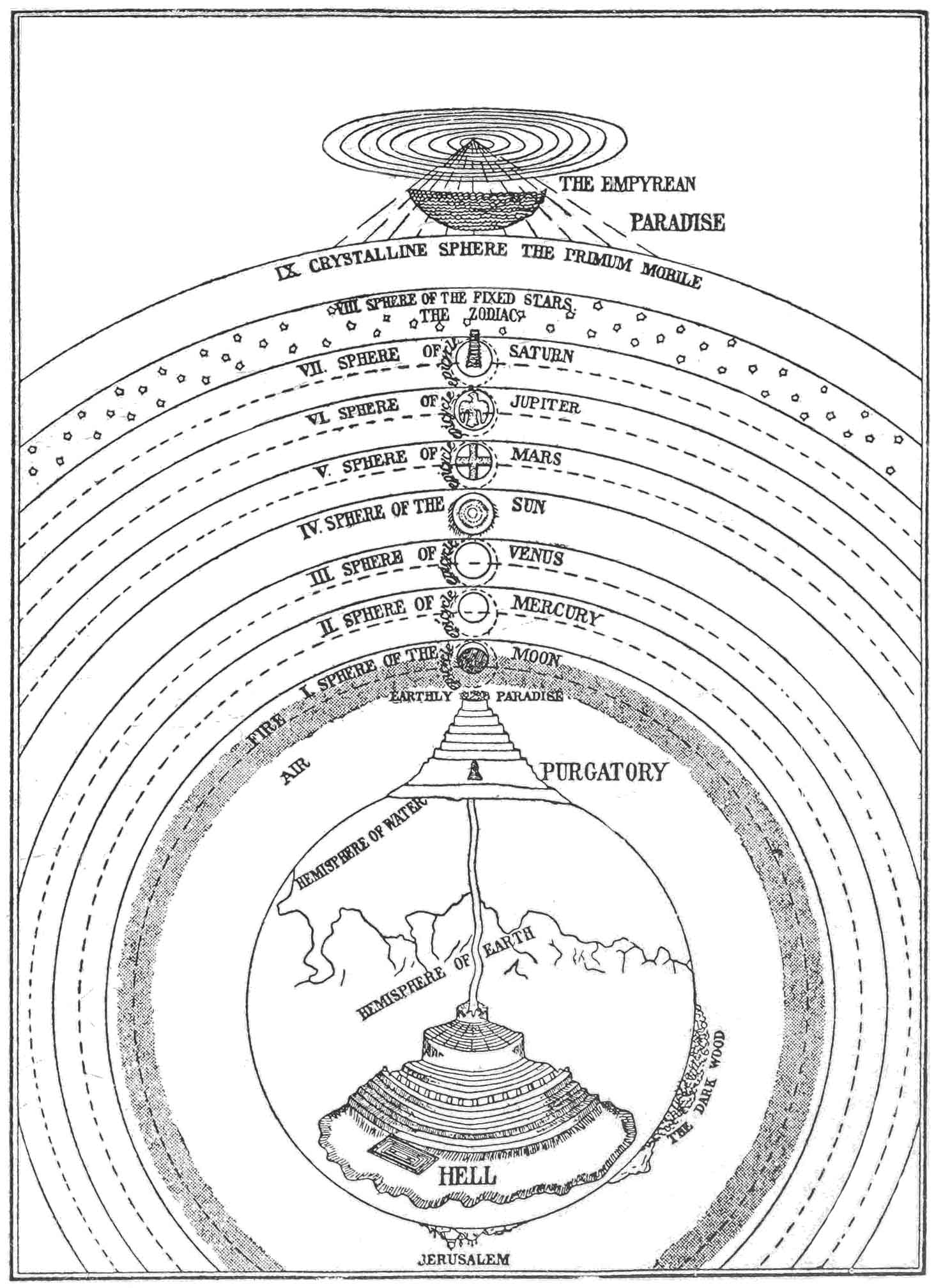
rocks. Lifting his head he contemplated the spheres,
... those bearing the Moon, Mercury, Venus—the
one that Dante visited on Good Friday of the
year 1300—the Sun, Mars, Jupiter, Saturn, then
the incorruptible firmament from which the stars
were suspended like lamps. Beyond, his mind’s eye
discerned the Ninth Heaven to which the saints were
rapt, the Primum Mobile or Crystalline; and finally
Empyrion, dwelling of the blessed, toward which,
he firmly hoped, two angels robed in white would
bear away, as it were a little child, his soul washed
in baptism and perfumed with the oil of the last
sacraments. In those days God had no other children
than man, and all his creation was ordered in a
fashion at once childlike and poetic like an immense
cathedral. Thus imagined, the universe was so
simple that it was represented in its entirety with
its true figure and motions in certain great clocks
run by machinery and appropriately painted.”
Dante’s Conception of the Universe
(From Hearnshaw’s Mediaeval Contributions to Modern Civilization.)
But now! “We are done with the spheres and
the planets under which one was born lucky or unlucky,
jovial or saturnine. The solid vault of the
firmament is shattered. Our eye and our thought
plunge into infinite abysses of heaven. Beyond the
planets we discover no longer the Empyrion of the
elect and of the angels, but a hundred millions of
rolling suns escorted by their cortège of obscure
satellites invisible to us. In the midst of this infinity
of worlds our own Sun is but a bubble of gas
and our Earth but a fleck of mud.”
The contrast speaks for itself and needs no comment.
It is enough to point out the effect it must
have had upon the ethical and religious notions of
him who first realized it. What in such a world are
we to make of the central episode of Christianity?
Bruno’s imagination that had swept through space
and sped by the stars had found these worlds inhabited
by beings “perhaps better, perhaps worse than
we are.” If there was no evidence that these dwellers
in distant solar systems were so much better
than we as to need no saving, neither was there any
evidence that they were so much worse as to deserve
none. We were no longer the only children of God.
What then? Are we to suppose that the drama of
Redemption is being enacted over and over again
throughout the infinity of worlds? Is the Son of
God being sacrificed over and over again for the sake
of His other children? Is He at this moment perhaps
redeeming with His life the dwellers on some
star in the night yonder?
But destruction did not stop here. Not only the
gentler aspects which Christianity had given to the
sterner religion of pagandom were threatened. That
older religion itself, with its well-thought-out theory
of the relation between God and man, must either be
rejected or remodeled. For Aristotle as well as for
Aquinas, God and man had formed the real plot of
the universe. God, revealing himself most clearly
in the turning of the enclosing heaven, set thereby
the rest of nature in motion and stirred things down
to their very center. So that in the region of earth,
water, air and fire there came to be composed bodies
mixed of all these. They were the living beings
we know, which, holding their ingredients in proper
proportion for a while, fell apart again and passed
away.
These living beings differed in power. As we pass
from the vegetable through the animal to the human
they show themselves increasingly able to control
the matter in which and of which they are. Highest
of all is the human male. It is for the sake of producing
him that the mechanism which fills the region
between Heaven and Earth exists and is operated.
One might almost say that Nature is God’s workshop
for producing man. But why should God be thus
interested in producing this particular kind of animal?
Aristotle’s answer comes less clearly than one
could wish, yet it comes. It is because man differs
from the animals not only in degree but in kind.
He is not altogether animal. In his superior body
there is contained a soul which is not only of God’s
making, but of God’s very substance. That is why
man alone can know God. It is as though God
needed to be known, recognized, reflected as in a
mirror. As for man, he is a bit of divinity momentarily
estranged from his home and dwelling, but
with the privilege of returning thither can he but
free his soul from earthly and sensuous entanglements
and interest himself in knowing his Father
which is in Heaven.
And now that Bruno has destroyed this difference
between Heaven and Earth, has he not destroyed
along with it the distinction between God and man?
Has not his infinite homogenous world left man
a mere mite shivering on his fleck of mud as it rolls
around its bubble of gas? Man is no longer the
center of interest; he no longer plays an important
part in any thinkable plot. “Man is no more than
an ant in the presence of the infinite,” cries Bruno.
“A star is no more than a man.”
We can understand that Bruno’s awakening, with
however great an enthusiasm it may have been heralded,
can be no pleasant awakening for the sleeper.
The world of his dreams was infinitely fairer and
warmer than that reality to whose garish light his
eyes have been opened. It cannot be expected that
the awakened should feel any gratitude, and he did
not. But what is less obvious is the matter of Bruno’s
own feeling as the consequences of his new idea gradually
unfold themselves to him. Can that first enthusiasm
be sustained to the end, or must he too
shrink before the fuller vision of what he has done?
If we were to classify men in terms of their reactions
to new ideas, I think we should all hit upon
these three types. Let me call the first the radical.
He is easy to initiate into a new truth, bold to accept
it at all costs, loses at once all perspective and sees
in the past only a bundle of errors without beauty
and with no other interest than to furnish matter for
jest. And then there is the conservative. The hold
that the past has on such a mind is sometimes enormous.
He is capable of clinging to it at the expense
of all the rest of his science and experience. If it has
enthralled his heart and imagination, he falls into
a mood which the Renaissance called the acceptance
of “two-fold truth.” He believes against all evidence.
He believes as Tertullian had it, just because
the thing is absurd. He insists with Pascal, that
the heart has its reasons which the reason cannot
understand. He is a creature of faiths and of mysticisms.
Finally there is the philosopher, the only
one of the three completely made for unhappiness.
He gets no thrill from novelty. He has followed
human thought through too many revolutions to expect
the most violent of cataclysms to change things
much. He struggles to keep his perspective as he
would keep his reason, and the views of older humanity
do not lose their beauty because their expression
has been proved wrong. Required to readjust
his thought of yesterday to the new fact of today,
he undertakes the task cheerfully enough as part of
the day’s work. That is what yesterdays, todays,
and if it may be, tomorrows are given to him for.
He measures his success by the extent to which he
can mold new thought to the satisfaction of old desire,
to old desire newly instructed.
And Bruno—to which of these classes does he
belong? Is he the radical who would light-heartedly
take his place on the fleck of mud and watch it
roll around its bubble of gas, while he laughs at his
neighbors, who in the face of such a universe charm
themselves into a continued faith that they are somehow
divine souls in whom a God of Heaven is interested?
Or will he, on the other hand, become one
of those thus held by the past? Will the awakener,
now himself fully awakened, try to snatch at the
fading dream and somehow manage to keep his faith
in what he knows can’t be true? Or will he set
laboriously to work, as a philosopher should, to find
that interpretation of the new facts which lies closest
to the meaning, though it may differ from the verbal
expression of world-old desires and longings?
Alas! if Bruno would but make up his mind to
be any one of these three, the task of his biographer
would be easy. But the real Bruno, the Bruno who
mocked, who thought, who recanted, and who died,
was not a type. He was a man, and as he was the
most human of men, he gathered the greatest possible
number of inconsistencies to his heart. Yes, he
was a radical who mocked and jeered. Yes, he was
a philosopher who labored and thought. And yes,
finally, he was a mystic who could hold as a splendid
if inexplicable possession of his faith, all the things
his reason showed to be impossible. I have shown
you Bruno’s mockery reflected in the somewhat
muddy and turbid medium of Mocenigo’s denunciation.
I have shown you Bruno the mystic, kneeling
before the Inquisition, completely abandoning
the great idea. It remains for me to show Bruno
the philosopher, Bruno the Pantheist, Bruno the unacknowledged
inspiration of much that is recognized
as great in Spinoza and Leibnitz, the acknowledged
and highly honored forerunner of much we take to
be greatest in the German Idealism that centers
about 1800.
We left the great idea at the moment, when, having
pierced the heavens, it had come to realize the
consequences of its act. The gentle meaning of
Christ, the sterner pagan wisdom of God and man
had been lost in an infinity that knew no enclosing
heaven, in a dreary waste of sameness that knew no
distinction, not even that between man and God.
Bruno the philosopher was not one to let this work
of scientific devastation go on unchallenged. What
if there were a God who could dwell just as clearly
in a heaven that was everywhere as in a Heaven that
was above? What if man could have an interest for
and could serve this God, not because he was different
in kind from the ant, but because he was, or rather
in proportion as he was, different in degree? Does
not the life that quickens an animate thing pervade
that thing? Is it not the same life which in me
beckons with my finger, beats with my heart, thinks
with my brain? What then if this infinite world
of ours were one great living thing made up of
other living things, as our body is made up of finger,
and heart, and brain, each of which in doing its own
work does consciously or unconsciously the work of
the whole? “Natura est Deus in rebus.” This is
one of the phrases Bruno found in trying to express
his philosophy. Nature is God in things, or let us
put it—God is the life; suns and planets, men and
ants, falling rain and mounting mist are but the gestures
of this life. Each thinks it does what it does
for its own sake, but those who think clearest realize
that the joy of their doing as well as the solace of
their undoing is the part they play in working out
the ideal of the whole. “And He lives in me as I
live in my hand”—the phrase is Von Hofmannsthal’s,
the thought is Bruno’s, and it is the
whole thought of Bruno the Pantheist.
The end of this life is told in a letter written by
one Gaspard Schopp (a converted Lutheran) to his
friend Rittershausen, rector of the University of
Altdorf:
“If I write to you now, it is because this very
day Giordano Bruno was publicly burned for heresy
in the Field of Flowers in front of the theater of
Pompey.... If you were in Rome, you would learn
from each and every Italian that a Lutheran was
burned, and so you would be not a little strengthened
in your opinion of our savage hatred. But you must
know, my Rittershausen, that our Italians do not
draw a sharp line between heretics and heretics, nor
do they know fine distinctions, but if any one is a
heretic they take him for a Lutheran, in which simplicity
I pray that God may continue them....
“Now Bruno was that Nolan ... a professed
Dominican who some twenty-three years agone began
to doubt of Transubstantiation ... then
forthright to deny it, and likewise the virginity of
the Blessed Mary. He migrated to Geneva, ...
whence, not approving himself altogether sound in
his Calvinism (than which, nevertheless, nothing
leads straighter to atheism), he was driven to Lyons,
whence to Toulouse, from whence he passed on to
Paris, where he was a professor, but extraordinarius,
as he found that the professor ordinarius was obliged
to attend Mass. Thence to London, where he published
a little book called the ‘Beast Triumphant,’
meaning thereby the Pope, whom your party is wont
to honor with the name of beast.[2] From here to
Wittenberg, where, if I am not mistaken, he lectured
publicly for two years. Having gone on to
Prague, he published there the works, ‘On the
Boundless,’ ‘On the Innumerable Worlds,’ and yet
one other, ‘On the Shadows of Ideas,’ in which he
taught horrible and moreover most absurd things,
as that there are innumerable worlds, that the soul
passes from one body into another, ... that magic
is a good thing and permissible, the Holy Spirit is
nothing but the soul of the world, and that this was
what Moses meant when he wrote, ‘The spirit of
God moved on the face of the waters,’ that the world
is eternal.... In a word, whatever is asserted by
the Pagan philosophers, whatever by our older or
newer heretics he (Bruno) maintained.
“From Prague he went on to Brunswick and
Helmstadt, and there for a time is said to have
taught. Then to Frankfurt for the publishing of
certain books, and later fell into the hands of the
Inquisition at Venice, whence when they had had
enough of him, he was sent to Rome. Frequently
examined by the Holy Office ... of the Inquisition,
convicted by the highest theologians, he now
besought eighty days that he might consider, now
promised recantation, now defended his point anew,
now obtained another eighty days; but was really
doing nothing but make a fool of the Pontiff and the
Inquisition.
“So that, nearly eight years after he had come before
the Inquisition here, on the ninth of February
in the Palace of the Grand Inquisitor, there being
present the Most Illustrious Cardinals of the Holy
Office of the Inquisition, ... theologians of counsel,
and the secular magistrate, governor of the city,
Bruno was brought in, and on bended knees heard
sentence pronounced against him. And it was in
this way: the story of his life was told, of his studies
and teachings, and with what diligence and fraternal
admonishment the Inquisition had sought to effect
his conversion, and what obduracy and impiety he
had shown. Then they defrocked him, as we say,
and straightway excommunicated him and handed
him over to the secular arm to be punished, asking
that this be done with clemency and without the
shedding of blood.
“While this was passing he answered nothing,
except this word: ‘In greater fear, perhaps, do you
impose sentence upon me than I do receive it.’ So,
taken away to prison by the governor’s lictors, he was
allowed a fortnight in case he should wish to recant
his errors; but in vain. Today he was led to the
stake. When the image of our Saviour on the Cross
was shown to him as he was about to die, he turned
away his head and sullenly rejected it. In great
misery he thus died, and is gone, I think, to tell in
those other worlds of his imagining after what manner
the men of Rome are wont to treat impious
blasphemers....”
Surely, he came to that other world of his imagining.
It is our world and he dwells among us. Little
does he remember of the men of Rome, of their
Illustrious Lordships of Venice, of all the toil and
travail of that old life of his—hardly enough to
fill an idle hour in the telling. But we know him
easily for the unchanged soul he was. He is that
one who came to us of a day and opened our eyes to
new and troubling visions. “Now you are free,”
he said, “be glad!” He is that same one who stole
back another day and whispered, “But you are
afraid! Remember your Father’s House, how safe
it was and warm.” He may be there to close the
eyes that have seen enough, with what counsel then,
who can tell? But once he was fond of saying,
“Not only he who wins deserves the laurels; but
also he who dies no coward.”
II BENEDICT DE SPINOZA 1632–1677
“All things excellent are as difficult as they are
rare.” These words which bring to a close Spinoza’s
masterpiece “Ethics, after the manner of Geometry,”
sum up the experience of a life as rare as it
was difficult.
But then, the things that make life difficult are so
much a question of the nature that accepts or invites
them! We may be sure that few, brought to the lap
of Lachesis, would have the courage to pick therefrom
Spinoza’s lot. To be born of exiled Jews, to
be cast off by family and race as an offender against
holy traditions, to live then in loneliness among
Christians whose faith one does not accept, to die by
inches at the age of forty-five,—even as lives go
this would hardly be called an easy one. How seriously
then must we take the sustaining power of
a philosophy which enabled Spinoza, partly accepting,
partly inviting his destiny, to lend it an aspect
of calm beauty that touches our wonder!
One is tempted to recall the unhappy Bruno; without,
tossed and hunted; within, torn by a conflict
between a new science at once grand and desolate,
and a memory of things lovable but untrue. In him
a lofty philosophy was to have quieted this struggle
and consoled this isolation but did not, unless indeed
it did at that last moment when he stood at his stake
in the Field of Flowers.
There is much likeness but an all-important difference
between Bruno and Spinoza, whose names a
curious fate linked together first in general condemnation,
then in general praise. The two were alike
in this, that if anything more lonely can be conceived
than the fugitive existence of Bruno, it is the monk-like
reclusion of Spinoza; if anything more desolate
than the infinite wind-swept universe of Bruno, it
is this same universe bereft of the quivering life and
all-inspiring purpose that Bruno found in it, this
world left on our hands a rolling mechanism fatal
and purposeless. But the difference is profound.
The philosophy, yes, one may boldly say the religion
of Spinoza, sustained him from day to day, from
hour to hour. Bruno’s was rather the poet’s vision,
vivid enough while it lasted, but dispelled by the
shock of reality to return only at such moments as
that in which his life went out. Is it in the power of
a thought, is it in the temperament of a man that this
difference lies explained?
Spinoza’s thought, whatever its worth, owned a
distinguished lineage. When in 1658 he was excommunicated
by the Jews at Amsterdam, he turned
with eager curiosity to the learning if not to the
faith of the Christians. In particular the Dutch
physician, Francis Van den Ende, himself a freethinker,
became his teacher and friend. From him
Spinoza acquired his knowledge of Latin and German,
by him was initiated into the sciences and introduced
to the works of Giordano Bruno and of one
other destined to play a determining part in his
thought, René Descartes—“the father of modern
philosophy” as he is sometimes called.
Descartes, whose life overlaps that of Bruno at
the one end and of Spinoza at the other, is founder
of the school of thought the historian calls Rationalistic.
Now a rationalist is obviously enough one
who is bent on following his reason, but reason as
opposed to what? We think first of reason as opposed
to authority and revelation; but although
rationalism came inevitably to discard these sources
of belief—had already discarded them in the
thought of our very Spinoza—the father of rationalism
had left some room for both; partly because
it might furnish a convenient refuge if the
official church with which he desired to live in comfortable
relation should press him; partly because
Descartes was in one or two respects less of a
rationalist than his school.
On the other hand the master was emphatic
enough on the distinction between the reason and the
senses. It might seem to us moderns that the old
saying “seeing is believing,” with its implied prohibition
against believing aught that might not be
seen, erred, if at all, from a very excess of reasonableness.
To Descartes, seeing with the body’s eye was
still but flimsy evidence. This organ had too often
deceived him to be implicitly trusted, and to back
its testimony with that of the other senses,—touch,
taste, smell, hearing—was but to multiply unreliable
witnesses. Their combined voices might give a certain
presumption in favor of their opinion but never
an assurance amounting to certainty. Not indeed
with the eye of the body but with the eye of the
mind could we see truth in its nakedness. But what
is this organ, this eye of the mind, and who is to
teach us to use it? The mathematicians, Descartes
replies, have long possessed it and long used it. It is
to them we must turn for instruction.
If we do—if we turn to Euclid, say—we find
that the whole complex and difficult body of truth
that we call geometry is made to follow from a few
simple truths so certain that we call them self-evident.
Why should not all truths be susceptible of
the same kind of proof? Why should we not be
able to find an axiom of axioms whose certainty was
no mere matter of observation, and why, if we find
it, should we not be able to draw from it all possible
truth, as we deduce the theorems of geometry
from its axioms?
It was this idea that Descartes followed and it
was this idea that Spinoza accepted at his hands: To
construct a theory of life that should be no mere
summing up of various peoples’ experiences, but
should, after the manner of geometry, draw from
an indubitable source the certainties of morals and
religion no less than the truths of science.
But when we learn what is this axiom of axioms
that Spinoza received from Descartes and made the
fountain head of all truth, we find ourselves spectators
of one of those curious tricks of the human mind
that make its history always diverting. It may well
seem to us as though rationalism were not so much
standing on its reason as standing on its head. For
that axiom which is to be the simplest and most certain
of all truths, more elementary than that 2 and 2
make 4, or that a straight line is the shortest distance
between two points,—that axiom is the very proposition
before which most of us find our reason staggering,
our faith panting and breathless. That axiom
consists of two words: “God is.”
I do not propose to develop here the tortured
processes of reasoning by which the rationalists were
wont to convince themselves that what God is and
that He is, were no mere questions of experience. It
seemed to them as though the very meaning of God
assured his existence. But I question if in the end
any of our day would be strongly convinced by their
argument about it. The whole matter is of the less
importance that Spinoza’s results in the domain of
ethics are not so dependent on his method but that
one may readily reword the problem of 17th century
rationalism in the language of modern science.
Nevertheless it is in the first instance devotion to
the method he had received from Descartes that requires
Spinoza to differ with his master on two points
of the greatest importance to the sequel. This God,
this “all-perfect being” as the rationalists commonly
defined Him, plays a rather capricious part
in Descartes’ thinking. He is represented as the Creator
of the physical universe, and in this act of creation
as quite arbitrarily choosing this sort of a world
rather than another, a world working out a destiny
that is not chosen because it is good but is good because
it is chosen of God. For the rest, what this
end may be is beyond the ken of human reason, and
after having done homage to the divine purpose
Descartes feels at liberty to confine his attention to
studying the mechanism and reconstructing the history
of nature as we find it.
Here one can imagine Spinoza exclaiming “What!
You would follow the guidance of the geometers,
deducing all truth from the axiom of God’s existence,
and you leave it to God to decide what shall
and what shall not follow from his nature!” Do
then the axioms of geometry select the theorems
they shall establish, accepting some and rejecting
others for a motive whether good or bad? No, says
Spinoza, God has neither intellect nor will: facts and
laws follow from His nature as the properties of a
triangle from its definition.
The other element of caprice in Descartes’ final
picture of the world is just man. He alone of all
things occupying a place in God’s universe is not
subjected to mechanical law. But how, Spinoza may
well ask, can we conceive ourselves to be following
the lead of mathematicians if we violate the first
principles of their science? Does the geometry of
a triangle depend upon the place in which the triangle
finds itself? How then can the laws of the
behavior of bodies depend upon these bodies being
in or out of the human machine? The human body
must be determined by the same laws of physics that
govern all extended things. “And as for the mind,”
Spinoza adds, “the order and connection of its ideas
are parallel to the order and connection of the
bodily states.”
“There is,” he concludes, “in mind no absolute
or free will; but the mind is determined to this or
that volition by a cause which has itself been determined
by another cause, this again by another and
so on in infinitum.”
That the world reflects God’s choice, that it might
to a perfect understanding reveal God’s purpose,
that in it the human being is free in body or mind;
these are aspects of irrationality which Spinoza is
eager to remove from the fair creation of reason.
They represent to him last vestiges of vulgar
thought of which the master had after all been unable
to rid himself. Spinoza is at his best in exposing
the psychology of the multitude with its quaint
illusions respecting God and man. In the famous
appendix to the first book of the Ethics he summons
these prejudices as he calls them before the bar of
reason: “They all,” he lays it down, “depend on
just this one; that men commonly suppose all things
in nature to act as they themselves do with a view to
some end, nay, even assume that God himself directs
all things to some definite end, saying that God
has made all things for man, and man that he might
worship God. I shall therefore consider this prejudice.
I shall inquire in the first place why most
persons assent to it and all are by nature so prone
to embrace it. In the second place I shall show that
it is false; and lastly I shall show how there have
sprung from it prejudices respecting good and evil,
merit and sin, praise and blame, beauty and ugliness,
and other things of the sort....
“It will here suffice to assume certain facts all
must admit, namely, that all men are born ignorant
of the causes of things, and that all men have, and
are conscious of having, an impulse to seek their own
advantage. From this it follows first that men think
themselves free for the reason that they are conscious
of their volitions and desires, and, being ignorant
of the causes by which they are led to will
and desire, they do not so much as dream of these.
It follows second that men do everything with some
purpose in view; that is, with a view to the advantage
they seek. Hence it is they always desire to know
the motives of action, and when they have learned
these, are satisfied.”
Against this background Spinoza sketches in with
a few quick, vigorous strokes what we may call his
psychology of popular religion.
“Since men find in themselves,” he writes, “and
external to themselves, many things which are of no
small assistance in obtaining what is to their advantage,
as for example, the eyes for seeing, the teeth
for chewing, plants and animals for food, the sun
for giving light, and so on, this has led them to regard
all things in nature as means to their advantage.
And knowing these means to have been discovered,
not provided by themselves, they have made this a
reason for believing that there is some one else who
has provided them for their use. But as they had
never had any information concerning the character
of this being, they had to judge it from their own.
Hence, they maintained that the gods direct all
things with a view to man’s advantage, to lay men
under obligation to themselves, and to be held in
the highest honor; whence it has come to pass that
each one has thought out for himself, according to
his disposition, a different way of worshipping God,
that God might love him above others, and direct
all nature to the service of his ... desire. But
while they sought to show that nature does nothing
uselessly (in other words nothing that is not to man’s
advantage) they seem to have shown only that nature
and gods and men are all equally mad.”
And Spinoza seizes the opportunity to pay tribute
to a respectable, well-worn theology:
“Just see how far the thing has been carried!
Among all useful things in nature they could not
help finding a few harmful things, as tempests,
earthquakes, diseases, etc. They maintained that
these occurred because the gods were angry on account
of injuries done them by men or on account of
faults committed in their worship. And although
experience daily contradicted this and showed by an
infinity of instances that good and evil fall to the lot
of the pious and of the impious indifferently, that
did not make them abandon their inveterate prejudice.
They found it easier to class these facts with
other unknown things whose use they could not
name and thus to retain their present and innate condition
of ignorance, than to destroy the whole fabric
of their reasoning and think out a new one. Hence
they assumed that the judgment of the gods very far
surpasses man’s power of comprehension.” This
in itself, Spinoza concludes, would have been sufficient
to hide the truth forever from mankind had not
science, which looks into the why and not the wherefore
of things, shown men a different standard of
truth.
The second paragraph in which he fulfils his
promise to show the folly of the popular belief in a
providence is pervaded by a dry humor:
“I must not overlook the fact that the adherents
of this doctrine who have chosen to display their ingenuity
in assigning final causes to things, have employed
in support of their doctrine a new form of
argument, namely, a reductio, not ad absurdum,
but ad ignorantiam; which shows that there was no
other way to set about proving this doctrine. If, for
example, a stone has fallen from a roof upon someone’s
head and has killed him, they will prove as
follows: If it did not fall in accordance with God’s
will for this purpose, how could there have been a
chance concurrence of so many circumstances?...
Perhaps you will answer, It happened because the
wind blew and the man had an errand there. But
they will insist, Why did the wind blow at that
time? and why had that man an errand that way at
just that time? If you answer again, The wind rose
at that time because on the day before, while the
weather was still calm, the sea began to be rough and
the man had an invitation from a friend, they will
again insist, since one may ask no end of questions,
But why was the sea rough? and why was the man
invited at that time? And so they will keep on
asking the causes of causes until you take refuge in
the will of God, that asylum of ignorance....
Hence it happens that he who seeks for the true
causes of miracles and endeavors like a scholar to
comprehend things in nature, and not like a fool
to wonder at them, is everywhere regarded and proclaimed
an heretic and an impious man by those
whom the multitude reverence as interpreters of
nature and the gods. But this I leave and pass on to
the third point I promised to treat here.”
The treatment of this third point, our perverted
notions of good and evil, beauty and ugliness, etc.,
may readily be imagined. “Since men as we have
just said believe that everything was made for their
sake, they call the nature of a thing good or bad,
sound or corrupt, according as it affects them.” And
from this springs the world-old problem of evil
as it is called. “Many are accustomed to reason
as follows: If everything has followed from the
necessity of God’s most perfect nature, whence so
many imperfections in nature, the stinking rottenness
of things, their disgusting ugliness, confusion, evil,
sin and so forth?” But those who ask thus are
merely confused, for “the perfection of things is
to be determined solely from their nature and power,
nor are things more or less perfect because they
please or displease men’s senses, are helpful or
harmful to man’s nature.”
Were we to lay aside our Spinoza at this point,
we should be inclined to agree with the judgment of
most of his contemporaries and of his successors for
more than a century, that although the name of God
is constantly on his lips his thought makes the name
an empty one, that he is at bottom an atheist. Furthermore
we should fail to see how he could have
called his great work an “ethics,” inasmuch as it is
hardly to be understood how in a world where every
act of the body is necessitated by eternal laws of
physics, every thought of the mind by equally rigid
laws of psychology, there could be such a thing as
a good or bad act, a good or bad thought. Where
there is no freedom, how can there be right and
wrong, worth and unworthiness?
And yet we shall find that into this hard inhospitable
world-picture, Spinoza has set a theory of
life that not only recognizes and defines the difference
between the good and the bad, but culminates
in a phrase whose religious feeling is unmistakable:
Virtue is knowledge; the only knowledge is to
know God; to know God is to love him. If one
grasp this part of his philosophy, one will understand
how it came about that him whom the eighteenth
century called atheist, the nineteenth remembered
as a Gottrunkener Mensch—a God-intoxicated
man.
It would be too much to attempt to follow the
technical expression that Spinoza gives to his
thought. Every word is heavy with the burden of
long centuries of scholasticism. But I think it is
not impossible to put oneself in possession of one
principal idea on which the rest follows, not without
jolt, yet with a fair degree of ease.
Let us then put the problem clearly before us.
Suppose Nature, including the incident of human
life, were one great machine without purpose in the
whole, without freedom in the detail, how would it
be possible to regard any part of nature, a given man
for example, as either good or bad? If this man
lives as he must, what use, nay what meaning in
advising him how he ought to live?
Spinoza’s answer involves this fundamental point.
There are some machines that exist for a purpose.
We may, if we choose, regard it as the nature of such
a machine to accomplish this purpose. In proportion
as it accomplishes it we call it good; in proportion
as it fails we call it bad. Thus a clock is mechanical
enough, a matter of cogwheels and springs, but
that is not the nature of a clock, for we can recognize
such an implement without knowing anything
about these same cogwheels and springs, if only
we know that the thing keeps time. As it keeps
accurate time we call it a good clock, and as it loses
or gains we call it a bad one. It is true that we
do not exactly blame the clock if it goes wrong;
we rather blame the clock-maker. But there is no
reason why we should cease to blame the clock-maker,
were we to convince ourselves that he too was a
mechanism, and owed his lack of skill to the physical
constitution of hands and brain. In a word, a mechanism
whose nature is to perform a certain function
may nevertheless be a good or a bad mechanism for
the purpose, and is praiseworthy or blameworthy in
so far as it performs its function well or ill.
It is only then a mechanism that reveals in its behavior
the pursuit of a purpose that may be regarded
as good or bad. So too it is only such a mechanism
that may be regarded as more or less free, more or
less bound. This notion of freedom and bondage that
Spinoza here introduces, turns on a distinction which
all of us make without realizing the difficulty of
defining what we mean by it. It is the distinction
between a being and its environment. With respect
to each thing Spinoza divides nature into two parts:
one part he calls the inner nature of the thing; the
other, nature external to it. Now in one use of the
term “nature” this distinction seems to be an impossible
one; for in so far as I regard a man’s body
as composed of atoms obeying the laws of mechanics,
everything that takes place among these atoms is the
resultant of the relation of these atoms to all others
in the universe. “It is impossible,” Spinoza himself
sees it—“it is impossible for a man not to be
a part of nature and not to follow its general order.”
But suppose in reference to a given kind of body
we neglect all those differences in behavior that
make neither for nor against the accomplishment of
a purpose we have ascribed to it. Will not the grain
of corn spring up in this field or in that? Will not
the human being pass through the cycle of life in
this age and country, or in that? And in so far as
he carries out the purposes of his being in various
surroundings, whatever difference of detail in his
way of doing it, may we not say that man has a
nature of his own independent of his environment?
Finally is not this just what we mean by being free:
the ability to carry out one’s end independently of
the circumstances in which one is placed? On the
other hand is not an inability to win out under all
circumstances just what we mean by bondage?
There is then no reason why we should not recognize
freedom and bondage, good and evil, in certain
parts of a world that atom by atom is mechanical
and purposeless in its constitution.
Having presented this central idea, we may now
follow with greater ease Spinoza’s account of the
degree of freedom of which a man is capable, of the
use of this freedom which we should call good, and
finally of the rewards of a “good life.”
Here we seem to have asked three questions because
we have followed the general ideas on the subject.
To these questions, however, Spinoza would
return a single answer. To be good, to be free, to
be blessed mean one and the same thing. It is a
divine thought, if only it can be made to appear.
First then let us note that we habitually distinguish
the forms of life as higher and lower; the
grain of corn is lower than the bee, the bee is lower
than the man. If we ask ourselves what we mean
by this distinction, we shall find I think that we refer
to the difference of the degree to which these forms
are capable of carrying out a given purpose whatever
the environment. The biologist would say they
differ in adaptability. Take merely the common
end of self-preservation: the grain of corn is lost if
it fall on rocky ground or among the thorns. It can
do nothing to save itself. To the bee these circumstances
are indifferent, yet it in turn would succumb
to a blight of the flowers. To the man, this would
be but a small matter and we enjoy losing ourselves
in admiration of the ingenuity with which he manages
to subsist under the most unusual and threatening
conditions. In a word, the higher the form
of life, the greater the freedom from environment;
the lower, the greater the bondage to circumstance.
What now in the future of a thing determines
its degree of freedom? Spinoza studies the question
only within the domain of human life. Within this
domain his answer is striking: Freedom comes with
knowledge; ignorance is bondage.
But there is more than one sense in which this saying
may be taken. We have for example the Baconian
thought, “knowledge is power.” That is,
given any end to be striven for, other things being
equal the one who brings science to bear is the more
likely to conquer circumstances, to triumph, to be
free. This sense of the power of knowledge is not
lacking in Spinoza.
But the freedom that comes with knowledge may
be of a higher kind than the mere bettering of our
chances of success. After all, human skill is extremely
limited; defeat is every man’s portion, and
one of the most important questions in life is how to
bear failure.
If knowledge is our best arm to ward off defeat,
so is it our best solace when defeat, the inevitable,
comes. For do we but understand that the fate that
has come upon us was not to be escaped but was imposed
by the eternal laws of nature, repining becomes
impossible. Pain is a fact, we cannot escape
it altogether, we cannot deny it when it has seized us.
We can though prevent the sourness and bitterness
that the ignorant fall prey to when they suffer.
For pain is one thing, hate another. Pain is not
to be escaped; hate may be. And the way to kill
hate in our hearts is to connect the individual fact
that is painful with the whole order of nature which
makes this as every other fact necessary. Now the
order of nature as we have seen flows from God as
the theorems of geometry flow from its axioms. To
understand the necessity of any fact is to recognize
God as its cause. When we have done this the bitterness
of defeat is gone. No man, says Spinoza, can
hate God.
I have mentioned two senses in which knowledge
meant freedom: (1) the sense in which it reduces
the chances of failure and pain to a minimum; (2)
the sense in which it frees us from the bondage of
passion and bitterness, when the unavoidable remainder
of pain comes upon us. There is still one
deepest sense in which knowledge is freedom. So
far, the excellence of knowledge has been made to
depend upon its fitness as a means—either to the
end of obtaining a maximum of success, or to the
end of bearing the still inevitable minimum of defeat.
We have now to consider knowledge as an
end in itself.
Since, as we have seen, the pain of life is the sense
of defeat, of limitation; its pleasure the sense of
triumph, of freedom, we should expect to find Spinoza
urging as the blessed way of life that one, if
any such there be, which could meet no defeat; that
one whose success did not hang upon circumstances
in which a man’s life happened to be cast;
that life, in a word, that was at each moment absolute
freedom.
You will doubtless have anticipated that these
blessings are claimed by our philosopher for that
way of life which is a single hearted pursuit of
knowledge. “Wherefore,” he has written, “the
ultimate aim of the man who is controlled by reason,
that is, the highest desire with which he strives to restrain
all others, is that which impels him adequately
to know himself and all other things that can fall
within the scope of his understanding.”
And again he has said: “There is nothing in nature
that is opposed to the understanding; nothing
that can destroy it.” (The word “understanding”
replaces the original expression “intellectual love.”
We shall see presently that for Spinoza to understand
is to love God.)
It is to be regretted that Spinoza did not deal as
minutely with the question: Are we free to obtain
knowledge, as he did with the thesis: Knowledge
when obtained is freedom. For one feels that whatever
the blessedness of knowledge, if understanding
is denied us we are not blessed. And has not Spinoza
himself said that the path to knowledge is
a difficult one? And he adds “surely it must be
difficult, since it is so rarely found. For if salvation
were easily attained and could be found without
great labor, how could it be neglected by nearly
every one?”
Had Spinoza maintained that not only knowledge
but the pursuit of knowledge was blessed, then indeed
salvation must lie at every man’s door. For
is not life itself one long education? And if it bring
its share of disillusionment, may we not repeat the
words of a distinguished German scientist of our own
day, “All disillusionment is enlightenment”? And
this I think is the burden of Spinoza’s teaching: “Let
the pain of life teach you to understand and you will
not hate life, but in the joy of understanding,
love it.”
You will learn to love life! But Spinoza has
a loftier word for it: You will learn to love God.
A clearing up of this expression may well end our
account of the religion of Spinoza. You must recall
our saying that for Spinoza and his fellow rationalists,
all truths were deducible from the single one
“God is,” as all theorems of geometry are proved
from its axioms. If the truths respecting triangles
follow from the nature of a triangle and are not
merely the result of physical measurement, so too,
the truths about the world follow from the nature
of God and are not merely brute facts that we have
to accept because we are continually bumping against
them. To understand a particular experience is to
recognize God as its cause. But we have seen that
such understanding is the greatest happiness that
can come to man, for it is his assurance of power, of
freedom from pain. Now Spinoza defines love as
“pleasure accompanied with the idea of an external
cause.” If understanding is pleasure, and if it is
at the same time recognition of God as a cause, it fulfils
the condition of being love, and of course, love
of God. It is this love of God that is at once knowledge,
freedom, virtue and blessedness. “For blessedness,”
our philosopher has written, “blessedness
is not the reward of virtue, but virtue itself; nor do
we rejoice in it because we restrain our desires, but
on the contrary because we rejoice in it we are able
to restrain our desires.”
“I know,” he writes, “that the belief of the multitude
is different. Most men seem to think that
they are free just in so far as they are permitted to
gratify desire, and that they give up their independence
just in so far as they are obliged to live according
to the precept of the divine law.
“Piety, then, and religion and all things without
restriction that are referred to as greatness of soul,
they regard as burdens; and they hope after death
to receive the reward of their bondage, that is, of
piety and religion. And not by this hope alone, but
also and chiefly by fear—the fear of being punished
after death with dire torments—are they induced
to live according to the precept of the divine law
so far as their poverty and feebleness of soul permit.
If men had not this hope and fear, but if on the
contrary they thought that minds perished with the
body, and that for the wretched, worn out with the
burden of piety, there was no continuance of existence,
they would return to their inclinations, and
decide to regulate everything according to their lusts
and to be governed by chance rather than by themselves.
This seems to me no less absurd than it
would if some one because he does not believe he
can nourish his body with good food to eternity
should choose to stuff himself with what is poisonous
and deadly; or because he sees that his mind is not
eternal or immortal should choose on that account
to be mad and to live without reason.”
And Spinoza closes his doctrine of life with a
calm hymn to science. “I have completed all that
I intended to show regarding the power of the mind
over the emotions, and the freedom of the mind.
From what I have said it is evident how much
stronger and better the wise man is than the ignorant
man, who is held by mere desire. For the ignorant
man, besides being agitated in many ways by
external causes and never attaining to true satisfaction
of the soul, lives as it were without consciousness
of himself, of God, and of things, and just as soon
as he ceases to be acted upon, ceases to be. While
on the contrary the wise man is little disturbed in
mind, but conscious by a certain eternal necessity of
himself, of God, and of things, he never ceases to be,
but is always possessed of true satisfaction of soul.
If indeed, the path that I have shown to lead to
this appear difficult, yet it may be found, and all
excellent things are as difficult as they are rare.”
III A DISCIPLE OF SPINOZA An Illustration
I have somewhere found it recorded that as
Johann Gottlieb Fichte progressed with his first
reading of Kant’s “Critique of Pure Reason,” he
was moved to tears. To those who have labored
through the tortured pages of the great German
thinker this would be no matter for surprise, were it
not for the quality of the tears:—not those of vexation
and baffled understanding, indeed, but of enthusiasm
and sheer gratitude. For Fichte had fallen
into the melancholy persuasion of Spinoza. At
least, certain views of this austere thinker of the
seventeenth century appeared to Fichte as no less
gloomy in their implication than irresistible in the
logic which led to them. Irresistible were the
reasons which had driven Spinoza to look upon nature
as governed by inexorable Fate. In the world
as a whole there was no purpose, in its parts there
was no freedom. Gloomy, then, was the implication
few but Spinoza himself could escape, that man in
such a machine had lost all the familiar marks of a
moral being. It was from the heavy chains of such
bondage that Kant seemed to free the poor Spinozist
by holding out to him the hope of a deeper-lying
freedom, while not denying his apparent subjection
to the universal and necessary laws of physical nature.
It was by this promise of freedom that Fichte
was moved to the enthusiasm, the gratitude, the tears
of which I have spoken.
If I have mentioned these matters, it is not because
our present reflections are to dwell upon the philosophy
of Fichte, nor yet upon the historic contrast
between Spinoza and Kant. It is rather because the
seriousness with which Fichte faced the issue between
these two thinkers is shared by the men of all times
and of all countries who have given themselves to
the pleasures and to the burdens of reflection. The
issue was not first raised by the seventeenth century,
and was not laid with the eighteenth. That it remains
one of the most interesting to which we of the
twentieth century can turn our attention is just the
point which I wish to bring out in the form of an example—an
example taken, not indeed from the
technical philosophy of our day, but from a writer
holding a distinguished place among its novelists.
Those of you who have enjoyed the more mundane
writings of M. Paul Bourget,—his “Cosmopolis,”
his “Coeur de Femme,” his “Complications Sentimentales,”—are
perhaps not prepared to meet in
him the philosopher and moralist that shows through
his less widely known, but sometimes more admired
work, “Le Disciple.” You will allow me, then, to
present so much as is indispensable of the story of
Bourget’s “Disciple.”
Let me begin by giving some idea of the way in
which the plot of the tale may have worked itself
out in the author’s mind. If a mass of rock were to
fall from a cliff, and at its foot to crush before your
eyes a human being—and not a mere vague humanity,
but, let us say, a young girl just entering
upon the promise of life—you would, of course,
feel the full horror of the catastrophe. More than
that, you would not be a descendant of the myth-makers,
as we all of us are, were you not to cast about
for some soul in the order of things on whom to
blame the calamity as though it were a crime. Such
shadowy beings from out of the past as the Fates,
the “purblind doomsters,” are creatures of this human
instinct to transform physical nature into a
moral being. But it is no longer easy to take these
inventions of our fancy as seriously as did our forefathers.
Galileo and Newton have come between us
and the myth-makers. They have enabled us, and at
the same time have constrained us, to envisage the
event I have just depicted as essentially a conflict
between gravitational and elastic forces, not one between
the human soul and the soul of Fate. The
thing moves us more, no doubt, than it would had
the heavy mass rolled quietly on to the bottom of
the valley, because the young girl as a possible object
of sympathy and love is nearer to ourselves than
is a mere topographical contour; but our emotions,
be they what they may, are not of themselves enough
to transform a physical fact into a moral event, a
catastrophe into a crime.
Robert Greslou, the Disciple of our story, is not
indeed made to kill such a young girl, but in a
singularly detestable fashion to render it inevitable
that she should kill herself. The author has taken
care that we should have no feeling but loathing for
this creature of his brain. We cannot even extend
to him that pity and half-forgiveness that the instinctive
man commonly feels for the aberrations of
passion. To Robert the whole episode was a carefully
planned piece of psychological research,—a
vivisection of the emotional life. The author, in his
anxiety that we should not be tempted to excuse, but
should confine ourselves to understanding, has created
a monster. “Non, monsieur,” says André de
Jussat, the brother of Charlotte, to Robert who has
offered him all the satisfaction left in his power,
“Non, monsieur, people do not fight men like you,
they execute them.”
Now, Bourget’s interest in the situation thus created
I conceive to be this: May we not gain sufficient
insight into the causes of this young man’s conduct
to make it appear as inevitable as the fall of the rock
from the cliff? And if we do this, must we not
view the catastrophe in which a human being happens
to play a part as no less void of moral aspects
than that in which a falling mass is concerned?
There we could not blame the stone; here, if the
case is made out, we should not blame the man. In
neither situation is it meaningful to blame the facts
and laws of nature.
It is for the right so to regard his own conduct that
the Disciple pleads with his old master, Adrien Sixte.
At the end of his autobiography he makes a tragic
appeal to the man whose writings had formed his
mind. “I felt assured,” he writes, “that I should
be able to tell you my story as you develop your
problems of psychology in the books I have so constantly
read, and having finished, I find nothing to
offer you but the despairing cry, De profundis!
Write to me, cher maître, guide me. Strengthen me
in the doctrine which was, which still is, my own,—in
that conviction of universal necessity which holds
that even our most detestable, our most damning
acts, even this cold enterprise of seduction, even my
weakness when it came to keeping my side of the
compact of death, are the outcome of laws that govern
this immense universe. Tell me that I am not a
monster, that there is no such thing as a monster,
that you will still be there when I come out of this
supreme crisis to welcome me as your disciple, as
your friend.”
What, then, is the philosophy of this Adrien Sixte
that, having brought a human being to such a pass,
it could still be appealed to to bring him through?
Adrien Sixte had made two contributions to philosophy.
The first was a negative analysis of what
Herbert Spencer calls the Unknowable. “Many
excellent minds,” the author assures us, “catch a
glimpse of the probable reconciliation of science and
religion on this ground of the Unknowable. For
M. Sixte it is a last illusion which he is hot to destroy
with an energy of argument that has not been
equalled since Kant.”
“M. Sixte’s second title to honor as a psychologist
consists in a quite new and ingenious development of
the animal origin of human sensibility.... He
undertook for the genesis of types of thought the
work that Darwin essayed for the forms of life.
Applying the laws of evolution to all the facts that
make up the human heart, he thought to show that
our most exquisite sensibilities, our most delicate
moral discriminations, as well as our most shameful
degradations, are the final development, the ultimate
metamorphosis of very simple instincts, themselves
transformations of the properties of the primitive
cell: in such wise that the moral universe exactly
reproduces the physical, and that the former is only
the consciousness, now painful, now ecstatic, of the
latter.”
We owe to M. Sixte some phrases that translate
with extreme energy this conviction that all is necessitated
in the soul—even the illusion that the soul
is free.
“Every act,” he writes, “is but an addition. To
say that it is free, is to say that there is in a sum more
than there is in the elements added. This is as absurd
in psychology as in arithmetic.”
And elsewhere he put it thus: “If we knew truly
the relative position of all the phenomena which constitute
the actual universe, we could at this moment
with a certainty equal to that of the astronomers, tell
the day, the hour, the minute at which, say, England
will evacuate India, when Europe will have burned
its last lump of coal, when such a criminal, still to
be born, will assassinate his father, when such a
poem, yet to be conceived, will be composed. The
future is contained in the present as all the properties
of a triangle are contained in its definition.”
The provenance of this type of thought is obvious
enough to the experienced reader. Our author
has in an ingenious way translated his Spinoza into
the language of contemporary science. Let us
merely catch up a note or two that will render our
Spinozist’s attitude toward common morality, and
his understanding of the master’s doctrine of emancipation
through science.
In the first sense we find that Adrien Sixte has
somewhere written, “All conscious beings must be
looked upon by the scientist as experiments set up by
nature. Among these experiments some are useful
to society, and one hears of virtue; others are destructive,
and one hears of vice and of crime.” And
he adds, a little by way of flourish, “These last are
nevertheless the most significant, and we should lack
an essential datum for the science of mind if Nero,
say, or such and such a tyrant of the fifteenth century
had not existed.” Or again he has said, “To
consider one’s destiny as a corollary of this living
geometry which is nature, and therefore as an inevitable
consequence of the eternal axiom whose indefinite
development is prolonged through all time
and all space, this is the unique way to emancipation.”
To show that human conduct is so necessitated as
to be without moral aspects: “this is the unique way
to emancipation.” It was just for the master’s aid
over the last rough steps of the path to this emancipation
that we left our Disciple crying, “De profundis.”
Can the aid be given? Can it not? This
is the singularly philosophical catastrophe of this
singularly reflective novel.
For us the issue depends upon an analysis of what
our philosopher would regard as determinants of
human conduct. That it is not meaningless to seek
explanations of human acts all admit, for all alike
are engaged in the search for them, and much that
is of importance to daily life depends upon one’s
ability correctly to explain and so to predict the conduct
of one’s fellows. The only question is whether
the laws by which we explain and predict could conceivably
be increased in precision until they completely
determined conduct. To judge this we must
consider of what nature these laws are, i.e., in the
present context, with what illustrations of such laws
our author furnishes us.
We are familiar with the idea that the explanation
of a fact consists in pointing out its likeness to others.
We are not surprised, then, to find our young analyst,
following the guide of a master who, we have
heard, regarded “our most exquisite sensibilities”
as “the development of very simple instincts,” looking
upon his relations with a singularly pure young
woman as not without likeness to the battle of life
throughout the animal kingdom. “It is the law of
the world,” he reasons, “that all existence is a conquest
carried on and maintained by the stronger at
the expense of the weaker. This is as true of the
moral universe as of the physical. There are souls
of prey as there are wolves, tiger-cats, and hawks,”
and he kept repeating to himself, “I am a soul of
prey, a soul of prey,” with a furious access of what
the mystics call the pride of life.
But if the animal instincts are the most widely
related of those that display themselves in human
conduct, more special instincts must be appealed to
to account for what is special in the act. Well, in its
proper place we find that the family of Robert Greslou
had its roots in war-trodden Lorraine. Of no
very remote peasant origin, son of a conquered race,
he catches himself at certain moments reacting with
instinctive hate toward an individual whom he
hardly knows and who has done him no personal injury,
yet whose every aspect shows him to have
sprung from the conquerors, in whose most courteous
gesture there lurks a polished insolence of aristocracy.
When, then, a human pity for his prospective
victim comes upon this “soul of prey,” it is such a
hate that neutralizes it. “Why,” he cries, “in so
many of my imaginings does Charlotte appear by the
side of her brother André? What secret fibre of
hatred had this man by his mere existence touched in
my heart, that simply to imagine him with his sister
dried up the fountain of my pity and left nothing in
me but the will to win?”
In answer we are expected to recall the moment
when Robert Greslou, introduced into the family of
the Marquis de Jussat as tutor to the younger son,
finds himself for the first time in the presence of the
Comte André, heir and dominating spirit of the
house. “I felt then,” our young analyst records,
“in its full force, in the depths of that instinct of
life into which it is so hard for thought to descend,
the revelation of that sense of race which modern
science attributes to all nature, and which consequently
must be found in man.... Why should
not this hostility be an heredity like the rest? The
horse that has never approached a lion trembles with
fear when his stall is made up with straw on which
such a beast of prey has lain. Then fear is inherited,
and is not fear a form of hate? Why should not
hate be inherited too? And in a thousand cases envy
is probably nothing but that—was nothing more
than that in my case, certainly,—the echo in us of
hatreds long ago acquired by those whose sons we
are, and which continue in us the battle of hearts begun
hundreds of years ago.”
No less carefully does our author work out another
group of influences: those that fall within the
experience of the individual. Influences of family,
of school, of books read, of friends, of adventures
of sex, of religious education, all culminating in the
forming of a character whose foundations have already
been laid in its heredities, in this case a type
for which the French have invented the expressive
term, a cérébral. The rest one can readily imagine,
the delicate suggestions of daily life, the influences,
slight in themselves, that play upon the attuned character
and to which it resounds with acts of this kind
or that, an instrument touched by the fingers of
Fate.
Such, then, is our author’s understanding of what
it means so to explain a human act that it shall appear
to follow inevitably from recognized laws of nature.
If it do so follow, we ask again: Can it in the end
be regarded as either good or bad?
It is not to our author that we may turn for an
answer. M. Bourget is an artist, and owes his allegiance
to the interests of the heart, not to the curiosities
of the intellect. For him it is sufficient to have
shown that to have lived out a Spinozistic philosophy
would in extreme cases lead to very ugly results.
He is addressing himself, as he tells us in his preface,
to the youth of France, and it may not be without
interest to note the place he gives to the type
of philosophy we have just been considering among
the influences dangerous to the young France of his
day.
“There are two types of young men,” he
says, “that I see before me at the present moment,
which are before you too, as two forms of temptation
equally redoubtable and dangerous. The one is cynical
and by preference jovial. He has, since his
twentieth year, discounted life, and his religion is
contained in the single word, to enjoy,—which is
translated by this other, to succeed. Whether he
go into politics or business, literature or art, sport
or industry, whether he be an officer, diplomat, or
lawyer, he has only himself for god, for beginning
and for end. This young man is a monster, is he
not? For it is to be a monster, to have lived but
twenty-five years and to have by way of a soul a
calculating machine at the service of a pleasure-machine.
Yet I fear him less for you than I do a
certain other type. This one has all the aristocratic
traits of nervous organization, all those of mentality.
He is an intellectual and refined epicure, as
the first was a brutal and scientific epicure. This
delicate nihilist, how unpleasant he is to encounter,
and how he abounds in the land! At twenty-five
years he has made the tour of all ideas. His critical
spirit, precociously awakened, has grasped the last
results of the most subtle philosophy of this age.
Do not speak to him of impiety or materialism. He
knows that the word matter has no very precise sense.
He is, on the other hand, too intelligent not to admit
that all religions may have been legitimate in their
time, only he has never believed and never will believe
any one of them any more than he will ever
believe in anything in particular, if not in the amusing
play of his mind which he has transformed into
an instrument of elegant perversity. Good and evil,
beauty and ugliness, vice and virtue appear to him
objects of simple curiosity. The human soul is for
him a clever mechanism which it amuses him to take
apart by way of experiment. To him nothing is
true, nothing is false; nothing is moral, nothing is
immoral. He is an egoist, subtle and refined, whose
one occupation lies in adorning his Self, in dressing it
out with new sensations. The religious life of humanity
is for him only a pretext for such sensations,
as is the intellectual life, as is the life of feeling.
His corruption is vastly more profound than that of
the barbarian of pleasure, is vastly more complicated,
and the pretty name of dilettantism with which he
covers it hides its cold ferocity, its appalling hardness.
Ah, we know him too well, this young man;
we have all just missed being such as he is, we whom
the paradoxes of too eloquent masters have too much
charmed. We have all been this man for a day, for
an hour, and if I have written this book, it is to show
you, you who are not yet like him, child of twenty
whose soul is yet in process of making, what base
things such egoism may hide in its depths.”
For Bourget, then, to have justified this picture
of the youthful Spinozist, is enough. But for us,
who for the moment have become philosophers, who
have given ourselves up to the curiosities of the
mind, it is not enough to have convinced ourselves
that certain teachings are ugly and unpleasant to
contemplate; we must know whether they are true
or false. While much that is unlovely is also untrue,
who but the poet can feel sure in his heart that
only the beautiful is true? Well, then, if we were
to face the issue that seems to be drawn between that
universal necessity which science hopes to establish
throughout the domain of nature, and that freedom
which ethics regards as indispensable to the existence
of moral beings,—if we are to face this issue
squarely, on which side should we range ourselves?
I answer: On both sides. If you say: But this is
difficult to do, I should not be inclined to dispute it;
were it otherwise, opinions on this subject would not
be so much at variance. Yet it may not be impossible
to do. And that the satisfaction of the result has
been thought to be worth any effort it may cost to
reach it, is evidenced by the long struggle which the
history of human reflection records, to hold at the
same time the vital ideals of science and the no less
vital ideals of morality. To consider a way in which
I believe this may be done, will occupy us throughout
the remainder of the present discussion.
Let us begin by making clear just what is the ideal
which guides the scientist in his expectations respecting
the world he studies. Perhaps no one accomplishment
of science has been more inspiring than the
picture of certain large aspects of nature that Newton
succeeded in drawing,—such aspects, namely, as are
presented in the behavior of suns, and planets, and
moons. All these huge masses are governed by a
single law, called the law of gravitation. Now to
say that they are governed by this law means no more
than this, that if we knew the mass, the position, and
the velocity of each of these heavenly bodies at a
given moment, we should be able by means of the
law to predict their masses, positions, and velocities
for all future moments. This result is, to be sure,
only an approximation, for we know that gravitation
is not the only force which bodies exert on each other.
We have never succeeded, e.g., in reducing the attractions
and repulsions of electrified bodies to gravitation,
nor do we any longer try to do this. But Newton’s
degree of success provides us with an ideal to
which we seem ever more and more closely to approach.
Instead of considering such huge bodies as
suns and planets and their satellites, we divide these
up into extremely minute parts, which we may call for
the moment atoms. We struggle then to conceive a
law as completely determining the behavior of these
atoms, as the law of gravitation determines that of
planets. So that, if we knew a limited number of
characteristics of each of these atoms at a given moment,
our law would enable us to predict their future
and to reconstruct their past history. As we approach
more and more closely to this ideal, less and
less in the behavior of these small parts of nature
is left to guess-work. In so far as we hope this ideal
may be continuously approached, we hope that in its
atomic parts nature is entirely devoid of freedom.
And if we hope this, we must inevitably hope, too,
that what we have called an atom is neither a moral
nor an immoral being. This hope is usually called
the mechanical ideal, and nature in the light of it is
viewed as a mechanism. It has guided science to victory
after victory, and I venture to think that no
result of philosophical experience is more firmly established
than this, that whatever theory we may in
the end accept respecting human nature, its freedom,
its moral responsibilities, no assumption of that theory
may stand in contradiction with the mechanical
ideal. To have recognized this truth and to have
had the courage to maintain it at all costs, was the
heroic service rendered by Spinoza at a moment in
human history when such service was badly needed.
It is also the reason why Spinozism, in spite of its
apparently gloomy outlook upon the world, has
made such a forcible and lasting appeal to the imagination
of thinking men. In what follows it is
against certain false implications that have been
thought to lie in this mechanical ideal, and not against
the ideal itself, that our criticism must be directed.
Now there is one implication that lies so near the
surface I doubt not most who have followed so
far will already have drawn it. If, namely, the
atoms of which we have spoken are bound by strict
mechanical law, if it is these same atoms that make
up the human body and that are concerned in its
every act, must not the conduct of that body be an
outcome of this same mechanical necessity? And if
this be so, must not the science whose ideal we have
described set itself once for all against the hope of
finding in human conduct any vestige of freedom,
any trace of moral responsibility? You remember
with what vigor Adrien Sixte drew this very conclusion.
“Every act,” he said, “is but an addition.
To say that it is free, is to say there is in a sum more
than there is in its elements added. This is as absurd
in psychology as in arithmetic.”
Yet natural as this inference may seem, we should,
I think, see that it is unjustified, that the instinct
which has led mankind to read moral aspects into
nature was possessed of a deeper insight than was
our philosopher with his plausible mathematics. If,
indeed, we could construct the notion of a man out of
that of atoms by a process of addition, we could not
escape the conclusion of Adrien Sixte. Then, truly,
moral aspects would be as completely lacking to the
whole being as they are to the atoms which enter
into his composition. That we cannot do this,—that
we can, indeed, offer no mechanical definition of
life, is just the insight which permits us, nay, practically
forces us, to treat man as a free moral agent.
We can frame no mechanical definition of life!
Nor is this the only example offered by experience
of a term applied exclusively to mechanisms and
yet meaning nothing mechanical. Let me give a
homely illustration. There is, I presume every
one would admit, no time-piece which is not a
machine. And yet we can offer no mechanical
definition of a time piece, for the simple reason that
the various machines to which this term applies have
no mechanical principle in common. A class which
may include such divers mechanisms as a sun dial,
an hour glass, a water clock, a pendulum clock, a
spring watch, a chronograph, has evidently not been
given a single name to mark in the members composing
it a single mechanical nature. The only
thing these members have in common is a certain
function or purpose,—that of producing a
movement keeping pace with the apparent motion
of the sun. Just so with the class of beings
we call living. Each of them at each moment
of its existence is a complete illustration of mechanical
law, yet all of them offer such divers illustrations
of this law that they cannot have been put into
a single class because of a common mechanical nature.
That which they have in common, by virtue of which
they have been grouped under one name, is once
more a function or a purpose. For we observe that
living things, by whatever mechanical devices, accomplish
for the most part a common result, that of
self-preservation.
In these two examples, the one taken from the inanimate,
the other comprising the animate world,
we see how well it may come about that a certain
character belong to a whole, no vestige of which is
to be found in its constituent parts. A single atom
cannot, if the mechanical ideal is maintained, be regarded
as acting purposefully, yet a sufficiently complex
group of atoms may well enough display purpose
in its behavior and to that purpose owe its right
to the name we give it. In such cases the real absurdity
we are in danger of committing is not the one
that Adrien Sixte scoffs at, but the one he unsuspectingly
falls into. Axioms of addition are excellent
guides for those whose problem is to add. But
not all composition of parts into a whole is so simple
as the business of forming a sum. And where we are
not adding, the axioms of addition may prove the
worst of company.
Let us proceed to an immediate consequence of
this last observation. If no mechanical definition
can be offered for a given term, it is impossible that
the things to which this term applies should be governed
by mechanical law. We may easily convince
ourselves, however, that although not subjected to
mechanical law, they are frequently, indeed generally,
governed by another kind of law that is of the
greatest interest to us. Let me recur to our illustration
of the time-piece. There is a trite truth about
time-pieces, which we may say holds as a rule, to
wit, that cheap time-pieces are poor ones. Yet it
would be meaningless to ask for a mechanical explanation
of this law, for the mechanical imperfection
of the cheap sun dial bears no resemblance whatever
to the mechanical imperfection of the cheap
watch. The former may be a poor time-keeper because
inexpensively (and so grossly) graduated;
the latter because the escapement is inexpensively
(and so crudely) constructed. So it is in the animal
world. Of its members we may lay down the
rule, say, that each must eat if it would live, but the
physics and chemistry of nutrition in an oak tree are
so different from the physics and chemistry of nutrition
in a human being, that if anyone were to ask for
a mechanical explanation of this rule we could not
offer it, or rather we should have to offer a different
one for each type of organism we considered. These
examples will be sufficient to illustrate the sense of
the saying, “Beings whose nature is not capable of
mechanical definition cannot be subjected to mechanical
law.”
But we said further, that the laws to which such
beings were subject were of a peculiar nature, and it
is particularly important to point out one respect in
which these laws differ from the mechanical. Such
laws as we find controlling the behavior of organisms,
for example, are of the kind that may be called
laws of purpose. We explain, that is to say, the conduct
of organisms in terms of the end or purpose for
the sake of which that conduct has taken place. This
holds from the lowest biological functioning to the
highest form of deliberate human behavior. If we
consider the explanation which our author offers of
the conduct of his unhappy hero, we see that in the
end he has been exclusively interested in pointing out
the motives to which the young man reacted. To
point out motives is simply to recognize the end for
the sake of which the act is accomplished. Now,
although this type of explanation is in daily use
among all men of all times, it was not erected into
a scientific system before the reflections of Plato and
Aristotle had shown of what extension it was susceptible.
Aristotle in particular is responsible for having
pushed to the very limit the notion that the
greater part of nature’s happenings can be explained
in terms of the end for the sake of which they occur.
The whole drama of nature was to him what that of
organic life is to most of us, the struggle of individual
beings to accomplish their natural purposes.
But, interested as Aristotle was in pushing this concept
of purpose in nature to the limit, he could not
blind himself to the fact that no purpose could be
found in nature which was always and invariably accomplished
or attained by the beings whose nature
it was to struggle for it. Consequently, he was in the
habit of saying that “laws of nature (by which he
meant of laws of purpose) were descriptions of
what happens always, or for the most part.” That is
to say, they pointed out the behavior that was normal,
but not free from exception. Nature was full of the
accidental, of the abortive; and although later
science did its best to exclude this notion of the accidental
in nature’s happenings, the effort was uniformly
unsuccessful and, I think, wrongly inspired.
For it is exactly to the circumstance that laws of purpose
are statements of average and not of unexceptional
fact, that they owe their scientific value as
labor-saving devices. And what is perhaps of more
interest in the present connection, it is to this very
lack of rigor in the laws governing animal and human
behavior that we owe our right to regard the
individual to which they apply as free.
In this respect the contrast between laws of purpose
with the situation of the things to which they
apply, and the laws of mechanics with the predicament
of the things they govern, is complete. For
example, the most inveterate statistician will hardly
venture beyond the point of asserting that the man
of alcoholic heredity will for the most part be unable
to resist the attraction of drink. Yet sometimes he
will be able to, for sometimes he does resist. Can
one conceive of the student of mechanics contenting
himself with the result that bodies generally fall to
earth with an acceleration of thirty-two feet per
second? During all the while Mercury’s unorthodox
behavior baffled Newtonian physics, could
any astronomer be found suggesting that perhaps
this was a case of exceptional gravitation? As
with heredity, so with all the other so-called forces
our author brings to bear upon the conduct of
his hero, giving in the end the illusion of mechanically
determined action. Heredity, environment,
education, serve their purpose well enough as terms
that point out an analogy between the ends that attract
beings of like history, but they yield only an expectation
of the normal, not an assurance of the inevitable.
Nor could any increase of statistical data of
this kind do more than give us the materials for a
closer calculus of probabilities. It is for the reason
that all the laws which apply to human conduct are
of this statistical nature, that, being permanently
unable to predict it, we must regard it as free. And
to be free to attain or not to attain a given end, is to
be responsible, is to possess the first condition of a
moral nature. Nor, in attaining to this insight have
we sacrificed aught of our mechanical ideal. Only,
who cares that atoms may neither be saved nor
damned, if the beings they so fleetingly compose may
be both? One might almost say that moral beings
pass over the surface of mechanism as waves upon
the face of the waters. But they constitute its beauty
and its terror.
May we not then sum up our conclusions in some
such form as this?—Mechanical laws do completely
determine the conduct of everything to which they
may be applied, but they cannot be applied to an
animate being, since no mechanical definition of such
a being is possible. Laws of purpose can be applied
to such a being, but they do not completely determine
his conduct. It is because the only law which can
thus apply to a human being does not necessitate his
behavior, that we are obliged to regard that behavior
as free and the being himself as responsible. The
most that we can do in terms of such laws is to calculate
the chances for or against the individual’s success,
for or against his ultimate worth.
Here let us stop. Our discussion shows signs of
falling into the abstract and mathematical, and one
may wonder whether anything practical can come of
it. One will recall the unhappy disciple of Adrien
Sixte, and will ask oneself: What answer, after all,
are we return to his cry, “De profundis!” Can we
offer him any solace in his wretchedness? I think
we can, only it is not the kind of solace he asks for,
nor can it come from the direction in which he seeks
it. I should be inclined to say to him, to Fichte in
his Spinozistic mood, to any other over whom the
mechanical ideal hangs heavily: This ideal is a safe
guide in all thinking for which it has a meaning;
no atom in your body nor out of it, but what is determined
by mechanical necessity; but the sum of
these atoms is not you; there is a difference between
the whole we call a man, and the sum of the atoms
that make up the machine that is to him. These
atoms may come and go, the man remains. What
constitutes his nature as a living being, an animal,
a man, can receive no definition in terms of the
atoms now in his body, nor those that may later take
their place. You as living, as animal, as man, can be
defined only in terms of the ends common to the individuals
of these classes. In so far as thus natured,
you fall under laws not of a mechanical order. They
are laws of average which determine not you, but
your chances of accomplishing the ends that define
your being. In so far as you accomplish such ends,
you are good of your kind; in so far as you fail, you
are evil,—and if you fail egregiously enough, you
are a monster. The most your self-analysis could
have made out by the way of excuse is that the
chances were against you. And this indeed you may
have made out, for who could maintain that all men
have equal chances in this world? But to have had
the chances against you, is not to have been determined
as a falling rock is determined; there is no
chance for it.
In the most mechanical system, then, there is, so
long as classification of its parts in terms of purpose
is possible, a distinction between good and bad, with
enough freedom to make this distinction meaningful.
But such a philosophy may still seem hard. Even
to have the chances against one, is not this a gloomy
situation? Is there, then, no supreme end to accomplish
which all men’s chances are equal, so that
at each moment of life the road to perfection is
equally open to all, and equally wide for all? We
know how many and how beautiful the dreams of
such a world-view, recorded in man’s long history.
To judge their rationality is for a deeper insight than
mine. But be they real or be they dreams, there is
yet one voice from the past whose sanity comes home
to us. It is that of our old philosopher of Koenigsberg,
which keeps repeating at this moment the sentence,
“There is nothing good but a good will.”
With this saying of Kant’s I should even hope to
breathe inspiration into the souls that cry, “De profundis!”
My last word to them would be: Trouble
yourselves with nothing but to make the best of the
chances that are left to you. There is nothing good
but a good will.
I would willingly take it as evidence that the instinct
of the artist and the reflection of the philosopher
are not unsympathetic, that when Bourget’s
Disciple is at last brought out of his ordeal, it is not
to be comforted with the longed-for assurance that
all is necessitated in the soul; but rather to find for
himself the way to redemption by making the best—the
tragic best—of the chances that are left him.
IV DAVID HUME 1711–1776
The characters that have occupied us on two previous
occasions, different as they are, have yet this in
common; that their most passionate interest was centred
in God, and their theory of what man is and
ought to be depended upon the likeness in which
God in the end appeared to them.
I have felt that our illustrations of modern
thought would be incomplete, were I not to include
in the series an example of an attempt to work out
the duty and destiny of man without waiting for an
insight into the mystery of God. It is the more advisable
that we examine one such character, that this
way of thinking is neither newly invented, nor yet
grown out of fashion.
We recall that Lucretius, the enthusiastic disciple
of Epicurus, claimed for his master the glory of
having lifted from the world the terror of the gods,
of having left man free to study his own nature and
to work out his own happiness. And I find on my
shelves a recent work that bears the title “Morals
without the Sanctions of Religion,” one of many that
might be cited whose purpose is to study the good of
man without making it dependent on God. It is,
then, as an expression of a common enough idea,
but as an uncommonly good expression of this idea,
that I have settled upon David Hume for our third
illustration of modern thought.
It has for some time been rather the fashion to
find the grounds of a man’s scientific beliefs in his
personality and in the character of the environment
in which he lives. And doubtless thinking, like any
other activity, has its psychology, an insight into
which is helpful enough, though it is notoriously
easy to find that characteristic après coup which we
should never have been able to predict beforehand.
When I say, then, that Hume had many human
traits reminding us of the Philosophers of the
Garden whose science is so sympathetic with his own,
it must not be supposed that only such as are of like
easy habit of body and companionable temper of
mind should take to his principles. But it is interesting
to note, after having followed the furious career
of Bruno, looked in on the sober reclusion of Spinoza,
that a different type of man may utter great
thoughts; the type that could look back, at fifty-eight
years, on a life well filled with profitable industry,
and forward to one thus comfortably pictured
in a letter to a friend: “I have been settled
here [in Edinburgh] for two months, and am here
body and soul, without casting the least thought of
regret to London, or even Paris. I live still, and
must for a twelvemonth, in my old house in James’s
Court which is very cheerful and even elegant, but
too small to display my great talent for cookery, the
science to which I intend to addict the remaining
years of my life! I have just now, lying on the table
before me, a receipt for making soupe à la reine,
copied with my own hand; for beef and cabbage (a
charming dish) and old mutton and old claret nobody
excels me. I make also sheep-head broth in
a manner that Mr. Keith speaks of it for eight days
after; and the Duc de Nivernois would bind himself
apprentice to my lass to learn it. I have already sent
a challenge to David Moncreiff: you will see that in
a twelvemonth he will take to writing history, the
field I have deserted; for as to the giving of dinners,
he can now have no further pretensions. I should
have made very bad use of my abode in Paris if I
could not get the better of a mere provincial like
him. All my friends encourage me in this ambition,
as thinking it will redound very much to my honor.”
These “friends” to whom Hume refers, were at
that time, as they had been throughout his life, the
best of good company, that is, the kind for whom a
good dinner would have been nothing had not good
conversation been its sauce, but for whom the sauce
was none the worse for dressing out a good dinner.
In such good company, it is not a great matter that
Hume should have been free of pleasant sallies
after the manner of the letter I have quoted. It
throws a higher light on his character when we find
him preparing to receive his last, the unbidden guest
in the same cheerful humor. “I now reckon upon a
speedy dissolution,” he writes at the conclusion of
his little sketch “My own Life.” “I have suffered
very little pain from my disorder; and what is more
strange, have, notwithstanding the great decline of
my person, never suffered a moment’s abatement of
spirits; insomuch that were I to name the period of
my life which I should most choose to pass over
again, I might be tempted to point to this latter
period. I possess the same ardor as ever in study,
and the same gaiety in company. I consider, besides,
that a man of sixty-five, by dying, cuts off only a
few years of infirmities; and though I see many
symptoms of my literary reputation’s breaking out
at last with additional lustre, I knew that I could
have but a few years to enjoy it. It is difficult to be
more detached from life than I am at present.”
And there follows a characterization of himself
that could indeed be hardly more detached were it
written by a stranger. “I am,” he says, “or rather
was (for that style I must now use in speaking of
myself, which emboldens me the more to speak my
sentiments); I was, I say, a man of mild dispositions,
of command of temper, of an open social and
cheerful humor, capable of attachment, but little
susceptible of enmity, and of great moderation in all
my passions.... My company was not unacceptable
to the young and careless, as well as to the
studious and literary: and as I took a particular pleasure
in the company of modest women, I had no
reason to be displeased with the reception I met with
from them.... My friends never had occasion to
vindicate any one circumstance of my character and
conduct: not but that the zealots, we may well suppose,
would have been glad to invent and propagate
any story to my disadvantage, but they could never
find any which they thought would wear the face of
probability. I cannot say there is no vanity in making
this funeral oration of myself, but I hope it is
not a misplaced one; and this is a matter of fact
which is easily cleared and ascertained.”
It is hardly to convict this worthy Scot of misstatement,
to point out that his pleasing picture of
good will toward all men omits to record his two
hatreds; hatreds as whole-hearted and constant as
one could wish. One was for those he called
“priests;” the other was reserved for Englishmen.
“O! how I long to see America and the East Indies
revolted, totally and finally—the revenue reduced
to half—public credit fully discredited by bankruptcy—the
third of London in ruins, and the rascally
mob subdued! I think I am not too old to
despair of being witness to all these things.” This,
to his friend Sir Gilbert Elliot in 1768. It is curious
to note that Hume lived just long enough to have
heard of the signing of the Declaration of Independence.
If, then, something of the nonchalance with which
Hume throws off comfortable tradition is due to his
personal character, much may be gathered respecting
his motives for so treating common opinion from
a study of his philosophical ancestry. For Hume is
the fine fleur of a growth flourishing in the England
of the 17th and 18th centuries, which in contrast to
the Rationalism of the Continent, is usually called
Empiricism. We find anticipations of an empirical
philosophy in Bacon and Hobbes; but perhaps we
should regard John Locke as the real founder of the
school. Rationalism, as we saw in connection with
Descartes and Spinoza, was inspired by the example
of the mathematicians to hope that all science might
be, as their science seemed to be, deduced from axioms
called self-evident. These axioms appeared to be
something more than the mere summing up of experiences.
Between the undependable predictions of
a weather prophet, who has frequently observed that
a “twinge of rheumatism means coming storm,” and
the confidence of the geometer that if two angles of
a triangle measure 120° the other will be found to
measure 60°, there seemed to the rationalist not
merely a difference in degree of certainty, but a difference
in kind of evidence. The former knowledge,
unsatisfactory as it was, could only come after experience;
the latter, beautiful in its precision, would
seem to be at the command of a thoughtful man before
experience. Hence, for the rationalist, experience
fell to the level of a mere suggestor of truth,
an awakener of thought; reason alone could demonstrate
the suggestion.
In complete contrast with such a view-point, the
empiricist came in the end to make experience the
sole test of truth, even of such truth as the mathematician
possessed. If the issue is between taking
thought respecting all things with the rationalist, or
everywhere trusting to observation with the empiricist,
it is clear the latter has plausibility on his side.
Who, closing his eyes and reasoning it out, could
learn that there were just eight planets, and not
seven or nine? If we must do one thing or the
other exclusively, is it not easier to imagine that the
axioms of geometry embody the experience of the
ages and nothing more, than to suppose that
equipped only with the pure reason, i.e., with the
principles of logic, one could discover the one thinkable
world to be that in which a person that is “I”
should exist with a sheet of paper this moment before
him and a fly buzzing by his ear?
So it seemed more and more as empiricism was
developed at the hands of Locke, Berkeley and
Hume. Belief, we find Hume maintaining in the
end, is all of a kind; it is the inference from an actual
impression (A) to an expected impression (B),
based on the remembered experience that A has
always in the past been followed by B. Since this
past experience is limited and since the remembrance
of it may be defective, the belief based on the two
can never amount to certainty.
Such an attitude may well be called sceptical when
contrasted with the older rationalism, in that it
denies the possibility of complete certainty in any
field of science, substituting as the ideal of scientific
evidence an ever-increasing balance of probability in
favor of the opinion we are constrained to accept.
But though to think of our body of accepted opinion
after this manner is to induce an extreme flexibility
of the imagination, which must be prepared
to conceive that the firmest truth may be untrue and
has only a more or less inadequate array of facts behind
which to defend itself, yet it does not follow
that nature is a fantastic dream, without order and
coherence. Indeed, that experience which is to be
our guide from now on, assures us of just the contrary,
and the new evidence that would be required
to make us admit that an event in exception to any
well-founded law had really occurred would have
to be overwhelming.
Nowhere does Hume’s faith in the evidence upon
which the best tested uniformities of experience base
their claim to acceptance as nature’s laws, show itself
more clearly than in his treatment of miracles. To
an analysis of the evidence for such miracles as history
records he devotes an entire section of his
“Enquiry Concerning Human Understanding,”
(1748):
“A miracle” he there writes, “is a violation of
the laws of nature; and as a firm and unalterable experience
has established these laws, the proof against
a miracle, from the very nature of the fact, is as
entire as any argument from experience can possibly
be imagined. Why is it more than probable that all
men must die; that lead cannot, of itself, remain suspended
in the air; that fire consumes wood, and is
extinguished by water; unless it be that these events
are found agreeable to the laws of nature, and there
is required a violation of these laws, or in other
words, a miracle to prevent them? Nothing is ever
esteemed a miracle if it ever happen in the common
course of nature.... There must, therefore, be
a uniform experience against every miraculous event,
otherwise the event would not merit that appellation.
And as a uniform experience amounts to proof, there
is here a direct and full proof, from the nature of
the fact, against the existence of any miracle; nor can
such proof be destroyed or the miracle rendered
credible, but by an opposite proof which is superior.
“The plain consequence is (and it is a general
maxim worthy of our attention), ‘That no testimony
is sufficient to establish a miracle, unless the testimony
be of such kind that its falsehood would be
more miraculous than the fact which it endeavors
to establish.’” And Hume illustrates—“When
anyone tells me that he saw a dead man restored to
life, I immediately consider with myself whether
it is more probable that this person should either
deceive or be deceived, or that the fact which he
relates should really have happened. I weigh the
one miracle against the other; and according to the
superiority which I discover I pronounce my decision,
and always reject the greater miracle. If the falsehood
of his testimony would be more miraculous
than the event which he relates; then, and not till
then, can he pretend to command my belief or
opinion.”
As a specimen of the manner in which Hume
would have one weigh the probabilities for and
against miracles, we may take the oft-cited passage
with which the discussions closes. “... Let us examine
those miracles related in scripture; and not to
lose ourselves in too wide a field, let us confine ourselves
to such as we find in the Pentateuch, which we
shall examine, ... not as the word or testimony of
God himself, but as the production of a mere human
writer and historian. Here, then, we are first to
consider a book presented to us by a barbarous and
ignorant people, written in an age when they are still
more barbarous, and in all probability long after the
facts which it relates, corroborated by no concurring
testimony, and resembling those fabulous accounts
which every nation gives of its origin. Upon reading
this book, we find it full of prodigies and miracles.
It gives us an account of a state of the world
and of human nature entirely different from the
present; of our fall from that state; of the age of
man extended to nearly a thousand years; of the
destruction of the world by a deluge; of the arbitrary
choice of one people as the favorites of heaven,
and that people the countrymen of the author; of
their deliverance from bondage by prodigies the
most astonishing imaginable: I desire any one to lay
his hand upon his heart, and after a serious consideration
declare whether he thinks that the falsehood
of such a book, supported by such testimony, would
be more extraordinary and miraculous than all the
miracles it relates; which is, however, necessary to
make it to be received, according to the measure of
probability above established.”
Higher critical ability and wider knowledge have
since Hume’s day been brought to bear upon the interpretation
of such documents as the books of the
Old Testament, and it is not as an ethnologist that
he has any claim upon our attention. But the citation
will serve to show that the skepticism of the
empirical method is not of a kind greatly to disturb
our confidence in the commonly accepted laws of
nature. It will further serve to establish one point
respecting Hume’s theology, a point which throughout
all his hesitating utterances on this subject he
never abandons, that, namely, if aught in the world
as we know it points to a God, it is not the strange
and exceptional, but the regular and law-abiding aspects
of nature. To him, a wonder-working God is
a superstition of the ages of ignorance and of the
ignorant of all ages.
“Even at this day, and in Europe,” he writes in
his “Natural History of Religion,” “ask any of the
vulgar, why he believes in an omnipotent creator of
the world; he will never mention the beauty of final
causes, of which he is wholly ignorant. He will not
hold out his hand, and bid you contemplate the suppleness
and variety of the joints in his fingers, their
bending all one way, the counterpoise which they
receive from the thumb, the softness and fleshy parts
of the inside of his hand, with all other circumstances
which render that member fit for the use to
which it is destined. To these he has been long accustomed,
and he beholds them with listlessness and
unconcern. He will tell you of the sudden and
unexpected death of such a one; the fall and bruise
of such another; the excessive drought of this
season; the cold and rains of another. These he
ascribes to the immediate operations of providence;
and such events as with good reasoners are the chief
difficulties in admitting a supreme intelligence, are
with him the sole arguments for it.”
But, he adds on this occasion, “many theists,
even the most zealous and refined, have denied a
particular providence, and have asserted that the
Sovereign mind or first principle of all things, having
fixed general laws, by which nature is governed,
gives free and uninterrupted course to these laws, and
disturbs not, at every turn, the settled order of events
by particular volitions. From the beautiful connection,
say they, and rigid observance of established
rules, we draw the chief argument for theism; and
from the same principles are enabled to answer the
principal objections against it.”
It is in this “refined” variety that we shall expect
to find Hume in the end, if among theists at all.
Meanwhile it will be interesting to follow up this
reference to a particular providence, belief in which
Hume associates so closely with the acceptance of
miracles.
Section XI of Hume’s “Enquiry Concerning Human
Understanding,” is entitled “Of a Providence
and of a Future State.” A literary device puts the
argument in the mouth of a friend who has been invited
by one referred to in the first person to imagine
himself making a speech for Epicurus before an
audience of enlightened Athenians. Accepting the
challenge the friend opens his apology as follows:
“The religious philosophers [O, ye Athenians], not
satisfied with the tradition of your forefathers and
doctrine of your priests (in which I willingly acquiesce)
indulge a rash curiosity in trying how far they
can establish religion on the principles of reason;
and they thereby excite, instead of satisfying, the
doubts which naturally arise from a diligent and
scrutinous enquiry. They paint in the most magnificent
colors the order, beauty and wise arrangement
of the universe; and then ask, if such a glorious display
of intelligence could proceed from the fortuitous
concourse of atoms, or if chance could produce
what the greatest genius can never sufficiently admire.
I shall not examine the justness of this argument.
I shall allow it to be as solid as my antagonists
and accusers can desire. It is sufficient if I can prove,
from this very reasoning, that the question is entirely
speculative and that when I deny a providence and a
future state, I undermine not the foundations of
society, but advance principles which they themselves,
upon their own topics, if they argue consistently,
must allow to be solid and satisfactory.
“You then, who are my accusers, have acknowledged
that their chief or sole argument for a divine
existence is derived from the order of nature....
From the order of the work you infer that there must
have been project and forethought in the workman.”
Now, “if the cause be known only by the effect, we
never ought to ascribe to it any qualities beyond what
are precisely requisite to produce the effect.... No
one, merely from the sight of one of Zeuxis’s pictures,
could know that he was also a statuary or
architect....
“Allowing, therefore, the gods to be authors
of the existence or order of the universe, it follows
that they posses that precise degree of power, intelligence
and benevolence which appears in their workmanship....
The supposition of farther attributes
is mere hypothesis; much more the supposition that
in distant regions of space or periods of time there
has been or will be a more magnificent display of
these attributes and a scheme of administration more
suitable to such imaginary virtues.... Let your
gods, therefore, O philosophers, be suited to the
present appearances of nature, and presume not to
alter these appearances by arbitrary suppositions in
order to suit them to attributes which you so fondly
ascribe to your deities.”
And the pleader proceeds to show that it is as useless
to practice as unsupported by reason, to supplement
the order of things we know by another for
which there is no evidence.
“Are there any marks of a distributive justice in
the world?” he puts it to his hearers. “If you answer
in the affirmative, I conclude that since justice
here exerts itself, it is satisfied. If you reply in the
negative, I conclude that you have then no reason to
ascribe justice in our sense of it to the gods. If you
hold a medium between affirmation and negation by
saying that the justice of the gods at present exerts
itself in part, but not in its full extent, I answer that
you have no reason to give it any particular extent,
but only as far as you see it at present exert itself.”
We had rather anticipated that we should find
Hume among those “zealous and refined theists”
who point to the “beautiful connection” and
“single plan” of nature as to the ultimate evidence
of an intelligence back of it. But now that we have
gathered together his important denials, we begin
to feel that Hume’s “zeal” for theism must be of
the most restrained order, that the “refinement”
of his proof must approach attenuation.
And so in the end, it proves. Not but that there
are emphatic enough avowals of conviction: “The
whole frame of nature bespeaks an intelligent
author;” we find it written, “and no rational enquirer
can, after serious reflection, suspend his belief
a moment with regard to the primary principles
of genuine Theism and Religion.” But this firmness
of assertion is not an enduring mood. Elsewhere we
find at least one “rational enquirer” suspending his
belief, not for a moment, but indefinitely. The essay
which opens with the passage just quoted concludes
with these words: “The whole is a riddle, an enigma,
an inexplicable mystery. Doubt, uncertainty, suspense
of judgment appear the only result of our
most accurate scrutiny concerning this subject. But
such is the frailty of human reason, and such the irresistible
contagion of opinion, that even this deliberate
doubt could scarcely be upheld did we not enlarge
our view, and opposing one species of superstition
to another, set them-a-quarrelling; while we ourselves,
during their fury and contention, happily
make our escape into the calm, though obscure
regions of philosophy.”
To explain this flickering mood, one is abandoned
to one’s own insight into the nature of the man and
into the conditions of his problem. In the first connection,
we make it out that Hume’s genial bearing
before men cloaked, in a seemly well-bred fashion,
a deep seriousness of character, just as the light
tone of certain of Plato’s dialogues is chosen as a fit
medium for the setting forth of lofty ideas in polite
company. At sixteen, before he had acquired this
pudeur of high sounding discourse, we find him writing
to his friend Michael Ramsay with the shameless
solemnity of a Roman sage: “The perfectly
wise man that outbraves fortune is much greater
than the husbandman who slips by her, and indeed
that pastoral and saturnian happiness I have in a
great measure come at just now—” and more of
the like! We may safely take it that the sage of
sixteen had not died in the man of sixty, for all that
the latter preferred to talk with his worldly friends
of “soupe à la reine and beef and cabbage (a charming
dish).” Well, then, in common with most natures
possessed of a like “high seriousness,” Hume
would have preferred to see the world in a religious
light, would instinctively have looked in it too for
high purpose. And this high purpose, he seemed
to see it out of the corner of his eye as one does the
first star in the twilight. But when he sought it
with full, clear vision—it was gone.
The reason for this phenomenon may, perhaps,
lie in the nature of the problem as Hume habitually
thought of it. It was, there could be no doubt of it,
the order and uniformity of nature that was to reveal
to us an intelligent cause. But in daily life, as in
the highest philosophy, we recognize two kinds of
order and uniformity in our experience. It is an
established rule that a stone will fall to the earth,
that all stones will fall in the same way, that a single
law describes a behavior common to this stone’s falling
and to the planets’ swinging in their orbits, a
law we imagine to hold for every particle of matter
in the universe in its reaction toward every other,
and which we call the law of gravitation. The law of
gravitation is about as high an expression of a uniformity
holding throughout nature as we have as yet
come upon. Such laws as those of physics and chemistry
are among the best attested results of experience,
and we may stare at them quite boldly without
fear of putting them out of countenance; but then,
too, we may examine them as intently as we will
without finding in them the revelation of an intelligence
that framed them. For merely as such laws
they make no reference to a purpose to which the
mechanism they govern is adapted.
But there is quite another type of uniformity
which we are ever discovering and appealing to,
if not in the whole of nature, at least in many of its
parts. Hume calls it “unity of plan,” and he points
to the general adaptation of the organs of the body
to the end of preserving the life of that body. And
where we find such adaptation of various means to
a single end, we ascribe life and even intelligence to
the organic whole. Nature, from this point of view,
is full of life and intelligence. Or, rather, should
we not say it is full of lives and intelligences? Here
indeed, is the difficulty; can we treat the whole cosmos
as one great organism? Can we find one supreme
end that all the obvious minor ends subserve,
as they in turn are served by diverse means? Or, as
another similar possibility, can we establish an analogy
between the cosmos and a machine of human
invention, an implement of the arts,—a watch, say,
to follow Paley’s argument? Here, too, we must
find a purpose, for a machine is not merely a mechanism—it
is a mechanism with a function.
Many excellent minds have expended themselves
on this problem, whose difficulty is supreme, and I
think we shall not be far wrong in asserting that it
is at moments when the issue presents itself in this
way to Hume’s mind that “doubt,” as he says, “uncertainty,
suspense of judgment appear the only result
of our most accurate scrutiny.” There seems
something beyond Hume’s usual imperturbability
in the words with which one of his dialogues concludes:
“Believe me, Cleanthes, the most natural
sentiment which a well-disposed mind will feel on
this occasion, is a longing desire and expectation that
Heaven would be pleased to dissipate, at least alleviate,
this profound ignorance, by affording some
more particular revelation to mankind, and making
discoveries of the nature, attributes and operations of
the divine object of our faith.”[3] But perhaps this
is only a phrase, for nowhere else do the lips of
Hume shape the words “revelation” and “faith”
but that the lines of mockery are seen to form around
them.
In this state of mind respecting theology, it is
inevitable that Hume should struggle in quite a
pagan spirit with the problem of human wisdom.
Our experience of life being what it is, how may man
most successfully attain to happiness, and what relation
has the line of conduct which prudence would
recommend to that which has been traditionally regarded
as virtuous?
But first, has there been any one principle of
conduct that defines it as virtuous; or are there as
many notions of virtue as there are communities
with more or less independent traditions? It is a
problem of ethics upon which every inquirer from
Socrates down has spent his best thought.
There is a little dialogue of Hume’s that suggests
the nature of the problem and hints at a solution in
a way altogether charming. “My friend, Palamedes,”
the narrator begins, “who is as great a rambler
in his thoughts as in his person, ... surprised
me lately with an account of a nation with whom he
told me he had passed a considerable part of his life,
and whom he found, in the main, a people extremely
civilized and intelligent.
“‘There is a country,’ said he, ‘in the world called
Fourli, no matter for its longitude and latitude,
whose inhabitants have ways of thinking in many
things, particularly in morals, diametrically opposite
to ours....
“‘As it was my fortune to come among this people
on a very advantageous footing, I was immediately
introduced to the best company; and being
desired by Alcheic to live with him, I readily accepted
his invitation, as I found him universally esteemed
for his personal merit, and indeed regarded by every
one in Fourli as a perfect character.’”
And we are thereupon regaled with a display of
Alcheic’s virtues. We accompany him first in a serenade
that he offers, not indeed to his lady-love,
but to a certain youth, and we learn in this connection,
that Alcheic, himself, who had been very handsome
in his youth, had been courted by many lovers,
but had bestowed his favors chiefly on the sage
Elcouf, to whom he was supposed to owe, in great
measure, the astonishing progress he had made in
philosophy and wisdom. “It gave me great surprise,”
the traveller adds, “that Alcheic’s wife (who
by-the-by, happened also to be his sister) was no wise
scandalized at this species of infidelity.”
Later it appears that Alcheic was a murderer and
a parricide; and when asked what was his motive for
this action, he replies coolly that he “was not then so
much at ease in his circumstances as he is at present,
and that he had acted in that particular at the advice
of all his friends.”
But that, of all his actions, which was most highly
applauded by the Fourlians, was the assassination of
Usbek. “This Usbek had been to the last moment
Alcheic’s intimate friend, had laid many high obligations
upon him, had even saved his life on a certain
occasion, and had, by his will, which was found
after the murder, made him heir to a considerable
part of his fortune. Alcheic, it seems, conspired with
about twenty or thirty more, most of them also
Usbek’s friends; and falling all together on that
unhappy man when he was not aware, they had torn
him with a hundred wounds, and given him that reward
for all his past favors and obligations.” Usbek
“had many great and good qualities; ... but this
action of Alcheic’s sets him far above Usbek in the
eyes of all judges of merit; and is one of the noblest
that ever perhaps the sun shone upon.”
Other splendid achievements of this gentleman
are recounted, and the list might have been longer
had not the narrator interrupted his friend.
“Pray,” said he, “Palamedes, when you were at
Fourli, did you also learn the art of turning your
friends into ridicule by telling them strange stories,
and then laughing at them if they believed you?”
“I assure you,” replied the traveller, “had I been
disposed to learn such a lesson there was no place in
the world more proper. My friend did nothing
from morning to night but sneer and banter and
rally; and you could scarcely ever distinguish
whether he were in jest or earnest. But you think,
then, that my story is improbable, and that I have
used, or rather abused, the privilege of a traveller?”
“To be sure,” said I, “you were but in jest. Such
barbarous and savage manners are not only incompatible
with a civilized intelligent people, such as
you said those were; but are scarcely compatible with
human nature. They exceed all we ever read
among the Mingrelians and Topinamboues.”
“Have a care,” cried Palamedes, “have a care!
You are not aware that you are speaking blasphemy,
and are abusing your favorites, the Greeks, especially
the Athenians, whom I have couched all along
under these bizarre names I employed. If you consider
aright, there is not one stroke of the foregoing
character which might not be found in the man of
highest merit at Athens.... The amours of the
Greeks, their marriages (the laws of Athens allowed
a man to marry his sister by the father), and the exposing
of their children cannot but strike you immediately.
The death of Usbek is an exact counterpart
to that of Caesar,”—and so the parallel runs
on until Palamedes concludes triumphantly, “I
think I have fairly made it appear that an Athenian
man of merit might be ... incestuous, a parricide,
an assassin, an ungrateful perjured traitor, and something
else too abominable to be named and having
lived in this manner, his death might be entirely
suitable; he might conclude the scene by a desperate
act of self-murder, and die with the most absurd
blasphemies in his mouth. And notwithstanding this
he shall have statues, if not altars, erected to his
memory.”
I need hardly say that Hume has in the “Dialogue”
from which I quote made use of a pleasant
artifice to force on the reader’s attention the nature
and difficulty of his problem: to find, namely, a common
meaning for the words “virtue” and “vice,” by
whomsoever used; in spite of the fact that nearly
kindred civilizations will be the one confident it has
found virtue, where the other is certain it has found
vice. “How shall we pretend to fix a standard for
judgments of this nature?” he finally puts the question.
“By tracing matters,” he answers himself, “a
little higher.... The Rhine flows north, the Rhone
south; yet both spring from the same mountain, and
are also actuated in their opposite directions by the
same principle of gravity. The different inclinations
of the ground on which they run cause all the
differences of their courses.” And one by one with
admirable skill, he takes up the virtues of our friend
Alcheic, which to us are such conspicuous vices, to
show that under the conditions of Greek life most
had a quality in common with those perhaps directly
opposite acts, which, under the conditions of our life
we should commend, and that quality, which is the
keynote of all Hume’s ethics, is “utility.”
“It appears,” he puts it, “that there never was
any quality recommended by anyone as a virtue or
moral excellence, but on account of its being useful
or agreeable, to a man himself or to others. For
what other reason can ever be assigned for praise or
approbation? Or where would be the sense of extolling
a good character or action, which at the same
time is allowed to be good for nothing? All the
differences, therefore, in morals may be reduced to
this one general foundation, and may be accounted
for by the different views which people take of these
circumstances.”
Given Hume’s world-view, it is evident that the
only ones whom we have a right to count in estimating
the agreeable or disagreeable effects of our actions
are such other sentient beings as experience reveals
to us: to wit, our fellow humans and perhaps
the higher animals. Moreover, the only period
which we have a right to consider as containing a
life’s measure of happiness and unhappiness is that
which experience confirms to us: to wit, that bounded
by birth and death.
Thus defined, the calculus of utility involved in
judging the merit of an act may be difficult, but is
possible of an empirical solution. There remains
only one question of human destiny to be settled,
but it is an important one. What, namely, is the relation
between the happiness experience gives me a
right to expect, and the virtue of my conduct? For
Hume’s ethics are not egoistic. The utility that
measures the excellence of my act is not merely, nor
even primarily, its agreeableness to me; but also, and
perhaps in larger measure, its agreeableness to others.
How for this large element of altruism in all good
actions am I, the actor, to be paid, if paid I am to be?
To this question Hume gives an elaborate reply in
a section of his “Enquiry Concerning the Principles
of Morals” entitled “Why Utility Pleases.” The
answer is simple enough. There is in the human
heart a sentiment we call sympathy, or, to use
Hume’s favorite word, “humanity.” To possess this
sentiment is to rejoice in another’s joy, grieve with
another’s grief. To possess such a sentiment is to
possess the reward of all altruism; for happiness bestowed
upon another is bread cast upon the waters
that returns to us after days as few or as many as
may be required to produce in our own soul the
sympathetic image of the happiness we have wrought
in another’s.
Such is the theory of human duty and of human
destiny which Hume has worked out by the method
of Empiricism, which pretends not to a knowledge
of God, nor of a system of things broader than the
world of our experience. We may allow his own
words to contrast the resulting attitude toward life
and duty with the theological: “I deny a providence,
you say, and supreme governor of the
world, who guides the course of events and punishes
the vicious with infamy and disappointment, and rewards
the virtuous with honor and success in all their
undertakings. But surely I deny not the course itself
of events, which lies open to every one’s enquiry
and examination. I acknowledge that in the present
order of things virtue is attended with more peace
of mind than vice and meets with a more favorable
reception from the world. I am sensible that according
to the past experience of mankind, friendship is
the chief joy of human life, and moderation the only
source of tranquillity and happiness. I never balance
between the virtuous and the vicious course of life
but am sensible that to a well-disposed mind every
advantage is on the side of the former. And what
can you say more, allowing all your suppositions and
reasonings?”
V IMMANUEL KANT 1724–1804
The religion of Immanuel Kant can be put in one
phrase, “We cannot know that there is a God; but
we ought to live as though there were one”—the
difficulty lies in interpreting the phrase.
That we cannot know there is a God is a conclusion
to which we have seen the decline of rationalism
and the growth of empiricism slowly tending. But
that we ought to live as though there were a God—what
can such a phrase mean? What manner of
life does it prescribe? Above all, what sort of an
ought is this and how does it bind us?
There is no deeper interest for Kant than that
which invites one to consider the meaning of the
word “ought.” I say, the meaning of “ought,”
yet it may be that the word has more than one meaning.
For compare these two examples of its use,—first
this: If you want to bisect a line you ought to
describe certain arcs and draw a certain straight line.
And then this: “You ought to speak the truth.”
We notice at once a rhetorical difference in these
two uses of the ought. In the first, a certain procedure
is commanded if and only if we want to bisect
a line. Leave out the condition this if introduces,
and the ought with all that follows on it loses its
meaning. No decalogue could be imagined to contain
among its commands an injunction to describe
arcs and draw lines. Let us call this use of the
ought the hypothetical use, let us call the command
such an ought introduces a hypothetical command or
in Kant’s own phrase a “hypothetical imperative.”
An ought that is inseparable from an if is a hypothetical
imperative.
On the other hand when I say, “You ought to
speak the truth,” “You ought not to steal,” I seem
to be using the ought in a sense that needs no if to
make its meaning clear. More than that, attempts
to supply an if, so far from making the meaning of
the ought clearer, have more often than not the
effect of changing, of travestying the meaning we
instinctively see in it. Truthful speaking and honest
dealing be indeed useful devices for getting along in
the world, but one who is honest because honesty is
the best policy seems to us hardly honest—at all
events he seems to have missed the point that honesty
is enjoined on us without ifs or buts. The obligation
to be honest is an unconditional command, a
“categorical imperative.” It is of such stuff as decalogues
are made on—it is so the voice of duty
speaks in us.
It needs no pointing out that so far as our examples
go, the hypothetical ought has no moral flavor. No
sin attaches to one who has left undone the things
he ought to have done if he aimed at bisecting a line.
Sin does attach to one who has done what he
ought not to have done in the way of lying, no
matter what end seemed to justify the means. This
hypothetical ought finds its reason in pure science,
this categorical in pure morality.
All this is true, and yet one would form a poor
opinion of Kant’s thoroughness if one represented
him as having rushed from one or two examples to
the generalization: All hypothetical uses of the
ought are scientific and non-moral; all categorical
uses are moral and non-scientific. To such a generalization
Kant does indeed come, and to it he clings
through difficulties more than enough to discourage
one in whom the conviction of its truth were less a
matter of heart than it was to Kant. But however it
fitted in with Kant’s character to view the command
of duty as sternly categorical, it was equally part of
his character patiently to seek a reason for the faith
that was in him.
If Kant had wished to establish no more than that
there must be something categorical about the moral
ought distinguishing it from the many oughts that
suggest nothing of morality, his task would not
have been hard. For suppose that to every command
there was really a hidden condition attached;
suppose that the categorical was really a hypothetical
imperative in disguise. Then the goodness of
the act commanded could mean no more than its fitness
to bring about a certain result. But what of the
result? Is it, too, good? The question can obviously
have no meaning, for only the way can be
good; the goal cannot. And yet we seem to revolt
against such meaning of goodness: there is a difference
to us between a good way of cheating one’s
neighbor and a way of being good. Either then
there is some way of defining a good end—an
end which justifies the means—or else there must
be a moral excellence that belongs to certain types
of act irrespective of what they may lead to, if indeed
they lead to aught in common. In either
case we come upon the categorical ought—the end
that ought to be pursued for its own sake, or else
the type of act that ought to be followed for its
own sake with no view to consequences. The first
interpretation of the moral ought would be illustrated
in a theory that pointed, as did Hume’s, to the
happiness of the community as an end imposed without
condition, while it defined good actions to be
such as were well calculated to bring about this end.
The second interpretation is in the spirit of the Decalogue,
or of the classic saying, Let justice be done
though the heavens fall. It is not the business of
the actor to consider the consequences of his just
dealing; if the world is so divinely ordered that not
the heavens but heaven’s blessing fall on the just
man, this is a truth to be independently established.
Duty first, consequences after!
No theory of the moral ought can escape a
recognition of a categorical command; but we must
choose between the end and the act as that to which
the ought applies. If we are sometimes doubtful
whether Kant abides at all points by the decision he
first makes in this matter, there can be no doubt that
he comes to a decision at once in favor of the view
that the moral ought applies to a type of act, not to
an end this type of act might be calculated to bring
about. We should still know our duty if we knew
of no such end, we ought still to follow duty if there
were no such end. It is in trying to carry through
this idea, which we may call the Decalogue idea, of
the categorical ought, that Kant meets his most serious
difficulties. Yet the motives which made him
accept and cling to such an interpretation are such
as the simplest may grasp—yes, the simpler one is
of heart, the more easily may one sympathize with
them.
In the first place a scientific insight into the means
best calculated to bring about an end is obtainable
only by study and thought. Even the simple device
by which a line may be bisected is not at every one’s
disposal, while the highest science has but imperfect
means to suggest for accomplishing the ends we most
crave. But it seemed to Kant that duty must make
a universal appeal, to the poor understanding as
clearly as to the richly endowed; morality must be
no privilege of the high, but a treasure of the
humble. “Be good, sweet maid, and let who will be
clever,” is a word of homely counsel that has crept
into our language to show how good a Kantian the
plain man may be.
Or again—but really it is the same thought differently
expressed—duty ought to make no hesitating
uncertain appeal. No one should have a
chance to excuse himself on the ground that he was
ignorant of the law. But ignorance of scientific law
is the portion of all of us. Alas, if we should have
to grope after goodness as we do after wisdom! The
intellectuality of pagan Greece might and did contemplate
such a state of affairs with equanimity
or even with favor. The spirit of Christianity expressed
the deep desire of the unintellectual that at
least virtue might be theirs for the willing.
Kant had a name for any law that was thus universal
(that is, applying to everybody) and necessary
(that is, free from uncertainty). He called
such laws a priori; that is, not dependent for their
authority upon the slow uncertain gathering of experimental
evidence. To him then, the one chance
of possessing a moral law a priori lay in the recognition
that such a law must in decalogue fashion prescribe
a type of act, not an end which might be uncertainly
tried for now by truth-telling, now by
lying—not an end in short which justified the
means so dubiously that it might be taken to justify
any means.
To us mortals wandering in the mazes of life and
perplexed—we think honestly perplexed—by the
way issues of right and wrong present themselves,
the possession of an indubitable law of duty whose
authority was higher than any consideration of consequences
would be a godsend. Yet because such a
thing is desirable, it does not follow that it is possible,
and we are quite prepared to find Kant at this
point setting up as the deepest problem of ethics the
question, “How is a categorical imperative possible?”
That is, what sort of a world would it be
in which men recognized the authority of such an
ought and were free and willing to obey it?
An image of one such world is the common possession
of our race. God created this world, and the
beings that dwell in it. On these beings he lays certain
commands in the form of a decalogue, and their
authority rests on the will of God regarded now as
King. If God had purpose in laying these commands
on his subjects, their duty to God’s will must
not wait on their insight into his purpose and their
acceptance of it as theirs. Man has been created free
to obey or not to obey God’s commands, and is told
that happiness will be meted out to him in the measure
of his obedience, unhappiness in the measure of
his disobedience. But to deserve reward, he must
not only obey God’s law, but do it uniquely because
it is God’s will. He must conceive himself as prepared
to obey without promise of reward or threat of
punishment. Moreover, it is not pretended that this
justice will accomplish itself within the limits of human
life on this earth, but in a future life and in
another world whose existence must be taken on
faith. Here then we have an image of a world in
which a categorical imperative in the form of a decalogue
is possible, and not only is possible, but has
exactly the relations to purpose and to happiness that
Kant required of such an imperative. Duty may
serve a purpose; but the assurance we have of this
is no part of the authority duty has for us. The performance
of duty may bring happiness; but duty
would remain authoritative if we knew nothing of
any happiness it would bring.[4]
This world, we might call it the Old Testament
World, is then exactly the kind of a world in which
morality as Kant defines morality could and would
exist. Moreover Kant is prepared to show that it is
the only kind of a world in which true morality could
exist. If we are to have such a thing as a command
of duty, we must have the three things characteristic
of our Old Testament world-image: the freedom
of man, the immortality of the soul, the ruling
power of God. If we take these, as well we may,
to be the essential beliefs of religion, then it appears
that for Kant morality is inseparable from
religion.
I say that Kant is prepared to prove that without
these three assumptions, God, freedom and immortality,
no categorical imperative is possible; but
I am far from asserting that a conscientious thinker
will be prepared to follow Kant in every step of this
proof. It is in most parts a tortured process of
reasoning at once over subtle and over simple, and
back of it all, one feels that Kant’s deepest motives
for arriving at his conclusions are the instinctive demands
of his heart, which demands a marvelous intellect
is made to serve as best it may.
However, the first step is obvious enough: unless
there is a sense in which the being on whom a
duty is laid is free to follow or not to follow its
command, there is no sense in which duty is possible.
This ought ye to do; but alas you cannot! This
ought ye to do, and besides you can’t help doing it!
These expressions equally rob the ought of meaning.
We can quite see that without freedom, duty is
meaningless. Yet the beings on whom the commands
of duty are laid are men like you and me, and in
such beings we notice that what freedom they have
is limited in a peculiar way. We are in the habit of
attributing to each a certain nature or character that
we try to regard as working itself out—if not in
all—yet in many and various situations. But in
this attempt to explain conduct in terms of character
and its expression, we are constantly baffled by what
seems to us a duality or even multiplicity of characters
in the same individual. In this man we explain
a certain part of his conduct as the outcome of a
strong imperious animality; but another part shows
his passion restrained by motives of honor, kindness,
sympathy. Two natures are at war in him, and as
we are likely to think of one of these as more really
his than the other, we represent him as struggling
to conquer himself.
Well, this warfare of a man with himself is one
of the commonest things in life, and life itself
shows that a higher or better self may often enough
win the victory over and free itself from a baser
and lower disposition. But life shows too that the
struggle is long and bitter, so long that a lifetime
is too short a span in which to secure a complete
victory. Just in proportion as the higher self is
high, does the struggle grow hard and lengthen
itself out. If we conceive the self whose struggles
we are watching to be the moral self as Kant describes
it, all the love and lust of life seem to be
arrayed against it. If it is to free itself, that is if
we are to become completely moral agents, not a
lifetime, nor a century, nor a million years, but the
whole of eternity must be allowed us for our battling.
But this means that the actor must be immortal,
and so it is that for Kant the possibility of
a completely moral being, free to act out his moral
nature, presupposes immortality.
The existence of a moral being then involves the
acceptance of him as a free immortal being. But
though these are important traits of the Old Testament
world image which Kant is trying to show to
be the only image that makes morality possible, yet
the recognition of a man’s freedom and immortality
is not peculiar to it, but may be found in many philosophies.
Both, for example, have a place in Spinoza’s
system which is as far as possible from giving
us an Old Testament account of reality.
When we add a third condition, the ruling power
of God, we have a difference indeed, but also a difficulty
in understanding the necessity of the assumption.
To be sure, if we add the idea of justice to that
of moral worth, if we require that worth should be
rewarded with proportional happiness, then indeed
we should have to go beyond experience to convince
ourselves that such justice obtains, and we might very
well identify the ideal of justice with the idea of a
God-governed world. But Kant has insisted
throughout that the idea of right and the idea of reward
are independent, why then are they not separable?
Why in order that there may be a thing
that we ought to do, must there be an assurance that
we shall be happy in the doing or because of the
doing of it?
It is easy to give Kant’s answer to this question—it
is difficult to make sure that one has understood it.
His answer is simply that while morality may be the
highest desire of the human heart, it cannot be its
whole desire. It must desire happiness as well as
virtue.
Kant defines the happy man as one whose desires
are satisfied. But if we think of this desire as being
directed toward a type of object, any attempt to interpret
Kant’s motives for introducing a God into his
system must meet the obvious difficulty that since
morality is the highest type of desire and since it
is admitted that all are free to be moral, then the
Stoic happiness in virtue is assured quite without
reference to a divine government of the world.
The only way we can hope to explain in what
sense the will to do one’s duty cannot be a complete
definition of the object of human desire is to understand
that happiness depends upon our obtaining, not
a type of thing,—morality or wealth or power or
science—but an individual thing. Our demand for
moral satisfaction may be realized in one situation as
well as another. “To tell the truth,” if that be all
we want, lays no conditions on the particular circumstances
under which we tell the truth. We want
to follow a principle, and principles are abstract
enough. But is it not true that the kind of desire
of which finite beings have the deepest experience
is bent on just those things that cannot be generalized
nor made abstract? What we want in them, and that
on which our happiness depends, seems to be offered
but this once in all possible life, and nothing like it
could be imagined that would meet our desires just
as well.
For example, when desire is for the love of a
woman, it is for the love of this woman, not of some
woman. Ask such love what it sees to love in this
individual that could not just as well be found in
another, and the lover will laugh you out. You
are not speaking his language. You are looking for
qualities, types, principles—what he wants with all
his soul is not a kind of a woman but just his woman.
And to her he sings,
Who is it says the most? which can say more
Than this rich praise,—that you alone are you?
Or do you ask as the thing on which all your
happiness hangs that death keep his hands off just
this child? Then what meaning would it have
for you if a condoling friend were to point out that
you had other children far more remarkable? It
was not for his qualities you cared when you cared
for him, nor yet for his value as a unit in counting
your offspring.
I don’t pretend to explain why this is, or what
it all means;[5] but when Kant maintains that to will
a principle and nothing but a principle is not what
we mean by willing, these instances of objects of
desire that are purely individual and can not be
reduced to principle naturally present themselves
as facts of experience that may help us to catch
Kant’s meaning.
Of all principles of willing, the moral principle
is the highest; but the willing of individual human
beings cannot from its very nature be completely
defined by principle. The only world in which
will can have an object; i.e., the only world in
which there can be such a thing as will, must be
a world of individual things. If it is to be a moral
world, it must be possible to struggle for these individual
things without disobeying the law of duty.
Happiness, defined as getting the individual
thing you want, must be guaranteed, or else, since
you can only want something that is individual,
willing is objectless. Who or what is to guarantee
that the world in which we willers of concrete
things may will consistently with moral principle
exists? Not experience, surely; that has a way of
arranging things so that the woman one wants is
just the one principle denies one; the child one has
set one’s heart on is just the one death has set his
seal on. The chapter of “life’s little ironies” is
a full one. Then does it not require the guarantee
of a world maker or a world ruler that life’s
indifference or irony have not the last word?
Does not the possibility of a moral will hang upon
the assurance of God? So at least for Kant, God
makes goodness possible.
“God, freedom and immortality,” these three
are traits inseparable from a world in which duty
can speak and be obeyed; the Old Testament world
is not only a moral world, it is the only moral world.
And if, so far, Kant has clung very closely to the
Old Testament, we should find him in his later
writing—his “Religion within the Domain of Pure
Reason”—clinging just as closely to the spirit of
the New Testament. Those who find his reasoning
obscure and faulty, would explain all this in
terms of his personal psychology and his early
environment, for Kant was a child of that deep
Pietism, one might say Quakerism, that characterizes
the Germany of the eighteenth century.
But if we look upon him as the child of his age
in his devotion to Christianity, he was no less profoundly
influenced by that other and equally characteristic
movement of his day and generation—the
inheritance of Rationalism. The Old Testament
and even the New Testament world images may
have deep truth hidden in their symbolism—so
the child of pietism would be likely to think—but
the authority of this truth was not to be sought
in revelation. It must be established, if at all, by
one’s reason—so the disciple of rationalism was
bound to maintain. Now Kant is not only a rationalist,
rejecting revelation as a source of authority.
He is also a critic, to whom the arguments of rationalism
for the existence of God appear flimsy and
irrational. Neither in reason nor in experience can
we find grounds for accepting the existence of God
as a scientific fact. Hume could be no more convinced
than Kant that no aspect of the world with
which our experience acquaints us justifies a belief
in divine purpose. Kant went further—no extension
of experience in future ages could give us the
assurance we now lack. God is unknown to our
science and unknowable.
Well then, if neither the necessities of thought
nor the facts of experience, however we conceive
our knowledge of them extended, can force upon
us a belief in God and all that hangs on him, what
is left of religion and of morality that cannot be
separated from religion? Kant’s answer to this
question is so confusing that it is little wonder the
interpreters of Kant are confused, in disagreement
with each other and each doubtful of himself. I
am obliged then, since we have not the time to try
out all the ifs and buts of the case, to present dogmatically
one line of thought that is to be found in
Kant, the one along which post-Kantian thought
developed. If anyone tell me that he fails to find
this thought in his edition of Kant, or that he finds
others that do not run parallel with it, we shall not
quarrel about a matter commentators have always
quarreled about.
If Kant as a critic has been keen to point out the
inadequacy of any proof of God, he has been no
less earnest in his purpose of showing that no disproof
can come to us. This world is one that for
aught we know may be God’s world, and if we
choose to live as though it were God’s world and
we were of his kingdom, we need fear to meet no
facts that would block our way and deny us.
Doesn’t it lie near to hand to say—You can
make this God’s world if you want to? You can
make yourself free, immortal and blest of heaven
if that is the deepest desire in you, for in all its
moral aspects this world of yours is a plastic world
and will respond delicately to your touch. Live
then as though there were a God, and there will
indeed be one; the world will be divine.
I have called Kant’s world the Old Testament
world and you have seen in what sense it may be
called so; but if you try to think of this world as
the mediaeval writers are supposed to have thought
of it, then Kant’s religion must be in flat contradiction
with itself. If God is such a God, if
his creative act is such a gesture as a Michael Angelo
might paint, if life after death is such a life and
spent in such places as a Dante might describe, then
all Kant’s religion is but a leap in the dark. The
thing reduces to something like Pascal’s wager—bet
on God, and if you lose you lose nothing; if
you win you win everything. If God, freedom,
and immortality are facts hid behind a curtain that
we may never tear aside, we can only take a chance
with such facts. I have already made my bow to
those who find other things in Kant than the
religion I pretend to have drawn from him—and
I had particularly in mind such as understand Kant
throughout to be thinking of the truths of religion
as just such facts hid behind the curtain. I have
refused to quarrel with those interpreters because
Kant does think, because Kant can not cure himself
of thinking in such terms through many pages.
But this I take to be obvious—if this fashion of
thinking were the only one possible in view of the
situation in which science and religion find themselves,
if it is not merely a peculiarity of the man
Kant and his personal psychology, then those who
followed on him, Fichte, Schelling, Hegel, were
deeply deceived in supposing that Kant was their
inspiration; the post-Kantian development was not
a development but a new creation.
Viewing Kant then in the light of the appeal
which he made to his own times, we may see that
for him religion is not a matter of what one decides
to believe, but of what one decides to do. And
the religious consciousness may express the law of
its doing in the determination to live as though
there were a God. But we must ask it of Kant to
explain to us what sort of a life this religious life
would be.
One can quite make it out that the first condition
to the living of such a life is to obey the voice of
duty as though it were the voice of God. That
is, to obey it without letting our obedience hang on
our insight into the purpose to be worked out, or
on the satisfaction we are to find in or because of
the doing. Just so was the Decalogue presented for
the acceptance of the Children of Israel. But for
them the way of duty was revealed by God himself;
for Kant it must be revealed by the reason which
accepts it. What sort of a law does this “practical
reason,” as Kant calls it, reveal?
Kant’s first formulation is imperfect enough, and
seems to be based on an effort to deduce the content
of moral law from the meaning of law itself—as
though to say, the command “Be law-abiding”
furnished one with all needed information
respecting the law by which one was to abide. For,
as Kant puts the matter, law must prescribe a type
of action that is possible for everybody—a meaning
of law which is well rendered by the common
phrase, “What is right for one is right for all.”
And just as one might try to convince a man of the
iniquity of some particular act of his by putting to
him the question, Suppose everybody were to do
that? so Kant at this stage feels that we could try
out the validity of any given type of act by putting
the same question to ourselves. Suppose the right
to lie were up for consideration; if lying is morally
right, then it must be possible for everybody to lie.
But if everybody tried to lie, there would be no such
thing as a lie, for a lie requires someone to believe
it as well as someone to utter it. Universal lying
would be impossible; the maxim, “Be a good liar,”
could not be generalized into a law.
“So act that the maxim of your conduct could
become a universal law.”[6] This is the formula that
Kant finds first of all for the full duty of man.
But of course on this basis one could not sell a share
of stock, for if everybody were to try it, there
would be no market. On the other hand Kant
himself has only a tortured and inadequate account
to give of the reason why one should not commit
suicide, for it looks as though we might all do that
much together.
More interesting is Kant’s second attempt to
formulate the law of duty. Almost against his
will, one would say, Kant is forced to consider the
act from the point of view of its purpose. The
purpose of a moral act must be such that everybody
may pursue the same purpose.[7] An immoral world
is one in which many want a thing that can not be
shared—Kant recalls with humor the remark of
King Francis, that he and his brother Charles were
in perfect accord for both wanted the same thing—namely
the possession of Milan. A moral world
is one in which no desires are contradictory.
The moment Kant has said this he has made the
moral world an ideal, an image of a world not
identical with this present one, but into which our
faith demands that the present one may by our
effort evolve. It is impossible so far as I can see
to make Kant’s first impression of duty square with
this account of it. It cannot be that duty is a
simple certain command that the humblest understanding
can grasp. It must be that duty is a more
or less vague striving toward this ideal, a striving
to make the world in which we live with one another
approximate more and more closely to this
beautiful republic whose motto might be modeled
after Rabelais, “‘Fays ce que vouldras,’ et ne nuis
pas à ton voisin.”[8] Religion then is the determination
to allow nothing to divert us from this struggle
which it would not be out of place to call the struggle
after divinity. Immortality would be a direction,
not a condition. Happiness—the religious happiness—the
sense of the progress to which we are
contributing. All this seems to flow naturally from
the Kantian conception, but Kant has that in him
which will not let such results follow. He stands
divided against himself. His theory of duty as
decalogue law, his less confident but no less enduring
conception of the object of religion as facts
behind a veil, stand in contradiction with his view
of duty as a struggle that must be more or less
blind, baffled, and empirical toward a goal infinitely
remote.
In this contradiction we must leave him. Religion,
as the name for a search after the kind of
reality in which the multiple strivings that leave
us divided each within himself and one from another,
was the deep inspiration of those who followed
Kant. They thought they owed this inspiration
to the master, and so indeed they did; but it
is not surprising that Kant himself refused to recognize
his immediate offspring (Fichte) and would
probably have been greatly shocked at the speculations
of his more remote progeny. Nor is it surprising
to one accustomed to the disappointments
of which the history of thought is the living
chronicle that one of those inspired by Kant to this
very search should have ended his seeking with the
tragic finding that the harmonious will is an illusion
and a contradiction. Will is essentially war, cries
Schopenhauer. There is that in the experience of
every man which forces him to give ear to this cry,
voicing though it does the deepest and final denial
of all that is religious.
VI ARTHUR SCHOPENHAUER 1788–1860
We live in a room that has a dark corner. The
shadows are there and we know they are there; but
we will not look their way. We busy ourselves
with a thousand things that are doubtless important;
we sit by the lamp and are doubtless full of cheerful
thoughts. It is held to be wise to behave in
this way, and if the things we busy ourselves with
are really important then it may be admitted that
our conduct is really wise. But back there among
the shadows, the darkest of them all, lurks the
spirit of questioning. “What is the use?” it keeps
asking, “What is the use?” If we listen we are
lost, yet those who have listened and lost themselves
tell us that there is such peace to be had of
knowing the worst that compared with it the prizes
of struggling life are but children’s toys.
“To see where the worst problems of life lie,”
writes a philosopher of our own day, “is a very
black experience. And yet, so much does human
reason live on insight that I have never met a man
who was alive to those deepest problems and who
repented him of his insight.”[9]
Now the one to whom of all men this insight
into the deep abyss has been vouchsafed was Arthur
Schopenhauer. According to the older ideas of
tragedy, the world has at times and in spots seemed
sad enough; but Schopenhauer invented a new conception
of tragedy, more ingeniously painful than
any that had gone before, and then he showed that
the play which most completely set forth this idea
was just the whole of life.
The work in which this thought is most systematically
developed bears the double title, “On the
World as Will and Idea (Vorstellung),” whose
first edition appeared in 1818. We may safely confine
ourselves to this single work in our present
study of Schopenhauer, for his life was one of those
lives that move rapidly to a moment of maturity
then subside into a ruminating reflection on their
achievement.
To have reached at thirty a life-view from which
one never afterwards departs might be taken to
argue either a certain shallowness of mind or an
unusual depth of conviction. One recalls the sixty-year-old
Kant, painfully struggling with a bare
theory of method, and then for some twenty years
more laboring to apply this method to the problems
of life with results so vigorously reacting on
the method itself as to have created a suspicion of
change of view. It is certain that in contrast with
Kant, Schopenhauer leaves an impression of facility
in thought and style. This effect is no doubt partly
to be accounted for by a difference in upbringing
and in the circumstances surrounding production.
Kant was the very complete university professor;
Schopenhauer, a man of the world whose one early
experiment in academic life was a most convincing
failure. He alone of all the great names that
recognize Kant as master—Fichte, Schelling,
Hegel—had the assured position and material
means to spare himself the laborious training of one
who would enter the academic lists. Free then to
live as he would, he develops the tastes and the
methods of the private scholar of means, reflecting
the experience of an easy bachelor existence of inns,
and travel, and wide unsystematic reading.
It is the early training doubtless of one intended
for a higher social stratum, that imposes on Schopenhauer
a sense of obligation to be lordly; a style that
is free, rather grand, perhaps a bit overdressed; a
certain insolence of tone from which even his
friends suffer at times, and which when it is question
of his enemies sinks to a level of abuse whose
epithets must be shadowed forth with initial and
dash.
But apart from these external conditions, one
recognizes in Schopenhauer the spirit of the fighter
rather than that of the critic. He is a man of one
idea, embraced as soon as encountered, then defended
with boldness and eloquence and wit. Such
a character hardly develops the great thinker; but it
may well be possessed of a great thought. The
thought of Schopenhauer is none the less great for
being gloomy and repellant.
The double title, “The World as Will and
Idea,” hints at a double aspect that experience presents,
the one to the eye of the observer, the other
to the mind of the thinker. To the observing eye,
it is a spread of bodies in space and time, obeying
the laws of mechanical necessity; just such a world
as Kant has described in his “Kritik der reinen Vernunft.”
Schopenhauer, following Kant, calls this
the world of appearance, the phenomenal world.
But when we say “a world of appearances” we
seem to hint at a something that appears, and appears
not to the eye that follows the mechanical
behavior of bodies in space and time but as revealed
to the thought of one who asks: Wherefore this
agitated phenomenon? Just as, watching my neighbor
move and gesticulate, I ask myself: What is it
all about? so, seeing Nature a-quiver, I ask myself:
What does she mean? And just as my neighbor’s
conduct is understood when I have caught the purpose,
the motive that inspires it, so I may be
expected to have reached the “real nature” of the
fleeting world if I can but find the will which it
expresses.
It is then the World as Will that profoundly
interests Schopenhauer, as it has profoundly interested
all men, from the most primitive that have
implored the gods, to the most cautiously reflective
who, like Kant, have felt confident of at least this
much, that no definition of a good life was possible
that did not postulate a world-purpose.
Now the plainest man can assure himself that
there are enough—alas, too many—purposes to
be found in nature for the looking. There are
mine and yours, that of our country, of our human
race, of other races too, for the lower animals have
disputed the world with us, as the vegetables have
disputed it with them. But when one asks oneself:
What ultimate purpose is served by all this
disputing for a foothold? then indeed one’s imagination
is put to the test. There are too many purposes,
there is too little purpose, to let this search
for nature’s will with us end in a quick and happy
finding.
All this is matter of common knowledge and
common experience, yet how few have had the
courage to give up hope in an ultimate happy finding,
and how easily is this hope deceived with
dreams, how willingly does it dispense with proof.
Here indeed is the region in which “the heart has
its reasons that the reason does not understand.”
Well, it is Schopenhauer’s great act of courage that
the purpose he was unable to find he refused to hope
for; the reason that the reason could not understand
he closed his heart to. Resolutely, he searched
the dark corner and finally stared at the shadow.
“Everywhere in nature we see strife, conflict and
alternation of victory.”
“Every kind of being fights for the matter, the
space, and the time of the others. This strife may
be followed throughout the whole of nature, but
most distinctly in the animal kingdom. For the
animals have the whole of the vegetable kingdom
for their food, while within the animal kingdom
every beast is the prey and food of another. So
does the will to live everywhere prey upon itself
till finally we come to the human race. This, because
it subdues all others, regards nature as a
manufactory of things for its use. Yet even the
human race reveals within itself with terrible distinctness
the same conflict; the same variance with
itself of the will to live, and we cry homo homini
lupus.”[10]
This picture of universal warfare is the first scene
in Schopenhauer’s world-tragedy; but it is far from
the climax. It is in itself not even tragic, for is it
not an aspect of nature that however much it may
suggest of defeat and suffering it must reveal just
as much of triumph and glory? For every victim
a victor, and may we not suppose that some principle
of justice awards the pains and pleasures of
it all?
But no, Schopenhauer goes relentlessly on. The
conqueror is crowned with vanity and his spoils are
illusions:
“The inner being of nature is a striving without
rest and without respite.... a willing and striving
that may very well be compared to an unquenchable
thirst. But since the basis of all willing is
need, deficiency and thus pain, the nature of brute
and man alike is originally and of its very essence
subject to pain. If on the other hand, it is deprived
of objects of desire through too easy satisfaction,
such void and ennui fills the heart that existence
becomes an unbearable burden to it. Thus life
swings like a pendulum from pain to ennui, from
ennui to pain.” And Schopenhauer finds an odd
unconscious recognition of this truth in the popular
imaginings concerning heaven and hell. “After
man had transferred all pain and torments to hell,”
he notes with an amused cynicism, “there then remained
nothing but ennui to furnish heaven with.”
The survivor of the struggle for existence is on
these terms hardly a being to be envied, and the
“terque quaterque beati” must often come to his
lips as he recalls those who have fallen. Indeed,
it is exactly that place in the scale of existence
which gives advantage in the struggle, that brings
with it a consciousness of the vanity of this same
struggle. It is exactly to man, who in his moment
of pride has thought nature a “manufactory of
things for his use,” that is given the most poignant
sense of alternating hunger and satiety. This most
necessitous of all beings “stands upon the earth,
left to himself, uncertain about everything except
his own lack and misery. Consequently the care
for the maintenance of that existence under exacting
demands which are renewed every day occupies
as a rule the whole of human life. To this is
directly related a second claim, the propagation of
the species. Here he is threatened from all sides
by the most different kinds of danger, from which
it requires constant watchfulness to escape. With
cautious steps and casting anxious glances around he
pursues his path—thus he went as a savage, thus
he goes in civilized life; and there is no security for
him.
“Qualibus in tenebris vitae, quantisque periclis
Degitur hoc oevi, quodcumquest.
“Life is a sea full of rocks and whirlpools which
man avoids with the greatest care and solicitude,
although he knows that even if he succeeds in getting
through with all his efforts and skill, he comes
thus but the nearer at every tack to the greatest, the
total, the inevitable shipwreck, death.”
And Schopenhauer rounds off the whole with
these lines, “Thus, between desiring and attaining
all human life flows on. The wish is in its nature
pain, the attainment ... satiety: the end is an
illusion and possession takes away charm. The wish,
the need, presents itself under a new form, or when
it does not, follows desolateness, emptiness, ennui
against which the conflict is just as painful as against
want.” And just as the superior animal is the most
suffering of all animals, so the superior man is the
most suffering of all men. The calm joy of science,
the pleasure of the beautiful, the delight in art—“these
things demanding rare talents are granted
to very few, and to those few only as a passing dream.
And then even these few on account of their higher
intellectual power are made susceptible of far
greater suffering than duller minds can ever feel.
Moreover such men are placed in lonely isolation by
a nature obviously different from that of others, so
that here too accounts are squared.”
As for the ordinary man, his being “is a weary
longing and complaining, a dreamlike staggering
through the four ages of life to death—accompanied
by a series of trivial thoughts.”
“Every human being and his course of life is but
another short dream of the endless spirit of nature,
the persistent will to live; is only another fleeting
form which [nature] carelessly sketches in its infinite
pages ... allows to remain for a time so
short it vanishes into nothing ... and then obliterates
to make new room.”
From a previous passage touching on the life and
character of Schopenhauer it may have been gathered
that his was no very lovable personality. And
being unlovable, it is not surprising that he was little
loved; neither by wife nor child, which he had not;
neither by mother nor sister, which he had and offended;
nor yet by close friends which if he had for
a moment he usually managed to estrange. It is
true, perhaps, that his dog loved him, the inseparable
poodle whom the children of the neighborhood used
to call der junge Schopenhauer, for the tenderest
side of Schopenhauer’s make-up was turned toward
dumb animals. But the love of a dog is a poor substitute
for all other loves, and it is not surprising
that certain minds to whom optimism is a foregone
conclusion should have dismissed Schopenhauer with
the observation that to him who looks through
clouded glasses the world must needs be dark.
If we are tempted to make this easy comment,
we should remember the note that Schopenhauer is
never tired of appending to his pages, the reminder
that he stands not alone but is the expression of
whole races and civilizations. He is heir to the deep
pessimism of the East, of Brahminism, of Buddhism,
that called life a “veil of illusion,” and figured one
attached to its purposeless turning as “tied to the
wheel of things.” He is the voice of that Christianity
that fled to the desert, and hid itself in monasteries.
He could repeat after the “Imitation of
Christ,” “Truly it is misery even to live upon the
earth. The more spiritual a man desires to be, the
more bitter does this life become to him; because
he sees more clearly and perceives more sensibly the
defects of human corruption. For to eat and to
drink, to sleep and to watch, to labor and to rest, to
be subject to the necessities of nature is a great misery
and affliction to a religious man, who would
gladly be set loose.”
No, Schopenhauer did not stand alone—the past
was behind him, and as it proved the future ready
for his message. Not merely among the technical
philosophers is his influence to be traced, but in that
sensitive expression of what is passing in the heart
of his age—the artist. Never has art had the courage
it now displays to conceive the tragedy of life as
Schopenhauer thought it out—not indeed the
drama of guilt and its punishment, the ideal of
justice working itself out at the cost of individual
pain. This is the older conception of tragedy—Schopenhauer
would say it is not tragedy at all. To
the modern conception tragedy lies in the perception
that there is no justice in the world—only
indifference, only chance, only stupidity. One
might cite works of Flaubert, tales of Maupassant,
pages of Anatole France; but most notable of all,
pretty much the whole literary output of Thomas
Hardy, that tireless recorder of “Life’s Little
Ironies,” that bold acknowledger of crass casualty
as the only god of things. Schopenhauer does not
stand alone against a background of forgotten
gloom if one may still hear the voice of nature
questioning as Hardy heard it:
“When I look forth at dawning, pool,
Field, flock, and lonely tree
All seem to look at me
Like chastened children sitting silent in a school.
“Their faces dulled, constrained and worn,
As though the master’s ways
Through the long teaching days
Their first terrestrial zest had chilled and overborne.
“And on them stirs, in lippings mere
(As if once in clear call,
But now scarce breathed at all)
‘We wonder, ever wonder, why we find us here.
“‘Has some vast Imbecility
Mighty to build and blend
But impotent to tend
Framed us in jest, and left us now to hazardy?’
“Thus things around. No answer I ...”
It is time we come to the question: What then?
Life is a misery, and then what?
“The door is open,” said Marcus Aurelius. “The
door is open, if the house is smoky, leave it.” It
is the solution of antiquity, and Schopenhauer himself
finds it much more reasonable than most of
the reasons that have been urged against it. Yet it
is not through this easily opened door that he sees
a way of escape from the ironic will to live. If that
will had a date and a local habitation, then indeed
to kill the body in which it dwelt would put an end
to the monster. But such is not the case. Among
the accidents of time and space you happen to be
one; but had you not been one, or were you no
longer one, the game would play itself out by the
same rules, only another pawn would be on the spot
that was yours. Now the evil of the game is not
that you happen to be one of the pieces, but rather
that it should be played at all. Not the pawn, but
the player must be killed, and the player is always
that brutal Will to Live, pitted against itself, winning
as it loses and losing as it wins. Step out of it
if you will, what does he care? But stay in it, and by
doing your part not with but against him you may
not only emancipate yourself but have your share
in putting an end to the game itself. What is this
part to be played by each against the Will to Live?
We shall come to Schopenhauer’s account of it in
due time, meanwhile it is certainly not the impatient
gesture of self-destruction.
From the past again comes another answer to the
question: What then? It takes the form of a wine
song, and we catch its refrain from the lips of singer
after singer. “Another and another cup,” cries
Omar, “to drown the memory of this insolence.”
Well, for this solution too Schopenhauer has his
sympathy. Not for the wine that is red, to be sure,—its
intoxication is too brief, the awakening too
bitter—but for the wine of beauty wherever it is
to be found in nature or in art. It is most natural
that Schopenhauer—for whom the woe of life
springs from the possession of an aggressive, fighting
selfhood—should have looked for solace to
that beauty in which, we say, we forget ourselves,
before which we stand rapt. The effect every one
knows—the cause? That was Schopenhauer’s peculiar
contribution to the theory of the beautiful.
In a word his explanation is this. We forget our
own individuality with all its torment, because we
are seduced by the beauty of the thing we look at
to forget its individuality.
There is in the Louvre a somewhat dirty piece
of marble whose size and weight with the story of
how it came to be where it is, may be found in the
guide books. This at least is its individual description.
But to the many human beings who have
stood rapt before the Venus de Milo there has appeared
not this dirt, nor yet this marble, nor yet
the effigy of a woman; but just the vision of womanhood.
And therewith, Schopenhauer would suggest,
we have taken a step out of the contentious world.
It is no longer a human being but human nature we
are in presence of, and to lose oneself in nature is,
while the vision lasts, to have forgotten the will to
live in its troublesome individuality.
While the vision lasts! But the trouble here
is that such visions will not last. In the contemplation
of beauty we have the foretaste of peace; but
not the peace eternal. And the question comes back
upon us: What is to be done?
The answer now in progressive completeness
comes from three sources. The first suggestion,
imperfect though it is, we catch from the institution
of civil law. Now law, and the penalties it provides,
is a conscious effort to restrain the individual from
doing wrong. “Wrong,” meanwhile, Schopenhauer
defines as “that quality of the conduct of an
individual in which he extends the assertion of the
will appearing in his own body so far that it becomes
the denial of the will appearing in the bodies of
others.” It is then the province of law to fix as
best it can the boundaries that enclose a man’s rights
to the exercise of his individual will and to prevent
his trespassing or being trespassed upon.
But this rough and partial method of restraining
the will to live from multiplying the misery which
it creates in proportion as it is untrammeled is but
palliative. A deeper suggestion than that offered
by formal law comes from an examination of the
moral sense. For the distinction between right and
wrong as drawn by temporal justice is by no means
identical with that between good and bad as intuited
by the conscience of man. For wrong, as we have
seen, means merely aggression, and right, the exercise
of will that commits none of the aggressions
law recognizes. But it is by no means enough
to keep within one’s rights to possess moral worth.
“For example,” our philosopher points out, “the
refusal of help to another in great need, the quiet
contemplation of the death of another from starvation
while we ourselves have more than enough, is
certainly cruel and fiendish, but it is not a wrong.”
What then constitutes goodness? The quality of
goodness consists in an infinite sympathy, such an
intuition of the misery of others as gives us a horror
of inflicting pain, a delicate skill in alleviating it.
Now all the misery of life comes from the assertion
of the individual will, which if justice may indeed
feebly hold in check, goodness alone can effectively
still by destroying the distinction between soul and
soul. “To the noble man,” we find Schopenhauer
writing, “this distinction is not significant....
The suffering which he sees in others touches him
quite as his own. He therefore tries to strike a
balance between them, denies himself pleasures,
practices renunciation, in order to mitigate the sufferings
of others. He sees that the distinction between
himself and others, which to the wicked man
is so great a gulf, only belongs to a fleeting and
illusive phenomenon. He recognizes directly and
without reasoning that the in-itself of his own manifestation
is also that of others, the will to live which
constitutes the inner nature of everything and lives
in all; indeed, that this applies also to the brutes
and the whole of nature, and therefore he will not
cause suffering even to a brute.” And yet this conception
of the good life, this living in sympathy
and doing works of love, beautiful as the ideal of
it is, is not the final cure for the world’s misery.
The will to live, even so chastened, has not lost all
of its genius for harm.
“If the veil of Maya,” our thinker has it, “is
lifted from the eyes of a man to such an extent
that he no longer makes the egotistical distinction
between his person and that of another, ... then it
clearly follows that such a man, who recognizes all
beings as his own inmost and true self, must also
regard the infinite suffering of all suffering beings
as his own, and take on himself the pain of the
whole world.... All the miseries of others
which he sees and is so seldom able to alleviate, all
the miseries he knows directly, and even those which
he only knows as possible, work upon his mind as
his own.... Why should he now, with such
knowledge of the world assert this very life through
constant acts of will, and thereby bind himself ever
more closely to it, hug it ever more closely to himself?”
Should not rather, we ask, this bitter world-knowledge
become a permanent and final quieter
of all and of every volition? Should not the will
now turn away from life, shuddering at the pleasures
it once craved, but in which it has come to recognize
that assertion of life which is the fountain
of misery?
And Schopenhauer expounds his meaning in a
parable. “If we compare life to a course which
we must unceasingly run—a path of glowing coals,
with a few cool places here and there; then he who
is entangled in illusion is consoled by the cool places,
on which he now stands or which he sees near him,
and sets out to run the course. But he who sees
through the [illusion that separates the ‘here’ and
‘there’] and thus recognizes the whole, is no longer
susceptible of such consolation; he sees himself at
all places at once—and withdraws.”
This is the transition from virtue to asceticism
and here we have the last word of Schopenhauer’s
doctrine of the cure. Suicide is a mistake; enjoyment
of beauty a true solace, but a momentary one.
Restrictions devised by society are a corrective, but
the misery they can prevent is as a drop to an ocean;
morality which is at bottom a charity born of sympathy
is the best the world has dreamed, it destroys
more and more the individual will and makes all
things one, but though men in the ideal state morality
might produce would suffer together, they
would still suffer, for from Schopenhauer’s point
of view the disjunction is final; “Either desire unsatisfied,
which is pain, or satisfied desire, which is
ennui.”
Well, this infinite wretchedness of the man who
has made the round of experience in seeking relief,
who has rejected suicide, who has awakened from
the dream of beauty to find the old pain still there,
who has tried, then lost faith in, the devices of law,
who has become at last a “Beautiful Soul,” to find
himself then the sharer of all the world’s misery,—the
infinite wretchedness of such a man is a disease,
not of the wrong kind of will, but of will
itself. All will is evil will, and if one would have
an end of pain one must refuse to will at all; is not
this, the asceticism of Indian sage and Christian
saint, the oldest and the ultimate wisdom?
Schopenhauer takes his word “asceticism” quite
seriously. To this last expression of human insight
it no longer suffices that a man should love others
as himself and do as much for them as for himself;
“but there arises within him a horror of the nature
of which his own (phenomenal) existence is an expression,
the will to live, the kernel and inner being
of that world which is recognized as full of misery.
He therefore disowns his own nature which appears
in him and is already expressed through his body.
His body, healthy and strong, expresses the sexual
impulse; but he denies the will and gives the lie to
the body. It thereby denies the assertion of the
will which extends beyond the individual life, and
gives the assurance that with the life of this body,
the will, whose manifestation it is, ceases.
“Asceticism shows itself further in voluntary
poverty, which not only arises per accidens because
the possessions are given away to mitigate the sufferings
of others, but is here an end in itself, is meant
to serve as a constant mortification of will, so that
the satisfaction of the wishes, the sweet of life shall
not again arouse the will against which self-knowledge
has conceived a horror. He who has attained
to this point compels himself to refrain from doing
all that he would like to do, and to do all that he
would not like to do, even if this has no further
end than that of serving as a mortification of will.”[11]
And Schopenhauer becomes the exponent of that
aspect of Christianity, as of other ascetic creeds,
which is so unintelligible to the pagan ideals of manhood,—the
doctrine of meekness. Since the ascetic
“himself denies the will which appears in his own
person, he will not resist if another does the same,
i.e. inflicts wrongs upon him. Therefore, every suffering
coming to him from without, through chance
or the wickedness of others, is welcome, every injury,
ignominy, and insult; he receives them gladly
as the opportunity of learning with certainty that he
no longer asserts the will, but gladly sides with every
enemy of the manifestation of will which is his own
person.”
In his manner of life the Schopenhauerian ascetic
is in every detail a copy of the Eastern and
Western monk. His body he nourishes sparingly,
lest its excessive vigor should animate the will.
When at last death comes, it is most welcome, and
is gladly received as a longed-for deliverance. “For
him who thus ends, the world has ended also.”
“For him who thus ends, the world has ended
also.” The seriousness with which this statement
is taken marks the difference between the two great
philosophies of asceticism, the Buddhistic and the
Christian. Whatever the Master may himself have
taught, the Christianity of the Church, say of
Augustine, is a pessimism respecting the world we
know, backed by an optimism respecting the world
we know not, in which however the meaning of
the whole plot is made clear. The nothingness of
the world as it appears to the eyes of the Christian
ascetic is then the nothingness of this world, but for
him who leaves it there awaits a much richer life in
another. For the Buddhist saint, no optimism of
this kind supplements his pessimism, no other world
is called upon to explain this one, and when he
leaves this one through the door of asceticism it is
into the eternal peace of Nirvana, of nothingness,
that he sinks.
It is the latter understanding of the outcome that
Schopenhauer accepts at the hands of the mystic
East. “We have recognized,” he writes, “the inmost
nature of the world to be will, and all its
phenomena to be but embodiments of the will, and
we have followed this embodiment from the unconscious
working of the obscure forms of nature up to
the completely conscious action of man. Therefore
we shall by no means evade the consequence that
with the free denial, the surrender of the will, all
these phenomena are also abolished; that constant
strain and effort without end and without rest at all
the grades of objectivity in which and through which
the world consists; the multifarious forms succeeding
each other in gradation; the whole manifestation
of the will and finally the universal forms of
this manifestation, time and space, and also its
last fundamental form, subject and object, all are
abolished. No will: no idea, no world.”
“Before us there is certainly only nothingness,”
Schopenhauer concludes, but if this prospect be anything
but grateful to a man, it must be because he
has not really seen or accepted the truth that Schopenhauer
would demonstrate and impart. “That
we abhor annihilation,” he insists, “is simply
another expression of the fact that we so strenuously
will life.” Of that folly and the pain of it enough
has been said. “But if we turn our glances from
our own needy and embarrassed condition to those
who have overcome the world ... then instead
of the useless striving and effort, ... instead of
the never satisfied and never dying hope which constitutes
the life of the man who wills, we shall see
that peace which passeth understanding, that perfect
calm of the spirit, that deep rest, that inviolable
confidence and serenity, the mere reflection of which
in the countenance as Raphael or Correggio has represented
it is an entire and certain gospel; only
knowledge remains, the will has vanished.”
And it is exactly in this way “by contemplation
of the life and conduct of saints, whom it is certainly
rarely granted us to meet with in our own
experience, but who are brought before our eyes by
their written history, and, with the stamp of entire
truth, by art, that we may banish the dark impression
of that nothingness which we discern behind all virtue
and holiness as their final goal, and which we
fear as children fear the dark ... What remains
after the abolition of the will is for all those
who are still full of will certainly nothing; but
conversely to those in whom the will has denied
itself, this world which is so real, with all its suns
and milky-ways—is nothing.”
VII FRIEDRICH NIETZSCHE 1844–1900
“God is dead. God is dead: He died of pity”—the
phrase runs refrain-like through the “Sayings
of Zarathustra.” It is the bright news that
Nietzsche brings as his peculiar contribution to the
cause of human hope. These are the glad tidings
for whose bringing he expects that his feet shall be
called beautiful upon the mountain. Therefore they
dance, these feet, and bear toward us one who laughs
and sings. At least Nietzsche would have us believe
that truth—his truth—“comes on light feet”
and that it steps to music. “Let the day be counted
lost,” he cries, “in which we have not somewhat
danced, and let us know that truth to be false which
brings no laughter with it.” Yet, whether it was
that truth—Nietzsche’s truth—had somehow not
the quality of joyousness in it, or whether the poor
messenger of these “glad tidings” was the victim
of ironical chance, certain it is that his dance brought
him to the doors of the mad-house, and that behind
these melancholy doors he died.
There is however nothing but a certain strangeness
of phrase that would lead one to associate this
particular message of Nietzsche with his later insanity.
It is no new idea that God is dead, no new
expectation that the news will be grateful to all who
understand its import. Xenophanes near the beginning,
Epicurus and Lucretius toward the end of
pagan thought had brought the same intelligence.
Only, according to Xenophanes the Gods had died
not of pity but of vice. “Liars, adulterers, cheats
are the vaunted Lords of Olympus.” And according
to Lucretius it was again not of pity but of
their cruelty the Gods were dead, the gods of that
religion
Quae caput a caeli regionibus ostendebat
horribili super aspectu mortalibus instans.
Nor are the ancients the only ones to whom the
world has appeared godless. If for Hume God was
only suspiciously silent, for Schopenhauer he was
conspicuously absent. Still, it was far enough from
Schopenhauer’s thought that a God could die of pity.
Pity was for him the one divine thing left to a Godforsaken
world; it at least might soften, even if it
could not cure the fundamental cruelty of life. It
was rather the unreason of the world that forbade
us to see in its course a divine guidance. For
Schopenhauer, God had died quite mad.
Vice, cruelty, reticence, irrationality—these had
been variously recognized as ills of which a God
might die. It remained for Nietzsche to suggest
that the most fatal of all disorders, whether in God
or man, was just that gentlest of all Christian virtues—Pity
or, as the German tongue has it,
Mitleid: fellow-suffering. In the understanding of
the motives that led Nietzsche to this utterance lies
the key to his whole philosophy—if the “lightning
flashes” of his thought may, somewhat against
his will, be called a “philosophy.”
Virtues like races—perhaps I should say with
races—have their ascendancy and their decline.
The quality of pity is not greatly admired of strong
young peoples. The virtues of triumphant pagandom
were made of sterner stuff: one hears much of
temperance, of courage, of wisdom, of justice; little
indeed of compassion. It is with Christianity that
faith, hope, and charity are introduced into our
culture, and throughout Christendom the greatest of
these remains charity. Thus it is that Nietzsche always
refers to these virtues as the “modern idea,”
and since modernity is to his mind desperately sick,
he seeks the cause of its disease in its “fixed idea.”
Now in imagining that charity or pity might well
be a symptom of weakness, Nietzsche does not stand
alone even among modern thinkers. Spinoza for
one is inclined to be critical of the excellence of pity.
Why pity one’s neighbor more than oneself? And
Why pity oneself at all? Is not such self-pity a
form of repining? But the cure for repining is
understanding—the understanding that all things
are of God. One might as well regret that the area
of one’s field is not greater than the product of its
base and side, as that the length of one’s days does
not exceed three-score years and ten. And Kant
again is no sympathetic witness to the virtue of pity.
“There is but one thing good,” he has said, “and
that is a good will”—the will, namely, to obey the
command of duty. If one have this one cannot need
pity; if one have it not one cannot deserve pity.
But Spinoza and Kant are in this, as in other respects,
exceptions to the soft mood of modern sentiment.
With Schopenhauer, the very embodiment of
modernity, we have seen pity once more set on high
as the unselfish virtue. It is the self-less man that
becomes the holy man; it is the holy man that becomes
the sage, denying the world with its pitiless
Will-to-live.
Now it is against this very philosophy of Schopenhauer,
against this conception of the beauty and
wisdom of self-surrender that Nietzsche reacts. If
to Spinoza pity is a folly, if to Kant it is a superfluity,
to Nietzsche it is a vice—more than a vice, a
disease, that deep sickness of modernity which spells
decadence. Schopenhauer, and all that older wisdom
which Schopenhauer loved, of Jesus and of
Buddha, these were Nietzsche’s great denials, these
were the false physicians of the soul that had made
the soul sick in making it sad.
If Nietzsche reacts so violently against the teaching
of Schopenhauer, it is not because he is by
nature precluded from appreciating its seduction. It
is rather because he had at one time in his life too
deeply understood and too completely yielded to
its soothing counsel of surrender that he later bends
all his energies to its destruction. This complete
revulsion of feeling was not a unique episode in
Nietzsche’s experience. On the contrary his intellectual
life is largely a history of such accepting and
rejecting. Born into a clergyman’s family, passing
his childhood in quiet Naumburg, Nietzsche in his
last years claims the name of Antichrist. Eagerly
connecting himself in his student days at Bonn with
one of those corps that treasured the republican
ideals of ’48, he advocates in his later years a social
organization modeled on the caste-system of the
East. An ardent patriot in ’70, he becomes the contemner
of the organized state in general, a contemptuous
critic of Germanism in particular. A trained
student of history, a distinguished professor of philology
at Basel, some of his most cunning and cutting
analyses expose the weakness of the learned temperament.
In his first important work, “The Birth
of Tragedy,” we find him an apostle of Wagner;
his later “Case of Wagner” is perhaps the cruelest
polemic against a man and his art of which modern
letters give example.
The bare enumeration of these changes is bound
to leave an impression of waywardness. Yet this
impression would be in so far false that it is clear
each accepting was a matter of deep feeling with
Nietzsche, each rejecting cost its price. At times,
to be sure, he would put on a brave front before the
spectacle of his thought’s inconstancy. Only those
that can change can grow: “I love those that
change,” he writes. But at other times there is more
of melancholy in his recalling of abandoned ideals.
“If thinking be thy destiny, then honor that destiny
with divine honors; sacrifice to it thy best and
thy dearest.” It is not without reason that he calls
the progress of his thoughts a “Selbstüberwindung”
and one may best understand the fierce bitterness of
his attack upon those he has put behind him if one
remember that nothing less than hatred could replace
an old love in this too tenacious heart.
It is then of a piece with the rest, if a philosophy
which in the end represented the dearest foe of his
thought should have been the friend and guide of
Nietzsche’s youth. How deep a meaning Schopenhauer
had once possessed for him may be judged
from the following extracts. The first is from a
letter written in 1867 to his friend the Baron von
Gersdorff on the occasion of the death of von Gersdorff’s
brother:
“Perhaps this death is the greatest grief that
could have come to you. And now, dear friend,
you have experienced for yourself—I gather from
the tenor of your letter—why our Schopenhauer
esteems pain and trouble a great gift of fate,
the δεύτερος πλοῦς to the resigning of the will.
You too have felt and lived through the enlightening,
deeply quieting and settling power of
pain. It is a time in which you can yourself try
out the teaching of Schopenhauer. If the fourth
book of his masterpiece now make on you an ugly
disturbing downweighing impression, if it have not
the power to uplift you, to carry you through outer
violent grief to that chastened yet serene mood that
comes over us as we listen to noble music, to that
mood in which one feels the earthy shell to have
dropped from one,—then I too will have no more
of this philosophy. Only the deeply suffering can
and may speak the final word on such matters. The
rest of us standing in the current of things, only
longing for that denial of the will as for the blessed
isles, can not judge whether the solace of such philosophy
is adequate to times of deep sorrow.”[12]
And some three years later, Nietzsche invalided
home from the hospital corps of the Prussian army
writes to this same friend at the front: “This
morning brought me the happiest surprise and a
relief from much inquietude and anxiety—your
letter.... Everything that you write affects me
deeply, above all the sincere earnest tone with
which you speak of this test by fire of our common
philosophy of life. I too have been through a like
experience, for me too these months have proved
a time in which my beliefs have shown themselves
deep-rooted. One can die with them; that means
much more than saying, one can live by them.”[13]
One may die by the light of Schopenhauerian
principles! To die by them—the taunt comes
from an older Nietzsche—is all that one can do
with them. But by this later time, dying, voluntary
dying, dying with the breath still left in the body—all
this has lost its charm for Nietzsche. He is now
all for living; for more than living, for fighting;
for conquering; for, if need be, killing.
“One who like me,” he writes in these later days,
“has long busied himself with curious interest in
thinking out pessimism to its bitter end ... has
probably in this very pursuit—without precisely
having willed it—turned his eyes toward the opposite
ideal: toward the ideal of the most domineering,
the most living, the most aggressive of men,
toward him who has not merely reconciled and adjusted
himself to things as they are and have been;
but who wants more of them, just as they are and
have been—more in all eternity, crying insatiably
da capo not to his own life only, but to the whole
scene and all the play.”
The passage is not without a hint of Nietzsche’s
personal psychology. No doubt he loved contrast
for the sake of contrast; no doubt he loved drama—particularly
the dramatic conflict of ideas—for the
play’s sake; no doubt he loved paradox not a little
for its noise. Yet it is not hard for the student to
make out motives deeper than the personal, and
more general, that impelled Nietzsche to turn his
eyes from the ethics of self-sacrifice to the opposite
ideal, to the ideal of “the most living, the most
aggressive of men,” to the ideal of the “Caesarian
Conqueror.”
No understanding of these motives can leave out
of account the great scientific idea that had made its
appearance in the nineteenth century—the idea of
organic evolution. It is difficult to overestimate
the suggestion that would lie in such an idea for one
imbued with the thought of Schopenhauer. In its
Darwinian form, the essential mechanism of evolution
is seen to be a struggle, a war between race and
race, between individual and individual. That such
warfare is the necessary expression of the will to
live, the most universal principle of that troubled
phenomenon we call nature, Schopenhauer had indeed
grasped, had insisted upon, had made the
cornerstone of his theory of life. But then Schopenhauer
had dwelt with equal insistence on the
uselessness, the irrationality of the struggle. It was
all cruel, then, nowhere benign, because nowhere
directed toward an end. But now a purpose in the
struggle is just what the evolutionary hypothesis
seems to suggest. What if life’s pitiless cruelty were
justified as the indispensable means to a supreme
end—the end namely of producing a being higher
than any of those that take part in it? By the selection
of the fittest, would not this warfare result in
the production of the superior? And if the superior
could be produced only at the cost of the inferior,
is there not in this sacrifice something more than
wanton and irrational cruelty?
It is little wonder that one already impressed
with the “self-contradiction” involved in a will not
to live should seize upon this suggestion. “I bring
you a goal,” cries Zarathustra. And this goal he
calls the “Uebermensch.”
“I preach to you the Superman. Man is something
to be overcome. What have you done to
overcome him?
“All things before you have produced something
beyond themselves, and would you be the ebb of
this great flood? Would you rather go back to the
animal than overcome man?
“What is the ape to man? A jest or a bitter
shame. And just that shall man be to the Superman,
a jest or a bitter shame.
“You have traveled the way from worm to man,
and much in you is still worm....
“Lo, I preach to you the Superman.
“The Superman is the meaning of the earth.”
To produce the higher race! that is “the meaning
of the earth,” the meaning that Schopenhauer had
missed, that only one coming after Darwin could
have seized; a meaning that does not mask the cruelty
of life, yet takes from it its tragedy—the
tragedy of senseless casual pain.
But now that we have found the goal, we may
also define the worth of life and its duties. In
deducing these we meet the most astonishing “Umwerthung
aller Werthe,” the complete inversion of
those notions of worth which we dwellers in Christendom
have inherited. “I sit,” says Zarathustra,
“with old shattered tables of the law around me—and
with new tables, too, half made out.” We approach
an understanding of Nietzsche’s meaning
when he wrote that God and man dies of pity. For
if with him we make whatever promotes progress
toward the superman our good, whatever retards
it our evil, then must it not be that a pity which
spares the weak for pity’s sake is the very vice, the
moral disease, which makes for decadence? Is not
pity the anodyne of those who despair of life, and
is not hope in the future necessarily cruel?
Before we who are of necessity touched with
modernity react against a doctrine so little in accord
with our profession of self-sacrifice, it would be
well to ask ourselves how seriously we take this our
profession. Is the quality of mercy indeed never
strained for us? For example, are we citizens of a
young and prosperous country eager to throw open
its doors to the unhappy dregs of outworn lands and
exhausted civilizations? For this would be the charitable
thing to do. How many are prepared to encourage
the mentally unsound or physically diseased
to propagate? Yet pity must deny itself something
if it would condemn misfortune to wed loneliness.
To be sure one expects at this point to hear of
“the deeper pity”; to be told that such deeper pity
must let some perish in their misery that more may
not be made wretched. Even so, we have passed
from the doctrine of the supremacy of charity to
the theory of “the greatest happiness to the greatest
number.” Already we must occasionally cry with
Nietzsche, “Be hard!” and must at moments understand
his phrase, “The will not-to-help may be
higher than the sympathy that springs to aid.”
And we might carry our criticism of sympathy
a step further. What sanction has the formula “the
greatest happiness to the greatest number”? Obviously,
the sanction of the approval of the greatest
number; it is the complete expression of the egoism
of the mob. But egoism for egoism, is there anything
to recommend the ideal of the mob as against
that of the exceptional being? Surely, if we make
progress our guide, those who have done the most
to bring about modern conditions are just those
whom the mob has condemned and suppressed as
working against its welfare. Socrates was poisoned,
Jesus crucified, Caesar assassinated, Bruno burned,
Napoleon isolated, for their crimes. It makes little
difference whether the crime was against the state,
the priestly tradition, the republic, the church, the
nations; the power to punish in each case came from
the masses. Each of these conquerors was and had
to be a pitiless egoist, hesitating not at all to overturn
the world of his day for the sake of his own
ideal. Looking back on these historic figures, one is
tempted to say that the glory of the world abides
in its criminals, those lonely men, those egoists.
If I have included the gentle figure of Jesus in
a list of the conquerors, it is not because Nietzsche
would regard him as one who had made for the
world’s progress, however much he may have contributed
to its history. Nietzsche would, however,
include the founder of the gospel of love among
the master egoists. Of course, modernity will cry
paradox! “Granted,” it will say, “granted he
brought a sword into the world, was it not an enormous
pity for the humanity that was to be that
moved him to destroy the world that was, and with
it, himself?”
Nietzsche’s handling of this paradox is one of
the significant movements of his thought. To
understand it we must go back a little. It is not
the question of the personality of Jesus, of the
motives that were clearly present to his own consciousness
that Nietzsche would discuss. In general,
he is completely indifferent to the kind of
evidence furnished by self-analysis respecting the
motives of conduct and the ground of opinion.
Even those whose powers of analysis might be supposed
to give them a right to speak—the great
philosophers and lovers of truth—are to Nietzsche
deceivers or self-deceived. “What tempts me to
look upon all philosophers half with mistrust, half
with amusement is not that one discovers again and
again what innocents they are, how often and how
easily mistaken and misled, not, in a word, their
prattle and childishness. It is rather that, in spite
of the great and virtuous noise made by the whole
company the moment the question of truth is even
remotely touched on, they do not deal ingenuously
with us. They all pose as believing that they have
arrived at their own opinions by the self-development
of a cool pure and divinely impassible dialectic
(in contrast with the mystics of all shades, who,
honest fools, will speak of Inspiration). At bottom,
however, it is some idea loved at first sight, most
frequently some heart’s desire made abstract and
well refined that they defend with reasons found
for the purpose. Advocates denying the name, cunning
special pleaders for their prejudices, they christen
these The Truth.”
If then the lover of truth cannot tell the truth
about himself, if the cool thinker is unable to reveal
the grounds of his thought, how much less can the
man of heart tell what is at the bottom of his heart,
the man of passion tell where his deepest passion
lies? It remains for Nietzsche to make good these
short-comings.
And Nietzsche makes them good in a way that
lacks neither simplicity nor decision. He lays it
down that there is one motive to which all others
reduce, and to which everything that lives instinctively
reacts. This motive is not the mere desire
to preserve oneself, the desire that many have supposed
sufficient to explain even the phenomenon of
evolution. It goes beyond self-defense to strive
after the maximum of aggression. Nietzsche calls
it “der Wille zur Macht”—the Lust of Power. It
is this that makes the world dance, that makes the
brute prepare the way for man, that drives man
to produce the superman. It is consequently this
that compels the thinker to his thought, the meek
to his resignation, the crucified to his cross.
“I am not of those of whom one asks ‘why?’”
Nietzsche has once written. If you cannot accept
his assurance that the deepest spring of conduct is
the will to conquer, then accept the contrary doctrine:
Nietzsche is prepared to trust his insight that
you do this because the contrary doctrine is just the
one you need to work out your own scheme of conquest,—as
a wolf may on occasion sincerely prefer
the pelt of a lamb to his own natural coat.
It is to the lust of power in men’s hearts that the
gospel of the crucified one appeals! The paradox
is perhaps most completely worked out in Nietzsche’s
“Genealogie der Moral.” Here history is
made to reveal a long conflict between two contradictory
estimates of worth. For the one standard a
contrast exists between high morals and low; for the
other, between holiness and sin. The code of
ethics based on the first of these contrasts embodies,
as the etymology of its terms indicates, the aristocratic
conception of worth. “High morals” are
simply the manners of the upper, the ruling class;
“low morals,” the habits of the underlings. This
standard of valuation is accepted by the high and
low alike of a race in its youth and strength. The
second standard defining the opposition between
good and evil is an invention of the miserable and oppressed;
it is their reaction against their conquerors,
the expression of their resentment. It can only become
dominant in decadent races; its triumph in
Christianity is evidence that the modern world has
sunk to the ideals of the lowly—that is to say, of
the low.
If we place these two codes side by side, we realize
how completely the acceptance of either demands
the “Umwerthung aller Werthe” acknowledged
by the other. The highest worth in the aristocratic
morality is the pride of strength; the great wickedness
to the lowly moralist is just this same pride of
strength. The great virtue of the slave-morality
is humility; to the aristocratic taste this humility is
abject. Of the history of the warfare between the
two, Nietzsche gives a sufficiently dramatic account.
Characteristic is his picture of the triumph of the
slaves:
“All that has been accomplished on the earth
against the higher orders is as nothing compared
with what the Jews have done: the Jews, that priest-led
people that finally contrived to have satisfaction
of its enemies by a complete upsetting of all their
ethical standards, in other words, by an act of intellectual
revenge. It was the Jews who with inexorable
logic dared to deny the aristocratic equation
(good = lofty = powerful = beautiful = fortunate
= god-favored) and who with bottomless
hatred—the hatred born of impotence—set their
teeth in a formula: to wit, ‘only the wretched are
the good; only the poor, the weak, the lowly are
the good; the suffering, the sick, the unlovely are
indeed the only servants of God and the only ones
blessed of God—while you, O ye high and mighty,
you are in all eternity the men of sin, of violence,
of lust, the insatiable, the Godless, and you shall be
in all eternity the unblessed, the accursed, the
damned!’... With the Jews begins the slave-morality,
that morality which has a struggle of two
thousand years behind it, one which we fail to note
to-day, just because—it is victorious.”
The master is made to accept the slave-morality,
the tyrant is made afraid! Our English poet
Browning has given a picture of this moment in
history which surpasses even Nietzsche’s in vividness.
The man-forsaken, cowering yonder in his selfless
humility—tempts the tyrant to wring from him
one gesture of rebellion, one word that suggests
pride of self. In vain! The slave’s arm of defense
is just non-resistance, just a mimicry of non-entity.
When sudden ... how think ye the end?
Did I say “without friend”?
Say rather, from marge to blue marge
The whole sky grew his targe
With the sun’s self for visible boss,
While an Arm ran across
Which the earth heaved beneath like a breast
Where the wretch was safe prest!
Do you see? Just my vengeance complete,
The man sprang to his feet,
Stood erect, caught at God’s skirts, and prayed!
—So, I was afraid!
But the psychology of this fear of the Lord that
is the beginning of decadence? How is the tyrant
to be made to accept the “Sklavenmoral,” to respect,
even to imitate humility and to call it holy?
Well, the slave has on his side two things that make
for success: superior numbers and superior cunning.
For “only those who have need of cunning,”
Nietzsche writes, “acquire it.” And the strong has
one vulnerable point—his superstition. It is this
point that the instinct of slave-hatred has found;
with cunning and with numbers it has managed to
inculcate a belief in the God of Pity, to overthrow
the aristocratic appreciation of high and low, to substitute
for it a morality of the miserable that sets
up the distinction between holiness and sin. It is
the denial of the will to conquer implied by such a
standard of conduct that makes modernity decadent,
that unfits it to produce the superman. No wonder
Nietzsche should have claimed the gratitude of
higher men for his glad tidings, the God of Pity is
dead!
In passing beyond the morality of decadence,
every suggestion of a plan of life that might be substituted
for it, must come from the past: the young
races not yet fallen into decrepitude give us our
models of the heroic. We cannot however turn the
clock back, we cannot repeat their acts today without
becoming such anachronisms as a Cervantes could
make laughter of. It may be however that our own
institutions, foremost of which is the well-organized
state, leave ample room for the heroism that prepares
the way for the superman.
“Where the state ends—there begins the man
who is not superfluous....
“Where the state ends—Look, my brothers!
Do you not see the rainbow and the bridges that
lead to the Superman?”
Where the state ends! only there does Nietzsche’s
interest begin. But would he have the state end
much nearer its beginning; yes, before its beginning;
would he return to the condition that has no social,
no political organization? Perhaps—it is hard to
say; but it is not necessary that one advocate anarchy
in order that one should prepare a field for that
great struggle of man against man out of which
are to emerge the victors, the fathers of the superman.
Huxley suggests another solution. For him too
where the state ends a new struggle begins. The
state assures security of life, and of this security is
born a new desire—the aviditas vitae, let us say
the desire for the maximum of life measured in
terms of power and enjoyment. With this struggle
born of the aviditas vitae, begins Nietzsche’s theory
of ethical values. Here indeed there can be no
question of unselfishness, of self-sacrifice for
another. Within this domain the meaning of good
and bad stands out with perfect clearness.
“What is good?” Nietzsche asks. “All that
heightens in man the feeling of power, the desire
for power, power itself.
“What is bad? All that comes from weakness.
“What is happiness? The feeling that our
strength grows, that an obstacle is overcome.
“Not contentment, but more power; not universal
peace, but war; not virtue, but forcefulness.
“The weak and ineffective must go under; first
principle of our love of humanity. And one should
even lend one’s hand to this end.
“What is more harmful than any vice? Pity for
the condition of the ineffectives and weak—Christianity.”
Yet one must not imagine that this pitiless struggle
of which is to be born the man of tomorrow is
gloomy and hate-inspired. On the contrary it is
joyous, and gives scope for a much nobler love than
that which is pitiful. I know of no institution of
modern life that so nearly realizes Nietzsche’s idea
of this struggle together with the virtues it engenders,
as does that of sport among gentlemen. Here
one plays to win, and to spare one’s opponent or to
be spared by him merely mars sport. Yet one does
not hate one’s opponent, but loves him for his good
sportsmanship. Only, this love, this friendship
among strong men must not weaken the arm, must
not soften the will; if it do, it destroys itself and is
returned with contempt. We do not hate men because
we fear them, Nietzsche makes it out, but just
because we do not fear them. The hatred that
leads one to shun one’s kind is born of disdain. Life
that has for its joy the joy of battle, for its reward
the sense of strength that grows with its exercise,
for its delight the love of brother warriors, a brother
that can give and take death generously! It is only
the many too many, weakly looking on and trembling
before the spectacle of a strength they fear
and hate, that have no joy of life and cry, “Let
there be peace.”
I would willingly describe this Homeric scene
more in detail, consider the part that certain heroes,
the warrior, the artist, the philosopher, play in it.
But we must sweep on to larger issues, for there is a
question that must have occurred to everyone as our
description of the Nietzschian battle has advanced.
It is the old question, Cui bono! We fight, suppose
we win? Little Peterkin, who was surely
brought up on Schopenhauer, is there to ask, What
good has come of it? A little power more or less,
what does it matter? Our brief hour is still a brief
hour, our atomic selves cannot greatly swell, what
after all is the use of fighting when we cannot befool
ourselves as to the nature of the spoils?
For answer, we might point once more to the Superman.
For him we kill pity in our hearts; for
him, and not for spoils, is the battle fought. Surely
the conqueror is conquered and his winnings cannot
warm a grave. It is for the sake of them that come
after that the costly struggle is maintained. Every
fighter should know this; it should fire his heart and
give him courage to be hard. “Higher than the
love of thy nearest stands the love of those most
remote from thee, thine offspring, the far future
man. Higher than the love of thy kind is for me
the love of a Shadow. This Shadow that runs before
thee is more beautiful than thou; why dost thou
not give him thy flesh and thy bones?”
But this Superman? Can things stop with him?
Is he really a goal? Or only a transition, a bridge
to the super-superman? Has evolution really
changed the situation that Schopenhauer depicts? In
the endless flux can one find a purpose that abides?
This phrase—the endless flux—brings us to
one of the strangest phases of Nietzsche’s doctrine.
One who, with Schopenhauer, has deeply questioned
the evidence of purpose, the harmony of purposes
in this world of ours, one who has groped in the
night of things for that which might inspire one’s
will to live has perhaps been caught by the great
idea of evolution, has perhaps cried with Nietzsche,
“I will live and struggle for to-morrow.” Then,
to such an one, the old questioning spirit returns as
it is bound to return to men who think. The morrow
of to-morrow looms up before him; the eternal
flux of to-morrows stretches itself out and loses itself
in a vague “Whither?”
If now this one turn to Nietzsche for an answer,
he receives one certainly; but, surely, a mocking one!
“I preach,” cries Nietzsche, “the Wiederkunft.”
One day Zarathustra and his Dwarf come to a
certain portal.
“Look on this portal, Dwarf. It has two faces;
two ways come together here which no man has
traveled to the end.
“This long road back of us measures an eternity.
And that long road before us—that is another
eternity.
“They are opposed, these two ways; they meet
each other head-on and it is here at this portal that
they come together. The name of this portal is
written over it; it is the ‘Now.’
“But if one were to follow one of these roads
further, and always further,—thinkest thou,
Dwarf, they would always be opposed?
“Look upon this ‘Now’! From this portal
there runs a long way back; behind us lies an eternity.
“Must not all things that can come to pass already
have passed along this road? Must not everything
that can happen already have happened and run its
course?
“And if all things already have come to pass,
what thinkest thou, Dwarf, of this ‘Now’? Must
not this portal have been here before? And are
not all things in such wise fast knotted together that
this ‘Now’ drags with it all things to come? That,
consequently, it drags itself back again?
“For what of all things can come to pass, must
they not again pass along this endless road that
stretches before us?
“And this slow spider crawling in the moonlight;
aye, and this moonlight, and I and thou in
the portal whispering together, whispering of
eternal things, must we not all of us have been
before?
“And must we not return again and again along
that long road—must we not eternally return?
“So spake he, and always lower and lower;
for he was afraid of his thoughts—and afterthoughts!”
Surely Nietzsche is mocking us with his Wiederkunft,—with
his doctrine of the eternal returning
of things! What! he teaches that the struggle has
a goal, and that goal is just—tomorrow? Then,
when bewildered by the vision of the infinite stretch
of tomorrows we turn to him for explanation, he
tells us that the stream is not even infinite but
like ancient Ocean “flows in upon itself.”
“Tied to the wheel of things,” India said we
were, “therefore, let us give up.”
“Tied to the wheel of things,” Nietzsche agrees
we are, “therefore, let us keep on.”
“Courage is the best of them that kill. Courage
kills even pity. Now, pity is the deep abyss: deep
as one sees into life, just so deep does one see into
pain.
“But courage is the best of them that kill; courage
that lays hold on things; courage puts even
Death to death, for it says to life: ‘War das das
Leben? Wohlan! Noch einmal!’”
Noch einmal! To make one ready to cry da capo
to life, that is the test of a philosophy! Nietzsche’s
doctrine of the Wiederkunft has no scientific importance,
but this fact is itself unimportant. It
makes little difference whether the River Ocean flows
in upon itself, or flows endlessly on, or falls at last
into Hades. The important thing is that worth and
happiness lie in playing the game of life as experience
reveals it to us, no matter what that game
may be.
“Thy will be my will, O Nature,” cried the Stoic
Emperor. Is this will the will to conquer, is it the
will to produce the higher type, is it the will to flow,
is it the will wheel-like to turn in saecula saeculorum—the
word of life is “That also will I”; the
word of sickness and death is, “That will I not.”
There is enough of the dramatic for such as have
a taste that way in the circumstance that just this
lonely, pain-wracked, finally brain-sick man should
have begun his philosophy with the phrase: “God
is dead of pity for men,” and should have concluded
it with that other: “War das das Leben? Wohlan!
Noch einmal!”
VIII PRAGMATISM
Nothing could be easier, you would say, than to
distinguish the things man has made from those he
has merely stumbled upon and found. The suns
and their satellites, with the laws of their turning;
the earth, with its seas and continents and the ways
of its winds and weather—surely no man took
thought on these things to make them. Whereas,
from the first bit of flint chipped to serve a human
need to all our world has now to show of instruments
of power and works of art we have a record
of human ideals wrought in material, while man,
surrounded by his handiwork, has come to live more
and more under laws of his own making.
Aristotle thought the difference between products
of nature and works of art so plain that he need
not pause to explain it. The years that have passed
since then have developed no better mind than Aristotle’s,
no keener wit than Plato’s, but they have
brought us a wealth of experience—of an experience
at once enlightening and disillusioning, until
Jetzt sind wir so klug und witzig
Es verblutet uns das Herz.
We are no longer sure of very much, and among
the things we are most doubtful about is just this
distinction between what man has made and what
he has found. To prove this, no one need go further
afield than just to consider himself. Surely
I may say of myself, my character, my private life
that it is man-made, for am not I the man that made
it? It expresses all my ideals so far as I could
realize them, and never would it have been just
what it is had I not moulded it that way. And yet,
who among us has not sat up of nights with that
strange being he calls himself, and wondered however
he came to bring so uncompanionable a companion
home with him and where the devil he found
him? Ernst Mach tells an amusing anecdote at his
own expense. One day he was mounting the steps
of a bus when he noticed at the other end of the
aisle a man’s face peering into his. He had no more
than asked himself “Where have I seen that degenerate
looking pedagogue before?”—when he
discovered he was looking into a mirror.
And who, wearying of this sorry companion, has
not tried to change him for a better, only to find
himself after a longer or shorter while with the
same old fellow at his elbow—a trifle more set in
his ways, perhaps, but otherwise little altered? Of
the sadder sort of autobiographies I should put the
Journal Intime of Henri-Frédéric Amiel easily
first. Not from pain or poverty, not from the malice
of other men nor any disgrace of outer fortune
did he suffer, but just from the being that was himself.
“From the beginning,” he writes in 1858, “I
have been a dreamer fearing to act—in love with
perfection and as incapable of renouncing her demands
as of meeting them. In short, a mind of
wide vision and a character of no strength; curious
to feel all that is to be felt, unfit for any action.”
“Here,” comments his friend, Edmond Scherer,
“we have Amiel’s cross. He wanted—he wanted
to want—to will, and will-power was wanting in
him. He cursed the inner spell that was on him,
but he could not shake it off. After each attempt
to break it he fell back into himself again, more
bewildered, more weary and bruised than ever. In
the waging of these combats the years wore on, until
the moment was near when Amiel would have to
acknowledge to himself that the circle was definitely
closed behind him.” Would you say that Amiel
had made his destiny or found it? Would you say
that any of us is of his own workmanship, or does
our life slowly unfold itself to us as to Oedipus his
fate?
What is thus suggested by self-examination is
confirmed by the study of other lives. The friend
whose wayward course has made your affection anxious
for him—can you, with the best will in the
world, change him from himself? Some, out of
bitterness of their experience, have said it would be
easier to repeal the law of gravitation than in any
way to alter human destiny. Others to be sure
are more sanguine, and will not give up seeking a
way so long as there is a will to save. But whether,
even when they appear to succeed, it is not rather
their patience that is rewarded by being allowed to
live long enough to witness what would have come
about without any of their doing, or whether character
is more truly a thing made by human effort
than a thing found and unfolded to our observation—respecting
these matters there is divergence of
opinion.
Now, confidence in our ability to tell what we
have made from what we have found once shaken,
there is no saying how far our questioning mind may
carry us. No saying, I mean, in the case of any
individual man—for it is easy enough to tell the
general history of this doubt and uncertainty. It
reaches all the way from those who think that back
of all apparent creating by finite beings there is a
Nature with its laws that was never made, but can
only little by little be made out. Let us call those
who think in this way “Realists.” Historic uncertainty
then reaches all the way from the realists to
those who think that heaven, the earth, and all that
in them is, have no reality save as they are the
thought and work of finite minds. We will call
these thinkers “Idealists.” From realist to idealist
and back again, through all intermediate phases, the
dialectic of history swings; but it does not merely
mark time therefore, it also measures progress. It
is of one moment—I think a rather interesting
moment—of this progress that I would speak in
due order. Let this, then, be my prologue—and
so to the tale.
In 1907, William James wrote of the philosophy
to which he had devoted the last ten or twelve years:
“I fully expect to see the pragmatist view,” so he
called this philosophy, “run through the classic
stages of a theory’s career. First, you know, a new
theory is attacked as absurd; then, it is admitted to
be true, but obvious and insignificant; finally, it is
seen to be so important that its adversaries claim
they themselves discovered it. Our doctrine of truth
is at present in the first of these three stages, with
symptoms of the second stage having begun in certain
quarters.”
Looking back over the years that have lapsed
since this was written, I cannot say that James’s
prophecy as to the future of pragmatism has been
fulfilled; but that the world, at least the world in
which I have lived, has lost its first sense of the absurdity
of pragmatism is undoubtedly true. No one
was more bitten than I with this first feeling of the
absurd, unless it was some other of my kind among
those who gathered of an evening in 1896 to listen
to a reading of James’s now famous little essay on
“The Will to Believe”—the essay which, so far
as James was concerned, opened the campaign for
pragmatism. James had written the paper that
winter as a lecture to be delivered before the Philosophical
Clubs of Yale and Brown Universities,
and I cannot recall what the occasion was that
brought a small number of us graduate students at
Harvard together to hear it re-read; but I do recall
that we were very much bewildered and not a little
shocked by the reading.
Not all, I dare say, who afterwards read this
“Will to Believe” will have experienced any such
shock and bewilderment, nor will many have felt
what we found so upsetting in a bit of writing that
was, as writing, certainly, altogether delightful.
But you must know that this particular gathering
was made up of students who had been brought up
in that theory of truth which I have called the realistic,
and their habitual attitude toward truth was
such that they held their truth the truer the more
they were its discoverers and the less they had had
to do with the making of it.
There were, to begin with, the laboratory men.
Now, a laboratory is a school of the most rigid discipline—a
discipline whose first principle is “keep
yourself out of your experiment.” I think you will
understand what I mean by this when I say that
a scrupulous experimenter about to take conclusive
readings in a matter that promises to be of some
value to science will, if possible, get another observer
ignorant of their import to take these readings for
him, lest something of his own excitement and
anxiety corrupt his very touch, sight and hearing,
and warp his result to his will. And, what was this
James was defending—a “Will to Believe”? No
wonder some wag of the lot dubbed it “The Will
to Make Believe”! And what was this again
James was saying—“For purposes of discovery ...
indifference is to be less highly recommended,
and science would be far less advanced
than she is if the passionate desires of individuals
to get their own faiths confirmed had been kept out
of the game.... On the other hand, if you want
an absolute duffer in an investigation, you must, after
all, take the man who has no interest whatever in
its results: he is the warranted incapable, the positive
fool.” Had James addressed a gathering of
the Sons of St. Patrick, in the sense of demonstrating
to them that the Pope of Rome was the Beast mentioned
in Revelations, he might have called forth a
noisier response, but none less sympathetic than ours.
One who would invite a man to bring his enthusiasms,
his likings and dislikings, in short, any will of
his other than the will to persevere, into a laboratory
with him would naturally not forbid him to keep
all this equipment by him in whatever pursuit of
truth he might engage, whether of history, economics,
morals or religion. And just as James shocked
the realist spirit of that little Harvard gathering of
a score of years ago, so have his writings fallen afoul
of realism wherever they have been read—and
perhaps few writers on philosophy have been more
widely read than William James. This is to have
made enemies indeed, for the genius of realism, the
spirit of the seeker who would find what he might
find and call it truth, naked, unclothed upon with
garments of human interpretation, has sometime
breathed in every science and every art.
Take the realistic historian now—but you will
doubtless know this character better if I show him
to you, and the effect he produces upon other temperaments,
than if I merely describe him as a type.
Among the most entertaining of the reviews that
Anatole France contributed to “Le Temps,” in the
late 80’s and early 90’s, is one that he devotes to a
work “tout à fait solide et puissant” of Louis Bourdeau,
“L’Histoire et les Historiens, essai critique”—a
critical essay on history considered as an objective
science—“in which,” as France remarks,
“M. Bourdeau puts works on history in a class with
fables and Mother Goose tales.
“‘History,’ says M. Bourdeau, ‘is not and cannot
be a science.’ The reasons he gives for this have
not failed to make an impression on my mind, and
perhaps there is a special reason why they should
impress me—the sum of which is that I had tried
to point out these reasons before he did. I had
thrown out suggestions of them flippantly and in a
spirit of badinage ten years ago in a little book of
mine called the ‘Crime of Sylvestre Bonnard.’ I
set no store by them then, but, now that I see they
are worth something, I am in haste to claim them.
“‘In the first place,’ I said in this little book,—‘In
the first place, what is history? History is the
written presentation of past events. But what is an
event? Is it any fact whatever? No, sir. It is a
noteworthy fact. Now, how is the historian to judge
whether a fact is noteworthy or not? He judges
according to his taste and caprice, follows his own
idea, in short, proceeds after the manner of an artist.
For facts do not of their own accord divide themselves
into historical facts and non-historical facts.
Again, a fact is something extremely complex. Does
the historian represent facts in all their complexity?
No, that is impossible. He will represent them
stripped of the greater part of their detail, consequently
truncated, mutilated, different from what
they were. As to the interrelation of these facts, the
less said of that the better. If a so-called historic
fact is brought about (which is possible) by one or
more non-historic facts—and for that very reason
unknown—how can the historian establish a relation
between these facts?’
“These, if I am not mistaken, are the fundamental
ideas upon which M. Louis Bourdeau rests his
right to refuse to history any scientific value....
“Indulgent minds find a way to get along with
the treacheries of history. This muse is false, they
think, but she no longer deceives us when we have
found out that she is deceiving us. Constant doubt
shall be our kind of certitude, they say. Prudently,
we will go our way from error to error toward a
relative kind of truth, for even a lie is some kind
of a truth....
“But as for M. Bourdeau, he does not wish to
be deceived even knowingly, and he absolutely repudiates
history. He drives her from his door as
deceitful, shameless, dissolute, having sold herself
to the powerful, a courtesan in the pay of kings, an
enemy of the people, wanton and false.”
So far, the picture of non-objective history in all
its ugliness—history as it has been written in the
past. But now the history of the future, objective
history, realistic history—ah, that will be quite
another story. It is Bourdeau who speaks: “The
historians of the future will have for their first task
the gathering and interpreting of statistical data concerning
the common events of life. The activity of
thought always expresses itself in acts, and the only
way to take account of these is, after having classified
them under definite functions, to set them down at
the moment of their happening, to count them under
given conditions of population, of time and place,
then to compare these results whether simultaneous
or successive, to note the variations of the function
and to make the inductions that they warrant.
Thus, and only thus, may we some day know what
the multitudes that make up humanity are doing.
“This is the way we must write history from now
on, not only in the young countries which, like Australia,
Canada, La Plata, are founded under new
conditions, but even in the old societies of Europe
that, like the others, hope to work out for themselves
an ideal order of labor, of peace and of liberty.
For one who has reached our point of
advancement, any other way of studying history is
inexact and childish. A reform is coming, and will
either be made by the historians or in spite of them.
The age of literary historiography is about to close;
that of scientific history about to open. When it
shall be able to reconstruct for us the life of a people
in the way we have indicated, we shall see that no
story can offer so much of interest, of instruction
and of grandeur.”
I do not know that every one is bound to share
Bourdeau’s enthusiasm for statistical history. Perhaps
some will hope with France that they may not
be spared to read history written in this way, and
will solace themselves the meanwhile with their
Thucydides and Herodotus. But at least, all will
have caught the martial tread of realism resounding
through these passages.
In the laboratory sciences the objective spirit sits
as a strong man in his castle, impregnable, unattackable.
There we see him dreaming dreams of conquest,
the fair domain of history, in which we may
include economics, seems ready to fall to his bow
and spear for the world’s endless betterment. And
what lies beyond? Lands that are the fairest, richest,
most desired of all; and yet which will take all
his daring, all his courage, all his steadfastness and
an undying enthusiasm to make his own. They are
the lands of morals and religion.
I like those chapters of history that tell how the
spirit of the experimenter sets out to conquer the
realms that have so long been ruled by masters with
whom he can have no sympathy—tradition, coming
out of the vague mists of the past; superstition, born
of human ignorance; mysticism, inarticulate, ecstatic,
offering reasons for itself that are reasons only to
those who ask for none. To win all this for objectivity,
for the kingdom of the kind of truth that
believes only because the experiment says so, the
experiment that any unbeliever may repeat for himself
and abide by the result—this is surely a brave
adventure, and whether they meet victory or defeat
one cannot refuse one’s enthusiasm to those who
have had courage to make it.
Of those who set forth in this way, I should call
David Hume the father. Would you, for example,
know what is right and what is wrong? Then turn
not to inspired writings, but travel widely through
the civilizations of different countries and different
times and seek as you would seek any other historical
fact, first, what people called good and what they
called bad. Then, if underlying the vast contradictions
of historic precept you find nevertheless an
agreement in the purpose these precepts, set in their
native settings, served, why, then, you will have arrived
at the only meaning good and bad can have.
Or, would you know whether this is God’s world
or no? Turn not to reputed miracles, and indulge
not in idle dreams of another world in which the
faulty humanity and utter finiteness of this one will
have found its supplement and correction; but, take
just the order and purpose of this world as your best
experience reveals it to you. It may be that this
seeking will leave you dark, puzzled, uncertain; but
better the unrest of judgment suspended than the
dream-like peace of faith unfounded.
It fortifies my soul to know
That, though I perish, truth is so.
wrote Arthur Clough. And, again, he has written:
To spend uncounted years of pain,
Again, again and yet again,
In working out in heart and brain
The problem of our being here;
To gather facts from far and near,
Upon the mind to hold them clear,
And, knowing more may yet appear,
Unto one’s latest breath to fear
The premature result to draw—
Is this the object, end and law,
And purpose of our being here?
Over these verses Clough has written: “Perchè
pensa? Pensando s’invecchia.”
Why think, indeed, when thinking leaves one old—so
old, so cold, so sadly wise? That thinking—the
realist’s way of thinking—does leave one in
melancholy mood may be no objection to thinking
in this way; but it may not be ignored as a fact of history.
Realism’s hymn of triumph is written by the
best of its poets and the most sincere of its prophets—Leconte
de Lisle. One does not attempt to translate
a Leconte de Lisle, but the thought of the final
verses of his poem on the Southland may be put in
some such way as this—
Man, if with heart full of joy or bitterness
Thou go at noonday through these radiant fields—
Flee! Nature is empty and the sun consumes;
Nothing here is alive, nothing sad, nothing joyous.
But if having put tears behind thee and laughter
Thou be turned to forgetfulness of this troubled world,
No longer knowing how to pardon nor how to curse,
And would taste a last sad volupté—
Come! The sun speaks to thee a glorious language;
Lose thyself in its implacable flame
And return slow-footed to the vile city of men,
Thy soul seven times steeped in divine nothingness.
It is like that. This wondering in a world we did
not make and cannot change, in which all our creating
is illusory—a chance trivial expression of what
the world has made us—with no other purpose in
our wandering but
For to admire and for to see,
For to be’old this world so wide.
—why yes, the fulness of such experience comes as
near as can be to bringing us to a seven-fold sense
of the néant divin.
Well, when a man’s philosophy has turned bitter
to his tongue and hangs heavy on his heart, there
are three things he may do. He may abide by the
consequences of his philosophy, and seeing no fault
in the premises accept the conclusion with all valiance.
Or, he may rebel against all logic and reason
and trust that sympathies and antipathies are safer
guides to truth than any evidence could be. Or,
finally, he may examine the premises anew. It is,
I must confess, only to the last—to the reasoners
and critics who go patiently to work to re-examine
old beliefs—that I lend a respectful ear. But I
do not know that I can begin an account of the backward
swing from such extreme realism as I have
pictured to such extreme idealism as I can tell only
part of before I close, better than by letting the
mere spirit of unreasoning revolt against this selfless
objectivity express itself.
With an exquisite insight into the psychology of
those he calls “Wir Gelehrten,” and with no care
for the truth or error of the ways of the objective
spirit, Nietzsche registers his revolt against all this
spirit stands for. “However gratefully we may
still welcome the objective spirit,” he writes in his
“Jenseits von Gut und Böse,” “in the end we must
learn to put some caution into our gratitude and
some restraint on the enthusiasm with which selflessness
and impersonality of mind have come to be
extolled as ends in themselves, as an emancipation
and an enlightenment. The objective man who no
longer curses or upbraids, the ideal scholar in whom
the scientific instinct after a thousand whole or half
failures has at last come to full growth and blossoming,
is surely the most precious tool there is; but his
proper place is in the hands of a stronger man than
he is. We say he is an instrument—he is a mirror,
he is no end in himself. The objective man is indeed
a mirror. Accustomed to subject himself to
all that is to be known, without any other pleasure
than such as the knowing, the mirroring gives, he
waits till something comes his way, then spreads himself
delicately before it so that the light foot-steps
and ghostly passing of spirit things may not be lost
to his surface and integument. What there is of a
person still left in him seems to him accidental,
often arbitrary, oftener still disturbing; so much
has what was his very self become a medium
through which pass and in which are reflected foreign
forms and happenings. If he tries to think
about himself at all, it is an effort for him and more
often than not a failure. He changes easily; he tries
to grasp his own needs, and only then is he clumsy
and awkward. Perhaps it is his health that bothers
him, or the petty pent-up character of wife or friend,
or the lack of companions and companionship. Oh,
yes, he tries to think out what is the matter with him.
No use! Already his thought has swept on to the
more general case, and tomorrow he will know as
little as he did yesterday what’s to be done about it.
He has lost serious interest in himself, time spent
on himself is wasted. He is cheerful, not for want
of things to worry about, but for want of fingers
and hands to lay hold on his trouble. His way of
taking whatever turns up, his sunny unconstrained
hospitality to anything that comes along, his way of
wishing everybody well, his dangerous indifference
to the difference between yes and no—ah, how
often he has to pay for these his virtues! And, as
just a man, he is too often taken for the caput mortuum
of these virtues. Would you have him love
or hate—I mean love or hate as God, women and
brutes understand love and hate—why, he will do
the best he can and give what he can. But no one
should be disappointed if this is not much; if just
here he shows himself ungenuine, unattached, unreliable—rotten.
His love is thought out, his hates
are trumped up and rather a tour de force, little side
issues and exaggerations. He is only genuine when
nothing prevents him from being objective. His
mirroring and everlastingly even soul can no longer
say ‘yes,’ no longer say ‘no.’ It imposes nothing
on anything, neither does it upset anything. It
says with Leibnitz, ‘Je ne méprise presque rien.’”
If in this passage Nietzsche reveals his delicate
antipathy for a character we had all been taught to
worship, in others he shows himself a pragmatist
before that word had been heard of. The philosopher
for him is no wanderer of the seas, accepting
what shores he comes upon whether they smile on
him or frown. For Nietzsche, the philosopher is
a Caesarian conqueror who has his way with truth,
and truth is such a thing as a strong man may have
his way with.
But, “I am not of those of whom one asks
‘why?’” Nietzsche has somewhere written, and
this is so true that I can use him for no more than
a vehement example of spleen. If I am to enter
upon the path of a more or less reasoned reaction
against that objectivity we have all sometime held
sacred, I must turn to those of whom one can ask
“why?” And, notably, to William James.
Now, if I do turn to James to ask him “why?”—Why
is not the realist, with all his sad heroism
and resigned courage, the noblest and best that man
has imagined?—he answers, or I take him to,
Because realism is a philosophy of little faith!
Faith it is that makes worlds, realistic science has
only the wit to acknowledge and the strength to
suffer what faith has wrought. Bold to endure, it
is timid to change, and a world in the making needs
its makers, needs its poets and actors more than it
needs audience or spectator. At the bottom of the
realist’s brave heart lurks an abiding fear—the fear
of making a fool of himself. But a world in the
making like a battle in the fighting cries out for
fools and the foolhardy. Faith risks to the point
of folly, and because all making anew is a colossal
risk, let us have colossal faith.
Here, if I am not mistaken, you have the principal
difference between the realism that went before
and the pragmatism that came after. The
faith which the builders rejected is become the head
of the corner. For there are such things, the pragmatist
contends, as faiths that realize themselves, beliefs
that come true only because they are firmly
held and courageously acted upon, hopes that would
never have been fulfilled had not he who held them
gone ahead in the confident expectation that they
would be fulfilled. Take, James would have you,
just that familiar class of questions of fact, “questions
concerning personal relations, states of mind
between one man and another. Do you like me or
not?—for example. Whether you do or not depends,
in countless instances, on whether I meet you
half way, am willing to assume that you must like
me, and show you trust and expectation. The previous
faith on my part in your liking’s existence is
in such cases what makes your liking come. But if
I stand aloof, and refuse to budge an inch until I
have objective evidence, until you shall have done
something apt [as the realists say] ad extorquendum
assensum meum, ten to one your liking never
comes. How many women’s hearts are vanquished
by the mere sanguine insistence of some man that
they must love him! He will not consent to the
hypothesis that they cannot. The desire for a certain
kind of truth here brings about that special
truth’s existence, and so it is in innumerable cases
of other sorts. Who gains promotions, boons, appointments,
but the man in whose life they are seen
to play the part of live hypotheses, who discounts
them, sacrifices other things for their sake before
they have come, and takes risks for them in advance?
His faith acts on the powers above him as a claim,
and creates its own verification.”
These be but trifling affairs of commonplace life
if you will, but the imagination sweeps easily on
from the relation of man and man to all that man’s
work which is done shoulder to shoulder. “A social
organism,” James goes on, “of any sort whatever,
large or small, is what it is because each member
proceeds to his own duty with a trust that the other
members will simultaneously do theirs. Wherever
a desired result is achieved by the co-operation of
many independent persons, its existence as a fact is
a pure consequence of the precursive faith in one
another of those immediately concerned. A government,
an army, a commercial system, a ship, a
college, an athletic team, all exist on this condition,
without which not only is nothing achieved, but
nothing is even attempted. A whole train of passengers
(individually brave enough) will be looted
by a few highwaymen, simply because the latter can
count on one another, while each passenger fears
that if he makes a movement of resistance, he will
be shot before anyone else backs him up. If we
believed that the whole car-full would rise at once
with us, we should each severally rise, and train
robbing would never even be attempted.”
Have you ever, O patient reader, in the heat of
a political campaign for what you thought were
better things met with that cool chilling intelligence
that hastens to warn you against trying to change
human nature? As it was in the beginning it is now
and ever shall be, gangs without end. Amen! And
he is right, this unduped and undupable intelligence
is right—but on one condition only: The world
will always be as it was at the beginning if it is
exclusively inhabited by unduped and undupable intelligences—by
realists, in short. Or, have you
ever tried to refresh your tired soul with what the
Germans have written of Realpolitik? If so, you
will already know a great deal of what pragmatism
is not. It is not a philosophy of the “what never
has been never can be” temper of mind.
“There are cases,” James puts it, “where a fact
cannot come at all unless a preliminary faith exists
in its coming. And where faith in a fact can help
create the fact, that would be an insane logic which
would say [with Huxley] that faith running ahead
of scientific evidence is the ‘lowest kind of immorality
into which a thinking being may fall.’...”
I am afraid there is about the pragmatist something
of that dangerous citizen who will not hesitate
on occasion to grasp this sorry scheme of things entire
and shatter it to bits, full of the faith that it
can be remoulded closer to the heart’s desire.
“But now,” James returns to his argument,
“these are all childish human cases, and have nothing
to do with the great cosmical matters, like the
question of religious faith. Let us then pass on to
that....
“To most of us religion comes in a way that makes
a veto on our active faith illogical. The more perfect
and more eternal aspect of the universe is represented
in our religions as having a personal form. The universe
is no longer a mere It to us, but a Thou, if we
are religious; and any relation that may be possible
from person to person might be possible here. For
instance, although in one sense we are passive portions
of the universe, in another we show a curious
autonomy, as if we were small active centers on our
own account. We feel, too, as if the appeal of religion
to us were made to our own active good-will,
as if evidence might be forever withheld unless we
met the hypothesis half way. To take a trivial illustration:
just as a man who, in a company of
gentlemen made no advances, asked a warrant for
every concession, and believed no one’s word without
proof, would cut himself off by such churlishness
from all the social rewards that a more trusting
spirit would earn,—so here, one who should shut
himself up in snarling logicality and try to make
the gods extort his recognition willy-nilly, or not
get it at all, might cut himself off forever from his
only opportunity of making the gods’ acquaintance.
This feeling ... that by obstinately believing
that there are gods ... we are doing the universe
the deepest service we can, seems part of the
being and essence of the religious hypothesis.”
I do not lay this passage before you as an example
of clear thinking and cogent reasoning. Who does
not find it baffling, elusive, leading to no kind of
action, must have a mind differently constituted
from mine or from any with which I am more intimately
acquainted. It is, if you please, the groping
of a faith that feels it has a right to exist, but does
not know as yet what is right for it to do. All of
which is most unpragmatic—not at all practical.
But perhaps this very quality, this manner of
James’s of feeling his way through the dark en
tâtonnant, with his heart’s courage for his only light,
is what most endears him to our age. We sit with
Zarathustra midst shattered tables of the law, and
our awkward fingers cannot grave new ones hurriedly.
We fumble, we hesitate, we begin again.
We fumble, we hesitate, but we do, if we are idealists,
begin again.
Now, one of the new things we have tried is just
this manner of meeting the universe half way in the
matter of religious faith. And this trial has been
no interchange of philosophical abstractions; but a
struggle of very living men. To tell about it will
perhaps illustrate better than anything else the appeal
pragmatism made to some and the offense it
gave to others.
We have all known, though doubtless our fathers
knew him better, that studious theologian who, as
proof of a devout life’s industry, left behind him
a Testament worn to something like its elemental
dust. He was a realist in temperament, and sought
God and God’s meaning in documents as an historian
might seek to reconstruct some character of
the past from the archives. He was supplemented
in his labors by learned indefatigable searchers of
other remains of the past from whose ruins they
sought to bring corroborative testimony. He was
opposed only by other students who had pored over
their Testaments with equal devotion, if to opposite
purpose, and by other archaeologists who had
searched the ruins with equal pains, if with other
result. But protagonist and antagonist alike of the
Christianity into which we were born were realists.
Neither dreamt that the existence or non-existence,
the benevolence or cruelty, the oneness or manyness
of God were matters with which his personal wishes
and strivings, his finite wantings and not wantings
could have anything to do. If you had suggested
to either that perhaps God was still in the making
and that those who would know Him must strain
their eyes toward the future, not keep them fixed
on the past—it is a question which would have
been first to put you down as an impious fellow and
a blasphemer.
How different from all this is the spirit of that
recent movement within the Christian church that is
generally called Modernism! “Defined and condemned
in the encyclical Pascendi,” writes J. Bourdeau,
in 1907, “modernism continues to fill the
reviews and the periodicals, even those that ordinarily
treat of matters profane. This internal crisis
of Catholicism, this new attempt to reconcile the
church with the times, aimed at internal reform, not
at schism. It was destined to end in the excommunication
or interdiction of some of its more refractory
spirits and in the submission of almost all.
And yet, by those who shared its hopes, modernism
is not looked upon as the bed of a torrent from now
on to be dry; it runs like an underground river, and
some day, perhaps, will come to the surface again
with sufficient force to sweep away the dikes.”
Well, this modernism which M. Bourdeau, in his
little volume, “Pragmatisme et Modernisme,”
brackets with pragmatism as being of the same
temper, is, like all other modernities, not very new.
We associate it with such names as Father Tyrrel,
in England; l’Abbé Loisy, in France; the senator
and novelist Fogazzaro, in Italy, and if the matter
has interested us, with a host of other writers no less
distinguished. But it is really of the essence of
Newman, and goes back to Pascal. For “The
heart,” Pascal has said, “has its reasons that the
reason does not understand.” It was to these reasons
that Newman listened, and offers us again in
his “Grammar of Assent,” and it is these reasons
that modernism would have to be the only ones on
which Christianity can be safely founded.
But what are they, these reasons, and what does
this voice of the heart say? Its first clear utterance
is negative. It does not care who wrote the various
books of the Scriptures, or what corroborative or
contradictory evidence those who study the documents
and monuments of the past may come upon.
“Higher critics,” so far from being its enemies, are
welcome participants in its cause. As little does it
cling to the literal sense of the various dogmatic interpretations
the Church has from time to time put
upon the sacred writings. Would you know, for
example, whether there is a Real Presence? Modernism
would answer: The Eucharist is indeed
meaningless unless there be a Real Presence; but
whether Christ is really there for you or not depends
on you alone. And the like of other dogmas.
Yet it would appear that history, sacred, ecclesiastical,
or profane, is no dead letter to the modernist.
He is intensely conscious and amply studious of the
past. Nor will he, if I make him out, permit its
episodes to be treated as symbols, parables and allegories.
No, the past tells the story of a great
religious truth in the making. If you ask him what
Christianity is, he will tell you it isn’t, it never has
been, it never will be any definitely finished thing;
but for him it is the best guide to living that he
with all his devotion and all his thought can make it.
The modernists are Christians because they are heirs
to, and imbued with the spirit of Christianity, as
they are not inspired of the Buddha or of Confucius.
Yes, they are devout Catholics because they can
work better at the making of a religion in the atmosphere
of their ancestral church than in any other
air. Religion to them is to aid in the way best
suited to their temperaments and traditions in the
evolution of religion; for them Christianity is in
process, and we are the potters that mould it, not the
explorers that discover it.
Well, J. Bourdeau is not wrong; modernism
and pragmatism are indeed of like temper and children
of the same age—an age of troubled outlook,
but of brave if chastened hope. The contrast between
the realistic theologian with his ancient texts,
documents, monuments, and the idealistic theologian
who turns to the past not for authority but for
guidance, not for facts but for a sense of tendency
and direction—this contrast is not unlike that other
one pragmatism has brought about between “Natural
Religion” and what I may call “Human Religion.”
Natural religion sought in the order of
nature evidence of its designer, of a thoughtful purpose
back of or in it, the same spirit that a
naturalist might hunt for the tracks of a mastodon
or follow the wanderings of a glacier. For the
humanist, the purpose of nature is a thing in the
making, and we are here to help make it. It will
turn out as our finite efforts form it—good or bad,
as we are good or bad; wise or not, as we are. The
practical message of “Human Religion” is pretty
much that with which James closes his little essay,
“Is Life Worth Living?” “Be not afraid of life.
Believe that life is worth living and your belief
helps create the fact. The ‘scientific proof’ that you
are right may not be clear before the day of judgment
(or some stage of being which that expression
may serve to symbolize) is reached. But the faithful
fighters of this hour, or the beings that then and
there will represent them, may then turn to the faint-hearted
who here decline to go on with words like
those with which Henry IV. greeted the tardy Crillon
after a great victory had been gained: ‘Hang
yourself, brave Crillon! we fought at Arques, and
you were not there.’”
I have tried to show pragmatism as a moment in
the swing of thought from realism to idealism, and
how for it the most vital, that is to say, the moral
and religious aspects of our world are things to
work and fight for, to make and to mould, not
just to find and come across. Its god is indeed a
god of battles, and we are his soldiers on whom his
victory depends. But as I view this battle, it is not
to be fought out in heart throes and outpourings of
sentiment. These may indeed change and better
human relationships; but it must not be forgotten
that human relationships exist in a physical universe
that is older than they, and promises to outlast them.
Now, just the physics of things show a strong tendency
to be amoral and atheistic. “You all know
the picture of the last state of the universe which
evolutionary science foresees. I cannot state it better
than in Mr. Balfour’s words: ‘The energies of
our system will decay, the glory of the sun will be
dimmed, and the earth, tideless and inert, will no
longer tolerate the race which has for a moment disturbed
its solitude. Man will go down into the pit
and all his thoughts will perish. The uneasy consciousness
which in this obscure corner has for a brief
space broken the contented silence of the universe
will be at rest. Matter will know itself no longer.
“Imperishable monuments” and “immortal
deeds,” death itself, and love stronger than death,
will be as if they had not been. Nor will anything
that is be better or worse for all that the labor,
genius, devotion, and suffering of man have striven
through countless ages to effect.’
“That,” comments James, “is the sting of it,
that in the vast drifting of the cosmic weather,
though many a jeweled shore appears, and many
an enchanted cloud-bank floats away, long lingering
ere it be dissolved—even as ours now lingers for
our joy—yet, when these transient products are
gone, nothing, absolutely nothing remains to represent
those particular qualities, those elements of
preciousness which they may have enshrined. Dead
and gone are they, gone utterly from the very
sphere and room of being. Without an echo; without
a memory; without an influence on aught that
they may come after to make it care for similar
ideals.”[14]
Has not, then, realism the last word in this argument
and does not the rolling mechanism of things
have its way with us in the end—since it compasses
not only our death, but the collapse of the very
theatre in which our little lives have played themselves
out?
No, I should say, this is not the moral of the
tale, though there is a moral to the tale. “Knowledge,”
writes Francis Bacon, in his “Novum
Organum,” “knowledge and human power are
synonymous.” So are human impotence and human
ignorance synonymous. The child that dips a cup of
water from the fountain is subduing nature’s mechanism
to its needs. It is only a question of how great
is our knowledge if we would know how great is our
power.
We die, our world dies, only because we know no
better, have thought of no way of preventing; but
knowledge and human power are indeed synonymous,
and I know of no end to either. But, as for
those of us bound to die before we have learned
how not to, and as for our children whose world
may well vanish before they have thought of a way
of saving it, we have always this solace—that we
know we are facing the only way salvation can come
from when our face is toward science. “For nature,”
says Bacon, with his queer crooked smile,—“nature
is only subdued by submission.”
IX PROGRESS
We little realize, until we have met them socially,
how engaging the manners of cannibals can be. It
is unfortunate that so many obstacles lie in the way
of our making their better acquaintance,—they live
so far out of town for one thing, and for another
are so clannish a set that only occasionally is one of
our sort welcomed to their inner circles. Yet when
one who has had this fortune returns to tell about
it,—which happens too rarely—we can see it has
been a revelation to him and an enlightenment.
There is that friend of our youth, Herman Melville,
who about the year 1840 was entertained by
the Merquesan Islanders—I swear that as I read
him I find something very winning about the ways
of these people. It is true they were what Melville
calls “occasional cannibals”; but although cannibalism,
however occasional, cannot win our entire
approval (perhaps because, as Montaigne suggests,
we have learned how much better it is to torment
our enemies alive than to consume them dead) yet
it is not wise or just to allow our prejudice against
an odd local custom to blind us to so much that is
fair in their lives.
For much there is that is fair in the lives of the
Typees. Dwelling on that enchanted island of the
Pacific, their lines are cast in pleasant places. The
asperities which civilization seems rather to have
aggravated than smoothed do not roughen their way.
Their existence is passed in the midst of tropical
plenty, on which their numbers, few and hot on
the increase, make light demand. They toil not to
cover what nature has conceived in innocence, and
spin but lightly to adorn what nature has fashioned
fair. Little thought do they take on their housing.
“There are few villages,” Melville tells us, “the
houses stand here and there in the shadow of groves
or are scattered along the banks of the winding
stream; their bamboo sides and their gleaming white
thatch forming a beautiful contrast to the perpetual
verdure in which they are embowered. There are
no roads of any kind in the valley; nothing but a
labyrinth of foot paths twisting and turning without
end.” Yet the morals of these people do not seem
to have been so far below our standards as their
benighted condition might lead us to expect.
“There seemed,” says Melville, “to be no rogues
of any sort in Typee. In the darkest nights the
natives slept securely with all their worldly wealth
around them, in houses the doors of which were
never fastened. The disquieting thought of theft
and assassination never disturbed them. Each
islander reposed beneath his own palmetto thatching,
or sat under his own breadfruit tree, with none
to molest or alarm him. There was not a padlock
in the valley.”
I had gone so far in one of my readings of Melville,
and was beginning to wonder in the back of
my head what a Typee introduced into our civilization
could find to say of us half as pleasant as
the things their guest had noted of them, when I
recalled that another had long ago put the like question
to himself when he was in much better position
to answer it. It was when the New World was very
much newer than it is now, that Villegaignon landed
in a country he surnamed Antarctic France, where
dwelt a people of cannibals the very counterpart (as
I judge) of our friends the Typees. “Three of
these people,” the Sieur de Montaigne records,
“were at Rouen in the reign of our late King, Charles
the Ninth, who talked with them a great while.
They were showed our fashions, our pomp, and the
form of a fair city; afterwards some demanded their
advice, and would needs know of them what things
of note and admirable they had observed amongst us.
They answered three things,” ... of which Montaigne
seems particularly impressed with this one:
“They had perceived [they said] there were men
among us full gorged with all sorts of commodities,
and others which hunger-starved and bare with need
and poverty begged at their gates: and found it
strange these moieties [they have a phrase whereby
they call men but a moiety one of another]—strange
these moieties so needy could endure such an injustice,
and that they took not the others by the
throat, or set fire to their houses.”
I do not suppose Montaigne approved, any more
than we can, the touch of savagery that concludes
these observations; but on the whole they seem to
have confirmed him in certain opinions he had already
formed on the pretended advantages of civilized
over barbarous life. For this occasion on
which he actually met and conversed with the cannibals
was not the first acquaintance he had with them.
There had long been with him a certain serving-man
who had spent some ten or twelve years in their
country, and seems to have given his master much
the same account of them as Melville has given us
of the Typees. I cannot refrain from recalling in
Montaigne’s own words his reflections on the whole
spectacle of savagery and civilization:
“Now I find,” he says, “as far as I have been
informed, there is nothing in that nation that is
either barbarous or savage,—unless men call that
barbarism which is not common to them....
They are even savage as we call those fruits wild
which nature of herself and of her ordinary progress
hath produced,—whereas, indeed, they are those
which ourselves have ordered by our artificial devices
and diverted from their common order we
should rather term savage. In those are the true
and most profitable virtues, and natural properties
most lively and vigorous, which in these we have
bastardized, applying them to the pleasure of our
corrupted taste.... And if notwithstanding, in
diverse fruits of those countries that were never
tilled, we shall find that in respect of ours they are
most excellent and as delicate to the taste, there is
no reason art should gain the point of honor over
our puissant mother Nature. We have so much by
our invention surcharged the beauties and riches of
her works, that we have altogether choked her; yet
wherever her purity shineth, she maketh our vain
and frivolous enterprises wonderfully ashamed.
“Et veniunt hederae sponte sua melius,
Surgit et in solis formosior arbutus antris,
Et volucres nulla dulcius arte canunt.
“All our endeavor or wit cannot so much as reach
to represent the nest of the least birdlet, ... no,
nor the web of a silly spider....
“Those nations seem therefore so barbarous unto
me because they have received very little fashion
from human wit, and are yet near their original
naturality. The laws of nature do yet command
them which are but little bastardized by ours, and
that with such purity as I am sometimes grieved the
knowledge of it came not sooner to light, what time
there were men that, better than we, could have
judged of it. I am sorry Lycurgus and Plato had
it not; for me seemeth that what in these nations
we see by experience doth not only exceed all the
pictures wherewith licentious poesy hath proudly
embellished the Golden Age, but also the conception
and desire of philosophy.... It is a nation,
would I answer Plato, that hath no kind of traffic,
no knowledge of letters, no name of magistrate nor
of politic priority, no use of service, of riches or of
poverty, no occupation but idle, no respect of kindred
but common, no apparel but natural, no measuring
of lands, no use of wine, corn or metal....
The very words that import lying, falsehood,
treason, dissimulation, covetousness, envy, detraction
and pardon were never heard of amongst them.
How dissonant would Plato find his imaginary commonwealth
from this perfection?
“Hos natura modos primum dedit.”
I had thought to begin a sound philosophical account
of the nature of progress with a picture, not,
if I could help it, unsympathetic, of man’s condition
before he had felt its benefits. The plan would
recommend itself to any philosopher as suitable and
convenient to its purpose, yet here am I well beyond
the beginning of my discourse, still lingering with
the cannibals, and, what is worse, sensible that I
have not been diligent to uncover the many causes
there must be for rejoicing that we are not as they
were. Not that there is any difficulty in pointing
to the host of things we can do which they could
not. We have only to mount in one of our winged
ships and look down on the simple Typee rubbing
two sticks together for their spark, to see in all the
distance that lies between us the like of what Prometheus
scaled Heaven for. But what in all this is
there to rejoice over?
It is singular how many have asked this question
and found no answer, or have answered—Nothing.
I do not cite the licentious poets Montaigne refers
to as having invented a Golden Age and feigned
a happy condition of man before progress had
spoiled the world for him; although these are many,
and if their wisdom is not of the philosopher’s kind,
yet is it all the closer to that “ancient wisdom of
childhood” a wise man does well to keep near him.
But even learned academies have thought the question
not beyond their interest and study. In 1749,
the Academy of Dijon set for the prize competition
of the following year the question, “Whether the
progress of the arts and sciences had contributed to
the purification of life?” The prize was won by J.-J.
Rousseau. His little essay, generally known as
the “Discours sur les Sciences et les Arts,” worked
on the thought of its time as seldom so casual a
thing. “One cannot,” Jean-Jacques wrote then,
“one cannot reflect on the ways of life without
finding pleasure in recalling the image of its first
simplicity. That was a fair shore, bedecked by only
Nature’s hand, toward which our eyes are ever turning
back regretfully as we watch it fade in the
distance.”
There may be, nay, I think there must be, a meaning
and a moral to this disgust of the enlightened
here and now, this longing for a life not all “sicklied
o’er with the pale cast of thought.” But the
interpretations of this feeling we most commonly
meet with are not I hope to be taken very seriously,
for if they are, there is no counsel for us but one
of despair. Thus, whatever could come of the
lament for the good old days, the golden days,
before science had done this or that to cloud our first
innocence? No history written in such ancient times
but that it can recall times still more ancient when
things went better with the sons of the gods because
then they knew less. And it is still open to any one—traveler,
philosopher, poet—to draw what picture
he will of far away lands wherein, for that nobody
wanted very much, everybody found all he
wanted. The subject of this sketch may vary from
Diogenes snarling in his tub to a Typee girl dancing
in her flowers; from the desert to which the Christian
cenobites withdrew to Tasso’s bosky places,
where, before that vain word Onore had mingled
its grief with love,
Sedean pastori e ninfe,
Meschiando alle parole
Vezzi e susurri, ed ai susurri i baci
Strettamente tenaci ...
But of all this, nothing is serious, nothing sincere,—of
all those who lament the past not one would
take the first step toward it, so little is it in man’s
nature to retreat. Or if anyone would, yet what
could he do, save drag his own sadness into the
desert with him? As for the world, it must even
go on with its science, though it be but the science of
hurting itself.
Wherefore, no less futile than regret for a past
we cannot recover, is fear for a future we cannot
avert. It is natural that certain conditions arising
out of the progress of science should make gentle
souls anxious for what is to come. Science is power,
and as no man can commit the sins he is impotent
to commit, there is a certain safeguard for innocence
in ignorance. Only after having eaten of the Tree
of Knowledge did our first parents come to mourn
outside the gates. No shepherds and shepherdesses
conceived the iniquity of Babel’s tower, and Egypt
and great Babylon were of no children’s dreaming.
Yet must man go on gathering unto himself
knowledge with all its power for harm and no warning
gesture of the fearful can stay him. Our only
comfort can be that however great a power for harm
science may bring, it ought to enhance in equal
measure the power for good,—did we but know
what good and evil were.
Did we but know good and evil! In the suggestion
that perhaps we do not, in the suspicion
that this is just the knowledge to which science does
not help us,—yes, in the fear that it is science
itself which throws doubt on ethical standards—is,
I conceive, a motive for deprecating the progress
of science more serious than the others, and more
sincere. Science is, indeed, endlessly critical; no
authority of tradition or of general acceptance imposes
upon it; nothing for it is finished, nothing
fixed; and to those to whom all goodness is in danger
the moment one asks, What is good? science
may well seem a dangerous growth,—unhallowed
in its origin, curiosity; damnable in its outcome, unrest.
And yet if as we assume science must progress,
stayed neither by regret for the past nor by
fear for the future, then must its questioning spirit
invade every realm of opinion, examine the most
sacred of beliefs, look into the very meaning of
good and evil.
For this reason we did well, I conceive, to begin
a consideration of progress with some account of
the skeptics. Science itself cannot quarrel with those
who meet its advances with the question, What is
the good of you? But it can only begin its answer
by asking another, What do you take to be good?
What do you take to be good? Evidently there
cannot be two minds, one of which points to the
advance of civilization with every confidence that
it means the world’s betterment, the other conceiving
that men may grow wiser and none the better for
that, unless the good is understood by them in different
senses. What are these two meanings tangled
in the single word,—the good?
It is this question that Immanuel Kant has studied
with peculiar care and thoughtfulness in his
ethical writings, and there he has made a distinction
between two such meanings that seems very much
to our purpose. The first, in his stiff academic way,
he calls the hypothetical use. Thus, if you were to
enquire what would be the best thing to do in order
to attain a certain object, your answer would recommend
a certain procedure as “good,” certainly, but
good only on the hypothesis that such and such is
your end. Your hypothetical good washes its
hands of any responsibility for what, if anything,
of some other kind of good or evil may attach to
your purpose; it only places its wits at your disposal
in devising the best means to this end. Is your
purpose to rob a bank?—Then will science set
itself to think out for you the best way of robbing
a bank. After that, let who will complain that bank-robbing
is not a good thing to set about, he cannot
deny that you have set about it in a good way.
But it seemed to Kant, as I suppose it would to
anyone, that we do not restrict ourselves to this
hypothetical use of the term good. There seems
to us to be a distinction between a good way of
thieving and a way of being good. If so, must
there not be a good that is sought for its own sake
and not merely for the sake of what it may lead
to? Is there not a categorical, an absolute good?
And surely Kant was not very far from the thought
of all of us when he sought to identify this absolute
good with the moral good and with the object of
virtue. Plainly we see that however good a thief a
man may become, he does not increase in virtue as
he advances in science. And have we not here come
upon the ultimate meaning of those who contend
that, let the world advance never so in its science,
it grows no whit better? Its increase is altogether
measured in those hypothetical goods thanks to
which the thieves of today are indeed better thieves
than the crude ones that used to be; but as
little as ever do they know, and still less do they
care, for that absolute good, that moral world, to
have progressed away from which is to have gone
backward indeed.
What, we asked of the critics of civilization, do
you take to be good? And setting aside those who
have idly answered, It was good when the world
was young, before Onor “bound in nets the tresses
Zephyr used to scatter,”—setting aside “licentious
poesy” we have found the answer of serious men
to be, The world will only be good when it has
become moral. Not the growth of science, but the
increase in morality is real progress, progress toward
the absolute good. We have then only to make
plain morality’s meaning to have found what progress
is.
Morality no doubt first presents itself to most of
us as a set of laws or maxims of conduct to follow
which is virtue. These laws we may think of as
delivered unto man in God’s own voice, and carved
upon tables of stone. Or, if our image of their
origin and authority be not so definite, we may still
find moral peace in the thought that what words the
still small voice of conscience whispers to us are no
less God’s words. They are what Antigone took
them to be—
The immutable unwritten law of Heaven.
They were not born today or yesterday;
They die not, and none knoweth whence they sprang.
If many have been unable to keep the sweet
moral confidence of childhood until the end, it is
because riper experience has not confirmed to them
Antigone’s premises, nor mature reflection born out
her conclusions. Do they not die, these unwritten
laws: are new ones, indeed, never born? For a
little searching we may find that not a precept marks
a virtue for one people at one time, but that elsewhere
or elsewhen its ordinance is taken to be
vicious. And conversely, we do not have to travel
far to find vice turning into virtue. Antigone’s own
people are not so remote from us as the Mingrelians
and Topinamboues; we owe them much that
we prize most in our culture, and would be proud to
match them in more ways than one. And yet, consider
their admiration in the way of a man, which,
if it was any one, was surely the Wise Ulysses.
Now, if there are any two principles of Christian
morals more firmly planted in our souls than others,
they are the maxims, Be truthful, and, Be kind.
But was Ulysses truthful? was Ulysses kind? To
leave for one’s unconquered enemies a wooden
horse as it were a parting token may be an innocent
enough thing to do, however pagan. But to
make of this wooden horse a disguised troop ship is
not within the strict letter of truthfulness; and to
sally forth therefrom to slay your quondam foes
while they sleep in the security of your peace does
not show a kindly spirit. Yet it does not appear
that the Greek gods resented any more than did the
Greek people Ulysses’ cruel craft: all of which
would lead one to suspect that the unwritten law of
peoples, if indeed it come from Heaven, must come
from only that part of it which is directly overhead
at the time.
But let time and place be never so circumscribed,
and men never so in accord as to their moral maxims,
are these maxims at least consistent with one
another? Does one bid us be truthful?—then another
bids us be kind! But how in this vale of
perplexities is one always to be truthful yet never
unkind? “Yes I know,” writes an old gossip of
mine and fellow philosopher, “I know. Morality;
Duty. But how hard it is to discover what is duty!
I assure you that for three quarters of my time I
do not know where duty lies. It is like the hedgehog
that belonged to our English governess at Joinville.
We used to spend the evening looking for
it under the furniture, and when we had found it,
it was time to go to bed.”[15]
For these reasons, most have abandoned the attempt
to define the moral good in terms of maxims,
which they take rather to be hypothetical goods in
disguise. They are rules indeed, but only rules of
thumb holding “for the most part.” If they vary
with the time and place, if within the most circumscribed
communities they contradict one another,
this is because they cannot pretend to be good in
themselves, but are only the means which the community
accepting them has found by experience to
be best fitted for attaining a certain end. It is indeed
the end that justifies the means, it alone is the
categorical good, and the whole meaning of morality
is to be sought in its purpose.
But those who, like David Hume, have sought
the purpose common to all the discordant moral
maxims of history, have found it not in some
quality this purpose might be assumed to have, without
question of him whose purpose it was. No, the
moral purpose founds its right to have all other
purposes bow to it on nothing but the authoritative
position of the one that has chosen this purpose as
his. Suppose, with Hume, we found no harmony
in the moral ordinances of all the many peoples
of history save that each maxim at the time and
under the conditions of its acceptance was held to
serve the well-being of the community. Now
communities are not so different from particular
men but that they must, like men, hold their well-being
to lie in having the objects of their desire
accorded to them. From which it follows that to
act virtuously is to make your will conform to the
will of the community to which you belong. Descartes
has somewhere said that God did not choose
this world because it was good, but the world is
good because God chose it. Just so, a community
does not choose its purpose because it is good, but
that purpose is good which the community chooses.
We might say that, not the good will, but the Good
Willer is morality’s last word on the subject of the
categorical good.
Thus it would seem that all virtues melt into
one, and that one is what the late Professor Royce
was fond of calling “loyalty,” the devotion of
my will to the will of another. I am aware that
not just any other-will, whosesoever it may be, is
contemplated by moralists as a fit object of loyalty’s
devotion. The Other to whom my will should bow,
if I would be moral, is generally conceived to be
more numerous than I (e.g. the majority), or
more inclusive (the family, the state, the cause),
or in some sense higher (God). In short, the Other-will
is taken to be, in one way or another, an Over-will,
and moralists may differ widely as to which
one of several conceivable Over-wills should be
recognized as the Absolute. But for the purpose
of this discussion, one illustration of moral loyalty
is as good as another, for the difficulty that morality
has found in making good its claim to have laid
hold on the absolute good lies not, I conceive, in
deciding which Other-will is sovereign, but in convincing
a man that he ought to acknowledge as sovereign
any other will than his own. One who is
told that it is not good for him to remain captain
of his soul is bound to ask, Why not? It is morality’s
way of dealing with this why that I would consider
in an example which, for being simple, loses
nothing that I can think essential to the issue.
In Thomas Hobbes’s “Leviathan,” one finds an
account, clear, legalistic, unsentimental, of the
meaning of duty interpreted as the obligation of
your will and mine to bow to a Sovereign-will. The
title-page of the first edition (1651) of this work
bears the image of a man of heroic size whose body
is made up of little men. The little men stand for
you and me, the big man is Leviathan. The story
of the generation of the living giant made up of
living men is in this wise:
“Nature it seems hath made men so equal ...
as though there be found one man manifestly
stronger in body or quicker in mind than another,
yet when all is reckoned together the difference between
man and man is not so considerable as that
one man can therefore claim to himself any benefit
to which another man may not pretend as well as
he.... From this equality of ability arises
equality of hope in attaining of our ends. And
therefore if any two men desire the same thing,
they become enemies, and in the way to their end
... endeavor to destroy or subdue one another....
From this diffidence of one another,
there is no way for any man to secure himself so
reasonable as anticipation; that is, by force or wiles
to master the persons of all the men he can, so long
till he see no other power great enough to endanger
him....
“Hereby is manifest that during the time men
live without a common power to keep them all in
awe, they are in that condition which is called war,
and such a war as is of all against all.... In
such condition there is no place for industry, because
the fruit thereof is uncertain, ... no arts, no
letters, no society, and, what is worst of all, continued
fear and danger of violent death, and the life
of man solitary, poor, nasty, brutish and short....
“And consequently, it is a precept, or general
rule of reason, that every man ought to endeavor
peace, as far as he has hope of obtaining it; and when
he cannot obtain it, that he may seek and use all
helps and advantages of war.... From this
fundamental law of nature, by which men are
commended to endeavor peace, is derived this second
law; that a man be willing when others are so
too, as far forth as for peace and defence of himself
he shall think it necessary, to lay down this
right to all things, and be contented with so much
liberty against other men as he would allow other
men against himself.”
Thus “the final cause, end, or design of men,
who naturally love liberty and dominion over others,
in the introduction of restraint upon themselves in
which we see them live in commonwealths, is the
foresight of their own preservation, and of a more
contented life thereby; that is to say, of getting
themselves out from the condition of war, which is
necessarily consequent to the natural passions of
men when there is no visible power to keep them
in awe and tie them by fear of punishment to the
performance of their covenants.”
Now “the only way to erect such a common
power ... is to confer all their power and
strength upon one man or upon an assembly of
men that may reduce all their wills ... unto
one will, ... which is as much as to say, to
appoint one man or an assembly of men to bear
their person, and every one to own and acknowledge
himself to be author of whatsoever he that so beareth
their person shall act ... in those things which
concern the common peace and safety; and therein
submit their wills every one to his will, and their
judgments to his judgment.... This done, the
multitude so united in one person is called a Commonwealth,
in Latin, Civitas. This is the generation
of that great Leviathan, or rather, to speak
more reverently, of that mortal god to which we
owe under immortal God our peace and defence.”
Seldom has the “generation” of an Absolute
been so clearly set forth. We do not suppose, any
more than Hobbes himself did, that this word “generation”
has any historical significance. Men never
lived in the state of nature here defined, they never
foregathered to reason out in this way the advisability
of organizing themselves into commonwealths.
Instead of “generation,” read, if you will,
“justification,” i.e., the justification in reason for
the commonwealth’s existence and dominion. Then
observe that not only does this great loyalist (the
whole Leviathan is one of the loyalist documents of
the Civil Wars)—not only does he demand a reason
for the loyal faith that is in him, but in the development
of this reason it turns out that the
absolute is not another will at all, but only one’s own
will thoughtfully dealing with others to win for itself
a “more contented life.”
Now of course it is an absurdity to try to give a
reason why any will whatever should be taken for
absolute and expect to keep it so; for the very function
of this reason is to show what more ultimate
end is served by acknowledging this will as master.
But if we do follow Hobbes’s reason for bowing as
deep as we do bow to Leviathan, this reason is that
our own deepest desire—or what Hobbes takes to
be such—is thereby best served. “For it is,” says
he, “a voluntary act; and of the voluntary acts of
every man, the object is some good to himself.”
Why then, that morality which promised to give
us a meaning of the good that would enable us to
understand how the progress of science with its hypothetical
goods might let us stray from or even
lead us away from the good, has turned out to be
itself offering us a hypothetical good, to be itself an
effort of science,—the science of many wills meeting
in presence of but a single world. And this I take
to be the fate, not only of Hobbes’s but of all
moralities: differ as they may respecting that Other-will
they take to be absolute, they all alike recommend
a sacrifice of my will to another will, not
indeed for the sacrifice’ sake, nor yet for that other
will’s sake when all is said, but that my own will
may find “a more contented life thereby.”
Most of us have let our thoughts respecting the
good of life stop with the acceptance of those moral
goods that the opinion of our time takes to be
absolute. These standard objects of loyalty, the
state, the hearth, the cause, we serve with devotion
and to them make our sacrifice. It is natural we
should look with distrust, even with hostility, upon
those who have let their thought go further and
have asked, How in serving these Other-wills is
our own deeper desire the better fulfilled? And
yet, if our analysis is so far correct, this is the most
intelligent, the most dignified of questions; for no
historic morality has really meant to present itself
as a system of sacrifices with no corresponding
satisfactions.
But if we ask of the current morality of loyalty,
What is the greater contentment bought by each of
us at the price of the sacrifices we make in loyalty’s
name? we come upon serious matters for reflection.
There have been those who maintain that current
morality cannot meet the demands of intelligence,
and as there are two ways in which in buying a thing
for a price one may drive an unprofitable bargain,
so there are two critics of current morality. The
one thinks the price morality asks too high; the other
esteems the thing bought of no value. Let me call
the one the Reforming Moralist; the other the
Amoralist.
Now the reward morality holds out to all who
make sacrifice to it is some ideal of peace, whether
it be peace on earth and good will among men, or
that peace which passeth understanding. Our reforming
moralist then holds fast to the ideal of
peace as the deepest of human desires, but questions
whether current morality in its uncritical acceptance
of traditional loyalties has found the most intelligent,
i.e., the least sacrificial way of peace. Thus if
he is not blind to the citizen-peace that comes from
living in Commonwealths to whose Over-will we
particular men make our loyal sacrifices, neither will
he accept such nationalism as refuses to sanction covenants
of nation with nation to the establishment of
their more peaceful, if less autonomous, relations.
He sees in that group-will we call the national-will
but an historic device for improving the conditions
of private life. He sees nothing but unreformed,
that is, atavistic and stupid morality in such nationalism
as would make the autonomy of the state an end
in itself to which private life must forever yield its
contentment. There is a sense in which he would
say with Remy de Gourmont—
“The life of nations, of groups, of individuals is
one struggle against morality. Man pushes on toward
liberty, and can accept only such discipline
as assures him at the cost of temporary subjection
a more agreeable and more complete exercise of this
supreme good. All discipline that is not founded in
liberty is caduque, and it is for this reason that
civilization has always succeeded in surmounting
systems of morals.”[16]
But if our reforming moralist acknowledges the
supreme value of peace and would only make the
pursuit of it more intelligent, our amoralist denies
that the human heart can ever rest in peace or even
really wants to. Peace, if it were complete, would
mean stagnation, will-less apathy, that ennui of life
Schopenhauer judges to be worse than any misery
the war of aggressive wills can engender. In the
Nietzschian man-of-might our amoralist sees his
ideal, a will that knows no Over-will, acknowledges
no loyalty, but whose motto is “Weltmacht oder
Untergang.” For him, life shall at least know
nothing of ennui, no static stagnant peace, no
Nirvana.
Thus if we approach in an historian’s spirit the
attempt to think out the world-desirable to make for
which is to progress in the only sense the word can
have, we find humanity divided between those who
desire peace and those who want war.
On behalf of peace the moralist points not alone
to the misery war brings to the vanquished, not alone
to its cost to the victor and to the vanity of his
ephemeral winnings; but to that utter loneliness
which the war of all upon all makes the only lasting
portion of each. A solitude of struggle, without
one to cheer the effort, without one to share the joy
(if joy it can then be called) of triumph—can
any human heart endure, let alone desire war?
But the amoralist, full of the certaminis gaudia,
turns in disgust from the hopeless state of the peaceful
who having nothing more to fear can have nothing
left to hope for. Our longing for peace is an
illusion of certain moments of war-weariness, but a
picture of eternal peace, stagnant, ambitionless, dead—and
yet not dead enough—who could endure
it, who could really desire peace?
Lonely ambition—peaceful acquiescence in a
common lot! The history of human relations is a
struggle, more often than not a compromise between
these ideals. There is enough inspiring in each
to make any man of understanding long for
it, there is enough repulsive in each to turn any
thoughtful soul against it. Wherefore the gruesome
spectacle of world war is but the outer and
visible sign of the struggle that goes on every silent
moment within the heart of each, as the volcano is
but the overt violence of long sullen rumblings that
have gone before. And so things must last if and
so long as we really want two irreconcilable ideals:
compromise must follow makeshift, war must
punctuate peace, world without end.
Into a world so distraught comes that child of
God, that messenger of heaven, the modest philosopher.
His cheerful gospel is that all men’s ills are
curable by taking thought, that men suffer only for
their false philosophy. Now, of all philosophies
none is so false as that which pretends one cannot
have his penny and his cake. True it may be in the
letter that I cannot keep a certain copper in my
pocket and honestly entice a sweet-meat out of the
baker’s window. But I must be a sorry philosopher if
I cannot keep all the potentiality of future enjoyment
the penny stands for, and yet have all the
actual satisfaction I happen for the moment to visualize
in the form of cake. Or to put the thought
in less poetic and more general terms, the heart that
thinks itself torn by conflicting desires owes its
plight to the failure of its imagination to realize
that only the formulas in which it has so far expressed
its desires are in contradiction; the desires
themselves may well enough be reconciled in a
larger world-view.
Take our present problem for example. It is
impossible, you say, that I should deny the ambition
to conquer for the sake of the love of my neighbor
without killing what is most vital in myself. And
it is equally impossible that I should give play to
my ambition to conquer without losing my neighbor’s
love and living a lonely struggle. These
things are indeed impossible in the world to which
the imagination of the past has been fettered,—this
little finite earth the fulness whereof is so easily
emptied. If to have all that I can win of such
meagre fulness is the only meaning I can give to
ambition, either I must kill ambition and love my
neighbor across a fence, or I must tear down the
fence and kill my neighbor. But what if the fault
of all this lay not with the darkness of reality, but
with the blindness of untrained imagination? What
if we could set before ambition a boundless prospect,
so that never, far as conquest might reach, could
it find cause to weep for lack of more to conquer?
What if, in the very conquering of such a world,
the gain of one, so far from being another’s loss,
were the equal spoil of all, yes, and a weapon forged
to the hand of all for new victories? Wherefore
then should ambition yield or love be denied?
But perhaps you will say, this is but an imagining
and a dream. Our humdrum world, the only real
one, offers no such object of ambition; and if it did,
our nature, just human nature, is not such as could
understand, still less be fascinated and inspired by it.
Does it sound ridiculous to say that our world
is one that holds out just such a prospect to all who
will but see? Aye, and that many a human eye has
seen, and having seen remained single to this vision?
I will call the promised land the Kingdom of Nature
Subdued: I will call the vision the Vision of
Science.
In the beginning, Man was Nature’s creature and
her plaything. Sometimes she seems to have fondled
her toy and been good to it, given it pleasant
places to dwell in and let the light of her countenance
shine upon it. Those who think only of these
rare moments may sing, O bella età dell’ oro! O
Paradise; O Paradise! They forget how rare were
these moments and how capriciously bestowed.
Elsewhere were many griefs of which man could
not so much as guess the reason, and if he dared
raise his questioning gaze to God he was mocked for
his impotence and nothingness: “Where wast thou
when I laid the foundation of the earth? declare,
if thou hast understanding.”
But need makes for perspicuity. Time passed,
and some few caught a glimpse of the vision of
science; caught it, widened it, brightened it and
passed it on. Perhaps their lives were not very
happy in a world where they were much alone; but
it is easier to tell of their ostensible hardships than
of their enthusiasms—who knows but that even
they found here their compt? Time went on, and
that Nature which had begun by being so cruel and
capricious a mistress became through man’s science
more and more his slave. Human eyes were not
so often turned to the gods in supplication. A Greek
slave rang out to his fellows, “Why call ye upon
the gods? Ye have hands? Wipe your own nose.”
The earth yields; step by step death itself gives
ground; and shall we think of the stars only to fear
them and to read our fate in them? Shall they forever
whisper to us their old taunting questions:
“Canst thou bind the sweet influences of the Pleiades,
or loose the bands of Orion? Canst thou bring
forth Mazaroth in his season? or canst thou guide
Arcturus with his sons? Knowest thou the ordinances
of heaven? canst thou set the dominion thereof on
the earth?”—And shall we always answer, Alas!
But I am dreaming a dream. Is it though so ill
a thing to dream, if one does not forget how to
laugh the while? Yes, I know, the stars are rather
big for our frail hands to play with even as all
Nature once played with us. But how else am I to
say that there is nothing in Nature that can forever
resist the onward march of science? What else am
I to say when the same master equations hold in
heaven as on the earth, and Arcturus with all his
sons is but a falling pebble painted large?
Let us dream then and laugh with Aesop at his
frog. It is certain that neither our laughter nor
our dreams can hurt our wise neighbor very much,
and if we go the toilsome way toward the conquest
we dream of, he or one that comes after may sometime
look back on us and say, Yes, that was Progress.
The measure of man’s coöperation with man in the
conquest of nature measures progress.
X ROYCE ON LOVE AND LOYALTY A Footnote in Illustration
[Something we had to say, in clarifying the thought
of Kant, of a quality of human love that holds its
object single and unique. And again, in estimating
the part played by morality in the ideal of progress,
we had occasion to remark the unwillingness of
some to admit the finality of those sacrifices loyalty
calls for.
These matters are not so simple but that history,
in dealing with them, shows sharp discord where
it does not uncover sheer confusion. The love that
sets its heart on one has been held the highest; it
has also been put the lowest of all loves. Loyalty
that lives on sacrifice has been prized as an enduring
condition of all worth; it has not escaped disparagement
as a human makeshift. Above all, “love”
and “loyalty” are so mixed in men’s minds that,
although any pair of lovers could tell a service of
love from a servitude to loyalty, philosophers cannot
always.
The brief discussion that follows seemed to the
writer to illustrate a difficulty it may not have removed.
He considered that it could not lack point
for those who in foregoing passages on love and
loyalty have found themselves more involved than
enlightened. For the rest, it has seemed best to
leave this “footnote” in the form and wording
its original occasion inspired.[17]]
One who like me has gone to Royce for wisdom
now this long time and never come away empty,
may yet live to know that some of his receivings
are more his belongings than others. Thus, if it
ever happen to me that I find my hold on the
‘Absolute’ slackening and the thing slipping from
me, I cannot think that even in that day I shall
have forgotten two words I have heard. Love and
loyalty, loyalty and love: this pair I expect will
still be singing its burden in my soul after other
things have left off singing there. But I hope that
when this day comes I shall know better than I do
now whether love and loyalty are two names for
the same thing; or whether they are not the same,
yet brothers and friends; or whether in the end they
are not rather enemies, of which one can survive
only if the other doesn’t. Nor do I know, though
I should very much like to, how Royce himself
would answer these questions. Sometimes the words
fall in such close juxtaposition in his writings that
I wonder whether they do not express a single idea
whose peculiar quality is just unselfishness. But
again I bethink me that to be just unselfish is not
enough for an absolutist, if for anyone; that giving
up can only be justified when it is a means of
acquiring; and I wonder what loyalty can have to
say for itself half as convincing as the things love
could point to. Until at last I find myself speculating
whether if love had its perfect way with us there
would be any place left for loyalty in our lives, and
whether we could not look back on it then as on a
virtue happily outlived.
And this may be my matter in a nutshell—is not
loyalty a thing to be outlived, and is not that which
alone can enable us to live it down a love so perfect
it calls for no sacrifices? Some such thought has
long been with me, but if I am to lay my troubles
before you, it is time I put aside a language too rich
in sentimental associations and took up the idiom I
love best, that of cold and, if may be, mathematical
definition.
Any definition of loyalty that could have meaning
for me must assume the existence of something
many deny to have either existence or meaning, and
which I shall call in my own way the mind of a
group, or a group mind. The conception of a mind
belonging to a group of beings each one of which
has a mind of its own, yet such that the mind of
the group is no more to be known from a study of
its parts than is the mentality of Peter from the
psychology of Paul, is a very old conception and
perhaps for that reason supposed by some to be old-fashioned
and out-worn. It is a mere analogy, they
say, and a very thin one at that, to speak of a group
of organisms as itself an organism; it is Plato, it is
Cusanus, if you will, but it is not modern. Benedetto
Croce even goes so far as to be polite about
the matter. “The State,” he writes, “is not an
entity, but a fluid complex of various relations
among individuals. It may be convenient to delimit
this complex and to entify it for the sake of contrasting
it with other complexes. No doubt this is
so; but let us leave to the jurist the excogitation
of this and the like distinctions—fictions, but opportune
fictions—being careful not to call his work
absurd. It is enough for us to be sure we do not
forget that a fiction is a fiction.”
To Royce the group mind is far from being a
fiction, though he may prefer to call it by some other
name than group mind—maybe universal mind or
universal will. But if to him it seems natural, as
it does to me, to recognize group minds, while to
Croce the entity is but a polite fiction to be pleasantly
dismissed, there must be some lack of definition
befogging our issue. Nor can I think of any
way in which old issues can better be made clear
than by recalling old images.
Aristotle would not have asked when and where
do new entities appear, but where and when must
we take account of new forms. Now matter was
informed for Aristotle when the behavior of some
class of beings was recognized to be predictable in
terms of purpose. Thus earth, water, air and fire
sought their proper places, one below, another above,
and the others in between. But we remember how
no sooner had these elements reached their proper
places than, transformed by the sun’s heat, they
were no longer at home where they found themselves,
but must needs seek their new homes anew.
Thus homeward bound in opposite directions, they
collided and became entangled, so that mixtures of
the four appeared, which, as it proved, kept their
proportions for a longer or shorter while ere they
lost their equilibrium and fell apart again. Among
these mixtures were vegetables and animals and men,
but Aristotle is very far from defining this new
class, organisms, in terms of the quantities of the
elements that enter into their bodily composition.
No, what they have in common and all they have
in common is a new purpose, that of self-preservation
(and, if we are to follow Aristotle rigorously,
that of type-preservation). But why in this class of
beings does a new form appear when there is nothing
in any one of them but so much earth, so much water
and so much of the rest? Because, I take it, in
order that the purpose of the group may be realized,
the purpose of each constituent of that group must
be defeated: when the earth in us finds its way
back to earth and our fire to fire, then we are no
more. Which is the fundamental difference between
us and them: if we win they lose; if they win we
are done for. The whole has a purpose whose realization
is only possible if the purposes defining the
parts are given up for it.
I suppose Croce would say that nothing better
could be offered in support of a modern fiction than
an ancient fable; and I confess that I can think of
nothing better fitted to set forth the complex problem
of how beings of one mind can combine to form
groups of another mind, than Aristotle’s account
of the way elements in the form of mechanism combine
to produce a group with that other form, life.
Perhaps I can make out the connection between old
and new ideas by a single example. I know of no
fellow easier to get along with than your average
Parisian: many a time have I sat at his board,
looked in his eyes, listened to his amusing wit and
wondered how the great-grandfather of my host
could have been part of the Reign of Terror. And
yet I suppose the Parisian of today is not very different
from the Parisian of four generations ago,
when groups of these same Parisians were ranging
the streets of Paris crying, “A la lanterne!” However
much it was in the character of the Pierre, Paul,
Jean and Jacques Bonhomme of those old days to
steer for home, their distributive tendency was contradicted
by their collective tendency. A new form,
a new entity had appeared; it was the spirit of the
mob. It may be pleasant to call such new entities
fictions; but it would be a most dangerous fiction to
suppose pleasant men made pleasant mobs.
I must let this single illustration take the place
of what might at some other time grow into a systematic
account of the varieties of group minds that
history and personal experience reveal to us. For
my world is highly organized—groups within
groups and groups within these in a way one might
have learned at the feet of Nicolaus or by gathering
one’s history from Gierke’s “Geschichte des Deutschen
Rechts.” But on this occasion, instead of going
into all this literature and all this philosophy,
let me come back to the matter of loyalty’s worth.
There would be no such thing as a demand for
loyalty were there no call for a man to deny his
wish for home—whether home be on earth or on
high for him—for the sake of organizing himself
into a group; which means, as we have seen, sacrificing
his purpose for the group purpose. Now,
what you think of the value of this sacrifice depends
altogether on the esteem in which you hold group
minds. If you can find some principle on which to
estimate their dignity as something worth dying for
in part or altogether, then loyalty may be the last
word of virtue. But if you find that at their very
best there is something rather primitive, sometimes
amoeboid, sometimes tigerish about such minds, then
you should seriously consider whether your biped
soul owes anything more to this polypod entity than
the entity owes to it. Merging oneself into something
big may not be just the same as reaching for
something high.
But I am not belittling loyalty. It is a great
virtue so long as it understands itself to be making
a virtue of necessity. Just so is it a great virtue to
acquire equanimity in the face of death, in such wise
that not being able to invent a way of getting around
the thing one may accept it for the time being without
disturbing oneself or one’s friends more than
the episode calls for. Still, if I had some genius
to spend, I should rather contribute it to the suppression
of dying than to the cultivation of a cheerful
manner in dying. So should I rather spend my
time, if it were worth while, in wearing away the
conditions that make loyalty necessary than in developing
a spirit of loyalty. And so, or I mistake him,
would Royce; for I can not get over the impression
that for him, too, loyalty is but a half-way house
on the road to something better—which something
better is love.
It is with relief I find a definition of love can
be effected which makes no very heavy demands
upon one’s sentimental experience; in fact, requires
no more in that way than a fair understanding of
the theory of substitutions. For the peculiar quality
Royce finds in the idea of love is that love individuates.
This its quality is for him its virtue also and
its excellence, so that the more love individuates
the more is it love. We are far enough from the
days when a Plato could hold the love to be higher
that had detached itself from the individual and
attached itself to the quality, had forgotten the
beautiful being to think only of his beauty. For
Royce, love is not love unless it has succeeded in
making its object irreplaceable.
Now I do not know whether this constitutes a
complete definition of love. There is something
hopeful about the suggestion that it may do so; for
if no one has been able to say anything very articulate
about love, neither has anyone said much that
is intelligible about individuation. But certain difficulties
occur to one. Is love the only thing that individuates?
If there is such a thing as Platonic
hate, which I suppose would be the sort of hate
that hates the sin and not the sinner, why should
there not be such a thing as a romantic hate whose
object would be just the sinner and not his fault?
Or may not a process of individuation go on, cold
and impassible, untouched by either hate or love?
One day Flaubert took his disciple by the hand
and led him into the secret places of art. The
talent of the artist, he said, is a long patience spent
in learning how to portray so that your portrayal
leaves the object it offers just as individual as the
thing is found. “When you pass a grocer sitting
at his door, or a concierge smoking his pipe, or a
stand of cabs, show me this grocer and this concierge,
their pose, their physical appearance, suggesting
also by the skill of your image all their moral
nature in such wise that I do not confuse them with
any other grocer or with any other concierge. And
make me see with a single stroke in what a certain
cab horse is unlike fifty others following him or
going before.”
Why, then, besides love and hate, art too claims
to be that which individuates—and not because, if
we may believe a certain philosophically minded
critic, art has borrowed anything of love or hate.
This disciple of Flaubert, this Maupassant, carried
out his master’s teachings if ever an artist did, but
there is that in his way of doing it which makes one
feel that Anatole France’s account of him is not altogether
wanting: “He is the great painter of the
human grimace. He paints without hate and without
love, without anger and without pity—hard-fisted
peasants, drunken sailors, lost women, obscure
clerks dried up in the air of the office, and all the
humble folk whose humility is without beauty and
without merit. All these grotesques and all these
unfortunates he shows us so distinctly that we think
we see them with our own eyes and find them more
real than reality itself. He is a skillful artist who
knows he has done all there is to do when he has
given life to things. His indifference is as indifferent
as nature.”
I am not so very confident that all these claimants
to the right of individuating—love, hate, art—are
equal claimants. As for hate, some poverty of
experience may account for the fact that all I know
of this romantically valued emotion has sometime
been directed against persons unknown, whose manner
of conducting themselves on the earth beneath
and in the waters under the earth showed nothing
more clearly than that they had forgotten the human
being and were utterly lost in loyalty. A hate of
such poor quality cannot well be said to individuate,
and it is certainly not any experience of my own
that would lead me to suppose romantic hate, as we
have imagined it, to be real. Respecting the impassibility
of the creative artist, I am no less skeptical,
and so I think is France at bottom; for of this
same artist whose indifference is as indifferent as
nature, he says in another passage of the same appreciation
that his hardened hero “is ashamed of
nothing but his large native kindliness, careful to
hide what is most exquisite in his soul.”
No, I am not convinced that love has any rivals in
the art of individuating, and if not, then to call it
that which individuates is to define it completely.
But whether it is a deduction from this definition
or whether it is an independent element in a fuller
definition of love, it must be set down as an important
fact about it that love wants the will and desire
of the beloved to prevail. It wants the will of
another to prevail, and as the easiest and most obvious
way of bringing about this result is to yield its
own will, it has generally been supposed that love
was less the art of individuating than the art of
yielding. But this is just the mistake that has prevented
love from taking its place among the more
seriously meant categories of philosophy and realities
of life; for this yielding disposition that might
be supposed to make for peace in a republic of
lovers is the very matter introducing trouble and
perplexity there. It is the very matter that has
made traditional Christianity less effective than it
might have been, failing where it fails, not because
there is anything better to be conceived than its
gospel of love, but because it has supposed a good
heart and convinced will was enough to bring about
its kingdom.
Our two great experiments at loving—the love
of man and woman and the love of one’s neighbor—have
been too much alike in this, that they both
supposed love to be the sort of thing one could fall
into and be done with. But it is clear this is not at
all the way of the matter, and in our poor imaginings
about the lovers’ republic we have been too
much guided by our imperfect experience of what
our loves have been to think our way into what the
love that individuates ought to be. Oh, yes, our
love has yielded; its great vice has been its contentment
in yielding rather than suffer the labor and unrest
of that thinking which alone could have saved
its kingdom. In this dear illogical passion for yielding,
we have been content with a division of the
spoils; one is allowed to give this, the other that;
one now, the other then; and so we have patched up
our lovers’ quarrel as best we could without logic.
But logic, which is supposed to have nothing to do
with love and has had little enough to do with the
old loves of this world, has everything to do with
the love that individuates. For, the moment love
begins to be a mutual affair, neither lover has the
right to usurp the privilege of giving; else what is
left for the other lover to do? Without logic our
lovers are doomed to stand bowing to each other
before the door of promise till time grows gray.
However, besides logic there is such a thing as
bad logic, which is perhaps nothing more than a well-meant
half-thoughtfulness in presence of puzzling
experience. As a result of this half-thoughtfulness
there has sometimes crept a half-reasonableness into
the matter we are considering, which would begin
by suggesting that the various and contradictory desires
of lovers, though equally strong, cannot, save
by improbable chance, be equally high and worth
while; that, therefore, the logical thing to do would
be to let the lower ideal recognize the higher and
bow to it, while the higher might somehow forget
its longing to give and content its poor heart with
being given to.
There are many difficulties in the way of making
such an account of the affair persuasive, but there
are more serious troubles ahead of anyone who would
try to make it meaningful. Chief of these is the
hopelessness of defining high and low in the matter
of purposes and ideals. Here, once more, Royce
is quick to analyze the difficulty and remove it; for,
if I read him aright, he sees no way, and no more
do I, by which the value of ultimate objects of desire
may be compared. It is easy to calculate the
better means, but how is one to know the better
end? Only this may we do—we may discover that
purposes which seem contradictory are not really so,
and that neither need sacrifice itself to the other if
thought be allowed to work its perfect work. No
doubt happiness lies in getting what we want; but
this is not the same as getting what we think we
want, as capturing what we go after; for our wants
are none the less hard to make out because they are
our own.
This, then, is thought’s infinitely difficult task in
the service of love, to analyze apparent desires until
it has found the real want at the core of appearance,
while the postulate on which alone the advent of
the kingdom becomes possible is that thought may
find our real wants not contradictory. The times
are not without sign that Christianity as an ethics is
coming to realize how very intellectual is the task
it has set itself in trying to bring the kingdom of
Christ’s vision to be on earth. What Christianity
most needs, writes Tennant, is a philosophy.
The brief time we allow ourselves for our utterances
ought yet to prove ample for a person of
industry and thrift to make himself thoroughly misunderstood;
and I hope I have used it to no less
purpose on this than on former occasions; but among
the misunderstandings I would prevent, if I could,
is that which would sum up the matter of my discourse
as a defense of individualism against collectivism.
Such an issue could only be meaningful for
one to whom the collectivity was denied some sort of
individuality which the “individual” enjoys. But
I have tried to show that I could conceive no such
difference between the mind of the part and the
mind of the group. The group mind may be loved
with the human love that individuates, as well as
can the soul of a fellow-man; and no doubt one
may love one’s country as a mistress. But the difference
between the love of equals and the love of
constituents is plain. The latter sort of love can
last only so long as its object endures, and as long
as it lasts its sacrifices are incurable; for in a world
that has conquered strife there would no longer be
that contradiction between the will of a group and
the will of its parts, which alone makes the group
entity meaningful. Groups bound in mutual respect
of each other and studying to preserve their parts
irreplaceable have no minds; the entity born of
struggle and calling for sacrifice has simply disappeared;
where we had a group mind, we have now
but an aggregate of minds, “a fluid complex of relations
among individuals.” But the love of equals
can push on toward the ideal without destroying the
very object of its devotion; it can go on searching
the core of concord in the stupid appearance of discord
until love has found a way to make loyalty a
lost virtue and a group mind a thing that is no more.
XI RETROSPECT AND PROSPECT
When I had gathered together the pages in
which for a time I had been living with these men
whose thought had been so real a thing to me, who
one by one had said their word and left it to live or
die according as men’s hearts received it, I was as
though suddenly and newly aware of the great modern
city without pressing on my window-panes. Little
by little its vast insistent presence seemed to push
my whilom companions out of the room of being
back to their places among the many silent dead.
For indeed, I reflected, how few, how vanishingly
small a number of those who are out there will be
better, worse or different for anything these lives
had spent themselves to gain and to give.
If such thoughts came to me, as to any one they
might, must they not have come often and often to
those of whom I have been telling? and must not
these men have been seized at times with a wistful
sense of the humor of their situation? If so, what
gave them courage to keep on and to endure until
the end? Was it that by some fatality they were
bond-slaves to the remote, from whose dominance
they could not, even if they would, have
freed themselves? For one may suppose that all
men, even philosophers, are human enough sometimes
to crave the response of their fellows to the
effort of their lives; the recognition not merely of
some few initiated ones, but of the many or of those
who represent the many by the simplicity of their
thought. Must not many a one whose labor was
with the stars have stopped on his way to envy some
singer at the street-corner whose trivial melody had
caught the ear and held the steps of passers-by?
What reasoning then, or what destiny carried our
star-gazer on to his lonely vigil?
You may say, the psychology of the man who
thinks of cosmic things is simple and that his steadfastness
is due to his inability to realize or his ability
to forget the homely intimate things of life
that to the rest of us are, if not important, yet all
the more indispensable. To this I answer: ’tis unlikely!
But whether true or not of any of those
whose thoughts must seem (if I have not entirely
failed to render them) so much our own, let it not
be true of us!
I mean, that no one can think of himself as likely
to enrich the world so greatly by his thought and
labor that he may count himself to be or encourage
himself to become a soul solitary to its toil. Which,
being so of our lives as a whole, we frequently feel
and wholesomely feel that it is not very well for
us to indulge even moments of these lives in studies
and reflections so detached from all the give and
take of our other time as to leave no trace of influence
there.
Perhaps indeed it cannot be said of any of our
momentary flights away from familiar things that
we come back from them with no star-dust on our
wings, and so these spirit holidays may be excused
as may any other holiday on the ground of their
quickening and refreshment. But little as I would
quarrel with holidays of any kind, and satisfied as
I should be had any one found these pages opening
to him a door to some fourth dimension where
momentary exhilaration or passing forgetfulness
might be found, yet I have the feeling that holidays
are but a poor imperfect device for making other
days more livable.
In these last reflections, I am sensible that I have
been clumsily feeling my way to the asking of a
question. It is this: May we not bring the experience
of the most thoughtful men of the centuries
that have gone before so to bear in our daily living
that it will no longer be noble, because no longer
necessary, to scorn delights and live laborious days
(save holidays)? May not these men have been
the prophets of that mediation which will make
labor and delight one thing? May it not be possible
for us after their leading so to live and strive in the
moment that more and more of the whole toward
which it tends may be felt in it? And this whole,
the while, will it not come so to be conceived that
its real presence in the crumb of bread and drop of
wine may make of our daily partaking a sacrament
as bright as it is enduring?
If so, and, as it seems to me, only if so, will
these thinkers about the whole have found that for
which they seemed to waste their being—the response
of the man living the moment, which is
everyman. Then will we the studious have brought
back from our wanderings with these “souls of men
outworn” something more than ineffable things and
memories of dreams dreamt with them. To men
bound for the most part to live the moment, that
moment would not have lost its throbbing intimacy
because it had lost its solitude.
Now of all desirable things, one may feel and
in a poor fashion of words try to tell how desirable
they are, without having much hope of securing
them for himself or of being able to offer them to
others. But it cannot be a bad way to begin winning
something for oneself at least by enriching one’s
reflection with all the stored experience of history.
And as history is not always easy to gather, it is at
least a generous impulse to tell of what is to be
found there a little more simply and compendiously
than others have cared to tell it. Which done—and
the doing of it has that peculiar quality of
giving to the labor of the moment its sense of participation—it
is time to look about one with one’s
own eyes.
What under such circumstances the private eye,
turning from the past and peering into the future,
thinks it sees there, might well be kept private for
all the authority it can have and for all the interest
it may have for another. Each will have his own
vision of the horizon. But it has never been found
that the truth is in the end better made out by each
holding his own counsel as to what he timidly thinks
he descries there. No, out of the confusion of
many witnesses comes what little we have guessed
or can hope to guess of truth, and no less of that
truth which, because it deals with the tie that binds
the least with the greatest of things, I venture to
call religious.
In these pages, little or no mention has been
made of those great historic religions in whose name
temples and cathedrals have been built, and throngs
have been moved to worship and to war. This neglect
has not been due to indifference: it will perhaps
have been felt that these matters were present to the
writer as the background against which the thought
of the philosophers had to be portrayed if we were
to gain insight into their motives and meanings. But
our study was to be of those who had given reasons
for the faith that was in them, or it might be for
their lack of faith. This, the great swaying mass of
humanity cannot be expected to do, and if the
learned and thoughtful of its various communions
have constantly tried to do it for their fellows,
these studious devout minds are led by the very
diligence of their reflection to interpret the formulas
of the throng in a way the throng could not
understand. Thus they too become philosophers,
and for the depth and learning of their thought are
as interesting as any of those here presented. It
would be hard to find in history a clearer and more
judicious mind than Thomas Aquinas.
But because these theologians are in modern
times the exponents of religious views that are
widely spread in some manifest form or other, we
may assume that they are familiar figures in the
thoughts of men of our day and civilization.
Wherefore it is of others, churchless and alone, with
nothing but their personal writings to make their
views known, yet religious in the object of their
inquiry and in the conduct of their thought, that I
have chosen to speak.
The immense dialectic of the thought of these
men has presented so many aspects of the religious
problem that it must have left in the reader a sense
of confusion if not of bewilderment. Such a baffled
mood comes on every thoughtful student, not once,
but again and again, as he reviews the past and tries
to estimate the value of its gain; to consider what
has definitely perished with its time, what perhaps
marks development and points somewhither.
Let me then suggest as well as may be done in
a few words some things these men have put behind
them and some things to which, with all their mutual
opposition, they seem resultantly to point.
In the first place, their common assumption has
been that the way of arriving at religious truth was
by reason or experience, not by what is commonly
called “revelation.” There is nothing new or modern
in this attitude of mind. The earliest critics
of popular religion share the feeling that (as Xenophanes
wrote, in the sixth century B.C.):
By no means at the beginning did the gods reveal all things to mortals,
But mortals themselves, by inquiry, in time have made gradual progress.
And even among those who did not mean to be
critics, we find some devoutly maintaining that divine
revelation brings naught that reason and experience
cannot confirm; naught, then, they could
not have reached: “Non alia est philosophia, i.e.,
sapientiae studium, et alia religio,” writes John
Scotus in the ninth century. “Quid est aliud de
philosophia tractare nisi verae religionis regulas exponere?
Conficitur inde veram esse philosophiam
veram religionem conversimque veram religionem
esse veram philosophiam.” (De praedest. proem.)
But those who from revelation turn to reason and
those who turn to experience for evidence in all
matters, are of two different tempers of mind and
habits of thought. The first we found represented
in Spinoza with his Ethica ordine geometrico demonstrata;
the second in Hume with his methods of
natural history and human history.
Of these two schools, I think we may regard
the first as definitely closed. That is, to establish the
existence of God by logic alone and as a necessity
of thought, would only be dreamed of today by those
who meant by God, by logic, and by thought’s
necessity something quite different from anything
the seventeenth century rationalist could have meant
by those terms.
Yet to say that the method of a Spinoza is dead,
is not to say that his contribution to the spiritual
problems with which he dealt is naught. Nothing
could be more important to our whole attitude toward
these problems than Spinoza’s insight: The
scientific demand that we treat nature as an inviolable
mechanism and the ethical demand that the
human element in nature remain a free agent are
consistent. It can readily be seen that all the rest
of one’s thoughts about the world must hang upon
one’s acceptance or non-acceptance of this reconciliation
of mechanical necessity and living freedom.
(It must not be supposed, however, that all later
thought was agreed that Spinoza had effected this
reconciliation; perhaps the present writer is without
company in thinking that Spinoza’s indications in this
sense may be followed to a clear and satisfactory
issue.)
If the method of rationalism has lost meaning
for us, do we then abide in the confidence that experimental
science must find all that is to be found
of an object for religion to attach itself to? To
my thinking, no! Or rather, the meaning of experience
and with it of empirical science has been
so altered by later reflection that the relation between
human desire and human finding is no longer conceived
to be that austere separation which a Hume,
a Clifford or a Huxley made the basis of intellectual
honesty and even of moral honor.
There is nevertheless one result of the empirical
philosophy which it is hard to believe we shall ever
set aside. Whatever we may have come to think
experience means, those who have once entered into
the spirit of these clear thinkers will not lightly
abandon the idea that experience is one. There is
not for most of us one kind of experience that confirms
the law of falling stones and revolving
planets, another unrelated kind that gives us a sympathetic
but inarticulate insight into life and its ways,
and yet another which in incomparable theophanies
reveals to us another world. In a word, empiricism
has taught us to accept the postulate that whatever
the nature of our beliefs, their meaning must be
communicable, their evidence must be demonstrable
by one to another.
What has happened to change things since
Hume’s day is, first of all, just a deeper searching
into the meaning of experience itself, with perhaps
this finding: that the reality our empirical science
reveals to us is not merely a thing found and received
but also a thing willed and made. Kantian
criticism it was that suggested the part played by
the knower in the formation of the thing known.
This knower was not merely informed by experience
as to the world he had chanced on, but of himself
he informed his world. Imperfect, disconnected
and unconvincing as were Kant’s efforts to state and
illustrate this conception, it is nevertheless to him
that one turns for the first suggestion of that idealism
whose more recent expressions have been illustrated
in the chapter on Pragmatism.
Meanwhile, really unaffected by this development
of method are Schopenhauer’s gloomy findings and
Nietzsche’s exaltation of the might of man. Just
as the facts of life as he observed it left Hume
unable to point to anything in experience that
could guide life religiously, so these facts as Schopenhauer
more fully took them in left life irreligious
and blind. Again, it was but what he took to
be a broader experience that led Nietzsche to conceive
the destiny and perfectability of life to lie
within the control of life itself, and it is only a still
broader view of experience that robs this philosophy
for us of what inspiration it had and leaves it but
a gospel of gritting-the-teeth.
Yet we may not lay aside these two “findings”
regarding life without noting how deeply each has
seen into the human heart. If the insight of each
is directly contradictory to the insight of the other,
it is because the human heart is in contradiction with
itself.
It can listen, this heart of man, to the voice of
Schopenhauer crying for peace. It can understand
this voice even to the point of feeling that the
peace of those who have ceased to be is happier than
the being of those who have lost hope of peace.
Not indeed for us is the “melius est ipsum esse
quam non esse” of older simpler times.
But on the other hand, Nietzsche would not make
the appeal he does if man did not shrink from every
vision of peace that has ever been offered to him, as
from something worse than nonentity. Indeed we
“envy not the dead that rest....
“What peace could ever be to me
The joy that strives with strife?”
Thus it would seem that the philosophy which
alone can bring to pass that gladness of the moment
which comes not from its content, but from what
there is mixed in it of fulfilment and of promise—that
philosophy must give validity to two theses:
(1) Reality must in all its aspects be shown to
be such a thing as human effort may make and
mould.
(2) This effort must set before itself an ideal
in which are consistently included all that is genuine
in the old ideals calling themselves Peace and War.
If the first of these theses was the topic of the
chapter on Pragmatism, the second was that which
inspired the conception of Progress. Only if to
each moment of life there is vividly present the
sense that it is a moment of creation, and equally
present a satisfaction in the vision of what is to be
created, can the moment be a joyous one. Not
joyous in a way to wring from us a “Verweile doch!
du bist so schön!” But joyous with that quality
which would let our Ave be a welcome to the hoped
for, our Vale a benediction on a promise left behind.
If our Modern Thinkers have done aught to
help us so to pass a moment, why, so, let them pass.
Finis
INDEX — FOOTNOTES
Transcriber’s note: the printed index is often two page numbers past the correct page—likely
the result of assuming that two page for plates would be numbered. Index links are set to the page two earlier than printed,
though this too is sometimes incorrect.
[4] This image of the Old Testament World is not of course
supposed to be that of the ancient Hebrews. Rather does it
represent this world as reflected in the thought of a modern
Christian community.
[5] The individuating quality of love is again discussed in
Chap. X, on “Love and Loyalty.”
[6] The exact wording: “Handle so, dass die Maxime deines
Willens jederzeit zugleich als Princip einer allgemeinen Gesetzgebung
gelten könne.” K. d. p. V., 1, 1, 1.
[7] Cf: “In der ganzen Schöpfung kann alles was man will,
und vorüber man etwas vermag, auch bloss als Mittel gebraucht
werden; nur der Mensch ... Ist Zweck an sich selbst....
Eben um dieser willen ist jeder Wille ... auf die Bedingung
der Einstimmung mit der Autonomie des vernünftigen Wesens
eingeschränkt, es nämlich keiner Absicht zu unterwerfen, die
nicht nach einem Gesetze, welches aus dem Willen des leidenden
Subjects selbst entspringen könnte, möglich ist....” K.
d. p. V., 1, 1, 3.
[16] The meaning and value of “loyalty” is more fully discussed
in Chap. X, on “Love and Loyalty.”
[17] The paper on “Love and Loyalty” was written for the
American Philosophical Association at its Philadelphia meeting
in 1915. The occasion was peculiarly dedicated to Royce in
honor of his sixtieth birthday. The author’s thanks are due to
Professor J. E. Creighton for his courteous permission to reprint
from the Philosophical Review, XXV, 3, and from the
volume “Papers in Honor of Josiah Royce, etc.,” 1922.
Transcriber’s note: German, French and Latin text is transcribed as is, without
correction of possible printing errors. This text contain language mark-up and emphasis
tags for use with screen readers, etc. Repeated chapter titles have been removed
(those on the same page as the chapter start).
Read Modern thinkers and present problems (1923) by Edgar A. Singer — Full Text Online Free | Open Old Books