Footnote anchors are denoted by [number],
and the footnotes have been placed at the end of the book.
New original cover art included with this eBook is
granted to the public domain.
Some minor changes to the text are noted at the end of the book.These are indicated by a dashed blue underline.
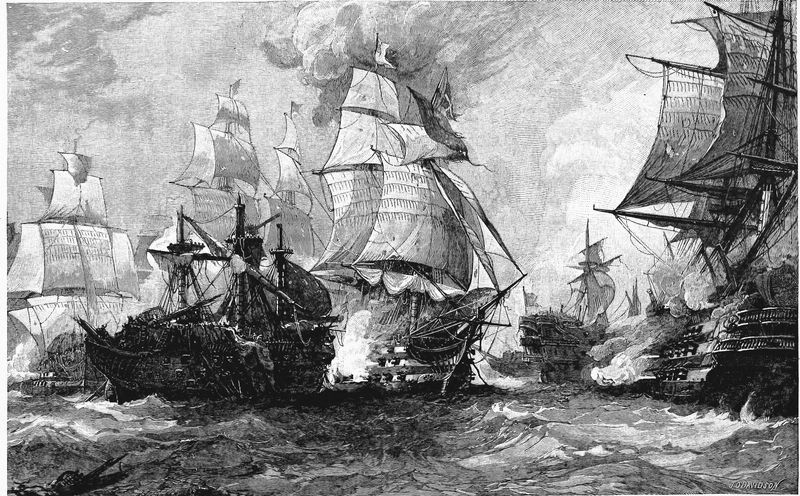
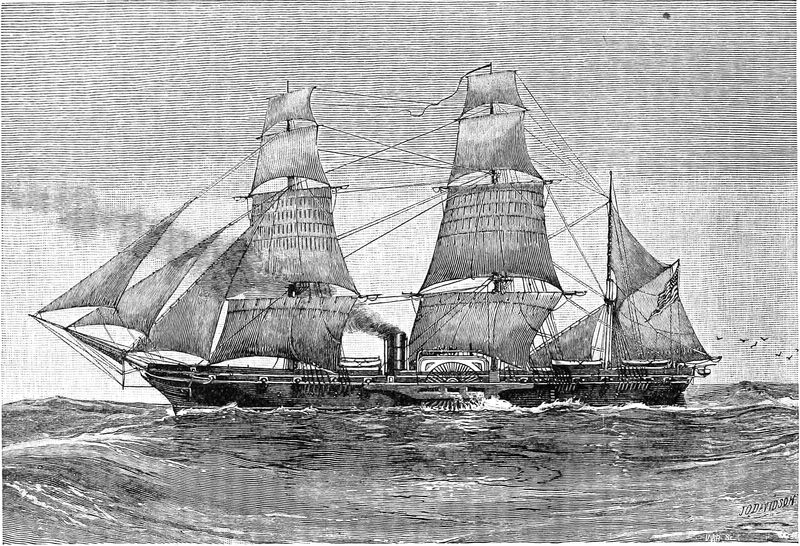
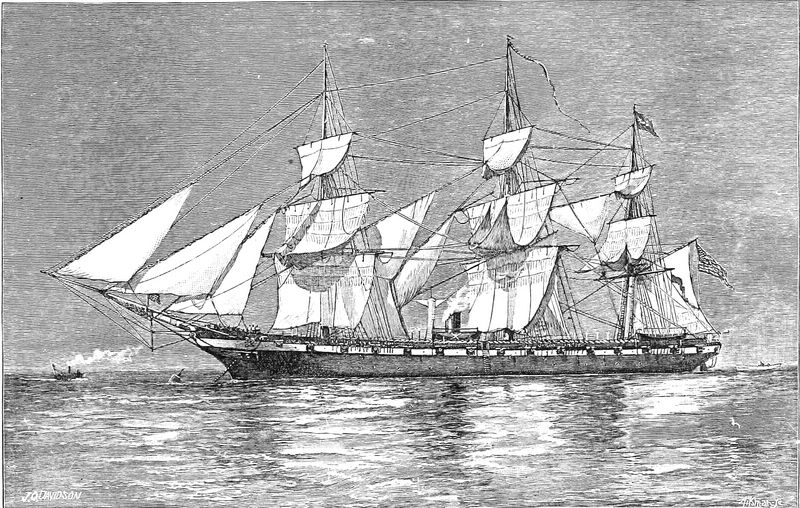
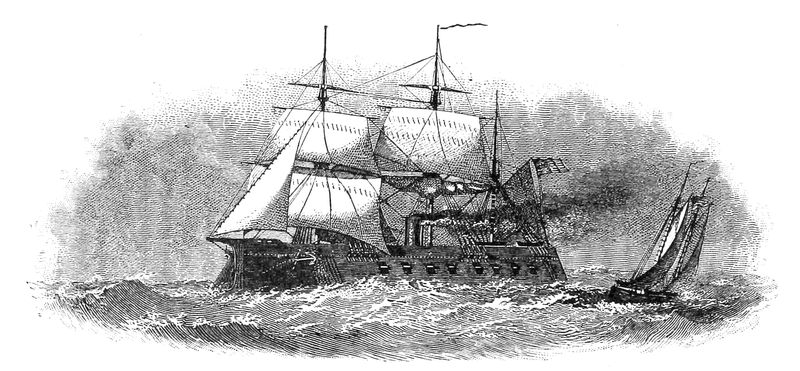
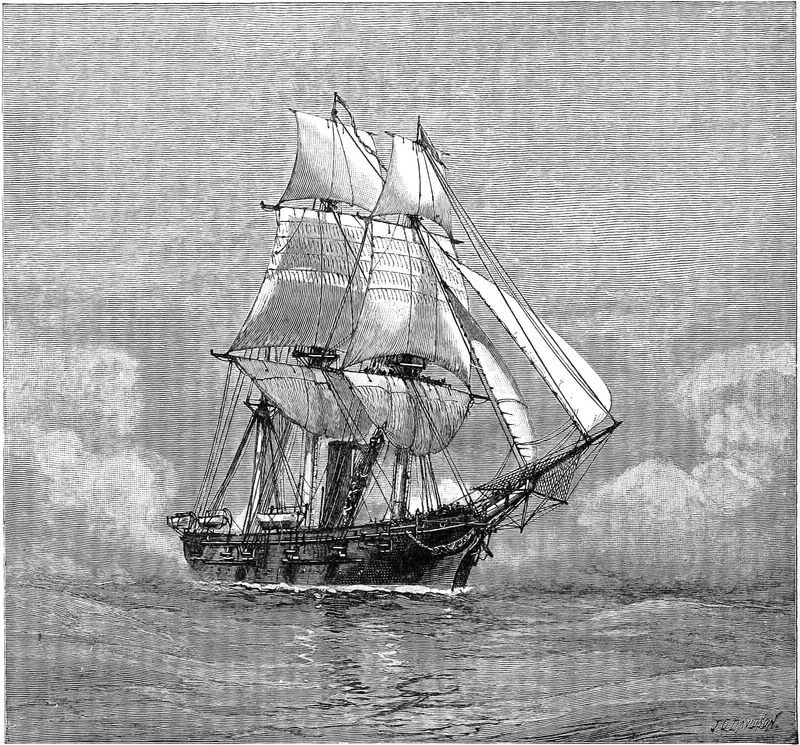
THE BATTLE OF TRAFALGAR, OCTOBER 21, 1805.—From a drawing by J. O. Davidson.
MODERN SHIPS OF WAR
BY
SIR EDWARD J. REED, M.P.
LATE CHIEF CONSTRUCTOR OF THE BRITISH NAVY
AND
EDWARD SIMPSON
REAR-ADMIRAL U.S.N., LATE PRESIDENT U. S. NAVAL ADVISORY BOARD
WITH
SUPPLEMENTARY CHAPTERS AND NOTES BY
J. D. JERROLD KELLEY
LIEUTENANT U.S.N.
AUTHOR OF “THE QUESTION OF SHIPS” “ARMORED VESSELS” ETC.
ILLUSTRATED
NEW YORK
HARPER & BROTHERS, FRANKLIN SQUARE
1888
Copyright, 1887, by Harper & Brothers.
All rights reserved.
PREFACE.
After many years of neglect, the people of this country have
awakened to the necessity of creating a modern fleet. Proud as
they were of the Navy’s achievements in the past, they failed for a long
time to exhibit any interest in its present or future, and met all claims
for its re-establishment by a denial of its usefulness, or by a lazy optimism
of indifference which smilingly put the question by. Indeed, at
one time, the popular solicitude disappeared completely, and outside of
the service there was manifested neither an alarm at its degeneracy nor
an appreciation of the dangers this made possible. With an apathy
inexplicable upon any rational grounds, the notes of warning sounded
by experts were unheeded, and the law-makers contented themselves
by pinning their faith to what they called “the creative possibilities of
American genius.” They accepted this fallacy as a fact, they made this
phrase a fetich, and with a fatuous hope believed it could, by some occult
inspiration, in the event of sudden, sharp, and short war, save them
from the fighting-machines which twenty years of tireless experiment
had perfected abroad. In the end, by a neatly balanced policy of pride
and folly, the Navy was exhausted almost to dissolution. Then Congress
lazily bestirred itself to action, and prescribed as a remedy three
unarmored cruisers and a despatch-boat.
Heroic treatment, not homœopathy, was needed; but, thanks to a
naturally vigorous constitution, the bolus sufficed to lift the patient out
of the throes, and to encourage him into a languid convalescence. Luckily,
the vessels became a party question, and their historic tribulations
did so much towards educating the nation that a public sentiment was
aroused which made a modern navy possible. It must be confessed,
however, that the demand even yet is not so vociferous as to dominate
all other issues, though there is apparent everywhere a quickening desire
for the country to take, if not the first, at least a respectable, place
among the great maritime powers.
With these new ideas came a desire for information which could not
be satisfied, because, curiously enough, the popular literature of the subject
is meagre, or rather it is unavailable. There are treatises in plenty
which soar beyond the skies of any but experts; there are handy manuals
wherein the Navy, like the banjo, is made easy in ten lessons; but
between these extremes nothing exists which is accurate, and at the
same time free from those dismal figures and dry-as-dust facts that are
so apt to discourage a reader at the outset.
To meet this want, which was one by no means “long felt,” these
articles were originally published in Harper’s Magazine, and with a success
that seemed to justify their collection in a more available, if not a
more permanent, form. It may be said now that no changes of any
moment have been made in the text, that the notes attempt only to
bring down the data to the latest date, and that the appendices are needful
additions which the limited space of a monthly publication necessarily
forbade. The reader who has not followed the progress of naval
war construction will undoubtedly find many surprises, both in achievement
and promise, which may be difficult to understand, yet it is hoped
that the non-technical manner in which Sir Edward Reed and Rear-admiral
Simpson have written will do much to make plain this important
National question. Both these gentlemen are authorities of the
first rank, both are luminous writers, and each in his own country and
own sphere has had an important influence upon war-ship design and
armament. To those who read within the lines there awaits a mortifying
realization of our inferiority; for during all the years that this
country—masterful beyond compare in other material struggles—was
so successfully neglecting its navy, foreign designers were achieving
triumphs which are marvellous. With this knowledge there is sure to
come a high appreciation of the intelligence exercised; for the evolution
of the battle-ship has been so rapid, and the resultant type has so little
in common with the wooden vessel of our war, that those who have
solved the problems have practically created a new science.
During the last thirty years the changes in naval science have
been so much greater than in its whole previous history as to be
epoch-making. Between the wooden vessel of 1857 and the metal machine
of 1887 there exist in common only the essential principles that
each is a water-borne structure, armed with guns and propelled by
steam. Beyond this everything is changed—model, material, machinery,
rig, armament, equipment. In truth, so radical are the differences, and
so sudden have been the developments, that authorities are widely separated
in opinion, even upon such a primary question as a universally
accepted system of classification. But as this is necessary to a proper
appreciation of the subject, a generalization may be made in which war-vessels
are divided into armored and unarmored types, the former including
battle-ships, and the latter those employed in the police of the
seas, in commerce protection or destruction, or in the attack of positions
which are defenceless.
In the absence of any accepted differentiations of these classes, the
new British nomenclature may be adopted with safety, for to a certain
degree it explains the terms and includes the types now used so variously
in different navies. Under this armored vessels are grouped into
(1) battle-ships, (2) cruisers, (3) special types, such as rams and torpedo-boats,
and (4) coast-service ships; and unarmored vessels comprise (1)
cruisers, (2) sloops, (3) gun-vessels, (4) gun-boats, (5) despatch-vessels, and
(6) torpedo-vessels. “As it was impossible to unite all the qualities which
are to be desired in a ship-of-war in a single vessel, it became necessary
to divide the leading types into subdivisions, each specially adapted to
the use of a particular arm, or to perform some special service. For the
battle-ships designed for naval operations in European waters great
offensive and defensive powers and evolutionary qualities are essential,
while the highest sea-going qualities, including habitability, are, in the
opinion of some, less essential. For sea-going battle-ships offensive and
defensive strength must be partially sacrificed in order to secure unquestionable
sea-worthiness. In ocean-going battle-ships canvas is a valuable
auxiliary. In battle-ships for European waters, masts and yards involve
a useless sacrifice of fighting power.... Heavily armored ships intended
for the line of battle must necessarily carry powerful guns. They must
be able to traverse great distances, and must therefore have considerable
storage for coal. Great speed is required to enable them to meet
the inevitable contingencies of an engagement. In a word, the class of
ships which may be called battery-ships must be furnished with very
considerable offensive and defensive power. Their great size, however,
and the enormous weight of their armor and armament, necessitate such
displacements as render them unfit for coast defence” (Brassey).
While the antagonistic elements of offence, defence, speed, or endurance
have caused the main differences of design in all types, the greatest
variances with battle-ships are found in the distribution of armor for
protection. A hasty summarization of the policies now adopted by the
great maritime nations shows that the French generally adhere to a
complete armor-belt at the water-line, that the Italians have in their
latest ships totally abandoned side-armor, and that the English favor its
partial employment. The popular idea that armor consists only of thick
slabs of wrought-iron or steel, or of steel-faced iron, bolted to a ship’s
side, is erroneous. “In the earlier broadside ships,” writes the present
director of English naval construction, Mr. W. H. White, “this view was
practically correct; they had no armor or protected decks, the decks
being covered only by thin plates fitted for structural purposes. But in
the Devastation class, and all subsequent ships, considerable and increasing
weights of material are worked into the deck armor, and with good
reason. Experiments showed conclusively that horizontal protection at
the top of the armor-belt, or citadel, was of vital necessity, and even now
(1887) it is open to question whether the provision made for horizontal
protection in relation to vertical armor is as large as it might advantageously
be.”
The factors which have most influenced the problem are the torpedo,
ram, and gun. Of these the last is indubitably of the highest
importance, for the number and nature, the effective handling, the disposition
and command, and the relative protection of the guns are the
elements which control most powerfully the principles of ship design. In
the first stage of the contest between gun and armor the defence was
victorious, but so rapidly have the art and science of ordnance developed
that to-day the power of the heaviest pieces as compared with the
resistance of the heaviest armor is greater than ever before.
The story of the contest can be briefly told. In 1858 the armament
of the newest ships was principally a broadside battery of 32-pounders;
in this were included a few 56-pound shell-guns and one or two eight-inch
68-pounders, though of the whole number not one had an energy,
that is, a force of blow when striking, sufficient to penetrate four and
a half inches of wrought-iron at short range. In the earliest iron-clads—the
French La Gloire and the English Warrior—batteries mainly of
nine-inch calibre were carried, the latter mounting forty guns of all
kinds. The Minotaur, the first representative of the next English type,
had fifty guns, but after this class was launched there appeared that distinctively
modern tendency to decrease the number of pieces while increasing
the intensity of their fire. The succeeding vessels carried from
fourteen to twelve pieces, until, in 1874, the principle of concentration
reached its maximum in giving the Inflexible only four guns. These,
like the Warrior’s, were muzzle-loaders, and their relative dimensions and
power may be compared as follows:
Warrior.
Inflexible.
Weight of gun
4¾ tons.
80 tons.
Length
10 feet.
26 feet 9 inches.
Calibre
8 inches.
16 inches.
Powder charge
16 pounds.
450 pounds.
Weight of projectile
68 ”
1700 ”
Energy at 1000 yards
452 foot-tons.
26,370 foot-tons.
Penetration of 4½ inches of wrought-iron at short range
None.
...
Penetration of wrought-iron at 1000 yards
...
23 inches.
The term energy, when employed to indicate the work that a gun
can perform, is expressed in foot-tons, and signifies that the amount developed
is sufficient to raise the given weight in tons to the height of
one foot. The piercing power of the Inflexible’s projectile was, under the
same conditions of charge and range, sufficient to penetrate twenty-five
feet of granite and concrete masonry, or thirty-two feet of the best Portland
cement.
When the thickness of armor-plating increased, gun-makers tried to
overcome the resistance by giving greater energy to the shot. As this
required large charges of powder and very long guns, muzzle-loaders became
impracticable on shipboard, and were supplanted by breech-loaders.
From this stage guns developed greatly in power until, in 1882, those
designed for the Benbow were to weigh 110 tons, to be 43 feet long and
16¾ inches in calibre, and with 900 pounds of powder and an 1800-pound
projectile were to develop 54,000 foot-tons, or an energy sufficient
to penetrate thirty-five inches of unbacked wrought-iron at one thousand
yards. The guns for the latest English ships, the Trafalgar and the
Nile, weigh 67 tons, are 36 feet 1 inch in length and 13½ inches in calibre,
and with a 520-pound charge and a 1250-pound projectile are expected
to develop 29,500 foot-tons, or an energy sufficient to penetrate
an iron target twenty-two and a half inches thick at a thousand yards.
These results apparently show a retrogression in power, but a comparison
of the Inflexible’s and Trafalgar’s batteries proves that the more
modern gun of the latter weighs 13 tons less, is 2½ inches smaller in calibre,
fires a shot 450 pounds lighter, and yet develops an energy greater
by 3000 foot-tons.
This gain is mainly due to the improvements made with powder and
projectiles. In 1883 a 403-pound Whitworth steel shell penetrated a
wrought-iron target eighteen inches thick backed by thirty-seven inches
of well-packed wet sand, one and a half inches of steel, various balks
of timber, and sixteen feet more of sand. When the projectile was recovered
after this stratified flight it was found to be practically uninjured.
On the Continent, where breech-loaders were favored earlier
than in England or with ourselves, the heaviest rifles afloat are the 75-ton,
16.54-inch calibre, French, and the 106 tons, 17-inch Italian guns.
These are, however, not the largest pieces designed, for there is an 120-ton
Krupp gun, and the French have projected one which will weigh
124 tons, be 18.11 inches in calibre, and fire a 2465-pound projectile—over
a ton—with a powder charge of 575 pounds. A comparison of the
Krupp 120-ton gun with the 110-ton Armstrong shows that the former
is more powerful; that its projectile is much heavier, and the initial
velocity and pressure are smaller. The results at the recent test were
as follows:
Armstrong.
Krupp.
Charge
850 pounds
847 pounds.
Shot
1800 ”
2315 ”
Velocity
2150 feet
1900 feet.
Pressure
19.9 tons
18.8 tons.
Energy
57,679 foot-tons
67,928 foot-tons.
From the Warrior to the Inflexible the evolution of design was based
upon a principle that sought the best results for the offence in small,
powerful batteries, with all-around fire and armor protection; and for the
defence, in thick armor carried over the vitals of the ship. This was
satisfied by larger weights of armor and a smaller ratio of armored part
to total surface. Wrought-iron armor was also replaced by compound,
with a corresponding gain of twenty per cent. for equal thicknesses, and
at present all-steel plates, of which great things may reasonably be expected,
are now employed by France and Italy. In 1861 the Minotaur
was belted throughout her 400 feet of length with 1780 tons of armor,
or with a weight nearly double that given to the Warrior two years before.
The Inflexible has 3280 tons, and the Trafalgar 4230 tons, of
which 1040 are fitted horizontally. The maximum thickness of the Warrior’s
wrought-iron armor is 4½ inches, of the Devastation’s, 12 inches,
and of the Inflexible’s 24 inches; the compound (iron steel-faced) armor
of the Trafalgar is 18 and 20 inches thick, and the Baudin and Formidable
have 21.7 inches in solid plates of steel. These, of course, are
some of the dry-as-dust figures before referred to, and they are cited
only to assist a comparison, their mere enumeration having no scientific
value, because the disposition and character of the plates are unconsidered.
To meet this development of offence and defence many changes in
design have been adopted. The broadside system of the first armored
ships was followed in 1863-1867 by a belt and battery type, wherein the
principal guns, much reduced in number, were carried in a box battery
amidships, and given a fore-and-aft fire by means of recessed ports or
outlying batteries. In 1869 the Admiralty adopted the breastwork
monitor, a low free-boarded structure, which was plated from stem to
stern in the region of the water-line, and had in its central portion an
armored breastwork that carried at each end a revolving turret. In
1870 this type was pronounced unsafe, and after a careful investigation
by a special committee on design certain modifications were recommended.
These did not affect materially the essential features of Sir
Edward Reed’s plan, for the complete water-line belt and the central
armored battery were retained; and to-day many of the critics who then
denounced it claim that, after all, it is the true type of an ideal battle-ship.
In 1872 the Italian naval authorities accepted the conclusions of the
British committee, and laid down the first central-citadel battle-ships,
now known as the Duilio and Dandolo; and about the same time Mr.
Barnaby, the new Chief Constructor of the British Navy, brought forward
a similar design in the Inflexible. The engines, boilers, and the
bases of two turrets in this vessel are protected by an armored box-shaped
citadel, from the extremities of which a horizontal armored
deck extends fore and aft below the water-line; above this deck an armored
superstructure completes the free-board, and has its unprotected
spaces at the water-line, subdivided into numerous water-tight compartments.
This ship met with so much hostile criticism that a committee
was appointed to investigate the charges, but in the end the Admiralty
plans were officially sustained.
The French, with characteristic ability and independence, have in
the mean time made many notable departures from their first types of
broadside ships. Believing in the association of heavy guns with light
ones—mixed armaments, as they are called—the central armored casemate
of wholly protected guns has been rejected in order to give a
maximum thickness of plating at the water-line. The largest guns are
mounted en barbette—that is, in towers which protect the gun mechanism,
and permit the pieces to be fired, not through port-holes, but over
the rim of armored parapets. The French constructors reason, and
with justice, that no single shot from a heavy gun should be wasted,
and that, in addition to an extended range, gun captains must be enabled,
by keeping their eyes upon the enemy, to select the best opportunity
for firing. With broadside pieces this is impossible, for apart
from the limited range, and the obscurity caused by the smoke, the
port-holes through which the sighting has necessarily to be done are
almost choked by the gun-muzzles. Turrets have their objections also,
because the poisonous gases which formerly escaped wholly from the
muzzle will, as soon as the breech is opened, rush into the turret and
make it almost uninhabitable. Often after one discharge the air becomes
stifling, and in the Duilio it deteriorated so quickly as to be unfit
for respiration until a part of the turret-roof had been lifted. Then,
again, structural difficulties not easily overcome in the turret are simplified
in the barbette, as the latter, with equal gun facilities, weighs fifty
per cent. less, and at the same time escapes all those chances of disablement
which a well-placed shot is almost sure to cause in any revolving
system. At sea the chance of hitting the gun is never great, and the
main things to protect are the gun machinery and the gunners; the armored
wall of the barbette tower does this for the former, and the latter
have a fair fighting chance afforded by the gun-shield. Of course war
is not deer-stalking, and the patriot who wants to go into battle so fully
protected as to be in no danger had better stop playing sailor or soldier,
and take to the woods before the fighting begins. In addition to the
heavy ordnance, the French mount a number of lighter pieces, and carry
powerful secondary batteries of rapid fire and machine-guns; and sufficient
armor defence is given by a belt at the water-line, an armored
deck, and a glacis and parapet for the barbette. It is quite probable that
these purely military terms may seem odd when applied to ships, but
they are the only ones which can exactly explain what is meant, and,
after all, they show how much a battle-ship has become a floating, transferable
fortress.
The Italians were not altogether satisfied with the Duilio, as she
lacked the high speed and coal endurance which they deem essential in
any Mediterranean naval policy; so in 1878 they adopted an idea advanced
some years before in England, and startled the world with the
Italia type. In this ship protection is given, not by vertical or side
armor, but by an armored deck, between which and the deck above
there is a very minute subdivision of the water-line space. The system
is based upon the theory that the power to float must be obtained, not
by keeping our projectiles, but by so localizing their effect as to make
any penetration practically harmless. The Italia’s heavy guns are carried
in a central armored redoubt, at a height of thirty-three feet above
the water-line, and with their machinery and fittings weigh over two
thousand tons. This fact shows the magnitude of the task accepted by
her designer, for it means that a load nearly equal to the total weight
of a first-class line-of-battle ship of the last century has to be sustained
at this great elevation. Besides the main battery of four 106-ton guns,
eighteen six-inch breech-loading guns are carried—twelve in broadside
on the upper battery deck, four in the superstructure before and abaft
the redoubt, and two under cover at the extremities of the spar-deck.
The redoubt is protected by seventeen inches of compound iron, inclined
twenty-four degrees from the vertical; and the complete armored deck,
which is nearly three inches thick, dips forward to strengthen the ram,
curves aft to cover the steering gear, and, at the ship’s sides, extends six
feet below the water-line.
To cope with this formidable rival, which, whether right or wrong in
principle, must, under England’s policy, be surpassed, the ships of the
Admiral class were designed. In these the main battery is mounted in
two barbettes built high out of water, near the extremities of the vessel,
while in a central broadside are carried the armor-piercing and rapid-fire
guns. The engines, boilers, and barbette communications are protected
by a water-line belt of thick armor which covers about forty-five per
cent. of the ship’s length; at the upper edge of this there is a protective
deck, and at its ends athwartships bulkheads are erected; before and
abaft the belt and beneath the water-line there is a protective deck, together
with the usual minute subdivision into water-tight compartments.
The barbettes and the cylindrical ammunition tubes which extend from
the belt-deck to the barbette floors are strongly armored. Owing to
the strong protest made against these vessels, more efficient armor protection
has been given to the battle-ships lately laid down.
From this very hasty and incomplete review it may be gathered
that the first and most lasting influence in the development of battle-ships
is due to France and England, though the Monitor had no little
share in the result. It is difficult to say, in the ceaseless struggle for
something which, if not good, is new, what may be the outcome of the
latest efforts to revolutionize the question, or, curiously enough, to bring
it back to the point whence its departure was taken. Whatever may be
the courage of one’s opinion, there is not sufficient data—a first-class war
can only supply these—upon which to say, Yea, yea! or Nay, nay! and
prophecy is certain to be without honor, especially as the discussions
given in the appendices demonstrate how the wisest and most experienced
have no substantial agreement in views.
An editorial in a late number of the Broad Arrow declares that
“the days of armored plate protection are, in the opinion of many
thinking men, coming to a close. The gun is victorious all along the
line, and the increased speed given to the torpedo-boat, taken in conjunction
with the destructive efficiency attained by the torpedo, makes
it a questionable policy to spend such large sums of money as heretofore
upon individual ships.” There is no room here to give the various arguments,
though very clever and ingenious they are, by which this position
is fortified; it may be added, however, that to a large degree this is the
opinion of Admiral Aube, the late French Minister of Marine, and undoubtedly
this declaration re-echoes the shibboleth of those other French
officers who, in the absolute formula of their chief, Gabriel Charmes, insist
that “a squadron attacked at night by torpedo-boats is a squadron lost.”
English authorities, with a few notable exceptions, do not go so far
as their more impulsive, or, from the Gallic stand-point, less conservative
neighbors. Chief Constructor White believes that at no time in the war
between gun and armor has the former, as the principal fighting factor,
so many chances of success. He concedes the value of light, quick-firing
guns in association with heavy armaments, grants the importance of
rams, torpedoes, submarine boats, and torpedo-vessels generally, but denies
that the days of heavily armored battle-ships are ended. Lord
Charles Beresford asserts that the value of large guns at sea is overestimated,
advocates from motives of morals and efficiency mixed armaments,
agrees to the great, yet subordinate, importance of the usual
auxiliaries, and insists that England builds cumbersome and expensive
battle-ships only because of their possession by her dangerous rivals.
There are equally rigorous disagreements upon all the other types of
armored, unarmored, and auxiliary vessels, as needs must be, so long as
the naval policies of no two nations can be alike. England and Russia
are at opposite poles, so far as their environments are concerned, and
between France and Turkey the differences are as radical as their national
instincts and ambitions. But, among all, England is as isolated as
her geographical situation. Whatever fleets other nations may assemble,
whatever types other countries may deem best for their interests, England,
whose existence depends upon her naval strength, must have all;
not only the best in quality, but so many of every class that she will be
able to defend her integrity against any foe that assails it. England
can take no chances.
Upon one point alone, the necessity of high speed, is there substantial
agreement. Less than four years ago fifteen or sixteen knots were
accepted as a maximum beyond which profitable design could not be
urged. Greater speed, it is true, had been attained by our first type of
commerce destroyer. In February, 1868, the Wampanoag ran at the
rate of 16.6 knots for thirty-eight hours, and made a maximum of 17.75
knots; but great as was the achievement, there is a general acceptance
of the fact that this vessel was a racing-machine, and not in the modern
sense a man-of-war.
Fighting-ships, with the power to steam thousands of miles at sea
without recoaling, are now being built under contracts which, for every
deficiency in speed or horse-power, pay penalties that at our former summit
of expectations would have been prohibitive to ship construction;
and, what is more startling yet, the bonus which goes to any increase
upon this speed proves the co-relation between scientific attainment and
popular appreciation of the subject, and shows how readily the impossibilities
of yesterday become the axioms of to-morrow.
The development of speed has therefore a special interest. Between
1859 and 1875, that tentative period which led to such wonderful realizations,
the highest speed, under the most favorable circumstances, of
large war-vessels was fourteen knots; in the smaller classes of unarmored
ships it ranged between eight and thirteen, while that attained by fast
cruisers was from fifteen to sixteen and a half knots. In 1886 Italian
armored vessels made eighteen knots. Cruisers like the Japanese Naniwa-Kan
and the Italian Angelo Emo reached nearly nineteen, and the
Reina Regente, launched in February last, is expected to steam over
twenty. Torpedo-vessels beginning in 1873 with fourteen knots are
now running twenty-five, and at the same time the type has so much
increased in size and importance as to be an essential and not an accessory
in naval warfare.
It is impossible to explain the difficulties which have beset this development,
because the conditions that surround any attempt at speed-increase
are such as can be properly understood only by those who have
technical training; and then, too, the great ocean racers have so much
accustomed the public to wonderful sea performances that the results
are accepted without a knowledge of the credit which is due the mechanical
and marine engineers who have achieved them. But with
greater experience the higher, surely, will be the appreciation which every
one must give; for, in the words of Chief Constructor White, “when
it is realized that a vessel weighing ten thousand tons can be propelled
over a distance of nine knots in an hour by the combustion of less than
one ton of coal—the ten-thousandth part of her own weight—it will be
admitted that the result is marvellous,” and that “‘the way of a ship in
the midst of the sea’ is beyond full comprehension.”
It is often asked which has the better fleet, France or England. Who
can tell? No one definitely. Admiral Sir R. Spencer Robinson, late
Comptroller of the British Navy, declares, in the Contemporary Review
of February, 1887, that “the number of armored vessels of the two
countries may be stated approximately as fifty-five for England and
fifty-one for France. Without going into further details, taking everything
into consideration, giving due weight to all the circumstances
which affect the comparison, and assuming that the designs of the naval
constructors on each side of the Channel will fairly fulfil the intentions
of each administration (a matter of interminable dispute, and which
nothing but an experiment carried to destruction can settle), the iron-clad
force of England is, on the whole, rather superior to that of France.
A combination of the navy of that Power with any other would completely
reverse the position. I should state as my opinion, leaving others
to judge what it may be worth, that in fighting power the unarmored
ships of England are decidedly superior to those of our rival’s; but if
the raison d’être of the French navy is—as has been frequently stated in
that country, and by none more powerfully and categorically than by
the French Minister of Marine—the wide-spread, thorough destruction
of British commerce, and the pitiless and remorseless ransom of every
undefended and accessible town in the British dominions, regardless of
any sentimentalities or such rubbish as the laws of war and the usages
of civilized nations; and if at least one of the raisons d’être of the British
navy is to defeat those benevolent intentions, and to defend that
commerce on which depends our national existence and imperial greatness—then
I fear that perhaps they have prepared to realize their purpose
of remorseless destruction rather better than we have ours of successful
preservation.”
A long sentence this, but it emphasizes the great axiom that war is
business, not sentiment, and teaches a lesson which this country will do
well to learn. Fortunately, we are at last out of the shallows, if not
fairly in the full flooding channel-way, though many things are yet
wanting with us. Perhaps this over-long chapter cannot be made to end
more usefully than by quoting in proof of this the concluding paragraph
of that brilliant article on naval policy which Professor James Russell
Soley, United States Navy, contributed to the February (1887) number
of Scribner’s Magazine:
“It is the part of wisdom,” he writes, “to study the lessons of the
past, and to learn what we may from the successes or the failures of
our fathers. The history of the last war is full of these lessons, and at
no time since its close has the navy been in a condition so favorable for
their application. At least their meaning cannot fail to be understood.
They show clearly that if we would have a navy fitted to carry on war,
we must give some recognition to officers on the ground of merit, either
by the advancement of the best, or, what amounts to nearly the same
thing, by the elimination of the least deserving; that we must give them
a real training for war in modern ships and with modern weapons; that
the direction of the naval establishment, in so far as it has naval direction,
must be given unity of purpose, and the purpose to which it must
be directed is fighting efficiency; that a naval reserve of men and of
vessels must be organized capable of mobilization whenever a call shall
be made; and, finally, that a dozen or a score of new ships will not make
a navy, but that the process of renewal must go on until the whole fleet
is in some degree fitted to stand the trial of modern war. Until this rehabilitation
can be accomplished the navy will only serve the purpose
of a butt for the press and a foot-ball for political parties and its officers—a
body of men whose intelligence and devotion would be equal to
any trust will be condemned to fritter away their lives in a senseless
parody of their profession.”
THE BRITISH NAVY.
By SIR EDWARD J. REED.
When timber gave place to iron and steel in the construction of
war-ships, the naval possibilities of Great Britain became practically
illimitable. Prior to that great change the British Admiralty,
after exhausting its home supplies of oak, had to seek in the forests of
Italy and of remote countries those hard, curved, twisted, and stalwart
trees which alone sufficed for the massive framework of its line-of-battle
ships. How recently it has escaped from this necessity may be inferred
from the fact that the present writer, on taking office at the
Admiralty in 1863, found her Majesty’s dockyards largely stored with
recent deliveries of Italian and other oak timber of this description.
And here it may not be inappropriate for one whose earliest professional
studies were devoted to the construction of wooden ships, but
whose personal labors have been most largely devoted to the iron era,
to pay a passing tribute of respect to the constructive genius of those
great builders in wood who designed the stanch and towering battle-ships
of the good old times. Skilful, indeed, was the art, sound, indeed,
was the science, which enabled them to shape, assemble, and combine
thousands of timbers and planks into the Grace de Dieu of Great Harry’s
day (1514), the Sovraigne of the Seas of Charles’s reign (1637), the
Royal William of half a century later (1682-92), the Victory, immortalized
by Nelson, and in our own early day such superb ships as the
Queen, the Howe, and scores of others. Only those who have made a
study of the history of sea architecture can realize the difficulties which
the designers of such structures had to overcome.
With the introduction of iron and steel for ship-building purposes
the necessity for ransacking the forests of the world for timber suitable
for the frames and beam-knees of ships passed away, and Great Britain,
which early became, and thus far remains, first and greatest in the production
of iron and steel, was thus invited to such a development of
naval power as the world has never seen. The mercantile marine of
England at the present time furnishes a splendid demonstration of the
readiness with which the commercial classes have appreciated this great
opportunity; but the Royal Navy, by almost universal assent, supplies
a melancholy counter-demonstration, and shows that neither the capabilities
of a race nor the leadings of Providence suffice to keep a nation
in its true position when it falls into the hands of feeble and visionary
administrators. Any one who will contrast the British navy of to-day
with the British navy as it might and would have been under the administration,
say, of such a First Lord of the Admiralty as the present
Duke of Somerset proved himself in every department of the naval
service five-and-twenty years ago, will understand the recent outcry in
England for a safer and more powerful fleet.
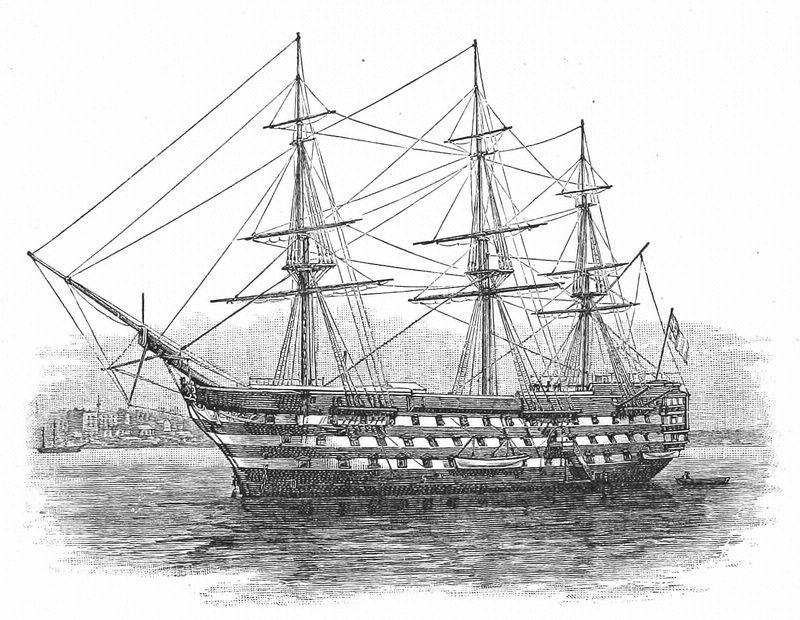
THE “VICTORY.”
From a photograph by Symonds & Co., Portsmouth.
It is impossible, as will presently appear, to describe the existing
British navy without making reference to those administrative causes
which have so largely and so unhappily influenced it; but the primary
object of this chapter is, nevertheless, to describe and explain it, and
only such references will be made to other circumstances as are indispensable
to the fulfilment of that object.
It is fitting, and to the present writer it is agreeable, in this place,
to take early note of a matter which has, perhaps, never before been
fully acknowledged, viz., the indebtedness of Great Britain and of Europe
to the United States for some invaluable lessons in naval construction
and naval warfare which were derived from the heroic efforts of
their great civil war. The writer is in a position to speak with full
knowledge on this point, as his service at the Admiralty, in charge of its
naval construction, commenced during the American conflict, and continued
for some years after its fortunate conclusion. There can be no
doubt whatever that from the Monitor and her successors European
constructors and naval officers derived some extremely valuable suggestions.
The Monitor system itself, pure and simple, was never viewed
with favor, and could never be adopted by England, except under the
severest restrictions, because the work of England has mainly to be
done upon the high seas and in distant parts of the world, and the extremely
small freeboard of the Monitor, or, in other words, the normal
submersion of so very much of the entire ship, is highly inconvenient
and not a little dangerous on sea service, as the fate of the Monitor itself
demonstrated. But for the work the Monitor was designed to do
in inland waters she was admirably conceived, and her appearance in
the field of naval warfare startled seamen and naval constructors everywhere,
and gave their thoughts a wholly novel direction. In saying this
I am not unmindful that seven years previously England had constructed
steam-propelled “floating batteries,” as they were called, sheathed with
iron, and sent them to operate against the defences of Russia. But useful
as these vessels were in many respects, their construction presented
no striking novelty of design, and their employment was unattended
by any dramatic incidents to powerfully impress the naval mind. The
Monitor was both more novel and more fortunate, and opened her career
(after a severe struggle for life at sea) with so notable a display of
her offensive and defensive qualities that all eyes turned to the scene
of her exploits, and scanned her with a degree of interest unknown to
the then existing generation of sailors and ship-builders. Her form and
character were in most respects singular, her low deck and erect revolving
tower being altogether unexampled in steamship construction. He
must have been a dull and conservative naval architect, indeed, whose
thoughts Ericsson’s wonderful little fighting ship did not stimulate into
unwonted activity. But the service rendered to Europe was not confined
to the construction and exploits of the Monitor itself. The coasting
passages, and, later on, the sea-voyages, of other vessels of the Monitor
type, but of larger size, were watched with intense interest, and gave
to the naval world instructive experiences which could in no other way
have been acquired. Some of these experiences were purchased at the
cost of the lives of gallant men, and that fact enhanced their value.
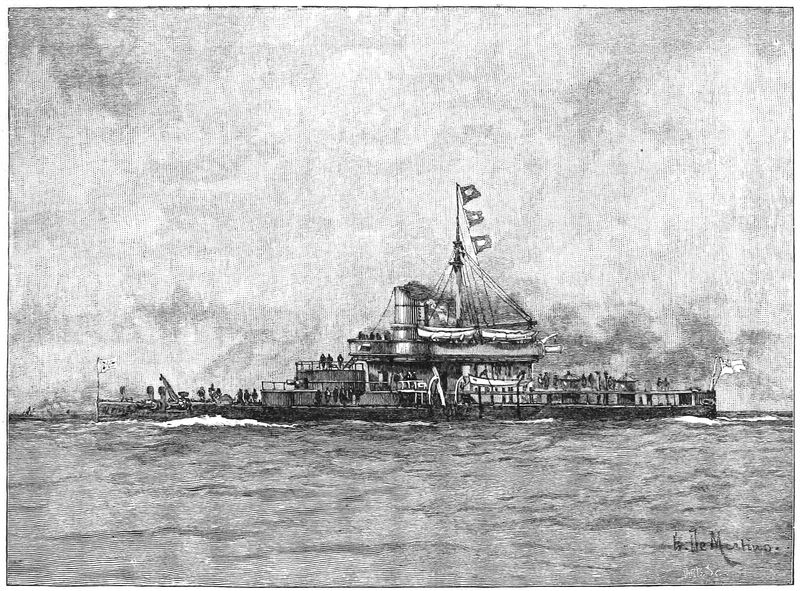
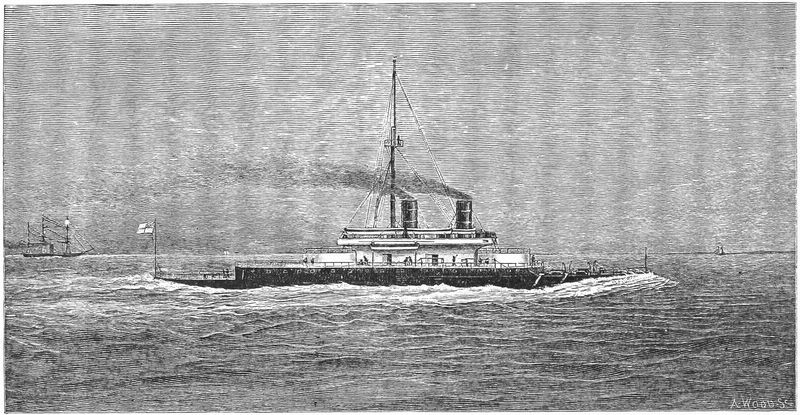
THE “GLATTON.”
It is not possible to dwell at length upon the means by which the
Monitor influence took effect in the navies of Europe, but it may be
doubted whether ships like the Thunderer, Devastation, and Dreadnought,
which naval officers declare to be to-day the most formidable
of all British war-ships, would have found their way so readily into existence
if the Monitors of America had not encouraged such large departures
from Old-world ideas. In this sense the Times correctly stated
some years ago that the “American Monitors were certainly the progenitors
of our Devastation type.” The one ship in the British navy
which comes nearest to the American Monitor, in respect of the nearness
of her deck to the water, is the Glatton, a very exceptional vessel,
and designed under a very peculiar stress of circumstances. But even
in her case, as in that of every other armored turret-ship of the present
writer’s design, the base of the turret and the hatchways over the machinery
and boilers were protected by an armored breastwork standing
high above this low deck, whereas in the American Monitors the turret
rests upon the deck, which is near to the smooth sea’s surface.
We have here, in the features just contrasted, the expression of a
fundamental difference of view between the American system, as applied
to sea-going turret-ships, and the European system of sea-going
ships introduced by the writer. It has never been possible, in our judgment
on the British side of the Atlantic, to regard even such Monitors
as the Puritan and Dictator were designed to be, as sufficiently
proof to sea perils. At the time when these lines were penned the
following paragraph appeared in English newspapers: “The Cunard
steamer Servia arrived at New York yesterday, being three days overdue.
During a heavy sea the boats, the bridge, and the funnel were
carried away, and the saloon was flooded.” Any one who has seen the
Servia, and observed the great height above the smooth sea’s surface at
which her boats, bridge, and funnel are carried, will be at no loss to
infer why it is that we object to ships with upper decks within two or
three feet only of that surface. In short, it can be demonstrated that
ships of the latter type are liable, in certain possible seas, to be completely
ingulfed even to the very tops of their funnels. In the case of
the Glatton, which had to be produced in conformity to ideas some of
which were not those of the designer, one or two devices were resorted
to expressly in order to secure in an indirect manner some increase of
the assigned buoyancy, and thus to raise the upper deck above its prescribed
height. The officers who served in her, however, judiciously regarded
her, on account of her low deck, as fit only for harbor service or
restricted coast defence.
A very dangerous combination, as the writer regards it, was once
proposed for his adoption by the representative of a colonial government,
but was successfully resisted. This was the association of a
“Coles” or English turret (which penetrates and passes bodily through
the weather deck) with a low American Monitor deck. This was opposed
on the ground that with such an arrangement there must of necessity
be great danger at sea of serious leakage around the base of the
turret as the waves swept over the lower deck. It would be extremely
difficult to give to the long, circular aperture around the turret any
protection which would be certain, while allowing the turret to revolve
freely, both to withstand the fire of the guns and to resist the attack of
the sea.
It will now be understood that while the Monitor system was from
the first highly appreciated in Europe, and more especially in England,
it never was adopted in its American form in the British navy. Russia,
Holland, and some other powers did adopt it, and the Dutch government
had to pay the penalty in the total disappearance of a ship and
crew during a short passage in the North Sea from one home port to
another. In a largely altered form, and with many modifications and
additions due to English ideas of sea service, it was, however, substantially
adopted in the three powerful ships already named, of which one,
the Dreadnought, lately bore the flag of the British admiral who commands
the Mediterranean fleet. If the opinion of officers who have
served in these ships may be accepted as sufficiently conclusive, it was a
great misfortune for the British navy when the ruling features of this
type of ship were largely departed from in its first-class ships, and made
to give place to a whole series of so-called first-class iron-clads, of which
only about one-third of the length has been protected by armor, and
which are consequently quite unfit to take a place in any European line
of battle.
THE “DREADNOUGHT.”
The characteristic differences between the American type and the
English type of sea-going Monitors (if we may apply that designation
to the Devastation type) have already been stated, but may be restated
here in a single sentence, viz., the elevation in the English ship of the
turret breastwork deck to a height of eleven or twelve feet above the
sea’s surface, and the raising of the upper deck generally, or of a considerable
part of it, to at least that height, by means of lightly built superstructures.
Over these again, and many feet above them, are built
bridges and hurricane decks, from which the ships may be commanded
in all weathers. Lofty as these ships are by comparison with American
Monitors, it is only gradually that they have acquired the confidence of
the naval service, so freely do the waves sweep over their weather decks
when driven, even in moderate weather, against head-seas.
The British navy, having very diversified services to perform during
both peace and war, requires ships of various kinds and sizes. Its first
and greatest requirement of all is that of line-of-battle ships in sufficient
numbers to enable England to stand up successfully against any European
naval force or forces that may threaten her or her empire. If any
one should be disposed to ask why this requirement—which is obviously
an extreme one, and an impossible one for more than a single power—is
more necessary for England than for any other country, the answer
must be, Circumspice! To look round over England’s empire is to see
why her failure on the sea would be her failure altogether. France,
Germany, Italy, and even Holland, might each get along fairly well,
losing nothing that is absolutely essential to their existence, even if every
port belonging to them were sealed by an enemy’s squadron. But were
Great Britain to be cut off from her colonies and dependencies, were her
ships to be swept from the seas, and her ports closed by hostile squadrons,
she would either be deprived of the very elements of life itself, or
would have to seek from the compassion of her foes the bare means of
existence. It is this consideration, and the strong parental care which
she feels for her colonies, that make her sons indignant at any hazardous
reduction of her naval strength. There are even in England itself men
who cannot or will not see this danger, and who impute to those who
strive to avert it ambitious, selfish, and even sordid motives. But it is
to no unworthy cause that England’s naval anxieties are due. We have
no desire for war; we do not hunger for further naval fame; we cherish
no mean rivalry of other powers who seek to colonize or to otherwise
improve their trade; we do not want the mastery of the seas for any
commercial objects that are exclusively our own. What we desire to do
is to keep the seas open thoroughfares to our vast possessions and dependencies,
and free to that commercial communication which has become
indispensable to our existence as an empire. To accomplish that
object we must, at any cost, be strong, supremely strong, in European
waters; and it is for this reason that England’s line-of-battle ships ought
to be always above suspicion both in number and in quality.
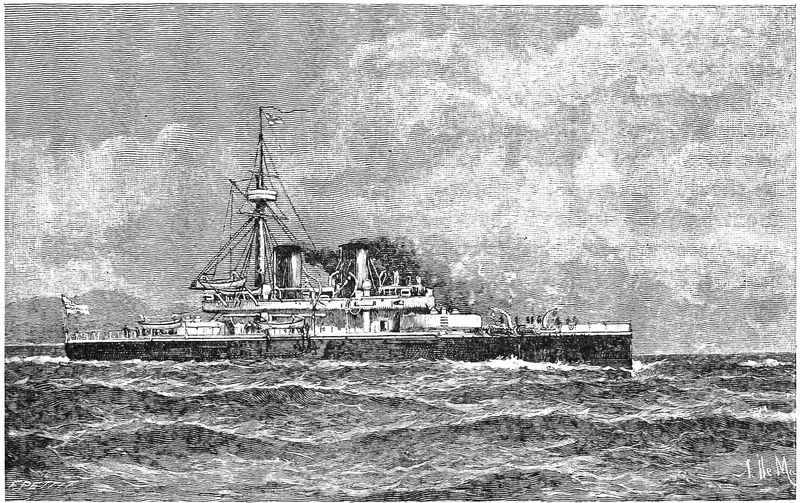
THE “INFLEXIBLE.”
It is not a pleasant assertion for an Englishman to make when he
has to say that this is very far from being the case at present. A few
months ago this statement, from whomsoever it emanated, would have
been received with distrust by the general public, for the truth was only
known to the navy itself and to comparatively few outsiders. But the
official communications made to both Houses of Parliament early in
December, 1885, prepared the world for the truth, the First Lord of the
Admiralty in the Chamber of Peers and Lord Brassey in the House of
Commons having then proposed to Parliament a programme of additional
ship-building which provided for a considerable increase in the number
of its first-class ships and cruisers, and which also provided, on the
demand of the present writer, that the cruisers should be protected with
belts of armor—an element of safety previously denied to them. It
need hardly be repeated, after this wholesale admission of weakness by
the Admiralty, that Great Britain is at present in far from a satisfactory
condition as regards both the number and the character of its ships.
Were that not so, no public agitation could have moved the government
to reverse in several respects a policy by which it had for so long abided.
It will be interesting to broadly but briefly review the causes of the
present deplorable condition of the British navy. In the first place, in
so far as it is a financial question, it has resulted mainly from the sustained
attempt of successive governments to keep the naval expenditure
within or near to a fixed annual amount, notwithstanding the palpable
fact that every branch of the naval service, like most other services, is
unavoidably increasing in cost, while the necessities of the empire are
likewise unavoidably increasing. The consequence is that, as officers
and men of every description must be paid, and all the charges connected
therewith must in any event be fully met, the ship-building votes of
various kinds are those upon which the main stress of financial pressure
must fall. From this follows a strong desire, to which all Boards of
Admiralty too readily yield, to keep down the size and cost of their
first-class ships, to the sacrifice of their necessary qualities. This may
be strikingly illustrated by the fact that, although the iron Dreadnought,
a first-class ship, designed fifteen or sixteen years ago, had a displacement
of 10,820 tons, and was powerful in proportion, the Admiralty
has launched but a single ship (the Inflexible) since that period, of which
the displacement has reached 10,000 tons. In fact, every large iron-clad
ship for the British navy since launched has fallen from twelve hundred
to twenty-four hundred tons short of the Dreadnought’s displacement,
and has been proportionally feeble.
If this cutting down in the size of the principal ships of Great Britain
had been attended by a corresponding reduction in the sizes of the
ships of other powers, or even by some advantages of design which
largely tended to make up for the defect of size, there might be something
to say for it. But the French ships have shown no such falling off
in size, and have benefited as fully as the English ships by the use of steel
and by the improved power and economy of the marine steam-engine.
Simultaneously with the reduction in the size of the English ships
there has been brought about—voluntarily, and not as a consequence of
reduced size, for it was first applied in the largest of all British men-of-war,
the Inflexible—a system of stripping the so-called armored ships of
the English navy of a large part of their armor, and reducing its extent
to so deplorable a degree that, as has already been said, they are quite
unfit to take part, with any reasonable hope of success, in any general
engagement. Here, again, there might have been something to say for
a large reduction in the armored surface of ships if it had been attended
by some great compensation, such as that which an immense increase in
the thickness of the armor applied might have provided, although no
such increase could ever have compensated for such a reduction of the
armored part of the ship as would have exposed the whole ship to destruction
by the mere bursting in of the unarmored ends, which is what
has been done. But although in the case of the large Inflexible the
citadel armor was of excessive thickness, that is not true of the more
recent ships of England, the armor of which sometimes falls short of
that of the French ships, in two or three instances by as much as four
inches, the French ships having 22-inch armor, and the English 18-inch.
But by the combined effect of injudicious economy and of erroneous design,
therefore—both furthered by a sort of frenzied desire on the part
of the British Admiralty to strip the ships of armor, keep down their
speed, delay their completion, and otherwise paralyze the naval service,
apparently without understanding what they were about—the British
navy has been brought into a condition which none but the possible
enemies of the country can regard without more or less dismay.
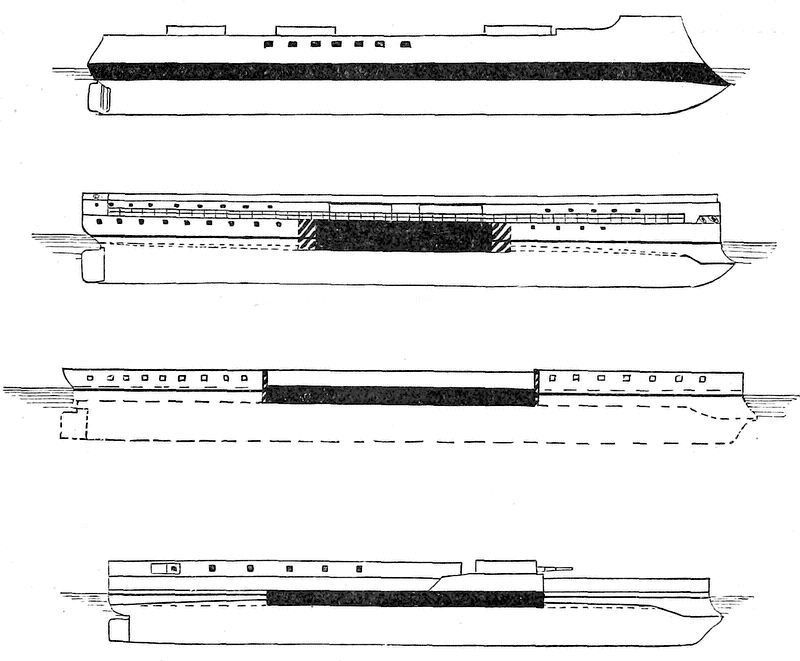
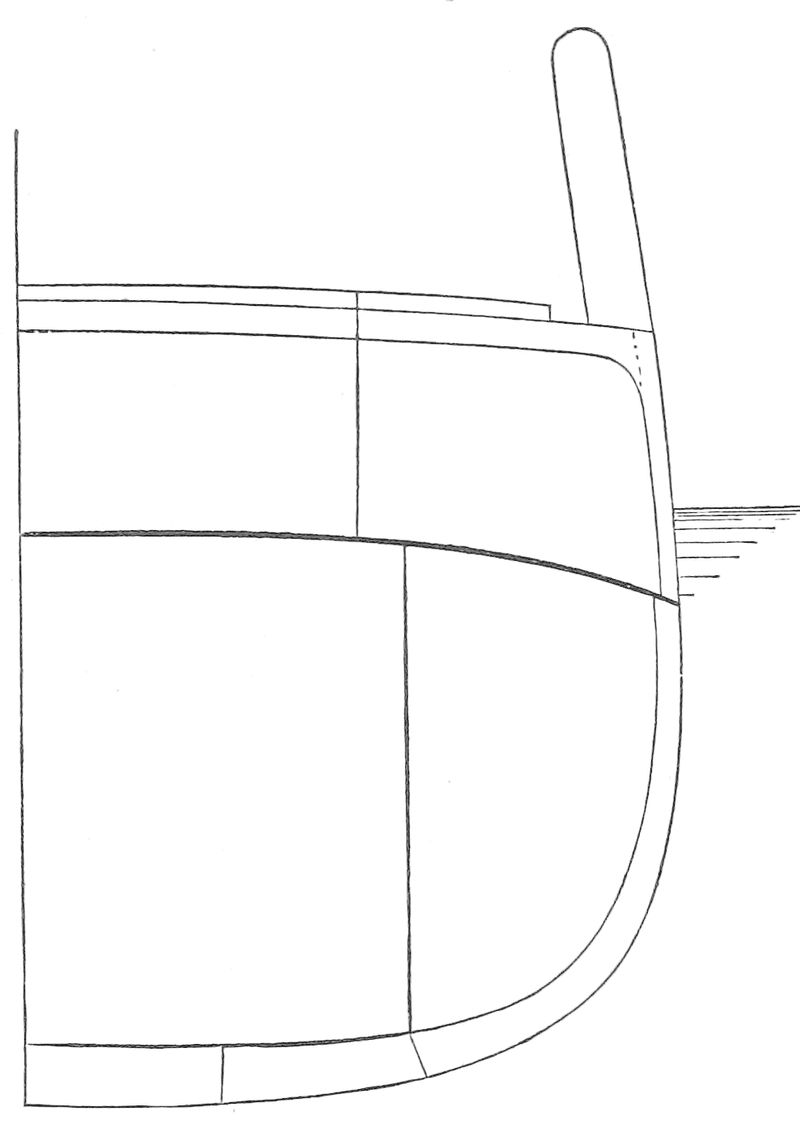
SECTION OF THE “AMIRAL DUPERRÉ.”
SECTION OF THE “INFLEXIBLE.”
SECTION OF THE “COLLINGWOOD.”
NEW ADMIRALTY SHIP.
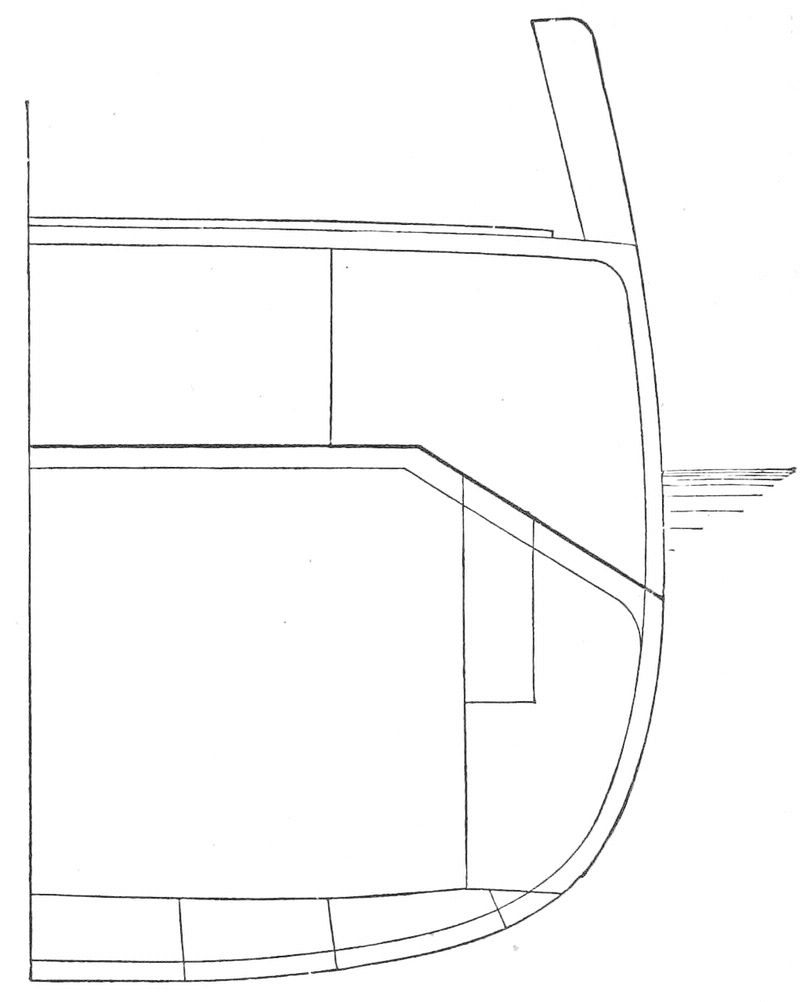
In order to illustrate the extent to which side armor has been denied
to the British ships, as compared with the French, we refer the
reader to these diagrams of the Amiral Duperré (French) and of the
Inflexible and Collingwood (both English). The black portions represent
the side armor in each case. It is scarcely possible for any one
friendly to Great Britain to look at these diagrams, and realize what
they signify, without profoundly regretting that a sufficient force of
public opinion has not yet been exerted to compel the Admiralty to a
much more liberal use of armor in the new first-class ships, the intended
construction of which was announced to Parliament in December, 1885.
In these new ships, while the length of the partial belt has been slightly
increased, no addition to its height above water has been made (as compared
with the Collingwood or “Admiral” class), so that the slightest
“list” towards either side puts all the armor below water. To describe
such ships as “armored ships” is to convey a totally false impression of
their true character. A side view of one of these new ships shows that
the two principal guns are carried high up forward in an armored turret,
which sweeps from right ahead, round the bow on each side, and
well towards the stern, while several smaller guns are carried abaft
with very thin armor protection to complete the offensive powers of
the ship. The arrangement of the two principal guns in a turret forward
resembles that of the Conqueror, but in her the armor rises high
above the water, and a belt extends to the bow and nearly to the stern.
It is a matter of inexpressible regret that the armored surface of these
new ships is so excessively contracted as to be wholly insufficient to
preserve the ship from that terrible danger to which so many of their
predecessors have been exposed, viz., that of capsizing from loss of stability
when the unarmored parts alone have been injured.
THE “DEVASTATION.”
There is a sense in which all the British ships to which reference has
thus far been made may be roughly regarded as developments of, or at
least as starting from, the Devastation, or British Monitor type of ship,
for in all of them masts and sails have been done away with, and steam
propulsion relied upon, a single military mast alone remaining.[1] We
have now to notice another and more numerous class of ships, which
may be regarded as the lingering representatives of those sailing-ships
which have come down to us through the long centuries, but which are
now rapidly disappearing, yielding to the all-prevalent power of steam.
Some of these ships were built for the line of battle, in their respective
periods, but as they range in size from about one thousand tons of displacement
up to nearly eleven thousand tons, it is obvious that many of
them were built for various other employments. In dealing with the
full-rigged ships, we are taking account of types of war-ships which, for
all but secondary purposes, are passing away. It fell to the lot of the
present writer (under the rule of Mr. Childers, then First Lord of the
Admiralty, and of Admiral Sir Robert Spencer Robinson, then Controller
of the Navy) to introduce the mastless war-ship, and thus to virtually
terminate what had certainly been for England a glorious period, viz.,
that of the taunt-masted, full-rigged, and ever-beautiful wooden line-of-battle
ship. It is now, alas! but too apparent (from what has gone before)
that in virtually terminating that period, and opening the era of
the steam and steel fighting engine, we were also introducing an era in
which fantastic and feeble people might but too easily convert what
ought to have been the latest and greatest glory of England into her
direct peril, and possibly even her early overthrow.
The first British iron-clad (neglecting the “floating batteries” of
1854) was the Warrior, a handsome ship 380 feet long, furnished with
steam-power, and provided with masts, spars, and a large spread of canvas.
Her ends were unprotected by armor, and her steering gear consequently
much exposed. She was succeeded by a long series of full-rigged
iron-clads, all of them supplied with steam-power likewise, the
series continuing down to the present time. The little dependence
which is now placed in the British navy upon the use of sail-power in
armored ships will be seen, however, when it is stated that of all the
ships protected by side armor which are now under construction in the
royal dockyards, but two are to be given any sail-power at all, and
these are to be rigged on two masts only, although the ships are of large
size, and intended for cruising in distant seas.[2]
It is unnecessary in a popular subject of this description to dwell
upon, or even to state, the minor differences which exist between the
different types of rigged iron-clads. There are, however, some points
of interest in connection with their armor and armament to be mentioned.
In the design of the first group (speaking chronologically) were
commenced those changes in the disposition of the armor which continue
down to the present time, the British Admiralty being so mixed
and so virtually irresponsible a body that it is not obliged to have a
mind of its own for any great length of time, even when many of the
same men continue in office.
The Warrior, as we saw, and the sister ship Black Prince, had a
central armored battery only; the same is true of those reduced Warriors,
the Defence and the Resistance. But the next succeeding ships
of the Warrior’s size, the Minotaur and Agincourt, were fully armored
from end to end; and the somewhat smaller ship the Achilles was furnished
with a complete belt at the water-line. The Hector and Valiant
(improved Defences) had complete armor above the water, but, oddly
enough, had part of the water-line at each end left unarmored. A third
ship of the Minotaur class, the Northumberland, was modified by the
present writer at the bow and stern on his entering the Admiralty, the
armor above water being there reduced, and an armored bow breastwork
constructed. Within this armored breastwork were placed two
heavy guns firing right ahead. With this exception, all these early
ships, nine in number, were without any other protected guns than
those of the broadside.
These ships were followed by a series of rigged ships of the writer’s
design, viz., the Bellerophon, Hercules, Sultan, Penelope, Invincible, Iron
Duke, Vanguard, Swiftsure, and Triumph, all with hulls of iron, or of
iron and steel combined, together with a series of rigged ships constructed
of wood, converted from unarmored hulls or frames, viz., Enterprise,
Research, Favorite, Pallas, Lord Warden, Lord Clyde, and Repulse.
Every one of these ships was protected by armor throughout
the entire length of the vessel in the region of the water-line, and in
some cases the armor rose up to the upper deck. Most of them, however,
had the armor above the belt limited to a central battery. The
chief interest in these vessels now lies in the illustrations they furnish
of the evolution, so to speak, of bow and stern fire. In several of them
a fire approximately ahead and astern (reaching to those directions
within about twenty degrees) was obtained by means of ports cut near
to the ship’s side, through the transverse armored bulkheads. In others
these bulkheads were turned inward towards the battery near the sides
of the ship in order to facilitate the working of the guns when firing as
nearly ahead and astern as was practicable. In the Sultan an upper-deck
armored battery was adopted for the double purpose of forming a
redoubt from which the ship could be manœuvred and fought in action,
and of providing a direct stern fire from protected guns. In the five
ships of the Invincible class a direct head and stern fire was obtained
from a somewhat similar upper-deck battery, which projected a few
feet beyond the side of the ship.
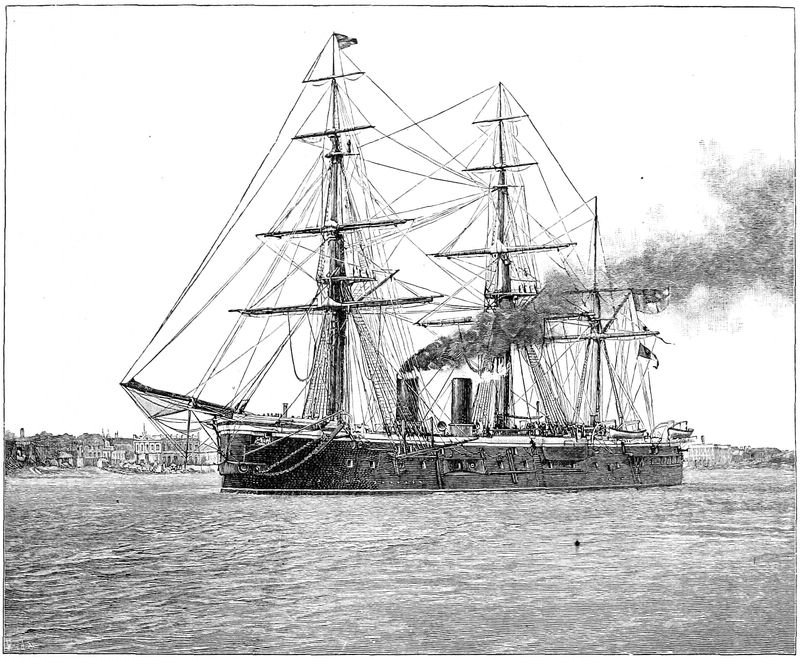
THE “SULTAN.”
The rigged ships of later design than the writer’s present a still
greater variety in the disposition of their armor and armaments. This
variety may be in part illustrated by four examples, which for convenience
are principally taken from Lord Brassey’s book.[3] The scales
of these small drawings, as given there, are not all the same. These
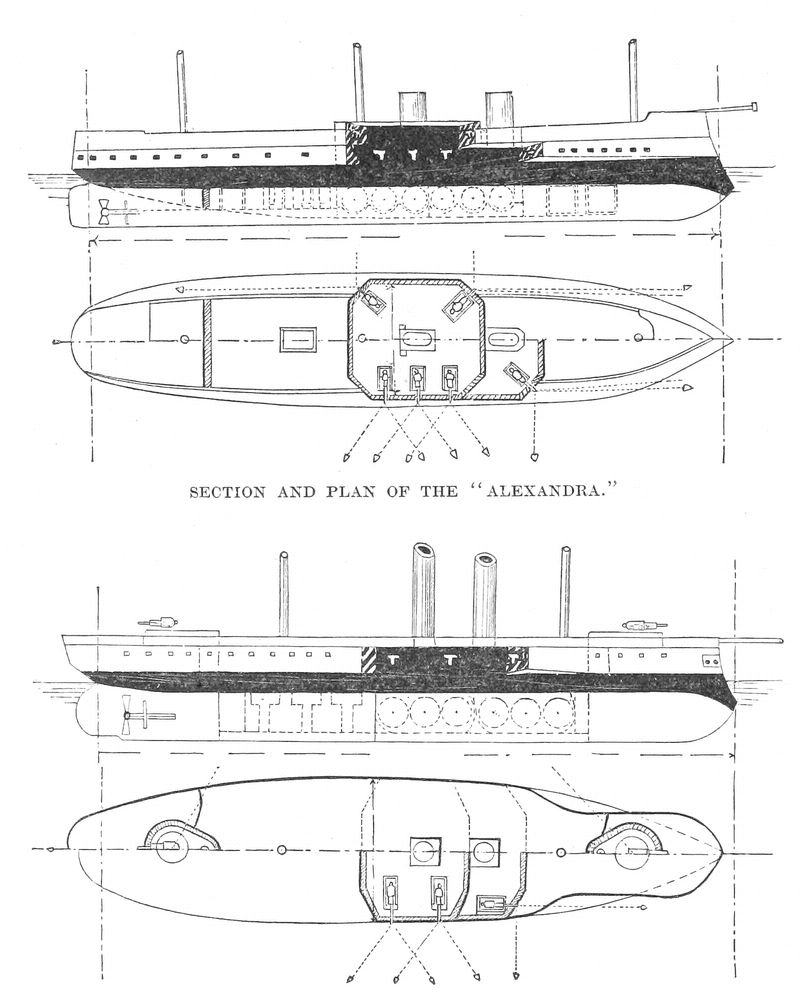
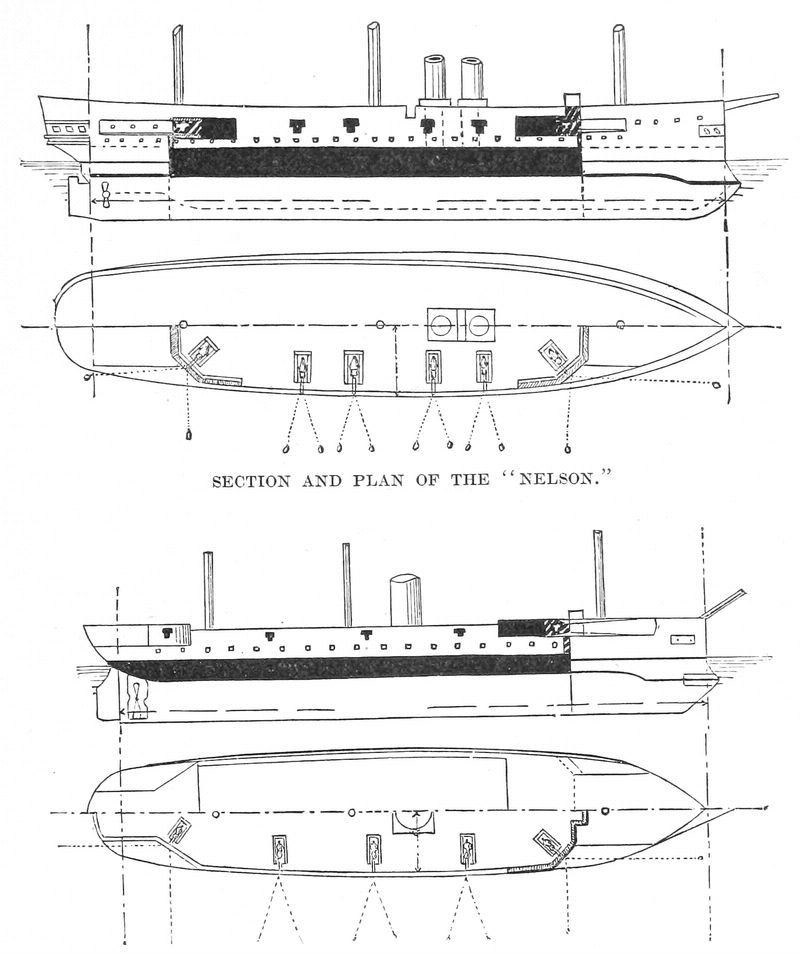
examples are the Alexandra, the Téméraire, the Nelson, and the Shannon.
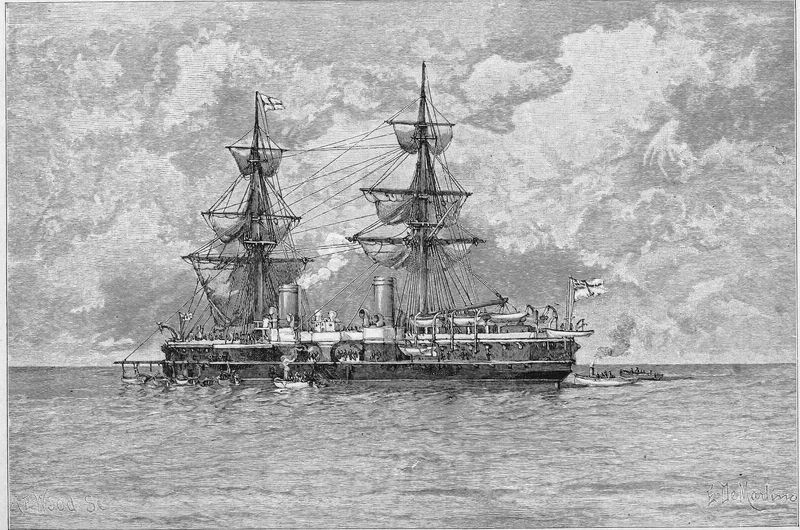
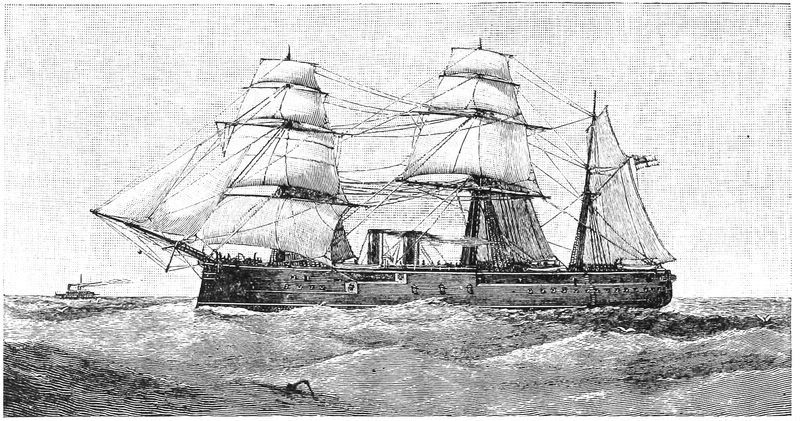
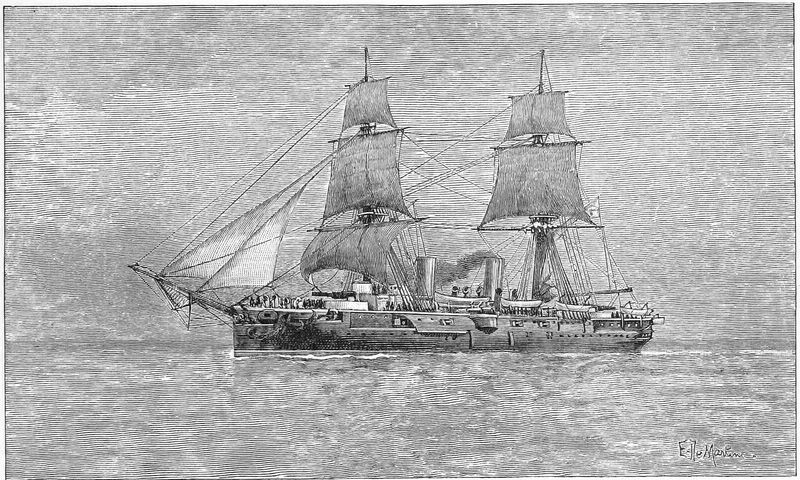
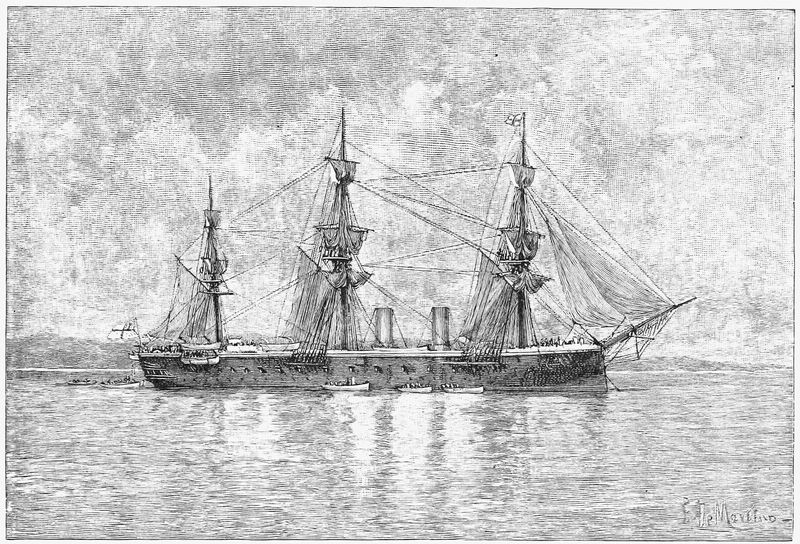
The Alexandra (of which a separate view, in sea-going condition,
is given), which is probably the best of the rigged iron-clads of
the British navy, may be regarded as a natural, but not the less meritorious,
development of the combined broadside and bow and stern
fire of the central-battery ships which preceded her. In her were provided
a broadside battery on the main-deck, a direct bow fire, also on
that deck, and both a direct bow and a direct stern fire on the upper
deck from within armor, as in the Invincible class. The guns employed
for bow and stern fire were all available for broadside fire. The upper-deck
battery did not project beyond the main-deck as in the Invincible
class, the forward and after parts of the ship above the main-deck being
greatly contracted in breadth in order to allow the guns to fire clear
both forward and aft. The Téméraire is a smaller ship than the Alexandra,
and has a battery similar to hers on the main-deck, but with one
gun less on each side, the danger of a raking fire entering through the
foremost battery port being met by a transverse armored bulkhead, as
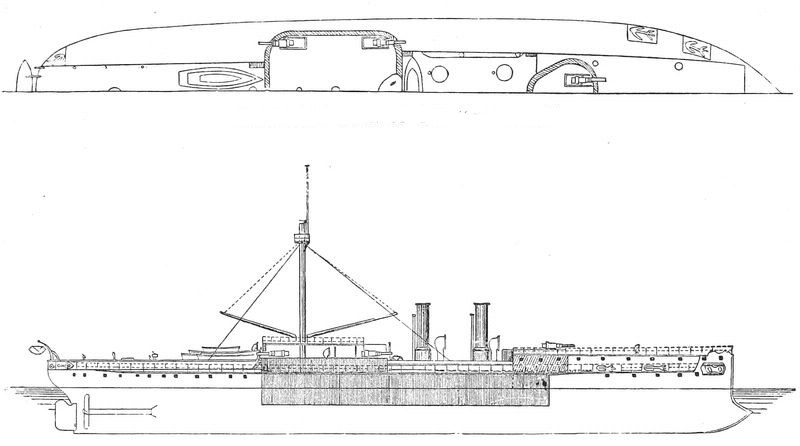
shown in the plan of the ship. She is provided with an additional bow
gun and a stern-chaser, carried high up in barbette towers, but worked
on Colonel Moncrieff’s disappearing principle.
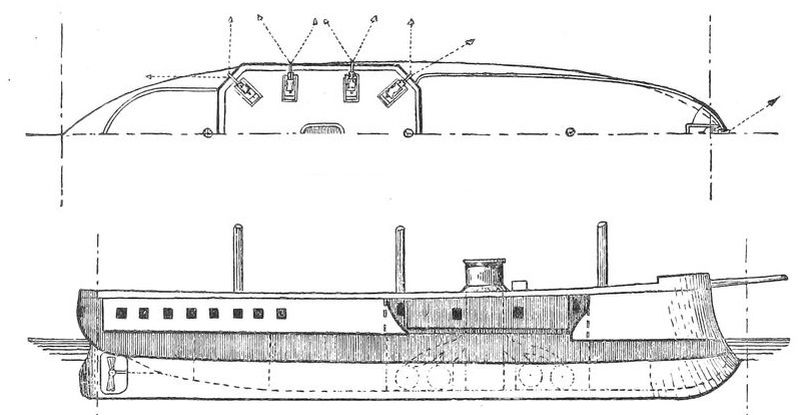
SECTION AND PLAN OF THE “ALEXANDRA.”
SECTION AND PLAN OF THE “TÉMÉRAIRE.”SECTION AND PLAN OF THE “NELSON.”
SECTION AND PLAN OF THE “SHANNON.”
“The Téméraire fires three 25-ton guns right ahead, against two
25-ton and two 18-ton guns in the Alexandra; on either bow, two
25-ton against one 25-ton and one 18-ton; right aft, one 25-ton against
two 18-ton; on either quarter, one 25-ton against one 18-ton; on either
beam, if engaged on one side at a time, two 25-ton and two 18-ton, with
a third 25-ton available through only half the usual arc, against three
18-ton guns, with two of the same weight and one of 25-tons, each available
with the limitation just described.”[4]
THE “ALEXANDRA.”
The Alexandra is a ship of 9500 tons displacement, the Téméraire is
of 8500 tons; after them came the Nelson (to which the Northampton
is a sister ship), of 7320 tons displacement. This vessel cannot be regarded
as an armored ship at all, in the usual sense of the word, having
but a partial belt of armor, and none of her guns being enclosed within
armor protection, although two guns for firing ahead and two for firing
astern are partially sheltered by armor. Even less protection than this
is afforded to the guns of the Shannon, which also has but a partial belt
of armor, and protection for two bow guns only. The comparatively
small size of the Shannon (5400 tons displacement) relieves her in some
degree from the reproach of being so little protected; but it is difficult
(to the present writer) to find a justification for building ships of 7320
tons, like the Nelson and Northampton, and placing them in the category
of armor-plated ships, seeing that their entire batteries are open to the
free entrance of shell fire from all guns, small as well as large. Where
a ship has a battery of guns protected against fire in one or more directions,
but freely exposed to fire coming in other directions, to assume
that the enemy will be most likely to attack the armor, and avoid firing
into the open battery, appears to be a reversal of the safe and well-accepted
principle of warfare, viz., that your enemy will at least endeavor
to attack your vulnerable part. No doubt, when the size or cost of a
particular ship is limited, the designer has to make a choice of evils, but
where people are as free as is the British Board of Admiralty to build
safe and efficient ships, the devotion of so much armor as the Nelson
and Northampton carry to so limited a measure of protection is a very
singular proceeding, and illustrates once more with how little wisdom
the world is governed.
THE “TÉMÉRAIRE.”
Before passing from the armored ships of the navy—or, rather, as
we must now say, in view of some of the ships just described and illustrated,
before passing from the ships which have some armor—it is desirable
to take note of a few exceptional vessels which cannot be classed
either with the pretentious and so-called line-of-battle ships or with the
rigged iron-clads generally. Among these will be found two comparatively
small ships, designed by the writer many years ago to serve primarily
as rams, but to carry also some guns. These were the Hotspur
and Rupert. The water-line of the Hotspur was protected with very
thick armor for her day (11-inch), extending from stem to stern, dipping
down forward to greatly strengthen the projecting ram. She carried
(besides a few smaller guns) the largest gun of the period, one of twenty-five
tons, mounted on a turn-table, but protected by a fixed tower pierced
with four ports.[5] This fixed tower was years afterwards replaced by a
revolving turret, similar to that which the writer gave in the first instance
to the Rupert, designed soon after the Hotspur. Both the armor
and the armament of the second vessel were heavier than those of the
first, but the ram, as before, was the chief feature of the ship.
It is needless here to describe some of the very early turret-ships,
such as the Prince Albert, Scorpion, Wyvern, and Royal Sovereign, all of
which embodied the early (though not by any means the earliest) views
of that able, energetic, and lamented officer, the late Captain Cowper
Coles, R.N., who was lost at sea by the capsizing of his own ship, the
Captain, her low sides failing to furnish the necessary stability for enabling
her to resist, when under her canvas, the force of a moderate gale
of wind. Had he been able to foresee the coming abandonment of sail-power
in rigged ships, and had he been placed, as the writer advised, in
charge of the revolving turrets of the navy, leaving ship-designing to
those who understood it, he might have been alive to this day, to witness
the very general adoption in the British navy of that turret system
to which he for some years devoted and eventually sacrificed his life.
THE “HOTSPUR.”
The first real sea-going and successful ship designed and built to
carry the revolving turret of Coles was, by universal consent, the Monarch,
whose sea-going qualities secured for her the distinction of transporting
to the shores of America—as a mark of England’s good-will to
the people of the United States, and of her admiration of a great and
good citizen—the body of the late Mr. George Peabody. “The performances
of the Monarch at sea,” says Brassey’s “British Navy,” “were
in the highest degree satisfactory;” and nothing could exceed the frank
and liberal praises bestowed upon her for her performances during the
voyage to New York by the officers of the United States man-of-war
which accompanied her as a complimentary escort.
A great deal has been written and said at different times about four
other turret-ships of the British navy, viz., the Cyclops, Gorgon, Hecate,
and Hydra—far less terrible vessels than these formidable names would
seem to import. Whether these four comparatively small turret-ships
possess the necessary sea-going qualities for coast defence (as distinguished
from harbor service) is a question which has been much discussed,
and is not yet settled. The truth is that the defence of the coasts
of England, Wales, Scotland, and Ireland is a service in which the sea-going
qualities of vessels may be called into requisition as largely as in
any service in the world. There are some (this writer among them) who
much prefer the mid-Atlantic in a heavy gale of wind to many parts of
these coasts, more especially if there be any doubt about the perfect
obedience of the ship to her steam-power and her helm. The worst
weather the writer has ever experienced at sea was met with in the
English Channel, and the only merchant-ship which he ever even in
part possessed was mastered by a Channel storm, had to cast anchor
outside of Plymouth Breakwater, was blown clean over it, and sank inside
of it, with her cables stretched across that fine engineering work.
It is therefore difficult, and has always been difficult, not to say impossible,
for him to regard a “coast-defence ship,” which certainly ought to
be able to defend the coast, and to proceed from one part of it to another,
as a vessel which may be made less sea-worthy than other vessels.
Only in one respect, viz., that of coal supply, may such a ship be safely
made inferior to sea-going ships.
But whether the four vessels under notice be fit for coast defence or
not, it ought to be known that they were not designed for it. They
were hastily ordered in 1870, when the Franco-German war was breaking
out, under the impression that Great Britain might get involved in
that war. The British Admiralty knew then (as it knows now, and as
it has known for years past) that the navy had not been maintained
in sufficient strength, and it consequently seized the first design for a
small and cheap ship that it could lay hands on, and ordered the construction,
with all despatch, of four such vessels. The design which it
happened to take, or which seemed to it most suitable, was that of the
Cerberus—a breastwork Monitor designed by the writer for special
service in inland colonial waters, and made as powerful as was then possible
on 3300 tons of displacement, both offensively and defensively, but
with no necessity for, and no pretensions whatever to, sea-going qualities.
It is scarcely to be supposed that four vessels having such an origin
could be expected to take their place as sea-going ships of the British
navy; nor could they, either, for reasons already suggested, be expected
to possess any high qualities as vessels for the defence of
“That land ’round whose resounding coasts
The rough sea circles.”
The Admiralty which ordered their construction may possibly be able
to state why it built them, but even that is not at all certain. One
of the evil results of mean economies in national enterprises in ordinary
times is extravagant and aimless expenditure in times of necessity.
A later example of this kind of expenditure under very similar circumstances
was furnished during Lord Beaconsfield’s administration,
when war with Russia seemed likely to occur. Again the insufficiency
of the navy was strongly felt, and again public money to the extent of
two millions sterling or more was expended upon the acquisition of such
ships as could be most readily acquired, regardless of cost. At this time
the Neptune (of 9170 tons displacement), the Superb (of 9100 tons), and
the Belleisle and Orion (each of 4830 tons), were purchased into the
service, and having been built for other navies, and under very peculiar
circumstances in some cases, required large dockyard expenditure to
convert them to their new uses in the British navy.
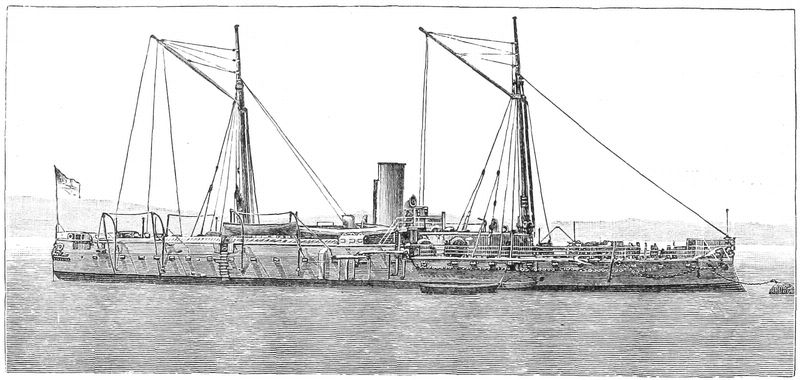
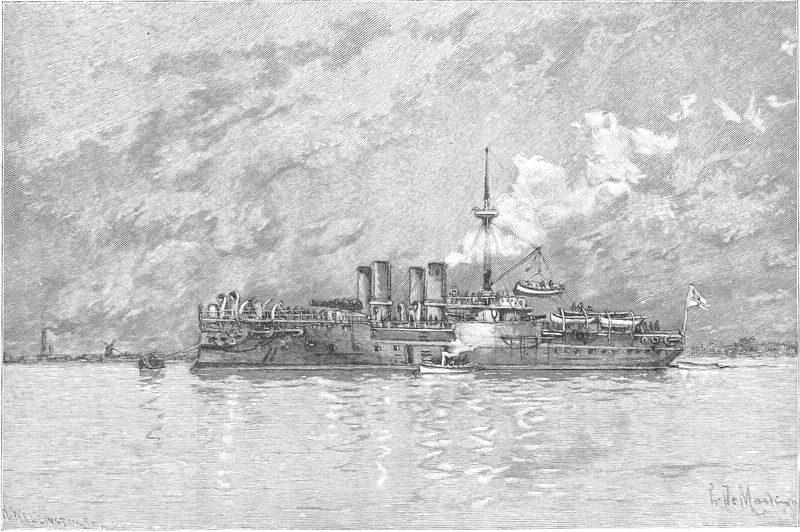
It only remains, in so far as existing armored, or rather “partly armored,”
ships are concerned, to advert to the Impérieuse and Warspite,
two cruisers building for distant service. These ships are three hundred
and fifteen feet long, and to them has been allowed, by the extraordinary
generosity of the Admiralty, as much as one hundred and forty
feet of length of armored belt. If this had been extended by only
twenty feet, these British cruisers, which Lord Brassey—whether grandiloquently
or satirically it is hard to say—calls “armored cruisers,”
would have actually had one-half of their length protected by armor-plating
at the water-line. In what spirit and with what object is not
known, but Lord Brassey, in his outline sketch of these ships, writes the
word “coals” in conspicuous letters before and abaft the belt. Can it
be possible that he, undoubtedly a sensible man of business, and one who
laboriously endeavors to bring up the knowledge and sense of his fellow-countrymen
to a level with his own, and who was once Secretary to the
British Admiralty—can it be possible that he considers coal a trustworthy
substitute for armor, either before or after it has been consumed as
fuel?
It is very distressing to have to write in these terms, and put these
questions about Admiralty representatives and Admiralty ships; but
what is to be done? Here are two ships which are together to cost
nearly half a million of money, which are expressly built to chase and
capture our enemies in distant seas, which are vauntingly described as
“armored cruisers,” which cannot be expected always by their mere appearance
to frighten the enemy into submission, like painted Chinese
forts, which must be presumed sometimes to encounter a fighting foe,
or at least to be fired at a few times by the stern guns of a vessel that is
running away, and yet some eighty or ninety feet of the bows of these
ships, and as much of their sterns, are deliberately deprived of the protection
of armor, so that any shell from any gun may pierce them, let in
the sea, and reduce their speed indefinitely; and in apparent justification
of this perfectly ridiculous arrangement—perfectly ridiculous in a
ship which is primarily bound to sustain her speed when chasing—a
late Secretary to the Admiralty tells us that she is to carry in the unprotected
bow some coals! May my hope formerly expressed in Harper’s
Magazine find its fruition by giving to the British Admiralty a
piece of information of which it only can be possibly ignorant, viz., that
even while coal is unconsumed, it differs largely from steel armor-plates
in the measure of resistance which it offers to shot and shell; and further,
that coal is put on board war-ships that it may be consumed in the
generation of steam? It is very desirable that this information should
somehow be conveyed to Whitehall in an impressive manner, and possibly,
if the combined intelligence of the two great nations to which
Harpers’ publications chiefly appeal be invoked in its favor, it may at
length be understood and attended to even by the Admiralty, and one
may hear no more of the protection of her Majesty’s ships by means of
their “coal.”
THE “WARSPITE.”TRANSVERSE SECTION OF THE “MERSEY.”
Passing now from the so-called iron-clads of the British navy, we
come to a class of vessels which have their boilers, etc., protected from
above by iron decks sweeping over them from side to side. The section
of the Mersey, one of the most important British ships of this type,
will illustrate the system of
construction. Various attempts
have been made to
impose numerous ships of this
kind upon a sometimes too
credulous public as armored
vessels, and Lord Brassey,
while publishing descriptions
and drawings which demonstrated
beyond all question
that the buoyancy and stability
of these ships are not at
all protected by armor, nevertheless
deliberately includes
some of them in his list of
“armored ships.”[6] Now, the
thick iron deck certainly protects
(in some degree, according
to its thickness) all that is
below it against the fire of
guns, and armor itself is sometimes
employed to protect the gun machinery; but the existence of a
thickish deck under the water, or mainly under the water, occasionally
associated with patches of armor above water here and there to protect
individual parts, does not constitute the ship itself an armored
ship in any such sense of the term as is ordinarily accepted and understood.
How can that be properly called an “armored ship” which can
be utterly destroyed by guns without any shot or shell ever touching
such armor as it possesses? The British Admiralty, in the “Navy Estimates”
for 1883-84, under some unknown influence, put forward two
ships of this description as armored vessels, and was afterwards forced
to remove them from that category, but only removed them to place
them in another not less false, not less misleading, not less deceptive
and dangerous, viz., that of “protected ships.” And this most improper
description is still applied to various ships of which the special characteristic
is that they themselves are not protected. If the ship’s own
coal and stores may be regarded as her protection, or if the existence
of a certain number of exposed and extremely thin internal plates
can be so regarded, then may these vessels be deemed partly, but
only partly, “protected;” but if “protected ship” means, as every honest-minded
person must take it to mean, that the ship herself is protected
by armor against shot and shell, then the designation “protected ship,”
as employed by the British Admiralty, is nothing less than an imposition.
These ships are not protected. Neither their power to float, nor their
power to keep upright, nor their power to exist at all, after a few such
injuries as even the smallest guns afloat can inflict, is “protected,” as
any war whatever is likely to demonstrate.
Those who employ such language ignore the essential characteristic
of a ship-of-war, and some of the gravest dangers which menace her. It
is conceivable that in the old days, when men wore armor, the protection
of the head with an “armet,” and of the breast by a breastplate,
might have justified the description of the man so defended as an “armored
man,” although it is difficult to see why, since he might have
been put hors de combat by a single stroke. But protect the boilers and
magazines of a ship how you will, if you do not protect the ship itself
sufficiently in the region of the water-line to prevent such an invasion of
the sea as will sink or capsize her, she remains herself essentially unprotected,
liable to speedy and complete destruction, and cannot truly be
called a “protected ship.”
It must not for a moment be supposed that this is a mere question
of words or designations. On the contrary, it is one of the most vital
importance to all navies, and most of all to the navy of Great Britain.
What the Admiralty says, the rest of the government, and beyond them
the country, are likely to believe and to rely upon, and when the stress
of naval warfare comes, the nation which has confidingly understood
the Admiralty to mean “armored ships” and “protected ships” when
it has employed these phrases, and suddenly finds out, by defeat following
defeat, and catastrophe catastrophe, that it meant nothing of the
kind, may have to pay for its credulity, allowable and pardonable as it
may be, the penalty of betrayal, and of something worse even than national
humility.
On the other hand, it is not to be inferred from the objections thus
offered to the employment of deceptive designations that objection is
also offered to the construction of some ships with limited or partial protection,
falling short of the protection of the buoyancy and the stability,
and therefore of the life, of the ship itself. It is quite impossible that
all the ships of a navy like that of Great Britain, or of the navies of
many other powers, can be made invulnerable, even in the region of the
water-line, to all shot or shell. Indeed, there are services upon which it
is necessary to employ armed ships, but which do not demand the use of
armored or protected vessels. Unarmored vessels, with some of their
more vital contents protected, suffice for such services. Moreover, even
where it would be very desirable indeed to have the hull protected by
armor to a sufficient extent to preserve the ship’s buoyancy and stability
from ready destruction by gun-fire, it is often impracticable to give the
ship that protection. This is true, for example, of all small corvettes,
sloops, and gun-vessels, which are too small to float the necessary armor-plates,
in addition to all the indispensable weights of hull, steam-machinery,
fuel, armament, ammunition, crew, and stores. It would be both
idle and unreasonable, therefore, to complain of the construction of some
ships with the protecting armor limited, or even, in certain cases, with
no protecting armor at all. Such ships must be built, and in considerable
number, for the British navy. But this necessity should neither
blind us to the exposure and destructibility of all such vessels, nor induce
us to endeavor to keep that exposure and destructibility out of our own
sight. Still less should it encourage us to sanction, even for a moment,
such an abuse of terms as to hold up as “armored” and “protected”
ships those which, whether unavoidably or avoidably, have been deprived
of the necessary amount of armor to keep them afloat under the fire of
small or even of moderately powerful guns.
We are now in a position to review the British navy, and to see of
what ships it really consists. In this review it will not be necessary to
pass before the eyes of the reader that large number of vessels of which
even the boilers and magazines are without any armor or thick-plate
protection whatever. It will help, nevertheless, to make the nature and
extent of the navy understood if these are grouped and summarized in
a few sentences. Neglecting altogether all large vessels with timber
frames (which may be regarded as out of date, seeing that all the war
vessels of considerable size now built for the navy have iron or steel
frames), it may be first said that there are but three ships of the large
or frigate class in the British navy which carry no thick protecting
plate at all, viz., the Inconstant, the Shah, and the Raleigh. Of much
less size than these, and equally devoid of protection, are the two very
fast vessels, the Iris and Mercury, built as special despatch-vessels, steaming
at their best at about eighteen knots. Among the unarmored corvettes
are the Active, Bacchante, Boadicea, Euryalus, Rover, and Volage,
all exceeding fourteen knots in speed, and all more than three thousand
tons displacement. Then follow thirty-six smaller and less swift corvettes,
nearly one-half the number being built wholly of wood, most of
which exceed, however, thirteen knots in speed; and below these about
an equal number of sloops of less speed and tonnage. The smaller gun-vessels
and gun-boats need not be summarized.
THE “INCONSTANT.”
Passing on to vessels which, although themselves unarmored, have
thick-plate decks to give some protection to the machinery, we observe
first that there are eight ships of three thousand five hundred to three
thousand seven hundred tons built and under construction, viz., the Amphion,
Arethusa, Leander, Phaeton, Mersey, Severn, Forth, and Thames.[7]
Lord Brassey very properly classes such of these vessels as he mentions
in his lists as “unarmored ships,” although, as before mentioned, when
two of them—the Mersey and Severn—were designed, with a deck two
inches thick, the Admiralty at first ventured to put them forward as
“armored ships.”
Ascending in the scale of protection, and dealing for the present
with sea-going vessels only, we come to a long series of ships which are
undeserving of the designation of armored ships, because they are liable
to destruction by guns without the limited amount of armor which they
carry being attacked at all. These ships are the Impérieuse and Warspite,
previously discussed, and also the Ajax, Agamemnon, Colossus, Edinburgh,
and the six large ships of the “Admiral” class. Any one who
has intelligently perused the report of the committee on the Inflexible
would justify the inclusion of that ship in this category; but she is
omitted here out of deference to the strenuous exertions which were
made to invent or devise some little stability for her, even when her
bow and stern are supposed to be badly injured, and out of compassion
upon those officers of the Admiralty who have long ago repented those
trying compromises with conscience by aid of which they expressed
some slight confidence in her ability to float upright with her unarmored
ends badly damaged. She is omitted also out of gratitude to
Lord Brassey for a sentence in which, while saving her from being
placed in so dreadful a category, he honestly places some of the other
ships in it without qualification or circumlocution. He says: “In one
important particular the Ajax and Agamemnon are inferior to the Inflexible.
The central armored citadel is not, as it is in the case of the
Inflexible, of sufficient displacement to secure the stability of the ship
should the unarmored ends be destroyed.”[8] In another place the former
Secretary to the Admiralty, referring to the report of the Inflexible
committee (which was nominated by the Admiralty, and under heavy
obligations to support it), says: “It is doubtless very desirable that
our armored ships should possess a more ample margin of stability than
is provided in the armored citadel of the Inflexible. The ideas of the
committee and of Sir Edward Reed on this point were in entire accord.”[9]
THE “COLOSSUS.”
It has recently been acknowledged that, as Lord Brassey states,
the Ajax and Agamemnon are so constructed that they are dependent
for their ability to float, the right side uppermost, upon their unarmored
ends. To call such ships “armored ships” is, as we have seen,
to mislead the public. But some pains have been taken of late to
show that the “Admiral” class is better off in this respect, and certainly
the known opinions of the present writer have been so far respected in
these ships that their armored citadels, so called, have been made somewhat
longer and of greater proportionate area. The following figures
have been given:
Percentage of water-line area
covered by armor.
Inflexible
42.
Agamemnon
45.4
Collingwood
54.15
Camperdown
56.35
But any one who understands this question knows perfectly well
that “percentage of water-line area covered by armor” in no way represents
the relative stabilities of these ships. Indeed, that is obvious
upon the face of the matter, because we have seen the Ajax and Agamemnon
pronounced devoid of the necessary stability when injured,
while the Inflexible is said to possess it, although the former vessel has
45½ per cent. of the water-line area covered, while the latter has but 42
per cent. But this is not the consideration which has led to the condemnation
of the whole “Admiral” class of so-called iron-clads as not
possessing the essential characteristic of an armored ship, viz., the power
to float, and to float with needful buoyancy and stability, all the time
the armor is unpierced. The ground of that condemnation is to be
found in the introduction into the “Admirals” of a dangerous combination
from which the Inflexible and Agamemnon and other like ships are
exempt—the combination of long unarmored ends comprising about forty-five
per cent. of the water-line area with so shallow a belt of armor
that, when the unarmored ends are injured and filled by the sea (as they
would be in action), there would remain so little armor left above water
that a very slight inclination of the ship would put it all below water.
In the Agamemnon class, small as the initial stability may be (and with
the unarmored ends torn open it would be nothing), the armor is carried
up to a reasonable height above water. But in the “Admiral”
class all the advantage arising from a slightly lengthened citadel is
more than destroyed by this lowering of the armor. So great is the
consequent danger of these ships capsizing, if ever called upon to engage
in a serious battle at close quarters, that the writer cannot conscientiously
regard them as “armored ships,” but must in common fairness
to the officers and men who are to serve in them, and to the nation
which might otherwise put its trust in them, relegate them to the category
of ships with only parts protected.
It will be observed that nothing has yet been said about thickness of
armor, although that is, of course, a very important element of a ship’s
safety or danger. But important as it is, it has to be kept scrupulously
separated from the question just discussed—the limitation of the armor’s
extent—because no misrepresentation and no misconception can well
arise concerning the relative power or trustworthiness of ships armored
variously as to thickness, while much misrepresentation has actually taken
place, and much consequent misconception has actually arisen, on the
other matter, more than one European government having deliberately
placed in the category of “armored ships” ships which in no true sense
of the word can be so classed.
The following classifications will conform to the foregoing views, describing
as “armored ships” only those which have sufficient side-armor
to protect them from being sunk or capsized by the fire of guns all the
time the armor remains unpierced:
The ships in this list, although having some armor upon their sides, being liable to
capsize at sea from injuries inflicted upon their unarmored parts, cannot be classed with
the armored ships.
To the preceding list may now be added two ships of 10,400 tons displacement, with
18-inch armor, and five cruisers of 5000 tons displacement, with 10-inch armor, recently
ordered by the Admiralty to be built by contract.
Armored ships with 12-inch armor and upward are called ships with
thick armor; those with armor less than twelve inches but more than
eight inches thick are designated as ships with medium armor; and those
with 8-inch armor or less as ships with thin armor.
A number of vessels of the “Scout” class are now under construction
for the Admiralty. There is a disposition in certain quarters to
include these among the ships of the class recorded in the last table.
A transverse section of one of these is given here, in which the so-called
protective deck is but three-eighths of an inch in thickness, and
can therefore be pierced by any gun afloat, from the largest down to
the very smallest. It would be quite absurd to speak of this class of
vessels as being in any way “protected” against gun fire.
The first-class ships, so called, and the armored cruisers referred to
in the former part of this chapter as having been promised to Parliament
by the Admiralty representatives, were ordered, and work upon
them is well under way in the yards of those firms to whom their
building has been intrusted. The former are two in number, and their
principal dimensions and particulars are as follows: length, 340 feet;
breadth, 70 feet; draught of water, 26 feet; displacement, 10,400 tons;
indicated horse-power, 10,000; estimated speed, 16 knots; thickness
of armor, 18 inches; largest guns, 110 tons. The armor-belt in these
ships is a little more than 160 feet long, or about half their length,
but rises to a height of only two feet six inches above the water. Before
and abaft the belt under-water armored decks extend to the stem
and stern respectively, as in the “Admiral” class. Besides the two 110-ton
guns, which, as has been said, are placed in a turret forward and
fire over the upper deck, there
are twelve 6-inch guns ranged
round the after-part of the ship
on the upper deck. A certain
amount of protection has been
given to these guns by means
of armor-plating, but as this is
only three inches thick, it can
be said to do little more than
protect the gun crews from the
fire of rifles and of the smallest
machine-guns.
TRANSVERSE SECTION OF ONE OF THE NEW “SCOUTS”
Of the armored cruisers,[16]
five have been contracted for.
Their principal dimensions and
particulars are: length, 300
feet; breadth, 56 feet; draught
of water, 21 feet; displacement,
5000 tons; indicated horse-power,
8500; estimated speed, 18
knots; thickness of armor, 10
inches; largest guns, 18 tons.
These vessels are protected by
an armor-belt nearly two hundred feet long, which extends to a height
of one foot six inches above the water, and to a depth of four feet below
it, and they also have under-water decks before and abaft the belt.
They carry two 18-ton guns, one well forward, ranging right round the
bow, and the other well aft, ranging right round the stern, as well as
five 6-inch guns on each broadside, the foremost and aftermost of which
are placed on
projecting sponsons, by which they are enabled to fire
right ahead and right astern respectively. None of these guns is protected
except by the thin shields usually fitted to keep off rifle fire
from those actually working the guns.
No mention has yet been made of the troop or transport ships of the
British navy. There are in all about a dozen of these, but by far the
most conspicuous and important of them are the five Indian transports
which were built about twenty years ago, conjointly by the Admiralty
and the government of India, and ever since worked by those departments
of the State with general satisfaction. One of these, the Jumna,
is illustrated in the annexed figure. So satisfied was the late Director
of Transports, Sir William R. Mends, K.C.B., with the services of these
ships that, before retiring from his office, he informed the writer that if
he had to assist in the construction of a new fleet of such transports he
would desire but a single improvement in them, as working ships, and
that was the raising of the lower deck one foot, in order to increase to
that extent the stowage of the holds.
THE “JUMNA.”
In the early part of this chapter the writer made reference to the
influence exerted upon European ship-building by the incidents of the
American civil war. He will conclude by a reference to an influence
exerted upon his own mind and judgment by the most distinguished
naval hero of that war, the late Admiral Farragut. On the occasion of
that gallant officer’s visit to England the Board of Admiralty invited
him, as a wholly exceptional compliment, to accompany it on its annual
official visit of inspection to her Majesty’s dockyards. On the way
from Chatham to Sheerness in the Admiralty yacht, the writer had a
most instructive conversation with the admiral as to the results of his
practical experience of naval warfare at the brilliant capture of New
Orleans, and elsewhere, and one of those results was this: “Never allow
your men to be deceived as to the ships in which you expect them to
fight. They will fight in anything, and fight to the death, if they know
beforehand what they are going about, and what is expected of them.
But if you deceive them, and expose them to dangers of which they
know nothing, and they find this out in battle, they are very apt to become
bewildered, to lose heart all at once, and to fail you just when you
most require their utmost exertions.” The writer has not forgotten this,
and will not forget it. The British Admiralty is, unhappily, altogether
unmindful of it.
NOTES. [17]
There is no rigorous law by which a universal naval policy may be
formulated, for a nation’s environment, geographical and political,
defines the conditions that must be obeyed. Underneath all, however,
the immutable principle exists that the first and supreme duty of a
navy is to protect its own coasts. The measures required to achieve
this end are as various as a country’s necessities, resources, opportunities,
and temperament. England, for example, has always guarded her
homes, not at the hearth-stone nor the threshold, but within gunshot of
her enemy’s territory; her defence has been an attack upon his inner
line, and her vessels have been, not corsairs preying upon merchantmen,
but battle-ships, ready for duel or for fleet engagement, whether they
had the odds against them or not. This is the true sailor instinct; this
has made England’s greatness.
To-day the question is so much governed by the complexities of
modern progress that the details must be altered to suit the new demands;
for it is not the England of the British Islands nor of the
sparsely settled colonies that is now to be defended—it is a Greater
Britain. The trade and commerce of England have increased so enormously
in late years that no figures are necessary to show the interests
she has afloat; but as proof of her growth in territory and in population
outside of the mother-country, these statistics, taken from a late
number of the Nineteenth Century, may perhaps be quoted:
FIFTY YEARS’ GROWTH OF INDIA AND THE COLONIES.
INDIA.
1835.
1885.
Area governed in square miles
600,000
1,380,000
Population of European stock
300,000
500,000
Population, colored
96,000,000
254,000,000
State revenues
£19,000,000
£74,000,000
COLONIES AND DEPENDENCIES.
1835.
1885.
Area governed in square miles
520,000
7,000,000
Population of European stock
1,800,000
9,500,000
Population, colored
2,100,000
8,000,000
State revenues
£5,000,000
£51,000,000
That is to say, in fifty years England has added 7,260,000 square miles
to her territory, and nearly trebled the population she controls in India
and her colonies. Is it necessary to add that with all this at stake the
ocean highways which her ships traverse must be held toll free; that
the nations which she has peopled and owns must be protected; that
the enemy’s squadrons which will seek to cut off her food supply, destroy
her commerce, and burn her coaling stations, must be chased and
captured; or that in the line of battle her ships must meet his and conquer?
Sea-going and sea-keeping fleets and their auxiliaries must always
be ready; transferable forts for protection abroad, and coast-defence
ships for safety at home, must be kept afloat; and, in a word,
every means must be employed which, through successful sea-war, will
maintain her integrity as a nation. Her navy must be eclectic in types,
the exact instrument for any expected operation being always at hand;
her maritime administration must be comprehensive; and her preparation
ever such as will anticipate and surpass that of all her rivals.
Enormously armored battle-ships may be economically wrong, but while
other countries build them so must she; for her immunity depends not
upon treaties nor the friendly but false protestations of rivals, but upon
the fear of her unassailable superiority. A mistaken naval policy is to
any nation a grave disaster, but to England it means ruin. “We cannot
allow,” wrote Lord Brassey, “any foreign power to possess vessels which
we cannot overhaul, or to carry guns at sea which may inflict a damaging
blow to which it is impossible for us to reply. We must have
ships as fast as the fastest, and guns at least equal to the most powerful
which are to be found in the hands of any possible enemy.”
Knowing, then, the interests imperilled, English designers are keen
to achieve the best results; and when, as they believe, this has been accomplished,
is it a wonder that they fall tooth and nail in a white-heat
of positive assertion and flat contradiction upon all who differ from
them? All are striving so honestly for the common good of the great
country which they love with such intense and insular patriotism that
even their imbittered differences of belief command the respect of right-thinking
men everywhere. But in these variant faiths where is the
truth? The question has run the gamut of experiment without being
solved, the pendulum has swung from side to side and found no point of
rest, and to-day there is a fixed agreement only as to the dangers which
threaten.
The most marked tendencies, however, in all modern design are the
diminution of side armor, the increase of deck protection, and the development
of speed. The public mind is so familiar with the great speed
of the large mail-boats that a common question, often put as an inquiry
of disparaging comparison, is why war-vessels do not steam as fast.
The simplest answer to this is that they do, and in types which, like the
big steamers, are special, the boasted achievements have been surpassed.
Of course the number of vessels that can make nineteen knots is limited,
because the man-of-war is hampered by necessities of space, weight,
and safety, which do not obtain with the others. Mr. White, who has
been so often, and, it is to be hoped, so advantageously, quoted in this
editing, says: “The necessity for giving protection to the engines and
boilers of war-ships introduces special restrictions and difficulties in the
design which are not known in merchant-ships, wherever in war-ships
the overshadowing necessities of fighting power compel the acceptance
in many cases of limited space and other inconveniences.... Merchant-steamers
of all classes are built and engined for the purpose of steaming
continuously at certain maximum speeds, and making fairly uniform passages;
they consequently possess a considerable reserve of boiler power
to meet adverse conditions of wind and sea. War-ships, on the contrary,
ordinarily cruise at very low speeds, and yet must be capable of
reaching very high speeds when required in action or chasing. A war-ship,
for instance, that attained about sixteen knots on the measured
mile, and could steam continuously at sea, as long as her coal lasted, at a
speed of about fifteen knots, would ordinarily have to cruise at from
nine to ten knots. At this low speed she would require, say, only one-seventh
of the indicated horse-power which would be developed at her
full sea speed, or say one-tenth of what would be developed on the measured
mile. This obviously introduces conditions of a character entirely
different from those of the merchant-ship. The war-ship’s machinery
must be so designed that the power necessary to give her high speed at
long intervals and for short periods should be secured with the least expenditure
of weight consistent with insuring the maximum performance
when required, and with the provision of proper strength and durability.”
The very vague ideas existing as to the cost of increased speed may
be illustrated by a statement of the penalty this imposes in a 10,000 ton
armored vessel. If at 10 knots this ship develops 1700 horse-power,
there will be required at 15 knots, not one-third more, but 6200 horse-power—that
is, over three times as much—and for 17 knots 12,000 horse-power,
or an increase of 10,300 must be developed. This also demonstrates
how much the ratio between speed and power falls; because if at
2000 horse-power 2.3 knots are gained for an increase of 1000 horse-power,
at 12,000 for a similar increment of 1000 only one-quarter of a
knot is obtained. In 1830 the steam pressure carried was from two to
three pounds, and the coal expenditure each hour for every horse-power
reached nine pounds; in 1886 the pressure had increased to 150 pounds,
and the fuel consumption had fallen to 1.5 pounds, and to-day pressures
of 200 pounds are to be utilized. As the swifter vessel with the higher
economy is enabled to choose its range and position, and keep the sea for
longer periods, it is easily seen that this question of speed is universally
accepted as vital.
A parliamentary statement made in February shows that the following
additions to the English fleet will be passed this year into the first-class
reserve, and held ready for sea service at forty-eight hours’ notice.
Thick armor battle-ship (Hero)
1
Partially armored ships of the Admiral class (Rodney, Howe, and Benbow)
3
Partially armored cruisers (Warspite, Orlando, Narcissus, Australia, Galatea, and Undaunted)
6
Partially protected cruisers (Severn and Thames)
2
Torpedo cruisers—six of the Archer class, one of the Scout class (Fearless)
7
Torpedo gun-boats of the Rattlesnake class
3
Composite gun-boats and sloops of the Buzzard and Rattler class
3
Total
25
At the end of 1887-88 one armored ship, the Camperdown, and one
protected cruiser, the Forth, will be nearly finished, the Anson will be
approaching completion, and the new belted cruisers of the Orlando
class will be far advanced. The armored battle-ships Victoria and
Sanspareil, of 10,470 tons displacement, are to be delivered according to
contract in October, 1888, and the Trafalgar and Nile, the largest war-vessels
yet laid down in England, are being pushed rapidly. Out of
the thirty-seven ships building or incomplete at the commencement of
1887-88, twenty-six will be completed by the end of the year, thus leaving
only nine of those specified, and two others not ordered, in the
programme of 1885 to be finished subsequently. The ships projected
for this year include:
Torpedo gun-boat of the Grasshopper class (Sharpshooter)
1
Total
14
Besides the ships that have been or will be finished in 1886-87, it is believed
that thirty-five of the fifty-five first-class torpedo-boats (125 to
150 feet in length) will be added to the twenty which were completed
in June.
In addition to the vessels mentioned above there are others not described nor
noticed in the text. The two battle-ships referred to upon
page 55 are the Sanspareil and the Victoria, the latter formerly known
as the Renown, but named anew in April last. These ships are to carry
1180 tons of coal, and under forced draught are expected to develop
12,000 horse-power and a speed of 16.75 knots. The 9.2-inch 18-ton
stern pivot gun originally intended for these vessels has been replaced
by a 10-inch 26-ton rifle, and the secondary battery now includes twenty-one
6 and 3-pounder rapid fire guns. The other prominent departures
from the central-citadel type are the Nile and Trafalgar. These
11,940-ton ships are the largest war machines ever laid down for the
British service. They are to carry revolving turrets on the fore and
aft line amidships, and will have an intermediate broadside battery
mounted in a superstructure which covers the full width of the ship
between the turrets. A water-belt line 230 feet in length rises in
the waist for a distance of 193 feet, and both belt and citadel are covered
by a three-inch steel deck, which is curved forward and aft to
strengthen the ram and protect the steering gear. The armor is compound—eighteen
inches thick on the turret and twenty inches thick as a
maximum on the water-line—and to support the backing there is an inner
skin two inches thick. The armament consists of four 13½-inch 68-ton
breech-loading rifles, two in each turret; of eight 5-inch guns in broadside
on a covered deck protected by three inches of vertical armor, and of
eight 6-pounder rapid fire, ten 3-pounder Maxim, and four Gardner guns.
The horse-power under forced draft is to be 12,000, and the estimated
speed is 16½ knots. The main battery originally designed for these
ships included only one 68-ton breech-loading rifle for each turret; subsequently
this plan was rejected, and the armament stated above was
adopted. “The economy of mounting the heavy guns in pairs arises not
only from the increased power thus obtained from a given weight of
guns, but from the fact that it requires but little more armor to protect
two guns than to protect one. It also requires more machinery to work
two guns separately than in pairs, and the magazine and ammunition
supply arrangements of guns mounted separately are necessarily more
complicated, and require more men to operate them than those mounted
in pairs.
“The French idea in mounting their heavy guns singly in three or
four armored barbettes is evidently so to distribute the gun-power as to
leave a reserve of heavy guns in event of damage to one or more. But
the demands for economy in weight are so great that two armored
structures widely separated would seem to furnish as satisfactory a scattering
of the heavy gun-power as is justifiable. Guns mounted on the
middle line suffer less disturbance in rolling than those mounted either
in the waist or en échelon, and their fire should be correspondingly more
accurate.”[18]
The Impérieuse and Warspite have powerful ram bows, a steel protective
deck, and a belt of compound armor which is 139 feet in length
on the water-line, 8 feet in width, and 10 inches thick. The engines
were designed to develop 7500 horse-power and a speed of 16 knots,
but on her trial the Impérieuse attained with forced draft a maximum
speed of 18.2 knots and 10,344 horse-power, and a mean speed, after four
runs on the measured mile, of 17.21 knots. In September, 1886, with all
guns and stores in place, and with 900 tons of coal in the bunkers, the
Impérieuse developed a mean speed of 16 knots. The armament is composed
of four 9.2-inch guns, mounted in four 8-inch plated circular barbettes,
and situated one forward, one aft, and two in the waist; on the
gun-deck there are six 6-inch guns, and the secondary battery is made
up of twelve 6-pounder rapid fire, ten
1-inch Nordenfeldt, and four Gardner
guns, and of four above-water and two submerged torpedo-tubes.
Owing to the increased weights of the armament, stores, machinery,
and equipments put in these vessels since they were first designed, the
draught of water is now found to be nearly three feet greater than was
intended. It is only fair to state that they were originally expected to
carry but 400 tons of coal, though curiously enough, when this fuel
capacity was subsequently increased to 1200 tons, no allowance was
made for the additional armored surface required.
The armored free-board was to have been 3 feet 3 inches at a draught
of 25 feet, but the supplementary weights increased the draught 11½
inches and reduced this free-board to 2 feet 3½ inches; and later, when
the full bunker capacity of 900 tons was utilized, the draught was again
increased 14 inches, and the free-board lowered to 1 foot 1½ inches.
Finally it was for a time determined to carry 1200 tons of coal, though
this would result, when the ship was fully equipped for sea, in bringing
the top of the armored belt nearly flush with the water.
“As four of the torpedo tubes are above water, and have ports cut
through the armor-belt, this decrease of free-board rendered them useless,
it having been shown during an experimental cruise on the Impérieuse
in December, 1886, with but 800 tons of coal on board and in a
calm sea, that in attempting to discharge the broadside torpedoes they
jammed in the tubes, and altered shape to a dangerous degree. In order
to make them of any use they will have to be restored to their intended
height above the water-line. It is believed this can be accomplished by
removing part of the superstructure, by dispensing with all top-hamper
and its attendant supply of stores, equipments, etc., and by limiting the
maximum coal supply to the bunker capacity of 900 tons. The masts
are accordingly being removed from both vessels, leaving them but one
signal mast stepped between the funnels, and fitted with a military top.”[19]
In May, 1886, the Warspite, when very light, developed with natural
draft 7451 horse-power and a speed of 15½ knots on a consumption of
2.69 pounds of coal each hour per horse-power; and with forced draft
10,242 horse-power and a speed of 17¼ knots were obtained on a similar
consumption of 2.9 pounds of coal.
In the minority report of the 1871 Committee on Designs Admiral
Elliot and Rear-Admiral Ryder “strongly advocated the use of a protective
deck in conjunction with other features, instead of side-armor,
for protection to stability. The idea as regards cruisers was first carried
out in the full-rigged ships of the English Comus class of 2380 tons
displacement and 13 knots speed, launched in 1878, in which the engines,
boilers, and magazines were covered by a horizontal 1½-inch steel deck
placed below the water-line, the space immediately above containing
cellular subdivisions.
“Then followed, in 1882, the Leander and her three sister bark-rigged
vessels, which are a compromise between the speed of the Iris
and the protection of the Comus. They are of 3750 tons displacement
and 17 knots maximum speed; they carry ten 6-inch 4-ton B. L. R., and
725 tons of coal, and have a ‘partial protective deck,’ covering engines,
boilers, and magazines, which is 1½ inches thick, and which bends down
below the load water-line at the sides. Our new cruisers, the Chicago,
Boston, and Atlanta, bear a closer resemblance to this type than they do
to any other in respect of their protection. About this time the Chilian
cruiser Esmeralda, of 3000 tons, appeared, having a protective deck
complete from stem to stern-post, carrying an exceptionally heavy battery
and coal supply, and withal attaining the unprecedented speed of
18.28 knots. Italy was not slow to perceive the advantages of this type,
and accordingly bought an improved Esmeralda, the Giovanni Bausan,
and at once commenced to build four others, the Vesuvio, Stromboli,
Etna, and Fieramosca, each of 3530 tons. Japan ordered two improved
Esmeraldas, the sister ships Naniwa-Kan and Tacachiho-Kan, from
Armstrong, in England, and a similar vessel, the Unebi, in France, while
England laid down a similar class, the Mersey and three others, and
France a similar cruiser, the Sfax, of 4400 tons.”[20] The Unebi was a
bark-rigged, twin-screw, protected steel cruiser of 3651 tons. Her armament
consisted of four 9.45-inch breech-loaders on sponsons, six 5.9-inch
breech-loaders in broadside, one 5.9-inch bow pivot, twelve rapid fire
and two Nordenfeldt machine guns, and a supply of Whitehead torpedoes.
In September, 1886, she developed with forced draft 7000 horse-power
and an average speed of 18.5 knots during four runs over the
measured mile. She sailed for Japan in November, 1886, with a French
crew numbering seventy-eight men, left Singapore for Yokohama on
December 3, 1886, and has never been seen nor heard of since. She is
said to have been top-heavy, and to have rolled dangerously in a sea
way.
The Naniwa-Kan, a steel cruiser, 300 feet in length and 46 feet in
beam, has on an extreme draught of 19 feet 6 inches a displacement of
3730 tons; the steel hull is fitted with a double bottom under the engines
and boilers, and has a strong protective deck, two to three inches
thick, which extends from the ram to the stern-post, and carries its
edges four feet below, and its crown one inch above, the load water-line.
There are ten complete transverse and several partial water-tight bulkheads;
the space between the protective and the main deck is minutely
subdivided into compartments, which are utilized as coal-bunkers, store-rooms,
chain-lockers, and torpedo-rooms; the conning-tower is protected
by two inches of steel armor; and two ammunition hoists, three inches
thick, lead from the shell-rooms to the loading towers at the breech of the
two heavy guns. The armament consists of two 10-inch 28-ton breech-loading
rifles on central pivots, with 2-inch steel screens, and of six
6-inch guns, with a secondary battery of two 6-pounder rapid fire, eight
1-inch Nordenfeldt, four Gardner guns, and four above-water torpedo
tubes. The engines are of the horizontal compound type, situated in
two compartments, one abaft the other, and there are six single-ended
locomotive three-furnace boilers in two separate compartments, with
athwartship fire-rooms; the indicated horse-power under a forced draft
was 7650, and the maximum speed 18.9 knots. This has since been exceeded.
The Mersey and her class—the Severn, Thames, and Forth—like
the Naniwa are unarmored steel cruisers, with a complete protective
deck, the horizontal portion of which is one foot above, and the inclined
three inches below, the water-line. The main battery of these ships
consists of two 8-inch guns, mounted on central pivots forward and
abaft a covered deck which carries ten 6-inch guns; the secondary battery
has ten 1-inch Nordenfeldt and two Gardner machine guns, and
there are six above-water torpedo-tubes in broadside.
“The development of the Mersey design has resulted in the new
English ‘belted cruisers,’ in which, to satisfy the demand for a water-line
belt of armor, the displacement has been increased to 5000 tons.”
The five originally projected—the Orlando, Narcissus, Australia, Galatea,
and Undaunted—together with the Immortalité, subsequently laid
down, have already been launched, and an additional cruiser of the same
type, the Aurora, is well advanced. The general construction is similar
to the Naniwa and Mersey, the larger tonnage being given in order to
carry a water-line belt, which is ten inches thick, stretches for 190 feet
amidships, and was intended to extend from 1½ feet above to four feet
below the load water-line. The armored deck is from two to three
inches thick, and the conning-tower is thirteen inches. The triple-expansion
engines are planned to develop 8500 horse-power and a speed
of 18 knots. Like the Impérieuse and Warspite, these vessels are found
to draw much more water than was originally proposed. When designed
in 1884 they were expected to have, with all weights on board, a
mean draught of twenty-one feet, and to carry above water eighteen
inches of the five feet six inch armor-belt. But a fever for improvement
set in so valorously that the changes made in armament and machinery
added one hundred and eighty-six tons to the displacement and
increased the draught seven inches—that is, an amount which left the
top of the protective belt only eleven inches above the smooth water-line.
This submersion did not, however, cool the ardor of the Admiralty
officials, for it has been decided that the nine hundred tons of coal originally
fixed as the fuel supply must be carried; the immediate result of
this is said to be an increase in the draught of eighteen inches, and a
disappearance of the armor-belt to a point nearly six inches below the
water-line. Subsequent improvements will be awaited with great interest,
especially by those American journalists of inquiring tendencies who
envyingly detect between the promise and performance of these ships
opportunities which, had they occurred at home, would have enabled
them to swamp our naval service and its administration in billows of
pitiless ink.
The most popular naval event of the year was the review in July of
the British fleet assembled at Spithead. The one hundred and twenty-eight
war-vessels participating included three squadrons of armored vessels
and cruisers, aggregating thirty-four ships, seventy-five torpedo-boats
and gun-boats, divided into five flotillas, six training brigs, and
thirteen troop-ships. Besides these there were the troop-ships appointed
to carry the distinguished visitors, and the small vessels and dockyard
craft allotted to the corporation of Portsmouth.
The war-ships were drawn up in four lines, facing up channel, the
starboard column lying opposite the Isle of Wight, and the port column
off Portsmouth. The ships were two cables and the columns three
cables apart. The flotillas were ranged in double columns between the
port line of the armored vessels and the main-land, and the troop-ships
were placed in single column between the starboard line and the Isle of
Wight. This made four lines of vessels on one side of the channel and
three on the other, extending from South Sea Castle to the Rye Middle
Shoals, or a distance of two miles. No such fleet was ever seen before
in time of peace, for every class of the British navy was so well represented
that the review of the Crimean fleet by the Queen and the Prince
Consort, thirty-one years ago, suffered by comparison. Some of the
wooden ships which figured at that time were present, and the wide
differences in everything bore strong testimony to the developments
which have been made within a generation. Nelson’s old ship, the Victory,
was a conspicuous object, and her timbers echoed again and again
with cheers as boat after boat passed her. More than that, the old ship
mounted a gun or two and joined in the universal salute to the Queen.
Shortly after two o’clock the Euphrates, Crocodile, and Malabar hove to
off Osborne as an escort to the royal yachts when the Queen embarked.
The Queen left Osborne House a few minutes before three o’clock,
went aboard the royal yacht Victoria and Albert, and left the buoy in
the bay promptly at the hour fixed. She was preceded by the Trinity
yacht and followed by the royal yachts Osborne and Alberta, and by
the war-vessels Enchantress, Helicon, Euphrates, Crocodile, and Malabar.
The royal procession proceeded straight to its destination and passed
between the lines, leaving the coast-defence ships, gun-boats, and torpedo-boats
on the port hand. After steaming as far as the Horse Elbow
buoy the Victoria and Albert turned to starboard, passed between the
two columns of large ships, and then between the lines of the foreign
war-vessels. As the yacht steamed slowly by the war-ships the crews
cheered loudly, but it was not until the Queen had gone through the
double line that the royal salute was fired. On board such vessels as
had no masts the turrets, breastworks, and decks were lined with the
crews, and the spectacle was as splendid as it was potent with an earnest
evidence of mighty power. Altogether the fleet extended over
four miles, and even this length was added to by the great troop-ships
which steamed into line and saluted the Queen as she made her progress.
The jubilee week was not without its accidents, for the Ajax and
Devastation collided at the rendezvous, and subsequently the Agincourt
and Black Prince had a similar experience. These mishaps evoked
much hostile criticism, and among other things gave currency to an extract
from a speech made by Lord Randolph Churchill several weeks
before. Speaking of the navy, he had declared that, “In the last twelve
or thirteen years eighteen ships have been either completed or designed
by the Admiralty to fulfil certain purposes, and on the strength of the
Admiralty statements Parliament has faithfully voted the money. The
total amount which either has been or will be voted for these ships is
about ten millions, and it is now discovered and officially acknowledged
that in respect of the purposes for which these ships were designed, and
for the purposes for which these ten millions either have been or will be
spent, the whole of the money has been absolutely misapplied, utterly
wasted and thrown away.”
Sir Charles Dilke does not agree with this pessimism of his political
opponent, though he, too, has something to say of the British fleet, in
relation to its influence upon the present position of European politics,
which is well worth quoting.
“There is less to be said in a hostile sense with regard to the present
position of the navy,” he concedes, “than may be said, or must be said,
about the army. Clever German officers may write their ‘Great Naval
War of 1888,’ and describe the destruction of the British fleet by the
French torpedo-boats, but on the whole we are not ill-satisfied with the
naval progress that has been made in the last three years. There is
plenty of room for doubt as to whether we get full value for our money;
but at all events our navy is undoubtedly and by universal admission
the first navy in the world, and relatively to the French we appear to
show of ships built and building a number proportionate to our expenditure.
The discovery of the comparative uselessness of automatic torpedoes
is an advantage to this country, and no great change in the opposite
direction has recently occurred. M. Gabriel Charmes has pointed
out to France the manner to destroy our sea-borne trade, but excellent
steps have been taken since his book appeared to meet the danger which
he obligingly made clear to us. It remains a puzzle to my civilian mind
how Italy can manage to do all that in a naval sense she does for her
comparatively small expenditure, and how, spending only from a fourth
to a sixth what we spend upon our navy, she can nevertheless produce
so noble a muster of great ships. But our naval dangers are, no doubt,
dangers chiefly caused rather by military than by naval defects. Our
navy is greatly weakened for the discharge of its proper duties by the
fact that duties are thrown upon it which no navy can efficiently discharge.
As Admiral Hoskins has said, it is the duty of the commander
of the British fleet to drive the hostile squadrons from the seas, and to
shut up the enemy’s ships in his different ports; but, on the other hand,
he has a right to expect that our own ports and coaling stations shall be
protected by batteries and by land forces. This is exactly what has not
yet been done, although the defence of our coaling stations by fortresses
and by adequate garrisons is essential to the sustaining of our maritime
supremacy in time of war.
“It is only, however, by comparison with our army that I think our
navy in a sound position. In other words, our military situation is so
alarming that it is for a time desirable to concentrate our attention
upon that, rather than upon the less pressing question of the condition
of the navy. I must not be thought, however, to admit, for one single
instant, that our navy should give us no anxiety. As long as France
remains at peace, and spends upon her navy such enormous sums as she
has been spending during the last few years, she will be sufficiently
near to us in naval power to make our position somewhat doubtful;
make it depend, that is, upon how the different new inventions may
turn out in time of war. Our navy is certainly none too large (even
when the coaling stations and commercial ports have been fortified, and
made for the first time a source of strength rather than of weakness to
the navy) for the duties which it has to perform. It would be as idle
for us, with our present naval force, to hope to thoroughly command the
Mediterranean and the Red Sea against the French without an Italian
alliance, as to try to hold our own in Turkey or in Belgium with our
present army. Just as the country seems now to have made up its
mind to abandon not only the defence of Turkey against Russia, but
also the defence of the neutrality of Belgium, so it will have to make up
its mind, unless it is prepared to increase the navy, to resort only to the
Cape route in time of war. Italy being neutral, and we at war with
France, we could not at present hope to defend the whole of our colonies
and trade against attack, and London against invasion, and yet to
so guard the Mediterranean and the Red Sea as to make passage past
Toulon and Algiers, Corsica and Biserta, safe. Our force is probably so
superior to the French as to enable us to shut up their iron-clads; but
it would probably be easier to shut in their Mediterranean iron-clads by
holding the Straits of Gibraltar than to attempt to blockade them in
Toulon. I confess that I cannot understand those Jingoes who think
that it is enough to shriek for Egypt, without seeing that Egypt cannot
be held in time of war, or the Suez route made use of with the military
and naval forces that we possess at present.
“As against a French and Russian combination of course we are
weaker still. Englishmen are hardly aware of the strength of Russia
in the Pacific, where, if we are to attack at all, we must inevitably fight
her, and where, if we are to adopt the hopeless policy of remaining only
on the defensive, we shall still have to meet her for the protection of
our own possessions. Just as the reduction of the horse artillery,
comparatively unimportant in itself, has shown that the idea of the
protection of Belgian neutrality has been completely given up, so the
abandonment of Port Hamilton, instead of its fortification as a protection
for our navy, seems to show that we have lost all hope of being
able to hold our own against Russia in the North Pacific. On the 1st
of August Russia will have upon her North Pacific station—cruising,
that is, between Vladivostock and Yokohama—three new second-class
protected ships—the Vladimir, Monomakh, and the Dmitri Donsköi,
of nearly six thousand tons apiece, and the Duke of Edinburgh, of four
thousand six hundred tons; one older protected ship, the Vitiaz, of three
thousand tons; four fast-sailing cruisers—the Naïezdnik, the Razboïnik,
the Opritchnik, and the Djighite; and four gun-boats, of which two are
brand-new this year. While talking about their European fleets, the
Russians are paying no real attention to them, and are more and more
concentrating their strength in the North Pacific.”
“The British navy,” says another writer,[21] “is not in danger, and
the British navy, whatever its shortcomings, is relatively far stronger
than its thoughtless detractors would have us believe. Our ships do
steer and our ships do steam—at least as well as those of other powers;
and, what is more, our ships will ‘fight’ and our ships will ‘win,’ in
spite of the dismal forebodings of interested panic-mongers.
“With the resources at our command, our armaments afloat admit
of a rapid development, in which no other country can compete with us.
A French writer has truly said, ‘La puissance d’une marine est moins
dans son matériel à flot, que dans l’outillage de ses arsenaux, et dans la
puissance productive de ses chantiers.’
“As a maritime power we are unequalled, and if we be true to ourselves
we shall remain so.”
In 1886 the fighting-ships of the British navy were summarized as
follows:
Ships.
No.
Guns.
Displacement.
Horse-power.
ARMORED.
Tons.
In commission and in reserve
50
508
339,750
241,390
Deduct ships of doubtful value
7
137
50,780
30,970
Total reliable armored ships
43
371
288,970
210,420
UNARMORED.
In commission and in reserve
197
1121
221,957
245,692
Deduct ships of doubtful value
15
76
27,760
27,470
Total reliable unarmored ships
182
1045
194,197
218,222
Armored ships building
12
148
89,660
114,000
Unarmored ships building
21
112
24,650
53,250
Total
33
260
114,310
167,250
Armored ships being completed
10
93
84,880
84,750
Unarmored ships being completed
10
90
26,790
41,800
Total
20
183
111,670
126,550
Total armored ships
72
749
514,290
440,140
Total unarmored ships
228
1323
273,397
340,742
Grand total of ships
300
2072
787,687
780,882
During the last year thirty-seven vessels of the following classes were
stricken from the list, viz., five armored ships, seven cruisers of the third
class, sixteen gun-vessels, one despatch-boat, and eighteen special service
gun-boats. The total net value, excluding ordnance equipments, of the
fleet when it is kept at a normal war strength is $191,568,720, and the
annual ship-building expenditures required to sustain this standard of
efficiency is $8,793,440. This is a very cheap insurance upon the property,
material and moral, which is at stake.
The following table shows the armored and partially protected ships
now under construction or lately finished:
Name of Ship.
Tons.
Horse- power.
Speed.
Total Cost.
Armament.
TURRETS.
Trafalgar
11,940
12,000
16.5
£844,318
4 67-ton, 8 5-in.
Nile
11,940
12,000
15.5
889,421
4 67-ton, 8 5-in.
Victoria
11,470
12,000
16.75
829,979
2 110-ton.
Sanspareil
11,470
12,000
16.75
825,468
1 10-in., 12 6-in.
Edinburgh
9,150
7,500
15.4
683,609
4 45-ton, 5 6-in.
Hero
6,200
6,000
15.5
421,500
2 45-ton, 4 6-in.
BARBETTES.
Anson
10,000
12,500
17.5
752,288
4 67-ton, 6 6-in.
Camperdown
10,000
11,700
17.5
743,074
4 67-ton, 6 6-in.
Benbow
10,000
10,850
17.5
810,633
2 110-ton, 10 6-in.
Howe
9,700
11,500
17.0
720,771
4 67-ton, 6 6-in.
Rodney
9,700
11,500
17.0
726,482
4 69-ton, 6 6-in.
Collingwood
9,150
9,570
16.5
670,752
4 44-ton, 6 6-in.
Impérieuse
8,500
10,344
17.21
559,901
4 9.2-in., 6 6-in.
Warspite
8,500
10,242
17.25
558,449
4 22-ton, 6 6-in.
BELTED CRUISERS.
Immortalité
5,000
8,500
18.0
302,920
2 22-ton, 10 6-in.
Aurora
5,000
8,500
18.0
308,585
2 22-ton, 10 6-in.
Australia
5,000
8,500
18.0
290,613
2 9.2-in., 10 6-in.
Galatea
5,000
8,500
18.0
290,300
2 9.2-in., 10 6-in.
Narcissus
5,000
8,500
18.0
290,751
2 9.2-in., 10 6 in.
Orlando
5,000
8,500
18.0
299,905
2 9.2-in., 10 6-in.
Undaunted
5,000
8,500
18.0
299,525
2 9.2-in., 10 6-in.
PARTIALLY PROTECTED CRUISERS.
Mersey
3,500
6,000
18.0
236,435
2 8-in., 10 6 in.
Severn
3,500
6,000
18.0
234,282
2 8-in., 10 6-in.
Thames
3,500
5,700
18.0
227,980
2 8-in., 10 6-in.
Forth
3,500
5,700
18.0
221,913
2 8-in., 10 6-in.
In the notes upon the next chapter, additional data referring to gun-boats
and torpedo-boats will be found.
THE FRENCH NAVY.
By SIR EDWARD J. REED.
We have now to pass under review that vast array of naval constructions
which the Continental navies of Europe offer to our
observation.
It is not at all surprising that the introduction of steam-engines, of
iron and steel hulls, and of armor-plating has been attended throughout
Europe by even greater diversity of thought and practice than has characterized
our naval progress—“our progress” here signifying that of
both the United States and Great Britain. And this may, I think, truthfully
be said without in any degree neglecting the striking originality of
the American Monitors, to which I endeavored to do justice.
As regards two of the three great changes just adverted to, the only
differences of opinion that have arisen have been in the nature of competitions
rather than of conflicts. No one, so far as I am aware, has
ever proposed to revert to sail-power or to wooden hulls in important
ships-of-war. On the contrary, the powers have been in continual competition
in the effort to reduce the weights of the hulls of war-ships
(apart from armor) by the extended use, first of iron, and afterwards of
steel, and to apply the savings of weight thus effected to the development
of engine-power, speed, and steaming endurance. On the other
hand, it must be acknowledged that the development of armor has been
pursued with less constancy and less earnestness, the result being that
marked contrasts are exhibited by European navies.
It may be said, with little or no qualification, that all other European
naval powers followed, in the first place, the example set by the late
Emperor Napoleon III., in La Gloire, by covering the whole of the exposed
part of the war-ship’s hull with armor-plating. All the early iron-clads
of Russia, Italy, Austria, and Germany were protected from stem
to stern, and from a few feet below water to the upper deck. England
did the same in the cases of a few ships, although she began, as we saw
before, with the Warrior type, in which the armor was limited to the
central part of the ship. But the system of completely covering the exposed
ship with armor has now entirely and properly passed away from
European practice, and has been succeeded by varied arrangements of
armor.
The importance of giving effectual protection to the hull “between
wind and water,” as it is called (signifying from a few feet below the
water-line to a few feet above that line), has been steadily recognized by
Continental governments, with but the rarest exceptions. Nothing corresponding
to that wholesale abandonment of armor for about a hundred
feet at each end of the ship which has been practised in the British
ships of the Inflexible and Admiral types is displayed in the line-of-battle
ships of the Continent. In France, indeed, two such ships were laid
down under some temporary influence, viz., the Brennus and the Charles
Martel, but they appear to have soon fallen under suspicion, and there
has not been, to my knowledge, any great disposition to complete them
for service. A return made by the Admiralty to the order of the House
of Commons has been printed, and says of the Brennus and Charles
Martel: “Though these vessels still appear in the list of the French
navy, but little money has been voted for their construction in 1886,
and all work on them is now reported to have been stopped.” I know
not what significance is to be attached to the fact, but I observe that
these two ships were omitted altogether from the iron-clad ships of
France published so recently as May, 1886, in the Universal Register
of shipping, which Lloyd’s Register Committee “believe will be found
the most complete list that has yet been published.” It seems not improbable,
therefore, that the dangerous system of exposing two-thirds
of the ship’s length to destruction from all kinds and every system of
naval guns, even the smallest, which prevailed in the British navy for
more than twelve years, and which has now happily been superseded
in the powerful new ships Nile and Trafalgar, obtained but little more
than momentary approval in France, and is likely to have led to the condemnation
of the only two ships in which it was attempted—a result
which is creditable alike to French science and to French sagacity.
In Italy the Inflexible system (which has met in France with the fate
we have just seen) obtained temporary favor, and was adopted in the
Duilio and the Dandolo, two very large ships, of 11,000 tons each, of a
speed exceeding fifteen knots, and each carrying four 100-ton guns in
turrets. Although these ships are 340 feet in length, even the armored
belt amidships (if “belt” in any sense so short a strip of armor may be
called[22]) is but 107 feet long, leaving therefore 233 feet of the ship at
the ends wholly devoid of water-line protection. As the author of the
“citadel system,” I cannot regard such an arrangement as this as a fair
and reasonable embodiment of it, the discrepancy between the armored
and unarmored portions being greater in these two ships than even in
the Ajax and Agamemnon, which are perhaps the worst examples of the
abuse of the citadel system in the British navy. It is to the credit of
the Italian government that ships of this type were not repeated in their
navy; and it is but right to point out that there were excuses (which
probably ranked in the minds of the designers as reasons) for a more
extreme proportionate limitation of the citadels being adopted in the
Duilio and Dandolo than in the Ajax and Agamemnon. Among these
were the possession by the Italian ships of heavier armaments, and of
far greater steam-power and speed than the British ships possessed—a
matter to which further reference will be made hereafter—and probably,
also, the adoption of somewhat finer water-lines as a means of
attaining the superior speed.
In this connection it may be well to observe that the question of
leaving so-called armored line-of-battle ships without armor at the extremities
is first one of principle, and afterwards one of degree. The
principle (which should be observed in the design of every armored vessel
which is intended for the line of battle, or for those close and severe
contests of ship with ship which will probably supersede in a great degree
the system of fighting in lines of battle) is this: the proportion
which the armored citadel bears to the unarmored ends must always be
such as to enable the ship to keep afloat all the time the armor itself
holds out against the attack of the enemy; so that injuries to the unarmored
ends, however great or multiplied, shall not alone suffice to destroy
the ship. Whatever may occur in the future to interfere with the
application of this principle—and I do not deny that such interferences
may arise under certain perfectly conceivable circumstances—nothing
has yet happened to justify its abandonment, or to even justify the remotest
chance of its being violated.
If a ship is not intended to close with an enemy, or to fight her anyhow
and anywhere on the open sea—which certainly has been the dominant
idea of the British navy, in so far as its great line-of-battle ships
are concerned—if, for example, a combination of immense speed with
one or two extremely powerful and well-protected guns should serve a
particular object better than a slower and more fully protected ship
would serve it—then even great destructibility in the ship itself may
justifiably be incurred. But for general naval service, and in every case
in which a ship is intended to accept battle with a powerful antagonist
and fight it out, or to force an action when she encounters such an enemy,
it cannot be wise to leave her so exposed that that enemy may almost
certainly sink her or cause her to capsize by merely pouring any
kind of shot or shell into her unarmored parts. But even the observance
of the above general principle is not alone all that is desirable in
armored line-of-battle ships. It is not well to leave even so much of
the ends of such ships wholly exposed as may lead to the speedy loss in
action of her steaming or steering powers. The armor-belt should be of
sufficient length to fairly guarantee the ship against prompt disablement
in action, and to do this it must be carried very much nearer to the bow
and stern than it has been in the cases of the Italian ships (Duilio and
Dandolo) now under notice.
On the other hand, where ships are formed with fine water-lines,
and the two opposite sides are consequently very near to each other
for many feet, it is quite unnecessary to cover them with armor. The
buoyancy comprised between the two sides aft such parts is very small,
and consequently penetration can let but little water into the ship, and
do but little harm. It is a matter for the exercise of professional judgment
where to draw the line between the armored and the unarmored
parts. In the new British ships Nile and Trafalgar, which have excited
great admiration in England, there are about sixty feet of length
at each end left without armor, and as the ships have fine lines, but
are nevertheless of considerable breadth at sixty feet from the ends, it
seems probable that good judgment has been shown by their designers
in this matter.
I have discussed this question at some length because it is one of
primary consideration in the design of important armored ships, and
because the abandonment of a long belt of armor is also one of the few
features of construction respecting which the designers of the Continent
have steadfastly refrained from following the example set by the Admiralty
Office at Whitehall from the years 1870 to 1885. It will complete
the consideration of this branch of the subject to say that there
are numerous ships of the iron-clad type in foreign navies in which the
armor (justifiably, as has just been shown) stops somewhat short of the
ends, but very few indeed in which the length of the unarmored parts
exceeds that of the armored. Among the last named may be mentioned
a very questionable class of vessels (Sachsen type) in the German navy,
and a much smaller sea-going vessel belonging to the Argentine Republic,
named the Almirante Brown, which is a well-designed vessel in
other respects, but which, on account of her long defenceless bow and
stern, would do better to avoid than to fight an enemy.[23]
Having now dealt with the primary question of the defence of ships
by means of armor-belts, we come to the greater or less defence bestowed
upon them above water. The course taken by the French designers,
when the increased thickness of armor made it impossible to
repeat the complete protection adopted in La Gloire and her compeers,
was in some few cases that of belting the ship with armor, and giving
great “tumble home” to the sides above water, excepting at the central
armored battery, thus allowing that battery to project, and its guns to
fire directly ahead and astern, past the inwardly inclined sides. This
system has been strikingly carried out in the two sister ships Courbet
and Dévastation, the former of which is shown, stem on, in the cut on
page 75, which is engraved from a photograph taken after her launch,
and before she began to receive her armor-plating. A representation of
the sister vessel, Dévastation (forming one of the series of engravings
given in this chapter from drawings specially executed for the purpose
by Chevalier De Martino), forms our illustration on page 73.
But generally in the French navy, and in nearly all but its earliest
ships, direct head and stern fire has been obtained by means of elevated
and projecting towers, armor-plated to a sufficient height to protect the
gun machinery, but with the guns themselves unprotected, and firing
en barbette. In the case of the two ships Dévastation and Courbet the
main-deck projecting battery carries four guns, each commanding a full
quadrant of a circle. The barbette batteries, standing up above the
upper deck, carry a powerful gun on each side of the ship, with great
range of fire.
THE “DEVASTATION:” FRENCH ARMORED SHIP OF THE FIRST CLASS.
Having given these general indications of the system of attack and
defence adopted in the French navy—by far the most important of all
the Continental navies—it now becomes desirable to go more into particulars.
It is not necessary to dwell upon the early iron-clads of France.
The Gloire and a dozen others of like character were all built of wood,
without water-tight bulkheads, without rams or spurs, with armor-plates
from four to six inches thick only, and with guns of small calibre and
power. They may be left out of consideration in dealing with the present
French navy. They were followed by six other vessels, also built
of wood, but with upper works of iron, viz., the Océan, Marengo, Suffren,
Richelieu, Colbert, Trident. They were armored with plates of a maximum
thickness of 8½ inches, and carried four guns of 10¾ inches calibre,
weighing 23 tons each, with four 16-ton guns, and half a dozen light
ones. They varied in some particulars, ranging in tonnage from 7000 to
8000 tons, in horse-power from 3600 to 4600, and in speed from 13 to 14½
knots. The Friedland is another vessel which is frequently classed with
the previous six ships, the largest of which she generally resembles, but
she is built of iron, and carries eight 23-ton guns, and none of the 16-ton.
A committee which sat in 1879, and which had for its president and
vice-presidents men no less eminent than the late M. Gambetta and MM.
Albert Grévy and Jules Ferry, pronounced these seven ships to be the
strongest armored ships of the French navy then in service. Such great
advances have since been made, however, that it is only necessary to
add respecting these vessels that they were nearly all single-screw ships,
and that they carried their principal armament at broadside ports on
the main-deck, and in raised barbette towers placed at the four corners
of the central battery. The Richelieu was the largest of these vessels.
THE “COURBET” (FORMERLY THE “FOUDROYANT”): FRENCH ARMORED SHIP OF THE
FIRST CLASS.
Not one of the foregoing French ships of the early period conformed
to conditions which were laid down officially in 1872 as those requisite
for first-class French iron-clads, viz., that they should be constructed of
iron (or steel), with water-tight compartments, be armored with plates
12 inches thick, with decks from 2 to 2½ inches thick, armed with
guns of 24 centimetres calibre, commanding certain prescribed ranges
of fire, and furnished with spurs or ram stems. There were, however,
four ships then under construction or trial which did conform to the
prescribed conditions, viz., the two already spoken of—the Courbet
and Dévastation, and two others named the Redoutable and the Amiral
Duperré. With these powerful ships may be said to have commenced
the era of iron and steel line-of-battle ships in France. We will now
bring them, together with still more recent French ships of the first class,
into a table in which their particulars may be conveniently grouped.
Table A.—MODERN FRENCH ARMORED SHIPS OF THE FIRST CLASS.[24]
The ship which alphabetically falls last in this table among the ships
of 9000 tons and upwards, the Redoutable, came first in point of time,
viz., in 1872, and her design marked the commencement of the new era
in French iron-clad construction. One of the features of the change
was, as already intimated, the abandonment of wooden hulls, which we
had succeeded in accomplishing in England eight years before. The
first design proposed by myself to the British Admiralty provided for
an iron hull, and although the force of circumstances compelled us to
construct my earliest war-vessels in timber, yet so strongly averse were
we to the employment of so perishable a material as wood within an
iron casing that Admiral Sir R. Spencer Robinson succeeded in preventing
the construction of three out of five wooden line-of-battle armored
ships that had previously been proposed by the government of the day,
and sanctioned by Parliament. This was in 1863 or 1864, the Lord Clyde
and Lord Warden being the last large armored wooden ships laid down
in her Majesty’s dockyards.
THE “RICHELIEU.”
The French delayed the change for some years, as we see. M. De
Bussy, the designer of the Redoutable, and a most accomplished naval
constructor, built a very large part of the ship of steel, and by so doing
brought the French dockyards into early acquaintance with the superiority
of that material to iron for constructive purposes. The Redoutable
has armor of more than 14 inches in thickness upon her belt, and of
9½ inches upon her central battery. She carries eight 25-ton guns[26]—four
in her central battery, two in barbette half-towers, and two on revolving
platforms at the bow and stern respectively. She also carries
eight light 5½-inch guns. This ship generally resembles her successors,
the Dévastation and the Foudroyant (by the same designer), in so far as
that her batteries fire past sides, with great tumble home.
Lord Brassey (in this respect somewhat erroneously following Mr.
King, of the United States navy, in his able work upon “The War-ships
and Navies of the World”), says, “The faculty of firing parallel to
the line of keel is secured in the French ship by the tumble home of
the ship’s sides, and not by the projection of the battery beyond them,
as in the English vessel (the Audacious).” It is difficult to understand
what this means, because it is obviously only by the projection of the
battery beyond the sides of the ship which are before and after it that
fore and aft fire can be obtained from the battery in either case. But
it is not true that the battery of the Audacious, any more than the battery
of the Redoutable, projects beyond the breadth of the ship at the
water-line, which would seem to be what is intended, and Lord Brassey
may assure himself of the fact by looking at Plate III. of his own
work on “The British Navy,” from which the above words are quoted.
The Redoutable is a full-rigged ship, and nevertheless steams 14¼ knots
per hour. There is one particular in which the Dévastation and the
Foudroyant, like her as they are in general design, differ materially
from the Redoutable. I refer to the armament. The former two ships
each carry four 34-centimetre 48-ton guns in the main-deck battery, in
lieu of the four 25-ton guns of the Redoutable.
The Amiral Duperré (designed by M. Sabattier, the able French
chief constructor) claims a few words, as she differs materially in type
from the three ships just discussed. She has a complete belt of very
thick armor from stem to stern—greatest thickness 22 inches, tapering
to 10 inches at the extremities, with a thick deck (2 inches) at the top of
the belt in the usual manner. But above this belt there is no armored
main-deck battery, as in the other ships, the chief armament, of four
48-ton guns, being carried in four elevated barbette towers, two of which
are well forward, and project considerably to enable their guns to act
efficiently as bow-chasers, and at the same time to command all round
the broadside and right astern. To facilitate this the sides of the ship
have great tumble home. The other two towers are situated at the middle
line of the ship, one near the stern, and the other farther forward,
between the main and the mizzen masts. The main-deck, although without
armor defence, is not without armament, as it carries fourteen 5½-inch
60-pounder rifled breech-loaders. Other particulars of the Amiral Duperré
are given in the table, and on page 81 is a view of her, engraved
from a photograph with which I have been favored by a French officer.
It will be observed from her description that the most characteristic
feature of this great ship of more than 10,000 tons is the absence of any
guns protected by armor. The barbette towers, it is true, are armored
with 12-inch plates, and the main-deck guns are under the protection of
the thin plating of the ship’s side, which latter is of little or no avail,
however, against the armament of other first-class ships. Practically the
whole of the Duperré’s guns are unprotected. It may be added that
during the discussions in London upon the “ships armored in places”
an attempt was made to show that the Duperré, owing to her alleged
small initial stability, was as devoid of stability when injured above the
belt as certain vessels of the British Admiral class when injured before
and abaft the belt—a statement which I distrust, as I regard it as a mere
inference from an experiment which I believe to be delusive. At the same
time, the Duperré would have been the better for more initial stability.
THE “AMIRAL DUPERRÉ:” FRENCH ARMORED SHIP OF THE FIRST CLASS.
But it is obvious that all belted or partially belted vessels, in which
the belt is carried but a small height above the water for the size of the
ship, must run the risk of losing both buoyancy and stability very soon
if even moderately inclined in or after battle, seeing that, with a moderate
inclination only, the entire armor-belt on the depressed side of the
ship must disappear beneath the sea’s surface. The strenuous assertion
of this source of danger, although it could not lead to much increase in
the stability of the existing armored ships, has produced as one effect
the busy and earnest efforts which both English and French constructors
have been recently making to subdivide their ships above the armor
into as many water-tight compartments as possible, and to stuff these
compartments as full as possible of buoyant (or at least of water-excluding)
materials. The necessity for resorting to this device, however, in
first-class ships of nine, ten, or eleven thousand tons displacement, and of
something approaching to five million dollars each in value, is not a thing
for either French or English naval constructors to be proud of. But the
assertion of the danger in question has had in England the further and
very satisfactory result of bringing much more trustworthy ships, like
the Nile and Trafalgar, into being, and of insuring the determined support
of these ships in Parliament whenever those who foolishly confound
mere cheapness with merit in such constructions seek to interfere
with the progress of these magnificent vessels.
Two other powerful ships of the French navy, closely resembling the
Amiral Duperré, are the Amiral Baudin and the Formidable. They
are of 3¼ feet more beam than the Duperré (and therefore probably have
much larger stability), and their displacement exceeds hers by 900 tons.
Their armaments chiefly differ from hers in the employment of three
guns of 75 tons each in their towers, in lieu of the four guns of 48 tons
of the Duperré. The Neptune, Hoche, Magenta, and Marceau are four
other powerful ships, as will have been seen from Table A, the principal
armament of each consisting of four guns of 52 tons, carried in towers,
with the exception of the Hoche, which has two of her four principal
guns of 28 tons each only.
Incidental mention has already been made on page 76 of two ships,
the Caïman and Indomptable, which, although of only 7200 tons, carry
very thick armor (19½ inches), and as a matter of fact carry also guns
of the heaviest type (75-ton). There are two other vessels of the same
description, the Terrible and Requin. Careful note should be taken of
these four steel-built vessels, which add greatly to the power of France.
Each carries two of the very powerful guns just mentioned, and steams
at a speed of 14½ knots. In the same category of thickly armored ships
the French have yet one other ship, the Furieux, of 5560 tons. Her
armor is 17½ inches thick in places, and she is armed with two 48-ton
guns. Her speed is 12 knots. The Tonnant has the same armor and
armament, but she is of nearly 1000 tons less displacement, drawing
much less water, and steaming only at 10 knots per hour.
We may sum up the facts relating to the larger class of French iron-clads
which still rank among the efficient ships of 7000 tons and upward
by saying that, in addition to the sixteen ships of which the particulars
are given in Table A, there are on the efficient list the Colbert, Friedland,
arengo, Océan, Richelieu, Suffren, Trident, Savoie, Revanche, Surveillante,
and Héroïne, most of which have been previously described in
general terms, and the remainder of which are of less than 6000 tons,
and were built chiefly of wood many years ago.
The French navy further comprises thirteen armor-plated cruisers, of
which four have lately been dropped out of some official lists. Of the
remaining nine, four are modern vessels, and all of about equal size and
power. These are the Duguesclin, Vauban, Bayard, and Turenne; but of
these, while the first two are built of steel, the last two are built of wood,
with iron topsides, as are all the remaining five vessels of this class. The
subjoined table will indicate the inferior character of most of the vessels
of this type:
Table B.—FRENCH ARMORED CRUISERS.
Name of Ship.
Displace- ment.
Indicated Horse-power.
Speed.
Length.
Breadth.
Draught of Water.
Maximum Thickness of Armor.
Heaviest Guns carried.
Tons.
Knots.
Feet.
Feet.
Feet.
Inches
Bayard
5900
4560
14.5
266
57.2
23 3
10
4 of 16 tons.
Duguesclin
5900
4000
14
266
57.2
23.3
10
4 ” 16 ”
Turenne
5900
4250
14.2
266
57.2
23.3
10
4 ” 16 ”
Vauban
5900
4000
14
266
57.2
23.3
10
4 ” 16 ”
La Galissonière
4700
2370
13
256
49
23
6
6 ” 16 ”
Triomphante
4700
2400
12.8
256
49
23
6
6 ” 16 ”
Victorieuse
4600
2210
12.7
256
49
23
6
6 ” 16 ”
Reine Blanche
3620
1860
11.8
230
46.2
21.8
6
6 ” 8 ”
Thetis
3620
1860
12
230
46.2
21.8
6
6 ” 8 ”
Of the above ships it may be remarked that the Thetis and Reine
Blanche have been nearly twenty years afloat, the Galissonière was
launched in 1872, the Victorieuse in 1875, and the Triomphante in 1877.
The remainder of the nine, as previously stated, are modern vessels, the
Duguesclin being not yet completed. The Duguesclin and her sister
ships are of the Duperré type, much reduced in dimensions.
There are nine completed coast-guard iron-clads and eight armored
gun-boats in the French navy, as follows:
Table C.—FRENCH IRON-CLAD COAST-GUARD VESSELS.
Name of Ship.
Displace- ment.
Speed.
Maximum Armor.
Principal Guns.
Tons.
Knots.
Inches.
No.
Tons.
Fulminant
5600
13.22
13
2
28
Tonnerre
5700
14
13
2
28
Tempête
4523
12
13
2
28
Vengeur
4523
10.8
13
2
48
Bélier
3600
12.3
8.5
2
16
Bouledogue
3800
12.25
8.5
2
16
Cerbère
3800
11.4
8.5
2
16
Taureau
2700
13
6
1
23
Tigre
3500
13.5
8.5
2
16
Table D.—FRENCH IRON-CLAD GUN-BOATS.
Name of Ship.
Displace- ment.
Speed.
Maximum Armor.
Principal Guns.
Tons.
Knots.
Inches.
No.
Tons.
{ Achéron
1639
13
8
1
28
First
{ Cocyte
1639
13
8
1
28
Class.
{ Phlegéton
1639
13
8
1
28
{ Styx
1639
13
8
1
28
{ Flamme
1045
13
8
1
16
Second
{ Fusée
1045
13
8
1
16
Class.
{ Mitraille
1045
13
8
1
16
{ Grenade
1045
13
8
1
16
The vessels in the tables C and D are all revolving-turret vessels,
with the exception of the Taureau and of the four second-class gun-boats,
which fire their guns en barbette. They embrace very different
types of construction, involving different degrees of sea-worthiness—very
low degrees in some of them, I fear. With the exception of the
Tempête, they are all furnished with twin screws. The Fulminant, Tonnerre,
Tempête, and Vengeur, in Table C, and the whole of the vessels in
Table D (as yet incomplete), are of iron or of steel, or of the two combined;
the remainder have hulls principally built of wood. I have
chosen for illustration the turret-vessel Vengeur, as seen on page 87,
which has been engraved from a photograph sent to me by a naval
friend in France.
We come now to the unarmored ships of France, and as in writing of
these I purpose accepting the official classifications adopted in France,
which are not identical with those employed in England, it may be well
to repeat here a caution which the British Admiralty has given in a
memorandum prefixed to a recent “return” of theirs “showing the
fleets of England, France, Russia, Germany, Italy, Austria, and Greece.”
The caution is to the effect that France includes under the heading of
“cruisers” vessels of about similar value to the larger class of English
sloops, which are excluded from the English “cruiser” class. But I regret
the necessity of observing that the Admiralty officers, while careful
to put this explanation well forward, appear to be equally careful
to withhold an explanation of much greater moment concerning three
French cruisers of large size and of greater importance—withheld in
pursuance, apparently, and as I have most reluctantly come to fear, of
an uncandid, and indeed of a misleading spirit, which seems to have
taken possession of some persons who have to do with the preparation
of Admiralty returns to Parliament. The exercise of this spirit has
forced me ere now to draw the attention of Parliament to the matter,
and in one instance to have an official return, which contained erroneous
and too favorable classifications of British ships, withdrawn.
Any one referring to the Parliamentary return of British and foreign
fleets just adverted to will find under the heading of “Unarmored
Vessels Building” two large and remarkably fast steel cruisers, the Tage
and the Cécile, the former of which exceeds 7000 tons in displacement,
while the latter approaches 6000 tons, and both of which are to steam
at the immense speed of 19 knots an hour, or a knot in excess of the
fastest armed vessel (neglecting torpedo craft) in the British navy.
These two French cruisers are respectively 390 and 380 feet in length,
and are to be driven by over 10,000 indicated horse-power in the Tage,
and by nearly 10,000 indicated horse-power in the Cécile. A third vessel,
the Sfax, launched at Brest in 1884, of 4420 tons, 7500 indicated
horse-power, and 16½ knots speed, is also given without remark in the
Parliamentary return as an “unarmored” vessel. Now even this last-named
vessel has a steel deck one and three-fourths inches thick to protect
her boilers, machinery, and magazines, while the Tage and Cécile
have such decks three inches thick. These, being mere decks, do not, of
course, remove the ships out of the category of unarmored ships, and
the return is correct in this respect. But now in this same return all
the British ships provided with protecting decks of this character are
kept out of the lists of unarmored or “unprotected” vessels, and are
classed separately, and are described as “protected” vessels. And not
only is this true of vessels like the Mersey class, which have such decks
two and one-half inches thick in places, but it is true likewise of some
twenty vessels, ranging, many of them, as low as 1420 tons in displacement,
and with decks and partial decks of less thickness than that of
the Sfax, the weakest of the three French ships in this respect. In
short, while the twenty-two English ships are withheld from the category
of unarmored ships, although every one of them is inferior in protecting
decks to the three French ships, the latter are placed in the inferior
category, and not a word of explanation is offered to prevent the
uninitiated and unsuspecting reader from regarding as weaker than our
vessels those French vessels which are in fact the strongest and best
protected. I must say that, as an Englishman, I grieve to see returns
to the British Parliament made use of for the dissemination of information
so misleading as this; and I should do so if I could believe there
was nothing but official negligence involved; but I am sorry to say I
cannot doubt that had the mere reproduction of foreign classifications
put three of the very fastest and most important cruisers of our own
navy, of Admiralty origin, at the very great disadvantage to which the
French ships are put in this return, we should have had a very full and
a very prominent explanation of the seeming discrepancy given. It is
to the credit of Lloyd’s Register office that what the Admiralty Office
failed to do in a paper issued at the end of July was properly done
in their Universal Register, published two or three months earlier; for
in the latter the three French ships are separately detailed under the
heading of “Deck-protected Cruisers.”
THE “VENGEUR:” FRENCH IRON-CLAD COAST-GUARD VESSEL.
It is absolutely necessary to bring to
light the matter just explained, for otherwise
the present state and the prospects
of the French navy cannot be properly
understood, the Tage, Cécile, and Sfax being,
on the whole, the most important of
the French ships which are without armor-belts.
Two others there are, however,
which are weaker than the Tage and Sfax
only in the fact of their being without special
deck protection. These are the
Duquesne and the Tourville, two ships approximately alike in size and
construction, and both having their iron bottoms sheathed with two
thicknesses of wood and then coppered, after the manner introduced by
myself in H.M.S. Inconstant. Both of these French ships have attained
16 9/10 knots of speed. They are armed with seven guns of eight tons
and fourteen of three tons weight.
The remaining unarmored vessels of France must be rapidly summarized.
It is impossible to neglect in this case, as was done in my article
on the British navy, all the frigates, etc., which have frames of timber,
because to do this would be to omit all unarmored frigates of the French
navy except the Duquesne and the Tourville, already described. But it
is not necessary to do more than name the Venus, Minerve, and Flora,
all launched prior to 1870, and all slow, and to say that there remain
but four unarmored wood frigates of 14 knots speed, of about 3400 tons,
and armed with from two to four guns of five tons, and eighteen to
twenty-two guns of three tons. These are Aréthuse, Dubourdieu, Iphigénie,
and Naïade, which, although wooden ships, have all been launched
since 1881—the Dubourdieu in 1884. Of French first-class cruisers
which do not rank as frigates (having no main-deck batteries) there
are nine in number, all built of wood except one, the Duguay-Trouin,
which is the fastest of them all, steaming at 15 9/10 knots. This vessel
has 3300 tons displacement, and is armed with five guns of eight tons
and five of three tons. None of the remaining eight exceed 2400 tons
in displacement, none exceed 15.3 knots in speed (but none are less
than 14 knots), and each of them carries fifteen guns of three tons.
Next come thirteen second-class cruisers, ranging in displacement between
1540 and 2100 tons, and in speed between 11½ and 15 knots;
they are principally armed with 3-ton guns. There is another vessel,
the Rapide, in this class, but I only know of her that her tonnage is
1900 tons. Of cruisers of the third class there are fifteen, ranging from
1000 to 1400 tons, and principally armed with 3-ton guns. Their speeds
vary from 10 to 13 knots; one, however, the Hirondelle, steaming at
15½ knots. The French have likewise thirty-five vessels, “avisos,” etc.,
of which about one-half are from 1400 to 1600 tons, and the remainder
are from 720 to 1000 tons. About six of them reach or approach 13
knots, but most of them range between 10 and 11 knots, some of them
falling as low as 8 knots. I have further to make mention of two very
fast vessels—for they are to steam 19½ knots—now under construction,
named the Surcoup and the Forbin, each of 1850 tons, and each armed
with two 3-ton guns. There is also a vessel of 1540 tons, named the
Milan, which steams 18 knots, and is armed with five very light (24-cwt.)
guns. The French navy possesses also ninety-nine vessels, most of
them carrying guns (many of 3 tons, some of 5 tons, and one or two of
8 tons), and also twenty-eight steam transports, varying in size from
1200 to
nearly 6000 tons, the largest of them, the Nive (of 5680 tons),
steaming 14 knots.
The navies of Europe, including the British navy, have undergone of
late considerable expansion in respect of their very fast unarmored steel
vessels, the designing and successful construction of which have been
brought about by improvements in the quality of ship steel and in
steam-machinery, notably as regards the latter, by the employment of
“forced draught.”[27] These are called torpedo-vessels, as distinct from
torpedo-boats. There are in process of completion for the British navy
eight of 1630 tons (the Archer class), each carrying six 6-inch 5-ton guns,
and estimated to steam with forced draught from 16 to 17 knots; two
of 1430 tons each (Scout class), carrying four 5-inch 2-ton guns, with an
estimated maximum speed of 16 knots; and two of 785 tons (Curlew
class), called “gun and torpedo” vessels; speed, 15 knots; armament,
one 6-inch 89-cwt. and three 5-inch 36-cwt. guns. There is also a class
of “torpedo gun-boats” (the official designation, but not one which expresses
any very manifest distinction from the last-named class), which
are of a very notable character. This (the Grasshopper) class, of which
each vessel is of only 450 tons displacement, is to be supplied with engines
of 2700 indicated horse-power. The diagrams on page 90 exhibit
the general form and particulars of these very remarkable little
vessels, which are expected to steam at fully 19 knots (22 miles) per
hour. Against the above torpedo-vessels of the British navy are to be
set, in the French navy, four torpedo-cruisers of 1280 tons, 17 knots
speed, carrying each five 4-inch guns; and eight torpedo despatch-vessels,
each of 320 tons, and designed to steam at 18 knots, carrying machine
guns only; such machine guns being also carried, of course, by all
the fast torpedo-vessels and gun-boats, both French and English, previously
referred to, but in their cases in conjunction with their other
guns. These 320-ton torpedo-vessels of France are to be driven by machinery
of 1800 indicated horse-power.
BRITISH TORPEDO GUN-BOAT OF THE “GRASSHOPPER” CLASS (SIDE VIEW).
THE “GRASSHOPPER”—PLAN OF UPPER DECK, POOP, AND FORECASTLE.
It may be observed with regard to these small craft furnished with
such enormous steam-power (in proportion to their size and tonnage)
that there is much uncertainty as to the speeds which they will attain.
Not only are the builders
without experience of
similar vessels by which
to guide themselves, but
where the proportion of
power to displacement
is so great, slight differences
both in hulls and
machinery, no less than
in immersion and trim,
may produce unforeseen
results. As designers who
fail to realize promised
speeds are liable to be
discredited, while those
whose vessels surpass their
promised speeds may be
unduly praised, it is but
reasonable to expect that
the promised speeds will
usually even be more than
realized. This has been
the case with the Bombe,
the first of the French
torpedo despatch-vessels
which have been tried under
steam, and which,
under the promise of 18
knots, realized no less
than 19½ knots on the
measured mile. It should
be added that all of these
extremely fast small craft
in both navies are propelled
by twin engines
and screws. As great
public interest will be felt
in the trials of these very
novel and special vessels—as
mere steamers no less than as war craft—it may be well to give
their names, to facilitate their identification hereafter.
English Torpedo Gun-boats: Grasshopper, Rattlesnake, Spider, Sandfly—each
having a displacement of 450 tons, 2700 horse-power, 200 feet
length, 23 feet breadth, 8 feet draught, and a speed estimated at 19 knots.
French Torpedo Despatch-Vessels: Bombe, Couleuvrine, Dague,
Dragonne, Flèche, Lance, Saint-Barbe, Salve—each having a displacement
of 320 tons, 1800 horse-power, 194.3 feet length, 21.4 feet breadth, 5.1
feet draught, and, with the exception of the Bombe, a speed estimated at
18 knots. The actual speed of the Bombe is 19.5 knots.
Besides the above vessels, the two navies (English and French) are
provided as follows with torpedo-boats: The English have nine small (56
feet long) and slow (14½ to 15 knots) of wood; fifty small (60 to 66 feet
long) and slow (15 to 16 knots) of steel; nineteen others of greater
length, but all less than 93 feet, and of speeds varying from 16 to 19
knots; six of 100 to 113 feet, and 19 knots; fifty-three of 125 feet in
length, and 19 knots; and two building, viz., one of 135 feet in length,
and 22 knots, and one of 150 feet in length, and 20 knots; in all, one
hundred and thirty-nine torpedo-boats, of which the 135-feet boat carries
four 3-pounder quick-firing guns, and the 150-feet boat carries five
6-pounder guns of that kind. The French have nine under 70 feet in
length; forty-one under 100 feet in length, steaming at 17 to 18 knots;
eighteen of 108 feet in length, somewhat faster; nine of 113 feet in
length, steaming at 22 knots; and fifty-one of 114 feet in length, steaming
at 20 knots; in all, one hundred and twenty-eight torpedo-boats, all
armed with machine guns only. As the nine slow wooden boats of the
English navy can hardly be regarded as torpedo-boats at all, it may be
said that of torpedo-boats, built and building, the English have one hundred
and thirty, and the French one hundred and twenty-eight, of which
the English have seventy-nine completed, and fifty-one building and
completing, and the French have sixty-eight completed, and sixty building
and completing. The English navy is therefore slightly, but only
slightly, in advance of the French in the matter of torpedo-boats proper,
while in respect of extremely fast sea-going torpedo-vessels of 320 and
450 tons respectively, the English have three under construction and
one completed, while the French have one (the Bombe) completed and
seven under construction.
NOTES.
Of the 150,000,000 francs appropriated in France this year for the
construction of war-ships nearly nine-tenths were set aside, not
for the building of large armored vessels, but for the following fast
cruisers and auxiliary classes: “Six cruisers, class I., 30,000,000 francs;
ten cruisers, class II., 26,000,000 francs; twenty torpedo-catchers, 12,000,000
francs; fifty gun-boats, 15,000,000 francs; one hundred torpedo-boats,
25,000,000 francs; three coast-defence vessels, 25,000,000 francs.”
Notwithstanding the late change in administration this seems to show
that the policy of Admiral Aube, referred to in the introductory chapter,
is still potent, and that the government believes the next war with
England will be carried on by French cruisers attacking British commerce,
and that sharp, destructive dashes will be made against the enemy’s
coast by ships with great speed, and such sufficient power that
“all of England’s littoral towns, fortified and unfortified, whether purely
peace establishments or warlike,” will be burned or pitilessly ransomed.
“In any future war,” continues this exponent of the new ideas, “France
will come down from the heights of the cloudy sentimentality which
has created that monstrous association of words, rights of war, and her
attack on every source of English riches will become not only legitimate
but obligatory.”
It is certain that French naval activity is now mainly directed to
the construction of vessels just suited to these new theories. At the
same time she has a formidable fleet of heavily armored vessels, a rough
comparison with those of England being as follows, in the classes which
have over fifteen inches of armor protection and carry guns above forty-three
tons in weight:
Ships.
Armor.
No. Guns.
Weight.
3
21½ inches
6 breech-loading rifles
75 tons.
5
20 ”
8 ”
”
75 ”
6
18 ”
8 ”
”
50 ”
2
15 ”
24 ”
”
48 ”
16
46
England has three ships with armor from twenty-four inches to
eighteen inches thick, and twelve ships with armor eighteen inches
thick; three ships carry six 110-ton guns, six carry twenty-four 67-ton
guns, five carry sixteen 43-ton guns, all breech-loading rifles, while one
has four muzzle-loading 80-ton guns.
The latest additions to the armored fleet of France are the Hoche,
of the Marceau type of battle-ship, and the Cocyte and Mitraille, coast-defence
gun-boats. The Marceau, launched May 24, 1887, is built of
steel with an under-water skin of iron; a double bottom extends below
the engines, boilers, and magazines, and the hold is divided into thirty-one
water-tight compartments by horizontal and longitudinal bulkheads.
The armor-belt encircles the ship, dips forward to strengthen the ram,
is carried twelve inches above the load water-line, and varies in thickness
from 13.7 to 17.7 inches; the barbette towers are 15.7 inches thick,
and the armored deck, above which there are many compartments, is
2.6 inches thick. The armament is made up of four 13 4/10-inch guns
mounted in the towers, of one 5½-inch gun at the bow, and of sixteen
5½-inch pieces in broadside; the secondary battery includes twenty
Hotchkiss guns and four above-water torpedo tubes.
The estimated horse-power is 8548 (not 5500 as stated on page 76)
with natural draft, and 12,000 with forced draft, the estimated speed being
16 knots, the coal capacity 800 tons, and the coal endurance 1500
miles at full power and 3500 miles at 11 knots speed. The Neptune and
the Hoche, of the same general plans and dimensions, were launched in
the spring of this year. As originally designed the Hoche was expected
to develop 16 knots and 7000 indicated horse-power, but by the application
of forced draft the speed was increased to 17½ and the power to
12,000. The armament consists—not of the four 52-ton guns given in
the table on page 76—but, as stated in the text, of two 13.4-inch guns
(34 centimetre) mounted one in each of the midship turrets, of two 10.6-inch
guns (27 centimetre) carried one in each of the waist turrets, and
of eighteen 5.5-inch guns (14 centimetre) so disposed in broadside within
the unarmored central superstructure which occupies the deck between
the turrets that the forward and after pairs are given bow and stern
fire respectively. The armor-belt is similar to that of the Marceau, but
the protective deck is from 3.15 to 3.54 inches thick, and the heavy gun
sites are protected by 15.75 inches of compound armor.
The Amiral Courbet (formerly the Foudroyant) carries four 10.6-inch,
six 5.5-inch, and twelve rapid-fire guns. She developed 6016 horse-power
with natural and 8088 with forced draft, the mean speed being
14.2 knots on a consumption of 2.35 pounds per power each hour. The
Indomptable, Requin, Caïman, and Terrible are sister battle-ships. They
were originally laid down in 1877, and the Terrible was only completed
ready for sea in 1887. They are constructed like the Marceau, of iron
and steel, the outer skin of the under-water body being of the former
metal; the compound armor is from 13 to 19⅝ inches in thickness, and
carries five feet of its seven feet six inches width below the water-line.
In each of two pear-shaped barbette towers situated on the longitudinal
midship line, and protected by 17¾ inches of armor, a 16.5-inch gun,
with its axis twenty-one feet above the water is mounted; in addition
there are four 4-inch breech-loading rifles and a secondary battery of
rapid-fire guns and torpedo-tubes. The Indomptable, launched in September,
1883, made in her trial trip in August, 1886, a speed of 15 knots,
and is officially rated as having a sea speed of 13.5 knots. All work upon
the partially protected ships Brennus and Charles Martel was stopped
in 1886, and their specific appropriation has been transferred to the
sum already assigned for the construction of fast cruisers and torpedo-boats.
The Cocyte and Mitraille belong to a new class, or rather they represent
a type which, after disappearing for a season of doubt and denial,
has had its value so much recognized that three Continental nations
are giving it earnest study. A late French Minister of Marine
asked within a year for money to construct fifty of these gun-boats, but
was then refused the grant, a decision for which Admiral Sir George
Elliot thinks England ought to be very grateful. This distinguished
officer believes in the value of the type, and hopes that the Admiralty
“will take note of the threat thus made” before the theory is allowed
to prevail that adequate security can be given to the British coasts by
sea-going cruisers, submarine mines, shore batteries, and torpedo-boats.
The boats present a small target, and give good armor protection to
guns which, when the vessels are inshore or reinforced by land batteries,
have sufficient power to keep battle-ships at a distance. They are very
handy, have good speed, and are economical, because for the same money
they can, as flotillas, bring into the action four times the gun-power
possible in the large battle-ships. In France this type is divided into
two classes—the Achéron, Cocyte, Phlegéton, and Styx, of 1639 tons, belonging
to the first, and the Fusée, Grenade, Mitraille, and Flamme,
of 1045 tons, to the second. The iron and steel hulls are extensively
subdivided into water-tight compartments, and are protected by complete
belts of steel armor at the water-line, and by arched steel-armored
decks. The superstructures above the protective decks have water-line
belts of cellulose. The armament consists of one heavy gun mounted
in a barbette tower, and of a strong secondary battery of machine guns
and torpedoes.
The most important contributions to the sea-going navy of France
are the cruisers. In the naval programme adopted after the war with
Germany, ships of high speed were decided to be of such great value
that thirty-four—sixteen of the first and eighteen of the second class—were
provided for. At the present day French naval policy seems to
pin its faith to fast cruisers, 5½-inch breech-loading guns, and torpedo-vessels.
In pursuance of this belief the Tage, the largest unarmored
cruiser yet designed by any nation, was laid down in 1885; she is ship-rigged,
has a complete under-water curved deck, lightly armored bulkheads
forward and abaft the battery, a steel conning-tower, and heavily
plated hatchways. A belt of cellulose along the water-line, and the subdivision
of the space above the protective deck into water-tight compartments,
will, it is claimed, insure the safety of the ship in action. This
employment of cellulose to stop leaks automatically was very successfully
demonstrated in the experiments made at Toulon with a target
“composed of fourteen parts of cellulose and one part of cellulose in
fibre, the whole compressed into a felt-like mass, with a lining two feet
thick. A shot seven and one-half inches in calibre was fired against this
target at a distance to insure penetration. The result was not only satisfactory
but extraordinary. The shot, which carried away about one-fifth
of a cubic foot of the composition, had no sooner passed through
than the cellulose closed up so firmly that a strong man was unable to
insert his arm into the hole. A tank filled with water was then hung
against the place where the shot had entered, and after an interval of
fifteen minutes water began to trickle through, but not more than a man
with a bucket could easily intercept. As soon as the composition became
thoroughly soaked, it offered increased resistance to the entrance
of the water, which eventually ceased to flow, and the breach was closed
automatically. The results were the same where shells were used instead
of shot, and red-hot coals were heaped upon the composition without
causing its ignition.”[28]
The twin-screw cruiser Cecile, which was designed before the Tage,
and is somewhat smaller, illustrates the principle of duality in construction;
the two main engines are situated in separate compartments, and
the six boilers are arranged in three different groups. The sail area is
2153 square yards, and the steel lower masts serve as ventilators to the
hold, and carry steel crow’s-nests in which are mounted rapid fire and
machine guns. The primary batteries of the two ships are similar,
each carrying six 6¼-inch guns on the spar-deck (one forward, one aft,
and four on sponsons) and ten 5½-inch pieces on the covered deck in
broadside. The secondary battery of the Cecile consists of ten 37-millimetre
(1.45-inch) guns, and that of the Tage of three 47-millimetre
(1.85-inch) rapid-fire guns, and twelve 37-millimetre revolving cannon—all
of the Hotchkiss pattern. Both ships are supplied with above-water
torpedo tubes, the former having four, the latter seven. The estimated
maximum speed of the Tage is 19 knots, with 10,330 horse-power, and
that of the Cecile is 18½ knots, with 9600 horse-power. The latest
cruisers laid down are the Jean Bart and the Dupuy de Lôme, the first
bearing the name of the rugged old sea-wolf who entered the navy as
an apprentice and died a famous admiral, and the other that of the constructor
who designed both in wood and iron the first steam line-of-battle
ships. These vessels are of 352 feet length, 43.6 feet beam, 18 feet
10 inches mean draught, and 4162 tons displacement; their estimated
maximum speed is 19 knots. The main battery is composed of four
6.3-inch guns mounted on sponsons, and of six 5.5-inch carried in broadside,
and the secondary armament has six 37-millimetre revolving cannons,
four 3-pounder rapid-fire guns, and the usual torpedo tubes.
The Alger and Isly are similar in construction to the Cecile, but
have the dimensions and armament of the Jean Bart; they are designed
for 19 knots, and a coal endurance of 3600 miles at 13 knots. The Mogador
is a rapid cruiser of 4325 tons, and of nearly similar design, armament,
speed, and endurance as the above. The Chanzy, Davoust, and
Suchet belong to the same class of “croiseurs à barbette,” and are of
3027 tons displacement, with an estimated speed of 20 knots.
The Surcoup and Forbin illustrate another favorite type of cruiser.
They are 311 feet 7 inches long, have 30 feet 6 inches beam, and on a
mean draught of 13 feet 11 inches displace 1848 tons. The hull weighs
817 tons, and the engines (with boilers filled) 544 tons; the coal capacity
is 200 tons, and the endurance 2400 miles at 10 knots. The engines are
expected, with forced draft, to develop 6000 indicated horse-power and
19.5 knots. They have a four-masted schooner rig, spread 7255.5 square
feet of canvas, and carry a complement of one hundred and fifty officers
and men. The battery consists of two 5.5-inch guns on the upper deck,
three 47-millimetre rapid-fire guns on the poop and forecastle, four 37-millimetre
Hotchkiss revolving cannon on the rail, and five torpedo
launching tubes—two firing ahead, one astern, and one on each beam.
This lightness of battery and small coal capacity indicate with great
precision how much weight-carrying power has been sacrificed to spars
and sails. The Coetlogon and Cosmao laid down this year are of the
same type.
Wishing to obtain a small class of steel cruisers, the French government
lately invited the leading ship-builders to send in competitive designs
for a vessel which at an extreme draught aft of fourteen feet would
on the least possible displacement sustain with natural draft a speed of
eighteen knots for twelve hours, and with forced draft a speed of nineteen
knots for two hours. The coal endurance was to be 2400 miles at
ten knots, the main battery to include two 5.5-inch guns, and the protective
steel deck to be 1.6 inch thick. Five competitors furnished plans,
and finally those of the Société de la Gironde were chosen, and the two
vessels now known as the Troude and the Lalande were laid down.
Their principal dimensions are, length 311 feet 7 inches, beam 31 feet,
mean draught 14 feet, and displacement 1877 tons. The armament will
be two 5.5-inch and three rapid-fire guns, four 37-millimetre revolving
cannon, and a supply of torpedo tubes. The vessels, as with the Surcoup
type to which they are very similar, will have a fore and aft rig
and a complement of one hundred and sixty.
The Duguesclin, referred to on page 84, is an armored cruiser built
of steel and iron and sheathed with wood and coppered; an iron armor
belt 9⅛ to 6½ inches thick encircles her, and the four barbettes are protected
by 8 inches of compound armor. The armament consists of four
9.45-inch guns in the barbettes, of one 7.5-inch gun in the bow, and of
six 5.5-inch pieces on broadside, in addition to two 6-pounder rapid-fire
guns, twelve revolving cannon, and two above-water torpedo tubes.
Her displacement is 5869 tons, draught 23 feet 3 inches, and she has developed
4100 horse-power and 14 knots. The Sfax is a partially protected
steel cruiser, which is sheathed with wood and coppered, and has
an under-water curved steel protective deck 1.5 inches thick. There is
the usual water-tight subdivision below and above this deck, together
with the lately adopted cellulose belt. The armament consists of six
6.3-inch guns, four mounted on sponsons, with bow and stern fire, and
two in recessed ports with bow and beam fire; of ten 5.5-inch guns in
broadside on the main deck, and of eight Hotchkiss revolving cannon.
In May, 1887,[29] “with natural draft, the mean indicated horse-power developed
for four hours was 4333, and the speed 15.9 knots. With forced
draft the mean results of a six hours’ trial were, indicated horse-power,
6034; revolutions, 78; mean speed, 16.84 knots. The trials for coal endurance
showed that with full natural draft speed the consumption was
1.96 pounds per hour per indicated horse-power developed, and with
forced draft it was 2.10 pounds. During these trials the draught of
water was 19 feet 4 inches forward and 25 feet 1 inch aft, which was
in excess of the normal designed draughts of 19 feet 8 inches and 24 feet
8 inches. Notwithstanding this fact, and the fact of the indicated horse-power
falling much below the estimated power of the engines (5000 with
natural, 7500 with forced draft), the speed realized exceeded the maximum
estimated of 16.5 knots.”
France has been very active in the construction of torpedo-vessels.
On the present plane to which the science of naval warfare has advanced
the great tactical question is whether torpedo-boats or flotillas are, in
high-sea duels or engagements, to take the place of huge ships or large
fleets. There are, even in France, very marked differences of opinion
upon this point, but so far as official policy and programme can assert a
belief, there is no other nation, Russia alone excepted, which appears to
hold the torpedo in such high esteem. The manœuvres of 1886 were
notable for the prominence given to that type, and of the forty vessels
assembled this year for drill and instruction at Toulon, twenty-one were
torpedo craft of some kind. The French navy has over two hundred
torpedo-boats, which vary in length from seventy to one hundred and
thirty-three feet, and in speed from fifteen to twenty-three knots; England
has one hundred and eighty-one, of which eighty-eight are built and
ninety-three are under construction; these differ as much among themselves
as the French boats, their speed range being about the same, and
their lengths varying from sixty-three to one hundred and fifty feet.
Generally described torpedo-boats may be divided into two classes, the
first including such as are of a size to keep the sea and act independently,
and the second those carried by ships. The Whitehead torpedoes,
the type most generally used, are ejected from their firing tubes
by various means,
slow burning powder being employed in some cases,
though more frequently compressed air or steam. The success of the
French boats in China has revived the use of the spar torpedo in combination
with the locomotive type, and with us the promised success of
the Howell design may cause another revolution in this system of attack.
“Boats exceeding one hundred feet in length,” writes White, “have
been shown capable of making long sea-voyages unaccompanied, and
the fact has been seized upon by enthusiasts in torpedo warfare like the
late Gabriel Charmes as evidence that the days of the armored ship, of
the large and costly cruiser, were numbered. Actual experience is not
favorable to this extreme view. There is a clear and marked distinction
between the capability of making long sea passages in safety, when
specially prepared for the purpose, and the sure sea-going qualities of
large ships. Boats of the largest size and small swift vessels cannot
equal large vessels in the power of maintaining their speed and fighting
efficiency or rough war. Life is scarcely endurable for long periods in
these overturning boats and small craft, cooking is often a difficulty,
and it is not every officer who can rival the foreign commander of a torpedo-boat
I once met, who had acquired the power of living for long
periods on sherry and eggs. M. Weyl stated a fact when he said of the
grand manœuvres with the French iron-clads and torpedo flotilla last
year (1886), ‘In my experience as a sailor I have always found that the
sea is merciful to big ships and hard upon small ones.’ A moderately
rough sea that scarcely troubles the iron-clad or the cruiser of considerable
size, suffices to render inevitable a reduction in speed of the small
vessels, and a serious loss of power in the accurate use of their torpedoes
and guns. As adjuncts to fleets, the small swift vessels and boats are
undoubtedly of immense value under many circumstances; for the defence
or attack of forts and coasts they are well fitted, but as substitutes
for all other types, and as the successful rival of large war-ships in sea
service, their claim is not, and probably will not be, established.
“The discovery of the minimum size of swift torpedo-vessels or torpedo-boat
destroyers really capable of independent sea service with a
fleet is now engaging attention in all navies. In France the first attempts
were made in the Bombe class in 1883; some vessels of this class
were tried in the recent manœuvres and favorably mentioned. In England
the Grasshopper class was designated in 1885, and the first completed
vessel, the Rattlesnake, is now completing her speed trials.” Since
this last sentence was written the Rattlesnake has made 18.799 knots
with a collective indicated horse-power of 2718.27, and though the
weather was boisterous, proved that under normal conditions she could
furnish a fairly steady platform for her battery. Chief Constructor
White continues as follows: “These vessels are of 450 tons, and estimated
to steam about 19 knots an hour. Messrs. Thomson, of Clydebank,
have just completed another example of the class, intermediate in
size between the Bombe and Grasshopper, and said to have attained the
very high speed of 22½ knots on trial in smooth water. Experience at
sea with these vessels will be of immense value to future designs. They
combine an armament of light guns with torpedo armaments, and can
act either as torpedo-vessels or as destroyers of torpedo craft. Similarly
in the largest classes of torpedo-boats light guns as well as torpedoes are
provided for. In fact there has been a departure from the original idea
of having the torpedo as the only weapon, as the boats have increased
in size, and this change cannot but commend itself.”
The Milan mentioned in the text was designed in 1879 for a torpedo
despatch-vessel, but is now used as a scout. She is 303 feet in
length, 32 feet 10 inches in beam, draws 15 feet 1 inch aft, and has a
displacement of 1550 tons. She carries a fair battery but no torpedoes,
is propelled by twin screws, each worked by two compound tandem
engines, and has Belleville boilers. On her trial she made 18.4 knots
in a rough sea, and developed with natural draft 4132 horse-power, or
more than was expected with forced draft; she carries three hundred
tons of coal and has a three-masted schooner rig.
The rapid development of torpedo-vessels since her day has resulted
in the evolution of different types suited to different demands, and of
late France has adopted the following classification for her torpedo
flotilla:
Displacement.
1. Torpedo-cruisers (croiseurs-torpilleurs)
1260 to 1280 tons.
2. Torpedo despatch-boats (avisos-torpilleurs)
320 to 360 tons.
3. Sea-going torpedo-boats (torpilleurs de haute mer)
The Condor, Epervier, Faucon, and Vautour are examples of the first
class, and combine the lightness of hull and the gun armament of the
torpedo-catcher with the sea-going powers of the cruiser. They are twin-screw
steel vessels, 216 feet long, 29 feet 2 inches in beam, 15 feet 5
inches in draught, and with 3200 indicated horse-power are expected to
develop 17 knots. The armament consists of five torpedo-tubes, five
4-inch and six machine guns. In England the Scout, the prototype of
this class, is a twin-screw torpedo-cruiser, 220 feet in length, 34 feet 3
inches in beam, and with 14 feet draught displaces 1450 tons. Like
the Condor she is subdivided into water-tight compartments and has
a steel deck; on her trial she developed with forced draft 17.6 knots
and 3350 horse-power. Her armament consists of eleven torpedo-tubes,
four 5-inch rifles on central pivots, and eight Nordenfeldt guns.
The Fearless is a sister ship to the Scout. So highly was the class esteemed
that eight others known as the Archer class were laid down, and
of these the Cossack, Mohawk, Porpoise, Tartar, Archer, and Brisk have
already undergone satisfactory steam trials, while the Serpent and Raccoon
are approaching completion. All these vessels have a protective
deck extending throughout their length, and carry a battery of six 6-inch
guns on sponsons, two at each extremity, and two in the waist. On
the final trials the Archer developed under forced draft 17.8 knots and
4122 horse-power, the Brisk 18 knots and 3954 horse-power, the Cossack
18 knots and 4003 horse-power, the Porpoise 17.5 knots and 3943 horse-power,
and the Tartar 17.28 knots and 3824 horse-power. They have a
very low coal consumption, and a coal endurance which was estimated
in the Archer’s case to be sufficient for six days, or 2600 knots at full
speed, or for 7000 miles at a 10-knot rate. Both the Russians and the
Austrians have vessels of this type, and there is no doubt of the favor
with which it is looked upon.
Besides the Grasshopper class mentioned in the text, and which includes
the Rattlesnake, Spider, Sandfly, and Sharpshooter, there are two
steel cruising torpedo gun-vessels, the Curlew and Landrail, of 785 tons;
these are fitted with a protective steel deck throughout their length,
and have a battery of one 6-inch gun, three 5-inch pivots, a supply of
machine guns, and four torpedo-tubes. They were intended to develop
14 knots and 1200 horse-power, but on trial the Curlew attained 15.081
knots and 1452 horse-power. Owing to a faulty design these ships
draw with their proposed weights two feet four inches more water than
was expected. In addition to these ships the English have the composite
gun-vessels Buzzard, Swallow, Nymphe, and Daphné of 1040 tons;
the Icarus and Acorn, of the Reindeer and Melita type; the Rattler,
Wasp, Bramble, Lizard, Pigmy, Pheasant, Partridge, Plover, Pigeon,
and Peacock, all of 715 tons displacement, with an average speed of
13.5 knots and from 1000 to 1200 horse-power; and the two despatch
and scout vessels Alacrity and Surprise. The last named displace 1400
tons, and were designed for 3000 horse-power and 17 knots. Both
exceeded these expectations, and the Alacrity was lately assigned a battery
of four 5-inch guns on sponsons, four 6-pounder rapid fire, and two
five-barrelled Nordenfeldts.
It must be stated, however, that, so far torpedo-boats are not as
successful in practice as Admiral Aube would have had the naval world
believe.
“Swayed by the concurrent testimony of different officers who
conducted or took part in the naval manœuvres of 1886, professional
opinion appears to agree that torpedo-boats are very delicate instruments
at best, and that a greater tonnage is imperative where service
at sea is anticipated. A day or two in even moderate weather is sufficient
to exhaust the stanchest crew on account of the excessive balloting
about, and a prolonged voyage has been found to be fatally
injurious to the adjustments of the Whitehead for horizontal accuracy.
Furthermore, in such small, low craft a correct estimate of the distance,
speed, or course of the enemy is most difficult, especially if the officer
be in the conning-tower, looking through the narrow sight-slits; in
anything of a sea-way, also, accurate pointing is out of the question....
In the course of the past year Schichau has yielded to Thornycroft the
honor of producing the fastest vessel in the world, the owner now being
the Spanish Admiralty in place of the Russian. This boat is the Ariete,
with a speed of 26.18 knots.
“It has become a question in the minds of some eminent designers
and observers, notably M. Normand, whether or not the extreme speeds
sought and obtained in some recent boats are not excessive. Damage
to the motive machinery is more to be apprehended than any injury to
the hull or casualty among the crew. When it is considered that under
ordinary conditions of weather and service the speed of the fastest will
be little greater than that of an ordinary twenty-knot boat, the propriety
at once suggests itself of devoting to steel plate the extra weight
of boiler, water, and engine necessary to produce that practically superfluous
horse-power.”[30]
The trials of this year have not confirmed the great promises made
for the type by its most able and influential advocates. Many of the
English boats broke down, and in few cases were the high speeds
realized in actual sea duty. The truth is, torpedo-boats have been
brought down to such a condition of refinement to meet the special circumstances
of their work that it appears probable they have become too
delicate for rough handling. Out of twenty-seven boats that were required
to steam a distance of one hundred miles, seven failed to run the
course at all, having been, from one cause or another, practically disabled.
Such a heavy percentage of failures—one resulted in a loss of
life—under a trial test to which the boats might at any time be subjected,
arouses a natural doubt as to a policy which is sacrificing for certain
impracticable results considerations that are of vital importance.
So far as the French naval manœuvres proved this year, the torpedo-boats
were not equal to the task assigned them. During these experiments
a squadron of eight armored battle-ships, three cruisers, and two
sea torpedo-boats, under command of Vice-admiral Peyron, was supposed
to represent a convoy of troop-ships and guard-vessels which was
to be intercepted on a voyage from Toulon to Algiers by a torpedo
division of four cruisers, one store-ship, and sixteen boats, with the
Gabriel Charmes, gun-boat, all lying off Ajaccio, under command of
Rear-admiral Brown de Coulston.
Vice-admiral Peyron and his heavy squadron left port on the day
appointed with a strong northerly gale and a high sea, and shortly after
clearing the land the Indomptable, an armored battle-ship, sustained
some damage and had to anchor under the Hyères Islands. The mistral
sent the other vessels rapidly on their way to the African coast without
slackening speed, all keeping well together, with the two torpedo-boats
steaming along under the higher sides of their consorts. On the other
hand, the torpedo division of Rear-admiral Brown, which had left Toulon
two days before the fictitious convoy, was concentrated at Ajaccio. They
ran seaward on Saturday night to find the Peyron ships, but the latter had
cleverly given them the go-by in the darkness and bad weather, and the
mosquito flotilla was forced to return to Corsica for shelter. Ajaccio was
reached by Rear-admiral Brown on Sunday afternoon, and it was not until
four-and-twenty hours afterwards that the weather moderated sufficiently
to enable him to put to sea again, but by that time the Algiers convoy
had already been at anchor in their port of destination since the morning.
The preliminary operations were therefore a pronounced failure.
The Gabriel Charmes illustrates a design which is similar to that
of a torpedo-boat, except that in place of a torpedo tube one 5.5-inch
gun is carried forward. The deck is strengthened to bear this weight,
and immediately abaft the piece is an armored conning-tower, within
which the commanding officer is enabled by an ingenious mechanism
to direct the movements of the vessel. The dimensions are as follows:
length 132.6 feet, beam 12.6 feet, draught 6.7 feet, and displacement
74 tons. The engines are two-cylindered compound, and developed
560 indicated horse-power and 19 knots. The boats are said to be very
cranky even in smooth water, but so highly is their fighting power rated
that fifty more have been ordered. In the Mediterranean manœuvres of
May the Gabriel Charmes proved to be the swiftest vessel of the torpedo
squadron, as on the run from Toulon to Ajaccio she led the others by
three hours, and was always in the advance while scouting. One paddle-wheel
armored despatch-vessel and seven composite armored transports
complete the record of additions made to the French fleet last year.
THE ITALIAN, RUSSIAN, GERMAN, AUSTRIAN, AND TURKISH NAVIES.
The Continental navy next in present interest to that of France is
the Italian, owing to the fact that the Italian government, although
largely abstaining from the use of armor, has applied itself urgently to
developments of gun-power and speed in large war-ships. The Duilio
and Dandolo (illustrated on page 105) were considered in the chapter on
the French navy, and their resemblance to the Inflexible type pointed
out. They are nearly as large as the Inflexible, although differing greatly
in proportions and form from her. They appear to me to be more
objectionable, from the want of armored stability, if one may so speak,
than even the Ajax and Agamemnon, which are themselves, as we know,
more objectionable than the Inflexible. The cause of this is to be found
in the fact that in designing the British ships, whatever else they may
have lost sight of, the Admiralty constructors saw that the more you
contracted the length of the armored citadel, the more necessity there
was for giving the ship great breadth. The reason of this can be made
clear. The fractional expression which represents the statical stability
of a ship has in its numerator the quantity y3x, in which y represents
the half-breadth of the ship at the water-line, and x the length of the
ship. If we regard the stability of the armored citadel only, and neglect
the unarmored ends, x represents the length of that citadel, and y
its half-breadth. Now if we take two rectangular citadels, one, say,
100 feet long and 60 feet broad, the other the same length, but only
50 feet broad, then the value of x will be the same for both, but the
values of y3 will be 216,000 and 125,000 respectively, the ship 60 feet
broad having, cæteris paribus, nearly double the citadel stability of the
50-feet broad ship. On the other hand, if you wish to give the narrower
ship the same citadel stability as the broader one, it will be necessary
to make her citadel no less than 172 8/10 feet long. Now the citadel
of the Duilio is 107 feet in length,[31] and the breadth is 64 feet 9
inches—say 65 feet. The citadel of the Inflexible is 110 feet long, and
its breadth 75 feet, the figures for the Ajax being 140 feet and 66 feet.
Now presuming the citadels to be rectangular in each case, we shall have,
From which it would appear that the Duilio of 11,000 tons derives from
this element of stability only about as much as the Ajax of 8500 tons
derives from it, and only about three-fourths of that which the Inflexible
of 11,400 had allowed to her. There are other circumstances, of
course, which enter into the stability of these ships, but nothing which
I know of or can imagine to enable the Duilio to compare much more
favorably in this respect with the other vessels, deficient as they themselves
are. All this applies, of course, solely to the ability of these ships
to depend upon their armored citadels for safety in war: in peace they
are all safe enough as regards stability, because they have their unarmored
ends to add largely to it, although I should doubt if the Duilio is greatly
over-endowed with stability even with her long unarmored ends intact.
THE “DUILIO.”
I now come to a series of ships in which the question of the amount
of their armored stability does not arise, because they have no armored
stability at all. For some reason or other Lloyds, in their Universal
Register, following bad examples, have arrayed the Italia and her successors
under the heading of “Sea-going Armor-clads.” These ships are
nothing of the kind, in any reasonable sense of the word, but are, as
ships, wholly unarmored, although carrying elevated armored towers,
and some armor in other places. Mr. King (in his work previously referred
to) puts the facts correctly when he says:
“The armor is only used” (in the form of a curved deck, be it understood)
“to keep out shot and shell from the engines and boilers, the
magazines, shell-room spaces, and the channels leading therefrom to the
upper deck, and to protect the guns in the casemate when not elevated
above the battery, and the gunners employed in firing them. But all
other parts of the ship above the armored deck” (which is below water,
be it said), “all the guns not in the casemate, and all persons out of the
casemate, and not below the armored deck, will be exposed to the enemy’s
projectiles.”
Mr. King takes note of this total abandonment of side armor as a
means of preserving stability when a ship is pierced at the water-line,
and regards this abandonment as a bold defiance of the principles which
I have laid down for some years past. I cannot say that I take this
view of the matter. I have always discussed this matter from the British
navy point of view, and had these ships of the Italia type been built
for the British navy in substitution of real iron-clads, while France, Russia,
and other European countries were still building such iron-clads, I
should have certainly condemned them. The primary requirement of
British first-class ships is that they shall be able to close with and fight
any enemy of the period whatever, and any defect which unfits them
for this work, or makes it extremely dangerous to perform it, is a disgrace
to England. Even if armor were given up by other powers, it
would be a matter for careful consideration in England whether enough
of it for the protection of their existence against contemporary guns
should not be retained in her principal ships. England’s ability to live
as a nation and as the head of an empire is dependent upon her naval
superiority, and no price to purchase that can be too great for her to
pay. But with Italy the case was and is wholly different. She could
not compete with England in naval power, and would not wish to if she
could, for she is without an ocean empire to preserve. But Italy has
European neighbors, and when she began to build these Italias and
Lepantos she had for neighbor one power, France, which had unwisely
persisted for years in building wooden armor-clads, neither strongly protected
nor swift, nor very powerfully armed; and I am not at all sure
that, to such a navy as France then had, a few extremely fast and very
powerfully armed ships such as Italy built were not excellent answers.
The Italia would have been available also against a very large proportion
of the British iron-clad fleet, and of the fleets of Austria, Turkey,
and Russia. The idea of the Italian ministers clearly was to give weaker
ships no time for long engagements with them, but to pounce upon them
by means of enormous speed, and to destroy them at a blow by means
of their all-powerful ordnance. They might well expect to have with
such ships so great a command over the conditions under which they
would give battle as to be well able to repair in time, and at least temporarily,
such dangerous wounds as they might receive. But more than
this cannot be said for such ships: they are not fit to engage in prolonged
contests, or to fight such actions as by their assaults on superior
numbers and their endurance of close conflict have won that “old and
just renown” of which England is so deservedly proud. It seems to me
as obvious as anything can possibly be that such ships as the Italia, if
once adopted as models for other great powers, would admit of easy and
cheap answers. Ships of equal speed, merely belted with very thick armor,
and armed with an abundance of comparatively light shell-guns,
would effectually defy them. There would be no need of enormous and
costly armaments, or of ponderous armored towers, or of huge revolving
turrets, for giving battle to ships which any shells would be able to open
up to the inroads of the sea, and which, being opened up, would lose
their stability, and insist upon turning bottom upward. But for the
purposes of the Italian government, as I conjecture them, the Italia
class of ships, large as they are, have probably been excellent investments,
and may continue to be, so long as the priceless value of impregnable
belts and interior torpedo defence is understood by so very few.
The Italian government, having completed the Italia, is now pressing
forward with four other equally large ships (of over 13,000 tons
each) of similar type, and with three others of 11,000 tons. Curiously
enough, it keeps with these among the “war vessels of the first class”
not only the Palestro and Principe Amedeo, of about 6000 tons, launched
in 1871-72, but also the Roma, a wooden vessel of 5370 tons, launched
twenty years ago, and some four or five iron ships, of 4000 tons and of
12 knots speed, launched more than twenty years ago. I will not occupy
time and space by regarding the particulars of these old vessels (having
omitted similar ones from my French tables), but will here give the particulars
of the modern vessels of the Italian first class, which alone deserve
notice:
MODERN ITALIAN WAR-SHIPS OF THE FIRST CLASS.
Name of Ship.
Displace- ment.
Indicated Horse-power.
Speed.
Length.
Breadth.
Draught of Water.
Greatest Thickness of Armor.
Heaviest Guns carried.
Tons.
Knots.
Feet.
Feet. In.
Feet. In.
Inches on Sides.
Duilio
11,140
7,700
11.1
340
64 4
26 8
22
4 of 101 tons.
Dandolo
11,200
7,700
11.2
340
64 4
27
22
4 ” 101 ”
Inches on Towers.
Italia
13,900
18,000
18
400
74
27 8
19
4 ” 103 ”
Lepanto
13,550
18,000
18
400
73 4
27 8
19
4 ” 103 ”
Re Umberto
13,250
19,500
18
400
74 9
28 7
19
4 ” 106 ”
Sicilia
13,250
19,500
18
400
74 9
28 7
19
4 ” 106 ”
Sardegna
13,250
19,500
18
400
74 9
28 7
19
4 ” 106 ”
Lauria
11,000
10,000
16
328
67
27
14
4 ” 103 ”
Morosini
11,000
10,000
16
328
67
27
14
4 ” 103 ”
Doria
11,000
10,000
16
328
67
27
14
4 ” 103 ”
The manner in which the towers and guns of the Italia type are arranged
is shown in section and in plan, which are taken for convenience
from the works of Mr. King and of Lord Brassey, and were prepared, I
believe, from official drawings.[32]
SECTION OF THE “ITALIA.”
Among her unarmored vessels, in addition
to a large number of old and slow
small craft, Italy possesses some fast modern
war-ships of the second and lower
classes which are deserving of notice. In
the first place, she has eight steel vessels
ranging from 2500 tons to 3600 tons,
which Lloyds describe as “deck-protected
cruisers,” with a total absence of any justification,
I think, excepting that other
people have doubtless done so before.[33]
There certainly are people who for business or other purposes would
call anything a “protective deck,” but why these eight vessels should be
removed from the category of unarmored ships, and constitute a class
by themselves, is more than I can imagine even the slightest reason or
justification for. I do not know any modern naval gun which will not
penetrate an inch steel plate when presented to it as it is in the curving
down decks of these vessels. It appears to me a trifling with serious
matters to try and induce naval authorities, officers, and seamen to believe
that these vessels, and similar ones wherever they are to be found,
have any pretensions to be regarded as “protected.”
DECK PLAN OF THE “ITALIA.”
THE “ITALIA.”
These unarmored vessels are, however, notable for high speed, three
of them being of fifteen knots, and the other five of seventeen knots.
One of these 17-knot vessels, the Giovanni Bausan, built by Sir William
Armstrong & Co., at Newcastle-on-Tyne, so closely resembles the Chilian
vessel Esmeralda that the engraving of the latter vessel on this page
may be taken to illustrate the general character of both. The breadth
(42 feet) is the same in each, and so is the draught of water (18½ feet),
but the Bausan is a few feet longer than the other. The armament is
almost precisely the same, being two guns of about twenty-five tons,
mounted one forward and one aft, and six of four tons. I have chosen
the Esmeralda for the illustration of both vessels because (by the favor
of Sir William Armstrong & Co.) I am in possession of an instantaneous
photograph of her at full speed, from which the engraving has been
made. This is very interesting, because it exhibits what few readers
are likely to have seen, but what most will be glad to see, viz., the form
which is taken by the permanent waves that accompany such a ship
when steaming at the full speed of seventeen knots in comparatively
still water. The engraving also well represents the position of the bow
and stern guns.
THE “ESMERALDA.”
The 15-knot vessels of Italy are named Giojà, Amerigo Vespucci, Savoia,
and Colombo, of which the Amerigo Vespucci is illustrated from a
drawing by De Martino on page 115. Those of seventeen knots, besides
the Bausan, are the Etna, Vesuvio, Stromboli, and Fieramosca. All
the last-named vessels carry the same armament as the Bausan; the
others an armament of 4-ton guns only. The Italian government also
possesses (built or building) eight other vessels exceeding or reaching
fifteen knots in speed, of which two are built of wood and the remainder
of iron or steel. It has likewise of fast torpedo craft a 2000-ton
vessel of nineteen knots, which mounts six 6-inch guns and nine 6-pounders;
and four others of twenty knots, to carry machine guns, viz., the
Tripoli and Goito, of 741 tons, and the Folgore and Saetta, of 317 tons.
It is also proposed to build six others, of 741 tons and twenty knots,
two of which, the Monzambano and Montebello, have been laid down
at Spezzia. They have sixty-two complete first-class torpedo-boats of
over one hundred feet in length, and twenty-one second-class, already
built, of less than one hundred feet.
THE “AMERIGO VESPUCCI.”
It will be seen from the foregoing statement that the Italian navy is
one of much importance, capable of working great destruction upon an
enemy’s fleet of ordinary ships, able to cope with no inconsiderable number
of modern vessels, and such as would enable the Italian people and
government to speak with a voice that would have to be attentively
heeded by any possible ally or any probable enemy in the event of European
complications arising, or of a European war becoming imminent.
This does great credit to successive Italian political administrations.
Of late the German government has been very active in promoting
commercial ship-building and ocean enterprise, but it has been very slack
in the development of its imperial navy, and for this reason the Russian
navy next claims our notice. Russia, with the continent of Europe interposed
between its northern and its southern ports, is compelled to
divide its naval strength into two, concentrating one part upon the
Baltic and the other upon the Black Sea; and both these divisions of
its navy are under restrictions which approach pretty nearly to the
conditions of blockades. With winter comes the natural blockade of
Cronstadt and St. Petersburg on the Baltic, and this sometimes lasts so
long that I have myself seen the first merchant-vessel of the year approach
Cronstadt on the 29th of May, or within a very few weeks of
midsummer. In the South, Sebastopol and Nikolaiev are under the
permanent domination of the Bosporus forts and fleets, and of European
treaties, which are stronger still. The disasters of the war of 1854 and
the political engagements which ensued have also borne heavily upon
the naval spirit of Russia, and it says much for the greatness of that
country that again, in spite of all these hinderances, it is raising its navy
into a position of European importance.
THE “CATHERINE II.”
Considering the Black Sea fleet first, the entire interest excited by
its armor-clads centres in the three new 16-knot ships, the Catherine II.,
Sinope, and Tchesme. These three ships are belted throughout with 18-inch
armor, and are armed with six guns of forty tons and seven of
four tons, this battery being fought en barbette in towers plated with
armor fourteen inches thick. The Universal Register and the French
Carnet agree in assigning to the Catherine II. a length of 320 feet and
a tonnage of 10,000, and to the other two ships a length of 314 feet and
a tonnage of about 8600. They also agree in describing the horse-power
of each of the three ships as 9000 indicated, and the speed as
16 knots. The Admiralty Return previously quoted gives them a
speed of 15 knots, and equal tonnages of 10,800 tons.[34] I am unable
to give the tonnage decisively, but I know that the tonnage originally
intended for these ships was 9990, and I am in possession of the details
of the corresponding weights. The discrepancies as to steam-power
and speed are matters of great moment. I believe that both the Universal
Register and the French Carnet are wrong in associating a power
of only 9000 horses with a speed of sixteen knots, the fifteen knots
given by the Admiralty being the speed expected with 9000 indicated
horse-power; but this power is to be obtained with natural draught,
while with forced draught the power is to be increased to 11,400, and
the speed increased to sixteen knots. The formidable character of these
ships needs no comment, although I cannot regard them as nearly equivalent
to or as well designed as the somewhat larger Nile and Trafalgar
of the British navy. The only other Black Sea armored vessels are the
slow and small, but somewhat powerful, circular ships Novgorod and
Vice-admiral Popoff, of which the latter is surrounded by 18-inch
armor, and carries two guns of forty tons. A torpedo-vessel of the
600 ton class, developing 3500 horse-power, and 20 knots speed has been
built at Nikolaiev.
The Baltic fleet of Russia contains only one finished iron-clad of
much importance, the Peter the Great, of 9340 tons and 14 knots speed,
carrying four guns of 40 tons; but two other ships, the Emperor Alexander
II. and the Nicholas I., of 8400 tons, are now under construction
at St. Petersburg. No interest attaches to the Pojarsky, the four Admirals,
and several other old, weak, and slow armor-clads of the Baltic
navy. This fleet comprises, however, eight belted cruisers, of which five
are important. These are as follows:
The only fast armored cruisers of the Baltic fleet are the Rynda
and Vitias, of 2950 tons, 3500 horse-power, and 15 knots speed; and another,
the
Admiral Korniloff, now being completed at Nantes, to be
much larger and faster. Among torpedo-vessels there is the twin-screw
steel Iljin, of 600 tons, which has steamed 20 knots, and carries 19 machine
guns; another, of only 140 tons, but to steam 20 knots, has been
built at Glasgow; and a third, of like size, but of 17 knots, at St. Petersburg.
The torpedo-boats of the Russian navy are given in the Parliamentary
Return as below:
Baltic Torpedo-boats.
Completed: 4 over 100 feet in length; 74 over
70 feet in length; 20 under 70 feet in
length. Completed and building: 6 over
100 feet in length, of which 4 are over 150
feet long—total, 104.
Black Sea Torpedo-boats.
Completed: 5 over 100 feet in length; 8 over
70 feet in length; 6 under 70 feet in
length. Completed and building: 7 over
100 feet in length—total, 26.
Russia has also a volunteer fleet consisting of ten vessels of no great
fighting value; a Siberian flotilla comprising nine gun-boats and other
small craft; a Caspian flotilla of seven small vessels; and an Aral flotilla
of still less moment.
In the German armored navy four citadel vessels figure as having
the heaviest (16-inch) armor, but these are of that objectionable Sachsen
type to which I previously adverted. In order to let the reader see
under what slight pretexts some people are prepared to regard ships
as powerful iron-clads, I give engravings which represent the Sachsen
in side view and in plan, these illustrations being taken from Captain
J. F. von Kronenfels’s “Das Schwimmende Flottenmaterial der Seemächte.”
The shaded portion in the middle exhibits the extent of this
ship’s armor; the long white ends are left to depend upon walls of
cork, etc., which are very poor—nay, almost imaginary—defences against
the effects of explosive shells.
In observing the limitation of the armor in this and similar ships
one is tempted to ask, Why stop there? Why not shorten the armor,
say to twenty or thirty feet of length, and make it a yard thick, and
then enter her in the list of iron-clads as a vessel with armor three
feet thick? Deck-plating, according to such constructors, is ample for
the protection of engines and boilers, and everything else which is below
water.
HALF-DECK PLAN OF THE “SACHSEN.”
SIDE ELEVATION OF THE “SACHSEN.”
The remaining three ships of this class are the Baiern, the Baden,
and the Würtemberg. The engraving of the Sachsen represents their
general appearance. Their dimensions and other particulars will be
given presently in table on page 125, but it will be observed that the
armament is arranged in a forward and in a midship battery, giving
right-ahead fire with four guns, a stern fire with two, and beam fire
with three.
THE “SACHSEN.”
The largest iron-clad of the German navy is the König Wilhelm, of
9750 tons, which steams at 14¾ knots. She is also the most thickly armor-plated
(armor, twelve inches); but having been launched eighteen years
ago, her guns, although numerous, are only of fourteen tons weight. I
designed this ship for his Majesty, the late Sultan of Turkey, Abdul-Aziz,
but before she was much advanced in construction she was purchased
by the Prussian government, and passed from under my care. A few
years later I designed the Kaiser and Deutschland for the Prussian government;
and these vessels, built on the Thames, and launched in 1874,
although 2000 tons smaller than the Wilhelm, steamed but one-fourth of
a knot less (14½ knots). They carry 10-inch armor and 10-ton guns.
HALF-DECK PLAN OF THE “KAISER.”
SIDE ELEVATION OF THE “KAISER.”
These ships are described on page 125. The principal ships built in
Germany are the Preussen and the Friedrich der Grosse, which, although
designed by the German Admiralty constructors, are but reproductions
on a less scale, and with some variations, of the British turret-ship
Monarch, designed by myself. Lord Brassey (in “The British Navy,”
vol. i., page 22) says: “In the mean time Germany had constructed three
turret-ships of precisely the same type as the Monarch, but of somewhat
smaller dimensions. These were the Preussen, the Friedrich der
Grosse, and the Grosser Kurfürst.”[36] His lordship goes on to say (what
I do not understand), “Their armor at the water-line is six inches
thicker, while at the turrets it is two inches less, than that of the Monarch.”
Now, as Lord Brassey elsewhere says (page 326), “the Monarch
is protected with 8-inch armor,” and (page 333), writing of the Preussen,
“that the armor-plates at the water-line are 9¼ inches thick, below the
water 7¼ inches, and above the water 8¼ inches,” it is obvious that there
cannot be the difference of six inches which his first-quoted statement
alleges. There doubtless was a difference of an inch, or possibly of two
inches, in so far as a few of the armor-plates were concerned, but not
more, and how far this difference extended is very doubtful, seeing that
nowadays if the constructor of a ship thickens but two or three plates
on each side of his ship he feels entitled to speak of her as being armored
with plates of the maximum thickness, and to mislead mankind
accordingly. Nor is this surprising, when we see in a late return to
the British Parliament ships like the British Collingwood class, the
French Brennus class, and the German Sachsen class gravely included
in the lists of “armored vessels.”
The particulars of the German armored fleet, leaving out the Hansa,
a weak and weakly armed ship of only 3500 tons and 12 knots speed,
and all smaller armored craft, are as follows:
SEA-GOING ARMORED SHIPS OF GERMANY.
Name of Ship.
Displacement.
Indicated Horse-power.
Speed.
Maximum Armor.
Principal Armament.
Tons.
Knots.
Inches.
Guns.
König Wilhelm
9750
8300
14¾
12
18 of 14 tons.
Kaiser
7550
8000
14½
10
8 ” 18 ”
Deutschland
7550
8000
14½
10
8 ” 18 ”
Friedrich der Grosse
6600
4930
14
9½
4 ” 18 ”
Preussen
6600
4380
14
9½
4 ” 18 ”
Baden
7280
5600
14
16
6 ” 18 ”
Baiern
7280
5600
14
16
6 ” 18 ”
Sachsen
7280
5600
14
16
6 ” 18 ”
Würtemberg
7280
5600
14
16
6 ” 18 ”
Oldenburg
5200
3900
13½
12
8 ” 18 ”
Friedrich Karl
6000
3500
13½
5
16 ” 9 ”
Kronprinz
5480
4800
14¼
5
16 ” 9 ”
All the above German ships are completed, and have been for a long
time, with the exception of the Oldenburg, which was not launched until
1884. The Baden was launched in 1880, the Baiern and Würtemberg in
1878, and all the rest earlier—the Friedrich Karl and Kronprinz nearly
twenty years ago. Germany appears to have no iron-clad, large or
small, under construction at present. It is unnecessary to set forth in
detail her small armored gun-vessels; suffice it to say that she has one
iron turret-ship, the Arminius, of 1560 tons, with 7½-inch armor, but
only carrying four 9-ton guns, and steaming 10 to 11 knots; and eleven
iron vessels of 10 feet draught of water, 1090 tons displacement, 700
horse-power, 9 knots speed, and 8-inch armor, each carrying one 12-inch
gun of 37 tons. These were all built at Bremen, and launched between
1876 and 1880, inclusive. They are named after such agreeable creatures
as basilisks, crocodiles, salamanders, scorpions, etc., but owing to
their small speed would probably prove of less aggressive habits than
their names imply. They would nevertheless be very useful in defending
the coasts and harbors.
The abstention for the present of the German government from the
construction of armored ships must not be taken as implying that it
prefers the fast unarmored cruiser as a type of war-ships, for it has no
such cruiser built, and is building but three of very high speed, and one
of 16 knots.[37] The particulars of these are as follows:
Name of Ship.
Displacement.
Indicated Horse-power.
Speed.
Armament.
Tons.
Knots.
Guns.
Elisabeth
4500
8000
18
14 8-inch.
Ariadne
4800
8000
18
14 8-inch.
Charlotte
3360
....
16
....
Loreley
2000
5400
19
2 4-inch.
The Admiralty Return makes no mention of the last ship, as she is
but a despatch-vessel, but she is mentioned and particularized in the
Universal Register. It is to be further observed that the first two vessels
on this list are each to have a 3-inch deck, for the protection of the
engines, boilers, etc., which fact has induced the Admiralty officers to
designate them “protected ships,” as they do their own ships of this
really unprotected type, and as they have not designated the French
cruisers Tage and Cécile.
The German navy comprises a few modern and fast frigates, some of
which have been honored with illustrious names, as will be seen from
the following list:
GERMAN UNARMORED FRIGATES.
Name of Ship.
Displacement.
Indicated Horse-power.
Speed.
Principal Armament.
Tons.
Knots.
Guns.
Bismarck
2850
2500
13½
16 of 3½ tons.
Moltke
2850
2500
13½
16 ” 3½ ”
Stosch
2800
2500
13½
16 ” 3½ ”
Stein
2800
2500
13½
16 ” 3½ ”
Prinz Adalbert
3860
4800
15
{ 2 ” 6 ”
{10 ” 3½ ”
Leipzig
3860
4800
15
10 ” 3½ ”
Charlotte
3310
3000
15
18 ” 4 ”
Gueisenau
2810
3000
15
16 ” 3½ ”
There are also some modern corvettes in this navy which may be
classed in point of speed with the above frigates; these are,
There are about a dozen other smaller and slower gun-vessels and
gun-boats in the German navy, but they need not be considered here.
As to sea-going torpedo-vessels, the German government took the lead
in the production of this type of ship, and had the Ziethen launched at
Blackwall as a despatch-vessel ten years ago, for a torpedo armament,
and with a speed of 16 knots—an example of naval enterprise worth
remembering to the credit of Germany. The Bletz and Pfeil, of 50
per cent. larger tonnage, have since been produced in Germany, but
only with a speed about equal to the Ziethen’s. Two torpedo gun-vessels
of 855 tons and nearly 2000 horse-power, and 15 knots speed (of
which vessels the Admiralty Return makes no mention), were launched
at Bremen in 1884. The following is the Admiralty statement as to
German torpedo “boats:” Completed, 58 (43 over 100 feet in length).
Completing and building, 2 torpedo division boats; 30 torpedo-boats
over one hundred feet in length.—Total, 90.
Money was voted in 1884-85 for seventy torpedo-boats. When these
have been built, the number of German torpedo-boats will be one hundred
and five, and these are to be increased to one hundred and fifty.
Reviewing the condition of the German navy as set forth above, it
becomes obvious that for some years past the policy of the imperial
German government (contrary to that of the Prussian government,
which, before the empire, built several large and powerful sea-going
ships) has been to avoid all competition in naval matters with the great
naval powers, and to apply its moderate expenditure to vessels of a
defensive class, such as armored gun-boats and coast torpedo-boats—a
policy which, in view of the limited interests of Germany in the Mediterranean
and across the seas, has much to commend it.[39]
The Austrian government also, which with less necessity for naval
strength now than it had when it possessed Lombardy and Venice, has
slackened greatly in the production of iron-clads of late years, and has
but two, and these of very moderate size, under completion. These are
the barbette-battery ships Kronprinz Rudolph, of 6900 tons, and the
Kronprinzessin Erzherzogin Stefanie, of 5150 tons. The former vessel
is to carry 12-inch armor, and to be armed principally with three
48-ton guns; and the latter to carry 9-inch armor, and to be armed with
two such guns. There is much uncertainty about even the intended
speed of these vessels, neither the French Carnet nor the Universal
Register stating the speed, while the Admiralty assigns a speed of 14
knots to the Rudolph only. But while the Carnet gives the indicated
horse-power of each as 6500, the Register gives that of the Rudolph as
8000, and that of the smaller vessel as much as 11,000. If these latter
figures be correct, the Rudolph will exceed 14 knots and the Ferdinand
16.[40] Austria already possesses two powerful iron-clads in the Custoza
and the Tegetthoff, but her Kaiser, Lissa, Ferdinand Max, and Hapsburg
are old wooden vessels, lightly armored and armed, and need not
be further considered. Besides the iron-clads already named, she has
likewise the three iron central-battery and belted ships Don Juan d’Austria,
Kaiser Max, and Prinz Eugen, each of 3500 tons, 2700 indicated
horse-power, and 13½ knots speed, with 8-inch armor (the thickest) on
the belt, and each carrying eight guns of 9 tons. The unarmored vessels
of Austria (other than those classed as torpedo craft) are numerous,
but most of them are small and slow. Those of thirteen knots and upward
are but three in number, the Laudon, Radetzky, frigates of 3380
tons and 14 knots speed, and the wooden gun-vessel Hum, of 890 tons
and 13¼ knots speed. Austria is providing herself with several of Sir
W. Armstrong & Co.’s light steel vessels of eighteen knots speed for
torpedo service, of which she has one, the Panther, completed, and two
others, the Leopard and Seehund (all of 1550 tons), under construction.
She had also four 14-knot torpedo-vessels, built at Pola and Trieste.
Of torpedo “boats” she has the following: Completed, First class, 135
feet in length, 2; second class, over 100 feet in length, 18; third class,
from 85 to 90 feet in length, 8. Incompleted, First class, 135 feet in
length, 2; second class, over 100 feet in length, 8.—Total, 38.[41]
The navy of Turkey, which was formidable a few years ago, possessing
as it did some of the most powerful and efficient iron-clads in the
world at that period, both large and small, is rapidly declining in importance
in presence of the powerful ships constructed or constructing
in England, France, Russia (Black Sea), and Italy. The Turkish navy
would not have held its high position so long had it not been for the
foresight of the late Sultan Abdul-Aziz, having all his armored ships
built of iron. There is not a wood-built iron-clad in the Turkish navy.
The largest Turkish armored ship, and one still very powerful, is the
frigate Mesoodiyeh, of 9000 tons, built at Blackwall, which in her main
features resembles the German König Wilhelm, being, like her, of English
design, but instead of having eighteen main-deck guns of fourteen
tons, she has twelve of eighteen tons, and her battery is consequently of
less length. Her speed is fourteen knots. Next to her comes the Hemidiyeh,
launched in 1885 at Constantinople, of similar type to the other
vessel, but of only 6700 tons, and therefore carrying but 9-inch armor,
and ten guns of fourteen tons, and steaming at a knot less speed. Turkey
has no less than thirteen other iron-clads, ranging in tonnage from
2000 to over 6000, in speed from 11 to 14 knots, and in armor from 5½
to 9 inches. The most notable of these, if I may be allowed as its designer
to say so,[42] has been the Feth-i-Bulend (“Great Causer of Conquest”),
built at the Thames Iron-works in 1869. This little vessel, although
of only 2700 tons displacement, carried a 9-inch armor-belt, and
a main-deck battery of 6-inch armor protecting four 12-ton guns, placed
at the four oblique sides of an octagonal battery, and steamed at fourteen
knots—a speed unexampled at that time for an iron-clad of her
small tonnage. It is a well-known fact that whenever of late years
Turkey has had naval work to do, the Feth-i-Bulend, on account of
her speed, handiness, and general efficiency, was selected by the late
lamented Hobart Pasha to perform its most active part.
Of unarmored vessels Turkey has few worth mentioning as fighting
ships, beyond three composite corvettes now under construction at Constantinople,
one of 1960 and one of 1160 tons, both of which are to
steam at fourteen knots, their armament consisting of eight and six
light guns respectively; and one other of 670 tons which is to steam
fifteen knots[43] and to carry five light and four machine guns. A steel
torpedo-vessel which is to steam at twenty-one knots, and three torpedo
cruisers complete the list of new vessels laid down. Turkey has six torpedo
“boats” one hundred feet long, built in France; six more of larger
size, one hundred and twenty-five feet long, building in Germany; and
five of one hundred feet, building in Turkey and France—in all, seventeen
torpedo-boats.
This review of Turkish naval force bears out the remark with which
I introduced it, and shows that, either from lack of support from the
Western European powers or from some other cause, fighting superiority
in the Black Sea is being effectually abandoned by Turkey to
Russia.
Captain Lord Charles Beresford, R.N., M.P. (now a sea lord of the
Admiralty), who moved for the Admiralty Return to Parliament to
which I have made repeated reference, included Greece among the powers
whose “fleets” were to be reported on; but as Greece has but two
small and weak iron-clads, and they are nearly twenty years old, and as
she has no other at present even under construction, the pretensions of
her “fleet” are scarcely proportional to her political ambitions. She
has but one fast cruiser, the Admiral Miaulis, and she is only a 15-knot
vessel, and carries nothing more in the way of guns than three of six
tons and one of five tons. Greece’s only “torpedo-vessel” steams no
more than fourteen knots, and the Admiralty Return assures Lord
Charles Beresford and the world that she has but twenty-seven torpedo-boats,
of which seventeen are over and ten under one hundred feet in
length, and that she is not building any more. Considering the island
interests of Greece and her situation in the Mediterranean, no one can
pronounce her naval force as excessive, or regard her government as
being tempted to any high heroic policy by her possession of an imposing
navy.
I have not mentioned the Spanish or Portuguese “fleets,” nor is it
necessary to do much more than mention them now. Spain has only
one finished iron-clad, of over thirteen and less than fourteen knots
speed, and that is the Vitoria, which was launched at Blackwall, on the
Thames, more than twenty years ago. She has thin armor, and could
attempt but little in war. Spain is, however, building a large steel turret-ship,
the Pelayo, of 9650 tons, at La Seyne, to carry two 38-ton and
two 48-ton guns, with 18-inch armor on a citadel and 19½ on her turrets.
She is to steam at sixteen knots. This one ship will, I presume, when
finished, compose the armored “fleet” of Spain—that country once so
great upon the sea. Of unarmored vessels of war Spain is building
several, of which three are to have the advantage of stout steel decks,
and one is to be very fast. It will be well to assemble these unarmored
vessels of fourteen knots and upward in a table:
Table G.—UNARMORED WAR-VESSELS OF SPAIN.
VESSELS OF FOURTEEN KNOTS AND UPWARD, INCLUDING TORPEDO-VESSELS.
Name of Ship.
Displacement.
Indicated Horse-power.
Speed.
Principal Armament.
Tons.
Knots.
Guns.
Reina Regente
4300
11,000
19
4 of 8 inches.
Alfonso XII
3000
4,400
14
8 ” 6 tons.
Aragon (wood)
3300
4,400
14
{4 ” 6 ”
{4 ” 3 ”
Castilla ”
3300
4,400
14
8 ” 4 ”
Navarra ”
3300
4,400
14
{4 ” 6 ”
{4 ” 3 ”
Reina Cristina
3000
4,400
14
8 ” 6 ”
Reina Mercedes
3000
4,400
14
8 ” 6 ”
Cristabel Colón
1100
1,600
14
3 ” 4 ”
Don Antonio Ulioa
1100
1,600
14
3 ” 4 ”
Don Juan d’Austria
1100
1,500
14
5 ” 4¾ inches.
Infanta Isabel
1100
1,500
14
5 ” 4¾ ”
Isabel II
1100
1,600
14
5 ” 4¾ ”
Velasco
1100
1,600
14.3
3 ” 4 tons.
Isla de Cuba
1000
2,200
15
6 ” 4¾ inches.
Islas Filipinas
1000
2,200
15
6 ” 4¾ ”
Destructor (torpedo-catcher)
400
4,000
24
Machine guns.
Alcon (sea-going torpedo-boat)
108
1,200
23
””
Azor ””
108
1,200
23
””
Orion ””
88
1,000
20
””
Spain has likewise four 125-feet torpedo “boats” of 19 knots; one,
105 feet long, of 18 knots; and three or four smaller ones.[44]
Portugal has but one iron-clad, central-battery type, of 2480 tons,
13½ knots speed, with 9-inch armor, and two 28-ton guns. Of unarmored
vessels she has but three exceeding twelve knots, in speed, viz.:
Name of Ship.
Displacement.
Indicated Horse-power.
Speed.
Tons.
Knots.
Liberal
500
500
16
Zaire
500
500
16
Alfonso de Albuquerque
1100
1360
13.3
All the rest are very slow, and available for little else than harbor defence
in time of war.
This concludes our review of the navies of the Continent. The impressions
which it has made upon my own mind are mainly these: The
minor naval powers are falling more or less completely out of the lists
of naval competition. Spain and Portugal have ceased to be, and Greece
has not become, of any naval importance—Spain alone making some
small effort to keep respectable, but even that effort is chiefly expending
itself—as that of the United States government is about to expend
itself, by-the-bye—in the production of very fast vessels, which may be
useful in preying upon commerce, but which are scarcely fit to fight
even pirates, and which a real war-ship would dispose of with a single
round of her battery fire. They will be efficient in running away, no
doubt, when danger arises; but “running away” was not the method
by which the United States won naval distinction, nor that by which
Spain once became great and Greece immortal. The naval policy of
Germany is defensive; she is almost without pretensions upon the open
sea. Turkey is slowly but surely succumbing to Russia, and in the near
future the Russian Black Sea fleet will hold unquestioned mastery over
Turkey. Italy has a naval rôle of her own to play in Europe, and on
the whole is playing it well. Austria would do well to hesitate in her
present naval condition before again exposing herself to the swift and
destructive onslaughts which the tremendously armed and excessively
fast Italian ships could make upon her. France is a really great naval
power, and there are circumstances which would make a naval conflict
between her and England one of the most uncertain in the history of
the world. The French have very largely abandoned the protection of
their guns by armor; we, most unhappily, have still more largely abandoned
the protection of our ships, and it remains to be seen which has
been the most foolish. In such a conflict the French would have this
advantage over England—the overthrow of their guns, or the destruction
of their gunners at them, would not prevent their ships themselves from
withdrawing from action and repairing their injuries. What would become
of our Ajaxes, Agamemnons, our Collingwoods and Benbows (both
these latter with guns as much exposed as the French, by-the-bye), when
their long, fragile ends had been smashed and water-logged, and their
high speed consequently gone, is a question which I prefer not to speak
of further. There was, there is, there ever will be, but one sound policy
for a nation that desires to command the seas, and can afford to do so,
and that is to reject all doubtful fads, all dangerous fancies, and to insure
without ceasing pronounced superiority in every known and measurable
element of naval power. New inventions will and must be made; new
sources of power, new means of attack, will and must be discovered; but
these things take time and money and skill to develop, and that power
is the greatest and safest which from time to time and always prefers
the thing which must succeed to that which may, and which others fear
will, fail in the hour of trial. One hope I, the present writer, have, and
it is that the terrible development of the weapons of war—for terrible
it is with all its shortcomings—and the enormously increasing cost
alike of single actions and of conflicts between squadrons and fleets, will
tend to further, and to greatly further, those influences which are happily
operating in favor of peace and good-will among men.
NOTES.
ITALY.
The characteristic development of the Italian navy has been the
abandonment of side-armor as a protection to stability, and the attempt
to obtain high speed and great coal endurance. This bold departure
in the matter of armor is due mainly to the fact that Italy’s sea
policy is governed by conditions which appeal nowhere else with equal
force. “It is the combination of a large army and a powerful fleet,”
writes Sir Charles Dilke, “which really makes Italy formidable; for if
Italy has only the fifth army it has the third navy of all the powers.
Captain à Court has admirably pointed out how, for a young country,
and a country with an overburdened budget, it was not possible to build
ship for ship against France, and not within Italy’s power to create a
fleet numerically equal to that of France, but that it was possible to
build a small number of enormous sea-going iron-clads of the first class,
‘larger, stronger, swifter, and more heavily armed than any afloat.’
Were Italy not protected by a powerful fleet, such as might have some
chance of holding its own against the French in its own waters, the
French fleet could be used to destroy Italian mobilization if Italy had
joined an alliance against France. The Italian railway lines could be
cut at many places from the coast. Not only from Toulon and Ajaccio,
but also from her new port at Biserta, on the Tunisian coast, France
could keep watch and could pounce on Italy.
“The great difficulty, however, in the way of Italy is caused by her
want of coal, for Italy may be said to have no coal for her ships, and
the difficulty of getting coal to her southern ports in time of war would
be immense if she had not command of the seas. In materially increasing
the number of her large iron-clads Italy has been aiming at
nothing less than the command of the Mediterranean as against
France; but supposing that France were sufficiently free from the
risk of maritime attack elsewhere to be able to concentrate her naval
strength in the Mediterranean, it would be a delusion to suppose that
the Italian naval forces could hold their own against the French. The
Italian material is excellent, no doubt, but the results of Lissa are not
encouraging.
“To judge from naval expenditure, Italy seems to get a great deal
for her money. If we were to look at the figures we should suppose
that there were five navies in the world worth counting—the British
and French of the first class, and the Russian, German, and Italian of
the second class; but as a matter of fact the Russian and German navies
are not worth counting by the side of the Italian navy of to-day.
I doubt, however, whether the Italian, German, and Austrian navies
could possibly hope to hold the Mediterranean against those of France
and Russia, weak as is the Russian navy, in a general Continental war,
so high is the estimate which I form of the power of France at sea.
Russia, indeed, spends more upon her navy than does Italy; but Russia
probably does not get her money’s worth. Italy at the present moment,
in addition to the two splendid ships which she has at sea, is building
or equipping eight first-class sea-going iron-clads as against seven being
built by France and eleven by ourselves, and she certainly seems to have,
as regards the material of her fleet, achieved remarkable results at a low
rate of cost.
“The Italian fleet, in the event of war, would not have those scattered
duties to perform which would fall to the lot of the French and
English navies. The fleet of Italy would have to defend the Italian
coast against attack, and if possible to keep up the communications with
Sicily and Sardinia. Massowah would have to take care of itself, and
the Italian fleet would be concentrated, while that of France, in some
degree, would have to be dispersed over the whole world; but unless
France had to put forth on land such efforts as to need the men and
guns of her navy for the defence of her own fortresses, the time of concentration
in the Mediterranean would arrive, and a great strain would
be imposed upon the Italian fleet.
“Those who look upon the Italian navy as being a navy of offence
because it consists chiefly of iron-clads of the first class capable of holding
the seas, forget the necessity imposed upon Italy by her shape and
geographical position. It is impossible to defend the coast of Italy by
fortifications, and there is no country so vulnerable. The mountains
run down the centre of a long, narrow strip, and the strategic railway
lines are easily reachable from the sea. On the south, too, Carthage
once more threatens Rome. The Italian monster iron-clads are certainly
not too numerous for the defence of the Italian coast, and in my belief
the naval policy which has been pursued by Italy is one which was
necessary to her existence, and she is to be congratulated upon the low
price at which she has succeeded in obtaining her splendid ships.”[45]
Owing to this extent and character of the Italian coast, the government
believes that absolute safety cannot be secured, and all that may
be expected is the disturbance or defeat of any great attempt at invasion
or bombardment. This the officials hope to effect by dividing
the attention of the enemy’s fleet, so that secondary means of defence
may be utilized against all attacks. The question, therefore, resolves
into one of ships. If armored vessels had to resist the gun alone, effectual
protection, they reason, could be given by increasing the thickness
of armor; but since the invention of torpedoes, and the development
of great speed in torpedo-boats, the bottoms of ships and not the
armored sides will be the points of successful attack. The best vessels
for their needs, therefore, will be such as are capable of making the
greatest impression on any given point; that is, such as may be enabled
by the partial abandonment of armor to carry enormously heavy guns,
and have great speed, the highest coal endurance, and sufficient protection,
by new structural devices, to meet without fear any other vessel
afloat.
The first fruits of this policy were seen in the central-citadel battle-ships,
Duilio and Dandolo. Apart from their novelty, the mere fact
that the Italians could produce such machines with home resources was
a surprise to the rest of Europe. “The rise of iron ship-building in
Italy,” says the London Engineer, “is almost a romance. It owes its
origin to the far-seeing efforts of Italy’s greatest statesman, Cavour....
Ten years ago it would have seemed ludicrous to the builders on the
Clyde had they been told that a country which had no coal worth
speaking of, and whose iron, though abundant, was difficult to get at,
and where, moreover, not half a dozen men knew how to do the simplest
iron ship-building job, would in the course of those years not only beat
them in quality but in price, and would be turning out the largest, the
most powerful, and the best built vessels in the world. Such, however,
is the case.”
Subsequently the Italian Admiralty realized that the ships of the
Duilio design were deficient in speed and coal endurance, and that their
construction forbade the efficient use of a secondary armament for defence
against torpedo and other auxiliary boats. So, after much earnest
study, the Italia type has been adopted. The account in the text needs
no amplification here, except to state that in her steam trials she made
a maximum speed of 18 and a mean speed of 17.66 knots per hour, although
the 18,000 indicated horse-power required by the contract was
not developed. Eight of her 6-inch guns, it may be added, have lately
been removed.
The Re Umberto and Sicilia are steel barbette ships, similar to the
British Admiral class without the partial armor-belt. Their principal
dimensions are, length 400 feet, beam 74 feet 9 inches, mean draught
28 feet 7 inches, and displacement 13,251 tons. The engines of the
former are to develop 19,500 horse-power and 17 knots. A complete
steel deck three and a half inches thick protects the under-water body.
The battery is to consist of four 17-inch 106-ton pair-mounted guns,
carried on the fore-and-aft line in two barbettes, which are protected by
18.9 inches of steel armor. There are in addition a number of 6-inch
breech-loading rifles, and a supply of rapid-fire and machine guns, and of
torpedo-tubes. The Sardegna, of the same general type as the Umberto,
is now being built at Spezzia.
The Giovanni Bausan, built at Elswick between 1882 and 1885, is a
ram-bowed, schooner-rigged steel cruiser, similar to, but larger than, the
Esmeralda, her dimensions being, length 280 feet, breadth 42 feet,
draught 18½ feet, and displacement about 3100 tons. She has an under-water
protective steel deck one and a half inches thick, and cork-filled
cellular compartments about the water-line. The coal supply is 600
tons, the coal endurance 5000 miles at 10 knots, and with 6000 horse-power
and 116 revolutions she made on trial a speed of 17.5 knots. Her
battery consists of two 10-inch, six 6-inch, and a secondary armament of
rapid-fire and machine guns, and of torpedo-tubes.
The steel cruisers mentioned in the chapter, the Etna, Stromboli, and
Vesuvio, are 283 feet 6 inches in length, 43 feet in beam, 19 feet 3 inches
in draught, and displace 3530 tons; with forced draft 7700 indicated
horse-power and 19 knots are to be developed. Their armament is to
consist of two 10-inch (25-ton) Armstrong breech-loaders, mounted in
an unarmored barbette on the fore and aft line, six 6-inch guns on sponsons,
eight rapid-fire and machine guns, and four torpedo-tubes—two submerged
at the bow and two above water in broadside. The Fieramosca
of the same class is slightly different in dimensions, and the Tripoli,
Goito, Monzambano, and Montebello are rapid torpedo-cruisers, 229 feet
6 inches in length, 25 feet 10 inches in beam, 9 feet 6 inches in mean
draught, and of 741 tons displacement. They were designed to develop
4200 indicated horse-power and a speed of 22 knots; but it is claimed that
the Tripoli, which was launched at Castellamare in August, 1886, realized
a speed of twenty-four knots, and maintained a twenty-three knot
rate for fifty miles. The engines of the Monzambano and Montebello
will be triple-expansion, and those of the Tripoli and Goito of the two-cylinder
compound inclined type. These vessels have three screws, one
shaft coming out underneath the keel at an angle of eight degrees, while
the others are carried farther forward on either side. The armament
consists of four 57-millimetre and four 37-millimetre rapid-fire guns, of
three 37-millimetre revolving cannons, and of five torpedo-tubes, two
at the bow, fixed, and three training—one aft and one on each beam.
The Confienza, a small twin-screw cruiser of nearly the same dimensions,
carries four 4.72-inch guns, together with rapid-fire and machine
guns, and five torpedo-tubes. She is to develop 17.5 knots and 2800
horse-power, and, like the Tripoli class in general, has very light steel
frames and plating, and resembles outwardly an enlarged torpedo-boat.
The Folgore and Saetta are torpedo-vessels, similar in type to the Tripoli,
but smaller; the Archimede and the Galileo are armed despatch-vessels
of the Barbarigo type; and the Volturno and Curtatone are
cruising gun-vessels. Other notable additions to the fleet are the partially
protected steel cruiser Angelo Emo, of 2100 tons, the Dogali, and
the National Line steamer America. The Angelo Emo was designed by
Mr. White, and built at Elswick for the Greek government, but subsequently
she was bought by the Italians, and has, under her new name,
made a capital record. The Dogali is a twin-screw, lightly protected
steel cruiser, built at Elswick. The displacement is 2000 tons, length
250 feet, and beam 37 feet; on the first trial the triple-expansion engines
developed 8100 horse-power and a speed of 18.5 knots, and later,
with 7600 horse-power and 154 revolutions, a speed of 19.66 knots was
attained. The armament is to consist of six 5-inch guns mounted on
sponsons—two on the forecastle, two on the poop, and two in the
waist.
The America is 441 feet 8 inches in length over all, 51 feet 3 inches
in beam, 38 feet 5 inches in depth, draws 26 feet aft, displaces 6500 tons,
has a coal capacity of 1550 tons, and develops 9000 horse-power and a
maximum speed of 17 knots on a consumption of 216 tons of coal per
day. She is built of steel, was launched in 1884, purchased in January,
1887, and when refitted is to do duty as a torpedo-depot and transport-vessel.
Two iron cruising gun-vessels, the Miseno and Palinuro, of 548
tons displacement, 430 horse-power, and 10 knots speed, have lately
been added to the fleet.
RUSSIA.
Russia has shown a marked independence in policy and design.
Penned in the Black Sea by treaties, and blockaded in the Baltic for
nearly half the year by ice, she has sought in coast-defence vessels, fast
commerce-destroyers and torpedo-vessels, the fleet best suited to her
necessities. In 1864 a number of monitors, built mainly upon Ericsson’s
system, were launched, and later four vessels, sea-going, ten-knot turret-ships,
were constructed. These are known as the Admiral class, and
range in displacement from 3754 in the Lazareff to 3693 in the Tchitchachoff.
About 1871 a radical departure was made by the adoption for
the Crimean defence of the circular or Popoffka type. As the shallow
waters of this coast forbade the employment of anything normal in design
except light, unarmored gun-boats, recourse was had to a structure
of circular form, which with heavy weights could carry a great displacement
upon a relatively small draught. Two of these batteries, the Novgorod
and the Admiral Popoff, were laid down, the dimensions of the
latter being as follows: extreme diameter 121 feet, diameter of bottom
96 feet, depth of hold at centre 14 feet, extreme draught 14 feet, and
displacement 3550 tons. The nominal horse-power was 640, and the
number of screws six; the armament consisted of two 41-ton breech-loading
guns mounted en barbette 13 feet 3 inches above the water-load
line, and of four smaller pieces in an unarmored breastwork. The Novgorod
attained on her trial eight and a half knots, and the Popoff had
a mean speed of eight knots.
The Russians were the first to solve the problem of an armored
cruiser in which great speed could be combined with effective protection
against the guns of a majority of the high-sea ships then afloat. The
General Admiral, launched in 1873, and the best known of this class, is
built of iron, wood sheathed under water, and coppered. She is 285 feet
9 inches in length, 48 feet 2 inches in beam, and with 21 feet mean
draught has 4438 tons displacement. She was designed to steam 13
knots, carry 1000 tons of fuel, and have a coal endurance of 5900 miles
at 10 knots; the battery and belt are armored with six-inch plates; the
belt is seven feet wide at the water-line, and has, level with its upper
edge, a highly curved deck of iron. The type proved so successful that
it has been reproduced and improved in most of the great navies.
The Catherine II., Tchesme, and the Sinope are the most powerful
battle-ships of the Russian fleet. The first and second were launched
in May, 1886, the third in June, 1887; they are built of iron and steel
(wood sheathed and coppered), have ram bows, and are of the following
dimensions: length 339 feet, beam 69 feet, mean draught 26.5 feet, displacement
10,181 tons. They are encircled by a belt of compound armor
twelve to eighteen inches thick, and have a complete 3-inch protective
deck. Within a 14-inch armored pear-shaped redoubt six 12-inch
rifles are pair-mounted on Moncrieff disappearing barbette carriages;
seven 6-inch guns are carried on the gun-deck—six in broadside and one
on a shifting pivot mount—and the secondary battery is composed of
seven Hotchkiss revolving cannon and seven torpedo-tubes. The engines
of the Catherine II. and the Tchesme are of the vertical compound
three-cylinder type, and are to develop 11,000 horse-power and 16 knots;
the engines of the Sinope are of the triple-expansion type, and are to develop
10,000 horse-power with natural, and 13,000 with forced, draught.
The cost of each vessel will be about $4,500,000. The second ship of
the Emperor Alexander II. type, now building at St. Petersburg by the
Franco-Russian Company, and named the Nicholas the First, is to be
8440 tons in displacement, 327 feet in length, 67 feet in beam, and have
25.5 feet draught. These ships carry a complete belt of steel armor
six to fourteen inches thick and nine feet wide, and a curved steel deck,
three inches thick, covers their under-water bodies. The battery is to
consist of two 12-inch guns, mounted in a pear-shaped barbette tower
forward; in the broadside there are to be four 9-inch, eight 6-inch, and
four 3.5-inch rifles, together with a number of Hotchkiss guns. The
barbette tower has steel armor, ten inches thick, and the usual torpedo-tubes
are to be supplied. The estimated horse-power is 8000 and the
speed 16 knots.
The Vitias and
Rynda, steel cruisers, in which the vital parts will
be covered by a curved steel deck one and a half inches thick, are of
2965 tons displacement, develop 3000 indicated horse-power, and have a
speed of 15 knots. The Pamjatj Azowa, a cruiser of the Impérieuse
type, with a partially armored belt and barbette batteries, is expected
to develop 8000 indicated horse-power and 17 knots.
The rapid, unarmored steel cruiser building at St. Nazaire, and
named the Admiral Korniloff, is of 5000 tons displacement, has triple
expansion engines, a curved steel deck to protect the machinery and
boilers, and a cellular subdivision, which it is hoped will insure stability
in case of perforation at or below the water-line. For the Black Sea
fleet six heavy gun-vessels have been projected; these are the Uralets,
Tereto, Kubanets, Zaporojets, Donets, and Chernomorets, of 1224 tons displacement
and 2000 horse-power; their armament is to be two 8-inch
guns, one 6-inch breech-loading gun, two 6-pound rapid-fire pieces, four
revolving cannons, and two torpedo-tubes. The Bobr and Sivoutch are
heavily armored gun-vessels of a new type; the Coreets and Manchooria
are small twin-screw cruisers of 1213 tons displacement, and the Aleuta
is a transport, the interior arrangements of which are designed mainly
for the storage and distribution of high explosives and torpedoes.
The remarkable development of machine-gun fire on board torpedo-vessels
is shown in the Iljin and the Saken, a type which occupies the
middle ground between the smaller class of French torpedo-cruisers and
the British torpedo-boat catchers. The Iljin carries twelve revolving
cannons and seven Hotchkiss rapid-fire guns, and has seven above-water
torpedo-tubes, one on each side of the stem, one on the port side of the
stern, and four in broadside. Russia has a most effective fleet of torpedo-boats,
some of which have attained very high speeds under the
usual test conditions of carrying 14½ tons of ballast, coal sufficient for
1200 miles, and a crew of eighteen. The Russian officers have already
shown their skill and daring in this system of warfare, and, should they
be called upon, there is no doubt that the whole capacity of these boats
will be tested under the guidance of a courage and an intelligence
which are unsurpassed in any other navy of the world.
SPAIN.
On January 12, 1887, a new naval programme was announced by
the Spanish Government, and the following types and numbers of vessels
were designated as necessary for the modern fleet:
1. Eleven protected steel cruisers: eight to be of 3200 tons, and three
of 4500 tons displacement. The armament will be of the 9.45 or the
11-inch calibre Hontoria breech-loading guns, mounted on central pivots,
with smaller pieces in broadside and a secondary battery of rapid-fire
guns and torpedoes. All the ships are to be constructed on the cellular
system, with double bottoms and water-tight compartments, are to have
triple-expansion engines and twin screws, and are expected to attain a
speed of 19 knots with natural, and 21 knots with forced draft.
2. Six steel torpedo-cruisers of 1500 tons displacement and a speed
of 23 knots. They are to mount central-pivot guns from 6.3 to 7 inches
in calibre, in addition to a number of smaller broadside guns, revolving
cannons, and torpedoes.
3. Four torpedo-cruisers of 1100 tons displacement, to develop a
speed of from 18 to 21 knots, and to be furnished with a heavy primary
and the usual secondary battery.
4. Twelve steel torpedo gun-boats, six to be of 600 tons displacement,
and six of 350 tons, with a speed of not less than 16 knots.
5. Sixteen steel torpedo gun-boats of 200 or 250 tons displacement,
with a speed of 14 to 16 knots.
6. Ninety-six torpedo-boats, 100 to 120 tons displacement, with a
maximum speed of 24 knots, and a coal endurance of 1500 miles.
7. Forty-two torpedo-boats of 60 to 70 tons displacement.
8. One transport of 3000 tons, to be equipped as a floating arsenal
or machine-shop.
9. Twenty steel steam-launches of from 30 to 35 tons displacement,
built on the life-boat system, and fitted with triple-expansion engines, to
drive the boats from 12 to 14 knots per hour.
When these vessels are finished Spain will have the following fleet:
New Vessels.
Present Vessels.
Armor-clad
1
Armor-clads
2
First-class cruisers
12
First-class cruisers
6
Second-class cruisers
13
Second-class cruisers
16
Torpedo gun-boats
32
Smaller vessels
37
First-class torpedo-boats
100
Second-class torpedo-boats
50
Total afloat
61
Steam-launches
20
To be constructed
229
Arsenal transport
1
Total
229
Grand total of fleet
290
In the Reina Regente the Spanish government expects to have the
fastest cruiser afloat. Her keel was laid in the Thompson’s Yard at
Clydebank on June 11, 1886, and she was launched February 24,
1887. She is built of steel, is 320 feet in length, 50 feet 7 inches in
beam, has a sea-going displacement of 4800 tons, and with her full capacity
of coal and stores on board, a displacement of 5600 tons. The
motive power consists of two independent, horizontal, triple-expansion
engines (each working in its own compartment), which are capable of
developing with forced draft 12,000 indicated horse-power and a speed
of 20.5 knots. The battery will consist of four 9.45-inch Hontoria rifles,
mounted on platforms raised four feet above the deck, and situated two
forward and two abaft the superstructure; of six 4.72-inch Hontoria
guns, two mounted each side on sponsons, and one each side in a recessed
port; of eight 6-pounder rapid-fire guns, six revolving cannons, and five
above-water torpedo-tubes. The ship has a complete steel deck, curving
from about six feet below the water-line to its horizontal height; this
latter section is about one-third the width of the ship, and is three inches
thick over the engines and boilers, and one inch thick for the rest, while
the inclined and curved sides are four and three-quarter inches thick.
To assist in excluding water when pierced, a complete belt of cellulose
extends around the ship inside the inner skin, and about the height of
the water-line.
The torpedo-boat chaser Destructor is not only a good sea-boat, and
capable of making a long passage at high speed, but has proved herself
to be one of the fastest vessels afloat. She has 350 tons normal displacement,
and when fully loaded and equipped 458 tons. Her engines
have developed 3829 indicated horse-power. During ten days in November,
1886, a maximum speed of 23¾ knots was attained, and on December
13th of that year she reached a mean speed for four hours of
22.65 knots, and an estimated coal endurance of 5100 miles at 11½ knots,
and of 700 miles at full speed. In January, 1887, she ran in twenty
four hours from Falmouth to Finisterre, thus covering the 495 miles at
a mean speed of 21 knots.
The Pelayo, a barbette ship of the Amiral Duperré class, has a complete
water-line belt of steel, 6 feet 11 inches wide, and from 11.8 to
17.72 inches thick. The steel armor on the barbette towers is 11.8
inches, and the protective deck which extends throughout her length
is 3.5 inches thick. The dimensions are as follows: Length 344 feet 6
inches, beam 66 feet 3 inches, draught 24 feet 8 inches, and displacement
9902 tons. The armament consists of two 12.6-inch 48-ton guns in the
barbettes; of two 11-inch guns on sponsons, one each side; of twelve
4.72-inch guns in broadside, and of one 6.3-inch piece in the bow. The
secondary battery is composed of fourteen rapid-fire and machine guns
and seven torpedo-tubes. The contract horse-power is 7000, the speed
15 knots, and the coal endurance (the supply being 700 tons) is sufficient
for 885 miles at 15 knots, and 2340 miles at 13 knots. The five ships of
the Infanta Isabel class are launched, and the small steel cruisers Isla de
Luzon and Isla de Cuba are rapidly approaching completion.
AUSTRIA.
Austria has under construction this year the two armor coast-defence
vessels described in the text: the Tiger, a 3800 ton protected cruiser
of the latest type, and the Meteor, a torpedo-cruiser of the Leopard
and Panther class. These last-mentioned important additions to the
fleet are 224 feet long, 34 feet beam, 14 feet draught, and of 1550 tons
displacement. They differ from the English Condor and the French
Archer in these particulars: first, the steel protective deck is not continuous;
secondly, the engines are of the vertical, inverted, triple-expansion
type; and thirdly, the engine cylinders are protected by steel
shields surrounded by coal or sand-bags. The armament consists of
four large-range Krupp guns, mounted in sponsoned turrets, of numerous
machine and rapid-fire pieces, and of four above-water torpedo-tubes.
Under natural draft 17.6 knots, and with forced 18.9 knots,
were accomplished.
The 87-ton torpedo-boats Falke and Adler, built by Messrs. Yarrow
& Co., are 135 feet long, with 14 feet beam, 5½ feet draught aft and 2¼
feet forward. The engines are of the three-cylinder, compound, surface-condensing
type, and developed 1250 horse-power and 22.4 knots in
fighting trim. The coal supply of twenty-eight tons is expected to give
an endurance of two thousand miles at ten knots. Their armament is
composed of two machine guns and two torpedo-tubes, which discharge
straight ahead. The Habicht, a 90-ton torpedo-boat, built by Schichau,
was designed to develop with a load of 14½ tons a speed of 20½ knots,
and to have a coal endurance of 3500 miles at a 10-knot rate; but on
trial she realized 21.77 knots for three hours. It is understood that
future boats will be much larger, approaching 300 to 400 tons displacement.
The budget for 1887 provides 720,000 florins for torpedo-boats
and vessels.
Though Austria holds a secondary place as a maritime power, she is,
of all the Continental nations, the one most liable to precipitate the next
great war, and it seems strange, therefore, that she does not try to acquire
a great number of those special classes of ships which, after all,
are the only logical answers the weaker naval countries can make to
the more powerful.
“While the Austrian military position, in spite of the desire of the
emperor for military reform, is still weak, I cannot find words too
strong to praise the political ability with which the Austrian empire is
being kept at peace and kept together. The Austrian empire is a marvel
of equilibrium. The old simile of a house of cards is exactly applicable
to its situation; and just as in the exercises of acrobats, when seven
or nine men are borne by one upon his shoulders, it is rather skill than
strength which sustains them; so, if we look to the Austrian constitution,
which we shall have to consider in the next paper in this series, it
is a miracle how the fabric stands at all. At the same time it is impossible
for Austria, although she can maintain her stability in times of
peace, to impose upon either her Russian or her German neighbors as
to her strength for war. Prince Bismarck is obliged, with whatever
words of public and private praise for the speeches of the Austrian and
Hungarian statesmen, to add the French and Russian forces together
upon his fingers, and to deduct from them the Austrian and the German,
with doubts as to the attitude of Italy, doubts as to the attitude
of England, and contemptuous certainty as to the attitude of Turkey.
“If Austria could have presented Prince Bismarck not only with an
English alliance, but with an English, Turkish, and Italian alliance, he
might possibly have allowed her to provoke a general war; but with
the difficulties attendant upon a concession of territory to Italy, except
in the last resort, and with Turkey at the feet of Russia, it was difficult
for Prince Bismarck to go further than to say to Austria, ‘Fight by all
means, if you feel yourself strong enough to beat Russia single-handed.
France and Germany will “see all fair,” and you can hardly expect anybody
effectually to help you.’ Prince Bismarck deals with foreign
affairs on the principles upon which they were dealt with by King
Henry VIII. of England, when that king was pitted against the acutest
intellects of the empire and of France. His policy is a plain and simple
policy, and not a policy of astuteness and cunning, and almost necessarily
at the present time consists in counting heads.”[47]
There have been no additions of any importance to the fleets of the
other European powers since the publication of Sir Edward Reed’s
article, and their policy has in no way been changed from that epitomized
in the text. The apathy of Germany is inexplicable, and as for
the others, there seem, except with Turkey, perhaps, no good reasons
why they should strive to create fleets, as they are either too poor to
build and support them, or their dangers from maritime attack are not
great enough to make a large navy necessary.
Holland has lately launched the Johan Willem Friso, which is the
last of six large cruisers, “of which the others are the Atjeh, Tromp,
Konigin Emma der Nederlanden, De Ruyter, and Van Speyk.... All
these vessels are built of iron and steel, sheathed with wood to four feet
above the water-line, and coppered. They are of 3400 tons displacement
and of the following dimensions: Length 262 feet 5 inches, beam
39 feet 4 inches, and mean draught 18 feet 4 inches. Their armament
is six 6.7-inch Krupp guns (one carried in the bow, one in the stern, and
the others in broadside), four 4.72-inch Krupp pieces in broadside, six
37-millimetre revolving cannons, and a supply of Whitehead torpedoes.
The engines drive single screws, and have an estimated horse-power of
3000, which has been slightly exceeded by some and not attained by
others. The speeds vary from 14.1 knots to 14.7 knots. The coal supply
is 400 tons—sufficient for six and three-quarter days’ steaming at
full speed or for thirteen days at ten knots.”[48]
Denmark has the Valkyrien, a steel cruiser of 2900 tons, fitted with
a good battery and five torpedo-tubes, and designed to develop 5000
horse-power and 17 knots. Her new double-turreted, armored, coast-defence
vessel Iver Huitfeldt has developed a maximum speed of 15.6
knots.
From data furnished by First-lieutenant Tasker H. Bliss, U. S. Artillery,
the peace strength of the principal Continental nations may be
summarized as follows:
Permanent Establishment.
Cost.
Country
Population.
Army.
Navy.
Total.
Army.
Navy.
Total.
Germany
45,234,000
427,274
11,109
438,383
$86,000,000
$10,000,000
$96,000,000
Russia
78,000,000
760,000
29,008
789,000
146,000,000
20,500,000
166,500,000
Austria
38,000,000
287,000
8,500
295,500
58,500,000
3,500,000
62,000,000
Italy
29,000.000
210,373
15,055
225,428
41,000,000
10,000,000
51,000,000
France
37,672,000
518,642
43,235
561,877
119,250,000
41,000,000
160,250,000
England
35,000,000
199,000
58,000
257,000
78,000,000
53,750,000
131,750,000
A rough analysis of these figures shows that in strength of army
Russia is first, France second, Germany third, Austria fourth, Italy fifth,
and England sixth; and that in naval strength England is first, France
second, Russia third, Italy fourth, Germany fifth, and Austria sixth. The
cost of each nation’s navy is in direct proportion to its strength of personnel;
but in armies England, though last in numbers, changes place
with Italy, which supports its forces with the least expenditure. It may
be added that in total cost England, with next to the smallest force,
pays more than Germany, with the third largest in numbers.
The percentage of expenditures is as follows:
Service per Capita of Population.
Cost per Man.
Taxation per Inhabitant to Support the Peace Establishment.
Country.
Army.
Navy.
Total.
Army.
Navy.
Germany
0.94
0.02
0.96
$201.00
$900.00
$2.12
Russia
0.97
0.04
1.01
$192.00
$707.00
$2.13
Austria
0.77
0.02
0.79
$204.75
$411.75
$1.65
Italy
0.73
0.05
0.78
$194.75
$664.25
$1.75
France
1.37
0.11
1.48
$230.00
$931.00
$4.25
England
0.57
0.16
0.73
$391.50
$924.75
$3.76
An examination of Lloyd’s Universal Register of Shipping for 1887
shows that the present condition of European navies may be popularly
stated in this manner: England has 6 guns capable of penetrating 36
inches of unbacked iron, and 16 others which can penetrate 28 inches of
the same material; Italy has 20 guns which can penetrate 33 inches of
iron; France has 14 guns which can pierce 27 inches, and 14 others able
to penetrate 25 inches of unbacked iron. Russia has 20 guns and Spain
2 which can pierce 24 inches of iron. No other power has any guns capable
of equivalent results. In other words, of guns able to penetrate
24 inches of unbacked iron, France has 28, Italy 20, Russia 20, Spain 2,
and Great Britain 22.
In war-ships of 20 knots and above, England has 1, France 1, Italy
10, Spain 2, and other European nations 4; of 19 knots speed, England
has 11 ships, France 10, Germany 3, Italy 2, and other nations 9; of 18-knot
ships, England has 5, France 7, Germany 2, Italy 6, and other nations
6. English supremacy is, however, chiefly seen in 17-knot ships,
of which she has 25, mounting 181 guns; France, 4 with 20 guns; Italy,
5 with 40 guns; and other nations 4 with 19 guns. England has 11 ships
of 90 guns that can steam 16 knots, whereas France has 3 only of 58
guns. At 15 knots, France has 16 ships of 214 guns, and England 12
ships of 126 guns; and at 14 knots, France has 28 ships of 334 guns,
and England 15 ships of 252 guns. Summarizing these figures, it appears
that with speeds above 14 knots England has 80 ships of 795 guns,
France 69 of 699 guns, Germany 35 of 285 guns, and Italy 41 of 201 guns.
Out of a total mercantile tonnage now afloat of 20,943,650, Great
Britain and her colonies own 10,539,136. The total steam mercantile
tonnage of the world is 10,531,843, and of this Great Britain and her colonies
own 6,595,871, or nearly two-thirds of the whole.
THE UNITED STATES NAVY.
IN TRANSITION.
BY REAR-ADMIRAL EDWARD SIMPSON, U.S.N.
The condition of the navy of the United States is not such as any
citizen of the country would desire. Pride in their navy was one
of the earliest sentiments that inspired the hearts of the people when the
United States took their place as a nation, and the memory of its deeds
has not faded during the subsequent years of the country’s aggrandizement.
Time was when that section of the country most remote from
the sea-coast was indifferent to it, owing to the more immediate demand
on its attention for the development of internal resources; but the rapid
settlement of our Western lands, and the annihilation of distance produced
by rapid communication, have tended to preserve the unity of interests
of the separate sections, and the happy system that obtains through
which officers are appointed to the navy keeps it an object of personal
concern to all the States of the Union.
The present condition of the navy is not such as to satisfy the desire
of the people that it should be sustained on a footing commensurate
with the position of the nation, and in keeping with its ancient reputation.
For many years circumstances have intervened to prevent a judicious
rehabilitation of the navy, notwithstanding that its needs have
been faithfully presented to Congress year after year. The country has
been wonderfully favored with peace at home and abroad, and no urgent
call to arms has roused the nation to prepare for war. The rapidity
with which a large fleet of cruising ships for blockading purposes was
extemporized during our civil war has left a hurtful impression on the
public mind that in an emergency a similar effort might prove equally
efficacious—disregarding altogether the difference in circumstances of
contending with an enemy possessed of a naval force and with one possessed
of none. The economists have suggested that as all that relates
to ships, guns, and motive forces was being rapidly developed by others,
it would be a saving of the people’s money to await results, and to benefit
by the experience of others; and, again, party rivalry and contentions
have assisted to postpone action.
It has never been the intention that the navy should die from neglect
and be obliterated. Yearly appropriations have been faithfully
passed for the support of the personnel, and for such repairs as were
found to be indispensable for the old ships that have been kept in
commission; but it is now seen that this system of temporizing has been
the poorest kind of economy. This money has been invested necessarily
in perishable material, the amounts have been insufficient to compass
new constructions, whether in ships or guns, and the only use that could
be made of them was to repair wooden ships and convert cast-iron guns,
whereas the work needed was to construct steel ships and to fabricate
steel guns.
In referring to the navy of the past, it is impossible to avoid recalling
the feeling of pride with which an American seaman—officer or man—walked
the deck of his ship. This feeling was common to the naval and
commercial marine. Our wooden ships that sailed the ocean from 1840
to 1860 were the finest in the world. The old frigate Congress in 1842
was the noblest specimen of the frigates of the day, and the sloop-of-war
Portsmouth was unsurpassed as a corvette. The clipper ships of
that period need no eulogy beyond their own record. These ships were
the models for the imitation of all maritime nations, and among the
constructors of the period can be recalled, without detriment to many
others omitted, the names of Lenthall, Steers, Pook, and Delano. The
poetry of sailing reached its zenith during this period.
But there is no sentiment in progress; its demands are practical and
imperative, and the great motive power, steam, was being crowded to
the front even during this the greatest development in the era of sails.
Advanced ideas could not be resisted, and steam was admitted as an
auxiliary; but our development in naval construction still stood us in
good stead, and enabled us to supply ships with auxiliary steam-power,
which continued to be prominent for many years as standards to which
others found it to their advantage to conform.
Before the final abandonment in the navy of sailing-ships, pure and
simple, an effort at a compromise was made by limiting steam to side-wheel
vessels, and a number of fine ships were built in the forties which
did good service, and were a credit to the country, answering as they
did the demands of the time. The Mississippi, Missouri, Susquehanna,
Saranac, and Powhatan carried the flag to all parts of the world for
many years, some of them enduring to bear their share in the late war,
while the Powhatan was borne on the list of vessels of the navy until
within a few months.
U. S. SIDE-WHEEL STEAMER “POWHATAN.”
This vessel was built at Norfolk, Virginia, in the year 1850. Her
length was 250 feet, beam 45 feet, draught of water 19.6 feet. She
had a displacement of 3980 tons, and attained a speed of 10.6 knots per
hour with an indicated horse-power of 1172. The capacity of her coal-bunkers
was 630 tons. Her battery consisted of sixteen 9-inch smooth-bore
guns. She was built of seasoned live-oak, and though frequently
under repairs, retained so much of the strength of her original construction
that she escaped the sentence of condemnation until recently.
The Princeton, of great fame, and the San Jacinto, were the only
ships with screw-propellers that appeared in the period under consideration,
the screw then being considered of such doubtful propriety as to
need the test of tentative experiments. These ships have long since disappeared,
but the screw remains, and side-wheels are mainly relegated to
boats for inland waters.
Confidence being established in the screw-propeller, construction on
the principle of auxiliary steam-power was decided on, and ships of different
classes were added to the navy in such numbers as the varied
duties required.
There were those at that time who, wise beyond their generation,
recognized the full meaning of the advent of steam, and saw that it
must supplant sails altogether as the motive power for ships. These
advocated that new constructions should be given full steam-power,
with sails as an auxiliary. But the old pride in the sailing-ship, with
her taunt and graceful spars, could not be made to yield at once to the
innovation; nor could the old traditions pointing to the necessity of full
sail-power be dispelled; so it was considered a sufficient concession to
admit steam on any terms, and thus the conservative and temporizing
course was adopted of retaining full sail-power, and utilizing steam as
an auxiliary.
The United States government was not alone in this policy. It was
the course pursued by all other maritime nations, and for some years
the United States retained the lead in producing the most perfect types
in this new phase of naval construction.
In 1854 Congress passed an act authorizing the construction of the
Merrimac class of frigates. The famous ships immediately built under
this act were the Merrimac, Wabash, Minnesota, Roanoke, and Colorado.
All of these vessels got to sea during 1856 and 1857, and were followed,
at an interval of ten years, by the Franklin, which was a larger ship,
and an improvement on the original type.
The Franklin was built at Kittery, Maine. Her length is 266 feet,
beam 54 feet, draught of water 24 feet. She has a displacement of
5170 tons, and attains a speed of 10 knots per hour with an indicated
horse-power of 2065. The capacity of her coal-bunkers is 860 tons. Her
frames are of seasoned live-oak, and she is in use as a receiving-ship.
U. S. FRIGATE “FRANKLIN,” OF THE “MERRIMAC” CLASS.
The Merrimac was the first vessel of this type which got to sea.
She was sent to European waters, and on her arrival in England, early
in 1856, she became at once the object of the closest scrutiny, resulting
in the unqualified approval of foreign naval architects. The English
Admiralty proceeded to imitate the type, and many keels were soon
laid in order to reproduce it. The ships built after this model were the
crack ships of the time in the English navy, and carried the flags of the
commanders-in-chief of fleets.
In 1858, 1859, and 1860, the Hartford class of large corvettes appeared.
These are full-rigged ships. The class comprises the Hartford,
Brooklyn, Pensacola, Richmond, and Lancaster.
U. S. SLOOP-OF-WAR “HARTFORD.”
The Hartford was built at Boston in 1858. Her length is 225 feet,
beam 44 feet, draught of water 18.3. She has a displacement of 2900
tons, and attains a speed of 10 knots per hour with an indicated horse-power
of 940. The capacity of her coal-bunkers is 241 tons. Her battery
consists of one 8-inch muzzle-loading rifle (converted) and 12 9-inch
smooth-bores. These ships were built of live-oak, and endure to the
present day. They were reproduced by England and France when they
made their appearance, and are now, except the Trenton, the only ships
in service which can accommodate a commander-in-chief of a squadron.
They are kept constantly employed showing the flag abroad, but it is
with difficulty that they are retained in suitable repair for service.
U. S. SLOOP-OF-WAR “BROOKLYN.”
This class of ships has good speed under sail, with the wind free, but
their light draught prevents them from being weatherly on a wind.
Much of their cruising is done under sail, which tends to lengthen their
existence. Under the late act of Congress prohibiting repairs on wooden
ships when the expense shall exceed twenty per cent. of the cost of a new
vessel, these ships must soon disappear from the navy list. When that
time shall arrive, and steel cruisers shall be substituted, the name of the
Hartford should be preserved as closely associated with the glory that
Farragut shed upon the navy.
In 1859 a new type of sloop-of-war was introduced, of which the
Kearsarge will serve as an example. This ship was built at Kittery,
Maine; her length is 199 feet, beam 33 feet, draught of water 15.9
feet. She has a displacement of 1550 tons, and attains a speed of 11
knots per hour with an indicated horse-power of 842. The capacity of
her coal-bunkers is 165 tons. Her battery consists of two 8-inch muzzle-loading
rifles (converted), four 9-inch smooth-bores, and one 60-pounder.
This has proved a very handy class of vessel, and for the year in which
they were built were considered as having very fair speed under steam,
the proportion of space occupied by boilers and engines being more
than had been assigned in previous constructions. Several ships of this
class were launched and put in commission before the war, and gave a
new impetus to construction.
U. S. SLOOP-OF-WAR “KEARSARGE.”
The types of vessels that were built during the war were selected
for special purposes. The effort was made to multiply ships as rapidly
as possible to blockade the coast and to enter shoal harbors; the “ninety-day
gun-boats” and the “double-enders” were added to the navy list,
and merchant-steamers were purchased, and were armed with such batteries
as their scantling would bear. All of these vessels have disappeared,
with the exception of the Tallapoosa. The Juniata and Ossipee, of the
Kearsarge type, but of greater displacement, were launched in 1862, and
are still in service; and at about the close of the war several vessels
of large displacement and great speed were launched which were
never taken into service, have been disposed of since, and form no part
of our present navy.
The New Ironsides and the Monitor represented the two features of
construction which, produced in that period of emergency, have continued
to impress naval architecture.
U. S. IRON-CLAD “NEW IRONSIDES.”
As a sea-going iron-clad the New Ironsides was, for the time and
service required, a success. She was built at the yard of Mr. Cramp, in
Philadelphia, in 1862. Her length was 230 feet, beam 56 feet, draught
of water 15 feet. She had a displacement of 4015 tons, and attained a
speed of six knots per hour with an indicated horse-power of 700. The
capacity of the coal-bunkers was 350 tons. Her battery consisted of
twenty 11-inch smooth-bore guns. She was built of wood, and was covered
with armor four inches in thickness, which, with the inclination
given to her sides, made her impervious to the artillery that was used
against her during the war. In one engagement with the batteries on
Sullivan’s Island, Charleston Harbor, lasting three hours, she was struck
seventy times, but at the end of the action, except some damage to a
port shutter or two, she withdrew in as perfect fighting condition as
when the fight commenced. This ship does not appear on the navy
list, as she was destroyed by fire off the navy-yard at League Island,
Pennsylvania.
The Monitor was, without doubt, the most remarkable production of
the constructive art that appeared during the war. The original Monitor
was lost at sea, but our illustration presents the Passaic class of
Monitors, which quickly followed the original of this type.
U. S. MONITOR “PASSAIC.”
The Passaic was built of iron, and was launched in 1862. Her
length is 200 feet, beam 46 feet, draught of water 11.6 feet. She has a
displacement of 1875 tons, and attains a speed of seven knots per hour
with an indicated horse-power of 377. The capacity of her coal-bunkers
is 140 tons. Her battery consists of one 15-inch smooth-bore and
one 11-inch smooth-bore. Her sides are protected by five inches of laminated
iron, and her turret by eleven inches of the same. This vessel
and eleven others of her class constitute the entire armored fleet of the
United States. Too much credit cannot be awarded to Captain Ericsson
for his brilliant conception of this floating battery, and the navy must
be ever grateful to him for preserving it from the dire disaster which
was averted by the appearance of the original Monitor at the moment
of a great crisis. These vessels bore themselves well through the
storms of elements and battle during the war, proving capable of making
sea-voyages, and of resisting the effects of the artillery that was in
use during the period of their usefulness; but an interval of more than
twenty years has produced such a change in artillery as to make the
protection afforded by a few laminated plates of one-inch iron but a
poor defence against weapons which have robbed this fleet of its once
formidable character. Although many of the features of the original
design may be retained in new constructions, most of the details will
be changed, notably in the turret, in consequence of the greater weight
resulting from the increased thickness of armor. The central spindle
around which the Ericsson turret revolves must disappear, and the turret
must turn on rollers under the base.
The effect produced abroad by the success of Ericsson’s Monitor is
so familiar to all that it hardly needs more than a passing allusion
here. There is no doubt that the Monitor was the progenitor of all the
turreted vessels in the fleets of the world, though the essential principle
of the vessel, however, was never viewed with favor. This principle
consists in the low freeboard, which, besides reducing the size of the
target, is intended to contribute to the steadiness of the hull as a
gun-platform by offering no resistance to the waves that are expected
to wash freely over the vessel’s deck: the horizontal overhang of the
Passaic class is intended to contribute to resisting a rolling motion.
The vessel was designed to be as a raft on the water, constantly
submerged by the passing waves, hermetically sealed to prevent the
admission of water, and artificially ventilated by means of blowers
drawing air down through the turret. This was the most startling
feature about the construction. The protection afforded to the battery
by a circular turret having the form best suited to deflect projectiles,
the employment of machinery to point the guns by the rotation
of the turret, the protection to motive power, to anchoring apparatus,
etc., all presented admirable points of advantage, but the almost
perfect immersion of the hull, and the absence of motion due to the
great stability, are the essential features in the construction.
U. S. DOUBLE-TURRETED MONITOR “TERROR.”
The double-turreted Monitors, of which the Terror indicates the
class, were built with a sponson, and it would have been better for the
navy if this had been the only deviation made from the original design
of Captain Ericsson. But it was not; the great mistake was made of
building this class of Monitors of wood—a style of construction which
had been already condemned abroad, in consequence of the impossibility
of repairing an armored vessel so constructed, it being necessary to remove
the armor for that purpose.
The Miantonomoh, Monadnock, and Terror were completed and put
in commission. The Miantonomoh made a cruise to European waters,
spreading the fame of Ericsson, and proving the ability of a vessel of
this type to navigate the high seas; the Monadnock made the voyage
to the Pacific, passing through the Strait of Magellan; and the Terror
was for a time on service on our eastern coast; but their lifetime was
of short duration, and they are now being rebuilt, or rather new vessels,
three of which bear their names, are now under construction of
iron, which will serve to make them efficient and durable.
It will hardly be a digression at this point to call attention more
particularly to these double-turreted Monitors now under construction.
They bear the following names, viz., Puritan, Terror, Amphitrite, Miantonomoh,
and Monadnock. There was much contention about the
completion of these vessels, and imaginary defects were ventilated in
the newspapers. It may be that these attacks and erroneous statements
prejudiced the public mind, and that the idea was entertained by
some whose opinion is valued that there were grounds for the doubts
that had been expressed of their sea-worthiness. The practical effect of
these statements was to prevent Congress from appropriating money
for the completion of the vessels, and this course on the part of Congress
might have confirmed some in their doubts. Several boards of
officers, most competent experts, however, reported upon them, recommending
their completion; of these that made by the Advisory Board
may be regarded as a final decision, for it was accepted without question.
The Advisory Board reported as follows:
“It is our opinion that it would be wise and expedient to finish these vessels at once,
and for the following reasons, viz.:
“1. The hulls, as they are at present, are of excellent workmanship, fully up to the
present standard condition of iron ship construction, whilst the flotation of the Puritan
and the behavior of the Miantonomoh at sea confirm the correctness of the calculations of
the designs.
“2. It is easily possible to complete the vessels by taking advantage of the recent developments
in armor, guns, and machinery, without making any radical changes in the
designs, so that their speed, endurance, battery power, protection, and sea-going qualities
shall be fully equal to those of any foreign iron-clad of similar dimensions designed previous
to 1879.
“3. The vessels may be finished so as to develop all the above-mentioned advantages
without making their total cost, when completed, in any way exorbitant, compared with
the results obtained; again, the interests of our sea-coast defence require a force at least
equal to that which would be represented by these vessels.
“We take the liberty of calling your attention to a certain erroneous impression which
now exists with regard to these vessels. In one of the reports of these hulls a doubt was
thrown on the correctness of the calculations of the Puritan. This doubt has spread in
the public mind until it includes all the ships. The actual flotation of the Puritan and the
Miantonomoh proves beyond question not only the reliability of the calculations, but also
that the hulls of these vessels are lighter in proportion to the total displacement than those
of any iron-clad low freeboard hulls afloat, with two exceptions.
“It has been the unfortunate custom, in arguments as to the value of the results to be
obtained, to compare these vessels with such foreign ships as the Inflexible and the Duilio,
to the evident disadvantage of the Monitors, no account whatever being taken of the fact
that these vessels are double the size of the Monitors. If these hulls be compared with
foreign ones of similar dimensions, no such disparity will appear.”
These vessels, with the exception of the Monadnock, have their machinery
in place; the Miantonomoh has her side armor on; the others
are finished as to their hulls, except the interior fittings, side armor,
and turrets. The estimated cost to complete them is about four millions
of dollars. When we consider the very slight defence that the
country now possesses in the single-turreted Monitors before alluded to,
it would seem imperative to complete with all despatch these vessels,
which would represent a force of real power.
These vessels are of iron as to the hulls, but they will be armored
with steel or compound armor, and will be armed with the most powerful
modern artillery that can be accommodated in their turrets.
Their names appear in the navy list as “building.” They were
launched in 1883.
U. S. FRIGATE “TENNESSEE.”
The double-decked ship Tennessee was the only frigate, or “first-rate,”
borne, up to within a few months, on the list of vessels of the navy as
available for sea service. She was for many years in commission as the
flag-ship of the North Atlantic Station, but this year she reached that
condition when the twenty per cent. law consigned her to “ordinary,”
from which she has lately been removed under the operation of the
hammer of the auctioneer. She was launched in 1865. Her length was
335 feet, beam 45 feet, draught of water 21.8 feet. She had a displacement
of 4840 tons, and attained a speed of 11 knots with an indicated
horse-power of 1900. The capacity of her coal-bunkers was 381 tons.
Her battery consisted of two 8-inch muzzle-loading rifles (converted),
sixteen 9-inch smooth-bores, and four 80-pounders.
The vessels next in order of construction are those of the Adams
class, small sloops-of-war, which were launched in 1874.
U. S. SLOOP-OF-WAR “ADAMS.”
These vessels were built of wood. They are convenient and handy,
and perform the duty required of a cruiser in time of peace. Engine-power
is developed in them to a higher degree than in those preceding
them, but in all else they are merely a repetition of earlier constructions.
The Adams was launched in 1874. Her length is 185 feet, beam
35 feet, draught of water 14.3 feet. She has a displacement of 1375
tons, and attains a speed of 11.3 knots with an indicated horse-power of
715. The capacity of her coal-bunkers is 140 tons. Her battery consists
of one 11-inch and four 9-inch smooth-bores, and one 60-pounder.
U. S. SLOOP-OF-WAR “MARION.”
The Marion class of sloops, launched about the same period, are of
an increased displacement and speed, and built of wood. The length
of the Marion is 216 feet, beam 37 feet, draught of water 16.6 feet.
She has a displacement of 1900 tons, and attains a speed of 12.9 knots
per hour with an indicated horse-power of 966. The capacity of her
coal-bunkers is 135 tons. Her battery consists of one 8-inch muzzle-loading
rifle (converted), six 9-inch smooth-bores, and one 60-pounder.
U. S. SLOOP-OF-WAR “ALERT” (IRON).
The Alert is one of three vessels that were built of iron in 1874, the
exceptional and spasmodic indication of an effort to change the material
for construction, much induced by pressure from the iron interests
of the country. This effort was made in a very mild and tentative
manner, and was limited to this small class of diminutive vessels. The
length of the Alert is 175 feet, beam 32 feet, draught of water 12.9
feet. She has a displacement of 1020 tons, and attains a speed of ten
knots per hour with an indicated horse-power of 655. The capacity of
her coal-bunkers is 133 tons. Her battery consists of one 11-inch and
four 9-inch smooth-bores, and one 60-pounder.
U. S. SLOOP-OF-WAR “TRENTON.”
The shock attending the first step towards a change in the material
for construction was so great as to cause a suspension of the effort, and
in 1876 was launched the Trenton, built of wood, which represents the
latest of that type on the list of the navy. The length of this ship
is 253 feet, beam 48 feet, draught of water 20.6 feet. She has a displacement
of 3900 tons, and attains a speed of 12.8 knots per hour with
an indicated horse-power of 2813. The capacity of her coal-bunkers is
350 tons. Her battery consists of ten 8-inch muzzle-loading rifles (converted).
The above is a fair presentation of our old navy. Of such vessels
we have, larger and smaller, twenty-five which are fit for service as
cruisers, exclusive of the old single-turreted Monitors. These cruisers
are built of wood, have low speed, and are armed with smooth-bore
guns, with a sprinkling of rifled cannon, converted on the Palliser system
from smooth-bore cast-iron guns. Of what service is this force,
this relic of a past age?
The duties of a navy, apart from the consideration of war, are manifold.
As stated by the first Advisory Board, it is required for “surveying,
deep-sea sounding, the advancement and protection of American
commerce, exploration, the protection of American life and property
endangered by wars between foreign countries, and service in support
of American policy in matters where foreign governments are concerned.”
With such a poor force it must be evident that it was impossible
to discharge in an efficient manner all the duties of a navy. Our work
in foreign surveys is limited to that of one small vessel on the west
coast of North America; our deep-sea soundings are few and far between,
dotted along the tracks pursued by our ships while going to
and returning from distant stations; our commerce is protected; but
we are unable to support any positive policy that the government might
decide to declare in reference to, for example, the Monroe doctrine. To
say nothing of European naval armaments, it is only necessary to point
to some of the smaller powers in our own hemisphere that possess ships-of-war
with which we have nothing fit to cope.
Our people cannot desire to assume a position in the society of naval
powers without supporting the position with dignity; they cannot wish
their navy to be cited as a standard of inefficiency; they cannot wish
to force their representatives (the officers of the navy) into a position of
humiliation and mortification such as is imposed by being called on to
deprecate criticism by labored explanations. Better abolish the navy
and lower our pretensions.
But the fact seems to be that the rapidity of naval development has
not been properly appreciated, and it is after a long interval of indifference
that, attention being at last centred on the subject, it is seen how
rapid its strides have been, and how utterly we are distanced in the
race. There is evidently now in the country a growing desire to repair
the effects of the past oversight, and we see Congress has moved in the
matter. As all political parties now unite in the necessity of effort in
this direction, the hope is inspired that the subject is to be separated
from those of a partisan character, and that the rehabilitation of the
navy will be put on its proper level, and accepted as a national question
in which all are alike interested.
Possessed as we are now of a navy such as has been indicated, the
change that was instituted involved a most violent transition. In reviewing
our work of construction for over thirty years we saw no new
type of cruiser. The only types of ships that we produced were those
that date before the war; since which we but reproduced the same in
classes of differing dimensions. From the sailing-ship with auxiliary
steam-power we passed to the steamer with auxiliary sail-power; but
we had no full-powered steamers, with or without sails. As long as it
was considered necessary to spread as much canvas as was used, the
space assigned to boilers and engines was limited, and we failed to
achieve full power; and a reduction to the minimum of sail-power had
to be accepted before we could present a type of a full-powered steamer.
With the exception of two vessels of the Alert class built of iron, we
had nothing but wooden hulls. We had continued to build in perishable
material, requiring large sums to be spent in repairs, and ignoring
the manufactures of the country which could have been aided in their
development by the contrary course. We permitted the age of steel to
reach its zenith without indicating that we were aware of its presence.
In these ships, with the exception of a few converted rifles of 8-inch
calibre, our armaments consist of smooth-bore cast-iron guns which have
composed our batteries for thirty years. These are now to be discarded,
and their places to be filled with modern steel cannons.
Torpedoes, movable torpedoes, of which we know nothing practically,
are to be brought to the front, and are to form part of our equipment.
Torpedo-boats are to be brought into use, and details innumerable
are now to be studied and worked out.
Conceive, then, a high-powered steamer with a minimum of canvas,
built of steel, armed with modern steel artillery, and a secondary battery
of Hotchkiss guns, fitted for launching movable torpedoes, with protective
deck over boilers and engines, divided into many water-tight compartments
giving protection to buoyancy, and compare such a ship with
the old type of the United States cruiser, and an idea may be formed
of the violence of the transition through which we had to pass. And
there was nothing intermediate to break the suddenness of this change;
there was no connecting link. The structure of to-day was placed in
direct contrast with that of twenty-five years ago. This is the position
in which we stood, and we could only accept a situation from which
there was no escape.
From all appearances the navy is now to be given an opportunity of
asserting itself, and the steps already taken to remedy the existing state
of things can be stated in a few words.
The origin of the effort dates from June, 1881, when the first Advisory
Board was appointed to consider and to report on the need of appropriate
vessels for the navy. This Board, in its report of November
7, 1881, decided that the United States navy should consist of seventy
unarmored cruisers of steel; it reported that there were thirty-two vessels
in the navy fit for service as cruisers, and it indicated the character
of the new vessels to be built. This Board confined itself to the consideration
of unarmored vessels, as it did not consider that the orders under
which it acted required that it should discuss the subject of armored
ships, though it expressed the opinion that such vessels were indispensable
in time of war.
Some time elapsed before any practical results followed from the
action of this Board, but in an act of Congress approved March 3, 1883,
the construction of three steam-cruisers and a despatch-boat was authorized.
These vessels, the Chicago, Boston, Atlanta, and Dolphin, are, with
the exception of the Chicago, now in commission.
In an act of Congress approved March, 1885, five additional vessels
were authorized, and these, the Charleston, Baltimore, Newark, and gun-boats
No. 1 and 2, are under construction.[49]
Up to the time of the inception of these cruisers no steel for ship-plates
had been rolled in the United States. Construction in American
iron plates had been extensively carried on, but if steel plating was required
it had to be imported at great cost to the builder. Those who
contemplated bidding on the proposals issued by the government for
the first four vessels had to consider this matter. Mr. John Roach, of
New York and of Chester, Pennsylvania, undertook the manufacture of
this material, and finding that success attended his experiment, he was
able to direct extensively the steel-works at Thurlow, Pennsylvania, to
this line of business, and when the bids were opened it was found that
this new industry, introduced through his enterprise, enabled him to
underbid all competitors. After receiving the contracts for the ships,
Mr. Roach contracted with the Phœnix Iron Company, of Phœnixville,
with Messrs. Park Brothers, of Pittsburgh, and the Norway Iron and
Steel Works, of South Boston, for supplies of similar material: thus the
first step in this effort to rehabilitate the navy resulted in introducing
a new industry into the country. The still more extensive development
of industries that will attend the work of rehabilitation as it advances
will be treated further on.
Before presenting the types of cruisers which are now to be introduced
into the navy, it may be well to refer to an error that exists, or
has existed, in the popular mind as to the signification of a steel cruiser.
To many who are uninformed in technical language the word steel, in
connection with a vessel of war, implies protecting armor, and such misapprehension
would convey the idea that a cruiser of steel is able to
contend with an armored vessel. This is a mistake; there is protection
obtained by constructing a vessel of steel, but not such as is provided
by armor. The destructive effect of shell-firing and the development in
modern artillery have made armor necessary for all vessels which can
carry it, and has also made it necessary to provide all other protection
possible to vessels that cannot carry armor. Although this protection
cannot be given absolutely to the hull of such ships and to the personnel,
it is provided to the buoyancy by the introduction of water-tight compartments
and protective decks, which limit the destructive effect of the
fire of the enemy and localize the water that may enter through shot-holes.
With a wooden hull it would not be possible to combine this
precaution because of the difficulty in making joints water-tight between
wood and metal, and in consequence of the weight that would
be added to a wooden hull, which is already from sixteen per cent. to
twenty per cent. heavier than if constructed of steel. The only defensive
advantage possessed by a steel unarmored cruiser over a wooden
one is derived from this system of construction.
U. S. FRIGATE “CHICAGO” (STEEL).
The Chicago is a steam-frigate, built throughout of steel of domestic
manufacture, the outside plating being 9/16 inch thick. Her length is
325 feet, beam 48.2 feet, draught of water 19 feet. She has a displacement
of 4500 tons, and will attain a minimum speed of 14 knots per hour
with an indicated horse-power of 5000. The capacity of her coal-bunkers
is 940 tons, and she carries a battery of four 8-inch steel breech-loading
guns in half-turrets, and eight 6-inch and two 5-inch steel breech-loaders
on the gun-deck. This ship has nine athwartships bulkheads,
dividing the hull into ten main water-tight compartments, and the
machinery and boilers are covered by a protective deck one and a
half inches in thickness. When the bunkers are full of coal she has
a coal protection nine feet thick from the water-line to eight feet
above it.
DECK PLANS OF THE U. S. FRIGATE “CHICAGO,” SHOWING BATTERY.
The deck plans show the arrangement of the main battery, in addition
to which she carries a powerful secondary battery of Hotchkiss
rapid-firing single-shot, and revolving cannons and Gatling guns.
The bow of the vessel is strengthened for using the ram with which
she is fitted. The rudder and steering-gear are under water. She has
two screws—a subdivision of power which is given to all ships-of-war of
over 3000 tons displacement—from which a great advantage is derived
if one engine is broken down, as three-fourths of the speed can be maintained
with the other. The advantage of this in a naval action is obvious.
U. S. SLOOP-OF-WAR “ATLANTA” (STEEL).
The Atlanta, of which the Boston is a counterpart, presents another
type of a steel unarmored cruiser. She is a steam-corvette, or sloop-of-war,
a single-decked ship. Her length is 276 feet, beam 42 feet, draught
of water 16 feet 10 inches. She has a displacement of 3000 tons, and
has attained a speed of 15.5 knots per hour with a maximum horse-power
of 3482. The capacity of her coal-bunkers is 580 tons, and her
battery consists of two 8-inch steel breech-loading guns and six 6-inch,
besides a secondary battery of Hotchkiss and Gatling guns.
DECK PLAN OF THE U. S. SLOOP-OF-WAR “ATLANTA,” SHOWING BATTERY.
In vessels of this class it is usual to have an open-deck battery, with
a poop-deck and top-gallant forecastle at the extremities, but the effort
has been made in this type to increase the effectiveness of the battery
by giving the guns a more extended lateral train than is possible when
a ship is arranged with a forecastle and poop-deck. These, with the
accommodations which they provide, have been removed from the ends
of the ship, and a superstructure has been erected amidships. This arrangement
gives a clear sweep forward and aft for the powerful 8-inch
guns, enabling the forward gun to cover an all-around fire of from 40°
abaft the beam on the port side to 30° abaft the beam on the starboard
side, the after 8-inch gun having a corresponding lateral sweep aft.
Within the superstructure are mounted the six 6-inch guns, two on each
side on the broadside, with a train of 60° before and abaft the beam,
the other two being mounted at diagonally opposite corners in such a
way as to admit of their use either on the broadside or for fire ahead
or astern. This object is achieved by mounting the two 8-inch guns en
échelon, the forward gun being on the port side of the centre line of
the ship, and the after 8-inch gun on the starboard side of the same line.
This is shown on the deck plan.[50]
It does not require the discrimination of a professional eye to see
the increased power given to the battery by this arrangement. It is
an innovation that was very startling to the conservative mind; but
the more familiar the idea becomes, the more favorable opinion grows
to the change, and the more apparent becomes the increased offensive
power of the ship. The extremities of this type of ship will not, of
course, be so dry in heavy weather as if it had a forecastle and poop,
but it must be remembered that every part of the spar-deck is from
nine to ten feet above the water. The rig of the Atlanta is that of
a brig, but without head-booms; the fire ahead of the forward guns
is thus unobstructed, and the ram with which she is fitted is always
clear for use. The division of the hull into water-tight compartments
by athwartship bulkheads, and a protective deck over engines and
boilers, form a part of the construction.
U. S. DESPATCH-BOAT “DOLPHIN.”
The Dolphin, though not regarded as a vessel for fighting purposes,
is the type of a class that is needed in all navies for duty as a despatch-boat,
or for the temporary accommodation of a commander-in-chief of a
squadron who may desire to communicate rapidly with his ships at distant
points. She is well fitted for the service, and is now in commission,
demonstrating her ability to perform the work required of her.
She could also be of service as a commerce destroyer, for which service
she is equipped with one gun of long range. Her length is 240 feet,
beam 32 feet, draught of water 14.25 feet. She has a displacement of
1485 tons, and attains a speed of 15 knots per hour.
Her advent into the navy marks an epoch—the inauguration of the
successful manufacture in the United States of American rolled steel
ship-plating, equal to the best in the world, as shown by the most rigid
government tests. The Dolphin, is the first vessel, whether for naval
or commercial purposes, that is built entirely of steel of domestic manufacture,
and is the pioneer representative of other similar industries
which will be developed as the rehabilitation of the navy proceeds. She
has proved herself eminently successful, and is the fastest sea-steamer
of her displacement built in the United States, with perhaps the exception
of the steam-yacht Atalanta. She is a stanch vessel of great
structural strength, and does credit to the ship-building profession of
the country.
Of the additional cruisers authorized by the late acts of Congress,
particulars will be found in the Notes.
In one of the larger vessels the type of the Atlanta will be reproduced
on a larger scale, while the other vessel of the same class will
be provided with a poop and top-gallant forecastle, and will carry her
forward and after guns on sponsons, by which means fire ahead and
astern will be secured. This will make it necessary to limit the power
of the battery of the second vessel to 6-inch guns, as the 8-inch gun
cannot conveniently be carried on sponsons in a vessel of 4000 tons
displacement.
The heavy gun-boat will carry six 6-inch guns, the forward and after
ones on sponsons; and the light gun-boat will carry four of the same
guns.
In the construction of these additional vessels advantage has been
taken of all our experience in our initial effort, and of whatever developments
may have been made by others since the earlier vessels were
designed.
The absolute departure from the old standards is apparent in material,
in armament, in speed, and in rig.
The causes that have led to this change in material may be found,
first, in the change that has taken place in ordnance. The introduction
of the rifled cannon, and its subsequent development, have increased
very much the weight of this part of the equipment of a vessel-of-war,
and the necessity of accommodating the stowage of charges of powder
much increased in size, and of ammunition for the secondary batteries,
which must be most liberally supplied, makes an absolute demand on
an increased portion of space. Again, the increased speed now considered
indispensable makes a similar demand for space, and carries with it
as well an increased proportion of the total displacement. In a wooden
hull it would be impossible to reconcile these demands, in consequence
of the weight of the hull itself.
The hull and hull fittings of an unarmored cruiser built of wood will
weigh from 49 per cent. to 52 per cent. of the total displacement. With
high-powered engines it is doubtful if sufficient strength can be obtained
with even 52 per cent. of the displacement for the hull, and this
must suppose the absence of all protection to buoyancy, as water-tight
compartments.
The hull and fittings of a steel cruiser, exclusive of protective decks,
will weigh from 39 per cent. to 44 per cent. of the total displacement.
Suppose a 4500-ton ship built of wood weighing 50 per cent. of the
total displacement, and the same ship built of steel weighing 40 per
cent. of the total displacement, the respective weights of the hulls will
be 2250 tons and 1800 tons, a difference of 450 tons, the steel hull being
one-fifth, or 20 per cent., lighter than the wooden one. This will allow
for increased weight of ordnance, protective deck, or increased coal endurance,
as may be decided when considering the service on which the
ship is to be employed.
But notwithstanding the saving thus obtained, the question of
weights is still full of difficulties and embarrassments, and it is found
impossible in the same structure to accommodate all demands from the
different departments concerned in the equipment of a vessel-of-war.
The sail-power has been reduced, so as to save weight of spars and sails,
which have become of secondary importance, but this will not satisfy
all the requirements of the problem. As articles appertaining to the
old method of equipment are removed, those belonging to what are considered
necessary under the new order of things are brought forward.
Space is still to be found for movable torpedoes, for torpedo-boats, and
for engines and appurtenances for electrical apparatus for lighting the
ship, for search-light, and other ordnance purposes. It is evident that
much study is needed to reduce weights in all the essential parts, so as
to be able to accommodate all the devices which the progress of ideas
continues to present. Much is yet to be done by the substitution of
steel for iron in many parts of our engines, and experiments abroad
lead to the hope that the weights of boilers may be much reduced, but
as the question stands to-day it is impossible to provide any single ship
with all the appliances that are considered necessary for a perfectly
equipped vessel-of-war. Every ship, therefore, must present a compromise.
Another reason for the transition from wood to steel hulls is the
durability of steel as compared with wood. Referring to the large
sums of money that have been appropriated under the head of construction
and repairs, for which there is now so little to show (and disregarding
the question of administration, which of course is vital, but
which has no place in this chapter), the main reason for the deficiency in
the results is that all this money has been expended in perishable material.
Every ship that has been built of wood since the war has been
a mistake. The most serious error was committed when the wooden
double-turreted Monitors of the Miantonomoh class were built, which, it
is believed, was done against the protest of Captain Ericsson. The result
was the early decay of these vessels, and the present defenceless
condition of our sea-coast. The lifetime of a wooden ship is of short
duration. It requires constant repairs, which amount in the long-run
to rebuilding, and it is in this manner that so many of our old ships are
still retained in service; but in the case of a wooden armored vessel
these repairs are impossible without removing the armor. This was the
condition of affairs with regard to these Monitors, and the consequence
is that the country has to incur the expense of entirely new constructions.
These are in durable material, and will give good account of
themselves when called on.
The steel hulls that it is now the intention shall compose the fleet,
will, if well cared for, endure in perfect condition for thirty years. In
fact, the lifetime of an iron or steel hull is not defined to any limit, and
if a perfect anti-corrosive and anti-fouling composition can be produced,
the limit may be regarded as indefinite.
The foregoing remarks on our new navy apply to unarmored cruisers,
a class of ships which supply a want in time of peace, but cannot
fulfil the purposes of war. At such a time the armored ship is
recognized as indispensable, and there is every reason why the construction
of armored vessels should proceed simultaneously with that
of the unarmored cruisers. These are a more intricate problem for
study, need much more time to build, and are required, while at peace,
as a school of instruction in which to prepare for war. Our selection
of armor has been much assisted by the investigations of others, and
we are in a favorable condition to make a decision on this point; and
the type of vessel best suited for a cruiser seems to be settled, by the
uniform practice of foreign nations, in favor of the barbette.[51]
It must be remembered, however, that six months since we were not
in a condition to proceed with the construction of armored vessels,
depending on our own resources. We had to go abroad to purchase
armor, or set ourselves to the task of establishing works where it could
be manufactured. The establishment of these plants was the first thing
needful, and until this was done it was impossible to make ourselves
independent in this matter. The construction of our first unarmored
cruisers introduced into the country the industry of rolling steel ship-plates;
the construction of our new ordnance and armored ships has,
in turn, introduced the new industries of casting and forging large
masses of war material.
This subject, so far as it relates to ordnance, was referred to a mixed
board of army and navy officers, known as the Gun Foundery Board;
this, with the aid and counsel of some of the ablest and leading steel
manufacturers in the United States, submitted to Congress a report
which presented a solution of the problem, and demonstrated on what
terms the steel manufacturers of the country could be induced to work
in accord with the government. The Board had under consideration
only the subject of founderies and factories for gun construction, but
the casting and forging facilities required for guns could be applicable
to armor; thus in providing means for the manufacture of one, the
other purpose was equally subserved.
With material of domestic manufacture at hand, it will be the
duty of the government to provide the navy with a fleet of ten armored
cruisers of the most approved type. These vessels would form the
outer line of defence of the coast during war, and should be of such
force as to be able to contend with any second-class armored vessel of
other nations. Some of them should be always in commission during
times of peace, if only for instruction and practice purposes, and one
should be assigned to each squadron abroad to carry the flag of the
rear-admiral in command, to assert our position in the society of naval
powers, able to give substantial “support to American policy in matters
where foreign governments are concerned.”
The ability to contend with armored vessels of the first class must
be reserved for another type of ships, which are styled “coast-defence
vessels,” and without which our new navy will not be thoroughly
equipped for contributing its full share to defence at home. In considering
armored vessels, what was said before as to the character of compromise
that obtains in vessels-of-war must be borne in mind. All
desirable features cannot be concentrated in any one ship; the special
duty for which the vessel is to be used controls the selection. The sea-going
armored cruiser is expected to keep the sea for a lengthened
period: she must have large coal endurance. She may be called on to
sustain more than one engagement: her supply of ammunition must be
large. Her speed must equal that of the fastest sea-going vessels of similar
type to enable her to pursue an equal or to avoid a superior force:
hence much space and displacement must be assigned to engines and
boilers. Thus the amount of her armor and the weight of her battery
are affected by these other demands, which are the more imperative.
In the case of coast-defence vessels the conditions are changed,
enabling in them the full development of both offensive and defensive
properties. These vessels are assigned to duty on the coast: they must
be as fit to keep the sea as are the armored cruisers, and they must be
able to fight their guns in all weathers that the armored cruiser can
fight; but as they do not require the coal endurance nor the speed of
the ship that is to keep the sea for lengthened periods, the weight
saved in coal and machinery can be utilized in battery and armor.
Such vessels constitute the main line of naval defence, as they can be
made almost absolutely invulnerable and irresistible.
Under an act of a late Congress a board on “fortifications and
other defences” was occupied in considering the defences of the coast,
and there were recommended by this Board two classes of “
floating batteries” (so called), coast-defence vessels, and one class of low freeboard
vessels for harbor defence. An examination of the designs of
these vessels shows that they are replete with merit, and present some
novel and valuable features. A justifiable limitation is put on the coal
endurance and speed, though fair speed is secured; and altogether the
plans prove there can be designed vessels of comparatively small dimensions,
light draught, great handiness and manœuvring power, which can
carry the heaviest guns, and be capable of contending on equal terms
with the heaviest European battle-ships. The cut below represents the
smaller of the type of coast-defence vessels.
LIGHT DRAUGHT COAST-DEFENCE VESSEL, WITH DECK PLAN.
The largest class will be armed with two 107-ton guns in a turret,
and two 26-ton guns in a barbette. The thickness of armor will vary
from 16 to 18 inches.
The second class will be armed with two 75-ton guns in a turret,
and two 26-ton guns in a barbette. The thickness of armor will be
from 11 to 16 inches.
The smallest vessels, for harbor defence, modified Monitors, will be
armed with two 44-ton guns in a turret, and two 26-ton guns in a barbette.
The thickness of armor will be from 10 to 13 inches.
A fleet composed of such vessels as are represented in the largest
type would be able to engage an enemy at some distance from the coast—an
important object in these days when the range of heavy rifled
cannons makes it possible to shell towns from a great distance, and at
points remote from shore batteries.
Nominally we have now a fleet of vessels for coast defence, the old
war Monitors of the Passaic class; but the contrast between them and
the vessels recommended by the Fortifications Board is about equal in
degree with that between our wooden fleet and the new steel cruisers.
It is intended that a movable automatic torpedo shall be utilized by
all armored vessels, either by means of a torpedo-boat to be carried by
armored cruisers, or by the vessel itself in the case of coast and harbor
defence ships.
The torpedo that has mainly succeeded thus far in recommending itself
to the naval powers is that invented by Mr. Whitehead. Numerous
efforts have been made by others in this field, but the difficulties that
surround it are made very apparent by the paucity of the results. It
will be understood that the torpedo, when launched, is left entirely to
automatic control; hence, apart from the motive power, it is necessary
that it shall possess directive power, vertically to control immersion and
horizontally to control direction in the horizontal plane. In the Whitehead
torpedo the immersion is well regulated, and if no deflecting influences
are encountered, the direction is also preserved; but it fails where
deflecting influences intervene. During the Turko-Russian war valuable
experience was gained, and instances are known where the torpedo
failed to operate from want of directive power. An instance is cited
where a torpedo was deflected by striking the chain of a vessel at anchor,
causing it to pass harmlessly to one side. Another instance is cited
where the torpedo was deflected from the side of a ship owing to the
angle at which it struck. It is evident that perfection cannot be associated
with a weapon of this class that has not a strong directive force
inherent in it.
The torpedo invented by Captain J. A. Howell, of the United States
navy, possesses this property to an eminent degree, and it is regarded by
most competent experts as the successful rival of the Whitehead. In
the Howell torpedo the power is stored in a fly-wheel revolving with
great rapidity in a longitudinal vertical plane, and its gyroscopic tendency
makes it impossible for the torpedo to deviate from its original
course in a horizontal plane; the principle is the same as insures the
accuracy of the rifle-bullet, enabling it to resist deflecting influences.
The latest experiments of Captain Howell in controlling the immersion
of his torpedo were very successful, and it is probable that the auto-mobile
torpedo for our new navy will be an American invention. Liberality
in experiments is indispensable in perfecting a device of this
kind; it is to be hoped that such may be extended to the Howell torpedo.[52]
THE HOWELL TORPEDO. B, fly-wheel. C, C, screw propellers. D, diving rudder. E, E, steering rudders. F, water-chamber containing automatic apparatus. G, firing pin. H, position of gun-cotton magazine.
The general reader is probably not aware of the effect on naval warfare
produced by the introduction of the auto-mobile torpedo, affecting
the constituents of the fleet itself. Formerly a fleet consisted of battle-ships
alone, or with store-ships to provide consumable articles; to these
were later added despatch-boats for the service indicated by their title;
but since the introduction of the torpedo an additional fleet of torpedo-boats
is considered necessary for the protection of the battle-ships. All
armored ships are expected to carry at least one torpedo-boat, which is
designed for operating against the enemy during an action at sea, and
the universal adoption of this practice has led to the introduction into
fleets of a new type of vessel called torpedo-boat catchers, whose primary
duty it is to destroy the torpedo-boats of the enemy. For this
purpose these vessels have phenomenal speed, and besides their equipment
of auto-mobile torpedoes, are provided with powerful batteries of
single-shot and revolving Hotchkiss guns, capable of penetrating all
parts of a torpedo-boat. This type of vessel is now being tested by
the English and the Continental governments, and forms one of the
constituents of their fleets.
The torpedo-boat is undoubtedly one of the features that should be
introduced into our new navy, not only for their possible use on the
high seas, but for the purpose of supplementing the harbor-defence vessels,
while the type of vessel known as the torpedo-boat catcher would
be a powerful auxiliary to the armored cruisers on the first line, or the
more powerful vessels forming the second line of the coast defence.
NOTES.
For the new navy of the United States Congress has authorized the
construction of twenty-five vessels, of which seven will be armored,
sixteen unarmored, and two “such floating batteries, rams, or other
naval structures for coast defence” as may be determined by the Navy
Department. This list embraces five double-turreted Monitors, one
armored battle-ship, one armored cruiser, eight partially protected
cruisers, one dynamite-gun cruiser, four gun-boats, one despatch-vessel,
and two torpedo-boats. Of the twenty vessels already built or ordered
but three are in commission. They vary so much in type that the following
conventional data may perhaps be of some use (see table on
the following page), though it must be remembered that the performances
stated are theoretical, except in the cases of the Atlanta, Boston,
and Dolphin.
The defects found in the Atlanta when first tested were so easily
remedied that the machinery finally developed a maximum horse-power
which was only a little less than that required by the contract; while
the Boston reached a maximum of 4248.5 horse-power. In his last
report to the President the Secretary of the Navy said:
“The Dolphin and the Atlanta having both been completed, and
having had trial trips, it is possible to compare them in their results
with similar vessels built contemporaneously elsewhere. The Dolphin,
of 1500 tons displacement, can be compared with the Alacrity and
Surprise, English despatch-vessels of 1400 tons each, and the Milan, a
French despatch-vessel of 1550 tons, all built contemporaneously. The
Dolphin was designed for 2300 indicated horse-power, the Alacrity and
Surprise each 3000, and the Milan 3900. The highest mean horse-power
developed upon trial was, in the case of the Dolphin, less than
2200; of the Alacrity, 3173; of the Surprise, 3079; of the Milan, 4132.
The highest speed of the Dolphin, resulting from several trials, was
15.11 knots, running light; of the Alacrity, 17.95 knots; of the Surprise,
17.8 knots; of the Milan, 18.4 knots.
“The Atlanta, the sister ship to the Boston, can be compared with
the Esmeralda, the Giovanni Bausan, and the Mersey. All three were
built in England: the Esmeralda for Chili, the Giovanni Bausan for
Italy, and the Mersey for the English government. The Atlanta is of
3000 tons displacement; the Esmeralda, 2920; the Giovanni Bausan,
3086; and the Mersey, 3550. The Atlanta was designed to attain an
indicated horse-power of 3500, the Esmeralda and the Giovanni Bausan
each 5500, and the Mersey 6000. The trials had of the Atlanta indicate
that her engines will develop less than 3500 horse-power, while the
Esmeralda developed 6000, the Giovanni Bausan 6680, and the Mersey
6626. The maximum speed of the Atlanta will be less than 15 knots,
while that of the Esmeralda was 18.28 knots, the Giovanni Bausan
17.5 knots, the Mersey 17.5 knots.”
Part 1 of 3
Name of Ship.
Keel laid.
Launch.
Condition.
Material.
Displacement.
Armored.
Date.
Date.
Tons.
Puritan
1875
1883
Completing.
Iron.
6000
Miantonomoh
1874
”
”
”
3887
Amphitrite
1874
”
”
”
3887
Monadnock
1874
”
”
”
3887
Terror
1874
”
”
”
3887
Battle-ship
..
..
} Plans under
Steel.
6000
Cruiser
..
..
} consideration
”
6000
Unarmored.
Chicago
1883
1886
Completing.
”
4500
Boston
1882
1885
In commis’n.
”
3000
Atlanta
1882
1885
”
”
3000
Dolphin
1882
1885
”
”
1485
Charleston
1887
..
Building.
”
3730
Baltimore
1887
..
”
”
4413
Newark
1887
..
”
”
4083
Gun-boat No. 1
1887
..
”
”
1700
Gun-boat No. 2
1887
..
”
”
870
Dynamite cruiser
1887
..
”
”
..
Cruiser No. 4
1887
..
”
”
4083
Cruiser No. 5
1887
..
”
”
4083
Gun-boat No. 3
1887
..
”
”
1700
Gun-boat No. 4
1887
..
”
”
1700
Torpedo-boat
..
..
Not designed.
”
108
Stiletto
1884
1885
Completed.
Wood.
356
Floating batteries
..
..
Not designed.
Steel.
..
Part 2 of 3
Name of Ship.
Length.
Beam.
Draught.
Speed.
Horse-power.
Armored.
Feet.
Ft. In.
Ft. In.
Knots.
Tons.
Puritan
280
60
18
13¼
3,500
Miantonomoh
250
55.6
14.2
10
1,600
Amphitrite
250
55.6
14.2
10
1,600
Monadnock
250
55.6
14.2
10
1,600
Terror
250
55.6
14.2
10
1,600
Battle-ship
..
..
..
17
..
Cruiser
..
..
..
17
..
Unarmored.
Chicago
315
48.2
20.6
15
5,000
Boston
270
42
18.6
15.5
4,248
Atlanta
270
42
18.6
15.5
3,482
Dolphin
240
32
14.3
15
2,300
Charleston
300
45
19.6
18
7,500
Baltimore
315
48.6
21
19
10,750
Newark
310
49.2
20.6
18
8,500
Gun-boat No. 1
230
36
15
16
3,500
Gun-boat No. 2
175
31
12.6
13
1,300
Dynamite cruiser
239
26.6
7.6
20
3,200
Cruiser No. 4
310
49.1¾
18.9
19
10,500
Cruiser No. 5
310
49.1¾
18.9
19
10,500
Gun-boat No. 3
230
36
14
16
3,500
Gun-boat No. 4
230
36
14
16
3,500
Torpedo-boat
..
..
..
23
..
Stiletto
90
11
3
22.9
560
Floating batteries
..
..
..
..
..
Part 3 of 3
Name of Ship.
Armament.
Cost.
Armored.
Main.
Secondary.
Dollars.
Puritan
4 of 10 inch
}
2,300,970
Miantonomoh
4 ” 10 ”
}
1,637,110
Amphitrite
4 ” 10 ”
}
1,590,930
Monadnock
4 ” 10 ”
}
1,592,849
Terror
4 ” 10 ”
}
1,891,077
{
2 ” 6 ”
}
Not determined.
Battle-ship
{
2 ” 10 ”
}
2,500,000
{
2 ” 12 ”
}
Cruiser
{
4 ” 10 ”
}
2,500,000
{
6 ” 6 ”
}
Unarmored.
{
4 ” 8 ”
}
2 6-pdrs., 4 47 mm.,
Chicago
{
8 ” 6 ”
}
2 37 mm., 2 1-pdrs.,
1,576,854
{
2 ” 5 ”
}
2 short Gat.
Boston
{
2 ” 8 ”
}
2 6-pdrs., 2 3-pdrs.,
1,031,225
{
6 ” 6 ”
}
2 1-pdrs.
Atlanta
{
2 ” 8 ”
}
2 47 mm., 2 37 mm.,
1,031,225
{
6 ” 6 ”
}
2 short Gatlings.
Dolphin
1 ” 6 ”
}
2 6-pdrs., 4 47 mm.,
460,000
}
2 Gatlings.
Charleston
{
2 ” 10 ”
}
4 6-pdrs., 2 3-pdrs.,
1,017,500
{
6 ” 6 ”
}
1 1-pdr., *Amt
Baltimore
{
4 ” 8 ”
}
4 37 mm., 2 short
1,325,000
{
8 ” 6 ”
}
Gatlings, *Amt
Newark
12 ” 6 ”
*Amt
1,300,000
Gun-boat No. 1
6 ” 6 ”
}
2 6-pdrs., 2 3-pdrs.,
455,000
}
1 1-pdr., *Amt
Gun-boat No. 2
4 ” 6 ”
}
2 37 mm., 2 short
247,000
}
Gatlings, *Amt
Dynamite cruiser
{
3 ” 10½ ”
}
2 3-pdrs., 1 1-pdr.,
350,000
{
(Dynamite.)
}
2 37 mm., 2 short Gat.
Cruiser No. 4
12 ” 6 ”
}
Not yet determined.
1,500,000
Cruiser No. 5
12 ” 6 ”
}
1,500,000
Gun-boat No. 3
6 ” 6 ”
}
Same as Gun-boat No. 1.
550,000
Gun-boat No. 4
6 ” 6 ”
}
550,000
Torpedo-boat
....
}
2 rapid-fire guns.
100,000
}
5 torpedoes.
Stiletto
....
}
Not yet determined.
25,000
Floating batteries
....
}
2,000,000
*Amt = Auto-mobile torpedoes.
Thanks to the force of public opinion, liberal appropriations have
been made for the navy. Leaving out of consideration the double-turreted
Monitors, the additions to the fleet have been the cruisers
Charleston and Baltimore, the No. 1 and 2 gun-boats, the cruiser Newark,
the two armored vessels, the torpedo-boat, the dynamite cruiser,
the No. 4 and 5 cruisers, the No. 3 and 4 gun-boats of No. 1 type, and
the floating batteries. The Stiletto, if accepted, will be bought from
the Herreshoff Company; all the rest, except the battle-ship, are to be
or have been constructed by contract in private yards. Of the new
ones the Charleston and No. 5 cruiser will be built at San Francisco;
gun-boat No. 2 at Baltimore; the dynamite cruiser, gun-boat No. 1, the
Baltimore, Newark, and cruiser No. 4, at Philadelphia, and gun-boats
Nos. 3 and 4 at New York.
The steel partially protected cruiser Charleston is, except in details
of internal accommodations, a duplicate of the Naniwa-Kan, which was
in turn a progressive development of the type-making Esmeralda, inasmuch
as she has greater speed, more powerful armament, and superior
protection to stability. The plans of the Charleston were bought abroad
simply because they could not be made here; and notwithstanding the
twopenny-ha’penny criticisms this action evoked, its wisdom has been
justified. The Charleston has neither poop nor forecastle, and the unhampered
ends give in action perfect freedom of fire for two 10-inch
guns, which are mounted in low, thin-plated barbettes, situated on the
ship’s middle line, at a distance of sixty feet from the bow and stern
respectively. These pieces are without armor protection, except that
offered against machine-gun fire by a two-inch segmental shield. Between
these heavy guns a high waist stretches amidships, in which six
6-inch breech-loaders are mounted on sponsons or in projecting turrets.
The secondary battery includes two 6-pounder rapid-fire guns, eight machine
guns, and four above-water torpedo-tubes. The 10-inch guns must
always be brought back to the fore-and-aft line for reloading, and their
ammunition is passed through steel tubes which extend below the protective
deck. The engines are double-compound, situated in separate
compartments, and in the Naniwa-Kan the type developed 7650 horse-power
and 18.9 knots.
In the twin-screw cruiser Baltimore a longitudinal water-tight bulkhead
joins the double bottom, which runs under the engine and boilers
to a protective deck that extends the whole length of the ship, and is
three inches thick on the flat top and four inches thick on the sloping
sides. The machinery consists of a pair of triple-expansion compound
engines which are to develop 18 knots and 7500 horse-power with natural,
and 19½ knots and 10,750 horse-power with forced, draft. There are
two separate engine-rooms and two boiler-rooms, and the normal coal
capacity of 600 tons will be sufficient for 1800 knots. Additional space
is provided for 300 tons more, and with this total there ought to be an
endurance of 8000 miles at 11 knots, and of 14,000 miles, or 75 days’
steaming, at 8 knots. No sails except storm-sails will be provided.
The Baltimore is to have a poop and forecastle, on which four 8-inch
guns with direct fore-and-aft fire will be mounted. On the main deck
six 6-inch guns will be carried in broadside, and the secondary battery
and torpedo-tubes are effective and well disposed.
The maximum price fixed at first by Congress for the Newark was
less than any of the bids received, but at the last session the appropriation
was increased to $1,300,000, and the contract was awarded in August
of this year. The Newark is a bark-rigged, twin-screw cruiser of
4083 tons displacement. A double bottom extends through 129 feet of
her length, and a protective deck, which rises fifteen inches above the
water-line amidships, runs uninterruptedly fore and aft. Four feet
above this the berth-deck is built, the intermediate space being greatly
subdivided and utilized for stores. Numerous water-tight frames are
worked in the double bottom, and wherever practicable the cellular construction
is employed. The engines are to develop 6000 horse-power with
natural draft, and 8500 horse-power and a maximum speed of eighteen
knots with forced draft. This vessel has a poop and forecastle, and
the guns are carried on the upper deck. The main battery consists of
twelve 6-inch centre-pivot guns, furnished with segmental shields, and
mounted on sponsons so as to obtain the greatest arc of fire; the two
guns nearest the bow and stern converge their fire at a point 400 feet
distant from the ends of the ship, and those in broadside can be concentrated
within 100 feet of the ship. In addition to the secondary battery
given in the table, there are six above-water torpedo-tubes.
The development of naval construction cannot be proved more conclusively
than by comparing the new cruisers with those which were
first laid down. In the Atlanta, for example, the builder guaranteed
that 664 tons of machinery would produce 3500 indicated horse-power;
but the Charleston must, before acceptance, develop 7000 horse-power
for 710 tons of machinery; that is to say, the energy for weight has
been doubled within four years.
The twin-screw gun-boat No. 1 is the prototype of a class that now
include three vessels, and a very promising nucleus it is for a fleet to
which the defence of the country’s coast must mainly be intrusted. The
ship is to be built of steel, with a three and a half inch complete water-tight
deck, so arched as to have a spring of about three feet in its greatest
width, and a crown that will nearly reach the water-line level. There
is no double bottom, but the number of water-tight compartments is
very great, and coffer-dams surround the engine and fire-room hatches,
and are carried to a height of eighteen inches above the main deck.
The complement numbers 150, and the rig is that of a three-masted
schooner, with a sail area of 4400 square feet. The machinery is estimated
to indicate 2200 horse-power with natural draft, and 3300 with
forced draft, and consists of two independent compound engines placed
in separate compartments. The speed is given as sixteen knots, but it
is probable this rate will be considerably exceeded. The main battery
consists of six 6-inch guns, the secondary of two 57-millimetre rapid-fire
guns, two 37-millimetre revolving cannons, and one short Gatling.
Four of the 6-inch guns are mounted on the poop and forecastle—two
forward, two aft—and the other pieces of this calibre are carried on sponsons
amidships, so as to have a large arc of fire about the beam. The
elevated guns are eighteen feet above the low-water line, the centre ones
ten feet, and all are mounted on central pivots and fitted with protective
shields. The torpedo armament is of great relative importance; of the
eight tubes supplied, the stem and stern ones are fixed and fitted with
under-water discharge, while the other six can be trained, and are distributed
four forward and two aft. In gun-boat No. 2 the machinery is
to develop 900 horse-power with natural, and 1350 with forced, draft;
the engines, boilers, and magazines are placed beneath a steel deck three-eighths
of an inch thick, which amidships is twenty-seven inches below
the water-line at the edge and eight inches above at the crown. The
armament consists of four 6-inch sponson-mounted guns, two 47-millimetre
guns, two 37-millimetre revolving cannons, and one short Gatling.
She is barkentine rigged, with a plain sail area of 4480 square feet,
and has a slightly ram-shaped, cast-steel stem. The complement is 100.
The pneumatic-gun cruiser is to be armed with three of Zalinski’s
pneumatic dynamite guns of 10½-inch calibre, each of which is to throw
a shell containing 200 pounds of high explosives for a distance of one
mile, and to be capable of being discharged at least once in two minutes.
The guaranteed speed is twenty knots.
Under the law of August 3, 1881, authorizing the construction of
two new ships, it was provided that these should be “sea-going, double-bottomed,
armored vessels of about 6000 tons displacement, designed for
a speed of at least sixteen knots an hour, with engines having all necessary
appliances for working under forced draft, to have a complete torpedo
outfit, and be armed in the most effective manner.” According to
the circular issued by the Navy Department, one of these was to be an armored
cruiser, with a maximum draught of twenty-two feet, and the other
a battle-ship, with a draught of twenty-three feet; both were to be built of
steel, with double bottoms, to have numerous water-tight compartments
fitted with powerful pumping apparatus, and to be supplied throughout
with perfect drainage and ventilation. A ram bow, twin screws, electric
search-lights, torpedo outfit, and a protected steel-armored deck running
the whole length of the ship and covering the boilers, engines, and magazines,
were essentials; while high power and economy were so equally
demanded that, to a maximum maintained speed of seventeen knots when
fully equipped, great coal endurance and small fuel consumption were to
be added. In each vessel a space sufficient for two hundred and seventy
people, for provisions for three months, and for water for one month,
was required. The cruiser was to have two-thirds sail-power on two or
three masts, each supplied with a military top fitted to mount one or
more machine guns. The armament of this ship was to include ten steel
breech-loading rifles—four of 10-inch and six of 6-inch calibre—and a secondary
battery of four 6-pounders, four 3-pounders, and two 1-pounders,
rapid-fire, and four 47-millimetre and four 37-millimetre revolving
cannons, all of the Hotchkiss pattern, together with four Gatling guns.
There were to be fitted six torpedo-tubes—one bow, one stern, and two
on each side, of which at least one on each side forward was to be under
water. The heavy guns were to load in not less than two positions,
and were to be protected by at least ten and a half inches of steel armor,
properly backed; the 6-inch guns were to be fitted with shields, and all
the guns were to be arranged so as to obtain the greatest horizontal and
vertical fire consistent with other conditions. Any vertical armored
protection at the water-line was to be at least eleven inches thick in the
heaviest part, and thicker, if practicable.
The armament of the line-of-battle ship was to consist of two 12-inch
and six 6-inch guns, and of a secondary battery which included four
6-inch, six 3-pounder, and two 1-pounder rapid-fire guns; of four 47-millimetre
and four 37-millimetre revolving cannons, and of four Gatlings.
The torpedo outfit was similar to that of the cruiser.
The plans submitted were opened on April 1st of this year, and notwithstanding
the difficulties which the displacement imposed upon the
other requirements, no less than thirteen designs were received from ten
different competitors. The most important of these were offered by the
Thames Iron Ship Building Company and the Barrow Ship Building
Company, of Great Britain; by A. H. Grandjean, Esq., of France; and
by Chief Constructor Wilson, Naval Constructor Pook, and Lieutenant
Chambers, all of the United States navy. The designs were submitted
to a board, and this finally recommended the Barrow plan as best
suited for the armored battle-ship. So far as the armored cruiser was
concerned, the Board reported as follows: “The marked differences in
the essential features of the designs of armored cruisers of the Barrow
Ship Building Company, Lieutenant W. I. Chambers, A. H. Grandjean,
and the Thames Iron-Works and Ship Building Company, prevent their
classification in the order of merit. Each exhibits features which strongly
commend themselves, but the Board does not consider it advisable for
the government to build a vessel upon any one of these plans.”
The battle-ship, though designed by one of the most distinguished
marine architects in England, has not in its present form received
the general approval of experts, for between it and the plan submitted
by the Bureau of Construction there seem to be differences of merits
which are strongly in favor of the latter. The dimensions of the
new ships are as follows:
Barrow Ship.
Length between perpendiculars, 290 feet;
on load water-line, 300 feet; extreme
breadth, 64 feet 1 inch; mean draught, 22
feet 6 inches; displacement, 6300 tons.
Navy Department Ship.
Length between perpendiculars, 300 feet;
on load water-line, 310 feet; extreme
breadth, 58 feet; mean draught, 22 feet;
displacement, 6600 tons.
The striking differences between these two ships are found in their
relative stability and sea-going qualities. Mr. John, the designer of the
Barrow ship, in a paper on “Atlantic Steamers,” read before the Institution
of Naval Architects July 29, 1886, made the following statements:
“This question of stability will have to be carefully watched and
studied within the next few years, because there is a tendency at present
towards a rapid increase in the proportion of beam to length; and as the
draught of water in these large ships is limited, we must be careful that
in seeking higher speeds with increased beam we do not get too much
stability, and so render the vessels heavy rollers and very uncomfortable
as passenger-ships. It is possible the future may see vessels of greater
beam than any yet afloat in the merchant service; but if so, it is almost
inevitable that they will have to be made higher out of water in order
to render them easy and comfortable at sea, but even that has its limits.
Perhaps it is well to give an extreme case, and here I will make use of
our old friend The Great Eastern.... Now, for the purpose of trading
it is quite clear that The Great Eastern cannot be loaded much deeper
than other ships, while her beam is half as great again; and the consequence
is, her stability, as compared with our modern passenger-ships,
is so excessive that she is bound to be a tremendous roller among the
heavy seas in the Atlantic. Her metacentric height, when loaded, was, I
believe, stated by the late Mr. Froude to be as much as 8.7 feet, which
is from three to four times as much as is thought sufficient for ships in
the present day, or consistent with their easy behavior at sea.”
Thus Mr. John himself regards 2.9 feet to 2.2 feet as the proper
metacentric height for those steamers, and it is generally considered by
modern designers that from 2.5 to 3.2 feet is most suitable for this class
of armored ships, and is conducive to easiness of motion in a sea-way.
The value of this quality to a ship intended for sea-fighting cannot be
overestimated, for upon her steadiness as a gun-platform the aim and
efficiency of her guns greatly depend.
It will be noticed that this ship has exceptionally great beam, that
of most ships of her class and displacement, varying from 54 to 59 feet,
and judging from the sketches which have appeared, her water-line coefficient
is about 0.72. From an approximate calculation based on this
assumption it is found that her metacentric height will be about six
feet. The water-line coefficient may possibly be a little finer than 0.72,
and thus reduce the metacentric height, but if this ship is assumed to
have a metacentric height of three feet, her water-line coefficient would
be 0.6288, which is an impossibility, if her coefficient of fineness of
displacement be that given in the published dimensions. Such a water-line
and coefficient of fineness for 6300 tons displacement would produce
a perfect rectangle for a midship section. So that, unless her
dimensions are changed, she will surely be a heavy roller, and after
much sea duty she will suffer such severe strains as to require frequent
and costly repairs.
The battle-ship designed at the Navy Department has very different
qualities, if the dimensions already published be correct. To possess a
metacentric height of three feet she would require a water-line coefficient
of 0.753, and a midship-section coefficient of 0.89 to 0.90, which
is a good proportion for such a vessel. Not only in sea-going qualities
does the American design seem to be superior, but her battery is far
more powerful and better disposed in every way, while her speed and
endurance are equally as great as the plan recommended. Mr. John
has adopted the échelon arrangement of heavy guns, a disposition which
both the English and Italian governments have, after long trial, discarded
in their latest ships. When the first sketches of a design are
made, this arrangement of guns is theoretically perfect, as it is supposed
to give quite as much power of fire ahead and astern as on each broadside;
but when the design is developed and practically tested, it is found
that too much of the ship’s efficiency in other respects is sacrificed, that
the powerful end fire is not attained, and that the broadside is greatly
weakened, owing to the obstructed arcs of fire.
Besides this, the guns, being placed at some distance from the midship
line, have less accurate fire in rolling, and the ship’s propensities
to roll are encouraged and are greater than would be the case if the
guns were placed on the midship line. It is also found that the blast
from the heavy guns is destructive to superstructures and other fittings
on the upper deck. The Italians, indeed, have placed stout ventilating
shafts on their Italia and Lepanto to prevent the rearmost pair of
heavy guns from being trained within twenty degrees of the fore and
aft line. This is done so that the blast from these guns will not prostrate
the gunners attending the other pair, notwithstanding the fact
that those men are under the armor cover. The Duilio’s forward
smoke-pipe is placed entirely on the port side of the fore and aft line, in
order to permit of one pair of turret guns firing ahead. The upper-deck,
6-inch, central-pivot guns of the Andrea Doria class are now to be
placed wholly within the superstructure, in order to be out of danger
from the blast of the heavy guns when the latter are fired near the line
of keel, and the same change would have to be made with the upper-deck,
6-inch guns in the Barrow design.
Similar objections exist to the Bureau of Construction design for
an armored cruiser. This vessel, although possessing the bad features
inherent in the échelon arrangement of heavy guns, does not have the
best ideas of the Barrow design, i.e., high freeboard, heavy guns mounted
high above the water-line, and commodious quarters for officers and
men. Both designs besides have the very objectionable and old-fashioned
features of requiring the turrets to be revolved to fixed loading
positions after being fired. The Bureau cruiser, it may be said, is
not saddled with too much metacentric height. She has ten feet less
beam, her centre of gravity is about one foot lower, and unless her
water-line coefficient is very full, she will have a metacentric height
rather less than what is regarded to be the best.
It is not surprising, however, that the Bureau plans are so different
in efficiency, for while the better plan, the battle-ship, is original with
the Navy Department, the armored cruiser is a copy of, and no substantial
improvement over, that of the Brazilian ship Riachuelo designed
several years ago. This ship is considered one of the best of her date,
but great improvements in ship design have been made within the past
few years, and it is against the tendencies of American inventive genius
to take a step backward.
The general plans of cruisers No. 4 and 5 were published in the New
York Herald of June 1st, together with the following data:
“They are to be twin-screw cruisers, 310 feet long on the water-line,
49 feet 1¾ inches extreme breadth, 18 feet 9 inches mean draught, displacing
4083 tons. They are to have machinery of 10,500 indicated
horse-power under forced draft. The maximum speed is 19 knots,
rig that of a three-masted schooner, spreading 5400 square feet of sail.
They will have a double bottom extending through 129 feet of the length.
The framing in this portion is on the bracket system. Before and abaft
the double bottom, above the protective deck, Z-bars form the transverse
frames. The protective deck, which is nineteen inches above the water-line
amidships, is flat across the top, with sides which slope down to a
depth of four feet three inches below the water-line. The horizontal
portion is two inches thick, the slope being three inches, reduced at both
ends to one and a half inches. It extends uninterruptedly forward and
aft, and protects the machinery, magazines, and steering-gear, the machinery
being further defended by the disposition of the coal-bunkers.
The main hatches in this deck are protected by armor-bars, and have
coffer-dams extending to the upper deck. The guns are carried on the
gun, forecastle, and poop decks.
“Armament.—The main battery, which consists of twelve 6-inch
breech-loading rifles, all on centre-pivot mounts, with two-inch segmental
steel shields, is arranged on sponsons so as to obtain the greatest
possible arc of fire. The forecastle, the poop, and the bridges have been
as much as possible availed of to shelter the guns. The two guns forward
and the two guns aft converge their fire a short distance from the
ends of the ship, and the broadside can be concentrated within 100 feet
of the side. Four above-water torpedo-tubes are provided on the berth-deck,
and two direct ahead under-water torpedoes in the bow. The secondary
battery is composed of four 47-millimetre revolvers, four 57-millimetre
single-shots, two 37-millimetre revolvers, and one short Gatling.
The coal capacity is 850 tons. The complement of men 300....
“To appreciate what is required to make nineteen knots an hour at
sea, we have only to remember that the Umbria and Etruria are 500
feet long, with more than 12,000 tons displacement and 14,500 indicated
horse-power, ordinarily making 18½ and on special occasions 19 knots
an hour. Now, to increase her speed to 20 knots an hour, the Umbria
would require about 19,500 horse-power, which means 5000 extra horse-power
for the extra knot. For a second extra knot would be required
about 6000 horse-power more, making about 25,000 horse-power necessary
to develop a speed of 21 knots.”
Gun-boats Nos. 3 and 4 are to be copies of gun-boat No. 1. No designs
for the floating batteries and the torpedo-boat have been published.
The Stiletto is one of the famous Herreshoff boats, and is now
being tested in consequence of a favorable report made by a board of
officers. On July 23, 1886, with a total displacement of twenty-eight
tons, she made an average of 22.12 knots as the mean of four runs over
the measured mile in a rough sea and fresh wind, and on July 30th
she attained an average of 22.89 knots. These were excellent results
for a boat ninety feet in length, and promised that the type, with certain
modifications, was equal to greater demands. The trial data of
this year have not yet been published, though it is unofficially reported
that her performance was equally as creditable.
UNITED STATES NAVAL ARTILLERY.
From the time of the introduction of cast-iron cannons in 1558 until
a comparatively late period, development in naval artillery proceeded
at a very slow rate. The security that was attained by the
adoption of cast-iron was so great, as compared with the danger attending
the use of the more ancient artillery, that the new guns were regarded
as fully supplying all the demands of a suitable battery. The
guns were muzzle-loaders, making the manipulation simple, the previous
rude attempts at
breech-loading being abandoned.
The number of calibres
that were introduced
was very numerous, partly
to suit the weight of the
batteries to the ships, and
partly to accommodate the
fancy of the time for placing
in different parts
of the ships guns varying
much in size and
destructive effect. The
general character of
the batteries and the
multiplication of calibres
can best be illustrated by noting the armament of two typical
ships of the seventeenth century.
BRONZE BREECH-LOADING CANNON CAPTURED IN COREA,
AGE UNKNOWN.
The Royal Prince, a British ship built in 1610, carried fifty-five guns.
Of these, two were cannon-petronel, or 24-pounders; six were demi-cannon,
medium 32-pounders; twelve were culverins, 18-pounders, which were
nine feet long; eighteen were demi-culverins, nine-pounders; thirteen
were rakers, 5-pounders, six feet long; and four were port-pieces, probably
swivels. These guns were disposed as follows: on the lower gun-deck,
two 24-pounders, six medium 32-pounders, and twelve 18-pounders;
on the upper gun-deck the battery was entirely of 9-pounders; and
the forecastle and quarter-deck were armed with 5-pounders, and the
brood of smaller pieces which swelled the nominal armament.
The Sovereign of the Seas, built in 1637, in the reign of Charles I.,
was unequalled by any ship afloat in her time. She mounted on three
gun-decks eighty-six guns. On the lower deck were thirty long 24-pounders
and medium 32-pounders; on her middle deck, thirty 12-pounders
and 9-pounders; on the upper gun-deck, “other lighter ordnance;”
and on her quarter-deck and forecastle, “numbers of murdering pieces.”
In the obstinately contested actions between Blake and Van Tromp
in the Cromwellian time, the ships and batteries did not differ in any
great degree from those contemporaneous in construction with the Sovereign
of the Seas; and when we remember the inferior character of the
powder used in those days we can account for the duration of some of
the engagements between the English and Dutch ships which were
sometimes protracted through three days.
BRONZE BREECH-LOADER USED BY CORTEZ IN MEXICO.
The brood of “murdering pieces” of small calibre and little energy
was, after many years, dispersed by the introduction of carronades—a
short cannon of large calibre, which was found to be a convenient substitute
for the 8-pounders and 9-pounders on upper decks, and for the
“lighter ordnance,” which was ineffective; but this change was brought
about slowly, as is seen by referring to the batteries of some ships
which fought at Trafalgar.
The Spanish seventy-fours in that action had fifty-eight long 24-pounders
on the gun-decks; on the spar-deck, ten iron 36-pounder carronades
and four long 8-pounders; and on the poop, six iron 24-pounder
carronades—total,
seventy-eight guns.
BREECH-LOADER CAPTURED IN THE WAR WITH MEXICO.
The Victory, the
English flag-ship,
mounted on her
three gun-decks
ninety long 32, 24,
and 12 pounders,
and on the quarter-deck
and forecastle,
ten long 12-pounders
and two 68-pounder
carronades.
The Santissima
Trinidada mounted on the lower gun-deck thirty long 36-pounders; on
the second deck, thirty-two long 18-pounders; on the third deck thirty-two
long 12-pounders; and on the spar-deck, thirty-two 8-pounders. In
the British accounts she is said to have had one hundred and forty guns,
which number must have included swivels mounted for the occasion.
At the end of the eighteenth century the 18-pounder was the preferred
gun for the main-deck batteries of frigates, guns of larger calibre
being found only on the lower decks of line-of-battle ships. The 18-pounder
was the maximum calibre that was employed on board the ships
of the United Colonies of North America in the war of the Revolution.
The resources of the colonies did not admit of building ships to contend
with vessels fit to take their place in line of battle, but such as were
constructed were well adapted to resist the small British cruisers, and to
capture transports and store-ships. The so-called frigates of that day
were vessels varying from six hundred to a thousand tons, and, according
to their capacity, carried 12-pounders or 18-pounders in the main-deck
batteries. There was usually no spar-deck, but the forecastle and
quarter-deck, which were connected by gangways with gratings over
the intermediate space, were provided with an armament of light 6, 9,
or 12 pounders. A few carronades came into use during this war.
At the conclusion of this war the Colonial fleet disappeared, and it
was not until the time of the depredations on the growing commerce
of the United States by the Algerine corsairs that Congress felt justified
in incurring the expense of establishing a national marine. The
ships which were built under the law of 1794 were fully up to the most
advanced ideas of the time, and some of these ships carried on their
gun-decks a full battery of 24-pounders, thirty in number, while the others
were armed with 18-pounders on the gun-deck, with spar-deck batteries
of 9 and 12 pounders, the carronade not having been yet definitely
adopted for spar-deck batteries.
It is not until the war of 1812 that we find the carronade fully established
as the spar-deck armament of frigates. The Constitution and
the Guerrière carried 32-pounder carronades of very similar weight and
power in the place of the long guns of smaller calibre on the spar-deck.
The original name of this piece of ordnance was the “Smasher,” the
leading purpose of the inventor, General Melville, of the British artillery,
being to fire 68-pounder shot with a low charge, thus effecting a
greater destruction in a ship’s timbers by the increased splintering which
this practice was known to produce. Carronades of small calibre were
subsequently cast, which were adopted for spar-deck batteries of frigates
and line-of-battle ships,
and, as they grew in favor,
formed the entire
battery of sloops-of-war
and smaller vessels until
about 1840, when the
attention that had been
given for some years to
the subject of naval
ordnance began to assume tangible shape, and the effort was made to
proceed in this matter in accordance with an intelligent system.
BRONZE 12-POUNDER, “EL NEPTUNO,” 1781.
The advantage of large calibre was firmly impressed upon those who
occupied themselves with the ordnance matters of the navy. As the
fleet was developed, the 24-pounder gave way to the 32-pounder, and for
the lower-deck battery of line-of-battle ships the 42-pounder was introduced.
Some 42-pounder carronades were also introduced as spar-deck
batteries for these larger ships. With the disappearance of this class of
ship the 42-pounder was abandoned, and the 32-pounder was retained as
the maximum calibre, different classes being assigned to different sizes
of ships. These classes were divided into the gun proper, with 150
pounds of metal to one of shot; the double-fortified gun, with 200
pounds of metal to one of shot; and the medium gun, with 100 pounds
of metal to one of shot. The carronade of
the same calibre, mounted on a slide, had a
proportional weight of 65 pounds of metal to
one of shot.
U.S.N. CARRONADE, SLIDE, AND CARRIAGE.
In the interval between 1840 and 1845 the double-fortified 32-pounder
was replaced by a gun of the same calibre of 57 hundred-weight,
called the long 32-pounder; and to suit the capacity of the different
classes of ships then in the service, there were introduced the 32-pounders
of 46 hundred-weight, 42 hundred-weight, and 27 hundred-weight,
in addition to the regular medium gun of 32 hundred-weight. This period
also marks the introduction of shell-guns as part of the battery.
To this time no explosive projectiles had been used with cannons
properly so called; their use had been limited to mortars and howitzers.
The mortar was originally used for projecting huge balls of stone at
high angles. The first practical use made of them for projecting
bombs was in 1624, but the unwieldy weight of the mortar and its
bomb, the latter sometimes exceeding 300 pounds, prevented their use
in field operations. To provide for this, light mortars were cast, which,
being mounted on wheels, were denominated howitzers. Frederick the
Great of Prussia brought this form of artillery to its highest development
for field and siege use, and the Continental powers of Europe
adopted it to a large extent for projecting bombs at high angles of fire.
The mortar has never
had a place in
regular naval armaments;
it has been
used afloat for bombardment
of cities
and fortified positions, but never
with a view to contending with
ships.
U.S.N. MEDIUM 32-POUNDER.
The success attending the use
of explosive projectiles at high elevations
did not lead at once to their
application to horizontal firing from cannons. An important link in the
progress of the idea resulted from the effort to avail of the advantage
of ricochet firing with bombs. In order to effect this, the angle of elevation
had to be reduced to enable the bomb to roll along the ground.
The reduced angle of elevation was still greater than that used for
cannon, but the success of the experiment led to the casting by the
French of an 8-inch siege howitzer, which, in connection with the
development in the manufacture of fuses, made it practicable to apply
the idea of firing shells, like shot, horizontally, and the chief object in
view seems to have been to operate against ships.
The combining of the elements necessary for the achievement of
this important step in naval artillery is by common consent credited
to General Paixhan, of the French artillery, who, though not claiming
the invention of any of the numerous details involved in the system,
succeeded in so judiciously arranging the parts as to make the system
practicable by which the whole character of naval armaments was
revolutionized.
Following the progressive ideas of the age, shell-guns were introduced
in the United States navy. These were of 8-inch calibre, and of
weights of 63 hundred-weight and 55 hundred-weight. The guns were
shaped in accordance with the form adopted by General Paixhan, and
were easily distinguishable in the battery from the ordinary shot-gun.
From this circumstance they obtained the title of Paixhan-guns, though
there was nothing special in the gun itself to merit an appellation. The
whole system was Paixhan’s; the gun was only a part of the system.
It required many years to bring the shell-gun into such general application
as to displace the solid-shot gun. They were assigned tentatively
to ships in commission, and in 1853, by a navy regulation, the
battery of a frigate was provided with only ten of these guns, which
were collected in one division on the gun-deck. The first vessel in the
United States navy whose battery was composed exclusively of shell-guns
was the sloop-of-war Portsmouth, in 1856. This vessel carried a
battery of sixteen 8-inch shell-guns of 63 hundred-weight. These were
among the first of a new pattern of gun for which the navy is indebted
to the skill and study of the late Rear-admiral Dahlgren.
The determination of the best form for cannons was a question which
had occupied the minds of artillerists for some years. In the older guns
the thickness of metal was badly distributed; it was too uniformly extended
along the entire length, not arranged in such proportions as to
accord with the differing strains along the bore. Colonel Bumford, of
the United States Ordnance, had been among the first to consider this
subject, and for many years the results of his experiments had guided
construction to a great degree. General Paixhan made a further step
in advance by reducing very much the thickness of metal along the
chase of his guns, but it remained for Rear-admiral Dahlgren to produce
the perfection of form in the gun so widely known bearing his
name. In this gun the thickness of metal is proportioned to the effort
of the gases in the bore, and all projections and angular changes of
form are suppressed, giving to all parts a curved and rounded surface.
The suppression of angular formations on the exterior of a casting has
a remarkable effect on the arrangement of the crystals while cooling.
These arrange themselves normal to the cooling waves, which, if entering
from directions not radial with the cylindrical casting, produce confusion
in their arrangement, establishing planes of weakness where the
waves meet, which, in case of overstrain on the piece, assist rupture and
determine the course of the fracture.
With the introduction of the Dahlgren shell-gun the transition of
the artillery of the United States navy may be said to have been completed.
The shell-gun of 9-inch and 11-inch calibres followed the 8-inch,
and ships were armed with such as were appropriate to their capacity
as rapidly as the new guns could be manufactured. When fully
equipped, the armament of the United States navy was superior to
that of any other navy in the world.
The substitution of shells for solid shot marks an important epoch
in naval artillery. The probable effect of a shot could be predetermined
and provided for; that of a shell was unknown. In order to produce
serious injury with a shot, it was necessary to perforate the side of an
enemy. This was not indispensable with a shell; with the latter, perforation
might be dispensed with, as penetration to such a depth as would
give efficacy to the explosion might prove more destructive to the hull
than would absolute perforation. With the shot, damage was done to
life and material in detail; with the shell, if successfully applied, destruction
was threatened to the entire fabric, with all it contained.
Naval artillery entered a new phase; the rough appliances of the past
would no longer answer all demands. The founder could not alone
equip the battery; the laboratory was called into use, and pressed to
provide from its devices. The “new arm” depended upon the successful
working of the fuse of the shell, without which it was but a hollow
substitute for a solid shot, and this detail demanded the utmost care in
preparation. It was the perfecting of this device which, more than
aught else, delayed the general adoption of the new artillery for so long
a time after its advantages had been recognized.
U.S.N. 9-INCH DAHLGREN (9-INCH SMOOTH-BORE).
The fuses that were used to explode the ancient bombs were long
wooden plugs, bored cylindrically, and filled with powder condensed by
tamping it to a hard consistency. The fuse case projected from the
bomb, and to avoid being bent by the shock of discharge, was placed
carefully in the axis of fire. Before the discharge of the mortar the
fuse was lighted by a match. In applying the fuse to shell-guns fired
horizontally, the problem was so to arrange it as to ignite it by the
flame of discharge, and so to support it in the wall of the shell as to
prevent any dislocation of the fuse composition, the cracking of which
would permit the penetration of the flame into the mass. This was
successfully accomplished, and the United States navy fuse was justly
famous, one feature of it being a simple but most effective device called
a “water-cap,” which guarded against the injurious introduction of sand
or water when the shell was fired en ricochet. The introduction of a
safety-plug in the bottom of the fuse case, which required the shock of
discharge to displace it in order to open a way of communication between
the fuse and the bursting charge in the shell, and the absence
of all accidents in manipulation, inspired such confidence that the new
arm advanced to favor, and both officers and men were proud to be identified
with it.
Previous to the introduction of shells there had been in use incendiary
projectiles, not explosive, but intended to set fire to an enemy’s
vessel. Hot shot were applied to this purpose, but the use of these was
chiefly confined to shore batteries, where a suitable heating furnace
could be conveniently provided. The projectile for this purpose chiefly
used from ships was the carcass, which was a shot in which several
radial cylindrical holes were formed which were filled with powder
tamped to a hard consistency; these columns of composition were ignited
by the flame of discharge, and continued to burn until consumed.
The flame issuing from these holes served to ignite consumable material
in their vicinity. The chief danger from a carcass was from lodgment
in the side of a ship; if it landed on deck it could be removed and
thrown overboard, as there was no danger from explosion; the addition
of the bursting charge in the cavity of a shell produced a projectile
which was far in advance both for generating a flame and for preventing
interference with its mission.
The probable destructive effect of shells exploding in the sides or on
the open decks of ships was thoroughly recognized, and experiments at
targets sufficiently proved it; but circumstances on a proving-ground
and in action are so dissimilar that the experience of a naval engagement
was looked forward to with much interest, in order to satisfy as
to the effect of the new projectile in all the varying conditions of a
sea-fight. Referring to the history of the past thirty years, which
marks the period of the general introduction of shell-guns, it is remarkable
how few engagements between ships have taken place; but on
every occasion of the use of shells, when unarmored vessels were engaged,
the effect has been most decided and complete. Three instances
only can be referred to of purely sea-fights, viz., the engagement between
the Russian and Turkish fleets at Sinope in 1853, during the
Crimean war, the engagement between the United States steamer Hatteras
and the Confederate cruiser Alabama during the war of the rebellion,
and the fight between the Kearsarge and the Alabama during
the same war. In the affair at Sinope the Russian ships used shells;
the Turkish had only solid shot. The result was the total destruction
of the Turkish force. Not one ship escaped; all were burned or sunk.
The fight between the Alabama and the Hatteras resulted in the sinking
of the Hatteras; and the contest between the Alabama and the
Kearsarge ended the career of the Alabama. And it may be noticed
that but for the failure to explode of a shell that was embedded in the
stern-post of the Kearsarge, that vessel might have accompanied her
antagonist to the bottom of the sea.
The gallant attempt of Rear-admiral Lyons with the British wooden
fleet before the forts of Sebastopol is an instance which proved the uselessness
of subjecting unarmored vessels to the steady fire of fortified
positions using shells from their batteries.
One other instance of a sea-fight can be cited in the engagement
in 1879 between two Chilian armored vessels and the lightly armored
Peruvian turreted vessel Huascar. The Huascar was terribly over-matched
during this fight, but at its conclusion her boilers and engines
were intact, and indentations on her sides showed that her light armor
had deflected a number of projectiles; but the effect of the shells that
had burst on board of her was apparent in the great destruction of life.
The very decisive engagement which took place at Lissa in 1866, between
the Austrian and Italian fleets, should not be omitted in alluding
to sea-fights of a late period; but this action can hardly be quoted as
one in which the element of shell-fire can be recognized as the exclusive
cause of destruction, for the remarkable impetuosity and dash of
the attack and the desperate use of the ram produced a crisis which
obviated the necessity for continuous bombardment with cannon.
The necessity of providing a defence against shells was recognized
both by England and France during the Crimean war, and a protection
of armor was supplied to some floating batteries built at that time
which were intended to operate before fortified positions; and at the
conclusion of the war the English built the Warrior and the French
built La Gloire. These were the first specimens of iron-clad ships of
war. They were capable of resisting successfully the entrance of shells
from guns of the period. It is thus seen that almost coincident with
the general adoption of horizontal shell-firing, naval construction entered
a new phase, and a new problem was submitted to the naval
artillerist.
Against an iron-faced target the solid shot might be partially effective,
but the impact of the spherical shell was harmless, and the explosive
effect of the bursting charge enclosed in it would be superficial.
This was amply demonstrated in actual practice during our war experience,
notably at Mobile Bar, in the engagement with the Confederate
iron-clad Tennessee, the roughly constructed armor of which vessel resisted
a storm of our heaviest shells.
HORIZONTAL SECTION OF MILLWALL SHIELD.
The impotency of the spherical shell against armor being recognized
by foreign governments, they proceeded to develop the rifled cannon,
which with its elongated projectile offered the means of effecting the
object of the time—to perforate armor with an explosive projectile.
Our authorities, however, persevered in their faith in the smooth-bore,
and held that the racking effect of a spherical projectile of sufficiently
large calibre was superior to that produced by the perforation of a rifle
projectile of inferior diameter. The 15-inch and 20-inch smooth-bore
cannons were cast in accordance with this idea, and the racking side of
the question was so obstinately held that the British government imported
in 1867 from the United States a 15-inch gun for the purpose of
determining by their own experiments what foundation there was for
the advantages that were claimed for it. The gun was bought of
Charles Alger & Co., of Boston; it weighed nineteen tons, and threw
a cast-iron spherical solid shot of about four hundred and fifty pounds.
It was mounted at Shoeburyness, and was fired in competition with
English rifled cannons of 9-inch and 10-inch calibres. The result of the
experiments went to show that against a target with a power of resistance
inferior to the energy of the projectile the effect of the large
sphere at short range is more disastrous than that of the elongated
rifle projectile of the same weight; but that against a target able
to resist the total energy of both the injury done by the rifle projectile
is by far the greater. The comparative effect is well shown
on a target called the “Millwall Shield,” consisting of a plate nine
inches in thickness, backed by Hughes’s hollow stringers—an arrangement
of target which to the time of the experiment had proved invincible.
The 15-inch smooth-bore spherical shot rebounded from the
target six feet, leaving a 3-inch indentation on the plate, while the
9-inch rifle projectile, weighing two hundred and fifty pounds, made
complete penetration of the plate, passing two or three inches into the
backing, and the 10-inch rifle projectile, weighing four hundred pounds,
penetrated to the rear of the backing itself.
It should be mentioned in this connection that the United States
government adopted during the war of the rebellion a rifled cannon
proposed by Captain Parrott of the West Point Foundery, New York,
of which many were introduced into both the navy and army, and did
good service as long as the charges of powder were limited in weight;
but when these guns were called upon for work requiring great endurance,
they proved untrustworthy and dangerous to those who served
them. At the naval bombardment of Fort Fisher several of them burst,
causing loss of life on board the vessels of which they formed the armament.
They were constructed of cast-iron, having a coiled hoop of
wrought-iron shrunk around the breech. They have ceased to form a
part of our naval armament.
During the years of inaction in the United States that have intervened
since these experiments, the smooth-bore partisans have had time
to reflect and to learn lessons of practical usefulness from observing
what has been transpiring abroad. Opportunities have been afforded
to note the progress made in armor and artillery, and though the
smooth-bore shell is still operative against unarmored vessels, the advantages
of the rifled gun under all the circumstances of navy experiences
have been admitted, and in the transition through which our
naval artillery is now passing we are not embarrassed by the presentation
of views antagonistic to the principles on which it has been
determined our new artillery is to be constructed. The system at the
basis of our present acts is founded on a comprehensive view of the
whole subject, and is intended to provide our ships with a surplus of
offensive power over what their capacity for defence might seem to
call for.
Our navy will possess a certain number of armored vessels for coast
defence, and armored sea-cruisers are certain to be included in the list,
but the more numerous class will be unarmored, and the first problem
to be solved is that of providing for these a suitable armament.
A KRUPP GUN ON A NAVAL CARRIAGE.
The work to be done by an unarmored cruiser must be done from a
distance when risking an engagement with an armored enemy. The superiority
of armament must compensate for deficiency in defensive power
which precludes close quarters. To make these ships effective they must
be armed with guns capable of doing an extraordinary amount of work,
and yet the size of the vessels will not admit of their carrying guns of
immense weight. In order to get this amount of work out of a comparatively
light gun, we must secure great initial velocity for the projectile.
This can only be done by burning a large charge of powder, which involves
a long bore in which to burn it, while care is necessary to secure
a large margin of strength in the material of which the gun is constructed.
These essential demands required a radical change in the form and
material of our present armament; they also forced a change in the
method of construction.
ALFRED KRUPP.
The superior fitness for cannons of steel over cast-iron was recognized
many years ago, but the difficulty of casting steel in large masses prevented
the introduction of steel guns, and the generally acceptable treatment
of cast-iron made it answer satisfactorily the demands for gun-metal
not subjected to unusual strains. Mr. Frederick Krupp, of Essen, in
Germany, was the first steel manufacturer who succeeded in casting steel
in large masses, and he produced a number of steel guns cast from crucibles
in solid ingots, which were bored, turned, and fashioned as in the
case of cast-iron smooth-bore guns. These guns held a position in advance
of other manufactures on the score of strength of material. But
the introduction of the rifle system, the call for higher velocities, the
increased charges of powder, with the consequent increase of strain, enhanced
by the friction attending the passage of the projectile forced
along the bore, had the effect of calling attention to the weakness that
was inherent in the method of construction of cannons. It is well known
that an explosive force operating in the interior of a hollow cylinder of
any thickness is not felt equally throughout the wall of metal; the parts
near the seat of explosion are called upon to do much more work in restraining
the force generated than are the parts more remote. It has
been determined that the strain brought upon the portions of the wall
is in inverse proportion to the squares of their distances from the seat of
effort. Thus, in a gun cast solid, if we take a point two inches from the
bore, and another four inches from the bore, the strain felt at those
points respectively will be inversely in the proportion of four to sixteen,
or, in other words, the metal at two inches from the bore will be strained
four times as much as that at the distance of four inches. From this it
can be seen that the metal near the seat of effort may be strained beyond
its tensile strength, while that more distant is only in partial sympathy
with it. Rupture thus originates at the interior portion, and the rest of
the wall yields in detail. No additional strength of material can change
this relationship between the parts; they result from a law, and show
that this method of construction for a cannon is untrustworthy where
the strains approach the tensile strength of the material.
The means of providing against this successive rupture of over-strained
parts is found in the “built-up gun,” in which an interior tube
is surrounded by encircling hoops of metal, which are shrunk on at sufficient
tension to compress the portions which they enclose. This is the
principle of “initial tension,” which is the basis of the modern construction
of cannons. By adopting this method, an ingot to form a tube to
burn the required amount of powder can be cast of a light weight in
comparison with what would be needed for a complete gun, and the
strength and number of reinforcing rings to be shrunk around it can be
readily determined, proportioned to the known strain that will be brought
upon the bore of the piece. The late developments in the manufacture
of steel by the open-hearth process remove all difficulty to procuring
the necessary metal in masses suitable for all parts of the heaviest guns.
BREECH-LOADING RIFLE-TUBE READY FOR RECEIVING JACKET.
The built-up steel gun is the one now adopted in Europe by the leading
powers, and it is the gun with which the United States navy will be
armed; but, before its final adoption, efforts were made to convert old
smooth-bore cast-iron guns into rifles, and to construct new guns partially
of steel and partly of wrought-iron. As some of these methods of conversion
offered an economical means of acquiring rifled cannons, our
naval authorities were led into the error of countenancing the effort to
a moderate degree.
BREECH-LOADING RIFLE-JACKET, ROUGH-BORED AND TURNED.
The system that was adopted was that originally suggested by Mr.
P. M. Parsons in England, which was afterwards patented by Major
Palliser, R.A., and bears his name. It consisted in enlarging the bore
of a cast-iron gun, and inserting a tube of wrought-iron formed of a bar
arranged in the form of a coil when heated. The tube was expanded
by firing charges of powder, and afterwards rifled. The guns are muzzle-loaders,
and are not increased
in length beyond that of the cast-iron
gun which forms the casing
for the tube. The length is thus
limited in order to preserve the
preponderance of the piece, and
because of the want of longitudinal
strength in the coil, which
cannot be depended on beyond
a few tons’ strain; the arrangement
of metal in a coil provides
very well for circumferential or
tangential strains, but in the Palliser conversion the longitudinal strength
depends on the cast-iron casing. The idea of the coiled wrought-iron
tube originated with Professor Treadwell, of Harvard University, in
1841. He utilized it by enclosing a tube of cast-iron or steel in the
same manner as it is applied in the wrought-iron Armstrong and Woolwich
guns.
PUTTING THE JACKET ON A 6-INCH BREECH-LOADING RIFLE-TUBE.
The administration of our naval ordnance has abandoned conversions,
and has concentrated its efforts on the production of an armament of
built-up steel guns. The system of construction that has been adopted
originated in England, but was for many years ignored by the government
authorities. It involved the use of steel in all its parts, and this
was charged as an objection, as confidence in this metal was not established
in the minds of the English artillerists. That government committed
itself entirely to the wrought-iron gun proposed by Mr. (now
Lord) Armstrong, whose system was a reproduction of that successfully
experimented on by Professor Treadwell, and the entire force of
the government works at Woolwich and of the Armstrong works at
Elswick-on-the-Tyne was occupied with the production of this style of
ordnance. The English steel gun invented by Captain Blakely and Mr.
J. Vavasseur was ignored in England, but its merit could not be suppressed,
and its superiority has forced a tardy recognition by that government.
This gun came prominently into notice for a short time at the breaking
out of the war of the rebellion: some guns were imported for the
service of the Southern States. At the exhibition in London in 1862 a
Blakely 8.5-inch gun was one of the features of attraction in the department
of ordnance. The principle of the construction was shown in this
gun, consisting in shrinking a long jacket of steel around an enclosed
steel tube, the jacket extending to the trunnions. Mr. Vavasseur was
the manager of the London Ordnance Works, and was associated with
Captain Blakely in the manufacture of his earlier guns, but the entire
business soon fell into the hands of Mr. Vavasseur, whose name alone is
associated with the succeeding developments of the gun.
In 1862 the guns manufactured by Mr. Krupp were solid forgings.
He advanced but slowly towards the construction of built-up cannons,
and it was not until the failure of some of his solid-cast guns that he
entered on the built-up system. His first steps were to strengthen the
rear portion of new guns by shrinking on hoops, and to increase the
strength of old guns he turned down the breech and shrunk on hoops.
He confined this system of strengthening to the rear of the trunnions
until he was reminded of the necessity of strength along the chase of
the gun by the blowing off of the chase of some 11-inch guns of his
manufacture. His system was then modified so as to involve reinforcing
the tube of the larger calibred guns along its whole length with hoops,
and his later and largest productions are provided with a long jacket reinforcing
the entire breech portion of the tube—a virtual adoption of
the great element of strength which has always formed the essential
feature in the Vavasseur gun which is now adopted in the United States
navy.
In the building up of the steel gun for the navy advantage is so taken
of the elastic characteristic of the metal that all parts tend to mutual
support. The gun proper consists of a steel tube and a steel jacket
shrunk around it, reaching from the breech to and beyond the location
of the trunnion-band. Outside the jacket and along the chase of the
gun there are shrunk on such hoops as the known strain on the tube
may make necessary for its support. The tube is formed from a casting
which is forged, rough-bored, and turned, and then tempered in oil, by
which its elasticity and tensile strength are much increased. It is then
turned on the exterior, and adjusted to the jacket, the proper difference
being allowed for shrinkage. The jacket, previously turned and tempered,
is then heated, and rapidly lowered to its place. The front hoops
over the chase are then put on, and the gun is put into a lathe and turned
to receive the trunnion-band and rear and front hoops. The gun is then
fine-bored and rifled.
BREECH-LOADING RIFLE AFTER RECEIVING JACKET.
Each part, as successively placed in position, is expected to compress
the parts enclosed through the initial tension due to contraction in cooling.
This tension is the greater the farther the part is removed from the
tube; thus the jacket is shrunk on at a less tension than are the encircling
hoops. By this means full use is made of the elastic capacity of
the tube which contributes the first resistance to the expanding influence
of the charge. The tension of the jacket prevents the tube being
forced up to its elastic limit, and it in turn experiences the effect of the
tension of the other encircling parts which contribute to the general support;
thus no part is strained beyond its elastic limit, and on the cessation
of the pressure all resume their normal form and dimensions. A
comparison of this method of common and mutual support of parts with
that given by the wall of a gun cast solid will serve to demonstrate the
superior strength of the construction. In order to achieve this intimate
working of all the parts it is necessary that the metal of which they are
respectively composed must be possessed of the same essential characteristics;
in a word, the gun must be homogeneous. It was the absence
of this feature in the Armstrong gun which has caused its abolition.
This gun was built up, and the parts were expected to contribute mutual
support, but the want of homogeneity between the steel tube and the
encircling hoops of wrought-iron made it impossible for them to work
in accord, in consequence of the different elastic properties of the two
metals, which, after frequent discharges, resulted in a separation of surfaces
between the tube and hoops, when the tube cracked from want of
support.
A KRUPP HAMMER.TRANSPORTING CANNON AT BREMERHAVEN.
In the construction of the guns for the United States navy, as in the
new steel guns now being manufactured in England, the theory of the
built-up system is practically conformed to; more so than by Krupp or
the French artillerists, who use a thicker tube than is considered judicious
at Woolwich or at the Washington navy-yard. Any increase of
thickness of the tube beyond what is necessary to receive the initial
pressure of the charge is open to the objections made to the gun with a
solid wall, the proportion of the strain communicated to the hoops is
reduced, and rupture may ensue from overstraining the tube. The
thicker the tube, the less appreciable must be the compression induced
by the tension of the encircling hoops.
BREECH-LOADING RIFLE AFTER RECEIVING JACKET AND CHASE HOOPS.BREECH-LOADING RIFLE WITH JACKET, CHASE HOOPS,
AND JACKET HOOPS IN PLACE.
The gun is a breech-loader. The system adopted for closing the
breech is an American invention (see note, p. 257), but having been employed
in France from the earliest experimental period, it is known as
the French fermeture. A screw is cut in the rear end of the jacket to
the rear of the tube, and
a corresponding screw
is cut upon a breech-plug.
The screw threads
are stripped at three
equidistant places, the
screw and plane surfaces
alternating, thus forming
what is called an “interrupted” or “slotted” screw. The screw
portions of the breech-plug enter freely along the plane longitudinal
surfaces cut in
the tube, and
being then
turned one-sixth
of its circumference,
the screw of the plug
locks in that of the tube, and the
breech is closed.
U.S.N. 6-INCH BREECH-LOADING RIFLE.
The success of this system of
breech mechanism was not so pronounced on its introduction as it is
to-day. The plug forms the base of the breech of the gun, and all the
effort of the gases to blow out the breech is exerted at this point. The
impact upon the end of the plug is very severe, and has a tendency to
upset the metal, thereby increasing the diameter of the plug, which
would prevent its removal after the discharge of the piece. With
quick-burning powder, as was generally in use for cannons at the inception
of the breech-loading experiments, this result ensued if the charges
of powder were carried above a certain limit, and the consequent restriction
that was put upon velocities was a serious obstacle to the
adoption of the system; but the progress that has been made of late
years in the science of gunpowder manufacture has relieved the subject
from this embarrassment, powder being now provided which
communicates very high velocities while developing pressures so moderate
and regular as to be entirely under the control of the artillerist.
The original guns, four in number, constructed with breech mechanism
on the French fermeture principle for the British government during
the Crimean war are now in the “Graveyard” at Woolwich Arsenal.
The projectiles for the new armament are of two kinds; both, however,
are shells. That for ordinary use against unarmored vessels is
styled the common shell, and is of cast-iron. The length bears a uniform
proportion to the gun, being in all cases three and a half calibres.
The armor-piercing shell is made of forged steel, and is three calibres
in length. The following table gives the particulars, approximately, of
the common shell:
Gun.
Length.
Weight.
Bursting Charge.
Inches.
Calibre.
Pounds.
Pounds.
5 inch breech-loading rifle
17.97
3.59
60
2
6-inch breech-loading rifle
20.90
3.48
100
4
8-inch breech-loading rifle
28.10
3.51
250
12
10 inch breech-loading rifle
35.00
3.50
500
22
12 inch breech-loading rifle
42.00
3.50
850
38
16-inch breech-loading rifle
56.00
3.50
2000
90
The armor-piercing shell of the same weight is reduced in length,
and its walls are thicker; the bursting charge is consequently much
reduced. The following are the particulars, approximately determined:
Gun.
Length.
Weight.
Bursting Charge.
Inches.
Calibre.
Pounds.
Pounds.
5-inch breech-loading rifle
15.07
3.01
60
1
6-inch breech-loading rifle
17.91
2.98
100
1.50
8-inch breech-loading rifle
24.25
3.03
250
3.50
10-inch breech-loading rifle
30.00
3.00
500
7
12-inch breech-loading rifle
36.00
3.00
850
14
16-inch breech-loading rifle
48.00
3.00
2000
30
The rifle motion is communicated by one rotating ring of copper,
which is placed at the distance of 1.5 inch from the base of the projectile.
CARTRIDGE CASE AND GRAINS OF POWDER, U.S.N.
The uniform windage for all calibres is .04 inch; thus, taking the
6-inch gun as an example, the diameter of the bore across the lands
is 6 inches, the diameter
of the shell is 5.96
inches, the depth of the
grooves is .05 inch; thus
the diameter of the bore
across the grooves is 6.10
inches. In order to permit
the rotating ring to
fill the grooves, it must
have a diameter of 6.14 inches; this causes a squeeze of .05 inch between
the lands and the rotating ring.
There is no subject in the development of the new naval artillery
more important than the powder. That used with the
old artillery is entirely unsuited to the new conditions
that obtain in the modern high-power guns. A brown
powder, introduced first in Germany, has exhibited decided
advantages over all others, and the
efforts to reproduce it have been thoroughly
successful at the Du Pont Mills. It is generally known as “cocoa”
powder. Its peculiarity exists in the method of preparing the charcoal;
this affects the color, and results in a brown instead of a black powder.
With this powder, experiments with the 6-inch gun give a muzzle velocity
of over 2000 feet per second with a projectile of 100 pounds, using
charges of 50 pounds, and this result is obtained with less than 15 tons
pressure per square inch in the powder chamber. The grain is prismatic,
with a central perforation, and as regards its rate of burning, is
under complete control in the manufacture; the form provides an increasing
surface for the flame during the period of combustion, thus
relieving the gun from abnormal pressures at the moment of ignition,
but continuing the extreme pressure farther along the bore. The progressive
nature of the combustion is very apparent when comparing an
unburned grain with others partially consumed, blown out from the gun.
COMMON SHELLS, U.S.N.
The gun-carriage, which is a separate study in itself, is carried to a
high pitch of perfection, and presents many features being adopted
abroad. The importance of a suitable carriage can be appreciated by
inspecting the following table, which exhibits the energy that must be
controlled by it:
Gun.
Weight of Charge.
Weight of Projectile.
Muzzle Velocity.
Muzzle Energy.
Penetration in Wrought-iron.
Muzzle Energy per Ton of Gun.
Weight of Gun.
Weight of Carriage.
Pounds.
Pounds.
Feet.
Ft.-Tons.
Inches.
Ft.-Tons.
Pounds.
Pounds.
5-inch steel breech-loading rifle
30
60
1915
1,525
10.7
552
6,187
4,200
6-inch steel breech-loading rifle
50
100
1915
2,542
13.2
521
11,000
6,400
8-inch steel breech-loading-rifle
125
250
2050
7,285
18.2
560
28,000
14,000
10-inch steel breech-loading rifle
250
500
2100
15,285
23.7
588
58,240
32,482
12-inch steel breech-loading rifle
425
850
2100
25,985
27.6
591
44 tons
....
14-inch steel breech-loading rifle
675
1350
2100
41,270
32.2
550
75 tons
....
16-inch steel breech-loading rifle
1000
2000
2100
61,114
36.8
571
107 tons
....
This energy, total energy, expresses the work that the gun can perform.
It is expressed in foot-tons, and signifies that the energy developed
is sufficient to raise the weight in tons to a height of one foot.
Thus the projectile from the small 5-inch gun, weighing sixty pounds,
fired with a charge of thirty pounds of powder, leaves the gun with an
energy capable of lifting 1525 tons to the height of one foot! Comparing
this with the energy developed by the 100-ton hammer at the forge
of Le Creuzot in France, the energy of which is 1640 foot-tons, we have
a most striking illustration of the power of gunpowder, and the testimony
in the table as to the energy developed per ton of gun more forcibly
exhibits the perfection of a manufacture which, with so little weight
of gun, can develop such gigantic power.
UNBURNED AND PARTIALLY CONSUMED GRAINS OF U.S.N. POWDER
It is this power, united with a moderate weight of gun, which will
enable our unarmored cruisers to hold their own with vessels moderately
armored. The power of the battery is greater than is required to contend
with unarmored ships, there is a great surplus of power of offence,
and the effort is very properly made to sustain this at the highest practicable
point. The table shows that the 5-inch gun can perforate 10.7
inches of wrought-iron at the muzzle; but the results given in tables are
based on deliberate firing made on a practice-ground, with the position
of the target normal to the line of fire. Such conditions cannot
obtain during an action at sea, for, besides the modified effect caused by
increased distance of target, it must be borne in mind that the side of
an enemy’s ship will be presented at varying angles, which introduces
the element of deflection, than which no cause is more detrimental to
penetration. Though the table states a fact, the practical effect of the
projectile will be far less than is stated, hence the wisdom of providing
a large surplus of power to compensate for the resistance to its operation.
SECTION OF U.S.N. 6-INCH BUILT-UP STEEL BREECH-LOADING RIFLE.
It will readily be conceded that the artillerist has a very responsible
duty to perform in so designing his gun that the parts shall lock and interlock
to guard against chance of dislocation in the structure. A study
of the illustration of the 6-inch built-up gun as constructed at the Washington
navy-yard will show the system there adopted.
BROADSIDE CARRIAGE FOR 6-INCH BREECH-LOADING RIFLE.
In the list of guns each calibre is represented by one gun. We
have not, as of old, several guns of the same calibre differing in weight;
multiplicity of classes will be avoided; but this will apply only to the
main battery, for history is singularly repeating itself at this time in the
restoration of the “murdering pieces” which have been cited as forming
part of naval armaments in the seventeenth century. The needfulness
of machine guns for operating against men on open decks, for
effecting entrance through port-holes, for repelling attacks in boats, and
for resisting the approach of torpedo-boats, is so widely recognized that
no vessel of war is considered properly equipped without a secondary
battery of these “murdering pieces.” They are mounted on the rail, on
platforms projecting from the sides and in the tops. The types adopted
in the United States navy are the Hotchkiss revolving cannon and
rapid-firing single-shot guns, and the smaller calibre machine guns of
Gatling. The heavier pieces, throwing shells of six pounds weight, are
very effective against vessels of ordinary scantling.
In contemplating the present condition of our new naval armament
we have the consolation of knowing that, so far as concerns the study
of the subject generally and in detail, the designs, and the initial manufacture,
all has been done that could have been done with the resources
available. What has been achieved has been without the facilities that
are provided in modern gun-factories; but notwithstanding all the
drawbacks, it is probably safe to assert that no guns in the world to-day
are superior to those that have been fabricated at the Washington
navy-yard of steel on the new adopted pattern. The work at this ordnance
yard is carried on without ostentation; there is no flourish of
trumpets accompanying its operations; it is not advertised, and the people
do not yet know how much they owe to the ordnance officers of the
navy for the initiation of this new industry, which enables us to assert
our ability to advance in this manufacture through the incontrovertible
proof of work accomplished. The results are meagre in quantity, and
at the present rate of manufacture it will require many years to equip
our fleet with modern artillery; this should be remedied, as there is
now no doubt as to the success of the productions of this establishment.
The plant should be enlarged on a liberal and well-matured plan, and
the work should be encouraged by generous appropriations.
RAPID-FIRING SINGLE-SHOT HOTCHKISS GUN.
It may not be generally known that the steel forgings required for
the few 8-inch and the two 10-inch guns now in hand were imported from
abroad, for the reason that they could not be furnished of domestic manufacture,
from the want of casting and forging facilities in the United
States for work of such magnitude. This was a deficiency in our resources
that required prompt attention to secure us a position of independence
in this important matter. The method of achieving the object was carefully
studied out by a mixed board of army and navy officers, and presented
in a document known as the “Gun Foundery Board Report,”
and the subject received the attention of committees from both Houses
of Congress. All of these reports virtually agreed as to the method, but
there was a useless delay in action; large expenditures of money were
required, and there was hesitancy in assuming the responsibility of recommending
it. The object was of national importance, however, and
public opinion demanded its accomplishment. The officers of the navy
have proved their ability to carry on the work successfully; and if the
opportunity be given they will establish the artillery of the United States
navy in a position of which the country may again be proud.
NOTES.
GUNS.
The United States no longer depend upon foreigners for guns or
armor, inasmuch as the circular issued in August, 1886, by the Navy
Department inviting all domestic steel manufacturers to state the terms
upon which they were willing to produce the steel plates and forgings
required for ships and ordnance, has met with a prompt response. About
4500 tons were needed for armor, in plates varying from 20 feet by 8
feet by 12 inches thick, to 11.6 feet by 4.3 feet by 6 inches thick; and
of the 1310 tons of steel forgings, 328 tons were intended for the 6-inch
guns, 70 tons for the 8-inch, and 912 tons for the calibres between 10
and 12 inches, both inclusive. The rough-bored and turned forgings
required by the contract were to weigh 3¼ tons for the 6-inch calibres,
5 tons for the 8-inch, 9½ tons for the 10-inch, 9¾ tons for the 10½-inch,
and 12½ tons for the 12-inch. From the time of closing the contract
twenty-eight 6-inch forgings were to be delivered in one year, and the
remainder within eighteen months. All the 8-inch were to be ready
within two years, and the 10-inch and larger calibres within two years
and a half. The proposals opened on the 22d of last March showed
that for the gun-forgings the Cambria Iron Company had bid $851,513,
the Midvale Steel Company $1,397,240, and the Bethlehem Iron Company
$902,230; and that for the armor-plates the Bethlehem Company
had bid $3,610,707, and the Cleveland Rolling-mill Company $4,021,561.
Subsequently the Navy Department awarded the contract to the Bethlehem
Company, which agreed to furnish all the required steel at a total
cost of $4,512,938.29.
The tests are so rigorous that a high quality of steel is sure to be
produced. The specifications require the forgings to be of open-hearth
steel of domestic manufacture, from the best quality of raw material,
uniform in quality throughout the mass of each forging and throughout
the whole order for forgings of the same calibre, and free from slag,
seams, cracks, cavities, flaws, blow-holes, unsoundness, foreign substances,
and all other defects affecting their resistance and value. While it is
prescribed that the ingots shall be cast solid, latitude is given to the
method of production; but no matter what method may be employed,
the part to be delivered for test and acceptance must be equal in quality
and in all other respects to a gun ingot cast solid in the usual way, from
which at least 30 per cent. of the weight of the ingot has been discarded
from the upper end and 5 per cent. from the lower end.
For breech-pieces each ingot must be reduced in diameter by forging
at least 40 per cent.; in case tubes are forged upon a mandrel from
bored ingots, the walls must be reduced in thickness by forging at least
50 per cent. Forgings are to be annealed, oil tempered under such conditions
as will assure their resistance and again annealed, and no piece
will be accepted unless the last process has been an annealing one. The
forging must be left with a uniformly fine grain.
All these excellent results are the direct outcomes of the report made
in 1884 by the Ordnance Board. 1st. That the army and navy should
each have its own gun-factory; 2d. That the parts should be shipped
by the steel-makers ready for finishing and assembling in guns; 3d.
That the government should not undertake the production of steel of
its own accord; 4th. That the Watervliet Arsenal, West Troy, N. Y.,
should be the site of the army gun-factory; and 5th. That the Washington
navy-yard should be the site of the navy gun-factory. No action
was taken upon the recommendation to establish gun-factories;
but at the first session of the Forty-ninth Congress an appropriation of
$1,000,000 was made for the armament of the navy, of which sum so
much as the Secretary determined might be employed for the creation
of a plant. Under this permission the gun-factory at the Washington
navy-yard is now being established.
The construction of the breech-loading steel guns for the new cruisers
has been energetically pushed. Slight modifications in the original
designs were made necessary by the adoption of slower burning powder,
which carried the pressure still farther forward in the bore, and, in the
case of some foreign guns, caused their destruction. Though our guns
have not suffered from any such accident, it has been deemed a wise
precaution to give the 8-inch guns of the Atlanta two additional chase hoops,
and to hoop all other pieces of this calibre to the muzzle.
From a memorandum kindly furnished by Lieutenant Bradbury,
United States navy, it is learned that the number and calibre of the
new guns now finished, under construction, or projected, are as follows:
This gives a total of two 5-inch, one hundred and three 6-inch, ten
8-inch, twenty-six 10-inch, and ten 12-inch. In his last report, Captain
Sicard, Chief of Ordnance, states that “for the new ships approaching
completion we have eighteen 6-inch, three 8-inch, and two 5-inch guns
finished, and three 6-inch and five 8-inch well advanced, together with
all the carriages for the Atlanta and Boston, and all for the Chicago,
except the 8-inch.... With brown powder the following are the best
results obtained in the 6-inch and 8-inch guns.
Gun.
Powder.
Muzzle Velocity.
Pressure.
Foot seconds.
Tons.
6-inch
American Brown.
2,105
15.6
8-inch
Westphalian Brown.
2,013
15.5
“It will be observed,” he adds, “that the muzzle velocities are as
high, while the chamber pressures are considerably below those which
the guns were calculated to support in service.”
During the preliminary trials afloat of the Atlanta’s battery in July,
a few minor faults were unfairly given an importance by the newspapers
which led the country to believe that the ship and her armament
were useless. Unfriendly critics vented their spite and aired their ignorance
in condemnations which included all who had had anything to do,
even in the remotest degree, with the design and construction of vessel
and gun. Indeed, so bitter and persistent were they that for a time it
seemed almost hopeless to expect any further good could come out of
the Nazareth of public opinion. It was not a question of politics, for
the journalists of every political faith ran amuck riotously upon the subject;
nor was it a matter of morals, where, through intelligent discussion,
better things could be attained, for with brilliant misinformation
and dogmatic dulness each scribe stuck his pin-feathered goose-quill
into the navy’s midriff—it being such an easy, such a safe thing to do—and
then thanked Heaven he was a virtuous citizen. Finally, a board
was appointed to inspect the ship and battery, and after a thorough
examination it made the following report:
“In obedience to the Department’s order of the 22d instant, the
Board convened on board the Atlanta, Newport, Rhode Island, on the
25th instant (July, 1887), and made a careful examination of the ship,
guns, carriages, and fittings, and of the damage sustained during the recent
target practice, as reported by the board of officers ordered by the
commanding officer of the Atlanta. The Board proceeded to sea on the
morning of the 25th instant, but were prevented from firing the guns
by a heavy fog which prevailed throughout the day. The ship was
again taken to sea on the morning of the 27th instant, and the guns
were fired. No deficiencies were noted in the guns themselves other
than a slight sticking of the breech-plug in 6-inch breech-loading rifle
No. 5 (this disappeared during the firing), some difficulty in the management
of the lock of 6-inch breech-loading rifle No. 4, caused by slight
upsetting of the firing-pin, and the bending of the extractor in 6-pounder
rapid-fire No. 5.
“The recoil and counter-recoil of the 8 and 6 inch guns were easy
and satisfactory, except at the second fire of the 8-inch breech-loading
rifle No. 1, when the gun remained in. (This was readily run out with
a tackle.) The action of the carriage of 8-inch breech-loading rifle No.
1 at the first fire was due to want of strength in the clips and clip circles,
and at the second fire to want of sufficient bearing and securing of
the deck socket. It is believed that had the deck socket held, the carriage
would not have been disabled by the giving way of the clips. The
training gear, steam and hand, was uninjured; the gun was readily
trained when run out to place. The action of the after 6-inch shifting
gun No. 4 was satisfactory, notwithstanding that the front clips had a
play of half an inch. The action of the broadside carriages of 6-inch
guns Nos. 5 and 18 was satisfactory, except the breaking of clips, the
starting of the copper rivets in the clip circles, and the wood screws in
the training circles.
“It is believed from the action of the carriage of 6-inch breech-loading
rifle No. 5, when the clips were removed, that the carriages can be
safety used without clips. The clips, however, give additional security
and steadiness to the carriage, and assist the pivot and socket in bearing
the shock of the discharge. The firing of the 6-pounder rapid-fire guns
developed a weakness in one leg of the cage mount of No. 4, due to imperfect
workmanship, and showed also the necessity of locking nuts on
the bolts that secure the mounts to the ports. The tower mounts of the
3-pounder rapid-fire guns are unsatisfactory. They cannot be moved with
facility; the line of sight of the gun is obstructed at ranges beyond 1600
yards, and the guns cannot be safely used as now fitted. For this reason
3-pounder rapid-fire No. 3 was not fired. The tripod mounts of the
1-pounder rapid-fire guns need stronger holding-down arrangements.
The tower mounts of the 47-millimetre revolving cannon are like those
of the 3-pounder rapid-fire guns, and have the same defects. The mounts
of the 37-millimetre in the tops are satisfactory.
“Careful observation of the effect of the firing upon the hull of the
vessel failed to develop any damage other than the breaking of the cast-steel
port-sills and the starting of some light wood-work. The shock of
discharge was slight on the berth-deck, and observers there were unable
to observe which 6-inch gun had been fired. The deck, hull, and fittings,
with the exception of the port-sills, hinges to superstructure doors and
vegetable lockers, and some of the light wood-work, have every appearance
of strength and ability to endure the strain of continuous firing of
the guns. The blast of the forward 8-inch gun, when fired abaft the starboard
beam, will not permit the crews of the starboard 3-pounder rapid
fire and 1-pounder rapid fire to remain at their guns. When the after
8-inch gun is fired forward of the port beam, the crews of the after 47-millimetre
revolving cannon and of the port after 1-pounder rapid fire cannot
remain at their guns. When the forward 6-inch shifting gun is fired on
the port bow or directly ahead, the crew of forward 8-inch gun cannot
remain at their places. When the after 6-inch shifting gun is fired on
the starboard quarter or directly aft, the crew of the after 8-inch gun
cannot remain at their gun. The inability to fire parts of the secondary
battery under certain conditions is due to the great arc of fire given to
the 8-inch guns. This can hardly be called a defect. It is thought
that a screen can be placed between the 8 and 6 inch guns which will
enable them to be worked together forward or aft.
“The pivot socket of the 8-inch carriage should have a broader bearing
surface, and should be rigidly bolted to the steel deck and to the
framework of the ship in such manner as to distribute the strain over a
larger area. The clips and clip circles of the 8-inch and 6-inch carriage
should be made of steel. The clips should have larger bearing surfaces,
and should be shaped to fit the circle. The circle should have double
flanges, and be bolted (not riveted) on each flange to the steel deck.
There should be no appreciable play between the clips and the circles.
All bolts used in the battery fittings should have the nuts locked.
“The clip rail of the tower mount should be altered to fit the
mount. This change will make the compressors effective, and allow the
guns to be used with safety. The port-sills should be replaced by heavier
sills, made of the best quality of malleable cast-steel. The plan of
testing the hull, guns, and fittings of the Atlanta arranged by the Board
contemplated a more extended use of the main battery, but the weakness
developed in the port-sills and in the sockets of the 8-inch carriages
rendered further firing inadvisable.”
Whatever conclusion may be drawn from this report, there is one
fact which may serve as an important corollary. In the latest drills of
the ships on the North Atlantic station, the Atlanta won the champion
pennant for the best gunnery practice, and this with guns and carriages
which were said to be completely disabled.
The safe employment of high explosives for war purposes is looked
upon by many as a solution of certain vexed problems, and much time
and money have been given to the subject. From the nitro-glycerine
products there has been a loudly heralded advance to melinite and roborite,
of which the great things expected have not yet been realized.
Among the most promising attempts to use dynamite in a projectile is
that made with the pneumatic gun, perfected by Lieutenant Zalinski, of
the U. S. Artillery, who has courteously furnished the following description
of the system:
“The pneumatic dynamite torpedo gun is a weapon which has been
evolved for the purpose of projecting with safety and accuracy very
large charges of the high explosives. While a gun in name and form, it
is practically a torpedo-projecting machine, the propelling force used
being compressed air. The use of the compressed air gives uniformity
and complete control of pressures and total absence of heat. This insures
entire absence of violent initial shocks from the propelling force;
it also eliminates danger of increasing the normal sensitiveness of the
high explosives by heating while resting in the bore of the gun. The
ability to reproduce, time after time, absolutely the same pressure necessarily
carries with it great accuracy of fire. The torpedo shell thrown
by the gun is essentially arrow-like, and is very light and compact compared
to the weight of charge thrown. This is a matter of no little importance
on shipboard, as a very much larger number can therefore be
carried for a given weight and storage room. The torpedoes projected
by this machine have a twofold field of action when acting against ships:
first, the over-water hull, second, the under-water hull.
“The shell is exploded by an electrical fuse. This is brought into action
if striking the over-water hull an instant before full impact. If the
shell misses the over-water hull and enters the water, explosion is produced
after the shell is thoroughly buried, thus obtaining the fullest
tamping effect of the water. The delayed action of the fuse can be controlled
so as to cause the shell to go to the bottom before explosion ensues.
This is needed at times when the torpedo shell is used for counter-mining
a system of submerged stationary torpedo defences.
“Experiments against iron plates have shown that it is essential to
have the initial point of explosion at the rear of the shell. When explosion
takes place by simple impact from the front end, the injury to the
plates is actually less than when a blank shell is used.
“For these reasons the fuse has been arranged so that the initial
point of explosion is at the rear of the shell. No attempt has been
made to make a shell which can perforate armor before explosion. To
do so would involve thickening the walls to such an extent as to materially
reduce the weight of the charge carried. Besides that, it is very
doubtful whether a shell fully charged with gunpowder can perforate
any considerable thickness of armor without previously exploding its
bursting charge. Much more will this be the case where the bursting
charge is one of the more sensitive high explosives.
“The pneumatic torpedo-gun system has various fields of usefulness
as an auxiliary war appliance. Among these are the following:
“1st. On swift-moving torpedo-boats; 2d. On larger war-vessels, for
general use and for defence against surface and submarine torpedo-boats;
3d. In land defences; 4th. For use in the approaches during land sieges.
“Torpedo-boats carrying the pneumatic guns can commence effective
operations at the range of at least one mile, as compared to not more
than three hundred yards of the boats carrying the Whitehead torpedoes.
Their torpedo shell cannot be stopped by netting, as is the case
with the latter. The charges which can be thrown are also much
greater. The guns to be carried on the pneumatic dynamite-gun cruiser
now building for the United States government will throw shell charged
with 200 and 400 pounds of explosive gelatine. These guns can be fired
at the rate of one in two minutes, and indeed even more rapidly if required.
“In the defence of a man-of-war no other means can as effectually
stop the advance either of submarine boats or submerged movable torpedoes.
This is due to the ability to explode the large charges when
the shells are well submerged. Their radius of action will be so great
as to avoid the necessity of making absolute hits. The chances of stopping
the attack are thereby very much increased.
“A tube of large calibre can be fixed in the bow, so as to be of use
when advancing to the attack with the ram. An 18-inch shell, containing
1000 pounds of explosive gelatine, can be thrown 500 yards in
advance of the ship, and that, too, without danger of running into the
explosion of its own petard, as would be the case in ejecting directly
ahead ordinary torpedoes. This will be made more clear by the statement
of the relative speed of the two classes. The pneumatic-gun torpedo
has a mean velocity of 400 knots for a range of one mile, as
compared to 25 knots for a range of 200 yards of the Whitehead torpedo.
Furthermore, there is no danger of the shell turning back, as is
sometimes the case with the latter.
“The opportunities of making an effective hit will be much greater
with the torpedo shell than with the ram; it will be easier to point the
vessel fairly at the enemy’s broadside when at the range of five hundred
yards than to bring the ram in absolute contact with the enemy’s side.
The gun-tubes used are very thin (not exceeding three-quarters of an
inch in thickness), and may be of sections of any convenient length.
The other portions of the supporting truss, reservoirs, etc., are also of
comparatively light weight. They could be of large calibres, and the
destructive effects producible by large charges of high explosives will
doubtless have a demoralizing effect upon the defence.”
Upon September 20th of this year a public trial was successfully
made with the gun, the target being the condemned coast survey
schooner Silliman. After firing two shots to verify the range, the gun
was loaded with a projectile which was five and a half feet in length,
contained fifty-five pounds of explosive gelatine, and was fired under
an air pressure of 607 pounds. The torpedo rushed from the muzzle of
the tube with a loud report; in thirteen seconds it plunged into the
water close under the starboard quarter of the Silliman, and exploding
almost instantly, threw a great volume of water one hundred and fifty
feet into the air.
For a moment the schooner was hidden from view, but when the
mist cleared away it was found that her main-mast had toppled over the
side. At a distance this seemed to be all the damage inflicted, but a
closer inspection showed that all the wood-ends on deck had been loosened,
that the cabin fittings had been thoroughly shaken up, and that
water was running into the hold.
Soon afterwards a fourth shot was fired. This landed very close to
the starboard side of the vessel, and on explosion seemed to lift the
Silliman out of the water.
The hull was very badly shattered; the water-tank, which had been
firmly fastened to the schooner’s bottom, was blown up through the
deck and floated on the wreckage, and the stump of the main-mast was
capsized. The bow was held above water by barrel buoys, and the fore-mast,
which had heeled over to an angle of forty-five degrees, was sustained
by the steel rigging that had become entangled in the pieces of
wood floating to windward.
MACHINE AND RAPID-FIRE GUNS.
Of the machine guns, the Gatling, Gardner, Nordenfeldt, and Maxim
systems are the best known. The adoption of the Accles feed in the
Gatling eliminates largely the liability of cartridge jams, and increases
the rapidity of fire at all angles to twelve hundred shots per minute;
when this rapid delivery of fire is not needed, Bruce’s slower feed
may be substituted. The Gardner gun is an effective weapon, but it has
less rapidity of fire and smaller range of vertical train than the Gatling.
The Nordenfeldt rifle-calibre gun has not obtained the prominence of
the others, and the Maxim, in which the energy of recoil is ingeniously
applied to the work of loading and firing, is growing in favor. The
Hotchkiss revolving cannon was a wonderful step—the 37, 47, and 53
millimetre calibres firing 1 pound, 2½ pound, and 3½ pound explosive
projectiles, with muzzle velocities of about 1400 feet per second. “The
heavier nature of revolving cannon,” declares Commander Folger,
United States Navy, “proved somewhat unwieldy, and the change to
the single barrel of increased length, and using a heavier powder charge,
was a natural one, and in keeping with the growing ballistic power of
large guns. Though no longer denominated machine guns, the term
now being generally applied to a cluster of barrels, the rapid-fire guns
are a direct outgrowth of the larger calibres of machine guns, and are
classed with them as secondary battery arms. There are now in the
service of all the great military powers rapid-firing guns of 47 and 57
millimetre calibre, firing respectively explosive shells of 3 pounds and 6
pounds weight, at muzzle velocity of about 1900 feet per second. This
will give with the 6-pound gun a range of about 2½ miles at 10 degrees
elevation. These guns will deliver, under favorable circumstances, perhaps
ten aimed rounds per minute, and the shells perforating the sides
of an unarmored vessel, and bursting, after passing through into, say,
twenty-five fragments, each with energy sufficient to kill a man, we
have here a weapon of unequalled destructive capacity. It is beyond
question that the conditions of combat between ships and forts are definitely
changed by the advent of these guns. Even armored vessels
with covered batteries are at a disadvantage, as a hail of missiles will
seek the gun-ports and conning-towers wherever an enemy, from the
nature of circumstances, takes close quarters. Experiment abroad has
also demonstrated that the projecting chase (forward body) of a large
gun is extremely vulnerable, and liable to injury from the fire of the
larger rapid-firing pieces.
“This system, which is just now so important an adjunct to the
main battery of ships of war, is of but recent development. The first
order received for a weapon of this kind by the Hotchkiss firm came
from the United States, and the guns now mounted in the new ships
Boston, Atlanta, and Dolphin were delivered under it. Three calibres
were obtained, viz., the 6, 3, and 1 pounder, as they are known in the
United States navy, their usual names in other countries being the 57,
47, and 37 millimetre guns. Since their introduction the demand for
larger calibres by most of the prominent naval powers has been so
pressing that the Hotchkiss Company has produced a 9-pounder and
has a 33-pounder in course of manufacture. It is believed that this last
calibre represents about the limit of utility of the Hotchkiss system,
though the gain in time by the use of ammunition carrying the charge
projectile and fulminate in one case will recommend it for use with
much larger calibres, even where two men may be required to handle
the cartridge.”
The most important trials of rapid-fire guns during the past two years
are thus described by Lieutenant Driggs, United States navy:
“The various systems now in use, or being developed, are the Albini,
Armstrong, Driggs-Schroeder, Gruson, Hotchkiss, Krupp, Maxim, Nordenfeldt.
Of these the Armstrong has not been favorably received on
account of the cumbersome breech-closing arrangement. This consists
in two side levers attached to and turning about the trunnions; a cross-head
connects the two levers, and by an eccentric motion one of them
is pressed against or removed from the breech of the gun, thus closing
or opening it. The Bausan has two of those guns, but with that known
exception few, if any, have been put in service.
“The Gruson gun is said to be very similar to the Hotchkiss in its
mechanism, though not as good. The Maxim and Hotchkiss are both
well known. The Nordenfeldt, which in Europe is the greatest rival
of the Hotchkiss, is entirely different from the guns heretofore made
under this name. In the single-shot rapid-fire gun the breech is closed
with a double breech-plug, which is revolved in the breech recess by a
cam motion. The plug is divided transversely; the front half carries
the firing-pin, and has only a circular motion in closing and opening;
the rear half acts as a wedge, the first motion being downward and the
second circular, the front half then moving with it.
“One of the most complete tests to which guns of this class have
been subjected was that conducted by the Italian government in February
of last year (1885). The trials were made at Spezia, the following
being offered for test: Hotchkiss rapid-fire; improved Nordenfeldt
rapid-fire on recoil-carriage; Armstrong rapid-fire; and a rapid-fire gun
made at the Government Works at Venice. The Armstrong gun was
not fired; the others were fired in the following order: Nordenfeldt,
Hotchkiss, and Italian.
“The guns were mounted on board a small ship (the Vulcano) for
firing at sea. A large target was fixed on the breakwater in the middle
of the harbor of Spezia, and two smaller targets of triangular shape
had been anchored, one 550 yards inside, and the other 550 yards outside,
the breakwater. The Vulcano was then placed 1300 to 1400 yards
inside the breakwater, and fire begun against the large target with the
Nordenfeldt 6-pounder gun, which was worked by Italian sailors. A
first series of eighteen shots were fired in forty-seven seconds, for rapidity
of fire with rough aiming. A second series of sixteen shots were
fired in thirty-four seconds. The rapidity of fire with rough aiming
and untried men was thus respectively at the rate of twenty-three and
twenty-eight shots per minute. Afterwards, ten case-shots were fired
with the gun almost level, in order to see how the lead bullets were
spread over the range. Some of them were seen to touch the water 700
or 800 yards from the muzzle, and the whole range was well covered by
the 150 lead bullets contained in each of the Nordenfeldt case-shots.
“The second part of the programme consisted of the firing at three
targets, respectively at 600, 1200, and 1800 yards, the ranges being only
approximately known, changing the aim at every third shot, and firing
under difficulty, owing to the movement of the ship. Twenty-one common
shells were fired, seven at each target, with good accuracy, and the
shells on striking the water burst better at the shorter than at the longer
ranges.
“The firing at sea was closed with one more series of ten rounds,
fired rapidly in twenty-six seconds, in order to see if the gun would act
well after being heated by the eighty-five rounds which had already
been fired. Four of the last series were ring-shells, and burst on striking
the water at the first impact, breaking into a larger number of pieces
than the common shells. The Nordenfeldt gun was then mounted on
shore for tests of penetration. The plates used were: (1) a 5¼-inch solid
wrought-iron; (2) a 4-inch solid (Cammell) steel plate; (3) one ⅞-inch steel
plate, at an angle of fifteen degrees to line of fire. The two thick plates
were backed by ten inches of oak, and at right angles to line of fire and
one hundred yards from the gun. The perforation was in every case
complete, both with solid steel shot and chilled-point shells, these latter
bursting in the wood behind. The thin plate was then put at more
acute angle to the line of fire, and only when this angle was seven degrees
or eight degrees did the projectile fail to penetrate. The indicated
muzzle velocity of this gun is 2130 feet, with a 6-pound projectile and
charge of two pounds fifteen ounces.
“A few days afterwards the Hotchkiss gun went through the same
trials and programme. For rapidity forty rounds were fired with rough
aiming in three minutes, the rate being 13.3 per minute. The shooting
was good, but the men serving the gun complained of being fatigued by
the shocks from the shoulder-piece. The muzzle velocity was about
1085 feet, or about 300 feet below that of the Nordenfeldt. Last of all,
the Italian gun was fired, but as it was designed for 1480 feet velocity,
it was not brought in direct competition with the other two guns in
power. The rapidity of fire obtained, however, was about twenty rounds
per minute, and both the mechanism and recoil-carriage worked well.[57]
“The Hotchkiss and Nordenfeldt guns were tried in competition at
Ochta, near St. Petersburg, in September last (1886). The reports that
have reached this country are very meagre, but are unanimous in favor
of the Nordenfeldt gun. From what can be learned, the fire was first
for rapidity, in which the Nordenfeldt discharged thirty rounds in one
minute, and the Hotchkiss twenty rounds in the same time, the initial
velocity of the former being 624 metres (2047 feet) per second, while that
of the latter was 548 metres (1797 feet) per second.
“The fire of both guns was directed upon a target at 1800 metres
(1969 yards) range. The Nordenfeldt scored nine hits, while the Hotchkiss
made none. It is more than likely that this failure was due more
to defective pointing than to any defect of construction.
“The trial closed with a very interesting and instructive experiment.
“Four targets were placed at 600, 800, 1000, and 1200 metres; each
gun was to fire as rapidly as possible for thirty seconds, changing the
range each fire, from the 600 up to the 1200 metre target and back.
During this test the Nordenfeldt is said to have discharged fifteen shots
in the thirty seconds, and to have made nine hits, while the Hotchkiss
scored but two hits and only discharged eleven rounds in thirty-two seconds.
Here again the element of inaccurate sighting may be largely
responsible for the difference in the number of hits, but the great disparity
in the number of rounds fired must be due to the mechanical defects
in the Hotchkiss system by which the action of its breech-block is
too slow. Notwithstanding the reported success of the Nordenfeldt gun
in the trials, the Russian government ordered a number of Hotchkiss
guns and no Nordenfeldts.”
NEW 6-INCH BREECH-LOADING RIFLE.
The latest experiments with large calibred rapid-fire guns were
those of the Armstrong 36 and 70 pounder. The first piece differs
materially from the new 33-pounder Hotchkiss; it is 4.724 inches in
calibre, 14 feet 2½ inches length, and weighs 34 hundred-weight. It was
fired with seven and a half pounds of powder ten times in forty-seven
seconds, or at a rate six times faster than that obtained with the service
guns of like calibre. The 70-pounder was fired with both twenty-five-pound
and thirty-pound charges, at a speed of from eight to ten
rounds per minute. In the latest mount for the 36-pounder the gun
is supported on a rocking slide which pivots on transverse bearings, so
that the piece moves only forward and backward on the slide; elevation
and depression are given by a shoulder-piece attached to the slide,
and the gun is secured at any desired angle with a clamp attached to
the side of the slide.
This development of rapid-fire pieces opens anew the discussion as
to the comparative values of large and small calibre guns. At the present
stage of the question it is safe to say that, however necessary the
large calibre may be in armored battle-ships and coast-defence vessels,
its usefulness in thin-skinned, high-powered cruisers is questionable.
Abroad, the long-range guns which constitute the primary batteries are
being reduced in calibre, while the secondary batteries of rapid-fire guns
are increasing so much in size that before the next sea-war a nearly uniform
calibre of four or five inches will probably be established.
The reasons for these changes are not difficult to understand. In all
sea engagements hereafter type will fight with type; that is to say,
apart from the rôle which auxiliary rams and torpedo-boats may play,
armored ships will oppose armored ships, and unarmored cruisers and
gun-boats will, when intelligently handled, seek action only with vessels
of similar character. To-day every unarmored ship afloat or under construction
can be penetrated at the average fighting distance by a musket-bullet
impelled with a little more than the ordinary velocity; and
as there is absolutely no protection, it seems a mistake to arm such vessels
with the unnecessarily large calibres now in use. Especially is this
true when their employment is based mainly upon the remote assumption
that such ships may have to attack fortifications. Smaller guns
will do the work equally as well, if not better; for the greater intensity
of fire secured by the certain action of a large number of easily handled
small-calibred guns is surely more valuable than any probable advantage
which might be derived from heavier projectiles fired under conditions
that make their effectiveness doubtful.
Whatever may be said to the contrary by mere theorists, the difficulty
of handling ordnance increases enormously as the calibres grow;
and sea-officers, who alone are the proper judges, insist that the monster
pieces of the present day are so unmanageable as to be nearly useless.
Of course, where armor penetration is vital to success, heavy armaments
must and will be employed; but when this factor need not be considered,
a great many light guns, easily worked by hand, are the demands
of the hour. The problem, fortunately, is nearer solution owing to the
development now in progress; and when this is coupled with the rapidly
increasing popularity of the 5-inch breech-loading all-steel rifle, our
country notably may congratulate itself that ordnance is reverting to a
plane which other nations mistakenly and at great cost abandoned, and
which the United States can readily attain.
SHIPS OF THE MINOR NAVIES.
Early in September of this year there sailed from England for the
East five Chinese war-vessels of the latest types: the Chih Yüan
and Ching Yüan, fast cruisers; the King Yüan and Lai Yüan, coast-defence
ships; and a torpedo-boat as yet unnamed. Though the squadron
was commanded by Admiral Lang, a captain in the Royal Navy temporarily
serving under the Chinese government, the other officers were
mainly, and the crews were wholly, natives who had passed through
English cruising and training ships. The Chih Yüan was commanded
by Captain Tang, who had under him nine English and fifteen Chinese
officers and one hundred and fifty men; the Ching Yüan was in charge
of Captain Yih, and eleven English and fourteen Chinese officers, with
the same complement; while the other ships were officered and manned
much the same way. There was, it is true, an English fleet surgeon,
but each ship had its native medical officer and two chief engineers, one
of whom was a Chinese. “On leaving Spithead,” stated the Herald
cable despatch, “the fleet will proceed direct to Gibraltar, thence to
Port Said, where it will take in coal; it will stop at Suez, Aden, Colombo
(where it will coal again), Singapore, Hong-Kong, Chefoo, and Taku,
joining at this place the fleet already assembled under Admiral Ting,
and replacing there many of the foreigners by native officers. The
voyage is expected to occupy seventy-two days—fifty-two at sea and
twenty in harbor—and during this time the crews will be thoroughly
practised in torpedo, gun, and other drills. This, of course, will involve
a deal of hard work, such as would try the endurance of English
sailors, but the Chinamen will be allowed a plentiful supply of beef and
beer.”
Modern cruisers and armed battle-ships requiring the highest intelligence
to fight, torpedo-drills, beef and beer—and all for that outer barbarian
whom our mobs murder just for a lark! Here is a lesson for
Congressmen; here an example and a possible menace for this defenceless
land.
The Chinese navy, though of recent growth, consists to-day of seven
armored and ten unarmored ships of modern types, in addition to torpedo-boats,
and to at least thirty other vessels which are not so obsolete
as nine-tenths of the ships this country has in commission.
Nearly ten years ago the Chinese government realized that its wooden
corvettes, gun-boats, and armed junks were no longer adapted to
warfare, and ordered from the Vulcan Works at Stettin the two steel
cruisers Nan Shu and Nan Shen. These are of 2200 tons displacement,
and with 2400 horse-power have developed 15 knots speed; their armament
is composed of two 8-inch and eight 4½-inch Armstrongs, and of
lighter secondary pieces. In 1881 these ships were followed by the armored
battle-ships Chen Yüan and Ting Yüan, and by the steel cruiser
Tchi Yüan. The battle-ships are built of steel, and have the following
dimensions: length 296.5 feet, beam 59 feet, mean draught 20 feet, displacement
7430 tons. Their compound armor extends throughout a
central citadel 138 feet long, and around a nearly elliptical redoubt situated
at its forward end; the side armor is five feet wide, and has a
thickness of 14 inches at the water-line, of 8 inches at the lower and of
10 inches at the upper edge; the protection to the redoubt is 12, and to
the conning-tower 8, inches thick. The armament consists of four
12-inch Krupps, echeloned in pairs within the redoubt; of two 5.9-inch
Krupps mounted forward and aft inside of machine-gun proof turrets;
of eleven Hotchkiss revolving cannons, and a supply of Whitehead torpedo-tubes.
The engines are of the three-cylinder compound type, and
develop 7300 horse-power and 15.5 knots. The ships have double bottoms,
minutely subdivided, and in addition to a cork belt forward and
abaft the citadel a steel protective deck two inches thick curves to the
extremities. The twin-screw steel cruiser Tchi Yüan is of 3200 tons
displacement, and has two sets of two-cylinder horizontal compound
engines, which develop 2800 horse-power and a speed of 15 knots; her
dimensions are: length 236 feet 3 inches, beam 34 feet 5 inches, and
draught 15 feet 9 inches. The entire under-water body is covered by a
curved steel deck, which is 4 inches thick, and extends 4 feet 9 inches
below the water-line; the space between this deck and the one above is
used for coal-bunkers. “There are two machine-gun proof turrets on
the fore and aft line, the base of the forward one being surmounted by
a fixed tower armored with 15-inch steel, which extends to a height sufficient
to protect the base of the turret, its machinery, and gun-carriages.
The armament is composed of two 8.27-inch (21 centimetre) Krupps in
the forward turret, of one 5.9-inch (15 centimetre) Krupp in the after
turret, of two similar guns on the main deck aft, of five Hotchkiss revolving
cannons, and of a supply of
Whitehead torpedoes, discharged
through four above-water tubes.”[58]
The swift protected cruisers Chih Yüan and Ching Yüan were built
at Elswick; the unnamed torpedo-boat is of the Yarrow type; and the
coast-defence vessels King Yüan and Lai Yüan were constructed at
Stettin. The displacement of the cruisers is 2300 tons, length 268 feet,
beam 38 feet, depth 21 feet, and draught 14 feet forward and 16 feet
aft. Each vessel has two pairs of triple-expansion engines. Both the
engine and boiler rooms are divided into water-tight compartments by
transverse and longitudinal bulkheads, and the machinery is so arranged
that either boiler can work on one engine or on both, and the change
necessary to effect this can be made while the vessel is in motion. The
result of this intercommunication between each engine and each boiler
is that the vessel can proceed so long as any single boiler and engine are
uninjured.
In the four trial trips, two with and two against the tide, with all
their weights, armament, and Chinese crews on board, they attained an
average speed of 18.536 knots.
The vessels are built of steel, and have two decks, the lower one
consisting of four-inch steel plates, rising in the middle above the water-line
and inclined at the sides so as to dip below it. The engines,
magazines, rudder-head, and steering gear lie below, and are protected
by this deck. The openings in the deck are encircled by coffer-dams,
armored with steel plates, inclined so as to deflect projectiles. The
bows are formed and strengthened for ramming purposes. Additional
protection is given to the vessel by a partition which is built on the
protective deck parallel to the side of the ship; this encloses a space
that is eight feet wide, and is subdivided into a great number of water-tight
compartments for the stowage of four hundred and fifty tons of
fuel. Both ships have double bottoms, minutely subdivided into water-tight
compartments.
The armament consists of three 21-centimetre Krupp guns—two
mounted forward and one aft—all on centre-pivot, shield-protected Vavasseur
carriages; of two 6-inch Armstrongs on sponsons, also Vavasseur
mounted; of eight 6-pounder rapid-fire Hotchkiss; and of six Gatling
guns. There are four above-water torpedo-tubes—two fixed (one in the
bow, firing ahead, and one aft, pointed astern) and two training, one in
each broadside.
There are two electric search-lights for each vessel, with a nominal
power of 25,000 candles, while the cabins and rest of the ship are lighted
with incandescent lamps.
“It is humiliating,” writes the Army and Navy Gazette, “but nevertheless
an actual fact, that two of the cruisers of the Chinese squadron
under command of Admiral Lang are superior in certain novelties of
construction to any of our own vessels of this class. In point of speed
the two unarmored ships which have been turned out by the Elswick
firm cannot be touched by our swiftest cruisers. They steam nearly
nineteen knots an hour. The traversing and manipulation of their guns
can be effected with such rapidity that when saluting the garrison at
Portsmouth recently it appeared almost impossible that the guns could
have been properly sponged between each discharge, the two bow guns
especially keeping up a continuous roar. Only the two sponson 6-inch
guns are from Armstrong’s; they are mounted on Vavasseur carriages,
and fitted with singularly simple breech apparatus. The other three
heavy guns are Krupp’s 21-centimetres (about 8¼-inch). These last are
protected with a shield of entirely unique construction. It is of steel,
and commencing from the trunnion ring spreads out into a wide shelter
sufficient to accommodate the entire gun detachment. The sights are
also under cover. The stern-chaser has a single shield; the two bow-chasers
are included within one. The torpedo apparatus is most complete.
In addition to the two tubes opening ahead and astern, which
are well above the surface of the water, there are six others in connection
with the torpedo-room.
“But the latest improvement which is observable on board is the steel
armored conning-tower, fitted with Lord Armstrong’s patent telegraph
and communications, for which a special royalty of four hundred pounds
has to be paid. It is the most perfect scheme for conducting fighting
operations that has ever come under our notice. A model for laying all
the guns is prominently placed in front of the steering-wheel, which is
under personal command of the officer in charge. On the left are tubes
and telegraphs by which he can converse with the officer in command
of the gun detachment, and correct any mistakes observable in the laying
of the guns. Then he can fire simultaneously, if desirable, or singly,
if preferred. All stations on board are also in communication with this
conning-tower. Hence the entire fighting power of the vessel, torpedoes
and all included, is at the disposal of the officer in command within
the conning-tower. Another useful modification has been effected in
these vessels. The conning-tower, which is at the foot of the foremost
fighting mast, has close to it the signal station, also protected with steel
armor, so that the signaller therein is absolutely secure, and close to the
commanding officer, from whom he receives and to whom he communicates
outside signals.”
The torpedo-boat built by Yarrow is said to be the fastest of its
size that has ever been launched, as it has reached a speed of about
twenty-eight knots an hour. It is armed with two fixed 14-inch torpedo-tubes
in the bows, and one 14-inch training-tube on deck abaft the
funnel. It is also supplied with a powerful armament of Hotchkiss and
Gatling guns, and a strong electric search-light so arranged as to be
worked either from the conning-tower or from the deck.
The King Yüan and Lai Yüan, built by the Vulcan Company at
Stettin, are powerful vessels, effective for either coast defence or distant
sea service. Their principal dimensions are: length 269 feet, beam 39
feet 4 inches, depth 25 feet 6 inches, mean draught 16 feet 8 inches, and
displacement 2900 tons. They are built entirely of steel, with double
bottoms extending two-thirds of the length, and the under-water body
is divided by bulkheads into sixty-six water-tight compartments. The
armor protection is compound, and consists of a belt six feet wide extending
the length of the machinery and boiler space, having a maximum
thickness of 9.5 inches at and above the water-line, and a minimum
thickness of 5.1 inches. This belt is terminated at either end by
thwartship armored bulkheads, 5.1 inches thick. At the forward end
of the belt is a circular revolving turret eight inches thick, on top of
which is the conning-tower, with an armor protection of six inches.
The under-water body is protected by a complete steel protective deck,
1.5 inches thick over the top of, and three inches thick forward and
abaft, the belt. A partial cork belt above the protective deck gives
additional stability. The engines consist of two sets of three-cylinder
compound type, situated in two separate compartments, driving twin
screws, and developing 3400 horse-power with forced draft. The boilers,
four in number, are placed in two separate compartments. A speed
of about sixteen knots was attained. The armament consists of two
21-centimetre (8.27-inch) Krupps mounted in the turret; of two 15-centimetre
(5.91-inch) similar guns carried in recessed ports; of two 47-millimetre
Hotchkiss rapid-fire guns; of five 37-millimetre revolving cannons;
and of four torpedo-discharging tubes—three above-water and
one in the bow below the water-line.[59]
As additions to the lightly armored gun-boat Tiong Sing, built in
1875, China ordered this year from the Vulcan Company two heavy
coast-defence vessels of 7000 tons displacement and 6000 horse-power,
and laid down at Foochow an armored gun-vessel. The Tshao Yong
and Yang Wai are steel cruisers built at Elswick, of 1350 tons displacement
and 2400 horse-power; they have developed sixteen knots, and are
armed with two 10-inch and four 4½-inch Armstrongs, with a secondary
battery of two lighter pieces and six machine guns. The Fee-chen, a
small steel cruiser built at Sunderland, England, has triple-expansion
engines, and is expected to develop thirteen knots. Her armament consists
of two 6-inch Armstrongs and four lighter guns; she is also fitted
to do cable work. Three cruisers of the Nan Shu type are being constructed
in Chinese dockyards, besides several of the Kuang Chen class
of gun-boats.
The Japanese navy consists of forty vessels, of which eight only are
modern. The classified armored fleet includes five ships, among them
the Adsama Kan, formerly known as the Stonewall Jackson; none of
these is of any importance except the central battery ship Fu Soo, which
was launched in 1877. In January of this year, however, the Japanese
government ordered from the Société des Forges et Chantiers de la
Méditerranée two coast-defence vessels, to be built on the plans of M.
Bertin, constructing engineer of the Japanese navy. They are to be
built entirely of steel, on the cellular plan, with two longitudinal and
twelve transverse bulkheads. Their principal dimensions are: length
295 feet 2 inches, beam 50 feet 6 inches, depth 34 feet 9 inches, draught
aft 21 feet 2 inches, displacement 4140 tons. The armament proposed
is one 12.6-inch (32-centimetre) breech-loader, eleven 4.72-inch (12-centimetre)
breech-loaders, six rapid-fire guns, twelve revolving cannons, and
four torpedo-tubes—one in the bow, one in the stern, and one each broadside.
Two independent triple-expansion engines, driving twin screws,
and required to develop 5400 indicated horse-power with forced draft,
and 3400 with natural draft, supplied with steam by six three-furnace
boilers in two groups, furnish the motive power. The estimated maximum
speed is sixteen knots. A heavy protective steel deck and a complete
surrounding arrangement of coal-bunkers protect the engine and
boiler space and magazines. The complement of officers and men will
number four hundred. In March, 1887, a small armored gun-vessel, designed
by the same official, was laid down at the Ishikawa-Shima dockyard,
Japan. The displacement is 750 tons, length 150 feet, and beam 25 feet.[60]
Of the unarmored vessels, the sister ships Naniwa-Kan (already described)
and Takatschio are at present the most important, though six
modern cruisers now under construction in Japanese dockyards will
soon be added to the fleet. The navy is manned and officered exclusively
by natives, and the service is well administered and popular.
Owing to possible complications with China, coast defence has become a
live national question, and the wealthy Japanese are subscribing large
sums for ships and forts. In addition to these voluntary contributions,
the new tax which has been imposed will enable Japan to put herself
in an excellent condition for attack or defence.
The other navies not described in these pages have afloat or under
construction but few modern ships-of-war. Still, there are vessels in the
minor services which ought to be briefly described. One of these, the
Almirante Brown, of the Argentine navy, is a twin-screw, central-battery
steel ship which was launched in 1880. Her dimensions are: length
240 feet, beam 50 feet, draught 20 feet 6 inches, and displacement 4200
tons. With 4500 horse-power she attained 13.75 knots, and her coal endurance
is given as 4300 knots at 10 knots speed. Her armament is made
up of eight 8-inch and six 4½-inch Armstrongs, and of four machine guns;
the armor is compound, nine inches thick on the belt and eight inches
on the battery. There is also building in England for this government
a central casemate steel cruiser of 4400 tons displacement. The armor
on the casemate is to be compound, ten inches thick, and the armament
is to be composed of eight 8-inch breech-loading Armstrongs, with a
secondary battery of rapid-fire guns and torpedo-tubes. The estimated
speed is fourteen knots. In addition to these two vessels the Argentine
navy has two small coast-defence turret-ships, one 14-knot steel cruiser
(the Patagonia, which is similar in appearance to the United States
steamer Atlanta), six gun-boats, eleven torpedo-boats, and a few other
vessels of an unimportant character.
The Brazilian navy has, exclusive of her capital torpedo-boat flotilla,
over fifty vessels, of which a dozen are classed as armored. These last
are mainly medium draught, coast-service turret-ships and river monitors,
though among them are the Riachuelo and Aquidaban, twin-screw
armored cruisers, and the Solimoes, an armored battle-ship. The Riachuelo
made a sensation when she first appeared, and is still one of the most
formidable vessels in the world. She is built of steel, and has the following
dimensions: length 305 feet, beam 52 feet, draught 19 feet 6
inches, displacement 5700 tons. Her armor is compound, eleven inches
thick on the belt and ten inches on the turret, conning-tower, and redoubt.
She has also a steel deck, which curves forward to strengthen
the ram, and aft to protect the steering gear. Her armament consists
of four 9-inch 20-ton Whitworths (Armstrong altered) mounted in two
echeloned turrets, and of six 5½-inch guns carried under cover in the
superstructure. Her secondary battery includes fifteen machine Nordenfeldts
and five above-water torpedo-tubes. With 7300 horse-power she
attained a speed of 16.71 knots, and is credited with a coal endurance
of 4500 miles at 15 knots speed.
The Aquidaban is of the same type and general appearance as the
Riachuelo, but of smaller dimensions. Her length is 280 feet, beam 52
feet, draught 18 feet, displacement 4950 tons. The compound armor is
from seven to eleven inches in thickness, and seven feet in width on the
water-line belt, and is ten inches thick on the conning-tower and on the
oval redoubts which protect the bases of the two echeloned turrets.
The armored deck and redoubt roofs are built of steel, from two to three
inches thick. The armament consists of four 9-inch 20-ton guns mounted
in the turrets, and of four 70-pounders carried under the superstructure.
The secondary battery is made up of fifteen 1-inch Nordenfeldts
and five above-water torpedo-tubes. She developed on trial 6251 horse-power
and a speed of 15.81 knots, and made on the voyage from Lisbon
to Bahia 3600 knots in 13 days and 17 hours, and from Bahia to Rio Janeiro
750 knots in 2 days and 20 hours. The average speed for the
passage from England to Rio was nearly eleven knots on a daily coal
consumption of forty-three tons.
The Chilian navy has the two iron-armored, twin-screw, central-battery
ships Almirante Cochrane and Blanco Encalada, and the lightly
armored turret-ship Huascar. The Almirante Cochrane and Blanco Encalada
are 210 feet in length, 45 feet 9 inches in beam, 19 feet 8 inches in
draught, and 3500 tons in displacement. The former carries four 9-inch
and two 7-inch breech-loading Armstrong rifles, four lighter pieces, and
seven machine guns. Before the alterations and repairs lately made,
the Blanco Encalada had six 12-ton muzzle-loading Armstrong rifles,
four lighter pieces, and seven machine guns. The Huascar was built in
1865, and is a slightly protected iron ship of 2032 tons displacement,
1050 horse-power, and 12 knots speed. Her battery consists of two
10-inch muzzle-loading Armstrongs and two 40-pounders. Her wonderful
record on the west coast of South America has made her name as familiar
in the mouth as a household word, and whatever may have been
the justice of the war, there never can or will be a question of the superb
courage with which she was fought by her gallant officers and crew.
Chili has three wooden corvettes, the Chacabuco, O’Higgins, and Pilcomayo,
one composite corvette, the Magellanes, one steel cruiser, the
Esmeralda, five gun-boats, two paddle steamers, one despatch-boat, one
transport, and eleven torpedo-boats. In April, 1885, the Esmeralda
ran from Valparaiso to Callao, 1292 miles, in one hundred and eight
hours, the engines during the last eight hours barely turning over. In
the exhaustive trials made before her departure from England the highest
speed attained was 18¼ knots per hour. The Esmeralda is said to be
at present in an inefficient condition, both as regards her speed and battery
power. In November, 1886, the Chilian government gave the Armstrong
firm an order for a powerful, partially-protected steel cruiser,
which is to be of 4500 tons displacement, and to develop 19 knots
speed. Her armament is to consist of two 10-inch, one 8-inch, and
two 6-inch Armstrong breech-loaders, with a secondary battery of four
6-pounder rapid-fire guns, eight Hotchkiss revolving cannons, and eight
torpedo-tubes. The cost of this vessel is to be about $1,500,000.
APPENDIX I.
SUBMARINE WARFARE.
The practicability of submarine navigation was established by the Dutch over
two hundred and fifty years ago. Then, as now, its underlying idea, its claim
for recognition, was the advantages the system gave in marine warfare. Nor is
its battle value overestimated; for such a boat, if successful, exercises an influence
that is great in material uses, that is enormous in moral effects. Its development
has been slow; for though the problem was solved long ago, no practical results
were attained until within the last thirty years. During the late war submarine
boats were for the first time employed with such sufficient success that the great
maritime powers have considered the type to have an importance which justified
investigation. They reached this conclusion because no plan of defence exists
which could defy the operations of a weapon that attacks not only matter but mind.
There is no danger which sailors will not face; because their environments are
always perilous, and their traditions are rich with glorious records of seeming impossibilities
overcome by pluck and dash. They are willing always, even against
the heaviest odds, to accept any fighting chance. They know that the unexpected
is sure to happen. The spirit that made Farragut take the lead of his disorganized
line in Mobile Bay still lives; his clarion call of “Damn the torpedoes! Follow
me!” is a sea instinct, born of brine and gale, which never dies.
Whatever coast fighting or port blockading may demand, sea battles are unchanged.
History teaches that ships always closed for action, and that vessels
fighting each other from beyond the circling horizons, or hull down, with long-range
guns, are the dreams of shore inventors. Guns and ships have changed,
but men and the sea are changeless. The fighting distance of to-day is not
much greater than it was in Nelson’s or in Perry’s time; and the next naval war
will surely prove that battle will be nearly as close as in Benbow’s age, when the
gallant tars combed innocuous four-pound shots out of their pigtails, and battered
each other within biscuit-throwing distance with deftly shied chocking quoins.
It is fortunate, in the interest of good, square fighting, that the operative
sphere of submarine boats is limited to coast work. Fortunate, because while
the bravery and the grit are the same, the threatening of a danger which cannot
be squarely met is apt to benumb the heart of the stoutest. A sailor hates to
run; he does not care to fight another day when the chance of the present is
open before him; but of what avail are the highest courage and skill against a
dull, venomous dog of an enemy who crawls in the darkness out of the deeps, and,
silently attaching a mine or torpedo, leaves his impotent foe to sure destruction?
Submarine mines may be countermined; when necessary, defied; guns may
be silenced and torpedo-boats so riddled by rapid-fire guns that they will be
disabled beyond the radius of their effective action; automatic torpedoes may be
checked by netting, or by the prompt manœuvrings of the attacked vessel; ship
may always fight ship. But what is the chance for brain or brawn against a
successful submarine boat, when the mere suspicion of its presence is enough in
itself to break down the blithest, bravest heart of oak. It is here that their moral
effects are enormous.
The history of their development may be briefly told. In 1624 Cornelius
Van Drebble, a Hollander, made some curious experiments under the Thames.
His diving-boat was propelled by twelve pairs of oars and carried a dozen persons,
among them King James I. In 1771 Bushnell, of Connecticut, constructed
a boat which Washington described in a letter to Jefferson as being a “machine
so contrived as to carry the inventor under water at any depth he chose, and for
a considerable time and distance with an appendage charged with powder, which
he could fasten to a ship, and give fire to it in time sufficient for his returning,
and by means thereof destroy it.” Fulton borrowed Bushnell’s idea, and in 1801
experimented successfully with it in the Seine. He descended under water, remained
for twenty minutes, and after having gone a considerable distance, emerged.
In 1851 a shoemaker named Phillips launched in Lake Michigan a cigar-shaped
boat forty feet long and four feet in its greatest diameter. This was his first
attempt, but in the course of a few years he so far perfected his arrangements for
purifying the air that on one occasion he took his wife and children, and spent a
whole day in exploring the bottom of the lake. In the history of these boats, as
told in the report of the Board on Fortifications, Phillips afterwards descended in
Lake Erie, near Buffalo, and never reappeared.
Many other attempts were made, the most successful being that of a Russian
mechanic, who in 1855 built a diving-boat which was under such perfect control
that he could remain submerged for eight hours. The boat which sank the
Housatonic was a remarkable submarine vessel; it was about thirty-five feet long,
built of boiler iron, and had a crew of nine men, of whom eight worked the propeller
by hand, while the ninth steered and governed the boat. She could be
submerged to any desired depth or could be propelled on the surface. After
various mishaps she went out of Charleston harbor, attacked and sank the United
States steamer Housatonic, then on blockade duty; as she never returned, it is
supposed that the reflex action of the torpedo destroyed her.
In the report quoted above the results already attained in submarine navigation
are thus summarized by Captain Maguire, U.S.A.:
1. Submarine boats have been built in which several persons have descended
(with safety) for a great distance below the surface of the water.
2. Submarine boats have been propelled on and under the surface in all directions.
3. The problem of supplying the necessary amount of respirable air for a
crew of several persons for a number of hours has been solved.
4. Steam, compressed air, and electricity have been used as the motive power.
5. The incandescent electric light has been used for illuminating the interior
of submarine boats.
6. Seeing apparatus have been made by which the pilot, while under water,
may scan the horizon in all directions.
7. A vessel has been in time of war destroyed by a submarine boat. The
latter, it is true, was also sunk, but it was for reasons that are no longer in force.
As yet no perfectly successful boat of this type has been tried in any naval
war, but there is no question that they will be used at the very first opportunity.
Compared with a surface boat, the submarine has the following advantages:
1. It does not need so much speed. The surface boat demands this quality so
as to get quickly within striking range of its torpedo, and then to escape speedily
out of range of machine guns, etc.
2. Its submersion in the presence of the enemy prevents the engines being
heard.
3. There is no smoke nor glare from the fires to cause its detection.
4. The boat and crew, being under water, are protected from the fire of machine
guns and rifles.
5. It is enabled to approach the enemy near enough to make effective even an
uncontrollable fish torpedo.
6. It can be used with safety as a reconnoitring or despatch-boat.
7. It can examine the faults in the lines of submarine mines, and replace
mines exploded in action. Abroad, the Nordenfeldt boat has awakened the most
interest, and here the American submarine monitor holds the first place.
The form of the Nordenfeldt boat is that of a cigar or of an elongated cylinder
tapering away to a fine point at each end. The outer case, built of stout
steel, is calculated in its construction to resist such a pressure as would enable
the boat to descend even beyond a depth of fifty feet, although that is set as the
maximum for its diving operations. The cigar shape does not at first sight commend
itself, even in the eyes of nautical men, on account of its supposed tendency
towards a rolling motion. The experience, however, gained with the boat
exhibited for the benefit of naval experts at Carlscrona, in September, 1885, has
shown that very good sea-going qualities can be developed in a craft built upon
such lines; for this small vessel has weathered more than one gale in the Baltic,
to say nothing of the severe storm it encountered at the entrance to the Kattegat
when proceeding from Gottenburg to Copenhagen for the experimental trials.
This quality results from the fact that each end of the boat forms a tank,
which is filled with water, and as there is no extra buoyancy in those directions,
and consequently no tendency to lift at those parts as with an ordinary vessel in
a sea-way, the vessel rises and falls bodily instead of pitching. It has been found
that by going at a moderate speed and taking the seas a point or so on the bows
the boat makes very good weather, as the waves, breaking on the snout, sweep
over the fore part and expend their force before any portion of them can reach
the central section.
Steam, which is employed as motive power, is perfectly trustworthy as an
agent. There is nothing about its action, or the appliances connected with it, that
is beyond the grasp of an ordinary engineer, whereas such can hardly be said as
yet in respect either to electricity or the other agencies by which inventors have
sought to obtain motion. The difficulty, however, has always been how to retain
steam pressure for any great
length of time without carrying
on combustion. This in
the Nordenfeldt boat is secured
in the following ingenious manner:
A large reservoir or hot-water
cistern (marked Q in the
plate) is placed in the fore part
of the boat, in communication
with the boiler. The steam
from the latter passes through
a number of tubes in the reservoir
N, thus raising the temperature
of its contents until the
pressure stands at the same degree
in both. While the boat
is at the surface, the maximum
pressure once attained, as long
as combustion is carried on,
supplies quite enough steam
both for driving the engines
at full speed and for maintaining
the contents of the cistern
in the proper superheated condition.
When the boat is submerged
and the furnace doors
are closed combustion ceases,
and the steam given off by
the hot-water in the boiler and
cistern is sufficient to keep the
engines going for several hours.
LONGITUDINAL PLANS OF NORDENFELDT BOAT.
Submersion to the various
depths required is secured by
the motion of the vertically
acting screws, S S, driven by
small three-cylinder engines.
The boat is so ballasted as always
to have spare buoyancy,
and while a few revolutions of
the screws will send her under
water, the arrest of their motion
is all that is required to bring
her to the surface again. In
this arrangement, as even the
non-technical reader will readily
understand, there is a great
element of safety, the rising motion being entirely independent of any machinery
which might refuse to act at the required moment. Another advantage is also
gained in the ease with which the horizontal position is maintained by regulating
the speed of the screws. To assist in keeping this position there is a horizontal
rudder or fin, R, at the bows, which, by a very ingenious arrangement of a plumb
weight with other mechanism in connection with the steering tower, works both
automatically and by hand. The torpedoes are carried on the outside of the
boat, as shown at F. They are Swartzkoph or Whitehead, as the case may be,
and are released by electrical action under the control of the captain, standing on
the platform at P. C is a cupola of stout glass by which a view is obtained occasionally
when the boat is running submerged.
Construction Details.—The following are the dimensions of the Turkish boat:
length 100 feet, beam 12 feet, displacement 150 tons, speed 12 knots, and
coal endurance sufficient for travelling 900 miles. The engines (E) are of the
ordinary inverted compound surface-condensing type, with two cylinders, and
with 100 pound pressure indicate 250 horse-power. The circulating and air
pumps being actuated by a separate cylinder, the main engine is left free to work
or not, while a vacuum is always maintained to assist the various other engines
with which the boat is fitted. In this respect it should be mentioned that all
the engines are specially designed with such valve arrangements as will make
the utmost use of the vacuum, it having been found that while the boat is running
beneath the surface as much power can be developed below the atmospheric
line as above it.
The boiler, B, is of the ordinary marine return-tube type, with two furnaces,
and the heating surface is about seven hundred and fifty square feet. The tanks
at each end of the boat contain about fifteen tons each, and there is a third of
seven tons capacity at the bottom of the central compartment for regulating
buoyancy. The coal is stored around the hot-water cistern as well as at the sides
of the boiler and over the central ballast tank.
Three men and the captain can efficiently work this boat, although she may
carry a crew of seven, who could remain in her for over seven hours beneath the
water without experiencing any difficulty in respiration. No attempt is made as
in some systems to purify the atmosphere by chemical means, as it is said to be
quite unnecessary.
The Practical Management.—The boat is operated in the following manner:
Steam having been raised to the required pressure, the funnel is lowered, and
water is let into the ballast tanks to bring the craft down to the proper trim for
action. In this condition the screws, S S, are sufficiently under water to obtain
the requisite thrust. The boat may still proceed at the surface for some time if
the enemy be distant, but the conning-tower should be closed, and the cupola
hatch and the furnace doors shut, before there is any chance of discovery. The
vertically acting screws being started, the boat is then submerged to the cupola,
and continues approaching until, according to circumstances, it becomes prudent
to disappear entirely. The direction is taken at the last moment, and maintained
by compass until within striking distance, when a torpedo is released, and the boat
immediately turns in another direction.
In May of this year there was launched at Barrow a Nordenfeldt boat 110
feet in length and 13 feet in diameter. The engines are capable of developing
good power, and a speed of 12 knots on the surface was realized. The boat was
tried on the Bosporus during July under government supervision, and as these
were satisfactory, it seems likely that a number of similar vessels will be built next
year for the Ottoman navy.
The original submarine monitor Peacemaker is well known through its trials
on the Hudson River in 1886, but since then so many improvements have been
made in the direction of increased efficiency that it is confidently expected the
boat just designed will surpass its former successes. It must be understood in
the beginning that its essential principle remains the same, all the important improvements
being the outgrowth of the experience gained in previous experiments.
Broadly defined, the new craft has a midship section, which through its high
centre of buoyancy and low centre of gravity gives great stability of form, or, to
make it plain to the non-technical reader, it differs from the ordinary cigar and
tortoise shaped boat in being more nearly like the section of a pear, the apex
of which forms the keel. Its longitudinal section is not unlike the form generally
used, though the lines are such as have been found to give the form of
least resistance and the highest speed.
It is built of steel, with frames and spacings sufficient to stand the pressure of
the lowest depth to which the boat is or can be expected to go. The old dimensions
were: length 30 feet, depth 7 feet, and beam 8 feet. In order to obtain
increased speed the present vessel will be 50 feet in length, 8 feet in beam, and 8
feet in depth, with a displacement of from thirty-five to forty tons, or an amount
sufficient to carry the weights of the interchangeable boiler, of the sixty horse-power
engine, and of the provisions and fuel necessary for a surface cruise of one
week, and, when necessary, for a constantly submerged cruise of twelve hours.
The advantages claimed for the new boat are that she is so self-sustaining as
not to need the assistance of any other vessel; that she is not an accessary, but
has in herself all essentials of defence; and that she answers all possible necessities
for submarine work of any kind whatever, whether in peace or war. The
increased speed will, it is hoped, give her power to attack modern vessels under
way. When submerged, as was proved last summer, she sent no bubbles of air to
the surface, and had neither a wake nor a wash to militate against the possibilities
of an absolutely secret attack. Besides these advantages, the boat is said to
be a safe surface-cruising vessel, forming no target for the destructive action of
an enemy’s attack, and at the same time having a capacity for disappearing so
readily under water and avoiding the possibility of discovery that the enemy will
be unable to tell when, where, or how the assault upon him may be made.
As in a former trial an accident proved the danger of an exposed conning-tower,
the Submarine Monitor Company have provided a fin or guard for protecting
the new helmsman’s lookout and companion-hatches. The waterlock appliance
employed in the original boat has now an additional use in supplying a
mode of egress and ingress, the opening being made telescopic, so as to permit
surface runs in comparatively rough water. When submerged, the smoke-stack
acts telescopically, and is closed with a water-tight
valve. To avoid the necessity of divers
going out of the boat when under water, there
are various openings at places in the exterior
skin to which rubber sleeves or arms, with a radius
sufficient to cover almost all practical necessities,
will be fitted. These apertures do not constitute
planes of weakness or danger, because they
are normally closed by stout water-tight dead-lights.
THE SUBMARINE MONITOR “PEACEMAKER.”
The Westinghouse engine is employed, as its
construction prevents, by the packing used, any
radiation of heat and the consequent elevation of
temperation below. The air-tight doors and bulkheads
work laterally, and the conning-dome is
made of steel, with such apertures as will enable
the helmsman to have, when on the surface, an
all-round view, and when submerged, a sufficient
light to let him in the daytime read, at a depth
of thirty feet, the time by his watch.
Should the necessity arise, when submerged,
the purity of the atmosphere below is preserved
by passing the air through caustic soda, thus
eliminating carbonic acid gas, and by reinforcing
the loss of oxygen from tanks of compressed air.
In the original experiments the boat was frequently
submerged six hours at a time, and the
crew of two men had no other air supplied than
that which the boat carried down with her.
Besides these chemical means there are rubber
tubes floated by buoys, with nozzles which
protrude above the wash of the surface water.
There is in each tube an automatic valve, which
prevents water coming through the pipe at the
time the air is being pumped in, and the depth
below the surface to which outside air can be
supplied is limited only by the length of the pipe.
In the plate, A represents a patented interchangeable
boiler, in which either hydro-carbonate
fuel or caustic soda can be used, in both cases
steam being the motive power. The interior boiler
for the use of the caustic soda is surrounded
by a jacket, into which the steam exhausted from
the engine can be used before it becomes so saturated
as to create a back pressure on the engine,
that is, for a period of twelve hours. When this
limit is attained, and the surface is reached, the soda can be blown off into an
outer receptacle provided for the purpose, and then reheated and recharged. The
hydro-carbon fuel is ordinary mineral oil, carried in tanks of sufficient capacity
for a surface run of a week. It may be emphasized as an important fact that this
method of exhausting into the jacket of the boiler avoids the possibility of any
bubbles appearing on the surface, as was notably the case with the earlier Lay
boats.
Before diving, the caustic soda, which has been already heated by the combustion
of the oil to the proper degree, acts in place of the ordinary fuel, thus constituting
a sort of perpetual motion, until the point of saturation is reached, and back
pressure in the engine results.
The boat, when on the surface, is run with the oil fuel, but as soon as it becomes
necessary to dive this fire is extinguished, the after-hatch is opened by unlocking
the door of the bulkhead separating the after from the bulkheaded end of the vessel,
and by a system of fans the hot air from the fire-room is driven outboard. Then
the after telescopic hatch is reefed and secured, the soda is thrown from the receptacle
where it has been heated into the jacket of the caustic-soda boiler, the
fires are put out, the smoke-stack is taken in and securely fastened, and the machinist,
leaving the engine-room, goes through the bulkhead door into the forward
compartment, where he has complete control of the machinery and boiler by
means of a duplicate set of gauges and levers. In case of an attack, the man detailed
for operating the main torpedo is left in the after compartment, where he
has access to that weapon and to the buoy, reel, and other mechanical appliances
employed in its operation.
The helmsman, who controls the steering apparatus that governs the horizontal
and perpendicular rudders, also operates with his feet the levers which are
connected by links to the throttle that supplies steam to cylinders K K. These
last function like the Westinghouse brake, and are connected with pistons to the
cylinders J J. Through their agency water is at will admitted into or forced out
of the larger receptacles, either from one end or from both ends simultaneously.
The effect of discharging water is of course to increase the buoyancy of the vessel;
and of admitting it, to decrease this quality so that without changing structural
weights the boat is enabled to rise or sink perpendicularly, or, by admitting
more water in one end than in the other, to take a downward or an upward
course. Though this does away with the necessity of the horizontal rudder, it is
kept as an additional resource for steering. In case of accident to the connecting
pipes or machinery the vessel is supplied with water receptacles and hand-pumps,
which are able to govern its submergence so that should all other mechanism
break down the boat is so completely under the control of the operator that
it can at all times be brought to the surface. As an additional safeguard, there
is on the outside of the boat a quantity of ballast which can be readily detached
by the arms or sleeves previously described, and so effectively that the reserve
buoyancy thus gained will alone carry the boat to the surface.
In addition to the main torpedo and buoy resting in the cylindrical apertures
aft, other torpedoes, connected by spans, are carried on deck. The method of
their employment in attack is to go under the body of the vessel athwartship, and
to liberate them. As they are fitted with magnets, they will, it is claimed, when
freed, attach themselves to the bilges of the enemy’s vessel, while the Peacemaker
can continue her cruise and let them act automatically, or, backing off to a distance
greater than the depth of water in which she then is, safely explode them
by conventional electrical appliances. With the increased speed of the present
boat there are various methods of attacking vessels of war when under way,
among them one which is somewhat similar to that described above.
The Peacemaker, when under the body of the vessel athwartship, would liberate
a buoy, B, that is connected with a torpedo, T, by a chain, the length of which
depends upon the depth beneath the buoy the torpedo is desired to float. The
steel tow-line to the torpedo is payed out from reel G to a sufficient length, and
then by going ahead with the boat the torpedo is drawn close under the opposite
side of vessel from buoy B. In this position the torpedo can be exploded by
electricity.
If necessary, by liberating buoy B, while crossing the bow on the starboard
side of the fore-foot of a vessel, the forward motion will draw the torpedo, T,
close in to the opposite side; then, by a system of push-pins on the torpedo, the
operator learns that it is in close contact and ready for explosion by electricity.
Should the enemy’s vessel be at anchor the tide can be employed for the purpose
of bringing the buoy on one side of the vessel while the torpedo is on the other.
The boat is supplied with the ordinary incandescent lights, or apparatus for
lighting the interior for night attacks.
TORPEDOES.
America has contributed to modern warfare many of its most valuable inventions.
In the decade of 1850-60 the steam frigates of the Merrimac class revolutionized
the naval constructions of the world, and became the models for the
war-ships of the great maritime powers. In the same period our coast defences
reached the high-water mark of modern development, and, soon to be crystallized,
there were seething in the brains of American inventors ideas of guns, ships, and
projectiles which made history. Though to-day our created contributions to quick
peace through arrested or irresistible war are meagre, still many of the theories
which make possible modern ordnance and ships are the fruits of American genius
and industry.
Is the future to be as fertile in thought and deed? Are the destroyers of
Ericsson, the dynamite safety shells of Hayes, the guns of Zalinski, the torpedoes
of Howell, Sims, or Berdan, the turrets of Timby, the submarine monitors of
Tuck, the gun-carriages of King or Buffington, the ordnance of Sicard, Benét—are
these to prove that Yankee brain and brawn are potent yet for the mastery
of the problem?
The country has no plainer duty than to foster by every care American ideas
working in national ways of thought. It is rich, public sentiment is ripe and
responsive, and Congress should encourage in peace the experiments which may
make war impossible. In the question of ship armament and sea-coast fortifications
notably, the value of torpedoes is now so generally recognized that the
definite selection of some type has attained an importance which demands most
careful consideration. All experts agree that they are vital, but there is not that
consensus of opinion which within limits affirms exactly what should be done.
The Fortification Board in their report say: “It is not generally considered
possible to bar the progress of an armored fleet by the mere fire of a battery;
some obstructions sufficient to arrest the ships within effective range of the guns
is necessary. The kind of obstruction now relied upon is the torpedo, in the
form of a submarine mine, and, except in special cases, exploded by electric currents
which are so managed that the operator on shore can either ignite the mine
under the ship’s bottom, or allow the ship to explode it by contact. In deep
channels the submarine mines are buoyant; in comparatively shallow waters
they are placed upon the bottom—the object in both cases being to touch or
nearly approach the hull of the vessel. Submarine mines are not accessaries to
defence, but are essential features wherever they can be applied.”
The Senate Committee on Ordnance and War-ships reported: “Concerning
another class of torpedoes, ‘fixed’ or ‘anchored’ or ‘planted,’ technically known
as submarine mines, there is a great popular misapprehension. Their value is
greatly overestimated. They require picked and trained men for their management,
electrical apparatus for their discharge and for lighting up the approaches,
stations on shore secure against sudden assault, a flanking fire of canister and case
shot and of machine guns (themselves protected), light draught picket-boats, and
the overshadowing protection of armored forts and heavy guns. None of these
things can be extemporized. The submarine mine alone is of little use, and it
must accompany, not precede, more costly and less easily prepared means of
defence.”
There is, however, a more definite agreement as to the value of torpedo-boats.
The Fortification Board declare: “Among the most important means of conducting
an active defence of the coast is the torpedo-boat, which, although recently
developed, has received the sanction of the nations of Europe, each one of which
now possesses a large number of these vessels. Their use will be quite general.
First, in disturbing blockades, and preventing these from being made close, as no
fleet would like to lie overnight within striking distance of a station of these
boats; secondly, in attacking an enemy’s ship enveloped in fog or smoke; thirdly,
in relieving a vessel pursued by the enemy; and fourthly, in defending the mines
by night and by day against attempts at counter-mining, and in many other ways
not necessary to recapitulate.” Impressed with the utility of this mode of defence,
the Board recommended the construction of one hundred and fifty of these boats,
and the organization of a special corps of officers and men from the navy trained
to their use.
In England, Commander Gallwey does not hesitate to say that the torpedo-boat
is for harbor defence so superior to the submarine mine that he would not
be surprised if before long it superseded the latter altogether. In France,
Charmes insists that an armored vessel will run the most serious risk if a torpedo-boat
is allowed to approach unobserved to within one thousand to fifteen hundred
feet; that the torpedo will surely triumph over the iron-clad, and that
armor has been vanquished, not by the gun, but by the torpedo.
A NAVAL RESERVE.
Among the problems to be solved by an efficient naval administration there is
none more difficult or of greater importance than the formation of reserves of
seamen. Our late war exposed the nation’s weakness in sailors. At the beginning
of hostilities the fleet, on paper, consisted of forty-two ships of all classes,
mainly sailing-vessels, with a few paddle-wheel steamers, and less than ten screw-vessels
with auxiliary power. Its personnel comprised seven thousand of all
grades. And yet, to blockade a coast of over three thousand miles in length,
the Secretary of the Navy had at his disposal but three effective vessels, and a
reserve of only two hundred seamen on all the receiving-ships and at all the
naval stations.
As late as the first of July, 1863, there were not men enough to carry out
efficiently the work imposed upon the navy, and of the thirty-four thousand blue-jackets
twenty-five thousand were landsmen. Secretary Welles, at the end of the
same year, complained that there were no reserve seamen, that the supply for immediate
and imperative duties was so inadequate that one of the largest and
fastest steamers destined for important foreign service had been detained for
months in consequence of the need of a crew, and that many other vessels were
very much short of their complements. The cause of this was want of foresight,
of prudence, of national common-sense even. We did not lack the material from
which crews could have been drawn, for in 1860 over seventy-five thousand men
sailed in the American merchant marine, fifty thousand of whom, under any system
of enrolment suited to our national instincts and prejudices, would, before
the end of 1861, have been available for duty on shipboard.
In peace there had been no organization, so when war came we were almost
helpless, and as late as the end of 1863 not twenty per cent. of the men who
should have been ready for service were in government ships. Let doctrinaires
theorize as they may, this was not the fault of our maritime class, for thousands
of sailors and fishermen who had already entered the army were by force of
law denied the opportunity either of enlisting in, or of being transferred to,
the navy. In addition, the operation of the draft was made detrimental to the
naval interests of the country, for it violated the Act of May, 1792, which exempts
from military duty all mariners actually employed in the sea service of
any citizen or merchant within the United States. Furthermore, the government
unjustly discriminated against the seaboard towns, for not only was the seafaring
class, which is fostered and cherished by all maritime governments, withdrawn
from the element to which it has been accustomed, but in addition sailors actually
afloat were taken from their ships and compelled, under the penalty of law, to
enter the land service. It was not until 1864 that Congress finally enacted the
law which enabled seamen serving as soldiers to be drafted into the navy.
How different would have been the state of affairs had there existed in 1861
some system of government administration as to the creation of naval reserves,
or, more far-reaching still, had we been free from that illogical distrust which
possessed the whole country! The fear of too much centralization was the stock
in trade of professional patriots, and the people, hampered by traditions which
had come down to us from our English ancestors, saw in any attempt towards
efficient war preparation in times of peace all the dangers they had been taught
to believe existed in standing armies.
England acted more wisely, for she had been taught a grim lesson by her
adversities, and without fear we might have profited by her example. In the
history of the Peninsula war, Napier, after picturing the horrors of the fearful
April night when Badajoz was stormed, asked, bitterly,
“And why was all this striving in blood against insurmountable difficulties?
Why were men sent thus to slaughter when the application of a just science
would have rendered the operations comparatively easy?
“Because the English ministers, so ready to plunge into war, were quite ignorant
of its exercises; because the English people are warlike without being military,
and, under the pretence of maintaining liberty which they do not possess,
oppose in peace all useful martial establishments. In the beginning of each
war England had to seek in blood for the knowledge necessary to insure success.”
Equally has this always been the attitude of the American people towards
every attempt made in peace to prepare for war. Besides this national distrust,
prejudices had to be overcome which have existed both in the navy and the merchant
marine. Our naval officers have never made any determined effort to create
a reserve, either because they have not fully grasped the correlation and interdependence
of the navy and the merchant marine, or because they have doubted the
wisdom of spending upon an outside issue appropriations which, given to the
navy, would produce a more immediate and tangible result. But from both points
of view they are wrong, “for a navy unsupported by a merchant marine is a hot-house
plant which may produce great results for a while, but cannot endure the
strain of a long protracted campaign.” From the merchant marine the personnel
of the navy in war must come, and it is a fallacy to believe that by a small addition
to our ordinary naval resources we would be able to cope with the navies of
other maritime powers, or that in a long war an efficient and numerous reserve is
not of greater importance than a few more seamen permanently maintained in the
navy during peace.
To the merchants and ship-owners the question is one of vital importance.
The earliest and most disastrous consequence of war will fall upon the shipping
interest. Under any system of defence the necessities of the navy must withdraw
seamen from the merchant service and raise the rate of wages. If, then, by
timely precautions during peace, we can diminish the probability that war can
occur at all; if we are ready upon the outbreak of war to show that our homeward-bound
ships are safe; if we can abolish or modify the risk that the employment
of seamen would be abruptly suspended by embargo or interfered with by
impressment or draft; if we can attach the sailor to his country, and prevent him
from seeking employment under other flags, surely the owners of our ships and
merchants will reap the greatest advantage. Abroad the importance of the subject
has been fully recognized. France, under a system which has existed for
over two hundred and fifty years, maintains a reserve of 172,000 men, who are between
the ages of eighteen and fifty; 65,000 of these are between the ages of
twenty and twenty-six, 15,000 are usually kept afloat, and 6000 more are quartered
on shore. Germany has 15,000, and England nearly the same number.
Notwithstanding the decadence of our shipping interest we have a large force
from which to draw. The maritime population of this country numbers over
350,000, of whom 180,000 are available for the fleet. This number of course includes
all those in any way connected with sea industries, and embraces coasters,
fishermen, whalers, yachtsmen, boatmen, and all workmen in ship-building yards
and equipment shops and stores.
To man our ships in time of war three means are open: voluntary enlistment,
draft or impressment, or employment of men enrolled in a naval reserve. It
would be unreasonable to depend altogether upon the loyal and unselfish patriotism
of necessitous men serving before the mast, and there is a chance that mere
enthusiasm would not induce a seaman to join the navy if employment was being
offered elsewhere at increasing rates of pay. Impressment under any name is
unpopular. In its common form it is illegal, and the draft is ever a last resort
and always a dangerous measure. Nothing, then, remains as a certainty but to
turn towards the naval reserve as the best means of manning our fleet. In time
of war not only would the men enrolled come forward willingly and be immediately
available, but deserters would have the machinery of the law put in motion
for their apprehension, and popular feeling would be as earnest in support of
their arrest as it would be opposed to all attempts which enforced the arbitrary
powers of draft or impressment.
No system exists abroad entirely suited to our necessities and our national
instincts; but, generally speaking, that adopted in England comes nearest to what
we should employ. Naturally our lake sailors, coasters, fishermen, and yachtsmen
would form the main body of the reserve. These should be enrolled, divided
into classes, be given each year a certain fixed sum of pay, with an increase for
each day’s drill, and at stated times they should be embarked for great gun practice
at sea, so they might learn something of man-of-war routine and discipline.
The officers could be drawn from the merchant marine, from the graduates of the
school-ships, and from former officers of the regular and volunteer services who
are now in civil life.
FORCED DRAFT.
The subject of forced draft is of great importance, and, as a corollary of high-speed
development, is being studied with keen interest. There are wide differences
of opinion not only as to the proper systems, but even as to the value of the
principle. The literature as yet is rather meagre, but an excellent compilation of existing
material will be found in the latest publication of the Naval Intelligence Office.
“A forced draft in the furnaces,” explains the Marine Engineer of September,
1887, “can be generated in two ways: first, by exhausting the uptakes and funnels
of the products of combustion, when a greater flow of air will necessarily
take place through the fire-bars; and secondly, by increasing the pressure of the
air in the furnaces beyond that of the atmosphere. The steam-blast in marine
boilers is well known to engineers as a means of quickly getting up the steam after
its pressure has dropped; but the locomotives on our railways afford a very good
illustration of how boilers may be continuously worked under forced combustion
through a jet of steam exhausting the smoke-box and funnel of the products of
combustion. This system of creating a draft involves a very large expenditure of
steam and water, and as it is a sine qua non in these days of high pressure that
only fresh water should be used in boilers, and also as only a limited supply of
this element can be carried in a ship, it follows that the plan of inducing a forced
draft by means of a steam jet in the funnel cannot be well adopted in marine
boilers.
“Mr. Martin, the inventor of the well-known furnace doors, substitutes a fan in
the uptake for the steam jet, and so arranges his funnel that in the event of the
forced draft not being required the gases of combustion arising from natural draft
will not be impeded in their exit to the atmosphere. He claims for his invention
that it does away with all necessity for closing in the stoke-holds or furnaces, and
that in war-ships funnels could be dispensed with, as the gases and smoke could
be discharged anywhere from the fans. He also claims that by his plan of producing
a draft the boiler-tubes become much more efficient as heating surfaces,
and that the ends of the tubes in the fire-box are not so liable to be burned away,
and that therefore there will be less chance of the boiler leaking round the tubes.
There appears to be some grounds for these latter assumptions, for it is a well-known
fact that the tubes of locomotive boilers, which are worked, as we have
seen, on the exhaust principle, do very much more work than those of marine
boilers before they are ferruled or rolled. It can also be shown by a very simple
experiment that when the gases are sucked or drawn through the tubes the flame
extends a much greater distance along the tube than when the gases are driven
through the tubes. In this latter case the flame impinges on the tube-plates before
separating into tongues and entering the tubes; but when sucked through
the tongues of flame commence at some little distance from the plate before penetrating
the tubes, and the ends are not therefore burned as when the flame impinges
directly on them. It may be urged, however, against Martin’s system that
owing to the greatly increased volume of the products of combustion due to their
temperature, fans of from three to four times the size of those used in other systems
are required; also, that the uptakes have to be made larger and heavier to
take in the fans; and lastly, that the fans themselves are likely to be quickly rendered
inefficient through working in a temperature of at least a thousand degrees.
These objections prove so formidable that up till the present time Martin’s plan of
creating a forced draft has made little or no headway.
“The other plan for creating an artificial draft in marine furnaces is to force air
into them by means of fans. This is done either by closing in the whole of the
stoke-hold and filling it with air of a pressure greater than that of the atmosphere,
or by pumping the air direct into the furnace. This latter is the usual practice in
the mercantile marine, where economy of fuel is sought after. Mr. Howden seeks,
by first heating the air, and then forcing it by means of fans into the furnaces and
ash-pits, to insure a very rapid and complete combustion of the coal. His plan
has been carried out in the Atlantic liner Ohio quite recently, and the results as
published lead one to expect that with a little more progress in the direction in
which he is working our ships will be driven across the Atlantic without the expenditure
of any fuel whatever. The fact of heating the air to a temperature of
two hundred degrees before it enters the furnace cannot go very far in affecting
either the rapidity or the completeness of the combustion of the fuel, and it certainly
cannot affect the economy. Where the fire-grate area is small compared
with the total heating surface, good evaporative results are likely to be obtained;
and in the Ohio the fire-grate area was certainly smaller than is usual for the same
sized boilers fitted with forced draft. The trip of the Ohio to America has given
somewhat different results to those of the official trials, and it is a question whether
any saving in weight, either in the apparatus required to produce forced draft
under this system, or in the economy of fuel to be derived from it, has been obtained
more than exists in the system of closed stoke-holds.
“The only plan that seems to hold its own is the closed stoke-hold system,
and the results that have been obtained with it in the navy are so satisfactory that
Messrs. J. & G. Thomson are about to adopt it in the two large Inman liners they
are now building; and also several other firms are about to introduce it in preference
to all other plans for increasing the efficiency of their boilers and promoting
greater economy. In the Royal Navy space and weight are of such vital importance
that the boilers have to be constructed on principles the very reverse of
those which exist in boilers specially designed for high evaporative work per
pound of fuel; and it is not, therefore, to be wondered at that the consumption
of fuel per indicated horse-power has not been reduced since the introduction of
forced draft; but, on the other hand, the capabilities of the boilers have been expanded
far beyond the expectations of a few years ago. In the mercantile marine
there is no reason whatever why the system of closed stoke-holds for creating a
forced draft should not combine economy with greater efficiency in the boilers.”
These conclusions are not universally accepted, as will be seen in the following
extract from the article contributed by Assistant Engineer R. S. Griffin,
United States Navy, to the Naval Intelligence Office publication mentioned at the
beginning of this subject.
“The forced-draft trials of the Archer class,” he writes, “go far towards sustaining
the objections raised by Mr. Howden against the closed stoke-hold system.
The trials of the Archer, Brisk, and Cossack had to be discontinued on several
occasions, owing to leakage of the boiler-tubes; and when it is remembered
that these trials are for only four hours, and that no provision is made for hoisting
ashes, it becomes a question of serious consideration whether the maintenance
of this high power for such a short period brings with it advantages at all comparable
with the continued development of a reasonably high power with an economical
expenditure of coal, such as is possible with the closed ash-pit system.
“A number of steamers have been fitted with Howden’s system during the
past year, among others the Celtic, of the White Star Line, and the Ohio, of the
International Navigation Company. One of the latest steamers fitted with this
system is the City of Venice, whose engines were converted from compound to
quadruple expansion. Her boilers were designed to develop 1800 indicated horse-power
with eighty square feet of grate, but on trial she could only work off 1300
indicated horse-power, owing to some derangement of the valves. She was afterwards
tried with half the grate surface in use, when it was demonstrated that
there would be no difficulty in developing the power so far as the boilers were
concerned. Unfortunately, no data as to weight of boilers, space, or heating
surface are obtainable.
“In 1886 the Alliance was supplied with new boilers, fitted with a system of
forced draft designed by the Bureau of Steam Engineering. It was originally the
intention of the Department to put six boilers in this vessel, as in the Enterprise
and Nipsic, but with the introduction of the forced-draft system, which was
purely experimental, this number was reduced to four, having a total grate surface
of 128 square feet. The boilers were designed to burn anthracite coal with
natural draft, and were of course unsuited to the requirements of forced draft,
the ratio of heating to grate surface being only 25.6 to 1, and the water surface
and steam space being small. The maximum indicated horse-power developed on
trial was 1022, but any attempt to run at this or at increased power for any length
of time was attended with so much priming of the boilers that the trial had to be
discontinued. Alterations were made in the boilers to prevent the priming, but
no continuous trial was had previously to the sailing of the Alliance. The results
obtained on a measured base were, however, sufficient to demonstrate the practicability
of the system, and to show that a higher power could be maintained with the
four boilers at forced draft than with the original eight boilers at natural draft.
“The practical working of the system at sea presents no difficulty, as a recent
run of the Alliance has demonstrated. On a continuous run of ten hours, using
only two boilers with sixty square feet of grate (the grate surface of each boiler
having been reduced to thirty), the mean indicated horse-power was 668 and the
maximum 744, being respectively 11.1 and 12.4 indicated horse-power per square
foot of grate. There was an entire absence of priming, and no difficulty was experienced
in operating the forced-draft apparatus, the length of the trial having
been determined by the arrival of the vessel in port. The coal burned was Welsh,
of fair quality, the consumption being 29.9 pounds per square foot of grate.
“The efficiency of the system may be judged by the results obtained from an
experimental boiler at the Washington Navy-yard. The boiler was of the marine
locomotive type, and had a ratio of heating to grate surface of 32.73 to 1, with a
water space of 245 and a steam space of 163 cubic feet. The coal burned was
ordinary Cumberland Valley bituminous, and the evaporation, when burning as
much as forty pounds per square foot of grate, was 6.61, while with 37.5 it was
7.24, and this with a moderate air pressure—1.5 inches in ash-pit and one inch on
furnace door.”
It is unfair to attempt the explanation of this system without accompanying
drawings, but it may be stated that the air, drawn by fan-blowers from the heated
portion of the fire-room, is forced through a passage into the ash-pit and furnace,
a portion of the current being directed by an interposed plate through the holes
in the furnace frame. By the agency of a double row of holes the greater portion
of the air which enters the furnace passes around the frame, thence through
other apertures to the space between the furnace door and lining, and finally to the
furnace through the space between the lining and furnace frame. The supply of
air when firing or hauling ashes is shut off by a damper.
APPENDIX II. [61]
THE QUESTION OF TYPES.
The following letter appeared in the Times (London) of April 4, 1885:
“Sir,—May I request the favor of space in the Times in which to comment upon the
opinions recently expressed by Sir Edward Reed and other writers respecting the designs
of the Admiral class of ships in the Royal Navy, and the four central-citadel ships which
were laid down subsequently to the Inflexible?
“Having been closely associated with Mr. Barnaby in the designing of all these ships,
with the exception of the Ajax and Agamemnon, I can speak with full knowledge of both
the history and intentions of the designs.
“Moreover, my share of the responsibility for the professional work involved in those
designs remains, although my official connection with the constructive department of
the Admiralty was severed years ago. It need hardly be added that the remarks which
follow simply embody my own opinions, and that I write neither as an apologist for Mr.
Barnaby nor as a champion of the ship-building policy of the Admiralty.
“The sweeping condemnation which has been pronounced against the most recent
English battle-ships is based upon the consideration of one feature only in their fighting
efficiency, viz., the extent of the armor protection of their sides in the region of the
water-line. There has been no discussion in the letters to which I have referred of the
comparative speeds, armaments, or other qualities of the French and English ships. But
the fact that the French ships are armor-belted from end to end, while the English ships
have no vertical armor on considerable portions of the length at the region of the water-line,
is considered by Sir Edward Reed so serious a matter that he says, ‘The French armored
ships must in all reason be expected to dispose of these English ships in a very few
minutes by simply destroying their unarmored parts.’
“From this opinion I most strongly dissent, for reasons which are stated below; and
I venture to assert that if attention is directed simply to the possible effects of gun-fire,
while the possibly greater risks incidental to attacks with the ram and torpedo are altogether
neglected, then there is ample justification for the belief that the English ships of
recent design can do battle on at least equal terms with their contemporaries in the
French or any other navy.
“In all recent armored ships, if the wholesale and extremely rapid destruction of the
unarmored portions of the ships which Sir Edward Reed contemplates actually took place,
very considerable risks would undoubtedly result; but in my judgment these risks are
not sensibly affected by the different distribution of the armor on the ships of the two
great navies. And, further, there is every reason for doubting whether such wholesale
destruction of the unarmored parts could be effected with the appliances which are now
available, not merely in ‘a few minutes,’ but in a very considerable time, and under the
most favorable conditions for the attack. Nor must it be forgotten that armor, even of
the greatest thickness, applied to the sides or decks of ships is not impenetrable to the
attack of guns already afloat, while the mitraille, which is driven back into a ship when
armor is penetrated, is probably as destructive as any kind of projectile can be, and attacks
directly the vital parts which the armor is intended to protect.
“In support of these assertions I must ask permission to introduce certain detailed
statements which appear to be absolutely necessary to a discussion of the subject, but
which shall be made as brief and untechnical as possible.
“It appears that the points raised by the discussion may be grouped under two heads.
First, does the shortening of the belt in the English ships introduce such serious dangers
if they have to do battle with the French ships? Secondly, what should be considered
the principal uses of armor-plating in modern war-ships? The second question may
be considered to include the first; but it will be convenient to take the questions in the
order in which they have been placed, as, after all, the greatest immediate interest centres
in the comparison between existing ships.
“At the outset it is important to remark that in the most recent designs of armored
ships for all navies, increase in speed, armament, and thickness of armor has been associated
with a decrease in the area of the broadside protected by armor. Further, it
has been considered important in most cases to distribute the armored positions of the
heavy guns in the ships in order to reduce the risks of complete disablement of the principal
armament by one or two lucky shots which may happen when the heavy guns are
concentrated in a single citadel or battery. This distribution of the heavy guns also
gives greater efficiency to the auxiliary armament of lighter guns, and enables these heavy
guns to be placed at a considerably greater height above water than was usual in former
days, so that the chances of the guns being prevented from being fought in heavy weather
are diminished, and their power as compared with the lower guns in earlier ships is increased,
especially when firing with depression.
“The days of the ‘completely protected iron-clad,’ with the broadside armored throughout
the length from the upper deck down to five or six feet below the water-line, have
long gone by. The ‘central battery and belt’ system has also been practically dropped,
whether the battery contained broadside guns or formed a citadel protecting the bases of
the turrets. In short, on modern battle-ships there now remains only a narrow belt of armor,
rising from five or six feet below the load-line to two or three feet above it. This
narrow strip of armor in the French ships extends from end to end, and is associated with
a protective deck worked at the height of the top of the belt, and forming a strong roof to
the hold spaces beneath. In the English ships of the Admiral class the belt of armor extends
somewhat less than half the total length, protecting one hundred and forty to one
hundred and fifty feet of the central portion of the ship (in which are situate the engines
and boilers), and protecting also the communications from the barbette towers to the magazines.
At the extremities of the belt strong armored bulkheads are built across the ships.
The protected deck is fitted at the upper edge of the belt over the central portion. Before
and abaft the bulkheads, where there is no side armor, the protection consists of a strong
steel deck, situated from four to five feet below water, and extending to the bow and
stern respectively. Upon this under-water deck are placed coal-bunkers, chain-lockers,
fresh-water tanks, store-rooms, etc., the spaces between it and the deck next above being
subdivided into a large number of water-tight compartments or cells by means of longitudinal
and transverse bulkheads. A water-tight top or roof to these compartments is
formed by plating over the main deck-beams with thin steel at the same height above water
as the top of the armor-belt. In this manner the unarmored ends above the protective
deck are not merely packed to a large extent with water-excluding substances when the
vessel is fully laden, but they are minutely subdivided into separate compartments, which
can only be thrown into communication with one another by means of very extensive injuries
to the partitions.
“In all the modern French ships, as well as in the Admiral class, a light steel superstructure
of considerable height is built above the level of the belt-deck; the living quarters
of the crew and the stations of the auxiliary armament are contained within this light
erection, which also surrounds the armored communications from the barbette towers to
the magazines. In this manner a ship with a small height of armored freeboard is converted
into a high-sided ship for all purposes of ordinary navigation, sea-worthiness, and
habitability; while spaces are provided in which a more or less considerable number of
light guns can be fought concurrently with the heavy guns placed in the armor-protected
stations. The radical difference, therefore, between the French ships and the Admiral
class, independently of other considerations than the armor protection of the water-line,
consists in the omission of the side armor at the extremities, and the use instead of the side
armor of the strong under-water deck with cellular subdivision and other arrangements for
adding to the protection and securing the buoyancy of the spaces at the ends, into which
water may find access through the thin sides if they are shot through and seriously damaged
in action. If the completely belted French ship has to fight a vessel of the Admiral
class, the latter has obviously the greater chance of damage to the narrow strips of the
sides lying above the under-water deck before and abaft the ends of the belt. If the action
takes place in smooth water, when the ships are neither rolling nor pitching, but are
simply in motion, the chances of hitting these narrow strips in the water-line region might
not be very great; but it must be admitted that even the lightest guns would penetrate the
thin sides of the English ships and admit more or less considerable quantities of water
into the ends. If, on the other hand, the fight takes place in a sea-way, with the ships
lolling and pitching, then the relative importance of penetration of these narrow’ strips of
the ends of the English ships becomes much less, because the belt armor of the French
ships will be brought out of water for a considerable length of the bow and the stern by a
very moderate angle of pitching, or by the passage of a comparatively low wave, and because
rolling motion of the ships will alternately immerse or emerge the belt armor, even
at the midships part, where it has its greatest thickness. In fact, as I have more than once
said publicly, it is clearly an error to limit criticism to the longitudinal extent of the belt
armor in modern ships, and to exclude consideration of the vertical extent of the armor
above and below the load-line. Apart from any discussion of the question from the artillerist’s
point of view, or any attempt to determine the probability or otherwise of the
wholesale destruction of the unarmored portions of modern battle ships by shell-fire from
large guns, or by the projectiles from rapid-firing and machine guns, it is perfectly obvious
to any one who will examine into the matter that the risk of damage to the light superstructures
situated above the belt must be greater than the corresponding risk of damage
to the narrow strips of side area exposed at the unarmored ends of the Admiral class, between
the level of the belt-deck and the water-line.
“Sir Spencer Robinson, after his inspection of the models shown him at the Admiralty,
recognizes the fact that in the French belted ships (of which the Amiral Duperré is an
example), if the light sides above the belt-deck are destroyed or very seriously riddled in
action, the ship would be capsized in a very moderate sea-way. He further emphasizes
the statement that the ships of the Admiral class in the English navy, if similarly treated,
would also capsize under the same conditions, and he appears to be surprised at the admission
having been made. The fact is that there has never been any assertion that the
Admiral class would be safe against capsizing independently of assistance given to the
armor-belted portions by the unarmored structure situated above. On the contrary, from
the first, in the design of these ships, it was recognized that their stability, in the sense of
their power to resist being capsized, if inclined to even moderate angles of inclination,
was not guaranteed by the armor-belts. In this respect they were in identically the same
position as all other armored ships with shallow water-line belts and isolated armored batteries
placed high above water.
“What has been said respecting the Admiral class is this: If the unarmored ends above
the protective deck were completely thrown open to the sea, then the initial stability (that
is to say, the stiffness of the ships or their power to resist small inclinations from the upright)
would still be guaranteed by the central armored portions. So fully did we appreciate
the fact that the life of the ship in action (as determined by her power to resist large
inclinations) depends greatly upon the assistance given by the unarmored superstructures
to the armor-belted parts, that we were careful to make the structural arrangements of the
superstructures above the belts such that they could bear a very considerable amount of
riddling and damage from shot and shell without ceasing to contribute in the most important
degree to the buoyancy and stability.
“There are double cellular sides between the belt and upper decks; the main bulkheads
are carried up high above water; hatches and openings are trunked up and protected
by coffer-dams. In short, every possible precaution is taken to subdivide into compartments,
and thus limit the spaces to which water can find access when the outer sides
are penetrated or shattered, as well as to facilitate the work of stopping temporarily shot-holes
in the sides.
“Now, without in the least intending to discredit the work of the French designers, I
have to state that no corresponding or equal precautions have been taken in the portions
of their ships lying above the belt-decks. And the absence of these features in the French
ships is a great relative advantage to the English ships. Of course there is nothing to hinder
the French from imitating our practice, but they are content to take the risks involved
in a simpler construction, and in so doing they show their practical disbelief in the doctrine
of armor-protected stability. I am aware that some eminent authorities do not concur
with this view, and maintain that stability and buoyancy should be guaranteed by
armor. To this point I will revert hereafter, but for the present I am content to say that, as
between the French ships and the Admiral class, the most serious risks of damage by gun-fire
in action are of the same kind, and, practically, are not affected by the shortening of
the armor-belts in the English ships.
“Next I would refer to the differences which are undoubtedly involved in shortening
the belts of the English ships. In the first place, by dispensing with the side armor towards
the extremities a very considerable saving is effected in the weight and the cost of
the armor fitted to the ships. Mr. Barnaby has recently given an illustration of this,
where a ship, in other respects unchanged, has to be increased from 10,000 to 11,000 tons
in displacement in order to carry the shallow armor-belt to the ends. In the Collingwood
herself quite as large a proportionate increase of size would be involved in having a thick
armor-belt from stem to stern. This saving in weight and cost of armor might, of course,
be purchased too dearly, if dispensing with the armor involved possibly fatal risks to the
ship. However the result may be attained, there is universal agreement that a ship-of-war
should have her buoyancy, stability, and trim guaranteed as far as possible against the
effects of damage in action. Now, in the Admiral class this matter was very carefully investigated
before the design was approved. In order to prevent derangement of the trim
of the vessels by penetration of the light sides above the protective deck at one end,
arrangements were made in the design by means of which water can be introduced into the
spaces occupied by coal-bunkers, etc., before the ships go into action.
“The extent to which water may be introduced is a matter over which the captain
would necessarily have control. But even if the whole of the unoccupied spaces were
filled with water, the increase in draught would not exceed fourteen to eighteen inches,
and the loss in speed would not exceed half a knot. If only the coal-bunkers were flooded
as a preliminary to action, the chance of any serious disturbance of trim, and consequent
loss of manœuvring power or speed by damage to the light sides above the protective
deck and near the water, would be very small, and the ‘sinkage’ of the vessel would
be decreased considerably. But taking the extreme case, with the ends completely filled
and a sinkage of fourteen to eighteen inches, a ship of the Admiral class would go into
action with practically her full speed available, and with her ends so protected by under-water
deck and the water admitted above that deck that damage to the thin sides by shot
or shell penetrating at or near the water-line would not produce changes of trim or alterations
of draught to any greater extent than would be produced if the armor-belt had been
carried to the stem and stern. Nor would the admission of water into the ends render the
vessel unstable.
“It has been urged that the sinkage due to filling the tank ends with water is a disadvantage,
because it brings the upper edge of the belt armor in the Admiral class about
fourteen to eighteen inches nearer the water than the upper edge of the belts of the French
ships. If the greatest danger of the ships was to be measured by the smallness of their
‘reserve’ of ‘armor-protected buoyancy’ (that is to say, by the buoyancy of the part of
the ship lying above her fighting water-line and below the belt-deck), then the Admiral
class would not compare favorably with the fully belted French ships. But I have
already explained that this is not the true measure of the greatest danger arising from the
effects of gun-fire, and that it would be a mistake to assume that in either the French or
the English ships the armor-belted portions of the vessels guarantee their safety when damaged
in action.
“As between the Admiral class and the central-citadel ships of the Inflexible type
there is a difference in this respect which has been much commented upon. When the
ends of the citadel ships are filled with water, the armored wall of the citadel still remains
several feet above water; whereas, in the Admiral class, the top of the belt under similar
conditions is very near the water-level. All that need be said on this point is that, notwithstanding
the greater height of the armored wall above water, the citadel ships have
practically no greater guarantee of safety against capsizing by means of armor-protected
stability than the Admiral class. In both classes the armored portions require the assistance
of the unarmored to secure such a range and amount of stability as shall effectually
guarantee their security when damaged in action. And, as has been stated above, this
condition is true of all armor-clads with narrow armor-belts.
“One other objection to the shortened belts yet remains to be considered.
“It is urged that when the thin ends are broken through or damaged by shot or shell,
jagged or protruding holes will be formed in the plating near the water-line, and then if
the ships are driven at speed, the water will flow into the holes in large quantities, and
produce serious changes of trim and loss of speed. In support of this contention, reference
is made to the published reports of experiments made with the Inflexible’s model
about eight years ago. It is impossible to discuss the matter fully, and I must therefore
content myself with a statement of my opinion, formed after a careful personal observation
of these model experiments. First, it cannot be shown from the experiments that
the presence of a shallow belt of armor reaching two to three feet above the still-water
line would make any sensible difference in the dangers arising from the circumstances
described. Holes in the thin sides above this belt would admit water in large quantities
on the belt-deck when the vessel was under way, and if it could flow along that deck
changes of trim and other disagreeable consequences would result. Secondly, it is certain
that the numerous bulkheads and partitions, coffer-dams, etc., built above the belt-deck
level in the Admiral class for the very purpose of limiting the flow of entering water
would greatly decrease any tendency to check the speed or change the trim. Whether
the belt be short or long, it is evident that gaping holes low down in the light sides will
make it prudent for a captain to slow down somewhat if he wishes to keep the water out
as much as possible. But between such prudence and the danger of disaster there is a
wide gulf.
“Summing up the foregoing statements, I desire to record my opinion, based upon
complete personal knowledge of every detail in the calculations and designs for the Admiral
class, that the disposition of the belt armor (in association with the protective decks
and cellular sides, water-tight subdivision, etc., existing in the unarmored portions of the
vessels situated above the protective decks) is such that the buoyancy, stability, trim,
speed, and manœuvring capabilities are well guaranteed against extensive damage from
shot and shell fire in action. And, further, that in these particulars the Admiral class are
capable of meeting, at least on equal terms, their contemporary ships in the French navy.
“I must add that I am not here instituting any comparison between the ‘fighting
efficiencies’ of the ships of the two fleets; nor have I space in this letter to do so. Opinions
have differed, and will probably always differ, as to the relative importance of the
different qualities which go to make up fighting efficiency. There is no simple formula
admitting of general application which enables the comparative fighting values of war-ships
to be appraised. As the conditions of naval warfare change and war material is
developed, so the balance of qualities in ship-designing has to be readjusted, and estimates
of the fighting powers of existing ships have to be revised. And, further, different designers,
working simultaneously, distribute the displacement, which is their sum total of capital
to work upon, according to their own judgments of what is wisest and best for the particular
conditions which the ships built from those designs have to fulfil. The designer
who has the larger displacement to work upon has the better opportunity of producing a
more powerful ship; but it by no means follows that he will secure so good a combination
of qualities as a rival obtains on a smaller displacement. And hence I cannot but
dissent from the doctrine that displacement tonnage is to be accepted as a fair measure
of relative fighting efficiency, or that recent English ships are necessarily unable to fight
recent French ships because they are of smaller displacement.
“In the preceding remarks I have been careful to confine myself chiefly to the naval
architect’s side of the subject, as it would clearly be out of place for me to say much respecting
the artillerist’s side. But, having had the great advantage of knowing the views
of some of the most experienced gun-makers and gunnery officers, and having studied
carefully what has been written on the subject, I would venture to say a few words.
“First, there seems, as was previously remarked, every reason for doubting, in the
actual conditions of naval gunnery, whether it would be possible, not merely in a few
minutes, but in a considerable time, to produce the wholesale destruction of the unarmored
parts of modern war-ships which has been assumed in the condemnation of the
Admiral class. If the Collingwood, or one of her successors, were simply treated as a moving
target in a sea-way for the Amiral Duperré or one of her consorts, this would be a
most improbable result. But, remembering that the Collingwood would herself be delivering
heavy blows in return for those received, the chances of her disablement would necessarily
be decreased. Secondly, it does not seem at all evident that the introduction of
rapid-fire guns has such an important influence on the question of shortened belts as some
writers have supposed. So far as machine guns are concerned, I well remember at the
board meeting which decided to approve the building of the Collingwood the possible
effects of machine-gun fire were discussed at some length, both in reference to the adoption
of the barbette system and to the system of hull protection. The rapid-firing gun
which has since been introduced is now a formidable weapon; but it may be questioned
whether its effects upon the unarmored portions of modern war-ships would be so serious
as those resulting from the shell-fire of heavier guns, and therefore it cannot with certainty
be concluded that it would be advantageous to make arrangements for keeping out
the projectiles from the rapid-firing guns now in use at the ends of the Admiral class.
More especially is this true when it is considered that already rapid-fire guns of much
larger calibre and greater power than the 6-pounder and 9-pounder are being made. To
these guns three inches of steel would be practically no better defence than the existing
thin sides, and the real defence lies in the strong protective deck. Shell-fire from heavier
guns will probably be found the best form of attack against the unarmored or lightly
armored portions of battle-ships, especially now that the use of steel shells with thin walls
and large bursting charges is being so rapidly developed.
“I would again say that on this side of the subject I do not profess to speak with authority,
and it is undoubted that great differences of opinion prevail; but it must not be
forgotten that the Board of Admiralty, by its recent decision announced in the House of
Commons, has reaffirmed the opinion that from the artillerist’s point of view the existing
disposition of the armor in the Admiral class is satisfactory. This has been done after
the attention of the Board and the public has been most strongly directed to the supposed
dangers incidental to the rapid destruction of the light superstructures lying above the
under-water decks of the Admiral class. It would be folly to suppose that in such a
matter any merely personal considerations would prevent the Board from authorizing a
change which was proved to be necessary or advantageous. With respect to the possibility
of making experiments which should determine the points at issue, I would only
say that considerable difficulties must necessarily arise in endeavoring to represent the
conditions of an actual fight; but in view of the diametrically opposite views which have
been expressed as to the effect of gun-fire upon cellular structures, it would certainly be
advantageous if some scheme of the kind could be arranged.
“There still remains to be considered the question of the uses of armor in future war-ships.
This letter has already extended to too great a length to permit of any attempt at
a full discussion. It will be admitted by all who are interested in the questions of naval
design that an inquiry into the matter is urgently needed, even if it leads only to a temporary
solution of the problem, in view of the present means of offence and defence.
“Armor, by which term I understand not merely vertical armor, but oblique or horizontal
armor, is regarded in different ways by different authorities. For example, I understand
Sir Edward Reed to maintain that side-armor should be fitted in the form of a water-line
belt, extending over a very considerable portion of the length, and that such armor,
in association with a strong protective deck, and armored erections for gun-stations, etc.,
should secure the buoyancy, trim, and stability of the vessel. At the other extreme we
have the view expressed in the design of the grand Italian vessels of the Italia class.
In them the hull-armor is only used for the purpose of assisting the cellular hull subdivisions
in protecting buoyancy, stability, and trim, taking the form of a thick protective deck,
which is wholly under water, and above which comes a minutely subdivided region, which
Signor Brin and his colleagues consider sufficient defence against gun-fire.
“In these Italian vessels the only thick armor is used to protect the gun-stations, the
pilot-tower, and the communications from those important parts to the magazines and
spaces below the protective deck. The strong deck, besides forming a base of the cellular
subdivision, is of course a defence to the vital parts of the ship lying below it.
“Between these two types of ships come the Admiral class of the English navy and the
belted vessels of the French navy, whose resemblances and differences have been described
above.
“In addition, there are not a few authorities who maintain that the development of the
swift torpedo-cruiser, or the swift protected cruiser, makes the continued use of armor at
least questionable, seeing that to attempt to protect ships by thick armor either on decks or
sides, and to secure high speeds and heavy armaments, involves the construction of large
and expensive vessels, which are necessarily exposed to enormous risks in action from
forms of under-water attack, against which their armor is no defence. In view of such
differences of opinion, and of the heated controversies which have arisen therefrom, the
time seems certainly to have arrived when some competent body should be assembled by
the Admiralty for the purpose of considering the designs of our war-ships, and enabling our
constructors to proceed with greater assurance than they can at present. Questions affecting
the efficiency of the Royal Navy clearly ought not to be decided except in the most
calm and dispassionate manner. The work done by the Committee on Designs for Ships
of War fourteen years ago was valuable, and has had important results. What is now
wanted, I venture to think, is a still wider inquiry into the condition of the navy, and one
of the branches of that inquiry which will require the most careful treatment is embraced
in the question, ‘What are the uses of armor in modern war-ships?’
“My own opinion, reached after very careful study of the subject, is that very serious
limitations have to be accepted in the disposition and general efficiency of the armaments,
if the principle of protecting the stability at considerable angles of inclination by means of
thick armor is accepted, the size and cost of the ships being kept within reasonable limits.
There is no difficulty, of course, apart from considerations of size and cost, in fulfilling the
condition of armor-protected stability; but it may be doubted whether the results could
prove satisfactory, especially when the risks from under-water attacks, as well as from gun-fire,
are borne in mind, and the fact is recognized that even the thickest armor carried or
contemplated is not proof against existing guns. No vessel can fight without running
risks. It is by no means certain, however, that the greater risks to be faced are those arising
from damage to the sides in the region of the water-line and consequent loss of stability.
So far as I have been able to judge, it appears possible to produce a better fighting-machine
for a given cost by abandoning the idea of protecting stability, buoyancy, and
trim entirely by thick armor, and by the acceptance of the principle that unarmored but
specially constructed superstructures shall be trusted as contributories to the flotation and
stability. Thick vertical side armor, even over a portion of the length, appears to be by no
means a necessary condition to an effective guarantee of the life and manageability of a
ship when damaged in action; and it seems extremely probable that in future the great distinction
between battle-ships and protected ships will not be found in the nature of their
hull protection in the region of the water-line, but in the use of thick armor over the stations
of the heavy guns in battle-ships.
“The decisions as to future designs of our battle-ships is a momentous one. It can
only be reached by the consideration of the relative advantages and disadvantages of alternative
proposals. It cannot be dissociated from considerations of cost for a single ship.
“On all grounds, therefore, it is to be hoped that a full and impartial inquiry will be
authorized without delay; for it may be assumed that, however opinions differ, there is the
common desire to secure for the British navy the best types of ships and a sufficient number
to insure our maritime supremacy.
I am, sir, your obedient servant,
“W. H. White.
“Elswick Works, March 26th.”
The following reply by Sir Edward Reed appeared in the Times of April 8,
1885, the omitted portions being personal allusions which have very little bearing
upon the discussion, and which are of no interest to a professional reader outside
of England:
“It is not Mr. White’s fault but his misfortune that he is compelled to admit the perfect
correctness of the main charge which I have brought against these six ships, viz., that
they have been so constructed, and have been so stripped of armor protection, that their
armor, even when intact and untouched, is wholly insufficient to prevent them from capsizing
in battle. Mr. White expends a good deal of labor in attempting to show that their
unarmored parts would have a better chance of keeping the ships upright and afloat than
I credit them with, which is a secondary, although an important, question; but he frankly
admits that these six ships of the Admiral type are, and are admitted to be, so built that
their ‘stability in the sense of the power to resist being capsized if inclined to even moderate
angles of inclination is not guaranteed by their armor-belts.’
“I have no doubt it would suit the purposes of all those who are or who have been
responsible for those ships if I were to allow myself to be drawn, in connection with this
question, away from the essential points just adverted to into a controversy upon the
efforts made by the Admiralty to give to these ships, which have been denied a reasonable
amount of armor protection, such relief from the grave dangers thus incurred as thin sheet
compartments, coffer-dams, coals, patent fuel, stores, etc., can afford. (Cork is what was
at first relied upon in this connection, but we hear no more of it now.) But I do not
intend to be drawn aside from my demand for properly armored ships of the first class by
any references to these devices, and for a very simple reason, viz., all such devices, whether
their value be great or small, are in no sense special to armored ships; on the contrary they
are common to all ships, and are more especially applied to ships which are unable to carry
armor. The application of these devices to ships stripped of armor does not make them
armored ships, any more than it makes a simple cruiser or other ordinary unarmored vessel
an armored ship; and what I desire, and what I confidently rely upon the country
demanding before long, is the construction of a few line-of-battle ships made reasonably safe
by armor, in lieu of the present ships, which, while called armored ships, in reality depend
upon their thin unarmored parts for their ability to keep upright and afloat. Besides, I do
not believe in these devices for ships intended for close fighting. I even believe them likely,
in not a few cases, to add to their danger rather than to their safety. If, for example,
a raking shot or shell should let the sea into the compartments on one side of the ship,
while those on the other side remain intact and buoyant, this very buoyancy upon the
uninjured side of the ship would help to capsize her.
“Mr. White says that no vessel can fight without running risks, and thinks that thick,
vertical side-armor, even over a portion of the ship’s length, is not a necessary guarantee
of the life of a ship. Well, sir, we are all at liberty to think, or not think, what we please,
so far as our sense and judgment will allow us; but Mr. White, like all other depreciators
of side-armor, fails utterly to show us what else there is which can be relied upon to keep
shell out of a ship, or what can be done to prevent shell that burst inside a ship from
spreading destruction all around. He refers us to no experiments to show that the thin
plate divisions and coffer-dams, and like devices, will prove of any avail for the purpose
proposed. In the absence of any such experiments, he tells us, as others have told us, that
Signor Brin and colleagues in the Italian Admiralty consider ‘a minutely subdivided region’
at and below the water-line ‘sufficient defence against gun-fire.’ But I do not think
Signor Brin believes anything of the kind; what he believes is that the Italian government
cannot afford to build a fleet of properly armored line-of-battle ships for hard and close
fighting, and that, looking at their limited resources, a few excessively fast ships, with armor
here and there to protect particular parts, and with ample capabilities of retreat to a
safe distance, will best serve their purpose. I do not say that he is wrong, and I certainly
admire the skill which he has displayed in carrying out his well-defined object. But that
object is totally different from ours, and our naval habits, our traditions, our national spirit,
the very blood that flows in our veins, prevent such an object from ever becoming ours.
“Mr. White all through his letter, in common with some of his late colleagues at the
Admiralty, thinks and speaks as if naval warfare were henceforth to be chiefly a matter
of dodging, getting chance shots, and keeping out of the enemy’s way; and this may be
more or less true of contests between unarmored vessels. But why is not the line-of-battle
ship Collingwood to be supposed to steam straight up to the enemy, I should like to know?
and if she does, what is to prevent the enemy from pouring a raking fire through her bow,
and ripping up at once, even with a single shell, every compartment between the stem and
the transverse armored bulkhead?
“It distresses me beyond measure to see our ships constructed so as to impose upon
them the most terrible penalties whenever their commanders dare, as dare they ever have,
and dare they ever will, to close with their foe and try conclusions with him. Why, sir,
it has been my painful duty over and over again to hear foreign officers entreat me to use
all my influence against the adoption in their navy of ships with so little armored surface
as ours. On one occasion the Collingwood herself was imposed upon them as a model to
be imitated, and I was besought to give them a safer and better ship. ‘How could I ever
steam up to my enemy with any confidence,’ said one of the officers concerned, ‘with such
a ship as that under my feet?’
“Mr. White coolly tells us that the Collingwood, with five hundred tons of water logging
her ends to a depth of seven or eight feet, will not be much worse off than a ship
whose armored deck stands two and a half or three feet above the water’s surface, and his
reason is that even above this latter deck the water would flow in when the ship was driving
ahead with an injured bow. Well, sir, I will only say that sailors of experience see a
very great difference between the two cases, and I can but regard such theorizings as very
unfortunate basis for the designs of her Majesty’s ships.
“I have said that Mr. White’s assumptions as to the immunity of the above-water compartments
and coffer-dams from wide-spread injury by shell-fire rest upon no experimental
data; I go on to say that such data as we have to my mind point very much the other way.
The Huascar was not an unarmored vessel, and such shell as penetrated her had first to
pass through some thin armor and wood backing; yet after the Cochrane and Blanco Encaloda
had defeated her she presented internally abundant evidence of the general destruction
which shell-fire produces. An officer of the Cochrane, who was the first person sent
on board by the captors, in a letter to me written soon afterwards, said: ‘It requires seeing
to believe the destruction done.... We had to climb over heaps, table-high, of débris and
dead and wounded.... We fired forty-five Palliser shell, and the engineers who were on
board say that every shell, or nearly so, must have struck, and that every one that struck
burst on board, doing awful destruction.’
“Speaking of the injury which the Cochrane received from a single shell of the Huascar,
he said: ‘It passed through the upper works at commander’s cabin, breaking fore and
aft bulkhead of cabins, breaking skylight above ward-room, thwartship bulkhead of wood,
passed on, cut in two a 5-inch iron pillar, through a store-room, struck armor-plate, glanced
off, passing through plating of embrasure closet at corner, finishing at after gun-port, and
went overboard. This shell passed in at starboard part of stern and terminated at after
battery port on port side, which is finished with the wide angle-iron, carrying out a part of
the angle-iron in its flight.’
“This was a shell of moderate size, from a moderate gun, but it is obvious that it would
have made short work of penetrating those very thin sheets of steel which constitute the
compartments, coffer-dams, etc., upon the resistance of which, to my extreme surprise,
those responsible for the power and safety of our fleets seem so ready to place their main
dependence.
“For resistance to rams and torpedoes, and for the limitation of the injuries to be
effected by them, as much cellular subdivision as possible should be supplied; but, as
against shot and shell, subdivision by their sheet-steel is no guarantee whatever of safety
in any ship, least of all in line-of-battle ships, which must be prepared for fighting at close
quarters.
“I must now ask for space to remark upon a few minor points in Mr. White’s letter.
He seems to consider that the scant armor of the Admiral class is somehow associated
with the placing of the large, partly protected guns of these ships in separate positions, ‘in
order to reduce the risks of complete disablement of the principal armament by one or
two lucky shots, which may happen when the heavy guns are concentrated on a single
citadel or battery.’ Suffice it to reply that in the proposed new designs of the Admiralty
ships now before Parliament, which have almost equally scant partial belts of armor, the
guns are nevertheless concentrated in a single battery.
“Again, Mr. White says the Admiralty have declined to adopt my advice to protect
the Admiral class in certain unarmored parts with 3-inch plating, and declares that such
plating would practically be no better defence against rapid-fire guns than existing thin
sides; but has he forgotten the fact that my suggestion has been adopted in the new designs
for the protection of the battery of 6-inch guns, although it is perversely withheld
from those parts of the ship in which it might assist in some degree in prolonging the
ship’s ability to float and to resist capsizing forces?
“Mr. White makes one very singular statement. He takes exception to my claiming
for the Inflexible type of ship, on account of their armored citadel, a much better chance
of retaining stability in battle than the Admiral type possesses, because, he says, ‘in both
classes the armored portions require the assistance of the unarmored to secure such a
range and amount of stability as shall effectually guarantee their security when damaged
in action.’ The fair inference to be drawn from this would be that where the principle
long ago laid down by me, and supported by Mr. Barnaby in the words previously quoted,
is once departed from, the danger must in all cases be so great as to exclude all distinctions
of more or less risk. Mr. White can hardly mean this; but if he does not, then on
what grounds are we told that a ship which has no armor at all left above water at an inclination
say of six or eight degrees is no worse off than a ship which at those angles
and at still greater ones has a water-tight citadel over one hundred feet long to help hold
her up?
“I am not at all disposed to enter into a discussion as to the relative stabilities of the
English and French ships under various conditions. The French ships have armored belts
two and a half to three feet above water from end to end. That fact, other things being
presumed equal, gives them an immense advantage over our ships, which in battle trim
have belts scarcely more than a foot wide above water, and for less than half their length.
It is quite possible that the French constructors may have given their ships less initial stability
than ours; from such information as I possess I believe they have; but in so far as
the ship below the armor-deck, and the action of shot and shell upon that part of her, are
concerned, whatever stability they start with in battle they will retain until their armor is
pierced; whereas our ships may have a large proportion of theirs taken from them without
their armor being pierced, and their armored decks are then less than half the height
of those of the French ships above water.
“I will add that I doubt if the French ships are dealt fairly by at Whitehall. I lately
heard a good deal of the extreme taper of their armor-belts at the bow, and the Amiral
Duperré was always quoted in instance of this. It is true that this ship’s armor does taper
from fifty-five centimetres amidships to twenty-five centimetres at the stem, but she stands
almost alone among recent important ships in this respect, as the following figures will
show:
Name of Ship.
Thickness of Armor Amidship.
Thickness of Armor at Bows.
Centimetres.
Centimetres.
Amiral Baudin
55
40
Formidable
55
40
Hoche
45
40
Magenta
45
40
Marceau
45
40
Caiman
50
35
Fulminant
33
25
Furieuse
50
32
Indomptable
50
37
Requin
50
40
Terrible
50
37
“A friend writes me: ‘Comparing the Amiral Duperré with the Amiral Baudin, Dévastation,
Formidable, and Foudroyant, which are ships of about her size, the following
peculiarities are observable: The Duperré is about three feet narrower than the other ships
mentioned, and has fully fifteen inches less metacentric height. She is also slightly deeper
in proportion to her breadth than the other ships.’
“As narrowness, small metacentric height, and excessive depth all tend to reduce stability,
it would appear that the Admiralty office has, as I supposed, been careful to select
a vessel not unfavorable to their purpose. But however this may be, it is no business of
mine to defend the French ships in the details of their stability, nor even to defend them
at all; and, as a matter of fact, the French Admiralty, although stopping far short of ours,
has in my opinion gone much too far in the direction of reducing the armored stability
at considerable angles of inclination. But their falling into one error is no justification
for our falling into a much greater one, and deliberately repeating it in every ship we lay
down. In this connection I will only add that the experiments performed at our Admiralty
on models must be viewed with great distrust for a reason not yet named. They
deal only, so far as I am acquainted with them, with models set oscillating or rolling by
waves or otherwise. But the danger thus dealt with is a secondary one; the primary one
is that due to ‘list’ or prolonged inclination to one side. What sort of protection against
the danger of capsizing from this cause can be possessed by a ship the entire armor on
each side of which becomes immersed even in smooth water when the ship is inclined a
couple of degrees only, and which then has no side left to immerse, save such as single
shells can blow into holes ten by four feet?
“It is to be observed that although Mr. White does not venture to join the only other
apologist for these deficiently armored ships in stating that India-rubber umbrella shot-stoppers
are to be employed for their preservation in battle, he does go so far as to tell us
that the spaces into which water would enter when the unarmored parts have been penetrated
have been subdivided ‘to facilitate the work of stopping temporarily shot-holes in
the sides,’ and I know independently that a good deal of reliance is placed at the Admiralty
upon the presumed ability to stop such holes as they are made. But the whole thing
is a delusion. The officer of the Cochrane, before quoted, said, ‘I wish to state that shot-plugs
are out of the question after or at such a fight. They are entirely useless. Not a
hole was either round, square, or oval, but different shapes—ragged, jagged, and torn, the
inside parts and half-inch plating being torn in ribbons; some of the holes inside are as
large as four by three feet, and of all shapes. There are many shot-plugs on board here,
all sizes, conical shapes and long, but they are of no use whatever.’
“Mr. White’s letter invites many other comments, but I have said enough to show that
it in no way changes my view of the question of armor-plated line-of-battle ships. In so
far as it advocates a further abandonment of armor and a further resort to doubtful devices
in lieu thereof, it is already answered by anticipation by the Admiralty itself. Until
I wrote my recent letters to you, our Admiralty thought as Mr. White still thinks, and
tended as he still tends. In the case of all our recent cruisers but two they had abolished
side-armor altogether. To my public appeal for armor-belted cruisers they have, however,
responded, and are about to order six of such ships. So far, so good. We ought to
be grateful for this concession to a most reasonable demand. I wish these cruisers were
to be faster, much faster, but in Admiralty matters the country must be thankful for small
mercies.
“It only remains for me to note with satisfaction one or two of the points upon which
Mr. White is in agreement with myself. He admits that it ‘would certainly be advantageous’
to carry out those experiments which I regard the Admiralty as afraid to make,
viz., experiments to test the effect of gun-fire upon the subdivided but unarmored parts of
ships.
“It may be taken for what it is worth, but I declare that the abandonment of armor
has not at all been forced upon us by unavoidable circumstances, nor is it from any intrinsic
necessity that we go on refusing to provide our ships with torpedo defence. On not
immoderate dimensions, at not immoderate cost, ships might be built, still practically invulnerable
to gun, ram, and torpedo alike, ships which could dispose of the Admiral class
of ships more quickly and certainly than she could dispose of the feeblest antagonist that
she is likely to encounter. But in order to produce such ships we must revive the now
abandoned principle that armor, and armor alone can save from destruction those ships
whose business it is to drive our future enemies from the European seas and lock them up
in their own ports.”
The Committee on Designs of 1872, previously alluded to, contained sixteen
members, of whom six were naval officers. Two of those members, Admiral
George Elliot, R.N., and Rear-admiral A. P. Ryder, R.N., dissented so far from
their colleagues that they could not sign the report, and accordingly they submitted
a very able minority report embodying their views.
The first of the “general principles” laid down in their report is as follows:
“That it is of the last importance that the modifications in existing types of men-of-war
which the committee have been invited to suggest should be calculated not merely to
effectually meet the necessities of naval warfare now and in the immediate future, but in
full view of the probable necessities of naval warfare in the more remote future.”
It must be a source of satisfaction to these gallant officers to observe in some
designs of the present day a confirmation of their forecast in many particulars.
The following extracts from a letter bearing upon the present controversy, by
Admiral Elliot, appeared in the Times (London) of April 24, 1885, and contain the
pith of his oft-quoted arguments:
“My first impression on reading these letters in the Times is one of disappointment
that the point at issue between these two experts has not been more closely confined to
the comparative merits of side-armor versus cellular-deck armor, but that their attention
has been directed to this feature of design only as connected with a particular type of
ship, namely, the Collingwood, which vessel is a hybrid, or cross between the two systems
of protection to buoyancy, and therefore not truly representative of either. Mr. White’s
defence of the unarmored ends of the Collingwood is so far unsatisfactory that it treats of
a very imperfect development of the cellular-deck mode of protection, and therefore he is
not an exponent of the real merits of this system.
“I am quite aware that the main point at issue between these two distinguished naval
architects has been more closely confined to the question of stability than to that of flotation
as displayed in the design of the Collingwood, and in this scientific view of the case I
do not feel competent to offer any opinion, except to point out that the cellular-deck principle
per se does not involve any such danger as regards stability as is produced by the
top weight of a central citadel. Mr. White acknowledges that this top weight will capsize
his ship if deprived of the buoyancy afforded by the unarmored ends, and on this danger
point Sir Edward Reed fixes his sharpest weapon of attack.
“The great issue at stake is how the weights available for the protection of buoyancy
and for gun defence are to be distributed to the best advantage for defensive purposes,
and in order to discuss Sir Edward Reed’s opinions in a concise form I will deal with the
question solely as concerning the use of side-armor of less than twelve inches, beyond
which limit of thickness I will, for the sake of argument, admit its practical advantages;
and looking to the demand for increased speed and coal-carrying capacity, it does not
appear probable that if combined with adequate gun protection, and if of sufficient depth,
an all-round belt of thicker than ten inches can be carried by any vessels of war except
those of much greater displacement than the Collingwood class. I feel justified, however,
in discussing the question on this basis, because Sir Edward Reed includes in his category
of approved armored ships our recent belted cruisers, having a narrow belt of ten inches
maximum thickness, and takes credit for having induced the Admiralty to abandon their
original intention of cellular-deck water-line protection in this class of war-ship in favor
of this thin armor-belt.
“The relative value of these two systems of water-line protection, namely, an all-round
belt versus a raft body, must not only be ruled by the displacement decided upon for each
class of vessel, and by the power of the gun which has to be encountered, but by such
tactical expedients as can be resorted to in battle, as being those best suited to the known
offensive and defensive properties of the combatants.
“Looking at this disputed question entirely from the point of view of an artillerist
and a practical seaman, I can perceive very great tactical advantages to be obtained by
the adoption of the mode of protection proposed as a substitute for obsolete armor, and I
view with much regret the one-sidedness of the conclusions arrived at by the opponents
of this system, and the disparaging terms in which it is sought to turn it into ridicule,
such as ‘doubtful devices’ and ‘useless contrivances,’ etc., because they indicate prejudice
and a want of mature consideration of the incidents of naval battles. I cannot, also,
help observing that while, on the one side, prophesying the most fatal consequences to
ensue from what is called ‘stripping ships of armor,’ on the other side no admission is
made of the disastrous results which must follow from placing reliance on such a delusive
defensive agency as an armor-plate known to be penetrable by guns certain to be encountered;
and in order to support this theory we are called upon to believe that gunners will
be so excited in action or so unskilful that in no case will they hit the large object aimed
at, namely, the water-line of an adversary passing even at close quarters on their beam,
but I shall refer to this feature of assumed impunity hereafter.
“Sir Edward Reed’s comparative remarks on the effect of shot-holes as between the
two systems of defence are of the same one-sided character, notwithstanding the evidence
of the fractured condition of armor-plates subjected to experimental firing; and it is almost
apparent that in decrying the one mode of protection he has lost sight of the fact
that a ten-inch armor-plate is all that will stand between the life and death of a ship—that
is to say, between one well-directed shell and the magazines and boilers—which plate can
be easily penetrated and smashed up by the guns which similar vessels will assuredly
carry if so invited. Also, in referring to the baneful effects of raking fire and shell explosion
inboard, the assumed inferiority is misplaced because one prominent advantage of
the cellular-deck system is that by economizing weight at the water-line it enables the
bow and stern to be armor-plated—a matter of the highest tactical importance as a defence
against raking fire, which is unobtainable in a belted ship of the same displacement, at
least without entailing a considerable reduction of the thickness of armor on the belt.
This feature of end-on defence is not only an essential element of safety, but must prove
most effective as enabling a combatant to close his adversary at an advantage, and enforce
the bow-to-bow ram encounter, or compel him to resort to a stern fight, or otherwise to
pass him at such close quarters as will insure direct hits and depressed fire at the water-line
belt, and by these tactics the opportunities for riddling the raft body will be few and
far between.
“I may also express the opinion that for repairing damages in a raft-bodied ship at
the water-line far more efficacious means can be resorted to than the ordinary shot-plugs,
and that the use of cork bags for closing shot-holes in the coffer-dam sides, if they are
open at the top, is far from being an unreasonable or ‘stupid contrivance,’ as it is called,
considering that, as a general rule, the perforations through thin plating would not be
ragged or extensive. Sir Edward Reed’s wise suggestion to make the outer skin of the
coffer-dam of two-inch steel plates would render machine-gun fire of little avail. The
injurious effects of shell fire would, I reckon, be far more fatal if the projectile exploded
in passing through the ten-inch belt than if it burst at some distance inboard after penetrating
thin plating. I think it will be admitted without dispute that this feature of design
must be governed to a great extent by tactical considerations, the object sought for
being to secure out of a given weight of steel the greatest amount of fighting vitality consistent
with the power of manœuvring available between skilful antagonists. This view
of the case is especially applicable to single actions at sea, when a clever tactician will
select his mode of fighting according to the offensive and defensive properties known to
be possessed by his opponent, and in this respect an armor-plated bow and stern will
afford enormous advantages, both for attack and defence, if the plating is extended as
high as the upper deck.
“In fleet actions the ram and torpedo will require more attention than the gun attack,
and that feature of battle introduces another disputed point, namely, the limit of size of
ship; but that question is outside the scope of the present discussion, and I shall conclude
my arguments by a strong expression of opinion that, as gunpowder has so completely
mastered the pretensions of outside armor protection, the direction in which prudence
leans towards defensive properties in future designs for ships-of-war is that of deflection
rather than of direct resistance, and that in this respect science has not reached its utmost
limit of invention.
“The prevailing disposition to regulate the power of the gun by the size of the vessel
is, I consider, a great mistake, seeing that the additional weight of a powerful gun is not
inadmissible, even in such vessels as our belted cruisers, and looking to the strong inducement
held out by the continued use of armor-plating, even of such moderate thickness as
ten inches. In the splendid steamers purchased from the mercantile marine, which are
being armed with light guns only, one 25-ton gun would greatly add to their fighting
power, but the cause of this omission may probably be found in the answer to the question,
Where are the guns?”
The following reply appeared in the Times (London) of May 1, 1885:
“Sir.—The letter of Admiral Sir George Elliot ... deals ably and candidly with a
subject of such fundamental importance to our navy that I venture to offer a few observations
upon it.
“I am glad to see that the gallant admiral separates his case and the cellular or raft-deck
system from any connection with the Collingwood or Admiral type of ship, but I
regret that he has treated my criticisms of that kind of ship just as if I had applied them
in the abstract to the system which he advocates. This is not fair either to the gallant officer
himself or to me, as will presently appear.
“If Sir George Elliot will remove the cellular or raft-deck question completely away
from the very unsatisfactory and unpleasant region of Admiralty practice, and let it be
treated upon its merits, while I shall still have to respectfully submit to him some cautionary
considerations, I shall also be prepared to make to him some very considerable concessions.
One thing I should find it desirable to press upon him is the absolute necessity of
giving closer attention to the provision of stability. He treats the subject mainly as a
question of ‘buoyancy,’ and wisely so from his point of view; but ‘stability,’ or the power
of resisting capsizing, comes first, and on this he declines to offer an opinion. Again,
when the gallant officer speaks of a ‘raft’ deck, I would point out that this may be a very
different thing from a cellular-deck. The characteristic of a raft is that it is usually
formed of solid buoyant materials; you may make it of cellular steel if you please, but in
that case wherever injury lets in water the steel so far ceases to be a raft, which helps to
float its load, and becomes a weight to help sink it. Now, cells formed of thin steel do
not upon the face of the matter appear to be safe materials for a raft which is to be subject
to the multitudinous fire of small guns and the explosions of shells of all sizes. It
needs a very skilful artificer to build a safe floating raft of thin steel for such a purpose,
especially when regard is had to the dangers of raking fire, against which bow and stern
armor would not sufficiently provide.
“Having expressed these cautions, I will go on to say that in my opinion the main
idea of your gallant correspondent, which he has so long and so steadily developed, is nevertheless
a sound one, and one which has a great future. I do not, of course, for a moment
admit with him that the gun has yet mastered the armor. I believe the Dreadnought,
though of old design, would still fight a good action against all ships now ready for sea,
and have to fear only a very exceptional, and therefore either a very skilful or very fortunate,
shot. The recent Admiralty ships, where they are armored, are practically proof
against almost every gun afloat. Further, I have satisfied myself that if the existing restrictions
imposed upon us by the absence of floating docks adapted to receive ships of
great breadth were removed (these restrictions crippling us to a most unfortunate degree),
and if certain professional conventionalities as to the forms of ships were set aside, it
would be perfectly practicable to build war-ships no larger and no more costly than the
Inflexible, with enough side-armor more than a yard (three feet) thick to preserve their stability,
and at the same time made ram-proof and torpedo-proof. Meanwhile, of all the
vulnerable objects afloat, the recent guns themselves, by reason of their absurdly long and
slender barrels, left fully exposed to all fire, are among the most vulnerable.
“Still, the raft-deck system has a wide field before it, and I am quite prepared to admit
that I believe in its practicability and in its sufficient security for certain classes of vessels
if properly carried out. This it has not yet been in any single instance. Even in the case
of the great Italian ships, as in our own, there are elements of weakness which would be
fatal to the system in action, but which are not unavoidable. Allow me to assure Sir
George Elliot that I have largely and closely studied this subject, and that my main objections
to it are not objections of principle.
“If the raft-deck system is to be adopted, it must in my opinion be carried out in a
much fuller and more satisfactory manner than hitherto, and with the aid of arrangements
which I have for a long time past seen the necessity of, and been engaged upon.
“To my mind the Admiralty, while protecting certain parts and contents of their
largest ships from injury from shell fire, have made the fatal error of failing to protect
the ship itself, which contains them all, from being too readily deprived of stability and
made to capsize. The advocates of the alternative system must not repeat this error, or, if
they do, they must not expect me to become their ally. On the other hand, if they will
join me in despising what are merely specious elements of safety, and in demanding those
which are real, if they will insist that our principal and most costly ships at least shall be
so constructed as to keep afloat and upright for a reasonable length of time in battle, in
spite of any form of attack, so as to give their gallant crews a fair chance of achieving
their objects, they will not find me averse to any improvement whatever. When a suitable
opportunity offers I shall be happy to show to Admiral Sir George Elliot that he has
not been alone in seeking to develop the cellular or raft-deck system, and that it has, in
fact, capabilities which possibly he himself may not yet have fully realized.”
The same number of the Times contains a reply to Mr. Reed’s letter of April
8, 1885, by Mr. White, mainly devoted to a refutation of certain charges of no interest
to us, but containing the following paragraphs:
“I must refer to the passage in which Sir Edward Reed quotes a description of the
damage done to the Huascar in her action with the two Chilian iron-clads.
“This description seems to me one of the best possible illustrations of a remark in my
previous letter, that ‘the mitraille which is driven back into a ship when armor is penetrated
is probably as destructive as any kind of projectile can be.’ Had the Huascar not
had weak armor, but light sides only, the local injuries might have been less. The other
case cited of a shell which entered the unarmored stern of the Cochrane shows how little
damage may be done when a projectile passes through thin plating. At the bombardment
of Alexandria there were many such examples on board our ships, although it must be
frankly admitted that the engagement is no sufficient indication of what shell fire may do.
A good deal of use has been made of the single case where a shell in bursting blew a hole
ten by four feet in the thin side-plating of the Superb. The case was quite exceptional,
whether it be compared with the other hits on the same ship or with the injuries done to
the unarmored sides of other ships. Moreover, in that case exceptional injury is traceable
to special structural arrangements at the embrasure near the battery port, where the shell
struck. These cases do not prove that the light unarmored structures in the Admiral class
are likely to be destroyed in such a rapid and wholesale manner as has been asserted.
Nor, on the other hand, do they indicate conclusively what damage shell-fire may do in
future actions. On these points, as I have before remarked, experiment might be made
with advantage. But, on the other hand, there is good evidence that armor so thin as to
be readily penetrable to many guns may be a serious danger, and that armor over the vital
parts of ships should be strong if it is to be a real defence.
“In matters of ship design the constructors of the navy are only the servants of the
Board, and while they must take sole responsibility for professional work, the governing
features in the designs are determined by higher authorities, among whom are officers of
large experience, both as seamen and gunners. And it is certainly not the practice of the
constructive department to intrude themselves or their advice into matters for which neither
their training nor their experience fits them to give an opinion.
“I make no attempt to be either a sailor or a gunner, but am content to seek information
from the best authorities in both branches. As the result of this study of tactics and
gunnery, I have been led to the belief that the sea-fights of the future are not likely to be
settled altogether or chiefly by the effects of gun-fire. This is not quite the same thing as
Sir Edward Reed attributes to me when he says that ‘Mr. White thinks and speaks as if
naval warfare henceforth were to be merely a matter of dodging, getting chance shots, and
keeping out of an enemy’s way.’
“Nor do I think that the designers of the Italian war-ships will indorse the description
of their views and intentions, with which Sir Edward Reed has favored us in his letter
and elsewhere. I have the honor of knowing his excellency Signor Brin (now Minister
of Marine) and other members of the constructive corps of the Italian navy, and from
their statements, including the powerful publications of Signor Brin, ‘La Nostra Marina
Militaire,’ I have no hesitation in saying that in spending larger sums on single ships than
have ever before been spent, the Italian authorities think, and are not alone in thinking,
that they are producing the most powerful fighting-ships afloat.”
APPENDIX III.
RANGE OF GUNS.
From Report of U. S. Fortification Board.
GUNS AFLOAT RANGING POSSIBLY NINE TO TEN MILES.
Nation.
Ship.
Maximum Armor.
Draught.
Guns.
Calibre.
Inches.
Feet.
In.
Number.
Inches.
England
Inflexible
24
25
4
4
16
France
Friedland
7⅞
29
4
2
10.6
”
Redoubtable
14
24
10
4
10.6
”
Duguesclin
}
9⅞
24
10
4
9.5
”
Bayard
}
”
Turenne
}
”
Vauban
}
”
Fulminant
}
13
21
4
2
10.6
”
Tonnerre
}
Italy
Duilio
21.7
28
4
17
”
Dandolo
21.7
28
9
4
17
Germany
Sachsen
}
17.25
19
8
4
10.2
”
Baiern
}
”
Würtemberg
}
”
Baden
}
”
Wespe
}
8
10
2
1
12
”
Viper
}
”
Biene
}
”
Mücke
}
”
Scorpion
}
”
Basilisk
}
”
Cameleon
}
”
Crocodil
}
Brazil
Riachuelo
11
20
4
9
Besides a large number on unarmored vessels and on armored vessels not yet completed.
GUNS AFLOAT RANGING POSSIBLY TEN MILES OR UPWARD.
Nation.
Ship.
Maximum Armor.
Draught.
Guns.
Calibre.
Inches.
Feet.
In.
Number.
Inches.
England
Conqueror
12
24
0
2
12
”
Colossus
18
26
3
4
12
”
Edinburgh
18
26
3
4
12
France
Amiral Duperré
21.6
26
9
4
13.4
”
Dévastation and Foudroyant.
15
24
11
{ 2
10.6
{ 4
13.4
”
Terrible
19
24
7
2
16.5
”
Tonnant
17¾
16
9
2
13.4
”
Vengeur
13¾
16
9
2
13.4
Italy
Italia
18.9
30
3
4
17
Germany
Salamander
}
8
10
2
1
12
”
Natter
}
”
Hummel
}
China
Ting Yuen
}
14
20
4
12
”
Chen Yuen
}
GUNS RANGING POSSIBLY TEN MILES OR UPWARD SHORTLY TO BE AFLOAT.
Nation.
Ship.
Maximum Armor.
Draught.
Guns.
Calibre.
Inches.
Feet.
In.
Number.
Inches.
England
Collingwood
18
26
3
4
12
”
Rodney
18
25
3
4
13.5
”
Benbow
18
27
2
17
”
Camperdown
18
27
3
4
13.5
”
Howe
18
27
3
4
13.5
”
Anson
18
27
3
4
13.5
”
Hero
12
24
2
12
”
Renown
18
27
3
2
16.25
”
Sanspareil
18
27
3
2
16.25
France
Amiral Baudin
21⅝
26
3
16.5
”
Formidable
21⅝
26
3
16.5
”
Furieux
19⅝
21
7
2
13.4
”
Indomptable
}
19⅝
24
7
2
16.5
”
Caïman
}
”
Requin
}
”
Marceau
}
”
Hoche
}
17¾
27
3
{ 2
13.4
”
Magenta
}
{ 2
10.6
”
Neptune
17¾
27
3
3
13.5
Italy
Lepanto
18.9
29
6
4
17
”
Ruggiero di Lauria
17.7
25
11
4
17
”
Andrea Doria
17.7
29
6
4
17
”
F. Morosini
17.7
25
11
4
17
Russia
Catherine II.
24
27
4
12
”
Tchesme
24
25
4
12
”
Sinope
24
25
4
12
Denmark
Tordenskiold
8
15
1
13.8
THE END.
FOOTNOTES:
[1] This is not strictly true of quite all the ships named, but it probably will be true erelong,
as none of them has more than a light auxiliary rig, and that will probably be abandoned.
[5] Some persons regarded the existence of these four small port-holes as converting the
tower into a nest for projectiles, although a single enemy could not possibly have attacked
more than two of these ports at once, situated as they were. What would such persons
think of the batteries of the Nelson, Northampton, and Shannon, each open for more than
one hundred feet in length, on each side of the ship, in so far as armor is concerned?
[9]Ibid., p. 427. The writer trusts he may be excused from again quoting these very
important sentences from the work of the former Secretary to the Admiralty, notwithstanding
that he recently had occasion to quote them elsewhere.
[10] The reasons for placing this ship in the list of armored ships, against the writer’s
own judgment, have been stated previously. (See Notes for new ships.)
[12] Three turret-vessels, nearly resembling the Gorgon, which belong to the Indian and
colonial governments, are not included in this list, nor are several unimportant small vessels,
viz., Scorpion, Wyvern, Viper, Waterwitch, and Vixen. The very few remaining thinly
armored wood-built ships are also excluded.
[15] The thicknesses of decks given are those of the horizontal, or nearly horizontal,
parts of the deck. Where the decks slope down at the sides the thickness is sometimes
increased a little, as will have been seen in the section of the Mersey. (See Notes for
new ships.)
[17] The editor of these Notes wishes to acknowledge his very great indebtedness to the
Office of United States Naval Intelligence for the data relating to foreign navies, notably
to Lieutenant R. P. Rodgers, Chief Intelligence Officer, and to Lieutenants W. H.
Beehler, J. C. Colwell, and W. I. Chambers, Assistants. The notes upon the United
States Navy are to a great degree reprints of his own contributions to the editorial and
news columns of the New York Herald.
[22] It is called a belt in Lloyd’s Universal Register, but the term is very likely to mislead.—E.
J. R.
[23] It will be instructive to repeat here, before leaving this question of partially armored
ships, a comparison resembling that which I employed in a paper read at the Royal United
Service Institution, in which are set down in one column the displacements of certain British
and French ships, eleven of each, built and building, possessing maximum armor on
the water-line of at least fifteen inches. As all the French ships given have complete or
all but complete armor-belts, it is proper to reckon their whole displacement tonnages as
armored tonnage. But in the case of all the British ships which carry such thick armor
they are deprived of armor altogether except amidships, and it is therefore misleading, and
even absurd, to reckon their whole displacement tonnages as armored tonnage. For this
reason I am obliged to give two tonnages for them, viz., the armored and the unarmored,
as I do below:
French Ships.
British Ships.
Armored.
Unarmored.
Armored.
Total.
Tons.
Tons.
Tons.
Tons.
Amiral Baudin
11,141
Inflexible
5,210
6,670
11,880
Amiral Duperré
10,486
Ajax
4,160
4,350
8,510
Dévastation
9,639
Agamemnon
4,160
4,350
8,510
Formidable
11,441
Colossus
4,580
4,570
9,150
Courbet
9,639
Edinburgh
4,580
4,570
9,150
Hoche
9,864
Collingwood
4,580
4,570
9,150
Magenta
9,864
Rodney
4,800
4,900
9,700
Marceau
9,864
Home
4,800
4,900
9,700
Neptune
9,864
Camperdown
4,900
5,100
10,000
Caïman
7,239
Benbow
4,900
5,100
10,000
Indomptable
7,184
Anson
4,900
5,100
10,000
Total
106,225
Total
51,570
54,180
105,750
I have not thought it necessary to alter these figures in repeating this comparison, as
they are sufficiently near the truth for the only purpose for which I employ them, which
is that of exhibiting the fact that whereas the above eleven British iron-clads (so called)
figure in the official tables of the British government as constituting an armored tonnage
of 105,750 tons, nearly equal to that of the eleven French ships, they really represent but
little more than half that amount of armored tonnage.—E. J. R.
[24] For the reason before stated, the Brennus and Charles Martel are omitted from this
table.
[25] These powers and speeds are taken from Lloyd’s Universal Register.
[26] Some returns say four of 28 tons, and four of 24 tons, all being of 27 centimetres
calibre. I have adopted these in Table A.
[31] I adopt this figure from Lord Brassey, who adopts it from Mr. King, but I am inclined
to regard it as too small by about five feet, for I observe that in giving the length as
107 feet they give the breadth as 58 feet, whereas they give the breadth of the ship as 64¾
feet. I also observe that they both speak of an “armored citadel or compartment 107 feet
in length,” and the word “compartment” seems to point to inside dimensions, and although
it seems odd to use these in such a case, it is probable that that has been done. But as
there is considerable curvature in the transverse bulkheads, and as the greatest inside
length has presumably been given, it may still be practically correct to regard the mean
length of the battery as 107 feet. I regret that I have not the means at hand of making
certain of the precise length.—E. J. R.
[33] Lloyd’s Universal Register falls into a still more notable error in respect to the speed
of these vessels, for it assigns to the best of them a speed of only seven and one-half
knots, and to some only five knots, whereas they are very much faster, as will presently
be shown in the text. But the mistake, grave as it is, seems to me to have resulted only
from a printer’s error, for the removal of a vertical “lead” one column to the left would
add ten knots to the speeds of all these vessels, and make them correct.—E. J. R.
[38] Lloyd’s Universal Register appears to me to be in error concerning the speed of this
and the next vessel. The Carnet gives their speed as fourteen knots, and the Admiralty
Return puts it at fifteen knots, which I believe to be the expected speed.—E. J. R.
[42] Curiously enough, neither Lord Brassey, nor Mr. King (United States Navy), nor
Captain Von Kronenfels seems to have been aware of the origin of this little ship’s design,
for it is mentioned by none of them, although all of them have been most ready to do me,
in common with others, full justice in such matters. Mr. King, for example, speaking of
a ship previously mentioned, says, “The most powerful ship belonging to the Turkish
navy is the Mesoodiyeh, designed by Sir E. J. Reed, C.B., M.P., built by the Thames Shipbuilding
Company, delivered to the Sultan in 1876, and now the flag-ship of the fleet.”
He would doubtless have as readily acknowledged the authorship of the Feth-i-Bulend’s
design, had he been aware of it. As I was the Chief Constructor of the British Navy when
I designed for the Sultan of Turkey this ship and the Fatikh (now the German König Wilhelm),
I think it right to state that I did so not only with the sanction but by the orders of
the Admiralty, and in pursuance of what was then the declared policy of England, viz.,
that of giving Turkey the benefit of our good offices in efforts to produce a powerful fleet.
Beyond a complimentary present of a jewelled snuffbox or two, I received no remuneration
for my services to Turkey, and sought none, and desired none.—E. J. R.
[61] From the General Information Series No. V., U. S. Naval Intelligence Office.
TRANSCRIBER’S NOTE
Footnotes [13] and [14] have multiple anchors on page 47.
Footnote [25] has multiple anchors on page 76.
Footnotes [53], [54] and [56] have multiple anchors on page 228.
The illustrations on pages 90, 254 and 257 were vertical and have
been rotated to the horizontal.
Some illustrations have been moved several pages to be closer to
the related text.
The table on page 184 of the original book was very wide, and has
been split into 3 parts.
Obvious typographical errors and punctuation errors have been
corrected after careful comparison with other occurrences within
the text and consultation of external sources.
Some hyphens in words have been silently removed, some added,
when a predominant preference was found in the original book.
Except for those changes noted below, all misspellings in the text,
and inconsistent or archaic usage, have been retained.
Pg 49: ‘projecting sponsoons’ replaced by ‘projecting sponsons’. Pg 57: ‘1-inch Nordenfelt’ replaced by ‘1-inch Nordenfeldt’. Pg 76: ‘Furiex’ (in table) replaced by ‘Furieux’. Pg 89: ‘nearly 600 tons’ replaced by ‘nearly 6000 tons’. Pg 98: ‘slow burning power’ replaced by ‘slow burning powder’. Pg 118: ‘Dmitry Donskoi’ (in table) replaced by ‘Dmitri Donsköi’. Pg 118: ‘Admiral Kornilof’ replaced by ‘Admiral Korniloff’. Pg 140: ‘Rinda’ replaced by ‘Rynda’. Pg 180: ‘floating ing batteries’ replaced by ‘floating batteries’. Pg 243: ‘Whitehead torpedes’ replaced by ‘Whitehead torpedoes’.