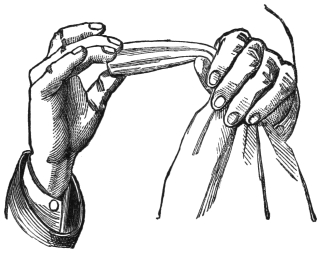
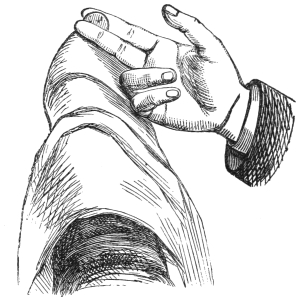
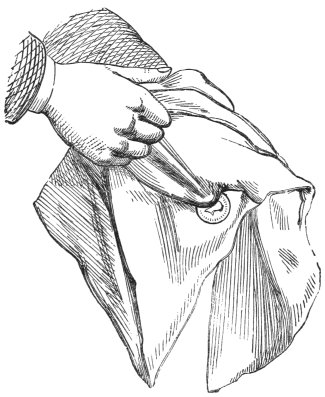
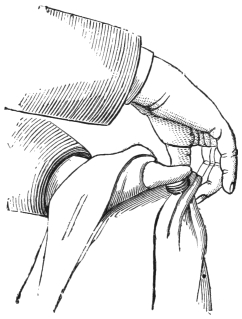
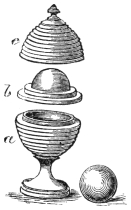
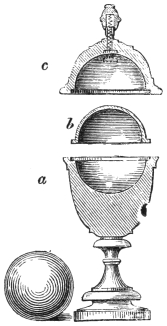
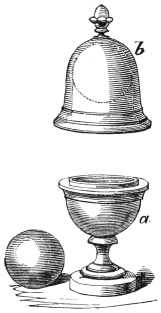
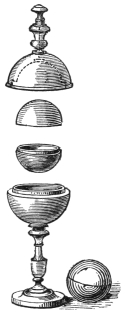
Under this head we propose to describe such tricks as do not come
within either of the preceding categories. We shall make no attempt
at classifying them, save that we shall, as far as practicable, describe
the best known and simplest feats first, and thence proceed to the
more complicated. Stage tricks, i.e., tricks adapted to the stage
only, will be treated in the Chapter next following. We will begin
with
The Cut String Restored.—This is a trick of such venerable
antiquity, that we should not have ventured to allude to it, were it
not that the mode of working which we are about to describe, though
old in principle, is new in detail, and much superior in neatness to
the generally known methods.
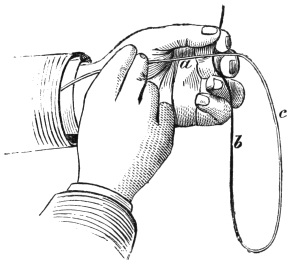
Fig. 152.
After having offered the string, which should be about four
feet in length, for examination, the performer takes the ends (pointing
upwards) between the first and second finger and thumb of the
left hand, and the first finger and thumb of the right hand, letting
the remainder of the string hang down in a loop between them. Now
bringing the right hand close to the left, he draws that portion of the
string which is held in the right hand towards himself between the
first and second fingers of the left hand (thus crossing at right angles
that end of the cord which is held in the left hand), continuing to
pull until half the length of the string has passed the left hand, and
at the same time slipping the third finger of the left hand between
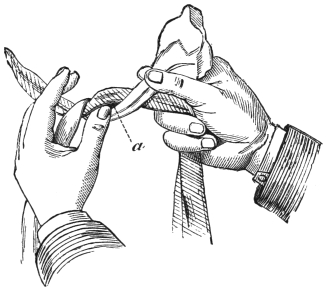
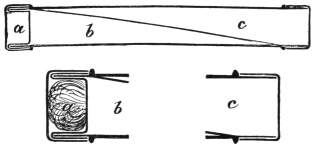
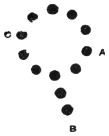
the two parts of the string, which will thus be as shown in Fig. 152,
in which, for convenience of reference, the three lines in which the
string now hangs are marked a, b, and c, and one-half of the string
is shown black, and the other half white, though of course there
would be no such difference of colour in the original.L The
first finger and thumb of
the right hand, still retaining
the end which
they already hold, seize
the portion b at the point
marked with that letter,
the third finger of the
left hand at the same
time drawing back the
portion a towards the
palm of the hand. The
string will thus be
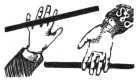
brought into the position
shown in Figs. 153 and 154,
(in the latter of
which, for the sake of clearness, the thumbs are made transparent),
the part now held horizontally between the two hands, which appears
to be the middle of the string, really being only the immediate continuation
of the end
held in the left hand.
The whole operation
of arranging the string
in proper position,
though tedious to describe,
does not take
half a second in practice.
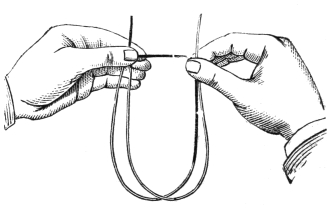
Fig. 153.
The performer next
requests some person
to cut the string, thus
arranged, in half, and this being (apparently) done, he transfers the
string altogether to the right hand, keeping the point of junction of
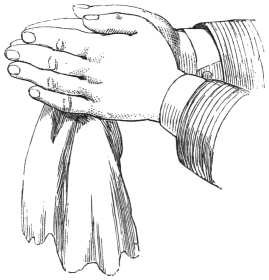
the crossed pieces hidden between the finger and thumb. (See Fig. 155.)
He now gives either end to some one to hold, and, placing his
open left hand near to the end thus held, winds the string rapidly round
it, sliding off as he does so the short piece, which, as soon as it is
clear of the longer portion, he presses with his thumb between the
second and third fingers of the same hand. On again unwinding the
string from the left hand, it is found apparently whole as at first.
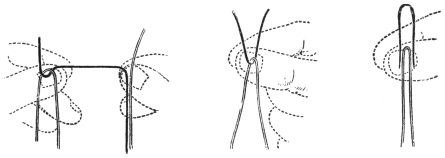
Fig. 154. Fig. 155. Fig. 156.
The principle of the trick being very generally known, you
will frequently find some one of the audience proclaim his acquaintance
with it, and declare that you have merely cut a short piece off
the end of the string. “Pardon me,” you reply, “my dear sir;
that method of performing the trick has long since been exploded.
I will at once show you that I do not make use of any such
shabby expedient. Of course, if a piece was, as you suggest,
cut off the end, the string would be that much shorter after
the operation. Will some one be kind enough to measure it?”
While this is being done, you secretly double in a loop the little
piece which was cut off on the former occasion, and which has
still remained in your right hand. When the string is returned
to you, you double it in half, and allow it to hang down between
the first finger and thumb of the right hand, drawing up immediately
above it the little loop you have just formed. (See Fig. 156.)
You now ask some one again to cut the string, which he
apparently does, in reality merely dividing the little loop. You go
through any magical gesticulations you please, and ultimately again
conceal the cut ends between the fingers, and produce the string
once more restored. On being measured, it is found to have lost
nothing of its length.
The trick in this second form being performed by wholly different
means, the repetition will puzzle even those who knew, or believed
they knew, the modus operandi in the first case.
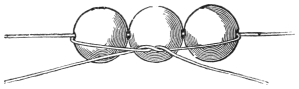
Fig. 157.
My Grandmother’s Necklace.—The trick which bears this
title is also a very old one, but is little known in the improved form
we are about to describe. In its older shape it is performed with
three perforated wooden balls or beads, threaded on a couple of tapes,
whose ends are held securely by two of the spectators. The problem
is to detach the beads without breaking the tapes, and this is effected
as follows:—The tapes, which should be from four to six feet in
length, are beforehand doubled in the middle, and slightly joined at
the bend of each with fine cotton or silk of the same colour. The
tapes are thus really middle to middle, though to a casual observer
they appear to be merely laid side by side. The performer comes
forward with the tapes, thus prepared, thrown over his left arm (taking
care that the point of junction shall be on the side towards his
body, and therefore concealed), and with the beads in his hands.
These latter, which are mere wooden balls, from one to two inches
in diameter, perforated so as to freely admit the tapes, he hands for
examination. When they are returned, he threads them one after
another upon the tapes, holding the latter in a loop, so that the balls
may sink down to the middle, and so cover the point of junction.
He next requests two of
the company to come
forward and hold the
tapes, and hands two
ends to the one and two
to the other. Each person
believes that he holds
one end of each tape, though, in reality, each has both ends of the
same tape. The performer now takes from each one of the ends
which he holds, and crossing the tapes in the manner shown in Fig. 157,
gives to each the end which the other previously held. Holding
a hat below the balls, he requests each person to pull smartly at the
word “three.” The word of command is given, “One, two, Three!”
and the thread breaking, the balls fall into the hat, though the ends
of the tapes still remain in the hands of the holders.
The improvement to which we have alluded consists in the use of
six balls, three red and three black. The red balls having been first
threaded on the tapes, and the two ends having been crossed and
returned to the holders in manner already described, the black balls
are in turn threaded on the tapes at either end, and the performer,
holding the hat beneath, and addressing one of the persons who
hold the tapes, says, “Which will you have, sir, the red balls or the
black?” Whichever the answer, the result is the same, for the
red balls only can come off the tapes, the black remaining still upon
them; but in either case the performer is able to satisfy the choice
which has been made. If the red balls have been chosen, he says on
their falling, “You chose the red, I think. You see that your commands
are at once obeyed.” If, on the other hand, the black are
chosen, the performer says, “You prefer the black? Then I will
take the red,” which he does accordingly. The audience, having
heard the choice freely offered, and not being aware of the subterfuge
by which the implied undertaking is fulfilled, naturally believe that the
performer was able to take off or leave on the tape whichever group of
balls he pleased.
The “Bonus Genius,” or Vanishing Doll.—While upon the
subject of old-fashioned tricks, we may briefly notice that known
under the name of the Bonus Genius, which has puzzled many
generations of our forefathers, and, though now rarely exhibited
by professional performers, is still a great favourite with juvenile
audiences. The Bonus Genius is a little wooden figure of a man,
four to six inches in height, and more or less grotesque in colour and
design. A little cloak, made small above and full below, like the
skirt of a doll’s dress, and with no opening save where the head of
the figure passes through, completes the apparatus. There are, however,
two points about the doll and his cloak which are unknown to
the spectators. First, the head of the doll is moveable, a wooden peg
forming the neck, and fitting, somewhat tightly, into a corresponding
hole in the body; secondly, there is stitched on the inside of the
cloak, just below the opening for the neck, a little pocket, of the
description known among tailors as a “patch” pocket, and of such a
size as to contain the head easily. The performer, holding up the
figure, and introducing it to the company as his flying messenger,
warranted to outstrip the electric telegraph, covers it with the cloak,
so that nothing but the head is seen. Grasping the figure under the
cloak with his right hand, the performer holds a burlesque conversation
with him, finally entrusting him with a message to be immediately
delivered to the President of the United States, the Shah, or
any other individual at a distance. The figure does not move.
“Well, sir, are you not going?” asks the performer. The figure
shakes his head from side to side, an effect easily produced by turning
the body backwards and forwards under the cloak. “You won’t, eh?
Why not, I should like to know? Oh! I see what you mean.
I haven’t given you your travelling expenses.” As he says the last
words, he grasps the figure and cloak from the outside round the
neck with the left hand, and draws away the right from beneath the
cloak, secretly carrying with it the body, and putting his hand in
his pocket, as though in search of money. He leaves the body of
the figure in his pocket, and brings out the hand again empty, but in
the position of holding a coin between the finger and thumb.
“There, sir,” he says, “there is a shilling for you,” making the
gesture of giving it. “You don’t see the coin, ladies and gentlemen;
but the fact is, what I have just given him is fairy money; the
weight of the ordinary coinage would interfere with the rapidity of
his flight. Now, sir, make haste; you have nothing to wait for
now.”
The performer has, meanwhile, again put the right hand under
the cloak, and with two fingers holds the little pocket open for the
reception of the head. As he says the last words, he gives the
head a sharp downward rap with the fingers of the left hand, and lets
it fall into the little pocket, the effect being as if the figure had suddenly
vanished. The performer shakes the cloak, and turns it inside
out to show that it is empty, taking care always to grasp it by that
part which contains the head, when all other portions of the cloak
may be shown freely; and as the audience are not aware that the
figure is divisible, and supposing it to be indivisible, it would be
clearly much too large to be concealed in the closed hand, there is
nothing to lead them to guess the secret. If it is desired to make
the doll reappear, the head is pushed up again through the opening
of the cloak, the hand beneath supporting it by the peg which forms
the neck, and it may thus be made to vanish and return any number
of times.
With tolerable skill in “palming,” the little pocket may be dispensed
with, the head being simply held in the hand. This mode of
working is, in our own opinion, to be preferred, as the cloak may then
be handed for examination without giving even the infinitesimal clue
which the pocket might suggest. Some performers, to still further
hoodwink the spectators, make use of two figures—the first, which is
handed round for inspection, being solid, and being afterwards secretly
changed for its counterpart with the moveable head. Others again
use only one figure, which is solid throughout, but are provided with
a separate head (whose existence is, of course, not suspected by the
spectators), and having handed round the solid figure for examination,
conceal this, and work the trick with the head only.
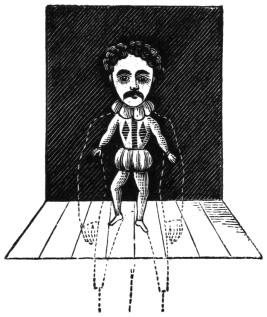
The Dancing Sailor.—The Dancing Sailor is a figure cut out
of cardboard, eight or nine inches in height, and with its arms and
legs cut out separately, and attached to the trunk with thread in such
a manner as to hang perfectly free. The mode of exhibiting it is as
follows:—The performer, taking a seat facing the company, with his
legs slightly apart, places the figure on the ground between them.
As might be expected, it falls flat and lifeless, but after a few mesmeric
passes it is induced to stand upright, though without visible
support, and on a lively piece of music being played, dances to it,
keeping time, and ceasing as soon as the music ceases.
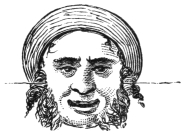
Fig. 158.
The secret lies in the fact that, from leg to leg of the performer,
at about the height of the figure from the ground, is fixed (generally
by means of a couple of bent pins), a fine black silk thread, of eighteen
or twenty inches in length. This allows him to move about without
any hindrance. On each side of the head of the figure is a little
slanting cut, tending in a perpendicular direction, and about half an
inch in length. The divided portions of the cardboard are bent back
a little, thus forming two “hooks,” so to speak, at the sides of the
head. When the performer takes his seat as before mentioned, the
separation of his legs draws the silk comparatively taut, though, against
a moderately dark background, it remains
wholly invisible. When he first
places the figure on the ground, he does
so simply, and the figure naturally falls.
He makes a few sham mesmeric passes
over it, but still it falls. At the third
or fourth attempt, however, he places
it so that the little hooks already mentioned
just catch the thread (see Fig. 158,
showing the arrangement of the head), and the figure is thus
kept upright. When the music commences, the smallest motion, or
pretence of keeping time with the feet, is enough to start the sailor
in a vigorous hornpipe.
The Bottle Imps.—These are miniature black bottles, about
two inches in height, with rounded bottoms, and so weighted that,
like “tumbler” dolls, they rise of their own accord to the perpendicular,
and will not rest in any other position. The proprietor, however,
has a charm by which he is able to conquer their obstinate
uprightness. For him, and for him only, they will consent to be laid
down, and even to stand at an angle of 45°, though they again rebel
if any other person attempts to make them do the same.
The little bottles are made of papier maché, or some other very
light material, varnished black, the bottom of each being a half bullet,
spherical side downwards. The centre of gravity is therefore at the
bottom of the bottle, which is thus compelled always to stand upright.
The performer, however, is provided with one or two little
pieces of iron wire, of such a size and length as just to slip easily into
the bottle. One of these being held concealed between the finger and
thumb, it is a very easy matter, in picking up the bottle, to slip it
in, and this slight additional weight neutralizing the effect of the
half bullet at the foot, causes the bottle to lie still in any position.
Having shown that the bottle is obedient to the word of command,
the performer again picks it up with the neck between the first and
second fingers and thumb, carelessly turning it bottom upwards, and
thus allowing the bit of wire to slip out again into the palm of his
hand, when he is able to again tender the bottle for experiment.
Partaking of the nature of a puzzle as well as a conjuring trick, this
little toy has amused thousands, and if neatly manipulated, may be
repeatedly exhibited, even before the same spectators, with little fear
of detection.
The Vanishing Gloves.—This is a capital trick with which to
commence an entertainment; when coming, as it should do, unannounced,
and before the performance proper has commenced, it has
an air of improvisation which greatly enhances its effect, and at once
awakens the attention of the audience.
The performer comes forward in full evening dress. While saying
a few words by way of introduction to his entertainment, he begins
to take off his gloves, commencing with that on his right hand. As
soon as it is fairly off, he takes it in the right hand, waves the hand
with a careless gesture, and the glove is gone. He begins to take off
the other, walking as he does so behind his table, whereon his wand
is laid. The left hand glove being removed, is rolled up into a ball,
and transferred from the right hand to the left, which is immediately
closed. The right hand picks up the wand, and with it touches the
left, which being slowly opened, the second glove is found to have
also disappeared.
The disappearance of the first glove is effected by means of a
piece of cord elastic, attached to the back of the waistcoat, and thence
passing down the sleeve. This should be of such a length as to
allow the glove to be drawn down and put on the hand, and yet to
pull it smartly up the sleeve and out of sight when released. It is
desirable to have a hem round the wrist of the glove, and to pass
the elastic through this like the cord of a bag, as it thereby draws
the wrist portion of the glove together, and causes it to offer less
hindrance to its passage up the sleeve. Upon taking off the glove,
the performer retains it in his hand, and lets it go when he pleases.
He must, however, take care to straighten his arm before letting it
slip, as otherwise the elastic will remain comparatively slack, and the
glove will, instead of disappearing with a flash, dangle ignominiously
from the coat-cuff.
The left hand glove is got rid of by palming. The performer,
standing behind his table as already mentioned, rolling the glove between
his hands, and quickly twisting the fingers inside, so as to bring
it into more manageable form, pretends to place it in his left hand,
but really palms it in his right. He now lowers the right hand to
pick up his wand, and as the hand reaches the table, drops the
glove on the servante. He now touches the left hand with the wand,
in due course opening the hand and showing that the glove has
departed.
Some performers vanish both gloves by means of elastic, one up
the right sleeve, the other up the left, but in doing so they offend
against one of the cardinal precepts of the art, viz., never to perform
the same trick twice in succession by the same means. The audience
having seen the manner of the first disappearance, are all on the alert,
and are not unlikely on the second occasion to guess the means
employed. If, on the other hand, the performer adopts the plan indicated
above, the two modes of producing the effect being different,
each renders it more difficult to discover the secret of the other.
The Egg-Bag.—This is a very old-fashioned trick, but, if performed
with address, is by no means ineffective. It was exhibited in
a modified form by the Japanese jugglers who visited London a few
years ago. We shall first describe it in the simple form adopted by
them, and shall then proceed to explain the older and more elaborate
version.
The Japanese egg-bag is about eight inches in depth and six in
breadth, and made of alpaca, tammy, or some similar opaque
material. Its only peculiarity is that one of its sides is double, the
stuff being folded down inwards from the mouth of the bag to about
two-thirds of its depth, and stitched at the sides, but left open at its
lower edge. The effect of this arrangement is to make a sort of
pocket, mouth downwards, inside the bag. If any small article, such
as an egg, be placed within the bag, and the bag be turned upside
down, the article will not fall out, but will fall into the pocket,
which, in the reversed position of the bag, will be mouth upwards.
This will enable you to conceal the presence of any article
in the bag, as you may turn it upside down, and even inside out,
without any fear of the article falling; and so long as you take care
to keep the “pocket” side of the bag towards yourself, the spectators
have not the least reason for suspecting that the bag is otherwise than
empty. The uses to which this little bag may be put are various.
Amongst others, it is available either to produce or cause the disappearance
of an egg, and may thus, in combination with other
apparatus, be made useful for many tricks. We shall content ourselves
with describing one only of the modes of using it.
The performer comes forward, having in his hand the bag, in
which is beforehand placed a small egg. He turns the bag upside
down and inside out, thus proving, to all appearance, that it is perfectly
empty. Holding the bag for a moment with his teeth, he pulls
back his coat cuffs, to prove that he has nothing concealed in that
quarter, taking care as he does so to show clearly that his hands are
empty. Taking the bag in his left hand, and imitating (if he can)
the clucking of a hen, he dips his right hand into it, and produces an
egg (or rather the egg). This he places in his mouth, letting all see
that he does so, then making a gesture of swallowing, he again dips
his hand in the bag, and produces a second egg, of which he disposes
in the same way, repeating the operation until a dozen or more have
been apparently produced and swallowed. With the reader’s present
knowledge, it is hardly necessary to suggest to him that the egg,
though fairly placed in the mouth, is, under cover of the hand, instantly
pushed out again with the tongue, and palmed, rendering it a
very simple matter to produce (apparently) another egg from the bag.
Although so absurdly simple, the trick is effective, and if neatly performed,
produces a complete illusion.
The bag which is more generally known as the “egg-bag” is a much
larger affair, measuring eighteen to twenty inches in width, by fourteen
or fifteen in depth. In its most approved form, one side of the
bag is made double, the double side being stitched all round, save for
about four inches at one corner of the bottom of the bag. The little
opening thus left affords therefore the sole access to the space between
the double sides. Between these double sides, and immediately below
their upper edge, is stitched a broad band, with a row of a dozen
or more little pockets, each capable of holding an egg, end upwards.
Each pocket covers about two-thirds of the egg, which is
prevented from falling out spontaneously by a little piece of elastic
round the edge of the pocket, though it will slip out and fall into the
space between the double sides on the slightest pressure being applied
to it.
The bag is prepared for use by placing an egg in each of the little
pockets we have mentioned. The eggs used are either blown shells
or imitation eggs of wood or tin, with one real one for the performer
to break as a specimen, and so lead the audience to the belief that
all are equally genuine. The bag being brought forward is turned
upside down—of course nothing falling from it. The performer
then, thrusting his arms down to the bottom, and seizing the bag by
the corners inside, turns it inside out, taking care, however, to keep
the double side towards himself. Having thus conclusively proved
its emptiness, he again brings back the bag to its normal condition,
and in the act of doing so, squeezes with his finger and thumb
(through the stuff) the genuine egg out of its pocket. It falls into
the space between the double sides, and by gently sloping the bag
downwards in the direction of the opening at the corner, he brings
the egg into the outer bag, whence he produces it, and breaks it to
show its genuineness, as already mentioned. Again he turns the bag
inside out, shaking and twisting it, and again produces an egg from
it as before, repeating the operation until the supply of eggs is exhausted.
Sometimes he varies his proceedings by trampling or
jumping on the bag, which he lays for that purpose on the floor, with
its lower edge towards the audience. The eggs are thus on the side
remote from the spectators, and in trampling on the bag it is very
easy for the performer to avoid the particular line in which he knows
them to be.
It was formerly the fashion, after bringing out a number of eggs
as above described, to finish by producing the hen which is supposed
to have laid them. This was done by an adroit exchange of the bag
just used for another containing a hen, hung in readiness behind a
chair, or some other convenient cover. This latter bag having no
double side, or other preparation, might safely be abandoned to the
inspection of the most curious spectator. Where it is not intended
to produce the bird, it will still be well to have the second bag, so as
to be able to make an exchange, and to hand the bag for inspection.
It is a great improvement to the egg-bag to have the lower portion,
say the last three inches of its depth, made of network, so that the
spectators can at once see each egg as it falls to the bottom of the
bag. It is hardly necessary to observe that in this case the inner
lining of the double side must terminate where the network commences.
To Produce Eggs from a Person’s Mouth.—While upon
the subject of eggs, we may notice this, though it has always appeared
to us a rather disagreeable trick. It is rarely exhibited as a separate
feat, but generally as a prelude to some other illusion, for the performance
of which three or four eggs are necessary.
The performer, requiring eggs, sends his assistant to fetch a plate.
On his return, he places him, holding the plate with both hands in
front of him, facing the company. The performer standing beside
him, and gently patting him on the head, an egg is seen to appear
between his lips. This is taken from him, and placed on the
plate. The performer, passing behind him, now stands on his
other side, and again patting his head, another egg is produced in like
manner. This is repeated until the requisite number of eggs is procured,
the assistant, as each fresh one is produced, simulating increasing
difficulty, as though the eggs were forced up from the stomach
by a powerful muscular effort.
This effect is produced as follows: We will suppose that five eggs
are to be produced. One is placed beforehand in the mouth of the
assistant, and four more are placed in the pochettes, or tucked
under the waistband of the performer, two on each side. Having
placed his assistant in position, the performer secretly takes one of
these latter into his right hand, and palms it. Patting the assistant
on the head with his left hand, he waits until the egg appears between
the teeth, and immediately on its appearance, raises his right hand as
if to receive it, thus bringing up the palmed egg opposite the mouth,
while the egg that is already in the mouth slips back, under cover of
the hand, out of sight. The palmed egg is laid on the plate, and the
performer, in the act of passing behind his assistant, palms a second egg
in his left hand. The same pantomime is again gone through, save that
in this case the right hand pats the head, and the left hand is held to
the mouth to receive the egg. After four eggs have been produced in
this manner, the fifth, which has been all along in the mouth, is produced
apparently in like manner, but the performer takes care that in
this instance it shall be seen beyond a doubt that the egg really does
come from the mouth; which being manifestly the case in this instance,
the audience are pretty sure to jump to the conclusion that all
were produced in an equally bonâ fide manner.
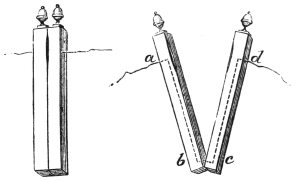
Fig. 159. Fig. 160.
The Pillars of Solomon, and the Magic Bradawl.—There
is a very old-fashioned apparatus, sometimes called the Pillars
of Solomon, for apparently uniting a piece of cut string. It consists
of two slips of wood, each about four inches in length by five-eighths
of an inch square, laid
side by side. At about
an inch from one end of
each, a transverse hole
is bored, and through
this, passing through
both slips, a string is
passed, and may be
drawn backwards and
forwards from side to
side. (See Fig. 159.)
The apparatus having been shown in this condition, the performer
passes a knife between the two slips, thus apparently dividing the
string; but the string is notwithstanding still drawn backward and
forwards through the holes, as sound as ever.
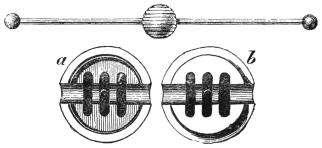
The secret lies in the fact that the string does not, in reality,
go straight through the two slips of wood from side to side. A
glance at Fig. 160 will enlighten the reader as to its real course. Instead
of passing straight through from a to d, as it appears to do when
the two pillars are laid side by side (which is the condition in which
they are first exhibited to the spectators), it passes down the length
of the first pillar from a to b, out at b, and into the second pillar at c,
whence it passes upwards, and emerges at d. The passing of the
knife between the two points a and d does not therefore affect the
string in the least.
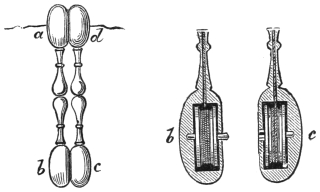
Fig. 161. Fig. 162.
It is obvious that in this form of the apparatus the two pillars,
being joined by the cords at the points b c, cannot be completely
separated, and the fact of their always being kept close together at the
lower end is quite sufficient to betray to an acute observer the principle
of the trick. There is, however, an improved form of the same
apparatus, in which, after the apparent cutting of the cord, the two
pillars are held wide apart, one in each hand of the performer, and
yet, when they are again placed side by side, the string runs backwards
and forwards merrily as ever. The pillars are, in this instance,
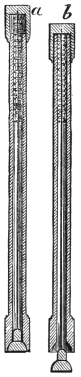
of the form shown in Fig. 161. They are about six inches in length,
of light and elegant shape, having at each end a ball or knob of about
an inch and a quarter in diameter, flattened on one face to allow of
the pillars being laid closely side by side. The cord, as in the former
case, passes down the
first pillar from a to
b, but instead of passing
out at b, it is
rolled round a little
pulley working in the
lower knob of that
pillar. (See Fig. 162,
which gives a sectional
view of the
lower portion of each
pillar.) A similar
cord is passed down from d in the second pillar to c, and is there
rolled round a second pulley, but in the opposite direction to that of
the first cord; so that, if both pulleys move in the same direction,
the cord on the one will be wound, and the cord on the other unwound.
Each pulley is of one piece with its axis, the axis of the
one terminating in a little square tenon or nut, and that of the other
in a corresponding mortice or hollow, so that when the two pillars
are placed side by side, their axes fit the one into the other, and whichever
of the two pulleys is set in motion, the like movement is communicated
to the other. The effect of this is as follows: If the
cord at a be pulled, it unwinds that portion of the cord which is
wound on the pulley at b, and by the same movement winds up
the cord on the other pulley; and vice versâ. We have omitted
to mention that there is glued into a little hole on the flat side of each
of the upper knobs, exactly opposite the points a and b, a very
minute piece, say an eighth of an inch in length, of similar cord;
these greatly heightening the appearance of reality upon the apparent
cutting of the cord.
The pillars are brought forward side by side, the nut of the one
pulley fitting strictly into the hollow of the other. The performer
shows, by drawing the cord backwards and forwards, that it fairly
traverses the two pillars from side to side. Taking a knife, he passes
it between the two pillars, and to all appearance cuts the cord, immediately
taking the pillars one in each hand, and showing the cut ends
(really the short bits on the inside) to prove that it is fairly cut
through. Again bringing the pillars together, taking care that the
mortice and the nut correspond as before, he commands the cord
to be restored, and again pulls it backwards and forwards as at
first.
Some little fun may be created by placing the upper knobs of the
pillars pincer-fashion, one on each side of a person’s nose, the cord
being thus apparently made to run right through the nose. An air of
greater probability may be given to this curious effect by first piercing
the nose with the magic bradawl. This is in appearance an ordinary
bradawl, but the blade is so arranged as to recede into the handle on
the slightest pressure, again reappearing (being, in fact, forced forward
by a spiral spring in the handle) as soon as the pressure is
removed. A duplicate bradawl of ordinary make is first handed
round for examination, and the trick bradawl being adroitly substituted,
the performer proceeds therewith to bore a hole through the
nose of any juvenile volunteer who will submit to the operation.
Holding a piece of cork on one side of the nose, he apparently thrusts
the awl through the nose, the sinking of the blade into the handle
exactly simulating the effect of a genuine perforation. (Some performers
make use of a sponge moistened with some liquid resembling
blood, which by a little pressure is made to trickle down from the
imaginary wound; but this is a piece of realism which we think is
better omitted.) The nose being thus apparently pierced, the
imagination of the spectators is in a measure prepared to accept the
phenomenon of the restored cord running through it as already
described.
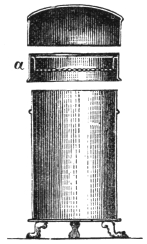
Fig. 163.
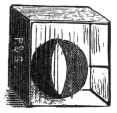
The Magic Coffers.—These are round tin boxes, japanned to
taste, and made generally about five inches in depth by three in diameter,
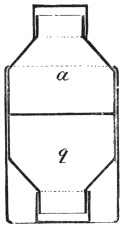
though they are sometimes larger. (See Fig. 163.) The only
speciality about them is a moveable portion a, which may either be
removed with the lid or left upon the box, according as the lid is
lifted with or without lateral pressure. This moveable portion is
bottomed with a grating of parallel wires, an eighth of an inch apart.
The coffers are generally worked in pairs, the effect produced by them
being the apparent transmission of the contents of the one to the
other, and vice versâ. They may be worked with various articles.
For our present purpose we will suppose that the performer desires to
change white haricot beans to coffee-berries, both of which suit
the apparatus very well. He beforehand fills the one coffer with
beans, and the moveable compartment belonging to it with coffee-berries,
doing exactly the reverse as to the
second coffer. The coffers are now brought
forward, and the performer, removing the
lids (with the moveable compartments), allows
the spectators to satisfy themselves that
each coffer is full to the bottom, and that
the contents are nothing more or less than
what they appear to be. This being established,
he returns to his table, and again puts
the lids on the coffers, taking care that that
which contains the beans shall be placed on
the coffer containing the coffee-berries, and
vice versâ. He now requests two of the
younger spectators to step forward, and assist
him with the trick. A couple of volunteers
having been procured, they are made to salute the audience, and are
then seated upon chairs at each side of the stage, each being entrusted
with one of the coffers, which, that all may see, they are requested to
hold with both hands above their heads. The performer, standing
between them, says, “Now, young gentlemen, I must caution you to
hold tight, or the electrical forces which are rapidly generating in
these magic coffers will carry them clean away, and possibly you
along with them. Now, first please tell me, just to start fair, which
coffer is it that you have got, sir, the one with the beans, or the one
with the coffee-berries?” The chances are ten to one against the
extempore assistants remembering which was which, and the majority
of the audience will be equally uncertain. The professor pretends
surprise and disappointment. “Ladies and gentlemen, you cannot
possibly appreciate the beauty of these philosophical experiments
unless you follow them carefully from the commencement. I will
open the coffers once more.” So saying, he opens first the one coffer
and then the other, taking care, however, to lift the lids only, so that
the one which really contains the coffee-berries shows the layer of
beans, and that which contains the beans the layer of coffee-berries.
In each case he takes up a handful, and lets them flow back from his
hand into the coffer, the better to impress upon the audience the contents
of each, finally placing a bean in the hands of the youth who
holds the supposed coffer of beans, and a berry in the hands of the
holder of the supposed coffee-berries. Again closing the lids, he
requests the person holding the bean to throw it into the closed coffer
held by the other. The juvenile, looking foolish, replies that it can’t
be done; and a similar reply is received from the youth holding the
other coffer. The performer, addressing the company, asks some one
else to make the attempt, but equally without success. He continues,
“Gentlemen, among this large and brilliant audience not one person
can be found who will undertake to throw this little bean into one of
those coffers. Imagine, then, the difficulty of passing the whole of
the beans which this coffer contains into the other, not dropping even
one on the way, and at the same moment transferring the whole of
the berries in this coffer into that which, a moment before, was full
to the brim with the beans. But it must be done. Young gentlemen,
will you be kind enough to repeat with me, One, two, three! At the
word ‘three,’ by the way, you had better close your eyes, or they
might possibly be injured by the shower of beans and berries. Are you
ready, Mr. Beans? Are you ready, Mr. Berries? Now, then, One!
two! three!!! Did you feel them pass? I hope they did not hurt
you. Now let us once more open the coffers. I have kept my
word, you see—Mr. Beans has the coffee-berries, and Mr. Berries
has the beans. Will you please step forward, and show the company
that the coffers are, as at first, full to the very bottom.” The lids,
containing the moveable compartments, he meanwhile places carelessly
upon his table.
Some performers make the change more than once, and it is
obvious that the contents of the coffers may be made to apparently
change places any number of times. If this is done, however, the
secret of the false tops is apt to be suspected; whereas, in the
method above described, the audience have, as they believe, proved the
coffers full to the bottom, both before and after the trick; and this
greatly increases the difficulty of accounting for the transposition.
The object of having the false tops bottomed with open wirework,
instead of with tin, is to be prepared for the expression of a suspicion
on the part of the audience as to the existence of a false top. In
such case the performer, borrowing a penknife, passes it well down
through the upper layer of beans, etc., and through the wirework,
thus proving (apparently) that the coffer is open to the bottom. In
the trick as above described, however, the expression of such a suspicion
is a very remote contingency.
The trick is sometimes performed with sweetmeats in one or both of
the coffers, and in this form has an added charm for a juvenile audience,
who complete the trick by swallowing that portion of the apparatus.
The Bran and Orange Trick.—This trick is performed with
a single coffer, in appearance very similar to those used in the last
trick, but slightly different in construction. The false top is, in this
case, bottomed with plain tin. The bottom of the coffer is moveable,
being soldered to a circular rim or shoulder of tin about a quarter of
an inch in depth, over which the coffer fits pretty tightly, though the
projecting edge of the bottom enables the performer to remove it
without difficulty. The performer must also be provided with an
ordinary oblong wooden box. Its precise dimensions are unimportant,
save that it should be a good deal larger than the coffer, but
about an inch or so less in height. This box is filled with bran, as
also is the false top of the coffer. A couple of oranges, as much
alike as possible, must also be provided. One only of these is produced
to the audience, the other being beforehand placed on the
servante of the table.
The performer begins by placing upon the table the coffer and the
box of bran. Removing the lid (with the false top), he brings forward
the coffer, and shows that it is perfectly empty. In returning to
his table, he loosens (though without removing) the moveable bottom,
and replaces the coffer on the table. He next brings forward the box
of bran, showing that there is no preparation about it, and in replacing
it on the table, places it in front of the coffer, which, however,
being the taller, remains visible behind it. He next introduces the
orange, either palming it (from one of his pochettes), and magically producing
it from some person’s nose or whiskers, or by the more prosaic
method of having it brought in by his assistant. He now returns
to his table, and, standing behind it, proceeds to fill the coffer with
bran. This he does by placing the coffer upright in the box, holding
it with one hand and ostentatiously pouring in bran with the other until
it is full. In placing the coffer in the box, however, he takes it up
quite without the bottom, so that he is, in reality, only filling an open
tube. Meanwhile, he secretly picks up, with his disengaged hand,
the second orange from the servante, and places it upon the bottom,
which remains behind the box. Having filled the coffer, and remarking,
“Pray observe that it is quite full,” he (before removing it from
the box) covers it with the lid, and then lifting it out, again places it
behind the box in such manner as to go neatly over the bottom and
the orange upon it. (Of course, in the act of lifting the coffer, all the
contents run back again into the box.) Having now got the second
orange within the coffer, and having, by a gentle pressure, again
settled the bottom in its place, the performer places the coffer on a
second table or a chair close in front of the audience. He then says,
“I am about to order the bran with which this coffer is filled” (here
he raises the lid without the false top, and the coffer therefore appears
full of bran) “to pass back again into the box from which it was
taken, and this orange” (here he passes behind his table, and holding
up the orange, replaces it six or eight inches from the hinder edge)
“to pass into the coffer in place of it. Now, first for the bran. One,
two, three! Pass! Did you see it fly from the coffer into the box?
You didn’t? Well, at any rate, you shall see the orange pass. I
take it up so” (here he places his two hands round it, and rolls it on
to the servante in manner described at page 294, coming forward
with the hands together, as though still containing it, and holding
them over the coffer at a few inches’ distance), “and squeeze it
smaller and smaller, in this manner, till it becomes small enough to
pass right into the coffer, as you see.” Here he separates his hands,
showing them empty, and immediately taking off the cover with the
false top, rolls out the orange, and shows that the coffer is otherwise
empty.
The trick as above described is susceptible of a good many variations.
If the performer uses a trap-table, the orange may be made to
pass through a trap instead of being rolled off at the back of the
table, though the latter method, if neatly executed, can hardly be
surpassed in illusive effect. A more substantial improvement may be
made by causing the bran, instead of simply disappearing as above
mentioned, to reappear in some other quarter. There are many pieces
of apparatus which may be used for this purpose, perhaps as good as
any being the improved sweet-bag (see page 248). This should be
previously filled with bran, and hooked to the back of the table. The
performer in this case borrows a handkerchief, which he carelessly
spreads on the table, and a gentleman’s hat, which he places mouth
upwards beside it. Instead of announcing that the bran will return
from the coffer to the box from whence it was taken, he states that it
will, at command, pass into the handkerchief which he holds, and
which as he speaks he picks up, with the bag beneath it, holding it,
without apparent intention, just above the hat. At the word
“Pass!” he slightly turns his wrist, thereby releasing the flap of the
bag, and a shower of bran is instantly seen to pour down into the
hat. This little addition greatly enhances the effect of the trick.
The Rice and Orange Trick.—In this feat rice and an orange
are made to change places, but by wholly different means from those
last above described.

Fig. 164.
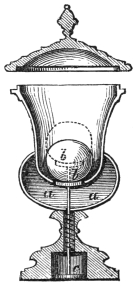
Fig. 165.
The apparatus in this case consists of three japanned tin cones,
about ten inches in height by five at the base, and each having a brass
knob at the top—and an ornamental vase of tin or zinc, standing
about the same height as the cones, and having a simple metal cover,
or top. Of the cones (all of which are open at the bottom), two are
hollow throughout, but the third has a flap or moveable partition halfway
down, inclosing the upper half of the internal space. This flap
works on a hinge, and is kept shut by a little
catch, which is withdrawn by pressure on a little
button outside the cone, when the flap drops
down, and lets fall whatever has been placed in
the enclosed space. (See Fig. 164.) The cone
is prepared for the trick by filling this space with
rice, and closing the flap; and the three cones
are then placed in a row on the performer’s table,
the prepared one being in the middle. The
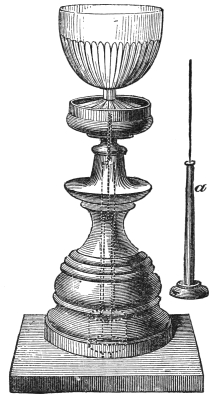
vase (see Fig. 165) is constructed as follows:—Its
depth inside is less by about an inch than its
depth outside, leaving, therefore, between its true
and false bottoms, an empty space, a. A circular hole is cut in the
inner or false bottom, but this hole, in the normal condition of the
vase, is kept closed by a circular disc of metal, b, exactly fitting it.
This disc is soldered upon an upright wire rod, passing through
the foot of the apparatus, and terminating in
another disc, c, somewhat smaller in size. Round
this rod is a spiral spring, whose action tends to
press it down, and thereby to keep the disc or
valve normally closed, though it rises, and
thereby opens the valve (as shown by the dotted
lines in the figure), whenever upward pressure
is applied to c. The face of the upper disc,
b, is slightly concave, corresponding with the
rest of the interior of the vase. The vase is
prepared for the trick by placing an orange in it,
and in this condition it is brought forward and
placed on the table by the performer or his assistant.
A small paper bag full of rice is brought
in at the same time, and completes the preparations.
With this introduction, we proceed to describe the trick as worked
by Herrmann.
The performer begins by borrowing two hats, and places them
one on the other, the mouths together, on a chair or table. He then
(by palming) produces an orange from the hair or whiskers of a
spectator, and places this on another table. He next brings forward
and exhibits the vase, filling it as he advances with rice from the
paper bag, and thus concealing the orange which is already placed
therein. He calls attention to the genuineness of the rice and the
simplicity of the cover, and finally putting on the latter, places the
vase on the ground, or elsewhere, in view of the audience. He pretends
a momentary hesitation as to where to place it, and in the slight
interval during which he is making up his mind he presses up the
button within the foot. This opens the valve, allowing the rice to
escape into the space a, and leaving the orange again uncovered.
The audience is, of course, unaware that such a change has taken
place.
Leaving the vase for the moment, he requests the audience to
choose one or other of the three cones on the table. The choice
almost always falls on the middle one (which, it will be remembered,
contains the concealed rice). This he places on the top of the upper
hat. He next asks the audience to select one or other of the remaining
cones, and places this over the orange upon the table,
showing by rattling his wand within it that it is hollow throughout,
and, if desired, handing round the remaining one for inspection.
At this point we hasten to anticipate an objection which will probably
occur to the reader. We have said that the audience, when
called upon to choose one of the three cones, almost always select
the middle one, and we have proceeded on the assumption that they
do so. “But suppose,” says the acute reader, “that they don’t choose
the middle one, but select one of the end ones; the trick is spoilt, as
neither of the others will produce the rice.” By no means, O acute
reader! If we had requested the audience to choose which of the cones
should be placed upon the hat, there might have been a little difficulty,
no doubt; but we did nothing of the kind. We merely asked them to
choose one of the cones. If their first choice falls on one of the end
ones, we hand it round for examination, and finally place it over the
orange. Then, standing behind the table, we ask the audience to make
their choice between the two remaining cones, right or left. Whichever
is chosen, we are safe; for as we have already had occasion to
explain in connection with the trick of the half-crown in the orange
(see page 171), the right of the audience is our left, and vice versâ, so
that by taking their reply in the sense which suits our purpose we
are certain to be right. We therefore, in any case, take the cone
containing the rice as being the one designated, and place this on the
hat, sending round the other for inspection. As the audience have,
to all appearance, been allowed perfect freedom of choice, and have
actually examined two out of the three cones, they are very unlikely
to suspect any preparation about the remaining one.
The trick is now all but complete. Once more the performer raises
the cone placed on the hat, to show that there is nothing underneath
it; and as he replaces it presses the button, thereby letting the flap fall,
and the rice pour out upon the hat, though it remains still concealed
by the cone. He next lifts up the cone under which is the orange,
and holding the latter up, replaces it, but in again covering it with
the cone, makes a feint of removing and slipping it into his pocket.
Then noticing, or pretending to notice, a murmur on the part of the
company, he says, “Oh, you think I took away the orange, but I
assure you I did not.” The company being still incredulous, he again
lifts the cone and shows the orange. “Here it is, you see, but as you
are so suspicious, I won’t use the cover at all, but leave the orange
here in full view on the table.” He again lays the orange on the
table, but this time on what is called a “wrist trap.” Leaving it for
the moment, he advances to the vase, and holding his hands together
cup-fashion over it, but without touching it, he says, “I take out the
rice, so, and pass it under this cover” (walking towards the cone on
the hat, and making a motion of passing something into it). “Let
us see whether it has passed.” He raises the cover, and the rice is
seen. “Perhaps you think, as you did not see it, that I did not
actually pass the rice from the vase to the cover. At any rate, you
will not be able to say the same about the orange. I take it up,
before your eyes, so!” He places his hands round it on the table,
and at the same moment presses the lever of the trap, which opens,
and lets it fall through into the table, closing again instantly. Keeping
his hands together, as though containing the orange, he advances
to the vase, and holding his hands over it, says, “Here is the orange
which has not left your sight even for a single moment. I gently
press it, so” (bringing the hands closer and closer together) “and
make it smaller and smaller, till it is reduced to an invisible powder,
in which state it passes into the vase.” He separates his hands, and
shows them empty, and then opening the vase, rolls out the orange,
and shows the vase empty, all the rice having disappeared.
The mechanism of the Wrist Trap will be explained in the next
Chapter. If the performer does not possess a trap table, he can cause
the orange to disappear in the manner referred to at page 337.
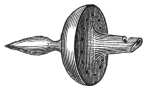
Fig. 166.
The Magic Whistle.—The student will not have proceeded far
in his magical experience before he meets with an often-recurring
nuisance, in the person of some individual, old or young, who knows,
or pretends to know, the secret of all his tricks, and whose greatest
delight it is, by some mal-à-propos question or suggestion, to cause the
performer embarrassment. The magic whistle
is specially designed to punish, and, if possible,
to silence, an individual of this kind. It is of
turned boxwood, and of the shape shown in
Fig. 166, and yields a shrill and piercing note.
The performer, bringing it forward and blowing
through it, announces that this little
whistle, so simple in appearance, has the singular faculty of obeying
his will, and of sounding or not sounding at his command alone.
The loquacious gentleman is pretty sure to question the fact, or is on
some pretence selected to make trial of its truth. The performer
places him directly facing the audience, and after himself once more
sounding the whistle, hands it to him in order to try his skill. He
blows vigorously, but in vain; not a sound can he produce, but his
mouth and lips gradually become obscured with a white or black dust.
He finally retires to his seat amid the laughter of the audience, and
generally much less disposed to make himself prominent during the
remainder of the evening.
The secret lies in the fact that there are two whistles—one is a
perfectly ordinary instrument, but the other, though similar in appearance,
does not sound, but is perforated round the inner side of the
head (see the Figure) with a number of small holes. The head
unscrews, and is beforehand filled with finely powdered chalk or
charcoal, which, when the whistle is blown, is forced through the
holes, and settles round the mouth of the victim.
With the present knowledge of the reader, the necessary exchange
of the two whistles will not be regarded as offering any difficulty.
There is a larger appliance for the same purpose in the shape of a
flageolet. Another apparatus of like effect, though differing a little
in detail, is called
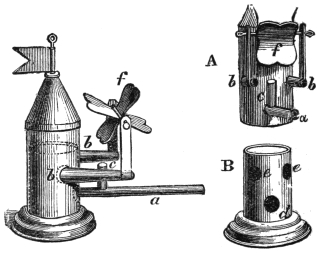
Fig. 167. Fig. 168.
The Magic Mill.—This is a little Mill of the form shown in
Fig. 167, and five or six inches in height. It is made of zinc or tin,
and consists of two portions—the upper part A, and the base B (see
Fig. 168), the former sliding over the latter (as shown by the dotted
lines in Fig. 167), and fitting easily upon it. A is hollow throughout;
a and b b are hollow tubes open at each end, a third little tube c
springing at right angles from a. The base, B, is a hollow chamber,
closed on all sides save at the openings d and e e. This chamber is
beforehand fitted with powdered chalk or charcoal; after which A is
placed in position over it. If, under these circumstances, any person
blows smartly
through the tube a,
the effect will vary
according to the position
of B within A.
If B be so turned
that the three holes d
and e e correspond
with the tubes a and
b b, the breath entering
at d will force out
the contents of B
through the tubes b b,
and powder the lips
of the person blowing,
as in the case of the magic whistle. But if, on the contrary, B be
turned ever so little to the right or left, the three openings in B no
longer corresponding with the tubes, the latter will be closed, and the
breath having no other outlet, will be forced upwards through the
upright tube c, thereby setting the little vane f in rapid motion. The
latter is the condition in which the apparatus is brought forward by
the performer. Blowing through a, he sets the mill in motion, and
invites others to do likewise, in which, of course, they succeed without
difficulty; but when the turn of the intended victim arrives, the
performer gives A a slight twist round, in such manner as to bring
the openings of B in correspondence with the three tubes, with the
result already explained. We have omitted to mention that there is
on the under surface of B a little raised point, corresponding in position
with the opening d, so that the performer is able to tell instantly
by feel whether B is or is not in the required position.
As a matter of convenience, we shall, before proceeding further
with the explanation of individual tricks, describe two or three pieces
of apparatus of general utility, to one or other of which we shall have
frequent occasion to subsequently refer.
The Drawer-Box.—This is a piece of apparatus of very frequent
use in the magic art. In appearance it is an ordinary drawer, with
an outer box or case of walnut or mahogany (see Fig. 169), and is
made of various dimensions, according to the size of the articles with
which it is intended to be used, and which may range from a pack of
cards to a live rabbit. Its use is to produce or to cause the disappearance
of a given article; the drawer having the faculty of appearing
full or empty at pleasure.
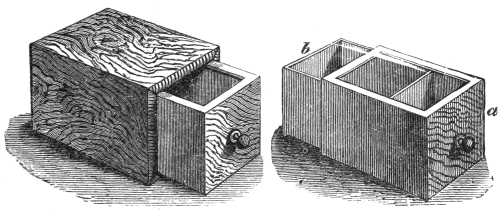
Fig. 169. Fig. 170.
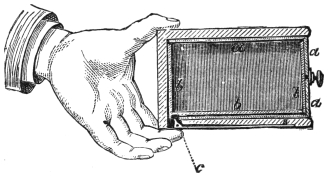
Fig. 171.
The first step towards the comprehension of the apparatus will be
to completely take out the drawer, which, however, even when removed,
does not at first sight indicate any speciality. On a closer examination,
it will be found that the drawer is in reality double (see Fig. 170),
consisting of two parts, a and b, the latter sliding backwards and
forwards freely within the former, which is, in fact, a mere case or
shell, open at one end. If any object, suppose an orange, be placed
in b, and a and b together be placed in the outer case, it is obvious
that, upon drawing out a, b will come with it, and the orange will be
seen; but if b be held back, a will be drawn out alone, and the
apparatus will be apparently empty. For the means of retaining a at
pleasure, it will be necessary to examine the outer case, which will be
found to have a groove or mortice cut in its under surface (see Fig. 171),
along which lies a spring or tongue of wood, fixed by a screw
at one end, the other,
or free end, being
provided with a catch
or stud c, which, upon
pressure, is forced
through an opening
in the bottom of the
outer case, and made
to sink into a little
hole or notch in the
bottom of b, being
again withdrawn by the action of the spring as soon as the pressure is
removed. The bottom of the outer case is covered with velvet,
ostensibly as a finish, but really to conceal the wooden tongue. When
it is desired to draw out a without b, the apparatus is held as shown
in Fig. 171, and a gentle pressure applied by the finger through the
velvet upon the free end of the wooden tongue, thus forcing the
catch upwards, and keeping b back. If a be drawn out without this
pressure, b will come with it. The upper edge of a is turned over all
round, so that a casual observer is not likely to detect any difference
in the thickness of the sides of the drawer, whether it is drawn out
with or without its inner casing.
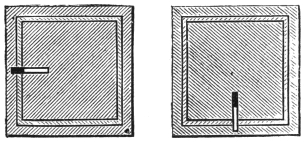
Fig. 172. Fig. 173.
Some drawer-boxes have a different arrangement for holding back
the inner drawer, consisting of a little wire bolt lying loosely in a
cylindrical cavity in the hinder end of b, corresponding with a similar
cavity in the side of the outer case. As long as the drawer-box is
kept in its normal position, this pin offers no obstacle to the withdrawal
of b with a; but if the box be turned over on the side in
which is the bolt, the
latter drops partially into
the hole in the outer
case, thus bolting b to
it, until, by again turning
over the apparatus,
the bolt is made to drop
back again into its original
position. The arrangement
is rather difficult to explain in writing, but will become
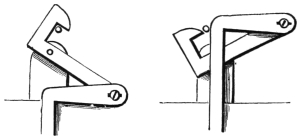
quite clear upon an examination of Figs. 172 and 173, both representing
a section of the hinder end of the drawer-box, the one in its
upright and the one in its turned-over position. The necessary
turning over of the box is plausibly accounted for by the performer’s
desire that the audience shall,
for greater fairness, have a full
view of the top of the apparatus.
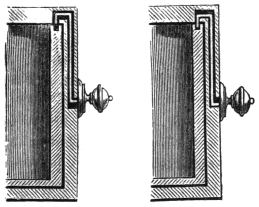
Fig. 174. Fig. 175.
There is an ingenious addition
sometimes found in
drawer-boxes of French make,
whereby b may be at pleasure
bolted to a, and the two may
thus be handed for examination,
with little chance of their
secret being detected. The
bolting and unbolting is effected by a slight movement up or down of
the knob in front, thereby raising or depressing a kind of hook of
bent tin, working in the thickness of the front of a. Fig. 174 shows
this hook in its raised or unhooked, and Fig. 175 in its depressed or
hooked condition.
The drawer-box, as above described, is available to produce or disappear,
but not to change articles. With a slight modification, however,
it may be made available for changing also. The inner drawer
b is in this case made only half the depth of a, or even less; and thus,
when closed, there is left between the bottom of b and that of a a
considerable space, so that a and b may in this case each be made to
hold a given object, and an apparent transformation be effected.
Thus, for instance, b may be filled with bran, and any small article,
such as a borrowed pocket-handkerchief, be placed in a. The drawer
is first pulled out with b, and shown filled to the brim with bran;
but on being closed and again opened (without b), the bran is
apparently transformed into the handkerchief.
Another modification of the drawer-box is known as
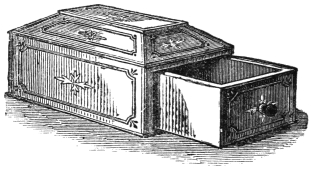
Fig. 176.
The Dissecting Drawer-Box.—This is, in general appearance,
not unlike the ordinary drawer-box already described, but with this
difference, that the
outer case has a raised
top, somewhat of a
sarcophagus shape.
(See Fig. 176). The
drawer is partially
drawn out to show
that it is empty, is
again closed, and on
being once more
drawn out, proves to
be full to the brim with flowers. These having been distributed, the
performer, to prove the perfect emptiness of the apparatus, not only
takes the drawer completely out, but takes the outer case (which is
constructed accordingly, the sides, top, and bottom being hinged
to the back) apart, as shown in Fig. 177. Notwithstanding this,
upon again reconstructing the case, and replacing and reopening the
drawer, it is once more found filled with flowers.
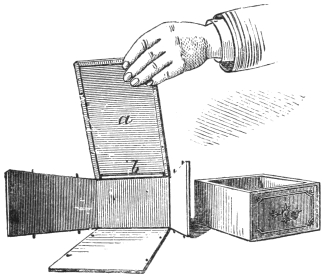
Fig. 177.
The reader, being acquainted with the ordinary drawer-box, will
have no difficulty in accounting for the first harvest of flowers, but
the second may possibly puzzle him a little. The secret lies in the
top of the outer case, which, as we have already mentioned, is slightly
pyramidal in form, allowing a considerable space between its inner
and outer surface, and in this space is packed the second supply of
flowers. This space
is closed on its under
side by a flat wooden
slab a, of the same
area as the inside of
the drawer, held in
position by a thin
wooden slip or bead
at either end. The
hindmost of these
beads, b, is so arranged
as to yield to
pressure, and, when
the drawer is pushed
slightly in, gives way
just enough to release
the slab before mentioned, which thereupon falls flat upon the
bottom of the drawer, and upon it the hitherto concealed flowers,
which, spreading as they fall, completely fill the drawer.
The Changing Card-Drawer.—This is a smaller variety of
the drawer-box, designed specially for use in card tricks. The inner
drawer is just large enough to contain a pack of cards, which may
thus be produced or vanished by its means. Between the bottoms
of the true and false or outer drawer, is a space of about an eighth of
an inch. This makes the apparatus available not only to produce or
vanish as above mentioned, but to transform one card into another.
The card to be changed is for this purpose placed in the outer drawer,
which, when closed, carries it under the bottom of the inner drawer,
and in this latter is placed the card for which it is to be changed, or
vice versâ.
There is an improved form of the card-drawer, with a double
change, effected on the principle of the dissecting drawer-box. This
is just as above described, with the addition that when the two drawers
are pressed smartly home, the action releases a thin slab of wood
forming apparently part of the inner surface of the case, and exactly
equal in area to the bottom of the inner drawer, into which it falls.
When required for use, a card is placed above this slab, which, falling
when required, covers the card already in the box, and exhibits instead
that which had been concealed above it, as in the case of the changing
card-boxes, described in the chapter devoted to card tricks. The
uses of such an apparatus will be obvious; but we will describe, by
way of illustration, one very good trick which may be performed
with it.
The apparatus is prepared beforehand by placing a given card
(say the knave of spades) above the moveable slab, and another (say
the eight of diamonds) in the outer drawer. The performer invites
two persons to each draw a card, and “forces” upon them the
knave of spades and eight of diamonds. The cards being replaced
in the pack, he, if he has used an ordinary pack, brings them to the
top by the “pass,” and palms them, or if he has used a forcing pack,
exchanges that pack for an ordinary one from which those two cards
have been removed. Leaving the pack on the table, he exhibits the
card-drawer, taking out both drawers together, and showing, apparently,
that case and drawer are absolutely empty. Closing the drawer,
he announces that he will make the drawn cards leave the pack, and
pass into the drawer. One of the cards (the eight of diamonds) is
named, and pulling out this time the outer drawer only, he shows
that it contains that card, which is taken out, and handed to the person
who drew it. Again the drawer is closed, being this time pushed
sharply home. The second card, the knave, being now named, the
drawer is again opened, and this card shown; the drawer being again
taken wholly out, and the drawer and case turned in all directions for
inspection, as before, the operator only taking care to hold the drawer
with one finger inside, that the moveable slab may not, by falling out,
betray its presence.
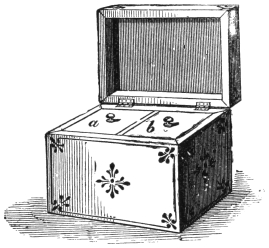
Fig. 178.
Changing Caddies.—These are of various kinds. We will
begin with the simplest, thence proceeding to the more complicated.
The conjurors caddy, in its most elementary form, is an oblong box,
about six inches in length by five in height and four in width. (See
Fig. 178.) One-half of its interior, which is divided into two compartments
by a transverse bar across the top, is occupied by a drawer,
or moveable compartment, so arranged as to slide freely backwards
and forwards from end to end, according as the caddy is allowed to
slope in the one direction or the other. (See Figs. 179 and 180.)
Each compartment has its own
lid, the caddy sometimes, but
not always, having an outer lid
in addition.
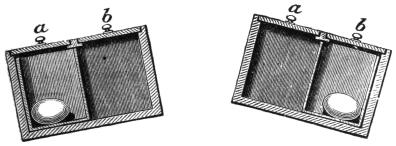
Fig. 179. Fig. 180.
We will suppose that it is
desired to produce any article
from the caddy, first shown
empty. The article in question
(say an egg, hard-boiled
for safety) is beforehand placed
in the moveable compartment,
which we will suppose to occupy
for the time being the space
under lid a, as shown in Fig. 179.
The performer takes off
the opposite lid b, and shows the space beneath empty. Before removing
the second lid, he slopes the caddy in the opposite direction,
so as to bring the moveable compartment under lid b (see Fig. 180),
and thus is enabled to show the space under a also empty. He then
proceeds with the trick, and at the right moment produces the article
from the caddy.
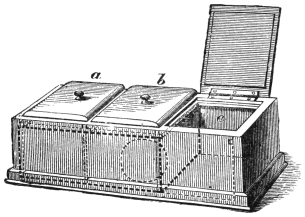
Fig. 181.
It is obvious that the caddy above described is only available for
appearances and disappearances, and not for transformations. To
obviate this defect, the majority of caddies are now made with three
compartments (see Fig. 181), with a sliding drawer occupying two of
them. The caddy in this form may be used to “change” objects in
manner following:—The
sliding drawer
being as shown in
Fig. 181, the article
to be ultimately produced
(say an orange)
is placed in b. The
three compartments
are now shown empty,
beginning with c, and
allowing the sliding
drawer to assume the
position shown in
Fig. 182, before in turn uncovering a and b. The article to be
changed (say a watch) is now placed openly in compartment b. The
performer closes the lid, and, after a moment’s interval, reopens it,
but in that interval slopes the caddy so as to again bring the sliding
drawer into the position
shown in Fig. 181,
when the orange
is again brought under
b, and, on removing
the lid, is disclosed.
To show that
the watch has really
disappeared, the caddy
may again be shown
(apparently) empty,
in the same manner
as at first.
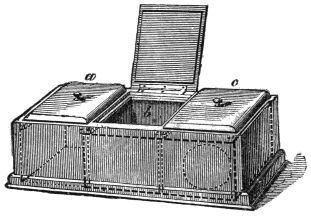
Fig. 182.
There are a good many varieties of caddies made. One is known
as the “skeleton” caddy, from the fact that the bottom is made to
take out, so that the company can look through all three compartments.
The sliding drawer in this case is bottomless, and is so
arranged as only to slide when the performer releases it by pressing
upon a particular spot in the ornamental moulding round the bottom
of the caddy. This pressure withdraws a little pin, which normally
rests in a little hole in the side of the sliding drawer, and thus renders
it for the time being a fixture. In some caddies, again, the sliding
drawer does not run up and down by its own weight, but is moved
backwards and forwards from below by means of a projecting
pin passing through a slit in the bottom of the caddy. The
caddy in this case does not require to be inclined one way or the
other, and is on this account preferred by many to the other
make.
The trick next described will introduce to the reader a changing
caddy of another and special construction.
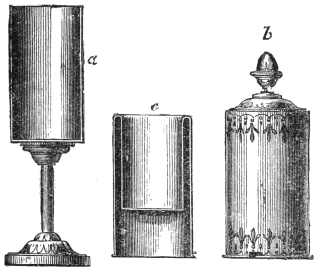
Fig. 183.
The Magic Vase and Caddy. (To make peas change places
with a handkerchief.)—For this trick two special pieces of apparatus
are necessary. The first is a tin vase, of the shape shown in Fig. 183,
and generally of about ten inches in height. It consists of three
parts, the vase proper
a, the cover b, and
a moveable compartment
or well, c,
which is constructed
upon a principle which
we have had frequent
occasion to notice, the
cylindrical portion of
a passing between the
inner and outer wall
of this moveable compartment.
It is coloured
exactly similar
to that portion of a
which it covers, which therefore looks exactly the same to the ordinary
spectator, whether c be in its place or removed. The internal depth,
however, of c is little more than half as deep as that of the actual vase,
a. The cover b exactly fits over c, and by means of a little appliance
called a “bayonet-catch,” will either lift c with it when removed, or
release c and leave it upon a.
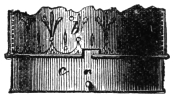
Fig. 184.
As this “bayonet-catch” is of constant use in magical apparatus,
it will be desirable to describe it somewhat minutely. A rectangular
cut or slit (see the enlarged view in Fig. 184) is made in the lower
edge of the cover b. Its perpendicular arm
is about a quarter of an inch in length, and
its width about an eighth of an inch. A
small pin or stud, about an eighth of an inch
in length, projects perpendicularly from the
lower edge of c, at such a height that when
b is placed over c, the upper or horizontal
arm of the slit shall be just level with it. If the upright arm of the
slit be brought immediately over this pin, the latter will, as the cover
sinks down, travel upward along the opening as far as the junction
with the transverse portion of the slit. If the cover be now again
lifted, the pin will, of course, offer no obstruction to its removal; but
if the cover be first
slightly turned to the
right, the pin will become
engaged in the
transverse portion of the
slit, and upon then lifting
the cover, it will
carry with it the pin,
and all connected with
it. When it is desired
to lift off the cover
alone, it will only be
necessary to turn the
cover a little to the left,
thus bringing the pin again over the upright portion of the slit.
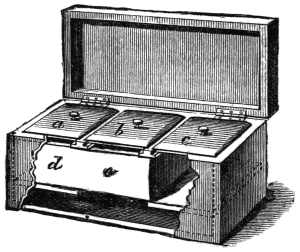
Fig. 185.
The second piece of apparatus is a caddy (Fig. 185), in appearance
not unlike an ordinary tea caddy, with three equal-sized compartments,
each having its own lid. Upon close inspection it will be
discovered that the internal depth of these compartments is somewhat
shallow in comparison with the external measurement of the caddy,
leaving a space about an inch deep between the inner and outer
bottoms. A sliding drawer, working from end to end of the caddy,
as already explained, occupies the space of
two compartments. Supposing this for
the moment removed, it would be found
that the external caddy, in the space occupied
by the two end compartments, a and
c, has a false bottom covering the hollow
space we have already mentioned, but that
the space occupied by the middle compartment
b has none. Of the two moveable
compartments, which together constitute the sliding tray already
mentioned (see Fig. 186), the one d has a bottom, the other e has not.
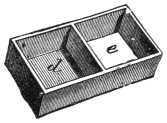
Fig. 186.
When the sliding drawer is in its proper position in the caddy,
and is pushed as far as it will go towards the one or the other end,
the result is as follows:—If it is pushed to the right, the bottomless
compartment e occupies the space at that end, under lid c, while the
opening in the false bottom of the caddy is, for the time being, closed by
the bottom of d, which now occupies the middle space. If the sliding
tray is pushed to the opposite end (i.e., to the left), d will occupy the
space a at that end, while the bottomless compartment e, being over the
opening, gives access to the space beneath.
The caddy is prepared for the purpose of the trick by placing in
the space between the true and false bottoms a white handkerchief,
and the sliding tray is then pushed to the right, so as to bring compartment
d to the middle, and thus close the opening. The vase
is prepared by filling both divisions with peas. The two pieces of
apparatus having been placed on the table by the assistant, the performer
opens the caddy, and taking off the lids of the three divisions,
and holding it with his fingers inside the right hand end (thereby
preventing any possibility of the tray shifting), brings it forward
to the audience, and passing rapidly in front of them, begs to introduce
to their notice an old tea caddy, in which he has accidentally
discovered some curious magical properties. In the present condition
of the caddy all three compartments appear exactly alike, and of equal
depth; and the interior being of a dead black, the spectators are not
likely to notice that they are somewhat shallow. Again closing the
lids, and replacing the caddy on the table, he next draws attention to
the vase. Taking off the cover without the moveable compartment,
and holding it upside down, he pours the peas contained in the upper
compartment (which should not be quite full) into the cover, and back
again two or three times, finally offering a handful for inspection.
He then borrows a lady’s handkerchief, which should as nearly as
possible resemble the substitute hidden in the caddy. He asks permission
to place it, for the purpose of the trick, in the vase. This
is, of course, readily granted, but the peas are in the way. After a
moment’s pretended hesitation, he says, “Well, I will put them in
the caddy. Pray observe that I really do so.” So saying, he pours
them into d (which, it will be remembered, is for the time being the
centre compartment), leaving that compartment uncovered, so that
they may remain visible to all. He then places the handkerchief
in the apparently empty vase, which he closes and places on the
table. He continues, “You have all seen me place the handkerchief
in the vase, and the peas in the caddy. Now I will show you a very
curious experiment. Perhaps some scientific gentleman among the
audience will explain how the effect is produced; for I confess that
though I have performed this trick some scores of times, I am not
quite certain myself as to the reason of the phenomenon. Let me
beg you once more to assure yourselves that these are genuine peas,
real common-place peas at twopence a pint, with no nonsense about
them.” As he says this, he passes along the front rank of the spectators,
exhibiting the peas in the caddy, and occasionally taking out a
handful, and offering them for closer inspection. As he reaches the
end of the line, he says, “You are all thoroughly satisfied that these
are genuine peas, and that the lady’s handkerchief is in the vase upon
the table. Quite right. Now observe, I don’t even touch the vase,
and yet, at the word of command, the handkerchief will pass into
the caddy which I hold in my hand. Pass!” During the last few
words, and holding the caddy for an instant with the lid towards the
audience, so as to screen his hand, he has pushed the sliding tray to
the left, so that d, containing the peas, now occupies the end space,
while the bottomless compartment e has taken its place in the middle.
Dipping down through this compartment into the hollow space beneath,
he takes out the substitute handkerchief. “My commands
are obeyed. Here is the handkerchief. But where are the peas?
Probably, as the handkerchief has taken the place of the peas, the
peas have taken the place of the handkerchief. Let us see.” He
uncovers the vase, lifting this time with the cover the moveable compartment
containing the real handkerchief. “Yes, here are the peas,
right enough,” shaking the vase, and taking them up by handfuls to
show them. He continues, “Now I dare say this seems very surprising
to you, but in truth it is comparatively simple. The real
difficulty begins when you try to make the handkerchief and the peas
travel back again to their original situation. This part of the experiment
is so difficult, that I always feel a little nervous over it, but I
must make the attempt.” Pushing the substitute handkerchief
openly down to the position it originally occupied, he takes the opportunity,
in carrying the caddy back to the table, to slide back the tray
as at first, and, after a little more talk, shows that the peas have
returned to the caddy, and lifting the cover alone from the vase, produces
therefrom the genuine handkerchief.
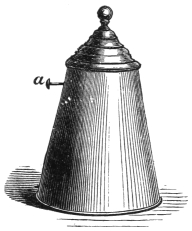
Fig. 187.
The Cover, to pick up any Article.—This (called in French
“ramasse-tout”) is a brass cover of six to ten inches in height, and of the
shape shown in Fig. 187. Within it works backwards and forwards on a
spring hinge, a kind of scoop, pressing,
when at rest, against the side of the cover,
as in Fig. 188, but moving into the position
shown in Fig. 189 whenever pressure
is applied to the button a, again returning
to its original position when
such pressure is removed. The manner
of using it is as follows:—The performer,
we will suppose, desires to cause the
disappearance of an orange, in order that
it (or a counterpart) may be subsequently
produced in some other quarter.
Placing the orange upon the table, he
places the cover over it, pressing, as he
does so, the button a, so as to draw back the scoop. As his hand
quits the cover, the pressure being removed, the return of the spring
causes the scoop to clip the orange tightly against the side of the
cover; and if the cover be now lifted without pressing the button, it
will carry the orange with it. If it is desired again to produce the
orange, the button is pressed in the act of lifting the cover, which
then leaves the orange on the table.
It is hardly necessary to observe that the cover is always lifted
perpendicularly, so that the spectator cannot see the interior.
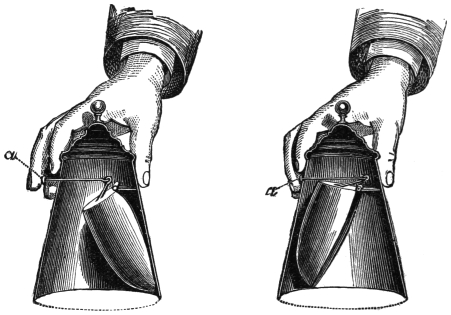
Fig. 188. Fig. 189.
It is well to be provided with a second cover similar in external
appearance, but without any mechanism. This may be handed round
for inspection, and afterwards secretly exchanged for the mechanical
cover.
The Changing Cover.—This cover is available not only, as in
the last case, to produce or vanish, but also to change one article for
another. It is somewhat of the pattern of an ordinary round dish
cover, with a metal knob on the top. (See Fig. 190.) It is divided
by a vertical tin partition a (see Fig. 191), into two equal compartments,
b and c. The lower, or open side of each of these compartments
is of course semicircular. A flat tin plate, d, also semicircular,
works on an upright axis, e, passing upwards through the centre of
the cover, and terminating in the knob on the top. By turning, therefore,
this knob halfway round to the right or left, the performer is
enabled to close whichever of the compartments happens for the time
being to be open, at the same time opening that which was previously
shut. There is a little point or stop on the upper side of the semicircular
plate, which meeting resistance from the vertical partition,
prevents the plate making more than the necessary half-turn either way.
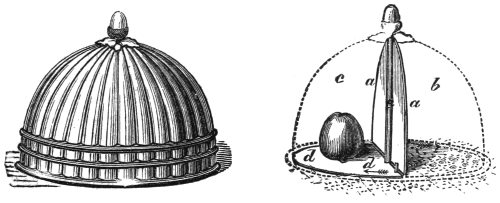
Fig. 190. Fig. 191.
The apparatus is prepared by placing the article representing the
result of the supposed transformation (say an apple) in either compartment,
and turning the knob so as to close that compartment, and
open the other. The article to be changed (say an orange) is placed
upon the table, and the performer places the cover upon it, taking
care that the open compartment for the time being shall come fairly
over it. He then gives a half turn to the knob, thereby closing the
compartment which has hitherto been open, and securing the orange
within it, and at the same time releasing the apple, into which, on the
cover being again raised, the orange appears to be transformed. In
this case, as in the last, it is well to have a plain counterpart cover to
hand round for inspection if necessary.
The uses to which the changing cover may be put are very
numerous. The following is an instance of a rather original application
of it, which produces a capital effect. We will suppose that the
performer has executed a trick in which he has availed himself of the
assistance of some juvenile member of the audience, and that an apple
has been one of the “properties” of the trick. The trick being concluded,
the professor asks his temporary assistant whether he would
like to have the apple, and is of course eagerly answered in the
affirmative. “Very well,” says the professor, “you shall have it; but
you must first earn it by a little display of dexterity. I will put it
under this cover.” He suits the action to the word. “Now I am
going to say, One, two, three! At the word ‘Three’ I shall raise
the cover, and you must try to snatch the apple before I replace it. If
you can catch the apple in this manner three times in succession, it
is yours; but on one further condition, that you eat it at once here
upon the stage.” The conditions are readily accepted. “One, two,
three!” cries the professor, raising the cover and disclosing the apple,
which is instantly snatched up. A second time the process is gone
through, with a like result. “You mean to win, I can see,” remarks
the performer. “Now, once more, and the apple will be yours; but
I warn you I shall be rather quicker this time. One! two!! three!!!”
The eager boy springs forward, and clutches—not the apple, but
a Spanish onion, which had been placed in the second compartment
of the cover. “You have won, sir,” says the professor, pretending
not to notice the change; “but don’t forget the second part
of your bargain. You are to eat it at once, before leaving the stage.”
We will leave to the imagination of the reader the discomfiture of the
victim, and the amusement of the spectators; also the subsequent
magical processes by which the transformed apple may be restored to
its original and more fragrant condition.
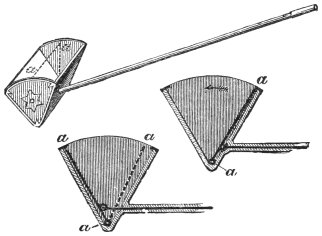
Figs. 192, 193, 194.
The Changing Ladle.—This is a piece of apparatus designed
for secretly obtaining possession of a chosen card or piece of writing.
The bowl, so to speak, of the ladle is in the form of a segment of a
cylinder (see Fig. 192), the size of its opening being about four inches
by two and a half, and its depth three inches. It is made of tin, with
a thin, cylindrical handle. The edges of the bowl are turned inwards
all round to the extent of about a sixteenth of an inch, thereby serving
to disguise a moveable slab of tin, a, which moves backwards and
forwards like the leaf of a book within the ladle, working upon a
hinge at its lower edge. This is made to work backwards and forwards
by a wire rod passing through the whole length of the handle, and
terminating in a little knob or cap at its outer end. The normal
position of a is to lie against the inner or handle side of the bowl (see
Fig. 193), being retained in that position by the effect of a spiral
spring in the handle, which draws the wire back. If, however, pressure
be applied to the knob or cap at the end of the handle, the
wire is forced downwards, thereby bringing the moveable leaf a
against the outer side of the bowl, as shown in Fig. 194.
There are various modes in which the changing ladle may be made
useful. For example, it may be used to burn and restore a card.
For this purpose, the ladle is prepared by placing in it beforehand any
indifferent card of similar pattern to the pack in use, and is in this
condition placed on the performer’s table, in such manner that the
spectators may not observe that there is already a card in it. The
performer then comes forward and hands to one of the company a
pack of cards, with a request that he will select any one he pleases.
While he is making his selection, the performer or his assistant places
on the table and sets
fire to some spirits of
wine on a bowl or
plate. A card having
been chosen, the performer
requests the
drawer to return it to
him, and, in order to
exclude the possibility
of any exchange or
sleight-of-hand, volunteers
to receive it at
arm’s length in the
ladle, which he brings
forward for that purpose, holding it by the extreme end of the handle,
and pressing with his palm the knob at the top, thereby bringing
the moveable leaf into the position shown in Fig. 194, with the card
already in it pressed flat against the outer side of the bowl, and thus
completely hidden. The chosen card being placed in the ladle, the
performer, in returning to his table, relaxes the pressure of his palm,
thereby bringing the moveable leaf back into the position of Fig. 193,
releasing the dummy card, and concealing that chosen against
the inner side of the bowl. He then drops apparently the chosen, but
really the substitute, card into the flames, taking care as he does so
not to turn the face of the card toward the audience. The ladle,
with the genuine card in it, is carried off by the assistant as having
served its purpose, and the chosen card is subsequently restored after
any fashion which the fancy of the operator may dictate.
The ladle may also be used to apparently burn and restore a paper
on which one of the company has written any words or figures. In
this case a blank half-sheet of note-paper, folded in four, is beforehand
placed in the ladle, and a piece of paper folded in the same way is
handed to one of the audience, with a request that he will write what
he pleases upon it, again fold it, and place it in the ladle. It is then
either apparently burnt (as in the case of the card), or placed in some
other apparatus, the operator making a great point of the fact that he
does not touch the paper. As the genuine paper remains in the ladle,
it is, of course, very easy for the performer to ascertain what is
written upon it, and having displayed his knowledge, to ultimately
reproduce the paper under any circumstance which he thinks fit.
Sometimes the trick is varied by requesting a spectator to write a
question upon the paper, which is subsequently reproduced with an
appropriate answer written beneath the question.
Fig. 195.
Fig. 196.
The Cone, or Skittle. (La quille).—This is a block of polished
boxwood, of the shape shown in Fig. 195, with a thin shell of the same
material exactly covering it, and so closely resembling it in appearance,
that the solid block and the hollow shell, seen apart, cannot be distinguished
the one from the other. The cone is made
in various sizes, from three inches in height by one
and a half at the base, to seven inches in height by
three at the base. It is worked with a paper cover,
consisting of an open tube of cartridge paper about
double the height of the cone, and tapering in such
manner that its larger end shall fit loosely over the
cone. The performer brings forward this paper
tube in his right hand, and the cone (with the hollow
shell upon it) in his left, taking care to hold his
fingers beneath it in such manner that the solid cone cannot
fall out. He first calls attention to the paper tube, which the audience
are allowed to examine at pleasure. When it is returned to him,
he says, “You are now quite satisfied that there is no preparation
about this tube, which is, in fact, simply a cover for this block of
wood.” As if merely suiting the action to the word, he covers the
block with the tube, immediately removing it again, and carelessly
laying the cover on the table. In removing it, however, he grasps
it with a gentle pressure, and
so takes off with it the hollow
shell (see Fig. 196), of whose existence
the audience have no suspicion.
He continues, “Perhaps
you would also like to examine
the block, which you will find to
be a plain, solid piece of wood,
without mechanism or preparation
of any kind.” The block
having been duly examined, the
supposed empty cover is placed
upright upon the table; and the
solid block having been disposed
of by any means in the performer’s power, is ordered to pass invisibly
under the cover, which being raised, the hollow shell is seen, appearing
to the eye of the audience to be the block itself, and to have found
its way there in obedience to the performer’s command.
The above is the working of the “cone” in its simplest and
barest form, but no skilled performer would dream of presenting the
illusion in such a common-place way. To make the trick effective,
it should be so arranged as to make the cone apparently change
places with some other article. There are many combinations which
might be suggested, but we shall content ourselves with describing
one or two of those in most general use. The smaller sized cones
may be worked in conjunction with a goblet and ball (the same as
those used for the Cups and Balls), in manner following:—Having
tendered for inspection the cone and cover as already described, and
placed them on the table, the performer offers the goblet and ball in
like manner for inspection. When they are returned, he places them
also upon the table, a little distance apart, and meanwhile palms a
second ball, which should be in readiness either on the servante, or
in one of his pochettes. He now places the paper cover (which, it
will be remembered, contains the hollow shell) over the first ball on the
table. “Pray observe,” he remarks, “that I have fairly covered over the
ball” (here he raises and replaces the cover, pressing so as to lift the
shell with it, and showing that the ball is still there). “The goblet,
as you have seen, is perfectly empty.” (Here he raises the goblet,
and, in replacing it, introduces the second ball under it, as described
in the chapter devoted to the Cups and Balls.) “I shall now order
the ball to pass from the cover under the goblet.” He waves his
wand from the one to the other. “Presto! Prestissimo! Pass!”
(He raises the goblet, and shows that the ball has (apparently) passed
under it.) The first ball still remaining under the paper tube, he cannot
at present raise it, so proceeds rapidly to the next stage of the trick,
that the omission may not be noticed. “So far,” he remarks, “the
trick is mere child’s play. The real difficulty is to pass the cone
under the cover in place of the ball. However, I will make the
attempt.” So saying, he picks up the cone with his right hand, and
apparently transfers it to his left, really palming it, and immediately
afterwards dropping his right hand to his side, and getting rid of the
cone into the profonde. Then, taking two or three steps away
from the table, still holding the left hand as if containing the cone,
and looking towards the cover, he says, “One, two, three, Pass!”
with a motion of the hand as if throwing something; immediately
showing the hands empty, and lifting up the cover (but this time by
the top, so as not to exert any pressure against its sides), and showing
the hollow shell, which now conceals the ball, and is taken by
the spectators to be the genuine cone. “We have succeeded pretty
well so far, ladies and gentlemen,” he remarks; “it remains to be
seen whether I shall be equally successful in bringing back the cone
and ball to their original positions. I dare say you would all like to
know how the trick is done, and therefore this time I will vary the
mode of operation, and make the transposition visibly.” (Here he
drops his right hand to the profonde, and secretly palms the solid cone.)
“First the cone” (he passes his right hand, keeping the back towards
the audience, upwards along the cover, and, as it reaches the top,
brings the cone into view). “Pray once more assure yourselves that
it is fair and solid. Now for the ball.” He picks up the ball with
the left hand, and holding it between the finger and thumb, apparently
transfers it, by the pass called the tourniquet (see page 150), to the
right, forthwith getting rid of it into the profonde on the left side.
“Pray observe that it does not leave your sight even for a moment.”
Then holding his hand high above the paper cover, he makes a
“crumbling” movement with it, immediately showing it empty, and
lifting the cover with a slight pressure, so as to carry the shell with
it, shows the ball beneath. The attention of the spectators being
naturally attracted to the ball, it is an easy matter to let the hollow
shell slip out of the paper cover upon the servante, and again to hand
the cover for examination.
Some performers, instead of using the goblet, work the small cone
with the “ball-box” (see page 296).
It is obvious that the directions above given will apply only where
the cone is of a size so small as to be readily palmed, in which case
it is hardly conspicuous enough to be used before a large audience.
Where a cone of larger dimensions is employed, it is necessary to vary
the mode of operation. We shall therefore proceed to describe the trick
in its stage form, as worked by Herrmann and other public performers.
The cone in this case is about seven inches high, and is worked in
conjunction with a “drawer-box” of such a size as to contain it
easily. Having handed round for inspection the cover and cone, as
already described, the performer suddenly remembers that he requires
an orange, which he forthwith produces from his wand. (It is hardly
necessary to observe that the orange is beforehand placed in readiness
in one of the pochettes, and is produced from the wand in the
manner described for producing a ball. See page 276). Laying down
the orange on the table, he next exhibits the drawer-box, taking the
drawer completely out, and, after showing it on all sides, replacing
it. He then covers the orange on the table with the paper cover
(containing the hollow shell), and places the solid cone in the drawer-box,
which being of the kind described at page 345, he turns upon its
side, with its top toward the audience. He meanwhile palms in his
right hand, from his pocket or the servante, a second orange. He
now announces that he is about to take the orange back again, which
he does by passing his wand up the side of the cover, and immediately
producing therefrom the second orange. He places this upon another
table at a little distance, and covers it with a borrowed hat, making
as he does so a feint of removing it, and slipping it into his tail pocket.
He hears, or pretends to hear, some one remark that he took away
the orange, and answers accordingly. “Oh! you think I took away the
orange. Allow me to assure you that I did nothing of the kind.”
(He lifts up the hat, and shows the orange in its place.) “I will
cover it again; or, still better, to prove that I do not take it away, I
won’t cover it at all, but leave it here in full view on the table.”
He replaces it on the table, but this time places it on what is called a
“wrist-trap,” in readiness for a subsequent disappearance. “Having
taken the orange from under the cover,” he continues, “I have now
to make the solid block vanish from the drawer, and take its place;
but I shall do it this time invisibly. See, I have only to wave my
wand from the one to the other, and the thing is done. The drawer
is empty” (pulling out the false drawer only), “and here is the
block” (he lifts the paper cover, and shows the hollow shell). “Now
I come to the most difficult part of the trick, which is to bring both
articles back to their original position. First, I will take the block of
wood.” He covers the shell with the paper tube, and makes a movement
of his wand from the cover to the drawer. “Pass! Let us see
whether it has obeyed.” He this time pulls the drawer completely
out, and lets the block fall heavily on the stage. “Now for the
orange.” He places both hands round it, as if picking it up between
them, and presses as he does so the spring of the trap, which opening,
lets the orange fall through into the table. Bringing the hands, still
together, immediately above the paper cover, he rubs them together
as if compressing the orange, finally separating them and showing
them empty, and immediately afterwards lifting the cover with the
hollow shell, and showing the first orange beneath it.
It will be observed that the trick above described is, in some of
its parts, very similar to that described at page 337. The mechanism
of the wrist-trap will be found explained in the next chapter. In the
meantime the student may produce the same effect without using a
trap at all, by means of the sleight described at page 294.
Fig. 197.
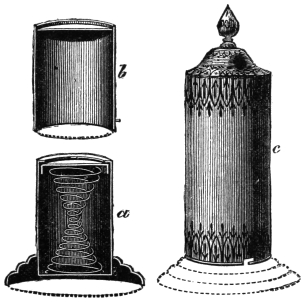
Fig. 198.
The Cone and Bouquet.—This is another form of the cone
trick, involving the use of rather more elaborate apparatus. The
cone in this case is about five inches in height by three at the base,
and tapers very slightly. It may be either of boxwood, as in the
trick last described, or the block may be of
any hard wood, and the hollow shell of tin to
fit, each blacked and polished, so as to look
exactly alike. It is used in conjunction with
a paper cover as before, and two little bunches
of flowers, exactly alike, and of such a size as
to be just covered by the hollow shell. Each
of these little bouquets is made upon a tin
framework, consisting of a wire arch springing
from a flat saucer-like base. (See Fig. 197.)
A pedestal and cover complete the apparatus.
The pedestal a (see Fig. 198) is cylindrical;
and about six inches in height, by four across the top. Its upper
surface consists of a circular plate of tin, working up and down
piston-wise in the pedestal. This is forced upwards by a spiral spring,
but yields to pressure,
sinking vertically to a
depth of four or five
inches when necessary.
The upper edge of the
pedestal is slightly turned
in all round, so that the
top may not be pressed
out altogether by the
force of the spring. An
outer casing of tin, b, fits
over a, just so tightly as
to resist the upward pressure
of the spring when
forced down by any object
between the pedestal
and this casing. The
cover, c, is about double the height of a, and by means of a bayonet catch
(see page 352) may be lifted off either with or without b at pleasure.
Fig. 199.
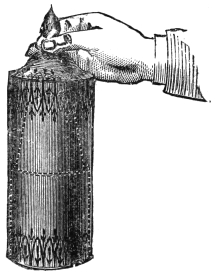
Fig. 200.
The pedestal is prepared for use by removing b, and placing
one of the little bouquets on the top of a; then again putting on
b, and forcing it down into its place, when the condition of the
apparatus will be as shown (in section) in Fig. 199. The wire arch
prevents the flowers being crushed out of shape by the pressure of
the spring. The pedestal and cover
are now brought forward and placed
on the table; also the cone (with the
shell on), the paper tube to cover
it, and the remaining bunch of
flowers. The paper tube is first exhibited,
placed over the cone, and
removed with the hollow cone within
it, as in the last trick. The solid
cone is then offered for examination,
and having been duly inspected, is
placed upon the pedestal. The performer
makes a movement as if about to place over it the cover
c, but checks himself in the act, and shows that this cover is empty
and hollow throughout. He then
puts on the cover, and reverting to
the bunch of flowers on the table,
covers it with the paper tube. He
next announces that in obedience to
his command, the block and the
bunch of flowers will change places.
He raises the paper tube, holding it
by the top, and thus leaves behind
the hollow shell, covering and concealing
the bunch of flowers. He
next takes off the cover of the pedestal,
first, however, turning the
bayonet catch, so as to lift off with
the cover the casing b. The solid
cone is carried off between the casing
and the cover (see Fig. 200), while the action of the spring, the casing
being removed, brings the concealed bunch of flowers to the top of
the pedestal, in the position lately occupied by the cone. Having
shown that the cone and the flowers have changed places, the performer
next undertakes to bring them back to their original
situation, which, by reversing the process, he does without
difficulty.
The pedestal above described is a very useful piece of apparatus,
being available either to produce, change, or vanish any article of
appropriate size. A very effective trick may be performed therewith
by causing an empty tumbler to appear full, or vice versâ. In this
case, however, it should by no means be admitted that an exchange
takes place, as the supposed filling of an empty glass with water by
covering it with an evidently unsophisticated cover, is rather the
more surprising phenomenon.
The Flying Glass of Water.—This capital trick was, we
believe, first introduced to the public by Colonel Stodare, to whom
the profession is indebted for many first-class illusions.
The necessary apparatus consists of a
couple of ordinary glass tumblers, exactly alike,
with an india-rubber cover just fitting the mouth
of one of them, and a coloured handkerchief of
silk or cotton made double (i.e., consisting of two
similar handkerchiefs sewn together at the edges),
with a wire ring (of the size of the rim of one of
the tumblers, or a fraction larger) stitched loosely between them,
in such manner that when the handkerchief is spread out the ring
shall be in the middle.
Fig. 201.
Fig. 202.
The performer, beforehand, nearly fills one of the tumblers with
water, and then puts on the india-rubber cover, which, fitting closely
all round the edge, effectually prevents the water escaping (see Fig. 201).
The glass, thus prepared, he places in the profonde on his
right side. He then brings forward the other glass and a decanter of
water, and the prepared handkerchief, and in full view of the audience
fills the glass with water up to the same height as he has already
filled the one in his pocket, and hands round glass and water for
inspection. When they are returned, he places the glass upon the
table, a few inches from its hinder edge, and standing behind it,
covers it with the handkerchief, first spreading out and showing both
sides of the latter, proving, to all appearance, that there is no preparation
about it. In placing the handkerchief over the glass, he
draws it across in such manner as to bring the hidden ring as exactly
as possible over the top of the glass. Then placing the left hand
over the handkerchief, as shown in Fig. 202, he raises, apparently,
the glass within the handkerchief, but really the empty handkerchief
only, which is kept distended by the ring, and, at the same time, under
cover of the handkerchief, gently lowers
the glass of water with the other hand
on to the servante. This is by no means
difficult, as the pretended carefulness
of the operator not to spill the water
allows him to make the upward movement
of the left hand as deliberate as
he pleases. All that is really necessary
is to take care to follow with his eyes the
movement of the left hand, which will
infallibly draw the eyes and the minds
of the audience in the same direction.
Having raised the supposed tumbler to
a height of about two feet from the
table, the performer brings it forward
to the audience, and requests that some
gentleman with a steady hand will favour
him with his assistance. A volunteer
having been found, and having given
satisfactory replies as to the steadiness
of his nerves, and the strength of his
constitution generally, is requested to place his hand under the
handkerchief and take the glass. As he proceeds to obey, the performer
lets go of the handkerchief with the left hand, still retaining
one corner with the right, and lets the right arm with the handkerchief
drop to his side. Pretending to believe that the gentleman has
taken the glass, and not to notice its disappearance, he turns carelessly
aside, and brings forward a small table or chair, saying, “Put it here,
please.” Looking, generally, somewhat foolish, the victim replies
that he has not got it. If the performer is a good actor, he may here
make some fun by pretending to believe that the victim has concealed
the glass, and pressing him to return it. At last he says, “Well, if
you won’t give it to me, I must find it for myself,” and he proceeds
to tap with his wand the sleeves and pockets of the unfortunate individual,
but without success, till, on touching him between the
shoulders, he pretends to tell by the sound that the glass is there.
“Yes, here it is,” he remarks. “I am sorry to be obliged to ask you
to turn your back on the company, but to show them that there is no
deception on my part, I am compelled to do so. Will you please
turn round for one minute.” On his doing so, the performer, again
shaking out the handkerchief, and showing both sides of it to prove
it empty, spreads it over the back of the victim. Again he taps with
his wand, which, striking the ring through the handkerchief, causes
an unmistakeable hard sound to be heard; and then grasping the ring
as before through the handkerchief, he deliberately raises it up in a
horizontal position, the effect being as if the glass had again returned
to the handkerchief. He then says, “I don’t think I will trouble this
gentleman again; he is too much of a conjuror himself;” then turning
rapidly to the audience, he says, “Catch, ladies and gentlemen,”
and “flicks” the handkerchief quickly towards the spectators, who duck
their heads in expectation of a shower. “Pardon me, ladies, I fear
I alarmed you; but you need not have been afraid; I never miss my
aim. That gentleman has the glass” (designating anyone he pleases).
“May I trouble you to step forward one moment, sir?” On the
person indicated doing so, the performer places him facing the audience,
and under cover of his body takes the second glass out of the
profonde, and throws the handkerchief over it, remarking, “Yes,
ladies and gentlemen, here it is, in this gentleman’s tail pocket.”
Then taking hold of the glass with the left hand beneath the handkerchief,
he clips with the first finger and thumb, through the handkerchief,
the edge of the india-rubber cover, and thus drawing off the
cover inside the handkerchief, hands round the glass and water for
inspection.
Fig. 203.
Two improvements have recently been made in this trick, which,
though trifles in themselves, greatly heighten the effect. Upon a
performance of the trick as already described, it is not uncommon to
find some person, more acute than the average, guess that there is a
ring in the handkerchief. The first of the improvements we have
mentioned is designed to make the ring no longer a fixture, and yet to
insure bringing it into the right position when necessary. This is
effected by stitching the
two handkerchiefs together,
not only round
the edge, as already explained,
but also as shown
by the dotted line in Fig. 203.
This confines the
ring to the triangular enclosure,
a e d, within
which, however, it is allowed
to move freely, not
being attached to the
handkerchief in any way.
If the handkerchief is
held by the two corners
a d (which should be distinguished
by a mark of
coloured silk or worsted, so as to be readily identified by the performer)
the ring will take its proper place in the middle, as shown in
the figure. If, on the other hand, the handkerchief be held by either the
corners a b or c d, the ring will forthwith run into the angle a d e or
d a e, as the case may be, and the handkerchief, if grasped a little
below this particular corner, may be twisted or pulled through the
hands ropewise, proving, with apparent conclusiveness, that there is
no ring or shape concealed in it.
The second improvement is to have ready on the servante a small
piece of sponge, recently dipped in water. This is picked up by the
right hand of the performer as he places the genuine glass on the
servante. When he has moved away from his table, at the moment
of requesting his volunteer assistant to take the glass, he places the
right hand for a moment under cover of the handkerchief, and
squeezes the sponge, the water that immediately pours from it being,
apparently, accidentally spilt, and so negativing any possible doubt
on the part of the spectators that the glass is really in the handkerchief.
With these two additions the trick is one of the most effective
that can possibly be performed, whether in a drawing-room or on
the public stage.
The Bowls of Water and Bowls of Fire produced from
a Shawl.—After the explanation of the last trick, the reader will
form a tolerably good guess at the means of performing this, which
has puzzled thousands, and is still one of the most popular feats
in the répertoire of the conjuror.
The performer comes forward with a shawl in his hand, which he
spreads out and exhibits on both sides, to show (as is really the fact)
that there is no preparation about it. The spectators being satisfied
on this point, and the orchestra playing the “Ghost Melody” or other
appropriate accompaniment, he swings the shawl about in time to the
music, finally throwing it over his left shoulder and arm, the arm
being held square before him. The arm now gradually sinks down,
and the form of some solid object is seen defined beneath the
shawl, which, being removed, reveals a glass bowl brimming with
water, and with gold fish swimming about in it. This is repeated a
second and a third time, the performer sometimes discarding the
shawl, and borrowing a pocket-handkerchief among the audience for
the production of the last bowl.
The bowls used are saucer-shaped, measuring six to eight inches
in diameter, and one and a half to two inches in depth. Each is
closed by an india-rubber cover, after the manner of the tumbler in
the last trick. Thus secured, they are concealed about the person of
the performer. The precise mode of concealment varies a little.
Where three bowls are to be produced, one is generally carried beneath
the coat-tails, in a sort of bag open at the sides, suspended from the
waist, and the other two in pockets, opening perpendicularly, inside
the breast of the coat or waistcoat, one on each side.
Sometimes, by way of variation, bowls of fire are produced. The
bowls are in this case of thin brass. They have no covers, but the
inflammable material (tow moistened with spirits of wine) is kept in
position by wires crossing the bowl at about half its depth, and is
ignited by a wax match, struck against the inside of the bowl under
cover of the shawl and immediately dropped into the bowl, when the
contents instantly burst into a blaze. Some bowls have a mechanical
arrangement for igniting the tow, but we ourselves much prefer the
simple bowls above described.
It was originally the practice to throw the shawl over a small
round table, immediately removing it, and exhibiting the bowl upon
the table. Modern performers discard the table, and produce the
bowls in the midst of the audience.
The Bowl of Ink changed to clear Water, with Gold
Fish Swimming in it.—The performer brings forward a goblet-shaped
glass vase, six or eight inches in height, nearly full of
ink. To prove that the ink is genuine, he dips a playing-card into
it, and brings it up with the lower half stained a deep black.
Next, taking a ladle, he ladles out a portion of the liquid, and pours
it on a plate, which is handed round for inspection. He next borrows
a handkerchief from one of the audience, and covering the vase with
it, announces that, by the exercise of his magic power, he will transform
the ink in the vase to water. On removing the handkerchief,
this transformation is found to be accomplished, while a couple of
gold fish, placidly swimming about in the bowl, sufficiently prove
that the trick is not performed, as might be imagined, by means of
some chemical reagent.
The explanation, though by no means obvious, is very simple.
The liquid in the vase is plain water; but a bottomless black silk
lining, fitting the vase, and kept in shape by a wire ring round its
upper edge, gives it the appearance of ink to a spectator at a little
distance. In removing the handkerchief, the performer clips with it
the wire ring, bringing away the lining within the handkerchief, and
revealing the clear water in the glass.
But the reader will naturally inquire, “How, then, are the blackened
card and the genuine ink ladled out on the plate accounted
for?”
Fig. 204.
The blackened card, though apparently an ordinary one, has the
same figure, say a knave of diamonds, on both its sides; but the
lower half of the one side is beforehand stained with ink. The
performer dips it in with the unsoiled side toward the audience; but
giving it a half-turn as he removes it, thereby brings the blackened
side in front. The ink poured on the plate is accounted for with
equal simplicity. The ladle (see Fig. 204) is of tin, having a hollow
handle of the same
metal, with a minute
hole opening therefrom
into the bowl. There
is a similar small hole
near to the top of the
handle. The bowl is
beforehand filled with
ink, which is thence allowed to run into the handle; after which
the upper hole is stopped with a little pellet of wax, or a small
piece of paper is pasted over it. By reason of a well-known natural
law, the liquid will not run out of the lower hole until the upper one
is opened. As the performer dips the ladle apparently into the ink
in the bowl, he scrapes off with his nail the wax or paper with
which the upper hole is stopped, and the ink immediately runs into
the bowl, whence it is poured upon the plate.
Fig. 205.
The Inexhaustible Bottle.—The same natural principle which
prevents the ink from flowing into the bowl of the ladle until the
upper hole is opened, is the
basis of this old but still
popular trick. The inexhaustible
bottle, though in
appearance an ordinary glass
bottle, is in reality of tin,
japanned black. Internally
it is divided into three, four,
or five separate compartments,
ranged round a central
space, and each tapering
to a narrow-mouthed tube,
which terminates about an
inch within the neck of the bottle. A small pinhole is drilled
through the outer surface of the bottle into each compartment, the
holes being so placed that when the bottle is grasped by the hand in
the ordinary way (see Fig. 205), each hole may be covered by one or
other of the fingers or thumb. The central space is left empty, but
the surrounding compartments are filled, by means of a funnel with
a very tapering nozzle, with the wines or liquids expected to be most
in demand, or to which it is intended to limit the spectators’ choice.
A tray full of glasses, made specially of very thick glass, so as to
contain in reality much less than they appear to do, completes the
apparatus.
The performer comes forward with the magic bottle, followed by
an attendant bearing the tray of glasses. He commences by openly
pouring water into the bottle, and out again, so as indirectly to
raise the inference that the bottle must be perfectly empty. The
water, in truth, really passes into the centre space only, and thence
runs out again as soon as the bottle is tilted. The fingers, meanwhile,
are tightly pressed on the different holes, and thus excluding
the air, effectually prevent any premature flow of wine from the
various compartments. The performer, still holding the bottle
mouth downwards, says, “You observe, ladies and gentlemen, that
the bottle is now perfectly empty, and yet, by my magic art, I
shall compel it to refill itself for your benefit.” He then, addressing
various individuals, asks each whether he prefers port, sherry, gin,
etc., and when the answer is given, has only to raise the finger
stopping the air-hole of that particular compartment to cause the
liquid named to flow from the bottle, stopping as soon as the finger
is again pressed on the hole. It is a good plan, in order to prevent
confusion, to place the liquors in the bottle in alphabetical order,
commencing from the hole stopped by the thumb. Some performers
increase the variety of the liquors produced, by placing beforehand
in certain of the glasses a few drops of various flavouring essences.
By this means a compartment filled with plain spirits of wine may be
made to do duty for brandy, whiskey, etc., at pleasure, according to
the glass into which the liquid is poured.
Fig. 206.
The trick is sometimes elaborated by the performer, by way of
conclusion, apparently breaking the bottle, and producing therefrom
a borrowed handkerchief or other article which has been made to disappear
in some previous trick. This is effected by means of an
additional speciality in the construction of the bottle. The compartments
containing the liquids in this case terminate a couple of inches
above the bottom of the bottle, and the part below
this, which has a wavy edge, like fractured glass, is
made to slip on and off. (See Fig. 206.) The performer,
having produced the wines, pretends to crack
the bottle all round by rapping it with his wand, and,
having apparently cracked it, pulls the bottom off,
and exhibits the handkerchief, which was beforehand
placed in readiness therein. The two parts of
the bottle joining with great nicety, there is little
fear that the pretended crack will prematurely attract
attention.
Where the trick is performed before a very large
audience, a single bottle would not contain sufficient
liquor to answer all the demands upon it. In this
case it is necessary to change the bottle, sometimes
more than once in the course of the trick. This is
most frequently done under cover of a chair or
table; but where the trick is performed on the stage, a more elaborate
expedient is sometimes employed. The bottle used has in this case
an outer shell or casing of tin, open at the bottom, the actual receptacle
for the liquids being within this. When the bottle is exhausted,
the performer with apparent carelessness places it upon a small table,
standing against the side scene, pending the arrival of more glasses, or
under any other convenient pretext. The bottle is, in truth, placed
immediately over a small round trap, the performer being guided as
to its proper position by a couple of small pins projecting upwards
from the surface of the table, against which pins he pushes the bottle.
The moment it is so placed, the assistant behind the scenes, who has
his eye to a hole in the partition, and his arm extended within the
table, opens the trap, pulls down the empty interior of the bottle, and
instantly replaces it with a full one, which he holds in readiness, and
at the moment when the performer again grasps the bottle to continue
the trick (and thereby furnishes the necessary resistance),
pushes it sharply up into its place.
Fig. 207. Fig. 208.
The Bottle and Ribbons.—This is another favourite bottle
trick. The bottle is in this case also of tin, with an enclosed space
round the sides to contain wine, commencing about an inch and a
half from the lower end, and terminating just within the mouth.
(See Fig. 207.) The bottle has no
bottom, and there is thus a passage, in
the shape of an inverted funnel, extending
through its whole length. A cylindrical
base or stopper (see Fig. 208) just
fits into the space at the bottom of the
bottle, and on this are fixed six or eight
small reels or bobbins. On each of
these is wound a yard or so of ribbon,
each of a different colour. An upright
wire rod springs from the centre of this
base, terminating just within the neck
of the bottle in a little flat piece of metal,
perforated with as many holes as there
are ribbons; and one end of each of the
ribbons is brought up through one of
these holes, and a little knot made
upon it to prevent its slipping back again.
The ribbons being in position, and the space in the bottle duly
filled with wine, the performer brings it forward, and, after pouring out
a glass or two, asks some lady present which is her favourite colour,
and on receiving an answer, gently taps the bottle with his wand, and
immediately draws out with the tip of his forefinger from the neck,
and presents to her, a ribbon of the desired colour. More wine is
produced, alternately with fresh ribbons, until all are exhausted.
The above is the drawing-room form of the trick. Upon the
stage, it is slightly varied. The same kind of bottle is used, but the
internal provision of reels and ribbons is removed, so that the bottle
remains a simple tin bottle, open at the bottom, with the funnel-shaped
passage already mentioned extending through its entire length.
The performer, having poured out a glass or two of wine, places the
bottle on a stool or table, through the pillar of which is a hole or passage
communicating with a corresponding hole in the stage. Beneath
this is stationed the performer’s assistant, who is provided with a
large number of various coloured ribbons, and a thin rod of three
or four feet in length, with a small point or blunt pin at the top.
The performer takes care always to repeat in an audible voice the
name of the colour called for. This is a signal to the assistant to
hitch one end of the ribbon in question on the top of the rod, and
hold it in readiness beneath the stage. He does not, however, push
it up through the bottle until warned by the sound of the tap of the
wand on the bottle that the performer is ready to receive it. The
performer, on his part, takes care, before tapping the bottle, to place
his thumb upon the mouth, so as to prevent the rod passing too
far. Sometimes a combination of colours is asked for, as, for instance,
the tricolour, or any other national group of colours.
Alter having produced a reasonable number of ribbons, an effective
finish may be made as follows:—A last colour or combination of
colours having been demanded, the performer does not draw the
ribbons, as hitherto, completely out of the bottle, but leaves them
hanging down loosely on each side of it. He now announces that, at
the word of command, the ribbons shall, of their own accord, return
into the bottle. The assistant takes his cue accordingly, and at the
third tap of the wand draws the ribbons smartly down again; their
instantaneous disappearance within the bottle being exceedingly
effective.
The New Pyramids of Egypt, or the Wine and Water
Trick.—This trick may be very well worked in conjunction with
either of the bottle tricks already described, and we therefore notice it
in this place. Its effect is as follows:—The performer pours out a
glass of wine and a glass of water, finally transferring both to a small
decanter. Placing the decanter on a small round stand, and the
empty glasses on similar stands on either side of it, he covers each
with a pyramidal cover, and announces that at his command the mixed
wine and water will again separate, and pass into the empty glasses,
the spectators being allowed to choose into which of the glasses each
element shall pass. The choice having been made, he fastens a tape
or ribbon to the centre pyramid, and thence to each of the side ones,
giving the audience to understand that, by a mysterious kind of
capillary attraction, the wine and water will travel along this ribbon
to their respective destinations. A few moments having elapsed, the
ribbons are untied and the covers removed. The decanter is found
to be empty, and the wine and water to have respectively returned to
the glasses designated by the audience.
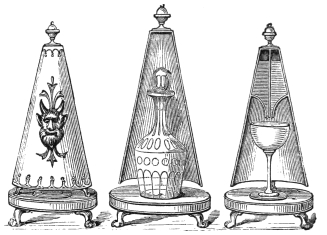
Fig. 209.
The glasses used have no speciality, but the decanter has a small
hole in its under side. This is plugged with a pellet of wax, which,
however, is instantly removeable at pleasure. Of the three stands, two
(those on which the glasses stand) have no preparation, being mere
raised shapes of tin. The third is similar in appearance, but is, in
fact, a hollow box, with three or four little holes drilled in its upper
side, for a purpose
that will presently
appear. Of the three
covers, the centre one
is hollow throughout,
but the other two have
each its upper portion
occupied by a hollow
chamber or reservoir,
divided in two by a
vertical partition, and
tapering down to
a tube with a very
small opening. Each
of these compartments has an air-hole at the top. (See Fig. 209.)
These two covers are beforehand prepared for the trick by filling
the two compartments of each, one with wine, and the other with
water. The air-holes are stopped with pellets of wax, but for the
sake of distinction the “wine” compartment of each is plugged with
red wax, and the “water” compartment with white wax. Any other
distinguishing mark is, of course, equally good. So long as the air-holes
are thus stopped, there is no fear of the liquid running out.
The performer, having filled the glasses as already described, mixes
the contents in the decanter, and in placing the latter on the stand,
removes the wax plug from the bottom, thus allowing the wine to
run out, and to percolate through the above-mentioned holes into the
stand, where it remains. He next places the empty glasses on their
respective stands, and places the covers over them. He then asks
the audience into which of the glasses they desire that the wine
shall travel, and into which the water. When they have made their
decision, he has only to remove the red pellet from the cover which
is over the glass into which the wine is to pass, and the white pellet
from the opposite cover. The tying of the tape from cover to cover
is merely designed to give time for the liquids to reach their respective
destinations, and is, indeed, altogether dispensed with by many performers.
The air-holes may be stopped by means of tinfoil pasted
over them, instead of the wax, if preferred. The foil is instantly
removeable by scraping with the nail.
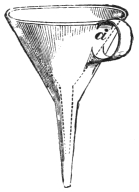
Fig. 210.
The Mysterious Funnel.—This is a little appliance on the
same principle, which may be incidentally introduced with good
effect in the course of a wine trick. It is a tin funnel, made double
throughout, with a space of half-an-inch or so between its inner and
outer sides. It is, in fact, a funnel within a funnel, joined at the
upper edges. (See Fig. 210.) It has an air-hole,
a, generally on the under side of the
handle. When required for use, the hidden
space is filled with wine. The simplest way
of doing this is to stop the spout of the funnel
with the finger, and then to fill it with wine,
which, seeking its own level, will gradually
rise to the same height in the outer space as
it stands at inside the funnel. This must, of
course, be done with the air-hole open. When
the space is filled, the air-hole is stopped, and
the wine remaining inside the funnel allowed
to run out. The funnel will now appear perfectly empty, and may
be used as a funnel in the ordinary way.
The mode of using the funnel is somewhat after the following
manner, subject, of course, to variation, according to the taste and
invention of the performer:—
A juvenile is invited to take a glass of wine, the produce of either
of the preceding tricks. When he has imbibed it, the performer
asks a second juvenile whether he would like a glass also. The reply
is pretty sure to be in the affirmative, but the performer pretends to
find, when about to oblige him, that his store is exhausted. He
begins to apologize for the supposed disappointment, but as if suddenly
bethinking himself, says, “However, you shan’t be disappointed.
If I can’t supply you in the natural way, I must do so in a supernatural
way. Suppose we take back the wine this young gentleman
has just drunk. I don’t suppose it will be any the worse. Let me see,
where is my magic funnel. Oh, here it is. Let us make sure first
that it is quite clean.” He pours water through it, and then holds it
up to the light in such a manner that the audience can see right through,
thus indirectly showing them that it is empty. “Now, sir” (addressing
the youngster who has drunk the glass of wine), “I am going to
take back that glass of wine. Be kind enough to bend your elbow,
and hold it over the mouth of the funnel, so. And you, sir”
(addressing the expectant), “perhaps you will be kind enough to
take this young gentleman’s other arm, and work it gently up and
down. In fact, we are going to transform him into a pump. Now,
sir.” The performer holds the glass under the funnel, and as soon as
the pretended pumping begins, opens the air-hole, when the wine
runs into the glass, and is handed to the second young gentleman as
a reward for his exertions.
Acted with spirit, this little interlude is sure of an uproarious
reception from the juvenile portion of the audience, particularly if the
operator possesses the magic bradawl described at page 332, and makes
use of it to bore a small hole in the victim’s elbow before beginning
to pump the wine from it.
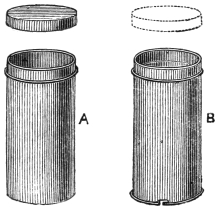
Fig. 211.
The Box of Bran transformed to a Bottle of Wine.—While
upon the subject of wine tricks we may mention this, which
is by no means the least surprising of the illusions to which “the
bottle” gives birth. The necessary apparatus consists of four pieces.
First, a plain cylindrical tin box A (see Fig. 211), japanned to taste,
and about six inches high by three in diameter. Secondly, B, a
similar box, so far as external appearance is concerned, but materially
different in its internal construction. This latter is bottomless, but
has a horizontal tin partition at about three-quarters of an inch from
the top. These two boxes have but one lid, which fits either indifferently.
The third article is a cylindrical pasteboard cover (Fig. 212),
closed at the top, and of such
a size as to fit loosely over B, but an
inch or two taller. The fourth item is
a bottle, made of tin, japanned black,
and of somewhat peculiar construction.
(See Fig. 213.) As a measure
of capacity, it terminates just below
the shoulder, the remainder, or body
of the bottle, being, in fact, merely a
tube closed at the bottom, in which
this upper portion works. A spiral
spring within the body presses the
neck portion upward into its proper
position; but if pressure be applied, the neck portion will sink downward
into the body, as shown in Fig. 214, in which condition it just
fits into B. A small point projects from the lower part of the bottle,
and corresponds with a bayonet catch at the bottom of B, which is in
fact designed as a case or cover for the bottle.
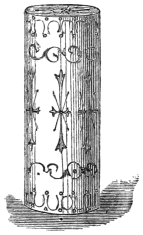
Fig. 212.
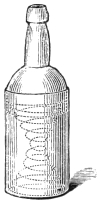
Fig. 213.
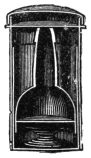
Fig. 214.
For the performance of the trick the operator will require, in addition
to the apparatus above mentioned, an
oblong deal box, half full of bran. (Rice is
sometimes used, but is not so good.) Any
box will answer the purpose, so long as it is
not less than fifteen inches or so in length,
and nine in breadth and depth. In preparing
for the trick, the first step is to fill the bottle,
or the “fillable” portion thereof, with wine
or some other liquid. The bottle is then
corked; B is placed over it and pressed down,
and the bayonet-catch fastened. In this condition,
but without a lid, B is placed in the
deal box, and buried in the bran. The box
of bran being now brought forward and placed
on the table, the performer is ready to begin the trick. He first
draws attention to A, which he hands round for inspection, as also
the pasteboard cover. When they are returned, he brings forward
the box of bran, moving his hand backwards and forwards in it, and
distributing a few handfuls to show its genuineness.
Replacing the box on the table,
he proceeds to fill A with bran.
This he does by dipping A completely
in the box, and scooping
up the necessary quantity. As if
to show all fair, he pours the bran
out again into the box, and then
makes a second dip to refill it.
This time, however, he makes an
exchange, and instead of bringing
up A, brings up B, filling as he
does so the shallow space at the top of the
latter, which thus appears to be full to the brim. Placing it on the
table, and putting the lid on, he places the pasteboard cover over it,
and, addressing the company, volunteers to teach them how to extract
wine from bran, and wine bottles from tin boxes. After a moment’s
pause, and the orthodox touch with the wand, he removes the cover,
giving it at the same time a slight twist, thus releasing the catch, and
removing B within the cover. The spring within the bottle now
meeting no resistance, presses the neck portion upwards into its
proper position, with all the appearance of a genuine bottle; and as
it, in its present condition, is considerably taller than B, it can hardly
be suspected that it was a moment ago concealed in the latter, particularly
as the performer immediately proceeds to give a further
proof of its genuineness by pouring a glass of wine from it.
In connection with the above trick we may describe another useful
piece of apparatus, known as
The Bran Bottle.—This is a bottle, which, being covered over
for an instant, vanishes, leaving in its place a heap of bran. The
bottle is, like that last described, of tin, with a false bottom or partition,
about an inch below the shoulder, so that it holds about a
glassful of wine. The place of the ordinary bottom is supplied by a
disc of tin, with a raised shoulder round it, fitting loosely within the
bottle, so as to drop out by its own weight, unless kept in place by
some external pressure. The cover is a mere cylinder of pasteboard,
closed at the top. The bottle is prepared for use by filling the lower
portion with bran, and putting the bottom in place (where it is retained
by the pressure of the fingers), then filling the upper part with
wine. The performer first pours wine from the bottle, and then places
it on a plate, ostensibly to show that it does not pass through any
opening in the table, but really for a reason which will presently
appear. He now places the cover over the bottle, and on again lifting
it presses the sides slightly, and so lifts the bottle with it. The loose
bottom, having no longer anything to hold it, remains on the plate,
concealed by the bran which pours from the bottle, and into which
the bottle is apparently transformed. Meanwhile, all eyes being
drawn to the heap of bran, the performer lowers his hand, containing
the cover, for an instant behind the table, and relaxing the pressure
of his fingers, lets the bottle slip out on the servante, immediately
coming forward with the cover, and carelessly showing that it is
empty.
In combination with the Bran Bottle, the trick last above described
is greatly heightened in effect, the bottle appearing under the cover
which has just been placed over the tin box—the bran from the latter
being found under the cover which a moment previously concealed
the bottle, and the tin box being found to have passed into the large
box of bran. The Bran Bottle may also be worked with great effect
in combination with the trick of the “Bran and Orange,” described
at page 335.
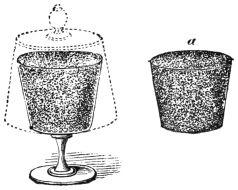
Fig. 215.
Fig. 216.
The Bran Glass.—This is an ingenious and very useful piece of
apparatus. It is made in all sizes, from that of an ordinary wine-glass
to a goblet large enough to hold a rabbit. Its effect is as follows:—The
glass is brought forward apparently filled with bran to
the brim. The performer proves its genuineness by taking up a
handful of it, and scattering it over the stage. A brass cover is now
placed over the glass, and instantly removed, when every particle of
bran is found to have disappeared, and in place of it is found some
article which had been conjured away at some earlier period of the
trick. The explanation is very simple. The glass is shaped as
shown in Fig. 215, with straight sides, tapering outwards. The
supposed bran is really a hollow shape of tin, a, closed at the top,
but open at the bottom, with bran
gummed all over it, and a handful
of loose bran spread on the top.
At each side of its upper edge is
a little wire point, just overpassing
the edge of the glass. The cover
(see Fig. 216), which is of such a
size as to cover the glass as far as
the upper part of its stem, has no
speciality about it, save a shallow
groove running round its upper
edge on the inside, as shown by
the dotted line. When the cover is placed on the glass, and pressed
smartly down, the two points already mentioned are forced into this
groove, which thus grips the tin shape, and when again removed, lifts
it out of the glass, leaving behind whatever article may have been
beforehand placed within.
Where the bran glass is of large size, the metal cover is indispensable;
but for glasses not exceeding the ordinary tumbler size, it
is preferable to cover the glass with a borrowed
handkerchief only, the hollow shape being in
this case made, not of tin, but of thin cardboard.
The two points are dispensed with, but in place
of them there should be a piece of thread, in
length about double the diameter of the glass,
fastened from side to side of the shape. This,
hanging down on the side of the glass which is
toward the performer, is caught hold of through
the handkerchief, and thus handkerchief and shape are lifted together.
The Bran Glass may be made available in a variety of ways; the
trick next following will afford a good practical illustration of its
use.
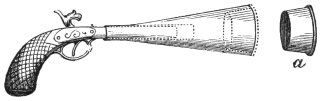
Fig. 217.
To Fire Borrowed Rings from a Pistol, and make them
Pass into a Goblet filled with Bran and covered with a
Handkerchief, the Bran Disappearing, and being found
elsewhere.—The glass used in this instance is of ordinary tumbler
size. It is not brought forward as above, with the bran shape already
in place, but empty, and may therefore be freely offered for inspection.
With it is brought forward a wooden box, of any size and
shape, filled with bran, and in this, ready to hand, is concealed the
bran shape. We have already had occasion to describe the magic
pistol, or rather pistol tube; but the tube used in this instance (see
Fig. 217) has an additional peculiarity. It is of comparatively small
size, being about two
inches wide at the
mouth. Within this
mouth fits easily a tin
cup, a, about an inch
and three-quarters in
depth, and having its
edge turned over outwards all round, so as to afford a ready grip to the
palm when it may be necessary to remove it. The pistol is beforehand
loaded with powder, and the cup above described is placed in
the mouth of the tube.
The performer begins by asking the loan of three rings, to be fired
from his magic pistol. To preclude the possibility of their being
exchanged, he requests the owners to drop them into the pistol
themselves. First, however, by way of wad, he takes a small piece
of white paper, and presses its centre portion into the mouth of the
pistol tube, its edges projecting all round, and forming a sort of cup
to receive the rings. Three rings having been offered, and dropped
into the pistol, the performer closes over the edges of the paper, and
presses them down with his wand, the effect being as if the rings
were fairly rammed down into the pistol, though they really remain in
the cup, just within the mouth. He now hands the pistol to one of
the spectators, requesting him to hold it muzzle upwards above his
head. In handing it to him, he places for a moment his own right
hand over the mouth of the tube, his palm being flat upon it, and in
again removing the hand lifts out and palms the cup (which the projecting
edge enables him to do with perfect ease). He has thus
obtained possession of the rings. (As the holder of the pistol has
been instructed to hold it above his head, he is not very likely to look
into it; but lest he should do so, and discover that the rings are
already removed, it is well to place in the tube beforehand a piece of
crumpled white paper, to represent that which contained the rings.)
The performer now hands round the glass for examination, and
subsequently draws attention to the box of bran. While doing this
he has little difficulty in getting the rings out of the cup and paper
into his right hand. He then, holding the glass in his left hand, dips
it into the box, and fills it with bran, which he forthwith pours slowly
back again to prove its genuineness. Meanwhile, his right hand is
engaged in fishing up the bran shape among the bran, placing it
mouth upwards in the box, and dropping the rings into it. When he
again dips the glass into the box, he slips it mouth downwards over
the shape, immediately turning it into the natural position, and bringing
it up, to all appearance, full of bran. As the rings were in the shape,
they are, of course, now in the glass. He brushes the loose bran off
the top, and then covers the glass with a borrowed handkerchief,
taking particular notice on which side hangs the loop of thread. The
person holding the pistol is now requested to take good aim, and fire
at the glass. He does so, and the performer, lifting the handkerchief
with the shape within it, lets the latter drop on the servante, and
advancing with the glass, requests the owners to identify their rings.
The trick may either end here, upon the supposition that the bran
has been blown away altogether by the explosion, or the bran may be
shown to have passed to some other place. There are numerous
methods of effecting this latter transposition. For instance, the pea
vase (see page 351), first shown empty, may be used, or the bran may be
made to fall out of a second borrowed handkerchief, by means of the
bag shown at page 248, or may be found in the apparatus next described.
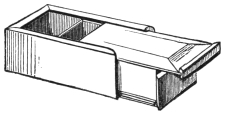
Fig. 218.
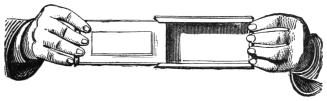
Fig. 219.
The “Domino-Box” (sometimes called the “Glove-Box”).—This
is a little oblong box of walnut or rosewood, measuring about
four inches in length by two inches in width, and an inch and a
quarter in depth. It has a sliding lid, drawing out in the ordinary
manner, but the whole box has a tightly-fitting inner lining, which
may be pulled out, drawer fashion, with the lid. (See Fig. 218.) It
is used as follows:—Any small article, say a glove or a lady’s handkerchief,
is secretly placed inside this inner lining. The performer
exhibits the box to the company, and to show that it is empty, turns
it over towards them, and draws
the lid nearly out, drawing out
with it at the same time the inner
lining or drawer also. (See Fig. 219.)
From the position of the
box, the drawer is, at a very short
distance, completely hidden by the
lid. The box is, of course, seen
to be perfectly empty. The performer now closes it, and turning its
right side upwards, places it on the table. He then proceeds with
the next stage of the trick, and at the right moment again opens the
box, or invites some
one else to do so.
This time the lid alone
is drawn out, and the
hidden article is found
in the box.
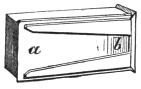
Fig. 220.
There is another
speciality about the Domino-box, which renders it available to cause
the disappearance of a coin placed in it; though, as in the case of the
“Rattle-box,” described in the chapter devoted to coin tricks, the
coin is heard to rattle within it till the very
moment of its disappearance. This is effected
as follows:—Between the bottom of the
drawer and that of the box proper is a very
small space, just large enough to allow a
shilling to lie between the true and false bottom.
On the under side of the drawer, however
(see Fig. 220, showing the under side of the drawer portion), are
glued two thin slips of wood, gradually approaching each other, and
thereby narrowing this space to a width of about half an inch. If
when the lid is withdrawn with the drawer, as already explained, a
shilling or sovereign is dropped into the box, and the box again closed,
the coin will have plenty of room to rattle about as long as it remains
at the end a, but if shaken down with a sharp jerk in the direction
of the end b, it will become caught in the narrower portion of the
opening, and will thenceforth be silent, unless it may suit the purpose
of the performer to release it again, which he can do by a sharp
downward jerk in the direction of a. Of course, as the coin is below
the false bottom, it will appear to have vanished when the box is
opened in the ordinary way.
The Domino-box is sometimes used to change a sovereign to its
equivalent in silver, the “change” being beforehand wrapped in
paper, and concealed in the drawer. It is sometimes also caused to
fill itself with bonbons, in place of a coin deposited in it.
These boxes are usually made in pairs, alike in appearance, but
the one is a simple box without any speciality, and may therefore
be handed round for examination, the mechanical box being adroitly
substituted at the right moment. The fact that two boxes are used
is, of course, carefully concealed.
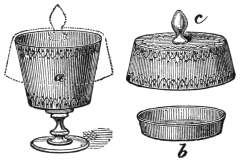
Fig. 221.
The Coffee Trick. (Coffee Berries changed to Hot
Coffee, White Beans to Sugar, and Bran to Hot Milk).—The
pieces of apparatus used in this trick are of brass or japanned
tin, and are three in number, two
being tall cylindrical vases, standing
eighteen to twenty inches in
height, the third a goblet-shaped
vase, of about half that height.
The latter is made upon the principle
of the “bran glass,” above
described, consisting of three portions
(see Fig. 221), the goblet a,
the cover c, and a shallow tray b,
which fits into the goblet, and which, if the cover is pressed down
smartly, and again removed, is lifted off with it. It differs, however,
from the “bran shape” in the fact that b is open at top instead of at
bottom, and is only about one-fifth the depth of the goblet, leaving
therefore considerable space below it. This portion of the apparatus
is prepared for use by placing in the goblet a quantity of hot
milk, putting b in position above it, and finally filling b with loose bran.
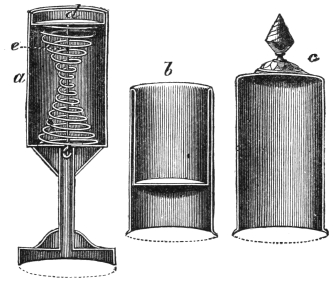
Fig. 222.
The construction of the other two vases will be quickly understood
upon an inspection of Figs. 222, 223. a is the vase, and c
the cover fitting loosely
over it, but between
these two is a well, b,
made double, so as to
fit at once into and
outside of a, after a
mode of construction
which we have more
than once had occasion
to notice. There is a
bayonet-catch at the
lower edge of c, corresponding
with a pin
or stud at the lower
edge of b, so that c may
be lifted off either with or without b. There is a similar catch at the
lower edge of b, corresponding with a stud at the bottom of a, but cut
in the opposite direction to the other catch, so that the action of unlocking
a from b locks b to
c, and vice versâ.
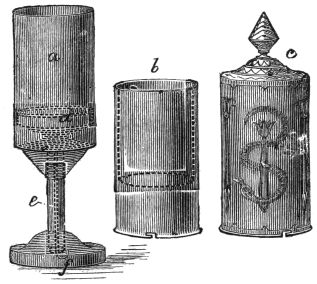
Fig. 223.
The vase a requires
a special description. A
shallow saucer of tin, d,
just fits the interior of
the vase, working up
and down therein piston-fashion,
but prevented
from coming out altogether
by the fact that the
upper edge of a is slightly
turned inwards all round.
Below d is a spiral spring,
whose action tends to
force d to the top of the vase, as shown in Fig. 222. From the
centre of d, however, there extends downwards through the spiral
spring a piece of stiff wire e, with a crook, f, at the end. The foot
of the vase is hollow throughout. If the saucer d is forced down by
pressure from within, this wire, as soon as it reaches the position
shown in Fig. 223, will hook itself within the foot of the vase, and
so keep down d, until the crook is again released, when the whole
will instantly return to the condition shown in Fig. 222. The bottom
of the foot is open, so that the fingers can without difficulty find and
release the crook when necessary.
The vases are prepared by pressing down d in each as shown by
the dotted lines in Fig. 223, and filling the well of the one with hot
coffee, and that of the other with loaf-sugar. Their respective covers
are then placed over them. The attention of the audience is first
directed to a couple of wooden boxes, each about half as long again
as the vases, and ten or twelve inches in depth, one of which is filled
with coffee-berries, and the other with white haricot beans. The
performer now uncovers the vase which contains the coffee, first
turning the bayonet-catch so as to lift off the well b with the cover,
and shows, by holding the vase upside down and rattling his wand
within it, that it is perfectly empty. He now fills it with coffee-berries,
laying it down in the box to do so, and holding it by the foot
with one hand while he shovels the berries into it with the other.
Having completely filled it with the berries, he holds it aloft, and,
to show that there is “no deception,” tilts it, and lets them run
back again into the box. Again he dips it into the box, but, as he
does so, releases the crook (which the fingers of the hand holding the
vase are just in position to do), and thus lets d fly up to the top of
the vase. Again he brings up the vase, apparently full as before, but
really having only a mere layer of berries, of the depth of d, at the
top. He now puts on the cover, the well in which again forces d
and the superposed layer of coffee-berries down to make way for it,
and causes the crook again to catch beneath the hollow of the foot.
The same operation is now gone through with the vase whose well
contains the sugar, and the box of white beans. The performer
lastly takes from the third vase a handful of bran, which he scatters to
show its genuineness, and then places the cover over it. The trick is
now really completed. On removing the respective covers (taking
care of course, first to turn the bayonet-catches in the right direction),
the wells are released from the covers and locked to the vases, which
are thus found full respectively of hot coffee and sugar, and, on removing
the cover of the third vase, the bran is lifted off with it, and
the milk is revealed.
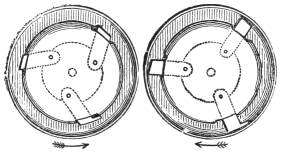
Fig. 224. Fig. 225.
Some coffee vases, and more particularly those of French make,
dispense with the bayonet-catch, replacing it by a peculiar arrangement
inside the top of the cover. The upper edge of the well is
slightly turned in all round, and the turning of the knob at the top of
the cover causes three flat bolts or catches to shoot out circularly from
the edges of a hollow disc,
soldered to the top of the
cover inside, and insert
themselves under this projecting
edge. (See Figs. 224, 225.)
The mechanical arrangement
by which this is
effected is almost impossible
to explain in writing,
though it becomes readily
intelligible upon an actual inspection of the apparatus, and will be
understood without much difficulty after a slight study of the above
diagrams, the arrow in each case indicating the direction in which the
knob must be turned, in order to bring the bolts into the condition
shown in the opposite diagram.
The Inexhaustible Box.—The inexhaustible box is, to all outward
appearance, a plain wooden box, of walnut, mahogany, or rosewood,
in length from twelve to twenty inches, and in depth and width
from nine to fifteen inches. Whatever its dimensions, its width and
depth, exclusive of the lid, must be alike. To prove that it is without
preparation within, the performer turns it over on the table
towards the spectators, and, lifting the lid, shows that it is perfectly
empty. Again he closes it, and, turning it right side upwards, opens
it once more, and instantly proceeds to take from it a variety of
different articles. At any moment the box is again turned over
towards the audience, and shown to be empty; but it is no sooner replaced,
than the performer recommences taking from it toys, bonbons,
etc., the supply being many times larger than could possibly be contained
at one time in the box.
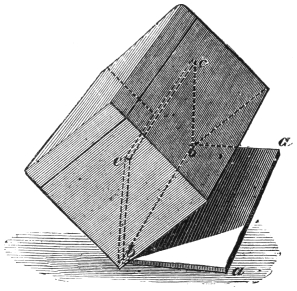
Fig. 226.
The bottom a b of the box (see Fig. 226) is moveable, working on
a hinge b extending along its front. When the box is turned over to
the front, this bottom piece does not turn over with it, but remains
flat upon the table as before. A piece of wood b c, of exactly similar
size and shape, is glued to a b at right angles. When the box stands
right side upwards, this piece lies flat against the front of the box,
whose upper edge is made with a slight “return,” so as to conceal it.
When the box is turned over to the front, this piece, like the bottom,
retains its position, while
any object which had
previously been placed in
the box remains undisturbed,
but hidden by this
latter piece. (See Figs. 226, 227.)
It is, of course,
necessary that such object
should be of such a size
as not to overpass the arc
which the edge of the box
describes in its change of
position, and the length
from b to c must be exactly
the same as that
from a to b.
The mode of using the box will require little explanation. Any
number of objects, not overpassing the limits we have mentioned,
may be placed in the box, which, being then turned over, can be
shown apparently empty. The box being replaced in its normal
position, the articles are again within it, and can be produced at pleasure.
The effect of “inexhaustibility” is produced as follows:—Each
time that the performer turns over the box to show that it is
empty, he takes from the servante, or from his pockets, and places
upon a b, a fresh supply of articles, to be produced as soon as the box
is again right side upwards.
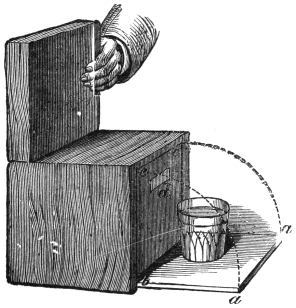
Fig. 227.
It should be mentioned that the hinge at b is made to act freely,
so that the bottom may by its own weight retain its position when
the box is turned over, and not turn over with the box. Some boxes
are made with a catch or pin at some part of a, so as to prevent a b
falling prematurely while the box is being placed on the table, or
while the performer carries round the box, and shows that, inside and
out, it is without preparation. This, however, the performer may
safely do, even without the
use of any catch or fastening,
by taking care to grasp
the box, when carrying it,
by its front edge, with his
fingers inside it. The fingers
will thus press b c
closely against the front
of the box, and will thereby
effectually prevent a b
from shifting its position.
The box is, of course, in
the case supposed, really
empty. The performer has
therefore to make an opportunity
for introducing what
may be needful into it; this
he may do by remarking as he
replaces it on his table, “You are by this time, ladies and gentlemen,
tolerably well satisfied that there is nothing in this box; but for the
greater satisfaction of those who may not have been able to see the
interior as I carried it round, I will once more show you that it is
absolutely empty.” So saying, he turns it over, and once more
shows the interior, at the same time placing on a b whatever article
he designs to produce.
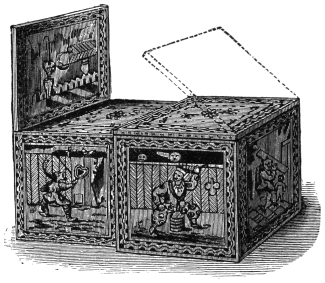
Fig. 228.
The Japanese Inexhaustible Boxes.—This is a form of the
same apparatus, in which an additional element of mystery is produced
by the use of a box within a box. The inner box is an ordinary
inexhaustible box, as last described, but made with a flat wooden lid,
instead of the hollow or “box” lid used in the older form of the trick.
The outer box just fits over the inner, and is, in fact, a mere cover for
it, being an ordinary wooden box, save that it has no front. The
two are brought on one within the other. The performer begins by
taking the smaller box (which is ready filled with the objects to be
produced) completely out of the larger, and shows that the latter is
absolutely empty. He then places the two boxes together, as shown
in Fig. 228, turning over the smaller box to show its interior,
as already described.
After this has been
done, the smaller box
is tilted back to its
normal position within
the larger, the lid
of the latter being
slightly lifted to allow
it to pass, and then
both lids being opened
together, the production
of the contents
commences. The
function of the larger
box is, in fact, merely
to act as a screen to
the hinder part of the
smaller, when turned over towards the audience. The only advantage
of the Japanese over the ordinary box is that it may be worked on
any table, and with spectators on all sides, but this advantage is
counterbalanced by the drawback that nothing can be produced save
what was originally in the box, neither can the smaller box be carried
round, and shown empty. This, however, may be met by beginning
the trick with the two boxes together, and then, after having brought
to light the whole of the original contents, offering (for the pretended
purpose of heightening the effect) to continue the trick without the
aid of the outer box. The inner box may thenceforth be replenished
from behind in the same way as the ordinary Inexhaustible Box.
The Inexhaustible Box is frequently made the vehicle for those
distributions of bonbons, toys, etc., which to the juvenile mind form
by no means the least attractive feature of a magical performance. It
is also available for the production of flowers, multiplying balls
(see page 307), goblets, bird-cages, and the miscellaneous assortment
of articles generally associated with “hat” tricks. One of the most
effective modes of using it is in connection with the very pretty trick
next following.
The Feast of Lanterns.—The performer, having exhibited
the box empty, as already described, turns it over again, and instantly
produces from it a paper lantern of many colours,
with a lighted candle in it. This he hands to his
assistant or one of the company to
hang up at some convenient part of
the stage or room, and returning to
the box produces another, and yet
another, till ten or twelve, or even a
larger number, have been produced,
the box being every now and then turned over to
prove it empty. The effect of a number of lanterns
thus mysteriously produced from an empty box, and
hung about the stage in all directions, is most brilliant.
As the candles do not burn very long, and there may be some
risk of the lanterns catching fire, it is well to make this trick the finale
of the entertainment, and to allow the curtain to fall before the illumination
has had time to lose its effect.
Fig. 229.
Fig. 230.
A great part of the effect of the trick lies in the very considerable
bulk of the lanterns, three or four of which would apparently
be more than sufficient to fill a box from which a dozen or
so are produced. This arises from the construction of the lanterns
themselves, which are of the kind used for Christmas-trees and
illuminations, and when open offer a considerable cylindrical surface
(see Fig. 229), though when closed they are little more than flat discs
(see Fig. 230). They are placed in the box in the condition shown
in the last-mentioned figure; but when lifted out by the wire at top,
at once expand, concertina-fashion, and assume the shape shown in
Fig. 229. They are lighted in sundry ways, one method being as
follows:—Each lantern contains about three-quarters of an inch of
candle, from which the wick has been removed, and a wax match
inserted in its stead. Against the front of the box, or rather
against the wooden flap b c (see Fig. 227), is glued a tablet d of sandpaper
upon which to strike the match, and a gentle rub against this
instantly lights the candle, when the lantern is immediately lifted out,
as already explained. There is, however, an improvement whereby
the lanterns are not only made to occupy much less space, but may be
lighted simultaneously. In this case the little cylinder which forms
the socket for the candle, and which should be about half an inch in
diameter, instead of occupying the middle of the space at the bottom
of the lantern, is placed at one side of such space. One of the lanterns,
viz., that which is to be undermost when they are grouped
together, has no further preparation; but the second, by the side of
its own socket, has a round hole in the bottom, just large enough
to give room for the socket of the first. The next, or third lantern,
has two holes, allowing the passage of the sockets of the first and
second. The fourth has three holes, the fifth four, the sixth five, the
seventh six, and the eighth seven, so that when the lanterns are placed
one upon another in proper order, the sockets of the lower lanterns
come up in a circle through the holes in the bottom of the uppermost
one. The tops and bottoms are made of tin, which is not only safe
from catching fire, but occupies very little space. In this case the
original wicks of the candles are retained, but are slightly moistened
with turpentine to render them instantly inflammable, and are lighted
by a lucifer or wax match struck in the ordinary way, the merest
touch sufficing to ignite them. They may then be lifted out in rapid
succession with great effect. A group of six or eight lanterns thus
prepared may be produced from a borrowed hat, being previously concealed
in the breast or tail-pocket of the performer, and “loaded”
into the hat at any convenient opportunity. It is desirable in this
case to have a friction tablet glued upon the top of the uppermost
lantern to strike the match upon, as the hat lining is hardly adapted
for that purpose.
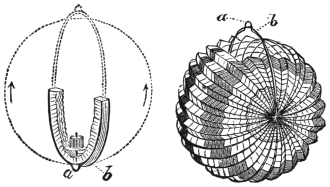
Fig. 231. Fig. 232.
The lanterns above described are the most generally used, and are
by much the easiest to manipulate. There is, however, a spherical
lantern also obtainable at the toy-shops, which has a decidedly prettier
effect. This form of lantern is, when shut up, as shown in Fig. 231.
To develop it, the wires a and b are each made to describe a semi-circle,
as shown by the dotted line, bringing the whole into the
condition shown in Fig. 232, in which condition it is maintained by
slipping the loop of a under b. The best plan for lighting in this case
is to have a separate
small piece of candle,
prepared with a match
wick, as above-mentioned,
placed in readiness
on the servante,
and a small pin or
sharp nail projecting
upwards from the bottom
of the box to act
as a candlestick. The
candles in the lantern
will in this case need no special preparation. The performer first
lights the prepared candle by rubbing it against the tablet, and then
presses it down upon the upright pin we have mentioned. The other
candles are in turn lighted from this, each lantern being put into
shape before being lifted out of the box, which must in this case be
of tolerable size, in order to admit of their ready development.
The Butterfly Trick.—This is a trick of Japanese origin,
which became very popular two or three years since. In effect it is
as follows:—The performer brings forward an ordinary fan, and a
couple of bits of tissue-paper, each torn into a fanciful likeness of a
butterfly. Taking these upon his hand, he gently fans them, the
motion of the air speedily causing them to rise above his head. Still
gently fanning them, he causes them to hover, now high, now low,
now fluttering along the wall, now descending into a gentleman’s
hat, whence they presently emerge to again flutter hither and thither
at his pleasure.
The point that most strikes an attentive observer is the fact that,
whether they fly high or low, the butterflies always keep together.
Sometimes they may be a couple of feet apart, sometimes only a few
inches, but they never exceed the above limit; and the spectator
naturally concludes that an extraordinary degree of dexterity must be
necessary to enable the performer to keep them from diverging more
widely. Here, however, in truth lies the secret of the trick, which is,
that the so-called butterflies are connected by a piece of very fine
silk a couple of feet in length, which, when the butterflies are in
motion, is absolutely invisible to the spectators. The remainder of
the trick is a matter of practice, though it is less difficult than would
be imagined by any one who had never attempted it.
Some performers have the silk thread attached to one of the buttons
of the coat. This arrangement will be found greatly to facilitate
the working of the trick.
The paper for the butterflies is better torn than cut, and should be
as nearly as possible of the shape of a St. George’s cross, and about
two inches square.
The Wizard’s Omelet. (Borrowed Rings and Live Doves
produced from an Omelet.)—This is a trick which always produces
a great sensation, whether performed upon the stage or in the
drawing-room. Its effect is as follows: The performer produces
either naturally or magically (e.g., from the egg-bag, or from the
mouth of his assistant, as described at page 329) three eggs, which
he hands round for examination. His assistant next borrows from
the audience three ladies’ rings, receiving them, in order to prove that
he does not tamper with them in any way, on the performer’s wand
instead of in his hands. The wand, with the rings still upon it, is
laid upon the table. The assistant next brings in an omelet pan, and
places it, with its lid beside it, on the table. The performer breaks
the eggs into it, dropping in shells and all—then pours some spirits
over it, to which he sets fire, and while it is still blazing drops the
rings from the wand into it. He brings it forward to show that the
rings are really in the flames; and on returning to his table, claps
the cover on the pan, and fires a pistol (any ordinary pistol) over it.
Without a moment’s interval, he again removes the cover. All traces
of the omelet and egg-shells have vanished, but in their place are
found three live doves, each with a ribbon round its neck, to which is
attached one of the borrowed rings.
The explanation of this surprising result is simplicity itself. The
reader, with his present knowledge, will readily conjecture that, as to
the rings, a substitution is effected; but he may not so easily guess the
manner of such substitution. It will be remembered that the rings
were collected by the assistant on the performer’s wand. This
arrangement, which is ostensibly adopted to prevent, in reality facilitates
an exchange. The assistant makes his collection with three
dummy rings placed beforehand on the lower end of the wand, and
concealed by the hand in which he holds it; which, we will suppose,
is the right hand. In returning to the stage, he takes hold with the
left hand of the opposite end of the wand, and allows the borrowed
rings to run down into that hand, at the same moment
releasing the dummy
rings from the right
hand, and allowing
them to run upon the
middle of the wand
in place of the others.
He now has the borrowed
rings in his
left hand, and (laying
the wand with the
substitutes on the
table) carries them off
with him to prepare
for the dénouement of
the trick.
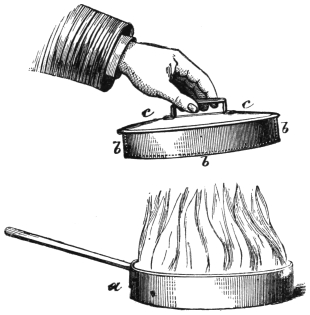
Fig. 233.
The only other
matter which will require
explanation is
the construction of the omelet pan. This is a shallow pan of brass or
tin, about ten inches in diameter, by two and a half in depth. Within
this is an inner pan, also of brass or tin, fitting tightly within it, but
about half an inch less in depth. The lid is made with a very deep
rim or shoulder all round, and just fits within the lining, though less
tightly than the latter fits within the pan. (See Fig. 233, in which a
represents the pan, b the lining, and c the lid.) The assistant, as
soon as he gets behind the scenes, loops the borrowed rings to the
ribbons, which are already tied round the necks of the three doves,
and places the latter in b, immediately putting on c (the two together
having the appearance of a simple cover), and brings forward the pan
and cover. The performer now makes his omelet, and drops the
substitute rings into it. In bringing forward the pan to show that
the rings are really there, he takes care to avoid the owners of them,
who would alone be likely to detect the substitution. When he claps
on the cover, the trick is really done, the firing of the pistol being
merely for effect. When the cover is again removed, the lining
remains in the pan, concealing the omelet beneath it, and revealing
the doves, with the rings attached to their necks.
The Rose in the Glass Vase.—The ingenious piece of apparatus
which we are about to describe was, we believe, the invention
of Robert-Houdin. It consists
of a glass vase, on a foot, and with
a glass lid, standing altogether
eight to ten inches in height.
This is placed on a square box-like
plinth or pedestal, of wood
covered with morocco, and measuring
about eight inches square by
six in height. The lid is placed
upon the vase, which, being transparent,
is clearly seen to be empty.
A borrowed handkerchief is for a
moment thrown over the whole,
and again removed, when a handsome
rose (natural or artificial) is
seen to have mysteriously found
its way into the vase; whence it
is removed, and handed to the
company for inspection.
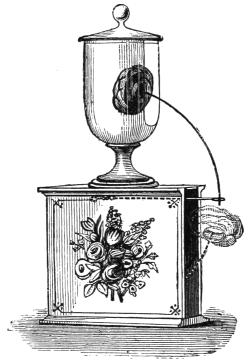
Fig. 234.
The secret of this mysterious
appearance is twofold, lying partly in the vase and partly in the
pedestal. The vase, which at a little distance appears as simple and
commonplace as any in a confectioner’s window, has a segment cut
off one side, leaving an opening of about five inches in height by three
and a half in width. (See Fig. 234.) This opening is kept turned
away from the audience. The pedestal, like the vase, is closed on
every side except the side remote from the spectators, which is open.
A curved wire arm, with a “clip” at the end to receive the stalk
of the rose, works up and down, describing a quarter of a circle, in
this open space. A spring hinge, on which this arm works, impels
it to assume the position shown in the figure, thus lifting the rose
through the opening into the vase. The apparatus is set by forcing
down the arm with the rose into the position indicated by the dotted
lines, in which position it is retained by a little catch, until the performer,
in the act of covering the vase with the handkerchief, presses a
stud at the upper side of the pedestal. This withdraws the catch, and
allows the rose to rise into the vase. Of course, the performer in
taking out the flower does so from the top, and with proper precautions
not to disclose the existence of the opening at the back of the vase.
The ingenuity of the reader will probably suggest to him combinations
to make the trick more effective. To those who have not
such ready invention, we may remark that the trick may be very
effectively combined with that of the ball that changes to a rose, and
vice versâ (see page 300), or a duplicate rose may be placed in the
mouchoir du diable (described at page 195), and thence ordered to pass
to the vase.
Fig. 235.
The Chinese Rings.—These are rings of brass or steel, in diameter
from five to nine inches, and in thickness varying from a
quarter to three-eighths of an inch. The effect
of the trick to the spectator is as follows:—The
rings are given for examination, and found
to be solid and separate; but at the will of the
operator they are linked together in chains of
two, three, or more, becoming connected and
disconnected in a moment, and being continually
offered for examination. Finally, after the
rings have become involved in an apparently inextricable
mass, a slight shake suffices to disentangle them, and to
cause them to fall singly upon the stage.
Fig. 236.
The sets of rings sold at the conjuring depôts vary in number,
ranging from six to twelve. The set of eight, which is perhaps the
most usual number, consists of one “key” ring, two single rings, a
set of two linked together,
and a set of
three linked together.
The “key” ring (see
Fig. 235), in which
lies the secret of the
trick, is simply a ring
with a cut or opening,
a, in it. For use
upon a public stage,
where the performer
is at a considerable
distance from his audience, there may be a gap of an eighth of an inch
between the ends, but for drawing-room use, they should just touch
each other. Some rings are made
to “clip” like an ear-ring, and
some have the opening cut diagonally
instead of square, but the
simple square cut is, in our own
opinion, the best.
Fig. 237.
We shall, in the first place,
describe the trick as performed
with the set of eight rings above
mentioned, afterwards noticing
the more elaborate performance
with twelve. We must premise,
however, that the manipulation of
the rings admits of almost infinite
variation, and that the practice of
performers differs greatly as to
the mode of working them.
Fig. 238.
Fig. 239.
Fig. 240.
Fig. 241.
The performer comes forward holding the eight rings in his left
hand, arranged as follows. First (i.e., innermost), comes the set of
three; then the “key” ring (the opening uppermost in the hand),
then the set of two; and, lastly, the two single rings. Taking the
first of these, he hands it to a spectator for examination; passing it
when returned to another person,
and carelessly handing a second ring
to be examined in like manner.
This should be done without any
appearance of haste, and with an air
of being perfectly indifferent as to
how many of the rings are examined.
The two “singles” having
been duly inspected, the performer
requests one of the spectators to take
them both in his right hand, at the
same time taking in his own right
hand the next two rings, which, it
will be remembered, are the set of
two, though the audience naturally
believe them to be, like the first, separate. “Now, sir,” the professor
continues, “will you be good
enough to link one of the rings
which you hold into the other.”
The person addressed looks more
or less foolish, and finally “gives
it up.” “You can’t?” says the
performer, in pretended surprise.
“My dear sir, nothing is easier.
You have only to do as I do.
See!” Laying down the rest
of the rings, he holds the two
as in Fig. 236, and makes a
gentle rubbing motion with the
thumb upon the rings, and then
lets fall one of them, which
naturally drops to the position
shown in Fig. 237. He now
hands these two rings for examination. The spectators seek for some
joint or opening, but none is found; and meanwhile the performer
transfers the next ring (the “key”) to his right hand, keeping the
opening under the thumb. He now takes back with the left hand
the two single rings, immediately transferring one of them to the
right hand, and with the ball of the thumb presses it through the
opening in the key ring, into which it falls, with exactly the same
effect as the apparent joining of the two linked rings a moment
before. Again he separates and again joins the two rings. The
second single ring is now made to pass through in like manner,
making the combination shown in Fig. 238. The performer remarks,
“We now have three joined together.
Here are three more, as you
see (shaking those in the left hand),
all solid and separate, and yet at my
will they will join like the others.”
Making a rubbing motion with the
thumb as before, he drops two of the
three, one by one, from the hand,
when they will appear as a chain of
three. These he hands for examination,
taking back the set of two, and
linking them one after the other
into the key ring, to which now four
rings are attached. Again taking
back the set of three, he links these
also one by one into the key ring,
which thus has seven rings inserted
in it. (See Fig. 239.) Using both
hands, but always keeping the opening
of the key ring under one or the other thumb, he now takes off
these seven rings, commencing with the two single ones, and again
offering them for examination; then taking off the set of two. Last
of all, he unlinks the set of three, and then, holding them at length in
his left hand, joins the upper one to the key ring, thus making a
chain of four, of which the key ring is the uppermost. He next takes
the lowermost ring of the four, and links that into the key ring,
bringing the four rings into a diamond shape, as shown in Fig. 240.
Again unlinking the lower ring, he takes up the set of two, and connects
them with the key ring, holding them up above it, thus making
a chain of six, the key ring being third from the top. (See Fig. 241.)
Taking the upper ring between his teeth, he links the two single rings
into the key ring on either side, making the figure of a cross, as
shown in Fig. 242. As the hands are now occupied in holding the
single rings forming the arms of the
cross, he can no longer keep the
opening of the key ring concealed by
the thumb, but it is extremely unlikely
that among so many rings, so
slight a mark in one of them will
attract notice. Regaining possession
of the key ring, he links all one by
one into it, so as again to bring them
into the condition depicted in Fig. 239.
Then, holding the key ring
with both hands, and with the opening
downwards, about a couple of
feet from the floor (see Fig. 243), he
shakes the rings violently, at the
same time gently straining open the
key ring, when the seven rings will
all in succession drop through the
slit, and scatter themselves about the
floor, the general impression being
that they all fall separate, though the
grouped sets, of course, remain still
united.
It is not an uncommon thing to
see a performer commit the gaucherie
of handing all the rings, save only
the key ring, to be examined in the first instance; the key ring being
hidden under the breast or under the tail of the coat, and being added
to the set in returning to the table. The spectators are thus needlessly
made acquainted with the fact that certain of the rings are already
linked together, and this once admitted, the trick loses nine-tenths of
its effect.
Fig. 242.
Fig. 243.
The set of twelve rings is less frequently seen, and is rather more
complicated to manage, though in good hands it is capable of much
more brilliant effects than the smaller number. The set consists of
five single rings, a group of two, a group of three, and two key rings.
These are held in the hands of the performer in the following order.
First (i.e., innermost) a key ring, then the group of three, then the
second key ring, then
the group of two, and
lastly the five single
rings. The latter are
distributed for examination.
While they
are still in the possession
of the audience,
the performer requests
one of the spectators
to link two of them
together, and himself
taking in his right
hand the group of
two, pretends to link
the latter, as already
described, and hands
them for examination.
The performer meanwhile
takes in his
right hand one of the
key rings, and collects
the single rings in his
left. As soon as the
group of two are handed back, he links one of them to the key ring
in his right hand, thus forming a chain of three, with the key ring
uppermost. Next linking the lowest ring into the key ring, he forms
Fig. 238, which, by holding the two lower rings apart, assumes the
shape of a triangle. Again disengaging the lower ring, passing one
of the single rings from the left hand to the right, and laying down
on the table all the rings remaining in that hand (the group of three
uppermost) he joins the single ring to the key ring, thus making a
chain of four, of which the key ring is second from the top. These
he lays, still linked, upon the table, and takes up from the heap
already lying there the three uppermost (which, it will be remembered,
are the group of three), and holding them for a moment
together in the hand, lets them fall one by one to form a second
chain of three. Taking
the next ring of the heap
(the second key ring) in
his disengaged hand, he
steps forward, and requests
some one to take hold of
either of the three rings,
and to pull against him, in
order to prove their solidity.
This ascertained, he passes
the upper ring of the three
into the hand which already
holds the key ring, and links
it into the key ring, thus
forming a second chain of
four, of which in this case
the key is the uppermost.
Linking the lowermost into
the key ring, he shows the
rings as in Fig. 240. Once
more unlinking the lower
ring, so that the four again
appear as a single chain, he proceeds (apparently) to link all the
twelve together. This is effected as follows:—
Taking two of the single rings, the performer links them into the
key ring of the chain which he holds. He next links one of these same
single rings into the key ring of the other chain, thus linking the two
chains together at a distance of one ring from the end of the chain.
He thus has ten rings joined. He now takes the two chains one in
each hand by the ends remotest from the point of juncture, immediately
after picking up and holding (one in each hand) the two remaining
single rings. These, of course, he does not and cannot link with the
rings adjoining them, but the audience seeing that all the rest are
linked together, readily believe that these also form part of the chain.
The precise arrangement of the rings will be readily understood from
an inspection of Fig. 244.M

Fig. 244.
The feat may either end here, the rings, still linked, being gathered
together and carried off by the assistant, or the performer may link all
one by one into either
of the key rings, and
then shake them out
and scatter them on
the floor in the manner
already described
as to the eight rings.
The performance may
be elaborated to any
extent, the two key
rings giving a wonderful
facility of combination,
but whatever
be the passes
adopted they should
not be too numerous,
as the trick, however
skilfully worked, consists only of repetitions of the same primary elements,
and the interest of the spectators will quickly diminish.
The performer should, in manipulating the rings, study neatness
and lightness, rather than rapidity. The effect should be as though
the rings melted into and out of one another, and the smallest appearance
of force or exertion should be avoided. It has a very good effect
in disengaging the rings one from another, to hold them together for
a moment or two after they are actually disconnected, and then holding
them parallel to each other, to draw them very slowly apart.
The precise moment of their separation is thus left uncertain, the
illusion being thereby materially heightened. A single ring may in
this way be drawn along a chain of three or four, the effect being as
if the disengaged ring passed through the whole length of the chain.
The Charmed Bullet.—As a rule, people object to being shot
at, and the least nervous person might fairly demur at facing the
muzzle of a loaded pistol at six paces’ distance; but the magician is
superior to such weakness, and will face a bullet with as little compunction
as he would stop a ball at cricket. Neither must it be
imagined that there is any “deception,” at any rate in the quality of
the articles employed. The pistol is a real pistol, the powder is
genuine powder, and the bullet—an ordinary leaden bullet—is chosen
and marked by one of the audience, fairly placed in the pistol, and
fairly rammed home. The pistol is fired with deliberate aim by a disinterested
spectator; but no
sooner has the smoke cleared
away than the performer is
seen standing unharmed,
with the marked bullet
caught between his teeth.
So much for the effect
of the trick; now for the
explanation. The pistol (see Fig. 245) is, as already stated, an ordinary
weapon, and the only speciality of the bullets is that they are a size or
two smaller than the bore of the pistol. The ramrod, b, is a plain
cylinder of wood or metal, tapering very slightly at each end.
The secret lies in the use of a little metal tube a, about two inches in
length, open at one end, but closed at the other. This tube, which is
of such a size as to fit loosely within the barrel of the pistol, but
tightly upon either end of the ramrod, is placed in the right-hand
pochette of the performer, and a small bag of bullets in the pochette
on the other side.
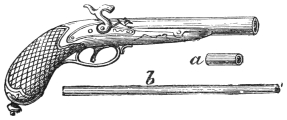
Fig. 245.
The performer comes forward with the pistol in one hand and the
ramrod in the other, and having a small charge of gunpowder, screwed
up in a bit of soft paper, concealed between the second and third
fingers of his right hand. He hands the pistol and ramrod for inspection.
While they are under examination, he asks, “Can any lady
or gentleman oblige me with a little gunpowder?” Nobody answers,
and he continues, addressing some mild elderly gentleman, “Perhaps
you can accommodate me, sir?” The elderly gentleman naturally
replies that he is not in the habit of carrying gunpowder about with
him. “Excuse me,” says the performer, “but I fancy you have a
small packet of powder under your coat-collar. Permit me!” and
drawing his hand gently down beneath the collar, he produces the
little packet. This he hands to the person who is holding the pistol,
with a request that he will load it. While he puts in the powder,
the performer drops his left hand to the pochette, and palms the
little bag of bullets, which he forthwith produces from a gentleman’s
hat, or a lady’s muff.N From among the bullets he requests
the person who put in the powder to select and mark one.
While this is done, he himself takes the pistol in his left hand, holding
it muzzle upwards, and in the act of transferring it with apparent
carelessness to the other hand, secretly drops into it the little tube,
the open end upwards. The spectator having chosen and marked the
bullet, is requested, for greater certainty, to place it in the pistol himself.
A very minute portion of paper is added by way of wad, and
the performer then takes the pistol, and rams it down. The bullet,
of course, has fallen into the little tube, and as the ramrod fits tightly
within the latter, it naturally, when withdrawn, brings out tube and
ball with it. The tube and ramrod are made to match (generally
black, but sometimes of brass or silver-plated); and therefore the
tube, when on the rod, even if exposed, would not be likely to attract
attention. The performer, however, prevents the possibility of its
doing so, by holding the rod by that end, thereby concealing the tube
with his hand. He now hands the pistol to a spectator, requesting
him, for fear of accidents, to hold it muzzle upwards until the word
to fire is given. The performer now takes up his position at the
furthest part of the stage, and during his short journey gains possession
of the bullet. This is effected by sharply drawing away the
ramrod with the left hand, thereby leaving the tube open in the right,
and allowing the ball to roll out into the palm. The tube, having
served its purpose, is got rid of into the profonde, and the ball is either
slipped into the mouth or retained in the hand, according to the mode
in which it is intended to be produced.
Some performers use several small bullets. In our own opinion,
a single ball of tolerable size is not only more manageable, but more
effective. The mode of producing the bullet also varies. Some, instead
of producing it in the mouth, hold up a china plate by way of
target, the bullet being held under the two first fingers against the
front of the plate. When the pistol is fired, the plate is turned horizontally,
and the bullet released from the fingers. This plan is sometimes
to be preferred, inasmuch as it creates an excuse for leaving the
stage for a moment to fetch the plate, an opportunity which is valuable
in the event, which sometimes happens, of the ball, from an
excess of wadding or any other cause, not dropping readily from the
tube into the hand. To meet this possible difficulty, some tubes
have (to use an Irishism) a small hole through the closed end, so that
the performer, on leaving the stage, can, by pushing a piece of wire
through the hole, instantly force out the bullet.
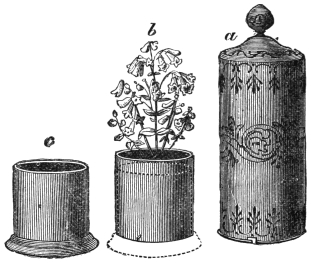
Fig. 246.
The Birth of Flowers.—There are two or three different
tricks which go by this name. Of one of them we may dispose in a
very few words. It is purely a mechanical trick, having neither
ingenuity of construction nor dexterity of manipulation to recommend
it. The apparatus consists of a cover a (see Fig. 246), a
base c, and an intermediate portion b, connected with a by means
of a bayonet-catch; c is beforehand partially filled with earth, and in
b, the top of which is perforated with small holes, is inserted a natural
or artificial plant, or bouquet of flowers. The cover a is placed
over b, and the apparatus is ready. The performer, drawing attention
to c, pretends to sow some magic seed therein. He then places a
over it, and pretending to warm it with his hands, commands the
seeds to germinate. Releasing the bayonet-catch, he removes the
cover, and shows the flowers apparently just springing from the earth
in c. In some of the smaller sizes of this apparatus the bayonet-catch
is dispensed with, the mere pressure of the fingers on the sides
of a being sufficient to lift off b with it.
The trick which we are about to describe under the same title is
one of a composite nature, and one which, proceeding from marvel
to marvel, produces in good hands a great effect. It is divided into
three portions—first, the production of a single flower, then of a
handsome bouquet, and
lastly, of a large basket
of flowers. The performer
comes forward
with his wand in one
hand, and in the other
a little box, in reality
quite empty, but containing,
as he asserts,
magic seeds, capable of
producing on the instant
the choicest flowers. “I
will first show you, ladies
and gentlemen, their
effect in the simplest
form. In the hurry of coming here this evening, I omitted to provide
a flower for my button-hole. You will see how easily, by the
aid of the magic seed, I can supply the deficiency. What shall it
be? Clematis, rose, geranium? Suppose we say a rose. I take a
single seed from my box—ah, here is a rose-seed—and place it in
my button-hole.” (He applies the supposed seed to the button-hole.)
“I breathe on it to supply the necessary warmth. I wave my wand—Once!
twice! thrice! The seed has blossomed, you see, into a
handsome rose.”
The explanation of this pretty little trick is exceedingly simple.
The preliminary preparation is made as follows:—Through the centre
of an artificial rose, without stalk, a short piece (about ten inches) of
thin black elastic is passed, and secured by a knot on the inside of the
flower. The other end is passed through the button-hole (from the
outside), and thence through an eyelet-hole made for the purpose in
the breast of the coat, immediately under the button-hole. The
extreme end is looped over a button sewn on the waistcoat
about the region of the waistband. The tension of the elastic
naturally draws the flower close against the button-hole, while yet
allowing it, when necessary, to be drawn away from it to a distance
of several inches. The performer, before coming forward to perform
the trick, draws the rose away from the button-hole, and places it
under the left armpit, whence, so long as the arm is kept close to
the side, it cannot escape. When he waves his wand, with the
words, “Once, twice, thrice!” he makes the first motion facing
to the right, the second fronting the audience, and the third facing
slightly to the left, at the same time striking the button-hole with the
wand, and throwing up the left arm, when the flower, released,
instantly springs to the button-hole, the slight turn to the left completely
covering the manner of its appearance.
Fig. 247.
But the trick is not yet over. “You see, ladies and gentlemen,
that I am not dependent on Covent Garden for a rose for my button-hole;
but you will naturally say, ‘Ah! the magic seed may be all
very well for a single flower, but what if you wanted a complete
bouquet?’ I hasten to show you that this is equally within my
power. Will some one oblige me with the loan of a hat by way of
hothouse? Thank you. Here; you
observe, is an ordinary drinking-glass”
(this has, meanwhile, been
placed on the table by the assistant),
“in which I will drop, haphazard, a
pinch of the magic seed.” This he
does with the left hand, the right
being occupied with the hat, and
then, with the glass in the left hand
and the hat in the right, comes forward to the audience, requesting a
lady spectator to breathe upon the glass, which he immediately afterwards
covers with the hat. He now requests the same or another
spectator to count ten, to allow the mesmeric influence time to operate,
and then, removing the hat, shows a handsome bouquet (natural
or artificial) in the glass. Returning the hat, and handing the glass
and flowers for inspection, he borrows a silk pocket-handkerchief, or,
in default of procuring one from the audience, uses one of his own,
brought forward by the assistant. Drawing it ropewise through his
hands to show that it is empty, he spreads it before him, holding it
by two of its corners. Having exhibited one side of it, he spreads
the other, when the shape of something solid is seen to define itself
beneath it, and the handkerchief being removed, a large round basket
of flowers (see Fig. 247), ten or more inches in diameter by two deep,
is revealed.
The reader, with his present knowledge, will probably have
already conjectured the mode in which the bouquet is brought into
the glass. It is beforehand placed at the left hand corner of the
servante, the stem slanting upwards at an angle of about 45°. When
the performer, standing at the left hand side of the table, drops the
imaginary seed into the glass with his left hand, his right, holding the
hat, drops for a moment to the level of the table, and clips between
the second and third fingers the stem of the bouquet, when, by
simply bending the fingers, the bouquet is brought into the hat after
the manner of the cannon-ball. (See page 305.) When the hat
is placed over the glass, the bouquet is naturally brought into the
latter.
We may here mention that there are bouquets of a special and
rather ingenious construction, enabling the performer, in the act of
producing the bouquet from a hat in the above or any similar trick,
to cause it suddenly to expand to three or four times its original size.
The bouquet is in this case made of artificial flowers, stitched on a
framework forming a kind of miniature parasol, with a very short
handle. The bouquet, when introduced into the hat, has a slightly
conical shape, but the performer in withdrawing it puts up the parasol,
so to speak, thereby spreading it to twelve or fourteen inches’
diameter.
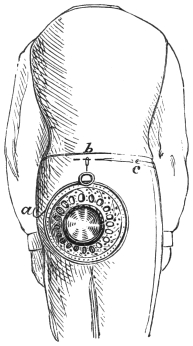
Fig. 248.
Fig. 249.
The production of the basket of flowers from the handkerchief is
produced by wholly different means, and will require a somewhat
minute explanation. In the first place, the flowers are secured to the
sides of the baskets by silk or wires, so that they cannot fall out, in
whatever position the basket is placed. To the basket are attached
two black silk threads. The one (which we will call a) is about
eighteen inches in length, and is attached to a button on the performer’s
waistband, immediately above the front of the left thigh.
Obviously, therefore, the basket, if fastened
by this thread alone, would hang
down loosely in front of the performer’s
left knee. The second thread (which
we will call b, and which is attached
to the edge of the basket at a few
inches’ distance from the first) is only
three or four inches in length, and
serves to suspend the basket behind the
back of the performer (concealed by his
coat) until the proper moment for its
appearance. For this purpose it has a
small loop or ring at the loose end, and
this is attached by means of a strong
short needle, after the manner shown
in Figs. 248 and 249 (the latter representing
a slightly enlarged view of the
attachment), to the waistband of the
performer. The needle carries a third
thread c, which, passing through the cloth of the trousers, is brought
round and attached to the centre button of the waistband, being concealed
by the edge of the
waistcoat. The modus
operandi will now be easily
understood. The basket
is in the first instance
suspended by the thread
b. The performer, while
spreading the handkerchief
before him, ostensibly
to show that it is
empty, crooks the little
finger under the edge of
his waistcoat, and pulls c,
thereby withdrawing the
needle, and detaching b. The basket, being no longer held back by b,
falls, but is compelled by a to swing round in front of the performer,
who, while lifting it, still covered by the handkerchief, breaks a, and
thus altogether releases it. The object of passing the needle through
the cloth of the trousers is that it may not fall forward and be seen
when c is pulled.
The contrivance last above described is the invention of Robert-Houdin,
slightly simplified, however, inasmuch as he employed,
in place of the needle, a little wire bolt working on a metal plate
attached to the back of the waistcoat; but the principle in either case
is precisely the same.
Fig. 250.
The Mysterious Salver.—This is a tin tray (see Fig. 250),
ornamentally japanned, and of about twelve inches in diameter.
There is a space of about three-quarters of an inch between the upper
and under surfaces of the tray, at one side of which, under cover of
the curled rim, is an opening of about three inches in width. Within
this opening, so placed
as to be within easy
reach of the fingers of
any person holding the
tray, are two wire
hooks, marked a and
b in the figure. On
gently pulling hook a,
a little hammer c rises
up at right angles to
the surface of the tray,
again falling back by
the action of a spring
as soon as the pull is
relaxed. On pulling
b, a similar movement is communicated to a sort of ladle d, sunk in
the surface of the tray, and rising up in a direction parallel to that of
the little hammer already mentioned. This ladle has a flat tin cover,
hinged very loosely upon its outer edge (so as to open of its own
accord when the ladle passes the perpendicular position), and japanned
in such manner as to represent one of a circle of medallions forming
part of the pattern of the tray, and therefore little likely to attract
attention. If any small article be beforehand placed in the ladle, and
b be pulled, the article will naturally be flung out upon the surface of
the tray. In practice, however, the salver is always used in conjunction
with a little glass tumbler, about three inches in height, which,
being placed upon the medallion opposite to that which forms the
cover of the ladle, the contents of the latter fall into the glass instead
of upon the tray.
The salver is generally used somewhat after the following
fashion:—A little round brass box, say an inch and a half in diameter
and an inch deep, is handed to the audience, with a request
that they will place any small article (such as a coin, a ring, a watch-key)
in it. All necessary precautions are taken to prevent the performer
knowing what the articles in question are, and the box is, for
still greater security on this point, wrapped by the performer in a
handkerchief, and handed to one of the audience to hold. The
reader, with his present knowledge of the little faith that is to be put
in the acts of magicians, however apparently straightforward, will
readily conjecture that at this point there is a substitution. The
performer, apparently wrapping up the box which has just been
handed to him, really substitutes another of similar appearance, sewn
in one corner of the handkerchief. This latter, which contains two
or three metal buttons, or other objects adapted to cause a rattling
when shaken, is so arranged that when the lid is pushed home a
piece of cork within is pressed down upon the buttons, and they
are made silent; but if the lid be raised ever so little, and the box
shaken, they rattle. This latter is the condition in which the box is
wrapped in the handkerchief.
The performer, leaving the dummy box, wrapped up as above,
with the spectator, retires for a moment in order to fetch the salver.
This gives him the opportunity to take the articles out of the box,
to note what they are (we will suppose a ring, a florin, and a locket),
and place them in the “ladle” of the salver. The empty box he
places in one of his pochettes. He now brings forward the glass
and salver, together with a paper lamp-shade (similar to those
placed over the lights of a billiard table), wherewith to cover the
salver while the supposed flight of the objects takes place. He first
shows that there is nothing in his hands, on the salver, or in the glass,
and then places the latter in its proper position, and covers the whole
with the paper shade. His assistant holds the salver, using both
hands, with his right in such a position as to have control of the
hooks a and b. The performer requests the person holding the box
to shake it, in order to show that the articles are still there. He then
addresses the company to the following effect:—“Ladies and gentlemen,
allow me to remind you of the position of affairs. Some
articles, unknown to me, have been placed by yourselves in a box.
That box has not been in my possession, even for a moment, but has
remained ever since in the hands of the gentleman who is now holding
it. Here, as you see, is a little glass” (he raises the shade with
the left hand), “perfectly empty. I shall now, by virtue of my
magic power, order the articles in the box, whatever they may be,
to leave the box, and fall into this little glass, and I will tell you by
the sound of each as it falls what the article is. Let us try the
experiment. First article, pass!” The assistant pulls a, and the
little hammer c forthwith strikes the glass, simulating to some extent
the sound of a small article falling therein. “That, by the sound,
should be a coin, I should say a florin. Hold tight, sir, please. Second
article, pass!” Again the assistant causes the hammer to strike the
glass. “That, ladies and gentlemen, is a ring. You must hold
tighter yet, sir, if you mean to defy my power. Third article, pass!”
This time the assistant pulls b, causing the ladle d to rise, and to
shoot out the three articles together into the glass. “That, I should
say, was a lady’s locket. Fourth article, pass!” (This is a mere
blind, and elicits no response.) “Ladies and gentlemen, there were
three articles placed in the box, a ring, a florin, and a locket, and
you will find that they have now all passed into the glass.” (He
removes the shade, and shows that they have done so.) “May I
trouble you once more to shake the box?” The repeated injunctions
to hold tighter have naturally caused the holder to press the lid home,
and the box is therefore silent, corroborating the assertion that the
articles have departed. “Now, ladies and gentlemen, having
conjured away the contents, I shall now proceed to conjure away the
box; but this time, by way of variety, I will do it visibly. Attention!”
He takes one corner of the handkerchief with his right hand.
“Now, sir, when I say ‘Three,’ will you please drop the handkerchief.
One, two, three!” The performer shakes the handkerchief
and pulls it rapidly through his hands till the corner containing the
box comes into the left hand, the box having apparently vanished.
“The box has gone, you see, but where? that is the question. Pardon
me, sir, you have it in your pocket, I think,” addressing some
elderly gentleman of innocent aspect. With the handkerchief still
dangling from his left hand, the performer thrusts the other hand
into the waistcoat or breast-pocket of the individual in question, and
produces from thence the missing box, which he has a moment
previously palmed from the pochette.
The weak point of the trick, as above performed, is the sound of
the hammer on the glass, which is but a poor imitation of that of
coins, or the like, falling into it. In some trays the hammer is altogether
dispensed with, the performer himself holding the tray, and
the necessary sound being produced by the assistant actually dropping
a coin into a glass behind the scenes, as near the standing place of
the performer as possible. This latter plan is much to be preferred.
A further improvement consists in the use, in place of the
salver, of a small round table, or guéridon, made on the same principle
(without the hammer), and worked by pulling a string from
behind the scenes. With a little dexterity, the articles may be introduced
into the “ladle,” while in the act of placing the glass upon the
table, or of moving the latter to the front of the stage, though it is
more usual to do this behind the scenes, and then to bring the table
forward, as described in the case of the salver.
The trick may be varied by borrowing four half-crowns or florins,
duly marked, which, being exchanged, and their substitutes placed in
the half-crown casket (see page 202), are thence made to pass one by
one into the glass.
The Vanishing Die.—The effect of this trick, in its simplest
shape, is merely to make a die, some three inches square, pass through
the crown of a hat, and be found inside. The trick in this form is
but a poor and transparent affair, but it is sometimes useful as affording
a pretext for borrowing a hat which you design to make use of
for some other purpose; and it furnishes the germ of two or three
really effective illusions. The apparatus consists of three portions—a
solid wooden die, generally painted black with white spots, a
tin counterpart thereof,—fitting loosely over it, and exactly similar in
appearance, but with one side open,—and an ornamental cover of thin
pasteboard (sometimes this also is of tin), fitting in like manner over
the hollow die. The trick is worked very much after the manner of
the “cone,” recently described. The performer comes forward,
having the solid die in the one hand, and the cover, with the tin
counterpart within it, in the other. Placing these on the table,
he borrows two hats, which he likewise places on the table, mouth
upwards. “Ladies and gentlemen,” he commences, “I have here a
block of wood” (he lets it fall on the floor, the sound sufficiently
indicating its solidity, and again picks it up), “and a cover of simple
pasteboard.” He places the cover over it, as if merely suiting the
action to the word, and in again removing it, leaves the tin die over
the solid one. “If any one would like to examine it, he is perfectly
welcome to do so. I have here also two hats, borrowed haphazard
from the audience, and, as you can all see, perfectly empty, and not
prepared in any way. Now I propose to make this solid die” (he
tosses it carelessly into one of the hats, and again apparently takes it
out, but really takes out the hollow shell only) “pass right through the
crown of one of these hats, and fall into the other.” He places the
hats one upon the other, mouth to mouth, and the tin shell, with the
opening downwards, upon the uppermost. “Here is the die, which
I cover, thus. Now, at my command it shall pass downwards
through the hat. One, two, three! Pass! See, the cover is empty”
(taking it up with gentle pressure, so as to lift the shell with it, and
placing both on the end of his wand, proving, apparently, that the
cover is empty), “and here, in the lower hat, is the die. Let us try
the experiment again. I will replace the die in the lower hat. One,
two, three! Pass!” He lifts the cover, without pressure, leaving the
hollow die on the upper hat. “It has obeyed, you see. Once more.
One, two, three! Pass!” Again the cover is empty, and again the
die has passed into the lower hat.
The Die Dissolving in a Pocket Handkerchief.—The trick
last described has two drawbacks—first, that it is very generally
known, and, second, that the principle is rather too obvious, the secret
being very easily guessed, even by persons not endowed with special
sagacity. There is, however, an improved form of the same trick, in
which an additional element is introduced, whereby these disadvantages
are, to a great extent, removed.
Fig. 251.
The apparatus used is the same as in the last case, with the
addition of a coloured
handkerchief, prepared
as follows: Five
square pieces of stout
pasteboard, each a
shade larger than
one side of the
solid die, are joined
together with hinges
of tape or cloth, in
the form shown by
the dotted lines in
Fig. 251. The centre
piece, a, is attached
to the middle
of the handkerchief,
the others being allowed
to hang loose
upon their respective hinges. A second handkerchief of similar
pattern is then laid upon the first, and the edges of the two are stitched
together all round.
Fig. 252.
The performer having exhibited the solid die and cover, as already
explained, and having removed the latter (with the hollow die within
it), places it upon the table. Spreading the prepared handkerchief
beside it, he places the solid die upon the centre of the handkerchief,
and gathering up the four corners of the latter, lifts it, bag-fashion,
with his left hand, the four loose flaps of pasteboard naturally folding
themselves up around the die. He now takes it with his right hand,
clipping the solid die within the pasteboard, and turns the whole over
as in Fig. 252, thus bringing the die uppermost, with the folds of the
handkerchief hanging down around it. He next takes in the left
hand a borrowed hat, holding it up for a moment, to show that it is
empty. Then, turning it mouth upwards, he remarks, “I will place
the die here in the hat.” Suiting the action to the word, he lowers
his hand into the hat, but, as if suddenly bethinking himself, he says,
“No! I won’t use the hat at all. Perhaps some one will kindly
hold the die.” In withdrawing his hand, however, he relaxes the
pressure of his fingers, thereby leaving the solid die in the hat, though
as the folded pasteboard retains its cubical shape, the handkerchief still
appears to contain the die. Grasping
it immediately below the
folded shape, he gives the handkerchief
in charge to one of the
spectators, who is directed to hold
it in like manner. The hat he
places carelessly upon the table.
He now once more lifts the cover
with the hollow die, rattling his
wand within it to show that it is
empty. Again replacing it, he
commands the die to pass from
the handkerchief under the cover.
The person holding the handkerchief
is asked if he felt it depart,
but he naturally maintains
that it is still in the handkerchief.
“You are mistaken,” says the
professor; “what you see is merely
the ghost of the die still clinging to the handkerchief. Allow me!”
and taking one corner he requests the owner to drop the handkerchief,
which he then shakes out, exhibiting both sides to show that the die
has vanished. He then lifts the cover, and shows the hollow die,
which the spectators take to be the genuine one, and concludes the
trick by finally commanding the die thus shown to pass into the hat;
which, on being turned over, is found to contain the solid die, while
the hollow die is again raised with the cover, and the latter shown
apparently empty.
The Die and Orange.—The die in this instance is about three
and a half inches square. It has the usual ornamental tin or pasteboard
cover, but there is an additional item of apparatus employed,
a square wooden box, with hinged lid, and of such a size as just to
contain the die. The effect of the trick is as follows:—The die is
brought forward in the box, the performer holding the square cover in
his other hand. The die being then taken out of the box, and placed
on the table, the box is shown empty, and the cover placed over the
die. The performer, having mysteriously procured an orange from
the hair or whiskers of a spectator, drops it into the box, which is
then closed. He now asks the spectators, in order to impress the
facts on their memory, where they suppose the two articles to be. They
naturally answer that they are where they have just seen them placed;
or, if they venture to question this, the performer raises the cover and
opens the box, and shows that die and orange both remain in statu
quo. He now commands the two articles to change places. Lifting
the cover, the die is found to have disappeared, the orange having
taken its place, and, on opening the box, it is seen to contain the die,
which is taken out, and exhibited on all sides to the company. The
die and orange, being again covered over, at command change places
as often as the company please.
The reader will doubtless have conjectured that there are in reality
two dice and two oranges. The box when first brought forward contains
in reality two hollow dice, one within the other. The smaller
and innermost (the one which is afterwards taken out and placed
under the cover) is placed in the box with its open side towards the
hinges, and contains an orange. The performer takes it out, taking
care, of course, that the orange does not fall out, and places it (open
side downwards) upon the table. The cover is now placed over
it, and, if lifted with pressure, lifts the hollow die with it, and reveals
the orange; but if lifted by the button on top, so that the sides are
not pressed, it leaves the die covering the orange.
We now return to the box. This contains a second hollow die,
so placed that the open side is upwards, and the box therefore appears
to be empty. The lid, however, contains a sixth side, exactly fitting
the open space, and thus making the die complete. This moveable
side is alternately made to form a lining to the lid or to form part of
the die, according as a little button on the lid is moved in one or
another direction. Both the true lid and this moveable portion of it
are lined with looking-glass, so as to show no difference of appearance,
whether the box is exhibited empty or as containing the die. When
the sixth side is made to form part of the die, the latter may be completely
removed from the box, and shown on all its sides without
betraying the secret, the orange for the time being remaining enclosed
within it.
It is a good plan to have a solid die matching those used in the
trick, to be, if necessary, substituted and handed round for inspection.
If the performer uses a trap-table, it has a very good effect to conclude
the trick by causing the orange under the cover to fall through
the trap, and then, lifting the cover and hollow die together, to show
by rattling the wand within, that both die and orange have altogether
vanished.
Fig. 253.
The Vanishing Canary Bird and Cage.—This is another
favourite die trick. The performer exhibits a canary bird in a little
oblong brass cage, measuring
six inches by four. He next
exhibits a die three inches
square, showing all sides to
prove that it is solid. This he
places upon a tray, which is
held by the assistant, and
covers it with a fancy cover
as already described. He now
throws a handkerchief over the
cage. Bringing it forward thus
covered to the company, he
orders the cage to vanish, the
die to pass into a borrowed hat, and the bird to appear upon the tray
in place of the die. No sooner said than done; he waves the handkerchief,
which is seen to be empty, and on raising the cover the bird
is found under it; while, on turning over the hat, out falls the die.
Fig. 254.
The disappearance of the cage, which is of the form shown in
Fig. 253, will be readily understood by any reader who has followed
the description of the “flying glass of water” described at page 367.
The handkerchief used is double, and contains in its centre,
stitched between the two surfaces, an
oblong wire frame, in size and shape
exactly corresponding with the top of
the cage. When the performer throws
the handkerchief over the cage on the
table, he takes care to bring this wire
shape immediately over the cage. When
he apparently lifts the cage under the
handkerchief, which he does standing
behind his table, he really lifts the handkerchief
only, distended by the hidden wire, and with the other hand
he gently lowers
the cage out of sight
upon the servante.
Fig. 255.
So much for the
disappearance of the
cage; but it yet remains
to be explained
how the bird
comes to be found under the cover in place of the die. This is
effected as follows:—There are two dice, the one solid, the other of
hollow tin, and having
one side wanting, but
capable of being closed
at pleasure by
means of a sliding lid,
also of tin, which supplies
the missing side,
and is painted accordingly.
The outer
edge of this lid is
folded over outwards
in a semicircular form.
(See Fig. 254). The tray used (see Fig. 255) is of tin, japanned, and
of ordinary appearance, but has a square piece of tin, of the same size
as one of the sides of the die, soldered upon its centre at about one-sixteenth
of an inch above the surface. Three of its sides are soldered
to the tray, the fourth being left open. The centre of the tray is
ornamentally japanned, in such manner as to conceal this special
arrangement.
Fig. 256.
A duplicate bird is beforehand placed in the hollow die, which is
then closed, and placed either upon the servante or in one of the
secret pockets of the performer, who, having borrowed a hat, secretly
slips the hollow die into it, and places it on the table mouth upwards.
He now brings forward and offers for inspection the solid die, the
cover, and the birdcage, placing the latter when returned upon his
table, rather towards the hinder edge. “The die,” he carelessly
remarks, “I will place in this hat” (suiting the action to the word);
“or, better still, I will place it upon this tray, so that you may
be able to keep sight of it throughout the trick.” So saying, he
again takes out apparently the same, but really the hollow die, and
places it on the tray with the moveable side downwards, in such
manner as to hook the turned-over portion of that side into the open
edge of the corresponding square upon the tray, and places the cover
over it. Handing the tray to his assistant, he proceeds to cause the
disappearance of the birdcage from the handkerchief, as already
described. This done, he advances to the tray, and lifts the cover
with the hollow die within it, first, however, sliding away cover and
die together towards the opposite end of the tray (see Fig. 256), and
thereby leaving behind upon the centre of the tray the moveable slide,
the interior of which is japanned so as to correspond with the centre
pattern of the tray, and thus does not attract any attention.
The solid die, having remained in the hat, may readily be produced
when required.
The Decanter and the Crystal Balls.—The routine of this
trick, as practised by different performers, varies a good deal. We
propose to describe it in two forms, the first being as nearly as possible
that which was adopted by Robert-Houdin.
First Method.—The apparatus in this case consists of four glass
balls (two of plain glass an inch and a half in diameter, one of ruby-coloured
glass of the same size, and one of plain glass, three-quarters
of an inch in diameter) and a decanter of clear glass, with a hollow or
“kick” underneath it just large enough to admit one of the larger
balls. The decanter is two-thirds filled with port or claret, and is
brought forward with the red ball beneath it, in the hollow we have
mentioned, and is placed on the performer’s table. The remaining
balls are disposed as follows: the two large balls in the performer’s
left pochette, and the small one in the pochette on the other side.
Thus provided, the performer comes forward, wand in hand. Taking
the wand carelessly in his right hand, he says, “Ladies and gentlemen,
I have already given you some proofs of the singular powers of
this wand, but I do not know whether I have drawn your attention
to one remarkable faculty which it possesses, viz., that if I strike
anything with it, at the same time mentally calling for any object,
that object is instantly produced from the article touched. Let us
put it to the test.” (He pulls back his coat-sleeves, showing indirectly,
by a careless gesture, that his hands are empty.) “For the purpose
of the trick I am about to show you, I require a crystal ball. Now,
observe, I give but one gentle touch, not here upon the table” (he
raps the table with his wand), “where you might suspect some
mechanism or preparation, but here in my empty hand, and instantly,
you see, a ball appears at my bidding.” As he touches the table with
the wand, thereby drawing the eyes of the spectators in that direction,
he carelessly drops his left hand to his side, and takes from the
pochette and palms one of the plain glass balls, which as soon as the
wand reaches his hand he produces at the finger-tips. “The ball, as
you see, ladies and gentlemen, is of solid crystal, without crack or
flaw” (he takes it in the right hand, tosses it up, and catches it again).
“The hardest steel would fail to chip it, and yet, by my magic power,
I am able instantly to divide it into two equal portions, each round
and true as the original.” At the moment of tossing the ball in the
air, all eyes are naturally attracted to it, and the performer has ample
opportunity to again drop the left hand to his side, and palm the
second ball. Keeping this in the palm of the left hand, he transfers
the first ball to the finger-tips of the same hand. Drawing the
wand across it, he allows it to drop into the palm, and to strike against
the ball already there. Rubbing his palms together, as if to mould
the divided ball into shape, he shows the two balls, professedly the
divided portions of the first. Taking one in each hand, he continues,
“I undertook to make the divided portions exactly equal, but I have
not succeeded so well as usual. It seems to me that this one is rather
the larger, what say you, ladies and gentlemen?” He places the two
balls on the table, side by side, as if for comparison, and carelessly
dropping the right hand to his side, palms between the second and
third fingers (see page 273), the small ball. “Yes, this one is certainly
the larger, but I can easily rectify the mistake by pinching a
little piece off.” Taking the ball in the left hand, he pretends to
pinch off a portion from it with the right, at the same time letting the
little ball fall to the finger-tips of the latter. He replaces the large
ball on the table, rolling the little ball between the fingers, as though
to give it roundness. “No, that one is still the biggest, I haven’t
taken quite enough yet. I must take a little more; or, better still, I
will add this little piece to the smaller one.” Taking the supposed
smaller ball in the left hand, he pretends to squeeze the little one into
it, presently letting the latter fall behind it into the palm of the left
hand, and replacing the two larger balls side by side on the table,
dropping the little ball at the first opportunity into the pochette.
He continues, “I think they are now about right. The reason
why I have been so particular about it is that I am about to pass
one of these balls into the other, which I could not have done unless
they had been of exactly the same size. Now which of them
shall I pass into the other? It is for you to decide.” He has meanwhile
moved so as to be behind his table, standing sideways, with his
right side to the table. Whichever ball the company decides is to be
passed into the other, he takes in his right hand, immediately afterwards
taking the other in the left hand, which he holds aloft, following
it with his eyes. Stretching back the right arm, as though to
give an impetus to the ball, he drops it into a padded box, or basket,
placed upon the servante to receive it, immediately afterwards bringing
the right hand with a semicircular sweep upon the left, and rolling
the ball the latter contains between the palms, as though to press the
one ball into the other; and presently showing that the hands now
contain one ball only.
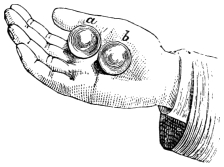
Fig. 257.
The same effect may be produced without the aid of the table, as
follows:—Taking both the balls in his right hand, as in Fig. 257,
the performer covers them with the left hand, retaining as he does so
ball a with the thumb, but allowing ball b to roll down the left sleeve,
which, with a little practice, will
be found by no means difficult.
He now rubs the palms together,
as if rubbing the one ball into the
other, and then separating them
shows that the two balls have
become transformed into one
only. This he exhibits in the
right hand, and while the eyes of
the company are attracted to the
ball, lowers the left arm, allowing
the ball to run down the sleeve into the hand, whence it is immediately
dropped into the pochette on that side.
The next step is the supposed colouring of the ball. The performer
continues, “Ladies and gentlemen, having proved to you my
perfect control over the ball in respect of size, I propose to show you
that I have equal mastery over it in respect of colour. This I shall
do by passing it into this bottle of wine, which being red, the ball
will become red also. Had the bottle contained a blue liquid, you
would have found the ball become blue, and so on. The ball” (he
takes it in his left hand, and apparently transfers it to his right by the
tourniquet, keeping the right hand closed as if containing it, and
dropping it from the left into the pochette on that side) “is considerably
larger than the neck of the bottle. This, in a natural way, would
be rather a difficulty, but to a magician it will give very little trouble. I
have only to squeeze the ball a little” (he lifts the bottle with the left
hand, at the same time slipping the little finger underneath it, to prevent
the red ball beneath it falling, and holding the right hand an inch
or two above it, works the hand as if compressing the ball), “and it
gradually becomes smaller and smaller, till it melts completely into
the bottle.” He opens the right hand, and shows it empty, immediately
afterwards shaking the bottle, and allowing the ball beneath to
rattle slightly. “The ball is now in the bottle, as you see; the next
step is to get it out, and it is rather difficult to do this without at the
same time allowing the wine to escape. However, we will try. I
have no doubt that by a strong effort of will I shall be able to manage
it.” He now takes the bottle between his hands, holding it so that
the two little fingers are beneath, and after a little shaking, allows the
ball to drop, as if through the bottle. This may be varied by holding
the bottle with the left hand only, and striking the mouth with the
palm of the other, allowing the ball to drop at the third stroke, professedly
expelled by the compression of the air.
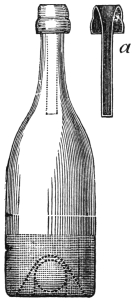
Fig. 258.
Second Method.—The balls used in this instance are five in number,
two large, one of each colour; two small, one of each colour,
and one (a trifle larger than these latter), of which one half is red,
and one half white. The decanter is replaced by an ordinary wine
bottle (see Fig. 258), prepared as follows:—A tin tube, a, three
inches in length, closed at the bottom, but open
at the top, is made to fit within the neck (just
so tightly, that it cannot fall out of its own
accord), its upper edge being turned over all
round, and japanned black, so that when placed
in the bottle it may be undistinguishable from
the actual neck. The cavity at the bottom of
the bottle is filled with a resinous cement, in
such manner as only to leave room for one of
the larger balls. The tube is beforehand filled
with port or claret, and placed in the neck.
The bottle itself, which, if not naturally opaque,
must be rendered so by an interior coating
of black japan, should be nearly filled with
water. Thus prepared, it is brought forward
and placed on the table. The balls are disposed
as follows: the two white ones in the
left pochette of the performer, the two red ones and the parti-coloured
ball in the pochette on the other side.
Coming forward to the audience, the performer produces the large
white ball, either as described in the first form of the trick, or from
his wand in manner described at page 276. While showing it in his
left hand, he drops the right hand to his side, and palms the large red
ball. Laying the white ball on his table, he remarks, “I have here a
bottle of wine. We will begin by testing its genuineness.” He lifts
the bottle by the neck with the left hand, immediately transferring it
to the right (which grasps it round the bottom), and introduces beneath
it the red ball, which is thenceforth kept in position by the little
finger. Taking in the other hand a wine-glass (which should be of
such a size as just to contain the contents of the tube), he fills it with
wine, and hands it to one of the company. In returning to his table,
he secretly withdraws the tube. (This is easily done by grasping the
bottle round the neck with the left hand, and gently drawing it downwards
with the right, the turned over portion of the tube being
clipped by the finger and thumb of the left hand, in which it naturally
remains.) As the performer passes behind the table, he gets rid of
the tube by dropping it on the servante. In placing the bottle on the
table, he is of course careful not to expose the red ball underneath it.
Taking the white ball in his left hand, he proposes to turn it red, and
for that purpose to pass it into the bottle. Pretending to transfer it
to the right hand by the tourniquet, he drops it from the left hand into
the padded tray on the servante, and then apparently passes it into
the bottle, as above. The routine of getting it out of the bottle
again is the same as above described in relation to the first
method.
We may, however, here note a variation in practice. Some performers,
instead of introducing the red ball under the bottle at the
outset of the trick, as above described, make no attempt to bring it
under the bottle until after the white ball is supposed to have been
passed into the wine, when the performer, raising the bottle with
the left hand, transfers it to the right, and brings the ball under
it, retaining it there with the little finger until he thinks fit to allow it
to drop, pretending to squeeze the bottom of the bottle as if to force
it out.
After having produced the red ball, the performer remarks, “Perhaps,
ladies and gentlemen, you imagine that I have not really passed
the ball through the bottle, and that the effect is, in reality, produced
by the substitution of a different coloured ball. Let me assure you
that so truly is the wine in the bottle, and nothing else, the cause of
the change of colour, that you will find on examination that every
particle of colour has left the wine, its whole virtue having been
absorbed by the ball. Supposing for a moment that I could have
exchanged the ball, you will hardly imagine that I could exchange
the liquid in the bottle, which has been proved to be good old
wine. Will the same gentleman who tried it before be good enough
to taste it now?” Taking another glass, he fills it from the bottle,
which is now found to contain nothing but water.
The performer, meanwhile, has again palmed the white ball, which
he next produces, as being a new one, from his wand. Comparing the
red and the white together, he pretends to discover that the red is the
largest, and therefore pinches from it a small portion (the small red
ball). He now discovers that he has taken too much, and that the
red ball is now the smaller. He therefore pinches a second piece
(the small white ball) from the white one, and finally rolls the two
little balls thus obtained into one, producing the parti-coloured ball.
The mode of producing these last effects will present no difficulty to
any one who has attentively studied the description of the first form
of the trick.
The Flags of all Nations.—This is, in good hands, a very
pretty and effective trick, but requires considerable neatness of manipulation.
Its effect is as follows:—The performer comes forward with
a couple of miniature silk flags, measuring, say, three inches by two.
Taking one in each hand, he brings the hands together, and begins to
wave them backwards and forwards, when the flags are seen to multiply,
the two being suddenly transformed into a dozen, quickly
increasing to a still larger number. Not only do the flags increase in
number, but in size also, until perhaps a couple of hundred have
been produced, ranging in dimensions from one or two inches
square to a foot or even larger, and of six or eight different
colours.
This seeming marvel rests on a very slight foundation. The flags
to be produced are of coloured tissue-paper, with flagstaffs made of
wire, or of the “bass” of which scrubbing-brooms are made, so as
to occupy very little space. These are rolled up together in little
parcels, like with like, according to size. Thus arranged, they are
placed, the smaller ones in the sleeve of the performer, and the larger
ones about his person, with the ends just inside the breast of his waistcoat.
While waving the first two flags backwards and forwards, he
gets one of the parcels from the sleeve into his hands, immediately
unrolling and developing it, when the two flags appear to have multiplied
into fifty. Under cover of these, he draws down from the
sleeve another parcel, which he develops in like manner, and after the
sleeves are exhausted has recourse to the fresh store within the waistcoat.
He all along takes care to retain in his hands a large and widespread
bundle of the flags, which, being kept moving backwards and
forwards, materially aids in covering the mode of production of the
remainder.
The Umbrella Trick.—The performer comes forward with an
umbrella, which may be either the common-place article of every-day
life, or a brilliant fancy production, akin to Joseph’s coat of many
colours. This he hands for inspection, and meanwhile borrows a
lady’s handkerchief. The latter, for safe keeping, he places in an
empty vase, which is left in full view of the company. The umbrella,
duly examined, he places in a case, which may be either the ordinary
glazed oilskin case, or a special apparatus prepared for the purpose.
Whichever it be, the result is the same. On again uncovering the
vase, the handkerchief has vanished, and in its place is found the silk
covering of the umbrella. On removing the umbrella from its case,
it is found to have lost its covering; but the handkerchief, torn in
several pieces, is found fastened to its naked ribs, one piece to each.
These are removed. Again the vase is covered, and the umbrella
restored to the case. The torn fragments of the handkerchief are
burnt, and their ashes invisibly passed into the vase; and on a new
examination the two articles are found uninjured as at first.
With reference to the transformation of the handkerchief in the
vase, it will be only necessary to state that the vase employed is either
the burning globe (see page 246), or the “pea vase” described at page 351.
In either case a duplicate umbrella cover is placed in the second
compartment, and thus the vase may be shown to contain either
the handkerchief or the umbrella cover at pleasure.
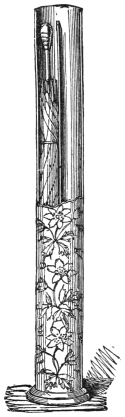
Fig. 259.

Fig. 260.
With regard to the umbrella, the reader will readily conjecture
that an exchange is effected, but the mode of effecting it varies. If
the ordinary glazed case is used, the umbrella is exchanged bodily for
another, similarly encased, placed beforehand on the servante. This,
however, requires some little dexterity, as an umbrella, from its length,
is an awkward article to exchange; and this has led to the employment
of cases specially constructed to effect the change. That most frequently
used is an upright pillar of zinc or tin, oval in form, and open
at the top, and so constructed as to stand upright without support
(see Fig. 259). It is divided vertically into two compartments, in one
of which is placed beforehand the second umbrella. Of course no
one can be permitted to examine or even look into
the case, which is a serious drawback
to the effect of the trick. There is,
however, another form of case sometimes
employed, which is a trifle less
objectionable. This is a wooden
tube, about three feet long, and three
and a half inches square. (See Fig. 260.)
Like the case already described,
it is closed at the bottom
and open at the top, and divided
vertically into two compartments, a
and b. One or other of these, however,
is always closed by the flap c,
which by virtue of a spring is normally
compelled to take the position
shown in the figure, thus closing
compartment b. When required for
use, the second umbrella is placed
in compartment a, and the flap c
drawn back (as shown by the dotted
line) so as to close a, in which position
it is held by a little catch. The
performer hands the genuine umbrella for inspection to one of the
spectators, with a request that he will himself place it in the case.
As soon as he has done so, the performer by a movement of his forefinger
draws back the catch, and releases c, which flying back to the
opposite position, shuts in the genuine umbrella, and reveals the substitute.
When this apparatus is employed, the supposed restoration of
the umbrella is omitted.
Some performers dispense with the use of the vase, and vanish
and reproduce the borrowed handkerchief by sleight-of-hand, after
one or other of the modes described in relation to handkerchief
tricks.
The “Passe-Passe” Trick.—The trick which is specially
designated by this name (which would appear to be equally applicable
to about three parts of the tricks we have described) is as follows:—
The performer brings forward a bottle and a small tumbler, which
he places side by side upon the table. Producing a couple of tin or
pasteboard covers, ornamentally japanned, of a size to just go over
the bottle, he places one of them over the bottle, and another over the
glass. He now commands the two articles to change places, and on
again removing the covers the glass and bottle are found to be transposed.
Again he covers them, and again the change takes place;
and this he repeats as often as he pleases, occasionally pouring out
wine or other liquor, to show that the bottle is a genuine one, and not
a mere make-believe.
The reader will already have anticipated that there are in reality
two bottles and two glasses. The bottles are of tin, japanned to
resemble the ordinary black bottle, but with the bottom only about
a couple of inches below the neck, leaving an open space beneath for
the reception of the glass. Each bottle has near the bottom, at the
side which is kept away from the audience, an oval opening or finger-hole,
measuring about an inch and a half by one inch. When it is
desired to lift the glass with the bottle, the middle finger is made to
press on the glass through this opening, thereby lifting both together
with perfect safety. The outer cover just fits easily over the bottles,
and if lifted lightly leaves the bottle on the table, but if grasped with
some little pressure, carries the bottle with it.
The mode of working the trick will now be readily understood.
The bottle which is brought forward has a second glass concealed within
it, kept in position, while the bottle is brought in, by the pressure of
the finger. The cover which is placed over this bottle is empty.
The other cover, which is placed over the glass, contains the second
bottle, which, being hollow below, enables the performer to rattle his
wand within it, and thus (apparently) to prove the cover empty.
Having covered the glass and bottle, he raises the cover of the first
very lightly, leaving the glass concealed by the second bottle, but lifts
the other with pressure, so carrying the bottle with it, and revealing
the glass which has hitherto been concealed within it. By reversing
the process, the bottle and glass are again made to appear, each under
its original cover. Where it is desired to pour wine from either
bottle, the performer takes care, in lifting it, to press the glass through
the finger-hole, and thus lifts both together. For obvious reasons the
glass into which the wine is poured should be a third glass, and not
either of the two which play the principal part in the trick.