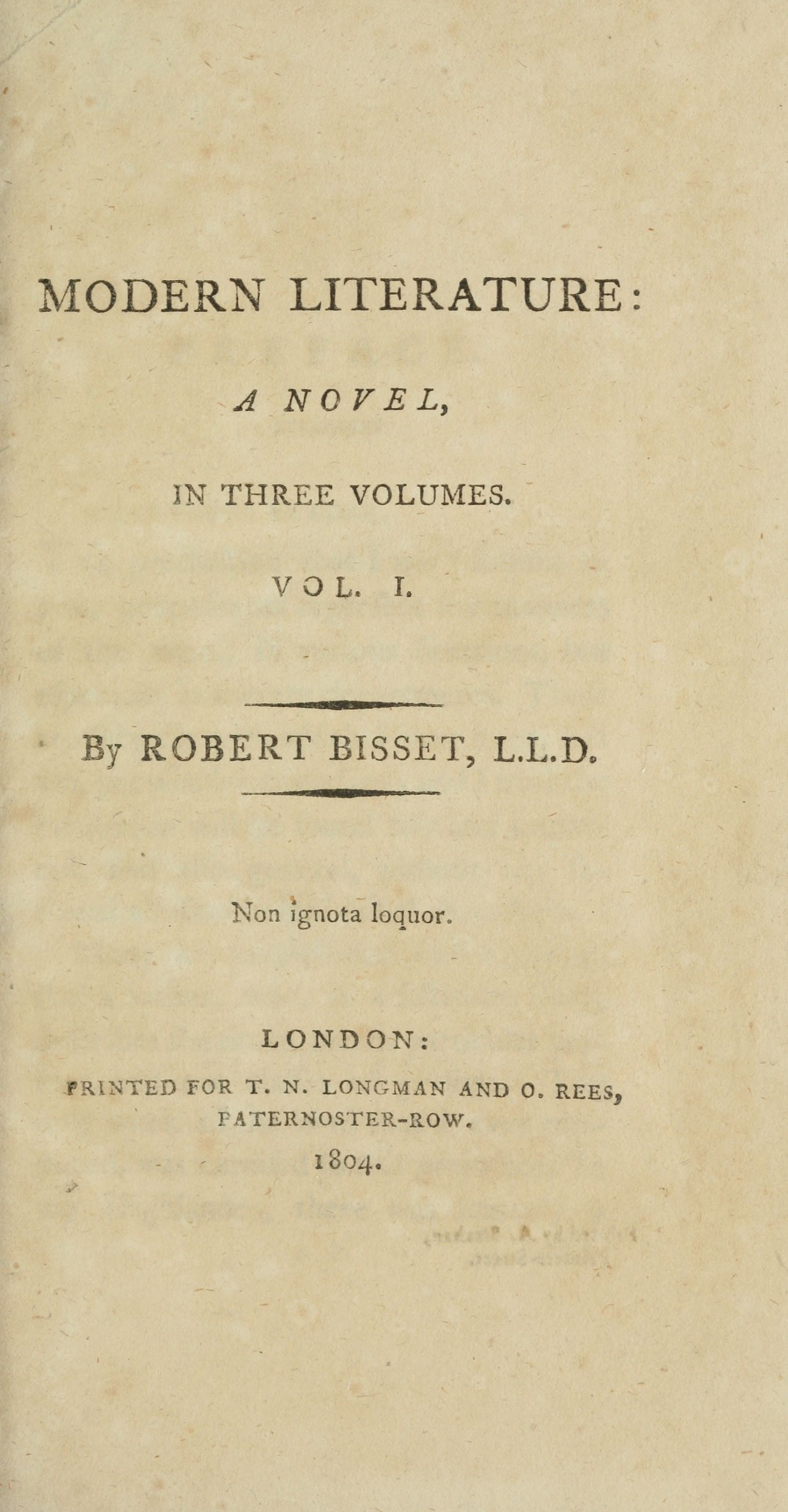
Transcriber’s note — MODERN LITERATURE: A NOVEL , IN THREE VOLUMES. VOL. I.
Variable spelling and hyphenation have been retained. Minor punctuation
inconsistencies have been silently repaired. A list of the changes made
can be found at the end of the book.
MODERN LITERATURE:
A NOVEL,
IN THREE VOLUMES.
VOL. I.
By ROBERT BISSET, L.L.D.
Non ignota loquor.
LONDON:
PRINTED FOR T. N. LONGMAN AND O. REES,
PATERNOSTER-ROW.
1804.
Printed by A. Strahan,
Printers-Street.
PREFACE.
COURTEOUS READER,
The production that I now submit to
you, proposes to represent the manners
of the times, in various situations, but
especially in literary departments. These
are subjects with which I have been, and
am, peculiarly conversant; and I trust the
exhibition will be found fair and impartial,
and also general, without any satirical
allusion to individual characters.
Many are prepossessed with a notion,
that a writer, who, in a fictitious story,
describes the times, means particular persons,
and not classes of persons. The
only work of the kind that I ever produced,
was exposed to this prejudice. In
my Highlander, there was scarcely a
character of any note, that was not applied
to half a dozen of individuals,
whom I never intended particularly to
exhibit, and of most of whom I had
never heard. I confess, however, it is
difficult to pourtray any character, either
good or bad, without taking some of the
lines from some good or bad person,
whom you have actually known. But
it was my purpose so to assort and mingle
features, as to prevent any approach to
individuality. Of the applications, the
greater number were made by the acquaintances
and friends of the supposed
objects; some, however, by the parties
themselves. I have had several claimants
to characters, that are none of the best;
and when the claims were advanced, I
really did not know how or why the imputation
arose. Should a person happen
to be a forward, busy, vain-glorious coxcomb,
as thousands are, and I have no
knowledge of him, or his qualifications,
I must be surprized, if in having drawn
such a general and common character, I
should be charged with intending to
expose that individual person. I may,
afterwards, be able to account for the
supposition: but the food of vanity is
notoriety; and a frivolous egotist, by
representing himself as of sufficient consequence
to be satirized, will very readily
fancy he rises in importance, and will pretend,
in every party, to complain of the
attack, while his whole purpose is to make
himself the subject of talk. “Vanity,
and vanity of vanities all is vanity.”
More than half a dozen were mentioned
as the models of Doctor Vampus, the
ignorant, boasting, hawking and peddling
master of an academy. To no one
person, I am convinced, the whole of
that character could apply; but I am
equally convinced, many parts of it
might hit a dozen of dozens of that class
of the profession. A village male gossip
also received an individual application, and
perhaps some parts might suit the gossip
of that district; but I declare it was applied
to gossips in adjacent districts; and
some have done me the honour to say, it
suits such a nuisance in most villages of
England. There were several demireps,
one of whom, so far from having
any modern individual in view, I copied
from Lady Bellaston, only giving her
modern manners, and substituting for
decayed charms, youth and beauty. Lady
Mary Manhunt, I find has been applied
to twenty originals, when I really had none
in view, but the veteran rival of Sophia
Western. Other demireps, of lower
account, had also a good many applications;
and to persons that I at the time
had never heard to be demireps. In one
individual case, referring to the hero’s
fair fellow-traveller in a stage-coach, a
totally erroneous and false application,
I have been told, was made. In certain
characters, there might be grounds,
though I did not know them at the
time; in that character, I am thoroughly
convinced there never were any
grounds.
There was a great disposition to apply
exhibitions to scenes, with which I was
once conversant; and also to other very
distant scenes, with which I was conversant
at the time of the publication. My
hero having first appeared in the Highlands
of Scotland, I could not avoid
describing Highland manners; and I
exhibited the majority as I found them,
amiable and respectable, and a few
as I found them able and estimable.
There, however, as well as in other
parts of the world, there are fools and
knaves; and among the weak, there
is particularly the preposterous folly of
supposing, birth and rank a substitute for
the want of talents and virtues. That
nonsensical absurdity, perhaps, I might
expose, though I cannot see why the application
should have been made to any
individual, unless, indeed, it accidentally
happened, that the cap exactly fitted; if
it did, it was not my fault; I made the
CAP, but I did not make the head. With
regard to the other district in question,
some of its inhabitants were of much
more importance to themselves, than
either to me or the world, in supposing
that I would consider them individually,
as suitable objects of satire. I described a
certain class in society, in the vicinity of
London; and I have not the least doubt,
that if the description applied to any, it
applies to every one populous village
within ten miles of the metropolis, as
well as to another. Wherever there is
gadding, card-playing, gossiping, half-breeding,
mixed with the peculiarities of
the tradesmen, and retired shopkeepers
of London and Middlesex; in short,
persons without the education and sentiments
of gentlemen and ladies, thrust into
circumstances in which, with the allowable
partiality of self-estimation, they
fancy themselves to belong to that rank,
and ape the fashionable amusements of
their betters: where, perhaps, the widow
of a rich grocer, or the dashing
daughter of mine host, now a gemman and
an Esquire, by noise and glare, and
affectation, hope to make you forget the
signs of the three sugar-loaves, or the
hog in armour: to such impotent attempts
of inveterate and incurable vulgarity,
to pass for gentility, the description
in question either applies generally,
as was intended, or does not apply at all.
One thing, I observed, that the wise and
good characters in that production, have
not been applied by friends.
In the work that I now offer to the
public, from former experience of misinterpretation,
I have been more scrupulously
cautious to guard against any possibility
of individual application. In the
former novel, I merely took care not to
copy a fool, a coxcomb, a debauchee, or
a knave, or any other character of a ridiculous
or bad kind, from any persons
known to me for these qualifications.
Still, however, from inadvertence, I did
take a feature or two here and there, that
I grieve to acknowledge, on perusing
the picture after it was finished, struck
me with a likeness in some lineament.
In the present novel, I have been much
more vigilantly cautious. I not only
have not copied fools, &c. from persons
known to me to be such, but in drawing
any character of that or the other equivalent
classes, I have carefully run my memory
over the individuals that I know
to belong to these, and have studiously
avoided treading on their sore heel. The
end of this work being to give a view of
modern literature, I, conformably to fact,
represent several men of extraordinary
talents and erudition; many more of
respectable, but not extraordinary talents
and erudition, and a considerable number
of literary and other book-makers, without
either talents or erudition. In this
last class of representation, have I exerted
my principal care to shun individual reference;
and when drawing a picture of
a literary dunce, the following has been
my method, and I hope it has succeeded.
I ran over my delineation, and then
made my memory run over this literary
dunce, and that literary dunce of my
own acquaintance; and I asked myself
this question:—Does not this part of the
description rather hit Jacky Allory; now
Jacky is a worthy acquaintance of mine,
a dunce, that without a single spark of
genius, and with some scraps of knowledge,
having acquired the gift of spelling,
is an undertaker-general in literature?
Will not this picture of a literary
manufacturer rather hit Jacky? On reflecting,
I find not particularly; the circumstances
and adjuncts are totally different;
there is no resemblance between
the picture and that individual, but a resemblance
that holds between the picture,
and every other original that manufactures
books without learning or genius.
Jacky stands not alone, he is in a
croud; the most inventive malignity,
therefore, can here make no individual
application. I have exhibited a specimen
of tours, in which the tourist conveys
no information but what was known
before, or what was totally immaterial,
whether it was known or not. Of that
kind, numberless specimens have been
written, especially in large quartos. I
have endeavoured to copy the general
character of such insignificance and
inanity; but to prevent individual application,
have made the scene and limits
totally new. The outset of the tour
is the Black Bear Inn, Piccadilly, the
course through Knightsbridge, on to
Old Brentford, thence round home by
Kingston and Richmond; and in that
circuit, I flatter myself, that in two pages,
I have condensed the essence of many of
our most voluminous tourists of the
dunce kind. I have introduced plays
written by dunces; but in such a manner,
as to apply generally to many dramatic
joiners, individually to none;
having carefully made the history and
circumstances probable in themselves,
but totally unlike any that have actually
existed. I have touched upon German
literature, and the system of taste, morals,
and religion, which these importations
have produced in England. I have mentioned
novels of that kind, and also of
other kinds, especially those that are
written by female scribes, not forgetting
the effusions of milliners, when their own
work is slack; and, as in duty bound, I
have offered a just tribute of praise to
the munificent encouragers of these inestimable
fictions. I have presented a
dunce as author of a history much more
voluminous than Gibbon’s; but to preclude
any possible misinterpretation, I
have made the subject Jack the Giant
Killer, of whom it is well known no voluminous
history has been written either
by a dunce, or any other author. Dunce
writers I represent as faithless and backbiting,
towards other professional votaries
of literature. At the same time, to prevent
misapprehension, I carefully declare I do
not impute these efforts of malignity, to
any thing in dunces more rancorous than
in other men. It arises merely from
taking to an occupation, in which stupidity
is not equal to genius; and from
that principle of human nature, that
makes us repine at the success of others,
in a pursuit wherein we have failed,
though the failure be owing to no bad
fortune, or no unfair means, but simply to
unfitness for the pursuit. If a poor deformed
urchin of no fortune, sense, or
accomplishments, were to address a
beautiful young lady, and to have for his
rival a very handsome, graceful man of
character, talents, and property, the urchin,
most unquestionably, would fail,
from the folly of his suit, but, agreeably
to human nature, he would revile, and
try to disparage the accomplished cavalier,
who succeeded because he was
formed for success. Such is a literary
dunce, in respect to a literary genius.
Having these general objects in view,
from the precautions I have used, I am
thoroughly confident, that no application
will be made to any individual dunce, by
his friends who may peruse “Modern
Literature:” for that he himself should
make the application, I should have no
apprehension, were the likeness ever so
obvious.
One kind of system, of which the most
numerous portion of the votaries cannot
be called literary; but that has an extensive
influence on certain departments of
the literature of the times, I have not
failed to consider: that is methodism,
especially itinerant. There have been
very able men, and I believe also worthy
men, among methodists; and I
doubt not, but there are some able, and
many good men, partially tinged with
that theory. Having the utmost respect
for such disciples of any Christian sect,
I, nevertheless, can plainly see, not only
the tendency, but result of certain theological
doctrines, which not all, but many
of the methodists profess to admit. Visionaries
of that class (or if not visionaries,
what is much worse, hypocrites),
profess to follow different guides from
reason, conscience, and genuine Christianity;
interpreted by reason, and the
tenour of the scriptures, and applied by
conscience. To the implicit votaries of
faith, without works, I object, because to
the implicit votaries of faith, without
works, reason, and conscience, obviously,
and the scriptures expressly object; and
because experience demonstrates, that
this chimera is not only mad, but mischievous.
I farther censure a practice,
frequent among that sect, of grossly ignorant
men, circulating through the
country, and pretending to instruct mankind.
This is the more dangerous, because
not merely an adventure of an individual
vagabond, foolish or frantic, but
connected with a principle diffused
through many of the sect, that there still
exists among these brethren a divine inspiration,
which every sound Theologian
knows to have ceased in the early ages of
the Christian dispensation. Ignorant venders
of nonsense or mischief I have not
spared: I have represented an itinerant
clown, a preacher of methodism, in those
circumstances which reason may easily
connect with such doctrines and talents;
and which experience has woefully shewn
to be closely connected with such doctrines
and talents. I have not written a
line, to which any wise and learned methodist,
(and such only are fit for preaching)
can affix any blame, as adverse to
his views and exhortations; or which any
moral and pious methodist can censure,
as hostile to his practice.
Though literature be the chief object
of the present production, it is far from
being the sole; other characters and
manners are introduced, and, I trust, not
one will be found to bear individual application,
except a few sketches of great
and admirable characters, that incidentally
appear.
The present work is only part of my
plan, which will be completed in another
novel, now considerably advanced, and
to be entitled “The Author.”
Sloane-Terrace,
May 8th, 1804.
CONTENTS OF THE FIRST VOLUME.
CHAP. I.
A Journey through Yorkshire. Meeting of
Brother-Officers. What happened on the Road
from Doncaster. Disaster of Major Hamilton.
Kindness of a Cottager, who proves to be
an old Soldier, and an Acquaintance. Serjeant
Maxwell conveys the Major to his Cottage.
The Arrival of a Surgeon. The Evil
proves less than was apprehended. Delight of
an old Soldier in retracing his Campaigns.
Maxwell’s Praises of Mr. Wentbridge, the
Vicar. That Gentleman visits Hamilton.
Description of the Vicarage. Short Account of
Mr. Wentbridge, and his Family, comprehending
his Marriage with a Curate’s Daughter,
instead of the proffered Niece of my Lord
the Bishop. Description of his Daughter
Eliza; of Major Hamilton. Loves of the
Major and Miss Wentbridge; are sanctioned
by the Father. Hamilton’s Visit to his Brother,
the Laird of Etterick. Description of a
Country Gentleman hunting after Heiresses.
Circular Love-Letter on the Occasion. The
Laird not successful in his Courtships. His
kind Reception of his Brother. He urges his
Brother to join him, in making Love to a Couple
of Co-Heiresses, offering him his Choice.
This liberal Proposition is declined by Hamilton;
who returns to England.
Hamilton arrives at the Vicarage. He accompanies
Eliza to a Ball at Doncaster. Account of the
Company. Mrs. Sourkrout, and her Daughter
Miss Grizzle. Madam’s Claims to Dignity
and Precedence. Miss lays Siege to the
Heart of Hamilton. Her Battery does not
hit the Object. Marriage of Hamilton and
Eliza.
Attempts of Mrs. and Miss Sourkrout to disturb
the Happiness of the young Couple: produce
no effect. Etterick visits his Brother; learns
an Account of the Fortune of Miss Sourkrout.
Therefore proposes to make Love to her; meets
her at an Assembly for that Purpose. He is graciously
received. Whist, the Rubber in great
Danger: is saved and won by the skilful Conduct
of Miss. Profound Remark of the Gallant,
upon playing through the Honour. He pays
her his Addresses in Form, and is crowned
with Success. They marry, and depart for
Scotland. Birth of a Son to Major Hamilton.
The Major rises to be Lieutenant-Colonel. Account
of the Childhood of his Son William, till
he is Seven Years old.
Young Hamilton sent to School, under his Uncle,
Doctor Wentbridge. Genius, Progress, and
opening Character. Account of Mr. Scourge,
the Usher. Disagreement between him and
William. Severity of to William; who ridicules
him to the Boys, and compares him to
Parson Thwackum. Dr. Wentbridge interferes.
Proficiency of William, and high Expectations
of the Doctor. Plans of his Parents
and Friends, for the Destination of William.
It is concluded that he shall be sent to Cambridge.
Etterick announces an Intention of
visiting his Brother. Short Account of his
domestic Comforts. Contests with the old Lady
on the Score of Genealogy and Dignity. Arguments
Pro and Con. Collateral Debate on
the Supporters, and the opposite Accounts of
their Origin. Sole Offspring of Etterick and
his Grizzle. Graces and Accomplishments of
the young Susannah. They arrive at the Colonel’s.
Description of the Person and Accomplishments
of young William. He captivates
his Cousin Susan, but is insensible to the young
Lady’s Passion. He sets off for the University.
Studies of Hamilton at Cambridge: he becomes
eminently distinguished for Science,
Literature, and Composition: revisits his
Friends in Yorkshire. His Cousin Susan
again brought on the Carpet. A short Sketch
of that young Lady. Generalissimo of her Father’s
Family. She becomes acquainted with
Mr. O’Rourke. Sketch of that Irishman as
Teacher of Dancing. He instructs Miss; and
is converted to Methodism. He preaches and
practises the Doctrine of Faith without Works.
Machinery of Methodistical Conversion: attempts
to convert Miss, but is prevented by her
hearing that William is returned: hastens to
meet her Cousin, who still regards her with Indifference.
She discovers William’s Attentions
to a fair Milliner: is urged by her Maid to return
to O’Rourke, and mind her precious Soul.
Grounds of Betty’s Reasoning in Favour of
O’Rourke and Methodism. Danger of Levity
of Manners even with innocent Intentions.
Jenny Collings. Miss Susan becomes entirely
a Convert to Methodism. The Ladies of the
Family all embrace the same Faith. Etterick
himself not so easily brought into the Fold. Dexterous
Scheme of O’Rourke for his Conversion.
The Preacher’s Doctrines illustrated in his
moral Practice. O’Rourke becomes the Husband
of Miss Susan.
Return of Hamilton to the University. He takes
the Degree of Bachelor of Arts, and attains
the Honour of Senior Wrangler. He departs for
London to study the Law: is entered of Lincoln’s
Inn. Interview with Miss Collings.
Offers her honourable Atonement: generously
refused by the young Lady. Dangerous Situations
to virtuous Repentance. He accompanies
Jenny to see the Fair Penitent. She is greatly
affected. Literary Pursuits of our Hero. His
Performances are received with Applause.
Alarming Intelligence from his Mother. He
hastens to his Father’s. Finds the Colonel still
alive, but in great Danger. His Distemper
receives a temporary Intermission. Etterick
visits his Brother. His Account of the Conduct
of O’Rourke. The Means employed to secure
the Estate from his Machinations. Profligate
Effrontery of the Methodist Preacher. He
supposes his Hypocrisy completely successful:
comes to Yorkshire. His Deportment at the Colonel’s.
He receives a severe Chastisement from
William: finds it prudent to decamp. Return
of the Colonel’s Distemper, and fatal Termination.
Family Affairs.
Literary Efforts of our Hero. Mr. Jeffery
Lawhunt. Appearance, Dress, and Manners.
His History of himself and his former Avocations.
He gives an Account of his Dealings with
his Authors and Authoresses. A Lady proposes to
betake herself to the Litterary Line. Lawhunt
wishes to enlist Hamilton, who refuses his Proposals.
Hamilton extends his Acquaintance
among eminent Scholars and Writers. His
first Interview with Strongbrain. Called to
Scotland by his Uncle. Fellow-travellers. Description
of Maria Mortimer. Hamilton is captivated
by the lovely Maria. He finds her the
Sister of an intimate Friend: is invited by her
Father to visit his Country Seat, which he readily
promises to do in his Return from Scotland.
He parts with them at Northallerton. New
Fellow-travellers. Advantages of Drill Serjeants,
as Instructors to young Ladies at Boarding
School. Reasons for breeding up a Son a
Genius. Our Hero arrives at his Journey’s
End.
Etterick’s Account of his Son-in-Law. Farther
practical Effects of Faith without Works.
Hamilton brings the Preacher to professed Contrition.
The Family of Etterick agree to take a
Jaunt to England. Hamilton visits the Mortimer
Family. Reception from the Father,
Brother, and Sister. He declares his Passion to
Maria, which she professes to discourage. Account
of young ’Squire Blossom, and his Addresses
to Maria. His insolent Rudeness. Affray
between him and young Mortimer. Hamilton
prevents a Duel. Hamilton is summoned
to attend his Family to Brighton. Dejection
at the approaching Parting with Maria.
Maria still professes to discountenance his
Love. Invitation from Mr. Mortimer’s Brother
to him and Family to visit his Villa in
Sussex. Invitation is accepted. Hamilton departs
for London: is soon followed by the Mortimers,
to whom he introduces his Family.
Hamilton’s old Friend, Miss Collings, is addressed
by ’Squire Blossom. Preliminaries. A
Treaty of Marriage is concluded. Hamilton
end his Party set off for Brighton.
Soon after the end of the war that was
concluded by the peace of 1763, two
gentlemen belonging to a corps that had
returned from the Havannah, leaving
their regiment in the South of England,
were journeying northwards to visit the
place of their nativity. Neither had in
the course of their campaigns acquired
opulent fortunes; but they had both
made such progress in the road to wealth,
that without any reasonable charge of
prodigality or imprudence, in revisiting
their relations they could indulge in the
comforts of a postchaise. Travelling not
being then effected with the modern rapidity,
they proposed in a week to reach
the capital of Scotland. Having set out
on their expedition, they on the third
day arrived at the beautiful town of Doncaster,
whence they intended, after an
early dinner, to proceed two stages farther.
As they were ordering their repast they
descried, from the windows of their apartment,
a gentleman entering the inn, in
whom they recognised a regimental mess-mate,
the comrade of their conviviality,
and the partner of their dangers. The
new comer, finding fellow travellers so
dear to his heart, insisted these his friends
should accompany him to his native village
in the same county. He could not
prevail on them to deviate so materially
from their northern course: he, however,
succeeded in arresting its progress
for several hours. Dinner had been on
the table at two; at three the postillion
had announced that every thing within
the compass of his office was ready, but
found that his fare were disposed to continue
longer in their present quarters. It
was seven o’clock before the gentlemen,
taking the most affectionate leave of their
companion, though naturally strong and
active, were assisted by the landlord to
their seats in the vehicle. Their friend
had not accompanied them to the carriage,
being left above found asleep in
an elbow chair.
No road can be plainer than from
Doncaster to Ferrybridge. The postillion
was a sharp intelligent fellow, that
had been three years in his present service,
and had travelled that stage at least three
hundred times in that period. It was a
remarkably fine evening in the middle
of July. Nothing, therefore, appeared
more unlikely than that he should miss
his way. It has been often said, that example
is more powerful than precept.—Early
in the afternoon the travellers had
ordered their Automedon into their presence,
and, perhaps, foreseeing the probability
of their own condition, had strongly
interrogated him concerning his disposition
to sobriety; his answers to their
questions contained many asseverations
in favour of his own temperance.—While
he pocketed half a crown, which
was given as a retaining fee, for the
faithful and careful exertion of his professional
skill, and swallowed a large
bumper of brandy to the gentlemen’s
health, he had averred that even his
enemies could not say he was predicted
to liquor. In this declaration he
might perhaps be correct, as the most
competent witnesses were not his enemies
but his friends. It would be a
feeble gratitude which would confine itself
to expressions of regard in the presence
of the benefactor. The post-boy’s
prayers and libations for the health
and prosperity of the bountiful donors
did not cease to flow in streams of ale as
long as the half crown and consequential
credit lasted. After these pious and benignant
offerings he had mounted, and
in this condition had taken the northern
road. The horses, being less bereft of
their senses than their rational companions,
for several miles proceeded directly
to the destined place. They had
already made their way through the turnpikes,
passed the delightful woods around
Robin Hood’s well, with their leader
snoaring on his seat, and arrived at Darrington,
where a road branches off to the
left. There a pull from their driver put
them into a wrong direction. Instead
of keeping directly in the new track, the
horses, again left to their own discretion,
entered a cross lane, and had not gone
far in this path when they overturned
the carriage in a ditch. This catastrophe
soon recalled both the travellers and
their guide from the state of oblivion by
which it was caused. The effects, however,
proved extremely different. The
postillion himself, though he tumbled
from his seat, was softly and easily received
in a very useful repository, collected
for fertilizing an adjacent field.
One of the gentlemen, by being upper-most
as the carriage fell, was by his companion
prevented from being materially
hurt; the other was greatly bruised, and
upon more particular examination found
unable to move his leg, which was concluded
to be broken. The day had just
closed in when this misfortune happened,
and no light was to be seen to guide them
to a village or hamlet, where they might
obtain assistance. There were houses not
far from the place, but belonging to peasants
or labourers who had retired early
to rest, that with the morning sun they
might rise to their useful occupations.
Captain Graham had escaped unhurt;—having
recovered his recollection, and
accustomed to witness more direful
mishaps than he trusted his friend’s
disaster would prove, he laid him carefully
on the grass, while he himself,
by the clear twilight of a July night, set
forwards in quest of some friendly habitation,
where his comrade might repose
until he could be safely removed. Following
the track, he in a quarter of an
hour arrived at a solitary cottage, which
from its first appearance he feared was
uninhabited, till the barking of a dog
made him hope that this was a faithful
centinel guarding, though humble, the
dwelling of man. On his approach the
gallant watch, though not very strong,
raised a loud alarm, more vehement and
furious as Graham approached the door
of his master. The traveller hallooed
with all his vociferation. A rough voice
from the hovel, in a northern accent,
demanded, who is there? and what is
wanted? the other briefly mentioned the
mishap. The master of the house soon
came forth, and the moon, having now
begun to shine, presented an elderly man,
tall, straight, and muscular, who, in a style
of language somewhat better than his
habitation denoted, declared his willingness
to assist a fellow creature in distress.
He however requested the gentleman to
speak softly, as there was, he said, a
detachment of marauders in the rear of
his house, who if they knew that the
commander was out of the garrison might
carry away his stores and equipage. “It
is a fair stratagem, please your honour,
however, to fire your minute-guns when
you are shifting your camp. If we go
ourselves we shall make the vollies of the
picquet guard amuse the enemy.” He
accordingly bound his dog to a post, well
knowing that “in the absence of the commander
the artillery would be incessantly
discharged.” This figurative language
convinced Graham, that his attendant
was a brother soldier. But hurrying to
the scene of disaster, he took no time to
ask any questions, except such as pertained
to the case of his friend, and
learned to his great satisfaction, that there
was a skilful surgeon at a town within a
few miles. When they arrived they
found Major Hamilton, though in great
pain, very quiet; and the postillion had,
in his agreeable bed, relapsed into a
tranquil repose. The new acquaintance
proposed that the gentleman should be
carried easily on their arms to his cottage,
where he should have his poor accommodation
until better could be provided.
But, the moon being now under
a cloud, Graham said, they should stop
a little until her light should enable them
to find their steps with more ease to the
patient. The cottager, foreseeing this
difficulty, had brought a lanthern, which,
from an œconomy necessary in his very
limited finances, he had forborne kindling
till necessary: but now, striking fire
from a flint, he went with his light to
examine the prostrate gentleman, and
tried how he could be moved with the
least degree of pain and uneasiness. In
this occupation, the rays of the lamp
happening to display on the waistcoat
military buttons, the cottager with an
eager curiosity examining more closely
exclaimed in a transport, “Our own regiment
by the Lord!” Graham, who
had been at this time endeavouring to
awaken the postillion, hearing only the
last words, hastily fancied they imported
an unfavourable change in his friend;
but springing to the place found the cottager
in transports, incessantly repeating,
“Our own regiment! our own regiment!”
At length comprehending him,
he asked if he had really belonged to the
——regiment. “I did,” said the other,
rapturously, “I was with them at Fontenoy
and Bergen-op-Zoom, and also in
the late war in Ticonderago, Cape Breton,
and Quebec.” “Did you,” called
the gentleman on the ground, “know
Hamilton?”—“What, Charles Hamilton,”
said the veteran, “that was made
captain at Quebec? I taught the boy
his manual, and a gallant officer he is.”—“You
did indeed,” said the gentleman
on the ground, “I see now you are
Sergeant Maxwell.”—“That I am,
please your noble honour, extremely
sorry for your honour’s misfortune,
but I hope in my poor little tent, though
not a marquee, your honour will feel
yourself more convenient and comfortable
than if you were among strangers.”
They then with the most tender care removed
Major Hamilton to Maxwell’s
cottage, where he was laid with care on —— the
best bed his host had to bestow.
Maxwell having committed his guest to
the care of his sister, a widow who lived
with him, departed himself for medical
assistance, and in a short time returned
with a surgeon. This gentleman having
examined the leg declared it was not
broken but bruised, and announced that
the case was favourable, if the patient
were kept quiet; advised that he should
remain where he was, until the cure was
effected, and told Mr. Hamilton, that
when he was a little easier, and fitter for
conversation, he would bring him some
cheerful and agreeable company, that
would render him more benefit than all
the medicines in his shop; though to
the occupation which he was now exercising
he had added the profession of
apothecary.
Graham was under an indispensible necessity
of hurrying to the north, and as
soon as he found that his friend, though
confined, was in friendly hands, under
safe and skilful management, resolved to
pursue his journey. Hamilton in a few
days was able to bear without any danger
of bad effects a moderate degree of conversation,
and to enjoy the company of
his host and brother soldier, Maxwell,
at stated intervals; and as the old Sergeant
was very fond of descanting on
subjects which had occupied the better
part of his life, it fortunately happened
that his rural avocations prevented him
from being with the Major too frequently
to disturb the repose necessary in his present
situation. Sunday, being a day of
intermission from the labours of husbandry,
the veteran halberdier devoted to
attendance on his guest, and to a recitation
of the labours of war. Early in the
morning he repaired to the Major’s
room, and, breakfasting by his bed, had
gone over the battles of Dettingen, Fontenoy,
had concluded peace, begun a
new war, reached America, sailed up to
St. Lawrence, descended, landed, mounted
the heights of Abraham, and was at
the second wound of the illustrious Wolfe,
when his venerable sister entering the
apartment reminded him that the hour
for church was arrived. Maxwell, whose
father having been a schoolmaster and
precentor in his native village had instilled
into him sentiments of religion,
had been extremely regular in his attendance
at public worship, was moved
by this admonition; but considering the
social virtues as an important branch of
piety, at last concluded that the day
could not be better spent than in cheering
the spirits of a brother under indisposition,
and chose to spend it in the
company of his guest. The arrival of
the surgeon for some time interrupted
the progress of the battle of Quebec; but
after this gentleman departed the subject
was resumed, and Maxwell’s campaigns
were concluded before the entrance of
chicken broth for the officer’s repast, accompanied
with beans and bacon for the
host himself. As Hamilton took his
barley water, Maxwell also indulged
himself with barley juice, wishing to God
his noble commander were well enough
to partake of his home-brewed, of which,
praised be his gracious Sovereign, he
could, he said, always afford a comfortable
can; and, so please your honour,
here’s His Majesty’s health, and God bless
all his friends! Hamilton devoutly saying,
Amen. His sister coming in told
him, that neighbour Hayrick, passing in
his return from church, had informed her,
that the vicar had asked him, if he knew
any thing of Mr. Maxwell, and what
had detained him from Divine Service?
and that he (Hayrick) “had said as how
Tom Tipple the postillion had most
killed a gemman with his shay, that the
gemman was dying at neighbour Maxwell’s
cottage, and that Maxwell, he
supposed, had stayed at home to keep
him kumpany.” The hearers both smiled
at this exaggerated account, and being
left to themselves, Maxwell spoke highly
in praise of the clergyman, though
with many listeners what he said would
have rather been against than for that
reverend gentleman. “I understand
him,” said Maxwell, “when he preaches
as plainly as if it was one of our own officers.—He
tells us that the Bible is our
word of command, and if we mind it we
shall never be behind in our duty.—Every
man to mind his own station, and
do as he would be done by, and though
it may be a toilsome march, he will get
safely invalided in garrison at last; but if
he is a deserter or a poltroon, he will go
to the devil; as where else ought such
fellows to go?—This is what he told us
t’other Sunday; he was upon fighting the
good fight. Not long before he was about
the Centurion, who, he told us, is all as
one of our captains. Lord, thinks I to
myself, for he read the whole story, what
excellent discipline they kept!” Hamilton,
who remembered the passage, having
assented to this criticism, Maxwell
proposed the vicar’s health, and, having
emptied and replenished the jug, entertained
his friend with many anecdotes
in praise of his reverend pastor, who had
been extremely kind to himself individually,
and had presented to him that
very flitch of bacon on which he had
that day dined. “Extremely good in
its kind it is,” said Maxwell, “but a
little too salt.”—To this cause he imputed
his being so excessively dry, and
the quantity of ale that he said he was
obliged to swallow.
His eloquence and his ale at last setting
the old hero asleep, allowed to the Major
an hour of rest, which he had begun
very much to want. When both were refreshed,
the sister announced Mr. Wentbridge.
Maxwell hastened out to meet
the vicar, and soon introduced a gentleman
turned of fifty, of a countenance
mild, pale, and penetrating, with grey
hairs thinly scattered over his head; a
figure tall, elegant, and prepossessing,
and, though somewhat slender, strong and
active. The visitor with much softness,
in a tone of humanity, and a voice subdued
by the apprehensions of disturbing
the temporary repose of dangerous illness,
expressed his concern for the accounts
which he had received.—Maxwell,
answering in a voice loud and cheerful,
assured his pastor, that the gentleman
was in no kind of danger, and
briefly narrated the circumstances. “I
have been just a-telling my noble
Major about your Reverence’s sermons
and good deeds.”—Hamilton, now addressing
Mr. Wentbridge, expressed the
pleasure he hoped to derive from acquaintance
with so respectable a gentleman.—The
clergyman, though pious
and devout, was frank and open in his
manner; Hamilton was an honest, bold,
and intelligent soldier: two such characters
were not long strangers; they were
mutually delighted, and the setting sun
had reminded the vicar of the evening
devotions of his family, before he
thought of withdrawing.—Shaking his
new acquaintance cordially by the hand,
he took his leave, promising to return
the following day.—The next morning,
the Sergeant being engaged in stacking
a plentiful crop of hay which he had
raised on a field of very moderate extent,
his hostess attended the invalid with his
breakfast, when, the conversation turning
upon the last night’s visitor, he
learned many particulars farther to his
honour, and the landlady was just entering
into an account of his family, when
Mr. Wentbridge himself interrupted the
discourse.—The Vicar and the Major,
as they increased in knowledge of each
other, advanced in reciprocal esteem.
Wentbridge found Hamilton a man of
abilities and extensive knowledge, besides
a very impressive and engaging deportment.—The
soldier soon discovered
in Wentbridge, besides the talents, learning,
and virtuous sentiments, which became
his sacred profession, a fund of
scientific and political knowledge, which
he was not incompetent to appreciate,
relieved by delicacy and strength of wit
and of humour, which he could highly
relish.—The skill of the surgeon, with
the vigour of his own constitution, the
kind care and assiduity of his host and
hostess, and the interesting and amusing
conversation of his new clerical friend,
combined speedily to raise the Major
from his bed, and in a few weeks he was
able to move about on his crutch, and
sometimes to take the air in the vicar’s
chaise-cart. In the beginning of September
he found himself sufficiently well
to accept of an invitation to the parsonage-house.
CHAPTER II.
Mr. Wentbridge’s vicarage, situate in a
pleasing district of the West Riding,
amounting to about 200l. per annum,
in a cheap country, afforded to very moderate
wants ample means of supply.—The
possessor was besides skilled in
farming; and as one part of his vicarage
was twenty acres of land, and he rented
thirty more, he had an opportunity of
employing his agricultural talents to his
own emolument, and also by example to
the benefit of his neighbours. No lands
were better fenced or cultivated, laid
out in a more skilful and productive rotation
of crops, a more agreeable variety
of tillage or pasturage, than the snug
fields of the parson of Brotherton. Their
situation also enabled the taste of the
cultivator to superinduce elegance and
beauty on fruitfulness and utility. The
house was placed on the south-east slope
of a gentle hill, terminating in a small
plain that was bounded by a river,
which, winding round the farm, appearing
to rise out of woods on the right and
on the left, seemed to lose itself behind
an advanced post of the hill, whilst, seeking
the eastern confines of Yorkshire, it
hastened to make a part of the conflux
of rivers that after their coalition are
distinguished by the name of Humber.
In this aspect was situated the chief part
of the vicar’s arable farm; behind were his
offices and lands of steeper ascent, bounded
by a wood, which covering all the
upper part of the hill, besides beautifully
diversifying the scene, sheltered the
parsonage from the northern blast. Here
Wentbridge on a beautiful pinnacle
erected a small summer-house, commanding
an extensive, rich, and delightful
prospect, which on the south comprehended
the environs of Wakefield,
Sheffield, Doncaster, and Bawtry, to the
confines of Nottinghamshire; on the
west, Pontefract, Leeds, Halifax; extended
to the east to the borders of Lincolnshire,
and to the north from the adjacent
Ferrybridge to York Minster;
and in its compass included the various
picturesque scenes of the finest part of
one of the finest counties in England.—The
worthy clergyman’s heart expanded
with benevolent pleasure, as from his
little hut he contemplated the goodly
prospect that spread around——
“Of hills, and dales, and woods, and lawns,
And glittering towers, and gilded streams;”
—As he viewed the scenes of pastoral
beauty, agricultural fruitfulness, and
manufacturing skill, all combining so
powerfully to produce individual pleasure
and prosperity, national opulence and
grandeur. But the patriotism and philanthropy
of Mr. Wentbridge were
mingled with other affections, the same
in general source, though more specific in
object and operation. His domestic
sensibilities were extremely strong, and
in his relations were afforded energetic
incentives to exertion. This clergyman,
now about fifty-four years of age, had
been half that time incumbent of Brotherton.
About the age of thirty he had
married the daughter of a neighbouring
curate, and thereby rather hurt his worldly
interest, as the niece of a right reverend
bishop had cast the eyes of affection upon
him, and would have brought a living of
five hundred a year, intended by his lordship
as a dowry to the young lady, who
had, with two sisters, not very extraordinary
in beauty, hung very heavily
upon his hands. The right reverend
divine indeed, very contrary to the usual
practice of dignitaries in the church, in his
disposals of Spiritual preferment, bethought
himself of Carnal subjects. In
bestowing a cure of souls, he had not
altogether neglected the consideration of
bodies, nor, in appointing within his
diocese ministers for the propagation of
christian knowledge, had he overlooked
the propagation of christians. In short,
the bishop having in his gift a considerable
number of livings, and at his disposal a
no less considerable number of daughters,
nieces, and cousins, had suffered it to be
understood by reverend young batchelors,
that the expectants of livings might
be sure of success if willing to perform
all the duties which his providential care
had annexed to incumbency; in other
words, that whoever desired the blessings
of tithe pigs, must with his appointment
take a wife by way of a fine. Mr. Wentbridge
having been sounded on this subject
had demurred; it was said, indeed,
that he observed to a friend, that he
could have no objections to the provisions
which the right reverend bishop
had proposed for his bread, but for his
meat he liked to choose for himself. The
truth is, Miss Sukey Snatchum was not
a very delicate morsel.
Wentbridge, as we have said, made a
different election, and got no promotion
from the bishop. With his wife he lived
extremely happy for twenty years, when,
having caught a fever from a sick cottager,
whom she deemed it her duty to visit, she,
to his inexpressible grief, died, leaving two
sons and one daughter. The eldest son,
now about twenty-three, was brought up to
his father’s profession; the second, having
been on a visit to a school-fellow at Hull,
was so delighted with the shipping, that
he caught a fondness for the sea, and
was in the India service. The only
child that constantly resided with the
vicar was his daughter.
Eliza Wentbridge was about nineteen
years of age, and though not regularly
beautiful had an agreeable, engaging, and
expressive countenance, a good height,
a comely figure, with a frank, open, and
unembarrassed manner, the result of good
sense, good dispositions, and a judicious
education. Wentbridge had, indeed,
spared no pains in himself forming and
directing his daughter’s understanding
and heart, and his wife had contributed
her share both to her mind and manners;
and the savings of œconomy and self-denial
had not been wanted in super-adding
accomplishment to useful acquirement.
For several years she had resided
chiefly at Doncaster, with a sister
of her mother, who, seeking independence
by laudable industry and meritorious
exertion, devoted her time and talents
to the superintendance of a boarding
school. She was now returned to
her father’s, the favourite companion of
his declining years, the partner of his
amusements, the minister of his bounties,
the attendant of his excursions, and often
the associate of his studies. Miss
Wentbridge was well acquainted with
the best British authors, and a very competent
judge of their respective merits.
She was particularly fond of history,
then beginning to form so brilliant a
portion of her country’s literature. She
inherited from her father a very high
admiration of British efforts in the various
departments of ability and exertion.
She admired the national heroism; often
listened with delight to her father’s descriptions
of the ardent struggles for independence,
which repelled the operose
attempts of bigotry and despotism, under
a glorious sovereign of her own sex, though
she often wished, that with the great and
lofty virtues of that illustrious Princess
there had been mixed more of the feminine
softness, the mild and gentle charities
which might have spared the lovely
Mary. Descending to more recent
events, she would with pleasure hear the
natural though homely recitals of old
Maxwell, and enjoy the fire of his eye,
when describing the defence of Bergen-op-Zoom,
or the capture of Quebec;
she was well acquainted with the events
of the war just terminated, especially
such as displayed heroism, or manifested
British character. Such was the young
lady to whom Major Hamilton was now
introduced. Hamilton himself was a man
of a very prepossessing appearance, tall,
and graceful; in face, figure, and deportment,
at once elegant and manly. He
was now twenty-eight years of age,
eleven of which had been passed in his
Majesty’s service.—At the commencement
of the war he had become a lieutenant.
Quebec made him a captain,
the Havannah a major. Maxwell had,
with his usual glee, recited the actions
to which he himself had been a witness,
and had not been sparing in celebrating
his praises, and included the fortitude
with which he had borne his late disaster.
Mr. Wentbridge had also spoken in
terms of praise, esteem, and respect concerning
the abilities and sentiments of his
new acquaintance, so that Miss Wentbridge
had before she saw him received
a very favourable impression of the guest
whom her father now brought to the
parsonage. Though for the present lame,
Hamilton was a very fine man, and,
though pale for want of exercise, had a
countenance extremely impressive and
interesting, intelligent, and animated,
with fine blue eyes, which failed not to
speak what he thought and felt. He
was extremely pleased with the acquaintance
which he had now made, and did
not fail to testify by words and looks the
satisfaction which he received.
In a few weeks Hamilton’s disaster
was healed, but he continued at Maxwell’s,
“apprehensive,” he said, “of
the consequences of a long journey.”—The
surgeon, indeed, declared to him,
that he might now proceed northwards
whenever he chose; but though he had
shewn the most thorough conviction of
the other’s medical skill, had declared
his perfect satisfaction with the treatment
of his own wound, and had made a handsome
pecuniary recompence, still, however,
he did not rely so completely on
his authority as to commence his travels.
Meanwhile he spent the greater
part of his time at the vicarage, where
his heart became completely captivated,
and he, ere it was long, had the satisfaction
to find, that Miss Wentbridge was
not insensible to his attentions. Having
none to control his inclination, he had
no motive to disguise his wishes from the
venerable clergyman, and frequently,
when they were alone, declared in general
terms the high respect he had for his daughter,
but did not descend to more particular
explanations, until he should ascertain the
sentiments of the young lady herself. He
had not, indeed, any reason to suspect
aversion, but he wished to be more accurately
certified, that he might not
have construed complacency, or at most
esteem, into affection.
It was now the latter end of October,
and the season being wet, the autumnal
rains had swelled brooks into
rivers, when our soldier, in his way
to the parsonage, perceiving the young
lady in a shrubbery by the summer-house
before mentioned, hastened to join her,
over a long plank which connected the
banks of a rivulet, that passed the lower
walks of their pleasure-ground, instead
of taking a circuit of thirty yards to a
regular bridge. The place where he
was to cross being a small level at the
bottom of a steep hill, formed a kind of
pond, supplied by the cascade from the
upper ground, and now deepened by the
great accumulation of water. The plank
being slippery, and Hamilton not having
completely recovered the dextrous
command of his limb, he tumbled into
the pool and entirely disappeared. Mr.
Wentbridge, who was in a distant part
of the shrubbery, aroused by a single
shriek, ran to the spot whence the voice
had issued, and found his daughter in a
swoon, whence being by his efforts recovered,
she awoke only to misery, and
called on the name of Hamilton, in the
wildest phrenzy of despairing love. The
worthy clergyman, who had before suspected
the passion of his daughter, was
now apprehensive that some dreadful
disaster had befallen its object. He had
been able to remove Eliza to a mossy
bench, and she was still, in terms of the
most endearing affection, deploring the
beloved youth; when, descending from
the summer-house, he presented himself
safe and sound, though all dropping with
wet. Our Major had been stunned by
the sudden plunge, but soon recovering
had swam to the bottom of the bank,
and waded farther down, where he saw
the ascent was more practicable, and,
missing the nearest path, had through
the labyrinth of a grove found a difficulty
in regaining a view of the summer-house,
to which the way was entangled
by copse and briars, and hence so much
time had elapsed before his return. He
with rapture heard his Eliza bewailing
his fate. When she was so far recovered
as to be conscious of his return, first her
astonishment, her anxious doubts, and
lastly her joy, gave her lover the conviction
which he had so eagerly desired
to receive. The considerate care of the
father hastened him away to the comforts
of a fire and dry clothes, before he
would suffer him to explain the circumstances
of his escape to the young lady,
who still appeared to entertain an unsettled
belief of the reality.
In an hour Hamilton completely readjusted,
and secure from every disagreeable
effect of this involuntary cold bath,
was alive only to the delightful sensations
which its effects had produced.
When he rejoined the fair hostess, in
her blushes, in the enchanted and enchanting
pleasure of her countenance, he
read the confirmation of the sentiments
which her despair had betrayed. She
no longer attempted to disguise the delight
with which she listened to his addresses,
and the tenderness which she
felt for his virtues and accomplishments.
He the following day, with her consent,
applied to her father, and his proposals
were most favourably and gladly received
by the vicar, from personal esteem
and not from motives of interest. A
country squire, far superior to this gallant
officer in fortune, had made proposals
to Miss Wentbridge, which the
father never approved, and the daughter
had ever most positively rejected.
Hamilton, also, if he had chosen
to sacrifice at the shrine of avarice might
at different times have affianced himself
to riches, but especially during his recent
stay at London, where his charms
had made a conquest of the only daughter
of an eminent dry-salter, with whom
he had danced at a ball, at the Mary-le-bone
gardens. But though both parties
disregarded interest as the principal
ground of matrimonial connection, yet
it was resolved not completely to disregard
pecuniary convenience.
Hamilton received pressing letters
from his Scottish friends to repair to
the north, to arrange some concerns
with his elder brother, possessor of his
paternal estate; and saw the necessity of
compliance. He wished his destiny to
be irrevocably united to his Eliza’s before
his departure; but the affair being
referred to the arbitration of the vicar,
he in a friendly award recommended to
the parties to postpone the accomplishment
of their purpose until after Hamilton’s
return. The reasons which he
assigned for this procrastination, though
not conformable to the wishes of the
lovers, were such as their judgments
could not but approve.
Hamilton accordingly set off for his
own country, and arrived at the seat of
his ancestors. His elder brother, Hamilton,
of Etterick, was a country gentleman,
of about five and thirty, mild in
his temper, amiable in his disposition,
and hospitable in his manner of living.
He possessed a good estate, and, being
still a bachelor, proposed by marriage
to make it better. He had, indeed, for
several years been, to use his own expression,
looking about him for a wife.
This circumspiciency was not without
discrimination. His object was what
the Scotch call a well-tochered lass, that
is, a young lady with a good portion.
Having this simple purpose in view, he
had made his addresses successively to
every heiress within forty miles of him,
and had not neglected the proprietors of
legacies from old aunts, cousins, or any
other enriching windfall, nor even
dowagers if they had a fortune as well as
a jointure. Indeed it had been observed,
that when a lady, to whom he had paid
no attention before, happened to have
benefited by any such casualty, he immediately
ordered a new pair of buck-skin
breeches, and rode off a courting.
If these expeditions proved unsuccessful,
it was not for the want of a fixed
plan of operations. He had been instructed
by a friend, that ladies were
fond of receiving love-letters. He,
therefore, like Parson Adams with his
sermons, generally travelled with one
about him, in case of what might happen.
Not being a man of very fertile
invention, the composition of such productions
was not to him a matter of
ready execution. The best substitute
for riches is parsimony. If, therefore,
his genius could not do much, the next
best means was to make a little go a
great way. He very cunningly contrived
that one letter should serve many
courtships. He, as was before observed,
proceeded by regular approaches, being
well apprised of the stores in the garrison.
His disposition for the siege were
first, as we have said, the buck-skin
breeches, with which he proposed to
open the trenches, that he might make
good his communication with the
covered way. His next step was the
letter, or proffered terms of capitulation.
This summons was to the following
effect:—
“Madam, having by the death of my
mother, and the marriage of my sisters,
a kind of vacancy in the family, that
makes the house somewhat lonesome, I
find I shall be obliged to enter into the
matrimonial state. Understanding, from
report, that you are not disinclineable to
the married condition, I have thought
of making you proposals. All my friends
give you a very high character, that I
assure you, not any consideration of property
is what now induces me to make
bold. Besides the extraordinary beauty
of your face and person, the whiteness
of your skin, your shining eyes, and the
fine fall of your shoulders, the dignity of
your walk, not to mention other charms,
which, though invisible, may be well supposed,
has created in me a passion, which
preys upon my heart, and will, if not
gratified, throw me into a consumption;
which, as the Family Physician observes,
is, in this country, a very frequent and
dangerous distemper. Your fortune, I
do assure you, is totally out of my
thoughts, and, if you had not a shilling,
I should prefer you to any other woman,
though mistress of all the riches in the
city of Glasgow. I hope, therefore, you
will have compassion upon your sincere
lover, who thinks of nothing but your
charms. My lawyer will meet with yours
whenever you may please to appoint.—I
propose a jointure, which, if you should
survive me, will give you ten per cent.
for your money; the said money thereupon
to become my property.—With
the most disinterested love, I am, madam,
your adoring swain,
Duncan Hamilton.”
Though this letter, in many cases, answered
pretty well, yet, in some, it did
not altogether suit. Among the various
objects of his passion was a Creole, to
whom the praise of whiteness of skin did
not entirely apply; a lady who squinted,
that could not so properly be praised for
her eyes. To a third, the fall of the
shoulders had been as well left out, as
she happened to be somewhat humpbacked;
a fourth, that limped, might
have dispensed with the encomiums bestowed
on gracefulness of gesture.—The
laird of Etterick having circulated his
courtship to every opulent lady that he
could hear of was soon smoaked. The
portioned misses and dames began to
compare notes, and found that as the object
was the same in all his love pursuits,
viz. the rent-roll, funded property, and
cash at their bankers’, the means were
similar in every case. At last the laird
of Etterick’s courtship became a jest in
the country, and he, now approaching
forty, was a bachelor. His personal
charms were not very likely to shorten
his celibacy. He was about five feet
four inches high, and extremely slender,
with stooping shoulders, and a pair of
legs, whose shape, though often rousing
men to martial deeds, when beating on a
kettle-drum, were not the most promising
supporters for a lover.
Hamilton found his worthy senior extremely
rejoiced to see him, but somewhat
downcast at a late disappointment.
An estate within two or three
miles of him had, it seems, devolved
upon an elderly maiden by the death of
a nephew. As, besides her age, she happened
to have but one eye, he had sanguinely
hoped for success, and made his
addresses a few days after the interment;
but the lady, large raw-boned and red
hair, bestowed her hand and fortune on an
Irish recruiting sergeant of grenadiers.—As
rebuffs, however, were familiar to
this suitor, he was not very deeply afflicted.
Major Hamilton soon opened to
his brother his engagements with the
fair Eliza, and expatiated on the charms
of his lovely mistress. The brother confined
his remarks to one question, whether
the property of her father was in
land, mortgages, or the funds? As the
major, though he strongly praised other
qualifications of his fair mistress, did not
dwell upon her fortune, the laird was
not without apprehensions that he had
neglected the main chance, and advised
him to be cautious. “As to love,”
says he, “my dear brother, it does not
make the pot boil, and as you soldiers
are none of the richest, I think it would
be much better for you to look after a
girl of substance, than to give up your
mind to beauty. There are close by the
Eilden hills two young women, just come
to capital fortunes, by the death of their
uncle, a rich Paisley weaver. I only heard
of it two days ago, and should have
been off immediately myself, but that I
was waiting for you, and also for a pair
of new boots. They have ten thousand
pounds each, besides a good freehold
estate;—that, my dear brother, would be
just the thing to fit us. Indeed I have
even made up my mind how we should
dispose of the money; I would sell to
you, for seven thousand pounds, my
spouse’s half of the estate, so that you
would be a landed gentleman of five
hundred a year, with three thousand
more to get you on in the army, which,
being now time of peace, is as good a
way of laying out your money as any
other. Besides, then I could afford to
pay you your portion, which, now as I
have been making purchases and improvements,
would derange my plans.
I think there is no time to be lost; for
there will be other chaps in the market;
and it being indifferent to me which I
shall marry, you may have your choice.”
—The major was totally unmoved by
the proffered pieces of manufactory, but
informed his brother, that respecting his
portion, about fifteen hundred pounds,
he knew that the proprietor of Etterick
could command such a sum at a day’s
notice, and that, as he might have immediate
occasion for it, it would be necessary
to make arrangements for its
payment when demanded. This intimation
the laird, who gained much
more by his employment of this sum
than he paid for its use, did not altogether
relish, but as he could not contest
the point, he answered;—Certainly it
was reasonable the major should receive
his money, but that it was not so easy
to be raised as he imagined. Hamilton
had, indeed, made repeated applications
from abroad, to have the sum in question
remitted to a banker in London,
to be vested in the funds. But the
laird as often eluded the requisition.—Though
really attached to his brother,
yet he did not forget that, like the brother
of every body else, he was mortal, and
probably the sooner for his profession;
and thought that, to use his own phrase,
“a bird in hand was worth two in
the bush; and the money, to which
he was eventually heir, was as well in
his own custody.” The laird, with a
very moderate understanding, and mild
milkiness of disposition, had a heart less
contracted by interested selfishness, than
debarred from benevolent exertion, by
feeble timidity, or misguided by family
vanity. His heiress-hunting adventures
did not arise so much from grasping
avarice, as from a desire of aggrandizing
the house of Etterick. His pecuniary
anxieties resulted less from the desire of
accumulation, the means of gratifying
which he had fully in his power, than the
fear of incurring difficulties, for which
there were, in his situation, no probable
grounds. Hamilton had written him on
his arrival in England, that he desired
to have the disposal of his own money;
the laird having lately bought a property
contiguous to his estate, saw that he
could not discharge his brother’s claim
without borrowing, and conceived himself
about to be embarrassed, although his
estate was two thousand a year, without
any other incumbrance. He had complained
to their mutual friends, of the loss
that would accrue to him, if the major insisted
on payment. Those friends, knowing
the little foundation for the laird’s
apprehensions, urged his brother to have
the affair settled as speedily as possible,
by coming to the spot himself.
The proprietor of Etterick, during
the first days of Hamilton’s visit, repeatedly
endeavoured to dissuade him
from his intended marriage, and from
taking his money into his own management;
but found himself entirely disappointed
in both. At last, a neighbouring
gentleman advanced the sum
upon the laird’s personal bond, and
Hamilton soon after returned to the
south. He had meanwhile arranged, by
letters, the investment of his property,
and the prolongation of his leave of absence,
so that the six following months
he could, without interruption, devote
to love and his Eliza.
CHAPTER III.
After an absence of six weeks, which
had appeared as many years, he found
himself in sight of the vicarage, and as
his chaise ascended the hill, hailed old
Maxwell, who blessed him with the intelligence,
that Miss Wentbridge was in
perfect health; and in a few minutes he
was in the vicar’s parlour, and received
by the object of his fond attachment, in
such a manner as shewed, that his mistress’s
love, though less impetuous, was
no less ardent than his own. The
worthy vicar who, superintending the
labours of the opening spring, had, from
an adjacent field, beheld his arrival, in
a few minutes joined the enchanted
couple, and diverted their emotions.
During the absence of Hamilton, the
vicar had, in an annual visit at the archi-episcopal
palace of York, become acquainted
with a general officer of distinguished
fame, who spoke very highly
of the abilities, virtues, and high promises
of Hamilton. The testimony of
so competent a judge, coinciding with
the opinion which he had himself formed,
enhanced Wentbridge’s estimation of the
merits of his brave young friend; and in
the destined husband of his daughter, he
fancied he beheld a future commander-in-chief
of an army, fighting for his king
and country. Mr. Wentbridge, with
the expansion of the philosophical scholar,
and the liberality of the enlightened
gentleman, was not without a professional
predilection for forms of little intrinsic
importance. He preferred marriage
after the more tedious process of
publishing the banns, to the expedition
a licence, so much more consonant
to the eagerness of lovers. As he was
extremely tenacious on this subject, the
impatience of the gentleman, and perhaps
of the lady, was obliged to give way.—To
divide the feelings of so very tantalizing
a situation, the judicious clergyman
promoted parties and amusements.
One of these was a visit to Doncaster,
to be present at a ball. Among the
company there came, in the party of the
mayoress, two ladies, the one old and the
other young, both remarkable for the
supercilious sourness of their countenances,
which, though not entirely ugly,
were extremely disagreeable. The old
one, naturally short, appeared still more
abridged by a habit of stooping, arising
chiefly from the eager anxiety with
which she bent herself in company to
listen to what was going forward, especially
if there was any appearance of
whispering; and as she had of late become
a little deaf, greater efforts were
necessary: so that, next to the acidity
which we have before remarked, the
chief expression of her visage was the
straining of curiosity not altogether gratified.—The
young one, though not much
sweeter than the other in the natural
cast of her visage, tried to make up
that deficiency by industry, and where
a young man to her mind made his appearance,
she smiled, and simpered, and
lisped, but all could not conceal the
groundwork. On these occasions she
succeeded no better than children who,
attempting to lessen the bitterness of the
apothecary’s potions by lumps of sugar,
only make the dose more mawkish and
loathsome.
This mother and daughter (for so they
were) were hardly seated, when Hamilton
and his mistress rose to dance a minuet.
The beauties of Eliza’s face and person,
with the graces of her performance, were
of themselves sufficient to rouse the
censorious animadversions of Mrs. Sourkrout;
but another cause called forth associations
of more poignant malignity. She fancied
she recognized the exact image of
one who had gained the affections of the
man whom she had destined for herself.
Enquiring the name of the miss that (as
she phrased it) was figuring away, she was
confirmed in her conjecture, on hearing it
was Wentbridge. This Mrs. Sourkrout
was that niece of a right reverend bishop,
whom we have before mentioned, as intended
by his lordship, as the condition
to be annexed to the gift which he would
have bestowed upon Mr. Wentbridge, for
the cure of souls. By the unexpected
death of her uncle, failing in her hopes
of a spiritual incumbent, she had accepted
of a carnal, and became the lady of
a topping butcher, extremely proud of the
honour of having to wife the nevoy of my
lord the bishop. Mr. Sourkrout throve
a-pace, rose to be alderman of the corporation,
and at last to be mayor. Madam
was not insensible to this elevation, and
deported herself with what she conceived
suitable dignity, by taking the lead in all
companies of the borough, that was the
scene of her grandeur. Even afterwards,
when, upon the decease of her spouse, she
began to think herself slighted in the
scene of her late glory, and retired to a
distant part of the country, she, among
her new acquaintances, as the dowager of
a mayor, expected an homage and deference,
which she was not always so
fortunate as to meet; and, happening to
fix upon a neighbourhood not deficient
in real gentry, she found herself less
valued there, than when presiding over
the municipal gossips of her corporation
entertainment. This inattention to her
dignity added to the sourness of her temper,
not naturally very sweet. There was
another source of bitterness; the lapse of
many years had not obliterated the disappointment
of her youth, and if love for
the husband might have, perhaps, evaporated
from a heart not the best adapted for
retaining tender affections, there was one
passion which remained in its earliest force,
hatred for the wife. She had hated her
when alive, and still hated her when dead.
Brooding over her detestation, her fancy
saw its object in all that torture and tormenting
beauty and loveliness, which had
captivated the object of her own passion.
She had heard, with rage, of the charms
of Eliza, and her striking resemblance
of her mother. As the devil, in sending
envy to the human heart, sends its severest
punishment in the admiration of
its object, and its own rankling gall,
she could not, for her soul, avoid thinking
Eliza the most engaging woman in
the room. Nay, her attempts, in her
own mind, to under-rate the charms of
Miss Wentbridge, recoiled on herself in
exaggerating their witchery. But though
envy cannot really force itself to a contempt
of its object, it may easily try to
assume that disguise. Mrs. Sourkrout,
while pining at the perception of such excellence,
observed to her next neighbour,
that the young person on the floor,
though awkward and hoydenish, was a
decent enough looking girl. “I suppose,”
says she, “she is the daughter of
some farmer, curate, or excise-man; it
is wrong of them people bringing their
daughters into genteel company; it gives
them high and foolish notions; don’t
you think so, my dear,” said she, turning
to her daughter; “Yes ma’am,”
was all the answer that came from Miss,
who, had paid little attention to the
question or antecedent conversation.
Miss’s thoughts were indeed far otherwise
employed.
Those observers of character, countenance,
and dispositions, greatly err; who,
from acidity, or even harshness of visage,
temper, conversation, and actions, infer
in women an insensibility to amorous
passions. Indeed these appearances very
often arise from extreme sensibility,
crossed in its pursuits, repining at the
want of attainment, or, perhaps, regreting
unfortunate success. Mary of England,
the votary of the sourest bigotry,
was still more the devotee of boundless
love for her husband. There has often
been observed to be a considerable analogy
between mankind and irrational
animals. We know there are cats who
will scratch, and bite, and tear others with
all the dissonance of squalling treble, yet
softly and gently purr upon their mates.
Miss Sourkrout was a very susceptible
young damsel; and if she still remained
in a state of celibacy, it was not for want
of good will to the opposite condition.—She
had often shot the rays of love from
her azure-coloured orbs, but they had not
reached the destined marks. Perhaps, indeed,
this might be owing to their oblique
direction; for it often happened, that when
she intended to direct the artillery of
her charms to the front, its force was
spent beyond the right or the left wing.
Miss Sourkrout had no sooner beheld
the manly and graceful Hamilton, than
she was captivated. She immediately
betook herself to ogling, an art in which
if she was not perfect, it was not for
want of practice. Planting her batteries
opposite to him, she forgot that the
movements of her gunnery were more
curvilineal than suited her purpose, and
horizontally instead of perpendicularly
carried best at an angle of forty-five.—She
was enraged at the apparent insensibility
of the major, whom she deemed
impenetrable to all her glances; but in
fact none of them had reached him.—Those
from her right eye caused much
agitation in the heart of a superannuated
beau, that sat near the fire at the upper
end of the room; whereas the left reaching
an attorney’s clerk, who sat by the
door at the bottom, he conceived himself
challenged to execute a capias, alias,
et pluries.—This learned gentleman, not
ignorant of the goods, tenements, and hereditaments
of Miss Sourkrout, formed a
resolution, which he communicated immediately
to a friend (the waiter by
whom he had been introduced), to leave
his master, get possession of Miss and her
property, and, perhaps, might have obtained
a verdict in his favour, but for a
nisi prius, which proved the young lady’s
affections to be the property of another
defendant.
Miss Sourkrout, after having in vain
endeavoured to make Hamilton sensible
of her sentiments, made some enquiries,
in consequence of which, she learned his
name, and also his approaching marriage
with his partner, whom, in her own mind,
she presently denounced for the severest
vengeance. She did not doubt, that so
very accomplished a gentleman must
have been entrapped, before he could
involve himself in marriage with a girl of
so very inferior a fortune. She concluded,
that such a project must arise from
the forwardness of the young lady, and
the lover’s unacquaintance with an object
worthy of his addresses. She,
during the country dances, made overtures
to conversation which the major,
having no suspicion of her intention
or design, returning with the usual complacency
of a gentleman, impressed Miss
Sourkrout with an idea, that her regards
were perceived by the object, and that
the discovery was agreeable. As the
ball broke up, watching Hamilton’s motions,
she whispered him on the stairs,
that he should hear from her in the
morning. Accordingly as they were
ready to set out for the vicarage, a letter
was brought to Hamilton, subscribed
Juliet, declaring he was the Romeo had
won her affections at a dance, and hoping
that the former Rosalind would, in
his affections, give way to another mistress.
Hamilton, who had not been unused
to such billets, smiled and put the
letter in his pocket, neither knowing nor
desiring to know who might be the author.
The lady, finding that her hero
was departed without paying any attention
to so tender an intimation, fell into
a furious passion, terminating in a fit
that soon summoned her mother. The
old lady learning the cause of this commotion,
sympathized readily in her daughter’s
resentment, and even prompted its
effusions, when she considered that the successful
rival of Grizzelina was the daughter
of that abominated woman, who had
triumphed over herself. The mother
and daughter, not knowing that the nuptials
were so very near, agitated various
schemes for preventing their accomplishment.
Meanwhile the auspicious day arrived,
which was to unite this gallant soldier to
his lovely mistress. They were married
in the parish church; old Maxwell, at
the express desire of the bridegroom and
bride, made one of the guests at the
wedding-dinner. The day was spent in
the most happy cheerfulness, rising to a
festive conviviality in some of the guests,
especially the veteran halberdier, which,
on any other occasion, the vicar would
probably have reproved; but his heart
now so overflowed, that he readily forgave
the effect arising from the overflowings
of his cellar.
Maxwell, in his cups, descanted on the
soldier’s character, and especially the
superior success of military men among
the ladies. On that topic he sang as well
as he could, the famous song of Dumbarton’s
drums, dwelling with peculiar
emphasis on the verse—
“A soldier alone can delight me O,
His manly looks do invite me O, &c.”
As several young neighbours were
present, a dance was proposed, and towards
the close, Maxwell, who at the
beginning had refreshed himself with
a nap, proposed to the company to dance
a hornpipe: the Dusty Miller was attempted,
but the music was so little to
the performer’s mind, that he begged
the noble commander, as he styled him,
to shew them what Scotch musicianers
could do. Hamilton good-humouredly
took his own violin, on which he was a
very masterly player, and desired his
veteran friend to name his tune; Maxwell
accordingly called for—If you kiss
my wife.—Hamilton executed it in so
animating a style as quite inspired the
sergeant to feats of agility, that Ireland
himself could hardly surpass. Supper
soon after terminated the ball; the party
broke up; Hamilton retired to the happiness
of virtuous love in the arms of
his Eliza.
CHAPTER IV.
For two months our young couple had
enjoyed each other with ardent and increasing
affection, though not without attempts
to interrupt their happiness.—These
sprang from Mrs. and Miss Sourkrout
whose inventions, not being so fertile
as their dispositions were malignant,
had confined their exertions to anonymous
letters, too frivolous in contrivance, and
absurd in execution to produce any effect.
From some circumstances Mr. and Mrs.
Hamilton were able to trace them to the
rightful authors; but without deigning
to resent malice so very inefficient.—About
this time a letter arrived from the
laird of Etterick, in which he announced
his intention of visiting his brother.—His
expectations from the co-heiresses
had, it seems, though he had tried both,
proved as fallacious as his hopes from any
of his former undertakings. He was
now meditating to try his fortune among
the English ladies, who, he hoped, would
be more sensible to his merits than the
misses of his own country. In a few
weeks he arrived at Brotherton; and was
greatly pleased with his reception at the
vicarage. He soon contracted a very
high admiration for the worthy clergyman,
not so much on account of his abilities,
learning, virtue, and piety, as for
his skill in rearing cattle; and declared,
that he had gained so much knowledge
of green crops, during the time he passed
in Yorkshire, as would much more than
indemnify the expences of his excursion.
Though he spent much of his time with
Mr. Wentbridge, when superintending
his husbandry, and still more with the
hind, yet the evenings were passed in the
parlour, and he frequently heard mention
made of the machinations of Miss Sourkrout.
As the state of her finances did
not happen to be brought on the carpet,
her name excited little attention. But
as the season advanced the evenings grew
long and fine, the laird, tiring of domestic
society, found out a neighbouring public
house, wherein he was introduced to an
amicable company, consisting of the
parish clerk, the barber, the exciseman,
the lawyer, and some others, who, though
the chief subject of their conversation
was the state of public affairs, would
sometimes descend to more private considerations.
In one of these conferences
the attorney, who had that day returned
from Doncaster, informed the company
that he had the honour of spending the
evening in the house of an alderman,
that there he had met with a young lady
of a capital fortune, who had treated him
with great complacency. “I do believe,”
said he, with a self-approving nod,
“that if I had not been married I might——hem.”
The laird, aroused by this
intelligence, inquired what the amount
of the lady’s property was, and how it was
disposed of, learned from the communicative
lawyer the account he had heard
from the alderman’s lady, that there was
twelve thousand pounds burdened, indeed,
with a dowager. The next day the laird,
though not much addicted to balls or
assemblies, proposed to his brother and
sister-in-law to go to the first meeting of
that sort which should be held at Doncaster,
“wishing,” he said, “to have a view
of the Yorkshire lasses.”—They readily
agreed to his proposal, and about a week
after repaired to the festive scene. Thinking
an auxiliary might be useful, in carrying
on his enterprize, he had bethought
himself of applying to the attorney, and
opened his mind so much to the satisfaction
of that learned gentleman, that he declared
he should want no assistance in his
power. The lawyer, early in the day appointed
for the ball, rode to Doncaster,
and making a visit to the alderman’s lady,
informed her, by way of news, that there
was to be a Scotch gentleman of four
thousand a year in the assembly room
that evening, the elder brother of parson
Wentbridge’s son-in-law; that he had
heard much of Miss Sourkrout, and had
been making many enquiries about her
temper and dispositions. Mrs. Alderman
regarding a dowager mayoress as a very
high lady, and having attained the pinnacle
of dignity at which she herself
aspired, was desirous of gratifying the
mother and daughter, and hastily conveyed
to them this intelligence.
Both madam and miss were arouzed.
A triumph over the daughter of Wentbridge,
who was the wife of a younger
brother of the squire, was not the least
consideration with either. No beauty
that mantua-makers or milliners could
bestow on so short a notice was spared.
When the company met, the laird having
learned which was Miss Sourkrout,
after taking something of a circuit round
the room, came to miss, and very respectfully
requested the honour of her being
his partner in a country dance, when
they should begin. Miss most graciously
complied, and, though fond of exhibiting
herself in a minuet, forbore for the present
that gratification. He, meanwhile,
entered into conversation with both miss
and her mother. He soon took a great
fancy to the sagacity of the old lady, and
the ingenuity of the young one. At
length, the time for their dance arrived,
and a couple exhibited themselves, which
attracted the eyes of the company more
than any that appeared that evening.—The
gentleman extremely lank, with
high cheek-bones, a lean visage, the
solemn seriousness of aspect which so
often distinguishes our northern countrymen,
opposed the lady, squab, fat, and
blowsy, flirting and simpering; he with
narrow shoulders, and a flat chest; she
with back broad and brawny, chest large,
deep, and capacious. The swain moved
in the attitude of a trotting dromedary,
so useful to Arabs; the nymph like a
quadruped which, though little relished
by Jews, is not without value among
Christians, and if we may believe Fielding,
had even occupied the chief care of
a christian pastor[1]. As both had laboured
extremely hard, they were very happy
when the rules of the assembly suffered
them to have rest. The mother most
politely thanked the laird for his attention
to Grizzle, to which he answered, after
much consideration, that he thought it
the duty of a gentleman to be polite to
ladies: that was a maxim that, he said,
had been very early impressed upon him
by his worthy grand-mother, to whom,
he observed, he was chiefly indebted for
his education; having, while his brother
went to school, been brought up under
the old lady’s own eye. Mrs. Sourkrout
proposed, as they appeared heated with
dancing, to take to a rubber, saying,
“she doubted not that a gentleman of
his appearance could play at whist.”
“O yes,” replied he, “that was one of
my grand-mama’s chief lessons; from
the time I was twelve year old, till I
was past twenty, we spent almost every
evening in that pastime, and while my
mother lived, and my sisters were at
home, we long after kept in the same
course: but since I am an orphan and
lonesome, I send for my foreman, and
take a hit at backgammon. But I should
like a rubber very much.” A party was
accordingly formed. Mr. Hamilton and
the fair nymph were partners. Their
opponents had won a double, were nine
to four of the second, and had turned up
the king; three tricks were gained before
the laird and his partner had got one.
Miss Sourkrout, the dealer, with the king
guarded, had two aces, from which she
reasonably entertained sanguine hopes of
a bumper. Miss having the queen, knave
of trumps, and a long suit; after taking
a trick, shewed a suit; with profound
skill discontinued it, to play through the
honour; at the second round drove the
king prisoner into the hands of her partner’s
victorious ace. Her right-hand
adversary’s ten fell by the same fatal
blow, the laird’s nine and eight exhausted
all the enemy’s trumps, and left his
three lord of the board. Now did the
comprehensive wisdom of the laird, having
before its view every trick, return
his partner’s suit; the lady made two
more, one only remained the destined
victim of the corps de reserve, and thus
secured the victory. A single hand determined
the next game in favour of the
laird and miss. Mr. Hamilton considered
the rubber as won by miss’s dexterity,
which raised her very high in his estimation.
He with much gravity remarked,
“that it was a very providential circumstance,
that she thought of playing
through the honour.”
The major and his lady observed their
brother’s attention to Miss Sourkrout,
but thinking it accidental, regarded it
with unconcern. The next morning the
laird went to pay the lady a visit, and
was very graciously received.
A few days after, taking an opportunity
of being alone with the major, he turned
the discourse upon Miss Sourkrout,
with a very particular detail of her cash
and moveables, according to the information
which he had received from his
acquaintance the attorney. The major
strongly dissuaded his brother from attempting
any such connection; but as
in his dissuasives he said nothing to the
disparagement of her fortune, he made
little impression.
The laird visited and revisited the fair
object of his pursuit, and as she and her
mamma had taken care to be well informed
concerning his circumstances, he
was received with kindness, manifesting
itself the more openly at every succeeding
interview. A few weeks concluded
the negotiation, and after a decent
sacrifice to coyness and decorum,
the esquire was blessed with all the happiness
that the lawful possession of miss’s
charms, such as they were, could bestow.
The senior and junior relations of mayoral
dignity soon after set out with the esquire
for the house of Etterick.
Major Hamilton, meanwhile, after
having spent the destined time in Yorkshire,
rejoined his regiment, then quartered
at Berwick and adjacent towns.—The
remainder of the summer and the
following winter he and his lady passed
in the county of Northumberland. The
time now approaching, that was to render
her a mother, Eliza anxiously wished
to repair to the vicarage. The major,
procuring a short leave of absence, accompanied
her thither, and soon after
(March 22d, 1765,) she presented him
with a son and heir. In due time the
infant was christened by a neighbouring
clergyman, whilst his grand-father, being
sponsor, gave to him his own name of
William. Mrs. Hamilton having resolved
not to delegate to another the
duty which she found herself able to discharge,
it was agreed that the vicarage
should continue to be her chief residence,
while she suckled little William; and as
the regiment was now removed to York,
that the major should spend, at Brotherton,
all the time that he could spare
from professional duty. As these visits,
depending in some degree on contingences,
were neither fixed as to time,
nor certain as to duration, they enhanced
the impassioned affection with
which the husband and wife regarded
each other, and their little boy. Whilst
the mother, in the father’s absence,
traced his beloved features in the son,
she could not help reflecting, that the
cause of their frequent separation was the
performance of duties that might tear
them much farther and longer asunder;
carrying her fancy to events not improbable,
she often dwelt with anxious
tenderness on the likelihood there was
that Hamilton might be ordered abroad.
Peace, it was true, did not at present
seem about to be soon broken, but discontents
already manifested themselves
in America, and might become more
serious; should troops be requisite to
support the authority of government, no
regiment, she thought, was more likely
to be selected than that of which her
adored husband was a member.—These
considerations tinged the love of Eliza
with a pensive softness, that rendered her
more peculiarly interesting. Her father,
who divined the cause of her uneasiness,
assured her, that should any circumstance
call his esteemed and valued son-in-law
to a distant land, William should be his
care, and that no pains or expence, which
an income, though moderate not scanty,
could afford, should be wanting to give
him an education becoming a gentleman
and a scholar. The forebodings of Mrs.
Hamilton for several years proved unfounded.
After William was of sufficient age
and strength to allow her absence,
she accompanied her husband to the regimental
quarters, which, though they
frequently shifted, were never farther removed
than Liverpool, Chester, Shrewsbury,
or some other town within a hundred
miles of her father and her son.
Before William had reached the second
year of his age she had brought him a
brother, and soon after he attained his
third she produced another boy. Young
William by this time was a strong, active,
sprightly little fellow, and the chief favourite
of his grand-father, who looked
on him as a kind of phenomenon, and
though only in his fourth year, began to
teach him the first rudiments of literature.
Having about a year before risen to
be lieutenant-colonel of his regiment,
Hamilton had so closely attended to the
troops that he procured a leave of absence
for six months, which he, with his
lady, spent with the vicar, and in vigilantly
watching the opening understanding
and heart of their eldest son; and
from the acuteness of his remarks, quickness
and retentiveness of his memory,
and readiness of his ingenuity, together
with the affectionate kindness of his disposition,
all seen through the exaggerating
medium of parental partiality,
regarded him as a surprizing instance of
intelligence and goodness. Affection,
however, did not so much blind discernment
as to prevent them from discovering
that his temper was irritable and
fiery, that under the impulse of anger he
would very readily do mischief, though
he soon repented; and they strongly represented
to the vicar this defect in the
child, and he promised his efforts to its
correction. Hamilton now rejoined his
regiment, which was ordered to the
south of England, and did not for the
two following years after find leisure to
revisit his son. William, during this
interval, made quick proficiency under
his grand-father; at six years old began
his accidence, and at seven had made no
small progress in Corderius. Besides the
old vicar he had another preceptor, who
as anxiously superintended the efforts of
his bodily strength, as his grand-father
his mental improvement. This was sergeant
Maxwell, who instructed him in
boxing and cricket, as he had himself
learned them in his youth, from Hampshire
and Sussex men, when quartered in
the south of England; and also procured
him the instructions of young villagers,
eminent for the Yorkshire wrestling, and
especially for cross buttocks. Under
his various tutors William made such
advances that he had few matches of his
own age, at either grammatical or gymnastical
exercises. About this time the
vicar’s eldest son, after having held a
fellowship at Cambridge for several
years, was presented to a living in his
native country, near twenty miles from
his father’s house. Having, during his
residence at the university, been accustomed
to tuition, he proposed to add to
his income by establishing an academy.
The vicar highly approved of this plan,
proposed to send his young grandson as
a scholar to the new seminary. His son-in-law
and daughter, who were now at
the vicarage, were greatly delighted with
this scheme, as they saw their boy, with
many excellent qualities, required much
stricter and steadier discipline than was
administered by his grandfather’s indulgence.
The colonel’s regiment being
speedily to embark for Ireland, it was at
his instance determined that young Hamilton
should be immediately sent to
school. The second son of colonel Hamilton
had died an infant, the third was,
at the earnest entreaty of the vicar, left
to replace William. The youngest
child, a daughter, accompanied her parents.
Mrs. Hamilton, with extreme
reluctance, parted from her two boys;
yet convinced that their respective situation
was the fittest that could be chosen
for their several ages, bore it with fortitude.
She was now less uneasy on her
husband’s account, than during the first
appearance of American discontent.—The
conciliatory policy with which the
administration of lord North had commenced,
had already, in a great measure,
quieted disturbances, and it was hoped
that measures so agreeable to the mildness
of his character would be uniformly
adhered to, and produce a total cessation
of dissatisfaction. From these expectations,
so gratifying to loyal and patriotic
politicians, Mrs. Hamilton drew an inference
conducive to private happiness,
that the colonel would not be ordered to
America. Cherishing these hopes, she
with the less regret took leave of her
father and children, whom, as the distance
was comparatively inconsiderable,
she hoped ere long to have in her arms.
CHAPTER V.
William Hamilton, the young hero of
this true history, was eight years of age
when he removed to his uncle doctor
Wentbridge’s school, in the neighbourhood
of Weatherby. That gentleman
began his seminary with a considerable
prospect of success, and among a good
number of pupils had several boys of
nearly his nephew’s standing. William’s
genius, therefore, both quick and strong,
was stimulated by emulation. His literary
career gave his uncle very thorough satisfaction.
Before he reached his eleventh
year, he was advanced to Cæsar and
Ovid’s Metamorphoses, and at the head
of a class of promising scholars in the
various school exercises. Though in his
disposition frank, liberal, and bold, and
very popular among his schoolfellows,
yet he continued passionate; his anger
being vented in violence where prowess
could operate, but where valour was inapplicable,
converging itself into poignant
and severe sarcasm; insomuch that his
uncle told the old vicar, William would
turn out a very clever fellow whatsoever
profession he embraced, but if he became
literary would most probably be a
satirist. The venerable clergyman was
pleased with the testimony borne by his
son to his grandson’s ability, but declared
his sincere wish that the violence of his
passions might be restrained, and his sarcastic
efforts might be repressed. Though
Dr. Wentbridge was no less desirous of
confining his nephew’s satirical effusion
within the limits of moderation, he could
not always succeed. There was at the
school an usher of acute and vigorous
talents, but malignant in his disposition,
sour and sneering in his manners, selfish
and avaricious in his conduct, extremely
ugly and coarse in his appearance. It was
customary at the return to school after the
holidays for the scholars to make a present
to this person, and their treatment by him
was generally found indulgent or rigorous,
according to the amount of the donation.
Dr. Wentbridge had not thought
it necessary, as he paid his teacher sufficiently
himself, to make any addition on
account of his nephew. The covetous
pedant was displeased at this omission,
and vented his resentment in rigour
and insult to the boy as far as he durst,
without offending the master. William
had once or twice complained of the
usher’s behaviour, but as Dr. Wentbridge
well knew the plaintiff’s irritability,
and highly valued the defendant on
account of his preceptorial qualifications,
he, on rather a summary inquiry, gave
judgment in the defendant’s favour.—The
usher, encouraged by these acquittals,
had persisted in persecuting young
Hamilton. One day the boy, now
turned of twelve, having finished an exercise,
in which he had translated into
English verse the storm in the first
Æneid, had betaken himself to Tom
Jones, which he was reading at his leisure
hours with a devouring eagerness.
He had before pointed out parson
Thwackum to his schoolfellows, as the
representative of Mr. Scourge, and the
usher, was not without an intimation
of William’s comments, but had not
a plausible pretext for venting his gall.
Now perceiving that Hamilton was
engaged with this novel, while those
about him were occupied at their exercises,
he imperiously demanded why
he was not at his task. “The task is
finished,” answered the other, without
the reverential preface of, sir.—“What
stupid book is that you are reading,
sirrah?”—“I’m reading no stupid book,
it’s all very natural.—There, sir,” said the
young dog, “you will see parson Thwackum
is at last found out by his master, and
turned off.”—“What do you say, you
scoundrel,” said Scourge. “Away, I
am no scoundrel,” replied the boy, “but
parson Thwackum was a scoundrel, and
was treated accordingly.”—The usher
considering this remark as treason, proceeded
to summary punishment, and it
would have fared hard with our hero,
had not one of the young gentlemen,
who was stronger than the usher, interfered,
and sent another to the master,
requesting his immediate presence. Dr.
Wentbridge appeared; at once malicious
and mean Scourge preferred his
accusation. Wentbridge, not without a
knowledge of the dispositions and character
of his deputy, and who of late had
discovered his acrimony against William,
soon found out the real merits of the
case: but not desirous of lowering, in the
eyes of the scholars, a teacher whom he
found extremely successful, he dismissed
his nephew with a slight rebuke, but
sent for him into the parlour, and knowing
he could depend upon his veracity,
though not on his temper, desired him
ingenuously to recount the whole circumstances.
These Hamilton very plainly
and fully explained. He confessed that,
enraged at the usher’s severity, he had
compared him to parson Thwackum,
“though, sir, I must confess, when I
saw him entering a complaint to you,
and trying to simper and smile while
he is really so rancorous, I thought of
another part.”—“What is that, sir?”
said the doctor, pretending to speak
angrily: “Why, sir,” said William,
who penetrated into his uncle’s real sentiments,
“that part in which Mr. Blifil,
trying to do mischief, has one of those
grinning sneers, with which the devil
marks his best beloved.”—Wentbridge
could hardly avoid smiling at an application,
which he could not help thinking
most forcibly apposite, but constraining
his countenance, most severely rebuked
his nephew for speaking so disrespectfully
of his teacher. He did not, however,
fail privately to expostulate seriously
with the tutor on his harshness,
and charged him to abstain from it in
future. The usher, who had a better
place than he could easily get anywhere
else, was less violent thereafter, and
though, perhaps, he hated the boy more,
flogged him much less.
William’s time now passed very pleasantly,
and he proceeded in his studies,
making rapid proficiency. His father
and mother regularly corresponded with
our young hero, and derived high gratification
from his letters.
About two years before the regiment
had been ordered to America, so quickly
that they had not time to revisit England,
and embrace their children. Our
colonel was actively engaged in the battles
of Long Island, New York, and White-plains,
and deemed them all, in decisive
success, little adequate to British force,
valour, and efforts. He accompanied
lord Cornwallis in his victorious career
through the Jerseys, and had no doubt
of capturing Philadelphia, when the
commander in chief, by recalling the
victorious Britons, arrested the progress
as it was about to be complete.—He
saw and regretted the dissipated
scenes of New York winter quarters, but
fortified by principle, and confirmed by
habit, remained uninfected by the destructive
contagion. Disapproving of
plans, he was intrepid and skilful in execution.
Lamenting the late outset of military
operations in the campaign of 1777,
and the circuitous course of invasion,
which postponed active warfare till the
season for it was nearly expired. When
the British army at length took the field,
colonel Hamilton was one of its most
valiant and skilful leaders. At Brandy
Wine and German town, he was particularly
distinguished; he now hoped that
British achievements, though tardy in
commencement, would be effectual in result.
But premature departure from the
field completed the inutility of British valour.
Northern discomfiture combining
with southern inefficiency, demonstrated
the contest to be henceforth hopeless.
Hamilton perceived, with sorrow, the debauchery
that unnerved British prowess,
and with mingled pity and contempt beheld
the farcical pageantry of triumph
without atchievement, which terminated
inglorious command. The capture of
Burgoyne, and the obstinacy which continued
hostile contention, after its object
was desperate, rendered large reinforcements
of troops necessary. The levies
of new regiments procured Hamilton
promotion, which permitted him to return
to Britain with his lady and his
daughter.
Our hero was about fourteen years of
age when revisited by his parents;
comely, healthy, active, and strong, and
in his mental powers and acquirements
far beyond most youths of sixteen. Both
father and mother were proud of such a
son, and anticipated future eminence from
so promising talents and accomplishments.
As their second son was now at the same
seminary, a neighbouring boarding school
was commodious for the daughter. The
colonel and his lady fixed their abode in
the same village. The venerable vicar of
Brotherton having for upwards of forty
years discharged, without assistance, the
duties of his trust, was, after he had
turned his seventieth year, prevailed on
to delegate the most laborious part of his
function to a curate, and was thus able
to spend much of his time in the houses
of his son or daughter.
Old Maxwell, though past his grand
climacteric, found no difficulty in walking
twenty miles to visit these friends,
and especially to confer with the colonel
on the military operations. “Please
your noble honour,” he would say, “I
think we have not done half so much
against those yankies as we did against
the French, and yet, God be praised,
British soldiers have fought like——what
can I say? Why, like British soldiers.
But their generals——; O Lord, your
honour, the slippery ground at White-plains
would not have stopped general
Wolfe; the heights of Abraham were a
great deal steeper. Some people change
by preferment. I remember at that
very place general ——, then a colonel,
was one of the first that got up the precipice.
I must say,” continued the loquacious
veteran, “Fort Washington
was a gallant feat. The defence of Quebec
was very well too; and so by G—d
was the attack. That Montgomery was
a brave fellow; from his name he must be
a Scotchman by birth. Poor Fraser too—but
I do not know how it was, there
was a great deal of courage and valiant
fighting with no upshot. We are no
nearer the mark than when we began.”
The colonel could not help really coinciding
with some parts of this criticism,
though for obvious reasons he did not
reckon it expedient to open his mind
without reserve.
Both the Messrs. Wentbridge concurred
in censuring the execution of the
war, but carried their strictures also to
its plans and origin. Hamilton as a military
man had lofty ideas of the submission
due to government in every department,
political as well as military; and
various disquisitions took place from a
diversity of opinion, sufficient to enliven
and animate conversation without causing
asperity of dispute. Our hero was
often present at these dissertations; and
being permitted to deliver his opinion,
and instructed to support it with acuteness
and force, though with modesty and
candour, he greatly promoted the extension
of his knowledge, as well as the invigoration
of his powers, by these exercises.
He was himself strongly inclined
to the whig side, a reader of the newspapers,
and a profound admirer of
Charles Fox. He often expressed the
delight he should feel on being the author
of such speeches as were delivered
by that celebrated orator. His father
would answer, “You may, if you have
merit enough. There are some eminent
men in parliament, who raised themselves
from a situation no higher than
yours.” Topics of this sort sometimes
led to considerations respecting the future
profession of our hero, especially
when he approached the age of seventeen,
and acquired a degree of classical
literature, as well as other knowledge,
that rendered him fit for being sent to an
university. His grandfather reviewing
the happiness which he himself had enjoyed
in a sequestered life, and in the
vigour of his own constitution hoping
for several years longer life, wished to
secure the reversion of his living to his
grandson. The doctor, who by long residence
at college chiefly regarded academic
dignities and promotion, did not
doubt that the genius and erudition of
his nephew might rise to the highest appointments
in the university, if not in
the church. He himself had by his college
connections procured a living,
formed his school, and lately obtained a
more valuable benefice. He knew that
a contented and unambitious temper only
prevented him from rising still higher, and
saw that Hamilton was of a much more
aspiring disposition. The colonel, much
as he venerated the elder, respected and
esteemed the younger Wentbridge, yet
valued political more than ecclesiastical
advancement, and desired his son to rise
in the state rather than the church.—They
all, however, agreed that he
should speedily be sent to an university;
and as Cambridge was best known and
most highly prized by Dr. Wentbridge,
that was the seminary chosen for young
Hamilton, and preparations were made
for his being entered of Trinity college.
Before William’s departure for the
university, he unexpectedly became acquainted
with relations whom he had
never as yet seen. The laird of Etterick
had, as we have recorded, returned
to the north, possessing all the charms
of his Grizzle’s person, and the half
of her twelve thousand pounds, the old
lady having retained the other during
life, a period which the honest laird could
not help thinking very long. Etterick
had not all the satisfaction in this connection
that he had hoped;—not that he
felt or had any reason to feel jealousy.
The amiable Grizzle had indeed had the
good fortune never to excite any inordinate
desire: during her virginty the views
of her suitors had been bounded by her
pockets; and since her entering the marriage-state,
all men that saw her regarded
her as having disposed of the only
temptation which had been ever in her
power; and the laird when in his cups,
sometimes wishing to celebrate the wonderful
purity of his wife, would declare
that she was not only singularly virtuous,
but that he would venture to say no man
ever desired her to be otherwise. So
wrong-headed women are sometimes
found, that the lady did not relish this
compliment, and no subject was more
grateful to her than assertions that attempts
had been made upon her virtue.
The laird and she, after the honey-moon
was over, were not extremely rapturous
in their expressions of affection. Sometimes,
indeed, they fell into little sparring
matches which temper the sweets of
connubial ecstacies. In these family-pieces
Mrs. Sourkrout would now and
then take a part. The chief subject of
dispute was the rank and consequence of
the respective families, whether the
daughter of a mayor or the laird of Etterick
brought the greatest honour. This
point was frequently contested with
warmth, and introduced a great variety
of narratives, of arguments, replies, and
rejoinders. The laird would mention the
many centuries during which the family
of Etterick had lasted. They had often
been in the suite of the earls of Douglas,
and had been extremely active in plundering
the English borders. They had
three boars’ heads for their arms: from
which it was inferred by themselves, that
their forefathers had been intrepid and
successful hunters; whereas the detractors
of the family derived those emblems
from the will and bequest of one of its maternal
uncles, who, having been an eminent
pork-butcher at Newcastle, in leaving
his wealth to a nephew, proprietor of
Etterick, then much involved, had chosen
to annex to his legacy a condition referring
to his own profession. To this
last interpretation the lady would adhere.
The laird would farther asseverate, that
the family of Etterick had from many generations
in its marriages kept to its own
rank; and that if he had a little demeaned
himself, he still thought Grizzle ought
to be sensible of the promotion she had
received, and duly to value the alliance to
which she had been raised.—The lady’s
first line of arguments by which she opposed
so unwarrantable attacks on the
dignity of the Sourkrouts consisted of the
mayor and his importance, and corporation
dinners and election balls, and the
mayoress partner to the chief candidate
my lord Ethelwald Mercia, son to
Edgar earl of Pentweazle, the Countess
of Coventry’s Minuet danced by
the said lord and said mayoress. But
if the first line by the force of his charge
did not discomfit the boars’ heads and
the Etterick antiquity, there was a strong
line of reserve, commanded and with
impetuous fury led on by Mrs. Sourkrout
herself, consisting of her uncle the
bishop. The laird of Etterick ought to
remember, that the lady who had honoured
him with her hand was great
niece to a spiritual lord. Was any of
his boars’ heads a right reverend father
in God? could any of them shew a mitre
on their carriage?—The laird, finding
his opponents more voluble than himself,
at last desisted from contesting the
point; unless now and then when he returned
from a conference with the parson
over Maggy Wood’s whisky-punch,
or from a meeting of justices held to
promote good morals and especially sobriety
among the poor, or from a Monday’s
dinner after the administration of
the sacrament.
With these little interruptions they
were not on the whole deficient in family
harmony, and Providence blest their
loves with a daughter, who, followed by
no sister and interrupted by no brother,
was destined heir of the estate of Etterick
and the money of Sourkrout, both considerably
increased by the œconomy of
her parents. Mrs. Sourkrout passing
the summer in Scotland generally wintered
at her house in Doncaster: there
she was at this time situated. The laird
not having for many years seen his brother,
proposed to fetch the dowager, and
with his wife and daughter to visit the
colonel. Accordingly they set out, and
in due time reached the abode of our
hero’s parents. The colonel and his
son were abroad on a visit; and Mrs.
Hamilton, having completely forgiven
the machinations of the quondam Miss
Sourkrout, now received her with a cordiality
and kindness of a sister-in-law,
and was no less affectionate in her treatment
of the laird and their young Miss.
The heiress of Etterick was now about
fifteen years of age but a very forward
plant, combining her father’s height
with her mother’s breadth and rotundity:
she also inherited the maternal
locks with a ruddy complexion and
sanguine aspect. Though father and
mother did not coincide in every
subject, they agreed respecting Sukey;
both indulged her without restraint
or moderation. The old lady,
though it must be confessed not very
prone to kindness, cherished this her
heir and representative with more boundless
fondness than even her parents
themselves. Miss Sukey was accustomed
to speak without reserve whatever she
thought or felt. She had not been half
an hour in the house before she asked
Mrs. Hamilton if they had many fine
young men about the place? and whether
her cousin William was not very
handsome? The lady of the house
having smiled without returning a direct
answer, she went on to an account of the
different gentlemen she knew, with an
accurate description of their respective
features, face, height, and shape. She
was standing by a window expatiating on
these subjects, and her aunt and mother
were sitting at some little distance, when
suddenly stopping and gazing out for
a minute she exclaimed, “Good
Lord! mother, what a lovely youth!”
but before the mother came to make
her observations, the young man was
out of sight. A few minutes after, colonel
Hamilton entered the room; and
after a very affectionate meeting with
his brother, and paying his respects to
his sister-in-law and niece, he sent a servant
to the doctor’s to summon his two
sons. Henry, the youngest, first made
his appearance; a fine, active, blooming
boy of fourteen, with the carelessness
about dress incidental to boys before
the ideas of commencing manhood give
them different sentiments. Soon but not
immediately after arrived William, and
was recognized by his cousin to be the
person whom a little before she had so
lavishly praised. William was now entered
the eighteenth year of his age, with
an animated, expressive, and engaging
countenance, above the middle size,
well proportioned, graceful, active, and
muscular, with a frank and manly address,
and manners which, though they did
not amount to courtly politeness, coming
directly, were more impressive than the
most studied refinement. His charms
and accomplishments had already made
an impression on some of the young
Delias who had learned, while perusing
their prayer-book at church, to
take a glance at the Damons, and with
soft eyes, pouting lips, and dimpling
cheeks to indicate the blossoming emotions
of nature. William however,
though fully sensible to female charms,
had not fixed his attentions on any particular
object; or rather was the admirer
of every pretty girl he saw, and of her
most whom he had last beheld. Young
as he was, he moreover possessed a very
considerable discernment; and though
he might be pleased for a time he could
not be long interested, by any object that
did not add good sense and sensibility to
beauty. His cousin, minding mere external
appearance, was captivated at first
sight with our young hero; and having
been instructed by her grandmother and
her old nurse that a young lady of fortune
is to be baulked in nothing that she
may please to desire, instead of concealing
her sensations, she with much pains displayed
them to their object; and though
William certainly did not make the expected
return, yet, as she could not learn
that he was attached to any other, she
hoped her battery might ultimately be
effectual. But before that blessed time
arrived, our hero set off for the university.
CHAPTER VI.
Our hero arriving at Cambridge was
entrusted to the care of the head of a
college, the old intimate friend of his
uncle, and entered as a pensioner. Hamilton
had carried with him a stock of
classical literature that equalled the proficiency
of any cotemporary youth from
even Westminster or the other great
schools. He also had made some progress
in mathematics. This happened
to be what Cantabs call a good year;
among the fresh men there were a great
proportion of hard students. Our hero
made one of the number, and made a
distinguished figure in the various exercises.
He excelled both in Latin and
English composition in prose and verse,
and made several essays at poetry that
displayed a fancy both strong and brilliant.
His satiric vein, which grew with
his age, was not unemployed. Enraged
against Mr. Fox for coalescing with
a statesman whom in the judgment
of Hamilton he had execrated so justly,
he for a time forgot his attachment to
the transcendent orator, and wrote a
ludicrous poem in the measure of Hamilton’s
Bawn, containing a brilliancy
and force of imagery with a satiric poignancy
not unworthy of a Sheridan.
This essay was the more highly relished
at Cambridge because it sided with Mr.
Pitt, the proud political boast of that
university. But these sportive exercises
of his genius were far from chiefly employing
the talents of our youth. According
to the inculcations of his preceptors,
and the example of the most
admired students, he applied himself with
peculiar vigour to mathematics; and
as he approached the year of his graduation,
was farther stimulated by the
hopes of academical honours. He also
added metaphysics on a more extensive
scale than is usual at English universities,
and did not neglect ethics and political
œconomy. He imbibed the high spirit
of liberty which Cambridge breathes,
was a bold and constitutional whig,
and a great friend to Smith’s doctrines
of free trade. He approved
greatly of Mr. Pitt’s principle of commercial
politics, the expediency of exchanging
surplus for supply; and wrote
in one of the periodical publications an
essay on the Irish propositions, which
was very highly valued by both parties,
both for the vigour of reasoning
and eloquence of impression. Some of
his academical friends, to whom he
communicated this production, strongly
advised him to superadd the lighter
graces of rhetoric; and by their advice
he read Cicero, Quintilian, and Blair.
This last work was the subject of his
studies during one of the vacations while
he visited his friends in Yorkshire.
There he passed about two months,
delighted and astonished them by his
powers and attainments. Care had been
bestowed on his accomplishments as
well as his erudition. His mother saw
with pleasure he was the best dancer at
Doncaster ball. His father having introduced
him to the officers of his own
corps quartered at Leeds, he was universally
allowed to be one of the finest
men on the parade. Old Maxwell
vowed that he ought to be at the head
of the grenadier company. The young
farmers acknowledged that at foot-ball,
wrestling, and cudgel-playing, young
Mr. Hamilton was a match for any man
in the West Riding. The young damsels
bore witness to the handsomeness of
his face, the sweetness and spirit of his
eyes, and the fineness of his figure; not
forgetting the charmingness of his dancing.
William himself, though sensible
of the power of beauty, was not smitten,
at least deeply, by any young lady.
With very considerable sensibility, he had
little of the delicate and sentimental: he
liked a pretty girl when he saw her, and
another pretty girl when he saw her;
but without being the votary of languishing
and pining love.
His cousin Susan had not yet forgotten
her sweet William, as she styled him. Not
but that she had flirted with a cornet of
horse, a lieutenant of marines, the young
laird of Mospaul, and some others of late.
She had from being giddy taken rather a
serious cast, and it seems from the following
cause. One Roger O’Rourke, a
native of Carrickfergus, had come to
Edinburgh to push his fortune, with one
coat, one shirt, one fiddle, and no pair
of breeches, and had been employed as
a performer by a dancing-master. Being
himself a muscular active fellow and a
capital hand at an Irish jigg, in summer,
when his master’s business was slack, he
resolved to try his hand, or rather his legs,
in delivering instructions himself through
country villages. In the course of his
itinerancy, he had arrived at Etterick,
and had the honour to give lessons to
Miss, in order, as the laird phrased it, to
keep her in exercise. The following
winter he had been induced by a female
acquaintance to visit the Methodist chapel,
where, as this friend instructed him,
he would hear the choicest doctrines for
poor frail sinners. O’Rourke soon became
a convert to tenets which he found
very accommodating, and readily entered
into a compromise to swallow all
their articles of faith and keep to his
own articles of practice. Being a fellow
of lively fancy, an enterprizing and
adventurous disposition; he having
during that winter heard the sermons,
joined in the private devotions, partaken
of the love-feasts, given and received
the holy kiss, experienced the communion
of saints, in short, served the apprenticeship
of Methodism, he determined
to set up as a journeyman, and the following
summer to have two strings to
his bow,—dancing and preaching. Our
strapping missionary set out and was not
long a visiting the mansion of Etterick;
but with his dress and appearance very
greatly changed. For whereas in the
former year, he had been a smart fellow,
with a bonnet and green ribbon, a short
green coat, tartan waistcoat, and trowsers,
he had now a slouched hat, a complete
suit of black, which he had got
through the munificence of a taylor’s
lady, that described him to her husband
as a powerful labourer in the vineyard
of the Lord. Miss, who had regarded
her dancing-master with much complacency,
scarcely recognized him under
this metamorphosis; and, at first, when
informed of the double capacity in
which he proposed to act, treated him
with ridicule. Her mother, however,
was of a different opinion; that good
lady was not without a pre-disposition to
Methodism. She had spent some part
of the preceding winter at Glasgow, and
was much pleased with the sublimated
Calvinism which she there heard; as she,
indeed, always had been the friend of faith
without works. She had at Edinburgh
attended the chapel of Lady Glenorchy,
or, as it was usually called, the
Lady’s Kirk; and, finally, she had quarrelled
with the parson of her own parish,
because he had given shelter to a servant
whom she had been pleased to
buffet and discharge, though not in the
wrong. Being, therefore, not disinclined
to undergo conversion, she chid her
daughter for treating so sacred things
lightly. Suke, having reconsidered the
matter, reflected, that, though the outward
man was different, the inward was
the same; she even complimented him
on the change; in his trowsers, she said,
he had looked too robustious, in his
blacks he was more genteel. Under
this instructor Miss Sukey made rapid
progress in grace; she had learned all
the spiritual terms, and had read Whitfield’s
and many others’ Sermons, and,
through the ministry of the fervent Roger,
had very nearly reached the goal of
female saintship[2]; when, behold, a letter
arrived from a friend at Doncaster, that
knew nothing of Miss Sukey’s spiritual
change; describing the appearance of
William Hamilton at the ball, and
setting forth his charms, and the many
young ladies whom they had captivated.
The evangelical pastor and this wandering
sheep (not, like Miss Prudence,
little, but of the Tiviot-dale breed,)
were sitting on a sofa, discussing the doctrine
of spiritual love, which he elucidated
by apt illustrations; he had exemplified
the kiss of peace, and was imprinting
on her lips the kiss of joy, when
a foot on the stair made them withdraw
from the closeness of their devotions,
afraid lest their holy zeal, being misconstrued,
might be a stumbling-block to
the ungodly; and she had reached the
window, when a servant brought the letter.
Miss Sukey having read and reread
this epistle, her affection for Hamilton
immediately rekindled in her
combustible bosom. Roger and his kiss
of joy had no longer any joy for her.
She resolved that her father and mother
should immediately accompany her
to Yorkshire. Again looking at the dear
letter, she observed a postscript which had
before escaped her, mentioning that it
was remarked that the excellent old Mrs.
Sourkrout had been of late declining
much; she ran to her mother and shewed
her this postscript, and did not fail to
recollect a dream which she had about
her grandmamma:—she had seen that
beloved lady lying on her death-bed,
reproaching her daughter and grand-daughter
for neglecting her in her last
moments. Her conscience could not be
at ease unless they posted instantly to the
house of their parent. The mother,
who was incapable of refusing any requisition
to her daughter, granted this
the more readily, as she wished to take
cognizance of the old lady’s progress in
grace. The laird, who was generally
passive on such occasions, did not object
to the intended expedition; and,
when his wife and daughter had left the
room, ringing for his chief confidant and
counsellor, the footman, with much glee
squeezed him by the hand, saying,
“Andrew, my boy, the everlasting
dowager is going at length; by the
Lord she has had a tough time of it;
when we have her once under ground,
we shall have a ranting night of it at
Maggy Wood’s.” They prepared to
set out immediately; Roger accosted
Miss as she came into the hall equipped
for her journey, but to his astonishment
received no answer. She hurried into
the carriage, was followed by her parents,
and they drove off, leaving the
preacher to account for this sudden
change; all he could learn from the servants
was that the old lady was at the
point of death, for so Andrew had reported.
He wished Providence had deferred
this intelligence a little longer:
meanwhile he addressed himself to the
hearts of other devotees.
The travellers had proceeded with
such expedition that, having left Selkirk
at three o’clock in the afternoon, they
the next evening at nine arrived at Doncaster,
and, very little to the satisfaction
of the laird, found Mrs. Sourkrout engaged
at whist and in high spirits, in the
very act of receiving three tricks for a
revoke. She was agreeably surprised
by a visit of which she had no apprehension
of the motives. But, though she
was not so ill as the laird had expected,
she was so much emaciated he was not
without hopes of soon laying her under
ground. The dowager asked Miss Suke
if they had taken the colonel’s in their
way, and if she had seen her cousin William?
She answered in the negative;
but learned with much satisfaction, that
he was expected in town the following
day to the races. The next day came,
William made his appearance, and paid
his compliments to Miss with the ease of
good-humoured indifference. Miss was
in raptures with her charming cousin,
as she did not scruple openly to call
him, but could not help finding that
though he behaved with polite attention
he exhibited no marks of mutual
regard. She watched his eyes as they
followed various belles; and though
she did not see them fixed long upon
one object, she saw the expression was
much more animated towards several
objects than to herself. The third day,
she observed our hero very earnestly
ogling a smart young milliner that came
to the inn with preparations for the
ensuing ball, and that as she left the
room William went out also; softly following
them to the stairs, Miss saw them
meet, and William bestow on her a kind
caress not unlike Roger O’Rourke’s
kiss of joy. Though various opportunities
had offered, he had never made the
least advances to such a freedom with
Miss Sukey. After a minute the fair
companion of Hamilton caught a view
of the listener, and hurried away. Hamilton,
who had not seen her motive,
hastened after her to the street. Meanwhile
Miss Sukey retired to consult a
favourite servant who had followed them
by the stage-coach; she was directed to
watch the motions of the dresser of caps
and her supposed admirer, which she
could the more easily do as she had seen
both without being known to either.
Betty executed her commission, and observed
both at a small distance in a lane
that opened to a large garden belonging
to the inn. This intelligence she communicated
to her young mistress, and
they set out to reconnoitre. As the
garden was full of bushes and trees, it
was not difficult to see without being
seen, or to hear without being heard.
Hamilton was a young man of honour
and principle, and consequently could
not deliberately plan the seduction of an
innocent female, nor even intentionally
engage her affections and so distress her
heart: but he was by no means averse to
intrigues, when he conceived the object
not to come under that description.
Jenny Collings, the daughter to a Sheffield
manufacturer, after having been an
apprentice in her native town, was now
assistant to one of the chief milliners in
Doncaster. She was a pretty lively girl,
with what are called roguish eyes; fond
of admiration, thoughtless, giddy, with
no little appearance of levity. Hamilton
had repeatedly seen her, and, from
her volatile manners and appearance,
had formed a conjecture that really did
not do her justice. Under that impression
he at first addressed his glances,
which she, pleased with the attention of
so fine a youth, had so returned as to
convey a different impression from that
which she intended, and to confirm him
in his opinion. He had taken an opportunity
before that morning of signifying
his attachment, not doubting that
she perfectly understood its nature and
object. She encouraged his advances
by a repetition of her unguarded behaviour,
and in this disposition they now
met as before seen and reported by Betty.
Our hero and his companion had arrived
at an alcove at a remote part of the
garden, and were engaged in conversation,
mingled with that dalliance which,
favoured by opportunity, is between the
sexes so dangerously progressive; when
Miss Sukey and Bet posted themselves
behind the recess, to explore the secret
transactions between the parties. The
lovers were wound up to a very interesting
pitch, and poor Jenny was
about to pay the price of her levity,
when her guardian angel, assuming the
shape of a female actuated by curiosity,
saved her from the impending danger.
Both Betty and Miss Sukey had heard the
enraptured whisperings of ardent attack,
the soft sighs and imperfect repulses of
feeble and yielding defence, when Miss
Sukey espied a cranny in the summer-house,
through which she did not doubt
she might more thoroughly ascertain
facts. Bending forward over a bush to
reach this place of contemplation, and,
in her eagerness, not minding her balance,
she fell plump against the boards
into the bush, and set up a scream. The
lovers hastily withdrew, and Jenny had
time to recollect her many engagements
for the day to the various belles of Doncaster,
to decorate and equip them for
the important evening. She hurried
home without adverting to the perils
which she had avoided. Hamilton
having parted with his companion betook
himself to the place whence the
interrupting voice had issued, and there
met with Miss Sukey and her attendant.
Miss, totally unused to dissimulation,
pouted and frowned. Betty, with the
pert flippancy and consequential self-importance
of a waiting-maid exalted
into confidence, first asked what he had
done with his sweetheart, and then, putting
her hand in her side and elevating
her face, declared that a gentleman such
as he oft to be ashamed of himself for
keeping company with sich nasty low
trollops. Hamilton walked on as if unconscious
to what circumstance the sage
remarks of Madam Betty had alluded.
Miss Sukey and Mrs. Betty having returned
to the house, the pin-sticker expatiated
with great severity on the
wickedness of Hamilton, and finally declared
him totally unworthy of the regard
of her young lady. “Ah! my dear Miss
Sukey, were I to give my humble opinion,
I think he is nothing to come into
compolisom with Mr. O’Rourke. Mr.
Roger is both more taller and more properer;
he has the fear of God before his
eyes, he is in a state of grace, and is
moreover the best built, best shouldered,
and best limbed man one can see in a
summer’s day; he is consarned for the
good of your soul. If you had seen him
how grievously he took to it when you
went away without once speaking to him,
you would have bepitied the poor youth.
Were I as you, Madam, I would give
over all thought of your ungrateful
cousin and give my mind up to Mr.
O’Rourke. He converted you to a
state of grace, and enlightened you with
the knowledge of the gospel. He
would be a loving and a cherishing
husband, and not be running after such
gilflirts under your nose.” Betty was
not altogether disinterested in this praise.
Roger, by his piety and other qualifications,
had made a very deep impression
upon this young woman. He had protested
to her that she was the real object
of his affection, and that his attentions
to Miss Sukey were only bestowed
on her account. Roger’s Methodism,
like that of many others, admitted a
very great laxity in moral practice and
the duties of social life. Betty, who had
already given him every testimony in
her power of her love and affection,
desired his promotion and aggrandisement;
and was not without the hopes
that he might marry the heiress of Etterick,
while she might in private share
with him some of the benefits of this
affinity. Besides remote views, she was
not without the apprehension of more
urgent circumstances, which for the convenience
and welfare of her and hers
required an addition to the worldly substance
of Mr. Roger O’Rourke. She,
therefore, very anxiously endeavoured to
detach Miss Sukey from Hamilton. The
disappointed affection and pride of Miss
Sukey co-operated with the instances of
Mrs. Betty, and the cold deportment of
Hamilton at the ball conduced powerfully
to the same purpose. Our hero
had no motive to pretend sentiments and
affections which he did not feel. He
was disgusted with Miss’s appearance and
general demeanour; and not knowing,
because not regarding, her sentiments
towards himself, he had imputed the adventure
in the garden to the influence
of prying and impertinent curiosity, and
had from that time treated her with an
undisguised contempt, which those who
most deserve can least bear.—Meanwhile
he continued to bestow attention
on Jenny Collings, and they had frequent
private interviews. Hamilton did
not intend to seduce,—Jenny did not intend
to be seduced;—but the result was
the same as if there had been the deepest
premeditation on either side. So
true it is that instances occur in the history
of love as well as of politics in
which killing is no murder[3]. Designed
seduction, if followed to all its probable
effects of vice and misery, is one of the
greatest crimes that can be committed;
and exceeded in hurtfulness by few affecting
private individuals only, except murder.
But there are gradations in the one
as in the other, according to the degree
of intention: there is a poison which undermines
and destroys the vitals of virtue;
an assassination, which attacks it in
its unguarded and defenceless seasons;
culpable homicide, in which without
malice propense both parties are to blame,
and chance-medley the effect of unfortunate
situations and collisions of passions.
From such recontres female virtue
is more frequently in danger than
from any other. Many persons who are
peaceable enough when sober, are prone
to fight when heated with liquor: such
ought to abstain from too plenteous libations.
There are, likewise, many extremely
well disposed young women,
who yet are not to be trusted with the
no less intoxicating beverage of moonlight
walks, or even daylight excursions
through fields and woods. Though
there may be no particular plot formed
against innocence and happiness, yet
nature and passion have contrived a general
plot, which, carried on in such
scenes and by such actors, rarely fails
to produce the catastrophe. As, alas!
all the human race is frail, the best and
wisest of moral systems has strongly inculcated,
that the surest means of avoiding
vice is to keep from temptation. Chastity
may be considered as a garrison,
which may stand a very long siege, may
either repulse the assailant or make terms
of honourable and advantageous capitulation.
But where discretionary capture
is the besieger’s object, a storm will
rarely answer the purpose; he tries either
sap or surprize. The first of these two
modes depends on the skill of the besieger;
requires time for his arts to
operate, and may be resisted by equal
skill supported by firmness. As he
mines, you may countermine, and, perhaps,
finding that you will not surrender
at discretion, in his eagerness to have
possession, he will grant such terms as
even the bravest garrison may with honour
receive. In a siege of this kind the
chief danger is from mutiny; there may
be a strong party well affected to the
enemy, let reason, the governor, (not
crush these, for that would often be impracticable,
but) win them over by demonstrating,
that firm and vigorous resistance
is the only way to insure to them
the terms which they desire. But, perhaps,
the most frequent mode of capture
is surprize, the outposts are unguarded,
the centinels are asleep; a reconnoitring
party, which has approached the fortress
without any thoughts of a capture, is
invited by this obvious carelessness to
make the attempt, and carries the castle
before any alarm is given. Let my
youthful readers of the softer sex attend
to these admonitions: let them not
trust too much to their own strength:
their surest strength is the caution of
conscious weakness. Let parents and
guardians not only supply the garrison
with stores of principles, but strongly
line all the approaches to situations from
which those principles might be blown
up; and take special care firmly to secure
the outposts: then they may avoid
the fortune of Jenny Collings, who fell a
victim, not to the designs of an enemy,
but to her own indiscretion and imprudence.
Our hero now greatly relaxed in the
intenseness of his studies. A cousin of
his mother’s who lived by Doncaster had
repeatedly asked him to spend a month
in shooting with him. Hamilton had
not been peculiarly addicted to this
amusement, and had refused the offer; but
he now changed his mind, and accepted
the invitation, alleging that his Cambridge
friends had often ridiculed him
for his ignorance of that diversion, and
that on reflection he wished to learn it
under so skilful a master. His parents
agreed to be of the party, and Hamilton
continued there during the remainder of
the vacation. The sagacious reader will
not need to be informed of the real motive
of chusing this place of residence,
or that he very frequently had interviews
with Miss Collings. This poor
girl, though thoughtless and giddy, possessed
both sense and feeling. Hamilton,
who had conceived her addicted to
intrigue, was now convinced he had
totally mistaken her character, and that
he had done her an irreparable injury.
Her peace of mind he saw was gone,
and felt with poignant remorse that he
was himself the cause. Her fondness
for him increased almost to distraction,
while regret and pity gave a softness to
his conversation and attentions, that her
wishes and hopes construed into reciprocal
love. As the time approached
in which he must depart for Cambridge,
finding that not only the heart of this
young woman was torn asunder, but that
her reputation must eventually suffer, he
himself became a prey to dejection,
contrition, and remorse. His parents
did not fail to remark his altered countenance
and spirits, but without being
able to explore the cause. Meanwhile
he concerted with Miss Collings
a plan which, though it might not prevent
suspicion, would hinder certain
exposure. Having somewhat reconciled
Jenny to his departure, he returned
to the university.
Soon after the ball before commemorated,
Miss Sukey had earnestly insisted
on returning to Etterick. Old
grandmamma made one of the party:
and, when the laird returned, he renewed
his complaints to his cronies, that she
still was everlasting, and that the treat
to be given on her burial must be postponed,
as the dowager was above ground.
His lady by this time had made great
progress in bringing her mamma to a state
of grace. Miss being now returned from
her wanderings after another shepherd
to the folds of Methodism, and affection
for its pastor also warmly promoted the
spiritual amendment of her grandmother.
Betty lent her assistance, and nothing
was wanted to confirm the dowager in
the right way, but the ministry of Roger.
This powerful engine of conversion was
not wanting long. O’Rourke, having
received faithful information from his
votary Betty of the state of affairs in the
Etterick family, was at the mansion-house
the day after their return. He
found himself received with great cordiality
by his female devotees, and by
Miss with many kind glances. He observed
that the laird regarded him very
coldly, and that this displeasure was increased
by the lady, who strongly exhorted
her husband to refrain from profane
company at the public-house, and
to attend to the admonitions of Mr.
O’Rourke; and the laird feared lest the
influence of the preacher might abridge
if not prevent his evening potations.
O’Rourke was naturally a sagacious
fellow, with a great deal of versatility
and address. He could become all
things to all men. He took an opportunity
of accosting the laird one afternoon
in the fields, and bestowed many
encomiums on his skill in farming. The
laird, who, as O’Rourke was a favourite
with the higher powers, did not chuse to
behave uncivilly at first, listened to him
with indifference, but, as O’Rourke hit
his favourite subjects, at last, with complacency.
He had descanted on the
excellence of a field of wheat then
ready for the sickle, and they had walked
along a path by its side, when they arrived
at a stile within view of which
was the ale-house, the scene of the laird’s
evening amusements. Etterick, supposing
that they must now part, paid his
companion a compliment, saying,
“Really, Mr. O’Rourke, you have
more sense than I thought you had,
and I think you and I may be better
friends than we have been, but don’t
you now tell at home that you saw me
going towards Wood’s.” “So far from
that, please your honour,” said O’Rourke,
“that if you will allow me I will attend
you, but it is for the honour of your
company, and not for the liquor. Although
I must say I see no harm in a
cheerful glass with a friend.” “I thought,
Mr. Roger, you would think it contrary
to religion.” “Oh, not all. Our religion
minds higher things, faith and
grace; but is not so ticklish as to mind
a little drop of whisky.” “Whisky is
good,” replied the laird, “but rum is
better;” “and so thinks myself, please
your honour.” By this time they were
arrived, and the laird’s usual companions
being engaged at the harvest, they had
the parlour to themselves. The first
bowl of punch passed in spiritual discourse,
and O’Rourke had assured the
laird, that if he would join the methodists
in their prayers and spiritual devotions,
his pleasures at other times
should not be an inch abridged. By
the end of the second bowl, this new
disciple had come to a kind of compromise,
that he should attend to all the
prayers and devotions which did not interfere
with the club-hours. This point
of conscience being satisfactorily settled,
they proceeded in their jovial career.
The acquired gravity of the saint gave
way to the natural vivacity of the Irishman.
O’Rourke sang several songs,
and told several comical stories, and
was actually engaged in the first stanza
of
“Sweet Molly Mog is as soft as a bog!
As wild as a kitten, &c.”
when the evening bell rang for prayers,
which ever since O’Rourke’s residence
in this mansion had been regularly performed,
at stated periods, by the whole
family, besides their private devotions.
O’Rourke was somewhat startled at
this sound, as the punch was excellent
and the bowl nearly full; but being a
ready-witted fellow, he immediately dispatched
a note to the lady, informing
her that he had met his honour; that
the finger of God was evident in the
meeting; and that he was in a blessed condition
of conversion. He had got the
effectual calling, and wanted only a little
fillip more of the spirit of the gospel,
to make his election sure; that in a short
time he would prevail on him to come
home, and join in the evening exercise.
Having sent off this epistle, our apostle
gave up Molly Mog; and, to put the
laird in a right frame, expatiated on the
joys of heaven and the terrors of hell.
At this last subject he declared, that sinners
who did not repent, that is to say,
betake themselves to faith and grace,
would be burned by the devil until they
were as black as the skin of a roasted
potatoe. “And come, here’s a bumper to
your honour’s salvation, and I shall be
glad at time and place convanient to
lend you a lift. You’re in a blessed
disposition, and if you keep to it you’re
sure of getting to heaven among the
saints and the pretty little angels; and
heaven, let me tell you, is as fine a place
as the Curragh of Kildare, or the lake of
Killarney itself.” “Yes,” answered the
laird, with true Caledonian gravity, “it
is a blessed mansion, where God grant
we may arrive with due speed.” “Oh,”
replied Roger, “there’s no hurry.”
The laird now whistling, the landlady
made her appearance. The laird inquired
what was to pay, and being informed,
ordered another bowl, observing
that it was an established rule of the
house never to pay the reckoning over
an empty bowl. “And a very good
rule it is,” said the saint: “but as we are
in haste, I think we had better have
larger glasses.” Mrs. Wood having
joined the company, Roger inquired
into the state of her religion, and finding
her rather a stray sheep, undertook for
her guidance, declaring that his heart
warmed to so comely and handsome a
woman, and that nothing in his power
should be wanting for her conversion.
His honour being gone on a little before,
the spiritual guide saluted the dame with
a holy kiss, overtook his comrade, returned
to the mansion-house, and prayed
with even more than usual fervour. The
laird joined most sincerely; and, bating
that he fell asleep and snoared in the
middle, went through with becoming
zeal. The ladies would have rebuked
him for this musical accompaniment,
but his friend Roger took his part, representing
that some allowance must be
made for a novice. They now sat down
to supper. Our apostle read a lecture
upon temperance, not long,—as it only
lasted while he eat a couple of pounds
of minced collops, with onions and potatoes
in proportion: he drank another
tumbler, and having recommended himself
to the private prayers of his several
disciples, he retired to his own apartment,
and was at the usual time visited
by the punctual Betty.
The next day he met the laird, attended
him to the former place of spiritual
communion, and in the course of
a week made him a complete convert.
The conversion of the landlady was still
shorter; nor were other proselytes wanting
on whom his persuasives had equal
influence: so that the preaching coal-heaver
himself never in so short a time
shot more sinners into the cellar of repentance,
than this worthy instructor
Roger O’Rourke.
Having thus established the holiness
of methodism throughout Etterick and
its dependencies, Mr. O’Rourke now
began the improvement of his doctrines.
He made ardent love to Miss Sukey,
though generally arrayed in scripture
phraseology. “Come, kiss me,” he
would say, “with the kisses of thy lips, for
thy love is sweeter than wine.” It was
at length concerted between Mr. Roger
and Miss Sukey, that they should be
privately married in the sight of heaven;
Miss did doubt that her influence with
her parents, added to the influence
of Mr. O’Rourke and his methodism,
might reconcile them to the connection.
The pastor was partly of the same opinion,
but reserved to himself the privilege,
should he be deceived, of decamping
and leaving his present seraglio
of saints, preaching the new light in
other parts, or betaking himself to such
other calling as might best suit his purposes.
Accordingly the nuptials were
concluded in the manner agreed.
In a few weeks Mr. O’Rourke, having
now brought himself into very high
favour with the father, mother, and
grandmother, ventured to disclose his
passion for Miss; and, addressing himself
to their worldly as well as their heavenly
feelings, assured them he was a gentleman
born, and next heir to a great estate,
which he should possess as soon as his
two cousins and their respective sons
and daughters should be in the dust.
Although this reversionary prospect was
somewhat distant, yet it was a great comfort
to the laird, that Mr. Roger O’Rourke
was a gentleman. Mrs. Sourkrout and
her daughter had also the satisfaction to
learn that Mr. O’Rourke’s great grandfather
by the mother’s side had been a
bishop; and though it is true he had
been popish, still he had a title to wear
a mitre on his carriage. These considerations
having all the evidence in their
favour which the testimony of the narrator
could bestow, made a deep impression
on the worthy saints, and combined
with their evangelical sympathy
in inclining them to admit the suit of
this holy gentleman. Ere long they
agreed to his proposals, and the marriage
was duly solemnized. The bridegroom
having a dash of vanity, determined
to publish this alliance in the newspapers,
which he did in the following
terms, involving in them an allusion to
some of his former avocations.—“Yesterday
was married in the holy bands of
matrimoney, the Rev. Roger O’Rourke,
alias Roger O’Rourke, esq. to Miss
Susan Hamilton, the only daughter of
Duncan Hamilton, esq. by Grizzle his
wife, to the great joy of the ancient and
honourable families and parties consarned.”—This
notification the printer
took from the copy literatim and verbatim.
The nuptials being concluded,
the family, comprehending this new
member, returned to Etterick, excepting
Betty, who procured leave of absence,
being, she said, going to visit her parents
in the north.
CHAPTER VII.
Before all these affairs were brought to
the close which we have recorded, our
hero was returned to Cambridge, to prepare
for his ensuing graduation. He renewed
his mathematical studies, but
sometimes could not help reflecting on
poor Jenny Collings more than either Sir
Isaac Newton or Maclaurin. The exertion
of his faculties, however, and not
desponding regret, were the means by
which he could make any atonement.—The
intenseness of his former application
had now rendered only revision necessary.
The important period arrived, he
stood the various contests, and attained
the honour of senior wrangler, the highest
that a bachelor of arts can reach, and
was generally esteemed one of the ablest
and most promising young men that
Cambridge had raised for many years.
He now set out for London, where his
father had intended he should be brought
up to the law. He was accordingly entered
at Lincolns Inn, and began the
usual course of studies. He had not
been long in his new situation, when one
morning, sitting ruminating on his future
prospects, a gentle knock was heard at
the door; he opened it himself, and a
female fainted in his arms. Instantly recognizing
Jenny Collings, he carried her
into his apartment, and at length brought
her to herself. Having recovered her
recollection, she gently reproached him
for his omission, in having suffered a
whole month to pass since he left Cambridge,
without writing to her. He declared
he had written to her twice, and
was much surprised he had received no
answer. “Where did you address to
me?”—“At Doncaster, to be sure: I
wrote to you, my dear Jenny, that I
hoped I should in a few weeks have affairs
properly arranged for receiving you
here.”—“Good God,” said she, “I
dare say our letters have been opened,
and every thing discovered, which I
hoped to conceal. I wrote to you last
from Sheffield, having, as I before mentioned,
bade adieu to Doncaster.” Hamilton
having declared he never had received
the intelligence; he now inquired
tenderly into her adventures and situation.
She acknowledged with a faint
blush and downcast eyes, that in the
subject of his anxious interrogatories,
which she had never answered, his apprehensions
had been but too well founded.
Conscious of her condition, she had
with a broken heart communicated it to
her widowed mother, whose chief hope
she had been. Mrs. Collings, borne
down by former afflictions, had not once
reproached her for the grievous addition
which her conduct had made; and by
her forbearance had cut her to the heart.
“I have,” said Jenny, “two younger
sisters, to whom she intended me as an
example, and hoped I would be a support.
I know she must look on me as having
blasted all her expectations. Two
days ago she came into the room where
we were, and looking at us alternately,
burst out into a fit of crying, which tore
my very soul. I thought her tears and
sobs a reproach to me. I could not bear
them. I left the room, went to my own,
and resolved to seek my fortune in the
capital. I had six guineas hoarded up,
from different presents of relations, and
also of ladies who were pleased with my
attention to their orders. I left the half
inclosed in a farewell letter to my mother,
and with the rest sallied out unobserved
to the office of a stage coach,
that passed about that time, found a seat,
and this morning arrived in town.—Knowing
from yourself that you were to
be in Lincolns Inn, I hurried hither.”
“My dearest Collings,” said our hero,
“whatever I can do to atone for the injury,
and to gratify affection, shall be performed.
My means are not great, but
I trust they will increase. I understand
there is a considerable market for literary
efforts in this place; I am not without
hopes of rising by such exercises; and
my dear Jenny shall share all the fruits
of my labours.” “Mr. Hamilton,”
said the young lady, “in what way you
mean that proposal, I am very anxious
to know: in one way, in my rank, and
after my indiscretion, I cannot flatter myself
it is intended; in another, though
my conduct justifies it, still I am grieved
that you should make such an offer.”
Here she burst into a paroxysm of affliction,
exclaiming in hysterical shrieks:
“I am ruined, but will not be your
mistress.” Our hero, tenderly affected,
disavowed any such intention, and, with a
high sense of retributive justice, and of
compassion for a misfortune caused by
himself, went farther than in the calm
moments of prudence he would have
proposed, and actually declared that he
would by marriage atone for the evil.
Miss Collings answered, “No, sir, I am
charmed to find that the man whom I
have trusted so far beyond the bounds of
prudence and honour should prove himself
worthy of any trust that can be
honourably reposed in; but I will not
avail myself of a generosity that would be
ruinous to yourself. Poor Jenny Collings,
the daughter of a lowly mechanic,
shall not be the wife of the noble gentleman
that she doats on to distraction. I
know my own business well, and can by
it earn the means of subsisting myself,
and lending aid to my mother and her
orphan children. Mr. Hamilton, I love
you too well to hear an offer dictated by
pity, or at best the feeling gratitude of
a kind heart.” “No, upon my soul,”
said Hamilton, “’tis love for the woman
who possesses so many charms, and,
highest of them all, such an affection for
myself.”
Soothing speeches and caresses unbent,
in considerable degree, the resolution of
Miss Collings, and though she continued
firmly determined not to marry a youth
whom she regarded as the first of human
beings, and destined to arrive at the
highest situations, yet she felt that she
could not exercise the same firmness in
resisting the repetition of former errors.
She was resolved not to live with him,
and even, if possible, to estrange herself
from his knowledge: but her purpose
was not immediately executed. Several
days passed, the transactions of which we
shall not particularize, but content ourselves
with observing, that nothing is
more dangerous to the votaries of penitence,
than renewed intercourse with the
partners of frailty. Poor Jenny, with
all her virtuous intentions, passed the
chief part of her time with Hamilton.—One
evening she expressed an earnest inclination
to see the Fair Penitent. Our
hero attended her to Drury-lane, where
she beheld the effects of indiscretion so
strongly drawn by the poet, exhibited
with such force and poignant effect,
doubly poignant to the conscious Calistas.
Our fair penitent had never seen
Mrs. Siddons, and had no idea that
it was possible for acting to approach so
near to actual life and feeling. In the
scene between Calista and her parent, she,
in great agitation, exclaimed, “That is
no acting, heavenly God, that is natural.”
In the last scene her interest was wound
up to the highest pitch. When Calista is
frantic, poor Collings was frantic also;
when Calista died, Collings gave one
shriek, and became lifeless in her lover’s
arms. With much difficulty she recovered
her consciousness, but not her perfect
recollection, and gazing eagerly in our
hero’s face, and pressing him to her
arms, she said, “You are not Lothario,
I was undone by myself.” At length
entirely recovering the use of her reason,
and becoming sensible that she had exposed
herself, she was extremely distressed,
and begged immediately to retire,
and was conducted home to a lodging
which Hamilton had provided in his
neighbourhood. There she was taken
very ill; the consequence was, a very
premature change in her condition.—Whilst
she was recovering, our hero,
aware that his finances could not easily
bear this additional expence, without additional
resources, resolved to exert his
literary abilities, and to feel his way by
gratuitous essays and newspapers, and
had the satisfaction to see that his performances
were received with flattering
approbation. Understanding that one
of the earliest stages of literary progress
was reporting debates, he offered his
services for that purpose. His exertions
were received with applause, and procured
him so much emolument as to afford
his Jenny a country lodging, which
he thought necessary for the re-establishment
of her health. During her convalescence
Miss Collings formed her
plans: ardent to adhere in future to
the dictates of virtue, and knowing the
weakness of her heart, she resolved to
withdraw entirely from her beloved Hamilton.
She wrote her mother an account
of what had happened, and also
to her late employer, at Doncaster, praying
an introduction to a correspondent
in London, but desiring that the truth
should be fairly stated, though confidentially
imparted. Her employer by return
of post complied with her request,
sent her a letter to be delivered to an
eminent milliner in London, informing
her at the same time, that she had by
another prepared the lady for Miss Collings’s
visit. She accordingly repaired
to the house of Mrs. Fashion, was kindly
engaged, and (that being on a Wednesday)
appointed to come to the house
the following Saturday, and commence
her labours on the Monday.
It was now near the end of May, and
our hero had established, through his reporting
exertions, such a character and
connection as insured him an engagement
for the next season, should it be
required; and he was preparing on
a Saturday to visit his Collings, while
she at the very instant was writing him
a farewell letter;—when the postman’s
knock called him to the door, and a
letter was delivered in his mother’s hand,
but hardly legible. Hastily opening it,
he found these words: “My beloved
William, your father is extremely ill, we
fear dangerously;—lose no time,—spare
no expence,—come instantly.” Though
the letter had no date but Friday morning,
it appeared to have been put into
the Doncaster post-office, whence he
concluded that they were now at Brotherton,
and therefore trusted he would
reach them in four and twenty hours.
Having a credit on his father’s agent,
he went immediately; in half an hour he
was on horseback, for the sake of expedition
preferring that mode to a chaise.
His father dying was the only idea present
to his mind. Leaving London about
twelve, in ten hours he reached Stamford;
where taking chaise during the
night, he met the dawning day at Newark.
At Doncaster he found his father’s servant
waiting with horses, and learned
that he was still alive and sensible, and
calling every moment, “When do you
expect my dear William?” Our hero
galloped, without waiting to hear more,
to the vicarge, and arriving before nine,
found that his father was still alive, but
that he had the gout in his stomach, and
that the physicians had very little hopes.
One, indeed, said he thought the paroxysms
somewhat abated, and that this
fit might leave him, but that he would be
so much reduced, that another would
certainly carry him off. Our hero
having spent some minutes in the arms
of his weeping mother, and venerable
grand-father, the physician apprized
his patient of his son’s arrival. “Do,
dear doctor,” he said, “bring him to
my embrace, he will do me more good
than all your prescriptions.” William
was introduced, and eagerly pressed by his
languid father. He desired they might
be left alone, and had signified to his son
his highest approbation of his abilities,
character, and conduct; when feeling
himself exhausted, he said, he hoped he
would by-and-by be able to go on. The
physician now returning, his patient observed,
he felt a disposition to sleep;
“That,” said the other, “must be by all
means encouraged.” The colonel soon
fell into a slumber, which lasted several
hours, and he awoke free from pain,
and very much refreshed. The physician
was now confirmed in his hopes, that
the fit was over for the present, though
he apprehended a very speedy return.
The next morning the colonel was able
to leave his bed. Resuming the conversation
with his son, he opened to him the
whole state of his affairs, the disposition
of his property, and strongly recommended
to him, his mother, sister, and
younger brother. “I know, my dear
son, my respite is only short, but it is
very satisfactory to me, that it permits
me to unfold to the chief pride of my
heart, my thoughts, sentiments, prospects,
and wishes. To you, my eldest
son and representative, I have left the
half of a very moderate fortune, and
the other half divided between Eliza
and Henry. Your mother, during life,
is to have the half of the interest of
the whole, besides the pension which she
will receive as a colonel’s widow. What
I have acquired will, if properly managed,
prevent indigence, but will require industry
to procure a comfortable independence.
I firmly rely on your efforts and
conduct, and have no doubt that you
in your profession will, if you live, attain
still higher rank and a much greater
fortune than I have been able to reach
in mine.” This subject, and also his wife
and other children, he often resumed.
Our hero, in his eager anxiety to see
his father, had entirely forgotten Miss
Collings: but his apprehensions being
for the time relieved, he with much concern
fancied to himself the uneasiness
and alarm which his absence would
create, and wrote immediately an account
of its cause. In five or six days he
received an answer, assuring him of her
unalterable love, but at the same time announcing
her fixed determination never
more to behold her adored Hamilton:
she informed him that she had a very
advantageous situation in her professional
employment. Our hero, who notwithstanding
his success still continued extremely
fond of Jenny, determined, as
soon as he should return to London, to
discover her abode. Meanwhile the colonel
was able to walk out, and for a
fortnight appeared pretty well. His old
friend Maxwell told him he hoped his
honour had got a long furlough, and trusted
he would not be called hastily from his
family. The colonel shook his head, and
declared he had a very different opinion.
“However,” he said “with the assistance
of my venerable father-in-law, I endeavour
to hold myself in readiness.”
About this time the laird of Etterick,
having heard that his brother was ill,
hastened to pay him a visit, which he
had before intended, in order to consult
him on several affairs that gave him uneasiness.
Mr. O’Rourke, conceiving himself by
his marriage not merely the heir but
the rightful proprietor of the Etterick
fortune, had chosen to assume the state
and importance he considered befitting
such a character. Being naturally arrogant
and overbearing, he treated Etterick
with an insolence and contempt
which he could not bear. This deportment
rather gave a shake to the laird’s
new religion, which, hastily built, and on
a very slight foundation, had never been
secure. Moreover he happened to get
an insight into the preacher’s real dispositions
and morals, and had evidence
which he could not possibly doubt, that
this saint, like many other saints, was a
profligate sinner. This discovery (being
a quiet and peaceable man) he did
not communicate to the females of the
family; but, renouncing Methodism, he
immediately repaired to his old friend
the parson of the parish, and by his advice
made such a settlement of his affairs
as would preclude Mr. O’Rourke’s interference
in any of his property. The
clergyman had gone to Edinburgh to
have a deed for this purpose properly
and legally formed. Trustees were intended,
and the blanks left for their
names. The laird proposed that they
should be his brother, nephew, an eminent
counsellor, and Mr. Kerr the clergyman.—An
event long wished for, though
unexpected when it actually happened,
interrupted the execution of this deed:
this was the death of the dowager, who,
after having spent the evening very cheerfully
over a rubber at whist, and afterwards
very piously in prayers and meditations,
and, lastly, very heartily over a
hot supper, had withdrawn to her apartment;
where without any ceremony she
departed this life about midnight. Her
daughter and grand-daughter hoped she
was only in a fit. “By G—d,” said
Roger, who had been that evening very
free with his bottle, “’tis a fit that will
last till the day of judgment.” The old
lady having never entertained any apprehensions
that death was a probable contingency,
had made no will, so that all her
property devolved upon Etterick. In
this state of things the laird, hearing that
his brother was ill, hastened to Yorkshire,
and arrived when, as we have seen, the
colonel was recovered. Having explained
all these circumstances, and requested
his brother’s acceptance of the
trust, the colonel told him, he was
thoroughly convinced that his life would
be very short, and advised him to insert
the name of Dr. Wentbridge. The advice
was accepted, and a deed was executed
accordingly. The laird, having
of late been extremely uncomfortable at
home, was in no great hurry to return;
and, after frequent consultations with his
friends, instructed his counsellor in Edinburgh
to repair to Etterick, and inform
his daughter, that for various reasons he
was resolved that Mr. O’Rourke and he
should not live in the same house, that
a suitable allowance should be made for
her establishment, but that they must remove
immediately. The lady of Etterick,
in addition to her spirit of methodism,
had recently very much addicted
herself to the spirit of brandy, and
was between both in a state of perpetual
intoxication, and incapable of attending
to any business. When the intimation
was given, O’Rourke declared he would
have no objection to change quarters,
but that he must have the whole of Mrs.
Sourkrout’s fortune, and half the estate
made over to him. The counsellor assured
him that there was no such intention,
but that he would inform the lady
of the mansion and her daughter of the
allowance which Mr. Hamilton of Etterick
intended as a free gift to bestow on
Mrs. O’Rourke. “Inform the lady of the
mansion!” said O’Rourke, “inform a
stupid old drunkard! tell me; I am the
person chiefly concerned. I shall accept
no less than I said, Mr. Counsellor, and if
I were by that stupid old fool of a laird,
I would make him agree to my terms.”
The counsellor declining any farther conversation
upon the subject, O’Rourke
determined to set out immediately in
quest of his father-in-law, not doubting
but he would intimidate him to return
home, and agree to whatever terms he
should dictate. Adventurous without
judgment, he never thought of the various
obstacles he might have to encounter.
He ordered the steward into his
presence, and demanded an immediate
account of the money he had in his
hands. The man answered, he had
settled with the laird before his departure.
“Don’t tell me of the laird, I
shall be laird here. What cash is there
at the banker’s? I suppose about seven
hundred pounds; give me a draft for
five hundred. I want it immediately.”
“You a draft for five hundred! I cannot
give you a draft for a farthing without
my master’s orders.” “Cannot
you write a hand like your master’s?”
“Sir,” said the steward, in indignant
rage, “you may try that expedient if you
please: and so good morning to you.”
As the steward was a very strong athletic
man, and the hero of the country for
all manly exercises, the preacher, gigantic
as he was, did not choose forcibly to
prevent his departure. Calling for his
horse, he rode to Selkirk, repaired to the
bank, and being known as the son-in-law
and heir apparent of Etterick, easily
procured cash for a draft upon Edinburgh,
for a hundred pounds, and ordering
a chaise, set off in pursuit of the
laird. On the way he determined to
appropriate to himself the whole fortune,
and to leave to the laird and his wife a
small annuity. He anticipated opposition
to his designs upon the laird from
his Yorkshire connections, and had
worked himself into a very violent rage
against colonel Hamilton. The second
day he stopped to dine at Weatherby,
where he found the landlord so much to
his mind as a companion, that he indulged
himself in a hearty glass, and in
less than two hours they had finished a
bottle of sherry and three of port. In
this trim he entered his chaise, and, the
wine operating on the passions before
kindled, he resolved to fetch the laird
away by force that very night, if any
obstruction should be made. From the
quantity he had drunk, the heat of the
weather, and the dustiness of the roads,
being excessively thirsty, he had at every
hedge-alehouse that he passed poured in
large potations, and by the time he arrived
at Ferrybridge was in that state of
drunkenness in which a man says whatever
he thinks or feels, without any regard
to time, place, or company. He
inquired for Brotherton, and informed
the landlord, waiters, and hostlers, that
he was going to fetch the fool his father-in-law
from the clutches of that scoundrel
colonel Hamilton. It was now the end
of June; and the colonel, having continued
free from any fresh attack, was
sitting with his wife and son at a parlour
window facing the gate, while his
brother and the reverend old gentleman
were amusing themselves at another
window with a hit at backgammon, and
old Maxwell, who had been paying
them a visit, was just opening the gate
to depart, when a chaise came up, and
a loud, boisterous, and angry voice
called out, “Pray, old fellow, is Hamilton
of Etterick here?” “Old fellow!”
replied Maxwell, “I do not know
who the devil you are, but you’re a fellow,
and a damned unmannerly fellow.”
“Keep a good tongue in your head, or
by Jasus I will give you a touch of the
shillala, my boy.” “O! ’tis your own
self, Mr. Patrick,” said Maxwell, “with
a drop of whisky in your head, and
therefore I make allowances. Mr. Hamilton
of Etterick is here, what do you
want with him?” During this dialogue
our hero went to the gate, where by this
time Mr. O’Rourke was alighted; and
accosting him civilly, inquired his commands.
“I am come after that old fool
Etterick; are you one of the Hamiltons?”—“Yes.”—“Then
I am Roger
O’Rourke, Esq. of Carrick, and heir
apparent of the Etterick estate. You
have inveigled my father-in-law from
Etterick, among you, without my privity
and concurrence; and I am come
to bring him back. So now, honey,
you have my name, designation, and
business; but where is the old one, he
must come off with me immediately. I
have ordered a supper and beds at the
Inn there by the bridge.” “You appear,
sir,” said Hamilton, “not to understand
what you are saying; but if you
are really Mr. O’Rourke that married
my cousin, if you will step in and repose,
you may in the morning be better able
to explain yourself.” “What the devil,
do you suppose I am tipsy? Well to be
sure I do feel a little comical; but where
is Etterick?”—“He is within.” Our
hero’s sister, a fine young girl about sixteen,
had just entered the parlour from
the garden, without having heard of this
visitor, when the first object she beheld
was O’Rourke staggering into the room.
This person was about six feet four inches
high, about twenty-one inches across the
shoulders, with legs large and muscular
in proportion. Projecting from his face
was a huge Roman nose, like the proboscis
of an elephant; his eyes were light
grey, and beamed with vivacity mixed
with stolidity, and now farther illuminated
and inflamed by the liquor that he had
drunk. His neck, naturally long, now
manifested the full dimensions, as from
the heat he had been induced to take off
his cravat, and to unbutton his shirt.
Thus easy and disengaged about the
throat, still retaining the outward semblance
of methodism, his breast was
adorned with a band, stiff, straight, and
perpendicular. This holy teacher of the
new light having made his way into the
parlour, to the astonishment of all to
whom he was a stranger, and to the
amazement of Etterick, accosted that
gentleman; “Laird, I am come to bring
you home, that we may settle our accounts
together; I have taken every
thing into consideration, and have determined
how all matters are to be settled:
but who are all these good people in the
room?” On being introduced successively,
he thought it incumbent on him
to pay his best compliments. Addressing
Miss Hamilton, our hero’s sister, with
an expression of mixed impudence, drollery,
and folly, he looked in her face
and said, “So you’re cousin-german to
my spouse Sukey: well, you are a sweet
little angel; if I had you instead of her,
I should not have looked abroad. Did
you ever see your cousin, my dear?”—“Yes,
sir.”—“I don’t suppose you think
her a great beauty; but how the devil
should she with such a father and mother?”
Our hero endeavoured to change this discourse,
and at last succeeded; and
O’Rourke happening to sit down near
old Mr. Wentbridge, asked him whether
he had not e’er a barrel of good ale
among his other tithe pigs. A jug was
produced, which gave him perfect satisfaction.
At supper Mr. O’Rourke unfolded
the purposes of his journey; he
proposed, he said, to take the estates into
his own possession; he would act very
generous. The whole property was not
more than three thousand five hundred
a year; he would content himself with
the three thousand, and allow, as he expressed
himself, the five hundred to the
proprietor during life. The rest of the
company, considering this modest proposition
as the effect of intoxication, suffered
it to pass without remark. The
next morning, Mr. O’Rourke being now
refreshed by sleep, and exempt from the
fumes of liquor, though still possessed by
the maggots of folly, applied to the
laird, and seriously proposed to him to
relinquish his estate, and retire upon an
annuity. It was, he said, much more
becoming that a young man in the vigour
of life should enjoy such a property, than
an old man with one foot in the grave.
The laird, though totally unmoved by
this reasoning, yet standing in some awe
of O’Rourke, very mildly informed him,
that if he would open his pretensions to
the colonel, or his son William, he would
receive a complete answer, as they were
entirely in the secret of all his plans and
intentions. “I don’t see,” said O’Rourke,
“any business they have with it. You
have acted like a fool as you always do
in trusting any one but me.” The laird,
whose quietness was the result of indolence,
and not of timidity, fired at this
insolence, and he answered: “You are a
very ignorant and impertinent fellow.
I consider my daughter and family disgraced
by a connection with a strolling
adventurer.” “Do you know,” said the
other, loudly, “whom you are talking
to, you silly old fool?” “Old I am,”
replied the laird, “but not so old as to
bear an insult from a low scoundrel. So,
sir, leave this room instantly. I shall
take care of my unfortunate daughter,
but for you, a single shilling of mine
shall never pass through your hands
again.” “O, I see,” said O’Rourke,
“it is all as I suspected, that old villain,
colonel Hamilton, has for his own purposes
been working on your poor weak
head.” Etterick, incensed at this, proceeded
to such violence as his feebleness
would admit; and the fellow, with unmanly
rage exerting his strength, pushed
the old man against the wall, and he was
severely bruised. The noise brought our
hero into the room. “Heaven,” said
he, “what’s the meaning of all this?”
“’Tis the old fool’s own fault;” said
O’Rourke; “he’s let me into some of
your tricks, but you won’t cheat me.”
“Tricks, and cheat!” said our hero,
breasting the other. “Be easy now,”
said O’Rourke, “or by Jasus I’ll throw
you down by the old one there. I say
your father and you have been acting like
villains.” To such a charge Hamilton
could only make one answer, which he
instantaneously did by a blow, that drove
the preacher to the farther end of the
room; and, before he could recollect himself,
followed it with a second, which
hitting his temples levelled him with the
ground. The whole family was alarmed,
the colonel and even the old clergyman
could not help approving William’s conduct.
Meanwhile the reverend missionary
recovered, and was blustering and
threatening vengeance upon his antagonist,
when the old clergyman interposed,
and William called that if he
would follow him to the green he would
give him all the satisfaction he could
take. O’Rourke, though very strong,
was not much addicted to fighting, unless
he considered his adversary much his
under match, and could have dispensed
with this invitation: hoping, however, to
intimidate his opponent by a display of
his size and muscles, (an artifice which
had frequently succeeded in former rencounters,)
he went down and stripped.
Our hero was not slow in imitating his
example; and old Maxwell, who was
present, exultingly swore, that young
Mr Hamilton was the more muscular
man of the two. The conflict began;
our hero, who was really somewhat superior
to his adversary in strength and
activity, was far before him in cool intrepidity
and skill. The Irishman, wild
and furious, struck at random; the Englishman,
parrying his blows, reserved his
own efforts, only irritating the savage
impetuosity of the other by fetching
blood. When the preacher was exhausted
by ill-directed exertions, Hamilton
began with such tremendous force,
that his adversary, who had little of what
amateurs call bottom, after the first
knockdown blow, called for quarter,
and Hamilton coolly returned into the
house. As it had been resolved not to
admit O’Rourke again into the vicarage,
he was conducted to a public house in
the neighbourhood. Our hero, with Dr.
Wentbridge, who arrived that morning,
called on him in the course of the day, to
learn more fully the purpose of his visit,
and to explain to him that every expectation
of his having now or hereafter any
share of the property, or management
of the Etterick estate, was totally groundless.
They carried with them, for his
inspection, a copy of the trust deed.
O’Rourke, crestfallen by his defeat, was
now totally dejected, and was as abject
under disappointment as he had been
arrogant and insolent in fancied prosperity.
He saw that all his expectations of
revelling in the riches of Etterick were
forever gone, and that even if the laird
were to change his mind, he had put it
out of his own power. He balanced
with himself, whether it would be wise
to return. On the one hand there was
the annuity settled on his wife, which,
though only a fourth of what he had
proposed to possess, might enable him
to live very comfortably; on the other,
his achievements in the course of his
methodistical mission, some of which
were now likely to become public, were
not such as would make his reception
very pleasing in that country, and especially
from his own wife, whom he now
regarded, as upon her he must depend.
If methodistical missionaries are, perhaps,
not directly beneficial to the order
and virtue of a community, they promote
one valuable branch of political
œconomy: they are accounted extremely
conducive to population; first,
unhinging moral principles by establishing
the all-sufficiency of faith, and the
uselessness of virtuous conduct, they
open the way for the uncontrolled dominion
of passion; secondly, inflaming the
heart with a fanatical enthusiasm, they
facilitate enthusiasms of other kinds;
and as the pastors have an absolute influence
over the minds of their votaries,
itinerant preachers, either spontaneous
or missionary, are in the country deemed
more effectual and successful ministers
of sedition and profligacy than packmen,
strolling players, gypsies, or any other
fraternity of vagabonds. This observation
Mr. O’Rourke could testify from
his own experience; for having at different
times exercised the several professions
in question, and being indefatigable
in his addresses, was greater in his
evangelical itinerancy than in any other.
The result he was now apprehensive
would be much greater than his finances
could bear. Besides, his adventure at the
Selkirk bank would not increase the
agreeableness of his reception in that
part of the country. He, therefore,
thought it best to defer his return, and to
try his methodistical talents in countries to
which neither Scotch bailiffs nor Scotch
parish officers could carry their authority.
He accordingly set off towards the manufacturing
towns, to exercise his ministry
in its various and extensive functions.
In this expedition, we shall for the present
leave the holy Roger O’Rourke.
For two months the colonel continued
free of his complaints, and in this time
his second son, who had been mate of
an Indiaman, commanded by his uncle
captain Wentbridge, arrived in Britain,
and hurried down to see his parents.—The
colonel rejoiced extremely to see
young Henry, and anticipating, from
some twinges and spasms, an early and
fatal return of his distemper, expressed
himself thankful to Providence for allowing
him, before his death, to have
all his children in his presence. A
fortnight more, however, passed without
any important occurrence; when early
one morning Mrs. Hamilton ran into
William’s room, and in the greatest consternation
and grief told him his father
was dying. The alarm proved too well
founded; the gout had returned to his
stomach, with more violence than ever;
every regimen and medicine requisite in
such cases was employed, but all to no
purpose. A few hours brought the malady
to a fatal termination. The family
was long inconsolable for the loss of such
a head. By degrees, reflection and time
allayed their affliction. Mrs. Hamilton,
tenderly loving all her children, was
most strongly attached to her eldest son,
who was the exact image of his father;
she could not bear the thought of parting
with him. When the time approached
that he must return to London, she
proposed to make the metropolis her
residence, and considered her finances,
if œconomically managed, as adequate
to such an undertaking. Her late husband,
ever since his marriage, had been
extremely œconomical, and, in addition
to his own fifteen hundred pounds, having
received as much by the death of
Mrs. Hamilton’s aunt and god-mother,
the sum, by frugality and judicious purchases
in the funds, had now risen to
about sixteen thousand consols. Her
moiety of the interest of which, she did
not doubt, would be sufficient. Accordingly
it was determined that she should
remove to London, as soon as a house
was procured. Old Etterick, who was
become extremely fond of his nephew
and niece, would have with much pleasure
made one of the party; but the
urgent entreaties and remonstrances of
his daughter, who represented herself
and her mother as heart-broken by affliction
for the conduct of O’Rourke
(now completely discovered), and her
mother as approaching her dissolution,
impelled him to take a different course.
The last piece of intelligence he bore
with much resignation, but thought that
decency required his presence on that
occasion, and accordingly set off for
Etterick, about the middle of November.
Our hero, taking a contrary direction,
proceeded to London.
CHAPTER VIII.
Our hero now resumed his legal studies,
and his literary pursuits. He continued
to admire the administration of Mr. Pitt,
in general principle, and in most of its
particular acts. The commercial treaty
with France he regarded as a grand and
striking instance of liberal and enlightened
policy, and wrote a very ingenious
and able pamphlet in its favour, but
hitherto did not put his name to his performances.
He continued to attend Parliament
on important debates, and occasionally
to write essays, but was not yet
a professed author.
Meanwhile he made very anxious inquiries
concerning Jenny Collings, but
that worthy girl, with great magnanimity
and self-denial, resolutely secluded herself
from his company during the whole
winter. It was now the month of May,
and on a Sunday morning, which our
hero generally devoted to walking in the
fields, and William had strolled as far as
the north gate of Kensington gardens,
when he saw at a little distance before
him, on the other side of the wall, a well-dressed
and well-made girl, whom, approaching
more nearly, he found, to his
surprise and delight, to be his long-lost
Jenny. At so unexpected a sight poor
Collings screamed and almost fainted,
but recovering, she intreated him, for
Heaven’s sake, to leave her. But whilst
her tongue said so, it was contradicted
by her eyes, that melted with tenderness
and love. Soft and gentle dalliance
proceeded to ardent and dangerous caresses,
which Jenny first attempted to
resist but at length returned. Poor Collings
again experienced that no trial can
be more perilous to female penitence
than meeting with the beloved cause of
former indiscretion.
In the course of their conversation she
informed him, that she was going to
Shepherd’s Bush, to spend the day with
a sister of her employer. But learning
that she had not absolutely promised, he
persuaded her to feign an excuse, and to
spend the day with him. The ice being
once broken, this change was effected
with little difficulty, and from this time
the frail fair one consented to interviews
as often as they could find opportunities.
Mrs. Hamilton was now arrived in
town, and a house was taken in Hatton-garden,
convenient for her son’s pursuits
in Lincolns Inn. Our hero was
now beginning to be known among the
booksellers, and was not without applications
from gentlemen and others of that
profession.
It was again a Sunday morning; and
William, having pretended an engagement
to dine at Richmond, was breakfasting
with his mother and sister, previous
to his departure to meet his Jenny;
when a loud knock thundered at the door,
and the maid coming up stairs said, that
a person below wanted her master. “A
person, Sally, what kind of a person?”
“I don’t think much, he be a gentleman,
though he be very smart.”—“Well,
shew him up.” Accordingly
the person, as Sally phrased it, was
introduced. He was a short, squat,
sturdy man, with a face round like an
apple, chubby, and adorned with cheeks
of the kind of that fruit that is called red-streak,
goggling eyes, and an expression
of mingled pertness, self-importance, and
inanity. To decorate this graceful presence,
there was a cocked hat, a green
coat lined with yellow satin, a red silk
waistcoat, and black silk breeches, all
bran new, with white silk stockings, now
inclining to yellow, very smart shoes,
graced with plated buckles, which, having
seen service, shewed the brass in various
parts. Having walked in with his
hat on, he took it off and made to the
ladies a bow, which he intended at once
to exhibit dignity and condescension;
then turning to the gentleman said, “I
presume you are Mr. Hamilton.”—“At
your service; pray, sir, be seated.”—Having
taken a chair, the visitor began:
“My name, sir, is Jeffery Lawhunt, I
keep a bookseller’s shop; here’s my
card; perhaps you have heard of me,
and of my character.”—“Yes, I have,”
replied the other. “I was not brought
up to the bookselling business; I was in
the taylor line, and still do a little in
that way; these breeches are my own
making, and see, madam, they fit very
well.”—The young lady ran out at this
appeal.—“I got the piece pretty cheap,
in payment of a debt that I thought
bad.—But I am wandering from the
point on which I called on you.—You
must know, sir, since I have taken to the
bookselling trade, I am a great pattern
of learning, and hearing you are a very
good hand, I am willing to give you
employment, sir.”—“You are very
kind,” said Hamilton.—“And as to
terms, I tell you how I do with my
journeymen, and I find some of my authors
agreeable to it; also I gives them
their wages in traffic.”—“In traffic!”
said Hamilton.—“Yes, and I find it a
very good way: for instance, a coat, or
a waistcoat, or a pair of breeches, or
sometimes in provisions. I buy a lot of
hams, and give pieces of them as payment,
both at the board and printing-house.
Do you ever do any thing in the
theatrical line?”—“Never.”—“Could
you not write me a pretty smart novel?
I give a very good price. Mrs. Devon,
a famous writter, she wrote the Perseverance
of Perplexity, and the Lavish
Landlord. She has, first and last, had
twelve guineas of my money. I have a
letter in my pocket here, that will shew
you the kind of applications I receive.”
Our hero accordingly perused the following
epistle:—
“Mr. Jeffery Lawhunt;
Sir;—Having been in business in
the child-bed linen way, and not finding
things answer, I have been advised by
my friends to set up in the litterary line,
which they tell me requires little capital,
and so no wonder so many poor
people takes after it;”—(‘A very just
remark,’ observed Lawhunt;)—“so I
am a writing a novel, with plenty of
ghosteses in it; which is now quite the
kick.” (‘So it is,’ observed Jeffery, ‘you
see she knows what’s what.’) “Now, sir,
as I understand you are a great inkurrager
of harudishon, I have made bold
for to offer to you what, to use a compollison,
may be called the first child of
my virgin muse.” (‘A very marvellous
production,’ said our hero, ‘this first
child of the virgin muse, I dare say, is.’)
(‘I thought,’ observed Jeffery, ‘you
would like the figure.’) “I hope it, will
give you satisfaction, and I am, sir, your
most humble servant, to command,
Sarah Shift.
P.S. If you could let me have a
little in advance, shud be much obligated
to you.”
“Well, sir, have you complied with
the lady’s request?”—“O yes; I think
you will say I behaved very generous.—I
gave her two guineas in money, a flitch
of bacon, a couple of fowls, and a green
goose from my cottage in the country,
and stuff for a callimanco petticoat. I
got the manuscript, but the printer tells
me that the spelling is not so right as it
should be. Now, sir, as I am told you
are a scoller, I would not scruple twenty
pounds for a novel that you should
write.” “You are liberal even to munificence,
sir; but at present I have no
thoughts of any such composition.”—“Will
you favour me with your company
to dinner, sir; there is to be a literary
party; there is to be little Dr. Grub,
and Mr. Whippersnapper, a great maker
of verses; and Mr. Macculpin.”—“Is
Mr. Macculpin a Scotch gentleman?”—“No;
damn the Scotch, I have had
enough of them; though I am Yorkshire
myself, they are farther north. Here
there was one of them that wrote a book
that I published for him; I thought I could
have got him off with thirty pounds,
but he would have three hundred:
to law we went, and by G—d it cost
me five hundred before I was done with
it. So that my profits, which I thought
would have been six hundred, were little
more than one. I will have nothing
more to do with the Scotch. No, Mr.
Macculpin is a Irish gentleman. There
will also be Mrs. Ogle that writes hymns
for the Gospel Magazine, and other articles
of poetry, especially sacred; and
Mr. Spatter, the reviewer, who is a great
favourite with her. It is not for nothing
that he praises her psalms, but that’s not
a subject to speak of before a lady.”—Mrs.
Hamilton now hastily followed her
daughter; and Lawhunt, not being able
to prevail on our hero, at length departed,
and William hastened to his Jenny,
who waited with the most anxious impatience.
Her passion, increased by renewed
indulgence, now knew no bounds.
She was willing to sacrifice fame, employment,
and every thing else, and ardently
desired to live with Hamilton.—By
perseverance in illicit love, her mind
became gradually debased. Sentiment
and affection, though still very strong,
began now to be surpassed by mere sensual
desire, and though Hamilton had no
reason for jealousy, the fidelity of Collings
was now owing much more to the
closeness of his attentions than to the
firmness of her constancy. She gradually
became negligent about her employment,
and not long after relinquished it
entirely. Hamilton could not help perceiving
her degeneracy, and coolling in
his own passion, but conscious that he
himself was the cause of her apostacy
from virtue, and afterwards from delicacy,
felt keen remorse. Her situation
soon came to require retirement; the
fruits of their affection was a fine boy,
born the very day his father reached the
24th year of his age.
Hamilton was now extending his acquaintance
among gentlemen of the law,
and also men of literary eminence. He
had the honour to be known to Gibbon,
who thought very highly of his talents
and erudition, perhaps, not the less that
a masterly review of the history was
found to be the production of Hamilton.
He occasionally met Dr. Samuel Parr,
bishops Watson and Horseley, and was
very intimate with Paley. He knew
Dr. Gillies, and received much valuable
information from the accurate and well
digested knowledge of that elegant scholar.
He was well acquainted with the
philological research, sportive humour,
and convivial hilarity of the younger Burney;
the unassuming manners, careless
and thoughtless deportment, but profound
erudition of a Porson.
Our hero, encouraged by the high
praises bestowed upon his literary essays,
determined to bring forward a work of
some magnitude and importance.
Hamilton, one afternoon, having been
in the neighbourhood of Pancras, where
Miss Collings now resided, and returning
through Gray’s Inn Lane, observing
a literary acquaintance in the Burton ale-house,
entered that mansion, where, after
they had been about a quarter of an hour,
a gentleman came in, and accosting our
hero’s acquaintance, joined the conversation.
Hamilton was astonished at the
brilliancy and strength of this gentleman’s
observations, the extent and depth
of his metaphysical, moral, and political
science. He soon found that this was
William Strongbrain, a gentleman very
highly prized in the republic of letters,
and in Hamilton’s estimation, deserving
still higher praise than that which he had
received. Hamilton had read, with very
great admiration, his execution of an
historical plan, projected by another, but
left imperfect by his death. He had
perused with peculiar delight a mixture
of profound philosophy, enlightened policy,
and poignant satire, exhibited in a
book of a very whimsical title, and comprehending
an intellectual and moral
portrait of a very illustrious orator, and
that he was at this time engaged in conducting
a review, commenced by a celebrated
vindicator of the lovely and unfortunate
Mary. In the course of the
evening Hamilton received from this
gentleman such an accession, not only
of details and facts, but of principles and
views, as convinced him he would be
a very valuable instructor, while the
strength and splendour of his wit and
humour rendered him a most delightful
companion. The charms of Strongbrain’s
colloquial powers fascinated our
hero to a very late hour, and he determined
to spare no pains in cultivating
so very valuable and pleasant an acquaintance:
but for some weeks family parties
interrupted the progress of their new
acquaintance. The old vicar and his
son took an excursion to London, whence
their friends promised to return with him
to Yorkshire. The day was appointed
for their departure, when a letter arriving
from Etterick, strongly soliciting
William to come as soon as possible to
Scotland, as his assistance was very much
wanted, both by the father and daughter.
The mother had, it seems, been dead
upwards of a year, and for many months
the father and Mrs. O’Rourke had lived
together in tranquillity. But of late, disturbance
had taken place, which they
thought our hero’s presence would most
effectually remove. Imparting the particulars
to his friends, he convinced them
all, that it was necessary, or at least expedient,
for him to comply with the request.
Accordingly he set off for the
north in the Highflyer, which left town
from Fetter-lane, in his neighbourhood.
They set off between one and two in
the afternoon, having only three inside
passengers. Nothing remarkable occurred
till they arrived at Hertford,
where our hero ordered some coffee,
while the horses were changing; and
having entered a public room, he observed,
standing by a table, talking to an
elderly gentleman that appeared settling
with a waiter, an object that riveted him
to the spot where he stood. This was
a young lady about nineteen years of age,
with a face and countenance that he
thought the most interesting and engaging
he had ever beheld. She was above
the middling stature, exquisitely formed,
having her shape and proportions exactly
displayed by a riding habit. Her features
were at once regular and prominent,
her hair was black, her forehead
small but oval, with eyebrows even,
full, and strongly enhancing the penetrating
sagacity and brilliant lustre of her
dark and piercing eyes, that indicated
quickness and strength of genius, mixed
with benignity of disposition, and an
arch intelligence, that gave a zest to the
softness. Her nose was aquiline, the
sweetness of her mouth, containing teeth
like the driven snow, plump, softly pouting
lips, and cheeks on which cupids
played in smiles and dimples tempered
the fire of her eyes. Her whole countenance
displayed an acute and powerful
understanding, spirit, sensibility, and benevolence,
but a benevolence of ardent
affection, and not sentimental mawkishness.
Our hero had gazed on this lovely
girl with eyes of speaking delight and
admiration for a minute or two, when
perceiving their direction she sat down
by the gentleman. William soon learned
that the young lady and her companion,
who was no other than her own father,
were to be his fellow travellers in the
coach; whither they were now summoned,
and William had the pleasure of touching
her hand as he assisted her ascent to the
vehicle. In the course of the following
stage, which was through a very beautiful
country, the observations of the
young lady, though not many, shewed a
mind not only alive to the charms of
nature, but which, cultivated and discriminating,
could assign to the various
objects their due proportion of the beautiful,
the grand, or the picturesque, as
the one or the other happened to pre-dominate.
After they had passed Baldock,
a bare and black aspect prevented
farther remarks on the face of the country,
and some other travellers endeavoured
to take the lead in the conversation,
by introducing topics on which they conceived
they could respectively shine.—One
of the first of these was a parson,
who had joined them a little before, and
who, having observed that the conversation
was at a stand, imputed the cessation
to veneration and awe of his dignified
appearance, and with condescending
graciousness said, “Pray, good people,
do not constrain yourselves on account
of my presence; I am candid and liberal,
and ready to make allowance for inexperience
or misinformation; therefore
open, and if you should happen to be
wrong in any assertion or observation, I
shall put you to rights.” The bright
eyes of the young lady at this pompous
and self-sufficient declaration assumed an
expression of sportive archness that immediately
demonstrated her comprehension
of his character, and her relish for
humour. Our hero perceiving this, determined
to gratify her by inducing his
reverence to a full display. He said, he
was extremely happy to find a gentleman
so willing to communicate his instructions;
that he himself was conscious of
great ignorance and many errors; but
he trusted he was docile. “Docility,”
said the priest, in the imperative tone of
pulpit inculcation, “docility is one step
towards the acquisition of knowledge; to
receive instruction you must be willing
as well as capable.” “A very just, and,
to my belief, an original remark.” “It
is,” said the parson, “the result of long
experience, accompanied by deep reflection.
I have seen and observed much,
but I have thought more. In my inquiries
I always dive to the bottom, and
do not float on the surface. What had
been the subject of your conversation before
it was interrupted by my presence
and your own modesty?” “We were
speaking of the face of the country,
which is not so pleasant as that between
Hertford and Stevenage. It is bare and
chalky.”—“A bare and bleak face of
a country, young gentleman, is not so
pleasant to the eye, as a succession of
woods, lawns, and verdant pastures.—You
will farther observe that an expanse
of flat is less agreeable than a vicissitude
of hill and dale. But if you are going
much farther north, I shall have an opportunity
of illustrating this remark as
we pass through Lincolnshire. Even in
the prospects near London, which many
shallow judges praise, I have discovered
defects; they are either too flat and monotonous,
or want the diversification of
water; for water is a very momentous
addition to the external aspect of nature.”
These profound remarks were regarded
with much admiration by a female passenger
who sat opposite to the beneficent
instructor, and next to the young lady.
This listener conceived she was hearing
the voice of wisdom, and being one herself
that sought the character of sense and
knowledge in her own circle, she treasured
these observations in her memory, to
be afterwards repeated as the discoveries
of her own sagacity. During the delivery
of the oracles the coach arrived at Biggleswade,
where they were to sup. The
parson having expended his wisdom
upon one topic displayed his stores on
another, and opened on the subject of
the coalition, on which, though not new,
he professed to deliver some opinions and
observations, that the company would
find a little out of the ordinary way.—“You
will observe, Mr. Fox for many
years opposed lord North, and said he
was totally unfit for being a minister.—He
said, the country must be ruined if
he continued in office.—He was the chief
instrument of driving him out.—Soon
after he formed a coalition with this very
man, and came together with him into
office.—I say, my good friends, that in
so doing Mr. Fox was not consistent,
mark my words well, Mr. Fox was not
consistent.—There are other parts of
Mr. Fox’s conduct which I can no less
clearly demonstrate to be extremely
wrong.—What did his India bill do?—It
violated chartered rights; I say, violated
chartered rights, and it raised a fourth
estate within the empire.—I pointed that
out to my friends Burke and Windham,
and advised them to explain it to
Mr. Fox, but they would have their own
ways; and so it fares. There are other
parts of Mr. Fox’s conduct, which I by
no means approve. I very much blame
his support of the dissenters, and his
friendly disposition to Priestley, a heretic
and infidel, and one that would destroy
our church: one that has himself boasted
that he would blow up the church with
gunpowder. Can one that is preparing
to blow up the church, be called a friend
to the church? mark that.” Mrs. Halifax,
the lady whom we have before
mentioned, being a sound churchwoman,
agreed with the censure of Priestley, and
observed that “that was a very strong
argement, that those who would set fire
to a place could not wish well to the
owner. There was,” says she, “in our
neighbourhood, a barn set on fire on
purpose the other week, and all the
country said it must have been done in
malice.” Our hero praised the sagacity
of those who found out that wilful incendiaries
must act from bad motives.—“I
remember,” he said, “reading in the
history of England, that there was a gunpowder
plot contrived, in order to blow
up the Parliament house, and that the
chief instrument was one Guy Faux;”
he with much gravity observed, “I cannot
think that this same Guy Faux was
a well wisher to the Parliament.” The
young lady smiled at this observation in
such a way as demonstrated her thoroughly
to comprehend the character, or at
least, intellectual reach of Dr. Truism.
The travellers now returned to the coach,
and sleep soon put an end to the conversation.
Our hero had been somewhat
amused by the pompous emptiness
of Dr. Truism, but his mind was really
engaged by a very different object. The
charms of the young lady engrossed his
thoughts and feelings, and did not suffer
Morpheus to possess his usual influence.
His fine expressive eyes had told the fair
nymph the sentiments by which he was
impressed, but told it with such delicacy
and softness as could not give offence, at
least did not give offence. Whether
from the jolting of the coach, or some
other reason, she also was awake a considerable
part of the time. She had fallen
into a slumber about morning, and
the rest continued buried in sleep, while
some of their noses loudly testified
that it was not the sleep of death. Our
hero was gazing on the lovely nymph
with fervid admiration and eager delight,
when, the rising sun playing on her eyelids,
opened her beautiful eyes, and
she beheld the impassioned gaze of Hamilton.
She could not possibly misunderstand
the expression of his looks, and
received them with more confusion than
displeasure. Many minutes elapsed before
our hero began the conversation.—He
durst not venture to speak to the
young lady on the subject nearest his
heart with his tongue, though his eyes
spoke the language of love, clear, forcible,
and impressive; but wishing to
hear the sound of her voice, and to engage
her in discourse, he opened with
the common compliments of the morning,
which he offered in a tone mellowed
by tenderness. The young lady
very sensible of this intonation, endeavoured
to turn the discourse to subjects
in which it could not easily be introduced;
and seeing, and still better hearing, that
the spontaneous preceptor was sound
asleep, she observed with arch irony, that
it was a very fortunate circumstance for
persons pent up in a stage coach to meet
with so wise and learned a gentleman,
so very willing to communicate his stores
for the public benefit. “One person,”
said our hero, “receives from his lessons
the impression which they are designed
to make. This sleeping lady on the left
hand evidently regards him with very
high admiration. I think,” continued
he, “there are few absurdities more
laughable and humourous than one person
speaking nonsense, or at least frivolity,
and another listening to it as sense
and wisdom.” “It is,” replied the
nymph, “I believe, extremely common,
sir, and, perhaps, after all, merely shews
that if one person is weak, another is
weaker.” Hamilton observed that he
had never seen it more happily exemplified
than by that great master of
nature, and of life, Shakespear, in the
dialogue between the grave-diggers.—He
mentioned several other instances, and
passed rather abruptly, though not without
design, to another masterly painter
of life, and quoted the celebrated instance
of the attorney’s clerk, who so
profoundly admired the wisdom of Mr.
Partridge. Before the young lady had
an opportunity of either agreeing or
disagreeing with his remarks, he hurried
to a very different subject and character,
in the same performance, and expatiated
on the charms and loveliness of Sophia
Western; declaring that Fielding, in his
description of that beautiful creature,
exactly hit real objects in their highest
perfection. Having a copy of Tom
Jones in the coach, which he had taken
to amuse himself, he opened the first
volume, and read with a very poignant
significance the account that he had mentioned,
dwelling with peculiar emphasis
on the exactness and delicacy of the
shape, the black hair, the full and even
eyebrows; he then asked the young lady
if she did not think the following passage
particularly striking: “Her black eyes
had a lustre in them which all her softness
could not extinguish; her nose was exactly
regular; and her mouth, in which were
two rows of ivory, exactly answered
sir John Suckling’s description in these
lines:—
‘Her lips were red, and one was thin,
‘Compar’d to that was next her chin,
‘Some bee had stung it newly.’
Her cheeks were of the oval kind;
and in her right she had a dimple, which
the least smile discovered. Her chin
had certainly its share in forming the
beauty of her face; but it was difficult
to say it was either large or small, though,
perhaps, it was rather of the former
kind.—Her mind was every way equal
to her person; nay, the latter borrowed
some charms of the former: for when
she smiled, the sweetness of her temper
diffused that glory over her countenance,
which no regularity of features can give.”
The young lady could not misapprehend
the scope of this recitation, and
could not avoid blushing. Meanwhile
the jolting of the coach upon the rugged
stones of Stamford awakened others of
the company, and during the next two
stages the conversation was more mixed
and general. The parson continuing
drowsy, the discourse was chiefly carried
on by our hero and the young lady’s
father. In the course of their talk, Hamilton
found that the gentleman’s name
was Mortimer, and that he had an estate
in the North Riding of Yorkshire, to
which his daughter and he were now
proceeding. “Pray, sir,” said Hamilton,
“is not the name of the place Oakgrove,
near Northallerton?” “The
same,” replied Mr. Mortimer, with surprise.
“Then you are the father of
my most intimate friend: we were four
years together at Cambridge.” “What,
do you know my son Jack? Then I
dare say, sir, your name is Hamilton.”
“The very same, sir.” “You are a wonderful
favourite with our Jack; is he not,
Maria?” but before Maria answered, and
she was in no haste, the old gentleman,
very unjustly imputing her silence to
forgetfulness, with a view to refresh her
memory said, “Don’t you remember,
girl, that when Jack used to be descanting
on his friend, you would say to him,
Don’t talk so much to me, brother, about
that Mr. Hamilton, so handsome, so
brave, so witty, and so every thing; or
you will make me in love with him by
hearsay.” This reminiscence, delivered
by the mere undesigning frankness of an
open and honest country gentleman,
overspread Maria with blushes, the exact
source of which she would have found it
very difficult to define. Her father afterwards
once or twice unintentionally added
to her confusion, and especially when
she appeared absent and in a reverie, by
slapping her shoulders and chucking her
chin, and asking what was become of
all her sprightliness; why she did not
speak. “Your brother’s friend here
will think you a mere mope.” Maria,
who from the conveyance of his eyes
had received strong expression of very
different sentiments, had little apprehensions
of that interpretation, but was still
farther confused by the appeal. The
parson being now completely awake,
very agreeably relieved Maria, by a dissertation,
in which he demonstrated, that
after fatigue one is greatly disposed to
sleep, and that sleep is very refreshing.
They now arrived at Grantham, where
they were to breakfast. Our hero was
waiting to hand Maria from the coach,
when, by some inattention of the waiter,
the step gave way, and she would have
fallen on the pavement, had not Hamilton
caught her so quickly as to prevent
every danger to her person, but not without
an unavoidable shock to her delicacy,
of which the adroitness of our hero rendered
the cause of the shortest possible
duration, and she herself only conjectured
what had happened. Greatly agitated,
she tottered into the house, and found
herself ready to faint; when sal-volatile
for the present prevented her, and she
was able to collect her scattered spirits.
Her father, who had not attended to the
accident, at least in all its circumstances,
and knew nothing of her being indisposed,
sent to hurry her to breakfast.
Nanny, who delivered this message, and
who was remarkably loquacious, began,
“Miss, you is wanted in the parlour to
breakfastes.—Well, I have been two
years and a half, come next Michalmus,
in sarvice here, and of all the men that
ever I see, mallicious and souldiers, with
the colonels and captains, and sargents
and cruperals, and sweet grenadiers, none
of them, in my mind, is fit to carry a
candle to the charming gentleman that
had you in his arms.” Maria looking
down at the last observation, Nanny, to
encourage her, “Don’t be abashed,
ma’am, you need not be ashamed; a
more prittear leg I never see in my life,
and besides——.” But before this sentence
was finished, Maria hurried away,
desiring no farther elucidations. Our
hero, as she entered the room, with considerate
delicacy forbore every inquiry
that could allude to the accident, which
he knew she must wish to be buried in
oblivion. As they proceeded, though
he could not so far command himself as
to avoid doing homage to her with his
eyes, yet he avoided such topics as led to
discussions concerning beauty and love.
Fortunately the rest of the company were
in a great degree disused to such subjects,
and the conversation being diversified,
Maria, though much less brilliant than
usual, took some part in it; and as they
got beyond the bounds of Nottinghamshire,
they all joined in celebrating the
praises of Yorkshire. Having dined at
Doncaster, they, about six in the evening,
arrived at Ferrybridge. Here our
hero had intended to wait for the Glasgow
mail, to convey him to Carlisle;
but he now changed his mind, and said,
that as he had never seen Edinburgh, he
would go to York, and take his seat in
the Edinburgh mail. The parson now
left them, and soon after the lady and
another passenger, so that there remained
only squire Mortimer, his daughter, and
our hero. When they arrived at York
about ten, Hamilton took his place in
the mail in which the squire and his
daughter meant to proceed to Northallerton.
Mortimer had strongly solicited
our hero to accompany him to his seat,
and see his friend John, who was commander
in chief in his absence. Hamilton
informed him of the necessity of his
immediate procedure; but promised to
visit Oakgrove on his return. At the
usual hour they arrived at Northallerton,
and the father having pointed out his
house, which was in the immediate
neighbourhood, they came to the Inn,
whence the squire declared he would see
his new friend fairly set off, before Maria
and he should walk home. They were
sitting in a parlour, and, the squire having
gone out, Hamilton very strongly expressed
the delight which he had enjoyed
from so charming a companion, and the
eagerness with which he would avail
himself of her respectable father’s friendly
invitation. “I shall,” he said, “have
very great happiness in seeing my friend
John, than whom I can love no man
more affectionately, but with what exquisite
joy I shall again behold his lovely
and angelic sister.” Before he had time
to finish, the squire returned; and a minute
or two after, a tall strapping lady,
very thinly dressed, and who about the
neck anticipated the imitation of mother
Eve, that has since become so prevalent,
came in, saying, she understood there
was one gentleman to be her fellow passenger
in the mail, she had come to have
the pleasure of his acquaintance before
they embarked together. “I understand,”
she continued, “that he is a
very handsome young gentleman, and so,
sir, I suppose you are he.” Hamilton,
though not unacquainted with the world,
and not without many opportunities,
could not be called a man of gallantry,
and made a very slight answer to this
compliment, perhaps the more slight
from the presence of Maria. The squire,
a hearty and a civil man, yet had not
that kind of politeness which can completely
dissemble sentiments and opinions;
he was moreover a wag. He winked
significantly on Hamilton, and calling
him aside, whispered, “This will be a
good joke to your friend John, but take
care, my boy, some of those dashing
misses are Tartars.” He might have explained
this metaphor, but was interrupted
by the sound of the horn, and the
coachman summoning them to depart.
Accordingly Hamilton was under the
necessity of leaving the charming Miss
Mortimer, and at parting, though he
hardly spoke with his tongue, yet in
half a minute expressed with his eyes an
ardour of affection and tenderness of regret,
which Maria must have been as remarkable
for dullness as she was for the
contrary, if she had not observed. She did
more than observe, she also felt.—After a
very cordial squeeze of the father’s hand,
and a renewal of his promise to visit the
Grove on his return, he departed. Having,
after the coach was set off, continued
to gaze on the window where Maria stood,
on the turning of the corner he lost sight
of the beloved object, and, regardless of
his fellow traveller, threw himself back,
and feigning to be asleep, brooded in
fancy over the lovely image of Maria.
His companion was one of those young
ladies who, having the eye of an hawk
after the handsome of the opposite sex,
are not unskilled in quarrying upon destined
prey. Miss Dartwell was a very
likely girl, with animated and fascinating
eyes, a clear and fresh complexion, rosy
lips, white teeth, tall, straight, and well
made. She was the daughter of a tradesman,
who being in tolerable circumstances,
proposed, at the instigation of
his wife, to breed Fanny to be a young
lady, trusting that she would acquire, by
marriage, rank and fortune; and thus
enable her parents to look down upon
their neighbours. With these hopes
they had sent her to a boarding school,
near the metropolis; there she learned
to smatter a little French, to strum a
little on the pianoforté, to read a little,
and to speak a great deal. The lady
governess of the seminary often boasted
of her connections, and among these
had a brother whom she used to style an
officer in the guards, and indeed so he
was, and a very useful officer too, and
having risen from the ranks to be corporal,
had afterwards become a sergeant,
then sergeant major, and lastly, an adjutant.
He had a son, who, inheriting his
military spirit, was now a sergeant of
grenadiers, one of the handsomest young
fellows on the parade, and peculiarly eminent
for his skill in drilling. About this
time it began to be deemed expedient by
some of the wise persons who superintended
female tuition, to have their fair
pupils initiated in military affairs; the
exercise of a soldier would give them
a free and easy carriage, and improve
their shapes. The lady to whom the
formation and guidance of Miss Dartwell
was committed, thinking such preceptorial
employment might be a good job
for her nephew, introduced sergeant
Sycamore in this capacity. Miss Fanny,
being the tallest of the young corps, occupied
the right hand, and thinking it
incumbent on her to do honour, by dexterity
of performance, to her conspicuous
stature and situation, and being well
formed, active, and alert, soon surpassed
the rest of the company, and was appointed
fugle. Her exhibitions and evolutions
procured great praise from the
sergeant, to which she would listen with
much complacency. She often would
make comparisons between this heroic
youth, and the various other teachers of
his sex, and declared to her intimates,
that he was far before the dancing-master
himself. “To be sure, Mr. Cotillion
is a very pretty man, but Mr. Sycamore
is a very pretty and a very fine man.”
Notwithstanding the strict vigilance of
boarding schools, the sergeant found
means to make a conquest of one of the
teachers, no very difficult achievement;
and thereby to have various opportunities
of conversing with the misses entrusted
to her charge: and how could he employ
his time better, than in giving them
private lessons? Practising the military
steps, Miss Dartwell became distinguished
for free and easy carriage, and the
improvement of her shapes. Soon after
this display of tactics the sergeant,
by the influence of another disciple, of
much higher rank, who, though of a
more advanced age, had condescended
to avail herself of his instructions,
was promoted to a pair of colours, and
ere long to a lieutenancy of guards,
whence he had recently been appointed
a captain in a marching regiment. Miss
Dartwell, after her studies, had returned
to her parents, and had received offers
of marriage from divers young tradesmen,
whom she rejected with disdain,
not failing to reprobate the insolence of
such fellows, who durst presume to make
proposals to a young lady that had been
at boarding-school, and learned so many
fine accomplishments. Meanwhile she
did not fail to manifest to young squires
and captains of militia, that their addresses
would not be deemed so degrading.
Being artful and insinuating, she
had laid snares with an apparent probability
of success for a spruce young
counsellor, but at last found that the
lawyer was perfectly acquainted with the
difference between being taken in mesne
process, where the caption was only
temporary, and being taken in execution,
from which there was no bail.—Her
father being now dead, and having
some hundred pounds at command, she
resolved to set out in quest of Sycamore,
and having, in London, learned that his
regiment was at Inverness and Fort
George, she had left the metropolis in
a different coach the same morning as
our hero, and having arrived late the
evening before at Northallerton, had
waited for the mail. Such was the fellow-traveller
of our hero. Captain
Sycamore still continued the principal
favourite of his fair pupil. Deeming the
attention and regard of this worthy preceptor
the chief good, yet, being in her
philosophy rather a peripatetic than a
stoic, she considered it as the summum
but not solum expetendum, the greatest
but not the only blessing which life
might afford. Though she was approaching
Sycamore, still he was three
hundred miles off: here was a very fine
young man close by her; besides, soldiers
might, in change of scene, be inconstant.
She now recollected that there
was some reason to suppose Sycamore
rather forgetful. She was one of those
prudential persons who preferred possession
to reversion, and thought a bird in
the hand worth two in the bush. But
to justify the application of this proverb,
it was necessary that the bird should actually
be in hand, and not merely, because
very near, supposed within reach. She
had penetrated into the sentiments of
our hero, the few minutes she saw him
with Miss Mortimer, and observing his
concern, she forbore for some time to
interrupt his reverie, but at length tired
even of so long a silence, she attempted
to engage him in discourse. She began
with indifferent topics, dexterously sliding
into his opinion, however slightly
it might be delivered, and by degrees
opened upon plays and romances, the
species of reading in which she was
chiefly conversant, thence passing to various
descriptions of beauty, she endeavoured
to please him by bestowing high
panegyrics on the young lady, who had
come in the coach to the last inn. To
her observations Hamilton made civil
and assenting answers, but very short.
They now arrived at Darlington, where
miss to her great vexation found that
they were to be joined by another traveller.
This was a stout, hearty, plain
man, who appeared to be a substantial
farmer or a yeoman. He soon, however,
informed the company he was
a freeholder of Durham, and proceeded,
in the usual style of vulgar loquacity, to
open upon his own private affairs. He,
it seems, farmed his own lands, and had
two sons; one of whom, a stout young
man, he was breeding up to husbandry:
but the other, a poor puny lad, quite
unfit for labour, therefore he was making
him a genus, he was to be a great
scolard; he was not more than seventeen
years of age, and in two or three years
more would be fit for the varsity; so
Mister Syntax, our schoolmaster, tells
me; and he is a perdigious great scolard.
From his own affairs, this communicative
person, in the natural course, proceeded
to those of his neighbours, mentioned
many names, totally unknown to his fellow-travellers,
but, at last, came to one
lady, of whom they and most others had
very often heard. Not being sparing in
his strictures on combined profligacy and
folly, or the connexions which these
had formed, he observed, that he remembered
her a very good, agreeable
young woman. “But, ah! master,
when women once begin going to the
devil, they do not stop half way; first
they are bashful and coy, and we must
court them; but after men has once their
own way, by jingo then they courts us,
and are no more shamefaced.” Our
hero could not controvert the observations
of this sage, and almost smiled at
(as he conceived) their applicability to
his fair companion. Whether the lady
perceived, or at least felt their appositeness,
could not easily be discovered. She
certainly did not blush but, perhaps,
that might be partly from her original
tuition at the boarding-school, and partly
from having of late been totally disused
to the suffusion. At Durham they only
stopped to change horses. Before they
reached Newcastle their fellow-traveller
left Hamilton and Miss Dartwell to themselves.
The lady began to resume the
operations which the worthy freeholder
had interrupted: Hamilton, as
we have seen, was not insensible to the
attractions of even this species of ladies,
yet, at present, his imagination was so
much engrossed by the charms of the
lovely Miss Mortimer, that his senses
were less alive to present objects. To
Morpeth they were still alone, and the
lady began to hope that her efforts would
not be in vain. But as they arrived at
the inn, whom should miss descry, at a
window, but her old friend and favourite,
captain Sycamore? Reversing her intended
application of the proverb, about
“a bird in hand,” she hastened from the
coach, and with looks of the warmest
affection, flew to her military instructor.
Hamilton proceeded on his journey.—From
Berwick he crossed the country
in the morning, and arrived at Etterick.
CHAPTER IX.
The old gentleman received his nephew
with very great delight, and having
ordered for him every refreshment that
the house afforded, or at least that he
could command, proceeded without delay
to unfold his various reasons for requesting
the presence of William. “I
had,” he said, “many trials while my
wife was alive, but it pleased the Lord to
take her to himself. I was resigned, and
since that time have lived with Susan very
comfortably. She, to be sure, was down
in the mouth, from the behaviour of
(whispering) that damned scoundrel her
husband; and sometimes I have thought
that, bad as he was, she regretted his
absence as much as any thing, however,
that’s between ourselves. In fact, he
returned about a month ago, and behaved
very civilly for a week, and his
wife appeared as fond of him as ever. I
hoped he had taken himself up, and to
encourage him, allowed him as much
money as I could spare for the present,
and promised to do more if he continued
to behave himself: but I soon found the
money did him more harm than good:
he returned to his old practices, and at
length became so extremely insolent that
I dare hardly call my house my own.
He daily abuses me for having (he says)
defrauded him, by securing my property
as I have done; and as to my daughter,
he takes up with the vilest trollops under
her very nose; and told her, no longer
ago than last night, in his cups, that he
knew no other use that she and the old
fool her father could be of, but by their
fortune giving him the means of pleasure.
He has no idea that I wrote to you to
come down, and talks very highly, boastingly,
and falsely, about your encounter
and his in Yorkshire.”—After farther conversation
Hamilton retired into an adjoining
dressing-room, to make some change
in his habiliments, when Mr. O’Rourke,
who, having been abroad, had heard nothing
of the guest that was arrived, entered
the apartment, and accosting the laird in a
loud and imperious tone, told him that
he required more money immediately.
“I have a demand that cannot be put
off; so I must have none of your excuses
or delays.” “I have really no money
for you; you know very well how I am
circumstanced.” “Yes, yes, I know
how those villains choused you.” “What
villains, sir?” “Your brother and his
son, to be sure; but I fancy the son will
keep out of my way again.” “Here he
comes,” said the old gentleman, “to
answer for himself”; and immediately our
hero presented himself before O’Rourke.
Astonishment at first suspended the faculties
of the preacher, but was soon succeeded
by consternation and fear, and
as Hamilton sternly regarded him, the
impudence of the bully was totally overwhelmed
by the dread of merited chastisement.
Hamilton, however, abstaining
from actual violence, coolly asked
his uncle if he would leave the management
of the man entirely to him? “That
I will my dear nephew: you know I
sent for you for that very purpose.”—“Then,”
said Hamilton, “you, Mr.
O’Rourke, withdraw, until my uncle and
I determine how to proceed.” This
command he very submissively and expeditiously
obeyed. Having learned the
details of O’Rourke’s conduct, our hero
asked his uncle, whether he did not think
a separation would be the wisest measure?
“I think so,” said the laird, “but I am
afraid Susan will not altogether agree;
for she has still a great hankering after
the fellow.” Mrs. O’Rourke now came
to pay her compliments to her cousin,
bringing with her her little boy, whom
she introduced to William, who bestowed
great encomiums on his young relation.
The lady answered with a sigh,
that he already appeared to have the
look and shape of his father. Hamilton,
as they farther conversed, easily discovered
that an entire separation was not to
the lady’s mind. Of course it would be
totally inexpedient to propose such a
measure. She expressed her hopes, that
he might be reclaimed, and earnestly
conjured Hamilton to devise some means
for making the experiment. While
they were deliberating, a servant entering
in hurry and agitation, informed
them, that there were king’s messengers[4]
below, and that they were in pursuit
of Mr. O’Rourke. Hamilton, having
inquired into the circumstances of
the case, found that they were writs
against the preacher, for sums amounting
to five hundred pounds, for debts
incurred during his former residence in
that country, and that other prosecutions
were threatened from places which he
had since visited, in the course of his methodistical
mission or other adventures.
Hamilton advised his uncle not to interfere
immediately, but to suffer him to
undergo, for a time, the punishment of
his vices, and afterwards to relieve him
conditionally, according to his future
conduct. Etterick agreeing to this advice,
O’Rourke was, for the present,
taken to the county gaol. Hamilton,
in a day or two, sent the steward to see
the prisoner, and endeavour to learn
from himself the amount of his incumbrances.
O’Rourke, abject in adversity,
humbled himself before this agent, whom,
in the insolence of fancied prosperity, he
had formerly treated with imperious
rudeness; in the most supplicatory terms
entreated his interposition, acknowledged
his own unworthiness, and confessed
that his debts were not much less
than a thousand pounds. He wrote letters
to his wife, father-in-law, and our
hero, reproaching himself and praying
forgiveness. These humiliations wrought
upon the feelings of Mrs. O’Rourke,
and at her earnest entreaties it was agreed
that the laird should privately guarantee
a loan for the liquidation of the debts,
but that the land-steward, who was to
be the ostensible lender, should take
O’Rourke’s bond, to be held in terrorem,
with a threat of execution if he repeated
any of his former misconduct. Hamilton
both before and after the release
spent much time in exhorting the husband
of his cousin to act as became the
connection which he had formed, and
advised him particularly to abstain from
hard drinking and from methodism, both
of which intoxicating the brain, unhinging
the faculties, and giving full reins to
passion, often led to madness, profligacy,
or both. O’Rourke acknowledged that
it was very true, and promised faithfully
hereafter to avoid the drunkenness of
either strong liquor or fanaticism, both
of which he confessed from experience,
heightened the propensity towards loose
women and other irregularities. Though
Hamilton did not altogether rely on the
conscientious penitence of this person,
yet knowing that his fears, wherever
circumstances led them to operate, would
powerfully influence his actions, desired
to have him under his own eye. He,
therefore, prevailed with the father and
daughter to spend the following winter
in London, and to pass the intervening
time at different watering places, whither
he promised occasionally to join their
party. Arrangements being made for
their meeting in England, our hero informed
them that he had engaged to
visit a college-friend in Yorkshire. He
took his uncle’s horses to Berwick,
whence he set out by the mail, in which,
though full of passengers, nothing occurred
interesting in itself, or, at least,
that engaged the attention of our hero,
which was entirely engrossed by the anticipation
of the pleasure he was to receive
at Oak-Grove. Arriving at Northallerton,
and inquiring about Mr. Mortimer’s
family, he had the happiness to
hear that they were all in perfect health;
and hastily dining, he walked on towards
Oak-Grove.
The morning on which the squire and
his daughter had parted with Hamilton,
they had immediately gone home;
Mr. Mortimer retired to bed and to
sleep; his daughter to bed, but not to
sleep. Some hours after she descended
to the parlour, where she found herself
in the affectionate arms of her brother
John. Having asked many kind questions
about herself and their father, and
how she liked London, he could not
help observing, that, retaining all her
sweetness and tenderness, she was much
less sprightly and communicative.—“What’s
the matter with you, Maria?
have you lost your heart that you are so
pensive?” At this question, Maria
bushed, but pretended to laugh. Before
she could answer the question, her father
making his appearance, after the reciprocity
of embrace, of looks, and expressions,
that parental and filial love might be expected
to produce, and some discourse
on private and domestic affairs, he turned
to his daughter:—“Well, Maria, how
long,” he said, “have you been up?”
“Near these two hours, sir.” “O, then
you have been telling John all the fine
sights you have seen, at the plays, and
operas, and Ranelagh, and Vauxhall.”
“Very little of that,” said John. “And
of his friend, our fellow-traveller.”—“My
friend, your fellow-traveller?” said
the son: “no not a word: who was he?”
“Lord, girl, how came you to be so
forgetful? Besides, the young man was
really very civil to you.” Maria again
blushed. “Who is the subject of your
discourse?” said John. “Your friend
Mr. Hamilton was our fellow traveller
from Hertford; and as fine a young man
as ever I saw; is he not, Maria?”—“Pretty
well, pretty well,” replied the
lady; “nothing extraordinary,” repeating
her blushes. “Pretty well!” replied
the father; “by the lord Harry,
miss, I believe you had not the use of
your eyes. I think he’s a very handsome
and a very fine young man. I am
sure John does not agree in your opinion,
do you, John?” “Not in the opinion
which she has expressed.” “And
besides you are to consider you are very
much obliged to him; he saved you
from a very bad fall.” Maria now pretended
some errand out of the room,
and the father continued to descant upon
the agreeableness of Hamilton, and his
attentions to Maria and to him on finding
who they were. “I don’t know how
it was,” he said, “Maria is an excellent
girl, and a daughter to my wish, and I
have hardly any occasion to find fault
with her, but she was silent and reserved
during most of the journey. I invited
your friend to visit us as he returns from
Scotland. I winked and even whispered
to her, that out of common civility she
ought to join in the invitation, but she
did not say a word.”
Mr. Mortimer was an extremely worthy
man; but, totally without disguise
himself, he did not readily suspect it in any
other. John was a man of abilities, penetration,
well-acquainted with the world,
and with the fair sex, and not ignorant
of the artifices and dissimulation which
modesty and delicacy often introduce in
the most virtuous and elevated female
bosoms. He heard from the communicative
old gentleman, all the detail of
their journey, including the dashing
miss that set off with Hamilton. In
various conversations with his sister he
turned the discourse upon his friend, but
observed that she rather shifted the subject.
She was much graver than usual,
or if she attempted the appearance of
gaiety, it was evidently an effort. One
day a family in the neighbourhood was
dining at Mr. Mortimer’s, and Maria,
with a companion, was seated near a
window that commanded a view of
Northallerton, and the interjacent fields,
and exerting herself to amuse the company,
she had begun a very animated
account of the comic performance of
Mrs. Jordan in the country girl, and
had placed her on the table sealing the
letter, when the gate-bell ringing, she
hastily turned about, and as hastily withdrawing
her eyes, was overspread with
blushes, and stopped short in the middle
of her description. “Dear Maria,”
said the father, “what’s the matter with
you, girl?” A servant now entering addressed
Mr. Mortimer, saying, “Here
be a young squire axing for my measter
and young measter:” and immediately
after, our hero made his appearance, and
was received with warm affection by his
friend, and cordial kindness by the old
gentleman. His reception from Maria
appeared to her father too cold a civility
to an acquaintance, who was the friend
of her brother, to whom she herself had
been obliged. When the ladies withdrew,
they all, with the exception of
Maria, united in praising the face, figure,
and address of the young stranger.—Though
Miss Mortimer was far from
dissenting in her heart from these opinions,
yet she had several reasons for
concealing her acquiescence. Maria had
often, among her companions, ridiculed
the folly of love at first sight, and declared
the thought it impossible for a
rational woman to be enamoured of a
man, however agreeable in appearance
and manners, before she had an opportunity
of knowing the qualities of his understanding
and heart; and also, unless
she had reason to conceive him attached
to herself. This theory Miss Mortimer
had often supported with brilliant ingenuity,
but had begun now to apprehend
that, like many plausible and splendid
hypotheses, it would not stand the test of
experiment. She really feared that she
prized her fellow-traveller much too
highly for so short an acquaintance, and
besides, had not been without uneasiness
since his departure, in company with
the lady from Northallerton. Delicacy
had restrained not only the tongue, but
the eyes of our hero from that expression
which his heart dictated, and though
the young lady would have been ashamed
and vexed by the repetition of the looks
which she had received in the coach, she,
perhaps, was not altogether pleased at
what she, not certain as to the motive,
considered as a change. A lady
whose affections are perfectly unengaged,
may be pleased with attentions, which
are merely homage to her charms, and,
though indifferent to the man who has
bestowed them, may be piqued or mortified
at their discontinuance, real or
imagined. The mind of Maria, however,
was too strong to be much affected
by pique. She was less mortified than
anxious. She recollected, however, that
there was no motive, which she could
avow, for coldness and distance to a
gentleman who was her father’s guest,
the intimate friend of her brother, and
whose manners and deportment had a
claim to every attention which the politeness
of hospitality could exact from a
younger and fair hostess: she, therefore,
resolved to attempt a greater degree of
care and frankness. At tea, the worthy
host, in order to amuse the company
with a joke, a pastime of which he was
very fond, began to roast our hero
about his fellow-traveller to the north.
Hamilton, whose eyes were turned towards
Miss Mortimer, observed her flush
and suddenly look to him at this address,
but on perceiving the direction of his
eyes withdraw hers in confusion. Animated
by these movements, which he
flattered himself indicated, at least, a
curiosity about his conduct, he very
eagerly and briefly related her meeting
with an officer, who appeared to be her
husband; and having spoken very slightly
of the appearance and accomplishments
of the lady, he, for some reason, chose
to descant on the grace, elegance, and
manly beauty of the gentleman whom
she had met. He did not, he said,
know who they were, having parted
with them at Morpeth, and having
heard nothing, and indeed thought nothing
of them from that time to the present.
Maria in this account saw two
circumstances, with neither of which she
was displeased: first, that Hamilton had
cultivated no acquaintance with the lady:
secondly, that he was extremely desirous
to make that known. One or two opportunities
had occurred for his countenance
speaking to Maria the energetic
and impassioned language of love; and
she did not misunderstand the expression.
A country performer, who had learned
that there was a party at Oak Grove,
arrived with his violin and rural second,
to exhilarate the company. The strains
of loyalty, begun in the vestibule, announced
his arrival. He and his comrade
were instantly introduced; and Hamilton
requested the hand of the charming
hostess. Both gentleman and lady
excelled in agility, grace, and justness of
musical ear; and though all the other
young people acquitted themselves extremely
well, yet no couple equalled, or
nearly equalled, William and Maria.—In
the course of their festive amusement,
and in the intervals of rest, our hero did
not fail to tell his fair partner how beautiful
she was, how lovely, how irresistibly
interesting. She pretended to consider
these declarations as mere words of
course, and to answer with gay indifference.
Gaiety, sprightliness, and brilliancy
she displayed; indifference did not
appear. Our hero, inspired by Maria,
and moreover warmed with the social
bowl, to which the old gentleman had
allowed but little respite, gave vent,
after supper, to his imagination; delighted
by the novelty and beauty of his
imagery, and by the sallies of his wit,
surprised and fascinated his hearers. The
stage happening to be mentioned, and
Mrs. Siddons in Belvidera called from
our youth the pathos of genius so irresistibly
impressive, that glistening eyes
and moistened cheeks of the fair auditors
bore unequivocal testimony to the softness
of their sensibility. Far transcending
all the female guests, in the vigour
of her imagination, and the tenderness
of her heart, Maria, by the action and reaction
of fancy and of feeling, was more
enchanted and affected by the descriptions
and exhibitions of our hero, than
any of her companions. She saw how
exquisitely his countenance corresponded
with the varying subject; and, indeed,
though she did not see it, her own
was in changing unison. The members
of the party were so extremely
pleased with each other, that the dawning
morn was the first intimation that midnight
was passed. Late as it was, and
though William had not been in bed the
preceding night, yet he lay awake, meditating
on love and Maria, and wholly
bent on winning the affections of so
charming a fair. In the tumultuous
eagerness of passion, reason did not altogether
neglect one of her favourite votaries,
but asked, to what end could he
indulge his affection? was his situation
in life such as to justify so early a marriage,
deserving as the young lady might
be? would not it be prudent to defer his
advances until he had made greater progress
in the destined pursuits of life?—Honour
and humanity said, “Do not
irretrievably engage the heart of this
lovely and interesting young woman,
before you are assured that no impediments
may retard, or obstacles obstruct
gratification.” To these monitors the
ingenuity of love answered, “That instead
of opposing he would satisfy them
all.” He was conscious that he possessed
talents, erudition, and literary powers,
which, if steadily and uniformly exerted,
would procure him an income sufficient
for real happiness; that Maria would
stimulate exertion; and that so inspired
he would probably be greater and richer
than if acting without any such motive;
but, at least, he would be happier. At
length he was overpowered by sleep, and
was in a dream caressing the object of
his waking thoughts, when his jolly host
entering his apartment roused him to
breakfast, that, according to an appointment
on the former evening, they might
take a ride over his farm and estate.—“I
suppose, my young friend, you are
like John, therefore I need not offer you
a tankard for your morning draught.”
Hamilton acknowledged the resemblance
in that part of their taste, and the squire
left him, and, while he equipped himself,
went to pay his compliments to the other
guests. Having left his room, he was
preparing to descend to the parlour,
whence he heard the cheerful voice of
his host; when a door opening into the
landing place, Maria unexpectedly presented
herself to his enraptured view.—He
thought her somewhat pale, and inquired
after her health, not as a compliment,
but as one whose whole soul was
concentrated in its object. She answered
him with sweetness, but still attempted
indifference. He softly took hold of
her hand, and earnestly requested one
moment’s conversation. Confounded by
his address, she at first stood still, but
recollecting herself, gently withdrew her
hand, saying, she must descend to the
breakfast-room. The allegation of reason
sounding so like an apology for departure,
delighted our hero, who confidently
expected ere long he might have
the opportunity which he wished. Most
of the morning was occupied in viewing
the farms of the squire and his tenants.
His own demesnes evinced the skill and
ability of the farmer and gardener, that
happily mingled utility with pleasure;
in whose plans, culture was the groundwork,
while decoration was the edging
and interspersion, in which productiveness,
the primary object, did not preclude
delight. The fields, husbandry,
houses, dress, and persons of his tenants,
evinced the industrious and thriving
farmers of Yorkshire.
The rest of the visitors were now departed,
and Hamilton was the only guest.
They returned to dinner. The squire,
convivial from sociability, but not intemperate
from habit, promoted neither
by precept nor by example the absorption
of any more liquor than suited the
tastes of his company. After a cheerful
but moderate glass, the gentlemen joined
Maria in the garden. Young Mortimer
was soon after summoned to Northallerton,
on some business which would require
about half an hour’s attendance,
and the squire was a little after obliged
to give audience to one of his tenants; so
that now there remained only our hero
and the object of his adoration. The
reader will not doubt that Hamilton embraced
so favourable an opportunity of
unfolding his sentiments, which he did
with mingled ardour, tenderness, and delicacy.
The young lady heard him with
agitation, but an agitation that appeared
to arise more from apprehension than
from anger. Educated with the strictest
sense of decorum and propriety, as well
as modesty, she thought she was wrong
in listening to him; but his deportment
was so respectful, engaging, and persuasive,
that though she once or twice attempted
it, she was unable to chide him
for so hasty a declaration, or even abruptly
to leave him and retire. She, in a
very low voice and faltering accents,
requested him not to talk on such a subject
to her; they were almost strangers
to one another; it was impossible he
could know so much of her mind and
dispositions as to justify the preference
which he professed; though accident had
left them alone at this time, she would
take care to prevent the recurrence of
such a situation; at least, unless he promised
to desist in future from such a
topic. Hamilton declared his resolution
to open his sentiments to his friend
John, and she was deprecating the application,
when her father rejoining
them, interrupted their discourse.
The following day a hunting party
prevented the intended explanation in
the morning; and when they returned
to dinner, a neighbouring gentleman,
who invited himself to Oak Grove, was
of the party. This was squire Blossom,
whose father, a very great farmer near
Richmond, had acquired a considerable
property by speculating in corn and
cattle, and by horse-dealing; and his
fortune being more than doubled by the
death of a brother, an opulent manufacturer:
a short time before he had died,
leaving to this his only child, an estate
of two thousand pounds a year. This
youth having been intended by his father
for following his own footsteps, had
received little education, except so far
as related to rearing horses, and disposing
of them to the best advantage. In this
last branch he, though only six and
twenty, had already attained such skill
that he could over-reach colonel O’Blackleg
himself, and was fast adding to his
fortune. He, like his father, was also a
skilful corn-dealer and grazier. Acquing
his money with great ease, though
not liberal to other persons, he was not
sparing in what ministered to his own
pleasures; being a fresh-coloured strapping
fellow, he was a successful gallant in
the country; and young as he was, was a
kind of a patriarch. This person having
neither birth, abilities, or any other
source of distinction but his riches and
his vices, considered money as the first
constituent of eminence, and next to that
the deception of female credulity. Blossom
had frequently seen Maria Mortimer,
and though without taste, feeling,
or comprehension to do justice to many
of her charms, yet from sentiments purely
animal, he regarded her as a very desirable
object. The fortune of Mr. Mortimer
he well knew was considerably inferior
to his own, and as he had several children,
the portion of his daughters could not
be great. He himself was determined
not to marry but merely as a matter of
convenience, and had in his eye the only
child of an opulent button-maker of
Sheffield. This fellow had the presumptuous
wickedness to conceive dishonourable
intentions towards the virtuous and
elevated Maria. But, though not without
courage in rencounters of wrestling,
cudgel-playing, or boxing, he was no
friend to sword and pistol, which he well
knew such an attempt would immediately
raise against him from Maria’s brother,
who was brave, intrepid, and high spirited.
Knowing, however, that John was
soon to leave the country, he determined
to execute his nefarious design, when
its object should, he conceived, be less
guarded. He therefore had often visited
Oak Grove. The father and brother,
though they had no suspicion of his real
designs, yet did not much approve of his
attention to Maria, and were not so sordid
as to desire, for the sake of mere
fortune, that she should sacrifice herself
to a man whom she did and must despise.
Maria, from whom he had not completely
concealed his real design, regarded
him with contempt and indignation; but
her fear of involving in a quarrel that
might prove fatal to those whom she
most dearly loved, prevented her from
explanations. In such circumstances all
that she could do was to avoid his company
as much as possible, and when in
it to treat him with chilling coldness.—Blossom,
who considered his own face and
figure as irresistible, imputed this behaviour
to artifice and coquetry, and
persisted in his scheme. Accordingly,
having met with the father and son, he
offered them his company, intending to return
the hospitality of the family by ruining
the daughter. As Blossom and the old
gentleman were riding before, John in a
few words communicated the heads of his
character;—that he was a rich blockhead
of a profligate horse-jockey; that he
hated his company and conversation, as
he was ignorant, impudent, and gross;
but that the reception of such fellows
was in the country a sacrifice, which
must be frequently made to social neighbourhood.
Maria was dressed that day
with an elegant simplicity, that rendered
her irresistibly bewitching. Blossom and
Hamilton, different as they were in their
sentiments and views, both agreed in being
more than ever fired by her charms.
Our hero could have instantly married
her, to have such corporeal and mental
attractions his own; and Blossom would
have almost encountered any risk to perpetrate
his purpose. He easily saw the
fondness of Hamilton, but estimated its
nature and object by the grossness and
depravity of his own mind. Hamilton,
he could not help perceiving, was extremely
handsome, and as such might
doubtless procure a rich match; he,
therefore, could, in Blossom’s opinion,
only pursue Maria as a mistress. He
could not avoid observing, that Miss
Mortimer treated Hamilton with much
more complacency than himself. Rivalry
and resentment added fresh incentives,
and he resolved, cost what it would,
to snatch from the stranger so delicious a
morsel. Having, both during dinner
and after, indulged freely in the bottle,
his passion was more and more inflamed,
though somewhat dissipated by long and
boasting narratives of his own amours.
In the drawing-room he became excessively
troublesome, and, in the temerity
of insolent brutality, conceiving himself
not observed by the gentlemen, offered
the young lady a gross affront. The eyes of
the virtuous and delicate Maria flashed fire.
She threw in his face the scalding teapot,
and forgetting all her caution, called to
her brother to come to turn the fellow
out of the house. John hastily seized
the offender, who smarting with pain,
maddened with liquor and with anger,
began to pour out the abuse of enraged
vulgarity, calling, he was richer than
them all put together. Here’s a fuss,
because——, and he stated the offence.
John returned this speech by a blow,
which levelled Blossom with the ground;
and after he recovered, seizing him, and
being superior in strength, dragged him
to the door, and thrust him out of the
house. Blossom, enraged and bloody,
hastened to the inn at Northallerton,
thence wrote a defiance, conceived in the
grossest terms of abuse, avowing his design,
and swearing that it should be effected.
Mortimer having read this letter,
declared his resolution to meet the fellow
immediately. His father and sister
eagerly beseeched him to disregard a
challenge from such a man. John, however,
hastily ran out, followed by his father;
and was immediately after heard
above stairs in his own room. Hamilton
was following him, when Maria,
afraid he was going to accompany him
as his second, eagerly grasped his arm,
and prayed he would hear her for one
minute. “One minute, my lovely Maria!
for my life and for ever.” “O
my dear sir,” she proceeded, “prevent
my brother from exposing himself,
perhaps, to death: it is all my rashness
and precipitancy. I shall be the murderer
of my kind, accomplished, and beloved
brother. I shall deprive my father
of his darling son, and bring his grey
hairs with sorrow to the grave. Do,
Mr. Hamilton, prevent this calamity,
and you will merit my eternal gratitude.”
Hamilton told her, that he had just formed
a scheme, which he trusted would
prevent the extremities she apprehended.
He went to his friend, whom he found
vehemently contending with his father,
that he must meet and chastise the villain.
“My dear friend,” interrupted
our hero, “do you believe me a man
of honour, or that I would suffer an insult
to pass without a punishment adequate
to the subject and object?” “I
know you would not.” “Do you think
I would accept a challenge from a footman?”
“Unquestionably not.” “Or
from any one not a gentleman?” “Certainly
not.” “Can you think the writer
of this letter entitled to the treatment of
a gentleman?” “Not by conduct; but
by his situation in life, and the estimation
of society.” “His situation in life is
nothing to us,” replied our hero, “and if
you will follow my advice, you will satisfy
society, even that part of it that supports
the factitious honour of duelling, and punish
the fellow without degrading yourself,
a gentleman, to the low level of a brutal
clown.” William accordingly explained
his proposition; that John should write
an answer, declaring “that he would not
admit a man of such behaviour to the
privilege of a gentleman; but that he
would personally chastise him, and would
not suffer him to appear in any public
meeting, until he had publicly asked
pardon for his infamous behaviour.”—John
at last agreed to this expedient,
and also to defer the answer till the following
morning, when Blossom might
have had time to cool and reflect on the
exact predicament in which he stood.—Maria
and her father regarded our hero
with the most delighted gratitude, and
the remainder of the evening passed in
tranquillity.
Early in the morning Hamilton betook
himself in quest of the esquire.—Blossom,
being informed that a gentleman
from young Mr. Mortimer desired
to see him, was very little pleased with
the message. His courage had in a great
degree flowed from the wine which he
drank, and as the fumes were now in a
considerable degree evaporated, part of
the valour had also oozed away. To
give it time to return, or to deliberate
how it might be unnecessary, he proposed
to defer the interview about two
hours. Our hero returned at the appointed
time, and was introduced to the
apartment of Blossom, whom he found
sitting with a bandage round his head,
which, however, did not so completely
cover his face as to prevent it from exhibiting
impudence contending with
shame and fear. He received Hamilton
civilly, and then in a blustering tone
proceeded to exclaim against young Mortimer.
Hamilton cut him short by telling
him, his business was merely to deliver
him a letter, and, according to the reply,
to add a subsidiary message. The esquire
having read the letter; “And so,” says
he, “master Mortimer refuses the challenge?”
“But,” says Hamilton, “he
states his reasons and determination.”—“Pretty
reasons: cowardice; don’t you
think so, Clump?” turning to his groom,
who had continued in the room. “Before,”
said our hero, “Mr. Clump has
the trouble of delivering his sentiments,
I have to ask simply, Will you apologize
in the required manner?” “I’ll be
d—d if I do.” “That’s right,” said the
groom, “don’t be timbersome.” “Then
I have farther to inform you, that Mr.
John Mortimer will, in half an hour,
be in the public room, in this inn, to cane
you, if you dare appear there; and that
he will repeat the same discipline in
every public place where you dare appear,
to teach you the manners befitting
such a person as you, if admitted into
the company of ladies and gentlemen.”
Having delivered this embassy, our hero
departed. Blossom having shut the
door assumed a very valiant face, and
said to Clump, “Did you ever hear so
insolent a fellow as this messenger? Hamilton
they call him: it was with difficulty
I could keep my passion. Did not
you remark how red and angry my face
looked?” “No, I thought it was rather
pale, please your honour, and whitish as it
were.” “But did not you see me even
trembling with rage?” “O yes, when
he spoke about the cane in the public
room, your honour did tremble.” “I
think I will run after him yet,” said the
esquire, clapping himself on a chair,
“to teach him to talk so to a man of
my consequence: but now that I think
of it, I cannot well go out as my head
is tied up. I believe it will be as well
to avoid the cold and keep quiet to-day,
Clump; I shall not go down stairs.”—Clump,
who was his master’s chief confident,
and was a sharp fellow, did not
fail to perceive the real motive; but
professed to acquiesce in the ostensible.
Some time afterwards as the esquire was
declaring his ardent desire of having an
opportunity of chastising both Mortimer
and Hamilton, Clump standing at the
window, informed him that an opportunity
was arrived, for they both were entering
the house. “I will go down, don’t
say a word against it, Clump.” “I,
please your honour, I am saying nothing
against it.” “However you may go
down first, to see what is going on.”—Clump
in a few minutes returned, bearing
in his hand a paper to the following
effect:—
“Whereas, a peasant and clown
named Bartholomew Blossom, cow-keeper
and horse-jocky, of Docktail-Place,
near Richmond, impudently and
falsely calling himself a gentleman, did
audaciously, in a vulgar and ribaldrous
letter, send me a challenge. I hereby
declare, that I will not accept a challenge
from the said Bartholomew Blossom,
peasant and clown as aforesaid; but I
come prepared to chastise the presumptuous
insolence of the fellow, by caning
him in the public room, or streets of
Northallerton, or wherever else I may
have the good fortune to find him. At
the same time believing him to be a
poltroon and a coward, I shall forbear
beating him if he confines himself to the
kitchen or stables, without arrogating to
himself the privilege of making one of a
company of gentlemen.
August 29. 1789. John Mortimer.”
Blossom having perused this paper,
declared his resolution of inflicting a most
severe vengeance on the traducer of his
honour, but thought it would be wisest
to suspend the execution of his valourous
projects, till after his recovery.—The
wound which had thus respited the
courage of Mr. Blossom, in the course of
the evening so quickly healed, that though
it rained hard, he set off in the dark for
Docktail-place. There he consulted an
attorney, who not without thoughts of
six and eightpence often repeated, strongly
urged a prosecution for assault, battery,
and wounding; and not doubting
but in such a case the adversary would
prosecute for a challenge; he hoped
on the one hand “Bartholomew Blossom,
esquire, of Docktail-place, in
the parish of Richmond, in the North
Riding of the county of York, plaintiff;
and John Mortimer, esquire, younger,
of Oak Grove, in the parish of Northallerton,
in the aforesaid North Riding,
of the aforesaid county of York, defendant;
and on the other hand, John Mortimer,
esquire, younger, of Oak Grove,
in the parish of Northallerton, in the
North Riding of the county of York,
plaintiff, and Bartholomew Blossom,
esquire, of Docktail-place, in the parish
of Richmond aforesaid, in the North
Riding of the aforesaid county of York,
defendant, carried through all the process
of declarations, replies, rejoinders,
and demurs, and abundantly interspersed
with the vacation after Trinity term,
being on the 29th day of August, in the
year of our Lord 1789, and in the reign
of our Sovereign Lord George the
Third, King of Great Britain, France,
and Ireland, Defender of the Faith, and
Arch Treasurer of the Holy Roman
Empire,” would help materially to fill
paper and swell the bill. Besides Hamilton
could be introduced as “comforting,
aiding, and abetting the said John
Mortimer, &c.” Blossom himself was
averse to this counsel, and appeared disposed
to confine his views to having
Mortimer bound over to the peace.—The
lawyer strongly urged the contrary,
but in vain. Finding he could not succeed
in bringing on cross actions, he determined
to suit himself to the humour
of his client, and advised the following
expedient for keeping the peace and
preserving the esquire’s honour: Blossom
was to send a thundering defiance to
Mortimer, offering to meet him at
Northallerton, and threatening, if he
would not fight, to cudgel him unmercifully.
The attorney was to communicate
these bloody minded intentions to a
friend, this friend was to alarm the mayor,
and both parties were to be bound over
to keep the peace. A captain of Militia
delivered this menacing message to Mortimer.
Hamilton and he attended, met
the redoubtable champion in the public
room; and knowing there was help at
hand, Blossom both looked and talked
very big: Mortimer immediately proceeded
to action; but the magistrate and
his attendants rushing in prevented mischief.
The parties were bound over,
and thus the matter terminated.
Meanwhile our hero was becoming
every day more fondly enamoured of
his charming Maria. The young lady
also on her part the more she knew Hamilton
the more she admired and esteemed
his talents and dispositions. His successful
interference preventing the catastrophe,
which her susceptible imagination
had apprehended, enhanced her regard.
She had promised him her lasting
gratitude; nor was she disposed to violate
such an engagement. She now was
not only pleased, but visibly delighted
with his company and conversation.—Besides
that range of genius, extent of
knowledge, and happy power of communication,
which must render him, Maria
thought, respected and admired in
public life, he seemed to her to have
those just moral principles, virtues, and
refined sentiments, which constitute, at
once, the use and pleasure of domestic
life. But thinking so favourably of him,
and feeling so kindly to him, she cautiously
forbore an acknowledgment of
mutual affection. She observed, that in
his ideas he was lofty and aspiring, and apprehending
that whatever love might now
dictate, ambition might hereafter prompt
views and connexions more conducive
to aggrandizement. She, therefore, not
only refused his immediate offers, but
would admit of no promises or engagements:
that if at any future time interest
or inclination might induce him to desire
a change, there might be no restraint
upon him from justice and honour.
Hamilton communicated his passion to
his friend John, but not thereby any intelligence
which he had not discovered
before. Mortimer told him, that there
was no man whom he thought, in character
and conduct, so worthy of his dear
Maria, and that their respective ranks
were equal; that to such a woman as
Maria, he was confident Hamilton would
make an affectionate and devoted husband,
and to such a man as Hamilton,
Maria would make a tender, fond, and
interesting wife. “But, my dear friend,
(he continued) there are at present strong
objections. You have ability, erudition,
and eloquence; you are breeding to a profession
in which, with prudence, you may
rise to be at the head; after giving law
to the bar, you may instruct and delight
the senate; inform and direct the cabinet:
these are all attainments within the reach
of William Hamilton: and farther they
are within his wish and view. You are
ambitious and aspiring, but seeking the
pinnacle, you ought not, having so steep
an ascent to climb, to burden yourself so
near the bottom, with the cares of a family.
Your own fortune though sufficient
for your support, until your exertions
bring fame and emolument, yet is
inadequate to the maintenance of an increasing
family, in the style to which both
you and my sister are accustomed, and before
your efforts, by establishing your reputation,
had insured your success, embarrassments
might commence, which breaking
your spirits might damp the ardour of
your genius, enfeeble the energy of eloquence
and make a man of so transcendant
powers, surpassed in his professions by
plodding mediocrity. My dear Hamilton,
I revere you, and by my affection and admiration
I conjure you, at least, for the present,
to make no overtures of the kind.
Be called to the bar, be engaged in some
cause which will make you known, and
lay the foundation of eminence and opulence.
Be once established, and if you
continue your love to Maria, I shall
most eagerly promote a connection that
will contribute to her honour and happiness.”
“Happiness, did you say,” cried
our hero eagerly, “have you, my dear
Mortimer, any idea that your sister is favourably
disposed.” John aware that an
answer in the affirmative would by no
means conduce to his scheme of postponing
the subject, evaded a direct answer,
but said, “In cases where there is
not certainty we must draw inferences
from probability. Without flattering you,
I must say, that the manifest affection of
such a youth as my friend Hamilton is
likely to impress any woman of sensibility
that should be unengaged. I have no
doubt that Maria possesses sensibility, and
I firmly believe that when you and she
became acquainted she was unengaged;
but I am convinced, that though she
should love you, both her reason and
strength of mind would refuse an affiance,
which the sincerest and best judging
friends of both must see would be, at
present, indiscreet.” Hamilton could not
avoid seeing the sense and candour of his
friend’s opinions, and as the time was
approaching at which he was obliged to
go south, Mortimer hoped by absence to
prevent the immediate contraction of so
premature an engagement. He knew
that during the rest of the autumn he was
to be at Brighton and its environs; and
that in winter he was occupied by professional
preparations and literary exertions,
and hoped that, while on the one hand the
affiance was suspended, on the other great
advances would be made towards its conclusion
with prudence and propriety. He
had frequent conferences with his sister, in
which, by addressing himself to her understanding
and elevated sentiments, he
endeavoured to persuade her to refuse
every proffer for an immediate or early
marriage. Maria perceived that her
brother was well acquainted with the state
of her mind; and did not affect either
ignorance of his meaning, or indifference
to its subject; she candidly owned that
her opinion of Mr. Hamilton was very
high, but denied that her heart was irretrievably
engaged; having before formed
the resolution he desired, she readily
and strongly promised adherence. Hamilton
had already outstayed his time,
until a letter from his mother earnestly
requested that he would come speedily
to town, to join and direct the autumnal
excursion, and he had taken his place
for the metropolis for the next day but
one, which was to be on a Monday.—Saturday
evening he was pensive and
sad, and Maria was not joyful; both her
brother and lover observed in her countenance
and voice the softness of sorrow,
while a forced cheerfulness concealed her
emotions from her father. Having in
the stillness and solitude of a night uninterrupted
by sleep, given full vent to
her tenderness, she was at the usual hour
in the breakfast room, exhibiting marks
of increasing dejection, which even her
father must have discovered. Our hero directed
to her the touching melancholy of
his countenance; and she was almost overcome,
when her father entering with an
open letter, gave it to his daughter, saying,
“Read that, my girl: by Jupiter it
will be a merry year this; two jaunts in
one summer.” “Two jaunts,” said his
son. “Yes, your uncle Benjamin, instead
of wintering in the West Indies as
we thought, is come to Portsmouth with
his ship, and begs that we may meet
him next week in London, to go down
with him to his box on the coast of Sussex.”
“On the coast of Sussex!” said
Hamilton, eagerly. “Yes, near Worthing,
ten miles from Brighton, in the
slope of the Downs; a sweet little place
it is; he sends Maria there a draft of a
hundred pounds, for crincum crancums,
as he calls it, for herself, and not forgetting
her sisters at school. So Moll,
we shall be new-rigged.” Maria’s
face now testified joy and animation,
which she in vain endeavoured to conceal
or even to moderate. These movements
her father observing, turned to
the young gentlemen, and facetiously remarked
the wonderful effects of dress
and finery upon young women. His son
said he was assured the hope of seeing
their beloved uncle made one part of the
cause of her joy, though not the sole, he
whispered to his sister. “Ah,” said the
squire, “brother Ben has a rough face
and manner, but he has a kind heart.”
Hamilton with the utmost delight observed
the change which this unexpected
intelligence effected on Maria, and interpreted
it in nearly the same manner as
John had insinuated. He expressed great
pleasure in the happiness he would have
in making his hospitable friends of Oak-Grove
acquainted with the family party
that he was going to join. Elated with
the assurance of so soon again beholding
his lovely Maria, he departed at the appointed
time, and arrived in London
without any material occurrence. The
laird of Etterick, his daughter, and son-in-law
were also now arrived, and lodged
at an hotel in the neighbourhood of
Mrs. Hamilton. The laird being alone
with his nephew, expressed himself well
satisfied with the behaviour of his son-in-law
since William left Scotland. He
was very respectful and attentive, and
had hitherto shewn no disposition to return
to his former habits, either of profligacy
or preaching. William finding
on enquiry that his cousin had seen but
very little of London, proposed that, before
they went to Brighton, they should
spend a week in viewing the metropolis
and its environs, and succeeded. They
made exursions to Windsor, Hampton-court,
Richmond, and other places.—One
day Miss Hamilton had gone to the
hotel to make an arrangement for a
party to one of the theatres, and passing
through a gallery, met a young lady, who,
after regarding her very attentively,
blushed, curtsied, and was passing along.
An elderly gentleman came immediately
after, who having looked earnestly in
Charlotte’s face said, “I ask your pardon,
miss; is your name Hamilton?”—“Yes,
sir,” said she, surprised, “but I
have not the pleasure of recollecting
you.” “I dare say not,” said the gentleman,
“for you never saw me in your
life, nor I you, miss. But, Molly, did
you ever see so striking a likeness? She’s
his very image, is not she?” “Extremely
like, indeed,” replied Maria.—“Have
you not a brother named William?”
said the old gentleman. “Yes,
sir. I dare say, sir, you must be Mr.
Mortimer.” “Very well guessed,”
said the old gentleman, going down
stairs to give some orders. Miss Hamilton,
addressing the young lady, said. “I
know you must be Miss Mortimer, you
so exactly answer William’s description.”
At this remark Maria blushed; they returned
together, and being predisposed
to mutual kindness, the one towards a
young lady whom she had discovered,
from the letters and confidential communications
of her beloved brother, to
be the object of his fond attachment:
the other towards the sister and softened
picture of a man whose love she felt that
she requited, they in a quarter of an
hour ceased to consider one another as
strangers. The old gentleman now returned
with his son, who had been to
call for his friend William, had not found
him at home, but seen his mother, and
accepted an invitation to dine at Hatton
Garden, and promised to prevail on his
father and sister to be of the party, but
found his embassy anticipated by Miss
Hamilton. They were all met except
William, and the hostess knowing he had
some business to transact which might
detain him beyond the dining hour,
ordered dinner. They were just seated,
and by some accident, Maria Mortimer
occupied the place nearest the bottom
of the table, and facing the door, when
Hamilton hastily knocking and entering
the room, the first object he beheld was
his beloved Maria. Having with an
anxious earnestness and confused eagerness
of manner, voice, and countenance
accosted Miss Mortimer, and with affectionate
kindness her father and brother,
he learned the meeting at the hotel,
and had the satisfaction to see that his
sister and mother were delighted with
the object of his adoration. It was resolved
to defer the theatre party till the
following evening; and the day was spent
with great pleasure and happiness.
Our hero had been so much engrossed
by either the company or image of
Maria, that he had almost entirely forgotten
his old flame, Jenny Collings.—Though
Jenny had not forgotten him;
yet finding his absence very tedious, she
began to listen to the addresses of another.
This other, it seems, was that redoubtable
champion esquire Blossom, who being
frequently in London, had seen Miss
Collings before his late adventure with
Mortimer, and afterwards choosing to
change the scene a little had come to
London, and renewed his application, in
hopes of seducing the virtue of the fair
Collings. He had succeeded, and had
lived with her about a week, when one
morning a gentleman was introduced in
a naval uniform, who, in rather a stern
voice and manner demanded to see Miss
Collings. Blossom told him, that there
was no such person in the house; the
officer answered, “That is false, I know
she is here; I saw her at the window.—Your
name is Blossom; you have seduced
my sister, and if you do not
marry her instantly, this moment is your
last.”—With that he pulled out a brace
of pistols. Jenny being well tutored for
the purpose, ran out with her hair disshevelled,
and throwing herself at her
brother’s feet, conjured him not to murder
her betrothed husband. “Are you
this lady’s husband?” Blossom made no
answer: the lady answered, “He is in
conscience and honour, but I acknowledge
not in law.” Blossom, afraid of the
pistols, which were presented and cocked,
resolved to temporize that he might get
away, and accordingly acknowledged
that he had promised marriage, and that
he was willing and ready to perform his
engagement. That, said the seaman, alters
the case, though I still must blame my
sister’s simplicity and credulity; yet, as
I find you disposed to make an honourable
atonement, I shall bury the past in
oblivion. There are two friends of mine
without who will witness your proposal of
amends. The friends were called in, the
brother agreed in their presence to pardon
Blossom, if he immediately performed the
engagement which he had admitted. “I
am, (he said,) obliged to be out of town
to-morrow afternoon, therefore we must
finish the calls of honour and justice immediately.
There is a coach in waiting,
let us now, Mr. Blossom, go to
Doctors’ Commons and procure a licence
for to-morrow morning.” Blossom
demurred at this proposal, but the
stern and peremptory conduct of the
brother over-ruled his objections. He
accompanied Collings and his companions,
the licence was obtained, the
brother did not lose sight of the bridegroom;
the next day the nuptials were
solemnized, and the new-married couple
set off for Docktail-Place. Before their
departure, the lady being informed that
our hero was returned, wrote the following
epistle to our hero:
“My beloved Hamilton,
Finding that you are become totally
indifferent to your Collings, I have,
contrary to my own inclination, listened
to the advices of my friends, and accepted
the addresses of another. I am
now the wife of Bartholomew Blossom,
esquire, of Yorkshire, a gentleman of
great fortune and merit. As my affection
for you and its consequences have
been concealed from most others, I have
that confidence in your honour, that I
am assured no passage will ever escape
your lips that can affect the tranquillity
of your affectionate and devoted
Jane Blossom.”
“P.S. Though I have made a sort
of vow to myself for ever to abstain
from your enchanting and dangerous
company, I should wish to see you once
to convince you, that though prudence
and the instances of my brother induce
me to accept of Mr. Blossom’s hand,
my heart will ever remain fondly attached
to the first dear object of its
virgin love.
J. B.”
This letter afforded our hero very
great pleasure. He had formed a resolution
of relinquishing all intercourse
with Miss Collings, but determined to
use every effort that might be in his
power, in order to promote the interest and
advantage of one who had suffered so
much from her attachment to himself.
Now her situation in point of rank and
opulence was much higher, through the
vice and folly of another, than any which
she could have expected to have attained.
He could have regretted the deception
or compulsion, if it had been
practised upon a man of honour and
worth. But in the present case he was
extremely well pleased, that a profligate,
unprincipled debauchee, who had so behaved
himself to his beloved Maria, was
caught where he had proposed seduction
and ruin.
Meanwhile, the party set off for the
coast of Sussex; the fair Maria, with her
father and brother, betook themselves to
the vicinity of Worthing, while Hamilton,
his mother, and the rest of their party,
took up their residence at Brighton.
Our hero, much as he had been engaged,
had still found opportunities of
meeting Dr. Strongbrain, who exacted a
promise from him, of sending him a written
account of Brighton and its environs,
according to the impression it made upon
him at the time. Our hero was as good
as his word, and wrote a description of
this celebrated watering-place, which the
reader will find in the following chapter.
END OF THE FIRST VOLUME.
WORKS printed for T. N. Longman and O. Rees , No. 39, Paternoster Row . — FOOTNOTES: — Corrections. — Errata
1. An EXCURSION in FRANCE, and other
Parts of the CONTINENT of EUROPE, from the
Cessation of Hostilities in 1801, to the 13th of December
1803: including a Narrative of the unprecedented
Detention of the English Travellers in that
Country as Prisoners of War. By Charles Maclean,
M.D. In One Volume, Octavo, Price 6s.
in Boards.
2. The DECAMERON; or TEN DAYS ENTERTAINMENT
of BOCCACCIO. Translated
from the Italian. To which are prefixed, Remarks
on the Life and Writings of Boccaccio, and an Advertisement.
By the Author of “Old Nick,” &c.
&c. The Second Edition, corrected and improved,
in Two Volumes, Octavo, Price 16s. in Boards.
⁂ An Edition, in Two Volumes, Royal Octavo,
Price 1l. 4s. Boards.
“The Tales of Boccaccio are too well known to the Public, to
render any critical account of their merits or demerits necessary at
this period. It is sufficient, therefore, to observe of the present
Edition, that the Translator has carefully improved the language
of the former English Edition, and expunged many of the passages
that were offensive to decency. The Book too is extremely well
printed, and to it is prefixed an engraved head of the Author, from
Titian, very well executed. The Editor of this Work has displayed
considerable diligence in research, and skill in application,
and has furnished the best life of his Author now extant. In his
Advertisement he briefly notices the defects of the former Translation,
and the improvements in the present, which are not more
judicious than they were necessary.”
Anti-Jacobin Rev. March 1804.
3. ALFRED; an EPIC POEM, in Twenty-four
Books. By Joseph Cottle. In Two Volumes
Foolscap Octavo, Price 10s. 6d. in Boards. The
Second Edition, with considerable Additions.
“We observe, that Mr. Cottle has, with a laudable industry,
availed himself of every relic of information, which is left upon
record, respecting the character and conduct of his hero. He
has skilfully contrived to keep the interest of his readers awake by
interweaving into his story the process and termination of his
hero’s domestic distresses. By the exhibition of the perilous adventures
of Alswitha, his amiable Queen, and her infant son, he
happily preserves, throughout great part of his work, the pleasing,
painful uncertainty of the drama. He seems to dwell with peculiar
delight upon the representations of the gentler passions, and
strives rather to melt the heart than to nerve the arm of heroism.
He has adopted, as his model, the Odyssey in preference to the
Iliad.”
Critical Review, Feb. 1801.
4. SCENES of INFANCY; Descriptive of Teviotdale.
A Poem. By John Leyden. Finely
printed by Ballantyne of Edinburgh, in Foolscap
Octavo, with a Frontispiece, Price 6s. in Boards.
5. SOCIETY, a POEM, in two Parts, with other
Poems. By James Kenney. In One Volume
Foolscap Octavo, Price 4s. in Boards.
6. SIR TRISTEM, a METRICAL ROMANCE.
By THOMAS of ERCELDOURE,
called the Rhymer. Edited from an Ancient MS.
with an Introduction and Notes. By Walter
Scott, Esq. Editor of “The Minstrelsy of the Scottish
Border.” Superbly printed in Royal Octavo, by
Ballantyne, (Only 150 Copies printed.) Price
2l. 2s. in Boards.
7. LETTERS from Mrs. PALMERSTONE to
her DAUGHTER; inculcating Morality by entertaining
Narratives. By Mrs. Hunter, of Norwich.
In Three Volumes, Post Octavo, Price 15s. in
Boards.
“This is a very pleasing and well-executed performance. The
Author has before asserted claims to the public favour, and not
without success; but we think these volumes will materially add
to her reputation. Her object, as we learn from her Preface, was
neither to be too serious, nor too childish; neither to say too
much, nor too little; but to produce a suitable book for females,
between twelve and seventeen years of age. To such we recommend
these agreeable and moral narratives, most of which we
have perused, with no inconsiderable degree of entertainment.”
British Critic, August 1803.
8. LETITIA; or, a CASTLE WITHOUT a
SPECTRE. By Mrs. HUNTER. In Four Volumes,
Price 1l. 1s. In Boards.
“The Author possesses considerable merit as a writer, as well
as an observer of human life and manners. Her discriminations
are just and accurate.”
British Critic, December 1801.
“Mrs. Hunter has shewn both talent and judgment in this
performance. On the whole, the Novel has a good tendency in
endeavouring to communicate that knowledge of the world, without
which it is impossible to have the true enjoyment of it.”
Monthly Rev. Dec. 1802.
“This is one of the very few Novels which, in point of moral
and religious tendency, demands from us an unqualified recommendation
to every class of readers.”
Anti-Jacobin Rev. Jan. 1802.
9. The HISTORY of the GRUBTHORPE
FAMILY; or the Old Bachelor and his Sister Penelope.
By Mrs. Hunter. In Three Vols. Price
13s. 6d. in Boards.
10. The UNEXPECTED LEGACY; a Novel.
By Mrs. Hunter. In Two Vols. 12mo. Price 9s.
in Boards.
Works in the Press:
1. The LAY of the LAST MINSTREL, a Poetical
Romance. By Walter Scott, Esq. Editor
of “The Minstrelsy of the Scottish Border.”
2. SPECIMENS of the MODERN ENGLISH
POETS, with Preliminary Remarks, &c. By Robert
Southey. Designed as a Sequel to the
“Specimens of Early English Poets.” By George
Ellis, Esq.
Printed by A. Strahan,
Printers-Street.
[1] See Parson Trulliber and his flock, in Joseph
Andrews.
[2] See Miss Prue’s Letter in the Bath Guide,
and Mr. Polwhele’s Note.
[3] See Hume’s History of Oliver Cromwell,
vol. vii.