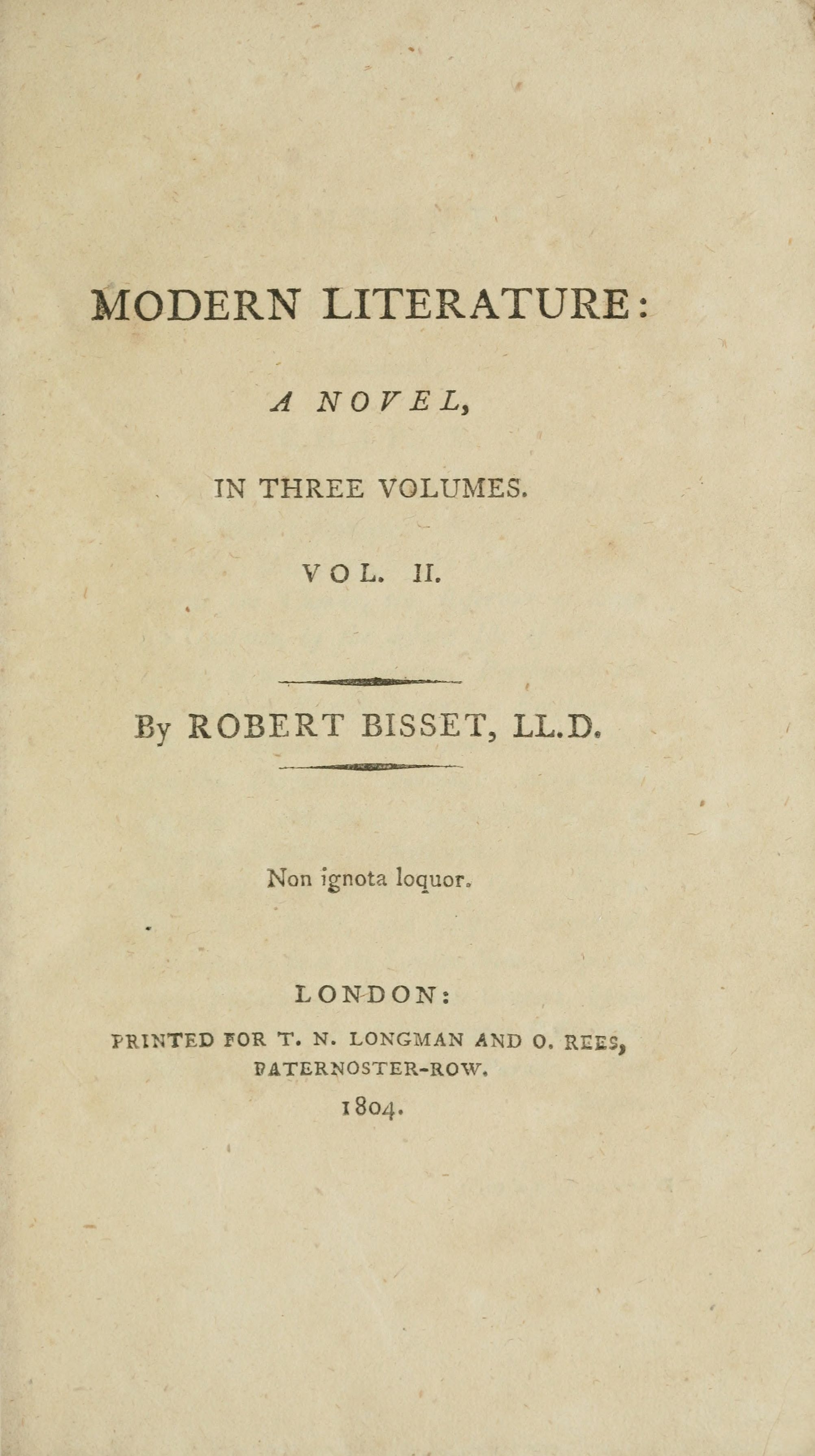
Transcriber’s note — MODERN LITERATURE: A NOVEL , IN THREE VOLUMES. VOL. II.
Variable spelling and hyphenation have been retained. Minor punctuation
inconsistencies have been silently repaired. A list of the changes made
can be found at the end of the book.
MODERN LITERATURE:
A NOVEL,
IN THREE VOLUMES.
VOL. II.
By ROBERT BISSET, L.L.D.
Non ignota loquor.
LONDON:
PRINTED FOR T. N. LONGMAN AND O. REES,
PATERNOSTER-ROW.
1804.
Printed by A. Strahan,
Printers-Street.
CONTENTS OF THE SECOND VOLUME.
CHAP. X.
Description of Brighton in the latter Years of
the Eighteenth Century. Prospect from the
Church. Ideas suggested by Ships sailing towards
the Thames, the Reservoir of English
Opulence, by the distant Isle of Wight,
calling to us by Association, Portsmouth the
Reservoir of English Strength. Brighton itself.
Its Situation and Conveniences. Chief
ostensible Pursuits. Bathing. Regulations
suggested. Anecdotes. General Objects of
Brighton Visitants. Occupations of Brighton
illustrated by a Journal of a Day. Morning.
Sea Beach, and Cliffs. Breakfast.
Libraries, to hear the London News. Spontaneous
Elocution of Newspaper Orators. Spontaneous
Instructions of Newspaper Politicians.
Military Spectacles on the Parade. The
Steyne. Charming Women resemble Venus in
Beauty, and almost in its Display. Perambulations.
Historical Anecdotes of Brighton.
Honoured by the Presence of Charles II.
Not unworthy of that gallant Monarch: return
to the Hair-Dresser: hear the Narratives
of that communicative Person. Dinner,
Soals, Turbot, Down Mutton excellent.
Wine not so good. Walks, Tea, attend Ladies
to the Steyne. Moonlight Lucubrations there.
Adjourn to the Library. Toys and Dice. Hamilton
becomes acquainted with Captain Mortimer,
Maria’s Uncle. The Mortimers move
from his Seat to Brighton.
The Party visits the Steyne. Particular Description
of that Rendezvous. They repair to the
Library. A Governante complains of a Milliner
that had not kept her Distance. Anxiety
greatest about Precedence, where there is none
to settle. Our Hero meets Mr. Scribble, a
voluminous and noted Author: introduces him
to his Party, and invites him to Supper. Scribble
harangues the Company. The Party breaks
up. Hamilton and Mortimer again meet with
Scribble, who gives an Account of the wonderful
Extent of his Erudition. He knows every
thing, and writes on every Subject: instructs
his Hearers that all are inferior to himself.
He denies the Praise of Genius to those to
whom it is universally allowed. He departs.
Hamilton unfolds to Mortimer his real Talents
and Abilities. Describes him as a mere Drudge
and Bookmaker.
The Party repairs to the Library. Doctor Fatgoose
harangues on Public Affairs. Dispute
between him and Captain Mortimer. The
Parade. Application of a Soldier for Leave of
Absence, being engaged that Evening to preach.
Granted. Scribble dines with Hamilton’s
Party: entertains the Company with an Harangue
about himself. His History of Jack
the Giant-Killer. Scribble’s own Praises of his
own History. Criticisms upon others. Mr.
O’Rourke’s Admiration of Scribble, consults
him on the Subject of Methodism. Visit to
Shoreham. Return. Party to the Promenade
Grove. Account of the Company. A charming
and exemplary Lady of high Rank. A
charming Lady not so exemplary. The Countess
of Cockatrice. A military Nobleman who
unites the Hero, Scholar, and the Statesman.
Another as a Lawyer, eminent for masculine
Understanding. Lord Bayleaf an old Beau:
ogles the Ladies. Dialogue with the Cockatrice.
Persons of lower Rank. Kit Cotton, a
Citizen, retired to live upon his Fortune. His
Account of his rural Prospects, from his House
at Kingsland Turnpike.
O’Rourke makes a new Sally in quest of Methodistical
Adventures. Party to the Theatre.
Scribble there meets his Friend and Employer,
Bil Nincompoop the Bookseller. They depart
to sup together. Bil catechises Scribble on the
various Pieces which he is manufacturing.
Farther literary Plans. Dispute between the
Master and Journeyman: happily composed
by Punch. Excursion of Hamilton and his
Party to Worthing. They meet the Methodist
Errant with a Female ’Squire. Letters that
waited Hamilton on his Return to Brighton.
Mortimer and he repair to the Library.
There find Mr. Scribble instructing the celebrated
Mrs. Somerive on the Rules of Novel
Writing.
Party at Captain Mortimer’s. Mrs. Somerive
one of the Company. Conversation. Discussion
of that Lady’s Orphan of Pembroke. Succession
of Songs, and their Effects on the different
Sentiments and Feelings. A Letter in
a Woman’s Hand is brought to Hamilton,
while sitting by Maria. Uneasiness of the
young Lady. Hamilton leaves the Company.
Greatly agitated, Maria retires. Dialogue
between her and Hamilton’s Sister Charlotte on
Constancy. Hamilton has an Interview with
his Correspondent who proves to be the Countess
of Cockatrice. Accommodating Complaisance
of the Lady of the Toy-Shop. Hamilton
is visited by Scribble, brim-full of Joy. He
announces that he is now dubbed a Doctor by
the University of Aberdeen. Hamilton
explains his Absence to the Satisfaction of Maria.
The Ball. Schemes of Lady Cockatrice for rendering
Maria jealous. The Company adjourn
to Supper. Scribble is introduced in a Dress,
which he says is becoming his new Title. Description
of the Doctor’s Dress, and a philosophical
View of its Effects on juvenile Feelings.
Attentions of Sir Edward Hamden to Miss
Mortimer. Miss Primrose becomes attached
to Hamilton. Hamden pays his Addresses to
Miss Mortimer. Both Hamilton and Maria
highly esteem the Baronet’s Character, and concert
Means for explaining to him the Truth.
Doctor Scribble becomes acquainted with the Baronet,
and undertakes to instruct him in his
Parliamentary Duty. He expounds to him his
own (Doctor Scribble’s) Talents and Erudition:
shews the Baronet a Specimen of Tours,
in the Memoirs of his Excursion to Berkshire:
proposes to write Speeches for Sir Edward:
declares himself far superior to Charles Fox.
Hamden declines the oratorial Help of Doctor
Scribble. The Baronet joined by Hamilton,
whom he is obliged to leave abruptly. Evening
Walk of Hamilton to Shoreham Bridge:
learns that a dispersed Gang of Smugglers
has commenced Footpad Robberies. Nevertheless
he sets out on his Return. A dismal Report
reaches Brighton; and is heard by Maria. Frantic
Grief of the young Lady. John Mortimer
repairs to the Downs, which is said to be the
Scene of the Catastrophe: finds Stillness and
Solitude: perceives a Figure approach: he
hears a Voice. Consternation and Dread. The
Figure passes on. Mortimer returns to his Father
and Uncle. A Voice is heard at the Window
calling John Mortimer. They conceive
it the Voice of their murdered Friend. Morning
opens. Despair of Maria. Mortimer receives
a Visit, which renews his Consternation. At
length convinced of his Mistake, the Mystery
is solved. Hamilton explains the Adventure.
Heroism of a Soldier of the 42d. Joined with
the Valour of Hamilton, saved Hamden from
being murdered. Gratitude of the Baronet.
His Wound mends but slowly. Maria’s Concern
entirely dispelled. The Mortimers and
Hamiltons return to London.
Hamilton resumes his literary Pursuits: engages
in Criticism. Indulgence of young and
gallant Reviewers to fair Writers. Miss
Lacecap, the Milliner, brings a Novel for
Hamilton’s Inspection. Her Reason for writing.
Story of the Maze of Marbles taken from
Pyramid and Thisby. Praises of Sentiment.
Remarks on the Word “Error.” Introduction
of the Marvellous to English Works of
Amusement.
Hamilton engages in a great Work. John
Mortimer obtains an Appointment on the Continent.
Hamden arrives in Town, and renews
his Addresses to Maria. He conceives
that Hamilton is to become the Husband of
Miss Primrose. She and her Mother entertain
the same Opinion. The Countess of Cockatrice
promotes this Report. Her Ladyship’s
Reasons. Motives, Objects, and progressive
Rise of a Toad-Eater, illustrated in the Case
of Mrs. Dicky. She is employed by the Countess
of Cockatrice, to prevent the Marriage between
Hamilton and Maria. Countess of Cockatrice
proposes to give a Masquerade, and instructs
the Toad-Eater for the Occasion. Dinner-Party
at Mrs. Dicky’s. She sees Masks in the
Evening. The Masquerade. The Labours of
the Countess and the Toad-Eater rendered
abortive.
Interview of Hamilton with Doctor Scribble and
Mr. Lawhunt. Scribble praises German Literature;
and imputes his own super-eminent
Excellence to his Imitation of Germans. Mr.
Lawhunt’s Account of his own Avocations.
Scheme of Dr. Scribble and him for naturalizing
German Plays and Novels. A Specimen of
one of these Works translated by Dr. Scribble.
Hurlobothrumbo, a Tragedy, with Music,
Ghosts, Ghouls, &c. Farther Samples of
German Literature. New Mode of making
Love. Friendly Condescension of an Earthquake.
Specimens of the Morality of German
Plays. Apprehensions of Lawhunt from Visitors
worse than Ghosts. Hasty Departure.
Our Hero meets Strongbrain. William’s Estimate
of Dr. Scribble.
Interview between Hamilton and Hamden.
Hamilton unbosoms himself. Liberal and generous
Conduct of Sir Edward. The Baronet
undertakes to conciliate the elder Mortimers.
Disappointment and Regret of these Gentlemen,
but they at length consent. Preparations for
the Marriage of Hamilton and Maria.
Schemes of the Countess of Cockatrice for preventing
the Nuptials. Agents of Defamation.
Blackball undertakes a Chain of slanderous
Paragraphs against Maria. Defamation.
Skilful Progression of Calumny. Discovered
by Hamilton. With the Assistance of Sir Edward
he pursues and ferrets the Author, whom
full Confession respites from the Pillory. Hamilton
is united to his Maria.
Brighton is situated on a declivity
descending from the South Downs, a
ridge of hills, which rising near the east
coast of Kent, runs along the Channel
to Hampshire, where gradually declining
into woodlands, it at last terminates
in fertile valleys. There are three approaches
to the town from London; two
winding between the hills by Lewes and
Cuckfield; the third across the ridge
by Henfield. From the last, as you
come near the town, the prospect is extremely
striking on every side. You
have been contemplating the Downs,
which appeared like a line of bulwarks,
guarding the rich and beautiful vale of
Sussex. Before you, opens to your
view the sea, which serves as a grand
fence to the power, property, and independence
of England, with a distant
view of ships wafting from the various
quarters of the globe wealth, the remuneration
of industry. Pursuing these to
the left, you attend them beyond Beachyhead,
carrying riches towards London,
their principal emporium. Turning
your eyes next to the right, you descry
the Isle of Wight, which naturally suggests
the idea of Portsmouth; and of British
strength securing British opulence.
Descending, under you is the town of
Brighton, which, beginning in an eminence,
declines towards the south-east
in a regular and gradual sweep to the
Steyne, a beautiful lawn, bounded by
the cliff. Thence it again rises along
the cliff with a gentle ascent to the eastward.
An amphitheatrical range of
hills protects the town from the boisterous
assaults of the north and north-easterly
winds; on the west, extensive cornfields
gradually and beautifully slope,
from the Downs towards the sea.
The chief ostensible object of visiting
Brighton being sea-bathing, that operation
commences the employment of the
morning; and the whole beach is covered
with persons, either preparing
for the immersion, or enjoying themselves
with the salutary air of the sea.
When the tide is up, the water comes
very near the cliff; and the bathing
would, to scrupulous minds, appear offensive
to decency; but rigid strictness being
totally unsuitable to the pursuits of
Brighton relaxation, this objection,
whatever it might be in theory, has evidently
no practical weight. The ladies
seem far from averse to the contemplation;
and the cliffs are never more the
scenes of female resort. Here indeed a
young miss may learn more in a week
than a boarding-school, with even the
assistance of a circulating library, could
teach her in a year. Objects seen, as
the poet well observes, are much more
impressive than those heard as subjects
of discourse.
“Segniùs irritant animos, demissa per aures,
Quàm quæ sunt oculis subjecta fidelibus.”
Were this public exposure disagreeable
to the visitants of Brighton, it might
be easily prevented by a police vigilant
in the execution of duty. Men might
be compelled to confine their bathing
to an early hour in the morning, and to
keep in the wake of the machines, especially
in shallow water. But it may be
questioned, whether this reform would
answer the beneficial purpose of drawing
out more ladies to enjoy the morning
sea; at least, it has not been heard
that any of them have been frightened
by the present mode of exhibition. Gentlemen,
it must be allowed, are in this
particular so far correct, that they rarely
bathe so publicly but at an early hour;
but footmen, grooms, and persons of
the same rank, choose to display themselves,
without any machines, at the
middle of the day, when the company
naturally assemble on the beach to cool
themselves by the sea-breeze.
The presentments before that scene
of elegant resort, the marine library,
are little less inconsistent with decency,
than if the exhibitions were made on
the Steyne, to the company collected
under Mr. Gregory’s piazzas. A librarian
lately endeavoured to remove this
spectacle, but by a very inadequate
mode. To prevent these men from
shewing themselves naked to the ladies,
he attempted to take away all their
clothes. Baffled in an essay, which, if
successful, was so little calculated to remove
the evil, he was seized by the
exhibitors, and plunged into the element
which they had left. The suffering
incurred by his meritorious regard
for decency did not, it is said, excite
the sympathy and compassion which
might have been expected. Many did
not stick to say, that he deserved it by
his officiousness in endeavouring to
avenge insults offered to female delicacy,
of which female delicacy itself by no
means complained.
Whatever individual diversities of
character are to be found at Brighton,
in one quality all the visitors agree, that
is idleness. Tradesmen, merchants,
scholars, lawyers, senators, and statesmen;
in short, men accustomed to close
application and constant industry at
their respective homes, here do nothing.
To such, relaxation must be useful, by
affording them fresh vigour when they
return to their employments. But to
mere fine gentlemen, and other habitual
loungers, who have nothing to do,
at least do nothing at any time, or in
any place, it is doubtful if it can afford
the same recreation. To them its variety
is merely local; the whole change
is removal from the banks of the Thames
to the coast of the Channel; from lounging
uselessness in Bond-street, to lounging
uselessness on the Steyne.
The inhabitants, though successfully
busy, are engaged in occupations administering
to idleness. If they do work,
their labour is by no means productive,
and adds nothing to the useful stock of
the community. Their chief manufactures
are toys; their principal commerce
is gambling; every shop in
Brighton, the bookseller’s, the fruiterer’s,
the coal-merchant’s, the milliner’s, the
tallow-chandler’s, the perfumer’s, the
apothecary’s, and the undertaker’s, is a
toy-shop, and a gambling shop.
From bathing, the visitors return to
breakfast, when just and high praises
are bestowed on the excellent bread,
and the no less excellent butter that
comes from the Sussex valleys and Downs,
enhanced by the keen appetite which
the healthy air produces. Exquisite
honey also convinces the visitors that the
Georgics of Sussex are favourable to
bees, as well as to pasturage and
agriculture. The rest of the morning
is passed either in the toy shops and
walks of Brighton, or in land and water
excursions to the neighbouring towns
and villages. The days not devoted to
peregrinations have an uniformity so
great, that a diary of one may almost
serve for an account of the whole season.
The hours from seven to nine are usually
spent in bathing and walking on the
beach and cliff; from nine till ten is occupied
by breakfast, and waiting the arrival
of the post; letters not only of business,
but of amusement, and even of frivolity,
serving to relieve unoccupied minds
from vacuity. At ten we set out in quest
of food and of knowledge. Attended
by the cook, we betake ourselves to the
market, to examine the price and quality
of fish and of meat. Having provided
for dinner, and thus made dispositions
for preserving ourselves, we next
with laudable patriotism proceed to inquire
into the means of preserving our
country. Having concluded our dispatches
to the kitchen, we cross over to
the library, to peruse the London Evening
papers, and give judgment on the
conduct of the various cabinets of Europe.
Reading and thinking being burdens
too heavy to be borne by most of
the Brighton visitors, we are fortunate
enough to meet in the library gentlemen
most generously disposed to relieve us
from the trouble of both. Some accomplished
person, eminent for his elocution,
with benevolence the more meritorious,
because unsolicited, undertakes
to pronounce aloud the contents
of these repositories of intelligence; employing
dignity of emphasis, he reads a
paragraph about fashionable dresses with
a solemnity of diction that might suit
the recitations of Adam’s prayer in Paradise
Lost; perhaps too, while displaying
the splendour of his genius in his
oratorial powers, he may also exhibit
the exquisiteness of his taste in the brilliant
which plays from his finger, or the
cravat which he adjusts while enforcing
delivery by the graces of action: though
he reads much, he does not read all.
Anxious expectants press for a perusal
of his omissions. One old gentleman,
after ogling the ladies, is impelled by
sad recollection, to examine the generous
offers of those worthy and philanthropic
persons, who undertake to
brace the relaxed nerves, renovate age,
and invigorate debility. A smart youth,
in boots and buckskin breeches, seeking
moral perfection, reads its description,
in an account of a bald filly, free from vice.
A young lady, pale and pensive, earnestly
searches for a consolatory address to
those who dread the consequences of an
unguarded moment.
The text being finished, next comes
the comment. While committees are
formed to discuss the merits of a ball,
or a gala, celebrated by the dispensers
of news, to criticise the poetry of a
song, copied from a new play, or rather
to read and repeat the criticisms already
given, to fill up the blanks in a newly
published intimation of crim. con. to
guess who and who are together, with
digressive annotations concerning those
who probably have been together; some
grave doctor contemning the announced
virtues of horses, or vices of wives, undertakes
to expound the politics of the
day; being unanimously appointed by
himself, to inform and instruct the company.
In a voice loud, solemn, and
authoritative, as when arrayed in his
canonicals, he pronounces the peremptory
creed of Saint Athanasius, he says;
“Let me tell you, the ruin of this country
is disregard for authority; there
is a restless spirit in the people to think
for themselves, without duly venerating
their priests; the people have nothing
to do with the laws but to obey them:
all the distress of Europe arises from the
multitude pretending to inquire and
reason on subjects beyond their capacity:
I have little hope of the happy restoration
of the crown and mitre, to that
splendour and power which are justly
due to them, until the multitude shall
be re-taught a becoming reverence for
their spiritual superiors.” After this
exordium (intended to over-awe his
hearers into an humble submission to
whatever petitions he may be pleased
to advance), the self-created preceptor
proceeds to unfold to us the various
secrets of the London, Paris, Berlin,
Vienna, and Petersburgh cabinets;
the views and intentions of the belligerent
powers; and expounds to us the
state of the whole political hemisphere.
By half-past eleven, the affairs of
Europe being settled, the drum and
trumpet summon us from the diurnal
exercise of the politician, to the diurnal
exercise of the soldier. From the Steyne
we walk up to the parade, and in the
now well-known sounds of “Handle
arms, ease arms;” our own parish, and
our own corps, is recalled to our minds.
From this sweet recollection of our own
warlike progress and achievements, returning
to contemplate the exhibitions
before us, we admire the readiness, ability,
and skill with which the soldiers
perform their evolutions. Not a few of
us conclude, that the military instructor
who teaches them to handle arms,
knows his business better than the political
instructor in the library, who professes
to handle the counsels of statesmen.
Returning to the Steyne, instead of
the spectacles, we have now time and
opportunity to observe its late spectators.
A more lovely groupe is rarely to be
seen; most charming women, with complexions
freshened by healthy air and
exercise, their nerves braced by that
element, from which sprang the fair
deity whom many of them equal in attractive
beauty; their thoughts free from
the anxious cares of the evening, when
the momentous dice are to agitate the
heart of eager expectants of a toy. Their
breasts and their eyes are animated by
the sound of martial music, and the
sight of martial men; while they
themselves, like Venus, not only possessing
but displaying charms, nearly
approach to that state in which statuaries
exhibit the bewitching divinity: with
charms so transparent, who does not
wish for a nearer approach? the soft
complacency of their lovely countenances,
affords to sprightly youth the
reasonable hope, that they do not produce
dainties like the banquet that drew
the eyes of the hapless Tantalus, destined
only for his sight, but withheld
from his other senses. The Brighton
fair come not to inflict such torments of
the damned.
From the Steyne we walk along the
beach, or perhaps crossing the Downs,
view the tomb-stones: here we learn
that Charles the Second, of amorous
memory, chose, when escaping from the
usurper, as the last English stage of his
flight, a place destined in future ages,
as a testimony of honour for his memory,
to imitate the example of morals
which he set his subjects. Mingling
incidental with appropriate history, we
call to mind exploits not unworthy of
Charles himself: recapitulate the feats
of the Taylor of Brighton; and, perhaps,
inquire whether, though residing
in England, he was not a native of Ireland.
Descending, we are received by
the hair-dresser, whose narratives call
our attention from former to recent occurrences.
From him we learn what
fair lady has most highly extolled and
most liberally rewarded the lovely Jem[1];
who had been the greatest gainers and
losers by dice, cards, and billiards;
what new converts were made to methodism,
with the causes and circumstances
of their conversion; in what new instances
love inflamed religious zeal.
Dinner soon after making its appearance,
introduces the praises of Brighton
foals and turbots, mixed with severe
censures against the Brighton fishmongers,
who though not an hundred yards
from the landing-place, where they purchase
their wares from the fishermen,
exact a profit of cent. per cent. from
the consumer. We now project schemes
for repressing extortion by combination;
but as the execution of such projects
would require activity, and activity is
no part of a Brighton visitor’s purpose,
we talk against extortioners, but suffer
them to go on in the old way. Our
eulogiums on the Down mutton are chequered
by reproaches of the porter and
ale, and followed by severe invectives
against the Brighton wine; invectives
very unpatriotic, because a native of
our own country. Owing partly to the
quality of that beverage, and partly to
a restless disposition, often arising from
idleness, we are very moderate as to
quantity, and sit a very short time at
table. While our ladies repair to their
toilets to make dispositions for the evening
campaign, we stroll towards the
chalybeate wells, or, taking the opposite
direction, proceed to the race-ground
and signal post. Returning, we find
our fair friends arrayed to their minds.
After tea, we accompany them to the
place of destined resort for finishing the
amusements of the day; perhaps to
the theatre, where resorting for amusement,
and not for criticism, we have a
very good chance of being pleased.
Contemplating the company, we find
dress no more intended to cover than
undress. We see the boxes quite a miniature
of London, containing a number
of people, the greater part of whom
have met to converse, to look at one another
and themselves, attending as little
to the stage almost as if it were a pulpit,
from which the preacher was inculcating
moral virtue; unless there be a song,
or a Harlequin, when the spectators
are as attentive as if they had been
listening to a methodistical hymn, or a
methodistical preacher, fervently inculcating
the pleasures of spiritual love.
Perhaps the grove has been our choice,
wherein the scenery of Vauxhall is happily
imitated, and also some of the
amusements. Here, too, for those who
prefer retirement to company, there are
dark walks. On chosen evenings of supreme
felicity, there are balls; which,
presenting beaux and belles dressed at
each other, dancing at each other, talking
and simpering at each other, ogling
at each other, squeezing at each other,
and making assignations with each other,
we shall pass over, as neither in the
present operation, or future effects, containing
any thing peculiar to Brighton,
or which does not happen when ever
beaux and belles join in so exhilarating a
pastime. Perhaps, indeed, the bracing
air may increase their spirits and animation,
and give more elasticity to their
movements.
But on common evenings dedicated
to neither of the recreations which we
have just mentioned, we accompany our
fair party to the grand fashionable rendezvous
on the Steyne. After promenading
on this delightful spot, hearing
important and interesting remarks on
this one’s dress, and that one’s face, and
t’other one’s ancles, and listening to the
music, first of the librarian’s concert,
and afterwards of a solo from a blind
fidler, we adjourn to the library. There
the morning papers, now arrived from
London, afford Mr. Spout another opportunity
of displaying his elocution;
and Dr. Fatgoose his political wisdom:
but both now attract not the attention
which their morning efforts excited.
The indolent indifference of early hours
now give place to the anxious cares of
the night. Now the librarian is considering
the chances of the dice, preparing
for the principal business of a
Brighton trader; in short, he is collecting
his troops, and making his dispositions
for commencing the gaming,
encouraged not merely by the probable
hope, but the undoubted certainty
that whoever may be entitled to the
victory, he himself shall obtain the
spoils. As the general principle of
gambling is to acquire our neighbour’s
property without giving him an equivalent,
raffling, as practised at the watering
places, especially at Brighton, is
dexterously calculated for picking the
pockets of visitors, in order to fill the
pockets of the inhabitants; and, indeed,
is to Brighton shopkeepers a greater
source of revenue than any other craft
which they exercise, with all the benefit
of monopoly and extortion. The raffle-holder
gains without any risk: his profits
are always twofold, and by a little
additional dexterity of fraud, may be
threefold. In the first place, the article
to be disposed of is a toy, which if sold
in the shop, (or called for gentility’s
sake the library,) would at the retail
price fetch about double prime cost.
But the subscription for the raffle is, in
the second place, at least double the retail
amount: this is the second profit.
Thirdly, by the prescribed œconomy
of Brighton raffles, the subscribers do
not all throw together, but at different
times, as they happen to be present.
By adding a fictitious name, a librarian
can easily pretend that the name in
question has thrown the winning number.
Thus, for instance, if a netting-box
cost the raffle-holder one guinea, if
sold according to the rate of Brighton
profits, it might fetch no more than two
guineas, but by raffle it will produce
four; so that if the real winner should
be too sharp for the fictitious name to
come in, the holder has, at the worst,
three guineas of clear profit, besides the
daily and almost hourly return of his
money. Every subscription for one
shilling adds six-pence certain to the
gambling branch of the librarian’s revenue,
besides three-pence more to the
mercantile part, in the exorbitant profits
on the disposal of his goods. In the
best frequented raffle-rooms, 10l. a-day
are subscribed, affording to the owner,
besides his profit on his stock, 30l. a-week
for gambling without risk.
Raffling occupies the chief concern
of the evening till about nine o’clock,
when the various parties move either
homewards, or to some appointment or
assignation, according to their situation
and dispositions.
Such was the substance of Hamilton’s
account of the general state and manners
of Brighton: we shall now proceed to the
particular incidents and occurrences
which regarded him or his party.
The Hamiltons found a commodious
house at Russel-place, commanding a
very extensive prospect, that comprehended
Anchorfield, the cottage that
now held Maria Mortimer. Having
spent the morning after his arrival in
surveying the place, Hamilton rode
over to the seat of Captain Mortimer,
who was prepossessed in his favour by
the accounts of his brother and nephew,
and insisted on his staying to dinner; an
invitation which he most readily accepted.
In the course of their conversation,
his host said, he recollected
that when he was midshipman aboard
the Lion man of war, in 1759, there
was a land-officer of his name, a very
brave and handsome fellow, who, with
a party of soldiers, was aboard their
ship; and that the night proposed for
ascending the heights of Abraham,
he had charge of a boat, in which Hamilton
was the first man that jumped ashore,
and went up the precipice with Colonel
Howe. “I am told,” he added, “he very
much distinguished himself. I afterwards
saw him once or twice, but never have
heard of him since the peace.” Hamilton,
pleased with these praises, informed
him, that the Hamilton in question was
his father. “By George, now I recollect
it, you are extremely like one
another, and a fine youth he was: I remember
that after the town was taken,
as he walked through the streets, the
French girls used to admire him so. I
can tell you a comical story upon that
subject:”—but the entrance of a visitor
interrupted the projected narrative.
Hamilton, in the course of the day,
made great progress in the good graces
of the old naval hero. At the instance
of William, strongly seconded by the
younger Mortimer, and not opposed by
Maria, the Captain agreed to spend a
fortnight at Brighton, and the next day
a house was found in the vicinity of
Mr. Hamilton.
CHAPTER XI.
In the evening, the party repaired to the
Steyne, which they found almost covered
with company, met to enjoy the
cool sea-breeze, by the clear rays of a
harvest moon, to display themselves,
criticise others, and various purposes,
according to their age, condition, circumstances,
or inclination. Here were
lords and baronets, squires and merchants,
soldiers and sailors, physicians
and counsellors, and dignitaries; here
were apothecaries, attorneys, and curates;
here were tradesmen and mechanics,
and shopmen and journeymen;
all with their respective fair, from the
duke to the barber, the duchess to the
sempstress, all on a footing of equality,
under the general denomination of gentlemen
and ladies. Here if a fastidious
grandee might feel indignant at being
elbowed or jostled by a shoemaker or
taylor, the liberal and enlightened patriot
would rejoice in the consideration, that
these were all effects of a free and equitable
constitution, which assures to the
industrious and skilful the fruits of their
labour, enables them to compensate
the toils of their arduous exertions by
occasional relaxation, and braces their
bodies and invigorates their minds for
future efforts beneficial to themselves
and the public. But a grandee is not
the person most likely to feel or express
displeasure at this temporary intermixture
of ranks; those are often the aptest
to stand upon points of precedence and
dignity, who really have none to support.
An earl may with safety venture
to walk from the Pavillion to Fisher’s
with his taylor, without any apprehension
of being supposed the equal of that
taylor; but if a retired soap-boiler or
oilman were to allow Mr. Snip the
same liberty, the case would be very
different; they might be presumed to
be companions of the said taylor; which
would derogate from their supposed
dignity, and would be more heinously
offensive to their respective wives. Jealousy
is most commonly the result of
conscious deficiency; thence those are
the most apprehensive of contamination
from persons whom they regard as low,
who are really in their situation or sentiments
the most low themselves. This
was the view in which the Hamiltons,
Wentbridges, and Mortimers, regarded
the present amalgamation. They beheld
honest vulgarity of manners as an
object of sportive humour, when mingled
with affectation, but reserved contempt
for meanness of conduct. Having enjoyed
themselves for an hour in this
promenade, they retired into the library,
where, after having reconnoitred their
fellow-visitors, and recollected various
faces they had seen on the Steyne, Mrs.
Hamilton was joined by two ladies,
whom she recognized as neighbours,
with whom she had a slight acquaintance.
These were Mrs. Pompous, who had
formerly kept a boarding-school near
Mile-End, and her daughter, miss, now
an unwilling votary of the goddess Diana,
and who had received, unasked, the
boon prayed for by Daphne, and would
not, like that famed nymph, have fled,
even if the suitor had not been an
Apollo. Mrs. Pompous had, after her
retirement from tuition, betaken herself
to Southampton Buildings, that she
might be near her brother, a topping
hosier by the top of Shoe Lane. These
ladies declared themselves very much
dissatisfied with Brighton, because there
was so many low people there. “Them,”
observed the veteran teacher, “are kind
of creatures that one wishes to purtect or
sarve, but not to meet cheeck by jowl,
when one comes to elegant society.
Wilhelmina and I were quite asheamed
just now to meet Miss Furbelow, the
mantuamaker, who, though she knows
our condition in life, had the folly to
come up and speak to us as frankly and
freely as if she had been our own equals.”
“I do not think, mamma,” said miss,
“that it was intentional presumption in
the girl, but rather the thoughtless
ignorance of what is due to the diversity
of ranks in social life. You will observe,
Mrs. Hamilton,” continued miss
in the true imperative tone of preceptorial
habit, “that there are different
orders, situations, and professions in
every well constituted society.” “A very
just observation,” said our hero. Thus
encouraged, she went on: “Now, I
do think, that such diversity of condition
should be attended to, either at
private parties, or at public places; for
instance, it might happen that Miss
Furbelow, (proceeded Miss Pompous,)
and any of us might meet in a party, one
would behave civilly, and even with affability
and condescension to such a person;
but then, she ought to know her distance.”
Here Captain Mortimer inquired how
this Miss Furbelow conducted herself in
company? The answer came from Mrs.
Hamilton, “Very properly and genteelly.”
“Is she the servant or dependent
of the persons with whom she happens to
associate?” “Neither.” “Then I cannot
see,” said the captain, “why she is to receive
affability or condescension from
those with whom she is on a footing of
perfect equality.” Miss, accustomed
to have her dictates received as oracular
truths, was much displeased with this
contradiction, and answered, with angry
solemnity, “that these were antediluvian
notions, fit for the time of Queen Bess,
not for the present.” The captain assured
her, “that with regard to Queen Bess,
as she called her, she was totally mistaken,
both in fact and history; that degradation
of useful professions befitted the remains
of feudal ideas of those times much
better than the enlightened wisdom
of the present ages.” Miss retorted,
“that he was totally wrong, and knew
nothing of history when he talked so.”
The captain, though acute, intelligent,
and liberal, had not that perfectly fashionable
polish which can completely command
and disguise passions: he answered
the last observation contemptuously, but
desisted from farther contest. A person
coming up, heartily shook our hero by
the hand, and expressed his joy at seeing
him. This was a little man, seemingly
about thirty, five feet and an inch
in height, tolerably well proportioned,
so as in person to be an abridged edition
of a man, but with a countenance
grave and solemn. Without relaxing the
serious turn of his features, he said to
Hamilton, “I am so happy to meet you,
we shall have such food for remark and
observation.” “Ah! my friend Scribble,”
said Hamilton, “I had no expectations
of meeting you in this place;
we shall have such criticism and satire,
now that you are here: but come,
Dicky, go home and sup with us, and
give some account of yourself.” He
accordingly introduced him to his mother,
and the other party in general,
but more particularly to his friend John
Mortimer. After they had reached their
house, taking John and Scribble into a
back-parlour, he very gravely presented
Mortimer to Dicky; “This is Mr.
Mortimer, a young friend of mine, of
abilities and literature, that will be very
happy to avail himself of an opportunity
of being known to a gentleman of Mr.
Scribble’s immense, valuable, and diversified
stores.” Scribble kindly answered,
“he should be extremely happy by his
communications to benefit the gentleman.
Are you, sir, engaged in any
work? because, if you are, whatever
the subject may be, I shall lay you down
the rules of composition.” Mortimer
thanked him, but assured him, that,
for the present, he had no such production
in contemplation. Being now
summoned to supper, Mr. Scribble, conceiving
it incumbent on him to be spokesman
of the company, opened upon sea-bathing,
and professing a profound
knowledge of the animal system, in a
preaching tone, expatiated on its process
in the invigoration of the nerves.
Coming from operation to result and
effects, he very learnedly summed up
the narratives and arguments of his harangue:
“The salt-water contributes at
once to purification, and to tension, and
also to elasticity; the votaries of bathing
have in every movement a pleasing
bound, and an efficacious vigour. Every
act of the animal œconomy in which
they may be engaged is performed more
completely and satisfactorily. All these
I could illustrate to demonstration, but
a few may suffice.” Mrs. Hamilton,
not knowing what the nature of the
elucidation might be, proposed to suspend
the subject for the present, and a
more general conversation was introduced,
which lasted till the party separated.
Next morning Scribble, after
bathing, met Hamilton on the west
cliff; Mortimer soon after joining them,
they took a walk along the cliff, when
Hamilton praised the infinite treasures
of knowledge, human and divine, that
Scribble possessed: “Come, now Dicky,
astonish Mortimer here, by a frank account
of your studies.” “A detail,” replied
Dick, “would be tedious; but
since you insist upon it, I will give you
a short sketch of what I have read, or
treated in publications, or, in short, what
I know.” “What you know and can
write upon,” said Hamilton; “to speak
generally and concisely, every thing;
nothing comes wrong to Dicky.” “That
is too much,” said Scribble, vouchsafing
a smile; “but I certainly have
considered and discussed a good many
subjects; physics and metaphysics, history
and poetry, criticism and compilation,
divinity and morality, legislation and
political œconomy, the law of nature
and of nations, agriculture, manufactures,
commerce, and finance, botany,
chymistry, mineralogy, electricity, geology,
geography, nosology, and medicine,
have all exercised my pen.” Mortimer
uttering interjections, expressing
his admiration and surprize, Scribble,
farther to transport his wonder, went
on: “Though neither a physician, nor
a surgeon, I am more deeply skilled in
midwifery than any professed practitioner
of the obstetric art. Though not
called to the bar, I know better than
Erskine how counsellors ought to plead.
Though no clergyman, I know how
men of that profession ought to preach.”
“Mr. Scribble’s extraordinary merit,”
said Hamilton, “is the cause of no less
extraordinary envy. Nothing that he
brings out has the reception which
transcendent merit and abilities deserve.
The malignancy of critics abuses his
works, and the public most foolishly and
unfortunately countenances all his detractors.”
“So they do,” said Scribble,
“they are all in a confederacy against
me.” “The public,” observed Hamilton,
“has acted extremely ungratefully
to my friend here. If you were to
collect all that his indefatigable activity
has written, you would find it more than
the labours of some of our ancient divines.
Nay, I really do not believe,
that Saint Cyril himself wrote more
against the Nestorian heresy, though he
contributed seven folio volumes to orthodoxy,
than Mr. Scribble’s reservoir
of erudition has done to attack heretics
in literature, who, as he observes,
abound so much in the present day; and,”
continued our hero, “it is not on one
subject, but on all that he writes; my
friend here is not more meritorious for
his genius than his courage. There’s
no subject but Dicky will venture upon;
I am convinced, if it were proposed to
him, he would undertake to make out
the longitude, or to solve all the hieroglyphics
of ancient Egypt.” “But for
all this,” said Scribble, “I am subject
to the grossest defamation.” “Do you
know,” said Hamilton, “what the impudent
fellows say of poor Scribble?”
“I cannot conceive,” replied Mortimer,
“what is even possible to be said
against such genius and erudition.” “Oh!
the invention of malice will say any
thing.” “Why, what do they say?”
said Dick, somewhat irritated. “Insolent
scoundrels,” said Hamilton;
“Well, I will tell you, Scribble, that
we may have a laugh at their folly.”
“Ay, do,” said the other. “Why, it
was only t’other evening I called at the
club, and the conversation turned upon
the merits of my friend Dicky Scribble
here: I said nothing: but one said, ‘he’s a
special fellow; he’s a good raker; he has
industry; and has got together some
scraps on a great variety of subjects: he is
superficial in all:’ here, I thought it incumbent
on me to take your part; ‘I certainly
(said I) think Mr. Scribble a man of
extraordinary genius.’ Strongbrain was
there; he looked in my face, and laughed.
‘Hamilton, you do not think
him a man of extraordinary genius.’
Angry as I was at being so contradicted,
I could not help laughing also.”
“Laughing,” said Scribble angrily;
“you, as my friend, should have
knocked him down.” “By the lord, I
must have then knocked down all the
meeting, for they all agreed with him.”
“Hamilton, you over-rate that Strongbrain;
I think very little of him, I must
say, you yourself require a good deal
of care to form your judgment, Now
you think highly of Robertson and
Hume, and such men as those, you are
quite led by prevailing opinion; that is
always the way with men of no great
reach of abilities; whereas men of real
talents differ in their opinion from every
body else.” Hamilton not recollecting
he was the aggressor, and that this remark
was provoked by his satirical report,
was so far irritated, as to proceed
in humbling poor Scribble’s arrogance.
“Yes,” said our hero, “one instance
of that kind of extraordinary genius is
John Dennis, who, when all the world
allowed praise to Addison and Pope, endeavoured
to prove that neither of them
possessed any genius. Zoilus too was another
extraordinary personage, who endeavoured
to prove that Homer was no
poet.” “All that,” said Scribble, “is
mere common-place: I tell you, that
persons now looked up to for literature
and ability, are admired without reason,
and I can surpass them all myself; and
will surpass them all too.” “Come,
come,” said Hamilton, “don’t be angry
now, I was only telling you what I
heard; but we shall not touch any more
on your genius and learning; it is a
tender point: I know your works excel
most of the age; and I dare say, every
body else thinks so too, only they say
the contrary to vex you.” Easily persuaded,
that others thought as highly of
him as he did of himself, Scribble swallowed
these declarations, and soon after
departed to attend an appointment.
“Who is this?” said Mortimer. “Scribble,”
answered his friend, “is one of
that numerous class who, without genius
or philosophy, set up in the trade
of authorship. He is, however, much
better qualified than many of the fraternity;
he has received a classical education,
is master of arts, has been bred to
the English bar, but, finding he could get
no employment, harangues against all the
counsellors who receive briefs, especially
Erskine, Gibbs, and Garrow; although
he has not laid the foundation of erudition
in either physical or moral sciences,
he has raked together a great quantity of
detached and miscellaneous facts, and as
he has formed a decent, though stiff and
pedantic style, he can write common-place
observations on most subjects that
occur; and while he confines himself to
skimming the surface, he does well
enough, and is very useful drudge in
any periodical publication; but that
won’t serve the fellow, he must write
books forsooth. His parts are middling,
but his head has got a wrong twist,
common sense presides not in his
brain. Dicky would shine! To a man
that seeks literary distinctions, without
great powers and acquirements, an obvious
tract is singularity. Scribble is a
great controverter of established opinions:
He does not gainsay them by
any ingenuity of hypothesis, but by
simple contradiction. He is also a great
exclaimer against established, or rising
characters, especially in literature; that
springs, partly from envy, but chiefly
from vanity and self-conceit, or rather
from an envy proceeding from vanity
and self-conceit.” “What kind of
books does he write?” said Mr. Mortimer,
“I never heard of his name.”—“He
is not eminent, but still he is
noted.”—“But his books,” rejoined
Mr. Mortimer, “what are they?
scissars and paste, I suppose.”—“No;
that they ought to be: scissars and paste
is the resource of book-manufacturers,
without invention or wisdom; but
Scribble tries originals, and often spends
more time and pains in speaking, (for
he is a great coffee-house declaimer,)
or in writing paradoxical nonsense, than
might by compilation furnish a good-looking
fair book for his worthy friend
Billy Nincompoop.” “Who the devil
is Billy Nincompoop?”—“An undertaker-general
in the book-manufactory
line. I shall give you some account of him
another time: all I can now say is, that he
has more journeymen at work than any
mailer-manufacturer either at Birmingham
or Manchester, and a great deal of
work they do, and often very dirty work
it is. Billy keeps a very sooty forge.”
The youths now returned to breakfast;
soon after they accompanied the
ladies to the Steyne, and the sun being
very warm, they retired into the library,
where they found a tall corpulent
divine, with his bib and apron,
and a large bushy wig, expounding the
operations of the Austrians upon the
Danube, and describing, as well as
he could, the siege of Belgrade; the
Emperor Joseph, he instructed the company,
was a profound politician, and a
consummate general: he was also, he
firmly believed, a zealous friend to the
protestant religion; witness his efforts
for suppressing monasteries, and other
repositories of popery.—Captain Mortimer
said, “he could not perceive
much of his wisdom there; his innovations
were rash and precipitate, and appeared
to be more for the sake of plunder
than conversion; that the effect was
revolt among his most industrious and
flourishing subjects.” “They are insolent
and audacious,” repeated the dignitary,
in a pompous and sonorous tone,
which with many served to fill up the
chasm of argument; “subjects ought
not to question the will of their rulers.
A prince is responsible for his conduct
only to that being from whom he derives
his power,” “Pretty doctrine
that in a free country,” (said the captain,
somewhat iritated by the dictatorial manner
of the self-sufficient priest,) “God
forbid it should ever prevail in Britain.
But Britain out of the question, it is totally
erroneous in its application to the
people of the Netherlands, whose first
executive magistrate, Joseph, was on specified
terms. Joseph has broken the
conditions, therefore his subjects have
a right to be off the bargain.” “That
is an irreverend and seditious way of
speaking.” “Irreverend and seditious,”
said the captain, “who are you that dare
use such language to a gentleman, merely
because he won’t take your solemn sounding
nonsense, for sense and argument.”
Hamilton seeing the choler of his naval
friend, found means, by sliding into the
conversation, to soften matters; and
though no friend to public argumentation,
yet, desirous of gratifying Maria’s
uncle, he took a comprehensive survey
of the conduct of Joseph, proved him
to be the mere creature of imitation,
who totally misunderstood his models:
that to follow Frederick in the fashion
of the times, he was an infidel; but contrary
to the wise caution of his Prussian
neighbour, manifested his infidelity in
practical policy, and wished to destroy
ecclesiastical establishments, the best preservers
of civil and social order. In his
present war with Turkey, he was the
mere tool of Catherine, and was exhausting
the resources of his country, to promote
projects totally useless to his own
dominions, and merely instrumental to
the ambition of the Empress. But if
the war had been wise in its origin, it
was feeble and inefficient in its execution.
“In short,” said Hamilton, “in
the internal administration that drove
subjects to revolt, and in the external
policy that engaged without provocation
in a war to aggrandize another, I should
think there are strong objections to Joseph
as a consummate politician; and in
the military conduct of four disciplined
armies, repulsed by an undisciplined militia
of barbarians that were enabled to
invade and lay waste their fertile provinces,
and alarm their capital, there
are objections to the character of Joseph
as a consummate general. But
these, I dare say, the knowledge and ratiocinative
powers of the reverend gentleman
will, no doubt, satisfactorily
solve.” The doctor, who both in the
pulpit and out of it, had been accustomed
to preach, but not to hear or to
reason, did not think proper to reply to
this answer, but strutted out of the library.
Not so Dicky Scribble, who had
some time before joined the party,
and eagerly listened in hopes of an argument
which might display his logic
and his eloquence, and co-operate with
a paragraph that was to appear in a
London morning paper that would
reach Brighton that evening, announcing
among the arrivals Richard Scribble, Esq.
the celebrated author. With these views
and expectations he accosted our hero.
“Mr. Hamilton, hem, I have heard
with great pleasure, hem, your very ingenious
argument, and I am not surprised
that your eloquence overwhelmed an
ordinary hearer, hem, but bestowing
every praise on the brilliancy of your remarks,
you will give me leave to question
their logical force, hem. I will
undertake to prove that the Emperor
Joseph is a very wise man, hem.” “I
know you will, my good friend, undertake
to prove that or any thing
else, but respite your wisdom and erudition
for the present, we are going
to the parade. You that are a man
of taste and refinement are friendly to
gallantry and a polite attention to the
ladies.” “Undoubtedly,” said Scribble,
and to give a practical proof of his
elegant address, on which he very much
plumed himself, he made his best bow to
Miss Mortimer, begged he might have
the honour of her company, and while
she was humming the South Downs, in
unison with the band, he entertained her,
or at least himself, with a dissertation on
the different modes in which different nations,
in ancient and modern times, treated
women. Captain Mortimer at this time
was praising and thanking our hero for
his powerful assistance against the parson;
but however he said, “it was not difficult,
it was a first rate, full rigged,
against a hulk; but this little cock-boat,
Dicky, as you call him, to be sure he
makes a great noise, but it is like the
guns on a rejoicing day, all powder and
no ball.” Having contemplated the military
evolutions, after the corps were dismissed,
they were joined by an officer
with whom John Mortimer was acquainted.
This gentleman was presently
accosted by one of the soldiers of the
light infantry corps, who requested
leave of absence from the evening parade.
His commander questioned him
about his business, not approving of
the excursions of soldiers in the dusk;
but to the surprise of himself and the rest
of his company, was answered that his
engagement was to preach the gospel.
The captain at the intercession of the
party, permitted the desired absence for
a pastime not very usual among soldiers.
Mr. Scribble would have opened an argument
to prove that such preachers
might do more harm than good, but
found no one disposed either to refute
his reasonings, or listen to his wisdom.
The party being engaged to dine with
the Mortimers, Mr. Scribble was asked.
The fish consisted of turbot and foals.
Here Dicky had, or at least took, an opportunity
of holding forth upon ichthyology,
which learned term, he in deference
to the ladies, explained, and endeavoured
to account for the scarcity of
cod, haddocks, &c. on the coast of Sussex.
He informed the company that he
thought very little of Buffon’s Natural
History, and that he had thoughts of
writing on the subject himself, to detect
and expose the other, and to remedy
his defects. “It is a pleasing and instructive
subject, but has never been hitherto
properly treated, that is one of the
desiderata in literature, which I am
afraid it will be reserved for myself to
fill.” “There are so many chasms,” said
Hamilton, “which your benevolence
proposes to supply, that I am apprehensive
you will hardly be able to bear the
laborious task.” “Oh! I have a very
strong mind. One work much wanting
is a history of the decline and fall of the
Roman Empire. You, sir,” appealing to
Dr. Wentbridge, “will admit that Gibbon’s
religion is not of the best.” “Most
readily,” replied the doctor. “In his views
and arrangement,” rejoined Dicky “I
will demonstrate that he is extremely defective,
that he is narrow, uncomprehensive,
and confused.” “The eviction of such
a proposition, would convey a new truth
to my mind,” said the doctor; “but so
important a subject requires a written treatise.”
“That I intend.” “Have you written
any thing historical, sir?” “O, yes,
from authentic records and documents
that I found in an old chest near Glastonbury-abbey,
I composed in seven volumes,
quarto, a true, and impartial,
history of Jack the Giant-killer, including
cotemporary heroes. I have the
satisfaction to say before this good company,
that more profound views of human
nature are no where to be found,
but envy, that corrosive passion, blasted
the tree at its birth, else it would have
been a goodly child, which in its mature
vigour, would have reflected honour
on its happy and delighted parent.
How do you like my figure?”
“Very much,” said Hamilton, “it is
very fine, and for mixture, Burke himself
mixes.” “Perhaps you mean that
as a compliment, my good friend,” said
Scribble, who during dinner had drank
wine with every individual in the company,
and afterwards had not been sparing,
“but I do not think very highly of
him. On any subject that he has undertaken,
I will undertake to write better.
Name the subject, it is all one to Scribble.
I have in agitation a new theory on the
sublime and beautiful, which will astonish
the world. Longinus, Addison, Burke,
Gerrard, Hutchinson, Hogarth, psha,
they do very well to pass on superficial
people, but I believe I must take the
subject in hand myself.” “How do you
like the eloquence of Mr. Fox,” said
Dr. Wentbridge. “Why, tolerably
well his speaking, eloquence you cannot
call it. Fox is a good sensible man
enough, but no orator.” “What is an
orator,” said Dr. Wentbridge. “What
is an orator,” replied our sage, “ask
your nephew there. Hamilton, you remember
my speech at the forum.” Mr.
Pitt being now proposed as a toast,
Scribble having first filled and drunk a
bumper, half shut his eyes, curled up his
nose, looked contemptuous and great.
“I think nothing of Pitt’s ability, a superficial
young man. If I had been
prime minister, now you would have
seen the country in a very different situation;
men of letters and wisdom should
have been the sole governors. I should
not have employed a copying clerk in
an office, unless he could speak Greek;
moreover, unless he was conversant in
metaphysical, physical, and moral erudition
and science. Not a letter should
have been written of which a Cicero
could be ashamed. The epistles upon
plain business should have been attuned
to Cicero in harmony, and swelled to
Cicero in magnificence. How do you
like my phraseology, is it not worthy of
the subject?” “Highly,” said the doctor,
“but as to the matter of fact,
Cicero’s letters upon business have neither
the tone, nor the swell that you
mention, they are clear and plain narratives,
with apposite observations, and
strong reasoning, expressed in language
simple and energetic, but totally unadorned.”
“I know,” said Scribble, rather
shortly, “what Cicero’s letters
are.” Wentbridge not deigning to enter
into a contest with this gentleman, the
subject dropped. Besides himself, Mr.
Scribble had one admirer in the company,
this was Mr. Roger O’Rourke, who regarded
him as a phenomenon of wisdom
and learning, pledged his bumpers, and as
they adjourned to tea, took occasion to
pay him a compliment, and ask his advice.
“By Jasus, Mr. Scribble, you
are the cleverest fellow I ever see in my
life, unless it was Counsellor Magpie at
Dundalk assizes, when I was tried for
horse——I mane when I was a witness
for horse-stealing; but he did bother
them all so, by Jasus he got it all his own
way, and proved an allby, and that made us
all snug: I mane made the prisoners snug.
I after that took to the dancing line, and
then to the Gospel; but my father-in-law,
and my friend Mr. Hamilton here would
have me give up the preaching, because
it led me to bad courses, and to be sure,
to confess the truth honestly, a methodist
preacher has such temptations among
the dear cratures, that flesh and blood
cannot stand it. The saints are so warm
and so loving, then there are so bewitching
opportunities; there is the love feast,
the holy kiss, and the spiritual communion
in the dark; the evening meetings
in the conventickles, and tickle they do
sure enough. Even an Englishman with
all his prudence, or a Scotchman with
all his gravity, but much more, a poor
boy from Ireland must give way. For
when man and woman meet alone,
Mr. Scribble, they are dangerous kind
of combustibles: and then there is that
faith without works gives such encouragement.
Its all as one as if I was to
live as I pleased at an ale-house, and tell
the landlord I believe you to be a very
good sort of a man. He, every time I
ran up a score, would take a wet cloth
and wash the chalk. By Jasus he would
not want customers. Now, sir, as you
appear to be a man of great sense, I wish
to consult you on a point of conscience
and sacrecy. You see, sir, to confess the
truth, my wife, the large fat lady with
the red hair, that set opposite to you, is
none of the handsomest, and besides, as
Louis XV. Emperor of Germany observed,
toger perde[2], which it seems in
their language is, too much of one thing
is enough. What with the bathing and
sea air, and the bracing and one thing or
another, and looking at the sweet creatures
in the face, I have a great mind to
take to the methodism again. I am sure
I could be more populous than that light
infantry man. If you would speak a good
word for me to young Mr. Hamilton,
for he rules the roast with the old boy,
just to let me have a small excursion
while they stay at Brighton, I shall, as in
duty bound, both in my sermons and out
of them, praise your works.” Scribble
having further conversation in the course
of the evening with Mr. O’Rourke,
concluded that with some training in orthography
and grammar, he might be
improved into a spiritual writer, for his
friend Billy Nincompoop, who it seems
would soon want a fresh hand in the divinity
branch of the manufacture; and
promised to take an early opportunity
of further conversing with Mr. O’Rourke.
They now adjourned to the meeting of
the military saint, who borrowed the
quaker rendezvous for that night. This
preacher was deemed the best singer of
martial songs in the whole regiment;
upon the faith of that perfection he acted
also as precentor. He got very well
through the performance, bating that
he once fell into the tune of “The top
sail shivers in the wind,” and in endeavouring
to get out of it, he got hold of
“The black joke.” He however succeeded
in pitching his voice for the
next stave by humming the serious and
melancholy ditty, “There came a ghost
to Margaret’s door,” and got at last into
a proper strain of psalmody. The discourse
had nothing particular in it to distinguish
it from any other methodist sermon,
consisting merely of cant, mysticism,
soft love imagery, melodious inanity,
chequered with the terrible pictures of the
punishment of unbelievers, when in possession
of the devil. The sermon included
a very particular detail of roasting in hell-fire,
which, next to the amorous parts,
gave the highest satisfaction to the devotees.
Towards the end of his discourse,
he took occasion to compare Brighton
to Sodom and Gomorrah, and exhorted
them speedily to depart from such a
scene of wickedness: he should lead
them to the right way. The drum-major,
who happened to be present, hearing
this declaration, took it into his head
that the preacher intended to desert,
seized him as he was descending from a
bench; but finding on examination that
the orator had only been speaking by types
and similitude, he suffered him to depart
in peace. From the chapel, Mr. Scribble
prevailed on the company, though it
was late, to look in at the library, hastily
proceeded to the reading table, and
taking up the Humbug, call out, “How
shameful it is in those news-writers, that
a man of any eminence cannot move
from one place to another, but they must
make it public.” “What is the matter,
Richard,” said Hamilton. “Read that
paragraph.” We learn from Brighton that
the celebrated Richard Scribble, Esq.
delights and astonishes the frequenters of
the rooms and libraries by the brilliancy
of his wit, and the depth of his erudition.
“It is astonishing how the Humbug
could know that already,” said Hamilton,
“last night was your first in the library,
and however witty and wise you might
appear, I cannot account for your fame
reaching London in time for the morning
press, but by enchantment.” Soon
after the company parted for the evening.
The next day, a water excursion was
proposed for Shoreham. On their way,
their pilot poured out his maledictions
against Mr. Pitt, for having so completely
suppressed smuggling, that as the
waterman phrased it, there was now no
opportunity for honest industry. Having
arrived at this ancient borough, and
viewed the rope-works and other curiosities,
the conversation turned from the
commercial state, to the political history
of this noted repository of electors. Some
of the company animadverting severely
on the gross corruption of 1768, Mr.
Scribble undertook to prove that corruption
was necessary to the existence of
executive government; but, he was interrupted
in his dissertation, by notice
from the watermen, that they must immediately
return, or that they would
lose the tide: they accordingly returned
to Brighton. That Evening they spent
at the Promenade Grove, where there
was a great deal of company, and most
fortunately, our hero’s party was joined
by Mr. Chatter, the apothecary, intelligencer
general of the place. Several
ladies entered the room, one of whom
was strikingly beautiful in her face; of a
most expressive countenance; of a fine
stature, and exquisite form; Hamilton
being at some distance, his sister asked
Mr. Chatter who that was? “The wife
of a valiant soldier, pretty miss, who assisted
Wolfe at Quebec; forced the city
to surrender; became a viscount on the
death of his father; a famous hand for
wit and humour; was lord-lieutenant of
Ireland; great favourite with the whole
nation; did not call for coffee too soon
after dinner; eldest son became an earl
while he was viscount;—said a good thing
upon that. His son regretting that he
had a higher title than his father. I
don’t care, George, which title you have,
so long as you don’t get hold of mine;
but the viscount is lately made a marquis.
She is a charming woman—the
marchioness,” said Miss Hamilton;
“she is an excellent wife, mother, and
mistress of a family, pretty miss, a pattern
to her rank and sex. If all were to
take example by her, Doctors’ Commons
would starve; but I do not suppose
you know any thing of them sort of
things yet, miss.” Miss Mortimer now
observed a lady of a fine shape, with a
most fascinating countenance, and applying
to Mr. Chatter, this communicative
person very readily gave her information,
prefaced with a hem, and the hem accompanied
with a shrug of the shoulders,
“that’s a lady of quality too, very different
from the marchioness; she is the
countess of a Cockatrice, evil tongues
don’t stick to say;——but my lord is a
good, easy man, not at all exceptious,
and if he is pleased, nobody else has a
right to be displeased. She has daughters
grown up and married,—that is one
of them a little behind that lady with the
rolling eye; she seems already to have a
good modest assurance of her own too.
O Lord, there is little Tommy Titmouse,
the famous coachman.” “Poor
Titmouse,” said Hamilton, “he is a
good-natured little creature, and encourages
the breed of horses; therefore, he
is not so totally useless as one is apt to
think.” “Observe,” said Mortimer,
“that tall military figure; that is a nobleman,
who unites the hero, the scholar,
the statesman, the philanthrophist, and
the finished gentleman,—such as English
nobility ought to be. That also is
a lord, who is speaking to him.” “What,
he with the strong, black, bushy eyebrows?”
said Miss Mortimer. “That,”
said Hamilton, “is a man of as powerful
a masculine understanding, as most that
have ever sitten in the house of peers,
or occupied the highest offices in the
state.” There now entered a slim, middle-sized
gentleman-like man: evidently
an old beau, wishing to appear young,
who was immediately accosted by the
fascinating countess above-mentioned,
“and is Great Bayleaf come to enliven
Brighton with his gaiety and gallantry.”
His lordship, with the fashionable inattention
of the manners of the time, made
no direct answer; but, looking through
a spyglass at Miss Mortimer;—“fine girl
that, Cockatrice, is she one of us?” “Of
us, no; one of the canaille I suppose; a
fine fellow that; that squires her though;”
“well enough for a trooper,” said the
peer; “but perhaps, such are to your
ladyship’s taste;” “and perhaps such
girls may be to yours; but, take my
word for it, such a youth would be
much more to their’s.” “I admit the
competency of your ladyship, to deliver
judgment on the case, and sustain your
verdict; he shall be a fine fellow, since
you will have it so. But, who are all here?
Who of us.” “Of you, Peers of England—pillars
of the State: there is, as
you see there, the lord chancellor, and
the lord chief justice Norland, to engage
with your ladyship on constitutional
law, and state politics. Lord
Carolina to engage you on warfare and
literature.—I saw two or three of the
bishops here too; they will afford an
opportunity of opening your stores on
divinity.” “Aye, aye,” said Bayleaf,
“what you say of learning and divinity reminds
me of a piece of news I just heard.
I find my Lord Cockatrice is turning
author;” “What is he about to write?”
“A commentary on the patience of
Job.” “Well,” said Bayleaf, “your friend
George Bonmots, who has been your
partner in other concerns, seems to be
letting you into a partnery of his wit;
but, I much question whether your capital
be sufficient.” “But your ladyship
has not yet answered my question:—Who
of our friends are at Brighton?”
“Oh! abundance; there is my Lord
Spindle, Viscount Ogle, Sir Billy Butterfly,
Tommy Titmouse, the Lady
Leerwell, the Dowager Dimple, the
Countess of Cockdie, Lady Frances
Faro, Sir John Jockey, and an old friend
of your house, his new-married lady, and
various others, whom I have not time
now to recount.” During this dialogue,
a plump, sturdy, rosy-cheeked person
made up to Mr. Chatter, who received
him with much heartiness. “Ah, my
good friend, Kit Cotton, who thought
of seeing you at Brighton?” “Being
now less off business, and a gemman, I
have come down a bit to see your doings.”
“So you have left off business.”
“Yes; I have retired into the country
now, for the benefit of air and exercise.
I bought a nice house by Kingsland turnpike,
near the brickfield, within sight
of the great cow-keeper’s yard. Charming
prospect I have on the one side to
Ballspond and Hoxton; on another, to
Hackney fields, all the way over to the
Cat and Shoulder of Mutton. We are
just upon the road, and there is a power
of coaches that passes us every day; so
it is very pleasant to sit at the window
and count them. I know to a minute
when every stage coach should pass, for
I was always pretty cute, and obsarves
what is going forewood.” “But why are
you in mourning; no family misfortune
I hope?” “Oh yes, our Deborah have
left me a widower; but, as the parson
says, the will of Providence must be
done. Daughter Peg now keeps house.
It was she that made me come down here,
for, says she, father, now you be come on
in the world, and a gemman; it is right
you should put yourself forwood among
other great gentlefolks. I was agreeable,
and proposed Margate; but Peg
said, says she, Margate be well enough
for the ribble rabble Canille, says she;
but won’t do for those who have pretensions
to gentility, says she. Most of our
old neighbours are gone there that I used
to keep company with before I left off
business; and my daughter Peg says
they won’t do for people of condition.
This is a good smartish place enough,
not much worse than White Conduit
House; but for one thing, is bad. I
axed the waiter for some baccar, he
laughed, and told me, as how no smoking
was allowed here.” Mr. Cotton being
departed, Scribble was disposed to entertain
the party with a dissertation on the
tendency of habit, to determine the sentiments
and characters of men; but the
commencement of a favourite song postponed
his erudition.
CHAPTER XIII.
The next morning, Mr. O’Rourke again
applied to Scribble, to interpose on his
behalf for leave of absence. Hamilton,
who really was somewhat ashamed of
having such a figure in their parties, was
not much averse to the proposition; he
conversed on the subject with his uncle
and cousin; the former of whom cared
little about the preacher; the latter,
though averse to his absence, yet afraid,
that by being crossed, he might relax
into his former practices, judged it most
expedient to consent. Accordingly, he
set off that very afternoon on the road
to Lewes, and was, by appointment,
joined by a female devotee, with whom
he had made acquaintance at Brighton,
and who agreed to accompany him in his
spiritual peregrination. This evening
was spent at the theatre. Here, as usual,
they were joined by Mr. Scribble, who,
at the end of the first act, was very cordially
accosted by a strange looking
figure that entered the box. This was
a tall thin man, with a pale countenance,
goggling grey eyes, and a remarkably
long nose. Scribble returned the address
with great pleasure. “My dear friend,
Mr. William Nincompoop, to what do
I owe the unexpected happiness of seeing
you so far from home? I thought you
had spared no time for pleasure;” “I
don’t spare time for pleasure now, I
have come upon business,” whispered
Nincompoop; “but come and sup with
me at the tavern, and I will tell you
all about it.” Scribble accepted this invitation,
and when the play was finished,
the bookseller and the author set off to
Hicks’s. When they were seated, Nincompoop
opened: “My valued friend,
Scribble, I know I can depend on you in
whatever you undertake, and on your
recommendation and advice, as well as
your services; I prefer you to any of my
authors, for your readiness to undertake
any thing. Let me see,” said he, “what
you are all doing for me at present.
First, there is biography, the history of
Katerfelto and his black cat;” “yes, I
reckon that one of the best things I ever
wrote;” “the life of the noted Charles
Price, hanged for forgery; the life and
adventures of Hawke the highwayman,
and of Macdonald the thief-catcher; but
take care of borrowing from the Newgate
Calendar. Secondly, travels; tour
through Ireland, including picturesque descriptions;”
“yes, I got through the bog
of Allen in Bunhill-row, and here at
Brighton I am at the lake of Killarney;”
“very well. Thirdly, metaphysics.—How
comes your treatise on?” “I
have already proved, that Locke, Hutchinson,
Berkeley, Hume, and Reid,
are blockheads, and I am now demonstrating,
that nobody knows any of the
matter but myself.” “Very well. Fourthly,
divinity. How are you proceeding
against Horseley and Priestley?” “Demonstrating
that both know nothing
about the matter, and as before, that
no one knows any thing about the subject
but myself.” “Fifthly, mathematics.
How goes your essay upon the Cycloid?”
“It’s not quite so far advanced,
really,” “I must begin another hand,”
said Nincompoop. “Sixthly, Ethics.
What are you doing against Paley?”
“I demonstrate him to be a fool, and
myself only thoroughly to understand the
subject; but history is my sheet anchor.”
“Do you think you would have
time to do any thing for me there?”
“Oh yes,” “I want a smart history; I
don’t care on what subject,—or two or
three.” “Suppose a second edition of my
Jack the giant killer, or to make it a more
general title, the history of British Giants.
I have got some valuable materials
about Gog and Magog myself,” “I
should like something more modern.
Could you cut me out from the gazettes
and magazines, a good dashing original
history of the American war?” “Oh
yes, if I cannot write a better history
than Hume, Robertson, or Gibbon, I
will promise never to write another line.”
“Do not make rash vows,” said Billy,
“for you would assuredly break them.”
“Another very clever man is strongly recommended
to me as a capital hand for
the military part.” “Aye, who’s that,”
“Spontoon, drum-major of militia, now,
I am told, at Brighton. I think if he do
the military part, and you the rest, it
will be a capital job. I shall agree on
the usual terms; three half crowns a
sheet, thirty shillings a volume for books
to be broken up;” “but I must have an
additional six-pence per sheet for flour
paste.” “I dont like to find the flour; it
would be establishing a bad precedent
for my other authors, and would stand
me in a sack of flour each quarter; besides
they might be making puddings as
well as books. No; all my authors
must find their own scissars and paste;
you know the workman at every craft finds
his own tools; and the master only finds
the materials. I must hear of no charge
for paste:” “well, be it so, we shall not
out about that, let’s see about Spontoon
to-morrow.” “Scribble,” resumed Nincompoop,
“do you know of any good
hand at methodist sermons and hymns?”
“Oh yes, I can undertake them myself.”
“No; you have enough in hand
already.” “Well then, there is a tall
Irishman, called O’Rourke, I think he
might be brought to do; he is gone a-preaching
now; a good sharp fellow,
but I rather doubt if he can spell.”—“Spell
indeed, what does that signify?
If I were to employ no authors, but those
who could spell, I would not do one quarter
of my present business,” “and you
do a great deal, my respectable patron.”
“Aye, how do I do so much business?
Why by not being nice, either in my
subject or my writing.” “I will introduce
you to that young man that you saw with
me; a decent enough youth.” “Oh,
Hamilton you mean; I know him by
sight; he is a very able writer I am
told.” “Who tells you so?” says
Scribble. “The booksellers, the public,
the world.” “The booksellers, the
public, the world, are a parcel of ignorant
blockheads. I tell you, Hamilton
is not a clever fellow, and you, and whoever
says he is,” continued Scribble,
“only shew their own ignorance.”
Scribble was warm with liquor, otherwise
he would never have ventured to talk so
cavalierly to his supreme employer in
the book manufactory. Nincompoop
was a cunning fellow; regarded his own
set of authors merely as productive journeymen,
and, as many saleable books
could be compiled without learning or
genius, the chief qualifications he
sought, in the usual routine of his business,
were laborious drudgery, and readiness
of raking. He could not distinguish
between pains-taking dullness, and
real ability: and therefore prized Mr.
Scribble. Proud and irritable, however,
he replied disdainfully to his journeyman:
“I will not suffer such language from
any man; no, if instead of being a common
literary hack, a jade of all work,
he had the powers and learning of Dr.
Strongbrain.” Scribble, too intoxicated
for prudence, screamed with rage, “let
me tell you, sir, I am superior to a hundred
Strongbrains put together.” Nincompoop,
who was perfectly sober, and
extremely quick in surveying his own
interest, recollecting the serviceableness
of Scribble’s manufacturing talents, resolved
to avoid a quarrel; and, by unsaying
all that he had said, imputing it to
the hastiness of his temper, and asserting
his thorough conviction, that Scribble far
surpassed Strongbrain, and every other
literary man, he pacified the enraged
author, called for a fresh bowl, and spent
the remainder of the evening in friendly
conversation, that was ended, by Dicky’s
falling from his chair on the carpet, where
he slept without disturbance till the following
morning. This day, a party was
proposed to Worthing; and to the great
pleasure of the ladies, Scribble not being
to be found, was not of the company.
Even Hamilton himself, though from his
satirical humour, he relished occasional
meetings with the vanity, self-conceit,
and absurdity of Dicky; yet, tired of him
a daily dish, and agreed with the rest in
thinking him, to use the fashionable language
of that time, a shocking bore.
Arriving at the pleasant village of Worthing,
they repaired to the inn of the
celebrated Mr. Hogsflesh; where, while
the elderly part of the company took a
short walk on the sands, the two young
gentlemen and ladies directed their steps
towards an eminence on the right, which,
as they heard, commanded a prospect
that included Hampshire and the Isle of
Wight. It was near the end of September,
and a very charming day. The
scene was rural and solitary, being a
succession of fields, leading to a small
and scattered village, containing a venerable
old church, which, at different turnings
of the path, presented several points
of picturesque aspect.
When a young gentleman and a young
lady, and another young gentleman and
young lady, respectively, brothers and
sisters, happen to be members of the same
company, custom and politeness require
that the chief attention should not be shewn
to the nearest relation. Our youthful
perambulators, on this occasion, found
no difficulty in obeying those rules. John
Mortimer prevailed on Miss Hamilton
to take hold of his arm, while his fair
sister graciously vouchsafed the same honour
to our hero. Mortimer was already
deeply impressed with the charms of his
friend’s sister, nor was she altogether insensible
to the charms of her friend’s
brother. In such a disposition, there
was no great chance that the parties
should find their walk tedious. Mortimer
had as yet made no declaration of
his sentiments, so that Charlotte could
hear him without any consciousness of
impropriety; and, as his conversation
was very pleasing, she could not help
listening with complacency. Hamilton
had often and strongly urged his passion,
and though he had not obtained any literal
and verbal avowals of mutual affection,
yet in the softness of Maria’s smiles,
and the bewitching glances of her eyes, he
received such testimonies, as he could
not easily misinterpret. The respective
couples were so much occupied themselves,
that they did not attend to each
other. By some means, Hamilton and
our heroine seeing a path lead off to a
still more pleasant scene, directed their
steps thither. Their friends, not observing
this movement, kept straight forward.
Hamilton and his lady now found themselves
in a sloping copse, through which
there was a narrow track, forming a vista,
terminated by the church. This sequestered
retirement, which might have excited
ideas of love in the bosoms of two
agreeable young persons that had been
before unengaged, could not fail to promote
them in hearts that already glowed
so warmly. Our hero, the whole of
whose expressions both of tongue, voice,
and countenance, had been even more
than ever impressive during this short excursion,
had quite enchanted and dissolved
the heart of Maria. All her darting
quickness of penetration, the brilliancy
of genius, appeared to suspend
their wonted operation on her countenance
and manners. Every look and
tone spoke the tenderness of love. Gentle
pressure of her fair hand, while he
held it in his, progressively led to farther
caresses, and encircling the charming
creature in his eager arms, he had imprinted
a glowing kiss on her pouting
lips, which her unsuspicious innocence
had not chid from the object of impassioned
love and undoubting confidence.
The reception favoured repetition. Our
hero had almost forgotten every consideration
but one, that he had in his arms her
whom he thought the loveliest of women;
when suddenly a voice struck their ears,
uttering the following words: “This
way, honey; come, my dear girl, here is
an opening through the bushes;” and
presently Mr. O’Rourke made his appearance.
He started at the sight of
Hamilton, who was now walking on;
but his companion having joined him,
he saw concealment was impracticable,
and without regarding the young lady’s
presence, he began to try his hand at an
apology. “The lady with me,” he
said, “is a young person that, like
himself, was of the methodistical sect:
and having heard me preach privately at
Brighton, was so pleased with me, that
she agreed to accompany me in my public
ministry.” Our hero made no comment
upon this defence, but wishing the
preacher success in his labours, departed.
Maria, though from the innocent purity
of her heart, not altogether sensible of
the dangerous situation in which she had
been, blushed deeply at the consciousness
of the dalliance which she had permitted.
Hamilton, skilled in its tendency and
progressive effects, and loving Maria
with a passion as honourable as ardent,
on recollection and reflection, rejoiced
at an intervention, which had tantalised
him at the moment. But he was
more than ever eager for an immediate
marriage, and with impassioned earnestness,
entreated the consent of Miss Mortimer,
that he might instantly apply to
her father. Maria could hardly constrain
herself to refuse, but from an apprehension
that he might think she had been
too easily won, and be lessened in the
esteem which, next to his love, it was her
chief wish to secure, she withheld her
consent. She, however, blessed him with
a full acknowledgment, that he was master
of her affections, and as soon as prudence
and propriety would admit, she
would either be his wife, or remain unmarried.
Now having doubled the village,
they beheld their friends at a considerable
distance, in the ascent of the
hill; and Maria, before they rejoined
the other couple, had time to recover
from the agitation which her acknowledgment
and other occurrences of the
day had occasioned. Having reached
the summit, they participated with their
companions, in the extensive and grand
prospect which opened to the West,
comprehending the channel, the Isle
of Wight, Arundel, Chichester, and the
Downs, until gradually flattening, they
are lost in the forests of Hampshire.
Having regaled themselves with contemplating
these objects, they returned,
well appetized for regaling themselves
with the dainties which Mr. Hogsflesh
had promised to furnish, and though
their friends at the inn rather complained
of their separation from the rest
of the company, and their long stay,
yet on their return, good humour was resumed.
The contents of Mr. Hogsflesh’s
larder were excellent, and of his cellars
equally good. In the evening, they set
off for the captain’s house, and having
spent the following day at this
villa, the second morning returned to
Brighton. Hamilton, on his arrival,
found several letters; one was from a
bookseller of great eminence and liberality,
offering very considerable terms,
if he would undertake a work of magnitude,
on a subject which the bookseller
specified. Our hero being a man of
real genius, erudition, and science, would
write upon no subject which he did not
understand, and was not an undertaker-general
in the trade of book-making.
The subject in question, he was conscious
he knew, and equally conscious,
that whatever he did know, he could
communicate clearly, forcibly, and impressively,
to the public. He therefore
resolved to accept the offer, and having
imparted the proposal to his mother and
his friend John, he answered in the affirmative.
Having concluded this important
treaty, he perused his other letters,
two of which were from fair correspondents;
the first in the well known
hand of Mrs. Blossom, containing an intimation
that she was urging the squire
to take her to Brighton, and expressing
the happiness which she anticipated from
a meeting with her beloved Hamilton.
The third epistle was also in a woman’s
hand, but disguised, and contained a request
of an interview on the Downs,
near the well. On looking on the date,
however, he found that the proposed
time was passed; there being no postmark
on this epistle, he made some inquiries
of the servants, and learned that
it had been brought by a porter, and
that the same had repeatedly called to
inquire if Mr. Hamilton was returned.
The fourth letter proved to be from the
worthy apostle, Mr. O’Rourke, and was
conceived in the following terms:
“Honoured Sir and Dare Couzen,
Arundale, September 28th, 1789.
Having promised Mrs. O’Rourke
her a few lines, I think it my humble
duty to write you a few lines in the
blank cover. I am here by the providence
of God, propagating, as the phrase
is, the Gospel in humble imitation, as
St. Patrick and St. Whitfield did before
me. This Arundale is a nice plaash,
with a great call of hulliness and sprituous
devotion: the girls are dainty bagooragh
bits, and seem well disposed to
the communion of saints. Plase take
no notice to my wife as you see me yesterday,
as she might take the thing
wrong up; with my best respects to
Miss Mortimer, who is a sweet companion
for a woody walk. I have not
yet preached in public at this plaash;
but performed in private at the house of
Mr. Deputy Dowlass. After sarvice,
we had a very comfortable love-feast;
there was roast goose and apple sauce, as
well as the other rarities of the season.
Wishing you and your party equally good
fare, and praying that you may all,
through this wale of tears and of trials,
provide food for your souls. I am your
humble servant to command,
Roger O’Rourke.”
Though at most of this composition
our hero smiled; yet, the allusion
to the walk in the grove, he did
not relish, and was not without alarm
lest the gross conception of the writer
might misinterpret the matter. While
he was ruminating on this subject, a female
servant, with a simper, informed
him, that the porter who had before
made inquiries was now below, to ask if
he was returned; but brought no message.
In the evening, the young ladies
staid at home, to prepare for a ball that
was to be given in a day or two. The
elderly part played a rubber at whist;
Hamilton and Mortimer took a stroll to
the library. At the door, they heard the
voice of that worthy author, Richard
Scribble, exerted in a loud tone, that they
soon found to be preceptorial; and entering,
observed, that his back was towards
them, while he accosted a lady of a
pleasing countenance, expressing intelligence
and sensibility, but tinged with a
pensiveness that approached to melancholy.
The interesting sadness of her
countenance they ascribed, though, as
they afterwards learned, unjustly, to some
disappointment in love. The gleams of
transient mirth, that occasionally shot
across her visage, they justly imputed to
the absurdities which the speaker was
uttering. Approaching to the orator,
unobserved, they heard him pouring forth
the following words: “Yes, ma’am, as
I have before observed, I have read
your novel really with a good deal of
pleasure, and I must say, there are traits
of genius in it; and if you will suspend a
future publication, until you see a treatise
that I myself am composing, on novel-writing,
you may be enabled to make very
important improvements in your materials,
disposition, and expression. I shall
demonstrate, that the art of novel-writing
is hitherto unknown. Both Johnson and
myself think meanly of Fielding; there
Johnson is right: but Johnson thinks
highly of Richardson; I don’t, there
Johnson is wrong. Richardson is a poor
paltry writer, without any of that knowledge
or exhibition of sentiment, which
the philologist erroneously ascribes to
him. I have not the honour to be personally
known to you, madam; but
on announcing my name, I trust I shall
immediately be recognized by any member
of the republic of letters. I am Mr.
Richard Scribble, author of the history of
Jack the giant-killer, whose fame, I dare
say, may have reached your ears.” “I
am sorry,” said the lady, “I never had
the pleasure of hearing of it.” “No!”
said Dicky; “you surprise me, ma’am.
I will venture to say, it is a history that
contains views, neither to be found in
Hume, Robertson, or Gibbon.” The
lady answered, “I have not the least
doubt of it, sir.” At this reply, our hero
perceiving that the lady comprehended
Mr. Scribble, burst out into a laugh.
Scribble turning about angrily, to his
great surprise saw that Hamilton was
the laugher, and was sitting close by
him. “Hamilton,” said Scribble, “is it
you that are making so boisterous a noise?
You seem to form your manners on the
model of Squire Western, whose character
you so greatly admire; though, as I
have often demonstrated, it contains not
one particle of humour, but to please
the very grossest taste and conception.”
“Oh yes, I can imitate Squire Western,”
said Hamilton; then gravely assuming
an expression of anger, and looking
at Scribble in the face, “What, dost
thee open upon me? If thee dost begin
to babble, I shall whip thee in presently.”
Scribble, not perfectly understanding
this quotation, and afraid its
last part might be intended literally,
thought proper to draw in his horns,
and immediately assured Hamilton he
meant no offence. The lady, happening
to recollect the passage, turned to Hamilton,
and said, “Fie, brother, Mr.
Supple is a man of sense.” “There,”
said our hero, “the comparison breaks.”
Hamilton, who had learned who the
lady was, now entered into conversation.
“I see,” said he, “madam, you are a
stranger to the valuable Mr. Richard
Scribble; had you ever been in company
with him, you would not have failed to
have known what he has written; and if
it should be of consequence to be known
at all, I must confess, such a nomenclator
is not unnecessary.” Hamilton now, with
all the elegant politeness of which he
was so completely master, begged pardon
for the question he was going to
ask; whether he was not right in a conjecture
that he had formed, that the lady
whom he was now accosting, was Mrs.
Somerive, author of the Orphan of
Pembroke? She answered in the affirmative;
and Hamilton, as far as delicacy
would admit, expressed his admiration
of the performance, and in such terms as
convinced his fair auditor, that he was
well acquainted with the work, and that
his judgment could thoroughly comprehend
and appreciate its merits. Mortimer
now joined in the conversation,
and, as they inquired, whether she often
frequented the library on an evening,
she told them, when she was unengaged,
she did: that the following day she
should not be there; but probably
might the day after. Soon after, they
departed.
CHAPTER XIV.
The next morning, the gentlemen informed
the young ladies, that they had
become acquainted with one of their favourite
novelists, and that they hoped
soon to make them acquainted. This
evening she will not be there. “This
evening,” said Miss Mortimer, “we
could not be at the library, as my uncle
is to have a party to dinner.” Nothing
important happened till the hour of appointment;
when our hero, repairing to
the captain’s, found, to his great pleasure,
that one of the guests was his new acquaintance,
Mrs. Somerive. The conversation
during dinner, whether the party
consist of genius or no genius, generally
turns on one subject; nor was the present
an exception; foals, turbot, and Down
mutton, being the chief topics discussed.
The fruits and wines having passed the
same ordeal of criticism, the conversation
took a more liberal and enlarged range,
and entered on such literary subjects, as
were within the knowledge of the fair
members of the party. Among these
were included novels, which, though one
of the first writers of the age was present,
the Captain, more naturally benevolent,
than artificially polite, introduced.
“My good friend Mrs. Somerive,” said
he, “though I always could see that you
had great abilities, and knew much more
than most young ladies of your age; but
I did not think you would have been an
author.” A cloud was beginning to overcast
the countenance of the lady at these
words; but her recollection and good
sense presently dispelled it; and the Captain,
who had not remarked this expression,
proceeded; “I often in fine
weather, at sea, read books of amusement,
and sometimes on shore; I have
lately read your Orphan of Pembroke,
which my niece Maria here agrees with
me in admiring very highly; but there
is one of the characters that she likes
beyond all others,—he that proves the
hero of the piece; the Sea Captain.
But do not you think he is rather too
refined for our service? To be sure,
young men are now better prepared than
they were in my time, and I will honestly
confess, they are as far before us in point
of civilization, as——what shall I say,
Hamilton? Help me out with a simile.”
“Why, sir, as you are before Smollet’s
Tom Bowling, Trunnion, Hatchway,
and Tom Pipes; the difference, you
will please to observe, is chiefly in the
manners, and keeps pace with the progressive
improvement of general society
in Britain. The hearts of the former
are equally brave and benevolent with
those of the latter. The humanized and
accomplished character, to which you
allude, is a gallant and generous British
seaman, acting from the same benignant
motives, in the circumstances in which
he is placed, from which the rough virtues
of his predecessors would have exerted
themselves. In affording his protection
to the helpless infant of his unfortunate
sister, he acts from benevolence,
and seeks beneficence: so did Tom
Bowling. In exerting himself to relieve
distress,—to rescue a meritorious character
from confinement, he acts from benevolence,
and seeks beneficence; so did
Hatchway and Pipes, in endeavouring to
release Peregrine. He procured the
promotion of professional merit, from
the same principle that Trunnion purchases
a commission for Gauntlet; but
the British naval officer of 1789, has an
understanding, improved by cultivation
and manners, softened by commixture
with elegant and enlightened society. In
both cases, the picture is just; in the former,
it represents an original, namely, a
diamond of the first water, rough from
the mine; in the second, after undergoing
the highest polish.” “Besides,”
said young Mortimer, “the seaman of
Mrs. Somerive was farther mildened by
the tenderest of passions, which sailors
certainly feel as strongly as other men;
and what man, enamoured of such an
object as the Fair Orphan of Pembroke,
would not be softened, even if he had
been naturally less benignant?” At this
remark, Miss Hamilton, who had been
by her admirer frequently compared to
this very heroine, could not avoid blushing;
which Mrs. Somerive perceiving,
and struck with a resemblance, easily
comprehended the case; and as Hamilton,
in many respects, resembled the
hero of her work, after a little observation,
she was at no loss to account for
the peculiar predilection of Maria for
that character. Dr. Wentbridge observed,
that he was particularly struck
with the wise and beneficial tendency of
the work. In a noble family, two of the
children, a sister and a brother, had received
boundless indulgence; which, acting
on very different dispositions, the one
vain, selfish, and illiberal, the other generous
and elevated, produced catastrophes,
of the former, disgraceful; the latter,
lamentable; but both resulting directly
from preposterous education. A third sister
participating of the generous and noble
spirit of her brother, but having undergone,
in her childhood and youth, restraint
and direction, improves her talents
by instruction, guides benignity of disposition
by prudence, and adorns beauty
by apposite accomplishments; she is rewarded
for her virtues, by the heart and
hand of a man of rank, fortune, and merit;
and becomes the sole comfort of
her father, in his declining years, bent
down by affliction, for the fatal effects
of his conduct towards his more favoured
children. “The character of the
father himself,” Hamilton observed,
“displays strong discrimination; he is
of naturally good intentions, and respectable
capacity; but in his counsels
and conduct, not possessing that firmness,
without which, ability and disposition
can, neither in private or public life, regularly
and steadily produce beneficial
effects. He is governed by talents beneath
his own, one of the greatest sources
of error and defect in conduct. Wanting
stability of principle, he is in a state
of oscillation, between the suggestions
of his own benignant dispositions, the
imperious dictates of a weak and illiberal
wife, and the artful insinuations of an
attorney without talents, but by dint of
cunning and sycophancy arrived at
wealth and importance. In the adoption,
contrary to his own judgment and
approbation, of the policy which the
mean and selfish heart of this person recommends,
he has to look for the occasions
which call into fatal action the
respective characters of his son and
daughter.” “I think,” observed young
Mortimer, “that the nobleman in question
is not without a resemblance to a
minister of considerable talents, benevolent
and patriotic intentions; who,
wanting firmness, and complying with
men far inferior to himself, permitted
unexampled corruption, entailed on the
nation an immense burden of debt without
producing any benefit in return.”
“John,” said the captain, “the American
war, in which either the rash
counsels or feeble plans of that administration
involved this country, has
produced one advantageous effect: it
has demonstrated, that if the whole world
unite to attack England, England can
resist and repel the whole world.” “Bravo,”
said a lieutenant, who had hitherto
taken little part of the conversation,
“my brave commander.” “Come
then, Jack,” replied the commander,
“suppose, if the ladies have no objection,
you sing, Rule, Britannia.” Mrs.
Somerive, who, though highly pleased
with the criticism upon her performance,
yet feeling some uneasiness that she
should monopolize the whole attention,
was the first to second this motion; and
he performed in a very masterly style.
This introduced successive requests from
the ladies. The lieutenant sang two or
three other songs, at the end of each of
which, the captain proposed some appropriate
bumper toast; by this time,
as he shewed a very bountiful example
of hospitality, Mrs. Somerive, fearing he
might go too far, proposed retiring to
the drawing room; a movement, which
it had not occurred to Maria herself to
suggest. “Nay, you must not go,”
said the host, “till we have a chorus
of Hearts of Oak; Jack there can sing it
to admiration, and I can bear a bob myself.”
Mrs. Somerive, seeing no wish
in the younger part of the company of
either sex for early separation, desisted.
The song, notwithstanding rather too
much vociferation on the side of the captain,
was executed to the satisfaction of the
company; when the laird of Etterick,
turning to his nephew, said, “Willie,
you are half a Scotchman, and descended
from an honourable Scotch family; the
lairds of Etterick are equal to any gentlemen
in the country for descent, and
we live, as your father used to observe,
in the Scottish Arcadia, the scene of
pastoral poetry:—come, sing us a Scottish
song.” The company joining in
this request, our hero began with
Tweedside; and doing justice to the
melody of that charming air, he dwelt
with an emphasis of peculiar tenderness
on the name of Mary. Maria feeling
this indirect address, wished to turn
our hero’s voice to less interesting subjects,
and with a bewitching smile,
asked him to favour them with a martial
song. “Do, dear William,” said
his mother; “but do not let it be one
song,” and here the tears filled her eyes.
William, affected by the allusion to an
air, which he knew was the delight of
his revered father, requested his friend
Mortimer to sing, promising he should
go on next. The penetration of Mrs.
Somerive saw that a tender string had
been touched, and her feeling heart was
affected. Mrs. Hamilton now proposed
to withdraw, saying, she would hear
William’s other song after tea. The
ladies retired, and Miss Mortimer was
very expeditious, both in ordering and
announcing coffee. Meanwhile, the
captain had promoted a very quick circulation
of the bottle, and begun a round
of toasts, which he insisted should be
completed, before any of the gentlemen
should leave him. Dr. Wentbridge
and his venerable father claimed a privilege
of exemption, by all allowed to
belong to their cloth, though very frequently
not claimed, and was suffered to
join the female part of the company.
Before this round was over, Etterick had
become remarkably facetious, cracked
jokes, and told comical stories; but his
countenance, though somewhat exhilarated,
still retained the characteristic
gravity of a long Scottish face. He
also entered into narratives, which, in
point of subject, formed a great contrast
with the seriousness of voice and manner.
His composure of countenance
did not arise from a desire of enhancing
the mirth by apparent sedateness, but
from habitual cast of muscles. Their
young companions left the three old
gentlemen to themselves; Hamilton,
though not intoxicated, was in that state,
which, without much disordering the
understanding, opens the heart. Accosting
Mrs. Somerive, he asked her, whether
she, who was such an exquisite
judge, and perfect exhibitor of beauty,
had ever seen, or could conceive any
object, more lovely and fascinating than
his charming Maria? But she resembles
Sophia Western more than any of
your beauties; she has the taste and
genius of your heroine; the understanding
of her first friend, with all the fascinating
softness of your hero’s younger
sister. Maria, wishing to shift the subject
of conversation from herself, made
some remark on the one who first appeared
likely to prove the hero, and
wished it had been possible to have carried
on the story without his death;
but I don’t see how it could have been
managed. “I could have been very
well pleased,” said Hamilton, “if that
fiery youth had wreaked his vengeance
on the villainous attorney and his two
sons.” Maria now, at the request of
Hamilton, favoured them with a song,
which happened to be “One day I
heard Mary say,” which she performed
with exquisite taste and pathos, and appeared
to our hero to dwell with peculiar
softness on the words, “I’ll never
leave thee;” Hamilton thought he had
never seen her so bewitching, and whispered
to her, that he could live no
longer without her; and that unless she
consented to be immediately his, his
reason, if not even his life, must pay
the price of the delay. “Could you bear,
my beloved Maria, to see me a miserable
lunatic or a lifeless corpse?” “In
the one or the other, I should follow
you,” replied she, in a still softer whisper.
At this time, a letter was brought
to Hamilton, which Maria could not
help perceiving to be in a woman’s
hand. Our hero seeing it to be the
same writing as he had received the day
before from an unknown lady, put it
into his pocket; but the servant telling
him that a porter waited for the answer,
he went out, leaving poor Maria pale
and trembling. Opening the letter,
Hamilton read the following words:
“Charming youth,
Will you, at eleven this
evening, be on the Steyne, and meet a
lady, neither old, ugly, nor disagreeable?
Your appearance bespeaks you a man of
honour; I need say no more.
Amanda.”
Hamilton was very far from being
a man of intrigue; but, on the other
hand, was not a perfect Sir Charles
Grandison; besides, he was now elevated
with wine, and not indisposed to a frolic;
and having a ready invention, he immediately
devised a scheme for disengaging
himself from his mother and sister: he
wrote the lady that he should attend so
sweet an invitation; but that, as he was
engaged with a family party, he requested
that she would send a message
by a different porter, earnestly desiring
his company at the Coffee-house, in the
name of Richard Scribble, esq. The
lady, who highly relished every kind of
artifice, had this stratagem completely
executed. Hamilton having returned
to the ladies, observed marks of uneasiness
in Maria’s face, and that though
Mrs. Somerive was entertaining her with
that mixture of sense, feeling, and humour,
which he knew to be most agreeable
to the taste of his mistress; she lent
a very constrained attention. Mrs. Hamilton
now proposed to go home, and
as she was rising for that purpose, a servant
informed her son that Mr. Scribble
was at the Coffee-house, and very
earnestly requested to see Mr. Hamilton,
on most particular business. “My
compliments, and I will be with him
presently.” He accordingly departed.
“It is very strange what that foolish
fellow could want with my son at such
an hour.” Maria was entirely of the
same opinion as to the strangeness of
Hamilton’s going out, though she had a
different conception of the cause; she well
knew that Hamilton very thoroughly
despised the book manufacturer, and
reckoned his particular businesses frivolous
nonsense; she therefore conjectured
that he was going upon some other
business, arising from the letter she had
seen him receive. Brooding over this
idea, resentment and grief filled her susceptible
bosom, which finding herself
unable to contain, she hastily withdrew,
and sending an apology to the ladies, ran
to her own apartment, and threw herself
upon the bed in an agony of tears.
Mrs. Somerive comprehended the case,
and, that the young lady might not be
disturbed, withdrew; but her friend,
Charlotte Hamilton, would not depart
without seeing Maria; she repaired to
her room, and inquiring into her illness,
for some time could obtain no answer.
At last, Maria informed her of her suspicions,
and their grounds. Charlotte endeavoured
to convince her that she must
certainly be mistaken; and besides, from
what she had read and heard, it was
possible for a man to be passionately
fond of one woman, though he might
pay some attention to another. “What,
though he intrigues with another?” said
Maria. “Yes,” said Charlotte; “at
least so Fielding and Smollett tell us,
and they knew human nature very well.—Do
not you remember Upton, my
dear?” “Yes; but did Jones leave
his Sophia in order to meet another?”
“Do not you,” replied Charlotte, “remember
the grove where there was the
battle with Thwackum?—Do not you
remember Roderic Random and Nannette?”
“Why, Charlotte,” said Maria,
half smiling, “you have stored
your memory with the best passages.”
“Poogh,” said Charlotte, “one cannot
help remembering what one reads.”
“But,” said Maria, “the cases are not
in point; these were all accidents, and
might be forgiven; the present is
certainly an assignation,—and an assignation,
to keep which, he leaves me:”
here she again burst into tears. Charlotte
wishing to comfort her friend,
proposed to stay with her all night,
which was thankfully accepted.
Meanwhile, our hero repaired to the
Steyne, and there met two females; one
of whom he found to be the Countess of
Cockatrice, and accompanied her to the
house of a fat woman that sold toys, in
the adjacent part of North-street, while
her husband exercised divers other professions
in another quarter. The attendant,
who was the lady’s own waiting
maid, went into the parlour with the
plump hostess, and her lord and master,
who was supping very sociably with his
consort, perfectly reconciled to the exercise
of her immediate occupation, or
any other that should help to fill his
pockets. The lady, with the gentleman,
went to the drawing-room. As
the subject of conversation had nothing
in it of any importance to the public,
our hero never detailed it to us, and
therefore, we cannot detail it to our
readers. We trust, however, should
any countesses be in that number, the
security and innocence belonging to
that illustrious rank will convince them,
that in conference with a right honourable
lady, nothing but what was right
honourable could pass. Our hero, about
one, returned. The next morning, at
breakfast, inquiring where his sister was,
he learned that she had stayed with
Maria, who was taken ill.—“Taken
ill?” said Hamilton, alarmed,—“my
beloved Maria ill?” and without waiting
for any answer, ran out. Etterick was
breakfasting in his room, and his daughter
attending him; so that with Mrs.
Hamilton, there were only her father
and brother. “I have suspected,” said
she, “from the first time that I saw them
together, that William and Maria Mortimer
are fondly attached to each other.
She is a charming girl; but William,
who is so very fine a youth, might certainly
do a great deal better in the way
of fortune.” “He certainly might,”
said Doctor Wentbridge; “and besides,
he is a youth of great talents, and might
so connect himself, as to be the means
of rising in the state.—What say
you, father?” “I say, that what you both
say is true; he might acquire riches, as
you, daughter, observe; or power, as
you, son, observe; but is he thereby to
attain happiness? besides, neither of you
have practised as you preach: you,
Eliza, married a man you loved, though
of small fortune, and would not marry
a suitor that you did not love, though of
great fortune; you, Edward, not having
succeeded with the lady that you did
love, would not marry at all, even
though you once had opulence in your
power;—I acted upon the same principle,
and was happy.” “What then,
sir, would you wish your grandson to
marry this young lady?” “Not immediately;
I would wish him called to the
bar first; though I must confess, I should
like very well to see a great grandchild
before I die.” “As we are on the subject
of love,” said Dr. Wentbridge, “I
think young Mortimer is well affected
to Charlotte; that would be a very good
marriage for our girl, sister, and I should
rather see a great grandson to you, father,
in that way, than by so early a marriage of
my nephew.” “Mortimer,” said Mrs.
Hamilton, “is only a year older; besides,
you know he is going abroad as
secretary to our ambassador in France.”
“I think,” said Wentbridge, “of late,
he does not seem to relish that appointment,
and frequently enlarges upon the
pleasures of agriculture, and a country
life. I observe, both he and my nephew
are particularly bent on ingratiating
themselves with the captain, who is the
supreme director of the Mortimer family.”
While the venerable vicar and his
children were thus entertaining themselves
about his grand-children, our hero
had reached the house that contained his
adored Maria; he found his sister and
young Mortimer in the parlour, and inquiring
with the most tender anxiety
for Maria, learned that she was somewhat
better, but did not think she would be
well enough to go to the ball that evening;
“but, cannot I see her?” “She
will be down in half an hour.” At this
time the door opened, and Mr. Richard
Scribble was announced, who entered
the room with a face of joy and exultation.
“Congratulate, my dear Hamilton.”—“Congratulate
you on what?”
Scribble took out a card, and presenting
it, Hamilton read—“Dr. Scribble,”—“Who
the devil made you a doctor?”
“The learned university of Aberdeen;
but not without expence: it costs three
pounds six shillings and eight pence,—I
have got the news by this very post.”
“Dr. Scribble, I congratulate not only
you, but the university of Aberdeen itself,
that has got such an accession to its
doctorial dignitaries.” “What became
of you,” replied Scribble, “yesterday, that
I did not see you the whole day?” Charlotte
looked in her brother’s face. “Yesterday,”
said Mortimer, “did not you
spend the evening together?” “No,” answered
the doctor. John perceiving our
hero colour, saw that there was some mystery.
Soon after, Charlotte went out, and
sending for her brother, explained the
real cause of Maria’s indisposition, and
the whole circumstances, as have been already
narrated. “Now, I dare say you
know me too well, to suppose I wish to
dive into any secrets; but for the peace
of Maria, whom I know you love to distraction,
give some account respecting
the letter, that may be satisfactory;
even a little invention may be excuseable
for such a purpose.” “Invention,”
said Hamilton, “is not necessary; the
letter came from a female that I did not
know, and from whom I found a letter,
on our return from Worthing. I went
out, merely to explain to her, without
offending her pride, that, however amiable
she might be, it was totally impossible
for me to make any return
to her partiality; I saw her in company
with her confidant, and found her to be
a lady of great fortune. She was very
much affected; but said, that since it was
so, she would immediately leave this
place, and bury herself in the country.”
This story imposed on the unsuspicious
Charlotte, and she hastily ran to report
it to Maria, who, wishing it true, was
the more easily persuaded; her eyes
brightened; she soon descended, and
found our hero alone in the drawing-room.
She confessed she had been extremely
affected and angry; but he now
tasted, on her charming lips, the sweets
of reconciliation. While he held her
encircled in his enraptured arms, he
implored her to consent to an immediate
marriage. Her denials were fainter
than formerly, and at last she promised,
that, whenever he could procure the
consent of her friends, hers should not
be wanting; but, she begged him not to
be too precipitate. “My beloved William
is at present in great favour with
my father and uncle, and perhaps, by
cautious and skilful management, you
may prevail on them to make us happy.”
The last words she spoke with inexpressible
softness, and downcast eyes.
William pressed her in his arms, and
ardently kissing her, exclaimed, “Why
propose time and delay? By Heavens I
cannot live without you! I will immediately
apply to your father and uncle;
and though my fortune be by no means
such as, on account of my beloved Maria,
I could wish; yet, with my efforts,
it will be sufficient to command independence.”
Maria had almost yielded
to his intreaties, when the entrance of
Mrs. and Miss Hamilton put a stop to
the conversation, and the rest of the day
was spent in consultations and dispositions
for the approaching ball.
CHAPTER XV.
Hamilton and Maria, Mortimer and
Charlotte, danced together the first two
dances. A gentleman, who had for
some time regarded Miss Mortimer with
fervent admiration, now requested the
honour of her hand. This was a very
graceful and elegant person;—Sir Edward
Hamden, a man about seven and
twenty. Having danced with Miss Mortimer,
he sat by her during the remainder
of the evening; paid her compliments
at once very warm and appropriate,
while his countenance expressed
the ardour of passion. Hamilton, at this
time, had been accosted by the Countess
of Cockatrice, who whispered him,—“Why
do not you ask me to dance with
you?” Hamilton observed, “Not having
the honour of being in public known
to your ladyship, I have foreborne an
application that I did not know would
have been well received.” She archly
answered, “No application that so
handsome a youth can make, can be ill
received by a lady of any sensibility.”
Our hero thus challenged, could not
avoid acceptance, and the attention
that politeness required, necessarily compelled
his absence from Maria. As
he danced down, all the ladies of her
own circle tittered, and whispered,
“Cockatrice, as usual, has taken care to
provide herself with one of the handsomest
beaus which the place affords.”
Indeed the fair of the age, who united the
bloom of youth with the graces of beauty,
were exceeded by this middle-aged matron
in the efficacy and effect of attractions. At
forty she could distance the most charming
girl of twenty; for her age had not impaired
the force of charms so much, as experience
improved skilful and efficacious
direction. Having both the soar, and the
eye of an eagle, while in pursuit of the
very highest game, she would pounce
upon lower, and having succeeded, resume
the chace. Her desire of conquest,
like Cæsar’s, combined emulation with
ambition; to supplant another was the
second wish of her soul. She had seen
at the Grove our hero and his fair companion,
was struck with the manly gracefulness
of his figure, the dignified beauty
of his countenance, and also readily perceived
that the young lady that was with
him entertained a similar opinion. Thoroughly
acquainted with the various channels
of intelligence, and having, in the
worthy hostess of North-street and her
no less worthy spouse, and many others,
agents for every purpose either of truth
or falsehood that she chose to discover or
disseminate, she the following day had
learned more particulars than she had conjectured.
The desire of embroiling a
couple of lovers added spurs to other
motives for courting the acquaintance of
our hero. To be sure he was far removed
beneath the rank of one object
that the Cockatrice wished to fascinate,
but he was a gentleman destined, she understood,
to be a counsellor; and though
the good humour of her lord precluded
any apprehensions that she could have
occasion for the professional efforts of a
legal orator in justificatory eloquence,
she might have occasion for a champion
that might conduct offensive efforts
against the insolent assailants of a right
honourable reputation. These, however,
were distant considerations. Our hero was
a very handsome finely proportioned
young fellow. The bearer of such accomplishments,
whatever his rank and
condition might be, carried with him a
passport to the Cockatrice’s favour. She
used every effort in her power to convey
to Miss Mortimer an idea that our
hero was paying his devoirs to herself.
She so contrived her positions, that
Maria might see her face without seeing
Hamilton’s. When he spoke on the
most common topics of the evening, she
assumed the expression of a downcast
blushing girl, receiving the soft declarations
of a man whom she loved, but afraid
to discover her tenderness. Poor Maria,
though far superior to the Cockatrice in
real ability and comprehensive penetration,
yet as far inferior to her in the labyrinths
of artifice, was actually persuaded
that her lover was caught by the enchantress.
She could not herself attend to
either time or figure, but with difficulty
making her way down the dance, hastily
retired to her seat. That dance being
over, Hamilton was flying to his Maria,
but stopped by Captain Mortimer, who
was conversing with a middle-sized slender
gentleman, of a very bold and animated
countenance. Hamilton soon
found him to be a naval officer, who,
though scarcely thirty years of age, had
already highly distinguished himself, and
was looked on as one of the most promising
hopes of the British navy. Mortimer
having introduced Hamilton and this gentleman
to each other, said, “Hamilton,
this is as brave an officer as ever stepped
between stem and stern. You, they
tell me, are a fine writer; who knows but
you may yet have to celebrate his atchievements
when an admiral? By the
Lord, I have no doubt but my friend
here, if he live and have an opportunity,
will equal your Rodney, Hawke,
Russel, or any other of his country.”
The captain, not recollecting that, highly
deserved as his eulogia might be, they
were not altogether seasonable in the presence
of their subject, persevered in illustrating
them by particulars. His brother
captain took the first opportunity of leaving
Mortimer, and our hero was obliged
to listen while the captain proceeded.
Meanwhile the countess had directed her
steps to the spot where Sir Edward Hamden
sat with Miss Mortimer. Perfectly
acquainted with the baronet, “Pray,” she
said, “Hamden, do you know who that
charming youth is that danced with me?”
“I understand his name is Hamilton,”
replied Hamden. “What a graceful
figure, what a bewitching countenance,
what eyes, and such a look as he has with
him: it is well for me that I am past my
teens, and not a susceptible romantic girl.”
“That you are out of your teens,” said
my Lord Bayleaf, who had come to reconnoitre
Miss Mortimer, “and past romantic
love, we most readily admit;
but that you are also out of your susceptibility,
I should rather be disposed to
doubt.” “Hamden,” said her ladyship,
“Do you know that Bayleaf, as he finds
age growing on, and former amusements
gone off, is going to set up for a wit.
He was hard at it last Friday, and has
since been in training; he only ventures
twice a week yet, perhaps as he improves
he may get on to thrice. But,” proceeded
the lady, “he applies his old tastes to
his jokes, he takes them at second hand.”
“In the subject, does your ladyship
mean?” says Bayleaf. “No,” says she,
“but in the execution.” But here, his
lordship being called aside to give judgment
on the genealogy of a horse, the
countess resumed the praises of Hamilton;
and particularly celebrated the turn of
his aspect towards an agreeable woman.
“Your ladyship’s attractions,” said Hamden,
“would soften the looks of any
man.” “Really, I have not the vanity to
think that my ladyship’s attractions had
entirely engrossed him, he seems to have
a habit of making love, and conveyed
stolen glances at two or three others. I
think Miss Louisa Primrose, and that forward
young pout, Lady Betty Ogle, will
pull caps about him. I am told he is a
young man of small fortune. Primrose
is mistress of a plumb, so indeed I told
Hamilton. With so very pretty a girl it
would be a God-send.” “What,” said
Hamden, “is your ladyship going to
turn match-maker?” “Oh no,” said
she, “but I have taken a great fancy to
this young man, and intend to make him
a protegée, and I think I could not do
better for him.” The very young lady in
question, with her mother, now accosted
Captain Mortimer, who had formerly
been captain in Admiral Primrose’s own
ship, and was well known to his widow,
and also acquainted with the daughter; and
Mortimer, who was extremely fond of
Hamilton, and desirous of extending his
acquaintance and connections, introduced
him to Louisa; and as the last dance
of the second set was now ending,
Hamilton could not avoid asking the
young lady to be his partner in the
two next. Politeness having compelled
our hero to remain a few minutes with
his new acquaintance, he found on going
to look for Maria, that she had left the
room, and before her return, the dance
was called. It being Miss Primrose’s
dance, the first object that struck Maria
on re-entering the room was, Hamilton
leading a pretty, sweet, interesting girl
through the mazes of a strathspey country
dance, to the enlivening strains of Lucy
Campbell. By her uncle, who now
joined her, she was told, that the young
lady dancing with Mr. Hamilton was
the only daughter of his old friend Admiral
Primrose. This intelligence, combined
with what Lady Cockatrice had
said, by no means tended to relieve the
anxieties of the evening. Miss Primrose,
an agreeable and engaging girl, joined
with a delicate face and figure, had a
simplicity of aspect and manner, that added
an impressive interest to her other
charms. She was pleased with the music,
the dance, and above all, the attention
of her partner; and blue eyes, beaming
softness, glistened with delight. Though
only eighteen, she had repeated offers
of marriage, but from none that
made any impression on her heart. She
was struck with the elegance of Hamilton;
and though not altogether tinder,
instantaneously to catch the fire of love,
she could not help regarding him with
great complacency; which the vigilant
eyes of Maria observed, and her imagination
exaggerated. Nor were doubts
concerning the man whom she loved, the
only disagreeable sensations Maria had
that evening to experience. She was
obliged to hear overtures to addresses
from a man that she did not love, and indeed,
till that evening, had never seen.
This was Sir Edward Hamden,—in person
and manners equal to most men, in
conversation intelligent, animated, and
engaging. But his various accomplishments
were little regarded by Maria,
whose heart was totally occupied by another
object. Though he did not professedly
make love, yet the language of
his tongue, and much more of his eyes,
was infinitely too warm from a stranger
to an occasional partner for the evening,
unless he intended farther acquaintance.
She also observed that he had found out
her father, uncle, and brother, and paid
them respectively great attention; and,
her fancy ranging into the probable motives
of the baronet’s conduct, and the
probable consequences, she foreboded
unhappiness. At length our hero was
able to rejoin his Maria, and observing
an expression of uneasiness, he endeavoured
to learn its cause. He enquired
with such a manifestation of tender concern,
as gradually lessened the effect, and
she became convinced that his absence
from her, and attention to others, were
merely the effects of unavoidable incidents,
and resumed her usual cheerfulness.
At supper, Sir Edward Hamden
found means to place himself in the party
of the Mortimers, which the captain also
prevailed on Mrs. Primrose and her fair
daughter to join. While they enjoyed
themselves, a waiter who knew Hamilton,
said, “there is a gentleman, sir, enquiring,
at which table you are supping.” “Who
is it,” said Hamilton. “I do not know,
sir, I rather fancy he is a physician, but
here he is, sir,” when Hamilton turning
about, beheld a little figure in black,
with a large bag wig, and a sword
hanging by his side; and it was almost
a minute before he recollected him to be
Dr. Scribble. “Doctor,” says he in surprise,
“What is the meaning of all this
metamorphose?” Maria, at this address,
turning to survey the doctor, burst out
into a fit of laughter which soon pervaded
the whole company. The face, naturally
diminutive, was half covered by the wig
which came down to his cheek bones,
the bag overspreading his slender back
and shoulders, rendered their flimsy contexture
more visible: the coat having very
large flaps, made that part of the person
which these peculiarly affected, form
a striking contrast with the short and tiny
limbs, from the close grasp of the silks,
smaller, if possible, in appearance than
reality. Offended at a mirth of which
he himself was so evidently the object, he,
with much solemnity, opened a speech,
in which he expressed his confidence that
there was nothing ludicrous and ridiculous
in his appearance, that he trusted
both his dress and deportment would be
uniformly such, as was most compatible
with the dignity to which he was now
elevated. “My appearance, I will be
bold to say, befits my character.” “Character,”
said Captain Mortimer, “I do
not know what the devil character it befits,
unless it be Captain Mirvan’s full-dressed
monkey in Evelina.” But our
hero and young Mortimer, to prevent
the doctor from attending to this remark
upon his archetype, made some
little motion and bustle to procure him
room at table; and, while, the company
were conversing upon the occurrences
of the evening, the doctor
thought it a good opportunity of delivering
a dissertation upon the nature and
tendency of the ancient dances, and in
the course of his illustrations, entered
upon the Ionicos motus of the lyric bard.
The baronet, who before had enjoyed
the lectures of this spontaneous instructor,
now joined with the other gentlemen in
traversing this part of the elucidation.
Before the doctor would take the hint,
the company broke up for the night.
The next day, Hamilton went early to
enquire for his Maria, and after he had
sat half an hour with the family, Sir Edward
Hamden was announced, who having
paid his respects to Maria, and the
rest of the company, entered into an easy
conversation with the gentlemen, cautiously
adapting its range to the inclinations
of the persons whom he addressed.
With the captain he discoursed upon
naval history; with the squire, upon agriculture,
and country sports; with the
young gentlemen, on moral science and
literature; with the ladies, on taste, belle-lettres,
music, painting, fashionable manners
and diversions; and, Dr. Wentbridge
making his appearance, he spoke
of the question between the church and
the dissenters. After he had taken his
leave, all the company agreed that he
was a very pleasing man. Wentbridge,
who knew something of his connections,
informed them he was a gentleman of
great fortune, and much esteemed for his
abilities and character. Captain Mortimer
now reminded Hamilton, that out
of politeness, he ought to ask for his
fair partner Miss Primrose. Maria
could have wished that her uncle
had spared this admonition, but no objection
could possibly be started by her, or
indeed by any other, and accordingly he
went to pay his respects. The mother,
he found, was gone abroad, but that the
young lady was at home. Miss Primrose
had been deeply impressed by the
charms of our hero, and had not discovered
his attachment to another. On
hearing his name announced, fallacious
hope, in its usual way, following wish,
she ascribed his early enquiries to a more
potent motive than mere fashionable politeness.
Under these impressions, she
descended to the drawing-room with
more haste, and received him with more
animation than a stranger could have
excited merely as her partner at a ball.
Our hero entered into conversation with
her, and found a great portion of good
sense, united with amiable dispositions,
and thought her a very engaging and interesting
girl. Soon after his departure,
meeting Captain Mortimer, he expressed
himself in terms of great approbation and
esteem on the subject of Miss Primrose,
which the captain misunderstanding, conceived
that Hamilton was enamoured of
the lady in question; and knowing that
in point of pecuniary emolument, it
would be very advantageous to him,
he resolved to promote it to the utmost
of his power. The following day, repairing
to Mrs. Primrose’s house, he, after
spending some time in conversation
on other subjects, found means to turn
the discourse upon Hamilton, his great
abilities and accomplishments, and the
prospects of aggrandizement which these
afforded, and took occasion to mention
the high terms in which he had spoken
of Miss Primrose. In this interference
the old captain’s motives were honourable
and pure. He knew nothing of the
mutual affection that subsisted between
Hamilton and Maria. He thought highly
of our hero’s character and prospects.
Fortune thus obtained, would enable him,
he thought, to rise to great consideration
and importance in the state. On the other
hand, his virtues and accomplishments
rendered him worthy of Miss Primrose,
and the happiness of both parties would,
he conceived, be thus promoted by an
union. Captain Mortimer was a man
of an ardent mind, and whatever he desired,
he strongly desired. On his friend’s
account he was as anxious for the completion
of this project, as if he himself
had been to derive from it the highest
benefit; and in his zeal he made his
advances without communicating with
Hamilton himself. The great point, he
concluded, was to gain Miss Primrose,
as Hamilton could not fail, in the captain’s
opinion, to accede with joy to a
scheme which would make his fortune.
Mrs. Primrose and the captain reciprocally
dined at each other’s houses. Miss
Primrose became daily fonder of our
hero, cultivated a close intercourse with
his sister, and also with her friend Miss
Mortimer, whom she repeatedly saw in
company with Hamilton, without suspecting
their mutual love. This absence
of apprehensions on that subject, was
not entirely owing to the simple naïvete
of Louisa’s character, but also to other
circumstances.
Within a few days after the ball, Sir
Edward Hamden publicly made his
addresses to Maria Mortimer, and both
her father and uncle thinking her affections
unengaged, with much pleasure
expressed their approbation of the offer,
and rather too hastily announced their
conviction, that it could not fail to be
agreeable to Miss Mortimer. Maria,
though unalterably resolved to be either
the wife of Hamilton, or of none; yet
apprehending as both her father and uncle
were very positive, and even violent in
their opinions and resolutions, a very disagreeable
contest with those whom she
most highly valued, did not peremptorily
avow her sentiments. When the proposition
was made, she declared her very
high opinion of the proposer’s merit, but
that she never would marry a man upon
so short an acquaintance, and without being
more thoroughly acquainted with his
character. Her uncle and father regarded
these declarations as the mere effects of
coyness and coquetry, which they supposed
would soon give away to the accomplishments
of the baronet, to interest
and to ambition. They both, therefore,
the captain especially, encouraged the
baronet to perseverance, and assured him
of success. These girls, the captain
would remark, do stand so shilly shally,
and will pretend to object to what they
have most a mind to. Hypolita, whom
we saw the other evening at the play, is
the picture of the larger half of them;
but you see she comes after her lover at
last. Hamilton immediately informed
by Maria of the offer that was made, after
an interchange of the most solemn love
and constancy, proposed to declare his
passion publicly; but Maria, alarmed at
the consequences which such a proceeding
might produce, prevailed on him to
forbear it for the present, at the same
time agreed to abide by it should urgency
arise to violence. Her purpose
at present was to work on the honour and
generosity of the baronet, of whom she
entertained a very high opinion, and to
induce him to desist from an application
which would be fruitless. Hamilton,
finding her heart completely his own,
and that he was the ultimate end of her
conduct, agreed to the means which she
proposed, though not altogether the same
which he himself would have chosen.
John Mortimer, though sufficiently desirous
of the aggrandizement of his sister,
if attainable consistently with her happiness,
yet had either observed or learned
the state of her heart and affections so
fully, as to be convinced that her happiness
depended upon his friend Hamilton.
But knowing the eagerness of his father
and uncle that Maria should become lady
Hamden, he observed a strict neutrality,
determined to let the matter take its
course, and perfectly aware what course
it would most probably take.—Captain
Mortimer not suspecting any difficulty,
considered the affair as entirely settled,
and described it as such in various places,
especially at Mrs. Primrose’s. He also
continued his high commendations of his
friend Hamilton, and thereby so fanned
the passion of poor Louisa, that her heart
was gone before she suspected any danger.
Meanwhile the baronet was
very urgent in his addresses. Maria
firmly and decisively told him, that she
never could be his; but as she always deported
herself with her habitual politeness,
and with the respectful attention due to
his character, he contrary to his usual
discernment, drew from her manners inferences
concerning intentions, and, misapprehending
her dispositions, supposed
that she affected the rejection in order to
enhance the value of acceptance, or, that
pride contributed its share to her professed
determination of refusal, and that she
forebore immediately yielding, least it
might be imputed, either by him or by the
world, to his rank and fortune. As he
farther knew her, he discovered the
vigour of her understanding, and the independence
of her soul; that she was
not to be obtained by wealth or distinction,
and that she was not to be bought,
but to be won. His own person and accomplishments
were such as afforded him
a fair prospect of success with any woman
that was unengaged; and not having
discovered the state of Maria’s heart, he
trusted that he would be ultimately successful.
He was extremely struck with
Hamilton, whose genius and erudition,
his own enabled him to appreciate, and
whose knowledge and conversation might
be useful to him in his parliamentary exertions.
Hamilton, too proud to court
rank in the baronet, respected talents,
the appearance and reputation of honour
and patriotism, and did not reject his
advances; and increasing his esteem, as
his acquaintance grew towards intimacy,
he, as a man of honour, resolved
to seek a favourable opportunity of opening
the situation of his own and Maria’s
affections.
CHAPTER XVI.
Meanwhile the baronet was almost constantly
with him and Mortimer; and becoming
acquainted with Dr. Scribble,
and having a genuine taste for humour,
he entered thoroughly into the character
of arrogant emptiness, and literary scrap-writing.
The doctor was very vain of
this acquaintance, as in discourse with
his friend Nincompoop, or with any
of his fellow journeymen employed on
Nin’s manufactures, he could talk of
“my friend the baronet,” as I observed
to Sir Edward, who was greatly struck
with the depth of the observations. Scribble
had taken it into his head that no
employment could be more suitable to
his capacity and fulness, than making
speeches for members of parliament.
One day, as the Baronet was walking
alone on the Steyne, expecting our hero
and the Mortimers, the Doctor accosted
him, and, after the first salutations, requested
the honour of some private discourse.
Accordingly, they walked along Eastcliff,
and the doctor began: “Sir Edward
Hamden, I deem myself happy
in the honour of your acquaintance, and
should rejoice very much in an opportunity
of rendering myself beneficial to
a young gentleman, whom I think destined
to be an orator and a statesman.”
“Sir,” said Sir Edward, “praise from
Dr. Scribble, must be always adequately
valued, by every one who has discernment
to appreciate his character, which
is too strongly marked, not to be easily
comprehended.” “Sir,” said the doctor,
“you do me infinite honour; you
have heard of me then before;—you
have, I presume, read my history of Jack
the giant killer.” “Oh! undoubtedly;”
“which part of it do you think most
striking?” “It is all so conspicuous,”
replied the baronet, “that I find it difficult
to select one part, more characteristic
of the author, than another: which do
you think the best yourself?” “Why,
I think the dissertations upon dress, and
especially shoe-strings in the time of the
ancient Britons, is one of the most profound;
but the most pathetic, is the
Hero’s Adventure in the house of the
two giant misers; I think that is fully
equal to Livy’s story of the Horatii and
Curatii, far surpassing any modern historian.
This hero’s reception from his
uncle, is chiefly to be admired, for exhibiting
my powers of moral precept
and inculcation. An insolent reviewer
charged me with borrowing from Mother
Goose’s tales, especially from Bluebeard,
and Little Thumb and the Ogre,
but it was all false. History, however,
is not my only fort; indeed I can write
every thing, for instance, what a fuss
there is about that fellow Moore’s Travels;
I can write travels better than he;—I
have brought you a specimen of a
new work I am bringing out for Mr. Nincompoop,
the famous bookseller. It’s
title is, A curious and interesting Tour to
Maidenhead; back by Windsor, Stains,
Sunbury, Hampton-Court, Kingston,
Twickenham, and home by Richmond.
I flatter myself, you will find novelty,
ingenuity, and humour.” Accordingly,
the Baronet read: “Tuesday, June
24th, we set off on horseback from the
Black Bear-inn, Piccadilly, before Six;
when we passed St. James’s church, the
clock wanted seven minutes; meet turnip
carts coming to market; arrive before
the Duke of Queensberry’s house;—fine
prospect of St. James’s park and the
Surrey hills.” “You see I make observations
as I go along, sir.” “Arrive
at the turnpike—find it is exactly six;
compare our watches with the clocks;—we
have taken seven minutes from St.
James’s church. N. B. A wise man
rides more slowly over the stones, than
on the road. Proceed on our tour—arrive
at Knightsbridge; to the left,
there turns off a new street, called
Sloane-street, from Sir Hans Sloane.—N.
B. He was a great naturalist.” “Biography,
you observe, sir,” said the doctor.
“Oh yes,” answered the baronet.
“Another road turns off to Fulham;—Latin
pun on two soldiers went to Putney:
‘Ibant tinctores animæ duo ponere
juxta. Explanation: duo two, animæ
soul, tinctores diers, ibant went, ponere
to put, juxta nigh,’ A little farther on, is
the pound,”—“Yes,” said the doctor,
“curiosities.” “Beyond Knightsbridge,
Hyde Park wall,—crowds of strawberry
girls in the foot-path;—meet long
coaches. N. B. That road a great
thoroughfare;—Kensington George II.
died here.” “I give my companion a
sketch of his history: Holland-house
not in the modern style of building;—dissertation
upon architecture;—my
companion observes I know every thing.
Attending too earnestly to my subject,
run against a carter—scoundrel hits me
with his whip;—I turn about and swear
at him. He comes back;—I ride on.”
Dipping into another page, the Baronet
found “Brentford, said to be a royal city;
entrance not remarkable for royal magnificence.”
“You observe,” said the
Doctor, looking with arch sarcasm, “my
friend advises me, as a great antiquarian,
to write the history of the monarchs
of Old and New Brentford. Sion-house,
my remarks on the Percies, and the
battle of Chevy Chase. Approach Smallberry-green;
inform my companion of
my extreme intimacy with Sir Joseph
Banks; my comrade happens to know
him a little. Observe a person before
his house, whom he insists to be, I, not to
be Sir Joseph;—I ride on—my companion
certainly mistaken.” The Baronet,
rather tiring of this, turned over a
good many pages, and found “Chertsea,
St. Ann’s hills, house of Charles James
Fox,—Fox no orator.” “Original
discovery,” said the Doctor, “hem.”
“I perfectly agree with you sir, it is,”
“The world is totally mistaken in him.”
“Demonstrate to my companion, that
I surpass Fox in every thing;—comrade
hard-headed won’t be convinced,—less
agreeable than I thought him.”
The Baronet skipping again, dipped
into “Hampton Fishery, they catch
Gudgeons here; I observe they also
catch Gudgeons in town. Bon mots
for you,—I excel in wit, as much as in
philosophy.” “That I can perceive,”
said the Baronet; “I see, sir, this is just
such a performance, as I should have
expected from Dr. Scribble.” “Since
you do me the honour to entertain so
very high an opinion of my abilities;
how happy I should be, in devoting
them to your information and instruction.
I should, with much pleasure, sir, on
any important question, make such
speeches, as would astonish the senate,
if you were to speak them.” “That sir,
I am convinced you could,” “and in
any manner that you chuse.” “I am
very happy in imitating Burke; but
that’s not difficult; Burke is, after all,
only shallow. I could enliven a speech
with better wit than Sheridan’s;—indeed,
that’s no great matter. His School for
Scandal, that the world so much admired,
is but a poor performance; I,
myself, could far surpass it, were I to
descend to writing for the stage, but
that I despise.” “Did you never write
for the stage, doctor?” “I once
wrote a tragedy.” “What was the
subject?” “The death of Colebrand,
or the history of Guy, Earl
of Warwick.” “And how was it received,
doctor?” “Whatever I write,
has numberless enemies;—they had the
insolence to damn it. Pit, boxes, galleries,
all hired to join against poor
Guy;—there was a great deal of nature
and of wit in the dialogue, for it made
them laugh a good deal; but it was damned.
The whole world were in a confederacy
against me; but I wrote and published
an address, which proved every one that
spoke or hissed against me, to be a
dunce.” “How did you prove that,
doctor?” “How did I prove that;—how
do I prove any thing? but by giving
my own judgment, that it is so. I declare
they were all dunces, and God confound
them all for dunces. They had
the insolence to say Dr. Scribble was a
dunce;—the whole audience called out,
Dicky was a dunce:—could flesh and
blood bear it? Was it not a libel?—I
believe Lord Mansfield would declare it
so.” Without attending to this legal
illustration, the doctor proceeded; “I
published a work a few days after, proving
them all to be in a conspiracy against
me, for my superior genius; but to return,
I again proffer you, Sir Edward,
my political services.” “Doctor Scribble,”
replied the Baronet, “I have a just
sense of the importance of your offer; but
I am sorry, that I cannot think of shining
by a borrowed light, and must make
the best of my own powers and knowledge;—but
there comes your friend
Sir Joseph, shall we go and meet him?”
“Not at present,” said the Doctor,
“being engaged very particularly on the
other side of the town.” Sir Edward
now joined the other baronet, and after
the common salutations, “I have just
parted with your friend, Dr. Scribble.”
“My friend!” returned Sir Joseph, “I
do not know him;—I know there is such
a man, and that he pretends to be a kind
of an antiquarian.” “I thought you had
been extremely intimate,” said Sir Edward.
“Oh no, I have not the least acquaintance
with the man.” Not long after
the baronet was joined by our hero, and
communicated the discourse that had
passed between him and Dr. Scribble.
Our hero was amused by the oratorial
propositions of this learned person; but
soon forgot the doctor and all his concerns,
in subjects that concerned himself
much more nearly. Sir Edward and he
happening to pass near the lodgings of
Miss Primrose, the baronet expressed
his opinion, that the young lady was passionately
in love with Hamilton; that
she was a charming girl; would bring
him an ample fortune; and he was assured
that Hamilton might soon obtain
a seat in parliament, and must rise to
distinguished eminence. “I hope, Hamilton,”
he continued, “that my beloved
Mortimer will cease to be so insensible,
at least so inflexible, as I have now
experienced; how happy, my dear
friend, for short as is our acquaintance,
so I consider you, if our respective nuptials
could take place at the same time;
and if the two families continued to cultivate
the intimacy that their respective
masters would wish. Your inamorata
and mine appear extremely attached to
each other,” Our hero thinking the
present a favourable opportunity of opening
his mind to Sir Edward, proposed to
walk a short way from town, “wishing,”
he said, “to have the pleasure of a very
particular conversation.” The baronet,
not doubting that our hero wished to
give him his confidence, particularly on
the subject of Miss Primrose, and equally
desirous of consulting with him concerning
Miss Mortimer, most readily agreed;
and they were preparing to take a turn
to the race ground, when a servant came
to inform Sir Edward, that a gentleman,
whom he named, and who was of great
consequence, in the county represented
by the baronet, had called at his lodgings,
and was very desirous of seeing
him immediately. Sir Edward accordingly
went in quest of him, and
found it was necessary, for the present,
to relinquish the engagement with Hamilton.
That day the Mortimers, old
and young, had gone to the captain’s
cottage, which the old gentleman wished
to visit, in order to give directions, and
was to return in the evening. Our hero,
after dinner, strolled along the Arundel
road, not without secret hopes of meeting
the company, of which his beloved
Maria was one. The Mortimer family,
by taking a different road, did not meet
with our hero, and having returned to
Brighton, learned that Hamilton had
taken an afternoon-walk, and was not
returned. John concluded he had met
with some engagement, and his own family
conceiving the same opinion, the
Mortimers and Hamiltons parted for the
night, and the former had supped, and
were preparing to go up stairs to bed,
when the servant, a simple country lad,
ran into the parlour with terror and consternation,
and addressing his master,
exclaimed, “Oh, zir, this be a terrible
pleace; there is a murder just done by
the church; the two poor gentlemen
that comes so often here, the baronight.”
“Who,” said Captain Mortimer,
“and ’Squire Hamilton, are lying a
corpse.” Maria, in the most terrible
apprehensions, from the exordium of this
narration, at its conclusion, fell lifeless
on the ground. The captain and his
brother, both imputing this paroxysm of
grief to her love for Hamden, recommended
to young Mortimer the care of
his sister; ran towards the place which
the servant mentioned, hoping that the
accounts might be false; yet, in their
agitation, took no pains to examine the
man, as to the source and particulars of
his information. Mortimer, with the
assistance of Maria’s maid, at length
brought her to her senses, but only to
open to her visions of despair. She instantly
conceived that Hamilton had unbosomed
himself to his rival, and that
the pride of disappointment overpowering
the generosity of the baronet’s
disposition, they had quarrelled and
fought, and that she was the cause of
her beloved Hamilton’s death. She
called on his name in the phrenzy of
desperation; vowing, that she would follow
him, and be buried in the same
grave. Mortimer, though extremely
anxious to inquire more particularly into
the fate of his friend, could not leave his
sister, who exhibited symptoms of distraction,
that he was afraid might terminate
in insanity. A physician being immediately
sent for, and hearing the case,
administered a composing draught, which
gave to Miss Mortimer a temporary oblivion
of her grief. Young Mortimer
now sallied forth, anxious to learn the
particular circumstances of the death of
his friend; wishing, yet fearing, to mingle
his sorrow with the grief of
Charlotte; he betook himself, to the
house of Mrs. Hamilton. Approaching
the door, all was dark; listening in
expectation to catch the sounds of
mourning, all was still, and wore the
appearance of sleep undisturbed; perhaps
it was the tranquillity of exhausted
nature, obtaining some repose, after the
paroxysms of lamentation; should he
interrupt the short intermission of woe,
soon enough would mother and sister be
fully awake to the sense of irretrievable
loss. Now he would indulge the melancholy
pleasure of contemplating his
fallen friend, so soon to be mingled with
primeval dust. The clock had struck
twelve; it was the gloomy stillness of
departing October, without a breath of
wind, or any sound to be heard, except
the hollow murmur of the becalmed sea.
As Mortimer walked up the Downs, to
the reported scene of his friend’s assassination,
he reached the church, there expecting
to find a crowd, seeking or bearing
the corpse. He thought he heard
voices at a distance;—he moved towards
the place whence they issued; a
tall figure approached by the pale and
twinkling light of the fading stars; it
appeared, either to his senses or fancy, to
resemble the murdered Hamilton. Mortimer,
though a young man of vigorous
understanding, sound and rational piety,
without any consciousness of superstition,
yet, believing in the immortality of the
soul, could see no impossibility in the
appearance of disembodied spirits: what
was possible, though not probable, might
exist. He was riveted to the spot; from
the approaching figure a voice issued,
“Keep your distance, as you value your
life.” The voice was Hamilton’s; he
could not disobey the awful intermination;
strong as his nerves were, they
were not a match for his sensations; the
figure passed on,—Mortimer sank to the
ground; at length recovering, he, with
slow and trembling steps, crept homewards:
meeting a watchman at the outskirts
of the town, he begged for his arm
and assistance, and was conducted to his
house; entering, he found his father and
uncle just returned, after a search entirely
unsuccessful: still leaning upon the
watchman’s shoulder, with his knees tottering,
his face staring, wild, and
bloodless, he presented himself to his
astonished friends. “Good Heavens!
what is the matter?” said his father. “I
have seen him,” replied he, in a hollow
voice. “Seen whom?” said his uncle.
“My dear deceased friend, William
Hamilton.” The hearers eagerly inquired,
when, where, how: before he
could answer, there was a tap at the parlour
window;—one light only glimmered
on the table, in crowding too near
which, some person overturned it, and it
blew out; the tap was repeated, and a
voice, pronouncing John Mortimer, was
distinctly heard: the company, which
had received the addition of Hodge,
the footman, made no answer; a soft
knock was heard at the street-door,—no
attention was paid; the watchman
declared his inability to return alone to
his station, and the dawning morn found
them all assembled in the same spot.
The reflection of John at length operating,
he imputed his apprehensions to
some accidental resemblance, and he
retired to rest;—after broken and confused
slumbers, finding it in vain to hope
for comfortable sleep, he was preparing
to rise about ten, when the voice of his
sister assailed his ears, calling, with
phrenzy, upon her murdered Hamilton.
As he was hastily equipping himself,
he heard a loud scream at the door of
his apartment, which quickly opened,
and there appeared the very image which
he had seen on the Downs the night before.
Gazing intently, he faultered,
“you certainly are Hamilton’s apparition.”
“Apparition!” replied the
figure; when the voice of Maria through
a thin partition assailed his ears:—“my
only love,—my murdered Hamilton, I
will follow him to the grave.” Mortimer
was staring on his visitant, but on the
last words that issued from the next room,
hastily rushed thither. Maria perceiving
the spectre, stretched out her hands, but
sank into insensibility. Mortimer rushed
in, saw his sister again lifeless, and heard
from the spectre the mildest tones of
impassioned love; still, under the impression
which had been conveyed so
deeply the former night, he approached
the figure—not without fear and
trembling; but the spectre asking
him, in a tone at once calm and pathetic,
what caused the illness of his beloved
Maria, and happening accidentally
to touch him, John was convinced it
was not only a visible, but a tangible
spirit. “Good Heavens!” said Mortimer,
“my dearest friend, Hamilton,
you you—are are alive.” The figure,
without answering this application, continued
addressing Maria, who, opening
her eyes, and again beholding Hamilton,
relapsed into insensibility. At this instant,
Charlotte Hamilton hastily entering
the room, said to him, “Good God,
William, what a strange report there
is through the town, that you were murdered
last night, and that your ghost appeared
near the church.” Mortimer,
eagerly taking hold of the figure that
stood before him, and feeling the same
hard muscular arms, and examining him
with an accuracy that evidently surprized
the object of scrutiny; “do you know,
Hamilton, I thought you was dead: this
notion operated so strongly upon me,
that I was convinced I had seen your
ghost.” “But,” replied the other, “my
dearest Charlotte, administer to my
beloved angel.” “The same idea,”
said Mortimer, now more master of himself,
“operated upon my sister.” Charlotte
now reminded them of their being
in Maria’s apartment, in circumstances,
which from her suggestion, they first recollected;
and on seeing marks of re-animation,
before Maria could again distinguish
her lover, they withdrew. Mortimer,
satisfied that his identical friend
was now by his side, alive and well, before
he thought of entering on the particulars
of the report, or it’s foundations,
somewhat impressed with the apprehensions
of his sister, that a fatal quarrel had
taken place between Hamilton and
Hamden; “poor Hamden,” he said,
“was an amiable and accomplished
man, and I lament his death.” “Death,”
said Hamilton, “I do not think his
wound is dangerous.” “I am surprized,
my dear friend,” said Mortimer, “that
being to have such an encounter, you
did not apply to me.” “How could
I?” said the other, “when it was so unexpected.”
“Did you fight with sword
or with pistols?” “First sword, and
then pistols.” “Did you wound Sir
Edward with a ball?” “I wound Sir
Edward,” said Hamilton, “what do you
mean?” At this instant a note was
brought to our hero, which opening, he
read as follows:
“My brave deliverer,
I am just able to inform you,
that the Surgeon this morning pronounces
me out of danger; but, as writing
somewhat pains me, I can only say,
that I owe my life to you. Your most
grateful
Edward Hamden.”
Hamilton having shewed Mortimer
this letter, he informed him of the circumstances,
which it seems were as follow:
Being now the end of October,
and the evenings soon closing in, night
overtaking him, first reminded him of
the expediency of returning; finding,
however, that he was not far from
Shoreham-bridge, where there was a
comfortable inn, he walked thither, and
ordered some coffee, which was brought
him in a public room; there were several
persons in the apartment, and the conversation
happened to turn upon footpad-robberies,
which, though in that
neighbourhood very unusual before,
had taken place the preceding evening
near Arundel, and were ascribed to part
of a gang of smugglers, whose contraband
goods had been seized a few nights
before, by the custom-house officers, and
a party of dragoons. The banditti
being thereby ruined, and desperate,
had taken to a course, with which the
fraternity is well acquainted. Two or
three very suspicious fellows had passed
eastwards in the dusk of the evening;
our hero hearing this account, thought it
would be necessary for him, in his return,
to be cautious, and resolved to take the
upper, instead of the lower road, because,
though solitary, he thought it less dangerous
than a path that led along the
precipitate cliffs; conscious of his own
strength and courage, and generally
walking with a strong sword-cane, he
resolved to take his chance. A little
before his departure, he observed one
person in company eyeing him, rather
sternly; he returned the examination, and
saw, that in point of muscular strength,
there could be little danger, if he had
to encounter this fellow alone; and the
person going out, he soon after sallied
forth, that he might pass him, before
he could be far enough from the houses
to attempt an attack, or could join companions
who were likely to be on the
road; at a shed near the house, he saw
sitting on a bench, a tall stout soldier, in
the Highland dress, with the forty-second
regiment on his buttons; he
asked him which way he was bound;
the other answered in a Scotch accent,
for Brighton, please your honour; I am
come from Hilsea barracks, with a message
from the Colonel to Captain Malcolm
Macniel of our regiment. Hamilton
informing him he himself was
going to Brighton, said he would be
very glad of his company; the soldier,
with much pleasure, embracing this proposal,
they set off. Hamilton, thoroughly
confiding in the honest and intrepid
countenance of his companion,
asked him if he saw a fellow pass a little
before he spoke; the other answered
in the negative; but said, that though
he had nothing to lose himself, hearing
there were smugglers and footpads on the
road between Hilsea and Arundel, he
had brought a bayonet as well as a
broad-sword, and that either of them
were at his honour’s service. Hamilton
thanked him; but said, he trusted
the sword which he had would be sufficient,
if there was any danger. When
they had walked about half a mile, they
heard a whistle; they moved cautiously,
but firmly on. A little after, two villains
sprang upon our hero, and presenting
pistols, demanded his money and watch.
The soldier, whom not expecting, they
had not observed, advancing softly with
his bayonet, ran it into one of the ruffians;
the other fired a pistol, which luckily
missing Hamilton, he wrested it from
his hand, and felled the villain to the
ground. Searching the ruffians, the conquerors
found two brace of pistols on
each, all loaded except the one that had
been fired; of these they possessed themselves,
as a further security upon the
road; and leaving the fallen assailants,
resolved to proceed with all possible dispatch
to the first inhabited place, to procure
assistance, which might at once
attend to the wounds of the robbers, and
secure their persons. With this intent
they walked forward till they came to
a cross road that turns to the north; and
they were in a declivity, descending into
a hollow between two hedges: here they
heard a voice, calling, kill him; moving
softly forward, they saw a postchaise
standing, and heard a person praying
they would spare his master. “I will be
d—— if we do,” said the voice that
they had first heard; the soldier whispered
“Let us proceed, sir, by surprise,
as we once did in America, when six of
us at night pretending to be a large
party, took twenty prisoners;” and immediately
called out, “surround the fellows—fire,”
Hamilton obeyed the order;
two men were wounded at the first round,
the others being still three in number;
but supposing their adversaries twice as
many, ran different ways. Our hero
now coming to a gentleman that was
lying on the ground, called to his servant
and the postillion to assist in carrying
him to a house, whilst they should
watch against the return of the robbers;
The servant, on hearing the voice of
Hamilton, immediately said to him with
great eagerness, “Oh sir, you are a
friend of my poor master!” “Who is
he?” The other answered, “Sir Edward
Hamden.” “Good Heavens!”
said our hero, “I left him at Brighton
only a few hours ago.” Endeavouring
to stop the blood, they directed the postboy
to run for assistance to an adjoining
farm-house, as it would be impossible
for him to bear the jolting of the chaise.
Help was immediately procured, and the
wounded gentleman was carefully borne
to the hamlet. Hamilton having some
slight knowledge of surgery, found
means, with the assistance of the farmer’s
wife, to stop the further effusion of
blood, and a messenger was dispatched
for the most skilful surgeon in Brighton;
but with strict orders not to mention the
name of the gentleman, least his friends
should be prematurely alarmed. The
surgeon soon arrived, and found that
the wound did not proceed from a ball,
as had been apprehended, but from a
cutlass; and that, though the patient was
faint from loss of blood, there would be
no danger, unless from a fever, the prevention
of which would be the chief
object of his regimen and medicinal applications;
it was necessary in the first
place, to keep the patient quiet. Leaving
the room for that purpose, Hamilton
had now an opportunity of learning the
circumstances of the accident, which
were briefly these: After parting with
Hamilton, Sir Edward had joined the
gentleman that was in quest of him, found
that he was about to leave Brighton
upon county business of considerable
importance to Sir Edward’s interest, but
in which the baronet could not appear
himself. Sir Edward, to converse fully
on the subject, accompanied him the
first stage on his road to town, and having
dined with him at Henfield, returned
in the evening; the postboy having taken
the circuitous, instead of the direct
road, they were met by six fellows, who
surrounded the chaise, demanding his
money: Hamden at first offered them
his purse; they insisted also for his
watch; this having descended to him
from his father, he was reluctant to part
with it, and pledged his honor, that the
following morning he would pay one
hundred guineas to any person that they
should send to Sir Edward Hamden,
and that no questions should be asked.
One or two of the fellows, who were
young in the gang, proposed to accept
this offer; but the more experienced
villains regarding it as a present evasion,
and future trap, not only refused to
consent, but were enraged against the
proposer; and while he still urged his
request, one of the most desperate called,
“d—— your palaver, I’ll put an end to
that,” and fired into the carriage. The
Baronet, conceiving that their intention
was now to murder him, determined it
should not be with impunity, returned
the fire, which brought the ruffian to
the ground; all the fellows had not pistols,
and though those that had used
them, yet, fortunately, the Baronet escaped;
and while two kept the servant-boy,
and another the postillion, the two
remaining fellows pulled Hambden out
of the carriage; one of them hit him
with a cutlass, and they were about to
perpetrate the murder, when the intervention
of Hamilton and his gallant
comrade effected his delivery. The
messenger that had sent the surgeon,
though expeditious in executing that
part of his commission, had not equally
attended to the charge of secrecy; going
in to take a social pot with one of his
acquaintances, he had given a most tremendous
account of the exploit that had
been atchieved; he said, several gentlemen,
however, had been murdered; he
did not know the names of the rest, but
two were Hambden and Hamilton. After
this information, he left his friend, and
returned home; the other quickly joining
a party of acquaintances, informed
them of the dreadful doings that had
been going on on the Church Downs,
(for he brought the scene two miles
nearer to Brighton) and that Sir Edward
Hambden and Mr. Hamilton and
six more were murdered; as it was yet
hardly ten, the news soon spread through
the whole place, and among others, reaching
the footman of Mr. Mortimer, had
caused the dreadful alarm which we have
seen. Hamilton, having waited till Sir Edward’s
wound was dressed, had returned
to town, and seeing a man at so late an
hour, had used the words which John
imputed to the spirit of his murdered
friend. Having perceived a light in
Mr. Mortimer’s house, and heard the
voice of John, he had knocked at the
door, tapped at the window, called
on his friend’s name, and thereby
caused such consternation: thus the
mystery was solved, and the ghost, like
other ghosts, proved to be flesh and
blood.
Just as Hamilton had finished his
narrative, they heard, in the adjoining
room, Maria eagerly addressing her
friend Charlotte: “Do not flatter my
hope, my dear Charlotte, but is my
William alive?” “Alive? he is,
and has never been hurt.” Hamilton,
regardless of his dear Maria’s
situation, rushed into her apartment,
and in a fond embrace, enjoyed the
delight with which she received him,
as if recovered from the dead: her
father and uncle were soon informed of
the actual circumstances of the encounter,
and with the sincerest pleasure,
learned that both Hamilton and Hamden
were alive, and in no danger.
Hamden was brought to Brighton
in a litter, and gradually recovered.
During his convalescence, our hero
and Maria thought it would be unwise
to explain to him the footing on which
they were, and the time arrived for
leaving Brighton before any eclaircissement
took place.
CHAPTER XVII.
Being returned to London, our hero
chiefly devoted himself to literary pursuits,
and especially to the work which
he had engaged to execute. As he had
now advanced considerably in reputation,
many applied to him for his judgment
concerning literary works, and on other
subjects. Female authors brought him
their novels and dissertations, and some
of them appeared willing to submit to
any terms he chose to prescribe, provided
Hamilton would give a favourable review
of the productions of their brain.
They cared little what their other works
might be, if their literary works underwent
a favourable investigation. In reviewing
the publications of men, Hamilton
was very fair and impartial. But
the effusions of female pens he generally
regarded with an eye of indulgence; and,
indeed, a critic must be very austere, who,
when an agreeable young woman brings
her intellectual offspring for his inspection,
will very severely scrutinize every
part. Observations may be common-place,
but a kiss of the fair deliverer’s
sweet lips, might convince even Aristarchus
himself, that actions in which there
is little novelty, may still be very pleasing.
Perhaps there may be a small forgetfulness
in such matters as nominatives
and verbs, relatives and antecedents;
whom where a pedantic grammarian
might require who, or it may be spelling
somewhat different from the formal stiffness
of Dr. Johnson, or some little inadvertencies
in the way of geography, chronology,
or history, such as that the Earl
of Essex commanded an expedition against
Calais in Henry Vth’s wars; Algernon
Sidney lived in the time of Queen Elizabeth;
or that Admiral Hawke defeated
the Spanish armada at La Hogue; or
any little trifling mistake of that kind.
The sweet smile of harmony and good
humour will atone for a false concord.
Our hero, in his criticisms upon the productions
of ladies, shewed, that with him
at least, the age of chivalry was not gone.
It was now the month of December,
when one morning Hamilton was told a
young woman wanted to speak to him.
“I have seen her before,” said the servant;
“I remember her shop-woman to
Miss Edging the milliner.” “Oh, I
suppose she must want you, Charlotte?”
“Very probably,” said Charlotte; “I
expect a cap home.” “No, miss, the
cap will not be ready till to-morrow
morning; it is my master she wants.”
Our hero accordingly attended in the
drawing-room, and saw a very pretty
little girl about twenty, who somewhat
flurried, and blushing, begged pardon
for the great liberty she had taken; “but
when business is slack,” she said, “during
summer, I have been doing a little
in the novel line; and Mr. Nincompoop,
who keeps the eminent press for that
kind of larning, and who is a most capital
judge, has been pleased to think
very well of it, and now it is published.
But they tell me that it is of great consequence
to have it well spoken of in the
Reviews. Having, therefore, the honour
of serving your mother and sister, and
having, I believe, given them satisfaction,
particularly in bonnets (for Miss
Hamilton is very partial to my bonnets);
I have even had the honour of lacing
cravats for you, sir: therefore, sir, I
thought you would excuse my freedom
in begging a merciful criticism. I am a
young beginner, sir, and I hope you will
make allowances.” “He must be a
very insensible critic,” said our hero,
“that could see so very sweet a girl, and
be disposed to severity.” “Oh, sir, you
gentlemen do flatter so:” and now our
hero, pulling a table before them, requested
Miss Lacecap to sit down upon
the sofa, that they might with the more
convenience look over the work together.
On the sofa accordingly did our author
and our critic sit. Miss pulled out two
volumes, one of which our author opening,
read the title page, which was as
follows: “The Maze, of Marvels: or,
the Loves of Carolino and Athalia.”
“Very pretty soft names your hero and
your heroine.” “I am happy to have
your approbation, sir. I have an abstract
of the plot written, sir.” Accordingly
she produced a paper. “I have to observe,
sir, that what put the plot in my
head first, was reading a book called
Ovid, I believe Dryden is the author,
where there was a very pretty affecting
story, called, ‘Pyramid and Thisby.’
I dare say you know the story?” “Yes,
I recollect something of it.” “Now,
sir, I think a great deal in a story is a
pretty name.”
“Story—Carolino and Athalia often
see one another at a windore, and being
both extraordinary handsome, they fall in
love with each other; but their parents
being rival shopkeepers, is not friends, and
so they are against the lovers, and they
are obliged to whisper secretly through
a crany in the wall of the back-yard. Accordingly
they lament that they cannot
be oftener together and nearer, and agree
to have an assignation in a church-yard,
when the neighbours should be in bed.”
“A church-yard!” said our hero; “is
not that a melancholy scene for a meeting
of lovers?” “Oh, no. In the story-book
Pyramid meets with Thisby in a
church-yard, near a great lord’s tomb,
for it seems lords did not then bury in
the church. To be understood, I suppose,
the church-yard to be near town, at
Mary-le-bone, for instance; so off they
set out to meet. Athalia gets first to the
place.” “Do not you think that makes
Carolino very ungallant?” “Oh no, sir.
You see Carolino is her first love, and she
has been to boarding school, and reads
novels and love-stories, and is therefore
the more coming. Thisby, in the story,
gets to the church-yard before Pyramid;
it is as it were more a novelty to her.”
“A most excellent comment upon
Ovid’s Thisbe,” said our hero. “Yes
Sir,” said the young lady, simpering;
“that same Ovid knew our sect.” By
this time, in the progress of criticism, our
Longinus’s hand happened to have doubled
the fair Sappho’s neck, with its
course directed onwards, and his lips
had reviewed hers in a kiss. When after an
“a fie, sir,” in which the smiling eyes did
not correspond with the chiding tongue,
she went on; “Athalia is flustrated, on
finding Carolino not there; but in a few
minutes he comes, a little afraid at being
in the dark alone in so dismal a place, and
whistling ‘Lango Lee,’ to keep himself in
courage.” “Do you think that a natural
circumstance?” “Oh, yes, I once
knew an instance myself: A gentleman
belonging to the guards (but interrupting
the instance)——the bravest man in
the world might be afraid of apparitions.”
“Certainly, no hero that was to meet
with so lovely a girl as you, in a sweet
solitary retirement, could be under the
influence of fear.” “No, sir, Carolino
and Athalia are not afraid after they do
meet; then they have something else to
think of. But we will go on with the
story if you please, sir.” “Carolino
and Athalia meet at the gate of the
Mary-le-bone burying-ground, by the
light of the moon, and they embrace
one another with the warmest affection,
and reciprocate the sweet strains of love;
when a watchman, almost at their ears,
calls past twelve o’clock.” Here the
author observed, “I did not know, sir,
how to bring in a lion, because them
kind of beastesses are not to be found in
the fields; but only at Exeter Change,
and the Tower.” “Why, my fair friend,
you observe probability much better than
many of your sister novelists, and perhaps
a watchman might occur to your fancy
as a more probable intruder into such a
tender scene than a lion.” “Oh yes, sir,
but let us go on.” “The lovers, to escape
the questions of the watchman, cross the
New Road into the fields near the Jews
Harp. For several months the fond lovers
have interviews, but ah the cruelty
of destiny! poor Athalia finds a change in
her shape, which a cruel and unfeeling
world is so malignant as to censure. She
is likely to be a mother without being a
wife.” “Poor Athalia!” said the critic;
“but one comfort to her is, her case is
not singular.” “Alas! no,” said the author;
and here she sighed, and was in
some little agitation; but our hero either
not noticing, or not appearing to notice
her, proceeded, and read in the synopsis
“a pathetic letter of Athalia to Carolino,
on discovering her condition.”
Hamilton turned to the place, and read
as follows:
“My beloved Carolino,
How shall I communicate to you the
fatal secret; alas! I am betrayed. I will
not reproach you. I am betrayed into
mistake by the soft sensibility of too
tender a heart. I cannot reproach you;
I can only blame myself, and a worthless
and malignant world. Ah! why (as the
king of German moralists observes so
strongly) should that be reckoned dishonourable
in event which proceeds from
no malevolent intention? Why should
the indulgence of the sweetest of affections
be reckoned a crime? Why should
it be deemed shameful to obey the impulses
of nature? Ah! when shall the corruptions
of society suffer actions to be
estimated according to the divine sentiments
of the “Virgin of the sun,” even
after the title ceased to be applicable.
When, like Clara and Lindor, shall we look
on such incidents as innocent and even laudable.
I need not say, shall we look, but
shall a worthless and wicked world look
upon such occurrences in the right point
of view. Oh! sentiment, thou source of
every thing that is great, and noble, and
refined, how are thy rights violated! It
was only last night, just as I had returned
from meeting him that is so dear
to my soul, my mother, I found, had discovered
the sacred secret of my heart:
alas, to be a secret no longer, for to her
it was not long confined. These human
monsters, these foes to all fine sentiment,
these repressors of all delicate feeling!”
“Who can these be,” said our hero.
“Oh, sir,” said the author, “do not you
know who it means. I thought that one
of the best parts of my descriptions: but
you will see as you go along.” Our hero
still not discovering, she said in a half
whisper, “I mean, sir, the parish officers,
but I did not know how far they could
with propriety be mentioned in a pathetic
scene. Perhaps you would object to
their introduction after interviews of sentimental
love and tenderness.” “Their
introduction,” said our hero, “frequently
takes place after scenes of sentimental
love: but let us go on with the letter.
And they say that these brutes in human
shape, are endeavouring to get hold
of my charming Carolino, because he
has felt the delicacy of refined sentiment
for his Athalia,—because we have loved
beyond vulgar rules. Oh, my Carolino,
elude their search, and when safe beyond
their jurisdiction, inform your doating
Athalia.”
From the letter he returned to the story:
“Carolino betakes himself to sea, and
according to the song, ‘Syrens in every
port he finds;’ but being a brave fellow,
and becoming an able seaman, rises in his
profession; in a year or two is made a
captain, and takes a Spanish prize; his
share of which is about two hundred
thousand pounds. He purchases a fine
estate, and is made a lord. In all this
time he forgets sentiment and poor Athalia;
but she adheres to sentiment and elevation
of mind. She incurs great distress,
advertises in the newspapers for the protection
of a man of honour and sentiment:
finds one in a worthy gentleman who
benignantly undertakes the causes of distressed
fellow-creatures, persecuted by the
rigidity of the law. From this protector,
she passes to one of his clients, who is
extricated from the danger by which he
is threatened, and afterwards accompanies
a friend of his on his travels. Returning
after a great variety of adventures,
she still solicits and obtains patronage;
and while under her succession of guardians,
she cherishes her exalted sentiments,
and preserves her mind constant
to her first lover.” “In short,” says our
hero, “Athalia appears to be like a ship,
which having one captain, has a great
number of lieutenants, that in turns super-intend
the quarter-gallery in his absence.”
“I hope, however, the captain comes on
board at last.” “Oh, yes sir, I bring it
all right before the end.” “She comes
home; finds her boy, who, as the great
Rousseau directs, had been sent to the
Foundling, a fine youth of eighteen, enlisted
in the guards; but totally ignorant
of his parents. She makes herself known,
and promises in a few days to inform him
who was his father. The very next evening
he rescues a gentleman from robbers.
The gentleman takes him to his
house, and behold, it is discovered that
he is his own father Carolino, now earl
of Muscadello, Baron Bobadilio. Finding
his Athalia is still alive, he instantaneously
repents, and has a tender interview,
in which she acknowledges all her
mistakes, at least as many of them as she
can remember. The earl finds that her
heart and sentiment had been uniformly
true to him, recovers all his former love,
marries her, and procures an act for the
legitimation of his son, who is thenceforth
my Lord Bobadilio: is first a great rake,
but after continuing three years in that
capacity, falls in love with Lady Bella
Rosebud, marries her, and becomes instantly
eminent for virtue and religion.
The earl and countess of Muscadello, my
lord and my lady Bobadilio, vie with each
other in holiness, wisdom, and goodness.
Carolino and his Athalia, when they behold
the children of their beloved Bobadilio
sporting before them, contemplate with
delight the Mazes of Marvels, and see sentiment
triumphant, and bless the happy
night when they first met at Mary-le-bone
burying ground, and crossed into the fields
between the Jews-harp and old Mother
Red-cap’s.” “Now for the moral. It is
in the last sentence, sir; that is the right
place you know, sir, for the moral.” “So
your sister novelists seem to think, and
with many of them it is certainly the only
place.”
“Hence we may learn that the highest
perfection of human nature is sentimental
refinement; that endowed with this gift,
though youth may fall into those mistakes[3]
from which humanity can never
be free, and to which sentimental susceptibility
is peculiarly exposed from its exquisite
fineness, yet the heart will regain
its purity and elevation, and after the
rectification of venial mistakes, resplendant
brilliancy of character will ensue.
Cultivate then, my dear young friends,
above all excellencies, sentimental refinement.”
“Well, sir,” said miss rising, making a
curtsey, “How do you approve of my
work?” “It is like yourself, lovely
and charming.” “Would you have the
goodness, sir, to write a review of it?”
“I can refuse nothing to so fair an applicant,
I could be the Carolino myself to
such an Athalia.” He now thought he
heard some one on the outside of the
door, and did not doubt but female curiosity
in the person of the maid might be
listening to what was going forward; he
accordingly suspended some part of his
remarks, and made an appointment for
the evening, by which time, he said, he
should do full justice to the subject; and
after again very closely reviewing her
lips, he asked if she would not see his mother
and sister, and they parted. Our
hero accordingly set about the review,
which he executed to the following purport.
“It was avowedly and evidently
the work of the young beginner, but displayed
considerable genius. Led by fancy,
more than experience and actual knowledge,
the author had too much given
way to the marvellous; but on the whole,
it far surpassed the usual productions of
Mr. Nincompoop’s press,” This review,
with a favourable analysis, and the best
specimens that could be selected, our critic
carried to the fair author, who was
very much gratified.
About this time a new species of writings
began to make its appearance in
works of fancy, and professed imitation of
life and manners. Le Sage and Fielding
had carried the exhibition of human nature
and passions, the manners and characters
of the times, to a degree of perfection
that has not been equalled, and
scarcely could be surpassed. Miss Burney
pursuing the same track, but possessing
greater originality of genius, introduced
an extensive variety, not resembling
Fielding in detail, but like him, copying
from life—excelling in strength of delineation
and in humour of colouring.
Less comprehensive in range, but acute
in observation, picturesque in description,
interesting in tale, impressive in character,
and pathetic in incident, situation, and
feeling, Charlotte Smith headed a different
species of just representers of conduct,
character, and passion. From the
strong, but somewhat coarse and farcical
satire of a Roderic and honest Strap, to
the delicate tenderness of Adelina, Emeline,
and Godolphin, the various
classes of the comic epopee, appear to
have been exemplified by masterly writers,
all adhering to existing or probable
archetypes. The Recess and Emma
Corbet, verging to the province of Melpomene
rather than Thalia, are still imitations
of probability. Genius, ardent after
novelty, will sometimes leave an old
road, not because it may not lead it to
its journey’s end, but because it is old.
There was at this time a great disposition
to literary innovation, that shewing itself
on subjects of serious reasoning, religion,
morality, and politics, was also manifest
in works of amusement. Conception
far out-went actual existence and
experience. The object of ingenuity
appeared to be to enchain and petrify by
astonishment more than to allure by pleasure,
impel by profit, or guide by wisdom.
There was a very prevalent disposition
to question established truths,
and to transcend admitted probabilities;
and while serious pretenders to philosophy
proposed new principles and rules
for governing social and political man,
literary dispensers of amusement also
chalked out a new system of tales and
exhibitions, and instead of the probable,
frequently substituted the marvellous.
Some persons of great genius began, and
others followed this style of writing.
The Eloise of Rousseau rendered it very
popular on the continent. It glided along
all the eccentricities and easy extravagance
of the French ingenuity, and was
dragged through all the studied wildness
of German labour. Genius relieved the
marvellous by the probable, introduced
its fanciful beings in circumstances
which, diminishing or overpowering the
incredible, gave full force to the appearance;
while pains-taking dulness never
failed to introduce such adjuncts and appendages
as broke the spell, and shewed
the improbable absurdity. Shakespeare
could manage a ghost; but if he introduced
a ghost, he brought such a being
discovering a foul and unnatural murder,
not amusing himself with a tune on an
organ. This new style of writing, or old
romance revived, generated or regenerated
in France or Switzerland, received
its clothing from the literary taylors of
Germany; and a ponderous garbit was
containing the heavy armour and escutcheons,
and heraldic blazonry of the feudal
times, and the motly patch-work of
modern illuminism. It obtained from its
uncouth enormity, the name of the Gigantesque.
If dexterity or skill happened,
at any time, to betake themselves to this
species of exhibition, they excited a horror
and amazement, which, for a time,
might suspend the faculties of the reader,
but the gross improbability soon dispelled
the deception; but it was reserved for
English genius so to temper the marvellous
with the probable, and so to mingle
both with the pleasing and pathetic, as to
hurry on the reader wherever the writer
chose. Such were the reflections of our
hero, when the “Romance of the Forest”
was first sent for his critical examination.
The able and inventive author chusing
a different tract from a Burney and a
Smith, and accommodating herself to
the growing taste for the gigantesque,
admitted it with the modifications of
judgment in her scenery and machinery,
but did not chuse it as the ground-work
of her story. The actual tale is natural,
and during the age and manners which
she describes, is probable. No object is
actually presented which was not within
the compass of known existence at the
time. The impressions though arising
from imaginary beings, were natural in
the characters and state of mind represented.
An innocent and inexperienced
girl, dejected with the consciousness of
her destitute situation, conceiving herself
the victim of villany and treachery,
where she for a time had experienced
protection, torn from the man that she
loved, and apprehensive of violation from
the man that she hated, in a vast and desolate
edifice, which she had recently discovered
to be the scene of murder, hearing
noises at the still hour of midnight, is
perfectly consonant to nature, in apprehending
a visitation from the apparitions
of the dead. The fears which disturb
the marquis, and drive him from the
abbey, the scene of conscious murder,
is perfectly consonant to the feelings of
enormous guilt. La Motte vacillating between
the depravity of habitual indulgence
ripened into profligacy, and the
remains of honourable and virtuous feelings,
by temporary impulse driven to
crime, but by the remnants of humanity
held from hardened atrocity, is a character
at once natural and instructive, and
very forcibly pourtrays the proclivity of
pleasurable vice. The passions, characters,
and manners, are in this production
natural, striking, and impressive; the
fable in its principal constituents, sufficiently
probable to interest the reader in
the fortunes of the actors; the descriptions
of external nature, perhaps too exuberant;
but it is the exuberance of genius
prompted by taste and sensibility, exquisitely
susceptible of the beauties of nature;
she cannot restrain her fancy from
expatiating on subjects which have afforded
to herself so delightful sensations
and images. Her marvellous is not improbable.
Such were the critical reflections
of our hero on his examination of
this novel, together with the taste of the
times, when it made its appearance. He
predicted, however, that attempted imitation,
by inferior genius, would inundate
the public with monstrous fictions,
bearing no resemblance to any thing that
ever existed in any age or country, and
as it afterwards appeared, he was not mistaken
in his prophecies.
CHAPTER XVIII.
Our Hamilton employed the winter in
Parliamentary attendance, literary criticism,
and the commencement of the
great work which he had undertaken.
The hours that he could possibly spare
from the imperious calls of engagement
and duty, were chiefly enjoyed in the
company of his beloved Maria. Captain
Mortimer having business that required
his frequent attendance at the admiralty,
found it necessary for several months to
reside in London, and his brother being
obliged to return to Yorkshire, earnestly
requested and obtained permission for
Miss Mortimer to remain with him in
town. Besides his fondness of the company
of his niece, the captain had another
reason which, without mentioning to her,
he communicated to his brother. Sir Edward
Hamden, though by his wound unable
to follow Miss Mortimer to London,
had declared to her father and uncle, that
the first use he should make of his recovery,
would be to throw himself at her
feet. Sir Edward’s wound, though never
dangerous, had been more serious than
was first apprehended, and the cure was
tedious, procrastinated perhaps by the irritation
of his impatience, and January
arrived before he was able to reach
London. Hamilton earnestly entreated
Maria to consent to his undeceiving
the captain, her father, and Sir
Edward, and to become immediately his.
But she so strongly represented the effect
which such a disappointment might have
on Hamden, in his unconfirmed state of
health, that he, however reluctantly, suspended
his application. John Mortimer,
after a long attention and repeated avowals
of affection for Miss Hamilton,
at last obtained an acknowledgment of
a return: but, aware of the eager desire
of his father and uncle that he should
avail himself of the appointments which
he had procured, she, however contrary
to her own inclinations, urged him
to depart; and to add force to her instances,
gave him a conditional promise,
that if he complied with the wishes of
his friends in going, she should comply
with his on his return. His destination
was Paris, a scene which before his acquaintance
with Charlotte, he had long
wished to behold; and which a totally
new set of actors had, within a few months,
rendered a different spectacle from what
it exhibited at any former period. It
was the beginning of February, however,
before he supposed all the proper dispositions
made for his mission, which was
principally commercial with an eventual
opening to some political trusts.
Hamilton found the wound inflicted
by the assassins upon Hamden, tolerably
healed, but the wound from the bright
eyes of Maria, more deep than ever. He
renewed his addresses, but though Maria
received him with the respect due to
his rank and virtues, and the compassion
excited by his sufferings, yet she continued
firmly to assure him, that his suit
could never be successful. Being repeatedly
urged, she, with much reluctance,
and downcast looks, confessed that her
heart was irretrievably engaged by another,
who possessed it long before she
had the honour of being known to him.
She did not doubt but he would immediately
discover who the other was, but she
was mistaken. Of Hamilton he had no
conception, and it may seem surprising,
that to a man of his penetration this was
the case; but it was so. The truth was,
Captain Mortimer, from the warmth of
his friendship, eager for the marriage
of Hamilton with Miss Primrose, had
passed from wish to hope, and from hope
to conviction, and publicly talked of it
as a matter certain. The report was current
through Brighton. It had been, by
officious curiosity and gossiping impertinence,
repeatedly introduced before the
young lady herself, and it was easily discerned
that she listened with confusion,
but not with displeasure. Her mother,
loving the daughter for her child’s own
sake, and not regarding her as a mere instrument
of her own vanity and ambition,
was resolved in the most momentous action
of her life to consult her happiness,
and not the increase of wealth, which
she did not want, or the acquisition of
title, which might not augment her solid
comfort and enjoyment; and not to oppose
her union with any gentleman of
sense, honour, and character, who might
win her daughter’s affections. She had
soon discovered Louisa’s partiality for
Hamilton, and having made particular
enquiries, learned that though of small
fortune, he was a man of amiable and
estimable character, with talents and acquirements
which must throw a lustre on
any connection that he might form, and
adorn any situation he might be called
to fill. She was therefore not averse to
the wishes of her daughter, and when an
opportunity offered, expressed her very
high opinion of the gentleman in question.
She had seen Hamilton and her
daughter twice or thrice in company together,
when our hero, much interested
by the engaging simplicity of Louisa, and
totally unconscious of her sentiments
respecting himself, paid her every attention
which benignant disposition and
moral approbation can prompt in a discerning
and polite man towards a young,
beautiful, and lovely woman, without
any mixture of love. The mother in a
great degree, and the daughter much
more, had misconstrued these attentions,
and neither of them doubted that the increased
intercourse that would probably
take place during the winter, would produce
a declaration. Various engagements
with which the daughter would
have gladly dispensed, but which the
mother thought it necessary to fulfil, detained
them till February between Brighton,
Bath, and the country; and no explanation
having taken place, it was believed
by Sir Edward Hamden, and by
others, except those in Hamilton’s secrets,
that Miss Primrose was to bestow
her hand and fortune on Mr. Hamilton.
The Countess of Cockatrice, who still
kept up her acquaintance with our
hero, was not without some knowledge
of the truth, but was desirous, for various
reasons, that a matrimonial connexion
might be formed between our hero, and
the great heiress Miss Mortimer. She had
studiously sought an opportunity of knowing
Maria, and though that young lady
had declined her advances, and avoided
intimacy, yet they had repeatedly met at
public places. Cockatrice, herself discerning,
discovered ability and penetration
in Maria, and heard the same accounts
from others, whom she instructed
to enquire and examine, much more than
opportunity had enabled her to discover
herself. To seduce the affections of
married men, had nothing in it repugnant
to the countess’s moral creed, either speculative
or practical. It was indeed not
to be expected, that she who so little regarded
her duty to her husband, would
care for the duty of another man to his
wife. If Hamilton married Maria, the
wife might be a formidable and overpowering
rival, but if he should wed the
fortune of Miss Primrose, it would, she
apprehended, be no difficult matter to
retain a superior interest in his heart. Besides,
the countess, though a votary of
love, coupled it as often as possible with
ambition and interest, including pecuniary
convenience. Like Lady Townly,
she much oftener wanted money than her
husband gave it, or indeed could give it.
Drafts were returned from bankers, not
honoured; also those visitations known
by the name of executions, were familiar
to Cockatrice’s house; and though too
common to be much regarded on their
own account, yet they were aukward and
troublesome. The agents, of John Doe and
Richard Roe, though officers, were not
deemed pleasing companions even by
ladies. No visitants could be more likely
to excite among many of the guests,
disagreeable recollections, or still more
disagreeable forebodings, and so to break
the harmony of the company. But what
was worse than executions for the past,
was the refusal of credit for the future.
The insolence of tradesmen often demurred
at sending in goods where there was
no chance of being paid; and thus the
brilliancy of galas, the splendour of
dress and equipage, must fall infinitely
short of right honourable taste and conceptions.
For all these, and many other
good reasons, money was a very useful
commodity, and if it could be acquired
along with love, all the better. Now
Hamilton by marrying Miss Primrose,
would command a great sum of ready money,
and as the countess proposed to have
the sway over Hamilton, her dominion
would also extend to the cash, which he
would receive from the fond affection of the
heiress, and she might have the lucrative
situation of co-partnery with the husband
in the property of the wife, as a set off
against her co-partnery with the wife, in
the affections of the husband, proposing
in the last case that the nominal chief of
the firm should not be the acting partner.
One objection the lady foresaw to
the accomplishment of this scheme: without
certainly knowing, she strongly suspected
that Hamilton was very deeply
attached to Maria, but measuring his
sentiments by her own, she made little
doubt that the very fine person of Maria
was the sole object of his love. She well
knew that Hamden was rapturously enamoured
of Miss Mortimer, and readily
guessed the reason of the young lady’s
coldness. Entertaining apprehensions that
Hamilton was so fond of Maria, that to
gratify his inclinations he might marry
her, she considered whether, without disappointing
the lover, it might not be
possible to supersede the necessity of the
ceremony. It appeared to the ready invention
of this notable contriver, a very feasible
project, that though Hamilton and
Maria were not, she thought, rich enough
to marry one another with prudence, they
might love as much as they pleased; and
then might respectively marry the heiress
and the baronet for convenience, and
might even manifest their affection after
such nuptials had taken place. The countess,
as we have seen, never wanted agents
well fitted for carrying a project into
execution. There was a widow lady of
a moderate income, who having for several
years lived respectably in a circle of
acquaintances fitted to her rank, had at a
watering place made some great acquaintances,
and became unfortunately smitten
with the charms of fashion and high life.
By complaisance and subserviency she
endeavoured to obtain that place in fashionable
circles, which her fortune little
enabled her to fill. When John or
Richard were out of the way or otherwise
employed, Mrs. Dicky used to call
at the milliner’s, explain and enforce my
lady’s orders, or any other little odd jobs
that might be wanted. For these good
services and attentions, she was to have
free egress and regress to the breakfast
table, and in due time was admitted to
dinner when there was nobody but themselves,
or perhaps grand mama and the
young men with their governor come
home from Eton, with the sweet and
charming Lady Selina, and the angelic
Aurora, who though not twelve years
old, had such wonderful wit and accomplishments,
and could perform so divinely
on the piano forte; knew God Save the
King from Rule Britannia, and even could
make out part of a lesson. To praise so extraordinary
endowments, was one part of
Mrs. Dicky’s province, and if no company
was expected for the evening, she
was to make one in the drawing-room to
whistle to the bird, to play with Pompey,
and celebrate his beauty; or while my
lord, my lady, and their eldest son
and daughter played a rubber at whist,
to take a round game with the younger
honourables, the governor and governante.
Advancing in promotion, Mrs.
Dicky became a member of larger parties,
when my lord’s sister, Lady Betty,
and her husband Sir Ralph, came to pay
a visit, and two or three cousins of the family
made up an evening party. Now
Mrs. Dicky, instead of belonging to a
light infantry detachment at a round
table, was stationed as a corps of reserve
to bring up the rear at Cassino or Whist
was sometimes asked, to cut in if nobody
else was to be had, and even has had the
honour of holding my lady’s own cards.
Nor did her honours rest here; while my
lady and her party went to the opera with
their elder hopes, Mrs. Dicky became
chaperon to the governante and the
younger ladies, when with the governor
and the younger lords they went to the
theatre to contemplate the ingenuity of
Harlequin, and admire the wisdom of mother
Shipton triumphant. Ascending
higher in the ladder of fashion, Mrs.
Dicky rose at last to a seat in my lady’s
own carriage, in which, like a lion retreating
she faced those that pursued; and would
accompany her lady to Hyde Park, nay,
even to the opera itself. For such a consummation
of glory, gratitude required
very great efforts. Mrs. Dicky would
abase herself to any humiliation, that she
might thereby be exalted. She would
do homage to Mrs. Pinup, my lady’s
maid, or to Mr. Secondhand, my lord’s
gentleman, that she might thereby have
a favourable report with my lady and my
lord. She was the willing and humble
agent of this my lady and my lord, and
that my lady and my lord; adapting her
expressions, sentiments, and conduct to
her right honourable patrons, whatsoever
they might be. With the duchess of
Whiglove, abusing secret influence; and
the countess of Placehunt, exclaiming
against the coalition. Without ill-nature,
retailing scandal to the countess of Backbite,
and without benevolence, informing
Lady Generous of a distressed widow
and fatherless children. Among other
acquaintances that Mrs. Dicky had made
in the fashionable world, was the countess
of Cockatrice, for whom she had
made assignations, managed appointments,
spread stories, deposited jewels,
arranged the substitution of Dovey’s
paste, and rendered various other services;
in short, shewed herself willing,
by any means in her power, to earn the
favour of the countess. Cockatrice having
arranged her plans, instructed Mrs.
Dicky to make an acquaintance with
Captain Mortimer, and gave her a clue
by which she might be favourably received
by the honest and unsuspicious
seaman. Having learned that an officer
of whom Mrs. Dicky had some slight
knowledge, had been lately one of the
captain’s lieutenants, she instructed her
to call on the captain and make particular
enquiries, speak highly in praise of
the youth, who she had learned was a
great favourite with the captain, and find
some means of becoming acquainted
with Maria. Mrs. Dicky executed the
commission with such dexterity the very
next evening, that Mortimer, pleased
with the interest she took in his young
friend Bowsprit, introduced her to Maria,
and engaged her to dine the following
day. Hamilton, who was one of the
party, thought Mrs. Dicky a good passable
common-place woman, of whom if
he had never again heard, he would have
never again thought. In a few days the
countess of Cockatrice was to give a
masquerade, to which she sent tickets for
our hero and three more, desiring he
would bring his friend Captain Mortimer
and his niece, and also Miss Hamilton.
Our hero was not desirous that either of
the ladies should be present on such an
occasion, but the captain over-ruled his
objections. Charlotte, however, resolving
to partake of no such amusement in the
absence of her beloved Mortimer, resolutely
refused to go. On the day of the
masquerade they were engaged to dine
at Mrs. Dicky’s, who was in the evening
to see masks before they went to Cockatrice’s
house. The dinner was appointed
at so unfashionable an early hour as four
o’clock, and by the countess’s assistance,
without great shew, consisted of every
delicacy that the season afforded, with
various ingredients adapted to the occasion.
Besides the hostess, Hamilton, the
uncle and niece, there was one gentleman,
who, both by precept and example,
strongly recommended the wines, and
during dinner, the captain and he were
very free with the madeira. Mrs. Dicky
persuaded Miss Mortimer to join her
and the rest of the party in two glasses
of champaign, and afterwards to taste a
highly-flavoured liqueur. In the course
of the afternoon, she prevailed on her to
take a glass or two of wine more, so that
she had somewhat exceeded her usual
quantity, and a good deal more, as she
afterwards found, in the quality. The
fruits were of the finest flavour, and
Maria remarked that in the grapes there
was something delicious and peculiar. The
gentleman who acted as landlord possessed
a great degree of colloquial pleasantry;
and he, together with the wine, set
the brilliant genius and wit of our hero
agoing. Maria was also very much animated,
and several bright sallies escaped
from her lips, while the penetrating sparkling
of her eyes even outwent the lively
and forcible sayings of her tongue. The
ladies did not retire till coffee was announced.
In this beverage the young
lady found also a flavour at once exquisite
and peculiar; and after it was finished,
the hostess, with an urgency so polite,
that she could not resist it without an appearance
of rudeness, prevailed on her to
drink another glass of liqueur. From
this apartment they ascended to the drawing-rooms
which, by the removal of a
folding-door, made one, and though not
large, being splendidly illuminated, it
added to the animation and spirits of the
now volatile Maria. Mrs. Dicky now
thought that the company of Hamilton
and Maria might be mutually agreeable,
and ascended to the second floor, where a
temporary drawing-room had been made
for the purpose; she accordingly sent for
Hamilton, wishing, she said, to explain
to him the mode and arrangement of a
reception of masqueraders, which would
begin in the course of an hour. Having
learned their intended dresses, she had
ordered them to be brought at eleven,
by which time the masks would be gone;
meanwhile the dominos would suffice.
After some immaterial conversation, a
servant having asked to speak to Mrs.
Dicky, she requested them to excuse
her for a few minutes, and departed.
Hamilton had drank so much wine, as
to animate sentiment and impulse, while
it suspended reflection; Maria was also
much more enlivened than he had ever
seen her; her eyes darted fire, and when
turned to Hamilton, glistened with undissembled
love. He swore he had never
seen her so exquisitely charming.
She answered, “my dearest William,
I can return the compliment: I never
saw you so lovely and so graceful.” The
reply to this answer was obvious; the
fondest caresses and endearments succeeded;
but though prudence was
asleep, honour, though somewhat inclined
to slumber, was not altogether
overwhelmed, and fear, perhaps, proved
as effectual a sentinel. Apprehensions of
the arrival of their hostess were unfounded,
as she had no intention of interrupting
their conversation; but this
forbearance our hero did not know.
Soon after, the masks began to make
their appearance, and several characters
were well supported. One of the best
was a Scotchman, carrying two snuff-mills,
respectively replenished with snuff
of very different qualities and operations,
which he described; “the one (he said) is
constitutional, and the other innovation
snuff. The first has a pleasant wholesome
scent, and diffuses an agreeable
animation over the active faculties; the
second is very highly flavoured, but so
pungent and strong, as to tear and overpower
the olfactory nerves; it is a composition
of hartshorn and sal volatile,
with the strongest rue.” Hamilton tried
a pinch of each; the first was mild and
relishing. “Ye had better be sparing of
the other, or it will set your nose a bluding;
it has already had that effect over
the water; an’ if I dinna mistaak, it
will gar their noses blude a great deal
mair, if they go on with it; and may
bee it’s strength may strain it’s votaries,
till they burst blude veshels.” “Are there
any so foolish, as to indulge in a scent
so very pernicious?” “Oh yes, there
are fules eneugh in the warld: it is not,
however, that the quality is altogether
so noxious, as the quantity or the
unskilful application; there are cases in
which it will du vara well; for instance,
in habits that are vara relaxed; it may
gee a better tone to the feebres; in a
palsy, it is the only specific; but on the
contrary, if there is any thing faverish,
it rapidly increases inflammation.” “What
are its effects upon a person in vigorous
health?” “When ane is weel, he is a
damned fule to be dabbling in medicines.”
So saying, he was departing,
when returning back, “let me gee you
ae bit o’ advice before I gang; if you be
naturally a little paper-sculled and scatter-brained,
have nothing to do with
the innovation snuff, or it will make
you as mad as a March hare, and you
will do sic a devilish deal of mischief,
that it will be necessary to blude you
and drench you, and chain you to the
bed-post; and sometimes to divert the
wildness of your phrenzy, your keeper
may let you amuse yourself with a rattle;
even if you come back to your senses,
he will keep you confined for twa razons;
first, because it is his interest;
and secondly, because if you got loose
again, your indignation would certainly
gar you dash the fallow’s brains out.”
“But if it have so maddening effects,”
said Hamilton, “how am I to submit to
a keeper?” “Oh, he’ll first flatter and
cajole you, till he get you to take the
strait waistcoat; by degrees he’ll bind
you to a post, and afterwards chain
you to the ground.” Having thus described
innovation snuff, it’s progressive
operations and ultimate result, he set
off to other hearers. Our hero next
met a groupe, consisting of a representative
and constituents, a lawyer and his
client, and many others, breathing kindness,
with a Harlequin Touchstone bringing
their professions to the test of truth.
The representative was accosting his
electors immediately after the return;
“Gentlemen,” said he, with his hand
on his breast, “language is inadequate
to the task of expressing the grateful
feelings of my heart, at this auspicious
moment, that this ancient and honorable
borough of Braywell has conferred on
me the inexpressible happiness of supporting
it’s interests; I shall not lavish
words in a multiplicity of professions,
but shall briefly, yet I hope clearly, describe
the line of conduct which I am
determined unalterably to pursue; I shall
(here Harlequin applied to his touchstone)
bawl against the minister until he
gives me a place, and then bawl for him
through thick and thin; as to you, you
stupid blockheads—you gentlemen, forsooth,
with blue aprons, I consider you
merely as steps for me to rise upon,
and when I am once up, you and your
borough may go to the Devil.” “I
think,” said our hero, “the representative
has expressed himself briefly and
clearly.” An attorney was expatiating
to his client, on his extraordinary disinterestedness,
and eager anxiety for the
service of any one who should commit a
cause to his management; “for it is ever
a rule with me (Harlequin touched
the stone) to split attendance into as
many subdivisions as possible, so as to
multiply the six-and-eight-pences, by
calling, and inspecting, and attending,
and advising, and engrossing, and instructing,
and every other item to
long billing, and the client may”—(here
the speech was not concluded). Next
came, in the most engaging and humble
smiles, a courtier, booing to the
great man for a place; “I consider myself
as peculiarly fortunate in having
the honor to be patronized by the virtues
and talents of a statesman, who
(Harlequin was not idle) is one of the
damnedest noodles that ever a poor applicant
was obliged to flatter; a mere
despicable nay and yea retainer of ministry;
an impartial adherent to whatever
side is uppermost.” Next two
came forward, one with the most ardent
expressions of affection; “My dearest
friend, intimate companion of my infancy
and youth, with what delight I
received an obligation from my oldest
and most beloved of comrades; your superior
talents formed and arranged our
plans, and enforced our pretensions, with
a vigour of reasoning, and an energy of
eloquence, which would have been certainly
successful, if they had been carried
into execution; but the failure was our
fault, not yours. Oh! that I had an
opportunity of testifying my grateful
affection.” The other replied, “an
opportunity now occurs; I have a particular
occasion for two hundred pounds,
with which, I need not say, I know
you, who have two thousand a year,
can, and I have as little doubt, will,
supply me.” This application seemed to
supersede the necessity of the touchstone.
“Two hundred pounds!” said
he, faultering; “really I am extremely
sorry I could not spare so large a sum;
I have been at very great expence, and
have many calls, imperious and indispensible,
for (Harlequin moved) I have
thoughts of making alterations in my
dog-kennel; I am about to purchase a
couple of brace of hounds, I intend to
give a grand gala, and” (here Harlequin
made the other speak) “where
frivolous amusement or silly vanity interferes,
the friendship of an insipid
heart, governed by a weak head, is at
an end.” A lover now came forward,
expressing the most passionate fondness
and adoration for his mistress, declaring
that his happiness depended solely upon
the return she made to the most ardent
and honorable passion that ever inflamed
a human breast; “it is the most earnest
desire of my soul, (Harlequin touched
the stone) to pursue my own gratification,
by bringing you to misery and
ruin.” A methodist preacher was sufficiently
characteristical; he whined and
canted, made love to the women, procured
contributions for charitable purposes,
and kept the greater part
to himself. The lady of the house now
coming up, brought with her a domino,
who, she said, knew most of the people
in the room, and was very well qualified
for giving an account of them.
“Observe,” said the domino, “that
mask so gorgeous in apparel, and resplendent
with jewels.” “The very
large woman with the red hair, you
mean?” “The same; that is a great
nabobess, just returned from the banks
of the Ganges; her husband, a journeyman
druggist in Spitalfields, fell in
love with her as she used to carry beer
from her father’s, at the sign of the
Pewter Pot, and they married; an uncle
of Mr. Pestle having become a great
merchant at Calcutta, sent for his nephew,
who accepted the invitation;
went out; was taken into the business;
in a short time the uncle died, Pestle
got his fortune, became a great man,
sent for his wife, who obeyed the summons,
and became as great a woman;
but in the midst of her splendour, retained
all her vulgarity, which her airs
and pomposity rendered more glaringly
conspicuous: as a considerable portion of
the society in Calcutta is genteel, she was
a laughing-stock among the parties, and
as she was extremely arrogant, not a
few attempts were made to mortify her
to a sense of her intrinsic insignificance;
she was very desirous of sinking her origin,
but the Pewter Pot being known,
that was quite impracticable; they were
now returned with a large fortune, tried
to get into fashionable society, and did
not find it altogether impracticable, as
there are gentry and nobility, who, without
relishing the company of Mrs.
Pestle, had no objection to the company
of her husband’s money, which by
flattering my lady’s vanity, some of them
find means to borrow; but whoever
would gain or keep her favour, must
carefully abstain from mentioning the
Pewter Pot.” The company now began
to leave the house of Mrs. Dicky, and
before twelve they were all departed,
except our hero and heroine; they had
both to make some change in their
dress, before they joined the masks at
Cockatrice-house. Captain Mortimer
had returned home, and gone to bed,
the only scene for which he now, with
three bottles of wine under his belt, was
fit; Mrs. Dicky was departed, and not a
soul there was in all the house, but one single
servant, at midnight, except Hamilton
and Maria. William having descended
to make some inquiry about his carriage,
found that the only person, except
Miss Mortimer and himself, in the house,
was an elderly domestic, whom he had
interrupted in a comfortable sleep by the
kitchen fire, and who appeared disposed
to return again to the arms of Morpheus.
He now rejoined Maria, who was dressed
with simple, but most attractive
loveliness, as a Nun, while William
had from some whim taken it into his
head to act the part of Ovid. The master
of the art of love, at midnight, alone,
even with a Nun herself, was dangerous
company, tending to demonstrate the
fragility of vows. Maria’s flutter had
been increased rather than diminished,
by the scenes of the masquerade; Mrs.
Dicky had prevailed on her to take
some lemonade, which most unaccountably
had the same peculiarity of flavour
that she had experienced in the fruit,
liqueurs, wine, and coffee. Hamilton
having taken her hands, the same kind
of conversation insensibly revived, which
the coming of masks had, above two
hours before, interrupted; Maria was
extremely agitated, and when our hero
clasping her in his arms, pressed her to
his bosom, and declared his ardent wishes
that she were his wife;—“nay, my
dearest Maria, you are my wife, and as
a husband,”—here followed impassioned
kisses, which poor Maria, with a quick
sigh, returned. One sentiment only
seemed to predominate, and the project
of Cockatrice was on the eve of success,
when a noise in an adjoining apartment
startled Hamilton, and approaching the
door, he heard a man’s voice, saying,
“take care of your footing, hold the
ladder firm at the bottom.” Immediately
comprehending the case, he whispered
to Maria to keep still, put out the
light, and having seen the key on his side,
very softly locked the door. There was still
the remains of a fire, in which a poker happened
to be left; this weapon he snatched,
and taking it for granted that some little
time would elapse before the ruffians
could enter, he softly conducted Maria
to the stair; just as they had got down a
few steps, they observed the other door
open, and a fellow come out with a dark
lanthern; they were now in the turn of
the winding, so that the fellow did not
perceive them, but he returned again
into the room. Our couple stole down
by the light of the lamp to the street-door,
where a coach was waiting for
them; the watchman was passing, and
at the desire of our hero, sprung his rattle.
The sound of this instrument alarmed
the villains, and one of them being
before the rest, was running out at the
street-door, when our hero’s poker saluting
him in the face, arrested his steps.
Several watchmen now entered the
house, and searched, but could find no
one, till reaching the upper room, they
found a window open, and saw a ladder
moving, and the fellows in the back yard.
It would have been easy, by descending
immediately, to have secured them;
but as these nocturnal guards had the
usual deliberation and caution, before
they had got down, the ruffians were
gone. Maria meanwhile, partly from
fear, and partly from reviewing the
other events of the night, was in such
agitation and tremor, that in attempting
to reach the coach, she fainted in her
lover’s arms. An hotel being luckily
within a few doors, she was carried there,
and being, by the care and assiduity of
the hostess, recovered, the coach was
ordered to Captain Mortimer’s instead
of the masquerade; to the surprize of his
mother and sister, Hamilton returned
about two, though they did not expect
him till several hours after.
Maria having, in the morning, leisure
and opportunity to reflect on every thing
that had passed, with most grateful delight,
dwelt on the approach of the robbers,
which had saved her from a much
greater evil than any their mere depredations
could have effected; she compared
the various circumstances; the
conduct of Mrs. Dicky, in repeatedly
leaving her and Hamilton alone, and
revolved in her mind, the particulars
which she could not avoid imputing to
design; at the same time, she could conjecture
at no feasible motive; she, however,
ascribed no blame to Hamilton;
the raptures which he had expressed,
she with shame and confusion acknowledged
to herself, were, in a great degree,
transcripts of her own. Her chief apprehension
was, that she had lessened herself
in his opinion, by not repelling,
instead of permitting such advances:
even Hamilton himself, when he coolly
considered the last night’s adventure,
had too much real love for Miss Mortimer,
not to rejoice at the event. He
repaired early to the house of the Captain,
and found Maria at breakfast, alone.
She received him with downcast looks,
and her ingenuous nature could not forbear
shewing, that she considered herself
as having deviated from propriety,
and was fearful of having, in some measure,
impaired his esteem; he said nothing
of the occurrences at Mrs. Dicky’s,
but his very avoidance of the subject
affected Maria, as her anxiety construed
it into an impression, that the reflection
must give her pain;—an impression
that would imply that she had so
acted, as naturally to excite displeasure
with herself. Hamilton having at length
discerned her actual feelings, soon dispelled
every fear of a diminution of
his esteem; and after a very long and
tender conversation, she consented that
he should apply to her father and uncle;
but first, it was agreed that he should
immediately open the case to Hamden,
to prevent that amiable and worthy gentleman
from suspecting any deception
or duplicity; and accordingly he, without
loss of time, set out in quest of the
Baronet.
CHAPTER XIX.
As Hamilton was proceeding to the
house of the Baronet, he met his worthy
and respected friend, Dr. Scribble,
in company of the no less respectable
bookseller, whom he had once seen,
Mr. Jeffery Lawhunt. The Doctor,
with eager warmth, ran to take hold of
Hamilton, whom he had not seen for
several weeks, and declared himself extremely
happy in the interview. Lawhunt
and he were about a project, in
which the assistance of Hamilton would,
the Doctor said, be of great use to them;
and he proposed that they should immediately
form an appointment. Our hero,
besides the business about which he was
employed, had no curiosity to interfere
in any publication, in which Jeffery was
to be the pecuniary, and Scribble the literary
manager. Scribble, however, pressed
him very much. Hamilton replied
he was engaged to meet Sir Edward
Hamden upon business, and that, uncertain
how long time that might occupy,
he could fix no appointment. At this
instant, a carriage passing, a voice called
the name of Hamilton, and turning
about, he beheld the subject of his conversation.
Hamilton informed him,
that he was on his way to his house, and
wished for a long conversation. Hamden
told him he was going out of town,
by an appointment, at that time; but
would either visit, receive, or meet him,
the following morning, at any hour he
should name. This matter being arranged,
the Baronet departed, and Scribble
and his companion, who had heard
what passed, and understood that he
was unengaged, insisted on his listening
to their project; and at length, overcome
by their importunity, he consented.
Accordingly, walking to the outskirts
of the town, they reached a coffee-house,
which Hamilton found was to be the
scene of their deliberations. They were
no sooner arrived than Scribble proposed,
seconded by Lawhunt, that they
should give directions for dinner. Hamilton,
though vexed at the prospect of
losing time, in company that promised
so little information, instruction, or benefit,
yet, not wishing to shock Scribble,
by shewing the real estimation in
which he held his discourse, consented
to continue one of the party; they took
possession of a back parlour; down they
sat, and opened the business. Scribble
commenced with a dissertation on the
wonderful benefits that must accrue to
British literature, from foreign works,
and especially from the modern erudition
of Germany. “There,” said
Dicky, “they bestow due pains on
investigating the valuable secrets of
nature; thence are derived our most accurate
knowledge on accoustics, acroatics,
astrology, astronomy, anatomy,
beatifics, botany, chemistry, drill-husbandry,
excrescences, eclipses, electricity,
in short, why need I enumerate
particulars of all knowledge, philosophy,
and art, ancient and modern;
they have brought illuminism to it’s
present wonderful height; they have
their Weishaup, and their numberless
other enlightened sages, upon morals
and politics; then they have their novels,
and poems, and plays, manifesting such
new views of substances, modes, and relations,
shewing God, nature, and man,
in lights in which the dullness and ignorance
of British genius and erudition
never before represented such objects;
and they possess that perseverance
and industry, which I hold to be the
chief constituent of genius. It is a mistake,
that intellectual superiority depends
upon any natural gift, it is merely the
result of exercise and effort; but this
subject you will see fully illustrated in
my preface to my history of Jack the
giant-killer; for instance, as I there admit,
I, myself, was not naturally very
greatly beyond my cotemporaries. It
was my ardent desire of literary excellence,
that stimulated me to the extraordinary
efforts which have raised me
so far to transcend ordinary men; but
this is a digression, though tending to
illustrate my praises of the Germans,
for their meritorious industry: and here
let me remark one conspicuous superiority
of German over British diligence,
in literary subjects; our countrymen,
adhering to the absurd doctrine of utility,
are loth to apply with equal diligence
to all subjects; for instance, a
common reviewer would not bestow
equal minuteness of attention on the
wings and abdomen of a bee, as on the
fate of a nation. How different a German,
who will employ as profound research,
in investigating the various members
of a fly, as the powers and qualities
of the human understanding and
heart; this is, indeed, a minuteness of
inquiry, in which I vouchsafe to copy the
Germans, both in criticism and in original
composition, as you may have observed
in various reviews, which bear themselves
to be mine, and also in my other
writings; but most of all in “my essay
upon cats,” including my scheme for
improving their moral habits, and teaching
them to be more attentive to decency
and silence, when inspirited by omnipotent
nature; also in my history of
Jack the giant-killer: but as I admire
German learning to imitation, I think
it my bounden duty to naturalize as
great a quantity of that valuable erudition,
as my time and engagements will
admit. A more munificent patron of
learning is no where to be found, than
this worthy gentleman, Mr. Jeffery Lawhunt.”
“Oh yes,” said Jeffery, “I am
very fond of encouraging larning, and
do all I can for it, except during the term,
when I am so construpated by lawyers,
that I have no time. Never man was
so tormented, yet,—it is not my fault;
if they let me alone, I let them alone.
I hardly ever am plaintiff, unless indeed
it be in filing bills but always
defendant. If I happen to give an acceptance,
and can employ my money
to more advantage than paying it, is
not it extremely hard that I must be
sued? I have lost at least five thousand
pounds, where I should have gained
with costs; but juries and judges are so
unreasonable, and will hear what even
strangers say of me, sooner than what
my own intimates say, and confirm with
an oath. I very lately lost, by an arbitration,
a great sum, though I thought
I had every thing cut and dry: I spoke
to my brother the fruiterer to come as
a witness; he did so, and brought his
man with him. This evidence was a
hollow thing; but what do you think of
the arbitrator,—a counsellor too? Merely
because my brother happened, out of
forgetfulness, to say something contrary
to what he had said before; from that
time, I am convinced, he did not pay
any regard to what he said.” “How
do you know that, Mr. Lawhunt?” said
Hamilton. “How do I know it,”
replied the other, “because my brother
swore point blank I did not owe the
plaintiff one hundred pounds, and the
arbitrator gave an award of seven hundred,
and did not that prove how little
they regarded Ned’s evidence?” addressing
Hamilton. “Undoubtedly it
did,” replied our hero. “But what
was worse than that,” said Jeffery,
“there was my own foreman, a good
obliging fellow as ever lived, that would
not stick at a trifle; he and I had a great
deal of talk before, and we settled about
his evidence. The first day he was
called, it was on a Saturday; I remember
he was very clear—all for me;
plaintiff’s counsel did not ask him a single
question. On the Sunday he dined
with me; we were quite jocose.” “Dingwal,”
said I, (his name is Donald Dingwal)
“you did very well yesterday; but
get through as well to-morrow, and we
will do.” “Why,” says he, “that
Chiswick, Farragan’s council (Farragan
was the plaintiff, a damned Scotch
Highlander; ‘perhaps you know him,
sir.’ ‘Oh, very well,’ said Hamilton)
was not at all captious.” “With that I
agreed; but what do you think? Chiswick
was laying a trap all the time. Dingwal
having finished what we had agreed,
Chiswick began that damned cross-questioning,
and dodged and winded the poor
fellow so about, that on the Monday,
as ill luck would have it, the poor man
swore the direct contrary to what he had
done on the Saturday. Chiswick had
not lain by for nothing, and from the
award, it was evident that the arbitrator
believed my friend Dingwal against
me, though he would not believe him
for me. However, I cannot blame
Dingwal; he had the good will, and if
it had not been for Chiswick’s cross-questioning,
would have been a most serviceable
witness; and I must say, I before
found him very obliging in his testimony;
he went through like a hero
when he was not so cross-examined. In
the instance that I have just mentioned,
I lost my cause; so you see I have had
trials and tribulations in this world; nevertheless,
I am a man of great property,
and can afford to pay for a good
commodity, in the literary line, as much
as any man.” Mr. Lawhunt having favoured
his two companions with this
biographical sketch, then proceeded to
business. “Dr. Scribble here,” says
Mr. Lawhunt, “we all know to be a
man of very extraordinary genius and
larning. He has been a mentioning to
me a plan of translating German books,
of plays and histories, and philosophers,
and luminies, and other pastimes, which
he thinks would make very clever
books; and if any one can do the job,
he is the hand; but I need not mention
him to you,—you know Dr. Scribble.”
“Yes, yes,” says Dicky, “he knows
me.” “That I do,” replied Hamilton,
“most thoroughly.” “And I will
venture to say,” rejoined Scribble,
“that he has a just value for me.”
“That you may safely affirm,” said the
other. “But,” continued the Doctor,
“what we particularly want with you, is to
do us justice in the reviews and conversation,
by speaking very highly of the work.
I have already written a specimen; it is
the translation of a play, one of the finest
that ever entered into the human imagination
to conceive; it is the story of
Hurlobothrumbo, a Spanish hero,
who sets off to the war with the Moors
in Andalusia, with four attendants;
he overcomes fifteen thousand, enters
the city of the enemy alone, encounters
twenty thousand, formed in a hollow
square, in one of their narrow streets.”
“Very well,” said Hamilton, “that’s
a good idea.” “He couches his lance,
charges the first five thousand that extended
across the lane; defeats them;
takes the city by storm.” “That was
a great hero,” said Jeffery. “Yes,”
said Scribble, “I will defy any writer
but a German to think of such a hero.”
“Oh do not,” said Hamilton, “disparage
our own country too much;—what
think you of Drawcansir?” “You
know, Hamilton,” said Scribble, with
much pomposity, “I do not like jesting
upon serious subjects; I have often
given my admonitions upon that topic.”
“Which I hold in due estimation,”
replied Hamilton. “But you do not always
attend to them,” rejoined Scribble,
a little sharply. “That does not contradict
my position,” said the other.
Scribble taking this as a compliment,
proceeded, “Hurlobothrumbo sets all
the prisoners free, returns to his own
country, finds his mistress confined
in a castle, guarded by a thousand giants,
with one more enormous and fierce
than all the rest, breaks through seven
iron gates, kills the head giant, and five
hundred more. The five hundred
and second, with the other four hundred
and ninety-eight, disheartened by the fall
of their master and companions, yield to
the heroic conqueror. He learns that
his old father is somewhere confined in
a dungeon, that nobody knows where but
the ghost of a female, that at midnight
amuses herself with playing a pibrach
upon a Scotch bagpipe, accompanied
by two others, performing on the hurdy-gurdy
and the Jew’s harp. It is
said, by the now subjected giants, to be
reported, that the head ghost will answer
no questions, unless a tune is hit to
her mind. Various airs had been tried,
but to no effect. The hero swears he
will venture, though a hundred ghosts
assail. Midnight arrives, and a dark and
gloomy night it is. Hurlobothrumbo
goes to the oratory, which all know
is the favourite walk[4] of ghosts, and
there he meets the three apparitions;
the head one in a white silk negligee
and petticoat; the other two in muslin.
The lady begins Rothie Murcus’s rant,
that convinces Hurlo that she is fond
of Scotch music, which he, having met
among the Moors with a Highland
fidler from Strathspey, thoroughly understands.
Fortunately there is a fiddle
at hand; he answers Rothie Murcus
by Money Musk; the ghosts fall a dancing,
from which he conceives a good
omen. The head lady strikes up Nancy
Dawson, and makes a motion for him to
join in the reel. The intrepid Hurlo
foots it with the head spectre, playing all
the while; the hobgoblins, warm with
the exercise, sit down upon a bench.
The hero regales them with Moggy
Lawder; Hobgoblina, delighted with this
melodious air, rises, and is making a
very low curtsey; but sinking too much,
falls to the ground; quickly starting up,
she speaks:
My boy has won: behold your granny’s ghost;
Your hapless father is in durance vile;
But now by thee his son shall be releas’d.
Art thou the image of my grand-mamma?
Said Hurlo to the dame, who answered, yes.
And these the spectres of thy virgin aunts,
At least maids deem’d:—Alas! not justly deem’d,
For ah confessors are most dangerous men,
So may Grizzelda from experience say:
An Alguazil was chaste Susannah’s love.
The maidens interrupted Mother Mum;
Methinks a goblin need not be a blab;
Revolve the wisdom of the English sage,
Deliver’d after the dire fall of rug,
In Molly’s garret, to his rival Jones;
Acts there are most fitting to be done,
Which are not fitting to be made a boast;
Therefore, again, we say good Mother, mum,
The proverb calls, dead men tell no tales,
(To the virgins thus replied their mam)
But must dead women also hold their tongues,
And e’en when frailties of friends are known?
’Tis very hard; but since it must be,—mum”
“I think, doctor, your ghosts speak
blank verse.” “Oh yes, you would
not have a ghost speak plain prose, would
you?” “But when the Moors had Andalusia,
how came the ladies to be acquainted
with Tom Jones, which was
not written for several centuries after?
Are you not out in chronology?”
“Pshaw, who the devil ever expected
chronology in German literature; you
might as well expect history, geography,
or probability, which would entirely
destroy the gigantesque.” “I admit
the justness of your remark, and stand
corrected; but proceed, if you please,
with your story.” “Thrumbo, the old
lady, and the maidens, sally forth in
quest of the father; the hero encounters
no obstacles but iron bars, which he
cracks like walnut-shells, until he reaches
the kernel. The five hundred and one
giants supposed dead, rise to the tune of
‘Up and war them a’ Willie,’ and by the
enchanting melody, are made virtuous
and holy. Hurlothrumbo marries his
beloved Aldonazina, and with marriage
and reformation the piece concludes.”
“Well,” said Jeffery, “how do you like
this production, Mr. Hamilton?” Before
he could answer, “I will venture
to speak for him,” said Dr. Scribble,
“such a treat he has rarely enjoyed.
This is a sample of our German
plays, which must prove a most valuable
accession to English dramatic literature,
and poetry in general. Would your
Murphys or your Vanburghs, and your
Steeles and your Congreves, your
Homes, your Rowes, your Southerns, or
your Otway, equal this work?” “I dare
say,” said Hamilton, “no production
of theirs would ever resemble it; even
Sheridan himself, if he were to try his
hand, would not make it so pure; he
certainly has astonishing genius, but I
doubt if he were to try this German
mode, with all his brilliancy of fancy, if
he could make so unique a performance,
and resolutely exclude from every scene
and passage, nature, truth, and probability.
This production, in it’s beginning,
middle, and end, is thoroughly
consistent. The incidents are all of a
credibility, so nearly equal, that if the
fancy can stretch so far as to take in one,
it may swallow all the rest. The single
captor of a strongly fortified town
might vanquish a thousand giants, crack
iron bars like walnuts, or dance Rothie
Murcus with his deceased grandmother.”
“Yes,” said Scribble, “your criticism
is right; it is the pure gigantesque.”
“But how comes the German author to
be so well acquainted with Scotch and
English tunes?” “Oh, the tunes I introduce
myself, in order to accommodate
them to a British audience. I
have several others in hand; in one,
there is a new way of making love, or
rather of introducing a lover to his mistress;
and how do you think it is
contrived?” “Faith I cannot say;
though in this age of innovation, I
should not be surprized, if a scheme were
devised for making love after the fashion
of the Irish sociables.” “But will you hear
how they meet? A youth falls in love
with a nun; she is closely guarded in
the convent; he wishes an interview, but
how is it to be effected? He tries to
bribe the servants; it will not do; to
scale the walls—too steep and high; to
get a rope-ladder, narrowly escapes being
caught, but succeeds at last by——the
ministration of an earthquake. There
comes a convulsion so delicate and nice,
as to make a chasm large enough for
the lovers, without being seen by any
body else.” “A most civil and accommodating
earthquake, indeed,” said
Hamilton. “The lovers meet every
night, and continue in an adjoining
grove till morning, and often repeat
their interviews. The effects of the
earthquake become daily more visible:
but the morality is marvellous and gigantesque,
as well as the fable. When
it is obvious that poor Miss experiences
the consequences of sentimental susceptibility,
and is taken to task by the rest of
the sisterhood, she admits the fact, but
denies guilt. She had found her lover
a very pleasant youth; it was agreeable
to benevolence to make such a youth
happy, especially when she could make
herself happy to boot; forms were mere
inventions of priests, to subjugate the
best and most delightful feelings of nature
to their controul. Was it a crime,
to add to the number of mankind?
Here you have the liberal and expanded
morality of the German drama. I could
give you various instances of the superlative
excellence of modern Germanic
literature, on subjects of property, establishments,
religious institutions, and many
other topics; but the present samples
shew the nature, objects, and character
of the works which I wish to translate.
Do not you think the infusion of German
productions will tend very much to
improve the literature and science of
Britain, physical, moral, and political?”
Hamilton made it a rule not to
enter into disputes with persons, from
whose knowledge and arguments he
was sure he could derive neither valuable
information nor instruction, and
thence he had usually abstained from argumentation
with Dr. Scribble. In
the present instance, conceiving that
there was no ground of apprehension
that such incongruous absurdities could
be favourably received by the vigorous
and discriminating understandings of
Englishmen, he thought that the publication
would be perfectly harmless,
would be little read, make no impression,
and be speedily forgotten. For
rapidly steering a literary bark to the
gulph of oblivion, he knew no one could
be better qualified than Dr. Scribble; indeed
his very name had a Lethean effect,
as it precluded the perusal of works,
which a sight of the title-page associated
with the idea of nonsense. “Do you
mean,” said our hero, “to put your name
to it, Doctor?” “Oh certainly,” inter-posed
Lawhunt, “we must have the
Doctor’s name.” “Yes,” said the Doctor,
“my name will have it’s weight;
I believe I have published more volumes
than any man of my age.” “Especially,”
remarked Hamilton, “first editions.”
Lawhunt happening at this
instant to go out, the Doctor said, “I
do not like those kind of sneering animadversions,
I have often hinted so.”
“Come come, Scribby, do not be angry
now.” “Nothing galls me so much
as any reflection upon my talents; I
should rather you would think me wicked
than dull; I have been always labouring
not to be thought dull.” “And an up-hill
work it is,” said Hamilton. “Now,
sir, I will not bear that,” said Scribble,
“curse me if I do.” “Do not let it
get into a passion?” said Hamilton.
“I must say you are an impertinent, insolent
fellow,” replied Scribble. “Harkee,
sir,” rejoined Hamilton, “whatever
opinion I have entertained of you
myself, I have religiously forborne delivering
my sentiments, so as to affect
your employment; the same forbearance
I will now observe. Before this
man, Lawhunt, I shall still abstain from
expressing that opinion; but even from
you, contempt will not suffer the insolent
expressions that you have dared to
use, or let them pass without suitable
chastisement; till to-morrow morning I
give you to think of the subject.” The
courage of poor Scribble was much on
a par with his bodily strength and mental
abilities. He was beginning to make
an apologetic speech, when Jeffery entered
in considerable agitation, saying,
he had seen a glimpse of two men that
he did not want to meet; he therefore
requested Scribble to settle for him, as
he could not wait to call for a bill, and
before the other could answer, departed
with great expedition, by a door
that opened into a lane. The fact, it
seems, was, in returning to the parlour,
he had, through the glass door of the
coffee-house, seen two persons reconnoitring
the boxes. One of the persons
he well knew, and in company with
whom he had oftener been than he wished.
Fortunately recollecting that one
door of the back parlour afforded an
escape by the lane, he had bolted that
which communicated with the passage,
so as to obstruct pursuit; and he had not
been gone two minutes, when a rough
voice called at the door, “open.” The
waiter, comprehending the case, ran
round the other way, and told the gentlemen,
for God’s sake, if they were
afraid of bailiffs, to make haste away.
They both assured him they were under
no apprehensions. “Then sir,” said
he, “if the other gentleman is safe, we
had better open the door; but let us
lock this door to keep back pursuit.”
A very thundering knock with a foot
now forced open the door, which was
slight. Hamilton started from his seat,
and as one fellow entered, in an angry
tone demanded who they were, and what
they wanted? “We want Lawhunt,
and you are he,” said one of them,
collaring Hamilton. Though the fellow
was strong, yet the other was much
stronger, and at one blow felled his assailant
to the ground. The master had,
meanwhile, been occupied with another
gentleman, whom he had discovered in
a corner box in the coffee-room, when
the waiter, with much exultation, roared
out, “By the Lord, the gentleman is
mauling the catchpole.” The master
hearing this intelligence, ran to the
assistance of his follower, without considering
his own engagement, and finding
him prostrate at Hamilton’s feet,
rashly attacked the conqueror, and in a
few moments experienced the same fate.
The room was now filled with spectators,
and the fellows being brought to their
senses, intimated a disposition, jointly,
to assail an antagonist, to whom they had
been, severally, so unequal; and to some
menacing words, Hamilton coolly replied,
“that they were the aggressors, he
believed, in a mistake; but if they
began again, he should have them severely
punished, in two different actions,
for forcible entrance, and assault.”
The master now recollecting his acquaintance
in the next room, hastily went
out, and returning, called, “Jem, Jem,
the prisoner is gone, let us haste away.”
“But,” said the landlord, who knew
the gentleman that he was pursuing,
“you shall not hasten away, you have
made a riot in my house, and one of you
has broken open a lock;” and calling
two watchmen, who were in waiting for
the purpose, he gave charge of the two
prisoners. The event of this business
was fatal to the catchpole; the person
arrested had writs in the office against
him for two thousand pounds, on account
of a security, into which he had been
villainously trepanned. He had procured
an appointment at Hamburgh,
and was preparing that very night to set
off for Yarmouth, and a chaise was in
waiting to carry him to the first stage,
to join the mail, when he conceived all
his prospects blasted by the arrest; but
when the fellow left him, he hastily entered
his carriage, and drove at full
speed to Stratford; reached Yarmouth;
and found the packet just sailing. The
bailiffs being detained in captivity till
the next morning, for want of bail,
were not able to take measures for pursuit,
till it was too late. Proof was easily
found by the plaintiff, that the defendant
had actually been in custody; accordingly,
recourse was had upon the
sheriff,—the bailiff of course was ruined;
to escape the Fleet, took to the highway,
and from the Drop left a lesson to
the brotherhood, to refrain from brutal
execution of just and beneficial laws.
But to return from this episode. Dr.
Scribble was much alarmed with the
thoughts of Hamilton’s displeasure, and
frightened, even to tremor, after beholding
his terrible prowess; to avert
his anger, he was willing to make the
humblest concessions. Commencing a
penitent and deprecatory speech, he
was suddenly interrupted by our hero,
who, shaking him cordially by the hand,
told him to think no more of it, assuring
him, that he should not himself, and
acknowledged that he had rather been
the aggressor, by his strictures upon Dr.
Scribble’s talents and erudition. Quite
delighted with this explanation, Scribble’s
eyes sparkled; “and so you allow
me, my dear Hamilton, to have extraordinary
genius and learning.” “Yes,
yes, I do; but suppose we have coffee,
we have had wine enough,” “Oh,
not yet,” says Scribble; “we must have
another bottle for our reconciliation.”
Hamilton never exceeded a bottle from
choice; yet, when conviviality invited,
could drink double the quantity, without
intoxication; and now consented.
They enjoyed themselves very sociably,
conversing chiefly upon the adventure
of the catchpoles; Scribble assuring
Hamilton, he could have encountered
any of them with a small sword; but he
believed they would have been an over-match
for him at boxing. Without investigating
this question, Hamilton
said, he thought the most important part
of the adventure to Scribble, was the
object of the pursuit. “Do you think
that this fellow, Lawhunt, can pay you
for so voluminous a work as this must
prove?” Scribble, archly winking, went
and shut the door, which happened to
be ajar: “Oh no, he will not be able
to go through with it; but let him begin
it, that’s enough, it will not be lost,
Billy Nincompoop will take it up—Billy’s
the man. If any one starts an
idea, Bill out with his tablets—down
with it—makes it his own. If any one
broaches a new book, Billy out with
another upon the same subject, like an
opposition stage-coach, so that you will
see that Nincompoop will be the chap
for German literature. I have engaged
with this stupid beast, Lawhunt, for two
volumes, and have got bills in advance.”
“It would appear,” observed Hamilton,
“from his own acknowledgement,
that his bills are not very punctually honoured,”
“Oh, I made allowance for
that in our bargain; he agreed to fifty
per cent more than any body else could
give.” “How did you manage that
with him, Doctor?” “Very easily; I shall
suppose a work worth a guinea per
sheet.” “Very moderate indeed.” “Oh
it’s very good pay; if it were such as I
would do for Bill for one guinea,
I would ask Lawhunt two; he knowing
nothing of the matter, being a low mechanic,
and addicted to hagling, would
chiefly bend his thoughts to beating me
down. I, after much difficulty, would
give up first half-a-crown, then another
half-crown, at last, well, my good friend,
Jeffery, you are an honourable man,
but lower than the half guinea, by God,
I will not go. He agrees, chuckling
all the while, in the idea of having
cheated me of half-a-guinea per sheet,
and I have the odd fifty per cent. to meet
the law expences that may occur in the
recovery.” Scribble having thus explained
his mode of bargaining, to his
own thorough satisfaction, the conversation
took a turn to some topic of the
day, that required reference to an
evening paper, in quest of which our
hero proceeded to the coffee-room, when
a voice called Hamilton, and turning, he
beheld his admired friend, Dr. William
Strongbrain. Telling him he was engaged
in the next room with Doctor
Scribble, “Scribble,” repeated Strongbrain,
“a poor stupid animal; how the
devil can you associate with that fellow?”
“Never mind his stupidity now; but
come in for half an hour with us to the
other room.” Strongbrain having agreed
to this invitation, Hamilton recalled an
order, which he had just given for coffee,
and desired another bottle of Port to be
substituted in it’s place. Strongbrain
had been dining in a party, and like our
hero, was exhilirated, without any approach
to intoxication. Doctor Scribble
was farther advanced: perceiving Strongbrain
enter with Hamilton, Dr. Scribble
ran up, took him by the hand, and expressed
the pleasure he had in meeting
with a man of so great ability; “I understand
you are engaged in criticism,
politics, history, and philosophy, and
really your works, in several respects,
meet my approbation. Let me recommend
to you some essays that I am writing,
and it will greatly improve your
views, your arrangement, and language.”
One of the predominant companionable
qualities of Strongbrain, was good humour;
the preceptorial directions,
therefore, of Dr. Scribble, excited a
good-natured smile; but no angry or
indignant sensation. Scribble was suffered
to talk, and grew greater and
greater with every glass that he swallowed,
till at last his greatness had a fall
under the table. Having consigned the
learned Doctor to the care of the waiter,
Hamilton and Strongbrain departed to
their respective homes.
CHAPTER XX.
The next morning, our hero, according
to appointment, called upon Sir Edward
Hamden, and after a considerable portion
of preface and circumlocution, opened
to him the state of Maria’s affections.
From the general character and conduct
of Hamilton, together with the various
circumstances of the case, Hamden was
thoroughly convinced that Hamilton
possessed Miss Mortimer’s heart, before
he was himself acquainted with her; that
he had long before intended to disclose
the truth to Hamden, but had been
withheld by considerate humanity. He
was convinced, that Hamilton, in every
respect, had acted honourably and nobly.
He esteemed and admired his genius and
virtues, and regarded him as the preserver
of his life; still, however, Hamilton
had gained the love which he had
most ardently sought. His wisdom, his
virtues, his liberality, candour, and gratitude,
could not altogether stifle that
sentiment; all his generosity could not
preclude a regret, not untinctured by
envy. He endeavoured to dispel the
last-mentioned passion, and in the conflict
of emotions, was silent and distracted;
having been a considerable time
in a reverie, his countenance was
overcast with a gloom, which our hero
imputing to displeasure, rose to withdraw.
Roused by this movement,
Hamden sprang from his seat, and eagerly
grasping Hamilton’s hand, said,
“my dearest friend, preserver of my
life, forgive the temporary impulse of
feelings, of which you so justly and
highly prize the cause; I am enraged
with myself, for having for a moment
suffered them to operate; but (and here
he sighed, and appeared to struggle
with himself) Maria cannot be mine;
and why should I repine that she is to be
his, whom I value above all men.” He
then asked, if Hamilton thought it
was in any way in his power to promote
the views and interests of two persons,
whom he so very highly regarded? Hamilton,
with considerable solemnity,
answered, “Sir Edward Hamden,
I came with the highest sense of
your honor, magnanimity, and generosity,
and by concert with Miss Mortimer,
to open confidentially, whatever
regards us, to one whom we both equally
esteem. I saw your agitation and temporary
feelings, and therefore resolved
to suspend my communication and consultation;
but knowing, that strength of
head and of heart would soon on your
side overcome present impulse, I resolved
at a very early future opportunity
to resume the subject; but now I see
that the reasons no longer exist for postponing
our application.” Hamden replying,
that any advice or assistance
within his power would be afforded, with
gratitude for the request, Hamilton
freely and candidly explained to him,
that both Miss Mortimer’s father and
uncle had been very anxious for her marriage
with Sir Edward; that though he
believed they both entertained a very
favourable opinion of him, as an acquaintance
and a friend, yet they would
be very much disappointed by Maria’s
refusal of Sir Edward, and preference
of a man beneath him in rank, and so
very far below him in fortune. Inferior
as his property was, to what he might
desire on account of his Maria, yet it
was sufficient to preserve independence;
and his efforts, he trusted, would produce
progressive improvement. Captain
Mortimer had, in a great degree,
the direction of his brother; both Maria
and Hamilton were particularly
anxious to secure his consent, which the
father’s would certainly follow. Having
unfolded all these circumstances in
ample detail, Hamden took him by the
hand, and pledged himself to use every
possible argument with Captain Mortimer,
and stated the topics on which he
would principally insist; viz, the necessity
of studying the happiness of the parties
more than any other circumstance;
that the happiness of Maria was inseparably
attached to Mortimer, and that
he would enlarge on the character and
prospects of Hamilton, the fortune and
station to which they might lead. Having
concerted and formed his plan of
application, to the satisfaction of our
hero, he dispatched a note to Captain
Mortimer, proposing an appointment
for the following day. Hamilton, after
remaining with him till the evening, returned
to Maria.
Sir Edward waited upon Captain
Mortimer, who learned with great surprize,
and greater disappointment, that
all hopes of his niece of becoming Lady
Hamden were at an end, and though
much attached to Hamilton, he repined
at his having captivated Maria. Hamden,
with the most liberal generosity,
praised the talents and accomplishments,
face, countenance, and figure of our
hero, and declared he thought it impossible
for any young lady, whose heart
was unengaged, to refuse his addresses,
as it was for any young man unengaged,
not to love Maria. “Why, to be sure,
he is a very fine fellow, as handsomely
built as any man that ever walked a
quarter-deck, or the parade at Portsmouth,
and, to be sure, young girls are
very much taken with the outside of a
man; but still I am very sorry that
Molly had given her heart to him, and
wish most sincerely it had been otherwise.”
Hamden proceeded to paint his
prospects and abilities so strongly, that
the Captain began to be more reconciled;
he was, indeed, in a great degree,
an optimist, and not only with ease accommodated
himself to actual events, but
had a sanguineness of temper, which,
from most occurrences anticipated a
great degree of happiness. Maria being
purposely absent, Sir Edward staid most
of the day with the Captain, and at
length reconciled him to the proposal,
and even procured his promise to use his
influence with his brother. Hamden
leaving the Captain, repaired to his
friend Hamilton, and suspecting that
Maria was there, requested to see him
alone. Being introduced into his library,
he was immediately joined by
Hamilton, who felt all the gratitude that
a very high benefit can excite in a susceptible
and benignant heart. Hamden
could not be prevailed on to join the
ladies; and candidly acknowledged, that
as yet, he would rather not encounter
the sight of Miss Mortimer, but that in
a short time he hoped to be able to congratulate
her, on being the wife of the
man that she loved. In less than a week,
Captain Mortimer received an answer
from his brother, though he certainly
wished very earnestly that his daughter
had accepted the offer of Sir Edward,
he would yet be guided by the opinion
of his brother, and in the course of a fortnight
would set off for London. In the
interval, Miss Primrose, who with her
mother had been some weeks in town,
made several overtures to cultivate an intimacy
with Miss Hamilton. That young
lady perceived the chief purpose of Miss
Primrose; thoroughly assured of the
state of William’s affections, though she
could not avoid liking the amiable qualities
of Louisa, without discouraging,
as much as possible, avoided an intercourse,
which feeding hope that was totally
groundless, must eventually enhance
disappointment. Our hero himself, notwithstanding
his extraordinary personal
charms, was far from being addicted to
an easy belief of being beloved by women;
nevertheless he could not avoid discovering
the affections of Miss Primrose,
nor even that it was approved by the
mother. Thinking her a very amiable
and interesting girl, he was extremely
sorry that her affections were so directed;
but no opportunity offered that enabled
him, with proper regard to delicacy and
humanity, to undeceive either the daughter
or the mother.
At length Mr. Mortimer arrived in
town, and had repeated consultations
with his brother, and also Mrs. Hamilton,
who had similar objections on
the score of interest. Finding opposition
vain, they endeavoured to postpone
the nuptials; but the eager entreaties
of Hamilton, seconded by the
friendship of Hamden, wrung a reluctant
consent. After they did agree, the
parents resolved to contribute, as far, respectively,
as their pecuniary circumstances
would admit, for the service of
the young couple. Her father bestowed
on Maria a thousand pounds; Captain
Mortimer as much: Mrs. Hamilton
would have given up one half of her
annuity, but her son and Maria would
not hear of the alienation; and Dr.
Wentbridge added another thousand;
so that with the interest of his own property,
he would have about four hundred
a year, and already made about
four hundred more by his literary employment,
and was in a fair way of greatly
increasing his emoluments; and this,
with such a mind and soul as he possessed,
though not rich, he was independent.
The arrangements and preparations
for the intended marriage, though conducted
with privacy, yet were not so
secret as to escape the notice of the
Countess of Cockatrice, who, for the
various reasons which we have before
stated, was extremely inimical to an
affiance that interfered so much with her
own wishes and views. She suspected
that the plan, of which, Mrs. Dicky
had been the instrument, was unsuccessful;
her lowly minister had been received
with extreme coldness, in subsequent
visits to Miss Mortimer; and on
being officious and impertinent in
her inquiries, had been refused admittance.
The Countess having no
means of intercourse with Miss Mortimer,
nearly despaired of effecting a
breach between the lovers; but her invention
being extremely ready, especially
where mischief was the object, she
conceived a project which she thought
very feasible.
There was a person, that having published
several obscene and slanderous
productions, took to himself the name of
a bookseller. This fellow (whose name
was Blackball) was peculiarly distinguished
for what was some years ago
denominated by the cant term of ink-making,
that is, threatening to publish
defamation, unless he was paid for concealment,
an employment, in point of
turpitude and infamy, analogous to the
practice of that class of highway-robberies
which extorts money by threatened
charges of flagitious criminality; but not
like these, subjecting the perpetrator to
the gallows.
The first in the calumnious line, Blackball,
was in some request in the fashionable
world, and well known to the
Countess: To him she applied in the
present case, and instructed him to hunt
for anecdotes concerning Hamilton and
also Miss Mortimer. The countess
learned that Maria had, about three years
before, been for some months a parlour
boarder at a respectable school in a village
in which there was another much
less respectable, and which about that
time had been the subject of some discussion,
on account of an adventure of
one of the young ladies and a Frenchman:
Blackball had heard the particulars
from a young teacher, an intimate
friend of his, that used to convey to the
misses of the boarding-school such books
and pictures as he was in the habit of
collecting and vending; and for which
the seminary in question afforded a sure
and rapid sale. The story, it seems, had
been hushed, and Blackball having been
paid for secrecy, and also afraid if he
published any thing on the subject, it
might interfere with his custom, had adhered
to taciturnity. On hearing the
village mentioned, calling the circumstance
to mind, he said, that he thought
it would be no very difficult matter to
confound the two schools, and attach the
report in question to Miss Mortimer.—“Suppose,
please your ladyship, we
were to revive that story by a few smart
paragraphs in the newspapers?” “How
would you manage to introduce so old a
story?” “Oh very easily!” said the
other; “give it first as new, then acknowledge
the mistake, and attack the
illiberality of ripping up such matters at
such a time.” He entered into particulars,
which he explained to the satisfaction
of his right honourable employer.
Accordingly the next day there appeared
the following paragraph: “In a certain
boarding school not a hundred miles
from one of the great northern roads, a
French dancing-master has been teaching
one of the scholars a new step.”—Two
days after, another journal had it
as follows: “The young lady that has
been taking French lessons, has retired
towards Yorkshire to meditate upon her
instructions.” Next came paragraph
third: “What a dearth of intelligence
and entertainment there is to be found
among our brother scribes! The story
of the boarding-school is more than two
years old.” In another part of the same
journal the affection of obsoleteness was
repeated with a moral reflection on the
illiberality of reviving what had been
almost forgotten, and a flaming metaphor
about “calumny’s envenomed
tooth.” The fifth article was,—“The
young lady that was so shamefully traduced
by a false report about a French
dancing-master, has so satisfactorily
cleared her character, that she is about
to give her hand to a young baronet of
great and increasing parliamentary eminence.—If
he be satisfied, who has a
right to be otherwise?” The sixth;
“We can assure our readers, that Sir
E. H. is not to marry Miss M——;
the reasons of this change we do not
undertake to explain.” Seventh,—“The
boarding-school report still continues to
haunt poor Miss M——r; not that she
is under any dread of spectres; her disturbance
is from flesh and blood.”—Eighth,
in another paper, the same morning:
“It has been reported that a young
man of high and rising literary reputation
is about to lead to the altar a young
lady that has for several days engrossed
the attention of the public; as he is a
very respectable young man, we, on his
account, hope he will look before he
leap. What feeling heart but must deplore
the fate of Altamont, though only
fictitious! how much deeper must be
regret when the case is real! Alas!
we fear that like Horatio’s discovery,
it will be too late.” Ninth was an advertisement
in the same paper: “Tomorrow
morning will be published, a
faithful narrative of the Yorkshire Calista,
including some anecdotes of the
gay and sportive Lothario; humbly dedicated
to Altamont H——n, Esq. of
Lincoln’s Inn; not by permission; by
the profound admirer of his genius and
erudition, and the friend of his virtues,
Horatio. Printed for J. Blackball.
Were you, ye fair, but cautious whom ye trust,
Did you but think how seldom fools are just,
So many of your sex would not in vain,
Of broken vows and faithless men complain:
Of all the various wretches love has made,
How few have been by MEN OF SENSE betrayed!”
Meanwhile our hero had seen the first
paragraphs without any emotion; but
he was struck with the article that mentioned
a baronet of great parliamentary
abilities, inserted in a morning paper,
which he happened to see in a coffee-house.
He reviewed the antecedent paragraphs.
Firmly assured of the dignified virtue of
his Maria, he did not, for a moment, feel
any uneasiness on that account; nevertheless,
one afternoon, suspecting that
they meant to apply to her, he was
filled with rage: an evening paper just
coming in mentioning Sir E. H., initials
that applied to no member of parliament
but Sir Edward Hamden, he had no
doubt but some villainous calumny was
machinated against the adored mistress
of his heart. He first thought of immediately
interrogating the editors; but
on a little cooler reflection he saw the
propriety of consulting his friend, Sir
Edward, and requesting him in the first
instance to demand an account of the
freedom used with his character, and
who the young lady was who had been
so disgracefully appended to his name.
Sir Edward was abroad; and, though
boiling with impatience, Hamilton was
obliged to suspend all investigation till
the next morning. Repairing home in
the greatest agitation he found his mother,
Charlotte, and Maria together. Having
embraced Maria with impassioned violence,
he recollected his resolution of
concealing his partial discovery until he
was able to make out the whole. He
endeavoured to appear calm, but the attempt
was unavailing, and the effort was
obvious. Maria, with the most soothing
affection, entreated him to inform
them what had distressed him. He at
first attempted to laugh away the idea,
but finding that they were not to be
imposed upon, he acknowledged that
there was a paragraph in a newspaper,
that appeared to convey an implication
concerning Sir Edward Hamden that
was very injurious, and which he was
determined to investigate:—to-morrow
morning, after seeing his friend, he would
get at the particulars. The arrival of
Captain and Mr. Mortimer, prevented
any farther discussion of this subject; but
Maria was extremely uneasy; she thought
the agitation of Hamilton much greater
than even friendship for Sir Edward
Hamden could produce, and could not
avoid thinking that she herself was somehow
or other concerned. No opportunity
occurred of making any enquiry
that evening; she went home with her
father and uncle, and immediately retired
to her room, and brooding over the
idea that Hamilton was distressed upon
her account, she turned her imagination
through the wild region of possibility,
and coming to plausibilities, made a conjecture,
not wide of the truth, that some
attempt had been made in the public
papers, in some way or other, unfavourable
to her. She was conscious of no
act or thought that could expose her to
reproach; what could be the motive
or cause of such an attempt? Bewildered
in her labyrinth of possibilities,
where she had no probable clue, she
tormented herself with conjuring up successive
phantoms of evil, and at last
concluded that some rival was endeavouring
to part her and her beloved
Hamilton. Of the Countess of Cockatrice
she knew nothing as a rival.—Louisa
Primrose, she was well assured,
was fondly attached to Hamilton, yet
she appeared a very amiable girl; could
such be guilty of suborning calumny?
This idea she dismissed as illiberal and
unjust; but was the more distressed that
she could find no other to substitute in its
place. After a sleepless night she rose
early, and telling her servant she was
going to call on Charlotte Hamilton,
with whom she often walked before
breakfast, she went out. Although it
was hardly seven o’clock when she arrived
at Mrs. Hamilton’s, she found that
William had gone out at six, and had
come back about half an hour after in
a very great fluster, as the servant expressed
it, had gone up stairs, and after
staying some time was just gone out
again. Charlotte presently joined her,
and the maid coming to arrange the
room in which they were, they moved
into Hamilton’s library; there Charlotte
happening accidentally to cast her eyes
to the place where her brother’s pistols
used to hang, perceived that the cases
were empty, and without consideration
remarked the circumstance to Maria.
Miss Mortimer was extremely alarmed;
remembering he had mentioned his intention
of seeing Sir Edward early in
the morning, they immediately concluded
that William was engaged in
some dangerous quarrel, in which his
friend was to be his second; no time
was to be lost; a coach was ordered
immediately, and directed to drive with
all speed to Sir Edward’s. It had reached
the corner of Portland Street, where
Maria eagerly exclaimed, “Mr. Hamilton.”
William instantly joined them,
and perceived the terrified countenance
of both; they informed him of the cause
of their alarms. He assured them that
it was totally groundless; that he was on
his way home to wait for Sir Edward,
who would be with him in half an hour;
and after giving orders to the coachman,
reflecting that they might hear of the
slanders from some other person, he resolved
and promised to inform them as
soon as he was at home. Accordingly
he told them of the paragraphs he had
seen the preceding day, and added that
as he was repairing early that morning
to the house of Sir Edward, he had
seen several papers, two of which contained
most infamous insinuations, and
one an advertisement worse than the rest.
In his anger he had determined to pistol
the fabricator; but his friend Sir Edward
had fully convinced him of the
impropriety of such a proceeding, and
that a resolute coolness only could effectually
investigate the villainy, and
bring its authors to condign punishment.
By this time Mrs. Hamilton was up and
breakfast was prepared, and while they
were informing her of what had happened,
and she making the comments of
honour and rectitude upon such villainy,
Sir Edward’s servant arriving told Hamilton
his master was waiting at the
Gray’s Inn coffee-house. They first
proceeded to the house of the editor, in
whose papers the most flagrant and
pointed paragraphs had been inserted.
Hamilton, on their way, expressed his
surprize that so malignant a calumny
should appear in a journal of considerable
ability, and that did not require
scandal to supply the want of valuable
materials; besides, the editor, whom
he knew very well, was a man of fair
and respectable reputation. Sir Edward
observed, that in the vast multiplicity
of matter it must be difficult for
the editor of a daily newspaper to guard
against the insertion of very objectionable
passages. Being introduced to the
gentleman in question, Sir Edward
opened the business as relating to himself;
Mr. Hamilton stated its other objects,
branches, and connections, and very
strongly represented its gross falsehood
and malignant tendency. Their purpose
in troubling the editor, he said,
was to require the name of the author.
As the language and manner of both
was temperate and polite, the editor
conducted himself accordingly: he declared,
upon his honour, that the paragraphs
of both that and the preceding
day had been inserted without his knowledge;
that he had been out of town the
two last days, and was only arrived that
morning. He had seen his paper of the
day before at Salt Hill, on his way to
town, and was extremely sorry to observe
a paragraph alluding to so respectable
a member of the senate as Sir
Edward Hamden. The paragraph in
his paper of to-day was equally unknown
to him; in itself it was insignificant,
but connected with the advertisement,
other paragraphs both in his
and other papers, he acknowledged
it appeared to be all one chain of defamation.
He, himself, protested he did
not know whence it proceeded; but as
his paper had been one vehicle of the
calumny, he would be extremely happy
to trace it to its source; and added, that
they themselves should dictate, as far as
respected his paper, any strictures upon
the slander, which they should judge
expedient. Convinced that this editor
was not intentionally to blame, they accepted
of his apology, and Hamilton
asked whether he could not see the hand
writing in which the calumny had been
conveyed. The editor not immediately
answering this proposition, our hero observed
that he was convinced no writer
known to or approved by the editor
could have sent such defamatory libels;
but an anonymous calumniator was an
assassin that attacked in the dark, and
ought to be made public. The editor
said he had not seen the hand-writing,
but that there was a general rule to
withhold from persons complaining of
a libel, the means of establishing the
proof. Hamilton immediately answered
to this,—“Mr. Editor, I must take the
liberty of observing that you misconceive
my meaning; we do not want the
hand-writing as the means of establishing
the libel. The libel, sir, is printed
and published by you, you assert, and
we believe, without your knowledge,
and contrary to your practice. But I
am determined that the libel shall undergo
the prosecution which its atrocity
deserves; but we wish to prosecute the
real author, and request from you the
only means you can have, according to
your statement, of giving the desired
information; but I do not say I require
or demand, because you have an alternative.”
Hamilton now asked Sir Edward
if he would go; Sir Edward answered
he made no doubt but the editor
would, on reflection, afford them the
satisfaction which they desired. The
editor asked if they could defer till the
following morning pressing for a sight of
the hand-writing? “I had much rather
you would discover the truth in any
other way; and, upon my honour, I
have not seen the hand-writing. I think
from the last part of the advertisement
you have some kind of a clue.” “Well,
sir,” said Hamilton, “I believe I comprehend
you, and I shall promise not to
require an answer to my questions about
the hand-writing, till to-morrow morning.”
At this time a servant calling the
editor forth, he begged to be excused
for a few minutes; and on his return
said, that he had just learned the insertion
to have arisen from the inadvertence
of the person that acted for him as editor
in his absence. The hand-writing he
had now seen; but would say nothing
on the subject until the following day;
“I have only to observe one thing,
that if you should happen to suspect any
individual person, perhaps by pretending
to know more than you do, you
may best answer your purpose.”
Hamilton and Hamden now set off
to the house of Blackball, and finding
that worthy person at home, desired a
few minutes conversation. He, bowing
very obsequiously, requested their attendance
in a back parlour. Hamilton,
profiting by the hint of the editor,
told Mr. Blackball that they had examined
the paragraphs which they now
presented to him, and found they were
all deduceable from the same origin.
“Now, Mr. Blackball, what we have to
say to you is short; you will either
confess yourself the author of the paragraphs
in question, or stand the actions
for defamation of Miss Maria Mortimer,
in the paragraphs which we will
prove to be from you. Will you or
not?” “Gentlemen, you are very sudden,”
said Blackball. Finding them,
however, inexorable he fully confessed
the whole. The different papers acknowledged
themselves completely deceived:
the countess’s scheme was
entirely discomfited, and Blackball, for
the present, was allowed a respite from
the pillory.
Hamilton having returned, informed
Maria of Blackball’s confession, but without
taking any notice of the prompter.
The attempted obstacles to the marriage
of our hero and heroine were now
entirely removed. Old Mr. Wentbridge
came to town to perform the ceremony,
and was accompanied by his son the
doctor. Charlotte being bridemaid, and
her father giving the bride away, the
nuptials were solemnized on the 17th of
May, 1790, and the lovely Maria became
the wife of Hamilton.
END OF THE SECOND VOLUME.
Books printed for T. N. Longman and O. Rees , No. 39, Paternoster-Row . — FOOTNOTES: — Corrections — Erratum
1. ST. CLAIR OF THE ISLES; or the Outlaws
of Barra; a Scottish Tradition, by Elizabeth
Helme, Author of “Louisa, or a Cottage
on the Moor,” &c. &c. in 4 vols. Price 14s.
boards.
2. THE SWISS EMIGRANTS, A TALE, in
1 volume, 12mo, Price 4s. in boards.
“With regard to the following little Narrative, it is not necessary
to give any account of the manner in which it came
into the Editor’s possession, or of the circumstances which have
delayed its publication so long after the time when it appears
to have been written. In offering it to the world, he has been
actuated chiefly by an opinion of its useful and instructive tendency.
If virtue be promoted by the view of characters which
rise above the ordinary standard, those exhibited in the following
pages seem well calculated to produce that effect. In the
first part we discover the principle of active benevolence operating
in somewhat of a new direction. There may not be many
who could with propriety adopt the precise manner of life
which is there described; yet there are perhaps few whose characters
would not be improved by imbibing some portion of the
spirit which it breathes.
At the present moment also, when our independence, and
our very existence as a nation, are threatened by the same restless
and domineering potentate, the examples here exhibited
of love for our country, and courage in defending it, may not
be without their use.”
Extract from the Preface.
3. THE ADVANTAGES of EDUCATION,
or The HISTORY of MARIA WILLIAMS, a
Tale, for very Young Ladies, by Mrs. West, Author
of “A Gossip’s Story,” “Tale of the Times,”
“Infidel Father,” &c. &c., in 2 vols, 12mo. Price 7s.
in boards, the second Edition.
4. WOMEN: their CONDITION and INFLUENCE
in SOCIETY, by Joseph Alexander
Segur, translated from the French, in 3 vols. 12mo.
Price 12s. in boards.
⁂ “These Volumes exhibit entertaining anecdotes of the
more distinguished females characters of France, from the earliest
period of French History, to the present period—The
first Volume contains General Remarks and Anecdotes of the
Sex; and will afford a reasonable share of amusement.—Some
of the Anecdotes are new, and related with a considerable degree
of vivacity and interest.”—British Critic, November, 1803.
5. THADDEUS of WARSAW; a Novel, by
Miss Porter, in 4 vols. Price 14s. in boards.
6. The INFIDEL FATHER, a Novel, by Mrs.
West, Author of a “Gossip’s Story,” “Tale of the
Times,” &c. 3 vols. 15s. boards.
7. A SERIES of NOVELS, from the French of
Madame de Genlis, in 4 vols. 12mo. Price 18s.
boards.
“These volumes are selected from the Bibliothèque des Romans,
and contain such of that collection as were contributed
by Madame de Genlis. That much admired author is too well
known, and has been too much praised, to require another
testimony from us. If the tribe of novelists would be careful
to write after nature, and keep her and some other excellent
models in their eye, we should not be reduced to the unpleasant
necessity of condemning, as we are now forced to do,
nineteen in twenty of the books that go under the title of novels.”
Crit. Rev.
8. The RIVAL MOTHERS; or, Calumny:
a Novel, translated trom the French of Madame
de Genlis, in 4 large vols. 12mo. Price 18s. sewed.
“The literary reputation of Madame de Genlis is so well
established, that the public are readily disposed to anticipate
pleasure from every new production of her cultivated mind;
and we have satisfaction in acknowledging, after having perused
the volume before us, that disappointment has not superseded
expectation.
The narrative of the novel is pleasing and interesting, the
style of these letters is sprightly and animated, bidding defiance
to the foul fiend Ennui.”
Monthly Rev. Oct. 1801.
9. FOLLIES of FASHION; a Dramatic
Novel, 3 vols. Price 13s. 6d. boards.
10. SOMETHING NEW; or, ADVENTURES
at CAMPBELL HOUSE; by Ann Piumtre,
Price 15s. boards.
11. The HISTORY of RINALDO RINALDINI,
Captain of Banditti; translated from the
German of Vulvius, by J. Hinckley, Esq. In
3 vols. Price 10s. 6d. boards.
“This celebrated history had an unexampled sale throughout
Germany, where many large editions were printed in the
course of a few months. The Adventures of Rinaldini, a real
character, who lived in the early part of the present century,
are truly surprising, and almost incredible. The author possesses
all the fire and spirit of the German writers, and if we are now
and then struck with improbabilities, bordering on fiction, we
are often delighted with deeds of heroism and courage, not unworthy
of a greater name than this daring Captain of Banditti.”
Monthly Mirror, Nov. 1800.
12. RIMUALDO; or, the Castle of Badajos;
a Romance, by W. H. Ireland, 4 vols. 14s.
boards.
“This is by no means an uninteresting story, nor ill told; and
if its author, quitting the path of literary deception, can content
himself with the humble fame of a novel writer, his invention
and industry will entitle him to a respectable rank.”
European Mag. Oct. 1800.
13. ASTONISHMENT! a ROMANCE of A
CENTURY AGO. By Francis Lathom, Esq.
Author of “Men and Manners,” “Mystery,”
“Midnight Bell,” &c. In 2 volumes, 12mo.
Price 9s. boards.
14. MEMOIRS of a FAMILY in SWISSERLAND,
founded on Facts, In 4 volumes, Price
14s. boards.
“This story has a claim to much more praise than it is in
our power to bestow on the greater part of the novels that come
before us. There is a great deal of virtuous sentiment breathed
throughout the work; and the youthful Gertrude is an amiable
character.”
Critical Rev. Oct, 1802.
Printed by A. Strahan,
Printers-Street.
[1] A bathing-man under the west cliff, in
great request among the fair.
[3] Miss Lacecap here uses a different word
from many of her sister novelists when expressing
the same idea. With them the favourite word is
error. If a man seduces the sister, daughter, or wife
of his friend, that is an error. If a woman leaves
her husband for a gallant, the poor lady is in an error.
Should a young lady, in the elegant periphrasis
of modern novels, be a mother without being a
wife, the unfortunate girl is in an error. However,
I think Miss Lacecap’s phrase of mistake may
answer the purpose as well, and may also suit in
other kind affections as well as love. Should a
person’s sentimental susceptibility, instead of your
wife or your daughter, fancy your purse or your
watch, and under the influence of too ardent passion,
happen to put his hand into your pocket,
why not call this error a mistake? Or should the
same susceptibility be turned towards your cups
and spoons, and should its votary with two or three
more as sentimental as himself, pay your house a
nocturnal visit and elope with the beloved objects,
why should not this error be called a mistake?
Or if one should happen to put another person’s
name to a bill or bond instead of his own, soft and
sentimental phraseology may also call that a mistake.
Fielding has expressed it otherwise. For instance:
We do not find that Miss Maria Seagrim,
the sentimental sensibility of whose heart had betrayed
her into error with Will Barns, Tom
Jones, and Square the philosopher, is even, by the
eloquence of Parson Supple, exhibited with such
courtly circumlocution. See the chapter in which
that worthy clergyman informs Squire Western
and Sophia of the state of the too susceptible Maria,
with the penetration and facetious remarks of
the squire on the occasion.