Fresnes—Final stage in the criminal career—The last chosen
site for the guillotine—History of the guillotine—Earlier
models of the instrument—The Italian “mannaia”—The
“Maiden” used in Edinburgh and some cities in Yorkshire—Opinions
on capital punishment—The alternative—Condition
of eighty murderers who escaped the death sentence,
when seen at Ghent ten years later—La Grande Roquette—Its
inmates—The condemned cell—The march to the
scaffold—Principal executions in late years—Verger murders
the Archbishop of Paris in 1857—Avinain and other
cruel murderers—Campi and Marchandon who took life
boldly in the best parts of Paris—Execution of the hostages
during the Commune—The site still preserved and honored—Passing
of La Roquette—New and imposing prison of
Fresnes on the outskirts of Paris—Opened in 1898—Closing
considerations.
France, in building the prison of Fresnes, may
be said to have given to the world a model penitentiary.
It is the perfection of penal architecture and
structural fitness for the purpose intended. Before
proceeding to its consideration, however, let us take
up the story of La Grande Roquette and the later
annals of criminality with which it is identified.
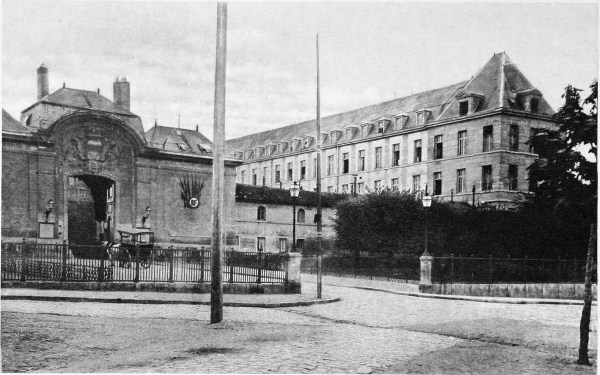
Immediately opposite La Petite Roquette is the
great prison of the same name. As I have already
suggested, it is the final stage in the criminal career
which began in some minor offence, punished by
a few days’ detention in the boys’ prison, and here
ends at the scaffold upon the Place de la Roquette.
It is more by administrative design than definite
design that these two extremes, the criminal cradle
and the place of final doom, are thus brought into
close juxtaposition. Various sites in Paris have
been used from time to time for the dread performance
of “law’s finisher” commonly styled in
stilted legal language the “executeur des hautes
œuvres,” the official instrument for completing capital
punishment. He was the agent of High Justice
and might hold his head above his fellows who
feared and hated him because he was the vindicator
of the law. The office was not exactly honorable,
but it was lucrative, and its holder enjoyed many
privileges. He was entitled to levy taxes on food,
upon all the corn brought into the market, and on
fruit, grapes, nuts, hay, eggs and wool. He collected
a toll on all who passed the Petit Pont (the
bridge near the Châtelet). Every leper paid him a
fee, and he acquired, by right of office, all the
clothes of which his victims died possessed. But he
carried a badge of shame, a ladder embroidered on
the breast of his coat and a ladder on the back.
His office was hereditary; son succeeded father,
and if the next in succession was of tender years
a substitute was appointed, but the rightful executioner,
sometimes no more than seven or eight,
stood by the headsman as if to sanction his proceedings.
The Sansons filled the awful post for
seven generations, nearly two hundred years. They
were for the most part in good repute and highly
esteemed by their royal masters. Louis XI indeed
made a chosen companion of his executioner,
Tristan L’Hamitte, whom he ennobled.
The ceremony of inflicting death was performed
anywhere in early days, often from choice in the
theatre of the crime. For a century or more the
Place de la Grève was the favored spot, and was
used until the revolution of 1830, but the scaffold
was sometimes erected at the Halles (the central
markets) or the Croix du Trahoir or in almost
any wide street or square. The Barrier of Saint
Jacques was substituted for the Place de la Grève
in 1832. It was a convenient distance from the
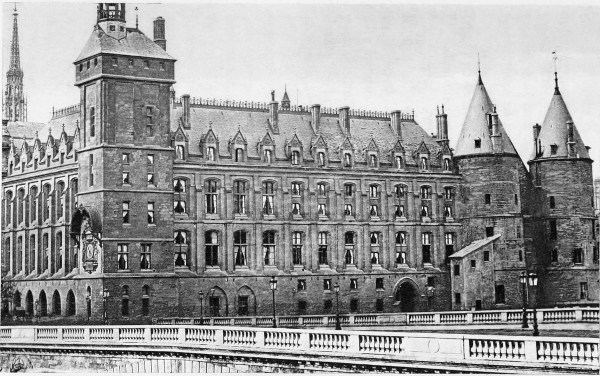
Conciergerie, in which prison the condemned found
their last resting-place. The execution was fixed
always for the afternoon, and the drive through
the crowded streets was considered a scandal, so
that a further change was decreed.
The prison of La Grande Roquette had spare
accommodation available. This place had been in
existence some years under the name of Little
Bicêtre, and had been used as a dépôt des condamnés,
in which were lodged all sentenced to
travaux forcés while awaiting further removal to
the seaport bagnes or the great central prisons.
The concentration of so many desperate characters
under one roof led them to feel their strength and
measure it against authority in a serious outbreak
in 1886, in which the Director would have lost his
life, but for the courageous intervention of a veteran
chief warder. From that time forth the worst
criminals were no longer sent to La Grande Roquette,
but retained in the central prisons after sentence,
from which when condemned to transportation
they were collected by agents and taken on to
St. Martin de Ré to take ship for the Antipodes.
The bagnes were abolished some time before those
of Brest and Rochefort in 1850, and Toulon in
1872.
But one quarter in La Grande Roquette was especially
appropriated to convicts condemned to death,
and they proceeded after a more or less lengthy
detention direct from their cells to the guillotine.
These were in all cases the most notable murderers
only, for increasing reluctance to inflict the extreme
penalty has been exhibited in France, and successive
presidents of the Republic, from President
Grévy on, have constantly commuted sentences to
penal exile and spared lives that were clearly forfeited.
For the last forty years all who were actually
executed passed through La Grande Roquette,
and a brief survey of the principal malefactors and
the circumstances attending the last dread event will
be given here.
A few words as to the guillotine; that instrument
now invariably used for capital punishment in
France. It has played so large a part in the modern
French history that it will be interesting to
trace its origin back to the days of its godfather
and supposed inventor, a certain Doctor Guillotin,
who in the Revolutionary times was very eager to
improve the system of capital punishment, which
he desired should be uniform for all; and he had
fixed upon decapitation as the best and simplest
process. But the headsman had always been an
uncertain performer, a bungler often who could not
command his nerves, and who often slashed and
wounded his victim without dealing the death blow.
Doctor Guillotin earnestly recommended in the
Convention that every criminal should be decapitated
by means of some mechanical contrivance.
This passed into law, but before the contrivance
had been settled upon, Guillotin, at his wits’ end,
applied to Charles Sanson, at that time the official
executioner, for guidance. In their joint researches,
they came upon an old Italian wood cut giving a
presentment of the “mannaia,” an ancient machine
much used in Genoa and particularly for the execution
of Guistranin and other conspirators. The
picture might have served also for the Halifax
“Maiden” of which more directly. In both, the
axe was suspended between two uprights, the culprit
knelt beneath it, and the executioner held the
rope. It was also found that a French Marshal,
De Montmorency, had been beheaded in 1631 by
means of a sliding axe.
Difficulties of detail remained; chiefly, that of
retaining the person about to suffer in the proper
position long enough for the descending blow to
take fatal effect. Then a friend, one Schmidt, a
manufacturer of musical instruments, brought Sanson
a rough sketch which met all objections and
was in fact the model for the real machine. It seems
very closely to have followed the lines of the Halifax
“Maiden.” It was immediately accepted by
the Convention, not without laughter. Dr. Guillotin
in describing his machine made use of some
strange expressions. He assured his audience that
with it he “could drop off their heads in a twinkling,
and they would not suffer in the very least.”
The only sensation might be that of a “slight freshness
about the neck.” Before closing finally, the
Assembly desired other opinions and applied, among
others, to a Doctor Louis who was at that time
physician to Louis XVI, still seated upon his tottering
throne. The following curious incident is
touched upon in the Sanson “Memoirs.”
While discussing the model, Doctor Guillotin and
the executioner paid a visit one day to Doctor Louis.
A stranger came into the room, who seemed greatly
impressed with the invention, but disapproved of
the shape of the axe, which was that of a crescent.
He did not believe it would act properly upon all
kinds of necks; “not on mine for instance,” said
the objector, taking up pen and ink, and drawing
an oblique edge instead of the half moon. Sanson,
the expert, was consulted, and gave it as his opinion
that the question should be tested by actual experience.
When the machine was completed, it was
taken to Bicêtre and set up for trial on three corpses
in the presence of a numerous company, including
that of a number of prisoners, who looked out from
the windows above. The oblique knife edge was
found to be by far the more effective, and that model
was adopted for all time.
The most curious part of the story is, that the
stranger who suggested the improvement in the axe
was King Louis XVI, himself, a skilled locksmith
and mechanic, having learned a trade after the manner
of all royal children. His own neck within a
few months’ time was to be subjected to the supreme
test, which succeeded perfectly. I have no wish to
deprive Doctor Guillotin of any credit that may
attach to this invention, of questionable utility, except
in simplifying the act of killing and minimising
the pain inflicted upon the victim; but he was certainly
not the first inventor of the manslaying apparatus
with which his name is for ever associated.
Two centuries before the Revolution, an instrument
very similar to the guillotine was in use
in Scotland, and known there as the “Maiden.”
James Douglas, Earl of Morton, died by it in Edinburgh
in 1587, thus adding to the long list of inventors
who paid the penalty of death by their own
contrivance. The “Maiden” had been often used
in Yorkshire for the summary execution of thieves
taken in the act, and the best account of it extant
is found in “Holinshed’s Chronicles,” which describes
the custom prevailing in Halifax and the
machine in use. He records the law or custom, that
whosoever commits a felony or steals to the value
of fourteen pence or halfpenny shall be beheaded
in the market. “The engine wherewith the execution
is done is a square block of wood which does
ride up and down in a slot between two pieces of
timber that are framed and set upright, of five yards
in height. In the nether end of the sliding block
is an axe keyed or fastened with an iron into the
wood, which being drawn up to the top of the frame
is there fastened by a wooden pin, to the centre of
which a long rope is attached, that cometh down
among the people, so that when an offender hath
made his confession and hath laid his head over
the nethernmost block, every man seizeth the rope
to show his willingness that judgment should be
executed, and pulling out the pin the axe is released
to fall with such violence that had the neck below
been that of a bull the head would be dissevered
and roll away to a great distance.” If the theft
had been that of any fourfooted beast the rope was
to be fastened to it, so that when driven away it
would extract the pin.
France was then anxious to make a change in
the method of carrying out execution, if indeed
capital punishment were to continue in force. But
there is now a strong tendency to abolish it altogether,
as is the rule already in Italy and Belgium,
the substitute in both countries being prolonged
solitary confinement, which is really synonymous
with a death sentence of a lingering and painful
kind. The life spared on the scaffold must be passed
in solitary confinement with the inevitable fatal consequences
of such treatment. I shall never forget
the painful impression made upon me when I came
across some seventy or eighty murderers collected
in one apartment in the prison of Ghent, all of whom
had spent ten years or more in the cells of another
prison, that of Louvain. They were all either senile
idiots or imbeciles prematurely aged. They
had been kept alive in deference to ultra-humanitarian
sentiment, but at the price of something
worse than death. It does not seem probable that
the death penalty will disappear from the French
criminal code, but a strong feeling prevails that
better arrangements should be made for carrying
out the sentence. Many are strongly in favor of
adopting the British practice of performing the execution
in private, within the limits of the gaol, that
is to say, and in the presence of only a few officials.
The selection of these last presents some difficulty,
although it has been overcome in England, and
is after all no more than the justifiable demand on
public servants to perform their duty, however trying.
One suggestion has been, to make it incumbent
upon the jury that convicted to be present;
but the fear of grave consequences has put this
aside. It has been thought, not without reason, that
juries would hesitate to find a verdict of guilty if
they were to be compelled to witness the dread consequences
of their judgment. The desire for private
execution has been emphasised in France by
a scandalous incident that occurred at Dunkirk
towards the end of 1905. A double murder of the
most cruel and dastardly character had been committed,
resulting in a double execution. A great
mob had assembled, and, under the influence of
strong excitement, stormed the scaffold when the
second head fell, determined to carry off the decapitated
corpses. The police were powerless to prevent
the outrage. An extraordinary and probably
unparalleled incident occurred at this execution.
The victim had been a woman, and the widowed
husband, thirsting to avenge her, had offered the
authorities the sum of 10,000 francs, to be paid to
the funds of any public charity, if they would allow
him to act as executioner,—to the extent at least
of touching the spring by which the knife of the
guillotine was released. The strange request was
refused; but as a particular favor a special place
in the first row of spectators was secured for the
aggrieved husband.
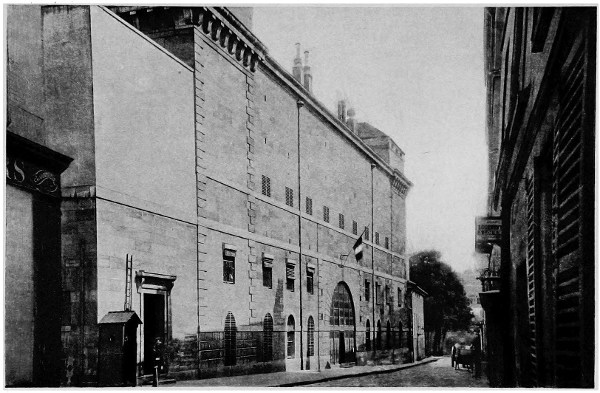
The prison of La Grande Roquette, when I visited
it, struck me painfully from its gloomy and imposing
architecture; and the effect was heightened
as I passed into the inner yards, where behind a tall
iron railing the bulk of the prison population were
at exercise. As they patrolled it in couples, backwards
and forwards, their wooden sabots made a
hideous clatter on the stone pavement, which did
not, however, drown the hum of their voices as they
gossiped idly with one another, smoking their pipes
in pleasant company. They were a rough, evil-visaged
lot, for this was at a date anterior to the
disturbance of 1886, before mentioned, and they
were mostly habitual criminals (récidivistes), who
had been convicted again and again. They could
only be ruled by a strong hand, and the director,
M. Beauquesnes, a resolute and determined man,
had been specially selected for this responsible post.
Before his time murderous assaults by prisoners
upon their officers were common enough. Many
trades are carried on in the prison, and desperate
ruffians bent on mischief always found tools and
dangerous weapons of offence ready to their hand.
Outrages of this kind are now unknown. “How
did you get the better of them?” I asked M. Beauquesnes,
almost anticipating his answer as I met
his clear gray eyes. “By constant surveillance, by
being always on the lookout for mischief, and crushing
it before it could make head.” “Your warders
are all armed, of course?” “Not in the least. It
is better to depend upon moral than physical force.”
It did not seem to me fair or safe to leave officers
entirely defenceless among so many desperate and
easily excited prisoners without even the protection
of a baton or club, and the evil result was presently
seen in the outbreak already mentioned.
From the yard I passed into the workshops,—long,
low, dark rooms in which gas is never lighted,
for labor begins and ends with daylight. The trades
followed were of the prison class, such as shoemaking,
tailoring and so forth. Industry and orderliness
were generally observable, but I seemed
to detect a certain unsettled air. The prisoners
gazed furtively from under their peaked caps at
a strange visitor and seemed continually on the
lookout for something to happen. They were in
fact constantly expecting the order to “move on,”
and any day the van might arrive to take them elsewhere.
It might be to the other end of the world.
This kind of removal, still known at La Grande
Roquette, is horrible, because it is final and irretrievable,
and the journey is to that unknown bourne
from which no traveller returns. The French system
of dealing with condemned prisoners cannot
be commended. It is cruel in the extreme, from the
long uncertainty in which the individual is left as
to his ultimate fate. He has made his last petition,
the final appeal from the legal tribunal to the possibly
more merciful Chief of the State, and he
awaits the decision for weeks and weeks in the
condemned cell. The delay is sometimes horribly
prolonged. One man waited forty days, and was
a prey the whole time to painful visions at night.
He dreamed of the guillotine and saw his head rolling
in the sawdust. He awoke with screams of
terror and cried out perpetually, “The knife! The
scaffold! I see nothing else!” The agony of the
delay is intensified from the well-known fact that
the dénouement, when it comes, will be abrupt and
with the briefest possible notice. Only on the very
morning of execution is the prisoner roused, generally
from profound slumber, and warned suddenly
to prepare for immediate death. All this
time, since his sentence and reception at La Roquette,
he has occupied the condemned cell, one of
three rather large chambers near the hospital at
the back of the prison. He has never been left for
one instant unattended. Two warders have been
with him, and have watched him closely day and
night. Time was when, to render assurance doubly
sure, the convict was kept continually in a strait-jacket
or camisole de force. The priest of the
prison has also been his constant companion. From
the condemned cell the prisoner is taken by a rather
long and circuitous route to the outer office, near
the inner gate of the prison. Here the executioner
and his assistants receive him and commence the
“toilette of death.” The man is pinioned and
bound by a variety of intricate straps. Thence,
when he is ready, the procession passes across the
courtyard to the outer prison gates. It is but a
step. Once through them, the scaffold is immediately
reached, the last act commences, is soon
played, and the curtain promptly falls. Barely
fourteen seconds elapse, it is said, from the time
the convict steps on the scaffold to the moment
when decapitation is effected. There is but a short
fruition, therefore, for the sightseers whom morbid
curiosity has attracted to the spot, even if they see
anything at all, which is doubtful, as the guillotine
is placed on the ground level, and is surrounded by
a double line of mounted gensdarmes.
On the very night that the guillotine was being
erected in the Place de la Roquette for the execution
of the poisoner La Pommerais, a marvellous
escape was effected by a child prisoner from the
reformatory prison opposite, the little Roquette.
At nine o’clock in the evening a lad of barely
thirteen years, by using his knife, cut away the
metal covering of his window in which the ventilator
worked, then climbing up on a chair placed
on top of his bed he got his head through, and
looked down into the courtyard; it was quite
empty, the night was dark; the only sound within
was the monotonous footstep of the night watchman.
But beyond the wall, there was a movement
as of a crowd collecting, and from time to time
the sound of a hammer and other tools. The boy
knew what was on foot, for the story of La Pommerais
and his approaching execution was known
within the reformatory, and it was also known that
the dread event was fixed for next morning.
“Everybody is busy,” said the fugitive, “no one
will think of me.” So he worked his little body
through the ventilator, and reached the cornice
between the first and second floor. Resting his
feet on this narrow ledge and holding to his window
by one hand, he stretched the other towards the
next window and caught it, creeping thus from
window to window till he had passed six of them.
He was every moment in the utmost danger, for
he hung on merely by his fingers and the soles of
his heavy shoes. He said long afterwards that he
suffered agonies in the hour occupied in thus creeping
along. A single slip would certainly have precipitated
him into the yard below. He was almost
at the end of his strength, his arms ached horribly,
and his hands were torn and bleeding. He took
courage, however, saying to himself: “If I fall
I shall be killed, if I stop I shall be recaptured;
I must certainly go on.”
Now the moon came through the clouds, and he
knew that his shadow would be seen from below.
At that moment he heard his name called, “Molutor,
Molutor,” and he shivered, feeling sure he
had been detected. But the voice was that of a fellow-prisoner,
the occupant of the cell, the window
of which he was passing, who had recognised him.
But with true loyalty to his class he did not betray
him. On the contrary he tried to help him, and
after reconnoitring around encouraged him by saying
there were no warders in sight. Stimulated
by these encouraging words, the lad, who had already
reached the fifth window, made a renewed
effort, and passed on to the sixth, next the angle
of the building, and there seized the water pipe.
At this moment the clock struck midnight. Then
followed strange noises. Looking down, he saw
beneath him the open space of the Place de la Roquette,
in which a crowd was slowly gathering,
and some workmen were moving forward an oddly
shaped machine, which he easily recognised. They
were about to erect the scaffold. The machinery
for the guillotine and its purpose were perfectly
well known to the fugitive. At this moment it is
said he shuddered, not so much at the pressing
danger of his situation, and the near certainty of
death if he slipped, but with inward despair at the
life that lay before him. Surely it was useless to
compass his escape, to risk so much to get away
now, if some little time ahead he would inevitably
arrive at the guillotine, led step by step, passing
from court to court and judgment to judgment,
until he mounted this same scaffold, and expiated
his offences as this same La Pommerais was about
to do. Not the less did he complete his escape.
He slipped down to the ground on the other side,
gained the outer wall, and climbed it. Then he
waited until the square was thronged to get away.
When the crowd was seized with horror at the
sound of the falling knife and the thud of the severed
head in the basket he would escape. At the
supreme moment, when a shiver of horror affected
the spectators, he alone kept his head, and, with
sure, cautious step, slipped in amongst the people
and passed unchecked to the boulevard Voltaire.
A criminal drama which horrified all Paris in
1857 and had its suitable dénouement on the Place
de la Roquette, was the murder of the Archbishop
of Paris, Monseigneur Sibour, a dignified ecclesiastic,
who was universally loved and esteemed in
his diocese. The Archbishop was on his way to
put on his vestments for the mass in the church
of St. Etienne du Mont. The procession was on
the point of entering the sacristy when a man,
dressed in black, rushed in behind the Archbishop,
who was carrying aloft the Episcopal Cross, and
with his left hand caught hold of him and twisted
him sharply round, while with his right he struck
him in the ribs with a knife. The wound was
mortal, and the Archbishop almost immediately fell
dead, while his murderer was seized and roughly
handled by the indignant crowd. The police proceeded
at once to interrogate him and soon learned
who he was. In appearance short and thin, with
a not unpleasing countenance, carefully dressed in
black, he proved to be one Louis Verger, an unfrocked
priest. He confessed that the murder was
premeditated, and that he had come to the church
with the set intention of committing it. He had
no animus against the Archbishop, but desired to
aim a blow at the dogma of the Immaculate Conception.
Thence his outcry when he struck the
fatal blow, “No more goddesses!” “Down with
the goddesses!” He was quite calm and self-possessed
afterward, and the suggestion that he was
insane quite fell to the ground. When he was received
at Mazas his mental condition was inquired
into, but there was no symptom of derangement.
His first demand was for food, for he had eaten
nothing that morning, fearing to interfere with the
steadiness of his nerves. When questioned as to
the motives of his crime, his answers were clear
and logical, except that he was fanatically hostile
to certain doctrines, and especially to that of the
celibacy of the clergy. In his parish he was constantly
at difference with his parishioners, with
whom he had many quarrels, and he was at length
removed to another parish. He went to London
to work under Cardinal Wiseman, the new Archbishop
of Westminster, and on his return to Paris
obtained fresh preferment at Saint Germain L’Auxerrois.
He was still turbulent and constantly a
thorn in the side of the Archbishop. His state of
mind was held to be doubtful, but the doctors declared
him more dangerous than mad. He preached
the most violent diatribes against ecclesiastical authority,
and richly deserved the sentence of suspension
that was decreed against him within a week
of his murderous attack upon the Archbishop.
No doubt excessive vanity and the desire to pose
as a public character were strong temptations to
the crime he committed. He was always greatly
pleased when people came to see him and he gloried
in his crime as a new cause célèbre which long
would be the talk of the town. He maintained this
attitude all through his trial, and at times behaved
scandalously by insulting the judge and ridiculing
the procedure. The audience was furiously incensed
with him, and more than once it was necessary
to suspend the proceedings. Public feeling
was entirely on the side of the murdered Archbishop.
At the same time there can be very little
doubt that he was an irresponsible being, a maniac
suffering from exaltation, eager always to “show
off;” and it would have been a bitter disappointment
to him if he had been put away in an asylum.
His conviction came as a matter of course, but
he did not accept it without protest, exclaiming
contemptuously, “What justice! What justice!”
He cried out that he would appeal to the Emperor
(Napoleon III), and he assured his father, when
the old man visited him, that he would not abide
by the sentence. Nevertheless he was removed
from the Conciergerie to La Roquette, and here
in his last abode he tried to play the hero, and with
much satisfaction frequently repeated the details
of his crime. He denied that he felt any remorse
for having struck down “ce pauvre Monseigneur,”
but was not glad that he had done it. “My work
was over,” he would say, “and I dropped my arms
to my side like the workman who has finished his
task.” The appeal made for reprieve was very ably
maintained by his advocate, but was quite fruitless.
There could be no doubt as to his guilt, and no
pity for the criminal in the Emperor. Again and
again the condemned man prayed to be permitted
to write to the head of the state, and was very
indignant when the privilege was denied him. Still
he had access to friends outside, and hoped for
some reversal of sentence through their good offices.
He could hardly believe his ears when they
came to him on the morning of execution to make
the last dread announcement, which was conveyed
by the Abbé Hugon, who was acting as aumonier,
and who was accompanied as usual by the Chief
of the Police, the director of the prison and other
officials. “It is useless,” he repeated, “I know
you all; you are not speaking the truth and have
only come to see what effect the bad news would
have on me. I do not, I cannot believe it. I know
the Emperor, and feel sure he will not abandon
me.”
At last the dread reality forced itself on him,
and his demeanor completely changed. His air of
nonchalant bravado suddenly disappeared, and a
fierce passion for self-preservation seized him. He
grew livid with fury, and with a wild gesture of
repulsion he waved them away. “Be off, I want
no priests, no relics, no cross,” he cried. “Do not
think that I will go quietly to the scaffold. I’ll have
no scaffold. You will have to carry me there in
pieces,” and he set himself to resist vigorously,
clinging to his bed, rolling himself in his blankets,
struggling with the warders, shouting, roaring,
swearing and blaspheming. Then the director of
La Petite Roquette thought of calling in the executioner,
although by law he is not permitted to
enter the condemned cell. M. Heinderich came
when summoned, an embodiment of superior force,
a perfect Colossus, six feet in height, with broad
shoulders, clear-eyed and full of resolution, the
picture of a self-reliant veteran. “Come, Verger,”
he said quietly, “you will not come of your own
accord? we must take you then by force!” The
prisoner was conquered, and without more ado
allowed himself to be secured. Then he was led
like a lamb to the outer office where his “toilette
of death” was quickly performed. At length he
broke down, and cried with bitter tears, “How
terrible it is to die without relations or friends.”
He listened with gratitude to the consoling words
of the priest, confessed, received absolution, and
almost immediately was a dead man.
A notability of the guillotine was Avinain, executed
in 1867 for a series of murders, all having
similar features. Several corpses were picked up,
all of which had been very carefully dismembered
by some hand practised in dissection. In all, the
head and limbs had been skilfully removed from
the trunk; but death had first been inflicted by
strangulation or many terrible wounds. The remains
had generally been found in the neighborhood
of the Seine, and suspicion at length attached
to a certain Jean Charles, otherwise Charles Alfonse,
who had lived in four different houses on
the riverside. The police now discovered that there
were stables and sheds forming part of these several
dwellings. In one building they picked up a
saw, a hammer and an axe, which evidently had
been used for the purpose of dismembering the
bodies. These, according to French custom, had
been exhibited at the Morgue, and one of the articles
was recognised by a young man as having
belonged to his father, who had recently disappeared.
The deceased was a forage merchant.
He had come to Paris to sell a cartload of hay,
and had met Charles, with whom he agreed on a
price. The purchaser very civilly offered him the
accommodation of his stables for the night and a
bed at his house, so that the purchase might be
completed next morning. It appeared in the trial
that before this another person had sold forage
and had accepted hospitality for the night, but
when the host came, insisting that the light should
be extinguished for fear of setting fire to the barn,
he carried in his hand a hammer; and the guest,
a little suspicious, declared that he always slept
with a light burning, and in a very significant fashion
took out his knife as though to use it in self-defence.
There was little doubt that this man with
the hammer was the same Charles already indicated,
and the police proceeded to inquire into his
identity. He proved to be one Charles Avinain,
a butcher by trade, who had recently been a convict
in Cayenne. Since his return from transportation
he had frequently been in trouble, and was now
easily traced and arrested by means of clues furnished
by his wife and daughter. He still lived
at the riverside, and nearly made his escape from
the police by means of a trap door in the floor of
the basement which opened on to a passage. Several
murders were brought home to him, committed
either with hammer or knife. His victims were
mostly forage merchants, and he had dealt with the
bodies in the same barbarous fashion. It is recorded
of him that he never exhibited the slightest
remorse, until the very last moment, and then
it was under the influence of overwhelming terror
as he trod the steps of the scaffold. He had always
repulsed the chaplain, but in the end accepted
his ministrations, confessed, and received absolution.
Moreux, who had murdered a girl to rob her
and give a present to his beloved, put down his pipe
quietly, when he received the news, saying, “I did
not think it would be before next Wednesday,” ascended
the scaffold quickly, and remarked to the
chief warder in bidding him good-bye, “You see
what comes of evil behavior.” Toly, who tried to
kill a warder when first locked up, took his sentence
very calmly, and faced death with great self-possession.
He spent his last night at cards, but received
the chaplain with great emotion and deep
sentiments of repentance. Coutalier had murdered
his wife with one blow of a hatchet, and bore up
well until he saw the guillotine, when he threw himself
back violently, but soon regained his impassiveness.
Many were at great pains to proclaim their
innocence. It was so with Boudas, an ex-priest,
whose consuming desire was to become rich. He
poisoned two wives in succession, so as to secure
their inheritances. It was clearly proved against
him, but he reiterated as he knelt and laid his head
on the block: “Let every one know that I am not
guilty.” Gervais sacrificed an aged companion, a
well-to-do dealer in antiques, because he wanted
means to marry. His awakening on the last morning
was a frightful scene. “I can’t, I won’t believe
it. It is impossible. The law is about to commit
a terrible crime.” He fought the executioner
so hard that he had to be led twice to the block.
But he died smiling with that curious, artificial
grin that relaxes the muscles of the face at moments
of great nervous derangement, and has no
connection with real laughter. Billoir hated his
wife for her extravagance and slovenliness, murdered
her, and threw the body into the Seine. He
was an old soldier of good character and distinguished
service, but Marshal MacMahon, the President,
positively refused to pardon him. He was
quite overwhelmed with the shock when told the
fatal news, but speedily recovered himself, and,
crossing his hands on his breast, respectfully saluted
the chaplain.
Welker, one of the worst and most inhuman of
his class, who had murdered a pretty child of eight,
showed the most abject cowardice. It was necessary
to carry him bodily to the scaffold, and place
him in position under the knife. A corpse was
really guillotined, for he was already dead with
fright, and had pardon come at the eleventh hour
it could not have benefitted him. Menesclon has
left a name more execrable than Welker, for his
victim was an infant of four, whom he was believed
to hold in strong affection, lavishing gifts
upon her constantly. One day she went into his
room, and the child was never seen again. After
many denials that he knew anything about her, a
neighbor was drawn to his room by the nauseating
smell of burning flesh, and on forcing his door he
was found stirring up a blazing fire in his stove.
Menesclon was barely saved from the fury of the
people when the story became known. He was
interrogated, and gave his own account of the affair.
He had invited the child into his room to give her
some flowers. But she irritated him by crying, and,
being unable to quiet her, he suddenly seized her
by the throat and choked her. When she was dead
he thrust the body between his two mattresses, and
slept the whole night through. Early next morning
he set himself to get rid of the horrible evidence
of his crime in the manner already described. This
miserable creature was one of the lowest type of
his class. He had been graduated in the lowest
schools of vice, beginning as a child at La Petite
Roquette, to which he had been committed at the
instance of his parents as perfectly unmanageable
at home. He passed thence into the navy, after
having been the despair of many workshops in
which he had been employed, at last having assaulted
and robbed his father. He had developed
into an undersized weak creature with a hideous,
pimpled face, low forehead, furtive manner and
foxy eyes. He was quite indifferent at his trial,
showed no remorse for his crime, and rarely answered
the questions put to him, which threw into
strong relief the enormity of his conduct. Service
in Senegal had left him with an incurable deafness,
which heightened his stupidity. He gazed
without flinching at the pièces de conviction lying
on the table before him. Close by was a copy-book
filled with verses, for he had poetical aspirations
and was a bit of an artist. His cold-blooded unconcern
culminated in his last answer to the question
why he had committed the crime. “I can’t
tell you,” he replied, “but you are at liberty to do
the same to me.” Menesclon exhibited the same
impassibility at the last hour. He heard his fate
with his hand to his ear, the better to catch the
words, and merely said, “Ah, bon!” when he
understood; and then walked quietly to the scaffold.
One or two later cases possessing some of the
same features may be included here,—those of
Michel Campi and of Marchandon,—which throw
up into strong relief the insecurity of life, even in
the most crowded parts of a large city. In the
first instance a peaceable old gentleman and his
sister were murdered at three o’clock in the afternoon
in the rue du Regard, not far from the avenue
de Clichy. In the other a lady of good position
and ample means was done to death in the middle
of the night by her own man-servant, whom she
had only engaged the day before.
The case of Campi is as follows: On the afternoon
of a tenth of August, a man rang at the door
of an apartment in the rue du Regard where resided
Du Cros de Sixt with his sister. They were
both old people. He was well to do and secretary
to a religious society. Their residence was in a
pavilion apart from the principal building. Mlle.
du Cros answered the door in the absence of their
maid, and Campi at once struck down the old lady
with a succession of violent blows with a hammer.
Mlle. du Cros fell screaming and her brother rushing
out was treated in the same manner. Then the
miscreant, opening a large knife, cut the poor
woman’s throat and next wounded M. du Cros
mortally. Now the concierge came to the rescue,
found the two bodies lying in a pool of blood, and
hurriedly called in the police. When they arrived
they found the murderer in one of the rooms hunting
for plunder. He was forthwith arrested, and
without difficulty, although he later explained this
to the instructing judge by saying that had he not
broken the handle of his hammer, he would have
taken other lives. Robbery was judged to be the
motive of the crime, but Campi’s advocate wished
to suggest an idea of vengeance, although no proof
of this was ever forthcoming. There was some
mystery about the man and his relations with M.
du Cros which never came out. Campi was certainly
acquainted with M. du Cros and his sister,
who survived for a couple of days. When questioned,
she begged piteously not to be forced to
reveal the secret of the man’s identity. Campi was
perfectly well known to the police as a criminal,
who had been in prison frequently, but his secret
antecedents were never brought to light. He was
said to have served in the Carlist ranks in Catalonia.
He belonged originally to Marseilles, and
his connection with the Spanish insurgents was
attested by Carlist officers who recognised him.
The mystery about him was never definitely cleared
up, and it served only to increase the interest attached
to him at the time of his trial. The account
given of his last appearance differed little from
those of other executions, but he was most anxious
to show no weakness, declined all assistance, and
cried: “I would rather walk alone. I am not in
the least afraid.” When he saw the guillotine, he
exclaimed contemptuously, “Is that all!” The
exact truth as to his identity will never be known,
but those who knew him maintained to the last
that he was not a thief; that he was essentially
an honest man, who would not stoop to murder for
mere gain; and that some family scandal would
have been revealed if the whole story of the crime
had been laid bare.
In the case of Marchandon, his intention to murder
his new mistress without loss of time was
shown by the fact that he only hired for a single
day the clothes in which he presented himself in
the rue de Sèze. He had secured employment in
many houses by means of a forged certificate of
character, which was so unsatisfactory that it
roused the suspicions of the Princess Poniatowski,
who had engaged him, but would not allow him
to enter her house. She had gone at once to the
registry office to warn them, but found that Marchandon
had already been placed elsewhere, in fact,
with Madame Cornet, his future victim. He proceeded
promptly to carry out his crime. Having
secured a livery coat as already described, he waited
at table, and, after receiving his orders for next day,
he went up to bed in the garret. About one in the
morning he went down again and entered Madame
Cornet’s apartment by means of a key which he
had secured, and hid himself between the salon
and the bedroom. When Madame Cornet had undressed
and gone to bed, Marchandon attacked her.
Her piercing screams disturbed the concierge who
slept above. He got up to call the chambermaid,
believing that Madame Cornet was taken ill. The
two came down-stairs together and knocked at the
door, but received no reply. They listened at the
door for a time, and then left, thinking all must
be right, as she was moving about. It was the
murderer whom they heard, busied in getting rid of
his blood-stained clothes, and hunting for valuables.
The first clue to the detection of the crime was
the discovery of the hired livery coat, which was
recognised by its owner when he was found. With
it came the identification of the man-servant. He
had a snug little home of his own in Compiègne,
where he lived with his wife very comfortably.
When arrested in the course of the day, he was just
sitting down to a little dinner of croutons and roast
fowl. The establishment was run with the means
Marchandon acquired in Paris and brought down
to his wife, the proceeds, no doubt, of his thefts.
At one time he was in the service of the well-known
M. Worth, the dressmaker of the rue de la Paix,
but always managed to get down to Compiègne
in the evening for dinner, bringing with him fish
or fruit, or some other delicacy. He was a man of
simple tastes, very popular in his own neighborhood.
The raising of poultry was his favorite
amusement, and he delighted in growing flowers.
He was not without a certain sense of grim humor;
and a witness deposed in court to his having exclaimed,
when reading his newspaper the day after
the murder of Madame Cornet, “Why are people
so careless as to engage their servants without
proper characters!”
The two Roquettes, small and great, were much
mixed up with the painful drama of the Paris Commune.
The junior prison was for some time appropriated
to military prisoners. Paris, as the insurrection
grew, became more and more crowded
with troops, and some penal establishment was
much needed. When the Commune was in full
swing, La Petite Roquette contained about four
hundred soldiers of all branches of the service, who
in their turn gave place to the juveniles brought
back from other prisons. These, to the number
of 127, were retained until the end of May, when
they were released and sent out armed to take part
in the defence of the barricades. They soon returned
clamorous for shelter. Later, La Petite
Roquette was utilised as a place of safe custody
for all regular soldiers found in Paris who had
refused to ally themselves with the Commune.
Some twelve hundred of these more than filled the
prison.
A darker shadow lies upon La Grande Roquette,
for it was made the place of detention for the so-called
hostages of the Commune. Many persons
of rank and authority were arrested by the Communal
authorities as a means of imposing respect
upon the government of Versailles, now moving
its troops forward to recover Paris and re-establish
law and order. Some idea of the savage and
bloodthirsty spirit that possessed the insurgents had
already been seen in the murder of the two generals,
Clément Thomas and Lecomte, who had been
arrested and mercilessly shot at Montmartre.
Early in April it was decided to arrest Monseigneur
Darboy, Archbishop of Paris. It is said that the
same priest, Abbé Lagard, Archdeacon of St. Genevieve,
who had warned Archbishop Sibour that
Verger had threatened to take his life, now desired
to put M. Darboy on his guard. The trustful
prelate could not believe that anyone wished
him evil, but the very next day after the fight at
Châtillon, an order was issued to two Communist
captains to secure the persons of the Archbishop
and some of his clerics, and convey them to the
Conciergerie, where they were arraigned before
three members of the Committee of Public Safety,
Rigault, Ferré, Dacosta. “My children,” began
the Monseigneur, “I am here to render you any
satisfaction.” “We are not your children, but
your judges,” replied Rigault. “For eighteen centuries
you and men like you have been locking up
humanity; it is now your turn.” Sentence of death
was then and there passed upon them. “These are
not men, but wild beasts,” protested the Archbishop,
who was forthwith removed with his secretary
to the depot of the Prefecture, whence they
were transferred to Mazas. The possession of
these and other hostages inspired the Communists
to open negotiations with Versailles, backed by the
threat that they would kill their prisoners unless
their terms were conceded. But indeed, this political
murder had been resolved upon the first moment
of their arrest, and on the morning of the
twenty-fourth of May, 1871, they were all brought
from Mazas to La Grande Roquette, where the
Governor gave a receipt for their bodies worded
as follows: “Received forty priests and magistrates.”
By this time the troops stationed at La Roquette
had been strongly reinforced, and on the evening
of the twenty-fifth of May another detachment
arrived. It was frankly admitted that they were
the “platoon of execution.” A list was handed
to François, a low creature who had been a carpenter,
containing the names of all his prisoners.
These names were called out one by one, Darboy,
the Archbishop, first. “Let me get my coat,” said
Monseigneur, but some one called out, “You will
not want it,” and taking him by the arm they led
him down to the garden that runs round the interior
of the prison. This was the first chemin
de ronde. The second was reached by turning to
the left, and again to the left, and was well out of
sight of the ordinary prison and the hospital. The
hostages then appear to have been arranged according
to rank from right to left. The Archbishop
first, then M. le President Bonjean, and then the
rest of the priests. Just before the final act, the
Archbishop raised his hand to bless and absolve
his companions, six in all, who faced the firing
party at thirty paces distant. At the word of command
the execution was completed. In those days
of massacre the guillotine was deemed too slow,
and the bullet took its place.
At daylight next morning the same process was
repeated with the fifteen remaining hostages, who
were led out one by one and formed up under the
same wall. Nowadays the many sympathisers with
the victims of this dastardly act, who come from
all parts of the world to visit the scene of the murder,
will find a marble tablet fixed in the wall over
the exact spot where they fell. It bears the inscription:
“Respect this place which witnessed the
death of the sainted and noble victims of the 24th
of May, 1871.” An iron balustrade keeps off irreverent
feet, and is constantly adorned with wreaths
of immortelles. A large number of hostages remained,
many of whom were gensdarmes. They
were removed from prison and massacred in a body
at Belleville.
After many essays at improvement the prisons
of Paris have entered upon a stage of approximate
perfection, and the capital is now possessed of a
penal establishment that compares with any in the
civilised world. The great prison of Fresnes, after
four years in building at immense outlay, was completed
and occupied in July, 1898. It is situated
on the very outskirts of Paris, replacing a number
of old-fashioned prisons. It covers a wide extent
of ground. The entrance is on the Versailles road
(on the left of the visitor coming from Berny station),
where the great edifice with its imposing,
but not too florid, architecture, presents a view of
many lofty parallel blocks, flanked by smaller buildings
appropriated to the service of the prison.
Passing first the gatekeeper’s lodge, in front of
which stands the Governor’s residence of ambitious
dimensions, we enter a long avenue, well planted
with trees, and find on the left other dwellings occupied
by the superior staff, and on the right a
great block of 156 cells in three tiers. This cell
house is the quartier de transfèrement; in other
words, the place of passage in which are accommodated
all the classes till now found in La Grand
Roquette. Those sentenced to long terms exceeding
one year will in due course move on elsewhere
to the colonial establishment beyond the sea, or the
maisons centrales, the district prisons in or near
Paris. Further on is the main building, housing
close upon two thousand cells, arranged in three
grand divisions, each separate and distinct and containing
508 cells. Each affords ample provision
for the different categories of prisoners to be
lodged, prévenues or those waiting trial, short term
prisoners and juveniles. The first design was to
receive females at Fresnes, but Saint Lazare is
eventually to be replaced by another especially constructed
prison for their reception. The main entrance
of this principal quarter is in the centre, with
a gatekeeper’s lodge on one side and a military
guard under an officer on the other. Beyond and
behind them are the extensive yards and buildings
required in attending to the services of the prison,
the storehouses for food and clothing, the kitchens
and bakeries and laundries, and the plant for the
generation of electricity. All these are on the left,
while on the right is the reception ward with four
hundred cells of ample dimensions, each having a
cubical content of eighteen yards.
With such an extensive acreage the inconvenience
of great distances to traverse is met by
transverse tunnels and many lines of railways serving
all parts of the prison. On the prison galleries
too, there are the trams to carry the day’s rations
and necessaries from cell to cell. There are lifts
everywhere, and many staircases in the most convenient
places. The cells are all very spacious,
their decoration and fittings artistic, and in the
best modern style, with varnished walls, washing
arrangements in porcelain, and a plentiful supply
of water. The warming and ventilation are on the
best principles. The only fault to be found with
the modern plan of prison management is that
over-much attention is paid to material comfort.
The condition of the wrongdoer in durance is far
superior to his way of life when at large. He goes
back to it improved in physique, better able to
endure its hardships, and possibly fortified against
relapse.
Whether when he finally emerges he has benefitted
morally may be doubted. It is impossible
with so large a population, spread over so large
an area, that there can be any reformatory process
as applied to individuals. Fresnes is open to the
serious objection that it is too large for effective
moral discipline, and that government of some
2,500 persons, four-fifths of whom are criminals
of many varied classes, would make excessive demands
upon even a heaven-born administrator and
philanthropist.
As we have seen in the closing paragraphs of
this volume, the great prison of Fresnes exemplifies
the best practice of modern penology in the incarceration
and discipline of those whom society, for
its own protection, isolates from itself. But punishment
is not necessarily reform; and it may be
doubted whether the redemption of the criminal
will ever be accomplished by model prison structures
alone. France, in common with all other
nations, has this further step of reformation yet
to take. But little indication of what its nature
shall be, in France or elsewhere, has been given;
for its revelation we must look to the future.
Inconsistent spelling and hyphenation are as in the original.