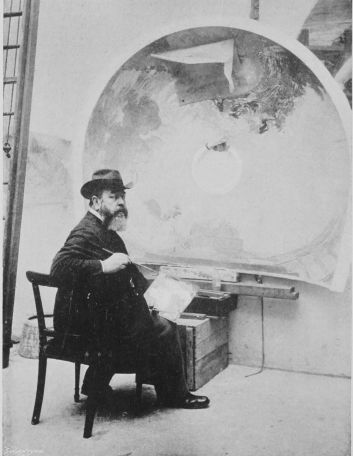
PAUL ALBERT BESNARD IN HIS STUDIO
Paul Albert Besnard bears no relation to any school. “I have never
formed part of a group,” he says; and in revenge or despair no group has
formed itself around the master. There is, properly speaking, no Sargent
school and no Whistler school, and may these men not be taken to be
masters of the present time? It is a distinguishing peculiarity of
modern art that schools do not form as they did in the old days.
Possibly an explanation of the fact why there is little discipleship is
that we are in the age of individualism and not of intense and imitative
study. Each man and woman intends to be an arriviste without being a
plodder and scholar. There is great pressure toward ultimate success;
desire for originality. Imitation of methods and technique is not
sympathetic. Above all there is a marked absence of the genius which
carries men to the pinnacle Besnard has reached. Apprenticeship is not
to the taste of the modern student! Of people who put paint on canvas
there are legion—of painters few—and in France, Degas and Besnard
head the list.
Nothing would be more mistaken than to call Besnard an Impressionist, or
to confound him with that school of art. The word has been too freely
used and misapplied. Besnard’s art, in as far as possible, is the
complete embodiment of his conception; the canvas when it leaves his
hand—in as far as the painter is able to completely transmit his
thought—is finished. Besnard does not pretend to flitting and
intangible effects—to suggestive impressionism—he claims by his work
to have expressed his idea, and does not trust to the public to
interpret him or his inspiration—he has masterfully done so for
himself.
The provinces, the Midi and the North have given to France most of her
famous men; it is unusual for a Parisian born and bred to win
distinction in his own city. It often seems to be a fact that the genius
of the individual demands uprooting from his native soil—and that
transplanting is salutary for development and success. Puvis de
Chavannes was a Lyonnais, Ingres came from Montaubon, Rodin and Besnard
are Parisians. This last named prophet found instantaneous
honour in his own country. Besnard is a child of fortune; success came
to him early, and he has no stories to relate of struggle and despair.
Of the rough way to Fame he is ignorant, of the tortures which
stimulated and deepened the experience of Rodin, of the long and painful
route of Puvis de Chavannes to recognition Besnard knows nothing! He has
no hardships to recount: one of the happy ones in the world of art, he
is singularly devoid of history. He takes a calm and cheerful
satisfaction in the facts of his successes, and is delighted to have no
complaint to make of public or critics. “I began with success” (he says)
“and it has never left me.”
Besnard was born of a painting family, his father a pupil of Ingres and
his mother a clever miniaturist. The boy was destined for Diplomacy, but
with his talent for art his distaste for any other career rapidly
declared itself. His parents acknowledged his predilection, and he
entered the Beaux Arts. His master was the celebrated Brémond; and
although Besnard claims never to have been an ardent student, and to
have painted with freedom, following out his individual tastes and
original inclinations, the strict academic influence of the schools, the
system of Brémond, himself a pupil of Ingres, is markedly evident in
Besnard’s technique. His métier has been thoroughly formed, his manner
of painting arrived at through the close and laborious study in the
school of that greatest master of modern painting—Ingres.
His début before the public was with a portrait called “La Femme Rose”
about the year ’68. This picture created an immediate effect upon the
critic and public, and the artist, scarcely more than a boy, found
himself the success of the moment. The following year he took the Prix
de Rome, which recognition instead of coming to him—as it did to most
of the student world—a stimulus and a reward, broke in—as it
were—success upon success! In order to avail himself of the privilege,
the prize offered, he was obliged to leave behind him the opening of a
career already promising and to journey to Italy. The period of his
Italian sojourn was neither productive nor important; and he afterwards
made a stay in London, where he found himself sympathetic with English
people and their art. He painted several portraits whilst in England,
and amongst them those of Admiral Sir Redmond Cameron and Sir Bartle
Frere.
The pictures exhibited at the Salons following his
success with “La Femme Rose” were “L’homme qui court après la Fortune”
and “Procession des Seigneurs de Voilans,” a decorative bit of painting
done, as is evident, in his extreme youth, full of movement and
sincerity and novelty, and indicative of his power as future decorator.
This picture is to-day on the walls of his studio in Paris.
Then followed “Une Source,” “St. Benoit et Enfant,” and a large canvas
“Après la Défaite.”
In 1883 a portrait called “La Femme jaune et bleue” caused an artistic
furore and recalled the enthusiasm with which his début had been
received a few years before. The picture was not a portrait, it was a
study of lights. Besnard is not, strictly speaking, a portrait painter,
and this production, “La Femme jaune et bleue,” rather than the faithful
transcription of a likeness, is the skilful, masterly treatment of a
scheme. Never was Besnard able to reproduce for the people—who at once
flocked to give him orders for portraits—the effects which had so
strikingly won their notice. In the portrait of “La Femme jaune et
bleue” he has insisted upon the effects of deux rayons—the light of
an interior and the delicate illumination of the twilight entering from
without. In this blending of tones, the azure luminescence of twilight
and the yellow lamplight, stands the woman’s figure. The public to whom
the picture was enthralling did not perhaps comprehend it was the
rendering of an idea, the peculiar vision of Besnard, or understand that
therein lay its distinction and that it was not a study of portraiture.
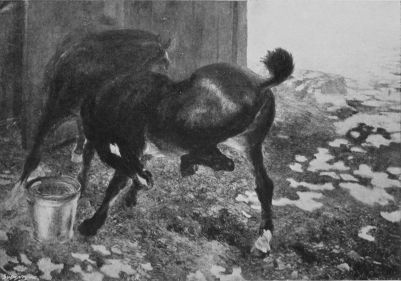
Then may be mentioned Besnard’s celebrated “Poneys harcellés par les
mouches.” No one who has seen the two young horses in their stalls
forgets this live and graceful picture, with its animation and verve,
its interesting anatomical study and the treatment of colour and tone.
The animals are admirably drawn and the blue and crimson and violet of
the scheme are Besnard’s own. This bold and eccentric production added
much to the reputation of the painter and was one of the most remarked
pictures at the Chicago Exposition. It is now owned by the Count
Rajinski (Russia) and is a veritable chef d’œuvre.
Besnard has also another equine group called “Le Marché des chevaux en
Algérie,” now in the possession of the Baron Franchetti.
A list of the most celebrated of Besnard’s pictures is more or less
complete as follows:
The frescoes in the Sorbonne.
“La Vie renaissante et la Mort.”
Fresco in the Hôtel de Ville, “l’Apothéose de la Lumière.”
Fresco in the Ecole de Pharmacie.
Frescoes in the Hospital for Poor Children at Berck.
Portrait of Réjane.
Portrait of the Princess Mathilde.
Portrait of his family.
Portrait of his wife.
The last four are in his own possession.
“Couché du soleil sur le bord d’Algérie.” Luxembourg.
“La Mort.” Luxembourg.
“Femme qui se chauffe.” Luxembourg.
“Entre deux rayons.” Luxembourg.
“La Féerie Intime.” Russia.
“L’Ile heureuse”—in the possession of Mr. Henschel.
At the present date Monsieur Martignac, Paris, possesses several
splendid canvases of Besnard’s, notably “l’Espagnole,” “Le Regard,”
“l’Automne” and “La Femme de Biarritz.”
In America the purchasers of Besnard have been few. One of the most
interesting of his paintings is at Baltimore, in Mr. George Vanderbilt’s
collection.
Paris, appreciative of her distinguished son, has confided to him the
most important of the decorations now under the city’s
consideration—the ceiling of the Théâtre Français and the cupola of the
Petit Palais. Let the amateur of art, whose list is already long, add
these mural decorations which are now in process of construction, and it
will be seen that the art of interior painting is not extinct in France,
and that these tasks have been happily consigned to the man best fitted
at present to perform them.
Besnard is at present engaged upon the ceiling of the Théâtre Français.
Its dimensions are vast, covering a surface of 273 metres. His subject,
already composed in miniature, is as follows:
The god Apollo, in his chariot, draws his horses back on their haunches
whilst he salutes the great masters of drama—Corneille, Racine,
Molière, Victor Hugo, all of whom are seated at the top of a flight of
temple steps. Behind the god are a group of the Hours, and in front, the
Muses. On the last step of the temple is a charming group and
distinctive of Besnard. The female figure of Time reposes against
another figure representing Truth—a most subtle and agreeable image.
The cupola of the Petit Palais is divided into four panels, and
Besnard’s intention is to represent in his paintings the city of Paris
in four different conceptions—“Paris Hospitalière,” “Paris dans son
Art,” “Paris dans le Commerce,” and “Paris dans les Industries.”
For the St. Louis Exposition in the United States Besnard has sent a
frieze covering 760 metres, entirely surrounding the walls of the
Exposition Française. In this building will also be seen by the tourists
there “l’Ile heureuse.”
For the more minute consideration of Besnard’s works it is well to begin
with the decorations in the Ecole de Pharmacie where the walls of the
corridor entrance to this School are entirely covered with his
decorations. The order was given in 1883 and fulfilled in 1888. Here
Besnard has given a series of fresh and delicate plein air frescoes
done upon the walls themselves. As they are without
protection—regrettably—they are being marked by the vandal pencils of
the sightseer and the students. To the right, the first panel represents
the open fields where peasants and women gather the medical herbs. In
another panel follows the sorting of the herbs in the laboratory; the
third is the laboratory itself with the distillation of the medicines.
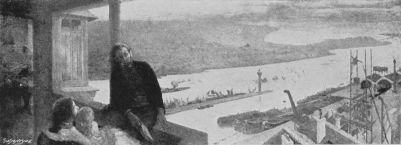
Then comes a line of landscapes just above over the woodwork of the wall
like a dado. The first is the serious, meditative scientist in the
balcony of his house, overlooking the river and the city. Alongside this
are several landscapes of a peculiarly gentle and attractive charm. At
the end of the hall are again four large frescoes, the forest where the
chemists and the botanists are engaged in their researches—the lecture
room and the geologist amongst the rocks. On the opposite wall is the
companion series of oblong panels whose subjects have become so well
known to the connoisseur: Dawn on a primæval sea where up from the waves
prehistoric creatures rise weird and appalling; a group of sea-horses
emerging from the waters; a troop of mastodons, and lastly primitive man
and woman disporting on the shores of an ancient sea whose waves to-day
are confined in some strata of rock to be found by the geologist’s tool.
On the left, at the entrance door, are the most beautiful of the series
of decorations. These are life size. One is “La Malade,” a sick girl in
her bed, surrounded by the mother, the nurse and the physician.

A PORTRAIT IN YELLOW AND BLUE
The companion piece is “The Convalescence,” and is undoubtedly one of
Besnard’s chefs d’œuvre. The invalid, after her long and weary
confinement, is being supported by tender arms into the sunlight; and it
would be difficult to imagine a more expressive and suggestive subject
for these walls. The picture is full of sunlight and mysterious
half-tones, and is expressive of tenderness and sympathy and
encouragement. In fact, these frescoes possess in a large degree the
essentials of good decoration—simplicity of line—bold and correct
drawing—impressive human sentiment and impressive subject.
Again and notably, in the decorations of the Salle des Mariages in the
Mairie du Louvre the subtlety of Besnard’s treatment of his task, the
upleading and inspiring effect he has produced makes well worth a
special description of these pictures. It will appear impossible to the
dogmatic mind that a secular room, in a Republican Mayor’s office, can
suggest an atmosphere of sacred beauty. This, however, has been rendered
the case by the decorations with which Besnard has beautified this
square, dark, conservative apartment. As one enters the apartment where
civil marriages are performed in this particular quarter of Paris the
eyes find on the wall opposite the door a graceful and agreeable picture
of youthful love. The girl—an exquisite figure—is surrounded by flying
birds and young doves. She is seated on a bank of flowers and above her
a youth of age as tender as her own waves a branch of spring flowers.
From this, one seeks the side wall and a large panel of bright and
glowing colour. The subject is harvest time, and the fields are heavy
with their burden of grain. On a sheaf of golden wheat is the figure of
a woman, mature now although still young, and at her breast a child. Two
other children play about her, and alongside the husband’s strong,
vigorous figure wrestles with his refractory horse. This decoration,
purely pastellic in impression, is so soft and plastic that the clear
colour seems ready to come off at the touch. It is peculiarly
velvet-like in quality and very high in tone. Already this square,
unbeautiful room with its green-covered benches has altered in
character. The greatest forces of the world, the greatest beauty of the
world, have penetrated it through these interpretations of a master. But
it is not to the exuberant and lovely expressions of life that the man
and woman who come here to the Maire’s office
to be joined in wedlock, turn, or on which—from the very position of
the picture—their eyes are forced to rest. Directly over the official
desk—directly over the entrance door—is the third decoration of the
suite. In the frailest tone, if this word may be employed, in the most
mysterious medium, he has painted a winter scene. To the left a little
row of skeleton trees range in nude, chaste bareness; in the far
distance is the lonely outline of a ruined tower. Close together—at the
top of a long line of stone steps—are seated a man and woman. Age has
claimed them; they are old. But the woman still leans upon the man. What
this fresco portrays of union, of inseparableness, of devotion, is not
easy to express in words. There is no hint of melancholy in this winter
scene, in this study of old age which Besnard has seen fit to
accentuate, which he has chosen for his principal panel, and on which
the newly married couple must meditate. It is the beautiful apotheosis
of wedded love daringly looking beyond youth to the serene beauty of
life’s decline. The frescoes were done in 1898. They are drawn at once
with freedom and precision, and are excellent examples of the best
modern mural art.
The subject painted on the arch of the Amphithéatre de Chimie, La
Sorbonne, is highly imaginative. Besnard has called it “La Vie
renaissante de la Mort.” It consists of three large panels. In the
centre panel, thrown on a bank of yellow herbage, is the body of a
woman, at her breast a nursing infant. From the other breast a stream of
milk flows forth, gaining in dimensions until it swells to a river of
life. Around her mouth cluster a horde of butterflies, the disseminators
of germs. A serpent, symbolising generation, makes his way slowly toward
the woman. The right panel represents figures of Adam and Eve. Adam
carries the young and lovely figure of the mother of life downward
toward a river flowing past the portals of Eden. Her hand is
outstretched toward the golden apples of an overhanging tree. Together
the couple descend toward the river which supposedly carries on its
breast the débris of plants and offscum of the earth, and loses itself
in the earth again. At the left a mighty chasm charged with fire
represents a crucible purifying and revivifying and reconstructing. Thus
Besnard has chosen to symbolise the forces of nature—Water, Air, Earth,
Fire. The principles of organic chemistry—creatures of flora, fauna and
animal life under the solar influence.
It is a singular and bold conception, magnificently drawn and
pastel-like in treatment.
The Musée du Luxembourg is especially rich in the artist’s works, and
the buyers for the State have shown wisdom and penetration in their
choice. In one of the rooms is a small canvas not over 18 by 6 inches.
It recalls in character and distinction the little picture of Gambetta’s
room done by Cazin, and it is only the great masters who thus
wonderfully fill small bits of canvas with whole histories of life.
Besnard has called his study “La Mort”—a miserable little mansard room
au sixième in a third-class hotel—the meagre furnishings are a chair,
table, and iron bed on which lies the dead figure of a woman. At the
door the voluble concierge, half curious and half touched, ushers in a
young man, no doubt the lover of the wretched creature beyond all the
questions of life; the man is in evening dress, hat in his hand. Here we
have poverty, misery, debauch, disgrace and despair in a medallion, as
it were. The composition and the treatment recall no one but Besnard
himself, but the literary quality of the picture suggests Hogarth
series, and Tolstoi and Balzac. This affinity with a sister art is now
and then interestingly observed in the narrative pictures of the great
masters.
“Entre Deux Rayons” is the so-called portrait of a woman. Again the
effect of two lights is here accentuated. The canvas is full of light
and seems positively to radiate. The tones are red and yellow, warm and
iridescent, and the flesh of the arms and neck melt into the scheme of
the drapery. The picture is a marvel of delicate beauty and technique.
(1893.)
But surpassing all the pictures in this Museum, in the same room, on a
considerably larger canvas, is “La Femme qui se chauffe,” the nude
figure of a woman crouching before a fire whose existence is only
evinced by the play of its reflections upon her flesh. From a little cup
of blue and white china she is drinking a draught, evidently warm and
delicious, to judge from her attitude, which is expressive of entire
comfort and bien être. The work, in point of view of modelling and
drawing, is absolute perfection. This treatment of the nude has the
strength and power of marble with the addition of colour. In none of
Besnard’s paintings is the luminous quality more striking. There is in
it an opalescence and vibration, it possesses the softness of old
paintings, and alone in a gallery of masterpieces would give Besnard the
right to first rank. The scheme of “La Femme qui se chauffe” is blue and
yellow, the
HORSES TORMENTED BY FLIES
background a penumbra of azure, from which the brilliant figure of the
woman comes dazzlingly forth.
The pictures in the possession of Monsieur Martignac deserve note. “Le
Sourire,” painted in 1895, is a portrait of merit and perhaps
particularly interesting because uncharacteristic of Besnard. It is
successful as a study of dark, more sombre tones, and has many of the
characteristics of Dutch painting.
“L’Automne,” again, is a study low in tone, and Besnard has left his
type (distinctly the blonde woman) to paint a dark creature through
whose loosened hair fall a shower of autumn leaves. This picture is a
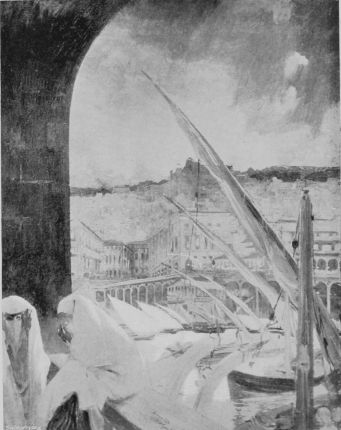
veritable phantom of a season past. There is an Algerienne in this
collection, interesting because it is yet another treatment of Besnard’s
famous “Deux Rayons.” The Eastern woman is seated in the window of the
booth, and blending with the room’s light is that light from the long
Eastern street which seems actually to enter her room at the threshold
of her booth.
In 1893, Mr. James Sutton, of New York, ordered from Martignac forty
Besnards to be sent to America. His name was then scarcely known in the
United States. Many of the canvases found instant appreciation. One
beautiful portrait called “La Pensive,” in the possession of Monsieur
Martignac, is especially worthy of mention. Here Besnard is faithful to
his type—a blonde woman with brilliant head of copper-coloured hair.
She leans a little forward with her chin on her clasped hands. Her dress
is of yellow satin and old lace, in her hands two great pink roses. The
scheme of the picture is yellow with a single delicate pink note. The
hair, the flesh, and the texture of the satin and the lace are all
repetitions and repetitions, all insistences of the yellow tone.
“La Femme de Biarritz”—Martignac—one of Besnard’s late paintings, is
very beautiful indeed. The model is a woman of warm, voluptuous type,
revealing the characteristics of the Basque. This picture was painted
when Besnard was in Biarritz, where he had gone for the health of one of
his children.
Monsieur Martignac has several examples of Besnard’s pastels, and
curiously enough the more delicate treatment that his canvases in oil
display is absent in these pastels, whose colours are so vivid as to be
almost blatant; but they are splendid achievements, and Besnard is the
first pastellist in France. Some of his most successful works in this
medium are in the possession of Dr. Delbet, of Paris.
Besnard’s personality recalls that of his distinguished countryman,
Rodin. He has the same strong, vigorous physique, the same air of power,
but these two great masters in temperament and in life and experience
are the antipodes. Besnard is not a recluse; he is, on the contrary, a
man of the world, very domestic too, and absorbed in his family and his
home. His hotel and studios are a little removed from the centre of
Parisian turmoil. He entertains and receives a great deal and has a
large circle of acquaintances and friends. In order to control as much
land as possible and to construct larger workshops, he has bought
extensively around his house. In one studio are the projected designs
for the Théâtre Français, in another the new portrait of his wife, a
full-sized figure of a woman of middle age, her hair is snow white, her
dress sumptuous black velvet, and she holds a yellow-covered novel in
her hands. This was exhibited at last year’s Salon and is the most
realistic of all Besnard’s paintings.
There is an interesting portrait in this same studio of the Princess
Mathilde Bonaparte, who died this winter, and whose salons have been
famous for the last half-century. The Princess is seated at a table by
a green lamp, in the position and environment so well known to men and
women of letters.
On these walls also hang the celebrated picture of the painter’s family,
painted about twenty years ago, a group of red-cheeked children and
their mother.
In this large, agreeable room, Besnard paints from models and statues,
makes his designs and drawings, his etchings, his sketches and his
pastels. But upstairs at the top of his house (whose walls are rich with
their friezes of designs) is an elaborate studio particularly designed
for posers for portraits. This sumptuous apartment—furnished in the
most luxurious manner—suggests a drawing-room and not a studio at all.
Rich screens of Chinese and Japanese workmanship, paintings by the old
masters (none of his work is here), objects and bibelots and treasures
of art adorn the apartment. The chimney-piece is interesting as an
example of Besnard’s taste for plastic art. It is set in panels of
stained glass, and around the fender are coiled a pair of gigantic
boa-constrictors made in plaster and afterwards painted. The effect is
picturesque, terrifying and peculiar, and is the work of the artist
himself.
This room boasts the black-and-gold cabinet which
figured in “La Féerie intime.” The picture, as will be remembered, is
the nude figure of a young woman ensconced in a great armchair. The
garments she has just quitted softly surround her. The brilliant and
dazzling effect of the painting is in the meshes of her spangled dress
blazing with reflected light, and from the gold that gleams and glitters
is the lacquer of the Chinese cabinet. The whole picture is a glow of
gold and fire, and in this luscent envelope the woman muses and dreams.
This picture is in Russia, as are many of Besnard’s canvases. Many
critics and painters class this picture as the finest example of modern
art.
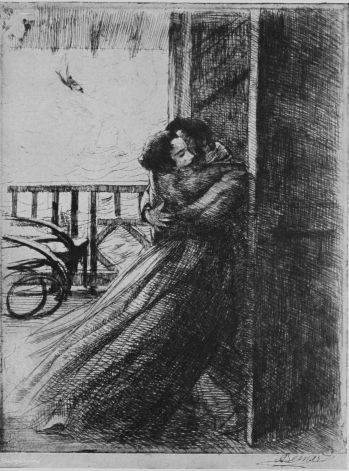
It would not be complete to close the study of Besnard without mention
of his etchings. Here and there a dealer may have a complete set of the
few produced, but they are few indeed, and difficult to obtain. The most
celebrated is known as “La Femme.” In this series Besnard has drawn
woman in every stage of her existence. We have the flirt, the mistress,
the wife, the happy mother with her children, the miserable mother, who
to cover the form of her freezing child denudes herself, and at length
casts her body over her son; the woman of the ball-room, the woman of
the streets, and, in short, he has seen fit to display every state and
condition of femininity in this study of black and white.
There also is a weird and eccentric suite, designated as “La Mort.” In
these studies Besnard has indeed played with his conception, ringing its
changes to endless and infinite variety. Death, the skeleton, pursues
his prey in every imaginable state of society—in the streets, in the
crowd, to the lonely individual, to the lovers’ embrace, to the man and
wife before the altar, he lurks behind a pillar to seize the solitary
passer-by, he appears in the ball-room, jogging elbows with the
débutante, he rescues the beggar and menaces the rich man. Here in
these drawings the painter displays his first and only hint of
morbidness. The idea of death, he says, has always been with him an
obsession. Whistler’s etchings are alone to be mentioned in class with
these admirable eaux-fortes.
Besnard himself explains the absence of the melancholy strain which is,
as a rule, strongly underlying the work of all great genius.
“I never work when I am unhappy. Unhappiness has a most depressing
effect upon my execution and my conception. Never in times of anxiety
have I said, ‘I will turn to my work, I will lose myself in my
creations. When my child was ill I was utterly incapable of producing,
and only when its recovery was certain could I undertake my work again.
(And it is at the hospital for sick children at Berck, when he was there
for the health of his child, that he painted his frescoes.)
“My best work is that which I enjoy when I am doing it; it is the work
which brings me pleasure, the work that I do when I am cheerful, which
is my best. This is, of course, according to temperament, but such is
mine! I produce a great deal, I work very hard, of course I am
ambitious, and at times know discouragement, when my conception is so
far behind my power of expression. I take often two months to do a
picture and work and correct my canvases enormously. There are days when
the mystery that should surround an idea is absent. Those are the days
that I say one sees too clearly, and at that time I do not paint. Je ne
pioche pas, which means ‘I do not dig away at my work.’ I have produced
enormously and I owe my success to myself and my work alone. I have
never had patronage and have never been part of a coterie.”
He has the gift of facile labour and his mental and temperamental
characteristics are revealed in the free, breezy, healthful inspirations
of his work. His is a happy, vigorous genius, sane and normal, utterly
devoid of much of the weakness marking modern French art.
As soon as the painter of mural decorations leaves the domain of myth
and contiguity to his subjects, he is on dangerous ground. Pure
imagination is too personal, too largely of the painter’s own
time—dying with his death and needing the very spirit of the age to
interpret it, and when modern subjects become the choice for
decorations, they should have for their principal scheme that which will
appeal to the mass and be of general interest. The poorest man and
woman, the youngest child may understand and enjoy the decorations in
the School of Pharmacy. These are perhaps the most promising for the
continuation of Besnard’s fame. They will live. The same may be said of
the pictures in the Mairie of the Louvre; whereas, those in the School
of Chemistry, delightful as they are, are so personal and subtle that
they require printed cards to make them intelligible to the mass. The
ceiling of the Hôtel de Ville represents the apotheosis of science. A
female figure with the profusion of reddish hair Besnard is fond of
painting, holds in her hands sheaves of light which she casts down into
a darkened world.
“My method of work is not different to that of the other masters,”
Besnard says. “I first make a design in wash and then colour it
liberally, put in all the vibration that I see and feel in nature.” (He
has chosen his definition happily, Vibration is a distinct quality of
his work). “I am really glad you do not think I represent a school! I
feel myself a solitary as far as my art goes.... I love motion, and
action, and variety, and yet withal I am a dreamer, completely lost in
my conception and in my mental preparation for my work. For this reason,
perhaps because I am so constantly absorbed in the world of imagination,
my taste in literature is for modern things—for immediate things, if I
may so say. I rise at seven in the morning, and am at work at nine. I
paint until luncheon, and rarely do good work in the afternoons. I take
my inspirations, the ideas for my pictures, from everything that
surrounds me. I cannot tell from where they come, but I am always
seeking to accurately arrange my ideas and render my conceptions and my
translations of them harmonious.”
In the summer Besnard goes to Savoie, where in the long vacations he
does almost no work, repairing his forces, resting and giving himself to
the enjoyment of his tranquil, domestic life. “I think I may say that I
love light above all things.”
And in no modern paintings is the luminous quality more evident.
Certain of his paintings possess the mellowness of the Dutch school.
There is a likeness to Rubens in his treatment of flesh, in the
exuberance and splendid animalism of his women, whereas in the
half-tones and sombre scheme (take, for instance, “Le Regard”), Franz
Hals and Porbus are recalled. Light is his motive in the ceiling of the
Hôtel de Ville. It radiates in the crucible of fire in the Sorbonne
ceiling, whilst the decoration of the Français, Apollo the Sun god,
again repeats the insistent idea. Besnard’s predilection for prismatic,
dazzling effect is unique; a special sense for colour combined with
magnificent technique and accurate drawing, explain the power of his
painting and his high rank in the criticism of the present.
Besnard is in the vigorous prime of his life and production. His
redundant creative force is enormous and he will, it is to be hoped and
believed, abundantly add to France’s treasures of modern art.


