It is absolutely indispensable that every visitor at Harrowgate shall
go through a course, not merely of its waters, but of all the castles,
ruins, rocks, lakes, gardens, and houses in the neighborhood, and
especially that, bon gre, mal gre, he shall spend one
entire day in rhapsodizing among the splendid fragments of Fountain
Abbey. The leading question asked of every visitor at the Granby, at
least nine times a day is, whether he has seen the Abbey, followed by
exclamations of dismay and astonishment, if he have not. A shower of
inquiries then follows, how soon he intends to go there, after which no
one forgets the exact day and hour named, while every good-natured
friend fills up occasional gaps in the conversation by hoping he may be
favored with a fine morning for his excursion.
No stranger, unmarried and marriageable, at the Granby, has any right
or title to the squandering of his own time, as the whole race of
chaperons have assumed the privilege of knowing how he spends it, as
well as of dictating the various ways in which he should and must
dispose of himself; and, accordingly, Sir Patrick and Captain De
Crespigny found themselves one day ensnared into a soi-disant party of pleasure to Studley, from which they
had no more chance of escape than a brace of partridges at a battu.
As Madame De Stael remarks, "English weather does better to rail at,
than if it were finer; and if Britain had a settled climate and a
despotic government, there would be an end of all conversation." After
a long succession of good-for-nothing days, during which the rain
seemed to pour from a thousand water-spouts, till the world was in a
perfect dropsy, and it was feared the sun must have met with an
accident, as he seemed unable to appear, he at last, contrary to
custom, when a pic-nic is in the case, blazed out with unprecedented
splendor, and became quite a spendthrift of his rays. September had
evidently borrowed a day from June for the occasion; and yet Sir
Patrick, who would much rather have encountered any danger than the
smallest discomfort, staid an hour in bed to consider whether there was
anything that might happen in the whole course of that day,
sufficiently agreeable to reward him for the effort of rising. Except a
fox-chase, however, nothing could have done so; and he secretly
detested the very thoughts of walking five mortal miles, and spending
five mortal hours in "doing the rural" among the dismal cloisters of a
roofless ruin, or bush-ranging through damp shrubberies, with a
committee of enraptured young ladies.
His fellow-sufferer, Captain De Crespigny, stood yawning and humming a
tune beside him, waiting for the carriage, and expressing a hope, that
though he had almost fallen out of acquaintance with nature, and wished
pic-nics had never been invented, yet perhaps, with the assistance of
sandwiches, champagne, chicken pies, porter, music, and young ladies,
the expedition might be endurable, when the noise of wheels grinding
along the gravel, attracted their attention, and Mr. Crawford's
carriage passed on its way to Studley, with the two tall footmen of the
evening before, mounted behind. A moment afterwards, Sir Patrick
perceived the excited looking stranger, whom he had already remarked,
leading his horse out of the stable, with a degree of haste and
impatience quite unaccountable, while the animal seemed resolute to
postpone the evil hour of being mounted, though his master lashed and
swore at him with an extreme of cruel violence, which raised Sir
Patrick's utmost indignation. He was rather strangely attired for so
sultry a morning, being equipped in a large, rough greatcoat, a thick
neckcloth, a riding whip, and a broad brimmed, melo-dramatic looking
hat. Having at length mastered his refractory charger, he rode straight
up to Sir Patrick, with a contracted brow, saying, in tones of high
irritation, while riveting his fierce eyes on the young baronet with an
expression that strongly betokened insanity:
"You are disposed to be observant this morning! We shall certainly know
each other again! In which direction did Mr. Crawford's carriage drive
off?"
"I observe only for my own amusement!" replied Sir Patrick, haughtily
turning away, and humming a tune.
"Allow me to remind you that those who whistle before breakfast, may
weep before night," said the stranger, with a malignant scowl, drawing
back his lips, and breathing through his clenched teeth, as he glanced
at Captain De Crespigny, and galloped rapidly away, followed at a more
moderate pace by the two gentlemen.
"I am in the humor to knock every body down!" said Sir Patrick; "and
there was an admirable opportunity lost! I dislike the looks of that
man! He is evidently cracked! Depend upon it, his skull will never ring
again! Do you observe, De Crespigny, he has nearly overtaken the
carriage, and pulls up now, apparently anxious not to be seen by the
servants. In days of yore, we might have been certain he was a
highwayman, going to rob that barouche; but such things are done in a
pocket-picking, pettifogging way now, without an atom of spirit or
adventure. Why, my good friend, what a very particularly brown study
you are in! What is the matter?"
"Nothing! nothing! I am solving an enigma! I must get another look of
this man! Dunbar, years have passed since that voice rang in my ears,
but it must be Ernest Anstruther's! Though shrill from excitement, and
every fibre of his body seems dilated with madness, it can be no other,
and we must have him seized this day. I actually shivered before the
fierce glare of his eye; but let us forget it. I cannot speak upon the
subject at present, for it involves all the deepest interests of my
life. Now, then, for Fountain Abbey! I feel in the humor that I could
strike the air for breathing in my face. It would be dangerous for any
body to ask me how I do!"
"I wish all gaunt skeletons of deceased houses were buried out of
sight! The very idea of those damp, mouldy walls would give me the
rheumatism. Had we not better return?" said Sir Patrick, looking
anxiously at his companion.
"No!" replied Captain De Crespigny, who seemed resolute to conquer his
agitation, or to conceal it. "I say like Luther, 'if it rained madmen,
let us go on!'"
"Then, my good fellow, you deserve to be put in a straight waistcoat
yourself!"
"Well, if you will buy and pay for one, I have not the slightest
objection to wear it."
"If we could get up a good old-fashioned belief in ghosts, for this
occasion, and go to Fountain Abbey some other day by moonlight, there
would be some sense in it," persisted Sir Patrick; but seeing that his
friend was not to be dissuaded, he changed the subject, adding: "Our
existence now is detestably matter-of-fact. I should like to have lived
in the days of giants, fairies, witchcraft, and the philosopher's
stone!"
"You would have required the last, Dunbar, certainly. For an excursion,
commend me to Harwood House. It is like a fashionable residence in Park
Lane. Such Brussels carpets, rosewood sofas, and damask curtains, that
I felt quite at home; but here we have a bad road; and worse dinner. A
refrectory with no refreshments, and a kitchen fire, where a whole herd
of oxen might be roasted whole, and not so much as a beefsteak to be
had. Visitors may not even take, like the horses, a nose-bag with
provisions."
"We might at least air the ruins with a segar. Well, here are the
ladies; and now that I have brought you here, and you have brought me,
let us make the best of it. We must honor the old Abbey with a glance,
though I am sure, before we are done, I shall be walked off my legs."
"I knew a gentleman, once," said Agnes, "who walked till nothing was
left of him but his hat."
"It seems as if all the birds and butterflies in Britain had an
appointment here to-day," said Marion. "How their twittering and mad
spirits enliven me. That thrush is a perfect Orpheus! Few can ever sing
like these simple, self-taught musicians."
"Anybody can. Grisi, Pasta, you, or I, could," replied Captain De
Crespigny. "It is pleasant, however, to be received with so lively a
serenade. These little creatures are happy without being able to say
why or wherefore; and how often we ourselves are miserable, though
unable to tell the cause, or perhaps, Miss Dunbar, to excite the pity
we deserve."
"There is evidently a much greater proportion of happiness than of
misery in the animal world, as they do not make unnecessary annoyances
for themselves or others," said Marion, wishing to talk on indifferent
topics, as she observed her brother watching, to see how she received
his friend. "What bird in all the world would you like best to be?"
"A canary, or a piping bullfinch, because you would keep me in a cage,
and treat me kindly. I should wish to borrow the language of any living
creature that pleases you! I am born to succeed in everything but in
gaining your approbation, which I would rather never have been born
than live without. I could willingly go step by step round the world,
to find out the secret of pleasing you; and I am falling rapidly into a
Byron-like, misanthropic melancholy, because of your cruel
indifference. How I wish emotions were communicated like electricity,
without the slow, vulgar use of language, for I always feel so much
more than I can express, especially in your society."
"Why do you not take to writing verses; for you know poets all work
themselves up into fictitious emotions, which they pour out upon paper,
without troubling any one individual more than another, to believe or
disbelieve them. Your poems might be lithographed for private
circulation, and one of each sent to Agnes and me, to the five Miss
Ogilvies, and to all Lady Towercliffe's daughters. You would require
eight eyes, like a spider, to look after so many!"
"But," replied he, in his most sentimental tone, "there is a want of
which one might die in the midst of plenty. If all ladies were like
you, one might be surrounded by a hundred, and yet die of a broken
heart!"
"Any one may break his own heart, if he pleases, but he has no right to
break other people's," replied Marion, jestingly; "and there are some
who have no more scruple, I am told, in doing so, than in breaking
stones on the road."
"Perhaps the hearts are as hard as the stones, if we may take yours as
a specimen; but you really are becoming severe! Take care you do not
hurt my feelings!"
"Your feelings!" exclaimed Marion, with a gay, half-reproachful laugh,
as she caught the eye of Agnes. "I thought you only played upon the
feelings of others, because you really had none of your own."
Near the gate leading into the superb grounds of Studley, no less than
two-and-thirty carriages were assembled, from the low elderly gig and
graceful pony carriage, to the aristocratic barouche and four, not to
mention tax-carts, phaetons, curricles, and coronetted chariots, filled
with joyous groups and laughing faces. The landscape around seemed as
if colored in the rich, deep tints of some ancient painter pre-eminent
in his art, so bright, so distinct, and so immoveable in its rare and
singular beauty, serene and lovely, like a mind at peace. The pencil of
Poussin or of Watteau could scarcely have done justice to such a scene.
The air was literally raining sunshine, and a light cloud here and
there sailed across the blue sky from the foreground to the distant
horizon, while the rich canopy of massy trees over head, tinted with
the many-colored hues of autumn, and the carpet of velvet turf beneath,
were enlivened by a thousand birds, hopping sportively from bough to
bough, like feathered arrows, and by the gay insect world fluttering in
rapid career from flower to flower, humming aloud their ceaseless
sounds of joyful activity.
Every walk was sprinkled over with gaily-dressed loungers, sunning
themselves in the bright atmosphere, and no flower in the field looked
more fresh, more natural, or more lovely than Marion, whose beauty had
never appeared more attractive than now, amidst all the sumptuous
magnificence of nature, which seemed on the present occasion to be
adorned in her full dress regalia.
"This is a very tolerable imitation of a fine day!" said Captain De
Crespigny, shading his eyes to gaze around, and looking as if the
landscape were made on purpose for him. "I see determined admiration in
your countenance, Miss Dunbar, but I mean to out-ecstacy you altogether
in my expressions of rapture! Ye hills and dales, ye rivers, woods, and
plains."
"Charming!" said Marion, absently, and looking round for Sir Arthur. "I
am glad you are pleased."
"To be sure! you are pleased, I am pleased, everybody is pleased! This
was called a party of pleasure, and nothing could be a party of
pleasure to me, unless you were included; but now all the world is
here! at least those who are all the world to me, and I expect a day of
perfect happiness."
"That is as much certainly as any reasonable person can reckon upon,
and I believe it is more likely to be enjoyed in the simple rural
pleasures of the country than anywhere! Some persons whom we might
almost envy, think it pleasure enough for a whole day to find a
tom-tit's nest, containing, for a wonder, five eggs instead of four, or
follow the flight of a king-fisher during six whole hours, at full
speed, in a morning, to see where he feeds, and can talk for half a day
about some new combination of colors in pansy or chrysanthemum."
"And yet they would be reckoned silly and vulgar, to speak half as long
about a new combination of color in a ribbon, which is in my estimation
quite as interesting! If all those who detest the country, had courage
to confess it, as I do, how the shades of rural life would be deserted,
and volumes of rural poetry cast into the fire! I am not one to 'hang a
thought on ev'ry thorn,' and indeed my thoughts have thorns enough
already!"
"There is too much still water at Studley, and the grounds are
altogether too artificial for my taste," said Marion. "Those little
ponds, like globes for gold-fish, are dull and uninteresting."
"They resemble china bowls, and should be filled with iced punch!"
observed Sir Patrick. "Anything so like the basin of the Serpentine
reminds me of old women committing suicide! This is not a good sporting
country, so crowded with laurels, temples, statues, cascades, and that
sort of trash! I wish we had all staid at home, and looked over
Turner's views of Studley, for they are beautifully done!"
"Yes!" said Agnes, yawning, "I like the works of art better than
nature, pictures, statues, books, or pianofortes; and" added she, with
a withering look at Captain De Crespigny, "I like human nature least of
all."
"What has set you off Childe-Haroldizing this morning, Agnes?" asked
Sir Patrick, with angry surprise. "Strike me poetical, but I like
Marion's style of admiring, exclaiming, and wondering the best, for it
is not either overdone or underdone!"
"You shall have a most intelligent guide, Sir, immediately," said the
superintendent of the lodge, civilly touching his hat to Sir Patrick.
"Let him be deaf and dumb, if you have any compassion for me. It is
trouble enough to come here, without listening to an endless rigmarole
about ancient abbots, clustered pillars, and stone coffins. The fellow
will not abate a single tomb or tree! I could invent a story quite as
good as his, and equally true! 'built nobody knows when, and destroyed
nobody knows how.'"
"I like to hear all, and believe all," said Marion; "but you remind me,
Patrick, of the French lady, who said she wished to be taught
everything in two words. Now let us summon up any little poetry that
may be lurking in our composition, to admire those noble, pillar-like
elms, with branches so thickly clustered that the wind can scarcely
elbow its way through the leaves. Those shadows are magnificent,
flickering across the road."
"Give me an old post-horse instead of an old tree, and I shall call up
much finer associations!" said Sir Patrick. "My sole idea of enjoying
the country is connected with hunting, shooting, and fishing; but as to
living for ruins, flowers, green trees, fat cows, rocky mountains, and
all that sort of trash, excuse me. They do for poets and painters,
professionally, to rave about, but I care no more to look at that
prodigiously aged tree before me, than at old Lord Doncaster, tottering
behind us with Agnes."
"That tree, Sir, is a Spanish chesnut, 112 feet high, and 22 feet in
girth," said the guide, in his usual business-like tone. "It has seen a
hundred summers."
"Then it has certainly not lived in this country!" replied Sir Patrick,
affecting to shiver. "There's a thing they call summer in England, made
up of east wind and fog, with a half-extinguished sun, trees trying to
put a good face on the matter, a few leaves and flowers born apparently
in a consumption, and one or two misguided birds mistaking the
imitation for a reality, while chirping their notes all out of tune."
"This oak, Sir, is 500 years old," continued the guide, pertinaciously
bent on executing his task; "it contains 300 feet of solid timber."
"And how many leaves are there on it? You never heard! Do you pretend
to be a guide, and not know that? The timber will cut up for a
tolerable sum, which will suit the next heir."
"Have you the barbarity, even in imagination, to prostrate that kingly
tree! look at its gigantic shadow on the grass!" exclaimed Mrs.
O'Donoghoe. "I really had, even upon our very short acquaintance,
conceived a better opinion of you."
"Then be not rash in altering it! I am all you ever thought me, and
more! At the same time I cannot but think, in looking at this immense,
overgrown prodigy among trees, how fortunate it is that they stop
growing at last, or one such monster might at last overshadow the whole
world. Now, it is a hundred years at least since the ground beneath
that tree has been enlivened by a single sunbeam! Spare me all the
exclamations of delight I see impending! Ladies are taught a taste for
the picturesque as part of their full-dress manners, but the truth is,
that you care no more for scenery than for a painted sign-post."
"I have no eye to spare for the landscape," said Captain De Crespigny,
glancing towards Marion. "Therefore pray let us, like 'Puff in the
Critic, omit all about gilding the Eastern hemisphere; or about the
setting sun pillowing his chin upon an orient wave.' Nothing gives me
so mournful an estimate of people's general happiness, as to join what
they call a party of pleasure! Such rising before daylight, such
climbing of inaccessible hills, such scrambling on slippery rocks, and
such eating of trash, which no one in an ordinary rational state of
mind would ever dream of tasting! In short, it begins with the total
sacrifice of all comfort, bonnets and dresses in jeopardy, as well as
every limb of your body in danger, a great deal of forced vivacity, a
number of old, worn-out jests, a seat upon the damp grass, and
returning home after sunset in a fog! If these are people's pleasures,
what must their miseries be?"
"Certainly the most toilsome of all vocations is that of an idle man,"
said Marion. "I often think, when observing the extraordinary plans of
life on which people set out in search of happiness, that if during one
day in every year, we were all obliged to exchange the modes of life we
voluntarily adopt, it would produce universal misery. If Mr. Granville
were obliged to play sixteen hits at backgammon every forenoon instead
of Lord Doncaster; if Patrick had to visit and condole with the sick
all morning; if you had to blow the flute five hours a day for Lord
Wigton; if he had to hunt eight hours in your place; and if I must
lounge all morning in the public room, like Mrs. O'Donoghoe, how
wretched each individual would be!"
"Very true," replied Captain De Crespigny. "The various species of men
are as different from each other, and as little calculated to
associate, as the various species of animals. Sportsmen have a natural
antipathy to literary men, politicians to jockeys, and infidels to
Christians. Life is to each of these a perfectly different affair.
Their feelings, desires, habits, occupations, and pleasures, are
entirely opposite, their conversation quite unsuitable, and they all
hate each other."
While Sir Patrick, with ceaseless vivacity, teazed the guide by asking
a thousand unanswerable questions, the replies to which should have
occupied several hours, he amused himself with making premeditated
blunders and lively questions, enough to bewilder the brain of their
matter-of-fact conductor, who hurried forward with a velocity of body
disproportioned to the slowness of his understanding, pointing to an
arbor elevated high upon the ridge of a hill, from whence he intimated
that the finest view was to be obtained. With a rueful grimace, Sir
Patrick prepared to make a forced march in that direction, measuring
the height with his eye, and protesting that the fellow certainly had
an ill-will at him, for imposing such a task, when he was falling to
pieces already with fatigue.
Marion, in the mean time, looked as happy as she felt; having now
achieved two very great pleasures, as, in the first place, Captain De
Crespigny had been called away by his uncle, and, in the second, he was
succeeded by Sir Arthur leaning on the arm of Mr. Granville. The smile
of confidence and interest with which Marion now listened and talked,
when contrasted with the constrained attention she had bestowed on
Captain De Crespigny, was like the difference between the glowing
warmth of a summer morning and the icy brightness of winter. While
loitering along their beautiful path, picking up here and there a wild
flower, or pausing to enjoy the verdant beauties of nature in her
holiday garb, cold would have been the heart, and vacant the
imagination, not crowded with thoughts and feelings of poetical
interest, when, thus surrounded by memorials of many romantic incidents
in the national history. To Mr. Granville, all the charms of the place
and season seemed familiar. He pointed out to Marion a thousand
beauties overlooked by ordinary eyes, while many a refined allusion to
his own attachment arose spontaneously out of the subject, and was
listened to by her with modest but heartfelt interest. They conversed
with glowing delight and perfect communion of thought, on the various
interesting subjects which abound in the rich stores of a cultivated
mind. Throughout the remarks of Mr. Granville on music, science, and
every elevating enjoyment of the human intellect, the poetry of
literature, as well as the poetry of nature might be traced. Even the
most indifferent subjects were no longer indifferent to Richard and
Marion when thus viewed with mutual interest, and when affording a
deeper insight into each other's heart and mind; while the gorgeous
scenery around inspired them with feelings of enjoyment beyond any that
could be attained in gaudy festivity and artificial amusement.
"This place is quite a morsel of Arcadia!" exclaimed Marion, while her
eyes were beaming with delight. "I could fancy it some undiscovered
country of our own, with not a living being in it but ourselves."
"Excuse me there," said Sir Arthur, smiling. "I shall by no means vote
for having my world made so small and select! I am the most sociable of
created beings, having fully convinced myself that nothing renders
people more utterly selfish than solitude; all your strollings alone in
forests and reclining beside rivers, what do they lead to? a prodigious
opinion of ourselves, and an extreme indifference or contempt for
others!"
"Most undeniably true," replied Mr. Granville. "If we had no happiness
to seek but our own, I should not have far to search for mine; yet, as
a matter of duty, I am for association and for cultivating the kinder
feeling produced by mingling with others. Man could not be happy alone,
even in Paradise, and the sternest misanthropes can do nothing worse
against society than to become solitary hermits."
"The injury is inflicted on themselves also, as Providence has ordained
for wise purposes that, bad as men are, they should love one another,"
observed Sir Arthur. "My Marion here brings the joys of spring to cheer
the winter of my life, and I give her in return the gathered experience
of many a long year; while, with you both beside me, the withering
leaves of autumn look almost green and almost gay."
"Yet this is certainly the most melancholy of all seasons," replied Mr.
Granville. "It has been called the time of fulfilment, when hope is
realized,—but it can be an emblem only of Christian hope realized in
death. Every hue and every sound reminds me of decay. The howling
winds, the fleeting clouds, and the rustling leaves all speak of change
and mortality; but permanent hopes and feelings belong only to our
religion, which become the charm of existence when they arise, and
which neither time nor death can alter. Our earthly affections when
founded on such ennobling prospects, entitle us to believe that we
shall advance, hand in hand with those we love, along the journey of
life, and even at the end, be only separated for a very short period,
to be reunited in a world of which even hours so bright as these are
but a faint representation. When a Christian dies, he dies into another
world. He is then born into a scene more beautiful, more joyous, and
more lasting than this."
"How surprising it seems, that so little real admiration is felt for
the wonders of nature, though so much is pretended!" observed Marion.
"If anything could vulgarize so glorious a scene, it would be that
tawdry crowd of many-colored visitors, rending the air with
exclamations of delight, which seem chiefly addressed to the crows and
jackdaws."
"We should have a band of fairies here, to give suitable music," added
Sir Arthur; "and you ought to rob the poets of a few verses to
celebrate the shades of Studley. I observe, Marion, that though in
actual conversation, a single line of poetry sounds pedantic, yet young
ladies in all novels have the whole British poets by heart, and spout
entire pages by the yard measure, for every emergency, taken from
Cowper, Milton, Byron and Co."
An interesting discussion now ensued, respecting the effect produced on
the mind by sacred poetry, which diverged to the subject of sacred
music, when Mr. Granville spoke with enthusiasm of the exalting,
touching, and saddening influence of Handel's choruses, and of the
affecting thoughts they occasionally create. In every remark referring
to the heart or imagination, he expressed himself with a depth and
fervor, felt and appreciated by the fresh young mind of Marion, who now
experienced, under the happiest auspices, how much the mental faculties
are enlivened by studying nature. Amidst surrounding peace, the soul
exercises its brightest powers of thought, undivided by the shifting
scenes of human life, with its thousand fluctuating objects and cares;
while the fancy, liberated and unoccupied, is thrown back upon itself,
and discovers once more the visions of other days, the stores of
memory, experience, and hope.
From the point of view to which their guide now left the party, all the
finest characteristics of Fountain Abbey became visible, and Marion
found Miss Smythe finishing a masterly sketch of the landscape, which
she blushingly yielded up for examination, while Sir Patrick confessed
that he had been standing in his most picturesque attitude during five
minutes, in hopes of obtaining a place in the foreground. Nothing could
be more strikingly beautiful than her spirited representation of the
large eastern window, like a light triumphal arch, the patches of ivy
clinging round those mouldering walls, and the high, stately tower,
nearly transparent with its many windows, all yet in perfect
preservation.
"What a fatigue!" exclaimed Sir Patrick, throwing himself in a graceful
attitude full-length on the sloping turf. "This day is like the famous
Peter Schlemihl, without a shadow!"
"Well done art and nature both!" added Captain De Crespigny; "we have
not existed in vain after seeing that matchless view! I shall give bail
to live contented and happy during the rest of my life, if you will
only endow me with all I see, and let it be shared with the person in
this company whom I like best, though perhaps she might tire of me."
Agnes bit her scarlet lip with scorn at words which would once have
thrilled to her very heart, but she turned away with an insufferably
haughty air on perceiving that her ci-devant admirer
had turned his most irresistible looks towards Marion, who was
earnestly talking in an undertone to Miss Smythe, while a look of
anxious alarm had become depicted on the countenances of both.
"Such moments as these are like the colors of a rainbow, very bright
and very fleeting," observed Sir Arthur. "If I had a place magnificent
as this, even with the power of choosing my own society, yet, as Dr.
Johnson says, 'such possessions make men unwilling to die!'"
"Allow me to differ, then, from Dr. Johnson," replied Mr. Granville.
"It is not our possessions, but our affections that could ever make me
grieve to forsake this bright green earth. I would rather be loved by
one than envied by thousands. I can imagine no happiness that does not
spring from the heart, and the most splendid mansion that ever adorned
the earth, would be a desert without the smile of those who loved me to
welcome my entrance there."
"Who that knows the worth of friendship would not say the same," added
Marion, in a deep, low tone. "My wishes never grasp at great
possessions, as their very vastness appears disproportioned to our
nature and powers. The most superb houses are those most generally
deserted by their owners, but I scarcely ever see a retired and
peaceful cottage without whispering to myself, 'There I could be
happy.'"
"Take my word for it, the whole thing would be odious in a week," said
Captain De Crespigny. "I have been a great observer of life from the
windows of the New Club, and my serious opinion is, that poetry is all
written to mislead our unsuspecting youth into an effervescence of
empty enthusiasm about rural felicity on an income of nothing per
annum; but I drew the cork out of that bottle long ago, and found it
all froth. Once upon a time I was betrayed into living a month at one
of those little bird's nests, a gaudy, stuccoed gimcrack, all plaster
and green paint, surrounded with roses, hollyhocks, and the flaring
trash people call flowers. There were within the walls, three noisy
dogs, four ditto children, a roasting-jack and a mangle, all screeching
at once! It was distracting! No! no! I hate money myself, but that
cured me of ever making a mere bread-and-butter match."
"Yet I could live on the bread without the butter, for any one I really
liked, or even the butter without the bread," said Mr. Granville,
smiling. "Money is only the raw material of enjoyment, which must be
raised into a fabric of solid strength, and embellished with taste, to
suit my wishes and hopes. The hook and eye will never be of gold that
attaches me, and nothing has ever been so difficult to my comprehension
as that any one can possibly form the nearest ties of life upon a mere
calculation of profit and loss!"
"Well," exclaimed Sir Patrick, who always assumed an air of bravado
before Mr. Granville, to conceal his real feelings, "I am above all the
follies of inferior mortals, but I do say, that to me, the most
interesting object in nature is a young lady of large, independent
fortune, ready to throw herself away on the first man who asks her!"
At this moment, Miss Smythe's sketch-book fell to the ground, while,
with a sudden exclamation of affright, she started up, but instantly
endeavored to recover herself, and when Sir Patrick had gathered up her
pencils, she received them back with blush of double-dyed carnation, as
if she could never unblush again, and making an apology for having been
startled by the sudden apparition of a hare, she silently resumed her
occupation, and Sir Patrick continued to rattle on at his full pitch of
nonsense, as if nothing had occurred.
"I wonder Lady Sarah Marchmont did not wait another season for me! I
was hastening rapidly to my last shilling, and might possibly have been
driven, by stress of weather, to propose, if she had not accepted the
Duke of Middlesex, in despair; yet had she possessed a thousand pounds
for every shilling, I am not certain that the most golden of her gold
could have gilded her.——"
"My dear fellow!" interrupted Captain De Crespigny, in his most
sagacious tone, "L'amour fait beaucoup, mais l'argent fait
tout; it is easy to say 'fortune,' but where will you ever find one
weigh in the scale against Lady Sarah?"
"Easily, any day! As the Spaniards say, 'a man of straw is worth a
woman of gold.' Last season, in London, all the heiresses were dying
for me."
"Except three who never saw you."
"And at balls, when a chaperon asked any young lady who she would
prefer for a partner, the invariable answer was, in the sweetest voice
imaginable, 'Sir Patrick Dunbar!'"
"Or the Duke of Tunbridge, and he never dances!"
"Indeed, next season I have serious thoughts of lending; myself out to
parties, at so much an hour. It is all nonsense about fortune being
blind! The goddess has one eye left, which has been fixed upon me
during the last five years, if I would only accept her favors."
"Well, Dunbar! We all know that you are like the elephant in an Irish
menagerie, who was the greatest elephant in the world except himself.
But be warned in time! They say every man has one opportunity given him
of succeeding in life, and if he lose that, he never has a second!
Positively, old fellow, now is your time! Do not think me malicious,
but even I, your best friend, must allow that you are growing fat."
"Yes!" observed Agnes, in the same rallying tone. "Pat is scarcely such
a 'look-and-die' person as he was. I remember him younger, once!"
"Very true! I am getting quite uneasy about you," added Captain De
Crespigny, in an admonitory voice. "A young lady's reign lasts from
seventeen till twenty, and our best days are over at forty! Dunbar,
shall I give you a line of recommendation to Miss Howard?"
"A million of thanks; but as you never succeeded in recommending
yourself, De Crespigny, I shall be better, in case of extremity,
standing on my own merits."
"Then you will stand as precariously as my old uncle Doncaster, toiling
up the bank there, whose legs look so thin, that I often wonder he has
courage to venture upon them at all. He is most unfit to come up hill,
when actually going down the hill of life so very fast, that he might
as well be setting his worldly affairs in order."
"Worldly affairs! He has no other affairs, I suppose," replied Agnes,
with a supercilious smile on her haughty lip. "And I think Lord
Doncaster will be able to manage his own affairs for many years to
come! He intends to live as long as Great Britain is an island. Nobody
is old, till he feels old!"
Captain De Crespigny looked at Agnes with a penetrating air of
astonishment, which gradually changed to an expression of satirical
indifference, while he added, "This is an odd world, Miss Dunbar!"
"So it is! When did that idea first occur to you? It seems so very
new!" replied Agnes, in a tone of biting satire. "Patrick has often
told me that the De Crespignys are reckoned a sagacious family; and
perhaps, after so bright a remark, you may turn out by no means the
sort of every-day person people expected."
"Probably not! I shall, perhaps, be like Cimon, awakened from stupidity
by the charms of a second Iphigenia," said Captain De Crespigny, with
an air as if he had surpassed himself; but the smile with which Agnes
listened to this characteristic reply was cold and transient as a gleam
of sunshine on a frozen lake; yet while her features remained
immoveable as those of a beautiful statue, a strange, unnatural fire
sparkled in her splendid eyes, and with a look of withering indignation
she turned haughtily away to address Lord Doncaster; while Captain De
Crespigny, humming the last opera tune, and switching with his cane the
heads off all the flowers along his path, quickened his pace, and
resumed his not very welcome assiduities to Marion, who felt
insufferably annoyed at being obliged always to hear the same nonsense
talked, and to play her part in what she considered a mere hack
flirtation on the part of Captain De Crespigny; while she greatly
wondered that he had not long since tired of always, in her company,
drawing up an empty bucket.
Sir Patrick was preparing to follow, when he observed the young
sketcher hastily adding a last touch to her beautiful drawing; and
before she could assemble all her scattered implements and materials,
which he had assisted her to do, the whole joyous party had nearly
vanished out of sight; while the young Baronet's eyes flashed with
amazement, on giving a clandestine glance into the sketch-book, to find
there an extremely clever caricature of Captain De Crespigny, as he
stood a few minutes before, endeavoring to divide his attentions among
the whole group of ladies. On examining another leaf, he found, to his
yet greater surprise, a beautiful likeness of Clara Granville; and
turning instantly to his young companion, with sudden emotion, he
entreated permission to have it copied. While he was yet speaking, the
young lady, with crimsoned cheeks, though a lurking smile played about
her mouth, continued hastily to follow the guide, tracing his footsteps
with an accuracy worthy of a Mohican, impatient, evidently, to overtake
their companions, as she hastily threaded her way through the forest
glades, and beneath the arching branches of many a lofty tree, towards
a dark, gloomy-looking plantation, to which their guide seemed now
impatiently hurrying them. He was dressed in a smock frock, and had
become singularly silent, his replies being all so short and so
grudgingly given, that Sir Patrick had angrily yielded up the point,
determined to give the man nothing, and not to ask him another
question, when suddenly his arm was tremblingly grasped by the young
lady beside him; while in a low, strange, unearthly whisper, and with a
look of mortal terror, she said, "I do not like this! What can it mean?
Has he escaped from confinement? Are you sure that man is our guide?"
"I scarcely looked, but of course he is! It can be no one else!"
replied Sir Patrick, in a soothing tone; for he thought she must
certainly be deranged. "There he waits for us! We shall overtake our
friends immediately."
"Look at this tree!—pretend to be admiring the landscape!" continued
the young lady, in a deep, concentrated voice; "but tell me,—can we
make our escape unobserved by that man? My life, probably, depends upon
your answer!"
Sir Patrick now became confirmed in his opinion respecting the insanity
of his young companion, and fixing his eyes on her countenance, he
perceived with amazement that every tinge of color had been drained
from her cheek—that her lip quivered with fright, and that terror
spoke in her eyes, and trembled in every limb; while her words poured
out with a rushing vehemence of tone and manner which startled and
alarmed him.
"I caught a momentary glance of his countenance! Where could I ever see
these eyes and be mistaken? There is madness yet in their expression.
He has sworn to destroy me. The whole purpose of his being is revenge!"
"Revenge on you—impossible! Who could be so unmanly—so——"
"You forget that my cousin is insane—that he thinks I drove him into
madness—that he pursued me day and night till we shut him up! Can
nothing be done?"
"Miss Howard! I might have guessed this! Can it be? When I am here, you
need apprehend nothing! He dare not harm you."
"Oh! how little you know him! In his present state, he has the strength
of ten men," replied she, with wild and hurried glances. "Once I saw
him struggle in their grasp. Why must I forever remember that scene?
His cries, his imprecations; but see, he returns! Let us appear still
to advance, but concert some plan for my escape, or believe me, my
moments are numbered."
The tone of intense agony in which these words were uttered, filled Sir
Patrick with pity, while knowing the fearful and mysterious power
communicated by madness, even to the feeblest frame, he felt a
well-grounded apprehension for the terrified girl's safety, on
observing the strong, muscular figure of the maniac; therefore, after
walking on some steps, he whispered to her, almost inaudibly:
"The guide seldom looks back. Let me ask him a question, and
immediately afterwards drop down the side of this hill, and conceal
yourself. I shall continue to follow him, that the sound of your
footsteps may not be missed. Whatever the danger is, be firm, and you
will certainly escape. Guide!" continued he, elevating his voice in an
authoritative tone, yet, even at this crisis, unable to resist a joke;
"tell me the exact age of this tree, and how many stones it took to
build the Abbey?"
The man threw back some inaudible reply, in a surly, dogged voice, and
quickened his pace towards a dark group of fir trees, while again the
almost fainting girl gave an agitated glance at Sir Patrick, who
silently pointed towards the turf edging along the gravel-walk, making
her a sign to take flight upon it as noiselessly as possible, while he
proceeded forward himself with no fairy tread, making the sound of his
footsteps as loud as if there had still been two behind.
After the terrified girl had hastily slid down a steep bank and
disappeared amidst a mass of evergreens, Sir Patrick was beginning to
contemplate the expediency of adopting a similar plan, seeing that in
conflict with a madman he could gain neither honor or advantage, and
might be seriously injured, when the maniac suddenly burst into a
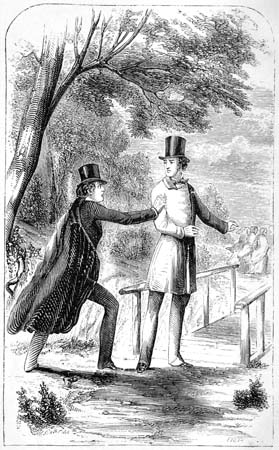
thrilling, fearful laugh, and, snatching a pistol from his breast,
turned fiercely round, when Sir Patrick instantly recognised, as he had
begun to expect, the countenance of that excited stranger, whom Captain
De Crespigny had in the morning named to him as Ernest Anstruther.
Astonishment and unimaginable fury glittered in the madman's wild and
haggard countenance, when he missed the object of his pursuit, and he
looked for the moment like a wild beast at bay, till, springing upon
Sir Patrick with a cry of hideous rage, he seized hold of his arm with
a delirious grasp, and clenched his fist, shouting in accents of
frenzied rage, while the white foam was on his lips:
"Where! where is she? Tell me, or you shall die! Have I tracked her
through earth and air, through sky and ocean, to be disappointed now?
With sleepless care have I dodged her steps! Demons drove me on! Fiends
and serpents have beset me! Coals of fire are on my brain! Cold hands
are on my heart! All is horror! Every human soul shall shudder for the
deeds I do! A brand of shame shall be on my head! The dogs shall howl
when I pass! Even now, the sun never shines on me! Show me, then, where
she is, or I will tear you limb from limb."
Sir Patrick stood firm as a rock before this whirlwind of passion,
though filled with horrible amazement, as he beheld the burning glare
of the madman's eye, and heard the sharp, shrill, shrieking voice in
which he spoke; but if he appeared terrible in his fierce excitement,
he seemed more terrible still, when a moment afterwards, with a cold,
livid look, as if turned into stone, he added:
"She shall be mine, or she shall never be given to another. I would not
spare her for ten thousand lives. If she refuse me, her lips shall be
closed forever and ever. I shall destroy and be destroyed. My love or
my vengeance must be gratified; and mark my words. You are the friend
of Louis De Crespigny. I would it had been himself, and one of us
should never have left this spot alive. There is a dark and dreary
account to be settled between him and me. My first warning shall be my
last," added he, in a hollow whisper, while a look of dangerous meaning
gleamed in his eye. "He deserves death at my hands. He wrenched my
sister from her home, trampled on her affections, and is born in all
things to injure and supplant me! He must die!" added the maniac, with
a strange glare in his eye-balls. "It is, perhaps, for his sake that I
am rejected! Wild voices are whispering in my ear! Unnameable horrors
beset me! Fierce phantoms are hissing and shouting behind me!"
The unfortunate being uttered these words with preternatural fury,
while his countenance wore an expression of deadly malignity. He then
paused, ground his teeth, and with the frightful levity of a maniac,
uttering a howling, fiendish laugh, and rushing away, disappeared into
the thickest part of the forest, leaving Sir Patrick horror-struck at
the awful spectacle of a shattered intellect, the fragments of which
were of so deadly a nature; while, at the same time, amidst a torrent
of other thoughts and feelings, chiefly directed to secure the safety
of Captain De Crespigny, he could not but smile at his present
discovery, that the plainly dressed, shy, reserved, but rather
satirical young lady, whom he had been of late patronising and bringing
forward, was no other than the superbly endowed heiress, Miss Howard
Smytheson, respecting whom he had so often rallied himself.