In the plain text version words in Italics are denoted by _underscores_ and bold text like =this=.
The book cover was modified by the Transcriber and has been added to
the public domain.
A number of words in this book have both hyphenated and non-hyphenated
variants. For the words with both variants present the one more used
has been kept.
Obvious punctuation and other printing errors have been corrected.
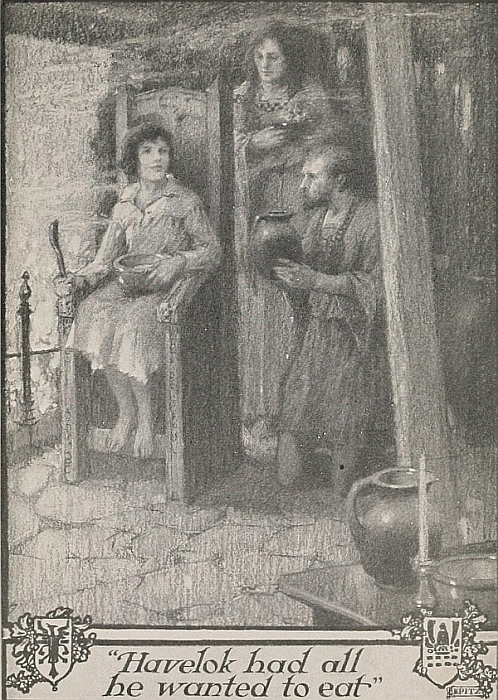
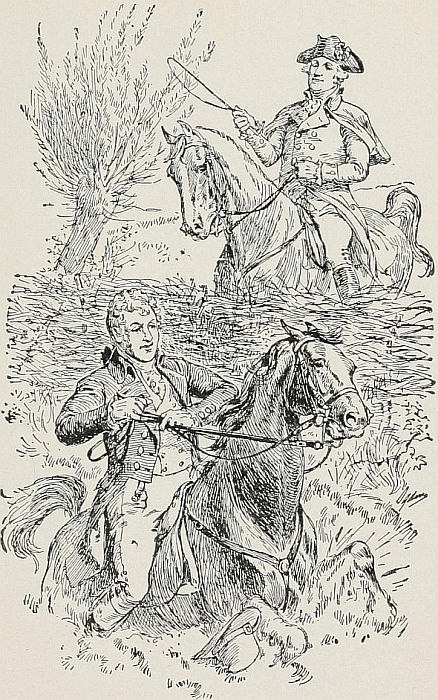
“Havelok had all he wanted to eat.”
MODERN ESSAYS AND STORIES
A BOOK TO AWAKEN APPRECIATION OF
MODERN PROSE, AND TO DEVELOP
ABILITY AND ORIGINALITY IN WRITING
EDITED, WITH INTRODUCTION, NOTES, SUGGESTIVE
QUESTIONS, SUBJECTS FOR WRITTEN IMITATION, DIRECTIONS
FOR WRITING, AND ORIGINAL ILLUSTRATIONS
BY
FREDERICK HOUK LAW, Ph.D.
Head of the Department of English in the Stuyvesant High School,
New York City, Editor of Modern Short Stories, etc.
NEW YORK
THE CENTURY CO.
COPYRIGHT, 1922, BY THE CENTURY CO.
ALL RIGHTS RESERVED, INCLUDING THE
RIGHT TO REPRODUCE THIS BOOK, OR
PORTIONS THEREOF, IN ANY FORM. 3120
PREFACE
In all schools pupils are expected to write “essays” but,
curiously enough, essay-reading and essay-writing are taught
but little. In spite of that neglect, the essay is so altogether
natural and spontaneous in spirit, so intensely personal in
expression, and so demanding of excellence of prose style, that
it is the form, par excellence, for consideration in school if
teachers are to show pupils much concerning the art of writing
well. The essay is to prose what the lyric is to poetry—complete,
genuine and beautiful self-expression, or better still,
self-revelation.
Most of the writing done in schools is straightforward narration
of events, without much, if any, attempt to show personal
reactions on those events—mere diary-like accounts, at
best; mechanical descriptions that aim to present exterior
appearance without attempting to reveal inner meanings or
to show awakened emotions; and stereotyped explanations and
arguments drawn, for the most part, from books of reference
or from slight observation.
Beyond all this mechanical work lies a field of throbbing
personal life, of joyous reactions on all the myriads of
interests that lie close at hand, of meditations on the wonders
of plant and animal life, of humorous or philosophic comments
on human nature, and of all manner of vague dreams and
aspirations aroused by
“Such sights as youthful poets dream
On summer eves by haunted stream.”
Without the slightest question, it is the duty of the school,
and of the teacher in particular, to lead pupils to appreciate
honesty and originality in unapplied, unpragmatic self-expression,
and to show pupils how they themselves may gain the
very real pleasure of putting down on paper permanent
records of their own intimate thinking.
Joseph Addison's The Sir Roger de Coverley Papers and
Washington Irving's Sketch Book have for many years made
valiant but unsuccessful efforts to fill the places that should
be filled by more modern representatives of the essay.
Macaulay's Essay on Johnson is a biographical article for an
encyclopedia; his essays on Clive and on Hastings are polemics;
and Carlyle's Essay on Burns is a critical disquisition.
With the exception of The Sir Roger de Coverley Papers, all
these so-called essays are of considerable length and are unfitted
to serve as the best examples of the essay form;—for
the essay, like the lyric, demands brevity: it is, after all, only
a quick flash of self-revelation,—not a sustained effort.
Then again, who would wish to learn to write like Addison,
like Washington Irving, like Macaulay, or like Carlyle! Those
great writers couched their thoughts in the language-fashions
of their days, just as they clothed their bodies in the garments
of their times. To imitate either their style of expression
or their costumes would be to make one's self ridiculous,
or to take part in a species of masquerade.
The extremely Latinized vocabulary of 1711, or the resonant
periods and marked antitheses of 1850, are as old-fashioned
to-day as are the once highly respected periwigs, great-coats
and silver shoe buckles of the past.
The thoughts of yesterday are not the thoughts of to-day.
There is, in serious reality, such a thing as “an old-fashioned
point of view.” With all due reverence for the past, the best
teachers of to-day believe that it is just as necessary for
students to use present-day methods of expression and to
cultivate present-day interests as it is to take advantage of
the railroad, the telegraph, the telephone, the automobile, and
the thousand other mechanical contrivances that aid life to-day,
but which were unknown in 1711 or in 1850.
The type of essay that should be studied in school should
concern modern interests; represent the modern point of view;
discuss subjects in which young students are interested; be
expressed in present-day language and, in general, should set
forward an example that pupils may directly and successfully
imitate.
In order to do all this to the best advantage the essays
chosen for study should be exceedingly short. To a young
student essays of any considerable length, unless the subject
matter is of unusually intensive interest, present insuperable
difficulties. Short essays, on the other hand, appear to him
exactly what they are,—charmingly delightful expressions of
personal opinion.
The essays in this book, instead of telling about coffee
houses or stage coaches, Scotch peasants or literary circles in
London or Edinburgh, tell about such subjects as Christmas
crowds, church bells, walking, dogs, the wind, children, the
streets of New York, school experiences, and various modern
ideals in work, in literature, and in life. Most of the essays
are exceedingly short, only one or two being more than a few
pages in length.
The essays here given represent various types, including
not only the chatty, familiar essay but also informational
essays, critical essays, biographical essays, story essays, and
one or two examples of highly poetic prose.
An informal introduction, paving the way to a sympathetic
understanding, precedes every essay. Notes below the pages
of text explain immediately all the literary or historical
allusions with which a young reader might not be familiar,
their close position to the text making it unnecessary for a
student to hunt for an explanation.
Suggestive questions given immediately after every essay
make it possible for the teacher to assign lessons quickly; they
also enable the student to study by himself and to feel assured
that he will not miss any important point.
Twenty subjects, suitable as subjects for essays to be
written by the student in direct imitation of the essay that
immediately precedes them, follow every selection. In addition
to this great number of appropriate modern subjects,
more than 500 in number, on which young students can express
their real selves, there are given, in connection with
every list of subjects, directions for writing,—such as a
teacher might give a class when assigning written work.
The subject-lists and the directions for writing give the
teacher a remarkable opportunity to stimulate a class as
never before; to awaken a spirit of genuine self-expression;
and to teach English composition in a way that he can not
possibly do through the medium of any of our present-day
rhetorics.
For the advantage of those teachers who wish to combine
the teaching of the essay and of the short story, and who
may not have at hand any suitable collection of short stories,
the book includes not only introductory material concerning
the nature of the short story and the development of the
short story form, but also a series of stories of unusual
interest for young readers, so chosen and so arranged that
they represent the development of the short story through
the legendary tale, the historical story, and the romantic
story of adventure, to the story of realism and of character.
In every case the story chosen is one that any student will
enjoy and will understand immediately, as well as one that he
can imitate both with pleasure and with success.
Introductions, foot notes, suggestive questions, subjects for
written imitation, and directions for writing, follow every
story.
If the book is used both as a means of awakening literary
appreciation and developing honesty, originality, and power
in written self-expression it will give pleasure to teachers and
students alike.
INTRODUCTION — I THE WRITING OF ESSAYS — II THE NATURE OF THE ESSAY — III TYPES OF THE ESSAY — IV THE DEVELOPMENT OF THE ESSAY — V ESSAYS WELL WORTH READING — VI THE WRITING OF SHORT STORIES — VII NATURE OF THE SHORT STORY — VIII TYPES OF THE SHORT STORY — IX THE DEVELOPMENT OF THE SHORT STORY — X AUTHORS OF SHORT STORIES WELL WORTH READING
“The plowman, near at hand,
Whistles o'er the furrowed land,
And the milkmaid singeth blithe....”
Why? Simply because they are happy; because they are
healthy and vigorous, and at work; because they are doing
something that interests them; because their hearty enjoyment
in life must express itself in some other way than in work
alone: in fact, they whistle and sing just for the doing of it,—not
that they wish any other person to hear them, and not
that they wish to teach anything to anyone. Their whistling
and singing are spontaneous, and for the sake of expression
alone.
Many of the best English essays were written just for the
joy of self-expression. Serious workers in life, in their leisure
moments, have let their pens move, as it were, automatically,
in a sort of frank and full expression somewhat akin to the
plowman's whistling and the milkmaid's singing.
Certainly in that joyous spirit Michel de Montaigne, in
the sixteenth century, wrote the delightfully familiar essays
that have charmed readers for over three hundred years, and
that established the essay as a literary type. In a like vein,
frankly and personally, Charles Lamb, who died in the first
half of the nineteenth century, wrote intimate confessions
of his thoughts,—his memories of schooldays and of early
companionships and familiar places,—writing with all the
warmth and color of affectionate regard. Happily, and because
he was glad to be alive, Robert Louis Stevenson, almost
in our own days, wrote of his love of the good outdoor world
with its brooks and trees and stars, of his love of books and
high thought, and his admiration of a manly attitude toward
life.
For such people writing for the sake of expression was just
as pure joy as the plowman's whistling and the milkmaid's
singing.
Ordinary people write at least the beginnings of essays
when they write letters,—not business letters in which they
order yards of cloth, or complain that goods have not been
delivered,—not letters that convey any of the business of life,—but
rambling, gossipy, self-revealing letters, so illuminated
with personality that they carry the very spirit of the writers.
Everyone, at times, talks or writes in a gossipy way of the
things that interest him. He likes to escape from the world of
daily tasks, of orders, directions, explanations and arguments,
and to talk or write almost without purpose and just for the
sake of saying something. In that sense everyone is a natural
essayist.
The true essayist, like the pleasant conversationalist, expresses
himself because it gives him pleasure. Out of his
rich experience and wide observation he speaks wisely and
kindly. He has no one story to tell and no one picture
to present. He follows no rules and he aims at no very
serious purpose. He does not desire to instruct nor to convince.
Like the conversationalist, he is ready to leave some
things half-said and to emphasize some subjects, not because
it is logical to do so but because he happens to like them. He
is ready at any moment to tell an anecdote, to introduce humor
or pathos, or to describe a scene or a person—if so doing fits
his mood. In general, the true essayist is like the musician
who improvises: he
“Lets his fingers wander as they list,
And builds a bridge from dreamland.”
Of all possible kinds of prose writing, the essay, therefore,
gives the greatest freedom. The essayist may reveal himself
completely and in any manner that he pleases. He may tell
of his delight in wandering by mountain streams, or in mingling
with the crowds in city streets; he may tell of his
thoughts as he meditated by ancient buildings or in the solemn
half-darkness of age-old churches; he may dream of a long-gone
childhood or look ahead into a roseate future; he may
talk of people whom he has known, of books that he has read,
or of the ideals of life. Any subject is his, and any method of
treatment is his,—just so long as his first thought is the frank
and full expression of himself.
To write an essay,—even though it be only a paragraph,—is
to gain the pleasure of putting at least a little of one's real
self down on paper—just because to do so is pleasure.
The essay, then, instead of being a formal composition, is
characterized by a lack of formality. It is a species of very
friendly and familiar writing. Like good conversation, it
turns in any direction, and drops now and then into interesting
anecdotes or pleasant descriptions, but never makes any
attempt to go to the heart of a subject. However serious an
essay may be it never becomes extremely formal or all-inclusive.
A chapter in a textbook includes all that the subject
demands and all that the scope of treatment permits. It
presents well-organized information in clear, logical form.
It aims definitely to explain or to instruct. It may reveal
nothing whatever concerning its writer. An essay, on the
other hand, includes only those parts of the subject that interest
the writer; it avoids logical form, and is just as chatty,
wandering, anecdotal and aimless as is familiar talk. It
focuses attention, not on subject-matter but on the personality
of the writer.
The essay does not reveal a subject: it reveals personal
interests in a subject. It touches instead of analyzing. It
comments instead of classifying.
Truth may sparkle in an essay as gold sparkles in the
sand of an Alaskan river, but the presentation of the truth in
a scientific sense is no more the purpose of the essay than
is the presentation of the gold the purpose of the river. In
the eighteenth century, essayists like Joseph Addison,
Richard Steele, Oliver Goldsmith and Samuel Johnson, commented
freely upon eighteenth century manners and customs,
but they made no attempt to present a careful survey of the
subject. Every writer wrote of what happened to interest him.
To-day it is possible to draw from the great body of eighteenth
century essays material for an almost complete survey of
manners and customs in that period—but that result is only
an accident. The writers did not intend it.
The essayist is not concerned with giving accurate and
logically-arranged information. He thinks only of telling how
his subject appeals to him, of telling whether or not he likes
it, and why. The more personally he writes, the better we like
his work. In his revelation of himself we find a sort of
revelation of ourselves as well,—and we like his work in proportion
to that revelation.
Naturally, a good essay is short; for self-revelation is given
in flashes, as it were,—in sparkles of thought that gleam only
for a moment. Many so-called essays of great length are
either only partly essays, or else are made up of a number
of essays put together. Stevenson's An Inland Voyage is
partly a straightforward story of a canoe trip, and partly
a series of essays on subjects suggested by the trip. It is
possible to draw from a self-revealing book of considerable
length a great number of essays on a wide variety of subjects.
The essays gleam in the pages of ordinary material as diamonds
gleam in their settings of gold.
The essay, as a literary type, is written comment upon any
subject, highly informal in nature, extremely personal in
character, and brief in expression. It is also usually marked
by a notable beauty of style.
Just as there are many kinds of houses and many kinds of
boats so there are many kinds of essays. Some essays tend
to emphasize the giving of information, lean very strongly
toward formality, and place comparatively little weight on
personality,—and yet even such essays, as compared with
other and more serious writings, are discursive and personal.
They are like some people who seem to favor extreme formality
without ever quite attaining it.
Other essays are critical. They point out the good and the
bad, and they set forward ideals that should be reached.
The criticism they give is not measured and accurate like
the criticism a cabinet-maker might make concerning the construction
of a desk. It is more or less personal and haphazard
like the remarks of one who knows what he likes and what he
does not like but who does not wish to bother himself by
going into minute details.
Many essays tell stories, but never for the sake of the
stories alone. They use the stories as frameworks on which
to hang thought, or as illustrations to emphasize thought. The
essays hold beyond and above everything the personality of
the one who writes.
Almost all essays are in some sense biographical, but they
reveal stories of lives, instead of telling the stories in organized
form. The little of biography that essays tell is
just enough to permit the writers to recall the memories of
childhood, and the varied affections and interests of life.
For real biography one must go elsewhere than to essays.
Some essays lift one into a fine and close communion with
their writers, and give intimate companionship with a human
soul. They are the best of all essays. Such essays are always
extremely familiar, and deeply personal, like the essays of
Michel de Montaigne and Charles Lamb. About such essays
is an aroma, a fascination, a delight, that makes them a
joy forever. As one reads such essays he feels that he is walking
and talking with the writers, and that he hears them
express noble and uplifting thoughts.
The terse style of Francis Bacon; the magical phrases of
Sir Thomas Browne; the well-rounded sentences of Joseph
Addison, Sir Richard Steele and Oliver Goldsmith; the
poetic prose of Thomas de Quincey; the charm of the
pages of Charles Lamb and Robert Louis Stevenson,—all
this is in no sense accidental. The intimate revelation
of self, such as is always made by the best essayists,
creates the most pleasing style. Genuine self-expression,
whether it be the fervor of an impassioned orator, the ardor
of a lyric poet, or the meditative mood of the essayist, always
tends to embody itself in an appropriate style. For that
reason much of the best prose of the language is to be found
in the works of the great essayists.
Some writers, like Thomas de Quincey, have so felt the
significance of beauty of style, and have so appreciated its
relationship to the revelation of mood and personality, that
they seem, in some cases, to have written for style alone.
Their essays are unsurpassed tissues of prose and poetry.
Through the medium of spoken or written meditations
men have always expressed their personalities, and thereby
have approached the writing of essays. Many sections of
the Bible are practically essays, especially those passages in
Ecclesiastes that speak concerning friendship, wisdom, pride,
gossip, vengeance, punishment and topics of similar type. In
the ancient Greek and Roman orations are essay-like sections
in which the speakers paused for a moment to express their
innermost thoughts about life, patriotism, duty, or the great
fact of death. Cicero, one of the most remarkable Romans,
wrote admirably and with a spirit of familiarity and frankness,
on friendship, old age, and immortality. In all ages, in
speeches, in letters, and in longer works, essay-like productions
appeared.
The invention of the modern essay,—that is, of the extremely
informal, intimate and personal meditation,—came
in 1571, in France. The inventor of the new type of literature
was Michel de Montaigne, a retired scholar, counsellor
and courtier, who found a studious refuge in the old tower
of Montaigne, where he meditated and wrote for nine years.
His essays, which were first published in 1580, are so delightfully
informal, so frankly personal, so clever and well-aimed
in humor, and so wise, that they are almost without parallel.
In 1601 an Italian, Giovanni Florio, translated Montaigne's
essays into English. Immediately the essays became popular
and they have deeply influenced the writing of essays in English.
In 1597 Francis Bacon published the first of his essays,
but he did not write with the familiarity that characterized
Montaigne. Nevertheless, his work, together with that of
Montaigne, is to be regarded as representing the beginning
of the modern essay.
It was not until the development of the newspaper in the
eighteenth century that the essay found its real period of
growth as a literary type. In the first half of the eighteenth
century The Tatler and The Spectator, and similar periodicals,
gave an opportunity for the publication of short prose compositions
of a popular nature. Joseph Addison and Richard
Steele, writing with kindly humor on the foibles of the day,
did much to establish the popularity of the essay. Samuel
Johnson, Oliver Goldsmith and other writers, in other periodicals,
continued the writing of essays, and made the power of
the essay known.
Until the time of Charles Lamb, in the first half of the
nineteenth century, no English writer had even approached
the familiar charm of Montaigne. Bacon had written in a
formal manner; his followers had held before them the
thought of teaching rather than the thought of self-revelation;
the eighteenth century writers had delighted in character
studies and in observations on social life and customs. Lamb,
on the other hand, wrote not to instruct but to communicate;
not about the world but about himself. He restored the
essay to its position as a means of self-revelation. The most
notable fact about Lamb's essays is that they reveal him to
us as one of the persons whom we know best. At the same
time humor, pathos and beauty of expression are so remarkable
in Lamb's essays that they alone give them permanent
value.
Other writers of the essay, like Leigh Hunt, Sydney Smith,
William Hazlitt, and Francis Jeffrey, wrote powerfully but
none of them with a charm equal to that of Lamb. Thomas
de Quincey, writing in a highly poetic style, did much to stimulate
poetic prose. Lord Macaulay, in a number of critical
and biographical essays, wrote forcefully, logically, and with
a high degree of mastery of style but he paid slight attention
to self-revelation.
It is evident, then, that there are two marked types of
the essay,—one, the formal, purposive composition; and the
other informal and intensely personal in nature. Ralph Waldo
Emerson, Matthew Arnold, John Ruskin, and James Russell
Lowell represent the first type. Many excellent articles in
periodicals, and many of the best of editorial articles in
newspapers are in reality essays of the formal kind. Washington
Irving, Oliver Wendell Holmes, Henry D. Thoreau,
George William Curtis and many others represent the second
type.
In modern times the world has been blessed by the writing
of a number of essays of the charming, familiar type. John
Burroughs has revealed his love for the world of nature;
Henry Van Dyke has taken us among the mountains and
along the rivers; and Gilbert K. Chesterton, Arnold Bennett,
Samuel M. Crothers, Charles Dudley Warner, Hamilton
Wright Mabie, Brander Matthews, Agnes Repplier and a
host of others have written on many and varied subjects.
Great essayists, like great novelists or great poets or great
dramatists, are rare. It is only now and then that a Montaigne,
a Charles Lamb, or a Robert Louis Stevenson appears.
It is to the glory of literature, however, that there are so
many who write in the field of the essay, and who approach
true greatness, even if they do not attain it.
Joseph Addison
Sir Richard Steele
The Spectator
Apochrypha, The
Ecclesiasticus
Arnold, Matthew
Culture and Anarchy
Bacon, Francis
Essays
Bennett, Arnold
How to Live on 24 Hours a Day
Browne, Sir Thomas
Religio Medici
Bible, The Holy
Ecclesiastes
Burroughs, John
Birds and Bees
””
Locusts and Wild Honey
””
Wake Robin
””
Winter Sunshine
””
Accepting the Universe
Carlyle, Thomas
Heroes and Hero Worship
Curtis, George William
Prue and I
Chesterfield, Lord
Letters to His Son
Crothers, Samuel M.
The Gentle Reader
Emerson, Ralph Waldo
Essays
Goldsmith, Oliver
The Citizen of the World
Grayson, David
Adventures in Contentment
Harrison, Frederic
The Choice of Books
Hearn, Lafcadio
Out of the East
Holmes, Oliver Wendell
The Autocrat of the Breakfast Table
”””
The Professor at the BreakfastTable
”””
The Poet at the Breakfast Table
”””
Over the Teacups
Irving, Washington
The Sketch Book
Johnson, Samuel
The Idler
””
The Rambler
Lamb, Charles
Essays
Lowell, James Russell
Among My Books
Matthews, Brander
Aspects of Fiction
Mabie, Hamilton Wright
Essays on Nature and Culture
Macaulay, Thomas Babington
Milton
Maeterlinck, Maurice
Field Flowers
””
News of the Spring
””
Old Fashioned Flowers
Mitchell, Donald G.
Reveries of a Bachelor
”””
Dream Life
Montaigne, Michel de
Essays
Pater, Walter
Appreciations
De Quincey, Thomas
Vision of Sudden Death
””
Dream Fugue
Repplier, Agnes
In Our Convent Days
Ruskin, John
Sesame and Lilies
Roosevelt, Theodore
The Strenuous Life
Ross, E. A.
Sin and Society
Shairp, John Campbell
Studies in Poetry and Philosophy
Stevenson, Robert Louis
Inland Voyage
”””
Travels with a Donkey
”””
Virginibus Puerisque
”””
Memories and Portraits
”””
Later Essays
Thoreau, Henry David
A Week on the Concord and Merrimac Rivers
”””
Walden
”””
The Maine Woods
”””
Cape Cod
Van Dyke, Henry
Little Rivers
”””
Fisherman's Luck
Wagner, Charles
The Simple Life
White, Gilbert
The Natural History and Antiquities of Selborne
You cross a street and narrowly escape being run over by
an automobile; or you go on a picnic and have delightful
experiences; or you return from travel, with the memory of
happy adventures—at once an uncontrollable impulse besets
you to tell some one what you experienced. That desire to
interest some one else in the series of actions that interested
you, is the basis of all story-telling.
In one of its simplest forms story-telling is personal and
concerns events that actually occurred to the story-teller.
Such narration uses the words “I,” “me” and “mine,” seeks
no development, aims at no climax, and strikes at interest only
through telling of the unusual.
When you stand before an abandoned farm-house and see
its half-fallen chimney, its decayed boards, its gaping windows,
and the wild vines that clamber into what was once a
home your imagination takes fire, and you think of happier
days that the house has seen. You imagine the man and
woman who built it; the children who played in its doorways;
and the happy gatherings or sad scenes that marked its story.
That quick imagination of the might-be and the might-have-been
is the beginning both of realism and of romance. The
story you would tell would use the third person, in all probability;
would seek an orderly development, and would aim
at climax.
When you stand in your window on a winter day and
watch thousands of snow-flakes float down from the sky,
circling in fantastic whirls, you see them as so many white
fairies led by a master spirit in revel and dance. You are
ready to tell, with whatever degree of fancy and skill you
can command, the story of the-world-as-it-is-not and as-it-never-will-be.
A story of that kind is pure romance.
Whenever you tell what happened to you or to some one
else; or what might have been or might be; or of what could
not possibly be, your object is to interest some one else in
what interests you. You use many expedients to capture
and to hold interest: you make a quick beginning, or careful
preparation for the climax; you make your story as real or
as striking as you can make it; you cut it short or you tell it
at length; or you hold the reader's attention on some point
of interest that you do not reveal in full until the last. Whatever
you do to capture and to hold interest makes for art in
story-telling.
When an airplane descends unexpectedly in a country
town every one in the place wishes, as soon as possible, to learn
whence the aviator came and what experiences he had.
Human curiosity is insatiable, and for that reason people love
to hear stories as well as to tell them.
In fact, people gain distinct advantages by reading stories.
They become acquainted with many types of character; they
see all sorts of interesting events that they could never see
in reality; they see what happens under certain circumstances,
and thereby they gain practical lessons. Through
their reading they gain such vivid experiences that they are
likely to have a larger outlook upon life.
Brevity is the first essential of a short story, and yet
under the term, “brief,” may be included a story that
is told in one or two paragraphs, and a story that is told in
many pages. A story that is so long that it cannot be read
easily at a single sitting is not a short story.
To make one strong impression on the mind of the reader,
and to make that impression so powerfully that it will leave
the reader pleased, convinced and emotionally moved is the
principal aim of a good short story. To the production of
that one effect everything in the story,—characters, action,
description, and exposition,—points with the definiteness of
an established purpose. All else is omitted, and thus all the
parts of the story are both necessary and harmonious.
Centralizing everything on the production of one effect
makes every short story complete in itself. The purpose
having been accomplished there is nothing more to be said.
The end is the end.
A convincing sense of reality characterizes every excellent
short story. The author himself appears only as one who
narrates truth, not at all as one who has moved the puppets
of imagination. The story seems a transcript from real
experience. The characters,—not the author,—make the plot.
Their personalities reveal themselves in action. The entire
story is founded substantially upon life and appears as a
photographic glimpse of reality.
As in all other writing, the greater the art of the writer in
adapting style to thought, in using language effectively, the
better production. Word-choice, power of phrasing, and skill
in artistic construction count for as much in the short story as
in any other type of literature.
Since the short story represents life, it has as many types
as there are interests in life. It may confine itself to the
ordinary events of life in city or country, at home or abroad;
it may concern past events in various regions; or it may
look with a prophetic glance into the distant future. It may
concern nothing but verifiable truth or be highly imaginative,
delicately fanciful, or notably grotesque. It may draw
interest from quaint places and odd characters, or it may
appeal through vividness of action. It may aim to do nothing
more than to arouse interest and to give pleasure for a
moment, or it may endeavor to teach a truth.
Among the many types of the short story, a few are especially
worthy of note.
Folk-lore stories are stories that have been told by common
people for ages. They come direct from the experience and
the common sense of ordinary people. They represent the
interests, the faith and the ideals of the race from which they
come.
Fables are very short stories that point out virtues and
defects in human character presented in the guise of animal
life.
Legends are stories that have come down to us from a time
beyond our own. They are less simple and direct than the
ordinary folk-lore story. Undoubtedly founded on actual
occurrences they have tinged fact with a poetic beauty that
ennobles them and often gives them highly ethical values.
Stories of adventure emphasize startling events rather than
character.
Love stories emphasize courtship and the episodes of
romantic love.
Local color stories reveal marked characteristics of custom
and language, and the oddities of life notable in a particular
locality.
Dialect stories make use of the language peculiarities found
in common use by a particular type of people.
Stories of the supernatural deal with ghostly characters
and uncanny forces.
Stories of mystery present puzzling problems, and slowly,
step by step, lead the readers to satisfactory solutions.
Animal stories, whether realistic or romantic, concern the
lives of animals.
Stories of allegory, through symbolic characters and events,
reveal moral truths.
Stories of satire, by ridiculing types of character, social
customs, or methods of action, tend to awaken a spirit of
reform.
Stories of science present narratives based upon the exposition
and the actual use of scientific facts.
Stories of character emphasize notable personalities, place
stress upon motive and the inner nature rather than upon
outer action, and clarify the reader's understanding of human
character.
Although the beginnings of the short story existed in the
past, and although tales were told in all ages, the short story,
in its present form, is a comparatively new type of literature.
The short, complete, realistic narrative designed to produce a
single strong impression, came into being in the first half of
the nineteenth century. The first writer to point out and to
exemplify the principles of the modern short story was Edgar
Allan Poe, 1809-1849.
As early as 4000 B.C. the Egyptians composed the Tales
of the Magicians, and in the pre-Christian eras the Greeks
and other peoples wrote short prose narratives. Folk-lore
tales go back to very early times. The celebrated Gesta
Romanorum is a collection of anecdotes and tales drawn from
many ages and peoples, including the Greeks, the Egyptians
and the peoples of Asia. In the early periods of the history
of Europe and of England many narratives centered around
the supposed exploits of romantic characters like the ancient
Greeks and Trojans, Alexander the Great, Charlemagne and
King Arthur.
In the thirteenth and fourteenth centuries the Italians
became skilful in the telling of tales called novelle. Giovanni
Boccaccio, 1313-1375, brought together from wide and varied
sources a collection of one hundred such tales in a volume
called Il Decamerone. He united the tales by imagining that
seven ladies and three gentlemen who had fled from Florence
to avoid the plague, pass their time in story-telling. His work
had the deepest influence on many later writers, including particularly
the English poet, Geoffrey Chaucer, 1340-1400, whose
Canterbury Tales re-tell some of Boccaccio's stories. Chaucer
imagines that a number of people, representing all the types
of English life, tell stories as they journey slowly to the shrine
of Thomas à Becket at Canterbury. His stories intimately
reveal the actual England of his day. He is the first great
realist.
In the sixteenth century many writers, particularly in Italy,
France and Spain, told ingenious stories that developed new
interest in story-telling and story-reading.
The writing of character studies and the development of
periodicals led, in the eighteenth century, to such essays as
The Sir Roger de Coverley Papers, written for The Spectator
by Joseph Addison, 1672-1719, and Sir Richard Steele, 1672-1729.
The doings of Sir Roger de Coverley are told so
realistically and so entertainingly that it was evident that
such material could be used not only to illustrate the thought
of an essayist but also for its own sake in stories founded on
character.
About the beginning of the nineteenth century stories of
an uncanny nature,—of ghosts and strange events,—the so-called
“Gothic” stories,—became widely popular. Two German
writers, E. T. A. Hoffmann, 1776-1822, and Ludwig Tieck,
1773-1853, wrote with such peculiar power that they led other
writers to imitate them. Among the followers of Tieck and
Hoffmann the most notable name is that of Edgar Allan Poe.
Poe's contemporaries, Washington Irving, 1783-1859, and
Nathaniel Hawthorne, 1804-1864, likewise showed the influence
of the “Gothic” school of writing. Irving turned the
ghostly into humor, as in The Legend of Sleepy Hollow;
Hawthorne wrote of the mysterious in terms of fancy and
allegory, as in Ethan Brand, The Birth Mark, and Rappaccini's
Daughter; Poe directed all his energy to the production
of single effect,—frequently the effect of horror, as in
The Cask of Amontillado, The Black Cat and The Pit and the
Pendulum. Poe's natural ability as a constructive artist, and
his genuine interest in story-telling, led him to formulate the
five principles of the short story:—brevity, single effect,
verisimilitude, the omission of the non-essential, and finality.
From the time when Poe pointed the way the short story
has had an unparalleled development. French writers like
Guy de Maupassant; British writers like Rudyard Kipling;
Russian writers like Count Leo Tolstoi, and American
writers like O. Henry, Richard Harding Davis, Frank R.
Stockton, Mary E. Wilkins Freeman, Thomas Bailey Aldrich,
F. Hopkinson Smith, Jack London, and a thousand others,
have carried on the great tradition.
Volumes containing short stories by the following writers
will be found in any public library. Any one who wishes
to gain an understanding of the principles of the short story
should read a number of stories by every writer named in
the list.
THE PUP-DOG — SUGGESTIVE QUESTIONS — SUBJECTS FOR WRITTEN IMITATION — DIRECTIONS FOR WRITING
THE FAMILIAR ESSAY
By ROBERT PALFREY UTTER
(1875—). Associate Professor of English in the University
of California. He taught for a time at Harvard and also at
Amherst. He is a delightful essayist, and contributes frequently
to various magazines.
The writer of a familiar essay selects any subject in which he is
interested. Sometimes the more trifling the subject seems to be, the
more delightful is the essay. Trifles, in fact, make up life, and around
them center many of our deepest interests. The very charm of the
familiar essay lies in its ability to call attention to the value of trifles,—to
the little things in life, to little events, and to all the odds and
ends of human interests.
The familiar essay is nothing more than happy talk that gives us,
as it were, a walk or a chat with one who has a keen mind, a ready wit,
and a pleasant spirit.
The Pup-Dog is an unusually excellent illustration of the familiar
essay. We all love him,—the pup-dog,—the good friend about whom
Mr. Utter has written so amusingly, so understandingly, and so sympathetically.
As we read we can see the dog jumping and hear him barking;
we laugh at his antics; we are, in fact, taking a walk with Mr.
Utter while he talks to us about his dog,—or our dog.
Any dog is a pup-dog so long as he prefers a rat, dead or
alive, to chocolate fudge, a moldy bone to sponge cake, a fight
with a woodchuck to hanging round the tea-table for sweet
biscuit. Of course he will show traits of age as years advance,
but usually they are physical traits, not emotional. For the
most part dogs’ affections burn warmly, and their love of life
and experience brightly, while life lasts. They remain young,
as poets do. Every dog is a pup-dog, but some are more so
than others.
Most so of all is the Irish terrier. To me he stands as the
archetype of the dog, and the doggier a dog is, the better I
like him. I love the collie; none better. I have lived with
him, and ranged the hills with him in every kind of weather,
and you can hardly tell me a story of his loyalty and intelligence
that I cannot go you one better. But the collie is a
gentleman. He has risen from the ranks, to be sure, but he is
every inch the gentleman, and just now I am speaking of dogs.
The terrier is every inch a dog, and the Irish is the terrier
par excellence.
The man who mistakes him for an Airedale, as many do, is
one who does not know an Irishman from a Scot. The Airedale
has a touch of the national dourness; I believe that he
is a Calvinist at heart, with a severe sense of personal responsibility.
The Irish terrier can atone vicariously or not at all
for his light-hearted sins. The Airedale takes his romance
and his fighting as seriously as an Alan Breck. The Irish
terrier has all the imagination and humor of his race; he
has a rollicking air; he is whimsical, warm-hearted, jaunty,
and has the gift of blarney. He loves a scrimmage better than
his dinner, but he bears no malice.
His fellest earthly foes,
Cats, he does but affect to hate.
The terrier family is primarily a jolly, good-natured crowd
whose business it is to dig into the lairs of burrowing creatures
and fight them at narrow quarters. The signal for the fight
is the attack on the intrusive nose. You can read this family
history in the pup-dog's treatment of the cat. The cat of
his own household with whom he is brought up he rallies with
good-humored banter, but he is less likely to hurt her than
she him. He will take her with him on his morning round
of neighborhood garbage-pails, and even warm her kittens on
his back as he lies in the square of sunshine on the kitchen
floor, till they begin to knead their tiny claws into him in a
futile search for nourishment; then he shakes them patiently
off and seeks rest elsewhere. He will chase any cat as long
as she will run; if she refuses to run, he will dance round her
and bark, trying to get up a game. “Be a sport!” he taunts
her. “Take a chance!” But if she claws his nose, she treads
on the tail of his coat, and no Irish gentleman will stand
for that.
Similar are his tactics with human creatures. First he
tries a small bluff to see if he can start anything. If his
victim shows signs of fear, he redoubles his effort, his tail the
while signaling huge delight at his success. If the victim
shows fight, he may develop the attack in earnest. The victim
who shows either fear or fight betrays complete ignorance of
dog nature, for the initial bluff is always naïvely transparent;
the pup-dog may have a poker face, but his tail is a rank
traitor. A nest of yellow-jackets in a hole in the ground
challenges his every instinct. He cocks his ear at the subterranean
buzzing, tries a little tentative excavation with cautious
paw. Soon one of the inmates scores on the tip of his
nose, and war is declared in earnest. There are leaping
attacks with clashing of teeth, and wildly gyrating rear-guard
actions. Custom cannot stale the charm of the spot; all summer,
so long as there is a wing stirring, hornets shall be hot i'
the mouth.
The degree of youth which the pup-dog attains and holds
is that of the human male of eleven or twelve years. He
nurses an inextinguishable quarrel with the hair-brush. His
hatred of the formal bath is chronic, but he will paddle
delightedly in any casual water out of doors, regardless of
temperatures and seasons. At home he will sometimes scoff at
plain, wholesome food, but to the public he gives the impression
that his family systematically starve him, and his dietetic
experiments often have weird and disastrous results. You
can never count on his behavior except on formal occasions,
when you know to a certainty that he will disgrace you. His
curiosity is equaled only by his adroitness in getting out of
awkward situations into which it plunges him. His love of
play is unquenchable by weariness or hunger; there is no
time when the sight of a ball will not rouse him to clamorous
activity.
For fine clothes he has a satiric contempt, and will almost
invariably manage to land a dirty footprint on white waist-coat
or “ice-cream pants” in the first five minutes of their
immaculacy. He is one hundred per cent. motor-minded;
when he is “stung with the splendor of a sudden thought,” he
springs to immediate action. In the absence of any ideas he
relaxes and sleeps with the abandon of a jute door-mat.
Dog meets dog as boy meets boy, with assertions of superiority,
challenge, perhaps fight, followed by friendship and
play. No wonder that with pup-boys the pup-dog is so completely
at one; his code is their code, and whither they go
he goes—except to school. With September come the dull
days for him. No more the hordes of pirates and bandits
with bandanas and peaked hats, belts stuck full of dirks and
“ottermaticks,” sweep up and down the sidewalk on bicycles
in open defiance of the law, raiding lawns and gardens, scattering
shrieking tea-parties of little girls and dolls, haling
them aboard the lugger in the next lot and holding them
for fabulous ransom. There is always some one who will
pay it with an imposing check signed “Theodore Wilson
Roosevelt Woodrow Rockefeller.” He prances with flopping
ears beside the flying wheels, crouches in ambush, gives
tongue in the raid, flies at the victims and tears their
frocks, mounts guard in the cave, and shares the bandits' last
cookie.
But when the pirates become orderly citizens, his day
begins after school and ends with supper. With his paws
on the window-sill, his nose making misty spots on the glass,
he watches them as they march away in the morning, then
he makes a perfunctory round of the neighborhood, inspecting
garbage-pails and unwary cats. After that there is nothing
to do but relax in the September sunshine and exist in a
coma till the pirates return and resume their normal functions,
except for his routine attempt to intimidate the postman and
the iceman. Perhaps he might succeed some happy day;
who knows?
The pup-dog in the open is the best of companions; his
exuberant vitality and unquenchable zest for things in general
give him endless variety. There are times, perhaps, when you
see little of him; he uses you as a mobile base of operations,
and runs an epicycloidal course with you as moving center,
showing only a flash of his tail on one horizon or the flop of
his ears on the other. You hear his wild cries of excitement
when he starts a squirrel or a rabbit. By rare luck you may
be called in time to referee a fight with a woodchuck, or once
in a happy dog's age you may see him, a khaki streak through
the underbrush, in pursuit of a fox.
At last you hear the drumming of his feet on the road
behind you; he shoots past before he can shift gears, wheels,
and lands a running jump on your diaphragm by way of
reporting present for duty. Thereafter he sticks a little closer,
popping out into the road or showing his tousled face through
the leaves at intervals of two or three hundred yards to make
sure that you are still on the planet. Then you may enjoy
his indefatigable industry in counting with his nose, his tail
quivering with delight, the chinks of old stone walls. You
may light your pipe and sit by for an hour as he energetically
follows his family tradition in digging under an old stump,
shooting the sand out behind with kangaroo strokes, tugging
at the roots with his teeth, and pausing from time to time
to grin at you with a yard of pink tongue completely surrounded
by leaf mold. You may admire his zeal as inspector
of chipmunks, mice, frogs, grasshoppers, crickets, and
such small deer. Anything that lives and tries to get away
from him is fair game except chickens. If round the turn
of the road he plumps into a hen convention, memories of
bitter humiliations surge up within him, and he blushes, and
turns his face aside. Other dogs he meets with tentative
growling, bristling, and tail-wagging, by way of asserting
that he will take them on any terms they like; fight or frolic,
it is all one to him.
You cannot win his allegiance by feeding him, though he
always has his bit of blarney ready for the cook. He loves
all members of the family with nice discrimination for their
weaknesses: the pup-boy who cannot resist an invitation
to romp; the pup-girl who cannot withstand begging blandishments
of nose and paw, but will subvert discipline and
share food with him whenever and wherever she has it. He
will welcome with leapings and gyrations any one of them
after a day's absence or an hour's, but his whole-souled allegiance
is to the head of the house; his is the one voice that
speaks with authority; his the first welcome always when
the family returns in a group. That loyalty, burning bright
and true to the last spark of life, that unfailing welcome on
which a man can count more surely than on any human love—indeed,
there is no secret in a man's love for a dog, however
we may wonder at the dog's love for the man. Let
Argos and Ulysses[1] stand as the type of it, though to me it
lacks something of the ideal, not in the image of the dog, but
in the conduct of the man. Were I disguised for peril of
my life, and my dog, after the wanderings and dangers of
many years, lifted his head and knew me and then died, I
think no craft could withhold my feelings from betraying
me.
“Dogs know their friends,” we say, as if there were mystery
in the knowledge. The password of the fraternity is not
hidden; you may hear it anywhere. It was spoken at my own
hearth when the pup-dog, wet with autumn rain, thrust himself
between my guest and the andirons and began to steam.
My guest checked my remonstrance. “Don't disturb him
on my account, you know. I rather like the smell of a wet
dog,” he added apologetically. The word revealed a background
that made the speaker at once and forever my guest-friend.
In it I saw boy and dog in rain and snow on wet
trails, their camp in narrow shelter, where they snuggle together
with all in common that they have of food and warmth.
He who shared his boyhood with a pup-dog will always share
whatever is his with members of the fraternity. He will value
the wagging of a stubby tail above all dog-show points and
parlor tricks. He will not be rash to chide affectionate importunity,
nor to set for his dog higher standards than he
upholds for himself. Do you never nurse a grouch and
express it in appropriate language? Do you never take direct
action when your feelings get away with you? When the
like befalls the pup-dog, have ready for him such sympathy
as he has always ready for you in your moods. Treat him
as an equal, and you will get from him human and imperfect
results.
You will never know exactly what your pup-dog gets from
you; he tries wistfully to tell you, but leaves you still wondering.
But you may have from him a share of his perennial
puphood, and you do well to accept it gratefully whenever he
offers it. Take it when it comes, though the moment seem
inopportune. You may be roused just as you settle for a
nap by a moist nose thrust into your hand, two rough brown
paws on the edge of your bunk, a pair of bright eyes peering
through a jute fringe. Up he comes, steps over you, and
settles down between you and the wall with a sigh. Then, if
you shut your eyes, you will find that you are not far from
that place up on the hill—the big rock and the two oaks—where
the pup-boy that used to be you used to snuggle down
with that first old pup-dog you ever had.
What is the effect of the title?
How does Mr. Utter make us love the dog?
What knowledge of dog life does the writer show?
Point out words or expressions that are usually applied only to
human beings, that are here applied to dogs.
Point out adjective effects.
How does the writer make the dog seem amusing?
How does the writer make the dog seem admirable?
What human characteristics are attributed to the dog?
Point out noteworthy examples of humor.
Show how the writer employs detail as a means of emphasis.
Point out examples of especially effective metaphor.
What is said concerning the pup-boy and the pup-girl?
How does the essay make us feel toward dogs?
What is the effect of the closing sentences?
1. My Dog
11. Cats
2. Lap Dogs
12. Kittens
3. Police Dogs
13. Rabbits
4. Hounds
14. Mice
5. Shepherd Dogs
15. Squirrels
6. Boston Bulls
16. Horses
7. Great Danes
17. Robins
8. Newfoundland Dogs
18. Sea Gulls
9. Greyhounds
19. Cows
10. Stray Dogs
20. Fish
Select for your subject some animal with which you are intimately
familiar, and in which you are especially and sympathetically interested.
Write about that animal in such a way that you will bring
to the surface its most humorous qualities and its most admirable
qualities. Give a great number of details concerning the animal's
habits, but give those details in a gossipy manner. Use quotations,
if you can, or make allusions to books. Make all your work emphasize
goodness. Make your closing paragraph your most effective
paragraph,—one that will appeal to sentiment.
FOOTNOTES:
[1] According to Homer's Odyssey when Ulysses returned after many
years of wandering, his old dog “Argos” recognized him, even in
disguise.
CHEWING GUM [2] — SUGGESTIVE QUESTIONS — SUBJECTS FOR WRITTEN IMITATION — DIRECTIONS FOR WRITING
By CHARLES DUDLEY WARNER
(1829-1900). A celebrated American essayist and editor.
For many years he wrote brilliant papers for Harper's Magazine
in the departments called “The Editor's Drawer” and
“The Editor's Study.” He became the first President of the
National Institute of Arts and Letters. He was a great influence
for good. Among his books are My Summer in a
Garden; Back-Log Studies; In the Wilderness; The Relation
of Literature to Life; As We Were Saying; Their Pilgrimage.
He edited the valuable “American Men of Letters Series,”
and the remarkable work called Library of the World's Best
Literature, a collection of extracts from the world's literature,
with which every student should be acquainted.
The familiar essay takes for its subject anything that awakens the
interest of the essayist. Charles Dudley Warner wrote with freedom
and humor on a great number of subjects that in themselves suggest
light and humorous treatment rather than serious thinking. Among
his many informal essays is the one that follows, entitled Chewing Gum.
What Mr. Warner says in the essay is by no means serious. It is
like the spoken reflections of an amused observer who has had his
attention attracted to the common American habit of chewing gum in
public. At the same time, under the kindly and facetious remarks, is
an undercurrent of satire—and satire means criticism.
In language that is unfortunately understood by the greater
portion of the people who speak English, thousands are
saying on the first of January, a far-off date that it is
wonderful any one has lived to see—“Let us have a new
deal!” It is a natural exclamation, and does not necessarily
mean any change of purpose. It always seems to a man that
if he could shuffle the cards he could increase his advantages
in the game of life, and, to continue the figure which needs
so little explanation, it usually appears to him that he could
play anybody else's hand better than his own. In all the good
resolutions of the new year, then, it happens that perhaps
the most sincere is the determination to get a better hand.
Many mistake this for repentance and an intention to reform,
when generally it is only the desire for a new shuffle of the
cards. Let us have a fresh pack and a new deal, and start
fair. It seems idle, therefore, for the moralist to indulge
in a homily about annual good intentions, and habits that
ought to be dropped or acquired, on the first of January. He
can do little more than comment on the passing show.
It will be admitted that if the world at this date is not
socially reformed it is not the fault of the Drawer,[3] and for
the reason that it has been not so much a critic as an explainer
and encourager. It is in the latter character that it undertakes
to defend and justify a national industry that has
become very important within the past ten years. A great
deal of capital is invested in it, and millions of people are
actively employed in it. The varieties of chewing gum that
are manufactured would be a matter of surprise to those who
have paid no attention to the subject, and who may suppose
that the millions of mouths they see engaged in its mastication
have a common and vulgar taste. From the fact that it
can be obtained at the apothecary's, an impression has got
abroad that it is medicinal. This is not true. The medical
profession do not use it, and what distinguishes it from
drugs—that they also do not use—is the fact that they do not
prescribe it. It is neither a narcotic nor a stimulant. It
cannot strictly be said to soothe or to excite. The habit of
using it differs totally from that of the chewing of tobacco
or the dipping of snuff. It might, by a purely mechanical
operation, keep a person awake, but no one could go to sleep
chewing gum. It is in itself neither tonic nor sedative. It
is to be noticed also that the gum habit differs from the
tobacco habit in that the aromatic and elastic substance is
masticated, while the tobacco never is, and that the mastication
leads to nothing except more mastication. The task is
one that can never be finished. The amount of energy expended
in this process if capitalized or conserved would
produce great results. Of course the individual does little,
but if the power evolved by the practice in a district school
could be utilized, it would suffice to run the kindergarten
department. The writer has seen a railway car—say in the
West—filled with young women, nearly every one of whose
jaws and pretty mouths was engaged in this pleasing occupation;
and so much power was generated that it would, if
applied, have kept the car in motion if the steam had been
shut off—at least it would have furnished the motive for
illuminating the car by electricity.
This national industry is the subject of constant detraction,
satire, and ridicule by the newspaper press. This is
because it is not understood, and it may be because it is
mainly a female accomplishment: the few men who chew gum
may be supposed to do so by reason of gallantry. There
might be no more sympathy with it in the press if the real
reason for the practice were understood, but it would be
treated more respectfully. Some have said that the practice
arises from nervousness—the idle desire to be busy without
doing anything—and because it fills up the pauses of vacuity
in conversation. But this would not fully account for the
practice of it in solitude. Some have regarded it as in
obedience to the feminine instinct for the cultivation of
patience and self-denial—patience in a fruitless activity, and
self-denial in the eternal act of mastication without swallowing.
It is no more related to these virtues than it is to the
habit of the reflective cow in chewing her cud. The cow
would never chew gum. The explanation is a more philosophical
one, and relates to a great modern social movement.
It is to strengthen and develop and make more masculine
the lower jaw. The critic who says that this is needless, that
the inclination in women to talk would adequately develop
this, misses the point altogether. Even if it could be proved
that women are greater chatterers than men, the critic would
gain nothing. Women have talked freely since creation, but
it remains true that a heavy, strong lower jaw is a distinctively
masculine characteristic. It is remarked that if a
woman has a strong lower jaw she is like a man. Conversation
does not create this difference, nor remove it; for the
development of the lower jaw in women constant mechanical
exercise of the muscles is needed. Now, a spirit of emancipation,
of emulation, is abroad, as it ought to be, for the regeneration
of the world. It is sometimes called the coming to
the front of woman in every act and occupation that used to
belong almost exclusively to man. It is not necessary to say
a word to justify this. But it is often accompanied by a
misconception, namely, that it is necessary for woman to be
like man, not only in habits, but in certain physical characteristics.
No woman desires a beard, because a beard means
care and trouble, and would detract from feminine beauty,
but to have a strong and, in appearance, a resolute underjaw
may be considered a desirable note of masculinity, and of
masculine power and privilege, in the good time coming.
Hence the cultivation of it by the chewing of gum is a
recognizable and reasonable instinct, and the practice can
be defended as neither a whim nor a vain waste of energy
and nervous force. In a generation or two it may be laid
aside as no longer necessary, or men may be compelled to
resort to it to preserve their supremacy.
Why does the writer make use of some very colloquial expressions?
Why did he use a number of long and somewhat formal words?
In what sense is the essay a New Year's essay?
Show how the author produces humor.
Show how the author avoids harshness of criticism.
What makes the essay forceful?
In what respects is the essay fantastic?
What advantage does the writer gain by appearing to support
the habit of chewing gum?
Point out examples of kindly satire.
What is the author's purpose?
1. Whistling
11. Teasing
2. Lateness
12. Crowding
3. Whispering
13. Rudeness
4. Giggling
14. Inquisitiveness
5. Writing notes
15. Untidiness
6. Complaining
16. Forgetfulness
7. Hurrying
17. Conceit
8. Carelessness
18. Obstinacy
9. Making excuses
19. Vanity
10. Borrowing
20. Impatience
You are to write of some habit that is common and that is more
or less annoying to well-bred people. Make your words, in mock
seriousness, appear to defend the habit that you ridicule. Make
your style of writing somewhat ponderous, as though you were
writing with the utmost gravity, but be sure to write in such a way
that your essay will convey your sense of the ridiculous. Let your
whole essay so ridicule the annoying habit that you will tend to
destroy it.
FOOTNOTES:
[2] From As We Were Saying, by Charles Dudley Warner. Copyright
by Harper and Brothers.
[3] Drawer. The Editor's Drawer of Harper's Magazine for which Mr.
Warner wrote many of his best essays.
THE MYSTERY OF AH SING — SUGGESTIVE QUESTIONS — SUBJECTS FOR WRITTEN IMITATION
By ROBERT L. DUFFUS
An editorial writer for the New York Globe, to which, on
October 5, 1921, he contributed the following humorous editorial
article.
As we go about in daily life various people attract our attention;
their peculiarities amuse us, and we make semi-humorous but kindly
remarks concerning them. Such remarks are the germs of essays like
the following.
In the essay, The Mystery of Ah Sing, there is humor but not a single
unkind word. The essay makes us smile, but with sympathy and understanding.
Such essays, trivial as they may be, are restful and pleasing.
Ah Sing comes on Tuesdays to get the washing and on
Saturdays to bring it back. He is an urbane, smiling person,
who appears to view life impersonally and dispassionately.
One would say that he realized that the career of Ah Sing
was not of prime importance in a population so numerous
and a universe so extensive. He loves to ask questions. How
old is the mistress of the house? Where did she come from?
How much does the master of the house earn? What does he
do? Why haven't they any children? Where did they get
all the books and pictures?
Ah Sing always wants to know about the vacations, both
before and after taking, and looks intelligent when places like
Nantucket and the Thousand Islands are mentioned. He
follows the family fortunes like an old retainer, and seems
to possess a kind of feudal loyalty. It would be morally
impossible, not to say physically, to give the washing to any
one but Ah Sing. He would come for it, and the mistress of
the house would sink through the floor with contrition and
embarrassment. He may die out of his job, or go back to
China out of it, there to live like a mandarin, but he will
not be fired out of it. Never will he join the army of unemployed;
never will he stand humbly asking work. He is a
monopoly, an institution, a friend.
So far one gets with Ah Sing. To lose him would be like
losing a beloved pipe or a comfortable pair of slippers. He
belongs amid the furniture of living, and is as simple, homely,
and admirable as grandpa's picture on the wall. But what is
Ah Sing thinking about? What is going on across that gulf
which separates him from us? How many transmigrations
must we all go through before we could know Ah Sing as
well as we know the family from Indiana which moved in
next door last week? How shall we penetrate to the soul of
Ah Sing?
If we could answer these questions we could present ourselves
forthwith at Washington with the solution of the
world's most vexatious problem. But the answers are dark,
Ah Sing is remote, and the East and the West have not yet
met.
In what respects is Ah Sing a mystery?
Why did the author write about Ah Sing?
What are Ah Sing's amusing characteristics?
What are Ah Sing's best characteristics?
Show that the author's language is original.
Show that the essay increases in effect toward the end.
How does the author avoid unkindness or satire?
How does the essay affect the reader?
1. The Janitor
11. Grandmother
2. The Peanut Man
12. The Milk Man
3. The Auctioneer
13. The Small Boy
4. The Blind Man
14. The Newspaper Man
5. The Tramp
15. The Usher
6. The Old Soldier
16. The Policeman
7. The Violin Player
17. The Street Sweeper
8. The Dancing Teacher
18. Mother
9. The Scrub Woman
19. The Neighbors
10. The Baby
20. Relatives
DIRECTIONS FOR WRITING
Write, with all kindness, about some one who amuses you. Do
not include in your essay anything that will be in the nature of
fault-finding or complaint. Point out, in a humorous way, the
admirable and praiseworthy characteristics of the person about
whom you write. Instead of writing a list of characteristics use
original expressions that will indicate the real spirit of the character.
OLD DOC — SUGGESTIVE QUESTIONS — SUBJECTS FOR WRITTEN IMITATION
By OPIE READ
(1852—). An American journalist, noted for his work as
Editor of The Arkansas Traveller. Among his books, most of
which concern life in Arkansas, are: Len Gansett; My Young
Master; An Arkansas Planter; Up Terrapin River; A Kentucky
Colonel; On the Suwanee River; Miss Polly Lop; The Captain's
Romance; The Jucklins.
The character sketch is interesting for the same reason that gossip is
interesting: we notice our neighbors and are curious to learn more
about them. We are all sharp observers of our fellows. We see their
oddities, their cranks, and their amusing habits just as clearly as we
see their virtues. We laugh and we admire—in much the same spirit
that a mother laughs at her baby, however much she loves it.
Character sketches have been popular for many centuries. Chaucer's
Prologue to The Canterbury Tales is really a series of shrewdly-true
character sketches keenly tipped with humor, and full of genuine respect
for goodness. Sir Thomas Overbury (1581-1613) wrote a number of
strongly pointed sketches of character. A hundred years later Joseph
Addison and Sir Richard Steele conceived the whimsical, good-hearted
Sir Roger de Coverley and his company of associates.
Out of such work grew not only the character sketch of to-day but
also material for the short story and the novel.
Mr. Read's presentation of the country doctor of the Old South is
a striking example of the character sketch. Following the example
set by Addison in 1711 Mr. Read first describes the character and then
tells an anecdote that reveals personality. The entire sketch is redolent
with good-humor.
His house was old, with cedar-trees about it, a big yard,
and in the corner a small office. In this professional hut
there was only one window, the glass of which was dim with
dust blown from the road. In the gentle breeze the lilacs and
the roses swopped their perfume, while the guinea-hen arose
from her cool nest, dug beneath the dahlias, to chase a katydid
along the fence, and then with raucous cry to shatter the
silence. The furnishings of the office were less than modest.
In one corner a swayed bed threatened to fall, in another a
wash-stand stood epileptic on three legs. Nailed against the
wall was a protruding cabinet, giving off sick-room memories.
The village druggist, compounder of the essences of strange
and peculiar “yarbs,” might have bitter and pungent medicines,
but Old Doc, himself an extractor of wild juices, had
discovered the secret of the swamp. To go into his office
and to come forth with no sign was a confession of the loss
of smell. Sheep-shearing fills the nostrils with woolly dullness,
but sheep-shearers could scent Old Doc as he drove along
the road.
In every country the rural doctor is a natural sprout from
the soil. His profession is almost as old as the daybreak of
time. He bled the ancient Egyptian, blistered the knight of
the Middle Ages, and poisoned the arrow of the Iroquois.
He has been preserved in fiction, pickled in the drama, spiced
in romance, and peppered in satire; but nowhere was he so
pronounced a character as in America, in the South. He
knew politics, but was not a politician. He looked upon man
as a machinist viewing an engine, but was not an atheist.
He cautioned health and flattered sickness. He listened with
more patience to an old woman harping on her trouble than
to a man in his prime relating his experience. His books
were few, and the only medical journal found in his office was
a sample copy. When his gathered lore failed him, he was
wise in silence. To confess to any sort of ignorance would
have crippled his trade. It was an art to keep loose things
from rattling in his head when he shook it, and of this art
he was a perfect master. In raiment he was not over-adorned,
but near him you felt that you were in the presence of clothes.
Philosophy's trousers might bag at the knees, theology's
black vestment might be shy a button, art might wear a burr
entangled in its tresses, and even the majesty of the law
might go forth in slippers gnawed by a playful puppy; but
old doc's “duds,” strong as they were in nostril penetration,
must hug the image of neatness. He was usually four years
behind the city's fashion, but this was shrewdly studied, for
to dress too much after the manner of the flowing present
would have branded him a foppish follower. The men might
carp at his clean shirt every day, but it won favor with the
women; and while robust medicine may steal secret delight
from seeing two maul-fisted men punch each other in a ring,
it must openly profess a preference for the scandals that
shock society.
At no place along the numerous roads traversed by old
doc was there a sign-post with a finger pointing toward the
attainment of an ultimate ambition. No senate house, no
woolsack of greatness, waited for him. The chill of foul
weather was his most natural atmosphere; and should the
dark night turn from rain to sleet, it was then that he heard
a knock and a “Hello!” at his door. Down through the miry
bottom-land and up the flint hillside flashed the light of his
gig-lamp, striking responsive shine from the eye of the fascinated
wolf. The farther he had to travel, the less likely was
he to collect his bill. Usury might sell the widow's cow, for
no one expected business to have a daintiness of touch; but
if Doc sued for his fee, he was met even by the court with a
sour look.
A summons to court as an expert witness in a murder trial
gold-starred the banner of his career. It was then that he
turned back to his heavy book, used mainly to prop the door
open. Out of this lexicon he dug up words to confound the
wise lawyer. It was in vain that the judge commanded him
to talk not like the man in the moon, but like a man of this
earth; he was not to be shaken from a pedestal that had cost
him sweat to mount. The jury sat amazed at his learning.
Asked to explain the meaning of a term, he would proceed
to heap upon it a pile of incomprehensible jargon. It was
like cracking the bones of the skeleton that stood behind his
door, and giving to each splinter a sesquipedalian name.
When told that he might “stand down,” he walked off to
enjoy his victory. At the tavern, in the evening, he might be
invited to sit in the game, done with the hesitating timidity of
awed respect; but at cards it was discovered that he was an
easy dabbler in common talk, not to say the profanity of the
flat-boatmen.
Out of this atmosphere there arises the vision of old Doctor
Rickney of Mississippi. He had appeared in court as an
expert witness, and the county newspaper had given him a
column of monstrous words, written by the doctor himself.
He had examined the judge for life insurance, and it was
hinted that he had been invited to attend a meeting of the
medical convention, away off in Philadelphia. His professional
cup was now about to foam over, when there fell an
evil time.
Bill Saunders, down with a sort of swamp fever, was told
by Dr. Rickney that his recovery was impossible. Bill was
stubborn, and declined to accept Doc's verdict.
“Why, you poor old sot,” said Doc, “you must be nearer
the end than I thought, since you have so little mind as to
doubt my word. Here's your fever so high that it has almost
melted my thermometer, and yet you question my professional
forecast. And, besides, don't you know that you have ruined
your constitution with liquor?”
Bill blew a hot breath.
“I don't know nothin' about constitutions nur the statuary
of limitations, but I'm snickered if I'm goin' to die to
please you nur nobody. All I need right now is possum baked
along with about a peck of yams.”
“Possum! Why, by eleven-thirty to-night you'll be as
dead as any possum.”
Bill drew another hot breath, and the leaves on a branch
of honeysuckle peeping in at the open window were seen to
wither with heat.
“I've got a hoss out thar in the stable, Doc, an' he's jes
as good as any hoss you ever rid. An' I tell you whut I'll
do: I'll bet him ag'in yo' hoss that I'll be up an' around
in five weeks.”
Doc gave him a pitying look.
“All right; I'll just take that bet.”
Doc told it about the neighborhood, and along toward midnight,
sitting in the rear room of a drug-store, he took out
his watch, looked at it, and remarked:
“Well, by this time Bill Saunders is dead, and his horse
belongs to me.”
The druggist spoke.
“I know the horse, and would like to have him. What'll
you take for him, Doc?”
“Take for him! That horse is worth a hundred and fifty
of as bright gold dollars as was ever dug out of the earth.
Take for him!” says he. “Ain't he worth it, Nick?”
Nick, a yellowish lout, was sitting on the floor, with his
back against the wall. For the most part his requirement of
society was a mouthful of tobacco and a place to spit, and of
the latter he was not over-careful. He added no more to
civilization than worm-blight adds to a grape-vine, but without
him no native drama could have been written. He was
as native to the neighborhood as a wrinkle is to a ram's horn.
In the absence of all other wit, he knew where his interest lay.
Therefore he haggled not to respond to Doc's appeal. Doc had
steadied his wife down from the high shakes of ague, had
time and again reminded Nick of that fact, but had not yet
received the five bushels of corn and the four pumpkins of
average size, the physician's legitimate levy. Here was a
chance on Nick's part to throw off at least two bushels. He
arose, and dusted the seat of his brown jeans.
“Doc,” said he, “nobody don't know no mo' about nobody's
hoss nur I do. An' I'm sayin' it without the fear of bein'
kotch in a lie that Bill's hoss is wuth two hundred an'
seventy-fi' dollars of as good money as ever built a church.”
“You've heard him,” was Doc's triumphant turn to the
druggist. “But let me tell you. About a half-hour from
now I've got to catch the Lady Blanche for Memphis, on my
way to attend the medical convention in Philadelphia. I've
got to read a paper on snake-bite.”
Nick broke in upon him.
“I'll bet it's the Guv'ment that is a axin' you to do it.”
“Well, we won't discuss that,” was Doc's dismissal of the
subject. Then he turned again to the druggist. “Got to get
to that convention; and as I'll have a good deal of entertaining
to do, I'll need a hundred extra. So you just give me a
hundred dollars and take the horse. But you'll have to be
quick about it, for I just heard the Lady Blanche blowing
around the bend.”
The druggist snatched at the knob or his safe, swung the
door open, and seized a hundred dollars.
One afternoon, five weeks later, when the Lady Blanche
touched the shore on her way down, Old Doc stepped off.
There on a bale of cotton, smoking a cob pipe, sat Bill
Saunders.
“W'y, hello, Doc!”
Doc dropped his carpet-bag, caught up the tail of his coat,
and with it blotted the sweat on his brow.
“Fine day,” said Bill. “'Lowed we'd have a little rain,
but the cloud looked like it had business summers else. An'
by the way, Doc, up whar you been what's that liquor as
distroys the constitution wuth by the gallon?”
Doc reached down and took up his carpet-bag.
“Bill Saunders, sir, I don't want anything to do with you.
I gave you my confidence, but you have deceived me. And
now, sir, your lack of integrity——”
“Gives me a hoss,” Bill interrupted. “An' say, Doc, I
seed the druggist man jest now, an' he said suthin' about a
hundred dollars you owed him.”
Doc walked up to the cotton-bale and placed his carpet-bag
on it, close beside Bill.
“Saunders,” said he, “in this thing is a pistol nearly a foot
and a half long. Now I'll give you my horse all right, even
if you are the most unreliable man I ever saw, and I'll pay the
druggist his hundred; but if you go around the neighborhood
boasting that you got well after I gave you up, something is
going to flash, and it won't be out of a black bottle, either,
but right out of Old Miss Betsy, here in this carpet-bag. I
don't blame you for getting well, as a sort of a lark, you
understand; but when you make a serious affair of it, you
hurt my professional pride. Old Miss Betsy is right in here.
Do you gather me?”
“I pick up yo' threads putty well, Doc, I think.”
“All right; and see that with them threads you sew up your
mouth. You may be proof against the pizen of the swamp,
but you ain't proof against the jolt of a lead-mine. That's
all.”
How does the description of the doctor's home emphasize
character?
What was the doctor's ability?
How does the writer make the doctor a universal character as
well as a local character?
How does the writer produce humor?
How does the writer arouse our respect for the doctor?
How does the writer arouse our sympathy?
What character trait does the anecdote reveal?
Why does the writer use so much conversation in telling the
anecdote?
What advantage does the writer gain by ending the sketch so
abruptly?
How does the sketch affect the reader?
1. The Druggist
11. The Teacher
2. A Borrowing Neighbor
12. The Minister
3. The Natural Leader
13. The Policeman
4. The Peanut Man
14. The Expressman
5. The Milkman
15. The Freshman
6. The Iceman
16. The Senior
7. The Conductor
17. The College Student
8. The Clerk
18. The Elevator Boy
9. The Postman
19. The Farmer
10. The Lawyer
20. The Grocer
DIRECTIONS FOR WRITING
Select for your subject a person in whom you see many laughable
traits, but whom you really admire. Sum up his characteristics
briefly and suggestively. Make your humor the kind that will
awaken smiles but not ridicule. Use exaggeration in moderation.
Be particularly careful to select words that will convey the half-humorous,
half-serious thought that you wish to communicate. End
your sketch by telling an anecdote that will emphasize one or more
of the characteristics that you have mentioned. Tell the anecdote
in a “snappy” way, with crisp dialogue.
CHRISTMAS SHOPPING
By HELEN DAVENPORT
(1882—). Mrs. Helen Davenport Gibbons is a graduate of
Bryn Mawr. Her literary work appears in various publications.
Among her books are The Red Rugs of Tarsus; Les Turcs ont
Passe Là!; A Little Gray Home in France; Paris Vistas.
A good essay is much like part of a conversation,—the part spoken
by an interesting speaker. It is breezy, unconventional, and free in its
use of familiar terms. How well all this is brought out in the following
extract from an essay on Christmas.
My husband and I would not miss that day-before-Christmas
last-minute rush for anything. And even if I risk seeming
to talk against the sane and humane “shop-early-for-Christmas”
propaganda, I am going to say that the fun and
joy of Christmas shopping is doing it on the twenty-fourth.
Avoid the crowds? I don't want to! I want to get right in
the middle of them. I want to shove my way up to counters.
I want to buy things that catch my eye and that I never
thought of buying and wouldn't buy on any day in the year
but December twenty-fourth. I want to spend more money
than I can afford. I want to experience that panicky feeling
that I really haven't enough things, and to worry over
whether my purchases can be divided fairly among my
quartet. I want to go home after dark, reveling in the flare
of lamps lighting up mistletoe, holly wreaths, and Christmas-trees
on hawkers' carts, stopping here and there to buy
another pound of candy or a box of dates or a foolish bauble
for the tree. I want to shove bundle after bundle into the
arms of my protesting husband and remind him that Christmas
comes but once a year until he becomes profane. And,
once home, on what other winter evening would you find
pleasure in dumping the whole lot on your bed, adding to the
jumble of toys and books already purchased or sent by
friends, and, all other thoughts banished, calmly making the
children's piles despite aching back and legs, impatient
husband, cross servants, and a dozen dinner-guests waiting
in the drawing-room?
SUGGESTIVE QUESTIONS — SUBJECTS FOR WRITTEN IMITATION — DIRECTIONS FOR WRITING
By what rhetorical means does the writer communicate her
emotion?
Show how the writer makes detail contribute to effect.
1. Christmas Gifts
11. Making Gifts for Friends
2. Giving a Party
12. Collecting
3. New Year's Day
13. Going to Games
4. Fourth of July
14. Buying a Hat
5. Memorial Day
15. Crowds
6. Family Reunions
16. Spending Money
7. Answering Letters
17. Hurrying
8. Holidays
18. Christmas Trees
9. Vacation Days
19. School Celebrations
10. Callers
20. Just Foolishness!
Write on a subject in which you think you are, perhaps, excusably
foolish. Be frankly honest and genuinely enthusiastic. Write in
such a way that you will make your readers sympathize with you
in your “foolishness.”
SUNDAY BELLS — SUGGESTIVE QUESTIONS
By GERTRUDE HENDERSON
At different times Miss Henderson has lived in Indiana,
California and New York. During the World War she gave
active patriotic service. She contributes to various publications.
The bells of Sunday have given subjects to many poets and to many
essayists. Their sound is full of suggestions of peace, calm and the
solemnity of worship.
The writer of the following essay expresses, as she says, the emotions
of many people. It is that seizing upon what is, at the same time,
intensely personal and yet universal that gives the essay its power.
Although the essay is written in a gossipy style it has a quiet spirit
entirely in harmony with its subject.
Are all of us potentially devotees, I wonder. When the
bells ring and I look up to the aspiring steeples against the
sky in the middle of a Sunday morning, or when I hear them
sounding upon the quiet of the Sunday evening dusk or
sending their clear-toned invitation out through the secular
bustle of the mid-week streets and in at doors and windows,
summoning, summoning, there is that in me that hears them
and starts up and would obey. It must be something my
grandmothers left there—my long line of untraceable grandmothers
back, back through the hundreds of years. I wonder
if in all the other people of this questioning generation whose
thoughts have separated them from the firm, sustaining certainties
of the past the same ghostly allegiance rises, the same
vague emotions stir and quiver at the evoking of the Sunday
bells. I should think it altogether likely, for I have never
found that in anything very real in me I am at all different
from everybody else I meet.
The Sunday bells! I sit in the morning quiet and I hear
them ringing near. They are not so golden-voiced, those first
bells, as if they had been more lately made; but I think it
may be they go the deeper into my feelings for that. Some
people pass, leisurely at first, starting early and strolling at
ease through the peaceful Sunday morning on the way to
church, talking together as they go: ladies, middle-aged and
elderly, the black-dressed Sunday ladies whose serene wontedness
suggests that they have passed this very way to that
very goal one morning in seven since their lives began; a
father with his boy and girl; three frolicsome youngsters
together in their Sunday clothes loitering through the sunny
square with many divagations, and chattering happily as
they go,—I am not so sure their blithe steps will end at the
church door,—but yet they may; a young girl, fluttering pink
ruffles and hurrying. I think she is going to sing in the
choir and must be there early. She has the manner of one
who fears she is already the least moment late for flawless
earliness. Other young girls with their young men are walking
consciously together in tempered Sunday sweethearting.
And so on and on till the bell has rung a last summons, and
the music has risen, and given way to silence, and the last
belated comers have hurried by, looking at accusing watches,
and gone within, to lose their consciousness of guilt in that
cool interior whose concern is with eternity, not time.
Along all the other streets of the diverse town I fancy
them streaming, gathering in at the various doors on one
business bent, obeying one impulse in their many ways,
one common, deep-planted instinct that not one of them
can philosophize back to its ultimate, sure source, though it
masters them all—the source that is deeper than lifelong
habit or childhood teaching or the tradition of the race; the
source out of which all these came in their dim beginnings.
How does the writer show that her subject has universal appeal?
Why does she describe people on their way to church?
What types of people does she mention?
How does the writer give the essay a quiet spirit?
Point out examples of repetition.
What is the effect of the last sentence?
SUBJECTS FOR WRITTEN IMITATION — DIRECTIONS FOR WRITING
1. Organ Music
11. Church Interiors
2. The Violin
12. Store Windows
3. An Orchestra
13. Sympathy with Sorrow
4. A Brass Band
14. Weddings
5. Patriotic Songs
15. Receptions
6. Singing in Chorus
16. The Dance
7. A Procession
17. Evening
8. Going to Church
18. A Stormy Night
9. Marching
19. Solitude
10. Team Work
20. Whistling
Show that your subject is one that appeals to almost every person,
and that it appeals to you in particular. Show the connection
between your subject and various types of people. Give your essay
a serious note, especially at the close.
DISCOVERY
By GEORGES DUHAMEL
(1884—). A surgeon in the service of the French army
during the World War. He turned to authorship as a means
of distraction from the horrors of war. His work entitled
Civilization won the Goncourt Prize for Fiction. Among his
other works are The New Book of Martyrs; Combat; Heart's
Domain.
An open eye and an attentive ear do much to make life enjoyable,—that
is the thought of Georges Duhamel's essay on Discovery. It is
evident that the writer deeply appreciates the pleasure of exploration,
even though the exploration be among the humblest and least-noticed
objects. Perhaps some recent experience turned his attention to the
thought, “Discovery is delightful.” At any rate, he has seized upon
the idea,—as though it were one of the things that he has discovered,—and
writes his meditation on it with the easy interest with which he
observes the gravel in a bubbling brook or a lily floating on the surface
of the water.
Discovery! It seems as if this word were one of a cluster
of magic keys—one of those keys that make all doors open
before our feet. We know that to possess is to understand, to
comprehend. That, in a supreme sense, is what discovery
means.
To understand the world can well be compared to the peaceful,
enduring wealth of the great landowner; to make discoveries
is, in addition to this, to come into sudden, overflowing
riches, to have one of these sudden strokes of fortune
which double a man's capital by a windfall that seems like
an inspiration.
The life of a child who grows up unconstrainedly is a chain
of discoveries, an enriching of each moment, a succession of
dazzling surprises.
I cannot go on without thinking of the beautiful letter I
received to-day about my little boy. It said:
Your son knows how to find extraordinary riches, inexhaustible
treasures, even in the barrenest fields, and when I set him on the grass,
I cannot guess the things he is going to bring out of it. He has an
admirable appreciation of the different kinds of soil; if he finds sand,
he rolls in it, buries himself in it, grabs up handfuls, and flings them
delightedly over his hair. Yesterday he discovered a mole-hole, and
you cannot imagine all the pleasure he took in it. He also knows the
joys of a slope which one can descend on one's feet or head over heels,
or by rolling, and which is also splendid for somersaults. Every rise
of ground interests him, and I wish you could see him pushing his cart
up them. There is a little ditch where on the edge he likes to lie with
his feet at the bottom and his body pressed tight against the slope. He
played interminably the other day on top of a big stone. He kept
stroking it; he had truly found a new pleasure there. And as for me,
I find my wealth in watching him discover all these things.
It is thus a child of fifteen months gives man lessons in
appreciation.
Unfortunately, most systems of education do their best to
substitute hackneyed phrases for the sense of discovery. A
series of conventions are imposed on the child; he ceases to
discover and experience the objects in the world in pinning
them down with dry, formal labels by the help of which
he can recognize them. He reduces his moral life little by
little to the dull routine of classifying pins and pegs and in
this fashion begins the journey to maturity.
Discover! You must discover in order to be rich. You
must not be satisfied to accept the night good humoredly, to
go to sleep after a day empty of all discovery. There are no
small victories, no negligible discoveries; if you bring back
from your day's journey the memory of the white cloud of
pollen the ripe plantain lets fall in May at the stroke of your
switch, it may be little, but your day is not lost. If you
have only encountered on the road the tiny urn of jade which
the moss delightedly balances at the end of its frail stem, it
may seem little, but be patient. To-morrow will perhaps be
more fruitful. If for the first time you have seen a swarm
of bees go by in search of a hive, or heard the snapping pods
of the broom scattering its seeds in the heat, you have nothing
to complain of, and life ought to seem beautiful to you. If,
on that same day, you have also enriched your collection of
humanity with a beautiful or an interesting face, confess that
you will go to sleep upon a treasure.
There will be days when you will be like a peaceful sovereign
seated under a tree: the whole world will come to render
homage to you and bring you tribute. Those will be your
days of contemplation.
There will be days when you will have to take your staff
and wallet and go and seek your living along the highways.
On these days you must be contented with what you gain
from observing, from hunting. Have no fear: it will be
beautiful.
It is sweet to receive; it is thrilling to take. You must by
turns charm and compel the universe. When you have gazed
long at the tawny rock, with its lichens, its velvety mosses, it
is most amusing to lift it up. Then you will discover its
weight and the little nest of orange-bellied salamanders that
live there in the cool.
You have only to lie among the hairy mints and the horse-tails
to admire the religious dance of the dragon-fly going to
lay its eggs in the brook, or to hear in early June the clamorous
orgy of the tree-toads, drunk with love; and it is very
pleasant, too, to dip one's hands in the water, to stir the
gravel at the bottom, whence bubble up a thousand tiny, agile
existences or to pick the fleshy stalk of the water-lily that
lifts its tall head out of the depths.
There are people who have passed a plant a thousand
times without ever thinking of picking one of its leaves and
rubbing it between their fingers. Do this always, and you
will discover hundreds of new perfumes. Each of these perfumes
may seem quite insignificant, and yet when you have
breathed it once, you wish to breathe it again; you think of
it often, and something has been added to you.
It is an unending game, and it resembles love, this possession
of a world that now yields itself, now conceals itself. It
is a serious, divine game.
Marcus Aurelius,[4] whose philosophy cannot be called futile,
does not hesitate, amid many austere counsels, to urge his
friends to the contemplation of those natural spectacles that
are always rich in meaning and suggestion. He writes:
Everything that comes forth from the works of nature has its grace
and beauty. The face wrinkles in middle age, the very ripe olive is
almost decomposed, but the fruit has, for all that, a unique beauty.
The bending of the corn toward the earth, the bushy brows of the lion,
the foam that drips from the mouth of the wild boar and many other
things, considered by themselves, are far from being beautiful; nevertheless,
since they are accessory to the works of nature, they embellish
them and add a certain charm. Thus a man who has a sensitive soul,
and who is capable of deep reflection, will see in whatever exists in the
world hardly anything that is not pleasant in his eyes, since it is related
in some way to the totality of things.
This philosopher is right, as the poets are right. As our days
permit us, let us reflect and observe; let us never cease to see
in each fragment of the great whole a pure source of happiness.
Like children drawn into a marvelous dance, let us not
relax our hold upon the hand that sustains us and directs us.
SUGGESTIVE QUESTIONS — SUBJECTS FOR WRITTEN IMITATION — DIRECTIONS FOR WRITING
Point out examples of figurative language.
Define what the writer means by “discovery.”
What is the value of discovery?
What joy does a child possess that many grown people do not
have?
What criticism of modern education does the writer make?
What is the writer's ideal of education?
What sort of discoveries does the writer wish people to make?
What powers does the writer wish people to cultivate?
What sort of life does the writer admire?
What is the advantage of quoting from Marcus Aurelius?
1. Experimenting
11. Study
2. Travel
12. Collecting
3. Work
13. Science
4. Play
14. Astronomy
5. Recreation
15. The Weather
6. Exercise
16. The Stars
7. Walking
17. Clouds
8. Contests
18. Bees
9. Religion
19. Cats
10. Sympathy
20. Houses
Think of something you do that gives you real pleasure: that
is your subject. Your object is to lead other people to share in
what pleases you.
Intimate, as the author does, what various thrills may be experienced.
Write enthusiastically, and, if possible, with charm. Do
not command your reader, but entice him into the joys that you
possess. Give a supporting quotation from some one whose words
will be respected.
FOOTNOTES:
[4] Marcus Aurelius (121-180). A Roman emperor and soldier, author
of The Meditations of Marcus Aurelius, a book of such wise and kindly
philosophy that it is still widely popular.
THE FURROWS [5] — SUGGESTIVE QUESTIONS — SUBJECTS FOR WRITTEN IMITATION
By GILBERT K. CHESTERTON
(1874). One of the greatest of living English essayists. He
is notable for originality of thought and expression. His habit
of turning ideas, as it were, “upside-down,” makes his work
peculiarly challenging. He has written under many types of
literature. Among his books are Robert Browning; Charles
Dickens; Heretics; Tremendous Trifles; Alarms and Discursions;
The Victorian Age in Literature.
Many essays are like poems: from some subject that lies well within
common experience they spring to a height of emotion. Such is the
case with the essay that follows. Mr. Chesterton looked upon an
ordinary plowed field. At once his imagination took fire and he saw
in the field a significance, a beauty, that the everyday observer might
not note. It is the interpretation of what Carlyle calls “the ideal in
the actual” that makes Mr. Chesterton's essay so appealing.
As I see the corn grow green all about my neighborhood,
there rushes on me for no reason in particular a memory of
the winter. I say “rushes,” for that is the very word for
the old sweeping lines of the plowed fields. From some accidental
turn of a train-journey or a walking tour, I saw suddenly
the fierce rush of the furrows. The furrows are like
arrows; they fly along an arc of sky. They are like leaping
animals; they vault an inviolable hill and roll down the other
side. They are like battering battalions; they rush over a
hill with flying squadrons and carry it with a cavalry charge.
They have all the air of Arabs sweeping a desert, of rockets
sweeping the sky, of torrents sweeping a watercourse. Nothing
ever seemed so living as those brown lines as they shot
sheer from the height of a ridge down to their still whirl of
the valley. They were swifter than arrows, fiercer than
Arabs, more riotous and rejoicing than rockets. And yet they
were only thin straight lines drawn with difficulty, like a
diagram, by painful and patient men. The men that plowed
tried to plow straight; they had no notion of giving great
sweeps and swirls to the eye. Those cataracts of cloven
earth; they were done by the grace of God. I had always
rejoiced in them; but I had never found any reason for my
joy. There are some very clever people who cannot enjoy
the joy unless they understand it. There are other and even
cleverer people who say that they lose the joy the moment
they do understand it. Thank God I was never clever, and
could always enjoy things when I understood them and when
I didn't. I can enjoy the orthodox Tory, though I could
never understand him. I can also enjoy the orthodox Liberal,
though I understand him only too well.
But the splendor of furrowed fields is this: that like all
brave things they are made straight, and therefore they bend.
In everything that bows gracefully there must be an effort
at stiffness. Bows are beautiful when they bend only because
they try to remain rigid; and sword-blades can curl
like silver ribbons only because they are certain to spring
straight again. But the same is true of every tough curve
of the tree-trunk, of every strong-backed bend of the bough;
there is hardly any such thing in Nature as a mere droop
of weakness. Rigidity yielding a little, like justice swayed
by mercy, is the whole beauty of the earth. The cosmos is a
diagram just bent beautifully out of shape. Everything tries
to be straight; and everything just fortunately fails.
The foil may curve in the lunge; but there is nothing
beautiful about beginning the battle with a crooked foil. So
the strict aim, the strong doctrine, may give a little in the
actual fight with facts; but that is no reason for beginning
with a weak doctrine or a twisted aim. Do not be an opportunist;
try to be theoretic at all the opportunities; fate
can be trusted to do all the opportunist part of it. Do not
try to bend, any more than the trees try to bend. Try to
grow straight, and life will bend you.
Alas! I am giving the moral before the fable; and yet I
hardly think that otherwise you could see all that I mean in
that enormous vision of the plowed hills. These great furrowed
slopes are the oldest architecture of man; the oldest
astronomy was his guide, the oldest botany his object. And
for geometry, the mere word proves my case.
But when I looked at those torrents of plowed parallels,
that great rush of rigid lines, I seemed to see the whole huge
achievement of democracy. Here was more equality; but
equality seen in bulk is more superb than any supremacy.
Equality free and flying, equality rushing over hill and dale,
equality charging the world—that was the meaning of those
military furrows, military in their identity, military in their
energy. They sculptured hill and dale with strong curves
merely because they did not mean to curve at all. They made
the strong lines of landscape with their stiffly driven swords
of the soil. It is not only nonsense, but blasphemy, to say
that man has spoilt the country. Man has created the country;
it was his business, as the image of God. No hill, covered
with common scrub or patches of purple heath, could
have been so sublimely hilly as that ridge up to which the
ranked furrows rose like aspiring angels. No valley, confused
with needless cottages and towns, can have been so utterly
valleyish as that abyss into which the down-rushing furrows
raged like demons into the swirling pit.
It is the hard lines of discipline and equality that mark out
a landscape and give it all its mold and meaning. It is just
because the lines of the furrow are ugly and even that the
landscape is living and superb. As I think I have remarked
before, the Republic is founded on the plow.
Explain the figures of speech that occur in the essay.
Why did Mr. Chesterton use so many figures of speech?
How can you account for his poetic language?
What leads him to think the furrows beautiful?
What meaning does the writer find in the plowed field?
Explain in full the last paragraph of the essay.
In what respect is the Republic, “founded on the plow”?
What does the essay show concerning Mr. Chesterton's personality?
In what respects is his style original?
By what means does he gain emphasis?
1. A River
11. A House
2. A Road
12. A Book
3. A Cloud
13. A Bridge
4. The Sunshine
14. A Railroad Track
5. A Stone Wall
15. An Airplane
6. A Horse
16. A Flag
7. A Tree
17. A Pen
8. A Garden
18. A Valley
9. A Mountain
19. A High Building
10. The Wind
20. A Telescope
DIRECTIONS FOR WRITING
Take for your subject anything that is extremely familiar. Show
your reader both the physical beauty that any one may observe and
also the inner beauty that the average person is not so likely to
note. Write in such a way that you will show your real emotions
towards your subject. Make your essay rise steadily in power
and let your last paragraph present the thought that you wish to
leave with your reader.
FOOTNOTES:
[5] From “Alarms and Discursions,” by Gilbert K. Chesterton. Copyright,
1911, by Dodd, Mead and Company.
MEDITATION AND IMAGINATION [6] — SUGGESTIVE QUESTIONS — SUBJECTS FOR WRITTEN IMITATION — DIRECTIONS FOR WRITING
By HAMILTON WRIGHT MABIE
(1846-1916). An American essayist and journalist, for many
years editor of The Outlook. His literary work was so important
that he was made a member of the American Academy of
Arts and Letters. Among his books are Nature in New
England; My Study Fire; Short Studies in Literature; Essays
on Books and Culture; The Life of the Spirit; Japan To-day
and To-morrow.
Essayists are natural lovers of books. In the records of human
experience they find subjects that stimulate the imagination, arouse the
sentiments, and lead to meditation.
Almost every essayist draws largely, for the better illustration of
his thought, from the field of literature. To him the characters of
history or of fiction are almost as real as those of to-day. In the realm
of books the essayist sees an expansion of the world in which he lives.
In addition, he makes the acquaintance of others who have meditated
on the many interests of life. He looks upon authors, living or dead,
as upon a company of friends. In their companionship he gains
unceasing delight.
Mr. Hamilton Wright Mabie sets forward very pleasingly the way
in which a reader may gain the most from books.
There is a book in the British Museum which would have,
for many people, a greater value than any other single volume
in the world; it is a copy of Florio's translation of Montaigne,[7]
and it bears Shakespeare's autograph on a flyleaf. There
are other books which must have had the same ownership;
among them were Holinshed's “Chronicles,”[8] and North 's
translation of Plutarch.[9] Shakespeare would have laid posterity
under still greater obligations, if that were possible, if
in some autobiographic mood he had told us how he read
these books; for never, surely, were books read with greater
insight and with more complete absorption. Indeed, the
fruits of this reading were so rich and ripe that the books
from which their juices came seem but dry husks and shells
in comparison. The reader drained the writer dry of every
particle of suggestiveness, and then recreated the material
in new and imperishable forms. The process of reproduction
was individual, and is not to be shared by others; it was the
expression of that rare and inexplicable personal energy
which we call genius; but the process of absorption may be
shared by all who care to submit to the discipline which it
involves. It is clear that Shakespeare read in such a way as
to possess what he read; he not only remembered it, but he
incorporated it into himself. No other kind of reading could
have brought the East out of its grave, with its rich and
languorous atmosphere steeping the senses in the charm of
Cleopatra, or recalled the massive and powerfully organized
life of Rome about the person of the great Cæsar. Shakespeare
read his books with such insight and imagination
that they became part of himself; and so far as this process
is concerned, the reader of to-day can follow in his
steps.
The majority of people have not learned this secret; they
read for information or for refreshment; they do not read for
enrichment. Feeding one's nature at all the sources of life,
browsing at will on all the uplands of knowledge and
thought, do not bear the fruit of acquirement only; they put
us into personal possession of the vitality, the truth, and the
beauty about us. A man may know the plays of Shakespeare
accurately as regards their order, form, construction, and
language, and yet remain almost without knowledge of what
Shakespeare was at heart, and of his significance in the history
of the human soul. It is this deeper knowledge, however,
which is essential for culture; for culture is such an appropriation
of knowledge that it becomes a part of ourselves. It
is no longer something added by the memory; it is something
possessed by the soul. A pedant is formed by his memory;
a man of culture is formed by the habit of meditation, and
by the constant use of the imagination. An alert and curious
man goes through the world taking note of all that passes
under his eyes, and collects a great mass of information, which
is in no sense incorporated into his own mind, but remains
a definite territory outside his own nature, which he has
annexed. A man of receptive mind and heart, on the other
hand, meditating on what he sees, and getting at its meaning
by the divining-rod of the imagination, discovers the law
behind the phenomena, the truth behind the fact, the vital
force which flows through all things, and gives them their
significance. The first man gains information; the second
gains culture. The pedant pours out an endless succession
of facts with a monotonous uniformity of emphasis, and
exhausts while he instructs; the man of culture gives us a
few facts, luminous in their relation to one another, and
freshens and stimulates by bringing us into contact with ideas
and with life.
To get at the heart of books we must live with and in them;
we must make them our constant companions; we must turn
them over and over in thought, slowly penetrating their innermost
meaning; and when we possess their thought we must
work it into our own thought. The reading of a real book
ought to be an event in one's history; it ought to enlarge the
vision, deepen the base of conviction, and add to the reader
whatever knowledge, insight, beauty, and power it contains.
It is possible to spend years of study on what may be called
the externals of the “Divine Comedy,” and remain unaffected
in nature by this contact with one of the masterpieces of the
spirit of man as well as of the art of literature. It is also
possible to so absorb Dante's[10] thought and so saturate one's
self with the life of the poem as to add to one's individual
capital of thought and experience all that the poet discerned
in that deep heart of his and wrought out of that intense and
tragic experience. But this permanent and personal possession
can be acquired by those alone who brood over the
poem and recreate it within themselves by the play of the
imagination upon it. A visitor was shown into Mr. Lowell's[11]
room one evening not many years ago, and found him barricaded
behind rows of open books; they covered the table
and were spread out on the floor in an irregular but magic
circle. “Still studying Dante?” said the intruder into the
workshop of as true a man of culture as we have known on
this continent. “Yes,” was the prompt reply; “always
studying Dante.”
A man's intellectual character is determined by what he
habitually thinks about. The mind cannot always be consciously
directed to definite ends; it has hours of relaxation.
There are many hours in the life of the most strenuous
and arduous man when the mind goes its own way and
thinks its own thoughts. These times of relaxation, when
the mind follows its own bent, are perhaps the most fruitful
and significant periods in a rich and noble intellectual
life. The real nature, the deeper instincts of the man, come
out in these moments, as essential refinement and genuine
breeding are revealed when the man is off guard and acts and
speaks instinctively. It is possible to be mentally active
and intellectually poor and sterile; to drive the mind along
certain courses of work, but to have no deep life of thought
behind these calculated activities. The life of the mind
is rich and fruitful only when thought, released from specific
tasks, flies at once to great themes as its natural objects
of interest and love, its natural sources of refreshment and
strength. Under all our definite activities there runs a
stream of meditation; and the character of that meditation
determines our wealth or our poverty, our productiveness
or our sterility.
This instinctive action of the mind, although largely unconscious,
is by no means irresponsible; it may be directed
and controlled; it may be turned, by such control, into a
Pactolian stream,[12] enriching us while we rest and ennobling
us while we play. For the mind may be trained to meditate
on great themes instead of giving itself up to idle reverie;
when it is released from work it may concern itself with the
highest things as readily as with those which are insignificant
and paltry. Whoever can command his meditations in the
streets, along the country roads, on the train, in the hours of
relaxation, can enrich himself for all time without effort or
fatigue; for it is as easy and restful to think about great
things as about small ones. A certain lover of books made
this discovery years ago, and has turned it to account with
great profit to himself. He thought he discovered in the faces
of certain great writers a meditative quality full of repose
and suggestive of a constant companionship with the highest
themes. It seemed to him that these thinkers, who had done
so much to liberate his own thought, must have dwelt habitually
with noble ideas; that in every leisure hour they must
have turned instinctively to those deep things which concern
most closely the life of men. The vast majority of men are
so absorbed in dealing with material that they appear to be
untouched by the general questions of life; but these general
questions are the habitual concern of the men who think. In
such men the mind, released from specific tasks, turns at once
and by preference to these great themes, and by quiet meditation
feeds and enriches the very soul of the thinker. And
the quality of this meditation determines whether the nature
shall be productive or sterile; whether a man shall be merely
a logician, or a creative force in the world. Following this
hint, this lover of books persistently trained himself, in his
leisure hours, to think over the books he was reading; to
meditate on particular passages, and, in the case of dramas
and novels, to look at characters from different sides. It was
not easy at first, and it was distinctively work; but it became
instinctive at last, and consequently it became play. The
stream of thought, once set in a given direction, flows now of
its own gravitation; and reverie, instead of being idle and
meaningless, has become rich and fruitful. If one subjects
“The Tempest,”[13] for instance, to this process, he soon learns
it by heart; first he feels its beauty; then he gets whatever
definite information there is in it; as he reflects, its constructive
unity grows clear to him, and he sees its quality as a piece
of art; and finally its rich and noble disclosure of the poet's
conception of life grows upon him until the play belongs to
him almost as much as it belonged to Shakespeare. This
process of meditation habitually brought to bear on one's
reading lays bare the very heart of the book in hand, and
puts one in complete possession of it.
This process of meditation, if it is to bear its richest fruit,
must be accompanied by a constant play of the imagination,
than which there is no faculty more readily cultivated or
more constantly neglected. Some readers see only a flat surface
as they read; others find the book a door into a real
world, and forget that they are dealing with a book. The
real readers get beyond the book, into the life which it describes.
They see the island in “The Tempest”; they hear
the tumult of the storm; they mingle with the little company
who, on that magical stage, reflect all the passions of men
and are brought under the spell of the highest powers of
man's spirit. It is a significant fact that in the lives of men
of genius the reading of two or three books has often provoked
an immediate and striking expansion of thought and power.
Samuel Johnson,[14] a clumsy boy in his father's book-shop,
searching for apples, came upon Petrarch,[15] and was destined
henceforth to be a man of letters. John Keats,[16] apprenticed
to an apothecary, read Spenser's “Epithalamium”[17] one
golden afternoon in company with his friend, Cowden
Clarke,[18] and from that hour was a poet by the grace of God.
In both cases the readers read with the imagination, or their
own natures would not have kindled with so sudden a flash.
The torch is passed on to those only whose hands are outstretched
to receive it. To read with the imagination, one
must take time to let the figures reform in his own mind; he
must see them with great distinctness and realize them with
great definiteness. Benjamin Franklin[19] tells us, in that
“Autobiography” which was one of our earliest and remains
one of our most genuine pieces of writing, that when he discovered
his need of a larger vocabulary he took some of the
tales which he found in an odd volume of the “Spectator”[20]
and turned them into verse; “and after a time, when I had
pretty well forgotten the prose, turned them back again. I
also sometimes jumbled my collections of hints into confusion,
and after some weeks endeavoured to reduce them into the
best order before I began to form the full sentences and compleat
the paper.” Such a patient recasting of material for
the ends of verbal exactness and accuracy suggests ways in
which the imagination may deal with characters and scenes in
order to stimulate and foster its own activity. It is well to
recall at frequent intervals the story we read in some dramatist,
poet, or novelist, in order that the imagination may set
it before us again in all its rich vitality. It is well also as
we read to insist on seeing the picture as well as the words.
It is as easy to see the bloodless duke before the portrait of
“My Last Duchess,” in Browning's[21] little masterpiece, to
take in all the accessories and carry away with us a vivid and
lasting impression, as it is to follow with the eye the succession
of words. In this way we possess the poem, and make it
serve the ends of culture.
What did Shakespeare gain from the reading of books?
What wrong ways of reading does Mr. Mabie point out?
What is the difference between a pedant and a man of culture?
What does Mr. Mabie mean by the expression, “To get at the
heart of books”?
What should a book do for a reader?
Why does Mr. Mabie tell the anecdote of Mr. Lowell?
Explain the difference between helpful meditation and idle
reverie.
What characteristics may be gained from great writers?
What does Mr. Mabie mean by saying that one should read
imaginatively?
What does the essay show concerning the personality of Mr.
Mabie?
1. Study and “Cramming”
11. Leisure and Hurry
2. Fair Play and Trickery
12. Thrift and Waste
3. Selfishness and Unselfishness
13. Courage and Cowardice
4. School Spirit and Lack of School Spirit
14. Persistence
5. Reasons for Success and for Failure
15. Ambition
6. The Gentleman and the Boor
16. Thoughtfulness
7. Kindness and Brutality
17. Loyalty
8. Care and Carelessness
18. Will Power
9. Promptness and Tardiness
19. Honor
10. Respect and Insolence
20. The Kindly Life
You have noticed that Mr. Mabie began his essay by telling about
Shakespeare's reading. He then set forward the ideal that Shakespeare's
method of reading represents. You must follow the same
plan. Begin your essay by telling of some one person who represents
in some way the ideal of which you write. That very specific
example will lead your reader into the thought that you wish to
emphasize,—that there is, in connection with your subject, an ideal
method of proceeding, and a method that is less ideal. After you
have made this specific introduction, set forward your own ideas.
Do as Mr. Mabie did, and give many specific examples that will
make your thought clear and emphatic.
FOOTNOTES:
[6] From “Books and Culture” by Hamilton Wright Mabie. Copyright
by Dodd, Mead and Co.
[7] Florio's Montaigne. John Florio (1553-1625). A teacher of French
and Italian in Oxford University, who in 1603 translated the essays of
Montaigne, one copy of which, autographed by Shakespeare, is in the
British Museum in London. From him Shakespeare perhaps learned
French and Italian. In all probability many of the passages of wit
and wisdom in plays like Hamlet and The Tempest, as well as in other
plays, were suggested by Florio's translation of Montaigne.
[8] Holinshed's Chronicles. Ralph Holinshed (?-1580?). Author of
Chronicles of Englande, Scotlande, and Irelande, a book published in
1577, from which Shakespeare drew material for many of his historical
plays.
[9] North's Plutarch. Sir Thomas North (1535?-1601?), translated
from the French Plutarch's Lives, originally written in Greek in the
first century A.D. From these remarkable biographies Shakespeare
learned the stories that he embodied in such plays as Antony and Cleopatra
and Coriolanus.
[10] Dante Alighieri (1265-1321), an Italian poet, author of The Divine
Comedy, a work of such surpassing merit that its author is regarded as
one of the five greatest writers of all time.
[11] James Russell Lowell (1819-1891). An American poet and essayist,
noted for his love of books.
[12] Pactolian Stream, a river in Asia Minor in which gold was found.
[13] The Tempest, one of Shakespeare's most poetic comedies, written
about 1611.
[14] Samuel Johnson (1709-1784), the great literary leader of the
eighteenth century, noted for his work as an essayist.
[15] Francesco Petrarch (1304-1374), one of the most noted Italian poets.
[16] John Keats (1795-1821), an English poet especially noted for the
rich beauty of his style.
[17] Edmund Spenser (1552?-1599), the celebrated author of The Faërie
Queen and of other poems noted for rich imaginative power. His
Epithalamium, perhaps his best poem, was written in honor of his marriage
to Elizabeth Boyle.
[18] Cowden Clarke (1787-1877), an English publisher and Shakespearian
scholar, a friend of John Keats.
[19] Benjamin Franklin (1706-1790), a great American philosopher and
patriot whose life story is told in his Autobiography.
[20] The Spectator, a daily paper published by Joseph Addison, Sir
Richard Steele and others from March 1, 1711, to December 6, 1712.
[21] Robert Browning (1812-1889). One of the greatest of English
poets. My Last Duchess is one of his many powerful dramatic monologues.
WHO OWNS THE MOUNTAINS? [22] — SUGGESTIVE QUESTIONS — SUBJECTS FOR WRITTEN IMITATION — DIRECTIONS FOR WRITING
By HENRY VAN DYKE
(1852—). One of the most popular American essayists.
After many years of service as a Presbyterian minister he became
Professor of English Literature in Princeton University.
During the early part of the World War he was U. S. Minister
to the Netherlands and Luxembourg, where his services were
notably patriotic. His poems, essays and short stories have
won wide and well-deserved popularity. Among them are The
Poetry of Tennyson; The Other Wise Man; The First Christmas
Tree; Fisherman's Luck; The Blue Flower; Out of Doors
in the Holy Land; The Unknown Quantity; Collected Poems.
Dr. Van Dyke was at one time President of the National Institute
of Arts and Letters.
Something of the spirit of sunset and of the quietness of the woods
and mountains has crept into Dr. Van Dyke's essay. We sit with him
and look off at the ridges and hollows of forest. We find our own
thoughts about the beauty of earth expressed as we can not express
them. We are lifted in meditation as Dr. Van Dyke was lifted when
he looked off at the great hills.
Power to reveal inner meanings in the world of outdoors and of man,
and to ennoble the soul, is one of the reasons why the essay has such
a high place in the affections of those who love literature.
Who Owns the Mountains? shows both the felicity of Dr. Van Dyke's
style and the nobility of his thought.
It was the little lad that asked the question; and the answer
also, as you will see, was mainly his.
We had been keeping Sunday afternoon together in our
favorite fashion, following out that pleasant text which tells
us to “behold the fowls of the air.” There is no injunction
of Holy Writ less burdensome in acceptance, or more profitable
in obedience, than this easy out-of-doors commandment.
For several hours we walked in the way of this precept,
through the untangled woods that lie behind the Forest Hills
Lodge,[23] where a pair of pigeon-hawks had their nest; and
around the brambly shores of the small pond, where Maryland
yellow-throats and song-sparrows were settled; and
under the lofty hemlocks of the fragment of forest across the
road, where rare warblers flitted silently among the tree-tops.
The light beneath the evergreens was growing dim as we came
out from their shadow into the widespread glow of the sunset,
on the edge of a grassy hill, overlooking the long valley of
the Gale River, and uplooking to the Franconia Mountains.
It was the benediction hour. The placid air of the day
shed a new tranquillity over the consoling landscape. The
heart of the earth seemed to taste a repose more perfect than
that of common days. A hermit-thrush, far up the vale,
sang his vesper hymn; while the swallows, seeking their
evening meal, circled above the riverfields without an effort,
twittering softly, now and then, as if they must give thanks.
Slight and indefinable touches in the scene, perhaps the mere
absence of the tiny human figures passing along the road or
laboring in the distant meadows, perhaps the blue curls of
smoke rising lazily from the farm-house chimneys, or the
family groups sitting under the maple-trees before the door,
diffused a sabbath atmosphere over the world.
Then said the lad, lying on the grass beside me, “Father,
who owns the mountains?”
I happened to have heard, the day before, of two or three
lumber companies that had bought some of the woodland
slopes; so I told him their names, adding that there were
probably a good many different owners, whose claims taken
all together would cover the whole Franconia range of hills.
“Well,” answered the lad, after a moment of silence, “I
don't see what difference that makes. Everybody can look
at them.”
They lay stretched out before us in the level sunlight, the
sharp peaks outlined against the sky, the vast ridges of forest
sinking smoothly towards the valleys, the deep hollows gathering
purple shadows in their bosoms, and the little foothills
standing out in rounded promontories of brighter green from
the darker mass behind them.
Far to the east, the long comb of Twin Mountain extended
itself back into the untrodden wilderness. Mount Garfield
lifted a clear-cut pyramid through the translucent air. The
huge bulk of Lafayette ascended majestically in front of us,
crowned with a rosy diadem of rocks. Eagle Cliff and Bald
Mountain stretched their line of scalloped peaks across the
entrance to the Notch. Beyond that shadowy vale, the swelling
summits of Cannon Mountain rolled away to meet the
tumbling waves of Kinsman, dominated by one loftier crested
billow that seemed almost ready to curl and break out of
green silence into snowy foam. Far down the sleeping
Landaff valley the undulating dome of Moosilauke trembled
in the distant blue.
They were all ours, from crested cliff to wooded base. The
solemn groves of firs and spruces, the plumed sierras of lofty
pines, the stately pillared forests of birch and beech, the wild
ravines, the tremulous thickets of silvery poplar, the bare
peaks with their wide outlooks, and the cool vales resounding
with the ceaseless song of little rivers,—we knew and loved
them all; they ministered peace and joy to us; they were
all ours, though we held no title deeds and our ownership
had never been recorded.
What is property, after all? The law says there are two
kinds, real and personal. But it seems to me that the only
real property is that which is truly personal, that which we
take into our inner life and make our own forever by understanding
and admiration and sympathy and love. This is
the only kind of possession that is worth anything.
A gallery of great paintings adorns the house of the
Honorable Midas Bond,[24] and every year adds a new treasure
to his collection. He knows how much they cost him, and he
keeps the run of the quotations at the auction sales, congratulating
himself as the price of the works of his well-chosen
artists rises in the scale, and the value of his art
treasures is enhanced. But why should he call them his? He
is only their custodian. He keeps them well varnished, and
framed in gilt. But he never passes through those gilded
frames into the world of beauty that lies behind the painted
canvas. He knows nothing of those lovely places from which
the artist's soul and hand have drawn their inspiration.
They are closed and barred to him. He has bought the pictures,
but he cannot buy the key. The poor art student who
wanders through his gallery, lingering with awe and love
before the masterpieces, owns them far more truly than
Midas does.
Pomposus Silverman[25] purchased a rich library a few years
ago. The books were rare and costly. That was the reason
why Pomposus bought them. He was proud to feel that he
was the possessor of literary treasures which were not to be
found in the houses of his wealthiest acquaintances. But the
threadbare Bücherfreund,[26] who was engaged at a slender
salary to catalogue the library and take care of it, became
the real proprietor. Pomposus paid for the books, but
Bücherfreund enjoyed them.
I do not mean to say that the possession of much money is
always a barrier to real wealth of mind and heart. Nor
would I maintain that all the poor of this world are rich in
faith and heirs of the kingdom. But some of them are. And
if some of the rich of this world (through the grace of Him
with whom all things are possible) are also modest in their
tastes, and gentle in their hearts, and open in their minds,
and ready to be pleased with unbought pleasures, they simply
share in the best things which are provided for all.
I speak not now of the strife that men wage over the definition
and the laws of property. Doubtless there is much
here that needs to be set right. There are men and women in
the world who are shut out from the right to earn a living,
so poor that they must perish for want of daily bread, so full
of misery that there is no room for the tiniest seed of joy in
their lives. This is the lingering shame of civilization. Some
day, perhaps, we shall find the way to banish it. Some day,
every man shall have his title to a share in the world's great
work and the world's large joy.
But meantime it is certain that, where there are a hundred
poor bodies who suffer from physical privation, there are a
thousand poor souls who suffer from spiritual poverty. To
relieve this greater suffering there needs no change of laws,
only a change of heart.
What does it profit a man to be the landed proprietor of
countless acres unless he can reap the harvest of delight that
blooms from every rood of God's earth for the seeing eye and
the loving spirit? And who can reap that harvest so closely
that there shall not be abundant gleaning left for all mankind?
The most that a wide principality can yield to its
legal owner is a living. But the real owner can gather from
a field of goldenrod, shining in the August sunlight, an unearned
increment of delight.
We measure success by accumulation. The measure is false.
The true measure is appreciation. He who loves most has
most.
How foolishly we train ourselves for the work of life! We
give our most arduous and eager efforts to the cultivation of
those faculties which will serve us in the competitions of the
forum and the market-place. But if we were wise, we should
care infinitely more for the unfolding of those inward, secret,
spiritual powers by which alone we can become the owners of
anything that is worth having. Surely God is the great
proprietor. Yet all His works He has given away. He holds
no title-deeds. The one thing that is His, is the perfect understanding,
the perfect joy, the perfect love, of all things that
He has made. To a share in this high ownership He welcomes
all who are poor in spirit. This is the earth which the meek
inherit. This is the patrimony of the saints in light.
“Come, laddie,” I said to my comrade, “let us go home.
You and I are very rich. We own the mountains. But we
can never sell them, and we don't want to.”
In what does real ownership consist?
Why is it wrong to “measure success by accumulation”?
What is “spiritual poverty”?
How may you truly own a book?
How may you truly own a beautiful scene?
How may you become a really rich person?
How may you truly own a beautiful picture?
How does Dr. Van Dyke introduce his principal thought?
What is the spirit of the essay?
Make a list of the most beautiful sentences.
1. The Fountain of Youth
11. Spendthrifts
2. The Place of Happiness
12. Hidden Treasures
3. A Wise Person
13. Angels in Reality
4. Successful People
14. Real Strength
5. A Truly Useful Life
15. My Own City
6. A Wide Traveler
16. A Master of Men
7. Comfort
17. Having One's Way
8. The Best Medicine
18. A Wise Reader
9. An Explorer in Daily Life
19. Heroism at Home
10. Investing for the Future
20. Sunshine All the Time
Show, in your essay, that all people have at their command some
wealth, or some wonderful power, that they little suspect. Show
how they may make use of the opportunity that lies before them.
In order to do this, lead into your thought as naturally as Dr. Van
Dyke leads into his. You will write more wisely and more sincerely
if you set your thoughts in motion from some real experience,—from
some time when you were genuinely impressed and uplifted in
spirit.
FOOTNOTES:
[22] From “Fisherman's Luck,” by Henry Van Dyke. Copyright, 1905,
by Charles Scribner's Sons.
[23] The scene mentioned in the essay is in the White Mountain region
in New Hampshire, one of the most beautiful regions in the United
States.
[24] Midas Bond. Greek legend tells of Midas, king of Phrygia, who had
the power of turning into gold everything that he touched. “Bond”
is of course, a modern synonym for wealth.
[25] Pomposus Silverman. Another combination of a classical and a
modern expression,—a haughty lord of silver.
(1869—). An English author and journalist. He is a
graduate of the University of Edinburgh. For a time he was
on the staff of the New York Sun, and of the New York Times.
He is the author of The Lost Valley; Paris Garden; A Prisoner
in Fairyland; The Starlight Express. He writes with
strongly suggestive power.
The legend and its origin and development, are well illustrated in the
story of Running Wolf. Some hundred years before the story begins,
so the author says, certain tragic events had occurred in the Canadian
backwoods. From those events had grown beliefs held by all who lived
within the region. The author very cleverly makes his story a continuation
of the legend.
Running Wolf deals not only with the beliefs of a primitive people
but also with the supernatural. It suggests an unhappy, wandering
spirit unable to escape from the chains of earth. In its treatment of
the supernatural the story is surpassingly powerful. It gains every
effect through the power of suggestion. At no time does the story, in
so many words, say that the supernatural is present. Instead, it places
the reader in a position where it is natural to infer something beyond
the ordinary. In other words, the story does what life does: it presents
facts and leaves people to draw their own conclusions.
Over the entire story hangs an atmosphere entirely in keeping with
the events narrated. The reader feels drawn into the solemn silence
of the vast forest; he knows the loneliness of little-visited lakes, and
the black terror that surrounds a wilderness camp-fire at night.
The story is rich with foreshadowing, sentence after sentence pointing
toward the climax and emphasizing the single effect that is produced.
Because of its hauntingly suggestive power Running Wolf is a remarkable
story of the supernatural.
“Loneliness in a backwoods camp brings charm, pleasure, and a
happy sense of calm until, and unless, it comes too near. Once it has
crept within short distance, however, it may easily cross the narrow
line between comfort and discomfort.”
The man who enjoys an adventure outside the general
experience of the race, and imparts it to others, must not be
surprised if he is taken for either a liar or a fool, as Malcolm
Hyde, hotel clerk on a holiday, discovered in due course. Nor
is “enjoy” the right word to use in describing his emotions;
the word he chose was probably “survive.”
When he first set eyes on Medicine Lake he was struck by
its still, sparkling beauty, lying there in the vast Canadian
backwoods; next, by its extreme loneliness; and, lastly—a
good deal later, this—by its combination of beauty, loneliness,
and singular atmosphere, due to the fact that it was the
scene of his adventure.
“It 's fairly stiff with big fish,” said Morton of the Montreal
Sporting Club. “Spend your holiday there—up Mattawa
way, some fifteen miles west of Stony Creek. You'll have it
all to yourself except for an old Indian who's got a shack
there. Camp on the east side—if you'll take a tip from me.”
He then talked for half an hour about the wonderful sport;
yet he was not otherwise very communicative, and did not
suffer questions gladly, Hyde noticed. Nor had he stayed
there very long himself. If it was such a paradise as Morton,
its discoverer and the most experienced rod in the province,
claimed, why had he himself spent only three days there?
“Ran short of grub,” was the explanation offered; but to
another friend he had mentioned briefly, “flies,” and to a
third, so Hyde learned later, he gave the excuse that his half-breed
“took sick,” necessitating a quick return to civilization.
Hyde, however, cared little for the explanations; his interest
in these came later. “Stiff with fish” was the phrase
he liked. He took the Canadian Pacific train to Mattawa,
laid in his outfit at Stony Creek, and set off thence for the fifteen-mile
canoe-trip without a care in the world.
Traveling light, the portages did not trouble him; the
water was swift and easy, the rapids negotiable; everything
came his way, as the saying is. Occasionally he saw big fish
making for the deeper pools, and was sorely tempted to
stop; but he resisted. He pushed on between the immense
world of forests that stretched for hundreds of miles, known
to deer, bear, moose, and wolf, but strange to any echo
of human tread, a deserted and primeval wilderness. The
autumn day was calm, the water sang and sparkled, the
blue sky hung cloudless over all, ablaze with light. Toward
evening he passed an old beaver-dam, rounded a little point,
and had his first sight of Medicine Lake. He lifted his dripping
paddle; the canoe shot with silent glide into calm water.
He gave an exclamation of delight, for the loveliness caught
his breath away.
Though primarily a sportsman, he was not insensible to
beauty. The lake formed a crescent, perhaps four miles
long, its width between a mile and half a mile. The slanting
gold of sunset flooded it. No wind stirred its crystal
surface. Here it had lain since the red-skin's god first made
it; here it would lie until he dried it up again. Towering
spruce and hemlock trooped to its very edge, majestic cedars
leaned down as if to drink, crimson sumachs shone in fiery
patches, and maples gleamed orange and red beyond belief.
The air was like wine, with the silence of a dream.
It was here the red men formerly “made medicine,” with
all the wild ritual and tribal ceremony of an ancient day.
But it was of Morton, rather than of Indians, that Hyde
thought. If this lonely, hidden paradise was really stiff
with big fish, he owed a lot to Morton for the information.
Peace invaded him, but the excitement of the hunter lay
below.
He looked about him with quick, practised eye for a camping-place
before the sun sank below the forests and the half-lights
came. The Indian's shack, lying in full sunshine on
the eastern shore, he found at once; but the trees lay too
thick about it for comfort, nor did he wish to be so close
to its inhabitant. Upon the opposite side, however, an ideal
clearing offered. This lay already in shadow, the huge forest
darkening it toward evening; but the open space attracted.
He paddled over quickly and examined it. The ground was
hard and dry, he found, and a little brook ran tinkling down
one side of it into the lake. This outfall, too, would be a
good fishing spot. Also it was sheltered. A few low willows
marked the mouth.
An experienced camper soon makes up his mind. It was
a perfect site, and some charred logs, with traces of former
fires, proved that he was not the first to think so. Hyde
was delighted. Then, suddenly, disappointment came to tinge
his pleasure. His kit was landed, and preparations for putting
up the tent were begun, when he recalled a detail that
excitement had so far kept in the background of his mind—Morton's
advice. But not Morton's only, for the storekeeper
at Stony Creek had reinforced it. The big fellow with straggling
mustache and stooping shoulders, dressed in shirt and
trousers, had handed him out a final sentence with the bacon,
flour, condensed milk, and sugar. He had repeated Morton's
half-forgotten words:
“Put yer tent on the east shore. I should,” he had said
at parting.
He remembered Morton, too, apparently. “A shortish
fellow, brown as an Indian and fairly smelling of the woods.
Traveling with Jake, the half-breed.” That assuredly was
Morton. “Didn't stay long, now, did he?” he added in a reflective
tone.
“Going Windy Lake way, are yer? Or Ten Mile Water,
maybe?” he had first inquired of Hyde.
“Medicine Lake.”
“Is that so?” the man said, as though he doubted it for
some obscure reason. He pulled at his ragged mustache
a moment. “Is that so, now?” he repeated. And the final
words followed him down-stream after a considerable pause—the
advice about the best shore on which to put his tent.
All this now suddenly flashed back upon Hyde's mind
with a tinge of disappointment and annoyance, for when
two experienced men agreed, their opinion was not to be
lightly disregarded. He wished he had asked the storekeeper
for more details. He looked about him, he reflected,
he hesitated. His ideal camping-ground lay certainly on
the forbidden shore. What in the world, he wondered, could
be the objection to it?
But the light was fading; he must decide quickly one way
or the other. After staring at his unpacked dunnage and
the tent, already half erected, he made up his mind with
a muttered expression that consigned both Morton and the
storekeeper to less pleasant places. “They must have some
reason,” he growled to himself; “fellows like that usually
know what they're talking about. I guess I'd better shift
over to the other side—for to-night, at any rate.”
He glanced across the water before actually reloading.
No smoke rose from the Indian's shack. He had seen no
sign of a canoe. The man, he decided, was away. Reluctantly,
then, he left the good camping-ground and paddled
across the lake, and half an hour later his tent was up, firewood
collected, and two small trout were already caught
for supper. But the bigger fish, he knew, lay waiting for
him on the other side by the little outfall, and he fell asleep
at length on his bed of balsam boughs, annoyed and disappointed,
yet wondering how a mere sentence could have
persuaded him so easily against his own better judgment.
He slept like the dead; the sun was well up before he stirred.
But his morning mood was a very different one. The
brilliant light, the peace, the intoxicating air, all this was
too exhilarating for the mind to harbor foolish fancies, and
he marveled that he could have been so weak the night before.
No hesitation lay in him anywhere. He struck camp
immediately after breakfast, paddled back across the strip
of shining water, and quickly settled in upon the forbidden
shore, as he now called it, with a contemptuous grin. And
the more he saw of the spot, the better he liked it. There
was plenty of wood, running water to drink, an open space
about the tent, and there were no flies. The fishing, moreover,
was magnificent; Morton's description was fully justified,
and “stiff with big fish” for once was not an exaggeration.
The useless hours of the early afternoon he passed dozing
in the sun, or wandering through the underbrush beyond
the camp. He found no sign of anything unusual. He
bathed in a cool, deep pool; he reveled in the lonely little
paradise. Lonely it certainly was, but the loneliness was part
of its charm; the stillness, the peace, the isolation of this
beautiful backwoods lake delighted him. The silence was
divine. He was entirely satisfied.
After a brew of tea, he strolled toward evening along the
shore, looking for the first sign of a rising fish. A faint
ripple on the water, with the lengthening shadows, made
good conditions. Plop followed plop, as the big fellows rose,
snatched at their food, and vanished into the depths. He
hurried back. Ten minutes later he had taken his rods and
was gliding cautiously in the canoe through the quiet water.
So good was the sport, indeed, and so quickly did the
big trout pile up in the bottom of the canoe that, despite
the growing lateness, he found it hard to tear himself away.
“One more,” he said, “and then I really will go.” He
landed that “one more,” and was in the act of taking it
off the hook, when the deep silence of the evening was
curiously disturbed. He became abruptly aware that some
one watched him. A pair of eyes, it seemed, were fixed
upon him from some point in the surrounding shadows.
Thus, at least, he interpreted the odd disturbance in his
happy mood; for thus he felt it. The feeling stole over him
without the slightest warning. He was not alone. The
slippery big trout dripped from his fingers. He sat motionless,
and stared about him.
Nothing stirred; the ripple on the lake had died away;
there was no wind; the forest lay a single purple mass of
shadow; the yellow sky, fast fading, threw reflections that
troubled the eye and made distances uncertain. But there
was no sound, no movement; he saw no figure anywhere.
Yet he knew that some one watched him, and a wave of
quite unreasoning terror gripped him. The nose of the
canoe was against the bank. In a moment, and instinctively,
he shoved it off and paddled into deeper water. The watcher,
it came to him also instinctively, was quite close to him
upon that bank. But where? And who? Was it the Indian?
(page 60)
“The feeling stole over him without the slightest warning. He
was not alone.”
SUGGESTIVE QUESTIONS
Here, in deeper water, and some twenty yards from the
shore, he paused and strained both sight and hearing to
find some possible clue. He felt half ashamed, now that
the first strange feeling passed a little. But the certainty
remained. Absurd as it was, he felt positive that some one
watched him with concentrated and intent regard. Every
fiber in his being told him so; and though he could discover
no figure, no new outline on the shore, he could even
have sworn in which clump of willow bushes the hidden person
crouched and stared. His attention seemed drawn to
that particular clump.
The water dripped slowly from his paddle, now lying across
the thwarts. There was no other sound. The canvas of his
tent gleamed dimly. A star or two were out. He waited.
Nothing happened.
Then, as suddenly as it had come, the feeling passed, and
he knew that the person who had been watching him intently
had gone. It was as if a current had been turned
off; the normal world flowed back; the landscape emptied
as if some one had left a room. The disagreeable feeling left
him at the same time, so that he instantly turned the canoe
in to the shore again, landed, and, paddle in hand, went over
to examine the clump of willows he had singled out as
the place of concealment. There was no one there, of
course, or any trace of recent human occupancy. No leaves,
no branches stirred, nor was a single twig displaced; his
keen and practised sight detected no sign of tracks upon the
ground. Yet, for all that, he felt positive that a little time
ago some one had crouched among these very leaves and
watched him. He remained absolutely convinced of it. The
watcher, whether Indian, hunter, stray lumberman, or wandering
half-breed, had now withdrawn, a search was useless,
and dusk was falling. He returned to his little camp, more
disturbed perhaps than he cared to acknowledge. He cooked
his supper, hung up his catch on a string, so that no prowling
animal could get at it during the night, and prepared to
make himself comfortable until bed-time. Unconsciously,
he built a bigger fire than usual, and found himself peering
over his pipe into the deep shadows beyond the firelight,
straining his ears to catch the slightest sound. He remained
generally on the alert in a way that was new to him.
A man under such conditions and in such a place need
not know discomfort until the sense of loneliness strikes
him as too vivid a reality. Loneliness in a backwoods camp
brings charm, pleasure, and a happy sense of calm until,
and unless, it comes too near. It should remain an ingredient
only among other conditions; it should not be directly,
vividly noticed. Once it has crept within short range, however,
it may easily cross the narrow line between comfort
and discomfort, and darkness is an undesirable time for
the transition. A curious dread may easily follow—the dread
lest the loneliness suddenly be disturbed, and the solitary
human feel himself open to attack.
For Hyde, now, this transition had been already accomplished;
the too intimate sense of his loneliness had shifted
abruptly into the worse condition of no longer being quite
alone. It was an awkward moment, and the hotel clerk
realized his position exactly. He did not quite like it. He
sat there, with his back to the blazing logs, a very visible
object in the light, while all about him the darkness of
the forest lay like an impenetrable wall. He could not see
a foot beyond the small circle of his camp-fire; the silence
about him was like the silence of the dead. No leaf rustled,
no wave lapped; he himself sat motionless as a log.
Then again he became suddenly aware that the person
who watched him had returned, and that same intent and
concentrated gaze as before was fixed upon him where he
lay. There was no warning; he heard no stealthy tread or
snapping of dry twigs, yet the owner of those steady eyes
was very close to him, probably not a dozen feet away.
This sense of proximity was overwhelming.
It is unquestionable that a shiver ran down his spine.
This time, moreover, he felt positive that the man crouched
just beyond the firelight, the distance he himself could
see being nicely calculated, and straight in front of him. For
some minutes he sat without stirring a single muscle, yet
with each muscle ready and alert, straining his eyes in vain
to pierce the darkness, but only succeeding in dazzling his
sight with the reflected light. Then, as he shifted his position
slowly, cautiously, to obtain another angle of vision, his
heart gave two big thumps against his ribs and the hair
seemed to rise on his scalp with the sense of cold that shot
horribly up his spine. In the darkness facing him he saw
two small and greenish circles that were certainly a pair of
eyes, yet not the eyes of Indian, hunter, or of any human
being. It was a pair of animal eyes that stared so fixedly at
him out of the night. And this certainty had an immediate
and natural effect upon him.
For, at the menace of those eyes, the fears of millions of
long dead hunters since the dawn of time woke in him.
Hotel clerk though he was, heredity surged through him in
an automatic wave of instinct. His hand groped for a
weapon. His fingers fell on the iron head of his small camp
ax, and at once he was himself again. Confidence returned;
the vague, superstitious dread was gone. This was a bear
or wolf that smelt his catch and came to steal it. With beings
of that sort he knew instinctively how to deal, yet admitting,
by this very instinct, that his original dread had
been of quite another kind.
“I'll damned quick find out what it is,” he exclaimed
aloud, and snatching a burning brand from the fire, he
hurled it with good aim straight at the eyes of the beast
before him.
The bit of pitch-pine fell in a shower of sparks that lit
the dry grass this side of the animal, flared up a moment,
then died quickly down again. But in that instant of bright
illumination he saw clearly what his unwelcome visitor was.
A big timber wolf sat on its hindquarters, staring steadily
at him through the firelight. He saw its legs and shoulders,
he saw its hair, he saw also the big hemlock trunks lit up
behind it, and the willow scrub on each side. It formed
a vivid, clear-cut picture shown in clear detail by the momentary
blaze. To his amazement, however, the wolf did not
turn and bolt away from the burning log, but withdrew a
few yards only, and sat there again on its haunches, staring,
staring as before. Heavens, how it stared! He “shoed” it,
but without effect; it did not budge. He did not waste another
good log on it, for his fear was dissipated now, and a
timber wolf was a timber wolf, and it might sit there as
long as it pleased, provided it did not try to steal his catch.
No alarm was in him any more. He knew that wolves were
harmless in the summer and autumn, and even when
“packed” in the winter, they would attack a man only when
suffering desperate hunger. So he lay and watched the beast,
threw bits of stick in its direction, even talked to it, wondering
only that it never moved. “You can stay there forever, if
you like,” he remarked to it aloud, “for you cannot get at
my fish, and the rest of the grub I shall take into the tent
with me.”
The creature blinked its bright green eyes, but made no
move.
Why, then, if his fear was gone, did he think of certain
things as he rolled himself in the Hudson Bay blankets
before going to sleep? The immobility of the animal was
strange, its refusal to turn and bolt was still stranger. Never
before had he known a wild creature that was not afraid
of fire. Why did it sit and watch him, as with purpose in
its dreadful eyes? How had he felt its presence earlier
and instantly? A timber wolf, especially a solitary timber
wolf, was a timid thing, yet this one feared neither man nor
fire. Now as he lay there wrapped in his blankets inside
the cozy tent, it sat outside beneath the stars, beside the
fading embers, the wind chilly in its fur, the ground cooling
beneath its planted paws, watching him, steadily watching
him, perhaps until the dawn.
It was unusual, it was strange. Having neither imagination
nor tradition, he called upon no store of racial visions.
Matter of fact, a hotel clerk on a fishing holiday, he lay
there in his blankets, merely wondering and puzzled. A
timber wolf was a timber wolf and nothing more. Yet this
timber wolf—the idea haunted him—was different. In a
word, the deeper part of his original uneasiness remained.
He tossed about, he shivered sometimes in his broken sleep,
he did not go out to see, but he woke early and unrefreshed.
Again, with the sunshine and the morning wind, however,
the incident of the night before was forgotten, almost unreal.
His hunting zeal was uppermost. The tea and fish
were delicious, his pipe had never tasted so good, the glory
of this lonely lake amid primeval forests went to his head
a little; he was a hunter before the Lord,[27] and nothing else.
He tried the edge of the lake, and in the excitement of playing
a big fish, knew suddenly that it, the wolf, was there.
He paused with the rod, exactly as if struck. He looked about
him, he looked in a definite direction. The brilliant sunshine
made every smallest detail clear and sharp—boulders of
granite, burned stems, crimson sumach, pebbles along the
shore in neat, separate detail—without revealing where the
watcher hid. Then, his sight wandering farther inshore
among the tangled undergrowth, he suddenly picked up the
familiar, half-expected outline. The wolf was lying behind
a granite boulder, so that only the head, the muzzle,
and the eyes were visible. It merged in its background.
Had he not known it was a wolf, he could never have separated
it from the landscape. The eyes shone in the sunlight.
There it lay. He looked straight at it. Their eyes, in fact,
actually met full and square. “Great Scot!” he exclaimed
aloud, “why, it's like looking at a human being!” And
from that moment, unwittingly, he established a singular
personal relation with the beast. And what followed confirmed
this undesirable impression, for the animal rose instantly
and came down in leisurely fashion to the shore, where
it stood looking back at him. It stood and stared into
his eyes like some great wild dog, so that he was aware of a
new and almost incredible sensation—that it courted recognition.
“Well! well!” he exclaimed again, relieving his feelings
by addressing it aloud, “if this doesn't beat everything I
ever saw! What d' you want, anyway?”
He examined it now more carefully. He had never seen
a wolf so big before; it was a tremendous beast, a nasty customer
to tackle, he reflected, if it ever came to that. It
stood there absolutely fearless and full of confidence. In
the clear sunlight he took in every detail of it—a huge,
shaggy, lean-flanked timber wolf, its wicked eyes staring
straight into his own, almost with a kind of purpose in
them. He saw its great jaws, its teeth, and its tongue, hung
out, dropping saliva a little. And yet the idea of its savagery,
its fierceness, was very little in him.
He was amazed and puzzled beyond belief. He wished
the Indian would come back. He did not understand this
strange behavior in an animal. Its eyes, the odd expression
in them, gave him a queer, unusual, difficult feeling.
Had his nerves gone wrong? he almost wondered.
The beast stood on the shore and looked at him. He
wished for the first time that he had brought a rifle. With
a resounding smack he brought his paddle down flat upon
the water, using all his strength, till the echoes rang as
from a pistol-shot that was audible from one end of the lake
to the other. The wolf never stirred. He shouted, but the
beast remained unmoved. He blinked his eyes, speaking as
to a dog, a domestic animal, a creature accustomed to human
ways. It blinked its eyes in return.
At length, increasing his distance from the shore, he continued
fishing, and the excitement of the marvelous sport
held his attention—his surface attention, at any rate. At
times he almost forgot the attendant beast; yet whenever
he looked up, he saw it there. And worse; when he slowly
paddled home again, he observed it trotting along the shore
as though to keep him company. Crossing a little bay, he
spurted, hoping to reach the other point before his undesired
and undesirable attendant. Instantly the brute broke into
that rapid, tireless lope that, except on ice, can run down
anything on four legs in the woods. When he reached the
distant point, the wolf was waiting for him. He raised
his paddle from the water, pausing a moment for reflection;
for this very close attention—there were dusk and night
yet to come—he certainly did not relish. His camp was near;
he had to land; he felt uncomfortable even in the sunshine
of broad day, when, to his keen relief, about half a mile
from the tent, he saw the creature suddenly stop and sit
down in the open. He waited a moment, then paddled on.
It did not follow. There was no attempt to move; it merely
sat and watched him. After a few hundred yards, he looked
back. It was still sitting where he left it. And the
absurd, yet significant, feeling came to him that the beast
divined his thought, his anxiety, his dread, and was now
showing him, as well as it could, that it entertained no
hostile feeling and did not meditate attack.
He turned the canoe toward the shore; he landed; he
cooked his supper in the dusk; the animal made no sign.
Not far away it certainly lay and watched, but it did not
advance. And to Hyde, observant now in a new way, came
one sharp, vivid reminder of the strange atmosphere into
which his commonplace personality had strayed: he suddenly
recalled that his relations with the beast, already established,
had progressed distinctly a stage further. This startled him,
yet without the accompanying alarm he must certainly have
felt twenty-four hours before. He had an understanding
with the wolf. He was aware of friendly thoughts toward
it. He even went so far as to set out a few big fish on
the spot where he had first seen it sitting the previous night.
“If he comes,” he thought, “he is welcome to them. I've
got plenty, anyway.” He thought of it now as “he.”
Yet the wolf made no appearance until he was in the
act of entering his tent a good deal later. It was close
on ten o'clock, whereas nine was his hour, and late at that,
for turning in. He had, therefore, unconsciously been waiting
for him. Then, as he was closing the flap, he saw the
eyes close to where he had placed the fish. He waited, hiding
himself, and expecting to hear sounds of munching jaws;
but all was silence. Only the eyes glowed steadily out of the
background of pitch darkness. He closed the flap. He
had no slightest fear. In ten minutes he was sound asleep.
He could not have slept very long, for when he woke up
he could see the shine of a faint red light through the canvas,
and the fire had not died down completely. He rose and
cautiously peeped out. The air was very cold; he saw his
breath. But he also saw the wolf, for it had come in, and
was sitting by the dying embers, not two yards away from
where he crouched behind the flap. And this time, at these
very close quarters, there was something in the attitude of
the big wild thing that caught his attention with a vivid
thrill of startled surprise and a sudden shock of cold that
held him spellbound. He stared, unable to believe his eyes;
for the wolf's attitude conveyed to him something familiar
that at first he was unable to explain. Its pose reached him
in the terms of another thing with which he was entirely at
home. What was it? Did his senses betray him? Was he
still asleep and dreaming?
Then, suddenly, with a start of uncanny recognition, he
knew. Its attitude was that of a dog. Having found the
clue, his mind then made an awful leap. For it was, after
all, no dog its appearance aped, but something nearer to
himself, and more familiar still. Good heavens! It sat there
with the pose, the attitude, the gesture in repose of something
almost human. And then, with a second shock of
biting wonder, it came to him like a revelation. The wolf
sat beside that camp-fire as a man might sit.
Before he could weigh his extraordinary discovery, before
he could examine it in detail or with care, the animal, sitting
in this ghastly fashion, seemed to feel his eyes fixed on it. It
slowly turned and looked him in the face, and for the first
time Hyde felt a full-blooded, superstitious fear flood through
his entire being. He seemed transfixed with that nameless
terror that is said to attack human beings who suddenly face
the dead, finding themselves bereft of speech and movement.
This moment of paralysis certainly occurred. Its
passing, however, was as singular as its advent. For almost
at once he was aware of something beyond and above this
mockery of human attitude and pose, something that ran
along unaccustomed nerves and reached his feeling, even
perhaps his heart. The revulsion was extraordinary, its result
still more extraordinary and unexpected. Yet the fact
remains. He was aware of another thing that had the effect
of stilling his terror as soon as it was born. He was aware
of appeal, silent, half-expressed, yet vastly pathetic. He saw
in the savage eyes a beseeching, even a yearning, expression
that changed his mood as by magic from dread to natural
sympathy. The great gray brute, symbol of cruel ferocity,
sat there beside his dying fire and appealed for help.
This gulf betwixt animal and human seemed in that instant
bridged. It was, of course, incredible. Hyde, sleep still
possibly clinging to his inner being with the shades and
half-shapes of dream yet about his soul, acknowledged, how
he knew not, the amazing fact. He found himself nodding to
the brute in half-consent, and instantly, without more ado,
the lean gray shape rose like a wraith and trotted off swiftly,
but with stealthy tread into the background of the night.
When Hyde woke in the morning his first impression was
that he must have dreamed the entire incident. His practical
nature asserted itself. There was a bite in the fresh
autumn air; the bright sun allowed no half-lights anywhere;
he felt brisk in mind and body. Reviewing what had happened,
he came to the conclusion that it was utterly vain
to speculate; no possible explanation of the animal's behavior
occurred to him: he was dealing with something entirely
outside his experience. His fear, however, had completely
left him. The odd sense of friendliness remained. The beast
had a definite purpose, and he himself was included in that
purpose. His sympathy held good.
But with the sympathy there was also an intense curiosity.
“If it shows itself again,” he told himself, “I'll go up
close and find out what it wants.” The fish laid out the
night before had not been touched.
It must have been a full hour after breakfast when he
next saw the brute; it was standing on the edge of the
clearing, looking at him in the way now become familiar.
Hyde immediately picked up his ax and advanced toward
it boldly, keeping his eyes fixed straight upon its own. There
was nervousness in him, but kept well under; nothing betrayed
it; step by step he drew nearer until some ten yards
separated them. The wolf had not stirred a muscle as yet.
Its jaws hung open, its eyes observed him intently; it allowed
him to approach without a sign of what its mood might
be. Then, with these ten yards between them, it turned
abruptly and moved slowly off, looking back first over one
shoulder and then over the other, exactly as a dog might
do, to see if he was following.
A singular journey it was they then made together, animal
and man. The trees surrounded them at once, for they left
the lake behind them, entering the tangled bush beyond.
The beast, Hyde noticed, obviously picked the easiest track
for him to follow; for obstacles that meant nothing to the
four-legged expert, yet were difficult for a man, were carefully
avoided with an almost uncanny skill, while yet the
general direction was accurately kept. Occasionally there
were windfalls to be surmounted; but though the wolf
bounded over these with ease, it was always waiting for the
man on the other side after he had laboriously climbed over.
Deeper and deeper into the heart of the lonely forest they
penetrated in this singular fashion, cutting across the arc
of the lake's crescent, it seemed to Hyde; for after two miles
or so, he recognized the big rocky bluff that overhung the
water at its northern end. This outstanding bluff he had
seen from his camp, one side of it falling sheer into the water;
it was probably the spot, he imagined, where the Indians
held their medicine-making ceremonies, for it stood out in
isolated fashion, and its top formed a private plateau not
easy of access. And it was here, close to a big spruce at
the foot of the bluff upon the forest side, that the wolf
stopped suddenly and for the first time since its appearance
gave audible expression to its feelings. It sat down
on its haunches, lifted its muzzle with open jaws, and gave
vent to a subdued and long-drawn howl that was more like
the wail of a dog than the fierce barking cry associated with
a wolf.
By this time Hyde had lost not only fear, but caution, too;
nor, oddly enough, did this warning howl revive a sign of
unwelcome emotion in him. In that curious sound he detected
the same message that the eyes conveyed—appeal for
help. He paused, nevertheless, a little startled, and while
the wolf sat waiting for him, he looked about him quickly.
There was young timber here; it had once been a small
clearing, evidently. Ax and fire had done their work, but
there was evidence to an experienced eye that it was Indians
and not white men who had once been busy here. Some
part of the medicine ritual, doubtless, took place in the little
clearing, thought the man, as he advanced again toward his
patient leader. The end of their queer journey, he felt, was
close at hand.
He had not taken two steps before the animal got up and
moved very slowly in the direction of some low bushes that
formed a clump just beyond. It entered these, first looking
back to make sure that its companion watched. The bushes
hid it; a moment later it emerged again. Twice it performed
this pantomime, each time, as it reappeared, standing still and
staring at the man with as distinct an expression of appeal
in the eyes as an animal may compass, probably. Its excitement,
meanwhile, certainly increased, and this excitement
was, with equal certainty, communicated to the man. Hyde
made up his mind quickly. Gripping his ax tightly, and
ready to use it at the first hint of malice, he moved slowly
nearer to the bushes, wondering with something of a tremor
what would happen.
If he expected to be startled, his expectation was at once
fulfilled; but it was the behavior of the beast that made him
jump. It positively frisked about him like a happy dog.
It frisked for joy. Its excitement was intense, yet from
its open mouth no sound was audible. With a sudden leap,
then, it bounded past him into the clump of bushes, against
whose very edge he stood and began scraping vigorously at
the ground. Hyde stood and stared, amazement and interest
now banishing all his nervousness, even when the
beast, in its violent scraping, actually touched his body
with its own. He had, perhaps, the feeling that he was
in a dream, one of those fantastic dreams in which things
may happen without involving an adequate surprise; for
otherwise the manner of scraping and scratching at the
ground must have seemed an impossible phenomenon. No
wolf, no dog certainly, used its paws in the way those paws
were working. Hyde had the odd, distressing sensation
that it was hands, not paws, he watched. And yet, somehow,
the natural, adequate surprise he should have felt, was absent.
The strange action seemed not entirely unnatural. In his
heart some deep hidden spring of sympathy and pity stirred
instead. He was aware of pathos.
The wolf stopped in its task and looked up into his face.
Hyde acted without hesitation then. Afterward he was
wholly at a loss to explain his own conduct. It seemed he
knew what to do, divined what was asked, expected of him.
Between his mind and the dumb desire yearning through
the savage animal there was intelligent and intelligible communication.
He cut a stake and sharpened it, for the stones
would blunt his ax-edge. He entered the clump of bushes
to complete the digging his four-legged companion had begun.
And while he worked, though he did not forget the
close proximity of the wolf, he paid no attention to it; often
his back was turned as he stooped over the laborious clearing
away of the hard earth; no uneasiness or sense of danger
was in him any more. The wolf sat outside the clump and
watched the operations. Its concentrated attention, its patience,
its intense eagerness, the gentleness and docility of
the gray, fierce, and probably hungry brute, its obvious
pleasure and satisfaction, too, at having won the human to
its mysterious purpose—these were colors in the strange picture
that Hyde thought of later when dealing with the human
herd in his hotel again. At the moment he was aware chiefly
of pathos and affection. The whole business was, of course,
not to be believed, but that discovery came later, too, when
telling it to others.
The digging continued for fully half an hour before his
labor was rewarded by the discovery of a small whitish object.
He picked it up and examined it—the finger-bone of a man.
Other discoveries then followed quickly and in quantity. The
cache was laid bare. He collected nearly the complete skeleton.
The skull, however, he found last, and might not have
found at all but for the guidance of his strangely alert companion.
It lay some few yards away from the central hole
now dug, and the wolf stood nuzzling the ground with its nose
before Hyde understood that he was meant to dig exactly
in that spot for it. Between the beast's very paws his
stake struck hard upon it. He scraped the earth from the
bone and examined it carefully. It was perfect, save for
the fact that some wild animal had gnawed it, the teeth-marks
being still plainly visible. Close beside it lay the rusty
iron head of a tomahawk. This and the smallness of the bones
confirmed him in his judgment that it was the skeleton not of
a white man, but of an Indian.
During the excitement of the discovery of the bones one
by one, and finally of the skull, but, more especially, during
the period of intense interest while Hyde was examining
them, he had paid little, if any, attention to the wolf. He
was aware that it sat and watched him, never moving its
keen eyes for a single moment from the actual operations, but
of sign or movement it made none at all. He knew that it
was pleased and satisfied, he knew also that he had now
fulfilled its purpose in a great measure. The further intuition
that now came to him, derived, he felt positive, from
his companion's dumb desire, was perhaps the cream of
the entire experience to him. Gathering the bones together
in his coat, he carried them, together with the tomahawk,
to the foot of the big spruce where the animal had first
stopped. His leg actually touched the creature's muzzle as
he passed. It turned its head to watch, but did not follow,
nor did it move a muscle while he prepared the platform
of boughs upon which he then laid the poor worn bones
of an Indian who had been killed, doubtless, in sudden attack
or ambush, and to whose remains had been denied the
last grace of proper tribal burial. He wrapped the bones in
bark; he laid the tomahawk beside the skull; he lit the circular
fire round the pyre, and the blue smoke rose upward into
the clear bright sunshine of the Canadian autumn morning
till it was lost among the mighty trees far overhead.
In the moment before actually lighting the little fire
he had turned to note what his companion did. It sat five
wards away, he saw, gazing intently, and one of its front
paws was raised a little from the ground. It made no
sign of any kind. He finished the work, becoming so absorbed
in it that he had eyes for nothing but the tending and guarding
of his careful ceremonial fire. It was only when the
platform of boughs collapsed, laying their charred burden
gently on the fragrant earth among the soft wood ashes,
that he turned again, as though to show the wolf what
he had done, and seek, perhaps, some look of satisfaction
in its curiously expressive eyes. But the place he searched
was empty. The wolf had gone.
He did not see it again; it gave no sign of its presence
anywhere; he was not watched. He fished as before, wandered
through the bush about his camp, sat smoking round
his fire after dark, and slept peacefully in his cozy little
tent. He was not disturbed. No howl was ever audible in
the distant forest, no twig snapped beneath a stealthy tread,
he saw no eyes. The wolf that behaved like a man had gone
forever.
It was the day before he left that Hyde, noticing smoke
rising from the shack across the lake, paddled over to
exchange a word or two with the Indian, who had evidently
now returned. The redskin came down to meet him as he
landed, but it was soon plain that he spoke very little English.
He emitted the familiar grunts at first; then bit by bit Hyde
stirred his limited vocabulary into action. The net result,
however, was slight enough, though it was certainly direct:
“You camp there?” the man asked, pointing to the other
side.
“Yes.”
“Wolf come?”
“Yes.”
“You see wolf?”
“Yes.”
The Indian stared at him fixedly a moment, a keen, wondering
look upon his coppery, creased face.
“You 'fraid wolf?” he asked after a moment's pause.
“No,” replied Hyde, truthfully. He knew it was useless
to ask questions of his own, though he was eager for
information. The other would have told him nothing. It
was sheer luck that the man had touched on the subject
at all, and Hyde realized that his own best rôle was merely
to answer, but to ask no questions. Then, suddenly, the
Indian became comparatively voluble. There was awe in
his voice and manner.
“Him no wolf. Him big medicine wolf. Him spirit
wolf.”
Whereupon he drank the tea the other had brewed for
him, closed his lips tightly, and said no more. His outline
was discernible on the shore, rigid and motionless, an
hour later, when Hyde's canoe turned the corner of the lake
three miles away, and landed to make the portages up the
first rapid of his homeward stream.
It was Morton who, after some persuasion, supplied further
details of what he called the legend. Some hundred years
before, the tribe that lived in the territory beyond the
lake began their annual medicine-making ceremonies on the
big rocky bluff at the northern end; but no medicine could
be made. The spirits, declared the chief medicine man, would
not answer. They were offended. An investigation followed.
It was discovered that a young brave had recently killed a
wolf, a thing strictly forbidden, since the wolf was the totem
animal of the tribe. To make matters worse, the name of
the guilty man was Running Wolf. The offense being unpardonable,
the man was cursed and driven from the tribe:
“Go out. Wander alone among the woods, and if we see
you, we slay you. Your bones shall be scattered in the forest,
and your spirit shall not enter the Happy Hunting
Grounds till one of another race shall find and bury them.”
“Which meant,” explained Morton, laconically, his only
comment on the story, “probably forever.”
Show that the suggestions of the supernatural rise with cumulative
power.
How does the author make the setting contribute to the effect
of the story?
What is the character of the hero?
Why did the author make the hero a solitary character?
Why is the author so slow in introducing the wolf?
What is the hero's attitude toward the supernatural?
How does the hero's attitude toward the supernatural affect the
reader?
Point out the various means by which the author makes the
story seem true.
What is the character of the wolf?
Why does the author hold the story of the legend until the last?
Did Hyde believe the wolf was a “spirit-wolf”?
Divide the story into a series of important incidents.
Show how style contributes to effect.
SUBJECTS FOR WRITTEN IMITATION — DIRECTIONS FOR WRITING
1. The Haunted House
11. The Dancing Squirrels
2. Mysterious Footprints
12. Footsteps at Night
3. A Strange Echo
13. The Lost Cemetery
4. Warned in Time
14. The Woman in Black
5. A Haunting Dream
15. The Dead Patriot
6. My Great-Grandfather
16. The Cat That Came Back
7. The Old Grave
17. The Church Bell
8. The Ruined Church
18. The Old Battlefield
9. Tap! Tap! Tap!
19. The Indians' Camp
10. Prophetic Birds
20. The Hessian's Grave
If you are to imitate Running Wolf successfully you must first
think of a story of the supernatural, a simple, easily-understood
story that will have a foundation of fact, and that will appear to be
reasonable in its use of the supernatural. Then, without introducing
your story immediately, show how a person who knows nothing of
it takes part in a series of events that lead him to understand the
story.
Make the setting of your story one that will contribute strongly
to the central effect. Do not give any definite explanation of the
events that you narrate. Give your reader such an abundance of
suggestion that he will be led to infer a supernatural explanation.
Hold until the last the basic story on which you found your entire
narration.
FOOTNOTES:
[27] A reference to Genesis 10:9, where Nimrod is called “a mighty
hunter before the Lord.”
HOW I FOUND AMERICA — SUGGESTIVE QUESTIONS — SUBJECTS FOR WRITTEN IMITATION
THE BIOGRAPHICAL ESSAY
By ANZIA YEZIERSKA
In 1896 Miss Yezierska came from Plotzk in Russian Poland,
where she was born. After hard experiences in a “sweat
shop” she became a teacher of cooking. She is the author of
Hungry Hearts. Her dialect stories, strongly realistic and
touching, appear in many magazines.
An autobiography is a straightforward story of the life of the writer.
An autobiographical essay is a meditation on the events in one's own
life.
How I Found America is an autobiographical essay. It does not tell
the story of the writer's life: it tells the writer's thoughts preceding
and after her arrival in America. As in all good essays, the subject is
much greater than the writer. The meditation is purely personal, but
it stirs a response in every thoughtful reader. It asks and answers the
questions: “What do oppressed foreigners think America to be?”
“What do immigrants find America to be?” “How can we make
immigrants into the most helpful Americans?”
The anecdotes that make the parts of the essay are as graphic as so
many bold drawings. The principal sections of the essay are as distinct
as the chapters of a book. At all times this essay concerns the question,
“What is it to be an American?”
In some respects this particular essay is like a musical composition;
for it begins with a sort of prelude, rises through a series of movements,
and culminates in a triumphant close, the whole composition being
marked by the presence of a strong motif—the exaltation of the true
spirit of America.
Every breath I drew was a breath of fear, every shadow
a stifling shock, every footfall struck on my heart like the
heavy boot of the Cossack. On a low stool in the middle of
the only room in our mud hut sat my father, his red beard
falling over the Book of Isaiah, open before him. On the
tile stove, on the benches that were our beds, even on the
earthen floor, sat the neighbors' children, learning from him
the ancient poetry of the Hebrew race. As he chanted, the
children repeated:
The voice of him that crieth in the wilderness,
Prepare ye the way of the Lord.
Make straight in the desert a highway for our God.
Every valley shall be exalted,
And every mountain and hill shall be made low,
And the crooked shall be made straight,
And the rough places plain,
And the glory of God shall be revealed,
And all flesh shall see it together.
Undisturbed by the swaying and chanting of teacher and
pupils, old Kakah, our speckled hen, with her brood of
chicks, strutted and pecked at the potato-peelings that fell
from my mother's lap as she prepared our noon meal.
I stood at the window watching the road, lest the Cossack
come upon us unawares to enforce the ukase of the czar,
which would tear the last bread from our mouths: “No
chadir [Hebrew school] shall be held in a room used for
cooking and sleeping.”
With one eye I watched ravenously my mother cutting
chunks of black bread. At last the potatoes were ready. She
poured them out of an iron pot into a wooden bowl and
placed them in the center of the table.
Instantly the swaying and chanting ceased. The children
rushed forward. The fear of the Cossack was swept away
from my heart by the fear that the children would get my
potato, and deserting my post, with a shout of joy I seized
my portion and bit a huge mouthful of mealy delight.
At that moment the door was driven open by the blow
of an iron heel. The Cossack's whip swished through the air.
Screaming, we scattered. The children ran out—our livelihood
with them.
“Oi weh!” wailed my mother, clutching at her breast,
“is there a God over us and sees all this?”
With grief-glazed eyes my father muttered a broken prayer
as the Cossack thundered the ukase: “A thousand-ruble fine,
or a year in prison, if you are ever found again teaching
children where you're eating and sleeping.”
“Gottunieu!” then pleaded my mother, “would you tear
the last skin from our bones? Where else should we be
eating and sleeping? Or should we keep chadir in the middle
of the road? Have we houses with separate rooms like
the czar?”
Ignoring my mother's protests, the Cossack strode out of
the hut. My father sank into a chair, his head bowed in
the silent grief of the helpless.
My mother wrung her hands.
“God from the world, is there no end to our troubles?
When will the earth cover me and my woes?”
I watched the Cossack disappear down the road. All
at once I saw the whole village running toward us. I
dragged my mother to the window to see the approaching
crowd.
“Gevalt! what more is falling over our heads?” she cried
in alarm.
Masheh Mindel, the water-carrier's wife, headed a wild
procession. The baker, the butcher, the shoemaker, the tailor,
the goatherd, the workers in the fields, with their wives and
children pressed toward us through a cloud of dust.
Masheh Mindel, almost fainting, fell in front of the doorway.
“A letter from America!” she gasped.
“A letter from America!” echoed the crowd as they
snatched the letter from her and thrust it into my father's
hands.
“Read, read!” they shouted tumultuously.
My father looked through the letter, his lips uttering no
sound. In breathless suspense the crowd gazed at him. Their
eyes shone with wonder and reverence for the only man in
the village who could read. Masheh Mindel crouched at his
feet, her neck stretched toward him to catch each precious
word of the letter.
To my worthy wife, Masheh Mindel, and to my loving son, Sushkah
Feivel, and to my darling daughter, the apple of my eye, the pride of
my life, Tzipkeleh!
Long years and good luck on you! May the blessings from heaven
fall over your beloved heads and save you from all harm!
First I come to tell you that I am well and in good health. May I
hear the same from you!
Secondly, I am telling you that my sun is beginning to shine in
America. I am becoming a person—a business man. I have for myself
a stand in the most crowded part of America, where people are as thick
as flies and every day is like market-day at a fair. My business is
from bananas and apples. The day begins with my push-cart full of
fruit, and the day never ends before I can count up at least two dollars'
profit. That means four rubles. Stand before your eyes, I, Gedalyah
Mindel, four rubles a day; twenty-four rubles a week!
“Gedalyah Mindel, the water-carrier, twenty-four rubles
a week!” The words leaped like fire in the air.
We gazed at his wife, Masheh Mindel, a dried-out bone of
a woman.
“Masheh Mindel, with a husband in America, Masheh
Mindel the wife of a man earning twenty-four rubles a
week! The sky is falling to the earth!”
We looked at her with new reverence. Already she was
a being from another world. The dead, sunken eyes became
alive with light. The worry for bread that had tightened
the skin of her cheek-bones was gone. The sudden surge
of happiness filled out her features, flushing her face as
with wine. The two starved children clinging to her skirts,
dazed with excitement, only dimly realized their good fortune
in the envious glances of the others. But the letter
went on:
Thirdly, I come to tell you, white bread and meat I eat every day,
just like the millionaires. Fourthly, I have to tell you that I am no
more Gedalyah Mindel. Mister Mindel they call me in America.
Fifthly, Masheh Mindel and my dear children, in America there are no
mud huts where cows and chickens and people live all together. I have
for myself a separate room, with a closed door, and before any one can
come to me, he must knock, and I can say, “Come in,” or “Stay out,”
like a king in a palace. Lastly, my darling family and people of the
village of Sukovoly, there is no czar in America.
My father paused. The hush was stifling. “No czar—no
czar in America!” Even the little babies repeated the
chant, “No czar in America!”
In America they ask everybody who should be the President. And I,
Gedalyah Mindel, when I take out my citizen's papers, will have as
much to say who shall be our next President as Mr. Rockefeller, the
greatest millionaire. Fifty rubles I am sending you for your ship-ticket
to America. And may all Jews who suffer in Golluth from
ukases and pogroms live yet to lift up their heads like me, Gedalyah
Mindel, in America.
Fifty rubles! A ship-ticket to America! That so much
good luck should fall on one head! A savage envy bit us.
Gloomy darts from narrowed eyes stabbed Masheh Mindel.
Why should not we, too, have a chance to get away from
this dark land! Has not every heart the same hunger for
America, the same longing to live and laugh and breathe
like a free human being? America is for all. Why should
only Masheh Mindel and her children have a chance to the
New World?
Murmuring and gesticulating, the crowd dispersed. Every
one knew every one else's thought—how to get to America.
What could they pawn? From where could they borrow for
a ship-ticket?
Silently, we followed my father back into the hut from
which the Cossack had driven us a while before. We children
looked from mother to father and from father to
mother.
“Gottunieu! the czar himself is pushing us to America by
this last ukase.” My mother's face lighted up the hut like
a lamp.
“Meshugeneh Yideneh!” admonished my father. “Always
your head in the air. What—where—America? With what
money? Can dead people lift themselves up to dance?”
“Dance?” The samovar and the brass pots reëchoed my
mother's laughter. “I could dance myself over the waves
of the ocean to America.”
In amazed delight at my mother's joy, we children rippled
and chuckled with her. My father paced the room, his
face dark with dread for the morrow.
“Empty hands, empty pockets; yet it dreams itself in
you—America,” he said.
“Who is poor who has hopes on America?” flaunted my
mother.
“Sell my red-quilted petticoat that grandmother left for
my dowry,” I urged in excitement.
“Sell the feather-beds, sell the samovar,” chorused the
children.
“Sure, we can sell everything—the goat and all the winter
things,” added my mother. “It must be always summer
in America.”
I flung my arms around my brother, and he seized Bessie
by the curls, and we danced about the room, crazy with
joy.
“Beggars!” said my laughing mother. “Why are you
so happy with yourselves? How will you go to America
without a shirt on your back, without shoes on your feet?”
But we ran out into the road, shouting and singing:
“We'll sell everything we got; we're going to America.
White bread and meat we'll eat every day in America, in
America!”
That very evening we brought Berel Zalman, the usurer,
and showed him all our treasures, piled up in the middle of
the hut.
“Look! All these fine feather-beds, Berel Zalman!” urged
my mother. “This grand fur coat came from Nijny[28] itself.
My grandfather bought it at the fair.”
I held up my red-quilted petticoat, the supreme sacrifice
of my ten-year-old life. Even my father shyly pushed forward
the samovar.
“It can hold enough tea for the whole village,” he declared.
“Only a hundred rubles for them all!” pleaded my mother,
“only enough to lift us to America! Only one hundred
little rubles!”
“A hundred rubles! Pfui!” sniffed the pawnbroker.
“Forty is overpaid. Not even thirty is it worth.”
But, coaxing and cajoling, my mother got a hundred
rubles out of him.
Steerage, dirty bundles, foul odors, seasick humanity;
but I saw and heard nothing of the foulness and ugliness
about me. I floated in showers of sunshine; visions upon
visions of the New World opened before me. From lip to
lip flowed the golden legend of the golden country:
“In America you can say what you feel, you can voice
your thoughts in the open streets without fear of a Cossack.”
“In America is a home for everybody. The land is your
land, not, as in Russia, where you feel yourself a stranger
in the village where you were born and reared, the village
in which your father and grandfather lie buried.”
“Everybody is with everybody alike in America. Christians
and Jews are brothers together.”
“An end to the worry for bread, an end to the fear of
the bosses over you. Everybody can do what he wants
with his life in America.”
“There are no high or low in America. Even the President
holds hands with Gedalyah Mindel.”
“Plenty for all. Learning flows free, like milk and
honey.”
“Learning flows free.” The words painted pictures in
my mind. I saw before me free schools, free colleges, free
libraries, where I could learn and learn and keep on learning.
In our village was a school, but only for Christian
children. In the schools of America I'd lift up my head
and laugh and dance, a child with other children. Like a
bird in the air, from sky to sky, from star to star, I'd soar
and soar.
“Land! land!” came the joyous shout. All crowded and
pushed on deck. They strained and stretched to get the
first glimpse of the “golden country,” lifting their children
on their shoulders that they might see beyond them. Men
fell on their knees to pray. Women hugged their babies
and wept. Children danced. Strangers embraced and kissed
like old friends. Old men and old women had in their eyes
a look of young people in love. Age-old visions sang themselves
in me, songs of freedom of an oppressed people. America!
America!
Between buildings that loomed like mountains we struggled
with our bundles, spreading around us the smell of
the steerage. Up Broadway, under the bridge, and through
the swarming streets of the Ghetto, we followed Gedalyah
Mindel.
I looked about the narrow streets of squeezed-in stores
and houses, ragged clothes, dirty bedding oozing out of the
windows, ash-cans and garbage-cans cluttering the sidewalks.
A vague sadness pressed down my heart, the first doubt of
America.
“Where are the green fields and open spaces in America?”
cried my heart. “Where is the golden country of my
dreams?” A loneliness for the fragrant silence of the
woods that lay beyond our mud hut welled up in my heart,
a longing for the soft, responsive earth of our village streets.
All about me was the hardness of brick and stone, the smells
of crowded poverty.
“Here's your house, with separate rooms like a palace,”
said Gedalyah Mindel, and flung open the door of a dingy,
airless flat.
“Oi weh!” cried my mother in dismay. “Where's the
sunshine in America?” She went to the window and looked
out at the blank wall of the next house. “Gottunieu! Like
in a grave so dark!”
“It ain't so dark; it's only a little shady,” said Gedalyah
Mindel, and lighted the gas. “Look only!”—he pointed
with pride to the dim gas-light—“No candles, no kerosene
lamps, in America. You turn on a screw, and put to it a
match, and you got it light like with sunshine.”
Again the shadow fell over me, again the doubt of America.
In America were rooms without sunlight; rooms to sleep
in, to eat in, to cook in, but without sunshine, and Gedalyah
Mindel was happy. Could I be satisfied with just a place to
sleep in and eat in, and a door to shut people out, to take
the place of sunlight? Or would I always need the sunlight
to be happy? And where was there a place in America for
me to play? I looked out into the alley below, and saw
pale-faced children scrambling in the gutter. “Where is
America?” cried my heart.
My eyes were shutting themselves with sleep. Blindly I
felt for the buttons on my dress; and buttoning, I sank back
in sleep again—the dead-weight sleep of utter exhaustion.
“Heart of mine,” my mother's voice moaned above me,
“father is already gone an hour. You know how they'll
squeeze from you a nickel for every minute you're late.
Quick only!”
I seized my bread and herring and tumbled down the
stairs and out into the street. I ate running, blindly pressing
through the hurrying throngs of workers, my haste
and fear choking every mouthful. I felt a strangling in
my throat as I neared the sweat-shop prison; all my nerves
screwed together into iron hardness to endure the day's
torture.
For an instant I hesitated as I faced the grated windows
of the old building. Dirt and decay cried out from every
crumbling brick. In the maw of the shop raged around
me the roar and the clatter, the merciless grind, of the pounding
machines. Half-maddened, half-deadened, I struggled to
think, to feel, to remember. What am I? Who am I? Why
am I here? I struggled in vain, bewildered and lost in a
whirlpool of noise. “America—America, where was America?”
it cried in my heart.
Then came the factory whistle, the slowing down of the
machines, the shout of release hailing the noon hour. I woke
as from a tense nightmare, a weary waking to pain. In
the dark chaos of my brain reason began to dawn. In my
stifled heart feelings began to pulse. The wound of my
wasted life began to throb and ache. With my childhood
choked with drudgery, must my youth, too, die unlived?
Here were the odor of herring and garlic, the ravenous
munching of food, laughter and loud, vulgar jokes. Was it
only I who was so wretched? I looked at those around me.
Were they happy or only insensible to their slavery? How
could they laugh and joke? Why were they not torn with
rebellion against this galling grind, the crushing, deadening
movements of the body, where only hands live, and hearts
and brains must die?
I felt a touch on my shoulder and looked up. It was
Yetta Solomon, from the machine next to mine.
“Here's your tea.”
I stared at her, half-hearing.
“Ain't you going to eat nothing?”
“Oi weh, Yetta! I can't stand it!” The cry broke from
me. “I didn't come to America to turn into a machine. I
came to America to make from myself a person. Does America
want only my hands, only the strength of my body, not
my heart, not my feelings, my thoughts?”
“Our heads ain't smart enough,” said Yetta, practically.
“We ain't been to school, like the American-born.”
“What for did I come to America but to go to school,
to learn, to think, to make something beautiful from my
life?”
“'Sh! 'Sh! The boss! the boss!” came the warning whisper.
A sudden hush fell over the shop as the boss entered. He
raised his hand. There was breathless silence. The hard, red
face with the pig's eyes held us under its sickening spell.
Again I saw the Cossack and heard him thunder the ukase.
Prepared for disaster, the girls paled as they cast at one
another sidelong, frightened glances.
“Hands,” he addressed us, fingering the gold watch-chain
that spread across his fat stomach, “it's slack in the other
trades, and I can get plenty girls begging themselves to work
for half what you're getting; only I ain't a skinner. I always
give my hands a show to earn their bread. From now
on I'll give you fifty cents a dozen shirts instead of seventy-five,
but I'll give you night-work, so you needn't lose
nothing.” And he was gone.
The stillness of death filled the shop. Every one felt the
heart of the other bleed with her own helplessness. A sudden
sound broke the silence. A woman sobbed chokingly.
It was Balah Rifkin, a widow with three children.
“Oi weh!”—she tore at her scrawny neck,—“the bloodsucker!
the thief! How will I give them to eat, my babies,
my hungry little lambs!”
“Why do we let him choke us?”
“Twenty-five cents less on a dozen—how will we be able
to live?”
“He tears the last skin from our bones.”
“Why didn't nobody speak up to him?”
Something in me forced me forward. I forgot for the
moment how my whole family depended on my job. I forgot
that my father was out of work and we had received a
notice to move for unpaid rent. The helplessness of the
girls around me drove me to strength.
“I'll go to the boss,” I cried, my nerves quivering with
fierce excitement. “I'll tell him Balah Rifkin has three
hungry mouths to feed.”
Pale, hungry faces thrust themselves toward me, thin,
knotted hands reached out, starved bodies pressed close about
me.
“Long years on you!” cried Balah Rifkin, drying her eyes
with a corner of her shawl.
“Tell him about my old father and me, his only bread-giver,”
came from Bessie Sopolsky, a gaunt-faced girl with
a hacking cough.
“And I got no father or mother, and four of them younger
than me hanging on my neck.” Jennie Feist's beautiful
young face was already scarred with the gray worries of age.
America, as the oppressed of all lands have dreamed America
to be, and America as it is, flashed before me, a banner
of fire. Behind me I felt masses pressing, thousands of
immigrants; thousands upon thousands crushed by injustice,
lifted me as on wings.
I entered the boss's office without a shadow of fear. I
was not I; the wrongs of my people burned through me
till I felt the very flesh of my body a living flame of rebellion.
I faced the boss.
“We can't stand it,” I cried. “Even as it is we're
hungry. Fifty cents a dozen would starve us. Can you, a
Jew, tear the bread from another Jew's mouth?”
“You fresh mouth, you! Who are you to learn me my
business?”
“Weren't you yourself once a machine slave, your life
in the hands of your boss?”
“You loafer! Money for nothing you want! The minute
they begin to talk English they get flies in their nose. A
black year on you, trouble-maker! I'll have no smart heads
in my shop! Such freshness! Out you get! Out from
my shop!”
Stunned and hopeless, the wings of my courage broken,
I groped my way back to them—back to the eager, waiting
faces, back to the crushed hearts aching with mine.
As I opened the door, they read our defeat in my face.
“Girls,”—I held out my hands—“he's fired me.” My
voice died in the silence. Not a girl stirred. Their heads
only bent closer over their machines.
“Here, you, get yourself out of here!” the boss thundered
at me. “Bessie Sopolsky and you, Balah Rifkin, take out
her machine into the hall. I want no big-mounted Americanerins
in my shop.”
Bessie Sopolsky and Balah Rifkin, their eyes black with
tragedy, carried out my machine. Not a hand was held out
to me, not a face met mine. I felt them shrink from me as
I passed them on my way out.
In the street I found I was crying. The new hope that
had flowed in me so strongly bled out of my veins. A
moment before, our unity had made me believe us so strong,
and now I saw each alone, crushed, broken. What were they
all but crawling worms, servile grubbers for bread?
And then in the very bitterness of my resentment the
hardness broke in me. I saw the girls through their own
eyes, as if I were inside of them. What else could they
have done? Was not an immediate crust of bread for Balah
Rifkin's children more urgent than truth, more vital than
honor? Could it be that they ever had dreamed of America
as I had dreamed? Had their faith in America wholly
died in them? Could my faith be killed as theirs had been?
Gasping from running, Yetta Solomon flung her arms
around me.
“You golden heart! I sneaked myself out from the shop
only to tell you I'll come to see you to-night. I'd give
the blood from under my nails for you, only I got to run back.
I got to hold my job. My mother—”
I hardly saw or heard her. My senses were stunned with
my defeat. I walked on in a blind daze, feeling that any
moment I would drop in the middle of the street from sheer
exhaustion. Every hope I had clung to, every human stay,
every reality, was torn from under me. Was it then only
a dream, a mirage of the hungry-hearted people in the
desert lands of oppression, this age-old faith in America?
Again I saw the mob of dusty villagers crowding about
my father as he read the letter from America, their eager
faces thrust out, their eyes blazing with the same hope, the
same faith, that had driven me on. Had the starved villagers
of Sukovoly lifted above their sorrows a mere rainbow vision
that led them—where? Where? To the stifling submission
of the sweat-shop or the desperation of the streets!
“God! God!” My eyes sought the sky, praying, “where—where
is America?”
Times changed. The sweat-shop conditions that I had lived
through had become a relic of the past. Wages had doubled,
tripled; they went up higher and higher, and the working-day
became shorter and shorter. I began to earn enough to
move my family uptown into a sunny, airy flat with electricity
and telephone service. I even saved up enough to buy
a phonograph and a piano.
My knotted nerves relaxed. At last I had become free
from the worry for bread and rent, but I was not happy.
A more restless discontent than ever before ate out my
heart. Freedom from stomach needs only intensified the
needs of my soul.
I ached and clamored for America. Higher wages and
shorter hours of work, mere physical comfort, were not yet
America. I had dreamed that America was a place where
the heart could grow big with giving. Though outwardly
I had become prosperous, life still forced me into an existence
of mere getting and getting.
Ach! how I longed for a friend, a real American friend,
some one to whom I could express the thoughts and feelings
that choked me! In the Bronx, the uptown Ghetto, I felt
myself farther away from the spirit of America than ever
before. In the East Side the people had yet alive in their
eyes the old, old dreams of America, the America that would
release the age-old hunger to give; but in the prosperous
Bronx good eating and good sleeping replaced the spiritual
need for giving. The chase for dollars and diamonds deadened
the dreams that had once brought them to America.
More and more the all-consuming need for a friend possessed
me. In the street, in the cars, in the subways, I
was always seeking, ceaselessly seeking for eyes, a face, the
flash of a smile that would be light in my darkness.
I felt sometimes that I was only burning out my heart
for a shadow, an echo, a wild dream, but I couldn't help it.
Nothing was real to me but my hope of finding a friend.
America was not America to me unless I could find an
American that would make America real.
The hunger of my heart drove me to the night-school.
Again my dream flamed. Again America beckoned. In
the school there would be education, air, life for my cramped-in
spirit. I would learn to think, to form the thoughts that
surged formless in me. I would find the teacher that would
make me articulate.
I joined the literature class. They were reading “The
De Coverley Papers.” Filled with insatiate thirst, I drank
in every line with the feeling that any moment I would
get to the fountain-heart of revelation. Night after night
I read with tireless devotion. But of what? The manners
and customs of the eighteenth century, of people two hundred
years dead.
One evening, after a month's attendance, when the class
had dwindled from fifty to four, and the teacher began
scolding us who were present for those who were absent,
my bitterness broke.
“Do you know why all the girls are dropping away from
the class? It's because they have too much sense than to
waste themselves on 'The De Coverley Papers.' Us four girls
are four fools. We could learn more in the streets. It's
dirty and wrong, but it's life. What are 'The De Coverley
Papers'? Dry dust fit for the ash-can.”
“Perhaps you had better tell the principal your ideas
of the standard classics,” she scoffed, white with rage.
“All right,” I snapped, and hurried down to the principal's
office.
I swung open the door.
“I just want to tell you why I'm leaving. I—”
“Won't you come in?” The principal rose and placed a
chair for me near her desk. “Now tell me all.” She leaned
forward with an inviting interest.
I looked up, and met the steady gaze of eyes shining with
light. In a moment all my anger fled. “The De Coverley
Papers” were forgotten. The warm friendliness of her
face held me like a familiar dream. I couldn't speak. It
was as if the sky suddenly opened in my heart.
“Do go on,” she said, and gave me a quick nod. “I
want to hear.”
The repression of centuries rushed out of my heart. I
told her everything—of the mud hut in Sukovoly where I
was born, of the czar's pogroms, of the constant fear of
the Cossack, of Gedalyah Mindel's letter, of our hopes in
coming to America, and my search for an American who
would make America real.
“I am so glad you came to me,” she said. And after a
pause, “You can help me.”
“Help you?” I cried. It was the first time that an American
suggested that I could help her.
“Yes, indeed. I have always wanted to know more of
that mysterious, vibrant life—the immigrant. You can help
me know my girls. You have so much to give—”
“Give—that's what I was hungering and thirsting all
these years—to give out what's in me. I was dying in the
unused riches of my soul.”
“I know; I know just what you mean,” she said, putting
her hand on mine.
My whole being seemed to change in the warmth of her
comprehension. “I have a friend,” it sang itself in me.
“I have a friend!”
“And you are a born American?” I asked. There was
none of that sure, all-right look of the Americans about her.
“Yes, indeed. My mother, like so many mothers,”—and
her eyebrows lifted humorously whimsical,—“claims we're descendants
of the Pilgrim Fathers, and that one of our lineal
ancestors came over in the Mayflower.”
“For all your mother's pride in the Pilgrim Fathers, you
yourself are as plain from the heart as an immigrant.”
“Weren't the Pilgrim Fathers immigrants two hundred
years ago?”
She took from her desk a book and read to me.
Then she opened her arms to me, and breathlessly I felt
myself drawn to her. Bonds seemed to burst. A suffusion
of light filled my being. Great choirings lifted me in space.
I walked out unseeingly.
All the way home the words she read flamed before me:
“We go forth all to seek America. And in the seeking we
create her. In the quality of our search shall be the nature
of the America that we create.”
So all those lonely years of seeking and praying were not
in vain. How glad I was that I had not stopped at the husk,
a good job, a good living! Through my inarticulate groping
and reaching out I had found the soul, the spirit of
America.
What is the effect of the abrupt beginning? Where else in the
essay is abruptness made a means of producing literary effect?
Point out excellent use of local color.
Divide the essay into its principal parts.
Show that the essay rises in power.
How does the writer arouse the reader's sympathy for the
characters?
How does the writer awaken the reader's patriotism?
What opinion of America do oppressed foreigners have? To
what extent is their opinion well founded? To what extent
is their opinion not well founded?
What impressions does a sea-coast city make upon immigrants?
What sort of people oppress the immigrants after arrival in
America?
To what false beliefs is such oppression due?
What opportunities does America present?
What spirit should meet the aspirations of immigrants?
What will do most to make immigrants into good Americans?
Explain how the Sir Roger de Coverley Papers may be taught so
that they will apply to the present as well as to the past.
How may we help immigrants to do work that will make them
into good Americans?
Show that the conclusion of the essay emphasizes its entire
thought.
Show what rhetorical methods are employed in the essay.
1. How I Became a Good American
11. Modernizing the De Coverley Papers
2. An Immigrant's Experience
12. The Value of Sympathy
3. The Meaning of Freedom
13. The Spirit of America
4. The Land of Opportunity
14. Showing the Way
5. Making Good Americans
15. First Experiences in America
6. The School and the Immigrant
16. Letters from People in Other Lands
7. My Coming to America
17. Being a Good American
8. Life in the Crowded Sections
18. Enemies of America
9. Sweat Shop Experiences
19. Uplifting the Foreign-Born
10. My Various Homes
20. The America I Love
DIRECTIONS FOR WRITING
Write down some worthy thought that you have concerning America.
Then write a series of extremely personal incidents that will
show graphically how you arrived at the thought you have in mind.
Make the incidents short, condensed, and highly emphatic. Employ
realistic characters, and give realistic quotations from their speech.
Use the incorrect grammar, the slang, and the foreign words that
the characters employ daily. Arrange the incidents so that they
will rise more and more to your principal thought. Make your last
incident reveal that thought.
FOOTNOTES:
[28] Nijny-Novgorood. A Russian city on the Volga, the scene of a great
annual fair.
MEMORIES OF CHILDHOOD — My First School
By WILLIAM HENRY SHELTON
(1840-). An American patriot and author. He served in
many battles in the Civil War, and had thrilling experiences
as a prisoner of war, escaping no less than four times. He is
author of A Man Without a Memory; The Last Three Soldiers;
The Three Prisoners.
Every one has happy memories of childhood. He loves to conjure up
the old familiar scenes, the kindly people, and the days that were days
of wonder.
The two sketches by Mr. Shelton are extracts from a long essay called
Our Village, in which he recalls delightfully all his early surroundings
and all his old companionships.
In these extracts, as in the entire essay, Mr. Shelton avoids formal
autobiography. He merely recalls the things that impressed him most.
As far as possible he lifts himself back into the spirit of the past, and
sees once again, but with added love, the things that have gone forever.
One day in the summer when I was four years old I was
taken to the village school at the foot of the hill below the
tavern. I have no recollection of how I got there, but my
return to my grandmother's was so dramatic that it has impressed
itself indelibly on my memory. Perhaps I was taken
to school by the sentimental schoolmistress herself, who was
a girl of sixteen and an intimate friend of my aunt, to
whom, in after years, when she became a famous novelist,
she used to send her books. Her maiden name was Mary Jane
Hawes, but there was a red-haired, freckle-faced boy in
one of the pretty houses facing the side of the church, who
went to Yale College and gave her another name.
The school-house consisted of one room, with an entry
without any floor where the wood was cut and stored. The
school-room was square, with a box-stove in the center. A
form against the wall extended around three sides of the
room, affording seats for the larger pupils, and in front of
these a row of oak desks for slates and books was fantastically
carved by generations of jack-knives, and made against the
backs of a second row of desks was a low front form for the
A-B-C children. On the fourth side, flanking the door, were
a blackboard on one hand and on the other the schoolma'am's
desk, usually decorated with a bunch of wild flowers or a red
apple, either the gifts of a sincere admirer or the would-be
bribe of some trembling delinquent.
On the occasion of my first visit to the school I wore a
blue-and-white dress of muslin-de-laine that was afterward
made into a cushion for a rocking-chair in my mother's
parlor. I was evidently dressed in my very best in honor
of the occasion, and all went well until recess came. There
was a rumble of thunder, and the sky had been growing
dark with portent of storm, and the leaves and dust were
flying on the wind when the children were released for play.
I wanted to do everything that the other boys did, and so,
when they scampered out with a rush, I followed without
fear. Just as we came into the open the thunder-storm
burst upon us. The wind blew off one boy's hat and whirled
it in the direction of the village, and all the other boys joined
in the chase. As I started to follow them a gust of wind
and rain beat me to the ground, and drenched my dress
with mud and water.
I was promptly rescued by the schoolma'am and taken
into the entry, where she undressed me on the wood-pile and
wrapped me in her own woolen shawl, which was a black-and-red
pattern of very large squares. Thus bundled up and
rendered quite helpless except as to my lungs, I was laid on
the floor near the stove, where I remained for the amusement
of the children until the shower was over, when a
bushel-basket was sent for to the nearest house, which was
the house of shoemaker Talmadge. Into this basket, commonly
used for potatoes and corn, I was put, wrapped in
the black-and-red shawl and packed around with my soiled
clothes, and two of the big boys, John Pierpont and John
Talmadge, carried me up the hill and through the village
to my grandmother's house.
In the summer following I went to school again, and again
to the sentimental schoolma'am, who loved to teach, but
abhorred to punish. Her gentle punishments rarely frightened
the youngest children.
She would say, “Henry, you have disobeyed me, and I shall
have to cut off your ear,” and with these ominous words
she would draw the back of her penknife across the threatened
ear. I must have been very small, for on one occasion
she threatened to shut me up in one of the school desks.
Our mad recreation out of school was “playing horse.”
We drove each other singly and in pairs by means of wooden
bits and reins of sheep-twine, and some prancing horses were
led, chewing one end of a twine string, and neighing and
prancing almost beyond the control of the infant groom.
In the congressman's woods, close by the school-house, we
built stalls and mangers against logs and in fence corners,
and gathered horse-sorrel and sheep-sorrel for hay. The
stalls were bedded with grass and protected from the sun by
a roof of green boughs, and the horses were watered and
curried and groomed in imitation of that service at the stage
stables, and the steeds themselves kicked and bit like the
vicious leaders.
Other teachers followed the young and sentimental one,
and the surplus of the dinner-baskets, thrown out of the
window or cast upon the wood-pile, bred a colony of gray
rats that lived under the school-house and came out to take
the air in the quiet period after the door was padlocked
at night and even ventured to come up into the school-room
and look over the books and otherwise nibble at learning.
When I had advanced to the dignity of pictorial geography,
as set forth in a thin, square-built, dog-eared volume, which
not having been opened for a whole day by a certain prancing
horse, he was left to learn his lesson while the teacher went
to tea at the house below the tavern, and the wheat stubble
under the window was soon alive with gray rodents that
looked like the colony of seals in the geography.
About this time the rats, having taken formal possession of
the old school-house, a new school-house was built in our
village just beyond my grandmother's house and facing her
orchard.
(page 97)
“My great-grandmother.”
My Great-Grandmother — SUGGESTIVE QUESTIONS — SUBJECTS FOR WRITTEN IMITATION — DIRECTIONS FOR WRITING
My great-grandmother was the widow of an Episcopal
clergyman, the Rev. Titus Welton, whose son was the first
rector of the village church. My only acquaintance with my
great-grandfather was connected with the white headstone
that bore his name in the graveyard. With the exception
of a quaint water-color portrait in profile of my grandmother
in a mob-cap bound with a black ribbon, which was equally
a portrait of the flowered back of the rocking-chair in which
she sat, she survives in my memory in a series of pictures.
I see her sitting before the open fire, knitting, with one steel
needle held in a knitting-sheath pinned to her left side, or
taking snuff from a flat, round box that contained a vanilla
bean to perfume the snuff. Her hands were twisted with
rheumatism, and she walked with a cane. On one occasion I
trotted by her side to church and carried her tin foot-stove,
warm with glowing coals.
She slept in a high post bed in her particular room over
the sitting-room, which was warmed in winter by a sheet-iron
drum connected with the stove below, and in one corner was
a copper warming-pan with a long handle. When I sat at
table in my high-chair eating apple-pie in a bowl of milk,
she sat on the side nearest the fire eating dipped toast with
a two-tined fork. The fork may have had three tines, but
silver forks had not yet made their appearance.
My great-grandmother lived just long enough to have
her picture taken on a plate of silvered copper by the wonderful
process of Daguerre,[29] a process so like something
diabolical that she protected her soul from evil, as all sitters
in that part of the country did, by resting her hand on a
great Bible, the back turned to the front, so that the letters
“Holy Bible” could be read, proving that the great book
was not a profane dictionary. The operator who took her
daguerreotype traveled from town to town, hiring a room
in the village tavern furnished with a chair, a stand on tripod
legs, a brown linen table-cloth, and the aforesaid Bible,
and when such of the people as had the fee to spare, the
courage to submit to a new-fangled idea, and no fear that
the face on the magical plate would fade away like any other
spirit face when they opened the stamped-leather case with
the red plush lining after it had lain overnight in the darkened
parlor, he moved on like the cracker baker or any other
itinerant showman.
My great-grandmother had never sent or received a message
by telegraph or ridden in a railway-carriage, and died
in peace just before those portentous inventions came to
destroy forever the small community life in which she had
lived.
Why does the writer employ such simple language?
What sort of events does he narrate?
Why does he give so few details concerning his early schooldays?
How does he look upon his early misfortunes?
Why does he do little more than present the picture of his great-grandmother?
Point out examples of gentle humor.
What do the sketches reveal concerning life in the past?
What spirit characterizes both sketches?
1. My First Schooldays
11. Punishments I Remember
2. My Grandparents
12. Queer Old Customs
3. An Early Misfortune
13. My First Superstitions
4. Some Vanished Friends
14. A Wonderful Day
5. My Old Home
15. Gifts
6. Playmates
16. My First School-books
7. Old Toys
17. Pictures of Childhood
8. My First Games
18. My Relatives
9. A First Visit
19. A Great Event
10. My First Costumes
20. Relics of the Past
Throw yourself back into the past. Conjure up the people with
whom you used to associate. See once again the places where you
played and where you lived. Think how happy it all was, and how
good it is to look at it once more. Then put down on paper the
things that you remember with the greatest interest. Write in such
a way that you will give the reader the very spirit that you have.
Remember: you are not to communicate facts; you are to communicate
emotion.
FOOTNOTES:
[29] Louis Daguerre (1789-1859). A French painter who perfected one
of the earliest methods of photography.
A VISIT TO JOHN BURROUGHS — SUGGESTIVE QUESTIONS — SUBJECTS FOR WRITTEN IMITATION — DIRECTIONS FOR WRITING
By SADAKICHI HARTMANN
Author of the first History of American Art, and also of a
History of Japanese Art. His poems, short stories, and essays
appear in many magazines.
John Burroughs was a delightful essayist and a delightful man.
Although he preferred to live the most simple of lives and to spend
his time in meditation on the beauties of natural scenery, and the
wonders of animal life, he attracted to himself the companionship of
some of the greatest in the land, and the love of all people. To visit
him would, indeed, have been a delight.
A Visit to John Burroughs is not a dull narrative of the events of a
visit, nor is it the report of an interview with the nature-lover. It is
an article that admits one into the charm of Burroughs' spirit. We are
with the man in his simple, book-filled home; we learn his love for
pasture and mountain-side, for birds and for gardening; and we gain
some of that spirit of contentment and peace that made him, in his gray
old age, appear like a prophet in the midst of an over-hurrying
generation.
In some places time passes without making any change.
The little village on the Hudson where John Burroughs made
his home half a century ago has shown no ambition of expansion.
There is no building activity, and the number
of inhabitants has scarcely increased. The little church
stands drowsily on the hill, and the same old homesteads
grace the road. More freight-trains may rattle by, and
more automobiles pass on the main road, but the physiognomy
of the town has remained unchanged. It is as if time had
stood still. The mist shuts out the rest of the world, river
and hills disappear, the stems of the grape-vines look like
a host of goblins, and the wet trees make darker silhouettes
than usual.
I knocked at a door and entered, and there sat John
Burroughs stretched at full length in a Morris chair before
some glowing beech-sticks in the open fireplace. There was
not much conversation. What is most interesting in an
author's life he expresses in his books, and so we indulged
only in an exchange of phrases about his health, of the flight
of time, and a few favored authors. The questioning of the
interviewer can produce only forced results, and in particular
when the interviewed person has reached an age
when taciturnity becomes natural, and one prefers to gaze
at the dying embers and listen to the drip of the rain outside.
That his interest in literature did not lag was shown
by a set of Fabre,[30] whom he pronounced the most wonderful
exponent in his special line.
A quaint interior was this quiet little room. Conspicuous
were the portraits of Whitman,[31] Carlyle,[32] Tolstoy,[33] Roosevelt,[34]
and Father Brown of the Holy Order of the Cross, men
who in one way or another must have meant something to his
life. On the mantelpiece stood another portrait of Whitman
and a reproduction of “Mona Lisa.”[35] There were windows
on every side, and the rest of the walls consisted of
shelves filled with nature books. One shelf displayed the
more scientific works, and one was devoted entirely to his
own writings. It was the same room in which several years
ago, on a summer day in the vagrom days of youth, I had
read for the first time “Wake Robin,”[36] that classic of out-of-door
literature, and “The Flight of the Eagle,” an appreciation
of Walt Whitman.
John Burroughs was fifty then, and had just settled down
seriously to his literary pursuits. He had risen brilliantly
from youthful penury to be the owner of a large estate. His
latest achievement was “Signs and Seasons”; “Riverby,”
a number of essays of out-of-door observations around his
stone house by the Hudson, was in the making.
There is a wonderful fascination in these books. They reveal
a man who has lived widely and intimately, who has
made nature his real home. All day long he is mingled with
the heart of things; every walk along the river, into the
woods, or up the hills is an adventure. He exploits the
teachings of experience rather than of books. His essays are
always fused with actions of the open. One feels exhilaration
in making the acquaintance of a man with an unnarrowed
soul who has burst free from the shackles of intellectual
authority, who joyfully and buoyantly interprets the beauties
about him, shunning no such pleasures as jumping a fence,
wading a brook, or climbing a tree or mountain-side.
American literature has always abounded with nature speculation
and research. Bryant[37] was a true poet of nature; he
loved woods, mountain, and river, and his “To the Yellow
Wood Violet,” and “The Blue Gentian” are gems of pictorial
nature-writing. Whittier[38] transfigured the beauty of
New England life in one poem “Snowbound,” and in his
“Autumn Walk” leisurely strolled to the portals of immortality.
Whitman stalked about on the open road like a
pantheist.[39]
Yet none had the faculties of discovery and interpretation
like John Burroughs, the intimate knowledge, the warm
vision, to which a wood-pile can become a matter of contemplation,
and a back yard or a garden patch become as interesting
as any scenery in the world. None of them could
have lectured on apple-trees or gray squirrels with such
intimacy as Burroughs. Burroughs has never any sympathy
with the “pathetic fallacy of endowing inanimate objects
with human attributes,” nor would he indorse Machin's
propaganda idea of the antagonism of animals against their
human masters.
A trout leaping in a mountain stream, the lively whistle of
a bird high in the upper air, a bird's nest in an old fence
post—these are some of the topics nearest his heart. No
nature-writer has ever shown such diversity of interest. Even
Rip Van Winkle did not know the mountains as well as does
this camper and tramper for a lifetime on the same familiar
grounds; over and over again he makes the round from
Riverby to Slabsides, to Roxbury in the western Catskills,
and back again to the rustic studio near the river. He knows
every pasture, mountain-side, and valley of his chosen land.
He even named some of the hills. One of them, much frequented
by bees, he named “Mount Hymettus,”[40] because
there “from out the garden hives, the humming cyclone of
humming bees” liked to congregate.
But is his minute observation of weed seeds in the open
field or insect eggs on tree-trunks not disastrous to literary
expression? Can this style of writing soar above
straightforward nature-writing of men like Wilson,[41] Muir,[42]
White,[43] and Chapman?[44] Burroughs is capable of making a
long-winded analysis of the downward perch of the head of
the nut-hatch, but he is no Audubon.[45] As a literary man he
is an essayist who etches little vignettes, one after the other,
with rare precision. How fine is his sentence about the
unmusical song of the blackbirds! “The air is filled with
crackling, splintering, spurting, semi-musical sounds which
are like salt and pepper to the ear.” Here the poetic
temperament finds an utterance far beyond the broad knowledge
of nature.
And there is his fine appreciation of Walt Whitman, his
grasp of literary values despite working in a comparatively
smaller field of activity. John Burroughs has a good deal
of Whitman about him, whom he called “the one mountain in
our literary landscape.” The man of Riverby is not large
of stature, but has the same nonchalance of deportment,
the flowing beard, and the ruddy face, a few shades darker
than that of the good gray poet; for Whitman was, after
all, a city man, while Burroughs always lived his life out
of doors.
We talked about the looks of Whitman, whom he had known
in Washington in the sixties.
“Yes, he had a decided vitality, although he was already
gray and bent at that time. Yes, he would talk if one could
draw him out.”
“I believe he talked only for Traubel,”[46] I dryly remarked,
at which Burroughs was greatly amused.
Emerson[47] was the god of Burroughs's youth, but Whitman
undoubtedly exercised the more lasting influence. This, however,
never touched Burroughs's own peculiar nature-fresh-and-homespun
style. It lingered only as a vague inspiration
in the under rhythm of his work. Whitman had the macrocosmic
vision,[48] while Burroughs is an adherent of microcosm.
Few can combine both qualities.
Burroughs is an amateur farmer and gardener. He prunes
his cherrytrees, cures hay, and thinks of new methods of
mowing grain. He experimented with grape-vines, a rather
futile occupation at this period of social evolution. He has
been a great cherry-picker all his life, and I remember with
keen pleasure how delicious those wild raspberries tasted
that I shared with him one summer day. He has a celery
farm at Roxbury, his birthplace, and when I was last at
Slabsides, his bungalow in the hills near West Park, I saw
nothing but beets for cattle. I was astonished at this peculiar,
indeed, prosaic pastime. And still more so that he had
chosen for residence a site in a hollow of the mountain-side,
while only a few steps above one can enjoy a most gorgeous
view of the surrounding country. Did he make the selection
because the place is more sheltered? No, I believe
he chose the place intuitively, because it expresses his particular
point of view of life. The keen breeze and the wide
view serve only for occasional inspiration; but the undergrowth
vegetation, the crust of soil, the hum of insects, the
little flowers—these are the true stimulants of his eloquent
simplicity of style.
Burroughs professed to have a great admiration for
Turguenieff's[49] “Diary of a Sportsman.” These exquisite
prose poems represent nature at its best, but they are purely
poetic, pictorial, with a big cosmic swing to them. This is
out of the reach of Burroughs, and he never attempted it.
His poems contain, as he says himself, more science and
observation than poetry. A few beautiful lines everybody
can learn to write, and unless they are fragments of a torso
of the most intricate and beautiful construction, they will
drop like the slanting rain into the dark wastes of oblivion.
His lessons of nature, accepted as text-books in the public
schools, have a true message to convey. They represent the
socialization of science. He loves the birds and learned their
ways; he could run his course aright, as he has placed his
goal rightly. He stirred the earth about the roots of his
knowledge deeply, and thereby entered a new field of thought.
He became interested in final causes, design in nature.
The transcendentalist[50] of the Emersonian period at last
came to his own. There is something of the bigness of
Thoreau[51] in his recent writings, Thoreau who in his “Concord
and Merrimac River” had a mystical vision, a grip on religious
thought, and who, like a craftsman in cloisonné,
hammered his philosophic speculations upon the frugal shapes
of his observations. In “Ways of Nature” and “Leaf and
Tendril” Burroughs has reached out as far as it is possible
for a nature writer without becoming a philosopher. He
now no longer contemplates the outward appearance of
things, but their organic structure, the geological formation
of the earth's crust, and the evolution of life. And some ledge
of rock will now give him the prophetic gaze into the past
and into the future.
And so John Burroughs at eighty-five, still chopping the
wood for his own fireside, writing, lecturing, giving advice
about phases of farm-work, strolling over the ground, still
interested in literature, can serenely fold his hands and wait.
Indeed, this white-bearded man, in his bark-covered study
amidst veiled heights and blurred river scenes, furnishes a
wonderful intimate picture which will linger in American
literature and in the minds of all who yearn for a more intimate
knowledge of nature, unaffectedly told, like the song
of the robin of his first love, “a harbinger of spring thoughts
carrying with it the fragrance of the first flowers and the
improving verdure of the fields.”
How does the first paragraph indicate the key-note of the
article?
What do Burroughs' pictures and books show concerning his
character?
What sort of life did Burroughs lead?
What is meant by “exploiting the teaching of experience rather
than of books”?
How did Burroughs find happiness?
What is said concerning Burroughs' faculties of discovery and
interpretation?
What diversity of interests did Burroughs show?
What is said concerning Burroughs' work as an essayist?
Why was Burroughs fond of Walt Whitman?
How did Burroughs gain literary style?
What is meant by the “socialization of science”?
What makes Burroughs such a charming person?
Into what sections may the article be divided?
What does the article reveal concerning its author?
1. A Visit with My Teacher
11. Our Unusual Caller
2. A Call on an Interesting Person
12. A Talk with a Tramp
3. In the Office of the Principal
13. The Beggar's Life
4. Visiting My Relatives
14. My Cousin
5. A Visit to Another School than My Own
15. A Talk with an Expert
6. A Talk with a Fireman
16. My Friend, the Carpenter
7. A Talk with a Policeman
17. Interviewing a Peddler
8. An Interview with a Stranger
18. Talking with a Missionary
9. The Man in the Office
19. In the Printer's Office
10. The Busy Clerk
20. The Railroad Conductor
Write about an actual visit or interview. In all your work pay
most attention to presenting the spirit of the person whom you
talk with. The events of your visit, and the remarks that are made,
are of less importance than the things that reveal spirit,—the surroundings,
the costume, the habits, the work done and the various
things that show character. The essay is in no sense to be the story
of a visit; it is to give an intimate picture of the person in whom
you are interested. Your object is to show character.
FOOTNOTES:
[30] Jean Henri Fabre (1823-1915). A French entomologist who wrote
many volumes on insect life, among them being The Life and Love of
the Insects; The Life of the Spider; The Life of the Fly.
[31] Walt Whitman (1819-1892). An American poet, noted for highly
original poems marked by absence of rhyme and metre. Whitman
loved the outdoor world, and had great philosophic insight.
[32] Thomas Carlyle (1795-1881). A brilliant English essayist and historian,
strikingly original and unconventional, and a firm upholder of
stalwart manhood.
[33] Count Leo Tolstoy (1828-1910). A great Russian novelist, reformer
and philosopher,—a bold and original thinker.
[34] Theodore Roosevelt (1858-1919). Ranchman, author, soldier, explorer,
and President of the United States, a man of sterling manhood
and great personal fearlessness.
[35] Mona Lisa. A picture of a lady of Florence, painted about 1504
by Leonardo da Vinci, an Italian painter. The face has a peculiarly
tantalizing expression.
[36]Wake Robin. One of John Burroughs' delightful outdoor books,
written in 1870.
[37] William Cullen Bryant (1794-1878). The first great American poet;
author of Thanatopsis; noted for his love of nature.
[38] John Greenleaf Whittier (1807-1892). An American poet who wrote
lovingly of New England life and scenery. He is noted for his poems
against slavery.
[39] Pantheist. One who sees God in everything that exists.
[40] Mount Hymettus. A mountain in Greece from which most excellent
honey was obtained in classic times.
[41] Alexander Wilson (1766-1813). Born in Scotland and died in
Philadelphia; author of a remarkable study of American birds, published
in nine volumes.
[42] John Muir (1838-1914). An American naturalist and explorer of
the west and of Alaska.
[43] Gilbert White (1720-1793). An English naturalist, noted for his
Natural History and Antiquities of Selborne.
[44] Frank M. Chapman (1864—). An American writer on bird life. He
is especially noted for excellent work in photographing birds.
[45] John James Audubon (1780-1851). A great American student of
birds; noted for his exact drawings of birds.
[46] Horace Traubel (1858-1919). An American editor who was the
literary executor of Walt Whitman.
[47] Ralph Waldo Emerson (1803-1882). An American poet and philosopher;
a man of marked individuality and power.
[48] Macrocosmic. The sentence means that Whitman looked upon the
world and upon the universe as a whole, while Burroughs studied little
or individual things in order to understand the whole.
[49] Ivan Turguenieff (1818-1883). A Russian novelist whose Diary of a
Sportsman aided in bringing about the freeing of Russian serfs.
[50] Transcendentalist. One who believes in principles that can not be
proved by experiment.
[51] Henry David Thoreau (1817-1862). An American essayist, naturalist
and philosopher.
WASHINGTON ON HORSEBACK
By H. A. OGDEN
(1856—). An illustrator, particularly of American historical
subjects, on which he is an authority. His most noted work is 71
color plates of uniforms of the U. S. Army, 1775-1906. He
made the original cartoons for the Washington memorial window
in the Valley Forge memorial. He is the author and
illustrator of The Boys Book of Famous Regiments; Our Flag
and Our Songs; The Voyage of the Mayflower; Our Army for
Our Boys (joint author); and numerous magazine articles of a
historical nature.
The ordinary magazine article, lacking the personal note, is not an
essay. As a rule, such an article endeavors to present a subject in its
entirety, to follow a strictly logical order, and to avoid any expression
of personal reaction on the part of the writer.
Some magazine articles, however, are written in such an easy, chatty
style, without any hint of attempt to cover a subject either completely
or logically, that they approach the essay form.
Washington on Horseback is an article that closely resembles an essay.
It is discursive, anecdotal, wandering and is much like a pleasant talk
about Washington and his love of horses. Although the writer keeps
himself entirely behind the scenes it is evident that he is a man who
admires horses as well as manliness and courage.
“The best horseman of his age, and the most graceful
figure that could be seen on horseback,” was Thomas Jefferson's
opinion of his great fellow-Virginian, George Washington.
From his early boyhood, a passionate fondness for the
horse was a strong and lasting trait of our foremost American.
When a little boy of eight, he was given his first riding-lessons
on his pony Hero by Uncle Ben, an old servant (perhaps
a slave) of his father's.
On one occasion, when under the paternal eye, he tried
over and over again to leap his pony. When he finally succeeded
in doing so, both rider and pony fell; but jumping
up, the boy was quickly in the saddle again, his father, a
masterful man who hated defeat, exclaiming, “That was
ill ridden; try it again!” This happening near their home,
his mother rushed out, greatly alarmed, and begged them to
stop. Finding her entreaties were unheeded, she returned to
the house protesting that her boy would “surely be murdered!”
And during all of her long life this dread of the
dangers her son incurred was one of her striking characteristics.
This early training in riding, however, was greatly to the
boy's advantage; for his satisfaction in conquering horses
and training them made him a fine horseman and prepared
him for the coming years when he was to be so much in the
saddle.
A notable instance of early intrepidity in the tall and athletic
boy, in his early teens, in mastering a wild, unmanageable
colt is related by G. W. P. Custis,[52] Washington's adopted
son. The story goes that this colt, a thoroughbred sorrel,
was a favorite of Washington's mother, her husband having
been much attached to him. Of a vicious nature, no one had
thus far ventured to ride him; so before breakfast one morning,
George, aided by some of his companions, corraled the
animal and succeeded in getting bit and bridle in place.
Leaping on his back, the venturesome youth was soon tearing
around the enclosure at breakneck speed, keeping his seat
firmly and managing his mount with a skill that surprised
and relieved the fears of the other boys. An unlooked-for end
to the struggle came, however, when, with a mighty effort, the
horse reared and plunged with such violence that he burst a
blood-vessel and in a moment was dead.
Looking at the fallen steed, the boys asked “What's to be
done? Who will tell the tale?” The answer soon had to be
given; for when they went in to the morning meal, Mrs.
Washington asked if they had seen her favorite horse.
Noting their embarrassment, she repeated the question; when
George spoke up and told the whole story of the misadventure.
“George, I forgive you, because you have had the
courage to tell the truth at once,” was her characteristic
reply.
Upon their father's death, his accomplished brother Lawrence
took an active interest in George's education and development.
The boy had taken a strong hold on Lawrence's
affection, which the younger brother returned by a devoted
attachment. Among other accomplishments, George was encouraged
to perfect his horsemanship by the promise of a
horse, together with some riding clothes from London—especially
a red coat and a pair of spurs, sure to appeal to the
spirit and daring of the youth.
His first hunting venture, as told by Dr. Weir Mitchell[53] in
“The Youth of Washington,” occurred on a Saturday morning,—a
school holiday even in those days,—when, there being
none to hinder, George having persuaded an old groom to
saddle a hunter, he galloped off to a fox-hunting “meet” four
miles away. Greatly amused, the assembled huntsmen asked
if he could stay on, and if the horse knew he had a rider?
To which George replied that the big sorrel he rode knew his
business; and he was in at the kill of two foxes. On the way
back the horse went lame, and on arriving at the stable the
rider saw an overseer about to punish Sampson, the groom,
for letting the boy take a horse that was about to be sold. He
quickly dismounted and snatched the whip from the overseer's
hand, exclaiming that he was to blame and should be whipped
first. The man answered that his mother would decide what
to do; but the boy never heard of the matter again. The
anger he showed on this occasion caused old Sampson to admonish
him never to “get angry with a horse.”
When about sixteen, George lived a great part of the time
at Mount Vernon, Lawrence's home, where he made many
friends among the “Old Dominion” gentry, the most prominent
of them being Thomas, Lord Fairfax, an eccentric old
bachelor, residing with his kindred at Belvoir, an adjoining
estate on the Potomac. As this had been the home of Anne
Fairfax, Lawrence's wife, the brothers were ever welcome
guests. Attracted to each other by the fact that both were
bold and skilful riders and by their love of horses, a lifelong
friendship was formed between the tall Virginian, a stripling
in his teens, and the elderly English nobleman, and many a
hard ride they took together, with a pack of hounds, over the
rough country, chasing the gray foxes of that locality.
Settled at Mount Vernon, in the years following his marriage
and up to the beginning of the War for Independence,
Washington found great pleasure in his active, out-of-door
life, his greatest amusement being the hunt, which gratified
to the full his fondness for horses and dogs.
His stables were full, numbering at one time one hundred
and forty horses, among them some of the finest animals in
Virginia. Magnolia, an Arabian, was a favorite riding-horse;
while Chinkling, Valiant, Ajax, and Blue-skin were also
high-bred hunters. His pack of hounds was splendidly
trained, and “meets” were held three times a week in the
hunting season.
After breakfasting by candle-light, a start was made at
daybreak. Splendidly mounted, and dressed in a blue coat,
scarlet vest, buckskin breeches, and velvet cap, and in the
lead,—for it was Washington's habit to stay close up with
the hounds,—the excitement of the chase possessed a strong
fascination for him.
These hunting parties are mentioned in many brief entries
in his diaries. In 1768, he writes: “Mr. Bryan Fairfax, Mr.
Grayson, and Phil Alexander came home by sunrise. Hunted
and catched a fox with these: Lord Fairfax, his brother, and
Colonel Fairfax and his brother; all of whom with Mr.
Fairfax and Mr. Wilson of England dined here.” Again, on
November 26 and 29: “Hunted again with the same party.”
1768,—January 8: “Hunting again with the same company—started
a fox and run him four hours.” Thus we learn from
his own pen how frequently this manly sport, that kept him
young and strong, was followed by the boldest rider in all
Virginia.
A seven-years absence during the war caused the hunting
establishment of Mount Vernon to run down considerably;
but on returning in 1783, after peace came, the sport was
renewed vigorously for a time.
Blue-skin, an iron-gray horse of great endurance in a long
run, was the general's favorite mount during those days.
With Billy Lee, the huntsman, blowing the big French
horn, a present from Lafayette,—the fox was chased at full
speed over the rough fields and through such tangled woods
and thickets as would greatly astonish the huntsmen of to-day.
What with private affairs, official visits, and the crowd of
guests at his home, Washington felt obliged to give up this
sport he so loved, for his last hunt with the hounds is said
to have been in 1785.
To return to his youthful days. At sixteen he was commissioned
to survey Lord Fairfax's vast estates, and soon
after was appointed a public surveyor. The three years of
rough toil necessitated by his calling were spent continually
in the saddle. Those youthful surveys, being made with
George's characteristic thoroughness, stand unquestioned to
this day.
The beginning of his active military career started with a
long, difficult journey of five hundred miles to the French
fort on the Ohio, most of which was made in the saddle. It
was hard traveling for the young adjutant general of twenty-one
accompanied by a small escort. On the return journey,
the horses were abandoned, and it was when traveling on
foot that his miraculous escapes from a shot fired by a
treacherous Indian guide and from drowning, occurred.
When, in 1755, the British expedition against the French
fort on the Monongahela, commanded by General Braddock,
started out from Alexandria, Washington, acting as one of
the general's aides, was too ill to start with it; but when the
day of action came, the day that the French and Indians
ambushed the “red-coats,” the young Virginia colonel, although
still weak, rode everywhere on the field of slaughter,
striving to rally the panic-stricken regulars; and although
two horses had been shot under him, he was the only mounted
officer left at the end of the fight.
On the occasion of Washington's first visit to Philadelphia,
New York, and Boston, in 1756, he rode the whole distance,
with two aides and servants, to confer with Governor Shirley
of Massachusetts and settle with him the question of his army
rank. He was appropriately equipped for his mission, and the
description of the little cavalcade is very striking. Washington,
in full uniform of a Virginia colonel, a white-and-scarlet
cloak, sword-knot of red and gold, his London-made holsters
and saddle-cloth trimmed with his livery “lace” and the
Washington arms, his aides also in uniform, with the servants
in their white-and-scarlet liveries, their cocked hats edged
with silver, bringing up the rear, attracted universal notice.
Everywhere he was received with enthusiasm, his fame having
gone before him. Dined and fêted in Philadelphia and New
York, he spent ten days with the hospitable royal governor of
Massachusetts. The whole journey was a success, bringing
him, as it did, in contact with new scenes and people.
It seems noteworthy that in accounts of the campaigns and
battles of the Revolution such frequent mention is made of the
commander-in-chief on horseback. From the time he rode
from Philadelphia to take command of the army at Cambridge,
in 1775, down to the capitulation of Yorktown in
1783, his horses were an important factor in his campaigns.
Among many such incidents, a notable one is that which occurred
when, after the defeat of the Americans at Brooklyn
and their retreat across the river to New York, Washington
in his report to Congress wrote: “Our passage across the
East River was effected yesterday morning; and for forty-eight
hours preceding that I had hardly been off my horse
and never closed my eyes.” He was, in fact, the last to leave,
remaining until all his troops had been safely ferried across.
An all-night ride to Princeton, in bitter cold, over frozen
roads, and, when day dawned, riding fearlessly over the field
to rally his men, reining in his charger within thirty yards
of the enemy, forms another well-known incident.
At the battle of Brandywine an old farmer was pressed into
service to lead the way to where the battle was raging, and he
relates that as his horse took the fences Washington was
continually at his side, saying repeatedly: “Push along, old
man; push along!” Shortly after the defeat at Brandywine,
General Howe's advance regiments were attacked at Germantown;
and here, as at Princeton, Washington, in spite of the
protests of his officers, rode recklessly to the front when things
were going wrong.
After the hard winter at Valley Forge, and when in June
of 1778 the British abandoned Philadelphia he took up the
march to Sandy Hook, Washington resolved to attack them
on their route. On crossing the Delaware in pursuit of the
enemy, Governor William Livingston of New Jersey presented
to the commander-in-chief a splendid white horse, upon which
he hastened to the battle-field of Monmouth.
Mr. Custis in his “Recollections of Washington,” states
that on the morning of the twenty-eighth of June, he rode,
and for that time only during the war, a white charger.
Galloping forward, he met General Charles Lee,[54] with the
advanced guard, falling back in confusion. Indignant at the
disobedience of his orders, Washington expressed his wrath
in peremptory language, Lee being ordered to the rear. Riding
back and forth through the fire of the enemy, animating
his soldiers, and recalling them to their duty he reformed the
lines and turned the battle tide by his vigorous measures.
From the overpowering heat of the day, and the
deep and sandy soil, his spirited white horse sank under him
and expired. A chestnut mare, of Arabian stock, was quickly
mounted, this beautiful animal being ridden through the rest
of the battle. Lafayette, always an ardent admirer of Washington,
told in later years of Monmouth, where he had commanded
a division, and how his beloved chief, splendidly
mounted, cheered on his men. “I thought then as now,” said
the enthusiastic Frenchman, “that never had I beheld so
superb a man.”
Of all his numerous war-horses, the greatest favorite was
Nelson—a large, light sorrel, with white face and legs, named
after the patriot governor of Virginia. In many battles,—often
under fire,—Nelson had carried his great master and
was the favored steed at the crowning event of the war—the
capitulation of Yorktown.
Living to a good old age, and never ridden after Washington
ceased to mount him, the veteran charger was well taken
care of, grazing in a paddock through the summers. And
often, as the retired general and President made the rounds
of his fields, the old war-horse would run neighing to the
fence, to be caressed by the hand of his former master.
During the eight years of his Presidency, Washington frequently
took exercise on horseback, his stables containing at
that time as many as ten coach- and saddle-horses.
When in Philadelphia, then the seat of government, the
President owned two pure white saddle-horses, named Prescott
and Jackson, the former being a splendid animal, which,
while accustomed to cannon-fire, waving flags, or martial
music, had a bad habit of dancing about and shying when
a coach, especially one containing ladies, would stop to greet
the President. The other white horse, Jackson, was an Arab,
with flowing mane and tail, but, being an impetuous and
fretful animal, he was not a favorite.
A celebrated riding-teacher used to say that he loved “to
see the general ride; his seat is so firm, his management of
his mount so easy and graceful, that I, who am a professor
of horsemanship, would go to him and learn to ride.”
Since his early boyhood, the only recorded fall from a horse
that Washington had was once on his return to Mount Vernon
from Alexandria. His horse on this occasion, while an easy-gaited
one, was scary. When Washington was about to mount
and rise in the stirrup, the animal, alarmed by the glare of a
fire by the roadside, sprang from under his rider, who fell
heavily to the ground. Fearing that he was hurt, his companions
rushed to his assistance, but the vigorous old gentleman,
getting quickly on his feet, assured them that, though
his tumble was complete, he was unhurt. Having been only
poised in his stirrup and not yet in the saddle, he had a fall
no horseman could prevent when a scary animal sprang from
under him. Vicious propensities in horses never troubled
Washington; he only required them to go along.
An amusing anecdote is told of one of Washington's secretaries,
Colonel David Humphreys. The colonel was a lively
companion and a great favorite, and on one of their rides
together he challenged his chief to jump a hedge. Always
ready to accept a challenge of this sort, Washington told him
to “go ahead,” whereupon Humphreys cleared the hedge,
but landed in the ditch on the other side up to his saddle-girth.
Riding up and smiling at his mud-bespattered friend,
Washington observed, “Ah, Colonel, you are too deep for
me!”
On the Mount Vernon estates, during the years of retirement
from all public office, his rides of inspection were from
twelve to fourteen miles a day, usually at a moderate pace;
but being the most punctual of men, he would, if delayed,
display the horsemanship of earlier days by a hard gallop
so as to be in time for the first dinner-bell at a quarter of three.
A last glimpse of this great man in the saddle, is as an old
gentleman, in plain drab clothes, a broad-brimmed white hat,
carrying a hickory switch, with a long-handled umbrella hung
at his saddle-bow—such was the description given of him by
Mr. Custis to an elderly inquirer who was in search of the
general on a matter of business.
SUGGESTIVE QUESTIONS — SUBJECTS FOR WRITTEN IMITATION
What is the effect of the opening quotation?
Point out all the ways in which the article resembles an essay.
Show that the article does not follow a strictly logical plan.
Show in what respects the article differs from ordinary magazine
articles.
What characterizes the style of the article?
How does the writer make the article interesting?
What hints of the writer's personality does the article give?
What does the article say concerning the character of Washington?
Summarize what is said concerning Washington as a horseman.
How much is said about the biography of Washington?
1. U. S. Grant as a Horseman
11. William Morris as a Workman
2. Alexander the Great as a Horseman
12. Charles Dickens as a Humanitarian
3. Napoleon as a Horseman
13. Shakespeare as a Punster
4. Abraham Lincoln as a Story Teller
14. Milton as a Husband
5. Longfellow as a Lover of Children
15. Robert Louis Stevenson as a Traveler
6. Ralph Waldo Emerson as a Neighbor
16. Samuel Johnson as a Friend
7. Henry David Thoreau as an Explorer
17. Jack London as a Wanderer
8. Benjamin Franklin as an Originator
18. Theodore Roosevelt as a Fighter
9. Charles Lamb as a Brother
19. Mark Twain as a Humorist
10. Queen Elizabeth as a Woman
20. Edison as an Inventor
(page 116)
Colonel Humphreys landed in the ditch.
DIRECTIONS FOR WRITING
Select both a subject and a theme in which you are interested.
Take your note-book and consult encyclopedias, histories, and books
of biography, noting down everything that has relation to your particular
subject and theme. Hunt especially for interesting anecdotes;
if they are humorous,—so much the better.
You will do well to introduce your article with an appropriate
quotation. Make your writing as conversational and as anecdotal
as possible. Don't be in the least bit encyclopedic. Be gossipy.
FOOTNOTES:
[52] George Washington Parke Custis (1781-1857). The adopted son of
George Washington.
[53] Dr. S. Weir Mitchell (1829-1914). An American physician and
novelist. His novel, Hugh Wynne, concerns the life of Washington.
[54] General Charles Lee (1731-1782). An American Revolutionary General
court-martialed for disobedience at the battle of Monmouth, 1778.
HAVELOK THE DANE — SUGGESTIVE QUESTIONS
THE HISTORICAL STORY
By GEORGE PHILIP KRAPP
(1872—). Professor of English in Columbia University. He
is a member of many scholarly societies, and has written much
on English. Among his books are The Elements of English
Grammar; In Oldest England; The Rise of English Literary
Prose.
The story of Havelok the Dane is one of the oldest of English stories;
for the story that is here told is only a re-telling of a narrative that
originated nearly a thousand years ago. The first story of Havelok
was probably written in Anglo-Saxon in the eleventh century or in the
first half of the twelfth century. It was told in French about 1150,
and re-told in English about 1300. Some critics find close relation
between the story of Havelok and the story of Hamlet.
In all probability there was a real Havelok who may have lived in
the latter part of the tenth century, and who may have participated in
events like those told in the story. It is probable that as stories of
his romantic career were repeated they increased,—just as gossip
increases. The facts became lost in a body of romantic events. The
Havelok of the story is therefore a character of fiction.
The story is interesting in many ways. First of all, it is a remarkably
good story, very human and capable of awakening sympathy, full of
quick event, centered around the fascinating subjects of youth, adventure
and love, and picturesque in its details and episodes. Then it is
an old story,—ten centuries old,—and is interesting as a relic of the
past. In addition, it shows remarkably well what sort of stories
preceded the short stories and the novels of to-day, and how the old
stories sometimes grew from a mingling of fact and imagination.
In reading the story of Havelok the Dane we stand, as it were, in
the presence of one of the story tellers of the extreme past. Around
us we feel castle walls and the presence of rough fighting men. The
flames of the great fireplace flare on our faces, and we listen with
childlike interest.
Many years ago, in the days of the Angles and Saxons,
there was once a king of England whose name was Athelwold.
In that time a traveler might bear fifty pounds of good red
gold on his back throughout the length and breadth of England,
and no one would dare molest him. Robbers and thieves
were afraid to ply their calling, and all wrong-doers were
careful to keep out of the way of King Athelwold's officers.
That was a king worth while.
Now this good King Athelwold had no heir to his throne
but one young daughter, and Goldborough was her name.
Unhappily, when she was just old enough to walk, a heavy
sickness fell upon King Athelwold, and he saw that his days
were numbered. He grieved greatly that his daughter was
not old enough to rule and to become queen of England after
him, and called all the lords and barons of England to come
to him at Winchester to consult concerning the welfare of his
kingdom and of his daughter.
Finally it was decided that Godrich, Earl of Cornwall, who
was one of the bravest, and, everybody said, one of the truest,
men in all England, should take charge of the child Goldborough
and rule the kingdom for her until she was old
enough to be made queen. On the Holy Book, Earl Godrich
swore to be true to this trust which he had undertaken, and
he also swore, as the king commanded, that when Goldborough
reached the proper age, he would marry her to the highest,
the fairest, and the strongest man in the kingdom. When all
this was done, the king's mind was at rest, for he had the
greatest faith in the honor of Earl Godrich. It was not long
thereafter that the end came. There was great grief at the
death of the good king, but Godrich ruled in his stead and
was the richest and most powerful of all the earls in England.
We shall say no more about him while Goldborough is growing
older, and in the end we shall see whether Earl Godrich
was true to his trust and to the promises he had given to
Goldborough's father.
Now it happened, at this same time, that there was a king
in Denmark whose name was Birkabeyn. Three children he
had, who were as dear to him as life itself. One of these was
a son of five years, and he was called Havelok. The other
two were daughters, and one was named Swanborough and
the other Elflad. Now when King Birkabeyn most wished
to live, the hand of death was suddenly laid upon him. As
soon as he realized that his days in this life were over, he
looked about for some one to take care of his three young
children, and no one seemed so fit for this office as the Earl
Godard. To Godard, therefore, he intrusted the care of his
three children, and Godard faithfully promised to guard them
until the boy Havelok was old enough to become king of
Denmark.
Scarcely, however, was the body of King Birkabeyn laid
away in the grave, before the faithless Godard began to plot
evil, and he determined to be himself king of Denmark. So
he took Havelok and his two sisters and cast them into prison
in a great stone castle.
In this prison the poor little children almost perished from
cold and hunger, but they little knew that still worse misfortune
was in store for them. For one day Earl Godard
went to the castle where they were imprisoned, and Havelok
and his sisters fell on their knees before him and begged for
mercy. “What do you want?” said Godard. “Why all this
weeping and howling?” And the children said they were
very hungry. “No one comes to give us of food and drink the
half part that we need. We are so hungry that we are well
nigh dead.”
When Godard heard this, his heart was not touched, but,
on the contrary, it grew harder within him. He led the two
little girls away with him, and took away the lives of these
innocent children; and he intended to do the same with
young Havelok. But the terrified boy again fell on his knees
before Godard and cried: “Have pity upon me, Earl Godard!
Here I offer homage to you. All Denmark I will give to you
if you will but let me live. I will be your man, and against
you never raise spear nor shield.”
Now when Godard heard this and when he looked down at
young Havelok, the rightful heir to the throne of Denmark,
his arm grew weak, though his heart was as hard as ever. He
knew that if he was ever to become king, Havelok must die;
but he could not bring himself to the point of taking the life
of his lawful sovereign.
So he cast about in his mind for some other way to get rid
of him. He sent for a poor fisherman whose name was Grim.
Now Grim was Godard's thrall, or slave, and was bound to do
whatever Godard asked of him. When Grim had come to
him, Godard said: “Thou knowest, Grim, thou art my thrall,
and must do whatever I bid thee. To-morrow thou shalt be
free and a rich man if thou wilt take this boy that I give thee
and sink him to-night deep down in the sea. All the sin I will
take upon myself.”
Grim was not a bad man, but the promise of his freedom
was a sore temptation, and besides, Godard, his master, had
said that he would be responsible for the deed. So Grim took
Havelok, not knowing, of course, who he was, and put him
in a sack and carried him off to his little cottage by the
seashore, intending that night to row out to deep water and
throw him overboard.
Now when it came midnight, Grim got up from his bed,
and bade his wife, Dame Leve, bring a light for he must go
out and keep his promise to Earl Godard. But when Leve
went into the other room, where Havelok was lying bound
and gagged, what was her surprise to see that there was
already a light in the room. Right over Havelok's head it
seemed to stand; but where it came from, she could not guess.
“Stir up, Grim,” she cried, “and see what this light is
here in our cot!”
And Grim came running in, and he too saw the strange
light and was as surprised as Leve had been. Then he uncovered
Havelok, and there on his right shoulder he saw a
birthmark, bright and fair, and knew from this, right away,
that this boy was Havelok, the son of King Birkabeyn. When
Grim realized this, he fell on his knees before Havelok and
said, “Have mercy on me and on Leve, my wife, here by me!
For thou art our rightful king and therefore in everything
we should serve thee.” Then when Grim had unbound him
and had taken the gag out of his mouth, Havelok was a
happy boy again; and the first thing he asked for was something
to eat. And Dame Leve brought bread and cheese, and
butter and milk and cookies and cakes, and for the first time
in many a long day Havelok had all he wanted to eat. Then
when Havelok had satisfied his hunger, Grim made a good
bed for him and told him to go to sleep and to fear nothing.
Now the next morning, Grim went to the wicked traitor
Godard and claimed his reward. But little he knew the faithlessness
of Godard.
“What!” cried Godard, “wilt thou now be an earl? Go
home, and be as thou wert before, a thrall and a churl. If I
ever hear of this again, I will have thee led to the gallows,
for thou hast done a wicked deed. Home with you, and keep
out of my way, if you know what is good for you!”
When Grim saw this new proof of the wickedness of Earl
Godard, he ran home as fast as he could. He knew that his
life was not safe in Godard's hands, especially if the earl
should ever find out that Havelok was still alive. Grim had
hoped to get money from Earl Godard with which to escape
to some other country, but now he saw that he would have
to depend on his own means. Secretly he sold all that he had
and when he had got the ready money for it, he bought him
a ship and painted it with tar and pitch, and fitted it out
with cables and oars and a mast and sail. Not a nail was
lacking that a good ship should have. Last of all Grim put
in this ship his good wife Dame Leve, and his three sons and
two daughters and Havelok, and off they sailed to the open
ocean. They had not been sailing very long, however, before
a wind came out of the north and drove them toward England.
At the river Humber they finally reached land, and
there on the sand near Lindesey, Grim drew his ship up on
the shore. A little cot he straightway built for his family;
and since this was Grim's home, the town that gradually grew
up there in later days came to be named Grimsby, and if you
will look on the map, you will find that so it is called to this
very day.
Now Grim was a very good fisherman, and he decided to
make his living here in England by fishing. Many a good
fish he took from the sea, with net and spear and hook. He
had four large baskets made, one for himself and one for
each of his three sons, and when they had caught their fish,
off they carried them to the people in the towns and country,
to sell them. Sometimes they went as far inland as the good
town of Lincoln.
Thus they lived peacefully and happily for ten years or
more, and by this time Havelok was become a youth full
grown. But Grim never told Havelok who he was, nor did
he tell any of his three sons or two daughters. And Havelok
soon entirely forgot all about what had happened to him in
Denmark. And so he grew up, happy as the days were long,
and astonishingly healthy and strong. He was big of bone
and broad of shoulder and the equal of a man in strength.
Now after a time, Havelok began to think to himself that
Grim was working very hard to make a living, while he was
amusing himself in ease and idleness. “Surely,” said he to
himself, “I am no longer a boy. I am big and strong, and
alone I eat more than Grim and his five children. It's high
time for me to bear baskets and work for my living. No
longer will I stay at home, but to-morrow I too shall go forth
and sell fish.” And so in the morning, as soon as it was
light of day, he put a basket on his back, as the others did,
piled high with fish, as much as a good strong man might
carry. But Havelok bore the burden well, and he sold the fish
well, and the money he brought back home to Grim, every
penny of it. Thus Havelok became a fisherman; he went forth
every day with his basket on his back and sold fish, and was
the tallest and strongest monger of them all.
Now it happened after a time that Grim fared not so well
With his fishing. The fish would not come to his nets, and
with no fish in the nets, there was none for the baskets and for
market. To make matters worse, at this same time there was a
great famine in the land, and poor people suffered greatly
from lack of food to eat. These were hard times for Grim
and his houseful of children. Yet less for his own did Grim
grieve than for the sturdy Havelok. Moreover, Grim had long
thought that this work of fishing and fish-selling, though
good enough for himself and his three sons, was hardly the
right life for Havelok, who, though he knew nothing about it,
was nevertheless a king's son.
“Havelok, my boy,” said he, at length, “it is not well for
thee to dwell here too long with us. Though it will grieve us
sorely to have thee go, out into the world thou must venture,
and perhaps there thou shalt make thy fortune. Here thou
seest we are but miserable fisher-folk; but at Lincoln, the
fine city, there thou mayst find some great man whom thou
canst serve. But, alas!” he added, “so poor are we that thou
hast not even a coat wherein to go.”
Then Grim took down the shears from the nail and made
Havelok a coat out of the sail to his boat, and this was Grim's
last gift to Havelok. No hose and no shoes had Havelok to
wear, but barefoot and naked, except for his long coat of sail-cloth,
he left his good friends Grim and Dame Leve and their
five children and set out for the town of Lincoln.
When Havelok reached Lincoln, he wandered about bewildered
in the streets of the city. But nobody seemed to
have any use for him; nobody wanted to exchange the
strength of his powerful arms for food to eat. As he wandered
from one street to another, Havelok grew hungrier and
hungrier. By great good chance, however, he passed by the
bridge where the market was, and there stood a great earl's
cook, who was buying fish and meat and other food for the
earl's table. Now he had just finished buying when Havelok
happened along, and the cook shouted, “Porter, porter!” for
somebody to come to carry his marketing home. Instantly
ten or a dozen jumped for the chance, for there were plenty
of men looking for work in Lincoln. But Havelok got ahead
of them all; he pushed them this way and that and sent them
sprawling head over heels, and seized hold of the cook's
baskets, without so much as a “By your leave.” Rough and
ready was the young Havelok, as strong as a bear and as
hungry as a savage. He made quick time of the journey to
the cook's kitchen, and there he was well fed as pay for his
labor.
By the next day, however, Havelok's stomach was again
empty. But he knew the time at which the earl's cook came
to the market, and he waited there for him. Again when the
cook had finished buying, he called out “Porter, porter!”
and again the husky Havelok shoved the rest right and left
and carried off the cook's baskets. He spared neither toes nor
heels until he came to the earl's castle and had put down his
burden in the kitchen.
Then the cook, whose name was Bertram, stood there and
looked at Havelok and laughed. “This is certainly a stalwart
fellow enough,” he thought. “Will you stay with me?” he
said finally to Havelok. “I will feed you well, and well you
seem to be able to pay for your feeding.”
And Havelok was glad enough to take the offer. “Give
me but enough to eat,” he answered, “and I will build your
fires and carry your water, and I can make split sticks to
skin eels with, and cut wood and wash dishes, and do anything
you want me to do.”
The cook told Havelok to sit down and eat as much as he
wanted, and you can be sure Havelok was not slow in accepting
this invitation. When he had satisfied his hunger,
Havelok went out and filled a large tub of water for the
kitchen, and, to the cook's great astonishment, he carried it
in, without any help, in his own two hands. Such a cook's
knave had never been seen in that kitchen before!
So Havelok became a kitchen-boy in a great earl's castle.
He was always gay and laughing, blithe of speech and
obliging, for he was young and thoughtless and healthy, and
happy so long as he had something to put into his stomach.
He played with the children and they all loved him, for, with
all his great strength and stature, he was as gentle as the
gentlest child among them. And Bertram, the cook, seeing
that Havelok had nothing to wear except his old sail-cloth
coat that Grim had made for him, bought Havelok a brand-new
coat and hose and shoes; and when Havelok was dressed
up in his new clothes, there was not a finer fellow in the whole
country. He stood head and shoulders above the rest when
the youths came together for their games at Lincoln, and no
one ever tried a round at wrestling with Havelok without
being thrown almost before he knew it. He was the tallest
and strongest man in all that region, and, what was better,
he was as good and gentle as he was strong.
Now, as it happened, the earl in whose kitchen Havelok
served as kitchen-boy to Bertram the cook was that very Earl
Godrich to whom old King Athelwold had entrusted his
daughter, Goldborough, for protection. Goldborough was
now a beautiful young princess, and Godrich realized that
something must soon be done for her. But Godrich had become
the strongest baron in all England; and though he had
not forgotten his promises to Athelwold, little did he think to
let the power, to which he had grown so accustomed, pass into
the hands of another. For though the beautiful Goldborough
was now old enough to be made queen, the traitorous Godrich
had decided in his heart that queen she should never be, but
that when he died, his son should be made king after him.
Just about this time it happened that Earl Godrich summoned
a great parliament of all the nobles of England to
meet at Lincoln. When the parliament met, there was a great
throng of people there from all over England, and the bustling
city was very gay and lively. Many young men came
thither with their elders, bent on having a good time, strong
lads fond of wrestling and other such games. Now these
young men were amusing themselves one day in one way and
another, and finally they began to “put the stone.” The
stone was big and heavy, and it was not every man who could
lift it even as high as his knees. But these strong fellows
who had come to Lincoln in the train of the mighty barons
could lift it up and put it a dozen or more feet in front of
them; and the one who put it the farthest, if it was only an
inch ahead of the rest, he was counted the champion at
putting the stone.
Now these stout lads were standing around and boasting
about the best throws, and Havelok stood by listening. He
knew nothing about putting the stone, for he had never done
it or seen it done before. But his master, Bertram the cook,
was also there, and he insisted that Havelok should have a
try at it. So Havelok took up the great stone, and at the first
throw, he put it a foot and more beyond the best throw of the
others.
The news of Havelok's record throw in some way spread
abroad, how he had beaten all these strong lads, and how tall
and powerful he was. And finally the knights in the great
hall of the castle began speaking of it, and Earl Godrich
listened, for he had suddenly thought of a way to keep his
promise. In a word, it was this: King Athelwold had made
him swear on the Holy Book that he would give his daughter
in marriage to the highest and strongest in the realm of
England. Now where could he find a higher and stronger
than this Havelok? He would marry the king's daughter to
this kitchen-boy, and thus, though in a way that the old king
never dreamed of, he would keep his promise and still leave
the road free for himself and his son after him.
Godrich straightway sent for Goldborough, and told her
that he had found a husband for her, the tallest and fairest
man in all England. And Goldborough answered that no
man should wed her unless he was a king or a king's heir.
At this Godrich grew very angry. “Thou shalt marry
whom I please!” he commanded. “Dost thou think thou
shalt be queen and lady over me? I will choose a husband
for thee. To-morrow shalt thou wed my cook's kitchen-boy
and none other, and he shall be lord over thee.”
Goldborough wept and prayed; but she could not turn
Godrich from his shameful purpose.
Then Godrich sent for Havelok, and when he had come
before him, he said, “Fellow, do you want a wife?”
“Nay, truly,” said Havelok, “no wife for me! What
should I do with a wife? I have neither clothing nor shoes
nor food for her, neither house nor home to put her in. I
own not a stick in the world, and even the coat I bear on my
back belongs to Bertram the cook.”
But Godrich told Havelok he must marry the wife he had
chosen for him, willy-nilly, or he should suffer for it. And
finally Havelok, for fear of his life, consented, and Goldborough
was sent for, and the Archbishop of York came, and
soon they were married, one as unwilling as the other.
But when the wedding was over, and gifts had been given
to Goldborough, rich and plenty, Havelok was perplexed.
He beheld the beauty of Goldborough and was afraid to remain
at Godrich's castle for fear of treachery that might
befall her. For Goldborough now had only Havelok to protect
her, since the kitchen-boy had become her lord and master,
and Havelok, with a man's courage, determined to defend
her to the best of his ability. The first thing to do, as
it seemed to him, was to go back to Grim's cottage, there to
think over the matter carefully before acting further. And
straightway, in company with Goldborough, he set out secretly
for the little cot by the seashore.
When Havelok and Goldborough came to Grim's house,
he found that there had been many sad changes during the
time he had been living in Lincoln. In the first place, the
good Grim had died, and also his wife, Dame Leve. But the
three sons of Grim and his two daughters were still living at
Grimsby, and they still caught the fish of the sea and carried
them about in baskets to sell them. The oldest of these sons
was called Robert the Red, and, of the remaining two, one
was named William Wendout, and Hugh the Raven the other.
They were filled with joy when they found that their foster-brother,
Havelok, had come back to them, and they prepared
a fine dinner for him and Goldborough. And Robert the Red
begged Havelok now to stay with them at Grimsby and be
their chief and leader. They promised to serve him faithfully,
and their two sisters were eager to care for all the
needs of Goldborough, his wife. But for the time being,
Havelok put them off, for he had not yet decided what would
be the best course for him to follow.
Now that night, as Goldborough lay awake, sad and sorrowful,
she was suddenly aware of a bright light, surrounding,
as it seemed, the head of the sleeping Havelok. Then at the
same time, there came a voice, she could not tell whence,
which said to her: “Goldborough, be no longer sorrowful, for
Havelok, who hath wedded thee, is a king's son and heir.
Upon his shoulder he bears a royal birthmark to prove it.
The day shall come when he will be king both in Denmark
and in England, and thou shalt be of both realms queen and
lady.”
Now just at this same time, Havelok dreamed a strange
dream; and when he awoke, he told his dream to Goldborough.
He dreamed that he was sitting on a high hill in Denmark,
and when he stretched out his arms, they were so long that
they reached to the farthest limits of the land; and when he
drew his arms together to his breast, everything in Denmark,
all the towns, and the country, and the lordly castles, all
cleaved to his arms and were drawn into his embrace. Then
he dreamed that he passed over the salt sea with a great host
of Danish warriors to England, and that all England likewise
came into his power.
When Goldborough heard this dream, she thought straightway
of the strange light she had seen over Havelok's head
and the voice that she had heard, and she interpreted it to
mean that Havelok should be king over Denmark and afterward
over England.
She knew not how this should come to pass, but unhesitatingly
advised Havelok to prepare to set sail for Denmark.
Her plan was this: that they should buy a ship, and take
Grim's three sons, Robert the Red, William Wendout, and
Hugh the Raven, with them, and, when they came to Denmark,
pretend that they were merchants until they could
find out what course to follow. And when this plan was told
to the three sons of Grim, they immediately agreed to it, for
they were ready to follow Havelok wherever he went. And
now, also, Havelok for the first time learned who his father
was, and that he was really heir to the throne of Denmark.
For Grim, before he left Denmark, had told all of Havelok's
story to a cousin of his, and she now, for she was still alive
and had come to stay with Grim's family at Grimsby, told
Havelok all about Earl Godard's treachery. Happy indeed
was Goldborough when she heard this story, and they were
all more anxious than ever to set out for Denmark. They
got a good ship ready, and it was not long before all were well
on their way.
When the ship reached Denmark, they all went up on land
and journeyed forth until they came to the castle of the great
Danish baron, Earl Ubbe. Now Ubbe had been a good friend
of Havelok's father, the former King Birkabeyn, and a good
man and true was he. When they reached Ubbe's castle,
Havelok sent word that they were merchants, come to trade
in Ubbe's country, and, as a present, he sent in to Ubbe a
gold ring with a precious stone in the setting.
When Ubbe had received this generous gift, he sent for
Havelok to come to see him. When the young man came,
Ubbe was greatly struck by Havelok's broad shoulders and
sturdy frame, and he said to himself: “What a pity that this
chapman is not a knight! He seems better fitted to wear a
helmet on his head and bear a shield and spear than to buy
and sell wares.” But he said nothing of this to Havelok, and
only invited him to come and dine in the castle and to bring
his wife, Goldborough, with him. And Ubbe promised that
no dishonor should be done either to one or the other, and
pledged himself as their protector. And when the dinner
was over, Ubbe, who had taken a great liking to both Havelok
and Goldborough, entrusted them to the safe-keeping of one
of his retainers, a stout and doughty warrior whose name was
Bernard the Brown. To Bernard's house, therefore, Havelok
and Goldborough went, and there too were lodged Robert the
Red and William Wendout and Hugh the Raven.
Now when they had reached Bernard's house, and Bernard
and Havelok and Goldborough were sitting there peacefully at
supper, the house was suddenly attacked by a band of fierce
robbers. Travelers were not as safe in Denmark as they were
in England in the days of the strong King Athelwold, and
these robbers, thinking that Havelok must be a very rich man,
since he had given so valuable a ring to the Earl Ubbe, were
come now, a greedy gang, to see if they could get hold of
some of his treasure. Before Bernard and his guests were
aware of them, the robbers had reached the door, and they
shouted to Bernard to let them in or they would kill him.
But the valiant Bernard recalled that his guests were in his
safe-keeping; and shouting back that the robbers would have
to get in before they could kill him, he jumped up and put
on his coat of mail and seized an ax and leaped to the doorway.
Already the robbers were battering at the door, and
they took a huge boulder and let it fly against the door, so
that it shivered to splinters. Then Havelok mixed in the fray.
He seized a heavy wooden door-tree, which was used to bar
the door, and when the robbers tried to break through the
door, he laid on right and left. It was not long before
Robert and William and Hugh, in the other part of the
house, heard the din and came rushing up; and then the fight
was on, fast and furious. Robert seized an oar and William
and Hugh had great clubs, and these, with Bernard's ax and
Havelok's door-tree, made it lively enough for the robbers.
But especially Havelok and his door-tree made themselves felt
there. The robbers, for all they were well armed with shields
and good long swords, were compelled to give way before the
flail-like strokes of Havelok's door-tree. When they saw their
comrades falling right and left, those that were still able to
do so took to their legs and ran away. Some harm they did,
however, while the fray lasted, for Havelok had a severe
sword-wound in his side, and from several other gashes the
blood was flowing freely.
In the morning, when Bernard the Brown told Ubbe of the
attacks of the robbers, Ubbe swore that he would bring them
to punishment; and he also took further measures to protect
Havelok. When he heard that Havelok was wounded, he had
him brought to his own castle and gave him a room right next
to his own.
Now that night, when Havelok lay asleep in his room and
Ubbe in the room next to it, about the middle of the night
Ubbe was awakened, and thought he saw a light on the other
side of the door. “What's this?” he said to himself. “What
mischief are they up to in there?” And he got up to see if
everything was all right with his new friend the chapman.
Now when Ubbe peeped through a crack in the door, he
saw a strange sight. For there was Havelok peacefully sleeping,
and over his head there gleamed the miraculous light
that Goldborough had seen and that had caused Grim to spare
his life when he was a little child. And looking closer, Ubbe
saw something more. For the cover was thrown back, and he
saw on Havelok's shoulder the royal birthmark, and he knew
immediately that this was the son of his old friend and king,
Birkabeyn, and the rightful heir to the throne of Denmark.
Eagerly he broke open the door and ran in and fell on his
knees beside Havelok, acknowledging him as his lawful lord.
As soon as Havelok realized that he was not dreaming, he
saw that good fortune had at last put him in the way of
winning back his rights.
And it had indeed, for Ubbe immediately set to work getting
together an army for Havelok. It was not long before
Havelok had a fine body of fighters ready to follow wherever
he led them, and then he thought it was time to seek out his
old enemy, Earl Godard. Before this, however, there was
another thing to be done, and that was to make knights of
Robert and William and Hugh. They were given the stroke
on the shoulder with the flat of the sword by Earl Ubbe and
thus were dubbed knights. They were granted land and
other fee, and they became as brave and powerful barons as
any in Denmark.
When Havelok had his plans all made, he set out to find
Earl Godard. It was Robert the Red who had the good
fortune first to meet with him. But Godard was no coward,
and was not to be taken without struggle for his freedom. He
defended himself as best he could, but his followers soon
became frightened and took to their heels, leaving the
wretched Godard a helpless prisoner in the hands of Robert.
Havelok was glad enough to have Godard in his power at
last, but he made no effort to punish Godard for the injuries
he had done to him personally. It was as a traitor to his
king and his country that Godard was now held prisoner.
When the time of the trial came, by the judgment of his peers,
Godard was convicted of treason and sentence of death was
passed upon him.
When peace had again been restored throughout Denmark,
then the people all joyfully accepted Havelok as their king
and the beautiful Goldborough as their queen.
One thing still remained for Havelok to do in England
after affairs had all been settled in Denmark—there still
remained an accounting with Earl Godrich. And so, as soon
as he had got his army together, Havelok and Goldborough
went on board ship and sailed over the sea, and soon they
were again back at Grimsby. The earl was ready for him,
too, for he had heard of Havelok's arrival in England, and
he thought he could make quick work of his former kitchen-boy.
But Havelok the man, with a Danish army at his back,
was a quite different person from Havelok the boy, who carried
the cook's baskets from market and distinguished himself
only by his record at putting the stone. And this difference
Earl Godrich was soon to discover.
It was Ubbe, this time, who had the first meeting with
Godrich. Ubbe claimed Godrich as his prisoner, but Godrich
immediately drew his sword in self-defense. They fought
long and fiercely, and Godrich was decidedly getting the
better of it, when Havelok fortunately appeared upon the
scene. Havelok demanded that Godrich should yield himself
as his prisoner, but for answer Godrich only rushed at
Havelok all the more fiercely with his drawn sword, and so
violent was his attack, that he succeeded in wounding Havelok.
At this, Havelok's patience gave out, and exerting all
his powerful strength, in a short time he overcame Godrich
and disarmed him and bound him hand and foot. Then
Havelok had Godrich carried before a jury of his peers in
England, where he was made to answer to the charge of
treason, just as Godard had been made to do in Denmark.
All the English barons acknowledged that Goldborough
was their true queen, and that Godrich was a tyrant and
usurper. And since not only plain justice, but also the
welfare of the kingdom, demanded it, the barons passed the
sentence of death upon the traitorous Earl Godrich. With
much feasting and celebration, Havelok and Goldborough
were taken in triumph to London, and there were crowned
king and queen of England. Thus Goldborough's dream had
come to pass, for she was now queen and lady and Havelok
was lord and king over both Denmark and England.
But since Havelok could not be in both countries at one
time, and since his Danish friends were eager to get back
again to Denmark, now that their work in England was finished,
Havelok made Ubbe ruler over Denmark in his place,
and he remained in England. Moreover there were other old
friends who were also richly deserving of reward. Of these,
one was Bertram the cook, Havelok's former master, who
had fed him when he was starving. Bertram was made a
rich baron, and he was married to one of Grim's daughters,
who were still living at Grimsby, but who, of course, had now
become great ladies. The other daughter was married to
Reynes, Earl of Chester, who was a brave young bachelor and
glad enough to get so beautiful and so highly favored a wife
as Havelok gave him. Robert the Red and William Wendout
and Hugh the Raven all remained in England, where they
married rich and beautiful wives, and became Havelok's
right-hand men in the good government of the country.
And you can be sure the country was now again well
governed. As in the days of the good King Athelwold, a
traveler might bear a bag full of red gold on his shoulder
from one end of England to the other, and be as safe as
though he were guarded by an army of soldiers. Loved by
their subjects and feared by their enemies, thus in peace and
contentment King Havelok and Queen Goldborough dwelt
together many a long year in England, and their children
grew up around them. They had passed through their trials
and tribulations, and at last only good days were in store for
them.
This is the end.
What advantage does the author gain by using a somewhat
archaic style?
Why does he tell the story with almost the same simplicity that
marks the original story?
What events show the character of Havelok?
What is the character of Grim?
What is the character of Goldborough?
In what respects are Earl Godrich and Earl Godard alike?
Show that the story is like some of the familiar nursery legends.
Outline the principal events of the narrative.
Which events are most impressive?
Point out local allusions in the story.
In what respects is Havelok truly royal?
Point out any uses of the supernatural.
Is Bertram a realistic or a romantic character?
Point out exceedingly human touches in the story.
Point out the emphasis of noble characteristics.
Show how description adds to the effectiveness of the story.
Show how the story resembles other stories you have read.
What reasons have made the story live for a thousand years?
SUBJECTS FOR WRITTEN IMITATION — DIRECTIONS FOR WRITING
1. Uncle Tom's Cabin
11. Robinson Crusoe
2. Washington's Boyhood
12. Rip Van Winkle
3. The Story of Treasure Island
13. The Story of Portia
4. The Story of Ivanhoe
14. The Story of Rosalind
5. The Vision of Sir Launfal
15. The Story of Viola
6. Lancelot and Elaine
16. Silas Marner
7. Robin Hood and His Men
17. The Ancient Mariner
8. Huckleberry Finn
18. The Black Knight
9. Tom Sawyer
19. King Arthur
10. Ben Hur
20. Joan of Arc
You are to re-tell an old story. Select one with which you are
entirely familiar. Tell it very simply and plainly, but try very hard
to give it the quality of human interest. Make your readers sympathize
with your hero and heroine. Tell a number of dramatic
episodes, selecting those that do most to emphasize character. Make
your story move very quickly, and make its action very vivid and
intense. Give emphasis to good characteristics.
POLITICS UP TO DATE — SUGGESTIVE QUESTIONS
THE STORY ESSAY
By FREDERICK LEWIS ALLEN
(1890-). A contributor to many magazines. At different
times he served as Instructor in English at Harvard, and as a
member of the editorial staff of The Atlantic Monthly, and of
The Century.
The short story and the essay may be combined in what may be called
the story-essay or the dialogue-essay. Many of Addison's Sir Roger de
Coverley essays illustrate such a combination.
Politics Up To Date is really a critical essay, directed against certain
tendencies in political campaigns in the United States, but it is presented
in the form of a dialogue between a young politician and an old
politician. It is very effective in its satire.
“So you've come to me for advice, have you?” said the Old
Politician to the Young Politician. “You want to know how
to succeed in politics, do you?”
The Young Politician inclined his head.
“I do,” he replied. “Will you tell me?”
The Old Politician was silent for a moment.
“Times change,” he said at last, “and I dare say there are
new issues now in politics that there weren't in the good old
days. The technic is somewhat different, too. However, the
basic principles remain the same, and, after all, the issues
don't really matter; it's what you say about them that
counts, and I can tell you what to say about them. Very
well, I'll advise you. First of all, if you're running for
office in these days, you must run as a hundred-per-cent.
American candidate.”
The Young Politician's eye clouded with perplexity.
“What is Americanism,” he asked, “and how does one
figure it on a percentage basis?”
The Old Politician brought down his fist on the table with
a crash.
“You aspire to political office, and ask questions like that!”
he exclaimed in a voice of wrath. “Never question what
hundred-per-cent. Americanism is, even to yourself. If you
do, somebody else will question, too. Nothing could be more
fatal. Don't try to define it; assert it. Say you're hundred
per cent. and your opponent isn't. Intimate that if George
Washington, Thomas Jefferson, and Abraham Lincoln went
over your opponent with a slide rule and an adding-machine,
they couldn't make him add up to more than ninety-nine per
cent. If he's out for a seven-cent fare or a new set of
municipal waterworks, tell the people that such things are
un-American. Say that he's dodging the issue, and the issue
is Americanism.” He paused. “If you were my opponent,
and asked what Americanism is, I'd double you up. 'Think
of it, my fellow-citizens! He doesn't even know what
Americanism is! Is that the kind of man to hold office in the
country of Washington and Lincoln?'”
The Young Politician looked round uneasily to make sure
that they were indeed alone, for the Old Politician was almost
shouting.
“Please,” said the Young Politician, “not so loud. I won't
ask that question again. I see your point. What else do
you advise?”
“You must learn,” continued the Old Politician, “to be a
good denouncer.”
“A good what?”
“Denouncer. Keep your eyes open for objects of popular
disapproval, and when you're sure you've got hold of something
that is heartily disapproved by the great majority of
the people, denounce it. At present I should advise you to
denounce the high cost of living, the profiteers, and the Bolshevists.
Next year, of course, the list may be quite different,
but for the present those three are the best objects of denunciation.”
“What bothers me,” suggested the Young Politician in a
hesitating voice, “is that it may be rather hard to drag those
things into the campaign. Suppose, for example, I'm
pledged to broaden the Main Street of the city upon my
election to the city council. Won't it be rather hard to tie the
Main Street and the Bolshevists together?”
The Old Politician looked upon the troubled face of the
Young Politician with disgust.
“You're a great politician, you are,” he said wearily.
“Tie them together? Don't be so ridiculously logical.” He
rose to his feet, and as he did so he smote the table once more
with his fist. “Gen-tle-men,” he cried hoarsely, surveying
an imaginary audience with his glittering eye, “there is a
movement on foot in this very county, this very State, nay,
this very city, to undermine our Congress, to topple over the
Constitution, to put a bomb under our President! Confronted
by such a menace to our democratic institutions,
what, gentlemen, shall be our answer? Let us broaden Main
Street, as Washington would have broadened it, as Lincoln
would have broadened it, and let us put down the red flag
wherever it shows its head!”
“Its mast,” corrected the Young Politician, visibly moved.
“Thank you for those courageous, those hundred-per-cent.
words. I shall try to strike that note. But there is something
else I want to ask. Suppose I am elected. What shall I do
while I hold office in order that I may become ultimately
eligible for still higher office?”
“In that case,” replied the old man, who by this time had
subsided into his chair, “you must not merely denounce the
high cost of living, the profiteers, and the Bolshevists; you
must campaign against them.”
“But suppose I am a commissioner of roads or an attorney-general,”
queried the Young Politician. “In that case,
clearly such things lie outside my province. How can I
campaign against them?”
“My dear young man,” said the Old Politician, with a
weary smile, “don't bother about your province, as you call
it. Your job will undoubtedly be uninteresting and the
public won't know anything about it or care anything about
it, and the test of your success will be your ability to conduct
campaigns which have nothing to do with your job, and
therefore stand some chance of interesting the public. There
is no reason why even an attorney-general shouldn't campaign
against anything, provided he handle his campaign
right.
“The principal thing to bear in mind is that you must
begin your campaigns noisily and end them so quietly that the
sound of their ending is drowned in the noise of the next
campaign's beginning. Let's say you begin with a campaign
against the high cost of living. First come out with a statement
that you, as attorney-general or commissioner of roads
or what not, are going to knock the high cost of living to bits,
and the whole force of the Government will be behind you.
That will put you on the front page once. Then send out
telegrams calling a conference to take steps against the cost
of living. That will put you on the front page again. Then
when the conference meets, address them, and tell them
they've got to make conditions better, simply got to. By the
way, you ought to have a couple of able secretaries to help
you with these speeches, or, better still, to do the routine
work of your office so that there will be nothing to divert your
mind from your campaigns. Then, after you have the conference
well started, step out. Don't stay with them; they
may begin asking you for constructive ideas. Step clear of
the thing, and start a new campaign.
“I can't over-emphasize the fact that when the conference
is well started, you must help the public to forget about it,
and stir up interest in something new. Flay the profiteer
for a month or two, and get a conference going on profiteers.
Rap the Bolshevists, and telegraph for a crowd of citizens to
come and probe the Bolshevists while you're deciding what
your next campaign shall be. Don't let the people's minds
run back to the high cost of living, or they'll be likely to
notice that it hasn't gone down. Refer constantly to the
success of your own campaigns, and keep the public mind
moving.”
The Young Politician was visibly impressed, but apparently
a doubt still lingered in his mind.
“There's one thing I'm afraid I don't quite understand,”
he said at last. “All this denouncing and rapping and probing—isn't
it likely to look rather destructive? Will people
want to vote for a man whose pleasantest mood is one of
indignation?”
“My dear young man,” replied the Old Politician, “I fear
that you misunderstood me. A politician must be always
pleasant to the people who are about him, and denounce only
persons who are not present. You should compliment your
audience when speaking. Be sure to make the right speech
in the right place; don't get off your profiteer speech to the
Merchants' Association, or they may begin to wonder whether
they agree with you, but draw their hearts to yours with your
anti-Bolshevik speech; assure them that you and they are
going to save the nation from red ruin. Denunciation is
pleasant if it's somebody else who is getting denounced. Tell
the merchants or the newspaper publishers or the party committeemen,
or whoever it is that you are addressing, that they
are the most important element in the community and that
the war could not have been won if they had not stepped
forward to a man and done their duty. That's good to hear.
“Finally, give them a little patriotic rapture. Tell them
this is a new age we're in. Picture to them the capitalist and
working-man walking hand in hand with their eyes on the
flag. Make the great heart of America throb for them. Unpleasant?
Why, if you top off with a heart-throb, you can
make the most denunciatory speech delightful for one and
all.”
The Young Politician rose.
“I see,” he said. “Thank you. Have you any other
advice?”
“Merely one or two minor hints,” said the Old Politician.
“If the photographers want to take your picture teaching
your baby to walk, let them do it; the public loves the home
life of its leader. Always be affable to the reporters, but
never state your views explicitly, or you may find them
embarrassing at some later date. Stick to generalities. I
think that's all.”
“Thank you again,” said the Young Politician, putting out
his hand. “You are very good. You're—” An idea
seemed to seize his mind, and his bearing perceptibly altered.
“You, sir, are a good American. I'm always delighted to
have an evening with a man who is absolutely one-hundred-per-cent.
patriotic American to the core.”
“Good night,” said the Old Politician. “You're getting
it very nicely. I think you'll do well.”
What advantage is gained by presenting the thought through
the medium of dialogue?
What is the character of the Old Politician?
Explain the writer's satire of the use of “Americanism.”
What are the Old Politician's principles concerning denunciation?
What are the writer's principles?
In what ways does the writer satirize the American public?
How does the writer satirize political campaigns?
How does the writer satirize hypocrisy in political life?
How would the writer have a political campaign conducted?
How would the writer have an office holder act?
SUBJECTS FOR WRITTEN IMITATION — DIRECTIONS FOR WRITING
1. The Good American
11. The Right Kind of Leader
2. Campaign Speaking
12. Testing Political Speeches
3. Political Beliefs
13. Good Citizens
4. Honesty in Public Life
14. How to Vote Conscientiously
5. A Worthy Office Holder
15. A Genuine Statesman
6. Political Methods
16. Patriotic Speeches
7. Denunciation
17. Soap-box Orators
8. A Political Campaign
18. Diverting Attention
9. Sincerity
19. Public Servants
10. Deceiving the Public
20. The American People
Think of a series of principles in which you strongly believe.
Imagine two people who will represent definite attitudes toward the
principles that you have in mind. Write a dialogue between the
two people, presenting your real thought in the disguise of satire.
Let your work represent both the beginning and the ending of the
conversation. As in all other writing, make the ending effective.
FREE! — SUGGESTIVE QUESTIONS — SUBJECTS FOR WRITTEN IMITATION — DIRECTIONS FOR WRITING
By CHARLES HANSON TOWNE
(1877—). Managing editor of McClure's Magazine. He
has written many delightful books, among which are: The
Quiet Singer, and Other Poems; Jolly Jaunts with Jim;
Autumn Loiterers; Shaking Hands with England.
Over two hundred years ago Joseph Addison imagined a character
whom he called “The Spectator” meeting with various friends and
discussing with them the life of the times. Through what was said
by these imaginary beings Addison gave his own shrewd comments on
foibles and follies. Mr. Towne's “young-old philosopher” is a sort
of modern “Spectator.” He talks of the drudgery of work, and the
glowing joy of a holiday, and comes to the sudden realization that the
world is a world of work in which every one must play his part if he
is to have real contentment. The essay is Mr. Towne's comment both
on a life of unvaried drudgery and on a life of idleness.
“I have wondered what it would seem like to be ... jogging along
with nowhere to go save where one pleased.”
The young-old philosopher was speaking.
“I had a strange experience yesterday. To have spent
twenty years or so at office work, and then suddenly to arrange
one's affairs so that a portion of the week became one's
own—that is an experience, isn't it?”
We admitted that it was an achievement to be envied.
“How did you manage it?” was the natural question.
“That is a detail of little importance,” he replied. “Let
the fact of one's sudden liberty be the point dwelt upon. I
found myself walking up the avenue at the miraculous hour
of eleven in the morning, and not going to a desk! I was
headed for the park, where I knew the trees had long since
loaded their branches with leaves, and the grass was so green
that it made the heart ache with its loveliness. You know
how perfect yesterday was, a summer day to remember and
to be grateful for.
“To you who have never known what it is to drudge day
in and day out, this may seem a trifling thing to speak of.
For myself, a miracle had happened. I could not believe
that this golden hour was mine completely. I had never seen
shop-windows with quite this slant of the sun on them. Always
I had viewed them early or late, or wistfully at noon,
when the streets were so crowded with other escaped office
men that I could take no pleasure in what I beheld. Shop-windows
at eleven in the morning were for the elect of the
earth. That hour had always heretofore meant for me a
manuscript to be read or edited, a conference to be attended,
a telephone call to be answered, a visit from some one seeking
advice—something, at any rate, that made it impossible for
me to call it my own. I have looked often from a high
window at that hour, and seen the people in the streets as
they trailed like ribbons round and round the vast city, and
I have wondered what it would seem like to be one of them,
not hurrying on some commercial errand, but jogging along
with nowhere to go save where one pleased.
“At last my dream had come true, and when I found
myself projected upon that thrilling avenue, and realized
that I had nothing, absolutely nothing, to do until luncheon-time,
and I could skip that if I wished, I could scarcely believe
that it was I who had thus broken the traces.
“The green of the park greeted me, and, like Raleigh's
cloak,[55] a gay pattern of flowers was laid at the entrance for
even my unworthy feet metaphorically to tread. And to
think that these bright blooms unfolded here day after day
and I had so seldom seen them! An old man dozed on a
bench near at hand, oblivious to the beauty around him; and
a septuagenarian gardener leaned over the circular border,
just as Narcissus[56] looked into the pool. Perhaps he saw
some image of his youth in the uplifted face of a flower.
“I know that I saw paths and byways everywhere that
reminded me of my vanished boyhood; for I am one of those
who have always lived in Manhattan, and some of the happiest
days I ever spent were those in the park as a child,
seeing the menagerie, feeding the squirrels, and rolling a
hoop on a graveled pathway.
“I remembered Rossetti's line,[57] 'I have been here before,'
as I walked along on this exultant morning; and it indeed
seemed as if in some previous incarnation, and not in this life,
I had known my footsteps to take this perfumed way. For
in the hurry of life and in the rush of our modern days we
forget too soon the leisure of childhood, plunging as we do
into the rough-and-tumble of an agonized manhood.
“And all this was while the park, like a green island set in
a throbbing sea, had waited for me to come back to it! No
lake isle of Innesfree[58] could have beguiled the poet more.
Anchored at a desk, I had dreamed often of such an hour
of freedom; and now that it was really mine, I determined
that I would not analyze it, but that I would simply drink
in its wonder. It would have been as criminal as to pluck a
flower apart.
“Policemen went their weary rounds, swinging their sticks,
and it suddenly came to me that even in this sylvan retreat
there was stern labor to be done. Just as some one, some
time, must sweep out a shrine,—possibly nowadays with a
vacuum-cleaner!—so papers must be picked from God's
grass, and pick-pockets must be diligently looked for in holiday
crowds. Men on high and practical sprinkling-carts
must keep the roadways clean, and emissaries of the law must
see to it that motorists do not speed too fast. You think of
ice-cream as being miraculously made in a park pavilion, and
unless you visit the city woodland at the hour of eleven or so
in the morning, you may keep your dream. But I beheld a
common ice-wagon back up to the door of that cherished
house of my childhood, and a strong, rough fellow proved
himself the connecting-link between the waitress and her
eager little customers.
“At this hour it was as though I had gone behind the scenes
of a theater while the stage-hands were busy about their
necessary labors. Wiring had to be done,—I had forgotten
that they have telephones even in the park,—and a mason
was repairing a crumbling wall. How much better to let it
crumble, I thought. But all my practicality, through my
sense of strange freedom, had left me, and I was ardent for
a mad, glad world, where for a long time there would be
nothing for anybody to do. I wanted masons and policemen
and icemen and nurse-maids and electricians and keepers of
zoölogical gardens to be as free as I, forever and ever.
“You see, my unexpected holiday had gone to my head,
and it was a summer morning, and I felt somehow that I
ought to be working rather than loitering here.
“I suppose I shall be sane to-morrow, but I wonder if I
want to be.”
And we all wondered if we didn't like him better when he
was just this way, a child with a new toy, or, rather, a child
with an old toy that he had almost but not quite forgotten
how to play with.
What advantage does the essayist gain by using characters to
express his own thoughts?
What made the philosopher's holiday so notable?
What had been his daily life?
Comment on the various thoughts and fancies that came to the
philosopher on his holiday.
What is meant by the expression, “An Agonized Manhood”?
What joys does the philosopher find?
Show how his thoughts come back to the idea of work.
In what did his lack of “sanity” consist?
Does the expression, “I suppose I shall be sane to-morrow,”
mean that he will wish to work, or wish to have a holiday, or
wish for something else?
What was the toy that he had almost forgotten how to play
with?
What is the author's purpose?
What evils in modern life does the essay criticize?
1. School Athletics
11. Selfishness
2. Home Study
12. School Spirit
3. Exercise
13. Good Manners
4. Reading
14. Playing Jokes
5. Writing Letters
15. Carefulness
6. Aiding Others
16. Honesty in School Work
7. Politeness
17. Thoughtfulness
8. Using Reference Books
18. Practising Music Lessons
9. Going to Bed Early
19. Looking Out for Number One
10. Obedience
20. “Bluffing”
When you have selected a subject that interests you, write out,
in a single sentence, your one most important thought on that subject.
Then plan to write an essay that will embody that thought.
If you are to imitate Mr. Towne's method you will think of a
typical character who will express your own thought. As soon as
you have introduced your character—notice how quickly Mr. Towne
introduced the “young-old philosopher”—lead him to relate an experience
that made him think about the subject. Write his meditations
in such a way that they will show all view-points. Let the end of
your essay indicate, rather than state, the view-point that you wish
to emphasize.
Mr. Towne gives his essay many elements of originality and much
beauty of thought and expression. Imitate his style as well as you
can.
FOOTNOTES:
[55] Sir Walter Raleigh is said to have laid his cloak in the mud so that
Queen Elizabeth might pass without soiling her garments.
[56] Narcissus. A Greek myth tells of a young man named Narcissus
who, leaning over a pool, fell in love with his own reflection, and
changed into a flower.
[57] Dante Gabriel Rosetti (1828-1882). An English poet of Italian
and English descent. His poems are marked by beauty of form,
symbolism and color.
[58] Innesfree. The Irish poet, William Butler Yeats (1864—) wrote
The Lake Isle of Innisfree in which he imagines Innisfree as an island
of perfect peace, a place for which he longs when “on the roadway,
or on the pavements gray.”
PRUNIER TELLS A STORY — PART I — PART II
THE STORY OF ADVENTURE
By T. MORRIS LONGSTRETH
An American author and lover of natural scenery. His books
on The Adirondacks, and The Catskills are enticements into
the mountain world. He is a writer for many periodicals.
The romantic story of adventure deals with events that are far from
being the events of daily life. Usually such a story has for its setting
an unusual scene.
Prunier Tells a Story deals with events that come into very few lives;
its setting is a region into which very few people penetrate. The
principal character, the French-Canadian Prunier, is likewise a type of
person with whom few are acquainted.
At the same time, the story is told with a degree of naturalness that
makes it seem real. The French-Canadian is brought into touch with
daily life by the presence of his two listeners, who are people of the
ordinary world, and one of whom is a boy.
The story is not told merely for wild event: it hangs upon character
and upon noble purpose. It emphasizes courage, ability, self-sacrifice
and faith.
The setting of the story is so used that it contributes in a marked
degree to the entire effect. As one reads he feels himself in the icy
north, in the grip of cold and darkness where wild events are altogether
probable.
THE PILLAR OF CLOUD BY DAY
It was after supper one November evening, at Wilderness
House, with the sleet dancing on the eaves and the great
forest of Wildyrie closing us about with its dark presence,
when Essex Lad and I stumbled by chance on the fact that
we didn't have to read books for adventure, but merely touch
Prunier in some-story-telling place, and then—listen.
Prunier, you remember, is the blue-shirted, black-hatted
French-Canadian who lives with us and thinks he works. He
is a broad-shouldered, husky, simple-faced man of forty, who
never opens his mouth unless it be to point out a partridge we
are overlooking or to put in his black pipe. He spent his
youth in the great Northland, where adventures are as common
as black flies in a swamp, and yet he had never even
explained the scar across his cheek, or the white patch on
his scalp where some other excitement had been registered,
until that evening when I had closed the Bible.
“Tink dat true?” he had suddenly asked.
I had been reading them how the Lord God had led Moses
and the children of Israel across that other wilderness by a
pillar of cloud by day and a pillar of fire by night. It had
roused him strangely.
“I know it true,” he said, “for le bon Dieu show me way
by pillars of cloud and fire aussi. If you want story, I tole
you dat wan, moi-même.”
It was our turn to be excited. Here was luck—a vacant
evening, a hearth fire, and Prunier promising une longue
histoire, as he called it. We formed a semi-circle before the
blazing birch, and, with the dull beat of the sleet above us
for accompaniment, listened for the first word that would
launch the black-eyed man upon his tale. It was long coming.
He relit the pipe, recrossed his legs, muttered once
“Pore ole Pierre,” and stopped. We ceased to breathe; for
though I could command him to cut wood and wash dishes,
I could not force from him a syllable about “Pore ole Pierre”
until he was good and ready.
“Monsieur Moses et moi, we have purty hard times in
wilderness widout doze pillars,” he said.
The Lad and I gave a nervous laugh. I could not fancy
myself personally conducting forty thousand Hebrews, even
through Wildyrie, without much assistance.
“Yaas,” he said, “purty hard. I now begin.”
And begin he did, slowly and with his quaint talk seasoned
with his habitant French, which I'll have to omit in my
retelling.
“It was a night just like this, in my little cabin on Wolf
River. It had rained and then frozen, and the dark closed
in with sleet. A very good night to be indoors, thought ole
Pierre and I. Ole Pierre was my best friend, an old husky,
who had been trapping with me four—five years. He knew
all that men know, I think, as well as all that dogs understand,
and he could smell a werewolf in the twilight.”
“A werewolf, what's that?” was on the very opening of
the Lad's lips, but he held back the question.
“A werewolf, you know,” went on Prunier, “is worse
than real wolf, for it is in the air—a ghost-wolf. That is why
ole Pierre sometimes howled in his sleep and kept her from
visiting us. That is why I put a candle in the window every
dusk-time. As you shall see, it was lucky habit.
“Eh bien, that night I was sorting over my traps, for I
thought it would turn cold after the storm. Then I would
cross Breknek Place and begin the winter's trapping.
“Breknek Place is its name, because the sides of Wolf
River come very close together, almost so near a man can
jump. Indeed its name is really because a trapper like me
was surprised by the wolves and ran for it. But he was too
scared, and missed. They never got his body, the wolves,
because the river runs so fast down to the Smoky Pool.
Smoky Pool is a warm cove in the St. Lawrence that freezes
last, and from which clouds of vapor rise on still days into
the colder air.
“I never intended to be washed down that way, and in the
summer I felled a tree from bank to bank, a broad hemlock,
big enough to run a sledge over, almost; and that save many
miles walking up river to Portage du Loup. I never intended,
either, to be run by the wolves, you bet! And ole Pierre and
I were pretty-very careful to be inside at the candle-lighting
time.
“That night our cabin was very quiet, like this, for the
sleet was a little pleasant sound, and ole Pierre was dreaming
of old hunts, and I was on the floor with the traps, when both
the dog and I were brought out of our thoughts by a wild
cry, very faint and far away, but as sharp and sudden as a
cut of lightning on a summer night.
“The hair on the back of my neck rises just like ole
Pierre's, for I know it is the werewolf. And he looks at me
and whines, for he knows it, too. I rush and light a second
candle, though I have not too many, and look out the pane.
But of course, there is nothing to be seen, nothing to be heard,
except the moaning of wind in the dark. Yet later I hear a
noise, very weak, very unsteady, as if a person was approaching.
“Ole Pierre howls low in his throat and scratches on the
door. I reprove him: 'Are you possessed, ole Pierre? There
is no soul within sixty—seventy miles. And you and I have
done nothing that should let the werewolf in.'
“But it was fearful hearing that stealthy approach, stopping
long, then many steps, and a groan. I get out the Bible
and read fast. But there comes a tap-tap at the door, and I
tremble so the book almost falls from my hand, and ole Pierre,
he calls to his saints, too.
“What is the use of looking out, for who can see a werewolf?
“Presently there is no noise. The tap-tap stops; and except
for a noise as of a bundle of something dropping against
the door, there is nothing to hear except the dull sleet on the
eaves, ole Pierre crying in his throat, and the trip-trip of my
heart that goes like a werewolf pounding on my ribs. A
voice inside me says open the door. But another voice says
'That is a werewolf trick and you will be carried away,
Prunier.' Twenty times my hand is on the bolt.
“At last I can stand it no longer,—that voice inside saying
to me to open,—and I rush to it and throw it open before I
have time to think, and a body falls in, against my legs.
A long, thin body it is, and I hesitate to touch it, for a werewolf
can take any form. But a groan comes from it, and I
have not the heart to push it out into the dark. I prop it by
the fire and its eyes droop open. 'Food—tie up food.' That
is the first word it says.
“I push some medicine for weakness into his mouth, and
his life comes back little by little. 'You must take food to
her,' he says; and soon again, 'The ship by Smoky Pool—she
starves in it—my sister.'
“Indeed, I soon saw that he was faint from long travel and
no feeding, and perhaps a sickness past thrown in, for he
faints much between parts of his account. But I gather the
news that he had come very far from some deserted ship in
which a sister was starving to death; and alone, since his
three partners had cleared out. He begged of me to leave
him and take food for her. He cried out that he was dying,
and I had to believe him; for death's shadows sat at the
entrance to his eyes. I made him glad by placing bread beside
him, and by putting on my Mackinaw and the pack after
it, in which I had put food.
“A fever of uneasiness stirred him between faints until
I had lit a lantern and called to ole Pierre to follow. Then
joy shone in his worn eyes, and a blessing on us both followed
us out into the icy night.
“With a last look through the window at the stranger,
who had now, as I thought, closed his eyes in surrender to
the end, ole Pierre and I turned into the endless forest on our
long trail to the Smoky Pool. The sleet was freezing as it fell,
and the rays of my lantern lit the woods, which seemed made
of marble, the dark trunks glistening, the laden boughs hanging
down like chandeliers in a cathedral, and the shrubs
glittering like ten million candles as we passed. In such a
place, I thought, no werewolf dare attack us.
“Instead, I thought of the trail ahead, the long miles till
we come to Breknek Place, the long miles after to the ice-locked
arm of the St. Lawrence near by the Smoky Pool. On
such an errand we had nothing to fear, though outside the
lantern-shine it was as dark as the one of Monsieur Moses'
bad plagues you have read to the Lad so lately.
“We had got within three—four miles of Wolf River, ole
Pierre slip-slipping on the ice in front of me, the lantern
swinging, my pack beginning to feel like a rest, when for
the second time that night a cry shivers across the distance,
an awful sound for a lonely man to hear in the night forest.
“It is a long howl, fierce and almost gladsome, like when
the evil one is clutching a new victim. And it is answered
from the other side of the night by another howl, and then a
chorus from both sides at once. And then the trail turns,
and I know the pack of them is not chasing deer far away,
but chasing me, us. For ole Pierre knows it, too, and crouches
whining at my feet. Ole Pierre knows there is no escape,
like me.
“Have you ever seen a wolf-pack run down a deer by
turns, leap at its throat, and pull it down? I have once, near
Trois Rivières, from a safe place on a mountain. And it was
bad enough to be in the safe place, only watching. But that
night how much worse! I pat ole Pierre on the head and
tell him to cheer up, there is no use dying three—four times
ahead of time. And as I say that, I think of that other man
chased by wolves who had tried to leap at Breknek Place.
“'Tiens! ole Pierre,' I cry, 'let us do better!' And off I
start at a dead run, feet slipping sideways, lantern swinging,
pack rising, falling, like a rabbit's hind leg, with ole Pierre
chasing after. It is less than a mile to the narrow gorge.
Could we make that, perhaps I could throw the big hemlock
in and stop them from crossing after us. A revolver is no
good against a pack, and going up a tree is only putting off
till to-morrow their big feast on habitant.
“The quick motion of our running put courage in our
blood, and after a little while even ole Pierre's brush waves
higher in the air, as if he had remembered some fight of old,
and we gallop. We gallop, but the wolves they gallop too.
First on one side far off, then on the other nearer, and ever
as the trail winds in a new direction they sound like pack
on pack of them, although there might have been less than
ten. It is only late in the winter with us, when the snow is
deep, that they gather into big packs to pull down the moose.
“At length, breathless, very tired, but still ahead of them,
ole Pierre and I come out into the clear space just before the
river. It was very slippery with frozen sleet, and I fall
once—twice; and ole Pierre slide here—there, like a kitten on
new ice. Ahead of us roars the river through the deep gorge.
Behind on two sides the howling comes from the forest, and
once, when I look back, I see them. But that can't be, for it
is so dark. Yet I imagine I see them—black, racing forms,
tongues out, muzzles sharp and red, and a green-yellow fire
from the eyes.
“And it was so. For before we reach the fallen hemlock,
our bridge to safety, two come between us and the river.
With a yell, I fire straight where they were, but it is too dark,
too slippery to hit, and they only circle back to wait till their
partners come up. I fling myself down breathless, weak, for
just two seconds' wind.
“'Cross ole Pierre, cross over, mon enfant!' And he
trotted to the long log, but crawled back with his tail dragging,
and whined about me. Black shadows, five, ten, twelve
maybe, circled outside the ring of my lantern-light, and the
green-yellow eyes were no imagination now. But they were
quiet, intent on closing in. With the lantern, which was our
only salvation from their fangs, in one hand and my revolver
in the other, I backed to the hemlock, calling to ole Pierre to
follow. He is trembling, and I soon know why; for when I
put my foot on our bridge to safety, it cannot stay, and I
nearly plunge headlong into the rocky stream thirty feet
below. The log was slippery with frozen mist. We were
trapped. At our backs, a river not to be crossed; about us,
a crew of wolves getting bolder every minute.
“'Courage, ole Pierre!' I cried; and I fired once into them.
There was a shrill howl and cry, and several made a rush
toward us, instead of away. I drop the lantern to load my
revolver. Ole Pierre brushes against it, and in a second it
starts to glide down the slope on the sleet-ice. It goes faster,
I gaping after it, slips with a flicker over the edge, and we
hear it crash and tinkle on the rocks down there!
“Quel horreur! It was savage. The kerosene flares up,
and for once I see the whole scene plainly: the gorge, a great
leap wide at its narrowest, spouting light; the ice-silvered
hemlock-bridge leading to safety, but uncrossable except for
a circus-dancer; a fringe of bushes, with the sudden-illuminated
forms of strong-shouldered wolves cowering in their
surprise at the light.
“Ole Pierre and I had three minutes,—I thought the
kerosene would last that long,—then darkness, a rush from
the dark, hot fangs feeling for the throat, and there would be
no ole Pierre, no Prunier to rescue the girl in the ship from
starvation.
“And at the thought of her came the picture of my little
cabin, the fire we had left, the coziness of it. It made me
mad—to die!
“'Quick, ole Pierre,' I say. 'Allons! We will crawl over
the bridge,' and I kneel on it. But my knees slip. I sit on
it and push myself along, until I can see the wrecked lantern,
going slowly out. I call to ole Pierre, and he comes out two—three
paces, whines, cries, lies down and trembles. The
light is fading and when it goes it is our end. But I cannot
leave ole Pierre.
“I crawl back and take him in my arms, a very big arm-load.
The light is fading. I cannot see the bushes. And
the eyes of the indistinct brutes again begin to gleam. They
approach the end of the tree. Ole Pierre is too big to carry,
and I set him down to fix my cartridges so that I can get
them easily. It is not so long to dawn. If we can hold them
at the end of the bridge till dawn, we might live.
“Suddenly a fearful thing happens: the kerosene flares up
in a dying leap, then the dark rushes at us, and, with a concert
of snarls, the pack comes with it. Ole Pierre is brave,
but, as they reach us, the rush of them cannot stop on the
ice, and I feel the hair of one, I hear his jaws. I know that
they are pushing toward the edge, and in the dark I have to
feel for ole Pierre.
“There is an awful melée, and I fire. By the flash I see
ole Pierre by the brink, with two big wolves upon him. I
drop my revolver to clutch at him. A dark form leaps at
me. I have my knife in my teeth. I drive it hard and often,
sometimes growling like a wolf myself, sometimes calling to
ole Pierre.
“Once more the lantern flares enough to show the blood on
my knife, the heap of struggling forms flung on my dog, and
as it dies for the last time I fancy them sliding—sliding. I
rush to save him, but must beat back a great hot-breathed
creature whose jaws just scrape my scalp. We are all sliding
together now, faster, faster, toward the edge of the gorge.
A dripping muzzle tears my cheek,—it is this scar you see,—but
with both hands I throttle it; and clutching with a sort
of madness, I hold as we go over the edge—down, all together
down—Poor ole Pierre!”
Prunier stopped. For an hour Essex Lad and I had listened,
more and more intently, until now, when the subdued
sound of his slow-speaking ceased, we were both gripping the
edge of our chairs, falling over the edge of that gorge with
him, sympathetically. I could have imagined the least noise
into the click of jaws.
But there was no noise, the Lad sitting perfectly rigid,
speechless, staring at the man. Presently he put out a hand,
slowly, and touched the guide as if to make sure that the fall
had not been fatal. And still neither of us spoke. Prunier
was going to recommence. He opened his mouth, but it was
only to yawn.
“Mon Dieu,” he said, “but I sleep! It ees very late.”
And the man actually rose.
“But 'mon Dieu,'” I said, “you can't leave us falling
over a precipice! What happened? Tell us at least what
happened. And you haven't even mentioned the pillar of
fire or of smoke.”
“C'est une très longue histoire.” [“It is a very long
story.”]
“Poor ole Pierre!” said the Lad, as if coming out of a
dream; “did it kill him?”
Prunier shook his head, no. “It kill only the wolves we
landed on—geplump! We had stopped on a gravel ledge,
with the cold breath of the river rushing by a foot away. I
never lose sense. I begin chuck wolves into the river. Three—four—five,
in they go, my back bending, my back straightening,
and gesplash! another howl down-stream! I think I
never lose sense. But I did.” He stopped again, and rubbed
a slow hand across his summer-tanned brow. “I must have
losed sense. In the morning there are no animals on the
ledge.”
“You mean—” began the Lad, and did not finish.
Prunier nodded.
“But he would not have lived anyway,” I said, to ease
the pain in his memory. “Ole Pierre could not have lived
with all the wolf-bites he must have had.”
“I hope he know I was not in my sense,” said Prunier.
“Alors, dawn came soon, and I cross the stream on big rocks
and climb up birch sapling to the opposite bank. I look back.
No sign of wolves. I look forward, no sign of life to the north
pole, no forest even, just endless plain to the frozen river
endless far away.
“I give a big groan, for there is no strength in my legs, no
courage in my heart, and I feel like falling on my knees and
asking le bon Dieu to show me the way. And it was as if He
had heard, for suddenly my eye is caught by a thin pillar of
white ascending into the gray sky.
“'Courage,' I said, 'it is His sign.' I fixed my torn pack,
bound up my cheek and scalp, and made over the glassy surface
of the plain straight where the pillar led me. On and
on I stumbled. I would never have reached my errand's end
but for that pillar of smoke. And if I had not reached it.—”
Again there was a pause. Then, “I will tell some other
time,” he said, “c'est une longue histoire.”
Not another word could we get from him, and we soon
turned in. The last thing I remember was the Lad's voice
coming to me from his bed, “Don't forget, Lucky, we'll get
his pillar of fire out of him, too.”
THE PILLAR OF FIRE BY NIGHT
By next morning our storm of sleet had turned into a half-blizzard
of snow and we put another great birch log on the
fire, got out a new can of Prunier's favorite pipe tobacco,
and generally made ready to extract the rest of his story from
him when he had finished straightening up the kitchen.
“Yaas,” he said, “the next day to the day I was telling
you about was just such another as this. All that morning I
walked toward le bon Dieu's pillar of smoke, and in the
afternoon I reached it, rising from the great whirling pool
of steaming water into the gray sky that was thickening for
a great snow—the real beginning of winter.
“Not far from the Smoky Pool, just as the dead man had
said it would be, rode the schooner in the ice-locked cove
where she had been wrecked. All was as still as a scared
mouse. Behind me rose that white wavering pillar; and in
front the vessel leaned a little, as if to subside into a wave-trough
that would never receive her. But silence covered all,
and I dreaded to enter that ship for fear of what I should see.
“But the dead man had been a better brother than he had
been a ship-pilot, for he had left his sister most of the food;
and when my foot-falls sounded uncannily loud upon the
deck, she came running out of the cabin, a thin-cheeked, pale,
slim woman. How she smiled! How the smile died from her
face when she saw it was not her brother, but a stranger,
torn, bloody-bandaged, ready to drop for fatigue!
“'Tell me, tell me quickly, what has happened. Who are
you?' She steadied herself against the cabin doorway. 'Is
my brother—not living?'
“I had not the heart or the words to tell her at that
moment that I had left her brother closing his eyes in death
in my little cabin so far away. I think I asked le bon Dieu
to put words in my mouth that would not cause her to faint.
Anyway, the words came from me: 'Your brother sent me.
I left him—happy.'
“'I knew God would not desert me entirely,' she said.
'When will he return?'
“'When le bon Dieu leads the way,' I said, and I told her
about the pillar of cloud which had guided me to her.
“She pointed aloft, and I saw a lantern tied to the masthead.
'I have put it there to light every night until he
returns,' she said. 'It will be lit many a night,' said I to
myself; and I must have sighed aloud, for she looked curiously
at me. 'I am cruel!' she exclaimed; 'I must show you
your room.' She said it with almost a laugh, for it was a
funny little bunk she led me to. Into it I crawled, and off to
sleep I went, scarcely conscious that she washed the blood
from my face and ministered to my other wounds. When I
woke, it was the next day.
“And such a day as it was! one thick smother of snow
coming up the great valley of the St. Lawrence on a bitter
wind. And bitter cold it was, too, in the little cabin of our
schooner, though the fire in the stove did its best. I was too
sick, though, to know much what was going on. Several times
I heard the chopping of a hatchet. Several times she came
to me with hot food. And as the day passed, strength came
back to my blood and I got up. I surprised her lighting the
lantern and taking it out into the wild evening. I tried to
stop that, fearing some accident to her in the roar and rush
of the storm, but she said her brother must be lighted back,
and so in the end it was I who had to haul the swaying lantern
to the masthead.
“For three days the snow flew by and heaped an ever-increasing
drift across the deck, around the cabin door. On
the fourth day we looked out on a scene of desolation. The
sun shone dimly in skies of pinching cold. There was no
pillar of smoke, the pool having at last been frozen over.
There was a wide river of ice, piled in fantastic floes, a wider
plain, spotted here and there with thickets. And far off
ran the dark line of forest, inhabited by wolves which would
speedily become fiercer. In the forest far away stood my
little cabin with its dead man keeping guard. It would be
long before I should see it, if I ever did. Without snow-shoes,
it would be impossible to cross the forest now; without food,
we could live only a short time longer on the ship. And
then I made the discovery that our stove fire was being maintained
by schooner wood. That had accounted for her chopping
and for her grave face as she carried in the wood.
She had been breaking up a part of the ship each day
to keep the fire going!
“The responsibilities upon me made me forget my sorrows,
the death of ole Pierre, the lost time for trapping, the pinch
of hunger. I made a makeshift pair of skees from two
plankings of the schooner, and journeyed daily to some
thicket by the shore wherein I had set my snares, and we
lived on rabbit stew. With much labor I cut a hole in the
ice, through which, with much patience, she fished. But days
went by when it was too stormy either to hunt or to fish,
and we sat huddled about the stove in which we burned as
little wood as we could to keep from freezing.
“During such times we talked, but not of the future,
only of the past. She told me how they, she and her brother,
had set out on a rumor of gold in the Laurentians; how
the crew had deserted in a body with most of the stores;
how she and her brother had been unable to man the ship
sufficiently to keep it from this disaster. A dozen times she
described the scene where he had said farewell to her on
the morning of the day he had found me. A hundred times
she asked me to tell her of our meeting; and a thousand,
I may well say, she wondered how soon he would return.
“Every evening she had me hang the lantern to the mast
to guide him back. I could not prevent it, except by telling
of his death, and that I could not do. I feared that the
news, coupled with our desperate situation, would end her
life. As it was, she was far too weak to travel now, even
if I had had the snow-shoes for her.
“Thus passed the first days. Then I saw that something
must be done or else we should soon have burned up the
house that sheltered us, deck, mast, and hull, before Christmas.
Even then we were beginning on the walls of the
schooner, since she would not let me chop down the mast.
“'There will be no place to hang the lantern if you destroy
that!' she cried, when she had rushed out on deck
one morning, to find me half-way through the strong oak.
“'Your brother will not travel by night,' I said.
“'How do you know?' she asked, a new harshness in her
tired voice; 'you, who will tell me so little about my brother!'
“This was an unkind reproach, for I had indeed stretched
the facts too much already in order to comfort her.
“'We cannot freeze,' I replied. 'You would not want him
to arrive and find us dead. I have measured out the fuel
and know it is unwise not to begin on these unnecessary parts
of the ship first.'
“'Do you call my signal-mast unnecessary?' she called,
her two thin hands beating upon the wood. 'You are cruel.
You would keep my brother from me.'
“From that morning there began a sullenness between us,
which was nourished by too little food, and by being shut
up in that bit of a schooner cabin too long together. For relief's
sake, when I was not off snaring rabbits or looking
for some stray up-river seal with my revolver in my hand,
I began building an igloo, a hut of snow you know, not far
from the ship. I thought that the time must be prepared
for when we should have chopped up our shelter, and have
pushed our home piecemeal into that devouring stove.
“She made no comment on my preparations. In fact, we
did not talk now, except to say the most necessary things. I
was not sorry, for it relieved me from telling over and over
that impossible story of her brother's return. I was convinced
now that he had died, and my heart grieved for her
final discovery of the news. But the saddest thing was to see
the hunger for him grow daily stronger on her face. And
it was pitiful, too, to watch her light the lantern with hands
weak enough to tremble, to attach it to the signal-rope, and
pull it to the masthead. She would never let me assist her
in this act.
“'To-morrow we must move,' I said one night. 'I have
completed the igloo. It will economize our fuel.'
“She nodded, weakly, as if she cared little what happened
on the morrow.
“'And unless we catch a seal, we must save oil,' I added.
The waste of burning a lantern to attract a dead man's
notice had got upon my nerves. 'Please do not light it
to-night, else we will go into the new year dark.'
“'I shall not give up my brother!' she cried, with all her
strength, 'for he will not give up me. But why does he
not come? Why does he not come?'
“It was heart-wringing to see her—to know what was in
store. But it would have been less kind of me to let this
deception go on.
“'He will never come,' I said, as softly as I could; 'there
is no use in the light. Let us save oil.'
“Her weary, searching eyes questioned my face for the
first time in days, and then she struck a match and applied
it to the wick.
“'He will come,' she said calmly, 'for God will guide him,
and I am helping God.' She went out into the dusk, and I
heard the futile lantern being pulled up to the masthead.
I could not bear to interfere.
“So, since save fuel we must, I began practising deceit
by stealing out the next evening, lowering the signal and
extinguishing it, then hoisting the black lantern into place.
But she guessed; and on the second night, as I had my hand
upon the rope to lower it, she grasped my arm, her eyes
flashing, her weak voice vibrant like the storm-wind.
“'Do you dare?' she said; 'do you dare betray me? You
do not want my brother.' And with fury she grasped the
rope and jerked it from my hand. A sudden anger filled me.
“'Unreasonable woman,' I cried, 'we must have the mast
for firewood; we must have the oil for light in the igloo!
Let me alone.'
“'Let me alone!' she screamed, struggling for the rope.
“It must have been insecurely fastened. At any rate, we
had not been contending many seconds in the darkness for
the control of the light above our heads when we heard a
rattle and saw it coming down upon us. I pushed her away
just in time. The lantern struck some metal, burst, and the
spattering oil caught fire in the swiftness of a thought.
“For the first moment we were dumb; in the second, horror-struck.
As a serpent darts its tongue, rills of oil spread
down the plank-seams of the deck; and from each rill, flame
leaped and ran about the ship. With a wild shriek, the
woman began to carry snow from a drift on the prow and
sprinkle it on the spreading conflagration. She might as
well have tried to extinguish it with her tears. In two minutes,
yellow tongues were running up the mast—that mast
I had hoped would warm our igloo for a fortnight. In
three, there was no hope of a splinter of the cold-dried
boat remaining. I made one plunge into the cabin and
grabbed an arm-load of clothes and food, and ran with
them to the igloo. But when I had returned, there was no
chance for a second try. The cabin was a furnace of eager
flame.
“The woman, the weeping cause of this, and I were beaten
back by the heat, and at the opening of our only refuge
now, the hut of snow, we stood and watched the swift destruction
of the schooner's hulk. About us, the night's darkness
was driven to its dusky horizons. Overhead, the zenith
was lit by the up-roaring pillar of fire which had so lately
been a mast, a deck, a ship. We looked in silence, while
the tower of flame rushed into the sky, like a signal to the
wilderness. But a signal of what? Two houseless individuals,
robbed of their store of food, with no means of
moving, and nowhere to move.”
Prunier paused, and Essex Lad drew a long breath. It
was his first for minutes.
“So that was your pillar of fire?” I said, “It seems to
me more like one of Satan's than the Lord's.”
Prunier made an expressive gesture with his pipe. “Le
bon Dieu does all things for the best,” he said reverently.
“Alors. We stood there watching, the heat reaching us,
and even eating maliciously into the white walls of our
last hiding-place. But that did not go on long, for the
ship was pouring its soul too lavishly into that hot pyre to
last.
“'Quick,' I said to my fellow-outcast, 'drink in all the
heat you can, for this is the end.'
“'And it is my fault!' she said; 'can you forgive me?'
“'Can you?' I asked. 'We must be brave now. Let us
warm ourselves while there are coals to warm us. Let us
warm our wits and think, for before day dawns we must
have a plan.'
“'It is too hard,' she said hopelessly.
“'Trust God for one night more. Perhaps I can make
a sledge and pull you to my cabin. There is food there.'
“'You are too weak,' she said. And I knew that she
was right.
“As the pillar of fire died down until it was a mere bright
spiral of gilded smoke, and after the sides of the schooner
had burned to the water-line, leaving great benches of blackened
ice about, we drew nearer and nearer to the lessening
warmth. Darkness and cold and the northern silence shut
us in.
“We spoke in whispers, but hope died in me with the fading
fire. What chance for escape was there with a half-starved
woman across a great snow-plain; and then through
forests deep with the first snows and roamed by wolves, whose
savageries I had tasted?
“Luckily there was no wind. Smaller and smaller was
the circle of light, weaker and weaker the heat. And tireder
and more tired grew our heads that could see no light of
safety ahead.
“I think, sitting close together there, we dozed. Certainly
not for long, however, because the pillar of fire,
though now a mere thread, was still pointing a finger into
le bon Dieu's heaven, when I heard a crunch, crunch!
“'Wolves!' I said to myself, coming to my senses with
a jerk. I felt for a revolver, but the only one had been
left in the cabin.
“'Dear Lord,' I prayed, 'spare us this.'
“But the crunch came nearer, nearer, like the soft foot-falls
of many beasts, yet not quite like them either. I
grasped a black-charred spar; ran it into a heap of red ashes
to make it as deadly a weapon as possible. A little flame
sprang from the pile, and in its light I went to grapple
with this new danger.
(page 165)
“'You made a fine signal'.”
SUGGESTIVE QUESTIONS — SUBJECTS FOR WRITTEN IMITATION — DIRECTIONS FOR WRITING
“The woman had heard, and, with a little scream, sprang
to her feet and quickly came up behind me, put her hand
upon me, and cried: 'He has come! It is my brother who
has come!'
“And, as in the Bible, where Monsieur Moses spoke to
the rock and the water gushed from it, so the woman cried
into the dark and an answering voice sprang from it—a
voice as from the dead.
“I stood trembling, too weak to move.
“'You made a fine signal,' the voice said. 'Thank God
for it!'
“'Yes, thank le bon Dieu, for it was His pillar of fire,' I
said. 'Who are you?'
“'The rescued come to rescue,' he replied; 'her brother.'
“His sister had sunk upon the snow. As he bent to pick
her up, I saw the extra pairs of snow-shoes on his back,
I noticed my toboggan that he was pulling, and the stores
of food upon it.
“'You are strong again,' I said, wishing to pinch him
to see whether he was he, or a trick of some werewolf who
was deceiving me.
“'Thanks to your food,' “'But you have been long coming, brother,' said she,
weakly. 'Why so long?'
“'All the bays are much alike,' he explained; 'and when
the Smoky Pool was frozen, I lost my only clue. I was
getting always farther away on my hunt, when the Lord
turned and led me here by His pillar of fire.'
“And the three of us, standing there in the dark of
earliest dawn beneath the Great Bear, we keep still and say
three—four prayers from ourselves to that same Jehovah who
had guided Monsieur Moses, for the making of us safe.”
Prunier ceased abruptly and knocked out his pipe upon
the hearth-side, then gazed reminiscently out into the falling
snow.
I was busy with the picture in my brain of that blackened
hulk, the frail woman and her almost helpless companion
standing there in the midst of that gray waste of coming
dawn. But the Lad's mind had already gone scouting on
before.
“And were you made safe, Prunier?” he asked.
“Oh, certainement!” said the guide, almost drolly.
“Voyez, I am here.”
“Then tell us—” commanded the insatiable youth.
“Mais, cette une longue histoire,” was all we heard.
What means does the author employ to lead naturally into the
story of romantic adventure?
What is the advantage of introducing two ordinary people in
the very beginning of the story?
What is the character of Prunier?
How do Prunier's peculiar characteristics aid the story?
How does the author indicate Prunier's way of speaking?
Why is the entire story not told in dialect?
How does the author present the setting of the story?
What part does the dog play in the story?
What part does superstition play?
Point out the three or four most exciting parts of the story.
Explain how the characters are saved from threatening dangers.
In what respects is the story a narrative of contest?
Why is the narrative divided into two sections?
Why are the two ordinary people mentioned throughout the
story?
What part does religious faith play?
In what respects is the second part of the story more intense
than the first part?
What is the character of the sister?
What is the character of the brother?
How does misfortune turn into blessing?
How is the climax made emphatic?
What did Prunier omit?
Point out the most romantic episodes in the story.
Point out the most realistic touches in the story.
What noble qualities does the story emphasize?
How does the story affect the reader?
1. Prunier's Return
11. Prunier's First Moose
2. The Brother's Adventures
12. Why Prunier Lived in the North
3. The Story of the Shipwreck
13. The Sister's Return to Civilization
4. The Mutiny of the Crew
14. In Prunier's Hut
5. Prunier's Boyhood
15. The Strange Visitor
6. How Prunier Obtained Pierre
16. The End of the Wolves
7. Prunier's Longest Journey
17. Prunier Tells Another Story
8. Why Prunier Was Superstitious
18. The Sister Tells a Story
9. The Rescue of Pierre
19. The Fate of the Deserters
10. How Prunier Lost a Companion
20. Prunier's Last Day
In the introduction of your romance use familiar scenes, events or
characters that will lead naturally to a narrative of startling events.
Say enough to indicate the setting of your story and to make it a
vital factor in producing effect but do not write any long-drawn
descriptions or explanations. Let your characters tell the story
and present its setting.
Make all the action hinge on worthy effort, and contribute to
awakening respect for the characters. Tell a series of most unusual
events. In telling every incident make full use of suspense and of
climax. Tell the incidents in such a way that one will lead naturally
to another.
Your story will produce the most startling effect if you show
your hero apparently defeated but able, at the last moment, to find
a means of escape from danger.
Keep your story true to human nature, and to the best ideals of
human nature.
THE AMERICAN BOY — SUGGESTIVE QUESTIONS — SUBJECTS FOR WRITTEN IMITATION
THE DIDACTIC ESSAY
By THEODORE ROOSEVELT
(1858-1919). Twenty-sixth President of the United States.
One of the most vigorous, courageous and picturesque figures
in the public life of his day. Soon after his graduation from
Harvard, and from Columbia Law School he entered public
life, and gave invaluable service in many positions, becoming
President in 1901, and again in 1904. His work as an organizer
of the “Rough Riders,” his skill in horsemanship, his courage
as an explorer and hunter, and his staunch patriotism and
high ideals all made him both interesting and beloved. His work
as an author is alone sufficient to make him great. Among his
many books are The Winning of the West; The Strenuous
Life; African Game Trails; True Americanism.
The American Boy is a didactic essay,—an essay that expresses the
writer's individuality and opinions and at the same time conveys
instruction in the form of inspiration. Such an essay approaches the
oration and the treatise. It differs from the oration in being less
strongly didactic, and from the treatise in being less formal and
comprehensive.
Mr. Roosevelt's personality is particularly evident in The American
Boy. In every paragraph the reader feels the virile strength, the
masterful force, the firm-set manhood, the broad-minded attitude toward
all things that are good, and the intense hatred of cowardice and evil
that always characterized Mr. Roosevelt. The writer is not so much
telling a boy what to do as he is telling what sort of boy he admires.
The force of such an essay is great. No one, boy or man, can read
The American Boy without being the better for it, without himself
admiring manliness, the right balance between athletics and study, and
the ideals of courage and fair-play.
Of course, what we have a right to expect of the American
boy is that he shall turn out to be a good American man.
Now, the chances are strong that he won't be much of a man
unless he is a good deal of a boy. He must not be a coward
or a weakling, a bully, a shirk, or a prig. He must work
hard and play hard. He must be clean-minded and clean-lived,
and able to hold his own under all circumstances and
against all comers. It is only on these conditions that he
will grow into the kind of American man of whom America
can be really proud.
There are always in life countless tendencies for good
and for evil, and each succeeding generation sees some of
these tendencies strengthened and some weakened; nor is it by
any means always, alas! that the tendencies for evil are
weakened and those for good strengthened. But during the
last few decades there certainly have been some notable
changes for good in boy life. The great growth in the love
of athletic sports, for instance, while fraught with danger if
it becomes one-sided and unhealthy, has beyond all question
had an excellent effect in in-reared manliness. Forty or
fifty years ago the writer on American morals was sure to
deplore the effeminacy and luxury of young Americans who
were born of rich parents. The boy who was well off then,
especially in the big Eastern cities, lived too luxuriously,
took to billiards as his chief innocent recreation, and felt
small shame in his inability to take part in rough pastimes
and field sports. Nowadays, whatever other faults the son
of rich parents may tend to develop, he is at least forced
by the opinion of all his associates of his own age to bear
himself well in manly exercises and to develop his body—and
therefore, to a certain extent, his character—in the
rough sports which call for pluck, endurance, and physical
address.
Of course, boys who live under such fortunate conditions
that they have to do either a good deal of outdoor work
or a good deal of what might be called natural outdoor
play, do not need this athletic development. In the Civil
War the soldiers who came from the prairie and the backwoods
and the rugged farms where stumps still dotted the
clearings, and who had learned to ride in their infancy,
to shoot as soon as they could handle a rifle, and to camp
out whenever they got the chance, were better fitted for
military work than any set of mere school or college athletes
could possibly be. Moreover, to mis-estimate athletics is
equally bad whether their importance is magnified or minimized.
The Greeks were famous athletes, and as long as
their athletic training had a normal place in their lives, it
was a good thing. But it was a very bad thing when they
kept up their athletic games while letting the stern qualities
of soldiership and statesmanship sink into disuse. Some of
the boys who read this paper will certainly sometime read
the famous letters of the younger Pliny, a Roman who
wrote, with what seems to us a curiously modern touch, in
the first century of the present era. His correspondence
with the Emperor Trajan is particularly interesting; and
not the least noteworthy thing in it is the tone of contempt
with which he speaks of the Greek athletic sports, treating
them as the diversions of an unwarlike people which it
was safe to encourage in order to keep the Greeks from turning
into anything formidable. So at one time the Persian
kings had to forbid polo, because soldiers neglected their
proper duties for the fascinations of the game. To-day,
some good critics have asserted that the reverses suffered
by the British at the hands of the Boers in South Africa
are in part due to the fact that the English officers and
soldiers have carried to an unhealthy extreme the sports
and pastimes which would be healthy if indulged in with
moderation, and have neglected to learn as they should the
business of their profession. A soldier needs to know how
to shoot and take cover and shift for himself—not to box
or play football. There is, of course, always the risk of
thus mistaking means for ends. English fox-hunting is a
first-class sport; but one of the most absurd things in real
life is to note the bated breath with which certain excellent
Englishmen, otherwise of quite healthy minds, speak of
this admirable but not over-important pastime. They tend
to make it almost as much of a fetish as, in the last century,
the French and German nobles made the chase of the
stag, when they carried hunting and game-preserving to a
point which was ruinous to the national life. Fox-hunting
is very good as a pastime, but it is about as poor a
business as can be followed by any man of intelligence. Certain
writers about it are fond of quoting the anecdote
of a fox-hunter who, in the days of the English Civil War,
was discovered pursuing his favorite sport just before a
great battle between the Cavaliers and the Puritans, and
right between their lines as they came together. These
writers apparently consider it a merit in this man that when
his country was in a death-grapple, instead of taking arms
and hurrying to the defense of the cause he believed right,
he should placidly have gone about his usual sports. Of
course, in reality the chief serious use of fox-hunting is
to encourage manliness and vigor, and keep a man so that
in time of need he can show himself fit to take part in work
or strife for his native land. When a man so far confuses
ends and means as to think that fox-hunting, or polo, or
football, or whatever else the sport may be, is to be itself
taken as the end, instead of as the mere means of preparation
to do work that counts when the time arises, when the
occasion calls—why, that man had better abandon sport
altogether.
No boy can afford to neglect his work, and with a boy
work, as a rule, means study. Of course, there are occasionally
brilliant successes in life where the man has been
worthless as a student when a boy. To take these exceptions
as examples would be as unsafe as it would be to advocate
blindness because some blind men have won undying honor
by triumphing over their physical infirmity and accomplishing
great results in the world. I am no advocate of senseless
and excessive cramming in studies, but a boy should work,
and should work hard, at his lessons—in the first place, for
the sake of what he will learn, and in the next place, for
the sake of the effect upon his own character of resolutely
settling down to learn it. Shiftlessness, slackness, indifference
in studying, are almost certain to mean inability to get
on in other walks of life. Of course, as a boy grows older
it is a good thing if he can shape his studies in the direction
toward which he has a natural bent; but whether he can
do this or not, he must put his whole heart into them. I
do not believe in mischief-doing in school hours, or in the
kind of animal spirits that results in making bad scholars;
and I believe that those boys who take part in rough, hard
play outside of school will not find any need for horse-play
in school. While they study they should study just
as hard as they play football in a match game. It is wise
to obey the homely old adage, “Work while you work; play
while you play.”
A boy needs both physical and moral courage. Neither
can take the place of the other. When boys become men
they will find out that there are some soldiers very brave
in the field who have proved timid and worthless as politicians,
and some politicians who show an entire readiness
to take chances and assume responsibilities in civil affairs,
but who lack the fighting edge when opposed to physical
danger. In each case, with soldiers and politicians alike,
there is but half a virtue. The possession of the courage
of the soldier does not excuse the lack of courage in the
statesman, and even less does the possession of the courage
of the statesman excuse shrinking on the field of battle.
Now, this is all just as true of boys. A coward who will
take a blow without returning it is a contemptible creature;
but, after all, he is hardly as contemptible as the boy who
dares not stand up for what he deems right against the
sneers of his companions who are themselves wrong. Ridicule
is one of the favorite weapons of wickedness, and it is sometimes
incomprehensible how good and brave boys will be
influenced for evil by the jeers of associates who have no
one quality that calls for respect, but who affect to laugh at
the very traits which ought to be peculiarly the cause for
pride.
There is no need to be a prig. There is no need for a boy
to preach about his own good conduct and virtue. If
he does he will make himself offensive and ridiculous. But
there is urgent need that he should practise decency; that
he should be clean and straight, honest and truthful, gentle
and tender, as well as brave. If he can once get to a proper
understanding of things, he will have a far more hearty
contempt for the boy who has begun a course of feeble dissipation,
or who is untruthful, or mean, or dishonest, or
cruel, than this boy and his fellows can possibly, in return,
feel for him. The very fact that the boy should be
manly and able to hold his own, that he should be ashamed
to submit to bullying without instant retaliation, should, in
return, make him abhor any form of bullying, cruelty, or
brutality.
There are two delightful books, Thomas Hughes's “Tom
Brown at Rugby,” and Aldrich's “Story of a Bad Boy,”
which I hope every boy still reads; and I think American
boys will always feel more in sympathy with Aldrich's story,
because there is in it none of the fagging, and the bullying
which goes with fagging, the account of which, and the acceptance
of which, always puzzle an American admirer of
Tom Brown.
There is the same contrast between two stories of Kipling's.
One, called “Captains Courageous,” describes in the liveliest
way just what a boy should be and do. The hero is painted
in the beginning as the spoiled, over-indulged child of wealthy
parents, of a type which we do sometimes unfortunately
see, and than which there exist few things more objectionable
on the face of the broad earth. This boy is afterward thrown
on his own resources, amid wholesome surroundings, and
is forced to work hard among boys and men who are real
boys and real men doing real work. The effect is invaluable.
On the other hand, if one wishes to find types of boys to
be avoided with utter dislike, one will find them in another
story by Kipling, called “Stalky & Co.,” a story which ought
never to have been written, for there is hardly a single
form of meanness which it does not seem to extol, or of school
mismanagement which it does not seem to applaud. Bullies
do not make brave men; and boys or men of foul life cannot
become good citizens, good Americans, until they change;
and even after the change scars will be left on their souls.
The boy can best become a good man by being a good
boy—not a goody-goody boy, but just a plain good boy. I
do not mean that he must love only the negative virtues;
I mean he must love the positive virtues also. “Good,” in
the largest sense, should include whatever is fine, straightforward,
clean, brave, and manly. The best boys I know—the
best men I know—are good at their studies or their
business, fearless and stalwart, hated and feared by all that
is wicked and depraved, incapable of submitting to wrongdoing,
and equally incapable of being aught but tender to
the weak and helpless. A healthy-minded boy should feel
hearty contempt for the coward, and even more hearty indignation
for the boy who bullies girls or small boys, or
tortures animals. One prime reason for abhorring cowards
is because every good boy should have it in him to thrash
the objectionable boy as the need arises.
Of course, the effect that a thoroughly manly, thoroughly
straight and upright boy can have upon the companions
of his own age, and upon those who are younger, is incalculable.
If he is not thoroughly manly, then they will
not respect him, and his good qualities will count for but
little; while, of course, if he is mean, cruel, or wicked, then
his physical strength and force of mind merely make him
so much the more objectionable a member of society. He
cannot do good work if he is not strong, and does not try
with his whole heart and soul to count in any contest; and
his strength will be a curse to himself and to every one else
if he does not have thorough command over himself and
over his own evil passions, and if he does not use his strength
on the side of decency, justice, and fair dealing.
In short, in life, as in a football game, the principle
to follow is:
Hit the line hard; don't foul and don't shirk, but hit
the line hard!
In a single sentence express Mr. Roosevelt's principal thought.
Point out the subordinate thoughts that aid the development of
the essay.
Point out examples of antithesis.
Show how Mr. Roosevelt gains power by the use of short and
common words.
Describe the sort of boy whom Mr. Roosevelt does not admire.
Describe the sort of boy whom Mr. Roosevelt does admire.
What is Mr. Roosevelt's opinion of the value of athletics?
What is Mr. Roosevelt's opinion of the relative position of
study and of athletics?
What sort of books for boys does Mr. Roosevelt admire?
What is the effect of the last sentence?
1. The American Girl
11. Fearlessness
2. The American Man
12. Physical Strength
3. The American Woman
13. Fair Play
4. The Good Athlete
14. Energy
5. The Good Student
15. The Under Dog
6. The True Aristocrat
16. American Ideals
7. The Truly Rich
17. Success in Life
8. The Ideal of Work
18. Skill
9. Good Reading
19. A Good Time
10. Good Citizenship
20. Manliness
DIRECTIONS FOR WRITING
Your subject must be one on which you have strong convictions
as the result of personal experience. In a certain sense, your
essay must represent your own life. Try to hold forward no ideals
that you yourself do not uphold.
Formulate a strong central thought, and two or three subordinate
and supporting thoughts. When you have done this develop your
essay step by step, giving examples drawn from history or from
well-known facts. Mention books that set forward the ideals you
wish to emphasize.
Write in a strong, forceful, almost commanding style, but do not
say “Thus and so shalt thou do.” Speak in strong terms of the
principles that you admire but leave your readers to draw value
from the enthusiasm of your words rather than information from
directions given.
THE SPIRIT OF ADVENTURE — SUGGESTIVE QUESTIONS — SUBJECTS FOR WRITTEN IMITATION — DIRECTIONS FOR WRITING
By HILDEGARDE HAWTHORNE
Daughter of Julian Hawthorne, and grand-daughter of
Nathaniel Hawthorne. She writes with rare charm and literary
power, and contributes regularly to many periodicals. Among
her books are: A Country Interlude; The Lure of the Garden;
Old Seaport Towns of New England; Girls in Bookland.
The article that follows is much like an oration or an editorial article
in that it is directed to “you” rather than expressive of “I”. The
true essay is not concerned with “you”: it is concerned only with “I”.
Both the oration and the editorial article have much in common with the
essay type; for both turn aside frequently into the happy fields of
meditation.
The first three paragraphs of The Spirit of Adventure are purely
personal in nature and therefore wholly in keeping with the spirit of
the essay form. Furthermore, those paragraphs—so reminiscent of the
fancy of the writer's famous grandfather, Nathaniel Hawthorne,—represent
poetic prose. Throughout the article the personal note mingles
with the directing voice of the editorial article. Indeed, it would be
easy to drop from The Spirit of Adventure everything that is not
personal, and thereby to leave pure essay.
As it stands, The Spirit of Adventure is a didactic essay, brave and
strong in its thought, and poetic in its style.
Wind has always seemed wonderful and beautiful to me.
Invisible as it is, it pervades the whole world. It has the
very quality of life. Without wind, how dead and still the
world would be! In the autumn, wind shakes the leaves
free and sends them flying, gold and red. It takes the seeds
of many plants and sows them over the land. It blows away
mists and sets clouds to voyaging, brings rain and fair
weather the year round, builds up snow in fantastic palaces,
rolls the waves high, murmurs a fairy music in the pines and
shouts aloud in storms. Wind is the great adventurer of
nature. Sometimes it is so fierce and terrible that nothing
can stand before it—houses are torn to shreds, trees are
felled, ruin follows where it goes. At other times, it comes
marching wet and salt from the sea, or dry and keen from
the mountains on hot summer days, bringing ease and rest
and health. Keen as a knife, it whips over the frozen ground
in winter and screams wildly round the farm-house, taps the
panes with ghost fingers, and whistles like a sprite in the
chimney. It brings sails from land to land, turns windmills
in quaint foreign places, and sets the flags of all the countries
of the world fluttering on their high staffs.
Wind is nature's spirit of adventure, keeping her world
vigorous, clean, and alive.
For us, too, the spirit of adventure is the fine wind of
life, and if we have it not, or lose it, either as individual
or nation, then we begin to die, our force and freshness
depart, we stop in our tracks, and joy vanishes. For joy
is a thing of movement and energy, of striving forward,
a thing of hope as well as fruition. You must be thoroughly
alive to be truly joyful, and all the great things
accomplished by men and nations have been accomplished
by vigorous and active souls, not content to sit still and
hold the past, but eager to press on and to try undiscovered
futures.
If ever a nation was founded on, and built up by, the
spirit of adventure, that nation is our own. The very finding
of it was the result of a splendid upspring of that spirit.
From then on through centuries it was only men in whom
the spirit of adventure was strong as life itself who reached
our shores. Great adventurers, on they came, borne as they
should be, by wind itself! Gallant figures, grim figures,
moved by all sorts of lures and impulses, yet one and all
stirred and led by the call of adventure, that cares nothing
for ease of body or safety, for old, tried rules and set ways
and trodden paths, but passionately for freedom and effort,
for what is strange and dangerous and thrilling, for tasks
that call on brain and body for quick, new decisions and
acts.
The spirit of adventure did not die with the settling of
our shores. Following the sea adventures came those of
the land, the pioneers, who went forward undismayed by the
perils and obstacles that appeared quite as insurmountable
as did the uncharted seas to Columbus's men. Think of the
days, when next you ride across our great continent in
the comfort of a Pullman, when it took five months and more
to make the same journey with ox-teams. Think how day
followed day for those travelers across the Great Plains in
a sort of changeless spell, where they topped long slow rise
after long slow rise only to see the seemingly endless panorama
stretch on before them. Think how they passed the
ghastly signs of murdered convoys gone before, and yet
pressed on. Think how they settled here and there in new
strange places where never the foot of men like themselves
had been set before, and proceeded to build homes and till
the land, rifle in hand; think how their wives reared their
children and kept their homes where never a white child
or a Christian home had been before.
Where should we be to-day but for such men and women—if
this wind of the spirit had never blown through men's
hearts and fired them on to follow its call, as the wind blows
a flame?
Wherever you look here in America you can see the signs
and traces of this wonderful spirit. In old towns, like
Provincetown or Gloucester,[59] you still hear tales of the whale-fisheries,
and still see boats fare out to catch cod and mackerel
on the wild and dangerous Banks. But in the past, the fishers
sailed away for a year or two, round the globe itself, after
their game! You see the spirit's tracks along the barren
banks of the Sacramento,[60] where the gold-seekers fronted the
wilderness after treasure, and in Alaska it walks incarnate.
It is hewing its way in forests and digging it in mines; it
is building bridges and plants in the deserts and the mountains.
Out it goes to the islands of the Pacific, and in
Africa it finds a land after its heart.
How much of this spirit lives in you?
I tell you, when I hear a girl or a boy say: “This place
is good enough for me. I can get a good job round the corner!
I know all the folks in town; and I don't see any reason
for bothering about how they live in other places or what
they do away from here”; when I hear that sort of talk from
young people, my heart sinks a bit.
For such boys and girls there is no golden call of adventure,
no lure of wonder by day and night, no desire to measure
their strength against the world, no hope of something
finer and more beautiful than what they have as yet known
or seen.
I like the boy or girl who sighs after a quest more difficult
than the trodden trail, who wants more of life than
the assurance of a good job. I know very well that the home-keeping
lad has a stout task to perform and a good life
to live. But I know, too, that if the youth of a nation loses
its love of adventure, if that wild and moving spirit passes
from it, then the nation is close to losing its soul. It has
about reached the limit of its power and growth.
So much in our daily existence works against this noble
spirit, disapproves it, fears it. People are always ready to
prove that there is neither sense nor profit in it. Why
should you sail with Drake[61] and Frobisher,[62] or march with
Fremont[63] or track the forest with Boone,[64] when it is so
much easier and safer and pays better to stay at home? Why
shouldn't you be content to do exactly like the people about
you, and live the life that is already marked out for you
to live?
That is what most of us will do. But that is no reason
why the glorious spirit of adventure should be denied and
reviled. It is the great spirit of creation in our race. If
it stirs in you, listen to it, be glad of it.
A mere restless impulse to move about, the necessity to
change your environment or else be bored, the dissatisfaction
with your condition that leads to nothing but ill temper or
melancholy, these are not part of the spirit of which I am
speaking. You may develop the spirit of adventure without
stirring from home, for it is not ruled by the body
and its movements. Great and high adventure may be yours
in the home where you now live, if you realize that home
as a part of the great world, as a link of the vast chain
of life. Two boys can sit side by side on the same hearth-stone,
and in one the spirit of adventure is living and
calling, in the other it is dead. To the first, life will be an
opportunity and a beckoning. He will be ready to give
himself for the better future; he will be ready to strike hands
with the fine thought and generous endeavor of the whole
world, bringing to his own community the fruit of great
things, caring little for the ease and comfort of his body,
but much for the possibilities of a finer, truer realization
of man's eternal struggle toward a purer liberty and a
nobler life. The spirit of adventure is a generous spirit,
kindling to great appeals. Of the two boys, sitting there
together, the second may perhaps go round the world, but
to him there will be no song and no wonder. He will not
find adventure, because he has it not. The old phrase, “adventures
to the adventurous,” is a true saying. The selfish
and the small of soul know no adventures.
As I think of America to-day, I say the spirit that found
and built her must maintain her. There are great things
to be done for America in the coming years, in your years.
Her boundaries are fixed, but within those boundaries marvelous
development is possible. Her government has found its
form, but there is work for the true adventurer in seeing
that the spirit of that government, in all its endless ramifications
and expressions, fulfils the intention of human liberty
and well-being that lie within that form. Her relations
with the world outside of herself are forming anew, and here
too there is labor of the noblest. The lad who cares only
for his own small job and his own small comforts, who dreads
the rough contacts of life and the dangers of pioneering will
not help America much.
In the older days the Pilgrim Fathers cast aside every
comfort of life to follow the call of liberty, coming to a
wilderness so remote, that for us a voyage to some star
would scarcely seem more distant or strange. None of
us will be called upon to do so tremendous a thing as
that act of theirs, so far as the conditions of existence go,
since the telegraph and the aëroplane and turbine knit us
close. But there are adventures quite as magnificent to be
achieved.
The spirit of adventure loves the unknown. And in the
unknown we shall find all the wonders that are waiting for
us. Our whole life is lived on the very border of unknown
things, but only the adventurous spirit reaches out to these
and makes them known, and widens the horizons for humanity.
The very essence of the spirit of adventure is in doing
something no one has done before. Every high-road was
once a trail, every trail had its trail-breaker, setting his foot
where no man's foot had gone before through what new forests
and over what far plains.
It is good to ride at ease on the broad highway, with every
turning marked and the rules all kept. But it is not the
whole of life. The savor of lonely dawns, the call of an unknown
voice, the need to establish new frontiers of spirit
and action beyond any man has yet set, these are also part
of life. Do not forego them. You are young and the world
is before you. Be among those who perceive all its variety, its
potentialities, who can see good in the new and unknown,
and find joy in hazard and strength in effort. Do not be
afraid of strange manners and customs, nor think a thing
is wrong because it is different.
Throw wide the great gates of adventure in your soul,
young America!
Point out effects that have been gained by the use of figures of
speech.
What is the relation of the first three paragraphs to the remainder
of the essay?
Point out the parts of The Spirit of Adventure that depart from
the strict form of the essay.
Indicate what may be omitted in order to make The Spirit of
Adventure truly an essay.
How many historical allusions are made in the essay?
Explain the most important historical allusions.
What does the writer mean by “the spirit of adventure”?
8. What does she say is the importance of such a spirit?
How can an ordinary person carry out the writer's wishes?
How does the style of the essay strengthen the presentation of
thought?
1. Love of Truth
11. The Snow
2. The Spirit of Fair Play
12. Falling Leaves
3. The Sense of Honor
13. The Ocean
4. Stick-to-it-iveness
14. The Storm
5. Faithfulness
15. Moonlight
6. School Spirit
16. The Voice of Thunder
7. Loyalty
17. Flowers
8. The Scientific Spirit
18. The Friendly Trees
9. Work
19. Country Brooks
10. The Spirit of Helpfulness
20. Gentle Rain
If you wish to write two or three paragraphs of poetic prose in
imitation of the first three paragraphs of The Spirit of Adventure
choose one of the topics in the second column. Write, first of all,
a sentence that will summarize your principal thought, a sentence
that will correspond with the sentence that forms the third paragraph
of Miss Hawthorne's essay. Then lead up to this sentence by
writing a series of sentences full of fancy. Use figures of speech
freely. Arrange your words, phrases or clauses so that you will
produce both striking effects and also rhythm.
If you wish to write in imitation of the entire essay choose one of
the topics in the first column. Begin your work by writing a series
of poetic paragraphs that will present the spirit of your essay.
Continue to write in a somewhat poetic style, but make many definite
allusions to history, literature or the facts of life.
Throughout your work express your own personality as much as
you can. End your essay by making some personal appeal but do
not make your work too didactic.
FOOTNOTES:
[59] Provincetown or Gloucester. Famous sea-coast towns on the coast
of Massachusetts.
[60] Sacramento. A river of California, near which gold was discovered
in 1848.
[61] Sir Francis Drake (1540-1596). A great English sailor and naval
commander. He was the first Englishman to circumnavigate the earth,
and was one of the commanders in the fight with the Spanish Armada,
1888.
[62] Sir Martin Frobisher (1535-1594). The discoverer of Frobisher
Bay; one of the leaders against the Spanish Armada.
[63] John C. Fremont (1813-1890). An American general noted for his
explorations of the West.
[64] Daniel Boone (1735-1820). An early American explorer, pioneer
and Indian fighter.
VANISHING NEW YORK
By ROBERT and ELIZABETH SHACKLETON
Robert Shackleton (1860—) and his wife, Elizabeth Shackleton,
have written much in collaboration. Among such works
are: The Quest of the Colonial; Adventures in Home Making;
The Charm of the Antique. Mr. Shackleton was at one time
associate editor of The Saturday Evening Post. He is the
author of many books, among which are Touring Great Britain;
History of Harper's Magazine, and The Book of New York.
Washington Irving's Sketch Book tells of Irving's delighted wanderings
around old London, and of his interest in streets and buildings that
awoke memories of the past. Vanishing New York is an essay that
corresponds closely with the essays written by Irving so many years ago.
In this modern essay Robert and Elizabeth Shackleton tell of their
wanderings about old New York, of odd streets, curious buildings, and
romantic and historic associations. The essay gives to New York an
interest that makes it, in the eyes of the reader, as fascinating as
Irving's old London.
The writers do more than tell the story of a walk about New York,
and much more than merely name and describe the places they saw. By
a skilful use of adjectives, and by an interested suggestiveness, they
throw over the places they mention an atmosphere of charm. We feel
that we are with them, enjoying and loving the curious old places that
seem so destined to vanish forever.
What is left of old New York that is quaint and charming? The
New York of the eighties and earlier, of Henry James,[65] of Gramercy
Park, Washington and Stuyvesant squares, quaint old houses on curious
by-streets? The period of perhaps a more beautiful and certainly a
more leisurely existence? All places of consequence and interest that
remain to-day are herewith described.
To one, vanishing New York means a little box garden up
in the Bronx, glimpsed just as the train goes into the subway.
To another, it is a fan-light on Horatio Street; an
old cannon, planted muzzle downward at a curb-edge; a
long-watched, ancient mile-stone; a well; a water-tank bound
up in a bank charter; a Bowling Green sycamore; an ailantus
beside the twin French houses of crooked Commerce Street.
And what a pang to find an old landmark gone! To another
it is the sad little iron arch of the gate of old St. John's
at the end of the once-while quaint St. John's Place, all
that is now left of the beautiful pillared and paneled old
church and its English-made wrought-iron fence. To many
it is the loss of the New York sky-line, one of the wonders
of the world—lost, for it has vanished from sight. Now
the sky-line is to be seen only from the water, and the city
is no longer approached by water except by a few; but is
entered under the rivers on each side, by tunnels down into
which the human currents are plunged. A positive thrill, a
morning-and-evening thrill that was almost a worship of
the noble and the beautiful, used to sweep over the packed
thousands on the ferry-boats as they gazed at the sky-line.
It is extraordinary how swiftly New York destroys and
rebuilds. There is the story of a distinguished visitor who,
driven uptown on the forenoon of his arrival, was, on his
departure in the late afternoon of the same day, driven
downtown over the same route in order that he might see
what changes had meanwhile taken place. The very first
vessel built in New York—it was three hundred years ago—was
named in the very spirit of prophecy, for it was called
the Onrust (Restless).
Yet it is astonishing how much of interest remains in this
iconoclastic city, although almost everything remains under
constant threat of destruction. Far over toward the North
River is one of the threatened survivals. It is shabby, ancient;
indeed, it has been called the oldest building in New
York, though nothing certain is known beyond 1767. But
it is very old, and may easily date much further back. It
is called the Clam Broth House, and is on Weehawken
Street, which, closely paralleling West Street, holds its single
block of length north from Christopher. It is a lost and
forgotten street, primitively cobblestoned with the worst pavement
in New York, and it holds several lost and forlorn old
houses—low-built houses, with great broad, sweeping roofs
reaching almost to the ground, houses tremulous with age.
Of these the one now called the Clam Broth House, low,
squat, broad-roofed, is the oldest. In a sense the fronts are
on West Street, but all original characteristics have there
been bedizenedly lost, and the ancient aspect is on Weehawken
Street.
These were fishermen's houses in ancient days, waterside
houses; for West Street is filled-in ground, and the broad
expanse of shipping space out beyond the street is made
land. When these houses were built, the North River reached
their doors, and, so tradition has it, fishermen actually rowed
their boats and drew their shad-seines beneath this Clam
Broth House.
Of a far different order of interest is a demure little
church, neat and trim, on Hudson street. It is built of brick,
bright red, with long red wings stretching oddly away from
the rear, with a low, squat tower of red, and in the midst
of gray old houses that hover around in fading respectability.
It is St. Luke's, is a century old, and with it is connected
the most charming custom of New York.
In 1792 a certain John Leake died, leaving a sum to Trinity
Church for the giving forever, to “such poor as shall appear
most deserving,” as many “six-penny wheaten loaves” as the
income would buy, and this sweet and simple dole has ever
since been regularly administered, and it will go on through
the centuries, like the ancient English charity at Winchester,
where for eight hundred years bread and ale have been
given.
But there is one strictly New York feature about this
already old Leake dole that differentiates it from the dole
of Winchester, for it is still at the original wicket that the
Winchester dole is given. There the custom was instituted,
and there it has continued through all these centuries. But
in New York the dole began at Trinity, but after something
more than half a century, as population left the neighborhood
of Trinity, the dole was transferred to St. John's, on Varick
Street, once known as “St. John's in the Fields,” and now,
after more than another half-century, there has come still
another removal, and the dole is given at quaint old St.
Luke's. Thus it has already had three homes, and one
wonders how many it will have as the decades and the centuries
move on. One pictures it peripatetically proceeding
hither and thither as further changes come upon the city,
the dole for the poor that never vanish.
A short distance south from St. Luke's, on the opposite
side of Hudson Street, is an open space that is a public playground
and a public garden. It was a graveyard, but a few
years ago the city decreed that it should vanish, with the
exception of a monument put up to commemorate the devotion
of firemen who gave their lives for duty in a fire of
the long ago. It was not the graveyard of St. Luke's, although
near, but of farther away St. John's; and it is pleasant
to remember that it was in walking to and fro among
the now vanished graves and tombs that Edgar Allan Poe[66]
composed his “Raven.”
Cheerful in its atmosphere—but perhaps this is largely
from its name—is short little Gay Street, leading from
Waverley Place, just around the corner from Sixth Avenue.
Immediately beyond this point—for much of the unexpected
still remains in good old Greenwich Village—Waverley becomes,
by branching, a street with four sidewalks; for both
branches hold the name of Waverley. It is hard for people
of to-day to understand the power of literature in the early
half of the last century, when Washington Irving[67] was
among the most prominent citizens, and James Fenimore
Cooper[68] was publicly honored, and admirers of the Waverley
Novels made successful demand on the aldermen to
change the name of Sixth Street, where it left Broadway,
to Waverley Place, and to continue it beyond Sixth Avenue,
discarding another name on the way, and at this forking-point
to do away with both Catharine and Elizabeth streets
in order to give Waverley its four sidewalks. Could this be
done in these later days with the names, say of Howells[69]
or of Hopkinson Smith![70] Does any one ever propose to
have an “O” put before Henry Street![71]
At the forking-point is a triangular building, archaic in
aspect, and very quiet. It is a dispensary, and an ancient
jest of the neighborhood is, when some stranger asks if it has
patients, to reply, “It doesn't need 'em; it's got money.”
Gay Street is miniature; its length isn't long and its
width isn't wide. It is a street full of the very spirit of
old Greenwich, or, rather, of the old Ninth Ward; for thus
the old inhabitants love to designate the neighborhood, some
through not knowing that it was originally Greenwich Village,
and a greater number because they are not interested
in the modern development, poetic, artistic, theatric, empiric,
romantic, sociologic, but are proud of the honored record
of the district as the most American ward of New York
City.
In an apartment overlooking a Gay Street corner there
died last year a man who had rented there for thirty-four
years. There loomed practical difficulties for the final exit,
the solution involving window and fire-escape. But the landlord,
himself born there, said, “No; he has always gone in
and out like a gentleman, and he shall still go out, for the
last time, as a gentleman,” thereupon he called in carpenter
and mason to cut the wall.
Then some old resident will tell you, pointing out house
by house and name by name, where business men, small manufacturers,
politicians, and office-holders dwelt. And, further
reminiscent, he will tell of how, when a boy, at dawn
on each Fourth of July, he used to get out his toy cannon and
fire it from a cellar entrance (pointing to the entrance),
and how one Fourth the street was suddenly one shattering
crash, two young students from the old university across
Washington Square having experimentally tossed to the pavement
from their garret window a stick of what was then “a
new explosive, dynamite.” No sane and safe Fourths then!
(page 185)
“It has been called the oldest building in New York.”
SUGGESTIVE QUESTIONS — SUBJECTS FOR WRITTEN IMITATION — DIRECTIONS FOR WRITING
It is still remembered that some little houses at the farther
end of Gay Street, on Christopher, were occupied by
a little colony of hand-loom weavers from Scotland, who
there looked out from these “windows in Thrums.”[72]
Around two corners from this spot is a curiously picturesque
little bit caused by the street changes of a century
ago. It is Patchin Place, opening from Tenth Street opposite
Jefferson Market. The place is a cul-de-sac, with a
double row of little three-story houses, each looking just like
the other, of yellow-painted brick. Each house has a little
area space, each front door is up two steps from its narrow
sidewalk. Each door is of a futuristic green. Each has
its ailantus-tree, making the little nooked place a delightful
bower.
Immediately around the corner is the still more curious
Milligan Place, a spot more like a bit of old London than
any other in New York. It is a little nestled space, entered
by a barely gate-wide opening from the busy Sixth Avenue
sidewalk. Inside it expands a trifle, just sufficiently to
permit the existence of four little houses, built close against
one another. So narrowly does an edge of brick building
come down beside the entrance that it is literally only the
width of the end of the bricks.
In an instant, going through the entrance that you might
pass a thousand times without noticing, you are miles away,
you are decades away, in a fragment of an old lost lane.
Near by, where Sixth Avenue begins, there is still projective
from an old-time building the sign of the Golden Swan,
a lone survival of long ago. And this is remindful of the
cigar-store Indians. Only yesterday they were legion, now
a vanished race. And the sidewalk clocks that added such
interest to the streets, they, too, have gone, banished by
city ordinance.
The conjunction of Seventh Avenue and Greenwich Avenue
and Eleventh Street makes a triangle, at the sharp point of
which is a small, low, and ancient building, fittingly given
over to that ancient and almost vanished trade, horseshoeing.
A little brick building with outside wooden stair stands
against and above it as the triangle widens, and then comes
an ancient building a little taller still. And this odd conglomerate
building was all, so you will be told, built in the
good old days for animal houses for one of the earliest
menageries! Next came a period of stage-coaches, with
horses housed here. And, as often in New York, a great
shabbiness accompanies the old. Within the triangle, inside
of a tall wooden fence, are several ancient ailantus trees, remindful
that long ago New York knew this locality as—name
full of pleasant implications—“Ailanthus Gardens.” And
every spring Ailanthus Gardens, oblivious to forgetfulness
and shabbiness, still bourgeons green and gay.
An old man, a ghost-of-the-past old man, approached, and,
seeing that we were interested, said abruptly, unexpectedly,
“That's Bank Street over there, where the banks and the
bankers came,” thus taking the mind far back to the time of
a yellow-fever flight from what was then the distant city
to what was in reality Greenwich.
Only a block from here, on Seventh Avenue, is a highly
picturesque survival, a long block of three-story dwellings
all so uniformly balconied, from first floor to roof-line,
across the entire fronts, that you see nothing but balconies,
with their three stories fronted with eyelet-pattern
balustrades. In front of all the houses is an open grassy
space, and up the face of the balconies run old wistaria-vines.
Each house, through the crisscrossing of upright and
lateral lines, is fronted with nine open square spaces, like
Brobdingnagian pigeon-holes.
On West Eleventh Street is a row almost identical in
appearance. If you follow Eleventh Street eastward, and
find that it does not cut across Broadway, you will remember
that this comes from the efforts of Brevoort, an early
landowner, to save a grand old tree that stood there. And
then Grace Church gained possession, and the street remained
uncut.
A most striking vanishing hereabouts has been of the
hotels. What an interesting group they were in this part
of Broadway! Even the old Astor, far down town, has gone,
only a wrecked and empty remnant remaining.
But a neighbor of the Astor House is an old-time building
whose loss, frequently threatened, every one who loves
noble and beautiful architecture would deplore—the more
than century-old city hall, which still dominates its surroundings,
as it has always dominated, even though now the buildings
round about are of towering height.
Time-mellowed, its history has also mellowed, with myriad
associations and happenings and tales. That a man who was
to become Mayor of New York (it was Fernando Wood) made
his first entry into the city as the hind leg of an elephant
of a traveling show, and in that capacity passed for the first
time the city hall, is a story that out-Whittingtons Whittington.[73]
And noblest and finest of all the associations with the
city hall is one which has to do with a time before the city
hall arose; for here, on the very spot where it stands, George
Washington paraded his little army on a July day in 1776,
and with grave solemnity, while they listened in a solemnity
as grave, a document was read to them that had just been
received from Philadelphia and which was forever to be
known as the Declaration of Independence.
It used to be, three quarters of a century ago, that people
could go northward from the city hall on the New York and
Harlem Railway, which built its tracks far down in this direction.
It used the Park Avenue tunnel, which had been
built in 1837 for the first horse-car line in the world. After
the railway made Forty-second Street its terminal, horse-cars
again went soberly through the tunnel. What a pleasure
to remember the tinkle, tinkle as they came jerkily jogging
through, from somewhere up Harlemward, and, with quirky
variety as to course, to an end somewhere near University
Place! A most oddly usable line.
A few minutes' walk from University Place is one of the
most fascinating spots in New York—“St. Mark's in the
Bouwerie,” although it is actually on Second Avenue and
Stuyvesant Street.
The church was built in 1799, but it stands on property
that the mighty Petrus Stuyvesant[74] owned, and on the site
of a chapel that he built, and his tomb is beneath the pavement
of the church, and the tombstone is set in the foundation-wall
on the eastern side. There is an excellent bronze
close by, fittingly made in Holland, of this whimsical, irascible,
kind-hearted, clear-headed captain-general and governor who
ruled this New Amsterdam. Nothing else in the city so
gives the smack of age, the relish of the saltness of time,
as this old church built on Stuyvesant's land and holding his
bones. For Stuyvesant was born when Elizabeth reigned
in England and when Henry of Navarre, with his white
plume, was King of France. The great New-Yorker was
born in the very year that “Hamlet” was written.[75]
He loved his city, and lived here after the English came
and conquered him and seized the colony.
This highly pictorial old church, broad-fronted, pleasant-porticoed,
stands within a great open graveyard space, green
with grass and sweetly shaded, and its aloofness and beauty
are markedly enhanced by its being set high above the level
of the streets.
On Lafayette Street, once Lafayette Place, a quarter of a
mile from St. Mark's, still stands the deserted Astor Library,
just bought by the Y. M. H. A. as a home for immigrants,
built three quarters of a century ago for permanence, but
now empty and bare and grim, shorn of its Rialto-like[76] steps,
with closed front, as if harboring secrets behind its saddening
inaccessibility. Once-while stately gate-posts and gateway,
now ruinous, beside the library building, marked the
driveway entrance of a long-vanished Astor home.
All is dreary, dismal, desolate, and the color of the
Venetian-like building has become a sad combination of
chocolate brown and dull red.
The tens of thousands of books from here, the literature
and art of the Lenox collection, and the fine foundation of
Tilden are united at Fifth Avenue and Forty-second Street.
From what differing sources did these three mighty foundations
spring! One from the tireless industry of a great
lawyer;[77] one from a far-flung fur trade that over a century
ago reached through trackless wilderness to the Pacific;[78]
one from a fortune wrung by exactions from American
soldiers of the Revolution, prisoners of war, who paid
all they had in the hope of alleviating their suffering—a
fortune inherited by a man who studied to put it out for the
benefit of mankind in broad charity and helpfulness, in
hospitals and colleges, and in his library, left for public
use.[79]
With the old Astor Library so stripped and deserted, one
wonders if a similar fate awaits the stately and palatial
building to which it has gone. Will the new building some
day vanish? And similarly the superb and mighty structures
that have in recent years come in connection with
the city's northern sweep?
A curious fate has attended the Lenox Library property.
Given to the city, land and building and contents, the land
and building were sold into private ownership when the
consolidation of libraries was decided upon. The granite
stronghold, built to endure forever, was razed, and where
it had stood arose the most beautiful home in New York,
which, gardened in boxwood, its owner filled with priceless
treasures. And now he is dead, and again the land, a building,
and costly contents are willed to the city.
Across from the old Astor Library stood Colonnade Row,
a long and superb line of pillar-fronted grandeur; but only
a small part now remains, with only a few of the fluted Corinthian
pillars. All is shabby and forlorn, but noble even
in shabbiness. And the remnant, one thinks, must shortly fall
a victim to the destructive threat that hangs over everything
in our city.
Colonnade Row was built in the eighteen twenties. Washington
Irving lived there. One gathers the impression that
Irving, named after Washington, lived in as many houses as
those in which Washington slept. In the row occurred the
wedding of President Tyler,[80] an event not characterized
by modest shrinking from publicity, for after the ceremony
the President and his bride were driven down Broadway
in an open carriage, drawn by four horses, to the Battery,
whence a boat rowed them out to begin their married life
on—of all places!—a ship of war!
It is interesting to find two Virginia-born Presidents of
the United States coming to Lafayette Street; for here dwelt
Monroe,[81] he of the “Doctrine,” during the latter part of
his life, at what is now the northwest corner of Lafayette
Street and Prince; and he died there. Long since the house
fell into sheer dinginess and wreck, and a few months ago
was sold to be demolished; but New York may feel pride in
her connection with the American who, following Washington's
example, declared against “entangling ourselves in the
broils of Europe, or suffering the powers of the old world
to interfere with the affairs of the new.”
Near this house Monroe was buried, in the Marble Cemetery
on Second Street, beyond Second Avenue, a spot with high
open iron fence in front and high brick wall behind, with
an atmosphere of sedateness and repose, although a tenement
district has come round about. Monroe's body lay here for
a quarter of a century, and then Virginia belatedly carried
it to Virginian soil.
Close by, entered through a narrow tunnel-like entrance
at 41-1/2 Second Avenue, is another Marble Cemetery (the
Monroe burying-place is the New York City Marble Cemetery,
and this other is the New York Marble Cemetery),
and this second one is quite hidden away in inconspicuousness,
as befits a place which, according to a now barely decipherable
inscription, was established as “a place of interment
for gentlemen,” surely the last word in exclusiveness!
Across the street from the entrance to this cemetery for
gentlemen is a church for the common people, one of the
pleasant surprises of a kind which one frequently comes
upon in New York—a building really distinguished in appearance,
yet not noticed or known. A broad flight of steps
stretches across the broad church front. There are tall pillars
and pilasters, excellent iron fencing and gateway. The
interior is all of the color of pale ivory, with much of classic
detail and with a “Walls-of-Troy” pattern along the gallery.
There were a score of such classic churches in New
York early in the last century.
Always in finding the unexpected there is charm, as when,
the other day, we came by the merest chance upon “Extra
Place”! What a name! It is a little court nooked out of
First Street,—how many New Yorkers know that there is
a First Street in fact and not merely in theory?—between
Second and Third avenues. Extra Place is a stone's throw
in length, a forgotten bit of forlornness, but at its end, beyond
sheds and tall board fencing, are suggestions of pleasant
homes of a distant past, great fireplace chimneys and queer
windows, and an old shade tree, and under the tree a brick-paved
walk, formal in its rectangle, where happy people
walked in the long ago, and where once a garden smiled,
but where now no kind of flower grows wild.
The tree of the New York tenements is the ailantus, palm-like
in its youth, brought originally from China for the gardens
of the rich. It grows in discouraging surroundings, is
defiant of smoke, does not even ask to be planted; for, Topsy-like,
it “jest grows.” Cut it down, and it comes up again.
It is said to have no insect enemies. An odd point in its
appearance is that every branch points up.
The former extraordinary picturesqueness of the waterfront
has gone; but still there is much there that is strange,
and a general odor of oakum and tar remains. And, leading
back from the East-Side waterfront, narrow, ancient
lanes have been preserved, and by these one may enter the
old-time warehouse portion of the city, where still the
permeative smell of drugs or leather or spice differentiates
district from district.
Vanished is many a delightful old name. Pie Woman's
Lane became Nassau Street. Oyster Pasty Alley became
Exchange Alley. Clearly, early New Yorkers were a gustatory
folk.
A notable vanishing has within a few months come to Wall
Street itself—the vanishing of the last outward and visible
sign of the feud of Alexander Hamilton[18] and Aaron Burr.[82]
Hamilton was the leading spirit in establishing one bank
in the city, and Burr, through a clause in a water-company
charter, established another, and through all these decades
the banks have been rivals. Now they have united their
financial fortunes and become one bank.
An interesting rector of Trinity Church, which looks in
such extraordinary fashion into the narrow gorge of Wall
Street, became over a century ago Bishop of New York,
Benjamin Moore, and he is chiefly interesting, after all,
through his early connection with the then distant region
still known as Chelsea, in the neighborhood of Twenty-third
Street and the North River, where he acquired great land-holdings
that had been owned by the English naval captain
who had made his home here and given the locality its
name.
Chelsea still holds its own as an interesting neighborhood,
mainly because of its possession of the General Theological
Seminary, which has attracted and held desirable people
and given an atmosphere of quiet seclusion.
The seminary buildings occupy the entire block between
Ninth and Tenth avenues and Twentieth and Twenty-first
streets. They are largely of English style, and there are
long stretches of ten-foot garden wall. Now and then a
mortar-boarded student strides hurriedly across an open
space, and now and then a professor paces portentously.
The buildings are mostly of brick, but the oldest is an odd-looking
structure of silver-gray stone. The varied structures
unite in effective conjunction. It may be mentioned
that, owing to a Vanderbilt who looked about for something which
in his opinion would set the seminary in the front
rank, its library possesses more ancient Latin Bibles, so it
is believed, than does even the Bodleian.[83]
The chapel stands in the middle of the square, and above
it rises a square Magdalen-like tower,[84] softened by ivy; and,
following a beautiful old custom as it has been followed
since the tower was built, capped and gowned students
gather at sunrise on Easter morning on the top of this tall
tower and sing ancient chorals to the music of trombone
and horn.
Chelsea ought to be the most home-like region in New
York on account of its connection with Christmas; for a
son of Bishop Moore, Clement C. Moore,[85] who gave this land
to the seminary, and made his own home in Chelsea, wrote
the childhood classic, “'Twas the night before Christmas.”
In this old-time neighborhood stand not only houses, but
long-established little shops. One for drugs, for example,
is marked as dating back to 1839. But, after all, that is not
so old as a great Fifth Avenue shop which was established
in 1826. However, there is this difference: the Chelsea shops
are likely to be on the very spots where they were first
opened, whereas the great shop of Fifth Avenue has reached
its location by move after move, from its beginning on Grand
Street, when that was the fashionable shopping street of
the city.
In Chelsea are still to be found the old pineapple-topped
newel-posts of wrought iron, like openwork urns; there are
old houses hidden erratically behind those on the street-front.
One in particular remains in mind, a large old-fashioned
dwelling, now reached only by a narrow and built-over passage,
a house that looks like a haunted house, from its desolate
disrepair, its lost loneliness of location.
Chelsea is a region of yellow cats and green shutters,
shabby green on the uncared for and fresh green for the
well kept. Old New York used typically to temper the dog-days
behind green slat shutters, or under shop awnings
stretched to the curb, and with brick sidewalks, sprinkled
in the early afternoon from a sprinkling-can in the 'prentice
hand.
One of the admirable old houses of Chelsea is that where
dwelt that unquiet spirit, Edwin Forrest,[86] the actor. It
is at 436 West Twenty-second Street, a substantial-looking,
square-fronted house, with a door of a great single panel.
And the interior is notable for the beautiful spiral stair
that figured in court in his marital troubles.
There are in Chelsea two more than usually delightful
residential survivals, with the positively delightful old names
of Chelsea Cottages and London Terrace. The cottages are
on Twenty-fourth Street, and the Terrace is on Twenty-third,
and each is between Ninth and Tenth avenues, and both were
built three quarters of a century ago.
The cottages are alternating three-story and two-story
houses, built tightly shoulder to shoulder, astonishingly narrow-fronted,
each with a grassy space in front. Taken together,
they make one of the last stands on Manhattan of
simple and modest and concerted picturesque living.
The Terrace is a highly distinguished row of high-pilastered
houses, set behind grassy, deep dooryards. There are precisely
eighty-eight three-and-a-half-story pilasters on the front
of this stately row. The houses have a general composite
effect of yellowish gray. They are built on the London plan
of the drawing-room on the second floor, so that those that
live there “go down to dinner.” The drawing-rooms are of
pleasant three-windowed spaciousness, extending across each
house-front.
The terrace is notable in high-stooped New York in having
the entrance-doors on virtually the sidewalk level. That the
familiar and almost omnipresent high-stooped houses of the
nineteenth century ought all to have been constructed without
the long flight of outside stone steps characteristic of
the city is shown by a most interesting development on
East Nineteenth Street, between Third Avenue and Irving
Place. There the houses have been excellently and artistically
remodeled, with highly successful and highly satisfactory results.
With comparatively slight cost, there has been alteration
of commonplaceness into beauty.
The high front steps have been removed, and the front
doors put down to where they ought to be. Most of the
house-fronts have been given a stucco coat, showing what
could be done with myriad commonplace houses of the city.
The houses are colorfully painted tawny red or cream or
gray or pale pink or an excellent shade of brown. You think
of it as the happiest-looking street in New York. Solid shutters
add their effect, some the green of bronze patina. There
are corbeled gables. Some of the roofs are red-tiled. Two
little two-story stables have been transformed by little Gothic
doors. There are vines. There are box-bushes. There are
flowers in terra-cotta boxes on low area walls. Here and
there is a delightful little iron balcony, here and there a
gargoyle. On one roof two or three storks are gravely
standing! There are charming area-ways, and plane-trees
have been planted for the entire block. And here the vanishing
is of the undesirable.
On Stuyvesant Square, near by, are the Quaker buildings,
standing in an atmosphere of peace which they themselves
have largely made—buildings of red brick with white trimmings,
and with a fine air of gentleness and repose; a little
group that, so one hopes, is very far indeed from the vanishing
point.
And there is fine old Gramercy Park, whose dignified
homes in the past were owned by men of the greatest prominence.
Many of the great homes still remain, and the central
space, tall, iron-fenced, is still exclusively locked from
all but the privileged, the dwellers in the houses on the park.
And there, amid the grass and the trees, sedate little children,
with little white or black dogs, play sedately for
hours.
We went for luncheon, with two recent woman's college
graduates, all familiar with New York, into the club house
that was the home of Samuel J. Tilden. Our companions
were unusually excellent examples of the best that the colleges
produce; they were of American ancestry. But any
New-Yorker will feel that much of the spirit of the city has
vanished, that much of the honored and intimate tradition
has gone, when we say that, it being mentioned that this had
been the Tilden home, it developed that neither of them had
ever heard of Samuel J. Tilden.
What is the authors' attitude toward the past?
What does the essay say concerning change?
In what spirit does the essay mention old buildings?
What does the essay prophesy for the future?
Tell the origin of some of the street names in New York City.
What does the essay say concerning the influence of people who
are now dead?
Point out examples of pleasant suggestion.
Show where the writers express originality of thought.
What is the plan of the essay?
What advantage does the essay gain by making so frequent
reference to names of people?
How do the writers gain coherence?
Point out pleasing allusions.
What spirit does the essay arouse?
What do the writers think concerning the present?
1. Things That Have Vanished
11. A Trip About Town
2. My Own Town Years Ago
12. Some Curious Buildings
3. Old Buildings
13. The Highway
4. The People of a Former Day
14. The Founding of My Town
5. Legacies
15. Early Settlers
6. Street Names
16. My Ancestors
7. The Story of a Street
17. Family Relics
8. The Story of an Old House
18. A Walk in the Country
9. The Farm
19. The Making of a City
10. Eternal Change
20. Main Street
Your object is not to tell what you do on any walk that you
choose to take, nor is it to tell what you see. You are not to try to
inform people concerning facts. You are to give them pleasing
impressions that come to you as you meditate on something that
has changed.
In order to do this you must, first of all, have a real experience,
both in visiting a place and in feeling emotion. Then you must
make a plan for your writing, so that you will take your reader
just as easily and just as naturally as possible over the ground
that you wish him to visit in imagination.
Make many allusions to people, to books, to events, and to anything
else that will bring back the past vividly. Make that past
appear in all its charm. You can do this best if your emotion is
real, and if you pay considerable attention to your style of writing.
Use many adjectives and adjective expressions. Above all, try to
find words that will be highly suggestive.
FOOTNOTES:
[65] Henry James (1843-1916). An American novelist noted for strikingly
analytical novels. His boyhood home was on Washington Square.
[66] Edgar Allan Poe (1809-1849). Perhaps the most widely known
American poet and short story writer. The Raven is the best-known
poem by any American poet. Poe wrote the poem while he was living
in New York City.
[67] Washington Irving (1783-1859). The genial American essayist,
biographer and historian. He spent much of his time in New York City.
[68] James Fenimore Cooper (1789-1851). The first great American
novelist, best known for his famous “Leatherstocking Tales.”
[69] William Dean Howells (1837-1920). A celebrated modern novelist,
noted for his realistic pictures of life.
[70] F. Hopkinson Smith (1838-1915). An American civil engineer, artist
and short story writer. Colonel Carter of Cartersville is one of his best-known
books.
[71] O. Henry (William Sidney Porter) (1867-1910). A popular American
short story writer, noted for originality of style and treatment.
[72] “Windows in Thrums”. The title of a novel by James Matthew
Barrie (1860.—) is A Window in Thrums, Thrums being an imaginary
village in Scotland, inhabited principally by humble but devout
weavers.
[73] Sir Richard Whittington (1358-1423). Three times Lord Mayor of
London; the hero of the legend of Whittington and His Cat.
[74] Petrus Stuyvesant (1592-1672). The last of the Dutch governors
of New York. In 1664 he surrendered New York to the English. His
farm was called “The Bouwerij”.
[75]Hamlet. While the date of Hamlet can not be told with certainty
it is reasonably sure that Shakespeare wrote his version of an older play
about 1592.
[76] Rialto. A celebrated bridge in Venice, Italy. It has a series of
steps.
[77] Samuel J. Tilden (1814-1886). An American lawyer, at one time
Governor of New York. As candidate for the Presidency he won 250,000
more votes than Rutherford B. Hayes, but lost the election in the
Electoral College.
[78] John Jacob Astor (1763-1848). A German immigrant who, through
the founding of a great fur business, established the Astor fortune. He
bequeathed $400,000 for the Astor Library.
[79] James Lenox (1800-1880). An American philanthropist who
founded the great Lenox Library.
[80] John Tyler (1790-1862). Tenth President of the United States.
[81] James Monroe (1758-1831). Fifth President of the United States;
originator of the “Monroe Doctrine” policy designed to prevent
foreign interference in affairs in North or South America.
[82] Alexander Hamilton (1757-1804). A great American statesman and
financier. He was killed in a duel with Aaron Burr (1756-1836), an
American politician.
[83] The Bodleian Library. The great library of Oxford University,
England, named after Sir Thomas Bodley, one of its founders.
[84] Magdalen College. One of the colleges of Oxford University,
England. It is noted for an especially beautiful tower.
[85] Clement C. Moore (1779-1863). A wealthy American scholar and
teacher who wrote the poem, 'Twas the Night Before Christmas.
[86] Edwin Forrest (1806-1872). A great American actor, noted for his
rendition of Shakespeare.
THE SONGS OF THE CIVIL WAR [87]
By BRANDER MATTHEWS
(1852—). One of the most influential American critics and
essayists, Professor of Dramatic Literature in Columbia University.
He was one of the founders of The Authors' Club, and
The Players, and a leader in organizing the American Copyright
League. He is a member of the National Institute of
Arts and Letters. He is the author of works that illustrate
many types of literature, including novels, short stories, essays,
poems and plays. Among his books are: A Story of the Sea,
and Other Stories; Pen and Ink; Americanisms and Briticisms;
The Story of a Story; Vignettes of Manhattan; His Father's
Son; Aspects of Fiction; Essays in English; The American
of the Future.
When companionable people meet in pleasant converse, whether before
the open fire at home, or in chance gatherings at any place, they tell
one another about the interesting experiences that they have had or the
discoveries that they have made. If you could place on paper what
any one of them says, except in narration, and if you could, at the
same time, show the feeling and the spirit of the speaker,—if you
could in some way transfer the personality of the speaker to the
paper,—you would, in all probability, produce an essay.
The author of The Songs of the Civil War has learned some interesting
facts concerning our national songs. He communicates those
facts as he would to a company of friends, indicating throughout his
remarks his own interests and beliefs. His words are the pleasant
words of friendship,—not the formal giving of information that characterizes
most encyclopedia articles. That part of his essay which is
given here is sufficient to indicate the charm of his presentation.
A national hymn is one of the things which cannot be
made to order. No man has ever yet sat him down and
taken up his pen and said, “I will write a national hymn,”
and composed either words or music which a nation was
willing to take for its own. The making of the song of
the people is a happy accident, not to be accomplished by
taking thought. It must be the result of fiery feeling long
confined, and suddenly finding vent in burning words or
moving strains. Sometimes the heat and the pressure of
emotion have been fierce enough and intense enough to call
forth at once both words and music, and to weld them together
indissolubly once and for all. Almost always the maker of
the song does not suspect the abiding value of his work;
he has wrought unconsciously, moved by a power within;
he has written for immediate relief to himself, and with no
thought of fame or the future; he has builded better than
he knew. The great national lyric is the result of the conjunction
of the hour and the man. Monarch cannot command
it, and even poets are often powerless to achieve it.
No one of the great national hymns has been written by a
great poet. But for his single immortal lyric, neither the
author of the “Marseillaise”[88] nor the author of the “Wacht
am Rhein”[89] would have his line in the biographical dictionaries.
But when a song has once taken root in the
hearts of a people, time itself is powerless against it. The
flat and feeble “Partant pour la Syrie,” which a filial
fiat made the hymn of imperial France, had to give way to the
strong and virile notes of the “Marseillaise,” when need
was to arouse the martial spirit of the French in 1870. The
noble measures of “God Save the King,” as simple and dignified
a national hymn as any country can boast, lift up
the hearts of the English people; and the brisk tune of the
“British Grenadiers” has swept away many a man into the
ranks of the recruiting regiment. The English are rich in
war tunes and the pathetic “Girl I Left Behind Me” encourages
and sustains both those who go to the front and
those who remain at home. Here in the United States we
have no “Marseillaise,” no “God Save the King,” no “Wacht
am Rhein”; we have but “Yankee Doodle” and the “Star-spangled
Banner.” More than one enterprising poet, and
more than one aspiring musician, has volunteered to take
the contract to supply the deficiency; as yet no one has succeeded.
“Yankee Doodle” we got during the revolution,
and the “Star-spangled Banner” was the gift of the War of
1812; from the Civil War we have received at least two war
songs which, as war songs simply, are stronger and finer
than either of these—“John Brown's Body” and “Marching
Through Georgia.”
Of the lyrical outburst which the war called forth but
little trace is now to be detected in literature except by special
students. In most cases neither words nor music have
had vitality enough to survive a quarter of a century.
Chiefly, indeed, two things only survive, one Southern and
the other Northern; one a war-cry in verse, the other a
martial tune: one is the lyric “My Maryland” and the other
is the marching song “John Brown's Body.” The origin and
development of the latter, the rude chant to which a million
of the soldiers of the Union kept time, is uncertain and
involved in dispute. The history of the former may be
declared exactly, and by the courtesy of those who did the
deed—for the making of a war song is of a truth a deed
at arms—I am enabled to state fully the circumstances
under which it was written, set to music, and first sung
before the soldiers of the South.
“My Maryland” was written by Mr. James R. Randall, a
native of Baltimore, and now residing in Augusta, Georgia.
The poet was a professor of English literature and the classics
in Poydras College at Pointe Coupee, on the Faussee Riviere,
in Louisiana, about seven miles from the Mississippi; and
there in April, 1861, he read in the New Orleans Delta the
news of the attack on the Massachusetts troops as they passed
through Baltimore. “This account excited me greatly,” Mr.
Randall wrote in answer to my request for information; “I
had long been absent from my native city, and the startling
event there inflamed my mind. That night I could not sleep,
for my nerves were all unstrung, and I could not dismiss
what I had read in the paper from my mind. About midnight
I rose, lit a candle, and went to my desk. Some powerful
spirit appeared to possess me, and almost involuntarily
I proceeded to write the song of 'My Maryland.' I remember
that the idea appeared to first take shape as music
in the brain—some wild air that I cannot now recall. The
whole poem was dashed off rapidly when once begun. It
was not composed in cold blood, but under what may be
called a conflagration of the senses, if not an inspiration of
the intellect. I was stirred to a desire for some way linking
my name with that of my native State, if not 'with my land's
language'. But I never expected to do this with one single,
supreme effort, and no one was more surprised than I was
at the widespread and instantaneous popularity of the lyric
I had been so strangely stimulated to write.” Mr. Randall
read the poem the next morning to the college boys, and at
their suggestion sent it to the Delta, in which it was first
printed, and from which it was copied into nearly every
Southern journal. “I did not concern myself much about
it, but very soon, from all parts of the country, there was
borne to me, in my remote place of residence, evidence that
I had made a great hit, and that, whatever might be the
fate of the Confederacy, the song would survive it.”
Published in the last days of April, 1861, when every
eye was fixed on the border States, the stirring stanzas of the
Tyrtæan bard[90] appeared in the very nick of time. There is
often a feeling afloat in the minds of men, undefined and
vague for want of one to give it form, and held in solution,
as it were, until a chance word dropped in the ear of a
poet suddenly crystallizes this feeling into song, in which all
may see clearly and sharply reflected what in their own
thought was shapeless and hazy. It was Mr. Randall's good
fortune to be the instrument through which the South spoke.
By a natural reaction his burning lines helped to fire the
Southern heart. To do their work well, his words needed
to be wedded to music. Unlike the authors of the “Star-spangled
Banner” and the “Marseillaise,” the author of
“My Maryland” had not written it to fit a tune already
familiar. It was left for a lady of Baltimore to lend the lyric
the musical wings it needed to enable it to reach every camp-fire
of the Southern armies. To the courtesy of this lady, then
Miss Hetty Cary, and now the wife of Professor H. Newell
Martin, of Johns Hopkins University, I am indebted for a
picturesque description of the marriage of the words to
the music, and of the first singing of the song before the
Southern troops.
The house of Mrs. Martin's father was the headquarters
for the Southern sympathizers of Baltimore. Correspondence,
money, clothing, supplies of all kinds went thence
through the lines to the young men of the city who had
joined the Confederate army. “The enthusiasm of the girls
who worked and of the 'boys' who watched for their chance
to slip through the lines to Dixie's land found vent and
inspiration in such patriotic songs as could be made or
adapted to suit our needs. The glee club was to hold its meeting
in our parlors one evening early in June, and my sister,
Miss Jenny Cary, being the only musical member of the
family, had charge of the program on the occasion. With
a school-girl's eagerness to score a success, she resolved
to secure some new and ardent expression of feelings that
by this time were wrought up to the point of explosion.
In vain she searched through her stock of songs and airs—nothing
seemed intense enough to suit her. Aroused by her
tone of despair, I came to the rescue with the suggestion
that she should adapt the words of 'Maryland, my Maryland,'
which had been constantly on my lips since the appearance
of the lyric a few days before in the South. I
produced the paper and began declaiming the verses.
'Lauriger Horatius!'[91] she exclaimed, and in a flash the immortal
song found voice in the stirring air so perfectly
adapted to it. That night, when her contralto voice rang
out the stanzas, the refrain rolled forth from every throat
present without pause or preparation; and the enthusiasm
communicated itself with such effect to a crowd assembled
beneath our open windows as to endanger seriously the liberties
of the party.”
“Lauriger Horatius” had long been a favorite college song,
and it had been introduced into the Cary household by Mr.
Burton N. Harrison, then a Yale student. The air to which
it is sung is used also for a lovely German lyric, “Tannenbaum,
O Tannenbaum,” which Longfellow has translated “O
Hemlock Tree.” The transmigration of tunes is too large
and fertile a subject for me to do more here than refer to
it. The taking of the air of a jovial college song to use as
the setting of a fiery war-lyric may seem strange and curious,
but only to those who are not familiar with the adventures
and transformations a tune is often made to undergo. Hopkinson's[92]
“Hail Columbia!” for example, was written to the
tune of the “President's March,” just as Mrs. Howe's[93]
“Battle Hymn of the Republic” was written to “John
Brown's Body.” The “Wearing of the Green,” of the Irishman,
is sung to the same air as the “Benny Havens, O!” of
the West-Pointer. The “Star-spangled Banner” has to make
shift with the second-hand music of “Anacreon in Heaven,”
while our other national air, “Yankee Doodle,” uses over the
notes of an old English nursery rhyme, “Lucy Locket,” once
a personal lampoon in the days of the “Beggars' Opera,”[94]
and now surviving in the “Baby's Opera” of Mr. Walter
Crane.[95] “My Country, 'tis of Thee,” is set to the truly
British tune of “God Save the King,” the origin of which is
doubtful, as it is claimed by the French and the Germans as
well as the English. In the hour of battle a war-tune is subject
to the right of capture, and, like the cannon taken from
the enemy, it is turned against its maker.
SUGGESTIVE QUESTIONS — SUBJECTS FOR WRITTEN IMITATION — DIRECTIONS FOR WRITING
Why cannot a national hymn be made to order?
Why is it true that the great national hymns have not been
written by great poets?
What establishes the worth of a national hymn?
Name the best national hymns of the United States.
What are some of the best national hymns of other countries?
What type of music is necessary for a good national hymn?
Tell the story of the origin of My Maryland.
What sources gave rise to the music of many of our national
hymns?
Explain the last sentence of the essay.
Point out the respects in which the essay differs from an encyclopedia article.
1. Popular Songs
11. Games
2. Popular Music
12. Athletic Sports
3. Popular Opera
13. Streets
4. Fashions in Dress
14. Furniture
5. Every Day Habits
15. Dancing
6. Hats
16. Mother Goose Rimes
7. Buttons
17. Favorite Poems
8. Uniforms
18. Legends
9. Social Customs
19. Evangeline
10. Architecture
20. Political Customs
When you have chosen a subject consult encyclopedias and other
works of reference and find out all you can that is peculiarly interesting
to you. Do not make any attempt to record all the facts
that you may learn. Select those that make some deep appeal to
you and that will be likely to have unusual interest for others.
When you write do all that you can to avoid the encyclopedia
method. Write in a pleasantly familiar manner that will carry
your interests and your personality.
FOOTNOTES:
[87] From “Pen and Ink” by Brander Matthews. Copyright, 1888, by
Longmans. Printed here by special permission of Professor Matthews.
[88] Author of the Marseillaise. Rouget de Lisle (1760-1836). An enthusiastic
French Captain who composed the Marseillaise at Strasburg
on April 24, 1792, as a song for the Army of the Rhine.
[89] Author of the Wacht am Rhein. Max. Schneckenburger (1819-1849).
[90] Tyrtæan Bard. Tyrtæus (7th century B.C.) was an unknown
crippled Greek school teacher who wrote songs of such power that they
inspired the Spartans to victory.
[91] Lauriger Horatius. The first words of a well-known college song
written in Latin.
[92] Joseph Hopkinson (1770-1842). Author of Hail Columbia! He
was the son of Francis Hopkinson who signed the Declaration of
Independence.
[93] Julia Ward Howe (1819-1910). Author of the Battle Hymn of the
Republic, which she wrote in 1861 as the result of a visit to a great
camp near Washington.
[94]Beggars' Opera. An opera written by John Gay (1685-1732). The
songs in the opera made use of well-known Scotch and English tunes.
The opera itself is a satire on dishonesty in public life.
[95] Walter Crane (1845-1915). An English painter and producer of
children's books.
LOCOMOTION IN THE TWENTIETH CENTURY [96] — SUGGESTIVE QUESTIONS — SUBJECTS FOR WRITTEN IMITATION — DIRECTIONS FOR WRITING
By H. G. WELLS
(1866—). A leading novelist, essayist and historian.
Through his energy and high ability he won his way to a place
in the educational world, and ultimately to a commanding position
in the literary world. He writes with unusual vigor and
originality. Some of his most stimulating books are The Time
Machine; The War of the Worlds; When the Sleeper Wakes;
Anticipations; Tono Bungay; The Future of America; Social
Forces in England and America; The History of the World.
Some essays go beyond the world of little things and set forward
their writers' meditations on matters of great import. Such essays
look back across the whole field of history or look forward into the
remoteness of the future. In essays of this kind Mr. H. G. Wells has
done much to stimulate thought.
In the selection that follows Mr. Wells traces the development of
locomotion from the days of wagons to the days of steam. At the close
of the selection Mr. Wells suggests to the reader that the advance to be
made in the future may be as great as that which has been made in
the past.
The beginning of this twentieth century happens to coincide
with a very interesting phase in that great development
of means of land transit that has been the distinctive feature
(speaking materially) of the nineteenth century. The nineteenth
century, when it takes its place with the other centuries
in the chronological charts of the future, will, if it needs a
symbol, almost inevitably have as that symbol a steam-engine
running upon a railway. This period covers the first experiments,
the first great developments, and the complete
elaboration of that mode of transit, and the determination of
nearly all the broad features of this century's history may
be traced directly or indirectly to that process. And since
an interesting light is thrown upon the new phases in land
locomotion that are now beginning, it will be well to begin
this forecast with a retrospect, and to revise very shortly
the history of the addition of steam travel to the resources of
mankind.
A curious and profitable question arises at once. How is
it that the steam locomotive appeared at the time it did, and
not earlier in the history of the world?
Because it was not invented. But why was it not invented?
Not for want of a crowning intellect, for none of the many
minds concerned in the development strikes one—as the mind
of Newton, Shakespeare, or Darwin[97] strikes one—as being
that of an unprecedented man. It is not that the need for
the railway and steam-engine had only just arisen, and—to
use one of the most egregiously wrong and misleading phrases
that ever dropped from the lips of man—the demand created
the supply; it was quite the other way about. There was
really no urgent demand for such things at the time; the
current needs of the European world seem to have been fairly
well served by coach and diligence in 1800, and, on the other
hand, every administrator of intelligence in the Roman and
Chinese empires must have felt an urgent need for more rapid
methods of transit than those at his disposal. Nor was the
development of the steam locomotive the result of any sudden
discovery of steam. Steam, and something of the mechanical
possibilities of steam, had been known for two thousand
years; it had been used for pumping water, opening doors,
and working toys before the Christian era. It may be urged
that this advance was the outcome of that new and more
systematic handling of knowledge initiated by Lord Bacon[98]
and sustained by the Royal Society;[99] but this does not appear
to have been the case, though no doubt the new habits of
mind that spread outward from that center played their part.
The men whose names are cardinal in the history of this
development invented, for the most part, in a quite empirical
way, and Trevithick's[100] engine was running along its rails and
Evans'[101] boat was walloping up the Hudson a quarter of a
century before Carnot[102] expounded his general proposition.
There were no such deductions from principles to application
as occur in the story of electricity to justify our attribution
of the steam-engine to the scientific impulse. Nor does this
particular invention seem to have been directly due to the
new possibilities of reducing, shaping, and casting iron,
afforded by the substitution of coal for wood in iron works,
through the greater temperature afforded by a coal fire. In
China coal has been used in the reduction of iron for many
centuries. No doubt these new facilities did greatly help the
steam-engine in its invasion of the field of common life, but
quite certainly they were not sufficient to set it going. It
was, indeed, not one cause, but a very complex and unprecedented
series of causes, set the steam locomotive going. It
was indirectly, and in another way, that the introduction of
coal became the decisive factor. One peculiar condition of
its production in England seems to have supplied just one
ingredient that had been missing for two thousand years in
the group of conditions that were necessary before the steam
locomotive could appear.
This missing ingredient was a demand for some comparatively
simple, profitable machine, upon which the elementary
principles of steam utilization could be worked out. If one
studies Stephenson's “Rocket”[103] in detail, as one realizes its
profound complexity, one begins to understand how impossible
it would have been for that structure to have come into
existence de novo,[104] however urgently the world had need of it.
But it happened that the coal needed to replace the dwindling
forests of this small and exceptionally rain-saturated country
occurs in low, hollow basins overlying clay, and not, as in
China and the Alleghenies, for example, on high-lying outcrops,
that can be worked as chalk is worked in England.
From this fact it followed that some quite unprecedented
pumping appliances became necessary, and the thoughts of
practical men were turned thereby to the long-neglected possibilities
of steam. Wind was extremely inconvenient for the
purpose of pumping, because in these latitudes it is inconstant:
it was costly, too, because at any time the laborers
might be obliged to sit at the pit's mouth for weeks together,
whistling for a gale or waiting for the water to be got under
again. But steam had already been used for pumping upon
one or two estates in England—rather as a toy than in earnest—before
the middle of the seventeenth century, and the attempt
to employ it was so obvious as to be practically unavoidable.[105]
The water trickling into the coal measures[106] acted,
therefore, like water trickling upon chemicals that have long
been mixed together, dry and inert. Immediately the latent
reactions were set going. Savery,[11] Newcome,[107] a host of other
workers culminating in Watt,[108] working always by steps that
were at least so nearly obvious as to give rise again and again
to simultaneous discoveries, changed this toy of steam into a
real, a commercial thing, developed a trade in pumping-engines,
created foundries and a new art of engineering, and,
almost unconscious of what they were doing, made the steam
locomotive a well-nigh unavoidable consequence. At last,
after a century of improvement on pumping-engines, there
remained nothing but the very obvious stage of getting the
engine that had been developed on wheels and out upon the
ways of the world.
Ever and ever again during the eighteenth century an
engine would be put upon the roads and pronounced a failure—one
monstrous Palæoferric creature[109] was visible on a
French high-road as early as 1769—but by the dawn of the
nineteenth century the problem had very nearly got itself
solved. By 1804 Trevithick had a steam locomotive indisputably
in motion and almost financially possible, and from
his hands it puffed its way, slowly at first, and then, under
Stephenson, faster and faster, to a transitory empire over the
earth. It was a steam locomotive—but for all that it was primarily
a steam-engine for pumping adapted to a new end; it
was a steam-engine whose ancestral stage had developed under
conditions that were by no means exacting in the matter of
weight. And from that fact followed a consequence that has
hampered railway travel and transport very greatly, and
that is tolerated nowadays only through a belief in its practical
necessity. The steam locomotive was all too huge and
heavy for the high-road—it had to be put upon rails. And
so clearly linked are steam-engines and railways in our minds,
that, in common language now, the latter implies the former.
But, indeed, it is the result of accidental impediments, of
avoidable difficulties, that we travel to-day on rails.
Railway traveling is at best a compromise. The quite conceivable
ideal of locomotive convenience, so far as travelers
are concerned, is surely a highly mobile conveyance capable
of traveling easily and swiftly to any desired point, traversing,
at a reasonably controlled pace, the ordinary roads and
streets, and having access for higher rates of speed and long-distance
traveling to specialized ways restricted to swift
traffic and possibly furnished with guide rails. For the collection
and delivery of all sorts of perishable goods also the
same system is obviously altogether superior to the existing
methods. Moreover, such a system would admit of that
secular progress in engines and vehicles that the stereotyped
conditions of the railway have almost completely arrested,
because it would allow almost any new pattern to be put at
once upon the ways without interference with the established
traffic. Had such an ideal been kept in view from the first,
the traveler would now be able to get through his long-distance
journeys at a pace of from seventy miles or more
an hour without changing, and without any of the trouble,
waiting, expense, and delay that arise between the household
or hotel and the actual rail. It was an ideal that must have
been at least possible to an intelligent person fifty years ago,
and, had it been resolutely pursued, the world, instead of
fumbling from compromise to compromise as it always has
done, and as it will do very probably for many centuries yet,
might have been provided to-day, not only with an infinitely
more practicable method of communication, but with one
capable of a steady and continual evolution from year to year.
But there was a more obvious path of development and one
immediately cheaper, and along that path went short-sighted
Nineteenth Century Progress, quite heedless of the possibility
of ending in a cul-de-sac.[110] The first locomotives, apart
from the heavy tradition of their ancestry, were, like all experimental
machinery, needlessly clumsy and heavy, and
their inventors, being men of insufficient faith, instead of
working for lightness and smoothness of motion, took the
easier course of placing them upon the tramways that were
already in existence—chiefly for the transit of heavy goods
over soft roads. And from that followed a very interesting
and curious result.
These tram-lines very naturally had exactly the width of
an ordinary cart, a width prescribed by the strength of one
horse. Few people saw in the locomotive anything but a
cheap substitute for horseflesh, or found anything incongruous
in letting the dimensions of a horse determine the dimensions
of an engine. It mattered nothing that from the
first the passenger was ridiculously cramped, hampered, and
crowded in the carriage. He had always been cramped in a
coach, and it would have seemed “Utopian”[111]—a very dreadful
thing indeed to our grandparents—to propose travel without
cramping. By mere inertia the horse-cart gauge—the 4
foot 8-1/2 inch gauge—nemine contradicente,[112] established itself
in the world, and now everywhere the train is dwarfed to a
scale that limits alike its comfort, power, and speed. Before
every engine, as it were, trots the ghost of a superseded horse,
refuses most resolutely to trot faster than fifty miles an hour,
and shies and threatens catastrophe at every point and curve.
That fifty miles an hour, most authorities are agreed, is the
limit of our speed for land travel so far as existing conditions
go.[113] Only a revolutionary reconstruction of the railways or
the development of some new competing method of land travel
can carry us beyond that.
People of to-day take the railways for granted as they
take sea and sky; they were born in a railway world, and
they expect to die in one. But if only they will strip from
their eyes the most blinding of all influences, acquiescence in
the familiar, they will see clearly enough that this vast and
elaborate railway system of ours, by which the whole world is
linked together, is really only a vast system of trains of horse-wagons
and coaches drawn along rails by pumping-engines
upon wheels. Is that, in spite of its present vast extension,
likely to remain the predominant method of land locomotion,
even for so short a period as the next hundred years?
What, according to Mr. Wells, was the distinctive feature of the
nineteenth century?
Why did steam locomotion appear when it did?
How many of the principles of steam locomotion had been
known before the nineteenth century?
Name all the causes that contributed to the development of
steam locomotion.
Explain the relation between the mining of coal and steam
locomotion.
What characteristics of wagons appear in steam locomotives?
In what ways is modern steam locomotion unsatisfactory?
What are some of the possibilities for future locomotion?
On what fields of information is the essay based?
What are the characteristics of Mr. Wells' style?
1. The Development of Steam Boats
11. Steps Toward the Use of Motor Trucks
2. The Development of the Automobile
12. The Improvement of Highways
3. The Development of the Airplane
13. The Evolution of Good Sidewalks
4. The Development of the Bicycle
14. The Development of the Telephone
5. The Story of Roller Skates
15. Improved Railway Stations
6. The Development of Comfort in Travel
16. The Use of Voting Machines
7. The Story of the Sleeping Car
17. The Protection of the Food Supply
8. The Development of the Dining Car
18. The Increase of Forest Protection
9. Comfort in Modern Carriages
19. The Work of the Weather Bureau
10. The Development of the Mail System
20. The Development of the Wireless Telegraph.
Before you can write upon any such subject as the one upon
which Mr. Wells wrote it will be necessary for you to obtain a wide
amount of information. Go to any encyclopedia and find lines along
which you can investigate further. Then consult special books that
you may obtain in a good library. When you have gained full information
remember that it is your business not to transmit the
information that you have gained, but to put down on paper the
thoughts to which the information has led you. Try to show the
relation between the past and the present, and to indicate some
forecast for the future. Do all this in a pleasantly straightforward
style as though you were talking earnestly.
FOOTNOTES:
[96] From “Anticipations” by H. G. Wells. Copyright by the North
American Review Publishing Company, 1901; copyright by Harper
and Brother, 1902.
[97] Newton, Shakespeare, or Darwin. Sir Isaac Newton (1642-1727).
A great English mathematician, especially noted for his establishment
of knowledge of the law of gravitation. William Shakespeare (1564-1616).
The great English dramatist, regarded as the greatest of
English writers. Charles Darwin (1809-1882). The English naturalist,
who established a theory of evolution. Three of the most intellectual
men of all time.
[98] Sir Francis Bacon (1561-1626). A great English philosopher, who
established the inductive study of science, that is, study through investigation
and experiment.
[99] The Royal Society. Established about 1660 in London, England, for
the study of science. It has had a great influence in developing scientific
knowledge.
[100] Richard Trevithick (1771-1833). An English inventor who did much
to improve the steam engine. In 1801 his locomotive conveyed the first
passengers ever carried by steam.
[101] Oliver Evans (1755-1819). An American inventor who was one of
the first to use steam at high pressure.
[102] Sadi Carnot (1796-1832). A French physicist whose “principle”
concerns the development of power through the use of heat.
[103] Stephenson's Rocket. A locomotive made in 1829 by George Stephenson
(1781-1848), which was so successful that it won a prize of £500.
Stephenson was one of the most potent forces in developing steam
locomotion.
[105] It might have been used in the same way in Italy in the first century,
had not the grandiose taste for aqueducts prevailed.
[106] And also into the Cornwall mines, be it noted.
[107] Captain Thomas Savery (1650?-1715). An English engineer who
made one of the first steam engines in 1705, working in connection with
Thomas Newcome.
[108] James Watt (1736-1819). A Scotch inventor who in 1765 perfected
the condensing steam engine.
[109] Palæoferric creature. Ancient iron creature.
[111] Utopian. In 1516 Sir Thomas More (1478-1535) wrote about an
island called Utopia on which was an ideal government. The word
“Utopian” means “ideal beyond hope of attainment”.
[112]Nemine contradicente. No one saying anything against it.
[113] It might be worse. If the biggest horses had been Shetland ponies,
we should be traveling now in railway carriages to hold two each side
at a maximum speed of perhaps twenty miles an hour. There is hardly
any reason, beyond this tradition of the horse, why the railway carriage
should not be even nine or ten feet wide, the width that is, of the
smallest room in which people can live in comfort, hung on such springs
and wheels as would effectually destroy all vibration, and furnished with
all the equipment of comfortable chambers.
THE WRITING OF ESSAYS — SUGGESTIVE QUESTIONS — SUBJECTS FOR WRITTEN IMITATION — DIRECTIONS FOR WRITING
By CHARLES S. BROOKS
(1878—). After some years of business life, following his
graduation from Yale, Mr. Brooks turned entirely to literary
work. He has written A Journey to Bagdad; Three Pippins
and Cheese to Come; Chimney-Pot Papers. During the World
War he served with the Department of State in Washington.
Here is a delightful, easy-going essay that presents most effectively
the ideals and the methods of essay writing.
An essayist, Mr. Brooks says, has no great literary purpose to
accomplish: he is a reader, a thinker, a person who is interested in all
sorts of subjects just because they are interesting. He writes of the
little things in life because he loves them. He is essentially a lover of
books and of libraries; one who dwells in the companionship of pleasant
thoughts; one who gives us a sort of happy gossip that comes across
the years, redolent with the charm of personality.
An essayist needs a desk and a library near at hand, because
an essay is a kind of back-stove cookery. A novel needs
a hot fire, so to speak. A dozen chapters bubble in their turn
above the reddest coals, while an essay simmers over a little
flame. Pieces of this and that, an odd carrot, as it were, a
left-over potato, a pithy bone, discarded trifles, are tossed in
from time to time to feed the composition. Raw paragraphs,
when they have stewed all night, at last become tender to the
fork. An essay, therefore, cannot be written hurriedly on
the knee. Essayists, as a rule, chew their pencils. Their
desks are large and are always in disorder. There is a stack
of books on the clock-shelf; others are pushed under the bed.
Matches, pencils, and bits of paper mark a hundred references.
When an essayist goes out from his lodging he wears
the kind of overcoat that holds a book in every pocket; his
sagging pockets proclaim him. He is a bulging person, so
stuffed even in his dress with the ideas of others that his own
leanness is concealed. An essayist keeps a note-book and he
thumbs it for forgotten thoughts. Nobody is safe from him,
for he steals from every one he meets. Like the man in the
old poem, he relies on his memory for his wit.
An essayist is not a mighty traveler. He does not run to
grapple with a roaring lion. He desires neither typhoon
nor tempest. He is content in his harbor to listen to the storm
upon the rocks, if now and then by a lucky chance he can
shelter some one from the wreck. His hands are not red with
revolt against the world. He has glanced upon the thoughts
of many men, and as opposite philosophies point upon the
truth, he is modest with his own and tolerant of others. He
looks at the stars and, knowing in what a dim immensity we
travel, he writes of little things beyond dispute. There are
enough to weep upon the shadows; he, like a dial, marks the
light. The small clatter of the city beneath his window, the
cry of peddlers, children chalking their games upon the pavement,
laundry dancing on the roofs, and smoke in the winter's
wind—these are the things he weaves into the fabric of his
thoughts. Or sheep upon the hillside, if his window is so
lucky, or a sunny meadow is a profitable speculation. And
so, while the novelist is struggling up a dizzy mountain,
straining through the tempest to see the kingdoms of the
world, behold the essayist, snug at home, content with little
sights! He is a kind of poet—a poet whose wings are clipped.
He flaps to no great heights, and sees neither the devil nor
the seven oceans nor the twelve apostles. He paints old
thoughts in shiny varnish and, as he is able, he mends small
habits here and there.
And therefore, as essayists stay at home, they are precise,
almost amorous, in the posture and outlook of their writing.
Leigh Hunt[114] wished a great library next his study. “But
for the study itself,” he writes, “give me a small snug place,
almost entirely walled with books. There should be only one
window in it, looking on trees.” How the precious fellow
scorns the mountains and the ocean! He has no love, it
seems, for typhoons and roaring lions. “I entrench myself
in my books,” he continues, “equally against sorrow and the
weather. If the wind comes down the passage, I look about
to see how I can fence it off by a better disposition of my
movables.” And by movables he means his books. These
were his screen against cold and trouble. But Leigh Hunt
had been in prison for his political beliefs. He had grappled
with his lion. So perhaps, after all, my argument fails.
Mr. Edmund Gosse[115] had a different method to the same
purpose. He “was so anxious to fly all outward noise” that
he wished for a library apart from the house. Maybe he had
had some experience with Annie and her clattering broomstick.
“In my sleep,” he writes, “'when dreams are multitude,'
I sometimes fancy that one day I shall have a library
in a garden. The phrase seems to contain the whole felicity
of man.... It sounds like having a castle in Spain, or a
sheep-walk in Arcadia.”[116]
Montaigne's[117] study was a tower, walled all about with
books. At his table in the midst he was the general focus of
their wisdom. Hazlitt[118] wrote much at an inn at Winterslow,
with Salisbury Plain around the corner of his view. Except
for ill health, and a love of the South Seas (here was the
novelist showing itself), Stevenson[119] would probably have
preferred a windy perch overlooking Edinburgh.
It does seem as if rather a richer flavor were given to a
book by knowing the circumstance of its composition. Consequently
readers, as they grow older, turn more and more
to biography. It is not chiefly the biographies that deal with
great crises and events, but rather the biographies that are
concerned with small circumstance and agreeable gossip.
Lately in a book-shop at the foot of Cornhill[120] I fell in with
an old scholar who told me that it was his practice to recommend
four books, which, taken end on end, furnished the
general history of English writing from the Restoration[121] to
a time within his own memory. These books were Pepy's
“Diary,”[122] Boswell's “Johnson,”[123] the “Letters and Diaries”
of Madame D'Arblay,[124] and the “Diary” of Crabbe
Robinson.[125]
Beginning almost with the days of Cromwell, here is a
chain of pleasant gossip the space of more than two hundred
years. Perhaps at the first there were old fellows still alive
who could remember Shakespeare; who still sat in chimney-corners
and babbled through their toothless gums of Blackfriars
and the Globe.[126] And at the end we find a reference to
President Lincoln and his freeing of the slaves.
Here are a hundred authors, perhaps a thousand, tucking
up their cuffs, looking out from their familiar windows,
scribbling their masterpieces.
Why does the writer of an essay need a desk and a library?
Explain the figure of speech that compares an essay with something
that cooks slowly.
Why must essays be written slowly?
Why does an essayist make great use of books?
Why does an essayist keep a note-book?
Why is an essayist “modest with his own thoughts and tolerant
of others”?
Why does the essayist enjoy the little things of life?
What is meant by “mending small habits here and there”?
In what ways are many books of biography like essays?
Prove that Mr. Brooks' article is an essay.
Point out unusual expressions, or striking sentences.
1. The Writing of School Compositions
11. A Clerk in a Store
2. The Preparation of a Debate
12. A Teacher of Chemistry
3. The Writing of Letters
13. Preparing an Experiment
4. A Pupil in School
14. The Work of a Book Agent
5. The Work of a Blacksmith
15. Buying a Dress
6. The Leader of an Orchestra
16. Selecting a New Hat
7. The Cheer-Leader at a Game
17. Being Photographed
8. Memorizing a Speech
18. The Senior
9. The Janitor of a School
19. The Freshman
10. The Editor of a Paper
20. The Alumnus
Your aim is to write an essay in imitation of the one written by
Mr. Brooks. Read Mr. Brooks' essay so carefully that you will
know just what to imitate.
Notice how easily and how pleasantly Mr. Brooks writes, and
especially how he makes use of figurative language rather than of
direct statement. Then, too, he uses some very striking expressions,
such as “He desires neither typhoon nor tempest,” and “He paints
old thoughts in shiny varnish.” At the same time he uses common
expressions now and then, as if to give a touch of familiarity or of
humor,—“He flaps to no great heights,” “He mends small habits,”
“Who still sat in chimney corners and babbled through their toothless
gums.” With it all, he gives a clear conception of the essayist
and his work.
Try to imitate all this in your own writing. Avoid being stiff
and formal, and try to write easily, familiarly, originally, and with
dignity. Remember that your aim is to give pleasure rather than
information.
FOOTNOTES:
[114] Leigh Hunt (1784-1859). A famous English essayist and poet, noted
for his love of books. When he was imprisoned because of an article ridiculing
the Prince Regent he sent for so many books that he made his
prison a sort of library.
[115] Edmund Gosse (1849- ). A noted English poet, critic, and
student of literature. Since he based much of his writing on close
study he naturally wished for quiet.
[116] A castle in Spain, or a sheep-walk in Arcadia. Places of perfect
happiness, where all desired things may be obtained. Arcadia is a
mountain-surrounded section of Greece noted for its happy shepherd life.
[117] Michel de Montaigne (1533-1592). The great French essayist who
invented the familiar essay.
[118] William Hazlitt (1778-1830). An English essayist, lecturer, biographer
and critic; a student of literature.
[119] Robert Louis Stevenson (1850-1894). A British poet, novelist, short
story writer and essayist, born in Edinburgh, Scotland. At various
times he lived in France, Switzerland, the United States and the South
Sea Islands. He was buried in Samoa.
[121] The Restoration. The restoration of the English monarchy in 1660
after its overthrow by the Parliamentary forces under Oliver Cromwell.
[122] Samuel Pepys (1633-1703). An English business man, office-holder
and lover of books. For nine years he kept a most personal, self-revealing
diary, which he wrote in shorthand. The diary gives an
accurate picture of the age in which he lived.
[123] James Boswell (1740-1795). A Scotch advocate and author, noted
especially for his Life of Samuel Johnson, LL.D., a book that many
pronounce the best biography ever written. The work makes one
intimately acquainted with Samuel Johnson (1709-1784), a great essayist,
poet, biographer, play-writer, and author of a famous dictionary
of the English language. Dr. Johnson was a leader of the learned
men of his time.
[124] Frances Burney D'Arblay (1752-1840). An English novelist,
author of Evelina, and a friend of Dr. Samuel Johnson. Her Letters
and Diary give an intimate account of her entire life.
[125] Henry Crabbe Robinson (1775-1867). An English war-correspondent
and social leader. His Diary gives intimate information concerning the
great men of his time, with nearly all of whom he was personally
acquainted.
[126] Blackfriars and the Globe. London theaters in which Shakespeare's
plays were first produced.
THE RHYTHM OF PROSE — SUGGESTIVE QUESTIONS — SUBJECTS FOR WRITTEN IMITATION — DIRECTIONS FOR WRITING
By ABRAM LIPSKY
(1872- ). A teacher in the high schools of the City
of New York. Among his works is a volume entitled “Old
Testament Heroes.” Dr. Lipsky writes for many publications.
The Rhythm of Prose is a meditation on the music of language, on
the “tune” that accompanies thought. The essay is not severe and
formal,—as it would be if it were a treatise on prose rhythm,—but is
easy-going and almost conversational. It is an interesting example of
the didactic type of essay.
“Good prose is rhythmical because thought is: and thought is
rhythmical because it is always going somewhere, sometimes strolling,
sometimes marching, sometimes dancing.”
The rhythm of prose is inseparable from its sense. This
sense-rhythm is abetted and supported by the mechanical
rhythm of syllables, but its larger outlines are staked out by
tones of interrogation, by outcries, expostulations, threats,
entreaties, resolves, by the tones of a multitude of emotions.
These are heard as interior voices, and have their accompaniment
of peculiar bodily motions, such as gritting of
teeth, holding of breath, clenching of fists, tensions, and relaxations
of numberless obscure muscles. All the organs of
the body compose the orchestra that plays the rhythm of
prose, which is not only a rhythm, but a tune. In short, the
really important sort of rhythm in prose is that of phrase,
clause, and sentence, and this rhythm is marked not merely
by stresses, but by tones, which are of as great variety as the
modes of putting a proposition, dogmatic, hypothetical, imperative,
persuasive; or as the emotional tone of thought,
solemn, jubilant, placid, mysterious.
Good prose is rhythmical because thought is; and thought
is rhythmical because it is always going somewhere, sometimes
strolling, sometimes marching, sometimes dancing.
Types of thought have their characteristic rhythms, and a
resemblance is discernible between these and types of dancing.
Note, for example, the Oriental undulation of De Quincey,[127]
the sprightly two-stepping of Stevenson,[128] the placid glide of
Howells,[129] the march of Gibbon.[130] A man who wishes to put the
accent of moral authority into his style writes in a sententious,
staccato rhythm. One who would appear profound
adopts the voluminous, long-winded German period. The
apocalyptic spirit manifests itself in a buoyant, shouting,
leaping rhythm. Meditative calmness adopts the gliding
movement that suggests the waltz.
Now, why do we become uneasy the moment we suspect a
writer of aiming at musical effects? It is because we know
instinctively that every thought creates its own rhythm, and
that when a writer's attention is upon his rhythm, he is bent
upon something else than his thought processes. The only
way of giving the impression of thought that is not original
or spontaneous is by imitating the rhythm of that thought.
For real meanings cannot be borrowed. They are always
new. Real thought is an action, an original adventure. It
pulsates, and the body pulsates with it. No writer can produce
this sense of original adventure in us unless he has it
himself.
The various classes of writers and talkers whose business
it is to sway the minds of others understand as well as the
medicine-man in the primitive tribe the part that rhythm
plays in their work. The rhythm of each is characteristic.
The swelling, pompous senatorial style that suggests the
weight of nations behind the speaker is familiar.
I admit that there is an ultimate violent remedy, above the Constitution
and in defiance of the Constitution, which may be resorted to
when a revolution is to be justified. But I do not admit that, under
the Constitution and in conformity with it, there is any mode in which
a state government, as a member of the Union, can interfere and stop
the progress of the general Government by force of her own laws under
any circumstances whatever.
Rhythm of this sort is not a matter of accented and unaccented
syllables, but of length of phrase and suspension of
voice as it gathers volume and momentum to break finally in
an overwhelming roar.
Then there is the suave, insinuating clerical style that lulls
opposition and penetrates the conscience of the listener with
its smooth, unhalting naïveté.
How many of us feel that those who have committed grave outward
transgressions into which we have not fallen because the motives to
them were not present with us, or because God's grace kept us hedged
round by influences which resisted them—may nevertheless have had
hearts which answered more to God's heart, which entered far more into
the grief and joy of His Spirit, than ours ever did.
Or, if the preacher is of the apocalyptic variety, we get
the explosive shocks, the hammer-blows, and the thunderous
reverberations.
Ah, no, this deep-hearted son of the wilderness with his burning black
eyes and open, social, deep soul, had other thoughts in him than ambition....
The great mystery of existence, as I said, glared in upon
him, with its terrors, with its splendors; no hear-says could hide that
unspeakable fact, “Here am I.”
Editorial omniscience clothes itself in a martial array of
unwavering units. There is no quickening or slackening in
their irresistible advance. There is no weakening in their
ranks, nor are they subject to sudden accessions of strength.
All is as it was in the beginning, perfect wisdom without
flaw.
All this is in prose what conventional meter is in verse.
The writer sets himself a tune, which he follows. The political
orator, the preacher, the editorial writer, the philosopher,
the rhapsodist, knows that his writing acquires prestige from
the class wisdom whose rhythm he chants. The reader who
does not examine the thought too critically, but who recognizes
the rhythm, is satisfied with the writer's credentials
and bolts the whole piece. The reverence the average man
has for print is largely due to the hypnotizing effect of its
rhythm.
What we find intolerable is the setting of the tune at the
start and the grinding it out to the end. In revenge the reading
world consigns the much-vaunted Sir Thomas Browne's[131]
“Urn Burial,” De Quincey's “Levana,”[132] and Pater's[133]
famous purple patch about Mona Lisa to the rhetorical
museums; but it never ceases to read “Robinson Crusoe,”[8]
“Pilgrim's Progress,”[8] and “Gulliver's Travels,”[134] and it
devours G. B. Shaw[135] with delight.
Explain just how prose rhythms aid in communicating thought.
Show that it is perfectly natural to adapt prose rhythm to
thought.
What honesty of style does the writer demand?
Why is an artificial rhythm unsuccessful?
Why is a continued rhythm unsuccessful?
What sort of prose rhythm does Dr. Lipsky advocate?
Point out figurative language in the essay? Why is it used?
What effect does it produce?
Point out conversational expressions in the essay. Why are
they used? What effects do they produce?
What advantage is gained by making references to various
authors?
Why does the writer quote from several authors?
1. Public Speaking
11. Stories in School Papers
2. Tone in Conversation
12. School Editorial Articles
3. Selling Goods
13. Written Translations
4. Style in Letter Writing
14. Laboratory Note Books
5. The Art of Advertising
15. The Sort of Novel I Like
6. Coaching a Team
16. Good Preaching
7. Style in Debating
17. Interesting Lectures
8. The Best Graduation Oration
18. Directions
9. Newspaper Articles
19. Good Teaching
10. School Compositions
20. Useful Text Books
Think of a thesis, or statement, in which you believe strongly.
Explain, first of all, that it is entirely natural for any one to act in
accordance with your thesis. Illustrate your thought by making
definite references to well-known characteristics, and by making apt
quotations. End your work by writing a paragraph that will correspond
with the last paragraph of Dr. Lipsky's essay.
FOOTNOTES:
[127] Thomas de Quincey (1785-1859). A celebrated English essayist, noted
for the poetic beauty of his prose style.
[128] Robert Louis Stevenson (1850-1894). A great modern novelist and
essayist whose style has both vigor and beauty of rhythm.
[129] William Dean Howells (1837-1920). A modern realistic novelist and
literary critic who wrote in a serene and quiet style.
[130] Edward Gibbon (1737-1794). A great English historian, author of
The Decline and Fall of the Roman Empire. His style is stately and
impressive, as befits a great subject.
[131] Sir Thomas Browne (1605-1682). A writer of essay-like books that
are notable because of unusual beauty of phrasing and rich suggestiveness
of expression.
[132]Levana. One of the most poetic of Thomas De Quincey's essays.
[133] Walter Pater (1839-1894). An English essayist noted for the richness
of his prose style.
[134]Robinson Crusoe, by Daniel Defoe (1661-1731), and Pilgrim's
Progress, by John Bunyan (1628-1688), are both written in plain,
unaffected style.
[135] George Bernard Shaw (1856—). A present-day dramatist and critic
who adapts his style to his thought.
THE CHINAMAN'S HEAD
THE REALISTIC STORY
By WILLIAM ROSE BENÉT
(1886). Formerly with Century Magazine, and at present
associate editor of The Literary Review. Contributor, particularly
of poems and humorous verse, to many magazines.
He is the author of Merchants from Cathay; The Falconer of
God; The Great White Wall; The Burglar of the Zodiac;
Perpetual Light (memorial).
Humor depends upon incongruity, exaggeration, misunderstanding,
ignorance, the unexpected, and the use of the absurd in a thousand
different ways. Humor that is spontaneous is always most effective.
A good humorous story is realistic, its humor apparently created from
within, by the characters, rather than from without, by the author.
The Chinaman's Head is an example of the simple, humorous story.
It gives sufficient character indication to support the incongruity, the
misunderstanding, and the unexpected on which the humor of the story
depends. The brevity of the story contributes to its effect.
There must be oodles of money in it, I thought, and what
a delightful existence, just one complication after another. I
can imagine a beginning: “As he looked more nearly at the
round object in the middle of the sidewalk, he discovered that
it was the completely severed head of a Chinese laundryman.”
There you have it at once—mystery! Gripping!
Big! Large! In fact, immense! Then your story covers
twenty-five chapters, in which you unravel why it was a
Chinese laundryman and whose Chinese laundryman it was.
Excellent! I shall write mystery stories.
I lit another cigarette and sat thinking of mystery. Did
you ever realize this about mystery? It gets more and more
mysterious the more you think of it. It was getting too
mysterious for me already. Just then my wife called me to
lunch.
“Did you ever think, my dear,” I said affably as I unfolded
my napkin and the roll in it bounced to the floor.
They always do with me. It seems a rather cheap form of
amusement, putting rolls in napkins. “Did you ever think,”
I said, recovering the roll.
“Oh, often,” said my wife.
This somewhat disconcerted me.
“I mean,” I said, accidentally ladling the cold consomme
into my tea-cup—“I mean, what would you do if you found
a Chinaman's head on the sidewalk?”
“Step on it,” said my wife, promptly.
It was quite unexpected.
“I mean seriously,” I said, handing her my tea-cup, which
she refused.
“I am quite serious,” said my wife; “but I wish you would
watch what you are doing.”
I spent the next few minutes doing it.
“I am thinking,” I said gravely over my cutlet, “of writing
mystery-stories.”
“That will be quite harmless,” returned the woman I once
loved with passion.
I ignored her tone.
“The mystery-story,” I said, “is a money-maker. Look
at 'Sherlock Holmes,' and look at—well, look at 'Old and
Young King Brady'!”
“All those dime novels are written by the same man,” said
my wife, unemotionally.
“Were, my dear. I believe that man is dead now.”
“Then it's his brother,” said my wife.
“But I am not going to descend to the dime novel,” I
went on. “I am going to write the higher type of mystery-story.
My first story will concern the Oriental of whom I
have spoken. It will be called 'The Chinaman's Head.'
Don't you think it a good idea?”
“But that isn't all of it?” the rainbow fancy of my lost
youth questioned, at the same time making a long arm for
the olives.
“Of course not. There are innumerable complications.
They—er—they complicate—”
“Such as?”
“Of course,” I said, “I conceived this idea just before
lunch. I have had no time as yet to work out the mere
detail.”
“Oh,” said my lifelong penance, chewing an end of celery.
But after lunch I sat down at my desk and began to concentrate
upon my complications. I wrote down some names
of characters that occurred to me, and put them into a hat.
Then I took them out of the hat and wrote after them the
type of person that belonged to the name. Then I put them
into the hat again, shook the hat, and drew them out. This
is entirely my own invention in writing a mystery-story. The
first name that came out was that of “Rudolph Habakkuk,
soap manufacturer.”
It was an excellent beginning. I was immediately interested
in the story. I began it at once.
“'Ha!' exclaimed Rudolph Habakkuk, soap manufacturer,
starting violently at what he saw before him upon the broad
pavements of Fifth Avenue. The round, yellow object glistened
in the oblique rays of the afternoon sun. It was a
Chinaman's head!”
I thought it excellent, pithy, precise. Scene, the whole
character of one of the principal figures in the story, the crux
of the mystery—all at a glance, as it were. And what more
revealing than that simple, yet complete, designation, soap
manufacturer! I couldn't resist going into the next room
and reading it to my wife. I said:
“Doesn't it arouse your curiosity?”
“Yes,” said my wife, biting off a thread. “But how did it
get there?”
“What? The Chinaman's head? Oh, that is the mystery.”
“I should say it was,” said my wife to herself.
I left the begrudging woman and returned to my study. I
sat down to think about how it got there. I thought almost
an hour about how it got there. Do you know, it quite eluded
me? I took my hat and overcoat and went down the street to
talk to Theodore Rowe, who is an author of sorts.
“Let's hear your plot,” said Theodore, giving me a cigarette
and a cocktail.
“Well,” I started off immediately, with decision, “you see,
this Rudolph Habakkuk is a wealthy soap manufacturer. On
Christmas day, when he is walking down Fifth Avenue, he is
arrested—”
“Ah,” said Theodore. “Arson, or just for being a soap
manufacturer?”
“I did not think you would interrupt,” I said solemnly.
“He is arrested by a Chinaman's head.”
“Really,” said Theodore, “don't you think that's drawing
the long bow a bit? Is it 'Alice in Wonderland' or a ghost-story?”
“He sees it on the pavement,” I pursued as well as I
could. “It is entirely cut off. I mean it is decapitated, you
know. The head is decapitated.”
“Yes,” answered Theodore, slowly, “I see. It would be,
Heads get that way.”
“Well,” I said, “what do you think of it?”
“I haven't heard the story yet,” remarked Theodore.
“Oh,” I replied a trifle impatiently, I am afraid. “But
that is the idea. The details are to be worked out later.
Don't you think it's a striking idea?”
“I should say so,” said Theodore, rising; “almost too
striking. Have another cocktail. They're good for what
ails you.”
“Thanks,” I said. “But, you see, the fact is I have got a
bit—er—perplexed about how to explain the appearance of
the head. Possibly you could suggest?”
“We-ll,” said Theodore, pursing his lips in deep thought,
“let me see. Have you thought of the Chinaman being in a
manhole? Only his head showing, you know.” He turned
his back on me and drew out his handkerchief. He seemed
to have a very bad cold.
“No,” I said emphatically, “this is a severed head.”
“It might have been dropped from a ballooo—achoo!”
gargled Theodore, his back still turned.
“Really, Theodore,” I said, rising, “thank you for the
drinks, but I must say your mind doesn't seem to fire to a
true mystery-story. I must have something better than that.
I shall have to find it.”
As I was going down the front steps, Theodore opened the
door.
“Oh, Tuffin,” he called after me, “how did he know it was
a Chinaman?”
“By the queue wound round the neck,” I called back. It
was rather good for an impromptu, I think. “The man had
been murdered.”
I then found myself colliding with a policeman. He
looked after me suspiciously.
My wife reminded me that we were to dine at the Royles's
that night. As I dressed I was still turning over in my mind
the unlimited possibilities of my first mystery-story. I could
see the colored jackets of the book, the publisher's announcements,
other volumes in the same series, “The Musical
Fingerbowls,” “The Pink Emerald,” “The Green Samovar,”
“The Purple Umbrella.” Imagination flamed. My wife said
she had called me three times, but I know it was only once.
I had expected it to be rather a dull dinner party, but
really Mrs. Revis quite brightened it for me. She was immediately
interested in my becoming an author, and she began
to talk about Dostoyevsky.
“Well, you know—just at first,” I rejoined in modest
deprecation of my own talents.
“And tell me your first story. What is it to be?” She
leaned toward me with large and shining eyes. I had a
moment of wishing the title were not quite so sensational.
“It is to be called 'The Chinaman's Head,'” I said, hastening
to add, “You see, it is a very deep mystery-story.”
“A-ah, mystery!” said Mrs. Revis, clasping her beautiful
hands and gazing upward. “I adore mystery!”
“The plot is,” I said—“well, you see, there is a soap
manufacturer—”
“A-ah, soup!” softly moaned Mrs. Revis, gazing at hers.
“No; soap,” I said. “The soap manufacturer is walking
along Fifth Avenue—”
“They really shouldn't allow them,” exclaimed my confidante.
“Yes, but he is—and—and he sees a Chinaman's head.”
“Where?”
“A-ah,” I said, “that is the touch—a severed head at his
feet!”
Her dismay was pleasing. I had aroused her. She choked
over her soup.
“Tell me more!” she gasped.
“Certainly,” I said. “The—the way it got there—”
What an infernal thing a mystery-story is! How should
I know how it got there! Isn't the effect enough? Some day
I shall write a story entirely composed of effects.
As I drew our Ford up at our door, my wife suddenly
turned to me.
“It isn't late, George, and Sam Lee is just down at the
corner. He should have brought the laundry this afternoon.
I entirely forgot about it, and to-morrow's Sunday.”
“But surely they close up.”
“Oh, no; he'll be open. Maida went for it two Saturdays
ago at about this time. They work all night, you know.
Please, George!”
“Oh, all right,” I said resignedly. I jogged and pulled
things and ambled down the block. Sure enough, the laundry
was still lighted and doing business. It always smells of
lychee-nuts and bird's nest soup inside. The black-haired
yellow boy grinned at me. “How do!”
I explained my errand and secured the large parcel. Suddenly
a thought occurred to me. The very thing! These
Orientals were full of subtlety. I would put it to him.
“John,” I said impressively, “listen!” His name was
Sam, but I always call them John.
He listened attentively, watching me with beady black
eyes.
“John,” I said, “what would you do if your head—no; I
mean—what would you do if a soap manufacturer—no; perhaps
we had better get at it this way. If a Chinaman's head
was cut off—see what I mean?” I leaned forward and
indicated by an appropriate and time-honored gesture the
process of decapitation. John—I mean Sam—took two steps
hastily backward, and his eyes became pin-points. He jabbered
something at his friend in the rear room.
“Now, John—I mean Sam,” I said mollifyingly, “don't
be foolish. Just come back nearer—”
“That'll be all of that shenanigan,” said a very Irish
voice behind me. I turned, and saw the policeman with
whom I had so nearly collided that afternoon.
“That'll be all, I say,” remarked Roundsman Reardon, as
I afterward found his name to be. “Sur-r, ain't yees
ashamed of yerself, scarin' the likes o' these Chinks into the
fright o' their shadow?” He leveled a large, pudgy finger
at me. “An' I hear-rd ye this afternoon. I seen ye an' I
hear-rd ye. An' ye may be thankful I know ye by repitation
to be har-rmless. But ye'll come with me quiet, an' I'll
escar-rt ye back to yer own house, an' leave the wife to put
ye to bed. Ain't ye ashamed to be drinkin' this way an'
makin' a sneak with the la'ndry without payin', by hopes of
frightenin'—”
“That is not true,” I answered hotly, for my blood was up.
“I intend to pay. I had forgotten.”
“Ye had forgotten,” said Reardon, a whit contemptuously.
“An' ye was askin' the China boy how he w'u'd like to be
murthered!”
“I will explain to you, Officer,” I said in the street. “I
am writing a story. I was merely seeking a native impression.”
“That'll be as it may be,” said Reardon. “Ye give me
the impression—”
“Suppose you had your head cut off—” I began affably
enough. But I got no further.
“It is as I thought,” said Reardon, gloomily. He got in
beside me, and he helped me out at my own house, though I
needed absolutely no assistance. He seemed to want to give
me a bit of advice.
(page 234)
“'A-ah, mystery!'” said Mrs. Revis, clasping her beautiful hands
and gazing upward. “'I adore mystery!'”
SUGGESTIVE QUESTIONS
“Lay off the stuff, sur-r,” he said ponderously. “An' ye
wid the fine wife you have!” He shook his head a number
of times, glanced with sad resignation at my wife as she led
me in, and departed, still shaking his head. I can't tell you
how all that head-shaking annoyed me.
I started awake in the middle of the night. It was unbelievably
excellent.
“Jane!” I said to my wife, “Jane, it's wonderful. It's
come to me!”
But Jane did not answer.
“Jane,” I said happily, “you see, the Chinaman's head—”
“If you say Chinaman to me again,” returned my wife,
sleepily, “I'll leave you. There are six pieces missing from
that laundry.”
And she never knew.
What is the character of the speaker? How does the speaker's
personality contribute to the humor of the story?
What sort of story did he contemplate writing?
What is the character of the speaker's wife? How does her
personality contribute to the humor of the story?
What gives humor to Theodore's remarks?
Why is the incident of meeting the policeman mentioned early
in the story?
What gives humor to Mrs. Revis's remarks?
What misunderstandings give humor to the story?
SUBJECTS FOR WRITTEN IMITATION — DIRECTIONS FOR WRITING
1. Adventures of an Amateur Detective
11. Conducting a Meeting
2. Going on My Travels
12. Making an Excuse
3. Reading Aloud at Home
13. Cooking Experiences
4. A Mysterious Package
14. Housecleaning
5. The Lost Dog
15. Buying a Dress
6. My Pet Snakes
16. Speaking a Foreign Language
7. Writing a Composition
17. My First Speech
8. Graduation
18. Little Brother
9. Being an Editor
19. Being Careful
10. Doing an Errand
20. My Letter Writing
Found your story on some actual interest that you have. Write
in the first person, as realistically as possible. Do not over-use
exaggeration, but make your story unusual. You will gain the
best effects if you base your humor on natural misunderstanding,
and on remarks or events that are incongruous. Confine your story
to two or three principal incidents, and bring the narrative to a
natural conclusion that will give the effect of climax.
GETTING UP TO DATE
By ROBERTA WAYNE
An American short story writer and contributor to magazines.
A realistic story differs from a romantic story in that it concerns the
events of ordinary life. Its characters are the people whom we know,—those
who move about us in daily life. Its plot centers around everyday
events. Naturally a realistic story depends largely upon character
interest.
Getting Up To Date concerns such a simple thing as storekeeping, and
the methods of attracting customers. Job Lansing, in the story, represents
the type of person who clings to old ways. His niece, Ellie,
represents the spirit of youth and progress,—the spirit of adaptability.
The simplicity and familiarity of such a story is just as interesting
as is wild adventure in the most vivid romance.
Old Job Lansing stood, hatchet in hand, and stared down
into the big packing-case that he had just opened.
“El-lee,” he called, “come here quick.” And as footsteps
were heard and the shutting of a door, he continued:
“They've sent the wrong stuff. This isn't what we ordered!”
The girl buried her head in the box from which she brought
forth bolt after bolt of dress goods, voiles with gay colors,
dainty organdies, and ginghams in pretty checks and plaids.
As she rose, her eyes glowed and instinctively she straightened
her shoulders. “Yes, Uncle, it is what we ordered. I
sent for this!”
“You did!” The old man trembled with rage.
“But, Uncle, they're so pretty and I think—”
“You can think and think as much as you please, but those
goods will never sell. They'll just lie on the shelves. You
may think they're pretty, but an Injin won't buy a yard of
'em, and it's Injins we're trading with.”
“But there's no reason why the squaws shouldn't buy
pretty dresses instead of ugly calico. There's more money
in this, and it's a pleasure to sell such dainty stuff. Besides,
we can sell to the white people. There's Mrs. Matthews—”
“I've heard all your arguments before, and I tell you,
you'll never sell it.”
Old Job had never married. For many years he had lived
alone in the rooms behind his store, and he had become self-centered
and a bit fussy and intolerant. If he had realized
how much his life was to be upset, he could never have
brought himself to offer his widowed sister and her family
a home; for he valued his quiet life, and, above all, he wanted
to do things in his own way.
He was never at ease with the two nephews, who soon left
to make their own way in the world.
But with Ellie it was different. Her affectionate ways
won Job's heart. They were chums, often going together on
long horseback rides to distant peaks that looked inviting.
And as the girl developed, he loved to have her with him as
he worked and he was delighted at her interest in everything
in the little store. She even learned the prices of the goods
and helped him.
Old Job had kept this store at the “summit” for thirty
years, and he was sure he knew every side of the business.
As long as he kept a good supply of beans and flour, that
was all that was necessary. A good-sized Indian village lay
down the creek about a mile, and it was from this settlement
that Job Lansing got most of his trade.
The old man had come to the age when he lived mostly in
the past. He liked to talk of the “glorious” days. “Things
were lively around here then,” he used to say. “Why, for
every dollar's worth I sell now, then I used to sell fifty
dollars. They were the good old times!”
“But why?” questioned Ellie, bringing him sharply back
to the present. “There are a lot more people here now and
we should do better.” Then, with a gesture of impatience,
“Uncle, there's no sense in it. We've got to get up to date.
I don't blame Joe and Glenn for leaving. There's no future
here.”
“Shucks!” said Job Lansing. “You don't know what
you're talking about.”
But Ellie always managed to have the last word. “I'm
going to do something! See if I don't!”
And she had done it!
For weeks, now, Job Lansing had been quite pleased with
her. She had never been so reasonable. She had taken a
great notion to cleaning up the store. Not that he approved
of her moving the goods around; but still, it was a woman's
way to be everlastingly fussing about with a dust-cloth. You
couldn't change them.
He had decided that this new interest on Ellie's part came
from the feeling of responsibility he had put upon her two
months before when he had been called to Monmouth. His
old mining partner was ill and wanted to see him. Before he
went he gave his niece a few directions and told her how to
make up the order for goods, that had to go out the next day.
He rode away feeling that the business would be all right in
her hands.
Now, as he stormed around the store, he realized why she
had taken such an interest in the arrangement of the shelf
space; why a gap had been left in a prominent place. It
was for this silly stuff that wouldn't sell! He wanted to
send it back, but, as it had been ordered, he would have to
pay express on it both ways.
Ellie stood her ground, a determined expression in her
face. She unpacked the heavy box and put the gay organdies
and voiles in the places she had arranged for them. One
piece, of a delicate gray with small, bright, magenta flowers
in it, she left on the counter; and to the astonishment of the
old man, she let a length of the dainty goods fall in graceful
folds over a box placed beneath it.
This was one of the notions she had brought back from
Phœnix, where she had gone on a spring shopping trip with
Mrs. Matthews, wife of the superintendent at the Golden
Glow mine. How she had enjoyed that day! Her eager eyes
noted every up-to-date detail in the big stores where they
shopped; but to her surprise, Mrs. Matthews had bought only
such things as they might easily have carried in her uncle's
store—plain, but pretty, ginghams for the Matthews' children,
a light-blue organdie for herself, a box of writing-paper, and
a string of beads for Julie's birthday.
Ellie's pretty little head was at once filled with ideas that
coaxed for a chance to become solid facts. Her uncle's trip
to Monmouth gave her an opportunity, and, after weeks of
waiting, the boxes had been delivered and the storm had
broken.
When they closed the store for the night, Ellie was tired.
She was not so sure of success as she had been. But, at least,
she had made an effort to improve things. How she longed
for her mother, absent on a two months' visit to one of her
sons!
With the morning came new courage, even exhilaration,
for unconsciously she was finding joy in the struggle; not
as a diversion in the monotony and loneliness of her life, for
Ellie did not know what monotony meant, and she felt herself
rich in friends. She had two.
One was Louise Prescott at Skyboro, only ten miles away,
daughter of a wealthy ranchman. They often visited each
other, for each had her own pony and was free to come and
go as she wished. And the other was Juanita Mercy, down
the cañon in the opposite direction. Now, for the last two
years, Louise had been away at school. But she was always
thrilled at getting back to the mountains. She had returned
the day before, and Ellie knew that early the next morning
she would be loping her pony over the steep road that led to
the little mountain store.
And it was when Ellie was standing guard over her new
goods, fearing that her uncle might, in a moment of anger,
order them to be sent back, that Louise rode up, and, throwing
her reins forward over her pony's neck, leaped from the
saddle and rushed into the store.
“Oh, Ellie! it's good to get back, and I have four months
of vacation. Won't we have a grand time!—Why, you've
been fixing up the store, Mr. Lansing; and how lovely it looks!
I must have Mama come up and see these pretty summer
things.” Turning again to Ellie, she threw her arms around
her and whispered: “Come on out and sit on our dear old
bluff. I just can't get enough of the hills to-day, and I want
to talk and talk and talk.”
But it was not Louise who did the talking this time. While
her eyes were feasting on the gorgeous scenery before her, the
dim trails that led up and up the steep mountain on the other
side of the creek, Ellie unburdened herself of her troubles.
She told how she had ordered the goods on her own responsibility.
“Why, Ellie, how could you do it? I'd never have had
the courage!”
“But I just had to, Lou. I don't want to leave the mountains,
and I don't want to be poor all our lives. Uncle's
getting old and set in his ways, and he can't seem to see that
things are going behind all the time. Dear old uncle! He's
been so good to us! And now I'd like to help him. I'm just
trying to save him from himself.”
“And you will. I think it's fine!”
“Yes, it's fine, if—if—if!” exploded Ellie, who was not
quite so optimistic as she had been in the morning. Several
Indian women had come into the store, and while they stared
in astonishment at the pretty goods displayed on the counter,
they had gone out without buying anything.
Job Lansing had shrugged his shoulders, and while not a
word had escaped him, his manner had said emphatically,
“I told you so!”
“But where is there any if, I'd like to know. You just
have to sell all that stuff as fast as you can, and that will
show him.”
“But if the squaws won't buy? They didn't seem wild
about it this morning.”
“Well, you're not dependent on the squaws, I should hope.
I'm going to tell Mother, and she'll come up, if I say so,
and buy a lot of dresses.”
“Now, Lou Prescott, don't you dare! That will spoil
everything. Uncle would say it was charity. You see we
are trading with squaws. Don't laugh, Louise! I must make
good! I just must! But how am I going to make those
squaws buy what I want them to buy? If Uncle would only
plan and work with me, I know we could make a success of it.
But he won't!”
“You should have invested in beads, reds and blues and
greens, all colors, bright as you could get them.”
“That's a good idea, Lou. I'll do it. But they can't buy
a string of beads without buying a dress to match it! I'll
do it, Lou Prescott!”
An hour later, when they returned to the store, Job Lansing
looked up from the counter, his face wrathful. He had
just measured off six yards of pink organdie and was doing
it up in a package for Joe Hoan's daughter. Job Lansing
hated to give in. He had tried to get Lillie Hoan to wait
until Ellie returned, but she had insisted, and so the old man
was the first to sell a piece of the pretty goods. He did it
ungraciously.
Ellie and Louise stood still and stared at each other. Then
Ellie whispered: “It's a good omen. I'm going to succeed.”
And that night a second order was dispatched. Job
Lansing made no objection, but he did not ask her what she
had sent for.
The next two days were busy ones for Ellie. Her uncle
fretted to himself, for not once did she come inside the store
to help him. Louise came each day, and the two girls spent
their time in Ellie's room, where the rattling sound of the
old sewing-machine could be heard.
But on the third day Ellie was up early and was already
dusting out the store when her uncle entered. It was Saturday,
always a busy day. This pleased Job Lansing. “That
girl has a pile of good sense along with this other nonsense,”
he said to himself as he watched her.
About nine o'clock Louise arrived and entered quickly,
throwing down a square package. “Here they are, Ell. He
brought them last night. I came right over with them, but
I have to hurry back. They are beauties, all right.”
The girls disappeared once more into the bedroom, where
they could be heard laughing and exclaiming.
When Ellie emerged no one would have known her, for
the little cowboy girl was dressed in a dainty voile with
pink blossoms in it, and around her neck was a long string
of pink beads that matched perfectly the flowers in her
gown.
Job Lansing started as if he were going to speak, then
suppressed the words and went on with his work. Ellie tried
to act as if everything was the same as usual. Selecting some
blues and pinks and greens among her ginghams and voiles,
she draped them over boxes and tubs. Then across each piece
she laid a string of beads that matched or contrasted well with
the colors in the material, and waited for results.
And the result was that when Joe Phinney's wife, the
squaw who helped them in the kitchen, came in with the
intention of buying beans and flour, she took a long look, first
at Ellie, then at the exhibit, and without a word turned and
left. She did not hurry, but she walked straight back to the
Indian village.
“Guess she was frightened,” commented Job.
Ellie was disappointed. She had depended on old Mary,
and it was through her that she hoped to induce the other
squaws to come. Some of them had never been in the store.
They were shy, and left their men to do the buying.
Their sole visitor for the next hour was Phil Jennings, the
stage-driver, who stopped in for the mail. “Well, well,
what's all this about! Are you trying to outshine the stores
in town, Miss Ellie? And how pretty you look this morning.”
“Yes, Mr. Jennings. We're going to have a fine store
here by this time next year. Uncle's thinking of enlarging
it and putting in an up-to-date stock. On your way down,
you might pass the word along that our summer goods are
in and that I have some beautiful pieces here for dresses,
just as good as can be bought in Tucson or Phœnix. It's
easier than sending away to Chicago.”
“Well, I sure will, Miss Ellie. Mother was growling the
other day because she would have to go to Monmouth to buy
ginghams for the kids.”
“Please tell her that next week I'm expecting some ready-made
clothes for children, and it will pay her to come up and
see them.”
“I'll tell her,” said Phil Jennings, as he cracked his whip
and started off. All he could talk about that day was “that
clever little girl of Job Lansing's” who was going to make
a real store at the summit and keep the mountain trade where
it belonged.
“Where are you, Uncle?” called Ellie, as she came back
into the store.
“I'm hiding!” said Job. “Ashamed to be seen. Enlarge
the store! It's more than likely I'll have to mortgage it.
And you drumming up trade that way. It isn't ladylike.”
“Well, it simply has to be done. He'll give us some good
advertising down the road to-day. I wish there was some one
I could send down the creek. I wonder if you couldn't ride
down, yourself.”
But Job Lansing pretended not to hear.
Ellie did not feel as brave as her words indicated. She
knew that their trade from day to day came from the Indian
settlement, and looked disconsolately out of the window. But
in a moment she gave an exclamation of joy and found herself
shaking her uncle's arm. “Here they come, Uncle, dear!
Here they come!”
“Who? What are you talking about?”
“The squaws! They're here in full force. Mary, the old
darling, she's brought the whole tribe, I do believe!”
Ellie busied herself at the counter, trying to appear at ease
when the Indian women filed into the store and stood gazing
about them. She was impatient to know if they were pleased,
but their impassive faces told nothing. She would just have
to let them take their time. So she pretended not to notice
them as they drew near to the counter, fingering the beads
and dress-goods.
“How do you like my new dress, Mary?” Ellie turned on
them suddenly. The squaws approached slowly and began
to feel the cloth. Mary took hold of the beads and said,
“Uh!” Then in a moment, “How much?”
Ellie's impulse was to throw her arms around Mary and
hug her, but she was very dignified and grown-up as she
answered calmly: “We don't sell the beads. They are not
for sale!”
“Well of all things! Not for sale!” muttered Job, as he
slipped through the rear door into the store-room and
slammed it vehemently.
“They are not for sale, but we give a string of them to
any one who buys a dress.”
Five of the squaws bought dresses, and each time a long
string of beads was passed over.
In the afternoon, Ellie's watchful eyes caught the first
glimpse of them as the same squaws, accompanied by others,
rounded the curve in the path and came single file up the
steep short-cut to the store.
Ellie counted her profits that night and was satisfied. Still,
there were some twenty or twenty-five squaws in the settlement
who had never been inside the store, and she made up
her mind that they must be persuaded to come.
The next week a large packing-case arrived. Ellie was the
one to wield the hatchet this time, for her uncle was still in
an ungracious mood. The box was larger than she expected,
but this was explained when it was opened. Two large dolls
were inside—one with curly short hair and boyish face, and
the other a real “girly” doll. A letter explained that with
an order for children's ready-to-wear clothes it might be an
advantage to have dolls on which to display them.
“I wonder!” said Ellie, to herself. “Look here, Uncle,”
she called, as the old man came into the store; “see what
they've sent me! Look at these pink and white dolls, when
we're trading with Indians. Isn't it a joke?”
“A coat of brown paint is what you want,” said old Job,
laughing a cynical laugh.
“You've hit it, Uncle! You certainly have dandy ideas!
I shouldn't have thought of it.”
Then in a moment he heard her at the telephone giving a
number. It was the Prescott ranch. “Hello, is that you,
Louise? Can you come up to-day? I need you. All right.
And Lou, bring your oil paints. It's very important.”
It was with much giggling and chattering that the two
girls began their transformation of the pink-and-white dolls.
Their bisque faces were given a thin coating of brown paint.
The old man watched them from across the store and almost
gasped as he saw them rip off the wigs. Then they retreated
to the kitchen. He was so curious that he made several trips
to the door and peeked through a crack.
What he saw was the two girls bending over a pot on the
stove, which they were stirring furiously. Once in a while
Ellie raised the stick with something black on the end, and
finally the two dripping dolls' wigs were hung over the stove
to dry. Of course the boiling had taken all the curl out of
the hair, but that was what they wanted, for the two dolls
were now brown-faced, dark-haired figures. They were arrayed
in the ready-to-wear clothes, and the girls stood back
to survey them.
“They look fine, Ellie! That is, yours does; but my girl
here doesn't look quite right.”
Job Lansing was pretending to be busy. He turned and
at once broke into a roar of laughter. “Well, when did you
ever see a blue-eyed Injin?”
“Oh that's it, Ellie. Your doll had brown eyes, but mine
are blue. What shall we do? It looks silly this way.”
“Paint 'em black!” chuckled the old man.
“Of course!” said Ellie. Then in a tone loud enough to
carry across the store, “Isn't Uncle quick to notice things?”
Ellie meant him to hear what she said, but she was none the
less sincere, for she did have a high regard for her uncle's
ability. She had said to Louise often in the last few days,
“When I get Uncle started, there'll be no stopping him.”
Still, the remark had been sent forth with a purpose.
Job Lansing gave the girl a quick glance. She was daubing
brown paint on the girl-doll's eyes. He was pleased by her
praise and no less by her readiness to take his advice.
The little dresses and suits sold quickly. Mrs. Matthews
bought a supply, and told others about them.
(page 250)
“'Isn't this great! They're here, every one of them! You're
awfully good to let us use the phonograph'.”
SUGGESTIVE QUESTIONS — SUBJECTS FOR WRITTEN IMITATION — DIRECTIONS FOR WRITING
But they were mostly white women who purchased these
things; and while Ellie was glad to get their trade, she still
had the fixed idea that she must get the squaws in the habit
of coming in to do their own shopping.
The quick sale of the new goods made a deep impression
on Job Lansing, and he seemed especially pleased at the sales
made to the white women at the mines. One morning he approached
his niece with the suggestion that she had better
keep her eyes open and find out what the women around the
mountains needed. Ellie had been doing this for weeks. She
had a big list made out already, but she saw no need of telling
her uncle. She looked up, her face beaming.
“That's a capital idea, Uncle. I think we might just as
well sell them all their supplies.” Ellie was exultant. She
knew her troubles were over, that her plan was working out.
Still, she wasn't quite satisfied. A few of the shy squaws
had been induced to come up and look at things from the
outside, peering into the shop through the door and windows.
But there were probably twenty who had not been in the
store. If only she could persuade them to come once, there
would be no more trouble.
The final stroke which brought the Indians, both men and
women, into the store was a bit of good luck. Ellie called it
a miracle.
It was after a very heavy rain-storm in the mountains that
Jennings, the stage-driver, shouted to her one evening: “Do
you mind if I leave a big box here for young Creighton over
at the Scotia mine? The road's all washed out by Camp 3,
and I don't dare take this any farther. It's one of those
phonygrafts that makes music, you know. And say, Miss
Ellie, will you telephone him that it's here?”
“Yes,” answered Ellie in an absent-minded way. “I'll
telephone him. She was still half dreaming as she heard
young Creighton's voice at the other end of the line, but at
once she became eager and alert. “I want to ask a favor of
you, Mr. Creighton? Your phonograph is here. They can't
take it up on account of the washout. May I open it and
play on it. I'll make sure that it is boxed up again carefully.”
“Why, certainly, Miss Ellie! I'll be glad to have you
enjoy the music. The records and everything are in the box.
Perhaps I'll come over and hear it myself.”
The next evening, about eight o'clock, Will Creighton arrived
on horseback, and found such a throng of Indians close
about the door that he had to go in by the kitchen. He heard
the strains of the phonograph music and had no need to ask
the cause of the excitement. All the squaws were inside the
store. Occasionally one would extend a hand and touch the
case or peer into the dark box, trying to discover where the
sound came from.
Creighton approached Ellie, who was changing a needle.
She turned her flushed face to him with a smile. “Isn't this
great! They're here, every one of them! You're awfully
good to let us use the phonograph. I've ordered one like it
for ourselves. These blessed squaws do enjoy music so
much!”
Job Lansing was standing near the machine, enjoying it
as much as any one. A new record had been put on, the
needle adjusted, and the music issued forth from that mysterious
box. It was one of those college songs, a “laughing”
piece. And soon old Job was doubled over, with his enjoyment
of it. The squaws drew closer together. At first they
scowled, for they thought that the queer creature in the
polished case was laughing at them. Then one began to
giggle, and soon another and finally the store was filled with
hysterical merriment. Sometimes it would stop for a moment,
and then, as the sounds from the phonograph could be
heard, it would break forth again.
Ellie stood for hours, playing every record four or five
times, and when she finally shut up the box, as a sign that
the concert was over, the taciturn Indians filed silently out
of the store and went home without a word.
But the girl knew that they would return. She had won!
Another triumph was hers when the springtime came
again. One day her uncle approached her and hesitatingly
said, “Ellie, we're going to be awfully cramped when our
new summer goods arrive. Guess I'd better have Hoan ride
over and give me an estimate on an addition to the store.”
Ellie suppressed the desire to cry out, “I told you so!”
Instead she said very calmly: “Why, that's a fine idea, Uncle.
Business is picking up, and it would be nice to have more
room. I'm glad you thought of it.”
Why does the story begin so abruptly?
What is the character of Job Lansing?
What is the character of Ellie?
How does the author explain that Ellie has views that do not
harmonize with her uncle's views?
What advantage does the author gain from the setting of the
story?
How does the author make the story seem real?
Why did the author introduce subordinate characters?
Divide the story into its component incidents.
At what point is the reader's interest greatest?
At what point is Ellie's success certain?
Which incident has the greatest emphasis?
How does the author make Ellie the principal character?
What is the effect of the quick conclusion?
How does the author make use of conversation as a means of
telling events?
On what one idea is the story founded?
1. Re-Arranging the House
11. Our Piazza
2. Fixing Up the Office
12. The Flower Garden
3. Increasing Sales
13. Selling Hats
4. The New Clerk
14. Building Up Trade
5. The Old Store Made New
15. Father's Desk
6. Our Dooryard
16. Making Study Easy
7. A Back-Yard Garden
17. Making a Happy Kitchen
8. Making Over the Library
18. A Successful Charity Fair
9. Father's Stable
19. The Window Dresser
10. Decorating the School Room
20. A Good Advertisement
Write about a subject with which you are familiar, and with
which your readers are familiar. Make your principal character a
young person. Make your story concern the contrast of two
methods of accomplishment, one of which will represent the old
and least successful method; the other, the new and more successful.
Write a series of three or four briefly told incidents that will lead
to a climax. Make free use of conversation. Notice that the author
of Getting Up to Date has left out much that might have been said,
and has thereby made the story crisp and emphatic. Make your
own story condensed and to the point. Pay particular attention to
writing a strong ending.
THE LION AND THE MOUSE
By JOSEPH B. AMES
(1878-). An American engineer and author. After his
graduation from Stevens Institute Mr. Ames at first devoted
himself entirely to engineering. He has been prominent in
promoting the work of the Boy Scouts. Among his books are
the following: The Mystery of Ram Island; Curly of the Circle
Bar; Curly and the Aztec Gold; Pete the Cowpuncher; Under
Boy Scout Colors; Shoe-Bar Stratton; The Emerald Buddha.
Realism and romance may be combined in a story of school life as
well as in a story of any other kind. The Lion and the Mouse tells, in
part, of ordinary, everyday events, and in part, of events that are
distinctly out of the ordinary. The characters are the characters of
school life,—two boys of entirely different natures but, after all, one
at heart,—and subordinate characters who belong in the realm of real
life. Many of the events of the story are commonplace enough. On
this basis of reality there has been founded a story of quick event, a
story of the unusual, entirely probable, centering around character and
character development.
Big Bill Hedges scowled out of the locker-room window
and groaned softly. There was something about that wide,
unbroken sweep of snow which affected him disagreeably. If
only it had been crisscrossed by footprints, or the tracks of
snow-shoes or toboggans, he wouldn't have minded it nearly
so much. But there it lay, flat, white, untrodden, drifting
over low walls and turning the clumps of shrubbery into
shapeless mounds. And of a sudden he found himself hating
it almost as much as the dead silence of the endless, empty
rooms about him. For it was the fourth day of the Christmas
vacation, and, save the kitchen staff, there were only two other
human beings in this whole great barracks of a place.
“And neither of them is really human,” grunted Hedges,
turning restlessly from the window.
With a disgusted snort he recalled the behavior of those
two, whom so far he had met only at meal-time. Mr. Wilson,
the tutor left in charge of the school, consumed his food in a
preoccupied sort of daze, rousing himself at rare intervals
to make some plainly perfunctory remark. He was writing
some article or other for the magazines, and it was all too
evident that the subject filled his waking hours. And “Plug”
Seabury, with his everlasting book propped up against a
tumbler, was even worse. But then Hedges had never expected
anything from him.
Crossing to his locker, the boy pulled out a heavy sweater,
stared at it dubiously for a moment, and then let it dangle
from his relaxed fingers. For once the thought of violent
physical exertion in the open failed to arouse the least enthusiasm.
Ever since the departure of the fellows, he had
skeed and snow-shoed and tramped through the drifts—alone;
and now the monotony was getting on his nerves. He
flung the sweater back, and, slamming the locker door, strolled
aimlessly out of the room.
One peep into the cold, lofty, empty “gym” effectually
quelled his half-formed notion of putting in an hour or two on
the parallel bars. “I'm lonesome!” he growled; “just—plumb—lonesome!
It's the first time I've ever wished I
didn't live in Arizona.”
But the thought of home and Christmas cheer and all the
other vanished holiday delights was not one to dwell on now;
he tried instead to appreciate how absurd it would have been
to spend eight of his twelve holidays on the train.
A little further dawdling ended in his turning toward the
library. He was not in the least fond of reading. Life
ordinarily, with its constant succession of outdoor and indoor
sports and games, was much too full to think of wasting time
with a book unless one had to. But the thought occurred to
him that to-day it might be a shade better than doing absolutely
nothing.
Opening the door of the long, low-ceiled, book-lined room,
which he had expected to find as desolately empty as the rest,
he paused in surprise. On the brick hearth a log fire burned
cheerfully, and curled up in an easy chair close to the hearth,
was the slight figure of Paul Seabury.
“Hello!” said Hedges, gruffly, when he had recovered from
his surprise. “You've sure made yourself comfortable.”
Seabury gave a start and raised his head. For a moment
his look was veiled, abstracted, as if his mind still lingered
on the book lying open in his lap. Then recognition slowly
dawned, and a faint flush crept into his face.
“The—the wood was here, and I—I didn't think there'd
be any harm in lighting it,” he said, thrusting back a straggling
lock of brown hair.
“I don't s'pose there is,” returned Hedges, shortly. Unconsciously,
he was a little annoyed that Seabury should seem
so comfortable and content. “I thought you were upstairs.”
He dragged a chair to the other side of the hearth and
plumped down in it. “What you reading?” he asked.
Seabury's eyes brightened. “Treasure Island,” he answered
eagerly. “It's awfully exciting. I've just got to
the place where—”
“Never read it,” interrupted the big fellow, indifferently.
Lounging back against the leather cushions, he surveyed the
slim, brown-eyed, rather pale-faced boy with a sort of contemptuous
curiosity. “Do you read all the time?” he asked.
Again the blood crept up into Seabury's thin face and his
lids drooped. “Why, no—not all the time,” he answered
slowly. “But—but just now there's nothing else to do.”
Hedges grunted. “Nothing else to do! Gee-whiz! Don't
you ever feel like going for a tramp or something? I s'pose
you can't snow-shoe, or skee, but I shouldn't think you'd
want to stay cooped up in the house all the time.”
A faint, nervous smile curved the boy's sensitive lips. “Oh,
I can skee and snow-shoe all right, but—” He paused,
noticing the incredulous expression which Hedges was at no
pains to hide. “Everybody does, where I live in Canada,”
he explained, “often it's the only way to get about.”
“Oh, I see.” Hedges' tone was no longer curt, and a
sudden look of interest had flashed into his eyes. “But don't
you like it? Doesn't this snow make you want to go out and
try some stunts?”
Seabury glanced sidewise through the casement windows
at the sloping, drifted field beyond. “N—no, I can't say it
does,” he confessed hesitatingly; “it's such a beastly, rotten
day.”
His interest in Plug's unexpected accomplishments made
Hedges forbear to comment scornfully on such weakness.
“Rotten!” he repeated. “Why, it's not bad at all. It's
stopped snowing.”
“I know; but it looks as if it would start in again any
minute.”
“Shucks!” sniffed Hedges. “A little snow won't hurt you.
Come ahead out and let's see what you can do.”
Seabury hesitated, glancing with a shiver at the cold, white
field outside and back to the cheerful fire. He did not feel
at all inclined to leave his comfortable chair and this enthralling
book. On the other hand, he was curiously unwilling
to merit Bill Hedges' disapproval. From the first
he had regarded this big, strong, dominating fellow with a
secret admiration and shy liking which held in it no touch
of envy or desire for emulation. It was the sort of admiration
he felt for certain heroes in his favorite books. When
Hedges made some spectacular play on the gridiron or pulled
off an especially thrilling stunt on the hockey-rink, Seabury,
watching inconspicuously from the side-lines, got all hot and
cold and breathlessly excited. But he was quite content that
Hedges should be doing it and not himself. Sometimes, to be
sure, he wondered what it would be like to have such a person
for a friend. But until this moment Hedges had scarcely
seemed aware of his existence, and Seabury was much too
shy to make advances, even when the common misfortune of
too-distant homes had thrown them together in the isolation
of the empty school.
“I—I haven't any skees,” he said at length.
Hedges sprang briskly to his feet. “That's nothing. I'll
fix you up. We can borrow Marston's. Come ahead.”
Swept along by his enthusiasm, Seabury closed his book
and followed him out into the corridor and down to the locker
room. Here they got out sweaters, woolen gloves and caps,
and Hedges calmly appropriated the absent Marston's skees.
Emerging finally into the open, Seabury shivered a little as
the keen, searching wind struck him. It came from the
northeast, and there was a chill, penetrating quality about it
which promised more snow, and that soon. By the time
Seabury had adjusted the leather harness to his feet and
resumed his gloves, his fingers were blue and he needed no
urging to set off at a swift pace.
In saying that he could skee, the boy had not exaggerated.
He was, in fact, so perfectly at home upon the long, smooth,
curved-up strips of ash, that he moved with the effortless ease
and grace of one scarcely conscious of his means of locomotion.
Watching him closely, Hedges' expression of critical
appraisement changed swiftly to one of unqualified approval.
“You're not much good on them, are you?” he commented.
“I suppose you can jump any old distance and do all sorts of
fancy stunts.”
Seabury laughed. He was warm again and beginning to
find an unwonted pleasure in the swift, gliding motion and
the tingling rush of frosty air against his face.
“Nothing like that at all,” he answered. “I can jump
some, of course, but I'm really not much good at anything
except just straight-away going.”
“Huh!” grunted Hedges, sceptically. “I'll bet you could
run circles around any of the fellows here. Well, what do
you say to taking a little tramp. I've knocked around the
grounds till I'm sick of them. Let's go up Hogan Hill,”
he added, with a burst of inspiration.
Seabury promptly agreed, though inwardly he was not
altogether thrilled at the prospect of such a climb. Hogan
Hill rose steeply back of the school. A few hay-fields ranged
along its lower level, but above them the timber growth was
fairly thick, and Paul knew from experience that skeeing on
a wooded slope was far from easy.
As it turned out, Hedges had no intention of tackling the
steep slope directly. He knew of an old wood-road which led
nearly to the summit by more leisurely twists and curves, and
it was his idea that they take this as far as it went and then
skee down its open, winding length.
By the time they were half-way up, Seabury was pretty
well blown. It was the first time he had been on skees in
nearly a year, and his muscles were soft from general lack
of exercise. He made no complaint, however, and presently
Hedges himself proposed a rest.
“I wish I could handle the things as easily as you do,” he
commented. “I work so almighty hard that I get all in a
sweat, while you just glide along as if you were on skates.”
“I may glide, but I haven't any wind left,” confessed
Seabury. “It's only practice you know. I've used them
ever since I was a little kid, and compared to some of the
fellows up home, I'm nowhere. Do you think we ought to
go any farther? I felt some snow on my face just then.”
“Oh, sure!” said Hedges, bluffly. “A little snow won't
hurt us, anyhow, and we can skee down in no time at all.
Let's not go back just yet.”
Presently they started on again, and though Seabury kept
silent, he was far from comfortable in his mind. He had had
more than one unpleasant experience with sudden winter
storms. It seemed to him wiser to turn back at once, but he
was afraid of suggesting it again lest Hedges think him a
quitter.
A little later, still mounting the narrow, winding trail, they
came upon a rough log hut, aged and deserted, with a sagging,
half-open door; but the two boys, unwilling to take off their
skees, did not stop to investigate it.
Every now and then during the next half mile trifling little
gusts of stinging snowflakes whirled down from the leaden
sky, beat against their faces, and scurried on. Seabury's
feeling of nervous apprehension increased, but Hedges, in his
careless, self-confident manner merely laughed and said that
the trip home would be all the more interesting for little
diversions of that sort.
The words were scarcely spoken when, from the distance,
there came a curious, thin wailing of the wind, rising swiftly
to a dull, ominous roar. Startled, both boys stopped abruptly,
and stared up the slope. And as they did so, something like
a vast, white, opaque curtain surged over the crest of the hill
and swept swiftly toward them.
Almost before they could draw a breath it was upon them,
a dense, blinding mass of snow, which whirled about them in
choking masses and blotted out the landscape in a flash.
“Wough!” gasped Hedges. “Some speed to that! I guess
we'd better beat it, kid, while the going's good.”
But even Hedges, with his easy, careless confidence, was
swiftly forced to the realization that the going was very far
from good even then. It was impossible to see more than a
dozen yards ahead of them. As a matter of course, the older
fellow took the lead, but he had not gone far before he ran
off the track and only saved himself from a spill by grabbing
a small tree.
“Have to take it easy,” he commented, recovering his
balance. “This storm will let up soon; it can't possibly last
long this way.”
Seabury made no answer. Shaking with nervousness, he
could not trust himself to speak.
Regaining the trail, Hedges started off again, cautiously
enough at first. But a little success seemed to restore his
confidence, and he began to use his staff as a brake with less
and less frequency. They had gone perhaps a quarter of a
mile when a sudden heavier gust of stinging flakes momentarily
blinded them both. Seabury instantly put on the
brake and almost stopped. When he was able to clear his
eyes, Hedges was out of sight. An instant later there came
a sudden crash, a startled, muffled cry, and then—silence!
Horrified, Seabury instantly jerked his staff out of the snow
and sped forward. At first, he could barely see the tracks
of his companion's skees, but presently the storm lightened
a trifle and of a sudden he realized what had happened.
Hedges had misjudged a sharp curve in the trail and, instead
of following it, had plunged off to one side and down a steep
declivity thickly grown with trees. At the foot of this little
slope Seabury found him lying motionless, a twisted heap,
face downward in the snow.
Sick with horror, the boy bent over that silent figure.
“Bill!” he cried, “what has—”
His voice died in a choking sob, but a moment later his
heart leaped as Hedges stirred, tried to rise, and fell back
with a stifled groan.
“It's—my ankle,” he mumbled, “I—I've—turned it.
See if you can't—”
With shaking fingers, Seabury jerked at the buckles of his
skees and stepped out of them. Hedges' left foot was twisted
under him, and the front part of his skee was broken off.
As Paul freed the other's feet from their encumbering straps,
Bill made a second effort to rise, but his face turned quite
white and he sank back with a grunt of pain.
“Thunder!” he muttered. “I—I believe it's sprained.”
For a moment or two he sat there, face screwed up, arms
gripping his knees. Then, as his head cleared, he looked up
at the frightened Seabury, a wry smile twisting the corners of
his mouth.
“I'm an awful nut, kid,” he said. “I forgot that curve
and was going too fast to pull up. Reckon I deserve that
crack on the head and all the rest of it for being so awfully
cocky. Looks as if we were in rather a mess, doesn't
it?”
Seabury nodded, still unable to trust himself to speak.
But Hedges' coolness soothed his jangled nerves, and presently
a thought struck him.
“That cabin back there!” he exclaimed. “If we could
only manage to get that far—”
He paused and the other nodded. “Good idea,” he agreed
promptly. “I'm afraid I can't walk it, but I might be able
to crawl.”
“Oh, I didn't mean that. If we only had some way of
fastening my skees together, you could lie down on them and
I could pull you.”
A gleam of admiration came into the older chap's dark
eyes. “You've got your nerve with you, old man,” he said.
“Do you know how much I weigh?”
“That doesn't matter,” protested Seabury. “It's all
down hill; it wouldn't be so hard. Besides, we can't stay
here or—or we'll freeze.”
“Now you've said something,” agreed Hedges.
And it was true. Already Seabury's teeth were chattering,
and even the warmer blooded Hedges could feel the cold penetrating
his thick sweater. He tried to think of some other
way out of their predicament, but finally agreed to try the
plan. His heavy, high shoes were laced with rawhide thongs,
which sufficed roughly to bind the two skees together. There
was no possibility, however, of pulling them. The only way
they could manage was for Hedges to seat himself on the
improvised toboggan while Seabury trudged behind and
pushed.
It was a toilsome and painful method of progress for them
both and often jolted Hedges' ankle, which was already badly
swollen, bringing on a constant succession of sharp, keen
stabs. Seabury, wading knee-deep in the snow, was soon
breathless, and by the time they reached the cabin, he felt
utterly done up.
“Couldn't have kept that up much longer,” grunted
Hedges, when they were inside the shelter with the door
closed against the storm.
His alert gaze traveled swiftly around the bare interior.
There was a rough stone chimney at one end, a shuttered
window at the back, and that was all. Snow lay piled up on
the cold hearth, and here and there made little ridges on the
logs where it had filtered through the many cracks and
crevices. Without the means of making fire, it was not much
better than the out-of-doors, and Hedges' heart sank as he
glanced at his companion, leaning exhausted against the wall.
“It's sure to stop pretty soon,” he said presently, with a
confidence he did not feel. “When it lets up a little, we
might—”
“I don't believe it's going to let up.” Seabury straightened
with an odd, unwonted air of decision. “I was caught
in a storm like this two years ago and it lasted over two
days. We've got to do something, and do it pretty quick.”
Hedges stared at him, amazed at the sudden transformation.
He did not understand that a long-continued nervous
strain will sometimes bring about strange reactions.
“You're not thinking of pushing me all the way down the
road, are you?” he protested. “I don't believe you could
do it.”
“I don't believe I could, either,” agreed the other, frankly.
“But I could go down alone and bring back help.”
“Gee-whiz! You—you mean skee down that road? Why,
it's over three miles, and you'd miss the trail a dozen times.”
“I shouldn't try the road,” said Seabury, quietly. His
face was pale, but there was a determined set to the delicate
chin. “If I went straight down the hill back of this cabin,
I'd land close to the school, and I don't believe the whole
distance is over half a mile.”
Hedges gasped. “You're crazy, man! Why, you'd kill
yourself in the first hundred feet trying to skee through
those trees.”
“I don't think so. I've done it before—some. Besides,
most of the slope is open fields. I noticed that when we
started out.”
“But they're steep as the dickens, with stone walls, and—”
Seabury cut short his protests by buttoning his collar
tightly about his throat and testing the laces of his shoes.
He was afraid to delay lest his resolution should break down.
“I'm going,” he stated stubbornly; “and the sooner I
get off, the better.”
And go he did, with a curt farewell which astonished and
bewildered his companion who had no means of knowing that
it was a manner assumed to hide a desperate fear and nervousness.
As the door closed between them, Seabury's lips
began to tremble; and his hands shook so that he could
scarcely tighten up the straps of his skees.
Back of the cabin, poised at the top of the slope, with the
snow whirling around him and the unknown in front, he had
one horrible moment of indecision when his heart lay like
lead within him and he was on the verge of turning back.
But with a tremendous effort he crushed down that almost
irresistible impulse. He could not bear the thought of facing
Hedges, an acknowledged coward and a quitter. An instant
later a thrust of his staff sent him over the edge, to glide
downward through the trees with swiftly increasing momentum.
Strangely enough, he felt somehow that the worst was over.
To begin with, he was much too occupied to think of danger,
and after he had successfully steered through the first hundred
feet or so of woods, a growing confidence in himself
helped to bolster up his shrinking spirit. After all, save for
the blinding snow, this was no worse than some of the descents
he had made of wooded slopes back there at home. If the
storm did not increase, he believed that he could make it.
At first he managed, by a skilful use of his staff, to hold
himself back a little and keep his speed within a reasonable
limit. But just before he left the woods, the necessity for
a sudden side-turn to avoid a clump of trees through which
he could not pass nearly flung him off his balance. In struggling
to recover it, the end of his staff struck against another
tree and was torn instantly from his grasp.
His heart leaped, then sank sickeningly, but there was no
stopping now. A moment later he flashed out into the open,
swerved through a gap in the rough, snow-covered wall, and
shot down the steep incline with swiftly increasing speed.
His body tense and bent slightly forward, his straining
gaze set unwaveringly ahead, striving to pierce the whirling,
beating snow, Seabury felt as if he were flying through the
clouds. On a clear day, with the ability to see what lay
before him, there would have been a rather delightful exhilaration
in that descent. But the perilous uncertainty of
it all kept the boy's heart in his throat and chained him in
a rigid grip of cold fear.
Long before he expected it, the rounded, snow-covered bulk
of a second wall seemed to leap out of the blinding snow-curtain
and rush toward him. Almost too late, he jumped,
and, soaring through the air, struck the declining slope again
a good thirty feet beyond.
In the lightning passage of that second field, he tried to
figure where he was coming out and what obstacles he might
encounter, but the effort was fruitless. He knew that the
high-road, bordered by a third stone wall, ran along the foot
of the hill, with the school grounds on the other side. But
the speed at which he was traveling made consecutive thought
almost impossible.
Again, with that same appalling swiftness, the final barrier
loomed ahead. He leaped, and, at the very take-off, a gasp
of horror was jolted from his lips by the sight of a two-horse
sledge moving along the road directly in his path!
It was all over in a flash. Helpless to avoid the collision,
Seabury nevertheless twisted his body instinctively to the
left. He was vaguely conscious of a monstrous looming bulk;
of a startled snort which sent a wave of hot breath against
his face, and the equally startled yell of a human voice. The
next instant he landed badly, his feet shot out from under
him, and he fell backward with a stunning crash.
His first conscious observation was of two strange faces
bending over him and of hands lifting him from where he
lay half buried in the snow. For a moment he was too dazed
to speak or even to remember. Then, with a surging rush of
immense relief, he realized what had happened, and gaining
speech, he poured out a hurried but fairly coherent account
of the situation.
His rescuers proved to be woodsmen, perfectly familiar
with the Hogan Hill trail and the old log-cabin. Seabury's
skees were taken off and he was helped into the sledge and
driven to the near-by school. Stiff and sore, but otherwise
unhurt, he wanted to go with them, but his request was
firmly refused; and pausing only long enough to get some
rugs and a heavy coat, the pair set off. Little more than two
hours later they returned with the injured Hedges, who was
carried at once to the infirmary to be treated for exposure
and a badly sprained ankle.
His rugged constitution responded readily to the former,
but the ankle proved more stubborn, and he was ordered by
the doctor not to attempt even to hobble around on it for at
least a week. As a result, Christmas dinner had to be eaten
in bed. But somehow Hedges did not mind that very much
for Paul Seabury shared it, sitting on the other side of a
folding table drawn up beside the couch.
(page 264)
“At the very take-off, a gasp of horror was jolted from his lips.”
SUGGESTIVE QUESTIONS — SUBJECTS FOR WRITTEN IMITATION — DIRECTIONS FOR WRITING
Having consumed everything in sight and reached that
state of repletion without which no Christmas dinner may be
considered really perfect, the two boys relapsed for a space
into a comfortable, friendly sort of silence.
“Not much on skees, are you?” commented Hedges, presently,
glancing quizzically at his companion.
Seabury flushed a little. “I wish you wouldn't,” he
protested. “If you had any idea how scared I was, and—and—Why,
the whole thing was just pure luck.”
Hedges snorted. “Bosh! You go tell that to your grandmother.
There's one thing,” he added; “as soon as I'm
around again, you've got to come out and give me some
points. I thought I was fairly decent on skees, but I guess
after all I'm pretty punk.”
“I'll show you anything I can, of course,” agreed Seabury,
readily. He paused an instant and then went on
hesitatingly: “I—I'm going to do a lot more of that sort
of thing from now on. It—it was simply disgusting the way
I got winded so soon and all tired out.”
“Sure,” nodded Hedges, promptly. “That's what I've
always said. You ought to take more exercise and not mope
around by yourself so much. But we'll fix that up all right
from now on.” He paused. “Aren't you going to read some
more in 'Treasure Island'?” he asked expectantly. “That's
some book, believe me! What with you and that and everything,
I'm not going to mind being laid up at all.”
Seabury made no comment, but as he reached for the book
and found their place, the corners of his mouth curved with
the beginnings of a contented, happy smile.
What is the character of Bill Hedges?
What is the character of “Plug” Seabury?
Why are both boys at the school in vacation time?
What had been the past life of each boy?
What had been their feeling for each other?
What change does the story make in their feeling for each other?
How does the author make the story seem probable?
Show how the author leads to the climax of the story.
Divide the story into its most important incidents.
Show that the author is consistent in character presentation.
How does the author make the climax powerful in effect?
What makes the conclusion effective?
What use does the author make of conversation?
What is the proportion of description and explanation in the
story?
What are the good characteristics of the story?
1. A Summer Adventure
11. The Fire in School
2. At Easter Time
12. An Unexpected Hero
3. The Swimming Match
13. Tony's Brother
4. A Cross Country Adventure
14. Skating on the River
5. The Lost Books
15. The Bicycle Meet
6. The School Bully
16. At the Sea Shore
7. The Hiding Place
17. The Trip to the Woods
8. An Excursion
18. The Surprise of the Day
9. The Little Freshman
19. The Best Batter
10. Our Election Day
20. How We Found a Captain
Write a story that will be closely connected with school life. Use
the ordinary characters that are to be found in your school, but use
typical characters that will sum up well-recognized characteristics.
Base your story upon any sharp contrast in characters. Begin
your story by telling of everyday events, but make those events lead
quickly to events that are out of the ordinary. In like manner begin
with familiar surroundings and then lead your readers into surroundings
that will be less familiar and that will be an appropriate
setting for unusual action. Make the climax of your story powerful
by using suspense. Indicate that your hero is likely to be overcome.
Make his final success depend upon his resolution or good
spirit,—upon his character. Use much conversation. Omit everything
that will not contribute to the effect of the climax.
CODDLING IN EDUCATION — SUGGESTIVE QUESTIONS
THE CRITICAL ESSAY
By HENRY SEIDEL CANBY
(1878). Editor of The Literary Review; Assistant Editor of
The Yale Review, and Assistant Professor of English in the
Sheffield Scientific School. He is author and co-author of many
books on English, among which are: The Short Story; Facts,
Thought and Imagination; and Good English.
The critical essay comments on a fault,—but it does no more: it
makes no searching analysis and it points to no specific remedy.
Coddling in Education is a critical essay. It points at what its
author believes is a serious fault in American education. Like all
critical essays it aims at reform, but it merely suggests the means of
reform.
Many of the editorial articles in newspapers are examples of the
critical essay.
American minds have been coddled in school and college
for at least a generation. There are two kinds of mental
coddling. The first belongs to the public schools, and is one
of the defects of our educational system that we abuse privately
and largely keep out of print. It is democratic
coddling. I mean, of course, the failure to hold up standards,
the willingness to let youth wobble upward, knowing little
and that inaccurately, passing nothing well, graduating with
an education that hits and misses like an old type-writer with
a torn ribbon. America is full of “sloppy thinking,” of inaccuracy,
of half-baked misinformation, of sentimentalism,
especially sentimentalism, as a result of coddling by schools
that cater to an easy-going democracy. Only fifty-six per
cent. of a group of girls, graduates of the public schools,
whose records I once examined, could do simple addition,
only twenty-nine per cent. simple multiplication correctly;
a deplorable percentage had a very inaccurate knowledge of
elementary American geography.
A dozen causes are responsible for this condition, and
among them, I suspect, one, which if not major, at least deserves
careful pondering. The teacher and the taught have
somehow drifted apart. His function in the large has been
to teach an ideal, a tradition. He is content, he has to be
content, with partial results. It is not for life as it is, it is
for what life ought to be, that he is preparing even in arithmetic;
he has allowed the faint unreality of a priestcraft to
numb him. In the mind of the student a dim conception has
entered, that this education—all education—is a garment
merely, to be doffed for the struggle with realities. The will
is dulled. Interest slackens.
But it is in aristocratic coddling that the effects of our
educational attitude gleam out to the least observant understanding.
This is the coddling of the preparatory schools
and the colleges, and it is more serious for it is a defect that
cannot be explained away by the hundred difficulties that
beset good teaching in a public-school system, nation-wide,
and conducted for the young of every race in the American
menagerie. The teaching in the best American preparatory
schools and colleges is as careful and as conscientious as any
in the world. That one gladly asserts. Indeed, an American
boy in a good boarding-school is handled like a rare microbe
in a research laboratory. He is ticketed; every instant of his
time is planned and scrutinized; he is dieted with brain food,
predigested, and weighed before application. I sometimes
wonder if a moron could not be made into an Abraham
Lincoln by such a system—if the system were sound.
It is not sound. The boys and girls, especially the boys,
are coddled for entrance examinations, coddled through
freshman year, coddled oftentimes for graduation. And they
too frequently go out into the world fireproof against anything
but intellectual coddling. Such men and women can
read only writing especially prepared for brains that will
take only selected ideas, simply put. They can think only on
simple lines, not too far extended. They can live happily
only in a life where ideas never exceed the college sixty per
cent. of complexity, and where no intellectual or esthetic experience
lies too far outside the range of their curriculum.
A world where one reads the news and skips the editorials;
goes to musical comedies, but omits the plays; looks at illustrated
magazines, but seldom at books; talks business, sports,
and politics, but never economics, social welfare, and statesmanship—that
is the world for which we coddle the best of
our youth. Many indeed escape the evil effects by their
own innate originality; more bear the marks to the grave.
The process is simple, and one can see it in the English
public school (where it is being attacked vivaciously) quite
as commonly as here. You take your boy out of his family
and his world. You isolate him except for companionship
with other nursery transplantings and teachers themselves
isolated. And then you feed him, nay, you cram him, with
good traditional education, filling up the odd hours with the
excellent, but negative, passion of sport. Then you subject
him to a special cramming and send him to college, where
sometimes he breaks through the net of convention woven
about him, and sees the real world as it should appear to the
student before he becomes part of it; but more frequently
wraps himself deep and more deeply in conventional opinion,
conventional practice, until, the limbs of his intellectual being
bound tightly, he stumbles into the outer world.
And there, in the swirl and the vivid practicalities of
American life, is the net loosened? I think not. I think
rather that the youth learns to swim clumsily despite his
encumbrances of lethargic thinking and tangled idealism.
But if they are cut? If he goes on the sharp rocks of experience,
finds that hardness, shrewdness, selfish individualism
pay best in American life, what has he in his spirit to meet this
disillusion? Of what use has been his education in the liberal,
idealistic traditions of America? Of some use, undoubtedly,
for habit, even a dull habit, is strong; but whether useful
enough, whether powerful enough, to save America, to keep
us “white” in the newer and more colloquial sense, the future
will test and test quickly.
Explain what the writer means by “coddling.”
Define “democratic coddling.”
Define aristocratic “coddling.”
What are the results of “coddling”?
What are the causes of “coddling”?
What is the writer's ideal of education?
What criticism of American life does the essay present?
Point out effective phrasing.
SUBJECTS FOR WRITTEN IMITATION — DIRECTIONS FOR WRITING
1. The Best Kind of Teacher
11. Thinking for One's Self
2. The Most Helpful Subjects
12. 60% or 100%
3. The Value of Marks
13. Serious Reading
4. Study and Play
14. Pleasure Seeking
5. What Promotion Means
15. Character Training
6. Mistaken Kindness
16. The Value of Hard Work
7. The Passing Mark
17. Discipline
8. Scholarship in My School
18. Faithfulness in Work
9. The Purposes of Study
19. Real Success in Life
10. The School Course
20. “Cramming.”
Plan to emphasize some original phrasing like “Coddling in School
and College.” Use familiar words that every one will understand
but use them in some new relation.
Make your essay point at a really serious fault that will be worthy
of attack. Do not go into details, but make your writing represent
your honest opinion.
Use expressions that will represent you, and that will make your
essay personal in nature. Notice how Mr. Canby makes use of
such words as “wobble,” “sloppy,” “half-baked,” “coddle,” “cram”
and “white.” Notice, too, how many conversational short sentences
Mr. Canby uses. His essay is like a vigorous talk. Make your
own essay equally personal and equally vigorous.
A SUCCESSFUL FAILURE — SUGGESTIVE QUESTIONS
By GLENN FRANK
(1887-). Editor of The Century Magazine. He is a member
of many important associations, and was one of ex-President
Taft's associates in suggesting a covenant for the League of
Nations. His magazine articles are notable for constructive
thought.
Any subject is appropriate material for the essayist, and any method
of treatment is satisfactory so long as the writer gives us his personal
reaction on some province of human thought.
The following critical essay begins with the writer's account of a
series of papers that he once read. To this he adds his own serious
comment, and he concludes his work by suggesting an ideal. In doing
all this he makes free use of the pronoun “I,” and writes in an
informal style.
The work is therefore not hard and fast logic, but mature and serious
comment on life.
Several years ago there appeared a series of papers that
purported to be the confessions of a successful man who was
under no delusion as to the essential quality of his attainments.
The papers are not before me as I write, and I must
trust to memory and a few penciled notes made at the time
of their appearance, but it will be interesting to recall his
confessions regarding his education. I think they paint a
fairly faithful picture of the mind of the average college
graduate.
He stated that he came from a family that prided itself on
its culture and intellectuality and that had always been a
family of professional folk. His grandfather was a clergyman;
among his uncles were a lawyer, a physician, and a
professor; his sisters married professional men. He received
a fairly good primary and secondary education, and was
graduated from his university with honors. He was, he
stated, of a distinctly literary turn of mind, and during his
four years at college imbibed some slight information concerning
the English classics as well as modern history and
metaphysics, so that he could talk quite glibly about
Chaucer,[136] Beaumont, and Fletcher,[137] Thomas Love Peacock,[138]
and Ann Radcliffe,[139] and speak with apparent familiarity
about Kant[140] and Schopenhauer.[141]
But, in turning to self-analysis, he stated that he later saw
that his smattering of culture was neither broad nor deep;
that he acquired no definite knowledge of the underlying
principles of general history, of economics, of languages, of
mathematics, of physics, or of chemistry; that to biology and
its allies he paid scarcely any attention at all, except to take
a few snap courses; that he really secured only a surface acquaintance
with polite English literature, mostly very modern,
the main part of his time having been spent in reading Stevenson[142]
and Kipling.[143] He did well in English composition, he
said, and pronounced his words neatly and in a refined manner.
He concluded the description of his college days by
saying that at the end of his course, twenty-three years of
age, he was handed an imitation parchment degree and proclaimed
by the president of the college as belonging to the
brotherhood of educated men. On this he commented:
I did not. I was an imitation educated man; but though spurious,
I was a sufficiently good counterfeit to pass current for what I was
declared to be. Apart from a little Latin, considerable training in
writing the English language, and a great deal of miscellaneous reading
of an extremely light variety, I really had no culture at all. I could
not speak an idiomatic sentence in French or German. I had only the
vaguest ideas about applied science or mechanics and no thorough
knowledge about anything; but I was supposed to be an educated man,
and on this stock in trade I have done business ever since, with the
added capital of a degree of LL.B. Now, since graduation, twenty-seven
years ago, I have given no time to the systematic study of any subject
except law. I have read no serious works dealing with either history,
sociology, economics, art, or philosophy. I have rarely read over again
any of the masterpieces of English literature with which I had at least
a bowing acquaintance when at college. Even this last sentence I must
qualify to the extent of admitting that now I see that this acquaintance
was largely vicarious, and that I frequently read more criticism than
literature.
I was taught about Shakespeare, but not Shakespeare. I was instructed
in the history of literature, but not in literature itself. I knew
the names of the works of numerous English authors and knew what
Taine[144] and others thought about them, but I knew comparatively little
of what was between the covers of the books themselves. I was, I find,
a student of letters by proxy. As time went on I gradually forgot that
I had not in fact actually perused these volumes, and to-day I am accustomed
to refer familiarly to works I have never read at all.
I frankly confess that my own ignorance is abysmal. In the last
twenty-seven years what information I have acquired has been picked up
principally from newspapers and magazines; yet my library table is
littered with books on modern art and philosophy and with essays on
literary and historical subjects. I do not read them. They are my
intellectual window-dressings. I talk about them with others who, I
suspect, have not read them either, and we confine ourselves to generalities,
with careful qualifications of all expressed opinions, no matter
how vague or elusive.
This quotation is made from slightly abbreviated notes and
may be guilty of some verbal variation from the text, but it is
entirely accurate as to content. As I remember the paper,
the writer went on to catalogue his educational shortcomings
in the various fields of interest, confessing fundamental ignorance,
save for superficial smatterings of information, of
art, history, biography, music, poetry, politics, science, and
economics. He painted an amusing picture of the hollow
pretense of culture with which the average man of his type
covers his intellectual poverty. Men of his type speak
casually, he said, of Henry of Navarre,[145] Beatrice d'Este,[146]
or Charles the Fifth,[147] without knowing within two hundred
years when any of them lived or what was their rôle. His
lack of knowledge goes deeper than mere names and dates;
it goes, he said, to the significance of events themselves. For
an illustration at random, he knew nothing about what happened
on the Italian peninsula until Garibaldi,[148] and really
never knew just who Garibaldi was until he read Trevelyan's[149]
three books on the Risorgimento, the only serious
books he had read in years, and he read them because he had
taken a motor trip through Italy the summer before. He
knew virtually nothing of Spain, Russia, Poland, Turkey,
Sweden, Norway, Denmark, Holland, or Belgium. He described
his type going to the Metropolitan Opera House,
hearing the best music at big prices, content to murmur vague
ecstasies over Caruso, in ignorance of who wrote the opera or
what it is all about, lacking enough virile intellectual curiosity
even to spend an hour reading about the opera in one of
the many available hand-books.
Coming to the vital matters of public affairs, he confessed
that, although holding a prominent place on the citizens'
committee at election-time, he knew nothing definite about
the city's departments or its fiscal administration. He could
not direct a poor man to the place where he might obtain
relief. He knew the city hall by sight, but had never been
in it. He had never visited the Tombs[150] or the criminal
courts, never entered a police station, a fire-house, or prison
of the city. He did not know whether police magistrates
were appointed or elected, nor in what congressional district
he resided. He did not know the name of his alderman, assemblyman,
state senator, or representative in Congress. He
did not know who was head of the street-cleaning, health,
fire, park, or water departments of his city. He could name
only five of the members of the Supreme Court, three of the
secretaries in the President's cabinet, and only one of the
congressmen from his State. He had never studied save in
the most superficial manner the single tax, minimum wage,
free trade, protection, income tax, inheritance tax, the
referendum, the recall, and other vital questions.
Of the authorship of these anonymous confessions I know
nothing. They may have been fiction instead of biography,
for all I know. But their content would still be true were
their form fiction. I have recalled these confessions at length
because in my judgment they present an uncomfortably true
analysis of the average American college graduate's mind,
his range of interests, and his grasp of those fundamentals
which underlie a citizen's worth in a democracy. It is from
the college graduates of this country that we must look for
our leaders in the complex and baffling years ahead, and it is
a matter of the gravest concern to the country if we are
raising up a generation of men, into whose hands leadership
will pass, whose minds have been atrophied by superficial
study, whose imagination is unlit, who have an apathetic
indifference toward the supreme issues of our political, social,
and industrial life, who lack capacity and background for
the analysis of broad questions and for creative thinking. If
these confessions of “The Goldfish” papers tell a true story,
if we are failing to produce a leader class adequate to meet
the needs of the present time, as it seems to me there is sound
evidence to prove, then it behooves us to reëxamine, reconceive,
and reorganize our colleges.
If we are to raise up adequate leadership for the future,
our colleges must contrive to give to students a genuinely
liberal education that will make them intelligent citizens of
the world; an education that will make the student at home
in the modern world, able to work in harmony with the
dominant forces of his age, not at cross-purposes to them;
an education that will acquaint him with the physical, social,
economic, and political aspects, laws, and forces of his world;
an education that will furnish to the student that adequate
background and primary information needed for the interpretation
of current life; an education that will help the
student to plot out the larger world beyond the campus; an
education that will give the student an interest in those events
and issues in which people generally are concerned; an education
that will enable the student to give intelligent and
informed consideration to the significant political and economic
problems of American life; an education that will
provide the student with a sort of Baedeker's[151] guide to
civilization; in short, an education that will make for that
spacious-minded type of citizen which alone can bring adequate
leadership to a democracy.
Apply the writer's criticism to work done in school.
What should be the purpose of public school education?
What advantage does the writer gain by quoting from the
“successful failure”?
Why does the writer give only a résumé of some of the words
of the “successful failure”?
What is real culture?
What is the difference between “passing” and “learning”?
What is an “imitation parchment degree”?
How long should a person pursue systematic study?
What principles should guide a person in reading books?
What is the difference between being “taught about Shakespeare”
and being “taught Shakespeare”?
What is the proper attitude toward newspaper reading?
What is “intellectual window-dressing”?
What should one know of history?
What should one know concerning various lands?
On what should real appreciation of music depend?
How should education contribute to political life?
What is the importance of education in the United States?
What is the basis of real leadership?
Make a list of the “vital matters of public affair” on which the
writer believes people should be informed.
On how many of these subjects are you informed?
SUBJECTS FOR WRITTEN IMITATION — DIRECTIONS FOR WRITING
1. My Own Scholarship
11. Learning a Foreign Language
2. My School Career
12. The Value of Science
3. Public School Scholarship
13. Reading Shakespeare
4. Real Study
14. Studying Music
5. The Passing Mark
15. Newspaper Reading
6. The Best Teachers
16. The Use of a Library
7. The Study of History
17. A Real Student
8. Good Reading
18. An Educated Citizen
9. The Study of Governments
19. A Good School
10. The Purpose of Education
20. Systematic Study
If you cannot quote from the words of written articles you can
at least quote from what people have said in conversation. You
can also make full use of your own experience. Begin your essay,
as Mr. Frank begins his, by making some statement of actual experience.
When you have done this add original comments that will
lead, in the end, to a wise suggestion for the future. Both by the
use of the pronoun “I,” and by a certain informality of style, make
your work personal.
FOOTNOTES:
[136] Geoffrey Chaucer (1340-1400). Author of The Canterbury Tales, a
series of realistic narratives in verse.
[137] Francis Beaumont (1584-1616) and John Fletcher (1579-1625). Two
of the most celebrated of Shakespeare's contemporaries. They wrote in
collaboration, and produced at least 52 plays.
[138] Thomas Love Peacock (1785-1866). Author of a number of highly
original and witty novels.
[139] Ann Radcliffe (1764-1823). An English novelist who wrote chiefly
of the mysterious and terrible, as in The Mysteries of Udolpho, her most
famous book.
[140] Immanuel Kant (1724-1804). A great German philosopher, one of
the most profound thinkers who ever lived.
[141] Arthur Schopenhauer (1788-1860). A German philosopher noted for
his pessimistic beliefs.
[142] Robert Louis Stevenson (1850-1894). Novelist, essayist, poet and
traveler, noted for his personal appeal and the charm of his style.
[143] Rudyard Kipling (1865—). A popular present-day novelist, short
story writer and poet.
[144] Hippolyte Adolphe Taine (1828-1893). A French critic, especially
noted for his History of English Literature.
[145] Henry of Navarre (1553-1610). King of Navarre and later King
of France, author of the celebrated Edict of Nantes.
[146] Beatrice d'Este (1475-1497). A beautiful and highly cultured
Duchess of Milan who, in spite of her early death, deeply influenced the
intellectual leaders of her time.
[147] Charles the Fifth (1500-1558). A masterful and virile Emperor of
the Holy Roman Empire.
[148] Giuseppe Garibaldi (1807-1882). A great Italian patriot who aided
in bringing about the unification of Italy. He was at one time a citizen
of the United States, and was employed in a candle factory on Staten
Island, New York.
[149] George Macaulay Trevelyan (1876). An English historian, author
of important works on Garibaldi.
[151] Karl Baedeker (1801-1859). The originator of Baedeker's Guide
Books to various lands.
THE DROLLERIES OF CLOTHES
By AGNES REPPLIER
(1858-). One of the most noted American essayists.
Among her books are: Essays in Miniature; Essays in Idleness;
In the Dozy Hours; A Happy Half Century; Americans and
Others.
Miss Agnes Repplier for many years has kept her high place as one
of the most popular American essayists. She has written upon a great
variety of subjects, and always with charm and substantial thought.
The essay on The Drolleries of Clothes shows with how much good spirit
one may write even a critical essay.
In that engaging volume, “The Vanished Pomps of Yesterday,”
Lord Frederic Hamilton,[152] commenting on the beauty
and grace of the Austrian women, observes thoughtfully:
“In the far-off seventies ladies did not huddle themselves
into a shapeless mass of abbreviated oddments of material.
They dressed, and their clothes fitted them. A woman upon
whom nature has bestowed a good figure was able to display
her gifts to the world.”
That a woman to whom nature had been less kind was
compelled to display her deficiencies is a circumstance ignored
by Hamilton, who, being a man of the world and a man of
fashion, regarded clothes as the insignia of caste. The costly
costumes, the rich and sweeping draperies in which he delighted,
were not easy of imitation. The French ladies who
followed the difficult lead of the Empress Eugenia[153] supported
the transparent whiteness of their billowy skirts with at least
a dozen fine, sheer petticoats. Now it is obvious that no woman
of the working classes (except a blanchisseuse de fin[154] who
might presumably wear her customers' laundry) could afford
a dozen white petticoats. But when it comes to stripping off a
solitary petticoat, no one is too poor or too plain to be in the
fashion. When it comes to clipping a dress at the knee, the
factory girl is as fashionable as the banker's daughter, and
far more at her ease. Her “abbreviated oddments” are a
convenience in the limited spaces of the mill, and she is
hardier to endure exposure. She thanks the kindly gods who
have fitted the fashions to her following, and she takes a
few more inches off her solitary garment to make sure of
being in the style.
Not that women of any class regard heat or cold, comfort
or discomfort, as a controlling factor in dress. In this regard
they are less highly differentiated from the savage than are
men, who, with advancing civilization, have modified their
attire into something like conformity to climate and to season.
The savage, even the savage who, like the Tierra del Fuegian,[155]
lives in a cold country, considers clothes less as a covering
than as an adornment. So also do women, who take a simple
primitive delight in garments devoid of utilitarianism. For
the past half-dozen years American women have worn furs
during the sweltering heat of American summers. Perhaps
by the sea, or in the mountains, a chill day may now and
then warrant this costume; but on the burning city
streets the fur-clad females, red and panting, have been
pitiful objects to behold. They suffered, as does the Polar
bear in August in the zoo; but they suffered irrationally,
and because they lacked the wit to escape from self-inflicted
torment.
For the past two winters women have worn fur coats or
capes which swathed the upper part of their bodies in voluminous
folds, and stopped short at the knee. From that point
down, the thinnest of silk stockings have been all the covering
permitted. The theory that, if one part of the body be
protected, another part may safely and judiciously be exposed,
has ever been dear to the female heart. It may be
her back, her bosom, or her legs which the woman selects to
exhibit. In any case she affirms that the uncovered portions
of her anatomy never feel the cold. If they do, she endures
the discomfort with the stoicism of the savage who keeps his
ornamental scars open with irritants, and she is nerved to
endurance by the same impelling motive.
This motive is not personal vanity. Vanity has had little
to do with savage, barbarous, and civilized customs. The
ancient Peruvians who deformed their heads, pressing them
out of shape; the Chinese who deform their feet, bandaging
them into balls; the Africans who deform their mouths,
stretching them with wooden discs; the Borneans who
deform their ears, dragging the lobes below their shoulder
blades; the European and American women who
deformed their bodies, tightening their stays to produce the
celebrated “hour-glass” waist, have all been victims of something
more powerful than vanity, the inexorable decrees of
fashion.
As a matter of fact the female mind is singularly devoid of
illusions. Women do not think their layers of fat or their
protruding collar bones beautiful and seductive. They display
them because fashion makes no allowance for personal
defects, and they have not yet reached that stage of civilization
which achieves artistic sensibility, which ordains and
preserves the eternal law of fitness. They know, for example,
that nuns, waitresses, and girls in semi-military
uniforms look handsomer than they are, because of straight
lines and adroit concealment; but they fail to derive from
this knowledge any practical guidance.
(page 280)
“The fluctuations of fashion are alternately a grievance and a
solace.”
SUGGESTIVE QUESTIONS
I can remember when “pull-back” skirts and bustles were
in style. They were uncomfortable, unsanitary, and unsightly.
Their wearers looked grotesquely deformed, and
knew it. They submitted to fate, and prayed for a speedy
deliverance. The fluctuations of fashion are alternately a
grievance and a solace. John Evelyn,[156] commenting on the
dress worn by Englishmen in the time of Charles the First,[157]
says that it was “a comely and manly habit, too good to
hold.” It did not hold because the Puritans, who saw no
reason why manliness should be comely, swept it aside. The
bustle was much too bad to hold. It grew beautifully less
every year, and then suddenly disappeared. Many dry eyes
witnessed its departure.
If abhorrence of a fashion cannot keep women from slavishly
following it, they naturally remain unmoved by outside
counsel and criticism. For years the doctors exhausted themselves
proclaiming the disastrous consequences of tight-lacing,
which must certainly be held responsible for the obsolete
custom of fainting. For years satirists and moralists united
in attacking the crinoline. In Watson's Annals, 1856, a
virtuous Philadelphian published a solemn protest against
Christian ladies wearing enormous hoops to church, thereby
scandalizing and, what was worse, inconveniencing the male
congregation. When the Great War started a wave of fatuous
extravagance, it was solemnly reported that Mrs. Lloyd
George was endeavoring to dissuade the wives of workingmen
from buying silk stockings and fur coats. When the Great
Peace let loose upon us the most fantastic absurdities known
for half a century, the papers bristled with such hopeful
headlines as these: “Club Women Approve Sensible Styles
of Dress,” “Social Leaders Condemn Indecorous Fashions,”
“Crusade in Churches Against Prevailing Scantiness of
Attire,” and so on, and so on indefinitely.
And to what purpose? The unrest of a rapidly changing
world broke down the old supremacies, smashed all appreciable
standards, and left us only a vague clutter of impressions.
When a woman's dress no longer indicates her fortune,
station, age, or honesty, we have reached the twilight of taste;
but such dim, confused periods are recurrent in the history
of sociology. The girl who works hard and decently for
daily bread, but who walks the streets with her little nose
whitened like concrete, and her little cheeks reddened like
brick-dust, and her little under-nourished body painfully
evidenced to the crowd, is tremulously imitating the woman
of the town; but the most inexperienced eye catalogues her
at a glance. Let us be grateful for her sake if she bobs her
hair, for that is a cleanly custom, whereas the great knobs
which she formerly wore over her ears harbored nests of
vermin. It is one of the comedies of fashion that short hair,
which half a century ago indicated strongmindedness, now
represents the utmost levity; just as the bloomers of 1852
stood for stern reform, and the attempted trousers of 1918
stood for lawlessness. Both were rejected by women who
have never been unaware that the skirt carries with it an
infinite variety of possibilities.
A winning wave, deserving note,
In the tempestuous petticoat,
wrote Evelyn's contemporary, Herrick,[158] who was more concerned
with the comeliness of Julia's clothes than with his
own.
There is still self-revelation in dress, but not personal self-revelation.
We may still apply the test of costume to people
and to periods, but not safely to individuals, who suffer from
coercion. Women's ready-made clothes are becoming more
and more like liveries. A dozen shop windows, a dozen establishments,
display the same model over and over again,
the materials and prices varying, the gown always the same.
The lines may lack distinction, and the colors may lack
serenity; but then distinction and serenity are not the great
underlying qualities of our fretted age. The “abbreviated
oddments,” with their strange admixture of the bizarre and
the commonplace, strike a purely modern note. They are
democratic. They are as appropriate, or, I might say, as
inappropriate, to one class of women as to another. They are
helping, more than we can know, to level the barriers of caste.
Summarize what the essay says in criticism of modern fashions.
What does the essay say concerning fashions in the past?
Summarize Miss Repplier's suggestions for ideal costumes.
Explain why the writer refers to the fashions of savages.
By what means does the writer give interest to her work?
How does the essay differ from an ordinary informational
article?
What advantage does the writer gain by referring to various
works of literature?
How does the writer avoid harshness of criticism?
What is the general plan of the essay?
What does the article show concerning Miss Repplier?
SUBJECTS FOR WRITTEN IMITATION — DIRECTIONS FOR WRITING
1. Fashions for Men
11. Children's Clothes
2. Jewelry
12. Style in Shoes
3. Good Manners
13. Social Customs
4. Table Etiquette
14. Street Behavior
5. Neckties
15. Ribbons
6. Dancing
16. School Yells
7. Spoken English
17. Slang
8. Stockings
18. Hair Dressing
9. Buttons
19. The Use of Mirrors
10. Exercise
20. Walking
Your object is to write, in a critical vein, about some modern
custom, and to write without bitterness. Embody your criticism in
mild humor. Find something good even in the midst of what is bad.
Above all, draw definite examples from literature and history, in
order to make your thought have weight.
FOOTNOTES:
[152] Lord Frederic Hamilton (1856—). An English diplomat and editor.
He has travelled in many lands. Among his works are: The Holiday
Adventures of Mr. P. J. Davenant; Lady Eleanor; The Vanished
Pomps of Yesterday.
[153] Empress Eugenia (1826-1920). A Spanish Countess who in 1853
became the wife of Napoleon III of France and the natural leader
of French society.
[155] Tierra del Fuegian. An inhabitant of the archipelago at the extreme
southern end of South America.
[156] John Evelyn (1620-1706). The author of a diary kept from 1624-1706
in which he gives a wealth of information concerning life in his
period.
[157] Charles I (1600-1649). King of England from 1625 to 1649. He
was overthrown and beheaded by the adherents of the parliamentary,
or Puritan, forces.
[158] Robert Herrick (1591-1674). An English poet, author of many
charming poems, one of which is Gather Ye Rosebuds While Ye May.
CHILDREN — SUGGESTIVE QUESTIONS — SUBJECTS FOR WRITTEN IMITATION
POETIC PROSE
By YUKIO OZAKI
Madame Ozaki is the wife of a former mayor of Tokyo and
former Minister of Justice in the Okuma Cabinet. She writes
for many magazines. Among her books are: Warriors of Old
Japan; The Japanese Fairy Book; Romances of Old Japan.
The essay is so natural an expression of the writer's personality that
it has much in common with lyric poetry. Both the essay and the lyric,
at their best, are ardent expressions of self. When the emotion in
either is deep and genuine the language takes on richness of rhythm,
and the effect becomes entirely poetic. Many of the best essays contain
passages that in all except meter and rime are poems,—prose poems.
Children is an example of highly poetic prose.
Let us love our children serenely, devotedly, even passionately.
Surely in their innocence and angelic simplicity
they play on the threshold of heaven. Let us hush our noisy
activities and stale anxieties, and under the trees and in the
open that they love listen to the words of refreshing wisdom
dropping like jewels from their naïve lips.
Let us be willing to sit at their dainty little feet, so unused
to the dusty roads of this world, and learn from them divinest
lessons. Let us with uplifted hearts realize our responsibility
when with unconscious humility they accept us as their guides
in the sweet, fresh morning of their lives.
O sister-mothers in the world, let us awaken to a deeper
sense of this sublime trust, our high charge in the care of these
immortal treasures, only for a little while, such a little while,
given into our keeping! Let us make our hearts, our minds,
our consciences worthy of these transcendent marvels of life!
Oh, joy of joys! Oh, purest wonder! How often my
children lift the invisible veils that hide undreamed-of casements
opening out on luminous vistas of the mystical world
in which they wander, roaming fancy-free with keen and
wondering delight!
Take me with you, oh, take me with you, children mine,
when with bright eyes and with kindled imagination, all spirit,
fire and dew, you sally forth on these highroads of discovery,
to the elysiums of your day-dreams, peopled by the souls of
birds, animals, flowers and pictures in happy communion!
Point out examples of rhythmical sentences.
Point out figures of speech.
Point out words that have been chosen because of their charm,
or their suggestive power.
Show how the selection rises in emotion.
How do children “play on the threshold of heaven”?
What “refreshing wisdom” do children express?
What “divinest lessons” may we learn from children?
What “undreamed of casements” do children open?
Explain the last paragraph.
Point out all the respects in which this selection is like a poem.
1. The Baby
11. Dreams
2. The Helpless
12. Beautiful Views
3. The Old
13. The Sunshine
4. Father and Mother
14. Summer
5. Grandmother
15. Favorite Flowers
6. Home
16. Birds
7. Playmates
17. My Dog
8. Memories
18. The Garden
9. Holidays
19. Snow
10. Ambitions
20. Sunrise
DIRECTIONS FOR WRITING
In order to write poetic prose you must write from genuine
emotion. Write about something that you really love. Choose your
words so that they will most clearly reveal your feelings. Think
of the deeper meanings and of the greater values of your subject.
Make your essay increase steadily in power until the very end.
Make it, like a good lyric poem, reveal the writer's best self in one
of his noblest moments.
SHIPS THAT LIFT TALL SPIRES OF CANVAS [159]
By RALPH D. PAINE
(1871—). An American author and journalist, especially
noted for excellent work as a war correspondent. Among his
many books concerning the sea are the following: The Praying
Skipper, and Other Stories; The Ships and Sailors of Old
Salem; The Judgments of the Sea; The Adventures of Captain
O'Shea; The Fighting Fleets; The Fight for a Free Sea. He
is a frequent contributor to magazines.
Ships That Lift Tall Spires of Canvas is practically a poem, although
it is written in prose. It is an emotional expression of admiration for the
sailing vessels of the past, and for the gallant sailors who manned
them. It is evident that the author is familiar with many stories of
romantic voyages and grim adventure on the deep, and that his emotion
springs from his knowledge. That genuineness of feeling did much to
lead him to choose suggestive words and to write in balanced and
rhythmical sentences. All good style comes in large part from earnestness
of thought or depth of emotion, and in smaller degree from
knowledge of the rhetorical means of conveying thought or emotion.
Oh, night and day the ships come in,
The ships both great and small,
But never one among them brings
A word of him at all.
From Port o' Spain and Trinidad,
From Rio or Funchal,
And along the coast of Barbary.
Steam has not banished from the deep sea the ships that
lift tall spires of canvas to win their way from port to port.
The gleam of their topsails recalls the centuries in which men
wrought with stubborn courage to fashion fabrics of wood
and cordage that would survive the enmity of the implacable
ocean and make the winds obedient. Their genius was unsung,
their hard toil forgotten, but with each generation the
sailing ship became nobler and more enduring, until it was
a perfect thing. Its great days live in memory with a peculiar
atmosphere of romance. Its humming shrouds were
vibrant with the eternal call of the sea, and in a phantom
fleet pass the towering East Indiaman, the hard-driven Atlantic
packet, and the gracious clipper that fled before the
Southern trades.
A hundred years ago every bay and inlet of the New
England coast were building ships that fared bravely forth
to the West Indies, to the roadsteads of Europe, to the
mysterious havens of the Far East. They sailed in peril of
pirate and privateer, and fought these rascals as sturdily as
they battled with wicked weather. Coasts were unlighted,
the seas uncharted, and navigation was mostly guesswork,
but these seamen were the flower of an American merchant
marine whose deeds are heroic in the nation's story. Great
hearts in little ships, they dared and suffered with simple,
uncomplaining fortitude. Shipwreck was an incident, and to
be adrift in lonely seas or cast upon a barbarous shore was
sadly commonplace. They lived the stuff that made fiction
after they were gone.
SUGGESTIVE QUESTIONS — SUBJECTS FOR WRITTEN IMITATION
Make a list of the most effective adjectives in the selection.
Make a list of the words that do most to suggest the sea.
Read aloud the most effective sentences.
Point out examples of balanced construction.
Show that the author has indicated the entire field of the subject.
In what ways is the selection poetic?
What famous books tell stories of sailing vessels?
What books of the sea did Fenimore Cooper write?
1. Old Gardens
11. My Grandmother
2. Farm Houses
12. Old Letters
3. My Childhood Home
13. A Happy Day
4. Mothers
14. The Old Soldier
5. Flowers
15. A Relic
6. Memories
16. A Familiar Street
7. Old School-books
17. Changes
8. Old Friends
18. Souvenirs
9. Childhood Games
19. Skating
10. Favorite Stories
20. Summer Days
(page 287)
“Its humming shrouds were vibrant with the eternal call of the sea.”
DIRECTIONS FOR WRITING
The subject that you select must be one concerning which you
know a great deal. It must be one that exists not only in your
brain but also in your heart.
When you have selected your subject make a list of the points
that appeal to you most, and that will represent every side of the
subject.
When you write, let your emotion guide your pen. At the same
time make every effort to select words that will be full of suggestive
power. Write easily and rhythmically, and let your work end, as
Mr. Paine's does, in an especially effective sentence.
FOOTNOTES:
[159] From “Lost Ships and Lonely Seas,” by Ralph D. Paine. Copyright
by the Century Co.
The Statue of General Sherman — The Roosevelt-Saint-Gaudens Correspondence Concerning Coinage — SUGGESTIVE QUESTIONS — SUBJECTS FOR WRITTEN IMITATION — DIRECTIONS FOR WRITING
PERSONALITY IN CORRESPONDENCE
By THEODORE ROOSEVELT and AUGUSTUS SAINT-GAUDENS
(1858-1919). Twenty-sixth President of the United States.
One of the most vigorous, courageous and picturesque figures
in the public life of his day. Soon after his graduation from
Harvard, and from Columbia Law School he entered public
life, and gave invaluable service in many positions, becoming
President in 1901, and again in 1904. His work as an organizer
of the “Rough Riders,” his skill in horsemanship, his courage
as an explorer and hunter, and his staunch patriotism and
high ideals all made him both interesting and beloved. His work
as an author is alone sufficient to make him great. Among his
many books are The Winning of the West; The Strenuous
Life; African Game Trails; True Americanism.
(1848-1907). One of the greatest American sculptors. His
statues of Admiral Farragut, Abraham Lincoln, The Puritan,
Peter Cooper, and General Sherman are noble examples of his
art. Many other works of sculpture, including the beautiful
“Diana” on Madison Square Garden Tower, New York, attest
his rare skill. He excelled in what is called “relief.” His
influence on American art was remarkably great. His portrait-plaque
of Robert Louis Stevenson is especially interesting to
lovers of literature.
The essay and the friendly letter are closely related. It is natural
for one who writes a friendly letter to express himself freely and
intimately, to make wise or humorous comments on life, to write meditatively
of all the things that interest him,—in fact, to reveal himself
in full. To do all that, even within the limited form of the letter, is to
write an approach to an essay. Almost any one of the essays in this
book might have been written as part of a friendly letter.
The spirit of the essay, that of personality, should enter into all
letters except those that are purely formal in nature. In fact, the
amount of personality expressed in a letter is, often, a measure of
the success of the letter.
The following letters written by Theodore Roosevelt and Augustus
Saint-Gaudens are, in a sense, business letters. In 1905 Mr. Roosevelt
was president of the United States. He believed that the coins of the
United States, like the coins of the ancient Greeks, should be beautiful.
That he had the highest respect for the great sculptor, Augustus Saint-Gaudens,
is shown by a letter that he wrote in 1903 concerning the
impressively beautiful statue of General Sherman, that now stands at
the 59th Street entrance to Central Park, New York City. In 1905
Mr. Roosevelt met Mr. Saint-Gaudens at a dinner in Washington and
talked with him concerning the coinage of the United States and the
possibility of improving it. The letters given in this book are part of
the correspondence that followed this conversation.
Both men had serious purpose in writing and both were intensely
practical; yet each man wrote in a manner that is exceedingly personal.
The letters have something of the spirit of the essay.
White House
Washington
Oyster Bay, N. Y.
August 3, 1903.
Personal
My dear Mr. Saint-Gaudens:
Your letter was a great relief and pleasure to me. I had
been told that it was you personally who had opposed ——.
I have no claim to be listened to about these matters, save
such claim as a man of ordinary cultivation has. But I do
think that ——, like Proctor, has done excellent work in
his wild-beast figures.
By the way, I was very glad that the Grant decision
in Washington went the way it did. The rejected figure,
it seemed to me, fell between two schools. It suggested allegory;
and yet it did not show that high quality of imagination
which must be had when allegory is suggested. The
figure that was taken is the figure of the great general, the
great leader of men. It is not the greatest type of statue
for the very reason that there is nothing of the allegorical,
nothing of the highest type of the imaginative in it. But
it is a good statue. Now to my mind your Sherman is the
greatest statue of a commander in existence. But I can
say with all sincerity that I know of no man—of course
of no one living—who could have done it. To take grim,
homely, old Sherman, the type and ideal of a democratic
general, and put with him an allegorical figure such as you
did, could result in but one of two ways—a ludicrous failure
or striking the very highest note of the sculptor's art. Thrice
over for the good fortune of our countrymen, it was given to
you to strike this highest note.
Always faithfully yours, Theodore Roosevelt.
Mr. Augustus Saint-Gaudens, Aspet, Windsor, Vermont.
The White House
Washington
Nov. 6, 1905.
My dear Saint-Gaudens:
How is that old gold coinage design getting along? I
want to make a suggestion. It seems to me worth while to
try for a really good coinage; though I suppose there will
be a revolt about it! I was looking at some gold coins of
Alexander the Great to-day, and I was struck by their high
relief. Would it not be well to have our coins in high relief,
and also to have the rims raised? The point of having
the rims raised would be, of course, to protect the figure on
the coin; and if we have the figures in high relief, like the
figures on the old Greek coins, they will surely last longer.
What do you think of this?
With warm regards.
Faithfully yours, Theodore Roosevelt.
Mr. Augustus Saint-Gaudens, Windsor, Vermont.
Windsor, Vermont,
Nov. 11, 1905.
Dear Mr. President:
You have hit the nail on the head with regard to the
coinage. Of course the great coins (and you might almost
say the only coins) are the Greek ones you speak of, just
as the great medals are those of the fifteenth century by
Pisanello and Sperandio. Nothing would please me more
Obverse of the ten-dollar gold
piece, in high relief, and before
the addition of the head-dress,
on President Roosevelt's suggestion.
Obverse of the ten-dollar gold
piece with the Roosevelt feather
head-dress. Before the relief
was radically lowered for minting.
Liberty obverse of the twenty-dollar
gold piece as finally designed.
The relief, however, was made lower
before minting.
Liberty obverse of the twenty-dollar
gold piece. The head-dress, President
Roosevelt's idea, was later eliminated
on this figure as too small to be
effective on the actual coin.
than to make the attempt in the direction of the heads of
Alexander, but the authorities on modern monetary requirements
would, I fear, “throw fits,” to speak emphatically, if
the thing was done now. It would be great if it could be
accomplished and I do not see what the objection would be
if the edges were high enough to prevent rubbing. Perhaps
an inquiry from you would not receive the antagonistic
reply from those who have the say in such matters that
would certainly be made to me.
Up to the present I have done no work on the actual models
for the coins, but have made sketches, and the matter is
constantly in my mind. I have about determined on the
composition of one side, which would contain an eagle very
much like the one I placed on your medal with a modification
that would be advantageous. On the other side I would
place a (possibly winged) figure of liberty striding energetically
forward as if on a mountain top holding aloft on
one arm a shield bearing the Stars and Stripes with the
word “Liberty” marked across the field, in the other hand,
perhaps, a flaming torch. The drapery would be flowing
in the breeze. My idea is to make it a living thing and typical
of progress.
Tell me frankly what you think of this and what your ideas
may be. I remember you spoke of the head of an Indian.
Of course that is always a superb thing to do, but would it
be a sufficiently clear emblem of Liberty as required by law?
I send you an old book on coins which I am certain you
will find of interest while waiting for a copy that I have
ordered from Europe.
Faithfully yours, Augustus Saint-Gaudens.
The White House
Washington
Nov. 14, 1905.
My dear Mr. Saint-Gaudens:
I have your letter of the 11th instant and return herewith
the book on coins, which I think you should have until you
get the other one. I have summoned all the mint people,
and I am going to see if I cannot persuade them that coins
of the Grecian type but with the raised rim will meet the
commercial needs of the day. Of course I want to avoid too
heavy an outbreak of the mercantile classes, because after
all it is they who do use the gold. If we can have an eagle
like that on the Inauguration Medal, only raised, I should
feel that we would be awfully fortunate. Don't you think
that we might accomplish something by raising the figures
more than at present but not as much as in the Greek coins?
Probably the Greek coins would be so thick that modern
banking houses, where they have to pile up gold, would
simply be unable to do so. How would it do to have a design
struck off in a tentative fashion—that is, to have a model
made? I think your Liberty idea is all right. Is it possible
to make a Liberty with that Indian feather head-dress?
Would people refuse to regard it as a Liberty? The figure of
Liberty as you suggest would be beautiful. If we get down
to bed-rock facts would the feather head-dress be any more
out of keeping with the rest of Liberty than the canonical
Phrygian cap which never is worn and never has been worn
by any free people in the world?
Faithfully yours, Theodore Roosevelt.
Mr. Augustus Saint-Gaudens, Windsor, Vermont.
Windsor, Vermont,
Nov. 22, 1905.
Dear Mr. President:
Thank you for your letter of the 14th and the return
of the book on coins.
I can perfectly well use the Indian head-dress on the
figure of Liberty. It should be very handsome. I have been
at work for the last two days on the coins and feel quite
enthusiastic about it.
I enclose a copy of a letter to Secretary Shaw which explains
itself. If you are of my opinion and will help, I
shall be greatly obliged.
Faithfully yours, Augustus Saint-Gaudens.
[Hand-written postscript.]
I think something between the high relief of the Greek
coins and the extreme low relief of the modern work is
possible, and as you suggest, I will make a model with that
in view.
Windsor, Vermont,
Nov. 22, 1905.
Hon. L. M. Shaw,
Secretary of the Treasury,
Washington, D. C.
Dear Sir:
I am now engaged on the models for the coinage. The law
calls for, viz., “On one side there shall be an impression
emblematic of liberty, with an inscription of the word 'liberty'
and the year of the coinage.” It occurs to me that
the addition on this side of the coins of the word “Justice”
(or “Law,” preferably the former) would add force as
well as elevation to the meaning of the composition. At
one time the words “In God we trust” were placed on the
coins. I am not aware that there was authorization for that,
but I may be mistaken.
Will you kindly inform me whether what I suggest is
possible.
Yours very truly, Augustus Saint-Gaudens.
The White House
Washington
Nov. 24, 1905.
My dear Mr. Saint-Gaudens:
This is first class. I have no doubt we can get permission
to put on the word “Justice,” and I firmly believe that you
can evolve something that will not only be beautiful from
the artistic standpoint, but that, between the very high relief
of the Greek and the very low relief of the modern coins,
will be adapted both to the mechanical necessities of our
mint production and the needs of modern commerce, and
yet will be worthy of a civilized people—which is not true
of our present coins.
Faithfully yours, Theodore Roosevelt.
Mr. Augustus Saint-Gaudens, Windsor, Vermont.
The White House
Washington
Jan. 6, 1906.
My dear Saint-Gaudens:
I have seen Shaw about that coinage and told him that
it was my pet baby. We will try it anyway, so you go
ahead. Shaw was really very nice about it. Of course he
thinks I am a mere crack-brained lunatic on the subject,
but he said with great kindness that there was always a certain
number of gold coins that had to be stored up in
vaults, and that there was no earthly objection to having
those coins as artistic as the Greeks could desire. (I am
paraphrasing his words, of course.) I think it will seriously
increase the mortality among the employees of the mint at
seeing such a desecration, but they will perish in a good
cause!
Always yours, Theodore Roosevelt.
Mr. Augustus Saint-Gaudens, Windsor, Vermont.
The White House
Washington
October 1, 1906.
Personal
My dear Mr. Saint-Gaudens:
The mint people have come down, as you can see from
the enclosed letter which is in answer to a rather dictatorial
one I sent to the Secretary of the Treasury. When can we
get that design for the twenty-dollar gold piece? I hate
to have to put on the lettering, but under the law I have
no alternative; yet in spite of the lettering I think, my dear
sir, that you have given us a coin as wonderful as any of
the old Greek coins. I do not want to bother you, but do
let me have it as quickly as possible. I would like to have
the coin well on the way to completion by the time Congress
meets.
It was such a pleasure seeing your son the other day.
Please return Director Roberts' letter to me when you
have noted it.
Sincerely yours, Theodore Roosevelt.
Mr. Augustus Saint-Gaudens, Windsor, Vermont.
The White House
Washington
December 11, 1906.
My dear Mr. Saint-Gaudens:
I hate to trouble you, but it is very important that I should
have the models for those coins at once. How soon may I
have them?
With all good wishes, believe me,
Sincerely yours, Theodore Roosevelt.
Mr. Augustus Saint-Gaudens, Windsor, Vermont.
Windsor, Vermont,
December 19, 1906.
Dear Mr. President:
I am afraid from the letter sent you on the fourteenth
with the models for the Twenty-Dollar Gold piece that you
will think the coin I sent you was unfinished. This is not
the case. It is the final and completed model, but I hold
myself in readiness to make any such modifications as may
be required in the reproduction of the coin.
This will explain the words, “test model” on the back of
each model.
Faithfully yours, Augustus Saint-Gaudens.
The White House
Washington
December 20, 1906.
My dear Saint-Gaudens:
Those models are simply immense—if such a slang way
of talking is permissible in reference to giving a modern
nation one coinage at least which shall be as good as that
of the ancient Greeks. I have instructed the Director of
the Mint that these dies are to be reproduced just as quickly
as possible and just as they are. It is simply splendid. I
suppose I shall be impeached for it in Congress; but I shall
regard that as a very cheap payment!
With heartiest regards,
Faithfully yours, Theodore Roosevelt.
Mr. Augustus Saint-Gaudens, Windsor, Vermont.
Why should a great statue have in it something of the allegorical?
Describe Mr. Saint-Gaudens' statue of General Sherman.
What does the first letter show concerning Mr. Roosevelt's opinion
of the art of sculpture?
In what ways are the old Greek coins beautiful?
Point out essay-like freedom in the use of English.
Point out passages that are notably personal.
What were Mr. Roosevelt's plans for the making of United
States coins?
What were Mr. Saint-Gaudens' plans?
Draw from the letters material for an essay on coinage.
Show in what respects the letters have something of the spirit
of the essay.
A letter suggesting an inter-school debate.
A letter inviting a graduate of the school to act as judge at a
debate.
A letter inviting a prominent citizen to address a society of
which you are a member.
A letter telling of your experiences in a place that you are visiting
for the first time.
A letter giving your opinion of a book that you have read
recently.
A letter telling your plans for the coming vacation.
A letter concerning the use of an athletic field.
A letter inviting the graduates of your school to come to a school
festival or entertainment.
A letter concerning music in your school.
A letter giving an excuse for absence.
A letter concerning work in photography.
A letter concerning the work of prominent athletes.
A letter concerning arrangements for class day exercises.
A letter concerning graduation week.
A letter to a teacher who has left the school.
A letter to a person much older than you.
A letter to a school in a foreign country.
A letter to a school in another State.
A letter written, in the name of your class, for publication in
the school annual.
A letter of congratulation.
Write your letter so that it will express a definite and practical
proposal. Express your own individual opinion modestly and tactfully.
Use language that will thoroughly represent yourself. Try,
in all ways possible, to avoid making your letter heavy, “cut-and-dried,”
conventional, and purely formal.
HI-BRASIL — SUGGESTIVE QUESTIONS
THE SYMBOLIC STORY
By RALPH DURAND
An English traveller, soldier and author, who is still young
and who has “followed the Sea Maid” over every ocean. Like
the English poet, John Masefield, he served for a time as a sailor
before the mast. He has seen life intimately in various out-of-the-way
places, such as the South Sea Islands, Central Africa,
and the Arctic Regions. In the World War he performed
patriotic duty in the trenches and on Intelligence Staffs.
Hi-Brasil is a charming and fascinating story, a symbolic narrative
that most artistically combines realism and fancy, and appeals to the
unfulfilled longings that every reader possesses.
What is Hi-Brasil? It is the “Never-Never-Land,” the land of
dreams, the land of longings. In this story it is specifically the land
where the lost ships go. Who is the Sea Maid? She is the Spirit of
Adventure, the love of whom calls men ever restlessly on. In this story
she is the Spirit of the Sea. How skilfully Mr. Durand describes her
in sea-words: “With sea-blue eyes” and “Wind-blown” hair; her
laugh “Like the ripple of a stream that runs over a pebbly beach”;
her song “Like the surge of breakers on a distant reef”; herself “As
old as the sea, and a little older than the hills.”
No one but a lover of the sea, and a lover also of bold enterprise and
high deeds, could have written such a story, emphasizing as it does
somewhat of the theme of Longfellow's Excelsior and Poe's Eldorado—
“Over the mountains
Of the moon,
Down the Valley of the Shadow,
Ride! Boldly ride!...
If you seek for Eldorado!”
“I've never sailed the Amazon,
I've never reached Brazil;
But the Don and Magdalena,
They can go there when they will!”
Peter Luscombe was the dullest man that ever audited an
account. Once when his neighbor at a dinner-party, having
heard that he was an authority on marine insurance, quoted
Longfellow about “the beauty and the mystery of the ships
and the magic of the sea,” Peter looked embarrassed and
turned the conversation to the subject of charter-parties.
His life was as carefully regulated as Big Ben. He caught
the same train every morning, dined at the same hour every
evening, indexed his private correspondence, and for recreation
read Price's “Calculations.” On Saturday afternoons
he played golf.
One Summer a business matter took Peter to St. Mawes, and
on his way there he met the Sea Maid. To get to St. Mawes
he had to cross Falmouth Harbor by the public ferry.
Though till then he had had no more direct personal experience
of the sea than can be obtained from the Promenade
at Hove, Peter was so little interested in his surroundings
that he spent the first part of the ferry journey making notes
of his personal expenditure since leaving London, including
tips, on the last page of his pocket-diary. Midway across the
harbor he chanced to look up and saw a yawl-rigged fishing-boat—subconsciously
he noticed the name Maeldune painted
on her bows—running before the wind in the direction of
Falmouth Quay. An old, white-haired man, whose cheeks
were the color of an Autumn leaf, was sitting amidships tending
the sheets, and at the tiller sat a girl—a girl with sea-blue
eyes and untidy, wind-blown, dark-brown hair.
She was bending forward, peering under the arched foot
of the mainsail, when Peter first caught sight of her. Their
eyes met; the girl smiled—and Peter dropped his pocket-diary
into the dirty water that washed about the ferryman's
boots and stared after the Maeldune till he could no longer
distinguish her among the other small craft in the harbor.
When the ferry-boat reached St. Mawes and discharged her
other passengers Peter remained in her, and on the return
journey sat in the bows straining his eyes to pick out the
Maeldune among the other fishing-boats. Falmouth Harbor
is two and a half miles wide, and the ferryman refused to be
hurried; but at last the quay came in sight, and Peter's heart
leaped, for the Maeldune was lying at the steps, and the girl
was still on board of her. As soon as the ferry-boat reached
the steps Peter jumped ashore and faced the girl. Then he
hesitated, embarrassed. He had nothing to say to her, or,
rather, no excuse for speaking to her. “I—I—I saw you—as
you came up the harbor,” he faltered.
But the girl showed no sign of embarrassment. She smiled
at him again, and her smile was brighter than sunlight shining
through the curl of a breaking wave.
“I'm just going out for a sail again,” she said, “and I've
room for a passenger. Old John has just gone to have a yarn
with the sailmaker. Would you care to come?”
Peter jumped onto the Maeldune's thwart, and the girl cast
off and hoisted the sail. “I'm afraid I don't know anything
about sailing,” said Peter.
The girl laughed, and her laugh sounded like the ripple of
a stream that runs over a pebbly beach.
“That doesn't matter,” she said; “I can manage the old
Maeldune single-handed.”
They beat down the harbor, rounded the Loze, and stood
out in the direction of mid-channel. Peter was entirely happy.
The wind was blowing fresh from the southwest, and the
Maeldune danced lightly over the waves like a thing alive,
her thwarts aslant and her lee-rail just clear of the water.
“This is glorious,” said Peter. “Do you know, this is the
first time I have ever been on the sea.”
“It won't be the last,” said the girl.
For a long while neither spoke again. Peter did not want
to talk. He was content to watch the Sea Maid as she sat at
the tiller, looking toward the horizon with dreamy eyes and
crooning to herself a wordless song that sounded like the
surge of breakers on a distant reef.
“What song is that?” he asked after a long silence.
“That is the song that Orpheus sang to the Argo when she
lay on the stocks and all the strength of the heroes could not
launch her. Then Orpheus struck his lyre and sang of the
open sea and all the wonders that are beyond the farthest
horizon, till the Argo so yearned to be afloat with a fair wind
behind her that she spread her sails of her own accord and
glided down the beach into the water.”
“I hadn't heard about it,” said Peter. The story was so
fantastically impossible that he supposed that the girl was
chaffing him.
“You are young, surely, to handle a boat by yourself,” he
said. “Don't think me rude. How old are you?”
“As old as the sea, and a little older than the hills.”
Now Peter was sure that the girl was chaffing him.
Neither spoke again. Occasionally the girl looked at him
and smiled, and her smile was the most beautiful thing that
Peter had ever known. Toward evening they turned and
sailed back, right in the golden path of the sinking sun.
Slowly the old town of Falmouth took shape; the houses became
distinct, then the people on the quay. Peter sighed
because he was coming back to the shore again, and because
for the first time in his life he had tasted absolute happiness.
Close to the quay the girl threw the boat up in the wind,
ran forward and lowered the head-sails, and then ran back to
the tiller. The Maeldune came gently up to the landing-stage.
Peter jumped ashore and turned, expecting that the girl
would follow, but she pushed off and began to hoist the head-sails
again.
“May I—may I see you again?” said Peter, as the gap
widened between the boat and the shore.
The Sea Maid laughed.
“If you come to Hi-Brasil,” she said.
Peter walked slowly in the direction of Fore Street, then
realized that he needed some more definite address if he were
to see the girl again. He hurried back to the landing-stage
and looked eagerly for the Maeldune. She was nowhere in
sight.
“Did you see a little sailing-boat leave the steps about five
minutes ago?” he asked a man who was lounging on the
quay. “Which way did she go?”
“What rig?”
“I don't know what you call it—one big mast and one little
one.”
“A yawl. There's been no yawls in here this afternoon.”
Peter inwardly cursed the man's stupidity and walked
dejectedly away. He dreamed of the Sea Maid that night,
and in the morning told himself that he was a fool. He had
had an hour or so of happiness with a jolly girl who evidently
did not wish to continue the acquaintance. Obviously, the
sensible thing to do was to forget all about her. But he could
not forget. Work became impossible. When he tried to
write the laughing face of the Sea Maid danced before his
eyes, and when clients talked to him he could not listen, for
the song she had sung rang in his ears. He went back to
Falmouth determined to see her again, and not till he reached
the Cornish port did he realize the futility of his search.
How was he to make inquiries as to the whereabouts of two
people of whom he knew nothing more definite than that the
man was white-haired and bronzed, and that the girl, when
last seen, had worn a white jersey and a blue-serge skirt?
A month later he was an unwilling guest at a reception
given by a famous London hostess. The rooms were packed
with a well-dressed crowd who walked about rather aimlessly,
talking on the stairs or listening to music in one or other of
the reception-rooms. Suddenly Peter's heart stood still for
a moment. Clear above the chatter he heard the Sea Girl's
voice. He was standing at the head of the stairs and she was
singing in one of the adjoining rooms,
I've never sailed the Amazon,
I've never reached Brazil;
But the Don and Magdalena,
They can go there when they will!
Yes, weekly from Southampton,
Great steamers, white and gold,
Go rolling down to Rio
(Roll down—roll down to Rio!),
And I'd like to roll to Rio
Some day before I'm old!
The doorway into the room from which he could hear the
Sea Maid's voice was so crowded with people that it was some
minutes before Peter could edge his way into the room. By
that time the song was over and the singer had gone. Peter
made inquiries from a man standing near, and was told that
she had left the room by another door. He sought out his
hostess and asked her to introduce him to the lady who had
sung “Rolling down to Rio.” But his hostess could not help
him. She admitted reluctantly that she knew no more of the
singer than that she was a professional entertainer engaged
through the medium of a concert agent and that she had
probably already left the house. Peter followed up the clue.
Next morning, after inquiry from the agent, he rang the bell
of a tiny flat in Maida Vale and stood with beating heart waiting
for the door to open.
Five minutes later he was out in the street again, bitterly
disappointed. The lady he had seen was able to prove indisputably
that it was she who had sung “Rolling down to Rio,”
but she bore not the slightest resemblance to the Sea Maiden.
To cover his confusion and excuse his visit, Peter had engaged
her to sing at a charity concert that he had invented on the
spur of the moment, had insisted on paying her fee in advance,
and had left the flat, promising to send details of the
place and date of the engagement by post.
That evening, brooding in his lonely chambers, Peter, who
till then had prided himself on believing nothing that is not
based on the fundamental fact that two and two make four,
became obsessed by the idea that the Sea Maid had sent him
a spirit-message, using the unconscious professional entertainer
as her medium. He tried to shake off the idea, telling
himself that it was fantastic and ridiculous, but gradually it
overmastered him. At eleven o'clock he rose from his chair,
picked up the Times, and consulted the shipping advertisements.
Five minutes later he rang for his man servant.
“Buck up and pack, Higgins,” he said. “I'm off to Brazil.
You haven't too much time. Boat-train leaves Waterloo at
midday to-morrow.”
“To Brazil, sir? Isn't that one of those foreign places?”
“Yes. Why? What are you staring at? Why shouldn't
I go to Brazil?”
“Shall you want me, sir?”
“You can come if you like.”
“If it's all the same to you, sir, I'd rather——”
“Man alive! I thought you'd have jumped at the chance.
Don't you want to go rolling down to Rio? Can't you feel
the magic of it—even in the mere words? Wouldn't you like
to see the armadillo dilloing in his armor——?”
“I'd better get on with the packing, sir.”
Higgins was convinced that his master had suddenly “gone
balmy.”
Before sunset next evening Peter again saw the Sea Maid.
The R. M. S. Maranhão, outward bound for Rio de Janeiro,
had just left St. Alban's Head abeam when she passed a full-rigged
ship bound down-channel so closely that Peter could
see the men on board of her. Her tug had just left her and
she was setting all sails. One by one the sails fluttered free
and swelled to the soft breeze. Men were lying out on the
upper topsail-yards casting loose the gaskets, and others on
deck were running up the royals to the tune of a chantey,
Sing a song of Ranzo, boys,
Ranzo, boys, Ranzo.
A crisp wave curled from her bows, a long wake of gleaming
foam streamed astern of her, and she curtsied gracefully on
the swell as if gravely saluting the larger, newer vessel. The
Maranhão passed under her stern, and as she passed Peter,
looking down on her poop, saw the Sea Maid. And the Sea
Maid saw him and waved her hand as the great mail-steamer
surged past.
“D'you know that vessel?” asked Peter eagerly of a ship's
officer who was standing near him.
“She's the Sea Sprite. Cleared from Southampton early
this morning. Bound for Rio in ballast for hides.”
“Bound for Rio? Splendid!” said Peter. “How long
will it take her to get there? I know some one on board.”
“A month—more or less. Who's your pal?”
“That girl that waved her hand to me.”
The ship's officer focused his binoculars on the Sea Sprite.
“There's no girl on her deck. Girls very seldom travel on
wind-jammers nowadays. Look for yourself.”
Peter took the glasses, and again saw the Sea Maid quite
distinctly—but he did not care to argue about it.
While waiting at Rio de Janeiro Peter took care to make
friends with the port authorities, and arranged with them to
let him have the first news that they had of the Sea Sprite.
At last one morning found him in the customs launch,
steaming out to the roadstead where the Sea Sprite, her
anchor down, was stowing her canvas. As soon as the quarantine
doctor gave permission Peter scrambled up the ship's
side and looked eagerly round her deck. The Sea Maid was
not there. He could hardly contain himself until he could
find an opportunity to ask for her.
“I passed you in the Channel, Captain,” he said, “and I
saw a lady on your deck who is an old friend of mine. May I
speak to her?” The captain shook his head.
“Must have been some other ship,” he said. “We've got
no ladies aboard.”
Peter's heart sank.
“I suppose you dropped her at some port on the way.”
“We haven't smelled harbor mud since we left Southampton
Water,” said the skipper. “You're making a mistake,
mister. Why, you look as if you thought I was lying.
Take a look at the ship's articles, then, if you don't believe
me. Stands to reason, doesn't it, that if I had a woman
aboard her name would be on the articles?”
Peter returned to the shore, bitterly disappointed and
hardly convinced that he had been mistaken. He booked a
passage on the next homeward-bound steamer. On the homeward
voyage he fell in love with an old lady, one of those
women whose personality is so magnetic that they can draw
the innermost secrets out of a young man's heart. One
evening, when the sea was ablaze with splendor under the
moon, he told her of the Sea Maid, and found it eased his
longing to talk of her. The old lady understood.
“You'll see your Sea Maid again,” she said. “I'm sure of
it. But perhaps not in this life.”
But Peter refused to give up hope of seeing the Sea Maid
in the flesh. When he got back to London he sought an interview
with one of the most eminent members of the Royal
Geographical Society.
“I want you to tell me where Hi-Brasil is,” he said. “I
want to go there.”
“Then you'll have to wait till you die,” said the geographer
with a laugh.
“What do you mean?”
“Hi-Brasil is a purely mythical island, like St. Brendan's,
The Fortunate Islands, Avalon, and Lyonnesse, that ancient
and medieval geographers supposed to be somewhere out in
the Atlantic. They've served their purpose. If nobody had
ever believed in them it is probable that America would not
have been discovered yet. The myth of Hi-Brasil's existence
took a long time to die. Venetian geographers of the Middle
Ages supposed it to be somewhere near the Azores, and until
1830 Purdy's chart of the Atlantic marked 'Brasil Rock
(High)' in latitude fifty-one degrees ten minutes north, and
longitude fifteen degrees fifty minutes west—that is, about
two hundred miles westward of the Irish coast.”
“But isn't it possible that there really is such an island?”
persisted Peter. “The sea is a big place, you know.”
“Absolutely impossible,” said the geographer. “Why, the
spot indicated by Purdy is right in the track of steamers
going from England to Newfoundland. If you want to read
about Hi-Brasil you must read old books, published before
geography was an exact science.”
Though he knew it was useless Peter followed the advice
given him and eagerly read every book he could find that
had any bearing on the subject—Rubruquis, Hakluyt, Linschoten,
and many others—and to his delight he found that
his reading brought him nearer to his Sea Maiden. After an
evening spent in imagination exploring the coast of Vinland
with Leif Ericsson, or rounding North Cape with Othere, or
groping blindly in the unknown Atlantic with Malacello, he
almost invariably dreamed that he and the Sea Maiden were
once more sailing together in the little Maeldune.
It was after reading, first in Longfellow and afterward in
Hakluyt, about Othere's voyage to the Northern Seas, that
Peter saw an advertisement of a holiday cruise through the
Norwegian fiords to Spitzbergen. He booked a passage, saw
the bleak, storm-harried point that Othere was the first to
round, and, on his way home, saw the Sea Girl again. Just
south of the Dogger Bank the tourist-steamer passed a disreputable-looking
tramp steamer. Half of her plates were
painted a crude red; others were brown with rust; the awning
stanchions on her bridge were twisted and bent; she had a
heavy list to starboard, and she was staggering southward
under a heavy deck-cargo of timber. On the bridge, leaning
against the tattered starboard-dodger, the Sea Maid stood
and waved her hand to him. Peter eagerly sought out a ship's
officer.
“Where's that steamer bound for?” he asked.
“Goodness knows!” was the answer. “South Wales, most
likely, as she's carrying pit-props.”
Hope of seeing the Sea Girl in the flesh again returned, and
Peter wasted the next few weeks vainly searching all the
South Wales coal ports. He had given up the search, and was
returning to his much-neglected business when the South
Wales-London express stopped for a moment on the bridge
over the Wye near Newport. Peter looked idly out of the
window at the dirty river flowing sluggishly between banks
of greasy mud. Then his heart leaped again. Lying embedded
in the mud far below were the rotting remains of a
derelict barge, and on her deck were some ragged children
hauling lustily on a scrap of rope that they had fastened to
one of the barge's bollards and singing what, no doubt, they
supposed to be a chantey. Standing on the barge's rotting
deck was the Sea Maid. This time she not only waved her
hand but called to him, “We are bound for the Spanish
Main.” Peter leaned far out of the window of the railway-carriage.
“Where can I find you?” he shouted.
“In Hi-Brasil,” was the answer, and the train moved on.
Peter was now convinced that the eminent geographer
whom he had consulted as to the whereabouts of Hi-Brasil
had not known what he was talking about. It must, he decided,
be some little Cornish fishing village, too insignificant
to be worth the great man's notice.
In pursuit of this idea he went at once to Falmouth and
began to make inquiries, first at the police stations and post-offices,
and afterward among the fishermen. At Falmouth
no one could answer his questions, till at last an old gray-beard
told him that he'd heard of the place and believed it
was somewhere farther west. At Penzance and Newlyn Peter
could hear nothing, and he walked westward to Mousehole,
determined that if he heard nothing there he would go on to
the Scilly Islands. At Mousehole people laughed at him. One
man to whom he spoke was so amused that he called out to a
group of fishermen standing on the quay waiting for the tide
to float their boats.
“Gen'elman wants to know where Hi-Brasil is.”
“Then he'll have to go farther west,” said one.
“To the Scillies?” asked Peter.
“Aye, and farther than that.”
“A long way farther than that,” said another. “It's an
old wives' tale, mister. Stout ships that sail westward and
never come back to port again have their last moorings at
Hi-Brasil, so the saying goes. You ask Old John there. He's
the only man that talks about Hi-Brasil, and he's daft.”
An old man whose broad back was bent with the weight of
many years was hobbling toward him, and Peter knew that
at last he was on the right track. The old fisherman who was
coming down the quay was none other than the man he had
seen sailing in the Maeldune with the Sea Girl.
“Hi-Brasil?” asked Old John. “What d'you want with
Hi-Brasil?”
“I want to go there.”
“Then I'm the man to take 'ee. But mark 'ee, mister, I
can't bring 'ee back.”
“Never mind about that,” said Peter. “You take me. I'll
pay you well.”
“Time enough to talk about payment when we get there,”
said the old man. “When do 'ee want to start?”
“At once, if possible.”
“If 'ee really want to go us can start at half-flood.”
Peter assured the old man that he was in earnest, and the
latter hobbled away over the cobbles, promising to be back
in an hour's time.
“You're never going to sea with Old John, are you,
mister?” said one of the fishermen anxiously. “He was a
rare bold seaman in his day, but his day has passed this many
a year. He was old when we were boys. Old John says he'll
last as long as a deep-sea wind-jammer remains afloat. But
he's daft. You oughtn't to listen to him. It's all old wives'
foolishness about Hi-Brasil.”
But Peter would not be dissuaded, and an hour later, when
the pilchard-boats jostled each other between the Mousehole
pier-heads, and spread across Mount's Bay for sea-room, Peter
and John, in a crazy old mackerel-boat, went with them. The
setting sun gleamed on the brown sails of the pilchard fleet,
and Peter drew a deep breath of delight. He knew that he
would soon see the Sea Maid again.
At midnight the pilchard fleet was a line of riding lights
on the horizon behind them. When the sun rose the Scillies
lay to the north of them. Passing under the lofty Head of
Peninnis, they exchanged hails with a fisherman of St. Mary's
who was hauling his lobster-pots.
“Going far?” asked the fisherman.
“Aye, far enough,” answered John.
“Looks like it's coming on to blow from the east,” said the
fisherman.
“Like enough,” answered John, and they passed out of
hearing.
By midday a fresh wind was blowing. The mackerel-boat's
faded, much-patched sails tugged at her mast, and she groaned
as she leaped from the tops of the waves.
“Afeard, be 'ee?” asked Old John.
“Not I,” said Peter.
“The harder it blows, the quicker we'll get there,” said
John, and not another word was said.
By night-time it was blowing a gale. A driving, following
sea hustled and banged the boat from wave to wave, and the
night fell so dark that Peter could not see the old man sitting
motionless at the tiller, except when a wave broke in foam
and formed a great white background behind him. Peter
felt no fear. He knew with the certainty that admits of no
argument that he was on his way at last to his beloved.
The wind hummed in the boat's rigging with a droning
note like that of the Sea Maid's song. The waves washed
along her counter, flinging aboard stinging showers of spray
that drenched Peter as he sat on the midship thwart. The
jib flapped and tugged at its sheet when her stern rose on a
wave and groaned with the strain as her bow lifted. Each
time she strained streams of water gushed through her crazy
seams. At last a fierce gust of wind drove her nose so deep
into the water that it poured in a cascade over her bows, and
then a great, curving comber broke over them. Peter was
washed from his seat and jammed between the mast and the
leech of the mainsail as the water rose over his head.
When Peter recovered consciousness the sun was shining,
the air was warm, the sea still, and the mackerel-boat, with
Old John still at the tiller, was entering the mouth of a great
land-locked harbor. Cliffs, gay with heather and golden
gorse, sheltered it from the wind. The lazy, offshore breeze
was fragrant with the smell of thyme. Shoals of fish played
in the clear water, and on the far side a stream of fresh water
rippled over golden sand.
Peter rubbed his eyes and looked around him with amazement.
The harbor was thronged with shipping of every size,
shape, and rig: yachts and smacks, schooners and ketches,
tramp steamers and ocean-liners, barks and full-rigged ships,
galleys and galleons, cogs and caracks, dromons and balingers,
aphracts and cataphracts.
“See that vessel?” said Old John, as they passed under the
stern of a stoutly built brig. “That's Franklin's ship, the
Terror—crushed in the ice, she was, off Beechey Island in the
Arctic. And that little craft alongside of her is the Revenge.
She sank in the Azores after fighting fifty-three Spaniards
for a day and a night. Away over there is what they used to
call a trireme. Cleared from the Port of Tyre, she did, when
I was young, and foundered off Marazion, just where we left
the pilchard fleet.”
But Peter was not listening. He was eagerly watching a
yawl that was scudding toward them; for the yawl was the
Maeldune, and under the arched foot of her mainsail the Sea
Maid was smiling a greeting.
Why did the author make his hero “the dullest man that ever
audited an account”?
Point out, and explain, all the classical and literary allusions.
Why did the author make his story so largely realistic?
What is the effect of the songs?
How does the author make his story clear?
Comment on the author's use of conversation.
In what respects is the story poetic?
What effect does Old John contribute to the story?
What is the effect of the abrupt ending?
What makes the story unusually artistic?
SUBJECTS FOR WRITTEN IMITATION — DIRECTIONS FOR WRITING
1. Utopia
11. The World of Puck and Oberon
2. Castles in Spain
12. The Summit of Olympus
3. The Fountain of Youth
13. Eldorado
4. Arcadia
14. St. Brendan's Isle
5. The Garden of the Hesperides
15. Lyonesse
6. Over the Mountains
16. The Fortunate Islands
7. The Happy Valley
17. The Land of the Lotus
8. The Land of Dreams
18. The Lost Atlantis
9. The Isle of Avalon
19. At Camelot
10. The Enchanted World
20. The Land of Heart's Delight
It is not easy to write, even with only a small degree of success,
so happily suggestive a story as Hi-Brasil. Such a story is the
product both of experience and of art.
The best that you can do is to think of some longing that has
possessed you, as the longing for the sea possessed the author of
Hi-Brasil. Take some prosaic character, not usually moved by
such longings as your own, and show him brought strongly under
the influence of a great desire. Make your story so realistic that it
will seem true, and so symbolic that it will be at once poetic and
capable of conveying a strong idea. Do all in your power to make
your story crystal-clear, strongly outlined, and effective in power.