Conversations with Various American Girls
and One Man. Fully illustrated from Photographs
taken by the Author. 8vo. $2.50.
MISS AMERICA.
Pen and Camera Sketches of the American
Girl. With 75 illustrations. 8vo. $2.50.
A CAPITAL COURTSHIP.
Illustrated from the Author’s Camera. 12mo.
$1.00.
MISS JERRY.
A Love Story. Illustrated from the Author’s Camera.
New Edition. 12mo. $1.00.
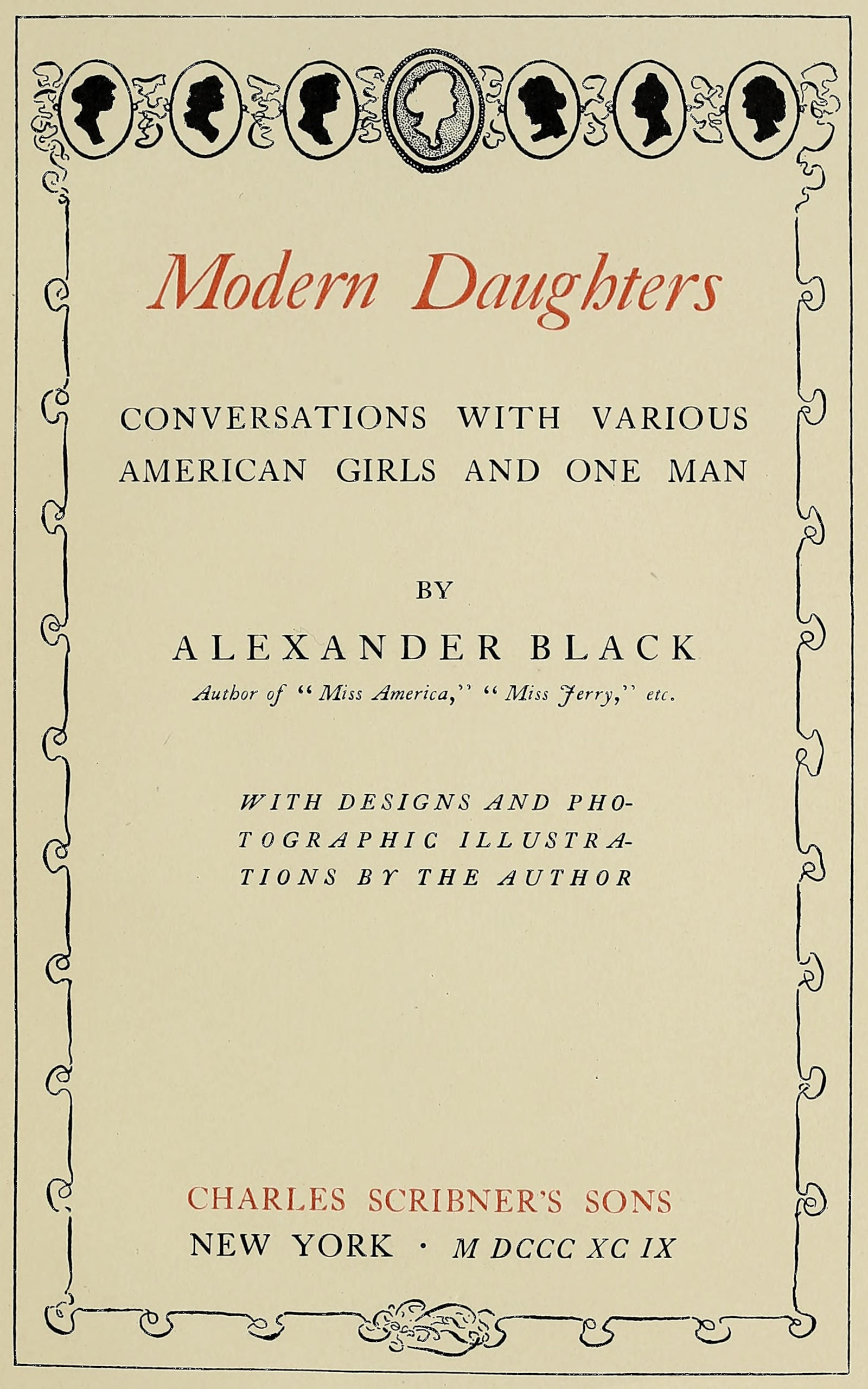
Modern Daughters
CONVERSATIONS WITH VARIOUS
AMERICAN GIRLS AND ONE MAN
BY
ALEXANDER BLACK Author of “Miss America,” “Miss Jerry,” etc.
WITH DESIGNS AND
PHOTOGRAPHIC ILLUSTRATIONS
BY THE AUTHOR
CHARLES SCRIBNER’S SONS
NEW YORK · M DCCC XC IX
Copyright, 1899, by Charles Scribner’s Sons
All rights reserved
University Press: John Wilson and Son, Cambridge, U. S. A.
TO GERALDINE AND CHRISTINE BROOKS
A NOTE
Which you, fair, friendly, discriminating
reader (as the case may be),
will please regard as properly folded,
unsealed (having in mind the courteous
delivery by the publisher), and running somewhat
in this wise:
Begging your pardon for passing between
you and the text proper, this is to say that if
anything I have reported or confessed offends
your sense of propriety, you are to read the
offending passage a second time, whereupon you
surely will discover evidences of an authorial
humility incompatible with real irreverence.
And if this apology sounds trite and lame,
bear in mind that prefaces are written last,
when a man (as when he has just parted from
one of you) is completely quelled by a thought
of the good things he might, or at least should,
have said.
As for the pictorial obligato, if it shall
occasionally show a curious indifference to the
tune of the text, I trust that it may appear
upon consideration that there are some very
good reasons why this partnership should be
as indefinite as it is.
And since you, reader, will in so many
instances find yourself looking at your counterfeit
presentment, I may, I hope, be allowed in
this place to say this word of grateful acknowledgment
to all of those daughters of the States
who have permitted my camera to save my
pen the impossible task of describing the beauty
of the American girl.
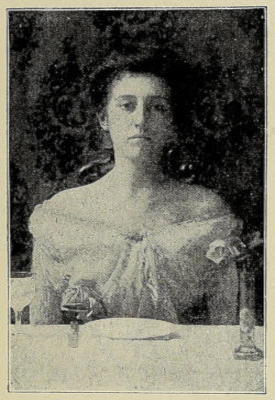
She was not the girl I took
in to dinner, a circumstance
which invested her with a
perverted interest. It often
is so. The fact might remind
us of the wider paradox—the
fascination of the people
in whom we shouldn’t
be interested. I have noticed
the same thing in the matter
of duties, even of agreeable
duties. When I have a book to write, I always can
think of the most beautiful things for the book that
I am to write next after that.
I tried to express something of this idea to her
while the man who brought her in was talking to a
charming lady on his left.
“As a means of justifying yourself,” she said, “I
should find your philosophy needlessly circuitous.
I hate justifications.”
“Now don’t,” I pleaded, “don’t upset my theory
that every one—even a woman—prefers to be
justified, is justified, in his (I wish we had taken
up that new pronoun thon’s) own sight before doing
anything.”
“How stupid! Can’t you see that your justification
takes all the fun for me out of your conversation?
Now, if you couldn’t justify yourself
there would be something in it.”
“But I haven’t said that I do.”
“O I can feel it! You have a justified tone.”
“What an infliction!” I moaned. “A justified
tone must be worse than a sanctified one. Isn’t it
enough that I simply can’t help talking to you?”
“Certainly not. If you weren’t immersed in
theories you would know that to a woman nothing
could ever be enough.”
“It sometimes seems so,” I assented. “You
might have reminded me of that.”
“Evidently you are meditating a cynicism. I
can hear the rumble of it in the distance.”
“No,” I said, “cynicisms do not rumble. That
is profundity. I was going to say, when you did
riot interrupt me, that you typify for me the spirit
of the insatiable in the modern young woman.”
“And we are at a dinner, too,” she returned
severely. “Your profundities are very rude.”
“As for that, an appetite has ceased to be awkward.
It is very pleasant to think that a girl and
gastronomy are no longer incongruous.”
“So nice of you to let us eat.”
“My dear, the era not only permits you to eat,
but insists on your eating, and dotes on the spectacle.
The American girl is not a disembodied
sentiment. She is a splendid physical fact. But
that is another matter. The interesting thing for
me at the moment
is the news that you
are coming out. Let
us talk about that.”
“An absurd topic.
I can’t see anything
interesting in that.”
“Which proves
that you are insatiable.
What could be
more interesting?”
“O, it is interesting
enough to me as
a fact. It will be
a comfort in some
ways. But what is
there to say of it?
I am tired of not
being out. Aunt Madeleine is tired of my not
being out. So is papa.”
“Well,” I said, “I can see that it would be
something to get off your mind.”
“O, it will be an immense relief, I can assure
you. Not that I think there is anything in it. But
it is something that one has to endure. I suspect
that you regard it as something of a joke.”
“On the contrary, I regard it as an event of
almost religious significance. If you would permit
me to be sentimental I could say some rather pretty
things about Coming Out as an institution. Débutanting
is one of those incidents of civilized life
which we all permit ourselves to contemplate with
real enjoyment. I’m sure that your aunt will
enjoy it.”
“But?—”
“I didn’t say ‘but’.”
“You looked it. There was a lurking ‘but’ in
your tone, like the diminished seventh. But what?”
“I refuse to have a ‘but’ if I am to be challenged
for it. A ‘but’ is sometimes a fragile thing.”
“Yes, and sometimes it is a buttress.”
“Not one that may not be shattered by a woman—even
a very young woman.”
“You are intolerable.”
“And you are inquisitive—I mean acquisitive.
And you know too much already.”
“Did that have anything to do with the ‘but?’”
“What?”
“That I know too much already?”
Perhaps I should have had to confess had not
the lady whom I did take in to dinner demanded
my attention at the moment. Presently the Débutante
was saying: “Did you go to the Charity
Ball?”
“Now you are having fun with me. Do I look
like a charity baller?”
“Don’t sneer at the poor old Charity. It’s
antique and has a grand march, but it’s a dear old
affair.”
“I am not sneering. I never go to formidable
dances. Now why did you ask me? Did you go?”
“No. I did last year. Aunt Madeleine has
gone regularly for ten or fifteen years—and worn
the same shade of velvet every time. This year I
should have gone with her again, but Aunt Madeleine
said it was too near my coming out.”
“I understand. That seems reasonable, too.
Unless you were kept in a little I don’t see how
you could come out.”
“I shouldn’t be here if I hadn’t promised Mrs.
Amering in Paris that I would come. Aunt Madeleine
was there and abetted me because she wanted
to be nice to Mrs. Amering.”
“I fancy that your aunt is very good to you.”
“O, Aunt Madeleine is a dear. But she is a trying paradox.
You see, she wants to bring me up—and
out—properly. But she likes to play at
being radical, and sometimes I have to remind her
that she is too reckless with me. She has spasms
of conservative severity that really are very funny.
Then her rigor relents and she takes it to heart if I
don’t do something rampant. When she is in this
mood she packs me off somewhere by myself.
‘You have too much of me,’ she says. That was
how I came to go out on the Texas ranch last year.
Uncle Billy Sandrix had expected both of us to
come, and you should have seen him stare when I
rode up to the ranch house on a crazy Indian pony,
a week before he was to come and meet us at Fort
Worth. ‘What the devil,’ he said,—and that was
all that he could say. I had a refulgent time there.
The next evening, while Uncle Billy was telling me
about one of his horses, a young fellow rode up and
asked if he might stop there. Uncle Billy said
‘Certainly.’ That was just like Uncle Billy. The
young man stabled his horse, and coming over
to Uncle Billy, asked, ‘Where shall I sleep?’
Something in the way he said it must have riled
Uncle Billy, or a broad English accent may have
struck his funny side. Anyway, he said, ‘Why, I
don’t care. This pasture has only twenty thousand
acres. It’s the smallest in the outfit, but you are
welcome to sleeping room anywhere.’ This was
just like Uncle Billy, too. The young man nodded
and turned away; and we both thought he had been
seriously offended. Presently Uncle Billy went out
to look for him. But he was not to be seen. The
next morning we found that the stranger had slept
in the open, had harnessed at daylight and ridden
away, leaving his thanks with one of the men.
This hurt Uncle Billy and he tore after the stranger,
ran him down in an hour, trotted him back, told
him he had lots of sand, and wouldn’t let him go
for two weeks. It turned out that the young man
was the son of an English peer, who had run away
from home. He didn’t tell me that until the end
of the second week.”
“Yes; I daresay that at the end of the second
week he was telling you everything.”
“Well, he was a lovely fellow, and really a very
good rider for an Englishman. Even Uncle Billy
liked his riding. I met him afterward in London,
and he was very nice. It was delicious to hear him
give me advice.”
“Advice?”
“Yes; he talked to me like a father and I
laughed at him like a sister. It actually grieved
him when I sometimes went out alone. You see,
I couldn’t always make Aunt Madeleine go with
me. It worried him that I didn’t like his clothes.
They simply didn’t fit and I said so. Then he
patiently outlined his theory that it was bad art to
have the clothes follow the figure. The American,
he thought, dressed too timidly. The effect of the
American’s clothes was too sweet. ‘A man should
look superior to his clothes,’ he maintained. ‘And
so,’ I said, ‘you have inferior clothes. How can a
man better indicate his superiority to his clothes,
how can he better dominate them, than by making
them fit him?’ a remark which seemed to convince
him that I was hopeless. At all events, he confessed
that he’d never before had a girl find fault
with his clothes.”
“I can fancy his being cut up about it. Do you
do that sort of thing often?”
“If you mean find fault with a man’s clothes,
no; if you mean tease a man for being too serious,
yes.”
“I see; you are serious only when the man
isn’t. Tell me: how do you find men in the
average,—too serious?”
“At the wrong time—yes.”
“When you are older, my dear, you will find
them less serious.”
“Which will prove what I say, that they are
serious at the wrong time. Why should they be
serious with me?”
“To be candid, it is all I can do to remain
flippant enough.”
“That is brutal.”
“You inspire me with the most serious thoughts.”
“That sounds like the charming curé I met in
Provence. We had a delightful time at a country
house, a romantic old vine-covered place where
everybody you met was a character out of Balzac—when
he is nice—or out of Daudet anywhere.
Of course there had to be a curé, and he struck me
like some book curé brought up to date. My,
but he was handsome! with a romantic splash of
gray at the temples. Why, a woman would tell
her age to such a confessor! He knew a great deal
about America. What he didn’t know he wanted
me to tell him.”
“I hope you completed his knowledge.”
“He asked me if all American girls knew so
much. I said that most of them knew much more;
that I was an ignoramus who had been educated in
three countries; who learned things to please her
aunt and forgot them to please her father. It was
funny to see how puzzled he was. First he was
amiably gallant with me. Then he grew interrogatory,
then sage. ‘My child,’ he said (it sounded
just like a book), ‘you seem to have anticipated
life.’ What do you suppose he was driving at?
Then he went on, with a sort of grieved look,
‘You know too much.’ ‘And is this my reward,’
I demanded, ‘for being so good and answering all
your questions?’ He laughed then, showing the
loveliest teeth you ever saw. ‘I did not expect
such answers,’ he said. When I told him afterward
that we were going to Monte Carlo and then
to the Grand Prix (papa was with us), he looked at
me as if he was wondering what I would do with
them.”
“Did you go to Monte Carlo?”
“Yes; but I didn’t think much of the game.
I liked the little game at San Antonio better,
though Aunt Madeleine made only a weak protest
at Monaco, after raising a great row in Texas.
And it was the same way about slumming. Aunt
Madeleine thought it was quite romantic in Naples,
but was completely depressed at the vulgarity of
going to Pell Street. Papa doesn’t care particularly
to have me go unless he takes me himself;
and he is more logical. He says that all slums
smell alike to him. Do you know that very unexpectedly
I had a good time at Mentone. Think
of it! The very name sounds drowsy. Nobody
ever cuts up at Mentone. I could only think of
‘Ordered South’ and so on. But there was a
count there—a Count de—de—I forget now;
it was an impossible name anyway; and he was so
funny. He was more than serious. He was
gloomy. He was more than gloomy. He was
Gloom. You should have seen him! I shouldn’t
have missed him for anything. He was prodigious—and
so stunning looking.”
“You must have had a very good time.”
“I did. But you can’t imagine what luck I fell
into; for there was a Pittsburg girl there, a Miss
Gruge, who was—well, she had been ticketed for
a title and a lot of money. Then her folks decided
to let her go for a title without money, then for
money related to a title. And they have kept on
marking the poor thing down. You know how it
will be. At some special sale she will go for away
below cost. It is pitiful. And this Marked Down
Girl and her mother simply bothered the Count to
death. The more they pestered him the gloomier
the Count got with me. I was afraid to cheer him
up; it would have ended everything, and the fun
of riling Miss Gruge and her mother was too good.
Well, one day when Aunt Madeleine had a headache
he blurted out a proposal. ‘My dear Count,’
I said, ‘how absurd! Can’t you see that I am
only a child? Why, I am not even in society.
I’m not to be considered at all. For Heaven’s
sake don’t let papa hear of this!’ As you might
suppose, this made the Count even gloomier than
ever. O, I hated to leave him!”
“I’m afraid you are a trifle cruel.”
“It isn’t cruelty; it’s a sense of humor.”
“You will be punished some day when you
meet the man who has the right sense of humor.
Perhaps he will have a dash of romantic gray, and
fine teeth, and be maddeningly unserious—”
“O, I have met him already!”
“Indeed?”
“At Washington. Papa had some legislative
business there. The only way to get the thing
through was to camp there, he said, and we camped
there for a whole winter. I was afraid at first that
it was going to be wretchedly dull. And it was,
for a few weeks, until papa got his bearings, for
meanwhile Aunt Madeleine had started to live up
to her theory that if you got into the House set
first your chances for the Senate and Cabinet sets
were nothing at all. One afternoon at Mrs. Senator
Pritter’s, I met an army man who is just the
sort you have been threatening me with. Of course
he only pretended to be unserious, but I gave him
the credit of the pretence. One of the women had
whispered to me that the ring was going to defeat
him for a promotion. When I asked him what
the ring had against him, he was almost serious for
a moment, and to tell you the truth, I almost liked
him that way. ‘Who told you about the ring?’
he asked me. ‘My sources of information cannot
be divulged,’ I said. ‘But why don’t you get it
anyhow?’ He shook his head. ‘Let us talk
about the weather.’ I wouldn’t let him off that
way. ‘I like fighters,’ I persisted. ‘Why don’t
you get everybody to work for you? Isn’t that
the way it’s done?’ ‘Will you work for me?’ he
asked. ‘You’re laughing at me,’ I said, ‘but I
will work for you.’ Now you will laugh too, but
I got eight senators to speak to the President
about the Lieutenant, and he was promoted after
all. When I saw him again, he was dreadfully
serious, and made a great mess of thanking me.
Afterward he wrote me a nice letter from Manila.
All that got me quite interested in Washington.”
“Washington is quite an entertaining game—when
you win.”
“I don’t ask to win always—if I like the game.
It’s only in games I don’t like that I insist on winning....
What are you so quiet about?”
“I was thinking ... how nice it was that you
were coming out.”
“I don’t believe you.”
“My dear, don’t flutter forth into this too-serious
world in a distrustful mood.”
“I never have moods; I only have tenses.”
“And it is mostly the present tense. And yet
you surely have begun to think about the future.”
“In another minute you will be giving me
advice.”
“No; not exactly that, though I might ask
yours.... Why, here’s the coffee!”
“When shall it be?... When shall you ask?”
“After you have come out.”
II WITH A LEFT-OVER GIRL
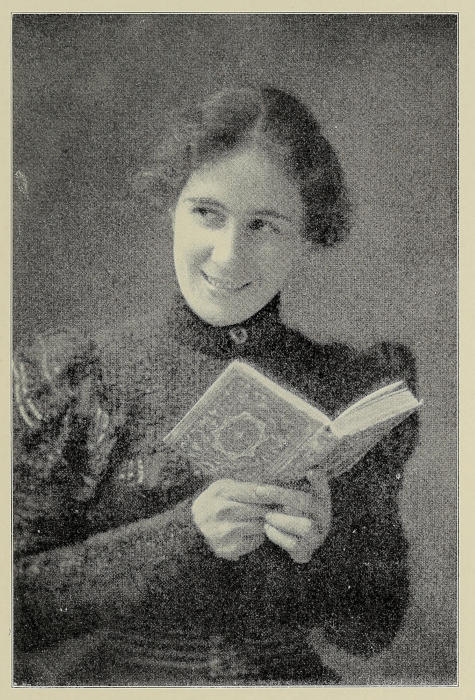
She had said that she
did not care to play
that afternoon, and the
young man went away with
a disappointed look. There
had been one or two young
men near her most of the
time that day. Now she
was alone. She sat in a
shaded part of the hotel
veranda. In her lap was
an open book, face down.
As I drew near I saw that
the book was covered with a fragment of unlettered
paper, a circumstance which left to merely ocular
dexterity no chance of knowing what she was
reading.
“My dear,” I said in a sort of paternal way,
designed to palliate the effect of an intrusion, “for
a moment I was tempted to think that you preferred
a book to a man; but since you are not
ardently reading I am giving myself so much of
the benefit of the doubt as to take this chair beside
you, and to remark that you cannot expect to
escape the common danger of being talked to even
if you do not care to play.”
“You are very welcome. Talking is a game,
too, isn’t it? We are supposed always to be ready
to play that.”
“Nevertheless, perhaps I should ask you first,
as the young man did just now about the other
game, whether you really are willing. You might
choose to go on with the book, and I could study
the scenery.”
“This game has begun already. As for the book,
I came to a stupid place,—a lot of description.”
“You know,” I said, “a man finds a certain
justification for talking to a woman in the fact
recently exploited by science, that woman does not
talk to herself. While they still urge that it is not
good for man to be alone, man seems to have
invented one means of getting on alone that is
denied to women; for if he can talk to himself
he has acquired a singularly useful safety valve.”
“I am sure it is very nice of you, when you could
talk to yourself, to waste words on me. I hope there
isn’t anything in this new theory that may prove
that man must talk. It would be upsetting, you
know. Perhaps it isn’t true that women never
talk to themselves. I don’t believe that I ever
talk to myself, but I don’t have to. There is
always somebody about. And I really never have
anything left to say to myself.”
“I think I should prefer to have you take me
for granted,” I said. “It would spoil your effect
if you were either grateful or resentful. After all,
these scientific generalizations are distressingly misleading.
Take that recent statement that baldness
is a safeguard against insanity. Some of the hair-restorer
advertisements do not seem to indicate a
faith in the entire sanity of the bald. Yet it is a
benevolent theory. No one would voluntarily lose
his hair for the certainty of not losing his reason,
but the bald may derive some real solace from the
invention. Doubtless many of life’s most comforting
assurances have no better foundation.”
“Are you in that mood?”
“I am rebuked for my platitude.”
“In the talk game platitudes are very safe, don’t
you think?”
“Perhaps they are; and in most games simply
being safe naturally occupies much of the time.
Yet in the talk game it can’t be fair to catch one’s
breath with a platitude too often—not unless one
wishes to be thrown back upon solitaire.”
“Solitaire is an excellent game. I think it is
much underrated.”
“It is very safe, too.”
“Yes, and it is unquarrelsome. It never breaks
friendships.”
“I can’t imagine you quarrelling in a game,” I
ventured to say.
“Perhaps that is because I know with whom to
play,—and which games to keep out of.”
“Do you know that it would be a great relief,
if not a real comfort, to a man in certain circumstances
if he could know just when a woman was
out of the game? His perplexity in the matter of
the greatest game of all, when he does not know
whether she really is playing or only is loitering
about with the players, sometimes is one of the
most distressing spectacles in life.”
“It seems to me,” said the Left-Over Girl, with
a little shrug, “that he generally should be able to
tell whether she is playing or not. As for knowing
whether she ever is going to play any more,
that seems to me like more knowledge than he is
entitled to.”
“Possibly; but as I have suggested, it would save
much time and many doubts, if nothing more,—reduce
the sum of popular skepticism. And even
the spectator, who is not presumed to be in the way
of playing, might have a simple human curiosity in
the matter.”
“Oh, the spectator always has curiosity, and the
spectator is an element to be counted, too; there
are so many of them, and they influence the players
in one way or another so much. But I don’t think
the spectators have any more right than the players
to know when any one in particular is out of the
game for good.”
“As for that, I much doubt whether any one is
to be counted as out of the game for good. I
heard yesterday of a Miss Nottingby who has just
been married at the age of eighty-three. One never
can tell. But that is not the point. It is the attitude
of mind that counts. That a woman should
think that she is out of the game, or have decided
definitely that she will not play any more, must be
of great importance even when the fact is not
known, as we must suppose generally happens.
My point is that if the facts were more generally
known various beneficent results might accrue.”
“To whom?”
“To all of us, including the seceders. The uncertainty
breeds cynicism. Of course I know that
there is something piquing about the mystery surrounding
the motives of the unmarried, especially
the motives of the unmarried woman. But although
this is so entertaining in itself, although the new old
maid is the most cheerful, the most useful, and the
most fascinating sphinx of the century, I feel at
times as if there may be something disintegrating in
her complacence and in the complacence of society
regarding her.”
“How good it is of you to be so altruistically
grieved!”
“Why don’t you ask me why I am saying this
to you?”
“Because I know, and because it is so much
more amusing to have you say it unassisted.”
“Now, do you know that I should have expected
to find you superior to a proclivity so purely feminine
as that. To make him say things unassisted!
From the dawn of time woman has delighted to do
that.”
There was a haze of thought in her eyes. “I
dare say you never have stopped to think that
when he is assisted he says so much more than he
means.”
“I thought you were going to say, ‘than he
ought to.’”
“The greater includes the less. When he says
a little that he doesn’t mean he says a great deal
more than he ought to.”
“Perhaps he always will say much that he
shouldn’t, anyway. But admitting that you have
the right to mystify him, and then not to help him,
does it seem to you precisely fair that girls who
neither go into the marrying game, nor stay out of
it, should—”
“Flirt as much as they do—I want to save you
the trouble of finding an inoffensive phrase.”
“Perhaps I wasn’t going to be inoffensive. And
I might not have chosen the word ‘flirt.’ Flirt
doesn’t exactly express the idea. I shouldn’t wish
to seem as if I were hunting about for a new title
for an old crime,—”
“Crime? You will be quite solemn in a moment.
Did you come over here to scold me?”
“I thought this was a talk game. A talk game
couldn’t have a motive, could it?”
“Why, yes. It is like a Wagnerian composition.
We might have encountered the Didactic Motive.”
“Now you are scolding me. I insist that I am
merely the Interested Spectator. Maybe I am a
sort of Walking Gentleman in the cast, who, with
every wish not to be impertinent, ventures a timid
and respectful word with the leading lady in the
wings.”
“Should you think the Walking Gentleman had
a right to quarrel with the leading lady as to her
method of reading the lines?”
“No; but surely he might ask her, humbly, and
in a spirit of honest inquiry, what she thought the
author meant and whether, to her, the play seemed
consistent. Even the Walking Gentleman must be
presumed to have certain human impulses. Perhaps
he can’t even find out who is the leading lady.
Perhaps the girl who seems designed by nature to
be the heroine, the girl who, if he were the Hero
and not the Walking Gentleman, would make his
duty clear, betrays a singular indifference to the
Hero, the Hero’s understudy, and all the rest of
them.”
“Then you have come over here with a view to
classifying me?”
“Suppose I had so definite a hope?”
“I might help you.”
“What are you, please?”
“I am the Left-Over Girl.”
“I don’t wish to be ungracious, but that does
not help me much.
Who or what has
left you over?”
“Circumstances.
In the course of the
great readjustment I
am left out, lost in
the shuffle, if you
like.” This idea
seemed to please her.
“Marriage is like any
other game, isn’t
it? He calls her
bluff—”
“Don’t!” I protested.
“These card
game allusions perplex
me as much as the paradox which I have
encountered in my travels this year, that poker is
popular in New England and dominoes in Texas.”
“But somebody told me that they play a very
wicked kind of dominoes in Texas, and I know
that they play a very moral kind of poker in New
England.”
“I am afraid you play poker.”
“Like Mistress Muslin, I love cards. And you
know there are some people who never have good
hands. Doesn’t that prove that the word ‘chance’
has a deep and dark meaning? There is fate
behind chance. I never had a good hand but
once.”
“In which game?”
“Oh, in the card game. And I didn’t win, for
the old reason—my partner was so stupid. I
could have withered him. But he was an unwitherable
man.”
“I wish that you would tell me something more
about this left-over situation. Not that I think
you can know very much about it yet. You cannot
have been left over very long, and asking you
about your left-overness may be almost as premature
as intercepting the newly arrived European
traveller in New York Bay and asking him how
he likes America.”
“I suppose you wish to ask me how it feels to
be left over.”
“No, I haven’t got so far as that. As you
have taken part, as it were, in the circumstances
which have left you over, I should like to find out
if I could, that is to say, if you felt that you could
tell me, which qualities in you tended to bring
about this result. I feel quite certain that you are
not a born old maid. The born old maid is one
of nature’s whimsicalities that are not hard to read.
Even when she is married, one may easily recognize
her. What interests me is the subtle differentiation
in those among the unmarried who never
will be old maids, which has produced their left-overness.
For the life of me I can’t see why you
should be left over, either subjectively or objectively.
Is it a gnawing prejudice, or a sense of
humor, that has made you leave yourself over?”
“Might not those things characterize an old
maid?”
“They might, but an old maid would be an old
maid without regard to the possession of any such
particular qualities. The old maid instinct is another
matter. We are talking now about this different
and evolved modern tendency.”
“Suppose I were to say that marriage simply is
not in my line. What should you say that that
indicated? Might not an old maid say that?”
“She might say it and she does say it, which may
indicate how indefinite it is. In the interest of
social science I really should like to know what
you think you mean by that. Of course questions
upon so serious a matter necessarily seem a
trifle brutal.”
“Don’t apologize, Mr. Scientist. I suspect that
the trouble with me is that I can’t get up a personal
interest in marriage. I have no prejudice
against it as an institution, or as a—state of mind.
I am not even single because I am cautious. No
one has preached to me the philosophy of disenchantment.
I know married people who are happy,
and single people who are unhappy. I have seen
the tall girl and the short man, and the tall man
and the short girl, illustrate the splendid paradoxes
of pairing. I believe that marriage is just as good
and just as bad as the people who illustrate it. But
I haven’t been able to get up any personal interest
in it, any more than I have been able to get up a
personal interest in the law or medicine. After all,
marriage is a career. I don’t hate the Church because
I do not feel called to preach. Yet I don’t
feel that I have the least instinctive aversion to
marriage. Do you suppose that if I were a born
old maid I should be conscious of the instinctive
removal?”
“Probably not. Do you
hear that music in the
hotel parlor that has supplied
a plaintive accompaniment
to our talk?”
“That is Miss—hush!
If ever there was an old
maid born—”
“Yes, and that woman
has dreamed of marriage
from her girlhood. Wasn’t
it Charles Lamb who said
with regard to music that
he was sentimentally disposed
to harmony but applicably
was incapable of a
tune? Poetry and the old
maid instinct have battled
in that woman for forty
years. But we are slipping
from science into gossip. Shouldn’t she answer
your question?”
“I don’t know. Who can say that she isn’t
conscious of the instinct? Lamb knew that he
couldn’t actually
make a tune. It was
Lamb, wasn’t it, who
tried all his life to
like Scotsmen? And
when he gave up at
the end he was so
sweet about it. He
couldn’t like them,
but he didn’t have
a bit of additional resentment
because he
had failed. Some
people hate—with
interest from the date
of prejudice. Now
I have been trying
for—quite a few years to like marriage,—personally,
you know,—and if I fail I don’t
expect to place any interest charges against the
institution.”
“And on the other hand, if you succeed, you
mustn’t expect marriage to pay you too heavily on
the investment.”
“I’m afraid I should be more likely to do that
than the other. I suppose that shows that I am
not a philosopher. If I ever marry—but how
ridiculous that sounds! You would think I was
talking about—any other career.”
“Oh, if I were selling stock in matrimony, I
should consider you quite a hopeful case. But I’ll
wager that many another man has thought the
same thing. And naturally you have not been
seriously conscious of the phases of yourself that
have made you seem like a hopeful case to them.
I was reading the other day in a new Franklin
biography an advertisement written by Franklin
and appearing in his paper. It concerned certain
missing books of his, and was headed: ‘Lent and
Forgot to Whom,’ Ah! my dear, it is so with
many of you women: you lend and forget to whom.
But the men—”
“What a dreadfully unfortunate analogy! If
they keep that which does not belong to them, am
I to blame? And how can a girl try to like matrimony
without trying to like men? I ought not to
be feminine enough to remind you that men have
been known to ‘forget to whom.’ Do you see
that young fellow coming up the path with the girl
in white duck? You see what an adroit, hovering
style he has? I know just the sort of thing he is
saying to that white duckling. He is one of the
men who forget to whom. He is a Cynic-Maker.”
We watched them silently as they sauntered up
the path.
“Yes,” I said, “that is the way the great tangle
begins. A nice girl meets your Cynic-Maker, finds
that he forgets to whom, from which she concludes
that all men are a mockery. Then some honest
young fellow meets her, revolts at her crude, newly
fledged cynicism, which an older or a less honest
man might have penetrated in a moment, decides
that all women are depraved, and there you are
with all the elements of a social tragedy. We
may say that the arch-mischief-maker is the man
who creates the cynic; yet we should, perhaps,
inquire whether any new conditions are producing
him.”
“He is as old as lying,” she said quietly, her
eyes following him up the steps.
“The one comfort,” I added, “is that he probably
does not succeed in making cynics so easily as
in an earlier state of society.”
“You mean that girls are more skeptical?”
“I mean that girls have more freedom, more
experience, more information, more opportunities
for comparison, and that the Cynic-Maker, to
succeed, has to be vastly cleverer than he used
to be.”
“I believe I shall join you in that optimism,
though I am inclined to think that by an operation
of natural selection he is vastly cleverer than he
used to be.”
The Cynic-Maker sat down beside the white
duckling at the other end of the veranda.
“Witness,” I said, “the grotesque appositions
of life: The Cynic-Maker and the Victim at
one end of the stage, and the Spectator with the
Left-Over Girl at the Other. Surely we have
here some very important elements of a social
allegory.”
“And in spite of everything,” mused the Left-Over
Girl, “I was going to say just now that I
thought marriage was more popular than ever.”
“What makes you think that—I mean in view
of the statistics, in view of the census of the unmarried?”
“You must not insist upon participation only as
indicating popularity. Take the instance of golf,
which few people actually play, but which is the
game all the same. I mean that in proportion to
the number who do not marry there is less affirmative
objection to marriage than in the past.”
“I wish I knew how you make that out. But I
am going to take this much from it, and you will
correct me if I am wrong: Women are less likely
to marry than formerly; but they are also less certain
not to marry.”
“Would it cheer you any to believe that?”
“I do not insist upon being cheered. But I
should like to know. I am weak enough to want
to be confirmed in a belief which I have tried to
formulate. You can see that matrimony might get
some comfort out of it just as golf does. It might
enjoy the flattery of being the greatest game even
if every one doesn’t choose to play, even if certain
charming women do choose to cover their emotions
with a veil of sophistry as they cover their books
with brown paper.”
“And thou, Brutus!—after I had lifted the veil!
I am very magnanimous. I play a talk game
with you, and let you ask me impossible questions,
label myself for you, uncover my dearest
theories, deal mercifully with your syllogizing, and
now I agree to your formula,—yes, and I take
off my brown paper. What more could mortal
woman do?”
“Nothing more,” I said, staring at the lettering
on the book, “nothing more, except tell me why
on earth you are reading ‘Emma’?”
She gave a little chuckle and shook her head.
“That,” she said, “is the one thing you have asked
that I can not answer.”
III WITH A GYM GIRL
There had been
some mistake about
the time, and she was there
an hour ahead of the class,
a circumstance which I had
not the conscience to resent,
for she said I might
stay until the class came.
Meanwhile we sat in the
big, cool gymnasium, into
which fell patches of spring
sunlight that painted here
the shining floor, and there striped the dangling
lines of rope, falling finally into whimsical arabesques
on the dumb-bell rack. It was a co-educational
sort of gymnasium, as one might guess from the
punching-bag and other devices, classes of men and
women, boys and girls, alternating in possession,
under the discipline of an academy.
She herself wore a dark serge gym suit, that fascinating
hybrid of skirt and bloomer, which unites
the charm of drapery with the effect of the girded
uniform. Sitting there thus well-dressed, lithe,
poised, sufficient, with light in her eyes and blood
in her lips, she presented a pleasing spectacle.
Something in her association with all the paraphernalia
of the vaulted gymnasium struck me as symbolizing
the situation of her sex in the modern
world. She seemed only prophetically adjusted to
it all, and yet one could not but have the feeling
that she would always know just what to leave
alone.
For some reason that did not appear at the
moment, she was not merely the feminine version
of the athlete. She was something differing from
that, doubtless something better. I could not think
of her as promoting athletics. The athletics seemed
to be promoting her. The ultimate thing was not
a system, a day, an hour, an event. The ultimate
thing was herself. The theory of athletics from a
man’s viewpoint is a pretty affair, and unquestionably
it includes the notion of a finer physical manhood
for us all, directly in the participants, by reflection
in the rest of us. Even football, the
reductio ad absurdum of inter-personal conflict, is presumed
and I believe reasonably, to have a tonic
influence on the physical development of the race,
although there is no country in the world where, in
the habit of daily life, it is more unsafe than in this
for one man to shoulder another. But in feminine
athletics so far as these have gone, there yet appears
much less of the idea of prospective conflict. It
may be that this is to come again later. A bunch
of girls in a hand-ball game introduces a lively element
of organized contest. But it scarcely looks
as if the girl runner of the
Greek games was likely to
be repeated.
“I suppose you think
all this is very absurd,”
said the Gym Girl, tapping
the floor with her slipper.
“Sometimes I myself think
it is. But I like it; I like
it well enough not to care
what any one thinks, and
besides, I am supported
by the moments when
I think it isn’t a bit
absurd.”
“Which moment is this?”
“I should find it hard to say. Until I know
what you think about it, I feel defensive about the
gym. Generally speaking, I feel rather cordial
toward it to-day.”
“Then please feel cordial toward me, too, for I
like the gym and the idea the gym represents.”
“What idea does the gym represent?” she asked
in a tone of challenge.
“Now that is scarcely hospitable. Moreover, I
had saved up that to ask you. But I don’t mind
committing myself, with the understanding that you
are to supplement me in the matter. This gymnasium
seems to me to stand for the idea of physical
equilibrium. It means that you and the others
are not willing to give up what the city seeks to
force you to give up for the time. In the country
I hope you lead such a life that the gymnasium
would be absurd there. But in the city it is very
different for all of us, but especially for you women.
The clothes you usually wear here presuppose that
you will suspend, while wearing them, the use or
development of most of your muscles. Some of
the time you will wear a bicycle skirt and ride a
wheel. But the bicycle uses but one set of muscles.
Your walking and dancing, with some tennis and an
occasional run out to the links for golf, all leave
the symmetrical development incomplete in some
way. They do not include the immensely important
element of climbing, for example. The gymnasium
ought to fill in the chinks. I suppose it
does. Then it makes you like it. Perhaps that
is one of the best things it does.”
“It does make me like it, because it makes me
like myself. The gymnasium makes me feel good,—good,
do you understand, not merely well.”
“We often have been told that if we all were
well we all should be good.”
“I don’t suppose I am good enough to hurt, but
it is nice to feel that way. Mind you, I don’t
agree at all that women need the gymnasium any
more than men do. I have three brothers, and I
know some things. I know that the average man
is just as much hampered by his clothes as the
average woman. I really think he is hampered
more, for he defers to his clothes more than a
woman defers to hers. A woman’s management of
her skirt at least gives her a certain amount of
exercise, while a man’s horror of bagging his trousers
at the knees has not a single physical compensation.
It simply limits his movements.”
“But a woman’s skirt limits her movements.”
“I wouldn’t say that it limited them so much
as it directed them.”
“Perhaps you will tell me why most women are
or seem to be pigeon toed.”
“I can explain that. It is for the same reason
that they waddle when they go up stairs. The
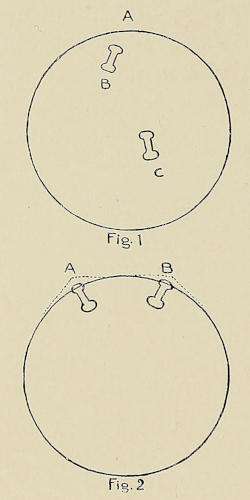
reason is the skirt. I can illustrate by a diagram,”
and she found a hoople and placed it on the floor.
“That we shall say is Figure One. Now, I place
here two dumb-bells. These we shall say are feet
standing within the radius of the skirt. Now the
point of freest action in stepping for the feet B and
C obviously lies in the direction of A. Toward A
the foot B can move in the longest line without
striking the skirt. Hence in walking the tendency
for one foot to follow the other in the direction of
A and the centrifugal tendency of the toes. As
women learn to wear shorter skirts or wear short
skirts a greater proportion of the time the likelihood
that they will be intoed will naturally
decrease.”
“Very convincing!” I cried. “The intoed
tendency is beautifully extenuated in a most logical
way. Plainly it would be as foolish for a woman
to walk with her toes out as
it would be for a cavalryman
to ride with his knees out.”
“Unless she were going
up stairs.”
“Up stairs? Oh, I see.
You are to explain the waddling.
That will be an immense
comfort to every man—I
mean the explanation.
So many of us have turned our
faces away from the spectacle
of a lovely creature who
walked with a Delsartean lilt
and seated herself with the
inexpressible grace of a bird
who has reached the chosen branch, mounting a
flight of steps with the roll of a breathless duck.”
“Let us now take this hoople for Figure Two,”
said the Gym Girl, with a serious effect. “The two
feet, still represented by the dumb-bells, now seek
not the point of least resistance but the point of
most resistance. They do not wish to tread on
the gown, which is likely to happen, even when
it is slightly lifted, unless the knees assist in lifting
the forward edge. This chalk mark extending
to A and B will indicate by its variation from
the circular line the direction in which the feet
alternately move in the effort to keep the skirt free
in front. Of course a woman who tries to go up
stairs with her hands full, without holding her skirt,
must waddle more than a woman who is able to let
her hands help her feet.”
“I have no doubt that what you have intimated
with regard to the dexterities imposed by the skirt
is quite true. There must be a certain important
amount of muscular power not otherwise demanded
in the current method of holding up the skirt with
one hand at the back, or even in twisting the loose
of it into a tuft on one hip. The habit doesn’t
seem to be intrinsically pretty, yet it has that fascination
which makes us wonder whether conventional
ideas of beauty are of any importance whatever. I
fancy that Greek and Roman women had some
such untransmittable method of managing redundant
drapery during those intervals when the use
of beauty gave place to its twin, the beauty of
use.”
“Yes, I think you will find that from the beginning
of time woman has sought to combine garments
in which she may be becomingly draped and
in which she may move abroad. The Professor
tells us that a trailing gown is an anachronism out
of doors, save to those women who are carried—you
know what I mean, in a carriage or something.
We have heard that a great many times; but all
the same, I suppose women will go on trying to
make the gown they prefer to be seen in do service
during the transits as well as during the
pauses.”
“There is much transit about the modern
woman.”
“I hope you find something to be glad of in
that.”
“I do; but no man can help feeling that draperies
are a great burden which no gallantry can
lighten.”
“O yes, gallantry can! See
that her packages are sent home—or
carry them for her.”
“Understand me: I think that
draperies held up in the right
way by the right woman are an
element of real picturesqueness in
modern life. But sometimes they
are not held up at all.”
“Yes, I know. Theoretically
a lady does not let her dress drag in an unclean
place. But actually there is a good deal
of dragging. It is a pity, too, if you men are
going to be disturbed by it. There should be
consolation for you in the
frequent gym suit—which
you seldom see, because
you are not often permitted
to enjoy your present
privileges—and in the
more frequent bicycle suit.
The bicycle has done in
one decade what abstract
dress reforming would never
have accomplished. Sometimes
I think that the most
important inventions of the
century are the bicycle and
the shirt waist. Each has
had an immensely important
influence on the physical and economic situation
of women. I have no doubt the bicycle
will get full credit, but if no historian mentions
the shirt waist the shirt waist will proclaim its own
triumph.”
“I believe you have been writing a paper on
that.”
“No, I am not a paper-writing girl. One thing
I am sure of: The review of women’s dress during
the century will surely dismiss the shirt-waist with
a few lines.”
“I dare say. It will go unsung, like the plain,
average, every-day woman, who is doing so much of
the world’s work,—I mean, of course, except on
the Woman’s Page. Do you know you explained
some things to me so beautifully a moment ago that
I am tempted to put your sophistry—I mean your
scientific analysis—to the crucial test. Let me do
this in a word:—We have spoken of clothes, and
we have spoken of transit. Why do women get off
a public vehicle backward? I say public vehicle
advisedly, for I have seen a woman get on and off a
horse properly—assisted. I have seen her get off
a bicycle properly, unassisted. I have even seen
her get out of a coach properly. But few men have
ever seen a woman leave a trolley-car or a railway-coach
otherwise than backwards.”
“When you say ‘backwards,’ I know that you
don’t mean backwards in the sense in which an old
lady or a very portly person of any age gets out backwards,—turning
about, holding with both hands,
and backing off. That was the way Ian Maclaren’s
old lady tried to get off the underground train,
wasn’t it? and was pulled up the steps at one
station after another by men who thought that she
was getting on? You mean getting off with the face
to the rear, instead of with the face to the engine,
the motor, or the horse.”
“That is what I do mean.”
“I had supposed that there was but one answer
to that old question: Because they have not been
trained by getting on and off vehicles while the
vehicles are in motion. A person who gets on a
vehicle while it is in motion learns at once that
the forward handle is the only safe handle to hold
either in getting on or getting off. The forward
handle is the one that preserves your balance
should the vehicle start while you are getting on
or off.”
“Yes,” I said, “that is the old answer, too. But
it does not answer enough. I have disproved its
accuracy a score of times. I have seen women who
knew better by precept, by example, and by experience
get off backward, as if obeying some fatalistic
impulse. The other day a woman who stepped off
a car in my presence, firmly grasping the wrong
handle, laughed and said, ‘There! that’s the wrong
handle, but I can’t help it!’ That illustrates what
I mean. She could not tell why she had to take the
wrong handle, which, if the car had been going in
the other direction would have demanded the other
hand. Your theory at best would only explain why
women do not get off rightly. It does not explain
why nine hundred and ninety-nine out of a thousand
get off wrongly. It would be well enough if the
proportions were even, if the habit seemed like a
matter of chance. But quite plainly it is not a
matter of chance. There is a strange, and, as yet,
unexplained impulse to which women yield when
the moment of choice comes. Every day I see
women get off the wrong way at real inconvenience.
They are like Jerome K. Jerome’s stage villain
who doesn’t want to be a villain, who is not profited
by being a villain, but who, quite uncomplainingly,
goes on being the villain in obedience to the
unities. Once I thought I had grasped the thing,
which you must know gave me a moment of superior
comfort. A coach or a car, I said to myself,
generally stops at a point beyond that at which the
passenger really wishes to alight, as at the further
curb, and in getting off and spurning the vehicle, as
it were, the woman passenger, acting with primitive
directness, turns her back upon it at the moment of
alighting. But I have repeatedly seen women get
off a trolley-car at a near corner when they had
to turn about and walk in the direction the
car was going, and they faced the rear of the car
when they got off just as they do under all other
circumstances. It is extraordinary. You must not
think the inquiry trivial. It is not merely a question
of a minor physical habit. There certainly is
some momentous psychological significance under
it all, something with a deep meaning if we only
could get at it.”
“Perhaps this backwardness has something to do
with woman’s confusion as to right and left.”
“Heavens!” I exclaimed. “I thought for an
instant you were going to say right and wrong!
The right and left confusion explains nothing, for
in those directions in which people are confused as
between right and left they are as likely to take one
as the other. How could that explain why a
woman uses her right hand when she should use
her left, and her left when she should use her
right?”
“I’m afraid it wouldn’t, unless you wished to
fortify some theory of her natural perverseness, and I
hope you don’t wish to be so trite. You shouldn’t
hurry woman too much. See what physical agility
she is displaying with the bicycle. She is unfolding
wonderfully. You men are too impatient. I read
an advertisement the other day in which I saw a
tangible sign of this impatience. It was headed.
‘A Moustache in a Month.’ Surely that is wrong.”
“Yes, it is as wrong as the conditions indicated
by a department store advertisement I read
the other day which began: ‘Great Embroidery
Excitement.’”
“O, I know we are all too intense. I understand
that it is telling in our appearance. A
scientific observer has been reminding us that we
Americans have too much expression, and that
the dull, stupid look in certain English faces, for
instance, indicates reserve force, a force that is not
constantly being wasted in expression. They say
we even go to sleep with our expressions. My
teacher says, ‘When you go to bed, unlock your
face.’”
“Are teachers really bothering you about your
expressions? Your teacher must be a woman.”
“She is, and—”
“I thought so. Only a woman—”
“Yes, I know. Our expressions are too lovely
to be ruthlessly modified. I credit you with all
that you could say. But you are not a bit practical.
Our nerves are more important than our expressions.
I guess you may count on us for
expression enough when the occasion demands.
What we want are healthy nerves behind the
expressions.”
“I see; you are going in for that stupid look
now.”
“If it becomes necessary.”
“You never will succeed.”
“Probably I don’t want you to hope we will.
You know what I mean—”
“How can I help knowing? Do we hear anything
else but relaxing? Those of you who are
not relaxing tremendously are repenting of your
outlines and straining to get thin.”
“Don’t you suppose there are great advantages
in these readjustments? When a girl is very pretty
she is pampered; when she is pampered she grows
fat; when she grows fat she grows ugly; and so
things are balanced.”
“Let me amend that,” I said. “When she gets
fat she gets frightened, diets, and gets fatter. Then
she gets a little angry, golfs, rides, swims, hustles,
finds the secret, gets reasonably proper again and
acquires the new charm that comes with the aroused
energy and the humility of a threatened loss—or
gain, as you may wish to put it. Nothing is more
qualifying than the threatened adversity of fat. We
all know women who would be simply insufferable
if they were not a shade plumper than they care to
be. I fancy that leanness induces a more private
humility.”
“It is a more private defect. But this is
all to be righted in the next century. Our
new ideals are going to give us
more of the English physique. Anyway,
we are going to be more
athletic, not merely in this gymnasium
way, which is only a sign of
good faith, but in a broader, more
practical, more—shall I say final?—way.
See what summer means to us
now.”
“Well, it seems to mean a great
many things.”
“It means everything that could
make a gym unnecessary. It once meant very
little, it seems to me; if we are to
believe what our grandmothers tell
us. Now it means as much to a
girl as to her brother.”
“It doesn’t mean quite as
much as it might if there were
more brothers—there.”
“True. Our summer groups
always make me think of college.
We are not through seeing too
much of one another when we
graduate. Presently we are in
clubs or gym classes, and, in the
summer, man is an exceptional
element.”
“And that is not good for
him. It is not good for him to be in such a
majority in the city nor in such a minority in
the country. But I don’t see what we can do
about it.”
“I suppose each sex will have to go on living
out the problem for itself. That seems likely
to keep both sexes busy.”
“It is keeping your sex busy.”
“You never can tell about us.”
“I admit that.”
“We have great larks over the profound things,
and go to pieces—”
“Relaxing.”
She laughed, and got up in her easy, definite
way. “You must go now,—not because
you have been naughty, but because the class is
coming.”
“That is a class decision. But I bow to your
ruling, Miss Gym.”
IV WITH A HEROINE
When I asked her
what sort of heroine
she was, she looked
up with a laugh and said
that she didn’t see how
it was possible to say precisely
until the end of the
story.
“And yet,” I said, “one
generally can make a good
guess before the last chapter
comes.”
“Then you may do that,” she rejoined.
“I dare say I might find out by the process of
elimination. You are not a heroine because you
are travelling alone from Los Angeles to Richmond?”
“No. In this age and country there isn’t a
particle of heroism in that. Why, you remember
that ‘a woman might travel from one end of Britain
to the other with safety in Eadwine’s day.’”
“It is not because you are travelling in a bicycle
suit?”
“No. There are no more heroics in clothes.”
“Perhaps you have been ordered home against
your wishes, and are illustrating that pleasant miracle
‘fair looks and true obedience’?”
“No. I rather enjoy being obedient; and I am
going of my own accord.”
“Then I have no doubt that your going out
there had something heroic about it; or maybe—”
“Those are all wide of the mark. I hardly
think you are likely to guess correctly.”
“Well,” I said, “there is one comfort: I can
see precisely what sort of heroine you are—in
appearance. That is a great start. Nowadays,
we have to do a heap of guessing as to the embodied
element in the heroines we read about.
We all have prejudices, and it is nice to get rid
of them at the beginning. I knew of a New England
lady who was immensely disappointed in her
new pastor because, as she said, she ‘never could
abide a minister who was light complected.’”
“I am sorry to rob you of the privilege of fashioning
the physical heroine after your own fancy.
I always like to have at least a little of my own
way in the matter of the hero. When he is described
too circumstantially there is nothing left
for me. You see I might object to the hero who
was light complected.”
“O, I can see,” I said, “that you probably dote
on these disembodied novels that deal entirely with
emotions, that have been trying for a decade or two
to get as far as possible from the Dickens Gentleman-with-the-White-Waistcoat
point of view. For
a long time it seems to have been considered vulgar
in a literary sense to descend to the description of
clothes—as if clothes were not of great importance
in helping us to get at the character of a man—or
a woman.”
“But we don’t need that help in a book, do we,
when we have the author to tell us what is inside?”
“Yes, that is what those fellows will tell you.
But is that really so? When we know what the
character looks like—that is, what the author
thinks the character looks like—do we not gain a
definite and necessary impression beyond that which
the author sets out to give?”
“Perhaps the author doesn’t want you to go
wandering off that way. When he is so ready to
tell you what is inside, what is the use of giving you
material for any other impression?”
“Because the reader will have an impression of
his own anyway, and the author owes him all the
facts. Now, let us suppose that some one was to
go on with a story about you, a mysterious young
woman in a Pullman coach; can’t you see that it
would be vastly more interesting to me because I
could picture you easily as the story went on?
Don’t you suppose that I should be more likely
to be interested in your emotions because I had
seen you than I should in seeing you because I had
heard about your emotions?”
“Oh, I don’t know. I suppose it would depend.
But if you are going back to old-fashioned
romance what is the use of describing the
heroine? She is always the same. Wait a moment.”
She picked up a book that lay beside her. It
was “Monte Cristo.” I had lent it to her the
day before when the train boy had nothing more
that she wanted. I had seen her read three novels
through in one day. Perhaps there was something
malicious in this intrusion of a book that she
couldn’t finish in a day. Now she was reading
from “Monte Cristo”—
“‘A young and beautiful girl, with hair as black
as jet, her eyes as velvety as the gazelles, was leaning
with her back against the wainscot, rubbing
in her slender fingers, modelled after the antique,
a bunch of heath blossoms ...; her arms bare
to the elbow, embrowned and resembling those
of the Venus at Arles, ... and she tapped the
earth with her pliant and well-formed foot.’ There
you have it,—that is the formula. And wait—here
is the other: ‘A more perfect specimen of
manly beauty could scarcely be imagined.’ That
is the formula for the hero. Do these delight
you?”
“Yes; it is primitive, but I like it. I have
enjoyed ‘Monte Cristo’ on this journey even for
its faults. It is ultimate romance, and I think I
like it much better than the ultimate in realism. I
like the heroine to be pretty. Unless the author
specifically denies it, I always believe that she is
pretty. You see I am hopelessly old-fashioned;
and you are hopelessly modern. Probably you
don’t care at all how the story comes out.”
“Oh, I am not so modern as that! I do care.
What I like about realism is that you aren’t so
sure how it will turn out. Doesn’t it always seem
to you like a waste of time to make them all so
miserable when they are to live happily ever after
anyway?”
“It doesn’t seem to me any worse than making
them happy with the certainty that they are going
to be dismal by and by. I suppose I have a serious
limitation somewhere, but I should rather see
people painfully happy than
amusingly miserable, which
seems to be the dilemma
in which you insist upon
finding us all.”
“I am like one of those
lawyers who delight in saying,
‘We don’t admit anything,
Your Honor.’”
“Maybe you are a
lawyer,” I interposed, “and
are a heroine because you
refused a magnificent retainer for reasons of conscience?”
But she shook her head again. “I was going
to say,” she went on, “that romance simply is
too sentimental for me. What you would call
the monotonous dead level isn’t so stupid as
the antirealism critics like to make out. Take the
present entirely commonplace incident. I meet
you on a railway train. For my soul’s good,
you feed me with romance, and exhibit a most
entertaining curiosity. Now all that isn’t stupid,
is it?”
“Thanks, gentle lady.”
“Then why may we not like in a book the sort
of thing we enjoy in life?”
“But I should insist that all this is romance.
You are a heroine, and if I am not a hero, I am
playing leading man just now, which has great
possibilities. We are being hurled through space
at a speed of sixty
miles an hour. By
and by a dark-skinned
person will
loom at the door
and say that dinner
is ready in the dining
car, and you
will let me open all
the doors for you
to the third coach
ahead; and we will
eat, drink, and be
merry at the parting
of the ways, and
you will twit me for
my New York accent
in the most musical dialect that ever was
invented by the Anglo-Saxon race. Yet I do not
know your name, and you do not know mine.
We are two detached fragments of human society
appositely placed in a Pullman section, impelled
by the social instinct and chaperoned by a corporation.
All the elements are modern. Can not
you see the very essence of romance in the
situation?”
“On the contrary it appears to me as quite realistic.
It all might happen any day. I shall go on
happening to some one, and you to someone else,
every day.”
“I see; it is realism because it will not end anywhere
in particular.”
“Will you listen to a fable?” she demanded
suddenly.
“Is it a little thing of your own? Of course I
shall listen.”
“Once there was a princess—”
“Dear me!” I cried. “I’m sorry for that.
Doesn’t a story that begins with a heroine instead
of with a hero always end sadly?”
“This is a fable,” she said. “It was a long time
ago, when the heroine could be named Maud, though
this heroine was not. Well, the princess fell in
love with a prince.”
“Do you mean first?” I asked.
“I know what you will say,” she continued, not
heeding my interruption. “She should not have
loved the prince. She should have loved some
romantically impossible person. Anyway, she loved
the prince; and more absurd still, the prince loved
the princess. You can see how much more artistic
it would have been for the prince to have been indifferent.
He might at least have had the artistic
decency to love the other princess—or to think that
he did, which would have done for a while; but he
was a nice prince, and he loved the princess. At
least, you will say, there should be a parental obstacle,
an old fool of a king with other plans. Or
it might be an ill-tempered queen with a bad complexion.
She would have been useful in a good
many ways. But, no; not a single relative opposed
either the prince or the princess.”
“Then what on earth did they do?” I asked.
“Happily there appeared a sinister little dwarf.
I don’t remember where he came from, but he was
U. C. in the nick of time or heaven knows what
would have happened. ‘See here,’ said the dwarf,
‘she will be perfectly insufferable if you act in this
way. Women are not what they used to be.’ ‘Oh,
come now,’ said the prince, ‘I have heard that
before.’ ‘I assure you,’ persisted the dwarf, ‘that
what women get easily they don’t value at all. You
will make her think there are no other fish in the
sea. She will expect too much of you. You will
never be able to live up to the situation. Moreover,
she never will feel the delight of possession
that comes after doubt and difficulty. She will
sigh for something that can come only after the
sweet agony of deferred hope.’ ‘Aren’t you getting
rather deep?’ asked the prince. But the
dwarf held to the point. ‘Whom Love loveth he
perplexeth. First make her doubt,’ he said, ‘or
she never will believe.’ Then the dwarf went to
the heroine. ‘Your Highness,’ he began, then
dropped his flourish, and stepping close to her,
whispered: ‘You are making a great mistake.
You never can hold the prince. You act like a
shop girl who has won the floor walker. You have
the engaged look in its most silly form. You threw
yourself at him. You know you did. He knows
you did. When you are securely married he will
act accordingly. Your mother was frantic for him,
and has done her best to help you make yourself
ridiculous. Everybody is tittering over the way
you dote on him. Don’t be a fool.’ Well, if
either the prince or the princess had been marrying
for policy this chatter would have done no harm.
But they were marrying for love, and love has
nerves. Love lacks that conservative leash that
lies in an extraneous motive; and by an absurd
chance the dwarf precipitated an actual quarrel, the
prince got to flirting with a middle-aged duchess
whom he despised, and the princess, in a jealous
fit, gave a peevish, mischief-making dowager aunt
the opportunity she long had been looking for, and
the match was broken off.”
“Well,” I asked patiently, “who was the dwarf?”
“The spirit of romance, of course, the principle
which insists that something shall happen every
thousand words—Oh, an entertaining and well-meaning
fellow, promising that everything shall
come out all right in the end, whatever happens.
But you can’t trust him. And if he does fling his
hand at the end and assure you that everything is
all right, is everything all right? Do the scars
count for nothing? Will the interest of joy on the
investment of misery prove to be a fair compensation?
Realism doesn’t promise so much. Realism
doesn’t always insist on a wedding, but may it
not say quite as truthfully sometimes that they lived
happily ever after?”
“I like your fable well enough,” I said. “I
should reward you by telling another. But it
would be a pity to spoil by any attempt at the antithetical
the fine neutral effect of your picture. You
see, if nothing more happens, it is realism. If they
marry after all, it is romance. Do you know that
I sometimes have thought that life is so much
colored by art that some people are afraid to let
matters turn out happily at the end for sheer dread
of being romantic. After all, marriage is very romantic.
It is so romantic that romance chooses it
for the finale, for the supreme reward; while realism
every day is insisting that it shall be the dreadful
thing that has happened before the curtain goes up.
Yes, I know that realism marries too, but shamefacedly,
with a reservation. A realistic marriage is
as intensely qualified as an emotion by Henry
James. You may not discern the string that is
attached to it. But it is there. The author likes
to leave that reservation rankling in your mind. I
love thorough-going romance for one thing: its
habit of not annoying you with qualifying elements.
It likes to stir things up prodigiously, but it isn’t
mean about it. It doesn’t describe a lovely scene
and then temper the sentimentality of the moment
by having the gardener’s wheelbarrow under the
window creak maddeningly. It not only doesn’t
mate a little, slope-shouldered hero and a tall
heroine with freckles, but it exhibits from end to
end that antipathy to what really has happened
which is characteristic of all enduring art.”
“You are saying that as if you actually meant it.
My suspicion is that your ardor is incited by the
spectacle of a woman defending realism. A man
likes his heroines to be romantic, that is to say,
sentimental. The traditional attitude of a woman
is sentimental. The whole structure of a man’s
scheme is based upon that assumption. Man
doesn’t like to see woman without awe. He
doesn’t like to see her belittle the tragedy of life
or to hear her say in the presence of comedy, as
Stevenson said of his ‘Prince Otto,’ that ‘none of
it is exactly funny, but some of it is smiling.’ Yet
in spite of your prejudices, I am much afraid that
the American girl is a realist. If she consents to
glance at romance it must be romance leavened by
satire.”
“I wish that I might contradict you, but I fear
that Miss America is realistic. The worst of it is,
that she makes it become her somehow. But I
insist that, broadly, this is wrong. Art and logical
realism are contradictions, and despite tradition I
believe that the American girl is too reasonable to
like unmitigated realism. She is more superbly
alive to facts than any other girl in the world, for
she reads what she chooses, and, to supplement that
uncertain agency, sees pretty much all that goes on
in the world. She is not so greatly as formerly
under the necessity suggested by Franklin to a
woman friend, to ‘have a good dictionary at hand
to consult immediately when you meet with a word
you do not comprehend the precise meaning of.’
But she is not without sentiment. Her patriotism
declares this. Moreover, she reads most of the
novels, and most of the novels are not realistic.
Now, here is a novel that interests me for several
reasons. It is a bright book. It is more than a
bright book. It is a strong book. I am going to
let you read it if you finish ‘Monte Cristo’ before
dinner.”
“Don’t keep me waiting for the name.”
“It has one of those blind names that you like
if you like the book. It is called ‘The Sacrifice.’
It has a heroine who has won me completely.
With no disparagement to you, she is an American
heroine.”
“What is the book about?”
“Mostly it is about this girl, and I assure you
that you will not think there is too much of her.
You see, I am particular about my heroines. I can
go a little haziness, or a little crudeness, in the
heroes I read, but I like the heroines—”
“To be like Mercedes?”
“One can’t complain of Dumas there. Mercedes
is one of the most human characters in ‘Monte
Cristo.’”
“Is there not a touch of satire in that?”
“You have read that book before,” I declared
emphatically.
“A long time ago. But let me hear about ‘The
Sacrifice.’”
“The heroine of ‘The Sacrifice’—but I should
not destroy your interest in the story.”
“Please go on.”
“This girl makes a mistake in throwing over a
young fellow—”
“The author begins with an old situation.”
“Yes, but you should see the way he manages it.
The girl does not call the lover back, or seek an
opportunity to propose to
him; neither does she grow
sour and leathery. There
are certain other reasons
why the situation is singular—but
you must read the
thing yourself. I should
like to have your judgment
of it.”
“Why?”
“One heroine’s view of
another—”
“Be serious.”
“I comply: Because if
you like her, that is to
say, if you like the way the
author has treated her, the principles you have
been enunciating are Pickwickian, which is quite
likely. In brief, if you justify the author you
have destroyed the justification for your own philosophy,
or what has just been passing for your
philosophy. After all, I dare say that you are
hampered by being a heroine yourself. How extremely
odd it would be if you should turn out to
be an embodied heroine out of some story—”
“That would mean that I was out of a romance?”
“Yes, out of a romance,—they are the most real,—and
if you should appear in the flesh and exploit
your own theories as to how the thing should be
done,—only that I should advise you if you are
an embodied heroine to go to your own author. I
really don’t recognize you as any heroine of mine.
Your own author would understand you better—not
altogether, but better than any one else. He
would know your little perversities, and how to
add, subtract, and divide you. But probably if
you were a materialized heroine—which might
mean, I suppose, that I was the medium and this
a daylight séance—you would say what you did
not mean,—or, what is so much worse, say what
you almost did mean.”
“No,” she said, “I am not a materialized literary
spirit. You will not wake up in a few moments
and find that I am a bad dream. I am quite real.
I could prove this to you by admitting that I am
getting hungry. Only a very real woman will admit
that she is hungry. Does it not occur to you
that we all are living some story, and that some of
us who are romanticists at heart live realism by force
of circumstances; and that some of us who are realists
are forced to yield to the inexorable momentum
of romance?”
“Yes,” I said, “and you would be miserable if
you were not expressing this paradox. The only
way a woman can justify herself for believing in
golden knights and the Rubaiyat and the Oversoul
is by marrying a soap-boiler who reads Laura Jean
Libbey.”
“That is a tribute to her sense of proportion.”
“Do you think so?” I asked her. “Perhaps
it is a tribute also to her sense of humor. At all
events, a woman generally likes this kind of balance.
If she calls a spade a spade she likes to
make things even by saying something nice about
the hoe.”
“You would appreciate that trait if you happened
to be the hoe.”
“Naturally—and growl if I were the spade.”
“Tell me,” she said bending forward, “what
sort of fiction do you yourself write?”
“If I must answer,” I said, “I myself am compelled
by artistic and other circumstances to write
realism.”
She threw herself back in the seat with a
laugh.
“I will confess,” I went on, “that I have been
suspecting you for some minutes. What sort of
fiction do you write?”
She laughed again, then looking at me whimsically
without lifting her head she said, “I wrote ‘The
Sacrifice.’”...
“This is all very well,” I said, “but you have
yet to tell me why you are a heroine. I should
like to know how you can be an author and a
heroine at the same time?”
“It appears that I can not. I am no longer a
heroine.”
“Is this the way you are to get out of it?”
“I am speaking the truth.”
“But not the whole truth. Why were you a
heroine?”
“Because I did not bring up the subject of ‘The
Sacrifice.’”
I was going to say that to the author of ‘The
Sacrifice’ this could be no heroism at all when there
was a muffled rattle at the door.
“First call for dinner in the dining car.”
“The coach awaits,” I said.
V WITH A CLUBWOMAN
She was a young woman
of dainty exterior, with
entirely modern appointments
in the matter of
clothes. She was as Burton
would have wished her,
“affable but not familiar,”
capable of those impersonal
confidences that mystify
the foreigner and delude
even the native. Her effect
of being imminent yet so far away, of lurking
behind a thin though definite barrier, occurred to
me one day when I looked up at one of those
emergency contrivances in a railway coach which
bear the inscription: “In case of accident, break
the glass.” She was intensely equipped. Vast
resources gleamed behind the glass. I suppose
the impression should have been one of security.
Perhaps it actually was the impression that an
accident would be a great pity.
It appeared that she had just been to another club
meeting. As she always either had been or was just
going, the situation occurred to me as entirely normal,
unless we accept as a variation the fact that,
although the twilight was just falling, she was going
to no more that day.
The truth is that we were on the outskirts of one
of those intellectual storm-centres for which there
are various euphemisms but which are colloquially
known as clubs. The hum and tinkle of a refreshment
room filtered through a crowded doorway.
It was Gentlemen’s Day, and this justified or at
least resulted in a certain broader conviviality than
was supposed to mark the ordinary refreshment
hour, as it had resulted in imparting a touch of levity
to the preceding meeting itself.
She herself reflected some of this unseriousness.
Doubtless she would have reflected more had she
not come from a purely feminine meeting to the tea
end of this one.
“You are in deep thought,” she said, “which is
very impolite, but I will file your application for
forgiveness if you will tell me at once what you
have been thinking.”
“I have been thinking,” I said, “that women
like one another better than they used to.”
She was trying to put up her veil without setting
down her tea, and she could only manage to mutter,
“That isn’t saying much.”
“It is saying something pleasant.”
“A man is happy when he can say pleasant wise
things to one who will find them pleasant and wise.”
“Now that is flippantly combative, and I don’t
deserve it. I have not said anything mean.”
“If it comes to that,” she went on, “your remark
seemed to me, or rather it seems to me now that I
have had time to get it into perspective, like one of
those unpleasant pleasant things that are the most
irritating of all.”
“Do you object to my thinking that women
like one another better than they used to?”
“No. I only object to your taunting us with it.”
“Will you please—”
“No, I will not explain. It should be obvious
that we do not like Man to look down from his
parapet and praise us for a purely human trait.”
“Heavens!” I exclaimed, “did I really look
down from a parapet? I never should have suspected
it. It never would have occurred to me that
you would take offence at my simple gratification.
Don’t you like to like one another?”
“Stop bantering,” she said in a different tone,
with her cup raised, “and tell me whether you
really think women are getting to like one another.”
“Think it? Is it not one of those things which
we may know by observation?”
“I’m afraid you are deceived. You have inferred
too much from the existence of women’s clubs.
Women have a great many more opportunities to
dislike each other than they used to have. Everything
has become complicated. A man should
understand. Nowadays there are a great many
ways in which women can be disagreeable.”
“There certainly are a great many ways in which
they can be agreeable.”
“There is a thorn under that rose, I fancy. I
can feel that you have no comprehension of how
difficult some things have become. Take the
strain we were under this afternoon. Probably I
shouldn’t tell you—”
“Then you certainly must.”
“—but we had a dreadful squabble over the
question as to whether we should stop letting in the
reporters. That question has been coming up at
least once a year in the Artemis. It is a delicious
sensation to be quoted in eight papers, but it is gall
and wormwood to have the hat you wore because it
was raining described in one. The other day we
found out that those delicately satirical things in
the Dynamo have been written by the sweetest little
girl you ever saw whom we always supposed was
writing the lovely discriminating notices that
appeared in the Flashlight. That turned the scale.
We voted to be published no more.”
“What a beautiful story that will make for the
Dynamo to-morrow.”
“Do you think so? But then they will be
through.”
“Perhaps.”
“O, we are going to be very strict! The trouble
is that the newspaper people would take some
detached part of our meeting and it would look so
queer. You see they have a great many meetings
to go to.”
“Just like the rest of you.”
“Yes, just like the rest of us; that’s the trouble.
And that makes it so hard sometimes. I wanted
Mrs. Trimwood to read her paper on ‘Children’s
Playgrounds’ at the meeting to-day—it was my
committee’s day—and she could read it only at
the very last minute, because she wanted to read it
at the Pocahontas first.”
“What was the subject of your meeting to-day?”
“Well, we have to be dreadfully careful not to
frighten people off. I announced it as ‘The Education
of Little Children.’ That sounded well, and
there was a good attendance. Of course there
wouldn’t have been a handful if we had said ‘Kindergartens.’
You know they are a little tired of
that.”
I was staring mutely into my cup.
“Oh, a man’s life is so simple!” she went on.
“A man’s club jogs along with about the same
membership year after year. With us it is different.
Women form a club in a great thrill. They
swear, like the soldiers, to fight together until they
are all dead, wounded, or promoted. But things
change. There are losses, not merely by death
and marriage, but by the readjustment of enthusiasms.
Take Mrs. Montreville. She was a good
member of the Phidias until she joined the Breathing
Class. She hasn’t time for anything now but
breathing. It is much the same with Mrs. Farlowe.
She took up with the Relaxing Club. You
know how those relaxers go in for things. Poor
woman! I never saw her look so drawn and tired
as she has since she went into that. Mrs. Pellmore
was sure that nothing would lure her from the
Dames. But some one kidnapped her into the
Ibsen Club, where they have the most charming
times over heredity and microbes, and of course she
has no room for us now.”
“I can see,” I said, “that this might make
things very difficult.”
“Difficult! Why, the Progressive Woman is a
perfect blur. There was a time when all clubs looked
alike to women. Nowadays we have become discriminating
and there is no peace. The competition
is frightful. It is no longer a matter of wafers.
You can’t lure them with things to eat. They want
sensations.”
“It really is too bad,” I said. “You will have
to organize a trust and fight these yellow clubs.”
“As for that, it is pretty hard to find a club
without a streak of yellow in it. We’ve got to
work in a vein of novelty somehow. They call it
making the club attractive. The Phidias went in
for Shakespeare at first. Then we found that in
order to get new members we had to take up
Browning too. That was well enough for a while.
When the younger members got restless, we had Miss
de Villeforte Volé lecture to us on ‘Degeneracy.’
This delighted everybody except Mrs. Bentwell,
who lectures herself on ‘The Ascent of Man.’
After that we had some talks by Professor Prinks on
the ‘Marriage Customs of Central Africa.’ There
were some criticisms of this. We are bound to
have objectors, and sub-objectors—women like
Mrs. Prittle—do you know Mrs. Prittle? No?
Well, Mrs. Prittle is one of those gorgeously upholstered
women who rise with a tremendous
rustling and ‘agree with what the last speaker has
said.’ Just now there is a row on because some of
them want to take up the North Pole.”
“What on earth do they want to do with that?”
I demanded.
“I haven’t the least idea. Probably they haven’t.
But they would tell you that there isn’t anything
else left.”
“Anything else left?”
“You see, things last such a little while, at least
with the quick clubs. Why, the Thursday Club
did the ‘Origin of Species’ and ‘First Principles’
in one afternoon. We call ourselves very deliberate
at the Phidias; that is to say, we never have
more than one topic for a meeting; but we shall do
Schopenhauer’s works to-morrow morning after our
annual business meeting.”
Something in my look must have excited her
suspicion, for she went on: “But I absolutely forbid
your commiseration. Except for the strain of
the competition, it all is very nice, I assure you.
We have beautiful times.”
“Of course you do,” I hastened to say. “Even
a man can see that. Do you suppose that a man
who had done Sienkiewicz and d’Annunzio and
Pestalozzi this afternoon, and was going to do
Pythagoras, prison reform, the Brahmanas, the
Zend-Avesta and bimetallism to-morrow morning,
could look as well as you do?”
“I suppose,” she said, looking at me with her
laughing, unperplexed eyes, “that we can do these
things because we can do more with our subjective
minds than you can.”
“So you have been at the Subjective Minds too?”
“One can’t get along at all nowadays without
psychology. How should we ever have got back
to ghost stories again without it? We had a delightful
ghost afternoon at the Artemis. Then it
all seems to come in well with the astral body business.
Isn’t it a pity that we can’t be in several
places at the same time?”
“You wouldn’t ask that the tea-drinking part
of us should be in more than one place at a time?”
“Not necessarily. The tea-drinking part of us
will look out for itself. Just now you had a far-away
look. The other part of you was somewhere
else—perhaps at your club.”
“No, no! I never was more completely present
in my life.”
“Anyway, see how nice it would be if that other
part of you could be off comfortably somewhere
while this part was here, holding an empty cup, and
preserving the outward appearance of listening to a
young woman prattle about the momentous concerns
of life.... Oh, there’s Mrs. Crasker! Do
you know her? No? You should. She would
tell you the most interesting things. She organized
the Zodiac Club last spring and we all were
studying the signs for a month or two. It really
was wonderful. She told me that as I was a
Pisces girl I must marry in the sign of Virgo or
Capricorn. It was immensely interesting to study
all your friends that way, to see why they shouldn’t
have married the one they did. But of course you
never could make a club that would stay put on
such a basis as that. There was no way of dodging
the facts. One may forget one’s age, but one can
not elude one’s birthday. And there is no way of
shifting it. When the woman whom we elected
Vice President turned out by her birthday to be
under the sign of—Taurus, was it?—it upset her
to find that she must be inordinately fond of dress,
that she would do anything for clothes, and so on.
Why, it was like turning the X-ray on us. And
we found that we all were wearing the wrong colors.
The deeper we got into the thing the more impossible
it began to seem that we ever should club well
together, however much the awful discoveries might
be expected to affect the general question of
friendship.”
“I will forgive you everything,” I said, “if you
will entertain and enlighten me with an answer to
a momentous question, namely: How are clubs to
be explained—by which, of course, I mean feminine
clubs.”
For answer to this she gave a little laugh which
at first I was at a loss to explain. Then I saw she
was looking across the room toward a tall, rather
heavy woman encased in black jet.
“There is a woman,” she finally said, “who
might give you one answer to that question.”
“Do you mean that now you are going to give
me her answer?”
“I could only guess at that. But I might tell
you a story.”
“About her?”
“About her.”
“That wouldn’t be gossip, would it?”
“Oh, no! it would be history. You know her
name is Ellen—Ellen Brotcher. She was a Miss
Gatt. I’m sure she always has wished that she
was a Louise-Florence-Petronille-Tardien d’Escavelles
or a Julie-Jeanne-Eléonore de Lespinasse.
She was very ambitious. That is to say, she
thought she was—coaxed herself to believe that
she was. It all began by her taking up French;
perhaps I should say, taking up a little French
professor, a funny little man who looked like a
waiter and talked like the man at the silk-counter.
I don’t want to be mean about him, either, for he
is a nice enough man, I understand; but he began
to seem very funny somehow, after Mrs. Brotcher
took him up. First they organized a Cercle Français,
at which they started out to talk nothing but
French, but at which they presently settled down to
hearing the Professor read La Fontaine, which, as
you might fancy, began to seem like a tepid form
of dissipation after a while. Nothing but the
splendid enthusiasm of Mrs. Brotcher kept the
thing going as long as it did go. When the Cercle
melted away, Mrs. Brotcher seems to have made
her great resolve, which was to have a salon. Now,
I know that that sort of thing has been tried before,
but really no one that you ever heard of ever went
into the business as desperately as Mrs. Brotcher.
She trained for it in every way that a woman could
train for such a thing, and I haven’t the least
doubt but that she saw a refulgent success very
clearly outlined before her. Other people have
started Americanized versions of the salon idea.
Mrs. Brotcher believed that the idea would go if it
was done more closely after the true French pattern.
She had studied the whole matter and knew what
she was about. She knew all the traditions of the
Hôtel de Rambouillet and of the Hôtel de Scudéry.
She knew all about the methods of Mme. de
Sévigné, of the Grande Mademoiselle and the
Duchesse de Longueville. And she made up her
mind to have Samedis. That night seemed about
the best night on which to hope for busy men, and
the men she would have to depend upon would be
so much busier than any that ever had filled the
Salon Helvétique. She wanted to have Sunday
nights—are you listening?”
“Listening? Can’t you see that I am absorbed?”
“She wanted to have Sunday nights, but her
mother is an anti-Briggs Presbyterian, and she
thought it would be best not to tempt Providence—her
sister-in-law afterward told me this herself.”
“Just like a sister-in-law.”
“Besides, her husband always went to something
or other that he belonged to on Sunday night—yes,
I know it was very bad form from a salon
standpoint to consider him at all; but you see she
didn’t want it to look as if she had picked out the
night when he had to be away. And the Samedis
did sound well. The first Samedi was a great success.
Mrs. Brotcher wore a light mauve princess
dress that was made for the occasion. She got
together fifteen or twenty men somehow, and an
elderly French woman, a rather lively widow with
a sense of humor that would have been useful to
Mrs. Brotcher, gave some admirable assistance in
managing the crowd. By a happy stroke the French
professor brought with him a young Frenchman
who called himself the Comte de Trouvel, or something
of that sort. Ed Tranton, who was there,
and who didn’t miss anything, said that it was killing
to see Mrs. Brotcher, who remained seated,
motion the count to a seat on the fauteuil beside
her. Her plan for sitting like a sovereign was really
quite wise for her. She is a trifle heavy, and her
awkwardness has the finish that comes with a little
Delsarte. Her method of sitting down always
makes me think of a hotel bus backing to a carriage
block. You never could appreciate the fun
of this unless I gave you some of these details.”
“You are living up to your notion of it as
history.”
“If you are not very appreciative the historian—”
“I am listening.”
“Ed Tranton says that more of the men talked
to the lively French widow than seemed to him
to be exactly symmetrical, but Mrs. Brotcher did
not appear to care so long as she had the count.
When Ed Tranton got into the Brotcher group,
Mrs. Brotcher was saying to the count with a flip
of her fan—I can just see it!—that she didn’t
consider his behavior quite propre. The count
roared and cast a longing glance toward the widow
as if he couldn’t wait the chance to tell her. Poor
Mrs. Brotcher meant convenable or comme il faut,
of course. I doubt whether she ever knew why
the count seemed so much amused. To her the
evening was a brilliant, an epoch-making occasion.
During the following week she greatly elaborated
her plan. Her sister-in-law says that she felt the
need of having one or two stars every night, like
the count, who had enthusiastically promised to
come again on the following Saturday. Mrs.
Brotcher had cried over Mme. Roland and made
up her mind to keep out of politics, though I fancy
she did not see any immediate danger in any politics
that was at all possible to her salon. Her idea
was to go in for as much literary effect as she could
get with a sprinkling of counts, colonels, professors,
and judges. Naturally things couldn’t be as
picturesque as when women wore high-waisted
gowns and men imitated Napoleon. It was too
bad not to have an abbé. I’m sure she wanted
an abbé, in a circle of beaux esprits. A petit souper
was planned for the second Saturday,—they had
plain refreshments the first night. Well, the second
Samedi came and with it the Professor, who
apologized for the indisposition of the count, and
little Dawlin of the Dynamo, who was to read some
vers de société. That was all. The heart-breaking
thing was that Brotcher, who had found it impossible
to be present on the first occasion, appeared
at the second Samedi to see what sort of an affair
a salon was. Mrs. Brotcher wilted; but she revived
somehow and appears to have expected great
things of the third Samedi, which came with the
Professor again, and Dawlin, and a Judge Troot,
who had been asked alone, but who brought his
wife. It was pitiful. Brotcher grinned over it,
and told Mrs. Brotcher, it seems, that he thought
she had better give up trying to be ‘saloon-keeper.’
But Mrs. Brotcher was hard to crush. She complained
that so many of the nice men were married,
and that you couldn’t get them very well without
their wives, who quite plainly were impossible to
a salon. On the other hand, the single men who
were worth having seemed to be wedded to clubs.
Even petits soupers would not fetch them. It was
not for two or three months that Mrs. Brotcher
gave up her dream. I believe the failure was a real
grief to her, and she has thrown herself into clubs as
if to blot out the past.”
When Women Wore High-waisted Gowns
And Men Imitated Napoleon.
“Well,” I said, “that seems to me a better explanation
of why we do not have salons than of why
we do have women’s clubs. There were men’s
clubs at the time of the salons; and I think we
may say that the salons stopped before the feminine
clubs began.”
“Have women taken up with one another because
they had to? Is that what you are going
to ask? No; we have taken up with one another
in this modified sort of way for the same
reason that the blacksmith whipped the parson—because
we wanted to and because we could. The
salon never kept many women busy, but the decay
of the salon was one more reason why there should
be women’s clubs. The logical thing was bound to
happen sometime: clubs for men, clubs for women,
clubs for both—society being in a sort of way the
club for both.”
“That is logical,” I admitted. “That is to say,
it has a nicely balancing sound, which is the same
thing. Then there is a fine balance in other ways,
as we may observe every day. We have a dozen
men to one woman in political boards, and a dozen
women to one man at prayer-meeting. In each
case the minority undergoes a trying test.”
She laughed an unresentful laugh.
“I hope you won’t think me irreverent,” I said,
“in suggesting that the same test is imposed upon
all clubs alike: What is our condition when we
leave them?”
“In that case,” she answered, rising. “I’m
afraid we shall be obliged to decide that this club
may not have been entirely good for you.”
To which, naturally, I did not agree.
VI WITH A CYNIC
There is in Chicago
a certain street corner
around which the Lake
wind, which already has
made some progress through
the city, swings with a zest
that might indicate an intention
to illustrate in a
grotesque continuous performance
the Lake wind’s
utter irreverence and frivolity.
Most Chicagoans
know the wind’s mood at
this corner, and when you sit in the window of the
club it is quite possible to pick out the frequenters
of the district by the mechanical way they grasp
their hats as they approach the known border of
this current of air. You may tell those who are
Chicagoans yet not frequenters of the district by
the fact that this gesture is delayed until a hazardous
last moment. The foreigner, hit unawares,
often is placed in a pitiful plight. I myself, a
foreigner to these scenes, staring through the club’s
broad French plate, in the space of half an hour
saw a dozen hats whirled at a uniform angle across
the tumultuous street.
It was while I was sitting at the club window, not
a little uncertain whether it was not malicious thus
to become the spectator of my fellow creatures’ misfortunes,
and wondering whether the municipality
did not owe it to itself to place a signpost or a
large policeman at an effective angle to this corner,
when I saw young Mrs. Fentley approaching. I
had time to notice that Mrs. Fentley wore a pretty
fall gown, one of those defiantly subdued rich gowns,
and that she was holding it inelegantly, for her, as
if she were in a hurry, when a most extraordinary
thing happened. A great many hats had blown off;
but they were not the hats of women, and no precedent
or procession of disasters could have prepared
me for such a mishap as the sudden careering of
Mrs. Fentley’s hat.
In the face of this unspeakable occurrence I
sprang up and stood in a moment of doubt as to
whether it would not be the more kind to Mrs.
Fentley to sit down again; then rushed through the
corridor and out-of-doors, across the street, under
the nose of an express horse, and found Mrs. Fentley’s
hat miraculously whole at the opposite curb,
just as strange hands were about to seize it. This
might have seemed tragedy enough; but when I
looked up toward Mrs. Fentley I saw by an unmistakable
gesture of her free hand that her hair was
hopelessly loosened.
The affair thus having reached its worst possible
stage, I approached Mrs. Fentley, bearing the hat
in that tenderly wrong way common to all men who
attempt this office, and exhibiting in my countenance
a properly profound distress.
The first thing that Mrs. Fentley said was,
“Please stop that hansom,” a request to which I
attempted to accede without delaying the transfer of
the hat.
“You must come a little way,” she said as she
slunk gracefully under the hood of the vehicle. I
obeyed the command with some incoherent expressions
of solicitude, leaving the driver to remind me
that he did not know what he was to do with us.
“I am not going home,” said Mrs. Fentley.
“Tell him Ammerlin’s. I have several errands,
and as you evidently were only mooning at the
Vulcan, I think you might go along.”
“And hold your hat.”
“And hold my hat. I was going to that district
messenger office back there to send word over to
Mrs. Linford that I couldn’t come, but I am going
now, just to be obstinate. There, you may let me
have my hat. Did you ever see anything so humiliating?
I never expected to see it whole again.
Why, it seemed to scud right under the feet of a
horse. And to think that you should have seen
the thing happen—”
“And sprang into the arena to rescue it.”
“Such a thing surely never happened to any one
before. I hate wind. It is so vulgar.”
“Yes,” I said, “especially when it is in an ill-bred
hurry. But really you have been in Chicago
long enough to know that corner.”
“I know. But I was thinking of something
else—”
“And hurrying a little yourself.”
“Well, it seems to me that I never knew so
many things to come up. And I don’t see why I
do hurry. I never get through, and if I did I should
think it hadn’t been worth while. There are a
great many things a woman would like to do if it
were not for the others who are dipping into the
same thing. You have no idea how disagreeable
some women are, with other women. There is a
woman on our advisory board at the Twilight
Home who is ingeniously doing everything she can
to make the institution ridiculous. If it wasn’t for
giving her too much satisfaction I should get out of
the board. She is Dick’s aunt, by the way, and I
believe it really grieves her that she can’t manage
me. There are three old women and four old men
in the Home now. There would be as many more
if Mrs. Gritts didn’t have a theory of receiving
only select indigent. It costs about two thousand
apiece to maintain these seven. They are all so
particular that it requires the nicest discrimination to
shop for them. I have just been buying socks for
our oldest and most particular man. Probably he
won’t wear them. He says he prefers English
hose. We have his shirts made to order, and he
grumbles that they are infamously devised. If
there is anything they don’t grumble at Mrs. Gritts
thinks up something new for them.”
“But how does Mrs. Gritts hold her majority of
the board?”
“Oh, they all are afraid of her. You see, she got
the endowment.”
“And she wishes to see it all spent.”
“It isn’t so much that, as it is that she wants it
spent her way.”
“Well, her way seems to be very nice for the old
ladies and gentlemen. I am going to keep my eye
on your Home. Does Mrs. Gritts have any objection
to a literary past?”
“I fancy it would not commend you. The fact
is that Mrs. Gritts is much influenced by the candidate’s
appearance.”
“How unfortunate!” I said.
“There was an application yesterday in behalf
of a desperately needy old fellow, but what hair he
has left is red, and Mrs. Gritts put her foot down.
He simply did not fit into her scheme of the pictorial
effect. All of our people have that silvery, well-bred-pensioner
look.”
“But where does your fun come in?” I asked,
with real curiosity.
“Oh, I don’t know. I inherited a lot of charities
from my mother. Here’s Ammerlin’s. Will you
wait for me? I shall only be a moment.”
“More socks?”
“No,—some new curtains for the Directors’
room at the Littlewick Hospital. You must wait.
I haven’t seen anything of you, and you will be
running back to New York. You might as well
wait here. I know how men hate these stores.”
“If you insist upon my not going with you—”
It was thus that I happened to be sitting in the
hansom when Dick Fentley came hustling up the
street.
“Hello, old man!” he shouted. “What the
deuce are you doing here?”
“Waiting for your wife,” I answered.
“Just like her,” he returned to this. “Where
is she taking you?”
“I haven’t the least idea,” I replied. “I fancy
nowhere in particular, but I am not sure. Do you
think it would be right for me to ask her?”
Dick laughed. “You’re safe! But if she tries
to spring any infirmaries or kindergartens on you,
just bolt. Tell her I said she was to fetch you
home to dinner. Making you comfortable at the
club?” and Dick was off up the street just as Mrs.
Fentley came out of Ammerlin’s.
“Do you know,” I said as I followed her into
the hansom again, “it scarcely seems as if you had
had time to transact very much business.”
“I didn’t give you time to become impatient,
did I?”
“No; I passed the sixty seconds very pleasantly
with your husband.”
“The idea! Dick passed here? That means
that he is going to spend the afternoon with Bob
Haverton somewhere.”
“Isn’t Bob proper?”
“Sometimes. I fancy Dick gets most of his
stories from Bob?”
“Aren’t they proper?”
“Sometimes. Oh, Bob is a very handsome fellow.
He was in the navy at one time. He was an Ensign—what
they call an Insect in the navy. Then
his father died and left him a lot of money. Now
he is occupied with the problem as to which girl he
will let have him.”
“I suppose they all want him?”
“Naturally. Whoever gets him will have a dreadful
time. He is very handsome.”
“I have known cases—” I began.
“Yes, but the chances will all be against her.
A really handsome man like Bob simply invites
disaster. It is not at all the same with a handsome
woman. The whole mechanism of society is constructed
with a view to watching the handsome
woman,—relatives, neighbors, other women in
general all watch her. But there is no one to
watch the handsome man but his wife.”
“I can see,” I said, “how that might be too
much for one woman. And yet I can see chances
for assistance from other women.”
“Not from disappointed ones. The disappointed
ones hate the handsome man’s wife worse than the
others do. No, she is bound to fight the thing out
for herself.”
“Well, most people get over it.”
“Get over what?”
“Being handsome.”
“Yet women have the worst of it again. The
handsome man lasts longer somehow.”
“Should you call Dick a handsome man?”
“Certainly not. Dick is a good fellow, but no
one ever accused him of being handsome. You
should have known that I couldn’t possibly be
personal.”
“O, I did, from my side.”
“Don’t be malicious. The first case I ever
knew was of a classmate of mine, a lovely girl. Do
you know, I was present at the beginning of a most
dreadful quarrel, after she had suffered everything.
Well, he went to the d— bad, and she went to Lenox;
and they both came back and patched it up somehow.”
“I can imagine your balancing in your mind
four years ago the arguments in favor of the
proposition that Dick was handsome enough to
count.”
“Nonsense. I never thought of such a thing
then. I have learned a lot in four years. Mother
says I am a cynic.”
“What does Dick say you are?”
“Dick says I am a woman.”
“I hope this hasn’t resulted from your coming
to Chicago—I mean your being a cynic.”
“I scarcely think so. Do you know, Chicago
is much less sentimental than New York. That
struck me when I first came here, and every time
we go to New York I am freshly impressed by the
fact.”
“I have never thought of New York as especially
sentimental.”
“Perhaps you wouldn’t unless you definitely
compared it with some other big city. You know
what I mean,—in the matter of the sentiments.
Chicago seemed to me désillusionné. It hasn’t had
to take time to get through with some things, because
it never began with them.”
“I suppose that you feel that Chicago is a little
cynical, too.”
“Well, it is awfully hard to fool Chicago.”
“Do you suppose your old ladies and gentlemen
think so?”
“I suppose you never will get through laughing
at that. They really are a good joke. But we
have a certain amount of fun out of them after all.
I’m not like those women who only care for the
games they can win at. I’m satisfied to squeeze
a little chuckle out of circumstances. I don’t expect
too much. Take matrimony. Some women
think it is a poor game simply because they haven’t
been able to win at it. And it is the same even
with religion. The other night our bishop was
telling me about the diminishing congregations.
I told him that the church people were not keeping
pace with the spirit of the time. ‘The trouble
with you, Bishop,’ I said, ‘is that you don’t advertise.
Look at Talmage.’ ‘My dear,’ he said,
‘we do advertise somewhat, and we have one bargain
day every week. We call it Sunday. But
people are becoming dreadfully exacting. And our
stock is very old.’ You can get a good deal of
comfort out of the church if you look at it as
Renan did—as an institution for keeping other
people quiet.”
“And yet,” I ventured to say, “there are folks
who think that you young women should go to
church more than you do.”
“Oh, I do go to church. But I don’t take it
seriously. I’m afraid I only glance at the bargains
and go out at the other door.”
“I dare say that you wouldn’t accept heaven
unless there is an elevator, a writing-room and an
orchestrion.”
“Do you know, I fancy a good many of us think
of the church as Mrs. Stellmore feels about her
husband. Probably you don’t know Mrs. Stellmore.
She is the second wife of one of our wealthiest
brokers. The other night she walked up to
him right before us all, and putting her hands on
his shoulders said, ‘Oh, Tom! if you weren’t so
good I couldn’t be so wicked.’”
“I am going to ask as the foreigner who is
writing us up so often asks: Is this typical? Are
many of your husbands, so to speak, so good as
Mr. Stellmore?”
“I suppose you mean, good in the ways that will
let us be wicked. I’m afraid a good many of them
are. You see they are too busy to bother very
much with us, and we are deep in all sorts of charitable
and intellectual debaucheries. Then it is too
late to try and reform us. But I was going to tell
you about Mrs. Stellmore. She is very entertaining,
and especially to her husband.”
“Surely that is an admirable trait,” I said.
“Oh, Stellmore knows what he is about when he
lets her run around. She fetches him the most
interesting stories. One afternoon I heard her say,
‘Well, I must go and chase up something to amuse
Tom with.’”
“It seems to me I have heard of that theory before,
about the wife not staying home where there
will be no news but the ill temper of the cook and
the atrocities of the furnace, but going forth into
the world, as she does, and bringing home something
amusing or instructive.”
“Maybe; but you never saw the scheme worked
out so gayly as Mrs. Stellmore works it out. Of
course she has a good time.”
“Does she like his being so wonderfully willing?”
“Now that is cynical. No, she doesn’t seem to
mind it. She really likes her husband, and his
goodness is a continual source of interest to her.
She is very shrewd. When I had that dreadful
psychological young woman to lecture at the house
one afternoon I was telling Mrs. Stellmore what a
fizzle the thing had been. ‘And yet,’ I said, ‘she
had the most gorgeous recommendations.’ ‘My
dear,’ said Mrs. Stellmore, ‘are you not aware that
no women can get hold of such gorgeous recommendations
as those who do not deserve them?’
Yet she is a thoroughly generous woman.”
“Is she pretty?”
“Not especially. She is a very decided blonde.”
“The wicked dye young.”
“But she is the real thing. That is the way
with a good many of her other traits. She is more
genuine than she gets credit for being. If it comes
to that, society is very cynical. It is always suspecting
a bleach.”
“I am sorry to have suggested the cynicism of
society. I fancy you feel toward Mrs. Stellmore as
I sometimes feel toward Stenson. Stenson—Dick
knows him—is one of the cleverest men you ever
would be likely to meet. He has been everywhere,
has seen everything and everybody, and has the
most entertaining stories to tell of any place or any
person you are likely to mention. Now, of some
people you have a fashion of saying to yourself,
‘He is probably lying.’ But with Stenson you
have an uneasy feeling at the thought that probably
he is telling the truth.”
“Then I should call Stenson a sort of personified
newspaper. That is the way I always feel about
newspapers. It is very annoying.”
“But that is an unwholesome attitude of mind.
Every woman should believe one man and one
newspaper, just as every man should, and I believe
generally does, believe one woman and one newspaper.”
“What an extraordinary theory.”
“Mrs. Fentley, that is a good working philosophy.
There may not be either one man or one
woman who is worthy of such an unvarying faith,
and for the same reason it is possible that there is
not one newspaper that uniformly is worthy of belief.
But that does not affect the matter. It is a
case of being comfortable.”
“Pardon me, but it looks to me more like a case
of being fooled. Now my theory—”
“As a cynic.”
“—as a cynic, is to have reservations. Of
course I never could quite believe my mother, for
when I was wicked she never quite carried out her
threats. I can see now that she was wise in having
her reservations, too. Her theory was dangerously
severe. Her practice was wiser.”
“You judge by the results. She would value
your praise.”
“Oh, I often have said this to her. Then, my
teachers were frequently mistaken.”
“Did you tell them, too?”
“Certainly,—in my nice way, you know. Then
Dick,—I never could be so much in love with him
that I should not know that he had reservations.
Once, when we had been married about a year,
Dick came home very late, and I asked where he
had been. You know how young I was when I
was married. ‘Why, Ethel,’ said Dick, ‘you
wouldn’t believe me if I told you.’ ‘I should,’ I
said, ‘tell me where you have been.’ ‘Now Ethel,
why do you ask me that? I know you wouldn’t
believe me.’ But I persisted. ‘I promise you,
Dick, that I shall believe just what you tell me.’
‘Well,’ he said, ‘I have been down to the Young
Men’s Christian Association.’ I never bothered
Dick again. That is the next best thing to your
philosophy, I suppose. It is about my mother’s
point of view. She used to say that a good way to
make a child a liar was to force an issue when there
was nothing to be gained by it.”
“That is why you do not force issues with Dick?”
“Precisely. And that is why Dick lets me alone
pretty much.”
“I see; this is what we may call applied cynicism.
Though I should think that Dick might have more
than one reason for not asking you where you have
been. You never could finish the story. And by
the way, do you mind telling me where we are
going? You are keeping me in dread lest this
pleasure should be interrupted.”
“We shall be at Mrs. Linford’s in two minutes.”
“What shall you do there?”
“I shall assist Mrs. Linford in managing a British
lion.”
“A what?”
“They say he is dreadfully brutal. It will be so
nice to have you to help stroke him.”
“But—”
“Oh, Mrs. Linford will be delighted. Though
perhaps you had better not mention books to him.
They say he simply hates other literary people.
And Mrs. Linford warned me not to speak of railroads.
It seems that he grows absolutely cataleptic
at the mention of American railroads.”
“That is one of my favorite themes. You had
better leave me outside or let me go back to the
Vulcan.”
“Nonsense! Here we are.”
The lion had not come, and was not coming.
They said it was just like him. Yet they seemed
quite unhappy.
“So that now,” said Mrs. Fentley an hour later,
“you are going home to dinner with me.”
“Yes,” I returned, “Dick said I was to bid you
fetch me. It is very nice to have you guess his
wishes this way. But mind you, I shall be quite
unmanageable if you mention the subject of Lake
winds!”
VII WITH A CHAPERON
They all had climbed
down from the coach
but Miss Rittingway, the
Judge, and myself. Some
of them had gone over to
the ball game in which
young Medrick was to
play. Others were at the
stables. The Grifton girl
and Mentley were strolling
among the booths. The
Judge had asked Miss Rittingway to go with him
and see the fruit exhibit, and Miss Rittingway had
begged off. “I am going to sit here for a while,”
she said in her quietly conclusive way.
“But what did we come to the Fair for,” demanded
the Judge, “if not to run about and see
everything?”
“My dear Judge,” returned Miss Rittingway,
“I don’t forbid you to run about or around and
see everything.”
“I wish you would,” said the Judge. “I need
minding. I am dying to be bossed by somebody.
I heard some one say that you were the chaperon
in this miscellaneous party, and there isn’t a member
of the outfit who needs your gentle guidance,
your subtly restraining influence more than I do.
It is positively wicked to turn me loose at a county
fair.”
“I’m awfully sorry, Judge,” returned Miss
Rittingway, “but really I never agreed to chaperon
you.”
The Judge cast an appealing glance at me. “Oh,
I don’t blame you!” he said, with a mischievous
twitch in his eyes, “and I’m coming back, unless
my unrestrained career ends in disaster.”
We watched the Judge until he had disappeared
in the crowd.
“Do you think the Judge will marry again?”
asked Miss Rittingway.
“Of all questions,” I replied, “that is the one I
am least fitted to answer. I have positive reverence
for one who is capable of successfully making
that variety of guess. I represent an extremely
crude form of the prophet. When the sky is filled
with extremely dark clouds I think that it may rain.
That is as far as I have ever been able to go.”
“Well, I was wondering whether you had noticed
any rather dark clouds in the Judge’s sky.”
“I can’t say that I have. A woman has better
sight for those things. She can see a cloud when
it isn’t bigger than a woman’s hand.”
Miss Rittingway smiled. “A prudent prophet,”
she said, “always notices the direction of the wind,
and avoids being misled by the youngest inhabitant.”
“Should you say that the Judge’s general amiability
indicated anything favorable to matrimony?”
“No; never that in itself. General amiability
in my judgment even may be taken as an opposing
sign. It is particular amiability that counts.”
“Hasn’t the Judge been particularly amiable to
you?” I asked.
“Nonsense. The Judge has talked somewhat
to me because I am the most detached member of
the party. The Judge is a judicious man. He
enjoys going through the motions of being reckless
with me because he recognizes me as safe. I am
very safe.”
“I suppose I should know what that means. It
is something nice, I hope.”
“It is a neutral quality. It hasn’t anything to
do with niceness or the other thing so far as I can
see.”
“But if a person were safe and nice that person
would, I should say, be the sort of person with
whom judges would like to be particularly amiable.
That seems clear enough. But what is this safeness?
How does it feel? Of course it isn’t complacence
or anything of that sort.”
“It might be, I suppose. Sometimes I resent
it—being regarded as so safe. That might suggest
that I am not complacent about it.”
Miss Rittingway was holding a pink parasol between
her and a brilliant but not vehement sun.
The faint flush which she gained from the silk
glorified a naturally brilliant
complexion. Miss
Rittingway was easily the
prettiest woman in the
impromptu and somewhat
heterogeneous
coaching party. I had
been conscious of a certain
quality in her which,
now that she had used
the word “safe,” made
her more enigmatical than
before. It was evident
that her safeness was something more than discretion,
a quality which we find so happily illustrated
in the American girl. It was not merely a
sense of proportion of which her sense of humor
gave so true a sign. Her attitude of mind made
me think of the remark of a modern dramatic
teacher before a class of young women. “Ladies,”
he said, “you always must distribute yourself over
the centre of gravity.” At the first sound of it the
admonition seemed mystical and empty enough.
But when he went on to explain his admonition it
began to seem more mundane and applicable. No
pose, he told them, could be or could seem natural
and finished which did not establish an equation
with the law of gravity. He showed that every
plant or tree, every bird on a bough, naturally and
inevitably attained a balance, and that art, continually,
in every department, sought this effect of balance,
of visible relation
between action
or repose and the
obvious centre of
gravity. All of
which is apologetically
interpolated
for the purpose of
suggesting that
Miss Rittingway’s
mental lines appeared
to be beautifully
distributed
over the centre of
gravity. A little
severity to the
northeast was always
balanced by
an alleviating grimace
to the southwest, and her contagious laugh
never left a doubt of the reserve assets.
“But,” I said to her, “you should be married.
If you are a predestined chaperon you should outwardly
conform to the conventions by reason of
which there is such a thing as a chaperon. Society
and the dictionary expect you to be married. They
do not insist, any more than society does in the case
of the parson and the doctor. But they favor and
expect.”
“You see I am in my novitiate,” said Miss Rittingway,
looking at the palm of her left glove. “I
am not yet ready to take the veil.”
“Meanwhile,” I said, “you do not seem to have
accumulated any prejudices against the office. It
sits lightly upon you. The robes of your responsibility
flow gracefully. There is something which I
have no doubt is typical in your unmarried chaperonage.
You may not suspect just what there is of
end-of-the-century character in your situation. We
have had a lot of talk about chaperons, from which
one might think they had just been invented. I
am wondering whether you have any definite theories
about chaperons.”
“I’m afraid I haven’t. I don’t think they are
an altogether foolish idea, and I don’t think that
they can be taken quite seriously either—perhaps
I mean solemnly. Certainly a chaperon who took
herself solemnly would scarcely fit into our American
scheme.”
“As for that, no one who takes himself solemnly
fits very well into our American scheme, though I
have noticed that we Americans take many things
seriously which we assume to carry with lightness,
even with levity. I often suspect that we differ
more from other peoples in our insistence upon
this appearance of lightness than in our actual social
qualities.”
“But isn’t that a social quality with us?” demanded
Miss Rittingway, “this insistence upon an
external lightness? The American is funny about
some things.”
“I presume he is a bigger humorist than he commonly
suspects.”
“He hates to admit that humanity is about the
same sort of thing here as elsewhere. He despises
the old labels. He believes in liberty as if he had
patented the notion, and wants his children to have
lots of it; but he is undoubtedly the most cautious
parent in the world. He says we have no classes,
and leaves the foreigner to find that we have classes
as definitely set as any in the world.”
“Dear me!” I cried. “Is he so sophistical as
that? If the American parent is cautious he is
cautious in a very liberal way. There is the Grifton
girl—”
At this I saw Miss Rittingway’s eyes wander in
the direction of the booths as if it might be possible
to estimate the situation of Mentley and his companion.
“The Grifton girl,” I said, “is a very modern
daughter. I should fancy that she was somewhat
difficult. I mention this because it has appeared
that you have a particular interest in Miss Grifton.”
“I have. In a particular sense I am the chaperon
of Miss Grifton. That is to say, I promised
her mother, who is as delicate as one of those
mothers in an old-fashioned English novel, though
by no means so submissive, that I would do my
best to keep Alice from being engaged to more
than one man at a time.”
“Is she so engaging a girl?”
“It doesn’t seem to be precisely the old case of
not being able to say ‘no.’ A girl who can’t say ‘no’
has only to be pretty and amiable like Alice to get
into a heap of difficulty. But she can say ‘no.’ She
said ‘no’ to the young man her father likes.”
“The faculty for saying ‘no’ to that one is often
developed quite early. My friend Sudwell told
me one day that his daughter had a dexterity in
despising the men he liked that made him wonder
whether she read his thoughts or simply had a perverted
taste.”
“Well,” returned Miss Rittingway, “it is only
fair to Alice to say that she has said ‘no’ to several
young men who had not the pleasure of being acquainted
with her father. And she certainly means
‘no’ when she says ‘no.’ Sometimes it appears
that she almost means ‘yes’ when she says ‘yes.’
I suppose it makes a good deal of difference whether
in the series of young men she is to meet a girl
encounters the worst ones first or last. Alice told
me yesterday, with her adorable chuckle, that I
must admit there was a steady improvement in the
quality of the young men she was being engaged to.
I told her I could stand the succession, but that if
she wanted to be my friend she must have them one
at a time. ‘But, my dear Margaret,’ she said,
‘can’t you see that it often happens—’ ‘Yes, I
know. You would die of an unengaged interval,
and of course you can’t discharge one until you are
securely committed to the other.’ ‘How can I?’
she demanded. ‘How do I know that I shall have
to discharge one until I am securely committed to
the other? And then the other one isn’t always
where I can get at him to tell him. That is how it
happens, Margaret dear.’ What can you do with
such a girl?”
“What does her father say?”
“He doesn’t say any more. Once he had theories
of an old-fashioned formality. He had a good talk
with the first man she was engaged to. After that
he got dazed. Last fall he told her not to send
any one else to him until she was quite sure. This
amused her immensely. ‘It is so hard to be
sure!’ she says, as if she had taken up being sure
as a study.”
“It may be,” I said, “that she will get through
all right. One of the cleverest and most happily
married women I know was engaged six times.
You never can tell. It is not fair to expect that the
personal responsibility of choice which we have
placed upon the American girl will not sometimes
be attended with aberrations. There may be much
of entertainment in being successively engaged.
Yet I have no doubt but that the habit is degenerate.”
Miss Rittingway looked uncommonly serious for
a moment. “We all know,” she said, “that the
most dangerous period in a girl’s life is that immediately
following a broken engagement. The periods
following Alice’s broken engagements have always
been so much enlivened by the excitements of new
engagements that she has escaped a certain form of
danger, whatever different danger she may have
tumbled into.”
“And whatever may have been the danger of the
men she has thrown over.”
“Yes, it would be fair to think of them. They
say that Mortie Weldworth took it very hard.
But do you know, I have an idea that Alice lets
them down so delicately and prettily that most of
them don’t get savage about it.”
“A polite executioner is a great mitigation,” I
observed.
“Really, you know, Alice is the acme of graceful
perversity. I think that if I were a man I should
rather be rejected by Alice than accepted by some
others.”
“That is an equivocal compliment to her, for the
man who really gets her, who carries her off before
she has a chance to engage herself to any one
else—”
“Oh, the man who actually gets her will be made
very happy.”
“That is real faith.”
“The curious thing is that Alice is not a flirt at
all. She certainly will make a charming and loyal
wife for some fellow.”
“You won’t mind if I remain incredulous on that
point?”
“You are a man.”
“Yet I can see that she might be in some respects
a more comfortable girl to be married to than to be
engaged to. Her past must make an informed
betrothed much more uneasy than it ever can make
her husband.”
“Well, I assure you that I am as bad as all the
men—I like Alice. I have tried to manage other
girls who annoyed me much more. There was
Miss—we shall say Miss Huron, a Wisconsin
girl, who was with us at Nantucket. Probably I
am telling you too much. It is a tribute to your
admirably feigned interest. Well, Miss Huron had
the funniest habit of staying up late. She hated to
see her company go home. You couldn’t frown or
nudge her into letting them go when they wanted
to. She was the most owlish of night birds. When
it came to going in the barge to a dance (‘barge’ is
Nantucket for bus or carryall) it was she who
always kept the barge waiting at the dance. If she
couldn’t be out late in any other way she seemed
to be able to have accidents happen, and if she had
to walk home over four miles of dark road after a
carriage break-down she was as happy as a child,
though the man might be worried and fagged. Yet
she was the soul of prudence, and never got engaged
to anybody.”
“Do you know,” I said, “a man takes a peculiar
pleasure in hearing of such idiosyncrasies in women.
These traits give individuality to them. Women
are apt to seem too much alike. I am going to
suggest to Jaxton that he write something in the
Darwinian spirit on ‘The Petty Depravities of
Modern Women.’ It would be very instructive.
You could be a great help to Jaxton.”
Miss Rittingway doubtless would have rebuked
me had she not at that moment caught sight of
Miss Pansy Marshford and Crewton crossing from
the ball grounds toward the booths. “Poor Pansy!”
she murmured.
“If you will forgive me for that momentary
flippancy,” I said, “I should like to know why you
are poor-ing Pansy. I thought every one was
envying her.”
“Do you know Crewton?”
“Not well enough to refuse your opinion.”
“Probably you know that Crewton is very good.
That is not the trouble,” she added with her enigmatical
laughter of the eyes. “As he has lots of
money it is a great credit to him to be so good.
But Pansy wanted another man.”
“Did she hold off Crewton?”
“As long as she could.”
“Well, she at least has Crewton.”
“Is that optimism?” she asked.
“No; it is long division. What is the use of
watching for miracles? Probably Pansy will be
just as happy with Crewton as Alice will be with
the last man she becomes engaged to.”
Miss Rittingway tweaked the handle of her parasol.
“I have knocked about a good deal,” she
said, catching my look at the “knocked about,”
“but I hope I have retained that sense of moral
proportion which makes a woman like to see another
woman get the right man.”
“Presently,” I said, “I shall decide that you are
not a chaperon at all, but a matchmaker. I approve
of your last sentiment—”
“You are so good!”
“—and I should like to be credited with the
same notion. I like to see a man get the right
woman. But it is a wearing thing to try to direct
the course of sentimental lightning. My feeling
would be that in order to be a successful chaperon,—that
is, to please the guardian, the girl, the man,
and yourself,—you should undertake to regulate
the social rather than the moral proprieties. I
should go on believing, unless you were to contradict
me, that it is not so much the business of a
chaperon to see whom a girl meets and marries as
to see how she meets and marries. Yours is essentially
the supervisorship of form.”
“If you will stop teasing,” said Miss Rittingway,
“I may tell you about the experiment of Mrs.
Rudderson. It is not apropos of anything you
have said, which is, perhaps, a good reason for introducing
it.”
“This is better than I deserve.”
“Mrs. Rudderson told me one day that she was
going to try a social experiment. She was then a
widow, thirty-six, good to look at, good natured,
and comfortably off. To amuse herself she was
going to bring a poor girl from a small town, fit her
out, and give her a winter. The poor girl was attractive
and clever, and Mrs. Rudderson gave her
the most worldly advice she knew how to give,—and
Mrs. Rudderson knows the world pretty well.
Before Christmas the experiment was moving along
swimmingly. Mrs. Rudderson saw to it that her
protégée met some of the most desirable men in the
city, including Austin Crimwell, who had several
times been reported as being
committed to Mrs.
Rudderson. Probably Mrs.
Rudderson didn’t deserve
what happened, for, if she
had amused herself with the
experiment, she took a benevolent
pleasure in watching
the success of the girl;
but Crimwell fell plump
in love with the protégée.
Mrs. Rudderson should
have known better. It is
easy to say that now.”
“I haven’t said it.”
“Somebody must say it if I have to say it myself.
It was tempting Providence.”
“That is to say, Crimwell.”
“You understand,” pursued Miss Rittingway,
without swerving, “she was a nice girl, and
Mrs. Rudderson’s idea was to give her a great
chance.”
“But not Crimwell.”
“You couldn’t say it was the ingratitude of the
girl. She didn’t know. It simply was the ingratitude
of circumstances.”
When I suggested that Circumstances were
old offenders, Miss Rittingway went on, looking
past me: “I can imagine Mrs. Rudderson,
when she saw Crimwell drifting, studying herself
in the mirror. You know she was only thirty-six.”
“An ideal age.”
“Seriously,” demanded
Miss Rittingway, “at what age
do you consider a
woman to be at her
best?”
“At the age when
she meets the man
who falls in love with
her.”
“Mrs. Rudderson
is one of those women
who always seem to
find it easy to vindicate
their age. But
I shall ask you another
question. You
see, there was something
about the girl’s
family which the girl should have told to any
one whom she was to marry, and when the engagement
actually was fixed, Mrs. Rudderson
found that the girl had neither the courage nor
the character to tell it. Mrs. Rudderson herself
would have felt bound to tell it to any one
but Crimwell. You can see how telling it to
Crimwell would look. Even Crimwell must have
known that Mrs. Rudderson was in love with
him. What do you think Mrs. Rudderson should
have done?”
“She should have told Crimwell.”
“She didn’t. She couldn’t. The thing which
should have been told was nothing against the girl,
and Mrs. Rudderson gave her a handsome wedding
last June.”
“That is typical realism,” I said, “perhaps typical
life; for there is no hero, no villain, a heroine
who should have known better, and an ingénue
without a conscience; and as for living happily ever
after—”
“Oh, I believe the match will be a great success!
And Mrs. Rudderson is to marry Senator Wrensel.
I saw her at Newport and she was looking her
best.”
“That is what I like about the modern woman.
She is so beautifully adjustable. To be sure, it has
been the office of women from the beginning to
acquire adjustability, and every uncynical person
has resented the demands which have been made
on this quality. But the modern woman, in a
greater degree than any of her predecessors, enjoys
the graces of chance, knows how to turn defeat
into victory. She can marry the wrong man
and never even let him know it. She can marry
the right man and not upset him by making
that too plain either. She can elude marriage
altogether and make that seem not merely manifest
destiny but a triumph of beneficent fate. She
can be self-respectingly married and enchantingly
single—”
Miss Rittingway checked me with a look.
“A man,” she said, “not only is greatly hampered
in his view of these things, but he always
appears to resent a woman’s ability to dominate
social circumstances. It really distresses him to
find that his initiation is not a finality, to discover
that her last word is more potent than his
first.”
“A cruel tirade,” I declared, “when I was only
expressing my admiring astonishment or something
of that import. As for her last word, even when
you don’t say it—”
At this I saw the Judge coming back. “Judge,”
I called down to him, “Miss Rittingway was just
saying that she would like to have from you a judicial
opinion on chaperons.”
“Well,” said the Judge, failing to observe Miss
Rittingway’s protest, “there is a legal pleasantry
which expresses itself in the query, ‘Who is to
watch the trustee?’ I am going over there to
arrange about the lunch for this interesting party,
and then I am coming back to do some watching
myself.”
“Don’t you think,” I asked Miss Rittingway
when the Judge had gone again, “that there is
a touch of particular amiability in the Judge’s
manner?”
“I think you had better go and help him about
the luncheon,” was what Miss Rittingway said.
VIII WITH A NICE MAN
We sat in the “cave,” the
smallest of Tranton’s rooms,
and the one consecrated to his
choicest company. Mere acquaintances
were never asked into the
“cave,” and even friends found
that the place expressed certain
moods in the owner. When Tranton said, “Let
us go into the cave,” or shuffled mutely into
the place in his barbarically embroidered slippers,
and lighted the candles, the favored one
understood. It was impossible to tell precisely
why candles were used here rather than more
modern agencies of illumination. When I once
ventured to ask Tranton he simply said, “I like
them.”
In the candle light the “cave” looked to be a
cross between a condensed studio and a business
office. Rugs, skins, weapons, pipes, and trinkets
littered the walls. There were other elements of
conventional disorder. Over an oak desk in the
corner were several photographs of women, an etching
of Napoleon, a bow of yellow satin and a Turkish
slipper filled with joss sticks. On the desk itself
was a mess of literature and tobacco. Punctuating
the triteness of the room were many little touches
that were distinctively Trantonian, but which I
spare publicity, lest they be repeated and thereby
become trite in turn. Tranton himself personified
something of the same conventionality relieved by
difference. In the outer world he was so well
dressed that no one ever spoke of his clothes, just
as his place in society was so important and secure
that no one ever called him a “society man.” He
was old enough to have met a great many people;
young enough still to have an open account with
the affections.
As Tranton always took the chair by the desk,
and as this when occupied blocked the path of
retreat, he first sent me to the couch among the
pillows. Then he drew over some pipes and a
curious Egyptian jar containing his favorite weed.
The pipe he chose for himself was of the sort you
will see an Italian trench laborer biting, a black,
hardened, surly-looking pipe which Tranton caressed
with a tenderness that is lavished only upon
inexplicable pets.
“When I left them,” said Tranton, resuming the
talk we had begun in the other room, “they were
all quarreling over the question of Kipling’s treatment
of women. It was a great circus. That Miss
Fanchell said she didn’t think that Kipling could
have known many good women—I think she said
any good women—at the beginning, and that since
he married an American girl, rather than modify his
literary attitude, he preferred to write about men,
beasts and locomotives. Mrs. Arch thought that
he only used women as literary accessories, and
Mrs. Gameston said she had heard that Kipling was
very timid with women and that of course he couldn’t
understand them very well. Little Miss Stillberry
said it was quite inevitable that men should know
more of forward women. They appealed to me
before I got away, and I told them I could be of no
help whatever, because I didn’t understand either
women or Kipling, though I liked both. I ventured
to say, however, that if the American girl
Kipling had married didn’t make him like women,
in my opinion there was no hope for him. That
let me out.”
“I should think it ought to,” I said.
“Women,” went on Tranton, with his eyes critically
directed toward the bowl of his pipe, “will
forgive a man for not understanding them, but
never for not wanting to. Every debate of that
sort has this explanation.”
“Did you tell them that?”
“I didn’t have time to stay and tease them.
Perhaps I didn’t think of it until I got away.
That often happens, doesn’t it?”
“It is better to think of a good thing we might
have said than of an awkward thing we wish we
hadn’t. If they had been wise women, Tranton,
they would have spent their time devising ways to
get you to tell the truth about them. Admitting
that you don’t understand women, your knowledge
of them, your command of data, give you the means
of being hugely entertaining.”
“Do you think so?” asked Tranton, still studying
the pipe bowl. “I wish I could translate them
as well as they can translate us.”
“You would do it with an unction, Tranton, and
I am entirely certain that you never would be
accused of lèse majesté.”
“Speaking of translating,” said Tranton, “a girl
told me about a book the other day—outlined for
me the Brother Henry chapter of ‘My Lady
Nicotine,’ which somehow I never had read, but
which I certainly shall read a good many times.
I got the book, and I give you my word that,
making allowance for the fact that she had the
first try, the chapter, delicious as it is, is not so
good as her translation was, hasn’t the flavor
that her exquisite humor got into it. I could
not help thinking how lucky Barrie would have
been if there was some way in which he could
have written that chapter after she had told him
about it.”
“Hence,” I said, “the greatest luck that can
befall a man is that he shall have a translator in the
house.”
“Pshaw!” returned Tranton. “The translator
would probably lose her zest if she were in the
house. My translator was willing to be a translator.
You married men—”
“Now hold on, Tranton. That is an abstract
proposition. Don’t make it personal. Have you
acquired that from—”
“Hold on, yourself!” retorted Tranton. “Your
proposition is abstract enough, but—well, we are
both open to suspicion, I suppose. A man and a
woman who meet occasionally are one thing—I
mean that they are two; whereas if the same were
married—to each other—they would be quite
another,—that is to say, one. When they are
one they must lose the charm, the entertainment,
the stimulus of being two.”
“Rot!” was my friendly comment on this. But
Tranton went on:—
“Can’t you see,” he pursued, playfully knocking
the pipe against the desk as if it were my head,
“can’t you see the interest of intermittent associations
in which all themes are relatively new and are
never quite exhausted? What is it that makes
marriage so stupid except to the accidentally right
pair?—the certainty that the two who have become
one will get talked out. It must be like talking to
one’s self. In society it is different. You can’t
get talked out. You can hardly get started, and a
person must be a tremendous bore to give himself
away with so small a chance. Thus you see it is
very democratic and levelling. The brilliant don’t
have too much swing and the stupid are not crushed.
There are men who are immense fun—once; girls
who are witty and fascinating—the first time.
Others have a long run,—for weeks, months, even
years. But you can’t say how long a run they
would have if you married them.”
“Tranton,” I said, “that is the way you talk to
them. I know you. I simply won’t listen to your
make-believe.”
“Oh, I am told that girls change a good deal
during their married era,” went on Tranton, blowing
the smoke at his bronze mandarin; “that would
help keep it from being monotonous. Marriage
itself is bound to change us when less revolutionary
things are so potent. Take Grimsedge. Before
he had his butler he was one man. After he had
his butler he was quite another. He recognizes it
himself. If he were writing his life I have no
doubt but that he would divide the whole scheme
into B. B.—Before Butler, and A. B.—After
Butler. A woman’s married life, as I have been
told repeatedly by women themselves, is full of
change. Her constantly fluctuating estimate of her
husband is one influence,—perhaps enough to
account for everything. A friend of mine on the
exchange told me the other night that his wife had
gone through so many phases that when he reviewed
his domestic career he felt as if he had been married
to half a dozen different women. Now a man
without a bigamous mind—”
“Tranton,” I interposed, “I have heard women
speak of you as a nice man;—what did they
mean?”
“Ye gods!” murmured Tranton to the mandarin,
“he asks me what a woman means!” Then he
turned to me. “Let me give you another pipe.
I have always been suspicious of that one. Once
when I was smoking that pipe I wrote a drivelling
letter to a girl in—take this one. It has a longer
stem. The heat won’t be so near your brain centre.
When you smoke that pipe cogent thoughts will
come into your head. It is curious about smoking.
You can pull a long stem in one place and you
can’t in another. There is a great deal in locality.
A very proper woman may smoke in Savannah, but
a very proper woman may not smoke in Philadelphia.
That is the way it goes.”
“Tranton, suppose I were a woman—”
“I can’t,” retorted Tranton promptly, “I haven’t
that kind of an imagination. And it would be
wrong in principle.”
“Suppose I were a woman,” I went on, “and had
asked you how you justified yourself for being a
nice man—”
“A woman wouldn’t ask any such fool thing.
And what right have you to the secrets of the confessional?
Here I am indicted for being a nice
man on hearsay evidence. It isn’t fair.”
“Ah! my dear Tranton, you had better plead
guilty and be done with it. We never could find
an unbiased jury!”
“What is my sentence? Am I sentenced to
be confined in marriage with the girl for the rest of
my natural life?”
“It would be a pity, Tranton, for you really are
a sort of social father confessor. A great many
girls would miss you if you were to marry. They
have had you to
practise on, to say
their nicest things to,
and you have never
made them worry at
the thought that you
possibly could mean
anything yourself.”
“Go on,” said
Tranton staring down
into the fuming abyss
of his pipe.
“You have been
so much nicer than
the fellows who were in love, because you are
always self-possessed and considerate and cheerful.
Above all you have let them—the girls—be
self-possessed and considerate and cheerful. They
wouldn’t dare be so nice to the fellows they
were in love with. Your easiness and effectiveness
with them and their responsive easiness and
effectiveness with you are a constant incitement to
the men who are in the race for fair. You pace
the lover.”
“Not so bad,” muttered Tranton to the mandarin.
“You are regarded as extremely useful. You
are usher, best man, friend in need. You balance
the table with the nice girl who is to be conservatively
brought into the game.
Single men tell you their
hopes, married men their
troubles. You can run a
german or a chafing-dish.
You always let a girl with
a bad complexion have her
back to the window, and
when they ask you to make
a light, you don’t set things
flaring like a barroom. You
flatter them by well-timed
antagonisms. You never let
it seem that you have permitted them to win,
and you never beat them badly. You never
flatter in words if there is a way of doing the
thing by an action. You please the plain and
tease the pretty. You ask nothing and you get
everything—everything but the greatest thing of
all.”
“You have left out some things,” said Tranton,
smiling, “several important things.” He seemed
to be going over these in his mind. “It is quite
natural. You couldn’t know. We all have to
persuade ourselves—unless we are a complaining
bore—that life has great compensations for us.
We have to stay satisfied. An optimist such as I
am is like one of those story-telling liars who repeatedly
increase the figures, not merely to assure
the astonishment of each new listener, but to keep
up their own interest.”
“Are you an optimist?”
“Of course I am. Even on your own showing
I have much to be thankful for. I may not have
the greatest rewards, but I have many that are sweet
if not great. If the best man sometimes sees the
other fellow get the best woman, he also sees him
take the great risks,—also sees him take the
woman who is not best. If the stunning girls
marry some one else, they expect a great deal from
the some one else, and if they stop being stunning
the burden of that is not too keenly on me. The
new era finds them immensely discriminating, hard
to please. They have a wide choice nowadays, and
they exercise that choice with the austerity of a
sovereign. Just now they are a little tired of
dukes. They like football heroes better. And
then there is always the trooper. He is in great
demand. Then, too, the girls are getting very tall.
It is hard to pair well with them. They are getting
dreadfully clever, too, and that must make it
intellectually difficult continuously to live up to
them. The taste for violent contrasts seems to me
degenerate. I hope the fashion will go out. I met
Miss Wainscott the other day with little Carew.
I tell you, they looked wrong. Then there is that
little canary bird of a Miss Prune just engaged to
big Kane. I joked her about him and she said
she could say of him as Don Quixote said of
Morgante, that though of gigantic size he was
most gentle in his manners. Of course, she will
subdue Kane,—I told her she would make sugar
Kane of him,—these little women are wonders.
But that does not modify the spectacular absurdity
of it.”
And then
There is always the Trooper
“It remains for you, Tranton, to set an example
in this matter. You are a good example as far as
you go. You have not been called a nice man
without reason. But you pause before the ultimate
example. You beg the question.”
“Probably the trouble is that I have a fatal veneration
for women in general. I think of the individual
only as epitomizing the sex. I understand
that to be a fatal attitude of mind. Yet I find a
corresponding attitude in many young women and
women who are not young, and you have no idea
how interesting that view makes them.”
“Oh, yes I have! That is the trouble. It makes
them as interesting as it makes you.”
“Then what are you complaining about?”
“I am wondering what will become of you.”
“Become of me? There you are with your
romantic, old-fashioned ideas again. Why should
I become? I tell you, life reminds me of one of
those boxes built to hold circulars or catalogues or
free-distribution periodicals. They are marked on
the outside ‘Take one?’ But there is nothing
inside. Everything has been taken. We can’t all
draw prizes,—we can’t all be prizes. ‘They also
serve,’ you know.”
“You will be punished,” I said. “When
Age has put you through the inquisition, and
you have been broken on the wheel—of Time—you
will take it all back, and will incur the
aspersion of marrying to have some one who will
put out your slippers.”
“You forget, that in that grand climacteric I shall
have some very sweet memories.”
“It would be interesting to know what you will
think of the American girl—then.”
“I can think only one way of her,” said Tranton
firmly, and he put away his pipe as he might have
taken off his hat. “She puzzles the foreigner, but
she need not puzzle us after all. I was reading the
other day a British officer’s estimate of our volunteers
in Luzon. ‘They might be described,’ he
says, ‘as a great military paradox—a body of men
of magnificent physique, possessing perfect discipline,
and yet without any discipline at all.’ It
occurred to me that much the same thing might be
said about the American girl. She doesn’t appear
to have much discipline, but she has as much as her
brothers, and evidently she has all she needs and the
sort she needs.”
“If you had found her undisciplined, Tranton,
you would have seen your duty.”
“I have no doubt that she has acquired a certain
discipline from me—from her privilege of disciplining
me. She will manage her husband better because
she has been able to practise on me. She
has given us new ideals. ‘She never suggests an inferiority
that makes her lovely.’ We can’t imagine
her lovely that way. She is never a ‘sad ungathered
rose.’ She isn’t gathered. Sometimes I wish
she was a shade less practical; but I generally attribute
this wish to the wrong pipe or a streak of ugly
weather. She only reflects the spirit of the age.
The other day, in a moment of curiosity, I ran into
one of those highly moral restaurants that have
Biblical texts on the walls, and there, under the
gorgeously lettered beatitude, ‘Blessed are the pure
in heart,’ was the brutal admonition in plain
black and white, ‘Keep your eye on your hat.’
Under the sign, ‘Blessed is the matchmaker,’ a
man should be able to read, ‘Keep your eye on
your head.’ The world knows its business, and
I suppose it is a better world than it ever was
before. Yet it seems as if it must be getting
harder to write poetry about it. What should you
say to that?”
“I should say that if the world is better than it
was, and that if it really is harder to write poetry
about it, so much the worse for poetry. The joke
isn’t on the world. I certainly do not think there
is less real poetry in the world. Perhaps people
live poetry more and write poetry less. Your
American girls will have to look into this matter.
The other day one of the magazinists discussed
‘The Passing of the Man Poet.’ Suppose this does
happen, who is to celebrate the American girl as
only verse can celebrate her? Are her praises only
to be sung in a frowsy, pipish cave at eleven-thirty
by two doting, sentimental men? Here we are
sliding into the night of the century. What a collection
a century of her gowns and bonnets would
make!—those high-waisted, clinging things, and the
‘pokes’ she wore in the morning of the century;
the slope-shouldered, balloon-skirted affairs she
put on at noon; the heaped enigmas she taunted
the world with in the afternoon, and the modern
décolleté paradox which little Tony Atwell explained
in calling it a ‘coming out’ dress. We have
become very plain and unpoetical, Tranton, but
they are as picturesque as ever. They symbolize
for us the eternal freshness, the unconquerable
youth of nature. They preserve and transmit the
primitive gayeties of art, the natural impulses of
a younger world. The note of our raiment is
blasé; hers gives token of an unjaded joy in the
beautiful.”
“Sentiment,” said Tranton, “is like a cigar.
You see only the smoke by daylight, the fire at
night.”
“I don’t like that at all, for, by and by the
cigar burns out.”
“Then you light another.”
“And if you do that too often you incur the
smoker’s heart. Give heed to that, Tranton.
Don’t tempt Providence. The day will come
when your magic will wane of its power, when
your ear will grow dull to the poetry of life,
unless—”
“I never wrote poetry but once,” said Tranton,
in a voice that scarcely explained whether he was
speaking to the mandarin or to me. “Perhaps that
was because I never lived poetry but once.” Then
he stopped as if he had said more than he should,
and reaching for his pipe he began filling it again,
deliberately. When he had finished this labor and
had the smoke rising again, he reached down and
drew out one of the drawers of the desk and lifted a
little ebony box. This he placed on the desk, and
opened casually with his left hand, pulling hard at
the pipe and staring straight before him. From
out the velvet recesses of the box came a miniature
photograph framed in gold.
“I think I never showed you that,” said Tranton
simply.
“You never did,” I answered.
I had seen the face if I had not seen the picture
before. The picture called up the breathing
loveliness of a young girl with frank American
eyes, and lips that always seemed about to ask the
question her eyes answered; a girl with wonderful
hair, and above all, with a manner which the word
“charm” seems but vaguely to suggest. Every one
liked Celeste. It was a great shock when suddenly
they took her away to Colorado.... I remember
the wonderful glow of flowers when they carried
her out of the church....
Tranton said not a word. It was plain
enough....
We sat there silently for a moment. I held the
miniature in my hand.
“Tranton,” I said, not knowing what else to say,
“I guess the women understand you pretty well,
after all.”
There was a moment of silence.
“I am very easy,” said Tranton, “—to them.”
IX WITH AN ENGAGED GIRL
Miss Velrose and
Rollington will be engaged
within twenty-four
hours.
In the sanctuary of love
we find many who came to
scoff and remain to pray;
and Cupid in the sacristy,
tugging at his vestments,
is guilty of a purely voluntary
and perhaps not wholly
decorous drooping of one eyelid.
Miss Velrose and Rollington have come back from
the boathouse. They are sitting on the stone bench
under that maple.
Ah! Cupid has changed! Now he is reared in
a kindergarten and is object-taught rather than
book-taught. Arrows have gone out. Anyway,
they sometimes were geared with a white feather.
Cupid is now using a repeater—and smokeless
powder. You can’t locate him.
It is not so much that there is any difference in Rollington.
The difference is in Miss Velrose. I have
seen it coming on. They will be engaged to-day.
A man might propose and give no sign. There
may be nothing absurd in the supposition that men
ceased going on their knees when they abandoned
knee-breeches and began wearing trousers, to which
such an attitude is assumed to be an injustice. The
theory has a chronological plausibility. But doubtless
we shall find that there are other, if less pictorial,
reasons for the change.
Hello! they have left the bench under the maple!
Where did they go? It is a dangerously fine day. A
proposal on such a day shouldn’t be binding.
Probably a general decadence in the habit of
bending the knee has something to do with the
disappearance of this feature of the proposal. Indeed,
it is quite easy to see that the whole language
of gesture is undergoing a change. Witness the
present simplicity of the hat-removing gesture as
compared with the highly circuitous symbolism of
the seventeenth century; and there is quite as great
a change between the bow of our day and that of
the colonial era as between the kowtow of the
Japanese, and the elegant salutation of the first
Empire. Emerson complained of hand-shaking,
though he was never stingy of his own friendly
grasp, and the most cordial of modern hand-shakes
is a great modification. As Perry says, the girls
now give you only one joint. All merely physical
expressions of deference are perceptibly dwindling.
There is no telling where these changes may stop.
Kissing, long condemned both by science and by
cynicism, survives variously and without apparent
abatement. But we can not doubt that it is
doomed. It may be the last of the inter-personal
physical salutations to disappear; yet it must go.
It is enough that we think, or at most look, our
cordiality, and a woman, trained to these subtle
readings, could not see a man physically kneel without
laughing. In a telepathic millennium, not,
perhaps, so far away, men will propose and be accepted
without sign or sound, and the thought of
photographic, or even of phonographic, record will
be a meaningless joke.
O! there they are, crossing the tennis court in the
direction of the arbor near the pine grove.
We learn from chemistry that not merely elements
but sequences affect final quality. A sentimental
situation may be tritely made up in this
way: A woman; a man; a question; an answer.
But how variously these may be put together!
Undoubtedly they are visible through the foliage of
the arbor if any one chose to look. Let them alone.
It takes talent to reject a man gracefully; genius
gracefully to accept him. Many a woman loses her
last chance of supremacy, if she does not imperil
her equality, in the manner of
her acceptance. I have heard
a woman say that she never forgave
her husband the artistic
order and self-possession of his
proposal. The brutality of such
a thing lies in the fact that
she cannot effectively do the
same thing, though he might
deserve it. Deny her surprise
or confusion or some assumption
of unpreparedness and you
deny her a sophistry which sentiment
seems by no means ready
to give up.
Of course they are still in
the arbor. Who builds arbors? What do they build
them for? Have those who build them prophetic souls?
Why, it was Miss Velrose herself who once spoke
to me about unfair advantages. I can hear her
very words: “And he took her away to sit out a
dance,—yes, on a romantic balcony where the
moon gave everything a theatrical color; where you
could hear only the chirp of the piccolo, and the
chuckle of the ’cello, and sang to her the song of
songs. It wasn’t fair, of course. No girl could
stand that. And a man who could live up to such
a proposal would be a miracle.” “Be patient,” I
urged, “there are new miracles.” “But they are not
called men,” she said.
I know they are in the arbor, for there
is Mrs. Velrose standing squarely in the
middle of the coach road staring in that
direction.
When I asked Miss Velrose the
other day who was in love with her
now, she looked at me quizzically and
asked: “Do you mean, who is abusing
me now?” I presume that is the
only abuse Miss Velrose ever has had
to suffer,—that of young men who
have tried to scold her into being less
obdurate. Women are not likely to
reward abuse unless it is accompanied
by tremendous persistency. In spite of time and
change, persistency remains the greatest of all factors
in courtship. Courting is like advertising—you
must keep it up.
Mrs. Velrose has taken the butterfly net from the
Winkinson midget and is chasing a papilio ajax—in the
direction of the arbor. Mrs. Velrose is late.
It has been droll to see Mrs. Velrose guarding,
with maternal persistency, her tall, white, sparkling
daughter. No human partridge has ever more energetically
fluttered to detract attention from the
presence of her young. Mrs. Velrose is a prodigious
talker. A mother who is a prodigious talker
occupies a very important place in a girl’s fortunes.
Yes, Mrs. Velrose is too late. Rollington and his
companion have emerged from the bower into the path
that skirts the pine grove. Probably they are going
down to that wooded point by the lake shore. There is
a rustic seat there.... Yes, that is where they are
going.
Beyond doubt, the sweet inanities of courtship
would be less sweet if not threatened with observation
and interruption. The side glances of the
world, the caution of parents, the inhibitions of
society all play their parts.
Mrs. Velrose has abandoned the papilio ajax. She
is coming back.
A daughter is a great responsibility. But so also
is a mother. It is wrong to suppose that children
feel no sense of responsibility for their progenitors.
That larger education which so many women receive
vicariously when their daughters go to college is one
enforcing nice discrimination upon the educator as
well as upon the educated. The American does
not object to being governed. He only asks to
select the machinery and the engineer. The American’s
daughter expounds him. If every husband contrives
to let his wife know how he likes to be
managed, every daughter may find ways of making
the yoke of her daughterhood exceeding light. In
the debated matter of authority the American mother
gives that she may receive. I don’t suppose there
ever was a more perfect partnership, taken at its best,
than the partnership of an American mother and her
daughter, until marriage, which dissolves all other
partnerships, brings its great readjustments....
Miss Velrose’s voice ... behind my chair. I
must have dozed off for a while there.... Yes,
it is Miss Velrose.
“It was an interesting picture,” laughed Miss
Velrose from beyond the back of another chair,
“‘Philosophy Asleep.’”
“Philosophy has been caught napping before
this—and by Woman.”
“I should think Philosophy might need a good
deal of sleep.”
“It learns more when it is awake.” I looked
straight across into Miss Velrose’s burning blue
eyes. “Where is Rollington?”
Miss Velrose underwent a slight change of color.
“A person who has just awakened often asks such
curious questions,” she said.
“I was awake a little while ago—when you were
walking on the path leading from the pine grove.
I wish you would be seated. It has been dull here.
And you must be tired after walking from the
Point.”
“I sha’n’t sit down unless you can explain why
you are so well acquainted with my movements.
Were you tracking me?”
“Dear me, no! I had been sitting here reading
the diary of a Puritan woman, Jonathan Edwards’
sister.”
“Prying into a woman’s diary.”
“That is what diaries are written for—to be
pried into. What better luck could sister Esther
ask than so reverent a reader. You must let me
read you a few scraps of it. We shall let Rollington
go for the present.”
She gave me a queer look and seated herself in
profile. Few girls have a profile like Miss Velrose’s.
She would delight a cameo cutter. Her nose is just
right, and noses are important in profiles.
“You may see,” I said, “that even these Puritan
girls had their troubles. It is on the first of May
that sister Esther writes: ‘The time draws near
when I must determine which of the two gentlemen
to proceed with.’ Which of the two gentlemen.
Even in those days girls met with an embarrassment
of riches. What strikes me is that they were
very grateful. Her ‘considerable sense of spiritual
things,’ in September, is followed by this declaration:
‘I was also in the evening stirred up to thankfulness
by a new garment.’ Probably I never shall see
your diary, Miss Velrose, but if I should it would
be with no expectation of finding any thankfulness
for the new garment. You modern girls take
things dreadfully for granted.”
“I didn’t understand that you were to preach a
sermon,” murmured Miss Velrose.
“You have labelled me Philosophy, and Philosophy
must expound. Listen again: ‘Thanked the
Lord for more than usual comeliness of countenance.’
Imagine your expressing thanks for gifts
in that direction! You take them for granted, too.
But here is an important point. I think I shall
pigeonhole it for an essay on ‘The Antiquity of
Feminine Skepticism.’ It was in 1739 that Miss
Edwards wrote: ‘Mr. Hopkins praised me and I
began to think that I was a clever creature and was
much elated, but rejected all as coming from Satan.’
No flattery for sister Esther! Ah, Hopkins! you
were almost clever enough! She ‘began to think’!
If you had been a little more adroit she might have
believed altogether,—and what a comfort it might
have been to her! Probably, Hopkins, you didn’t
give sufficient attention to the little accessories.
Maybe there was no romantic balcony handy,—or
an arbor on the edge of a grove; perhaps not even
a rustic seat on a wooded point overlooking a lovely
violet lake.”
“The trouble is,” said Miss Velrose, “that men
are so poor in invention. They are very dependent
on accessories.”
“But their dependence on accessories, on a correct
setting for the scene, is the result, first, of a becoming
diffidence; second, of an evolved delicacy.
Let us suppose, for a moment, that a fellow is proposing
to a girl.”
“How droll!” said Miss Velrose, still keeping
her profile in position.
“In other words, fancy the most delicate situation
in the processes of civilization. He has a certain
thing to ask; she has a certain thing to answer.
When it has gone so far, it is not so much what he
asks as how he asks it. It is like lighting a Welsbach
lamp. Sometimes it blazes up in a yellow,
smoky flame. Then you have to turn it out and
start again. You never can tell why the flame acts
so. The flame has its own reasons for coquetting
with the match.”
Miss Velrose gave a little snort.
“Of course the girl has the advantage. That is
as it should be. It is like one of those suits in
court where the defendant has the affirmative. She
knows what he is going to ask. He doesn’t know
what she is going to answer—then. She doesn’t
know how many times he can be made to ask—whether
there is more than one ask in him. There
is a presumptive limit to his persistency and to her
discrimination. If a girl is far enough gone, time,
place and manner are of no importance. If she
doesn’t like him quite so well, she might waive time
and place, perhaps. There are infinite variations.”
“I was afraid you were going through them all,”
said Miss Velrose.
“But above everything,” I pursued in defiance
of Miss Velrose’s irony, “he must be definite.
I once heard a girl say, ‘I believe I was proposed
to last night, but I am not sure.’ Some
men weakly dread to ask the old question in
the old way. They introduce dangerous artistic
variations.”
“Generally,” declared Miss Velrose, “it isn’t
art; it is caution. They wish to be dead sure
before they are quite definite. They are like governments
who throw out a hint of a proposed
movement to see how much and how many of the
newspapers will howl.”
“You think he should plunge in with a gambler’s
defiance. You justify the gambling instinct when
woman is the stakes.”
“It is cowardly to want to be sure.”
“It is worse than cowardly, for a man never can
be sure. Yet a proposal is a big investment to a
sensitive man. He
can’t afford as many
proposals as she
can.”
“How could you
like him unless he
dared to lose all?
If he is sure, the
greater part of the
compliment is absent.
The greater
the odds against
him, the more it
will hurt him to lose,
the finer the honor
he pays her.”
“Yet because he
wants to win he must attend to every point. I
only wish to defend him against your accessories
imputation. There are kinds of courage you
wouldn’t wish him to have. He may look an
enemy in the eye, but he must not face the
woman to whom he proposes if he wishes her to
believe that he has a spark of sensibility. I once
heard a man say that when he proposed he sat
opposite a mirror. The brute!”
Miss Velrose’s cameo relaxed, and dissolved into
a three-quarter view as her burning blue eyes
turned toward me.
“Don’t!” I cried. “Don’t look at me that way,
or I shall have to stop expounding! You prove
that what I say is doubly true. Suppose she looked
at him that way when he was in the middle of it?”
“Suppose that was part of her test?”
“Impossible! Not in that crisis. The presumption
is that she has inflicted that at an earlier
stage. To be sure, if she wants to pile on the
agony there is no one to prevent her. Be honest—shouldn’t
you be afraid to live with a man who
could look you in the eye when he proposed?
Should you expect him to anticipate composedly
living with a girl who could look him in the eye
when she answered him?”
Miss Velrose laughed softly. “What do you
suppose Lady Mary Montagu meant when she said
that women see men with their ears? Didn’t she
mean that they listen too much? Didn’t she mean
that we should go into matrimony with our eyes
open?”
“I have not the presumption to analyze the
cynicism of Lady Mary. She said some rather
mean things about men. But let that go. You
never could even imitate her. It isn’t at all in
your line. I am sure of that or I shouldn’t tease
you.”
“Are you teasing me?” she asked, lifting her
brows and lowering her lashes.
“Does that mean that no one ever has dared
to tease you, and that you don’t even know the
signs? When Rollington teases you, is it very
different?”
“Rollington never teased me.”
“‘Never teased me.’ Teased—past tense. Then
I am right.”
Miss Velrose’s eyes were not as steady as she
could have wished. She is a good tease herself. I
owed her a few grudges. “Right about what?”
she asked with a charming effect of indifference.
“Right about that rustic bench. Forgive me.
A man so seldom is right that you can’t expect him
to be wholly composed when he blunders into anything.”
“It is nice to see you so easily pleased. But
just as a matter of reasonableness,” added Miss
Velrose, “a past tense might have two meanings.”
“True,” I admitted. “It might. I admit that.
But when one alternative is supported by unmistakable
signs why consider the other? Look at Rollington.”
She bit her lip, and did not turn her head. Rollington
was sauntering up the path from the boathouse.
He was endeavoring to look ennuyé.
“He is trying to look calm,” I said, “but it is a
case of radiant repression. Rollington is a fine
fellow. Sometimes the right thing happens. I am
going to be more of an optimist than ever—even
though you may never speak to me again.”
“There are several things,” said Miss Velrose
very steadily, but with a little amused flutter of the
lips, “which some one should say to you.”
“Oh, some one has!” I answered, getting up.
“Don’t feel that you have to discipline me merely
from a sense of duty.”
“I abandon you to your own conscience.”
“What cruelty!—you knowing that it is a
Scotch conscience!”
“Your sophistry will help you out,” said Miss
Velrose, in a voice as if she knew that Rollington
was very near.
“I have at least one virtue,” I said. “I can
keep a secret.”
A proposition which is perfectly apparent.
X WITH A BRIDE
They were playing
the ballet music from
“Sylvia” in the loggia, a
levity which no one resented,
not even the old
gentleman with the pale
daughter, and the unctuous
wheeze of the clarionette
floated through the palms
of the court where the
fountain was flinging diamonds
into the sunlight of
a Southern February. The
Spanish banners flapped lazily at the gate. No
one resented them either, for it was a good six
months since we had been at war with Spain.
Moreover, St. Augustine never had been at war
with Spain. It wouldn’t have been right.
The old gentleman was reading a St. Louis newspaper.
The pale daughter was looking out through
the arch toward the Alcazar. Near at hand were
two youngish women with books in their laps. I
could hear one saying to the other: “You see
Virgil stole from Homer, and Dante was Virgil’s
pupil. Dante gave
credit to Virgil, but
Virgil didn’t give
credit to anybody.”
Evidently this fellow
Virgil was a
rascal.
The Druggles
party had returned
from the links, and
the general had a
story about a tremendous
drive of
his that carried his
ball among the prisoners
at San Marco,
and his little brush,
afterward, with the guard at the gate. Mrs. Willie
Roysell of Boston was complaining at the news that
if you went to any of the hotels further South you
would have to sleep on the steps.
I had just parted from Mrs. Roysell when I saw
Madge Emmerton pass under the portcullis. I
knew her despite the veil and the shadow of her
broad hat. With one hand she held the loose of
her white piqué. In the other she was managing a
purse and some small packages that suggested the
bazars down the street.
When we each had said how surprised we were,
and had taken chairs in the shade, she looked at
me suddenly and said, “I don’t believe you know.”
“Know what?” I bluntly returned, looking into
her radiant face.
“Of course you don’t. You never could do it
so well. And you would have had the grace to ask
after him.”
“Well,” I said, “I haven’t had time to ask after
anybody yet. Please explain, so that I can ask
intelligently. Are you married or anything of
that sort?”
She nodded frankly.
It all came back to me then. Two of the handsomest
young men in Philadelphia were in a state
of intense willingness when I last saw her. But she
was not one of whom it ever was possible to guess
whom or when she would marry. And I never
had heard a word of the engagement. There was
a great disparity in the financial resources of the
two men, and, as it had seemed from informed
comment, some disparity also in their intellectual
resources. It is only fair to Providence to say that
it had generously given the great talents to the man
without money.
“Which one did you marry?” I asked. “The
poor one or the rich one?”
“The rich one,” she replied with an entirely
unembarrassed laugh.
“So that the poor one is now doubly poor, and
the rich one doubly rich.”
“No,” she said, “that wouldn’t be fair. I shall
make the rich one a little poorer and leave the poor
one to be richer.”
“Oh, I dare say it is pure altruism. But where
is he? The new idea of marriage may imply
strictly preserved personalities, but I always have
fancied that husband and wife were quite indivisible
on their bridal tour at least.”
“How absurd! As if it wouldn’t be more dangerous
to have him tire of me now than at any
later time. I send him away every afternoon
somewhere.”
“Poor fellow!”
“And I have been off buying St. Augustine
souvenirs made in Philadelphia. Then I had a lot
of little commissions. I promised my brother Cliff
to send him a live alligator. I have just been buying
it in that funny St. George’s Street.”
“I didn’t notice it as you came in. Have you
hitched him at the gate?”
“Oh, no! he’s only a baby and goes by mail.”
I glanced at her purse. “‘In her left hand
riches.’”
“Which is to say, ninety cents. Think of you
quoting Scripture!”
“You should be glad I didn’t say ‘Yielding
pacifieth great offences.’”
“I have more than a suspicion that you are
thinking things you won’t say.”
“Which would be futile, for you would know
what I was thinking.”
“What were you thinking?”
“Perhaps of an inappropriate topic—marriage.”
“How interesting! Tell me about it!”
“It would be more sensible of me to go and find
your husband and tell him he may come back, that
you are dying to see him, and that you have spent
all but ninety cents.”
“Do you really think I am mean to send him
away? Isn’t that a good idea of mine?”
“It is an excellent theory. I like it. But I hate
to see either of you able to carry it out.”
“He isn’t able. He isn’t carrying it out. He
is only doing what he is told.”
“You have begun well.”
“It is great fun—he never will obey so implicitly
again.”
“I doubt that. The habit of obedience once
formed is tenacious in husbands as in others.”
“I hope not. I should hate to have him stay so
obedient. Don’t you think it nice of him to recognize
my claims that on a bridal tour the bride must
have her own way?”
“Yes,” I admitted. “I do, and not the less nice
of him because letting you have your own way is so
dangerous.”
“He seems to be utterly insensible to danger.
It is charming.”
“It is interesting to find that you have begun to
understand him already. Dr. Johnson once said
that few people who have lived with a man know
what is remarkable about him. Probably he was
right. Mrs. Johnson is known to have said that
her husband was the most remarkable man she ever
met, but there is no evidence that she knew what
was remarkable about him.”
“There is nothing remarkable about Bert. It is
one of his charms. I remember once that when
mother was telling me I should acquire certain
practical accomplishments upon which I might
fall back in case of accident, I said that none of
the professions attracted me, and that I preferred to
be ‘just a plain lady.’ Well, Bert is just a plain
gentleman. Are you laughing to hear me praise
him?”
“I was not laughing. I was wondering whether
you said such nice things to him—whether you
thought it would be good for discipline.”
“Of course I say those things to him. When a
woman marries a man she pays him the biggest
compliment one human creature can pay another.
Nothing that she can say after that can seem excessive,
can it?”
“And yet, it will make quite a difference to him,
I fancy, whether you do say those things or not.
He paid you a compliment when he asked you to
marry him, as large a one as he could possibly.
Yet you will like to have him say things once in a
while.”
She gave a little unreadable laugh. “Somehow
I don’t expect to spoil Bert. Because he is just a
plain gentleman, and not a genius or anything like
that, I am not so nervous about him.”
“He ought to be very grateful. I have no
doubt but that he is grateful. Do you know, I
think you are quite as practical as if you were
fashionably flippant and cynical? We always are
drawing on our imaginations or our bank account.
Undoubtedly we should be careful to avoid
an overdraft. Marriage is a sort of promissory
note.”
“That sometimes goes to protest?”
“That sometimes go to protest. It is a
kind of duet, too, a duet in which it is not
so important that the quality of the voices shall
be the same as that they shall agree, first, to sing
the same tune, and second, to sing it in the same
key.”
“Yes,” she said, “I can see that the key
is very important, even if he had to hum
or whistle. Which reminds me that Bert can
scarcely tell one tune from another. It was
General Grant, wasn’t it, who only recognized
two tunes?—one was ‘Yankee Doodle’ and
the other wasn’t. But Bert likes music—my
music.”
“I believe you—I believe him. And that will
always be a great help when it comes to managing
him.”
“Yes, Bert will need considerable managing,—what
you might call minor managing. I don’t
pretend that he is free from that necessity.”
“He will just need managing enough to keep
you pleasantly occupied. It is not good for man
to be unmanaged. Let none that wait on thee be
ashamed.”
“Are you quite sure you are not agreeing with
me about everything just to be nice?”
“Quite sure. Though it is true that no one
should or could quarrel with a bride.”
“Except the bridegroom. You would be surprised
to know how many bridal-tour quarrels I
have heard of.”
“Who tells?”
“The participants—long afterward; and not
always so long afterward either. I have a friend
who told me when she came home from her tour.
And guess what it was about?”
“I couldn’t.”
“Whether he or she should pay for some
caramels. So you see there are bridal quarrels, and
they are confessed.”
“It is a pity.”
“The quarrels or the telling?”
“Both. But I suppose people who are low
enough to quarrel would be low enough to
tell.”
“It doesn’t seem likely that I shall quarrel with
Bert. You see we are such good friends.”
“That should make a difference. Perhaps that
isn’t a common situation. To be sure, you American
girls are credited with inventing that idea—the
idea of marrying a friend.”
“Whom should we marry—our enemies? We
are told to love them, but not to marry them.”
“They once seemed to divide society for a woman
into friends, enemies, and husbands. The husband
was—just a husband. When a husband has been
a friend—”
“I see. You make marriage a sort of post-graduate
course in friendship. I must tell Bert that I
shall have something to add to his M. A.”
“Yes,” I said, “Master of Hearts.”
“I should like that better if it were not plural.
It sounds too promiscuous. Bert isn’t at all promiscuous.”
“Let me see—Magister amoris: that is scarcely
definite enough either. But Bert has acquired
something more important than a degree—he has
acquired a detached and supplemental conscience
to which he may look for a candor even greater
than that of his own.”
“I am to be a conscience to him, am I?” she
asked.
“But a proper and effective conscience, a conscience
that acquires a controlling power, has, I
need not tell you, a still, small voice. In this,
minor managing of yours, in the process of which
you will act as Bert’s detached conscience, you
must be very dexterous. It has been said that
the secret of being a bore is to tell everything.
It is the same way with consciences. A conscience
that told everything, that didn’t know
when to be inaudible, would get to be—ineffective.
All of which it is quite unnecessary to say
to you.”
“O, I don’t know!” laughed the bride. “I
enjoy being warned a little. It makes it all seem
excitingly difficult.”
“You mean being warned a little more, for you
must have been warned a great deal already.”
“Yes. All of one’s friends help a little. Marriage
is like a country surprise party each guest of
which has been asked to ‘Please furnish Advice.’
Aunt Levina said: ‘My dear, marriage is like
medicine—it isn’t so much what you take as what
you believe it is going to do.’ Papa said: ‘Madge,
girl, ask your mother how she hypnotized me.
That is the most painless way it can possibly be
done.’ Mother said simply: ‘Always be his
sweetheart;’ which amounts to about the same, I
suppose, as Mrs. Kansett’s counsel: ‘Make all
other women seem less interesting to him than
yourself.’ Major Carringward said: ‘Boss him,
Madge; boss him. But never boss him when he
is bossing you.’ You see it was all nice and easy.
I shouldn’t have any trouble at all.”
“I was wondering,” I said, “while you were
enumerating these items of advice, what sort of
directions they gave to Bert—I mean beyond ‘Be
good to her, my boy.’ If they give a man less
advice, perhaps it is because there is less latitude
for advice to him. ‘Be good to her’ is a comprehensive
gospel for him. Then it may be that she
gets more advice because the situation really is
more in her hands. Anyway, it begins to look as
if the world had begun to insist that he shall be
good to her. Even the world’s advice to her is
advice looking to that end. That all the world
loves a lover means nothing more than that. The
lover who stops loving has lost the world’s love as
well as everything else.”
“I must tell you,” said the bride, “what
brother Cliff said not long ago. He had been
sitting at the window studying Life a long time,
when he looked up and said: ‘Mama, aren’t
there any happy married people?’ We all laughed.
Probably that didn’t make the matter any clearer
to Cliff.”
“We shouldn’t draw too severe an inference
from satire. Perhaps satire is like news—it exploits
the variations, the unusual. It takes happy
marriages for granted, which is what nature does
about everything that goes rightly. That’s what
my friend the editor tells me. ‘Why!’ he says,
‘the biggest compliment we can pay virtue is to
advertise vice. Can’t you see that we stamp vice as
exceptional when we class scandals with accidents?’
Yet it is too bad that we have to hear so much
more about the failures than the successes. It is
likely to have an effect upon us at times such as
you observed in your young brother. Marriage is
not only what they that marry make it. It is also
what the onlookers make it. To paraphrase Dr.
Johnson’s saying about books, marriage should help
us either to enjoy life or to endure it, and if it is to
go on filling that great office it is quite important
that you American girls, who are credited with introducing
so many modifications, should keep this
in mind.”
“I don’t know that I should feel quite comfortable,”
said the bride, “if I thought that so much
really was left to me. It would be a great responsibility—greater,
I think, than I should care to
take up. You and the rest must forgive me if I
forget all the advice.”
“That is just what we all should hope that you
will do. A woman’s reason is the best of all reasons—especially
for friendship and love. A friendship
that could be explained would be stamped with inferiority.
We love our friend—because. We
marry whom we marry—because, and we may
thank Providence that it is so.”
“Yes,” she said, looking very earnestly at me,
“when it is ‘because,’ it is more likely to last,
I think.”
Then a sudden change came into her face, the
loveliest change that ever can come into a girl’s
face. I knew that he was walking up the
path.
“There’s Bert! And I don’t think I have told
you yet—definitely,” she said, leaning forward and
speaking with her eyes toward the path, “that I
liked him much better than the other from the
very beginning. I only waited long enough to be
quite sure that that was true.”
There was something he wanted to show her in
one of the bazars, something he wanted to get for
her if she liked it, and presently they went down
the path, under the palms, and out under the
portcullis, the bride and the groom laughing
together....
And the fountain is still flinging diamonds into
the sunlight. The shadows are a little longer. I
wonder if the band has played its last piece?
I wonder if my bride isn’t really through with all
those letters over there in the writing room? I
just found myself staring across the court, past the
palms, and the fountain, and the loggia. I fancied
the bride of long ago coming under the portcullis
on her palfrey, a shining knight by her side. I saw
the bride of peasant Europe, wreathed and radiant,
her strong hand on her husband’s arm. I saw the
Puritan bride on John Alden’s “snow white bull”
riding happily home. I saw the bride of the young
Republic laughing from under her bonnet into the
smooth face of her Revolutionary soldier. I saw
the bride of the South at the door of the family
coach, the proud old black driver in his seat, the
air full of sweet odors and merry cries. I saw the
bride of the West riding her mustang over fresh
trails to the miner’s cabin, or over the silent prairie
to the ranch of hope. I saw the bride of the farm
go away to the noise and smoke of the city. I saw
the bride of the city follow her hero unquestioningly
into bleak and lonesome solitudes. I saw
the bride who had won the honors of the world put
aside trophies and prizes for the simple joy of
creating a home....
Ah! here are the bride and the groom coming
back! I knew their silhouette in a moment under
the arch. And how fortunate—it was not the last
piece! The band is playing again! I wonder if
they are too absorbed to notice that it is playing the
most important part of “Lohengrin”?