COULD the Diaghilew ballet exist without Waslaw Nijinsky—this
marvellous youth who is already a supreme master of the technique of
dancing, who cannot make a gesture that has not a graceful or a witty
significance, who has confounded Newton and demonstrated that the law of
gravity is a figment of the scientists?
Nijinsky has danced ever since he was an infant. Both his mother and
father were in the ballet at the Imperial theatre in Warsaw, where he
sometimes danced with them. His first appearance was as a little Chinese
with a pigtail, when he was yet only six years old. The serious study of
his art began in 1898, when he entered the Imperial Ballet School at St
Petersburg. He passed his final examinations in 1907, and danced at the
Imperial theatres for a year and a half before he visited other
countries. In 1909 he danced in the Russian Ballet at the Théâtre du
Châtelet at Paris, and in the following year at the Opera. Subsequently
he has appeared with the Diaghilew company in Berlin, Brussels, Rome,
Monte Carlo and London. At Paris he caught typhoid, and when he was
convalescent went to Venice, where he danced with Isadora Duncan. It is
the place he loves best of all. Already, at the age of only twenty-one,
he has received the enthusiastic applause of the most brilliant and
exacting audiences of Europe; critics have minutely discussed and
lavishly eulogised his dancing; artists have studied and reproduced his
gestures; he has been the darling of society in half-a-dozen
capitals—and yet the miracle is that he is untouched by conceit. He
remains a modest, ingenuous youth, tireless in application, teachable,
seeking continually to bring his art to a more precise perfection.
In February 1911 the world of the theatre was astounded to hear that
Nijinsky had been asked to withdraw from the Imperial Opera at St
Petersburg. Various ungrounded stories have been afloat as to the cause
of the rupture, but the truth is that it was merely an incident, perhaps
an inevitable one, in the antagonism between the traditional and
revolutionary schools of the ballet. For a moment the older school
triumphed, and Nijinsky left Russia to undertake the enterprise of the
conquest of Europe.
The pretext which the officials seized upon to rid themselves of the
young revolutionary was a detail of costume. Madame Kschesinskaya, the
fixed star in the Imperial firmament, wished Nijinsky to appear with her
in one of the ballets of the stereotyped Italian school. He, on the
other hand, preferred to take the part of Loys in Giselle, the ballet
by Gautier and d’Adam in which Grisi won her greatest triumph. He
carried the day, and the ballet was produced at considerable expense.
His costume, a maillot of yellow silk, was designed by Benois. He had
some doubts as to whether it would be acceptable to the authorities, and
therefore obtained special permission from the “commandant general” of
the Imperial ballets to wear it. At the last moment one of the directors
objected to the costume, and ordered Nijinsky to change it. The dancer
expostulated, and as there was not sufficient time to replace it with
another, the director did not insist. The evening on which he appeared
for the first and last time in Giselle at the St Petersburg Opera, the
Imperial box was full. The dancer was received by the whole house with
the greatest enthusiasm. The Dowager Empress and the Grand Dukes were
warm in their applause, and at the conclusion of the performance the
Empress told one of the directors that she had never seen its equal. The
next day, however, on the pretext that the maillot was objectionable,
Nijinsky received notice that his services were no longer required. The
repentance of the management came speedily, but the dancer declined
their request that he should return. What influenced him probably not a
little in his determination to leave was the fact that,
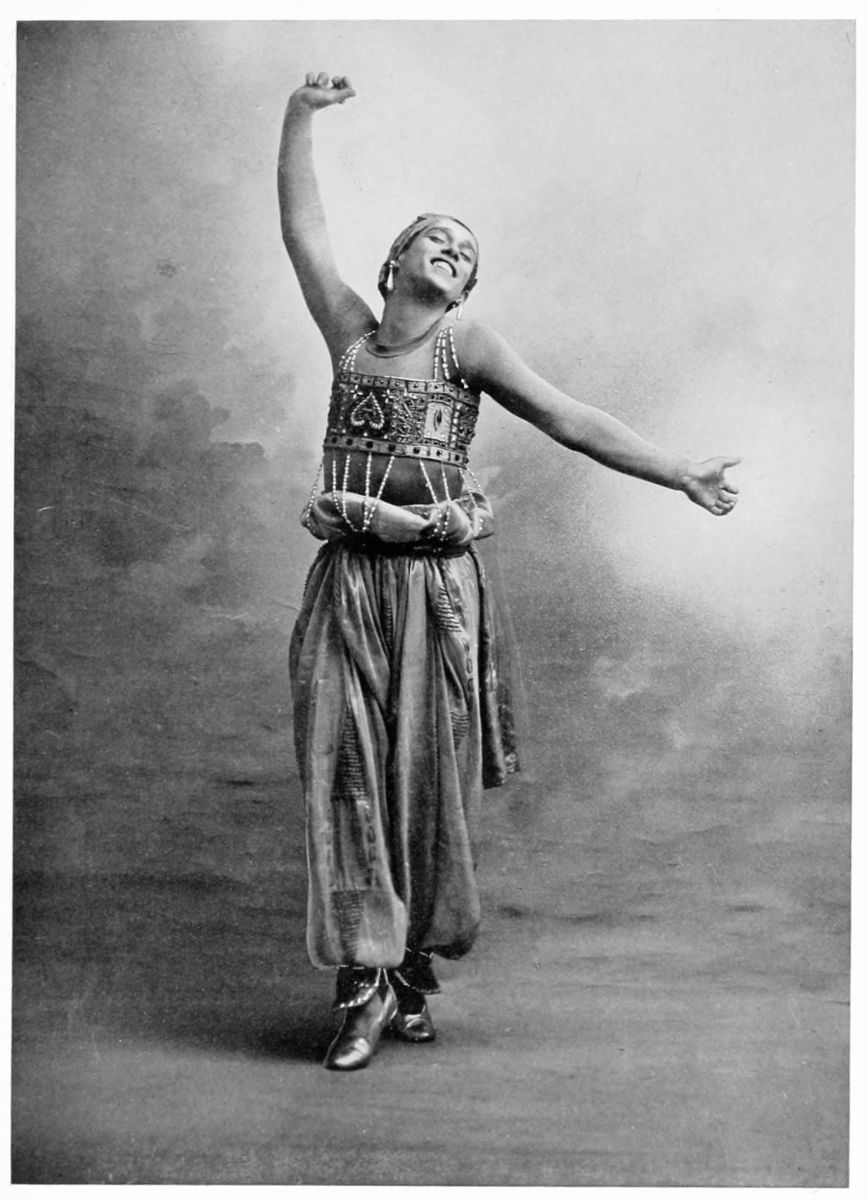
WASLAW NIJINSKY
IN Shehérazade
Photograph: Bert, Paris
for a dancer with his zest for work, his post at the Imperial Opera was
more or less of a sinecure. The ballet, which only performed about six
times a month, was too intermittent to give a proper scope for his
activity.
With a dead complexion, lank, dun-coloured hair, high cheekbones, long
and somewhat obliquely set eyes, Nijinsky has the racial characteristics
of the Slav. His expression is one of a serenity that is untroubled by
the glory of the present or the cares of the future. His eye is bright
and expressive. In repose his face has a certain dreamy preoccupation,
which at a word spoken or a sight that arrests his attention, passes
swiftly into an absorbing interest in the life of the moment. His is
clearly a highly-strung temperament—indeed he told me that what he
found most difficult in his art was the conquest of the nerves.
Nijinsky has the genius for taking pains. A movement, a gesture, which
upon the stage has often the appearance of a happy improvisation, is
invariably the result of careful study. How searching is his preparation
I only realised when I saw him one morning practising with Madame
Karsavina on the stage at Covent Garden. His instructor, M. Cecchetti, a
distinguished member of the Diaghilew company (he is the wicked marquis
in Le Pavillon d’Armide, the Grand Eunuch in Scheherazade), took him
through even the most elementary exercises with the severity of a drill
sergeant. For the young dancer, however, it was not a mechanical
routine, but a kind of play, into which he entered with a certain
smiling gaiety. If he found that he was executing a movement
imperfectly, he stopped short in the middle of it with a gesture of
half-amused vexation and repeated it over and over again until he had
made it faultless. The actual mastery of the technique appeared to him
to be in itself a delight, and not, as with many dancers, a painful
task-work. In his practice I found that the turns of his pirouettes and
the cuts of his entrechats were more numerous than in the actual
performance, for he never perverts the intention of the dance by
introducing into it acrobatic feats merely for the sake of dazzling the
spectator.
It is not altogether easy to analyse the qualities of Nijinsky’s
dancing in virtue of which he is rightly regarded as the finest
danseur of the age. Perhaps his chief merit consists in that very
versatility which seems to conceal the pre-eminence of any single
feature. He never repeats himself. His personality appears to inhabit
not one but several bodies, or rather his personality itself is
multiple. Did not one know that it were the fact, would it be possible
to believe that the lustful negro of Scheherazade was one with the
tender flower-spirit of Le Spectre de la Rose, or the impish and
irresponsible Arlequin of Le Carnaval the same as the courteous and
adoring page of Le Pavillon d’Armide? He identifies himself in each
ballet with the spirit of the action and of the music.
Nijinsky makes us understand that a gesture is, as Blake said of a tear,
an intellectual thing. His gestures, by which I do not mean the
technical steps, are different in manner and in spirit from those of the
traditional Italian school. With the conventional gestures of the
academies, which mimic such attitudes as men are supposed naturally to
adopt when they perform certain actions or experience certain emotions,
he will have nothing to do. Nijinsky’s gestures mimic nothing. They are
not the result of a double translation of idea into words, and words
into dumb show. They are the mood itself. His limbs possess a faculty of
speech. Wit is expressed in his Arlequin dance as lucidly as in an
epigram. In Le Spectre de la Rose he dances a sonnet of delighted
devotion. He makes credible the suggestion, intended satirically, that
La Rochefoucauld’s “Maximes” should be rendered choregraphically. His
genius consists in a singular pliancy of the body to the spirit.
His technique is characterised by extreme brilliance and agility. He is
weirdly grotesque or daintily graceful at will. Where he is perhaps
lacking is in gravity and statuesque pose. Nijinsky does not realise the
Pheidian ideal as perfectly as Mordkin, and therefore he can never be
his equal in creating that impression of the glorious virility of a
Greek statue, in whose firm lines a mighty strength lies sleeping. Nor
have I ever seen him adequately represent the fierceness of human
passion. Even in his Scheherazade dances there is not so much a deep
exultation as a kind of schoolboy merriment. But these are the necessary
limitations of a youthful body and
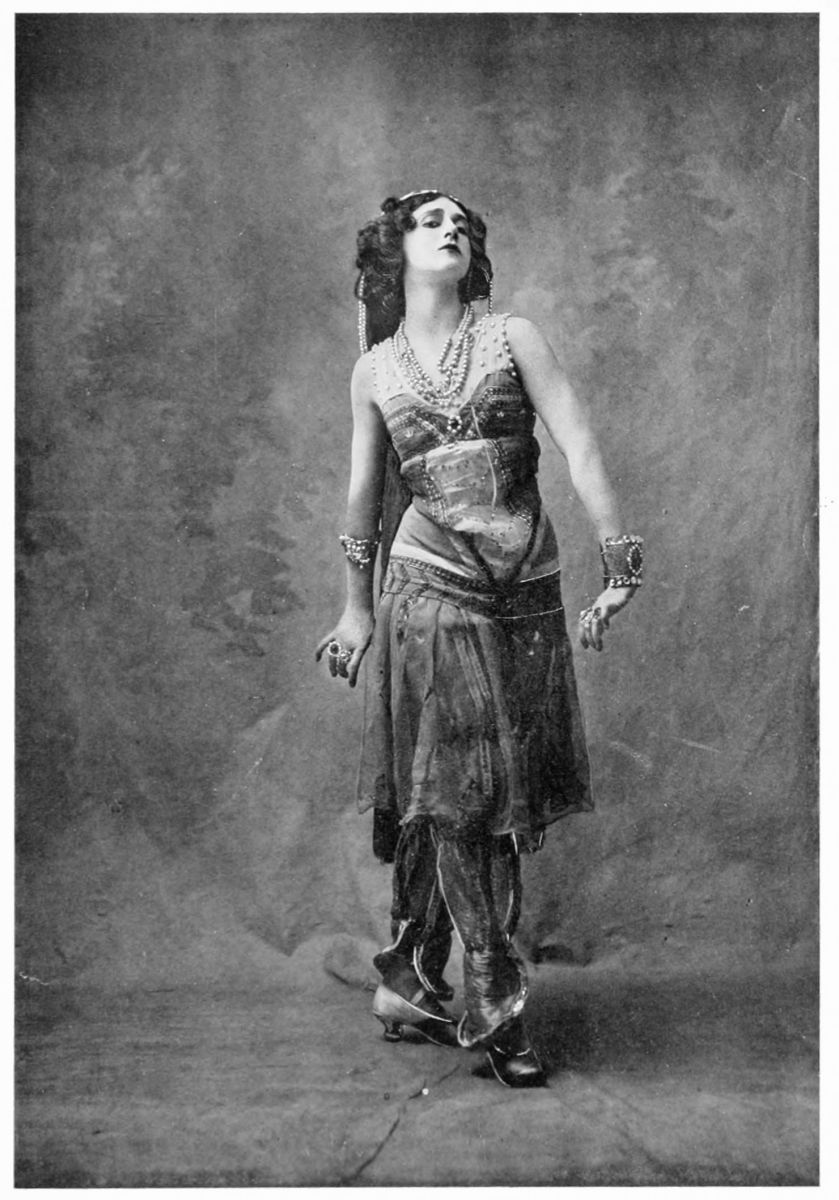
TAMAR KARSAVINA
IN Shehérazade
Photograph: Bert, Paris
a youthful spirit. Nor would we have it otherwise. We will leave the
rest to time. The years will deepen and dignify his art. If he is too
happy to enter into certain phases of the spirit we will gladly bear
with his shortcomings. We are content to take him as he is—the genial,
leaping, happy dionysiac fawn!
It is interesting to record here some of his impressions and his remarks
about himself.
“I love dancing to the music of Chopin,” he says, “you see we are
fellow-countrymen. I am not a Russian really; my parents were Poles, and
I am a Catholic and not Orthodox. I always imagine that it is only a
Pole who can really interpret Chopin; we understand the melancholy of
his music.”
With regard to the milieu of his performance he has said: “One thing I
am determined not to do, and that is to go on the music-hall stage. I
have had several tempting offers; but after all what is money? I think
more of art than of money, and I refuse to be sandwiched between
performing dogs and acrobats.”
Before he appeared at Covent Garden he said, “I am frightened of London.
I like the town, it is so big and serious, but the thought of dancing at
Covent Garden makes me feel nervous.”
After he had danced there, however, he was not nervous of criticising
the Covent Garden audience. “They are not very demonstrative compared
with the Parisians, but they are faithful, they seem to come again and
again in great numbers. But they have a horrible habit—during the last
piece on the programme there is always a constant stream of people going
out. I think this is disgracefully ill-mannered, and I refuse now to
dance in the last piece on the programme. I refuse to dance to an
audience that is melting away—it is an insult to art. At Paris, all the
times I have danced there, not a single person has stirred at a single
performance until the curtain fell at the end. And here at London we end
quite early—at eleven o’clock. That gives people plenty of time to get
their suppers, doesn’t it? Fortunately the stage at Covent Garden is
conveniently big. It has one disadvantage—it does not slope at all. It
is quite flat, so that when I was dancing there at first I kept falling
forwards.”
Madame Karsavina, the première danseuse of the Diaghilew company, is
in every way a fit colleague for the incomparable Nijinsky. Although
still quite young, she is fast making for herself a reputation that will
probably be second to none in the Russian ballet. Last year the
retirement of Mademoiselle Preobrajenskaya from regular work and the
withdrawal of Madame Pavlova left her an arduous task to fulfil in St
Petersburg. In order to fill the gaps that she alone was capable of
filling, she was obliged to study new parts which the retired dancers
had made peculiarly their own—an undertaking of considerable delicacy.
But her genius enabled her to draw even from the most exacting critics
that quiet smile of inward appreciation which she has acutely declared
to be the highest tribute to the artist. She is hard-working, very
ambitious, and takes her art very seriously in all its branches.
Of her performances at Covent Garden, all were marked by such rare
technique and instructed grace that it is difficult to put any one
before another; but certainly she never surpassed her achievement in Le
Spectre de la Rose. Her dancing caught the very spirit of a maiden’s
reverie, and nothing could have been more finely imagined than those
transitions from languor into quick rushes of darting movement, which
illustrate the abrupt and irrational episodes of a troubled dream. She
was the very embodiment of faint desire. We felt, as it were, a breath
of perfume, and were troubled in spite of ourselves. Moreover, the long
partnership between the two performers seemed to have resulted in a very
special and intimate harmony. For the most part they simply floated
about the stage as though borne upon a common current of emotion. There
was a marriage, not only between their bodily movements, but between
their spirits, such as I have never noted in the union of any other
dancers. In Scheherazade Madame Karsavina proved herself to be the
possessor of a dramatic sense which the other ballets had not
sufficiently displayed. As the faithless Zobeide, she mimed with
astonishing subtlety an inward conflict of warring emotions, fear
mingling with desire, rapture giving place to despair. Her gestures were
charged with the same passionate significance as those of Ida Rubinstein
and Astafieva.
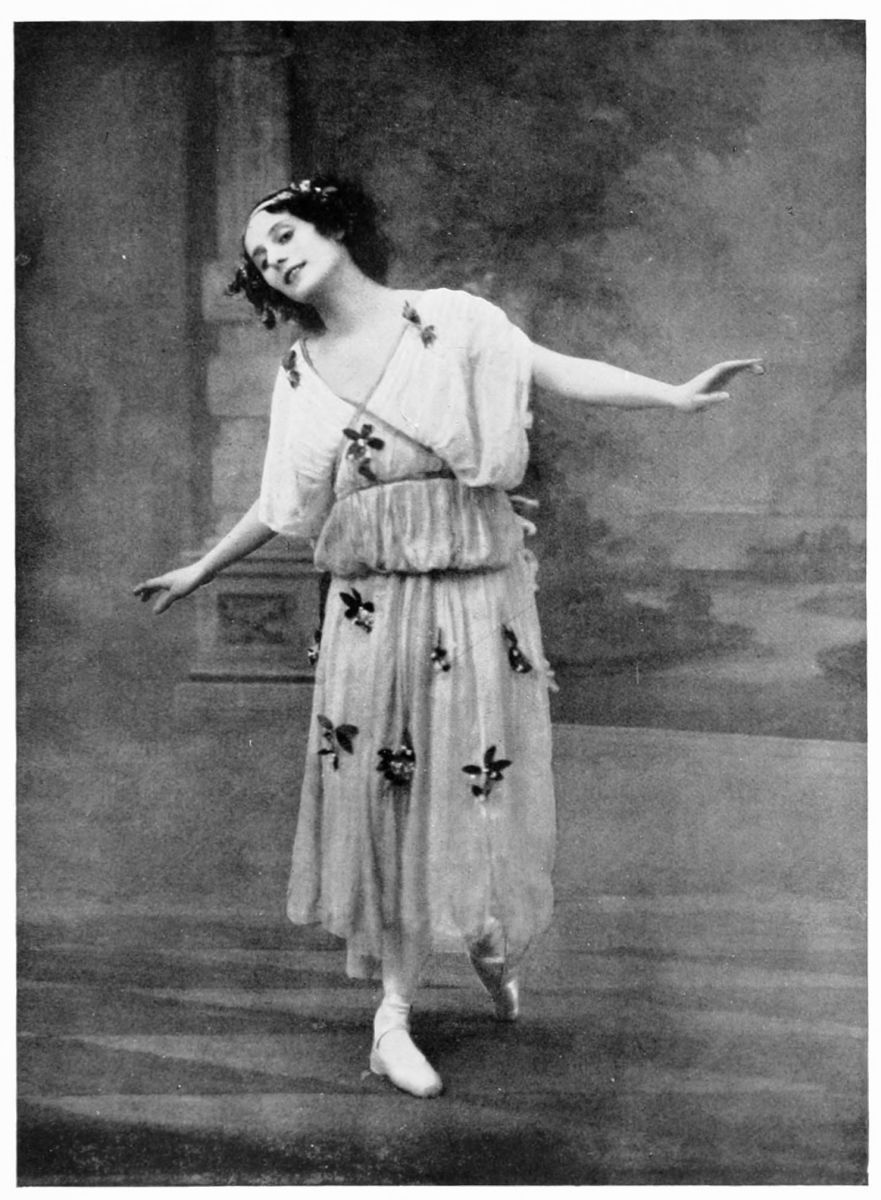
ANNA PAVLOVA
Photograph: Dover Street Studios, Ltd.
Both her miming and her dancing were characterised by a certain natural
softness of movement, the quality of languor rather than of passion,
which was nevertheless consistent with the greatest firmness of outline.
While in Paris, Madame Karsavina sketched a comparison of the French and
Russian ballets, which indicates her own conception of the art: “Our
school is the same. We derive equal inspiration from the great
traditions of the dance, bequeathed by Auguste Vestris and Jean-Georges
Noverre. Only the French ballet has rested in these traditions, without
troubling to renew them. The academic style of the French dancers is the
same as that of a century ago. After having carefully studied these
traditions and profited by them, we have sought something more. We have
wished to present faithful images of the life round about us. Our epoch
is finer, depend upon it, than any other. Human emotions have been
refined or transformed. The spectacles of former times no longer move us
very deeply. I have been to see Coppelia at the Opera. It is good,
very good. But Coppelia is quite démodé. Really it is possible to
imagine choregraphic arrangements more modern, more closely in touch
with life—this fine and various and over-brimming life of to-day.”
When Madame Anna Pavlova was leaving Russia, she parted with an old
general, who was saying good-bye to her, with the farewell wish, “May
all that is best be yours!” To this he replied, “How can the best be
ours when you are depriving us of the very best we had?” Not every
member of the Imperial ballet has yet visited Paris and London, and
therefore it is difficult for those who have never been to Russia to
speak in terms of comparison, but we are willing to believe in the
justice of the general’s appraisement.
Madame Pavlova received her training at the Imperial Ballet School at St
Petersburg. She speedily passed upwards through the various ranks of the
ballet, until she became prima ballerina at the Marianski Theatre. She
made her début on the foreign stage at Munich, and subsequently appeared
in Berlin, Vienna, Paris, and New York. When she came to London in 1910
she immediately had the town at her feet. London was at a disadvantage,
however, compared with New York, for whereas in America she performed in
the ballet, at the Palace Theatre in London she appeared exclusively in
solo dances, or with her partner, Mikail Mordkin. The British amateur of
the dance, therefore, has seen but a part of her genius, for that pure
mimesis, in which she excels no less than in the actual dancing itself,
requires for its full scope the interaction of characters which belongs
to the ballet proper. She herself told me that she preferred playing in
the ballet to dancing alone, but it is difficult to believe that her
personality could find fuller expression than in the single dances in
which she has the whole stage to herself. Moreover, when in England she
was deprived of the splendid setting of the Russian décor, the
backcloth at the Palace Theatre being a rather distracting and futile
example of the British scene-painter’s art.
Anna Pavlova is not merely a great executive, but a creative artist. She
is more than a dancer, she is a lyric poet. One feels that she might
equally well have chosen any other of the media of art for the
expression of her emotion, but she has chosen her body—or perhaps
rather her body has chosen her. This beautiful instrument she has
refined to the most delicate sensibility and instructed in a perfect
precision. As a piece of mechanism—if indeed mechanism be not too harsh
a term for what in grace is wholly flower-like—it has been rendered as
supple, just and exquisitely responsive as infinite pains could make it.
It is perfectly equipped with swiftness, strength, delicacy. Only in the
very greatest dancers does the body become the utter slave of the
spirit, serving it with a scrupulous and joyful fidelity. But in
Pavlova’s dancing we are no longer aware of the conscious and painful
obedience of the body to the dictates of a governing mind. It is as
though the spirit itself had left its central citadel and, by some
unwonted alchemy becoming dissolved in the blood and fibres of her
being, had penetrated to the extremities of the limbs. Soul from body is
no longer distinguishable, and which is servant to the other none can
tell.
It goes without saying that her long and careful apprenticeship in the
art of dancing has given Madame Pavlova perfect
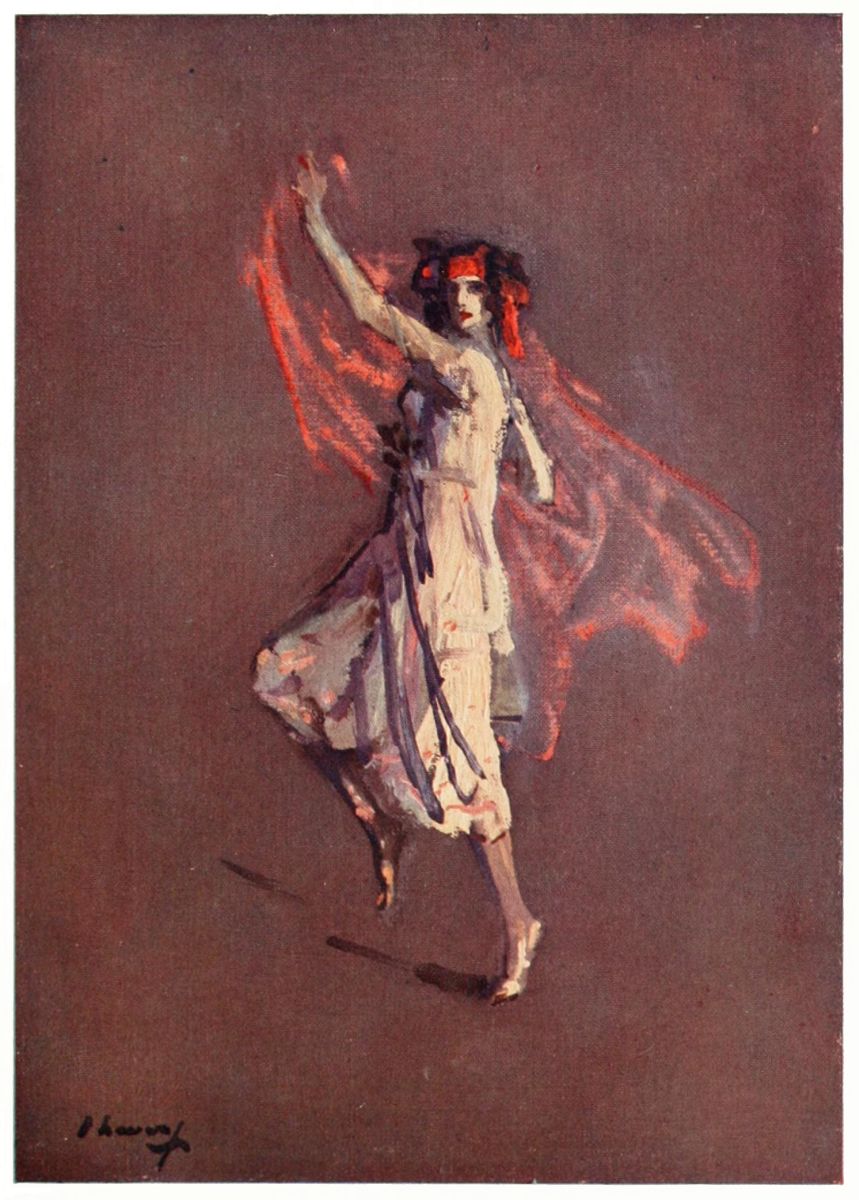
Anna Pavlova
FROM A PAINTING BY J. LAVERY
proficiency in that technique of the ballet which is variously known as
traditional, academic, or Italian. But although all dancing that is not
grounded upon this technique is apt to become to a certain extent
wavering and nerveless, it seems certain that this technique alone does
not suffice for a dancer who dances with soul as well as body. After she
had passed through her years of probation, Pavlova’s individuality
naturally began to assert itself, and she demanded a wider scope for the
full expression of her emotions. This liberty she found in those
gestures and poses, more naturally human than those of the conventional
ballet, which had been discovered, or rather rediscovered, by Isadora
Duncan, for they are native to the world of Greek art. The
characteristic of her dancing, therefore, is the combination of the
older traditional method with the freedom that is demanded for the
expression of emotional ideas. Other dancers have sought to find this
freedom by casting aside, or rather by never troubling to learn, the
traditional technique. Pavlova knows well that the freedom of art is not
to be attained by a wilful lawlessness, but only by a glad and strict
submission to law. Thus she has carried the dance of the ballet a stage
further along the lines of its natural evolution, not despising the
heritage of the past, but enlarging it to meet the deeper needs of the
present.
In particular, she has shown that true dancing demands the service of
every member and particle of the body. No one is now so simple as to
suppose that dancing is the business only, or even principally, of the
legs and feet. Carlo Blasis, a hundred years ago, said that the
position, the opposition, all the movements and carriage of the arms,
are perhaps the most difficult parts of the dance; and Noverre still
earlier remarked, “Peu d’artistes sont distingués par un beau style de
bras.” But the more subtly emotional the dance becomes, the more finely
must be studied the play of light and shade over the whole surface of
the body. Pavlova’s dancing is as expressive in its minutest details as
in its general lines. Her dance lives in her finger-tips. The
character-play of her hands is astonishing. They take their part in the
interpretation of the music; they are, as it were, illuminating
appendices to the story of love and joy, of rapture and fear, that her
body relates. Her face dances too. She has a command of vivid facial
expression such as few actresses can equal. Never for an instant does
she betray the least preoccupation with her steps. Her face is like a
mirror, reflecting the passing lights and shadows of the music and the
mood. The head dances, the eyes dance, the brow, the neck, the lips
dance—the dance, in a word, penetrates her whole being, as the breeze
penetrates the body of a tree to the least shuddering of the tiniest
leaf.
Indeed in Pavlova’s art is realised the full meaning of the dance, which
is none other than the complete possession of the body by the spirit. I
understood this best when I saw her, not in motion on the stage, but at
rest in her home. Reclining in a chair, she sketched with a few
inimitable gestures the Danse des Papillons. It was scarcely more than
a turn of the head, a light in the eyes, a fluttering of the fingers,
and yet the mood was evoked as surely as a painter in a few nervous
strokes might capture an emotion and fix it on his canvas. In this
almost intangible expression the dance seemed to become, if you will
suffer the paradox, independent even of motion, rather a design living
in the brain, an intellectual thing which could communicate itself by a
hint, a breath, by an energy of the spirit rather than of the body.
The idea of the dance—the choregraphic design—is sometimes suggested
to her by music, by fragments from the works of Delibes, Chopin,
Tchaikovsky or Saint-Saëns; sometimes it is hinted in a chance sight or
incident of everyday life; sometimes it springs into being independently
of any external impulse, as spontaneously as a melody is conceived in
the musician’s or an image in the poet’s mind. Le Cygne, which she
dances to the music of Saint-Saëns, owed its origin to a walk with M.
Fokine in a park in St Petersburg. Seeing some swans floating upon the
water, M. Fokine remarked to Madame Pavlova that it would be easy for
her with her supple and slender throat to take the graceful motion of
the bird as the theme of one of her dances. Her figure has something of
the easy dignity of the swan, and in the gliding motions, to the
accompaniment of the cool music of Saint-Saëns, she is perhaps more at
ease
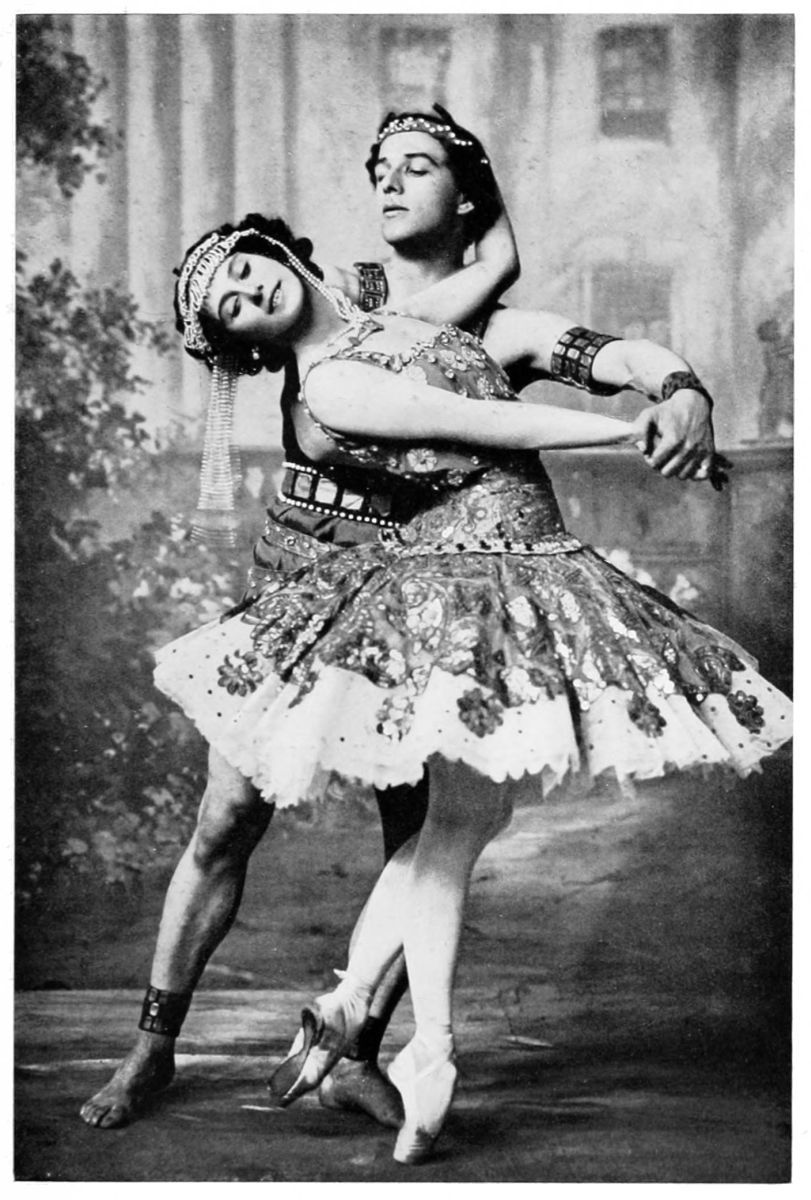
PAVLOVA AND MORDKIN
Photograph: Foulsham & Banfield, Ltd.
than in those passages which demand a more stormy energy. In this dance
she represents with singular beauty the proud carriage of that remote
bird, its swooning death and its sudden collapse into lifelessness. It
displays her skill in the difficult act of falling; she sinks to earth
without any suggestion of arrangement or preparedness, ceasing to dance
as swiftly and silently as a flame may cease to burn, her limbs failing
her, as though her body had actually resigned its spirit.
Her interpretation of Strauss’s Blue Danube is a perfect
personification of the river-spirit. From beginning to end it sounds a
clear note of joy and untrammelled life. Pavlova dances it in her freest
style; the pirouette and the entrechat have no part in this simulation
of the triumphing flood. All the phases of the river’s moods live in her
dancing—its strong, pulsating race in mid-torrent, its bursts of
sky-flung spray, its quiet dalliance in secret, wood-browned pools, its
gentle play with the entangling weeds, its smooth descents over the
breasting rocks ending in a laughing and ecstatic tumult.
What expression Pavlova can obtain even in the narrower scope of the
traditional school may be seen in one of her dances to a Chopin valse.
She appears as a young girl on the night of her first ball, in a simple
white frock, somewhat longer than the usual ballet-dancer’s skirt. She
is dancing the dreams of girlhood in the garden after the ball is ended,
when suddenly the lover, to whom she has just lost her heart, appears on
a balcony and throws her a rose. She gathers it to her breast and in her
happy dance she lives over again those revealing moments when her heart
suddenly blossomed into the life of love. Then looking up she blows a
kiss to the balcony where her lover had stood. To her shy dismay she
finds him still standing there, a witness to her confessed surrender.
She is confused with a modest shame for what in her maiden innocence she
fears must seem an unmaiden-like boldness. The surprised and delighted
lover offers his proposal. After a moment of the most delicious
embarrassment she fearfully nods her assent and skips away in a
transport of excited joy. It is a delicate suggestion of the troubled
and innocent emotions of first love, as suggestive in its rendering of
that neutral and indefinite age that lies between girlhood and womanhood
as a picture by Greuze.
But perhaps the most perfect of all Pavlova’s dances is the Papillons.
It has been said that she “does not so much imitate the movement of a
butterfly as the emotional quality of a butterfly-flight, the sense
raised in our minds by watching it; and then it is not an ordinary
butterfly, nor a plain lepidopteron, but a Grimm butterfly, a dream
butterfly, a butterfly multiplied many times by itself, raised as it
were to the Pavlova-th power.” With that sense of the elimination of
weight which is characteristic of her dancing, Pavlova is able to
suggest the grace of things flying, things swimming, things borne upon
the breeze. The Papillons is the quintessence of the spirit of
everything that dances in the wind, and is kissed by the sun, and has
intrigues with the flowers, and lives its irresponsible life between the
sunrise and sunset of a summer day. It appears to be danced almost
wholly with the eyes and the finger-tips; the dancer is on the stage and
off again all within the incredibly short space of thirty seconds. Yet
she told me that, on account of its ceaseless vibrating motion, of all
her dances it is the most exhausting.
But Pavlova’s dancing is not limited to the expression merely of
thistledown lightness and inconsequential gaiety; it has a deeper reach,
and at times is borne upon a flood of passion. L’Automne Bacchanale is
a stormy and tumultuous dance, affecting the mind like that vision which
Keats saw in the “marble brede of men and maidens” on a Grecian urn:
“What men or gods are these? What maidens loth?
What mad pursuit? What struggle to escape?
What pipes and timbrels? What wild ecstasy?”
It was this dance which inspired Mr Holbrook Jackson’s spirited eulogy.
“She does not make you think of herself,” he writes in his “Romance and
Reality”; “she sets you dreaming of all the dancing that has ever been,
of all the dancing that is. Whilst watching her I could not help
thinking she was not merely following the rules of an art, but that she
was following the rules of life. The leaves
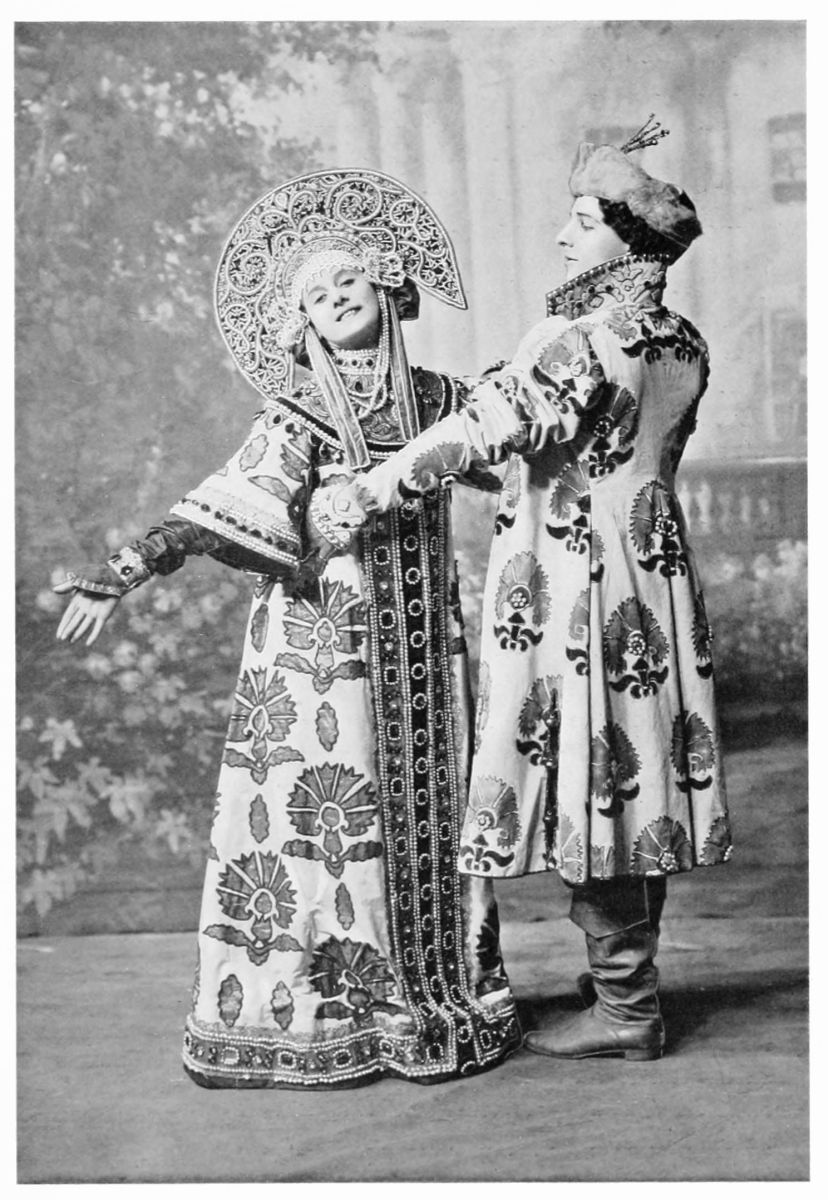
PAVLOVA AND MORDKIN
IN RUSSIAN COSTUME
Photograph: Foulsham & Banfield, Ltd.
dance in the breeze, the flowers dance in the sun, the worlds dance in
space, and Pavlova dancing is a part of this cosmic measure.
“Everybody in the theatre must have felt something similar—especially
when she and Michael Mordkin, her superb consort in the art, danced
together the Bacchanale of Glazounov. I imagine also those dim
segments of faces in the darkened auditorium, many of them reflecting
the frigid morality of English respectability, would be touched to
strange emotions. Their staid owners would feel a new wakefulness,
recalling as in a dream all that had ever happened to them of passion or
beauty, all that might have happened to them had they followed their
real desires, their sacred whims.... The swaying form of Pavlova rhymed
and romped with life and joy, with love and beauty. O the wild flight
across the stage, the hot pursuit, the sweet dalliance, and then the
rich luxury of surrender! The very essence of life was there: life so
full of joy that it overflowed with blissful abandonment until it sank
from the only pardonable excess—excess of happiness.”
In this dance Pavlova has met the exponents of the modern “barefoot”
school on their own ground, and,—shall we say? vanquished them. Her
training in the strict traditional method has taught her that lesson,
invaluable in all the arts, the restraint of emotion. For even in the
Bacchanale there is restraint, the art that conceals art, else she
could not have attained that perfect unison of rhythm which gives to the
dance the swinging quality of a wave.
Pavlova may be said to have introduced impressionism into the dance, and
so to have brought it into line with the tendencies of modern art. Not
impressionism as Zola understood it—“merely an excuse for not taking
pains.” In this respect her faultless precision more resembles the fine
work of a Dutch genre painting. But she is an impressionist in
creating a sudden and brilliant effect without the appearance of
laboured effort and without the addition of a superfluous touch, in
presenting with an economy of swift gesture the firm outline of an
incident, the essential summary of a scene, the breathing heart of an
emotion. Although she flashes across the vision for no more than a few
seconds, she nevertheless leaves in the mind the memory of a complete
utterance, something perfectly finished, definite, precise, whole, like
a clear-sounding lyric, or a finely-cut sculpture. For in her work, as
in all true impressionism, there is nothing blurred; it is rapid, but it
is just and sure; it goes to the roots; it ignores what is irrelevant
and seizes on the essential. Actual mimicry has no place in her dance;
she is not a copyist of nature; she embodies the salient moments, the
vital energies, of beauty and passion.
But when all is said, nothing is said. She refuses to yield herself to
analysis. Too swift for the eye, she altogether outpaces the pen. One
can only repeat the words of that baffled interviewer who wisely wrote:
“Pavlova can only be adequately understood by the person to whom she is
an everlasting mystery—by the mind that cannot understand her. The man
who feels he can, or thinks he can, or knows he can, sum her up in so
many words; who fancies he has done his duty to her and to reason when
he has declared that she is the finest dancer that he has ever seen in
all his life; who says ‘I have seen Pavlova’ as a man would say ‘I have
seen the boat-race’—as if the whole thing were over and done with, and
that nothing more was to be learned, or not learned, by another and
another visit: such a man speaks without having felt.... She is
uninterviewable—unphotographable—undrawable. But she is not
uncaricaturable; for are not all the phrases of the pen and strokes of
the pencil but caricatures that attempt to describe and picture
perfection? And what is perfection but Pavlova?”
In the troupe which accompanied Madame Pavlova at the Palace Theatre in
London there were several artistic performers, but one calls for special
notice—Mademoiselle Schmolz. Her dancing in Glinka’s “Mazurka” and
Brahms’ “Rhapsodie Hongroise” had all that lilt and swing and hint of
devilry which, by every rule of the theatre at any rate, the dancing of
half-barbaric peasants ought to have. A dance which she and Mademoiselle
Plaskaweska danced to the most mischievously ironical of Chopin’s
waltzes was, I have no hesitation in saying, one of the most completely
satisfying things
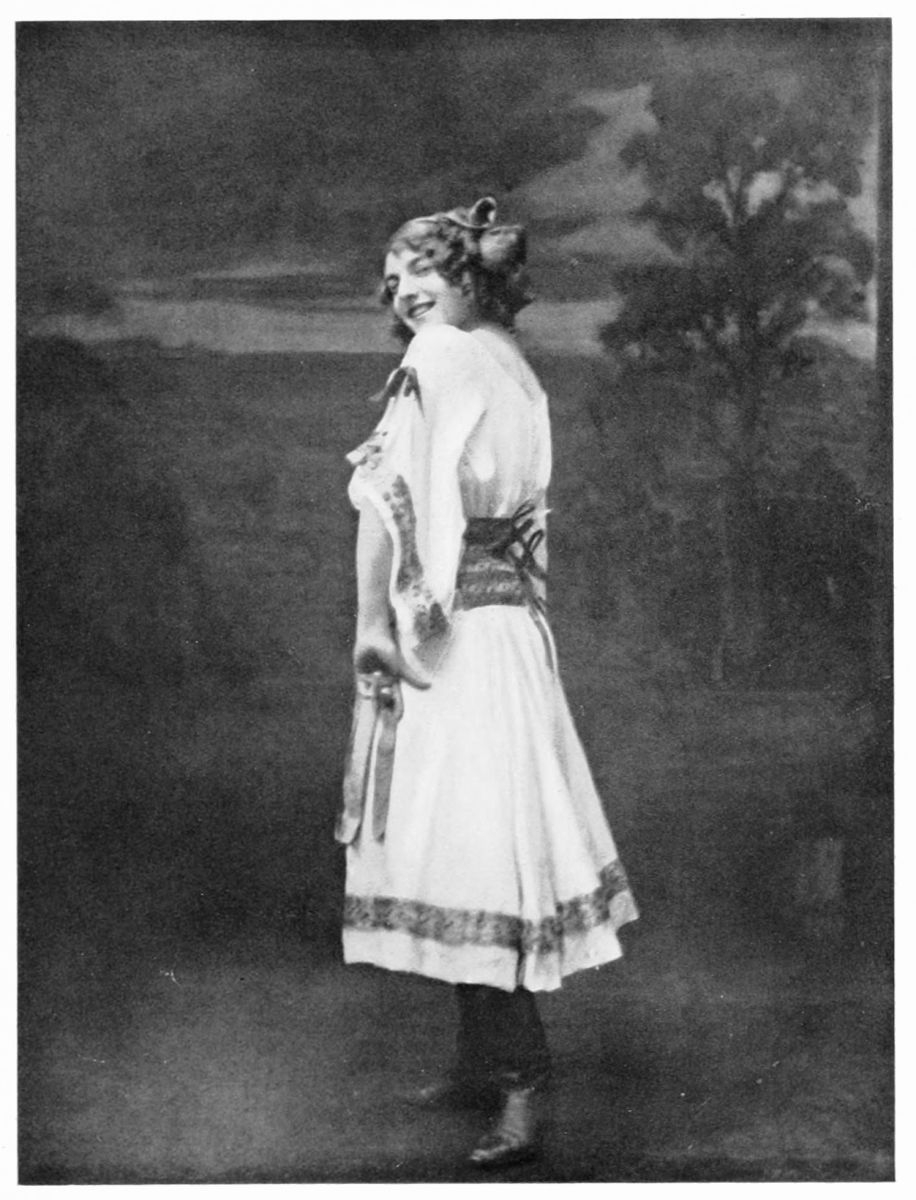
MADEMOISELLE SCHMOLZ
Photograph: Dover Street Studios, Ltd.
ever seen upon the stage. The credit belongs in part to Mikail Mordkin,
who was the composer, but it is scarcely possible to conceive a more
spirited interpretation than that given by the two executants. The theme
was simply a petty squabble about a rose. One of the maidens covets the
love-token which the other flaunts so provokingly; there follows a
pretty wrangle on tiptoe, lively grimaces, and the trophy is wrested
from its rightful owner. The latter now becomes the aggressor, displays
a delightful petulance, and, between smiles and tears, pursues the
laughing thief. The nosegay is won back, and then, just as your sympathy
is becoming earnestly engaged in the alternations of triumph and
despair, the rose is tossed upon the ground, and both minxes run away
with mocking laughter, leaving you half aggrieved at having been fooled
into a serious concern in their empty mischief. It is simple, trivial,
silly if you like, and it is all over in half-a-minute—yet it prints on
the mind a picture like one of those rare glimpses of incidents
sometimes seen in real life, the memory of which goes with a man for
half a lifetime.
Mikail Mordkin received his training in the same school as Anna Pavlova,
that attached to the Marianski Theatre in St Petersburg. The two have
been associated in a somewhat uneasy partnership at the Palace Theatre
in London, and in the United States. Mordkin has achieved the
distinction of being the only danseur who has ever found favour in
America. There, as in England, before the coming of the Russians, the
chief function of the man dancer was to rush out at the psychological
moment and rescue the ballerina as she fell into his arms, with her eyes
staring into the drops and one toe pointing upwards towards the
limelight man. Apart from performing this useful service, on account of
which he was tolerated as a kind of necessary nuisance, his part was
almost a sinecure.
The performances of Mordkin, together with those of Nijinsky, have
brought about a reversal of the somewhat contemptuous popular judgment
upon male dancing, for undoubtedly the Anglo-Saxon public shared to some
extent the prejudice of Southey, who said that every male dancer ought
to be hamstrung. There is nothing of the twittering effeminacies of the
proverbial “French dancing-master” in Mordkin’s dancing; its main
characteristic is manliness. His build is robust, massive, noble. His
physical qualities undoubtedly leave some of his less critical admirers
blind to the deficiencies of his art. His splendid physique is fortified
by a course of rigorous and continual training. In addition to his daily
exercise, it is not unusual for him to go to the theatre three hours
before the performance begins and, without the accompaniment of music,
to go through all the preliminary postures of the dance. Instead of
becoming exhausted by this exercise, he is fit and eager for the ballet
to begin.
Mordkin has shown that grace is not only consistent with true virility
in dancing, but is indispensable to it. In their folk-dances the
top-booted Russian dancers give a fine display of masculine vigour, but
it is always upon the edge of the grotesque. The beauty of a man’s
strength is hidden rather than revealed by these spasms of violence; it
is best seen in those lines, suggestive of sleeping force, which give to
Mordkin’s poses the heroic quality of Greek sculpture. His dancing is
distinguished by its reserve. It always leaves something to the
imagination. His gestures in the “Arrow Dance” derive no little of their
effectiveness from what they suggest, but leave unsaid. It is the
warrior not at war but at play, and like the gambolling of young tigers
affects us by the passion that it only hints at. His dancing has a
constant tendency to forsake motion for repose. In his entrechats and
pirouettes I seemed to note a certain reluctance, as though they were a
concession demanded by popular taste, or a lingering tradition of the
ballet technique. Yet when motion is required, Mordkin can give it, and
of the freest, most buoyant, most swinging quality. The reckless swing
of the galloping entry in the Automne Bacchanale was magnificent. That
was a dance of dances! The riot of wine, the sap of youth, the tumult of
love, the sudden liberation of vigorous limbs, were all expressed in a
rush of movement that was somehow curiously restrained, as the foaming
progress of a wave is restrained, never tempted by excess of ecstasy
into breaking the steady sweep of its own rhythm.
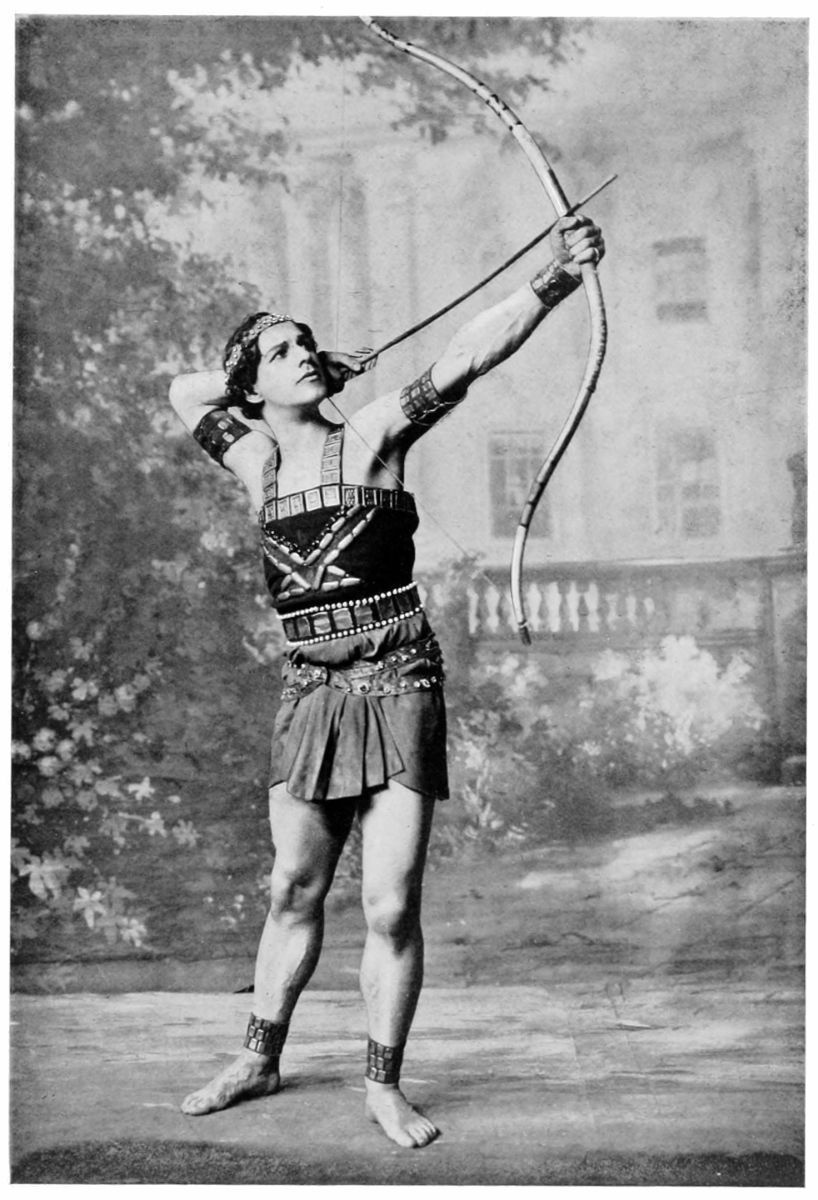
MIKAIL MORDKIN
IN The Arrow Dance
Photograph: Foulsham & Banfield, Ltd.
A comparison of the art of Mordkin and Nijinsky would be almost
irrelevant. Their style differs just in the same degree as their
physique. If Nijinsky is the winged Mercury of the dance, Mordkin is the
Apollo. Nijinsky’s is the dancing of motion, Mordkin’s of repose; the
temper of the one is volatile, of the other equable and restrained; wit,
gaiety, elegance, ebullience of youthful spirits, are the
characteristics of the younger dancer; dignity, power, and a slumbering
passion, of the elder. The hint of Puck-like fancy is entirely absent in
Mordkin’s performances; his dramatic qualities are less elastic than
Nijinsky’s, his personality less various, more rigidly settled in a
definite mould.
While other Russian dancers pass with meteoric flight across the English
stage, Madame Lydia Kyasht burns like a fixed star of all but the first
magnitude. Discerning critics observed her with pleasure behind the
footlights of the Empire Theatre for the first time one autumn evening
in 1908. She had been summoned from Russia to dance in London for four
weeks,—she has been dancing there for three years and her engagement
has still two more to run. Her position as première danseuse in an
English ballet has both its advantages and its dangers. Appearing in a
ballet that is really very little more than a ballet of amateurs, she
achieves without great difficulty the effect desired I suppose by every
ballet-dancer,—that of a visitant from some more gracious and ethereal
sphere. She trips where her companions tramp. She alone has wings. Yet,
although her art profits by the contrast, it suffers from the isolation.
It is difficult for her to keep it keyed to its highest pitch when she
is deprived of the stimulus of criticism and emulation. Moreover, as
there is no competent master of the ballet to compose for her, she is
compelled to be her own choregrapher, and the work of composition
demands a different order of intelligence from that of the executant.
Yet in spite of these unfavourable conditions, the character of her
dancing remains remarkably pure. If it lacks the dazzling executive
brilliance of her former fellow-pupils, Pavlova and Karsavina, it is
marked by a certain statuesque dignity which is somewhat notable in a
ballerina. Even a great dancer may have arresting attitudes but fail to
connect them. Lydia Kyasht passes from attitude to attitude in a single
continuous sequence of admirable poses which flow one into another
without a pause and without a flaw. Her purity of line is never broken
by one of those inartistic feats of athletic dexterity which sometimes
disfigure the dancing of Adeline Genée. She invariably resists the
besetting temptation of a clever dancer to let accomplishment trespass
upon grace. Unfortunately the good fairy who has endowed her with so
many gifts appears to have withheld the greatest of them
all—imagination. Finish and refinement can never make amends for the
absence of mood. At times her dancing leaves us so cold that we are
persuaded that she is dancing with her head but not with her heart.
It is worth while remarking that when any Russian dancer appears in
England or America, she is almost invariably described as the “première
danseuse of the Russian Imperial Ballet.” This denomination is vague,
and usually inaccurate. Theoretically there can be only two ballerine
assolute in all the Russias—one in St Petersburg and one in Moscow. As
a matter of fact, in St Petersburg at the present moment both
Kschesinskaya and Preobrajenskaya hold this rank, although of the two,
the former is granted precedence. The latter has now nominally retired,
but she continues to make six or eight appearances every season. Madame
Kschesinskaya has never performed in England. She once visited London
privately, but when she found that an engagement there would necessitate
appearing nightly, she declared that such a task was “blood-drying
work,” and fled incontinently to Russia. In the Russian capital she
herself chooses the occasions when she deigns to appear. The ballerina
assoluta of Moscow is Mademoiselle Catrina Geltzer, who has recently
appeared at the Alhambra. Madame Pavlova belongs to the grade known as
ballerina, or première danseuse, the next below that of ballerina
assoluta. She is marked out to succeed to the place vacated by Madame
Preobrajenskaya in the supreme rank in the hierarchy. Madame Karsavina
and Mademoiselle Balashova are at present equal in degree to Madame
Pavlova. Madame Lydia Kyasht is in Russia still only première sujet.
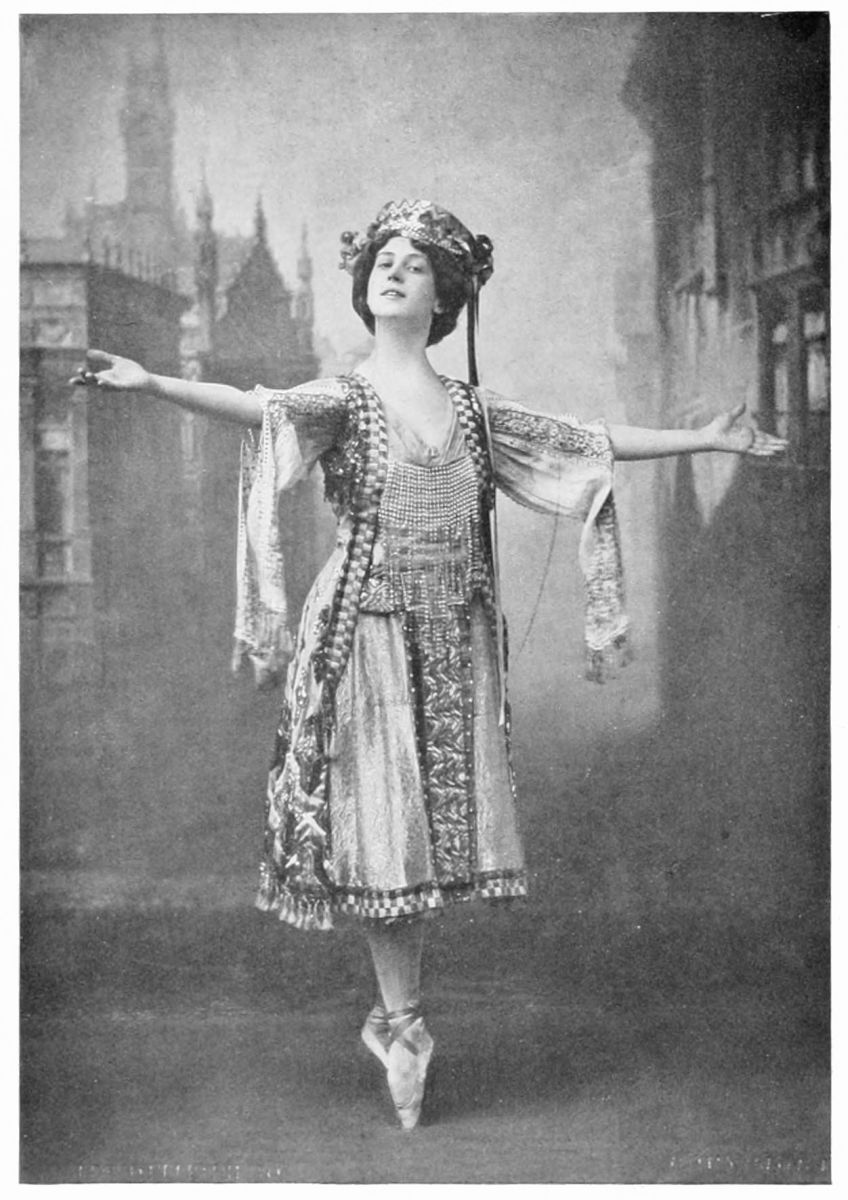
LYDIA KYASHT
Photograph: Ellis & Walery