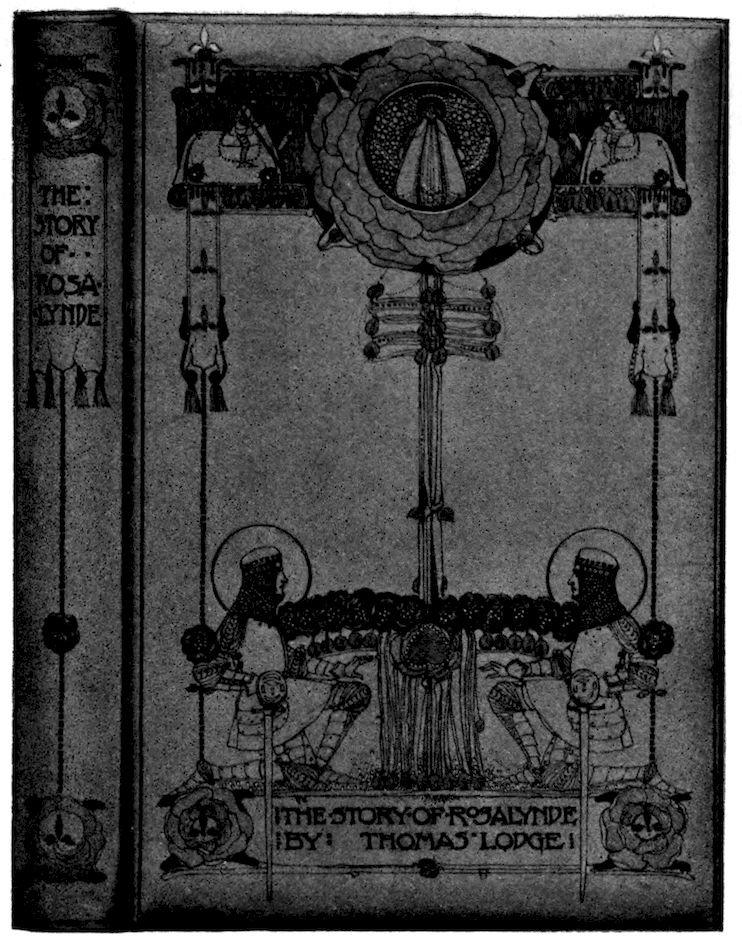
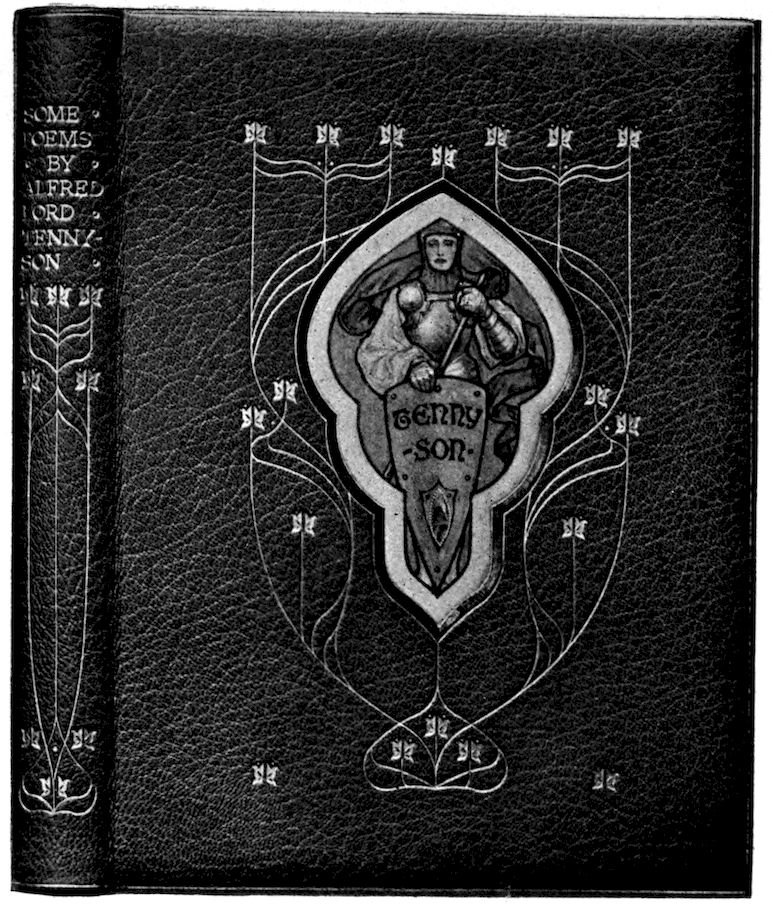
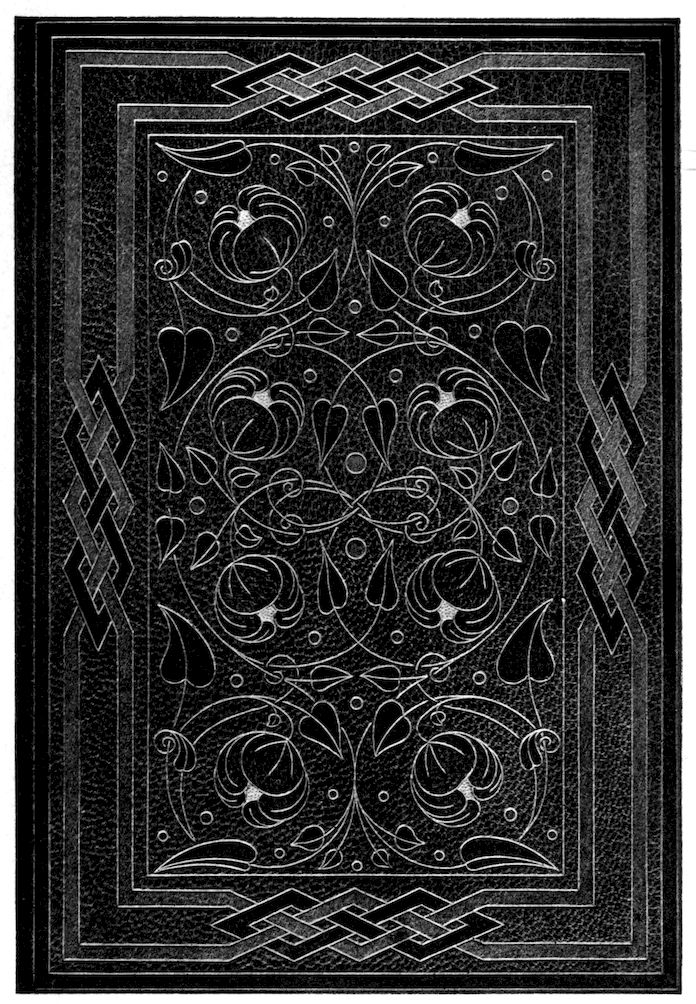
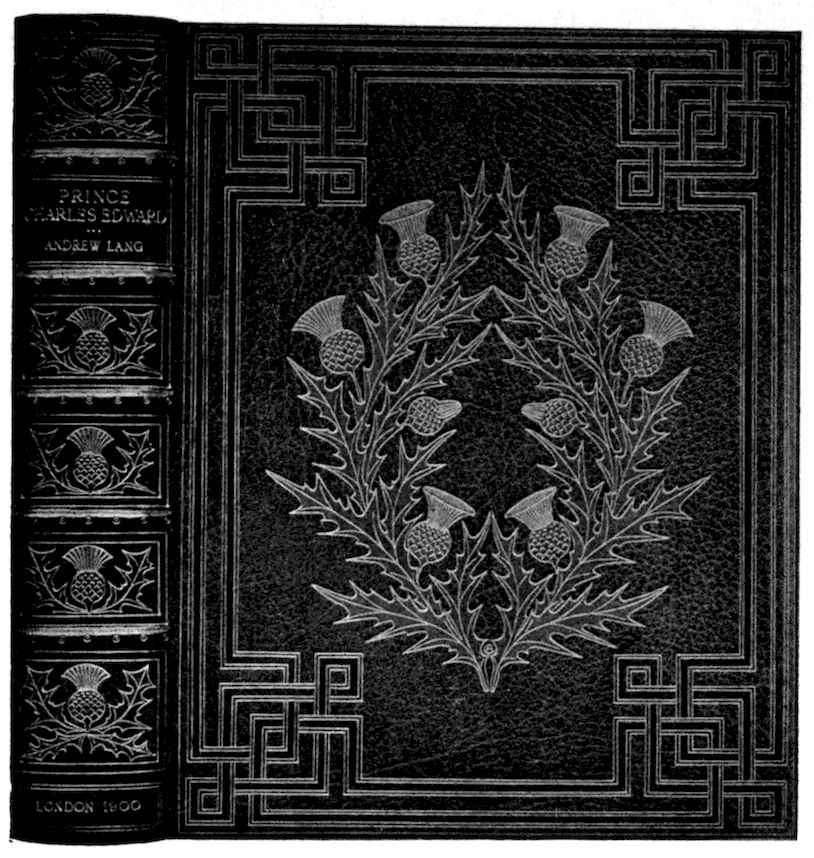
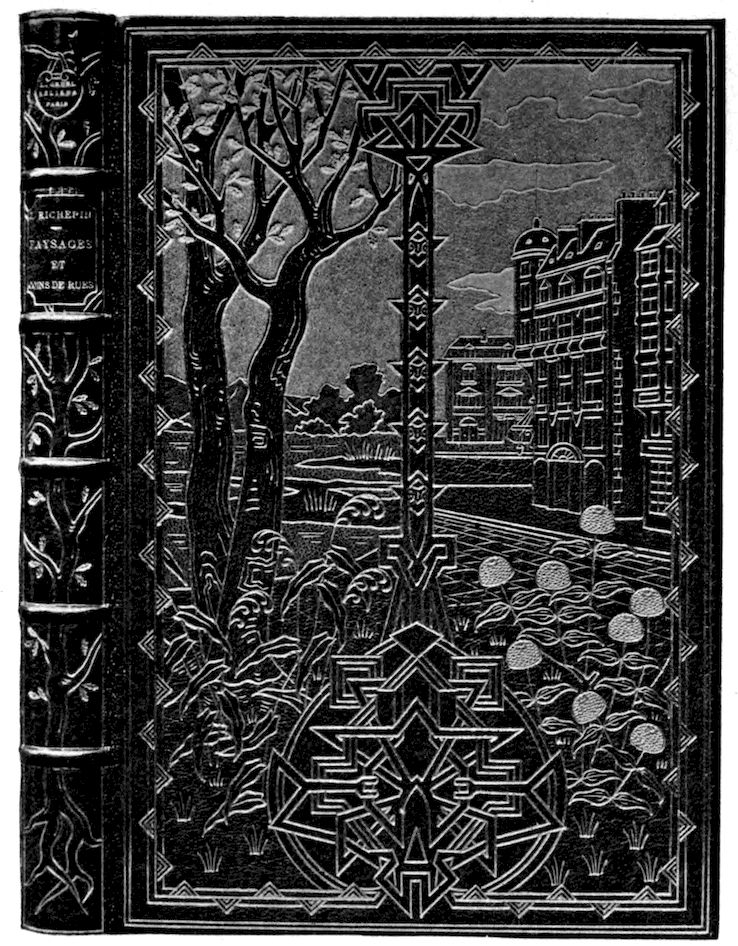
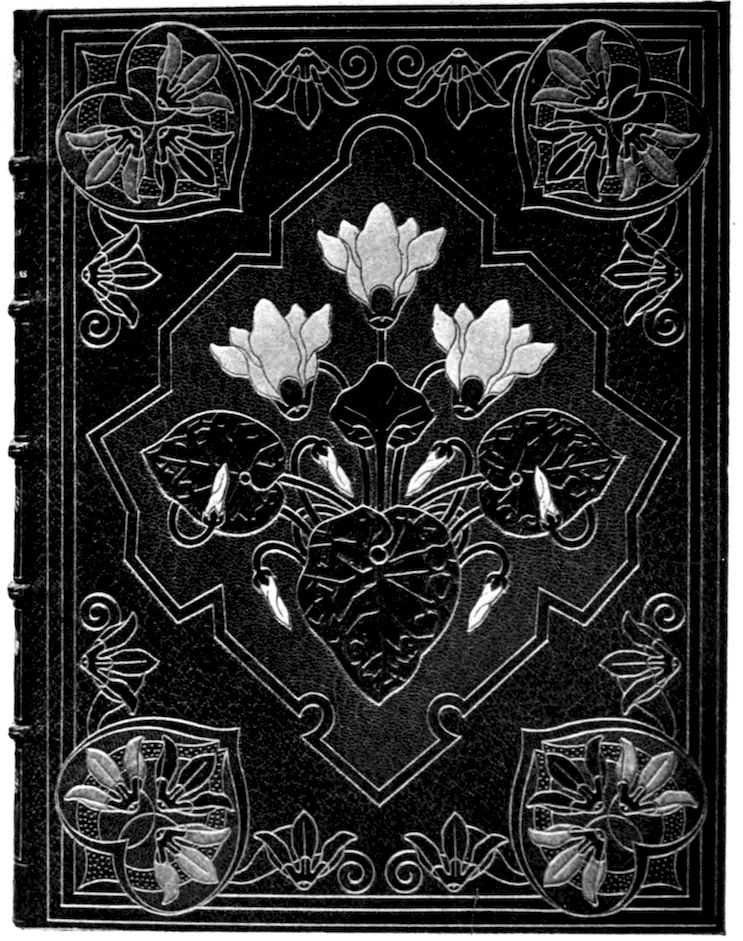
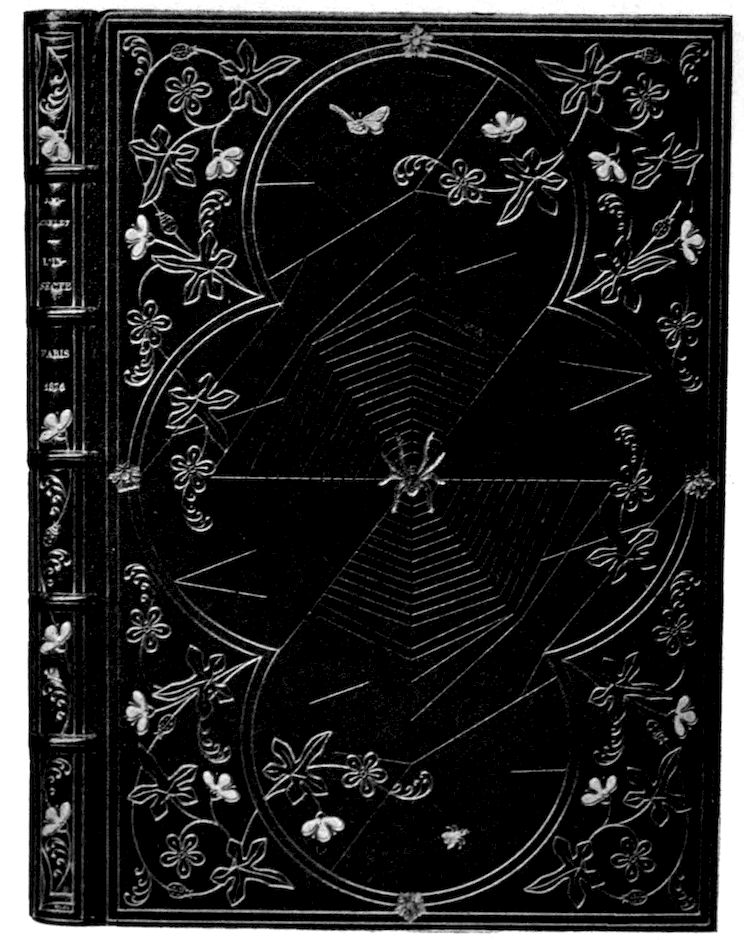
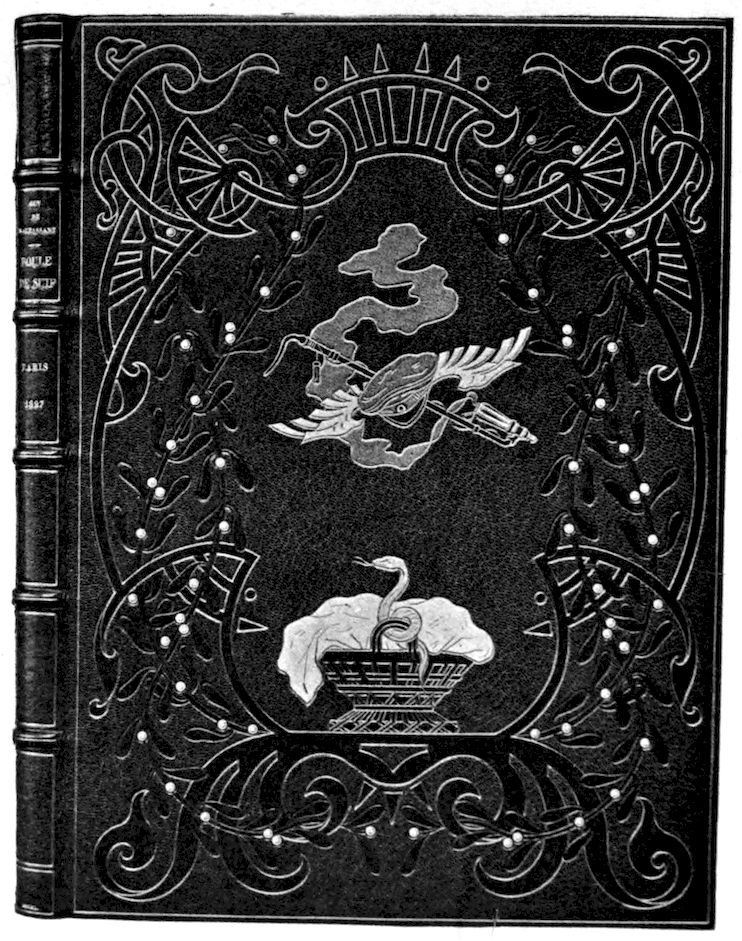
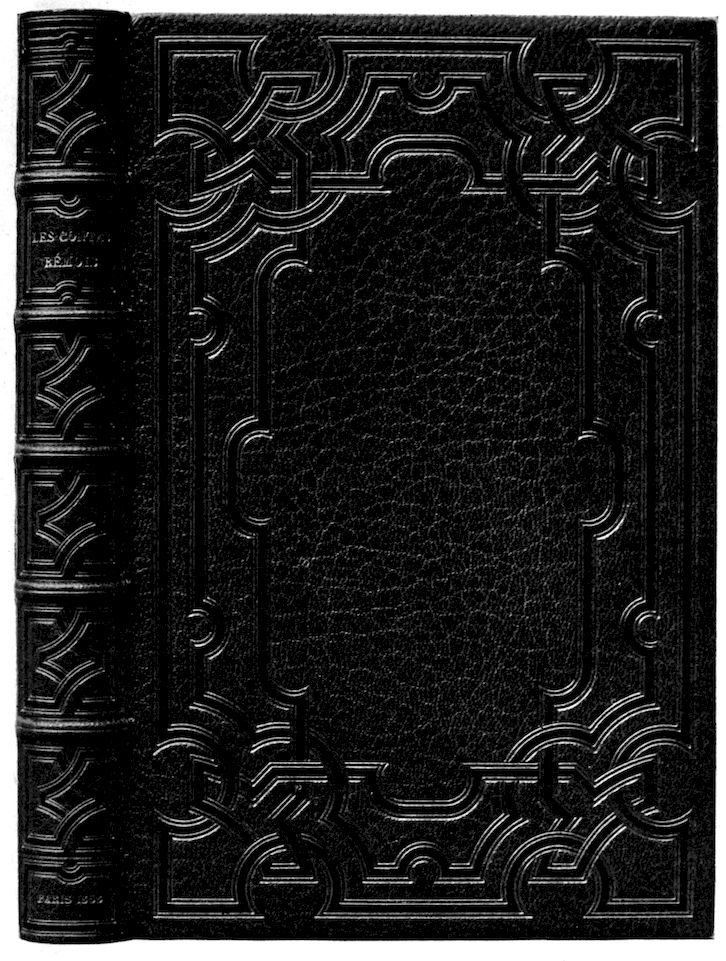
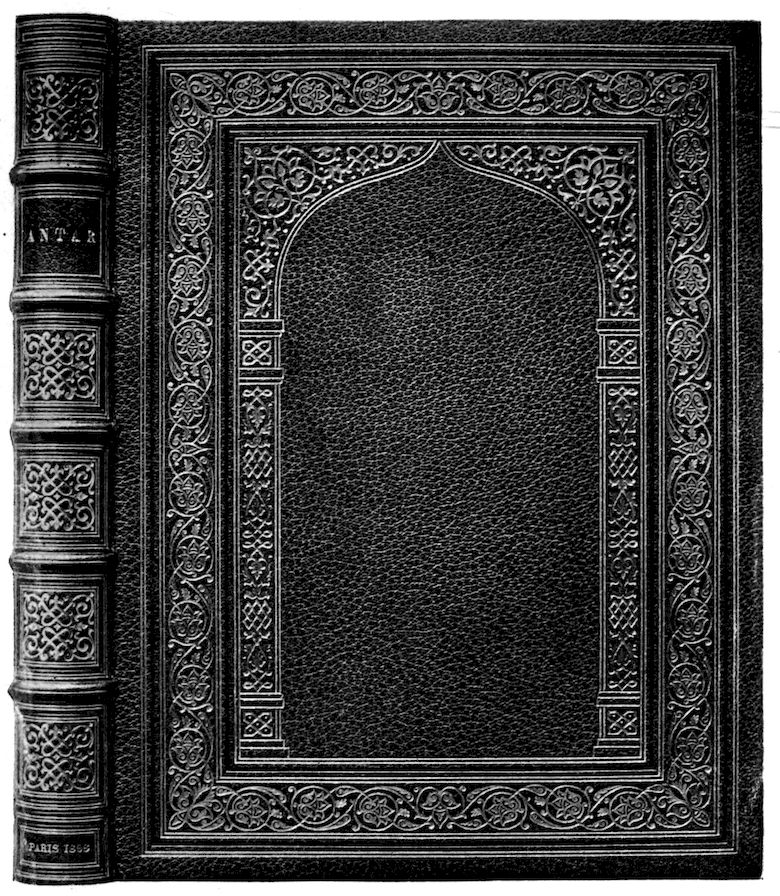
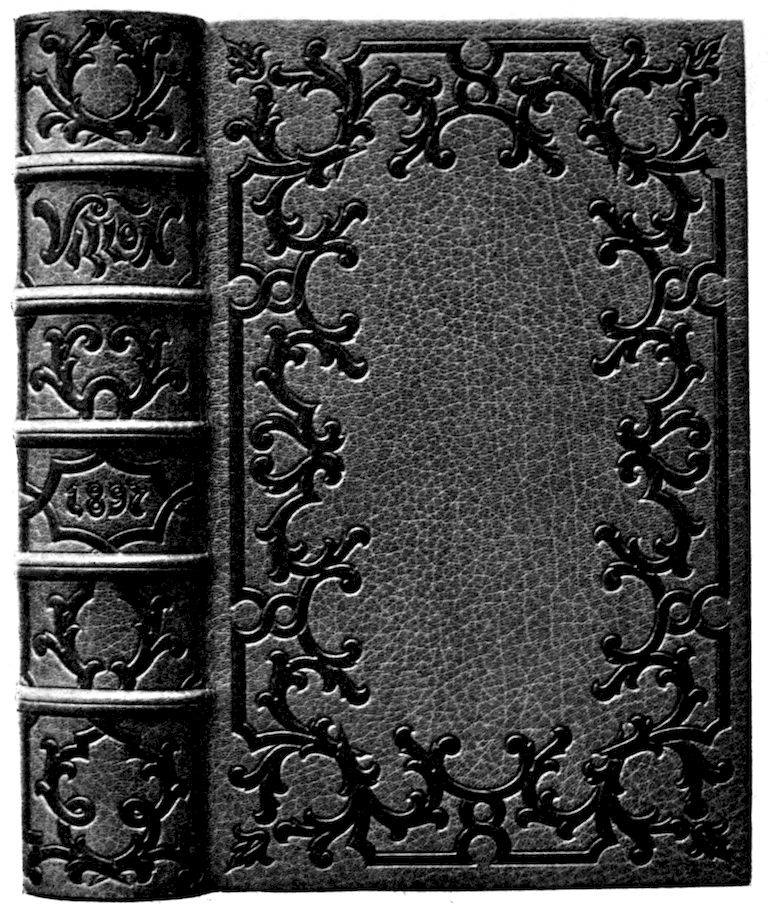
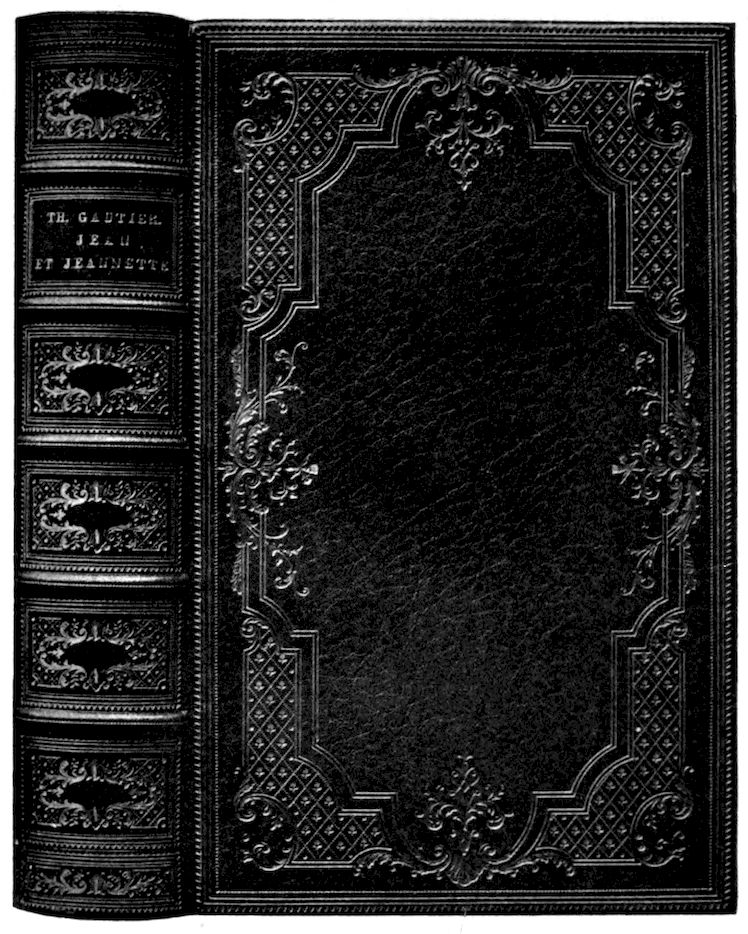
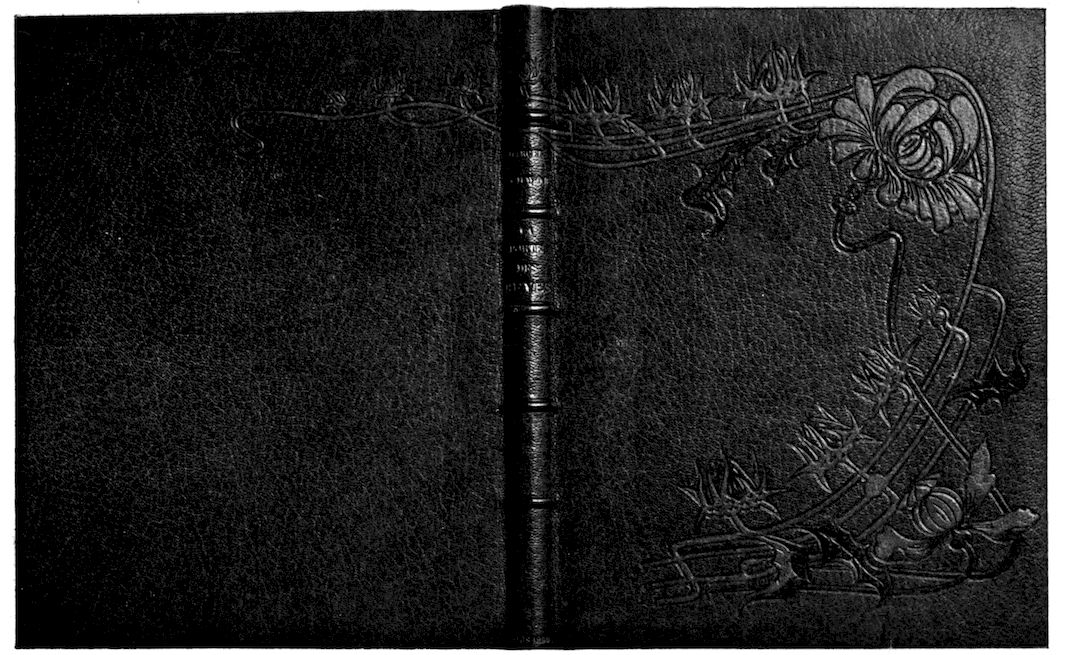
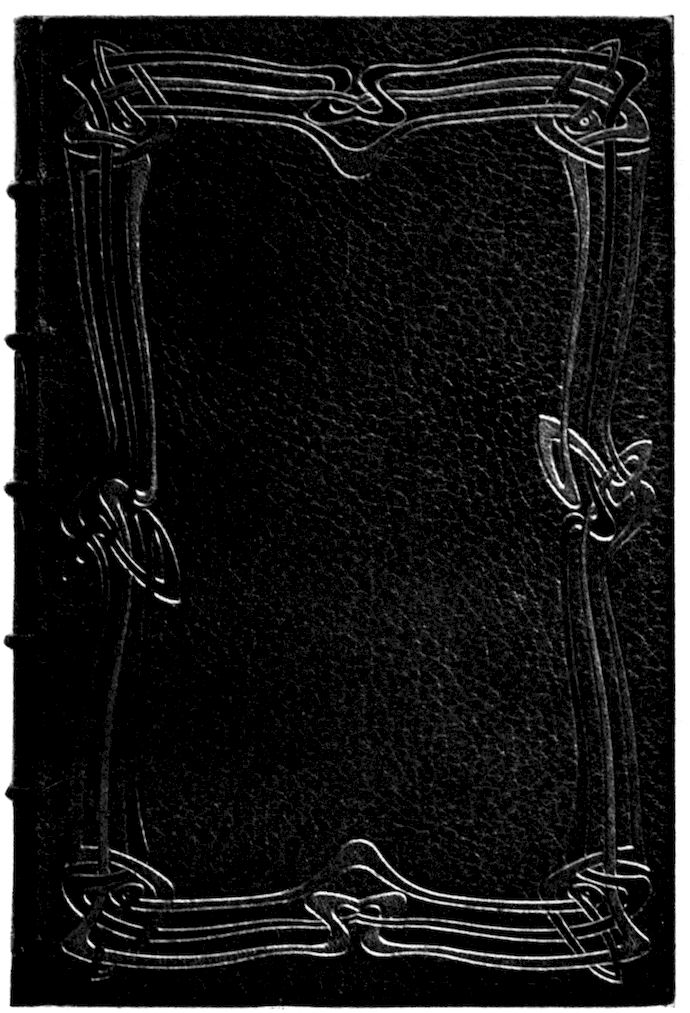
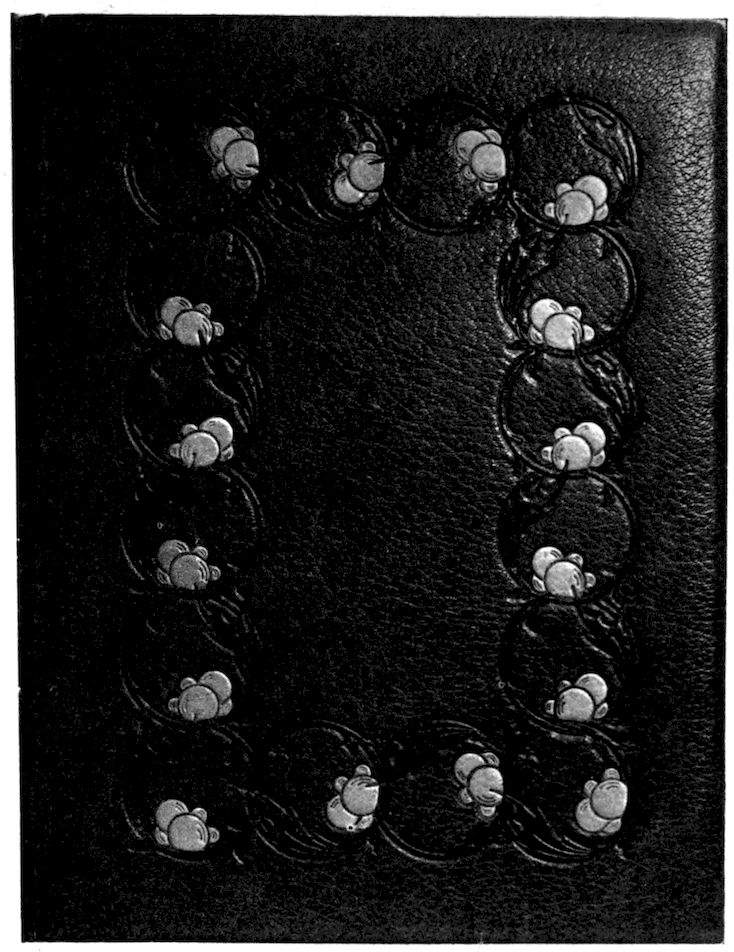
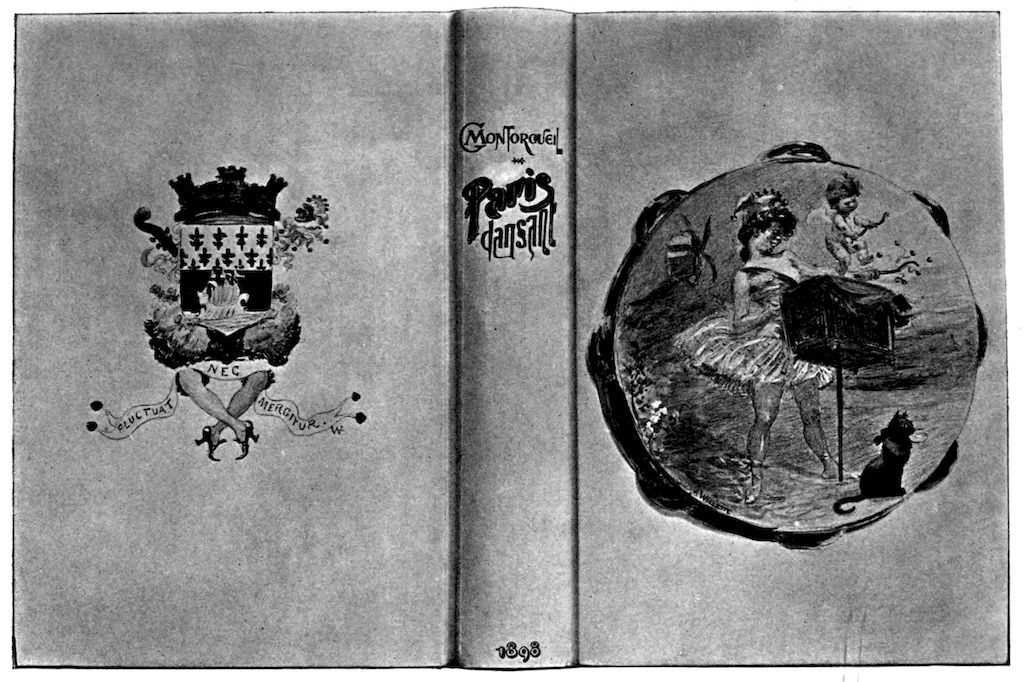
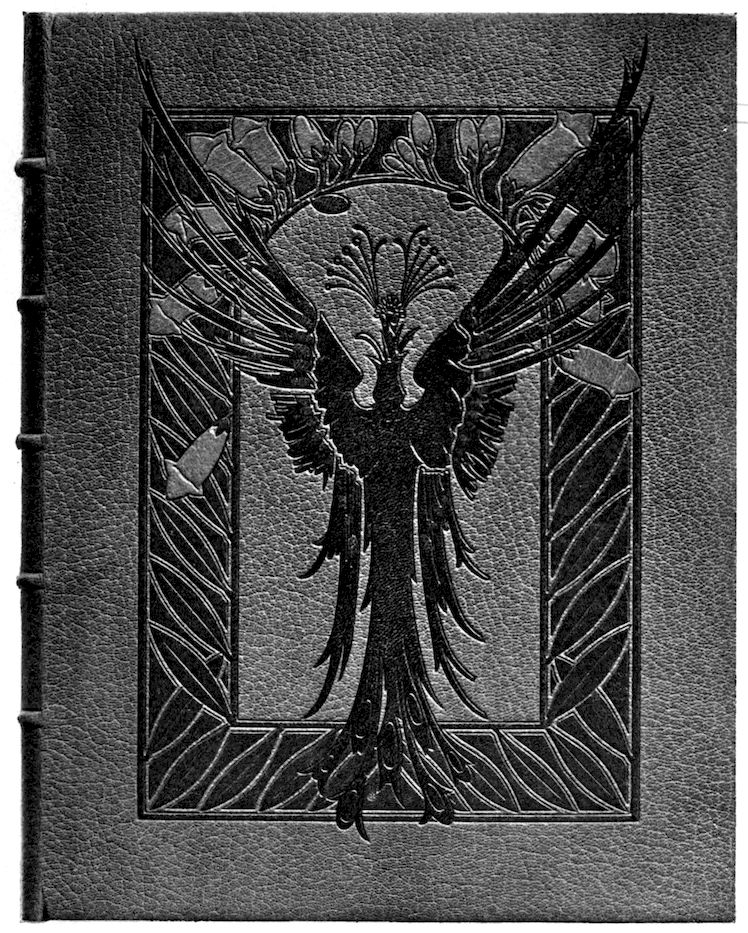
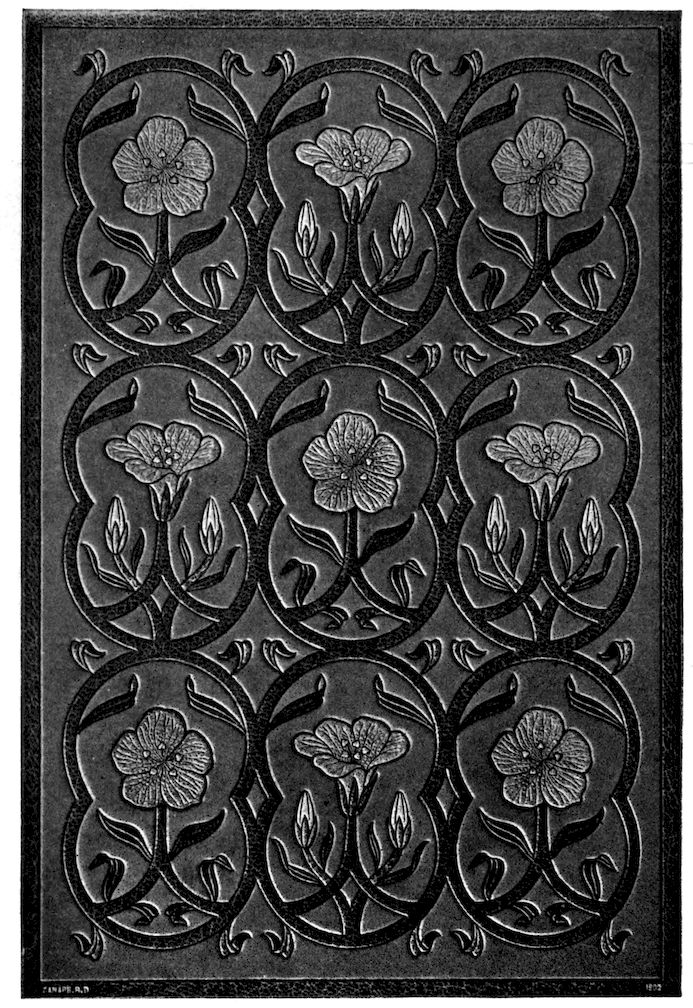
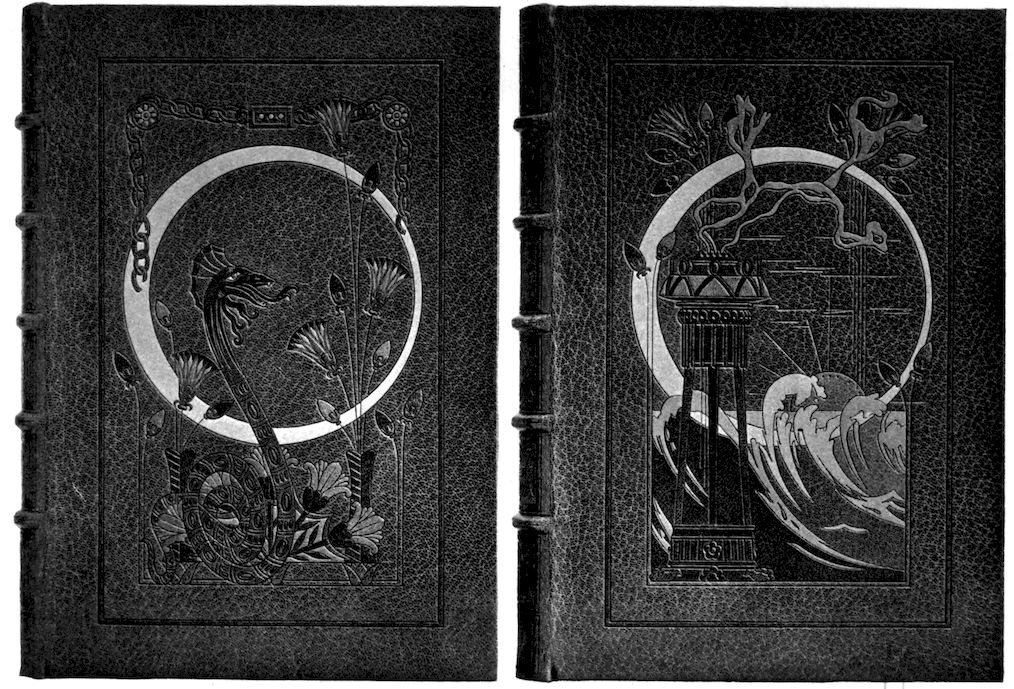
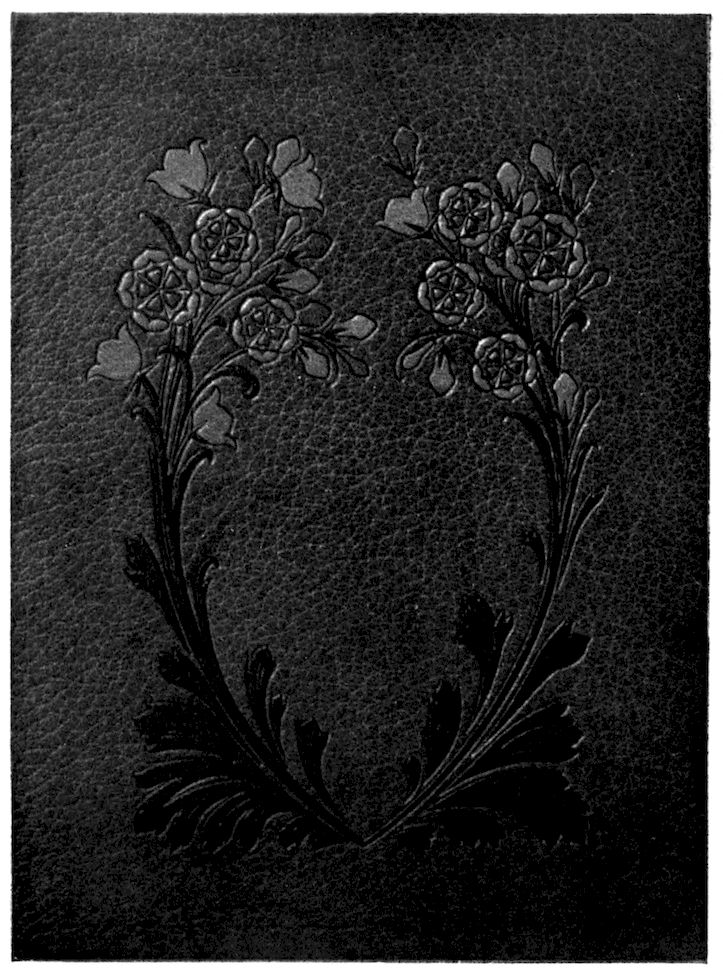
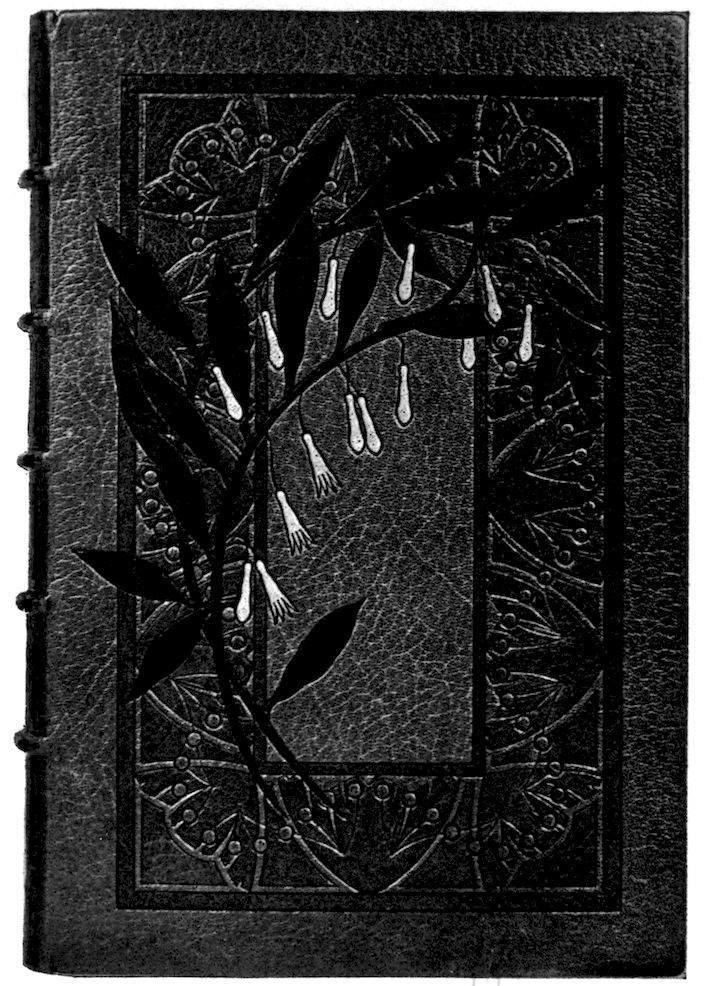
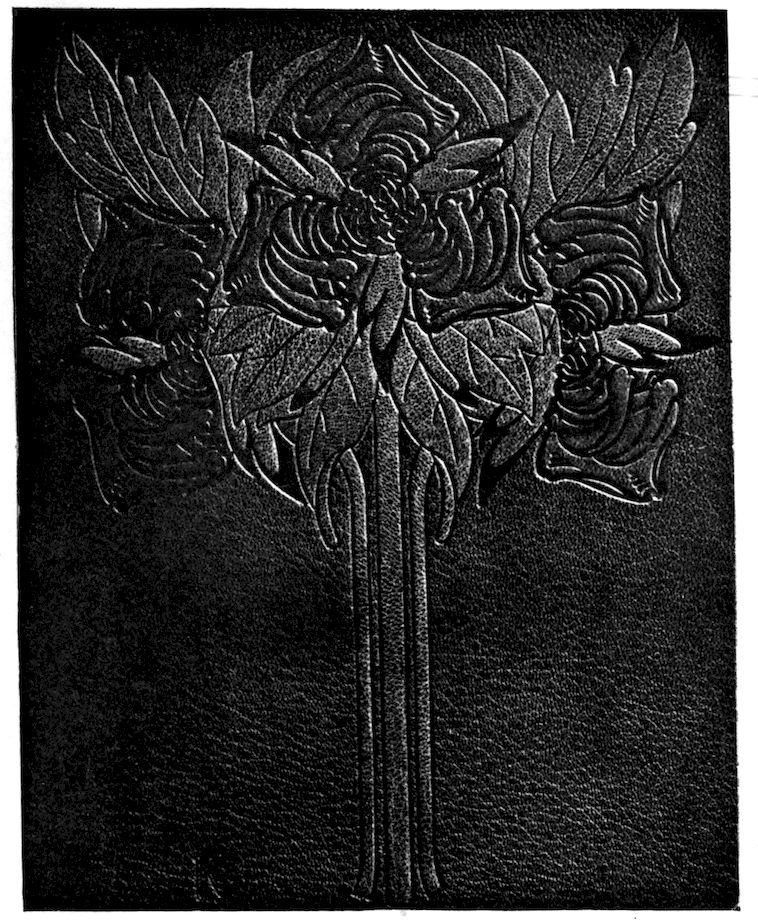
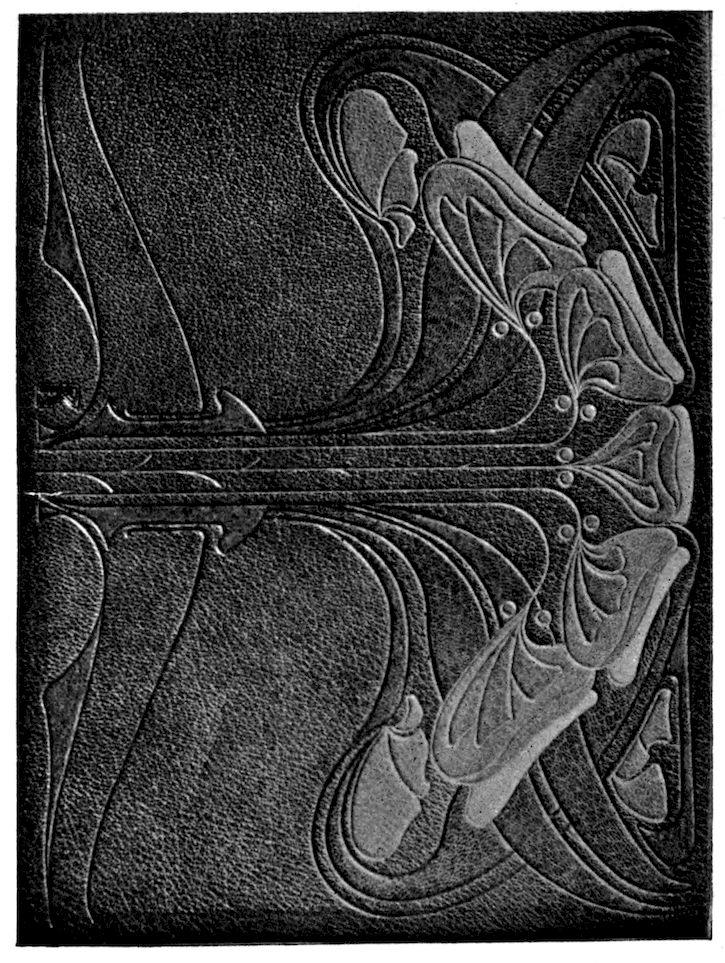
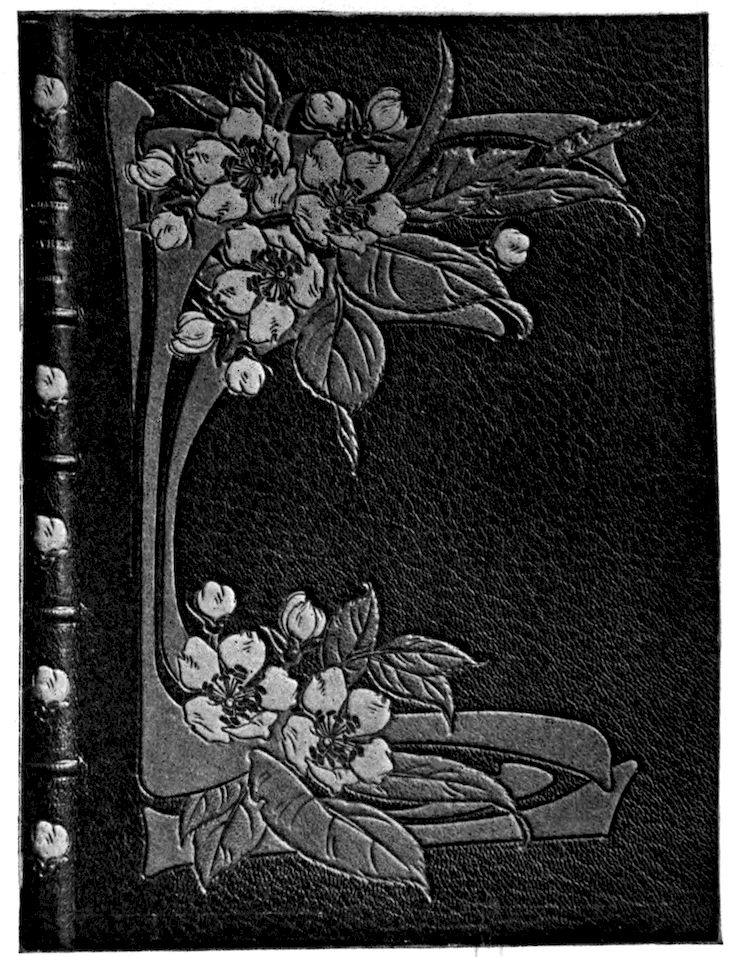
For “Revière” read “Rivière” in List of Illustrations.
For “Morell” read “Morrell” throughout.
The address of the Oxford University Press is still Amen
Corner, E.C., and not St. Dunstan’s House, Fetter Lane, as
stated on page 35.
MODERN ENGLISH BINDING — I — II — III
3
Within the last five-and-twenty years there
has been a marked revival in every department
of applied art. The influence of
William Morris, whose efforts in all the
accessories of house decoration were for
some time only recognized by the few, has
now spread to all classes. No longer confined
to the houses of the rich or of those
who profess the cult of aesthetics, it is
to be found with more or less of travesty
in country rectories and suburban villas,
catered for by the enterprising tradesman
on the monthly hire system. To those who
remember vividly the early Victorian surroundings
of the home and their prevailing
4ugliness, the complete change which has
taken place has hardly yet ceased to be a
source of wonder. Nothing remains the
same: from wall-paper to coal-box, from
bedroom to kitchen, all has ‘suffered a sea
change.’ In any examination of the present
condition of the artistic crafts and the
promise they present of future development
on a sound basis, one cannot fail to observe
that the effort to promote taste has penetrated
to the commonest objects of daily
use. The thought that finds expression
in decoration has gone to salt-cellars and
buttons as well as to carpets, cabinets and
books. Some industries too, that may
almost be said to have died out for lack
of appreciation, have been revived on new
lines and taken up by the public with
enthusiastic approval. The use of enamel
in jewellery and in combination with wrought
metal may be mentioned as an instance of
this, as well as the inlaying of cabinet work
not only with coloured woods, but with
pewter, ivory and pearl. The spell of convention
5once broken, the imagination of the
craftsman has found relief in flying to the
furthest distance from models that were
till recently his only guide. This freedom,
when restrained by genuine artistic feeling,
has given in many cases excellent results;
but in the majority of cases the sole
achievement has been an eccentricity that
shows few signs of a realization of what
is needed in applied art and of the laws
that should govern it.
In no sphere has there been a more
striking departure from the hitherto circumscribed
lines of ornamentation than in
everything that relates to books and their
decorative treatment. Paper and ink, type
and its massing on the page, illustration
both as a part of the text and outside it,
the materials and enrichment of the cover—all
have alike undergone fundamental reconsideration.
It is, however, with bindings
and not with the other features of book
production that we are now concerned; and
it is proposed in these pages to draw
6attention to what is being done in England
and France in a field of work that has an
increasing number of recruits and a growing
and interested public.
It is now more than twenty years since the
movement spoken of began to include bookbinding.
During that time there has been
noted the trade opposition to Mr. Cobden-Sanderson
when he started as an amateur,
followed by an imitation in many quarters,
which, to say the least of it, is not the most
subtle form of flattery. There has been
also the later influence of Mr. Douglas
Cockerell—a result of his strenuous craft
teaching as well as of the work of his own
hands—and the tardy acknowledgment of
professional binders that the interest of the
amateur has been productive of good even
from the narrow standpoint of their class.
Nor has France escaped this wave of innovation,
though there formalism had a
stronger hold even than with us, inasmuch
as the traditions of what in the sixteenth
and seventeenth centuries had really been
more of a fine art than a craft were rooted
in the country with all the firmness that
national pride could give. Finally, one
may mark the growing enthusiasm of our
American neighbours in the subject and
their efforts to create a national taste in
fine bindings. They show a ready acknowledgment
of what is being done outside their
own country, and a willingness to recognize
that work directed by the artistic rather
than the commercial spirit must be paid
for according to a standard different to that
of the ordinary tradesman.
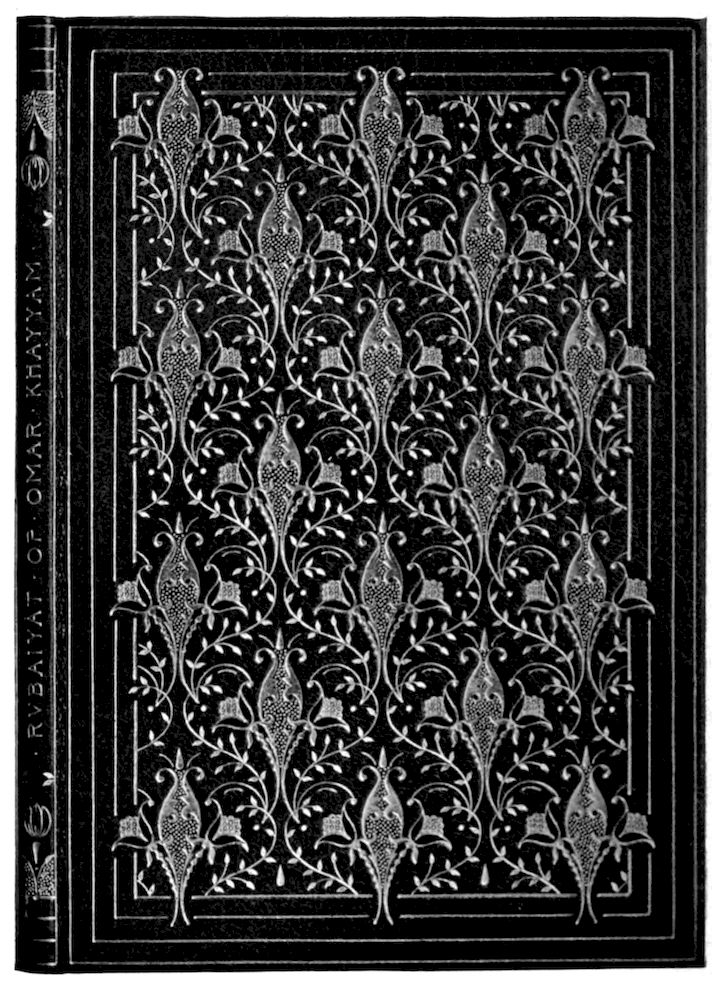
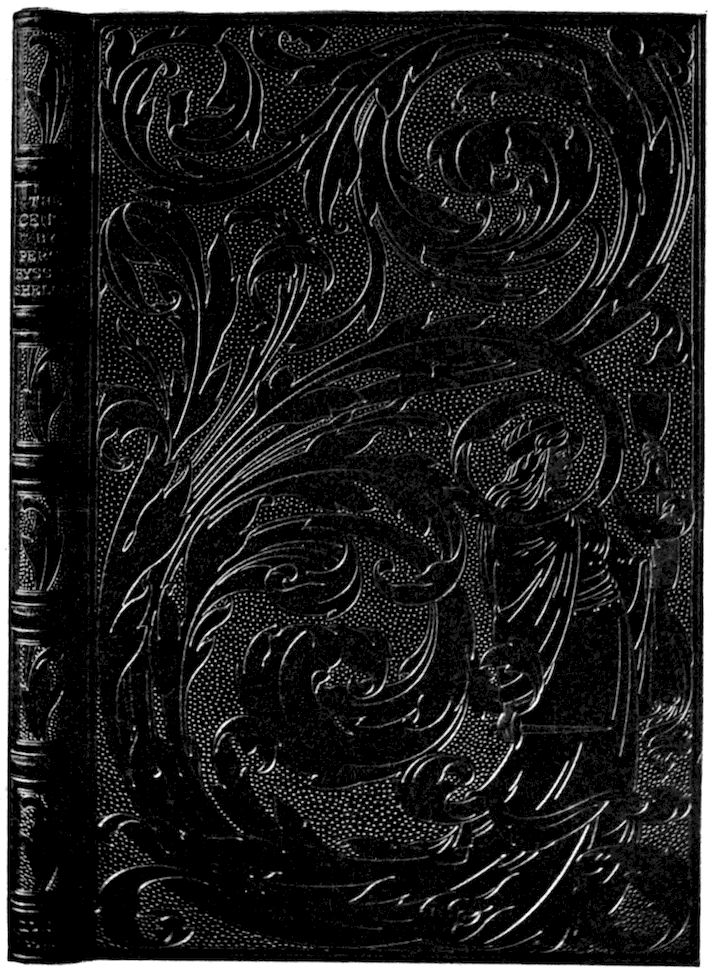
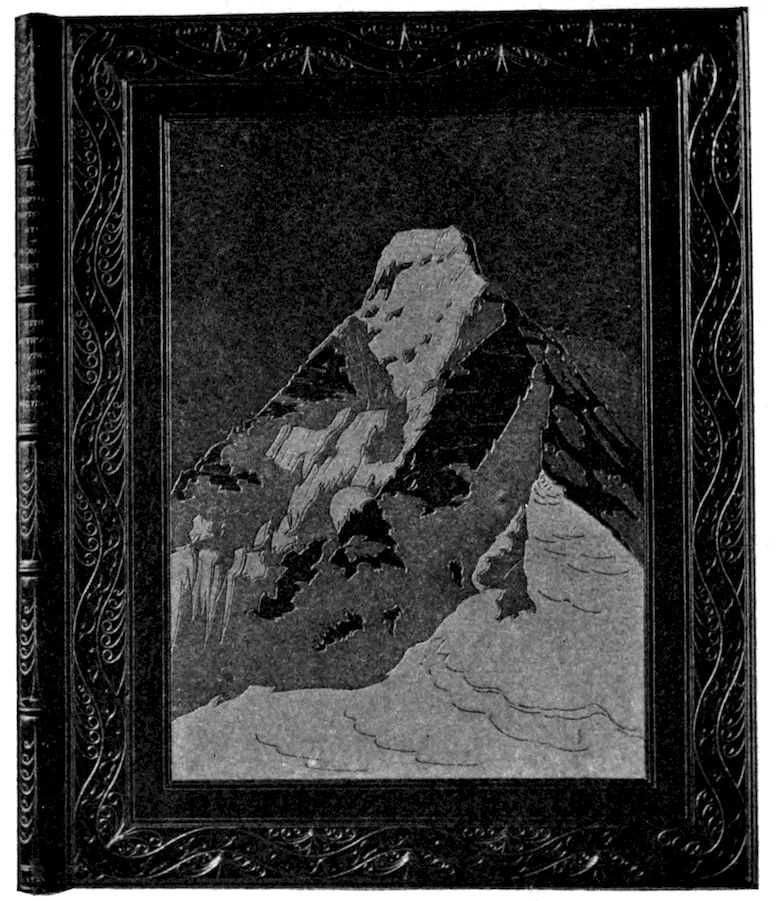
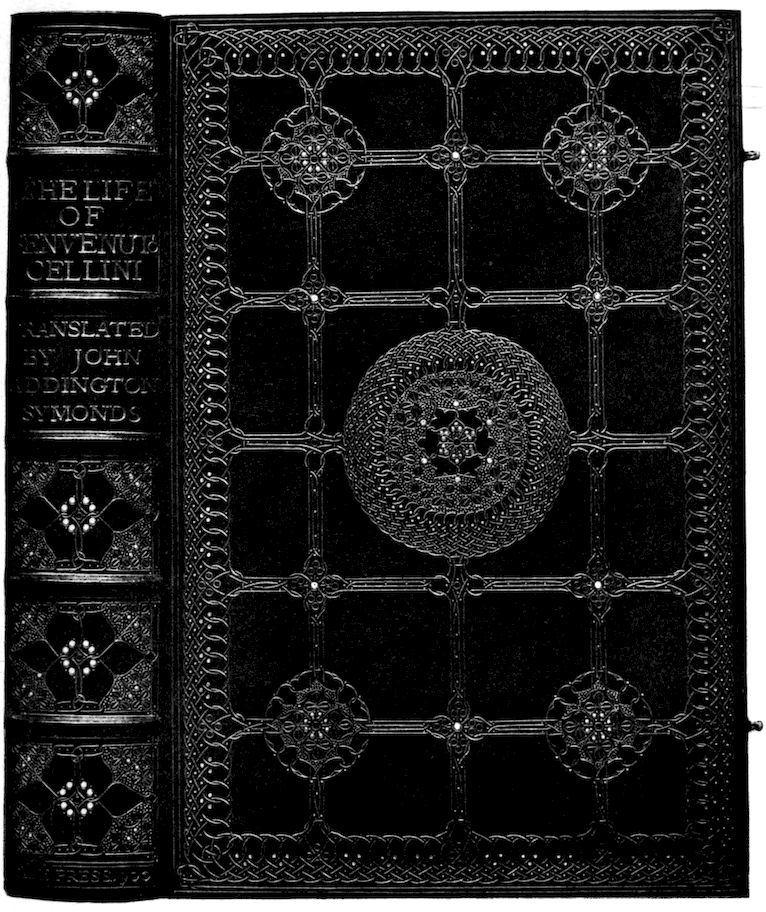
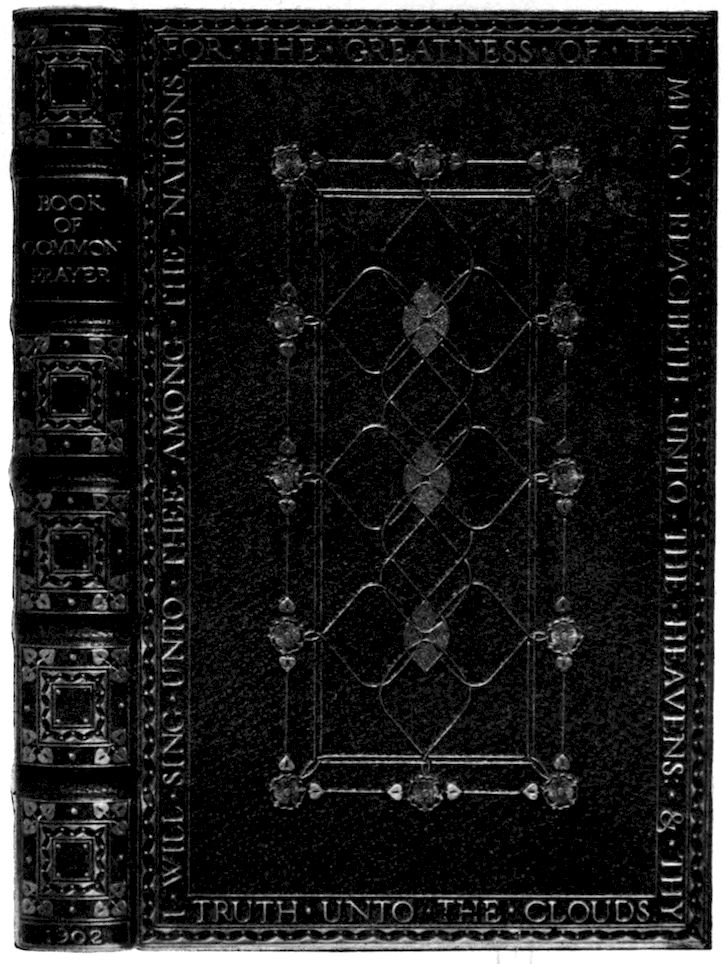
2. Bound by Zaehnsdorf.
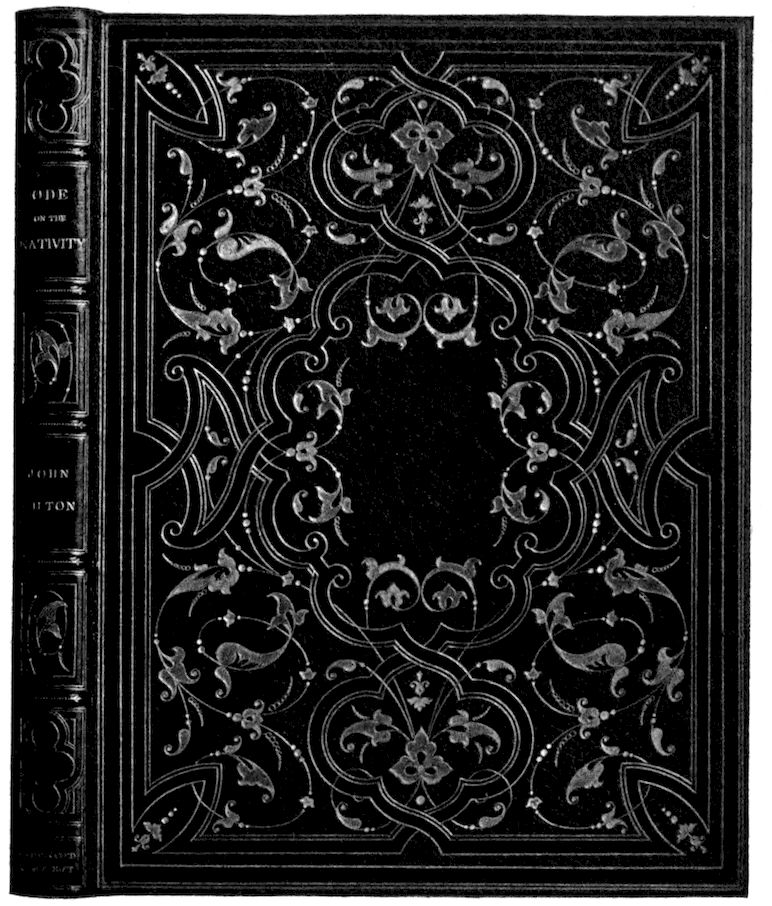
3. Bound by Zaehnsdorf.
7That an increasing number of people
appreciate the problem of designing book
covers may be judged from the fact that
of late years nearly every illustrated paper
has had an occasional article on one or
another binder anxious to attract the public
to the originality of his work. Assuming
this appreciation, we will touch briefly on
the craft in England before its revitalization
during the last quarter of a century, and
then pass in review those who are now
8occupied with its decorative side and who
are trying to remove it from the traditional
grooves in which it lay for so long.
Unfortunately, many binders doing excellent
and conscientious work, on lines far
more valuable than that of pattern making,
must remain unnoticed, for it is only work
that is striving after an effect of ornament
that is capable of illustration. Of this,
too, the amount has so much increased of
late that it is impossible to give examples
of much that equally deserves representation
with what has been selected.
For a true understanding of modern
effort it is necessary to realize that the
art history of binding is an important one,
especially in Italy and France; but in this
very brief review of English binding before
1850, we need not start further back than
the time when gilt tooling was brought from
France. Before that period the heavier
covers had been decorated with stamps often
of a very beautiful kind and impressed upon
the leather without gold. But in the reign
9of Henry VIII., Thomas Berthelet, the King’s
printer, first executed gold-tooled bindings,
the designs on which were frankly adopted
from those that prevailed in Italy, the
models, no doubt, being found among the
large number of books imported from abroad
at that time. Later on, when Italian binding
as a fine art had been merged in that of
France, the influence of the latter country
is seen, as, for example, in the books bound
for Thomas Wotton in imitation of Grolier,
one of the most famous collectors of any
age or country. Throughout the reigns of
the Stuarts, English binding continues to
show French influence, as a glance at the
books exhibited to the public in the British
Museum will show to the most casual observer.
Nor had we a binder who can be
said to have shown any tendency towards
a native style till the time of the Restoration,
when Samuel Mearne, bookbinder to
the King, inaugurated what is known as
the ‘cottage’ form of decoration. Though
the elaborate filigree work on his books
10reminds one that Le Gascon exercised an
important influence, the form of the ornaments
and their arrangement remain distinctly
English. A development of this
style, equally native in character, may be
found a little later, during the first part
of the eighteenth century, chiefly on the
Bibles and Prayer-Books of the time. In
these there is a certain amount of rough
inlay, either in the form of a panel or in
that of tulips and other conventional flowers
outlined in gold, though with a dotted instead
of a solid line. These ornaments,
poor in themselves, which form the main
part of the decoration, are often combined
with great skill and sense of effect. An
unusual number of such books were collected
at the time of the Exhibition of Bindings
at the Burlington Fine Arts Club, and
were found both charming and effective
notwithstanding a somewhat rough and
hasty workmanship. From the reign of
James II. to the time of Roger Payne there
are no names associated with any bindings
11of importance; and with the passing of the
prevailing fashion of ornament on the books
just described, design reached its lowest
point towards the end of the century. Of
Roger Payne, who effected a genuine revival
of bookbinding somewhere about 1770, it
is not necessary to say much. His style
is well known to all book lovers, and the
details of his eccentric life have been so
often recorded that the reader must be more
than weary of them. One point in connexion
with his work is, however, I think,
worth mentioning, and that is that his style
has never lent itself to that modification in
imitation which enables any artist to become
the founder of a school. Any one of the
skilled binders will do you a ‘Roger Payne’
as he will do you a ‘Grolier’ or a ‘Le
Gascon’; but it will be a reproduction of
the real Roger’s work, with the exact details
and precise arrangement of them that are
to be found on his authentic bindings. So
that, notwithstanding his originality, he inspired
no following, though his imitators
have been perhaps more numerous than
those of any other binder.
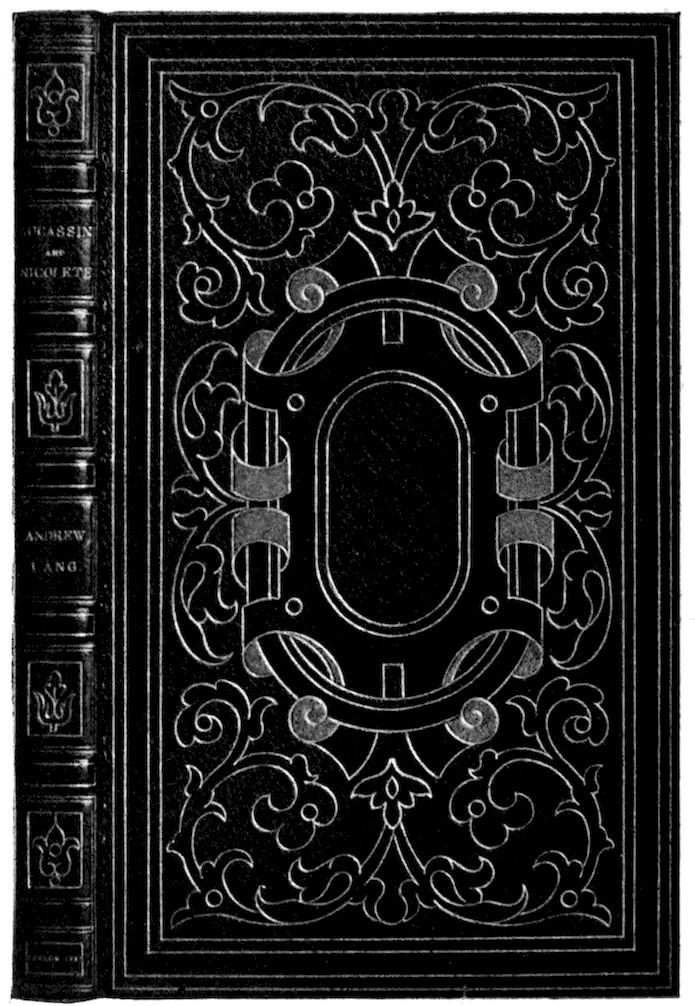
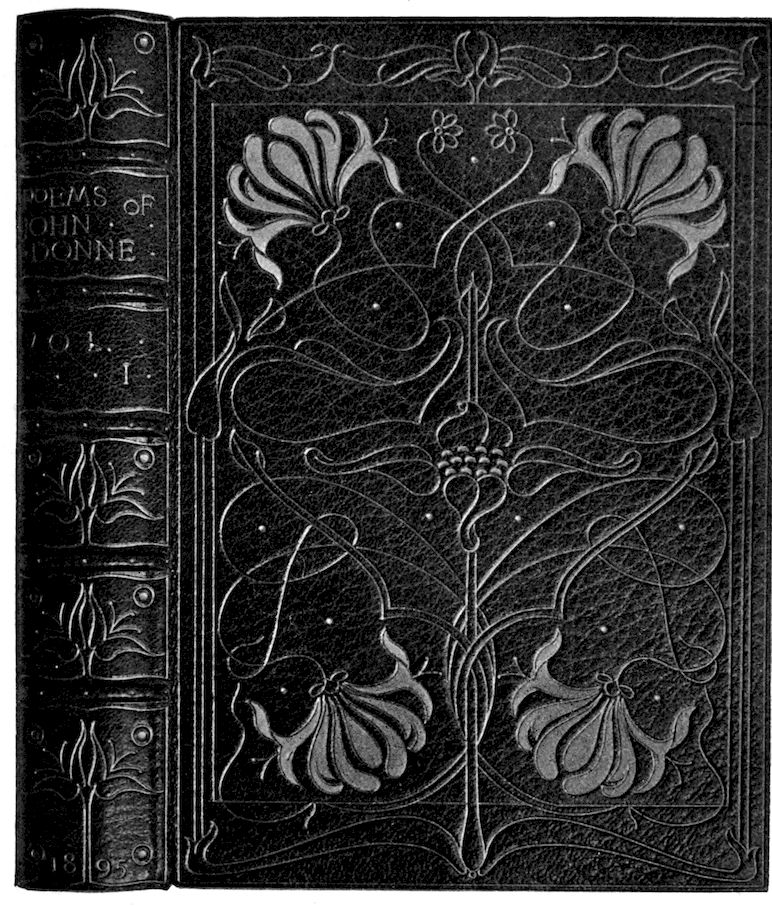
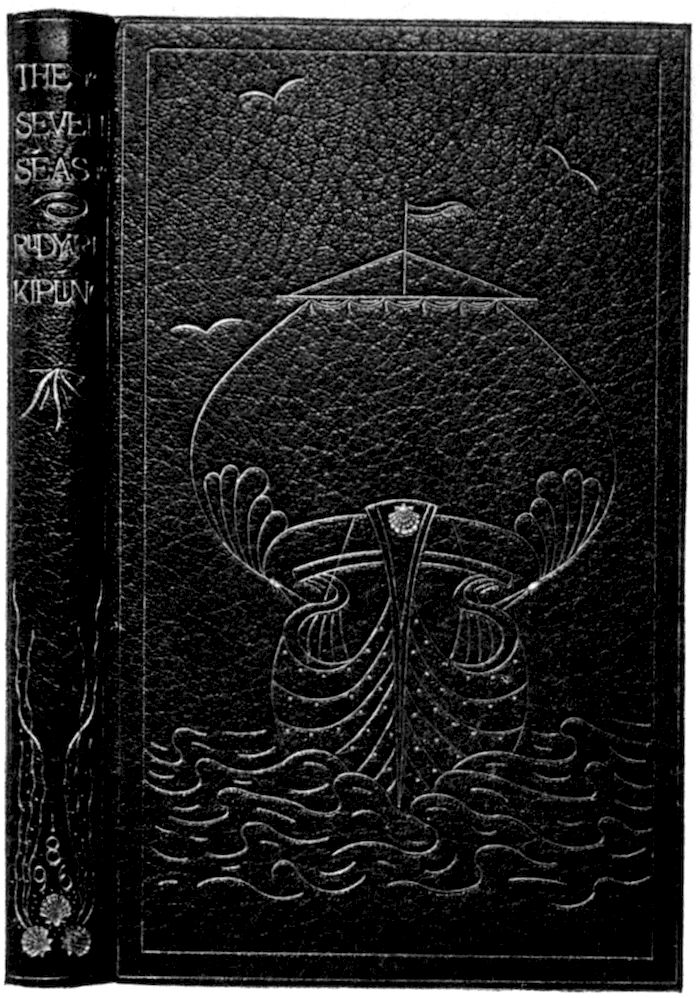
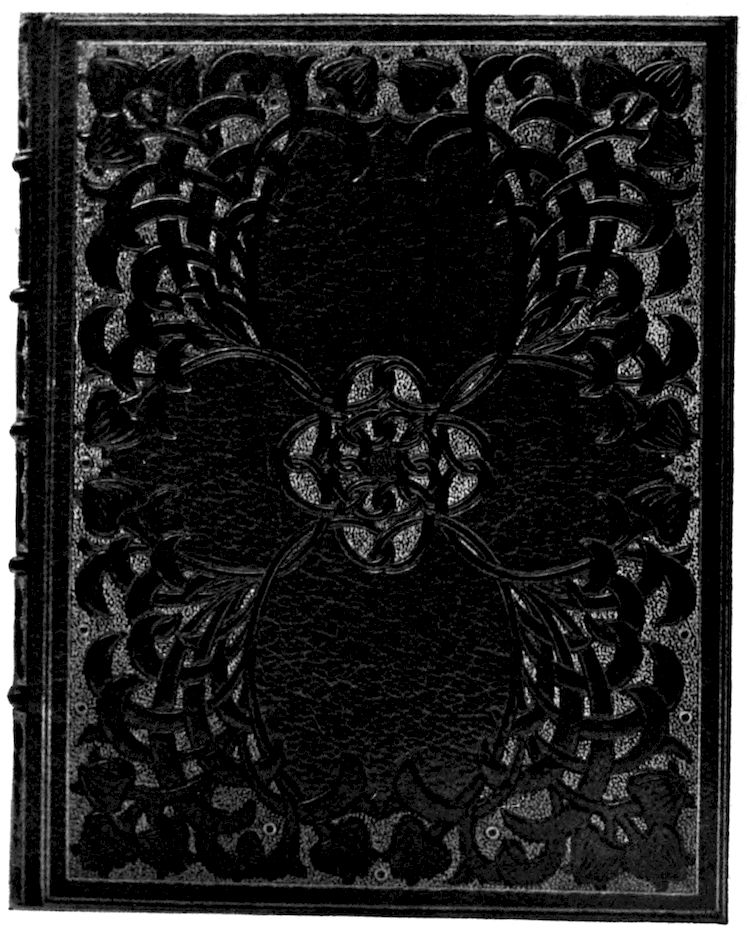
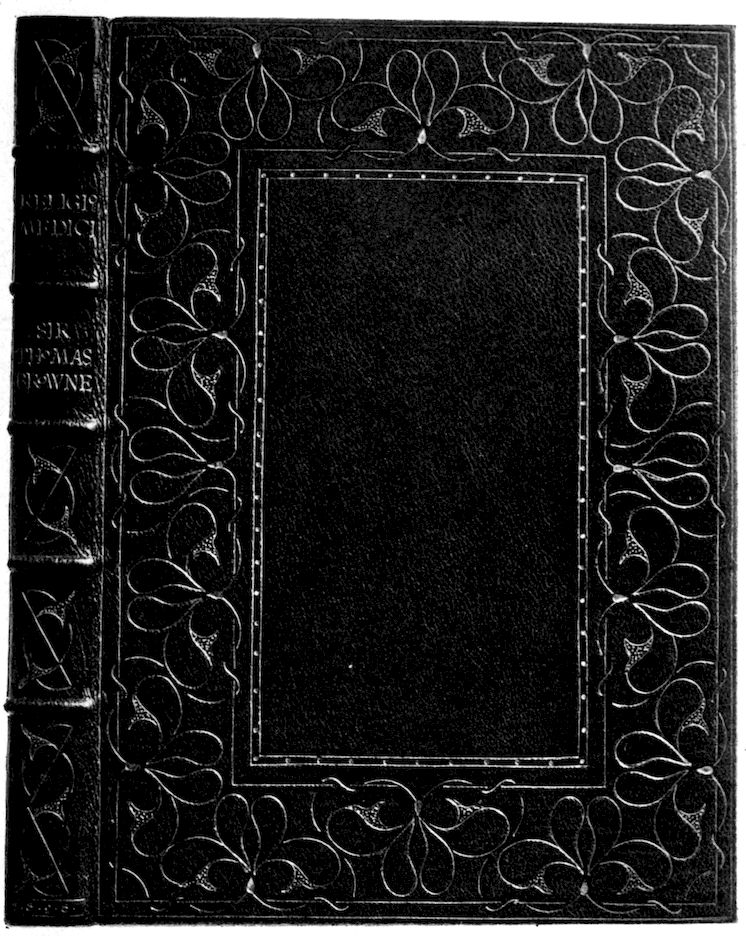
4. Bound by Rivière.
5. Bound by Rivière.
12Charles Lewis and Frances Bedford,
followed by Robert Rivière and Joseph
Zaehnsdorf, did much good work in the
early part of the last century, especially
Bedford; but they can lay no claim to an
originality which disappeared with Payne,
and which was not seen again until Mr.
Cobden-Sanderson attempted to do for the
binding of books what William Morris had
already done for the other decorative arts.
It is the result of this revived interest in
handicrafts and the attempted application
to binding of the more vital principles of
art which it is proposed to illustrate here.
One must say attempted, because success
by no means always results. In this review,
however, of modern binders, definite
criticism is not an object, though the difficulties
attendant on their efforts naturally
come up for consideration and necessarily
involve some expression of opinion.
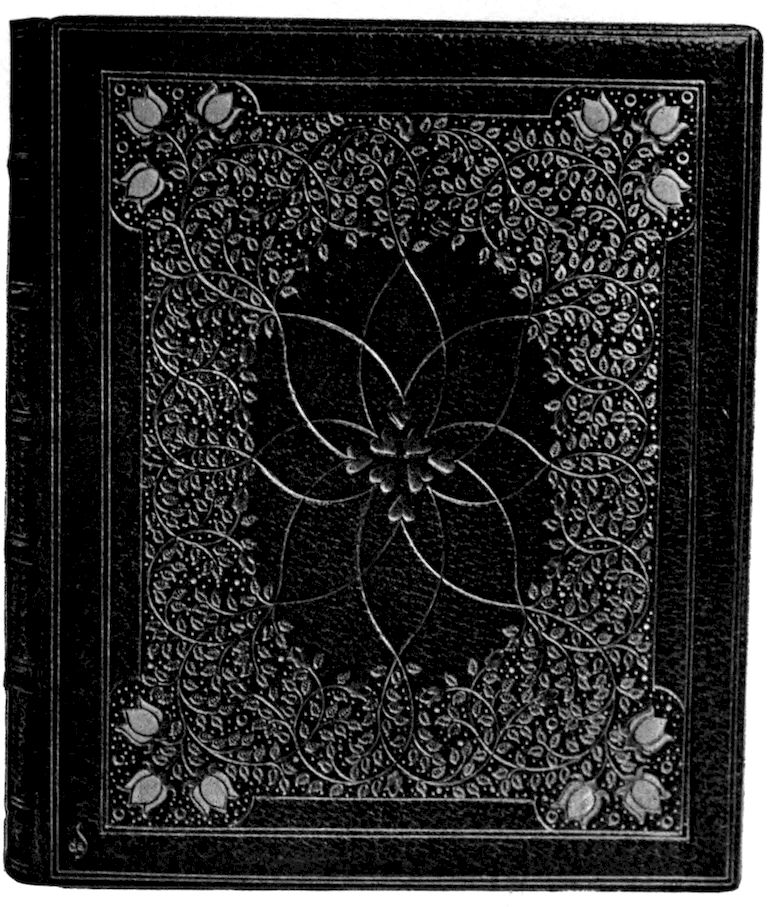
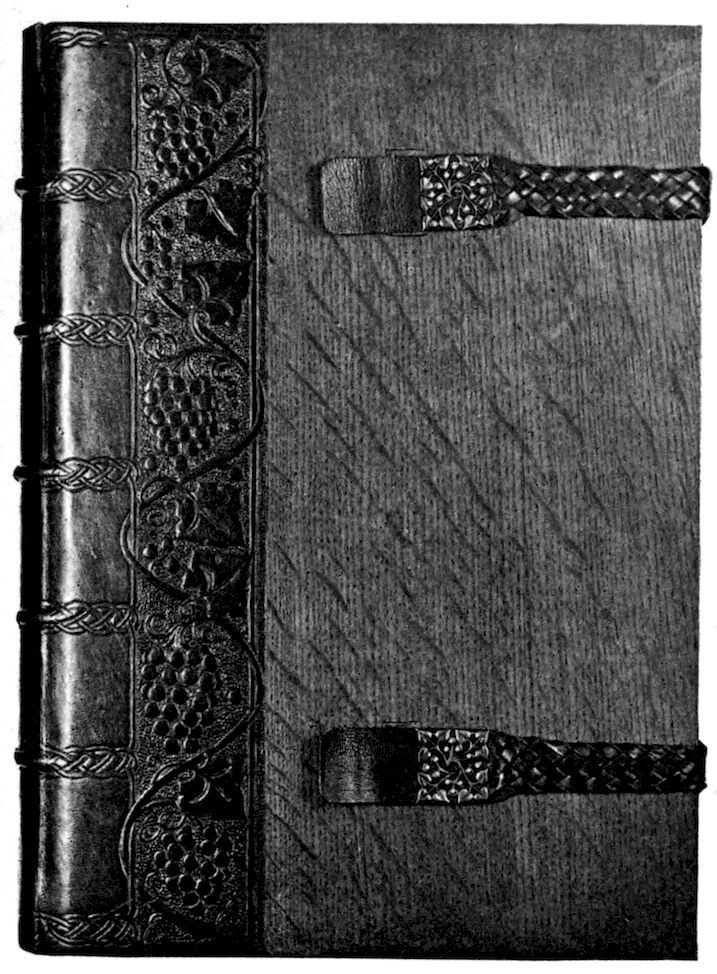
6. Bound by Morrell.
13Both Zaehnsdorf and Rivière left representatives to carry on their work, the former
a son, and the latter two nephews, Mr.
Percy and Mr. Arthur Calkin. From the
small establishments in which both houses
originated there has developed in each case
an important business in which an exceedingly
large number of books are bound for
the export as well as the retail trade. In
a bindery of this nature there would not be
time for the serious consideration of artistic
problems unless it contained what Mr.
Lethaby so aptly describes as ‘a “quality”
department in a “quantity” business.’ It
remains as true now as it has always been
that the craftsman who is also an artist
must work in his own way and at his own
speed—a fact well realized in the French
workshops, which are altogether outside the
rush and pressure of commercial life. So
in each of these houses we find a certain
number of the more intelligent and skilful
men employed only upon the best work, and
engaged in carrying out designs which they
either make up themselves from certain
14recognised types or which are made for
them by more practised designers. This introduces
the question—which is a practical
one for the large employer, though it need
not exist for those having a comparatively
limited output—whether it produces better
results to keep a trained designer, or to
give the pattern making into the hands
of the more artistically disposed ‘finishers.’
Some consider that it is impossible, so long
as the education of the workman is so
lamentably defective on the side of taste
as it is, to expect him to plan book covers
above the ordinary level of presents and
school prizes; others hold that his feeling
for what is good and appropriate can only
be cultivated by encouraging him to the
interest and responsibility of planning what
he is going to execute. Mr. Calkin has
long kept a designer entirely occupied on
the decorated work that many of his clients
demand. Other houses have tried the practice
of getting drawings made by the general
decorative artist, and have given it up in
15disgust at the unpractical character of the
results obtained. And it is true that it
takes time and patience to train one accustomed
to a free hand in invention to a
realization of the limitations necessitated by
the use of rigid stamps and the comparatively
small number of them that can be
employed on a binding.[1] Ask any professed
16pattern maker to make you a device for a
book cover, and you will get something
which, though it may be satisfactory and
attractive in itself, will be either impossible
of execution or give the most disappointing
results. Naturally, where any firm happens
to possess workmen of the required taste
and ability, they should be encouraged to
the utmost to give effect to their sense of
drawing in its application to their own
trade. Messrs. Morrell, whose large business
is entirely a wholesale one, supplies
all the booksellers with bindings designed
by his men and remarkable for their variety
17and merit. It is too early to speak of the
influence of the technical schools upon the
output of the large workshops, but when
one knows that the three houses above
mentioned employ some 200 men between
them, it can easily be imagined that the
training of the workman is a serious consideration.[2]
It is customary now for binders
to keep a record of their more special work,
and in this way the extent of their range
can be noted by the employer and undue
repetition prevented. Another improvement
on the past is that designs are not
now multiplied as they used to be—that
is to say, in the best class of work. A
specially planned cover is not repeated or
even published without the owner’s consent;
and this is a wise plan, for all art, even the
best, suffers by vain repetition, and a good
and appropriate pattern on a book will be
but a weariness to the eye when it is seen
in multiplicity in booksellers’ windows.
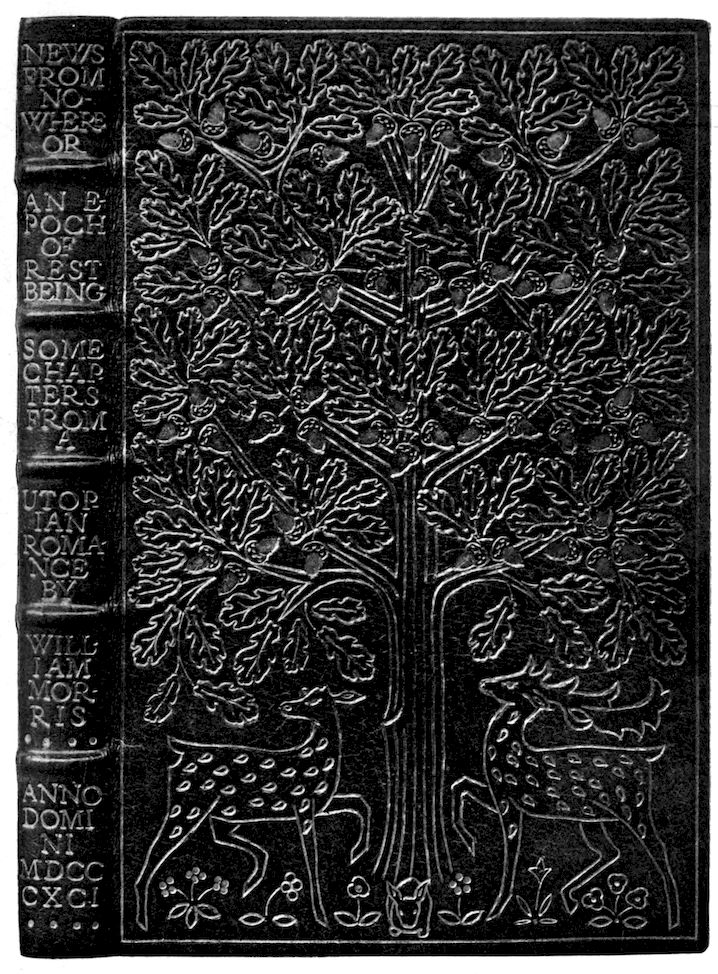
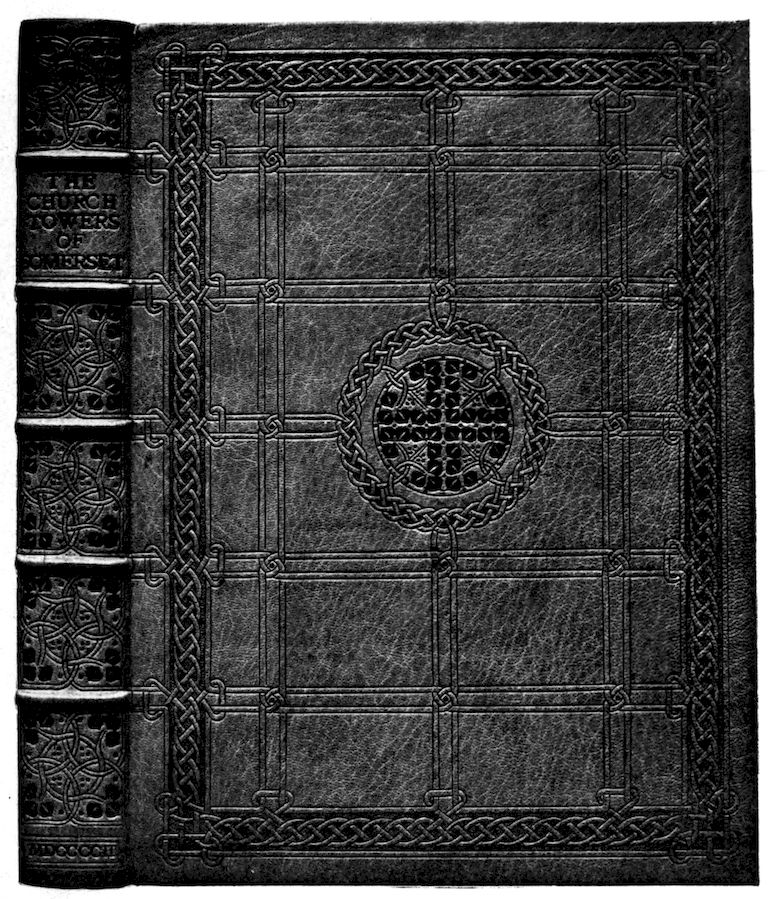
7. Bound by Morrell.
8. Bound by Morrell.
18The concluding illustrations in this chapter
show work done by Mr. Roger de Coverly
and Mr. Harry Wood. Mr. de Coverly
served his apprenticeship to the elder
Zaehnsdorf, and was afterwards employed
for many years by Messrs. Leighton. In
1863 he set up for himself, and his sound
taste being discovered by Mr. F. S. Ellis
and Mr. William Morris, he soon got the
custom of many of those who were then
seeking its application to bindings. In 1883
he took one of his clients, Mr. Cobden-Sanderson,
as a pupil, and has had others
since. He considers his speciality to be
vellum work; but unfortunately this does
not show well in reproduction. Mr. Wood
was also with Zaehnsdorf, working for him
as a finisher for twelve years. He subsequently managed and in the end bought the
business of Mr. Kaufmann in Soho, which
he has greatly expanded, and which is now
managed by his son. Neither he nor de
Coverly have ever sought the heavy expenses
and responsibilities of a large undertaking,
but have been content with a
personal business in which they themselves
have always taken an active part.
9. Bound by de Coverly.
19
Although the chief place to study bookbinders
and their craft is naturally London,
there are several provincial centres where it
flourishes, and where it has been touched
by that movement for developing the artistic
as well as the business side which we
noticed in the previous chapter. In large
country towns it is impossible for work to
be as much specialized as it is in London;
consequently a large bindery will do business
of a most miscellaneous kind, embracing
everything from pamphlets to fine-tooled
morocco bindings, and including albums,
ledgers, library and school books for prizes.
Mr. Fazakerly in Liverpool, Mr. Birdsall
in Northampton, and Mr. Chivers in Bath,
all have establishments more or less of this
kind.
10. Bound by Fazakerly.
11. Bound by Fazakerly.
20Mr. Fazakerly was one of the first
binders, certainly outside of London, who
refused to support the excessive competition
in cheapness, and who struck out a department
in which fine work could be executed
at prices that were remunerative and not
prohibitive. Happily the result of his
efforts shows the success of a refusal to
pander to that desire for cutting prices
which has done so much to ruin the crafts
on their artistic side. For some time after
he had educated his workmen to the
responsibility of his new venture, he found
that the taste of his customers lay towards
a reproduction of old models, but he has of
late been quite successful in directing it on
to new lines. One feature may be noted in
connexion with the morocco work of Mr.
Fazakerly, namely, that the under cover is
rarely decorated with the same design as the
upper. If the lower cover is left quite
plain, the effect is poor, and suggests that
trouble has been spared on the book as a
whole; but there is no reason for the convention,
21almost universally adopted, whereby
the two sides are entirely alike. The
same tools and elements of design should
appear in each cover, only disposed in
different schemes of ornament, and such
variation naturally implies more thought, the
thought that avoids repetition. One of Mr.
Fazakerly’s innovations was the employment
of embossed leather, which has since spread
to many other houses; and another which
he considers a specialty of his business is
the decoration of the edges of books, both
by means of tooling on them or gauffering,
as it is more generally called, and also by
painting underneath the gold. We may
recall that in the sixteenth century this extension
of ornament to the leaves of a book
was very prevalent, and was only one of
many indications that the workman spent
ungrudging time and thought on the details
of what was intended to be a work of art
throughout.[3] Some very fine specimens of
22gauffered edges may be seen on the works
of Luther in seven folio volumes, dated Jena
1572–1581, now in South Kensington
Museum. The volumes being very thick
offer fine scope for ornament, which consists
of the shield of Saxony painted in the centre
of each foredge, the rest of the space being
filled with arabesques and Renaissance
ornaments. And there is, we believe, still
in this country part of the library that once
belonged to Odonico Pillone of Belluno,
comprising some hundred and forty folios
with foredges painted by the hand of
Cesare Vecellio, a nephew of Titian.[4]
23The painting of edges was revived in
England, and reappears in thoroughly
native style on books of the latter half of
the eighteenth century. Charming little
English landscapes are to be found on some
of them, which, as the painting is done when
the leaves are fanned out and held in that
expanded position, are not in evidence when
the book is shut, but when open appear at
once. The name of William Edwards of
Halifax and his son James is especially
associated with this work, and their books
are not very rare. Mr. Fazakerly has done
a great deal of this decoration, which requires
certain conditions to ensure success.
The painter must be an artist, and the
paper on which he works should be rather
thin than thick; the modern fashion of
printing on a sort of cardboard handicaps the
binder not only in this, but other and far
more important ways. Mr. Fazakerly has
24also made some innovations in ‘doublures,’
a term applied to the inside face of the
boards when lined with leather or decorative
material. In the matter of doublures
the last word has not been said, and there
is still room for experiment. The French
custom of violent-coloured watered silks
or equally salient inlays has never found
much favour in this country; but there has
been a great dearth both of invention and
taste in dealing with this feature of a binding.
Some of Zaehnsdorf’s doublures have
silk either of the same colour as the cover,
or in harmony with it, and he has tried
Russia leather with considerable success.
Unsuitable as it is for the outside cover
from its tendency to rapid deterioration, it
makes a very good board lining, and can be
employed as well for the flyleaf opposite;
indeed, it is better where possible that
doublure and flyleaf should be the same. It
is with calf that Mr. Fazakerly has made
his innovation, and when delicately tinted
and incised, but not embossed, the results
25seem pleasant and appropriate. On books
relating to Japan, the number of which is
largely on the increase, some of the coloured
Japanese embossed papers make excellent
doublures. Before dismissing this subject,
we may mention the attempt of Mr.
Bagguley, a binder at Newcastle-under-Lyme,
to tool on vellum in colour. Some
of this work, designed by Léon Solon and
Miss Talbot, is very delicate and attractive;
so delicate, in fact, that it is only suitable
for the inside of a book. His patterns are
composed chiefly of gouge and line work, as
no effect of solid mass can be apparently got
in the colour, and the effect is enhanced by
dots and other small tools worked in gold.
The excessively detailed nature of this work,
which is made up of ‘tools’ small and light
in character, heavier dies not being suitable
for the stamping of colour, render it costly
of execution, but there is no doubt that its
occasional use offers a desirable variation on
the ordinary inside lining. It is difficult to
close this subject without a few words in
condemnation of the coloured papers used
by most binders for ordinary work which
does not admit of anything more elaborate.
It is time they gave up the German marbled
patterns, the French ‘combs,’ and even the
spirit marbles which produce the effect of
violent colour thrown on wet blotting-paper
and appear to be the latest fashion of monstrosity
in such things. Good white handmade
papers or vellum papers are the
most suitable, while if coloured ones are
deemed essential, the French and Van
Gelder crayon papers toning harmoniously
with the morocco are not likely to be an
offence.
12. Bound by Chivers.
13. Bound by Chivers.
26The business of Messrs. Birdsall at Northampton
takes us to another centre of provincial
activity in binding, and it has an
especial interest in being one of the oldest
bookbinding businesses in the country. It
has been in the hands of the present proprietors’
family well over a hundred years,
and has a connected history since 1757,
when John Lacy, a banker of Northampton,
27acquired it and associated with it a bookselling
business which he had also in the
town. On giving up work in 1792 he sold
both to William Birdsall, a Yorkshireman
by birth, who had settled there, and in this
family it has remained ever since. We
spoke before of the varied nature of the
work carried out by country binders, and on
Messrs. Birdsall’s premises we find a department
of manufacturing stationery, another
for the wholesale paper trade, a third for
commercial bindings in which are included
certain special registered bindings patented
for serial work, such as the ‘Stronghold’
and ‘Biblia fortis,’ suitable for free libraries
where the usage is rough and constant, and
lastly, one set apart for highly finished
leather and vellum books. The works are
always kept in the highest state of efficiency,
and the workmen are encouraged to excel in
skilled and conscientious work. Many of
these have passed a lifetime there, and
though the business is not of a co-operative
character, a bonus is distributed to the older
and more efficient workers at the end of the
year.
14. Bound by the Oxford University Press.
28Mr. Chivers, of Bath, has brought an unusual
amount of originality and enthusiasm
into the service of his craft. His father
was a binder there before him, and the son,
after working with Chatelain in London,
decided to settle in his native town. For
some time his specialty was a binding for
public libraries patented under the name of
‘Duro-flexile,’ and this, together with other
library appliances, brought him a connexion
with librarians all over the country who
were occupied with the problems presented
by the particular nature of their work. He
has brought considerable invention to bear
upon these problems, and in certain cases it
is not likely that a more satisfactory
solution will be found than that which he
has introduced. Besides these practical
matters he has made certain styles of decorating
book covers especially his own, and
one of these he has developed with considerable
success. This consists in a scheme
29whereby designs are painted on paper and
then covered with transparent vellum, so
that there is no limit to the colour effect
that may be produced. We have already
mentioned James Edwards, of Halifax, who
settled in 1784 as a bookseller in Pall Mall,
and whose love of books caused him to
direct his coffin to be made from the shelves
of his libraries. In 1785 he took out a
patent ‘for embellishing books bound in
vellum and making drawings on the vellum
which are not liable to be defaced by destroying
the vellum itself.’ The description
further contained in the patent has never
been found possible of imitation, which may
or may not have been intentional on his
part. The British Museum shows a Prayer-Book
bound by him in this style for Queen
Charlotte, wife of George III., which has
likewise a foredge painting beneath the gold.
His patterns were frequently Etruscan in
character; but as his range of decoration
was limited and the vellum he used insufficiently
transparent, his books are only
30of moderate interest. Mr. Chivers’ plan is
a much simpler one, and if the designs are
given into the hands of artists, very original
results can be obtained. The French have
one binder—M. Carayon—who is famed
for a class of book cover that gives something
of the same effect. The best-known
painters both in water colours and black and
white are employed to decorate the white
vellum that clothes so sumptuously the
finely illustrated books that his countrymen
admire so much. These will, however,
stand no usage of any kind, and can only be
kept in cases carefully made for their protection.
The vellucent work of Mr. Chivers
being beneath the vellum runs no risk of
deterioration and can stand even more than
the usual wear and tear. Sometimes it
appears as if the colours chosen were too
strong, producing in some cases rather the
effect of the highly coloured supplements
that appear at Christmas in our illustrated
papers; but that, of course, is not a criticism
that belongs to the method, but is rather a
31counsel of perfection for a more delicate
application of that method. The desire for
colour has appeared constantly in the history
of bookbinding. We see it first in the
Venetian books brilliantly painted in lacquer
in the Persian and Saracenic style taken
from Arabian manuscripts, then in the strapwork
coloured with a varnished incrustation
like enamel, the best of which, French and
Italian, is found about the middle of the sixteenth
century. This method has proved
very perishable, and has never been revived.
Later on we get the inlaying of coloured
leathers, which reached its most interesting
development in the eighteenth century, and
has retained its hold on public taste ever
since. The earlier painted strapwork was
freely copied in mosaics of leather; and
when we come to deal with present-day
French bindings, we shall see the new style
of inlaid decoration to which these have
given place. The vellucent method of Mr.
Chivers is full of delightful possibilities if
confined to books to which it is suited, and
32when employed in a rather lower colour
scheme as suggested. Nor is it necessary
for the whole cover to be of vellum, for
it is possible to introduce a panel only
of the transparent material over a picture,
and to incorporate this in the morocco,
giving the effect of an enrichment of
enamel.
Another style which Mr. Chivers has
done much to popularise is calf, embossed
and incised and sometimes coloured by hand.
In this, as for the vellucent bindings, he
draws freely upon outside talent. Mr. H.
Granville-Fenn is general artistic adviser,
and Miss Alice Shepherd and Mr. S. Poole
have long been associated with him in the
execution of this work.[5] Some of the ‘cuir
33ciselé’ that has come down to us from the
past, and which originated in Germany, is
very fine in character, as any one can see
who studies some excellent examples exposed
in the British Museum. There seems
no reason why it should not have a satisfactory
revival; in France, indeed, this has
already taken place, as we shall see later
on, but in England there is still too much
‘prettiness’ associated with it, and one is
apt to think it more suitable for card-cases
and blotting-cases than for bindings. What
results it can yield when the design is
severe and dignified and the treatment finely
chiselled may be observed on the Pantheologia
by Rainesius de Pisa, a folio dated
about 1475, one of the Museum books just
mentioned.
15. Bound by the Oxford University Press.
16. Bound by the Oxford University Press.
35The last illustrations in this chapter show
work from the binding department of the
Oxford University Press. The Press itself,
located in special buildings in Oxford built
in 1830, is divided into two parts, one
devoted chiefly to the printing of Bibles
and Prayer-Books, the other to classical,
scientific and general printing. It is entirely
self-contained, making its own paper,
ink, type, stereo- and electro-plates. The
University type foundry is the oldest in
England, and at the paper mills at Wolvercote,
near Oxford, the famous India
paper is made which has brought very
great changes into the book trade. The
publishing and binding house, lately at
Amen Corner in the City, is now at St.
Dunstan’s House, Fetter Lane, and thither
are sent all the books from the Press as
soon as printed. In the Paris Exhibition
of 1900 the Press showed a considerable
number of decorated bindings in addition to
the exhibits from the other departments.
The Oxford Press designs are very varied
in character and include some excellent
36inlays; they are made by the more artistic
among the workmen, and speak highly
for the level of taste attained in the
bindery.
17. Bound by the Guild of Handicraft.
37
In bringing forward what may be called
the younger generation of binders, it is
natural to speak first of Mr. Cobden-Sanderson
as the source from which they have
drawn much of their inspiration. His work,
however, is not represented here, as it would
be discourteous to go against his wishes in
the matter. Whatever may be the reasons
for his change of attitude in this respect,
he has in the past done a great deal to
introduce his work personally to the public
and to explain his method and ideals. The
pages of the British Bookmaker, a trade
journal no longer in existence, the English
Illustrated Magazine, the Fortnightly Review,
testify to his former willingness that
his work should be known and appreciated.
He has also been one of the main supporters
38of the Arts and Crafts Society since its
inception in 1888, and his books have been
the largest contribution to binding in its
occasional exhibitions. There too, as well
as at the Society of Arts and elsewhere in
London and the provinces, he has lectured
on the craft, setting forth what he conceives
to be its purport both in the limited matter
of its processes and achievements and in
the wider aspect of its relation to the wants
and progress of society. Not long ago he
published a book on Industrial Ideals, which
it is interesting to compare with the collected
papers by Mr. William Morris which
have appeared on that and kindred subjects.
Mr. Morris always held up the ideal of the
Middle Ages as the goal towards which to
strive. It was a time, he considered, when
the processes or means by which life is
lived constituted the end of life itself, without
seeking for some other end external
to them and often incompatible with them.
This idea of ‘art being the highest function
of life’ was the gospel to which he never
39ceased to direct the attention of his followers,
and the next step—the attempted
re-organization of life into conditions that
enable art to realize itself—thus followed
as a matter of course. As a protest against
the mechanical exploitation of the arts for
the sake of commercial success in its worst
sense, and with the attendant evils of excessive
competition, such a creed is most
valuable, and has already had an important
effect on the decorative arts which we trust
may be permanent. But it would seem
mistaken in theory and impossible of practice
to attempt a reversion to mediaeval
ideals with the wholly altered conditions of
production, distribution and mode of living
that are now part and parcel of modern life.
A crusade against the existing conditions
in which works of art are produced must,
one would think, if its criticism is to be
operative, find some way of including in
its scheme of regeneration the great movements
of commercial life which is one of
the features of the age, and which even the
40most optimistic could hardly hope to stem.
Here and there an individual may achieve
a career somewhat in accordance with
mediaeval ways, content with the limitations
imposed by this ideal; but except in
such isolated instances it does not seem
possible to return to the practice of the
past, when, as Mr. Lethaby says, ‘the
designer of a gold cup made it and sold
it over the counter, and the art was thrown
in like a Christmas almanack.’ Here comes
in the problem mentioned in a previous
chapter. If, on the one hand, there is too
much tendency for the designer to be occupied
only in planning ornament for others
to execute with the result that a certain
inevitableness is nearly always wanting in
the finished product, yet it may be better
for a skilled workman to carry out the views
of an artist rather than try and evolve
variants from a few types set before him.
In the frequent advocacy of a revival of
past conditions which would benefit the
workman, there is one point that seems
41always left unnoticed—a point of great importance;
and that is the stringent means
taken in those days to protect the purchaser
also. In the scholarly little introduction
called ‘Art in the Netherlands’ which Mr.
W. H. James Weale contributed to the
Catalogue of the picture exhibition held
at Bruges in 1902, he gives a concise
account of the conditions under which alone
a man could become a painter in the fourteenth
and fifteenth centuries; and what
held good for painting held good also for
the minor arts of life. As long as the
craftsman belonged to the guild of his craft,
he was bound by its rules to carry out his
work honestly and conscientiously, to use
good materials, and to beautify it as far as
he was able. The corporation arranged for
the education of its members. They were
apprenticed to masters responsible both for
their technical efficiency and the fulfilment
of their duties of citizenship. Each was
bound to the other; the apprentice was to
give zeal in his service and the master to
42impart all he knew of his trade. Once the
apprenticeship at an end, the youth could
work, as what would now be known as an
‘improver,’ with any master he liked, and
in any town that he chose. Later on, in
order to become a master, he had to present
himself before the heads of the guild and
give proofs of efficiency, promise obedience
to the rules of the corporation, and swear
to carry on his work well and honestly.
Observe, however, that, although a master,
he remained all his life under the control
of the governing body of the corporation,
the members of which could enter his shop
at any moment, seize his materials if of
inferior quality, confiscate them, and inflict
punishment upon him. Lastly, in disputes
between himself and his clients the guild
was called in to decide between them. We
can imagine no condition less in touch with
the schemes of modern and social democracy,
which so often deal exclusively with the
needs of the worker and neglect those both
of the employer and the consumer.
18. Bound by Douglas Cockerell.
19. Bound by Douglas Cockerell.
20. Bound by F. Sangorski and G. Sutcliffe.
43In connexion with this topic, mention
should be made of Mr. C. R. Ashbee’s
experiment with the Guild and School of
Handicraft. It began its existence at Essex
House in East London, and, after fourteen
years, in May 1902, removed to Chipping
Campden, a small Cotswold village where
the wool trade flourished during the Middle
Ages and the silk trade in the eighteenth
century. The aim of the Guild is set forth
in a little pamphlet, distributed to visitors
at the Dering Yard Gallery, 67A New Bond
Street, where the work of the school is annually
exhibited. It need only be said here
that its object is to set a higher standard
of craftsmanship by liberating the workman
from the restrictions of the trade shop, and
directing his independence away from purely
individualistic efforts on to lines of art
service to the community, and that it is
conducted co-operatively, the men having
an interest and a share in the concern and
its government. While recognizing the
importance of what a man does and the
44conditions under which he does it, both to
himself as a citizen and to the community
for which he labours, the Guild endeavours
to strike a mean between the socialism that
cares only for the worker and the commercialism
that disregards him and his
idealistic as well as material needs. The
work carried out at Chipping Campden is
very various, and includes furniture, metal
work, jewellery, printing and binding. After
Mr. Morris’s death, Mr. Ashbee acquired
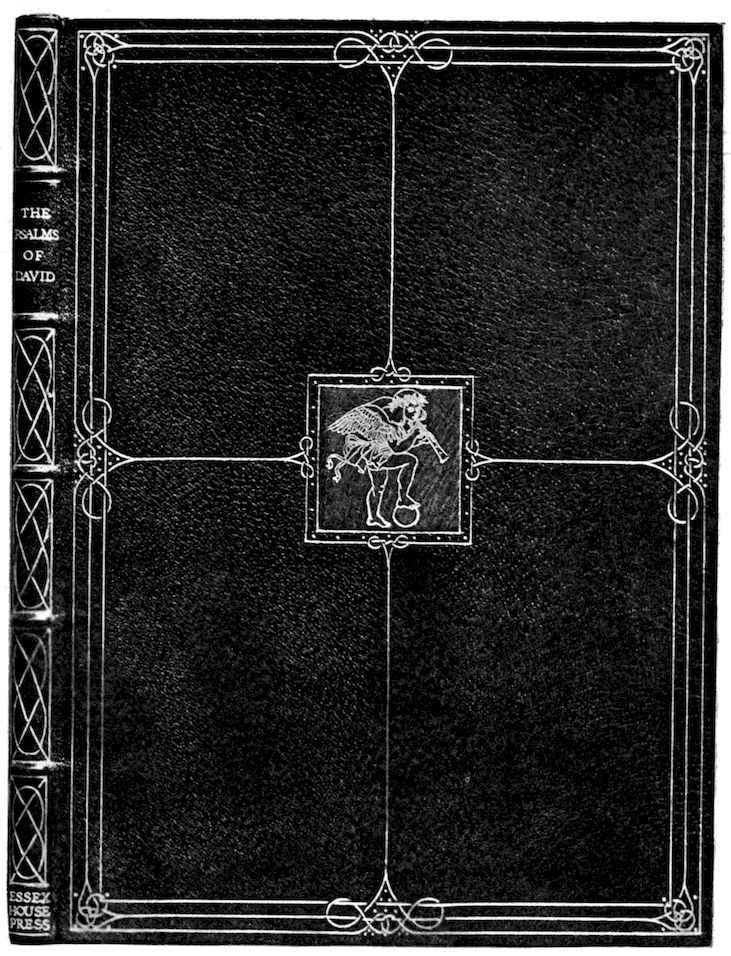
the plant hitherto in use at the Kelmscott
Press, and began a series of books, first in
a Caxton type and later from a fount of
his own design. Binding followed almost
as a matter of course on these issues from
the Essex House Press; and in connexion
with it, besides the ordinary plain-tooled
leather bindings, excellent in restrained
ornament, he has revived certain fifteenth-century
styles for which he has a special
predilection, and which include the use of
enamels and wooden boards, the latter often
carved in low relief. The bindings, though
designed for the most part by Mr. Ashbee,
are carried out by Miss Power, who is in
the main responsible for them. These
books raise again the question whether
such deviations from the ordinary paths
are legitimate attempts to enlarge the
limitations of the binder’s art. The ultimate
serviceable use of a book should ever
be kept in sight, and must in the end
determine the matter. Leather and vellum,
tooled with a few fine stamps, disposed with
taste and restraint, will always remain the
best coverings for books, because they are
unobtrusive and can be pleasantly handled
and easily disposed. Work that is embossed,
enamelled, carved, or even too decorative in
colour for unlimited production, can only be
desired as occasional specimens of interest
in themselves, and as exceptions proving the
rule.
21. Bound by de Sauty.
22. Bound by de Sauty.
45Mr. Douglas Cockerell, a pupil of Mr.
Cobden-Sanderson, has written the first of
a new series of technical handbooks on
the artistic crafts which is a model of the
46kind and should prove the text-book for
all future binders. It is, no doubt, the
outcome of some years’ teaching at the
County Council School in Regent Street,
where, for many years, he did excellent
work in training the younger men to an
intelligent interest in the various processes
of their craft. No craft can be well learned
anywhere but in a practical workshop; and
he considers the value of class teaching to
be limited to helping those engaged in a
trade, and that such help is of great value
in giving higher ideals and encouraging experimental
work. From the beginning Mr.
Cockerell has been specially interested in
the repairing of books and in the preservation
of old covers, and has given his pupils
some training in all that relates to the
care of books. There are numbers of old
bindings that after four hundred years of
wear and tear are still capable of fulfilling
their original purpose of protection, with
a little help from modern hands. To give
a new lease of life to fine old books is really
of far greater importance than the continual
production of new and pretty bindings. Mr.
Cockerell’s original work is well known both
here and in America, and there is luckily
a great deal of it that is simple as well
as highly decorated. It is comparatively
easy to do the latter; but a plain binding
that yet has the stamp of the maker’s
individuality is a very exceptional achievement,
and in work of that character Mr.
Cockerell is unsurpassed.
23. Bound by Miss Adams.
47Mr. F. Sangorski and Mr. G. Sutcliffe,
who were formerly with Mr. Cockerell, have
started a bindery of their own, and are
engaged both in teaching and doing varied
work of a pleasant character. Trained in
the methods of Mr. Cockerell at the
Technical School at 316 Regent Street,
Mr. Sutcliffe now controls the teaching for
the County Council at its branch establishment
in Camberwell, and Mr. Sangorski
that of the Northampton Institute in
Clerkenwell.
Mr. de Sauty is another young binder,
48and his work is of considerable merit. His
inlays are distinguished for the taste shown
in the association of colours, and his finishing
has some of the brilliant qualities of
the French school, seen particularly in the
finely studded tooling of which he seems
particularly fond. He has now the post
formerly held by Mr. Cockerell.
24. Bound by Miss MacColl.
25. Bound by Miss Alice Pattinson.
49In concluding this sketch of Bookbinding
in England as it appears to-day, we must
not omit to speak of the entrance recently
effected by women in many of the handicrafts,
and notably in the one under consideration.
Quite a number are now trying
to make a livelihood out of bookbinding;
and possibly, therefore, a few words less
of criticism than of counsel may not come
amiss. It may be said that there are
certain conditions absolutely necessary for
successful achievement, quite apart from
financial gain, which is another matter.
The first of these is a workshop training,
which, though impossible some years ago,
is now no longer so within certain limits;
that is to say, there are one or two binders
with small workshops who undertake to give
women systematic teaching for a limited
time. In a workshop they will see a
variety of work that they will miss if
taught privately, and they will learn the
habit of rapid and dexterous manipulation
of tools and materials without which it is
impossible to work quickly enough for a
profitable return upon the outlay. A
second most necessary qualification is that
they should have the physique for standing
and working at a bench during the hours
of an ordinary working day. For binding
is not like other less specialized crafts that
can be taken up at odd hours and laid aside
with equal facility, but needs concentration
of mind as well as sureness of hand. A
third element in the desirable equipment
is a certain faculty of imagination controlled
by right feeling or good taste, so that the
results of workmanship have the note of
individuality without eccentricity. In art
as in life, personality is the one thing needful,
50and we may fairly look to women to
show the realization of it that can hardly
be expected from those working in the
stereotyped grooves of production.
26. Bound by Miss Maude Nathan.
51And what is to be said of binding as
a means of livelihood? Experience has
shown that properly trained women can
do as good binding as men, though not
upon large and heavy work, and if they
do it well enough some of them can earn
a fair wage, while if they fail to reach a
high standard they had better for all practical
purposes let it alone. But to hold out
any inducement to the woman who really
needs bread-and-butter to take up binding
as a lucrative employment, as is done in
some quarters, should be characterized with
the severity it deserves. Many women need
but an addition to their income, and to such,
if they are willing to incur the expense of
training and plant, and if they realize the
experimental nature of the undertaking,
binding may be recommended as a sufficiently
pleasant occupation. Whether financial success comes, however, or not, must
depend upon the amount of work turned
out, on the originality and finish with which
it is executed, and last, but not least in importance,
on the finding of a market. Booksellers
are now so overstocked with so-called
artistic bindings of moderate merit, and it
may also be said of moderate price, that they
are not eager to accept those of average quality
at the more than average price that many
women expect their work to command. A
market can always be found for the best of
everything; but as far as bindings are concerned
it is certainly at present overstocked
with the second best, and attention may
well be directed to other branches of decorative
work. There are more than enough
half-trained workers, both male and female;
and it would be a most undesirable result of
what in itself is so eminently desirable—the
opening of the artistic crafts to women—if
there were to be a great deal of inferior
work put into circulation obviously from
the hands of those who have never left the
52amateur stage. Women make a mistake,
too, in specializing in the production of
decorated bindings. It is no doubt a right
principle to take the everyday things of life
and decorate them rather than invent useless
ones for the purpose. It has, however, this
disadvantage, that it has now become almost
impossible to get any of these homely things
made with the severe simplicity of mere
purposefulness. If one does not want the
useless things, at least one need not buy
them; but it seems hard that the necessary
ones should become the corpora vile on
which the professed decorator exercises his
too frequently disordered imagination. One
is unfortunately as little likely nowadays to
find a plain pepper-pot as one is to find a
bound book on which there is not some
flower sprawling over its cover in a meaningless
attempt to be Japanese in sentiment.
We want to get rid of the affectation of
contorted pattern and have more of the
plain things of life plainly made. As far as
bindings are concerned, in addition to this
53much-desired simplicity, there is, as has been
said above, far more important and useful
work to be done than pattern making, in
the repairing and preserving of old books
and records. An instance of this may be
seen at the present moment in an extensive
matter undertaken by Mr. Cockerell
for the Middlesex County Council. A large
number of their ancient Sessions Books,
many of them crumbling to pieces, are
being put in a condition for reference, the
whole business of mending being done by
women under the direction formerly of Miss
Wilkinson and now of Miss M‘Ewan both
pupils of Mr. Cockerell. Again, many more
women might adventure starting a business
in the country or in a provincial town. In
America there is hardly a centre where
there is any interest shown in books which
has not a woman binder who has probably
been trained by Mr. Cobden-Sanderson.
We are glad to notice that Miss Adams has
a bindery at Broadway, that Miss Paget is
at Farnham doing good honest work of a
comparatively simple nature, and that Miss
Philpot has established herself at Cambridge.
Space forbids more than a few illustrations
from the work of women binders, numerous
as they now are. Miss MacColl’s books
have for some time excited interest both on
account of the character of her brother’s
designs and her manner of executing them
by means of a small wheel, which is an
attempt to overcome the restrictions of the
finisher’s ordinary methods. Miss Nathan,
Miss Pattinson and Miss Stebbing are all
doing well-considered and tasteful work on
sound principles. Of those at work in
Scotland we need only mention the names
of Miss Jessie King, Miss McClure and
Miss Jane F. Hamilton, Miss Alice
Gairdner and Miss Agnes Watson of Glasgow,
as their work has recently been
specially dealt with in a paper by Mr. Lewis
F. Day.
27. Bound by Miss Woolrich.
28. Bound by Miss Philpot.
54In conclusion, it is necessary to keep in
mind that binding is but one of the sub-crafts
that contribute to the production of
books. Of late each of these has pursued
its own often faulty ideals regardless of its
relationship to the other contributory crafts.
The paper-maker, the printer and the
binder would be more likely to work
intelligently if they had some mutual knowledge
of each other’s needs and limitations.
The habit has been growing for some time
of looking on the binding of a book as the
most important thing in connexion with it.
But the binder of the future, if his work is
to be an effective contribution to decorative
art, must look on the book itself as the unit
of interest, the thought, embodied in typography
and illustration, constituting a whole
to which in the decorated cover he adds, not
an essential part, but as it were the crown
or coping-stone.
29. Bound by Marius Michel.
MODERN FRENCH BINDING — I — II
59
In the spring of 1902 there took place in
Paris the first of the exhibitions to which
the new Galliera Museum is henceforth to
be devoted. This Gallery, still unknown to
a considerable number of English visitors,
was built by Ginain in the style of the
French Renaissance, and is all that a small
museum should be. Its history is briefly as
follows. In 1878, the Duchesse de Galliera
presented to the City of Paris a plot of
ground situated in the Rue Pierre-Charron
by the Trocadero avenue, and undertook to
erect upon it a suitable building in which
to house the collection of works of art that
she proposed leaving to the nation. Before,
however, it was finished, and in consequence
60of the political events that resulted in the
expulsion of the heads of princely houses
from France, the Duchess had made a will
in which she left her pictures to her native
town of Genoa, only making provision for
the completion of the Gallery. She died
in 1888, and soon afterwards Paris found
herself in possession of this fine museum,
surrounded with gardens, and admirably
appointed in the architectural detail so well
understood by the French, but empty of all
the treasures it was to have housed. What
was to become of it? The municipal
council decided that it should be devoted to
industrial art, forming a sort of supplement
to the Carnavalet Museum, and the necessary
furnishing was undertaken with a view
to that end. It was formally opened in
1895, but for five years after that remained
practically empty, though purchases were
made from successive Salons of different
kinds of decorative art and disposed among
the vacant rooms to form a nucleus for
future acquisitions. In 1900 the Council,
61after much deliberation, decided that the
museum should be devoted to periodical
industrial exhibitions, and the first one, of
a miscellaneous character, took place in the
following year. Its distinctive feature consisted
in what was an entirely new departure
for France, namely, that every craftsman
signed his work instead of being represented
only in the name of the firm which employed
him. This idea, to which we have now long
been accustomed through the efforts of the
Arts and Crafts Society, was a very novel
one for our neighbours, and is to be adopted
henceforth in all the Galliera exhibitions.
The initiative met with such undoubted
success that the Germans proceeded at once
to start a museum at Mulhouse on similar
lines. The organizing jury of the Council,
which includes the foremost men of letters,
artists and critics, next decided that the
yearly exhibitions should each be devoted to
a special branch of decorative art. The first
of these was inaugurated in May 1892, in
an admirably planned show of modern bindings
62comprising the latest developments,
and, it must be added, eccentricities of ornamental
book covers. The number sent in necessitated
the largest gallery being set aside
for their reception, and was a testimony to
the confidence felt by the binders that merit
would be the sole criterion. And indeed,
though much interesting work was rejected,
not only were the well-known artists well
represented, such as Michel, Mercier, Gruel,
Ruban, Canape, Lortic, Carayon, etc., but
room was found for the curious vellum
covers of Pierre Roche and the incised and
modelled leather of Lepère with whom
Michel and others so happily collaborate.
The impression made upon the visitor was at
once one of careful selection and admirable
disposition. In contrast to the wretched
instalment offered by the great Exhibition
of 1900, the work of every binder was seen
to the best advantage, the eye was not
fatigued by too many show-cases, and the
harmony of surroundings left nothing to be
desired. The display of works of art is in
itself a study, and we could undoubtedly
learn much from the French in the excellent
arrangement of their galleries. But what a
strange transition from that great room in
the Bibliothèque Nationale, where rest at
last the classic specimens of work that may
without exaggeration be included among the
fine arts, to this most modern of collections!
When in the Bibliothèque Nationale we
are reminded of that exquisite sonnet of
Hérédia—
30. Bound by Marius Michel.
31. Bound by Marius Michel.
63VÉLIN DORÉ
Vieux maître relieur, l’or que tu ciselas
Au dos du livre et dans l’épaisseur de la tranche
N’a plus, malgré les fers poussés d’une main franche
La rutilante ardeur de ses premiers éclats.
Les chiffres enlacés que liait l’entrelacs
S’effacent chaque jour de la peau fine et blanche;
A peine si mes yeux peuvent suivre la branche
De lierre que tu fis serpenter sur les plats.
Mais cet ivoire souple et presque diaphane,
Marguerite, Marie, ou peut-être Diane,
De leurs doigts amoureux l’ont jadis caressé;
Et ce vélin pâli que dora Clovis Éve
Évoque, je ne sais par quel charme passé,
L’âme de leur parfum et l’ombre de leur rêve.
32. Bound by Léon Gruel.
64Here in the Galliera we realize how complete
is the revolution now finally effected
by a people who clung long and faithfully
to the traditions of a style made famous
by Grolier and by the Eves, Le Gascon
and Derôme. All through the nineteenth
century these traditions were adhered to,
carried out by Thouvenin, Simier and Capé,
by Chambolle, Duru, Trautz and Cuzin,
the inspired copyists of the great masters.
These looked on originality as the most
dangerous of innovations and a sort of disloyalty
to the precedents handed down to
them across the ages. Nevertheless the
impending change was slowly and surely
making way, fostered by Lortic and Marius
Michel, the latter through his writings as
well as in his work. Henri Marius Michel
followed in his father’s steps: his essay
on L’ornamentation des reliures modernes
showed clearly the direction taken by the
modern school; while the sumptuous book,
La reliure du XIX siècle, by Henri Béraldi,
who is both a patron and collector of distinction,
65may be said to have given final
expression to the movement as a whole.
Bookbinding, in common with larger subjects,
has its bibliography. A glance over
the names of the books that relate to it
published during the last half-century shows
well enough how interest has been displaced
from the historic schools to those which
have initiated entirely new forms of decoration
as applied to book covers. If, then,
we are struck by the contrast between
past and present as regards the nature of
this application of art to bindings, we are
equally impressed by the contrast between
the position of the binder then and now.
It is no wonder that the small world of
binders and their patrons in Paris were
proud of the position of honour assigned
to their craft in 1902. They inaugurated
a series of exhibitions, which is to include
ivories, lace, jewellery, furniture—every art,
in fact, to which there attaches the personality
that can only come from having at
some time had as its exponents ‘the masters
66of those who know.’ Even so late as 1870
the name of Trautz was unknown, not only
to the ordinary public, but to such collectors
as Eugène Paillet and Quentin Bauchart,
though he had been producing admirable
work for thirty years. In 1878 he was
decorated with the Legion of Honour, the
first time that any such distinction had
been offered to a binder. It was only
after his retirement and subsequent return
to business at the age of sixty that his
fame grew till it culminated in a sort
of worship that is inconceivable outside of
France. Nowadays the many means of
publicity would render such a state of
things quite impossible. It is an age in
which every one longs to see himself reflected
in print or show-case; and if the
workman in any line does not himself take
measures for bringing his efforts to the light,
there is a class whose chief occupation it
is to be the discoverers of hidden talent,
and to act as middlemen between the producer
and the public. In Paris, binders
67have now a status that is looked upon with
surprise and envy in England. They are
still, it is true, mostly congregated on the
left bank of the Seine, the quarter which
was formerly in the parish of Saint-André-des-Arts,
and where their guild had its
church of that name, now no longer in existence.
Up to five-and-twenty years ago
there was hardly one that lived elsewhere,
and even now it is the exception to find
a binder in the more fashionable quarter.
One has to climb high to reach their ateliers,
invariably of very modest dimensions and
where but few workmen are employed.
The extensive businesses that we know in
London hardly exist in Paris, and M.
Gruel’s is probably the only one employing
a large number of hands. For the most
part two or three ‘forwarders’ and the
same number of ‘finishers’ will suffice for
the yearly output of a single workshop.
But to these ateliers go personally the
great collectors who are wealthy patrons,
to discuss in detail different points of design
68and technique with a connoisseurship that
is reserved with us for painting or sculpture.
To the unstinted help and intelligent appreciation
afforded by such a class of amateurs
is undoubtedly due the superior position of
the artistic crafts in France. Many of the
bindings in the Galliera were achieved at
a cost of two thousand francs, and others
for three and even four thousand. There
are two papers entirely devoted to the
craft—La Reliure, which is the organ of
the Chambre Syndicale, an association of
master binders founded by M. Gruel; and
Le Relieur, organ of the Chambre Syndicale
Ouvrière, which is the corresponding association
for workmen. Every year binders
can exhibit at each of the rival Salons, at
the Société des Artistes Français and the
Société Nationale des Beaux-Arts, and the
Galliera Exhibition is but the latest and
most effective of the special exhibitions
organized from time to time for the exclusive
display of their work. There is a
desire to make such exhibitions recurrent
69every ten years, so as to get a periodic
outlook on the art as a whole; but it is
unlikely that the next few decades will show
such marked characteristics of difference as
may be seen by comparison of this collection
with that even of 1892 organized by the
Cercle de la Librairie. It may, in fact,
be suggested that the evolution—or revolution,
according to the point of view taken—now
at its height, will probably produce
a reaction towards that greater sobriety
of treatment which distinguished the best
work of the past. There are, indeed,
already signs that the future of binding
will not lie in that emancipation from all
restrictions of form and material which
would seem to be the ideal of some. Precisely
what that future will be rests largely,
no doubt, with the collectors, who are, as
has been indicated, a powerful body in
France, largely on the increase. It is they
who, like MM. Béraldi, Spencer, Bordes,
Villebœuf, Roger, Marx, Claude Lafontaine,
Baron de Claye, Louis Barthou, and many
others, not only furnish binders with the
means of giving full play to their imagination,
but often devote their pens with
enthusiasm to introducing new efforts to
the numerous body of amateurs who look
to them for guidance in matters of taste and
are ready enough to follow their initiative.
33. Bound by Léon Gruel.
34. Bound by Léon Gruel.
70The modern movement in binding may
be said to have sprung out of the new
form of book-collecting which began about
1870. Up to that time the book lover
had confined himself entirely to eighteenth-century
literature. For forty or fifty years
there had been a mad rush in the salerooms
for books of that period, which
were then confided to Thouvenin, Simier,
or Trautz, who had exercised their skill in
marvellous imitations of the past, with an
execution often more technically perfect
than the originals. There came a time,
however, when such works were exhausted—already
stored away, that is to say,
on the shelves of collectors, the few that
occasionally appeared on the market being
71only to be had at prohibitive prices. Book-buyers
were thus faced with the problem
of what was to be their next move. Obviously
to create a new taste in books and
establish a fresh motive for collecting was
a necessity, and a few pioneers decided to
set the fashion in illustrated books of the
nineteenth century. Léon Conquet, whose
reputation as a publisher is associated with
the production of many fine works, at once
rose to the occasion, and made a name first
with his editions of the romantics of the
nineteenth century, and then with original
editions of contemporary authors. Clients
for whom the old tastes had become too
rare and costly an indulgence were thus
provided with the means of gratifying a
new enthusiasm.
35. Bound By Léon Gruel.
36. Bound by Léon Gruel.
72In 1874 an association sprang up of
about fifty-five collectors who called themselves
‘Les amis des livres,’ from which
sprang the new departure which has had
far-reaching results in book production.
The members determined that henceforth,
instead of reprints from the past, there
should be books specially illustrated and
specially produced in small editions for the
society, thus reviving the traditions of the
days of Grolier and De Thou, when book
collectors were also book makers in the
best sense of the word. Authors and
artists were to collaborate with printers
and publishers to produce the perfect work.
In this way came into existence Eugénie
Grandet with the drawings of Dagnan engraved
by Le Rat, Monsieur, Madame et
Bébé, illustrated by Edmond Morin and
many another, to which Meissonier, Vierge
and Lepère devoted their best efforts.
Illustrated books have always presented a
special attraction for our neighbours, and
this new stimulus gave the most surprising
results. Out of it arose, too, all the excessive
preoccupation with ‘states,’ ‘papier
de chine,’ ‘papier de japon,’ and the like
which has been carried to a ridiculous
extent. The cult of rarity in all such
matters surely reached its highest point
73when single copies were specially illustrated
for individual collectors, such as the Fleurs
du Mal, which Paul Gallimond had ornamented
with marginal notes by Rodin, and
Les Trois Mousquetaires with water-colour
sketches by Maurice Leloir. The original
drawings for Notre Dame de Paris by Luc
Olivier Merson were bought for 20,000 francs
in the open market, while those for Les
Trois Mousquetaires and Manon Lescaut
by Maurice Leloir fetched the extravagant
price of 60,000 francs apiece. These facts
are interesting as showing how a small
number of genuine book lovers and collectors
can constitute a real power, and so
far control the character of the book market
that they create a new taste which will be
recorded in history as the fashion of the
age in which they lived. The success of
the ‘Société des amis des livres’ and the
response of the editors such as Conquet,
Quantin, Testaud, and others, to their
initiation, gave such encouragement to
amateurs that two new clubs were soon
74formed, ‘Les amis des livres de Lyon’
and ‘Les bibliophiles contemporains.’ The
last was founded by Octave Uzanne with
a membership of 160, and ceased to exist
only to be re-established as the ‘Société
des cent bibliophiles,’ presided over by
M. Eugène Roderigues. Besides all these
associations there grew up a class of literature
entirely devoted to the instruction of
the amateur and the development of his
taste in all matters relating to books and
their bindings. The earlier literature of
binding had been devoted to reproductions
of fine specimens from historic collections,
but now there appeared in profusion such
books as L’art d’aimer les livres et de les
connaître, Connaissances nécessaires à un
bibliophile, Les livres modernes qu’il convient
d’acquérir, De la reliure, examples à imiter
ou à rejeter, not to mention monthly reviews
such as Le Livre Moderne, L’Art et l’Idée,
Le Livre et l’Image, and the like.
Grolier took the best books he could find,
and put them into the best bindings he could
75find, and the motto of the collectors of
to-day was henceforth to be, as M. Béraldi
says in the work previously mentioned, ‘le
livre de son temps dans la reliure originale
de son temps.’ Thus out of the new
bibliomania grew naturally the reaction in
binding with which we are now dealing,
and the latest expression of which was seen
in the Galliera Museum. These books of
fine illustrations must have an appropriate
decoration; nothing will do that has served
its turn elsewhere, and every amateur
stipulates that his binding shall be unique.
‘Doublures,’ formerly the exception, are now
the rule; ‘tools’ are cut freely for fresh
designs, and expense increases with the
initiative demanded of the binder, till there
seems no limit to what will be paid by the
enthusiast. With the craving for novelty
there naturally arises the problem, so difficult
of solution, concerning the limitations
of material and how far audacity may be
risked in decoration without extravagance or
eccentricity. Cuzin, at the height of his
76reputation in 1885, was possibly the first to
leave the grooves of tradition and to create
a style that he considered appropriate to the
books of the time. It consisted for the
most part on the outer covers of what the
French call jeu de filets, or line patterns
which are capable of much diversity, while
wreaths of flowers inside took the place of
the lace patterns that had hitherto formed
the ornament of ‘doublures.’ He also
adopted emblematic designs, but these were
exceedingly moderate in their symbolism.
Marius Michel, too, devoted himself to the
research for fresh motives of decoration. In
1889, when eighteen years of age, he had
gone into Gruel’s atelier and rapidly became
a gilder of consummate taste and skill. Ten
years later he set up for himself as a finisher,
working for Duru, Capé, Chambolle, Cuzin
and other binders. For the next twenty
years or more his fine talent was devoted to
the reproduction of bindings of the sixteenth
and seventeenth centuries, to perfect copies
of Grolier, Le Gascon and others put upon
the books of that time, which were still to
be bought freely and at moderate price.
Some of his best work is to be seen now in
the library at Chantilly; for the late Duc
d’Aumale during his exile intrusted large
numbers of books to Capé, always accompanied
with detailed instructions, and it is
these which constitute a large part of the
elder Marius Michel’s title to fame.
37. Bound by Mercier.
77
In 1866 Henri Marius Michel, though only
twenty years of age, had taken an important
position in the business, maintaining the
traditions of his father with equal zest and
talent; and ten years later the atelier became
one for binding in all its branches, a
change which enabled Henri to develop
his instincts for originality, the firstfruits of
which were seen in the incised and modelled
leather covers exhibited by him at L’Union
Centrale des Arts Décoratifs in 1881. But
it was the days of the Trautz mania; and
no collector would hear of any binder but
Trautz. All the old books must be broken
up to be recovered by him, and even bindings
by Bozérian were destroyed to be replaced
by those of Trautz. Notwithstanding
his enormous output, the workshop was
78filled with books which he kept years
without touching, and prices continued to
increase until the Lacarelle sale in 1888,
when there were signs of a change. In one
auction-room there were 420 Trautz bindings,
in another 380; in the library of James
de Rothschild there were 2800 items, of
which 1400 were in nineteenth-century binding,
a thousand of these latter being bound
by Trautz. But time brings its revenges;
the place of Trautz is possibly now as much
below his deserts as it was then above, while
Henri Marius Michel, whose gifts of invention
were long ignored as revolutionary, is
now at the height of his reputation. M.
Béraldi calls him the finest binder since the
Renaissance, and there are those who say
that the idolatry of Trautz has given place
to another and no less extravagant form of
hero worship.
Unceasingly occupied with decoration, he
gave up the practice of gilding with his
own hand, but has continued to execute the
Cuir Ciselé, which is one of the styles in
79which he first achieved success and in which
he is undoubtedly past master. Another
style that has been associated with his name
since 1885 is that known as le flore stylisé, in
which flower motives are very slightly conventionalized,
but with a certain individuality
that makes his work unmistakable,
notwithstanding the number of his imitators.
Modern French designs of this type are
not nearly enough conventionalized for our
English taste, where a frankly realistic
treatment of natural growths has always
been considered unsound.
38. Bound by Mercier.
80With the death of Trautz and the rise
of the new book-collecting had come the
moment for a revolution in binding, and
Henri Marius Michel was quickly followed
by others. He had, in fact, set the ball
rolling, and broken with the long-kept
traditions of symmetry, only to let loose a
flood of eccentric work for which there was
little to be said, and which often had not
even the saving grace of technique. He at
once became reactionary, and there was a
period during which he returned to repeated
patterns, simple line borders and the ordinary
corner and centre ornaments, rendered with
faultless execution. But Marius might
turn reactionary for a time; the craze for
l’art nouveau, as it was termed, was not to
be lightly checked. Everything was now
pressed into the service for the mere sake of
novelty—leather, wood-carving, bronzes,
ivories, enamels, miniatures, all found a place
until a binding looked like any but what it
should be, namely, a thing to be pleasant in
the hand and intended to protect a book,
without needing protection for itself. Curiosity
shops were ransacked for silks and
satins as board-linings. Japan yielded its
papers and its embossed leathers, flowers of
exotic growth lent strange forms to design,
and symbolism became rampant. For a
time, indeed, emblematic bindings were
accepted as the note of the new style which
was to mark the century, and in the hands
of the indifferent artist became a real terror.
There is obviously no such thing as ‘new
81art’—there is simply art or there is not,
and there can be no real art without good
craftsmanship. Under pretext of inventing
a style that was to belong to the century,
all that was done was to perpetuate
grotesqueness instead of originality and a
burlesque of ideas in their application to
binding.
Meanwhile discussion as to the limitations
of material naturally became faster and more
furious, while the literature on the subject
grew apace. In 1896 a controversy arose
between Gruel and Michel, the former being
supported by Bosquet, a binder holding an
important position in the library of Messrs.
Hachette and a frequent writer on his craft
both in its historical and technical aspects.
We, for whom the artistic crafts occupy a
very subordinate position, can hardly imagine
the heat of discussion that rages round
a subject like this in France. The combatants
at once range themselves on opposite
sides, and the weapons used are all the
resources of a language pre-eminently suited
to satire and ridicule, but which somehow
seem an armoury out of place on so restricted
a battlefield. The Frenchman,
however, is never so happy himself, nor, may
we say, so entertaining to his neighbours,
as when his tongue and his pen are giving
effect to the ready wit that seems always at
his service.
39. Bound by Mercier.
82M. Gruel, whose efforts were directed
towards stemming the tide of eccentricity
associated with l’art nouveau, pointed out
the impossibility that a new style should
spring up on demand, and recommended a
return to the study of past models and a
gradual transformation of these into fresh
departures. M. Michel replied that a firm
break with tradition was necessary in order
to avoid the constant repetition of the past
and the mixture of styles which had long
been the only resource of the ineffective
designer. It was necessary, he said, either
to return to nature or to seek inspiration
from other arts besides binding. So the
excitement grew, aided that same year by
83an exhibition in the Champ de Mars in
which bindings from the school of Nancy,
under the direction of Wiener, achieved a
notoriety which only fanned the flame.
These bindings soon got the nickname of
reliures d’affiche, and painting was the art
from which they derived their inspiration.
The book was now looked on as a canvas
on which to depict in different-coloured
moroccos various scenes from life or nature.
In some cases the composition was not even
contained on one panel, but strayed over
the back to finish on the under cover. The
symbolist school with its picture binding
has had a considerable vogue, though not
in the extreme of violent reproduction of
the Nancy school. Michel was himself
influenced by it, and both he and Meunier
were represented in this same exhibition
with subjects in relief and allegorical representations
in mosaic. The next development
was the sculpture binding, which
Michel distinctly furthered by suggesting
to Lepère that he should model a cover
84for the solitary copy on Japan paper of
Paysages Parisiens, which he had not only
illustrated, but the drawings for which he
had also engraved on wood and on copper.
Since that time the modelled leather work
of Lepère has taken a permanent place
among book covers of the day; it is
masterly in conception and execution, but
would be as fine and more appropriate in
a panel framed on a wall than on a binding.
The art of the leather worker is one,
whether applied to the coffer, the blotter,
or the book—it is but the shape and the
purpose that defines the appropriateness or
inappropriateness of any particular treatment.
Marius and Lepère represent the
highest point attained by le cuir incisé.
Artists of their attainments are rare, and
it is only such artists who can be tolerated
in deviations from the normal and whose
inventions can in any sense be held to
justify the result. Most collectors content
themselves with a specimen or two in their
libraries of the sculptured or symbolic or
bejewelled binding, be it ever so curious, and
turn with satisfaction to the more ordered
ways of some modification or another of past
traditions.
40. Bound by Mercier.
41. Bound by Mercier.
85To turn now from this brief account of
the recent developments of French binding
to the Galliera exhibition.
The books shown by M. Léon Gruel,
whom his son Paul now most ably seconds,
were, as may be supposed, of the highest
importance. The house is one of the oldest
in Paris, having been established in 1811
by Deforge, by whom M. Gruel’s father was
employed. M. Léon Gruel is an enthusiast
who has all the antiquarian as well as the
practical knowledge of binding at his fingers’
ends. He has a fine collection of old bindings
and all sorts of documents relating to
them, and some of these he used for his
important publication in 1887, Manuel historique
et bibliographique de l’amateur de
reliures, a second instalment of which appeared
in 1904. The characteristic of the
business has always been the production
86of fine editions of liturgies and books of a
devotional character, which made it famous
long ago, and the bindings of which have
always been specially designed and carried
out under the direction of M. Gruel. It
would have been natural enough had he
been content with the great commercial
success attained by the house, due to the
industry and business qualities of the
direction of successive members of his
family. But instead of that, it has been
his ambition to show that he could with
equal success follow every turn taken by
the art in the various directions that its
recent evolution has demanded. The styles
associated with the names of Grolier, the
Eves, and le Gascon, are reproduced for
those clients who demand them, while the
more modern mosaic work, blind-tooled or
with gold, is invented and executed with
equal facility. One style revived from the
past, that of le cuir incisé, he has made
especially his own, and he treats it in an
entirely different manner to that of Marius.
87The difference in procedure is briefly this:
the incised leather of Marius is not one
with the binding, but is a thick piece of
calf, worked first by cutting and modelling,
and then introduced as a panel sunk into
the cover. In Gruel’s method the cover is
the unit on which the design is modelled
while damp, then coloured, and finally
hardened. To succeed in this technique
needs great delicacy of handling and a
constant practice in its methods. It gives
plenty of scope for emblematic treatment,
which, in the hands of Rossigneux, who
designed much of this work in former days
for Gruel, was of great artistic merit: at
the present time it is executed mainly by
a son of M. Bosquet, already spoken of as
an important writer on the critical and
technical aspects of what is also his own
craft. Rossigneux was an architect and
designer of surprising talent, who did not
hesitate to learn the technicalities of binding
that he might devote himself to the decoration
of book covers, not only in leather
but in carved wood, for which he was
especially famous. M. Léon Gruel is the
master of a large workshop to which his
men are proud to belong. As President
of the Chambre Syndicate he has rendered
important services, freely acknowledged, in
an insistence on sound teaching and a wise
encouragement of the coming generation of
binders. The variety of his achievement is
a constant surprise even to those who know
his versatility, for at each successive exhibition
he seems able to add fresh laurels
to those which have always surrounded the
name of his house.
42. Bound by Ruban.
88Émile Mercier has the reputation of being
the finest gilder in Paris—l’artiste impeccable,
as his fellows call him—and he is
perhaps the one man in whom they and the
public recognize the chief exponent of the
best traditions without being in any sense
a servile imitator of the past. His individuality
is a sympathetic one to all, and even
in that little world of keen opposition and
personal jealousy he cannot count a single
89enemy. He took over the atelier of Cuzin
in 1890, at the age of thirty-six, on the
death of his chief, with whom his relations
had long been of the happiest kind, and for
whose clients he had executed all the fine
designs associated with the name of Cuzin.
There is an immense difference in the mere
technique of ‘tooling,’ or gilding as it is
always called abroad—a difference almost
impossible to put into words, but which is
none the less visible to the eye for such
distinctions. No French gilding could possibly
be mistaken for English, and the
reverse is also true. But even among
French gilders, where the method prevails
of laborious and patient but absolutely
certain reworking of the tools in impressions
previously made, Mercier stands out
as pre-eminent. His work has a vigour
and sureness of handling, his gilding a
brilliancy and solidity as well as elegance
of appearance that are beyond criticism.
Though he himself works as hard as ever,
he has already brought up in his workshop
90several young finishers of great merit,
among whom Mayloender is mentioned as
already of fine performance as well as of
future promise. Content to quietly excel,
Mercier has raised no opposition by any
manifesto, and his position of first rank is
accepted by all without hesitation as to its
justice.
Pétrus Ruban, born at Villefranche in
1851, seemed for some time undecided as
to whether he should join the ranks of the
traditional or the revolutionary binders.
He was at first obviously inspired by the
newer decorative attempts of Henri Marius
Michel, but has recently left the circle of
innovators for the more restricted ranks of
the relieurs-doreurs, of whom Mercier is
the head. Nevertheless M. Ruban’s power
of invention has enabled him to produce
some remarkably fine ‘blind-tooled’ mosaics,
in which striking effects of colour have been
managed without a sacrifice of taste. The
finish of his craftsmanship is undoubted:
no one has finer mastery over tools and
91leather, and a faultless treatment of exquisite
material distinguishes everything he
turns out. It may seem as if too much
stress is laid upon this perfection of execution
which characterises French work in
a way that is unknown to our craftsmen.
And it is true that it too often proves a
snare, giving an occasion for making difficulties
merely to show how they can be
triumphed over. But, on the other hand,
it is a matter in which we in England are
all too negligent. The insistence of late on
the comparative unimportance of technique
in relation to originality of invention has
been disastrous, and the Arts and Crafts
Society has, if we may venture to say so,
given far too much encouragement to that
point of view. There have been bindings
shown there which were defective in the
very elements of sound ‘forwarding’—in
the finish that comes of an effective corps
d’ouvrage, and that should never have been
admitted into an exhibition supposed to be
especially selective. It may be truly said
that nothing is a work of art unless it
attains to a fairly perfect technique, even
though the decorative conception may be
of considerable value.
43. Bound by Ruban.
44. Bound by Ruban.
92Charles Meunier, born in 1866, served a
short but energetic apprenticeship to Marius
Michel, and then at the age of twenty
decided to start for himself. Keen to
succeed and make a place among the foremost
binders of Paris, he worked with a
restless and unceasing effort that might well
have proved disastrous to his career. The
increasing costliness of whole-binding due
to the demands for originality made by amateurs
had given an impetus to half-binding
which Meunier was not slow to avail
himself of. He at once set about supplying
the demand, executing some five or six
hundred, each with a different emblematic
design upon the back. It was the moment
when, as has been shown, the symbolist
movement was at its height, and the young
binder naturally echoed the note of the day.
It was the same with the cuir ciselé, in which
93he quickly attained great skill, doing forty
copies alone, with as many different designs
of L’histoire des quatre fils d’Aymon, a book
illustrated by Eugène Grasset, which proved
a failure commercially until Marius floated
it by means of his fine bindings with
motives taken from the illustrations themselves.
Meunier has now almost attained
the position he coveted. His style has
become chastened in accordance with the
increasing distaste of eccentricity, and
he gives greater care to the details of
execution, which, according to French
standards, left something to be desired in
the early days of his rather too exuberant
fancy. Last year he held a special exhibition
in New York, showing some seventy
specimens in which his decorative skill was
extensively represented. His taste in colour
may seem somewhat crude and his motives
bizarre, but of the mastery over his materials
there is no doubt. His snare is that he is
a decorator before anything else, and not
always sufficiently restrained, or mindful of
the best traditions of decoration in its particular
application to binding.
45. Bound by Carayon.
94The reputation of M. Carayon is based
upon le cartonnage, or ‘casing’ as we call
it, and which is with us an inferior form
of binding mainly confined to publishers’
editions. In this work the cases or covers,
whether of cloth or leather, are made
separately and the book held to them by the
very slight attachment of pasting down the
endpapers, instead of the slips on which the
book is sewn being laced into the boards and
then being subsequently covered with the
material selected. But in France cartonnage
à la Bradel has become a fine art
mainly through the instrumentality of M.
Carayon. Supposed to be of German origin,
it takes its name from the binder who first
used it in France, where for some time it
was considered as a temporary binding for
books of value which in this way were left
uncut at the edges and handled as little as
possible. M. Carayon, born in 1840, started
life as a soldier, soon giving up that career
95to become a decorative painter; but his
love of books and all that concerns them
finally decided his occupation. Type of the
true art worker, he is to be found all day
long in his atelier, though sadly crippled
with rheumatism, devising some new application
of le genre Bradel. All materials
come alike to him; morocco, calf, vellum,
brocade, velvet, even simple paper, produce
in his hands the most exquisite results.
Amateurs confide to his charge their most
costly possessions, and the first artists of
the day, such as Robaudi, Henriot and
Louis Morin, decorate his vellum work with
pen-and-ink and water-colour drawings. If
one wants, indeed, to realize that the beauty
of a binding does not lie in tooling, or indeed
in any kind of ornament, one need only
handle the little paper-covered books turned
out by Carayon for a few francs. At the
same time neither inlaying nor gilding has
any secrets from him, and he devises the
modelled, leather work executed for him
by Rudeaux with the delicacy and sureness of taste that distinguish all he undertakes.
46. Bound by Carayon.
47. Bound by Carayon.
96Chambolle most worthily continues the
traditions associated with the name of his
father. As an interpreter of the past he
has a place apart and almost untouched by
the main revolutionary movement that has
penetrated nearly every atelier in Paris,
and modified, if not overturned, its inherited
traditions. To him are confided the classics
of former times, which he clothes in the
styles appropriate to them, keeping to a
simplicity of ornamentation which reveals
great taste and feeling for composition.
Wisely enough, he rarely goes outside his
own domain, where, in these days of reckless
pursuit of novelty, he remains almost
supreme.
Canape is a young binder of increasing reputation.
At present he seems to specialize
in what is called la gaufrure à froid, in
which different-coloured moroccos are tooled
without gold—a style which has been much
in favour of late years, and in which Marius
97Michel was the first to effect great
triumphs. His career has been watched
with much interest for the last few years,
and he is thought to be steadily taking
place in the first rank.
Kieffer, too, is a binder whose work has a
distinctly personal touch, and whose bindings
have an individuality of their own.
The reproductions shown testify to a certain
largeness of conception in design, which,
though somewhat mannered, has distinct
value.
M. Pierre Roche has struck a new note
in what he calls la reliure églomisée. It is
work done on something of the same lines
as that attempted by Mr. Cedric Chivers of
Bath. He uses a transparent vellum which
covers and protects the decoration, which
thus appears, to use his own words, as if
behind a veil. ‘C’est l’esprit du livre qui
vient du dedans en dehors apparaître au
travers des matières solides qui le protègent.’
A sculptor of great talent, this has been
merely a recreation to him. He has done
but a small number of books for a few distinguished
clients, and, notwithstanding
their success, has, like a true artist, refused
to be drawn into manufacturing them, feeling
it doubtful whether it is a style that
should be popularized to any great extent,
or rather remain as an occasional variation
of the more accredited ways of book-cover
decoration.
48. Bound by Chambolle.
98We have perhaps said enough to indicate
the variety of the work shown at the
Galliera Museum, its high attainment in the
field of design, and its still higher achievement
in the matter of craftsmanship. One
impression remains very clearly, that there
were two distinct classes of exhibitors, the
professional binder, so to speak, and the
artist intent on producing decorative
material for bindings. The first looks at a
book as a thing to bind and handle, and is
restrained in his methods by the use and
purpose to which it is to be put. The second
considers it as a surface to decorate, by
means of painting or the aid of any other of
99the arts. The modelled work of Lepère,
above alluded to, is an instance of this; so
also is that of Mdme. Vallgren, which likewise
consist of panels that are let into bindings
prepared for that purpose by Marius
and others. Admirable in their way, they
would be equally effective as decorative
objects framed upon a wall, and can but be
considered a fantasy in connexion with
books. Bibliomania in France is responsible
for much that is disastrously eccentric
and decadent. It is a form of vanity in
which collectors vie with each other, and involves
an expenditure not only on books but
on bindings that would now seem to have
reached the limit of extravagance. But
such eccentricity is less than it was, and
need no longer fill the eye to the exclusion
of what is really finely conceived as well as
exquisitely executed. If Paris still produces
too many bindings of the bizarre and
overdecorated kind, we can still go to her
for the masterpieces of simplicity and for
flawlessness of material faultlessly treated.
100Some day even the best binders may cease
to support l’art nouveau by the force of
their skill and energy, but will rather
confine themselves, as in the past, to the
simple dignity that distinguished bindings
in the best periods, and to the accomplishment
of that fine restraint which must
always be the high-water mark of bookbinding
as a fine art.
EDITION BINDING [6]
105
Of late years, with that revival of craftsmanship,
according to the gospel of Ruskin and
William Morris, already dwelt upon, there
has been a rush into all the departments of
manual dexterity needing for successful
achievement the guidance of artistic feeling.
The result of this has been that there is a
tendency to exaggerate the importance of
the ornamental and the decorated, to the
exclusion of not only simplicity but, let us
say frankly, of plainness and the undecorated
surface of flawless material. The over-elaboration
of the decorative arts must
inevitably produce a reaction sooner or later,
very quickly for those who prefer restraint,
more slowly for the majority of the public,
106to whom ornament is always synonymous
with art. For such as these fashion counts
for much; and it is in the hope that those
who lead taste in the matter of edition
bindings may find a scope for their enterprise
on somewhat new lines that I ask consideration
for this chapter.
49. Bound by Chambolle.
50. Bound by Chambolle.
107After all, the costly bindings achieved
for wealthy amateurs must always constitute
but a small portion of the output of bound
work. There will remain the cloth or
leather-covered book in greater or smaller
editions, for which covers are made in
quantities by machinery, separately from the
book, and for decorating which metal dies
are cut and stamped by means of an embossing
press, either with or without the
addition of colours or gold leaf. It is of
this class of work that I propose to treat,
giving first a brief account of the stages
through which it has passed in modern
times, then showing how it was dealt with,
though on a much smaller scale, in the early
days of printing, and finally offering some
suggestions for its more varied and, as I
think, more artistic treatment in the
future. This treatment would necessitate
the employment of leather; but there
is no reason why the less expensive kinds
of skins should not be used, not perhaps for
books issued in large numbers, but for small
editions where a little extra outlay could be
easily recovered on the published price of
the work. Roans made from the best sheepskins,
which are the hides of Scotch sheep,
would not be a costly material, and would
give good results in the embossing press.
Pigskin is a very suitable material for the
better class of bindings on which stamps are
to be used, and is both strong and comparatively
inexpensive, considering the size of
the skins. Vellum, again, might be occasionally
used for small editions; it blocks well,
and is most effective with but little ornament.
At one time much in demand for
bindings, it ceased for many years to be
used at all in England, except in account-book
manufacture, when it was generally
108stained green. It has lately come into
fashion again, chiefly for limp work, through
the initiative of William Morris, who introduced
it on most of the works issued by
him from the Kelmscott Press; and both
the Doves Press and the Ashendene Press
have continued to employ it. To observe
its suitability for blocking, either when
used limp or on boards, we have only to
turn to the coats-of-arms which frequently
decorated it on the books of the great
collectors of past times. There was a very
fine specimen of vellum, ornamented in
black, shown at the Burlington Fine Arts
Exhibition in 1891. But before considering
in detail how edition bindings were
treated in the days when, comparatively
speaking, books were few in number, we
will get some idea of their treatment in
more recent times, starting with the last
century.
51. Bound by Canape.
109Up to, roughly speaking, about 1825,
books of the type of dictionaries, classics,
school books, and books of reference were
mostly bound in roan or sprinkled sheep;
while books of history, poetry, and novels
were issued in drab or olive-coloured paper
boards, with a printed label pasted on the
back, or the full title printed on the back
and sides, as in the case of Walker’s British
Classics (1818). It was very rarely that
anything but a dull colour was used, though
Whittingham’s British Poets (1816) had a
dark Venetian red paper, and the class of
literature known in those days as gift-books
or annuals occasionally appeared in vellum-coloured
paper, stamped with gold. The
more valuable of these, however, filled with
choice steel engravings and prepared for the
Christmas market, were bound in morocco
and silk, and issued under such titles as The
Keepsake, The Bijou, Friendship’s Offering,
The Book of Beauty, The Landscape Annual,
and so on. Such books commanded a large
sale, even in those days; and a writer on
the subject, in the first volume of The
Bookbinder, mentions Finden’s Tableaux,
two thousand imperial quarto volumes, full
110bound in best morocco, gilt. The paper-covered
boards, which clothed the larger
number of the books of that time, had a
way of cracking at the hinge, and so becoming
disconnected, a difficulty which was
got over about 1822 by covering the back
with calico or cloth. As an illustration
of this step we may take Scott’s Waverley
Novels. The Novels and Tales, in twelve
volumes, appeared in 1819 in pink paper,
with white labels; the Historical Romances,
in six volumes, followed in 1822, in blue
paper, with pink cloth back and white
paper labels; and Novels and Romances in
1824 in the same fashion. The next step
was that of covering books entirely with
cloth, introduced by Mr. Archibald Leighton,
one of the most enterprising and
successful of modern binders, whose business
capacity and energy secured for him
the patronage of the chief publishers of
the day. He bound for Murray, Pickering,
Colbourn, Tilt, Charles Knight, Moon,
Boys, Graves, and many others, and died
111prematurely in 1841, leaving to his family
a well-established business which, under a
somewhat varying character, has remained
in their hands up to the present time.
In the Bookseller of July 4, 1881, there
is an interesting account, by Mr. Robert
Leighton, of the invention of bookbinders’
cloth by his father, and of how the subsequent
embossing of it came about. The
exact date of cloth binding he is not able
to state, but says that he has in his library
a volume, presented to his father by the
author, bound in smooth, red cloth, with
a paper label. The publishers’ names are
Lackington, Hughes, Harding and Lepard,
and the date on the title-page is 1822.
There is every reason to believe that it
is one of a number similarly bound in that
year. In those days the white calico was
bought in London, sent to the dyers to be
dyed, and thence to Mr. John Southgate,
of 3 Crown Court, Old Change, to be
stiffened and calendered. The embossing
of bookbinders’ cloth was suggested by
112Mr. Archibald Leighton to the late Mr. de
la Rue, and was carried out so admirably
by him, with the appliances he possessed for
embossing paper, that his process remains
still comparatively unaltered. The desired
pattern was engraved on a gun-metal
cylinder, and transferred in reverse to one
made of compressed paper, strung upon an
iron spindle and turned in the lathe to the
exact circumference of the gun-metal one,
and these two being worked together in a
machine, and the pattern transferred from
one to the other, the cloth was passed
between them and received the impress
of the pattern engraved on the metal
cylinder.
52. Bound by Canape.
113In this way the whole of the cloth used
by Messrs. Leighton was for many years
embossed upon their own premises. The
cylinders were only fourteen or fifteen
inches wide, and the machine was turned
by manual labour and heated by red-hot
irons, which were placed in the gun-metal
cylinder and replaced by others when cold.
In those days it was customary to engrave
special cylinders for books of importance,
and you may still occasionally meet with
stray volumes of The Penny Cyclopædia or
Knight’s Pictorial England, and such like
popular works, with embossed cloth covers
so prepared. Mr. Pickering was the first
person for whom Mr. Leighton bound books
in cloth, and either his ‘Aldine Poets’ or
the ‘Diamond Classics’ were the first books
on which it was put. The first person to
undertake the embossing of bookbinders’
cloth on cylinders a yard wide was Mr.
Law, of Monkwell Street, and for years
he embossed all the cloth sold by Mr.
James Leonard Wilson, of St. John Street,
who had followed Mr. Leighton’s methods
in the preparation and sale of the cloth.
Mr. Wilson sold his business to Messrs.
Duffield, who established a manufactory of
bookbinders’ cloth at Hoxton, and so improved
it that for years he held practically
a monopoly of its output. The exact period
when gold-stamping was first applied to
114cloth is clearly marked by the publication
of Lord Byron’s life and works, in seventeen
volumes, by Mr. John Murray, of Albemarle
Street. The volumes were published
monthly, and had a sale of about 20,000.
They were bound in green cloth, and the
first volume was issued in 1832, with a
green paper label on the back, matching
the cloth in colour, on which was printed
in bronze the title and a coronet; on the
second and succeeding volumes the paper
label was dispensed with, and the coronet
and title were stamped in gold upon the
cloth itself. Mr. Henry George Bohn, in
a letter addressed to the Art Journal,
says that his father, John Henry Bohn,
a German bookbinder, established about
1795 in Frith Street, Soho, had a special
reputation for gilding on the silk linings
of books, as well as calf-graining, tree-marbling,
and other special processes, all
of which he himself made acquaintance
with when a boy. ‘In later life,’ he
continues, ‘the knowledge of the peculiar
115dressing used for gilding on silk enabled
me to communicate to Mr. Leighton the
means of getting cloth prepared so as to
take gilding by heated machinery at the
rolling or stamping press, which a leading
trade firm said was impracticable. The
process, however, after a few weeks’ experiments
conducted by the late Mr. James
Leonard Wilson, was successfully accomplished;
and Mr. Leighton thereupon wrote
to me triumphantly announcing the fact,
and undertaking in consequence to bind
in gilt cloth several thousand volumes at
half the price I should previously have
had to pay, on account of the necessity
of having to add leather backs for taking
the gold by hand tooling. The book was
Martin and Westall’s Bible Points, which I
brought out in 1832. What to me at the
time seemed an accomplishment of little
moment has now become of such importance
to cloth binders that, could the discovery
have been patented, it would have yielded
a considerable income.’
53. Bound by Canape.
116This Mr. Robert Leighton, who thus
wrote of his father’s invention, was himself
the pioneer in the use of steam machinery
in bookbinding, and he adopted in his own
business nearly all the machinery which has
since become indispensable to the wholesale
binder. He was also the first to use steam
power for blocking in gold; the first to use
aluminium, and black and coloured inks for
cloth cases, examples of which he showed
in the exhibition of 1851. He had a great
reputation for the designs of his cloth
bindings, which he devised in conjunction
with his artist cousin, John Leighton,
known as Luke Limner, a good instance
being the pleasant and appropriate covers
for Mrs. Jameson’s Legends of the Madonna
and Legends of the Monastic Orders. The
two Leightons, father and son, thus inaugurated
and furthered the great revolution
in the art of edition binding associated
with the employment for the purpose of
specially prepared cloth, and its decoration
by means of steam-blocking in gold and
117colours. It was natural that such an
invention should lead to abuse; and in a
short time, unfortunately, there was so
much gilt ornament that a strong reaction
took place, and, while cloth as a material
for the cover continued to be used, it was
either left plain or had a single bordering
line in gold, with or without the title likewise
in gold upon the sides. More recently
colour printing upon cloth has been revived
with excellent results in many cases, especially
where an artist who understands
the power and limitations of the blocking
process has been employed upon the designs.
Many of these are entirely without gold,
and give representations of scenes taken
from the books with excellent impressionist
effect. One may mention as instances in
England the novels published by Messrs.
Hodder and Stoughton, such as In Our
Town, Her Majesty’s Minister, Mrs. Wiggs
of the Cabbage Patch, The Hebrew, and
many others of the same firm, one of whose
members gives special attention to the
118successful production of cloth covers. The
bindings of books issued by Mr. John Lane
are also frequently very successful, though
it is not so easy to keep in touch with the
output of American work on similar lines.
Messrs. Puttenham have produced some excellent
examples of taste in colour printing,
notably The Romance of the Colorado River,
Puerto Rican, Lights of Childhood, and The
Romance of the Renaissance Chateaux, in
which the castle of Langeais is shown in
black on a grey cloth. The same house
publish likewise one or two books bound
in plain cloth, with a photographic print on
the cover, which seemed a pleasant variation
not in use over here; while Twenty-Six
Historic Ships, also issued by them, is a
most satisfactory example of blocking with
white foil on a blue ground. At Messrs.
Appleton’s are to be found several specimens
of bookbinders’ cloth which do not come
over here at all. We have but little variety
in the nature and preparation of our cloth;
while in America it is treated in many
119different ways, which naturally give very
varied results in the blocking-press.
Messrs. Gay and Bird issue some effective
colour printing on In South Africa with
Buller, and an attractive example of a loch
and mountain scene in four sombre colours
on The Story of Gösta Berling. There is
little doubt that the most artistic effects are
got by using very few colours in harmony
rather than in contrast with the cloth.
Gold is much more sparingly used for cloth
work than formerly, and with far better
taste. Paris in its Splendour, published by
the last-named firm, is an interesting example
of the different effects that can be
obtained from the gold by varieties of
matted ground in the block; while in
Walden, issued by Messrs. Houghton and
Mifflin, the cloth of the cover represents
the design, the gold being confined to
suggesting the background, with a decidedly
original result.
This, then, is the position of cloth binding
at the present time as shown by the
120leading publishers’ work. The technical
processes are probably as perfect as such
things can be, the drawings are frequently
the work of artists, there is far more restraint
than formerly both in the matter of
design and the employment of colour, while
the taste in colour schemes is often as
good as possible, and a great advance on
that shown a decade or two ago. We do
not think that in that special branch of
edition bindings there is any great advance
to be made or novelty to be assumed, though
no doubt we may expect a wider diffusion
of the taste that we have noted in the best
work and an increasingly small number of
book covers inferior in design, colour, and
general effect.
In what direction, then, can we hope for
any new departure? In order to answer
the question, and complete the scope of
this chapter, it is necessary to spend a
short time in studying the bindings in
which books were clothed when they were
less numerous, and during a period when
they reached what many think the high-water
mark of successful decoration.
54. Bound by Canape.
55. Bound by Canape.
121The work of the early printers was issued
in trade bindings just as publishers’ work is
now sent out, but in those days stationers
combined the craft of binding with the business
of bookselling. The earliest of all were
decorated by building up designs from dies,
these being arranged in pattern schemes
which Mr. W. H. James Weale was the
first to analyze and set forth in the catalogue
of the fine collection of rubbings of
bindings which he presented to the National
Art Library of South Kensington in 1894.
These schemes were taken from the covers
of manuscripts from the twelfth to the
fifteenth centuries, but the same kind of
arrangement, though not so elaborate, may
be seen on the earliest printed books; also
witness the illustrations to the monographs
on early Oxford and Cambridge bindings
issued by the Bibliographical Society.
Small books were stamped with a panel on
the sides, and these often had the initials or
122mark of the binder, which have led in many
instances to the ascription of particular
bindings to the stationers who issued them,
though a still greater number still remain to
be identified. The blocks were generally
small, and were used sometimes one on each
side between a bordering of roughly drawn
lines; sometimes two together were placed
upon one side, and connected with lines or
some simple device; and occasionally on
large books four panels were arranged in
rows of two. The material of the binding
was ass’s-skin, pigskin, calfskin,—though
not the fragile kind now associated with the
name—and vellum, but chiefly the three
first. The stamps or blocks used were cut
in intaglio, either on hard wood or on metal,
producing the impression in cameo; the
design was often both strong and delicate in
treatment, the impression after all these
years showing great artistic vigour and
inventiveness. Indeed, nothing can be
more excellent than the dragons, gryphons,
and other mythical animals in the pear-shaped,
123triangular, circular, or square dies
arranged within the pattern schemes of the
very early bindings. It is known exactly
how these stamps were used upon the bindings;
it is probable that, when panel stamps
were used, the leather was thoroughly
wetted and the book then placed in a screw
press, under a block of wood or metal, for
the length of time needed to obtain a clear
impression. In Marques Typographiques by
Silvestre, there is a printers’ mark, used by
Petrus Cesar Gaudanus, otherwise Pierre de
Keyser, of Ghent, between 1516 and 1547,
which represents a book undergoing pressure
in a printers’ press; and Josse Bade,
likewise a stationer and printer of Paris,
who died in 1535, used a somewhat similar
one. Though there is obviously a book in
the press, the picture may relate to a process
not connected with binding; but in any
case it probably represents what must have
been the procedure used in impressing the
stamps. These dies passed from one workshop
to another, and none of them are
124extant to my knowledge in England, though
the heraldic blocks used on books in the
reigns of Henry VII. and Henry VIII. were
decidedly numerous and of great artistic
merit. In the Netherlands these designs
were the binders’ property and protected as
such, but in England, where the binders
were not organized into separate guilds, this
was not the case, and piracy was everywhere
prevalent.
56. Bound by Kieffer.
125On many of the blocks there appear two
indentations or holes about a quarter of an
inch in diameter, situated within the border
at the top and bottom of the panel. The
precise purport of these is unknown, and
many plausible theories have been invented
to account for them. One such suggests
that they were stop buttons to prevent the
stamp from sinking too far into the leather,
but it is more probable that they indicate
the heads of nails or pegs which fastened
the carved block or metal stamp to another
piece of wood. Sometimes the impressions
made by them are almost imperceptible, at
others there has been an attempt at concealment
by carrying the ornament across.
Many of the subjects pictured on these
stamps were of a religious character: thus
the Baptism of Christ, Saint John the
Baptist, the Crucifixion, Our Lady of Pity,
the Ara Cœli, and the different saints and
apostles, are all represented upon these
early book covers. For an account of them,
and for a general history of early stamped
bindings, which contains also a certain
amount of illustration, the interested reader
cannot do better than procure the two
volumes, published at half a crown by the
Department of Science and Art, at South
Kensington, entitled Bookbindings and
Rubbings of Bindings in the National Art
Library of South Kensington Museum, by
W. H. James Weale. This class of binding
has given rise to much dispute of an archæological
kind, with which, happily, we are
not concerned at the moment. Whether
the stamps were of wood or metal, in what
country they originated, their authorship as
126indicated by initials incorporated in the
design, their provenance as apart from the
country in which they were in use, who was
the inventor of the pattern roller,—all such
questions we may leave aside, the point of
interest being the fact of the stamp and its
astonishing variety of character, for many
styles were represented by it, all, with but
few exceptions, of great merit and suitability
to their end. For the present purpose, and
as far as ornament is concerned, they may
be classified somewhat as follows:—
1. Small Gothic dies with palmated leaves,
animals, and so on, combined in design
according to certain fixed patterns, such as
those on the Bible written and bound in the
monastery at Durham for Hugh Pudsey,
bishop of that diocese from 1153 to 1195,
and other books in the same cathedral
library.
2. Interlaced ornament of several distinct
types, some Celtic in character, on the
earliest books in leather that have come
down to us, executed in the north of
127England in the twelfth century, others
recalling the designs on Roman mosaic
pavement; others, again, Eastern in character.
Perhaps the most beautiful interlaced
patterns of all belong to the latter
class, and are the cablework designs found
on Italian books of the last half of the
fifteenth century, no doubt copied from
Arabian examples.
The Spanish bindings of the first half of
the sixteenth century have interlaced ornament
of as fine a kind, but often lacking in
the comparative simplicity of the Italian.
3. The Gothic stamps of mythical animals,
enclosed in circles or scrollwork, bordered
with Gothic foliage, and frequently containing
a legend. These were mostly of
German origin, and were no doubt inspired
by the work of Albert Dürer and his
contemporaries.
4. The heraldic panels decorated with
royal badges, used in England during the
reigns of Henry VII. and Henry VIII.
5. The panel stamps of a purely decorative
128kind, such as those with the religious
subjects above mentioned; others like the
well-known two used by Moulin, of a miller
with his sacks, in punning allusion to his
name; and those in use by Norins, in which
the acorn figures largely as an ornament.
6. Lastly, the panel stamps with two
profile busts in medallion within a framework
of Renaissance ornament, thoroughly
debased in character, and marking the
complete decline of the binder’s stamp.
I would sum up, in conclusion, the points
I have desired to emphasize, and which are
as follows:—
That the flat blocking of cloth work in
gold and colours by no means exhausts the
treatment possible for edition or publishers’
bindings. It has undoubtedly been largely
overdone, for lavish ornament is distinctly
out of place as applied to cheap material,
such as cloths and linens. Indeed, as
decoration for the ordinary novel of a few
shillings nothing is in better taste than a
single design carried out in two or three
colour printings without gold, such as some
of those mentioned.
57. Bound by Kieffer.
58. Bound by Kieffer.
129That there is room for a totally distinct
class of bindings for small editions of more
important publications, which should be in
leather and blocked with a stamp of fine
design without gold, which will give a
raised impression. For this purpose zincographic
blocks are of no use, but brass,
as a material which admits of modelling,
would be imperative.
That the designing of such stamps should
be put in the hands of the few artists
having a genius for the work, which is
quite special in character, and belongs more
to the art of the medallist than to that
of the maker of patterns. We in no way
want their undue multiplication, but would
rather, indeed, that they should be reserved
for a limited number of publications, for
which the subject-matter, paper and type
constitute together a whole, worthy of a
dignified cover that will stand the lapse
of time. In these days of book lovers and
130collectors of every sort, it is certainly not
unlikely that there are many who would
welcome a new venture of this kind, in
which they would associate the binding
with the book, and have no desire to
separate the one from the other. In the
little Bibelot series, Messrs. Gay and Bird
have already made a slight attempt on the
lines I am suggesting.
Lastly, we have tried to show that there
is no dearth of material from which the
designer of such work may glean the principles
on which it should be based, in order
to secure satisfactory results. Apart from
the bindings still extant, which may be
studied for the purpose, such sources as
the Book of Kells and Early Christian Art
in Ireland, by Margaret Stokes, are full
of illustrations in a field strangely little
explored by the pattern maker of to-day.
While only a limited number of early
examples have been instanced, they are
suggestive of what was done in edition
binding in the past, and may be done
131again in the future. Such a departure
needs, no doubt, the initiative of a printer-publisher
who does the best kind of work,
and in a field that commands the interested
support of the genuine book lover. Surely,
however, to find such an one ought not to
be difficult with the widespread interest now
shown in every detail of book production.
1. For the benefit of those who are interested in the technicality
of what is known as ‘tooling,’ we will briefly describe
in what it consists. ‘Finishing tools’ are stamps of metal
that have a pattern cut on the face, and the shanks of which
are held in wooden handles. Such patterns can be complete
in themselves, or the single ‘tools’ may have only the elements
of a pattern that needs to be built up, for the ‘tools’ must not
be too large, or they cannot be worked with sureness of result.
The design is composed of these ‘tools’ in combination with
gouges which are curved lines. The drawing is first made
accurately on paper by means of blackening the tools in a
candle or lightly impressing them on an ink-pad. This paper
is then placed on the book and slightly attached with paste
at each corner. The tools are next gently heated and reworked
on the drawing, leaving an impression in ‘blind,’ as
it is called, on the leather sufficient to be seen through the
gold leaf when this is applied ready for the next operation.
The cover is now damped with water and the impressions left
by the tools pencilled over with a preparation of white of egg
known as glaire, applied with a camel-hair brush. When this
is sufficiently dry, but not too dry, the gold leaf is put on,
and the individual ‘tools,’ taken at just the right heat, are
reworked in the impressions seen faintly beneath the gold.
Fresh gold may have to be applied and the pattern reworked
several times if the tools are solid or the leather for any reason
presents special difficulties. These are, roughly speaking, the
processes necessary to the working of a design, though many
small ones have been omitted. It will be seen at once, however,
from this brief account: firstly, that there are no freehand
possibilities about the operation; and secondly, that to
be a good finisher a workman should know something of
drawing, for he cannot make a correct pattern, much less one
that has any organic meaning, unless he understands how to
combine small tools with taste and judgment. He must know
what to leave out as well as what to put in; if there is inlaying,
he must have a sense of colour-harmony and contrast,
and he must understand enough of styles not to mix up those
of different periods, nor to select one that is unsuitable to the
special character of the book.
2. The technical schools, it may be noted, with the exceptions
perhaps of the Borough Polytechnic, are not looked on
with favour by the trade, who are ever adverse to any alteration
in the traditional habits of a craft; but it is difficult to see,
without some experiments of the kind, how the learner is to get
the advantages of intelligent training, which he did under the
old system of apprenticeship. Now that Trades Unions have a
tendency to deteriorate the quality and limit the output of the
adult worker, it is well that there should be some influences
brought to bear upon him in the earlier stages of his career
that make for appreciative insight into the meaning of his
work and cultivate his taste in its more artistic possibilities.
3. With tooled edges the leaves of the book are gilt as usual,
and while still in the press, the head, tail and foredge are
worked over with ‘tools’ that are open in character, the finer
ones being preferable. These tools must be slightly warmed,
so that the impression may be firm. Sometimes the edge is
tooled on the gold before burnishing, when the impressed
pattern will naturally be of a different colour to the burnished
part, as the burnisher will glide over the indentations. At
others a different-coloured gold is laid on the top of the first
and tooled upon, when the pattern will be left in the new gold
on the original colour.
4. This painting can be with or without gold. In any case,
it is necessary that the leaves should be fanned out and tied
slightly between boards. While in this position the colour is
applied, which can be either a stain or water-colour moistened
with size. When dry, the leaves are released, and may be left
as they are or gilt in the ordinary way, when the colour will
show through the gold, gaining a lustre and richness it would
not otherwise have.
5. The process of leather cutting and embossing is briefly as
follows. The design is first drawn on paper, then transferred
to tracing paper and traced through from this on to the
leather, which is shoe-calf prepared for the purpose as to
quality and thickness. The process is very much like beaten
and chased silver work, except that the soft leather has to be
reinforced at the back with a cement, and while this cement
is hardening the front has to be modelled. It is a mistake
to suppose that this work is of a delicate nature. If the
design is fairly evenly distributed over the decorated space,
handling and the slight friction a well-bound book is subject
to in the course of time enhance its appearance. Again, by
tracing and cutting the design without embossing it a different
surface is obtained, while the application of gold tooling and
that of various colour tints are additions of treatment that
give considerable scope to the finisher.
6. The author wishes to acknowledge permission, which she
has received from The Printing Art, to print in this country
this last chapter, which first appeared in that periodical.
Printed by T. and A. Constable, Printers to His Majesty at the Edinburgh University Press
TRANSCRIBER’S NOTES
Silently corrected obvious typographical errors and variations in spelling.
Retained archaic, non-standard, and uncertain spellings as printed.
Re-indexed footnotes using numbers and collected together at the end of the last
chapter.
Corrected the first two items in the Erratum. The last item was left
unchanged.
Moved some illustrations several pages to prevent them from breaking paragraphs.
Altered the links in the table of illustrations accordingly.