In no country have women reached a mobilization so complete and systematized
as in Great Britain. This mobilization covers the whole field of war service--in
industry, business and professional life, and in government administration.
Women serve on the Ministry of Food and are included in the membership
of twenty-five of the important government committees, not auxiliary or
advisory, but administrative committees, such as those on War Pensions,
on Disabled Officers and Men, on Education after the War, and the Labor
Commission to Deal with Industrial Unrest.
In short, the women of Great Britain are working side by side with men
in the initiation and execution of plans to solve the problems which confront
the nation.
Four committees, as for instance those making investigations and recommendations
on Women's Wages and Drink Among Women, are entirely composed of women,
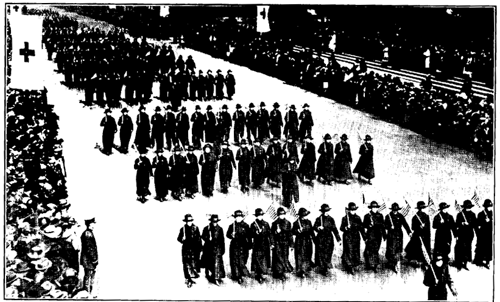
and great departments, such as the Women's Land Army, the Women's Army
Auxiliary Corps, are officered throughout by them. Hospitals under the
War Office have been placed in complete control of medical women; they
take rank with medical men in the army and receive the pay going with their
commissions.
When Great Britain recognized that the war could not be won by merely
sending splendid fighters to the front and meeting the wastage by steady
drafts upon the manhood of the country, she began to build an efficient
organization of industry at home.
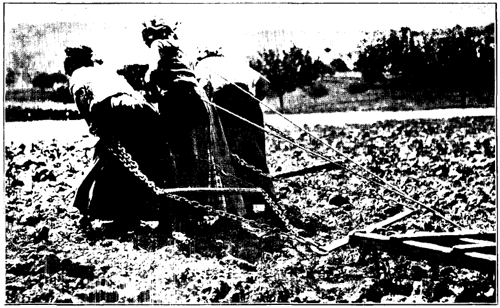
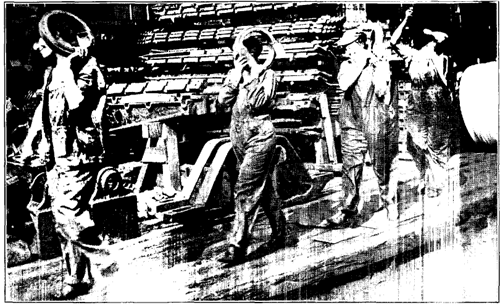
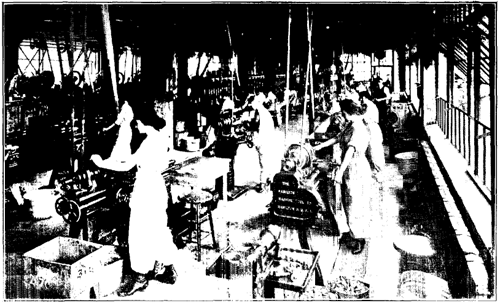
To the call for labor-power British women gave instant response. In
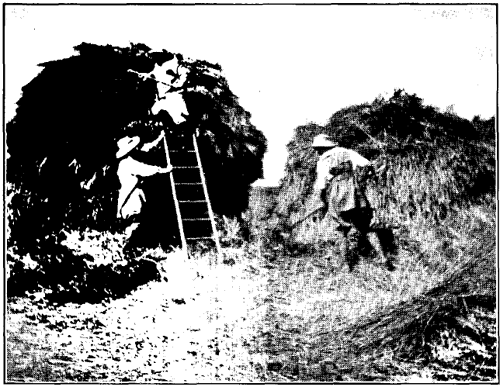
munitions a million are mobilized, in the Land Army there have been drafted
and actually placed on the farms over three hundred thousand, and in the
Women's Army Auxiliary Corps fourteen thousand women are working in direct
connection with the fighting force, and an additional ten thousand are
being called out for service each month. In the clerical force of the government
departments, some of which had never seen women before in their sacred
precincts, over one hundred and ninety-eight thousand are now working.
And the women civil servants are not only engaged in indoor service, but
outside too, most of the carrying of mail being in their hands.
Women are dock-laborers, some seven thousand strong. Four thousand act
as patrols and police, forty thousand are in banks and various financial
houses. It is said that there are in Great Britain scarce a million women--and
they are mostly occupied as housewives--who could render greater service
to their country than that which they are now giving.
The wide inclusion of women in government administration is very striking
to us in America. But we must not forget that the contrast between the
two countries in the participation of women in political life and public
service has always been great. The women of the United Kingdom have enjoyed
the municipal and county franchise for years. For a long time large numbers
of women have been called to administrative positions. They have had thorough
training in government as Poor Law Guardians, District and County Councilors,
members of School Boards. No women, the whole world over, are equipped
as those of Great Britain for service to the state.
In the glamor of the extremely striking government service of British
women, we must not overlook their non-official organizations. Perhaps these
offer the most valuable suggestions for America. They are near enough to
our experience to be quite understandable.
The mother country is not under regimentation. Originality and initiative
have full play. Perhaps it was well that the government failed to appreciate
what women could do, and neglected them so long. Most of the effective
work was started in volunteer societies and had proved a success before
there was an official laying on of hands. Anglo-Saxons--it is our strong
point--always work from below, up.
A glance at any account of the mobilization of woman-power in Great
Britain, Miss Fraser's admirable "Women and War Work," for instance, will
reveal the printed page dotted thick with the names of volunteer associations.
A woman with sympathy sees a need, she gets an idea and calls others about
her. Quickly, there being no red tape, the need begins to be met. What
more admirable service could have been performed than that inaugurated
in the early months of the war under the Queen's Work for Women Fund, when
work was secured for the women in luxury trades which were collapsing under
war pressure? A hundred and thirty firms employing women were kept running.
What more thrilling example of courage and forethought has been shown
than by the Scottish Women's Hospitals in putting on the western front
the first X-ray car to move from point to point near the lines? It but
adds to the appeal of the work that those great scientists, Mrs. Ayrton
and Madame Curie, selected the equipment.
It was a non-official body, the National Union of Women's Suffrage Societies,
which opened before the war was two weeks old the Women's Service Bureau,
and soon placed forty thousand women as paid and volunteer workers. It
was this bureau that furnished the government with its supervisors for
the arsenals. The Women's Farm and Garden Union was the fore-runner of
the official Land Army, and to it still is left the important work of enrolling
those women who, while willing to undertake agricultural work, are disinclined
to sign up for service "for the duration of the war."
Not only have unnumbered voluntary associations achieved miracles in
necessary work, but many of them have gained untold discipline in the ridicule
they have had to endure from a doubting public. I remember hunting in vain
all about Oxford Circus for the tucked-away office of the Women's Signalling
Corps. My inquiries only made the London bobbies grin. Everyone laughed
at the idea of women signalling, but to-day the members are recognized
officially, one holding an important appointment in the college of wireless
telegraphy.
How Scotland Yard smiled, at first, at Miss Damer Dawson and her Women
Police Service! But now the metropolitan police are calling for the help
of her splendidly trained and reliable force.
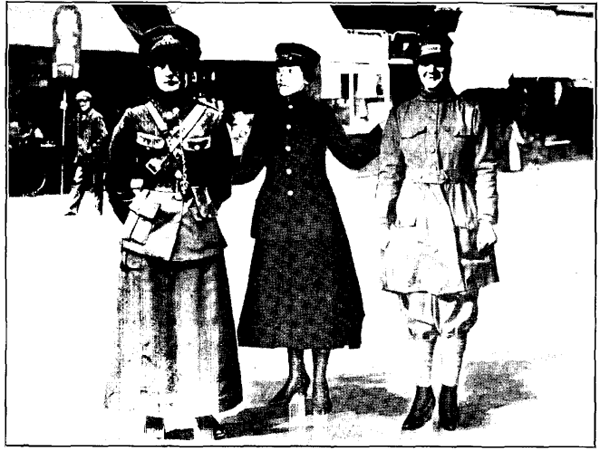
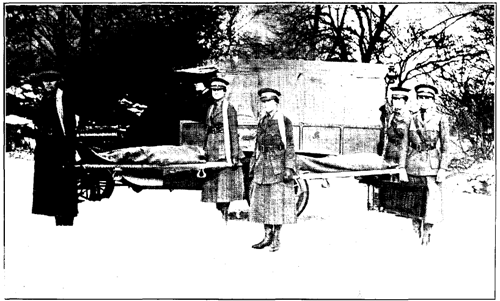
And the Women's Reserve Ambulance Corps--I climbed and climbed to an
attic to visit their headquarters! There was the commandant in her khaki,
very gracious, but very upstanding, and maintaining the strictest discipline.
No member of the corps entered or left her office without clapping heels
together and saluting. The ambulance about which the corps revolved, I
often met in the streets--empty. But those women had vision. They saw that
England would need them some day. They had faith in their ability to serve.
So on and on they went, training themselves to higher efficiency in body
and mind. And to-day--well, theirs is always the first ambulance on the
spot to care for the injured in the air-raids. The scoffers have remained
to pray.
If Britain has a lesson for us it is an all-hail to non-official societies,
an encouragement to every idea, a blessing on every effort which has behind
it honesty of purpose. Great Britain's activities are as refreshingly diversified
as her talents. They are not all under one hat.
In the training for new industrial openings this same spirit of non-official
service showed itself. In munitions, for instance, private employers were
the first to recognize that they had in women-workers a labor force worth
the cost of training. The best of the skilled men in many cases were told
off to give the necessary instruction. The will to do was in the learner;
she soon mastered even complex processes, and at the end of a few weeks
was doing even better than men in the light work, and achieving commendable
output in the heavy. The suffrage organizations, whenever a new line of
skilled work was opened to women, established well-equipped centers to
give the necessary teaching. Not until it became apparent that the new
labor-power only needed training to reach a high grade of proficiency,
did County Councils establish, at government expense, technical classes
for girls and women.
Equipment of the army was obviously the first and pressing obligation.
Fields might lie fallow, for food in the early days could easily be brought
from abroad, but men had to be registered, soldiers clothed and equipped.
It was natural, then, that the new workers were principally used in registration
work and in making military supplies.
But in the second year of the war came the conviction that the contest
was not soon to be ended, and that the matter of raising food at home must
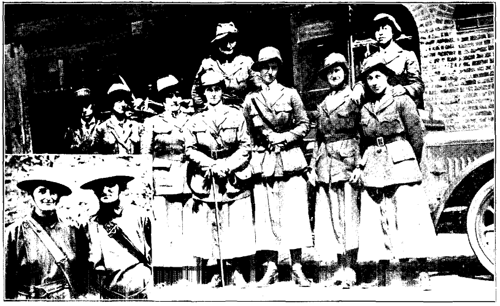
be met. Women were again appealed to. A Land Army mobilized by women was
created. At first this work was carried on under a centralized division
of the National Service Department, but there has been decentralization
and the Land Army is now a department of the Board of Agriculture. It is
headed by Miss M. Talbot as director. Under this central body are Women's
Agricultural Committees in each county, with an organizing secretary whose
duty it is to secure full-time recruits.
The part-time workers in a locality are obtained by the wife of the
squire or vicar acting as a volunteer registrar. Many of these part-time
workers register to do the domestic work of the lusty young village housewife
or mother while she is absent from home performing her allotted task on
a nearby farm. The full-time recruits are not only secured by the organizers,
but through registrations at every post office. Any woman can ask for a
registration card and fill it out, and the postmaster then forwards the
application to the committee. The next step is that likely applicants are
called to the nearest center for examination and presentation of credentials.
When finally accepted they are usually sent for six weeks' or three months'
training to a farm belonging to some large estate. The landlord contributes
the training, and the government gives the recruit her uniform and fifteen
shillings a week to cover her board and lodging. At the end of her course
she receives an armlet signifying her rank in the Land Army and is ready
to go wherever the authorities send her.
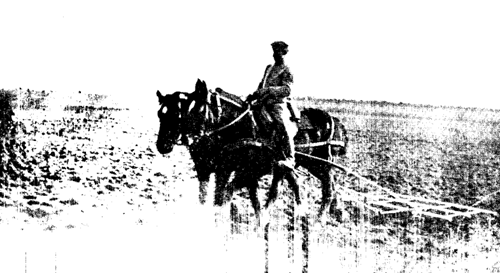
The farmer in Great Britain no longer needs to be converted to the value
of the new workers. He knows they can do every kind of farm work as well
as men, and are more reliable and conscientious than boys, and he is ready,
therefore, to pay the required minimum wage of eighteen shillings a week,
or above that amount if the rate ruling in the district is higher.
Equally well organized is the Women's Army Auxiliary Corps, familiarly
known as the Waacs. The director is Mrs. Chalmers Watson. A would-be Waac
goes to the center in her county for examination, and then is assigned
to work at home or "somewhere in France" according to training and capacity.
She may be fitted as a cook, a storekeeper, a telephone or telegraph operator,
or for signalling or salvage work. Let us not say she will supplant a man,
but rather set a man free for fuller service.
My niece, a slip of a girl, felt the call of duty at the beginning of
the war. Her brothers were early volunteers in Kitchener's Army. They were
in the trenches and she longed for the sensation of bearing a burden of
hard work. She went to Woolwich Arsenal and toiled twelve hours a day.
She broke under the strain, recuperated, and took up munition work again.
She became expert, and was in time an overseer told off to train other
women. But she was never satisfied, and always anxious to be nearer the
great struggle. She broke away one day and went to Southampton for a Waac
examination, and found herself one of a group of a hundred and fifty gentlewomen
all anxious to enter active service and all prepared for some definite
work. They stood their tests, and Dolly--that's the little niece's pet
name, given to her because she is so tiny--is now working as an "engine
fitter" just behind the fighting lines. Dainty Dolly, whom we have always
treated as a fragile bit of Sèvres china, clad in breeches and puttees,
under the booming of the great guns, is fitting patiently, part to part,
the beating engine which will lift on wings some English boy in his flight
through the blue skies of France.
But it must not be supposed that the magnificent service of British
women, devoted, efficient and well-organized from top to bottom, realized
itself without friction, any more than it will here. There were certainly
two wars going on in Great Britain for a long time, and the internal strife
was little less bitter than the international conflict. The most active
center of this contest of which we have heard so little was in industry,
and the combatants were the government, trade unions and women. The unions
were doing battle because of fear of unskilled workers, especially when
intelligent and easily trained; the government, in sore need of munition
hands, was bargaining with the unskilled for long hours and low pay. Finally
the government and the unions reluctantly agreed that women must be employed;
both wanted them to be skillful, but not too skillful, and above all, to
remain amenable. It has been made clear, too, that women enter their new
positions "for the war only." At the end of hostilities--international
hostilities--women are to hand over their work and wages to men and go
home and be content. Will the program be fulfilled?
The wishes of women themselves may play some part. How do they feel?
Obviously, every day the war lasts they get wider experience of the sorrows
and pleasures of financial independence. Women are called the practical
sex, and I certainly found them in England facing the fact that peace will
mean an insufficient number of breadwinners to go around and that a maimed
man may have low earning power. The women I met were not dejected at the
prospect; they showed, on the contrary, a spirit not far removed from elation
in finding new opportunities of service. After I had sat and listened to
speech after speech at the annual conference of the National Union of Women
Workers, with delegates from all parts of the country, presided over by
Mrs. Creighton, widow of the late Bishop of London, there was no doubt
in my mind that British women desired to enter paid fields of work, and
regarded as permanent the great increase in their employment. No regrets
or hesitations were expressed in a single speech, and the solutions of
the problems inherent in the new situation all lay in the direction of
equality of preparation and equality of pay with men.
The strongest element in the women's trade unions takes the same stand.
The great rise in the employment of women is not regarded as a "war measure,"
and all the suggestions made to meet the hardships of readjustment, such
as a "minimum wage for all unskilled workers, men as well as women," are
based on the idea of the new workers being permanent factors in the labor
market.
The same conclusion was reached in the report presented to the British
Association by the committee appointed to investigate the "Replacement
of Male by Female Labor." The committee found itself in entire disagreement
with the opinion that the increased employment of women was a passing phase,
and made recommendations bearing on such measures as improved technical
training for girls as well as for boys, a minimum wage for unskilled men
as well as women, equal pay for equal work, and the abolition of "half-timers."
But while it was obvious that the greatest asset of belligerent nations
is the labor of women, while learned societies and organizations of women
laid down rules for their safe and permanent employment, the British Government
showed marked opposition to the new workers. If the Cabinet did not believe
the war would be brief, it certainly acted as if Great Britain alone among
the belligerents would have no shortage of male industrial hands. At a
time when Germany had five hundred thousand women in munition factories,
England had but ten thousand.
There is no doubt that the country was at first organized merely for
a spurt. Boys and girls were pressed into service, wages were cut down
for women, hours lengthened for men. Government reports read like the Shaftesbury
attacks on the conditions of early factory days. We hear again of beds
that are never cold, the occupant of one shift succeeding the occupant
of the next, of the boy sleeping in the same bed with two men, and three
girls in a cot in the same room. Labor unrest was met at first by the Munitions
War Act prohibiting strikes and lockouts, establishing compulsory arbitration
and suspending all trade-union rules which might "hamper production." Under
the law a "voluntary army of workers" signed up as ready to go anywhere
their labor was needed, and local munition committees became labor courts
endowed with power to change wage rates, to inflict fines on slackers,
and on those who broke the agreements of the "voluntary army."
To meet the threatening rebellion, a Health of Munition Workers Committee
under the Ministry of Munitions was appointed to "consider and advise on
questions of industrial fatigue, hours of labor and other matters affecting
the physical health and physical efficiency of workers in munition factories
and workshops." On this committee there were distinguished medical men,
labor experts, members of parliament and two women, Miss R.E. Squire of
the Factory Department and Mrs. H.J. Tennant.
The committee was guided by a desire to have immense quantities of munitions
turned out, and faced squarely the probability that the war would be of
long duration. Its findings, embodied in a series of memoranda, have lessons
for us, not only for war times, but for peace times, for all time.
On a seven day week the verdict was that "if the maximum output is to
be secured and maintained for any length of time, a weekly period of rest
must be allowed." Overtime was advised against, a double or triple shift
being recommended.
In July, 1916, the committee published a most interesting memorandum
on experiments in the relation of output to hours. In one case the output
was increased eight percent by reducing the weekly hours from sixty-eight
to fifty-nine, and it was found that a decrease to fifty-six hours per
week gave the same output as fifty-nine. It need hardly be said that there
was no change in machinery, tools, raw material or workers. All elements
except hours of work were identical. Twenty-seven workers doing very heavy
work increased their output ten percent by cutting weekly hours from sixty-one
to fifty-five. In a munition plant employing thirty-six thousand hands
it was found that the sick rate ranged from five to eight percent when
the employees were working overtime, and was only three percent when they
were on a double shift.
The war has forced Great Britain to carry out the findings of this committee
and to consider more seriously than ever before, and for both men and women,
the problem of industrial fatigue, the relation of accidents to hours of
labor, industrial diseases, housing, transit, and industrial canteens.
The munition worker is as important as the soldier and must have the best
of care.
While the friction in the ranks of industrial women workers was still
far from being adjusted, the government met its Waterloo in the contest
with medical women. The service which they freely offered their country
was at first sternly refused. Undaunted, they sought recognition outside
the mother country. They knew their skill and they knew the soldiers' need.
They turned to hospitable France, and received official recognition. On
December 14, 1914, the first hospital at the front under British medical
women was opened in Abbaye Royaumont, near Creil. It carries the official
designation, "Hôpital Auxiliaire 301." The doctors, the nurses, the
cooks, are all women. One of the capable chauffeurs I saw running the ambulance
when I was in Creil. She was getting the wounded as they came down from
the front. The French Government appreciated what the women were doing
and urged them to give more help. At Troyes another unit gave the French
army its first experience of nursing under canvas.
After France had been profiting by the skill of British women for months,
Sir Alfred Keogh, Medical Director General, wisely insisted that the War
Office yield and place a hospital in the hands of women. The War Hospital
in Endell Street, London, is now under Dr. Flora Murray, and every office,
except that of gateman, is filled by women. From the doctors, who rank
as majors, down to the cooks, who rank as non-commissioned officers, every
one connected with Endell Street has military standing. It indicated the
long, hard road these women had traveled to secure official recognition
that the doctor who showed me over the hospital told me, as a matter for
congratulation, that at night the police brought in drunken soldiers to
be sobered. "Every war hospital must receive them," she explained, "and
we are glad we are not passed over, for that gives the stamp to our official
standing."
It was a beautiful autumn day when I visited Endell Street. The great
court was full of convalescents, and the orderlies in khaki, with veils
floating back from their close-fitting toques, were carefully and skillfully
lifting the wounded from an ambulance. I spoke to one of the soldier boys
about the absence of men doctors and orderlies, and his quick query was,
"And what should we want men for?" It seems that they always take that
stand after a day or two. At first the patient is puzzled; he calls the
doctor "sister" and the orderly "nurse," but ends by being an enthusiastic
champion of the new order. Not a misogynist did I find. One poor fellow
who had been wounded again and again and had been in many hospitals, declared,
"I don't mean no flattery, but this place leaves nothink wanting."
The first woman I met on my last visit to England upset my expectation
of finding that war pushed women back into primitive conditions of toil,
crushed them under the idea that physical force rules the world, and made
them subservient. I chanced upon her as she was acting as ticket-puncher
at the Yarmouth station. She was well set-up, alert, efficient, helpful
in giving information, and, above all, cheerful. There were two capable
young women at the bookstall, too. One had lost a brother at the front,
the other her lover. I felt that they regarded their loss as one item in
the big national accounting. They were heroically cheerful in "doing their
bit."
Throughout my stay in England I searched for, but could not find, the
self-effacing spinster of former days. In her place was a capable woman,
bright-eyed, happy. She was occupied and bustled at her work. She jumped
on and off moving vehicles with the alertness, if not the unconsciousness,
of the expert male. She never let me stand in omnibus or subway, but quickly
gave me her seat, as indeed she insisted upon doing for elderly gentlemen
as well. The British woman had found herself and her muscles. England was
a world of women--women in uniforms; there was the army of nurses, and
then the messengers, porters, elevator hands, tram conductors, bank clerks,
bookkeepers, shop attendants. They each seemed to challenge the humble
stranger, "Superfluous? Not I, I'm a recruit for national service!" Even
a woman doing time-honored womanly work moved with an air of distinction;
she dusted a room for the good of her country. Just one glimpse was I given
of the old-time daughter of Eve, when a ticket-collector at Reading said:
"I can't punch your ticket. Don't you see I'm eating an apple!"
One of the reactions of the wider functioning of brain and muscle which
struck me most forcibly was the increased joyfulness of women. They were
happy in their work, happy in the thought of rendering service, so happy
that the poignancy of individual loss was carried more easily.
This cheerfulness is somewhat gruesomely voiced in a cartoon in Punch
touching on the allowance given to the soldier's wife. She remarks, "This
war is 'eaven--twenty-five shillings a week and no 'usband bothering about!"
We have always credited Punch with knowing England. Truth stands
revealed by a thrust, however cynical, when softened by challenging humor.
There was no discipline in the pension system. No work was required.
The case of a girl I met in a country town was common. She was working
in a factory earning eleven shillings a week. A day or two later I saw
her, and she told me she had stopped work, as she had "married a soldier,
and 'e's gone to France, and I get twelve and six separation allowance
a week." Never did the strange English name, "separation allowance," seem
more appropriate for the wife's pension than in this girl's story. Little
wonder was it that in the early months of the war there was some riotous
living among soldiers' wives!
And the comments of women of influence on the drunkenness and waste
of money on foolish finery were as striking to me as the sordid condition
itself. The woman chairman of a Board of Poor Law Guardians in the north
of England told me that when her fellow-members suggested that Parliament
ought to appoint committees to disburse the separation allowances, she
opposed them with the heroic philosophy that women can be trained in wisdom
only by freedom to err, that a sense of responsibility had never been cultivated
in them, and the country would have to bear the consequences. In reply
to my inquiry as to how the Guardians received these theories, I learned
that "they knew she was right and dropped their plan."
The faith of leading women that experience would be the best teacher
for the soldier's wife has been justified. A labor leader in the Midlands
told me that an investigation by his trade union showed that only one hundred
women in the ten thousand cases inquired into were mis-spending their allowances.
And when I was visiting a board school in a poor district of London, and
remarked to the head teacher that the children looked well cared for, she
told me that never had they been so well fed and clothed. There seemed
no doubt in her mind that it was best to have the family budget in the
hands of the mother. In the sordid surroundings of the mean streets of
great cities, there is developing in women practical wisdom and a fine
sense of individual responsibility.
Perhaps of greater significance than just how separation allowances
are being spent is the fact that women have discovered that their work
as housewives and mothers has a value recognized by governments in hard
cash. It makes one speculate as to whether wives in the warring nations
will step back without a murmur into the old-time dependence on one man,
or whether these simple women may contribute valuable ideas towards the
working out of sound schemes of motherhood pensions.
The women of Great Britain are experiencing economic independence, they
are living in an atmosphere of recognition of the value of their work as
housewives and mothers. Women leaders in all classes give no indication
of regarding pensions or remuneration in gainful pursuits as other than
permanent factors in social development, and much of the best thought of
men as well as women is centered on group experiments in domestic coöperation,
in factory canteens, in municipal kitchens, which are a natural concomitant
to the wider functioning of women.
Great Britain is not talking about feminism, it is living it. Perhaps
nothing better illustrates the national acceptance of the fact than the
widespread amusement touched with derision caused by the story of the choleric
gentlemen who, on being asked at the time of one of the government registrations
whether his wife was dependent upon him or not, roared in rage, "Well,
if my wife isn't dependent on me, I'd like to know what man she is dependent
on!"
Only second to Britain's lesson for us in the self-reliance of its women,
and the thorough mobilization of their labor-power and executive ability,
is its lesson in protection for all industrial workers. It stands as one
people against the present enemy, and in its effort does not fail to give
thought to race conservation for the future.
[2] Through the courtesy
of the Editors of The Outlook, I am at liberty to use in this and
the following chapter, some of the material published in an article by
me in The Outlook of June 28, 1916.