Uncle Jack came home next day, and
Bryda's spirit rose from freezing to a very high
point indeed when she saw him come into the
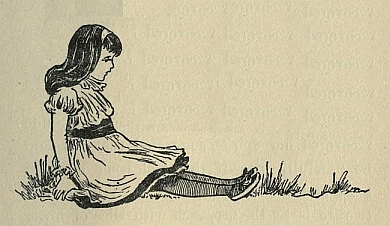
garden, where she was sitting rather sadly, with
knitted brows, very busily thinking, and staring
hard at nothing. She was trying to think how
it was that she could not manage to be of more
use; and that is a very deep subject to think
about when you are only nine years old.
"Though, after all," said Bryda to herself,
"lessons may do me some good. When things
are disagreeable, like doses and lessons, people
say they are for your good; but I don't see
how they can do any one else good."
Just as she was thinking this, a merry
whistled tune came through the trees. Nobody
could whistle like Uncle Jack.
"What's the matter, maiden all forlorn?"
asked his cheery voice. "Here comes the man
all tattered and torn to rouse you up!"
"Oh, Uncle Jack!" said Bryda sorrowfully,
"I am of no use."
"No use! who cares about that? Perhaps
you were made for ornament, like the roses, and
butterflies, and nice little singing-birds."
"Ornament's no use," went on Bryda, sadly
still.
"Isn't it? If the world had no birds, and
no flowers, and no butterflies, and no children,
only hard-working men and women and
cart-horses, what sort of place would it be?"
"Very dull," said Bryda quickly.
"So I should think. And supposing the
birds were all harnessed to carts, and the
flowers mown down for hay, and the children set
to work in offices all day long, would that be
nice?"
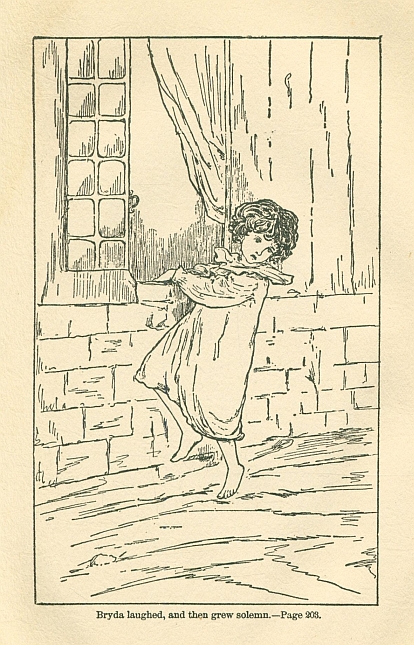
Bryda laughed. "No, indeed, Uncle Jack."
"Well, then, Bryda's work is to look merry,
and good-tempered, and happy, as if she was a
tame sunbeam that the grannies kept to amuse
them." Bryda laughed still more.
"Uncle Jack do you know you are horribly
nice?" she said, dragging him down to a seat.
"Horribly nice? What sort of niceness is
that? Like raspberry jam, or pet kittens, or
troublesome children?" All these are nice, and
horrible too. Jam is horrible when it makes
you ill, kittens when they scratch, children
when they behave badly."
"I wish I could grow up all at once," said
Bryda, with a sigh; "and then I should never
get into scrapes again, and have grandmother
calling me Bridget."
This was Bryda's idea of the worst thing
that could be said to her; when she was
naughty her own mother, and the grannies too,
called her Bridget, instead of using her pet
name.
"Would you like all other children to grow
up too, and have only men and women in the
world? Oh, poor Bryda! how dull you would
be! Supposing I were to tell you a story
about a country where something of the sort
happened?"
"Please, please do!" cried Bryda; "only
please, Uncle Jack, don't let it have a moral.
Miss Quillnib used to tell me stories when it
was too wet to go out after lessons, and there
was always a moral—something about me, you
know. And that spoiled the story, just the
way powders spoil raspberry jam."
Uncle Jack laughed at his little niece's
fancies, then settled himself comfortably on the
garden seat, lit his pipe, and went on talking
between the puffs, telling his promised story.
UNCLE JACK'S STORY.
"Once upon a time," began Uncle Jack,
"since we know no fairy stories are worth
hearing unless they begin with 'once upon a time.'
"Once upon a time there was a country ruled
over by a king and queen who had no children.
Having no children of their own, these
sovereigns thought other people's children a
nuisance. I am afraid they were like the fox,
who said the grapes were sour because he could
not reach them, for it was well known that they
wanted some of these 'torments' very badly
themselves."
"Don't call us torments, Uncle Jack," interrupted
his little niece.
"Well, you see, madam, historians must be
truthful. I am bound to say that the king and
queen passed a law in which the children were
described as 'pickles, torments, plagues, bothers,
nuisances, worries,' and by twenty-four other
titles of respect which I have forgotten. This
law enacted:
"First—That the children were to be seen
and not heard. Wherefore all children under
the age of sixteen were to speak in a whisper
and laugh in a whisper."
"They couldn't, Uncle Jack," broke in Bryda,
"they could only smile!"
"Or grin," said Uncle Jack. "So you think
that a cruel law, Bryda?
"Secondly—As the sight of a child set the
royal teeth on edge, no child was to be allowed
to set foot out of doors, unless between the
hours of twelve and one on any night when
there was neither moon nor stars."
"At that rate they would never go out," said Bryda.
"Well, you see this was a law for the abolition
of children; so they were to be suppressed
as much as possible, of course.
"Then, thirdly, the law declared—That, as
little pitchers have long ears, no child should
ever hear the conversation of grown-up people.
Therefore children were never to be admitted
into any sitting-room used by the elders of the
family, nor into any kitchen or room occupied
by servants."
"O-o-oh!" said Bryda; "did they keep them
in the coal-cellar?"
"In some houses, perhaps."
"Fourthly—Forasmuch as play was not a
profitable occupation, and led to noise and
laughter, all play-time and holidays should at
once be abolished."
"That was a very bad law," said Bryda warmly.
"Well, the law was passed, and was soon carried
out; and any one coming to the city would
have thought there were no children, so
carefully were they kept out of sight. All the
toy shops were closed, and confectioners were
ordered, under pain of death, neither to make
nor sell goodies. But one thing the king had
forgotten, and that was that, after all, there were
more children than grown people in the country.
One family had nine children, another six, and
so on; so that, counting the boarding-schools,
there were just three times as many children as
grown people in the capital. Well, after about
a week of this treatment (for the parents were
compelled under threat of instant execution to
carry it out), it happened that there came a
night when at twelve o'clock, though it was not
raining, there was neither moon nor star to be
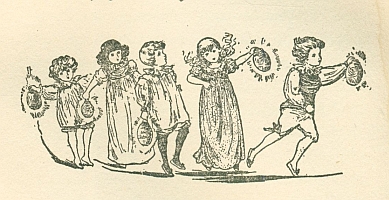
seen. So all the children in the city rushed
forth into the park with Chinese lanterns in
their hands, making quite a fairy gathering
under the trees. Oh, how delicious it was!
They ran and shouted, and played games and
laughed, till suddenly one o'clock struck; and all
the king's horses, and all the king's men, came
to drive them to their homes again. But there
were hundreds and hundreds of children, and
only a few soldiers with wooden swords; for
this was a very peaceable nation, and armed
even its police with only birch rods. So one of
the biggest boys blew a tin trumpet, and called
all the children to him.
"'I vote we rebel,' he said. 'We will not
stand this any more; let us drive away all
the grown-ups, and have the town altogether to
ourselves.'
"Now it so happened that a fairy had been
watching all that went on in the town, and was
not at all pleased. So when she heard this bold
boy speak she thought it would be a good thing
to let this rebellion be carried out. 'Serve 'em
right,' she said; 'young and old shall all learn
a lesson.'
"So she collected a few thousand fairies, and
they flew to all the king's men, and whispered
in their left ears dreadful things, which
frightened them terribly and made them believe an
immense army, instead of the troops of children,
was coming to crush them all. Then the fairies
whispered in their right ears that it would be
wise to fly to a neighboring mountain where
there was a large old fort, and there take refuge.
So they galloped off as fast as the king's horses
would carry them. Then the fairies flew all
over the town and whispered the same things to
all the grown-up people—fathers and mothers,
old maids and old bachelors—till they, too,
tumbled out of bed, dressed in a terrible hurry,
and fled to the mountain. Even the king
jumped out of bed, tied up his crown in his
pocket-handkerchief, and ran for his life in his
dressing-gown, while two lords in waiting, or
gentlemen of the bedchamber, rushed after him
with the royal mantle of ermine, and the scepter
and golden ball. The lord chancellor filled his
pockets with new sovereigns from the mint (for
he slept there to look after the money) and then
he too ran, but rather slowly, for he had the
woolsack on his back, and it was pretty heavy.
When they asked him why he took the trouble
he answered that he thought the ground might
be damp, and he already had a cold in his head.
"Well, all the elders being gone, the children
were left in possession of the city, at which you
may well suppose they were greatly astonished.
They went on with their games for awhile; but
then the lanterns began to go out, and one after
another they grew very sleepy. So the boy
with the tin trumpet blew it again, and
commanded that every one should now go to bed,
and that a meeting should be held at twelve
o'clock next day in the park, at which every
child should appear.
"Appear they did, in their Sunday clothes,
those of them at least who cared for finery;
there were no mothers or nurses to object. All
were in great delight at having no one to rule
them.
"'I shall never go to bed at eight!' said one.
"'I shall never eat rice pudding—horrid stuff!'
"'I shall never take any more doses!'
"'I shall never do any more lessons!'
"'Nor I! nor I! nor I!' shouted one after
another; 'we shall all do only what we like!
How happy we shall be!'
"Only one little maid whispered, with a tear
trembling on the long lashes of her blue eyes,
'Dottie wants mother!' But Dottie was soon
comforted, and ran about as merrily as ever.
"Meantime the elder boys and girls held a
very noisy Parliament, in which there were
never less than five speaking at once. After a
great deal of chatter they determined to set up
a queen; and a very pretty little girl called
May was chosen, and crowned with a crown of
flowers.
"Next, Queen May and her council of six,
three boys and three girls, ordered that a big
bonfire should be made of all lesson-books and
pinafores, for they thought pinafores were signs
of an inferior state, of being under command,
as servants sometimes think their caps are.
"The next law was that all the raspberry
jam in the city should be set aside for the use
of the queen and her court, and for those who
were invited to the royal tea parties. There
was a little grumbling about this, but finally
the grumblers gave in. All this time troops of
children came pouring in from the neighboring
villages with pinafores on the end of broom
sticks as flags of rebellion. Being pretty
hungry, they dispersed for dinner, which in most
of the houses was a very curious meal, as, of
course, no one could cook, so they had to forage
in the kitchens and storerooms, while bands of
hungry young folks stormed the confectioners'
shops, and dined off ices and wedding-cake.
"Then they opened the toy-shops and put
them in charge of parties of children and gradually
the other shops were treated in the same
way, for buying and selling is always a game
children like, and it was such a treat to have real
things to sell. Only money was such a trouble:
they were always forgetting to bring any, and
the young shopkeepers never were sure if a
shilling or a sovereign was the right price for a
thing. Therefore they concluded to do without
it; and costly things were bought for kisses,
while cheap ones were to be had for saying, 'If
you please,' or, if they were very small, as a
penny bun, for instance, then 'please' was
enough."
"How nice!" said Bryda.
"Well, for a whole week there never was
such happiness as the children enjoyed. Games
from morning to night, bread and jam three
times a day, no lessons, no forbidden things,
and a queen of their own age in place of the
tyrant king.
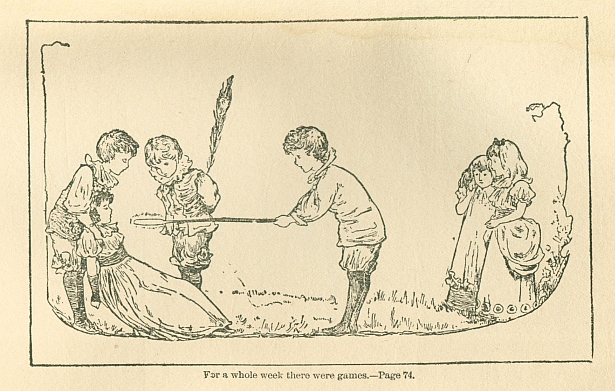
For a whole week there were games.
"But when a week was over some little murmurs
began to arise. Every morning, I ought
to say, the queen sat on her throne in the royal
palace, to receive any of her subjects who liked
playing at being courtiers, and she and her
council then settled any difficulty that arose
about rules of games, about the way to make
the best toffee and any other important question.
"On this particular morning, then, rather
more than a week after the establishment of the
Children's Kingdom, a very large throng entered
the queen's presence. Foremost came a troop
of boys and girls, who led in a pale,
serious-looking boy as a prisoner, and brought him to
Queen May's feet.
"'What is the charge against this prisoner?'
asked the queen, with dignity. 'Don't all
speak at once,' she added, so hastily that several
courtiers giggled.
"'Please your majesty,' said a boy, stepping
forward, 'we caught him in the act—the very
act—of learning lessons!'
"'Lessons!' cried the whole court, in every
tone of disgust, anger, grief and dismay.
"'Lessons!' screamed the queen, and at once
fainted away."
"She didn't!" said Bryda indignantly.
"Don't you think the shock was great
enough?" asked Uncle Jack. "Besides, she
felt it part of her royal duty, perhaps.
"Anyhow, they tickled her with feathers,
and put burned cork to her nose till she had a
black mustache; and one boy brought a red-hot
poker, which he said he had heard was a good
thing, though he did not quite know how it was
applied.
"It was the best remedy, certainly, for on its
appearance the queen jumped up shrieking, and
declared she was perfectly well.
"Then the queen proceeded to try the
prisoner, and requested the whole court to act
as jury. It was a very sad case of youthful
depravity—the criminal had carefully kept this
one book, 'Somebody's Arithmetic,' or 'Hangnail's
Questions,' to gloat over in secret; and
even now was not at all penitent, but declared,
when asked what he had to say for himself, that
it was 'stupid, and a bore,' to play games all
day long, and he was sick of them.
"The jury could not agree as to what was to
be done with such an offender, and so he was
allowed to go, and bidden 'not to do it again,'
and the queen went on to the next difficulty.
Here the throne-room became quite full of
children, all in great perplexity; for the matter
was this, that the food supply was running
short. The confectioners' shops were nearly
empty; there was plenty of jam, but very little
bread; and one or two boys, who had breakfasted
on jam out of a pot, eaten with a spoon,
said, 'They didn't know how it could be, but
somehow they thought it did not quite agree
with them.'
"This was really very serious. Could no one cook?
"Well, several had tried to make puddings;
but somehow, though they ought to have been
quite right, something was wrong, and no one
would eat them. One girl had bravely made
some apple-dumplings, and baked them quite
brown; but then she could not find out how to
get the apple in, so they were no more than
hard balls, and not real apple-dumplings at all.
"'What are we going to do?' said Queen
May sorrowfully.
"A dead silence reigned.
"'I know!' said a boy called Eric, starting
forward suddenly, and all eyes turned to this
owner of a bright idea. 'I know!' he said,
brandishing a many-bladed knife; 'I'll kill a
pig!'
"A murmur of horror arose from the girls.
"'Oh, no!' said Queen May politely; 'my
faithful subject, we will not let you make
yourself so miserable."
"Oh, I don't mind!' cried Eric; 'really,
you know, I should like it!'
"'I'll hold him for you!' cried several boys at once.
"'Quite as if they liked it,' whispered the girls.
"But Queen May interposed, and said the
court should break up and go to blind-man's-buff.
At the same hour next day any one who
had a bright idea should come and tell it. For
the rest of the day she, at least, did not mean
to bother her head. If a pig were killed, it
would have to be cooked. And shaking her
curls, which were like a crown of gold, Queen
May jumped off her throne and ran out into
the park.
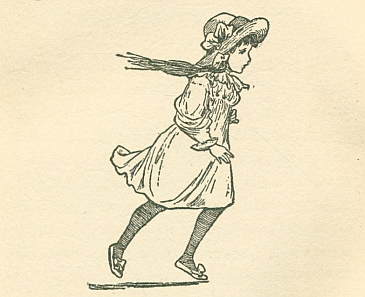
"Presently the Fairy Set-'em-right came
flying over the town, and saw all the children
running about and shrieking with laughter.
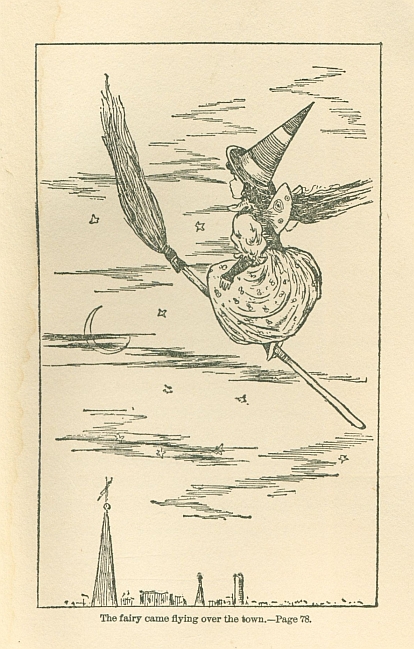
The fairy came flying over the town.
"'Bless my broomstick!' she said, for she
had borrowed one from a witch to fly upon,
saying she had rheumatism in her left wing.
'Bless my broomstick! this won't do at all!'
"She did not notice that a great many children
were standing about in groups, whispering—what
they dared not say aloud—that they
were getting tired of games all day, and of
nothing to eat but sweet cakes and jam at
meals.
"'I should really, really and truly, like some
boiled mutton,' said Master Archie, who was
known to have had a special dislike to that
dish.
"'I know what I shall do,' said the fairy;
'I shall make these children feel like grownups,
and then I shall fly off to the mountain,
and make the grown-ups feel like children:
and if that doesn't bring them to their senses,
I am sure I don't know what will.'"
At this exciting point a servant came to
tell Uncle Jack that grandfather wanted him,
and he went off whistling, promising Bryda the
rest of the story "next time."
But as she did not know when "next time"
would be, it was rather provoking.