THE LILACS” was such a pretty
place; at least Elizabeth said so, and
every one that saw it was likely to
agree with her. It was really the country home
of Grandmother and Grandfather Carr, and
Aunt Elsie, Elizabeth’s young-lady aunt, but
every summer the Eatons went there, too.
In the first place it was so convenient for Dr.
Eaton’s practice, and that was the most important
consideration, for a doctor had to be able to
get to his patients quickly, and The Lilacs was
only a half-hour run in the automobile from his
city office. Then, too, the children loved it, and
both Dr. and Mrs. Eaton believed it good for
their little girls to play around in the sweet
country air.
Now let me tell you about the Eatons. First
there was Dr. Daddy, as the children called him,
who was a very busy man, but always ready for
a smile, or a romp with his little brood. Then
came Mrs. Eaton, who was the prettiest young
mother any one could imagine, with big brown
eyes that beamed lovingly at her little try-patiences.
She was Aunt Elsie’s older sister,
and Grandmother and Grandfather Carr’s big
daughter, so you can imagine the good times
they all had together.
As for the children, I must first tell you what
they called themselves. There were just the
three little girls. Jeannette, the eldest, was well
past nine and already quite a schoolgirl. Then
came Elizabeth, or Polly Wiggles, as every one
nearly always called her. Grandfather Carr
had given her the nickname, because she was
such an active little girl that he declared she was
“always on the wiggle,” and that the stately
name of Elizabeth did not suit her at all. She
was nearly as tall as Jeannette, but more than a
year younger, and more than four years older
than Evelyn, the baby of the family.
And what do you suppose they called themselves?
Why, “The Three Bears,” to be sure.
When they were younger, Mother had read
them the famous story many times, and while
Evelyn was still a baby it was Elizabeth’s fertile
brain that thought, “Why, we’re three bears
ourselves. Jeannette is the great big bear, I’m
the middle-sized bear, and Evelyn is the wee little
cubby bear.” It was a favorite play with the
children after that, and Evelyn was called “Cub”
and “Cubby” so much, that the name stuck, as
many a nickname will, and even Mother and
Father called this chubby, roly-poly, golden-curled
daughter, “Cubby.”
The children were never happier than when
at The Lilacs, for they dearly loved their grandparents
and Aunt Elsie. Elizabeth was named
after Grandmother Carr, and was very proud of
the fact, while Jeannette had her mother’s name,
and Evelyn was the name of Dr. Daddy’s
mother, or their dear silver-haired Grandmother
Eaton, who had a home at the seashore.
Grandmother Carr’s hair was as brown as
Jeannette’s, with scarcely a silver thread in it,
but, as Elizabeth said, “Grandfather’s head
pushed up through his hair,” and all around the
sides it was gray.
It was early May, but already the big colonial
house had been opened for the season, for Cubby
was still coughing from the effects of the whooping-cough,
and Dr. Daddy thought it wise to
leave the city.
So Jeannette and Elizabeth were taken from
their own school and attended the country school
at Meadowbrook that was within easy walking-distance
of The Lilacs. Jeannette was in the
fifth grade and Elizabeth in the fourth, for both
little girls were fond of books and well up in
their studies. They always took their lunches
with them, for the noon period was short, and
besides, it was great fun to eat picnic luncheons
on the green slope outside the school, especially
as their two best playmates were with them.
It was a beautiful Saturday morning. Bees
were already busy sipping honey from the flowers
that grew in profusion in the old-fashioned
gardens, and blue and yellow butterflies paused
to kiss the purple and white lilac plumes that
sweetened the air with fragrance and gave the
place its name.
Under the apple-trees by the brook that wound
its way about the orchard back of The Lilacs,
and through the meadows and little woods beyond,
there was a great chattering going on that
would make any one think that at least a dozen
little girls were talking at once, instead of four.
Aunt Elsie, hidden behind a row of purple lilac blossoms,
smiled as she pressed closer in her
arms the big gray cat she was carrying, and
watched the four little girls who were comfortably
lying on their stomachs in the green grass,
for Elizabeth’s and Jeannette’s best friends had
come over to play.
Alice Maxfield was an only child, and lived
next door to The Lilacs in a pretty summer
home called “Sweet Briar.” She and Elizabeth
had been the best of chums since baby days, and
Polly Wiggles’ thick black curls and Alice’s
smooth bobbed blonde locks were entwined as
together they looked over a new book of fairy-tales.
They were both eight, and in the same
class at school. Marion West was a year older,
and the same age as Jeannette, but she was such
an unusually big girl for her age that she could
easily have passed for eleven, and overtopped
Jeannette by half a head.
Marion was visiting her grandparents for the
summer at their home, called “Blossom Banks,”
which was farther down the avenue. Her
father, Dr. West, was minister in the church the
Eatons attended in the city, and he usually spent
his summers at Meadowbrook. Both she and
Jeannette were busy knitting scarfs for their
dolls, and, to judge by the snarl Jeannette’s wool
was in, it would take Mother or Grandmother
many minutes to untangle it.
Aunt Elsie smiled again at the pretty picture
the children made in their bright gingham
dresses, for the four little girls were four such
different types. Maybe that was the reason they
got along so well together, for misunderstandings
were few and far between, and quarrels almost
unknown.
Alice was plump and rosy, with golden hair
cut “Dutch,” and the bluest of blue eyes. She
was a dear little girl, with just enough quietness
in her nature to balance the more mischievous
and irrepressible Polly Wiggles. For Wiggles
was mischievous. As Daddy said, “If there was
any scrape to be gotten into, Wiggles was in.”
Such black crinkly curls had Wiggles, hanging
just below her shoulders, and her blue eyes
fairly danced with the joy of living. Grandfather
used to say, with a twinkle in his gray
eyes, “You’re such a thin wisp of a girl that
some day a puff of wind will blow you away,”
and Wiggles used to laugh at the idea of
sailing away over housetops like a dried leaf.
For no amount of teasing ever bothered her,
which was most fortunate, for they were a fun-loving
family, although all teasing was good-natured.
Jeannette had curls, too, long ones, but as
Wiggles declared, “They hung down in the way
curls should go, and didn’t snarl all up like corkscrews.”
Then, too, Jeannette had brown eyes
like Mother, and a great deal of Mother’s sweet,
calm disposition. She was a thoughtful little
girl, and rarely got into the funny scrapes that
her active sister did.
Marion, who was clever with her fingers, was
really doing creditable work on her doll’s scarf
that was to match a cunning little sweater her
grandmother had made. She was a child who
took things earnestly, and had a mass of rippling
red hair that hung far below her waist, and was
almost too heavy for comfort.
Wiggles was in a pretty pink gingham dress,
and Alice had on her favorite blue. Jeannette
declared that was why it was called “Alice blue.”
Jeannette’s frock was buff, and Marion’s, leaf-green,
that contrasted with her glowing mane of
hair.
“I wish my hair grew as quickly as yours,”
said Alice, twisting one of the glowing locks
around her finger as she spoke. For Marion’s
hair was cut to her shoulders regularly each summer,
and by the next spring it was long enough
to sit on.
“I don’t think Mother will cut it this year,” replied
Marion, “but it does get so warm and
prickly-heaty. It’s lots more comfortable like
yours, Alice.”
Alice ruffled her short blonde locks disconsolately.
It made no difference how much she
mussed herself or disarranged her hair, as, for
some mysterious reason, she always looked immaculate,
and hair, dresses, and ribbons seemed
to fall again into correct folds, no matter how
hard she played.
Maybe that was one reason that she and Wiggles
were such chums, because the contrast was
so great. It was a marvelous feat for Wiggles
to arrive home from school intact, for either
hair-ribbon or handkerchief would have vanished,
or yawning gathers would show where
skirt had once joined waist before she had indulged
in a few games. Wiggles left each game
looking a wreck. Alice was unruffled.
It was a peculiar fact, and one that Wiggles
greatly deplored. As Mandy, the colored cook,
declared, “Trouble suah flies to dat chile as de
spahks fly upwahd.”
At the present moment Wiggles’ clean pink
gingham had grass-stains front and back, of
which she was serenely unconscious, and the big
butterfly bow on her hair had slid down to the
very tip of one fat black curl, and was rescued
from falling off by Marion, who neatly tied it
anew.
Aunt Elsie parted the lilac-bushes gently and
placed the beautiful gray Persian cat, her special
pet and pride, on the grass.
“Now be a good pussy,” she whispered into
one furry ear, “and take my message.”
Just as if he understood each word,—and
maybe he did,—Pussy arched his beautiful fluffy
tail over his back and picked his way daintily
over the violet-strewn grass. Aunt Elsie slipped
back behind the concealing bushes and watched
his leisurely progress.
“Why, look!” exclaimed Jeannette, “here
comes Boots. Here, Boots, Boots!”
“What is that thing around his neck, under his
chin?” asked Alice curiously, peering at the
beautiful pussy. “Why is he called ‘Boots,’
Wiggles?”
“’Cause his really-truly name is Puss-in-Boots,’”
explained Wiggles, teetering on one
foot as she spoke. “He is marked with four
white boots on his paws, so we call him Boots,
for short. Isn’t he a booful angel pussy?
There,” with a change of tone, “he has something
around his neck, sure as can be. Isn’t
that queer? Wait and I’ll see what it is.”
With a dart she pounced on the fuzzy Boots,
and with much astonishment unfastened a tiny
gay green-and-white basket that had been fastened
to his collar.
“Oh, my goodness, girls, he’s a postman, or
postcat!” she squealed, much excited. “Here
are four little letters addressed to us in the basket,—one
for each of us.”
Boots, much relieved to be separated from his
“mail-sack,” curled down in Jeannette’s lap and
took cat-naps, while four excited little girls tore
open the tiny pink envelopes, and read this invitation:
“You are invited to a dolls’ bathing-picnic at ten-thirty
this morning at Fleur-de-Lys Point. Bring
your little dolls, and dolls’ furniture.”
Four little girls squealed with pleasure.
“I’ll have to ask permission,” exclaimed
Marion and Alice in one breath. “Won’t it be
lovely? What time is it now?”
“It’s just ten o’clock,” announced Aunt Elsie,
appearing beside the little girls, “and I already
have asked permission of Marion’s grandmother
and Alice’s mother, so it won’t be necessary for
you to go home, as you have your dolls with
you.”
“Oh,” squealed Wiggles, “then let’s pack and
go quick.” With a rush she was off to the house,
and reappeared a few minutes later with a huge
market-basket, into which dolls, furniture, and
dishes had been dumped pell-mell. To this
she added Jeannette’s, Alice’s, and Marion’s
dolls.
Then, led by Aunt Elsie, carrying a big red
sunshade, and followed by the faithful Boots,
the little party crossed the rustic bridge and
walked through the green meadow-grasses
along the brook, to the spot near the woods that
had been named Fleur-de-Lys Point.
CHAPTER TWO
THE DOLLS’ BATHING-PICNIC
WHAT is a dolls’ bathing-picnic,
Aunt Elsie?” inquired Wiggles curiously.
“Our dolls can’t swim,
you know.”
“Wait and see,” replied Aunt Elsie mysteriously.
“You do think of the nicest things,” said
Jeannette, slipping her hand in her aunt’s.
Here Wiggles, who had scurried on ahead of
the others, came puffing back, her hair in a wild
curly mass from heat and perspiration.
“I could just see the Point,” she panted breathlessly,
“and, what do you think, Auntie? I
could see some horrid boys there, so we won’t be
able to go there after all. Isn’t that mean?”
“Ugh! I hate boys,” cried Alice. “You
can have so much nicer times when there are
just girls. I do think all boys ought to live in a
menagerie, they’re so fond of bugs, and toads,
and horrid things.”
“Well,” confessed Aunt Elsie, “you see, I invited
some boys myself, so I don’t doubt but that
they are there ahead of us.”
Aunt Elsie laughed again. “They’ll only be
with us for a little while,” she explained. “I
asked Marion’s brother, Hugh, and your own
cousins, Billy and Dick. They won’t be so bad,
will they?”
“I hope not,” replied Jeannette, doubtfully
it must be confessed. “They always have to
race around and upset and break things so, and
make such a noise.”
The four little girls walked on together, arms
around each other’s waists, brown, black, yellow,
and red hair mingling.
“I do think boys are disgustable creatures,”
declared Wiggles, tossing her curls. “No good
at all unless you want to go swimming or something.”
“I think so, too,” declared Marion unexpectedly.
“Always pulling my hair and calling
me, ‘Carrots’ and ‘Red Head’ and ‘Ginger.’”
“The idea!” said Jeannette indignantly.
“Your hair is perfectly beautiful.”
“It’s what is called ‘Tissue’ hair,” announced
Wiggles with an air of wisdom. “I heard one
of the teachers say so, though I can’t see why
it’s called that. It’s not a bit like tissue paper.”
“Oh, Wiggles!” laughed Jeannette; “you’ll
certainly kill me. It’s ‘Titian’ hair, not ‘Tissue,’
and ‘Titian’ is a Latin or Greek name for
‘red,’ I think.”
“Well,” agreed Wiggles serenely, joining in
the laughter, “it’s a much more ’spressive word
than ‘red,’ anyway.”
Fleur-de-Lys Point was well named. There
the brook gurgled along over flat stones and tiny
pebbles, while masses of purple and white fleur-de-lys
clustered about its bank, and even sent up
daring shoots of green in the rippling water.
The mossy bank was thickly carpeted with violets,
and under a huge old willow-tree, that
spread its drooping boughs over the crystal
waters, the “disgustable” boys were waiting.
Wiggles’ cousins, Billy and Dick Gerard,
were really very nice, jolly boys, full of spirits
and boyishness, and, notwithstanding the little
girls’ previous remarks, they were very fond of
their good-natured cousins. Richard, or Dick
as he was called, was ten; and William, who
never answered to anything but “Bill,” or
“Billy,” was past twelve. They were both
strong, husky lads, with dark hair and eyes like
Jeannette’s.
Hugh, Marion’s brother, was Dick’s inseparable
pal and bosom crony, and had a head of
heavy mahogany-colored hair several shades
darker than his sister’s.
“If there isn’t Polly Wiggles,” greeted Billy.
“Wiggles, every single hair on your head stands
erect.”
The four little girls dropped down on the
mossy bank, first carefully putting the market-basket,
which they had taken turns in carrying,
at the gnarled roots of the willow tree.
“Isn’t it lovely and shady here?” said Alice
with a blissful sigh of content.
“Usually is shady under a tree,” teased Dick.
“Goodness,” said Marion, wiping her flushed
face and trying to hold up her heavy hair away
from her neck.
Aunt Elsie secured both Jeannette’s and
Marion’s long locks with hairpins on top of
their heads, and the two little girls felt quite
grown up.
“Wiggles looks like a Fiji Islander,” said
Hugh, for every strand corkscrewed out from
her head in a mass of short, kinking curls.
“All you need is a ring in your nose,” gibed
Billy.
“Well,” agreed Wiggles unruffled, “if I had a
ring, I’d be a ‘belle’ I s’pose.” There was a general
shout at this, and Billy pretended to faint
away at such brain work in one so young.
Then Aunt Elsie pointed to the willow
boughs above them, and, looking up, the little
girls spied four small bundles, tied to the
branches within easy reach of their eager hands,
and each package was marked with a little girl’s
name.
“More s’prises,” beamed Wiggles. “I just
love s’prises. Oh!” with a shriek of joy; “just
see what I have,” and she held aloft the dearest
little celluloid doll, dressed in a brilliant scarlet
bathing-suit.
“And mine,” echoed Jeannette, holding up a
blue-clad bather. Alice and Marion had the
same, but Marion’s doll wore a green suit, and
Alice’s a purple.
“Now,” said Aunt Elsie briskly, “we will
have a swimming contest for the four doll-ladies.”
Seeing the girls’ look of surprise, the boys
shouted.
“Celluloid floats, you know,” Dick explained
to the girls at large. “What’s the matter? Are
you afraid they’ll spoil their bathing-suits?”
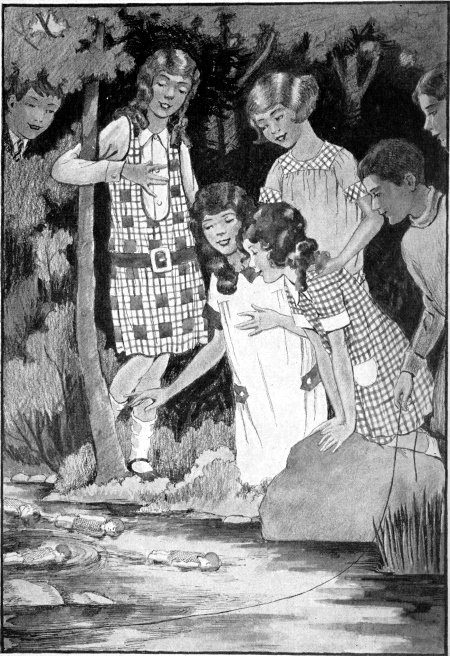
Billy acted as master of ceremonies, and at
his, “One, two, three, go!” each doll fell with a
splash from the stone where it had been held by
its little owner.
The current carried them gently down-stream,
and even the boys became excited in seeing
which would pass the “tape” first, which was a
piece of string from Hugh’s pocket, fastened
across the brook to the bushes on each side.
“Oh, mine’s ahead!” cried Marion, her eyes
intent on the green-clad swimmer.
“There goes Wiggles’ first,” said Billy, as
Marion’s doll suddenly swung round in a circle,
delaying its progress.
“See mine, see mine!” squealed Alice, jumping
up and down on the bank, and nearly tumbling
in to join the bathers.
But it would take too long to tell you all the
details of the “swim,” except to say that Wiggles’
doll was side-tracked by a surprised little turtle,
that snapped angrily at the red cloth, thinking
it, no doubt, a new variety of food. How the
children screamed with laughter, Wiggles as
much as any one, although it put her out of the
race, as her doll bumped and stopped against a
stone.
Jeannette’s doll swam straight into a mass of
fleur-de-lys and became entangled among them,
but Alice’s and Marion’s dolls went gayly on
down-stream, sometimes one ahead, sometimes
the other, until a fluttering breeze caught the
purple doll and rushed her under the line victorious.
Such cheers as then arose! Even the boys
clapped and acknowledged that they would
never have believed a doll’s race could be so
thrilling. Then, after the swimmers had been
rescued and were once more on dry land, Alice’s
doll received a prize, which proved to be a cunning
little clock for her doll-house, that could
tick when wound, and wave its pendulum back
and forth.
If care had not been taken, the boys would
have had it apart, to see “what made it go.” So
busy were the girls admiring the prize that they
never noticed when the boys slipped away into
the woods for a few moments, and they jumped
with a start when the three lads crept up behind
them and tumbled into each little girl’s lap,—what
do you suppose? A cunning little birch-bark
canoe, made with their own hands from
scraps of bark. You can imagine how pleased
they were.
“Where did you get them?” cried Jeannette,
gazing admiringly at her tiny craft.
“We made them yesterday, and Aunt Elsie
sewed the ends for us,” answered Dick.
“Then we hid them in a stump in the woods
until now,” explained Hugh. “Aren’t they
crackerjacks?”
“Ladies and gentlemen,” called Bill, “the next
race will be a canoe race. Only members of
the Fleur-de-Lys Country Club may take part
in this, and all who enter must pay an admission
fee of one gold-piece, and, of course, the usual
war tax.”
As dandelions were accepted for gold, and violets
for the taxes, the members soon paid their
fees, and the Fleur-de-Lys Country Club race
was ready for action.
“Man your boats!” cried Billy.
Into each canoe went a brave swimmer, still
in full bathing costume. What mattered it that
each doll had to lie flat on her back, owing to an
inability to sit, as most celluloid dolls are made
unbendable.
“It’s a clever canoeist indeed,” laughed Aunt
Elsie, “that can paddle while lying down.”
Then Billy called again, “One, two, three,
go!” and away the tiny crafts sailed, puffed along
by the soft spring breezes. The same tape was
again the goal. But, alas, Alice’s and Jeannette’s
boats came to grief very soon. They
rammed one another, capsized, and would have
floated unmanned if they had not been rescued
by Hugh.
“He deserves a life-saver’s medal,” laughed
Wiggles, as the dripping purple and blue dolls
were carried ashore.
“We must roll them over a barrel to bring
them to life,” cried Jeannette. “That’s what
they always do if you nearly drown.”
This proved very absorbing, with a large
stone used as a barrel, while “Doctor” Jeannette
Eaton looked professionally grave, and Alice
gasped, “My child, my child! Is she dead all
over?” At last the doctor declared them out of
danger, and, after recommending some dandelion
wine to brace them up, ordered them
rolled up in handkerchiefs and put in the sun to
take a “sun-cure.”
Meanwhile Wiggles’ boat with its scarlet occupant
crossed the “tape” first, and again a prize
mysteriously appeared from Aunt Elsie’s work-bag,
in the form of a tiny doll’s piano, just big
enough for a doll-house; for Wiggles was passionately
fond of music, and could hardly wait
until fall when she would start music-lessons.
“O, dear me suz, there’s the twelve-o’clock
bell. I’ll have to go home for luncheon,” bemoaned
Marion. “Did you ever see a morning
go so fast in your life? Haven’t we had the
loveliest time?”
“How are the patients, Dr. Eaton?” inquired
Dick, nodding toward the two dolls, still taking
their sun-bath.
“Very, very poorly,” said Dr. Eaton, looking
grave and shaking her topknot of curls. “They
have a ‘temperment’ of one hundred and forty
degrees.”
They were indeed very warm from the broiling
sun, and were tenderly carried up under the
willow-tree and comfortably arranged on a bed
of moss.
“I greatly fear,” said the doctor, looking wise,
“that we shall have to call in a nurse, as they will
have chills soon, and water on the brain from
their nearness to drowning.”
“Do give them something fashionable,” urged
Wiggles. “Any one can have chills. Let’s
have something where there can be a card on the
door; it looks so kind of exclusive,—yellow
plague, or black peril, or something like that.”
“Why, where’s your aunt?” asked Alice, noticing,
for the first time, that Aunt Elsie had disappeared.
“We must thank her and hurry
home.”
“She’s up in the woods,” said Billy, looking
as if he wanted to laugh at something.
So, clutching their treasures, all four girls
followed the whooping boys up the bank, to the
curve of the stream at the edge of the woods.
And there, what do you suppose they saw?
CHAPTER THREE
GAMES
THERE, on the ground, surrounded by
wild-azalea bushes, whose coral-pink
blossoms filled the air with a delicious
perfume, was spread a white cloth, and,
unpacking things from a big hamper, were
Mother and Grandma, and Aunt Elsie; while
James, Grandpa Carr’s colored chauffeur, was
grinning broadly over a big freezer full of ice-cream,
and Cubby trotted around on her fat
little legs and got in every one’s way.
It was such a lovely surprise, although the
boys had known all about it; and as Alice’s and
Marion’s people had been asked by Mother, the
two little girls could stay with clear consciences
and enjoy the delicious picnic luncheon.
There were pink-and-white ham sandwiches,
and stacks of others with jelly, lettuce, and
peanut-butter filling. Then came fruit salad
from the thermos bottle, and, of course, olives,
candies, and salted peanuts. And when all
these goodies had vanished down hungry throats,
some of Mandy’s chocolate cake appeared, with
two pink candles on it, “Because,” Aunt Elsie
explained, “it’s Boots’ second birthday.” How
they all laughed and petted Boots, who enjoyed
the ham as much as any one, and washed his
paws most daintily after each course. He
blinked his big green eyes in astonishment at
the flickering candles atop the cake, but ate his
ice cream with much gusto, to show how much
he appreciated this birthday celebration.
“Oh, do let’s celebrate Boots’ birthday every
year!” cried Wiggles, dancing around with a
piece of cake in each hand. “It’s lots more fun
than a real birthday party.”
“We ought to play Puss-in-the-corner so he
could join in,” suggested Alice, but Boots, deciding
that luncheon was over, settled himself
under the bushes for a cozy nap.
“What let’s play?” asked Jeannette. “I’ve
eaten and eaten until I don’t want to move.”
“Here’s a new game I’ve found for you, children,”
said Grandma, producing papers and
pencils, which she passed around. “I’ll read
you a list of questions, and each answer must be
in two words. The first word must start with
your first initial, and the second word with your
last initial. Some of the answers turn out very
funny, and I’m sure you will enjoy it.”
Mother and Aunt Elsie decided to finish clearing
away the remains of the picnic, so only the
children played, while Grandma read the
questions.
They worked industriously, with many a
stifled giggle, and when all were finished, the
papers were passed to Grandma to read aloud.
The first question had been, “How would you
describe yourself?” Marion, whose initials
were M. W., had written “Marvelously Wise.”
Spelling was not counted, and it was most fortunate,
as there were some odd blunders.
“What is your chief sport?” brought the answer,
“Mangling Wash,” over which there were
many laughs.
“You’ll make your fortune if you turn wash-lady
nowadays,” said Billy. “You’d better start
saving your pennies toward an electric washing-machine,
if that is your chief aim in life.”
The third question was, “What is your favorite
food?” to which Marion had written “Maple
Whip,” which Grandmother and Mother
thought very appropriate.
But she had a hard struggle with the last question,
which asked what trade or profession she
wished her future husband to follow. Finally,
after much pencil-nibbling and thought, she put
down, “Merely Workman.” The girls declared
it great fun, and listened with interest as
Grandmother read Dick’s paper next.
For his description he had, “Real Good,”
which caused them to shout, as Richard was always
in mischief and out again. “Riding
Goats” was his favorite amusement, and “Rich
Gravy” his favorite food. The boys put their
own future profession for the last question, and
Dick decided to be a “Real Gentleman,” which
ended his paper.
“This is lots of fun, Grandma,” laughed Jeannette.
“Why didn’t you tell us about it before?”
“Because I only saw it myself last week, in a
newspaper,” confessed Grandma. “I’ll read
Alice’s now.”
“‘A’ is such a pretty letter to have,” sighed
Wiggles enviously. “Just think, both my initials
are the same, and it made it awfully hard
’cause I had so little choice.”
“Well, don’t look so doleful about it, Miss
Polly-Wog-Wiggles,” returned Billy. “Any
one that has three such marvelous nicknames as
Polly, Woggsie, and Wiggles ought not to complain.
Oh, Aunt Elsie, will you ever forget
the time we were shopping in Morristown, and
that old gentleman complimented Wogs on her
name?”
“What was the joke?” inquired Marion with
interest.
“Why, one time Grandfather, Aunt Elsie,
Wiggles, and I were doing some marketing in
Morristown. Grandfather—he’s not really my
grandfather, but I always call him that—was in
a hurry to get home, and called to Wiggles, who
was looking in a shop window, as all girls will,”—here
Wiggles interrupted with a loud sniff of
disdain,—“and said, ‘Get a wiggle on, Polly.’
There was an old gentleman passing by, and he
stopped and beamed and said, ‘It certainly is a
pleasure to hear an old-fashioned name like
Polly, after the new-fangled names they call
children nowadays. Always be proud of your
name, little Miss Polly.’”
“What did you say?” asked Alice, much
amused.
“I didn’t get a chance to say a single word,”
replied Wiggles, “for I was so s’prised that I just
stood stock-still until he was ’way down the
street, and then I didn’t want to go rushing after
a strange man and say, ‘My name isn’t Polly at
all, just “Polliwog,” and Wiggles for short.’
Wouldn’t he have been ’stonished?”
“I think he would,” laughed Mother, seating
herself on the soft grass and pulling Cubby beside
her. “You’re such a heedless little witch,
that it would have been just about like you.”
“How are the literary efforts coming along?”
inquired Aunt Elsie, as, after sending James
home with the empty hamper, she joined the
laughing crowd.
So Grandmother started once more, and they
found out that Alice described herself as an
“Ambitious Maiden,” and gave her favorite
sport as “Any Mathematics,” which drew a giggle
from Wiggles, as Alice disliked arithmetic
more than anything else.
“You thought ‘A’ was such an easy letter,
Wiggles,” declared Alice, “but it was dreadfully
hard.”
One and all declared Alice’s favorite article of
food, “Almond Macaroons,” to be the best of all,
and Marion cried, “Wouldn’t they taste good
with my ‘Maple Whip’?”
“Don’t, for pity sake, talk about eating,”
groaned Jeannette. “I ate three times more
than I should have, and I don’t believe I could
eat another thing.”
“That’s because you were piggy,” jeered Dick,
pulling one of her brown curls that had fallen
from the knot atop her head.
“Not half so piggy as you,” retorted Jeannette.
“Who ate five slices of cake and three plates of
cream, I’d like to know? And as for sandwiches,
I couldn’t begin to count.”
“Order, order!” cried Aunt Elsie, and they all
quieted down to hear that Alice’s future husband
would be “A Mason.”
“Read Jeannette’s next,” implored Wiggles.
“‘J’ is such a hard letter.”
So, as Grandmother was tired, Mother started
on the next slip of paper.
Description, “Just Elegant,” wrote Jeannette
in her round, clear hand.
“Favorite sport, ‘Just Eating,’” broke in
Dick, snickering. “Ha, ha, Jet, I got you that
time.”
“No, it’s Juggling Elephants,” replied
Mother with a smile. “You’ll need a good deal
of muscle for that sport, my dear.”
Favorite food, “Juicy Egg-plant,” went on the
writing, and Jeannette had settled on a “Jolly
Eskimo” for her future partner.
“You’ll have to live in a snow hut and eat
whale-blubber and delicacies like that,” put in
Billy. “What a happy future to look forward
to. You know they woo you by seizing you by
the hair of your head and dragging you away.
You have good hair for an Eskimo bride. See,
he’ll do like this—” and Billy grabbed the long
curls and gave a blood-curdling exhibition of an
Eskimo groom, until Jeannette shrieked that he
was pulling her hair out by the roots, and Cubby’s
lip began to quiver suspiciously.
“You’re a bad, bad boy to hurt my Jet,” she
wailed. “I don’t think your muvver has
brought you up derry (very) nicely.”
“He was just fooling,” explained Jet, wiping
away the big tears streaming down the wee bear’s
face.
“I offer my humble apologies,” said Billy
gravely. “There, Cub, does that suit you? I
am afraid she’ll find the weather a trifle chilly
up by the North Pole. In fact, little Miss Snippets,
if you cried like that up in Eskimo land, all
your tears would turn to ice and freeze your
face.”
Cubby felt her plump cheeks cautiously, as
if fearing the freezing process might have already
started.
“Maybe Jet will live wite next door to Santy
Claus,” she volunteered happily. “And—and
maybe when I visit her she’ll let me eat lots and
lots of Eskimo pie.”
Billy let out a war-whoop. “I never thought
of that, but maybe she will,” he told the ecstatic
Cubby, who was beaming at the idea. “How
about it, Jet?”
“Well, she won’t have to complain about my
eating too much raw fish and blubber when I
visit her,” teased Dick.
“How do you know you’ll be invited?” returned
Jeannette calmly.
“Hugh, you are next,” said Mother. “Hugh
describes himself as ‘Heavily Whiskered,’ so I
suppose that is the way we are to imagine him.”
“Oh, Hugh,” cried Alice in horror. “Just
think how terrible red whiskers would look.”
“I am going to have them down to my
waist when I grow up,” declared Hugh calmly,
not at all upset by the shrieks of derision that
greeted his announcement.
“Lovely place for a bird’s nest,” put in Dick
kindly. “One thing though, they’d be fine for
polishing your shoes, and you’d never need to
wear a necktie or a clean shirt, because no one
could ever tell, if you were camouflaged with
billy-goat whiskers.”
“Oh, that reminds me,” laughed Grandma suddenly,
“of one time when Wiggles was about
Cubby’s age, and Grandfather and I, and her
great-grandfather—my father, children—took
her to Bronx Park to see the menagerie. She
was charmed with everything, but stood longest
before a little goat, and gazed and gazed at her.
Finally she piped up in a shrill, loud voice, with
a most angelic smile, as she pointed at the goat,
‘Oh, him has whiskers just like my dear, dear,
great-grandpa.’”
“What did you do with me?” demanded Wiggles
in horror. “Wasn’t I a disgraceful child?”
“Maybe your ‘muvver’ didn’t bring you up
‘derry’ well, either,” quoted Billy mischievously.
“I didn’t do anything,” said Grandma, laughing
at the recollection, “except laugh, for every
one around just shouted. You talked so very
plainly that every word could be understood, and
your great-grandfather never got over telling
about when he was compared to a goat. He
thought it was very cunning.”
“Well, I think it was just dreadful,” declared
Wiggles solemnly. “I don’t see, Mother,
where you ever got such a mortor-fying child.”
“Well,” said Mother cheerfully, “I seem to
stand the strain very well. Now, let’s see what
Hugh has chosen as his favorite sport.”
“Harpooning Whales” was to be the bewhiskered
man’s hobby, and “Hot Waffles” his chief
joy to eat.
“And that’s true,” broke in Marion suddenly.
“He ate seventeen one morning, just oozing with
syrup.”
“Yum-yum, weren’t they good,” murmured
her brother with a far-away look in his eyes.
“And I could have eaten more, only Grandma
wouldn’t let me.”
“I should think not,” said Aunt Elsie in dismay.
“How did you ever do it?”
“That’s nothing,” broke in Dick, not wishing
to be left behind. “I ate twenty-two hot cakes
one morning, didn’t I, Billy?”
“Well it’s nothing to brag of,” said Wiggles
crushingly. “I think boys are the queerest——”
“Help, help,” cried Billy. “Some one head
her off, quick! If Wiggles once gets on the subject
of ‘What I think of boys,’ she’ll expound
on their faults and shortcomings until night.”
“And then not have nearly enough time to
mention them all,” put in Wiggles, bound to
have the last word.
“To resume our reading,” said Mother,
“‘Hard Work’ is to be Hugh’s profession.”
This raised another shout, for Hugh was a
bookworm, and greatly believed in putting off
until to-morrow everything that could be done
to-day.
“Here, Woggsie,” said Aunt Elsie, “this
much-besmudged paper looks like yours. I’ll
read the next two, and give Mother’s throat a
chance to rest.”
“Description,” scrawled Wiggles, whose
handwriting was not of the best, “Extremely Exquisite.”
“You don’t mind patting yourself on the back,
youngster, do you?” inquired Billy, pulling a
crinkly curl.
“I can’t help my initials,” answered Wiggles
loftily. “’Twasn’t a bit of fun having both letters
the same, I can tell you.”
Wiggles’ chief hobby was “Entertaining
Earls,” at which Billy gave a deep groan; and
she was fond of eating “Enormous Eclairs,”
which happened to be true. As for her husband-to-be,
he was an “Electrical Engineer,”
which she declared to be the only easy answer
she had.
“Now for William Gerard, better known as
Billy,” said Aunt Elsie. “Here it is; Description,
‘Wise Guy.’”
“Now who thinks a lot of himself?” jeered
Wiggles, turning up her nose.
“Look out, look out,” called Billy, as if in
great alarm. “It turns up enough now, and if
you tilt it up too far, it may never get back.”
“Silly,” was Wiggles’ lofty reply.
“Chief sport,” continued Aunt Elsie, “‘Western
Gunning.’” For Billy was wild to hunt
and shoot. “Favorite food,” Aunt Elsie resumed,
“‘White Grapes.’ Future profession,
‘Writing Geographies.’”
“You’ll be some literary gentleman,” jeered
Hugh.
“But haven’t they been fun?” beamed Wiggles.
“I wish there were more to read.”
“Here is one more question you may each
answer aloud,” said Grandma. “I’ll give
you five minutes to think of your favorite
flower.”
“Nothing starts with a ‘J,’” bemoaned Jeannette.
“I’ll never think of one.”
“Time’s up,” said Mother, looking at her
wrist-watch. “Who’ll answer first?”
“I will,” answered Dick. “My flower is ‘Red
Geranium.’”
“Very good,” approved Grandmother.
“Now I can see that Marion is ready.”
“‘Milk-Weed,’” replied Marion blushing.
“It’s the only thing I can think of with my
initials.”
“‘Elephant’s Ears,’” called out Wiggles.
“You know, those big flappy plants that grow
in front of the post-office.”
“‘Japanese Elderberry,’” ventured Jeannette,
“and I’m not even sure that there is such a Japanese
plant.”
“It will do,” answered Grandma, smiling at
her little granddaughter. “What shall we hear
from you, Hugh?”
“Hardy Wisteria,” said Hugh triumphantly.
“My, that was hard. Hurry up, Bill; you ought
to be ‘Sweet William.’”
“Ladies first,” returned William with a gallant
flourish toward Alice, whose brow was
puckered with thought.
“Prithee tell me, little one, what your favorite
posy may be?”
“‘Autumn Marigolds,’” answered Alice
quickly. “Now tell yours.”
“‘Winter Green,’ ma’am. How does that
suit the Lady Alice?”
“That isn’t a flower at all; it’s a flavor,” cried
Marion.
“You ask Grandmother,” cried William
loftily, “if it isn’t a plant, and a flowering one,
too. Dear, dear, such ignorance as you kidlets
show. Ta-ta, youngsters, we men are going
fishing.”
“Men, indeed,” sniffed Wiggles, much
amused. “Why, you’re nothing but just little
boys.”
After the boys had gone, the grown-ups collected
embroidery-bags and other belongings,
and, with Boots and Cubby leading, the procession
returned once more to the willow-tree and
Fleur-de-Lys Point.
CHAPTER FOUR
CUBBY’S ADVENTURE
IT looked as if the fairies had been at work,
for there under the spreading willow-tree
were five tiny tents, each big enough to hold
a family of dolls with comfort.
With cries of delight, all four friends and
Cubby danced round and round, exclaiming:
“Where did you get them? Aren’t they cunning?”
While the children were enthusing, Grandma,
Mother, and Aunt Elsie settled themselves comfortably
with their embroidery, and smiled at
the children’s raptures.
“Do you like them?” asked Aunt Elsie.
“Indeed we do. We never saw dolls’ tents
before,” chorused the girls.
“I know you’re ’mused about something by
the ’spression around your mouth, Aunt Elsie.
Please be a dear good auntie, and stop teasing us
and tell us where you got them?” implored Wiggles,
dancing up and down in her excitement.
“Yes, pretty please,” begged Jeannette. “You
have a wicked twinkle in your eyes.”
“Oh, oh, let me see it!” demanded Cubby, approaching
on a run, and peering at her aunt’s
eyes with interest. “Does it hurt you, Aunt
Elsie?”
“Does what hurt?” asked Aunt Elsie, catching
up the wee bear to give her a hug and a
kiss.
“The—the thing that Jet said was in your eye.
You know, the ‘squinkle,’” explained Cubby,
hunting through her mind for the word and
bringing it out triumphantly.
“Oh, oh, Mother, she thinks it’s something like
having a cinder in the eye,” shrieked Wiggles,
much amused.
Cubby was much offended by the mirth her
remark caused. She hated to be laughed at by
the older girls. “It’s not polite to laugh,” she
told them with dignity, her very curls bristling
with indignation. “You just wait till you’re a
itty bit of a gurrl and I’m a big grown-up lady,
and then see how you feel when I laugh at your
‘steaks.’”
“So you shall,” replied Wiggles good-naturedly.
“You shall look at me like this,” and
she gave a condescending glance down toward
her feet. “And you may laugh at my ‘steaks’ as
much as you want,—and my chops, too,” she
finished with a giggle.
“And what will you do?” asked Cubby breathlessly,
all dignity gone before this absorbing by-play.
“Oh, I’ll shrink, and shrink, beneath your
withering stare, until I shrivel up like a dried
leaf, and blow away. Now Auntie, do tell us
where you got the tents.”
“Well, those ‘disgustable’ boys made the
framework,” replied Aunt Elsie demurely, “and
Mother and I made the cotton squares to cover
them. We thought your dolls might enjoy
tenting for a change.”
“I’ll never call those boys ‘disgustable’ again,”
puffed Wiggles, rushing back and forth like a
busy little beaver, and carrying dolls’ furniture
and dishes with which to arrange the tents.
“They’re just perfect pets,” she finished.
It was to be doubted as to whether or not the
boys would have enjoyed being called “pets.”
Perhaps it was just as well that they did not
hear.
“It’s the loveliest picnic that I ever saw,” declared
Alice positively, arranging a tiny bed
with covers and pillows. “Let’s pretend that
this is a girls’ camp on a big lake.”
The idea was seized with enthusiasm, and
Jeannette rushed to get the “invalids,” who were
still resting on their mossy beds.
“They are here for their health,” she announced
importantly, “as their doctor told them
they needed to go to a health resort.”
“What shall we name the camp?” demanded
Marion, arranging a table, out on the mossy
“lawn,” with tiny dishes and cups. “They must
eat out-of-doors, for that’s the way they do at
Maine camps.”
Marion had spent part of one summer in the
Maine woods, and so the children considered her
an authority on camping.
“Pine Grove,” suggested Jeannette. “Oh, I
forgot there aren’t any pines near by.”
“Pebbly Brook Camp,” suggested Wiggles,
which was declared just the thing.
“It seems to me,” said Mother, who had been
watching the camp with much interest, “that you
need some hammocks out under your trees.
Don’t your dolls enjoy swinging?”
“Oh,” said Marion earnestly, “we had lots and
lots of hammocks when we were at camp in
Maine, but I don’t see how we could fix any
here.”
“How would these do?” asked Mother, holding
up the cunningest little cocoon-shaped hammocks
that she had been busy making from
scraps of muslin and string. “Cubby, you rascal,
what have you done with my scissors and
thread? Somebody rescue them. Quick, catch
her!”
The advice came too late. Splash, splash,
went the scissors into the brook, and Wiggles
rescued them with difficulty by going out on the
stepping-stones and teetering there while she
fished for them. Of course she fell in. If there
was an inch of water, Wiggles always landed in
it. So off had to come the pink gingham dress
and be hung on the bushes to dry, while,
wrapped in an old apron which, fortunately,
Grandma had brought to protect her dress while
dishing out ice-cream, Wiggles serenely went
back to her play, unmindful of the funny spectacle
she made, wound about in a lavender percale
apron, fastened with safety-pins.
The hammocks were hung before fleur-de-lys
plants, and the campers greatly enjoyed using
them. Ting-a-ling-a-ling rang Alice, using the
bell on Boots’ collar for a dinner-bell, and causing
him to open one indignant eye at being so
rudely disturbed. “Come to the camp dinner.”
So all the campers in swimming, and those boating
or comfortably resting in hammocks, hurried
out to the dinner-table, and partook of violet
soup, sweet-grass salad, chocolate,—made by
mixing mud and water,—and many other such
delicacies. Then trays were made from big
leaves and carried to the two invalids, who were
now allowed to recline in the hammocks under
the “trees.”
“Gracious,” said Alice, looking at her prize
clock that was wagging its pendulum merrily,
“it’s almost time for them to go fishing or the fish
won’t bite.” So, making rods from pieces of
twig, to which were fastened bits of thread
from Mother’s embroidery bag, the doll-families
hastened to the river to catch a fish for dinner.
“My Clementine,” said Jeannette, naming the
invalid doll, “feels that a bit of fresh salmon with
egg sauce would tempt her appetite for dinner.”
“So does Muriel,” declared Alice, tenderly
tucking the poor child under a heavy quilt.
“She feels very low, and I think salmon is the
only thing that will save her. She’s getting
worse and worse by the minute.”
“Put hot-water bags at her head, and ice-bags
at her feet,” ordered Dr. Jeannette Eaton hastily;
“and I’ll catch a salmon and she may eat it all for
dinner.”
“Is your poor itty dolly derry derry sick?”
asked Cubby, making a grieved lip and unwinding
yards of Mother’s white cotton in her
earnestness.
“She’ll be better soon,” said Wiggles cheerfully.
“She has the ‘epizoodic’ and needs a
specialist’s care. Don’t you want to play with
us, and with your cunning little tent?”
“No,” replied Evelyn positively. “I wants
to pick some booful flowers up dere,” pointing
with a dimpled finger at the vivid azalea bushes
at the edge of the woods where they had eaten
their luncheon.
“All right, Baby,” said Mother; “you pick me
a big bunch of flowers, only don’t go any farther
away than where we had our lunch.”
So Cubby scurried off in delight, and the other
children dropped dolls and fishing-lines when
told by Aunt Elsie to choose a turtle apiece from
the stream for a turtle race.
“What’s a turtle race?” demanded the children
in a breath, pelting down the bank in search of
the turtles that inhabited the crystal-clear brook.
“I just know it will be fun,” said Alice happily,
bearing her dripping captive toward Aunt
Elsie. “What shall I do with this, now that I
have it?”
“Put it on the ‘race-track,’” replied Aunt Elsie,
laughing at the curiosity shown in each eager
face, as she pointed to a space on the ground
marked with two chalk-lines.
“Are these race-horses?” inquired Jeannette,
much diverted at this novel idea. “Mine’s a
blue-ribbon racer, named ‘Rubber,’ and he’s a
long-distance champion.”
“Mine is ‘petty-greed,’” announced Wiggles,
who hadn’t the slightest idea what she was talking
about. “His name is ‘Elastic,’ and he’s won
fourteen gold cups, all hand-engraved.”
“My, he is some racer,” laughed Grandma.
“What is the name of your race-turtle, Marion?”
Marion placed her pet gingerly on the
ground. “Let me see,” she said undecidedly.
“His name is ‘Marmaduke,’ and his picture appears
in all the best papers and magazines.
He’s particularly noted for his speed, and has
been nicknamed ‘Lightning.’”
“He looks it,” giggled Alice. “My turtle’s
name is ‘Whiz.’ Note his jaunty air and his
speaking countenance. He’s a high jumper,
and is confident of victory in this race.”
“On the line,” said Aunt Elsie, “ready, set,—go!”
It was the funniest race of all. Wiggle’s
turtle absolutely refused to move at all, and
Alice’s racer strayed far from the track. So
Aunt Elsie declared that Marion’s “Marmaduke”
was the winner of the first prize, with
“Rubber” a close second. And after the “race-horses”
had been returned to the stream, two
more interesting tissue-paper packages appeared,
and were unwrapped with many “ohs”
and “ahs” of delight.
Jeannette received a carpet-sweeper not much
bigger than her little finger, while Marion
beamed with pleasure at beholding a tiny doll-carriage,
so small that it sat on the palm of her
hand, and held with comfort the “littlest
camper.”
“Isn’t it just too scrumptious to think each
one of us won a prize?” smiled Wiggles. “Now
we can fix up our doll-houses, and all the dolls
may take music-lessons on my little piano.”
Cubby had appeared several times among the
azalea bushes with her chubby hands full of blossoms,
and had brought down a few for Grandma
before returning for a “dreat big bunch.” Being
of a venturesome disposition, she started on
an exploring trip by herself, dragging after her
Auntie’s scarlet “payasol,” as she called Aunt
Elsie’s sunshade, for which she cherished a deep
affection.
There were so many things to look at as she
trudged along. It was so exciting to chase the
yellow butterflies, and dart after the sleek gray
squirrels that kept chattering at her from the
tree-tops.
“’Spect those ‘quirls’ are glad to see me,” she
murmured to herself as she wandered farther
and farther away on her quick little feet into
the meadows on the other side of the grove,
where she had a faint recollection of finding
some wild strawberries one day when walking
with her daddy.
Naughty little Cubby. Well enough she
knew that Mother and the rest believed her safely
gathering wild blossoms; but she said to herself,
“I wants to pick some ‘trawberries’ for my
dear ‘Mayma’ (Grandma).” Over the shallow
brook and through the pasture-bars she crept,
pulling Auntie’s sunshade along behind her.
“Sun’s hot,” said she aloud, mopping off her
flushed face with the hem of her frock. “Dess
I’ll put the booful payasol over me.”
Strange to relate, her strong little fingers
actually snapped it into place, and much pleased
with herself, and nearly hidden by its scarlet
folds, she trotted on. Finding a few strawberries,
she decided they were so good that she
would eat them herself, wiping the red stains on
her clean white frock, and adding a few smears
to her rosy face. “Muvver’ll be s’prised,” she
tried to soothe her uneasy conscience, “when she
sees my ‘trawberries.’” She fully expected to
pick many more to take back with her, but they
proved so tempting that she quickly popped each
one into her own eager mouth as soon as
plucked.
Now Farmer Brown owned the meadow
where she had wandered, and in it, as grown-ups
could well see, by the big signs fastened
to the trees, was a big savage bull.
Little cared Cubby for boards with “Beware
of the Bull” on them. She was too small to read,
anyway, and so she puffed along under the big
parasol, getting nearer and nearer the vicious
animal.
“Just like a lady, I is,” she said to herself, tossing
her curls with glee. “Wish somebody could
see me with this booful big payasol over me.
Guess Billy wouldn’t say then, ‘Look at itty Miss
Snippets under my feets.’ No indeedy. He’d
think, ‘My, what a dreat big gurrl is a-coming
along; must be Jet.’” “Jet” was the nearest that
Cubby could get to “Jeannette.” “Then my
Pampa and Mayma (Grandpa and Grandma)
wouldn’t say, ‘If here isn’t babykins.’”—For it
was a sad blow to the little one to be so much
younger than her greatly admired sisters, and she
always wanted to tag along with them, and do
everything they did, regardless of the difference
in age.
But no one was in sight to admire the vain
baby, until under a gnarled apple-tree Cubby
spied the bull.
“There,” said she with pleasure, “is a nice
bossy cow. Guess I’ll show bossy my payasol.”
Nearer and nearer she crept, singing “Hey!
diddle diddle, the cat and the fiddle, the cow
jumped over the moon,” and wondering in her
baby mind if this could be the very cow that
jumped.
“See my booful red payasol, bossy,” she murmured
sweetly, poking the sunshade under the
bull’s nose.
It was lucky for wee Evelyn that she sang, for
the clear sweet voice attracted the attention of a
young man, who, fishing-rod in hand, was just
passing the pasture-bars. What he heard was
Cubby saying, “Bossy, pretty bossy, just look at
my booful red payasol,” and then he saw the
golden-haired baby wave a brilliant scarlet sunshade
before the infuriated bull.
How Robert Burnett ever leaped the pasture-bars
and seized the indignant child, he does not
remember. Fortunately she dropped the parasol
and it flew in the bull’s face, or else I guess
the wee Cubby bear would have been gored to
death.
Back under the willow-tree the turtle-race had
proved so absorbing that Cubby’s continued
absence had not been noticed, until several calls
had failed to bring the usual response. At first
they all thought that she was mischievously
playing hide-and-seek, but when no baby could
be found, a search began in earnest, and the entire
picnic-party arrived at the pasture-bars in
time to see the rescue.
It was a white and trembling young man that
placed an angry youngster in Mother’s arms,
for all Cubby would say was, “My booful payasol,
all lost!”
“Oh, my baby, my baby!” cried Mother and
Grandma in a breath, while Aunt Elsie cried as
she looked in the field and saw the wreck of what
had once been a parasol, and thought of what
might have happened to the wee bear.
Of course they could not even begin to thank
Mr. Burnett, and he was cordially invited to dinner
that evening, where Daddy and all the others
tried to tell him a little of their appreciation, and
thank him over and over for their darling’s life.
Cubby was the calmest of them all, but absolutely
refused to make friends with her rescuer,
associating him in her mind with the loss of her
beloved sunshade, and the scolding she had received
for running away.
“Hasn’t it been the greatest day?” said Wiggles,
as she consumed enormous quantities of
bread and butter. “First, we had such a lovely
time, and then we had such a scary time. Why,
it was like a thrilling movie, where the hero rescues
somebody.”
They all shouted at Wiggles’ description, although
Mr. Burnett blushed.
“You do me too much honor, Miss Wiggles,”
he said gravely. “Never in my wildest
dreams have I imagined being compared to a
moving-picture hero.”
“Well,” said Polly Wiggles honestly, “you’re
so tall, you do look something like one. Only
it ought to have been Aunt Elsie you rescued instead
of Cubby, ’cause she’s a young lady, and
then you could have married her and I would
have been flower-girl at the wedding, just like
they do in the movies,” she finished in one breath.
“And I don’t see,” she told Jet indignantly, as
they were busy undressing for bed a few minutes
later, “why they rushed us off to bed in such a
hurry. Do you?”
CHAPTER FIVE
LIMERICKS
FOUR little maids were walking home
from school. At least, three were
walking sedately, while Elizabeth
chased after first one thing and then another,
skipping back to her companions every few minutes
to join in the conversation.
“Oh, it’s perfectly dreadful,” cried Alice, her
face all puckered up in a snarl, and her usually
sunny blue eyes stormy, “to make every single
child in school from third grade up, write a
verse; we’re too little; I simply can’t.”
“Why, Alice, it’s lots of fun,” said Wiggles
earnestly. “I often do it just to ’muse myself.
Just rhyme it up in your head, and then write it
down. We have two weeks to write it in, and
Miss Mason said it only had to be four lines, although
it could be as much longer as we wished.”
“Two years would be too short for me, and
four lines just four lines too long,” laughed
Marion. “How you can say it’s easy, I don’t
see. My goodness, girls, it’s dreadfully hot.
Let’s sit down here on the grass and cool off, before
we go any farther. I’m sizzling.”
Down dropped all four girls, under the shade
of a big maple-tree.
“Let’s hear one of your poems, Wiggles,”
asked Alice. “Maybe it will help us along. I
don’t even know how to start one.”
“Well, wait a minute till I think,” said Polly
Wiggles. Thinking with Elizabeth never
meant sitting still, so, to “clear her brain,” as she
explained it, she spun round and round on one
toe.
“Do please stop,” implored Jet. “You make
me dizzy to watch you. How can you be so
lively on this hot day? Seems as if I’d melt.”
“I’ve remembered it now, anyway,” cried the
budding authoress. “It’s called ‘At the Zoo,’
and of course it isn’t a really truly poem like
grown-ups make; it’s just a verse!” With a
loud “Ahem,” to clear her throat, she began:
“One day I went a-walking,
A-walking in the zoo,
And closely by my side I took
My little children two.
The day was bright and sunny,
And everything was fair;
We saw the bears, the snakes, and birds.
Also the lion’s lair.
We heard a dreadful roaring,
And o’er the ground there came
A great big yellow lion,
Shaking his yellow mane.
My heart did not stop beating,
As the lion onward flew,
For it was our circus lion,
And I was their kangaroo.”
All this was spoken without pause or punctuation,
and so rapidly that the authoress was decidedly
out of breath when she finished.
“There,” she exclaimed with an air of relief,
“I didn’t forget any of it, and I was so afraid I
would.”
“Wiggles, how do you do it?” inquired practical
Marion in despair. “That was perfectly
beautiful. When you grow up are you going
to be an authoress?”
“Either that, or an editor. I haven’t decided
which,” was the modest reply. “I never have
had all the books I wanted to read, and just think
what fun an editor must have, with nothing to
do all day long but sit with his feet on top of a
mahogany desk and read, and read, and smoke
big black cigars.”
“Will you smoke cigars?” asked Jeannette,
much shocked. “I don’t think you can be an
editor, anyway, Wogs, for I’m ’most sure it’s
something only men can be, like ministers and,—and
garbage-men,” she finished wildly, groping
about in her mind for a suitable comparison.
“Well,” retorted her sister undaunted, “then
I’m going to ’stablish a ‘presidents.’”
“A what?”
“A ‘presidents.’ That’s what daddy said the
other night, and when I asked him what it meant,
he said ‘to start a new custom.’”
“I remember, but it didn’t sound just like that
to me,” returned Jeannette, wrinkling her brow
in thought.
“For pity’s sake,” interrupted Marion, who
had mentally been going over the remarkable
“poem” again, “how could you tell what a kangaroo
felt like? I couldn’t.”
“Pooh, just as easy,” answered Wiggles much
surprised. “Just imagine! Like we pretend,
when we dress up in Mother’s clothes, that we’re
grown-up young ladies. The teacher always
says, ‘Put yourself in the place of the one you’re
writing about,’ so I did, and felt just as ‘kangarooey’
as could be. I made that up in bed last
night. I often do.”
It was not to be wondered at that Wiggles had
a fondness for rhyme, without, as Mother laughingly
remarked, “rhyme or reason.” Aunt
Elsie was always writing limericks about incidents
or places, and Mother was almost as bad;
while even Daddy had been known to chant
extemporaneously, after a particularly good
dinner:
“I am replete,
Filled to my feet,
With things I like the best to eat.”
So when the news of the poems was broken to
the family a short time later, it did not horrify
them as it might have done. Instead, Grandma
said comfortably: “Why not have a limerick
contest now? It will be lots of fun, and practice
for you children, too. Here come Dick and
Billy. I suppose they’re in it, too, so somebody
get paper and pencils.”
Dick was in the last half of the fifth year, and
Billy in the sixth. Billy had been out of school
the year before with a severe attack of diphtheria.
They both shared the family weakness for
rhyme, and there is still told a story of Dick’s
baby days. When he was about four years old,
his mother took him marketing one morning,
and the clerk who waited upon them was named
Dean. That night at dinner, Dick piped up,
“Mother, I made a piece of ‘poultry’ to-day ’bout
that man.” Upon much urging, he recited his
‘poultry,’ which was:
“Mr. Dean,
Ate a bean.”
Elizabeth and Jeannette rushed indoors for
writing materials, and were back by the time all
were seated on the comfortable porch.
It was funny to see the different ways they
went about it. Mother, Grandma, and Aunt
Elsie comfortably sat in their wicker porch-chairs,
waiting for an inspiration; but Wiggles
curled up on the steps and chewed hard at her
pencil until genius apparently burned, and she
scribbled away industriously.
Dick and Billy withdrew with many snorts
and giggles to a corner, where they mysteriously
doubled up with laughter every few minutes,
consuming Jeannette with curiosity.
Poor Alice and Marion wriggled uncomfortably,
for though they knew what limericks
were, “it was much easier,” as Marion expressed
it, “to laugh at somebody else’s than write your
own.”
“I just know those awful boys are up to some
mischief,” cried Jeannette, glancing over at the
corner where the lads were apparently diligent
little scribes.
“Thank goodness, I am through,” sighed
Alice, “but I am ashamed to read it.”
“Well, my dear,” said Grandmother Carr encouragingly,
“we can’t all do the same things
well, most fortunately, or this would be a queer
old world. Elizabeth and Jeannette both have
the rhyming habit, but neither is as clever with
her fingers as you and Marion, and could not
begin to make such a pretty scarf as Marion
knitted for her doll, or the tiny sweater you
finished.”
So the little girls quite cheered up, and drew
their chairs up in a big circle with the others.
Then, beginning with Grandma as oldest,
each one read aloud the limerick she had
made.
“There are four little girls living near,
Who’ve been playmates for many a year,
They’re always together,
No matter what weather,
And to us they are all very dear,”
read Grandma, smiling at the four little friends,
who looked much pleased.
“Oh, Mrs. Carr, won’t you please write that
out for us to put in our scrap-books?” asked
Marion, while Wiggles rushed over to give her
beloved grandmother a grizzly-bear hug. For
all the girls kept big scrap-books, which they
called “memory books,” and in which they
pasted their valentines, and souvenirs from
parties and places where they had been.
“Why not put all the limericks in?” suggested
Mother. “I’m sure they’ll be fun to look at and
read next winter when we’re back in the city.”
The girls all thought that would be a lovely
plan, so, the question being settled satisfactorily,
Mother read aloud from her slip of paper:
“A boy I know well who’s named Billy,
Ate ‘hot dogs’ one morning, until he
Felt dreadfully then,
And said, ‘Never again;
I think I was oh, very silly.’”
How the little girls laughed, and so did Bill,
although he turned rather red at the recollection.
It seems that a much older boy dared Bill to
eat a dozen and a half “hot dogs,” and volunteered
to pay for them if all were consumed.
Nothing loath, and not stopping to think of the
after-consequences, Bill forced them down,
every one. The first six were fine, the next six
an effort, and to eat the remaining “dogs” proved
to be hard work.
However, Bill was triumphant. “I won the
dare,” said he. But the other boy “reneged,”
as Bill put it, and refused to pay, so it was a sick
and sorrowful William that told the tale to Dad.
And then, to make bad matters worse, Billy’s
father said that he must earn the money himself
to pay for them, and it would teach him to be
more careful in the future. Poor Billy. Not
only did the debt hang over his head, but his
overworked stomach rebelled, and it was several
days before he could get to work cutting grass,
raking lawns, and running errands until the
necessary amount had been made. But ever
since he had been more careful about looking
before he leaped.
A mischievous smile crinkled up Aunt Elsie’s
blue eyes, as she began:
“If there’s water, she’ll surely fall in,
But she always comes up with a grin;
Then little Miss Wiggle,
Will say with a giggle,
‘Why can’t I be proper and prim?’”
Polly Wiggles laughed so much at this true
description of her propensities for mishaps, that
she doubled up on the railing where she had
been perched, and fell head over heels, being
rescued by Dick, who had enough presence of
mind to grab fast to her slippers and hang on until
she could be pulled up.
Of course she lost her hair ribbon and tore a
big hole in her dotted swiss dress, but those were
everyday mishaps.
As soon as the confusion had died down,
Jeannette read aloud:
“Who always is playing a trick?
Who always says, ‘Gimme a lick?’
Who loves to pull curls,
When he sees little girls?
Of course it’s our cousin,—it’s Dick.”
How everybody laughed, Dick as much as
any one, for the ‘Gimme a lick’ sounded so like
his favorite expression when candy was anywhere
around, or cake-making was going on.
“Mine’s awful,” said Marion hopelessly.
“The lines seem to sound so snarly, but it just
popped into my head.”
“A girl named Jeannette, from the city,
Brought a pussy cat, furry and pretty,
He wears boots on his paws,
To conceal his sharp claws;
Puss-in-Boots is the name of this kitty.”
“Boots wishes me to say,” cried Aunt Elsie,
catching up the furry pet, “that he feels greatly
honored by having a real poem written about
him.”
“I think it extremely clever,” approved
Mother, “and the lines don’t sound snarly at all.
It’s hard to do, too, until you practise a few
times.”
“Don’t lose that, Marion. I want it for my
scrap-book,” put in Jeannette. “I’ll paste a big
snapshot of Boots right above it.”
“Oh,” giggled Wiggles; “if that were lost, it
would truly be a ‘cat-astrophe.’”
“Cool her fevered brow,” groaned Billy.
“Too much knowledge has gone to her head.”
“Ssh,” said Wiggles; “it’s Alice’s turn.”
The boys, for some mysterious reason, had insisted
on reading their limericks last.
“Here comes Evelyn, just in time,” laughed
Alice, as the wee bear appeared, fresh from
Nurse Hannah’s hands, and ran with a crow of
delight to sit on Grandma’s lap. “I wrote about
Cubby,” went on Alice, picking up her much-crossed
and re-crossed slip of paper.
So Cubby listened intently as Alice read:
“The wee bear, although very small,
Hopes soon to grow up big and tall,
But plump, round, and chubby,
We best like our Cubby,
Who’s petted by one and by all.”
“That’s true,” laughed Grandma, hugging
the small piece of mischief. “It’s a wonder she
isn’t entirely spoiled.”
“Now, Woggsie, it’s up to you,” called the
boys. So with a grin that brought big dimples
into her cheeks, Wiggles declaimed:
“Who said, ‘Picnics for girls are no fun?’
Saying, ‘Oh, no, indeed, we won’t come;’
Until hearing of ‘eats,’
Cake and candy and sweets,
You could not keep them off with a gun.”
“No fair! no fair! Who has been telling
tales?” cried Dick, looking from one laughing
face to another.
“Ha, ha, ha!” laughed Cubby, who hadn’t the
slightest idea what the joke was about. The
four girls shook at the expression on the boys’
faces, for they had all heard the joke about the
picnic. The lads had scoffed at it as “girl stuff”
until they heard of the sandwiches and cakes that
Grandmother and Mother were preparing.
Then they hastened to Aunt Elsie and suggested
making the canoes, and hanging around to
“help,” to which she gave her permission with
a quiet smile, but with a roguish twinkle in her
eye.
“Just you wait, Miss Polly-Wog-Wiggles,”
promised Dick as he tweaked her curly mop.
And with a grimace he commenced in a high
falsetto voice:
“Who sticks her nose up with a stare,
And flounces by with such an air,
Because for boys she does not care?
WIGGLES.”
Here Billy joined in:
“Who says, ‘They make the loudest noise,
And muss up things and break our toys?
Oh, aren’t we glad that we’re not boys!’
JET.
“Who says, ‘We’ve nicer times, it’s true,
When there’s just girls. I think, don’t you,
That boys should live out in a zoo?’
ALICE.
“Who says, ‘Why will they call me “Red,”
Or “Carrots,” when the teacher said,
That I had “Tissue” hair, instead?’
MARION.”
Here Dick resumed the tale, while the appreciative
audience wiped away tears of mirth.
“What girl was it who ran away,
With Auntie’s parasol so gay,
And tried to get a bull to play?
CUBBY.
“Who packed up sandwiches galore,
And through the woods the hamper bore?
Why, Grandma, Mother, and one more,
AUNT ELSIE.”
“Only,” as Dick explained in an aside, “it was
really James who carried the hamper, but that
was poetic license.”
Then together, in sepulchral tones, both boys
burst out:
“Who nobly toiled and worked away,
Acquiring calloused hands that day,
That you have tents and boats for play?
THOSE DISGUSTABLE BOYS.”
“Oh, it was splendid,” cried the girls, clapping
their hands, when the boys, with a deep
bow, had taken their seats, and Grandma,
Mother, and Aunt Elsie were wiping their
flushed and laughing faces. “But how did you
know we said those things?”
“Why, Dick was on the other side of the
stream, behind the bushes, and you were so busy
gabbling away, and talked so loudly, that he
heard it all. He ran on ahead, and beat you to
the Point by about five minutes.”
“Now will you be good?” demanded Billy
with a ferocious frown at Jet, as he made a grab
for her long curls, and nearly fell off the front
steps as she danced tantalizingly out of his
reach.
“‘Listeners never hear good of themselves,’”
quoted Wiggles provokingly as she circled
warily around Billy, seeking a chance to grab
his fountain-pen and run.
“No, you don’t, young lady,” said Dick,
creeping up from the back and pinioning her
hands behind her back. “Little girls should
never——”
“Never what?” asked Wiggles coolly, freeing
herself like a particularly agile eel, and taking
Dick’s necktie with her in the bargain.
“Truce, truce,” cried Marion, waving her
handkerchief as a white flag. “It’s getting late
and I have to go home, but it was lots of fun.”
“Let’s make up limericks some time again,”
suggested Alice enthusiastically, and she and
Marion said good-by until the next day. They
ran down the lilac-bordered path, stopping at
the gate to wave, while the boys followed after
them, chanting at the top of their voices:
“Maidens dear, we hate to leave you,
Hate to say a fond farewell,
But we’re honest,—can’t deceive you,
We can hear our dinner-bell.
Hear it calling, ‘Dick, you sinner,
Billy, too, come home for tea.’
There’s a lemon pie for dinner,
And ‘I hear it calling me.’”
“Didn’t we have fun?” said Wiggles, settling
comfortably in the porch-hammock, when
Daddy’s voice called from the house, “Better
scurry, kidlets, and wash your hands unless you
want to be late; and, though no lemon pie is
‘calling us,’ there are fried chicken and hot waffles
for dinner.”
So the little girls scurried.
CHAPTER SIX
TEA AT MISS HELEN’S
POLLY WIGGLES and Jeannette looked
with pleasure at the two pretty dresses
that were spread on the bed in the
Forget-me-not room.
“Are we to wear our new dresses this afternoon,
Mother?” inquired Jeannette; for the two
little girls had been invited by their mother’s old
friend, Miss Helen, to take afternoon tea at her
attractive white cottage about three quarters of
a mile from The Lilacs. Miss Helen Cole was
principal of the school at Meadowbrook, and
was always planning delightful surprises for the
children, so they both were agog with impatience
to find out what the “something” was that
Miss Helen had whispered she wanted to talk
over with them.
“I thought it would be a good time to wear
them,” answered Mother, deftly slipping the
rose-pink organdie over Wiggles’ curly head as
she spoke. “Stand still, child, so I can button
you up.”
Jeannette’s daffodil-yellow organdie was fastened
next, and big pink-and-yellow butterfly
bows were tied to the curly tresses. Then
Mother kissed them good-by with a few final
words of caution. “Don’t forget to thank Miss
Helen for your pleasant afternoon, and do be
careful of your frocks.”
The sisters fluttered downstairs with a
grown-up air of importance which was increased
by Cubby’s wail of “Me wants to go,
too.”
“You’re too little,” explained Jeannette
kindly, stooping to kiss the rosy face; “and, besides,
you are going out with Mother and
Grandma in the car.”
“Little bits of wee bears don’t go to afternoon
teas,” added Wiggles, wiping away the big tears
that slid down Evelyn’s cheeks. “Only big
girls and young ladies go to teas, but we’ll tell
you all about it when we come home.”
“I are a big, big gurrl,” gulped Cubby, heartbroken
at being left behind by her adored sisters.
“Who wants tea, anyway?” inquired Aunt
Elsie, coming out of the music-room to find out
what all the sobbing was about. “Cubby and
I are going to have something much better than
old tea,” she told them. “We’re going to have
ice-cream while we’re out this afternoon.”
Cubby’s woe-begone face brightened as if by
magic, while Aunt Elsie hastily waved the girls
out of the front door.
“Skip along before she starts crying again,”
she advised them hastily, and hurried back to
talk over with the excited wee bear the fascinating
possibility of having “choglit” ice-cream,
or “striped pink and white.”
“I’m certainly going to be careful to-day,”
Wiggles confided earnestly to Jeannette as they
skipped along the pretty woodland path that led
them to Miss Helen’s. “Mother’s taken so
much trouble to make these dresses for us, that
I’m going to be very careful about sitting on
anything, or falling into anything, or tearing
myself on anything, see if I don’t.”
“You do have the worst luck,” Jeannette acknowledged,
“like that time we went with
Mother to see ‘Cinderella’ at the movies, and
you put your good hat on the seat next to us——”
“And a fat woman came and sat plump on it,”
giggled Wiggles; “and I was so interested in the
picture that I never noticed until after it was
over, and then it was as flat as a pancake. Well,
you just see this afternoon. I’m going to go
home just as clean as when I started.”
Alas, none of us can tell the march of events,
and I am afraid if Jeannette and Elizabeth could
have foreseen how the afternoon was going to
terminate, they would have turned about and
run back home again.
Miss Helen greeted the little girls warmly,
and soon they were comfortably seated on the
wide porch, chattering gayly with Mrs. Cole
about the dolls’ bathing-picnic.
“Do you know,” said Miss Helen, “I asked
you girls over to-day, especially to find out how
you think the school children would enjoy a
May-Day frolic, with Maypoles, a May Queen,
and all the other pretty old customs?”
“O goody, Miss Helen! Wouldn’t that be
lovely,” exclaimed Wiggles and Jet in one voice.
“Only,” added Jeannette sadly, “isn’t it too
late? I thought May Day was the first of the
month, and to-day is the middle.”
“You’re right, Jeannette,” replied Miss
Helen. “It always has been the first of May,
but spring comes so late nowadays that the
flowers and trees would hardly have been wide
enough awake to help us by the first. Then it
would have been far too cool to spend a whole
day in the meadows wearing thin dresses, so I
thought we could choose two weeks from to-day
as our official May Day, and be sure of having
it warm enough for both little girls and flowers.”
“Would all the school be in it?” inquired
Wiggles.
“All the children that wanted to come,” replied
Miss Helen. “I thought it might be fun
to revive the old custom of May-baskets, and I
wondered if you girls would like to help me
make some to-day, to use as models to show to
the school on Monday morning when I speak
about the May frolic.”
“We’d love to,” enthused the children, and
Wiggles could not resist spinning around on
one toe, “to let off steam.”
“Did you and Mother ever make any when
you were little girls?” inquired Jeannette, for
Miss Helen and Mother had been schoolmates
together at Meadowbrook years before, as
Grandmother and Grandfather Carr had spent
six or seven months of each year at The Lilacs
ever since Mother’s baby days.
“Yes, indeed, Jean and I always hung baskets
on the door-knobs for each other. Here are the
foundation frames that we will use to make the
baskets on.”
Miss Helen and her mother had cut out hundreds
of cardboard basket-frames in preparation,
and these were to be placed in the corridors
of the school, so that the children might take as
many as they wished to cover. The work, of
course, must be done at home. The teachers
had volunteered to make the Maypoles, and each
pupil that wished to be on one was to furnish a
ribbon, any color desired, and these would be
fastened to the poles.
“I want to make a basket for Mother, and
Aunt Elsie, and Grandma, Jeannette, Marion,
Alice, and Cubby, and—oh, lots more,” chattered
Wiggles, checking them off on her fingers.
“Suppose I give you three dozen basket-frames,
assorted styles, to take home, and then
you can divide with Marion and Alice and get
as many more as you wish at any time. How
would that do?”
Both little girls agreed that would be splendid,
and the basket-making started.
Such beautiful crêpe and tissue papers as
Miss Helen had provided for them. All colors
of the rainbow were there, as well as many books
showing how to make every kind of basket imaginable.
“These books,” Miss Helen told them, “will
be on my desk, and may be consulted at any time
for ideas. I will furnish basket-frames for all
the school, but the tissue paper the children must
provide for themselves.”
“There won’t be any trouble filling them,”
said Wiggles, as her fingers snipped and folded
busily, “for the wild flowers are just thick. All
the May flowers are just ready to leave for the
season, and all the June blossoms will just be
coming in.”
“But we wouldn’t have had many blossoms if
we had planned it for the first of May,” said Miss
Helen wisely. “These last two weeks have been
exceptionally warm, and have just hurried
things along. How do you like this?”
“This” was a dainty yellow basket shaped like
a daffodil blossom, with fluted petals and tiny
touches of green.
“Oh, Miss Helen, how pretty!”
“That is for your mother,” said Miss Helen
smiling. “And I am going to hang it myself
May Day morning, with a pot of yellow jonquils
inside.”
The minutes flew as if by magic. It was such
fun to see folds and twists of colored paper suddenly
bloom under one’s fingers; and they all
had to stop and admire each basket as it was
completed. It seemed only a second before
Queenie, the colored maid, appeared to tell them
that tea was ready.
“Them suah is powahful handsome,” said she,
flashing her white teeth in a broad smile at the
two little girls, of whom she was very fond.
With reluctant fingers Jeannette laid down
her scissors, and Wiggles brushed the snips from
her dress.
By the stone wall, under a peach-tree that was
covered with fragrant pink blossoms, a dainty
little tea-table had been spread, simply inviting
hungry little girls to eat. There were the white
beaten biscuits at which Queenie excelled, so
light you might think they would fly away.
Tiny lettuce sandwiches, and marmalade sandwiches,
too, and stacks of golden-brown curly
“leaf” cookies, smelling pleasantly of spice and
other things good, decked each end of the table,
while a rosy mound of Polly Wiggles’ favorite
“squince” jelly, as she always called it, trembled
temptingly on a sparkling glass dish.
Then Queenie, her face all one broad grin,
brought in bits of patties, filled to the brim with
delicious creamed chicken, and, when these had
disappeared to the last flaky crumb, there appeared
tall crystal glasses heaped with custard
ice-cream that was almost smothered with luscious
scarlet strawberries.
It was such fun to eat, with pink peach-blossoms
showering petals upon them, and bluebirds
and saucy jays screaming at them from
near-by trees, attracted by the thought of
crumbs.
“I almost forgot to tell you about the choosing
of the May King and Queen,” said Miss Helen
suddenly, as the little girls nibbled at their cookies
and admired the tiny candy-filled May-baskets
of apple-blossoms that had been at each
place as favors.
Jeannette and Polly Wiggles looked up expectantly.
“We are going to choose them by vote,” continued
Miss Helen smiling at the eager faces.
“Next Friday each pupil at school will cast two
votes, one for King and one for Queen. Then
the boy and girl with the greatest number of
votes will have the honor of officiating at the
May-Day Revels.”
“That’s the only fair way,” agreed Mrs. Cole.
“Otherwise there would be bickering and heart-burnings.
Will the May-Day Majesties have
any attendants?”
“Yes, indeed. The King will choose four
attendants,—a Herald and three Couriers.
The Couriers will remain with him, and the
Herald will ride before the line of march, blowing
a trumpet, and announcing the King’s approach.”
“Won’t that look pretty?” cried Jeannette.
“Seems as if I could hardly wait.”
“Then,” continued Miss Helen, “the Queen
will select four Maids of Honor, and, like Jeannette,
I think it will be a very pretty sight. Gracious,
can that be thunder, so early in the
season?”
It certainly was a distant threatening
grumble.
“Seems to me it’s getting dark awfully early,”
said Wiggles in much surprise. “Goodness, Jet,
it’s six o’clock by Miss Helen’s wrist-watch.”
Miss Helen was much astonished at the lateness
of the hour, and reproached herself for not
having noticed before the lengthening shadows
and far-distant rumble. The little girls had
told her upon their arrival that Grandma and
Mother, Aunt Elsie and Cubby, had gone with
the automobile into the city, and would not be
back until dinner-time, so she knew there was no
likelihood of James coming for them with the
car.
“We didn’t mean to stay so late, but it was
’cause we had such a lovely time,” said Wiggles
ingeniously as she kissed Mrs. Cole and Miss
Helen good-by, and tucked the bundle of basket-frames
under her arm.
“I don’t like to have you two little girls take
that long walk through the woods alone,” said
Miss Helen in a troubled voice, with a glance
at the dark sky.
“We’ll be all right, truly,” smiled Jeannette.
“Thunder-storms don’t usually amount to much
so early in the spring, and we’ll just scurry along
and be home in a twinkling.”
“Don’t take the woodland path,” advised Mrs.
Cole, “and then you’ll surely be all right. Go
round by the road instead. It’s only half the
distance that way, even if it is dusty, and there is
no glaring sun to annoy you now. It does look
very much like a bad storm to me, but it won’t
come yet awhile.”
So with a parting wave of farewell, the sisters
ran down the path, kinky black and long brown
curls flying as they scampered along.
Now there were two ways of returning to The
Lilacs. About five minutes’ walk from Miss
Helen’s the road forked, one way leading
through the woods, and the other along the highway.
The highway was much the shorter route
home, for it was the road used by the farmers
and truckmen, and was well bordered by farmhouses
and barns. The woodland path, by
which the children had gone to Miss Helen’s in
the early afternoon, was a long three-quarters of
a mile, but it was so cool and shady, in contrast
to the dusty, glaring highway, that the children
greatly preferred it, especially on such a warm
day. Now, as they started rapidly down the
highway as Mrs. Cole had suggested, Wiggles
stopped suddenly.
“Oh, I forgot, Jet; we can’t go this way after
all. Don’t you remember that Daddy told us
there was a regular epidemic of scarlet fever all
along here, and said until he told us differently
we couldn’t use any but the woodland path?”
“Sure enough,” said Jeannette, stopping short
to wipe her flushed and overheated face.
“Goodness, isn’t it dreadfully hot all of a sudden?
I had forgotten all about it, Wiggles. I
remember now that he said that eight of the
houses were quarantined. Isn’t it too bad, for
I’m so afraid we’ll get caught in the rain if we
take the long way home. Just look at that sky.”
Heavy thunder-caps entirely concealed the
blue, and bright flashes of lightning went zigzagging
across the heavens, while the low steady
rumble of thunder was coming nearer and
nearer.
“It does look bad,” said Wiggles, “but it
usually takes a long time to blow up, so let’s
scurry”; and two pairs of white-stockinged legs
went flashing down the narrow path that led into
the woods.
How dark it was! The overhanging trees
completely shut out the little remaining light,
and the path was too narrow for them to run
rapidly.
Everything looked so changed. When they
had gone through in the early afternoon, straying
sunbeams had dappled leaves and tree-trunks
with patches of golden light, and the slender
white birches nodded and swayed in the gentle
breeze. Then they had stopped to admire
the huge feathery ferns, and to gather a few delicate
wind-flowers that peeped through the
grasses like tiny pink stars. Bright-eyed chipmunks
had stared at them with beady black eyes,
and chattered angrily when they came too near,
disappearing up the tree-trunks like streaks of
brown, and scolding shrilly from the branches
overhead. Friendly gray squirrels had poked
inquisitive heads through the green leaves, and
scampered from branch to branch and tree to
tree in a riotous game of tag.
Now bushes slapped angrily in their faces,
and a frightened little rabbit scuttled in the bush,
rushing to his bunny home before the storm
broke; and a slippery snake wriggled across the
path, as anxious to get out of their way as they
were to have him.
And all the while it grew darker and darker.
CHAPTER SEVEN
OUT IN THE STORM
NEITHER of the children had ever
feared electric storms, and had, indeed,
rather enjoyed the majesty and
grandeur of them. But being alone in a dark
wood, when the thunder was growling and the
vivid forks of lightning flashed across the sky,
was vastly different from admiring the coming
storm safely from their own cozy home.
They pelted along as fast as the curving path
would allow, their hearts pounding with excitement
and the rapid pace.
“It’s raining already,” cried Polly Wiggles in
alarm, as a drop spattered on her cheek and
was rapidly followed by another. “Oh, our organdie
dresses!”
Oh, the organdie dresses indeed, for it was
raining hard, and had been for several minutes,
but the trees had proved a protection.
“Oh, Wiggles, I’m scared!” quavered Jeannette
at a particularly loud clap of thunder.
“There isn’t a house we can go in until we reach
the end of the woods, and Daddy always says
that a forest is the worst place to be in an electric
storm, as so many trees are struck. Whatever
shall we do?”
“We can’t do anything,” responded Polly
Wiggles in suspiciously shaky tones. “It’s as
black as a pocket, and I can hardly see you, so
we wouldn’t dare branch off anywhere, and it
would take us just as long to try and go back to
Miss Helen’s as it would to keep on toward
home. Isn’t the lightning terrible? Nothing
looks a bit natural, and I don’t even know if
we’re on the path. It’s so dark I can’t see it at
all, can you?”
There is always a moment of terrific stillness
before a big storm breaks, followed by a high
wind; and the trees groaned and shivered as the
first blast of the gale twisted the limbs and
whipped the branches, nearly taking away the
children’s breath. On top of it came a dreadful
downpour that seemed as if the sky had opened,
and in a twinkling both children were drenched
to the skin. That was just the beginning. For
years afterward, that storm was to be talked
about as the “big storm,” for never had thunder
and lightning been so intense, and never had
the damage been so great.
The poor children were chilled through and
through, and their sopping-wet clothing clung
to them till their teeth chattered with the cold.
The butterfly hair-ribbons had blown away long
ago, and Wiggles’ hair was a silky wet mass on
her head, but Jeannette’s long, wringing-wet
curls were blown and twisted about her throat
till it seemed as if cold, damp fingers were trying
to choke her.
“Wiggles,” panted Jeannette, trying to lift her
voice above the blast of the gale and the thunder’s
boom, “we must get out of this woods or
we’ll be killed by a falling tree.”
“Let’s run till we come to that little clearing
in the middle, and see if we can’t get in that old
coffee-mill,” shouted Wiggles in reply, clinging
to her sister.
Down the rough path, black as night, ran
the little girls, slipping on the wet moss, banging
into tree-trunks, slapped by the heavy
branches, falling into the mud, picking themselves
up, and struggling on. What would
Mother and Daddy think if they knew their darlings
were in such danger?
Wiggles’ slipper, held by a little narrow strap,
came off, and the poor child, unable to find it in
the darkness, was forced to continue over cruel
stones that cut her tender feet and made every
step a torture.
Then, just when it seemed as if their panting
little hearts could stand no more, there was a
crash, and a ball of fire seemed to drop from the
sky, while it felt as if the earth rose up and hit
them.
******
“I am so glad,” remarked Mrs. Cole, “that the
children said they would go home by the highway.
This is the most terrific storm I ever remember,
and the dear little mites would be paralyzed
with fear if they were out in it a minute.
I shudder at the idea of any one in those woods
to-night. There is no doubt but that lightning
has struck there several times. It looked as if
a ball of flame shot right down from the sky. I
never would have believed that we could have
such a severe storm so early in the season, but
the weather has been unusually close.”
There was a crash, and a ball of fire seemed to drop
from the sky.—Page 102.
Miss Helen walked about nervously.
“I am afraid I did wrong to let them return.
I should have kept them here, but I never saw a
storm spring up so rapidly,” she replied in a
troubled voice, drawn against her will to the window.
“Oh, look at that flash,”—with a little
scream. “I never saw anything like it in my
life. Something was struck near by.”
“I don’t think you need worry at all about the
children, Helen,” returned her mother. “I
should never forgive myself if they had been out
in this, but they had ample time to reach home
before the first drops fell. That highway cuts
the distance in half, you know, for the wood-path
curves and winds so, that it is far
longer. Wasn’t Elizabeth cunning? She simply
beamed when you spoke about the May
Frolic. I can just imagine them now, telling
the others all about it.”
“They are very dear children,” agreed her
daughter warmly. “Jeannette is very much as
her mother was, when she was a little girl. Personally
I would love to have one of them for
May Queen, but of course it would never do to
show partiality, and the choice by vote is the
only fair way. I am so nervous over them,”
she continued, “that I am going to call up and
be assured they are safely home.”
The telephone gave no response, for the storm
had disconnected the wires, and it was fortunate
for Miss Helen’s peace of mind that she did not
know the danger her little friends were in.
It was an experience to cause the stoutest heart
to quail, let alone two children who had always
been surrounded by the tenderest love and care.
But in spite of Miss Helen’s nervousness she
never dreamed but that the children were safe at
home, eating roast beef and mashed potatoes,
and happily recounting the afternoon’s visit to
all the home folks.
The others just beat the storm, and the automobile
drew up at The Lilacs as the first big
drops pattered down.
“Haven’t the children returned yet?” Mrs.
Eaton inquired with surprise as Hannah opened
the front door.
“No, ma’am,” responded Hannah. “I guess
Miss Cole thought she’d better keep them till the
storm was over. It’s going to be a hard one,
ma’am.”
“I wants to see my Jet and Wiggles,” piped up
Cubby in a grieved voice.
“Undoubtedly they will stay with Helen,”
said Grandma with an anxious glance out of
the window. “She knows that James can get
them after the storm is over. Goodness, what
a crash!” And there was a general run to close
the windows as the rain came down in sheets.
Dr. Eaton and Grandpa Carr, who had been
in the city all day, arrived next.
“Why, where are the youngsters?” inquired
Grandpa, looking about in surprise. It seemed
so unusually quiet without their happy voices
and merry laughter.
“They went to Helen’s for an afternoon tea-party,”
replied mother in a troubled voice, “and
have not returned. I thought they would reach
home long before us, but Helen makes such a
fuss over the children, that she has undoubtedly
prepared some delightful surprise for them, that
has kept them longer than usual. You know
what lovely tea-parties the youngsters always
have when they go there. Nothing is too much
trouble for her, to give them a good time, and I
remember she told me that there was something
she was anxious to talk over with them. Still,
I wish they were safely home. I like my little
brood around me in a storm like this. Just hear
that gale. It sounds as if it were hailing.”
Daddy and Grandpa looked worried. It was
not like the children to remain, if it was at all
possible to return home, and the same thought
was in each mind, although they said nothing to
alarm the others.
“I’ll just ’phone and tell them we’ll be over
later when the storm abates,” said Daddy casually.
“H’hm,—the line’s out of order.”
Grandfather was quietly getting out his raincoat
and rubbers.
“Guess I’ll take the car, and run over to Cole’s
now, even if the storm is pretty bad,” said Daddy
with a glance at Grandpa, who was slipping a
flashlight into his pocket. “Want to come
along?”
Neither let himself think that there was the
slightest possibility of the children being out in
the storm, but both pulled on old caps and heavy
wraps.
“Oh, if my babies were out in this!” shuddered
Mother.
“It’s not at all likely,” soothed Grandpa.
“They’re undoubtedly at Helen’s, as cozy as can
be. Still, I’ll just paddle along, too, and we’ll
make sure.”
It was fortunate for their peace of mind that
the folks at The Lilacs believed the little girls
chattering with Miss Helen and her mother.
Still, it was comforting to know that Daddy and
Grandpa would soon whisk them home.
It was all the men could do to stand up, as they
struggled out to the garage and climbed into the
closed car. There was a tense line around
Daddy’s mouth, and Grandpa’s ruddy face was
white, as the powerful car whizzed along the
muddy, slippery road, as fast as it could go with
safety.
It seemed an age before the light from the little
cottage-windows came in sight.
Miss Helen was surprised when Queenie
opened the door to two dripping men, and she
hastened out from the pantry, where she had
been putting away the remains of the party.
“I suppose my two little girls are safely with
you?” said Dr. Eaton, listening in vain for a
sound of childish voices.
A horrified cry stopped him, and Miss Helen
turned so white he thought she would faint.
“The children?” she gasped. “Haven’t they
reached The Lilacs yet? They left here almost
an hour ago.”
Mrs. Cole was as much alarmed as her
daughter.
“Don’t you think they have gone into one of
the farmhouses on the highway?” she asked in a
frightened voice. “I told them to be sure to go
that way, as it was so short, and I thought they
had plenty of time to reach home safely.”
Dr. Eaton groaned. “I had already told
them to use the path through the woods because
of the scarlet-fever epidemic along the road,” he
explained hurriedly. “That’s probably what
they have done. My poor babies! No, don’t
reproach yourself, Helen. They could have
reached home easily by the highway. Have hot
blankets and a hot drink ready, please. No one
knows in what condition we shall find them.”
The men plunged out into the night, leaving
Miss Helen sobbing and wringing her hands.
And, oh, the weary search that was started
through the pouring rain by Daddy and
Grandpa. Where, oh, where, were the children?
******
When the terrible crash had occurred, the
poor children had thought that their last moment
had come. The earth rocked and they
went crashing to the ground.
“Oh,” screamed Jeannette, “that ball of fire!”
But Wiggles lay white and silent for a while, almost
stunned into unconsciousness.
Lightning had struck the tree right in back of
them, and torn it in two. It was the very tree
they had stood under while Wiggles had groped
for her lost slipper a few minutes before.
While just a short distance away, a giant oak,
one of the mighty monarchs of the forest, fell
with a crash, fortunately away from the trembling
children, or they would have been crushed
to death.
“Jet, let’s pray,” gasped Elizabeth. So holding
tightly to each other, the two little sisters
asked that they might be kept from harm.
The very next flash of lightning showed them
the clearing in the woods, and the ramshackle
old mill that had been discarded years before.
Into its poor shelter crept the thankful children,
and there, in its dilapidated and dirty ruins,
clasped in each other’s arms, Grandpa and
Daddy found them, almost dazed with the strain
they had been under, and so weak they could
hardly stand.
“I knew you’d come,” gasped Wiggles hysterically,
as clasped with Jeannette in Grandpa’s
arms, while Daddy drove carefully, they made
the return trip.
The thunder wasn’t quite so terrifying with
Grandpa’s coat-collar to snuggle against, although
the men thought the journey would
never end, and their loved charges be safe from
danger.
For years afterwards neither Daddy nor
Grandpa could think of the search for the children
without shuddering, and it was with thankful
hearts that they saw the lights from Miss
Helen’s cottage-windows in the distance. In
five minutes Wiggles and Jet, stripped of their
soaking garments, were rubbed until they cried
for mercy, and then wrapped in warm blankets.
Then Daddy bandaged Wiggles’ cut and swollen
foot, and Miss Helen gave them big glasses
filled with steaming-hot lemonade, which she
made Grandpa and Daddy partake of as well, for
they were soaked, too.
After the last sip had been taken, the little
girls were wrapped in clothes miles too big for
them, and wound about with blankets until they
resembled two very large cocoons, and tucked
away in the auto, with their wet clothes in a
sodden pile at the back. Then, snuggling down
by Grandpa with a sigh of content, they went
whirling toward home.
CHAPTER EIGHT
CUBBY PLAYS NURSE
SUCH a time as there was at The Lilacs
when the two little wanderers were carried
in. Mother, Grandma, and Aunt
Elsie, of course, had thought them safe and
sound at Miss Helen’s. So, when Dr. Daddy
splashed up the walk, carrying big bundles of
what looked like old clothes, with rosy faces
peeping out the top, there was a great hubbub.
“Any old clothes to-day,—any old clothes to-day?”
chanted Grandpa in a sing-song voice, as
Grandma stood with open mouth, gazing at the
roll of bathrobes and quilts that surrounded
Wiggles.
“Why-for you all rolled up like a itty (little)
baby?” piped Cubby, scurrying wildly to and
fro, and getting in every one’s way.
“You poor little chickens!” exclaimed Mother
and Grandma together, as the story was incoherently
poured out by both excited children at
once. Aunt Elsie was frantically dashing from
room to room, running hot baths, slipping hot-water
bottles into the beds, and making everything
ready for their comfort, while trying to listen
with one ear to the account.
“They looked more like drowned rats than
chickens,” twinkled Daddy, appearing in the
doorway with his blond hair on end, to see how
preparations were going on. He could joke
about it, now it was over, but it was a night he
would never forget.
Oh, such hot baths as they were popped into,
and such brisk rub-downs as they received!
Then, as carefully as if they were bits of delicate
porcelain, they were tucked into their cozy white
beds and fed with delicious buttered toast and
hot chocolate topped with whipped cream.
“Oh, it’s so good to be home!” sighed Wiggles.
“I thought I’d never see my pretty forget-me-not
room again.”
“Yes, doesn’t it look homey and cozy,” Jeannette
replied, too comfortable even to turn her
head as she spoke. “If I were a cat, I’d purr,
I’m so comfy.”
“O dear, every bone in my body aches. I
know now what people mean when they say that
they ‘feel limp as a dish-rag,’” returned Wiggles,
stirring restlessly, “for I feel sort of all
limpsy, and jelly-fishy, if you know what I
mean. Ouch, my foot throbs like a toothache!”
“I know it must,” Mother sympathized, appearing
with a medicine-glass, “but the bandages
that Daddy put on will soon make it better.
Now I want you both to close your eyes and relax.
Your nerves are all a-quiver from the
shock, and you must calm down.”
“Yes,” agreed Wiggles uneasily, “I’ll try.
But when the wind goes ‘Whoo-ooo’ and the rain
dashes against the pane, it makes me feel sort of
shivery.”
“And every time the lightning flares and the
thunder growls, I think a tree’s going to fall,”
quavered Jeannette. “I’ll try to relax; I will
honestly, Mother, but it seems to me it’s an awfully
long storm.”
“And when I close my eyes I keep seeing the
trees swaying, and the zigzags of lightning
against the black sky, and feel that dreadful falling—falling——”
“Don’t think about it any more, Polly-Wiggles,”
said Daddy, popping his head in to
see what all the chatter was about. “Take some
of this medicine, and try to make your mind a
blank. I’ll pull down the shades so you can’t
see the rain, although I’m afraid you’ll still have
to hear it, as, unfortunately, the Weather Man
isn’t a friend of mine, and refuses to stop the
downpour. You’ve been good little soldiers
and obeyed instructions so far, and I’m proud of
you, so try now to carry out orders.”
As he spoke he slipped the screen about the
beds and went out, closing the door softly. He
was thinking with a shudder how the “carrying
out instructions” might easily have caused their
death.
I wish you could have seen those organdie
dresses. Torn by bush and bramble, and covered
with stains where the children had fallen,
no one would have recognized the pathetic-looking
rags as the dainty frocks the little maids
had started out in, looking so crisp and cool.
All three ladies cried a bit at the tale the sodden
garments mutely told.
The tired-out children fell asleep almost immediately,
but in the middle of the night Jeannette
was aroused by a loud whisper.
“Jet,—are you awake?”
“Yes. Does your foot hurt you, Wiggles?
Don’t you feel well?”
“Yes, just as comfy as can be,” returned Wiggles,
snuggling deeper into the soft bed and
listening to the beating of the rain outside. “I
was only thinking about our new organdie
dresses. We were going to keep them so clean
and fresh, and they must look like mud pies,”—with
a little giggle. Wiggles’ sense of humor
could not be downed long.
Such lame, sore little girls as awoke next
morning to a dreary world, for the storm had
settled into a heavy downpour that flooded all
outdoors.
Daddy was delighted to find that there were
no signs of colds from the exposure, but declared
that bed for two or three days was his prescription,
and that it would be the end of the week
before school could be resumed.
“Well anyway,” yawned Jeannette, “we’ll be
back in time to vote for the King and Queen.”
“And this will be a good time to write our
verses for school,” added the youthful poetess.
“Ouchety, I’m so lame that I couldn’t get out
of bed if I wanted to. I must have what Mandy
calls ‘misery’ in my back, and my foot burns like
fire.”
“I should think it would,” said her sister sympathetically.
“Oh-h,”—with a shudder,— “will
you ever forget that ‘crack-crack’ that sounded
when that tree was struck? I never shall.”
“Doesn’t it seem good to be safe at home,” said
Wiggles in a dreamy voice. “I’m so thankful
that I’m not a snake and have to live in the woods
all the while. Well, if here isn’t Boots.”
“Does Boots want to hear all about his sisters’
adventures?” asked Jeannette, as the fluffy pussy
jumped on the bed and patted her cheek gently
with one velvet paw.
“He’s just trying to tell you that breakfast is
on its way,” called Aunt Elsie, entering with a
dainty tray, at which Boots licked his chops and
fastened his green eyes intently upon the breakfast
bacon.
“I’se done made you chilluns some ‘jams’ for
breakfast,” beamed fat Mandy, popping a
woolly head in the door to inquire after her beloved
‘white chilluns.’ “But I disremembered
prezactly if ’twas corn ‘jams’ or grahme ‘jams’
you-all liked best.”
“Oh, both,” cried the invalids rapturously,
sniffing with appreciation the steaming hot
“gems” and strawberry jam that appeared.
“No one can make them like you, Mandy.”
“Well, I done reckon I knows how to cook,
seeing as I’se had a skillet in one hand and a mixing
spoon in t’other evah since I was knee-high
to a grasshoppah,” chuckled Mandy, rolling out,
vastly pleased with herself. They could hear
her throaty chuckle all the way down the hall,
and her voice saying, “Yas, ma’am, I knew
they’d like some o’ my ‘jams,’ Miss Jean”; for
Mandy had been with the family ever since
Grandma was a little girl, and never called
Mother “Mrs. Eaton,” but the “Miss Jean” of
her girlhood days instead.
Cubby pattered in a few minutes later, to
snuggle down on the bed beside Boots, and
fasten wistful eyes on the strawberry jam, although
she had already eaten her breakfast.
In spite of the continued storm on Monday,
Mother had to go into the city with Daddy to
make a visit to the dentist, as one of her teeth had
been grumbling all night, and it would not do to
leave it.
“You be a good little nurse to your sisters,”
she told Cubby, kissing them all good-by.
“Poor itty gurrls, so dreffle sick,” mourned
Cubby, trotting from one bed to the other, to put
sympathetic kisses on each small sufferer’s cheek,
and greatly enjoying her own importance. It
was very nice indeed to be the one in charge of
the two older girls, instead of the other way
about, for hadn’t Mother told her to take care of
them?
“Ouch, Cubby, don’t lean against my back,”
squealed Jeannette. “It’s so sore it feels as if
it would break in two.”
“Want me to give ‘oo an al-colic rub?” volunteered
the baby nurse, remembering the cooling
alcohol sponges given to her when ill.
“No, thank you, Miss Nurse,” answered Jeannette,
entering into the play. “I’m afraid you’re
too little. Say, Woggsie, if Cub is a really-truly
nurse, she ought to wear a uniform.”
“Sure enough,” returned that ingenious
young lady. “Let me think. Cubby, you go
get me two of Daddy’s handkerchiefs and I’ll
fix you all up.”
Nothing loath, the wee bear left the room, to
return in a few minutes with a beaming face,
followed by Aunt Elsie with a little white apron
and a scrap of white lawn in her hand.
“I thought I could fix up your nurse for you,”
she suggested, pinning the lawn into a “sugar-bowl”
cap, and fastening it to Cubby’s golden
curls. One of Daddy’s handkerchiefs, folded
and placed about her neck like a fichu, was adjusted
next, and when the white apron-strings
were tied about the plump little waist, the cunningest
nurse stood before them that any patient
could hope to have.
“I’se a horse-pital nurse,” announced Cubby,
flying to look in the mirror.
“And we are your patients,” replied Jeannette.
“Oh, nurse, nurse, I feel so ill. My fever is so
high that my face has scorched the pillow.”
Cubby cast a startled glance at the pillow-slip,
and then carefully felt her patient’s pulse.
“Derry, derry (very) sick,” said she with a
frown, “with ’tile parenthis,” meaning infantile
paralysis.
“I have a fever in my feet,” announced Wiggles
with a realistic groan that sent Cubby
scurrying to her in alarm, “and my heart has
stopped beating entirely.”
“I’ll cut you open with the sciddors (scissors),
like this,” said the nurse in a bloodthirsty manner,
snipping her fingers up and down like a
pair of shears, “and then you’ll be all wite after
the apperation.”
The third patient, who was purring loudly on
the foot of Wiggles’ bed, was carefully looked
over next.
“Him’s pults (pulse) derry bad,” mourned
Cubby, holding one soft paw in her little hand.
“He has the ‘cat-tar,’ like Grandpa has,” explained
Wiggles. “That’s the reason he snores.
I do wonder why they named a disease after a cat.
I must remember to ask Daddy.”
“Well, what does Nursie suggest for her little
patients?” smiled Grandma, entering with a vase
of golden daffodils that Marion’s grandmother
had brought to the children.
“That’s a very good prescription,” answered
Grandma, kissing the wee nurse. “And you
are looking after your sisters very well.”
“Oh,” replied that small damsel sweetly, “I
don’t mind ’musing them for a little while,
Grandma.”
They all laughed at this, for it seemed to be
rather the other way about, but Cubby’s responsible
air was too funny for anything.
“Aunt Elsie is downstairs with Mrs. West,”
went on Grandma; “and I think, Cubby, that
you had better run down and show them your
costume while your patients take a nap until
luncheon time. I am going to lie down myself,
for my head aches rather badly, so the nurse
may have an hour off duty.”
So the windows were opened wide to let in the
fresh air, and Grandma tucked the little girls in
their cozy nests for a little “snooze,” and then
went out, taking Cubby with her.
Now Cubby had every intention of going directly
downstairs into the library with Mrs.
West and Aunt Elsie, so Grandma, after watching
her trot down the broad stairway, went into
her own room to rest.
But at the foot of the stairs was Dr. Daddy’s
office, past which Cubby must go to reach the
library, which was at the front of the big house,
and a naughty idea popped into her mind as she
peeped in the open door.
The girls had said that she was too little to give
an alcohol rub, but her own Grandma hadn’t
laughed, and had indeed seemed to think it a
good idea. She just guessed that she would
show them that she wasn’t a baby after all.
So into Daddy’s office she tiptoed quietly, although
it was the one place in the house where
the children were forbidden to go.
“’Cause,” whispered she, to soothe her guilty
conscience, “I must get the ‘al-colic.’”
Onto a tall chair she climbed, to reach the big
bottles that stood on top of the glass case. Fortunately,
Cubby knew better than to touch, or
give to any one else, the pills of different colors,
that looked so fascinating, even if some of the
white dots did taste like “sugar-bowls,” as she
called lump sugar. Daddy had instilled that
“do not taste” idea very thoroughly in her baby
mind, so now it was only the alcohol for which
she searched, remembering the big bottle in
which she had seen it when she had a “rub.”
“I’se my dear Muvver’s itty helper,” murmured
she to herself, teetering back and forth on
the high chair. “Won’t Muvver be ’sprised
when she sees what I’se a-goin’ to do?”
She would indeed.
“Seems to be nuffin here but pills,” she went
on in disgust, for Daddy’s big case, of course,
was locked. Then suddenly her bright eyes
spied a large bottle within easy reach of her
eager little hands, on Daddy’s desk. Down she
clambered, catching her white apron on the
chair-back, and tearing a large hole.
“Such a tender apron,” she mourned, sticking
her fist through the hole, and, of course, enlarging
it.
All bottles containing liquid looked the same
to the wee nurse, so, with a struggle, she hastily
uncorked it and took a sniff.
“Smells bitter,” she declared, turning up her
little nose and making a face, for anything of
which she did not like the smell or taste was
“bitter” to her.
The bottle happened to contain cod-liver oil,
but this, of course, she did not know, and took
it for granted that it was the desired alcohol.
It was an awkward shape to carry, and it took
great perseverance to lug it up the long staircase,
but, quiet as a creeping mouse, the little figure
stole along.
In the library she could hear Mrs. West and
Aunt Elsie chatting about the storm, and she
hardly dared breathe until safely upstairs, where
she peeked softly in the bedroom door.
Both Jeannette and Elizabeth were sleeping
soundly, with Boots snoozing happily beside
them.
With a satisfied gleam in her mischievous
brown eyes, Cubby slipped stealthily in, and
closed the door.
She hastily uncorked it and took a sniff.—Page 125.
CHAPTER NINE
THE RESULTS
WIGGLES was dreaming uneasily.
She thought she was running along
through the woods, when her foot
slipped and she fell down,—down, into a slimy
marsh, and, no matter how hard she struggled,
she could not get out, but felt the sticky-oozy
mud all about her.
Jeannette dreamed, too. It seemed as if she
were in the kitchen, and colored Mandy was
teaching her to make gems. She had the batter
all mixed, and Mandy held the yellow bowl full
of the mixture to show her how to pour it into
the tiny muffin-tins. But, instead of pouring it
where it belonged, Mandy upset the entire sticky
mass all over Jeannette, and she could feel the
clammy stuff trickling down her back.
Boots likewise dreamed, but I cannot begin to
tell you what he dreamed about, except to say
that it was a dreadful, dreadful “cat-mare.”
Mrs. Eaton returned at twelve, with her tooth
all fixed. Mrs. West was just leaving, and so
Aunt Elsie and Mother ran up the stairs together.
Grandmother met them at the top, to
inquire about the toothache.
“The children have been taking a nap,” she
said, “and so have I. They must be getting a
nice rest, for everything is so quiet—” and at
that, bedlam broke out in the forget-me-not
room, and cat-yowls and children’s excited voices
could be heard together.
“Mother, Mother,” shrieked Wiggles. “I
think Boots must be having a fit, and we’re all
stuck up.”
“What does the child mean?” gasped
Grandma. All three ladies made a dash to open
the door into the children’s room, as the enraged
Boots, looking a queer spectacle, shot out, spitting
violently.
“That’s not a fit,” cried Aunt Elsie, “he’s just
plain angry. What can that be that he has all
over him?”
“For pity’s sake, children, what have you been
doing?” asked Mrs. Eaton in amazement.
“Can these be my little girls?”
No wonder she asked, for Jeannette’s long
curls were a glued-together mass down her
back, and the backs of both children’s nightclothes
were dripping with a thick, sticky substance.
A small figure in white arose from the floor,
from between the beds, where it had been sitting,
“on duty,” as a nurse should be.
“I gaved ’em an al-colic rub,” said Cubby triumphantly.
“Alcohol nothing,” exclaimed Aunt Elsie,
gingerly picking up the large bottle the “nurse”
still clasped. “Cod-liver-oil, instead.”
“What is all the racket about?” inquired
Daddy from the doorway, and gave an astonished
glance at his little daughters.
“So that’s where my cod-liver-oil bottle disappeared,
is it? Well, well, I never realized you
children were so fond of it that you used it to
bathe in.”
“Cubby, you scamp—,” began Mother
severely, but was stopped by an anguished wail
from the wee nurse. “I—I fought it was al-colic,”
she hiccoughed, “and I wanted to
hel—lup.”
Of course the first thing to be done was to
pop the children into the tub. Mother took
Wiggles, and Aunt Elsie, Jeannette, and into the
big bath-tub they were dipped for more rubbing
and scrubbing.
“Aren’t we the most mis-fortunate children
you ever saw?” sighed Wiggles, as she was
soused up and down. “Ouch, you’re taking my
skin off, too!”
“I may have to,” Mrs. Eaton said grimly. “I
never saw such stuff to scrape off. Never mind,
chickabiddies, it might have been worse, for Cub
might have taken glue.”
Grandma, swathed in a large rubber apron,
was dipping the wee culprit into the big foot-tub,
shaped like a sea-shell, for Cubby had liberally
besmeared herself as well.
“The soap’s in my face,” howled Cubby, who
was struggling violently.
“Well, the cod-liver oil’s in mine,” said Jeannette
savagely, having the hardest time of them
all, as Mother and Aunt Elsie worked over the
long curls.
Down in the basement it was a question as
to who was having the worse time,—Boots or
Dr. Eaton. Cats hate water, and poor Dr.
Eaton had to scrub pussy vigorously in the stationary
tubs, to get the thick fur back to its usual
state.
“Meow, meow!” went poor Boots, and “scrub,
scrub” went the Doctor, both looking very unhappy,
for Boots had struggled until the front
of Dr. Eaton’s suit was all spattered with soapy
water.
Hannah was changing the messy bed, with
many shakes of her head over the antics of “dat
naughty lamb.”
At last the youngsters were tucked safely away
once more, and long-suffering Mother departed
to change her dress.
Fifteen minutes later a chastened Boots
strolled in, looking so thin and forlorn, with his
fluffy fur all slicked down, that the children
screamed with laughter.
“Oh, oh, I know just how he feels,” gasped
Wiggles, “for I never want to see a scrubbing-brush
again.”
Aunt Elsie fixed him a cushion by the window,
where an occasional sunbeam tried to peep in,
and little by little his hair fluffed out anew.
Then sorrowful wails were heard, and Cubby
entered, both hands wrapped round and round
with long bandages until they looked like well-stuffed
pincushions and were impossible to use.
“’Cause my paddies were naughty,” sobbed
she, burying her head like a little ostrich in Aunt
Elsie’s lap, “and that’s the ‘why.’”
“Naughty little hands that get into mischief
have to be punished so they will remember not
to touch things they should not, again,” said
Mother seriously. “Don’t you think so, Elsie?”
“I do, indeed,” Aunt Elsie replied gravely,
stifling an impulse to hug the naughty little culprit,
who howled afresh at Auntie’s words.
“Does she have to have pincushion hands
long?” asked the sisters sorrowfully, for they
hated to see the baby bear punished.
“Until dinner-time,” replied Dr. Eaton.
“She must realize how very naughty it was to
touch any of Daddy’s medicines. It might have
been acid, or something that would have really
injured you, instead of just making you feel uncomfortable.”
“I’se sorry,” wept the small sinner, with huge
crocodile tears raining down her rosy face.
“What are you sorry about?” questioned
Daddy, taking her on his knee.
“I loves ’oo,” cajoled the artful baby, smoothing
her father’s hair as best she could with her
pudding-like hands, and planting a kiss on his
cheek.
“Yes,” replied Dr. Eaton unmoved, wishing
to make certain that she fully understood why
she was punished. “But what are you sorry
about?”
“Why, why,” murmured she, “I’se sorry ’cause
I can’t do what I wants to do any more.”
Dr. Eaton hastily turned away his head. She
looked so little and cunning sitting there, bolt upright,
on his knee, with her golden curls nodding,
and the ridiculous pudding-like bandages
on each little hand, that it was hard to continue
the punishment. It was easy to see that she
didn’t understand at all why she was being punished,
so for a long time he talked to her in simple words,
explaining how she might have badly
hurt her sisters by her disobedience, and, when
the luncheon-bell sounded, she showed that she
really understood.
I don’t believe I have told you about the big
double room that the sisters shared at The Lilacs.
It was such a pretty room that it was a pleasure
just to lie in bed and look around, while the
others were eating their luncheon. The walls
were a soft, cloudy blue, and an artist friend of
Grandpa’s had painted blue and yellow butterflies
and bees, sipping at festoons of forget-me-nots,
in a dainty border around the ceiling. The
children loved to rest quietly and look at them,
they were so pretty.
The furniture was white, with twin beds for
the little girls; and the windows were draped
with the prettiest cretonne, up which pink buds
and blue forget-me-nots clambered, while blue
rag rugs on the floor had tiny pink and blue
posies woven in the border. The white furniture
was painted with sprays of forget-me-nots,
while bed-spreads of the same cretonne as that
which draped the windows, covered the beds
when the children were not in them.
The girls were both much surprised when
Mother and Aunt Elsie rolled their beds together,
and then placed a bed-table over them,
which was covered with a dainty white cloth.
Then, instead of the usual individual trays,
Grandma set the children’s places with the dearest
little blue tea-set you can imagine.
“Where did you get them, Grandma?” demanded
Jeannette, examining the pictures on
each side with much interest.
“That set belonged to Jean and Elsie,” replied
Grandma, filling a tiny chocolate-pot as she
spoke, and placing cold sliced chicken on the
tea-plates.
“Our own mother and Auntie, when they were
little girls,” declared Wiggles with satisfaction,
starting her luncheon with much zest. “It
tastes lots better on these than on ordinary dishes.
Just look at those lovely gooey marshmallow
cakes that Mandy baked for us, Jet.”
“I’m going to do more than look,” returned
Jet with spirit, and biting into one as she spoke.
“Yum-yum, these are a treat. She’s put chopped
cherries in the marshmallow cream inside, and
they’re heavenly.”
“She calls them angelettes. It’s her own name
for them. I remember these dishes well,” Mrs.
Eaton continued with a laugh. “Helen Cole
used to come over here and have tea-parties on
them when we were about your age, and even
younger. We always had sponge cake and
lemonade, and two striped peppermint candies
apiece. It seems as if I ought to have some
now.”
“Did Aunt Elsie play tea-party, too?”
Mother cast a mischievous smile at her sister,
who laughed as if recalling something funny.
“Oh, what is it?” cried Wiggles. “I can see
by the twinkle in your eye that there is a joke.”
“Well,” replied Mother, industriously darning
socks, “your Aunt Elsie was my baby sister,
as you know, and she was only two years old at
the time we started our tea-parties. She simply
adored the chocolate-pot in that set, and, every
chance she got, she would steal it and hide under
the dining-room table with it.”
“I’m s’prised that you were such a little mischief,”
remarked Wiggles, demurely.
“One afternoon Helen and I had been playing
dolls on the veranda, when Mother came to
the door to tell us that the tea-party was all ready.
We always had our tea-parties on a little white
table on the side porch, but when we reached the
table, the chocolate-pot, full of lemonade, had
disappeared, although all the other refreshments
were untouched. It was the first time that Elsie
had found the opportunity to take it when it was
filled, but it really wasn’t the lemonade she
wanted, it just seemed as if the chocolate-pot itself
fascinated her.
“Of course we rushed right out to the dining-room,
and there, under the big table, was Elsie,
clasping it in her two little hands and gulping
down the contents from the spout as fast as she
could swallow.
“I can see her yet, with her long golden curls
hanging down over her shoulders, and the
lemonade smeared all over her face and hands,
and down the front of her white frock, but with
the most angelic expression on her face you can
imagine.”
“Imagine Aunt Elsie being so naughty,”
laughed Jeannette. “Why, she must have been
as mischievous as Cubby.”
“She was every bit as bad, and maybe worse,”
said Grandma with a smile. “In fact, Cubby
puts me very much in mind of her. It seemed
to me as if she went from one piece of mischief
to another as fast as she could go. Many and
many a time she has had pudding-hands, just
like the wee bear, and I have even known her
feet to be tied up because she would go ‘visiting,’
unknown to me.”
“Why, Aunt Elsie, weren’t you dreadful?
Won’t you please tell us some more stories about
when she was a little girl, Grandma?”
“Oh, do,” urged Jeannette. “Daddy says we
mustn’t read in bed, and, though I’m so tired of
lying still, I’m too lame to get up.”
“How would you like to come in my room
for a little change?” asked Grandma. “You
could be together in my big double bed, and I
will tell you some stories, if you like.”
“O goody, that would be lovely!” cried both
children.
They clambered out of bed with many grunts
of pain, and slipped into blue bedroom slippers
and warm blue corduroy bath-robes.
Then, led as usual by Boots, the little party
scurried across the hall to Grandmother’s lilac
room.
CHAPTER TEN
GRANDMOTHER’S STORY-QUILT
EACH bedroom at The Lilacs was done
in a different color. Jeannette and
Elizabeth had one of the back bedrooms,
overlooking the stream and orchard,
while Aunt Elsie’s room, all pale pink with
ivory furniture, was right next door.
Dr. and Mrs. Eaton had the yellow-and-white
room, with its buff walls, white furniture, and
daisy-strewn cretonne. This was one of the big
front rooms, and from it opened a wee bit of a
room, not much larger than a playhouse, which
Cubby proudly claimed as her very own.
But Grandmother’s room the children all
thought the very best of all. This was the other
large front bedroom, opening from Cubby’s
tiny nest. From the windows one could see
the brick-pathed, old-fashioned flower garden,
bordered with lilac hedges and syringa bushes,
while right across the road was “White Birches,”
the beautiful estate that had been closed for so
many years, and whose velvety terraces sloped
down to the crystal-clear waters of Willow Lake.
It was the most beautiful estate in Meadowbrook,
and the children never grew tired of admiring
the beautiful grounds and little rustic
bridge that spanned the Lake. Wonderful little
summer-houses dotted the edge of the water, and
one, more daring than the rest, rose like a monstrous
white water-lily out of the very waters,
and could be approached by boat or stepping-stones.
The children never tired of hearing about
when Mother was a little girl, and had played
with another little girl named Marie Deering,
whose parents had owned White Birches for
many years. Many years later the place was
closed, and Mrs. Eaton lost track of her friend,
to her great sorrow.
Wiggles and Jet had woven all kinds of romances
about the place. They loved to play
that it was an enchanted palace, and that, until
the Fairy Prince, on his white charger, drank
thrice of the magic waters of Willow Lake, the
house would stand idle, with closed doors and
drawn shades. But as soon as the prince
quaffed the crystal waters, the palace would stir
to life, and a beautiful princess would appear,
who would graciously invite “Miss Elizabeth
and Miss Jeannette” over to play dolls in the
fascinating summer-houses, and to ride on the
prince’s white charger.
It was an interesting fancy, and enlivened
many a rainy day.
“O dear! why couldn’t White Birches be
open, with a little girl to play with us now,”
sighed Wiggles wistfully, as she pressed her
nose against the pane in Grandma’s front window,
and stared across at the “Enchanted Palace,”
as they called it.
“Hurry up children, skip into bed,” said
Grandma. “We don’t want you to catch cold,
and it’s still very damp.”
“I just love your room, Grandma,” said Wiggles,
as she scampered away from the window.
“It’s so restful, and quiet-looking.”
It was a restful room, as Elizabeth said. The
furniture was of French gray, with big cuddly
wicker-chairs upholstered in the prettiest lilac-strewn
cretonne. The walls were papered in
the softest shade of lavender, with a deep border
of lilac sprays. The children always called this
“The Lilac Room,” while Mother’s was named
“The Daisy Room,” and tall crystal vases filled
with the starry yellow-and-white flowers stood
on her dresser and table during all the summer
months.
“The Rosery” belonged to Aunt Elsie, and
was named from the baskets of roses that tumbled
their crinkly petals down the pink walls
from the border above.
Of course Jet and Polly Wiggles called their
own particular sanctum “The Forget-me-not
Room,” and Cubby insisted on calling her spot,
“The Nest,” although, as the older girls pointed
out, “Who ever heard of a bear-cub sleeping in
a nest? It ought to be ‘The Den,’ or ‘The
Cubby-Hole.’”
However, it was very convenient to have each
room named, for Mother could say: “Trot upstairs
and see if I left my gloves in the Nest. If
not, I dropped them on the floor of the Rosery.”
Or Grandmother would call, “Will you see if
I left my glasses on the Daisy bed?”
It was very comfortable to cuddle down in
Grandmother’s downy bed, and to be tucked
about with the huge quilt made of silk patchwork
squares, which Grandma pulled out of her
roomy closet.
Aunt Elsie and Mother brought their sewing
and settled themselves comfortably in the
wicker-chairs, while Grandmother knitted busily
on a pink sweater she was making for the wee
bear. Cubby, still feeling greatly disgraced,
curled down in a little ball by her sisters, while
Boots jumped on the arm of Grandmother’s
chair, and watched her knitting with interest, occasionally
stretching one lazy paw to catch at
the wool in a languid effort at play.
“You said you’d tell us some stories,” reminded
Jeannette, snuggling down with a little
wriggle of content.
“I brought out my story-quilt purposely for
you,” replied Grandma, with a little nod toward
the patchwork covering that billowed about the
children.
“Your story-quilt? Doesn’t that sound interesting?
What do you mean?” asked Wiggles,
gazing with eyes like full moons at the
bright-colored silk and satin squares and triangles.
So Grandmother explained that almost every
piece in that patchwork had a story connected
with it, and how she had made the quilt herself
out of left-over scraps of material that had an interest
for her. “You choose any square you
wish,” she advised, “and if it has any kind of a
story at all, I’ll tell you all about it.”
Many of the silks looked odd to the children’s
eyes, with the old-fashioned designs so different
from those of the present day, while some of the
materials were so old that the silk had worn into
tattered ribbons.
Finally, after pausing undecided before several
that looked interesting, Jeannette pointed
to a square of white silk, with a pattern of scarlet
checkerberries woven in it, and said, “I choose
that one.”
“I must have been about Cubby’s age,” said
Grandmother, “when I had that dress. Children
in those days did not wear thin dresses, like
you little ones do nowadays, except in hot
weather, for the houses were not so well heated
in the winter. Instead, we wore thick woolen
dresses all winter, as soon as we could walk, that
is, for everyday use, with silk ones for our very
best, and over our dresses we usually wore black
silk aprons.”
“Black silk aprons?” echoed Wiggles.
“Why, Grandma, how funny.”
“It didn’t look at all funny then, my dear,
when every one else was wearing them, too,”
explained Grandmother, smiling at the children’s
horror.
“We lived in those days in the center of the
city, and I had a nice little room which opened
from my parents’ room, down two little steps, for
many of the old-fashioned houses had steps between
one room and another.”
“Why was that, Grandma?” inquired Jeannette.
“I’m sure I don’t know, my dear. It always
seemed a very foolish waste of footsteps to me,
and a dangerous way of spraining ankles. For
instance, in our home you had to go down two
steps into the bathroom from the hall. To enter
father’s library, you climbed up three steps from
the double parlors, and, as I said, there were
steps between Mother’s room and mine. Of
course, if you opened a door suddenly, and forgot
those little steps, you bumped your nose
pretty badly.
“I remember my mother’s dressing me in this
new white dress, with the sprays of berries on it,
which was trimmed with rows and rows of narrow
cherry-colored velvet ribbon; and putting
on my long striped stockings that had cherry-colored
stripes to match my frock, running
round and round like peppermint stick-candy.
It was really a very pretty outfit for those days,
and I felt very much dressed up indeed. My
flaxen hair was pulled straight back and held in
place with a large round comb, and then frizzed
out behind, just down to the collar of my dress.
“I know I felt very proud of myself, and
looked in the long, gilt-edged mirror that hung
in the parlor between two horsehair chairs, with
a great deal of satisfaction.”
“Didn’t you feel dreadfully in such funny
striped stockings, Grandmother?”
“Not half so funny as I would have felt if I
had had to wear socks. I should have been
shocked to wear such things, for they were unknown,
and would have looked just as queer to
our eyes as striped stockings look to yours.”
“May I pick out a square now?” asked Wiggles
eagerly.
“Yes, it’s your turn next,” replied Grandma,
catching Boots just in time, as he tangled her
pink worsted in two playful paws and prepared
to have a fine frolic.
“Him’s naughty puss-cat,” said Cubby severely.
“Him ought to have him’s pawsies tied
up, too.”
“So he should,” laughed Mother, “only I’m
afraid he’d understand the reason even less than
you did, and I think, Babykins, that your bandages
may come off in another half-hour.”
“Have you decided yet?” asked Grandmother,
as Wiggles paused uncertainly between two
pretty pieces.
“I think I’ll choose this dark gray square
with the bunches of scarlet cherries in it,” she
said at last. “Has it a story, Grandma?”
“Yes, indeed. It’s another short one, a story
about your own mother when she was a very tiny
girl, and went to the World’s Fair at Chicago.”
CHAPTER ELEVEN
WHEN MOTHER WAS A LITTLE GIRL
YOUR mother was just three years old
when your grandfather and I took
her on the trip to Chicago and the
World’s Fair, and through the ‘Soo’ to Mackinac
Island by boat. It was a long trip for such
a little child, but Jean was a remarkably good
baby, and traveled wonderfully well.”
“I can still remember the huge Ferris Wheel
at the Fair,” put in Mother, as Grandma paused;
“but everything else is a blur.”
“Did Aunt Elsie go, too?” inquired Jeannette
with interest.
“There wasn’t an Aunt Elsie in those days,”
replied Grandma, with a smile, “and so we had
only the one little girl to take.
“Jean was such a pretty child that I was very
proud of her, and every one used to turn around
to look at her on the street. She had great big
dark eyes like Jeannette, and short chestnut-brown
hair that she wore in a deep bang over her
forehead.”
“And what did she wear, Grandmother?”
asked Wiggles with interest.
“She wore a dress of that very material, Polly
Wiggles, that you have chosen,—dark gray
with bunches of scarlet cherries scattered over
it, and a dark red coat with a big cape collar.
Of course her dresses were long, as it was fashionable
at that time for little girls to have frocks
down to their ankles.”
“Just imagine,” cried Jet in horror. “How
funny she must have looked. Did she wear
pantalettes, too?”
Both Jeannette and Wiggles had read of the
fancy pantalettes that were worn by the children
in olden days.
Grandmother and Mother both had to stop
their work and laugh, while Cubby joined in,
although she hadn’t the slightest idea what the
joke was about.
“Why, what’s so funny?” chorused the children,
surprised at the mirth Jet’s remark had
caused.
“My dear children,” gasped Grandma, “excuse
us for laughing, but they didn’t even wear
pantalettes in my childhood days. It was away
back in your great-grandmother’s time when
those were worn, so of course Jean did not have
them.”
“Oh, ‘way back in the dark ages,” exclaimed
Wiggles so seriously that both Grandma and
Mother started laughing anew.
“Jean wore the cunningest little scoop bonnet
of shirred red silk,” went on Grandma, resuming
her tale, “and she certainly was a picture
with her rosy cheeks and great dark eyes. On
her feet she had little strapped black slippers,
and her dress was made with two pockets, in one
of which she carried a tiny silk handkerchief
embroidered in red cherries. It is the same one
that you have in your doll trunk to-day, Wiggles.
“Jean was very funny on the boat, and not a
bit afraid of the water; in fact, she was as good
as a kitten most of the time, and a great pet with
all the passengers, although she was very shy
and did not make friends easily. There was one
man, a Mr. Sam Brown, who played with her a
great deal. He was a tall, very thin gentleman,
with a little goatee, and I suppose hearing him
called ‘Sam’ confused her, so that she associated
him in her mind with the cartoons of ‘Uncle
Sam’ in the newspapers, and insisted on calling
him ‘Uncle Ham,’ much to his amusement.
For Jean talked very, very crooked, and when
we first reached Chicago she called it ‘He-cargo,’
while when we returned she had
changed it to ‘She-cargo.’
“Several things happened on board boat that
were laughable, and once I was very thankful
that she talked so crookedly that no one could
understand her.”
“There was a lady on board who really annoyed
the child with attentions, asking her questions
every minute, and keeping at her constantly
to hear her funny talk, until Jean took a
great dislike to her and wouldn’t have anything
to say at all. One morning she had been teasing
Jean for a long time, asking, over and over
again, what her name was, and where she lived,
and all kinds of things. But not a word would
Jean utter. Finally the lady said, ‘Why won’t
you talk to me, Jean?’
“‘’Cause,’ Jean said decidedly in the sweetest
little voice, ‘you’re too “inquissia.”’”
“What did she mean?” asked both children in
astonishment.
“That was what the lady tried to find out.
The child meant, ‘inquisitive,’ and it was the
nearest she could pronounce it. I really
couldn’t blame her, but for once I was most
thankful for her crooked tongue.”
“It was the same afternoon that she played a
trick on me that might have turned out seriously.
I had gone with her to our stateroom to dress
for dinner. I dressed her in her little red frock
first, and she played busily around the room by
herself while I was combing my hair. She had
a great fondness for opening and shutting doors,
so she slipped in and out of the room into the
corridor several times, fussing with the key and
turning the knob, and not making a bit of
trouble. I was just slipping into my gown for
dinner, when, after fumbling with the lock, she
cried triumphantly, ‘I’se locked you in.’
“I thought, of course, that she was just playing,
for she had never before turned a key, and
the lock on our door worked very hard; but in
some way or other her busy little fingers had
managed it, and there I was, tightly locked in
my stateroom while my mischievous baby was
outside, free to go as she pleased.
“Of course I rushed over and tried the door,
only to hear her feet pattering rapidly down the
passage-way, although I called her to come back.
I was nearly frantic. Her father was on deck,
talking to some acquaintances, but it was not at
all likely that Jean would go anywhere near him,
now that she had this unexpected liberty, and of
course he believed we were together in our room.
No one could tell where she might take it into
her head to roam, and it seemed as if my heart
would stop beating as I thought of the possibility
of her going on deck alone, and maybe
falling overboard.”
“Why didn’t you ’phone the office?” asked
Wiggles in much surprise, with a recollection
of the telephone service in the hotel room
when she had once stayed over night in New
York.
“You must remember that we didn’t have all
those conveniences then,” replied Grandma,
“and the boats on the ‘Soo’ were not up-to-date,
even for those times.
“I pounded and pounded on my door, hoping
some one would hear me, but it was a long while
before any one chanced by, and when I called
out my predicament, it was discovered that
naughty Jean had not only locked me in, but
had taken the key with her as well.”
“Oh, Mother,” cried both little girls, “what
ever made you do it?”
“I’m sure I couldn’t tell you,” laughed Mrs.
Eaton, “for I was so little that I haven’t the faintest
recollection of it at all.”
“Fortunately,” continued Grandmother,
“Grandfather—only he wasn’t a grandfather
then—had wondered why we were gone such an
unusually long time, so, as I was explaining matters
he came along, and of course hurried right
out to hunt up the naughty little runaway immediately,
and get the key to release me.”
“He found Jean on deck with another little
girl, having a beautiful time eating oranges, of
which she was very fond. He was very much
relieved to find her safe and sound, and snugly
tucked in her tiny pocket was the key. I had
been locked in that stateroom an hour while she
roamed around as she wished and explored the
boat. It was most fortunate that she didn’t get
into worse mischief.”
Both children were greatly diverted, and were
just going to beg for another story, when
Grandpa appeared in the doorway with a big
paper package tucked under his arm.
“How are the little invalids?” he cried heartily.
“You chickabiddies gave me a scare. I
looked in your room, and you had gone, but I
thought I heard a busy twittering down this way,
and, sure enough, I find you’ve flown over to a
new roost. Here is something warranted to
keep you busy and out of mischief to-morrow,”—and
he tossed the big parcel on the bed, where
it was eagerly pounced upon by the little girls.
Cubby hastily put both bandaged hands behind
her, but Grandpa saw them just the same
as he leaned over to kiss her.
“Why, what’s all this?” he inquired. “Why
the little pincushions? Have they been
naughty paddies?”
A mute nod was the answer, as Cubby burrowed
her curly head in his waistcoat.
“I think that they have been punished
enough,” said Mrs. Eaton, leaning over to
smooth the golden locks.
So Grandpa undid roll after roll, until the
mischief-making pink snips of hands came into
sight once more, and, with a rainbow smile, the
wee bear scurried over to look at the interesting
big bundle her sisters were unwrapping with
many squeals of delight.
Inside was package after package of tissue
and crêpe paper in every color and shade imaginable,
and when they saw the pinks and the
yellows, the dainty lavender and blues, they
jounced up and down in the big bed until
Grandpa declared that they had better “go easy”
or he would have to sleep on the floor that night.
Of course all the basket patterns had been lost
during the thunder-storm, but Miss Helen had
called Sunday morning to inquire after the children,
and had brought over plenty more, so they
could make as many shapes and varieties of baskets
as they wished.
“Oh, you darling Grandpa!” declared Wiggles,
giving him a hug that nearly strangled him,
while Jeannette and Cubby joined in until there
was a great powwow.
“We’ve been hearing about how naughty
Mother used to be,” said Wiggles with glee.
Truth to tell, she had been greatly pleased to
find that she wasn’t the only one who got into
funny scrapes. “We heard all about the
time when she locked Grandma in her stateroom.”
Grandpa leaned over and examined the quilt
closely.
“Look here, youngsters,” he said. “Here’s a
piece of your Grandmother’s wedding dress, and
this is a snip from the very plaid necktie that I
was wearing when I first spoke to the little girl
who many years later became my wife, and who
is now your Grandmother.”
“Oh, do tell us,” implored Jet.
“Yes, do,” coaxed Polly-Wiggles.
“I shall never forget that day,” went on
Grandpa, with a teasing smile at the expectant
faces before him.
“Grandfather Carr, that’s mean just to tease
us! Please tell us,” implored both children,
snarly black curls and smooth brown ones bent
together over the fascinating story-quilt.
“You youngsters want to remember that you
are invalids, and must not be excited,” returned
Grandpa gravely, looking from one sparkling
face to the other. “You must lie down quietly
in a darkened room——”
“Grandpa Carr, you mean tease!” put in Jet,
reading the twinkle in his eye.
“—and not be disturbed by any conversation——”
Two deep groans interrupted him.
“—and have gruel and dry toast for your supper,”
went on Grandpa gravely, watching the
expression of disgust on each face.
“Ugh. Gruel—we hate it.”
“And,” he continued as if there had been no
interruption, “possibly by next week, or the
week after, if you follow these directions most
carefully, you will be strong enough to stand
hearing me tell a story.”
“Grandpa! Next week or the week after!
Aren’t you awful!”
“I only said possibly even then,” reminded
Grandfather, who dearly loved to tease.
“We won’t make you any May-baskets,”
Wiggles said mischievously. “And just think
how your heart would break at that.”
“Dear me, if that’s the case I’d better look over
that quilt again,” exclaimed Grandpa in mock
alarm. “But remember, youngsters, if you
should have a collapse, that I warned you.”
“We’ll be warned,” giggled Wiggles, imitating
her grandfather’s doleful tone and greatly
enjoying his nonsense.
“Well, bless my soul. If there isn’t the very
first valentine I ever sent to your grandmother
when she was a little girl. Gracious, Elizabeth,”—speaking
to Grandma,—“to think that
you have kept it all these years.”
“Of course I have,” Grandmother returned
spiritedly. “It was painted on white silk, and
so I could easily sew it in my memory-quilt.”
The children hung entranced over the faded
silk valentine, where two clasped hands were
painted above a wreath of forget-me-nots, with
the rhyme,
“Through rain, through snow, through sun and shine,
Sweet Valentine, will you be mine?”
in tarnished gold letters beneath.
“Oh, do go on and tell us about when you met
Grandma,” reminded Wiggles, giving him an
impatient nudge. “It’s just like a story-book.”
“Yes, and my fever is rising rapidly from the
excitement of not hearing,” laughed Jeannette.
“Dear me, if that’s the case, I’d better start at
once. It wasn’t what you might call a regular
introduction, when I first met your grandma,”
said Grandfather, with a reluctant grin tugging
at the corners of his mouth; “and it wasn’t the
first time I had seen her and admired her either,
although I didn’t know her to speak to.”
“Indeed it wasn’t,” retorted Grandma serenely.
“You were always standing on your
head, and turning somersaults, to make me look
at you when I was anywhere around; and acting
up and showing off in all kinds of silly ways.”
“Grandpa! Showing off, and ‘acting silly,’—imagine!”
murmured Wiggles, patting his
hand. “Do go on, Grandpa,—we’re listening.”
CHAPTER TWELVE
GRANDPA TELLS A STORY
I first saw Elizabeth Little in school,”
started Grandfather.
“Who was Elizabeth Little?” inquired
Wiggles, much puzzled.
“There’s Elizabeth Little Carr, sitting over
by the window knitting Cubby a sweater,” explained
Grandfather Carr, nodding toward
pretty Grandmother. “She wasn’t Mrs. Carr
until after I persuaded her to marry me, which
was many years later, for when I first saw her
she was just a little schoolgirl. I thought
‘Little’ was exactly the right name for her, for
she was the tiniest little flaxen-haired sprite you
can imagine, with big blue eyes and two long
flaxen pigtails always tied with big, perky, blue-ribbon
bows.”
“Did you have flaxen hair, Grandma, when
you were a schoolgirl?” asked Jeannette much
astonished.
“Yes, indeed, Jet. My hair was very light
until I had typhoid fever when Aunt Elsie was
a baby, and had to have it shaved. Then it came
out much darker,” replied Grandma, whose hair
was nearly the color of Jeannette’s.
“Although I knew her name, I hadn’t the
slightest idea where my little girl lived,” continued
Grandfather, “until one afternoon, after
school, there was a fire in the neighborhood and
I went galloping around the corner and down
Becker Street, which was just one block from
Center Avenue where I lived, and you can imagine
my surprise to see Elizabeth, in her blue
dress and bows, standing on one of the front
stoops watching the fire-engines go by. I was
so astonished to find that she lived so near me,
that I stopped short and stared at her, and then
blurted out, ‘So this is where you live.’”
“And what do you suppose was the very first
thing he asked me?” questioned Grandma,
laughing at the recollection.
“What?” demanded the children breathlessly.
“He said, ‘Is your father a Republican or a
Democrat?’”
“Oh, Grandpa, how funny!”
“After that,” went on Grandfather Carr, “I
always went to school the longest way round, so
as to pass Elizabeth’s house, although she lived
a block farther away from the school than I did;
and I used to spend many an hour climbing over
her father’s high back fence, and hooking apples,
cherries, and peaches from their fruit-trees
in hopes I would see ‘my tow-headed girl,’ as I
called her, playing in the garden.”
“And when he did,” added Grandma with
relish, “he used to do all kinds of foolish tricks,
‘showing off’ so that I would look at him.”
“Mandy had been cook for Mrs. Little—Elizabeth’s
mother, and your great-grandmother,
children—for a year or so then, and,
though only a very young girl, she was just as
fat as she is now, and I used to be deathly afraid
of her when she swept out of the back door and
threatened to give me ‘one powahful lickin’’
with her big shoe if I didn’t quit climbing ‘her’
back fence,—although Mr. and Mrs. Little
didn’t object at all. Mandy’s mother had been a
slave, and Mandy had fourteen ‘first’ names; and
she told Mrs. Little, when she was engaged as
cook, that her name was ‘Pinkie-Rosie Amanda
Virginia Magdalene Mary Martha Petunia
Caroline Lillian Marguerite Veronica Rebecca
Camilla—Jones,’ but she always was called
‘Pinkie-Rosie.’ Mrs. Little stood aghast before
the flood of names, and as her sense of humor
would never permit her to call a two-hundred-pound
darky ‘Pinkie-Rosie,’ she chose
‘Amanda,’ which came next in line, and ‘Mandy’
she has always remained.
“Mandy always wore a bright bandanna handkerchief
around her head like a turban, as you
know she does to this day, and, in addition, gold
beads about her throat, and huge hoop ear-rings
that showed off beautifully against her dark
skin. She certainly was a fearful and wonderful
sight when she waddled out in the yard with
a broom in her hand.”
“A more faithful servant never lived,”
laughed Grandmother, “but she certainly was
feared by most of the neighborhood boys, for
that broom was a formidable weapon, and she
could use it with a will.”
“Indeed, she could,” agreed Grandfather vigorously.
“I was eleven and Elizabeth was
eight when I first knew her,” he resumed.
“Just about my age,” volunteered Wiggles.
“Did you feel in your bones that some day he
was going to be your husband, Grandma?”
“Of course not, child. But I always admired
his curly hair and rosy cheeks.”
“Now Elizabeth had a very odd elderly great-aunt
named Mary, who used to visit the Littles
every spring,” continued Grandpa with much
enjoyment. “Out in the big back yard was a
wash-house, a small low shed where Mandy did
the laundry work; and about the shed Elizabeth
had a very pretty bed of posies that she tended
herself. She was very proud of those posies,
and had the garden outlined with white clam-shells,
so it was most attractive, though I suppose
it would look very queer to you children of
to-day. Aunt Mary had the oddest notions
about flowers, and always declared that they
should be watered with boiling-hot water to
make them grow quickly; and, of course, the hot
water she insisted on putting on them killed
Elizabeth’s blossoms every spring and made her
most indignant. So after I knew Elizabeth, she
and I used to trot busily up and down the ladder
leading to the flat roof of the wash-house, carrying
all her flowers up there in pots, every time
that Aunt Mary was due to make a visit. We
knew she would never dare climb up that rickety
ladder to get at them. Then Elizabeth and her
sister Louise, who is now Billy and Dick’s
grandmother, would take their china-doll babies
there, too, and pull the ladder up after them,
while Aunt Mary called, ‘Come down, little
dears, and bring your flowers for me to see,’
from below.”
“We simply lived on that shed-roof while
Aunt Mary was at the house,” put in Grandmother.
“It made an ideal play-house, for it
was cool and shady, as it was surrounded with
all kinds of fruit-trees. Many a picnic lunch
we enjoyed up there with our china dolls.”
“Do you remember the time you had the
whooping-cough?” chuckled Grandfather.
“Oh, tell us,” pleaded the small granddaughters
expectantly.
“Elizabeth and Lou, as we called Louise, had
whooping-cough at the same time, as they were
so near of an age that they were inseparable, like
you and Jet,” explained Grandpa, pinching
Wiggles cheek. “One day before the ‘whoops’
had developed, and no one knew that the girls
had it, although they were not feeling well, Aunt
Mary, unknown to their mother, gave them each
an enormous slice of blackberry pie. In about
half an hour they were the sickest little girls you
would want to see.
“‘Them chilluns has black diphtheria and is
gwine ter die,’ Mandy moaned, waddling
around wringing her hands, for the youngsters
were a terrible sight, with black juice dripping
down their clothes and big dark rings around
their mouths.
“‘Run for a doctor, Mandy,’ said Mrs. Little,
terribly frightened by the unexplained black
mouths.
“‘No, no, it’s not black ‘theria,’ Elizabeth
gasped suddenly, letting out a regular war-whoop
that she had been trying to repress. ‘It’s
black—blackberry pie instead!’”
“Why Grandma, I think you must have been
just as awful a child as I am, maybe awfuller,”
said Wiggles delightedly.
“Oh, I wasn’t the only one that got in mischief,”
rejoined Grandma briskly. “Why don’t
you tell about some of your own escapades,
David? Your experience in the wash-house,
for instance.”
“I hate to have my granddaughters realize
what a bad boy I used to be,” explained Grandpa
solemnly, tweaking Wiggles’ curls.
“We’ll promise to overlook it, honestly,” she
replied mischievously. “Come, ’fess up.”
“Well, it was one morning during summer
vacation, when this happened. Elizabeth and
Lou were busily playing dolls up on the shed-roof,
and Mandy was washing inside, when I
quietly shinned up the ladder. I had every intention
of being good,—and Elizabeth was the
one that first put the mischievous idea in my
mind,” went on Grandpa.
“Oh, I never, David,” protested Grandmother.
“You suggested it your own self.”
“No, ma’am,” Grandpa stoutly denied.
“You said, ‘I wish we had a little tub up here so
that we could wash our dolls’ clothes, for it
would be such a fine place to dry them here in
the sun’; and then you looked at me from under
your lashes, and Lou kind of gave a little
snicker, as much as to say, ‘Bet you don’t dare.’
“Mandy had just gone into the kitchen for
some extra clothes-pins, and I had a sudden inspiration.
There was a small-sized wash-tub in
the shed, as I knew. It was just the right size
for dolls’ duds, I thought, but I was too lazy to
carry that heavy thing up the tipsy ladder. I
thought how much easier it would be if I could
pull it up some way with ropes, and how astonished
the girls would be at my cleverness.”
“Showing off, you see,” smiled Grandma.
“Yes, I guess I was,” admitted Grandpa with
a twinkle in his eye.
“So while Mandy was out of the way, I
sneaked down and filled the little tub with suds
from her big wash-tub, took down her good
clothes-line and put through the handles, then
brought the ends of the line up on the roof with
a big hook, and, clambering back on the roof,
pulled briskly away. I felt pretty pleased with
myself as the tub left the ground and rose higher
and higher. Mandy, hearing our excited
voices and giggles, became suspicious that there
was mischief afoot, and rolled out in the yard
just in time to see the tub dangling above her
head. She let out a roar of wrath that made me
quake. I declare I didn’t tip it over purposely,
but some way, in my haste, the ropes pulled unevenly,
and that whole tub of soapy water turned
upside down in mid-air and showered down on
her red-bandanna turban and calico dress, until
she was drenched.
“‘You good-fer-nothin’ limb o’ Satan,’ she
yelled, giving a yank to her clothes-line, and, before
I knew what was happening, clothes-line,
tub, and I went down in a heap together, landing
on the ground at her feet.
“I didn’t have a chance to escape,” laughed
Grandpa, “for in a second she had me by my collar
and carried me into that shed like a baby, and
soused me up and down in the big wash-tub
till I yelled for mercy. But the funniest part of
it was, that after that punishment she was my
firm friend forever, and would call me into her
kitchen and feed me cookies and doughnuts
every time I came over. And, as you know,
Mandy surely can cook.”
“What did your mother say when you went
home all wet and soapy?” giggled Jeannette,
much entertained.
“That was the saddest part of all,” chuckled
Grandpa, “for, in spite of my forlorn appearance,
she didn’t seem to think I had been punished
nearly enough, and gave me a good hard
trouncing that I remembered for many a long
day. And for a long, long time after that, I was
very wary of Mandy, remembering her strong
right arm.”
“I must ask Mandy to wear the beads and ear-rings
some time,” said Wiggles, “for I would
love to see how they would look with her
turban.”
“And this piece of necktie in the story-quilt
was from the one you had on when you first met
Grandma, wasn’t it? Did she cut it off right
then?”
“Oh, goodness, no, Jeannette. But it was
very fashionable for all the little girls in those
days, and the bigger ones, too, to ask the boys
and young men they knew to save the ends of
their neckties for making into quilts. Quiltmaking
was as popular then as embroidery is
to-day, and on some of the big pieces of silk and
satin you can see the sprays of flowers that have
been embroidered. See, here’s a wreath of
apple-blossoms on this pale-blue satin square,
and water-lilies on this light green triangle.
The silks are going in ribbons, and it’s really the
embroideries that are holding them together.”
“I must ask Lou to show you her quilt some
day when we are over to see Billy and Dick,”
added Grandma. “Her quilt is much handsomer
than mine, as it is made entirely from big
squares of satin or silk, and every piece is
worked with a floral spray. She has golden-rod
on the yellow square, black-eyed susan on
the orange, forget-me-nots on the blue, and roses
on the pink. I remember it was exhibited when
she finished it, and won a prize, of which she
was very proud. I shouldn’t be surprised if
embroidered-silk patchwork came into style
again sometime.”
“Tell us,—” began Wiggles, but Grandfather
Carr hastily arose.
“Now, no more tales of my misdeeds,” he
firmly declared, “for if I tell you any more of
my naughty doings, you won’t have any respect
left for my few remaining gray hairs. Besides,
I am sure I hear Marion and Alice downstairs,
and, without doubt, they want to see how you
invalids are coming along.”
CHAPTER THIRTEEN
THE ENCHANTED PALACE WAKES
ANY one would have thought, to hear
the rapturous greetings, that the
friends had been separated for months
instead of days, for they chattered like magpies,
as each one tried to tell everything that had happened
since they had last been together.
“Miss Helen showed us the May-baskets at
assembly this morning, and told us all about
your adventure. What a dreadful time you
had. Weren’t you terribly frightened? I
know I would have been scared to death, for it
was the worst storm I ever heard,” said Marion,
settling down comfortably on the foot of the big
bed and examining the story-quilt with interest.
“The whole school is so interested, and no one
talks about anything else but that and the May
Frolic. Did you know that two miles down the
road there was a regular baby cyclone, and a
whole orchard was pulled up by the roots?
The trees look as if a giant had flung them about,
and it’s too bad, for they are covered with buds.”
“One farmhouse has fourteen panes of glass
broken, and there’s not a flag-pole anywhere
near that hasn’t been struck,” put in Alice
eagerly, smoothing her blue gingham dress so
that Boots could curl down in her lap for a doze.
“The flag-pole at school is all in splinters, and
I brought you a big piece as a souvenir of the
storm. Gabriel climbed up the pole at recess
and got a big piece that no one else could reach.
He said he hoped you’d be at school soon, and
if you wanted any more pieces of the flag-pole,
just to let him know.”
“Well, it was very nice of Gabriel, but I
really think this piece is enough,” said Wiggles
hastily, viewing very doubtfully the huge chunk
of wood that Alice produced, and privately wondering
where she could keep it.
“I told him that if he sent any more, he might
as well send you the whole flag-pole and be done
with it,” giggled Marion.
“Gabriel is the boy that sits back of you at
school, isn’t he, Woggsie?” asked Mrs. Eaton,
much amused at the souvenir. “I remember
meeting him down-town one day, and he gave
you the turtle that you have in your aquarium.”
“Yes, he’s a nice boy, but just crazy over all
kinds of squirmy things,” replied Jeannette with
a look of distaste. “He brings the most wonderful
wild flowers and rare mosses to school
and knows just where they all grow. He knows
all about mushrooms, too, and is fascinated by
everything he sees in the woods or fields. I
never saw such a boy. But he will carry around
such queer things in his pockets.”
“Why, he knows the greatest lot about all
kinds of strange things that the teacher calls
‘wood-lore,’” continued Alice, patting Boots,
who purred like a teakettle. “He can tell you
all about butterflies, and birds, and ants. And I
never saw such lovely odd flowers as he finds in
the woods. Oh, that reminds me. Did you
know that the old coffee-mill in the clearing was
struck by lightning, too, and burned right down
to the ground?”
Jet and Wiggles looked at each other with
startled eyes. To think the coffee-mill, that had
been their refuge, was gone. What if it had
been struck while they were in it?
Mrs. Eaton shivered, and, to change the subject,
for she saw how white the children grew
when they heard this news, the basket-patterns
were produced, and the lovely crêpe and tissue
papers were exhibited to the interested girls.
Then Grandmother Carr brought scissors
and paste, and, wrapping the invalids carefully
in their bathrobes, she fixed them comfortably
at the big sewing-table by the window, where all
four friends tried their skill at making May-baskets.
“Gabriel says he is going to vote for Wiggles
for Queen, and I am, too,” confided Alice, as she
pasted pink petals to a basket she was making
into a huge rosy chrysanthemum.
“Oh, Jet would be a much better Queen than
I,” exclaimed Wiggles earnestly, smearing paste
all over her hands in her excitement. “Why, I
couldn’t be ‘haunty’ no matter how hard I
tried.” She meant “haughty.” “Queens have
to be just as proper as proper, and I never could
be in the world.”
“The Queen in ‘Alice in Wonderland’ wasn’t
proper,” protested Jet, cutting out daisy petals.
“Don’t you remember how she yelled, ‘Off with
their heads!’ all the while? What are you making,
Marion?”
Marion giggled as she held up her basket,
shaped like a head of lettuce, to which she was
just adding the last crinkly leaves.
“It’s a joke on Hugh,” she explained calmly,
as she twisted the pale green leaves into shape.
“Grandfather gave me the idea, so I thought I’d
make the basket while I was here. I’m going
to fill this head of lettuce with vegetables and
hang it as a May-basket for him, with a funny
rhyme, ’cause he was a mean thing and wouldn’t
show me the basket I found out he was making
for Jeannette. He’d be furious if he knew I
told you, and he’ll be mad as hops when he sees
this, ’cause he loves to call me ‘Carrots,’”—with
a toss of her tawny mane—“but says his own
hair is auburn.” She accented the last word
with such a disdainful sniff that the other girls
giggled.
“What is the rhyme?” asked Alice.
“I’m going to put a bunch of radishes, a turnip,
and some beets inside, and this rhyme:
“‘Although your nose is turnip,
And your hair a radish Hugh (reddish hue),
Still lettuce send this token,
As our heart still beets for you.’”
“Won’t he be mad?” chuckled Polly Wiggles,
“’specially about that ‘reddish hue.’”
“Grandfather helped me write it last night,
and said it would be a good way to tease him
back for all the jokes he makes about me. I
could hardly wait until to-day to make the basket.
This shade of green is just right for the
lettuce, and doesn’t it look natural? If you’ll
give me a hat-pin, I’ll help curl your chrysanthemum
petals for you, Alice.”
“Here’s one on Grandma’s bureau,” said Wiggles.
“What do you do with it?”
“You want to put each petal on the table and
rub the head of the pin real hard against it. It
gives it a crinkly look and curls the petal. I
learned how when the Ladies’ Aid had a big tea,
for they decorated with hundreds of yellow
chrysanthemums, and I helped make them.
The room looked beautiful.”
“I should think it would have been lovely.
It’s a splendid idea, Marion,” enthused Jeannette,
who found it worked beautifully with her
second basket, a big red rose. “Don’t you like
this daisy basket Wiggles and I just finished for
Mother? I was so glad that she went downstairs,
for it gave us a chance to make it. We’re
going to make a lilac basket for Grandma next.”
“It certainly is pretty,” returned Alice, examining
the dainty yellow-and-white basket
with pleasure. “It was a good idea, making the
basket itself a deep yellow, and then adding the
big white petals. Won’t it be fun, on May
morning, to scurry around and hang them on
the door-knobs? Of course it won’t really be
May Day, but the day of the frolic instead. I
think it’s lots more exciting than Valentine’s
day, and I do hope we’ll do it every year. Who
do you suppose will be May Queen?”
“I think one of the older girls will get the most
votes, don’t you?” asked Jeannette.
“You never can tell,” said Marion wisely.
“Jane Juggins is positive that she will be chosen,
and gives herself as many airs and graces as if
she had been crowned already. She makes me
sick. She said this noon that she was the only
real blonde in school, and that therefore she’d
look best as Queen, and that she was going to
have a real satin and chiffon dress with a train
if she was selected.”
“Well, I hope to goodness sake she won’t be,”
broke in Alice decidedly. “Of course she is
older, and mighty sure of herself, but I don’t
think she’s so very popular.”
“Dear me,” said Wiggles, rumpling her curls,
“won’t it be thrilling to have the names of King
and Queen read out before the whole school, and
then see them go up to the platform and select
their attendants? I can just imagine how shivery
and excited they will feel, can’t you?”
“I don’t care who is Queen, as long as Jane
Juggins isn’t,” sniffed Marion. “She called
after me this morning, ‘Well, Red-Head, you
won’t have to worry about being Queen or Maid
of Honor. Your hair’s so fiery it would set fire
to the Maypole!’”
“The horrid creature!” snorted Wiggles
wrathfully, “when every one thinks your hair is
stunning, and lots prettier than that molasses-taffy
color of hers. I wish I’d been there.”
Alice dropped her chrysanthemum and scissors,
and opened her black-fringed blue eyes
wide at the interesting news she was about to
impart.
“What do you s’pose?” she demanded breathlessly.
“I have some news, and I almost forgot
to tell you.” She paused impressively, with a
true sense of the dramatic, and looked from one
interested face to another.
“Yes, yes; go on,” they chorused eagerly.
“Well, White Birches has been opened, and
the people are going to live there every summer.
Their name is MacAllister and they have one
son, and— Oh, my goodness, girls,” with a
squeal of excitement, “there he is now!”
Four eager faces leaned toward the windows
as a handsome dark-eyed boy on a beautiful
white pony, followed by a big white collie dog,
dashed up the driveway of White Birches.
“Oh, oh, oh, that lovely pony,” sighed Wiggles
rapturously. “Did you ever see such a
darling in all your life? Isn’t it a picture under
that arch of birch-trees, with that snowy dog
capering along behind? Just look!”
May-baskets were forgotten as they watched
the graceful lad race up and down the paths, followed
by the excited dog.
“Maybe,” said Wiggles hopefully, with visions
of riding on that entrancing pony in her
mind,—“maybe he has a sister, about your age.”
“Well, maybe he hasn’t,” returned Alice disconsolately,
“’cause Mother said that there was
one child, a son. Isn’t it a shame? They just
came yesterday, and have lived abroad for several
years.”
“If only he had been a girl,” sighed Wiggles
sadly. “What good times we all could have had
together. We could have played dolls in those
dear little rustic summer-houses——”
“And gone boating on Willow Lake,” put in
Jeannette glumly.
“And ridden on that darling pony,” added
Alice. “But boys are so—so——”
“Not ’xactly disgustable, but—well, uninteresting,”
bemoaned Polly Wiggles with a
toss of her black mop of curls. “Wouldn’t it
have been gorgeous if he had been a twin?”
“I should say it would,” agreed Jet, looking
very downhearted.
“With a beautiful dark-eyed sister named
Jacqueline,” continued Wiggles dreamily.
“You know we always thought the ‘Enchanted
Palace,’ as we called it, would belong to a dark-eyed
Prince Charming, who would appear on a
snow-white charger, and quaff three times from
the water of Willow Lake, and the Palace would
wake to life.”
“Well, there’s your dark-eyed Prince on his
white charger. What more do you want?” demanded
Alice calmly, motioning toward the lad
on the white pony. “Goodness, you can’t complain
when your fancies come true like that. I
think it’s perfectly thrilling that your Prince appeared
just as you pretended.”
“Don’t say ‘my Prince,’ as if he belonged to
me. You all pretended about him, too. And
he’s not a Prince anyway, he’s only an everyday
boy,” sniffed Wiggles.
“Not exactly an everyday boy,” disagreed
Marion. “He’s not an everyday boy like my
brother, Hugh, for instance,—any boy that
owns a snow-white dog and pony, and has been
abroad, and lives in such a gorgeous place!”
“And he certainly is dark-eyed, and he’s riding
a white charger,” volunteered Jeannette,
wide-eyed at the coincidence.
“That’s not a charger,—it’s a rather fat white
pony,” Wiggles corrected, gazing critically at
the good-looking lad. “Yes-s, I admit his eyes
are dark, I can see that from here. But he hasn’t
taken a drink from Willow Lake, and he isn’t
a really grown-up Prince——”
“Give him time, give him time,” murmured
Alice absently. “Remember that a Prince can
always grow up,—but he can’t grow down; and
he’s older than we are, anyway. Oh, will you
look!”
There was no need to ask them to look. Four
pairs of eyes stared unwinkingly, for, as if Wiggles’
remark had been a signal, the boy, unconscious
of the interest he was causing, had jumped
from his pony and sauntered down to the edge
of the lake. He was warm from his trot about
the grounds, that was certain, for he shook back
his thick chestnut-colored hair, and fanned himself
vigorously with his handkerchief. Then,
as the girls stood rigid with excitement, he
stooped to the edge of the water, and, cupping
his hands together, drank three times from Willow
Lake.
As if indeed the dreamy spell that had hung
over the place so long had been broken, a big
limousine, driven by a colored chauffeur, rolled
up the driveway, and the front door of the house
opened to disclose a pleasant-faced lady, who
hastened down the steps, and then paused to
speak to a groom, who appeared to lead away the
white pony.
“I’m ready, Donald,” she called, and the boy
hurried toward her, gallantly assisting her into
the car, and then bundling himself and the big
collie in as well.
“His name is Donald MacAllister. Isn’t that
an attractive name?” asked Alice approvingly,
as the car disappeared down the road.
“He looks as if he were nice and full of fun,”
added Marion, “but wasn’t it odd that the whole
place did come to life just as he drank from Willow
Lake? I felt just as if I were looking at a
play.”
“Every single thing turned out just as we pretended,
except the sister,” declared Jeannette in
an awed voice, “and we can’t expect everything.
It’s just like a fairy-tale come true.”
“Well, I know one thing I can expect if I don’t
skip for home,” laughed Marion with a glance
at the clock. “Seems as if that clock must be
telling fibs, but I don’t suppose it is. The afternoon
has just flown, and it’s six o’clock already,
and I’ll get a scolding if I don’t practise an
hour.”
“Do tell us all about the Enchanted Palace,”
pleaded Alice, gathering together her materials.
“Maybe there is a fairy godmother to appear
yet. And, talking about appearances, here
comes——”
“Gruel,” put in Grandfather Carr mischievously,
as he appeared with a dainty tray for
two.
CHAPTER FOURTEEN
AN OLD FRIENDSHIP RENEWED
WATCH me turn a cart-wheel,”
shrieked Wiggles, flashing down
the veranda steps and turning
cart-wheels so rapidly down the path to where
the three other girls were waiting for her
by the gate, that it made them dizzy to look at
her.
“There,” she puffed triumphantly, coming up
rosy and breathless and shaking back a mop of
tumbled black curls, “I feel better now that I’ve
let off steam. That’s to prove that I’m not an
invalid any more. Won’t it seem nice to be back
at school again, Jet?”
“Look how you’ve tumbled your clean dress,”
reproved Jeannette, looking her sister over critically.
“Mother wouldn’t like you to act like
that, anyway,—it isn’t ladylike.” Jeannette was
fond on occasions of adopting an elder-sister
tone.
“Well, who wants to be a lady?” returned
Wiggles, tossing her curls and casting a quick
glance at her crisp linen frock. “I don’t, I’m
sure. When I get so old that I can’t jump
around or climb fences or wade in brooks or do
anything that’s fun at all, then I’ll have lots and
lots of time left over in which to be ladylike; and,
oh, won’t I hate it!”
On the green lawn opposite, the handsome lad
astride the white pony had sat up with interest
and an alert look in his dark eyes, as the mischievous
Wiggles went whirling down the path.
“That’s some girl,” he told the white pony, and
his eyes rested with approval on the glistening
black curls of the small maiden who was waiting
impatiently while her hair-ribbon was more
securely anchored, and Jeannette straightened
the belt of her dress.
“I never saw a girl in France or Spain or
Japan or England or any other place turn cart-wheels
like that,” Donald MacAllister confided
to the pony, who tossed its head impatiently at
being held in check. “American girls beat
them all, that’s sure. You know, I’d like to
know that girl, and those boys that I saw over
there yesterday. It’s awfully lonesome not
knowing any one around, isn’t it, Snow Queen?
Come on, let’s do some tricks.”
Over the stone wall went the pony, guided by
Donald’s capable hands, and the four children
opposite watched with interest as the sturdy boy
put the pretty animal through all kinds of tricks.
Finally he jumped erect, and balancing himself
on Snow Queen’s back as she trotted along, he
carelessly reached up and plucked a spray of
leaves from the branches overhead.
“Oh, oh, look at that!” breathed three of the
girls in admiration, watching the good-looking
lad with round-eyed amazement.
“Pooh—showing off,” said Wiggles coolly,
tossing her curls and glancing from the corner
of her eyes as Donald easily lowered himself into
the saddle and jumped back over the stone wall
again. “Thought you were all in such a dreadful
hurry. I’ll race you to the brook.” And in
a second all four girls were off, leaving the boy
looking after them with wistful eyes.
“What’s the matter, Donald?” asked a laughing
voice behind him, and he turned with a smile
to greet the slim brown-haired lady who was
strolling over the lawn toward him.
“Just wishing I knew some of the boys and
girls around here,” he replied, dismounting as
he spoke, and tucking his arm through his
mother’s with a lordly air that was most amusing.
“Well, Don, I’m sure you’ll soon get acquainted.
It’s been many, many years since I
was last in Meadowbrook,” she continued with
a slight sigh, “but I am sure that some of my
old friends must still live around here, and I
know that you’ll enjoy having a real home and
playmates at last.”
“Yesterday I saw some bully-looking boys,
and this morning a girl that turned cart-wheels
like lightning, over there,” Donald responded
with animation, motioning toward The Lilacs.
“Do you know who lives there?”
“Not any more. When I was a girl—” began
Mrs. MacAllister, only to break off and look
with startled eyes at the figure that appeared on
the lawn opposite. “Can I believe my own
eyes?” she gasped, as Mrs. Carr, carrying scissors
and a large basket, and intent on gathering
bouquets for the house, came into view, with
Boots following at her heels.
“I do believe that The Lilacs has never been
sold, and that our old friends, the Carrs, are still
living there. How I hope so! It will make my
home-coming very happy if Jean and Elsie still
live opposite. I heard that Jean married a
doctor.”
With a graceful gesture very much like her
son’s, she caught interested Donald by the hand
and hastened across the road to where Grandmother
Carr was busily snipping lilac blossoms.
“Marie Deering!” cried Mrs. Carr, dropping
lilacs, basket and all, and seizing Mrs. MacAllister’s
outstretched hands. “Can it be you who
have come back to White Birches after all these
years?”
“Indeed, it is, dear Mrs. Carr,” returned
Donald’s mother, smiling, “only I’m Marie
MacAllister now, and this is my son, Donald.”
She pulled forward the brown-eyed boy as she
spoke, who bowed with an easy grace most engaging,
and then stooped to recover the basket
and tumbled lilac-sprays.
“You see,” Mrs. MacAllister continued
eagerly, “I’ve always wanted really to settle
down in my childhood home, so White Birches
has become my own again, and I only hope that
I am in America to stay.”
“Then you have been living abroad?” questioned
Mrs. Carr, smiling at Donald, who returned
the smile with interest.
“Yes. White Birches was sold right after my
parents died so suddenly,” explained Mrs. MacAllister.
“Two years later I met Douglas MacAllister,
and married him, and ever since we
have roamed over the world, so that my poor
Donald has lived in his own land less than in
any other. For the past two years we have been
in England, and at last I am happy to say that my
husband’s business has brought him back to our
own country, and here we intend to remain.”
“We heard that an English widow had bought
White Birches,” said Grandmother Carr, looking
much relieved.
Mrs. MacAllister gave a low laugh. “That’s
the way gossip confused things,” she responded
gayly. “Mr. MacAllister will not be here for
another six weeks, and we are still spending most
of our time between Meadowbrook and New
York, for the place was badly in need of repairs
before we could move in, but another few days
will find us entirely settled, and then I want you
surely to come over and bring Elsie and Jean
and your little granddaughters, so that my boy
may become acquainted. How I shall enjoy
renewing my friendship with Jean. My poor
boy has never lived long enough in one land to
know what a real chum is like, and now I hope
to give him all he has missed in these years of
travel.”
“Then it is your beautiful white pony that the
children have been talking about,” Mrs. Carr
said with a smile at Donald, who gave her a
merry glance.
“Yes, that is Snow Queen,” he replied, “and I
have another just like her, called ‘White Beauty.’
I’d love to have the girls ride on them any time
they would like. They are very gentle,” he continued
hastily, “and wouldn’t hurt them at all.”
“I know that they would be more than
pleased,” replied Grandmother Carr, “and it is
very kind of you, for both children are fond of
riding.”
“Is the little girl with black curls your granddaughter?”
asked Donald with interest.
“Yes, that’s Wiggles,—I should say Elizabeth,”
laughed Mrs. Carr, “but ‘Wiggles’ so expresses
her love of perpetual motion that she is
called it most of the time.”
“I noticed her this morning,” returned Mrs.
MacAllister, “and thought what a captivating
little mischief she was. To think that she is
Jean’s daughter!”
“Jeannette is Wiggles’ older sister, and the
two other girls are their inseparable companions,
Marion West and Alice Maxfield,” added
Mrs. Carr. “I don’t believe you have seen
Cubby as yet. She is the baby of the family, and
her real name is Evelyn.”
“And the boys that I saw yesterday afternoon,
who were they?” put in Donald eagerly.
“They are Jeannette’s and Elizabeth’s cousins,
Billy and Dick Gerard, and are fine manly boys,
just bubbling over with mischief. The boy with
dark-red hair is Marion’s brother, Hugh West.
I’m sure you will like them all, and have many
good times together after you become acquainted.”
“Couldn’t you and Jean and Elsie bring the
little girls over to see us some afternoon next
week?” asked Mrs. MacAllister. “Any day
that suits you will be convenient for me.”
“Please do,” begged Donald.
“We should love to,” responded Grandmother
Carr, smiling into the pleading dark eyes that
begged her to say “yes,” so beseechingly. “I
can’t promise which day it will be, but if it is satisfactory
to you, we will just run in informally.”
“Any day you like. I so anticipate seeing you
all again and having an old time powwow. We
have many years to make up, you know,”
laughed Mrs. MacAllister. “Come, Don. If
we are going into town to see the decorators,
we shall have to hurry. Good-by, Mrs. Carr.
Please remember me to Jean and Elsie, and don’t
forget your promise to run in.”
“And bring Dick and Billy, too, if they can
come,” called back Donald.
Mrs. Carr returned to her flower-gathering
in a contented frame of mind.
Marie Deering and Jean Carr had been intimate
friends in their childhood days, long before
Jean had married Dr. Eaton, or Marie had
become Mrs. MacAllister, and she knew how
pleasant the revival of friendship would be to
them all; while gallant, sturdy Donald had
greatly appealed to her, and would be a pleasant
companion for the children. She could easily
imagine the many good times they would have
together; and, picking up her basket of blossoms
in one hand, and Boots in the other, she hurried
into the house to tell the good news.
CHAPTER FIFTEEN
GABRIEL’S SURPRISE
JEANNETTE’S and Elizabeth’s arrival at
school was a regular triumphant entry.
They were quite the heroines of the hour
after the experience they had been through, and
the pupils were all agog to hear their own account
of the adventure. Older pupils, who had
never before noticed their existence, stopped to
inquire all about the dreadful storm, and offered
them fruit and candy.
Naturally the news had spread like wild-fire
all through the small school. In addition the
class-rooms buzzed with May Day plans, and
even although the boys had pooh-poohed the
idea, they were not above showing off in anticipation
of votes.
It was surprising how rapidly the basket-frames
had disappeared. There could be no
doubt but that the May Frolic would be a success,
for the children were wildly enthusiastic.
Slips of paper and pencils were given out at
assembly, and each pupil cast two votes, one for
King and one for Queen. Excitement ran high
when, to the stirring march played on the piano,
the classes one by one filed past the big desk
where Miss Helen sat, and dropped pale-pink
slips containing the chosen Queen’s name into
one big box, and blue slips on which were written
the King’s name into another. The votes
were to be counted during the day, and the names
of the King and Queen of the May would be announced
at closing time. It was hard to return
to the class-rooms and settle down to work.
“Say, Wiggles,” whispered Gabriel from the
seat behind hers, “I’ll let you see all my spelling
if you don’t know yours, and I have something to
give you at recess,—a surprise for you.”
As Gabriel’s spelling was the worst in the
room, Wiggles did not accept his offer, but she
beamed at the idea of a surprise, and during the
lessons kept wondering what it could be.
She was nearly overcome with curiosity all
through the morning, for Gabriel’s black head
kept disappearing in his desk, where the surprise
had been carefully stowed away, in a most
tantalizing manner.
To Gabriel’s idea of thinking, no girl in the
school could compare with Elizabeth. He declared
that any girl who could skip rope, and
run, and walk fences as she did, with the agility
of an acrobat, was almost as good as a boy; and
on his prowls through fields and woods he was
always collecting rare ferns for her garden, or
the first fragrant sprays of arbutus, or fragile
Indian-pipes, and bringing them to school for
her, just to see her blue eyes open with amazement,
and to hear her say, “Oh, isn’t that
lovely! Where did you ever find it?”
He swelled with importance as he thought
how she would clap her hands and spin round
on her toes when she beheld the surprise in
store for her at recess, as he had never before
found anything so unusual.
As Gabriel was always bringing surprises, and
delightful ones, too, Polly Wiggles wondered
with a little wriggle of impatience if it could be
the clump of maiden-hair fern which she had
long wanted for her rockery. Only the week
before he had given her a little birch-bark box,
beautifully made, and heaped with the first wild
strawberries, scarlet and tempting, and each one
big as her thumb and sweet as honey.
But if Wiggles had known what was to greet
her eyes at recess, she never would have sat so
quietly, or listened so intently to the teacher’s
words.
Arithmetic and reading went on as usual, and
then paper was distributed for painting, which
was always the first period after recess. Wiggles
loathed painting, and it always mortified her
to see her own finished daubs.
Alice was very artistic, and did splendid work
in both drawing and color work, so she examined
with interest the object to be copied, a pretty
yellow teapot placed on a small table at the
front of the room, where it was in a good position
for all the youthful artists to see.
Alice was monitor of the paint-boxes, and
went about importantly placing a box and brush
at each desk, and tiny glasses of water in which to
wash the brushes.
At last arithmetic came to an end, and the
bell rang for recess, which was a twenty-minute
period of relaxation for the children, during
which they might walk about the class-room and
talk, or play out-of-doors in the big school-yard.
It was such a beautiful day that most of the
children bolted for the school-yard, Alice among
the first, expecting Wiggles to follow, and join in
a game of Poison Tag, or Illario.
But Wiggles waited with a beating heart to
see the surprise.
“I’m so anxious to see it,” she smiled, spinning
round in her seat and wondering if Gabriel
could be making her a May-basket. She knew
that Dick was weaving two, one for Marion, and
one for Alice, and that Hugh had already made
one for Jeannette, so she was anxious to see if
any of her friends remembered her as well.
“I got it for you yesterday,” Gabriel beamed,
plunging into his desk and rummaging about
for a tantalizing time. “Look here—isn’t it a
dandy?”
Now Gabriel had no intention of frightening
Wiggles, He was an enthusiastic naturalist,
and loved all the small creatures that inhabited
the woods and fields. Wiggles had exclaimed
with pleasure over a tiny turtle that he had given
her, and the thought never entered his mind that,
like other small girls, she might be afraid of his
unusual surprise. So with a comical air of triumph
he held out to her,—not a dainty May-basket,
as she half expected, but a wiggling,
slimy snake.
His big black eyes danced with pleasure as
he coiled the creature in his hands, to place on
Polly Wiggles’ lap.
With an exclamation of fright and disgust,
Wiggles sprang away, and only with difficulty
repressed a shriek, for if there was one thing
she detested above all others, it was any kind of
a snake. Her white and horrified face told
Gabriel even more than her faltering tongue.
“Oh! oh! oh! Keep it away from me.
Don’t let it get on me!” she chattered, shivering
at the idea.
Gabriel’s face fell.
“I’m sorry, Wiggles,” he mourned, hastily
stuffing the snake into his desk like a wad of
string. “I wouldn’t have scared you for anything,
but aren’t girls queer to be afraid of a little
snake like this? It won’t hurt you. Why,
Wiggles, it’s most unusual, it’s a——”
“Oh, I don’t care if it’s worth a million dollars,”
shuddered Wiggles. “It makes me feel
creepy just to think of it. How can you handle
it?”
“But you handled a turtle,” exclaimed puzzled
Gabriel, much surprised at the distinction
shown. “I meant to give it to you for keeps, in
a May-basket at first, on May Day, ’cause I
thought you’d be kind o’ pleased.”
“I’m sorry, too, Gabriel,” apologized Polly
Wiggles, seeing his disappointment, and trying
to keep back a shudder. “I honestly did like
your little turtle ever so much. That was cunning.
But please don’t hang any snakes, or-or—spiders,
or crawly things in a May-basket for
me, will you? I like flowers and ferns so much
better. Let’s—let’s go out now, and play tag.”
To tell the truth, Polly Wiggles was decidedly
anxious to get as far away from the snake as
possible.
“Don’t tell teacher,” warned Gabriel, banging
down his desk-lid. “She might not like it,
either, though I can’t see why she should mind
my having a nice little snake in my desk.”
Still he knew from past experiences that
teachers had most peculiar ideas about what
should and should not be brought to school in
a boy’s pockets.
“Are you certain-sure that your desk is tight,
so it can’t get out?” asked Wiggles nervously,
seeing in imagination the slimy, slippery snake
crawling over the back of the desk, and down
into her own seat.
“Course it’s tight,” Gabriel replied in disgust.
“Didn’t you hear how I banged down the lid?
You don’t suppose I want that valuable snake
walking all over the school, do you?”
“Mercy, I should hope not,” shuddered Polly
Wiggles in horror.
Now Gabriel honestly believed the desk was
tight, and that the prisoner was safe inside, but
in some way the banging had been too hard, and
the lid had sprung back a tiny crack, leaving
plenty of room for a small wriggling snake to
crawl through.
Never had the school-yard looked so attractive
to Polly Wiggles. The idea of “telling teacher”
never entered her mind. If Gabriel had
brought the “surprise” to school with the idea
of being unkind and frightening her, it would
have been different; but she knew that his intentions
had been good, and she had been brought
up to scorn tattling.
Recess passed all too quickly. Unfortunately
she had a too-active imagination, which made
her feel its slippery length coiling around her
neck, and it was with lagging feet that she left
the pleasant school-yard, and took her seat for
the painting lesson. She felt crawly all over.
So it was with thankful heart that she heard Miss
Mason tell her to move her painting things over
to the end aisle where the light was better.
Gabriel, with all memory of the snake erased
from his mind, had been sent on an errand into
the sixth grade, which was the highest in the
school, for all older pupils went to the grammar
school in Morristown.
Polly Wiggles need not have worried, however,
about sitting in her own seat, for the active
little snake no longer rustled about in the dark
desk behind her.
It did not take long to move paints and paper
over to the other seat, and she heaved a sigh of
relief as she at last settled her starched white
skirts, and wet her paint-brush.
In back of her sat the artist of the school, Allan
Harrison, who was already, with joyful
heart, engaged in coloring his beautifully
sketched teapot a vivid yellow.
Allan’s work was really remarkable, and several
of his other sketches held place of honor on
the bulletin board at the front of the room.
Polly Wiggles glanced over her shoulder at
his clever fingers, and then, with a sigh of
despair, she hopelessly settled herself to the hated
task.
CHAPTER SIXTEEN
HAIL TO THE KING AND QUEEN OF THE MAY!
POLLY WIGGLES’ work went poorly.
Her sketched work looked more like an
overgrown orange than the teapot for
which it was intended. The colors ran and
blurred on the erased and re-erased work until it
was a messy, blotchy sight. Over in the next
aisle, Alice was lovingly adding finishing
touches to her nearly completed drawing, and
wishing with all her heart that painting periods
might come far oftener, and that arithmetic periods
could be skipped altogether.
Polly Wiggles craned her neck to look admiringly
at the daintily-colored teapot, and wondered
despairingly why her own work could
never stay neat and tidy like Alice’s.
She surveyed her paper in disgust. “It looks
like a sunset on a foggy day,” she mused, as she
tried to smooth the trickling threads of color that
blurred out in smudgy rays from the squat body
of the teapot. “No one would guess in a million
years that it was s’posed to be a teapot. I
really think it looks more ‘teapotty’ upside down
than it does right-way-about. Guess I’ll label it
so that Miss Mason will know which way to
look at it.”
In a neat hand she wrote, “This is a teapot,”
and added her name beneath in black ink, which
unfortunately, mingled with the still wet paint,
and produced a most peculiar and unwished-for
effect.
Allan leaned over her shoulder, to look with
unflattering astonishment at the completed work
of art.
“What is it?” he breathed curiously in Wiggles’
ear, leaning closer for a better view.
Polly Wiggles stifled a giggle and pointed
silently to the label underneath.
“I thought it was a crook-neck squash,”
added Allan with more honesty than politeness.
“Hand it over, and I’ll try to smooth it out for
you.”
With a grateful glance, Polly Wiggles cautiously
edged the sopping piece of paper over the
back of her seat, and then, after thoroughly
cleaning her brushes, settled down to study the
next day’s spelling lesson.
A few deft strokes from Allan’s magic paint-brush
did wonders to the “squash,” but he did
not dare add too many frills to a work not his
own. Polly Wiggles accepted it back with joy,
and resumed her spelling in a more contented
frame of mind, while Allan restlessly looked
about for new worlds to conquer.
He had finished his painting long before, but,
lacking anything better to do, he aimlessly added
a soft blurred background, and wrote “Allan
Harrison” in a dashing hand below. On an
extra sheet of paper he started sketching at random,
until his alert blue eyes were attracted by
the beautiful American flag that hung in the
front of the room, and he hastily set to work to
reproduce it with his brush and colors. The
heavy cream-colored drawing-paper was most
unsatisfactory, and refused to show the proper
white stripes between the vivid red ones. Pad
paper was even worse, as it was crossed with narrow
blue lines, and the artist in him sighed for a
sheet of plain white on which to work. Then
suddenly his roving eyes were attracted by the
expanse of stiff, dazzling-white linen that was
the back of Polly Wiggles’ linen frock. With
fascinated gaze he watched it for a full minute,
but with him, to think was to act, and, never
pausing to consider after-consequences, he
rubbed his brush briskly across the red paint,
and, unhindered by the short black curls above,
proceeded with an artist’s delight to work on this
novel easel.
Allan’s deportment marks were usually
among the best in the room. He was always
absorbed during painting periods, so his work
continued unchecked, for Miss Mason was busily
correcting arithmetic papers, and he had the
last seat in the aisle.
Polly Wiggles, absorbed in her speller, never
even felt the deft touch on her back, and beneath
his nimble, clever fingers the flag grew rapidly.
Beneath his nimble, clever fingers the flag grew
rapidly.—Page 214.
Alice put down her paint-brush reluctantly,
and jumped to her feet to begin gathering together
the finished work from the front desks of
each aisle, where papers were passed when completed,
to be laid in neat piles for the monitor to
collect. It was great fun being a monitor and
having the privilege of tiptoeing from one end
of the room to the other, and arranging the
drawings on teacher’s desk. Alice fluttered
about like a busy bee, occasionally buzzing a
whisper to some particular friend as she removed
wet brushes and glasses of water.
Miss Mason looked up with a smile at rosy
Alice, who was a great favorite of hers. “You
may put the teapot on the closet-shelf,” she said
pleasantly as she accepted the pile of drawings,
“and be careful, for it is a very fine piece of
china, and I should hate to have it broken.”
Alice grasped it as gingerly as if she expected
it to explode any minute, but, in spite of all her
care, it was the teapot’s last appearance. As
she lifted it carefully with both hands, a wicked
little head with a swiftly darting tongue reared
up from the spout, and with a startled shriek that
could be heard through the entire school, the
pretty teapot crashed to the floor, and panic-stricken
Alice fled to the back of the room, where
she stood shivering with fright.
In a twinkling the class was in an uproar.
“A snake, a snake!” shrilled frightened girls,
clambering on their seats and gazing with
startled eyes at the small wriggling snake that
was as frightened as they were.
“Some one of you boys catch it,” ordered Miss
Mason hastily. “Quick, Allan, head it off.
This is some of Gabriel’s doings.”
The door into the corridor opened quietly, and
Gabriel entered, his errand completed and nothing
farther from his mind than the thought of
his pet’s escape. To tell the truth, he had entirely
forgotten bringing the snake to school.
He stood frozen a moment in the doorway at
sight of the uproarious class-room. Then, as
the meaning of the excitement dawned on his
puzzled face, his eyes sought Polly Wiggles’
blue ones in mute questioning.
Miss Mason surveyed him sternly. “What
does this mean?” she questioned sharply, rapping
for quiet. “Shut that door quickly.—Look
out, or it will be out in the hall.”
Gabriel slammed the door, plunged hastily
across the floor, and scrambled to secure his pet,
while the class squealed in wild excitement.
“You may take that creature outside,—and
leave it,” Miss Mason ordered, wondering wearily
what next the children would do. “Then
dispose of this broken china, ... and remain
after dismissal to-night.”
Gabriel stole quietly from the room with a
very red face, to return shortly and pass ten uncomfortable
minutes on his knees before the
class as he gathered up in a dust-pan all that remained
of the once lovely teapot. Evidently
the snake had crawled inside and coiled down
while the children were at recess, for the lid had
been off when they returned, and Miss Mason
had clapped it on, unconsciously making the
snake a prisoner. And there he had quietly
stayed until Alice had disturbed his resting-place.
Lessons could not be resumed for quite a
while, for it was hard to get the wildly excited
pupils to come to order, and for snickerings and
rustlings to calm down. Alice was still shaking
from the shock, and worrying because she,
the monitor of the paint-boxes, had broken the
teapot. She felt much better after Miss Mason
assured her that it was not her fault at all.
Gabriel unobtrusively returned with the
empty dust-pan and slipped into his seat with
downcast eyes, his very ears scarlet with mortification.
Every Friday afternoon was poetry afternoon,
and four pupils were selected each week to learn
any poem of not less than twelve lines to recite
before the class. Poor Gabriel! It certainly
was his unlucky day, for he despised “elocuting,”
as he called it, and, unfortunately, his
turn came first.
Gabriel’s choice in poetry was most peculiar.
The time before he had recited a sentimental
ballad, with what he considered appropriate
gestures, so the pupils waited with breathless interest
as he unwillingly rose from his seat.
But they broke out afresh, and even Miss Mason
had to press a handkerchief to her lips, as he
clasped his hands before him, raised his eyes toward
the ceiling, and gloomily chanted with all
the pathos he could put into his young voice,
the hymn starting:
“Hark from the tombs a doleful sound.”
Much to Miss Mason’s relief, Alice came
next, and she was always to be depended upon.
She had learned “The Children’s Hour,” and
recited so well that Miss Mason nodded approvingly.
“Very good, indeed, Alice,” she smiled, “and
you made an excellent selection. Elizabeth,
you may copy the first two verses on the blackboard.”
Polly Wiggles jumped to her feet eagerly.
She loved the poetry afternoons, so she started
toward the front blackboard entirely unconscious
of the sensation she was causing. There
was a moment of electric silence as she picked
up her chalk, and then the class broke into a perfect
gale of laughter, and Miss Mason turned
to look with astonishment at the beautiful American
flag that covered the back of Polly Wiggles’
frock from shoulders to waist.
It was a cleverly painted flag, and only one
pupil in the school could have done it. Scarlet
stripes alternated with dazzling white ones,
while a blue field was liberally sprinkled with
stars; but neither Miss Mason, after her first
startled glance, nor Polly Wiggles, when she
discovered the cause of the commotion, quite
appreciated its beauty.
“Allan, you may remain with Gabriel after
school,” announced Miss Mason grimly, switching
Wiggles around so she could examine the
dress more closely, and wondering distractedly
what had gotten into two of her best pupils.
It was the most exciting day the class had ever
known, and in the midst of the excitement the
assembly-bell rang to call all the school to the
auditorium to hear the results of the voting.
“Whatever shall I do?” whispered Wiggles
despairingly to Miss Mason, trying to twist
about so as to look down her own back.
“Everybody will laugh if I march in looking
like this, but I don’t want to miss hearing the
names read.”
“Never mind, my dear. The paint is dry, and
the school is so excited that you’ll not be noticed
after you are once seated, and we march in
among the first. I only hope that your dress is
not ruined. I think, as it’s water-color, that it
will come out in the wash.”
“It’s an old dress, anyway,” returned Polly
Wiggles, taking her place in line, and obeying
the crisp directions, “Forward, march.”
Hearts beat high with excitement as they
marched into the big assembly-room where all
the other classes in the school were gathering.
Bows were hastily perked up, and neckties
straightened, as one by one the pupils took their
seats. Alice and Elizabeth, by careful maneuvering,
managed to sit side by side, and both
twisted around to smile at Jeannette and Marion,
who were two rows behind with the older girls.
“There’s that horrid Jane Juggins,” whispered
Alice softly in Polly Wiggles’ ear. “Will
you look at her self-satisfied ’spression.”
“She looks like a cat that has swallowed a
canary,” breathed Wiggles wickedly, choking
back a giggle as she inspected blonde, complacent
Jane, who was already assuming a queenly
air. “Do look at her airs and graces, and watch
her toss her head,—it’s killing. If she doesn’t
look out, her barrette will fall off.”
“Hope she won’t be queen. It would spoil
the whole May Frolic,” responded Alice behind
her hand. “But she’s so certain-sure, that she’s
already asked her Maids of Honor. Would
you think she’d dare?”
Further conversation was checked by the arrival
of Miss Helen, and as she mounted the
platform-steps, Polly Wiggles felt a little thrill
shoot down her spine. “My, what fun it would
be!” she thought to herself, “to have one’s name
read aloud as May Queen, and to march first in
the big parade.”
“Oh, oh, why doesn’t she begin?” buzzed
Alice flouncing about in her seat impatiently.
“I’ll burst if she doesn’t tell us soon. My hands
are just as cold as ice, and I prickle right up to
the roots of my hair.”
Luckily for Alice’s peace of mind, Miss
Helen chose to begin at once, and, taking up a
big sheet of paper, she smiled at the school and
said, “I am pleased to announce that the greatest
number of votes have been cast for a pupil who
has high standing both in lessons and deportment.”
“Then it can’t be Jane Juggins,” muttered
Alice with satisfaction, but quieted at a pinch
from Polly Wiggles.
“The largest number of votes for Queen,” resumed
Miss Helen clearly, “were cast for Elizabeth
Eaton. Elizabeth, will you please come
forward so that the school may see their future
Queen?”
Polly Wiggles nearly jumped out of her skin.
“I told you so,” hissed Gabriel in her ear.
“Didn’t I vote for you?”
“No, no, it’s a mistake,” gasped Wiggles,
shrinking back in her seat. “She doesn’t mean
me; it’s a mistake.” She crouched down in her
chair, trying to make herself as small and inconspicuous
as possible, for every one was turning
to stare at her. Seeing she made no effort to
move, a dozen eager hands pulled her up, and
in a daze she felt Alice give her a violent shove
forward.
“You’re Queen,—go up on the platform,” directed
Alice happily. “Oh, I’m so glad; I’m so
glad I don’t know what to do. Won’t Jane be
furious?” Unconsciously she jumped up and
down in her seat, until a poke from Gabriel
brought a startled “Ouch!” from her.
“Say, what do you think you are,—a
jumping-jack?” he asked heatedly.
Alice subsided hastily, after a quick glance
around at Jane. “She looks like a thunder-storm,”
she thought with satisfaction.
“As for Polly Wiggles, her knees felt like bits
of tissue paper as she walked forward to the platform
steps, until, like beacon-lights, she saw
Jeannette’s happy smile and Marion’s beaming
face, followed by their quick look of surprise as
they spied the flag that stood out in bold relief
against the back of her white dress. Their puzzled
expression and the buzz of astonishment
that swept over the room acted as a bracing tonic
to her nervous embarrassment, and, tossing her
heavy black curls, she gave the school such a
mischievous glance that Gabriel the irrepressible
bobbed up in his seat to give three cheers
for “Queen Polly Wiggles,” which every one
echoed with a will; that is, all but Jane Juggins,
who laughed disagreeably. Then, lowering
her voice, she whispered to Kitty Lane who sat
next to her, “Whoever chose that little Gypsy
tomboy for a Queen? Why, she’s a fright.”
“Well, I think she’s lovely,” returned Kitty
with spirit. “She’s as nice as can be, and I
voted for her, and evidently lots of others did,
too.”
No one was more delighted at the outcome of
the election than Miss Helen. Polly Wiggles
was a great favorite with all the teachers, for she
was so natural that she chattered away as easily
when talking to them, as she did with her best
friends, and they all rejoiced at her good fortune.
Nevertheless, popular opinion had been
that an older girl would receive the honors, so
Miss Helen welcomed her with delight.
There was a little stir of interest as Miss Mason
rose to her feet, and made a little announcement
that was not on the program. “I just
wanted to explain that our May Queen has unexpectedly
been decorated ahead of time by our
school artist,” she told the interested audience,
while Allan did his best to disappear from the
laughing looks thrown in his direction. But
he was made more miserable than ever, and
wished the ground would open and swallow
him, when Miss Helen rose to announce that
“Allan Harrison had been chosen May King.”
“Both King and Queen from our room,”
whispered Alice rapturously; “O goody!”
“Pooh, I knew Polly Wiggles would be
Queen,” crowed Gabriel triumphantly, standing
up in his excitement and giving Allan a
push that sent him out in the aisle more suddenly
than he expected.
“Kitty Lane was second choice for Queen,
and Richard Gerard for King,” announced
Miss Helen, stepping forward to congratulate
Elizabeth and Allan, and to offer them seats on
the platform.
“Now, Queen Elizabeth, will you please announce
the names of your Maids of Honor?”
Polly Wiggles arose in blushing confusion,
and took a graceful step forward.
“I—I thank you for choosing me Queen,”
she began, smiling at the many friends who were
rejoicing with her; “and I choose for my Maids
of Honor, Jeannette Eaton, Marion West, Alice
Maxfield, and Kitty Lane” she finished, feeling
it would be courteous to include the little girl
who had been second choice for Queen, and
whom she liked very much.
Then the four fortunate Maids had to walk
forward to be inspected by the school and receive
their share of applause, while the Queen
laughed till deep dimples showed in each cheek
and every curl on her head danced with excitement.
It really seemed a dream to Polly Wiggles.
Never in her wildest day-dreams had she thought
to be the fortunate girl selected as Queen of the
May. “Won’t Mother and Daddy be s’prised?”
she whispered to Jeannette, who had been given
a seat next to her sister. “And won’t it be fun
for us to march first in the parade?”
Jeannette gave her sister’s hand an ecstatic
squeeze. As for Marion and Alice, they were
nearly overcome by the unexpected honor, as
they afterward explained.
“Now, King Allan, call forth your three
Courtiers, and your Herald,” prompted Miss
Helen to the abashed King, who was greatly regretting
his unruly paint-brush, and hoping he
would not have to forfeit his newly-won crown
because of his mischievous prank.
“I proclaim Gabriel LeClare as my Herald,
and name Dick and Billy Gerard and Hugh
West as my Courtiers,” announced Allan in
tones that could be heard all over the auditorium.
“Isn’t that lovely?” whispered Jeannette.
“We are all such good friends that we’ll have a
lovely time. Oh, Wiggles, aren’t you happy?”
“Happy” was not a forceful-enough word for
what Polly Wiggles felt, she was sure. She was
quite positive that never again would she feel
such a tingle of rapture as that which thrilled
her through and through when her name was
read aloud.
School came to an end at last. Back in the
classroom, a disconsolate King and Herald
looked longingly out of the window at the merry,
laughing groups that surrounded the popular
Queen, her attendants, and the Courtiers as well.
It was hard to miss all the fun on the big day of
days, and Allan resolutely decided to control his
paint-brush, while Gabriel sadly vowed not to
take any more snakes to school, in the lonely
hour that followed.
As for the rest of the May Day attendants,
they raced after a panting, disheveled Queen,
down the road that led toward The Lilacs, as
fast as they could follow her twinkling white-shod
feet.
CHAPTER SEVENTEEN
CUBBY GOES VISITING
JEANNETTE tiptoed down the staircase
with bated breath, and out into the pantry,
where Hannah was making butter-balls
for dinner.
“We’re nearly ready to leave, Hannah,” she
whispered, closing the pantry door behind her,
and watching the swiftly-moving butter-paddles
with interest. “Cubby is in bed for her nap,
and sound asleep. Isn’t that lucky? Do let
me roll a butter-ball.”
“Now, Miss Jet, you’ll get your pretty dress
all greasy,” objected Hannah anxiously, eyeing
the red swiss dress with its narrow black-velvet
trimming, and the scarlet straw hat laden with
red-and-black cherries, approvingly. “There
goes a piece on your black silk sock now!”
“No, it didn’t; it went on my slipper,” returned
Jeannette thankfully, “and it will rub
right off the patent leather. But I guess maybe
I’d better not try to do it now, ’cause after we do
our shopping, we’re all going over to call on
Mrs. MacAllister at White Birches, and so I
mustn’t get mussed.”
“’Pears to me you’re home from school
mighty early,” remarked Hannah, clearing a
place for Jeannette to sit down while she waited
for the others, and peeping in at the kitchen
clock.
“Oh, Elizabeth and I were excused at one
o’clock,” Jeannette explained happily, “’cause
we’re going into town with Mother, Grandma,
and Aunt Elsie, to get the materials for Elizabeth’s
May-Queen dress, and the Maids-of-Honor
dresses, too. Won’t it be fun? I think
it was perfectly lovely that Wiggles got the most
votes, and I’m so excited it seems as if I could
hardly wait till May Day. I wish Marion,
Alice, and Kitty could have gone with us to-day,
but Miss Helen said she couldn’t excuse so
many, so they asked us to get whatever we
thought best. Mother and Grandma will decide.
It won’t take us very long. Then we’re
going to stop and call on Mrs. MacAllister on
the way back, and that’s why we want to go
while Cubby is asleep, ’cause she’ll cry and cry
if she can’t go calling with us to see the white
pony, and Mother says she’s too little.”
“Dat chile knows you-all are going, jest the
same,” put in Hannah wisely, rolling the butter
with experienced hands. “’Cause yesterday
she came down to the kitchen and done tole
Mandy that some day soon she was going over
to call on dat white pony and de white dog.
She’s jest plumb crazy over them.”
The pantry door opened a crack.
“She’s going to be terribly disappointed,”
sighed Polly Wiggles sadly, cautiously edging
through the narrow space. “I do hope she’ll
take a long, long nap, ’cause if she finds us all
gone when she wakes up, she’ll guess where we
are right away, and be heartbroken. She heard
Grandma say that Mrs. MacAllister had asked us
all to come over. She’s teased and teased to go
with us ever since, and, though Mother said
‘no,’ she’s been playing ‘lady-going-visiting’
ever since. Mother promised to take her over
the next time she went, but that didn’t seem to
satisfy her a bit. I never saw her so possessed
to go anywhere before, did you, Jet?”
Hannah laid down her paddles long enough
to inspect Polly Wiggles from head to foot.
“You both suah looks like red robins to-day,
’pears to me,” she said, smiling broadly. “Dat
white swiss o’ Miss Elizabeth’s all sprinkled
ovah with red dots, and trimmed with dat narrow
red-velvet ribbon, and those bobbin’ red
cherries on dat scrumptious white straw hat
looks good enough to eat. Ah don’t know
which dress is prettiest—Ah declare Ah don’t.”
Wiggles placed one white-shod foot on the
edge of Jeannette’s chair, and sprang nimbly up
beside the butter-crock, despite Hannah’s ohs
and ahs of protest,—where she sat swinging her
red pocketbook to and fro.
“You know—,” she began, but was interrupted
as the pantry door opened the third time,
to admit Mrs. Eaton.
“Run along, children,” she told them, stopping
to adjust the narrow red-velvet streamers
on Elizabeth’s saucy hat. “Grandma and Aunt
Elsie are already in the car, and we want to get
off as quietly as possible. Cubby is sleeping
nicely, Hannah, and if you peep in at her occasionally,
it will be all right to finish your work
down here first. If she wakes, let her play in
the Forget-me-not room so she won’t see us when
we stop at White Birches. She’ll be heartbroken
if she sees us all go and she has to stay
home. I wish it wasn’t Mandy’s day out, but
we had to go when the children could be excused
from school.”
Cubby had been suspicious all morning.
She smelled excitement in the air, and had only
gone to bed under strong urging, but, though
the girls subdued their giggles, the closing of the
car-door wakened her, and she lifted her head
to listen. But she screwed her eyelids tight together
and was apparently sleeping soundly
when Hannah poked an inquiring head in the
“Nest,” to gaze at her. Though her eyes were
closed, Cubby’s mind was working busily, putting
two and two together, and as soon as Hannah
had departed kitchenward, up she sprang,
to run from one bedroom to the other, her bare
feet making no noise on the soft rugs.
“Gone,” said she, her lips quivering. “Gone,—to
call on the white pony,—and they didn’t
take me.” Two large tears brimmed in the big
eyes and slid slowly down the rosy cheeks, for
the disappointment was keen.
“That boy’s muvver,” she continued, meaning
Mrs. MacAllister, “told my own Mayma to
bring all the gur-rls over to see her. She didn’t
say, ‘Bring Jet and Wiggles and leave Cubby
home.’ No, indeed, she said ‘all,’ and ‘all’
means me, too.”
A quick rummaging through her sisters’
closet revealed still another fact,—their new
swiss dresses and pretty cherry-trimmed hats
were gone. Her tears changed to anger.
“They’ve gone all dessed up in their bestest
desses and wed cherry hats,” said she, with curling
lip and flashing eyes, “and left me home all
by self—in a nightgown. Guess I’ll dess up
and go call on the pony, too, before they get
there.”
Peeping out of the window in the Daisy
room, she spied the white collie strolling across
the green lawn opposite, and the sight rekindled
her determination.
“Maybe that boy’s muvver thinks I’m an itty
bitty baby ’bout so long,” she fumed, measuring
off a scant six inches with her hands. “Maybe
she thinks I wear long desses and sleep in a crib.
I’ll show her I’m just as big a gur-rl as Jet and
Wiggles, ’cause I sleep in a real bed, and I know
how to go a-calling, too. All you have to do is
to take a ticket and leave it at the door, and then
they will let you go in. Maybe Jet and Wiggles
didn’t ’member to take tickets.”
That idea was a pleasing one. In her mind’s
eye she saw Jet and Polly Wiggles, all dressed up
in their dainty frocks, appearing at the door of
White Birches without calling-cards,—or tickets,
as she called them,—and being waved away,
while she herself presented the maid with a
magic bit of pasteboard, and in a grown-up manner
walked in under her sisters’ astonished
stares.
But what should she wear? Her own frocks
were discarded after one quick look,—they were
too plainly little-girl dresses. She didn’t have
a red swiss and a cherry hat in which to look
grown up,—oh, no, indeed. She didn’t have
anything but fine white dresses,—just like a
baby,—but she’d show them.
After repeated visits to Grandma’s and Aunt
Elsie’s closets, she decided upon a jade-green
silk petticoat of her grandmother’s, which swept
the floor when put over her nightdress, and a
beaded orange overblouse of her mother’s that
fell nearly down to her knees. A dainty rose-pink
breakfast-jacket of Aunt Elsie’s, that she
had long admired, went on over the orange
waist, which showed several inches beneath;
“In case I should be cold,” she murmured contentedly,
although the day was extremely warm.
Aunt Elsie’s best gold-brocade evening slippers
were put on next, over her own red bedroom
slippers. As even then they were far too
large, she tied them over each instep with Polly
Wiggles’ pink hair-ribbons, and then started her
search for a hat.
She was sure that the others had gone shopping
to buy the dress-materials, and she knew
that she only had a short time, so she worked feverishly,
looking in boxes and on closet-shelves,
and pulling things out till the rooms were in a
jumble. A few weeks before Grandma Carr
had purchased a purple toque covered with violets,
and Cubby had longed ever since to try it
on her own curly head. Now was her opportunity,—and
then, too, it was a very grown-up-looking
hat. At last she spied it on Grandma’s
top shelf, and, pulling a stool to the closet, up
she clambered, dragging down a mink choker
as well, that she pounced upon with glee.
The toque was large,—so large that it completely
covered her head and fell to her chin,
disconcerting her for a minute; but Cubby was
ingenious.
“’Spect it’s ’cause I haven’t long hair pinned
up top,” she mused, pondering deeply. A
bright idea popped into her mind. Aunt Elsie
had been in an “Old Folks Concert” a short time
before, and Cubby had seen her dressed in an
old-fashioned frock, with white hair piled high
on top of her head. “The white hair isn’t my
own,” Aunt Elsie had explained, laughing at
her little niece’s look of horror at seeing Auntie
“grown old” so suddenly. “It’s false white hair
that I bought at the store, and pinned on. All
my own hair is underneath.”
Into Aunt Elsie’s room she scurried, and,
after ransacking the bureau-drawers, at last she
found the white switch and puffs tucked away in
a big box where they had been put to stay until
used again for another masquerade. Over her
own mop of gold curls went the long switch,
pinned on with dozens of Mother’s bronze hairpins.
When the large puffs were added, the effect
was most impressive,—to Cubby’s idea of
thinking,—though slightly marred by the short
golden curls that would peep out over her ears.
The violet toque stayed in place with the white
hair to pad it up, and, pulling on a new pair of
white kid gloves that she had found in her
search, she hurried over to the cheval-glass to
view the effect, adding Aunt Elsie’s coral beads
and long ear-rings to match, although she had a
struggle screwing the ear-rings in her ears.
“No one would take me for an itty gur-rl
now,” she purred contentedly, spilling half a
bottle of her mother’s best perfume over her
dress and shaking the powder-box violently, “I
looks just like a Mayma.”
Grandmother Carr would not have felt flattered
at the comparison. She never wore ear-rings
herself, but to Cubby they were the last
touch required toward completing her costume,
and she gazed at her reflection approvingly.
It was at that moment that her eyes fell upon
Boots, who sat looking out of the front window
with what she decided was a lonesome expression,
but which was really sleepiness.
“Poor Boots,” she cooed sweetly, “did they
leave you home, too? Would you like to go
a-visiting to call on the booful white pony and
the doggie?”
It spoke much for Boot’s disposition, as in ten
minutes’ time his small mistress had attired him
in a doll’s blue-gingham dress, from Polly Wiggles’
doll’s trunk, as well as a baby bonnet, four
mittens on his paws, and a white lace veil.
Then, catching up a blue parasol of Jeannette’s
in one hand, and the big pocketbook that
Grandma used for marketing, and holding the
protesting Boots tightly in the other, the wee
bear stole cautiously down the front stairs, hoping
against hope that she would find the coast
clear and escape by the front door before Hannah
spied her. She tripped and nearly fell several
times, owing to the length of her dress,
while her struggle in clothing Boots had rather
damaged her costume, but her spirit was undaunted.
“Oh, my ticket,” she murmured distractedly,
pausing in the front hall and looking back uncertainly.
“I forgot to ’member it, and what
shall I do?”
She knew it would take far too long to go back
up-stairs, especially with the heavy and violently
struggling Boots in one arm, and she was afraid
to put him down for fear he would run away.
Strange to say, in spite of his “lonesome” expression,
Boots did not seem anxious to go calling.
So it was with a thankful heart that she noticed
the plate of calling cards on the hall console-table.
It took but a minute to select one, with
“Mrs. Clayton Campbell” engraved upon it.
Of course the name meant nothing to Cubby,—she
was attracted solely by the black border
around it, which she greatly admired.
Then, pausing to adjust Grandpa’s shell-rimmed
glasses over her mischievous brown
eyes, and to fix the mink choker that added the
final touch to her costume, Cubby crept out, not
quite half an hour having passed since Hannah
had seen her “napping” in bed.
Barely had the front door closed behind her,
when Hannah opened the door from the kitchen,
only to pause as the back door burst open, and
Andy, the gardener, came hurrying in with a
badly burned hand from a bonfire he had been
making.
“Stop your groanin’ or you’ll be wakin’ Miss
Evelyn,” scolded Hannah, glancing up toward
the door of the “Nest,” which Cubby had
thoughtfully closed behind her. “She’s havin’
a fine nap, and if you’ll set down quietly, Ah’ll
fix your hand and bandage it so it will feel more
easy.”
Andy sank into a chair as he was bid, and,
never doubting but that her small charge was
safely tucked away in bed, Hannah flew to find
bandages and oil.
While teetering along unsteadily on the high
French heels of her “borrowed” slippers, a
ridiculous little figure crossed the road, and
crept up the broad steps of the beautiful home—White
Birches.
CHAPTER EIGHTEEN
AN INTERRUPTED TEA-PARTY
MRS. MACALLISTER glanced from
the black-bordered calling-card to
the shaking shoulders of Martha,
the maid. Try as she might, she could recollect
no “Mrs. Clayton Campbell” of her acquaintance.
“It’s a little girl, ma’am,” Martha explained
hastily, “and in the queerest get-up you ever did
see. But she handed me the card and asked for
Mrs. MacAllister with such a grand air, that I
showed her into the music-room.”
Mrs. MacAllister descended the staircase
hastily, and paused in the music-room doorway
with twitching lips, as a queer little figure,
clutching a violently agitated bundle, slid to its
feet and advanced with high-held hand.
“How do you do,” said Cubby formally.
“I’ve come to call.”
“Won’t you have a seat?” murmured Mrs.
MacAllister, controlling her amusement with
difficulty, and casting an apprehensive glance at
the violet toque, which, with the white hair, had
slid over one of Cubby’s ears, giving her a rakish
appearance of which she was entirely unconscious.
“I am derry well, thank you,” returned the
visitor calmly, boxing Boots’ ears with vigor to
quiet him, and clambering with much puffing
and panting into a high wing-chair.
“I do wonder who the cunning baby is,”
thought Mrs. MacAllister with enjoyment,
stealing a look at the demure visitor, who sat
bolt upright on the edge of the big chair. “Her
face looks familiar, but in that rig it’s hard to
identify her.”
Donald, on his way to the porch, glanced in
casually, and then, with a twinkle in his dark
eyes, strolled forward to have a better view of
this self-possessed caller, who was greatly enjoying
the sensation she was creating.
“Donald, this is—this is—,” Mrs. MacAllister
began uncertainly, but paused abruptly. It
would be too ridiculous to say, “Mrs. Clayton
Campbell,”—and yet who was this cunning,
mischievous youngster, with her highly amusing
grown-up airs that contrasted so strongly with
her dimpled baby face.
“I am Evelyn Eaton,” announced Cubby
easily, drawing a black-bordered handkerchief
from her bag and wiping her nose with a flourish
that nearly upset Donald’s gravity. He
stooped hastily to conceal his amused face, and
to pick up two mittens which Boots had lost in
his frantic struggles.
“Are these yours?” he asked, not daring to
glance at his mother, whose shoulders were
heaving suspiciously. “They look as if they
had dropped from the—the— What is it, anyway?”
he inquired curiously, eyeing the uneasy,
wriggling bundle from which a plaintive
“meow” had issued.
Cubby twitched the baby bonnet about and
threw back the lace veil, revealing an unhappy
furry face which she proceeded to dust off with
her black-bordered handkerchief, much to
Boots’ discomfort.
“It’s Boots,” she explained gravely, as she cast
a lightning glance about the attractive room;
“and I brought him over to call on the pony and
the lovely white doggie. He was lonesome,”
she finished, looking from one interested face to
the other with wide, dark eyes.
“That was very thoughtful of you,” assured
Mrs. MacAllister, completely charmed with the
child. “Now, suppose we have afternoon tea
together, and then we’ll all go out and visit the
ponies. How would that be?”
Cubby’s smile was ecstatic. Never had she
dreamed of being served afternoon tea like a
real, grown-up young lady. What a lot she
would have to tell Wiggles and Jet! But
would she dare stay? She had no desire to meet
Mother, Grandma, and the rest, face to face,
until safely home again, for she knew very well
that punishment would follow her naughty escapade,—and
follow quickly.
“I—I think maybe I’d better be going,” she
ventured uncertainly, sliding to the floor and
losing one gold slipper with a bang.
“Oh, you’ve only been here a few minutes,”
urged Donald, eager to keep her talking. He
stooped as he spoke to tie her slippers on more
securely, and completely won the wee bear’s
heart by the grown-up, dignified manner in
which he assisted her back into her high chair.
“Just as if I was a real lady,” she thought
gleefully. “Guess I’ll stay and have tea and see
the ponies after all. It will be a long, long time
before Mother and Mayma will be here.”
“I used to know your mother and Aunt Elsie
well, when I was a little girl,” Mrs. MacAllister
continued, hoping that she would be able to remember
all the details of her visitor’s remarkable
costume after she had gone.
“You have sisters, too, haven’t you?” chimed
in Donald, anxious to hear more about the girl
that could turn cart-wheels better than most boys.
Cubby drew herself up with a grand air,
while, parrot-like, there dropped from her lips a
sentence that she had heard Hannah use only
that morning in speaking to the laundress’
daughter, who was the eldest of eight.
“Oh, yes, but it isn’t an easy thing to be the
oldest of a family, for you have—you have—’sponsibilities,”
she finally brought out triumphantly,
the word having nearly eluded her.
Donald choked, but politely turned it into a
cough. “Oh, are you the oldest?” he questioned,
to keep her talking.
“Oh, yes. I’m a hundred,” she returned unexpectedly,
pushing back the spectacles that
would slip off her nose.
Mrs. MacAllister bit her lip. “And your
sisters, how old are they?” she asked in carefully
controlled tones.
“Oh, they’re only itty gur-rls,” the wee bear
responded. Then, lest conversation might languish,
she added sorrowfully, “And sometimes
they’re derry naughty.”
“That’s too bad. What do they do?” inquired
Mrs. MacAllister, duly shocked at
Cubby’s horrified tone.
“Well, sometimes they run away,” returned
Cubby virtuously, smoothing her skirt with a
solemn air. Then, as the conversation seemed
in danger of becoming a bit too personal, she
changed the subject abruptly.
“This is a pitty house, but you have a drefful
lot of windows to wash,” she announced suddenly,
just as Martha entered, wheeling the tea-wagon.
Martha, with shaking shoulders and a hasty
cough, left the room at a low-voiced remark
from Mrs. MacAllister, and Cubby gazed after
her thoughtfully.
“You know, I fink maybe your maid is sick,”
she confided in a stage whisper to the delighted
Donald. “Her face is all wed, and she shakes
all over as if she had chills and fever,—and she
coughed, too.”
“Maybe she’s getting whooping-cough,” suggested
Donald joyously. “Have you ever
had it?”
Cubby shot him a suspicious glance, but his
face was perfectly sober.
“Yes, I’ve had it, years and years ago when I
was only an itty gur-rl ’bout three,” she replied
severely. “You cough and cough and cough,
and sometimes you throw up, too. Does your
maid throw up?”
“I—I don’t think so. I guess she just has a
cold,” returned Mrs. MacAllister unsteadily as
she poured three cups of cocoa and topped each
with big spoonfuls of whipped cream, while
Cubby eyed the dainty plate of cakes with satisfaction.
“Do—do you care for cocoa and
cakes?”
“Oh, yes, I like frosted cakes derry much,
thank you. And cocoanut cake, and cheese,
and mince pie, and bananas better’n anything
else,” continued Cubby rapidly, naming over
with much gusto all the things that she was not
allowed to eat, and which she coveted. “Do the
ponies like bananas?”
“No, but they love apples, and we’ll give them
each one when we go out to see them,” Donald
smiled, handing her a gold-and-white cup of
cocoa and passing the cakes.
Cubby stirred her cocoa into swirling eddies,
unmindful of the greedy glance that Boots was
giving it. It was the first thing Boots had seen
all that sad afternoon that interested him at all,
and the nearness to the whipped cream was more
than he could resist. Down went the baby bonnet
over the cup, and into the froth of cream and
cocoa went Boots’ furry face and pink tongue.
“Naughty Boots, aren’t you ’shamed?”
scolded Cubby in disgust as he lifted creamy
whiskers and a cocoa-smeared nose from his
stolen feast.
“Let me get your kitty a saucer,” suggested
Mrs. MacAllister. “I didn’t know that he enjoyed
cocoa, too, or I would have given him
some before.”
“He’s young, and hasn’t derry good table-manners,”
faltered Cubby hastily, wiping
Boots’ whiskers with the dainty tea-napkin on
her lap, in a panic at this unexpected breach of
etiquette.
It was unfortunate that at this moment Bingo,
the white collie, should have come strolling in,
unperceived by the others. He eyed the uneasy
bundle in Cubby’s lap casually at first, uncertain
as to what it might be. It moved,—yet
it did not look like any cat he had ever seen before.
Then, just as he raised his head to utter a
warning growl, the object lifted a furry head
from which two green eyes glared defiantly at
him, and his doubt changed to a certainty.
There was a scamper of feet across the polished
floor, a huge white shape planted two paws right
in the cup on Cubby’s lap, sending a trickling
stream of cocoa to the floor, while a flying bundle
of fur and lace veil gave a quick leap to the
piano, where it stood spitting violently and uttering
deep-throated yowls.
“Oh, yes, I like frosted cakes derry much.”—Page 251.
Alas for Cubby! Time had flown only too
rapidly, and right in the midst of the excitement,
in walked Grandmother, Mother, and the rest.
They stood in startled amazement at the tableau
that confronted them, and at sight of the piteous
little figure that climbed down from a big chair
and stood facing them with tearful eyes. If ever
guilt was written on any one’s face, it was on
Cubby’s, in spite of its smeary appearance.
But not even the mixture of tears, cocoa, and
frosting could disguise her from her mother’s
eyes.
“I—I guess I’d better be going,” she gasped,
sidling rapidly toward the front door, as Donald
grabbed Bingo, who was making frantic efforts
to climb up on the piano.
“Cubby!” ejaculated all three ladies in horrified
tones.
“If it isn’t my new violet hat!” exclaimed
Grandma Carr.
“And my gold-brocaded slippers,” put in
Aunt Elsie. “Cubby, you wretch!”
“Oh, oh, oh! What is that?” stammered
Jeannette, pointing to a long gray tail that protruded
from an animated bundle of blue gingham.
The bundle spit violently as Wiggles
darted forward and peeped under the bonnet.
“It’s—it’s Boots,” she gasped, hardly believing
her eyes. “Oh, Cubby, how could you be
so naughty?”
“I—I was making a call,” hiccoughed the wee
bear as Grandmother and Mother swooped
down upon her. “I—oh, I didn’t mean to drop
the cocoa.” Her day of judgment had come
sooner than she expected.
“Please don’t scold her,” implored Mrs. MacAllister
as she cordially greeted her friends.
“You can’t imagine how I have enjoyed her
visit, and the spilled cocoa was entirely Bingo’s
fault. Donald, will you please tell Martha to
clear up the débris.”
“I must apologize, Marie, for my bad baby,”
Mrs. Eaton began, looking sorrowfully at the
naughty culprit, who sniffed back her tears with
all dignity forgotten. “After all these years I
had hoped to renew our friendship again this
afternoon, but I’ll have to excuse myself and
take Evelyn home.”
“I’ll attend to Cubby,” put in Grandma Carr
briskly, seizing Boots from the piano and trying
not to smile at the absurd little figure that gazed
piteously at her. “You and Elsie and the children
stay and have your visit.” Through the
window she glanced across toward The Lilacs,
where she could see Hannah running excitedly
down the path. “I’ll go and reassure Hannah
as to Cubby’s safety, and dispose of the family
wardrobe that she has borrowed.” She lifted
off the violet toque, white hair and all, as she
spoke, revealing the rumpled gold of Cubby’s
own soft curls beneath.
Cubby suddenly remembered her manners.
“I—I didn’t mean to be bad,” she gulped sorrowfully,
“and—and I’ve had a derry nice visit,
and p-please give the ponies my love. Oh, I did
want to pat them!” she wailed, her tears breaking
out afresh. It was too much, to be deprived
of the delicious refreshments of which she had
only had a taste, to miss seeing the ponies after
all her anticipation, and to be taken home in disgrace,
with such a disastrous ending to her lovely
visit. Her lip quivered as she looked longingly
at the little frosted cakes that now Jet and Wiggles
would enjoy. Donald could not resist the
tear-filled dark eyes.
“Never you mind, Cubby,” he whispered
softly in her ear, wondering how any one could
have the heart to scold her. “Keep a stiff upper
lip, and I’ll come over and give you a ride with
the ponies just as soon as your mother says you
may go.”
The wee bear’s face brightened as if by magic.
She shot an adoring, grateful glance at this big
boy who had not laughed at her a bit, and who
had treated her with as much deference as if she
were a real grown-up young lady.
“Cubby,” broke in Mrs. MacAllister, leaning
over to kiss her cocoa-stained cheek, “I want you
to come over to see me again soon. Miss Helen
has told me about the May Frolic, and has invited
Donald to join the games in the afternoon.
You know he’s going to feel very lonesome that
day when all the other young people are eating a
picnic luncheon in the meadows. So I wonder
if you and Mother, Aunt Elsie and Grandma,
couldn’t come over and have a May Day luncheon
with us, and then we’ll all drive over to see
the crowning of the Queen. Don’t you think
that would be fun?”
Cubby’s eyes danced at the idea, and she gave
a rainbow smile. It wouldn’t be quite so hard
to leave the tea-party and take the punishment
bound to follow, with the lovely luncheon to
look forward to.
“Oh, oh, oh, thank you derry, derry much,”
she breathed happily, balancing herself on the
tottery heels and dropping a curtsy, as she had
been taught.
“Come, Cubby,” began Grandma firmly, but
the small sinner paused once more as she
reached the door, and looked back wistfully.
“I think,” she piped clearly, gazing approvingly
at Donald, “that you are a derry nice itty
boy;” and amid the sudden laughter that followed
her grandmother bore her hastily away.
“I do think she’s the cunningest little girl I
ever saw,” Donald repeated enthusiastically half
an hour later, as he followed Jeannette and Elizabeth,
to whom he had been introducing the
ponies, through the French doors into the music-room,
where Mrs. MacAllister, Aunt Elsie, and
Mrs. Eaton had been having a cozy chat together.
“She’s a very mischievous one,” put in Mrs.
Eaton ruefully, with a sorrowful shake of her
head and a smile at Donald, who had been much
amused at Cubby’s escapade.
“Now don’t you punish her, Jean,” pleaded
Mrs. MacAllister appealingly. “She’s a perfect
darling, and I never enjoyed a call so much
in my life. You know she puts me so much in
mind of Elsie when she was that age and used to
steal your little chocolate-pot. Only Elsie’s
eyes were blue instead of brown, but they had
the same twinkle. If you ever could have heard
the grown-up manner in which Cubby assured
us she was a hundred——”
“Or seen the cat’s expression when he saw the
cocoa,” broke in Donald mischievously, as
Martha, trying to look as if nothing unusual had
happened, appeared again with the tea-wagon
and passed fresh cocoa and cakes to the visitors.
“But, honestly, she was the pluckiest youngster
that I ever saw. Most children would have
screamed when that great big dog rushed across
the room and jumped at her when he tried to get
Boots. She never gave a peep.”
“I strongly suspect it was because she saw
that ‘fate was upon her,’ as we appeared just
then. Did you ever see such a get-up in your
life?” laughed Aunt Elsie, helping herself to a
frosted cake. “The idea of that little scamp
hunting up that white hair and that new violet
hat of Mother’s. She’s been possessed for that
hat ever since she saw it.”
“I think, myself, that the black-bordered
calling-card was the crowning touch,” replied
Mrs. MacAllister with much enjoyment, and a
twinkle in her brown eyes. “I visualized a
widow in her fifties at least, the name sounded so
impressive, and when I saw that cunning
mite—” Words failed her, and she paused to
laugh again at the recollection.
Wiggles and Jeannette giggled. They
couldn’t help but see the funny side of the prank,
although at first they had been overcome with
mortification. Mrs. MacAllister had been so
charming, however, and so enthusiastic in her
praises of their naughty little sister, that she had
put them at ease immediately. Still it was too
bad that this should have happened the first time
they met this delightful friend of their mother’s
girlhood days, and the handsome, interesting
boy who had lived all over the globe.
“I’m glad she approves of my nice little son,”
Mrs. MacAllister said, glancing mischievously
at the tall boy as she accented the “little.”
Polly Wiggles stole a look at Donald from
under her long lashes, as she daintily drank
her cocoa. He certainly was the most self-possessed
boy she had ever met,—but no wonder.
No one else she had ever known had traveled
from country to country with a tutor, as she had
heard Grandmother Carr say this lad had done
ever since his baby days. You couldn’t call any
boy who had lived in as many lands as she had
studied about in her geography, an everyday
boy, and yet he didn’t seem a bit “stuck-up”
either.
“Have a cake,” broke in Donald, holding out
a plate of plummy, tempting little cakes that
could not be resisted. “You could jolly well eat
a dozen of these, they’re so small, and still be
hungry.”
“They’re delicious,” returned Jeannette, looking
about the interesting room with a little thrill
of pleasure. It was even lovelier than she imagined,—truly
an Enchanted Palace.
“I’m so glad that we have a home at last,” continued
Donald with satisfaction, eating three
cakes in rapid succession and glancing approvingly
at the cherry-trimmed hats. “It seems
jolly to be in America to stay,—and to think that
next fall I’ll really go to school like other boys.
It’s too late to start this spring,” he finished regretfully.
Polly Wiggles opened her blue eyes wide.
“Why, I thought you had a tutor,” she began,
wondering why any boy should express the hope
of going to school in such a happy voice.
“Used to have,” corrected Donald. “It was
only because we were always on the move,” he
explained hastily, seeing their look of interest.
“You see, we’d be a month in one place, then
two months somewhere else, and so on; and I
couldn’t keep changing schools like that.”
“But didn’t you love traveling?” asked Jeannette.
“Y-yes, it was great seeing different places,
but it was hard to make friends and then go away
and leave them, and have to start in getting acquainted
all over again.”
“Donald, I have an idea,” broke in Mrs.
MacAllister suddenly, clapping her hands like
a girl. “Elizabeth is to be May Queen on
May Day, and she and her Maids of Honor are
to march first in the parade. But who ever
heard of a Queen—walking?”
Donald’s eyes sparkled. “Of course not,” he
burst out enthusiastically. “Imagine a Queen
plodding along on foot. Why, she must have
a beautiful chariot, drawn by white ponies——”
“And the chariot must be a bower of flowers,
and the ponies must wear white harness,” continued
Mrs. MacAllister, watching Wiggles’
shining eyes and Jeannette’s happy face.
“Now, Jean, don’t you dare say ‘No’ to all my
lovely plans. I have always wanted a daughter
to fuss over, and instead I have a big husky son,
who simply can’t wear frilly dresses and flowery
hats. Now you see this solves the problem, and
I’ll simply borrow your girls and pretend that
Don has three sisters.”
“That would be bully,” beamed Donald,
charmed at the idea. “It’s lonesome being an
only child, I can tell you.”
“It’s lovely of you, offering the ponies,” returned
Mrs. Eaton, who saw the delight in the
children’s faces at the idea. “But——”
“No ‘buts’ about it,” said Mrs. MacAllister
gayly. “You couldn’t deprive me of such a
pleasure. The ponies are as gentle as kittens,
and if you will let us know your color-scheme,
the chariot will await the command of Queen
Elizabeth and her attendants on May Day morning.
Donald and I will decorate it, and it will
give us a real ‘homey’ feeling to be able to have
a finger in the pie.”
So it was settled, and as soon as the call was
over, two happy, excited children raced over to
Sweet Briar to tell the news to Alice, Marion,
and Kitty.
“Well,” said Alice solemnly, pinching herself
hard to be sure it was true, “I don’t mind so much
now that Donald isn’t a girl. He certainly
looks like a Prince Charming, and his mother is
just exactly as good as a Fairy Godmother, to
think of anything as lovely as that. Now sit
down and tell us every single thing about your
visit.”
CHAPTER NINETEEN
MAY-BASKETS
THE clock in the hall chimed four as the
sun peeped over the hills and into the
windows of the Forget-me-not room,
where Jeannette and Elizabeth were sleeping
soundly.
Birds were already twittering sleepily, and the
lilac-plumes along the pathway nodded to the
syringa-bushes opposite, as if to wish a gay good
morning. A fat robin went running across the
dewy lawn, busily searching for his early-morning
breakfast, while a plump gray squirrel
did the acrobatic feats that constituted his “daily
dozen” on the limb of the big oak-tree that
tapped and whispered against the bedroom
window.
Suddenly through the early-morning silence
came the tinkle of a banjo and the soft strum-strum
of a ukelele, punctuated at intervals by
snorts and giggles and a mysterious banging and
clashing. Jeannette turned over uneasily, and
Polly Wiggles sat up in bed with a jerk, rubbing
sleepy, bewildered eyes and pushing back
tangled curls from her face.
“For goodness’ sake, Jet, wake up,” she whispered
imperatively, leaning over to the other
twin bed and giving her drowsy sister a soft
pinch. “Listen to that clashing and banging.
What can it be?”
Jeannette stirred restlessly and opened one
sleepy eye. “It’s—why, it’s music,” she replied
in a much surprised tone of voice, stifling a yawn
and listening to the plunk-plunk-plunk beneath
the windows. “Why, Wiggles, if it isn’t May
Day!”
“So it is,” responded the May Queen, putting
one foot out of bed and groping about for her
blue bedroom slippers. “‘The more haste, the
less speed,’” she quoted with a little giggle, as
she dived under the bed and emerged triumphantly
with the elusive slippers in her grasp.
“Look how light it is, Jet; it must be time to get
up. I’m going to see what that noise is, anyway;
it sounds like a circus. Where is my kimono?”
“What in the world is going on at this early
hour!” exclaimed Grandmother Carr’s astonished
voice from the hall. “It’s only four
o’clock in the morning, and I thought by that
racket it was eight at least.”
“Children,” called Mrs. Eaton, appearing
through the doorway, struggling into her dainty
yellow kimono, “it’s those ridiculous boys, and I
do believe they’re giving you a serenade. We’re
all so wide-awake that we might just as well get
up and peep out at them. Slip into your kimonos
and slippers.”
Dr. Eaton thrust a tousled head through the
door. “The young rascals,” he yawned, “the
idea of waking up respectable people at this unearthly
hour. I suppose this is in honor of the
May Queen; that’s what I get for entertaining
royalty unawares. Just look what you’ve let us
in for, Woggsie. Come along, Cubby; I’ll hold
you up so you can see.”
Jeannette sighed blissfully as she scrambled
into her blue kimono and donned slippers with
pompons to match. “I never dreamed that anything
so grown-uppy would happen to us, did
you, Wiggles? It’s just lovely being in a May
Frolic.”
“Listen, oh, listen,” laughed Grandfather,
joining the “nightgown brigade,” as Dr. Eaton
called it, and followed by Grandmother and
Aunt Elsie in the first things they could lay their
hands on. “I thought I heard a familiar note.
They’re starting the music of “For I’m to be
Queen of the May,’ sure as I live.”
Polly Wiggles and Jeannette dashed to the
window and peeped through the curtains, stifling
giggles that nearly overcame them, as they
looked in round-eyed amazement at the group
below.
Gabriel and Dick, with cheeks puffed to the
bursting-point, were playing away as if their
lives depended upon it, on combs over which
tissue paper had been placed. Donald was
strumming on a banjo, and Billy and Allan
joined in with thumps and chords on their
“ukes,” while Hugh gave an occasional bang on
a dish-pan he carried as a drum, or a clash to a
pair of pot-lids he was using as cymbals. What
he lacked in music he made up in volume, and
his rat-a-tat-tat had awakened others in the neighborhood
as well. Next door, at Sweet Briar,
Marion and Kitty, who were staying with Alice
over night, were peeking out at the serenaders
in amazement, while heads were popping from
the windows at White Birches to see what all the
music was about.
The combs played the melody through once,
and then were laid aside. Then, accompanied
by the banjo in Donald’s capable hands, and
punctuated by resounding clashes on the pot-lids
from Hugh, all six boys sang the following
ridiculous parody, giving careful enunciation to
each word while the audience listened with eager
ears:
“We woke to call you early, call you early, Wiggles dear,
To-day will be the gladdest time of all the bright New Year;
Of all the bright New Year, Wiggles, so merry and so gay,
For you will be Queen of the May, Wiggles; you will be Queen of the May.
“You slept so sound all night, Wiggles, we knew you’d never wake,
Unless we called you loudly as the day began to break;
So up we jumped to waken you before the peep of day,
For you’re to be Queen of the May, Wiggles; you’re to be Queen of the May.
“Jeannette will go out with you as you hasten to the green,
And Marion and Alice, too, will see you crowned the Queen;
The lads and lasses from the school will march with May-poles gay,
And you will be Queen of the May, Woggsie; you will be Queen of the May.
“So jump from out your bed, Woggsie, and rub your sleepy eyes.
Oh, Marion, and Kitty-Cat, and Alice, too, arise,
And gobble down your breakfast fast, it’s time you were away,
For you’re to be Queen of the May, Woggsie; you’re to be Queen of the May.
“Arise, fair Queen, we beg of you, and don your dainty gown,
Come polish up your scepter bright and freshen up your crown;
Get out your ermine mantle that’s in moth-balls packed away,
For you’re to be Queen of the May, Wiggles; you’re to be Queen of the May.
“We’ve gathered buds for you, Wiggles, the best that we could get;
Alas, the dew was heavy, so our feet got sopping wet,
So, if we’ve caught our death, Wiggles, and cough our lives away,
It’s ’cause you’re Queen of the May, Wiggles; ’cause you’re Queen of the May.”
A final clash on the dish-pan brought to a
close the parody which Billy had written, amid
the laughter of the girls and the hollow coughs
of the mischievous boys.
Dr. Eaton leaned perilously far over the sill.
“As a physician,” he remarked gravely, but with
a twinkle in his blue eyes, “I recommend bed for
three hours for you all. The May Queen and
her Maid of Honor wish me to extend their
thanks for this delightful and unexpected early-morning
concert. But, as beauty sleep is needed
even by royalty, we will bid you a fond—and
hasty—farewell.”
“Here, Woggsie, toss this out to them,” whispered
Mrs. Eaton, handing her a box of home-made
fudge that had been on the table.
Polly Wiggles’ face dimpled with amusement
as she popped her head cautiously between the
curtain-frills. “Here’s some medicine for your
coughs,” she twinkled. “Catch! But look out
that it doesn’t give you nightmares,” she warned
hastily, as six pairs of hands grasped eagerly at
the coveted prize which Hugh dexterously
caught by ingeniously holding his dish-pan up to
receive it.
“Not to be taken except after meals,” sang out
Dr. Eaton, popping his head out again. “Now
skip, you young rascals, and let me finish my
early-morning nap in peace and quiet.”
“That prescription holds good for these fair
damsels, too,” Mrs. Eaton announced firmly, as,
catching up the sleepy Cubby, whose head was
nodding like a drowsy poppy, she shooed the
girls across the room to bed, to finish their morning
snooze.
“To bed, to bed, you sleepy-head,
Or else you may expect
A pale-eyed fright your mirror bright
To-morrow will reflect,”
Aunt Elsie chanted as she scurried back to the
Rosery.
“More truth than poetry to that,” Grandpa
called over his shoulder. “It would never do to
look like pale, hollow-eyed ghosts for the Frolic,
that’s sure; so scamper back to bed, chicks, and
don’t let us hear a peep out of you till seven-thirty
at least.”
“Yes, and eight would be better,” yawned Dr.
Eaton drowsily. “Sweet dreams, youngsters.”
It was hard to settle down again after the exciting
interruption. Jeannette and Polly Wiggles
kept breaking into stifled giggles at the
recollection of the funny picture Hugh had
made, with his heavy auburn hair standing up
every which-way as he clashed away on the pot-lids,—and
Gabriel’s ear-splitting squeaks and
squeals on the comb.
“Isn’t it nice that Donald has got so well acquainted
with the boys,” whispered Wiggles
with satisfaction, as she burrowed into her soft
pillow and tried to compose herself for sleep.
“I just know I’ll never sleep another wink, for
I feel wide-awake as an owl. I do wonder what
our chariot looks like, don’t you? Donald said
yesterday that they had just finished it, but he
wouldn’t tell me a thing about it,—mean thing.”
Jeannette cuddled down comfortably and
stared at the border of butterflies on the blue
walls above. A question flashed in her mind at
sight of the painted blossoms.
“Do you s’pose any one will hang May-baskets
for us?” she breathed cautiously, twisting
about to glance at the other bed. “Do you
s’pose——?”
What she supposed did not interest Wiggles
at all, for she had gone fast asleep, and though
Jeannette had firmly intended remaining awake
so as to be down bright and early, when she
opened her eyes again there was a tantalizing
odor of hot muffins in the air, and Aunt Elsie
stood in the doorway, laughing at her drowsy
face.
“You’d better ‘up with the lark,’ Jet,” she said,
adding in a louder tone as she ran on down the
hall, “Polly Wiggles has one sock on already,
and the front porch is simply crammed with
May-baskets.”
“Hurry up and let Mother fix your hair before
she goes down,” advised Polly Wiggles, appearing
suddenly with every glistening curl in
place, and trying to fasten her pink-gingham
frock with fingers that quivered with excitement.
“I’ll wait for you, and then, before we look at
our baskets, let’s skip out the back way and leave
the baskets for the girls over at Sweet Briar. It
will be lots more fun to wait and see our own
when we come back.”
“All right,” agreed Jeannette, disappearing in
haste. “James promised to leave Miss Helen’s,
and all the others for those that lived at a distance,
the first thing this morning,” she called
back, as her sister saved time by pulling back the
covers of both beds and hanging the two blue
kimonos in the closet.
Twenty minutes later the baskets had been
hung, and, crouched behind the briar-rose
bushes that formed a thick hedge all about the
place, they had the satisfaction of watching
Marion, Alice, and Kitty pounce upon them with
cries of delight, while they looked unsuspectingly
right over the spot where their laughing
friends were concealed, as they anxiously
scanned the road.
“They never dreamed who left them,” Jeannette
said with a little skip, as she rose from her
hiding-place after the girls had given up and
gone back in the house. “Let’s hustle now; I’m
dying to see what’s at home for us.”
The front porch of The Lilacs was filled from
steps to doorway, and, as the two girls scampered
up the pathway, a sudden stir and rustle,
followed by flying footsteps around the back of
the house, showed that some one had been there
in their absence. There were baskets of every
kind and description, some marked with Jeannette’s
and some with Elizabeth’s name, while
Cubby proudly carried in six of her very own.
“Bring them in the dining-room where we
may all see them,” called Mrs. Eaton as she
poured the coffee. “Breakfast is ready, girls.
What a beautiful display!” she added admiringly,
gazing at the arm-loads of blossomy baskets
that Grandfather and Aunt Elsie were helping
arrange on the tea-wagon and serving-table
that Hannah had hastily cleared.
“I really don’t believe I want any breakfast,”
began Polly Wiggles.
“Breakfast first, and baskets next,” ordered
her father firmly, giving her curls a playful pull
as she hovered like some new species of bright-hued
butterfly over the flowers. “We look like
a busy florist’s shop. In ten minutes the table
may be in demand as a resting-place for more
posies, and if many more baskets come in, we
shall have to move out to make room for them.
So come along, youngsters, and eat a good breakfast
while you can.”
“I’m really not a bit hungry,” protested Jeannette,
seating herself reluctantly, and languidly
spooning her grapefruit.
“Remember that luncheon will not be till after
one, as the parade only starts at twelve-thirty,”
warned Mrs. Eaton, buttering a muffin for the
wee bear.
“Yes, and the luncheon will be a cold one,”
added Dr. Eaton, looking up from his bacon and
eggs. “Now I want you to eat a good hot breakfast
like healthy, hungry girls, and not a nibble
here and there like—like——”
“’Quirrels,” prompted Cubby brightly,
twisting about to gaze lovingly at her own pretty
baskets. “’Quirrels like to nibble, Daddy.”
“So squirrels do,” agreed her father with a
shake of his head. “And so do Cubby bears,
and medium-sized bears, and great big bears as
well.”
“What a hard-hearted man you are,” mourned
Polly Wiggles with an affectionate glance.
“Here you are, cruelly ordering about a Queen,
when I should by rights be seated on a golden
throne, eating——”
“Bread and honey,” piped up Cubby, who
knew her Mother Goose.
“Yes, honey, and nightingale tongues and
delicacies like that,” agreed Polly Wiggles recklessly.
“Not bacon and eggs—oh, my, no!
My appetite is too delicate.” She paused to
butter a second muffin as she spoke, while Cubby
listened with rapture to this nonsensical talk.
“Then if Dr. Eaton, my court physician, ordered
such coarse, common food,” she resumed scornfully,
“I would merely say with a wave of my
golden scepter, ‘Off with his head,’ and my subjects
would fly to do my bidding.”
“I’d probably order a tonic for that delicate
appetite,” returned Dr. Daddy cheerfully, quite
unmoved by Jeannette’s beseeching glance as
Hannah served her with cocoa. “Drink your
cocoa, Jet, and, speaking of flying, I must haste
away to see some patients, so farewell, my fairy
fays; I’ll see you later.”
Breakfast at last came to an end, and the children
flew to examine the lovely flower-laden
baskets.
“Here, let’s divide them,” Polly Wiggles suggested,
clearing a space for her own share and
inspecting the attached cards. “Gracious, Jet,
you popular young lady; here’s five—seven—ten
baskets for you, all beauties, and two apiece
for Grandma and Mother, and three for Aunt
Elsie.”
“I never dreamed there would be so many, did
you? Nevertheless it seems to me you have the
lion’s share yourself,” Jeannette returned gayly.
“Twelve baskets, no less, and oh, Wiggles, just
look at that gorgeous basket of Aunt Elsie’s.
It’s the loveliest I’ve ever seen.”
“I wonder who sent it?” demanded the May
Queen with a roguish smile, as she eyed approvingly
the dainty white basket filled with glowing,
velvety Jack roses. “It’s a perfect beauty.
Look, Jet, the handle is made out of pussy-willows.
Did you ever see anything so dear?”
“There’s a card, too,” announced Jeannette,
pouncing upon it before Aunt Elsie had the
chance. “Oh, ho, I thought so. It says, ‘Bob,’
and, though my manners forbid my looking, I’ll
bet a cookie that there is a written message on
the other side.”
“Look at her blush,” twinkled Polly Wiggles
mischievously, adding in a confidential aside to
Jeannette, as Aunt Elsie hastily claimed her baskets
and bore them up-stairs to the privacy of
her own room, “Do you know, I think that Mr.
Burnett likes Aunt Elsie, ’cause, ever since he
rescued Cubby, he keeps coming here all the
time. He says he comes to see Daddy,” she
finished scornfully, “but almost always Daddy’s
out, and I notice he stays and talks to Aunt
Elsie.”
“Polly Wiggles, I didn’t think anything could
be lovelier than my lilac basket, but this one of
yours is perfectly exquisite,” Grandmother Carr
said, speaking up from the window-seat, where
she and Mrs. Eaton had comfortably ensconced
themselves to act as audience to the “flower-show.”
She held up, as she spoke, a graceful
birch-bark basket shaped like a canoe, in
which were growing delicate maidenhair ferns
and yellow and lavender wild orchids.
Mrs. Eaton gave an exclamation of delight
and stooped to examine it more closely. “This
looks like the young naturalist’s handiwork,” she
cried admiringly, as she touched the nodding
moccasin-flowers with caressing fingers.
“Yes, I’m sure that’s from Gabriel,” returned
Polly Wiggles, giving it a swift glance, “’cause
no one else could ever find those flowers. But
look at Jeannette’s, it’s lovely, too.”
Jeannette exhibited with pride a round birch-bark
basket filled with tiny woodland ferns and
pearly-white hyacinths whose fragrance filled
the dining-room.
“Sure there are no snakes concealed within
either one?” inquired Grandpa, shrinking away
in mock alarm. “Or spiders, or angleworms, or
any other of those dear little creatures that you
girls so adore?”
Wiggles dimpled at a sudden recollection as
she thrust her rosy face amid the fragrant blossoms
and drew a breath of sweetness from their
perfumed bells.
“Gabriel promised cross-his-heart that he
wouldn’t,” she retorted, jumping up to examine
a lavender-fluted creation brimming with pink
and orchid sweet peas. “But, Grandfather,
wouldn’t it have been dreadful if we had found
that snake in one of these lovely baskets, as he
had planned at first?” Her tone was tragic,
and her grandfather chuckled at the idea. “Just
imagine Grandmother’s face if it had slithered
out——”
“Ugh, don’t speak of it,” shuddered Jeannette,
making a wry face at the idea. “It makes
me feel shivery even to talk about it. Look at
this darling basket woven of green reeds and
filled with daffodils, instead. Isn’t it a picture?”
Her grandfather privately thought that the
two graceful girls in their dainty morning-dresses
were the prettiest part of the picture, but
he duly admired the daffodils, while Wiggles
hopped up and down on one foot, and shook with
some sudden amusement.
“Oh, Jet, I’m certain-sure that’s the one Hugh
made for you, and you alone,” she teased, inspecting
the pretty basket critically. Then she
clasped her hands and posed dramatically. “He
did it with his lily-white hands, all for you,” she
declaimed; breaking off hurriedly as Jeannette,
with a very red face, chased her around the table.
“Help, help, the Queen is being assassinated.
Ouch, let go of my hair.”
“Then don’t be a silly,” retorted Jeannette,
firmly clutching the thick black curls that held
her agile sister an unwilling captive, while Mrs.
Eaton and Grandmother shook with laughter.
“Mother says it’s silly to act sentimental about
boys——”
“And so it is,” acknowledged Polly Wiggles,
frankly catching her sister in an unguarded moment
and whisking under her arm and out of
reach. “But I don’t mean it in that silly way.”
“Just the same, it is silly,” insisted Jeannette
loftily, “’cause you know as well as I do, Elizabeth
Eaton, that we’re all good friends and he
likes us all.”
But Polly Wiggles was in a teasing mood.
“Of course he likes us all,” she persisted, “and
I don’t mean a silly sentimental like—But
everybody knows that Hugh thinks you’re the
nicest girl he knows. Why, even Marion said
herself that you were the only one he was going
to make a May-basket for. However, if you
prefer to think it was from some unknown admirer—”
She paused abruptly at sound of the
front-door bell, and darted out into the hall, followed
by Jeannette, where they nearly collided
with fat Mandy, whose face was all agrin as she
waddled toward the dining-room with more
flower-baskets.
“The most scrumptious baskets of all is these
Ah’m totin’ in,” she breathed gustily, as she
placed them carefully on the table and stood with
arms akimbo to admire the offerings to her
“babies.” “And pell-mell down the road like a
skyclome went dat yeller-haired Harrison boy,
pert as a cricket, while dat handsome-looking
Prince Donald, who is Miss Marie’s own boy,
was a-dodgin’ and slippin’ round back of the
trees over yonder, but I seen him jest the same.”
Nothing could induce Mandy to call Donald
anything but Prince Donald or Prince Charming
after having heard the children’s chatter
about the Enchanted Palace. “’Cause he holds
hisself like a Prince and walks proud like one,”
she had insisted when Mrs. Eaton questioned
her about it. “He’s the one dat ought to be May
King, even if he don’t go to dat school, though,
I must say, dat Allan Harrison is a fine looker,
too. But any one with two eyes can see dat Miss
Marie’s boy is quality through and through, and
has hobnobbed with the best in the land, yas,
ma’am.”
“These certainly are the handsomest baskets
of all,” admitted Grandpa Carr, as every one
came hurrying to see them.
There were two baskets for Elizabeth and one
for Jeannette, and it was hard to choose the
prettiest. Jeannette’s basket was of pale-blue
wicker, overflowing with pink sweet peas and
blue forget-me-nots, while huge bows of shimmering
blue-satin ribbon fluttered from the
handle, which was twined with pink buds.
Elizabeth’s basket was of wicker, too, but it
was the most delicate shade of pink, and shaped
like a big heart. Inside were hundreds of tiny
pink Sweetheart roses and sprays of valley lilies
that showered their perfumed sweetness through
all the room. A twisted garland of moss rosebuds
and smilax outlined the basket and formed
the handle, while, tied to the top with long
streamers of airy pink gauze, was a little verse
which Polly Wiggles read aloud:
“A poet might try to write verses most fair,
In praise of your dimples, your eyes, and your hair,
But on this glad day,
Allegiance I pay,
And render you homage, fair Queen of the May.”
“Now who has an unknown admirer, I’d like
to know?” jeered Jeannette, doubling up with
mirth at her sister’s blushing confusion. “No
one has written poetry about my dimples and
hair, and—and—I’m ‘going into the garden and
eat worms,’” she finished laughingly. “Now, do
let’s see this basket that’s shrouded in tissue
paper. It looks interesting.”
“Oh it is lovely,” squealed Wiggles, holding
up a melon-shaped basket made entirely out of
purple double violets and lined with lemon-yellow
tea-roses. “Dear me, I don’t know
which is prettier. Just look at these yellow and
violet gauze butterflies on the handle, Mother;
their wings quiver like honest-truly butterflies.”
“And, bless my soul, if there isn’t another
rhyme,” Grandma Carr added, pointing to a
twist of paper thrust in the midst of the dewy
violets. “Your friends seem to be poetically inclined.
Read it out, my dear.”
“Yes, do read it out,” implored Billy and
Dick, appearing suddenly from the kitchen with
their hands filled with cookies from Mandy’s
cookie-jar. “’Scuse us, Aunt Jean and
Grandma, for helping ourselves, but we made
ourselves at home ’cause we were hungry, and
we knew you wouldn’t want us to starve on your
doorsteps.”
Mrs. Eaton laughed at their nonsense, while
Polly Wiggles hastily pocketed the first note and
tried to keep the other from Billy’s grasp.
“No fair, no fair, go ’long with you,” she
cried, as Dick joined the attacking party. “It’s
the Queen’s privilege to read her notes in
private.”
“You won’t be Queen till this afternoon,” objected
Dick as an excuse. “Ah, be a sport.”
“Yes, be a sport,” mimicked Billy teasingly, as
he captured the paper and waved it tantalizingly
above her head. “As your older male relative
I consider this my solemn duty. It hurts me
more than it does you, but you know,
“My own convenience counts as nil;
It is my duty, and I will,’”
he quoted from the Bab Ballads in self-defense.
“Now, let me see.” He glanced at the note in
his hand with a ferocious frown. “Ah, ha, I
thought so; some miserable unworthy knave is
writing to our noble Queen in verse, without the
Lord Chancellor’s permission. Call forth the
guard!”
“Oh, Billy, let me see it,” coaxed Polly Wiggles
imploringly. “I don’t believe it says a
single thing.”
“You don’t? Well, keep your hands off and
I’ll read it out loud. Just listen to this tender
effusion:
“My every thought a butterfly,
That, wafted by my eager sigh,
Would spread its wings of palest hue,
And far away would fly—to you.”
“What do you think of that, Aunt Jean? No
one sends me things like that,” put in Dick plaintively.
“Who sent it?”
“How should I know?” retorted Polly Wiggles
coolly, much amused because she knew that
both boys were racking their brains to try and
think who it might be.
“I think it’s lovely,” said Jeannette loyally.
“It’s lots better than most valentines.”
“But I refuse to allow my youthful cousin to
receive such missives,” returned Billy with a
grandfatherly air, as he pocketed the note for his
own private purposes, hoping he would be able
to find out whose handwriting it was. “Now,
what I really came to say was, that it is eleven
o’clock, and Marion called out to say that she and
Alice and Kitty would be over in fifteen minutes,
as they were going to dress here. So unless our
fair Queen wants to be left behind, methinks
she’d better skedaddle and don her glad rags.
Don said the chariot would be at the gate for
you at twelve, and three-quarters of an hour will
be far too short a time for you girls to primp.”
Polly Wiggles swept a low curtsy. “The
Queen will bid you all good day, she goes to don
her fine array; in coronation robes of state, she’ll
meet you later at the gate. But she would warn
that you, as well, had better hustle home pell-mell,
and don your suits of Lincoln green, or
else I fear you’ll not be seen, as Courtiers your
Queen to aid, a-marching in the big parade,”
she chanted extemporaneously as she mounted
the stair-case.
It was not until she reached the top, and the
ringing of the doorbell announced the arrival
of the Maids of Honor, that Billy discovered
that the note which he had tucked in his pocket—was
gone.
CHAPTER TWENTY
THE MAY FROLIC
THE grandfather clock was striking
twelve as Donald ran lightly up the
front steps of The Lilacs, and hurried
on into the hall. He paused at the foot of the
winding staircase to gaze appreciatively at the
pretty scene above.
“An artist ought to paint that and call it
‘Spring,’” he thought to himself as he admired
the bevy of laughing girls who were clustered in
an animated group on the landing above, entirely
unaware of his presence. He drew farther
back into a shadowy corner as Jet jumped
up from the window-seat where she had been
comfortably ensconced as she listened to the
laughing chatter and good-natured banter that
was going on, and straightened the cherry-blossom
wreath on her long dark curls.
Through the casement-windows a straying
sunbeam peeped in, making a glory of Marion’s
ruddy locks and bringing out glints of gold in
Alice’s fair hair until it looked like a nimbus
about her head.
“Is my wreath on straight?” inquired Marion
anxiously, shaking out her gauzy green ruffles
as Alice leaned over to arrange the wreath of
apple-blossoms she was wearing.
Jeannette eyed her admiringly. “Yes, trust
Alice for arranging it artistically, and in those
pale-green net dresses over the green slips, and
with those snowy blossoms in your hair, you and
Alice look exactly like wood nymphs.”
“Are you intimately acquainted with many
wood nymphs?” quizzed Kitty mischievously,
as she bent her own head, with its short brown
curls, so that Jet could settle the pink cherry-blossom
wreath to her liking.
Marion with a hand on the banisters, paused to
glance back over her shoulder. “I love your
green dresses over the pink, with the cherry-blossom
crowns,” she exclaimed enthusiastically.
“It was such a pretty idea having two of us in
green and white, and two in green and pink, and
I’m so glad they decided this way, ’cause pink
would have sworn at my hair.”
“If we look like wood nymphs,” Alice added
approvingly, “you and Kitty-Cat certainly look
like dryads, and Elizabeth looks like a rose that
had come to life.”
“Who’s talking about me? My ears burn,”
Polly Wiggles cried gayly, and Donald caught
his breath at the dainty vision that floated down
the polished stairs as lightly as a rose-petal borne
along by the breezes.
Never had Elizabeth looked sweeter than in
the dainty pink-net frock, with its fluttering
pink ribbons, and slippers and socks to match.
Donald thought that Alice’s description had
been a good one, for she did look like a very
rosebud of a girl, in her gauzy gown with its
petal-shaped rosy ruffles. A high-pointed coronet
of pink rosebuds crowned the dusky mass
of curls that framed the soft oval of her face.
Half-way down the stairs she paused shyly,
while the rose color deepened in her cheeks, as
she spied Donald for the first time, and saw the
admiration in his dark eyes.
“Laws sake, if mah baby don’t look sweet
enough to eat,” chuckled Mandy, popping her
bandanna-covered head out from the pantry,
with Hannah peeping from behind. “You-all
looks powahful handsome in those get-ups, jest
like a bunch o’ posies. Heah’s Prince Donald
a-waiting to see you, honey.”
Donald looked puzzled as he saw the startled
glances the girls exchanged at Mandy’s remark,
and he wondered anew why she always addressed
him as “Prince.” It was not the first
time. He had noticed it before on several occasions,
and once even Alice had inadvertently
blurted out “Prince Cha—” when speaking to
him, and then quickly corrected her mistake.
“It’s a lowly prince who humbly kneels before
the Queen of May,” he protested half laughing,
as he sank to one knee. “Prithee tell me, fair
Queen, why does yon dusky damsel dub me
‘Prince’? It makes me feel exactly like a collie
pup,” he explained ruefully, with a quick glance
upward.
Much to his astonishment, Polly Wiggles was
plainly confused, but she recovered her composure
almost immediately and shot a warning
glance at Alice, who turned a giggle into a
cough.
“Oh, oh,—I s’pose Mandy thinks you have
hobnobbed with all kinds of royalty because
you’ve lived abroad so much,” she stammered
with heightened color, giving him a swift glance.
“How nice he looks!” thought Polly Wiggles,
as she noticed with approval the immaculate
white-linen suit he was wearing. “It’s silly of
me to blush like a goose over Mandy’s remark,
but I can’t tell him that we called him Prince
Charming. It would sound too silly,—and yet
some day some one of us is going to call him
that to his face and feel like going through the
floor.”
A sudden idea flashed into her mind. “Don’t
you think Donald should be rewarded, or
knighted or something, for offering us the
chariot?” she asked meaningly, turning to the
others. They seized the idea with enthusiasm.
“Dub him ‘Sir,’ or ‘Lord,’ or—or ‘Prince,’”
suggested Jeannette daringly, suppressing a
smile at her sister’s ready wit.
“I dub you Prince Donald,” Polly Wiggles
announced solemnly, as she tapped him lightly
on the shoulder with the rose-garlanded silver
scepter she carried. “Now if we do call him
‘Prince’ by mistake, it won’t sound so funny,”
she reflected with secret satisfaction.
Donald entered into the spirit of make-believe
with due solemnity.
“I thank you for the honor, O Queen,” he responded,
producing a package from his pocket
which the girls eyed curiously. “Many leagues
have I traversed, and many dangers have I overcome,
to bring to you this casket containing
baubles which I offer at your feet. Though
they are unworthy of a Queen’s attention, still,
if they might deck the royal party on this great
gala day, it would bring joy and gladness to the
one who sends them, my mother, the Fairy Godmother
who dwells at the Enchanted Castle of
White Birches.”
It was coincidence, of course, that his laughing
reply should border so closely on their own
fancy of the Enchanted Palace and the Fairy
Godmother, but to the girls it was little short of
miraculous.
“How did he know? I’m beginning to think
he honestly is a fairy Prince,” Marion breathed
in Jeannette’s ear.
“Oh, Queen of May, I offer you this treasure-casket
and trust it may please your Royal Highness,”
continued Donald, banging his head three
times on the lower step, and rising to his feet
as he handed her a pink-satin box.
“What does he mean? What’s in the box?”
demanded Kitty, laughing at his foolishness.
“Oh, look at the cunning white-kid cases inside!”
With eager fingers the girls explored the
dainty cases marked with their names.
“A string of pearls for each one of us to wear!
Isn’t that lovely!” breathed Jeannette rapturously,
as she lifted the gleaming string from the
pink jeweler’s cotton. Then clasping it about
her throat, she ran to the hall-mirror to admire
the effect.
Polly Wiggles gave a little cry of pleasure.
“My pearls are just the color of my dress,” she
exclaimed happily, holding up a necklace of
tiny pink pearls for them all to admire. “I just
love them, Donald, and it was dear of your
mother to give us such a delightful surprise.
She certainly is a real Fairy Godmother.”
“What did I tell you?” crowed Alice under
her breath, as she bent to fasten the strap of her
white slipper. Again the glance flashed about,
and Donald, who had heard the whisper, felt
more puzzled than ever.
“There’s some kind of a joke,” he reflected
sagely, “and I’ll need to turn detective to find
out what it is, for they’ll never tell me.”
“Girls, do come and see the chariot,” called
Aunt Elsie enthusiastically from the veranda.
“It’s a perfect beauty.”
There was a laughing scramble as the five excited
girls, with all royal dignity forgotten,
rushed pell-mell for the front door. As he
sauntered along behind, a confused babel of delighted
comment floated back to Donald’s ears.
“Oh, oh, did you ever——?”
“Like a real Cinderella coach.”
“All made of pink roses.”
“The loveliest thing I ever saw.”
Polly Wiggles’ smile alone well repaid Donald
for all the time and labor he had spent in decorating
the basket-carriage that had once been a
mere pony cart, but which his clever fingers had
transformed into a flower-chariot fit for Titania
herself.
Hundreds of pink tissue-paper roses had been
used to conceal the original carriage, which was
now a bower of rosy bloom. Great garlands of
rose-pink buds twined the wheels and festooned
the white reins and harness, while pink plumes
nodded behind the ears of Snow Queen and
White Beauty, as they tossed their snowy manes
and impatiently pawed the ground.
“You look like a fairy Princess,” he murmured
admiringly, as he helped Polly Wiggles
into the huge pink rose that formed her seat high
above the others, while the Maids of Honor
grouped themselves about her.
“I feel more like a Rose Princess,” she dimpled
in amusement, as she gazed with delight at
the canopy of rose-petals that shielded her from
the sun. “Where did you ever get all these
roses? There must be thousands.”
“We made them,” Donald explained, as he
seated himself at her feet and gathered up the
reins.
“Oh, are you coming with us?” inquired
Marion in surprise.
Donald shot her an amused glance. “Who
did you suppose was going to drive? You girls
couldn’t, all dressed up in those mermaidy-looking
dresses, so Miss Helen appointed me
official coachman,” he returned with satisfaction.
“Are you all comfortably settled now?
If you are, we’d better trot along unless we want
to be late. Every one is assembling at the Post
Office, and it’s well past twelve now.”
He helped Polly Wiggles into the large pink rose
that formed her seat.—Page 299.
Cubby, standing on the front porch, strained
her eyes until the flower-coach was a mere speck
in the distance. Then she trotted happily in the
house to ask endless questions of every one she
met. She kept up a running chatter of excited
comment all the while she was being dressed in
her daintiest frock, and danced down at the
sound of her grandfather’s voice, with a beaming
face and starry eyes.
“Well, well, if little Miss Snippets isn’t all
dressed up in her bestest frock, too,” teased
Grandfather, as she trotted at his heels.
“You ought to see the crowd that has collected,”
he continued, turning to the others.
“When I came from the village a few minutes
ago, the streets were lined with carriages and
automobiles, and it looks as if every one and his
daddy is out. I do believe that all Meadowbrook
and the surrounding towns have gathered
for the fun, and I noticed several photographers.
I never dreamed that a children’s parade would
be such a source of interest.”
Aunt Elsie hurried down the stairs, hastily
tucking in a few stray hairpins. “Let’s go out
on the lawn,” she suggested, leading the way to
the rustic seats that James had placed for them
on the grass. They were joined by Mrs. MacAllister,
who settled down cozily beside Mrs.
Eaton.
“Helen told me,” she explained to the others,
“that all the surrounding towns had been invited,
and, from the appearance of the avenue, it looks
as if all invitations had been accepted. Many
families are making a picnic of it, and will bring
lunch and spend the day in the meadows, where
seats have been arranged so that they can see the
coronation afterward. It really has been
planned very well. There is parking space for
vehicles, and, in addition to the games and races
by the children, the Meadowbrook team will
have a ball-game in the afternoon. It’s really a
gala day, and every one is interested in making
it a success.”
“Yes,” replied Aunt Elsie, picking up Boots,
who had followed her out, “there is considerable
talk of having the parade every year and calling
it ‘The Children’s Day,’ if this is a success. I
think it would be a lovely scheme.”
“So do I,” responded Mrs. MacAllister vivaciously;
“and I think it was a splendid plan,
asking the cottagers to decorate. Won’t that
long line of lanterns down the avenue look
lovely when they’re lighted for the return parade
at dusk? Sam is putting ours up now, and your
place looks very festive.” She glanced about as
she spoke, at the long strings of bobbing lanterns
that James had festooned from tree to tree
all about the grounds.
“Listen! What’s that?” cried Mrs. Eaton,
holding up a warning finger. Far down the
road they could hear a faint strain of music and
the tramp of marching feet. Cubby squirmed
with impatience and clambered up on her grandfather’s
knee, holding her breath with eagerness
as the sound came nearer and nearer.
“It’s the Meadowbrook Fife and Drum Corps
that they invited to lead the parade,” volunteered
Grandma Carr. “Hark, there’s a bugle. That
must be Gabriel, riding before as Herald.
Look, look, Cubby; here they come.”
Cubby folded her chubby hands and stared
with eyes like full moons.
Gabriel dashed ahead on a fat brown pony,
blowing a bugle and announcing importantly
with every toot, “Make way for the Queen of
May, make way for the Queen of May,” though
no one made any effort to block the road.
Four abreast, the Meadowbrook Fife and
Drum Corps marched next, with the sun flashing
on their bugles and on the rows of gilt braid
that trimmed the leaf-green uniforms they wore.
They played so valiantly that it was hard to keep
from marching in time to the stirring strains,
and Cubby’s foot went tap-tapping against her
chair while ecstatic shivers ran down her spine.
At Miss Helen’s suggestion the sewing-classes
at the school had made Lincoln-green costumes
for the King and his attendants. It gave a picturesque
effect to the parade, and as Dick, Billy,
and Hugh went marching past, with heads in
the air and faces all agrin, as they kept step to
the rat-a-tat-tat of the drummer, they made a fine
showing. As body-guard to the King and
Queen, they carried the bows and arrows that
were to be used in the archery contest later, and
it looked as if Robin Hood and his merry men
from Sherwood Forest had descended on Meadowbrook
for the day.
King Allan, blond as a young Viking, rode
a prancing black horse that curveted and danced
each time the music started.
There was a flutter of handkerchiefs all along
the avenue as he came in sight, followed by
cheers from the friendly crowd as the Queen’s
coach, with its snow-white ponies, appeared.
“Isn’t she a picture?” whispered Mrs. MacAllister,
waving frantically, as the May Queen,
seated in the heart of the big pink rose, rode by,
nodding and smiling shyly to the interested bystanders.
“And don’t the Maids of Honor look sweet
and springy in those cool green dresses?” demanded
Grandmother Carr, as she smiled and
waved at the little girls whose faces beamed with
delight, and who fluttered their handkerchiefs
in return, regardless of royal etiquette, till the
coach was out of sight.
“Don was pleased as Punch to drive them. It
would have been rather hard to have been out of
all the fun,” Mrs. MacAllister continued reflectively.
“Look at these lovely Maypoles.
There must be a dozen at least.”
There were pink Maypoles and blue Maypoles,
and yellow, green, and lavender Maypoles,
as well as a red-white-and-blue, and a
rainbow-shaded one, so that Cubby found it difficult
to decide which was the prettiest. In their
light-colored summer dresses the schoolgirls
looked like a flock of brilliant-colored butterflies
as they fluttered about the poles, holding
fast to the long satin streamers. Behind them
marched the boys, carrying gay-colored balloons
that floated through the air like enormous
soap-bubbles.
“There goes the most important part of the
parade,” chuckled Grandpa Carr, as a big
wagon, driven by a laughing crowd of schoolteachers,
brought up the rear, loaded to the brim
with baskets of lunch.
“Speaking of lunch,” began Mrs. MacAllister
quickly, as she rose from her seat, “our luncheon
no doubt awaits us now, and if we want to
be present at the Queen’s coronation—” She
paused suggestively and smiled at the wee
bear, who slid from her grandfather’s knee in a
hurry, anxious for the “party” to begin. Only
pausing long enough to send Boots back to the
house, the little party strolled across the road to
White Birches.
It was a glorious day for Cubby. To be an
invited guest at a real luncheon party would
have been wonderful in itself, but Mrs. MacAllister
had planned the entire luncheon with a
thought to her small guest’s enjoyment. So the
first thing that greeted their eyes, as they entered
the paneled dining-room, was a wreath of pink
roses suspended above the table. From the
wreath fluttered long pink Maypole ribbons
that were fastened at each place to pink basket-favors
filled with candied rose-leaves.
Donald, who had hurried home after leaving
the May party at their destination, seated Cubby
with as much ceremony as if she had been forty
instead of “going on four,” and entertained her
with such a grown-up conversation that her
heart was filled with delight, and she even felt
sorry for Jet and Wiggles, who were missing
this good time.
Anxious to correct the impression she had
made by her naughtiness before, she copied her
grandmother’s dignified manner to perfection,
but nothing escaped the notice of her dancing
brown eyes. Mrs. MacAllister had to repress
a smile as she cleared her throat in unconscious
imitation of her mother, and ate her roll with
Aunt Elsie’s very gestures.
“What an unconscious little actress that child
is!” she thought, catching Mrs. Eaton’s amused
glance, as she eyed the small mimic, who was on
her best behavior and acting like a baby seraph.
Everything that the wee bear liked best appeared
at that lovely May Day luncheon, and
when ice-cream forms frozen into big pink roses
were served, her dark eyes sparkled with delight.
Her cup of joy was filled when Mrs. MacAllister
opened a little white case, and clasped about
her neck a short string of small pink pearls, almost
exactly like those that Elizabeth had received.
“It is lovely of you, Marie, to give the children
so much pleasure,” Mrs. Eaton said, as
Cubby lifted her face to Mrs. MacAllister for a
kiss.
“If you knew what a pleasure it was to me,”
responded Mrs. MacAllister, rising from the
table and leading the way into the hall. “You
know I’ve threatened before to steal your girls.”
Sam, Mrs. MacAllister’s chauffeur, had the
automobile ready and waiting at the door to take
them all to the coronation, but Cubby, proudly
fingering her pearls with one hand, stopped
short on the steps to dance up and down and clap
her hands with joy, for, coming up the driveway,
was the Queen’s rose chariot, with Donald
driving.
“I promised I’d take you riding with the
ponies, and I’m keeping my promise,” he reminded
her with a merry glance, as she danced
down the steps and clambered up into the
Queen’s rose seat. “Now hold tight so you don’t
tumble out, and we’ll get there in a jiffy.”
“Look at that child’s rapt face,” exclaimed
Mrs. MacAllister from the car, as the ponies
trotted down the broad avenue, with Cubby
waving ecstatic farewells.
Over at the picnic-grounds time had slipped
by rapidly. After the basket-luncheons had
been eaten, King Allan and Queen Elizabeth
were escorted with pomp and ceremony to their
flowery thrones and the real merrymaking
began.
Donald and Evelyn, followed by the automobile,
arrived just in time, for the coronation was
about to begin. They were fortunate in finding
parking space near the scene of the ceremonies,
where they could watch all that passed.
It was a pretty sight. Billy, as master of ceremonies,
knelt respectfully before the King and
Queen, and then, advancing down the aisle
formed by the Courtiers and Maids of Honor,
he fastened a silver star to the Queen’s coronet,
and placed a crown on the King’s blond hair.
Over the children’s heads dogwood branches
formed an arching canopy of starry white blossoms,
while every breeze carried from near-by
orchards the delicious perfume of crab-apple
and plum blossoms that filled the air with
fragrance.
Then, in rapid succession there were potato
and sack races, high-jumping contests, and
archery and target-shooting, while the school
classes competed in drills and folk-dancing on
the green turf. The enthusiastic audience, that
crowded the meadows and golf links beyond,
applauded vigorously each time a winner advanced
to the throne to receive a prize from the
May Queen’s hands.
Cubby sat as upright as her swaying seat
would allow, beaming on the world impartially
and hoping every one would know that the May
Queen was her big sister. Her eyes danced
with delight when Alice received a bow and
a quiver of arrows as the prize-winner in the
archery contest, and when Billy advanced to
receive a camera for the best high jump. Her
happiest moment came when Donald, whom
she greatly admired, and who had been invited
by Miss Helen to try his hand at target-shooting,
knelt at the Queen’s feet to receive for his clever
marksmanship the tiny gold pin, shaped like a
rifle, that Polly Wiggles fastened to his coat.
“Say, aren’t the prizes fine? The teachers
gave them all,” puffed Dick, appearing suddenly,
hot and dirty, at the automobile door with
a huge watermelon in his arms.
“Where did you get that?” demanded Mrs.
MacAllister much amused. Dick fished first in
one pocket and then in the other, finally producing
a much-soiled handkerchief with which he
wiped his flushed face, adding to its smudgy
appearance.
“I won it in a pie-eating contest,” he announced
proudly, placing the watermelon carefully
on the running-board of the car and seating
himself beside it. “Say, but isn’t it hot?
I ate nine small pies, and Gabriel ate seven. I
won the melon, and he got a box of candy, but
somehow we don’t seem to feel very hungry.”
“I should think not,” gasped Grandmother
Carr in horror. “What will you do next?
You’ll probably die with indigestion to-night.
I must confess that I agree with Polly Wiggles
when she says, ‘Aren’t boys the queerest?’”
“Don’t you worry about Dick,” put in Mrs.
MacAllister comfortably, while Dick’s admiration
for her mounted sky-high. “Most boys
have digestions like ostriches, and the pies probably
won’t hurt him at all. I remember once
when Donald was much younger,” she continued
with a reminiscent smile, “that he ate four
large mince pies, and he’s still here to tell the
tale.”
“Marion and Jeannette each won a set of
books in the potato races,” Dick continued
hastily, thinking it wise to change the subject,
“and Hugh got a bully knife in the sack race.”
“How about Kitty?” inquired Aunt Elsie
presently. “Seems to me that the royal party
have walked off with a good many prizes.”
Dick snickered. “See that sour-looking girl
over there that looks as if she had swallowed a
quart of vinegar?” he murmured confidentially,
pointing to a sullen group just a short distance
away. “Well, that’s Jane Juggins, with her few
particular cronies, and ever since Kitty beat her
in the obstacle race and won a silver pencil, she’s
been sore as a boil. Kit’s as light as a feather,
you know, and simply sailed along like thistle-down,
and Jane has worn a particularly black
scowl ever since. She’s disgruntled, anyway,
’cause she isn’t in the royal party.”
Aunt Elsie leaned forward to look, and
couldn’t help laughing at Dick’s apt description.
“There’s a discontented subject, if ever I saw
one,” she remarked lightly. “She certainly
does not love our Polly Wiggles, and if black
looks were dangerous, the May Queen would
need a heavy guard.”
“She makes me sick,” growled Dick. “I only
wish that Wiggles and Allan could have competed
in some of the games, but, of course, royalty
had to act dignified. Look, Aunt Jean,
the Maypole dances come next, and they are
mighty pretty. May I leave the watermelon
here while I go over to watch the baseball
game?”
“Suppose we take it home for you,” suggested
Mrs. MacAllister, making room for it at her feet.
The day passed like a happy dream for Polly
Wiggles. Surrounded by her closest friends,
not even Jane Juggins’ cutting speeches could
bother her, though the boys openly laughed each
time Jane flounced by with her nose in the air.
“You’re beneath her notice,” murmured
Allan in a teasing undertone, as Jane spoke
sweetly to him, and looked right through the
May Queen as if she did not exist. “Don’t you
feel terribly cut up about it?”
“Dreadfully,” sighed Polly Wiggles with a
saucy glance at him. “My day is quite, quite
ruined.”
“I heard her tell one of her friends that you
lacked a queenly air,” confided Gabriel, appearing
from the ball field and passing his candy
about. “I hope you realize the seriousness of
that offense. You should take lessons in nose-tilting
from the scornful Jane and act as if we
were the dirt beneath your feet.”
“None but the noble Jane possesses the lofty
dignity, the icy stare, the haughty carriage, combined
with the ‘I know not what,’ that any queen
who is a queen should possess. Now Wiggles
couldn’t manage an icy stare if her throne depended
on it. I always wondered what it was
that she lacked, and now, alas, I know,” put in
Billy mournfully as he helped himself to more
candy.
“Oh, but the noble Jane can give coy melting
glances, too,” grinned Gabriel, shooting a quick
glance at Allan, who scowled in response.
Little by little the crowd dispersed. At seven
o’clock the line of march was resumed, and the
parade started its return journey through a lane
of glowing lanterns and colored fire. Every
cottage along the way had decorated, in honor
of the day, with bunting, and swaying lanterns
that gleamed through the gathering dusk like
enormous scintillating fireflies.
White Birches had been turned into a fairyland
of colored lights, and the children halted
a few minutes while Sam, assisted by James, set
off glowing pinwheels and sparkling flowerpots,
with Cubby waving sparklers to and fro
with a happy though sleepy smile.
In front of the post-office the parade disbanded,
and most of the children hurried home
for hasty suppers. Down in the grove a band
concert, that would last till nine-thirty, had already
begun.
Donald backed the cart up to the sidewalk,
and jumped down, almost colliding with the
“noble Jane,” as Billy insisted on calling her,
who was hovering near. As he rounded up the
royal party, she watched him from the corner of
her eye, secretly angry because this good-looking
new boy, with the beautiful ponies,
should already be on such friendly terms with
the group of girls she disliked.
“All the May-Day royalties pile in,” commanded
Donald, hurrying back with Gabriel
and Allan in tow. “We’ll have to squeeze a bit
to seat eleven, but I’m sure we can manage. No
one needs to go home to ask, for Mother has already
received permission for you all to come to
White Birches for a little supper party.”
“What fun,” murmured Polly Wiggles,
serenely unconscious of Jane’s angry glances
from behind, as the ponies trotted off with the
load of laughing young people. “It’s the
lovely end to a lovely day, isn’t it, Jet?”
“Indeed it is,” Jeannette said smilingly in return,
glancing with happy dark eyes at her sister.
“Why, Donald, where are you taking us?”
No wonder she inquired, for the ponies swept
past the big porch, where Mrs. MacAllister was
entertaining her friends from The Lilacs and
Sweet Briar, and trotted on down the winding
path toward Willow Lake.
“Look, look,” cried Alice, catching Marion’s
arm and pointing toward the rustic summer-house
at the edge of the lake. “Oh, how pretty!”
“It looks like fairyland,” added Kitty, leaning
forward to gaze at the bobbing lanterns that
swung across the little rustic bridge and cast
fantastic shadows on the round table that had
been laid for eleven in the pavilion. “I never
saw anything so lovely.”
“It looks like a Fairy Godmother’s idea,”
breathed Alice, as Billy assisted her from the
rose coach. “Probably all she did was to wave
a wand and the table sprang up through the
floor, all covered with silver and china in readiness
for us.”
“And at the stroke of twelve ’twill vanish like
a puff of smoke,” declared Allan dramatically,
snapping his fingers to illustrate.
“Yum-yum, I smell chicken, and I’m hungry.
I hope the clock won’t strike twelve yet awhile,”
said matter-of-fact Marion, interrupting the
chorus of delighted exclamations.
“The idea of speaking of such a prosaic thing
as hunger, when you can feast your eyes on an
enchanting scene like that,” rebuked Billy from
the rear. “However, since you have mentioned
the subject, let me say that I could stand a little
solid nourishment myself. A chicken wing to
gnaw upon, or ‘Only three grains of corn,
Mother,’ would help me stay the faintness that
has come upon me. Lead on, MacDuff.”
“Somebody take this poor starving creature
and give him a bowl of broth,” sang out Donald,
giving Allan a laughing push to lead the way.
“I’ll be right along, but I have to wait till Sam
comes to get the ponies.”
Not much urging was necessary, for something
did smell wonderfully appetizing, and
they all were hungry. In the gayest of spirits
they rushed pell-mell down the marble steps and
across the bridge to the summer-house, while
Donald handed the ponies over to the grinning
Sam, and turned to help Polly Wiggles, whose
floating pink ribbons had caught fast to a rosebush.
It wasn’t an easy matter to untangle
them, but at last he was successful.
“Pin them down with this, please do,” he
begged eagerly, stooping to fasten the little pin
he had won to the fluttering ribbons. “There,
that holds them fast.”
Polly Wiggles surveyed it doubtfully. “But
it’s yours,” she objected, the color surging in
her face as she glanced at him shyly.
“It’s a trophy, won for the Queen in tournament,
and she must wear it,” he jested, but with
an air of finality, as he smiled into the blue eyes
raised to his.
“Why, if here isn’t Boots!” exclaimed Polly
Wiggles in astonishment, glancing sharply at a
dark object that came purringly forward.
“He’s come to join the party, too.”
A chorus of calls from the summer-house sent
them scurrying to join the others at the table,
where sandwiches, chicken, and ice-cream were
appearing as if by magic. There was a clatter
of silver and china, and a babel of laughing
voices that could be heard up on the porch of
White Birches as the hungry children did justice
to the dainty supper that Mrs. MacAllister
had provided, while the grown-ups smiled in
sympathy at the peals of infectious laughter.
It was the first time that Polly Wiggles had
had a near view of Willow Lake, and, sinking
down on the circular seat that ran about the pavilion,
she exclaimed at sight of the loveliness revealed,
as she pushed aside the tangled wisteria
vines and looked dreamily across the waters,
where moonbeams were cresting the ripples with
a silvery radiance, and slender white birches
leaned down to gaze at their own reflections.
Through the air came the delicious odor of wild
honeysuckle and syringa, while showers of pink-and-white
cherry-blossoms drifted with each puff
of the breeze down to the rush-bordered banks.
With a tired little sigh the May Queen leaned
back in her seat, but looked up with a smile as
Donald solicitously tucked a cushion behind
her. “Tired?” he asked sympathetically, amid
the laughter and chatter about them. “It’s been
a pretty busy day for you.”
“How about yourself?” she returned with a
merry glance, as she settled herself luxuriously
against the soft cushion. “I’ll confess I am a
wee bit tired, but it’s been worth it.”
“Isn’t this fun?” demanded Allan, looking
the picture of contentment, with a sandwich
in one hand and a glass of fruit punch in the
other.
“I drink to the health of Miss Wiggles, our Queen,
The loveliest sovereign that ever was seen,”
he proposed, rising with his glass in hand, and
bowing low to laughing Polly Wiggles.
“How about the fair Maids of Honor?” inquired
Kitty coolly, patting Boots, that had
jumped in her lap. “Don’t they come in for a
toast, too?”
“Stay your impatience, it’s not polite,” reproved
Billy, who had been restored to “life and
health,” as he expressed it, by several generous
helpings of sweetbreads and chicken patties.
“Now here is a toast to those that really deserve
the honor,” he drawled teasingly, as he lazily
rose to his feet.
“A toast to the Herald, a toast to the King,
To Courtiers noble and gallant, I sing—”
“While for fair Maids of Honor in dainty array,
I propose three loud cheers, and a hip-hip hooray,”
added Jeannette rapidly before Billy could finish.
She turned as she finished to survey her
cousin, and couldn’t repress a giggle at sight of
his astonished face at having the words taken
from his mouth.
“See here, youngster, don’t you know that interrupting
is against all royal etiquette?” he
asked in an aggrieved voice. “What I was going
to say when you so rudely interrupted,
was—”
“Don’t say it. Listen to the band concert instead,”
Alice advised mischievously, pulling
him down into his seat. “Doesn’t it sound
lovely and dreamy at this distance?”
“And just look at the reflection of these beautiful
lanterns in the water,” added Marion, leaning
over the rail of the summer-house to admire
the many colors that sparkled and shimmered in
the clear lake.
Allan jumped up to inspect the decorations
more closely. “I never saw any like these before,”
he said admiringly as he glanced at the
array of silk lanterns shaped like flowers, fish,
and dragons that were suspended over his head
and swayed with every passing breeze.
“We brought those from Japan with us. I
don’t believe you could get them over here,”
Donald explained, seeing his interest. “Somebody
throw me a sandwich, please.”
“What a beautiful day we have had!” mused
Polly Wiggles softly. “Isn’t it a shame that
such good times have to end?” She sighed regretfully
as she listened to the soft whisper of the
ripples against the bank, for they seemed to murmur
mournfully, “All is over, all is over.”
Gabriel looked about glumly. “Yes, all the
fun is over, and now we’ll have to knuckle down
to spelling and history and poetry afternoons,”
he finished gloomily as he ate his ice-cream with
gusto.
“And arithmetic exams come in the very near
future,” put in Alice dismally as she nibbled a
macaroon. “O dear! O dear! How I hate
good times to end.”
“Cheer up, little one, school closes in another
two weeks and we always have fun on the last
day. I think it’s great that they’ve decided to
give prizes for the best poems submitted. So let
your heart rejoice. Maybe you’ll get one,”
Billy consoled her, tweaking her blonde locks.
“And maybe I won’t,” she retorted witheringly,
but Billy refused to be squelched.
“Now Mary Ann, the star pupil doesn’t seem
to be worrying about exams, or letting the
thought interfere with her appetite,” he teased
wickedly, as Marion started leisurely on her second
plate of cream.
“You stop calling me ‘Mary Ann.’ You
know how I loathe that name, and if you do it
any more, I’ll call you Little Willie.”
“Wow, that would be a hard one to live
down,” Donald laughed as he tossed an olive-pit
out on the grass and helped himself to more
sandwiches. “Somebody tell me, please, why
good times are at an end, anyway? I should
think they were just beginning, with a lovely
long vacation to look forward to. Just think of
the jolly fine times we can all have together.”
“What kind of times?” demanded practical
Marion, absently twining one of Jet’s long
brown curls about her finger as she spoke.
“Oh,—all kinds,” put in Dick rather vaguely.
“Say, Don, what’s the name of that little bit of an
island in the middle of Willow Lake? It would
be a bully place for picnics, wouldn’t it?”
“Great,” Donald responded with enthusiasm
as he turned to glance where Dick pointed.
“You deserve a vote of thanks for such a fine
idea. It’s called ‘Paradise Island,’ I believe.
We’ll paddle out some day and look it over, it
only takes a few minutes to get there.”
“Isn’t it beautiful? It looks like a Paradise,”
murmured Polly Wiggles as she gazed at the
moonlight flooded wooded island where willow
branches trailed green boughs down to the
water’s edge, and wild azalea was a riot of color
against the background of green. “Oh, I know
what we can do!” She sat up suddenly and
clapped her hands. “Each one of you must tell
of the special good time you are looking forward
to this summer,—in verse.” She glanced
about expectantly, and smiled at Gabriel’s
stricken face.
“Oh, Wiggles,” protested Marion, “that is
dreadfully hard to do.”
“No, it isn’t,” insisted the May Queen shaking
her curls. “It’s really lots of fun, and no one
may say a single solitary word till orders are
obeyed. Verse first,—free speech afterward.
I’m still May Queen till the clock strikes twelve,”
she added mischievously, seeing signs of mutiny
in Gabriel’s face, “and I command that you all
obey. The penalty will be a ducking in the
lake.”
Gabriel gave an anguished howl. “Here’s
where I get a bath,” he groaned. “You know I
simply can’t make up poetry.”
“Yes you can,” persisted Polly Wiggles encouragingly.
“Now all of you think hard.”
The silence was profound for a few minutes.
“I want to go fishing,
That’s what I am wishing,”
piped up Dick suddenly. “Now I may talk,
may I not, Woggsie? We boys could go fishing
and then build a camp-fire and cook the fish
on stones over at the island, isn’t that a wow of a
plan? You girls could help with the eats of
course,” he added hastily.
“Let’s take some horns to toot on loud,
And have a straw-ride for the crowd,
We’d stop some place for tea at night,
Returning when the moon was bright,”
suggested Jeannette, blushing as every one applauded
the idea vigorously.
“Oh, that would be bully good fun,” began
Gabriel, forgetting orders, and looking aghast
as Polly Wiggles pointed a stern finger at him.
“And—and I hope you’ll invite me to come,”
he brought out at last apologetically amid much
mirth.
Billy gave a loud “ahem.”
“Let’s go on a hot-dog roast,
Take marshmallows, too, to toast.
Corn and ’taters piping hot,
Would taste bully, like as not,”
he proposed, looking about the group and giving
a subdued snicker at sight of Alice’s and
Marion’s anguished expressions. “Cheer up,
the worst is yet to come,” he hissed dramatically.
Alice made a saucy face at him.
“Living pictures we could pose,
All dressed up in fancy clothes,
Tableaux would be fun, I know,
And perhaps we’d make some dough,”
she repeated rapidly with the anxious frown
leaving her forehead.
“That’s the best of all,” said Polly Wiggles,
much pleased.
“Such slang from the Lady Alice! Where
did you pick up such a disgusting expression as
‘dough?’” reproved Billy sadly. “Never do
such slangy words drop from my lips. I fully
expected after that choice phrase to have you
continue thusly:
“‘It would be a lot of fun,
For some Cause, we’d make the mon.’
“However, maybe Mary A—excuse me, Marion,
can ’render us a selection.’”
“I’d propose to give a fair,
Boys can work and do their share,”
returned Marion, serenely, giggling at the howl
of protest that arose from the boys.
Allan munched a bit of candy reflectively.
“But the boys say, ‘Nay, nay, nay,
We’d far rather give a play,’”
he responded swiftly with a laughing glance
in Marion’s direction. “Hurry up, Don.”
“Let’s go berrying, I say,
Some fine morn at break of day,
Take along this happy bunch,
Big tin pails, and lots of lunch,”
Donald suggested, seating himself on the rail
of the summer-house and whistling under his
breath.
“All these suggestions sound grand,” Dick
said, “and it’s up to us to carry them out. But
how about the May Queen? Why are you so
backward about coming forward, Woggsie, are
you asleep?”
“Picnics morning, noon, and night,
I’d consider a delight,”
Polly Wiggles suggested stifling a yawn, while
Kitty chimed in:
“Why not start a club? ’Twould be,
Lots of fun, as you’ll agree.”
“That would be lovely,” chorused the girls,
much pleased at the idea.
“Speak up, Hugh and Gay,” ordered the
Queen, giving Gabriel a nudge with her scepter.
“You two are last.”
“Why, I did give you a rhyme, don’t you remember?”
Gabriel protested in an injured tone.
“Not a good-time rhyme,” Polly Wiggles objected
decidedly. “Hurry up.”
Gabriel pondered desperately.
“I’d like to tramp around the lakes,
And hunt for turtles, bugs, and snakes,”
he volunteered finally, looking thoroughly disgusted
when the girls shrieked at the idea.
“Now what’s the matter with that, I’d like to
know?”
“You have no tact, my son,” Billy informed
him. “Don’t you know that such things offend
their delicate sensibilities?”
Allan jumped up with determination in his
eye. “Into the lake you go, Hugh,” he cried
grabbing his friend’s auburn thatch of hair
while Dick seized his feet and a laughing scuffle
started. “Do you mean to say that Gay can beat
you at rhyming?”
“Ouch, let go. You’ve all talked so much
that I haven’t had a chance,” Hugh excused himself,
freeing his hair with a jerk, and searching
his mind for an idea. “How’s this?
“Some parties would be fun, I think,
With lots to eat and lots to drink!
“Now gimme another glass of punch.”
“Oh, Hugh,” protested Marion in disgust,
“don’t you ever think about anything but eating?
Boys certainly are queer.”
“Well, I think,” Jeannette said, acting as
peacemaker, “that we won’t be able to complain
of our good times being over, if all the lovely
things happen this summer that we have suggested
in our rhymes. Hark, Wiggles! Isn’t
that Mother calling?”
Sure enough, through the bower of bushes
and shrubbery banking the terraces that sloped
up to the house they could hear, “Elizabeth,
Jeannette, it’s time to say ‘good-night.’”
“O dear! May Day is over,” sighed the
Queen, rising reluctantly.
“We must go, too,” chorused the other girls,
jumping to their feet regretfully, “but we’ve had
a wonderful time.”
Up the path they scampered, pausing at the
corner of the big shadowy veranda where Mrs.
MacAllister was swaying gently to and fro in
a swinging chair, and she looked up with a
smile at their approach.
“We don’t know how to thank you,” began
Polly Wiggles gratefully, as she stooped to kiss
the kind friend who had added so much pleasure
to the May Day for them all.
“I don’t want you to thank me,” broke in Mrs.
MacAllister, smiling at the circle of girlish
faces. “I want you all to use the ponies and
boats whenever you wish, and to play in the
summer-houses any time. I just love to have a
crowd of rollicking young people about, and so
does Donald. You know I told Mrs. Eaton
that I’d like to steal her daughters, and an even
better plan would be to adopt you all,” she finished
jokingly.
“Yes, do,” agreed Donald eagerly. “Adopt
them as godsons and goddaughters.”
“And we’ll adopt you as our Fairy Godmother,”
Alice put in contentedly.
“I’ll walk across the road with you,” Donald
said as the girls, arm in arm, skipped down the
path between the silvery birch-trees, while the
boys followed close behind. Over at The Lilacs
the lanterns had been taken in and all signs of
the revelry were over.
“It must be nine-thirty, for the band is playing
‘Good Night, Ladies,’” yawned Jeannette as
they paused at the gate. “How appropriate.
Do sing!”
Up at The Lilacs Mrs. Eaton looked at
Grandma Carr and smiled as the clear voices
rang out in the song, followed by what the boys
called “The Nightcap Chant,” as shoulder to
shoulder they tramped down the avenue behind
the laughing girls.
“Good night, lovely maidens, we’re grieving,
With sorrow there is no relieving,
But the hour is late,
Ere you give us the gate,
We think it is wise to be leaving,”
they chanted lustily.
As the last strains of the ridiculous song died
away, only the rustling of the trees and the shrill
piping of the crickets broke the stillness of the
evening as Donald turned to go.
“See you to-morrow,” he said, pausing with
his hand on the gate to glance back over his
shoulder, and Jeannette and Polly Wiggles
standing with their arms about each other beneath
the swaying lilac-bushes, waved “good-night.”
THE END
Transcriber’s Notes:
Variations in spelling and hyphenation are retained.