The next day Cleo rallied Takashima because he was unusually quiet, and
asked him the cause. He turned and looked at her very directly.
"Will you tell me, Miss Ballard," he said, "why Mr. Sinclair will be so
overjoyed that you come to Japan?"
The abrupt question startled the girl. She flushed a violent, almost
angry red, and for a moment did not reply. Then she recovered herself
and said: "He is a very dear friend of ours."
The Japanese looked thoughtfully at her. There was an embarrassed flush
on her face. Again he questioned her very directly, still with his eyes
on her face.
"Tell me, Miss Ballard, also, do you flirt only with me?"
Cleo's face was averted a moment. With an effort she turned toward him,
a light answer on the tip of her tongue. Something in the earnest,
questioning gaze of the young man held her a moment and changed her gay
answer. Her voice was very low:
"No," she said. "Please don't believe that of me."
She understood that some one had been trying to poison him against her.
Her eyes were dewy—with self-pity, perhaps, for at that moment the
coquette in her was subdued, and the natural liking, almost sentiment,
she had for Takashima was paramount. A silence fell between them.
Takashima broke it after a while to say, very gently: "Will you forgive
me, Miss Ballard?"
"There is nothing to forgive."
"Ah! yes," said Takashima, sadly, "because I have misjudged you so?" His
voice was raised in a half-question. The girl's eyes were suffused.
"Let us not talk of it any more," he continued, noticing her distress
and embarrassment. "I will draw your chair back here and we will talk.
What will we talk of? Of America—of Japan? Of you—and of myself?"
"My life has been uninteresting," she said; "let us not talk of it
to-night,—but tell me about yours instead. You must have some very
pretty remembrances of Japan. Eight years is not such a long time, after
all."
"No; that is true, and yet one may become almost a different being
during that time." He paused thoughtfully. "Still, I have many beautiful
remembrances of my home—all my memories, in fact, are sweet of it."
Again he paused to think, and continued slowly: "I will also have
beautiful memories of America."
"Yes, but they will be different," said the girl, "for, of course,
America is not your home."
"One often, though, becomes homesick—let us call it—for a country
which is not our own, but where we have sojourned for a time," he
rejoined, quickly.
"Then, if Japan is as beautiful as they say it is, I will doubtless be
longing for it when I return to America."
A flush stole to the young man's eager face.
"Ah! Miss Ballard, perhaps if you will say that when you have lived
there a while, I might find courage to say that which I cannot say now.
I would wish first of all to know how you like my home."
The girl put her hands at the back of her head, and leaned back in the
deck-chair with a sudden nervous movement.
"Let us wait till then," she said, hastily. "Tell me now, instead, what
is your most beautiful memory of Japan?"
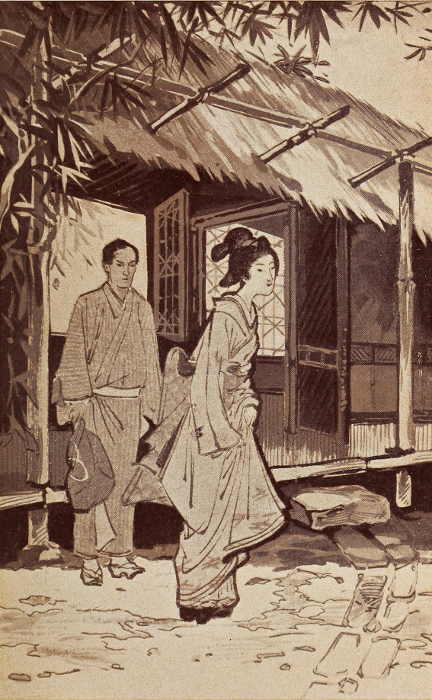
"My pleasantest memory," he said, "is of a little girl named Numè. She
was only ten years old when I left home, but she was bright and
beautiful as the wild birds that fly across the valleys and make their
home close by where we lived."
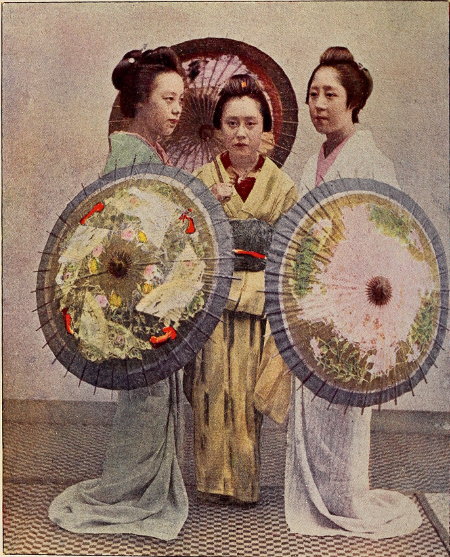
NUMÈ-SAN.
A flush had risen to the girl's face. She stirred nervously, and there
was a slight faltering in her speech as she said: "Tom once told me of
her—he said you had told him—that you had told him—you were betrothed
to her."
She had expected him to look abashed for a moment, but his face was as
calm as ever.
"I will not know that till I am home. My plans are unformed." He looked
in her face. "They depend a great deal on you," he continued.
For a moment the girl's lips half-parted to tell him of her own
betrothal, but she could not summon the courage to do so while he looked
at her with such confidence and trust; besides, her woman's vanity was
touched.
"Tell me about Numè," she said, and there was the least touch of pique
in her voice.
"Her father and mine are neighbors, and very dear friends. I have known
her all my life. When she was a little girl I used to carry her on my
shoulders over brooks and through the woods and mountain passes, because
she was so little, and I was always afraid she would fall and hurt
herself."
Cleo was silent now. She scarcely stirred while the young man was
speaking, but listened to him with strange interest. Takashima
continued: "I used to tell her I would some day be her Otto (husband),
and because she was so very fond of me that pleased her very much, and
when I said so to our fathers, it pleased them also."
The girl was nervously twisting her little handkerchief into odd knots.
She was not looking at Takashima.
"How queer," she said, "that our childhood memories are sometimes so
clear to us! We so often look back on them and think how—how absurd we
were then. Don't you think there is really more in the past to regret
than anything else?"
Takashima looked at her in surprise.
"No," he said; almost shortly, "I have nothing to regret."
"And yet," she persisted, "neither of you was old enough to—to care
for the other truly." Her words were irrelevant, and she knew it.
"We were inseparable always," the young man answered. "We were children,
both of us, but in Japan very often we are always children—always young
in heart."
Cleo could not have told why she felt the sudden overwhelming rebellion
against his allegiance to Numè, even though she knew only too well that
Takashima's heart was safe in her own keeping. With a woman's perversity
and delight in being constantly assured of his love for her in various
ways, in dwelling on it to feed her vanity, and yes, in wishing to hear
the man who loved her disclaim—even ridicule—one whom in the past he
might have cared for, she said:
"Do you love her?"
"Love?" the Japanese repeated, dwelling softly on the word. "That is not
the word now, Miss Ballard. I have only known its meaning since I have
met you," he added, gently.
The girl's heart beat with a pleasurable wildness. It was sweet to hear
these words from the lips of one who hesitated always so deferentially
from speaking his feelings; from one who a moment before had filled her
with a fear that, after all, another might interest him just as she had
done; for coquettes are essentially selfish.
"You will not marry her?" she questioned, in a low voice.
She could not restrain the almost pleading tone that crept into her
voice; for though she kept telling herself that they could never be
anything to each other, and that she already loved another, yet, after
all, was she so sure of her heart? The Japanese was silent. "That will
depend," he said, slowly. "It is the wish of our fathers. They have
always looked forward to it." His voice was very sad as he added:
"Perhaps I should grow to love her. Surely, I would try, at least, to do
my duty to my parents."
With a sudden effort the girl rose to her feet.
"It would be a cruel thing to do," she said, "cruel for her and for you.
It would be fair to no one. You do not love; therefore, you should not
marry her." Her beautiful eyes challenged him. A wild hope crept into
the Japanese's heart that the girl must surely return his feeling for
her, or she would not speak so. He was Americanized, and man of the
world enough, to understand somewhat of these things. He purposely
misled her, taking pleasure in the girl's evident resentment at his
marriage with Numè.
"I would never marry a man I did not love," she continued. "No! I would
have to love him with my whole heart."
"It is different in Japan," he said, quietly. "There we do not always
marry for love, but rather to please the parents. We try always to love
after marriage—and often we succeed."
"Your customs are—are—barbarous, then," Cleo said, defiantly. "We in
America could not understand them."
There was a vague reproach now in her voice. The Japanese had risen
also. He was smiling, as he looked at the girl. Perhaps she felt
unconsciously the tenderness of that look, for she turned her own head
away persistently.
"Miss Ballard," he said, softly,—"Miss Cleo—I do not disagree with
you, after all, as you think. It is true, as you say—there should be no
marriage without love."
"And yet you are willing to follow the ancient customs of your country,"
she said, half-pettishly—almost scornfully.
"I did not say that," he said, smiling.
"Yes, but you make one believe it," she said.
"I did not mean to. I wanted only that you should believe that it might
be so for my father's sake, if—if the one I did love was—impossible to
me." There was a piercing passion in his voice that she had not thought
him capable of.
One of those inexplicable, sudden waves of gentleness and tenderness
that sometimes sweep over a woman, came over her. She turned and faced
Takashima with a look on her face that would have made the coldest
lover's heart throb with delight and hope.
"You must be always sure—always sure she is—she is impossible."
She was appalled at her own words as soon as they were uttered.
The Japanese had taken a step nearer to her. He half held his hands out.
"I am going below," she said, with sudden fright, "I—I—indeed, I don't
know what I'm talking about."