“They held a council, standing
Before the river gate.
Short time was there, ye well may guess
For musing or debate.
Out spake the council roundly
‘The bridge must straight go down,
For since Janiculum is lost,
Naught else can save the town.’”
THE sun had risen early to get a good start, and at nine o'clock was
shining down with relentless fury on Cherry Street. Theodore was
wont to declare that the rain was wetter and the dew damper and the
sun hotter on this street than in any other portion of the inhabited
globe; and it was certainly true that the rows of small houses,
unprotected by trees or awnings, did look unusually torrid in the
broad glare of light.
In the Lee house the shutters were closed and the green shades drawn
down, but the heat seemed to radiate from the painted door, on the
south porch, where a small red-headed boy was trying to ring the door
bell. It was a long reach for the little arms, and after raising
himself so high upon his tiptoes that he nearly lost his balance, he
gave up the attempt, and thumped lustily upon the panel. There was
no response. He waited a moment, his small bare feet squirming about
uneasily upon the hot floor, and then rapped a second time and a
third. At the last knock another small red-roofed boy appeared over
the top of the board fence that separated the Canary yard from the
Lee home.
"Try it again," advised the owner of Red Head Number Two.
"I have tried it lots of agains."
"But ye ain't makin' no noise. Mis' Lee might be deef. Kick 'er a
little."
"Ain't got no shoes on," protested the little messenger.
He had just raised his hand for a final rap when the door was opened,
and Mrs. Lee appeared upon the threshold.
"Good-morning, Fridoline," she said pleasantly.
Fridoline delivered himself of his message speedily: "Ma's got an
indisposhun and says please will you come over to wunst."
"What is the matter with your mother?" inquired Mrs. Lee, puzzled by
the queer statement.
"She's got rigours," responded Red Head Number One.
"And her stummick's upset," added Red Head Number Two, across the
fence.
Mrs. Lee was already untying her apron. "Tell her I'll be over there
right away," she said, as she left the door to explain her absence to
Beatrice.
Miss Billy, coming in from an errand some time afterward, stopped
short at the sight of Holly Belle, who, with tear-stained cheeks and
red eyes, was emptying ashes into the street.
"Why what's the matter, Holly Belle?" she asked.
"Ma's sick," said Holly Belle, rubbing her sleeve across her eyes.
"Very sick?"
"I dunno. I guess she's pretty bad. She had highstericks this morning
at dawn, but she wouldn't let me call your mother until she was sure
by the smell of the coffee that you'd had your breakfast. I don't
know what's the matter with her. I gave her all the kinds of medicine
we had in the house, and there ain't none of 'em that seemed to do
her a mite of good. Your ma's here now, and she seems to be a little
better. But you know I heard the death tick in the wall, and I'm
scaret to death." And the tears rose again.
"What's a death tick?" inquired Miss Billy, putting her arm
reassuringly about the sorrowing little girl.
"It's a bug in the wall that always ticks when people are goin'
to—to die," sobbed Holly Belle.
"Pshaw!" exclaimed Miss Billy. "You don't believe that nonsense, do
you? I can't think your mother is as sick as that, anyway. Is the
doctor there?"
Holly Belle shook her head.
"Well then!" said Miss Billy triumphantly. "Mother would have had him
there long ago if your mother was dangerously ill. She'll probably
be all right in a day or two. Now cheer up, Holly Belle, and tell me
what there is that I can do for you."
A loud shriek from the back of the house answered the question.
"It's the children," said Holly Belle. "They've been going on that
way for an hour steady. I could make 'em behave, if it wasn't for
Launkelot. But he's got up a new game, an' of course they're all
bound to see it through."
"May I borrow them for a while?" asked Miss Billy.
Holly Belle gave a visible sigh of relief. "I sh'd say you can," she
responded heartily.
There was no difficulty in finding the children, for a great hubbub
in the back yard indicated that the small Canarys were having a
decidedly hilarious and enlivening time during their mother's
enforced retirement. Miss Billy went around the walk to the back of
the Lee house, and surveyed her charges over the fence.
The back yard in the Canary premises had been partitioned off into
little squares by means of a boot-heel which had grooved the hard
dirt. In the first square sat Ginevra
"With raven ringlets unconfined,
And blowing madly in the wind."
Her face and arms and bare legs were adorned with fantastic designs
in coloured chalk; and a frayed rope, attached by means of a
safety-pin to the hem of her dress, gave unmistakable evidence of a
tail. She was waving her arms violently, and giving vent to wild,
unearthly screams. Fridoline, in the next compartment, had wound
his fat body with coils of rope, which he was painstakingly chewing.
Tightly wedged into a dishpan in the third square, sat "Mixy" Murphy,
in an airy costume of shirt and drawers; while Mike, the Baby, and
the Other Baby were crawling about the ground in an abandonment of
delight.
Miss Billy waited for a lull in the proceedings. When it came she
made haste to ask:
"What in the world is all this?"
Launcelot, who was strutting through the enclosure, armed with a
whip, took it upon himself to reply:
"We're havin' a street carnival," he explained. "Fridoline is playin'
he's Bosco the Snake Eater, Jinny's Minnie the Wild Girl, an' Mixy
is the High Diver. You have to pay five pins to see him dive from
the fence to the tank. The Kids is camels, an' I'm boss o' the hull
outfit. Frid, jest show Miss Billy how much rope you can swaller
without gettin' black in the face."
Miss Billy hastened to prevent the heroic exhibition.
"Oh, no," she said, "you needn't mind, Friddie. I've got something
else for you to do. Wouldn't you all like to come over and see me
this morning?"
The Street Carnival Company gave vent to a wild yell of delight.
"Well, pick up your things first," cautioned Miss Billy, "and then
come quietly so you won't disturb your mother. I'll be waiting for
you."
"Picking up the things" was accomplished with neatness and dispatch,
and five little Canarys, two Murphys, and Leo and Pius Coffee, picked
up on the way, were seated in the shade of the Lee woodshed in solemn
and somewhat embarrassed silence when Miss Billy appeared to welcome
her guests. Her arms were full of scarlet and white reeds, a big
basket swung from one arm, and a mysterious-looking cloth bag from
the other. She glanced around the augmented group with such surprise
that Launcelot felt called upon to explain.
"I brung 'em along," he said, with a lordly motion of his hand toward
the unexpected guests. "If you was goin' to give us something to eat,
an' there ain't enough to go round, they kin go home."
"Launkelot!" exclaimed Jinny.
"The Levis wanted to come, too," said Fridoline. "Their mother's
goin' to the sin an' God."
"Goosey!" jeered Launcelot. "Sin an' God! He means synagogue. That's
one on you, Frid."
Fridoline, moved to tears by his brother's taunts, set up such a
wrathful outcry that Miss Billy began to fear for her reputation as a
hostess.
"Never mind, Friddie," she said consolingly. "You may go and invite
the Levi children to come now, if you want to. Hurry up, and we'll
have something nice planned for you when you get back." Miss Billy
deposited her burden on the ground. "I'm going to let you all help
with my work," she said,—"every one of you, from Ginevra down to the
Baby. These long strips are for baskets, and I'm going to show you
how to make them for yourselves. The big basket is for a pattern, and
the bag is full of flower seeds for the little ones to sort out, and
take home for gardens of their own."
The guests fell upon the work with great alacrity.
"Wait a minute," protested Miss Billy. "We're not ready yet. We must
always wash our hands before we begin to work."
This announcement dampened the ardour of the children.
"Them as sorts seeds don't need to wash, do they?" asked Fridoline.
"I choose to sort seeds!" came in a chorus from the smaller guests.
"Oh, yes, they do," responded Miss Billy decidedly. "Why not,
Friddie?"
"Dirt makes seeds grow," argued Fridoline.
"Not till they're in the ground," returned the hostess. "We'll all go
up to the back porch to wash. I've got some cool water up there."
A thorough and painstaking scrubbing took place on the back porch,
for Jinny, who was appointed Inspector of Persons, performed her
duties with impartial vigour and energy. Her delight in the toilet
soap was extreme, and she modestly requested a bit of it "to take
home for a sample."
Beatrice and Maggie watched the proceedings with disgust, and
the children themselves did not look upon the occasion as one of
unalloyed pleasure; but Miss Billy was resolute, and the entire
throng were at least clean down to their necks and up to their wrists
when they took their places on the grass.
Fridoline surveyed his hands gloomily. "If I'd 'a' known I had ter
wash I wouldn't have came," he said.
"Friddie!" exclaimed Ginevra reproachfully.
"Fridoline doesn't think that's a very nice way to treat company,"
laughed Miss Billy. "He's like Horatius.
"'And see,' he cried, 'the welcome,
Fair guests, that waits you here!'"
"What's Hurashus?" asked Ginevra shyly.
"Oh, he's a man in a story," responded Miss Billy. "The man who
fought so bravely."
Launcelot pricked up his ears at the word "fought." "Who did he
fight? Tell us about him," he commanded.
"Yes, please do," begged Ginevra.
"As soon as I get your work started for you," promised Miss Billy.
Her nimble fingers wove the bright reeds in and out for a few
minutes. The children gathered near; Ginevra settled The Baby on her
lap, and pulled the Other Baby close to her side. Then slowly and
carefully, as if to find words suitable for her childish audience,
Miss Billy began:
"It happened many years ago when Rome was the biggest and the finest
and the richest city in the world, that there was a brave soldier and
gallant knight named Lars Porsena."
"Two of 'em?" questioned Fridoline.
"No, only one. Lars Porsena was the soldier and the knight too. And
because he was angry at one of the Romans he decided to lead a great
army against them. You know what an army is?"
"Hoh! I sh'd say so! Soldiers!" replied Launcelot.
"I know you do," said Miss Billy, "but I thought the other children
might not know."
"I'll explain it to 'em," said Launcelot loftily. "Kids, you remember
Buffalo Bill's men that was to the Shooting Park?"
The little Canarys loudly proclaimed the excellence of their memory.
"Well, them's soldiers," said Launcelot. "Go on, Miss Billy."
"So he gathered his troops from everywhere—north and south and east
and west—till he had a great big army. There were ten thousand
horsemen, and twenty thousand men on foot. And with music playing and
banners flying and the sunlight glittering on their spears, they set
off towards Rome with Lars Porsena at the head."
"Just like Buff'lo Bill," said Fridoline.
"Sh," admonished Ginevra.
"Sh, yourself," retorted Fridoline defiantly.
"In the meantime the Romans knew they were coming, and they went down
by the river gate to talk it over. The Tiber river flowed by the
city, and there was a big bridge——"
"How bid?" inquired little Mike.
"I don't know how big, but it was very large indeed," went on Miss
Billy, "so that the enemy had to cross it before they could get into
the city. And there they waited until a messenger came flying up the
hill to tell them that Lars Porsena and his great army were very
near. They looked over to the west, and they saw the great cloud of
dust coming up from the road."
"What was they goin' to do?" asked Jinny.
"Why bust into the city an' kill the Romans," answered Launcelot. "Go
on, Miss Billy."
"And the Romans knew that they would kill them all if they once got
across the bridge," continued the historian. "And they hurriedly
talked about what it was best to do. And then one of them had a plan.
He was a wonderfully brave and noble man, and he wasn't afraid of
anything."
"Bet he'd been scaret of a hyena," said the oldest Levi boy.
"He was not afraid of anything. And this was his plan. He told the
Romans that he would get two other men and alone they would cross the
bridge and meet the enemy on the other side. This is what he said:
"'Hew down the bridge, sir consul,
With all the speed ye may;
I, with two more to help me
Will hold the foe in bay,—
In yon straight path a thousand
May well be stopped by three.
Now who will stand on either hand
And keep the bridge with me?'"
"Did they talk in po'try?" inquired Ginevra with awe.
"Sometimes," said Miss Billy. "And two other brave men volunteered
to go with him. The three crossed the bridge together, and boldly
faced the army on the other side." The little Canarys showed signs
of restlessness, and the young Murphys yawned, so Miss Billy went on
hastily. "Of course there was a terrible battle there. Every time a
man set foot on the bridge Horatius or one of his companions would
rush upon him and slay him."
"How? With a spearer?" inquired Aaron Levi with interest.
The story teller nodded. "Till seven men lay dead, and Horatius
himself was wounded in the shoulder. The big army stood still. Their
chief was killed, and no soldier dared to move. Meanwhile the Romans
had been at work at the bridge with their axes, and it hung over
the river just ready to fall. The three men knew they must get back
before it dropped. They started, but the great bridge cracked, and
went down with a crash like thunder. Two of the men had time to get
over safely, but Horatius was too late. He had darted back, and stood
all alone on the bank of the river, with the enemy before him, and
the broad river behind him. And then what do you think he did?"
"Speared 'em some more," suggested Aaron Levi.
"Died fer his country," quavered Ginevra.
"Waded home," said Fridoline.
"No, the water was too deep. He sheathed his sword, and faint and
weary though he was, plunged into the raging flood."
"Gee!" ejaculated Launcelot.
"The water was very high, his armour was heavy, and his wound pained
him severely; but he kept on. The blood ran down upon his hands, and
he sank again and again; but he still swam on till not only the
Romans, but the great army on the other bank cheered him and prayed
for him.
"And when he finally clambered out upon the shore, weary and weak and
worn, they shouted and clapped their hands for very joy." The ringing
words came involuntarily to Miss Billy's lips:
"'And still his name sounds stirring
Unto the men of Rome,
As the trumpet-blast that cries to them
To charge the Volscian home;
And wives still pray to Juno
For boys with hearts as bold
As his who kept the bridge so well
In the brave days of old.'"
"And the big army didn't ever get in?" asked Frank Murphy.
"No, never."
"What did they do to Horashuss?" inquired Launcelot.
"Oh, they gave him a lot of land, for his own, and they set up a
great statue of him."
"I seen statutes already," said Abraham Levi.
"You did not," said his brother Aaron.
"I did too. I seen 'em in the summitery."
"He means the grave yard," explained Ginevra. "Aaron, stop hitting
your little brother."
"He's a-swipin' my seeds," complained Aaron.
"Well, stop it, both of you," said Launcelot decidedly, "or Miss
Billy'll give you a bat in the eye."
The threat had the desired effect. Both of the little Levis subsided
suddenly.
"You may take the seeds home and plant them yourselves," said Miss
Billy. "There are nasturtiums and petunias to put into a bed and
morning glories and flowering beans to train over porches. We'll all
have gardens of our own."
"You've got a pretty yard," said Ginevra wistfully.
"It's getting green," responded Miss Billy. "The grass seed is all
coming up over the bare spots. Now if you had a green lawn extending
to ours, and that shabby old fence between us was down——"
"Why don't you pull it down?" inquired Launcelot.
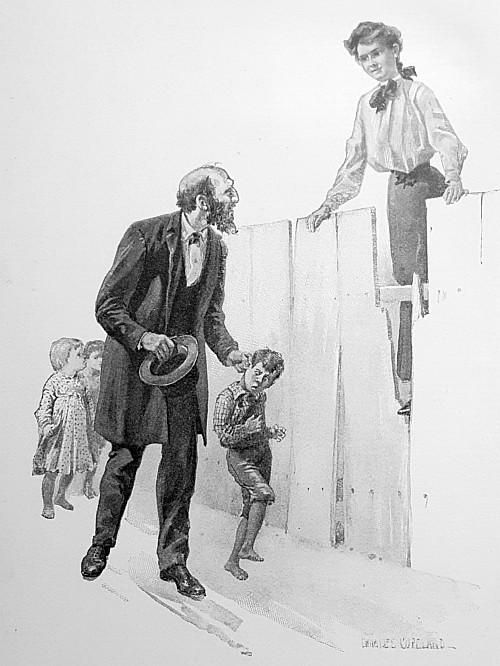
"I know Mr. Schultzsky would never let me," said Miss Billy. "I
wouldn't dare ask him. But it's so old and rotten that some day it
will just fall down itself, and then we'll have a barberry hedge
there, and the yard will begin to look like something."
"What's a berbarry haige?" inquired Launcelot.
"A nice little row of bushes trimmed evenly, so that it makes a low
fence," explained Miss Billy. "Listen, children, some one is calling."
Mrs. Lee, who had come around the walk, smiled down at the little
group on the grass, whose full hands and happy faces bore testimony
of a pleasant morning. "Your mother will be all right in a day or
two," she said, "and Holly Belle wants you to come home for dinner."
The children rose with reluctance.
"Kin we come again?" asked Ginevra wistfully, as she gathered her
little charges.
"Of course you can," said Miss Billy. "I'd love to have you here, if
you like to come. How would you like to spend two hours with me every
Saturday morning?"
"What 'ud we do?" inquired Launcelot.
"Oh, lots of pleasant things: We can sew and read, and play games,
and sing. I can find enough for you to do, never fear."
"How much do we have to pay?" inquired Aaron Levi cautiously.
"Not a cent," laughed Miss Billy. "The only price is clean hands and
face. We'll meet out here in the yard, and I'll raise children as
well as flowers. You'll be my child garden, you see. Come at nine
next Saturday, and we'll have another good time."
The children filed happily around the corner of the house, all
talking at the same time, but their voices lowered as they passed
out of vision. They held a whispered conversation as they passed the
rickety fence, Launcelot expressing some iconoclastic sentiments
in a husky undertone. They were still whispering as they entered
the Canary yard, and edged mysteriously along the side of the house
between the porch and the fence.
"It'll be just like playing Horashuss," urged Launcelot.
"But what would Miss Billy think?" asked Ginevra doubtfully.
"You heard what she said. She'd think it was brave!" said Launcelot
in his most lordly tones.
"But s'pose some one would see?" quavered Ginevra.
"Aw pshaw! They ain't no one a-goin' to see. And if they do, what
then? Go in if you're afraid."
Ginevra hesitated.
"Miss Billy'd like it," went on the tempter. His sister flung
prudence to the winds. "I'll help," she said.
Holly Belle's voice rang out impatiently a second time:
"Child-run, din-ner."
"We'll be there in a minute," called Launcelot impatiently. "Now
hurry up, kids. Take a-hold, here. No, not so near together. Now, I'm
going to count. When I say three, you all pull like the dickens, and
then run, lickety split. Get out of the way there, Mike."
The children grasped the rotten palings.
"One—two—three," counted Launcelot.
The little army gave a mighty tug. The rotten wood splintered, split,
yielded; the fence fell with a crash, and a sorry mass of decayed
boards covered the yard.
The children waited to see no more, but rushed about the house as
though old Mr. Schultzsky himself was in their wake.
Launcelot and Ginevra turned at the basement steps to help little
Mike, who had fallen upon his face in the stampede. From his place
of vantage Launcelot glanced around to see if they were being
pursued. There was no one in sight, and all was still.
"Now," said Launcelot boldly, "Miss Billy can have her berbarry
haige."