In selecting the furniture of parlors, some reference should
be had to correspondence of shades and colors. Curtains
should be darker than the walls; and, if the walls and carpets
be light, the chairs should be dark, and vicè versa. Pictures
always look best on light walls.
In selecting carpets for rooms much used, it is poor economy
to buy cheap ones. Ingrain carpets, of close texture,
and the three-ply carpets, are best for common use. Brussels
carpets do not wear so long as the three-ply ones, because
they can not be turned. Wilton carpets wear badly, and
Venetians are good only for halls and stairs.
In selecting colors, avoid those in which there are any
black threads; as they are usually rotten. The most tasteful
carpets are those which are made of various shades of
the same color, or of all shades of only two colors; such as
brown and yellow, or blue and buff, or salmon and green, or
all shades of green, or of brown. All very dark shades
should be brown or green, but not black.
In laying down carpets, it is a bad practice to put straw
under them, as this makes them wear out in spots. Straw
matting, laid under carpets, makes them last much longer,
as it is smooth and even, and the dust sifts through it. In
buying carpets, always get a few yards over, to allow for
waste in matching figures.
In cutting carpets, make them three or four inches shorter
than the room, to allow for stretching. Begin to cut in the
middle of a figure, and it will usually match better. Many
carpets match in two different ways, and care must be taken
to get the right one. Sew a carpet on the wrong side, with
double waxed thread, and with the ball-stitch. This is done
by taking a stitch on the breadth next you, pointing the needle
toward you; and then taking a stitch on the other
breadth, pointing the needle from you. Draw the thread
tightly, but not so as to pucker. In fitting a breadth to the
hearth, cut slits in the right place, and turn the piece under.
Bind the whole of the carpet with carpet-binding, nail
it with tacks, having bits of leather under the heads. To
stretch the carpet, use a carpet-fork, which is a long stick,
ending with notched tin, like saw-teeth. This is put in the
edge of the carpet, and pushed by one person, while the nail
is driven by another. Cover blocks or bricks with carpeting
like that of the room, and put them behind tables, doors,
sofas, etc., to preserve the walls from injury by knocking, or
by the dusting-cloth.
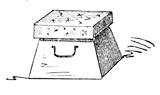
Cheap footstools, made of a square plank, covered with
tow-cloth, stuffed, and then covered with carpeting, with
worsted handles, look very well. Sweep carpets as seldom
as possible, as it wears them out. To shake them often is
good economy. In cleaning carpets, use damp tea leaves, or
wet Indian meal, throwing it about, and rubbing it over
with the broom. The latter is very good for cleansing carpets
made dingy by coal-dust. In brushing carpets in ordinary
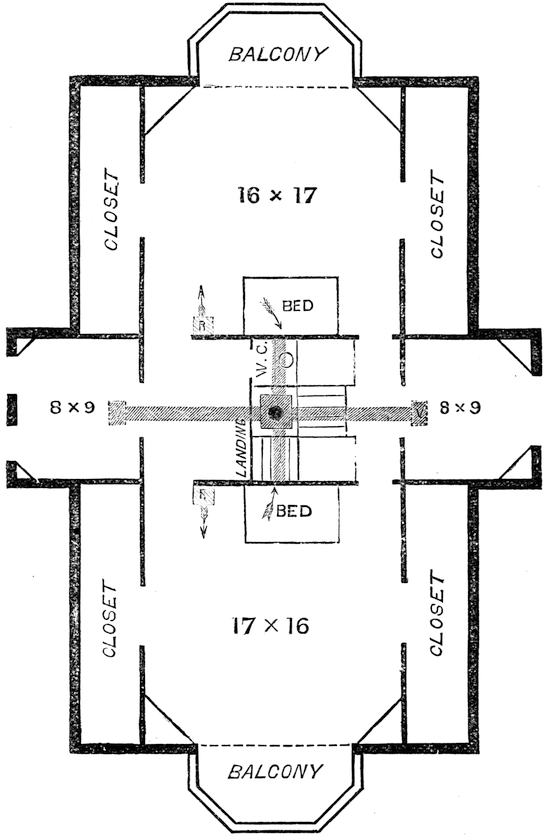
use, it will be found very convenient to use a large flat
dust-pan, with a perpendicular handle a yard high, put on
so that the pan will stand alone, This can be carried about
and used without stooping, brushing dust into it with a
common or small whisk broom. The pan must be very
large, or it will be upset.
When carpets are taken up, they should be hung on a
line, or laid on long grass, and whipped, first on one side, and
then on the other, with pliant whips. If laid aside, they
should be sewed up tight in linen, having snuff or tobacco
put along all the crevices where moths could enter. Shaking
pepper, from a pepper-box, round the edge of the floor,
under a carpet, prevents the access of moths.
Carpets can be best washed on the floor, thus: First shake
them; and then, after cleaning the floor, stretch and nail
them upon it. Then scrub them in cold soap-suds, having
half a tea-cupful of ox-gall to a bucket of water. Then wash
off the suds with a cloth in fair water. Set open the doors
and windows for two days or more. Imperial Brussels, Venetian,
ingrain, and three-ply carpets can be washed thus;
but Wilton and other plush carpets can not. Before washing
them, take out grease with a paste made of potter’s
clay, ox-gall, and water.
Straw matting is the best for chambers and summer parlors.
The checked, of two colors, is not so good to wear.
The best is the cheapest in the end. When washed, it
should be done with salt water, wiping it dry; but frequent
washing injures it. Bind matting with cotton binding.
Sew breadths together like carpeting. In joining the ends
of pieces, ravel out a part, and tie the threads together, turning
under a little of each piece, and then, laying the ends
close, nail them down, with nails having kid under their
heads.
In hanging pictures, put them so that the lower part shall
be opposite the eye. Cleanse the glass of pictures with
whiting, as water endangers the pictures. Gilt frames can
be much better preserved by putting on a coat of copal varnish,
which, with proper brushes, can be bought of carriage
or cabinet makers. When dry, it can be washed with fair
water. Wash the brush in spirits of turpentine.
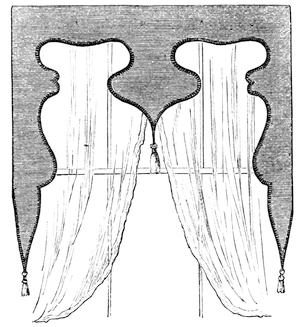
Curtains, ottomans, and sofas covered with worsted, can
be cleansed by wheat bran rubbed on with flannel. Dust
Venetian blinds with feather brushes. Buy light-colored
ones, as the green are going of fashion. Strips of linen or
cotton, on rollers and pulleys, are much in use, to shut out
the sun from curtains and carpets. Paper curtains, pasted
on old cotton, are good for chambers. Put them on rollers
having cords nailed to them, so that when the curtain falls
the cord will be wound up. Then, by pulling the cord, the
curtain will be rolled up.
House-cleaning should be done in dry, warm weather.
Several friends of the writer maintain that cleaning paint,
and windows, and floors in hard, cold water, without any
soap, using a flannel wash-cloth, is much better than using
warm suds. It is worth trying. In cleaning in the common
way, sponges are best for windows, and clean water
only should be used. They should be first wiped with linen,
and then with old silk. The outside of windows should
be washed with a long brush made for the purpose; and
they should be rinsed, by throwing upon them water containing
a little saltpetre.
When inviting company, mention in the note the day of
the month and week, and the hour for coming. Provide a
place for ladies to dress their hair, with a glass, pins, and
combs. A pitcher of cold water and a tumbler should be
added. When the company is small, it is becoming a common
method for the table to be set at one end of the room,
the lady of the house to pour out tea, and the gentlemen of
the party to wait on the ladies and themselves. When tea
is sent round, always send a tea-pot of hot water to weaken
it, and a slop-bowl, or else many persons will drink their tea
much stronger than they wish.
Let it ever be remembered that the burning of lights and
the breath of guests are constantly exhausting the air of its
healthful principle; therefore avoid crowding many guests
into one room. Do not tempt the palate by a great variety
of unhealthful dainties. Have a warm room for departing
guests, that they may not become chilled before they go out.
A parlor should be furnished with candle and fire screens,
for those who have weak eyes; and if, at table, a person sits
with the back near the fire, a screen should be hung on the
back of the chair, as it is very injurious to the whole system
to have the back heated.
Pretty baskets, for flowers or fruits, on centre-tables, can
be made thus: Knit, with coarse needles, all the various
shades of green and brown, into a square piece. Press it
with a hot iron, and then ravel it out. Buy a pretty-shaped
wicker-basket, or make one of stiff millinet, or thin pasteboard,
cut the worsted into bunches, and sew them on, to
resemble moss. Then line the basket, and set a cup or dish
of water in it, to hold flowers, or use it for a fruit-basket.
Handsome fire-boards are made by nailing black foundation-muslin
to a frame the size of the fire-place, and then cutting
out flowers from wall-paper and pasting them on the muslin,
according to the fancy.
Mahogany furniture should be made in the spring, and
stand some months before it is used, or it will shrink and
warp. Varnished furniture should be rubbed only with
silk, except occasionally, when a little sweet-oil should be
rubbed over, and wiped off carefully. For unvarnished furniture,
use bees-wax, a little softened with sweet-oil; rub it
in with a hard brush, and polish with woolen and silk rags.
Some persons rub in linseed-oil; others mix bees-wax with a
little spirits of turpentine and rosin, making it so that it can
be put on with a sponge, and wiped off with a soft rag.
Others keep in a bottle the following mixture: two ounces
of spirits of turpentine, four table-spoonfuls of sweet-oil, and
one quart of milk. This is applied with a sponge, and wiped
off with a linen rag.
Hearths and jambs, of brick, look best painted over with
black-lead, mixed with soft soap. Wash the bricks which
are nearest the fire with redding and milk, using a painter’s
brush. A sheet of zinc, covering the whole hearth, is cheap,
saves work, and looks very well. A tinman can fit it properly.
Stone hearths should be rubbed with a paste of powdered
stone, (to be procured of the stone-cutters,) and then brushed
with a stiff brush. Kitchen-hearths, of stone, are improved
by rubbing in lamp-oil.
Stains can be removed from marble by oxalic acid and
water, or oil of vitriol and water, left on fifteen minutes, and
then rubbed dry. Gray marble is improved by linseed-oil.
Grease can be taken from marble by ox-gall and potter’s
clay wet with soap-suds, (a gill of each). It is better to add,
also, a gill of spirits of turpentine. It improves the looks
of marble to cover it with this mixture, leaving it two days,
and then rubbing it off.
Unless a parlor is in constant use, it is best to sweep it
only once a week, and at other times use a whisk-broom and
dust-pan. When a parlor with handsome furniture is to be
swept, cover the sofas, centre-table, piano, books, and mantel-piece,
with old cottons, kept for the purpose. Remove
the rugs, and shake them, and clean the jambs, hearth, and
fire-furniture. Then sweep the room, moving every article.
Dust the furniture with a dust-brush and a piece of old silk.
A painter’s brush should be kept to remove dust from ledges
and crevices. The dust-cloths should be often shaken and
washed, or else they will soil the walls and furniture when
they are used. Dust ornaments, and fine books, with feather
brushes, kept for the purpose.
An eating-room should have in it a large closet, with
drawers and shelves, in which should be kept all the articles
used at meals. This, if possible, should communicate with
the kitchen by a sliding window, or by a door, and have in
it a window, and also a small sink, made of marble or lined
with zinc, which will be a great convenience for washing
nice articles. If there be a dumb-waiter, it is best to have
it connected with such a closet. It may be so contrived,
that, when it is down, it shall form part of the closet floor.
A table-rug, or crumb-cloth, is useful to save carpets from
injury. Bocking, or baize, is best. Always spread the same
side up, or the carpet will be soiled by the rug. Table-mats
are needful, to prevent injury to the table from the warm
dishes. Tea-cup-mats, or small plates, are useful to save the
table-cloths from dripping tea or coffee. Butter-knives for
the butter-plate, and salt-spoons for salt dishes, are designed
to prevent those disgusting marks which are made when
persons use their own knives to take salt or butter. A sugar-spoon
should be kept in or by the sugar-dish, for the same
purpose. Table-napkins, of diaper, are often laid by each
person’s plate, for use during the meal, to save the table-cloth
and pocket-handkerchief. To preserve the same napkin
for the same person, each member of the family has a
given number, and the napkins are numbered to correspond,
or else are slipped into ivory rings, which are numbered. A
stranger has a clean one at each meal. Table-cloths should
be well starched, and ironed on the right side, and always,
when taken off, folded in the ironed creases. Doilies are
colored napkins, which, when fruit is offered, should always
be furnished, to prevent a person from staining a nice
handkerchief, or permitting the fruit-juice to dry on the
fingers.
Casters and salt-stands should be put in order, every
morning, when washing the breakfast things. Always, if
possible, provide fine and dry table-salt, as many persons are
much disgusted with that which is dark, damp, and coarse.
Be careful to keep salad-oil closely corked, or it will grow
rancid. Never leave the salt-spoons in the salt, nor the
mustard-spoon in the mustard, as they are thereby injured.
Wipe them immediately after the meal.
For table-furniture, French china is deemed the nicest, but
it is liable to the objection of having plates so made that
salt, butter, and similar articles, will not lodge on the edge,
but slip into the centre. Select knives and forks which
have weights in the handles, so that, when laid down, they
will not touch the table. Those with riveted handles last
longer than any others. Horn handles (except buck-horn)
are very poor. The best are cheapest in the end. Knives
should be sharpened once a month, unless they are kept
sharp by the mode of scouring.
Neat housekeepers observe the manner in which a table
is set more than any thing else; and, to a person of good
taste, few things are more annoying than to see the table
placed askew; the table-cloth soiled, rumpled, and put on
awry; the plates, knives, and dishes thrown about without
any order; the pitchers soiled on the outside, and sometimes
within; the tumblers dim; the caster out of order; the butter
pitched on the plate, without any symmetry; the salt
coarse, damp, and dark; the bread cut in a mixture of junks
and slices; the dishes of food set on at random, and without
mats; the knives dark or rusty, and their handles greasy;
the tea-furniture all out of order, and every thing in similar
style. And yet, many of these negligences will be met with
at the tables of persons who call themselves well bred, and
who have wealth enough to make much outside show. One
reason for this is, the great difficulty of finding domestics
who will attend to these things in a proper manner, and
who, after they have been repeatedly instructed, will not
neglect nor forget what has been said to them. The writer
has known cases where much has been gained by placing
the following rules in plain sight, in the place where the articles
for setting tables are kept.
1. Lay the rug square with the room, and also smooth and
even; then set the table also square with the room, and see
that the legs are in the right position to support the leaves.
2. Lay the table-cloth square with the table, right side up,
smooth and even.
3. Put on the tea-tray (for breakfast or tea) square with
the table; set the cups and saucers at the front side of the
tea-tray, and the sugar, slop-bowls, and cream-cup at the
back side. Lay the sugar-spoon or tongs on the sugar-bowl.
4. Lay the plates around the table at equal intervals, and
the knives and forks at regular distances, each in the same
particular manner, with a cup-mat or cup-plate to each, and
a napkin at the right side of each person.
5. If meat be used, set the caster and salt-cellars in the
centre of the table; then lay mats for the dishes, and place
the carving-knife, and fork and steel by the master of the
house. Set the butter on two plates, one on either side,
with a butter-knife by each.
6. Set the tea or coffee-pot on a mat, at the right hand of
the tea-tray, (if there be not room upon it.) Then place the
chairs around the table, and call the family.
1. Place the rug, table, table-cloth, plates, knives and
forks, and napkins, as before directed, with a tumbler by
each plate. In cold weather, set the plates where they will
be warmed.
2. Put the caster in the centre, and the salt-stands at two
oblique corners, of the table, the latter between two large
spoons crossed. If more spoons be needed, lay them on
each side of the caster crossed. Set the pitcher on a mat,
either at a side-table, or, when there is no waiter, on the dining-table.
Water looks best in glass decanters.
3. Set the bread on the table, when there is no waiter.
Some take a fork and lay a piece on the napkin or tumbler
by each plate. Others keep it in a tray, covered with a
white napkin to keep off flies. Bread for dinner is often cut
in small junks, and not in slices.
4. Set the principal dish before the master of the house,
and the other dishes in a regular manner. Put the carving-knife,
fork, and steel by the principal dish, and also a knife-rest,
if one be used.
5. Put a small knife and fork by the pickles, and also by
any other dishes which need them. Then place the chairs.
A domestic who waits on the table should be required to
keep the hair and hands in neat order, and have on a clean
apron. A small tea-tray should be used to carry cups and
plates. The waiter should announce the meal (when ready)
to the mistress of the family, then stand by the eating-room
door till all are in, then close the door, and step to the left
side of the lady of the house. When all are seated, the
waiter should remove the covers, taking care first to invert
them, so as not to drop the steam on the table-cloth or
guests. In presenting articles, go to the left side of the
person. In pouring water, never entirely fill the tumbler.
The waiter should notice when bread or water is wanting,
and hand it without being called. When plates are changed,
be careful not to drop knives or forks. Brush off crumbs,
with a crumb-brush, into a small waiter.
When there is no domestic waiter, a light table should be
set at the left side of the mistress of the house, on which the
bread, water, and other articles not in immediate use can be
placed.
It is considered an accomplishment for a lady to know
how to carve well at her own table. It is not proper to
stand in carving. The carving-knife should be sharp and
thin. To carve fowls (which should always be laid with
the breast uppermost,) place the fork in the breast, and take
off the wings and legs without turning the fowl; then cut
out the merry-thought, cut slices from the breast, take out
the collar bone, cut off the side pieces, and then cut the carcass
in two. Divide the joints in the leg of a turkey.
In helping the guests, when no choice is expressed, give a
piece of both the white and dark meat, with some of the
stuffing. Inquire whether the guest will be helped to each
kind of vegetable, and put the gravy on the plate, and not
on any article of food.
In carving a sirloin, cut thin slices from the side next to
you, (it must be put on the dish with the tenderloin underneath;)
then turn it, and cut from the tenderloin. Help the
guest to both kinds.
In carving a leg of mutton or a ham, begin by cutting
across the middle to the bone. Cut a tongue across, and
not lengthwise, and help from the middle part.
Carve a fore-quarter of lamb by separating the shoulder
from the ribs, and then dividing the ribs. To carve a loin
of veal, begin at the smaller end and separate the ribs. Help
each one to a piece of the kidney and its fat. Carve pork
and mutton in the same way.
To carve a fillet of veal, begin at the top, and help to the
stuffing with each slice. In a breast of veal, separate the
breast and brisket, and then cut them up, asking which part
is preferred. In carving a pig, it is customary to divide it,
and take off the head, before it comes to the table; as, to
many persons, the head is very revolting. Cut off the limbs,
and divide the ribs. In carving venison, make a deep incision
down to the bone, to let out the juices; then turn the
broad end of the haunch toward you, cutting deep, in thin
slices. For a saddle of venison, cut from the tail toward
the other end, on each side, in thin slices. Warm plates are
very necessary with venison and mutton, and in winter are
desirable for all meats.
Every mistress of a family should see not only that all
sleeping-rooms in her house can be well ventilated at night,
but that they actually are so. Where there is no open fire-place
to admit the pure air from the exterior, a door should
be left open into an entry, or room where fresh air is admitted;
or else a small opening should be made in the top and
bottom of a window, taking care not to allow a draught of
air to cross the bed. The debility of childhood, the lassitude
of domestics, and the ill health of families, are often caused
by neglecting to provide a supply of pure air. Straw matting
is best for a chamber carpet, and strips of woolen carpeting
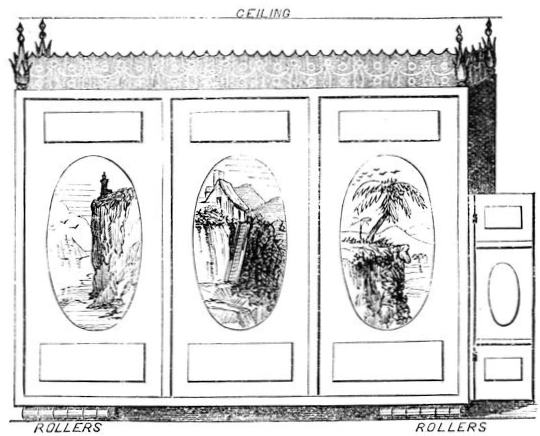
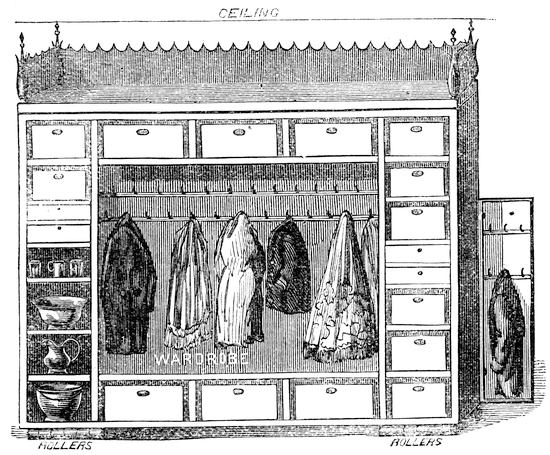
may be laid by the side of the bed. Where chambers
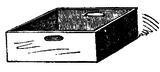
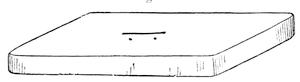
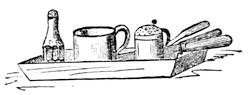
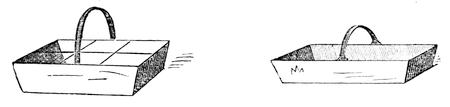
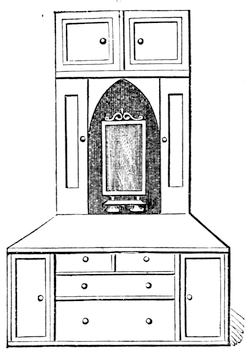
have no closets, a wardrobe is indispensable. A low
square box, set on casters, with a cushion on the top, and a
drawer on one side to put shoes in, is a great convenience in
dressing the feet. An old Champagne basket, fitted up with
a cushion on the lid, and a valance fastened to it to cover
the sides, can be used for the same purpose.
Another convenience, for a room where sewing is done in
summer, is a fancy jar, set in one corner, to receive clippings,
and any other rubbish. It can be covered with prints or
paintings, and varnished, and then looks very prettily.
The trunks in a chamber can be improved in looks and
comfort by making cushions of the same size and shape,
stuffed with hay and covered with chintz, with a frill reaching
nearly to the floor.
Every bed-chamber should have a wash-stand, bowl, pitcher,
and tumbler, with a wash-bucket under the stand, to receive
slops. A light screen, made like a clothes-frame, and
covered with paper or chintz, should be furnished for bedrooms
occupied by two persons, so that ablutions can be
performed in privacy. It can be ornamented, so as to look
well anywhere. A little frame, or towel-horse, by the wash-stand,
on which to dry towels, is a convenience. A wash-stand
should be furnished with a sponge or wash-cloth, and
a small towel, for wiping the basin after using it. This
should be hung on the wash-stand or towel-horse, for constant
use. A soap-dish, and a dish for tooth-brushes, are neat
and convenient, and each person should be furnished with
two towels; one for the feet, and one for other purposes.
It is in good taste to have the curtains, bed-quilt, valance,
and window-curtains of similar materials. In making feather-beds,
side-pieces should be put in, like those of mattresses,
and the bed should be well filled, so that a person will not
be buried in a hollow, which is not healthful, save in extremely
cold weather. Feather-beds should never be used
except in cold weather. At other times, a thin mattress of
hair, cotton and moss, or straw, should be put over them. A
simple strip of broad straw matting, spread over a feather-bed,
answers the same purpose. Nothing is more debilitating
than, in warm weather, to sleep with a feather-bed pressing
round the greater part of the body. Pillows stuffed
with papers an inch square are good for summer, especially
for young children, whose heads should be kept cool. The
cheapest and best covering of a bed, for winter, is a cotton
comforter, made to contain three or four pounds of cotton,
laid in bats or sheets, between covers tacked together at
regular intervals. They should be three yards square, and
less cotton should be put at the sides that are tucked in. It
is better to have two thin comforters to each bed, than one
thick one; as then the covering can be regulated according
to the weather.
Few domestics will make a bed properly without much
attention from the mistress of the family. The following directions
should be given to those who do this work:
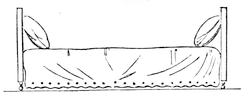
Open the windows, and lay off the bed-covering, on two
chairs, at the foot of the bed. After the bed is well aired,
shake the feathers, from each corner to the middle; then
take up the middle, and shake it well, and turn the bed over.
Then push the feathers in place, making the head higher
than the foot, and the sides even, and as high as the middle
part. Then put on the bolster and the under sheet, so that
the wrong side of the sheet shall go next the bed, and the
marking come at the head, tucking in all around. Then put
on the pillows, even, so that the open ends shall come to the
sides of the bed, and then spread on the upper sheet, so that
the wrong side shall be next the blankets and the marked
end at the head. This arrangement of sheets is to prevent
the part where the feet lie from being reversed, so as to
come to the face, and also to prevent the parts soiled by the
body from coming to the bed-tick and blankets. Then put
on the other covering, except the outer one, tucking in all
around, and then turn over the upper sheet, at the head, so
as to show a part of the pillows. When the pillow-cases
are clean and smooth, they look best outside of the cover,
but not otherwise. Then draw the hand along the side of
the pillows, to make an even indentation, and then smooth
and shape the whole outside. A nice housekeeper always
notices the manner in which a bed is made; and in some
parts of the country it is rare to see this work properly performed.
The writer would here urge every mistress of a family
who keeps more than one domestic to provide them with
single beds, that they may not be obliged to sleep with all
the changing domestics, who come and go so often. Where
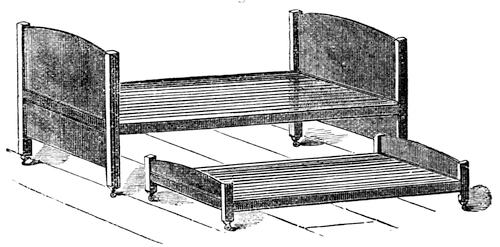
the room is too small for two beds, a narrow truckle-bed
under another will answer. Domestics should be furnished
with washing conveniences in their chambers, and be encouraged
to keep their persons and rooms neat and in order.
Fold a gentleman’s coat thus: Lay it on a table or bed,
the inside downward, and unroll the collar. Double each
sleeve once, making the crease at the elbow, and laying
them so as to make the fewest wrinkles, and parallel with
the skirts. Turn the fronts over the back and sleeves, and
then turn up the skirts, making all as smooth as possible.
Fold a shirt thus: One that has a bosom-piece inserted,
lay on a bed, bosom downward. Fold each sleeve twice,
and lay it parallel with the sides of the shirt. Turn the
two sides, with the sleeves, over the middle part, and then
turn up the bottom, with two folds. This makes the collar
and bosom lie, unpressed, on the outside.
Fold a frock thus: Lay its front downward, so as to make
the first creases in folding come in the side breadths. To
do this, find the middle of the side breadths by first putting
the middle of the front and back breadths together. Next,
fold over the side creases so as just to meet the slit behind.
Then fold the skirt again, so as to make the backs lie together
within and the fronts without. Then arrange the
waist and sleeves, and fold the skirt around them.
In packing trunks for traveling, put all heavy articles at
the bottom, covered with paper, which should not be printed,
as the ink rubs off. Put coats and pantaloons into linen
cases, made for the purpose, and furnished with strings.
Fill all crevices with small articles; as, if a trunk is not full,
nor tightly packed, its contents will be shaken about and
get injured. Under-clothing packs closer by being rolled
tightly, instead of being folded.
Bonnet-boxes, made of light wood, with a lock and key,
are better than the paper bandboxes so annoying to travelers.
Carpet-bags are very useful, to carry the articles to
be used on a journey. The best ones have sides inserted,
iron rims, and a lock and key. A large silk traveling-bag,
with a double linen lining, in which are stitched receptacles
for tooth-brush, combs, and other small articles, is a very
convenient article for use when traveling.
A bonnet-cover, made of some thin material, like a large
hood with a cape, is useful to draw over the bonnet and
neck, to keep off dust, sun, and sparks from a steam-engine.
Green veils are very apt to stain bonnets when damp.
In packing household furniture for moving, have each
box numbered, and then have a book, in which, as each box
is packed, note down the number of the box, and the order
in which its contents are packed, as this will save much labor
and perplexity when unpacking. In packing china and
glass, wrap each article separately in paper, and put soft
hay or straw at bottom and all around each. Put the heaviest
articles at the bottom, and on the top of the box write,
“This side up.”
If parents wish their daughters to grow up with good
domestic habits, they should have, as one means of securing
this result, a neat and cheerful kitchen. A kitchen should
always, if possible, be entirely above-ground, and well lighted.
It should have a large sink, with a drain running under-ground,
so that all the premises may be kept sweet and
clean. If flowers and shrubs be cultivated around the doors
and windows, and the yard near them be kept well turfed,
it will add very much to their agreeable appearance. The
walls should often be cleaned and whitewashed, to promote
a neat look and pure air. The floor of a kitchen should be
painted, or, which is better, covered with an oil-cloth. To
procure a kitchen oil-cloth as cheaply as possible, buy cheap
tow cloth, and fit it to the size and shape of the kitchen.
Then have it stretched, and nailed to the south side of the
barn, and with a brush cover it with a coat of thin rye
paste. When this is dry, put on a coat of yellow paint, and
let it dry for a fortnight. It is safest to first try the paint,
and see if it dries well, as some paint never will dry. Then
put on a second coat, and, at the end of another fortnight, a
third coat. Then let it hang two months, and it will last,
uninjured, for many years. The longer the paint is left to
dry, the better. If varnished, it will last much longer.
A sink should be scalded out every day, and occasionally
with hot ley. On nails, over the sink, should be hung three
good dish-cloths, hemmed, and furnished with loops—one for
dishes not greasy, one for greasy dishes, and one for washing
pots and kettles. These should be put in the wash
every week. The lady who insists upon this will not be
annoyed by having her dishes washed with dark, musty, and
greasy rags, as is too frequently the case.
Under the sink should be kept a slop-pail; and, on a shelf
by it, a soap-dish and two water-pails. A large boiler, of
warm soft water, should always be kept over the fire, well
covered, and a hearth-broom and bellows be hung near the
fire. A clock is a very important article in the kitchen, in
order to secure regularity at meals.
No item of domestic labor is so frequently done in a negligent
manner by domestics as this. A full supply of conveniences
will do much toward a remedy of this evil. A
swab, made of strips of linen, tied to a stick, is useful to
wash nice dishes, especially small, deep articles. Two or
three towels, and three dish-cloths, should be used. Two
large tin tubs, painted on the outside, should be provided;
one for washing, and one for rinsing; also, a large old
waiter, on which to drain the dishes. A soap-dish, with
hard soap, and a fork, with which to use it, a slop-pail, and
two pails for water, should also be furnished. Then, if there
be danger of neglect, the following rules for washing dishes,
legibly written, may be hung up by the sink, and it will aid
in promoting the desired care and neatness.
1. Scrape the dishes, putting away any food which may
remain on them, and which it may be proper to save for future
use. Put grease into the grease-pot, and whatever
else may be on the plates, into the slop-pail. Save tealeaves,
for sweeping. Set all the dishes, when scraped, in
regular piles; the smallest at the top.
2. Put the nicest articles in the wash-dish, and wash them
in hot suds, with the swab or nicest dish-cloth. Wipe all
metal articles as soon as they are washed. Put all the rest
into the rinsing-dish, which should be filled with hot water.
When they are taken out, lay them to drain on the waiter.
Then rinse the dish-cloth and hang it up, wipe the articles
washed, and put them in their places.
3. Pour in more hot water, wash the greasy dishes with
the dish-cloth made for them; rinse them, and set them to
drain. Wipe them, and set them away. Wash the knives
and forks, being careful that the handles are never put in
water; wipe them, and then lay them in a knife-dish to be
scoured.
4. Take a fresh supply of clean suds, in which wash the
milk-pans, buckets, and tins. Then rinse and hang up this
dish-cloth, and take the other; with which wash the roaster,
gridiron, pots, and kettles. Then wash and rinse the dish-cloth,
and hang it up. Empty the slop-bucket and scald it.
Dry metal tea-pots and tins before the fire. Then put the
fire-place in order, and sweep and dust the kitchen.
Some persons keep a deep and narrow vessel, in which to
wash knives with a swab, so that a careless domestic can not
lay them in the water while washing them. This article can
be carried into the eating-room, to receive the knives and
forks when they are taken from the table.
Crockery.—Brown earthen pans are said to be best for
milk and for cooking. Tin pans are lighter, and more convenient,
but are too cold for many purposes. Tall earthen
jars with covers are good to hold butter, salt, lard, etc.
Acids should never be put into the red earthenware, as
there is a poisonous ingredient in the glazing which the acid
takes off. Stone ware is better and stronger, and safer every
way than any other kind.
Iron Ware.—Many kitchens are very imperfectly supplied
with the requisite conveniences for cooking. When a person
has sufficient means, the following articles are all desirable:
A nest of iron pots, of different sizes, (they should be
slowly heated when new;) a long iron fork, to take out articles
from boiling water; an iron hook with a handle, to
lift pots from the crane; a large and small gridiron, with
grooved bars, and a trench to catch the grease; a Dutch
oven, called also a bake-pan; two skillets, of different sizes,
and a spider, or flat skillet, for frying; a griddle, a waffle-iron,
tin and iron bake and bread pans; two ladles, of different
sizes; a skimmer; iron skewers; a toasting-iron; two
tea-kettles, one small and one large one; two brass kettles,
of different sizes, for soap-boiling, etc. Iron kettles lined
with porcelain are better for preserves. The German are
the best. Too hot a fire will crack them, but with care in
this respect they will last for many years.
Portable charcoal furnaces, of iron or clay, are very useful
in summer, in washing, ironing, and stewing, or making preserves.
If used in the house, a strong draught must be
made, to prevent the deleterious effects of the charcoal. A
box and mill, for spice, pepper, and coffee, are needful to
those who use these articles. Strong knives and forks, a
sharp carving-knife, an iron cleaver and board, a fine saw,
steelyards, chopping-tray and knife, an apple-parer, steel for
sharpening knives, sugar-nippers, a dozen iron spoons, also a
large iron one with a long handle, six or eight flat-irons, one
of them very small, two iron-stands, a ruffle-iron, a crimping-iron,
are also desirable.
Tin Ware.—Bread-pans; large and small patty-pans; cakepans,
with a centre tube to insure their baking well; pie-dishes,
(of block-tin;) a covered butter-kettle; covered kettles
to hold berries; two saucepans; a large oil-can, (with
a cock;) a lamp-filler; a lantern; broad-bottomed candlesticks
for the kitchen; a candle-box; a funnel; a reflector
for baking warm cakes; an oven or tin-kitchen; an apple-corer;
an apple-roaster; an egg-boiler; two sugar-scoops,
and flour and meal scoop; a set of mugs; three dippers; a
pint, quart, and gallon measure; a set of scales and weights;
three or four pails, painted on the outside; a slop-bucket
with a tight cover, painted on the outside; a milk-strainer;
a gravy-strainer; a colander; a dredging-box; a pepper-box;
a large and small grater; a cheese-box; also a large
box for cake, and a still larger one for bread, with tight covers.
Bread, cake, and cheese, shut up in this way, will not
grow dry as in the open air.
Wooden Ware.—A nest of tubs; a set of pails and bowls;
a large and small sieve; a beetle for mashing potatoes; a
spade or stick for stirring butter and sugar; a bread-board,
for molding bread and making pie-crust; a coffee-stick; a
clothes-stick; a mush-stick; a meat-beetle, to pound tough
meat; an egg-beater; a ladle, for working butter; a bread-trough,
(for a large family;) flour-buckets, with lids, to hold
sifted flour and Indian meal; salt-boxes; sugar-boxes; starch
and indigo boxes; spice-boxes; a bosom-board; a skirt-board;
a large ironing-board; two or three clothes-frames;
and six dozen clothes-pins.
Basket Ware.—Baskets of all sizes, for eggs, fruit, marketing,
clothes, etc.; also chip-baskets. When often used, they
should be washed in hot suds.
Other Articles.—Every kitchen needs a box containing
balls of brown thread and twine, a large and small darning-needle,
rolls of waste paper and old linen and cotton, and a
supply of common holders. There should also be another
box, containing a hammer, carpet-tacks, and nails of all sizes,
a carpet-claw, screws and a screw-driver, pincers, gimlets of
several sizes, a bed-screw, a small saw, two chisels, (one to
use for button-holes in broadcloth,) two awls, and two files.
In a drawer or cupboard should be placed cotton table-cloths
for kitchen use; nice crash towels for tumblers,
marked T T; coarser towels for dishes marked T; six large
roller-towels; a dozen hand-towels, marked H T; and a dozen
hemmed dish-cloths with loops. Also two thick linen pudding
or dumpling cloths, a jelly-bag made of white flannel, to
strain jelly, a starch-strainer, and a bag for boiling clothes.
In a closet should be kept, arranged in order, the following
articles: the dust-pan, dust-brush, and dusting-cloths,
old flannel and cotton for scouring and rubbing, large
sponges for washing windows and looking-glasses, a long
brush for cobwebs, and another for washing the outside of
windows, whisk-brooms, common brooms, a coat-broom or
brush, a whitewash-brush, a stove-brush, shoe-brushes and
blacking, articles for cleaning tin and silver, leather for cleaning
metals, bottles containing stain-mixtures and other articles
used in cleansing.
A cellar should often be whitewashed, to keep it sweet.
It should have a drain to keep it perfectly dry, as standing
water in a cellar is a sure cause of disease in a family. It
is very dangerous to leave decayed vegetables in a cellar.
Many a fever has been caused by the poisonous miasm thus
generated. The following articles are desirable in a cellar:
a safe, or movable closet, with sides of wire or perforated
tin, in which cold meats, cream, and other articles should be
kept; (if ants be troublesome, set the legs in tin cups of
water;) a refrigerator, or a large wooden box, on feet, with
a lining of tin or zinc, and a space between the tin and wood
filled with powdered charcoal, having at the bottom a place for
ice, a drain to carry off the water, and also movable shelves
and partitions. In this articles are kept cool. It should be
cleaned once a week. Filtering-jars, to purify water, should
also be kept in the cellar. Fish and cabbages in a cellar are
apt to scent a house, and give a bad taste to other articles.
Every house needs a store-room, in which to keep tea,
coffee, sugar, rice, candles, etc. It should be furnished with
jars having labels, a large spoon, a fork, sugar and flour
scoops, a towel, and a dish-cloth.