Our Merchants of this worthy Factory,
being generally Men of more than
ordinary Birth and Education, have not been
wanting (as the intervals of leisure from
their gainful Traffick would permit) to make
Voyages of Curiosity, to visit the celebrated
Remains of Antiquity in those Parts, whereby
the once flourishing State of the World,
under the Roman Empire, is abundantly evinced.
And being inform'd by the Natives,
that the Ruins of the City of Tadmor were
more considerable than any they had yet seen,
they were tempted to enterprize this hazardous
and painful Voyage over the Desart; but
having been, by the perfidy of the Arabs,
disappointed of their Desires in their first
Attempt, they were obliged to defer their
Curiosity, till they could better provide for
their Security: whereof being assured, from
the Confidence some of them had in the
Friendship of Assyne then King of the Arabs,
they adventured again, in the Year 1691,
and had full liberty to visit, observe and
transcribe what they pleased.
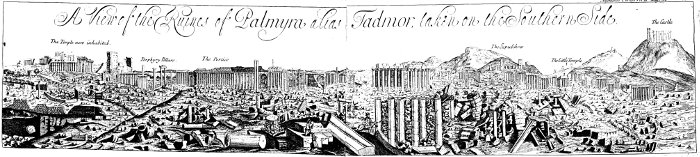
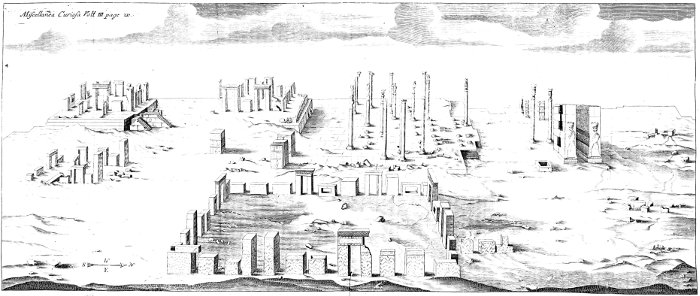
A View of the Ruines of Palmyra alias Tadmor, taken on the Southern Side.
What Account they there took, the Publick
has already seen in our Last, since which,
by the Favour of Mr. Timothy Lanoy and
Mr. Aaron Goodyear, two very Eminent
Merchants, who were both in the first
Voyage, we have received not only the
Draught of the Prospect of those noble Ruins,
taken upon the Place, (of which we
here give a Copy,) but also the Journals of
both the Voyages; which, for the Satisfaction
of the Curious, we have thought fit to
Publish.
July 18. at Five in the Morning, we set
out from Aleppo, being sixteen English; but
with Servants and Mulettiers in all forty;
and in four Hours and an half, travelling
South by East, we arrived at a Village call'd
Cafferabite, being at the edge of the Desart,
here we reposed the rest of that Day.
July 19. we rose at one in the Morning,
and directed our Course S. S. E. over the
Desart, for a Fountain call'd Churraick; but
our Guide losing his Way, there being no
Path, 'twas near Noon before we found it:
which made us doubt of our Safety. This
Well has no Signs near it to discover it by.
Here we pitch'd our Tents, and refresh'd our
Selves and Horses; and the Water being of
a Purgative Quality, made us some Diversion.
In our way, we found two Arabs with
two Asses, one whereof carried Water and
a little Bread, the other they rod on by
turns; they had one Gun, with which they
they shot Antelopes, the Bullet being a hard
Stone broken round, and cased with Lead;
they had on the Palms of their Hands, Elbows,
Knees and Feet, some Antelope-Skin
tied, that they may be able to creep the better
on the Ground, to Shoot; one of the
Asses walking by as a Stalking-horse, and
the Arab imitating the Cry of the Gazel till
he get within Shot: These Arabs are called
Selebee. At the Well came to us some Arabs
that were making Ashes of the ordinary sort
of Weeds call'd Chuddraife, Ruggot and Cuttaff;
these they cut and dry, and putting
them into a Pit, set Fire to them, and the
Ashes cake at the bottom. The Ashes they
carry to Eglib and Tripoli, to make Soap of:
But the best sort of Ashes are made of the
Weed Shinon, which grows about Tadmor, Soukny,
Tibe and Yarecca; it grows like Broom in
England, and in Shape resembles Coral.
July 20. we rose at four in the Morning,
and Travelling two Hours E. S. E. we arrived
at Andrene, where we found the Ruins of
two or three Churches, and of a great Town
lying in a large Plain; where having tarried
about an Hour and an half, and taken
some fragments of Greek Inscriptions, which
afforded no certain Sense, but yet were evidently
Christian, we march'd again S. by E. and
in about four Hours time came to a pleasant
Aqueduct call'd Sheck-alal; this Aqueduct
is cut through the main Rock, for a
great way from the Mountains; and where
it ends, the Arabs have made a Garden,
which afforded us Melons, Cucumbers, Purslain,
&c. In a Grotto hard by, there dwelt
an Arab with his Family; he had a dozen
Buffalo's, which they used both for their Milk,
and to Plow the Ground, Sowing both Wheat,
and Barly: Hither the Arabs resort, when
they have committed any Robbery about Aleppo,
or Hama, and here they repose, and
divide the Spoil.
July 21. we rose at four in the Morning,
and riding two Hours South, we came to a
Ruin call'd Briadeen; here we found the following
Inscription on a Stone, good part in
the Ground:
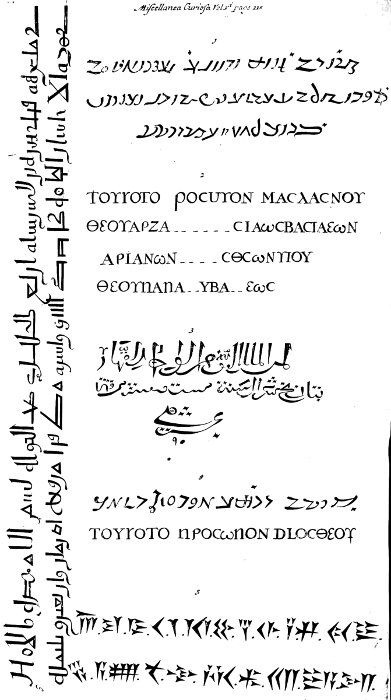
ΑΦΙΕΡΩΘΗ ΑΑΙΛΥΝΔΙΟΥ ΤΟΥ ΑΜΦ ΕΤΟΥΣ
ΔΙΑ ΜΑΤΕΡΝΟΥ ΚΑ(Ι Π)ΑΠΠΟΥ ΚΑΙ ΜΑΙΚΟΥ ΚΝΕΤΜΝ
-------- Υ ———— Ν
From hence going South-East, in four Hours
more we came to a Well called Costal (which
signifies a Spring in Arab.) Most part of our
way through the Desart we were troubled
with Rat-holes in great numbers, like Coneyboroughs,
which by the sinking in of the
Earth, very much incommoded our Horses
and Mules. These Rats have at the ends of
their Tails a bush of Hair, and the Arabs eat
them all, excepting one part. From this
Well we arose about four in the Afternoon,
and began to ascend small Hills, covered with
Trees, which, for the most part, were the
small Pistacho's which the Arabs pickle with
Salt; but eaten green, are good to quench
Thirst. We travelled on three Hours up
the Hills, where we pitch'd that Night, having
no other Water but what we carry'd
with us; and at Night we had a small Shower
of Rain, a thing unusual in that Country at
that time of the Year.
July 22. we rose by Two in the Morning,
and Travelling E. S. E. we came by Eleven
to a Well call'd G'hor, where we found it very
Hot, and saw several prints of Horses
Feet, so that we suspected some Arabs had
newly past that way.
July 23. we rose by One in the Morning,
and Travelling most East, we came to a large
Plain, where we saw before us, on a high
Mountain, a great Castle, call'd by the Arabs
Anture. When we had travelled two or three
Hours in this Plain, we espied an Arab driving
towards us a Camel, with his Launce, so
fast, that he came on a round Gallop, and
we supposed him sent as a Spy: being come
up to us, he told us he was of Tadmor, and
that his Prince, the Emir Melkam, had that
Day made Friendship with Hamet Shideed
another Prince, and that together they had
four hundred Men; so he kept us Company
an Hour or two, and enquired of our Mulettiers
if we were not Turks disguised, with
intent to seize on Melkam; for we travelled
with a Bandiero, the Impress being a Hanjarr
or Turkish Dagger, and a Half-Moon. We
told him we were Franks, which he could
hardly believe, wondering that we travelled
thus in the Desart, only out of Curiosity.
Being come near to Tadmor, he went a little
before us, and on a sudden run full speed
towards the Ruins, we not endeavouring to
hinder him. Our Guide told us he was gone
to acquaint the Arabs who we were, and that
we ought to suspect and prepare for the
worst; so we dismounted twenty of our
Servants, each having a long Gun, and Pistols
at his Girdle, and placed them abreast
before us: we following at a little distance
behind, on Horse-back, with Carbines and
Pistols. In this order we proceeded, and
came to a most stately Aqueduct, which runs
under Ground in a direct passage five Miles,
and is covered with an Arch of Bastard Marble
all the Way, and a Path on both sides
the Channel for two Persons to walk abreast;
the Channel it self being about an English
Yard in breadth, and ¾ of a Yard in depth.
At 20 Yards distance all the way are Ventiducts
for the Air to pass, and the holes are
surrounded with small Mounts of Earth to
keep the Sand and Dust from falling down.
We marched close by these Mounts, which
might serve us for Defence, expecting every
moment that the Arabs would come to Assail
us, having the disadvantage of Sun
and Wind in our Faces: wherefore we Travelled
hard to gain an Eminence where we
might Post our selves advantageously, and
stop and repose a little, to consider what we
had to do. The Arabs finding us to come
on with this Order and Resolution, thought
not fit to adventure on us, so we gained the
Hill, from whence we might discern these
vast and noble Ruins, having a Plain like a
Sea for greatness to the Southwards of it.
Here having refresh'd our Men, we fetch'd a
little Compass and descended by the foot of
a Mountain, on which stands a great Castle,
but uninhabited. Here two Arabs came to
us with Lances, one being Chiah to Melkam,
and we sent two to meet them; they gave
the Salam alika, and ours returned the Alica
salam, and advancing to our Company, told
us the Emir had understood of our coming,
and had sent them to acquaint us that he was
our Friend, and that all the Country was
ours. We sent back with them our Janizary
and a Servant to visit the Prince in his
Tents, which were in a Garden. In the
mean time we dismounted at a watering
Place amidst the Ruins, but did not unload
till our Janizary and Servant returned with
the Emir's Tescarr, assuring us of Friendship
and Protection, a Writing which the Arabs
were never known to violate before. With
them came also one that belonged to the
Sheck of the Town, for whom we had Letters
from Useffe Aga the Emeer of Aleppo.
He desired us for greater Security to
pitch our Tents under the Town Walls,
which is in the Ruins of a great Palace, the
Wall yet standing very high, the Town within
but small, and the Houses excepting two
or three no better than Hog-sties. So we
pitched in a deep Sandy Ground where we
found it exceeding hot. Here we waited
till three of the Clock without eating any
thing, expecting the Sheck should have presented
us according to the usual Custom of
the Turks to their Friends, and have given
some answer to the Letters we brought him;
but on the contrary we found by the gesture
of the People, that we had Reason to suspect
them. Hereupon two of our Company
believing that the want of a present to the
Emir was the cause thereof resolved to adventure
to give him a Visit, and taking the
Janizary and one Servant, they carried him
a Present of two pieces of Red Cloath, and
four of Green, and several other things:
Being come he welcomed them into his Tent,
and placed the one on his right Hand and
the other on his left. Melkam was a young
Man, not above Five and Twenty, and well
Featur'd, and a most Excellent Horse-man;
Hamet Shideed, the other Prince, was more
elderly, as about forty Years of Age, and
was not in the Tent, but sat under a Palm-Tree
near it. He treated them with Coffee,
Camel's-flesh and Dates, and enquired of their
Journey, and the Cause of their coming:
They told him 'twas only Curiosity to see
those Ruins; he said that formerly Solomon
Ibnel Doud Built a City in that Place, which
being destroyed, was Built again by a strange
People, and he believed, that we understanding
the Writing on the Pillars, came to
seek after Treasure, he having but six
Moons before found a Pot of Corra Crusses.
After this he went out of the Tent, leaving
them smoaking Tobacco, to the Janizary and
Servant, and told them, that never till that
Day any Franks had been at that Place, and
that now we knew the way through the Desert,
we might inform the Turks to their Ruin
and Destruction, so that 'twould be convenient
for them to destroy us all: But that
we coming as Friends, he would only have
4000 Dollars as a Present, else he would hang
them and the two Franks up, and go fight
the rest. This Message being brought them,
they wish'd they had excus'd themselves from
this Embassy, and answered, they could say
nothing to that Demand, not knowing our
Minds, but if he would permit them to go
and speak with the rest, they would return
an Answer. Hearing this, he threatened present
Death, but at length gave leave to our
Janizary to carry us a Letter from them,
wherein they shewed the danger they were in,
and earnestly entreated us to redeem them,
the Price set on them being 2000 Dollars,
one half in Mony, the other half in Goods,
as Swords, Cloaths, Tents, &c. which the
Emir promised to estimate at their Worth.
This Letter amazed us mightily, and a little
before it arrived, we understanding a little,
and fearing more ill Treatment to our
Friends, were getting ready to free them or
die with them. The Garden where Melkam
lay, was about half a Mile from the Tents,
full of Palm-Trees, and had no Walls, but
loose Stones piled up Breast high about them,
so we designed to have gone suddenly and
given two or three Volleys on them, e'er they
could get to Horse; and the Arab know not
how to Fight on Foot. And though they
bragg'd they had 400 Men, we supposed 200
might be the most, and they not all Lances.
But on receipt of this Letter, and the Servants
telling us that they would certainly
be cut off, if we endeavoured their Rescue,
we began to examin what Moneys we had,
Cloaths and other Trade, and found we
could not near make up that Sum. In this
Confusion came two Arabs to receive the
things, and immediately Word was brought
that the Emir would come and Visit us; we
sent him Word, that if he came with more
than two followers, we would not admit him:
so he came with 2 Servants only; and in conclusion,
we made him up in Money and
Goods to the Value of 1500 Dollars. He valuing
our Things as we pleased; his Design
being not so much to compleat the Sum, as
to take from us all we had. After this, about
Sun Set, he returned us our two Friends,
when the Sheck of the Town invited us to
Lodge within the Town; which we found afterwards
was with a design to have forced something
from us: But we giving him to understand
that the Emir had taken all already,
and had left us only our Arms and the
Cloaths on our Backs; which if they would
have, they must Fight for: That Resolution
daunted them, and away they went, promising
us Barley for our Horses in the Morning.
We kept good watch in the Night,
and when Day broke, we began to consider
how to clear our selves; we expected the
Barly till Nine in the Morning, when it
came, and the Emir himself came and gave
us the good Morrow: We feared least they
should pretend to stop some of us in the
Gate-way, so we placed six of our Company
to secure the Passage, 'till all the rest were
got out, under pretence of taking an Inscription
that was over the Gate. Being all
got clear, we returned by the same way we
came and arrived at Aleppo July 29. in the
Morning. This Melkam told us, That if
we had not submitted our selves to his Demands,
he was resolved to Fight us after this
Method: Loading 50 Camels with Baggs of
Sand, and making small holes in the Baggs for
the Sand to drop out, he would drive these
Camels abreast upon us before the Wind, that
the Sand might blow in our Eyes, and we
spending our Bullets on the Camels, might
so be easily overthrown; we answered, that
we believed he would not venture his Camels
and Horses to such a Combat. He wondered
extreamly when we talk'd of Shooting
Birds flying, and Hares running.
This and other the like Violences used by
this Arab Prince, made the Bassa of Aleppo
resolve to destroy him; and not long after
he cajoled him with the Hopes of being
made King of the Arabs, and to draw him
near the City, he vested and caressed some
of his Followers: Which having its effect,
the Bassa surprized him in his Tents by Night,
and soon after he was put to Death: This
those People were willing to believe the effect
of their so abusing the English, and might
much contribute to the Security and good
Usage they found, that went the second time
on this Expedition.
We had not time to view these Ruins by
reason of this usage, though perhaps we
might with safety. We only took one of the
Inscriptions as we past by, which was thus.
ΣΕΠΤΙΜΙΟΝ ΟΥΟΡΟΔΗΝ ΤΟΝ ΚΡΑΤΙΣΤΟΝ
ΕΠΙΤΡΟΠΟΝ ΣΕΒΑΣΤΟΥ ΔΟΥΚΗΝΑΡΙΟΝ
ΚΑΙ ΑΡ..ΑΠΗΤΗΝ ΙΟΥΛΙΟΣ ΑΥΡΗΛΙΟΣ ΣΑΝΜΗΣ
ΜΑΣΣΙΑΝΟΥ ΤΟΥ Μ..ΛΕΝΑΙΟΥ ΙΠΠΕΥΣ
ΡΟΥΜΑΩΝ ΤΟΝ ΦΙΛΟΝ ΚΑΙ ΠΡΟΣΤΑΤΗΝ
ΕΤΟΥΣ Η Ο Φ ΜΗΝΕΙ ΞΑΝΔΙΚΩ.
Wherein the principal difference is in the
Word ἀραπήτην, which in the Account already
Published is read ἀράπετην, which seems to signifie
some peculiar Officer of the Syrians, as
Ducenarius of the Latins, which perhaps those
skill'd in the Oriental Customs and Languages
may be able to expound.
As far as we could conclude from our
Journeys, and the Position of the Ways taken
by two good Compasses, the Distance
of Tadmor from Aleppo is about a 150 English
Miles, and the Course S. S. E. or rather
somewhat more Southerly, considering the
Variation of the Compass, which is above a
half a Point Westward in these Parts.
We set out from Aleppo for Tadmor on
Michaelmas-day, being in all, Masters and
Servants, thirty Men, well armed, having obtained
a Promise of Security from Assyne,
then King of the Arabs, and one of his own
People for a Guide. This Day our Road
pointed S. b. E. and in four Hours we came
to a Fountain call'd Caphir-Abiad, leaving
Old Aleppo about an Hour distant on the
right Hand: Here we made but a very short
stay, but proceeded to a better Fountain
at the foot of a very high Hill, cover'd with
loose Stones, the Ruins of a Village called
Broeder, of which there was not one House
remaining; and dining here, we advanced
in an Hour and a quarter more, in the Afternoon,
through a fertile open Place, to a
Place called Emghir, famous for the best
Wheat that is brought to Aleppo. This we
made our first Stage; and mounting again
in the Morning about five a Clock, in less
than an Hour, past by an uninhabited Village,
call'd Urghee, our Road pointing as
before, through the fruitful Plain, even and
pleasant; but when we came to ascend the
Hills, where I reckon'd we entred the Desart,
and were to take our leave of Mankind,
at least of an inhabited Country for
some Days, we had a troublesome Passage,
over loose great Stones, without any appearance
of a Road.
Our Guide had promised to conduct us
through pleasant Groves and Forests; but
no such thing appeared, unless we would
bestow that Name upon low withered Shrubs
that grew in the Way, only one Tree we
saw, which was of good use to us, serving
as a Land-mark; and when we were come
up with it, being left at a little distance on
the right Hand, we gain'd the Prospect of a
remote ridge of Hills before us, and on the
top of one of them an old Castle; this Castle,
we were told, was known by the Name
of Gazar Ibn Wordan; but what it anciently
was, or in what Condition it is at present,
I could not learn; therefore, not unwillingly,
I turned my Eyes from it, to a little
round Hill more on the left, by which we
were to direct our Course, and about a quarter
of an Hour from which stood a Sheck's
House, call'd Sheck Ailha, where we were to
bait, with a Well of Water by it, but such
that we had but little gusto to taste, though
it served our Horses: All the Country hereabouts
is stor'd with Antelopes, and there is a
barbarous sort of People there, that have
hardly any thing else to live upon, but what
of these they can kill; and Necessity has
taught them to be no mean Artists in their
way, for they lie down behind the Stones,
and as the poor harmless Creature passes,
shoot them; and though their Guns be very
ordinary, exceeding heavy and thick, with
Match-Locks, yet are they such excellent
Marks-men, that they kill many. That
Morning we had Travelled about five Hours
to reach Sheck Ailha's; yet finding nothing to
invite our stay there, (though there were four
or five Tombs there not ill made, according
to the Turkish mode) about one a Clock we
mounted again, bending to the S. E. or something
more Easterly. In our way we had
two remarkable Prospects, one on the right
Hand, of the Ruins of an ancient City call'd
Andreen, and sometimes Londrine, which we
were told had been formerly inhabited by
Franks, and that there were many Inscriptions
there; but it was too far out of our
way, and withal something too dangerous
too, for us to take a view of them: The other,
on the left Hand, was another Tree, not
far from which our Guide assured us of good
Water, where we designed to take up our
Lodging; the hopes of the Water made us
slight a Well we past by on the Road, at
which afterwards we repented we had not
stay'd; for when we came up with the Tree,
from which we had declined a great way to
the right, we found our Water still at a very
great distance, and were constrained to take
new Directions by a white chalky Hill, almost
as far as we could see, and yet not much
beyond the Place which was to be our Stage;
on therefore we proceeded till Sun-set, very
weary, and almost without hope of our coming
to Water that Night, though at the
same time near dead with Thirst; and which
the more supriz'd us, our Guide was advanced
a great way before, out of our sight,
upon what design we knew not, but at his
return, we found it was only to assure himself
better of the way, and in an Hours time
more he brought us to the side of a Bog,
call'd by the Name of Zerga, where, such as
it was, we found Water enough, but it was
neither palatable nor wholsome, neither did
the Ground seem proper to Sleep upon; yet
we were forced to be content, there being no
removing thence that Night.
October 1. We departed from Zerga, about
two Hours before Sun-rise, and as soon as it
was light, had the Prospect of a very high
Hill, which was to be the bounds of our Travel
that Day. To this we made as directly
as we could look, finding nothing in our
way observable either to arrest our curiosity,
or to slacken our Pace, except a multitude of
Holes made in the sandy Earth, by Rats, Serpents,
and other Animals, which render'd
our Riding a little troublesome; as we had
found it upon the same Account the Afternoon
before. About two Hours short of our
Stage, we were shewn three little round Hills
lying to the right in a direct line, known by
the Name of Tenage; where we were told
there was good Water, and it's for that reason
only they deserve the notice of those that
Travel through such a thirsty Desart. The
Place to which we directed our Course was
called Esree, where we arrived about eleven
a Clock, and found to our great Satisfaction,
that our Guide had not deceived us in his
Promise of excellent Water: Here we could
discern the Foundations of a spacious City,
and a piece of a thick Wall, built of a
chalky Stone, was standing: This we judged
to be the remainder of a Castle situated on
the side of the Hill, so as both to defend and
command the City. On the top of the Hill,
above the Castle, stands the Ruins of a Fabrick,
in appearance very Ancient, built of
very hard Stone, yet exceedingly worn by
the Weather; 'tis of an oblong Figure, pointing
near to the N. E. and S. W. with only
one Door on the Easterly end, which was
once adorned with extraordinary good Carvings,
of which there are still some remains,
but the greatest part is either worn away,
or purposely defaced; and those marks of ancient
Beauty that remain are very obscure,
and difficultly discernable; the outside of the
Walls is beautified with Pilasters quite round,
with their Pedestals and Capitals regular and
handsom; but the Roof is all fallen down,
and within appears nothing which looks either
great or beautiful. The Situation, and
placing the Door, hinders one from conjecturing
it to have been a Christian Oratory,
or Chappel, and therefore in probability it
must have been a Heathen Temple; and if
so, then the piece of the Castle Wall being
of a softer Stone, must be much more modern;
the goodness of the Water brings the
Arabs (who rove up and down the Desart)
and the Turk-men frequently hither, which
has occasion'd a great many Graves about
the Temple; and some have had leisure, and,
(which is more difficult to be imagin'd) skill
enough to scratch in the Walls the first Letters
of their Names, and many more in Arabick
Characters, which we could make nothing
of, no more than of an Arabick Inscription
which lay hard by, but appeared
not ancient.
October the 2d. We departed from Esree,
about an Hour, or an Hour and an half after
Midnight, and in six Hours and an half
arrived at two Wells, the Water 18 Fathom
and 2 Foot deep, known by the Name of
Imp malcha Giub: Through the greatest part
of this Stage we had a broad beaten Road,
and where that was not discernible, we guided
our selves by a ridge of chalky Hills, under
which the Wells lay; the Water we
found exceeding bad, and of so noisome a
Scent, that we could not endure it so much
as at our Noses; which made our Guide
laugh at us, who told us, the Arabs, and
even the King himself used to drink freely
of it; which, I am sure, our Horses would
not do, though they were under a necessity
of drinking that or none: For our selves
we had brought from Esree Water, sufficient
for one Day at least. In our way hither
we were shewn the true Plant which they
burn for Soap-Ashes, which has no Leaves,
but a soft juicy Stalk shooting into several
Branches, and something resembling our Camphire,
only it's more round than that; the
Ashes likewise we saw, which were made not
far from the Wells, which in burning run
into Cakes, not much unlike the Cinders of
a Forge, only they are heavier, and not so
full of Pores, nor so hard as they are. In
the Afternoon, we proceeded on our Voyage
two Hours and an half, to a place called Almyrrha,
passing rather between than over the
Hills, though we had something of an ascent
too; this we did to shorten our Stage
the next Morning, for we were told before-hand
we should find no Water upon those
Mountains; so, for our Selves, we liv'd upon
our old Stock, and our Horses were constrain'd
to pass that Night without Water. Our
Journy hitherto had been altogether Southerly,
and but little varying to the Eastward
of due South.
October the 3d. We mounted from Almyrrha
between five and six in the Morning,
making to the point of a high ridge of Mountains,
through an uneven Desart Way, frequently
interrupted with Gutts and Channels,
probably made by the descent of the
Waters from the Hills, upon sudden Rains:
We came to the ascent after about four Hours
Travel, which we found not difficult; and
when we were on the top, we had a pleasant
Prospect of the Country, and what we rejoyced
at most, we were shewn a little Hill,
just behind which, we were told lay Tadmor.
This Mountain was cover'd on both sides
with great plenty of Turpentine-Trees, which
was an Object very pleasing, having seen very
few greens in our whole Journey: This Tree
grows very thick and shady, and several of
them we saw loaded with a vast abundance of
small round Nut, the chief use whereof is to
make Oil, though some eat them, and account
them as great a Regalio as Pistaches;
their outward Husk is green, and more Oily
than that of Pistaches, and within a very
thin Shell is contained a Kernel both in colour
and relish very much resembling them;
but those that eat them, seldom take the
Pains to search for the Kernels, but eat
Husk and Shell all together, which have no
ungrateful Taste: From this Hill we had a
tedious descent, and coming at the foot into
a narrow Gut, winding this way and that
between the Mountains, our Passage seemed
very long, hot and tiresome; our want of
Water however obliged us to proceed, whereof
we now began to be in great necessity, especially
for our Horses and Mules, who had
none the Night before, nor none all that
Day; with this we had hopes of being supplied
two different ways; having had a shower
of Rain the Night before, we hoped to have
found Water standing in the hollows of the
Rocks; but either the Rain had not reach'd
so far, or not in such plenty as to fill those
naturally hewed Cisterns: Our other expectation
was from the Wells that were in the
Road; but these our Guide advancing before
and examining, met us with the unwelcome
News, that they were all dried up,
and the best Advice he could give us, was
to pitch where we were, and content our
selves with the remains of what we had
brought two Days in our Vessels, till our
Horses and Mules might be sent to a Fountain
two Hours out of our way, and being
watered there themselves, bring a fresh supply
for us: This way, with some difficulty,
we assented to, as more eligible, than weary
as we were, to wander so far out of the
Road, to have the same Ground to stage over
again the next Morning: We resolved therefore
to send our Guide, with one or two of
our Servants, in search of the Water, and
afterwards others with our Horses, while in
the mean time we pitch'd our Tents, it being
then about two a Clock in the Afternoon:
As soon as they were gone, a small drizzling
Rain, which we had about half an Hour, encreased
to a very plentiful Shower, which
put us upon producing all the Vessels we had
to catch it as it fell from the Heavens, or
ran down the Skirts of our Tents, our Horses
at the same time greedily drinking it from
the Ground; but we might have spared our
Pains, for in less than half an Hours time,
our Camp was in a manner a-float, and we
were surrounded with Water not only sufficient
for us, but for an Army of 20000 Men;
those hollow Gutts which we passed over
without the least appearance of moisture,
were, by the Cataracts which descended from
the Mountains, become Rivers; and our
Guide with those Servants we had sent out,
that before rode over it dry, it being swoln
to such a Torrent, were put to some difficulty
to repass it; so plentifully was God pleased
to provide for us in our greatest streight;
and which encreases both the Wonder and
Mercy, the next Morning, all this great
quantity of Water was past away, so that in
about two Hour's Riding we could hardly
perceive that there had been any Rain at all.
This memorable Place is known by the Name
of Al-Wishal.
October the 4th. From Al-Wishal we proceeded
for Tadmor, some of the Ruins of
which we perswaded our selves we could see
the Day before; perhaps it might be the
Castle, which is more than half an Hour's
distance from the City; our way lay Southward,
but the Gut in which we travelled
would not permit us to keep a direct course:
However, in about an Hour's Walk, we past
by Antor Mountains (our Guide call'd them
Toul Antor) through a Gut or Rent, both
sides of which so directly answered one to
the other, they would tempt a Man to believe
they were separated by Art, for an entrance
into the Country; but it must have
been a work of prodigious Labour and Charges
to have cut through such vast Mountains:
And if any one was so hardy as to
attempt it, he certainly grew weary of his
Undertaking; for the Ground is levelled
but a very little way, and almost as soon
as we were well got within the open space,
we were obliged to ascend another Hill, and
so our Road continued over Hills and Valleys
interchangeably all the way. On the
left Hand, some distance from the Road, we
saw a Sheck's House on the top of a high
Hill, which made a better show than usually
those Buildings do, but being assured by our
Guide it was a modern Structure, and eager
too to come to the principal Place we aimed
at, we would not prolong our Stage so
much as to turn out of the Road, to see
more of it: So pressing still forwards, we
had hardly proceeded four Hours, when we
came to the brow of a Rocky Mountain, separated
from that whereon stands the Castle
of Tadmor, but by a narrow Valley: In which
Hill, by the Way, appeared some Quarries
of fine Stone, which probably might afford
Materials to the curious Buildings in the
City. Our Guide here (according to his accustomed
Diligence) advanced some few Paces
before us, and having espied three or
four Country-Fellows driving Asses towards
us, he caused us to make halt, to give them
an opportunity to come nearer to us, resolving
to speak with them, to know whether
the Coast was clear, or if any of the Mountain
Arabs were then at Tadmor, or not.
After a little space, with our Arms in our
Hands, we marched in as good order as the
Way would permit, down a rocky and steep
Precipice, into the Valley; and our Guide
making greater speed than we could, gallop'd
after the poor affrighted Country Fellows;
who seeing such a Company unexpectedly
descend the Hill, left their Asses, and
fled towards the City with all possible speed:
But they were soon overtaken, and brought
back again to us; to whom they related the
good News, that there was no Force at all
in Tadmor, and that we might proceed with
Courage, and see what we would there with
all safety: Which News obtained them their
Liberty to go again to their Asses, and we
continued in our Way.
Having tired our selves with roving from
Ruin to Ruin, and rummaging among old
Stones, from which little Knowledge could
be obtained; and more especially not thinking
it safe to linger too long in a Place, where
should the Mountain Arabs (who were Enemies
to Assyne Abasse, our Friend) have Intelligence
of us, they might either fall upon
or endeavour to intercept us in our return;
(for which reason also we had all along concealed
our intended Course, under a pretence
of proceeding forward to Damascus.)
On Thursday, October 8. about half an Hour
after four in the Morning, we departed from
Tadmor, being very well satisfied with what
we had seen, and glad to have escaped so
dreaded a Place, without any Trouble or
Pretences upon us; but else with some Regret,
for having left a great many things behind,
which deserved a more particular and
curious Inspection. Our Road lay almost due
East, or a little inclining to the North; and
on the left Hand, a ridge of Hills stretched along
for a great space, sometimes about half
an Hour distant from the Road, and sometimes
opening wider: These Hills, we were told,
were stored with rich Veins of divers Minerals,
and afforded all that vast quantity of
Marble, the Remains whereof we had seen
at Tadmor; and it was from a Fountain call'd
Abulfarras, at the foot of one of them, they
fetch out Water, which we drank there;
the Inhabitants contenting themselves with
that which runs from the Hot Springs. To
the right Hand lay a vast barren Plain, perfectly
bare, and hardly any thing green to be
seen therein, except it were a few Gourds
which our Servants found on the side of a
little rising-Ground, where there was no
shew of any thing moist to feed them. Our
Way being plain, we had the sight of Tadmor,
especially the Castle, for above half our
Stage, till we came to an old Caphar House.
We made indeed a very short Days Journey,
in the whole, finding a Fountain of excellent
Water in about five Hours and a half's
Riding; which, as it was a most welcome
Refreshment to us in such a thirsty Desart,
so it was the only good Water we met with
till we came to Euphrates, which was not till
the third Day from this Place. At this Fountain
we pitch'd, near to which is a Village,
but almost wholly ruined and deserted. 'Twas
some time before any Body would be seen,
for they were afraid of us; at length, three
Men came out to our Tents, Spectacles of a
miserable Poverty, occasion'd by their being
frequently pillaged by the Mountain Arabs,
and a great Duty they pay to Assyne Abasse
their King, for his Protection: Three hundred
Dollars they pay him Annually, when
one would think the whole Village was not
able to make up the Sum of one Hundred;
yet being the remotest Place that was under
his Jurisdiction, they often suffer by the
Inroads of the other. The Name of the
Place is Yarecca, a Name it received (as
we were inform'd) from a Victory obtained
there by the Turks over the Mamalukes.
October the 9th. From Yarecca we mounted
early, and Travelling N. E. or near that
Point, in seven Hours time arrived at Soukney.
The Road we found much like what we
had the Day before, lying over a barren
Plain; only we had Hills on both sides, and
sometimes closing within half an Hours riding
one of the other. The Village has its
Name from the Hot Waters, (for so the
Word imports,) which are of the same Nature
with those of Tadmor; herein they Bath
frequently, the same little dirty Hole serving
both for Men and Women; only they
have so much Modesty remaining, that they
have different Hours for one and the other.
To say the Truth, 'twas the only mark of
Modesty I could observe among them; in
other respects they seemed a Confident, or
rather Impudent Generation of People. Before
we could pitch our Tents, they flock'd
about us in multitudes, Men, Women, and
Children; and of the last, many of them as
naked as ever they came into the World, not
so much as a Rag about them to cover them;
and so numerous they appeared, that if we
had reason to think Yarecca wanted Inhabitants,
we had no less, to conclude Soukney
over-stock'd. At this Place usually resides an
Officer of Assyne's, who is their Sub-Basha,
or Governor: He whom we found there, was
call'd Dor, of a good Family among the
Arabs, to whom we made a Present; and he
civilly return'd it in Barley for our Horses.
Afterwards he came under our Tents, and
invited us to an Entertainment; which, considering
the Circumstances of the Place, was
very Splendid, though it was nothing but
Pilaw at last, a little diversify'd by the dressing;
and, to speak truly, I judge we could
not have less than a Bushel of Rice set before
us. His Palace, indeed was not very stately,
there being few Cottages in England
but might vie with it. To the Room wherein
we were entertain'd, which, doubtless,
was the best, if not the only one he had, we
were forced to clamber, rather than ascend,
by broken Steps made of Stone and Dirt.
When we were got in, and commodiously
seated after the Turkish Mode, it seemed
large enough for about a dozen or fourteen
People: At the upper end was a little space
separated from the rest by a ridge made up
of Earth, within which, I suppose, he slept.
The Walls were mean; but the Roof much
worse, having no other Covering but Faggots;
so that certainly it could not be Proof
against a Shower of Rain which fell that
Night, and forced us out of our Tents, into
in old ruinous Cane, for shelter: However,
it served well enough for our Afternoons Collation;
and we had come away with a good
Opinion of the Gentleman's Civility, had he
not afterwards endeavoured to make a Pretence
upon us, and so would have forced us
to pay dear for our Rice: He pretended to
a Customary Duty of a Chequeen a Head
of all Franks that past that Road; though
probably neither he, nor his Grand-father
before him, had ever seen a Frank there before.
But when he understood by our Guide,
that we were not so easily to be imposed upon;
and withal, that we were Assyne's
Friends, and in our Way to his Tents; and
especially our Treasurer a Person he very
much esteemed, who therefore would be sure
to acquaint him with any Exaction or Injury
offer'd us, his Mouth was quickly stop'd, and
he grew so sensible of his Error, that he sent
to excuse it, and presented our Treasurer
with a Fan of Black Ostrich Feathers; and
not only so, but in the Morning came himself,
and begging Pardon, desired nothing
might be said of what had past, and so
conducted us about an Hour on our way. This
Village pays to Assyne fifteen hundred Dollars
per Annum.
October the 10th. Continuing our Voyage
still to the N. E. or something more Easterly,
we found it another pleasant and easie Stage
to another Village call'd Tiebe, so called (as
they say) from the goodness of the Water,
the Word signifying good: But we found them
not so over excellent; they had the Tast,
and were doubtless tinctured with the same
Mineral, with those of Soukney and Tadmor,
though not so strong. But the Village it self
made a better Shew than usual; and the People
appear'd of something better Fashion,
and more civiliz'd, than those we had left.
It's pleasantly situated, and makes a good appearance
as one comes up to it; the Prospect
being helped by a well built Steeple, to which
is now adjoyned their Mosch: But I am apt
to believe it the remains of a Christian
Church, being built with more Art and Beauty
than you shall easily find in Turkish Fabricks:
And there are also several Ruins about
it, which speak it to have been a more
famous Place than now it is. Into the Mosch
we were permitted to enter, without any Disturbance.
This Village lies in one of the
Roads from Aleppo to Bagdatt, and pays to
Assyne an Annual Tribute of one thousand
Dollars. From hence we mounted again in
the Afternoon, and proceeded about two
Hours and a half farther, to shorten our
next Days Stage. Having travelled this Day,
in all, about seven or eight Hours, the Place
we pitch'd at was a Fountain, and known by
the Name of Alcome; but neither Town nor
House by it: neither was the Water fit to
be Drank, being of the same nature with that
of Soukney, and almost as warm.
October the 11th. From Alcome we rose about
an Hour and an half after Midnight,
our Guide groping out the way, by the help
of the Stars, which now bended more to the
North than formerly. As soon as it was
light enough to look about us, we found our
selves in a wild open Desart, the Ground, in
some Places covered with a sort of Heath,
and in others quite bare. Nor had we travelled
long after the Sun was up, before, by
the help of a rising Ground, we discovered
Arsoffa, the Place whither we were tending,
which gave us hopes we should quickly be
there: But having a dry tiresome Plain to
traverse, and the hot Sun causing our Mules
a little to slacken their Pace, 'twas after ten
a Clock before we reach'd it: And which
was more vexatious still, finding no Water
any where near, we were necessitated to
proceed forward for the River Euphrates,
which we found four Hours distant from hence.
Arsoffa, or (as the Arabs call it) Arsoffa Emir,
seems to be the remains of a Monastery, having
no Town nor Village near it, and being
one continued Pile of Building of an oblong
Figure, stretching long ways East and West,
and enclosing a very capacious Area: At a
distance it makes a glittering shew, being
built of Gypsine Stone, or Rock-Ising-glass,
resembling Alabaster, but not so hard; several
Quarries of which we past by in our
way to it. When the Sun shines upon it, it
reflects the Beams so strong, that they dazzle
the Eyes of the Spectators. Art or Accuracy
in the Workmanship we found none;
and but very little Carved Work, and that
mean enough; nay, the very Cement they
made use of, is but little better than Dirt;
so that it's no great Wonder to see it in Ruins,
though it has not the appearance of any
great Antiquity. Round about were the
little Apartments or Chambers for the Monks,
built Arch-wise, only one Story above
Ground; but underneath are several Cells
or Vaults, larger than the Chambers, which
perhaps might serve for their Schools, or
Working-houses. In the midst of the Area
stand the Ruins of several Buildings, some
of which seem to have been Cisterns for Water,
and it may be the Bathing-Places: But
the most remarkable was one, which probably
was the Abbot's or Bishop's House,
there having been something more Pains bestow'd
upon it, than the rest: And another,
which was the Relicks of their Church. This
was formerly no unhandsom Structure, being
built in the form of our Churches, and distinguish'd
into three Isles, of which the middle
one is supported by eighteen turned Marble
Pillars, with Capitals upon them, not of
Marble, but of a sort of Clay, and Cast into
the shape they are in, but of a Colour
exactly resembling the Pillar it self. That
which perswades to believe them Cast, is
a Greek Inscription to be seen on all of them;
the Letters whereof are not made by Incision
in the Stone, but seem to be stamped,
standing out higher than the distance between
them; and on one of them, by mistake,
they are so placed, as to be read after the
Oriental manner, from the right Hand to
the left. The Words are these, with the
Crucifix before, as follows:
✠ ΕΠΙ ΣΕΡΓΙΟΥ ΕΠΙΣΚΟ. ΤΟΥ ΣΥΝΓΕΝ
ΜΑΡΩΝΙΟΥ ΤΟΥ ΧΩΡΕΠΙΣΚΟ.
From hence our Guide led us to the River,
by the assistance of two little Hills, which
are known by the Name of Aff Dieu, our
way lying North, and a little bending to
the East. The sight of the River was a very
pleasing Prospect; and to our great comfort,
we found the Water very clear, happening
to be there before the Rains, and after
the Snow-Waters (which swell and disturb
it in the Summer-time) were all past:
And our Happiness seemed the greater, having
had so tedious and thirsty a Journey
of at least fourteen Hours, and neither our
Selves nor our Horses touch'd a drop of Water
all Day. We pitch'd upon a Reach of the
River, where it was not very broad, not being
above half a Musket-shot over.
October the 12th. This Morning, about
Sun-rise, we proceeded on our Voyage, keeping
along the Banks of the River, which, for
the most part, led us West and North-West:
And here we had pleasant Travelling, having
the River on the right Hand, and Hills
of Marble or other fine Stone, on the left;
and delightful Groves of Tamarisk, Mulberry,
and other Trees to pass through.
Here every thing about us lookt fresh and
verdant, and we met frequently Men and
Women passing on their Occasions, a thing
to which (in our former Stages) we had not
been accustomed. We had also a pleasing
Prospect of the opposite Shore, and could
see a great way into Mesopotamia, but could
meet with no Convenience to cross the River,
which we were very desirous to have
done. There are no Places of Note remaining
upon the River either on one side or the
other, only on the farther side we saw an old
Castle call'd Giabar, which made a good Shew,
being situated on the top of a Hill, and both for
that and the way of Building, very much resembling
that of Aleppo, only that is the
larger, and in the midst of a City; this less,
and has neither Town nor Houses about it.
On our side we past by a Sheck's House call'd
Abul-Rarra, and the Ruins of a Town a little
farther, where there was a square Tower
built of a very ordinary Brick, but pretty
entire. After we had left these Ruins, we
rested to bait, under the Shadow of a Rock,
wherein were many Apartments and Conveniences
cut to lodge in, which I suppose are
made use of in the Winter by the People,
who, during the Summer, pitch among the
Trees by the River-side. In the Afternoon
we continued our Journey as before, keeping
always at a little distance from the River,
till a little before Sun-set; when we came to
a very convenient Place upon the Banks,
where we took up our lodging for that Night,
having travell'd between seven or eight Hours
the whole Day.
October the 13th. This Day we had the
same Satisfaction as the Day before, proceeding
as near the River as the Road would
permit; and having made a Stage of about
six Hours, we rested under the shade of the
Tamarisk Trees by the River side, hoping to
have found conveniency to have crossed it, but
we could not. In our Way we saw nothing
observable but the Ruins of a City call'd
Baulas, where the Turks had formerly a Sangiack;
but now there is never an Inhabitant
in the Place, nor House standing, but the
Ruins of Houses, and an Octagonal Tower
of a considerable height, viz. One hundred
and seven Steps, and beautified on the outside
with Flourishes and an Arabick Inscription
round about: It's a handsome Structure,
and probably the Work of the Mamalukes,
since whose time little has been done to adorn,
but abundance to destroy and wast
this Country. After Dinner, we mounted
sooner than ordinary; because hoping to
reach the Tents of Assyne, we were unwilling
it should be late when we arrived: yet
we made it near Sun-set before we got to
Fay, a Fountain by which he lay. We had
travell'd still on the same Point N. W. with
the Prospect of the River the greater part
of the Way; the nearest Reach thereof not
being above an Hours Riding from the Fountain.
On the Road we met with several Bandera's
of the Emir's Soldiers, who knowing
our Guide, and understanding we were going
to him, gave us a very courteous Salam, who
else, perhaps, might have treated us with
another sort of Civility. The King's Tents
spread over a large Plain, and took up so
vast a Space, that though we had the advantage
of a rising Ground, we could not see the
uttermost extent of them. His own particular
Tent was pretty near the middle of the
rest, which were pitch'd about it, not in a
circular manner, but stretching out in length
as the Plain open'd, or for the better conveniency
of a Current of Water, which from
the Fountain ran through the midst of them.
'Twas not at all distinguishable from the rest,
but by its bigness, and a little more Company
about it, being all made of a sort of
Hair-Cloth, which seemed hardly a defence
against Rain or Sun: But certainly they must
find otherwise, else their Necessity (they
spending their Lives in such moveable Habitations)
would have taught them to have
contrived something better. It cannot well
be doubted but they are descended from the
old Arabs Scenitæ, they living just after the
same manner, having no settled Abode, but
remove from Fountain to Fountain, as they
find Grass for their Sheep and Camels, and
Water for them and themselves. They love
to derive themselves from Ismael the Son of
Abraham; and it may be they are descended
from him, but I believe they would be hard
put to't to prove their Pedigree.
As soon as we alighted, we were attended
by the Officers of the Emir, and conducted to
a very noble Tent built after the Turkish
Mode, and pitch'd next to his own. Hither
he sent to bid us welcome, and to enquire
how we had past in our Voyage; and presently
after we had a Repast of several Dishes
of Meat set before us, to stay our Appetites
till a more plentiful Supper could be
got ready. But before Supper the King
himself made us a Visit in Person, bidding us
Welcome to Fay, and asking what we had
seen in our Travels that pleas'd us? how we
liked Tadmor? and whether we had found a
Treasure there? For this Notion sticks in
the Heads of these People, That the Franks
go to see old Ruins, only because they there
meet with Inscriptions which direct them to
some hid Treasures. And therefore it's no
unusual thing with them, when they find a
Stone with an Inscription on one side, to turn
that down to the Ground, that it might not
be seen or read of any. But we assur'd him
we went with no such Expectations, but only
out of a desire to see the Place: Neither
had we brought any thing away with us; but
a piece of Porphyry Stone, which, upon his
Request, we shew'd him. We let him see
too, a kind of rude Draught which we had
taken of the Place; which he seemed to like.
He made his Visit the shorter, that he might
not incommode us after our Journey; but desir'd
us we would live after our own Pleasure
and to our Satisfaction, and command freely
whatever the Camp would afford; ordering
some of his People constantly to attend upon
us. When there was mention made of our
Design to be gone the next Morning, he answer'd,
It must not be; himself was invited
the next Day, to a great Entertainment, by
one of his Grandees, and we should accompany
him: But the Day following, he would
go out with us, and Hunt part of our Way
towards Aleppo. When Supper was brought
in, there was Victuals enough for three times
our Number: A large Dish of Pilaw in the
middle, and twelve or fifteen Dishes of several
sorts of Meat about it, all dress'd after
their manner, but exceeding good, and such
as one might have fed heartily upon, had he
not spoil'd his Appetite before. After we
had Eat and Drank what we pleas'd, we
rose up, and our Servants sat down in our
Places; it being the Custom of the Arabs,
and Turks too, from the Highest to the Meanest,
all to eat at the same Table: The best
sort sit down first, and so in order till all are
satisfy'd, and then what remains is carry'd
away. We might, if we had pleas'd, have
lodg'd under the same Tent where we eat;
but having Tents of our own pitch'd, some
of our Company chose rather to retire thither,
to avoid being disturbed by too many
Visitants.
October the 14th. The next Morning, about
ten a Clock, we were told that the
King was gone to the Entertainment, and
expected we should follow him; and that two
young Camels were kill'd, to furnish this
sumptuous Feast; which is the highest piece
of Magnificence and Greatness to which these
People, whose greatest Riches consist in
Camels, can arrive. The Tent was about a
Furlong from ours; so mounting our Horses,
we rode to it, and found it surrounded
with a numerous train of Guests, three hundred
at least, of different Sort and Quality:
It was very large of it self, and to be still
more capacious, 'twas left open toward the
West. The King was seated at the North-end,
about the midst of the Tent, upon a Place
raised with Cushions and Quilts, and Carpets
before him: Neither did he sit cross-Legg'd,
as all the rest of the Company were
obliged to do, but in a leaning Posture.
They seemed to observe an exact Order in
their Places; and when any Person of Note
enter'd, those that were near his Place, rose
up and stood till he had seated himself. But
the far greatest part could not come within
the compass of the Ring, but stood behind
the Backs of the rest, leaving a spacious
Area vacant in the middle. When we entred,
they made room for us on the King's left
Hand, which here is esteem'd the more Honourable;
where we sat down in the same
Posture with those about us, cross-Legg'd
upon a thin Carpet. Before mid-day, a Carpet
being spread in the middle of the Tent,
our Dinner was brought in, being served up
in large Wooden Bowls between two Men;
and truly to my apprehension, Load enough
for them. Of these great Platters there
were about fifty or sixty in number, perhaps
more, with a great many little ones, I mean,
such as one Man was able to bring in, strewed
here and there among them, and placed
for a Border or Garnish round about the
Table. In the middle of all was one of a
larger size than all the rest, in which was the
Camel's Bones, and a thin Broth in which
they were boiled: The other greater ones
seemed all filled with one and the same sort
of Provision, a kind of Plumb-Broth, made
of Rice, and the fleshy part of the Camel,
with Currants and Spices, being of something
a darker Colour than what is made
in our Country. The lesser were, for the
the most part, charged with Rice dress'd
after several Modes, some of them having
Leben, (a thick sour Milk) poured upon
them. Leben is a thing in mighty Esteem
in these Hot Countries, being very useful
to quench Thirst: And truly we had need
of it here; for I did not see a drop of any
sort of Liquor, excepting a Dish of Coffee
before Dinner, drank at this splendid Feast.
Knives, Forks, Spoons, Trenchers, &c. are
silly Impertinent Things in the Esteem of the
Arabs: However, we being known to make
use of such things, had large Wooden Spoons
laid before us. When the Table was thus
plentifully furnish'd, the King arising from
his Seat, went and sat down to that Dish
that was directly before him; and so did
the rest, as many as it would contain, which
could not be much short of a hundred;
and so without further Ceremony, they fell
to thrusting their Hands into the Dishes,
and Eating by Handfuls: Neither was there
any occasion of Carving; only because those
Dishes in the middle were too remote to
be reach'd, there was an Officer on purpose,
who stepping in among them, and standing
in the Spaces designedly left for that
end, with a long Ladle in both his Hands,
helpt any one according to their Desire.
When the King had eaten what he thought
fit, he rose up and wash'd, and retir'd back
to his former Seat; and we also did the
like; others being ready to fill our Places.
Nor did we continue much longer under
the Tent in that numerous Crowd; for Assyne
perceiving us a little uneasie, and supposing
we had now sufficiently satisfy'd
our Curiosity, though perhaps not our Appetites,
told us we might take our Liberty,
and if we thought fit retire to our
Tents. This Favour we gladly accepted,
and without Ceremony returned, several
of his Attendants waiting upon us back.
Here we had another Dinner set before
us; and having some of our own Wine
and Water to Drink with it, it went down
better with us than the famous Camel-Feast.
In the Evening, the King mounted to see
the flight of a new Hawk, and stay'd Abroad
very late, his Hawk flying away:
But she was afterwards taken up by his Falconer;
otherwise he had not been in a good
Humour all that Night, being a Man that
delights very much in Sport. After his return
from Hawking, we went to Wait upon
him at his own Tent, to return him Thanks for
his most courteous and royal Reception of us,
and to desire leave to depart the next Morning.
Here we found him surrounded with
the chiefest of his People; and being placed
again on his left Hand, he entertain'd
us with a great deal of pleasant Discourse;
and ask'd such Questions, as shew'd him to
be a Man of extraordinary Capacity and
Judgment. As for Learning, they have no
such thing among them, and therefore it's
not to be expected that he should be a Scholar:
But were he not a Person of more than
common Prudence and Understanding, he
could never have managed that Wild and
Unruly People as he has done, ever since
his Advancement to the Throne; which
must therefore have been the more difficult,
because as he came to it by the Deposition
of his Father (though not immediately)
who now lives with him as a private Man,
so has he never wanted Competitors. To
his Father he pays a great deal of outward
Respect, but is forced to keep a very watchful
Eye over him. After about an Hours
Discourse, we were dismiss'd.
October the 15th. In the Morning, Assyne
not being at leisure to go a Hunting, we
proceeded on our Voyage Homewards, with
a great deal of Alacrity; and finding nothing
remarkable in our Road, in about 3
Hours and an half arrived at Seray. And
hence, after a short Repast, we continued
our Journey to Sherby Fountain, which took
us up about the like space of Time. Here
we accounted our selves as good as at Home,
being at a Place with which we were well
acquainted, and to which several times in
the Year some or other of our Nation usually
resort, either for Antelope or Hog-hunting,
according to their Season; nor had
we hence above seven or eight Hours to
Aleppo.
October the 16th. Getting up pretty early
in the Morning, we resolved to Hunt
the greatest part of our Way Home, as we
did; and Dining at the famous Round-Hill,
whereon has been spent by the English more
Money than would purchase a noble Estate
round about it, in the Afternoon we arrived
safe at Aleppo.
 paved at the bottom with broad flat
Stone, but without any Roof or Covering.
And at a little distance from that stands the
Ruins of a small Temple, which
by the remains seems to have
been for the Workmanship very
curious: But the Roof is wholly gone, and
the Walls very much defaced and consumed
with Time. Before the Entrance which
looks to the South, is a Piazza supported
by six Pillars, two on one Hand of the
Door, and two on the other, and at each
end one. And the Pedestals of those in the
Front have been filled with Inscriptions,
both in Greek and the other Language; but
they are now so obliterated and worn out,
as not to be Intelligible. The most perfect
was this that follows.