Mirror For Magistrates, Volume I
Whole book · 81 sections
T. Bensley, Printer,
Bolt Court, Fleet Street, London.
Mirror for Magistrates.
EDITED BY
JOSEPH HASLEWOOD.
VOLUME I.
LONDON:
PRINTED FOR
LACKINGTON, ALLEN, AND CO. FINSBURY SQUARE;
AND
LONGMAN, HURST, REES, ORME, AND BROWN, PATERNOSTER ROW.
1815.
Mirror for Magistrates,
IN FIVE PARTS.
VOLUME THE FIRST,
CONTAINING
PART I.
BY JOHN HIGGINS.
PART II.
BY THOMAS BLENER-HASSET.
COLLATED WITH
VARIOUS EDITIONS, AND HISTORICAL NOTES, &c.
By JOSEPH HASLEWOOD.
LONDON:
PRINTED FOR
LACKINGTON, ALLEN, AND CO. FINSBURY SQUARE;
AND
LONGMAN, HURST, REES, ORME, AND BROWN, PATERNOSTER ROW.
1815.
TO
FRANCIS DOUCE, ESQ.
THIS EDITION
OF THE
Mirror for Magistrates:
A
POPULAR PRODUCTION OF THE REIGN OF ELIZABETH
WHICH MERITED REVIVAL,
IS RESPECTFULLY DEDICATED,
BY HIS OBEDIENT
AND OBLIGED SERVANT,
JOSEPH HASLEWOOD.
INTRODUCTION.

Although the prevailing taste for Bibliography has already drawn forth copious accounts of the various editions of the Mirror for Magistrates, and the industry of preceding Biographers has left little new to say of its authors, yet an entire Reprint of this once celebrated work requires the accompaniment of an Introductory Account of these subjects, even at the hazard of repeating a great deal that has been lately told, unmixed with much that is novel.
The history of the Work divides itself under three several heads; viz. 1. Of its origin. 2. Of the 'primary inventor.’[1] 3. Of the various editions. But before these are separately examined, there may be fitly introduced the following view taken by our admirable historian of English Poetry, of the turbulent period of its first appearance.
“True genius,” Warton says, “unseduced by the cabals, and unalarmed by the dangers of faction, defies or neglects those events, which destroy the peace of mankind, and often exerts its operations amidst the most violent commotions of a state. Without patronage and without readers, I may add without models, the earlier Italian writers, while their country was shook by the intestine tumults of the Guelfes and Guibelines, continued to produce original compositions both in prose and verse, which yet stand unrivalled. The age of Pericles and of the Peloponnesian war was the same. Careless of those who governed or disturbed the world, and superior to the calamities of a quarrel, in which two mighty leaders contended for the prize of universal dominion, Lucretius wrote his sublime didactic poem On the System of Nature, Virgil his Bucolics, and Cicero his Books of Philosophy. The proscriptions of Augustus did not prevent the progress of the Roman literature. In the turbulent and unpropitious reign of Queen Mary, when controversy was no longer confined to speculation, and a spiritual warfare polluted every part of England with murthers more atrocious than the slaughter of the most bloody civil contest, a poem was planned, although not fully completed, which illuminates with no common lustre that interval of darkness, which occupies the annals of English poetry from Surrey to Spenser, entitled A Mirrour for Magistrates.”[2]
I. After this general character of the work, the first step in our particular discussion leads us to its origin. This was confessedly Lydgate’s Fall of Princes, an origin which is very striking, and still enhances the high merit so eloquently ascribed to it by Warton, when we recollect that the writer to whom it thus owed its foundation, has been pronounced by a shrewd critic one “who disgraced the name and patronage of his master Chaucer.”[3] But so decisive and intimate was this origin of a work, which had so important an effect on our national poetry, that when first planned, it seems intended to have been embodied in the same volume with the translation by Lydgate.
To prove that this is not a mere point of speculative criticism; but, on the contrary, stands on evidence very different from conjecture, I need only cite the words of William Baldwin himself, the original editor: “Whan the printer (he says) had purposed with himselfe to printe Lidgates booke of the fall of Princes, and had made pryuye thereto many both honourable and worshipfull, he was counsailed by dyuers of them to procure to haue the storye contynewed from where as Bochas left, vnto this present time, chiefly of such as Fortune had dalyed with here in this ylande: which might be as a myrrour for al men as well nobles as others.”[4] From this suggestion the printer, John Wayland, importuned Baldwin to undertake the task; but he describes himself as declining so weighty an enterprise without assistance. On the other hand Wayland, “earnest and diligent in his affairs,” procured, shortly after, divers learned men to consent to take upon them part of the 'travail;’ and early in the year 1555, the Mirror for Magistrates was partly printed in folio, but the proceeding hindered by the Lord Chancellor that then was.[5]
In that suppressed edition the interlocutory parts are given in running lines across the page, and the poems in double columns, the type corresponding and the page imposed of the same size as Wayland’s edition of Lydgate’s translation; wherein the roman numericals have an unusual stop at the end of the seventh book with “leaf clxiij,” and the prologue of the eighth book commences with “fol. 1,” which continues to the end at “fol. XXXVII,” as if it was projected to add to the last portion the Mirror for Magistrates, making a second part or volume in continuance of the work which gave it origin.
From the time of first establishing the English press to the reign of Queen Mary, when the folio, or suppressed, edition was printed, our typographical annals do not show any works in equal estimation with the domestic chronicles. The Fruit of Times, or St. Alban’s Chronicle, Polychronicon, and those others compiled by Fabyan, Grafton, Hall, Harding, Lanquet, &c. were in general repute and extensive circulation, and for that reason fixed upon as fit materials for poetry by Baldwin and his coadjutors.
The influence and demand for the chronicles also occasioned the sudden revival, after a lapse of twenty-seven years, of The boke of Iohan Bochas descryuing the fall of Princes, Princesses, and other Nobles, translated by John Lydgate. That work was first printed by Pynson in 1494, also in 1527,[6] and then remained unnoticed until 1554, when Richard Tottell reprinted it under a new title,[7] with the incidental wood-cuts, and appending thereto the singular dance of Machabree.[8]
In the same or following year after this revival an edition was projected and executed by Wayland:[9]—a convincing evidence, as well of the fashionable cast of reading, as of the rapid demand for that work; otherwise even the rivalry of trade would never have hazarded another edition, so soon after Tottell’s copies had supplied the market.
All the authors who joined in enlarging, or completing the part first published of the Mirrour, have but slightly deviated from Lydgate’s model, which was then secure in public approbation; and they therefore, in some instances, may be suspected to have sacrificed genius and imagination at the shrine of perverted taste, in order to obtain a continuance of the same patronage. The Mirrour for Magistrates was, in fact, a common offspring of that class of historical literature, which then flourished widely.[10] The addition of rhyme was the mere variance of a minor ornament, rather than a change of its substantial nature;[11] though many inferior productions, which its popularity brought forth, seemed afterwards to give it the appearance of forming a main class of our national poetry.[12]
From those historical stores were taken the principal incidents and characters of the princes and nobles, whose vicious lives and tragical ends made them conspicuous as moral examples; and as fit beacons to check rebellion; a purpose which is ably attempted through the whole work. Indeed, so little did any one of this combination of poets venture fame, that novelty was neither attempted in subject, nor manner of composition. The whole selection of matter was from chronicles in universal circulation; as the seven-line stanza was adopted from their precursor Lydgate; and, upon this last point, there may be added, that it is doubtful if Higgins did not cancel two or three lives, first published in another measure, for the advantage of substituting others, to accord with the original plan and general taste.[13]
II. In the next division of inquiry as to the 'primary inventor’ of the Mirror for Magistrates, the discussion arises from the unfounded application of that term by Warton to that eminent genius Thomas Sackville, afterwards created Lord Buckhurst and Earl of Dorset, and which has been repeated, without examination, by subsequent writers.
It has been already stated, that the industry of Wayland effected much in obtaining the contributory aid of the popular poets; nor must the labour of Ferrers, who exerted himself in completing the original plan, be left unnoticed; but still the general formation rests principally, if not entirely, with Baldwin. His claim to the air of novelty, so successfully introduced for the purpose of connecting the whole as an unbroken series, by an intermediate and apposite dialogue, has not been disputed, any more than his finally completing the volume with an introductory Epistle and Preface.
The date at which Sackville’s communication was obtained, is decisive against the opinion, that the work found in him “its primary inventor.” If the contributors to the suppressed edition remain, like their articles, unknown and uncertain; the one published in 1559, was a complete volume, and not any communication by Sackville is there inserted. The intervention of the lord Chancellor certainly deferred, but did not destroy the work; and only on the enlargement thereof, by a SECOND PART, in 1563, is his name first mentioned, in the address prefixed to that part by Baldwin, as having “aptly ordered the duke of Buckynghams oracion.” At the distance of a few sheets after this trite notice, appears that beautifully descriptive and highly polished poem called “the Induction,” which served to envelop all the other contributors with the shade of secondary characters.
The history of its origin is given, in the intermediate dialogue, thus:
“Then sayd the reader: 'The next here whom I finde miserable are king Edwards two sonnes, cruelly murdered in the Tower of London.’ 'Haue you theyr tragedy?’ 'No surely (q; I) the Lord Vaulx vndertooke to penne it, but what he hath done therein I am not certayne, and therfore I let it passe til I knowe farder. I haue here ye Duke of Buckingham, king Richarde’s chyefe instrument, wrytten by mayster Thomas Sackuille.’ 'Read it we pray you:’ sayd they. 'Wyth a good wyl (q; I) but fyrst you shal heare his preface or Induction.’ 'Hath he made a preface (q; one) what meaneth he thereby, seeing none other hath vsed the like order?’ 'I wyl tell you the cause thereof (q; I) which is thys: After that he vnderstoode that some of the counsayle would not suffer the booke to be printed in suche order as we had agreed and determined, he purposed with himselfe to have gotten at my handes, al the tragedies that were before the duke of Buckinghams, which he would haue preserued in one volume, and from that time backeward euen to the time of William the Conquerour, he determined to continue and perfect all the story himselfe in such order as Lydgate (folowing Bocchas) had already vsed. And therfore to make a meete induction into the matter, he deuised this poesye; which in my Judgement is so wel penned, that I woulde not haue any verse therof left out of our volume.’—”
Niccols, in the last edition, has ventured, without reason, to sever the Induction from the Legend, before which it was placed, in order to fix it at the head of those collected by Baldwin, although that editor did not suffer the communication of Sackville to alter his original plan. The explanatory Advertisement of Niccols has occasioned the erroneous belief of that author being 'primary inventor’ of the whole work. “Hauing hitherto (he says) continued the storie, gentle Reader, from the first entrance of Brute into this Iland, with the falles of such Princes, as were neuer before this time in one volume comprised, I now proceed with the rest, which take their beginning from the Conquest, whose [pen-men being many and diuers, all diuerslie affected in the method of this their Mirror, I purpose only to follow the intended scope of that, most honorable personage, who, by how much he did surpasse the rest in the eminence of his noble condition, by so much he hath exceeded them all in the excellencie of his heroicall stile which with a golden pen he hath limmed out to posteritie in that worthy obiect of his minde, the Tragedie of the Duke of Buckingham, and in his preface then intituled Master Sackuil’s induction. This worthie President of learning, intending to perfect all this storie himselfe from the Conquest, being called to a more serious expence of his time in the great State-affaires of his most royall Ladie, and Soueraigne, left the dispose thereof to M. Baldwine,] M. Ferrers, and others, the composers of these Tragedies, who continuing their methode which was by way of dialogue or interlocution betwixt euery Tragedie, gaue it onely place before the Duke of Buckinghams complaint, which order I since hauing altered, haue placed the Induction in the beginning, with euery Tragedie following according to succession and the iust computation of time, which before was not obserued,” &c.
With a knowlege of the statement made by Baldwin, there is not any thing obscure or easily to be mistook in this Advertisement. Niccols has only repeated the intention of Sackville, and that being prevented by more weighty engagements from executing it, he left the Induction at the disposal of Baldwin, Ferrers, &c. who chose to continue their own plan. Of this plan Niccols altered the order, and placed the Induction at the beginning. However the sense of the prefatory article has been much mistaken; probably from a want of some knowlege of the antecedent authority.
Mrs. Cooper, in the Muses Library, 1738, says of Sackville: “It appears to me, by a preface of Mr. Niccols, that the Original Plan of the Mirror for Magistrates, was principally owing to him.”—Collins, in the English Peerage, having transcribed the passage given above in brackets, is referred to by Lord Orford, in the Royal and Noble Authors, as his authority for asserting, that “the original thought was his Lordship’s.” And might not this concatenation of error extend further by the construction of Lord Orford and have misled Warton? That luminous historian of our native poetry, says: “More writers than one were concerned in the execution of this piece: but its PRIMARY INVENTOR, and most distinguished contributor, was Thomas Sackville the first lord Buckhurst, and first earl of Dorset. About the year 1557, he formed the plan of a poem, in which all the illustrious but unfortunate characters of the English history, from the conquest to the end of the fourteenth century, were to pass in review before the poet, who descends like Dante into the infernal region, and is conducted by Sorrow. Although a descent into hell had been suggested by other poets, the application of such a fiction to the present design, is a conspicuous proof of genius and even of invention. Every personage was to recite his own misfortunes in a separate soliloquy. But Sackville had leisure only to finish a poetical preface called an Induction, and one Legend, which is the life of Henry Stafford duke of Buckingham. Relinquishing therefore the design abruptly, and hastily adapting the close of his Induction to the appearance of Buckingham, the only story he had yet written, and which was to have been the last in his series, he recommended the completion of the whole to Richard Baldwyne and George Ferrers.”—
“Baldwyne and Ferrers,” it is afterwards observed, “perhaps deterred by the greatness of the attempt, did not attend to the series prescribed by Sackville, but inviting some others to their assistance, among which are Churchyard and Phayer, chose such lives from the newly published chronicles of Fabyan and Hall, as seemed to display the most affecting catastrophes, and which very probably were pointed out by Sackville.”—
The observations of Warton were either written at various times, or he depended too implicitly upon loose extracts from authorities no longer possessed, as he refers to one edition when quoting another.[14]
The hypothesis of Sackville being 'primary inventor,’ &c. shows that he relied upon, and at the same time mistook, the meaning of Niccols, (whose corrupt text of the Induction he reprinted,) and never discovered that his position was negatived by the interlocutory matter given above from the edition of 1563, when Sackville made his first and only known communication.
While this circumstantial detail disrobes Sackville of his revived honors, there must not be more than a qualified portion of the character of 'primary inventor’ of the Mirrour for Magistrates transferred to Baldwin. He was the common editor and inventor of the intermediate conversations, but the acknowledged design of himself and associates went no further than to raise another story upon the fabric built by Lydgate in the preceding century.[15]
III. The bibliographical division is classed chronologically by the dates of the editions, and not as to the legends. The first or suppressed edition was entituled
A Memorial of suche Princes, as since the tyme of King Richarde the seconde, haue been vnfortunate in the Realme of England. Londini Inædibus Johannis Waylandi. Cum priuilegio per Septennium. Folio.
The above title in the same compartment as was used by Wayland on reprinting Lydgate.[16] At the back of the leaf is a copy of his letters patent, as preserved in the note below,[17] to secure a right in the work as having first printed it.
Baldwin in his Epistle dedicatory, in 1559, says: “The wurke was begun, & part of it printed iiii years agoe, but hyndred by the Lord Chancellor that then was.” This hinderance must have arisen from the rigour of Stephen Gardiner, who died, Chancellor, in Nov. 1555. How far the printing had proceeded is unknown.[18] Three or perhaps four copies of the title leaf may be traced; and two of those are in the possession of Mr. Heber.[19] There is also a fragment of two duplicate leaves in the British Museum, with running title “vnfortunate English Princes,” containing part of the legend of Owen Glendower, and from which the appropriation is now first made of the signature “T. Ch.” to its more certain owner Sir Thomas Chaloner. It maybe added, that I have reason to believe, a still larger fragment exists in a private library.[20]
From the size and manner of the page of this folio edition being upon the same scale as Wayland’s reprint of The tragedies gathered by Ihon Bochas, as noticed already, it appears upon calculation, that if no more than was printed in 1559 had been given,[21] it would not have exceeded twenty-five or thirty leaves, and which may be assigned as a further reason for believing the original intention was to include both works in one volume.
A Myrroure for Magistrates. Wherein may be seen by example of other, with howe greuous plages vices are punished: and howe frayle and vnstable worldly prosperitie is founde, even of those whom Fortune seemeth most highly to fauour. Fœlix quem faciunt aliena pericula cautum. Anno 1559. Londini, In ædibus Thomæ Marshe. 92 leaves.
This title is in an architectural metal border, composed of four pieces. After the Epistle inscribed by the editor William Baldwin, to the Nobility, and his Brief Memorial addressed to the Reader, follow nineteen legends, viz:
| 1. | Tresilian | by | Ferrers. |
| 2. | Two Mortimers | Cavyll. | |
| 3. | Gloucester | Ferrers. | |
| 4. | Norfolk | Chaloner. | |
| 5. | Richard II. | Ferrers. | |
| 6. | Owen Glendour | Phaer. | |
| 7. | Northumberland | *Baldwin. | |
| 8. | Cambridge | Baldwin. | |
| 9. | Salisbury | *Baldwin. | |
| 10. | James I. | Baldwin. | |
| 11. | Suffolk | Baldwin. | |
| 12. | Jack Cade | *Baldwin. | |
| 13. | Yorke | *Baldwin. | |
| 14. | Clifford | *Baldwin. | |
| 15. | Worcester | *Baldwin. | |
| 16. | Warwick | *Baldwin. | |
| 17. | Henry VI.[22] | *Baldwin. | |
| 18. | Clarence | Baldwin. | |
| 19. | Edward IV. | Skelton. |
Several of these lives have always been printed without signatures, and, from want of a knowledge of other claimants, are conjecturally supposed to be written by Baldwin. A slight authority for this appropriation is found in the Epistle before the continuation of the work in the next edition, in the observation: “I have nowe also set furth another parte conteynynge as litle of myne owne, as the fyrst doth of other mens.” With no better testimony, ten of the lives, distinguished above with asterisks, are attributed to his pen, while in another place Baldwin makes questionable his own title. The passage alluded to is found in the preface, and has been hitherto passed over unnoticed. He says: “The numbre of seauen, were through a generall assent at one apoynted time and place, gathered together, to deuise thereupon; (and, he adds) I resorted vnto them.”[23] After this formal annunciation of a company consisting of eight persons, including the Editor, given at the head of the volume, may we not expect to find, that each was a contributor? Yet in the above list, are only six names, viz: Ferrers, Cavil, Chaloner, Phaer, Baldwin, and Skelton; and the last doubtful, as he died as early as 1529; and Baldwin repeats the lines from memory. Perhaps this difficulty may be avoided by adding to the five certain names those of Sackville, Dolman, and Segar; concluding that the Editor had received their assurance of articles in time for another edition, and which are found inserted in the next accordingly. No other name interferes with this disposition, except that of Churchyard, whose communication of Shore’s Wife was no sooner read, than Baldwin observes: “all together exhorted me instantly to procure Maister Churchyarde to vndertake and to penne as manye moe of the remaynder as myght by any meanes be attaynted at his handes.” This presumptively shows that the author was not enumerated as one of the company.
All that can be gleaned from the intermediate prose, upon this subject, is very inconclusive and unsatisfactory. For example, there being no man ready at the meeting,[24] Baldwin said: “I will somewhat doe my part, I will, under your correction, declare the tragedy of Thomas Mowbray, duke of Northfolk.” And to this life, in edition 1571, “T. Ch.” is added, the signature of Sir T. Chaloner. Again, at p. 77, Ferrers is staid by one who briefly said: “To the end, Baldwin, that you may know what to say of the Percies,—I will take upon me the person of the Lord Henry Percy,” &c. and this is left without signature, and given to Baldwin. Similar at p. 102, where the Speaker adopting king James, concludes “mark, Baldwin, what I think he may say,” and which also, as wanting signature, has the same appropriation. Several others are contradictory, as being delivered in the person of one of the company, and since assigned to the Editor, by whose indolence, perhaps, in not altering the conversations to suit the fact, after public approbation extinguished the desire of secrecy, and real signatures were added, much of this complexity arises.
A Myrrovr for Magistrates—Anno 1563. Imprinted at London in Fletestrete nere to Saynct Dunstans Churche by Thomas Marshe. 178 leaves.
This title in the same border as before. In addition to the contents of the preceding article, this has the original Induction by Sackville; and the eight following legends, as a second part, viz.
| 20. | Rivers | by | Baldwin. |
| 21. | Hastings | Dolman. | |
| Induction | Sackville. | ||
| 22. | Buckingham | Sackville. | |
| 23. | Collingborn | Baldwin. | |
| 24. | Richard III. | Segar. | |
| 25. | Jane Shore | Churchyard. | |
| 26. | Somerset | *Baldwin. | |
| 27. | The Blacksmith | Cavyll. |
As well in this as the prior edition, there is a lapse in numbering the folio from xlviii to lix.[25] The other edition is printed on a better paper, and with clearer ink; abounds less in press errors; and has not such frequent inaccuracies in the numbering, though they correspond in leaves to fol. Lxxxv, sig. k i, where “endeth the first parte” in this edition. The opening prose, or conversation, of the second part is addressed to the reader, by Baldwin, in whose hands Ferrers is described, as placing all he had brought, having business great and weighty to attend, and knowing he could “do it well inough:” And “dyuers of the rest lykyng hys deuyse, vsed the lyke maner.” The whole controul of this first edition of the second part was evidently given to Baldwin.
At folio Cxvi, or sig. P iii, is the unusual circumstance of a variance being made in two instances, while printing, and here given as they stand in two different copies:
One has:
The Induction.
The tapets torne, and euery blome downe blowen.
The other:
Mayster Sackuilles Induction.
The tapets torne, and euery tree downe blowen.
The effect is considered in Vol. II. p. 309. At the end of the volume is a leaf with “The ¶ contes and Table of the first parte of this Booke. ¶ A prose to the Reader, continued betwene the tragedies from the beginning of the booke to the ende. Tragedies beginning,” &c. as it stands in the former edition; and on the next page “¶ The Contentes of the second parte. ¶ A Prose to the Reader continued through the booke. Complayntes beginning,” &c. Another leaf has “Faultes escaped in the Printing,” which fill two pages.
A Myrrovr for Magistrates.—Newly corrected and augmented. Anno 1571. Fœlix, &c. Imprinted at London by Thomas Marshe dwellynge in Fleetstreete, neare vnto S. Dunstanes Churche.[26] 174 leaves.
This edition only varies in the arrangement from the preceding, by the life of the Duke of Somerset being transposed to fall in chronological order. The addition of the signatures of several of the authors, gives a peculiar value to this impression.
The first parte of the Mirour for Magistrates, containing the falles of the first infortunate Princes of this lande: From the comming of Brute to the incarnation of our sauiour and redemer Iesu Christe. Ad Romanos. 13. 2. Quisquis se opponit potestati, Dei ordinationi resistit. Imprinted at London by Thomas Marshe. Anno 1574. Cum Priuilegio. Eights, Sig. K ii. Fol. 74. Introduction 6 leaves.
This is the best legitimate attempt to enlarge the work published by Baldwin; and the date of the first edition has escaped the research of modern bibliographers.[27] To the Title succeeds the Table of Contents on one leaf; the Epistle dedicatory to the nobility, and the address to the reader. The Authour’s Induction imitates that by Sackville, and is followed by sixteen legends, the sole production of John Higgins.[28]
Their names follow, viz:
| 1. | Albanact. | 9. | Bladud. |
| 2. | Humber. | 10. | Cordila. |
| 3. | Locrinus. | 11. | Morgan. |
| 4. | Elstride. | 12. | Forrex. |
| 5. | Sabrine. | 13. | Porrex. |
| 6. | Madan. | 14. | Kimarus. |
| 7. | Malin. | 15. | Morindus. |
| 8. | Mempricius. | 16. | Nennius. |
At the end of Nennius the address of “the Author” concludes with the fifth Stanza:[29]
And keepe, maintaine and celebrate his praise:
VVich graunted, all they vanisht quite their wayes.
Viuit post funera virtus.
Finis que Iohn Higgins.
The last parte of the Mirour for Magistrates, wherein may be seene by examples passed in this Realme, with howe greuous plagues, vices are punished in great Princes and Magistrates, and howe frayle and vnstable worldly prosperitie is founde, where Fortune seemeth moste highly to fauour. Newly corrected and amended. Fœlix quem faciunt aliena pericula cautum. Imprinted at London by Thomas Marshe. Anno. 1574. Cum Priuilegio. 168 leaves.
A copy having a title page with the above date is as rare as the preceding article. The particular description, with which it is mentioned in a note by Warton, seemed to make its existence certain, although there was not wanting reason for disbelief on the occasion. Even that writer considered it “improperly entitled The Last Parte,” the existence of our preceding article not being then known.
The Contents are the same as edition 1571.
The first parte of the Mirour for Magistrates.—Imprinted at London by Thomas Marshe. Anno 1575. Cum Priuilegio. 80 leaves.
This is an accurate reprint of the first edition, with an enlargement of “the Author,” at the end of Nennius, by the addition of Eleven Stanzas, and another legend concluding the volume, viz:
| 17 | Irenglass. |
The last parte of the Mirour for Magistrates.—Imprinted at London by Thomas Marshe. Anno 1575. Cum Priuilegio.
This is the edition of 1574, a circumstance that accounts for it being so little known in the original state. The part by Higgins, when it first appeared, no doubt found a rapid demand from those who possessed a copy of that by Baldwin; and therefore in the present instance an altered title, wherein a new date was substituted,[30] served to keep time with the second edition of the part by Higgins.
The first part of the Mirour for Magistrates.—Imprinted for Thomas
Marshe. 1578.
Mentioned by Ritson in the Bibliographia Poetica, p. 243, and also in a manuscript list made by him of all the editions. It is stated to have contained, as before, seventeen legends. I have never seen it.
The Last part of the Mirour for Magistrates.—Imprinted at London in Fleetstreete, neere vnto Sainct Dunstanes Church, by Thomas Marsh. 1578. Cum Priuilegio. 190 leaves.
Two additional legends were introduced, viz:
| 28. | Dame Eleanor Cobham, Duchess of Gloucester. | Ferrers. |
| 29. | Plantagenet, Duke of Gloucester. | Ferrers. |
In the table of Contents to the edition of 1559, there is entered: “Good Duke Humfry murdered, and Eleanor Cobham his wife banished,” though no articles appear of that nature in the order of reference. What occasioned them to be deferred, it would be in vain now to inquire, or conjecture.
The Seconde part of the Mirrour for Magistrates, conteining the falles of the infortunate Princes of this Lande. From the Conquest of Cæsar, vnto the comyng of Duke William the Conquerour. Imprinted by Richard Webster, Anno Domini. 1578. 72 leaves.
This title is in an elegant architectural compartment, supported by crouching satyrs, and having upon the sill “Goe straight and feare not.”
It contains 12 legends, viz:
| 1. | Guidericus. | 7. | Sigebert. |
| 2. | Carassus. | 8. | Lady Ebbe. |
| 3. | Hellina. | 9. | Alurede. |
| 4. | Vortiger. | 10. | Egelrede. |
| 5. | Pengragon. | 11. | Edricus. |
| 6. | Cadwallader. | 12. | Harold. |
The whole was the production of Thomas Blenerhasset, and was, if we may believe the printer’s epistle, published without the knowledge or sanction of the author. In that epistle the writer speaks of “findyng a booke already in print, entituled, The first and third part of the Mirrour for Magistrates;” which appears only a convenient alteration of the two titles already given, there not being any edition distinguished as the Third part.
The Mirour for Magistrates, wherein may be seene, by examples passed in this Realme, with how greeuous plagues vices are punished in great Princes and Magistrates, and how fraile and vnstable worldly prosperity is found, where Fortune seemeth most highly to fauour: Newly imprinted, and with the addition of diuers Tragedies enlarged. At London in Fleetstreete, by Henry Marsh, being the assigne of Thomas Marsh. 1587. Cvm privilegio. 283 leaves.
A short preface, grounded upon the prefatory epistle of 1574, is substituted for that, and followed by a metrical address from Thomas Newton to the reader. Some additional legends by Higgins are introduced in the body of the work; and several others in continuance. Their titles are
| 18. | Jago. | 30. | Hamo. |
| 19. | Pinnar. | 31. | Drusus. |
| 20. | Stater. | 32. | Domitius. |
| 21. | Rudache. | 33. | Galba. |
| 22. | Brennus. | 34. | Otho. |
| 23. | Emerianus. | 35. | Vitellius. |
| 24. | Chirinnus. | 36. | Londricus. |
| 25. | Varianvs. | 37. | Severus. |
| 26. | Caesar. | 38. | Frelgentius. |
| 27. | Nero. | 39. | Geta. |
| 28. | Caligula. | 40. | Caracella. |
| 29. | Guiderius. |
On the reverse of folio 108, commences the Part edited by Baldwin. The brief Memorial to the reader is given; and the 29 legends already named with the addition of four, viz:
| 30. | Burdet. Higgins. | 32. | Flodden Field. Dingley. |
| 31. | James IV. | 33. | Wolsey. Churchyard. |
The productions of Baldwin and Higgins are here united with additional matter and corrections; and this being the last printed by either of the original editors, may be characterised, and has been now adopted, as the STANDARD EDITION.
A Mirovr for Magistrates: Being a trve chronicle historic of the vntimely falles of such vnfortvnate Princes and men of note, as haue happened since the first entrance of Brute into this Iland, vntill this our latter Age. Newly enlarged with a last part, called A Winter night’s Vision, being an addition of such Tragedies, especially famous, as are exempted in the former Historie, with a Poem annexed, called England’s Eliza. At London Imprinted by Felix Kyngston. 1610.
The Falles of Vnfortvnate Princes. Being a trve chronicle historic of the vntimely death of such vnfortunate Princes and men of Note, as haue happened since the first entrance of Brvte into this Iland, vntill this our latter Age. Wherevnto is added the famovs life and death of Qveene Elizabeth, with a declaration of all the Warres, Battels and Sea-fights, during her Raigne: wherein at large is described the Battell of 88. with the particular seruice of all such Ships, and men of note in that action. Contre fortune nul ne peut. At London, Imprinted by F. K. for William Aspley, and are to be sold at his shop in Pauls Churchyard at the Signe of the Parrot. 1619. also 1621. 448 leaves.
Both titles are found to the same edition. The last appears an attempt to new vamp the remainder of an unsaleable and justly depreciated article. A large part of the volume is formed from the labours of Higgins, Blenerhasset, and Baldwin, and reprinted on the laudable plan of collecting them together, by Richard Niccols. Unfortunately the original spirit and character is materially affected, if not destroyed, by his choosing to omit all intermediate matter between the legends, whether prose or verse: for the L’envoy of Higgins, and conversations of Blenerhasset and Baldwin are alike rejected. And his total want of respect for the original text, in addition to a false taste in remodelling it to please his own ear and fancy, has scarcely left a Legend that does not exhibit specimens of this unwarrantable liberty:[31] indeed it has long been known that the only value his collection now retains, is for that part completed by his own pen, which forms the remainder of the volume.
His own explanatory advertisement may be preserved here; it is addressed
To the Reader.
“To acquaint you in briefe with what is done in this impression: know that the verse is in proportion by measure, and in symphonie or rithmos, in diuers places amended; the storie in some places false and corrupted, made historically true; the tragedies wrongly inserted, disposed in their proper places, according to iust computation of time; those neuer before collected in one volume, published in this impression: for the forme and frame of the whole historie I did intend to haue reduced it into the same order, which I haue obserued in my Additions; but preuented by other occasions, I haue thus digested it. The tragedies from the time of Brute to the Conquest I haue left, with dependencie vpon that Induction written by M. Higins: Those from the Conquest to this our last age, that is, to the fall of the Lord Cromwell, excellently well penned by M. Drayton, hath reference to that golden Preface called M. Sackuil’s Induction. After these I haue placed my Additions, the falles of such Princes as were before omitted, and my Poem or Hymne of the late dead Queene of famous memorie. In all which I require no other gratification for my pains, but a gentle censure of my imperfections.”
Niccols in the first division gives the forty legends by John Higgins, and ten of those by Thomas Blenerhasset, the two of Guiderius and Alurede being rejected. Then a new title:
The variable Fortvne and vnhappie falles of svch Princes as hath happened since the Conquest. Wherein may be seene the instabilitie and change of state in great Personages. At London, Imprinted by Felix Kyngston. 1609.
Prefixed to this part is a short prose address from the Editor on his following the supposed plan of Sackville, by placing the Induction at the beginning as a prefatory poem. He has retained twenty-nine of the legends of Baldwin, and others, already noticed, omitting for reasons not assigned the following four; Richard Duke of Gloucester, James Ist and IVth, and the Battle of Flodden Field: and adding that of Lord Cromwell by Michael Drayton.
These reprints occupy 548 pages; the remainder of the volume is original, and in two divisions.
A Winter nights vision: being an addition of svch princes especially famous, who were exempted in the former Historie. By Richard Niccols, Oxon. Mag. Hall. At London Imprinted by Felex Kyngston, 1610.
Dedicatory sonnet to the Earl of Nottingham, prose address to the reader, The Induction, and ten legends, viz:
| 1. | Arthur. | 6. | K. Richard I. |
| 2. | Edmund Ironside. | 7. | K. John. |
| 3. | Alfred. | 8. | K. Edward II. |
| 4. | Godwin. | 9. | K. Edward V. and brother. |
| 5. | Robert Curthose. | 10. | K. Richard III. |
England’s Eliza: or the victoriovs and Trivmphant reigne of that virgin Empresse of sacred Memorie, Elizabeth, Queene of England, France and Ireland, &c. At London Imprinted by Felix Kyngston. 1610.
Dedicatory sonnet to Lady Elizabeth Clere, a prose advertisement, The Induction, and the poem of England’s Eliza.
The Mirror for Magistrates.
In Five Parts, 1815.
Above three years have elapsed since the present edition was projected. It was then intended to form one of a series of reprints of poetical works of the Elizabethan æra that had ceased to be attainable, though entitled by merit to be rescued from undeserved obscurity, and was to have been attached to a periodical work, which has now ceased its circulation.
To select so voluminous a performance as the Mirror for Magistrates might appear extraordinary, had not a more complete edition than has hitherto appeared, been long wanted. A want, which, as the work combined the desultory productions of many writers, and was interspersed with incidental narrative in prose, could not, although a national poem, be supplied by any collection of the English poets. It is true that Sackville’s Induction and the Legend of Buckingham may be found in Dr. Anderson’s collection: but this was a partial appropriation rather fitting the Elegant Extracts, than a Complete Edition of the English poets, from which such a fragment was of course displaced. There was also wanted a certain list of the many editions, with their various additions: what laboured research had not hitherto supplied, for even the critical and valuable examination of the work by Warton, was known, from the references, to have several errors.
The hallowed voice of 'elden’ critics[32] was uniform in its favour; and to that might be joined the opinion of several literary friends, who, on the subject being first agitated, by their assistance made the difficulties that appeared unsurmountable, vanish. It is now comprised in two volumes and five parts, as follows:
Part I.—Sixth Edition:
by John Higgins,[33] is reprinted from the standard edition of 1587 collated with those of 1575, and 1610; and contains
In prose.—The Epistle Dedicatory.—*I. Higgins to the Reader.—*A Preface to the Reader.—In verse:—Thomas Newton to the Reader.—The Author’s Induction.—Legends:
| 1. | Albanact. | 21. | Emerianus. |
| 2. | Humber. | 22. | Chirinnus. |
| 3. | Locrinus. | 23. | Varianus. |
| 4. | Elstride. | 24. | Nennius. |
| 5. | Sabrine. | 25. | Irenglass. |
| 6. | Madan. | 26. | Cæsar. |
| 7. | Malin. | 27. | Nero. |
| 8. | Mempricius. | 28. | Caligula. |
| 9. | Bladud. | 29. | Guiderius. |
| 10. | Cordila. | 30. | Homo. |
| 11. | Morgan. | 31. | Drusus. |
| 12. | Jago. | 32. | Domitius. |
| 13. | Forrex. | 33. | Galba. |
| 14. | Porrex. | 34. | Otho. |
| 15. | Pinnar. | 35. | Vitellius. |
| 16. | Stater. | 36. | Londricus. |
| 17. | Rudacke. | 37. | Severus. |
| 18. | Brennus. | 38. | Fulgentius. |
| 19. | Kimarus. | 39. | Geta. |
| 20. | Morindus. | 40. | Caracalla. |
Niccols rejected the matter distinguished above with an asterisk, and also the intermediate verses as “L’envoy” that connected the legends, which are now restored; and in the notes are given the variations, as originally printed, under the title of “the authour.” Of the legends No. 9, 13, and 14, the notes contain those as printed in the first edition.
Part II. Third Edition:
by Thomas Blenerhasset,[34] from the edition of 1578, collated with that of 1610. Contains
*The Printer to the Reader.—*The Authour’s Epistle unto his friends.—Legends:
| *1. | Guiderinas. | 7. | Sigebert. |
| 2. | Carassus.[35] | 8. | Ebbe. |
| 3. | Hellina. | *9. | Alurede. |
| 4. | Vortiger. | 10. | Egelrede. |
| 5. | Pendragon. | 11. | Edricus. |
| 6. | Cadwallader. | 12. | Harold. |
The original intermediate prose inductions are now given, which, as well as the articles that have asterisks affixed, were rejected by Niccols.
Part III. Eighth Edition:
by William Baldwin, and his Assistants, is now printed from the edition of 1587, collated with those of 1559, 63, 71, 75, 78, and 1610; and contains
In prose.—*The Epistle dedicatory.—*William Baldwin to the reader.—Richard Niccols to the reader.—Legends:
| 1. | Tresilian | Ferrers.[36] |
| 2. | Two Mortimers | Cavyll.[37] |
| 3. | Gloucester | Ferrers. |
| 4. | Norfolk | Chaloner.[38] |
| 5. | Richard II. | Ferrers. |
| 6. | Glendour | Phaer.[39] |
| 7. | Northumberland | Baldwin.[40] |
| 8. | Cambridge | Baldwin. |
| 9. | Salisbury. | Baldwin. |
| 10. | *James I. | Baldwin. |
| 11. | Duchess of Gloucester | Ferrers. |
| 12. | Duke of Gloucester | Ferrers. |
| 13. | Suffolk | Baldwin. |
| 14. | Jack Cade | Baldwin. |
| 15. | Somerset | Ferrers. |
| 16. | Yorke | Baldwin. |
| 17. | Clifford | Baldwin. |
| 18. | Worcester | Baldwin. |
| 19. | Warwick | Baldwin. |
| 20. | Henry VIth | Baldwin. |
| 21. | Clarence | Baldwin. |
| 22. | Edward IVth | Skelton.[41] |
| 23. | Rivers | Baldwin. |
| 24. | Hastings | Dolman.[42] |
| Induction | Sackville.[43] | |
| 25. | Buckingham | Sackville. |
| 26. | Collingborn | Baldwin. |
| 27. | *Richard III. | Segar.[46] |
| 28. | The Blacksmith | Cavyll. |
| 29. | Burdet | Higgins. |
| 30. | *James IV. | Anonymous. |
| 31. | *Floddon Field | Dingley.[47] |
| 32. | Jane Shore | Churchyard.[48] |
| 33. | Wolsey | Churchyard. |
| 34. | Lord Cromwell | Drayton.[49] |
To the further omissions of Niccols in this part, distinguished as before, may be added the intermediate conversations, in their original text, which are here restored.
Parts IV. and V.—Second Edition:
by Richard Niccols,[50] containing A Winter’s Night’s Vision, and England’s Eliza, are from the edition of 1610.
Such is the analysis of the following volumes, of which the bulk required some historical matter, intended for notes, to be suppressed.
No single library could be expected to contain the many editions used in collation; and copies inspected, of value in other respects. The indulgent loan of those stores claims the acknowledgement of my obligation to Mr. Heber, Mr. Douce, the Hon. Mr. Nassau, Mr. Utterson, and Mr. Gilchrist. The like is due to my friend Sir Egerton Brydges, from whom I have also derived much valuable assistance in the course of the undertaking.
Only one hundred and fifty copies are printed beyond the number demandable under a late Act of Parliament; and let it be recorded, that the work was put to press long before that censurable measure was in agitation, whereby it falls with all the weight and injustice of an ex post facto law upon the proprietors.
JOS. HASLEWOOD.
Conduit Street,
22d Sept. 1815.
TABLE OF CONTENTS.
Volume I.
| PART I. | |
| Dedication to the nobility, &c. John Higgins | Page 3 |
| Address to the Reader from first edition. John Higgins | 7 |
| Preface from ed. 1587. John Higgins | 11 |
| To the Reader from ed. 1587. Thomas Newton | 13 |
| The Author’s Induction, 1575-8. John Higgins | 15 |
| LEGENDS. | |
| 1 How King Albanact the yongest son of Brutus, and first King of Albany (now called Scotland) was slaine by King Humber. Ant. C. 1085. John Higgins | 21 |
| 2 How Humber the King of Hunnes minding to conquer Britaine was drowned in the arme of sea now called Humber. Ant. C. 1085. Higgins | 47 |
| 3 How King Locrinus the eldest sonne of Brutus liued vitiously, and was slaine in battaile by his wyfe Queene Guendoline. Ant. C. 1064. Higgins | 53 |
| 4 How Queene Elstride the Concubine, and second Wife, of King Locrinus, was miserably drowned by Queene Guendoline. Ant. C. 1064. Higgins | 62 |
| 5 How the Lady Sabrine, daughter of King Locrinus and Elstride, was drowned by Queen Guendoline. Ant. C. 1064. Higgins | 77 |
| 6 How King Madan for his euill life was slayne by wolues. Ant. C. 1009. Higgins | 86 |
| 7 How King Malin was slayne by his brother King Mempricius. Ant. C. 1009. Higgins | 92 |
| 8 How King Mempricius giuen all to lust, was deuoured by wolues. Ant. C. 989. Higgins | 98 |
| 9 How King Bladud taking on him to fly, fell vpon the Temple of Apollo, and brake his necke. Ant. C. 844. Higgins | 106 |
| 10 How Queene Cordila in dispaire slew her selfe. Ant. C. 800. Higgins | 123 |
| 11 How King Morgan of Albany was slayne at Glamorgan in Wales. Ant. C. 760. Higgins | 143 |
| 12 How King Iago dyed of the Lethargie. Ant. C. 612. Higgins | 149 |
| 13 How King Forrex was slayne by his brother King Porrex. Ant. C. 491. Higgins | 153 |
| 14 How King Porrex which slewe his brother, was slaine by his owne mother and hir maydens. Ant. C. 491. Higgins | 163 |
| 15 How King Pinnar was slain in battayle by Mulmucius Donwallo. Ant. C. 441. Higgins | 172 |
| 16 How King Stater of Scotland was slayne by Mulmucius Donwallo. Ant. C. 441. Higgins | 175 |
| 17 How King Rudacke of Wales was slayne by Mulmucius Donwallo. Ant. C. 441. Higgins | 178 |
| 18 How the noble King Brennus after many triumphant victories, at the seege of Delphos in Greece slewe himselfe. Ant. C. 375. Higgins | 183 |
| 19 How King Kimarus was deuoured by wilde beastes. Ant. C. 321. Higgins | 208 |
| 20 How King Morindus was deuoured by a monster. Ant. C. 303. Higgins | 213 |
| 21 How King Emerianus for his tirany was deposed. Ant. C. 235 Higgins | 220 |
| 22 How King Chirinnus giuen to dronkennesse, raygned but one yeare. Ant. C. 137. Higgins | 222 |
| 23 How King Varianus gaue himselfe to the lustes of the flesh. Ant. C. 136. Higgins | 226 |
| 24 How the worthie Britaine Duke Nennius, as a valiaunt soldier and faithfull subiecte, encountred with Iulius Cæsar, and was by him death wounded. Ant. C. 52. Higgins | 230 |
| 25 How the Lord Irenglas cosen to King Cassibellane, was slayne by the Lord Elimine cosen to Androgeus Earle of London. Ant. C. 51. Higgins | 246 |
| 26 How Caius Iulius Cæsar, which first made this Realme tributorie to the Romans, was slaine in the Senate house. Higgins | 260 |
| 27 How Claudius Tiberius Nero Emperour of Rome, was poysoned by Caius Caligula. A. D. 39. Higgins | 276 |
| 28 How Caius Cæsar Caligula Emperour of Rome, was slayne by Cherea and others. A. D. 42. Higgins | 283 |
| 29 How Guiderius King of Britayne and the elder sonne of Cimbaline, was slayne in battayle by a Romayne. A. D. 44-46. Higgins | 286 |
| 30 How Lelius Hamo the Romayne Captayne was slayne after the slaughter of Guiderius. A. D. 46. Higgins | 289 |
| 31 How Claudius Tiberius Drusus Emperour of Rome, was poysoned by his wife Agrippina. A. D. 56. Higgins | 291 |
| 32 How the Emperour Domitius Nero liued wickedly and tyrannously, and in the end miserably slewe himselfe. A. D. 70. Higgins | 296 |
| 33 How Sergius Galba the Emperour of Rome (gieuen to slaughter, ambition, & glotony) was slayne by the souldiers. A. D. 71. Higgins | 301 |
| 34 How the vicious Siluius Otho, Emperour of Rome, slew himselfe. A. D. 71. Higgins | 304 |
| 35 How Aulus Vitellius Emperour of Rome, came to an infortunate end. A. D. 71. Higgins | 307 |
| 36 How Londricus the Pict was slayne by King Marius of Britaine. A. D. 80. Higgins | 310 |
| 37 How Seuerus the Emperour of Rome and Gouernour of Britayne was slaine at Yorke, fighting against the Picts. A. D. 206-13. Higgins | 313 |
| 38 How Fulgentius a Scythian, or Pict, was slayne at the seege of Yorke. A. D. 206-13. Higgins | 320 |
| 39 How Geta the yonger sonne of the Emperour Seuerus once Gouernour of Britayne, was slayne in his mother’s armes, by his brother Antonine Emperour of Rome. A. D. 214. Higgins | 325 |
| 40 How Aurelius Antonius Bassianus Caracalla Emperour of Rome, was slayne by one of his owne seruauntes. A. D. 209. Higgins | 330 |
| PART II | |
| The Printer’s Advertisement | 347 |
| The Authour’s Epistle. Blenerhasset | 348 |
| The Induction. Blenerhasset | 353 |
| LEGENDS. | |
| 41 How Guidericus refused to paye tribute vnto Claudius Cæsar: how he subdued Galba: how hee became desirous to winne all the worlde: spoyled France, Germany, and a great part of Italy: and lastly how hee was miserably slayne in a tempest of Thunder. Blenerhasset | 355 |
| 42 How Carrassus a Husbandman’s son, slewe Lodrike the King of the Pictes, and howe the Emperour made him a captayne. Then howe he obtayned the Britayne crowne and how suspition brought him to decay. A. D. 293. Blenerhasset | 369 |
| 43 How Queene Helena was Empresse of all the world. A. D. 289. Blenerhasset | 384 |
| 44 How Vortiger destroyed the young King Constantine, and howe he obtyned the crowne: & how after many miseries he was miserably burnt in his Castle by the brethren of Constantine. A. D. 446. Blenerhasset | 396 |
| 45 How Vter Pendragon was inamoured with Duke Garelus wife: and howe by lawlesse loue he lost his kingdome. A. D. 500. Blenerhasset | 409 |
| 46 How Cadwallader the last King of the Britaynes, after he had behaued very valiantly against the Saxons, resigned his crowne, and went to Rome, where he liued in a religious house. Blenerhasset | 419 |
| 47 How Sigebert was thrust from his throne and miserably slayne by a heardman. A. D. 755. Blenerhasset | 428 |
| 48 How Ladie Ebbe dyd flea her nose and vpper lippe away to saue her virginitie. A. D. 870. Blenerhasset | 443 |
| 49 How Alurede was brought vnto disease and vnto vntimely death, being inclined vnto the sinne of the fleshe. Blenerhasset | 449 |
| 50 How Egelred for his wickednesse was diuerslye distressed by the Danes, and lastly died for sorrow. A. D. 1016. Blenerhasset | 458 |
| 51 Howe Edricus destroyed the valiant King Edmunde Ironsyde, hoping to haue greate preferment for his labour of Canutus the Dane, and howe the same Canutus caused him to be be-headed for his labour. A. D. 1018. Blenerhasset | 466 |
| 52 How King Harrold raynyng but niene monthes had continuall warre with the Danes, with the Norway King, with his brother Tosto, and with Duke William, who partely by hys strength but chiefly by policie, ouercame hym, and by killyng him in the feelde obteyned the kingdome of England. A. D. 1095. Blenerhasset | 470 |
Volume II.
| PART III. | |
| The Author’s Preface. Baldwin | Page 3 |
| To the reader. Baldwin | 7 |
| To the reader, ed. 1610. Niccols | 11 |
| LEGENDS FROM THE CONQUEST. | |
| 53 The falle of Robert Tresilian Chiefe Iustice of England, and other his fellowes, for misconstruing the Lawes, and expounding them to serue the Prince’s affections. A. D. 1388. G. Ferrers | 13 |
| 54 How the two Rogers surnamed Mortimers for their sundry vices ended their liues vnfortunately, the one An. 1329, the other 1387. Cavil | 23 |
| 55 How Syr Thomas of Woodstocke Duke of Glocester, vncle to King Richarde the seconde, was vnlawfully murdered. A. D. 1397. G. Ferrers | 33 |
| 56 How the Lord Mowbrey, promoted by King Richard the second to the state of a Duke, was by him banished the Realme, in 1398, and after died miserablie in exile. Sir Thomas Chaloner | 44 |
| 57 How King Richard the second was for his euill gouernance deposed from his seat, 1399, and murdered in prison. G. Ferrers | 56 |
| 58 How Owen Glendour seduced by false prophecies tooke vpon him to bee Prince of Wales, and was by Henry Prince of England chased to the mountaynes, where hee miserably died for lack of food. A. D. 1401. Thomas Phaer | 65 |
| 59 How Henrie Percy Earle of Northumberland, was for his couetous and trayterous attempt put to death at Yorke. A. D. 1407. Attributed to Baldwin | 78 |
| 60 How Richard Plantagenet Earle of Cambridge, intending the Kings destruction, was put to death at Southhampton. A. D. 1415. Attributed to Baldwin | 86 |
| 61 How Thomas Montague Earle of Salisbury, in the middest of his glory was chaunceably slayne at Orleaunce with a piece of Ordinaunce. A. D. 1428. Attributed to Baldwin | 90 |
| 62 Howe King Iames the first for breaking his othes and bondes was by God’s sufferaunce miserably murdered of his owne subiectes. A. D. 1437. Attributed to Baldwin | 103 |
| 63 How Dame Eleanor Cobham Duchesse of Glocester, for practising of Witchcraft and sorcery suffred open penaunce, and after was banished the realme into the Ile of Man. Ferrers | 112 |
| 64 How Humfrey Plantagenet Duke of Glocester, Protector of England, during the minority of his nephue King Henry the sixt, commonly called the good Duke, by practise of enemyes was brought to confusion. Ferrers | 128 |
| 65 How Lord William de la Pole Duke of Suffolke, was worthely banished for abusing his King, and causing the destruction of the good Duke Humfrey A. D. 1450. Baldwin | 147 |
| 66 How Iacke Cade naming himselfe Mortimer, trayterously rebelling against his King, was for his treasons and cruell doinges worthily punished. A. D. 1450. Baldwin | 157 |
| 67 The tragedye of Edmund Duke of Somerset, slayne in the first battayle at St. Albons, in the 32. yeare of Henry the sixt. A. D. 1454. Ferrers | 168 |
| 68 Howe Richarde Plantagenet Duke of York, was slayn through his ouer rash boldnesse, and his sonne the Earle of Rutland for his lacke of valiaunce. A. D. 1460 | 184 |
| 69 How the Lorde Clyfford for his straunge and abhominable cruelty, came to as straunge and sodayn a death. A. D. 1461. Attributed to Baldwin | 195 |
| 70 The infamovs end of Lord Tiptoft Earle of Worcester, for cruelly executing his Prince’s butcherly commaundements. A. D. 1470. Attributed to Baldwin | 201 |
| 71 How Sir Richard Neuill Earle of Warwicke, and his brother Iohn, Lord Marquise Montacute, through their too much boldnesse were slaine at Barnet. A. D. 1471. Attributed to Baldwin | 210 |
| 72 How King Henry the sixte a vertuous Prince, was after many other miseries cruelly murdered in the Tower of London. A. D. 1471. Attributed to Baldwin | 217 |
| 73 How George Plantagenet third sonne of the Duke of Yorke, was by his brother King Edward wrongfully imprisoned, and by his brother Richard miserably murdered. A. D. 1478. Attributed to Baldwin | 226 |
| 74 How King Edward the fourth through his surfeting &, vntemperate life, sodaynly dyed in the middest of his prosperity. A. D. 1483. Skelton | 244 |
| 75 How Syr Anthony Wooduile Lord Riuers and Scales, Gouernour of Prince Edward, was with his nephue Lord Richard Gray and others causelesse imprisoned, and cruelly murthered. A. D. 1483. Attributed to Baldwin | 249 |
| 76 How the Lord Hastings was betraied by trusting too much to his euill counsellour Catesby, and villanously murdered in the Tower of London by Richard Duke of Glocester. A. D. 1483. Dolman | 275 |
| MAYSTER SACKUILLE’S INDUCTION | 309 |
| 77 The complaynt of Henry Duke of Buckingham. Sackville | 333 |
| 78 How Colingbourne was cruelly executed for making a foolish Rime. Attributed to Baldwin | 366 |
| 79 How Richarde Plantagenet Duke of Glocester murdered his brother’s children, vsurping the crowne, and in the third yeare of his raigne was most worthely depriued of life and kingdome, in Bosworth plaine, by Henry Earle of Richmond after called King Henry the VII. A. D. 1485. Segar | 381 |
| 80 The wilfvll fall of the Blackesmith, and the foolishe end of the Lorde Audley A. D. 1496. Cavill | 396 |
| 81 How the valiant Knight Sir Nicholas Burdet, Chiefe Butler of Normandy, was slayne at Pontoise. A. D. 1441. Higgins | 418 |
| 82 The Lamentation of King Iames the fourth, King of Scots, slayne at Brampton in the fifthe yeare of King Henry the eight. A. D. 1513. | 442 |
| 83 The Bataile of Brampton, or Floddon fielde, faught in the yeare of our Redeemer 1513, and in the fifth yeare of the raygne of that victorious prince King Henry the eyght. Dingley | 449 |
| 84 How Shore’s wife, King Edward the fourth’s Concubine, was by King Richard despoyled of her goods, and forced to doe open penaunce. Churchyard | 461 |
| 85 How Thomas Wolsey did arise vnto great authority and gouernment, his maner of life, pompe and dignitie, & how hee fell downe into great disgrace, and was arested of high treason. Churchyard | 484 |
| 86 How the Lord Cromwell exalted from meane estate, was after by the enuie of the Bishop of Winchester and other his complices brought to vntimely end. A. D. 1540. Drayton | 502 |
| PART IV. | |
| (The remainder of the volume by Richard Niccols) | |
| Dedicatory Sonnet to the Earl of Nottingham | 543 |
| To the reader | 544 |
| The Induction | 546 |
| 87 The famovs life and death of King Arthur | 553 |
| 88 The life and death of King Edmvnd svrnamed Ironside | 583 |
| 89 The lamentable life and death of Prince Alfred brother to King Edmund Ironside | 605 |
| 90 The treacherous life and infamovs death of Godwin Earle of Kent | 622 |
| 91 The life and death of Robert svrnamed Curthose Duke of Normandie | 639 |
| 92 The memorable life and death of King Richard the first, surnamed Cœur de Lion | 673 |
| 93 The vnfortvnate life and death of King Iohn | 699 |
| 94 The wofvll life and death of King Edward the second | 726 |
| 95 The lamentable lives and deaths of the two yong Princes, Edward the fifth and his brother Richard Duke of York | 766 |
| 96 The tragicall life and death of King Richard the third | 785 |
| 97 The Poem annexed called England’s Eliza | 813 |
| PART V. | |
| Dedicatory sonnet to Lady Elizabeth Clere | 817 |
| Advertisement to the Reader | 818 |
| The Induction | 819 |
| 98 Englands Eliza, or the victoriovs and trivmphant reigne of that virgin Empresse of sacred memorie, Elizabeth Queene of England France and Ireland &c. | 828 |
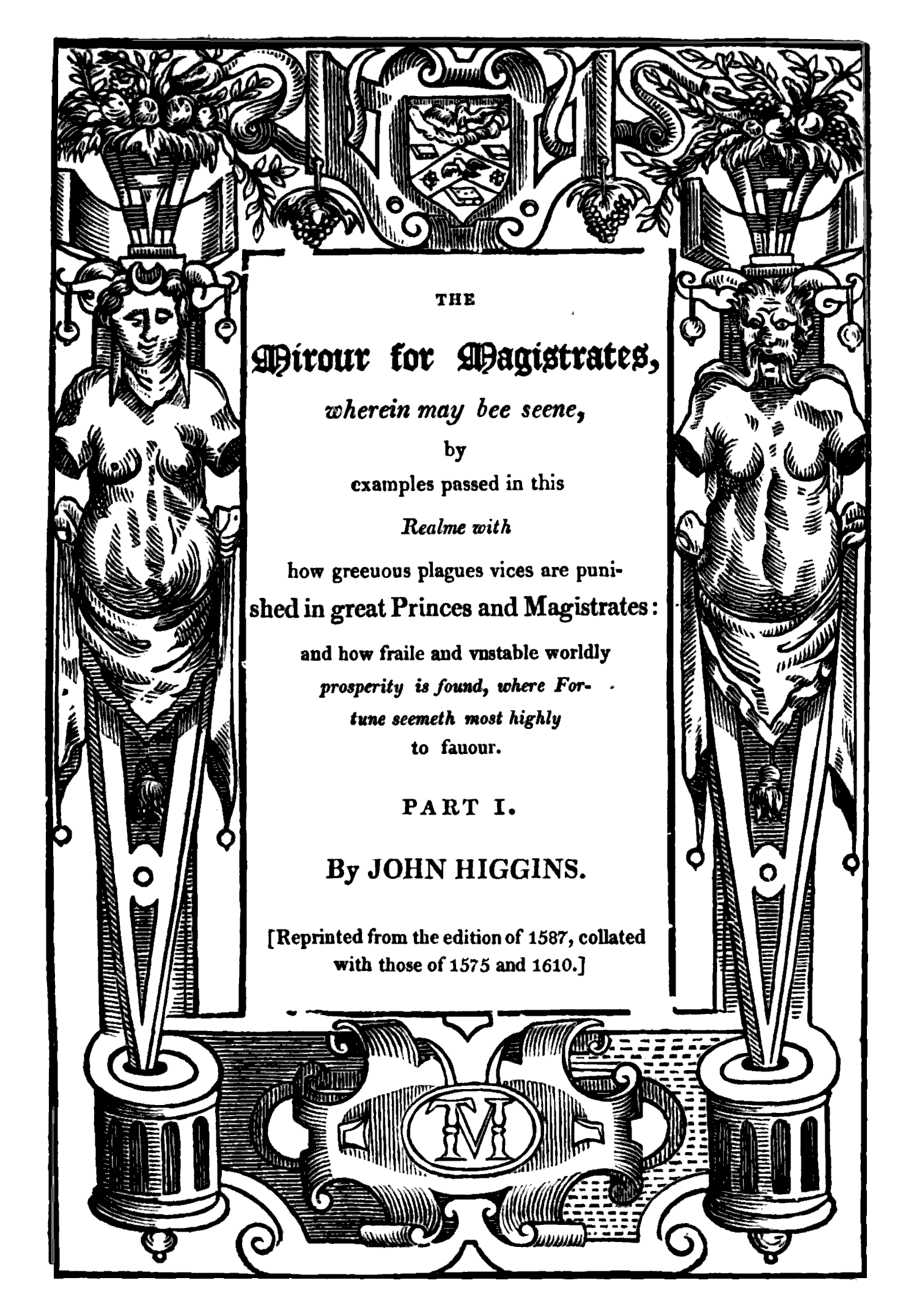
THE
Mirour for Magistrates,
wherein may bee scene,
by
examples passed in this
Realme with
how greeuous plagues vices are punished in great Princes and Magistrates:
and how fraile and vnstable worldly prosperity is found, where Fortune seemeth most highly to fauour.
PART I.
By JOHN HIGGINS.
[Reprinted from the edition of 1587, collated with those of 1575 and 1610.]
Loue and liue. — To the nobility and all other in office, God graunt the increase of wisedome, with all thinges necessary for preseruation of theyr estates.
Amen.
Amongste the wise (right Honorable) whose sentences (for the moste parte) tende either to teache the attayning of vertue or eschuing of vice, Plotinus. Plotinus that wonderfull and excellent Philosopher hath these wordes: The property of Temperaunce is to couet nothing which may be repented: not to excede the bands of measure, & to kepe Desire vnder the yoke of Reason. Whiche saying if it were so well knowen, as it is nedefull; so well embraced, as is[53] wished; or so surely fixed in minde, as it is printed in his workes: then certis many Christians might by the instruction of an Ethnicke Philosopher, shun great and daungerous perils. For to couet without consideration, to passe the measure of his degree, and to let will run at randon, is the only destruction of all estates. Else howe were it possible, so many learned, polliticke, wise, renoumed, valiaunt, and victorious personages, might euer haue come to such vtter decay? For example, wee haue[54] Quintus Curtius. Alexander the Great, Cæsar, Pompey, Cyrus, Hannibal, &c. All which (by desier of glorye) felte the reward of theire immoderate and insatiable lustes: for if Alexander had beene content with Macedonie, or not beene pufte vp with pride after his triumphes, hee had neuer beene so miserably poysoned. If Cæsar and Pompey had beene satisfied with theire victories, and had not fell to ciuill discention, the one had not beene slaine in the senate with daggers, nor the other abroade, by their frendes procurement. Iustinus lib. 1. If Cyrus had beene pleased with all Persia, and Media, and not thirsted for bloud, hee had neuer com to so infortunate a fall. Plutarchus. So if Hanniball had not so much Liuius. delited in glorye of warfare, his countrey had neyther fell in ruine, Polibius. nor hee bene miserably forced to poyson himselfe. But you will say, desire of fame, glorye, renowne, and immortalitie (to which all men well nighe by[55] nature are inclined, especially those which excell or haue any singuler gift of fortune or[56] the body) moued them to such daungerous, great, and hardy enterprises, which must needes be confessed[57] as an infallible veritie: and therefore I suerly[58] deeme those Princes aboue specified (considering their[59] fortunes, fame, and exploytes) had neuer come to suche ende, but for wante of temperance. And now[60] sithe there are three other Cardinall vertues which are requisite in him that should bee in authoritye: that is to saye, Prudence, Iustice, and Fortitude, which so wonderfully adorne and beautifie all estates (If Temperaunce bee with them adioyned, that they moue the very enemies with admiration to prayse them) some peraduenture (as affection leades) will commende one, some another: Arist. Cicero. Prudence. as[61] Aristotle the Prince of Philosophers names Prudence, the mother of vertues, but[62] Cicero defines her the knowledge of things which ought to bee desired and followed, and also of them which ought to bee fled and eschewed; yet you shall finde that for want of Temperaunce, some which were counted very wise[63] fell into wonderfull reproche and infamy. But[64] Iustice that incomparable vertue, (as the auncient Ciuilians define her) is[65] a perpetuall and constant will which giueth to euery man his right, yet if shee be not constant, which is the gifte of Fortitude; nor equal in discerning right from wrong, wherein is Prudence; nor vse proportion in iudgement and sentence, which pertayneth to Temperaunce: shee can neuer bee called equitie or iustice, but fraude, deceite, iniustice and iniurie. And, to speake of Fortitude. Cicero. Fortitude, which Cicero defineth, a consyderate vndertaking of perills, and enduring of labours; if he whome wee suppose stoute, valiaunt, and of good courage, want Prudence, Iustice, or Temperaunce, he is not counted wise, righteous and constant, but sottish, rude and desperate. For Cicero. Temperance. Temperaunce (sayth Cicero) is of reason[66] in lust and other euel assaultes of the minde, a suer and moderate dominion & rule. This noble vertue is deuided into three[67] partes, that is Continency, Clemencie, and Modestye, which well[68] obserued and kept (if grace bee to them adioyned) it is impossible for him that is endued with the aboue named vertues euer to fall into the infortunate snares of calamity, or misfortune. But Ambition which is immoderate[69] desire of honour, rule, dominion, and superioritie, (the very distruction of nobility and common weales, as among the Romanes; Sylla, Marius, Carbo, Cinna, Cateline, Pompey, and Cæsar, are witnesses) hath brought great decay to[70] our contrey, and countreymen. Which Master Baldwin hath so touched[71] in his Epistle of the laste[72] volume of this booke, that I nede not therewith deale any further.[73] I haue here (right honorable) in this booke[74] only reproued foly in those which are heedelesse: Iniurie in extortioners, rashnes in venterers, [trecherie in traytours, riote in rebelles,][75] and excesse in such as suppresse not vnruly affections. Now[76] I truste you will so thinke of it (althoughe the style deserue not like commendation) as you thought of the other parte. Which if you shall, I doubt not but it may pleasure some; if not, yet geue occasion to others which can do better, either to amend these, or to publish their owne.[77] And thus wishing you Prudence to discerne what is meete for your callings, Iustice in the administration of your functions, Fortitude in the defence of your Countrey, and Temperaunce in moderation of all your affections, with increase of honours, and euerlasting felicity: I bid you in Christ Iesu farewell.[78] At Winceham the vii. day of December.
1586.
Your most humble in
the Lord,
Iohn Higins.[79]
“I. HIGGINS TO THE READER .
“Amongst diuers and sondry chronicles of many nations, I thinke there are none (gentle reader) so vncertaine and brief in the beginning as ours: at which I cannot but maruayle, sith at all tymes our Ilande had as learned wryters (some singuler men excepted) as any nation vnder the sunne. Againe, those which now are our best chroniclers as they report, haue great antiquities; but what they publish of late yeares may be enlarged in many places by chronicles of other nacions: whereby it is manifest they are either ignoraunt of the tongues, or els not giuen to the studie of that, which they most professe. For if they were, me-thinkes it were easie for them, with such antiquities as they brag they haue, to fetche our histories from the beginning; and make them as ample, as the chronicles of any other country or nation. But they are faine, in steede of other stuffe, to talk of the Romains, Greekes, Persians, &c. and to fill our histories with their facts and fables. This I speake not to the end I wold have ours quite seperate from other, without any mention of them; but I would haue them there only named, where th’ affayres of both countries, by warre, peace, truce, mariage, trafique, or some necessary cause or other, is intermixed. I haue seen no auncient antiquities in written hand but two: one was Galfridus of Munmouth, which I lost by misfortune; the other, an old chronicle in a kind of Englishe verse, beginning at Brute and ending at the death of Humfrey Duke of Gloucester; in the which, and diuers other good chronicles, I finde many thinges not mentioned in that great tome engroced of late by Maister Grafton; and that, where he is most barraine and wantes matter. But as the greatest heades, the grayest hayres, and best clarkes, haue not most wytte; so the greatest bookes, titles, and tomes, contayne not most matter. And this haue I spoken, because in wryting the Tragedies of the first infortunate princes of this Isle, I was often fayne to vse mine owne simple inuention, yet not swaruing from the matter: because the chronicles (although they went out vnder diuers men’s names) in some suche places as I moste needed theyr ayde, wrate one thing, and that so brieflye, that a whole prince’s raigne, life, and death, was comprysed in three lines; yea, and sometimes mine olde booke, aboue mentioned, holpe mee out when the rest forsoke mee. As for Lanquet, Stowe, and Grafton, [they] were alwayes nighe of one opinion: but the Floure of Histories somewhat larger: some helpe had I of an old chronicle imprinted the yeare 1515. But surely methinkes, and so do most which delite in histories, it were worthely done, if one chronicle wer drawne from the beginning in such perfect sort, that al monuments of vertuous men (to the exalting of God’s glory) and all punishments of vicious persons (to the terrour of the wicked) might be registred in perpetuall remembraunce. To which thing the right reuerende father in God Matthew [Parker] Archbishop of Canterbury, and Metropolitane of Englande, hath brought such ayde, as wel by printing as preseruing the written chronicles of this realme; that by his grace’s studie and paynes, the labour, in tyme to come, wil be farre more easy to them, that shall take such trauayle in hand. But to leaue with these, and declare the cause of my purpose. As I chaunced to reade the Mirour for Magistrates, a worke by all men wonderfully commended, and full of fitte instructions for preseruation of eche estate: taking in hand the chronicles and minding to conferre the times, meethoughte the liues of a number euen at the beginning, the like infortunate princes offered themselues vnto mee as matter very meete for imitation, the like admonition, miter, and phrase; and seing Baldwine by these woordes moued mee somewhat thereto; It were (saith hee) a goodly and a notable matter to searche and discourse our whole storye from the beginning of the inhabiting of this Isle, &c. I read the storyes, I considered of the princes, I noted their liues, and therewith conferred their deathes. On this, I tooke penne in hande, minding nothing lesse than to publishe them abroade, but onely to trye what I could do if neede were, or time and leasure were giuen mee to bestowe in such wyse. I wrote the twoo first, euen as they now are, and because I would not kepe secrete my first labours in this kinde of study (though I might well haue blushed at the basenes of my style) I shewed them to a friend of myne, desiring his vnfayned iudgement in this matter; which when he had read, he neuer left intreating me to wryte other, til I had ended all to the byrth of Christ: and yet not so content; he desired mee t’ accomplish the residue til I came to the Conquest, (which were wel nighe fiftie Tragedies): but, wearied with those which I had written, I desired him pause on this, till tyme and leasure were giuen mee. Yet hee, making relation to other his frendes what I had done, left mee not quiet till they likewyse had seene them: whose perswasion, as it seemed without any suspition of assentation or flattery, so hath it made mee bolder at this present then before. “Although (sayd they) your Tragædies be simple, and not comparable to those which the other before haue written; yet when men consider that many wrote those, but one these; that they are graue writers, you are but yong; the perfection of those stories, and the imperfection of these: finally, the good wil you beare to your country, the commendation of vertue, the detestation of vice, the fal of ambition, the horrible end of traytours, harlots, tyrauntes, adulterers, enchaunters, murderers, and such like; When men (said they) consider these things, they cannot, (how simple soeuer your verse bee,) but thinke well of the matter.” At length, with these perswasions and suche like, I was contente (good reader) to publishe them for thy behoufe, and the publique weale of my countrye; at which if thou enuie, I minde not therefore to enuie my selfe, and staye my penne. But (God willing) thou shalt, as fast as I can prepare them, haue other bookes from my handes, which maye please thee againe; and thus with all my harte I bidde thee hartely farewell.
Thy friende
I. H.”[80]
A PREFACE TO THE READER .
[Before the edition 1587.]
Aboute a twelue yeares since (gentle reader) when I tooke vpon mee for exercise sake, only to make proofe in English verse what I could do, & had read the Mirour for Magistrates which Maister Baldwins set forth, (a booke both well penned and also well commended) I perused the Chronicles, I noted the times, I conferred the Princes, and me thought that a nomber euen at the firste inhabiting of this Islande, offered them selues the like haplesse impes of Fortune, with matter very meete for imitation, and like admonition, meeter and phrase. And sith Maister Baldwine in these words of his preface moued mee somewhat thereto: It were (sayth hee) a goodly and a notable mater to search, and discours our whole storie from the beginning of the inhabiting of this Isle, &c. I read agayne the stories, I considered of the Princes, I noted theire liues, and therewith conferred their falles: on this I tooke penne in hande, and wrote a fewe of the firste euen as they since were imprinted, minding nothing lesse then to publish them abroade: and because I woulde not keepe secret my first laboures in this kinde of studie, (although I mighte haue blushed at the basenes of my style) I shewed them to some frendes of myne, desired theire vnfayned iudgementes herein, who not only perswaded mee that they were well, but also desired mee to followe the same order till I came to the birth of Christe: which when I had done, yet they willed mee to proceede with the falles of the like vntill the conqueste, which I coulde not doe, being called away by other studies of more importaunce, but the rest which I wrot after that time and at leisure since by the perswations of some worshipfull, and my very good frendes; I haue here set downe, and agayne corrected those which I wrot before, euen for the profit of my natiue countrey. Now I desire thee (gentle reader) so well to accept of my paynes and good will herein bestowed, as I was well willing by this edition to doe thee ease, and pleasure. And so whishing thee the feare of God, the loue of thy Prince and countrey, and after this lyfe the fruition of perfecte felicitye, I doe bid thee hartely in Christe Iesu farewell.
Thy frende,
Iohn Higins.[81]
THOMAS NEWTON TO THE READER ,
in the behalfe of this Booke.
As when an arming sword of proofe is made,
Both steele and yron must be tempred well:
(For yron giues the strength vnto the blade,
And steele, in edge doth cause it to excell)
As ech good Bladesmith by his Arte can tell:
For, without yron, brittle will it breake,
And, without steele, it will bee blunt and weake:
So bookes, that now theyr faces dare to show,
Must mettald bee with Nature and with Skill:
For Nature causeth stuffe enough to flow,
And Arte the same contriues by learned quill
In order good, and currant methode still.
So that, if Nature frowne, the case is hard:
And if Arte want, the matter all is marde.
The worke, which here is offred to thy vewe,
With both these poynts is full and fitly fraught;
Set foorth by sundry of the learned Crewe:
Whose stately styles haue Phœbus garland caught,
And Parnasse mount theyr worthy works haue raught,
Theyr wordes are thundred with such maiestie,
As fitteth right ech matter in degree.
Reade it therefore, but reade attentiuely,
Consider well the drift whereto it tendes:
Confer the times, perpend the history,
The parties states and eke theyr dolefull endes,
With odde euentes, that divine iustice sendes.
For, thinges forepast are presidents to vs,
Whereby wee may thinges present now discusse.
Certes this worlde a Stage may well bee calde,
Whereon is playde the parte of eu’ry wight:
Some, now aloft, anon with malice galde
Are from high state brought into dismall plight.
Like counters are they, which stand now in sight
For thousand or ten thousand, and anone
Remooued, stande perhaps for lesse then one.
1587.
Thomas Newtonus,
Cestreshyrius.[82]
THE AUTHORS INDUCTION.
1.
When Sommer sweete, with all her pleasures past,
And leaues began, to leaue the shady tree,
The winter colde encreased on full fast,
And time of yeare to sadnes moued mee:
For moysty blastes, not halfe so mirthfull bee,
As sweete Aurora bringes in spring time fayre,
Our ioyes they dimme, as winter damps the ayre.
2.
The nights began, to growe to lengthe apace,
Sir Phœbus to th’ Antarctique gan to fare:
From Libraes lance, to th’ Crab hee tooke his race
Beneth the lyne, to lende of light a share.
For then with vs the dayes more darkishe are,
More shorte, colde, moyste, and stormy cloudy clit,
For sadnes more then mirths or pleasures fit.
3.
Deuising then, what bookes were best to reade,
Both for that time, and sentence graue also,
For conference of frende to stande in steade,
When I my faithfull frende was parted fro;
I gate mee strayght the Printers shops vnto,
To seeke some worke of price I suerly ment,
That might alone my carefull mynde content.[83]
4.
Amongst the rest,[84] I found a booke so sad,
As tyme of yeare or sadnesse[85] coulde requier:
The Mirour namde, for Magistrates hee had,
So finely pende, as harte could well desire.
Which when I read, so set my heart on fire,
Eftsoones it mee constraynde to take the payne,
Not lefte with once,[86] to reade it once agayne.
5.
And as agayne I vewde this worke with heede,
And marked playne each party paynt[87] his fall:
Mee thought in mynde, I sawe those men indeede,
Eke howe they came in order Princely[88] all;
Declaring well, this life is but a thrall,
Sith those on whom, for Fortunes giftes wee stare,
Ofte sooneste sinke, in greatest seas of care.
6.
For some, perdy, were Kinges of highe estate,
And som were Dukes, and came of regall race:
Som Princes, Lordes, and Iudges greate that sate
In councell still, decreeing euery case.
Som other Knightes, that vices did imbrace,
Som Gentlemen, som poore exalted hye:
Yet euery one, had playde his tragedye.
7.
A Mirour well it might[89] bee calde, a glasse
As cleare as any[90] cristall vnder Sun:
In each respecte, the Tragedies so passe,
Theyr names shall liue, that such a worke begun.
For why, with such Decorum is it don,
That Momus spight with[91] more then Argus eyes,
Can neuer watche, to keepe it from the wise.
8.
Examples there, for all estates you finde,
For iudge (I say) what iustice hee shoulde vse:
The noble man, to beare a noble mynde,
And not him selfe ambitiously abuse.
The gentleman vngentlenes refuse,
The rich and poore, and eu’ry one may see,
Which way to loue, and liue in due[92] degree.
9.[93]
I wishe them often well to reade it than,
And marke the causes why those Princes fell:
But let mee ende my tale that I began.
When I had red these Tragedies full well,
And past the winter euenings[94] long to tell,
One night at last I thought to leaue this[95] vse,
To take som ease beefore I chaundge my muse.
10.
Wherefore away from reading I mee gate,
My heauy heade waxte dull for wante of reste:
I layde mee downe, the night was waxed late,
For lacke of sleepe myne eyes were sore oppreste:
Yet fancy still of all theire deathes increaste,
Mee thought my mynde from them I coulde not take,
So worthy wightes, as caused mee to wake.[96]
11.
At length appeared clad in purple blacke[97]
Sweete Somnus, rest which comforts eache aliue;
By ease of mynde, that weares away all wracke,
That noysome night, from wery witts doth driue,
Of labours long, the pleasures wee atcheiue.
Whereat I ioyde, sith after labours paste,[98]
I might enioye sweete Somnus sleepe at laste.[99]
12.
But hee by whom I thought my selfe at reste,
Reuiued all my fancyes fond before:
I more desirous humbly did requeste,
Him shew th’ vnhappy Albion Princes yore.[100]
For well I wist, that hee coulde tell mee more,
Sith vnto diuers, Somnus erste had tolde,
What thinges were done, in elder times of olde.
13.[101]
Then strayght hee foorth his seruante Morpheus calde,
On Higins here thou muste (quoth hee) attende;
The Britayne Peeres to bring (whom Fortune thralde)
From Lethian lake, and th’ auncient shapes them lende;
That they may shew why, howe, they tooke theire ende,
I will (quoth Morpheus) shewe him what they were;
And so mee thought, I sawe them strayght appeare.
14.
One after one, they came in straunge attire,
But some with woundes and bloude were so disguisde,
You scarsly coulde by reasons ayde aspire,
To know what warre such sondry deaths deuisde;
And seuerally those Princes were surprisde.
Of former state, these states gaue ample show
Which did relate their liues and ouerthrow.
15.
Of som the faces bolde and bodyes were[102]
Distaynde with woade, and turkishe beardes they had:
On th’ ouer lyppes mutchatoes long of heyre,
And wylde they seemde, as men dispayring mad.
Theire lookes might make a constant heart[103] full sad,
And yet I could not so forsake the vewe[104]
Nor[105] presence, ere theire myndes I likewise knewe.
16.
For Morpheus bade them each in order tell[106]
Their names and liues, their haps and haplesse dayes,
And by what meanes, from Fortunes wheele[107] they fell,
Which did them earst, vnto such honours rayse.
Wherewith the first not making moe delayes,
A noble Prince broade wounded brest[108] that bare
Drew neere, to tell the cause of all his care.
17.
How King Albanact the Yongest Son of Brutus, [113] and First King of Albany (now called Scotland) was slayne by king Humber, the yeere before Christ, 1085.
1.
Sith flattering Fortune sliely could beguile
Mee, first of Brytane Princes in this land:[114]
And yet at first on mee did sweetely smile,
Doe marke mee here,[115] that first in presence stand.
And when thou well my wounded corps hast scand,
Then shalt thou heare my hap to penne the same[116]
In stories calde Albanactæ by name.[117]
2.
Lay feare[118] aside, let nothing thee amaze,
Ne haue despaire, ne scuse the want of time:[119]
Leaue of on mee with fearefull lookes to gaze,
Thy pen may serue for such a tale as myne.
First I will tell thee all[120] my fathers lyne,
Then hitherward why hee with Troians man’d,
His voyadge made, and founde this noble land.[121]
3.
And last I minde to tell thee of my selfe,
My life and death, a Tragedy so true
As may approue your world is all but pelfe,
And pleasures sweete, whom sorows aye ensue.
Hereafter eke in order comes a crue,
Which can declare, of worldly pleasures vayne
4.
When Troy was sackt, and brent, and could not stand,
Æneas fled from thence, Anchises sonne,
And came at length to King Latinus land:
Hee Turnus slew, Lauinia eke hee wonne.
After whose death, Ascanius next his sonne
Was crowned King, and Siluius, then his heire,
Espoused to a Latine Lady faire.[124]
5.
By her had Siluius shortly issue eke,
A goodly Prynce, and Brutus was his name.
But what should I of his misfortune speake,
For hunting, as hee minded strike the game,
He shot[125] his father, that beyond it came.
The quarrell[126] glaunst, and through his tender side
It flewe where through the noble Siluius dyde.[127]
6.
Lo thus by chaunce though princely Brutus slewe
His father Siluius, sore agaynst his will,
Which came to soone, as he his arrowe drewe
Though hee in chace the game, did minde to kill,
Yet was hee banisht from his countrey still,[128]
Commaunded neuer[129] to retourne no more,
Except he would his life to loose therefore.
7.
On this, to Greece Lord Brutus tooke his way,
Where Troians were, by Græcians, captiues kept:
Helenus was by Pirrhus brought away
From death of Troians, whom their[130] friends bewept.
Yet hee in Greece this[131] while no busines slept,
But by his facts, and feates obtayn’d such fame,
Seauen thousand captiue Troians to him came.
8.
Assaracus a noble Græcian eke,
Who by his mother came of Troian race,
Because he sawe himselfe in Greece to weake,[132]
Came vnto him to ayde him in this case,
For that his brother thought him to deface.[133]
Which was a Greeke by both his parents sides,
His Castells three the Troian Brutus guides.
9.
While[134] hee to bee theyr Captayne was content,
And as[135] the Troians gathered to his band,
Ambassage to the[136] Græcian King he sent,
For to entreate they[137] might depart his land.
Which when King Pandrasus did vnderstand,
An army strayght he did therefore addresse,
On purpose all the Troians to suppresse.
10.
So as King[138] Pandrasus at Spartane towne
Thought them in deserts by, to circumuent,
The Troians with[139] three thowsand beate them downe,
Such fauoure loe, them[140] Lady Fortune lent.
By Mars his force, their rayes and ranckes hee rent,
And tooke Antigonus the brother of their King,[141]
With others moe, as captiues home to bring.
11.
The taken towne from which the King was fled,
Sir Brutus with sixe hundreth men did man,
Eche prisoner was vnto his keeper led
To keepe in towne, the noble Troians wan:
And into woods the Troiane gate him than[142]
Againe with his, hee kept him there by night
To quaile the Græcians if they came to fight.
12.
The King which cal’d to minde his former foile,
His flight, and brother deare by Troians take,[143]
The towne hee lost, where Brutus gaue[144] the spoile,
Hee thought not so the fielde and fight forsake,
But of his men a muster new to make,
And so againe for to besiege the towne
In hope reuenge, or winne his lost renowne.
13.
By night the ambushe,[145] that his purpose knew,
Came forth from woods, whereas they[146] waited by,
The Troians all th’ vnarmed Græcians slew,
Went through their campe, none could their force deny,
Vnto the tent where Pandrasus did ly,
Whereas Lord Brutus[147] tooke their King that night,
And sau’d his life as seem’d a worthy wight.
14.
This great exploite so wisely well atchiu’d,
The Troiane victour did a counsaile call,
Wherein might bee for their estate contriu’d,
By counsaile graue, the publique weale of all.
Now tell (quoth he) what raunsome aske wee shall?
Or what will you for our auaile deuise?
To which Mempricius answer’d, graue and wise.[148]
15.
In this, thou noble Captaine, worthy praise:
Which deemest well, it were an heynous fact,[151]
T’ abridge the Grecian king of vitall daies,
And that wee ought[152] by clemency to raise
Our fame to skie, not by a sauage guise,
Sith Gods and men both, cruelty despise.
16.
“The cause wee fought, was for the freedome all
Of Troians taken, wee haue freedome won,
Wee haue our purpose, and their king withall,
To whom of rigour nothing ought bee done:
Though hee the quarrel with vs first begon,
And though wee owe the fall of Troyes requite,
Yet let reuenge thereof from gods to lighte.
17.
“His subiects now bewaile[153] their proude pretence,
And weapons laide aside, for mercy crie:
They all confesse their plagues to come from thence,
Where first from faith of Gods they seemd to fly.
Their Nobles dare not come the case to try,
But euen for peace, with all their heartes, they sue,
And meekly graunt, whence all their mischiefes grewe.
18.
“The Princesse[154] fayre, his daughter, who surmounte
For vertues rare, for beautie braue, and grace,
Both Helen fine, of whom they made accountes,
And all the rest that come of Græcian race,
Shee for her father sues, bewailes his case,
Implores, desires thy grace, and gods aboue,
Whose woes may them and thee to mercy moue.[155]
19.
“Some Troians say hee should deposed bee
From kingdome quite, or else bee slaine hee should,
And wee here byde, eke this mislyketh me,
Nay rather while wee stay keepe him in hold,
Or let him pay a raunsome large of gold,
And hostage geue, and homage doe of right
To thee, that wonst the fielde by Martiall fight.[156]
20.
“For kingdomes sake a captiue king to kill,
As euill abroade as in his natiue lande,[157]
For vs in Greece to dwell were euen as ill,
The force of Greece we cannot still withstande.
Let vs therefore both cruelty abande,
And prudent seeke both gods and men to please:
So shall we finde good lucke at lande and seas.[158]
21.
“Or sith the Græcians will thee for to take
The noble Ladie Iunogen to wyfe,
If thou so please, let him her dowry make
Of golde, ships, siluer, corne, for our reliefe,
And other thinges, which are in Græcia ryfe.
That we so fraught may seeke some desert shore,
Where thou and thyne may raygne for euermore.[159]”
22.
This pleas’d both Brutus and the Troians all,
Who wil’d forthwith that Pandrasus the King,
Should reuerently be brought into the hall,
And present when they tolde him of this thing:
So griefe and sorowe great his heart did stinge,
He could not shewe by countenaunce or cheere
That he it lik’d, but spake as you shall heare.
23.
“Sith that the wrath of gods hath yeelded me,[160]
And eke my brother, captiues to your hands,
I am content to do as pleaseth yee,
You haue my realme, my lyfe, my goods and landes,[161]
I must be needes content as Fortune standes.
I gieue my daughter, gold, and siluer fine,
With what for dowry els you craue is myne.”
24.
To make my tale the shorter if I may,
This truce concluded was immediately:[162]
And all thinges else performed by a day,
The King restor’d that did in pryson lie.
The Troians parted from the shores, perdy,[163]
Did hoyse vp sayles, in two dayes and a night
Vpon the Ile of Lestrigons[164] they light.
25.
And leauing of their ships at roade, to land
They wandring went the countrey for to vew:
Loe there a desert city olde they fand,
And eke a temple (if reporte bee true)
Where in Dianas temple olde, the crew[165]
To[166] sacrifice their captaine counsaile gaue
For good successe, a seate and soyle to craue.[167]
26.
And he no whit misliking their aduice
Went forth, and did before the altar hold
In his right hand a cup to sacrifice,
And fild with[168] wine, and white hinds bloud scarce cold.
And then before her stature straight hee told
Deuoutly all his whole peticion there,
In sorte (they say) as is repeated heere.[169]
27.
“O goddesse great in groues that putst wilde boares in feareful feare,
And maist goe all the compasse pathes of euery ayrye sphere,
Eke of th’ infernall houses too, resolue the earthly rights,
And tell what countrey in to dwell thou giu’st vs Troian wights.
Assigne a certaine seate where I shall worship thee for aye,
And where repleat with virgins, I, erect thy temples maye.”
28.
When nine times hee had spoken this, and went
Foure times the altar rounde, and staide agen,
He powr’d the wine and bloud in hand hee hent
Into the fire. O witlesse cares of men,
Such folly meere, and blindnes great was then.
But if religion now biddes toyes farewell,
Embrace that’s good, the vice of times I tell.
29.
He layde him then downe by the altars side,
Vpon the white Hindes skin espred therefore:
It was the third houre of the night, a tyde
Of sweetest sleepe, hee gaue himselfe the more
Diana chaste, the goddesse to appeare,
And spake to him these wordes that you shall heare.
30.
“O Brute, farre vnder Phœbus fall, beyonde of France that raigne,
An Iland in the Ocean is, with sea tis compast mayne,
An Iland in the Ocean is, where Giauntes erst[172] did dwell:
But now a desert place that’s fit, will serue thy people well.
To this direct thy race, for there shall bee thy seate for aye,
And to thy sonnes there shall bee built another stately Troye.
Here of thy progeny and stocke, shall mightie Kings descend,
And vnto them as subiect, all the world shall bow and bend.”
31.
On this hee woke, with ioyfull cheere, and told
The vision all, and oracle it[173] gaue:
So it reioyst their hearts a thowsande fold.
To ships they got, away the shores they draue,
And hoysing sailes, for happie windes they craue.
In thirty dayes their voyage so they dight,
That on the coast of Aphrica[174] they light.
32.
Then to Philænes altars they attayn’d,
(For so men call two hilles erected are
In Tumise land) two brethren ground that gain’d
For Carthage once, and went tis sayd too farre,
On Cyren ground for bounds, there buryed were.
Because they would not turne againe, but striue
With Cyren men, they buryed them aliue.
33.
From thence they sailed through the middle lake,
Betwene Europa fayre and Aphrica the drye:
With winde at will, the doubtfull race they take,
And sail’d to Tuscane shores, on Europe coast that lye.
Where at the last amongst the men they did descrye
Fowre banisht bandes of Troians in destresse
To sayle with them, which did themselues addresse.[175]
34.
Companions of Antenor in his flight,
But Corinœus was their captayne than,
For counsayle graue[176] a wise and worthy wight:
In warres the prayse of[177] valiantnesse he wan.
Lord Brutus liked well this noble man,
With him full oft confer of fates hee wold,
And vnto him the oracles hee told.[178]
35.
The Troians so in number now encreast,
Set on to sea and hoysed sayles to wynde.
To Hercules his pillers from the East
They cast by compasse ready way to finde:
Where through once past to Northward race they twinde,
To Pirene cleeues, tweene Spayne and France the bounde,
Reioycing neere the promist Ile so founde.[179]
36.
Eke[180] vnto Guyne in France they sayled thence,
Where[181] at the hauen of Loire they did arriue,
To vewe the countrey was their whole pretence
And victayles get, their souldiers to reuiue.[182]
Eke Corinœus lest the Galles should striue,
Led forth two hundreth of his warlike band,
To get prouision to the ships from land.
37.
But when the King Goffarius heard of this,
That Troians were arriued on his shore,
With Frenchmen and with Guynes their power and his,
Hee came to take the pray they gat before,
And when they met, they fought it both full sore,
Till Corinœus rusht into their band,
And caus’d them fly: they durst no longer stand.
38.
First might you there seene hearts of Frenchmen broke,
Two hundreth Troians gaue them all the foyle
At home, with oddes, they durst not byde the stroke,
Fewe Troians beate them in their natiue soyle.
Eke Corinœus followed in this broyle,
So fast vpon his foes before his men,
That they return’d and thought to spoyle him then.
39.
There hee alone against them all, and they
Against him one, with all their force did fight,
At last by chaunce his sword was flowne away,
By fortune on a battayle axe hee light,[183]
Which hee did driue about him with such might,
That some their hands, and some their armes did leese,
Some legges, of some the head from shoulders flees.
40.
As thus amongst them all hee fought with force
And fortune great, in daunger of his lyfe,
Lord Brutus[184] had on him therewith remorce,
Came with a troupe of men to ende the strife.
When Frenchmen saw the Troians force so rife,
They fled away, vnto their losse and payne;
In fight and flight nigh all their host was slayne.
41.
And in that broyle, saue Corinœus, none
Did fight so fearcely, as did Turnus then:
Sir Brutus[185] cosin with his sword alone
Did sley that time well nigh sixe hundreth men.
They founde him dead as they return’d agen,
Amongst the Frenchmen, wounded voyde of sence,
And bare his noble corps with honour thence[186].
42.
On this they bode awhile reuenge to yeelde,
And to interre the dead, and Turnus slaine,
They tooke a towne not far from place of fielde,
And built it strong, to vexe the Galles agayne.
The name they gaue it still doth yet remayne:
Sith there they buried Turnus, yet men call
It Tours, and name the folke Turones all.
43.
Which towne they left at last with Troians man’d,
When as their ships were storde with what they neede
Aboarde, they hoise vp sayles and left the land,
By ayding windes they cut the seas with speede.
At length the shyning Albion clyues[187] did feede
Their gazing eyes, by meanes whereof they fand
Our Totnes hauen, and tooke this promist land.
44.
The countrey seemed pleasaunt at the vewe,
And was by fewe[188] inhabited, as yet,
Saue[189] certaine Giauntes whom they did pursue,
Which straight to Caues in Mountaines did them get:
So fine were Woods, and Flouds, and Fountaines set,
So cleare the ayre, so temperate the clime,
They neuer saw the like before that time[190].
45.
And then this Ile that Albion had to name,
Lord Brutus caus’d it Britaine cal’d to bee,[191]
And eke the people Britans of the same,
As yet in auncient Recordes is to see.
To Corinœus gaue hee franke and free
The land of Cornwall, for his seruice don,
And for because from Giauntes hee it won.
46.
Then sith our Troiane flock came first from Troy,
The Chiefetaine[192] thought that duty did him binde,
As[193] Fortune thus had sau’d him from anoy,
The auncient towne againe to call to minde.
Hee builte new Troy, them Troian lawes assignde,
That so his race,[194] to his eternal fame,
Might keepe of Troy the euerlasting name[195].
47.
And setled there, in perfect peace and rest,
Deuoid of warre, of laboure, strife, or paine,
Then Iunogen the Queene his[196] ioyes increast,
A Prince shee bare, and after other twaine,
Was newer King of noble Impes[197] so faine,
Three sonnes which had so shortly here begat,[198]
Locrinus, Camber, last mee Albanact.
48.
Thus hauing wealth, and eke the world at will,
Nor wanting ought that might his minde content,
T’ increase his powre with wights of warlike skill
Was all his minde his purpose and intent.
Whereby if foes inuasion after ment,
The Britans might not feare of forraine lands,
But keepe by fight possessions in their hands.
49.
Eke[199] when his people once perceiu’d his minde,
(As what the Prince doth often most embrace,
To that the subiects all are straight inclinde,
And reuerence still in eche respect his grace)
They gat in warre such knowledge in short space,
That after they their force to try begon,
They car’d for nought by wit or wight not won.
50.
They got of giaunts mountaines whence they came,
And woods from whence they oft made wise, they would
Destroy and kill, when voyage out they frame,
Or shewde themselues in banding ouer bold:
Then straight the Britans, gladder then of gold,
Were ready still to fighte at euery call,
Till time they had extynct the monsters all.[200]
51.
Whereby the King had cause to take delight,
And might bee bolde the lesse to feare his foes:
Perdy[201] ech Prince may recke his enmies spight,
Thereafter as his force in fight hee knoes.
A princely heart the liberall gifts disclose.
He gaue to eche such guerdons for their facts,
As might them only mooue to noble acts.
52.
No labours great his subiects then refusde,
No trauayles that might like his regall minde:
But ech of them such exercise well vs’d,
Wherein was praise, or glory great to finde.
And to their liege bare faithfull hearts so kinde,
That what hee wild they all obeyd his hest,
Nought else was currant but ye Kings request.
53.
What Prince aliue might more reioyce then hee?
Had faithfull men, so valiaunt, bold, and stout?
What pleasures more on earth could lightly bee
Then win an Ile, and liue deuoyde of doubt?
An Ile sayd I? nay nam’d the world throughout
Another world, sith sea doth it deuide
From all, that wants not all the world beside.
54.
What subiects eke more happy were then these?
Had such a King of such a noble heart,
And such a land enioyde and liu’d at ease,
Whereof ech man almost might chose his part?
No feare of foes, vnknowne was treason’s art,
No fayning friends, no fawning Gnatoes skill,
No Thrasoes brags, but bearing ech good will.
55.
But as ech sommer once receaues an ende,
And as no state can stable stande for aye,
As course of time doth cause thinges bowe and bend,
As euery pleasure hath hir ending daye,
As will can neuer passe the power of maye:
Euen so my father, happy dayes that spent,
Perceau’d he must by sicknesse last relent.
56.
As doth the shipman well foresee the storme,
And knowes what daunger lyes in Syrtes of sand:
Eke as the husbandman prouides beforne,
When hee perceaues the winter cold at hand:
Euen so the wise, that course of things haue scan’d,
Can well the end of sicknes great presage,
When it is ioyn’d with yeares of stooping age.
57.
His sonnes and Counsaile all assembled were:
For why hee sent for vs and them with speede.
Wee came in hast, this newes vs caused feare.[202]
Sith so hee sent, wee thought him sicke indeede.[203]
And when wee all approacht to him with heede,[204]
Too soone alas, his grace right sicke we found,
And him saluted as our duties bound.
58.
And casting of his woefull[205] eyes aside,
Not able well to mooue his painefull head,
As silent wee with teares his minde abide,
Hee wil’d himselfe bee reared in his bed.
Which done, with sight of vs his eyes hee fed,
Eke pawsing so a while for breath hee stayd,
At length to them and vs thus wise hee sayd.
59.
“No maruaile sure, though you herewith bee sad,
(You noble Britaines) for your Brutus’ sake.
Sith whilom mee your captaine stout you had,
That now my leaue and last farwell must take,
Thus nature willes mee once an ende to make,
And leaue you here behinde, which after mee
Shall die, as mee[206] departe before you see.
60.
“You wot wherefore I with the Græcians fought,
With dinte of sworde I made their force to fly:
Antenor’s friends on Tuscane shores I sought,
And did them[207] not my promist land deny,
By Martiall powre I made the Frenchmen fly,
Where you to saue I lost my faithfull frende,
For you, at Tours, my Turnus tooke his ende.
61.
“I neede not now recite what loue I bare,
My friendship you, I trust, haue found so well,
That none amongst you all which present are,
With teares doth not record the tale I tell.
Eke whom I found for vertues to excell,
To them I gaue the price thereof, as due
As they deseru’d, whose facts I found so true.
62.
“Now must I proue, if paines were wel bestow’d,
Or if I spent my gratefull gifts in vayne,
Or if these great good turns to you I ow’d,
And might not aske your loyall loues againe:
Which if I wist, what tongue could tell my paine?
I meane, if you vngratefull mindes doe beare,
What meaneth death to let mee linger here?
63.
“For if you shall abuse your Prince in this,
The gods on you for such an haynous fact
To take reuenge bee sure will neuer misse.
And then to late you shall[208] repent the act,
When all my Realme, and all your wealthes are sackt:
But if you shall, as you begon, proceede,
Of kingdomes fall or foes there is no dreede.
64.
“And to auoyde contention that may fall,
Because I wishe this Realme the Britans still,
Therefore I will declare before you all,
Sith you are come, my whole intent and will:
Which if you keepe, and wrest it not to ill,
There is no doubt but euermore with fame
You shall enioy the Britans Realme and name.
65.
“You see my sonnes, that after mee must raigne,
Whom you or this haue lik’d and counsail’d well.
You know what erst you wisht they should refraine,
Which way they might all vices vile expell,
Which way they might in vertues great excell.
Thus if you shall, when I am gone insue,
You shall discharge the trust repos’d in you.
66.
“Bee you their fathers, with your counsaile wise,
And you my children take them euen as mee,
Bee you their guides in what you can deuise,
And let their good instructions teach you three:
Bee faithfull all: as brethren ought agree:
For concord keeps a Realme in stable stay:
But discord brings all kingdomes to decay.
67.
“Recorde you this: to th’ eldest[209] sonne I giue
This Middle parte of Realme to holde his owne,
And to his heyres that after him shall liue:
Also to Camber, that his part bee knowne,
I giue that land that lyes welnigh oregrowne
With woodes, Northwest, and mountaines mighty hye,
By South whereof the Cornish sea doth lye.[210]
68.
“And vnto thee my yongest sonne, that art
Mine Albanact, I giue to thee likewise
As much to bee for thee and thine apart,
As North beyonde the arme of sea there lyes,
Of which loe heere a Mappe before your eyes.
Loe heere my sonnes my kingdome all you haue,
For which (remember) nought but this I craue:[211]
69.
“First, that you take these fathers graue for mee,
Imbrace their counsaile euen as it were mine:
Next, that betweene your selues you will agree,
And neuer one at others wealth repine,
See that yee bide still bounde with friendly line:
And last, my subiects with such loue retaine,
As long they may your subiects eke remayne.
70.
“Now faint,[212] I feele my breath begins to fayle,
My time is come, giue eche to mee your hand:
Farewell, farewell, to mourne will not preuayle,
I see with Knife where Atropos doth stand:
Farewell my friendes, my children and my land,
And farewell all my subiectes, farewell breath,
Farewell ten thowsand times, and welcome death.”
71.
And euen with that hee turnde himselfe asyde,
Vpyeelding, gasping gaue[213] away the ghost:
Then all with mourning voyce his seruantes cry’d,[214]
And all his subiectes eke, from least to most,
Lamenting fil’d with wayling plaintes[215] ech coast,
Did for their King full dolefully lament.
72.
But what auayles, to striue against the tide,
Or else to driue[218] against the streame and winde?
What booteth it against the Cliues to ride,
Or else to worke against the course of kinde?
Sith Nature hath the ende of thinges assin’d,
There is no nay, wee must perforce depart,
Gainst dinte of death there is no ease by arte.[219]
73.
Thus raign’d that worthy King, that founde this land,
My father Brutus, of the Troian bloud,
And thus hee died when hee full well had man’d
This noble Realme with Britans fearce and good.
And so a while in stable state it stood,
Till wee deuided had this Realme in three,
And I to soone receiu’d my part to mee.
74.
Then straight through all the world gan Fame to fly,
A monster swifter none is vnder Sunne:
Encreasing as in waters wee descry
The circles small, of nothing that begunne,
Which at the length vnto such breadth doe come,
That of a drop, which from the skies doth fall,
The circles spread, and hyde the waters all:
75.
So fame in flight increaseth more and more:
For at the first she is not scarcely knowne,
But by and by she fleets[220] from shore to shore,
To cloudes from th’ earth her stature straight is growne:
There whatsoeuer by her trompe is blowne,
The sounde that both by sea and land out flies,
Reboundes againe, and verberates the skies.
76.
They say the earth, that first the Giauntes bred,
For anger that the gods did them dispatch,
Brought forth this sister, of those monsters dead,
Full lighte of foote, swifte winges the windes to catch;
Such monster erst did nature neuer hatch.
As many Plumes shee hath from top to toe,
So many eyes them vnderwatch, or moe.
77.
And tongues doe speake, so many eares doe harke,
By night tweene heauen she flies and earthly shade,
And shreaking, takes no quiet sleepe by darke:
On houses rowfes, on[221] towres as keeper made
Shee sits by day, and Cities threats t’ inuade:
And as she tells what things shee sees by vewe,
Shee rather shewes that’s fayned false, then true.
78.
She blazde abroade perdy a people small,[222]
Late[223] landed heere, and founde this pleasaunt Ile,
And how that now it was deuided all,
Made tripartite,[224] and might within a while
Bee won by force, by treason, fraud, or guile.
Wherefore she mooues her frendes to make assay
To win the price, and beare our pompe away.
79.
A thowsand things besides shee bruits and tells,
And makes the most of euery thing shee heares
Long time of vs shee talkes, and nothing els,
Eke what shee seeth abroade in haste shee beares,
With tatling toyes, and tickleth so their eares,
That needes they must to flattering fame assent,
Though afterwards they doe therefore lament.
80.
By East from hence a countrey large doth lye,
Hungaria eke of Hunnes it hath to name,
And hath Danubius’ floud on South it bye,
Deuiding quite from Austria the same.
From thence a king was named Humber came:
On coastes of Albany arriued hee,
In hope this king of Britan for to bee.[225]
81.
Which when by postes[226] of subiects I did heare
How enmies[227] were arriued on my shore,
I gathered all my souldiers voyde of feare,
And backe the Hunnes by force and might I bore.
But in this battaile was I hurt so sore,
That in the fielde of woundes I had I dide,
Where souldiers lost their noble prince and guide.[228]
82.
Such was my fate to venture on so bolde,
My rashnesse was the cause of all my woe:
Such is of all our glory vaine the holde,
So soone wee pompe and pleasures all forgoe,
So quickly are wee reft our kingdomes froe,
And such is all the cast of Fortune’s play,
When least wee thinke to cut vs quite away.
83.
I deem’d my selfe an heauenly happy wight,
When once I had my part to raigne within:
But see the chaunce what hap did after light,
Or I could scarce t’inioy my glee begin.
This Hunne did seeke from mee my realme to win,
And had his will: O flattering fortune, fye,
What meanest thou to make thy selfe so slye:[229]
84.
You worthy warriours learne by mee, beware,[230]
Let wisedome worke, lay rashnesse all aparte,
When as with enmies you encountred are,
You must endeuoure all your skilfull arte,
By witty wiles with force to make your marte.
Wit nought auayles late bought with care and cost,
To late it comes when life and all is lost.[231]
L’ENVOY[232].
1.
Mvsing on these thinges I cal’d to my minde,
In historyes what I of Troia read,
And what of Brutus I in bookes did finde
Likewise I cast, and counted in my head.
I found that Albanact stoode mee in stead.
For why, Sicilians right this noble man
Calles Lestrygons, as they were named than.
2.
Lestrygo was, perdy, Neptunus’ sonne,
To whom his father gaue that noble Ile:
And of his name the people there did wonne.
The writers false abus’d vs then long while,
Which set vs downe of Leogece an Ile,
So neere Italia strandes was placed than,
To which Lord Brutus came, that noble man.
3.
Of Lestrygon that Ilande first tooke name,
As Albanact hath well recited heere.
But of king Humber see what nowe became,
Which after him next haplesse did appeare
With Armoure wet, as drencht hee lately were:
So downe his greaues the water tricklinges ran,
While he this wise his woefull tale began.
How Hvmber the king of Hunnes minding to conquer Britaine , was drowned in the arme of sea now called Humber , about the yeere before Christ, 1085.
1.
Though yet no foraine Princes in this place
Haue come to tell their haplesse great mishap,
Yet give mee leaue a while to pleade my case,
And shewe how I slipt out of Fortunes lap.
Perchaunce some other will eschewe the trap
Wherein I fell, and both themselues beware,
And also seeke the lesse their[233] countreyes care.
2.
I am that Humber king of Hunnes, that came
To win this Ilande from the Britaynes fell:
Was drownde in Humber, where I left my name:
A iust reward for him that liu’d so well
At home, and yet thought others to expell
Both from theyr realme or right: well seru’d was I,
That by ambition thought to clime so hye.[234]
3.
But I must blame report, the chiefest cause
Of my decaye: beware of rashe report:
Tis wisdome first to take a whyle a pause,
Before to dint of daungers you resort:
Least when you come in haste to scale the fort,
By rashe assault some engine shaft or fire
Dispatche you quite, or make you soone retire.
4.
For vnto mee the rumours dayely flewe,
That here a noble Ilande might be wonne:
The king was dead: no warres the people knewe,
And eke themselues to stryue at home begon.
It were (quoth I) a noble acte well don
To win it then: and therewithall did make
Prouision good, this famous Ile to take.
5.
A warlike regall campe prouided was,
And shippes, and vittayle, for my Hunnes and mee,
By sea to Britayne conquest for to passe,
If Gods thereto or heauenly starres agree.
At length wee came to shores of Albany,
And there to fight with Britaynes pitch’d our fielde,
In hope to make them flinche, flye, fall, or yeelde.
6.
They met vs, long wee fearcely fought it out,
And doubtfull was the victours part of twaine:
Till with my Hunnes I rusht among the route,
And fought till that King Albanact was slayne.
Then they to yeelde or pardon craue were fayne,
And I with triumphes great receau’d the pray,
And marched forward, flesht with such a fraye.
7.
I past an arme of sea, that would to God
I neuer had bin halfe so bold at fyrst,
I made, to beate myselfe withall, a rod,
When so without[235] theyr realme I venture durst,
But marke my tale, thou heard’st not yet the worst:
As sure I thought the rest to circumuent
By spyes before, they knewe my whole intent.
8.
And or I wyst, when I was come to lande,
Not farre from shore two Princes were preparde,
Theyr scouts conueyed away my ships they fande,
And of my shipmens fleshe they nothing sparde.
To rescue which, as backe agyane I far’de,
The armyes twayne were at my heeles behinde,
So clos’d mee in, I wist no way to winde.
9.
On th’ East Locrinus with an armie great,
By West was Cambre with an other band:
By North an arme of sea the shoares did beat,
Which compast mee and mine within their lande.
No way to scape was there but Water fande,
Which I must taste, or else the sworde of those
Which were to mee and mine full deadly foes.
10.
So when I sawe the best of all mine hoste
Beate downe with bats, shot, slayne, or forst to swimme,
Myselfe was fayne likewise to flye the coast,
And with the rest the waters entred in,
A simple shift for Princes to begin.
Yet farre I deem’d it better so to dye
Then at mine enmies foot an abiect lye.
11.
But when I thus had swam with hope to scape,
If I might wend the water waues to passe:
The Britannes that before my ships had gate
Gan watche mee, where amidst the surge I was.
Than with my boates they rowde to mee (alas)
And all they cryde keepe Humber, keepe theyr King,
That to our Prince wee may the traytour bring.
12.
So with my boats beset, poore Humber I
Wist no refuge, my weery armes did ake,
My breath was short, I had no powre to crye,
Or place to stande, whyle I my playnte might make.
The water colde made all my ioynts to shake,
My heart did beate with sorowe, griefe, and payne,
And downe my cheeks salt teares they gusht amayne.
13.
O must thou yeelde, and shall thy boats betraye
Thy selfe (quoth I) no mercy Britaynes haue:
O would to God I might escape away,
I wot not yet if pardon I may craue,
Although my deeds deserue no life to haue.
I will, I nill, death, bondage, beast am I,
In waters thus, in forayne soyle to dye.
14.
With that I clapt my quauering hands abroade,
And helde them vp to heauen, and thus I sayde:
O Gods that knowe the paynes that I haue bode,
And iust reuengement of my rashnes payde,
And of the death of Albanact betrayde
By mee and mine, I yeelde my life therefore,
Content to dye, and never greeue yee more.
15.
Then straight not opening of my handes, I bowde
My selfe, and set my head my armes betweene:
And downe I sprang with all the force I coulde,
So duckte, that neither head nor foote were seene,
And neuer sawe my foes agayne I weene:
There was I drownde: the Britaynes, to my fame,
Yet call that arme of sea by Humber’s name.[236]
16.
Take heede by mee, let my presumption serue,
And let my folly, fall, and rashnes, bee
A glasse wherein to see if thou do swerue,
Thou mayst thy selfe perceiue somwhat by mee,
Let neither trust, nor treason, trayne forth yee,
But bee content with thine estate, so shall
No wrath of God procure thy haplesse fall.
17.
If thou bee foraine, bide with in thy soyle
That God hath giuen to thee and thine to holde,
If thou oppression meane, beware the foyle,
Beare not thy selfe of thee or thine to bolde,
Or of the feates thy elders did of olde.
For God is iust, iniustice will not thriue:
Hee plagues the proude, preserues the good aliue.[237]
LENVOY.
1.
Was not this drenched king well servde thinke you,
That could not byde at home content with his?
Now by his fall and his ambition vewe,
What good they get which gaze on Fortune’s blisse,
How soone their haps and hoped Ioyes they misse,
Wherefore the setled minde surmountes the rest,
The meane contented state of all is best.
2.
The conquest wonne, and kingdome got, you see
The Albaynes all subdude to Humber’s crowne:
Yet straight againe the straunger drownde to bee,
To leese his conquest, kingdomes, and renowme.
Sith Fortune so sets vp and thirleth downe,
The setled minde content I counte is blest,
Reporting true the golden meane is best.
3.
Loe how vaine glory causde him venter life,
By seas to sayle, by land in fielde to fighte,[238]
In peace at home abroade to fish for strife,
And here confesse how Sors had sowst him right.
But king Locrinus next apearde in sight.
A shaft hee bare in wounded bleeding brest,
And thus (mee thought) his fatall fall exprest.
How King Locrinvs the eldest sonne of Brutus liued vitiously, and was slaine in battaile by his wyfe Queene Guendoline, the yeere before Christ, 1064.
1.
If euer any noble Prince might rue
His facts are past, long since the same may I,[239]
That would to God it were not farre to true,
Or that I iustly could my faultes deny.
The trueth of thinges the end or time doth trie,
As well by mee is seene: my haplesse fall
Declares whence came my great misfortunes all.
2.
I am Locrinus, second Britayne king,
The eldest sonne of him that found this lande:
Whose death to mee my mischiefes all did bring,
And causde why first I tooke my death in hand.
Hee chiefly wil’d mee when hee gaue this land,
I should bee rulde by all his counsailes will,
And vse their iudgements in my dealings still.
3.
But what doe I accuse my father’s hest,
What meane I here th’ unfaulty for to blame:
All hee commaunded euen was for the best,
Though in effect of best the worst became.
So thinges oft times well ment vnfitly frame,
So often times the counsayle of our frend
Apparent good falls faulty in the end.
4.
For as hee wisht I vsde his counsailes ayde
In ech thing that I deemde was good for mee
I neuer ought that they desir’d denayde,
But did to all their mindes and hests agree:
And Corinœus sawe my heart so free,
By diuers meanes hee sought this match to make,
That to my wife I might his daughter take.
5.
So I,[240] that wist not then what mariage ment,
Did straight agree his Guendoline to haue:
Yet afterward suspecting his intent,
My frendes to mee this poynte of counsaile gaue,
That who so doth of Prince aliaunce craue,
Hee meanes thereby to worke some poynte of ill,
Or else to frame the Prince vnto his will.
6.
It may well bee hee ment no euill[241] at all,
But wyse men alwayes vse to dreade the worst.
And sith it was the fountayne of my fall,
From whence the spring of all my sorowes burst,
I may well thinke was some of vs accurst.
For why, the end doth alwayes proue the facte:
By end wee iudge the meaning of the acte.
7.
I made no haste to wed my spoused wyfe,
I wist I could (as yet) without hir bide:
I had not tasted ioyes of trayned life,
I deem’d them fooles by Cupid’s dart that dide.
Venus vile and all hir feates[242] defyde,
I[243] liu’d at rest, and rulde my land so well
That men delighted of my facts to tell.
8.
My brethren eke long welded well theyr partes,
Wee fearde no foes, wee thought our state would stand:
Wee gaue our selues to learned skilfull artes,
Wherein wee either fruite or pleasure fand,
And wee enioyde to[244] fine a fertile lande,
That fewe in earth might with our states compare,
Wee liu’d so voyde of noysome carke and care.
9.
But see the chaunce: when least wee thought of ill,
When wee esteem’d our state to bee most sure,
Then came a flawe to bridle all our will,
For straungers farre gan vs to warre procure:
And euen when first they put their pranke in vre,
On Albayne shoares my brother there they slewe,
Whose death wee after made the Hunnes to rue.
10.
When hee was deade they hop’d to winne the rest,
And ouer Aby streame with hast did hye.
But I, and eke my brother Camber, drest
Our armies strayght, and came their force to try.
Wee brake theyr rayes and forst the king to fly
Into the arme of sea they ouer came,
Where Humber drownde the waters tooke their[245] name.
11.
Wee either slewe, or tooke them captiues all,
Emongst the which (O mischiefe great to tell)
The Gods to worke mine ouerthrowe and fall
Sent Ladyes three, whose beauties did excell:
Of which, because I liked one so well,
I tooke her strayght, nor shee did ought deny,
But ech thing graunted so shee might not dye.
12.
Thus Humber wee this hatefull hungery king
In Humber drencht, and him depriu’d of pryde,
And of his lofty[246] Ladyes he did bring
He lost the pray, and all his men beside,
And wee the spoyles of all his hoast deuide.
But I that thought I had the greatest share,
Had caught the cause of all my woefull care.
13.
They cal’d this Lady Elstride, whom I tooke,
Whose beauty braue did so my wittes confound,
That for her sake my promise I forsooke,
Whereby I was to Guendoline first bound.
Mee thought no Lady else so high renound[247]
That might allure mee, chaunge my conflate minde,[248]
So was I caught by snares of Cupide blynde.
14.
Was neuer none before so lik’d myne eye,
I lou’d her more then I could loue my life:
Her absence still mee thought did cause mee dye,
I surely ment to take her for my wife.
But see how beauty breadeth deadly strife,
Lo here began my whole confusion, here
Sprang out the shaft from whence this wound I beare.
15.
For Corineus had no sooner heard,
That I did meane his daughter to forsake,
But strayght as one that did nought else regard,
In hast his voyage towards me did take,
And come, declar’d what promise I did make,[249]
From which if he sayd once I sought to slyde,
It would by dynte of sworde, and bloude, be tryde.
16.
But if I would her take, as erst I sayd,
And not this straunger choose agaynst his minde,
His helpe he promiste at each time, and ayde
To be so ready, as I wisht to fynde.
He further sayd my countrey did me binde,
To take such one as all my subiects knewe,
Sith straungers to theyr foes are seldome[250] true.
17.
I wayde his wordes, and thought he wisht me well,
But yet because his stocke should gayne thereby,
I reckt them lesse: and yet the truth to tell,
I durst not dare my promise made deny.
For well I wist if once it came to try,
It would both weaken all this noble land,
And doubtfull be who should have th’ vpper hand.
18.
Thus needes perforce I must his daughter take,
And must leaue of to loue where I delight:
I was constraynd, contented to forsake
The forme that most did captiuate my sight.
What lucke had I on such a lot to lyght?
What ment you Gods that me such fortune gaue,
To cast my minde on her I might not haue?
19.
To short my tale: this Guendoline I tooke:
I was content agaynst my will: what then?
Nor quite for this mine Elstride I forsooke.
For why, I wrought by skyll of cunning men
A Vault along vnder the ground, a denne
Her company wherein I vsed still,[251]
There we accomplisht our vnhappy will.
20.
There I begat my Sabrine seely childe,
That virgine smale mine Elstride bare to mee:
Thus I my wife full often times beguylde,
Which afterward did beare a sonne to me,
Nam’d Madan: yet wee neuer could agree.
And he that was the cause she was my bryde,
The while her father Corinæus dyde.
21.
Which when I heard, I had my heart’s desire,
I crau’de no more, there was my end of griefe:
At lest I thought to quench Cupidoe’s fire,
And eke to worke my lusting loues reliefe:
I ment no more to steale it like a thiefe,
But maried Elstride, whom I lou’d as life,
And for her sake I put away my wyfe.
22.
Likewise I caus’d, was Elstride Queene proclaymd,[252]
And tooke her as my lawfull wife by right:
But Guendoline, that sawe her selfe disdaynd,
Strayght fled, and mou’de the Cornish men to fight.
To them when she declarde her piteous plight,
In hast they drest[253] an army, for to be
Reuengers of my new made Queene and me.
23.
And I likewise an army did prepare,
I thought to quayle theyr courage all by force:
But to my cost I found to late beware:
There is no strength in armoure: men, ne[254] horse
Can vayle, if loue on wronged take remorce.
Sith[255] he on whom the deadly dart doth light,
Can neuer scape, by ransome, friend, or flight.
24.
So when our armies met nigh Habrine[256] streame,
The trompetts blew and I denyde the peace:
I minded to expell them all the realme,
Or else to make them euer after cease.
And they, except I Elstride would release,
(They sayd) and take my Guendoline againe,
They would reuenge the wrong or else be slayne.
25.
On this wee met, and valiauntly wee fought
On eyther side, and neither part did yeelde:
So equally they fell, it was great doubt,
Which part should haue the better of the fielde.
But I to bolde rusht in with sword and shield,
To breake their rayes, so hasty men get smart,
An arrowe came and stroke mee to the heart.
26.
Thus was I brought to bale, vnhappy, there,
My body pearst that wicked life had led:
When I had raygned all out twenty yeere,
And had my corps with many pleasures fed,
The earth receiu’d my corps as cold as led.
And all my pompe, my pryncely troupe and trayne,
On earth no more shall see their Prince agayne.[257]
27.
To all estates[258] let this for wedlocke serue,
Beware of chaunge, it will not hold out long.
For who so mindeth from his mate to swerue,
Shall sure at length receiue reuenge for wrong.
Tis folly fight with God, h’is farre to strong,
For though yee coloure all with coate of ryght,
No fayned fard deceaues[259] or dimmes his sight,
Hee guydes the good, and wrekes the wronges of might.[260]
LENVOY.
1.
This is the iustice great of mighty Ioue aboue,
To plague the men whose fayth vnfirme hee findes,
The promisse plight in sponsales sacred loue,
Which both alike the Prince and simple subiect bindes,
Who recklesse breaks that same nor faithed promise mindes,
If hee ensue the vice, wherein his sence is drounde,
No doubt lehouah iust will therefore him confounde.
2.
If hee for wedlocke breatch in Pagan Princes then
So greate displeasure tooke, and did them sharply whip,
Will hee not rather nowe afflict such christen men,
As dare the sacred band of holy wedlocke rip?
Hee will not let the twifold faythed Christian slip,
Which by so vayne delight in fleshly lustes is droun’d.
He cuts him of, and doth his queanes and him confound.
3.
Examples are in all the ages seene before,
And also daily proofe declareth well the same.
Wherefore I will of this as nowe resite no more.
Perchaunce I may incurre some vndeserued blame.
But next beholde on stage apear’d a noble dame,
(Whose beauty braue Locrinus’ senses did confound)
Declaring how therfore Queene Guendoline her droun’d.
How Qveene Elstride the Concubine and second wife of king Locrinus was miserably drowned by Queene Guendoline, The yeare before Christ, 1064.
1.
And must I needes my selfe recite my fall,
Poore Pryncesse[261] I: must I declare my fate?
Must I the first of Queenes amongst vs all,[262]
Shew how I thrise fell from my princely state:
And from the lofty seate on which I sate:
If needes I must, then well content, I will:
Lest here my place in vayne I seeme to fill.
2.
I am that Elstride whom Locrinus lou’d,
A Prince his daughter, came from Germanes land.
My fame of beauty many Princes mou’d[263]
To sue for grace, and fauoure at my hand.
Which bruite once blowne abroad in euery land,
One Humber, king of Hunnes with all his trayne,
To come to mee a suiter was full fayne.
3.
What neede I tell the giftes to me he gaue,
Or shew his suite, or promise he me plight,
Sith well you knowe a Prince neede nothing craue,
May nigh commaund ech thing as twere his right.
For as the foule before the Eagles sight,
Euen so we fall, submit, and yeelde vs still
At Prince his call, obeysaunt to his will.
4.
And for that time the Hunnes full mighty were,
And did increase, by martiall feates of warre:
Therefore our Germayne Kinges agast did beare
Them greater fauoure then was neede by farre.
My father durst not Humber’s hest debarre,
Nor I my selfe, I rather was content
In hope of crowne with Humber to consent.
5.
Two Princely dames with me came then away,
He brag’d to winne these countrey partes all three.
We Ladyes rather were[264] this Prince his pray,
Because he promist that we Queenes should bee.
We came to cost, these countrey coasts to see,
Sith hee on whom our hope did wholly stand,
Was drounde, nam’d Humber waters, lost the land.
6.
For as you heard before when he suppos’d
He had wonne all, because he wonne a part,
Strayght way he was agayne thereof depos’d,
Constrayn’d to flye and swim for life, poore heart.
Lo here the cause of all my dolefull smart:
This noble King with whom I came to raygne,
Was drencht, and drounde vnto my greeuous payne.
7.
Then were his souldiers taken, slayne, or spoylde,
And well were they, that could make suite for life.
Was neuer such an army sooner foylde:
O woefull warre, that flowd’st in flouds of strife,
And card’st not whom thou cut’st with cruell knife!
So,[265] had not Venus fraught my face with hue,
I had no longer liu’d my forme to rue.
8.
But[266] as I came a captiue with the rest,
My countenaunce did shine as braue as Sunne:
Ech one that sawe my natiue hue, were prest
To yeeld them selues, by beames of beauty wonne.
My fame strayght blowne, to gaze on me they runne,
And sayd I past ech worldly wight, as farre
As Phœbus bright excelles the morning starre.
9.
Like as you see in darkes,[267] if light appeare,
Strayght way to that ech man directs his eye:
Euen so among my captiue mates that were,
When[268] I did speake, or make my playnts with cry,
Then all on me they stared by and by,
Bemoning of my fates and fortune, so,
As they had bin partakers of my woe.
10.
My forme did prayse my plea, my sighes they sued,
My teares enti’st theyr hearts, some ruth to take:
My sobbes in sight a seemely hue reneu’d,
My wringing handes wan suiters shift to make,
My sober southes did cause them for my sake
Me to commend unto their noble King,
Who wil’d they should me into presence bring.
11.
Which when I came, in cordes as captiue bound,
“O King (quoth I) whose power wee feele to strong,
O worthy wight, whose fame to skyes doth sound,
Doe pittie me, that neuer wisht thee wrong!
Release me, one, thy captiues all among,
Which from my friends by fraude am brought away,
A Prince his daughter, drownde in deepe decay.
12.
“Now as thou art a Prince thy selfe, of might,
And mayst doe more then I doe dare desire,
Let me (O King) finde fauoure in thy sight,
Asswage somewhat thy deadly wrath and ire.
No part of knighthoode[269] tis for to require
A Ladyes death thee neuer did offend,
Sith that thy foe hath brought her to this end.
13.
“But let me rather safely be conuay’d,
O gratious King, once home before I die.
Or let me liue thy simple wayting mayde,[270]
If it may please thy royall maiesty.
Or let me raunsome pay for liberty.
But if he[271] minde reuenge of vnwraught ill,
Why spare you Britannes this my corps to kill?”
14.
With that the King: “Good Lady faire, what ist
Thou canst desire or aske but must obtayne?
Eke would to god with all my heart I wist
Best way to ease thee of thy woefull payne.
But if thou wilt, doe here with me remayne.
If not content, conductours shalt thou haue,
To bring thee home, and what thou else wilt craue.”[272]
15.
“O King (quoth I) the gods preserue thy grace,
The heauens requite thy mercy shew’d to me,
And all the starres direct thy regall race,
With[273] happy course, long length of yeares to see.
The earth with fertile fruites enrich so thee,
That thou maist still like Justice here dispose,
And euermore treade downe thy deadly foes.”
16.
The noble King commaunded to vnbinde
Mine armes, and let me lewce, and free at will.[274]
And afterward such fauoure did I finde,[275]
That as his Queene I was at elbowe still:
And I enjoy’d al pleasures at my fill.
So that they quite had quenched out my thrall,
And I forgat my former Fortunes all.
17.
Thus loe by fauoure I obtayn’d my suite,
So had my beauty set his heart on fire,
That I could make Locrinus euen as muite,
Or pleasaunt as my causes did require.
And when I knew he could no way retire,
I prayd he would his fauoure so extend,
As I might not be blamed in the end.
18.
“For if (quoth I) you take me as your owne,
And eke my loue to you hath[276] constant beene,
Then let your loue likewise agayne bee showne,
And wed mee as you may[277] your spoused Queene.
If since in mee mislikyng you haue seene
Then best depart betime, before defame
Begin to take from Elstride her good name.”
19.
“No wauering heart (sayd he) Locrinus beares,
No fayned flattery shall thy fayth deface:
Thy beauty, birth, fame, vertue, age and yeares,
Constrayne mee both thee and thyne hestes imbrace:[278]
I must of force geue thy requests a place,
For as they doe with reason good consent,
Euen so I graunt thee all thy whole intent.”
20.
Then was the time appoynted and the daye,
In which I should bee wedded to this King.
But in this case his counsayle caus’d a staye,
And sought out meanes at discord vs to bring.
Eke Corinœus claym’d a former thing,
A precontract was made and full accord
Betweene his daughter and my soueraigne Lord.
21.
And yet the King did geue mee comfort still,
Hee sayd hee could not to[279] forsake my loue:
Hee euermore would beare mee all good will,
As both my beauty and deserts did moue.
But still the end doth who is faulty proue:[280]
His counsayle at the last did him constrayne
To marry her, vnto my greeuous payne.
22.
At which I could not but with hate repine:
It vexed mee, his mate that should haue beene,
To liue in hate a Prince his concubine,
That euer had such hope to bee his Queene.
The steppes of state are full of woe and teene,[281]
For when wee thinke wee haue obtayn’d[282] the throne,
Then strayght our pompe and pryde is quite orethrowne.
23.
Lo twise I fell from hope of Princely crowne:
First, when vnhappy Humber lost his life:
And next I layd my peacockes pride adowne,
When I could not be King Locrinus’ wife.[283]
But oft they say the third doth end the strife,
Which I haue prou’d, therefore the sequel vewe,
The third payes home, this prouerbe is to true.
24.
The King could not refraine his former minde,
But vs’d me still, and I my doubtfull yeares
Did linger on, I knew no shift to finde,
But past the time full oft with mourning teares.
A concubine is neuer voyde of feares,
For if the wife her at aduantage take,
In rage[284] reuenge with death she seekes to make.
25.
Likewise I wist if once I sought to flye,
Or to entreat the King depart I might,
Then would he strayght be discontent with me.
Yea if I were pursued vppon the flight,
Or came deflourd into my father’s[285] sight,
I should be taken, kept perforce, or slayne,
Or in my countrey liue in great disdayne.
26.
In such a plight what might a Lady[286] doe,
Was euer Princesse poore,[287] in such a case?
O wretched wight bewrapt in webbs of woe,
That still in dread wast tost from place to place,
And neuer foundest meane to end thy race,
But still in doubt of death in carking care
Didst liue a life deuoide of all welfare.
27.
The King perceiuing well my chaunged cheare,
To ease my heart with all deuis’d deceates,
By secrete wayes I came deuoyde of feare,
In Vaultes, by cunning Masons’ crafty feates.
Whereas we safely from the Queene her threats,
Perdy the King and I so vs’d our arte,
As after turn’d vs both to payne and smart.
28.
By him I had my Sabrine small, my childe,
And after that his wife her father lost:
I meane he died and shee was strayght exilde,
And I made Queene vnto my care and cost.
For shee went downe to Cornwall strayght in post,
And caused all her fathers men to rise
With all the force and strength they might deuise.
29.
My King and hers, with me, gaynst her prepar’d
An army strong, but when they came to fight,
Dame Guendoline did wax at length to hard,
And of our King vs both deposed quight,
For from her campe an arrowe sharp did light
Upon his brest, and made him leaue his breath:
Lo thus the[288] King came by vntimely death.
30.
Then I to late began in vayne to flye,
And taken was presented to the Queene,
Who me beheld with cruell Tigers[289] eie.
“O queane (quoth shee) that cause of warres hast beene,
And deadly hate, the like was neuer seene,
Come on, for these my handes shall ridde thy life.
And take reuengement of our mortall strife.
31.
“I longed long to bring thee to this bay,[290]
And thou likewise hast sought to suck my bloud:
Now art thou taken in my spoyles a pray,
That caus’d my life full long in daunger stood.
I will both teach thy selfe and others good,
To breake the bandes of faithfull wedlocke plight,
And geue thee that which thou deseruest right.
32.
“O harlot whoare, why should I stay my handes?
O paynted picture, shall thy lookes thee saue?
Nay, binde her fast both hande and foote in bandes,
And let her some straunge kinde of torments haue.
What strompet stues, think’st, for thou seemest braue,[291]
Or for thy tears, or sighes, to scape my sight?
My selfe will rather vanquishe thee by fight.
33.
“Thou rather should’st my vitall breath depriue
Then euer scape, if none were here but wee,
But now I will not file my handes to striue,
Or else to touch so vile a drabe as shee.
Come on at once, and bring her after me,
With hand and feete (as I commaunded) bound,
And let me see her here, as Humber, drown’d.”
34.
A thousand thinges beside shee spake in rage,
While that a caitiffe did with cords me binde.
No teares, nor sobbes, nor sighes, might ought asswage
The gelous Queene or mollifie her minde.
Occasions still her franticke head did finde,
And when shee spake her eyes did leame[292] as fire,
Shee lookt as pale as chalke, with wrathfull ire.
35.
Ne stoode shee still, but fearcely me defide,
Raung’d vp and downe, and oft her palmes shee strooke.
“Locrinus now (quoth shee) had not thus dide,
If such an harlot whoare hee had not tooke.”
And therewithall shee gaue a Tiger’s looke,[293]
That made me quake: “What lettes (quoth shee) my knife
To ridde this whore, my husbande’s second wife.
H’is dead, I liue, and shall I saue her life?”
36.
“O Queene (quoth I) if pittie none remayne,
But I be slayne or drown’d as Humber was:
Then take thy pleasure by my pinching payne,
And let me hence as thou appoyntest passe.
But take some pittie on my childe, alas,
Thou know’st the infant made no fault, but hee[294]
That’s dead, and I, therefore reuenge on mee.”
37.
“No bastards here shall liue to dispossesse
My sonne, (shee sayd) but sith thou soughtest fame,
I will prouide for her a kingdome lesse,
Which shall hereafter euer haue her name.
Thou know’st whereof the name of Humber came:
Then so Sabrina shall this streame be cal’d,
Sith Sabrine me, as Humber Locrine, thral’d.”
38.
With that my childe was Sabrine brought in sight,
Who when shee sawe me there[295] in bandes to lie,
“Alas (shee cri’d) what meanes this piteous plight?”
And downe she fell before the Queene, with cry:
“O Queene (quoth shee) let me more rather die
Than shee that’s giltlesse should: for why, thy king
Did as his captiue her to lewdnes bring.”
39.
Which when I sawe the kindnes of the childe,
It burst my heart much more then dome of death:
Poore little lambe, with countenaunce how milde
Shee pleaded still: and I for want of breath,
(With woefull teares that lay her feete beneath)
Could not put foorth a word our liues to saue,
Or if therefore I might a kingdome haue.
40.
Her piteous plaintes did somewhat death withdraw,
For as shee long beheld the Queene with teares,
(Quoth shee) “Let me haue rigour voyd of lawe,
In whom the signe of all thy wrath appeares:
And let me die, my fathers face that beares.
Sith he is dead, and we are voide of stay,
Why should I thee for life, or mercy, pray?
41.
“My mother may to Germany returne,
Where shee was borne, and if it please thy grace:
And I may well lie in my father’s tombe,
If thou wilt graunt his childe so good a place.
But if thou thinke my bloud is farre to bace,
(Although I came, by both, of princely lyne)
Then let me haue what shroud thou wilt assigne.”
42.
With that the Queene replide with milder cheere,
And sayd the childe was wonderous feate,[296] and wittie:
But yet shee would not her reuenge forbeare,
“For why (quoth shee) the prouerbe sayes, that pittie
Hath lewdly lost full many a noble Cittie.
Here Elstride now ile wreke my greefes on thee,[297]
To die, take leaue, but talke no more to me.”
43.
On this my leaue I tooke, and thus I sayd,
“Farewell my countrey, Germany, farewell
Adew the place from whence I was conueyd:
Farewell my father, and my friends[298] there dwell.
My Humber droun’d, as I shall be, farewell!
Adew Locrinus dead, for thee I die:
Would God my corps might by thy coffine lie.
44.
“Adew my pleasures past, farewell, adew.
Adew the cares and sorowes I haue had.
Farewell my friends that earst for me did sue,
Adew that were to saue my life full glad.
Farewell my[299] fanning friends I lately had,
And thou my beauty, cause of death, farewell,
As oft as heart can thinke, or tong can tell.
45.
“Adew you heauens, my mortall eyes shall see
No more your lightes and planets all farewell,
And chiefly Venus faire that paintedst me,
When Mercury his tale to me did tell,
Eke afterwardes when Mars with vs did dwell:
And now at last thou cruell Mars adew,
Whose dart my life and loue Locrinus slewe.
46.
“And must I needes depart from thee, my childe?
If needes I must, ten thousand times farewell.
Poore little lambe, thy friends are quite exilde,
And much I feare thou shalt not long doe well.
But if they so with boyling rancour swell
As thee to flea which neuer wroughtest ill,
How can they stay my stayned corps to kill?”
47.
With that, my Sabrine’s slender armes imbrast
Me round, and would not let me so depart.
“Let me (quoth shee) for her the waters tast,
Or let vs both togeather end our smart.
Yea rather rippe you foorth my tender heart:
What should I liue?” But they the childe withdrew,
And me into the raging streame they threw.
48.
So in the waters as I striu’d to swimme,
And kept my head aboue the waues for breath,
Mee thought I sawe my childe would venter in,
Which cry’d amayne, “O let me take like death.”
The waters streyght had drawne me vnderneath,
Where diueing,[300] vp at length agayn rose I,
And sawe my childe, and cry’d “Farewell, I die!”
49.
Then as my strength was wasted, downe I went,
Eke so I plunged twise or thrise yet more:
My breath departed, needes I must relent.
The waters pearst my mouth and eares so sore,
And to the botome with such force mee bore,
That life, and breath, and minde, and sence was gone,
And I as dead and cold as marble stone.
50.
Lo thus you heare the race of all my life,
And how I past the pickes of painfull woe:
How twise I thought to bee a Prince his wife,[301]
And twise was quite depriu’d my[302] honour fro,
The third time Queene and felt foule ouerthro.
Let Princely Ladyes vewe mine historie,
Mine haps, and woes, and hatefull desteny.[303]
51.
LENUOYE.
1.
Who here considers Elstride’s beauty braue was seene:
Her noble birth, the sundry haps shee had:
How many erst the like infortunate haue beene,
Whose forme haue made right noble hearts full sad:
Hee neede not now in loue bee halfe so mad,
Sith beauty is the baite enbaneth many a bower,
A meate too sweete in taste, that sauced is too sower.
2.
It caused Hercules to slay th’ Œchalian King,
And Deianire her worthy fere to bane:
It caus’d the Greekes their armies forth to bring,
And Troia faire to fall, by Græcians tane.
It setled here in Britayne first the Dane,
For it of Kingdomes great the warres did oft deuoure:
The prouerbe sayth, sweete meate will haue of sauces sower.
3.
Wherefore let noble men beware of beauties grace,
Lest so inflam’d they chaunce to fall thereby.
If they allur’d the Sirens sweete embrace,
And ships forsake, the waues are wilde perdy.
The monsters diue, the seas do swell to skye,
The toyling tempests tosse to reaue the vitall power,
While rockes, shelues, sands, and seas, the woefull wights deuoure.
4.
They may hereby beholde the woefull childrens fall,
Of those which led their liues in lawelesse lust:
And learne to loue their Ladyes best of all,
Which are to them so faithfull, true, and iust.
Wherefore recyte the death of Sabrine here I must,
The Lady young, mee thought, from waters droun’d that came:
Which might thus wise her tale haue seem’d to frame.[308]
How the Lady Sabrine daughter of King Locrinus and Elstride, was drowned by Queene Guendoline, the yeare before Christ, 1064.
1.
Beholde mee Sabrine orphane erst bereft
Of all my friends, by cruell case of warre:
When as not one to treat for mee was left,
But Ielosie did all their powers debarre.
When as my father eke was slaine in warre,
And when my mother euen before my sight
Was drown’d to death, O wretch in woefull plight.
2.
Trust who so will the staffe of hye estate,
And bring mee word what stay thereby you haue:
For why, if Fortune once displeasure take,
Shee geues the foyle, though lookes bee neuer so braue,
Tis wisedome when you winne, to winne to saue:[309]
For oft who trustes to get a Prince his trayne,
Would at the length of begger’s life be fayne.
3.
This might the Hunne erst Humber well haue sayd,
And this my mother Elstride prou’d to true,
When as his life by striuing streames was stayd,
And when the tyraunts her in waters threwe.
What I may say, my selfe reportes to you,
Which had more terrour shew’d then twice such twayne:
Geue eare, and iudge if I abode no payne.
4.
First when my fathers corps was striken downe
With deadly shaft, I came to mourne and see:
And as hee lay with bleeding brest in sowne,
Hee cast aside his watring eyes on mee.
“Flye, flye, (quoth hee) thy stepdame[310] seekes for thee,
My woefull childe: what flight maist thou to take,
My Sabrine poore, I must thee needes forsake.
5.
“See here mine end, behold thy father’s fall,
Fly hence, thy stepdame seekes thy staylesse life:[311]
Thy mother eke or[312] this is wrapt in thrall,
You cannot scape of gelous griefe her knife,[313]
Farewell my childe, mine Elstride and my wife,
Adew (quoth hee) I may no longer byde:”
And euen with that hee gasped breath,[314] and dyde.
6.
What birde can flye, and soare, if stormes doe rage?
What shippe can sayle if once the windes resist?
What wight is that can force of warres asswage?
Or elss what warre can bridle Fortune’s list?
What man is hee, that dare an hoast resist?
What woman only dare withstand a fielde?
If not, what childe but must to enemies yeelde?
7.
My father’s souldiers fled away for feare,
As soone as once theyr Captayne’s death they scand:
The Queene proclaym’d a pardon euery where
To those would yeelde, and craue it at her hand:
Excepting such as did her aye withstand.
For so the course alwayes of pardons goes,
As saues the souldier, and entraps the foes.
8.
Then wist I flight could nothing mee preuayle,
I fearde her pardon would not saue my life:
The storme was such I durst not beare a sayle,
I durst not goe t’intreate my father’s wife,
Although I neuer was the cause of strife:
For gelosie, deuoyde of reason’s raygne,
With frenzyes fume enragde her restles brayne.
9.
But see the chaunce: Thus compast rounde with feare,
In broyles of bloude, as in the fielde I stand,
I wisht to God my corps were any where,
As out of life, or of this hatefull land.
No sooner wisht, but there was euen at hand
A souldier vile: “In haste (quoth hee) come on,
“Queene Elstride will, before thou come, begon.”
10.
The rascall rude, the roag, the clubfist griepte
My sclender[315] arme, and pluckt mee on in hast:
And with my robes the bloudy ground hee sweepte:
As I drue backe hee hal’d mee on full fast.
Vnder his arme my carefull[316] corps hee cast.
“Sith that (quoth hee) thou put’st mee to this payne,
“Thou shalt thereby at length but little gayne.”[317]
11.
So[318] at the length wee came where wee descri’d
A number huge of folkes about the Queene:
As when you see some wonder great betide,
Or else the place where some straunge sight hath bene:
So might you there the people standing seene,
And gazed all when as they see mee brought,
Then sure I deem’d I was not come for nought.
12.
And in the prease, some prays’d my comely face,
In beauty Elstride which resembled right:[319]
Some sayd I looked like my father’s grace,
But[320] others sayd it was a piteous sight
I should so dye: the Queene mee pardon might.
Then sayd the beast[321] mee bore did mee abuse,
Which[322] not so rudely ought a Pryncesse vse.
13.
But what did this redresse my woefull care,
You wotte the commons vse suche prouerbes still:
And yet the captiues poore no better are,
It rather helpes theyr payned hearts to kill.
To pittie one in griefe doth worke him ill.
Bemone his woe, and cannot ease his thrall,
It killes his heart, but comforts none[323] at all.
14.
Thus past wee through the prease: at length wee came
Into the presence of the gelous Queene,
Who nought at all the rascall rude did blame
That bare mee so, but askte if I had seene
My father slayne, that cause thereof had beene.
“O Queene (quoth I) God knowes my whole intent
Of slaughter giltlesse: I am innocent.”[324]
15.
With that I sawe the people looke aside,
To vewe a mourning voice: I heard thereby
It was my woefull mother by, that cry’d
“Lo Sabrine, bound at brinke of death I lie.”
What pen, or tongue, or teares with weeping eye
Could tell my woes, that sawe my mother bound
On waters shoare, wherein shee should bee droun’d!
16.
With that I fell before the Queene, and pray’d
For mercy, but with fierie eyes shee bent
Her browes on mee: “Out bastard vile (shee sayd)
Thou wot’st not yet wherefore for thee I sent.”
“O Queene (quoth I) haue pittie, bee content,
And if thou minde of mercy ought to showe,
Drowne mee, and let my mother harmelesse goe.
17.
“For why, shee was a Prince his daughter, borne
In Germany, and thence was brought away
Perforce, by Humber, who by warres forlorne
Thy King as captiue tooke her for his pray.
Thou mayst full well her case with reason weye.
What could shee doe, what more then shee or I
Thy captiues now, thine owne to liue or die?
18.
“Take pittie then on Princely race, O Queene,
Haue[325] pittie, if remorce may ought require,
Take pittie, on a captiue thrise hath beene,
Let pittie pearce the rage of all thine ire.
But if thy breast burne with reuenging fire,
Then let my death quench out that fuming flame,
Sith of thy husband’s bloud and hers I came.”
19.
Much more I sayd while teares out streaming went,
But nought of ease at all thereby I gayn’d.
My mother eke, did, as shee lay, lament,
Wherewith my heart a thousand fold shee payn’d.
And though the Queene my playnts to fauour fayn’d,
Yet at the last shee bad shee should prepare
Her selfe to die, and end her course of care.
20.
Then all her friends my mother Elstride nam’d,
And pleasures past, and bade them all adue:
Eke as shee thus her last farewell had fram’d,
With losse of him from whom her sorowes grue.
At length to mee (which made my heart to rue)
Shee sayd: “Farewell my childe, I feare thy fall.
“Ten thowsand times adue, my Sabrine small.”
21.
And as the cruell caytiffes came to take
Her vp, to cast and drowne her in the floud,
I fast mine armes about her clipt did make,
And cry’d, “O Queene let mercy meeke thy moode,
Doe rather reaue my heart of vitall bloud,
Then thus I liue:” with that they slakt my hold,
And drencht my mother in the waters cold.
22.
For loue to ayde her, venter in would I
That sawe my mother striue aloft for winde.
To land shee lookte and sayd: “Farewell, I die!”
“O let mee goe (quoth I) like fate to finde!”
Sayd Guendoline: “Come on likewise, and binde
This Sabrine here likewise, for so shall shee
At once receiue[326] her whole request of mee.
23.
“Eke as I wish to haue in minde her fame,
As Humber’s is, which should her father beene:
So shall this floude of Sabrine haue the name,
That men thereby may say, a righteous Queene
Here drown’d her husband’s childe of concubine.
Therefore leaue Sabrine here thy name and life,
Let Sabrine waters end our mortall strife.”
24.
“Dispatch!” (quoth shee:) With that they bound mee fast,
My slender armes and feete, with[327] little neede:
And sans all mercy, mee in waters cast,
Which drewe mee downe, and cast mee vp with speede,
And downe mee drencht the Sabrine fish to feede:
Where I abode till now from whence I came,
And there the waters hold as yet my name.[328]
25.
Lo thus this gelous Queene, in raging sort,
With bloudy hate bereft her husband’s health:
And eke my mother Elstride’s life (God wot)
Which neuer ment to hurt this common wealth.
And mee, Locrinus’ childe, begot by stealth:
Agaynst all reason was it for to kill
The childe, for that her parents erst did ill.
26.
But here[329] you see, what time our pompe doth hyde,
Hereby you see th’vnsteady trust in warre,
Hereby you see the stay of states etride,
Hereby you see, our hope to make doth marre,
Hereby you see, wee fall from bench to barre.
From bench,[330] (quoth I) yea from the Princely seate,
You see how soone vs Fortune downe doth beate.
27.
And here you see, how lawlesse loue doth thriue,
Hereby you see, how gelous folkes doe fare:
Here may you see, with wisedome they that wiue,
Neede neuer recke Cupidoe’s cursed snare,
Here may you see, deuorcement breedeth care,
Here seldome thriue the children may you see,[331]
Which in vnlawfull wedlocke gotten bee.
28.
Declare thou then our fall and great mishap,
Declare the hap, and glory wee were in:
Declare how soone wee taken were in trap,
When wee suppos’d wee had most safest bin.
Declare what losse they haue that hope to win.
When Fortune most doth sweetely seeme to smile,[332]
Then will shee froune: she laughes but euen a while.[333]
LENUOY.
1.
A woefull thing mee thought this tale to heare,
That pittie could not moue Queene Guendoline,
When Locrine both and Elstride ended were,
Which had committed facts adulterine,
Th’adulter slayne and eke his concubine,
Not so her cruell minde could bee content,
But in reuenge to slay the Innocent.
2.
What maruayle though shee were of such a minde,
So cruell not to spare her husband’s bastard small:
Sith that of gelosie wee often finde
Examples passing reason naturall.
Of Porrex mother, reade the life who shall,
Which slew her only sonne, eke Progne was content,
To sley her sonne an harmelesse Innocent.
3.
Medæa eke when Iason her forsooke,
And children twayne, which yong by him shee had,
Full cruelly a sword in hand shee tooke,
Reft both their liues, as cruell monster mad.
Was not Agaue’s cruelty so bad,
Which Pentheus her sonne to sley could bee content.
Because hee nilde to Bacchanalls assent?
4.
I will no more of these as now recite,
Whose cruelty deserued all disgrace:
Nor yet in generall thus wise I write,
The worthy sexe of women to deface.
Tis gelosie reproued here in place.
But now I turne to Madan all to rent,
Which next on stage thus wise to talke him bent.
How King Madan for his euill life was slayne by Wolues, The yeare before Christ, 1009.
1.
Among’st the rest that sate in hauty seat,
And felt the fall, I pray thee pen for mee
A Tragedy, may some such wisedome geat
As they may learne, and somewhat wiser bee:
For in my glasse when as themselues they see,
They may beware; my fall from Fortune’s lap
Shall teach them how, t’eschew the like mishap.
2.
I am that Madan, once of[334] Britayne King,
The[335] third that euer raygned in this land:
Marke well therefore my death, as straunge a thing
As some would deeme could scarce with reason stand;
Yet when thou hast my life well throughly scand,
Thou shalt perceaue not halfe so straunge as true,
Ill life, worse death, doth after still ensue.
3.
For when my mother Guendoline had raygn’d
In my nonage full xv yeares, shee dide:
And I but yong, not well in vertues trayn’d,
Was left this noble Iland for to guide;
Whereby when once my minde was puft with pryde,
I past for nought, I vs’d my lust for lawe;
Of right, or iustice, reckte I not a strawe.
4.
No meane I kept but ruled all by rage,
No boundes of measure could mee compasse in.
No counsayle could my meekelesse minde asswage:
When once to fume I fearcely did begin,
And I excelde in nothing else but sinne;
So that my subiects all did wish my end,[336]
Saue such to whom for vice I was a friend.
5.
My youth mee led deuoyde of compasse quite:
And vices were so rooted in at last,
That to recure the euill it past my might.
For who so doth with will and pleasure fight,
(Though all his force doe striue them to withstand)
Without good grace they haue the vpper hand.
6.
What licoure first the earthen pot doth take,
It keepeth still the sauour of that same.
Full hard it is a Cramocke[339] strayght to make,
Or crooked Logges with wainscot fine to frame.
Tis hard to make the cruell Tiger tame.
And so it fares with those haue vices caught:
Naught once (they say) and euer after naught.
7.
I speake not this as though it past all cure
From vices vile to vertue to retire:
But this I say, if vice be once in vre,
The more you shall to quite your selfe require,
The more you plunge your selfe in fulsome mire,
As hee that striues in soakte quicke sirts[340] of sand,
Still sinkes, scarce euer[341] comes agayne to land.
8.
The giftes of grace may nature ouercome,
And God may graunt the time when wee repent.
But I did still in laps of lewdnes runne:
At last my selfe to cruelty I bent.
But who so doth with bloudy acts content
His minde, shall sure at last finde like agayne,
And feele for pleasures thousand panges of payne.
9.
For in the mid’st of those vntrusty toyles,
When as I nothing fearde, but all was sure,
With all my trayne, I hunting rode for spoiles
Of those, who after did my death procure.
These lewde delightes did boldly mee allure
To follow still and to pursue the chase:
At last I came into a desert place.
10.
Besette with hills, and monstrous rockes of stone,
My company behinde mee lost, or stayed:
The place was eke with hauty trees oregrowne,
So wist[342] and wylde it made mee halfe afrayd.
And strayght I was with rauening wolues betrayd,
Came out of caues, and dennes, and rockes amayne.
There was I rent in peeces, kild, and slayne.
11.
Woe worth that youth (in vayne) so vily spent
Should euer cause a King to feele such smart:
Woe worth that euer I should here lament,
Or shew the hurt of my poore Princely heart.
I thinke the clowne that driues the mixen cart
Hath better hap then Princes, such as I:
No storme of Fortune castes him downe so hie.
12.
A man by grace and wit may shunne the snare.
Tis sayd a wise-man all mishap withstands.
For though by starres wee borne to mischiues are,
Yet grace and prudence bayles our carefull bandes.
Ech man (they say) his fate hath in his handes,
And what hee marres, or makes to leese, or saue
Of good or euill, is euen selfe doe selfe haue.
13.
This thing is seene by mee, that led my daies
In vitious sort, for greedy wolues a pray.
I wish, and will, that Princes guide theyr wayes:
Lo, here by this eschew like chaunce they may,
And vices such as worke their whole decay.
Which if they doe, full well is spent the time
To warne, to write, and eke to shun the crime.[343]
LENUOY.
1.
Thus haue you here the end of Madan[344] seene,
(If it were hee) and yet I may suspect
It was some other Prince so seru’d had beene,
For that all stories doe not so detect
His death that Princely vertues did neglect.
But if hee died by wolues, as here I write,
His vice the cause mine author doth resite.
2.
Wherefore although that authors heere dissent,
And I haue pen’d as praysed stories haue:
To reade his warnings thou maist bee content,
And take what counsaile of good life hee gaue.
I trust, I (dreaming) may some pardon craue,
For if the rest no dreames but stories pen
Can I for that they write bee blamed then?
3.
But what neede I on this to longer stay,
Sith many moe remayne which felt the fall.
Of Britayne Princes heathen reade you may,
As Maline one appearing next of all:
Whose tale in order now resite I shall.
Then here conceiue this wounded Prince you see,
Thus wise, of Fortune, speaking vnto mee.
How King Malin was slayne by his brother King Mempricius, the yeare before Christ, 1009.
1.
If fortue were so firme as shee is fraile,
Or glosing glory were still permanent:
If no mishap mens doings did assayle,
Or that their acts and facts were innocent:
If they[345] in hope no hurt nor hatred ment,
Or dealings aye were done with duty due,
They neuer neede theyr great[346] misfortunes rue.
2.
If pompe were payne, and pride were not in price,
Or hauty seate had not the highest place:
If they[347] could learne by others to bee wise,
Or else eschewe the daungers of their[348] face:
If once they[349] could the golden meane imbrace,
Or banish quite ambition from their[350] breast,
They[351] neuer neede to recke or reape vnrest.
3.
But they doe thinke[352] such sweetenes in renowne,
They[355] nothing feare the hurt of falling downe,
Or little rome in Lady Fortune’s lap.
When from the fall they[358] would, and cannot, rise.
4.
As if two twinnes, or children at the teate
Of nurce, or mother, both at once might bee,
And both did striue the better dugge to geat,
Till one were downe, and slipt beside her knee:
Even so it fares, by others as by mee,[359]
In Fortune’s lap they[360] haue so little hold,
She cannot stay both striuing if shee would.
5.
I am that Malin,[361] one of Madan’s sonnes.
Which thought to raygne and rule this noble Ile,
And would so done, but see what chaunce there comes
Where brethren loue and frendship quite exile:
Who thinkes in trust no treason neither guile,
Is soonest cleane bereau’d of life and all,[362]
In steade of rule hee reapes the crop of thrall.
6.
My yongest[363] brother then Mempricius hight,
Whose hauty minde, and mine, were still at square:[364]
Wee euermore as foes hight other spite,
And deadly ire in hatefull heartes wee bare.
Hee sought all wayes hee might to worke mee care,
And ech regarded others enuy, so,
As after turned both to paynfull woe.
7.
Because my father lou’d him well,[365] therefore
I fear’d my brother should obtayne my right:[366]
Likewise on fauoure boldned hee him bore,[367]
And neither had in vertue’s wayes delight.
What neede I here our inward griefes recite?
Wee, not as brethren, liu’d in hatred still,
And sought occasion other each to kill.
8.
I hauing hope for to preserue the crowne,[368]
And hee for that hee feard my title[369] bred
Such frendship as might alwayes keepe him downe
And both depriue him of his crowne and head.
But when it chaunst our father once was dead,
Then strayght appeared all his[370] enuy playne:
9.
Some wisht wee should depart the realme in twoo,
And sayd my father eke was of that minde:
But nether of vs both, that so would doe,
Wee were not ech to other halfe so kinde.
And vile ambition made vs both so blinde,
Wee thought our raygne could not bee sure and good
Except the ground thereof were layd with bloud.
10.[373]
At last a time of parle appoynted[374] was,
And truce concluded for our titles right:
Wherein I hoped might bee brought to passe
That I enioy in peace my kingdome might.
But secretly by pollecy and sleight
Hee slewe mee with his swoord, before I wist:
Where crowne, peace, kingdome, life and all I mist.[375]
11.
Thus was I by my wicked[376] brother slayne,
Which with my death his cruell eyes did fill.[377]
This oftentimes they vse to get and gayne,
That cannot shunne misfortune as they wil.[378]
Was neuer man pretended such an ill,
But God to him like measure shortly sent,
As hee to others erst before had ment.
12.
Vniustice euer thriues as theues doe thee,
And bloudthirst cryes for vengeaunce at his hand,
Which all our rights and wronges doth dayly see[379]
The good to aide, and gracelesse to withstand;
If either vice or vertue wee aband,
Wee either are rewarded as wee serue,
Or else are plaged, as our deedes deserue.
13.
Let this my warning then suffice ech sort,
Bid them beware: example here you see:
It passeth play, ’tis tragicall disport
To clime the steppes of stately high degree.[380]
For though they thinke good Fortune seru’d not mee,
Yet did shee vse mee as shee vs’d the rest:
LENUOY.
1.
This was mee thought that time the ruefull tale,
That Maline[383] drewe from out his wounded breast.
A woefull thing to heare the Prince’s bale.
Should by his brother boldly bee addrest:
But yet wee see such rage in tyraunts rest,
If they may beare alofte alone the sway,
For Kingdomes sake they care not whom they slay.
2.
Examples are King Porrex of this thing,
The Romish Antonine did euen the same:
But what neede I of these examples bring:
Such tyraunts euer yet deserued blame,
And haue procur’d them selues, beside defame,
Not only after shorter time of sway,
But most they were by others made away.
3.
Now here Mempricius which his brother slew
Was after King, as plainely stories tell:
Whose filthy facts all princes ought eschew,
And subiects eke, that hope to prosper well.
Hee next appear’d declaring how hee fell,
Eke how his brother deare hee made away,
And how the Wolues in hunting did him slay.
How King Mempricius geuen to all lust was deuoured by wolues, the yeare before Christ, 989.
1.
Tis often sayd, a man should doe likewise
To other, as hee would to him they did.
Do as thou would’st bee done to, sayth the wise,
And doe as conscience and as iustice bid.
For bloud doth alwayes cry for bloud againe.
2.
Eke lustfull life, that sleepes in sinkes of sinne,
Procures a plague: fie, fie, on Venus vile:
Wee little wot the mischiefes are[388] therein,
When wee with poysons sweete our selues beguyle.
The pleasures passe, the ioyes indure but while,
And nought thereby at all wee get or gayne,
But dreadfull death, and euerlasting payne.
3.
Mee thinkes thou harkenest for to heare[389] my name,
And musest what I am that thus doe come.
I would or this haue told it, but for shame:
And yet to giue example here to some,[390]
I will no longer fayne my selfe so dome,
But euen as others I will tell my fall:[391]
Take here my name, my life, my death and all.
4.
I am Mempricius, Madan’s yonger[392] sonne,
Once King of Britayne, that my brother slewe:
Whereby the crowne, and Kingdome all I won,
And after norisht vices moe that grewe,
Not nature’s lawes, nor God’s, nor man’s I knewe,
But liu’d in lust, not recking any thing,
I deemed all thinges lawfull[393] for a King.
5.
Fyrst[394] when I had my brother brought on beire,
I thought in rest to keepe the Kingdome long:
And I was voyde of doubte,[395] I had no feare,
Was none durst checke mee did I right or wrong.
I liu’d at large, and thought my powre so strong,
There could no man preuaile against my will,
In steede of lawe that vsed rigour still.[396]
6.
Then wickedly I fell[397] to slouthfull ease,
A vice that breades a number moe beside.
I was so testy none durst mee displease,
And eke so puft with glory, vaine, and pride.
My sencelesse sence, as ship without a guide,
Was tost with euery fancy of my braine,
Like Phœbus chariote vnder Phaëton’s raigne.
7.
I deem’d them foes that mee good counsaile gaue,
And those my chiefest frends could glose and lie:
I hated them that were so sage and graue,
And those I lou’d were lusty, lewde, and slie.
I did the wisest wittes as fooles defie,
Such sots, knaues, ruffians, roysters I embraste,
As were vnwise, vnhonest, rude, vnchaste.
8.
I lusted eke, as lazy[398] lechers vse,
My subiects wiues and daughters at my will
I did so often as mee pleas’d abuse,
Perforce I kept them at my pleasure still.
Thus gate I queanes and concubines at fill,
And for their sakes I put away my wife:
Such was my lewdnes, lust, and lawlesse life.
9.
But shame forbids mee for to tell the rest,
It mee abhorres to shew what did insue:
And yet because it moueth in my breast
Compunction still, and was God wot to true,
Ile farder tell whence[399] my destruction grue.
To Sodome sinne I fowly fell,[400] and than
I was despised both of God and man.
10.
Could I long prosper thus, doe you suppose?
Might ought of euill exceede[401] these vices told?
Thinke you ther’s any wight on ground that goes
Might scape reuenge of vice so manifolde?
No sure: who is in sienfullnes so bolde,
His vices fare like weedes they sproute so fast
They kill the corps, as weedes the corne at last.
11.
My greate outrage, my heedelesse head, the life
I beastly led could not continue so:
My brothers bloud, my leauing of my wife,
And working of my friends and subiects woe
Cry’d still to God, for my foule ouerthroe,
Which heares the wrong’d, hee vewes[402] their carefull case,
And at the length doth all their foes deface.
12.
Yet I mistrusting no mishaps at hand,
(Though I were worthy twenty times to die)
I lewdly liu’d, and did my wealth withstand.
I neuer thought my end was halfe so nie.
For my disport I rode on hunting, I,
In woodes the fearefull heart I chased fast,
Till quite I lost my company at last.
13.
And or I wist, to cost I found my foes,
By chaunce I came whereas the Wolues they bred:
Which in a moment did mee round inclose,
And mounted at my horse his throte and head.
Some on the hinder partes their panches fed.
Yet fought I still to scape, if it might bee,
Till they my panting[403] horse puld downe with mee.
14.
Then was I hopelesse to escape their iawes,
They fastned all their holders fast on mee:
And on my royall robes they set their clawes:
My Princely presence, nor my high degree
Moou’d them no more obeysaunt for to bee,
Nor of my corps to take no more remorce,
Then did the greeuous groning of my horse.
15.
But rauenously they rent my breast and throte,
Forsooke my steede, came all at once and tare
My kingly[404] corps, from which they fleyde my coate,
And of my flesh they made at all no spare,
They neuer left mee till my bones were bare.
Lo thus I slewe my brother, left my wife,
Liu’d vilely, and as vilely ended life.
16.
Beware of bloudy broyles, beware of wrong,
Embrace the counsayle of the wise and sage:
Trust not to power though it bee nere so strong,
Beware of rashnes rude and roysters rage.
Eschew vile Venus’ toyes, shee cutts of age,
And learne this lesson of and tell thy friend,
LENUOY.
1.
Marke but the end of brother quellers all,
And you shall see what woefull ends they had:
For so Iehouah suffers them to fall,
As were their risinges murderous and bad,
The life of wicked Cayne was sorrowfull and sad.
Of Ioram the King what neede I to discriue,
So infamous and violent both dead and eke aliue.
2.
What auayl’d it Memprice this Kingdome to obtayne,[407]
That shamefully his Princely brother so did slay:
Sith that Almighty Ioue so punisht him agayne,
For scepter’s sake that tooke his noble Prince away.
His wretched cruell corps became for Wolues a pray.
What neede I more the caytiues beastly facts descriue,
So infamous and violent, both dead and eke aliue.
3.
Now when as hee was gone, there presently, mee thought,
A King full Angel like in feathers did appeare:
With flying winges and plumes by cunning finely wrought,
As hee aloft like fame to flie prepared were,
To harken well his tale I gaue an heedy eare,
Which hee in order thus mee thought did then contriue,
Desiring mee to write it so, to warne the rest aliue.
How King Bladvd, [408] taking on him to fly, fell vpon the Temple of Apollo, and brake his necke, The yeare before Christ, 844.
1.
I pray thee Higgins take in hand thy pen
And write my life and fall, among’st the rest
A warning set mee downe for curious men,
Whose wittes the worke of nature seeke to wrest:
I was Prince Bladud, pregnant as the best
Of wisedome, and of wealth, and learning I had store,
Of regall race I came what neede I craued more?
2.
But this in all the sortes of men wee see,
An vncontented minde when much they haue;
The learned yet would more profounder bee,
The richest most t’encrease their wealth do craue;
The finest Dames doe slike[409] their faces braue;
The noblest yet would higher clime, and all to skies
Immortall they to make their names on earth deuise.[410]
3.
In Britayne though I learned had full well
The artes, and could among’st the wise conferre,
Yet when of Athens I the fame heard tell,
(Though it in Greece so far hence distant were)
I trauayl’d thither, writers witnesse are
I studied there, and thence of learned men I brought
That learning might from Britayne land no more so far bee sought.[411]
4.
But after hee was dead that was my stay,
My father graue, I meane the worthy King
Then all the Britaynes shortly by a day
To royall seat elected mee did bring.
Where I to place in order euery thing,
Did both receiue the crowne[412] and scepter in my hand,
With glory and renowned fame to gouerne all the land.[413]
5.
Then, for because the sway of all the Ile
Depended on my gouernement to rest
I did consult with all the peeres a while,
And of my father’s counsaylers the best,
I order tooke for matters vnredrest,
Appoynting vnto each such place of iustice fit,
As serued to their birth, their persons, wealth and wit.[414]
6.
The learned Greekes, whom I from Athens brought,
Conferring with the British learned men:
A place, as I commaunded them, had sought
Amid’st the Realme, and brought mee word agen.
At Staneford there I built a colledge then,
And made prouision for the same perdy,
To maynetayne them a famous Vniuersity.[415]
7.
By this, of skilfull men the land had store,
And all the arts were read in Britayne well:
No countrey was for learning praysed more.
Abroad, the world began of vs tell.[416]
From other nations hither came to dwell
The wisest wits, commending vs, extolling vs to skies:
They sayd wee were a people stout, and learned, graue, and wise.[417]
8.
And for that time of Gods wee honour’d all,
Apollo high for wisedome, arte, and skill:
At Troynouant a Temple speciall
I built to him, for sacrifices still.
Whereon I fell, as after speake I will.
Such was our vse and superstition [wholy][418] then,
To deeme as Gods the statures tall of noble worthy men.[419]
9.
Some saye I made the holesome Baths at Bathe,[420]
And made therefore two Tunnes of burning brasse:
And other twayne seauen kindes of salts that haue
In them inclos’d, but these bee made of glasse,
With sulphur fild, wilde fire emixt there was,
And in foure welles these Tunnes so placed heate for aye
The water springing vp, before it passe away.[421]
10.
Which waters heate and clensing perfect powre,
With vapours of the sulphur, salts, and fire,
Hath vertue great, to heale, and washe, and scowre
The bathed sores therein that health desire.
If of the vertues, moe thou dost require
[To knowe,] I will resite what old experience tells
In causes cold the noble vertues of these welles.
11.
The bathes to soften sinewes vertue haue,
And also for to clense and scowre the skin
From Morphewes white and blacke, to heale and saue
The bodyes freckled, faynt, are bathed therein:
Scabs, lepry, sores are[422] old and festered in,
The scurfe, botch, itche, goute, poxe, [sweld ioynts] and humores fell,
The milt and liuer hard it heales, and palsey well.[423]
12.
I must confesse by learned skill I found
Those natiue welles whence springs that helpe[424] for men:
But well thou know’st there runnes from vnder ground
Springes sweete, salt, cold, and hote euen now as then,
From rocke, salt petre, alume, grauell, fen,
From sulphur, iron, leade, gold, siluer, brasse and tinne:
Ech fountayne takes the force of vayne it coucheth in.[425]
13.
Then who so knowes by nature’s worke in these,
Of metalles or of mynes the force to heale,
May sooner giue his iudgement in disease,
For curing by the bath, and surer deale
With sickly people of the publique weale,
And also finde of fountaynes salt, or hote, or cold,
And for to heale by them the sicke with honour bee bold.[426]
14.
The Citie eke of Bathe I founded there,
Renouned far by reason of the welles:
And many monuments that auncient were
I placed there, thou know’st the story tells.
I sought renowne and fame and nothing elze.
But when our actes extoll our prayse aboue the skie,
W’are blinded so, wee looke not downe from whence wee flye.[427]
15.
There are but fewe, whom Fortune bathes in blesse,
But blinded are, and dazelingly they looke:
They see nought else but worldly happinesse,
At that they only fish with Fortune’s hooke.
Beneath on earth pompe, pelfe, and prayse they pooke,
On that depending frayle, that fayles, and flits, and flyes,
Forsaking vertue sole, that bides for aye aboue the skies.[428]
16.
Mens vayne delightes are wondrous to behold,
For that that reason nills, nor nature sowes
They take in hand, on science far to bold,
Deceiu’d by suttle snares of diuelish showes.
From which attemptes a floud of mischiefe flowes,
An heape of hurtes, [a swarme of smartes] a fry of foule decayes,
A flocke of feares, [a droue of deathes,] and thrales a thousand wayes.
17.
If that the water fish forsake the streame
Agaynst his kinde, feeles hee no hurt ensues?
Or if the broeke would learne to play the breame,
And leaue the lambes at land, were this no newes?
A fethered fowle in th’earth a den to chuse,
Or flounder say to flye [and soare aloft] the larke to catch,
Would not you maruell then, what monsters now doth nature hatch?[429]
18.
But sith wee see that nature hath assign’d
The fowle to fly the ayre, as seemeth well,
The fish to swim the sea, as fits his kinde,
The earth for men and beastes to breede and dwell:
Of right a man, which doth the rest excell,
Should euen so far surpasse the rest in ech degree,[430]
As all the rest to him in wit and reason weaker bee.[431]
19.
All this I speake to warne the rest that heare,
And eke to shew the blindnesse of delites.
Herein my foly vayne may playne appeare,
What hap they heape which try out cunning slightes,
What hurt there hits, at such vayne shewes and sightes,
Where men for pleasure only take much [toyle and] payne,
To alter nature’s gifts for [pompe, and pride, and] pleasure vayne.
20.
Were not it straunge, thinke you, a King to fly,
To play the tombler, or some iugling cast?
To dresse him selfe in plumes, as erst did I,
And vnder armes to knit on winges full fast?
A sport you thinke that might the wise agaste.
But Magicke Mathematicall[432] had taught mee poynts of scill,
Whereby when first I practis’d then, I lern’d my selfe to kill.[433]
21.
I deckte my corps with plumes (I say) and winges,
And had them set, thou seest, in scilfull wise,
With many feats, fine poyseing equall thinges,
To ayde my selfe in flight to fall or rise,
An arte men seldome vse mine enterprise:[434]
[Somwhat] gaynst store of winde, by practise rise I could,
And try’d which way to turne, and mount, and lyght I should.[435]
22.
But er the perfect scill I learned had,
(And yet mee thought I could doe passing well)
My subiects’ hearts with pleasaunt toyes to glad,
From Temple’s top, where did Apollo dwell,
I 'sayd to flye, but on the Church I fell,
And broysed all to peeces lost[436] my life withall.
This was my race, mine exercise and fatall fall.[437]
23.
What vayner thing could any Prince deuise,
Than so himselfe a foolish fowle to showe:
Learne you by mee, that count your selues so wise,
The worst to doubt of thinges, what ere you know,
Fly not so high for feare you fall so lowe:
The massy wight is far to great for fethery downe to beare:
Below ye happy man knowes when tis well, & can content him there.[438]
24.
These curious artes alurementes haue alone,
They profer much in recompence of payne:
But yet among’st a thousand scarce is one
In practise, ought by them can saue or gayne.
You see perdy they are[439] but false and vayne
Sophisticall, deceiptfull, [endlesse] and vntrue,
That nothing haue them selues, and promise all to you.[440]
25.
I speake not of the rest that are in vse
Amongst the wiser sort, Philosophy,
Nor of the partes thereof, but of th’abuse
That comes by magicke arts of imagery,
By vile inchauntments, charmes, and pampestry,
All which I deeme (and they shall finde in proofe) as euill
That practise them, as is (by whom they deale) the diuell.[441]
26.
To make an end: you noble Kinges content
Your selues with studies seruing for the state:
You Lordes also with all your wits inuent
What way t’eschewe the Prynce and people’s hate.
Yee subiects loue your Prynce, eschewe debate.
I wish you all beware to clime, or flee, or soare to hie,
For feare you tomble downe, or slip, or fall, as erst did I.[442]
LENUOY.
1.
Who so that takes in hand the aire to scale,
As Bladud here did take on him to flie:
Or Dedal’s sonne (as Poets tell the tale)
Yong Icarus, that flew (they say) so hie:
Or else as Simon Magus flew perdy:
Though nere so well his plumes and winges hee decke,
By sea h’is droun’d, by land hee breakes his necke.
2.
On ground is surest place for men to goe,
But yet take heede and let your ground bee good:
The surest footing is perdy beloe,
Who styes the aire I count his dealing wood:
The slender buildings hauty, feoble stoode,
On high the tempests haue much powre to wrecke:
Then best to bide beneath, and surest for the necke.
3.
King Bladud yet might here commended bee,
For that hee loued learning all his daies:
Eke for hee built an Vniuersity
At Staneford first, hee well deserued praise,
But now his nice Cordila here assaies,
From bleeding breast, to tell her woefull wrecke,
With knife in hand her desperate death to decke.
How Qveene Cordila in dispaire slew her selfe, The yeare before Christ, 800.
1.
If any woefull wight haue cause to wayle her woe,
Or griefs are past do pricke vs Princes tell our fall:
My selfe likewise must needes constrayned eke doe so,
And shew my like misfortunes and mishaps withall.
Should I keepe close my heauy haps and thrall,
Then did I wrong: I wrong’d my selfe and thee,
Which of my facts a witnes true maist bee.
2.
A woman yet must blush when bashfull is the case,
Though trueth bid tell the tale and story as it fell:
But sith that I mislike not audience, time, nor place,
Therefore I cannot keepe my woes in counsaile[443] well.
No greater ease of heart then griefes to tell,
It vaunteth all the dolours of our minde,
Our carefull hearts thereby great comfort finde.
3.
For why to tell that may recounted bee agayne,
And tell it as our cares may compasse ease:
That is the salue and medicine of our payne,
Which cureth corsies all and sores of our disease:
It doth our pinching panges and paynes apease:
It pleads the part of an assured friend,
And tells the trade, like vices to amend.
4.
Therefore if I more willing bee to tell my fall,
With my mishaps[444] to ease my burdened breast and minde:
Some[445] others haply may auoide and shunne the thrall,
And thereby for distresse more aide and comfort finde.
They keeping[446] measure, whereas I declin’d,
May bee as prompt to flie[447] like brute and blame
As I to tell, or thou to write the same.
5.
Wherefore if thou wilt afterwards record[448]
What Queene Cordila tells[449] to ease her inward smarte,
I will recite my story tragicall ech word,
To thee that geu’st an eare, and ready art.[450]
But lest I set the horse behinde the cart,
I minde to tell ech thing in order, so,
As thou maist see and shew whence sprang my woe.
6.
My grandsire Bladud hight, that found the bathes by skill,
A fethered King that practis’d highe to soare[451]
Whereby hee felt the fall, God wot against his will,
And neuer went, road, raygnd, nor spake, nor flew no more.
After whose death my father[452] Leire therefore
Was chosen King, by right apparent heyre,
Which after built the towne of Leircestere.
7.
Hee had three daughters, first and eld’st hight Gonerell,[453]
Next after her his yonger Ragan[454] was begot:
The third and last was I the yongest, nam’d Cordell.
Vs all our father Leire did loue to well, God wot.[455]
But[456] minding her that lou’d him best to note,
Because hee had no sonne t’enioy his land,
Hee thought to guerdon most where[457] fauour most hee fand.
8.
What though I yongest were, yet men mee iudg’d more wise
Then either Gonerell, or Ragan more of age:[458]
And fairer farre: wherefore my sisters did despise
My grace and giefts, and sought my wrecke to wage.[459]
But yet though vice on[460] vertue dye with rage,
It can not keepe her vnderneath to drowne:
9.
My father thought to wed vs vnto Princely peeres,[463]
And vnto them and theirs deuide and part the land.
For both my sisters first hee cal’d[464] (as first their yeares
Requir’d) their mindes, and loue, and fauoure t’vnderstand.
(Quoth hee) all doubts of duty to aband,
I must assay your frendly faithes to proue:
My daughters, tell mee how you doe mee loue.[465]
10.
Which when they aunswerd him they lou’d their father more[466]
Then they themselues did loue, or any worldly wight:
He praised them, and sayd hee would therefore[467]
The louing kindnes they deseru’d in fine requite.
So found my sisters fauour in his sight,
By flattery faire they won their father’s heart,
Which after turned hym and mee to smart.
11.[468]
But not content with this, hee asked mee likewise
If I did not him loue and honour well.
No cause (quoth I) there is I should your grace despise:
For nature so doth binde and duty mee compell,
To loue you, as I ought my father, well.
Yet shortely I may chaunce, if Fortune will,
To finde in heart to beare another more good will.
12.
Thus much I sayd of nuptiall loues’ that ment,
Not minding once of hatred vile or ire:
And partly taxing them, for which intent
They set my fathers heart on wrathfull fire.
“Shee neuer shall to any part aspire
Of this my realme (quoth hee) among’st you twayne:
But shall without all dowry aie remaine.”
13.
Then to Maglaurus Prince, with Albany hee gaue
My sister Gonerell, the eldest of vs all:
And eke my sister Ragan to Hinniue to haue,
And for her dowry Camber and Cornwall.
These after him should haue his Kingdome all.
Betweene them both hee gaue it franke and free,
But nought at all hee gaue of dowry mee.
14.
At last it chaunst a Prince of Fraunce to heare my fame.
My beauty braue, my wit was blaz’d abroad ech where.
My noble vertues prais’d mee to my father’s blame,
Who did for flattery mee lesse friendly fauour beare.[469]
Which when this worthy Prince (I say) did heare,
Hee sent ambassage lik’d mee more then life,
And soone obtayned mee to bee his wife.
15.
Prince Aganippus reau’d mee of my woe,
And that for vertues sake, of dowryes all the best:
So I contented was to Fraunce my father fro
For to depart, and hoapt t’enioy some greater rest.
Where liuing well belou’d, my ioyes encreast:
I gate more fauour in that Prince his sight,
Then euer Princesse of a Princely wight.
16.
But while that I these ioyes so well enioy’d in Fraunce,
My father Leire in Britayne waxt vnweldy old.
Whereon his daughters more themselues aloft t’aduaunce
Desir’d the Realme to rule it as they wolde.
Their former loue and friendship waxed cold,
Their husbands rebels voyde of reason quite
Rose vp, rebeld, bereft his crowne and right:
17.
Caus’d him agree they might in parts equall[470]
Deuide the Realme, and promist him a gard
Of sixty Knights on him attending still at call.[471]
But in six monthes such was his hap to hard,
That Gonerell of his retinue barde
The halfe of them, shee and her husband reft:
And scarce alow’d the other halfe they left.
18.
Eke as in Albany lay hee lamenting fates,[472]
When as my sister so sought all his vtter spoyle:
The meaner vpstart courtiers thought themselues his mates,
His daughter him disdayn’d and forced not his foyle.
Then was hee fayne for succoure his to toyle
With halfe his trayne to Cornwall, there to lie
In greatest neede, his Ragan’s loue to try.
19.
So when hee came to Cornwall, shee with ioy
Receiued him, and Prince Maglaurus did the like.
There hee abode a yeare, and liu’d without anoy:
But then they tooke all his retinue from him quite
Saue only ten, and shew’d him daily spite:
Which hee bewayl’d complayning durst not striue,
Though in disdayne they last alow’d but fiue.
20.
What more despite could deuelish beasts deuise,
Then ioy their fathers woefull days to see?
What vipers vile could so their King despise,
Or so vnkinde, so curst, so cruell bee?
From thence agayn hee went to Albany,
Where they bereau’d his seruaunts all, saue one,
Bad him content him selfe with that, or none.
21.
Eke at what time hee ask’d of them to haue his gard,
To gard his noble grace where so hee went:
They cal’d him doting foole, all his requests debard,
Demaunding if with life hee were not well content:
Then hee to late his rigour did repent
Gaynst mee, my sisters’ fawning loue that knew,
Found flattery false, that seem’d so faire in vew.
22.
To make it short, to Fraunce hee came at last to mee,
And told mee how my sisters euell[473] their father vsde.
Then humbly I besought my noble King so free,
That he would aide my father thus by his abusde:
Who nought at all my humble hest refusde,
But sent to euery coast of Fraunce for aide,
Whereby King Leire might home bee well conueyde.
23.
The souldiours gathered from ech quarter of the land
Come at the length to know the noble Prince’s will:
Who did commit them vnto captaynes euery band,
And I likewise of loue and reuerent meere good will
Desir’d my Lord, hee would not take it ill,
If I departed for a space withall,
To take a part, or ease my father’s thrall.
24.
Hee graunted my request: Thence wee ariued here,
And of our Britaynes came to aide likewise his right
Full many subiects, good and stout that were:
By martiall feats, and force, by subiects sword and might,
The British Kings were fayne to yeeld our right:
Which wonne, my father well this Realme did guide
Three yeares in peace, and after that hee dyde.
25.
Then I was crowned Queene this Realme to hold,[474]
Till fiue yeares past I did this Island guyde:
I had the Britaynes at what becke I would,[475]
Till that my louing King mine Aganippus dide:
But then my seat it faltered on ech side,
My sisters sonnes[476] began with mee to iarre:
And for my crowne wagde with mee mortall warre.[477]
26.
The one hight Morgan Prince[478] of Albany,
And Conidagus King of Cornwall and of Wales:
Both which at once prouided their artillery,
To worke mee woefull woe, and mine adherents bales
What neede I fill thine eares with longer tales?
They did preuaile by might and powre, so fast
That I was taken prisoner at last.
27.
In spitefull sorte they vsed then my captiue corse:
No favour shewde to mee, extinct was mine estate:
Of kinred, Prynces, bloud, or peere was no remorce,
But as an abiect vile, and worse, they did mee hate.
To lie in darkesome dungeon was my fate,
As t’were a thiefe, mine aunsweres to abide,
Gaynst right and justice, vnder Jailour’s guide.
28.
For liberty at length I su’d to subiects were:
But they kept mee in prison close, deuoide of trust:
If I might once escape, they were in dread and feare
Their fawning friends with mee would proue vntrue and iust.
They told mee take it patiently I must,
And bee contented that I had my life:
Sith with their mother’s I began the strife.
29.
Whereby I sawe might nothing mee preuaile to pray,
To pleade, or proue, defend, excuse, or pardon craue:
They heard mee not, despis’d my plaints, sought my decay,
I might no lawe, nor loue, nor right, nor justice haue.
No friends, no faith, nor pittie could mee saue:
But I was from all hope of freedome[479] bard,
Condem’d, my cause like neuer to bee heard.
30.
Was euer noble Queene so drencht in wrecks of woe,[480]
Depos’d[481] from Princely powre, bereft of liberty,
Depriu’d of all these worldly pompes her pleasures fro,
And brought from wealth to neede, distresse, and misery,
From Pallace proude in prison poore to lie,
From Kingdomes twayne, to dungeon one, no more,
From Ladies wayting, vnto vermine store?
31.
From light to darke, from holesome aire to lothsom smell,
From odoure sweete to smart, from ease to greeuous paine,
From sight of Princely Wights, to place where theues doe dwell,
From dainty beds of downe, to bed of strawe full fayne:
From bowres of heauenly hewe, to dennes of daine:
From greatest haps that worldly wights atchiue,
To more distresse then any wretch aliue?
32.
When first I left my friends in Fraunce did me exalte,[482]
And eke my noble King, mine Aganippus true:
And came to England, for their heynous facts and faulte,
Which from his right and kingdome quite our father threwe,
To take his[483] Realme: to raigne and treason knewe,
I thinke of all misfortunes was the worst:
Or else I deeme the causers al accurst.
33.
For marke my haplesse fall that fortune did me send,[484]
When I had mourned long, but found no faythfull fren
That could me helpe, or ayde, or comfort any way,
Was seru’d at meate as those that[487] Kinges betray
With fare God wote was simple, bare, and thin,
Could not sustayne the corps it entred in.
34.
And when the sighes, and teares, and playntes nigh burst my hart,
And place, and stenche, and fare nigh poysond euery pore:
For lacke of frends to tell my seas of giltlesse smart,
And that mine eyes had sworne to take sweete sleepe no more,
I was content, sith cares oppresse me sore,
To leaue my foode, take mourning, playnts, and crye,
And lay mee downe, let griefe and nature trye.
35.
Thus as I pining lay, my carcas coucht on strawe,[488]
And felt the payne erst neuer creature earthly knewe,
Mee thought by night a grizely ghost in darkes I sawe,
Eke nearer still to mee with stealing steps shee drewe:
Shee was of colour pale and deadly[489] hewe,
Her clothes resembled thousand kinds of thrall,
And pictures plaine of hastened deathes withall.
36.
I musing lay in paines, and wondred what shee was,
Mine eyes stood still, mine haire rose vp for feare an end,
My flesh it shoke and trembled: yet I cryde (alas)
What wight art thou, a foe or else what fawning frend?
If death thou art, I pray thee make an end.
But th’art not death. Art thou some fury sent,
My woefull corps, with paynes, to more torment?
37.
With that shee spake: “I am (quoth shee) thy frend Despayre,
Which in distresse each worldly wight with speede do ayde:
I rid them from their foes, if I to them repayre.
To long from thee by other caytiues was I stayde.
Now, if thou art to dye no whit afrayde,
Here shalt thou choose of Instruments (beholde)
Shall rid thy restlesse life, of this be bolde.”
38.
And therewithall shee threwe her garments lap aside,
Vnder the which a thousand thinges I sawe with eyes:
Both kniues, sharpe swordes, poynadoes[490] all bedyde
With bloud, and poysons prest which shee could well deuise.
“There is no hope (quoth shee) for thee to rise,
And get thy Crowne or Kyngdome refte agyne:[491]
But for to liue long lasting pyning payne.
39.
“Lo here (quoth shee) the blade that Did’ of Carthage hight,
Whereby shee was from thousand panges of payne let passe:
With this shee slewe her selfe, after Æneas’ flight,
When hee to Sea from Tyrian shoares departed was.
Doe choose of these thou seest from woes to passe,
Or bide the end, prolong thy paynfull dayes,
And I am pleasde from thee to packe[492] my wayes.”
40.
With that was I (poore wretche) content to take the knife,
But doubtfull yet to dye, and fearefull fayne would byde.
So still I lay in study with my selfe at bate and strife,
What thing were best of both these deepe extreames vntryde,
Good Hope[493] all reasons of Despayre denyde:
And shee agayne replyde, to proue it best
To dye, for still in life my woes increast.
41.
Shee cal’d to minde the ioyes in Fraunce I whilome had:
Shee told me what a troupe of Ladyes was my trayne:
And how the Lordes of Fraunce and Britaynes, both were glad
Of late to wayte on mee, and subiects all were fayne:
She tolde I had bin Queene of Kingdomes twayne,
And how my kinesmen[494] had my seate and Crowne.
I could not rise, for euer fallen downe.
42.
A thousand thinges beside recited then Despayre:
Shee tolde the woes in warres, that I had heapt of late,
Rehearst the prison vile in steede of Pallace fayre,
My lodging lowe and mouldy meates my mouth did hate;
Shee shewde mee all the dongeon where I sate,
The dankish walles, the darkes, and bade mee smell,
And byde the sauour if I likt it well.
43.
Whereby I wretch deuoyd of comfort quite and hope,
And pleasures past comparde with present paynes I had,
For fatall knife slipt forth, my fearefull hand did grope:
Despayre in this to ayde my senceles limmes was glad,
And gaue the blade: to end my woes she bad.
“I will (quoth I) but first with all my hart
Ile pray to Gods, reuenge my woefull smart.
44.
“If any wrong deserue the wrecke, I pray yon skyes,
And starres of light, (if you my plight[495] doe rue)
O Phœbus cleere, I thee beseech and pray likewise,
Beare witnes of my playnts well knowne to Gods are true.
You see from whence these iniuryes they grue.
Then let like vengeaunce hap and light on those,
Which vndeserued were my mortall[496] foes.
45.
“God graunt immortall[497] strife betweene them both may fall,
That th’ one[498] the other may, without remorce, distroye:
That Conidagus may his cosin Morgan thrall,
Because hee first decreast my wealth, bereft my ioye.
I pray you Gods he neuer be a Roy:
But caytife may be payde with such a frend,
As shortly may him bring to sodayne end.
46.
“Farewell my Realme of Fraunce, farewell, Adieu,
Adieu mes nobles tous, and England now farewell:
Farewell Madames my Ladyes, car ie suis perdu,
Il me fault aler desespoir m’adonne conseil
De me tuer, no more your Queene farewell.
My cousens[499] mee oppresse with mayne and might,
A captiue poore, gaynst Justice all and right.”
47.
And therewithall the sight did fayle my dazeling eyne,
I nothing sawe saue sole Dispaire bad mee dispatch:
Whome I behelde: shee caught the knife from mee I weene,
And by hir elbowe carian death for me did watch.
“Com on (quod I) thou hast a goodly catch.”
And therewithall Dispaire the stroke did strike,
Whereby I dyde, a damned creature like:
48.
Which I to late bewayle, let those a liue beware;[500]
Let not the losse of goods or honours them constrayne
To playe the fooles, and take such carefull carke and care;
Or to dispayre for any prison, pine, and payne;
If they be giltlesse let them so remayne;
Farre greater follye is it for to kill,
Themselues dispayring, then is any ill.
49.
Sith first thereby theyr enmyes haue that they desire,
By which they proue to deadly foes vnwares a frende:
And next they cannot liue, to former blisse t’spyre,
If God do bring theyr foes in time to sodayne ende.
They lastly, as the damned wretches, sende
Theyr soules thereby to darkesome Stygian lake,
Which kill the corps that mighty Ioue did make.[501]
LENUOY.
1.
When as this desperate Queene had ended thus
Her tale, and tolde the haplesse grace she had:
As of her playnte som poyntes I did discusse,
Her sisters dealings were (mee thought) to bad.
Her cosens cruell both, for Kingdomes mad.
Her owne estate most pityfull to see,
A Queene by kinred captiue kepte to bee.
2.
So wise a Queene, so fayre a Princesse wrongde,
So dutifull in parents plight of yore:
By rebells vile hir cousens to bee throngde,
Such hatred hir ambiciously that bore.
Who euer saw such cruelty before?
Cordilaes state most pitifull to see,
By kinred cloce in prison kepte to bee.[502]
3.
But next from Wales in warlike armoure came
With wounded corps Morganus th’ Albane king,
In woefull wise his doubtfull tale to frame.
And of his auntes distresse reports each thing.
Hee from Glamorgan this for truth doth bring,
That who by slaughter seekes a prince to bee,
As traytoure falles beneath his first degree.
How King Morgan of Albany was slayne at Glamorgan, in Wales, The yeare before Christ, 766.
1.
I Wot not well what reasons I may vse,
To quit myselfe from lasting infamy:[503]
Wherefore I must perforce myselfe accuse:
I was[504] in fault I cannot it denye.
Remorce of conscience pricks my harte so nye,
And mee torments with panges of pinching payne,
I can no longer mee from speache refrayne.
2.
I am that Morgan sonne of Gonerell
Th’ungratefull daughter of hire father Leire:
Which from his Kingdome did him once expell,
As by the British storyes may appeare.
Ragan and shee conspirde (both sisters were)
But were subdude agayne and caus’d to yelde
Theyr fathers Crowne: Cordila wan the field.
3.
I need not heare the storyes all recite;
It were to long, but yet I briefly shall:
The cause Cordila ought her sisters spite
Was, they procur’d her, and their father’s thrall.
Yet t’was her chaunce at length t’out liue them all,
Both sisters elder, and her father graue,
And eke at length the kingdome all to haue.
4.
That time was I of Albany the King,
Cal’d Scotland now, and eke my cousin then,
Of Cornewall and of Wales, whom I did bring
To warre, against Cordila and her men:
Wee sayd wee would our title winne agen,
And that because our fathers[505] had it yore,
Wee ment to get it ours againe therefore.
5.
I must confesse I was the cause of warre,
I was not pleas’d with that was lotted mee:
Euen so our mindes ambitious often are
And blinded, that wee cannot reason see.
Wee thinke no men, but God’s on Earth wee bee,
Yet worse are wee then beastes which knowe their kinde:
For wee haue nought but mischiefe oft in mind.
6.
Wee thinke, if so wee may our willes attayne
By right or wrong, by might or malice, wee
Could neuer liue like Fortune for to gayne:
Or if one foes wee once reuenged bee,
If that our enemies[506] fall wee chaunce to see,
O then wee ioy, wee lift our selues to skie,
And on the poore wee crucifige crye.
7.
I deem’d if once I might put her adowne,[507]
The Kingdomes all were Conidag’s and mine
And I could easly after winne the crowne,
If also I his state might vndermine.
I thought, in deede, to haue it all in fine:
By force or fraude I ment my purpose bring
To passe, I might bee after Britayne King.[508]
8.
To speake in fewe, wee waged warre so long
Gainst her, at last wee put her vnto flight:
Wee warriours[509] for our aunt were far to strong,
Pursude and tooke, depriu’d her of her right.
Wee thought it ours what so wee wanne by might:
Eke so play tyraunts, Traitours all doe watch
To get by spoile and count their owne they catch.
9.
Not so contented were wee with the pray:
But fearing lest shee should recouer ayde,
I sent in hast to prison her away,
And all recourse of messengers denayd.
Thus when shee sawe her Maiesty decayd,
And that her griefes and sorowes daily grew,
In pryson at the length her selfe shee slewe.
10.
O caytife vile, should I constrain’d a Queene,[510]
That Iustice ment, her kingdome to forsake?
Nay traytour I, her cause of death haue bene,[511]
That would my selfe by bloudshed ruler make.
How could reuenge on mee but vengeaunce take?
Before the seat of God her bloud did call
For vengeaunce still, and so procur’d[512] my fall.
11.
Lo here God’s iustice see, my treason see:
Behold and see, to raygne was my delight:
And marke, and make a mirrour here of mee,
Which afterward was seru’d by iustice right.
Wee wan the crowne betweene vs both in fight:
And then because I was the elder sonne
Of th’elder Queene, I claymed all wee wonne.
12.
So were my dealings nought in peace and warre:
But by my force and fortunes v’sd in fight,
I past, that time, the Britaynes all by farre:
I was of person, fortitude, and might,
Both comely, tall, strong, seemely eke in sight,
Whereby I wonne mens fauoure, glory, wealth
And, puft with pride, at length forgate my selfe.
13.
I sayd it was my right the crowne to haue
But Conidagus stoutly it deni’d:
Wherefore I went to Wales, my ryght to craue,
With all mine army, and to haue it tri’d.
Where long wee fought it stoutly on eche side,
Till at the last, vnto my woefull payne,
I was depriu’d of Kingdome quite, and slayne.
14.
And for to keepe in memory for aye
That there vnfaythfull Morgan lost his life,
The place is cal’d Glamorgan to this daye.[513]
There was I perst to death with fatall knife:
There was the end of all my hatefull strife.
So Morgan, where hee thought to winne the Crowne,
Was at Glamorgan traytour striken downe.
15.
Thus mayst thou tell how proude ambition proues,
What hap haue tyraunts, what wee Traytours haue:
What end hee hath that cruell dealing loues,
What subiects get the[514] Diademe doe craue.
Tis better, then to winne, thine owne to saue:
For so orethwartly trade of Fortune goes,
When win thou would’st, then art thou sure to lose.[515]
LENUOY.
1.
How restlesse are the peeres aloft would ryse?
How vncontented are theyr hauty myndes?
How quiet is the simple setled wise,
Whom no desire of proud ambition blyndes?
I see no ease the seeke-throne thirsty findes.
Hee seekes all meanes to clime to catch the crowne,
Till for his haste Ioue hurle him headlong downe.
2.
The royall borne by birth, the time should stay
Till iust Iehoua gaue to him the place:
And not the Lordes anoynted seeke to slay,
But as his Soueraigne serue him well the space.
If hee with bloud his noble birth abace,
I meane if hee by slaughter catch the crowne,
With foote Iehoua castes him headlong downe.
3.
If Morgan hadnot wrought his aunt’s distresse
By dint of sword, by sword hee had not fell.
But who so shall by sword a Prince oppresse,
Shall of the sword therefore and slaughter smell.
Lo here the next, that came his tale to tell,
Was gieuen to vice when once hee ware the crowne,
Till slouth and sleepy sickenes cast hym downe.
How King Iago dyed of the Lethargy, about the yeare before Christ, 612. [516]
1.
Have I oreslept my selfe, or am I wake?
Or hadst thou late oreslept thy selfe that wrote?
Could’st thou not for the Letharge paynes to take:
And with the rest his sleepy life to note?
Was I amongst the wicked wights forgote?
Well then, awaked sith wee are both twayne,
To write my sleepy sinfull life take payne.
2.
I am that Iago, once of Britayne King,
That ruled all this noble Britishe Ile:
No fame of mee the writers old doe bring,
Because my life and gouernement was vile.
Yet, Higgins, heere take paynes for mee a while:
Enregester my mirour to remaine,
That Princes may my vices vile refrayne.
3.
At first, a while, I ruled well the land,
I vsed Iustice, right tooke regall place:
No wight but found iust iudgement at my hand,
And truth durst shew, without rebuke, her face.
I gaue my selfe to all good giftes of grace,
My subiects liu’d in rest within my raygne,
No cause of Prince compeld them to complaine.
4.
But as in calme a storme wee nothing feare,
When as the Seas are milde and smoth as glasse:
And as in peace no thought of warres wee beare,
Which least suppose of mischeeues come to passe:
Euen so my still and rightfull raygning was.
The calme a tempest boads: the shine, a raine:
Long peace, a warre: and pleasure, pinching paine.
5.
For rest and peace and wealth abounding thoe
Made mee forget my Iustice late well vsde:
Forsaking vertues, vices gan to floe,
And former noble acts I quite refusde.
My giftes, my treasures, wealth and will misusde,
Began all goodnes quite at length disdayn,
And did my facts with filthy vices staine.
6.
Misgouern’d both my Kingdome and my life,
I gaue my selfe to ease, to sleepe, and sinne:
And I had clawbackes euen in Court full rife,
Which sought by mine outrages gaines to winne.[517]
For Kinges no sooner well or worse beginne,
But euen at hand the good or bad take payn,
For vertue’s sake, or meede, the Prince to trayne.
7.
As vices grew encreasing more and more,
So vertues fled and bade their friends adieu:
Deseases bad likewise, and sicknesse sore
Began to wexe, and griefes about mee grew.
I may fullwell my naughty surfets rue,
Which pesterd so at length my drousy brayne,
I could not scarse from sleeping ought refrayne.
8.
A sleepie sickenesse, nam’d the Lethargye,
Opprest me sore, and feauers fearce withall:
This was the guerdon of my glottonie,
Iehoua sent my sleepie life this dwall.
So who so sleeping let sleepe Iustice shall,
Although he feele no whit such slumbring payne,
Yet may he write he hath not long to raygne.[518]
9.
Physicions wise may take on them the cure,
But if Iehoua smite the Prince for sinne,
As earst of me, then is the helpe vnsure,
That’s not the way for health to enter in.
No potions then, nor pouders worth a pin:
But euen as we, they must to die be fayne.
Bid them in time from vices now refrayne.
Who gouerns well, deserues with mighty Ioue to raygne.[519]
LENUOY.
1.
Remembrng with my selfe this story past,
When I agayne had tooke this worke in hand,
I tooke my pen and wrote the same at last,
Thereby to cause all Princes sloth aband.
When they his fall set downe so vnderstand,
They may beware: a warning this may be,
Against the slothfull sweames of sluggardye.
2.
The stories tell of Comodus the raygne,
A wise and noble Emperour at first:
He diligent to gouerne well tooke payne,
Till at the length him sloth in vice had nurst.
But see at last, see whereunto it burst:
He strangled was by wicked treacherie,
That gaue himselfe to sluggish libertie.
3.
I may no longer on this sleeper byde,
Which for his slouthfull sinne was serued right:
Because himselfe to sluggishnes he plyde,
That plague of sickenesse dead on him did light.
But now beholde, next Forrex came to sight,
Which in this sort beganne his life t’unfold:
Eftsoones thus wise, his slaughter there he tolde.
How King Forrex was slayne by his brother King Porrex, about the yeere before Christ, 491. [520]
1.
Complayne I may with tragiques on the stage,[521]
Compeld I am amongst the rest that fell:
I may complayne that felt of warres the wage,
Vntimely death I drewe, doth mee compell.
If I had not bin crowned king I had bene well:[522]
There had no enuie vndermin’d my state,
Nor fortune foil’d the seate whereon I sate.
2.
What blisse enioyd I while my father raynd![523]
I had no care, in honour I did liue:
Would God I had in that estate remaynd,
But what vs fortune wonted is to giue,
Good happe that holds as water in a siue:
Shee showes a glimpse of thousand ioyes, and moe
Which hides in it tenne thousand seas of woe.
3.
That hatefull hellish hagge of vgly hue,
With rustie teeth and meygre corps misshape,
I meane that monster vile, the worst in viewe,
Whome some call Discorde, Enuie, Ire, and Hate:
She set my brother first with me at bate:
When we fiue yeeres had raygned ioyntly well,
By her intisements, foule at strife we fell.
4.
We liu’d that space well in this noble Ile,
Deuyded well wee ioyntly did inioye
The princely seate, while Fortune fayre did smile,
Without disdayne, hate, discorde or anoye:
Euen as our father raignd, the noble Roy,
In wealth, peace, prayse, purporte, renowne and fame,
Without the blots of euerlasting blame.
5.
But when ambition bleared both our eyes,
And hasty hate had brother-hoode bereft:
Wee frendship fayre and concorde did dispise,
And far a part from vs wee wisedome left:
Forsooke each other at the greatest heft.
To rule the kingdome both wee left, and fell
To warring, iarring like two hounds of hell.
6.
For bounds we banded first on either syde,
And did incroach each one on others right.
T’inlarge the limetes of our kingdome wide,
We would not sticke full oft to fray and fight.[524]
The wretched ground had so bewicht our sight.
For why, the earth that once shall eate vs all,
Is th’only cause of many Princes fall.
7.
On th’earth wee greeue the grounde for filthy gayne,
On th’earth wee close the earth t’inlarge our land:
In th’earth wee moyle with honger, care, and payne,
Wee cut, wee dig thence Siluer, Gold, and Sand:
The bowels of the earth wee moyle with might of hand,
With Steele and Iron tearing vnder ground,
And rigging all the earth to make our ioyes abound.[525]
8.
For th’earth forget wee God, (vnfaythfull fooles)
For grounde forsake wee fayth and all our frends:
For th’earth wee set our selues to subtile schooles,
Of grounde lyke swine wee seeke the farthest ends:
Wee spoyle the grounde that all our liuing lends:
Of grounde to winne a plat a while to dwell
Wee venter liues, and send our soules to hell.
9.
If wee consider could the substance[526] of a man,
How hee composed is of Elements[527] by kinde,
Of earth, of water, ayre, and fire, than
Wee would full often call vnto our minde,
That all our earthly ioyes wee leaue behinde:
And when wee passe to th’earth wee turne to rot:
Our pompe, our pride, and glory is forgot.
10.
The fire first receaues his heate againe,
The ayre the breath bereaues away by right:
The watry and the earthly parts remaine,
Of elements composed scarce so light:
And in the ground a place is for them dight.
The moistures dry, the bones consume to dust,
The wormes with fleshe suffice their greedy lust.
11.
But wee forget our composition olde,
Both whence wee came, and whereunto wee shall:
Wee scarce remember wee bee made of mould,
And how the earth agayn consumeth all.
This great forgetfulnesse breedes Princes thrall.
While present ioyes wee gaze vppon, meane while
A fadeing blisse doth all our wits beguile.
12.
All this I speake to th’end it may aduise
All Princes great, and noble peeres that ar,
To learne by mee the rather to bee wise,
And to abandon hate and malice far:
To banishe all ambitious bloudy warre:
To liue content in peace, with their estate:
For mischiefe flowes from discord and debate.
13.
And now Ile tell what discord vile hath done
To mee King Forrex. Thus the case it stood.
I thought in deede to haue some castels wonne
And holds, which were my brother’s, strong and good.
So might I intercept his vitayles, forrage, food,
Abate his pride, obtaine the Kingdome all:
Mee thought the halfe a portion was to small.
14.
Ther’s no man takes an enterprise in hand,
But hee perswades him selfe it is not ill:
Hee hath of reasons eke in steede to stand,
As hee supposeth framed wise by skill.
So I was led by reason rude, to kill
My brother, if I caught him at the nicke,
Because the quarell first hee gan to picke.
15.
And for because I was the elder Prince,
The elder sonne, and heyre vnto the crowne:
Me thought no lawe, nor reason could conuince
Mee from the fact, though I did beate him downe.
This was my way to winne and reape renowne.
I did prouide an army strong, encampte a fielde,[528]
Not far from where I hoapte to cause him yeelde.
16.
And sundry sharpe assautes on each wee gaue,
On purpose both enflamed for to fight:
Wee had in parle receaued counsayle[529] graue
Of wise and worthy men, perswading right.
'It pitie was (they sayd) so fowle a sight,
That brethren twayne, both Princes of a land,
Should take at home such woefull warres in hand.’
17.
But where ambition dwelles is no remorce,
No countrey’s loue, no kinred holden kinde,
No feare of God, no sentence wise of force
To turne the harte, or mollify the minde:
Good words are counted wasting of your wynde.
The gayne proposde, the crowne and scepter hye,
Are th’only thinges whereat men gaze and prye.
18.
At length my brother for to ende the strife,
Thought best to worke the surest way to winne:
He founde the meanes to take away my life,
Before which time the warres could neuer linne.
How much might better both contented binne!
For hope is sloape,[530] and hold is hard to snatche,
Where bloud embrues the hands that come to catch.
19.
Thus our ambition brewde[531] our subiects smart:
Our broyles pourde out their guiltlesse bloud on ground:
Which vile deuise of mine ambitious heart
Procured Ioue my purpose to confound.
Therefore beware yee wights whose wealths abound,
Content your selues in peace to spend your dayes,
By vertues good aloft in earth your names to rayse:
So shall you liue in Heauen with mighty loue alwayes[532].
LENUOY.
1.
What cruell heartes had both these Princes then,
To raigne alone, which sought their brother’s life:
These tyrants were no perfect noble men,
But buchers rather raignyng all by knife:
A woefull thing to heare such brother strife,
Where loue aye lasting loyall should endure,
That crowne or kingdome bloudshed should procure.
2.
And here you one thing chiefely haue to note,
That his pretence was punisht as the fact:
For hee no bloudshed wrought (as well you wote)
But purposde was to worke a bloudy act,
And that both time and place therefore hee lact:
Let such then know, as haue such thoughts in vre,
No murder stable Kingdome can procure.
3.
For if Iehoua did his purpose dint,
How much will hee the factours punish more:
Let noble men from such endeuours stint,
And loue embrace where hatred was before:
Iehouae’s ioyfull impes embrace this lore:
For Porrex here can tell, they may bee sure,
No murder stable kingdome can procure.
How King Porrex [533] which slewe his brother was slayne by his owne mother and hir maydens, about the yeare before Christ, 491.
1.
Can cursed Cayne that captiue scuse him selfe,
That slew his brother Abel innocent:
Or Typhon tell a reason for himselfe,
Why hee Osiris downe[534] to Lymbo pent?
King Dardan then may doe the lyke perdy,[535]
They slewe their brethren each, and so did I.
2.
The wicked witch Medæa rent in peeces smalle
Absirtus limmes her brother, did not shee?
Shee threw him in the way dismembred all,
That so hir father’s iourney stayde might bee:
Orodes eke did sley his brother[536] Mithridate:
And so did I my brother [Forrex] in debate.
3.
Learchus slewe his brother for the Crowne,
So dyd Cambyses fearing much the dreame:
Antiochus [the great] of infamous renowne
His brother slewe, to rule alone the realme:
Ardieus dyd the lyke for kingdome’s sake,
So dyd my selfe like wise away my brother take.[537]
4.
Mempricius lewde of lyfe likewise did kill
His brother Manlius, for the same intent:
These Princes vile were brother sleyers ill,
For kingdomes sake vnnaturally bent:
But reade the storyes, thou shalt finde it playne,
The bloudy wretches all were after slayne.
5.
Euen so I Porrex eke, which slewe my brother,
And ruled once the Britayne land with him,
Vnkindly kilde was by my cruell mother,
Which with hir maydens chopt mee euery limme:
As I lay sleeping on my bed at rest,
Into my chamber full and whole they prest.
6.
Apoynted well they were with weapons sharpe,
And boldly layde on me with all their might:
Oft quite and cleane they thrust me through the heart,
And on my corps each where theyr weapons light:
They chopt me small (I say) as flesh to pot,
And threwe mee out my limes yet trembling hot.
7.
Can I complayne of this reuenge shee raught,
Sith I procurde hir wrath by slaughter[538] of hir sonne?
Can I excuse my selfe deuoyde of faut,
Which my deare Prince and brother had fordonne?
No; ’tis to true that, who so slayes a King,
Incurrs reproch, and slaughter bloud doth bring.
8.
The traytours to their Prince haue alwayes binne
As sleyers of their parents, viper’s broode:
The killers of their brothers, frends, and kinne,
In like degree well nigh of treason stoode:
But what by this winne they, saue death, defame,
Distayne theyr bloud, and shroude themselues with shame.
9.
Example take you Princes of the[539] land,
Beware of discord, shun ambitious pride:
By right take yee the scepter in your hand,
Let not your sword with soueraignes bloud be dide:
The mighty Ioue, that raignes eternall ay,
Cuts of the Kings that enter in that waye.
10.
Vsurpers may perswade themselues a while
There is no God, no lawes of sacred crowne,
No wrong they doe, no murther seemeth vile,
Nor no respect of princely high renowne:
But if they could consider well the case,
They nild exalt themselues to Princes place.[540]
11.
They would example take by Lucifer
That was cast downe, the father first of pride:
And al his impes how high so ere they were,
Vsurping Realmes and Kingdomes farre and wide:
From light to darke, from throne to thrall they fell,
From hap to hate, from life to death, from heauen to hell.[541]
12.
LENUOY.
1.
It lothed me a L’enuoy here to write
Of such a cruell, proude, ambitious beast:
But yet sith now his faultes he doth recite,
And warnes for murther’s venge aliue the rest,
Which had therefore againe his death addrest,
I will (though he deseru’d no tale to tell)
Set downe his fall for sample seruing well.[544]
2.
The good deserue to haue their praises wrote,
To spread their fames, t’incourage those aliue:
Of wicked Princes wee the falls doe note,
A Caueat for kingdomes where they striue:
To show that who so slaughters doth contriue,
(Though hee deserue agayne no tale to tell)
His tragique fall may serue ensample well.
3.
These brethren quellers Brutus bloud bereft,
Which were last Kings that fate of all his line:
Six hundreth yeares and sixteene, or they lefte,
They raygnde, and thus they spoilde themselues in fine.
The ciuill warres insued hereof long time.
About the crowne I list not here define.
But of intruders three[545] that after fell,
As came to fight in order next I tell.
How King Pinnar was slain in battayle by Mulmucius Donwallo, about the yeare before Christ, 441. [546]
1.
Might often times ouer runnes right[547] to fast,
Right commeth after[548] and hopes to haue his owne:
And when [agayne] hee ouertakes might at the last,
Then is the truth of all the quarell knowne.
Men neuer reape no other then was sowne:
If good were the gayne,[549] the better commes the crop:
On vine growes the grape, and not the biter hop.[550]
2.[551]
Of this that I haue sayd I would this inferre:
A man by might a while may perforce withholde
A kingdome not his owne: but hee farre better were
To yeeld vnto the right, and then hee may bee bolde.
Good metall bides the touch that trieth out the gold:
When copper playne appeares, the counterfaite in cast
Is counted but as drosse, and called in at last.
3.[552]
I am that Pinnar once a Britayne King,
No pinner by my science for to make pinnes:
And yet I could well cast of thousands in a ring,
To catch the common wealth I made many ginnes.
Let him that learnes my science, tell mee what he winnes.
For tirrany, and robery, conspiracy, and wrong,
Prognosticats of rebells raigne, they cannot prosper long.
4.[553]
When I to mee had gote a rascall rable rude
Of roisters, ruffians, ronagats, and knaues,
I did my selfe at last into the throne intrude,
And was susteynd therein by billes, swords, and staues:
I made of them officers that were before but slaues:
Oppressing of the good and polleing of them still,
For to inriche the bad and mayntayne all their ill.
5.[554]
Duke Cloten of Cornwall was heire to the crowne.
But I, with other rebells, kept him from his right.
Though wee were conspiratours voide of all renowne,
Yet did wee raigne, and keepe him out by might.
But when his sonne Donwallo came for to fight,
Mulmucius, that was in armes a worthy man,
With me and them to try the quarell hee began.
6.[555]
Hee brought of Cornishmen a royall army good,
With other subiects late by me before opprest:
And made mee pay the price of pillage with my bloud,
As traitour slayn in field, example for the rest.
Euen so who euer shall from Prince the scepter wrest,
Vsurpe from him the crowne, or scale the throne of state,
Shall shortely feele the rod of God’s immortall hate.
LENUOYE.
1.
Thus though vnorderly his tale hee tell,
As was his raygne, yet orderly it standes:
Euen such decorum deckes the person well,
Who in his life decorum due abandes.
No fyner fyled phrase could scape my handes,
When I began for him to pen the same:
Let Pinnar then receiue thereof the blame.
2.
And now you must suppose did next appeare
Another Prince, in warlike armour clad,
With bleeding woundes, as if newe slaine hee were:
Reciting first the hauty haps hee had,
And then his fall in fight, his Fortune bad.
If hee vnstatelike stammer out the same,
With staylesse staggering footed verse, by ame,
Let hardly him receiue thereof the blame:
Or geue the faute to th’ countrey whence hee came.
How King Stater of Scotland was slayne by Mulmucius Donwallo, about the yeare before Christ, 441. [556]
1.
Stint not in stories truely for to tell[557]
The fall of vsurpers, the presidents[558] of pryde.
Recite of our treasons, and how that wee fell,
Intruders vntrusty the Realme for to guide:
Of wit and of reason recklesse and wide,
That tooke so vppon vs to rule all the land,
No Princes presumde yet with scepter in hand.
2.
How stately I Stater, of Scotland the King,
Did beare mee full stoutely when I had the crowne:
And what a great army of Scots I did bring,
Against Lord Donwallo, of noble renowne.
A deemed dame Fortune would neuer so frowne,
Who made me a Prince, that Kingdome my pray,
Of late but a subiect and simple of sway.
3.
But here now behold how steady the state
Of climbers aloft is aboue their degree,
And how they doe fall from fortune to fate,
Example are such as my fellow and me.
The fruite giues a taste of the sappe of the tree,
The seede of the herbe, the grape of the vine:
The worke wrayes the man, seeme he neuer so fine.
4.
For when I had leuyed an armie to fight,
I ioyned with Pinnar, my power to preuayle:
And Rudacke of Wales came eke with his might,
Mulmucius Donwallo the King to assayle.
Our purpose the Prince by prowes did quaile,
Which came out of Cornwall, vs vanquisht in fielde,
Our souldiers slayne, skard, taken, forced to yeelde.[559]
5.
O fortune I blame thee, my selfe more vnwise:
Thou gau’st me a kingdome, and with life I it lost.
My souldiers were slayne fast before[560] mine owne eyes,
Or forced to flie, yeelde, and smell of the rost.[561]
I neede not of honour or dignitie boast,
Or tell of my triumphes, or crake of my crowne:
The vaunt of vsurpers is voyde of renowne.
LENUOY.
1.
A worlde it is to see the meaner sort
Enhaunce themselues aboue their due degree:
To sit aloft they deeme a noble sport,
From whence they may the worlde and people see.
But so they speede as their deseruings bee.
Still triall telles, Iehoua tumbles downe
Such subiectes false as dare assume the crowne.
2.
For if these Pagans proud so plagued were,
Which tooke on them ambitiously the sway,
Wil not th’almightie’s Iustice soone appeare,
When Christian men their Christian Kinges betray?
Yes: he (by whome all Princes raigne for aye)
Such subjectes smites, as dare assume the crowne,
And from the throne intruders tumbles downe.
3.
But now beholde and marke this story well,
Which next in order seemes his tale to frame,
With bleeding woundes in fielde likewise that fell,
For so me thought in warlike sort he came,
The last of these that Rudacke had to name,
Declaring how Bellona strooke him downe,
Because he had vniustly caught the crowne.
Howe King Rvdacke of Wales was slayn by Mulmucius Donwallo about the yeere before Christ, 441. [562]
1.
Rude are the reuelles royaltie that rape,
Restlesse the raygnes of rebels in the robe,
Reckles the rage where cruelty doth scrape,
Roundnesse regarded[563] but little of the globe,
No man ambitious prudent with the probe,
Crownerape accounted but cunning and skill,
Bloudshead a blockehouse to beate away ill.
2.
The rudenesse of rebels reaching the crowne,
May be compared to Bladhud’s deuise:[564]
[But] better sit still than fall so farre downe,[565]
If Lordes coulde by others hurt learne to be wise.[566]
My selfe of [high] climbing haue payde well the price,
That rudely in throne myselfe did install
Aloft, not regarding how low I might fall.
3.
When Britayne was restlesse, wanting a Kyng,
(For Forrex and Porrex the Princes were slayne)[567]
The land many peeres ambitious did wring,
Endeuouring each the kingdome to gayne.
The heires good apparent forsake it were fayne,
The subiects were armed, wee nobles did striue,
At length we amongst vs deuision contriue.
4.
Then recklesse wee were when all was at rest,
And each had a kingdome aloted his part:
The vice of the subjects dayly increast,
And justice and right were layd quite apart.
The lawes ouerlashed by couine and craft,
And wee that did gouerne did winke at this geare:
The worser, perdy, our faythed frends were.[568]
5.
The ball that dame Fortune emparteth of blisse
Is golden to gaze on, but voluble round:
If once of your handfast in holding you misse,
Away then it roleth, and you are on grounde.
Of watchers thereon so many abounde,
And catchers thereat, with snatching therefore,
That if once you leese it, you catch it no more.
6.
A Chirurgian that taketh a wounde for to cure,
If skilfull and carefully hee sercheth it furst:
The sea man doth sounde to take the deepth sure,
Ay wisedome well taught for feare of the worst.
But our vile ambition, blinde, blockish, accurst,
Not prouing the sore, nor reckoning the sounde,
Our shippes and our science we sinke and confounde.
7.
Ambition out sercheth to glory the greece,
The staire to estate, the graple of grace:
But in her is hidde of perill a peece,
Which all our attempts doth dimme and deface.
Perdy shee gets vs vaine ioyes[569] but a space,
Short, britle as glasse: false fayre giueing light:
Not golden, though glittering braue in the sight.
8.
For when see hath brought vs vnto the throne,
And Fortune hath fraught vs with honour at fill:
Then there to sit stedy and rule all alone
Wee racke our deuices, and scud with our scill.
Wee cutt off occursions, wee prole, pole, and pill:
Wee bolster, wee band out, to brybe, banish, sley,
The pillers of prudence that prop[570] in our wey.
9.
Our race is then restles, our sleeping vnsounde:
Our wakeing is warfare, our walkeing hath woe:
Our talkeing is trustless, our cares doe abound:
Our fauners deemde faythfull, and frendshippe a foe.
Which troubles our fancies so tosse to and froe.
That scarcely wee neuer inioy any rest
Tormented, whome Fortune exalted and blest.
10.
This thing can I witnesse what troubles ensue,
What cares doe vs compass enhaunced aloft:
I therefore wish rebells to take better vewe
Of the falles of intruders, recorded so oft.
Who climeth so highe his fall is not soft.
If once hee doe stagger or falter aside,
Hee cannot recouer the rest for to guide.
11.
When I with my felowes (our selues which thought sure)[571]
Here ruled the realme, there fell out a flawe:
Donwallo did seeke the Crowne to procure,
Alleadging a title thereto by the lawe.
He when him resisting in armes bright vs sawe,[572]
Came strayght with an hoaste prepared to fight,
With sworde for to trye out whose title was right.
12.
Our numbre was great, our title vniust:
Our consciences guilty, our souldiers agast:
Our enmy with honour[573] had souldiers of trust:
And Fortune was frendly to them as they past.
They slewe of our men by manhoode full fast,
Or forst them to flye: In the feelde wee were fayne
To resist[574] them (poore Prynces) and so wee were slayne.
13.
First Pinnar, then Stater, I Rudacke likewise
At last was with number oppressed dispatcht,
Let Lordings beware how aloft they doe rise,
[For] by Princes and commons theyr climing is watcht.
No sooner they haue at the scepter once snatcht,
But guilty themselues they deeme worthy to die,
And God’s iustice such sentence [t’accomplish] doth hie.
LENUOY.
1.
You see the end of rebelles here descride,
Entruders see whereto they haue to truste:
Their seat vnsure and slippery downe doth slide,
Their names are eaten out with cankerd ruste.
Theyr honours soone lay toumbling in the duste.
Wherefore I count them triple thrise and foure times blest,
Which prudently to serue their God and Prince are prest.
2.
Sith stories all doe tell in euery age
How these crowne croachers come to shamefull ends,
And how they shortely winne the woefull wage,
Which for uvniustice Ioua iustely sends:
Let hauty headstrong heede what hee pretends,
Sith hee aliue, in death, and after’s only blest,
Which prudently to serue his God and Prince is prest.
3.
But now behold, from Delphos next in place
A noble valiaunt Britayne there I vewde,
Of stature tall, well sett, of comely grace,
With body broysde, and armoure all embrewde.
His wounded breast my woefull hart berewde:
Whose life and death may proue contented wights are blest,
Which prudently to serue their God and Prince are prest.
How the noble King Brennus, after many triumphant victories, at the seege of Delphos in Greece slew him selfe, about the yeare before Christ, 375. [575]
1.
Amongste the noble martiall worthy men,
Renowned farre, victorious great of fame,
Though Autors sound my praise eftsoones agen
Emongst the Britayne Princes write the same:
I am that Britayne once that Brennus had to name,
My facts, exployts in warre, my conquests life and end,
Doe write as I recite, when time doth leasure lend.
2.
The mighty Monarche of this noble Ile
Mulmucius (conquerde tyranne Princes three
They by intrusion rayning here long while)[576]
Was father both to Belinus and mee.
His noble acts and lawes commended bee.
This Belinus (mine elder brother) was his heire,
And Queene Cornwenna was our mother wise and fayre.
3.
When after him my brother had the crowne,
Hee was content to make mee eke a king:
Hee gaue mee Albany, where with renowne
I rulde a while by Iustice euery thing:
But at the last ambition made me bring
An army thence, agaynst my brother for to fight,
Which rather ought t’aue honorde him with homage right.
4.
When Belinus perceiued mee approach
Vnto his Realme, an army hee addrest:
He warned me I should not seek t’incroatch
That was not mine, for hee was ready prest
Mee to repell: hee wilde mee bee at rest,
I marched one, the armies met, wee fearcely fought,
My souldiers slayne, to saue my selfe by flight I sought.
5.
To Norwaye then I fledde for succour hence,
Where good Elsingus reignde the gentle King:
I tolde him what I was, and eke of whence,
Desirde his ayde, me home agayne to bring,
And he not only graunted me this thing,
But eke his daughter Samye fayre to be my wife,
With me to passe in Albany for aye a Princely life.[577]
6.
But while we were prouiding ships and men,
The fame abroad of my returne was spread,
And Guthlake that was King of Denmarke then,
Prouided with a nauie mee forlead:
The loue of Samye so enragde his riuall head,[578]
That for her sake he must perforce my ships [and me] forlay,
To win by fight or take by might the[579] Lady faire away.
7.
And when our nauies mette, he wilde me yeelde
This Lady straight, or else defend the cause:
A thing (quoth I) requested erst but seelde,
Against of Gods and men the sacred lawes:
It hath not erst bene harde amongst the wise men’s sawes,[580]
That any King should clayme the like with sword of stormie strife,
Or make assaulte in warlike sorte to winne a Prince’s wife.[581]
8.
From wordes to fight we fell on eyther side,
But in the ende I was discomfit there,
And yeelded[582] her that listed scarce abide,
For she to him before did fauour beare:
By tempest then our nauies seuered were,
And he perforce by storme on shores of Britayne cast,
Was fayne for tribute hostage giue to Beline or he past.[583]
9.
At Seas turmoylde fiue dayes with raging winde,
Sore wearied with the fight, the foyle and losse,
And casting with my selfe in woefull minde,
The cause why so God Neptune did me tosse,
Why boyling Seas with surges so me sosse,[584]
I made a vowe to kill the man that causde me flye,
Or with my bloud the kingdome all from him to buy.
10.
The Seas alayde, at last my ships I found
And rigde againe, at seas met of our foes[585]
Some[586] wandring Danes, where we beset them round
In warlike sorte, we did them all inclose:
Euen so the wheele of Lady Fortune goes,
Abiects, castes downe, turnes topsie toruie quight,
The men of late extold with all her mayne and might.
11.
These ships my wants in some respect supplyde
With tacle, armour, vitayles and the rest
And so to Britayne land apace I hyde,
For kingdome lost to make againe request,
Or else by might and force away to wrest
The scepter from my brother Beline, and the crowne,
Which lay that time by North at Euerwyke the towne.
12.
To lande I came, and did menace my brother sore,[587]
But he an armie did with speede addresse,
Which mette me straight at th’entry on the shore,
Our battayles ioynd and fought with valiantnesse:
But I was put in th’end to such distresse,
To ships I flewe and tooke a fewe with me beside,
And hoysing sayles for hap to Gallia strands I hyd.
13.
Ariued there, I trauayld long to see
The nature of the Countrey and the men:
And for my purpose I disposed mee,
To please the Princes and the people then,
In hope to see my countrey once agen,
To winne my noble kingdome or to wreacke the wrong
That I sustaynd, exilde from natiue soyle so long.
14.
When I had tolde the great mishaps I had
Vnto the Peeres of Fraunce, some ayde to craue,
I could obtaine no succour me to glad,
Nor men, munition, ships, ne vitayles haue:
I gate me thence to Duke Seginus graue,
Of Prouence then the Prince renowmed noble farre,
For prudence prompt in peace and wisdom great in warre.
15.
This worthie Duke receiued me with ioy,
(For of afflicted wights he had remorce)
He hearde me oft declare the great anoy
That I had felte, and of my brother’s force:
Howe Guthlacke did my wife and me diuorce,
The broyles at Sea, the toyles I taken had at land,
Which neuer coulde the face of Fortune’s foyle withstand.
16.
Thou Britayne tall (quoth he) I rue thy fate,
Thou noble Prince (for so thou art in showe)
If I could now restore thee thine estate,
Thou shouldst perceyue what fauour I thee owe;
’Tis Fortune’s vse t’exalte and ouerthrow;
My counsayle then is this expect her grace a while,
Till where she frownes she turne her frendly face and smile.
17.
So in his court he did me intertayne,
Where long I liu’d and bare my selfe full well:
Some times to play the captaine I was fayne,
To winne some praise as causes did compell,
For when his subiects eyther did rebell,
Or confines made inroads to spoyle or pray his land,
Then I was one that had the charge to take the warres in hand.[588]
18.
In armour fearce and stout, and strong was I,
God Mars me gaue a stearne and stormie looke,
With feates of armes by land or seas to trye,
Experience taught me what I vndertooke:
No payne, no toyle, nor daunger I forsooke,
That might content the noble Duke of Sauoy’s minde,
Whose bountie me to honour him and serue his grace did bind.[589]
19.
In peacefull milde I was of comely grace,
And wise in talke as time occasion gaue,
And (though I say’t) I had a Princely face,
I coulde both hunt and hawke, and court it braue:
Eke Fortunes past had made me sage and graue,
More heedy all attemptes to prosecute with skill,
Rash hastie men (by proofe I found) incurre the greatest ill.[590]
20.
When Duke Seginus sawe my humble harte,
A regall Britayne Prince, of royall bloude,
How I employde my selfe and all my arte,
Mine actiue feates with grace and prowes good,
To serue and quayle his foes that him withstoode,
He gaue his daughter rich to me, a peerles [princely] dame,
His only heyre, and Dukedome[591] after him to guide the same.
21.
By her (when hee was deade) I Sauoye had,
A countrey fertile famous for the soyle;
With liberall giftes the souldiers hartes I glad,
To winne the restes good will I tooke some toyle,
By banquets, iewels, giftes, or warlike broyle:
Stil vsing all the meanes t’obeysaunce them to moue,
Eke all the wayes that might allure them me to loue.
22.
And settled so in honour greate at rest,
Without the feare of forayne foes, or nye:
I mused what for Britayne warres was best,
Which way I might agayne my quarell trye:
Such restles heades haue they that sitte on hye!
O poore estate, how blest were thou that sitste below,
How happy, safe and sure, if thou thy state couldst know.
23.
A councill called for the same intent,
I told the Lordes my purpose for the warre,
How I to haue my kingdome here was bent,
They all agreed to levy nere and farre,
Such souldiers good and captaynes stoute that were,
They offered seruice eke themselues to fare with mee,
To winne the crowne by sworde or els reuenged bee.
24.
Concluding thus, a powre prouided was,
Munition good, and vitayles, shipping strong,
On voyage so with hoysed sayles wee passe,
Wee cut the seas and came apace along
To Britayne shores in hope to wrecke the wrong
That oft before was done, or winne the land agayne
Whence whilome twice I was to fly with daunger fayne.
25.
When wee were landed here, I herolds sent
To claime my Kingdome at his hands, my right,
I had them, if hee were not so content,
To sound defiaunce, fyre, and sword, and fight:
But of my message hee esteemed light,
Hee brought an army strong, apointed was the day
Of battayle, then to try who beares the Crowne away.
26.
This when our mother sawe Corwenna wise,
That mortall warres wee wadge for Kingdome sake
Shee with her selfe did many wayes deuise,
A peace betweene her Martiall sonnes to make,
And with the Lords full oft did counsaile take,
Yet all in vaine: there could no parle of peace preuayle,
But on wee marcht agreed each other to assayle.
27.
The feeldes once pight and time of battaile comme,
In place where should bee tryde this quarell sad,
In armour eke the souldiers all and somme,
With all the force that might so soone bee had,
We captaynes vsing speach our men to glad,
T’incourage them with promise proud of lasting fame:
Tweene th’armies both Corwenna stood that noble dame.
And thus shee spake:
28.
“O out, ahlas! my sonnes, what meanes this broyle?
Will you in feelde my tender bowels harme?
What furies force you thus t’unkindly toile?
What meane your men for slaughter here to swarme?
Did not this wombe once both inclose you warme?
And cannot now all Britayne hold you brethren twaine,
But needes by one of you his brother must bee slaine?
29.
“Cannot the feare of Ioue’s immortall hate,
Your mother’s teares, nor woefull wailings moue?
Nor naked brests you suckte your malice slacke?
Nor cause t’imbrace the sacred lore of loue?
O euerlasting Ioue that liu’st aboue!
Then I protest ere you doe fight the feelde this day,
You shall in field (vngratefull sonnes) your woefull mother slay.
30.
“Betweene you both you shall bereaue my life,
What woes (my sonnes) aliue shall I sustaine,
When I shall after this ambitious strife,
So many see of both your subiects slaine,
And you with brothers bloud your swords distayne,
I shall (I say) in th’end of fight take woefull vewe,
Of that my sonne, which this my sonne his [noble] brother slewe.
31.
“O rather now, my sonnes, leaue of to iar,
Lay weapons both aside take truce a while,
If you doe loue to spend your time in war,
Destroy not here at home your natiue Ile,
The present cause and quarell is to vile
Joyne friendly both your armies fayth, and firme the same
To take some conquest great in hand of [euer]lasting fame.
32.
“Therein you may with greater honour deale,
By this defame you shall[592] your selfes for aye:
Thereby you may enlarge your publique weale,
By this your selues and it shall quite decay:
Thereby you shall mine age with honour stay,
Thereby you shal [in warres] most like your noble father bee,
Which ere he wan[593] the crowne did conquere [Kings and] kingdoms three.
33.
“Once for my sake then ioyne yet handes agayne,
Let mee enioy once both before I die,
I would to see you frends my sonnes bee faine,
And hope I haue you will not this denie,
I aske a thing shall neuer hurte perdy,
For if you now surcease [embrace,] and loue as brethren well,
Then all the world of this your [peace and] concord aye shall tell.”
34.
And turneing then to mee, thus wise shee sayd:
“Thou knowst, my sonne, how twice thou hast bene foylde,
Thou twice to scape with life wast well apayde,
And since full farre to countryes straunge hast toyld:
If now thou shouldst of life and all bee spoilde,
(When liue thou maiste in Princely sort with peerelesse ioy)
What tong can tell thy mother’s griefe and great anoy.
35.
“I heare thou hast in Fraunce a Dukedoome good,
Of subiects good thou hast an armie here,
Thou hast a wife that came of noble blood,
Thou need’st at home no foes at all to feare:
What mean’st thou then such mortall hate to beare
Against my sonne, thy brother here, which gaue to thee
His kingdome halfe, the noble land of Albany?
36.
“Sith thine ambition first procur’d the strife,
Which didst in armour rise against thy King,
Against thy brother lou’d thee more then life
Thou didst thy subiects his against him bring,
Think’st thou it was a wise or worthie thing?
If not, thou hast good cause thy treason all confesse,
And though he draue thee out therefore, to loue him ne’re the lesse.
37.
“Thou shalt therefore submitte thy selfe to mee,
And take a truce a peace I will conclude,
Thy brother eke shall so contented bee,
No quarels olde shall be againe renewde,
These broiles haue oft my cheeks with teares bedewde,
My heart is rent, my hope bereau’d, my ioyes are gone,
My life is lost if you conioyne not [frendships] both in one.”
38.
Then turning vnto Belinus she spake:
“My noble sonne (quoth shee) thou twice hast quaylde
Thy brother’s power, and mad’st him twice forsake
His natiue land, which I haue oft bewaylde:
What though thou haue so oft before preuaylde,
Think’st thou againe the thirde time eke to winne the feelde?
Or art thou sure to slay my sonne, or force thy foes to yeelde.[594]
39.
“What glory canst thou get thereby in th’end?
Will not the worlde of your foule slaughters tell?
Will not they all that liue, still discommend
The man that did his owne deare brother quell?
Mempricius shamefull actes are knowne too well,
And Porrex, Britayns both their noble brethren slew,
Confounded [shortly] after both examples good for you.
40.
“Nowe further this againe to both I say,
Doe not you rue these noble souldiers good?
Doe not you see how many you shall slay?
Haue you no care to shed their guiltlesse blood?
The state of tyraunts neuer stable stoode,
By bloudshed they doe founde, bace, builde, and prop their state,
Raigne, liue and dye despisde, and heape themselues eternall hate.[595]
41.
“You noble men, in briefe I speake to you,
And vnto all the Captains of your bands,
And eke to all you souldiers good and true,
Which haue the sway of bloudshed in your hands:
Consider well the state of both our lands:
You shall decrease your force, by ciuile discord, warres and strife,
Distaine your blods, defame your selues, and reaue Cornwenna’s life.[596]
42.
“Then if that eyther Ioue’s immortall ire,
(Which euer hated slaughters such as these)
Or feare of Plutoe’s euerlasting fire,
Or daungers threatned both by land and seas,
Or mother’s minde (which both you ought to please)
Or countries loue, or sacred peace (which al are bound t’imbrace)
May ought perswade, let my requests among you all haue place.[597]
43.
“If not, loe here my naked breast, (quoth shee)
Which once you both did sucke in tender age,
Let both your swords in these first bathed bee,
Perhaps this slaughter shall your thirsts aswage:
It shall be counted euen as small outrage
To slay your mother pleading for your peace,
As wadge the wars which gods and men and nature wils to cease.”[598]
44.
Much more she sayde which were too long to tell:
And proffered foorth to swordes her naked brest,
But when wee both considered had full well
Her woefull teares, her wise and graue request,
They so to peace our hautie hearts addrest,
We layde our weapons downe: we met, imbrac’st and kist,
More ioy in both the armies was then erst in wars I wist.[599]
45.
We ioyned hands, our captaynes did the like,
And eke the souldiers linked all in loue,
There was not one that did our truce mislike,
Our peace did all to ioy and maruaile moue,
With many triumphes feates of armes we proue,
Our subiects all reioyce, in songs we sound Cornewenna’s prayse,
Her fame to skies aloft with many showtes and cryes they rayse.
46.
The Galles and Senons then supposing me
In Britayne from my Dukedome hard at fight,
Thought great occasion offred them to be,
And set themselues in armes and order right:
My subiects eke of Sauoy day and night
They did entice, perswade, solicite and constrayne,
To chuse another Duke at home with them to raigne.
47.
Whereof when I heard tell in Britayne Isle,
Eke when my brother Beline thereof knewe,
We layde aside our sports and playes a while,
And of our souldiers tooke a muster newe:
Of both our hoasts we chose a noble crewe:
We past the seas, as brethren ought, in concord knit,
And both our force in one to conquere Fraunce we fit.
48.
Without resistance much we spoil’d the land
At th’entry in, and after many fights
We conquer’d all the Realme, my foes we fand,
Which were in armes stout, valiant, noble wights.
By sword they fell or flewe before our sights.
The Germains force likewise that did them succour send,
We made to fall therefore and to our scepters bend.
49.
Three hundred thousand we in armour had,
An armie great renownde Europa through:
The Kings and Princes of our peace were glad,
We were in fight so puissant fearce and rough,
Munition, vitayles, money eke enough,
We had of tributes store, of dueties in that came,
Through all the world of Brenne and Beline flew the fame.
50.
To vs came souldiers out of many parts,
And captaynes worthy for the fame of warre,
Of fearce Bellona braue wee had the arts,
Whereof wee wanne the praise both neare and farre:
But not with this wee so contented arr,
As Hercules to scale the Alpes did first contend,
So wee agayne (a worke of toyle) the cloudy Alpes ascend.
51.
Great mountaynes, craggy, high, that touch the skies,
Full steepe to climbe vnto, and penshot all,
The Seas allow doe rore, and foggy vapours rise,
And from the hills great streames of waters fall,
The pathes so strickte to passe the speede is small:[600]
The ise, snowe, cold, clouds, rombling stormes, and sights aboue,
Are able constant harts with doubtfull feare to moue.
52.
For as you goe sometimes y’ar fayne to reatch,
And hang by handes, to wend aloft the way,
And then on buttockes downe an other breatch,
With elbowes and with heeles your selfe to stay,
Downe vnder well behold the streames you may,
And waters wilde which from the mountaynes faling flow:
Ore head the rockes hang down whence riuers rore of melting snow.[601]
53.
When wee these Alpes had past with daungers greate,
To Clusium towne in Tuscane land wee came:
They, as wee did prouide our forage vitayles meate,[602]
Did issue out [in armes] to intercept the same:
Ambassage to the Romaines eke they frame,
Desiring aide against the Galles (so vs they counted theere)
Because I was of Fraunce and Frenchmen in our armies were.[603]
54.
The Romaines then, because that our successe
Reported was to them in warres before,
Euen for their owne safegard could doe no lesse,
But aide their neighbours now at neede the more:
To parle they sent for peace ambassadours therefore,
Wee aunswerde wee desirde but space wherein to [bide and] dwell,
Because our peopled Countrye could not now contayne vs well.[604]
55.
But they forgetting quite of armes the lawe
Did arme them selues, ambassadours full stoute,
With Clusians came to bring vs all in awe,
Without respect of any further doute:
Whereon the seige from Clusium walles aboute
Wee raysed strayght, in speede alarme at Rome wee cry,
There to reuenge th’ambassadours outrage and iniury.[605]
56.
Yet first wee thought it best ambassage send,
To haue truce breakers such deliuered vs,
By lawe of armes as ought no weapons wend,
And yet against the lawes came armed thus:
They sayd wee were a people barbarous,
They neither punishe would nor yeeld those Romaines good,
But honour them, they came of Fabius noble bloud.
57.
Full swiftely on wee marched then in haste,
And towardes Rome with all our powre wee hyde;
At Alia floud gan forty thousand taste
Of Romaines that vs met what might betyde:
Wee slewe them fast, the rest durst not abide,
Wee had the spoyle, to Rome wee came, the Citye wee possesse:[606]
A thousand waight of gold [wee make] the Romaines pay[607] for peace.
58.
Pannonia eke with broiles of warres wee tame,
And many yeares wee kept them vnder yoke,
The Princes all about that herde our noble fame
Desired peace with vs, before wee came to stroke:[608]
Wee Britaynes made Europa all to smoke:
To part our armies then in twayne wee tooke [at all] no doubte,
And seuerall conquests tooke in hand as [valiaunt] captaines stoute.
59.
To Macedony Beline tooke the way,
Where raigned Ptolome the tyraunt fell,
Which did his sisters sonnes vniustly slay
Before their mother’s face, and her expell,
Arsinoe, that vsde him earst so well,
Yea, though before the Gods[609] hee sware to take her to his wife,
And loue her sonnes, [hee her expeld,] and them[610] bereft of life.
60.
Euen so that wicked king at first refusde
To purchase peace with price, or hostage sende,
That had before the fayth of Gods abusde,
Was destinate to haue a naughty ende:
Let Princes well beware what they pretende,
For who for kingdomes sake breakes fayth, and murders foule commits,[611]
Let him bee[612] sure to [haue a] fall on slipery throne hee sits.
61.
Our custome was that time to send each where
Our Herouldes offering peace for tribute golde,
But Ptolome to Beline bad him message beare,
Conditions take of peace ne tribute[613] pay hee woulde,
Ne frendship would admit[614] (as hee the herouldes tolde)
Except the enmies layde downe weapons, them submit,
No truce with them, no peace there were, nor no agreement fit.[615]
62.
King Beline smilde to heare the heedelesse King,
Rash witted so selfe wild, and after this
The Dardanes offered twenty thousand bring
Of souldiers armde for ayde, to ioyne with his:
Quoth Ptolome, now lost[616] all Macedony is,
Yf we once conquerde [all the East] by Alexander’s hande,
Neede we the Dardanes ayde these straungers to withstande?
63.
Wee haue (quoth hee) some souldiers, sonnes of those
Which serude in pay with them that vanquisht all,
And for our selues wee nothing feare our foes,
Although our army seeme to Dardane smalle:
This when th’ambassadours related all
To good king Dardane: Then this noble realme (quoth hee)
By this yong princox pryde will all be lost and conquerde bee.[617]
64.
With that alarme they crye, and armies ioyne,
Where Britaynes sley the Macedonian crewe,
And haue for spoyle theyr vitayles, armour, coyne,
Tooke Ptolomey theyr king and him they slewe.
His heade aboue the campe they beare for vewe
On speare, to make the rest of Greekes in doubt to stand,
Before they enterprice to take such [woefull] wars in hand.
65.
One this the fame of Britaynes far was spred,
All Macedony held theyr countrey spoylde
To Alexander (erst theyr armies led)
And vnto Philip, Princes neuer foylde,
As vnto Gods they cry in warres tormoylde:
O helpe (quoth they) our countrey falls, and we are [all] vndonne,
Without your aydes whose noble actes erst all the world haue won.[618]
66.
But Sosthenes, a worthy Macedonian stoute,
When as the Britaynes bathed in theyr blisse,
Gate vnto him a warlike worthy route
And set agayne on Beline there; and his
Put him to foyle, for all his worthynes
Wheron when as the souldiers would haue made him all theyr roye:
By captaynes name hee tooke theyr oth theyr enmies to distroye.[619]
67.
When this in Greece I herde, and theyr successe,
First of the feelde they wonne, and folly then
Enrichte with spoyles, giuen all to idlenes
Which were before approued valiaunt men:
I sounde retracte and backwardes gate agen,
With seuen score and ten thousand footemen for the fight,
And fifteene thousand horsemen good of manhoode and of might.[620]
68.
With these apoynted well my frends to ayde
The Britaynes good, and Beline in that case,
To Macedone I marcht, with souldiers well apayde,
Both for my brother’s sake and riches of the place:
Whereto when as wee came, in litle space
We wan the feelde, we tooke the spoyles of all the land at will,[621]
In pleasures plungde we had of wealth, [renowne,] and fame, our fill.[622]
69.
So I that had all Macedoyne in awe,
With spoyle of mortall men was not content,
I past not of these conquests all a strawe,
The temples of the gods to spoile I ment,
And towards Delphos with mine army went:
Whereas on hyghe the temple[623] stoode most glorious to beholde,
And god Apollo’s shrine enrichte with mighty masse of gold.[624]
70.
The riche and welthy gods (quoth I) may lende
To mortall men some of theyr treasures great,
They haue no neede thereof for to dispende
For clothing, vitayles, armour, drinke or meate:[625]
But yet wee must therefore theyr priests intreate,
There is enough for them, [and vs,] and many moe beside,
Of offerings greate from Princes brought of all the world so wide.[626]
71.
This Delphos is on mount Parnasus fayre,
In Greece, wel fenst with rising rockes about,
By nature plaest aloft in pleasaunt ayre,
So high to scale they neede no enmies doubt,[627]
No watch, no warde they keepe the walles about:
So strong steepe pendent are the rockes whereon it [stately] stands,
As not the like could euer yet be made[628] With mortall hands.
72.
When in this city shoutes aloude they make,
Or when the trompets sounde therein is herde,
The Ecchoes shrill so cause the skies to shake,
That straungers staring stand and muse afferde:
The wordes and tunes resounde agayne so harde,
So often times aboute from euery rocke so playne,
As if to one that cryde a thousand cryde[629] to him agayne.
73.
This made the men that came from farre to maze,
To maruayle much, to feare and wonder still,
And at the syte thereof to stare and gaze,
Deuising ofte the stately high and mighty hill,
A building founded first by heauenly skill,
In citye [fayrely] builte and costly grande with worke of hande,
Apolloe’s temple highe [to heauen] aboue the rest doth stande.
74.
’Tis rownde theater wise so braue within,
And large aloft without, pendant vpright,
So high it seemes impossible to winne,
With comely forme the gazers to delight,
The maiesty whereof [(I weene)] did them inuite
That chose that seate, to dedicate a temple[630] in the same,
Whereof for Oracles was spred through all the world the fame.[631]
75.
Amidste the height of this Parnasus mount,
A turning wey there is, and in the playne
A denne through rockes for deepenesse doth surmount,
And turning vaults far in, whence aunsweres vayne
The priests receiue from sprits to tell agayne
When any come for counsayle there of things to [come to] knowe:
Th’insensate priests the aunsweres of deluding sprits doe showe.[632]
76.
Wherefore the Kings and peoples offerings brought,
From all the world and coasts of nations far
Which many gifts of gold and siluer wrought,
The statures of the Gods and iewells rich there wer.[633]
To Delphos all they runne in any doubte which ar,[634]
This was the madnesse tho[635] that mortall men bewicht
Whereby Apolloe’s temple was and Delphos so inricht.[636]
77.
Low nowe [in fewe,] I tell at Delphos what I did,
For towardes it as with my mates I went,
Them bee of courage good and nothing feare I bid,[637]
I told them, with the spoile,[638] them to reward I ment:
But now I askte how they would giue consent
The captaynes Euridane and Thessalone companions in the pray,[639]
Where it were good [straight now] to scale, or else a while to stay.
78.
The Captaynes counsaile was alarme [at once] to call,
Before the Græcians were prouided for defence,[640]
And straight to scale with skill the mighty wall,
Before the city knewe of our pretence:
The souldiers stout abroad encamped thence,
And sayd they must refreshe their weried limmes a space,
Vnable else to scale, or meete their enmyes in the face.[641]
79.
The Græcians them commaunde that dwelt by hip
In villages, to make[642] no spare of wine:
The Britayne souldiers fell thereon to sip,
Forgate their feats of warre and playd the swine,
Against their captaynes eke they gan repine:
So that full long it was or wee could them perswade
To flye from Bacchus bouthes, and fall agayne to blade.
80.
Of souldiers thousands sixty fiue I had,
But of our enmies fourteene[643] thousand were
The stately towne they see their harts to glad,
I bad them not at all to stand in [doubt or] feare:
Behold (quoth I) what doth in sight [aloft] appeare,
Those charets glittering braue and statures stout in founded gold[644]
Of sollid masse, more [weighty] riche then glorious to behold.
81.
For on the Temple stoode a sort of golden[645] shapes,
And in the walles thereof their pictures shone,
Not one of these (quoth I) the Britaynes scapes,
Wee souldiers shall possesse them euery one,
Let vs therefore not linger here vpon,
But geue th’assaulte for here in hand wee haue for spoiles a peece,[646]
In price of gold, [of perle] and gemmes surmounts the wealth of Greece.[647]
82.
Wee haue or this the wealth of men possest
(Yet worthy Princes all) of mortall men,
But here the treasures of the Gods are prest
To looke for vs, shall wee refuse them then?
Wee shall not so bee profered ofte agen
Within the walles hereof are greater [offerings] farre by odds,
Th’attyre, crownes, scepters, statures, plate and garnish of the Gods.
83.
Wee sound Alarme th’assaute the rockes assayes,
Our souldiers brainesicke heedelesse vp ascend,
The Delphos men had fenste the easiest wayes,
So that against the rockes our force wee bend:
With stones the scaleing Britaynes downe they hend,
An earthquake eke by vowes [and cries] the sacrificers reare,
Which on my souldiers downe [to fall] a mighty rocke did teare.
84.
The ground did shake, and rent, and tempests rise,
The haylestones mighty fall, the thunders rore
The lightnings flasheing dazled all our eyes,
The Britaynes from th’assaute were ouer bore,[648]
My souldiers slayne discomfit mee before,
And I sore wounded, foule amazde, orecome with [toile and] smart,
T’escape the Greekishe sword [and shame] did perce my selfe to th’harte.[649]
85.
You noble captaynes now that know my facts,
Learne valiauntly in warres the sword to wend,
Let fame extoll your wise and warlike acts,
And let report your fortitude commend:
But let your warfares haue a wiser end,
And let what Bochas writes and Higgins here doth pen,
As myrours shew what good[650] wee gate, to warre with Delphos men.
LENUOY.
1.
Great ruth that such a noble conqueroure,
Should haue so hard and infamous an end,
Which of the worlde might haue bene Emperour,
If all be true that storyes him commend:
But where is Fortune permanent a frend?
Shee blyndely baytes and bathes her Impes in blisse,
Who trustes her still I count ill fortune his.
2.
Galerius and Florianus stoute,
And Iulian of Rome the Emperours,
And Diocesiane of Constantine in doubte,
Though in their times full worthy warriours,
So counted often noble conquerours,
They slewe themselues, abated from their blisse:
Which who so doth I count ill fortune his.
3.
Cordila slewe her selfe in prison pent,
And Dido for Æneas flight away,
That Iudas which betrayde the innocent,
And Pontius Pilate wrought their owne decay:
What neede I here on desperate captiues staye?
Sith who so bathes in flickering Fortune’s blisse,
Without God’s grace I count ill fortune his.
4.
The warres haue prosperde well with Princes oft,
Yet best with such who vertue sought alone,
The rest, which onely werde to wende aloft,
Were euer foylde confounded by their fone:
But here I cease, the next full woe begone,
With rented corps appeard deuoyde of blisse;
Recounting thus that haplesse ende of his.
How King Kimarvs was deuoured by wilde beastes the yeere before Christ 321.
1.
No place commendes the man vnworthie prayse.
No title of estate[651] doth stay vp vices fall,
No wicked wight to woe can make delayes,
No loftie lookes preserue the proud at all,
No brags or boast, no stature high and tall,
No lustie[652] youth, no swearing staring stout,
No brauery, banding, cogging, cutting out.
2.
Then what auayles to haue a Princely place,
A name of honour or an high degree,
To come by kinred of a noble race?
Except we princely, worthie, noble be!
The fruite declares the goodnes of the tree,
Do brag no more of birth or linage than,
For vertue,[653] grace, and manners make the man.
3.
My selfe might bragge, and first of all begin,
Mulmucius made and constituted lawes,
And Belinus and Brenne his sonnes did win
Such prayse, their names to be immortall cause.[654]
Gurgunstus Readbeard with his sober sawes,
The sonne of Beline and my Grandsyre grand,
Was fortunate what ere he tooke in hand.
4.
His sonne my grandsire Guintheline did passe
For vertue’s praise, and Martia was his wife,
A noble Queene that wise and learned was,
And gaue her selfe to study all her life,
Deuising lawes, discust the ends of strife
Amongst the Britaynes to her endlesse fame:
Her statutes had of Martian lawes the name.[655]
5.
My father eke was sober, sage, and wise,
Cicilius hight, King Guintheline his sonne,
Of noble Princes then my stocke did rise,
And of a Prince of Cornwall first begonne:
But what thereby of glory haue I wonne?
Can this suffice to aunswere eke for mee,
I came by parents of an high degree?
6.
Or shall I say, I was forsooth the King?[656]
Then might I liue as lewdely as I lust,
No sure, I cannot so auoide the sting
Of shame that prickes such Princes are vniust.
Wee rather should vnto our vertues trust,
For vertue of the auncient bloud or kinne,
Doth onely praise the parties shee’s within.[657]
7.
And nobles onely borne (of this bee sure)
Without the vertues of their noble race,
Doe quite and cleane themselues thereby obscure,
And their renowne and dignities deface:
They doe their birth and linage all deface,
For why, in deede they euer ought so well
In vertues graue, as titles braue excell.
8.
But oft (God wot) they fare as erst did I,
They thinke if once they come of Princely stocke,
Then are they placed safe and sure, so hie
Aboue the rest, as founded on a rocke:
Of wise mens warnings all they make a mocke:
They counsayles graue as abiect reedes despise,
And count the braue men gratious, worthy, wise.
9.
This kingdome came to mee by due discent,
For why my father was before mee King,
But I to pleasure all and lust was bent,
I neuer reckte of Iustice any thing,
What purpose I did meane to passe to bring,[658]
That same t’accomplish I with all my might
Endeuourde euer, were it wrong or right.
10.
I deemde the greatest ioyes in earthly hap,
I thought my pleasures euer would abide,
I seemde to sit in Lady Fortune’s lap,
I reckte not all the world mee thought beside:
I did by lust my selfe and others guide,
Whereby the fates to worke my bane withall,
And cut mee of, thus wise procurde my fall.
11.
As I was alwayes bent to hunting still,
(Yet hunting was no vice to those I had)
When I three yeares had ruld this Realme at will,
In chace a chaunce did make my heart ful sad:
Wilde cruell beasts as desperate and mad
Turnde backe on mee, as I them brought to bay,
And in their rage my sinfull corps did slay.[659]
12.
A iust reward for so vniust a life,
No worse a death then I deserued yore,
Such wrecks in th’end to wretches all are rife,
Who may and will not call for grace before:
My wilfull deedes were nought, what wilt thou more?
For wanton wildenesse, witlesse, hedelesse toyes
The brutishe beasts bereaude mee of my ioyes.[660]
LENUOY.
1.
By this appeares that time in Britayne were
Aboundant store of wolues, and vices rife:
Mempricius tale the like doth witnesse beare,
And so doth Madan’s mangled end of life:
These though they scaped stout Bellonae’s knife,
Yet in the end for vices foule they fell
By Wolues deuourde, mine Author so doth tell.
2.
The glory vaine that fades and flits away,
Makes men so blinde, they looke not on the end:
Allurde to losse, on earthly pompe they stay,
But fewe to scale the vertue towres contend:
Fewe seeke, by Christ, the heauenly way to wend;
The onely causes why these Princes fell,
Are vices vile, as auncient authors tell.
3.
Next after this, on stage a Prince appearde,
With slimye glere, and bloud beraide that came,
In hand a dagger drawne his foe that dearde
Hee bare perdy, and showde mee eke the same:
And thus his tale in order hee did frame
As shall ensue, so hee mee thought did tell
How hee was slaine, and slewe a monster fell.
How King Morindus was deuoured by a monster, the yeare before Christ, 303.
1.
Let mee likewise declare my facts and fall,
And eke recite what means this slimy glere!
You neede not faine so quaynte a looke at all,
Although I seeme so fulsome euery where:
This blade in bloudy hand, perdy, I beare,[661]
And all his gore bemingled with this glue,
In witnes I my deadly enmy slewe.[662]
2.
Then marke my tale, beware of rashnes vile,
I am Morindus once was Britayne King,
On whom did sweetely[663] Lady Fortune smile,
Till shee mee to her top of towres did bring:[664]
My fame both farre and neare shee made to ring,
And eke my praise exalted so to skye,
In all my time more famous none then I.
3.
Some say I was by birth a bastard bace,
Begotten of the Prince his concubine,
But what I was declared well my grace,
My fortitude and stature Princely mine.
My father eke that came of Princely lyne,
King Danius gaue not so bace degree,
Nor yet the noble Britaynes vnto mee.
4.
For feats of armes and warlike poynts I past,
In courage stoute there liu’de not then my peere,
I made them all that knewe my name agaste,
And heard how great my enterprices were,
To shrinke, and slinke, and shift aside for feare:
All which at length did mee such glory bring,
My father dead, the Britaynes made mee King.
5.
But see how blinde wee are, when Fortune smiles,
How senceles wee when dignities increase,
Wee euer vse our selues discretely whiles
Wee litle haue, and loue to liue in peace:
Smale fauters facts with mercy wee release:[665]
Wee vse no rigoure, rancoure, rapine, such
As after when wee haue our willes to much.
6.
For while that I a subiect was, no King,
While I had nothing but my facts alone:
I studied still in euery kinde of thing
To serue my prince, and vnderfang his fone:
To vse his subiects friendly euerychone,
And for them all aduentures such to take,
As might them all my person fauoure make.
7.
But when I once attained had the Crowne,
I waxed cruell tyranous and fell,
I had no longer minde of my renowne,
I vsde my selfe to ill, the trueth to tell:
O bace degree in happie case full well!
Which art not puft with pride, vaineglory, hate
But art beneath content to bide thy fate.
8.
For I aloft, when once my heate was in,
Not rain’d by reason ruled all by might,
Ne prudence reckt, right, strength, or meane a pin,
But with my friendes in anger all would fight,
I strooke, kilde, slewe who euer were in sight,
Without respect, remorce, reproufe, regard,
And like a madde man in my fury far’d,
9.
I deemde my might and fortitude was such,
That I was able thereby conquere all,
High kingdome’s seate encreast my pompe so much,
My pryde me thought impossible to fall:
But God confoundes our proude deuices all,
And brings that thing wherein we most doe trust,
To our destruction by his iudgement iust.
10.
For when three yeares I ruled had this Ile,
Without all rule as was my rulesse life,[666]
The rumour ranne abroade within a while,
And chiefly in the Norwest Countrey rife,
A monster came from Th’irish seas, brought griefe
To all my subiectes, in those coastes did dwell,
Deuouring man and beast, a monster fell.
11.
Which when I knewe for trueth, I straight prepard
In warlike wise my selfe to trye the case,
My haste thereto a courage bold declard,
For I alone would enter in the place:
At which,[667] with speare on horse I fet my race,
But on his scales it enter could no more,
Then might a bulrush on a brasen dore.
12.
Agayne I prou’d yet, nought at all preuaylde,
To breake my speare and not to pearce his syde:
With that the roring monster me assaylde,
So terrifide my horse I coulde not ride,
Wherewith I lighted, and with sworde I tride
By strokes and thrustes to finde some open in,
But of my fight hee neuer past a pin.[668]
13.
And when I weried was and spent with fight,
That kept my selfe with heede his daunger fro,
As last almost ashamde I wanted might,
And skil to worke the beastly monster wo,
I gate me nerer with my sworde him to,
And thought his flankes or vnder partes to wounde,
Yf there for scales[669] might any place bee founde.
14.
But frustrate of my purpose, finding none,
And eke within his daunger entring quite,
The grizely beast straight seasoned[670] mee vpon,
And let his talauntes on my corpes to light,
Hee gript my shoulders, not resist I might,
And roaring with a greedy rauening looke,
At once in iawes my body whole hee tooke.
15.
The way was large, and downe he drewe mee in,
A monstrous paunche for rowmth, and wondrous wide,
But (for I felt more softer there the skinne)
At once I drewe a dagger by my side:
I knewe my life no longer coulde abide,
For rammish stench, bloude, poyson, slimy glere,
That in his body so aboundant were.
16.
Wherefore I labouring to procure his death,
While first my dagger digde aboute his harte,
His force to cast mee welnigh drewe my breath,
But as hee felt within his woundes to smarte,
I ioyde to feele the mighty monster starte,
That roard, and belcht, and groande, and plungde, and cryde,
And tost mee vp and downe from syde to syde.
17.
Long so in panges hee plungde and panting lay,
And drewe his wynde so fast with such a powre,
That quite and cleane hee drewe my breath away,
Wee both were deade well nigh within an howre.
Lo thus one beastly monster did deuoure
An other monster moodeles to his[671] payne:
At once the realme was rid of monsters twayne.[672]
18.
Here mayst thou see of fortitude the hap,
Where prudence, iustice, temperaunce hath no place,
How sodaynly wee taken are in trap,
When wee dispise good vertues to embrace,
Intemperaunce doth all our deedes deface,
And letts vs heedeles headlong run so fast,
Wee seeke our owne destruction at the last.
19.
For hee that hath of fortitude and might,
And thereto hath a kingdom ioynde withall,
Except hee also guide him selfe aright,
His powre and strength preuayleth him but small,
Hee cannot scape at length an haples fall:
You may perceiue a myrrour playne by me,
Which may with wisdome well sufficient bee.[673]
LENUOY.
1.
Wee reade the valiaunt actes of Hercules,
His mighty labours all and woefull end,
But Samson’s conquests of his enemies,
The holy histories to vs commend.
Yet who so shal on fortitude depend,
Still trusting to obtayne the victory,
Let him beholde Morindus’ history.
2.
Or of the death of Theseus they tell,
The fall of Brennus and his woefull end,
Though hee in force and powre bee nere so fell,
Hee cannot still on fortitude depend:
Tis vertue sole that all the wise commend:
Shee still obtaynes for aye the victory,
By true reporte of euery history.
3.
Strength, beauty, wealth, facts, fauoure, fearcenesse fell,
All earthly pleasures feele a paynefull end,
Then happy thrice is hee (the truth to tell)
That onely can on heauenly powre depend:
But now I must to you the next commend,
In blacke, mee thought, appearing mournefully,
Declaring thus his woefull misery.
How King Emerianus for his tirany was deposed, about the yeare before Christ, 235. [674]
1.
The wofull wight that fell from throne to thrall,
The wretch that woue the web wherein hee goes,
A dolefull blacke bad weede still weare hee shall
In woefull sorte, and nothing blame his foes:
What neede such one at all his name disclose?
Except the haplesse rest of Britaynes should,[675]
Not here for shame recite his name hee would.
2.
I am Emeriane King that raignde a space,
Scarce all one yeare,[676] in Britayne Isle long sence,
But for I was in maners voide of grace,
Ferce, tyranous, and full of negligence,
Bloud thirsty, cruell, vaine, deuoide of sence;
The Britaynes mee deposde, from seat and crowne,
And reaude mee quite of riches and renowne.
3.
I was despisde and banisht from my blisse,
Discountnaunste, fayne to hide my selfe for shame:
What neede I longer stand to tell thee this?
My selfe was for my woefull fall to blame:
My raygne was short, in fewe my fall I frame,
My life was lothsome, soone like death that found,
Let this suffice a warning blaste to sound.
LENUOY.
1.
The cause why here this Prince is briefe in talke
Is, for the stories scarce remembre such,
What neede I then with them more farder walke?
Sith this perhaps may seeme, is sayd to much,
I must but briefly these vnworthy tutch:
The next approaching pufte with dropsie wanne,
Thus wise, mee thought, his yexeing[677] tale beganne.
How King Chirinnus giuen to dronkennesse raygned but one yeare. Hee died about the yeare before Christ, 137. [678]
1.
Though I my surfets haue not yet out slept,
Nor scarce with quiet browes begin my tale,
Let not my drousy talke bee ouer leapt,
For though my belching sent of wine or ale,
Although my face bee falloe, puft, and pale,
And legges with dropsy swell, and panche resound,
Yet let mee tell what vice did mee confound.
2.
Perhaps thou thinkste so groase a blockhead blunt,
A sleepy swinishe head can nothing say:
The greatest heads and smalest eke were wont
To beare in them the finest wits away:
This thing is true thou canst it not denay,
And Bacchus eke ensharps the wits of some:
Fœcundi calices quem non fecere disertum?
3.
Yet sith long since both braynes and all were spent,
And this in place amongste my mates I speake,
I trust thou wilt bee here withall content,
Although in deede my wits of talke are weake:
So old a vessayle cannot chuse but leake,
A drousy nole[679] that lyes on drinke a sleepe so long,
May pardon craue, although his tongue trip twifold wrong.[680]
4.
Chirinnus was my name a Britayne King,
But rulde short time, Sir Bacchus was my let:
Erinnys[681] eke my sences so did swing,
That reason could no seat amongst them get:
Wherefore the truth I pray thee playnly set,
I gaue my selfe to surfets swilling wine,
And led my life much like a dronken swine.
5.
Deseases grewe, distempraunce made mee swell,
My parched liuer lusted still for baste,
My tympane sounded like a taber well,
And nought but wine did like my greedy taste,
This vice and moe my life and mee defaste,
My face was blowne and blubd with dropsy wanne,
And legges more like a monster then a man.
6.
So not in shape [and shewe] I onely altered was,
My dispositions chaunged mee[682] likewise,
For vices make a man [a bull,] a goate, an asse,
A swine or horse, (as Poets can comprise)
Transforming into beasts by sundry wise
Such men as keepe not onely shape of men,
But them mishapeth also now and then.
7.
Wherefore let who so loues to liue long dayes
Without deseases, strong in youthfull state,
Beware of Bacchus’ booth which all betrayes,
The vayle of vices vayne, the hauen of hate,
The well of weake delightes, the brande of bate,
By which I loste my health, life, realme and fame,
[My wealth, my crowne, my scepter, sheelde and name:]
And only wan the shrowding sheete of shame.
LENUOY.
1.
Of this bad vice who shall embrace the loue,
And not refraine him selfe there from by grace,
Let him bee sure it shall his sence remoue,
His beauty reaue, his facts and fame deface,
His wealth, strength, health, shall waste and were apace,
Hee cannot liue in health till hee bee olde,
Nor purchase health and sober fame againe with sowes[683] of golde.
2.
The Poets painted Bacchus naked, bare,
Because hee doth all secrets deepe disclose,
In woemen’s weede because men feebled are,
Effeminate them selues to wine dispose,
Like wanton childe likewise they faine hee goes,
As dronkerds wanton were though nere so olde,
Not wonne to sage and sober life with sowes of golde.
3.
But naked therefore I suppose hee’s faynde,
Because hee makes men naked, poore, and bare:
By him they waste away the wealth they gaynde,
And plunge them selues in seas of woefull care,
Or naked then of vertues all they are,
When they to Bacchus bend, both yong and olde,
Not wonne to sage and sober life, with sowes of gold.
4.
Who loues to liue a wise and godly life,
Let him refuse such naked gods to serue:
So shall he saue his fame auoyding strife,
And right report of all good men deserue.
But from my purpose lest I seeme to swerue:
There next me thought a Prince I did behold
Of vicious life, and thus his fates he did vnfold.
How King Varianvs gaue himselfe to the lustes of the flesh, and dyed about the yeare before Christ, 136. [684]
1.
Where no good giftes haue place, nor beare the sway,
What are the men but wilful castaway?
Where gifts of grace doe garnish well the King,
There is no want, the land can lacke no thing:
The Court is stil well stor’d with noble [prudent] men,
In Townes and Cities Gouernours are graue:
[The lands are tild,] the common wealth doth prosper[685] then,
And wealth at will the Prince and people haue.
2.
Perhaps you aske, what Prince is this appeares?
What meanes his talke in these our golden yeares?
A Britayne Prince that Varianus hight,
I helde some time the [crowne and] scepter here by right:
And though no neede there be in these your [golden] dayes
Of states to tell, or vertues good discriue,
Good counsayle yet may after stand[686] in stead alwayes,
When time agayne may vices olde reuiue.
3.
If not: yet giue me leaue amongst the rest
Which felt the[687] fall, or had their deaths addrest:
My cause of fall let me likewise declare,
For falles the deathes of vicious Princes are:
They fal, when all good men reioyce to heare or see
That they short time enioyde their places hie,
For Princes which for [princely] vertues praysed bee,
By death arise extold, they scale the skie.
4.
I will be short because it may suffice
That soone is sayde, to warne the sage and wise:
Or if that they no warning neede to haue,
This may perchaunce somewhat their labour saue
With yonger heads, that will[688] not heare their faultes them tolde,
By such as would admonish them for loue:
When they my words and warnings here [of vice] beholde,
They may regarde and see their owne behoue.
5.
About my time the Princes liu’de not long,
For all were giuen almost to vice and wrong:
My selfe voluptuous was abandond quite,
To take in fleshly lust my whole delite:
A pleasure vile, that drawes a man from [all good] thrifte and grace,
Doth iust desires, and heauenly thoughtes expell:
Decayes the corps,[689] defiles the soule, [the factes] and fame deface,
And bringes him downe to Plutoe’s paynes of hell.
6.
For this my sinne my subiectes hated mee,
Repining still my stayned life to see:
As when the Prince is wholy giuen to vice,
And holdes the lewder sort in greatest price,
The land decayes, disorder [sprouts and] springes abroade,
The worser sort do robbe, pille, polle, and spoyle,
The weaker are constraynd to[690] beare the greatest loade,
And leese the goodes for which [full sore] they erst did toyle.
7.
How can Iehoua iust abide the wrong?
He will not suffer such haue scepter long.
As he did strike for sinfull life my seate,
And did me downe from royall kingdome beate,
So hath be done for aye, examples[691] are in stories rife,
No wicked wight can gouerne long in rest:
For eyther some [the like] bereaues him of his life,
Or downe his throne and kingdome is deprest.
Bid Princes then and noble Peeres the like delights detest.
There is no way the [iudgement high and] wrath of Ioue to wrest.
LENUOY.
1.
What should I longer on such Princes stay,
Whose factes vnworthie were to be enrolde:
The cause why thence I make more speede away,
Is for his sake, whose fame hath farre bene tolde,
That noble Nennius’ Duke, a captaine bolde,
Of royall bloud, to Prince and countrey kinde,
Whose fame a place aboue the skies shall finde.
2.
When he the feates of armes had learned well,
And coulde encounter with the best aliue,
Hee not to treason nor to falshode fell,
Nor with his ciuill friendes at home to striue:
But hence the landed Romaynes out to driue.
Which sith he did, to Prince and countrey kinde,
His fame a place aboue the skies shall finde.
3.
Eke sith the rest, as were their liues obscure,
Haue tolde their tales, but simply as you see:
To helpe my style, the Muses most demure,
For Nennius’ sake, gaue greater grace to mee,
Or else I thinke, frend Reader, t’was for thee,
That when thou readst of Nennius’ noble minde,
Thou maist be so to Prince and countrey kinde.
4.
I will no longer thee from reading stay,
But wish thee marke howe he exhorteth all:
Do learne by him for countreye’s sake to fray,
In peace no broyles of warres at home to brall:
And thinke thou seest that noble captayne tall
Thus wise display his warlike noble minde,
Duke Nennius, so to Prince and countrey kinde.
Howe the worthie Britaine Duke Nennius as a valiaunt souldier and faithfull subiecte encountred with Iulius Cæsar, was by him death wounded: yet naytheles [692] he gate Cæsar’s sworde, put him to flight, slewe therewith Labianus a Tribune of the Romaynes, endured fight till his countreymen wanne the field, and now encourageth all good subiectes, to defende their countrey from the power of forraine and entruding enemies. He was slaine about the yeere before Christ, 52.
1.
I may by right some later writers blame,
Of stories olde, as rude or negligent:
Or else I may them wel vnlearned name,
Or heedlesse in those thinges about they went:
Some time on me as well they might haue spent,[693]
As on such traytours, tyrants, harlots, those
Which to their countreyes were the deadliest foes.[694]
2.
Ne for my selfe I would not[695] this recite,
(Although I haue occasion good thereto)
But sure, me thinkes it is too great despite
These men to others and their countreyes do,[696]
For there are Britaynes, neyther one or two,
Whose names in stories scarcely once appeare:
And yet their liues examples worthie were.
3.
T’s worthie prayse (I graunt) to write the endes
Of vicious men, and teach the like beware:
For what hath he of vertue that commendes
Such persons lewde, as naught of vertue’s care:
But for to leaue out those prayse-worthie are,
Is like as if a man had not the skill
To prayse the good, but discommend the ill.
4.
I craue no prayse, although my selfe deseru’d
As great a laude as any Britayne yore:[697]
But I would haue it tolde how well I seru’d
My Prince and Countrye, Fayth to both I bore:
All noble hearts hereby with courage more
May both their forayne foes in fight[698] withstand,
And of their enmies haue[699] the vpper hand.
5.
Agayne, to shewe how valiaunt then wee were
(You Britaynes good) to moue your hearts thereby,
All other nations lesse in fight to feare,
And for your countrye rather so to die
With valiaunt hauty courage, as did I,
Then liue in bondage, seruice, slauery, thrall
Of forayne powres, which hate your manhood all.
6.
Doe giue mee leaue to speake but euen a while,
And marke, and write the story I thee tell:
By North from London more then fifty mile,
There lies the Isle of Ely knowne full well,
Wherein my father built a place to dwell:
And for because hee liked well the same,
Hee gaue the place hee Ely hight his name.[700]
7.[701]
’Tis namde the Isle of Ely yet, perdy
My father namde it so: yet writers misse,
Or if I may bee bolde to say, they ly
Of him, which tell that farre vntruth like is:
What truth (I pray you) seemes to bee in this
Hee Ely lou’d, a goodly place built there,
Most it delited, raygnde not full a yeare.[702]
8.
Hee raygned forty yeares, as other tell,
Which seemes (as ’tis) a tale more true by farre.[703]
By Iustice guided hee his subiects well,
And liude in peace, without the broyles of warre.
His childrens noble acts in stories are,
In vulgar tongue: but nought is sayd of mee,
And yet I worthy was the yongste of three.
9.
His eldest sonne and heyre was after King,
A noble Prince and hee was named Lud,
Full politicke and wise in euery thing,
And one that wil’d his Countrey alwayes good:
Such vses, customes, statutes hee withstood,
As seemde to bring the publique weales decay,
And them abolisht, brake, repealde away.
10.
So hee the walles of Troy the new renewde,
Them fortified with[704] forty Towres about:
And at the west side of the wall hee vewde
That made hee prisons for the poore bankrout,
Namde Ludgate yet, for free men debters, free
From hurt, till with their creditours they gree.
11.
Some say the City also tooke the name
Of Lud my brother: for hee it reparde:
And I must needes as true confesse the same,
For why that time no cost on it hee sparde:
He still increast and peopled euery warde,
And bad them aye Kaerlud, the City call,
Or Ludstone, now you name it London all.
12.
At length hee died, his children vnder age,
The elder named was Androgeus:
Committing both vnto my brother’s charge,
The yonger of them hight Tennancius:
The Britaynes wanting aged rulers thus,
Choose for that time Cassibellane their King,
My brother Iustice ment in euery thing.
13.
The Romayne then the mighty Cæsar fought
Agaynst the Galles, and conquerde them by might:
Which done, hee stoode on shoares where see hee mought
The Ocean Seas, and Britayne clieues full bright.
(Quoth hee) what region lyes there in my sight?
Mee thinkes some Iland in the Seas I see,
Not yet subdued, nor vanquist yet by mee.
14.
With that they told him wee the Britaynes were,
A people stout, and fearce in feates of warre:
(Quoth hee) the Romaynes neuer yet with feare
Of nation rude were daunted of so farre,
Wee therefore mind to proue them what they are.
And therewithall hee[708] letters hither sent,
By those ambassage brought, and thus they went.[709]
C. IVLIVS CÆSAR
Consull of Rome, to Cassibellane King of Britayne, sendeth greeting.
Sith that the Gods haue giuen vs all the West,
As subiects to our Romayne Empire hie,
By warre, or as it seemed Ioue the best,
Of whom wee Romaynes came, and chiefly I:
Therefore to you which in the Ocean dwell,
(As yet not vnderneath subiection due)
Wee send our letters greeting: wete yee well
In warlike cases thus wee deale with you,
First, that you, as the other regions, pay
Vs tribute yearely, Romaynes wee require:
Then, that you will with all the force you may
Withstand our foes as yours, with sword and fire:
And thirdly, that by these you hostage[710] send
T’assure the couenaunts once agreed by you:
So with your daunger lesse our warres may end
Else bid wee warre. Cassibellane adieu.
Cæsar.
15.
No sooner were these[711] Cæsar’s letters seene,
But straight the King for all his nobles sent,
Hee shewde them what their auncestours had beene,
And prayde them tell in this their whole intent:
Hee told them whereabout the Romaynes went,
And what subiection was, how seruile they
Should bee if Cæsar bare their pompe away.
16.
And all the Britaynes euen as set on fire,
(My selfe not least enflamed was to fight)
Did humbly him in ioyfull wise desire,[712]
That hee his letters would to Cæsar write,
And tell him playne wee past not of his spite:
Wee past as litle of the Romaynes, wee,
And lesse then they of vs, if lesse might bee.
17.
Wherefore the ioyfull King agayne replide,
Through counsaile wise of all the nobles had:
By letters hee the Romaynes hests denide,
Which made the Britaynes hauty harts full glad:
And eke the Romayne Consull proude as mad[713]
To heare these letters written: thus they went,
Which hee agayne to mighty Cæsar sent.
CASSIBELLANE
King of Britayne to C. Iulius Cæsar Consull of Rome.
As thou, O Cæsar, writste the Gods haue geuen to thee
The west: so I replye, they gaue this Island[714] mee.
Thou sayst you Romaynes and thy selfe of Gods discend,
And darst thou then to spoile our Troian bloud pretend?
Againe, though Gods haue giu’n thee all the world as thine,
That’s parted from the world, thou getst no land of mine.
And sith likewise of Gods wee came a Nation free,
Wee owe no tribute, ayde, or pledge to Rome, or thee:
Retracte thy will, or wage thy warre, as likes thee best:
Wee are to fight, and rather then to frendship, prest.
To saue our Countrye from the force of foraine strife,
Eche Britayne here is well content to venter life.
Wee feare not of the end or daungers thou doest tell,
But vse thy pleasure if thou maist, thus fare thou well.
Cassibellane.
18.
When Cæsar had receau’d his aunswere so,
It vext him much hee thereupon decreede[715]
To wage vs warre, and worke vs Britaynes woe:
Wherefore[716] hee hasted hitherwarde with speede.
Wee Britaynes eke preparde our selues[717] with heede
To meete the Romaynes, all in warlike guise,
With all the force, and speede wee[718] might deuise.
19.
And here the wiser deemde[719] it meeter much
T’assayle them first[720] at th’entry on this land,
Then for to giue aryuall here[721] to such,
Might with our victualls ayde[722] our selues withstand:
’Tis better far thy enmy to aband[723]
Quite from thy borders, to a forayne[724] soyle,
Then hee at home thee and thy Countrye spoile.
20.
Wherefore wee met him at his entry in,
And pitche our camps directly in his way:
Wee minded sure to leese, or else to winne
The praise, before wee past from thence away:
So when that both the armies were in ray,
And trumpets blaste on euery side was blowne,
Our mindes to either eche were quickly knowne.
21.
Wee ioyned battayle, fearcely both wee fought,
The Romaynes to enlarge their Empyre’s fame:
And wee with all the force and might wee mought,
To saue our Countrye and to keepe our name:
O, worthy Britaynes! learne to doe the same:
Wee brake the rayes of all the Romayne hoast,
And made the mighty Cæsar leaue his boast.
22.
Yet hee the worthyest Captaine euer was,
Brought all in ray and fought agayne a new,
His skilfull souldiers hee could bring to passe
At once, for why his traynings all they knew:
No sooner I his noble corps did vewe,
But in I brake amongste the Captaynes band,
And there I fought with Cæsar hand to hand.
23.
O God thou mightst haue giuen a Britayne grace,
T’haue slayne the Romayne Cæsar noble then,
Which sought his bloud the Britaynes[725] to deface,
And bring in bondage valiaunt worthy men,
Hee neuer should haue gone to Rome agen,
To fight with Pompey, or his peeres to slay,
Or else to bring his Countrey in decay.
24.
It ioyde my harte, to strike on Cæsar’s crest,
O Cæsar, that there had bene none but wee!
I often made my sword to try thy brest,
But Lady Fortune did not fauoure mee:[726]
I able was mee thought with Cæsars three
To try the case: I made thy harte to quake,
When on thy crest with mighty stroke I strake.
25.
The strokes thou strookste mee hurt mee nought at all,
For why, thy strength was nothing in respect:
But thou hadst bath’d thy sword in poyson all,
Which did my wound, not deadly els, infect:
Yet was I or I parted thence bewreckte,
I gate thy sworde from thee for all thy fame,
And made thee flye for feare to eate the same.
26.
For when thy sword was in my target fast,
I made thee flye and quickely leaue thy hold,
Thou neuer wast in all thy life so gast,
Nor durst agayne bee euer halfe so bold:
I made a number Romaynes hartes full cold:
Fight, fight, you noble Britaynes now (quoth I)
Wee neuer all will vnreuenged die.
27.
What Cæsar though thy prayse and mine bee od,
(Perdy the stories[727] scarce remember mee)
Though Poets all of thee doe make a God,
(Such simple fooles in making Gods they bee)
Thou neuer hadst retournde to Rome agayne,
Nor of thy faithfull friends bin beastly slayne.
28.
A number Britaynes mightst thou there haue seene
Death-wounded fight,[730] and spoile their spitefull foes:
My selfe maimde slewe and mangled mo (I weene)
When I was hurte then twenty more of those:
I made the Romaynes harts to take their hose,[731]
In all the campe no Romayne scarce I spide,
Durst halfe the[732] combate gainst a Britayne byde.
29.
At length I met a noble man, they cald
Him Labienus, one of Cæsar’s friends,
A Tribune erst[733] had many Britaynes thrald,
Was one of Cæsar’s legats, forth hee sends:
Well met (quoth I) I minde to make th’amends,[734]
For all thy frendships[735] to our Countrey crew:
And so with Cæsar’s sword his friend I slew.
30.
What neede I name you euery Britayne here,
As first the King, the nobles all besyde,
Full stout and worthy wights in warre that were,
As euer erst the stately Romaynes tryde:
Wee fought so long they durst no longer bide:
Proude Cæsar hee for all his bragges and boste
Flew backe to ships, with halfe his scattered hoste.
31.
If hee had bene a God (as sotts him nam’d)
Hee could not of vs Britaynes taken foile,
The Monarche Cæsar might haue bene asham’d
From such an Island with his ships recoyle,
Or else to flye and leaue behinde the spoile:
But life is sweete, hee thought it better flye,
Then byde amongste vs Britaynes, here[736] to die.
32.
I had his sword was named Crocea mors,
With which hee gaue mee in the head a stroke,
The venime of the which had such a force,
It able was to pearce the harte of oke:
No medcines might the poyson out reuoke,
Wherefore though scarce hee perced had the skin,
In fifteene dayes my braynes it rancled in.[737]
33.
And then to soone (alas) therefore I dyde,
Yet would to God hee had returnde agayne,
So that I might but once the dastard spyde,
Before hee went I had the serpent slayne.
Hee playde the coward cutthrote all to playne:
A beastly serpent’s harte that beaste detects,
Which, or hee fight, his sworde with bane infects.
34.
Well, then my death brought Cæsar no renowne,
For both I gate thereby eternall fame,
And eke his sworde to strike his friends adowne:
I slewe therewith his Labiene by name:
With Prince against my Countrey foes I came,
Was wounded yet did neuer faynt nor yeelde,
Till Cæsar with his souldiers fled the fielde.
34.
Who would not venter life in such a case?
Who would not fight at Countrye’s whole request?
Who would not meeting Cæsar in the place,
Fight for life, Prince, and Countrye, with the best?
The greatest courage is by facts exprest:
Then for thy Prince, with fortitude, as I,
And Realme’s defence,[738] is praise to liue or dy.
35.
Now write my life when thou hast leasure, and
Will all thy countrymen to learne by mee,
Both for their Prince and for their natiue land,
As valiaunt, bolde, and fearelesse for to bee.
A paterne playne of fortitude they see:
To which directly if themselues they frame,
They shall preserue their Countrye, fayth, and fame.
LENUOY.[739]
1.
When noble Nennius thus had ended talke,
Me thought he vanisht with so sweete a smell,[740]
As though the[741] graces all with him had walkte,
And what I heard of musicke did excell,
Like notes of instruments no tongue can tell,
In[742] harmony of such an heauenly noyes,
Me seemde they passed all our earthly ioyes.
2.
Their tunes declarde the battayle all so right,
As if the Britaynes and the Romaines than
Had presently in hearing and in sight,
A fresh the bloudy battayle all began:
Me thought I heard the vertues of the man
By notes declarde, and Cæsar’s daungers tolde
More plainely then with eyes I might beholde.
3.
But when they came to tell of Cæsar’s flight,
I saw the Romaines fall me thought full fast,
And all the Britaynes chace them euen till night:
Wherewith, the sound of British trumpets blast
Made me so madde, amazed[743] at the last,
I lookt about for sworde or weapon, I
To runne with Britaynes cryde, they flie, they flie.
4.
Their flight to ships and foyle the trumpets sound,
And blewe the victours triumphes at returne:
The noyse well nigh my sences did confound,
And made my heart with all their loues to burne:
But when they gan the wounded Britaynes mourne
With doubled wayling shrickes, such cryes they sente
And sobbes and sighes, wel nigh my heart they rente.
5.
Eke chiefly they at noble Nennius stayde,
They seemde with dolefull tunes their notes to riue:
And sodaynly his prayse againe they playde,
O worthie Nennius for thy factes aliue!
The trumpe of fame was straightly chargde reuiue,
And keepe, maintaine and celebrate his prayse:
Which done, me thought they vanisht[744] quite their wayes.
6.
On this in troubled traunce I lay a while,[745]
In ioy reioycing what a wight he was,
A worthie Duke,[746] that for this noble Ile
So fought it forth, a myrrour fayre,[747] a glasse
For those aliue: his vertues so surpasse,[748]
That[749] for his factes, fight, fortitude, and fame,
He well deserues[750] an euerlasting name.
7.
At such a time and place is vertue tryde,
When manhood may both Prince and countrey please,
But such a brunt the valiant will abide,
And bende their force to worke their countreye’s ease:
They thinke no trauayle loste, by land, or Seas,
But venture fortune, goods, life, landes and heale,
To fight it out for Prince and publique weale.
8.
You that haue heard or read the worthie factes
Of Nennius here, (though[751] rudely pende by mee)
Learne so to fight, let so your[752] noble actes
By those that after come, recounted bee:
I may full well reioyce he spake to mee,
For if I had not stayde to heare him then,
I thinke he scarce had come to speake agen.[753]
9.
But next me thought appeared plaine in sight
A noble Lorde, which once had lost his head,
Of person tall, well set, a comely wight,
Whome proude despite aliue to slaughter lead:
Thus wise he wilde me penne how earst he spead,
Perswading me, perdy, to write agen
His fall, amongst the Britayne noble men.
Howe the Lord Irenglas cosen to king Cassibellane was slayne by the Lord Elimine cosen to Androgeus Earle of London, about the yeere before Christ, 51.
1.
Amongst the rest that whilome sate aloft,
Amongst the rest, that once had happie chaunce,
Amongst the rest, that had good Fortune oft,
Amongst the rest, that coulde themselues aduaunce,
Amongst the rest, that led in warres the staunce,[754]
And wanne the palme, the prayse, renowne, and fame,
[(Yet after fell in proofe to trye the same)]
Leaue in thy booke a place to put my name.
2.
[Which, Higgins, if thou shalt, and write therein
This tale I tell, no doubt thou shalt me please;
Thy selfe likewise thereby maist profit win;
For why, who writes such histories as these,
Doth often bring the Readers hearts such ease,
And[755] when they sitte, and see what he doth note,
And lessons learne to saue his[756] armour coate,
Well fare his heart (say they) this worke that wrote.
3.
Perhaps thou answere wilt and eke confesse,
They may in deede giue thankes, and that is all:
They can (saist thou) I thinke giue scarcely lesse,
For such a gifte a guerdon farre too small:
Well, yet doe write, content thy selfe withall,
Thou must the ende that God appoyntes abide:
Though they ingratefull be of reason wide,
Thou must not therefore this thy talent hide.
4.
This I obiect not that I thinke is so,
But if it erst haue chaunced so to hitte,
Thou shouldst not therefore let these stories go,
Which may perchaunce so exercise thy witte,
And may so frame thy phrases fine and fitte,
Though now no other gifte then thankes thou haue:
Yet shall thy verses liue, thy name to saue,
And spread thy prayse, when thou art layde in graue.
5.
But sure I thinke among so great a sort,
As shall thy workes and writinges chaunce to see,
Of courtzy all thou canst not finde them short,
But some must needes consider well of thee:
Though some doe pinche and saue, to thriue and thie,
And some doe polle and pill to get the pelfe,
And some haue layde vp all on leesing shelfe,
Yet some will well consider of thy selfe.
6.
I had almost stept in with thee so farre,
To bid thee wryte and register my name,
(Because I fearde of late the Romayne warre
Thou wrotste, had ended all thy former frame,
And I had beene excluded from the same)
That now I feare I wery thee with talke,
While from my purpose farre aloofe I stalke,
In steed of choyse, for cheese to giue thee chalke.][757]
7.
Wherefore I will be briefe, and tell thee all
My minde, the cause why I doe now appeare.[758]
I will recite to thee my sodayne fall,
And what in life mine exercises were:
To which since I doe see thee set thine eare,
Marke now my tale, and beare it well away,
Marke what mee brought so sodayne in decaye,
[And marke of lusty life the vnstable staye.]
8.
Let who so stands trust to a stedfast holde,
(Yf hee suppose hee may a steedy finde)
And then hee neede not stagger when hee nolde,
As I and others calde agayne to minde:
But trust not Fortune, shee is counted blinde,[759]
To prayse her prankes occasion giues no cause:
Doe wisely, or you prayse her take the pause,
[Else may you proue your selues at length but dawes.]
9.
Some loue to boast what fortune they haue had,
Some other blame misfortune theyrs as fast,
Some tell of fortunes there bee good and bad,
Some fooles of fortune make themselues agast,
Some shewe of fortune comming, present, past,
And say there is a fate that ruleth all:
But sure it seemes theyr wisdome is but small,
[To talke so much of Lady Fortune’s ball.]
10.
No fortune is so bad our selues ne frame,[760]
There is no chaunce at all hath vs preseru’d,
There is no fate whom wee haue neede to blame,
There is no destiny but is deseru’d,
No lucke that leases vs safe or vnpreseru’d:
Let vs not then complayne of Fortune’s skill,
For all our good descends from God’s good will,
[And of our lewdnes springeth all our ill.]
11.
If so a man might stay on Fortune’s holde,
Or else on Prince, as piller of defence,
Then might my selfe t’haue done[761] the same bee bolde,
In euery perill, purpose, or pretence:
Cassibellane as much as any Prince,
Lou’d mee his cosin[762] Irenglas by name,
Both for my feats in armes, and fauour, fame,[763]
[And for because I of his linage came.]
12.
I came (by parents) of his regall race,
Liude happy dayes (if happy mortall bee)
Had (as I sayd) his fauour, bare the grace,
I was his loyall seruant[764] franke and free,
But what of this at all preuayled mee?
Yet furthermore the feates of armes I knew,
I fought in field, when mighty Cæsar flewe,
[And of the Romaynes came my part I slewe.]
13.
Shall I for this prayse Fortune ought at all?
Did Fortune ought in this? no whit bee sure:[765]
Or shall I blame her after for my fall,
That neuer could mee any hurte procure?
T’was glory vayne did sweetely mee allure,
Wherefore giue care, and then with pen disclose
[A tale which (though but rudely I dispose)
Who reades and heares it both, may pleasure those.[766]]
14.
Full happy were our Countrey men that dy’d,
When first both Britaynes, and the Romaynes tryd
With dint of sword, if titles theyrs were ought:
They dyed in theyr defence, no pompe they sought,
They liu’d to see their Countrey conquere still,
They dy’d before they felt of priuate ill,
[And bare eache other all their liues, good will.]
15.
When Cæsar so with shamefull flight recoyl’d,
And left our Britayne land vnconquer’d first,
Which only thought our Realme and vs t’haue spoyl’d,
Wee came to see (of all our field the worst)
Our souldiers slayne. O cruell Cæsar curst
(Quoth wee) should all these giltlesse Britaynes die[769]
[For thine ambition? fie, O Cæsar, fie,]
That durst not[770] byde but like a dastard flie.
16.
But then to see them in aray to lie,
And for to see them wounded all before,
Not one but in his place his life did trye,
To see the Romaynes bloudy backes that bore
In field, flight, dead, and scattered[771] on the shore,
What thousand tongues (thinke you) could tell our ioy[772]
This made our hartes reuiue, this pleas’d our Roy,[773]
[And wee lesse fearde our enemies all annoy.]
17.
With trompets mourning tune, and wayling cries,
And drummes, and fluits, and shawmes, wee sound adieu,
And for our friends wee watred all our [weeping] eyes,
As loth to leese the liues of such a [noble] crew:
To th’earth wee bare them all in order dew,
According vnto each man’s noble name,
And as their byrth requirde and worthy fame,
[Euen so to honour them, with herce wee came.]
18.
Of noble triumphes after was no spare,
Wee Britaynes erst were neuer halfe so glad,
That so wee made the Romaynes hence to fare,
No tongue can tell the harty ioyes wee had:
Wee were therewith so myrry mooded mad,[774]
Our fingers tickled still, which came from fight,
Wee had before our eyes our enmyes flight,[775]
[And nought was seemely then but warlike might.][776]
19.
So fares it when the meaner giue the spoyle,
And make the mighty all theyr force reuoke:
So fares it when great victours feele the foyle,
And meaner sorts of count doe giue the stroke,[777]
That pearceth euen the hardest harte of oke,
For where the weaker win the wage of fame,
[And stronger leese their wonted noble name,]
The victours harts a thousand ioyes enflame.
20.
A Iusting then proclaymed was for those,
That turneis[778] would approatch themselues trye,
Amongst vs Britaynes (not agaynst our foes)
Tweene th’Earle of London’s cosin stout and I:
And both the partes wee both could make, perdy,
To winne the price, the prayse, the pompe consent,
And eke the fame of former warres wee ment,
But foolish was the end of our intent.[779]
21.
For why, when glory vayne stirres men to strife,
When hope of prayse prouokes them once to ire,
Then they at all regard no goods nor life,
From faithfull frendship rudely they retire,
They are so set with glorie’s gloze on fire,
That quite they rule and reason wrest awrye,
They turne away their friendly fuwting eye,[780]
[And others eache, as fixed foes defie.]
22.
O God that workest all the wonders wrought,
(And hast the powre to turne the hartes aliue)
Graunt grace to those that labour so for nought
But flitting fame, and titles hauty striue:
Let not ambition so the Earth depriue
Of worthy wightes, giue them some better grace,
That they may run for Countrye’s weale their race,
[And not their bloud with braynsicke brawles debace.]
23.
Let them not breake the bond of frendly loue
In broyles of bate, but frendly faults redresse,
Let not them so their manhood seeke to proue
By priuate hate, to worke their owne distresse,
So shall they neede their enemies feare[781] the lesse:
Perdy, foule forayne[782] foes themselues they make,
That in their Countrye, for vayne quarells sake,[783]
[Doe dare in hand reuenging weapons take.]
24.
But what neede I on those aliue to stay,
They haue examples good before their eyes,
By which (if they haue grace) beware they may,
The happiest men by others harmes are wise:
Let them not then our warning wordes despise,
Doe will them wisely of these thinges debate,
For why, the foolishe aye the[784] warning hate,
[Are neuer wise, or, had I wist, to late.][785]
25.
[Perhaps thou thinkste to long a time I stay,
And from that I proposed erst digresse,
Because that here (as it were by the way)
For warning’s sake, my conscience I professe:
Yet for my breache of compasse blame mee lesse,
In talke, sith that thou come to heare mee art,
Which seeme (as woemen vse) to reme my hart,
Before I come to open all my smart.]
26.
Wee spent the day in iusting (as I sayd,)
Appoynted erst among our selues before,
And all the feates of armes in fielde wee playd,
Æneas taught our auncestours of yore,
What neede I fill thine eares with talking more,
My men and I had put those feates in vre,
And hee likewise (but nothing yet so sure,)
[Which did, at length, my haplesse end procure.]
27.
For as with fortune still I gaue the foyle,
To him that thought the glory all to haue,
When hee perceau’d hee coulde not keepe the coyle,
Nor yet with equall match himselfe to saue,
Occasion of dissention great hee gaue:
In stead of iest hee offred earnest play,
In lieu of sport hee spite did still[786] display,
[In stead of myrth, both malice and decay.]
28.
The traytour vile, the tyraunt (so hee prou’d)
With coward, canker’d, hatefull, hasty ire,
And caytife dealing, shewde how mee hee[787] lou’d,
When as hee could not to his hope aspire,
To winne the prayse of triumph, his desire,
Hee chalengde mee, and here began the broyle,
He thought with banding braue to keepe the coyle,
[Or else with flatts and facings mee to foyle.]
29.
And that because the[788] iudgment fauourde mee,
[Perdy,] report almost of all the route,[789]
Ran still that I was worthy praysde to bee,
And often times they gaue mee all a shoute:
This made mine enmies stare[790] and looke aboute,
And often wish them euill aloude that cryde,
Such is the nature still of naughty pryde,
[Can nothing worse[791] then others prayse abyde.]
30.
Wee twayne (quoth hee) betwene our selues will try
Alone our manhoods both, if thou consent:
Wee ought not breake the Prince his peace, quoth I,
His grace would not therewith bee well[792] content,
And sith no hurt was here nor malice ment,
You ought not so on choller take it ill,
Though I to win the price put forth my skill,
[But for my Knighthoode beare[793] mee more good will.]
31.[794]
With that quoth Elenine (for so hee hight,)
That was the Earle his cosin, then[795] my foe,
I meane (quoth hee) to try the case in fight,
Before thou passe againe my presence froe,[796]
And euen with that hee raught to mee[797] a bloe:
My friends nor I could[798] not this wrong abide,
Wee drewe,[799] and so did those on th’other side
[That fearcely[800] fought, and other each defide.]
32.
But I was all the marke whereat hee[801] shotte,
The malice still hee[802] meant to none but mee,
At mee hee[803] cast, and drewe mee for the lotte,
Which should of all reuenge the ransom bee:
Wherefore hee set them at mee francke[804] and free,
Till mee they tooke, so compast rounde aboute,
As I coulde not scape from among them out:
[Was neuer Lord[805] betrayde with such a route.]
33.
To make it short: I singled was therefore,
Euen as the Dere to finde his fatall stroke:
I could not scape, in numbre they were more,
My pageaunt was in presence there bespoke:[806]
A pillowe they prepared mee of oke,
My hands they bounde, along my corps they led,
From of my shoulders quite they stroke my head,
[And with my death theyr cruell eyes they fed.]
34.
If euer man that seru’d his Prince with payne,
And well deserued of his publique weal:
If euer Knight esteemde it greatest gayne,
For Prince and Countrey in the warres to deale:
My selfe was such, which venterde life and heale
At all assayes, to saue my natiue soyle,
With all my labour, trauayle, payne and toyle,
[Both from the force of foes and foraine foyle.]
35.
Yet heere you see, at home I had my fall,
Not by my fearcest foes that came in warre,
But by my friend I gate this griping thrall,
When folly framde vs both at home to iarre.
Oh that my Countrey man[807] should raunge so farre,
From wisedome’s way, to wedde himselfe to will,
From reason’s rule, to wrest his wittes to ill,
[From friendship fast, his dearest friend to kill!]
36.
Well, bid the rest beware of triumphes such,
Bid them beware for titles vaine to striue,
Bid them not trust such sullayne friends to much,
Did them not so theyr honours high achieue:
For if they will preserue theyr names aliue,
There is no better way to worke the same
Then to eschue of tyrany defame:
[Meeke clemency deserues a noble name.][808]
LENUOY.
1.
What griefe is this that such a worthy wight,
(Which meant to Prince and Countrey both so wel)
Should haue his death amongst his friendes adight,
Though he in noble feates did so excell:
But so full oft it falles (the trueth to tell)
Who best doth meane the publike weales defence,
By some mishap is soonest reaued thence.
2.
Such Nennius was (of whome I spake before)
Such diuers haue in ages all bene seene,
Such therefore still were enuide much the more,
Both of the proude, and such as hatefull beene:
For when they seeke the publique weales defence,
By some mishap th’are soonest reaued thence:
3.
But what ensues such members reaft away?
The rest begin within themselues to striue,
Which when they doe, the body feeles decay,
It cannot long preserue it selfe aliue,
For when diseases bad good health depriue,
If once they reaue the vitall strength from thence,
Too late is sought for sicknesse sure defence.
4.
Now next appeard on stage the Romayne stoute,
Which made vs tribute first to Rome to pay,
The monarch Iulius Cæsar, halfe in doubte
In th’english tongue what he were best to say:
At length me thought, not making more delay,
His life, warres, death, to shewe he did commence,
Which first with hostage bare the conquest hence.
How Caivs Ivlivs Cæsar which first made this Realme tributary to the Romaynes, was slayne in the Senate house, about the yeare before Christ, 42.
1.
Although by Bocas I haue whilom told my mind,
And Lydgate haue likewise translated wel the same,
Yet sith my place in order here againe I find,
And that my factes deseru’d in Brytayne worthy fame,
Let me againe renue to memory my name,
Recite my mind, which if thou graunt to mee,
Thou shalt therefore receiue a friendly fee,
[And for my tale perhaps commended thou shalt bee.
2.
But least thou seeme to doubt what Prince thou seest appeare,
And wotst not well which way to winde or wrest his talke,
As may both sound to like a perfect English eare,
And eke direct thy dreadfull pen which way to walke:
Lest thou on this shouldst long diuine, or muse, or calke,
I will the tell: but take in hand thy pen,
First set thy selfe to write my wordes, and then
A mirrour make yet more for Magistrates agen.]
3.
If euer erst the fame of auncient Romayne facts,
Haue come to pearce thine eares before this present time,
I thinke amongst the rest, likewise my noble actes
Haue shewde them selues in sight, as Phœbus fayre in prime.
When first the Romayne state began aloft to clime,
And wanne the wealth of all the worlde beside,
When first their force in warlike feates were tryde,
[My selfe was victour hee that did the Romaynes guyde.]
4.
I, Caius Iulius Cæsar Consull, had to name,
That worthie Romayne borne, renownde with noble deedes,
What neede I here recyte the linage whence I came,
Or else in my great exploytes? perdy[809] t’s more then needes,
But onely this to tell of purpose now proceedes,
Why I a Romayne Prince, no Brytayne, here
Amongst these Britayne Princes now appeere,
[As if amongst the rest a Britayne Prince I were.]
5.
And yet because thou maist perceyue the story all
Of all my life, and so deeme better of the end,
I will againe the same to mind yet briefly call,
To tell thee how thou maist me prayse or discommend:
Which when thou hast, perdy,[810] as I recyte it, pend,
Thou shalt confesse that I deserued well,
Amongst them here my tragedie to tell,
[By conquest sith I wanne this Ile before I fell.]
6.
What neede I first recite my petegrue well knowne?
No noble authour writes that can forget the same,
My prayse I know in print through all the worlde is blowne,
Ther’s no man scarce that writes, but he recytes my fame:
My worthie Father Lucius Cæsar had to name,
Aurelia eke[811] my mother also hight,
Of Caius Cotta daughter borne by right,
[As fayre and wise a dame as euer saw the light.]
7.
How I was trayned vp in youth what neede I tell?
Sith that my noble Aunt (that Iulia hight) me taught,
Who could with morall doctrine good instruct[812] me well,
And sawe the frame in me that nature’s skill had wrought,
By her instructions aye I wit and fauour sought:
I was accounted comely of my grace,
I had by nature’s gift a Princely face,
[And wisedome high to wey and deeme of euery case.]
8.
Of stature high and tall, of colour fayre and white,
Of body spare and leane yet comely made to see,
What neede I more of these impertinent recyte,
Sith Plutarch hath at large describde it all to thee,
And eke thy selfe that think’st thou seest and hearest me,
Maist well suppose the rest, [or take the viewe
Thou maist by talke of those which erst me knewe,
And by my statures’ tell of my proportion true.][813]
9.
In iourney swift I was and prompte and quicke of witte,
My eloquence was likte of all that hearde me pleade,
I had the grace to vse my tearmes and place them fitte,
My roling Rhetoricke stoode my Clients oft in steade:
No fine conueyance past the compasse of my heade,
I wan the spurres, I had the laud and prayse,
I past them all that pleaded in those dayes,
[I had of warlike knawledge, Keasar, all the keyes.]
10.
At seuenteene yeeres of age a Flamin was I chose,
An office great in Rome of priesthoode Princely hie,
I married eke Cossutia whereof much mischiefe rose,
Because I was diuorc’st from her so speedily:
Diuorcement breeds despite,[814] defame is got thereby,
For such as fancies fond by chaunge fulfil,
Although they thinke it cannot come to ill,
[The wrong they shew doth cry to God for vengeance still.]
11.
Of these the stories tell what neede I more recyte,
Or of the warres I waged Consul with the Galles,
The worthiest writers had desire of me to write,
They plac’st my life amongst the worthies and their falles:
So Fame me thinks likewise amids the Britaynes, calles
For Cæsar with his sword, that bare [with them] the sway,
And for the cause that brought him into such decay,[815]
[Which by his noble acts did beare their freedome first away.]
12.
When I in Fraunce had brought the Galles[816] to bende,
And made them subject all obaysant vnto mee,
Mee thought I had vnto the worlde his ende,
By west subdued the Nations whilome[817] free:
There of my warres[818] I wrot an historye
[By nights, at leisure times so from my Countrey far,]
I did describe the[819] places and [the] sequelles of my war
The Commentaryes calde of Cæsar’s acts that ar.
13.
At length I did perceaue there was an Island yet,
By west of Fraunce which in the Ocean sea did lye,
And that there was likewise no cause or time to let,
But that I might with them the chance of Fortune trye:
I sent to them for hostage of assuraunce, I,
And wil’d them tribute pay vnto the Romayne stoute,
Or else I woulde both put theyr liues and goods in doubte.
[And also reaue away the best of all theyr route.]
14.
But they a people fearce and recklesse of my powre
Abused those which brought th’ambassage that I sent,
Now sith (quoth they) the land and region here is oures,
Wee will not Cæsar to thy rightlesse hestes assent:
By dome of frendly Goddes first this Ile wee hent,
Of Priame’s bloud wee ar from Greece we Troianes came:
As Brutus brought vs thence, and gaue this land his name,
[So for our fredome we will freely fight to keep the same.]
15.
This lande reported was full fertile for the soyle,
The wealthie warlike sorte of Britaynes stout within,
Were rather able well to giue, then take the foyle,
To those which came by warres their freedom for to win:
My selfe made first assault with them I did begin,
Of all the Romaynes first I waged with them warre,
And this I can report, they valiant people are,
[They feare no foes, they recke no fame, of people nere or farre.]
16.
It was reported eke that[820] in my warres in Fraunce,
Some Britaynes thether came amongst the Galles to fight,
And that for pleasure sake to try of Mars the chaunce,
And for to haue of Romayne[821] warres the sight:
That they no labour sparde by day nor yet by night,
In campe, in scoute, for hunger, heate, or colde:
But were in all attemptes of armes so stout[822] and bolde,
[As erst I neuer hearde of any nation tolde.]
17.
This fame enflamed me, displeasure eke I tooke,
That glory hopt to get so doughtie heartes to daunt,
On which with winds at wil, I Gallia shoares forsooke,
Full minded for to make the Britaynes tribute graunt,
Sith at my message sent they seemed so to taunt:
With armour, souldiers good, and of munition store,
[To strands and hauens and coastes of Britayne shore]
I came[823] appointed wel, with fiftie sayles or more.
18.
But so the noble Britaynes playde the valiaunt men,
By pollicies, and force to hurt my shippes and mee,
That I was forced after my returne agen,
To rigge my shippes: a wonders thing[824] to see:
For in the strands and in the seas, where landing places be,[825]
Sharpe postes they pight, whereon our shippes wee ron:[826]
[And at our enemies shoares, that woulde haue glory won,
In daunger both by land and sea were almost all vndone:[827]]
19.
And hardly[828] come to land, at length we met the hoast,
And sharpely fought with them, whose praises earst we herd,
I haue no cause of Britayne conquest for to boast,
Of all the Regions first and last with whome I werd:
A people stout and strong, enduring chaunces herd,
And desperate, wilde and fearce, and recklesse found I then,
Not soone agast with dinte, or fright with fall of men,
[Nor brought to yeelde with blowes, but bent for life to strike agen.]
20.
For whan our armies mette, no daungers they forsooke,
But so behau’de themselues in euery place of fight,
As though to Martiall feates they onely had betooke
Themselues, and for the palme did all their dealinges dight:
Though with my Romaynes I wagde all my warlike might,
I was not able there, to cause them yeelde or flee,
Or for a space to take a time of truce with mee,
[Thou shalt (quod they) perceiue our equall Mars with thee.]
21.
The toyles wee tooke to enter at the first on land,
And for to saue our shattered ships and armour brought,
To wey them out that else had bulgd themselves in sand,
Hereon before the fielde with might and mayne we wrought,
Beside at skirmish oft, vpon the shoare we fought;
These labours tyred so my men and me that tyde,
That we could not endure the battayles brunt t’abyde,
[But sound retrayte till better Fortune might vs guyde.]
22.
They followed harde the chace with scath and losse we scapt,
And shipt we hoysed sayles, to Fraunce we made retyre:
Where for an armie newe another roade we shapt,
If winterr colde were past, to come agayne another yeere:[829]
And so wee did in deede, and bought our comming deere,
For they prouided had so well to fight, that I
With all mine armies stoute could finde no victorye,
[But fayne eftsoones with losse of men for life was forc’st to flye.]
23.
Againe to shippe my mates I bad my Captaines sturre,
Eke from this people fearce with speede to shift away,
The chaunce of warre is hard and doubtfull for t’ assure,
Where th’ enemies neyther dint of death nor dangers fray:
They reckt not of their wealth, nor losse of goods decay,
But for their freedom fought, on Princes case they stood,
With ioyfull heartes they waged warlike life and blood:
[They counted rule at home, and rest, and ease, the greatest good.]
24.
Almost I had no hope at all to make retourne,
The people were so fearce, so recklesse,[830] stout, and bold,
No time of rest I wrought amongst them to soiourne,
They could not by the Romayne peeres bee ruled[831] nor control’d:
They sayde they would vs pay no siluer, brasse, nor golde,
To our indictions sent they would not set their hand,
But for to trye the case with all their power to stand,
[And for to keepe by fight and force the freedome of their land.]
25.
When to the coastes of Gallia land againe with losse wee come,
That neuer erst with such repulse to foes did turne the backe,
The Britaynes they reioyce with triumphes all and some,
And Fame doth [flye to] sound report, they make the Romaynes packe:
Where we no men, no coyne, nor no munition lacke,
No captaines good, no arte, no vitayle, hearte to fight,
A goodly spoyle, the land a pray before our sight:
[We wanted wonted hap, we could not cut them out aright.]
26.
Now marke the hap wee had while I in Gallia lay,
The Britaynes past the time in triumphes and in feastes,
And for their second victory with sports[832] they spend the day,
Accounting vs in their respect but dastard coward beastes:
Amongst their other sport of Iusts and pleasant iestes,
A ciuill discorde fell betweene two worthie noble peeres,
Of courage both so good that neyther boasting feares,[833]
[And either bad the other come and dar’de him for his ears.]
27.
The one hight Irenglas, of kinred to the king,
A worthie wight in warre, and prudent, wise, and sage:
The other Elenine, whose prayse no stories bring
But stoutnesse in his fight, as ruled all by rage:
Yet both against the Romaynes with the king did wadge
The British warre full well, and serued as they ought,
Till time at home the prayse of triumphes vaine they sought,
[Which in the end brought all the former friendly fight to nought.]
28.
This Elenine did beare him high, for[834] he was neere of kin
Vnto Androgeus which was the Earle of London then,
And claimed eke the palm (they say) that he did win
In triumphes at the iustes amongst the noble men.
But as they went about to trye the line agen,
They fell from wordes to sharpe, and layde on loade amayne,
[And many blowes were tryde alone betweene them twayne:]
Till at the length, I wote not how, this Irenglas was slayne.[835]
29.
The King did send for Elenine [in haste,] but he was fled
Vnto the Earle his cosin whence he would not come:
He feared least he should haue lost his hated head;
The guilty heart conceau’s before the iustice of his dome,[836]
He wiste if once he went there needed him no toome,
Wherefore he it refusde and th’earle was discontent,
Who message sharpe againe vnto the King had sent,
[That he his cosin for to saue and beare him out was bent.]
30.
Cassibellane displeased much that subjectes shoulde
Both slay his friend and eke refuse to bide the lawe,
And also in rebellious wise endeuour what they coulde,
To cut themselues vniustly from the Princes awe,
Though it him greeu’d to see at home so foule a flawe,
He could not yet abide the iniuries were showne,
But armde himselfe and his, gainst subiects once his owne,
[In hope to take the Rebelles so, or haue them ouerthrowne.]
31.
When th’earle Androgeus sawe that hee was farre too weake,
Against his Prince to wage rebellious warres begon,
He sent to me,[837] desiring helpe to wreake
The iniuries and wrong Cassibellane had don:
He Sceua sent in hostage eke for pledge,[838] his onely sonne,
And thirtie youthes beside of honour great well borne:
I would not trust his talke, nor message sent beforne,
[For feare I might (if fayne he did) by treason be forlorne.]
32.
On this I expedition made the thirde and laste,
(For he did warrant mee my pourpose to obtayne)
I shipt my men and hyed mee thetherward full fast,
Had wind at will and came to see the shining shoares agayne:
And of my comming so the Earle was glad and fayne:
Wee ioyned hands and leage and armyes for the fight,
[I was conducted well by day and darkesome night,]
And faught, and put Cassibellane the noble King to flight.
33.
Yet hee repayrde his hoste agayne that fearcely faught,
And oft assayde to sley or take the Earle, or mee,
And when hee sawe at length his labour vayled naught,
And Britaynes with the Romaynes lynked so to bee,
Great griefe hee had in them such treason for to see:
His losse perdy in war[839] not greude him halfe so sore,
[As for to see his people liege erst subiects euermore,
To fight agaynst the royall king, which lou’d them so before.[840]]
34.
To make it short: the King was faine at length to yeelde
The tribute graunted was three thousand pound a yere,
Wee bare away the price, wee wan the worthy feelde,
And made them frends agayne that bought our fauour dere:
I neede no longer staye to tell the story here,
Nor yet to gieue my friend the Earle of London blame,
Sith by his meanes I wanne to Rome eternall fame,
[Though he in Britayne beare for aye a shrowding sheete of shame.]
35.
From Fraunce I sent[841] to Rome, reporting how
Amongst the Galles[842] and Britaynes I had sped,
I made request by frends, I might be Consull now
On my returne agayne, but Pompeye’s hauty hed
Did ioyne him selfe with Peeres and armies which he led,
Alleadging playne I meant the publique weale t’nuade,
They would represse my pryde with might and dint of blade,
[And for to meete mee at retourne prouision greate they made.]
36.
With speede I came and force, which made them all to flye
To Greece from Rome in haste, where they prepared war:
For in Epyrus then with souldiers they did lye,
This Pompey proude that made the Romaynes with mee iar,
Hee at Dyrrachium stayde, to which (though it were far)
I led mine hoste,[843] I skirmisht often there,
[But hee so valiauntly in armes himselfe did beare,]
That from[844] the fight to flye wee soone contented were.
37.
On this hee followed fast, in hope to winne the feelde,
To Thessaly hee came where I did stay therefore,
Our armies met and fearcely faught, not bent to yeelde,
Till fifteen hundred men were slayne, or more:[845]
But in the end they fled, wee tooke of prisoners store,
They durst not dare t’abide the chaunce of Mars to trye,
But as they fell before the sworde, and flye,[846]
[O souldier holde thy hande, and saue theyr liues (quod I.)]
38.
Thence Pompey fled the fielde and into Ægipt came,
To Ptolemy the king as then but yong of age,
Where of his slaughter foule Septimius hath the blame,
Hee was his end that did these warres against mee wage:
Euen so by course wee come to play vpon the stage,
Our trauayles haue an end when wee doe feele the fall,
For sith our[847] life is but a race of misery and thrall,
[Death taketh at the length an order for vs all.]
39.
But Pompeye’s friendes and sonnes did oft assaye,
When hee was deade[848] to take reuenge on mee,
And I by dint of sworde repelde theyr force awaye,
Gate offices of rule and gouernde eche degree,
At Cæsar’s beck and call obeysaunt all they bee,
Enacted lawes, derected ech estate,
Emperially the first aloft I sate,
[That had not then in all the worlde a mate.]
40.
But glory won the way to holde and keepe the same,
To holde good Fortune fast a worke of skill,[849]
Who so with prudent arte can stay that stately dame,
Which sets vs vp so high vpon her hauty hill,
And constant aye can keepe her loue and fauour still,
He winnes immortall fame and high renowne:[850]
[But thrise vnhappy hee that weres the stately crowne,]
Yf once misfortune kicke and cast his[851] scepter downe.
41.
For when in Rome I was[852] Dictator chose,
And Emperour or Captayne sole[853] for aye,
My glory did procure mee secret[854] foes,
Because aboue the rest I bare the sway,[855]
By sundry meanes they sought my deepe decaye,[856]
For why, there coulde no Consuls chosen bee,[857]
[No Pretor take the place, no sentence haue decree,]
Vnlesse it likte mee first and were approude by mee.
42.
This they enuide that[858] sude aloft to clime,
As Cassius,[859] which the Pretorship did craue,
And Brutus eke his friende which bare the crime[860]
Of my dispatch,[861] for they did first depraue
My life, mine actes, and[862] sought my bloud to haue,
Full secretly amongst them selues conspirde, decreede
To bee attemptors of that cruell bloudy deede,
[When Cæsar in the Senate house from noble hart should bleede.]
43.
His Epitaph my death did long before forshowe,
Cornelius Balbus sawe mine horses headlesse ronne
Without a guide,[865] forsakeing foode for woe,
Spurina warned mee that sooth of thinges did knowe,
A wrenne[866] in beake with Laurell greene that flewe
[From woods to Pompey’s Court, whom birdes there slew,]
Forshowde my dolefull death, as after all men knew.
44.
The night before my slaughter[867] I did dreame
I caried was and[868] flewe the clouds aboue,
And sometime hand in hand with[869] loue supreame
[I walkte mee thought, which might suspitions moue:]
My wife Calphurnia, Cæsar’s only loue,
Did dreame shee sawe her crest of house to fall,
Her husband thrust through breast a sword withall,
Eke that same night her chamber dores themselues flewe open all.
45.
These thinges did make mee doubte that morning much,[870]
And I accrazed was and thought at home to stay,
But who is hee can voyde of destnyes such,[871]
Where so great number seekes hym to betray:[872]
The traytour Brutus[873] bad mee not delay,
Nor yet to frustrate there, so great assembly sate,
[On which to heare the publique pleas I gate,
Mistrusting naught mine end and fatall fate.][874]
46.
There met mee by the way a Romayne good[875]
Presenting mee a scrole of euery name,[876]
And all their whole deuise that sought my bloud,[877]
That presently would execute[878] the same:
But I supposde[879] that for some suit hee came,
I heedelesse bare this scrole in my left hand,[880]
[And others more till leasure, left vnscand,
Which in my pocket afterwards they fand.][881]
47.
Spurina as I came, at sacrifizes was,
Nere to the place where I was after slayne:
Of whose diuinings I did[882] litle passe,
Though hee to warne mee oft before was fayne,[883]
My hauty hart these warnings all disdayne:
(Quoth I) the Ides of Marche bee come, yet harme is none,
(Quoth hee) the Ides of Marche be come, yet th’ar not gone,
[And reckelesse so to Court I went, and tooke my throne.]
48.
Assoone as I was set, the traytors all arose,
And one approached nere, as to demaund some thing,
Mee compast round,[886] their weapons hid they bring,
Then I to late perceiu’d the fatall sting:[887]
O this (quoth I) is violence: then Cassius pearst my breast:
And Brutus thou my sonne (quoth I) whom erst I loued best?
[Hee stabde mee in, and so with daggers did the rest.]
49.
You Princes all and noble men beware of pride,
And carefull will to warre for Kingdome’s sake,
By mee, that set my selfe aloft the world to guide,
Beware what bloudsheds you doe vndertake:
Ere three and twenty wounds had made my hart to quake,
What thousands fell for Pompey’s pride and mine?
Of Pompey’s life that cut the vital line,
Myselfe haue told what fate I found in fine.[888]
50.
Full many noble men to rule alone I slewe,
And some themselues for griefe[889] of hart did slay:
For they ne would mine Empyre stay to vewe,[890]
Some I did force to yeelde, some fled away,[891]
The world in Aphrike, Asia,[894] distant far,
And Europe knew[895] my bloudsheds great in war,
[Recounted yet through all the world that ar.]
51.
But sith my whole pretence was glory[896] vayne,
To haue renowne and rule aboue[897] the rest,
Without remorce of[898] many thousands slayne,
Which, for their owne defence, their warres addrest:[899]
I deeme[900] therefore my stony harte and brest
Receiu’d so many wounds for iust reuenge, they stood[901]
[By iustice right of Ioue, the sacred sentence good,]
That who so slayes hee payes, the price is[902] bloud for bloud.
How Clavdivs Tiberius Nero Emperour of Rome was poysoned by Caius Caligula, The yeare of Christ, 39.
1.
What bootes it hawty hartes depend so muche
On high estate: auayles it ought thinke yee?
The gold is tryde when it is brought to tuche:
So tryall telles what worldly tryomphes bee.
When glory shines, no daungers deepe wee see,
Till wee at last finde true the prouerbe olde:
Not all that shynes is pure and perfect golde.
2.
While valiaunt men so burne with hoat desire
Of royall rule, and thyrst so sore for seate,
No springes of Pernasse mount can quench the fire,
Nor Boreas blaste alay the hawty heate.
On high renowne so much theyr braynes they beate,
And toyle so much for fading flickering fame,
On earth for ay to leaue behinde a name.
3.
But if they would marke Fortune’s double face,
And how shee turnes about the totering wheele:
How shee doth chaunge her minde and turne her grace,
How blinde of sight shee is, how light of heele:
They would not rew the fatall falles they feele,
They would not after blame her blindnesse so,
But looke before, and leape her lightnesse froe.
4.
Euen all well neare doe proake for price and proy,[903]
And[904] prayse Dame Fortune first if they speede well:
But if thereby fall after some anoy,
They curse her then, as hatefull hagge of hell:
If Fortune firme had stoode, they had not fell.
They banne her then, and yet themselues were curst,
Which tooke her bayte so freely at the furst.
5.
For while her idle impes doe bath in blisse,
They count her giftes and pleasures all good hap,
But if at last shee frowne (as custome is)
And let them slip agayne beside her lap,
They then confesse her baytes did boad some trap:
As I haue prou’d, what Fortune giues to men,
For pleasure eache, shee bringes displeasures ten.
6.
Augustus great that good Octauius hight,
The Emprour which in peace did rule so long,
In whose good raigne was borne the Lord of light
Nam’d Iesus Christ, in powre and workes so strong,
Whom in my dayes the Iewes opprest with wrong,
Of which good Christ anone I haue to tell:
But of Augustus first, and after how I fell.[905]
7.
This noble Emprour did my mother wed,
Which Liuia hight, a fayre and noble dame,
His daughter Iulia I likewise did bed,
And put away my wife of better fame,
Agrippa, great with child, the more my blame:
I was through this and th’ Emprisse Liuia’s skill,
Adopted Emprour by Augustus will.
8.
When hee was dead, then I Tiberius raynde,
Adopted thus, and for my noble acts,
I was (perdy) to warre[906] and peace well traynde,
Th’Illyrians must confesse my famous facts,
In three yeares space my powre their pride subacts:
On them and Germaynes triompht neare and farre,
Saue Punike fight the greatest Romayne warre.
9.
Now (for it was my hap a victoure soe
To Rome returne a yeare before his end)
Throughout the world the fame of mee did goe,
The Romaynes all to fauour mee did bend.
To them Augustus did my warres commend,
Adopted mee, and (as I sayd) for this,
The Romaynes bold and hee enbraued mee with blisse.[907]
10.
So when I had obtayned my desire,
Who then but Cæsar I did rule alone,
By nature proude presuming to aspire,
Desembling that which afterwarde was knowne:
For when the fathers minde to me was showne,
Of their electing mine Emperiall place,
I seemde to stay, refusing it a space.
11.
And thus to proue my friendes before I did,
And eke to heare what euery one would say,
Which was the cause why some I after rid,
The best perdy[908] I made as foes away,
By slaughter so I thought my throne to stay,
But farre besides that I purposde it fell,[909]
As time doth trye the fruite of thinges full well.
12.
Another griefe conceau’d I will recyte,
Which made me with the Senate discontent:
From Iudæa did[910] Pontius Pilate write
His letters how the Iewes, to malice bent,
Had put to death one Christ full innocent,
The sonne of God, of might, of power no lesse,
Which rose from death, as Christians all confesse.
Thus wise he wrote:
Pontius Pilate to his Lorde Claudius wisheth health.
This letter is in Flores historiarum, but you may not
thinke that I doe set it downe thereby to affirme that he wrate it.
For I am perswaded he would not write so well, and yet it appears by
Orosius and others that Claudius would haue made Christ to haue bene
taken in Rome for a God, and that the Senate and he fell so at variance
about the same matter.
Of late it chaunst, which I haue proued well,
The Iewes through wrath by cruell doome haue lost
Themselues, and all their offspring that ensue.
For when their fathers promise had that God
Would send to them from heauen his holy one,
That might deseruingly be namde their King,
And [promist] by a virgine him to th’earth to sende,
The same (I pronoste here) when th’Hebrewes[911] God was come,
And they him saw restore the blind to sight,
To cleanse the leapers, cure the palsies eke,
To cast diuelles[912] out of men, and rayse the dead,
Commaund the windes, on sea with dry feete walke,
And many maruayles great beside to doe,
When all the Iewish people called[913] him the sonne of God,
The Chiefe Priestes enuying him deliuered him to mee,[914]
And bringing many forged fained faultes
Namde him a wisarde, and against[915] their lawes to doe:
And I beleeud it so to be, and whipt him[916] for the cause,
[Deliuering him to them to vse as they thought best.]
They crucifide him, buried him, [set keepers at] his tombe,
Yet he, while as my souldiers kept his graue,[917]
The third day rose againe, and came to life.
But so their hatreds bent, they[918] bribde the souldiers all,
And bad them say, that his disciples stale his corps away.[919]
The souldiers yet, when they the money [taken] had,
Could not the trueth keepe silent of the facte:
For both they witnessed that he was risen againe,
And of the Iewes, that [they so taken money had.
I therefore here so write to you, lest any othervvise
Some lye do bring, or thinke vve should beleeue of Iewes the lyes.[920]]
13.
These letters read, I did thereon conferre,
Both with the fathers graue in high degree,
And with the nobles of [the] Senate were,
That Christ in Rome as God might counted bee,
To which they onely did not disagree,
(Because the letters came not first to them)
But by edicte [from Rome] did banish[921] Christen men.
14.
To th’ accusers of them threaten[922] death I did,
Although Seianus from my party fell
The Senate which the Christians sought to rid,
By me were after seru’d in order well:
For as Christ’s Godhead they would Rome expell,
And would not serue the God of meekenesse sent,
To pot apace their hawty heads were pent.
15.
I banisht some, and some to death I put,
And foure and twenty fathers graue I chose,
From shoulders eke most of their heades I cut,
And left likewise aliue but twaine of those:
Seianus I did slay, of Drusus deadly foes:
I Germanique adopted late, with poyson slewe,[923]
His sonnes likewise my poysons force well knewe.
16.
The men that did Iehouae’s sonne refuse,
The King of Iewes, the Lorde of life and health,
Were gouern’de thus: Tiberius thus did vse
The men that were the Gods in common wealth,
Forsaking so their heauenly sauing health:
The Emprour I, which shoulde their liues defende,
Sought all the meanes to bring their liues to ende.
17.
Yet to religion I was nothing bent,
Dissembled things that least I fauour’d still,
I neuer vsde to speake the thinges I meant,
But bare in minde the wayes to worke men ill:
I seem’de to some to beare them great good will,
And those I tooke away as time did serue,
Inconstant vnto each yet seeming seeld to swerue.
18.
To dronkennesse and ryote, sports and ease,
And pleasure all I gaue my studie then,
Nought more then subtile shiftings did me please,
With bloudshed, craftie, vndermining men:
My Courte was like a Lyon’s lurking den,
The Iesters namde mee Caldius Biberius Mero,
In stead of this my name, Claudius Tiberius Nero.
19.
I will no more my life describe this time,
For why, my factes at last deserude defame,
Infected with so many a fulsome crime,
As may not here repeated be for shame:
I haue no cause the Lady blinde to blame,
But blame my selfe I must, abusing place,[924]
Which might full well haue vsde the giftes of grace.
20.
Three things in fine I tell that wrought my fall,
First vile dissembling both with God and man,
For bloudshed then, which hauocke made of all,
Bloud cryes to him that well reuenge it can,
For filthie life I much offended than,
Wherefore aliue thus poysoned with these three,
Caligula did find the fourth to bane vp mee.[925]
21.
To Princes this I say, and worthie Peeres,
I wish them wisely wey that heare me shall,
And poyse my first exploytes with later yeeres,
And well consider one thing in my fall,
Abuse of power abaseth Princes all:
In throne on earth, [as Ioue, the Prince he sits,
As Ioue to iudge aright, he plyes his wits.
If not, then Ioue whose Justice he omits,
With thunderbolt from sacred seate him hits.][926]
How Caivs Caesar Caligula Emperour of Rome was slayne by Cherea and others, The yeare of Christ, 42.
1.
Vnhappy Princes haue in wealth no grace,
To see how soone their vices ping them vnder,
But run vnruly, reckelesse of their race,
Till at the length they make themselues a wonder:
When from aloft theyr traces fall asonder,
There is no hope to hold aright the trace,
[Fortuna once when shee beginnes to thunder.]
They cannot keepe aloft th’ Emperiall place:
[The Lady blynde, so blindly makes them blunder.]
2.
Behold my hap, on whom the Romayne rout
With ioy did gaze, when bloudy slayne I lay,
Here lyes (quoth they), thrust thirty times throughout,
The monster vile, that beast Caligula,
Which did so many giltlesse Romaynes slay:
The nobles now the matrones neede not doubt,
[The virgins now retayne theyr vertues may:]
The worthy writers may their workes set out,
[They neede no longer feare theyr foule decay.]
3.
I was (I graunt) full lewdely led by lust,
I forced nought of vertue, faith, nor lawe,
In powre I put my confidence and trust,
Regarding right nor Justice strickte a strawe:
My facts infarst my life with many a flawe,
[So Venus vile by dealings moste vniust,]
Did mee to deedes of deadly inceste[927] drawe:
[My sisters three accuse my rudenesse must,]
Which had of God nor nature’s hestes the awe.
4.
To make my selfe a God I did deuise,
That Iupiter to name my selfe did dare,
For incestes vile, which all good wights despise,
Nam’d Bacchus eke a dronken shrine I bare;
To call mee God some flatterers did not spare.
By message I commaunded then likewise,
[Petronius at Ierusalem prepare]
By statue in the Temple to comprise,
[Of honours so, to haue an heauenly share.]
5.
I would not haue my slaughters here enrolde,
And murders mischieues mingled with the rest,
Without regard of sexe, of yong or olde,
For which the Romaynes did my life detest:
To vices vile my deedes were all addrest:
[Unfit they should bee here reherst or tolde:
Wherefore to rid mee Cheria thought it best,
Some others eke t’accomplishe it were bolde,
In thirty steedes they stabde me through the brest.][928]
6.
My life was naught, and thus at last I dyde,
My life procur’de both Gods and men my foes:
Let Princes then beware of pompe and pride,
And not themselues to vices such dispose:
The throne will soone a Princely minde disclose,
The tyraunt’s hart at once in throne is tryde,
[Iehoua iust beholds both these and those,
T’abace the bad, the godly well to guide,
The good to gard, and godlesse downe depose.[929]]
How Gviderivs King of Britayne and the elder sonne of Cimbaline was slayne in battayle by a Romayne, The yeare of Christ, 44.
Or as some write, 46.
1.
Take, Higins, now in hand thy pen for mee,
Let not my death and storye lye forgote,
Good cause there is I should remembred bee,
If thou the falles of Britayne Princes note:
Aloft I sate in Princely place a flote,
I had the sword, I bare the scepter right,
I was accounted aye a worthy wight,
[And with the Romaynes proud I waged warlike fight.]
2.
Guiderius was my name, of Britayne yore,
The sonne of Cimbaline, and after King:
I tribute nild to Romaynes payd before,[930]
Mee thought it was to bace a seruile thing:
No Romayne should mee in subiection bring,
[I sayd I would not pay them tribute, I,
They did extort the same by force, perdy,
Agaynst all right, a charge without occasion why.][931]
3.
When Claudius [Cæsar] sent this tribute for to haue,
I sent him word agayn I would not pay,
I would not graunt, vniustly hee did craue,
That might in time procure my realme’s decay:
Hee should not beare our freedome so away,
[For as by treason Cesar gate the fame,
And tribute, when to winne this Realme hee came:
So now I iustly might deny to pay the same.][932]
4.
On this addreste him selfe in warlike sorte,
The noble Claudius [Cæsar] came to trye the case,
Which had [perdy] before receaued high reporte,
Both of my wealth, my force and noble grace:
So thinking well hee might my fame [and mee] deface,
From Rome hee came to Britayne with his host,
And landed here vppon my Southerne cost,
[By martiall feates to try whom Fortune fauourde most.]
5.
Now marke my tale, and hereby shalt thou knowe
The subtil slights of Romaynes in their war:
The slye deceats of such doe make a showe,
Whereby to try the people what they ar:
Note well such foes in dealing neare and far,
Amidst the field, in scout, or fight alone,
Of all the rest example take by one,
[For vnder sunne of more despite a nation is there none.]
6.
[Amongst his armies stout a Captayne fearce hee had,
With whom encountring oft I made my party good,
Hamonius men hym cald, and hee was more then mad,
Because his might so often fearcely I withstood:
At last hee wrought a wyle which way to shed my bloud,][933]
Hee clad him selfe as hee a Britayne [souldier] weare,
Like armour, sword, and target did hee beare,
[And bad the Romaynes of the field to take no feare.]
7.
[Amongst the rest hee road, perceauing nothing wee,
And made abought as t’were some Britayne lost his place,
Or broken out of ray, hee spyde an oape at mee,
Which done, his men retyrde, and wee pursude the chace.
Come on my mates (quoth hee) the Romaynes flye apace,
In Britishe tongue hee spake, and sayd, They flye, they flye;
Our hostages him taught that time at Rome did lye,
Whereby they deemde him all a Britayne, as did I.][934]
8.
As wee pursude, in mee hee thrust [the fatall][935] blade,
Betweene my armour splints hee gaue the wound,
And fast away for life to shift hee made,
[Which did by this disceate my life and mee confound:
This was my fate, of my distresse the ground;
And so recite my last adieu, declare this fall of mee,
That men may shun the slights, and subtile wyles of foes may see.
Who well takes heede of such may liue, and long the wiser bee.][936]
How Laelivs Hamo the Romayne Captayne was slayne after the slaughter of Guiderius, about the yeare of Christ, 46.
1.
A Romayne Captayne I in Britayne armoure clad,[937]
Disguis’d therfore, in field did sley their noble King:
I ventred in their host, and I my purpose had
To venture so for Countrye’s sake a worthy thing;
But who so wenes to win by slaughter high renowne,
Hath often times the fate to fall by slaughter downe.
2.
Euen so my selfe that slewe, short time my ioyes did last,
In flight I taken was, and hewde in pieces small;
Which downe the cleeues they did into the waters cast,
And by my name as yet the hauen and harbor call:
Who thinkes by slaughter’s prayse, to winne immortall fame
By treason vile perchaunce encurres a shrouding sheete of shame.[938]
How Clavdivs Tiberius Drusus, Emperour of Rome, was poysoned by his wife Agrippina, the yeere of Christ, 56.
1.
Say not the people well, that Fortune fauours fooles,
So well they say[939] which name her beetle blinde;
I neede not tell what[940] I haue learnde at schooles,
But may by proofe expresse my foolish minde:[941]
My mother by her prouerbs me a foole defyn’de,
Which often sayd when any foolishly had done,
In faith you are as wise as Claudius my sonne.
2.
It pleased her not onely so to name me sot,
But also me a monster[942] oft she nam’de,
Unperfect all, begun by nature, but begot,
Not absolute, not well, nor fully fram’de,[943]
Sith thus my mother often me defam’de,[944]
What meant the men of Rome, which so elected me,
A foole, a monster foule, their gouernour to be.
3.
Th’Emperiall bloud perdy was[945] partely cause,
That I (vnfit therefore) attaynde the throne,[946]
And yet the Senate[947] tooke a while the pause,
Determin’de to abolish[948] euery one
Of Cæsar’s linage,[949] as their mortall fone:
For why they could[950] receiue no quiet reste,
But still by vs were[951] cruelly oppreste.
4.
The souldiers which me founde where I me hid[952]
In place obscure,[953] vnfit for Cæsar’s grace,
They brought me forth,[954] there me proclayme they did,
Because I seemde[955] much meekenesse to embrace,
And could dissemble [eke to serue the place,
Whereby the warriours were to me enclin’de,
Supposing I was meeke, of gentle minde:
But they herein and Fortune both were blinde.][956]
5.
The wilely Foxe that seekes to sley the sheepe,[957]
Doth fayne himselfe to beare[958] a simple eye;
The rauening Wolfe would[959] take of Lambes the keepe,
If he condemne the Mastiues might to dye;[960]
The Crocadile will fayne[961] to weepe and crye;
But if the sheepe, her young, or wandring man be caught,
The Foxe, the Wolfe, and Crocadile,[962] haue euen the pray they sought.
6.
So I could fayne,[963] as though I did refuse
To take the Empire’s sway, a charge too greate,[964]
But well I wiste,[965] if th’armie did me chuse,
The Senate could not thereof me defeate;[966]
They could not stay me[967] from the hautie seate:
Thus though I seem’d at first so simple, meeke and plaine;
Yet was I subtile, slye, and glad of glory vaine.
7.
But after this, I gaue[968] my selfe to ease,
To wyne, to woemen eke, and belly chere,[969]
And fearefull[970] was my wife for to displease,
Messalina,[971] whose maners homely were;
She made not onely me the horne[972] to beare,
But also did allure good matrones vnto vice,
And virgines chaste to sinne, or made them pay the price.
8.
For if that eyther they abhor’d the facte,[973]
Or men detested present for to bee,[974]
Some crime[975] was fayn’de or else some haynous acte,
Not they[976] nor theirs from slaughter could be free;
My seruants were preferde in place of mee,[977]
Their wealth was more then mine: the prouerbe went as then,
I neede no treasure want, if I would please my men.
9.
On this I caused her be[978] made away,
And made a vowe no more for aye to wedde,[979]
Because my wiues[980] sought eyther me to slay,
Or else with whoredome to defile my bedde,[981]
But at the length, s’enraged was my head,[982]
Agrippina my[983] brother’s daughter braue,
Incestuously I chose, for spoused wife to haue.
10.
So leading then my life in slouth and sinne,[984]
I gaue my selfe to ryote, cardes[985] and dice:
And I so skilfull was at length therein,[986]
I wrote of dicing arte a worke[987] of price:
This may declare[988] if I were graue and wise;
[Suspicious, doubtfull, fearefull so was I,
To euery corner sent some secret spie.][989]
11.
So cruell, credulous, eache light offence[990]
Was cause[991] to take away th’offender’s life:
And so forgetfull, such[992] my negligence,
I would eftsoones enquire for those full rife,[993]
As for Messalina of late[994] my wanton wife:
Eke for such others I enquir’de agayne,[995]
As I before commaunded shoulde be slayne.[996]
12.
And I extol’de[997] the meaner sort of men,
Adorning them with titles[998] of estate,
Euen such perdy as seru’d[999] my dyet then,
Amongst the auncient fathers often sate.[1000]
For this the noble Romaynes did me hate.[1001]
And for the cruell beastly[1002] life I lead,
Full often times they wish’t that I were dead.[1003]
13.
Agrippina perswaded me t’adopt her sonne,[1004]
That after me the[1005] Empire he might haue;
Which when at length[1006] I had vnwisely donne
At her request,[1007] as she the same did craue,
In recompence to me she poyson[1008] gaue,
Whereof I dyed:[1009] this was my life and ende,
Let so my factes and fatall fall be pen’de.[1010]
How the Emperovr Domitius Nero liued wickedly and tyrannously, and in the ende miserably slewe himselfe, the yeere of Christ, 70.
1.
Must I that lead so loose a life speake here,
Amongst the wreckes whom Fortune’s tempestes tore;
Wel then I see I must, the case is clere,
But blame I must my onely selfe therefore,
I am that Nero rule in Rome that bore,
Agrippina my mother wrought that feate for mee,[1011]
Her husband poisned, I might Emprour bee.
2.
A while I gaue my selfe to gouerne well,
As Senecke graue instructed me thereto;
But after, I to shamelesse dealings fell,
At randome liu’de in lust as Lechers doe,
To slaughters fell, of friendes and kinred to,
Not sparing those in fleshly lustes desire,
Whome nature’s impes dombe beasts will not require.
3.
A shame it were to tell my hatefull life,
But he that wanted shame, whose face was brasse,
That spared neyther men, mayde, virgine, wife,
Not mother, sister, kinde, nor kin that was,
Whose factes both care and shame did alwayes passe:
What shoulde be shame to doe, speake, thinke, or say,
Which all his life cast bashfull shame away?
4.
For wantonnesse, I past the filthy stues;
For glutony, I had no where my peere;
No kinde of crueltie but I did vse,
No wickednesse from which my life was cleere:
My pride did passe them all, both farre and neere;
Against the trade of kind in shamelesse life,
One man for bride me had, another for bridewife.[1012]
5.
With golden nets in ryot I would fishe,
And purple lines to drawe my nets I had;
I vsed eke for pleasures many a dishe,
And was with naught but lust and mischiefe glad:
Though these thinges made the Romaynes hartes full sad,
They durst not speake: for who so did complayne,
Without respect or sentence more, was slayne.
6.
For pleasures sake to see the flames arise,
I causde that Rome should then on fire bee set,
And for to feede therewith my gazing eyes,
On high Mæcenas Towre to stand I get:
So, sixe dayes fire and seauen nights waste I let,
And sang there while, beholding it with ioy,
The Iliades sweete of Græcians burning Troy.
7.
Then I restraynd that no man should resort
To th’ ruines great, when as the fire was past;
Nor should therefrom the reliques left transport,
But to my selfe reserude them all at last:
The marchaunts causelesse from their goods I cast,
And Senatours depriude of all that ere they had,[1013]
Some slaine, the rest with life alone to scape[1014] were glad.
8.
Still out the sword to slay all sortes I drewe,
My mother could not scape amongst them free;
My brother deare, and sisters eke I slewe,
And of my wiues likewise a two or three:
My kinsemen eke I kild of each degree,
Reioysing in so heynous bloudshed still,
Nought else with Nero then but, kill, them kill.
9.
And for that Seneca mee counsayle gaue,
(My tutour good in youth) to leaue my vice,
I bad him choose what death him likte to haue,
Which now should pay, for then, my stripes the price:
In water warme to stand was his deuice,
And there to bleede a milde and gentle death,
Euen so I causde them reaue his vitall breath.
10.
So with almighty Ioue I gan to warre,
The Christians good I did torment and sley,
Commaunding all my subiects neare and farre,
Their liues and goods to spoyle and take away;
Which they accomplisht strayght without delay,
Both Paul and Peter, Christe’s disciples twayne,
Th’Apostles, both by mine edict were slayne.
11.
But what endureth long that’s violent?
The thunder seemes some time to teare the skies,
At seas full oft the stormes are vehement,
To cloudes alofte the wales[1015] and waters rise,
Soone after th’ayre is cleare, [and calme] the water lyes:
Experience eke the same and prouerbes[1016] old doe showe,
Eache storme will haue his calme, [and spring tide, ebbe full lowe.][1017]
12.
For when I went about to stroy[1018] the state,
And all the Romaynes noble fame t’obscure;
The Senate all, and people did mee hate,
And sought which way they might my death procure:
I could no longer mine outrage endure,[1019]
They mee proclaymde a foe to publique weale,
By night forsooke of all, was forst away to steale.[1020]
13.
The iudgement was, such foes should pillered bee
By necke, in forke made fast full sure to byde;
And should with rods so long there beaten bee,
Untill therewith the woefull captiues dyde;
From this correction therefore fast I hyde,
And eke from Galba then proclaymed Emprour newe,
For feare of [doomed] death, by deedes deserued due.
14.
By night (I say) forsaken quite, I fled,
And Sporus th’eunuche most impure likewise,
With others three, like filthy life that led:
To slay my selfe I desperate then deuise,
Whom all the world did so for sinne despise;
And thirsting sore in flight, full fayne I [sweetly] dranke
The waters foule, which standing long in diches stanke.[1021]
15.
My seruaunts would not mee requested kill:[1022]
Haue I (quoth I) no foe, nor yet no frend,
To reaue mee from this feare of conscience ill?
Will no man make of Nero naught[1023] an end?
With that my brest to poynt of sword I bend,
With trembling hand, which Sporus holpe to stay,
And on the same my selfe assayde to slay.
16.
With that, of Galbae’s seruaunts one drewe nie,
With fayned cheere, as though hee helpe mee would:
To late you come, call you this helpe (quoth I)?
Is this the friendshippe firme and fayth you holde?
My life was filthy, vile for to beholde,
My death more vile shall bee, more filthy I departe:
With that I fell on sword, which ran me through the harte.[1024]
How Sergivs Galba the Emperour of Rome (gieuen to slaughter, ambition, and glotony) was slayne by the souldiers, The yeare of Christ, 71.
1.
Amongst the hawty Emprours downe that fell,
I Sergius Galba may bee placed here,
Where who so sees and markes my dealings well,
To him may soone the fruites of fraude appeare;
All murders great are bought with price full deare;
Foule slaughters donne, procure as fowle a fall,
As hee deserues that workes the woefull thrall.
2.
In Rome some time I Prætour chosen was,
And then obtaynde of Spayne the prouince fayre,
To gouerne there, I brought by friends to passe,
In hope to be the Emprour Neroe’s heyre.
For when the Romaynes did of him dispaire,
So bent at home to slaughter, lust and vice,
By warres abroad I wan the prayse and price.
3.
To get the souldiers fauour I tooke payne,
For in the Emprour’s choise they gaue the stroke;
I therefore sought some spoyles for them to gayne,
Though thereby oft the lawes of armes I broke,
But who may wordes or actions donne reuoke?
The stayne abides, where staylesse[1025] strikes the good,
And vengeaunce wreckes the waste of giltlesse bloud.
4.
In Lusitania while that time I lay,
I causde the people there assemble shoulde,
Reporting I had somwhat for to say,
Which in effect procure them profite would;
To which they came as many nere as could,
Full thirty thousand, thinking naught of ill,
All which I causde the souldiers there to kill.
5.
I sought some meanes that Nero might abye,[1026]
Not for his vicious life, but for his place;
Although pretence were made his vice, perdy,[1027]
Whom all good men accounted voyde of grace:
But yet I could not stay so long a space,
I causde in Spayne the souldiers mee proclame,
Which strayght they did, and gaue mee Cæsar’s name.
6.
To Rome I hyde, and Nero gate him thence,
Hee stale away for feare of sentence past,
A publique foe proclaymde for negligence,
For slaughters donne, for fire of Rome the wast:
Eke for because hee was of mee agast,
Hee slewe him selfe before my man could comme,
Which slaughter else my seruaunts there had donne.
7.
When I my maister thus subuerted had,
The Romaynes eke began mislike with mee:
They sayd I was ambitious, nygh so bad
And cruell, giuen to pride and glotony;
Now I was ruled all by Romaynes three,
Cornelius, Iulius, Celius, for the state
My schoolmaisters, for which they did mee hate.
8.
And Siluius Otho sought the Empire then,
That vicious beast, and coward verlet vile,
Hee delte by gyftes so with mine armed men,
That factious rose in campe within a while;
Which when I came them for to reconcile,
To Curtius lake, nere which the armie lay,
Of Siluius friendes the souldiers did me slay.
9.
Strooke of my head, and bare it to my foe,
Who causde it should bee set vpon a speare;
So through the campe they bare it to and froe,
Saluting it, now dead, a sorte there were,
Which late thereof, aliue, did doubt and feare;
O Galba, ioyfull dayes the Gods thee giue,
God send thee Galba well long time to liue.
10.
This was the guerdon of my hawty pryde,
To haue mine head thus wise extold aloft:
Thus I the gaynes of hasty climing tride,
To leese mine head, and after haue it scoft:
A thing perdy that[1028] chaunceth wonders oft.
Who thinkes the gayne is sweete [he gets] by sheeding bloud,
In purple yeeldes like gaine, to doe like people good.[1029]
How the Viciovs Siluius Otho, Emperour of Rome, slew hym selfe, The yeare of Christ 71.
1.
Like will to like (for so the Prouerbe sayes)
Such are the men, as those with whom they vse:
The Goate with [the] Goate togeather is alwayes,
The Wolfe not of Wolfe doth fellowship refuse:[1030]
The crafty Foxe of Foxe the company doth chuse:[1031]
And euery liuing creature loues [of] his kinde,
As well as in shape, in qualityes of minde.[1032]
2.
And yet all men that come in company,
Are not embued with qualities alike;
One loues song ma chaunce and melody,[1033]
Another is perhaps Melancholike,
Another fumishe is and Cholerike,
Another dull and sottishe in his sence,
And all (in some what) full of negligence.
3.
Now then Complexion is somewhat in [the] case,
Concerning cheefe the disposition;
But yet the learned writers haue a place,
What maners alter our Complexion;
So some say also of correction:
And sure I thinke if that they say bee true,
I after was the worse for Nero and his crue.[1034]
4.
His Courtisane brought mee in fauour furst,
Into his Court and fellowship I came;
To mee recount his vilanyes hee durst,
Not fit to tell, hee thought which had no shame;
I will no more recite of his defame:
The day was curst to mee which brought mee in,
At Neroe’s house, such infamy to winne.
5.
But yet another did mee more infect,
Seleucus seene in Mathematiques well;
Hee of my birth a figure did erect,
Of many haps and chaunces hee did tell,
Incyted mee 'gaynst Galba to rebell,
Which[1035] warraunt if I would enuade the throne,
I might aloft with scepter sit alone.
6.
Reuenge eke of Neroe’s death[1036] likewise,
Incyted mee his enemy to kill;
Then with my souldiers[1037] I did deuise,
The way t’accomplishe mine endeuour still,
Whom well I might perswade almost to any ill:
Eke so in deede the souldiers did him slay,
And brought to mee his head with them away.
7.
I caused them to set it on a speare,
About the campe to beare it as a show,
To put the rest mine enemies in feare;
So they before their punishment might know;
Great giftes amongste the souldiers I bestow,
Wherewith they all in campe, with one assent,
To choose mee for their Cæsar, were content.
8.
But now to hold it fast a worke of skill,
[The scepter caught, the same to hold, perdy,
Doth aske much arte, and labour aske it will,][1038]
Non minor est virtus, quam quærere, parta tueri.
The hawty seate hath many a greedy eye.
The election was mislikte, and in short space,
Vitellius sought to vndermine my grace.
9.
In armes wee were, and hee mee batayle gaue,
First at Placentia, where I had the foyle;
Fro Bebriaque by force hee nexte mee draue,
And did mine army vanquishe quite, and spoyle:
There I not able farder to recoyle,
Dispayring quite, I wist to flye no way,
As Nero erst, with sword my selfe I slay:
[Such is the holde whereby false traytours stay.
A miroure here of mee behold you may,
Which for my pride, a purple price did pay:
By bloud who rose, by treason caught decay.]
How Avlvs Vitellius Emperour of Rome came to an infortunate end, The yeare of Christ, 71.
1.
To treade the staire to state, who takes in hand,
And thereon enters first by bribes or bloud;
On slippery ground hee cannot firmely stand,
Ne fixte is hee, his hold is nothing good,
Though he knew erst how firme on ground he stood,
And thinke to fixe his seat with better hold;
Hee cannot scape yet schotfree vncontrol’d.
2.
To see before his face the fall of such
As climbe vp so, and cannot yet take heede,
But must of force th’imperiall title tuch,
Wherein so many doubts of daunger breede:
A poynt of peeuishe pride, a rage in deede
By blindnesse blunt, a sottishe sweame hee feeles:
With ioyes bereapte[1039] when death is hard at heeles.
3.
Hence Fortune well tooke name, accounted blind,
Because men fortunate vnfitly see;
To pleasures sweete and honoures all enclynde,
Without respect the most addicted bee,
Regarding nought but titles of degree,
Whereby mishaps, infortunes of their race,
In high prospects of vew can take no place.
4.
This blindnesse is not of the eyes alone,
But of the minde a dimnesse and a mist;
For when they shift to sit in hawty throne,
With hope to rule the scepter as they list,
Ther’s no regard nor feare of had-I-wist:
The present pleasure, glory, wealth, and ioy
Bereaues their gaze, the feare of all anoy.
5.
The trade of men is such too late th’are wise;
Too late they knowe which way mischaunces fell;
At first the Phrygians counsayle did despise,
At last they knewe the way t’haue holpe it well,
When Græcians did their noble Princes quell,
Had fierde and sackt their Towne of worthie fame,
When they too late knewe howe t’haue sau’de the same.
6.
Our Cæsar sawe too late his cause of fall,
And Drusus poisned had as fortune ill;
Domitius Nero hated most of all,
Eke Galba, which his master sought to kill,
So Siluius Otho whose bloud I did spill,
And I Vitellius may affirme with these,
Illud verum, Serio sapiunt Phryges.
7.
We all assaylde and gate the throne by sworde,
So each we sawe how they before vs spead;
The onely fruite which treason hath t’afforde,
Is losse of pleasures, goods, lands, life or head;
The gayne we get, stands vs small time in stead,
The Fame we craue, becomes defame and shame,
And rusts for aye deuouring our good name.
8.
Of slaughters mine what neede I here discry,
Or how the Romaynes reft away my life,
When I seuen monthes had raygned wickedly,
Which entred in by bloud and ciuill strife;
But this I finde too late a sequell rife,
Who takes by sworde from Prince the scepter’s guide,
By sworde from him the scepter so shall slide,
[He cannot long himselfe from Iouae’s Justice hide,
When loyall loue thy Prince, let treason trudge beside.]
Londricvs the Picte slayne by King Marius of Britayne, about the 80. yeere of Christ, giues his verdit of Fortune.
1.
Fortune erst was wont to lift aloft her children high,[1040]
And giue them kingdoms great and conquests at her will,
And place them, as they thought, aboue the gods welnigh,
She blindly leades them forth as is her custome still,
With pleasures all a while she doth their fancies fill,
And at the last doth let them fall in foule despite againe.[1041]
Shee sets aloft and pulles them downe with might and maine;
[Such is of Fortune blind the use to plague her impes with pinching paine.]
2.
When wee the glory see of those that come to great renowne,[1042]
We are enflamed straight the like attempts to make;
But when we see mischaunce againe to driue them downe,
We are not able yet example there to take;
The stormes of enuie blacke the hawtiest housen shake,
The basest sort contend with all their force t’aspire;
The meaner persons eke the loftie roomes require,
[And equalles heartes doe burne with hatefull brands of burning ire.]
3.
Then is the meane estate commended well for meaner sorte[1043]
And golden meane is best in euery trade of life:
For though a countrey clowne doe[1044] keepe a stately porte,
[And in expenses great, and idle charge is rife;
Although he brauely builde his house and proudly paint his wife,
Yet is he but a clowne, and makes (in deede) himselfe a scorne:
Full hard it is to make such one a gentill borne,
Except some noble gifts of grace his gentill minde adorne.][1045]
4.
So though a noble borne could get an higher seate
By conquest, or by weale, by fauour, or by fight,
And would from mighty Ioue his petegrue repeate,
Yet ought hee not aduaunce him selfe aboue his height,
Hee ought not make a clayme to that hee hath no right,
Or trust to Fortune so (although shee seeme to smyle)
As though shee did not turne her selfe within a while:
[For whom shee fauours most of all, shee soonest doth beguyle.]
5.
When with my Picts I came first to the Scotish shore,
I bare my selfe in hand that I could Brytayne win,
Because that Scithes of whome I came, by conquests wan before[1046]
Right many noble Realmes, which they had entred in:
Yet I no sooner could my conquest here begin,
But strayght King Marius came with all his bande,
And met with mee and mine in Westmerlande,[1047]
[Where both our armies met, and fought it hande to hande.][1048]
6.
I trusted sure that Fortune woulde mee guide so well
As erste shee had,[1049] in batayles whilome faught:
But proofe doth teache mee nowe the trueth[1050] to tell
What I by Fortune’s flattery fayre haue caught.[1051]
Whom shee setts vp,[1052] shee bringeth soone to naught.
[As when I had the Britaynes in disdayne,
And thought by batayle all theyr lande to gayne:
In fielde both I and mine were vanquisht, taken, slayne.][1053]
7.
T’is foly or the ende, for men to prayse theyr chaunce,
Or brag what luck they haue, or tell theyr fate,[1054]
Or boaste how Lady Fortune doth theyr deedes aduaunce:
For Fortune at the last doth vse to gieue the mate.[1055]
Whom first shee loues, shee afterwarde doth hate,
She flings them headlong downe, whom erste shee made excell,
Shee makes them bare and poore, whom erst shee placed well,[1056]
[And those which thinke to scale the skies, she hurleth downe to hell.]
How Seuerus the Emperour of Rome, and Gouernour of Britayne, was slaine at Yorke, fighting against the Pictes, about the yeere after Christ, 206, after others, 213.
1.
The stay of stately throne is nothing sure,
Where great estates on brybes or blodshed build;
As Didius Iulian put for proofe in vre,
Th’emperiall seate he bought, and soone was kild:
So Niger after him by armes assayde the same,
Albinus then, from Britayne armed came,
[For Empire sake they lost their heades and fame.]
2.
These three stoode in my way to high estate,
Which I sore thirsted for, but yet at last
I made thereto, by bloudshed bold, a gate,
And letlesse so vnto[1057] the throne I past:
The souldiers Iulian slewe, for insufficient pay:
My seruants eke at Antioch Niger slay:
[At Lyons siege they tooke Albinus head away.]
3.
Then was my seate, me thought, assurde to bide,
There could no tempest teare my sayles adowne:
No showre could cause my fixed foote to slide,
Nor vnder creeper crooke[1058] from me the Crowne
Which had the guyde of all Europae’s [wealth and] might,
He, needed not to feare the force of fight,
[Nor yet the ire of any worldly wight.]
4.
Encouraged with loue of lasting fame,
I entred with an armie into th’East,
Armenia can full well reporte the same,
Whereas my warlike glory first increast.
Angarus I subdude by fight the noble King,
And bid his sonnes to Rome for hostage bring,
[For which my fame through all the worlde did ring.]
5.
Arabia Fælix felt my force likewise,
Although those warres had not so good successe:
Yet made I them with bowes (good archers) rise,
Or else they had bene driue to great distresse.
Their [fethered] shaftes from Arras shot, made vs to smarte,
They poysoned of my men by policy and arte,
[And forced mee afflicted sore, with souldiers to departe.]
6.
To Parthia thence, agaynst of armes the lawe,[1059]
Wee gate, forgot the truce before was plight:
And when occasion fit to serue therefore wee sawe,[1060]
King Artabane w’assaylde, and put him thence to flight.[1061]
With fire and sword wee brent, [turmoylde,] and spoylde his land,
Tooke captiues, slewe the men that did vs ought with-stand,[1062]
[Enritcht with boetyes thence retournde, whereof great store we fand.]
7.
To Rome I came, and caused chartes[1063] bee drawne
Of iourneys mine, by land and seas the plats:
Not erst before such expedition sawne,
Nor of those Countryes seene so perfect mapps.
The worlde did wonder at my heaps of haps,
The Romaynes honourde mee[1064] with triomphes when I came,
They vnto mee of Parthique gaue to name,
[And Poets pennes perpetuate my prowes, facts, and fame.]
8.
But when can Princes best assure themselues?
What state without the stormes of strife doth stand?
What barke beares sayle in tempeste on the shelues?
What blisse abides and lasts, by sea or land?
Who takes to raygne the scepter in his hand,
Is like to him in sterne to stirre that sits,
Commaunding all the rest, theyr race hee fits,
[Mishandling there the helme with losse of all on rockes hee hits.]
9.
For while that I abroade for glory hunt,
My sonnes at home in pleasures spent the time:
And as their father erst before was wont,
Endeuourde howe aloft they both might clime.
The elder fearce and cruell Antonine,
The yonger Geta gentle more and milde[1065] then hee,
Could not at any time in peace agree,
[Desiring both t’inioy the empire after mee.]
10.
So I endeuourde to appeaze the strife,
But nought at all I could therein preuaile:
This made mee woe and wery of my life,
Which erst so many kingdomes did assaile.
I had the hap mine enmyes force to quaile,
To rule the Romaynes well, and all the rest:
But for to rule my sonnes, which should bee best,[1066]
[I could no counsayle finde, nor haue the hurte redrest.]
11.
Perceiuing then some persons lewde there were,
Which counsailde ofte my sonnes embracing vice,
(As still is seene in court enueaglers are,
Procurers of despite, contemners of the wise,[1067]
That flatery hold for gayne a gift of price)
I causde them[1068] put to death those Thrasoes vile,
And some were sent or banishte to exile:
[But yet the griefe encreased all this while.]
12.
Mine[1069] elder sonne did thinke my life to long,
The yonger lou’d the elder’s life as ill:
They studied both to make their parties strong,
Which griefe my griped harte well nere did kill.
Such are the mischieues of the stately still.
In Britayne eke the Pictes rebelling rose,
Some Britaynes there became our secret foes,
[Wherfore in age my selfe againe to warres I did despose.]
13.[1070]
First to bee absent from the force at home,
And partly greater glory to attayne,
My children sought, perdy, my death[1071] in Rome,
[Without of lawes or Senate house the dome.]
But chiefly Antonine tooke herein payne,
I should by gard or Phisicke drugges bee slayne,
That so the Empire might to hym remayne.[1072]
14.
Yet no man would accomplishe his intent,
For my Phisitions bare mee loyall hartes:
My seruaunts eke full true no treason ment,
But playde in eache respect their faithfull partes.
They knewe themselues so bound by due desertes,
They ought not, seruaunts, such a Lord betray,
That gaue so great rewardes and giftes alway;
[To pleasure him, that sought his father’s owne decay.]
15.
To Britayne I addrest an army great, perdy,[1073]
To quaile the Pictes that rufled in that Ile:
And for to cops the Britaynes tributes that deny,[1074]
Which were withheld from Romaynes there a while,
And to bee absent from my sonnes so vile.
But see what haps befall vs in the end,
Which so to clime aloft, to raygne[1075] alone contend:
[Marke whereunto our laboures great and bloudsheds bend.]
16.
For when I was to Britayne come that [famous] land,
Where people stout, vntamde, vnuanquisht dwelt:
Although once Cæsar Fortune’s fauour fand,
That erst before their valiaunt valure felt:
I found the people nothing prest to pelt,
To yeeld, or hostage geue, or tributes [due to] pay,
Or couenaunts to accept, or fearefully to fray:
[But bade by war to win the price, and beare the palme away.]
17.
They sayde that we did tributes sore exacte,
Whereby their Isle empouerisht greately was:
The Pictes likewise them robde, and spoyle, and sackte,
Whereof the Romaynes seemed naught to pas.
Wee ought (they sayd) to tame the Galloglasse,
The ranging Scythian Picte that them did spoyle,
[Empouerishing their people, them to foyle:]
If wee would reape a taxe or tribute[1076] of their toyle.
18.
On which at length, I did conclude a peace,
And ioynde with them in league[1077] agaynst the Picte:
But yet the wilfull people did not cease,
My Britaynes good [and mee] by inroades to afflicte:
Whereon to wall them out I did my force addicte[1078]
Long sixe score miles and twelue,[1079] the [Scotishe] banke I made
From sea to sea, that Pictes should not [them so] inuade:
[Till yet the signes thereof are seene, for neuer thence to vade.]
19.
By helpe of this, I chaste the Pictes away,
And draue them into Albany to dwell:
Whereon Fulgentius Scythian sans delay[1080]
To Scythia sayld, an army new to tell:[1081]
Which gathered great of Pictes[1082] apoynted well,
Hee did retourne with speede to Britayne strand:
(That time I lay by North to guide the land,
[Which holpe the Britaynes erst the Scythians to withstand.)]
20.
At length to Yorke with all his host hee came,
Beseegeing it full sharpe assaultes hee gaue:
Where I likewise for to defend the same,
And from our foes the castell good to saue
Came with my powre, as destnyes on mee draue:
But in that fielde it was my chaunce to fall,
I tooke my deadly wound, there ended all
[Renowned lyfe, my warres, my tryomphes, and my thrall.]
21.
The Scythian eke receiude a deadly wounde,
Which came to conquere vs, and lost his feelde:
Thus Fortune fares her children to confounde,
Which on her wheele their bastiles brauely beelde.
Let noble Princes then to reason yeelde,
The daynefull ladie daintie and demure,
Dame Fortune’s fauour fickle is vnsure,[1083]
[Her ioyes and triomphes tickle, timelesse to endure.]
22.
Some say that I retournde to Rome agayne,
Sore troubled with the gowte, desiring death:
And that I would haue taken poyson fayne,
Which me denyde, to reaue my vitall breath
I tooke a surfet great, which wrought my death.
The Britaynes say, at Yorke my bones doe lye,
The Romaynes say at Rome in Italy:
[But where so ere they be, I nothing recke them I.]
23.
But this I wish, all noble wights to viewe
Howe I by slaughter gate the throne at furst,
My souldiers noble men for empire slewe,
This way to rise of all I proued wurst:
For why, his hand of gods and men is curst,
To rise aloft that layes the ground with bloud:
The states of such vnstable still haue stood,
[Despisde of mighty Ioue, that loues the gentle, meeke, and good.]
How Fvlgentivs a Scythian, or Picte, was slayne at the seege of Yorke, about the yeare of Christ, 206, or 213.
1.
I am that valiaunt Scythian Prince the Picte,
That vanquisht oft the Britaynes in this Ile:
Against the noble Romaynes powre I kikte,
And kept them play in Britayne both long while,
I forst them make a wall aboue an hundreth mile,[1084]
From sea to sea, with towres to [watch and] keepe me out,
Which of vs Pictes [in prowesse proud] did daily stand in doubt.
2.
Our auncient race (although th’ambitious Romaynes nill)[1085]
Had right by due discent to clayme this [noble] land:
Of which repeate some proofe therefore I will,
That so thou maist our title vnderstand.
When all mankinde felt Iehoue’s[1086] almighty hand,
That drensht all nations quite, for their rebellious sinne,[1087]
Then strayght [eftsoones] in Scythia did the world [by Noah] beginne.
3.
Th’ Ægyptians hold forsooth that they restord
The world agayne, but, how vnlikely, see:
For Scythiae’s site is high as all accord,
From vs the fountaynes great’ste deriued bee.
The auncient writers all likewise agree,
That on Armenia mount the Arke [of Noah] did rest,
Till [heauenly] Ioue againe the earth with drowth addrest.
4.
But they alleage agayne their Zone is milde,
And fertile, temperate, meete to foster men:
Our Scythian hilles (they say) are frosty, wilde,
Which cannot breede but ruder people then.
To which I may well aunswere make agen,
[That as Iehoua made the Zones both hot, and milde, and cold,
Euen so to them hee fitly made like men the same to hold.][1088]
5.
They say wee are nigh neighbours to the Pole,
Or frozen poynt: more nere the fire are they:
What poysons breede with them, and Libians sole
In parcheing sands the writers wise display.
Can nature frame mankinde more deepe decay?
[Perdy] where parching heat, where serpents vgly breede,
A Clyme most fit from whence mankinde should[1089] first proceede.
6.
But now ile tell why Scythians should possesse
This noble Isle: first, Lord Neptunus gaue
The Islandes to his sonnes, both more and lesse,
Eke Albion first of all this Isle should haue:
Hee not with this content, the firme did craue.
Wherefore in Fraunce him Hercules dispacht,
When as hee would a kingdome there haue catcht.
7.
Now as from Noah [first] (of Scythia) by descent,
Downe vnto Albion’s time they held the land:
From Scythe to Scythian as of right it went,
And after him no Scythian Prince it fand,
When as vsurpers tooke the raygne in hand,
Was it not [right and] reason wee should vndertake,
This noble Realme our owne agayne to [Scythia subiect] make?
8.
The Romaynes this deny, but euen themselues likewise
(If they from vertue stray as reckelesse vse,[1090]
And doe Iehouae’s lawes and hestes despise,
And right, and trueth, and iustice so refuse)
Shall finde how much their Scepture they misuse.
The Scythian shall [likewise] their lofty seat assaile,
The [barbarous] Prince of Pictes against them shall preuaile.
9.
But softe lay here a strawe, Seuerus[1091] now I tell,
When hee the wall had made and pingde mee out,[1092]
To Scythia hence I saylde, and stoarde mee well
With men, munition good, a warlike route,
Of youthfull Pictes full strong in armour stoute
A Nauy good I brought, and entred on the land,[1093]
[A mighty worke,] of stately Yorke I tooke the seege in hand.
10.
The Emprour great Seuerus, Parthique proude,
With Romaynes, Galles, and Britayne souldiers came:
To make me rayse the siege of Yorke he vowde,
And I likewise to winne and raze the same.
To winne the prize we both our armies frame:
But he was [olde and] slie, his souldiers skilfull traynde,
My men to flie by ambush, [scoute, and skirmish] he constraynde.
11.
Agayne to fight wee fell afresh, the battayle grewe,
Aboute I brought my winges, and now they sounde
Tantara teares alarme, the fluits fight, fight anewe,
And there awhile the Romaynes fell to grounde:
The trompet blasts, cryes, stroakes and shoutes to skyes resounde,[1094]
They fall, fall, fly, the fluits; downe, downe, the drommes doe cry:
Where on the Romaynes sounde retrayte, and fayne [themselues] to fly.
12.
My souldiers all to rashe had broake araye,
The Romayne reare warde cast aboute with speede,
And both theyr winges enclosed vs eache waye,
Theyr mayne likewise to keepe aray gaue heede.
Which when I sawe, it made my hearte to bleede,
And to Seuerus selfe I wounded made at length a wey,[1095]
Where or retourne wee Scythian Pictes the Romayne Parthique sley.[1096]
13.
So when the Emprour fell, a showte arose,
The Romaynes blancke, amazed, woefull were;
Fulgentius fast recoylde, death wounded goes,
And of my crewe a troupe to ayde mee there:
I bought my Britishe conqueste all to deare,
No conqueste yet: [for as my sworde the kingdome sought,
My vitall bloude Seuerus death at Yorke to dearly bought.][1097]
14.
You noble men, yee see what truste there is
In Fortune’s feages,[1098] how mischiefe makes the martes,
And howe our hoped haps in warres doe misse,
When backe the braue and blinded lady starts.
High reaching heades swimme ofte in seas of smartes.
The [setled] man [reposde,] content, is bleste and best at ease,
Which [hath decreede] in meane [e]state both God and man to[1099] please.
How Geta the Yonger sonne of th’Emperour Seuerus once gouernour of Britayne, was slayne in his mother’s armes by his brother Antonine, Emperour of Rome, about the yeare of Christ, 214.
1.
If euer Prince [opprest] had cause his state to rue,
Or by his [ruful] end might moue men mone his chaunce,
My woefull tale may shewe the like to you,
Whom Fortune erst, and birth did highe aduaunce.
In Rome [perdy] in Britayne, Spayne,[1100] and Fraunce
I fauour had, I honourde was, I bare the sway,[1101]
I Emprour was [with Antonine:] what neede I more to say.
2.
In Britayne while my father waeged fight
By North agaynst the Pictes, I rulde the South:
Seuerus so apoynted mee to iudge them right,[1102]
And Britayne justice well receaude from[1103] Getae’s mouth:
I gaue not then my selfe to [giftes, nor] idle slouth,
But mildly made an end in causes[1104] great of strife,
With dome so [right and] iust, that men reioyste my life.
3.
The Senate honourde mee [at home] for vertue’s sake,
Abroade the Britaynes blest mee for their blisse,
The souldiers stout [in armes] of mee account did make.
Let stories truely tell where I doe halte in this:[1105]
Lest some suspect, that I reporte amisse.
For what is hee, which is not counted [partiall] vayne,
When for himselfe hee speakes, though [plea bee] nere so playne.
4.
In peace I [wise and] prudent was, and graue of grace,
In warres of courage good, but[1106] not so fearce withall:
Not forste with feare to turne from foes my face,
Nor bought with bribes to let Dame Justice fall,
I lou’de not, I, to throng the weaker sort[1107] with thrall,
But sought to pleasure eache at neede, both[1108] neare and farre:
More proane to sacred peace I was, then bent to [broyles of] warre.
5.
What hearte [is then] so harde but will for pity bleede,
To heare a [giltlesse] Prince which meant to each so well.
Should haue such cause to liue in feare and dreede
Of sworde, of bane, of force, or poyson fell,
Not daring Emprour nere his brother dwell,
Whom [both the] Romaynes lou’d, and straungers honourde still,
In peace moe bruntes abydes at home, then erste abroade of ill.[1109]
6.
But Antonine[1110] I hate his [hatefull] name and factes,
Sith hee my bucher was, my brother though hee were:[1111]
The worlde detestes his vile and viprous actes,
And subtile shiftes to bane[1112] his father deare:
So voyde of grace, so voyde of honeste [dreede or] feare,
Hee durst attempte the [nerest] gardes to bribe and fee,
By them theyr Lord his father might the Emprour poysoned bee.[1113]
7.
This when Seuerus wiste our aged syre, and saw[1114]
How Antonine that beaste was tiranously bent,[1115]
Agaynst the order quite of nature’s [noble] law,
Eke, how to take the empire whole hee ment;
For both of vs at Yorke hee often sent,
Perswading vs to peace, to loue, and concorde bolde,[1116]
And of the fruites of discorde [foule, and ciuill warres][1117] hee tolde.
8.
Yet Antonine regarded naught his [Father’s] heste,
Ne yet the charge of [British] warres hee had in hande:
Hee to enlarge his powre for th’Empire him addrest.[1118]
Which when Seuerus olde did vnderstand,
All pleasures quite and ioyes hee did aband,
And to the warres him gate: nere Yorke[1119] he tooke his ende
By sworde of Pictes, or by some traytour [fauning] frende.
9.
Then Antonine made spoyle of all his [father’s] men,
Phisitions nilde before at his requeste
Dispatch theyr Lorde, to death hee put them then,
And so hee serude of faythfull garde the reste.
What vilany was in this [monstrous] viper’s breaste:
Was not content with death [and goodes] of those hee sought,
But after [them] bringes [all] theyr friendes likewise to nought.
10.
I warned was by diuers eke my life[1120] hee thirsted sore,
And that the empire sole [alone] hee sought to haue,
[Whereon] as wee to Rome did passe I feared more,
I from his courtes and diets did mee saue:
I knew my life and th’empire he did [croach and] craue,
Wherefore in Rome my court I kepte [alone] likewise
From his aparte, that did ful ofte to murder mee deuise.[1121]
11.
My cookes and butlers were allurde[1122] by sundry giftes
To poyson mee, and some for mee in ambush lurking lay:[1123]
Hee tryde to cut mee off a thousand shiftes,
What maruayle, since hee sought his syre to slay?
Hee made his father’s [dearest] friendes for spite away,
[Because they nilde consent to his vile treasons wrought,
Hee slewe the men, to saue his father’s life that sought.][1124]
12.
[But all] his sleights for mee coulde take no sure successe,
For still his traynes and treasons were descride:
And I in daunger greate was forste[1125] to seeke redresse
By like attemptes [at laste,] but that likewise was spyde.
Pretended murder no man close can [keepe or] hyde,
But out it flyes abroade, the rumor runnes apace,
The only spot thereof [doth] all [the] vertues else deface.
13.
When this was knowne [to him,] that I likewise assayde
His life to reaue (though t’were my [only] life to saue)
No longer time to wrecke[1126] the same the bucher stayde,
Hee had the thing so long [before] hee sought to haue,
[Such] cause of [iust] reuenge the rumor small him gaue,
[That in the euening hee came on mee or I knew,
In cruell sorte to reaue my life before our mother’s vewe.][1127]
14.
There she perceiuing him with [naked] sworde approache,
In armes mee caught to saue my life and bloud,
But hee deseruing all the worlde’s reproache,
No whit in doubte to end my slaughter stoode.
My mother him besought[1128] (as seemde an empresse good)
While he [in rage] without remorce [or ruth] of her request,
Betwene her armes [that bare vs both] did run me through the breste.
15.
These were the [cruell] actes of that vile monster then
For Empire sake, to raigne alone aloft:
Despisde that was, [contemnde,] abhord of gods and men,
And curst to hell by all good men so oft,
You see the fall of Geta, [gentle,] milde, and soft,
Whose line of life no longer Lachesis[1129] could stretch,
Cut off by sworde of Antonine, th’unkindely captiue wretch.[1130]
16.
Let now the world both deeme[1131] of my desertes and his,
For to his father he was most, of sonnes, vnkinde:[1132]
His mother’s ioyes he reaude away her blisse,
That [noble] dame which bare to both so mylde a minde:
And let my dealings aye due [doome and] fauour finde,
Whose murder may giue playne prospect and show
What monster gaue his faythfull frends such ouerthrow.[1133]
How Aurelius Antonius Bassianus Caracalla, Emperour of Rome, was slayne by one of his owne seruauntes, about the yeere of Christ, 209.
1.
Who thirstes to thring[1134] vnto the highest throne,
Ne wisely windes Dame Fortune’s subtile snare:
Or who in courte would rule the rost alone,
And sees not what he heapes himselfe of care,
Let him well wey my case, and then beware:
Whome foorth the stately seate did first allure,
Which after did my hastie death procure.
2.
And, Higins, here in purpose sith thou hast
The haplesse hauen where Fortune’s impes ariue,
A mirour make likewise of me thou mayst,
If thou my life and dealings wilt discriue.
It may perhaps much profit some aliue:
Which when themselues playne paynted forth they see,
They may presage their fatall falles in mee.
3.
I am that Antonine, Seuerus sonne,
That once of mighty Rome did beare the swaye,
Which in my father’s life a stryfe begone
With Geta, thyrsting often him to slay:
I sought to haue my father made away,
To raigne alone so great desire I had,
Naught but theyr deathes indueste my hart to glad.[1135]
4.
My father oft exhorted both to peace,
Declarde by stories olde what came by strife,
Dehorted both from ciuill discord cease,
But I sought meanes to rid him of his life.
I banisht to Sycilia isle my wife,
Encreast mine hoste, reckt not my British charge,
But how I might enioy the empire large.
5.
And first when as my father once was dead,
I gaue my selfe to all reuenge of foes,
The seruants late which stoode me not in stead,
And some physicions which my treasons did disclose,[1136]
Or such to saue their prince themselues dispose,
Or reconcile vs brethren tooke sore payne,
I causde them all without respect be slayne.
6.
The captaines all likewise I brybed well,[1137]
In Britayne then desiring them to chuse
Mee Emprour sole, and Geta to repell:[1138]
Which they to doe for dueties sake refuse.
Our mother eke all meanes with vs did vse,
Perswading vs to loue and concorde bende,
To which dissemblingly I graunted[1139] in the ende.
7.
Wee both in empire like from Britayne passe,
A truce concluded there, and hostage take:
His reliques shrinde (as then the custome was)
To Rome therewith our voyage fast we make.
And yet the malice could not so aslake:
For in our iourneyes wee durst neyther trust,
But seuerall courts and dyets keepe we must.
8.
Both fearing poyson, force or treason wrought,
Both crauing all the empire to enioy,
Both working all the wayes that might be sought,
To worke to each some secret great anoy,
Both seeking how his partner to destroy.
The brother which to brother should be stay,
Endeuours how to make him quite away.
9.
And those that bare of dignities degree,
The officers, were diuersly distracte:
Some fauourde Geta, some did fauour mee,
In him no poynt of courtesie there lackte.
He was of maners milde, of doome exact,
To studies good addict, of comely grace,
In warres and peace discharging well the place.
10.
But I was rough, and violent, and fearce,
Of fiery Mars affected all to bloud:
What neede I more my qualities rehearce,
Which were so farre vnlike my brother’s good.
On threatnings, force, and feare, my Empire stood,
Whereby in deede of fauning friends I had,
For feare or gayne were of my fauour glad.
11.
Our mother long perswading vs to peace,
And both perceiuing our attempts but vaine,
Did both agree our discordes to surcease,
And for to part the empire into twaine:
My selfe should holde of Europe all the maine
With th’isles thereof, and Geta all the East,
Of Asia all the [realmes and] islands most and least.
12.
As thus we parle amongst the counsayle all,
And so decree, full purposed thereto,
The Senate, which foresawe mishaps might fall,
Still sadly sate, durst nothing say nor doe:
But Iulia then the mother of vs two,
When she perceiude the Senate pause for feare,
Arose to speake, and sayd as you shall heare.
13.
“The sea and land (quoth she) my sonnes you get,
You finde a way how you may them deuide:
The Pontique floud betweene you both is set
For boundes of both, it buts on eyther side:
But how will you your mother now deuide?
How shall my haplesse corps be parted, put
Betweene you both, shall I likewise be cut?
14.
“If needes in twayne you part this empire must,
I see what discorde after may betyde:
How empire makes men guiltlesse bloud to thrust,
What noble peeres for this betrayde, haue dyde.
T’were better both, the Romaynes well to guyde,
Then separate farre, without so firme a stay,
Your seuered force some treason should decay.
15.
“One man himselfe may much by wit foresee,
But twaine may more perceiue perdy then one:[1140]
One friendly man by fauour much may bee,
But two in friendship knit, neede feare no fone.
Two brethren then to rule the world alone
As brethren shoulde, and liue in faithfull sorte,
The worlde their loue and honours will reporte.
16.
“But if deuide the Empire all you will,
First ere you goe for to enioy your raigne,
My woefull corps I pray you here to kill,
And it deuide betweene you both in twaine,
That I may eke with both of you remayne.
Doe burie each a parte so distant farre,
Deuided as your seates, selues, kingdomes are.”
17.
So when she spoken had, with teares shee came,
And sobbes, beseeching both, embracing vs,
And wil’d we should our selues to friendship frame,
Not bearing hate in hart, and enuie thus:
On which the Senate nothing durst discusse,
But all arose, departing did lament,
Which vew’de our thirsting sore, to bloudshed bent.
18.
Our hatred still encreased more and more,
For when that captaines newe elected were,
Or officers in place we did restore,
In these, our mindes to all men playne appeare,
We diuersly affected fauour beare:
Of right in sentence eke, of diuers mindes,
As hatefull oft the eyes of justice blindes.
19.
Our owne we sought, and not the publique weale,
Yet both the publique wealth alone to haue:
We nothing reckt to hap the publique heale,
But to enioy the publique wealth we straue.
To cookes and butlers giftes of price we gaue,
To poyson each: when yet not these proceede,
I hired some by force to doe the deede.
20.
When this likewise had not successe aright,
My selfe, to slay my brother, I addrest:
I rusht into his chamber euen or night,
While of my force I thinke he feared lest:
There with my sworde I strake him through the brest.
Eke while our mother’s lap his wonndes embrewe,
Her Geta deare betweene her armes I slewe.
21.
Which done, I flew the palace straight, and cald the garde,
Cryde treason, told I scarce escapte vnslayne,
Commaunding souldiers well to watch and warde,
And me conuey vnto the campe amayne,
Where I might safe from violence remayne:
I sayd, I should be made away, perdie,[1141]
If in the court I longer time did lye.
22.
So they supposing all was trueth I tolde,
(Not weeting what was done to Geta than)
Made speede to runne with me vnto the holde:
The people hearing this, to flocke began,
Enquiring why the prince and souldiers ran:
In tent I kneeld encampt, the gods to prayse
With promist vowes, which had prolong’de my dayes.
23.
The souldiers all amazde resorted to the tent,[1142]
Where I the gods with honour serued thoe:
On which I forth amongste them boldly went,
Told them great daungers I had scaped fro,
And of mine enmyes fall and ouerthroe.
By Fortune’s gifte (quoth I) the enmye’s slayne,[1143]
And th’empyre wholy doth to mee remayne.
24.
I promist then the souldiers if they would,[1144]
My empire stablishe sure, and safty see,
Each [fiue and] twenty hundred Attique grotes haue should,[1145]
More corne then earst by halfe alow’de shoulde bee,
The temples welth and treasures shoulde bee free
For them to vse at large, whereby that onely day[1146]
Seuerus pile of eighteene yeare I spoylde away.[1147]
25.
The souldiers so allurde, perceiuing all my minde,[1148]
(And slaughter blazde by those in house that fled)
I was by them proclaymde and th’Emprour[1149] sole assinde,
And hee an enmy namde that now was deade.
All night in temple forth with vowes I led,
Next day to Senate house with th’ [armed] hoste I gate,
And seruice done, thus wise in [th’empire] throne I spake:
“I know right well (quoth I) domestique slaughters hatefull seeme,
And euen the name thereof makes men full euill[1150] of parties deeme:
For why, th’vnhappy slayne moues milder men to mercy still,
And noble Peeres are enui’de when compel’de theyr foes they kill,
The vanquisht iniur’de seeme, and victours deem’de vniustly ill.
But who so euer shall this case it selfe with trueth perpende
Not partially that deemes, ensearching what hee did pretend:
Hee shall perceiue and finde it better farre and needefull more
To wrecke the wrong, then wincke thereat, and after smarte therfore.
For, to the slayne beside his woe, there comes a dastarde’s name,
The victour hath beside his health, of fortitude the fame.
But certis how by poysons hee, and all meanes sought my spoile,
You may right soone by tortures try without of farder toyle,
And therefore I commaunded all his seruaunts present bee.
That you the trueth may know when their confessions plain you see:
While I was at my mother’s house, he brought with swords his traine,
Forwarnd, so armde, by fight my foe, I haue mine enmy slain.
Sith hee about a mischiefe went, no brother’s harte that bore,
To take reuenge on such, is due: as custome telles of yore.
The founder right of Rome, not with his brother flouting bare:
I leaue to speake what Germanique and Titus erst did dare,
And Marcus wise and milde his daughter’s husband did not spare.
But I, for mee when poysons were and swords to slay mee drest,
Reueng’de my foe, (of foe the name his workes assign’de him best)
Therefore thanke you the gods, that they one prince preserued you,
Beholde the same, him loyall loue, to him bee iust and true:
For euen as loue aboue, amongst the gods doth rule alone,
So hee in earth the empire all, alottes and giues to one.”
26.
Thus hauing sayde alowde, with irefull moode,
And bloudy countnaunce cast about the place,
Th’assembly pale and trembling, fearefull stoode,
And I retourn’de to th’pallace thence a space.
My brother’s householde then I made a way a pace,[1151]
His friends, his seruaunts all, young, olde, and new,
And th’infantes eke, without respect I slewe:
27.
The wrastlers and the waggeners likewise,
Musitians, players, which did please his minde:
Of th’order of the Senatours full wise,
In whome was noble bloud or wealth to finde.
Not one of Getae’s friends I left behinde:
Also my wife whome I exilde away
To Sicile Ile, I caused them to slay.
28.
Lucilla eke, that auncient noble Dame,
To Marcus wise the daughter sage and graue,
Of Commodus that sister great of fame,
Which honour much in Rome deseru’de to haue,
I say, shee did my deedes therein depraue,
Because to Getae’s mother shee wept sore,
For Getae’s death: I causde her die therefore.
29.
Her sonne likewise, I caused should bee slayne,
And of th’imperiall bloud (to make all sure)
I left not one aliue, that might remayne,
Or vnto whom they might my place procure.
By night likewise I put like acts in vre:
For day and night I ceased not to slay,
Of Getae’s friendes to roote the rest away.
30.
I vestall virgins buried eke aliue,
And made the souldiers multitudes to kill
Because I deemde they were in wordes to blyue.
Against my couche[1152] wherein I trauailde still,
The souldiers slewe the men that thought no ill,
Or made them buy their liues with all they had,
Which were, to scape with life alone, full glad.
31.
This donne, for feare from Rome with speede I gate,
The townelike life at home misliked mee:
For why the citty did my murders hate,
Where souldiers held their slaughters franke and free,
And were enricht by spoile of each degree.
I gate therefore with all my Martiall crewe
From Itayle land, Danubian shoares to vewe.
32.
Where, vnto hunting I applyde my selfe,
To ride abroade in couche, and giue them lawes:
In fewe dispacht their pleas about but pelfe,
Not gieuen to heare long pleading playnts for strawes.
I counted such but cafling[1153] captiue dawes
As spent their substaunce, time, and goods in suite,
About such things as could not yeelde them fruite.
33.
I clad my selfe much like the Germanes then,
So trimde my haire, chose them my garde to serue:
So framde my selfe to please these ruder men,
As might them cause of mee full well deserue,
From labour none with them I seemde to swerue:
To digge, lifte, beare, to grinde, moulde, knead or bake,
In painfull sort and simple fare to take.
34.
The Germanes much reioyste my kinde of life,
My sufferaunce great in during labours long:
The name of mate with vs was holden rife,
I seemde a fellowe souldier them among:
Of stature small, yet was I wondrous strong,
So that the stoutest men[1154] which in mine armies were,
Durst not with mee great burdens dare to beare.[1155]
35.
When at Danubius I had placed strength,
To Thracia thence with speede apace I went:
Where monuments agayne I made at length
To Alexander’s fame: to Rome I sent
Likewise of statues for the same intent,
In Capitole and temples them to place,
For honour great of Alexander’s grace.
36.
I made mee garments eke of Thracian guise,
And captaynes mee to Alexander call;
To Pergame thence in Asia great that lies
I gate, Achilles tombe with honours all
To vewe perdy,[1156] as stories witnesse shall:
Whence (order set) to Antioche I farde,
Where my receyte with honour was preparde.
37.
To Alexandria then I fared faste,
For they had scofte full oft before at mee:
My mother they had named Queene Iocaste,
Achilles great and Alexander mee.
They smil’de my folly great herein to see,
Which though I were a dwarfe of stature small,
Durst take the name of captaynes great and tall,
38.
Ne Getae’s murder spared oft to spread,
As is their nature gieuen to taunt and iest:
Wherefore as though Religion had mee lead,
I offred sacrifice with solemne feast
At Alexander’s tombe, where most and least
Of all the youth were present to behold
The offerings great I brought, and giftes of gold.
39.
This donne, I wil’d the youth should all prepare
To showe themselues in field: for I would choose
A band by Alexander’s name to fare,
As erst in Thrace and Sparta I did vse.
They came reioysing all, to heare the newes:
Where I with souldiers come to take the vewe,
Them compast in, and all the people slewe.
40.
The valley all did swimme with streames of bloud,
So great that time a slaughter was there made:
It staynde the mighty mouthes of Nilus floud,
And on the shoares you might bloud wetshod wade:
My piners eke were prest with showle and spade
T’interre the dead, a monstrous trench that fill,
And on them [scarce all] dead, they rearde a mighty hill.
41.
But then desiring glory more to get
By Parthian name, which erst my father had,
I sent to Artabane, without of let,
Ambassage great, with giftes his minde to glad:
And for his daughter them perswade I bad,
Desiring him to giue the Princesse mee to wife,[1157]
The cause of lasting loue, an end of [mortall] strife.
42.
By this both ioynde in one, wee might for ay
Of all the world the diademe possesse:
And might to each in all attempts be stay,
In fight our foes by firmer force suppresse.
When they my message thus did there expresse,
At first hee fearde deceyte: agayne I sent:
Wherewith hee was at last full well content.
43.
By giftes I wrought, and plight my fayth withall
For truth to him, and for his daughter’s loue,
And hee began mee sonne in lawe to call:
Which new reporte did all the Parthians moue
Us to receiue, our frendships firme t’approue,
Reioysing now such league at last to see,
Whereby they might from Romayne warres bee free.
44.
And so I entred Parthia as mine owne,
The Parthians mee receiu’de with triomphes great:
When mine approache to Artabane was knowne,
In playne before the city of his seat,
Hee came to meete me with a nomber great,
Ware garlands gay, in golden vestures clad,
With all the ioy and triomphes might bee had.
45.
So when great multitudes assembled were,
Their horses lefte behinde and bowes layd downe,
Amongst their cups deuoyde of force the feare,
By nombers great the chiefe of all the towne,
Which came to see the brideman’s highe renowne,
Disorderly vnarmde as so they [gazing] stand,
I gaue my souldiers signe, to take the blade in hand.[1158]
46.
And downe by sword they fell, they could not flye,
The king escaped scarce,[1159] conuey’de by horse away:
Their solemne garments long, theire flight did tye,
A slaughter great of Parthians was that day,
Wee sackte their Townes, and noble men did slay.
From thence I past t’Azamia, after this
To hunt, and gaue my selfe [a while] to bath in blisse.
47.
Thus hauing runne my reckelesse race vnkinde,
And doubting both of treason and my thrall,
I sought by curious artes of sprites to finde
Who should procure in th’end my fatall fall:
Materniane at Rome should search for all,
Hee should enquire my fate, of all the skillfull men,[1160]
And write hereof [with speede] what was their mindes agen.
48.
What hee rewrate agayne,[1161] I wote not I,
From Carras I to Lunae’s temple went:
And for because it neare the campe did lye,
To sacrifice with fewe was mine intent:
For why to towne from thence retourne I ment,
And so from thence to th’campe[1162] likewise agayne
I might [mee thought] retyre, without a greater trayne.
49.
Amongst the which, one Martiall of my garde,
Whose brother (not conuinste, accusde) I slewe,
Thus wise my captiue corps did watch to warde,
(For when therefore conuenient time hee knewe,
While I aparte me gate for nature’s due,
And bade the rest aside a space departe)
Hee came and stabde mee stifly through the harte.
50.
Seuerus seruaunts I corrupted ofte,
Them feeid to make their Lorde my syre away;
With Getae’s men the like attempts I wrought,
To bane their lord, and brother mine to slay:
How I the Alexandrians did betray,
And Parthians eke, before to you I tolde,
Deseruing death for those a thousand folde.
51.
But sith those faithfull seruaunts I did kill,
Which would not sley their noble lordes for golde,
I worthy was to haue a gard so ill,
As shoulde to perce my hatefull harte bee bolde:
The justice great of Ioua here beholde,
Uniustly who so seekes to slay the [iust and] good,
The sword at length shall take his false and traytours bloud.[1163]
END OF THE FIRST PART.
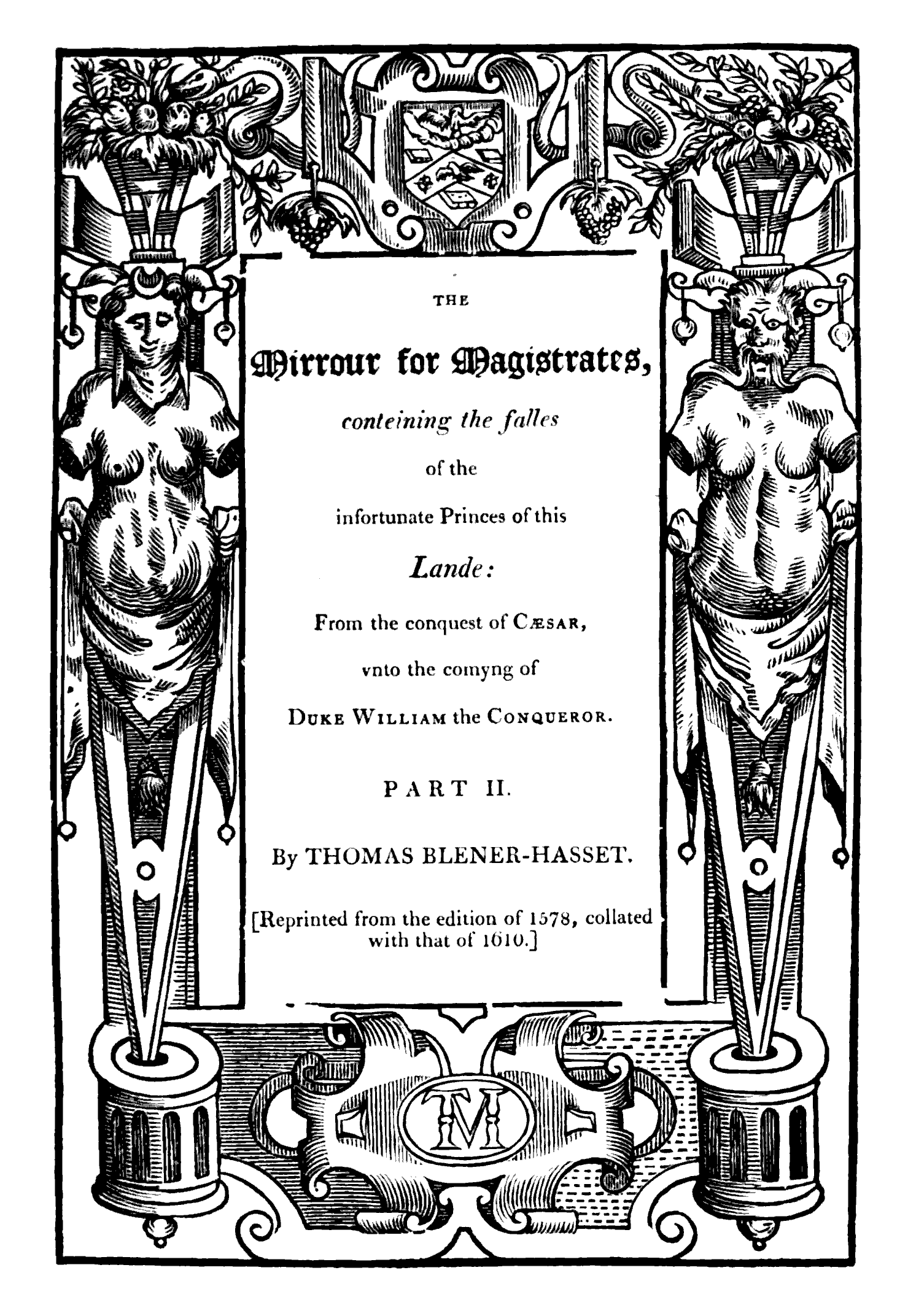
THE
Mirrour for Magistrates,
conteining the falles
of the
infortunate Princes of this
Lande:
From the conquest of Cæsar,
vnto the comyng of
Duke William the Conqueror.
PART II.
By THOMAS BLENER-HASSET.
[Reprinted from the edition of 1578, collated with that of 1610.]
THE PRINTER TO THE FRIENDLY READER .
[Before the edition 1578.]
Gentle Reader, I trustyng in thy accustomed kyndnesse, haue published this booke, entituled, The Second part of the Mirrour for Magistrates, the authour whereof, is now beyond the seas, and wyl marueile at his returne to find thys imprinted. For his intent was but to profite and pleasure one priuate man, as by his Epistle may appeare. But I fyndyng the copie by chaunce, shewing it vnto diuers men, both learned and wise: and findyng a booke alredy in print, entituled The first and third part of the Mirrour for Magistrates, I was moued diuersly of diuers men, by printyng this latter woorke, to make perfite the former booke. It may be (good reader) that the friendely acceptyng hereof wyll encourage the authour to set thynges of greater price in print: yet esteeme thou this as a lanterne, hauyng lyght sufficient to guyde thy wandryng steppes, both vnto the happynesse of this worlde, and of the world to come. Whiche happynesse God graunt wee all may enioye.
THE AUTHOUR’S EPISTLE VNTO HIS FRIENDE .
[Before the edition 1578.]
Sir, it woulde be too manifest an argument of a nature degeneratyng from al gentrie, if I shoulde not consider of your request, you asking and vrging both honest and profitable thyngs. I therfore to ensure you, that I am not forgetful of your demaund, presumyng like blynd Bayard to this my boldnesse, haue not with Apolloe’s pensile, but with Pan’s pleasantlesse pen, indeuoured to endite that which you are so desirous to haue done. And although I once translated for you, Ouid, De remedio amoris, as you said, to your contentation, we beyng then in Cambridge, where aske helpe, and haue helpe, might be had: yet nowe I wyl ensure you, lyke one amazed, I haue strayned my strength vnto the vttermost, being desirous to finish this woorke. You know that loue matters be agreeing with Caliope’s quill; euery apprentise can, of such matter, make a meter. But how hard a thing it is to compell Clio, with her boysterous banners, to couch vnder the compasse of a few metered lines, I referre you vnto the good Turberuile, who so soone as he began to take the terrible treatise of Lucan in hand, he was inforst to vnyoke his steeres, and to make holy day.[1164] Shal I then with Bochas pen declare the falles of the vnfortunate Princes of the olde worlde? O, intollerable presumption, that timorous Tyro shoulde dare to deale with menasing Mars: or that a young infant should offer to put on the buskins of Hercules: shall I then with silence ceasse to accomplish your request? O, singuler ingratitude, that any friend should refuse to sweate, to pleasure and profite his friend. Doo you not consider, that al the fine wyts that England hath inioyed these many yeres, haue busied their braynes very much, to make an English Mirrour for Magistrates, which booke is left euen vnto this day, like the vnperformed image of Venus, paynted by Apelles? no man is able to finish the work, which they with Homer’s hawtie heroycal style haue begunne: and yet you woulde haue me (the least of the poets,) to make trial what I am able to doo therin. But me thinke I do heare you say, as you were woont, we being conuersant together: “What meane al these wordes? thou knowest that the vayne of thy verse doth most delight my humor. And seeing it is but for my priuate study, what meane you to allege all these allegations, as though Orestes were Zoilus?” Syr, I confesse al this to be true: yet this I speake, to signifie vnto you, howe willyng the good wyl I doo beare vnto you hath made me, being otherwise vnwillyng to beare a sayle in such rough weather, where euery sea is ready to deuoure me. And when with sayles and oares (as they say,) I with al my diligence endeuoured to compasse the thing nowe accomplished, I founde myselfe euen in the myddest of the matter, clapt close with Theseus, in a returnable labarinth, to fight with despayre that miserable Minotaur: where, when I could finde no Ariadne, to lende me a bottome of twist, I looked that Parcæ shoulde haue shread my twyne before my returne. Yet at the last wandring Erato, with her sister Terpsichore perceiuing me with such diligence to trauise that maze, they willing to helpe the desyres of my mynd, said thus vnto me:
Come forth thou wandring wight this way,
Doo followe vs outright:
We geue thee leaue, with poets’ penne,
On Princes’ falles to write.
Wherewith they leadyng me vnto the fountayne Permestus, I without any further determination, gallopped through the rest, whiche when leysure shall geue you leaue to reade, ceasse then to thinke on the L. Buchurst, or Sackuyll,[1165] let Gascon and Churchyarde be forgotten. And if you chaunce to see the meter, or matter, not so well polished, as beseemeth, then remember that they whose falles I haue here penned, were not of late tyme, but suche as lyued presently after the incarnation of Christe: and I haue not thought it decent, that the men of the olde worlde shoulde speake with so garnished a style, as they of the latter tyme.
Moreouer, you may, if you please to consider that souldiers, of whiche I am one by profession, wee be not alwayes lusking in our forte or castle, but be as tyme and occasion wyll permyt, here to-day, wee knowe least our selues where tomorrowe. And I wyll ensure you, the most part of these my Princes dyd pleade their causes vnto me euen in the sea, a place, in fayth, not meete to penne Tragedies. And as for bookes, I was altogether destitute: for when I, to please my fantasie, trauayled (as you knowe) I could not beare about with me a library: but for cariage sake, contented myself with these foure: With the third Decade of Titus Liuye, with Bossewell’s Concordes of Armorie, with Monsignor de Lange, that notable warriour, and with the vnperfect Mirrour for Magistrates: which bookes made nothing to this purpose. I had not those Chronicles whiche other men had: my Memorie and Inuention were vnto me in stead of Grafton, Polidore, Cooper, and suche like, who dyd greatly ayde other men. And last of al you must consider, that the other part of the miseries of those miserable Princes were written, I sittyng on a rocke in the sea, not in Spaine, Italie, Fraunce, Scotlande, or Englande, but in Garnzie Castle, where although there be learned men, yet none whiche spende their tyme so vainely as in Poetrie. So that the complaintes of these men were written (as I say) where the want of helpe dyd diuersly daunt me with despayre. You haue greatly requested me by your last letter, to make vnto you a discourse of the Ile of Garnzie, and howe it is possible for the castle to be a place so pleasaunt for habitation, as I haue reported it, seeing it standeth in the Sea, separate from any lande. Good Syr, to write thereof (so manyfolde be the commodities and thinges woorthy the writyng of) woulde rather require a good volume, then a peece of an epistle. Let it therefore suffice for this tyme, that I by writyng vnto you some fewe lines of the Gouernour, I may briefely declare what the gouernement and commodities be. The right woorshipful Maister Thomas Leighton is her Maiesties Lieutenaunt there.
Syr, I doo remember, howe constant Constantine the Great was in religion, and howe that noble Emperour mynded the reformation thereof. You knowe howe carefull Licurgus and Solon were, for making of good lawes, and ministring of iustice. And histories doo recorde, howe passing happye Epaminundas was in al his affayres: but what a seemely sight is it, to see al these vertues so to concurre in one man, that hee who shoulde compare hym with them, should, I wyl ensure you, doo hym great iniurie? for (that I may briefly conclude) vndoubtedly a few such men as he is, being plaste at a Princes’ elbow, were sufficient to keepe the most ruinous commonweale that is, from ruine and destruction. And now iudge you the commodities of the countrey, by the goodnesse of the Gouernour, for as Seneca sayeth:—
Where Gouernours be good, and rule their charge aright,
Without an ebbe there flowes the flood, which vertuous minds delight.
And heere I doo turne me from these thinges, vntill by talke with you, I may dilate more at large therof, and returning myselfe vnto my former purpose, I haue not thought it conuenient to write the complaynts of these men, with so obscure a stile as some other haue done, but with so playne an exposition, that he who doth reade them, shall not neede to be an Oedipus, for euery playne Dauus shall by reading them, easily vnderstand the authour’s drift. And because Diligence and Memorie bee all the helpers that I haue, therefore I haue ordayned them, as the chief workers of my wyll. Higgins vsed (I know not what) Morpheus, the god of dreames, but I dreamt not. The other had Baldwine for their hearer, but I haue diligent Inquisition, who can finde out al things, and Memorie, who knoweth al thinges, for the arbiters of my matter. Take you therefore, the fruites of these my idle howres, sent vnto you with a good wyll, and according vnto the trust reposed in you, keepe these trifles from the view of all men, and as you promysed, them not raunge out of your priuate study. And thus wishing vnto you honour, and long lyfe, I ende, the 15 daye of Maye, An. 1577.
Your Friende to vse.
Thomas Blener Hasset.
[ [1166] THE INDUCTION.
“Diligent Inquisition,” saieth Memorie, “beholde in the bottom lesse pyt of blind Obliuion: there remayneth as yet a multitude, who although in their tyme, they were of all men most famous, and euen in this our time, their ensamples be patternes passing singular, to refourme the deformities of this age, notwithstanding they are so couered and hidden with those mistie cloudes of fylthy forgetfulnes, that if thou Inquisition doest not with all dilygent inquiry, and I Memorye, (who haue howrded vp in my treasury the knowledge of all thinges) except wee with all our industrye, doo endeuour our selues, they are not lyke euer to come into the light. For at what time those barbarous nations, (I meane the Gothes, Hunes, and Danes) dyd with so great outrage ouerrunne all the worlde: euen then the auncient historyes and recordes of time, were by them vtterly defaced: so that Princes before that time, how renowmed so euer they were, be at this present, euen by their meanes, buryed so deepe in obliuion, that I Memorye cannot without a new inquirye of many most noble Princes, repeate a few wordes: speake you therfore Inquisition, and declare your mynde, how we mighte renew the decayed Memory of those men.” “See heere,” quoth Inquisition, “with great and diligent Memorye, I haue founde out diuers, who with their continuall complayinges, haue euen for conscience sake made me their procleare, to exhibite vnto you in their behalfe a supplycation, in which they complayne of the great iniurie they suffer, because they bee excluded out of the English Mirrour of Magistrates: their only desire is that you would once agayne, by celebrating their decayed names, with a fresh memoryall geue them libertie to declare their estates themselues. Of which, as fyrst though not chiefest Guidericus the thyrde king of the subdued Brittaynes: and the fyrst that refused to pay trybute to Rome, desyreth to bee harde.” “Wee will,” sayth Memory, “assist hym in what wee may, and not onely geue them leaue, but also intreate them to declare their estates. But where is that Guidericus, the exployts of whose lyfe were so passing singular, that had hee not beene moued with two much boldnesse, euen hee had brought vnder his rule the whole worlde: wee wyll heare hym wyllingly, for his death is a great ensample of God’s vengeaunce, vnto all them which thinke by their owne courage and abilitie, to compasse their desyres.” “Beholde,” quoth Inquisition, “hee is euen heere, his body rent and torne dooth declare, that great was his mishappe.” “Speake then, Syr Knight,” quoth Memory, “and let vs heare what you wil saye.” Wherewith the sorrowfull Prince sayde as followeth.]
[1167] THE COMPLAINT OF GUIDERICUS.
How Guidericus refused to paye tribute vnto Claudius Cæsar: howe he subdued Galba: how hee became desyrous to winne all the worlde: spoyled France, Germany, and a great part of Italy: and lastly, how hee was miserably slayne in a tempest of thunder, euen at what time hee shoulde have dealt with Cæsar. This History is a synguler ensample of God’s vengeance against pride and arrogancy.
1.
On staylesse top of honour’s high renowne,
With busye brayne to builde a bower there,
Is donne to fall at fortune’s froward frowne,
Whose turning wheele, the hyest fyrst dooth feare,
And them below it vpwardes styl dooth reare.
Let them therefore for good estate that striue,
With sailes halfe hoyst in happy hauen arive.
2.
I prest to tell my suddayne yll successe,
Amidst the meane which dyd not dayne to dwell,
To higher state whilst I dyd mee addresse,
By chaunging chance of fortune’s force, I fel
Euen suddaynly from heauen to hatefull hell:
From heauen (I saye,) I fell from that my blysse,
To hatefull hell, I meane, to wretchednesse.
3.
Guidericus which rul’de the Brittayne lande,
I am the same, of Simbaline the sonne,
Cassiuelane my grandsyer dyd withstand
Sir Cæsar’s force, tyll Parcæ had vndone
The fatal knot and twist that they had sponne.
Euen then to soone the Romanes did oppresse
This realme, which I to ryght did me addresse.
4.
Which that I myght the better bring about,
The three estates in court to parle, I
In hast did call, amongst which royal route,
As one who ment for welthe of commonty,
Howe to restore their ancient libertie,
Pronounst the speache which here I shal recite,
Which moued much there manly mindes to fight.
5.
The emperour of Rome hath sent, you see,
Ambassatours, the tribute to obtayne,
Which Theomant subdued, did agree
To pay, but I such greement do disdayne.
Shal I to Rome a tribute slaue remayne,
Because they did subdue this realme of yore?
Shal we buy yoke with tribute euermore?
6.
Shall we this badge of beastly blemishe beare?
Shall Troians we to Troians tribute yeelde?
Of Brutus’ bloude, a prince withouten peare,
We do descend, whose father fyrst dyd buylde
In Italy: he Alba Longa fyl’de,
And furnishte fine with princely byldinges braue,
He was entombde next good Aeneas’ graue.
7.
Then Romulus of Siluius did succeede,
And Rome of hym (as London tooke of Lud)
Her name which Alba Longa was in deede,
Built at the first by good king Brutus blood:
Dare they for guerdon of so great a good
Demaund of vs whose parentes patrons were
To them? to doo this deed, they doo not feare.
8.
Let them demaunde vngrateful beastes they be,
Euen tribute of vs Troians let them craue,
But wee in Mars his feeldes wyl pay their fee,
If needes they must of vs a payment haue,
They shal ryght stoutly then themselues behaue,
We wil not feare to fyght it out in feelde,
Without reuenge we neuer al wyl yeelde.
9.
Dyd Cæsar’s princely prowesse so preuayle,
That Britaynes were by Romanes brought to bay?
Was Cæsar’s valure of so great auayle,
That it coulde cause Cassiuelayne’s decay?
Why should not then Guidericus assay,
By furious force of Mars his bloody feelde,
To make those roming Romanes al to yeelde?
10.
By prowesse worne (who dooth not knowe) by skyl,
That he who once as victor wore the wreath,
By chaunged chaunce is forst agaynst his wyl,
That garlande gay and vitall lyfe to leaue?
Such ill mishappes misfortune still dooth heaue,
That he who dyd subdue but yesterday,
Is now subdude, and hath the lyke decaye.
11.
Which may appeare by kyng Cassiuelayne,
Whom Cæsar thryce in fyght dyd fynd too strong,
Yet at the last, (the lewder chaunce was thine,
Thou litle Ile) he thurst in with a throng
Of mightie men, and dyd thee double wrong:
Thee then subdude, to Rome he seruile made,
Which wrong to right, with this my bloudye blade,
12.
If you my subiectes wyll thereto consent,
I wil not cease, tyll I reuenge haue seene,
And them destroyed with dreadful diery dent
Of wrathful warre, and therefore now I meane
To byd the bace, and fetch them from their denne.
To sende them woorde, we owe no tribute we,
But we of them must recompenced be.
13.
I to the gods, which rule the rolling skyes,
Haue bowde a bowe, for countreye’s lybertie,
To die in feelde, or els that these mine eyes
Shall see you free from forrayne tyranny,
To which no doubt theyr goodnesse wil agree.
Nowe that you haue the whole of myne intent,
You knowe the cause why I for you haue sent.
14.
Al you therefore which compt this quarrell good,
By heaued handes let me them vnderstand:
My brother Aruiragus by me stoode:
“I must not I,” (he sayde) “holde vp my hande,
Nor thee herein assist with any bande:
For sith we both haue sworne aleagance due,
To Rome, to Rome I euer wil be true.
15.
“No feare of force, no hasarde, no mishappe,
Doth dant my mynde, I dare what dare be donne,
Though nowe we sit in lady fortune’s lappe.
By fayth defilde, no honour can be wonne:
The wrath of God men periurde cannot shun:
Do thou therefore what best thyselfe doth seeme,
Giue them their ryght, for that is best I deeme.”
16.
Sith all but you (my brother) do consent,
My counsayle and my commons do agree,
Yea all the force of this my realme is bent,
To liue and dye for countrie’s libertie:
Take you therefore this sentence in boun gre,
Because thou seemst a seruile lyfe to loue,
The towre a house is best for thy behoue.
17.
An othe constraynd is made to none auaile,
To breake such othe doth not the fayth defile,
Let them goe tel to Claudius this tale,
We meane with force to furnishe this our ile,
Which force himselfe shal fede within a while,
For if he wyll not fetch his tribute here,
We then wyl goe and pay hym tribute there.
18.
Which when the Roman Claudius had heard,
Though he at home had ciuile strife in hande,
And though he were by forrain foes debar’de,
And could not come him selfe, yet he a bande
Of thirtie thousand sent, for to withstand
My strength: which strength in the fyrst foughten feelde
They found so strong, that forst they al did yeelde.
19.
From Galba then myselfe his shield did get,
In golden feelde which had the horse of fame,
Euen Pegasus in seemely siluer set,
The curious skill of heraultes there did frame,
Th’asheument true, of auncient Troy by name,
Imbordred braue with golden letters thus,
Senatus, Populusque Romanus.
20.
Wherewith as one prict foorth with good successe,
A great attempt I quickly did deuise,
I ment, O Rome, vpon thy walles to presse,
It easye seem’de to me in my surmise,
To compasse all that I did enterprise:
Me thought I could winne al the worlde in haste,
But fyrst I ment the Romane state to waste.
21.
I did prepare in euery poynt my powre,
I sayl’d the seas, I spoyled them of France,
I made the Germans and the Lumbartes lowre,
Yea, good successe did so my state aduance.
In Italy such was my luckye chaunce,
I did subdue, my souldiers had the spoyle,
Of all the chiefest cities in that soyle.
22.
See here howe roming rumor ranne about,
See how report did tel a truthlesse tale:
For Hannibal, the Carthage duke so stout,
Renide, it sayd, would once agayn assayle
The Roman state, and cause it nowe to quake:
Which false report did put them in such feare,
Cities would yeelde before my campe came neare.
23.
His former feates the fuming fancies fed,
That doubtful now affrighted sore with feare,
They tel howe at Trisemenus they sped,
In Cannas feeldes how they despoyled were,
They hate to tel, they lothe that hap to heare,
A bushel there he fyld (most true it is)
With golden ringes equestriordinis.
24.
And whilst their mindes on these mishaps do muse,
They wishe that nowe good Graccus were not dead,
For Fabius, he who wysely would refuse
Forthwith to fight, they wish for such a head,
Camillus nowe would stand them in great stead:
And some with sighes did wishe for Scipio,
Them to defend from me there deadly foe.
25.
But as the lion passente once with feare,
Gardante, a mouing mollhil did beholde,
From whence he thought some wonder would appeare,
A little moule crepte from the mouing mould,
Which made the quaking lione then so bolde,
Feare set aside, that he for his delyght,
Playd with the moule, and kilde the strengthlesse wight.
26.
So nowe the campe of Claudius did drawe neare,
Where he hymself was lord cheefe general,
Which greatly did delyght my hart to heare,
And caused me my captaynes then to call,
To whome I sayde, we two must striue for al
The world so wide: which if I chance to winne,
Then you yourselues haue ample part therein.
27.
Euen whilst I marcht my men in good aray,
A corsser post came praunsing in the fielde,
Who comming to my cabbin, thus dyd say,
“Guidericus, thy friendes at home be kilde,
Thy natiue soyle to forrayne force did yielde,
The Romans they haue spoylde thee of eche thing,
Thy brother there Aruiragus is kyng.”
28.
Which newes although they dyd amaze me much,
Yet I whose hart did neuer faynt for feare,
“Although,” sayd I, “their good successe be such,
Yet if we can subdue the Romans here,
They shal I think buy Britayne very deare,
Which out of doubt yf you as you haue donne,
Will fight like men, the fielde wil soone be wonne.”
29.
But they who hilde their wiues and children deare,
Could not digest the losse of that their lande,
For which they fledde, left me their chieftayne there,
When Claudius host to fight was euen at hande,
Whose mightie force I could not then withstande,
Yea all my page, my footmen fled for feare,
And left me post alone, with heauy cheare.
30.
That cruell Queene of hel, Proserpina,
From foorth whose loynes this fury feare first fled,
Megera’s sighes, no, no, nor Medusa,
Who hath ten thousand snakes about her head,
The fiery flames of hell doth not so dreade
The minde, as feare, which makes man’s hart we see,
To shake, and quake, like leafe of aspen tree.
31.
My martial knyghtes who once so valiant were,
That they the worlde, euen al the world would spoyle,
This fury fyerce, this feeble fayntyng feare,
Did causlesse cause them thus here to recoyle,
Her only force inforst me to this foyle,
Not Cæsar’s force: no strength of Roman power,
But feare, euen feare, dyd make me here to lower.
32.
Which feare (for trueth) dyd neuer me dismaye,
But too to soone my hartlesse men it made,
To shrinke, to flinche, to flee eche man his way,
And me a pray most fit for Claudius blade,
They left alone: alas, what may be sayde,
What may be done, what fittes for mine auayle?
I wyl not flee, to fight cannot preuayle.
33.
What, must I then go crouche vnto my foe?
Fy on that fate, that I should sue for grace
To hym who is the worker of my woe,
Whose hart from foorth his brest for to displace,
I gladly woulde ten thousand deathes imbrace,
My lyfe (in faith) doth lothe to liue with shame,
By death therfore my lyfe shall purchase fame.
34.
For as I once did winne with courage stout,
In Galba’s shielde, the praunsing Pegasus,
So with renowne I nowe will go about,
To see if Claudius dare the cause discusse
With me alone, if couragious
Dare do that deed: that we in open feeld,
May try the case, then he or I must yeelde.
35.
And therewithal in armour bright I clad,
Myne arming swoorde, my targate I did take,
And on my helme, or burgonet, I had
My royal crowne, and so I dyd forsake,
The place, whereas my souldiers fled of late,
I marcht and met the scoute of Claudius,
To whom I dyd addresse my language thus.
36.
“The Britayne kyng is come alone you see,
Conduct him then your Emprour to salute,
You for your paynes shal gayne a golden fee;
For why my grace to Claudius hath a sute.”
The scurers they al silent, mumme, and mute,
Yet wel appayde of such a princely pray,
In hast they dyd to Cæsar me conuay.
37.
With ten times twentie thousand men, I met,
Him marching there, to meete with me but one;
To whom I sayde: “Thy powre is passing great,
My force is fled: what, must I then bemone
My selfe to thee, not so but I alone,
Am come to knowe with magnanimitie,
If thou dost dare to wrecke thy wrath on me.
38.
“The crowne for which so many men be slayne,
Thy Galba’s shield, with many iewels more,
Which vnto me do only appertayne;
For in the fielde I wonne them al of yore,
And vnto thee I wyl them not restore:
If thou, as I, canst winne them with renowne,
Then al is thine, both realme and royal crowne.
39.
“Why doost thou muse as though thou wert dismayde?
Doeth doubtful dreade nowe daunt thy Roman mynde?
Faynt not for feare, thou needst not be afrayde,
A Britayne borne thy selfe ryght well shalt fynde,
I am a man, and not a god by kinde.”
Wherewith to grounde a golden gauntlet, I
Dyd cast, and he at last dyd thus reply:
40.
“Thou mighty Ioue, which hast seemely seat
Aboue the sphere of Mars and Mercury,
Thy fleshlesse eyes (my tongue can not repeate,
What syghtes they see) nothing is hid from thee:
Thy eyes, the hart, and secrete thoughts doo see,
Thou knowest, O Ioue, how iust my quarrel is,
Which here to proue, thou knowst I compt a blisse.
41.
“No god thou man: thou art no god in deede,
I faynt for feare: and doost thow thus me dare,
Thy gauntlet lo to take I doo not dreade,
Such courage though I fynde but very rare,
In pryncely brest, what though I wil prepare
Myselfe to feelde, where thou I hope shalt fynde,
Myselfe alone wyl cause thee curse thy kynd.
42.
“To deale with thee I Cæsar might disdayne,
My tryple mace dooth rule the worlde you see,
Thou subiect art the meanest of the traine,
Whom conquest hath compeld to wayte on me:
A meaner knyght were meete to match with thee,
Yet, I myselfe, with al my hart doo dayne,
To reue thy life, and cause thee to complayne.”
43.
Then I whose hart was al beglarde with glee,
To Cæsar sayd: “If fate hath framde my foyle,
If now the last of all my lyfe I see,
It shal delight that Cæsar dyd me spoyle,
And that his blade did cause my bloudy broyle.”
And whilst I ment a longer speache to make,
A storme most straunge constraynd the earth to quake.
44.
Straunge sundry fightes, then sodaynly wer seene,
The lightsome day was turnde to lothsome night;
Then darknesse did affright me much with feare,
The seemly sunne did lose her louing lyght:
And that which would amaze eche worldly wight,
The thundring heauens constraynde the earth to quake,
The trees did daunce, the mighty mountes dyd shake.
45.
Haue here myne end, from threatning thunder clap,
A burning bolt did pearce my hart with payne,
Wherewith I cryed: “O Cæsar, my mishap
Is comme, for whilst I thought thee to haue slayne,
Ioue’s vengeaunce iust hath torne my corps in twayne.”
This was my end, although some writers say,
That Claudius blade did cause my last decay.
46.
To slip at first, such fall hath little foyle,
Greate ruth it is to lose a race forerunne,
And at the end by slipping suttle soyle,
Wagelesse too lose a race too wel begonne,
The turrets top let wise men wisely shunne,
Who falles from top, he mercilesse is slayne;
Who falles below, can quickly ryse agayne.
47.
I tel this tale who knowledge bought too deare,
I could not be content with meane estate;
Let them therefore which shal this story heare,
So loue the meane, extremitie so hate,
That they may liue in blesse without debate.
Who is content amidst the meane to dwel,
With perfite blysse he only dooth excell.
48.
With royal rule you kinges which runne your race,
Take heede, beware, flee fancies fonde delight,
Ambition blinde wyl moue you to imbrace,
A thousande euils, disdayne with al your might
Her luring lookes: she me a wretched wyght,
Transformde, and made with Circe’s sorcerie,
A brutishe beast, and worse if worse may be.
49.
When Thanatos had thus destroyed my dayes,
Then due desert my soule to hel conuayde:
I fearde not God, his name I did not prayse,
But foolishe fate and fortune stil me stayde:
For which, with pinching payne, I nowe am payde.
Fortune I finde is nowe of none auayle,
But God is he whose power dooth preuayle.
[THE INDUCTION.
“It was great pitie,” quoth Memorie, vnto Inquisition, “that thys man liued in the tyme of blinde ignorance, when neyther vertue nor religion were knowen. Beleeue me, if he coulde haue conteyned himselfe within the limites of his owne countrey, or if too much courage had not moued him to so great interpryses, surely euen he had restored the Britaines vnto auncient libertie, and might haue liued long without paying any tribute.” “You haue said,” quoth Inquisition, “he might haue had a very glorious day ouer the Romans, if he had not desired Rome; for when Claudius Cæsar had him abroade, he did not presently incounter with Guidericus, as he supposed he woulde haue donne, but remembring how Scipio Africanus layd siege vnto Carthage, did draw Hannibal out of Italy, he imitating his grand chieftayne and predecessor, fyrst brought Britayne vnto his obedience, then he inuaded Guidericus, with whom God being displeased, he was destroyed as you haue harde. After whom the Britaines were greeuously oppressed by the Romans, and dayly inuaded by the Scots and Pictes whiche Lodrike their king brought out of Scithia, insomuch that at this time the Britaynes were compelled to sende vnto the Emperour Bassianus for aide; who sent vnto them the Roman Seuerus, with a great power. And then how Carassus, a Britayne, not nobilis, but altogeather ignotus, did both redeeme his countrey from the Pictes and Romans, and also obteyned the crowne and raygned eight yeares, thys story following shal declare: who although he felt the fall of his own follie yet surely his story is very profitable, chiefly for all such as doo suffer suspicion to seduce them, as the diligent noting of the processe wyll declare.”]
THE COMPLAINT OF CARASSUS.
Howe Carassus, a Husbandman’s sonne, slewe Lodrike the king of the Pictes, and howe the Emperour made him a Captayne. Then howe he obtayned the Britayne crowne, and howe suspition brought him to decay.[1168]
1.
Sith men be borne by nature naked all,
With their estates why are not men content?
Why doe they deeme the want of wealth a thral?
Why shoulde they lothe the lot, which God hath sent?
Adam himselfe I finde, at fyrst was sent,
As one who did disdaine his poore estate,
To disobay, with God to be a mate.
2.
Thou maist be made a god, (quoth satan than,)
If on the fruite forbidden thou wilt feede:
The senselesse wight, the feeble forcelesse man,
Did taste thereof, supposing that with speede
He shoulde in hast haue beene a god indeede:
He not content, hoping for hygher place,
Brought bitter bale to him and al his race.
3.
And I the sonne of Adam by descent,
Dyd seeke to set my selfe in princely seate,
With mine estate I could not be content,
For which I felt the force of hatred’s heat:
As at the first, my good successe was greate,
So at the last, by fansie’s fond desires,
I gropte for grapes amidst the bramble brires.
4.
Let such as woulde by vertue them aduaunce,
Marke by what menes I did my selfe addresse,
To flye at first my poore alotted chaunce
By honest meanes: let them from wickednesse
Which fayne would flye, learne this by my distresse,
That he who doth from right and reason stray,
Destruction shall destroy him with decay.
5.
For I by byrth borne next to beggers doore,
Was stayde aloft with staffe of high estate:
But whil’ste that I so hye a pitche did soore,
I left the meanes which made me ryse of late,
I vices lou’de, I did al vertues hate.
For which, Carassus ranne a race in vayne,
And nothing got, but death and deepe disdayne.
6.
When ciuile strife had Bryttayne quite vndone,
So that her strength was now of none auayle,
The faythlesse Scots[1169] with ruth did ouerrunne
That royall realme: the Pictes did so preuayle,[1170]
That sorrow did on euery side assayle
My natiue soyle: and being thus dismayde,
To Rome we sent for succour, helpe, and ayde.
7.
Seuerus then by Bassianus sent,
To bring this realme vnto some quiet stay,
The Romans and the Brittaynes both were bent,
To bring the Scottes and Pictes[1171] to their decay,
Them to returne agayne to Scithya,
And at the last by good Seuerus ayde,
We them destroyde when we were most afrayde.
8.
Whose force though twice the Romans felt to strong,
Yet at the last we got a goodly day,
Euen by my meanes, who thrust into the throng
Of Scots and Pictes,[1172] I desperate ther dyd play
The part of hym, whom feare did neuer fray.
And at the last to end this mortall strife,
I did depriue King Lodrike of his life.
9.
And when the Pictes did see their king depriude
Of vitall life, Lord, how they fled the fielde!
They made me muse, to see how fast they striude,
With staylesse steppes, eche one his life to shielde,
Who could not flye, he there with care was kilde:
So by my meanes, my country did obtaine
Her auncient state, and liberty agayne.
10.
At my returne I to Seuerus sayde,
See here how I with woundes am all bestead?
I cannot liue, I feele how lyfe doth fade,
Lodrike himselfe did carue and cut my head,
For which my blade his lukewarme blood hath shed:
He cut my cap, and I haue got his crowne,
He lost his lyfe, and I haue found renowne.
11.
Seuerus then vnto his surgion sayde,
“Heale hym, and bryng him safe and sound agayne,
Thou for thy paynes with poundes shalt wel be payd,
And he shall haue such honoure for his payne,
As vnto him for euer shal remayne:
For by the gods which rule the skies aboue,
His noble actes deserue eternal loue.”
12.
When by the skill of surgion’s curious arte,
My hurtes were heal’d, and holesome health ensude,
Seuerus then reioycing at the harte,
Made me a lorde, with wealth he me indude,
Yea, he although my learning were but rude,
Sent me to Rome, as legate of this lande,
To make report how here our state did stande.
13.
My deedes at home[1173] inrichte me with renowne,
My talke abroad, with proper filed phrase,
Adornde my head euen with a laurell crowne:
The emperour did much commend my wayes,
So that I was bedeckt with double prayse:
I could not reade, my lerning was but weake,
Yet they of Rome did muse to heare me speake.
14.
As learned arte doth geue a goodly grace
To some: so some by nature’s giftes do get
Eternal fame, and purchase them a place
Aboue the place where learned men do sit.
We finde the fine dexteritye of wit
In them which be both wise and ful of skill:
Yet neuer striude to clime Pernassus hill.
15.
So I with prayse a time at Rome did stay,
And tract of time returnde me backe agayne,
The emperour, he gaue my ryght away
Within a while, which made me storme amayne:
I had great cause me thought for to complayne,
Seuerus, he was made the king of all:
The giftes he gaue to me were very small.
16.
I was but made the captayne of the coast,
From forrayne force to keepe my realme in rest,
Seuerus, he was crowned king in post,
Which did so boyle within my warrelike brest,
That I with griefe most strangely was distrest.
Shal hee (sayde I) thus reape the high renowne
Which I deserue? Shal he inioy the crowne?
17.
I wonne the wreath, and he wil weare the same:
I got the goale, and he will get the gayne.
For me in faith it were a deadly shame,
If I in this his regall royall raygne,
Without repulse should suffer him remaine:
Which if I do, then let the dreadfull darte
Of Vulcan’s wrath, torment in twayne my hart.
18.
For why, I see what seruile seruitude
Shall then insue, if he may raigne in rest:
Shall Bryttayn braue by Romanes be subdude?
It shal no doubt, by Romans be distrest,
Except my might against his might be prest,
My might as yet cannot his strength constraine,
Yet may my might compell him to complaine.
19.
The drainyng droppes doo make the marble yeeld
In time: the seas the cragged rockes do rende:
And courtly kinges by tearing time be kilde,
For time dooth make the mightie okes to bende,
And time dooth make the litle twigges ascende:
So I in time, such power may prepare,
As shal constraine Seuerus death, with care.
20.
But whylst I did indeuour to destroy
Seuerus’ strength, the Pictes were prickte with pride,
For theyr reuenge vs Britaynes to annoy:
Which when I hard, in post I did prouide
A power great, then I in hast did ride,
And kept the coast so strong with men of warre,
That no man coulde ariue, to make or marre.
21.
The poore Pictes preuented of their pray,[1174]
In waltering waues did bouse their bitter bayne,
They digde a diche, and caught theyr owne decay,
On rockes theyr barkes, in seas themselues were slaine:
The westerne windes with wo did them constrayne,
By Britayne bankes to make so long delaye,
I, and the seas, brought them to their decay.
22.
By meanes whereof my credite did increase:
Seuerus did esteeme me as his stay,
I from my fyrst deuises coulde not cease,
For aye I hopte to haue a happy day,
To bring the Roman rule to their decay,
With fauning face good fortune smyled so,
I had my wyshe what might I hope for mo?
23.
For into Spayne the Roman souldiours sent,
I had at home the might him to depriue,
Then wisely I al perilles to preuent,
Prouided so that no man could ariue,
No Pict, nor Scot, nor Roman, then could striue
With me at home, then I the lordes with speede,
Of Brittayne calde, and thus I did proceede.
24.
“The Roman rule vs subiect slaues hath made,
You se, my lordes, a Roman heere doth raigne,
Whome to destroy my power shal inuade,
I do indeede this seruile life disdayne:
And you your selues do much therof complayne.
If you with helpe wyl me assiste I sweare,
The Roman rule shal haue no power here.”
25.
Then they most glad with one consent replide:
“We wyl assist thee with what myght we may,
And we our selues most wylling wyl prouide,
No Britayne borne against thee shal display
His shielde, but al at the appoynted day,
As prest to please thy heste, shal thee assist:
Winne thou the crowne, and weare it at thy list.”
26.
Which when I hard them say with one consent,
Blame not though pride did then possesse my hart
For princely crowne: the dreadfull dierie dent
Of wrakful warre, who would not feele the smart
Of griping grefe? who would not feele the dart
Of dreadful death? or who regardeth payne?
If he a crowne and kingdome may obtayne?
27.
For gunne-hole grotes[1175] the countrie clowne doth care,
Restlesse with ruth, the rusticke gets his gayne:
The marchant man for welth doth send his ware
About the worlde, with perill and great payne:
And all the worlde for welth doth not disdayne,
Amidst the surge of mighty mounting seas,
To caste themselues their owne delightes to please.
28.
If to obtayne such triffles they do toyle,
And neuer ceasse to bring there driftes about:
Why should I feare the force of forrayne foyle?
Why should I not assay with courage stout,
To wreake my wrath vppon the Romishe rout
Which heere remayne? whome to the bale to bringe
Were me to crowne my natiue countrie’s king.
29.
One thing there is which greatly doth me grieue,
Seuerus, he who did inhance my state,
He did in my distresse with life relieue
My dyinge dayes, he neuer did me hate:
Yet now with hym I must be at debate.
Euen hym with myght I greatly must disgrace,
Eare I can set my selfe in princely place.
30.
Vntimely death shall not destroy his dayes:
For if he wyl returne to Rome agayne,
Or if he wil resigne his crowne with prayse,
Or if hee wyl amongst vs styl remayne.
If he can like of these, we wyl refrayne
From sheading bloude which if he dothe disdayne,
I then against my wyl, must woorke his paine.
31.
So foorth I past with all my power prest,
Seuerus did at Durham then delay,
Whereas I mente his state to haue distrest:
But some I thinke my secretes did bewray,
For he to Yorke in hast did take his way:
Which when I had besiegde on euery side,
With care and griefe of mind, Seuerus dide.
32.
Se heere the force of cruel fretting care?
Se heere how sorowe doth dismay the minde?
For when he harde Carassus did prepare
To reue his crowne, he iudging me vnkinde,
With sobbing sighes of sorrowe, he resignde
Before his time his minde from manly breste:
Beholde with care how sorrowe reaues man’s rest.
33.
Thus he intombde in his vntimely chest,
It was decreed Carassus shoulde be king,
The three estates of al my realme were prest,
With one consent they al to me did bring
The kingly crowne, then thus they al did singe,
“The due deserts of this renowmed wyght,
Deserues to be the Britayne king by right.”
34.
Marke by what steppes I dyd the toppe obtayne,
With keeping sheepe my youthful yeares were spent:
Then with the whyp I plide the plowe amayne,
In Mars his feeldes to fight my minde was bent,
As legate then to Rome my selfe was sente,
I dubbed was a lorde of high renowne,
And now at laste I haue obtayn’d the crowne.
35.
The ende, the acte[1176] (the plaudite) dooth proue,
And all is well, whose endyng is not yll:
Who sittes aloft had neuer neede to moue,
For feare least he shoulde fall agaynst his wyll:
Though creepyng he dyd gayne the toppe with skil,
Yet at the last, by turning of his toe,
A suddayne fall may worke his wretched woe.
36.
Which fall I felt, and how? I here wyll showe:
When I as king dyd all the realme comaunde,
I fearefull dyd suspect mine ouerthrow:
The place (mee thought) did shake where I dyd stande:
Then for my garde I dyd prouide a bande
Of warlyke wights, to garde my noble grace,
I lastly dyd my noble men displace.
37.
From foorth the feeldes I for my father sent,
Hym of a clowne a noble man I made:
My brethren all euen for the same intent,
Lyke courtiers there in court with me they stayde,
And all my stock were glad and well apayde:
For they of late which rulde the paynefull plow,
Of Brittayne land they bee the rulers now.
38.
From cart to court, a countrye man to call,
With braue attyre to decke a dunghyll Dycke,
Is lyke a paynted image in a wall,
Which dooth deceiue, and seemeth to bee quicke,
Though woorkmanship most trimly dooth it tricke,
Yet of a stone, a stone wyll still remayne:
A clowne cannot from clownish deedes refrayne.
39.
As hard it is of quarryed marble stone,
For man to make a liuely mouing wyght,
As of a lout, or els of such a one
Who dayly doth imploy his whole delyght
To digge and delue, it passeth mortal myght,
To make him serue the courte a kinge’s behest:
Turne hym to plowe, the cart for him is best.
40.
For though thou canst by cunninge art compell
Nature a tyme to leaue her wonted place,
She wyl returne, in spight of heauen or hell:
No alcumist dame nature can displace,
Except that God doth geue abundant grace:
The caske wyl haue a taste for euermore,
With that wherewith it seasoned was before.
41.
Why did I then my courtlesse court mayntayne
With Hob and Iohn, Rafe Royster, and his mate?
Whose greedy iawes aye gaping after gayne,
Did polle, and pil, and bred bitter debate:[1177]
Men much vnmeete to mayntayne myne estate:
Why did I them so neare myne elbowe place?
Because my selfe by byrth was borne but bace.
42.
Like wyl to lyke, the mule doth claw her mate,
With horned beasts the Ienite cannot iest,
Those bauling houndes, the haughty harte doth hate,
With beares the beare in safetie countes her best:
So I amongst my lyke did looke for rest,
Their dedes by me were alwayes wel alowde,
By them likewyse my doinges were auow’d.
43.
But as you see the husbandman with care
From new sowne feeldes the rauening rookes to driue,
So dyd the gentrie of my realme prepare,
My countrie courte and mee for to depriue:
But gentlemen were then to weake to striue
With mee, and mine, for which they dyd prepare
A new founde snache, which dyd my feet insnare.
44.
In surgelesse seas of quiet rest, when I
Seauen yeares had sayl’d, a perrye did arise,
The blastes whereof abrig’d my liberty:
For whilste I dyd with busye brayne deuise
Them to destroy, which did my courte despise,
The boystrous blastes of hatred blewe a gale,
My cables crakte, my barke was bong’d with bale.
45.
For they (I meane the gentrie of my lande)
Both mee, and mine, theirs, and themselues had sold
Subiects to Rome, from whence a mighty bande
They had conuaide to make my courage cold:
Into my realme they could not be controlde,
But when they were ariude, they quickly brought
Both me and mine, and all the rest to nought.
46.
Alectus then the chiefetayne of the rest,
Spoyling my friendes, he forst me to the feelde,
The daye was come, we both in fight were prest:
His trustelesse trayne, did seeme to me to yeelde,
But al the feeldes with great ambushmentes filde,
I coulde not flee, Alectus had the day,
With his owne sworde for breath he made me bray.
47.
As due desert did force my shippe to flote,
So vices vile me drencht in waues of woes:
O false suspect, why did’st thou make me dote?
Fearing my fall, my friends I deem’d my foes:
Fearing the worst, the best I did depose,
And was deposde: let other learne heereby,
The crooked crabbe will alwayes walke awry.
48.
And let them know which do not lothe to learne,
That kinges in court, be combred most with care:
The pilote’s charge, who sitteth at the stearne,
Doth make him watche, when other do prepare
Themselues to sleep: so kinges distressed are
With doutful dread, and many other thinges,
The sheephearde’s life is better then the kinge’s.
[THE INDUCTION
Carassus hauing thus finished his tragicall history, Inquisition presented vnto Memory the lady Hellina; but Memorye hauing her at the fyrst sight in great admiration, sayde as followeth: “Why haue you brought before vs the goddesse of Diana? Our intent is to heare the complayntes of them who are smothered with Forgetfulnesse: as for this goddesse she is renowmed more then sufficient.” “O Memory,” quoth Inquisition, “this is not Diana: no, Diana, no Gouzaga, no Emila, no Cariclia, no Pallas, no Iuno, no not knowing Minerua, may compare with her for the flourishing features of her incomprehensible complexion for the comly composition of her ladilike limmes, being the perfectest peece of woorke that euer nature created, that euer earth nouryshed, or that euer death destroyed, for the passing great dexteritie of her ingenious capacitie, the very Phœnix of women, and the chiefest amongst men that euer thou Memory didst celebrate for learning, for knowledge of tongs, and for the diuers gifts of the mind, shee only dyd inhabite betwixt the wings of flilling fame, for a happye, long, quiet lyfe in this worlde, she onely was fauoured by fortune, or rather singularly preserued by her maker. For that shee neuer tasted in all her raigne any aduersytie, shee is to bee esteemed immortall: for that in all her actions shee had her harte’s desyre, shee may iustly bee esteemed a goddesse (or rather the very beloued of God.) Now I report me vnto you is there any goddesse or nimph inhabiting the mount Helicon, which maye compare with queene Hellina, not shee of Greece which brought finall destruction vnto the flourishing Troy, but shee of Brittayne, who redeemed her decaying country from forraine tyrannye, which made not onely a menes for the bodyes of her subiects to liue in quiet peace, but she also prescribed vnto them an order how they might saue their soules. She planted religion amongst her subiects which were at that time sauage, neither knowing God, nor esteeming godlynesse, she was daughter vnto king Coell: shee was queene of Bryttayne, empress of the worlde, wyfe vnto Constantius, mother of Constantine the great. Yet the descriptions of time, I meane the chronicles, haue lefte so litle reporte of her that I founde her standyng betwixte Forgetfulnesse and Memory, almost smothered with Obliuion.”[1178] “If shee bee so renowmed, as you haue spoken of,” sayde Memory, “we shoulde doo her great wrong to deny her a place in this pageant. Speake therefore, good madame Hellina, with good leaue, your minde, and as other by their falles doo set downe examples very necessary for the auoyding of vice, so let your history bee a meanes to incourage all men to imbrace vertue.” Then the good queene, although somewhat abashed, yet glad to repeat her lyfe forerunne, sayde as followeth.]
THE LYFE OF QUEENE HELLINA.
How Queene Hellina was empresse of all the worlde. This storie dooth declare how happye they bee, which liue in the feare and loue of God.[1179]
1.
Men’s due desertes ech reader may recite,
For men of men doo make a goodly show,
But women’s workes can neuer come to light,
No mortall man their famous factes may know,
No writer wyll a litle time bestowe,
The worthy workes of women to repeate,
Though their renowne and due deserts be great.
2.
For I by byrth to Coel daughter deare,
King Lucy was my good grand-mother’s sonne,
My father dead, I rulde his kyngdome heere,
And afterwarde the world so wide I wonne.
I empresse was of all vnder the sunne,
I liued long, I dyde with perfect blisse,
Yet writers will repeate no word of this.
3.
But now at last I haue obtayned leaue,
My spotlesse life to paynt in perfect white:
Though writers would al honour from me reaue,
Of al renowne they would depriue me quite,
Yet true report my deedes shal burnishe bright,
And rubbe the rust which did me much disgrace,
And set my name in her deserued place.
4.
From Roman rule who Brittayne did redeme?
Who planted first God’s woorde in Brittayne land?
Who did so much virginitie esteme?
Who did the force of forrayn foes withstand?
Who al the world subdude without a band
Of martial men? who did these noble actes?
I Hellina, haue done these famous factes.
5.
And now haue here the storye of my state:
The Brittayne queene inheritage me crownde,
Euen then when Romans had so great debate
Amongst themselues for Caracalla’s wounde,
An emperour, who highly was renownde,
As then at Rome, whose death vndoutedly,
Diminishte much the Roman emperie.
6.
The Romans then were storde with ciuile strife,
And many realmes against them did rebell,
Their trouble turn’d me to a quiet life,
My commonweale did prosper passing well,
When al the worlde agreed like deuils in hel,
Then I and myne becalmde from hatred’s blast
In happy hauen harboured were at last.
7.
Then I a mayd of tender youthful yeares,
Reporte did say, of beutie fresh and fayre,
Refusde the sute of many noble peeres,
Which dayly did vnto my court repayre:
What though there were vnto my crowne no heire?
Yet I who did regard my comons good,
Refusde to linke my selfe with forrayne blood.
8.
On forrayne costes, on kingdomes to incroche,
With wrath of wrackfull warres I did despise,
And fearing aye the ruth of rude reproche,
With carking care I dayly did deuise,
How I with peace myght make my kingdome rise,
And how by lawe of God and man, I might
Giue Cæsar his, and vnto God his right.
9.
No God of heauen, no Christ my people knewe:
Wherefore to Rome for learned men I sent,
King Lucie’s lawes decayde I did renewe,
Then preaching made my people so repent
Their former faultes, that all incontinent
Were baptized, and they[1180] within a space,
The fayth of Christ so[1181] firmly did imbrace.
10.
That nothing seemed currant in their sight,
But that which holye writers would alowe,
And that they would imbrace with all their might:
To shed their bloud, the same for to avowe
They did not feare, at Verolane euen nowe,
Amidst the force of fiery flashing flame:
Albion the protomartyr proude the same.
11.
As careful marchaunt men do much reioyce,
When from those iles Molocchi, they haue brought
There frayghted ships, for then they haue great choyce
Of marchandize, which trafficke long hath sought,
To finde the ware, which trial true hath taught
Wyl’get moste gayne, which beeing got, they giue
And cast there care, how they thereby may liue:
12.
So I, whom both Sir Neptune’s surging seas,
And Eole’s windes, euen God himselfe aboue
Did fauoure much, my labouring minde to please,
Geuing those thinges were best for my behoue,
God’s woorde I mene, which al my men did loue:
The pearles which Christ commaunded to be bought,
Muste here be found, and no where els be sought.
13.
Then they and I made haste, post hast, to leade
Our sinful liues as Scripture did alowe:
We knowing God, him loude with feare and dread,
Deuotion made vs crouche, and creepe, and bowe
Our hartes, our heades; we sauage were but nowe,
Yet by and by such was the good successe,
In fiery flames the truth we did professe.
14.
Then flittinge fame the truth to testifie,
Against my wyl, at Rome made such reporte,
That Constantinus thence dyd hether hye,
And being come vnto my Brittayne court,
With louer’s lookes hee striude to scale the fort
Of my good wyll: but when it woulde not bee,
He sighing, thus addrest his talke to me:
15.
“O Queene (quoth he,) thy deedes deserue great fame.
The goodly giftes that God hath geuen to thee
Be such, as I cannot thee greatly blame,
Though thou without desert disdaynest me,
Who for thy sake doth lothe al crueltie:
But for thy loue, with Mars his cruel knife,
I could commaund thy realme, and reaue thy life.
16.
“But (out alas) whilst breath doth lend me life,
My heart shal hate to thrall thy happy state,
What though thou dost refuse to be my wyfe,
Thy hatred tho, shal neuer cause me hate:
But whylste I liue, I wyl thee loue, let fate
And fortune fell, poure on me al their spight,
To die for thee shal greatly me delight.”
17.
Then I replide: “O Duke, without desert
Thou doste me loue, a little ilande’s Queene,
I know thou to the emperour heyre art,
Thy valiaunt actes I diuers wayes haue seene,
I like thy deedes, most noble which haue bene,
And thee I loue: yet priuate pleasures luste
May neuer make me throwe my realme to duste.”
18.
“If thou (quothe he) wylte dayne my Queene to be,
Thy Bryttaynes shal to Rome no tribute yeilde,
You if you please, to Rome may go with me,
Your myghtie mate the world so wide may wielde,
Or if you please, I here wyth you wyl bylde
My byding place, and in this littell lande,
I wyl remayne yours, at your commaund.”[1182]
19.
His comely corps,[1183] his friendly promise plight,
His famous actes, his noble royall race,
Some other thinges which here I could recite,
The Roman’s hart within my brest dyd place:
And when my wit had wayed well the case,
Then for the chiefe of all my realme I sent,
And thus I spake to know the whole intent.
20.
“My louing lordes, and you my subiects, see
This Roman heyre, whom I indeede do loue,
He will restore your ancient lybertie,
If I wyll bende my hest to his behoue:
Which benefites they chiefely do mee moue,
To loue at last, a man by whom you may,
Receaue a shielde to keepe you from decay.
21.
“Perhaps you thinke I loue, because I see
His comely corps,[1184] and seemely sanguine face,
You be deceaude, no outward brauery,
No personage, no gallant courtly grace:
What though hee bee by birth of royall race?
I recke it not, but this I do regarde,
My commonweale by him may bee preserude.
22.
“For if hee wyll from tribute set you free,
And ende the worke which I haue well begonne,
That Christe’s gospell preached styll may bee,
God may by hym send vnto me a sonne,
To you a king: what wealth then haue you wonne?
What great renowne? what honor wyll insue?
Speake you your mindes, these thinges me think, be true.”
23.
“O Queene,” quoth they, “the Lord preserue thy grace:
Do thou the thinge that semes to thee the best,
We do alowe the matche in euery case:
If by that meanes we may haue quiet rest,
With what great good shal this our realme be blest?
Do thou therefore, O noble Queene, we pray,
The thing which best may keepe vs from decay.”
24.
The Roman duke he nothing would denye,
But graunted more then I could aske or craue,
So that there was proclaymed by and by,
A famous feast, a banquet passing braue:
There to the duke the Britayne crowne I gaue,
With sacred spousall ryghtes, as man and wyfe
We wedded, liude in loue, for terme of lyfe.
25.
And whylste we ment to rule this little ile,[1185]
A greater good vnlooked for befel,
Death did destroy his syre with hateful hand:
For which we both at Rome must nowe go dwel,
And so we did: thinges prospered passyng wel,
My feere was made the emperour, lorde and king
Of al: and I the queene of euery thing.
26.
His myghtie mace did rule the monarchie,
My wyt did rule (some wryters say) his mace,
And to increase with ioy our mery glye,
I brought him forth a babe of royal race,
The boy he had an amiable face:
O Rome thou maiste reioyce, for this was he,
Which did at Rome erect diuinitie.
27.
Whilste thus in blesse I did at Rome remayne,
On[1186] Britaine still my mind her care did cast,
For which I causde my husband to ordayne,
That euermore those ancient lawes should last,
Which heretofore amongst them there I past,
And that to Rome no Brittayne borne, for aye,
Should taxe, or toll, or tenth, or tribute pay.
28.
Though there at Rome an empresse life I led,
And had at hand what I could wishe or craue,
Yet stil me thought I was not wel bestead,
Because I was so farre from Brittayne braue:
Which when my louing lorde did once perceiue,
He set a stay in al the emperye,
To Brittayne then he did returne with me.
29.
We raygnde of yeares thrice seuen with good successe,
Then dolor and debilitie did driue
My louing lord with faynting feeblenesse,
For vitall life with braying breath to striue:
He felt, howe death of life would him depriue,
He calde his lordes, his childe, and me his wife,
And thus he spake, euen as he left his life:
30.
“The haughtye pines of loftye Libanus,
From earth, to earth, in tract of time returne:
So I whose spreading prayse were marueilous,
Must now returne my fleshe to filthy slime,
On fortune’s wheele I may no longer clime:
Therefore my lordes, although my glasse be runne,
Yet take remorse on Constantine my sonne.
31.
“My monarche, court, my kingdomes all,
(O stately Rome) farewell to them, and thee,
Farewell my lordes, which see my finall fall,
Farewell my childe, my wyfe, more deare to mee
Then all the world, we must depart I see:
And must we needes depart? O Fortune fye,
We must depart, adue, farewell, I dye.”
32.
Wherewith he sighte and senselesse dyd remayne,
Then I his death as women doo, dyd wayle:
But when I view’d, that weeping was but vayne,
I was content to beare that bitter bale,
As one who founde no meanes for her auayle:
His corps at Yorke in princely tombe I layde,
When funerall sacred solemne rights were payde.
33.
And when report his death about had blowne,
Maxentius then the triple crowne to weare,
Did challenge all the empire as his owne,
And for a time that mighty mace dyd beare:
Which when my sonne, my Constantine dyd heare,
The youthfull lad, indeuour’d by and by,
To claime his right by Mars’ his crueltie.
34.
I then his tender youthfull yeares to guyde,
Went with my sonne to see his good successe,
He being campt by fruitfull Tyber’s side,
To spoyle his foe he dyd hymselfe addresse,
He knew that God dyd geue all happinesse:
Therefore to God, euen then the youth dyd pray,
With mightie hande to keepe hym from decay.
35.
Beholde how God doth godly men defend,
And marke how he doth beate vsurpers downe:
Maxentius nowe he al his force dothe bende
For to defend his diademe and crowne:
But frowarde fate vpon the prince did frowne:
For why his men were scattered euery where,
In Tyber he did drowne himselfe for feare.
36.
To Rome then we and all our host did hie,
The Romans they with ioy did vs receiue,
To Constantine they gaue the emperie,
But he of them most earnestly did craue,
That I the rule of al the worlde myght haue:
“It is,” quoth he, “my mother’s ryght to rayne,
Til dreadful death hath shred her twyst in twayne.”
37.
“I graunt my sonne, the monarchie is myne,
For at his death thy father gaue it me
For terme of life: but let it nowe be thine,
I aged must go pay the earth her fee,
I am content to liue with lesse degree:
O louing sonne, geue eare vnto my hest,
I wyl not rule, that charge for thee is best.”
38.
And when he myght not rule his mother’s minde,
Agaynst his wyll he wylling did assent,
That al should be as I had then assignde,
To rule the worlde, he greued was content:
And whilste that there my happie dayes I spent,
Reioycing much to see my sonne’s successe,
I dyde and had a heauenly happinesse.
39.
Thrice happye I who ranne this royal race,
And in the ende my wished goale did get:
For by my meanes al people did imbrace
The fayth of Christ, the orders I did set
They were obay’d with ioy, which made me iet:
Euen in this blesse a better blesse befel,
I dyde, and nowe my soule in heauen doth dwel.
40.
So now you see the happye hap I had:
Learne then thereby to do as I haue done,
To prayse God’s name let euery prince be glad:
To persecute the truth let al men shunne,
By vertuous wayes great honor maye be wonne:
But he who doth to vices vile incline,
May be comparde vnto a filthie swine.
41.
Who doth not loue the playne nor pleasant way,
He cannot feare to sleepe amidst the greene,
But in the mire he doth delyght to lay:
So princes such as vile and vicious beene,
Do tumble aye amidst a sinke of sinne,
Whose names on earth, whose soules in hel, remayne
In infamye, the other pincht with payne.
42.
Let them that seeke for euerlasting fame,
Tread in the steps that I before haue trod,
And he who would avoyd reprochful shame,
And flee the smart of Plutoe’s ruthful rod,
Let him not cease to learne the law of God,
Which onely law man’s stumbling steppes doth guyde
Who walkes therein, his feete can neuer slide.
[THE INDUCTION.
“Beholde,” quoth Memorye, “the effect of vertue and godlynesse. If contentation of the mind be perfecte happinesse, as some philosophers haue defynde it, then no doubt this queene was most happy, and happy is hee who can imitate her in her happynesse. But not long time after her there lyued a king, named Vortiger, who for his vice was as diuerslye afflicted, as this woman for her vertue was blessed. I doo remember the wickednesse of this man was exceeding great. Haue you found hym out, Inquisition?” “Is not this he, good Memory?” quoth Inquisition, “I founde hym both sitting and sighing amongst the misserable, and it would appeare that hee is ashamed to make rehearsall of thinges past.” “It is euen he,” quoth Memorie, “you may know him by his fyry lookes; for though it be long since hee liued yet he beareth about with hym the badge of his destruction. Note you his story with dilygence, (good Inquisition,) for this is hee who subuerted the commonweale of Brittayne. And you, sir prince, I doo coniure you, by the duty you owe vnto me, who doo know all thinges, that you doo heere repeate vnto vs the whole story of your estate.” Wherewith he with smoking sighes, greatly against his wyl, saide as followeth.]
THE COMPLAYNT OF VORTIGER.
How Vortiger destroyed the young kyng Constantine, and howe he obteyned the crowne: [howe the abusyng of his prosperitie brought hys realme so lowe, that he was constrayned to hyre souldyers to defend hymselfe from his enimyes] and how after many miseries, he was miserably burnt in his castle, by the brethren of Constantine.[1187]
1.
By quiet peace of Ianus ioylitie,
Their happy hauens with forewinds forst some haue,[1188]
By wrackful warres of Mars his crueltie,
With much ado some get the goale they craue,
But subtyl sleightes, and fetches boulstred braue,
My haplesse hand dyd hyt with leueled lyne,
The aymed marke, the more mishap was myne.
2.
By giftes of grace some men haue happy hap,
By blessed byrth to kyngdomes borne some be:
Succession sets some men in Fortune’s lap,
By wisedome, wyt, and prudent policie:
Some clyme aloft by trustlesse treacherie:
And courage dooth a multitude aduaunce,
Driftes finely filde they dyd my state inhaunce.
3.
I Vortiger, by byrth was borne a lorde,
Kyng Constantine his coosin did me call,
I cride amayne, and clapt his crowne aborde,
And for a tyme til fortune forst my fall,
With restlesse blesse I sate in stately stall:
But men of warre of much more might then I,
For my desert my carefull corpes did fry.
4.
As furious force of fiery flashing fame,
With cinders brought my body to decay,
So smulderyng smokes of euerlasting shame
Reude[1189] my renowne, and wipte my fame away:
What may I more of my misfortune say?
I sigh to see, I silent ceasse to tell
What me destroied, and drownd my soule in hel.
5.
Here to repeate the partes that I haue playd,
Were to vnrippe a trusse of trumpery,
For me to shew how I aloft was stayde,
Were to erect a schoole of trechery:
Silence is best, let no man learne by me
Nor by my meanes, how they by wicked waies,
From low estate, aloft themselues may rayse.
6.
As good men can by wicked workes beware,
So wicked men by wicked workes be wise,
If ill men reade my deedes which wicked were,
They by my meanes will compassse their surmise:
For wicked workers dayly do deuise,
To make examples vile and vicious,
To stand in stead, to serue their lawlesse lust.
7.
The serpent thence his venym vile dooth drawe,
From whence the bee her honny sweete dooth get,
Leawd liuers learne to breake the written lawe,
By that, whereby good men doo learne much wit:
For wicked men eche fetche is thought most fyt,
To serue their turne: therefore I compt it best,
To leaue my faultes and follyes vnconfest.
8.
“Giue leaue therefore, good Memory, I may
Not here repeate my tedious tragedy,
Inquiry, let me nowe departe away.
My common weale subuerted was by me,
I leawdly liude, and dyde in misery,
And for my faultes I felt disdayneful smarte,
Let this suffice, and let me nowe departe.”
9.
With that he seemde as on[1190] that would away,
But Memory: “Stay, stay thy steppes,” quoth she,
“Let wicked men procure their owne decay,
We recke it not, if warned once they be:
Let that suffice, and let thy misery
Make iust report, how vayne and vile a thing
It is, to liue as a vsurping king.”
10.
Sith needes I must repented faultes forerunne
Repeat, and tel the fal and foyle I felt,
Patience perforce, to speake shame bids me shunne,
To thinke thereof dooth make my harte to melte:
But sith I needes must shewe howe here I delt,
I am contente to tell the truth of al,
Let wise men learne to stande, which reade my fal.
11.
For first I causde the young king Constantine,
Of faythlesse Scots and Pictes to make his garde,
They by my meanes did kil their kyng in fine,
For which, with speede I sent them al to warde,
And hangde them al their cause was neuer harde:
So I who fyrst did cause them kil their king,
To stop their mouthes, them al to death did bring.
12.
Where rancor rules, where hatred’s heate is hot,
The hurtelesse men with trouble be turmoylde:
Where malice may send foorth her cannon shot,
There might is right, there reason’s rules are foylde:
For ruthful rancor euermore hath boylde
With griping griefe: her smuldring smokes of spite
Woulde gladly choke al iustice, lawe, and right.
13.
So might, not right, did thrust me to the throne,
I syxteene yeeres did weare the royal crowne,
In al which time with griefe I aye did grone,
As on[1191] who felt the fal from high renowne:
My noble men deuisde to thrust me downe
In al this time, and many did protest,
I layde the king in his vntimely chest.
14.
At last, my foes my friendes were made, and I
Had quiet peace, and liude a happy king:
Yea, God who rules the haughtie heauen a hygh,
Inricht my realme with foysen of eche thing,
Aboundant store did make my people syng:
As they of yore were prest with penury,
So nowe they hate their great fertilitie.
15.
My people had of corne and oyle such store,
That country men of tyllage left the toyle,
The riche man fed no better then the poore,
For all did reape the fatnesse of the soyle,
No man for meate nor mony then did toyle,
But al reioyce with ioyful iubily,
And al were soust with sinful gluttony.
16.
As cloudes dissolude fayre Phœbus dooth deface,
So plague my plenty dim’d with darke disease:
For whilste my realme in ryot ran her race,
They playde, not prayed, and did their God displease:
For which they drownde in sorrowe’s surging seas,
Lyke rotten sheepe by thousands dide so thicke,
The deade coulde not be buried by the quicke.
17.
When thus the plague my people did oppresse,
That fewe were left alyue within my lande,
The Scots and Pictes, with speede they them addrest,[1192]
Knowing their time, they raysde a mightie band,
They knewe right soone, howe heere my state did stand:
And to reuenge the wrong that earst I wrought,
They ment to bring both me and myne to nought.
18.
See howe abuse breedes blake and bitter bale,
Misuse dooth make of plenty, lothsome lacke,
Amidst his blesse with wo it makes man wale,
Onely abuse dooth woorke man’s wretched wracke:
Amidst my ioyes, from ioye it beate me backe:
For I and myne misusde our present blesse,
Which brought both me and mine to wretchednesse.
19.
We first misusde our present pleasaunt plentie,
For which we whipt in thrall with scourges three,
Had pestilence, which made my kingdome emptie,
It did destroy my men of eche degree,
Then faynting famine playde her tragedy,
Bellona then that beastly bloody queene,
Did blowe her trumpe to dashe my courage cleene.
20.
When sickenesse had consumde my subiectes quite,
The Pictes with pride did hast to spoyle my lande,
I had no men, nor meanes with them to fight,
For which I sent and did obtayne a bande
Of Saxons, such as did the Scots[1193] withstande:
Whose helpe that I when neede requirde might haue,
I gaue them Kent, a countrey passing braue.
21.
These Saxons were a crewe of warrelike wightes,
They liude by spoyle, and had no byding place,
They were of truth a troupe of martial knyghtes,
Which serude for pay where Mars extolde his mace:
Saxons indeede they were of royal race,
They Angli hight, a stocke of woorthy fame,
Of them this realme of Englande tooke her name.
22.
These Angli brought the Britaynes to the bay,
We Welchemen cal’d, to Wales they did vs driue,
They brought syxe sortes of Saxons to decay,
And got the goale for which they long did striue:
Of other stockes they left not one alyue,
They al this realme did plant with Angli then,
And termde themselues of Angli, Englishmen.
23.
But howe they brought this enterprise about,
Marke well the sequel which I shal recite:
Hengestus he the chieftayne of the route,
A suttle sir, an vndermining wight,
To feede my vaynes he tooke a great delight:
His craftie heade did deeme it the best way,
With pleasant baytes to make my crowne his pray.
24.
He me his king inuited to a feast,
A feast in fayth, which forst my final fall:
Where Cupide’s curse constraynde me like a beast,
From Pallas prince to geue the golden ball:
For Venus vantes to Helline threwe my thrall,
Whose heauenly hewe, whose beautie freshe and fayre,
Was burnishte bright like Phœbus in the ayre.
25.
I being set at Bacchus banquetting,
His daughter deckt with nature’s tapistrie,
And trimly trickte with euery other thing,
Which might delight a louer’s fantasie:
Why shoulde man’s mynde to loue thus subiect be?
I had a wyfe, a passing princely peece,
Which farre did passe that gallant gyrle of Greece.[1194]
26.
Yet from my wyfe (the woorthiest wench[1195] aliue,)
My fancies fell, I lothde her louely bed:
Howe I Hengestus daughter might atchieue
Was al my care, I did this damsel wed,
My wife diuorste, I had her in the steede:
Her louely lookes, her pretie pleasant cheare,
Made me esteeme her onely loue most deare.
27.
I wore the crowne, her wyl dyd rule the rest,
And her demaunde I neuer did deny,
What she alow’d I did esteeme that best:
Which when her father Hengest did espye,
He had the pray for which he long did prye:
He made his hay whilst weather fayer was,
And by her meanes he brought it thus to passe:
28.
That Bryttaynes we with toyle shoulde till the ground,
The Saxons woulde defende our wealth with warre:
Which graunted once, they did inhabite rownde
About my realme, and might both make and marre:
New Saxons in my realme aryued were,
By meanes whereof my Brittaynes did suspect
The Saxons’ slayghts, and did their deedes detect.
29.
Then they good men to me their king complain’d,
These men, quoth they, from vs our realme wil winne,
Except they from our frontiers be refrain’d:
Which when they told, my wife she was within,
“O husband deare, they be,” saide she, “my kin,
Cease of thy force thy faithful dreads to feare,
They meane no hurt, by Ioue the iust, I sweare.”
30.
So I esteemed not my subiectes health,
That I might still my ladie’s loue enioye,
They vewde me carelesse of my common wealth,
To saue themselues they ment me to annoy,
Myne eldest sonne a proper prety boy,
They made their kyng, and me for my desert,
They did depriue: with paine which pincht my heart.
31.
Then Vortiger my sonne and kyng pursude
The Saxons sore, and dyd amaze them much,
For which my wyfe, his mother[1196] lawe, indude
With diuelish spite, agaynst the youth did grutche,
She him destroyde, her good successe was such:
When he seuen yeares had raygnde with great renowne,
With poyson she depriude him of his crowne.
32.
I to obtaine the seate from whence I fel,
With sacred oath I solemnly did sweare,
To end the woorke, which was begonne so wel,
And to subdue the Saxons euery where:
The Brittaines to my kingly crowne did reare
Me quickely then: I at the fyrst, by might
Defaste my foes in euery fray and fyght.
33.
Then lothsome lucke did turne her whurling wheele,
With treason trust intrapte did me betray,
Hateful mishappe she had me by the heele,
And clapte me close in dungeon of decay,
To Hengest nowe I must a raunsome pay:
And if I loude my life and libertie,
I needes must graunt al he dooth aske of me.
34.
For chaunged chaunce of Mars his warres, hath made
Me of a king a captayne’s prisoner,
To whom there must nowe foure sheares be payde,
Northfolke, Southfolke, Southsexe and Kent they were,
Me to release from out my caue of care:
Which being donne, I led my life in doute,
And fledde for feare to Wales with al my route.
35.
Where, as I founde a place that pleasde me much,
The situation seemde so passing strong,
The worlde me thought might not annoy it much,
A castel there I builte: it were to long
Here to repeate, silence shall do no wrong
To Marlayne, he who wonders there hath wrought,
If auncient write to vs the truth hath taught.
36.
When I had buylt my princely bower there,
In bloody feeldes I meant no more to striue:
But true reporte did dashe my present cheere:
In Totnesse hauen two brethren did ariue,
Which quickly would from that my forte me driue:
The brethren both of Constantine the kyng,
Peccaui they did meane to make me sing.
37.
From worse to worse, seldome is better seene,
Our present ioyes hereafter thralles do threate,
And he who now doth flourish freshe and greene,
Must fade and fal as Hyems frosts doo frette:
Dame Florae’s feeldes, or as the rayne with wet
In dropping dayes the pleasaunt playnes doth drowne,
So ruthfull men reaues vs from[1197] renowne.
38.
Men may therfore like Marmaydes euer mourne,
The shining sunne who do so much delight,
That aye they waile like furies quite forlorne:
When Sol doth shine, when Titan’s beames be bright,
They feare the stormes that may hereafter light,
They weepe because they must the sunne forgoe,
When stormes do fal, they wayle their present woe.
39.
So mortal man with malice al bested,
When good successe dooth sounde a blessed blaste,
With brinishe teares then may they eate their bread:
For happy dayes from man dooth flee as fast,
As poulders force from peece dooth pellet cast:
And troubles tedious time with pacelesse staye,
Once wonne (alas) will neuer walke away.
40.
How I in maze of trouble here did toyle,
Iudge you which see me trauise in the same,
And howe I was inforst to final foyle,
Not nowe, for nowe although it dooth me shame,
I wyll declare, how I was fryde with flame.
For Ambrose he and Vter Pendragon,
My castle brent, me and my men eche one.
41.
Then Ambrose with his brother’s crowne was crown’d,
Which I from hym had reafte agaynst al right:
So nowe you see vppon what slipperie grounde
They stand, which doo extol themselues by might,
Their wandring feete doo walke as in the night,
Their stumbling steppes their giltie mindes doo feare,
They dayly see the blocke of bale appeare.
42.
With scalding sighes they doo themselues consume,
For feare to fal dooth yeelde none other fruite,
They rage with wrath, they dayly frette and fume,
Ruthful reuenge them alwayes hath in suite,
And right in time makes might both mum and mute:
For that which might by secret meanes hath wrought,
By tracte of tyme to open shewe is brought.
43.
Vsurpers then doo reape their right rewarde,
The foyle once felt, they feele how vile and vayne
It is, to be too high degrees preferde
By lawlesse meanes: they finde what pinching payne,
Amid’st the mindes of such men doo remayne,
They alwayes throngde with cruel thretting thrall,
Doo feede vppon none other foode but gall.
44.
A proofe whereof a plat, a patterne playne,
The ruthful race I Vortiger haue runne,
Disciphers so, that man may see howe vayne
A thing it is his former fate to shunne:
Honour obteynde (alas) what haue we wonne?
A hidious heape of cruel carking care,
Which to consume man’s life dooth neuer spare.
[THE INDUCTION.
“What Constantine was this,” quoth Inquisition, “that was made away by this miserable Vortiger?” “Not Helline’s sonne,” sayd Memorie, “but an impe descended out of her loines, who for his soft spirit was made a monke at S. Swithens in Winchester; and afterward, his eldest brother being dead, he was taken out and made king. He made mention of two brethren,” sayd Inquisition, “who ariuing at Totnesse did binde the said Vortiger for making away the younge king, what were they, knowe you?” “Yea,” quoth Memory, “they were the brethren of the vnfortunate Constantine, who fled out of the realme for feare of that cruel Vortiger: and afterwarde obteyning succour beyonde the sea came with a nauie and obteyned the reuenge of their so deadly enemie. And when the eldest, called Aurelius Ambrose, had raygned nienteene yeares, he dyed, as some wryte, by poyson, without issue. Then the youngest, named Vter Pendragon, tooke vnto him the rule of this realm.” “Vter Pendragon,” quoth Inquisition, “doo you meane the great king Arthur’s father? he is here, and hath sued vnto me to be a meanes that his fall might be knowne vnto the worlde.” “Let him,” saythe Memory, “speake his minde, for his story is exceedyng necessary for this present time.” Wherewith he bearing still about with hym his amorous lookes, said as foloweth.]
THE COMPLAINT OF VTER PENDRAGON.
Howe Vter Pendragon was inamoured with Duke Garelus wife, and howe by lawelesse loue he lost his kingdome. This example is most necessary for the present time.[1198]
1.
We leade our liues by fancies fonde delight,
For kingdomes some doo busy much theyr brayne,
But Cupid’s curse that wretched litle wight,
That blinded boye vnto my pynching payne,
Dubde me a knight of dayntie Venus’ trayne,
Where beames of beautie brought me by and by,
To cast my care to please my ladye’s eye.
2.
O beautie braue, thy gladsome glittering gleames,
With smilyng cheare and wildie winking eyes,
Doth drowne with dole amidst the surging streames
Of deepe despayre, the wightes which be most wyse:
Aye me, my wit, my penne cannot deuise
Of beautie braue to make a true discourse,
To thinke thereof I feele my selfe the woorse.
3.
I Pendragon of Britaine crowned king,
The fretting force of beautie’s hateful hewe,
Those frying flames I felt, that hateful sting,
Which quickly me from crowne and kingdome threwe,[1199]
Whil’st with delight I did thy vaunting vewe,
I like the halke which sores in good estate,
Did spye a stale, I stoopte, and tooke a mate.
4.
For at what tyme the Saxons dyd assayle
My Britane state, and tooke eche man a share,
My kindome they, euen for their best auayle,
Dyd then deuide: for which wyth carking care
Them thence to dryue, I did my powre prepare:
And beyng come to Cornewal with my bande,
I ment to haue duke Garelus helping hande.
5.
[I knewe right wel the valure of his minde,
Me to my crowne his courage did aduaunce,
Him for my good most forwarde I did fynde,
He neuer fearde the force of chaunging chaunce:
Here I intrapte did stande as in a traunce,
Amazde I gazde, as one bewichte, my hart
Was wounded deep with Cupid’s cruel dart.]
6.
In sacred church[1200] I set to sacrifyce,
Those holy vowes, which victories require:
Euen whilst I did with al my harte deuise,
Howe to subdue my foes with swoorde and speare,
Euen then there did this peerlesse pearle appeare,
Duke Garelus wife, whose gallant gate and grace,
Stealing myne heart, my honour did deface.
7.
When Vortiger my brother did oppresse,
In exile then my youthful yeares were spent,
At my retourne his fault he did confesse,
And from his crowne the crowne in haste I sent:
Then my delight was in the diery dent
Of wrackful warre, but nowe transformde I stande,
The auncient oke must growe nowe lyke a wande.
8.
I marueilde muche how Cireus[1201] songes might please,
But now I muse that Circes sorcery,
Doth not from euery man bereaue his ease:
Calipsoe’s cuppes with poysoned trechery,
Cannot so much abridge man’s liberty,
As Circus[1202] songes, and Circe’s suttle art,
Whose chaunting charmes inwrapt with wo my hart.
9.
Vlisses sayling by the perilous place,
Where these to please the passours by, did play,
Where lady Loue doth vante with garishe grace,
Her daynty damsels, gallant gyrles, and gaye
Intycing trulles, they causde the Greeke to say:
“With cables come and tye me to this mast,
Lest I my selfe to pleasures court me cast.”
10.
Muse not therefore though feature fine of face,
Though comely corps, and trim intysing cheere,
Made me obay sir Cupid’s mightie mace:
The force whereof Vlisses wise did feare:
He sail’d aloffe, he from these bankes did beare
His shaking shippe, but other many moe
Did there ariue, and weau’d the web of woe.
11.
There Salomon did reape the croppe of care,
There Dauid loude as I, Vrias’ wife,
There Samson strong was snarled in the snare,
There Paris liude, euen there he lost his life,
There Helen’s hate, brought Troy her final strife,
Alcides he the myghtie Herculus,
There to ariue, did finde it dangerous.
12.
And I did learne with losse of lyfe at laste,[1203]
That he who doth delyght in lawelesse loue,
Must play the foole eare al the partes be past,
And taste the sauce preparde for his behoue:
Let men take heed how they their fancies moue,
Let man beware where he doth cast his eie,
The lymed byrde doth proue in vayne to flye.
13.
O ancient Rome, thou did’st ordayne of yore,
That women should no banqueting frequent,
At Rome she was esteemde a harlot whoore,
If from her house without her veyle she went,
Which lawes no doubt were made to good intent,
For why the beames of beautie’s sanguynde sight,
Like Basilisco spoyles the gazing wyght.[1204]
14.
Therefore the maydes, and Roman matrons all,
A shadowing veyle before their face did weare,
Their heauenly hewe did throwe no man to thrall,
They were content with playne and decent geare,
They hufte it not wyth paynted frisled heare:
The marryed wyfe, the matron, and the mayd,
They of there veyles were glad and wel apayde.
15.
If women thus had walked in my time,
I had not stoopte vnto that paynted lure,
Which did intice me to committe the crime,
Which to the pearch of leudnesse tide me sure,
For her disport my ladye could procure
The wretched winges of this my muting minde,
Restlesse to seeke her emptie fiste to finde.
16.
I thus ariude in pleasure’s cursed courte,
I lothed Mars, I hated Mercury,
It was me thought a passing pleasant sporte,
Leauinge the feeldes at Bacchus brauery,
Sometime to sit vpon my mistresse knee,
Where that I might be at my pleasure plaste,
I sent the noble duke to warres in hast.[1205]
17.
You which haue playd with pleasure’s banding bales,
You knowe the life which lingring louers lead,
You know how sweete it is to scale the walles
Of her good wyl, who liude in feare and dreade,
You know right wel how wel those wightes haue sped,
Who haue at last by driftes of long delay,
Their hoped meede, and wished pleasant praye.
18.
[Which pray when I by tract of time obtaynde,
And had my wyl when best it did me please,
As I three monthes amidst my blesse remaynde,
The duke’s returne, return’d me from my ease,
No promise myght his raging wrath appease:
But when he knewe the drifte of my delayes,
To cause my death he sought an hundred wayes.
19.
Then I the wrath of rash reuenge to flye,
Thinking that time myght mitigate his moode:
To Troynouant in haste I did me hye:
Which when the wrathful duke once vnderstoode,[1206]
He raysde my realme, and by his myght and powre
I lost my lyfe, my crowne, and princely bowre.][1207]
20.
Learne they which line in high or lowe degree,
To flee the foyle which I by folly felt:
Let them refrayne those lofty dames to see,
They know howe lofty lookes with me haue delt,
You se how sight did make my honor melte:
Let al men know man’s heart did neuer rue
The thing which he with sight did neuer vewe.
21.
But how may men the sight of beautie shunne,
In England, at this present dismal daye?
All voyde of veyles (like layes) where ladyes runne
And rome about at euerye feast and playe,
They wanderyng walke in euery streete and way:
With loftie luering lookes they bounsing braue,
The highest place in al men’s sight must haue.
22.
With pride they pranke to please the wandring eye,
With garishe grace they smyle, they iet, they iest:
O English dames, your lightnesse veryly,
The curtizantes of Rome do much deteste,
In closets close to liue they count it best:
They geue not grace to euery wandring wight,
Your smiling chere doth euery man delight.
23.
The poet’s goddes Saturne, and Iupiter,
To beautie’s becke their highnesse did obay,
Pluto of hel did plead at beautie’s barre,
And Phillis causde Demophoon to stay:
Pasiphäe a bull brought to the baye:
So goddes and diuilles, both men and beastes, they all
By women’s wyles are slaues to beautie’s thrall.
24.
What gayne is got by lyght and wanton wayes?
You reape reproche, a guerdon got thereby:
Men by your meanes do cause their owne decay,
And you your selues al souste in sinne muste die:
Refrayne therefore to please man’s gazing eie,
Let men likewise the bayted hookes refrayne
Of luering lookes, their vaunting vowes be vayne.
[THE INDUCTION.
“Verye well sayde,” quoth Memory, “I would I had habilitie to redeeme this prince’s soule out of Lymbo-lake: I wyl insuer you the shorte tragedie of this man’s life hath made a long discourse of the present estate of England, in which ther be more by three parts which serue, like carpite knightes, Venus and her darlinges, then God and their prince: who I feare are so fast seazed vpon beautie’s fiste, that this example wyl be little auailable vnto them. But let it be as it wil, warned folkes may liue, and happie are they whome other men’s harme do make to be ware. But, good Inquisition, whome haue you there? What haue you brought vs in steede of a prince, a priest? It woulde appeare by his shauen crown that he hath bin a monke, or a frier. What, shal we alowe tippet wearers to pleade amongst princes? Me thinke by the deformitie of his apparel, he shoulde not be of the religion, nor of the reformed church: yea, I wyl insuer you, his precise lookes maketh me to suspect that he is one of them which do cry out, 'O these indifferent thinges do not edifye.’ Speake therfore, Inquisition, if he be one of that precise order he get no place here.” “O Memorie,” quoth Inquisition, “they of the reformed church be the most zelous pastoures of the world, moste of them both godly good liuers, and wise: and in my fancye, in many poyntes, greatly deseruing the name of reformed. But this man was both a prince and a prelate, whome I refused oftentimes to heare, because he looked so deuoutly, yet he being importunate, did ouercome me with his prayers: and when I gaue eare vnto him I reioyced: and not without a cause, good Memorye, for it is euen he whom you sent me to seeke.” “Let me see,” quoth Memorie, “is it Cadwallader? In good time, it is euen he in deede. O se what the alteration of apparel doth! In good fayth, I had almost forgotten the man. He was the last king of the Brittaynes, and when thinges would not fal out after his desire, he went to Rome, and there he became a frier. But we wyl not accuse him of anye thing, let him do the thing that he commeth for; you may perswade your selfe that seing he is of the church, his conscience wyl constrayne him in euery thing to tel the truth.” Then he stepped forthe, booted and spurde, al in blacke, with a long prieste’s gowne, a square cappe, a scala cœli in his hande, and a longe payre of beades by his side: then he sighing, proceeded vnto his purpose, and said, as followeth.
THE COMPLAYNT OF CADWALLADER.
How Cadwallader the last king of the Brittaynes, after he had behaued himselfe very valiantly against the Saxons, resigned his crowne, and went to Rome, where he liued in a religious house. This storye contayneth in it the estate of al estates.[1208]
You mourning muses al, where euer you remayne,
Assist my sobbing soule this drierye tale to tell:
You furious furies fearce of lymbo lake belowe,
Helpe to vnlade my brest of al the bale it beares:
And you who felte the falle from honor’s high renowne:
From graues you grizie[1209] ghosts send forth, to helpe me mourn.
O Pallas, geue thou place, that mourning Clio may,
On lute lamenting, sound and sing my doleful dumpes:
Let riming metered lines and pleasant musike cease:
Let satyres solome sound sende forth the fall I felt:
And when the truth of al my tragedie is knowne,
Let them that liue then learne, al things must haue an end,
The Persian monarch and Medes[1210] it downe did fal,
That of Assiria, in tracte of time did end:
Yea Alexander’s force in fight subdude them both,
And brought the worlde so wide into one monarchie:
What though the fretting force of fate did him dismay?
He felt at laste the foyle, his vaunting was in vayne,
He dead, the worlde it was deuided as before:
The Roman emperie came tumbling downe at last:
And where is Troy, and Greece, and mightie Macedon?
They flourishte for a tyme like this my little ile:
The Soldion brought them downe, and did theyr states destroy:
Euen so the Saxons brought the Britayns to the bay,
Euen these mine eyes did see, that hateful hidious sight,
These feeble handes, when long they labourde had in vaine,
Dyd yeeld their interest: then thus I did complayne:
Who can refrayne the force of mightye mounting seas?
When bellowes make a breache and beate the banckes adown,
Doth not the saltish surge then beate the bankes adown?
Then man may not withstand the rigor of their rage:
But wisedome would haue kept the waues within their boundes:
Counsayle doth come to late, when hope of helpe is past:
Such was my filthye fate, my lewde and lothsome lucke,
I sought a salue to cure and helpe the helpelesse wound:
For long before my tyme, seuen kings were setled here.
The Saxons such as dwelt by east, Sibertus rulde,
The Angles in the east, Redwallus rulde as king,
Then Ethelbert was king of all the coast of Kent,
In Southsex Ethelwolfus wore the regall crowne:
Then Quincillinus was a Saxon king by west,
Of Martia in the midst king Penda was the prince,
And Edwin in Northumberland did rule and raygne,
How dyd my grandsire, grand renowmed Arthur, he
These seuen destroye, with deadly field of wrackfull warre?
But Mordred made the meane, that brought them in agayne:
Vortiporus wyth warre almost consumde them all:
Then Malgo he with peace restorde agayne their state,
Cariticus the synne of ciuil stryfe did loue,
For which Gurmundus did the Britaynes much annoy:
Then Cadwin out of Wales kyng Etheldred did spoyle,
Cadwalline then did force king Penda to a foyle.
And I Cadwallader at last did presse in place,
Then Lothar king of Kent in warre that wretch I slue:
And Ethiwolne the king of Southsaxons I spoylde,
The other fiue did me inuade with cruel fight,
With whom in diuers warres, I diuersly did speed:
Somtime Bellona blewe a blessed blaste for me,
And changed chaunce somtime did force[1211] my men to flee:
While thus I wagde my warres in secrete silent night,
The very voyce of God, it thus to me did speake:
Thou striu’st agenst the streame, the tide doth beate thee [backe,]
Strike thou thy sailes, take ancor hold, els must thou feele a [wracke.]
Which saying did indeede amaze me more by muche,
Then al the force that man against my wil might bende:
For who the wyll of God with weapons may resist?
And when as sinne hath solde a countrye to decay,
Then prayer must preuayle, for weapons will not helpe:
And when the end is come, when all the glasse is runne,
Who can resist the force of fate and destinies?
Who things forerunne to fal from falling can refraine?
It passeth mortall might to bring such thinges about:
Let man content himselfe to do what best he may,
By trying too to much, no man his God may tempte,
But mortall man must thinke that God the best doth knowe,
Who can depresse to dust and rayse when best him please:
And as I thus amidst my musinges did remayne,
I did resigne my crowne, and deemde al honoures vayne:
And though it greeude me muche to feele the fall I felte,
Yet was I well content, I could not as I would:
For which I left my lande, my people, and my place.
The Saxons they obtaynde the wage for which they warrde:
When I three yeares had raygn’d, without one day of rest,
Euen then in mourning robes at Rome I did ariue,
And there contemning all the worlde, and worldly thinges,
I made my selfe a monke, (ceasse Memory to muse)
A monke I made my selfe, thou knowst it passing playne:
Amongste the friers there, I led my lyngring life:
And tyl my dying day I daily did deuise,
How by my meanes it might to all the worlde be knowne,
That mortall flesh is frayle, and euery thing must fade:
And euen amongst those thinges which nature doth create,
Nothing so vile as man amongst the rest is founde,
Which made Heraclitus with ceasslesse sighes to wayle,
He to hys dying day did nothing els but weepe,
Affirming all the worlde vnder the heauen, to be
A path of penitence, [a] maze of misery:
What is the life of man but care and daily toyle,
Bearyng alwayes about a burthen of mishappes?
All his delightes repentaunce dayly dothe[1212] pursue:
Nothing but death doth bryng hym peace and quiet rest:
Yet that which bringes hym blesse, he most of all doth hate,
Which made Democritus with myrth to spende his dayes;
He laughing aye, did mocke the madnesse of mankynde,
Whose loue is long to liue, and feareth much to dye:
Death reaues vs from desease, death endes the feare of death:
When Midas did demaunde Silenus what was best
For mortall man to wishe, the satyre thus did say:
“Not to bee borne, if borne, not long our liues to leade,
For life I most do lothe, and death I least doo dread.”
And how did Timon leade with sauage beastes his lyfe?
How did that Hermite poore, his lothsome life detest?
Affirming with the wise Aurelius emperour,
That if a man shoulde make a true discourse of all
The wretched woes he felt, from birth to dying day,
The feeble fleshe would faynt to feele so sharpe a fight,
The hart would quake to heare dame fortune’s sharpe assaults:
And I Cadwallader, a king, can make report,
That nothing may content the mind of mortall man:
The more my selfe did eate, the hungryer ay I was,
The more I dranke, the more thirst did me stil distresse,
The more I slept, the more I sluggishe did remayne,
The more I rested me, the more I wearyed was,
The more of wealth I had, the more I dyd desire,
The more I still did seeke, the lesse I aye did finde:
And to conclude, I founde I neuer coulde obtayne
The thing, but in the ende it caused me to complayne:
My present good successe, did threaten thrall to come,
And changing chaunce did still with sorowe me consume.
For which my royall robes, my crowne I layd aside,
Meaning to proue by proofe the paynes of pouertye,
Which pouertie I felt all ryches to exceede.
It beareth much more blesse then hygh and courtly state,
Codrus and Irus poore for wealth did farre surpasse:
Midas and Crœsus king, for wealth who did surpasse:
And I amongst my mates the Romishe fryers, felt
More ioye and lesse anoye, then erst in Britaine braue:
For there I doubted still, the Saxon’s subtile sleyghtes,
I feared there the fall from royall regall seat:
But here at Rome I liude not fearing force of foe,
I had for myne estate what I coulde wish or craue.
And this I there did finde: they of the cleargye be,
Of all the men that liue the leste in misery.
For all men liue in care, they carelesse do remayne:
Like buzzing drones they eate the hony of the bee,
They only doo excel for fine felicitie:
The king must wage his warres, he hath no quiet day,
The noble man must rule with care the common-weale,
The countreyman must toyle to tyll the barren soyle,
With care the marchant man the surging seas must sayle,
With trickling droppes of sweat the handcraftes man doth thriue:
With hand as hard as bourde the woorkeman eates his bread,
The souldiour in the fielde with paine doth get his pay,
The seruing man must serue and crouch with cap and knee,
The lawier he must pleade and trudge from bentch to barre,
Who phisicke doth professe, he is not voyde of care:
But churchmen they be blest, they turne a leafe or two,
They sometime sing a psalme, and for the people pray,
For which they honour haue, and sit in highest place:
What can they wishe or seeke, that is not hard at hande?
They labour not at al, they knowe no kinde of payne,
No daunger dooth with dreade their happy liues distresse,
Ceasse you therefore to muse what madnesse made me leaue
The courte and courtly pompe of wearing royal crowne,
No madnesse did that deede, but wisedome wisht it so,
I gayn’d thereby the blesse which few before me felt:
I niene yeares led my life, and neuer felt annoy:
And certaynely if nowe I might be king agayne,
Refusing all that pompe, I woulde become a priest,
A deacon, or a deane, prebende, or minister:
For these men leade their liues with liuings two or three.
Some haue their substitutes in vniuersities,
Some leade the brauest liues that any man may haue,
They feede vppon the fleece, they force not of the flocke:
Three houres in the yere, with beastly bosomde stuffe
They spend, and that is all that lawe of them requires:
Muse not though many thrust and shoulder for degrees,
For happy man is he, who hath a preacher’s fees:
But let me nowe returne vnto my Romishe rout,
Who fed like bacon fat, did nought but play and pray.
With whom for niene yeares space, when I my life had led,
I songe my requiem, and payde the earth her fee.
Then in Saint Peter’s church at Rome they did me lay,
Booted and spur’d, euen as you see me here this day:
So now you haue the whole of al my tragedye:
Of Brutus bloode the last I liude that rulde as king:
My Britaines driuen to Wales they Welchmen then were calde,
And I at Rome their king, a mumbling monke instal’d:
The Saxons had the day, for which they longed long:
They England calde the ile of Brute, which tooke her name.
Some men be borne to blisse, and some to hatefull happe:
Who would haue thought, that I in warre a raging kyng,
Should by the force of fate, at Rome haue dide a monke?
Let al the worlde then know, that nothing is so sure,
That can affoorde and say, I thus wyl aye indure:
For that which seemeth best, is soonest brought to naught,
Which playnely doth appeare by that which I haue taught:
The worthiest in the worlde, princes, philosophers,
Will teach that I haue taught, and proue it passing playne:
Paulus Aemilius did dye but wretchedly:
And was not Scipio euen to his dying day
Constraynde, to helpe his neede, the painfull plowe to plye?
Cæsar and Silla both, did not they tast the whyppe?
And made not Hannibal a miserable end?
And how was Socrates before his tyme destroyed,
And Anaxagoras inprisoned long with paine?
For cruel beastly coyne diuine Plato was soulde,
And Aristotle sent to exile, where he dyde:
And so was Solon sage, and that Licurgus wise,
And many more, which here I could at large repeat:
But let these fewe suffice to teach for certaine truth,
That al the men that liue, are subiectes al to ruth:
And seeing so it is, then let them learne the meane,
That if the barke do breake, they safe may swimme to land.
[THE INDUCTION.
“The greate desire,” quoth Inquisition, “whiche we haue had to heare this man hath made vs to ouerpasse king Arthur and Cariticus; the one no lesse famous for his noble actes then the other for his vices and wretchednes infamous.” “Yea,” said Memory, “so haue we forgot two or three other, whose examples would haue been goodly lanternes to lighten wandryng pylgrimes. But it is not much amisse, for of Arthur there be whole volumes, and of the rest ther be the like ensamples both in Bochas and Baldwin. Let vs therefore passe them ouer, and speake somwhat of some of the Saxons: for seeing they were made of fleshe and blood, no doubte some of them stumbled also. But fyrst tell me, Inquisition, wyll you penne this man’s meterlesse tragedy, as he hath pronounst it?” “Good Memory, geue me your aduise, for it agreeth very wel with the Roman verse, called Iambus, which consisteth on sixe feete, euery foote on two syllables, one short and an other long; so proper for the Englishe toung that it is greate maruaile that these ripe witted gentlemen of England haue not left of their gotish kinde of ryming, (for the rude Gothes brought that kind of writing fyrst, and imitated the learned Latines and Greekes.) O what braue beames and goodly tymber might be found amongst Churchyarde’s Chippes, if he had not affected the ryming order of his predecessors, which meeter made not onely hym inferiour vnto Horace, but it also made a great inequalitie to be betwixt Buchurst and Homer, betwixt Phaer and Virgill, betwixte Turberuile and Tibullus, betwixt Golding and Ouid, betwixt George Gascon and Seneca; for al these comming neare vnto Marot, whom they did imitate, did put a great distance betwixt them and the Latines, wyth whom they might haue binne equall, euen wyth as litle labour, and with much more prayse and renowne.” “Truely,” quoth Memory, “let be as it is, you shall see good sport shortly. I smyle to see how Zoilus and Momus will crie out: 'O vayne glorious heade, whiche now for a singularitie dooth indeuour to erect a newe kinde of poetrie in England.’ What needest thou care, Inquisition, these laboures wil get thee no liuing, and these be but the trifles of thy idle houres, yet such as be in many respectes of great value. I promise you I woulde the rest of your princes would proceede in the lyke order. But how shal we goe forward wyth the seuen Saxon kings? Which waye shall we turne vs? Where, or wyth whom shal we begynne?” “Wyth the west Saxons,” quoth Inquisition, “for they subdued the other six, and returned the realme into one monarchie. And surely Ewe, their first king, were worthy the speaking of, who for hys wife Eheldreda’s pleasure, gaue ouer al his royalties, and then went to Rome, like a begger, in pilgrimage. But we wyl not spende our time in hearing these deuout men. Let vs (if you please) see what this meaneth: behold a heardman doth holde in his hand a headlesse body, who by his apparel would seeme to be some forlorne thing: shall I inquire of the man what the matter meaneth?” “No,” quoth Memory, “you neede not, for I see he wyl doo it without request.” Wherewyth the heardman lamenting both his harde happe and his good successe, sayde as followeth.]
THE COMPLAINT OF SIGEBERT.
How Sigebert was thrust from his throne, and miserably slayne by a heardman. This tragedie dooth teach both prince and subject his duetie at large.[1213]
1.
Two parts in one a heardman here must play,
My tale must tende eche prince’s lyfe to mende,
And this my talke most playnely must displaye,
How farre a subiect may himselfe defende
Agaynst his liege,[1214] his souerayne lorde and king,
If his default his commonweale dooth bring
To miserie: therefore a litle while
Attende, and knowe the tenoure of my stile.
2.
A subiect I of base and lowe degree,
This headlesse corps of lyfe I did depriue,
(King Sigebert it was) with crueltie:
Whose lust was lawe, whilst he was here aliue,
To feele my force it was his destinie:
Then crueltie I wrackt with crueltie,
And to reuenge the wrong that earst he wrought,
With losse of lyfe his lawlesse lust he bought.
3.
This Sigebert the Saxons rulde by west,
Their auncient lawes he at his lyst did chaunge,
For which his commons did him much detest:
The duke of Cornwell woulde not let him raunge
Thus at his wyll, but wisht him like a friend,
To mende his faultes, or els his life to ende:
Then he in rage this duke my master’s lyfe,
His cruel handes bereaude with blooddy knife.
4.
A lawelesse life to lawlesse death dooth hale,
When witlesse wil wyl passe the powere of may:
Then il mishappe dooth drowne in dolour’s dale
The peruerse prince, whose wit doth beare the sway:
Iust Abel’s blood to God for vengeance calde,
For blood with blood the bloodsheader is thralde,
And him whom here before you I present,
For sheading bloode, my blade his lyfe hath hent.
5.
As he three yeares his people did oppresse,
Then they whose backe that burden coulde not beare,
With one consent they did his state distresse,
To reaue him of his crowne they did not feare,
They him desposde from honour and renowne:
His hateful happe so frowardly did frowne,
That he who had a kingdome but of late,
Forlorne he nowe must begge from gate to gate.
6.
Doo nothing muse at his deserued happe,
For many more as he their liues haue led:
Ioue’s vengeance iust such wretches dooth inwrappe
With change most strange, when he their blood will shed:
Of Dionise of Syracusia,
Of Neroe’s death of Phalaris decay,
Who list to reade, he passing plaine shal finde,
That he of heauen their sorrow hath assignde.
7.
And out of doubte God did ordayne the fal
Of him, whom here I headlesse haue in hand,
Who wandring in a wood amidst his thral
I mette by chaunce, of whom I did demaund
His name, and place: who thus replide with feare:
“O friende, I am for meate nowe staruen wel neare,
Giue me therefore I thee beseech and pray
Some meate to keepe my carkasse from decay.”
8.
Some pilgrime poore, or wayfaring man him straight
I iudgde, and gaue him what my scrippe would yeelde;
And whilst we both thus on a banke dyd baite,
From sighes and sobbes himselfe he coulde not wielde,
Which made me aske agayne his name and place,
But silent he did mourne with frowning face:
Yet at the last by vrging too and fro,
He thus declarde the cause of al his woe.
9.
“O miser I, more wretch then thee by much,
I neuer coulde compare with thine estate,
This hearde of swine against thee neuer grutch;
I kept a hearde, which did their heardman hate,
A hateful heard of murmuring men I meane,
Which dyd depriue me of my[1215] honour cleane:
And now I leade my lothsome life you see,
Impalde amidste a maze of misery.
10.
“With chaunged chaunce (aye me) I chased am,
And frowning fate such sorrowe hath assignde,
That lothing life, most like a quiet lambe,
My naked necke to blocke of bale I binde:
With cruell knife (O care) come shread my twist,
So shall my soule by corps decay be blist:
But sith that care nor fate wil doo this deed,
Doo thou the same I thee beseech, with speede.
11.
“First hatefull hope with flattering face did faune,
With dreade when deepe despaier would me haue drownde,[1216]
Then chaunged chaunce did checke me with the paune
Of woful want, when good successe did sound
A blessed blast: and nowe (to tel the truth)
I haue the mate, by raging rooke of ruth:[1217]
Lo thus I liue, which dayly wishe to dye,
And life (alas) dooth make my misery.
12.
“If lothsome life (of this my corps) the king
Dooth moue one way, the bishope bids me backe:
If to that poynt the queene me backe doth bring,
On th’other side, the knight dooth woorke my wracke,
The other poyntes with paunes be al possest,
And here the rooke of ruth dooth reaue my rest:
And being brought into this strange estate,
I do confesse my selfe to haue a mate.
13.
“Sith sorrowe so hath seasde vpon my bones,
That nowe too late I doo lament my losse,
And sith no meanes may turne my gastfull grones
To ioyfull glye, sith trouble still doth tosse
Me to and fro, in walteryng waues of woe:
Death is my friend, and life I compt my foe:
Which death though once my feeble fleshe did feare,
Yet now I fayne would feele his murdring speare.
14.
“In gurging gulfe of these such surging seas,
My pouer soule who drown’d you wil request,[1218]
I wretched wight haue sought mine owne disease,
By myne owne meanes my state it was distrest:
For whilst I meant to make my lust a lawe,
Iustice me from my high estate did drawe:
So that I fynde, and feele it nowe with payne,
Al worldly pompe, al honour is but vayne.
15.
“Which honour I to fiery flames compare,
For when they flash and flourishe most of all,
Then suddaynely their flamings quenched are:
For proofe whereof, to minde nowe let vs cal
Antigonus, and Ptollemeus great,
Cæsar and Mithridate, we may repeat,
With Darius, and great Antiochus,
Cambises eke, and conquering Pyrrhus.
16.
“And I the last myght fyrst haue had my place,
They al as I with flaming fierie showe,
Were quenched quite: dame fortune did deface,
Yea hatefull happe, euen then did ouerthrowe
Vs most, when most we had our harte’s desire:
When most we flourisht like the flames of fyre,
Euen then the seas of sorowe did preuayle,
And made vs weare a blacke wamenting[1219] sayle.
17.
“And here before my death, I wyl repeate
To thee the thing which I of late did dreame,
That thou and al the worlde may see, how great
A care it is to rule a royal realme:
My dreame shal showe, that blisse doth not consist
In wealth nor want: but he alone is blest,
Who is content with his assigned fate,
And neuer striues to clime to higher state.
18.
“When seemely Sol had rest his glittering gleames,
And Nox the earth with darkenesse did imp[a]le:[1220]
Dame Sinthia then with her bright burnishte beames,
The shadowed shades of darkenesse did assayle,
Then Somnus causde my senses al to quayle:
On careful couche then being layde to rest,
With doubtful dreames I strangely was distrest.
19.
“In cottage colde where care me thought did keepe,
With naked neede and want of wherewithal:
Where pouertie next begger’s doore did creepe,
And where expences were so passing smal,
That al men deemde that man forethrong’d with thral,
Which there did dwel, euen there from bondage free,
I viewde a man al voyde of miserie.
20.
“And whilst I musde how he in bliue of blisse
Coulde leade his life amidst that caue of care,
From princely court proceeded eare I wist,
A man, with whom there might no man compare:
His wealth, his wit, his courage were so rare,
That none before nor since were like to him:
Yet he mee thought in waues of woe did swimme.
21.
“This man had al that men could wyshe or craue
For happy state, yet nought he had in deede:
The other, he had nought that men would haue,
Yet had he al, beleeue it as thy creede:
This saying of that happy man I reade,
That hauing nought, yet al thinges so I haue,
That hauing nought, I nothing more doo craue.
22.
“The king mee thought with al his courtly trayne,
Past to the place where pouertie did dwel,
With frowning face and with a troubled brayne,
With woe and want, his vexed vaynes did swell,
With myrth and ioy the poore man did excel:
And being come vnto his house ymade
Of one poore hogsheadde, thus to him he sayde.
23.
“'Diogenes, thou lead’st a lothsome life,
Me thinke thou might’st much better spend thy time
Within my court, both thou and eeke thy wife:
Thou by that meanes to high estate maist clime:
I haue the wealth, and thou art voyde of crime,
And loe, before thy face, I here am prest
To geue thee that, which thou shalt nowe request.’
24.
“'Stand backe (sir kyng) thy vaunting vowes be vaine,
I nothing recke, thy promise, goodes, nor lande,
And Titan’s stately streames would me sustayne
With heate, if thou from thys my doore wouldst stande:
Thou tak’st away much more then thy commaunde
Can geue agayne: thy giftes so vile I deeme,
That none but fooles such follies do esteeme.
25.
“'With conquest thou hast wonne the worlde so wide,
And yet thou canst not winne thy wandring wyll:
Thou wouldest winne an other worlde beside:
But tushe, that facte doth farre surpasse thy skyll:
Thou neuer wilt of conquest haue thy fyll,
Til death with daunting darte hath conquer’d thee,
Then must thou leue behynd, thy monarchie.
26.
“'With greate assaultes my selfe I haue subdude,
In all respectes, I haue my harte’s desyre,
With a contented minde I am endude,
To hygher state I neuer will aspire:
More like a prince then any pore esquire,
I leade my life: and sith my state is such,
Aske thou of me, for I can geue thee muche.’
27.
“All dasht with dreade me thought in fuming heate,
He sayd, departing thence in hast with speede:
'If I were not Alexander the great,
I would become Diogenes indeed,
Who leades his life al voyd of woeful dread:
He hath the welth which I cannot obtayne,
I haue the welth which wise men do disdayne.
28.
“'I liue in feare, I languishe al in dreade,
Welth is my woe, the causer of my care,
With feare of death I am so il bestead,
That restlesse I much like the hunted hare,
Or as the canuiste kite, doth feare the snare:
Ten hundred cares haue brought me to the baye,
Ten thousand snares for this my lyfe men laye.
29.
“'When Philip he of Macedon the king,
One realme me lefte, I could not be content,
Desier prickte me to an other thing,
To winne the worlde it was my whole intent,
Which donne, another worlde to winne I ment:
When least I had, then most I had of blesse,
Now, al the worlde, and al vnquietnesse.
30.
“'No woe to want of contentation,
No welth to want of riches and renowne,
For this is seene in euery nation,
The highest trees be sonest blowen downe,
Ten kinges do dye before one clubbishe clowne:
Diogenes in quiet tunne doth rest,
When Cæsar is with carking care distrest.’
31.
“Wherewith me thought he was departed quite,
And Morpheus that sluggishe god of sleepe,
Did leaue my limmes, wherewith I stoode vpright,
Deuising long what profite I could reape
Of this my dreame, which playnly did expresse
That neyther want nor wealth doth make man’s blesse:
Who hath the meane with a contented minde,
Most perfect blesse his God hath him assignde.
32.
“But I, who liude a crowned king of late,
And nowe am forste of thee to begge my bread,
I cannot be content with this estate,
I lothe to liue, I would I wretch were deade,
Despayer she doth feede me with decay,
And pacience is fled and flowne away:
Doe thou therefore, O heardeman, play thy parte,
Take thou this blade, and thrust it to my harte.”
33.
“O Sir,” I sayd, “the goddes defend that I
Should causelesse kil a man in myserye,
Tel me thy name and place, then by and by
I wyl prouide for thyne aduersitie:”
Then he replide: “My name is Sigeberte,
I am the man which wrought thy master’s smart:
I rulde of late this realme euen at my liste,
Take thou reuenge with that thy friendly fiste.”
34.
“And wel content: I wyl reuenge with speede,
The death of him whome causelesse thou didst kill:
King Sigebert, and art thou he indeede?
Sith he thou art, dispacth and make thy wyl;
For to my lorde this day I wyl present
Thy head: therefore thy former faultes repent,
Thou seest the blocke on which thy lyfe must ende,
Call thou for grace that God may mercie send.”
35.
Wherewith he kneelyng by the blocke of bale,
“Dispatch,” quoth he, “and do that friendly deede:
O welcome death, and farewel fortune fraile,
Dispatch good friende, dispatch my lyfe with speede.”
Wherewith, on blocke he stretcht his necke outright,
And sayd no more, but praying me to smite:
I gaue the stroke which ended al his care,
A blouddie stroke, which did my death prepare.
36.
For I who hopte to haue some great rewarde
For killing of my maister’s father’s foe:
Was hanged strayght, my cause was neuer hearde,
Such was my chance and wel deserued woe:
For when my lord had heard me tel the tale,
Howe I his king and myne did there assayle,
His frowning face did put me in great feare,
He sighte and sobde, and sayd as you shal heare.
37.
“O caitife vile, O impe of Satan’s seede,
And hast thou kylde our soueraigne lorde and kyng?
His due deserte deserueth death indeede,
Yet what made thee to doo so vile a thinge?
What though he dyd my father causelesse kyll?
What though he rulde the realme with lawlesse wyll?
Shall we therefore, with cruel bloudy knyfe,
Depriue our lorde and king of vitall lyfe?
38.
“O filth fye, may[1221] subiects false surmise,
With murthering mindes their gouernour resiste?
That may not be: for Tully wonderous wyse,
Plato, in whom true knowledge dooth consiste,
They both agreed that no man ought to kyll
A tyrant, though he hath hym at his wyll:
Yet thou (thou wretche) this bloudy deed hast donne,
The like was neuer seene vnder the sunne.
39.
“When God wyl plague the people for their sinne,
Them then to scourge he doth a tyrant sende,
We should therefore that subiectes be, begin
With earnest minde our former faultes t’amende;
Which if we do, it is to great auaile,
Man’s force is fonde, fighting cannot preuayle:
And he who doth resist the magistrate,
Resisteth God, repenting al to late.
40.
“If subiects be by peruerse prince opprest,
They then must pray that God the change maye make:
Which God no doubt rebellion doth detest,
No subiect may his sword nor[1222] armoure take
Against his prince, whom God hath placed there:
Yet hath this wretch al voyde of subiecte’s feare,
Destroyde a king whome God did thrust from throne:
Alas, poore king, thy death I do bemone.
41.
“But he who hath thy lyng’ring lyfe destroyde,
Shal be destroyd, and finde it passing playne,
That no man may a prince’s lyfe anoye:
Although the prince desiers to be slayne,
Yet subiectes must from sheading bloud refrayne:
From which, seeing that this wretch could not abstayne,
Let him be hangde as I before decreed,
A iust rewarde for his so vile a deed.”
42.
Then I forthwith to end my lyfe was led,
I hopte to haue preferment for my deede,
I was preferde, and hangde al saue the head:
Did euer man the lyke example read?
Not one I thinke: therefore, good Memorie,
In register inrolle thou this for mee,
That they who liue and read the fall I felt,
May finde how fate most strangely with me delte.
43.
Yet my desert doubt dyd death deserue,
Though hatred dyd not make mee kyll my kyng,
Yet lucre lewde dyd force my feete to swarue,
That hatefull hap mee to this bale dyd bring:
Let them then learne that heedlesse liue by hope,
Her hatefull hestes wyll bring them to the rope:
And happy he, who voyde of hope can leade
A quiet lyfe, all voyd of fortune’s dread.
44.
Perillus, he who made the bull of brasse,
Lyke him I hopte to haue some great rewarde,
But he in brasen belly broyled was,
And to a skarfe of hempe I was preferde:
So they that meane by other’s harmes to rise,
Their dying day shall ende with dolefull cries:
And here I ende, approuing that most true,
From wicked workes no goodnesse can insue.
[THE INDUCTION.
“This heardman,” quoth Inquisition, “dooth make me cal to minde Pan’s preachers. I meane Maroe’s shepherds, Siluanus, Candidus, and such lyke, who with their oten pipes dyd often times disclose very intricate mysteries, reasoning pro et con of many high poynts belonging vnto the common weale. And I know not with what knowledge they dyd decide doubtfull matters, accordyng vnto the opinyon of the best philosophers. Surely, Memorie, I maruel much at the men of the olde worlde, for I read of many who hauing many passing great giftes of learning and knowledge, were content with the base estate of heardmen. In these our dayes, none bee heardmen but fooles, and euery man, though his witte be but meane, yet he cannot liue with a contented mind except he hath the degree of a lorde.” “It is moste true,” sayde Memorye, “for heretofore men did not raunge vntryed in such a worlde of libertye as they doo nowe; then the wisest was best content with the lowest estate: yea, reason so bridled the affections of men, that Apollo, whome poetes do faygne to be the verye god of wisedom, what was he but a shepehearde, and that verye poore as it woulde seeme, for he kepte Admetus’ hearde in Thessalie. And Argus, who for the sharpnesse of his wit was reported to haue an hundred eies, he also was content to be a cowheard. And were not Bacchus, Saturne, and mighty Iupiter, delighted in husbandrie? But he who is most wyse in these our dayes doth approue himselfe most folish, by thrusting himselfe vnto his owne destruction, which this heardman hath declared sufficiently in this storie of Sigebert. But let vs nowe proceede, and let vs, by examples, teach what fruit vertue and vice, contentation and ambition, doth yeeld. Then let them of this world choose, whether lyke the wise mariners they wil auoyd those dangerous rocks, or willingly cast themselues away. Proceede therefore, good Inquisition, and let vs see whom you haue here.” “Shee will declare her selfe,” quoth Inquisition, “what she is: but for the better vnderstanding of her talke you must think that you see fifty-one nunnes, al ladies by birth, hauing all their noses and vpper lippes flead of, al flaming in a fire, being shut into a church: then do you imagine that you see this lady, the mistris and gouerner of the rest, standing dismembred and burning amongst the rest, to say as foloweth.”]
THE LYFE OF LADYE EBBE.
How Lady Ebbe dyd flea her nose and vpper lippe away, to saue her virginitie.[1223]
1.
Do nothing muse at my deformed face,
For nature it in perfect moulde dyd make:
And when your wits haue wayed well the case,
You wyll commende me much for vertue’s sake:
With these my handes which from my face dyd take
Mine ouer-lippe, and eke my seemely nose,
So to auoyde the rage of all my foes.
2.
For I by byrth a prince’s daughter borne,
An abbiesse by my profession,
Of which estate I neuer thought it scorne,
It greatly did delight me to be one,
Which might erect diuine religion:
At Collingam I tooke this charge in hand,
And fiftie more of chaste Dianae’s bande.
3.
Al ladies borne by birth of high degree,
Which there did vowe with me their liues to leade,
And to auoyd carnall fragilitie,
We al did vowe as you ryght wel may reade,
With single liues to liue in feare and dreade
Of God our lorde, so to refrayne the vice
Of fleshly luste, which doth to sinne intice.
4.
Then did the Danes the Saxon state inuade,
And they who did the Brittayne state destroy,
To sue for grace were glad and wel apayd,
So strangely did the Danes vs then annoye,
That Saxons like the men of broyling Troy,
Amazde, they gazde, not knowing what was best,
So strayghtly were the Saxons then distrest.
5.
These dreadful Danes they had no feare of God,
But sauage, they did make their lust a lawe,
Whome God did send for a reuenging rod,
To make vs Saxons liue in feare and awe
Of him, who did from seruile bondage drawe
Vs out, and made vs liue at libertie,
When as we serude with cruel slauerie.
6.
Not much vnlike the murmuryng Israelites,
Sometyme we serude our Lorde with feare and dread
In trouble we imployde our whole delightes,
To fast and pray: but when we quiet were,
We restlesse led our liues, all voyde of care,
Forgetting him who did in ech distresse,
With helping hande vs blesse with good successe.
7.
See here the fruit of health and good successe,
It maketh man both proude and insolent:
In health we hate the God who hath vs blest,
Trouble doth make vs mortall men repent
Our former faultes: in sickenesse we be bent
To fast and pray, and in aduersitye,
To pray to God, is man’s felicitye.
8.
And for this fault abusing this our blesse,
The Danes with ruth our realme did ouerrunne,
Their wrath inwrapte vs all in wretchednesse,
There was no sinne from which those men did shunne:
By them the commonweale was quite vndonne:
They did destroy the state of euery towne,
They churches burnt, they pluckt the abbies downe.
9.
Yet not content, vs nunnes they did annoy,
O cruel deede, our beltes they did vnbynde,
With rapine they dyd rauishe and destroy,
Deflowring al that euer they could finde:
I seeing then what sorrow was assignde
To me and mine, my vowed virgines I
Did call, then thus I spake with weeping eye:
10.
“Alas! alas! my louing ladies all,
These harde mishappes doo presse vs too to neare:
What shall we do? how may we scape the thrall
Which hath destroyde the nunneries euery where?
Alas, my feeble fleshe doth quake for feare:
Alas, howe shall we scape their cruelties,
Which thus be plast amidst extremities?
11.
“For if we do their hatefull heastes deny,
Then dreadfull death shall presently insue:
And if we graunt vnto their villany,
Our sinfull soules in hell that deed shall rue:
Beleeue me then, my ladies, this is true,
Much better twer for vs to dye with fame,
Then long to liue, with euerlasting shame.
12.
“And for because the face’s forme doth moue
With beautie’s beames and comly countenaunce,
The minde of man to lust and lawlesse loue,
I haue deuizde my honour to aduaunce,
With face deformde to trye my hard mischaunce:
For these my handes from this my face shall rippe,
Euen with this knife, my nose and ouerlippe.
13.
“They which will flye reprochfull infamye,
To do the like will them beseeme the best,
You shal preserue your vowde virginitie
Therby, and liue perhappes with quiet rest:
My daughters deare, geue eare vnto my hest.”
Wherewith, with rasors sharpe, I first, then they,
Eche one her nose, and lippe did flea away.
14.
Whilste thus we liu’d deformde to outwarde showe,
Yet vessels garnisht gaye before God’s sight,
The Danes did vs inuade, who strayght did knowe
Our feate, them to defeate of their delight:
For which they wrackt on vs their wicked spight:
With fiery flames they burnt our nunnery,
And vs therein: O wretched crueltie![1224]
15.
The eare of man the like hath neuer hearde,
No penne, nor tounge the like hath euer tolde,
Had euer man a hart that was so harde,
That with his yron brest durst be so bolde,
To do the like agaynst the femine kinde?
Not on in fayth that euer I coulde heare,
But these all voyde of mercye, loue, and feare.
16.
Thus we content to leaue this present life,
In hope to haue hereafter’s better blesse,
Were brent and broyld, and so did stint the strife
Which might haue made vs liue in wretchednesse:
We gaynde therby a heauenly happinesse:
Which happinesse they doubtlesse shall obtayne,
Which do from sinne and wickednesse abstayne.
[THE INDUCTION.
“O Diana,” quoth Memory, “bryng foorthe your damosels, let vs se if any of your court haue donne the like deuoier to saue theyr virginities. But seeing that writers haue made mention of none that might compare wyth her, both for the goodnesse of the cause, and the valiaunt goyng through with the quarrel, mee thinke shee shoulde rather be esteemed a goddesse then thou, and her trayne rather the ladies of chastity then thine. Geue thou place, therfore, and let this lady haue thy seate. But (good Inquisition) this woman liued in the golden worlde; let vs enquire, in this our yron age, yf there be any which do come any thyng neare vnto her.” “Alas, not one,” quoth Inquisition, “for as shee, in her time, did dismember her wel membred body to preserue the iewel which she esteemed of so greate a price, so now a multitude may be founde who furnishe theyr vnperfite personages with all kinde of foolishe fylthy furnitures, to bestowe that on euery he who wil haue it, which she was so desyrous to keepe. But let vs nowe heare this man’s matter: it is Alurede, who if he had not beene geuen vnto one kinde of vice had passed Arthur for warres, and Lucy for godlinesse.” “What vice was that?” quoth Memory. “You neede not enquire,” quoth Inquisition, “for he is euen now repeating his history:” wherewith he sayd as foloweth.]
[THE COMPLAYNT OF ALUREDE. [1225]
Howe Alurede was brought vnto disease and vnto vntimely death, being inclined vnto the sinne of the fleshe. By hys example we may learne that one vice is sufficient to deface a hundred vertues.
1.
My wrinckled cheeks bedeawde with drops of dole,
My visage pale, my wan and withered face,
Do wel declare how I haue runne my race:
And sith I must my doinges here inrolle,
The liues of them which liue for to controlle,
I am content my cruel wretched case
Shall teach the way, how all men may imbrace
The knowledge how they honour may obtayne,
And how they may from falling there remayne.
2.
Though many clime by many meanes a hye,
Yet few on toppe can sit in suer seate:
For euery storme an ouerthrowe doth threate
To them, who get the toppe by crueltie;
Whose suddayne fall doth tell their trechery:
But they who will their heades for honour beate,
And flye the fall, the greefe whereof is greate,
Let them renowne their former factes with fame,
And shunne the path which leades man’s life to shame.
3.
Who walketh in this wildernesse of woe,
And loue’s aloft on flitting fame to flee,
Must pace the pathes of mother mysery:
That man through gastfull greefe must goe,
By thousande thickes which wrapped are with wo:
By daunger’s denne where lucking she dooth lye,
By hatred’s house, where spite wil thee espye,
By caue of care, by wofull crye, alas,
His manly minde with courage stout must passe.
4.
By plesaunt playne where pleasure doth place
Her princely pallace paynted passing fine,
To gazing eyes where glitteryng glasse doth shine
Of beautie’s blaze, where feature fine of face,
Where ladye loue doth vaunte with garishe grace,
Where vayne delight doth drawe that lothsome line,
Which maketh man from vertue to decline:
Be wise and ware, and lothe theyr luering lookes,
Least craftye Cupide catch thee in his hookes.
5.
To pleasure’s court a company doth come,
Euen fame to finde, the losse I do lament,
For flitting fame, them rumor rud hath hent,
Which doth declare their dole til day of dome:
With tooth and nayle which trauaile, there be some
Vertue to finde, where when some time is spent
Her to obtayne, and that with good intent,
They weary by the way do stay their race,
And rest them in this pleasaunt bitter place.
6.
They meane as there no long delayes to make,
But Bacchus’ comely carpites so do please,
Such courtly caues, such mirth, such quiet ease
They haue, that they to Venus them betake,
The wearye wayes of vertue they forsake:
Those trustlesse traynes from dolor, and disease,
Doubtlesse do come to drowne in surging seas
Of secrete smarte, those which do them delight:
Flee thou therfore this courte, with speedy spight.
7.
From pleasure’s place, when thou shalt turne thy face,
The high may then discretion wil thee shewe
To vertue’s lodge, which thou right well mayst know
By such as dwell about that pleasaunt place:
A hundred vertues raunging on a rowe,
Thou there shalt see, how fame her trumpe doth blowe,
For greate exploytes: where when thou art renownde,
Then fame thy name through all the world shal sounde.
8.
And when thou hast obtainde that place with payne,
There is no doubt desert will honour haue,
Which being had, beware that waltering waue
Of wordly lust, which vertue doth disdayne,
Beware least thou thy former deedes doost staine:
For he who could himself from sinning saue,
He seeking that which most his minde did craue:
Which being founde, his feeble feet dooe faynt,
And strayght he doth with sinne himselfe acquaynt.
9.
When man hath most of that he doth desire,
Then most the fleshe doth force the soule to sinne,
The ende doth proue how wel we do beginne:
For he who doth from vertue’s lore retire,
His wretched ende doth make the worlde admire:
Let him therfore which will the garlond winne,
Euen to the end auoyde the hatefull ginne
Which Satan sets, with traynes of tastlesse bayte,
The glosse whereof prognosticates desayght.
10.
What gayne is got by him who runnes in hast,
If that his stumbling feete do make delay?
An other man doth beare the price away,
He got no game, one fall hath hym defast:
Euen so that man from fame is quite displaste,
If once his feete in vice’s steppes do stay,
As may appeare by me, and my decay:
For once I slipt, one vice did me deface,
One onely vice did Alurede disgrace.
11.
I the fourth sonne of Ethelwolfus king,
Twice tenne and eight I wore the Saxon crowne,
For martial feates I had a greate renowne,
My gouernaunce was good in euery thing,
I rulde my realme to euery man’s liking,
My stature tall, my face did neuer frowne,
My learning did deserue a lawrell crowne,[1226]
My wisedome and my iustice purchast fame,
My courage bolde dyd much extoll the same.
12.
In seuen conflictes I did the Danes destroy,
But more ariude which did me more molest,
Yet they likewise were by my meanes destrest:
But when my strength their strength could not destroy,
I did deuise a pretty pleasant toy,
By meanes whereof my Saxon soyle was bleste:
Amidst my fone I minstrel like did ieste,
I playd the part of Scoggin Skelton’s mate,
Transformde, I trudgde about from gate to gate.
13.
In minstrel’s robes my fiddle tuned fine,
With warbling notes my toung the song did sing,
Myne eyes and harte did note eche other thing
That there was done: first how they did incline,
There lothesome liues, much like to filthie swine:
I playd my part before their hoggish king,
A part which him and his to bale did bring:
For when I knewe their purposed intent,
By my returne I made them al repent.
14.
For in the night I did their campe inuade,
With bloddye blade I did destroy them al,
And those which did as then escape the thrall,
Of infidels them christened men I made,[1227]
And though with warres my realme were quite decay’d,
Yet at the laste after so greate a fal,
I wonne the price that pleasde me most of al:
Euen quiet peace a blesse of al the best,
The frute whereof is nothing els but rest.
15.
Thus being blest with peace and quiet rest,
At Oxford I a grammer schoole did buyld,
By meanes whereof my common weale was filde
With learned men: and hauing thus my hest,
A abbies buylt, esteeming it the best,
That God who me in al my warres did wielde,
And me preserude euen with his myghtie shielde,
That he in peace the only prayse myght haue,
I buylded up religious houses braue.
16.
At Winchester the minster there I made,
At Shaftesburye I buylt a nunnerye,
I daily did erect diuinitie:[1228]
All which good deedes euen by one wicked trade,
Were quite defaste and from my fame did fade:
O hateful thing that fuming fantasye,
Should make a man that seeth, not to see:
Alas, I byte on pleasure’s bytter bayte,
Whose hateful hookes are couered with desayte.
17.
In lawlesse loue I had a great delyght,
That sugered sweete of little lasting ioye,
Those luering lookes of dayntie damsels coy,
Made me committe that lyke a carpite knighte,
I did consume ful many a day and nyght
With such delyghtes as did my name anoye,
My health and life at last they did destroy:
Yea these delightes did so my fame deface,
That now with shame I blushe to shewe my face.
18.
Those lewde delightes did drawe me to disease,
Consuming sicknesse brought me verye lowe,
Phisitions they Sicus[1229] that euil do know,
A kinde of sore which did me much displease,
It alwayes did bereaue me of my ease:[1230]
On partes belowe that gryping griefe doth growe,
On me my God a iust reuenge did show,
And at the last continuing in my sinne,
I lost my lyfe, and hateful hel did winne.
19.
What though I did from forayne foes defend
My Saxon soyle, with thrice renowmed fame:
What though I rulde with equitie the same:[1231]
What though to buyld vp abbies I did bend
My selfe, and prayd that God his worde would send:
Though these good deedes did honour much my name,
Yet these defaste with deedes of foule defame,
Be of no price: for filthie fleshly luste
Destroyd them al, and layd them in the duste.[1232]
20.
For as you see dissolued clowdes with rayne
The beames of Phebus do deface:
Euen so one sinne did al my vertues race,
They blemished myne honor with disdayne,
So that I finde al vertue is in vayne,
If vices be with vertue linkt in place,
On vice an hundred vertues doth disgrace:
Therefore the man who hopeth for renowme,
Must fight with flesh, and beate al vices downe.
21.
And hee who can his raging wyl resiste,
Is much more strong then Alexander greate,
Who wonne the worlde, yet had he not the feate,
With conquest to compel his lawlesse liste,
To do the thing whereby he might be bliste:
But they who hope to haue a heauenly seate,
Their lust and fleshly fancies downe must beate:
And hereby me you may perceiue at large,
The thinges which God committeth to man’s charge.]
[THE INDUCTION.
“It is requisite,” quoth Memory, “that now you seeke for Edmund Ironside’s father, I meane Egelrede, of some writers called Etheldrede, who as his predecessor, Alurede, had but one vice, so hee had neuer a vertue. In whose time the Danes dyd more then ouerrunne England, for they ruled and raigned ouer the whole realme, and although a very valiant impe proceeded out of his raynes, who for his ablenesse to indure paynes and trauayle, was surnamed Ironside; yet had not William, duke of Normandy, nephew vnto the saide Edmunde, made a conquest therof, the Danes no doubte had ruled it euen vnto this day. It is necessary, therfore, that we heare this man’s complaynt.” “I haue hym here,” quoth Inquisition, “but I haue no minde to heare him speake, for seeing he dyd dispise all vertue and learnyng, it is to be thought that hee wyll tell a crooked tale, such a one as wil (I feare except it be fyled after him) deforme all the rest. But I wyl take paynes to polish that which he roughly doth frame.” “Not at all,” quoth Memorie, “the browne byl is a goodly weapon: and let it suffise if the matter wyll beate downe vice, let the meeter delight as it may.” “Seeing you saye so,” quoth Inquisition, “I am content that by the example of his death, he may admonish all the worlde to flee the fall which he felt.” Wherewith he stepped forth, and saide as foloweth.]
THE COMPLAYNT OF EGELREDE.
How Egelrede for his wickednesse was diuerslye distressed by the Danes, and lastly dyed for sorrow, [seeing himselfe not able to deale with Canutus.][1233]
1.
The minde and not the man dooth make or marre,
For as the stearne dooth guide the Argocy:
So by their mindes all men they guyded are:
From out the minde proceedeth fantasie,
All outwarde actes, vertue or vanitie,
Not from the man, but from the minde proceede:
The minde dooth make the man to do eache deede.
2.
For Phalaris with beastly bloudy minde,
And Nero dyd in murther much delight,
To mercy Antoninus was inclinde,
Midas for golde extended all his might:
For worldly pompe how dyd Pompeius fight?
The mountyng minde of Alexander, made
Hym winne the world, his fame can neuer fade.
3.
How dyd the minde moue Calicratides,
Xerses, Cirus, and Argantonius?
Philip of Macedon, Theramines,
Aiax, Iason, and Aurilianus,
chilles, and the olde king Priamus,
Hector, and Hercules, with false Sino,
Their mindes dyd make them weaue the web of woe.
4.
The twig dooth bende as Boreas blastes dooth[1234] blow,
So man dooth walke euen as his minde dooth moue:
Then happy hee who hath a minde to know
Such thinges as be the best for his behoue:
No doubt the minde which vertuous actes dooth loue,
Dooth make a man euen Cæsar to surpasse
For noble deedes, who prince of prowesse was.
5.
But he who hath his minde to mischiefe bent,
All his delight from vertue dooth decline,
Lyke mee too late hee shall his faultes repent,
His sinfull soule shall feele the fall in fine
That I haue felte: which makes me to repine
Against my minde, for nature dyd her parte,
My euil inclyned minde dyd spoyle my hart.[1235]
6.
What though I were of comely personage?
Joyntly my ioyntes were ioynde with perfect shape,
Adorned eke with so sweete a visage,
That neuer yet from nature’s handes dyd scape
A worke ymade of such a perfect shape?
But what of that? these giftes for want of grace,
Deformed quite the feature of my face.[1236]
7.
For why, my minde to ruthful ruine bent,
I did delyght in lothsome lecherie:
I neuer did my odious deedes repent,
In drunkennesse, in extreme crueltie,
I did delight in euerye villannye.[1237]
As for delyght in princely exercise,
The feates of armes I did them most despise.
8.
By meanes whereof my subiectes did me hate,
And forrayne foes, to burne my realme were bolde:
With warre the Danes did alter strayght the state:
First fortune did my common-weale vnfolde,
Then pestilence did make my courage colde:
And last of al, the dreadful diuelish Danes[1238]
Did make me pay them tribute for theyr paynes.
9.
Euen now the realme of Englande dyd decaye:
For when the Danes theyr tribute had consumde,
Forthwith they made vs greater summes to paye:
From ten to fifteene thousand they presumde
Of poundes to make vs pay, so I redeemde
With money bagges my careful common-wealth:[1239]
The onely meanes reserued for my health.
10.
When thus the wante of courage on my parte,
Had geuen my foes so sure footing[1240] here,
And when disease with her destroying darte,
Had wypte away my subiects euery where:
Euen then to late my wisemen did appeare,
Whom heretofore I alwayes did detest
Their counsayle graue, at last they thus exprest:
11.
“O Egelrede the fruite of fearfulnesse,
Of riote thou the right reward dost reape:
But if thou wilt auoyde this wretchednesse,
Be wise, and looke about before you leape:
Of hateful happes you see a hidiouse heape
Before your face, therefore in time geue eare,
And wisely way the wordes which thou shalt heare.
12.
“That noble duke Richarde of Normandy,
A sister hath, whom thee we wishe to wed,
By meanes whereof from this captiuity
We may be brought, and that without bloodshed:
For why these Danes, these Normans, so do dread,
That if from thence an ayde we can procure,
Thy foes no doubte can neuer long endure.
13.
“The mayd she may a prince’s fancye please,
Her brother is a man of greate renowne:
This way, O king, may make thy subiectes ease,
It may restore the freedome of thy crowne:
This onely way will force thy foes to frowne:[1241]
If thou thy crowne and common-weale dost loue,
Do thou the thing so much for thy behoue.”
14.
So by their meanes I maried the mayde,
She Emma hight, the floure of Normandie,[1242]
Of whom I was so glad and wel apayde,
That al the world with my prosperitie
Could not compare: and in that iollitye
I did deuise by traynes of secrete treason,
To bring the Danes to death, in a good season.
15.
I did a feast through al my realme proclame,
At which both Danes and Englishmen did meete,
Then secretely my friendes, and I did frame,
That Englishmen the Danes shoulde friendly greete,
And at the feast that they shoulde doo their feate:
And that they might the better woorke their wyl,
They thus were plast according vnto skill.
Two before one, and three before fiue,
Here two, and there two, and foure them beliue:
Here one, and there one, and three at a cast,
Then one, and twice two, and one at the last.
16.
They mingled thus, the watchworde wysely geuen,
And Englishmen with weapons wel bestead,
The Danes amidst their cuppes were shauen and shriuen:
Fiue hundred thousand in one day were dead:[1243]
Now note the ende of blood so beastly shed,
For Swane the king of Denmarke did ariue,
He for reuenge did me to Richard driue.
17.
Marke here how lawlesse polices preuaile,
Their good successe doo promise present payne:
What, may man’s vayne deuises ought auaile?
Dishonest deedes no honour can obtayne,
Al murthering massacres be vile and vayne,
Such suttle slayghtes haue neuer good successe;
The proofe whereof with payne I here expresse.
18.
For Swane with swoorde and fyre did[1244] destroye,
Both man and beast, and euery earthly thing,
He did that noble London much annoy,
He wonne the realme and was the Englishe king:
When tract of time him to his beere did bring,
Canutus then his sonne did him succeede,
Whom to displace I did despatch with speede.
19.
My brother Richarde duke of Normandy,
Of Normans gaue to me a goodly bande,
By helpe of whom Canutus forst to flee,
I got agayne the kingdome of Englande,
But out (alas) what thing may fyrmely stande,
Whose vnder-propt is of so litle might?
That want of strength dooth let thinges drop downright.
20.
Canutus did from Denmarke nowe returne,
The wrathful wight appoynted passyng strong,
My subiects slue, my cities he did burne;
Which when I hearde I liude not very long,
My faynting hart was thronged with a throng
Of cares, which broke it in my feareful brest,
And so at last death brought my bones to rest.
21.
Twice tenne and eight I ranne my ruthful race,
And then in Paule’s my cursed corps was layde,
Canutus did my common-weale deface,
The Danes were kinges, my kingdome was decayde,[1245]
This worlde is frayle, and euery thing must fade,
But alwayes that which wanteth gouernment,
That fyrst dooth feele the force of danger’s dent.
[THE INDUCTION.
“O Memory,” quoth Inquisition, “what dyd become of Edmunde Ironsyde, of whom you made mention in your former induction?” “That vertuous valiaunt prince,” quoth Memory, “was miserably made away by an earle.” “By an earle,” quoth Inquisition, “I haue here an earle called Edricus, who murthered a kynge, it may bee, that chaunce hath yeelded vntoo vs the factour vnlooked for.” “He is euen the same,” sayd Memory, “and hys tragedye is very necessarie, for hee as thys woorthie kyng was set on a priuie, to doo as nature and necessitie dooth constrayne, caused hym miserably to bee thrust vp into the fundament wyth a speare, wherewith the good prince ended hys dayes.” “If we doo heare hym, geue hym warnyng,” quoth Inquisition, “that hee be briefe: for wee haue no tyme to bestowe in hearing the complayntes of those miserable princes, and yet wee muste needes heare one more besyde hym. Let him therefore goe roundly to the purpose.” “He shal not be tedious,” quoth Memory. Wherewith the wretched man sayde as foloweth.]
THE COMPLAINT OF EDRICUS.
Howe Edricus destroyed the valiant king Edmunde Ironsyde, hoping to haue greate preferment for his labour of Canutus the Dane, and howe the same Canutus caused him to be be-headed for his labour. A necessary example for al such as thinke by craft and deceite to increase their credited.[1246]
1.
You hellish hagges of limbo lake belowe,
Which dayly doo my cursed corps torment,
Come forth, come forth, come forth, (I say) and shewe
How I on earth my dismal dayes haue spent:
And wil you not, you wretched wightes, assent
To helpe me here to tell that drierie tale,
Which may amongst men liuing much preuayle?
2.
O cursed ghost condemde to endelesse thrall,
Sith they refuse to aide thee in this neede,
Doo thou declare and tel the truth of al,
That men aliue my wretched woorkes may reade,
And see the fruite of suttle Satan’s seed,
Auoyding vice, and fancie’s fonde delight,
Note wel my tale, the truth I shal recite.
3.
When Etheldrede had geuen Canutus place,
Edmunde his sonne, surnamed Ironside,
Deuising howe he might his foe deface,
By wrath of warre the cause they did decide:
And in the ende the realme they did deuide:
Edmunde had halfe, Canutus had the rest,
Then they with peace and quietnesse were blest.[1247]
4.
O blinde beleefe, O hope of higher hope,
Why did you moue my minde to meditate,
Howe I in woe king Edmunde might inwrap,
And howe I might depresse my kinge’s estate?
Thou blinde beleefe, thou breeder of debate,
I wanting grace did let thee moue my minde,
Causlesse to kil a courteous king, and kinde.[1248]
5.
He being kilde, I to Canutus went,
To whom I sayd: “See here a faithfull friend,
I for thy loue with bloody blade haue bent,[1249]
And brought my king to his vntimely ende:
Thou by that meanes shalt rule thy realme with rest,
My friendly fist with happie good successe,
Hath thee inricht with blisse and happinesse.”
6.
“Hast thou,” quoth he, “destroyde thy souerayn king?
Thou faythlesse fauning friende, for loue of me?
Thou verlet vile, and couldste thou doo the thing
The which might more abridge my libertie?
O heynous acte! O bloody crueltie!
But sith that loue did moue thee doo that deede,
Thou for thy paynes shalt be preferde with speede.”
7.
Wherewith in haste he to the hangman said:
“Let this man’s head the hyghest place obtayne
On London walles:” wherewith I neuer stayde,
But on a blocke my necke was cut in twayne,
In all men’s sighte, my head did long remayne:
See here what wit the grape of hope dooth yeeld,
See on what sand such busie braynes do builde.
8.
O hateful thing that fancie’s fonde delight,
The sense of mortal man should senselesse make:
When vice’s vaunts with vertue’s deedes dare fyght,
Then dooth the soule the happie heauens forsake,
Then man makes haste to Plutoe’s lothsome lake:
Why should man loue that sugered sowre sweete,
Which wisedom’s lore to lothe hath thought most meete?
[THE INDUCTION.
“The iust rewarde for so vile an offence dothe proue,” quoth Inquisition, “this Canutus to bee both a wise and a worthy prince.” “Yea,” saide Memory, “yf he had liued amongst those pratling poetes which made so muche tattle of Hector and Hercules, certaynely he should not haue been inferiour vnto eche of them. This Canutus was king at one time of foure kingdomes: as for Englande, and Scotland, and Norway, he held them by conquest: by birth he was the kyng of Denmarke: yea, he so demeaned himselfe, that duryng his lyfe all these foure kingdomes honoured him with the honoure due vnto a natiue king. But not long after his death, that good king, saint Edmunde the Confessour, obtayned agayne the rule of Englande, but chiefely through the helpe of his nephewe William, duke of Normandy, to whom, for that after his death he by lineall descent was next, he promised the crowne of Englande, if that he dyed without issue.” “Howe chaunced it then,” quoth Inquisition, “that the duke made such sharpe warre vppon Harolde, for the obteynyng thereof.” “Howe dyd it chaunce?” quoth Memory, “that is necessarie too be knowne, for that chaunce dyd not onely destroy the Danes, but it brought both Harolde and the Englishmen to confusion: and although nowe our idle houres be spent, tyme and our affayres doo call vs from the further hearing these men’s complayntes, yet let vs, as we may, heare what thys Harolde wyll saye: hys story wyll furnishe our woorke with a fit conclusion. And for the better vnderstanding of this man’s matter doo you imagine that you see this king comming from the conquest of the Danes, euen sweating in hys armour, to saye, as followeth.”]
THE COMPLAINT OF HAROLDE. — William Duke of Normandie, and ryght heyre to the Englyshe crowne, to Harolde the Vsurper. — Harolde the English King, to thee William, Duke of Normandie. — FOOTNOTES: — Transcriber’s Notes
Howe king Harolde raygnyng but niene monthes, had continuall warre with the Danes, with the Norway kyng, with his brother Tosto, and with duke William, who partely by hys strength, but chiefly by policie, overcame hym, and by killyng him in the feelde, obteyned the kingdome of Englande. Thys historie dooth declare that no manhoode nor courage can keepe the crowne from the right heyre’s head[1250].
1.
Woulde he haue warre, and we to warre proclame?
O bastarde duke, and dost thou dare to fyght?
My noble men, come forth, and purchase fame:
Geue me my swoorde, let me defende my right:
Steppe foorth with speede my martiall men of myght:
With bowes and bylles, let vs their course restrayne:
And teach them that their vaunting vowes be vayne.
2.
But that we may with wysedome wisely woorke,
It vs behoues in Normandy to fight
With hym, and not to let his souldiers lurke
Here in my realme, we shal thereby achiue
No noble acte, though hence we him do driue:
But if we deale with him in Normandy,
We shal receiue renowne and victorie.
3.
It is the best with forraine foes to fyght
Abroade, as did the haughtie Hannibal,
And not at home to feele their hatefuil spight:
Of all the rest it is the greatest thrall,
That foes ariud shoulde spoyle our subiectes all:
And for a truth this alwayes hath bin found,
He speedeth best which fightes on forrayne grounde.
4.
[My men of warre were mustered in hast,
But hast to late was then of none auayle,
The duke ariude, he in my realme was plaste,
He euery where my subiectes did assayle,
And euery where he caused them to quayle:
For which I bode hym battaile by and by,
Where equall warres gaue neither victorye.
5.
For both our strengthes were weakned in such wise,
We both for breath to pause were wel content,
Euen then the duke he wisely did deuise,
How here to yeeld my crowne I might be bent:
For whiche to me a pursiphaunt he sent,
With letters, suche as here I shall recite,
Wherein he claimes the Brittayne crowne his right.][1251]
Though birthright cannot cause thee yeeld to me my crown,
Yet haue thou some respect of honour and renowne,
For thou by oth didst sweare to yeeld to me my right,
When as I thee prefer’d, and stalde thee there by might:
Mine vncle Edwarde he, thy father’s faythfull freende,
Gaue me his crowne, and thou thereto didst condescend,
Yet now thou wouldest fayne defeate me of my right,
And proue thy selfe forsworne of former promise plight:
Shall Harold haue his hest? shal Godwine’s sonne here[1252] guide?
Shall William want his wyl, and haue his ryght denide?
Well Harolde, if thou canst with warres determine so,
I am content: if not, prouide, I am thy foe:
My sonnes and al my kinne shal neuer stint to striue,
To plucke thee from thy place, whilst one is left aliue:
But if thou wylt be wise, to me my right resigne,
And thou shalt haue the place belonging to thy line:
If not, with fyre and swoorde I meane thy realme to spoyle,
I neuer hence[1253] wyll starte till I haue forst thy foyle:
And now thou knowste my wyl, determine for the best,
Thou maist haue warres, and if thou wylt, thou maist haue rest.
Willyam duke of Normandy.
6.
These letters were of little might, to make My manly minde to
graunt hym his request, For which I did to fortune me betake,
To wage new warres with hym I deemde it best, So from his fist
his threatning blade to wrest: But see the force of fortune’s
changing cheare, Another cloud before me did appeare.
7.
My brother Tosto[1254] who from me was flead, Did now
returne, and brought the Norway kyng: They did deuise to
haue from me my head, Which made me to indite another thing Vnto
the duke, then playne and true meaning: I gaue him hope of that I
neuer meant: These were the lines which to the duke I sent.
Harold the English king, thee William Duke doth greete:
Thy letter being read, I haue not thought it meete,
Without a parliament to do so great a thing,
As of a forrayne duke, to make an Englishe kyng:
But if my three estates will follow mine[1255] aduise,
Thou shalt receiue the crowne, and beare away the price:
Therfore delay a time, thou shortly shalt receiue
With full consent the thing, which now thou seek’st to haue.
Harolde.
8.
Then I in hast my power did prepare,[1256]
For why, I hearde my brother Tostoe’s[1257] trayne,
Two of my earles by north he had destroyd,[1258]
And manye a thousand men he there had layne:
But when we met, his triumphe was in vayne:
For I and myne the Norway king there kilte,
And I my selfe my brother’s blood there spilte.
9.
Now when the duke my friendly lines had read,
And heard how I my men did muster newe,
“There lies a snake within this greene grasse bed,”
Quoth he, “therefore come forth my warrelike crewe,
We will not staye to see what shall insue:
By long delayes, from forrain coastes he may
Procure an ayde, to scourge vs with decay.”
10.
But when he heard with whom I had to deale:
“Well done,” quoth he, “let hym go beate the bushe,
I and my men to the lurche line will steale,
And plucke the net euen at the present push,
And one of them we with decaye will crushe:
For he who doth the victor there remaine,
Shall neuer rest, till he hath dealt with twaine.”
11.
So I in vaine who had the victorie,
Within fewe dayes was forst againe to fight,
My strength halfe spoylde, the rest wounded and wearie,[1259]
His campe was comne vnwares within my sight,
There was no hope to flee by day nor night:
I Harold then, a haraude sent in haste,
To know whither the duke his campe[1260] had plaste.
12.
He sent me woord, my yfs and ands were vaine,
And that he knewe the driftes of my delay,
For which he sayde he woulde yet once agayne
Make trial, who shoulde beare the crowne away:
If I would yeelde, he sayd his men should stay,
If not, he then was present presently,
To trye the cause by Mars his crueltie.
13.
Which when I hearde, and sawe him march amayne,
His trumpets did defy me to my face,
In hast I did appoynt my very trayne,
And souldier-like I al my men did place,
I neuer sude, nor prayde, nor gapte for grace:
For hauing plaste my men in battayle ray,
[Myne ancient bearer did my armes display.[1261]
14.
The battayle, vanard, and the rerewarde,
Were plaste in frunte, that men might fyght at wyll,
The forelorne hope of bowmen I preparde,
In skirmishing who had the perfect skil:
With archers eke I did the winges fulfyl,
To rescue them my men at armes were prest,
Then thus my speech amongst them I exprest.]
15.
“My mates, in armes see here the last assault,
Winne now the fielde, and be you euer blest:
This bastarde base borne duke, shal be exalt
Himselfe so high? giue eare vnto my hest,
This day no doubt we shall haue quiet rest:
For good successe shal set vs free from feare,
Or hateful happe shal bring vs to our beare.
16.
“Euen here at hand his power doth appeare,
March forth my men, we must no longer stay,
Let euery man abandon faynting feare,
And I as guyde wyl lead you on your way:
Euen I my selfe the formost in the fray,
Wyl teach you how you shal abate his pride:
Fight, fight my men, Sainct George[1262] shal be your guide.”
17.
His cros-bowe men my archers did assayle
With three to one, yet were they al to weake:
And when his forlorne hope could not preuayle,
Them to assist his horsemen out did breake,
Three troopes I sent on them the wrath to wreake,
And by and by the battayles both did ioyne,
With many a thrust, and many a bloudie foyne.
18.
Of three mayne battayles he his armie made,
I had but one, and one did deale with three:
Of which the first by me were quite dismayde,
The other two they did discomfort me,
Not yeelding, but in yeelding blowes we bee
(With losse of life) constrayn’d at last to yeelde
The crowne, the kingdome, and the foughten feelde.
19.
Note now the lot which on my limmes did lyght,
Nine monthes no more, I wore the Englishe crowne,
In euery month I in the feelde did fight,
In euery fyght, I wonne a freshe renowne,
Yet at the last my strength was beaten downe:
And here before you, now I do protest,
I neuer had one day of quiet rest.
20.
For fyrst with warre I wonne the princely seate,
With ciuil strife I dayly was distrest,
My brother twise indeuorde to defeate
Me of my throne, the Norway king was prest,
The dreadful Danes they dayly mee distrest:
At last, this duke did make me strike my sayle,
When winde, nor tide, nor oares, myght[1263] preuayle.
21.
My kingdome then was proude his lawful price,
With conquest he recouered his right,
And as you see of conquering the guise,
The Englishmen they were defaced quite;
Then of his trayne he did prepare[1264] ech wyght:
And this was that which onely brought me blesse,
I did not liue to see this wretchednesse.
22.
But woe to me which caused al this coyle,
I was an earle my father being dead:
Why did my brest with scalding malice boyle,
To kepe the crowne from the right heyre’s head?
O fancye fonde, thy fuminges hath mee fed,
The stinking stinch of thyne inclined hest,
Hath poysoned al the vertues in my brest.
23.
Who hath sustaynde that passing pinching[1267] payne,
That woful wight al wrapt in wrecthednesse,
Can well report man’s fancye is but vayne:
That man doth know, by proofe he findes it playne,
That he who stoopes to fancie’s fond desires,
Doth grope for grapes amidst the bramble briers.
24.
Let no man thinke by fetches finely filde,
By double drifts conuayed cunningly,
To get or gayne by any craft or guile,
A good estate with long prosperitie:
His lust obtaynde, he liues in miserie,
His guiltie ghost dooth see his plague appeare,
Who goeth straight he needeth not to feare.
FINIS.
Goe straight and feare not.
END OF PART II.
VOLUME THE FIRST.
T. Bensley, Printer,
Bolt Court, Fleet Street, London.
[1] In discussing the first and second heads, it must be recollected that the subject confines the inquiry to that portion of the work, which was edited by William Baldwin, and forming Part III. in the present edition.
[2] Hist. of English Poetry, vol. iii. p. 209.
[3] Bibliographia Poetica, p. 88.
[4] See vol. ii. p. 7.
[5] This must have been Stephen Gardiner, bishop of Winchester, who was made Chancellor 21 Sept. 1553, and died the 13 Nov. 1555. On his death the great seal was entrusted to Sir Nicholas Hare, Master of the Rolls, and on the first of January following it was given to Dr. Nicholas Heath, the Archbishop of York.
[6] The copy before me wants the title. The colophon as follows: Thus endeth the nynth and laste boke of Iohnon Bochas, whiche treateth of the fall of princes, princesses, & other nobles. Imprinted at London in flete strete by Richarde Pynson, printer vnto the kynges moste noble grace, & fynisshed the xxi. day of Februarye, the yere of our lorde god. M. CCCCC. XXVII. Folio. Has sig. P. P. viij, the preceding signatures in sixes and the first alphabet wanting Y & Z. Ends at fo. CCXVI. This edition differs materially from the one printed by Tottell.
[7] A treatise excellent and compendious shewing and declaring, in maner of Tragedye, the falles of sondry most notable Princes and Princesses with other Nobles, through ye mutabilitie and change of vnstedfast Fortune together with their most detestable & wicked vices. First compyled in Latin by the excellent Clerke Bocatius, an Italian borne. And sence that tyme translated into our English and Vulgare tong, by Dan John Lidgate Monke of Burye. And nowe newly imprynted, corrected, and augmented out of diuerse and sundry olde writen copies in parchment. Colophon. Imprinted at London in Fletestrete within Temple barre at the sygne of the hande and starre, by Richard Tottel, the x day of September in the yeare of oure Lorde. 1554. Cum Privilegio ad imprimendum solum. Folio: folds in Sixes. Extends to Pp. vj. the first alphabet wanting Z, and the dance of Machabree having for sig. ¶ ¶, in six. Ends at fol. CC. xxiiii.
[8] Head title: The daunce of Machabree wherin is liuely expressed and shewed the state of manne, and howe he is called at vncertayne tymes by death, and when he thinketh least theron; made by thaforesayde Dan John Lydgate Monke of Burye.
[9] It is entitled: The tragedies, gathered by Jhon Bochas, of all such Princes as fell from theyr estates throughe the mutability of Fortune since the creacion of Adam, until his time; wherin may be seen what vices bring menne to destruccion, wyth notable warninges howe the like may be auoyded. Translated into Englysh by John Lidgate, Monke of Burye. Imprinted at London, by John Wayland, at the signe of the Sunne ouer against the Conduite in Fletestrete. Cum Priuilegio per Septennium. The title is in the architectural compartment of John Day the printer, where the two Atlas figures upon pedestals support the entablature, having the royal arms central, and at the bottom Day’s rebus, of one person awaking another, pointing to the rising sun, in a frame before a bar, having “Arise, for it is Day.” Folio, 189 leaves.
[10] History was always recommended as supplying interesting lessons for youth, and a fit amusement for the avoiding idleness for gentlemen.—“Cosmography,” says the intelligent Sir Thomas Eliot, “beyng substancially perceyued, it is than tyme to induce a chylde to the redyng of histories. But fyrst to set hym in a feruent courage, the maister in the most pleasant and elegant wise, expressyng what incomparable delectacion, vtilitee, and commoditee shall happen to emperours, kinges, princis, and all other gentylmen, by redyng of histories.” The boke named the Gouernour. 1553. B. I. Ch. XI.—As a proper study for gentlemen it is more largely enforced by an anonymous author, who says: “To auoyd this blemyshe of idlenes, whiche defaceth vtterly the lyfe of gentlemen, it behoueth them alwayes to be occupyed, and although there wante sumetyme mete occacion of corporall exercyse, yet the mynde of man maye be occupyed much to the increase of hys knowledge and vnderstandyng: wherin ther can be nothynge more meete for gentlemen then the readyng of histories, a most excellent and laudable exercise for them, euen so muche as historyes are called the bokes of kynges and princes, because vnto rulers of this earthe the knowlege of histories is most profitable, and very necessary to be read of all those whyche beare office and authority in the communwealth. Siculus affirmeth that the reading of histories is to younge men moste proffitable, for because by them they learne the righte institucion of their liues, and that by meanes of readynge sundrye thynges their wittes are made equall with their elders that haue gone before them. Moreouer he saieth that it maketh priuate men worthy to becom rulers ouer others, it prouoketh Capitaines in the warres to seke immortal glory throughe their worthye deedes, it maketh soldiers more earnest to enter into perilles for the defence of their country, by reason of the laud and fame that is geuen vnto men after theyr deathe, and also it feareth euill disposed men, and maketh them ofttimes refraine from dooing of mischiefe by reason of the shame that commeth therof, regestred in histories to their dishonoure. In histories are to be learned manye morall lessons to the vnderstanding of thinges past, the ordre of thinges present. By them we lerne to knowe howe princes and rulers of thys worlde haue passed their liues, as sum geuen to knowledge of sciences, sume to see iustice truelye executed, other geuen to pitie, others to peace, quyetnes, and care of the commune wealthe.” The Institvcion of a Gentleman, 1568.
[11] With that view Hearne noticed the Mirror for Magistrates as a work in which “are several things of note to be consulted by those who write of the English history.” MSS. Col. vol. i. p. 133. Bod.
[12] The title was repeatedly borrowed even by popular writers. There was: “The Mirrour for Mutabilitie, or principall part of the Mirrour for Magistrates, describing the fall of diuers famous Princes, and other memorable Personages. Selected out of the sacred Scriptures by Anthony Munday, and dedicated to the Right Honorable the Earle of Oxenford. Honor alit Artes. Imprinted at London by John Allde and are to be solde by Richard Ballard, at saint Magnus Corner. 1579.”—“Mirrour of Mirth, a story book by R. D. 1583.” Capell’s Shakesperiana, No 150. A Mirrour for Magistrates of Cities, &c. by Geo. Whetstone, 1584, and The English Myrror, in three parts, by same Author, 1586. Also the Mirrour for Mathematikes; a Mirrour of Monsters, &c. Warton also mentions, upon the manuscript authority of Coxeter: The Mirrour of Mirrours, or all the tragedys of the Mirrour for Magistrates abbreuiated in breefe histories in prose. Very necessary for those that have not the chronicle. London, imprinted for James Roberts in Barbican, 1598. No copy of this work has yet been discovered.
[13] In 1560 was published Godet’s Chronicle. It may be conjectured that that work was printed, to the reign of William the Conqueror, before the appearance of the M. for M. in the year preceding, when the compiler, from the reception of that poem, was induced to alter his descriptions from prose to octave stanzas. As this Chronicle is of more than usual rarity, I shall venture to extend this note with some account of it, premising, that in the continuance of Ames, Mr. Dibdin will give a minute analysis of the work, accompanied with a specimen of the very curious wood cuts.
This Chronicle takes its name from the colophon: “Imprinted at London by Gyles Godet dwellinge in Blacke Frieres.” It was printed on a long roll in divisions, with bold well executed portraits, cut in wood, of our ancient patriarchs and monarchs, each having an ensign of arms, and beneath a brief narrative of the principal events of each life. The Roll commences with the following address:
“To the reader. Beholde here (gentle reader) a brief abstract of the genealogie and race of all the kynges of England, from the floudde of Noe, vntill Brute, at whiche tyme this contrye was called Albion, takyng that name of one of the thirtie sisters (as some saye) whose name was Albion: or as other some saye, so named by mariners, bicause of the white Cliffes that are on the costes of the same. And afterward from Brute to Athelscaine, at which time it was named Britaine, taing name of Brute: from Athelscaine, the first of the Saxons, (at which tyme it chaunged that name of Britayne, & was called England) to william Conquerour. And from william Conquerour to this present day. And if by chaunce thou fynde any thyng herein fautye, or not agreeing with some other cronicles, vnderstand that the diuersities of the cronicles of our realme, be so great, (especially in thinges long past) that it is very difficult, to make a certain & true report thereof. Not with standing, I haue vsed the helpe of the best Cronicles that haue [been] wrytten therof, & gone so neare to the truth, as to me seemed possyble. I haue also set forth the pourtraiture of their personages, with their true armes: also briefly their gestes, & deedes with the yeares of their raygnes & places of their burials, according as I haue found mention therof: Beesechyng the to accept my good wyll, and to receyue thys my laboure in good part: which if thou do, it shal not only be the accomplishyng of my request, but also shal encourage me hereafter, to vse my little talent, farther. Farewel.”
The “portraitures” commence with a square compartment representing “Noe” asleep in a vineyard and his three sons. See Genesis, C. IX. v. 22, 23. Then follows a three quarter length of each monarch, with a summary of their “gests” or acts printed underneath. Their names are
Noe, Cham, Mesraim, Laabin, Tuscus, Altheus, Camboblascon, Dardanus Ericthonius, Tros, Eneas, Ascanius, Siluius, Brutus.
Here another square compartment exhibits “the foundation of the cytie of London,” in a view of the Thames, with a Tower nearly built on the one side and foundations for buildings upon the other, with workmen, &c. Brutus “founded the cytye of Troynouant; (whiche is as muche to say, as:) New Troye, whiche afterward, was repayred & garnyshed with Towers and faire buyldynges, by Kynge Lud: And from his tyme, it was called Ludstone: and afterwarde by corruption of speache, was called London. So that from the begynnyng of the foundacion of the same Cytye, to this present yeare, (whiche is the yeare of our Sauiour 1560) we fynde it to be 2690. yeares, or there about.” Then succeed
Locrinus, Maddan, Memprise, Ebrancke, Brute the ii, Leyl, Lud Hurdibras, Bladud, Leir, Queen Cordeile, Morgan & Conedag, Riueall, Gurgustius, Sysyllus, Jago, Kymar, Gorbonian, Dunwallon, Bellinus, Gurgwin Batrus, Guitellin, Sicilius, Morindus, Gorbonianus, Archigall, Elidurus, Vigenius & Peridurus, Gorbonias, Morgan, Emerianus, Idwall, Rimo, Geruntius, [Here the names of 26 kings are given in genealogical circles, according to succession, of whom “we fynd not much written” and we may presume, that circumstance the reason for omitting any supposed resemblance of them.] Elinguellus, Hely, Lud, Casseuelanus, Tenentius, Kimbeline, Guinderus, Aruiragus, Marius, Coell, Lucius, Bassianus, Carasius, Asclepiodotus, Coell, Constantius, Constantyne, Octauius, Traherus, Maximianus, Gratian, Constantyne, Constans, Vortiger, Vortimerus, Aurelius Ambrose, Vter Pendragon, Arthur the great, Constantyne, Aurelius Conan, Vortiporuis, Malgon, Cathericus, Cadwan, Cadwallon and Edwyn, Cadwallader.
“Here endeth the raignes of the Britaines, from the time of Brute to Cadwallader, and then this realme being in great misery, the English Saxons inuaded it, and so raigned vntill the comming in of willyam Conqueror.” As
Athelscayne, Egbrut, Edelnulph, Alfred, Edward, Athelstone, Edmond, Edred, Edwin, Edgar, Edward, Etheldred, Edmond Ironsyde, Ciuiton or Swayne, Herauld, S. Edward, Harauld.
“Here endeth the raignes of the Saxon kinges: & beginoneth the raigne of willyam Conquerour, who slewe the last of the Saxons ligne, & conquered the land: & from him, to our Souueraine lady the Queenes maiestie that nowe is, whom god prospere. Amen.”
From William the Conqueror to Q. Elizabeth, the names of the portraits are according to the general regal table. With that king the compiler of the Chronicle commences his description in octave stanzas, of which a specimen for comparative use may be here preserved.
Willyam Conquerour i.
William Conquerour Duke of Normandy
Conquered England and began there to raign
The thousand syxty syx yeare truelye
Of Christ: but the Englysh men rebelled again
Yet he subdued them to their great paine,
And brought ye king of Scottes to his obeissance
With his eldest son Robert, warre he did sustain
In Normandy: & with king Philip in France.
In Fraunce he fell sycke and tooke his death
And to his son Robert which then was most old,
The Dukedome of Normandy he did bequest.
To his Sonne called William Rous he wolde
The Realme of Englande; but his gold
He wylled to his yongest sonne Henrye
And XXI. yeare he raigned it is told
And lyeth buried at Cane in Normandy....
Phillip and Mary.
The yeare a thousand fyue hundreth fyftythre
was Mary cround in England queen to raigne
who then allowed the Popes authoritie
Erectinge eke all Papistry agayne
And after maried with Phyllip king of Spaine
who raignde with hir as king, and yet was he
Not crounde, wherby no claime he could attain
She being dead of England kyng to be.
Hir raigne, hir port and eke hir gouernment
So rife in memory still with vs remaines
That it to shewe the tyme in vayne is spent
And eke to me it seemes but needlesse paynes:
Hir soule is fled, hir body still remaines
At Westminster the same eke buryed ys
fiue years she raygnd: Lo thus is death ye gains
And eke the end of all this worldly blysse.
Elizabeth.
O England nowe of right thou mayst reioyce,
Sith myghtye Joue hath placed in princely throne,
Elisabeth, therfore with heart and voyce,
Prayse God: and giue all laude to him alone,
Whose myghtye hand hath placed nowe suche one,
As vertues force full amply hath endued:
More hope of welthe and ioye we haue had none,
Then God his grace to vs nowe hath renued.
For we his wrath against vs stil did moue,
And he his grace thus vndeserued sent,
We did rebell and he did shewe his loue,
In placing hir, whiche with our whole intent
We so did wishe: nowe let our heartes relent,
And pray to God that as she gracious is,
We maye be worthye tyll our lyues be spente,
Hyr to enioye, and thankfull be for this.
Only two copies of this rare chronicle are at present known, and those are in the collections of Earl Spencer, and the right honourable Thomas Grenville.
[14] Warton, in the account of the Mirror for Magistrates, given in his History of English Poetry, Vol. III. at p. 216, has copied the title of the edition of 1559, then extracted Baldwin’s Dedication from that of 1563, as from the same. In another place he refers to the Induction as printed in 1559. But this confusion is still more exceeded by the following note at p. 220. “These lines in Collingbourne’s legend are remarkable, fol. cxliiii. a.
Like Pegasus a poet must have wynges,
To flye to heaven, or where him liketh best;
He must have knowledge of eternal thynges,
Almightie Jove must harbor in his brest.”
The reference of roman capitals can only be to the edition of 1563, where the second line stands thus:
“To flye to heaven, thereto to feede and rest.”
The above alteration first appeared in 1571.
[15] The following critical disquisition upon the claim of Sackville, contained in a letter from my intelligent and excellent friend Sir Egerton Brydges, it would be unjustifiable on my part to suppress, however militating against the position I have above sought to establish:
“You have made out (he writes) a strong case; and some of your inferences cannot be controverted: but I think that others are pressed a little too far. That no contribution of Sackville appeared in the first edition of the Mirror cannot be denied. That Sackville was not one of the party engaged in the original design stopped by the Lord Chancellor, is at least equivocal. According to my construction of Baldwin’s words, he was one of that party, who, when a stop was put to the plan adopted by him, in common with his partners, purposed to execute the work by himself on a new plan of his own; and, in aid of that work, intended to obtain of Baldwin what had been finished by others, and to fit them to his own scheme. It is clear, that this happened before the publication of the first edition of the Mirror, because it was while the prohibition was in force. “How happened it then,” it may be asked, “that Sackville’s pieces did not appear in the first edition?” Perhaps because the hope of completing his own design, though delayed, might not then have been abandoned. The delay might have caused his coadjutors not to wait for him, though he himself might not yet be prepared to bend his own nobler scheme to theirs. Four important years from 1559 to 1563, the interval which elapsed between the appearance of the first and second edition, might, and if we examine the history of his life, most probably would effect this change. In the days of Q. Mary he had the opportunity of cultivating and ripening into fruit his poetical genius, which would require, as in most other cases, the nurture of leisure and solitude. The accession to the throne at this time of a Princess, to whom he was nearly allied, and with whom he soon became, and always continued, a favourite, opened to him other and more active prospects. The paths of ambition, however thorny and full of dangers they might prove to long experience, were too alluring to an high fancy and vigorous talents, when thus invited. At first he might be still unwilling to abandon the pursuits of his youth, of which he could not be insensible to the dignity and the virtue, and which the conscious grandeur of genius must tell him that wealth and birth could not rival, and princes could not qualify him for. But he who once accustoms himself to the intoxicating cup of worldly ambition, too generally feels that it gradually undermines the strength of his higher intellect and nobler resolves; and that he sinks into the common notions, feeble sentiments, and groveling amusements of ordinary men. In four short years, the vigorous and inspired hand of Sackville might no longer possess either the impulse, or the skill, or the strength, to strike the lyre, which formerly returned to his touch alternate strains of sublime morality and glowing description. In this state of mental apostacy or dereliction, he might finally abandon his youthful project of poetical glory, and give the mighty fragment to his old coadjutor Baldwin, who seems to have had taste enough to perceive its superiority; and to resolve not to lose the attraction of so splendid a patch to his work, though its execution, as well as its plan, rendered it impossible to make it coalesce with the rest of the performance.
Warton therefore, though he cannot be entirely freed from the charge of having expressed himself somewhat ambiguously in the application of the words primary inventor to the general plan of the Mirror for Magistrates, yet may be justified in substance, if he meant, as I conceive he did, to apply it to the only part to which the praise of invention could be applied; that is, to the plan of Sackville.
Warton has well called the whole of this work, except the part executed by Sackville, “biographical details.” This is their precise character: they are scarcely ever animated by any of the ingredients of poetry, at a period when true poetry was not utterly unknown, as not only the antiquated strains of Chaucer, but the later performances of Surrey and Wyat decisively prove. The popularity of this large collection of historical legends shews that the general taste of the nation was then low, vulgar, and uncultivated. Powerful and brilliant genius will at all times seize striking circumstances, produce picturesque effects, and omit disgusting, low, or uninteresting particulars: but more ordinary minds, which require long discipline, and example, and experience, to lead their taste, are insensible to these arts, either as writers or readers, in early stages of literature. In an advanced age of mental polish, even inferior authors catch a considerable portion of this skill; and even the multitude, who seek amusement in books, have learned to demand it. To a common eye therefore, there does not then appear such an immeasurable distance between the Works of natively-gifted poets, and the herd of imitators who borrow their outward garb. In our days there would not have been put forth a publication, combining such poetical excellence of the highest kind, as Sackville’s Induction and Legend contain, with a number of productions deficient in the very elements, and even shape, of poetry. All would have been polished into something like the same external form.
But this very discordancy gives The Mirror for Magistrates a high value among the records of the history and progress of the human mind. For the purposes of the English philologist; for the development of the first dawnings of our poetical phraseology; for the investigation of the commencement of that “ornate style,” as it has been well called by a modern critic, which at length became so copious and laboured, as to make the greater part of that which assumed the name of poetry, little better than a piece of hollow mechanism, till one or two poets, of genuine inspiration, disgusted with its emptiness, put it out of fashion, by a plainer and more vigorous style; for these purposes, the Mirror for Magistrates, is a treasure meriting the most serious attention and study of the English scholar; and therefore well worthy of the reprint, which will render it accessible to his inquiries.
S. E. B.”
[16] See it described p. iv. note §[i.e. Footnote 9 in this text].
[17] The copy of the quenes Maiesties letters Patentes. Mary by the grace of God, Quene of Englande, Fraunce, and Ireland, defendour of the faith, and in earth of the Churche of Englande, and also of Ireland, the supreme head. To al Prynters of bookes, and bookesellers, and to al other our Officers, Minysters, and Subiectes these our letters patentes hearing or seing gretyng. Knowe ye that we of oure especial grace and meare mocion: haue geuen and graunted, and by these presentes doo geue and graunte full power, licence, auctoritie, and Priuilege vnto our welbeloued Subiect Jhon Wayland, Citezeyn and Scriuenour of London. That he & his Assignes only and none other person or persons shal from hensforth haue auctoritie, & lybertie to prynt al and euery such vsual Primers or Manual of prayers by whatsoeuer other title ye same shal or may be called, which by vs our heyres, successours, or by our clergy by our assent shal be auctorised, set furth, and deuysed for to be vsed of all our louing subiects thoroughout all our Realmes, and domynyons, duringe the full tyme and terme of seuen yeares next ensuing the date of these our letters patentes. And farther that it shal not be lawful for any maner of other person, or persones of our said Subiectes, to Prynt or to procure to be imprinted, anye Prymers or Manuall of prayers by whatsoeuer title the same shall or may be called, or set furth, during the said tearme, nor any booke, or bookes, which the said John Waylande or his Assignes at his or theyr costes and charges shall first Prynte, or set furth during the said terme of seuen yeares next ensuing the printing of the same booke or bookes, vpon payne of forfature, and confiscacion of the same Prymers, Manuall of prayers, and bookes, to thuse of vs and oure successours. Wherfore we woll and commaunde all you our Printers, and other our Subiectes that ye nor any of you, do presume, procure, or attempt to print or set furth any maner Prymers, Manuall of prayers, booke or bookes, which the said Jhon Wayland or his assignes shal first print during the tyme of thys our Priuilege, and licence, vpon payne of forfature and confiscacion of the same Prymers, Manual of prayers, and bookes, as aforsaide. And as ye tendre oure pleasure, and wyl auoyde the contrarie. In witnes wherof we have caused these our letters to be made patentes. Wytnes ourselfe at Westminster the foure and twentith daye of Octobre, in the fyrst yeare of our reigne. Per bren de priuato sigillo et de data predicta.
[18] A license for the first part was obtained through the means of Lord Stafford in 1559, and when published that nobleman continued to make earnest calls upon Baldwin for that he had got from other men, which is given in the second part printed 1563. Whether the whole of the first, and what portion of the second part, was inserted in the folio edition is uncertain. The following passage in the prose conclusion of the second part bears incontestible evidence that it was written in the time of queen Mary. “The frantyke heades whiche disable our Queene, because she is a woman, and our kynge because he is a straunger, to be our princes and chiefe governours, hath caused me to saye thus much.” It is therefore probable that forming the conclusion of the suppressed edition, it was reprinted from the original text, and, as happens frequently by inadvertence at the press, without being corrected.
[19] Herbert possessed a copy, ad conjectured it was “printed to fill up a spare leaf, and perhaps to try the pulse of the public.” Typographical Antiquities, p. 565.
[20] The inspection of a larger proportion of the suppressed edition can alone solve many doubts as to the contents: nor does there appear any reason for not expecting to find the whole of the matter then printed, either in the library at Knowle, or some other unexamined collection of early English books! Why may it not be expected to discover the copy no doubt gotten by Sackville from Baldwin, before he wrote the Induction, when he intended to have all the tragedies “preserved in one volume?” Vol. II. p. 307.
[21] It appears probable that some addition was made to the work in 1559. See Vol. II. p. 53, note, and p. 111, note 1.
[22] That reviler of fashions, Philip Stubbs, exhibits by the following notice of the Mirrour for Magistrates its early popularity, and a sign of his contracted reading by not knowing the contents, as, at the time he wrote, the legend of Henry the VIth had been twice printed. He says: “Holy king Henry [the sixth] was crowned in Paris, and yet lost all on that side before he was a man; and, before hys vnhappy death, he lost thys land also. So that he may with more reason be recorded among those fallen princes at the lowest of Boccace’s while; or in our English booke of fallen Maiestrates, there to be reconed up by any faythfull English man for a patent of imitation to our present Q. Elizabeth.” Discouerie of a gaping Gulf. 1579.
[23] See Vol. II. p. 8.
[24] Vol. II. p. 43.
[25] See upon that subject Vol. II. p, 168, note 1, &c.
[26] The title of this and the later editions by Marsh are in the compartment given with the title of each part of the present reprint.
[27] A copy is mentioned in Capell’s Shakesperiana, No 149.
[28] Higgins formed his plan on what had already appeared. In imitation of Sackville there is a poetical Induction, wherein the author is conducted by Morpheus, as the servant of Somnus, to a goodly hall, wherein successively appear the ghosts of all those whose legends are pronounced. Little invention was needed for these prolegomena, and in the selection of Morpheus, as an appropriate conductor, there exists a rivalry in one of the imitations of the Mirror for Magistrates also published in 1574. It is entitled
The rewarde of Wickednesse Discoursing the sundrye monstrous abuses of wicked and ungodly worldelinges: in such sort set downe and written as the same haue beene dyuersely practised in the persones of Popes, Harlots, Proude Princes, Tyrauntes, Romish Byshoppes, and others. With a liuely description of their seuerall falles and finall destruction. Verye profitable for all sorte of estates to reade and looke upon. Newly compiled by Richard Robinson, Seruaunt in housholde to the right Honorable Earle of Shrewsbury. A dreame most pitiful, and to be dreaded.
Of thinges that be straunge,
Who loueth to reede:
In this Booke let him raunge,
His fancie to feede.
In the dedication to Gilbert Talbote, Esq. second son of the Earl of Shrewsbury, the work is described as composed to eschew idleness, when the author’s “turne came to serue in watche of the Scottishe Queene:” I then (he says) euery night collected some part thereof, to thend that nowe it might the better appeare, that I vsed not altogeather to sleepe: Though one time I chaunsed among many watchfull nightes to take a slumber, which incited mee to compile this fiction of poetry as more largely appeareth in my prologue.
The address to the reader is dated the XIX of Maie, 1574, and the Prologue describes the time of the dream as in December, after a “good ale feast,” when the author says:
I thought none yll, my heade was layde full saft,
All carke and care my wandring sprite had laft.
Not lying thus one houre by the clocke,
Me thought the chamber shone with torches bright,
And in the haste at doore I hearde one knocke,
And sayde: “What slugge, why sleepest all the night?”
I starting vp behelde one in my sight,
Dasht all in golden raies before me did appeare,
And sayde: “I am a god, beholde that standeth here.”
Miue eares were filde with noysè of trumpets sounde,
And dazled were mine eies, my sence was almost gon,
But yet amazde my knee vaylde to the grounde,
And sayde: “Heare lorde, thy will and mine be one,
What is thy minde, more redie there is none,
To ride, to runne, to trauell here and there,
By lande and seas halfe worthie if I were.
But first to know thy name I humbly thee beseeche,
Forgiue my rudenesse this of thee to craue:”
He aunswering sayd, with meeke and lowlie speeche:
“Morpheus is my name, that alwaies power haue,
Dreames to shewe in countrie, courte, or caue.
In the heauens aboue, or Plutoe’s kingdome loe,
Its I that haue the power each thing t’unfolde and shoe.”
Morpheus, as the guide, conducts the author through Pluto’s dominions, who selects the following subjects as fit for his muse. 1. Hellen, tormented for her treason to her husbande, and liuing in fornication ten yeares. 2. Pope Alexander the sixt rewarded for his wickednesse and odible lyfe, with his colledge of cardinals, bishops, abbots, moonckes, freers, and nunnes, with the rabble of greasie priestes, and other members of idolatory and superstition. 3. Young Tarquine rewarded for his wickednesse. 4. The rewarde of Medea for hir wicked actes, and false deceyuing of hir father, sleying of hir children, and hir owne brother, and working by inchauntment. This historie is merueylous tragicall and a good example for women. 5. The wordes of tormented Tantalus, being rewarded for his extortion and couetousnes: Oppressing the poore people of his countrey, and for other wicked actes. 6. The rewarde of an ambicious and vaine glorious counseller, called Vetronius Turinus, for his wicked life among them that hee might ouercome and for his pride. 7. The wofull complaint of the monstrous Emperor Heliogabalus for spending of his dayes in abhominable whoredome. 8. The two Iudges for slaundering of Susanna: and bearing false witnesse against hir, be rewarded for the same most terribly. Q. Pope Ihoan rewarded for hir wickednesse. 10. Newes betwene the Pope and Pluto, and of the proclamation about the ladder betwixt hell and heaven. 11. The torment of Tiranny and the reward for his wickednesse, being a king called Mydas, which tirannouslye swallowed not onely his countrey for lucre sake, but his housholde seruauntes also. 12. The rewarde that Rosamonde had in hell, for murdering of hir husbande Albonius and liuing vitiouslie in hir husbandes dayes. 13 Retourning from Plutos Kingdome, to noble Helicon: the place of infinite joy.—Col. Imprinted at London in Pawles Churche Yarde, by William Williamson.
[29] See Vol. I. p. 243. Where, in note 8, the reader is requested to alter 'first’ to 'second’ edition. In a few other notes the like alteration may be wanted. I did not obtain sight of the copy described above, until the volume was in print.
[30] By very close examination it appears, as if the whole of the first sheet was reprinted.
[31] In the present edition the very numerous notes subscribed with the initial N. will point out the unusual interpolations or substitutions made upon the original text by Niccols; as the [brackets] in the text also show the words, lines, and passages wholly omitted in the edition of 1610.
[32] To select only three may be sufficient. “I account (says Sir Philip Sydney, in the Defence of Poesy) the Mirrour of Magistrates meetly furnished of beautiful parts.” That profound critic, Edmund Bolton, says: “Among the lesser late poets, George Gascoigne’s work may be endur’d. But the best of those times (if Albion’s England be not preferr’d) for our business is, the Mirrour of Magistrates, and in that Mirrour Sackvil’s Induction,” &c. And Oldys, in his preface before The British Muse, examining the reign of Elizabeth, observes: “At that time came out the fine collection, called The Mirror for Magistrates. This piece was done by several hands. It represents pathetically the falls of many great and unfortunate men of our nation, and beautifully advises others to avoid following their example. Besides the particular praises given this work by Sir Philip Sidney and Mr. Edmund Bolton, (another judicious critick, who writes not long after him;) that it received the general approbation, appears from its having been three or four times reprinted. Every impression had new additions from other eminent hands, amongst whom the Earl of Dorset is not the least conspicuous.”
[33] John Higgins was born about 1544. He was educated at Christ Church, and in 1572 describes himself as late student at Oxford. He did not learn the tongues or begin to write until he was twenty years of age, and then studied, chiefly, French and Latin. At twenty-five he taught grammar for about two years, and spent as much time in enlarging Huloet’s Dictionary. He also translated phrases from Aldus, the Flowers of Terence, and wrote, with divers other works, the first part of the Mirror for Magistrates before he was thirty. This brief account is related by himself in some lines preserved in a note at the end of the legend of Mempricius. (See vol. i. p. 102.) In December 1586, while residing at Winsham, in Somersetshire, or, as Wood has it, in Surrey, he prepared and edited, as already noticed, the best edition extant of the present work. Before 1602, it is not improbable, he had established a school at Winsham, or taken orders, for in that year he published a tract upon a subject of theological controversy. The time of his death is uncertain. For a list of his works see Wood’s Athenæ Oxonienses, vol. i. col. 734, ed. 1813.
[34] Thomas Blenerhasset was probably a descendant from the ancient family of that name which flourished in Norfolk temp. Hen. 8. of whom Jane B. is named by Skelton in the Crown of Laurel as one of the bevy of beauties attendant upon the noble Countess of Surrey; and John B. married the daughter of Sir John Cornwallis, knt. the steward of the household to Prince Edward. Our author was educated at Cambridge, and having adopted a military life, was in 1577 stationed in the Island of Guernsey, and there composed his portion of the present work. As the printer, in the following year, tells us the author was “beyond the seas,” it is probable he had then accompanied his regiment to Ireland, where he went as a captain, settled and “purchased an estate. He died about the beginning of the reign of King Charles I. and was the author of Directions for the Plantation in Ulster, London, 1610.” History and Antiquities of Ireland, by Walter Harris, 1764, vol. ii. p. 333.
[35] The note vol. i. p. 371. is a misprint for “of th’ armed Picts.”
[36] George Ferrers was born at or near St. Albans, in Hertfordshire, educated at Oxford, and afterwards became a barrister of Lincoln’s Inn. In his juridical pursuit he published, The great Charter called in latyn Magna Carta, with diuers olde statvtes, &c. Colophon, Thus endeth the booke called Magna Carta translated out of Latyn and Frenshe into Englysshe by George Ferrers. Imprynted at London in Paules church yerde at the signe of the Maydens head by Thomas Petyt. M. D. XLII. An earlier edition was printed without date. He was a polished courtier, and esteemed favourite with Henry the 8th, although that capricious monarch, for some offence, the nature of which has not been discovered, committed him to prison in 1542, in which year he was returned member of parliament for the town of Plymouth. The anger of the king was probably not of long duration, as, in addition to other rewards, he bequeathed him a legacy of an hundred marks. He appears to have served in the suite of the protector Somerset, and was one of the commissioners in the army in the expedition into Scotland. By Edward the VIth he was made Lord of Misrule: an appointment to which genius and talent only could pretend, or give its needed prominence and effect. A warrant was issued, on the 30th November, 1552, to pay him, being appointed to be Lord of the Pastimes for the Christmas, 100l. towards the necessary charges. And the honest chronicler Stowe, gives the following account of the jovial pastime and eclat which attended the keeping this annual feast. “The king kept his Christmas with open houshold at Greenewich, George Ferrers gentleman of Lincolns Inne, being lord of the merrie disportes all the twelue daies, who so pleasantly and wisely behaued himselfe, that the king had great delight in his pastimes. On Monday the fourth of January, the said lord of merry disportes came by water to London, and landed at the tower wharfe, entered the tower, and then rode through tower streete, where he was receiued by Sergeant Vawce lord of misrule, to John Mainard one of the Sherifs of London, and so conducted through the citie with a great company of yoong lords and gentlemen to the house of sir George Barne lord maior, where he with the chiefe of his company dined, and after had a great banket, and at his departure, the lord maior gaue him a standing cup with a couer of siluer and gilt, of the value of ten pound for a reward, and also set a hogshead of wine and a barrel of beere at his gate for his traine that followed him: the residue of his gentlemen and seruants dined at other aldermens houses, and with the sherifs, and so departed to the tower wharfe againe, and to the court by water, to the great commendation of the maior and aldermen, and highly accepted of the king and councell.” In the reign of queen Elizabeth he again held the appointment of Lord of Misrule in the court, and as such devised and penned a poetical address which was spoken to her majesty before the princely pleasures of Kenelworth-castle, 1576. He is one of the most prominent contributors to the Mirror for Magistrates, and was undoubtedly intimate with all the leading persons that assembled together for the purpose of completing that work. I think it is probable that the edition of 1578, which has many exclusive alterations, and his two legends of the Duke and Duchess of Gloucester, so long withheld, then first inserted, was edited by him. He died at Flamstead in Hertfordshire, whereupon administration was granted May 18, 1579.
[37] Master Cavyll. Of this writer not any particulars are known.
[38] Thomas Chaloner, born in London about the year 1515, was descended from an ancient family of Denbigh in Wales. He studied at both Universities. Having accompanied Sir Henry Knevet, embassador from Hen. VIII. to the emperor Charles Vth, he afterwards was with that emperor in the expedition against Algiers in 1541. Upon his return to his native country, he became a favourite with the protectour Somerset, and for his gallant conduct at the battle of Musselburgh in 1547, “the protectour,” says Lloyd, “honoured him with a knighthood, and his Lady with a jewel, the delicate and valiant man at once pleasing Mars and his Venus too.” He went embassador with Sir William Pickering into France, 1553. Being a consistent protestant, he remained unshaken during the turbulent period of Queen Mary, devoting his time in retirement to literature, and then wrote his contribution to the Mirrour for Magistrates. Immediately upon the accession of Elizabeth, he was again called into active life, and successively her embassadour to the Emperor Ferdinand, and to Philip king of Spain, from which last, in consequence of his irksome situation, he obtained a recal in 1564, by addressing an Elegy, written in imitation of Ovid, to Elizabeth. He probably did not afterwards meddle with public affairs, dying at his own residence which he had built upon Clerkenwell Close, on Oct. 10th, 1565, and on the 20th was buried at St. Paul’s. His publications are enumerated in the Biographia Britannica, and Wood’s Ath. Oxon. Vol. I. col. 346; but his productions as an English poet are of recent discovery. In the Nugæ Antiquæ, edited by Mr. Park, 1804, Vol. II. p. 372, is the Epistle of Helen to Paris, translated from Ovid, by Sir Thomas Chaloner, Knt. which, from the date of the manuscript, and the contemporary testimony, now first discovered, in proof of his having indulged his Muse in her native tongue, may with confidence be assigned to his pen. The authority for the appropriation to him of the Legend of the Duke of Norfolk, is given in Vol. II. p. 53. In that authority he is called Master Chaloner some years after his obtaining knighthood, and from that circumstance George Puttenham might allude to him when he praises “For Eglogue and pastorall poesie, Sir Philip Sydney and Maister Challenner, and that other Gentleman who wrate the late shepheardes callender,” although otherwise from the date of the Art of Poesy, being 1580, it might rather be transferred to his son, who was born 1559, and is said to have discovered at the University extraordinary talents in Latin and English poetry.
[39] Thomas Phaer is supposed to have been born in Pembrokeshire. He was educated, at Oxford, and afterwards became a student in the inns of court, and describes himself in 1558 “Sollicitour to the king and quenes maiesties, attending their honorable counsaile in the Marches of Wales.” From some unknown circumstance he suddenly quitted the practice of the law for that of physick, obtaining his degrees at Oxford, and was confirmed doctor March 21, 1558-9. In both professions his ready pen contributed several popular works to promote their general practice. As a poet, the first appearance of his name is prefixed to a few lines before Peter Betham’s Precepts of War, 1543. In May 1555, then residing in a house, which he possessed for a long term of years, in Kilgarran Forest, Pembrokeshire, he began to translate the Æneid of Virgil into English rhyme, which had not before been attempted. In this he proceeded at his leisure, and printed the first seven books in 1558, which were afterwards continued as far as part of the tenth, and left incomplete by his death. This work obtained him considerable reputation with contemporary scholars and critics. He was esteemed by William Webbe in the Discourse of English Poetry, 1586, as the best of those who had taken profitable pains in translating the Latin poets: and the encomiast also gives passages from the translation in proof of his own assertion of the meetness of our speech to receive the best form of poetry. Puttenham also praises “Phaer and Golding for a learned and well corrected verse, specially in translation, clear and very faithfully answering their author’s intent.” All that could be found of this work was added to the part already in print, and posthumously published by his friend William Wightman in 1562, who has given two verses at the end of the volume received from Phaer the day before his death, subscribed with his left hand, the use of the right being taken away through the hurt whereof he died. His will, dated August 12, 1560, was proved the June following, and he thereby directed his “boddie to be buried in the parish church of Kilgarran, [adding] with a stone vppon my grave in manner of a marble stone with suche scripture there vpon grauen, in brasse, as shalbe deuised by my friende master George Ferris.” An epitaph upon him is to be found with Eglogs, Epytaphes, and Sonnettes, newly written by Barnaby Googe, 1563, or in Reed’s Shakespeare, vol. ii. p. 103, n. and a Latin one by the author described in the last note, in the Miscellanea Chaloneri, 1579.
[40] William Baldwin is supposed by Wood to have been a west-countryman, and having studied several years in logic and philosophy at Oxford, supplicated for a degree in arts in January 1532. The scanty materials of his life neither shew his early pursuits nor connections. In 1549 he subscribes himself “seruaunt with Edwarde Whitchurche,” the printer; but what was his immediate station and dependance upon the press is uncertain, although he appears to have found employment therefrom for several years. It is conjectured by Herbert, that he was “one of those scholars who followed printing in order to forward the reformation,” and therefore submitted to the labour of correcting the press. Whatever department he filled, he was not considered an unfit associate by the best scholars. Besides, he was a court poet, as is shown by the following note from the Apology, by Mr. G. Chalmers. “A letter was written, on the 28th January, 1552-3, to Sir Thomas Carwerden, the master of the revels, to furnish William Baldwin, who was appointed to set forth a Play, before the King, upon Candlemas-day, at night, with all necessaries.” That he was very little dependant upon this occupation, appears by his answer to the printer, on his being counselled by many “both honourable and worshipful,” to continue Lydgate; for he refused “utterly to undertake it.” Such an answer to the solicitations of those who by birth and pursuits must have been considered the patrons of literature, can be little expected from the “servant” of the printer. In 1563 he tells his reader he has “bene called to another trade of lyfe,” and believed to have then taken orders, and commenced schoolmaster. With the exception of Sir Thomas Chaloner, he was probably the oldest man of the number who met by general assent to devise the continuation of Lydgate, and therefore made to 'vsurpe Bochas rome’, to hear the complaints of the princes: But another reason for fixing upon him, might be his long connection with the press. One of the earliest of his pieces was a treatise of Moral Philosophy, printed for E. Whitchurche, 1549, and speedily, and unblushingly adopted by Thomas Palfreyman. This compilation was nearly as popular as the Mirror for Magistrates, and went through many editions. “Keepe a smooth plain forme in my eloquence (says Tom Nash) as one of the Lacedemonian Ephori, or Baldwin in his morrall sentences, which now are all snatched up for painters’ posies.” (Haue with you to Saffron Walden, 1596.) He also penned The Funeralles of King Edward the sixt, “before his corse was buryed,” though not printed until 1560. The furniture of this poem seems a retouching after the Mirrour was commenced, vide British Bibliographer, Vol. II. p. 97. His other pieces are all enumerated in Wood’s Ath. Ox. Vol. I. col. 342. At what place and when he died is not known. There was a William Baldwin of Barrowe in the County of Lincoln, who died 1567, possessing Lands and Tenements in the territories of Normandy, Therilbie, Darbie, and Burton co. Lincoln; leaving four sons, William, Thomas, Edward, and Francis: but it is not easy to identify either father or son with our
“Baldwyne’s worthie name,
whose Mirrour doth of Magistrates
Proclayme eternal! fame.”
Heywood. 1560.
[41] John Skelton, poet laureat, born ...... died 21 June, 1529.
[42] John Dolman was student and fellow of the Inner Temple. He translated Those fyue Questions which Marke Tullye Cicero disputed in his manor of Tusculanum, 1561.
[43] Thomas Sackville was born at Buckhurst, in the parish of Withiam, in the county of Sussex. He was the only son of Sir Richard Sackville, knight, Chancellor of the Court of Augmentation to King Edward the VIth. afterwards to Q. Mary, and Under Treasurer of the Exchequer to Q. Elizabeth, (by Winifred Brydges); at whose death the jury upon the inquisition found that he died 21st April, in the eighth year of the reign of Elizabeth (1566), leaving his son Thomas S. then twenty-nine years of age, thereby making the time of his birth in 1537, a year later than that mentioned by all his biographers. Probably it should stand 1536-7. He was first sent to Hart-hall, Oxford, but removed to Cambridge, where he took the degree of Master of Arts, and was celebrated as a Latin and English poet at both universities. Like Phaer, Ferrers, and other contemporary wits, he was entered in the Inner Temple, and so far persevered in the study of the law as to be called to the bar. The earliest effort of his unrivalled genius that has been preserved was a joint production, and forms the first legitimate tragedy existing in our language. It was called by the authors Ferrex and Porrex, but is more generally known as the tragedy of Gorboduc, and only composed for “furniture of part of the grand Christmas,” or revels, a species of amusement that combined dramatic representations with feasts and balls, and then occasionally kept with great magnificence by the society of the Inner Temple. This dramatic piece was first performed by the students in their hall, and afterwards by them on the 18th Jan. 1561, before Elizabeth at Whitehall. In this composition he is supposed to have assisted Thomas Norton, as, according to the title of the spurious edition of the play, of 1565, “three actes were written by Thomas Nortone, and the two laste by Thomas Sackvyle;” but the authorised edition of 1570, only extends to say it was “never intended by the authors thereof to be published,” and without attempting any thing like the above apportionment. The claim of Norton has been repeatedly doubted. Warton observes thereon: “The force of internal evidence often prevails over the authority of assertion, a testimony which is diminished by time, and may be rendered suspicious from a variety of other circumstances. Throughout the whole piece, there is an invariable uniformity of diction and versification. Sackville has two poems of considerable length in the Mirrour of Magistrates, which fortunately furnish us with the means of comparison: and every scene of Gorboduc is visibly marked with his characteristical manner, which consists in a perspicuity of style, and a command of numbers, superior to the tone of his times. Thomas Norton’s poetry is of a very different and a subordinate cast.” Certainly all the choruses bear such strong similarity to our author’s style and versification, as to leave no question of his well-founded claim to the entire outline of the whole performance. There cannot here be omitted: “the Order and Signification of the Domme Shew before the fourth Act. First the musick of howeboies began to playe, during which there came from under the stage, as though out of hell, three furies, Alecto, Megera, and Ctisiphone, clad in blacke garmentes sprinkled with bloud and flames, their bodies girt with snakes, their heds spred with serpentes instead of haire, the one bearing in her hand a snake, the other a whip, and the third a burning firebrand; ech driving before them a king and a queene, which moved by furies unnaturally had slaine their owne children. The names of the kings and queenes were these, Tantalus, Medea, Athamas, Ino, Cambises, Althea; after that the furies and these had passed about the stage thrise, they departed, and than the musick ceased: hereby was signified the unnaturall murders to follow, that is to say: Porrex slaine by his owne mother; and of king Gorboduc, and queen Videna, killed by their owne subjects.” This shadowing out of the plot, and the extraordinary characters to be personified in the procession, are too similar to the model upon which the Mirror for Magistrates was to have been completed, had he carried his own plan into effect, to let us doubt, without supposing the author a mannerist, that the composing the Induction and the drama were nearly coeval, and that before entering his twenty-fifth year he had entirely forsaken the Muse. This circumstance leads to an inquiry of his other poetical effusions, which are supposed to be lost, or remain undiscovered. Jasper Heywood, in a poetical address before his translation of the tragedy of Thyestes, 1560, has the following lines:
There Sackvylde’s Sonnets sweetly sauste,
And featly fyned bee:
There Norton’s Ditties do delight,
There Yelverton’s do flee
Well pewrde with pen: such yong men three
As weene thou mightst agayne,
To be begotte as Pallas was
Of myghtie Jove his brayne.
Warton, in a note on the first line, remarks: “I have never seen his Sonnets, which would be a valuable accession to our old poetry. But probably the term Sonnets here means only verses in general, and may signify nothing more than his part in the Mirror of Magistrates and his Gorboduc.” An oversight of the critic leaves this conjecture without any weight. The above lines were in print before either the communication was made to the Mirror for Magistrates, or the play performed. Several other writers are named by Heywood, in the same address, also their works, and those works known; the sonnets of Sackville and the ditties of Norton and Yelverton excepted. This circumstance may well support a belief of their having been published as well as the others: neither is there any thing improbable that the sonnets and ditties of “such yong men three” were united in one volume, however it has hitherto escaped all research. There is a single sonnet by our author which shall be here preserved as not an inelegant relic of his pen. It is prefixed to The Courtier of Count Baldessar Castilio, done into english by Sir Thomas Hoby, who died embassadour at Paris 13 July, 1566, æt. 36, and was buried at Bisham, co. Berks. This translation was printed 1561, 1577, 1588, (the last supplying the present copy,) again 1603, where the sonnet is omitted.
Thomas Sackeuyll in commendation of the worke.
To the Reader.
These royall kinges, that reare vp to the skye
Their pallace tops, and deck them all with gold:
With rare and curious workes they feede the eye:
And shew what riches here great princes hold.
A rarer worke and richer far in worth,
Castilio’s hand presenteth here to thee:
No proude, ne golden Court doth he set forth,
But what in Court a Courtier ought to be.
The prince he raiseth huge and mightie walles,
Castilio frames a wight of noble fame:
The king with gorgeous tissue clads his halles,
The Count with golden vertue deckes the same;
Whose passing skill, lo, Hobbie’s pen displaies,
To Britaine folk, a work of worthy praise.
Sackville, the junior of nearly all his compeers and associates, during this short career of his Muse,[44] had also to sustain the labour and restlessness of politics. He was elected member for Westmorland, and sat in parliament the 4th and 5th of Philip and Mary. Upon the accession of Elizabeth, he represented Sussex at the time his father did Kent, and in 1562, upon the latter being chosen for Sussex, he was returned one of the members for Buckinghamshire. He early obtained the confidence of Elizabeth, (to whom he was related, as first cousin by his grand mother to Anne Boleyn), being, in his younger years, “by her particular choice and liking, selected to a continual private attendance upon her own person,” and is named in D’Ewes Journal, March 17, 1563, as conveying a message from her to the House of Commons, relative to making an “allowance for Justices Diets,” &c. About this period he visited France, Italy, and Rome, where, for some imprudency of a pecuniary nature, he was detained prisoner for fourteen days. On the death of his father he returned to England. His prodigal taste for splendour was first checked and finally stopped by the influence and admonitions of his royal relative, who, it is said, “would not know him, till he began to know himself.” On the 8th of June, 1567, he was knighted in her presence by the Duke of Norfolk, and created Baron of Buckhurst. In 1573 he was sent ambassador to France, and in the following year sat on the trial of the Earl of Arundel, being styled the Queen’s beloved and faithful counsellor. In 1586 he was nominated a commissioner on the trial of Mary Queen of Scots. In 1587 he went ambassador to the States General, but recalled by the influence of the Earl of Leicester and Lord Burleigh, and confined to his house, by the queen’s command, for nine months, when, upon the death of the Earl of Leicester, he was immediately restored to presence and favour, and on April 24, 1589, without previous intimation, made Knight of the Garter. In January 1591-2 he was elected Chancellor of the University of Oxford. On the 15th March, 1599, after the death of Lord Burleigh, he was appointed Lord High Treasurer; the patent whereof was renewed for life on the accession of King James, by whom, in 1603, he was created Earl of Dorset, and appointed one of the commissioners for executing the office of Lord Marshal. He died suddenly at the council table at Whitehall on April 19th, 1608, and being taken to Dorset house, Whitefriars, was embowelled and so much of him buried on the 20th, at Saint Bride’s Fleetstreet. Much state ceremony and solemnity followed, and after a lapse of above a month there was A Sermon preached at Westminster May 26, 1608, at the Fvnerall Solemnities of the Right Honorable Thomas Earle of Dorset, late L. High Treasurer of England: By George Abbott Doctor of Diuinitie and Deane of Winchester one of his Lordships Chaplines.[45] 1608. qto. It does not appear that these funeral solemnities were followed with enterment at the Abbey. No tomb exists, and by his will one thousand pounds was given for the building of a chapel at Withiam, Sussex, where his ancestors lay, directing his remains to be there deposited; which is also alluded to in the sermon. Lloyd gives him the following character: “He was a very fine gentleman of person and endowments both of art and nature. His elocution is much commended, but the excellency of his pen more; for he was a scholar and a person of quick faculties, very facete and choice in his phrase and style. He was wise and stout, nor was he any ways insnared in the factions of the Court, which were all his time very strong. He stood still in grace and was wholly intentive to the Queen’s service; and such were his abilities, that she received assiduous proofs of his sufficiency.” As early as the first year of the reign of Philip and Mary his Lordship married his kinswoman, Cecile daughter of Sir John Baker, of Sisinghurst, co. Kent, knt. who survived him, and died Oct. 1st. 1615.
[44] It has been said he wrote the Epilogue to Ben Jonson’s comedy of Every Man in his Humour, acted 1598: but was there any epilogue to the play when first performed? Charles Lord Buckhurst, sixth Earl of Dorset, supplied an epilogue on the revival of that play, which may be found with other pieces by him, in the Miscellany Poems, by Dryden, vol. v.
[45] Dr. Abbott had but an imperfect knowledge of the productions of his patron. In one passage he says: “His yoonger daies, the time of his scholarship when first in that famous Vniuersitie of Oxford and afterward in the Temple (where he tooke the degree of Barister) he gave tokens of such pregnancie, such studiousnesse, and iudgment, that he was held no way inferiour to any of his time or standing. And of this there remaine good tokens both in English and in Latin published vnto the world.” A marginal note explains the “good tokens” by the legend undoubtedly written by Ferrers, called “The life of Tresilian. in the Mirrour of Magistr. [and] Epist. prefix. Aulic. Barth. Clerke.” 1571.
[46] Francis Segar. See Bibliographia Poetica, p. 326.
[47] Francis Dingley was probably author as well of the Legend of James IV. as that of Flodden Field, and both composed very recently after the events they record took place. Not any discovery has been made relative to the life of the author.
[48] Thomas Churchyard, born ...... died 1604.
[49] Michael Drayton, born about 1563, died Dec. 23, 1631.
[50] Richard Niccols was the offspring of respectable parents residing in London, and born about 1584. When about twelve years of age he embarked in a vessel called the Ark, which sailed with the expedition against Cadiz in June 1596, and was present at the great and complete victory obtained both by sea and land on that occasion. Whether this voyage was the result of boyish ardour, or that he was originally intended to be actively employed for his country in either marine or military service, is not known. He appears on his return to have resumed his studies, and in 1602 was entered a student in Magdalen College, Oxford. He took the degree of bachelor of arts in 1606, and was then esteemed among the “ingenious persons of the university.” In 1610, he impliedly says, he should have continued the Mirror for Magistrates further, if his own affairs would have suffered him to proceed, but being called away by other employments, he of force left the completion to others. What designation those employments gave him for the remainder of his life, beyond that of a poet, is not known. In that character his talents would appear over-rated by Headley, who considered him “a poet of great elegance and imagination,” had not Warton, unwittingly, gone further. Niccols, on reprinting the Induction, found the rhyme too perfect, and the language too polished, to allow the attempting any of his supposed emendations; but towards the conclusion of the poem, he was bold enough to reject one stanza, and foist in four of his own composing; and it is to his credit that Warton, in analysing the whole, reprinted two of those, as the genuine production of Sackville.[51] Such a compliment cannot be exceeded. He first published The Cuckow, 1607, quarto, and he says, “Cuckow-like of Castae’s wrongs, in rustick tunes did sing.” 2. He reprinted the Mirror for Magistrates, in 1610, edited in a manner that had left his volume without any value, but for the adding his own poems: viz. First the fall of Princes, and last A Winter Night’s Vision. This Vision was probably composed as long before as August 1603, as that was the last calamitous year when the plague ravaged extensively previous to its being published.[52] On that occasion our author retired for safety to Greenwich; where wandering through the walks, long-favoured by Elizabeth, the circumstance of it being her natal place, combined with her then recent death, appears to have awakened his youthful Muse to attempt this metrical history of her life. 3. His next effusion was The Three Sisters Teares, shed at the late Solemne Funerals of the Royall deceased Henry Prince of Wales, &c. 1613, qto. 4. The Fvries, with Vertves Encomium, or, the Image of Honour. In two bookes of Epigrammes. 1614. oct. 5. Monodia, or Waltham’s Complaint vpon the death of that most vertuous and noble Ladie lately deceased, the Lady Honor Hay, &c. 1615. oct. 6. London’s Artillery, briefly containing the noble practise of that worthie Societie, &c. 1616, qto. For an account of this Poem, see British Bibliographer, Vol. I. p. 363. 7. Sir Thomas Overbury’s Vision, &c. 1616. Reprinted in the Harleian Miscellany, 1811. Vol. VII. p. 178. The author makes the ghost of Overbury, in his address to him, say,
O thou mortal wight!
Whose mournful muse, but whilome, did recite
Our Britain’s princes and their woeful fates
In that true 'Mirrour of our Magistrates.’
[51] Compare Hist. of Eng. Poetry, vol. iii p. 234. with vol. ii, p. 330.
[52] See the Induction: However, according to Stowe, there was not any Lord Mayor’s Show for three years after 1605 “by reason of continuall sickness.”
[53] Hee. edit. 1575.
[54] Will you that I rehearse. ib.
[55] Of. ed. 1575.
[56] Of. ib.
[57] Which must I needs be confesse. ib.
[58] Veritie: [but for so much as the above named virtue by Plotinus his iudgement hath such excellent properties it is so fit in a Magistrate, that] I surely &c. ib.
[59] Facts estates fortunes, ib.
[60] Yet. ib.
[61] Yea and though. ib.
[62] And. ib.
[63] Those whiche were counted the wisest that ever were. ib.
[64] Yea and though. ib.
[65] Be. ib.
[66] He is not counted bolde, manly and constant but made beastly and desperate. I will also sith I haue gone so farre with the vertues (and the place so vrgeth) lastly set downe the difinition of Temperaunce, according to Cicero his opinion. Temperaunce (saith he) is of reason, &c. ib.
[67] Vertue hath three, ib.
[68] Well and wisely.
[69] An immoderate, ib.
[70] Also to. ib.
[71] Learnedly touched. ib.
[72] Other. ib.
[73] Further. [Onely I would to God it were so ofte read and regarded of all Magistrates as the matter requireth.] ib.
[74] Booke (which I am so bold to dedicate to your honors.) ib.
[75] Not in first edit.
[76] And. ed. 1575.
[77] Can do farre better, either with eloquence to amend that is amisse in mine, or else when they see these so rudely pende, to publish their own, ib.
[78] Your humble Iohn Higgins, [ed. 1575.]
[79] From edition, 1587.
[80] From first edition. This address is omitted in editions 1587 and 1610.
[81] This is principally taken from the latter part of the prefatory epistle of 1575.
[82] First printed and now given from edition 1587: also in Niccols.
[83] Higins, by correcting what he had wrote before, re-composed several passages: The first three stanzas of the Induction are thus varied in the edition of 1575.
As Somer sweete with all hir pleasures past,
And leaues began to leaue both braunche and tree,
While winter cold approched neere full faste,
Mee thought the time to sadnes moued mee
On drouping daies not half such mirth haue wee,
As when the time of yeare and wether’s fayre,
So moue our mindes as mocions moue the ayre.
The wearye nightes approched on apace
With darksom shades which somewhat breedeth care,
The Sun hath take more neere the earth his race,
In Libra than his greatest swinge he bare,
For pardy then the daies more colder are,
Then fades the greene fruite timely, herbes are don,
And wynter ginnes to waste that Sommer won,
I deemde some booke of mourning theame was beste
To reade, wherwith instructions mingled so
As migh[t] againe refresh my wittes oppreste,
With tediousnes not driue mee quyte therfro:
Wherfore I went the printer’s straight vnto,
To seeke some woorke of price I surely mente
That might herein my carefull mynde contente.
[84] At leength by hap, ib.
[85] Wynter, ed. 1575.
[86] Not leaue with once, ib.
[87] Tell, ib.
[88] Pleading, ib.
[89] May. ib.
[90] More cleare then any. ib.
[91] Which, ib.
[92] His. ib.
[93] Thus in first edition.
Me thinkes they might beware by others harme,
And eke eschue to clammer vp so hye:
Yet cursed pryde doth all their wittes becharme,
They thinke of naught but prouerbes true do trie:
Who hewes aloft the chips may hurte his eye:
Who climes the tops of trees, wher bowes ar smal,
Or hawty towres, may quickly catch a fall.
This thing full well doth Phaëtons fall declare,
And Icarus aloft would flie and soare:
Eke Bladud once of Britayne rule that bare,
Would clyme and flie, but eache did fal therfore:
For Phaëton was with lightning all to tore,
And Icarus the meane that did not recke,
Was drownde; by fal did Bladud breake his neck.
The scriptures eake of such beare witnes can;
As Babilon for high presumption fell:
But let me ende my tale—
[94] And past the night with labours long. ib.
[95] My. ib.
Methoughte nothing my minde from them could take,
So long as Somnus suffered me to wake. ib.
[97] Then straight appeard in purple colour blacke. ib. At last appeared. N.
[98] After paynes were past. ed. 1575.
[99] I might receiue by Somnus ease at last. ib.
[100] Vnhappy princes were of yore. ib.
[101] Instead of Stanzas 13 and 14 the following are inserted in the first edit.
At length hee foorth his seruant Morpheus calde,
And bad him shewe mee from the first to th’ ende,
Such persones as in Britayne Fortune thralde:
Which straight vpon his calling did attende,
And thus hee spake with countenaunce of frende,
“Come on thy wayes and thou shalt see and here,
“The Britaynes and their doinges what they were.”
And as he led me through the darkes a whyle,
At length wee came into a goodly hall,
At th’ ende wherof there seemde a duskish Ile:
Out of the which hee gan the Britaynes call,
Such only as from Fortune’s hap did fall:
Which when he called thryce, me seemde to heare,
The doores to cracke from whence they should appeare.
And thryce I shrinkte aside and shund the sight:
And three times thryce I wishte myselfe away:
Eke thryce from thence there flew a flashe of light,
Three times I sawe them coming make their staye:
At laste they all approchte in such array,
With sundrie shewes, appearing vnto mee,
A straunger sighte then erste with eyes I see.
Men mighty bigge, in plaine and straunge attyre,
But some with wounds and bloud were so disguisde,
You scarcely could with reasons ayde aspire,
To know what warre such cruell death deuisde:
But sithe I haue their formes beneath comprisde,
Wheras their stories seuerally I showe,
Your selfe therby their cause of death may know.
[102] And eke their faces all and bodies were. ib.
[103] Make my fearful harte. ib.
[104] For my life eschewe. ib.
[105] Their, ib.
[106] For Morpheus wilde me byde and bad them tell. ib.
[107] Globe, ib.
[108] A person tall wide woundes in breste. ib.
[109] And as to speake he wiste he might be bolde. ib.
[110] Vnquoth, N.
[111] But thus. ed. 1575.
[112] Some copies of Niccols have a castration of this Induction with some trifling difference of orthography.
[113] The story of Brutus, or Brute, as here related by his son Albanact, closely versifies the principal incidents of his history given in the Chronicle of Saint Albans; an authority probably referred to by Higgins in the prefaratory address as “an olde chronicle imprinted the year 1515,” that being the date of one of the editions printed by W. de Worde.
[114] Me first of all the princes of this lande. ed. 1575.
[115] Behold mee here. N.
[116] Then shalt thou see, what tale I mynde to frame. ed. 1575.
[117] The following stanza is second in edition 1575.
So if thou liste to heare what I recite,
If thou intende to showe my fatall fall:
I praye thee take the paynes my tale to wryte,
As I in order here repeate it shall,
What nedst thou muse? thou nedst not feare at all.
Syth those that later liu’de their tales haue tolde,
Our elder liues to write thou mayst be bolde.
[118] Dreade, ed. 1575.
[119] Ne haue dispaire of so vncouched ryme. ib.
[120] Of. N.
Then why he flying from the Latin land
Did saile the seas and found the Briton strand. N.
[122] Greeuous. ed. 1575.
[123] The following omitted stanza from ed. 1575.
Well nowe I see thou putst apart thy fright,
(And giuste an eare to heare not heard before)
I will declare the storie all so right,
Thou shalt no whit haue neede t’inquire no more;
Do marke me well what I recite therefore,
And after write it and therewith my name,
Let hardly me receiue if ought be blame.
And reign’de iii yeares, Ascanius then his sonne,
Reignde next to him, eke Siluius was his heyre,
Begate my father, of a Lady fayre. ib.
[125] Strook. N.
[126] “An arrow with a square head.” Johnson.
But when as Brutus fiftene yeares was olde,
(For so they calde my father by his name)
With Siluius then a hunting goe he would,
And thinking for to strike in chace the game,
His father that by chaunce beyonde it came,
Receiude the glaunce and through his tender syde,
With deadly dint, the shaft did swiftly slyde. ed. 1575.
So though by chaunce my father Brutus slewe,
My grandsyre Siluius, sore against his will:
Which came by chaunce as he his arrow drewe,
That thought the fearfull Harte, not him to kill:
Yet was he banisht from Italia still: &c. ib.
[129] Thither. N.
[130] From death of those whose fall their. ed. 1575.
[131] My father all this. ib.
[132] Saw my father’s powre not weke. 1575.
[133] For of his brother he could finde no grace. N.
[134] Thus. 1575.
[135] All. ib.
[136] His post vnto the. ib.
[137] He. ib.
[138] Then whyle King. ib.
[139] My father with. ib.
[140] Him. ib.
[141] And tooke the brother of the Græcian King. N.
[142] My father into woods conueyde him than. ed. 1575.
And when the king had calde to mynde his foyle,
His flighte, and brother by the Troianes take. ib.
[144] And Brutus had. ib.
[145] By night my father. ib.
[146] He. ib.
[147] My father. ib.
Which victorie when he had wisely won,
The Trojane victour did a counsayle call,
To knowe what best were with the king be don;
Now tell (q’ he) what ransom aske we shall:
On which when none agreed scarce of all,
At length Mempricius vp from seate did ryse
And silence made, gaue thus his counsayle wise. ib.
[149] Troianes. ed. 1575.
[150] The fact. ib.
[151] Which thought, as ’twas a wicked heynous acte. ib.
[152] We rather ought. ib.
[153] All do wayle. ib.
[154] Lady. ib.
And by hir wisdome, cheere and parentes loue,
Doth vs, and Brutus, both to pitie moue. ib.
Yet some will saye, he should depriued bee,
Of kingdome quite, and worthy Brutus should
Receiue the scepter, this misliketh mee,
To this vniustice, Brutus, if we could
Consent, I deeme, agree he neuer would,
So much himselfe ambitiously t’ abuse,
Or else a king vnkindly so to vse, ib.
Our names for aye with foule defame would brand. N.
For kingdomes sake a king at home to kill
Were farre to bad, within his natiue lande:
Though he by right or wrong directed still,
His force gainst vs, that did him so withstande:
The king hath therfore ay the sworde in hand,
If any kicke against his pointes of lawe:
To cut them of, or keepe them vnder awe. ed. 1575.
’Tis best, O Brutus, if thou like her, take
His daughter Innogen vnto thy wyfe:
And let the king a dowry large hir make:
Gold, syluer, shippes, and corne for our reliefe:
With other thinges whereof this lande is rife:
That wee so fraught may seeke some desert shore
Where wee and ours may raigne for euermore. ed. 1575.
The hateful gods haue yelded mee. ib.
For feare I leese both life and goodes and landes. ib.
My father then was married by and by. ib.
The Troians proud of spoiles and victorie. N.
[164] Leogrece. ed. 1575.
Where Dian dwelt of whom the Troian crew. N.
[166] In. ib.
Wherin Diana to such credit grewe:
That sacrifice the Troianes counsayle gaue,
My father make, an aunswere for to haue. ed. 1575.
[168] Efilde with. ib.
In better sorte then I repeate it here. ib.
[170] Surelie. N.
[171] To reste and sleep. ed. 1575.
[172] Once. ib.
[173] Aunswere that it. ib.
[174] Affrica. ib.
From thence they sayled vnto Saliues lake:
Twene Azaræ hilles, and Ruscitadam
They paste, from thence to Maluæ floud they gate
To Hercules his pillers sight they came:
And then to Tuscan seas whereas by fame,
Not far from shore, like minded mates they finde,
Foure banisht races of the Troian kinde. ib.
[176] Calde. ib.
[177] For. ib.
My father did so frendely vse this man,
He was content and all his men besyde:
To trie aduentures by my fathers guyde. ib.
[179] This Stanza not in the first edit.
[180] Then. ib.
[181] And. ib.
[182] And vitayles for their men and them atchiue. ib.
[183] By fortune on an halberde then he light. ed. 1575.
[184] My father. ib.
[185] My father’s. ib.
——voide of breath,
Which pincht my fathers hart as pangs of death. ib.
[187] Cleeues. N.
[188] None. ed. 1575.
[189] But. ib.
My father had no cause but like it well
And gaue his souldiers places in to dwell. ib.
[191] My father caused Britayne called bee. ib.
[192] My father. ib.
[193] Sith. ib.
[194] Whereby his stock. ed. 1575.
[195] “Brute the fyrst King of Brytons, bylded & edefyed this cyte of London, the fyrst cyte of Brytayn, in remembraunce of the cyte of Troye, that was destroyed, and called it Troyeneweth and Trinouantum, that is newe Troye.” Trevisa’s Polychronicon. B. 1. C. xlvii.
[196] Then eke my mother all his, &c. ed. 1575.
[197] Of children erste. ib.
[198] Three sonnes because of Innogen he gate. ib.
[199] Then. ib.
Those mightie people borne of Giants brood,
That did possesse this Ocean-bounded land,
They did subdue, who oft in battell stood
Gainst them in field, vntill by force of hand
They were made subiect vnto Brutes command.
Such boldnes then did in the Briton dwell,
That they in deedes of valour did excell. N.
[201] Surely. N.
[202] Did cause vs feare. N.
His counsayle all and wee assembled were,
To bid vs hie, or haste there was no nede,
Wee went with them, this newes vs caused feare
Sith so he sent, he was not well in dede, &c. ed. 1575.
[204] Speed. ib.
[205] Doulfull. ib.
[206] I. ib.
[207] You. ib.
[208] Will. ed. 1575.
[209] Record to this mine eldest, &c. ed. 1575.
[210] Twene this and that the Stutiæ streame doth lie. ib.
[211] For which I nought but this remember craue. ib.
[212] Loe now. ed. 1575.
[213] And gasped thryse and gaue. ib.
[214] Then all at once with mourning voyce they cryde. ib.
[215] Teares. ib.
[216] And so. N.
[217] All with one assent. ed. 1575.
[218] Sayle. ib.
[219] This stanza follows in edit. 1575,
As custome wild wee funerals preparde,
And all with mourning cloathes, and chere did come,
To laye this king on beere we had regarde,
In royall sort, as did his corps become,
His Herce prepard, we brought him to his tombe,
At Troynouant he built, where he did dye,
Was he entombde, his royall corps doth lye.
[220] Flits. ed. 1575.
[221] Or. ed. 1575.
[222] This fame declarde that euen a people small. ib.
[223] Had. ib.
[224] Into three parts. ib.
——did he arriue,
In hope this lande of Britayne to atchiue. ed. 1575.
In hope to bee the King of Britanie. N.
[226] When by report. N.
[227] Foe-men. N.
And left my men as flockes without a guide. ed. 1575.
——of deadly wounds I dide,
My souldiers lost their noble prince and guide. N.
[229] To worke with princes slye. ed. 1575.
[230] By my fall beware. N.
If you repent when life and labours lost.
The Authour.
With that the wounded Prince departed quite,
From sight he slinchte, I sawe his shade no more,
But Morpheus bade remember this to write,
And therewithall presented mee before
A wight wet dropping from the water’s shore,
In princely weede, but like a warlike man,
And thus mee thought his story he began.
[232] The author’s continuation, as in first edition, is given in the preceding note. Nicolls uniformly rejected these connecting lines of “the authour” as well as those of the later edition entitled “L’envoy.”
[233] Thy. 1575.
Both from their realme and right: O filthy fye
On such ambition earst as vsed I. ib.
[235] Within. ed. 1575.
[236] The story of Humber is narrated according to the principal authorities. It is somewhat different in the Chronicle of St. Albans, which says: “so it befel that this Kynge Humbar was besyde a water that was a great riuer with his folke for to dysporte hym. And there came Lotrin and Camber with theyr folke sodaynly or that ony of the other hoost knew of them. And whan Humbar dyde se them come in aray he was sore adrad, for as moche as his men wyst it not a fore; and also that they were vnarmed. And a none Humbar for drede lept in to ye water and drowned hymselfe, and so he deyed. And his men were all slayne in so moche that there escaped not one away on lyue. And therefore is that water called Humbar and euer more shall be, whyle the worlde is world.”
[237] The Authoure.
Then vanishte Humber, and no sooner gon
Was he but straight in place before me came,
A princely wight had complet harnesse on,
Though not so complet as they now do frame:
He seemde sometime t’aue bene of worthy fame,
In breste a shafte with bleeding wounde he bare,
And thus be told the cause of all his care. ed. 1575.
[238] A line as vigorous and musical as Dryden.
[239] My haplesse deeds of yore, the same may I. N.
[240] But I. ed. 1575.
[241] Ill. ib.
[242] Force. ib.
[243] And. ib.
[244] So. ed. 1575.
[245] His. ib.
[246] Lovely. N.
[247] No Lady went on earthely grounde. ed. 1575.
[248] Euer chaunge my minde. ib.
[249] Where he declar’d what promise I did make. N.
[250] Never. 1575.
[251] “The singuler great loue and affection that he bare vnto the saide Eastrilde coued not yet out of his minde and be forgotten, wherfore he made a Caue vnder the ground in the Citie of Troynouant and enclosed her therein—insomuch as he had the companie of her the space of vij yeres full, aud none knewe it, but a fewe of his verie familyer and faythfull friendes.” Grafton.
[252] Likewise my Elstride I as Queene ordain’d. N.
[253] Rais’d. N.
[254] Or. 1575.
[255] For. N.
[256] Stura stream. 1575.
[257] Fabian varies from the other chronicles by stating the death of Locrine as in the life time of Gwendoline’s father; as she “beynge sore discontent, excyted her Fader and frendes to make warre vpon the sayd Lotryne her husbande. In the which warre, lastly, he was slayne when he reygned or ruled Loegria, or Logiers, after the concordaunce of moste wryters XX yers; And was buryed by his Fader in the cytie of Troynouant.” This might be the authority of our author for relating his burial at Troynouant as the stanza appears in the first edition.
Then was I brought to Troynouant, and there
My body was enterrid as you reade:
When I had raigned all out twenty yere:
Lo thus I liude and thus became I deade:
Thus was my crowne depriued from my heade,
And all my pompe, my princely troupe and trayne,
And I to earth and duste resolude againe. (1575.)
[258] Now warne estates, ib.
[259] No false deceit deceiues. N.
[260] Edition 1575 has only seven lines in this stanza: it concludes thus
For though ye colour all, with coate of right:
Yet can no fained farde deceiue his sight.
The Authour.
With that this king was vanisht quite and gone,
And as a miste dissolued into ayre:
And I was left with Morpheus all alone,
Who represented straight a Lady faire,
Of frendes depriude and left in deepe dispaire:
As eke she spake, all wet in cordes fast bounde,
Thus tolde she how she was in waters drounde.
[261] Woman. ed. 1575.
[262] The first saue three amongst vs all. ib.
[263] “Eastrildis so farre excelled in bewtie, that none was then lightly found vnto her comparable, for her skin was so whyte that scarcely the fynest kind of Iuorie that might be found, nor the snowe lately fallen downe from the Elament, or the Lylles did passe the same.” Grafton.
[264] Was. 1575.
[265] Or. ed. 1575.
[266] For. ib.
[267] Night. N.
[268] T’whom. N.
[269] Manhode. ed. 1575.
[270] Or let me on thy Queene be wayting mayde. ib.
[271] Thou. ed. 1575. You. N.
[272] Omitted stanza from ed. 1575.
As for my Queene as yet I none possesse,
Therefore thou rather maiste voutchsafe to take
That place thy selfe, then waite on her I gesse,
Whose beautie with thy face no match can make:
The Gods denye that I thy heste forsake;
I saue thy life, eke God forbid that I
Should euer cause so fayre a Ladie die.
[273] In. ed. 1575.
[274] Mine armes and giue me libertie at will. N.
[275] With whom such fauour I did after find. N.
[276] Have. ib.
[277] Sayd. ib.
[278] Constraineth one mine Elstride to imbrace. N.
[279] So, in both.
[280] Yet faithlesse in his promise he did proue. N.
[281] i. e. sorrow.
[282] Attainde. ed. 1575.
[283] Not be Locrinus wife. ed. 1575.
[284] Radge. ib.
[285] Parents. ib.
[286] Woman. ib.
[287] Ladye fayre. ib.
[288] This. ed. 1575.
[289] Tygres. ib.
[290] Day. N.
[291] What strumpet, think’st, for that thou seemest braue. N.
[292] Seeme. N.
Ne stoode she still but with hir handes on syde
Walkte vp and down, and oft hir palmes she stroke;
“My husband now (quoth she) had not thus dyde,
“If such an harlot whore he had not tooke:”
And there withall she gaue me such a looke
As made me quake. ed. 1575.
[294] Thee. ib.
[295] Take. ib.
[296] Wyse. ed. 1575.
[297] Then Elstride now prepare thy selfe therfore. ed. 1575.
[298] And friends. N.
[299] The. 1575.
[300] Striving, ed. 1575.
[301] A Prince’s wife. N.
[302] Myne. ed. 1675.
Then warne all Ladies that howe much more hie
Then their degrees they clime, mo daungers nye.
ed. 1575.
[304] Flattery refuse. N.
[305] Turning, ed. 1575.
[306] Then bid beware. ib.
[307] The Authoure.
With that she flitted in the ayre abrode,
As twere a miste or smooke dissolued quite,
And or I long on this had made abode,
A virgine smale, appearde before my sight,
For colde and wet eke scarsly moue she might.
As from the waters drownd didering came,
Thus wise hir tale in order did she frame.
ed. 1575.
[308] Many of the incidents of the preceding lives are united to form the plot of “the lamentable Tragedie of Locrine, the eldest son of King Brutus, discoursinge the warres of the Britaines,” entered in the Stationers Books 1594. The first act shows Brutus sick, making the division of the kingdom among his sons Albanact, Humber, and Locrine. The succeeding acts exhibit their wars on each other, and in the last is that created by Guendoline against Locrine, concluding with his death and those of his concubine and daughter the Lady Sabrine. See Malone’s Supplement, Vol II. p. 189. There is also “an old ballad of a duke of Cornwall’s daughter,” (Guendoline) inserted in Evans’s Ballads, 1784, Vol. I. The respective writers appear to have consulted the Mirror for Magistrates. In the persons represented in the play the author has chosen to deviate from all chronicle history by making “Madan, daughter of Locrine and Guendolen.”
[309] Tis wisedome rather then to winne to saue. ed. 1575.
[310] Elstride or Astrilde, is described by Robert of Gloucester as the stern Guendoline’s “bed suster, hire lordis concubine.”
[311] Flye, flye, thy gelous stepdame seekes thy life. ed. 1575.
[312] Eke. N.
[313] Farewell in woe you cannot scape hir knife. ed. 1575.
[314] Thryse. ib.
[315] Little, ed. 1575.
[316] Sclender. ib.
[317] An omitted stanza from ed. 1575.
Thus throughe the hoste he bare me to my bane,
And shewde the Souldiours what a spoyle he had:
“Loke here (quoth he) the litle Princes tane.”
And laught, and ran as brutish butcher mad;
But my lamenting made the souldiours sad,
Yet nought preuailde, the caytife as his pray
Without all pitie bare me still away.
[318] Till. ed. 1575.
[319] Some saide lo Elstride shee resembleth right. ib.
[320] Some. ib.
[321] Some said the thiefe. ib.
[322] And. ib.
[323] Nought. ib.
“O Queene (quoth I) God knowes me innocent,
To worke my father’s death I neuer ment.” ed. 1575.
[325] Take. ib.
This Sabrine hand and foote; at once let see
Her here receyue. ed. 1575.
[327] Which. ib.
[328] Guendoline “made a proclamation throughout all the whole realme of Briteyn that the same water should be euermore called Habren, after the maydens name, for so euen at this day is Seuerne called in the Welsh tongue. And this did she as one desirous to make thereby the name of the yong mayden immortall, because she was her housband’s daughter.” Grafton.
[329] By this. ed. 1575.
[330] Hence. ib.
[331] Here may you see, the children seldome thee. ib.
[332] Farewell, and tell when Fortune most doth smile. ib.
[333] The Authour.
With that the Lady Sabrine slinckt from sight,
I lookt about and then me thought againe
Approched straight another wofull wight:
It seemde as though with dogs he had bin slaine;
The bloud from all his members torne amaine
Ran downe: his clothes were also torne and rente,
And from his bloudy throte these plaintes he sente. ed. 1575.
[334] That. ed. 1575.
[335] Was. ib.
Durst none aduenture anger mine t’ aswage
If once to freate and fume I did begin;
And I excelde in nothing els but sinne,
So that wel nighe all men did wishe my ende. ed. 1575.
[337] And. N.
[338] In pleasures pleasaunt was my whole repaste, ed. 1575.
[339] This seems a provincial word, as crome is used in Norfolk for a hook. See Grose’s Glossary.
[340] Syrtes, a quicksand or bog. Johnson.
[341] Neuer, ed. 1575.
[342] Vast. N.
[343] The conclusion of this life, from stanza 11, is thus varied in ed. 1575.
Alas that youth (in vayne) so vyly spent,
Should euer cause a king to haue such ende:
Alas that euer I should here lament,
Or else should teache vnto my cost my frende:
Alas that fortune such mishap should sende:
But sithe it is to late for me to crie,
I wishe that others may take hede herebye.
I might full well by wisdome shund this snare,
Tis sayde a wiseman all mishap withstandes.
For though by starres we borne to mischieues are:
Yet prudence bayles vs quite, from carefull bandes,
Eche man (they say) his fate hath in his handes,
And what he makes, or marres to lese, or saue
Of good, or euill, is euen selfe do selfe haue.
As here thou seest by me, that led my dayes
In vicious sorte, for greedy wolues a praye:
Warne others wysely, than to guide their wayes
By mine example, wel eschue they may,
Such vices as may worke their own decay:
Which if they do, full well is spent the time
To warne, to wryte, and eke to reade this rime.
The Authour.
When this was said, no more was Madan seene,
(If it were he) but sure I half suspecte
It was some other else, so seru’de had bene,
For that all stories do not so detecte
His death, or else I did perhaps neglecte
His tale, bicause that diuers stories brought,
Such fancies of his death into my thought.
Therefore although it be not as some write
Here pende by me, and yet as others haue:
Let it not greeue thee reade that I recite,
And take what counsaile of good life he gaue:
I trust I may (that dreame) some pardon craue,
For if the reste, no dreames but stories pen:
Can I for that they wryte be blamed then?
No sure, I thinke the readers will not giue
Such captious dome, as Momus erste did vse,
Though Zoilus impes as yet do carping liue:
And all good willing writers much misuse.
Occasion biddes me some such beastes accuse,
Yet for their bawling hurtes me not I nill:
But with my purpose, on procede I will.
Next after that, came one in princely raye
A worthy wight but yonge, yet felt the fall:
It seemde he had bene at some warlike fraye,
His breste was woundid wide and bloudy all:
And as to mynde he musde his factes to call,
Depe sighes he fet, made all his limmes to shake:
At length these wordes, or like to me he spake.
[344] Madan had reigned forty years. Fabian says there is “lytell or no memory made (of him) by any wryters.” As a strict conservator of laws and for “great sapience,” he is briefly eulogised by Harding.
[345] We. ed. 1575.
[346] We neuer could our great, ib.
[347] We. ib.
[348] Our. ib.
[349] We. ib.
[350] Our. ib.
[351] We. ib.
[352] But O we thinke. ib.
[353] We. ib.
[354] Vppon this earth is all the greatest hap. N.
[355] We. ed. 1575.
[356] We. ib.
[357] We. ed. 1575.
[358] We. ib.
[359] And by me. ib.
[360] We. ib.
[361] Manlius, ib.
Who thinkes an other of his right beguyle,
Himselfe is soonest cleane bereaude of all. ib.
[363] My elder brother, ib. The authority for making this variation was probably Harding, to whose work Higgins may refer as “an old chronicle in a kind of English verse.” (See p. 7.) Harding says, “the yonger Memprise slewe his brother Maulyne, elder of age.” The other writers seem uniform in describing Mempricius as the elder.
[364] Did euer square, ib.
[365] Lou’d me well. ed. 1575.
[366] My brother feared I should haue his right. ib.
[367] I me bore. ib.
[368] I for because I might obtaine the crowne. ib.
[369] Fauoure. ib.
[370] Our. ib.
[371] And I could not from mine. ib.
[372] An additional stanza occurs here in the first edition.
See here, th’ occasion of my haplesse happe,
See here his chaunce that might haue liu’de ful wel:
So baited swete is euery deadly trappe;
In brauiste bowres doth deepest daunger dwell.
I thought mine elder from his right t’expell,
Though he both age and custome forth did bring
For title right: I sayd, I would be King.
[373] Instead of the tenth stanza the following are in the first edition.
Wherefore as eache did watch conuenient time,
For to commit this haynous bloudy facte;
My selfe was taken not accusde of crime,
As if I had offendid any acte,
But he as one that witte and reason lackte,
Sayde traytour vile thou art to me vntrue;
And therwithall his bloudy blade he drewe.
Not like a king but like a cut throte fell;
Not like a brother, like a butcher brute;
Though twere no worse then I deserued well,
He gaue no time to reason or dispute:
To late it was to make for life my suite,
“Take traytoure here (quoth he) thy whole deserte,”
And therwithall he thrust me to the harte.
[374] Chosen. N.
[375] “Lastly by medyacions of frends a day of communycacion in louynge maner attwene these ii bretherne was appoynted, at which day of assemble Mempricius by treason slewe his brother Manlius.” Fabyan.
[376] Brutishe.
[377] Which likewyse went my brother for to kill. ib.
[378] Which do inuente anothers bloud to spill. ib.
Vsurping wrong incurres the curse of heauen,
And blood cries out for vengeance at his hand,
Who still in care of humane good is giuen. N.
[380] A step aboue their owne degree. ed. 1575.
[381] I think she. ib.
[382] The Authoure.
When Manlius had thus endid quite his tale,
He vanishte out of sight as did the reste;
And I perceiued straight a persone pale,
Whose throte was torne and blodied all his breste:
“Shall I” (quoth he) “for audience make requeste,
No sure it nedes not, straunge it semes to thee,
What he that beares this rentid corps should bee.
“Wherefore I deeme thou canst not chuse but bide,
And here my tale as others erste before;
Sith by so straunge a meanes thou seest I dyde,
With rentid throte and breste, thou musist more;
Marke well (quoth he) my ratling voyce therefore:”
And therwithall this tale he gan to tell,
Which I recite, though nothing nere so well. ed. 1575.
[383] In the first edition always called Manlius.
[384] But he that myndes for rule. ed. 1575.
[385] For empire as I did. N.
[386] Must not. ed. 1575.
[387] His impious hands. N.
[388] Is. ed. 1575.
[389] Lookist for to haue. ib.
[390] Wherefore to giue example yet to som. ib.
[391] But sith I must as others tell their fall. ed. 1575.
[392] Eldest. ib.
[393] I deemde was nought vnlawfull. ib.
[394] For. ib.
[395] I was deuoid of doubt. N.
[396] After attaining the crown he “became so lyther a man, that he destroyed within a whyle all the men of his londe.” Chr. of St. Albans.
[397] So ofter that I felle. ed. 1575.
[398] Lothsome. ed. 1575.
[399] I will declare whence. ib.
[400] Alas I fell. ib.
[401] Might any ill exceed. ib.
[402] Heedes. ed. 1575.
[403] Fainted. ib.
[404] Tender, ed. 1575.
[405] By sudden death, pockes, begging. N.
[406] The Authour.
On this me thought he vanisht quite away,
And I was left with Morpheus all alone:
Whom I desirde these gryzely ghostes to stay,
Till I had space to heare them one by one.
And euen with that was Somnus seruaunt gone,
Whereby I slept and toke mine ease that night,
And in the morning rose their tale to wrighte.
Nowe (Reader) if you thinke I miste my marke,
In any thing whilere but stories tolde:
You must consider that a simple clarke,
Hath not such skill theffect of things t’vnfolde,
But may with ease of wiser be controlde:
Eke who so writes as much the like as this,
May hap be deemde likewyse as much to misse.
Wherefore if these may not content your minde
As eche man cannot fauour all mens vaines:
I pray you yet let me this frendship finde,
Giue your good will, I craue nought els for paines.
Which if you grutch me, as to great a gaines:
Then is my loue to you, and labour lost,
And you may learne take heede, with greater cost.
But now me thinkes I heare the carpers tell,
Saith one, the writer wanted wordes to fill:
The next reprou’d the verse not couched well:
The third declares, where lackte a point of skill:
Some others say they like the meeter ill:
But what of this? shall these dismay mee quite?
No sure, I will not cease for such to write.
For with more ease, in other workes they finde
A fault, then take vpon them selues to pen
So much, and eke content eche readers minde:
How should my verse craue all their likings then?
Sith sondry are the sects of diuers men,
I must endeuour only those to please:
Which like that comes, so it be for their ease.
The rest I recke as they blame worthy bee,
For if the words I wrote for good intent:
Take other sence then they receiu’de of mee,
Be turnde to worse, torne, reached, rackt, or rent
Or hackt and hewde, not constret as I ment:
The blame is theirs, which with my workes so mell:
Lesse faulty he, that wisht his country well.
If some be pleasde and easde, I lease no toyle,
At carpers gyrdle hanges not all the keyes:
What price gaines he, that giues him fall or foyle,
Which neuer wan by wrastling any prayse,
I haue not spent in poetrye my dayes,
Some other workes in proase I printed haue:
And more I write for which I leysure saue.
And for mine age not thirty yeares hath past,
No style so rype can yonger yeares attaine.
For of them all, but only ten the last,
To learne the tongues, and write I toke the paine,
If I thereby receiued any gaine,
By Frenche or Latine chiefely which I chose,
These fiue yeares past by writing I disclose.
Of which, the first two yeares I Grammer taught:
The other twaine, I Hulœts worke enlargde:
The last translated Aldus phrases fraught
With eloquence, and toke of Terence charge
At Printers hande, to adde the flowers at large
Which wanted there, in Vdalles worke before!
And wrote this booke with other diuers more.
Then pardon whats amisse, a while giue eare,
So shall you heare the rest that I recite,
Describing next what Princes did appeare:
When I had ended these are past to wrighte.
In slomber as I chaunst to lye one night,
Was Somnus prest, whom I desyrde to sende
His Morpheus ayde, these Tragedies to ende.
Wherewith he graunted my request and calde
For Morpheus straight: which knew wherto he came
I will (quoth he) the rest, whom Fortune thralde
Of Britaynes shewe: thy selfe to heare them frame.
And therewithall he set forth one like Fame.
In fethers all with winges so finely dight,
As twere a birde, in humaine shape of flight.
Yet twas not Fame that femme of painted plume,
He rather seemed Icarus deceau’de,
With winges to flye nighe Phœbus did presume.
At length in deede I plainly well perceau’de,
It was some king of vitall breath bereaude,
From flight he fell presuming farre to hye:
Giue eare take heede and learne not so to flye.
ed. 1575.
[407] “Mempricius the fyrst king of Brytons regned X yere.” Polychronicon.
[408] Bladud is represented as a prince eager in the pursuit of learning, and of unusual mental acquirements. Having travelled to Athens he had sufficient address to obtain a visit to his native land of four of the most eminent scholars, or philosophers; for whom he founded an University at Stamford with many liberal endowments, and which flourished until the time of St. Augustine, who got the same suppressed on a presumption of heresy among the scholars, He also reputedly discovered the medicinal virtues of the hot-baths at Bath, a circumstance alone sufficient in that remote age to add a fabulous portion in the emblazonment of his character, and a belief, as the Chronicle of St. Albans hath it, that “thrugh his craft of nygromancy he made a meruaylous hote bathe, as the geste telleth.” This same “geste” seems the foundation of the tale in all the Chronicles, which, though often repeated, was early disbelieved. It is best descanted on by the enlightened Treuisa in the Polychronicon. “Bladud, Leyles sone, a nygromancer was the IX kyng of Brytons, he buylded Bathe and called it Caerbadum. Englysshmen called it after Athamannes cyte, but atte last men called it Bathonia that is Bathe.—W[illelmus Malmel.] de pontificum. li. ii. In this cyte welleth vp and spryngeth hote bathes and men wene that Julius Cezar made there suche bathes.—R[anulphus of Chestre]. But Ganfr. Monemutensis in his Brytons book sayth that Bladud made thylkes Bathes: by cause that William [of Malm.] had not seen that brytons book, wrote so, by telling of other men, or by his owne ghessing; as he wrote other thynges, not best aduisedly. Therfore it semeth more sothly that Bladud made not the hote bathes, ne Julius Cezar dyde suche a deede, though Bladud buylded and made the cyte. But it acordeth better to kendly reason that the water renneth in the erthe by veynes of brymstone and sulphure and so is kendely made hote in that cours and spryngeth vp in dyuerse places of the cyte. And so there ben hote bathes that washeth of tetres, soores and skabbes.—Treuisa. Though men myght by crafte make hoote bathes for to dure longe ynough this acordeth well to reason and phylosophye and treateth of hoote welles and bathes that ben in dyuerse londes, though the water of this bathe be more troubly, and heuyer of sauour and of smelle than other hote bathes ben that I haue seen at Akon in Almayne and at Egges in Sauoye, whiche ben as fayre and clere as ony colde welle streme. I haue ben bathed therin and assayed them.”
Higgins, in his account of the learning of Bladud, has closely copied Bale, whose character was then generally known through the medium of Grafton’s chronicle. Perhaps to form the measure on a general model this life was re-written, being first composed in quatrains. It stands thus in the first edition.
Bladud recyteth haw he practyzing by curious artes to flye, fell and brake his necke. The yeare before Christe 844.
Shall I rehearse, likewyse my name?
And eke a place amongst them fill,
Which at their endes to mischiefe came?
Sith Morpheus bids me so, I will.
And that because I see thee minde,
To write my storie fate and fall,
Such curious heads it reade and finde:
May flee to flye, and shunne my thrall.
If daunger teach them liue take heede:
If leesers harme, make lookers wyse:
If warines do safetie breede,
Or wracke make saylers shelues dispise
Then may my hurt giue sample sure:
My losse of life may lokers learne:
My warning may beware procure,
To such as daunger scarce discerne.
I am that Bladud Britaine king.
Rudhudebras his eldest sonne,
Did learning first to England bring:
And other wonders more were done.
Now giue me eare, and after wryte:
Marke well my life, example take:
Eschue the euill that I recite,
And of my death a myrour make.
In youth I gaue my minde to lore,
For I in learning tooke repaste:
No earthly pleasure likte me more,
I went to Athens at the last.
A towne in Greece, whose fame went foorth
Through all the world hir name was spred:
I counted knowledge so much woorth,
Hir only loue to Greece me led.
There first of all the artes of seuen,
Wherein before I had small skill:
I Grammer gate declares the steuen,
By rule to speake, and wryte at will.
Next after that in Rhetorike fine,
Which teacheth how he talke to fyle:
I gate some knowledge in short time,
And coulde perswade within a whyle.
I thirdly learned Logicke well,
An arte that teacheth to dispute:
To aunswere wisely or refell,
Distinguishe, proue, disproue, confute.
Then after that, of number, I
The skilfull arte likewyse attainde:
Wherin of Mathematickes lie,
Full many pointes I after gainde.
And Musicke milde I lernde, that telles
Tune, tyme, and measure of the song:
A science swete the reste excelles,
For melody hir notes among.
But sixtly I the dame of artes,
Geometrie of great engine
Employde, with all hir skilfull partes,
Therby some greater giftes to winne.
So laste I lernde Astronomie,
A lofty arte that paste them all:
To knowe by motions of the skye,
And fixed starres, what chaunce might fall.
This pleasaunt arte allured me,
To many fonde inuentions then:
For iudgements of Astrologie,
Delites the mindes of wisest men.
So doth the arte Phisiognomie,
Dependes on iudgment of the face:
And that of Metoposcopie,
Which of the forehead telles the grace.
And Chiromancie by the hande,
Coniecures of the inward minde:
Eke Geomancie by the lande,
Doth diuers many farlies finde.
Augurium eke was vsde of olde
By byrdes of future things presagde:
And many thinges therby they tolde,
Were skilfull, learned, wyse and agde.
But Magicke, for it seemid sweete,
And full of wonders made me muse:
For many feates I thought it meete,
And pleasaunt for a Prince to vse.
Three kindes there are for nature’s skill,
The first they Naturall do name:
In which by herbes and stones they will,
Worke wonders thinges, are worthy fame.
The next is Mathematicall,
Where Magike workes by nature so:
That brasen heads make speake it shall,
Of woode birdes, bodies flye, and go.
The thirde Veneficall by right,
Is named for by it they make:
The shapes of bodies chaunge in sight,
And other formes on them to take.
What nede I tell what Theurgie is,
Or Necromancie you despise:
A diuelishe arte, the feendes by this
Seeme calde, and coniurde to arise.
Of these too much I learned then,
By those such secrete artes profest:
For of the wise and skilfull men,
Whome Fame had praisde I gate the best.
They promist for to teach me so,
The secretes of dame nature’s skill:
That I nede neuer taste of woe,
But alwayes might forsee it still.
Wherfore enflamed with their loue,
I brought away the best I could:
From Greece to Britayne lande to proue,
What feates for me deuise they would.
Of which were foure Philosophers,
For passing skill excelde the rest:
Phisitions and Astronomers,
In Athens all they were the best.
My father harde of my retourne,
Of my successe in learning there:
And how the Grecians did adourne,
My wittes with artes that worthy were.
He herde likewyse what store I brought,
Of learned Greekes from Atticke soyle:
And of my laboure learning sought,
With study, trauayle, payne and toyle.
I likewyse heard he buylded here,
Three townes while absent thence was I:
By South he foundid Winchester,
By East he built Cantorbury.
By West full highe he built the last,
On hill from waters deepe belowe:
Calde Shaftesbury on rockes full fast,
It standes and giue to Seas a showe.
These causde we both might well reioyce
He for because I gate such fame:
And I, for that by all mennes voyce,
His factes deseru’de immortall name.
What nedes much talke, the peres and all
The commons eke with one assent:
Extold my name especiall,
Which had my youth in learning spent.
I was receau’de with triumphes great,
With pageauntes in eache towne I past:
And at the court my princely seate,
Was by my fathers ioyned fast.
The nobles then desir’de to haue,
On me their children wayte and tende:
And royall giftes with them me gaue,
As might their powres therto extende.
But here began my cause of care,
As all delightes at length haue ende:
Be mixte with woes our pleasures are,
Amidste my ioyes, I lost a frende.
My father, nyne and twenty yeares,
This time had raignde and held the crowne:
As by your Chronicles appeares,
Whan fates, on vs began to frowne.
For euen amidste his most of ioye,
As youth, and strength and honours fade:
Sore sickenes did him long anoye,
At laste, of life an ende it made.
Then was I chose king of this lande,
And had the crowne as had the rest:
I bare the scepter in my hande,
And sworde that all our foes opprest.
Eke for because the Greekes did vse,
Me well in Grece at Athens late:
I bad those foure I brought to chuse:
A place that I might dedicate
To all the Muses and their artes,
To learnings vse for euermore:
Which when they sought in diuers partes,
At last they found a place therfore.
Amidst the realme it lies welnighe,
As they by art and skill did proue:
An healthfull place not lowe nor highe,
An holsome soyle for their behoue.
With water streames, and springs for welles:
And medowes sweete, and valeyes grene:
And woods, groaues, quarries, al thing else
For studentes weale, or pleasure bene.
When they reported this to me,
They prayde my grace that I would builde,
Them there an Vniuersitie,
The fruites of learning for to yelde.
I buylte the scholes, like Attikes then,
And gaue them landes to maintayne those:
Which were accounted learned men,
And could the groundes of artes disclose.
The towne is called Stamford yet,
There stande the walles vntill this daye:
Foundations eke of scholes I set,
Bide yet (not maintainde) in decaye.
Whereby the lande receauid store,
Of learned clarkes long after that:
But nowe giue eare I tell thee more,
And then my fall, and great mishap.
Because that time Apollo was,
Surmisde the God that gaue vs wit:
I builte his temple braue did passe,
At Troynouant the place is yet.
Some saye I made the batthes at Bathe:
And made therefore two tunnes of brasse:
And other twayne seuen saltes that haue
In them, but these be made of glasse
With sulphur filde, and other things,
Wylde fire, saltgem, salte peter eke:
Salte armoniake, salte Alchime,
Salte commune, and salte Arabecke.
Salte niter mixid with the rest,
In these fowre tunnes by portions right:
Fowre welles to laye them in were dreste,
Wherin they boyle both daye and night.
The water springes them round about,
Doth ryse for aye and boyleth stil:
The tunnes within and eke without,
Do all the welles with vapours fill.
So that the heate and clensing powre,
Of Sulphur and of salts and fyre:
Doth make the bathes eche pointed houre
To helpe the sickly health desyre.
These bathes to soften sinewes haue
Great vertue and to scoure the skin:
From Morphew white and black to saue,
The bodies faint are bathde therein.
For lepry, scabs, and sores are olde,
For scurfes, and botch, and humors fall:
The bathes haue vertues manyfolde,
If God giue grace to cure them all.
The ioyntes are swelde, and hardned milte:
And hardned liuer, palseis paine,
The poxe and itche, if worke thou wilt,
By helpe of God it heales againe.
Shall I renege I made them then?
Shall I denye my cunning founde?
By helpe I had of learned men,
Those worthy welles in gratefull grounde?
I will do so: for God gaue grace,
Whereby I knew what nature wrought:
And lent me lore to finde the place,
By wisedome where those wells I sought.
Which once confest lo here my harme,
Eschewe the like if thou be wyse:
Let neuer will thy wits becharme,
Or make the chaunge of kinde deuise.
For if the fishe would learne to goe,
And leaue to swim against his vre:
When he were quite the waters fro,
He could not swim you may be sure.
Or if the beast would learne to flie,
That had no plumes by nature lent:
And get him wynges as earst did I,
Would not thinke you it him repent?
Though Magike Mathematicall,
Make wooden birdes to flye and soare:
Eke brasen heads that speake they shall,
And promise many marueiles more.
Yet sith it swarues from Nature’s will,
As much as these that I recite:
Refuse the fondnes of such skill,
Doth ay with death the proufe requite.
I deemde I could more soner frame,
My selfe to flye then birdes of wood:
And ment to get eternall fame,
Which I esteemde the greatest good.
I deckt my selfe with plumes and wynges,
As here thou seest in skilfull wise:
And many equall poysing thinges
To ayde my flight, to fall or rise.
Thou thinkste an arte that seldome vsde,
In hand I tooke, and so it was:
But we no daunger then refusde,
So we might bring our feates to passe.
By practise at the length I could,
Gainst store of wynde with ease arise:
And then which way to light I should,
And mount, and turne I did deuise.
Which learned but not perfectly,
Before I had therof the sleight:
I flew aloft but downe fell I,
For want of skill againe to light.
Upon the temple earst I built,
To God Apollo, downe I fell:
In fiters broisde for such a guilt,
A iust reuenge requited well.
For what should I presume so highe,
Against the course of nature quite
To take me wynges and saye to flye,
A foole no fowle in fethers dight.
As learning founds and cunning finds,
To such haue wit the same to vse:
So she confounds, and marres the minds,
Of those her secrets seeme t’abuse.
Well then deserts requirde my fall,
Presumption proude, depriu’de my breath:
Renowne bereft my life and all,
Desire of prayse, procurde my death:
Do let allureing arts alone,
They pleasaunt seeme yet are they vayne:
Amongst an hundreth scarce is one,
Doth ought thereby but labour gayne.
Their cunning castes are crafty cares,
Deuices vayne deuisde by men:
Such witched wiles are Sathans snares,
To traine in fooles, despise them then.
Their wisdome is but wily wit,
Their sagenes is but subtiltie:
Darke dreames deuisde for fooles are fit,
And such as practise pampestry.
Thou seest my fall and eke the cause,
Vnwisely I good giftes abusde:
Lo here the hurt of learned lawes,
If they be wrested or misusde.
Then wryte my story with the rest,
May pleasure when it comes to vewe:
Take heede of counsayles all is best,
Beware, take heede farewell adieu.
Farewell, will students keepe in minde,
οὐκ αρετᾳ κακὰ ἔργα:
Els may they chaunce like fate to finde,
For why, Τοῖς κακοῖς τρὶς κακα.
Τελος.
[409] Sleek. Jamieson.
The noble higher climes and to the skies
T’advance his name he daily doth deuise. N.
[411] That noble arts in Britain might be taught. N.
[412] Receiu’d both crowne. N.
[413] With right and equitie to rule this land. N.
Giuing to each such peace as best did fit
Their birth, their wealth, their persons and their wit. N.
And of my land I gaue the fertil’st partes,
To foster learning and the famous artes. N.
[416] We did in noble science so excell. N.
————commending vs to skies,
Deeming vs people valiant, learn’d and wise. N.
[418] Niccols to improve the measure made several omissions in the text which are distinguished by inverted brackets.
[419] To deeme as Gods the images of men. N.
[420] By arts I made. N.
These Tunnes I did essay
To place by arte that they might last of aye. N.
[422] Both. N.
[423] Hard it healeth well. N.
[424] Whence ye haue helpe. N.
[425] Springs vertue take of vaines that they been in. N.
Fountaines hot and cold,
To heale by them the sicke, both yong and old. N.
Extols vs to the skies,
We look not downe from whence we first did rise. N.
Ambition will not wisdome’s counsell brooke,
Pride sets her thoughts on things that vade away,
Forsaken vertue which doth nere decay. N.
[429] We might admire what monsters time did hatch. N.
[430] Surpasse in his degree. N.
[431] As all the rest in wisdome weaker bee. N.
[432] Magicke arte. N.
[433] Which in the end did proue my future ill. N.
[434] Few men did euer vse like enterprise. N.
[435] And turne and winde at last which way I would. N.
[436] And in the fall I lost. N.
[437] This was my race, this was my fatall fall. N.
[438] In their effects they are. N.
Be wise in artes exceed not wisdome’s bound,
The depth of arte by wit may not be found. N.
[440] That nothing haue yet promise all to you. N.
All which by nature are abhor’d as euill,
Practisde by fooles, inuented by the diuell. N.
——Beware of climing high,
Lest that you helpelesse fall, as erst did I. N.
The Authour.
When Bladud thus had ended quite his tale,
And tolde his life as you haue heard before:
He toke his flight, and then a Lady pale
Appeard in sight, beraide with bloudy gore:
In hande a knife of sanguine dye she bore:
And in her breste a wounde was pearced wyde,
So freshly bledde, as if but than she dyde.
She staide a while, her coulour came and went,
And doubtful was that would haue tolde hir paine:
In wofull sort she seemed to lament,
And could not wel her tongue from talke refraine.
For why her griefes vnfolde she would right faine,
Yet bashfull was: at length an ende to make,
Hir Morpheus wild, and then thus wyse she spake.
[443] Cannot still keepe in my counsaile. ed. 1575.
[444] And shew mishaps. ib.
[445] That. ed. 1575.
[446] May keep. ib.
[447] And willing be to flye. ib.
[448] For sith I see thee prest to heare that wilt recorde. ib.
[449] What I Cordila tell. ib.
[450] To thee that giu’st an eare to heare and ready art. ib.
[451] Practisde for to flye and soare. ib.
[452] Who dead his sonne my father. ib.
[453] He had three daughters faire the first hight Gonerell. N.
[454] My sister Ragan. ed. 1575.
[455] And of vs all our father deire in age did dote. ib.
[456] So. ib.
[457] To giue where. ed. 1575.
[458] Had more age. ib.
[459] My prayse t’asswage. ib.
[460] Gainst. ib.
[461] But still. ib.
[462] This stanza follows in the edit. 1575.
Yet nathelesse my father did me not mislike,
But age so simple is and easy to subdue,
As childhode weake thats voide of wit and reason quite;
They thinke thers nought you flatter fainde, but all is true,
Once old and twyse a childe tis said with you,
Which I affirme by proofe that was definde,
In age my father had a childishe minde.
[463] He thought to wed vs vnto nobles three, or peres. ib.
[464] Sent. ib.
I must assaye and eke your frendships proue.
Now tell me eche how much you do me loue.
ib.
[466] Lou’de him well and more. ib.
[467] Would agayne therefore. ib.
But not content with this he minded me to proue,
For why he wonted was to loue me wonders wel:
How much dost thou (quoth he) Cordile thy father loue
I wil (sayd I) at once my loue declare and tell:
I lou’de you euer as my father well,
No otherwyse, if more to know you craue:
We loue you chiefly for the goodes you haue.
Thus much I said, the more their flattery to detect
But he me aunswered therunto again with ire,
Because thou dost thy fathers aged yeare neglect.
That lou’de the more of late then thy deserts require,
Thou neuer shalt, to any part aspire
Of this my realme, emong thy sisters twayne,
But euer shalt vndotid ay remayne.
Then to the king of Albany for wife he gaue
My sister Gonerell, the eldest of vs all:
And eke my sister Ragan for Hinnine to haue,
Which then was Prince of Camber and Cornwall:
These after him should haue his kingdome all
Betwene them both, he gaue it franke and free:
But nought at all he gaue of dowry mee.
At last it chaunst the king of Fraunce to here my fame.
My beuty braue was blazed al abrode eche where:
And eke my vertues praisde me to my fathers blame
Did for my sisters flattery me lesse fauour beare.
Which when this worthy king my wrongs did heare,
He sent ambassage likte me more then life,
T’intreate he might me haue to be his wife.
My father was content with all his harte, and sayde,
He gladly should obtaine his whole request at will
Concerning me, if nothing I herin denayde:
But yet he kept by their intisment hatred still,
(Quoth he) your prince his pleasure to fulfill,
I graunt and giue my daughter as you craue:
But nought of me for dowry can she haue.
King Aganippus well a greed to take me so,
Hee deemde that vertue was of dowries all the best
And I contented was to Fraunce my father fro
For to depart, and hoapte t’enioye some greater rest.
I maried was, and then my ioyes encreaste,
A gate more fauoure in this Prince his sight,
Then euer Princesse of a princely wight.
But while that I these ioyes enioyd at home in Fraunce,
My father Leire in Britayne waxed aged olde,
My sisters yet them selues the more aloft t’aduaunce,
Thought well they might, be by his leaue, or sans so bolde:
To take the realme and rule it as they wolde.
They rose as rebels voyde of reason quite,
And they depriu’de him of his crowne and right.
Then they agreed, it should be into partes equall
Deuided: and my father threscore knightes and squires
Should alwayes haue, attending on him still at call.
But in sixe monthes so much encreasid hateful Ires,
That Gonerell denyde all his desires,
So halfe his garde she and her husband refte:
And scarce alowde the other halfe they lefte.
Eke as in Scotlande thus he lay lamenting fates,
When as his daughter so sought all his vtter spoyle,
The meaner vpstart gentles, thought them selues his mates
And betters eke, see here an aged Prince his foyle,
Then was he fayne for succoure his, to toyle,
With all his knightes, to Cornewall there to lye:
In greatest nede his Ragan’s loue to trie.
And when he came to Cornwall, Ragan then with ioye,
Receiu’d him and eke hir husband did the like:
There he abode a yeare and liu’de without anoy,
But then they tooke, all his retinue from him quite
Saue only ten, and shewde him dayly spite,
Which he bewailde complaining durst not striue,
Though in disdayne they last alowde but fiue.
On this he deemde him selfe was far that time vnwyse,
When from his daughter Gonerell to Ragan hee
Departed erste yet eache did him poore king despise:
Wherfore to Scotlande once againe with hir to bee,
And bide he went: but beastly cruell, shee
Bereau’de him of his seruauntes all saue one,
Bad him content him selfe with that or none.
Eke at what time he askte of eache to haue his garde,
To garde his grace where so he walkte or wente:
They calde him doting foole and all his hestes debarde,
Demaunded if with life he could not be contente.
Then he to late his rigour did repente
Gainst me, and sayde, Cordila nowe adieu:
I finde the wordes thou toldste mee to to true.
And to be short, to Fraunce he came alone to mee,
And tolde me how my sisters him our father vsde:
Then I besought my king with teares vpon my knee,
That he would aide my father thus by them misusde,
Who nought at all my humble heste refusde:
But sent to euery coaste of Fraunce for ayde,
Wherwith my father home might be conueide.
The soldiours gathered from eche quarter of the land,
Came at the length to know the king his mind and wil:
Who did commit them to my father’s aged hand,
And I likewise of loue and reuerent mere goodwill
Desirde my king, he would not take it ill,
If I departed for a space withall:
To take a parte, or ease my father’s thrall.
This had: I partid with my father from my fere,
We came to Britayne with our royal campe to fight:
And manly fought so long our enmies vanquisht were
By martial feates, and force by subiects sword and might.
The Brityshe kinges were faine to yelde our right:
And so my father well this realme did guide,
Three yeares in peace and after that he dide.
Then I at Leircester in Ianus temple, made
His tombe, and buried there his kingly regall corse,
As sondry tymes in life before he often bade:
For of our father’s will we then did greatly force,
We had of conscience eke so much remorce,
That we supposde those childrens liues to ill:
Which brake their father’s testament, and will.
[469] Who for I could not flatter did lesse fauour beare. N.
[470] Betwixt their husbands twaine they causde him to agree. N.
[471] Of sixtie Knights that on him should attendant bee. N.
[472] As thus in his distresse he lay lamenting fates. N.
[473] Ill. N.
[474] And I was Queene the kingdoms after stil to holde. ed. 1575.
[475] Becke and bay I wolde. ib.
[476] Two churlishe impes. ib.
[477] This stanza follows in edit. 1575.
The one hight Morgan th’ elder sonne of Gonnerell,
My sister, and that other Conidagus hight.
My sister Ragan’s sonne, that lou’de me neuer well,
Both nephewes mine yet would against mee Cordell fight,
Because I lou’de always that semed right;
Therefore they hated mee and did pursue
Their aunte and Queene as she had bene a jewe.
[478] This Morgane was that time the Prince. ib.
[479] Licence. ed. 1575.
[480] Was euer lady in such wofull wreckfull wo. ib.
[481] Depriu’de. ib.
When first I left, the crowne of France did me exhalt. ed. 1575.
When friends I left in France that did me first exhalt. N.
[483] This. ed. 1575.
[484] That drawes at length to ende. ib.
[485] As in this pryson. ib.
[486] Vile aliue. N.
[487] Their. ed. 1575.
[488] Carkas on couch of straw. ed. 1575.
[489] A deadly. ib.
[490] i. e. poniards.
[491] Or libertie agayne. ed. 1575.
[492] Get. ib.
[493] My Hope. ib.
[494] Nephewes. ib.
[495] My wofull plight. ed. 1575.
[496] Deadly. ib.
[497] A mortal. ib.
[498] That one. ib.
[499] Nephewes. ed. 1575.
[500] Which I, alasse, lament, bid those aliue beware. ib.
Their soules to hell, when as they vndertake
To kill a corps, which God did liuely make.
The Authour.
Now when this desperate Queene had ended thus
Hir tale, and told what haplesse grace she had:
As of hir talke some pointes I did discusse,
In slomber faln I waxed wondrous sad,
Hir nephewes dealings were me thought to bad:
Which greu’de me much, but Morpheus had let bee,
And therewithall presented one to mee.
Of stature tall a worthy princely wight,
In countenaunce he seemde yet mourning still;
His complet harnesse not so braue in sight,
Nor sure as ours, made now adayes by skill:
But clampt together, ioynts but ioyned ill:
Vnfit, vnhandsome, heauy, houge, and plaine,
Vnweldy wearing, ratling like a chaine.
Wherthrough he had receu’de a deadly stroake,
By sworde, or other instrument of warre,
And downe his thighes the bloud by sithes did soake
Which I perceiued as he came a farre.
Now sith (quoth he) to heare you present are:
I will declare my name, life, factes and fall,
And therewith thus he gan to tell it all. ed. 1575.
[502] The tale of the gentle Cordelia and her unfortunate and too credulous father is better known from the pages of Shakespeare than those of History. Though in both, if not entirely sprung from, it is enlarged by fable, yet the interest that has been excited by the drama justifies the giving it here from manuscript, in one of its earliest shapes, which as such forms a valuable record.
Of King Leir and of the answere of his yongest daughter that graciously was mariede to the kyng of Fraunce.
After kyng Bladud regned Leir his sone: and this Leir made the toune of Leicestre and lete calle the toune after his name and he gouernede the londe welle and nobly. This kyng Leir had iij doughters the first hight Gonorill, the secund Rigan and the third Cordeill, and the yongest doughter was fairest and best of condicions. The kynge hire fader, become an olde man, and wolde that his doughtres had been maried or that he deide: but first he thought to assaie whiche of ham [them] loued him best and moste, for she that loued him best shuld beste be maried. And he asked of the first doughter how moche sheo [she] him louede? and she answerd and saide, better than hier oune life. Now certes quoth the fader that is a grete loue. Tho [then] axede he of the secunde doughter, hou moche sheo him louede? and sheo said more and passing alle creatures of the world. Ma foy, quath the fader, more may I nought axen. And tho axed he of the thirde doughter, hou moche sheo him louede? Certes fader quoth she, my sustres haue tolde you glosyng wordes, but for suthe I shalle telle you treuthe, for I loue you as moche as I owe to loue my fadere, and for to bryng you more in certeyn howe love goth, I shalle you telle, for as moche as ye be worthe so muche shal ye be louede. The kyng hire fader hadde wente sheo hadde hym scorned and become wonder wrothe and swore be heuen and erthe that she shuld neuer haue good of him: but his doughtres that loued him so moche shuld be welle auaunced and maried. And the first doughter he maried to Mangles kyng of Scotlande and the secunde he maried to Hauemos Erle of Cornewaille and so they ordeynede and speken betwene ham [them] that they shulde departe the reame betwene ham too after the dethe of Leir hire [their] fader. So that Cordeill his yongest doughter shulde no thing haue of his lande. But this Cordeill was wonderous faire and of so good condicions and maners that the kyng of Fraunce Agampe, herde of hire speke and sent to Leir, hire fader, for to haue hire vnto wife and prayed him therof. And kyng Leir hire fader sente him worde that he had departed his londe vnto his two other doughters and saide he hadde no more lande wherewith hire for to marien: And whenne Agampe horde this answere he sente anone ayeyn to Leir and said, that he axid no thyng with hire, but onliche hire clothyng and hire bodie. And anone king Leir hire fader sente hire ouer the see to the kyng of Fraunce and he receyuede hire with mochel worshipp, and with moche solempnite hire spousede and made hire quene of France.
How Kyng Leir was driven oute of his londe thurz his foly and how Cordil his yongest daughter helped him at his nede.
Thus hit felle afterwarde that tho two eldest doughtres wolde nought abide til that Leir hire fader were dede but werred vppon him whiles that he leued and moche sorwe and shame him dede. Wherfore thei benomen him holly the reame and betwene ham had ordeyned that one of ham shulde haue kyng Leir to soiourne all his life tyme with xl [lx] knyghtes and hire squiers, that he myght worshipfully gone and ride whider that he wolde into what contre that him likede to playn and to solacen. So that Managles kyng of Scotland had kyng Leir with him in the maner as is aboue seide and or other halfe yere were passide Corneill [sic] his eldest doughter that was quene of Scotland was so anoyed of him and of his peple that anone he and hire lorde speken togedres. Wherfore his knyghtes and his squyers half frame him were gone and no mo lefte but oneliche xxx. And whenne this was done Leir began for to make moche sorowe, for incheson that his astate was inpeired, and men had of him more scorne and despite thanne euere thei hadde beforne. Wherfore he wiste neuer what to done and atte the laste thought that he wolde wende into Cornewaile to Ragan his other doughter. And whenne he was come there, the Erle and his wife that was Leier’s doughter, him welcomede and with him made muche ioy, and there he dwelled with xxx knyghtes and squyers. And he had dwellede there scarsly tuelf month that his doughter of him nas fulle and of his companye, and hire lorde and shee of him had scorne and despite so that fro xxx knyghtes thei brougten vnto ten and afterwarde five and so there lefte with him no mo. Tho made he sorwe enough and said, sore wepying: allas that euere he come into that lande. And seid yit had me better for to haue dwellede with my ferst doughter. And anone wente thennes a yein to his first doughter: but anone as she sawe him come, she swore be God and his holy names, and be as moche as she myght that he shulde haue no mo with him but on knyght if he wolde there abide. Tho began Leir wepe and made moche sorwe and said, tho allas nou to longe haue I leuede that this sorwe and mischefe is to me nowe falle: for now am I pouer that somtyme was riche but nou haue I no frende ne kyn that me wolle dune eny goode. But whenne that I was riche alle men me honoured and worsheped and now euery man hath of me scorne and despite: And now I wote that Cordeil my yong doughter saide me treuthe whenne she saide as moche as I hadde so moche shulde I bene beloued. And alle the while that I hadde good tho was I beloued and honoured for my richesse: but my two doughteres me glosed tho and now of me thei setten litel price. And sothe [truth] tolde me Cordeil but I wolde nought belyve hit ne vnderstonde: And therefore I lete hire gone fro me as a thing that I sette litel price of and now wote I neuer what for to done sith my ij doughteres haue me thus deceyuede that I so moche louede. And nou mote I nedes sechen hire that is in another lande, tha lightely I lete hire gone fro me with oute eny rewarde of yiftes. And sheo said she loued me as moche as she aught hire fadre by al manere resonn: And tho I shulde haue axed of hire no more, and tho that me otherwise behighten thurgh hire fals speche nou haue me deceyued. In this maner Leir longe tyme him began to make his mone and at the laste he shope him to the see and passed ouer into Fraunce and axede and aspiede where the quene myghten bene founde and men tolde where that she was. And whenne he come to the cite that sheo was inne priuiliche be sente his squyer to the quene to telle here that hire fadere was comen to hier for grete nede. And whenne the squyer come to the quene be tolde hire euere dele of hire sustres fro the beginnyng vnto the ende. Cordeil the quene anone nome gold and siluer grete plente and toke hit to the squier in counsell that he shulde gone into a certeyn citee and him arrayen, bathen, and wesshen, and then come ayein to hire and bringe with him an honest companye of knyghtes, fourty atte the leste with hire mayne: and thanne he shulde sende to hire lorde the kyng and sein that he were comen for to speke with his doughter and him for to seen. And whenne the kyng and the quene herde that he come they hym receyued with mochel honour. The kyng of Fraunce tho lete sende thurgh alle his reame and comanded that al men to him shulde ben entendaunt to Lier the quenes fader in al maner of thing as hit were to himselfe. Whenne Lier hadde duelled their a monthe and more he tolde to the kyng and to the quene his doughter hou his tueyn eldest doughtres had him serued. Agampe anone lete ordeyne a grete hooste of Fraunce and sente hit into Brutaine with Leir, the quenes fader, for to conquere his lande ayein and his kyngdome. And Cordeill also come with hire fader into Brutaine for to haue the reame after heir fadres deth. And anone thei wente to shipp and passede the see and come into Brutaigne and foughten with the felons and ham scomfetede and quelde and Leir tho had his lande ayein and after leued iij yere and helde his reame in pees and afterward deid and Cordeil his doughtere him lete entere with mochel honour at Leycetre.—Whenne that kyng Leir was dede Cordeill his yongeste doughter helde and hadde the lande v yere and in the mene tyme deide here lorde Agampe that was kyng of Fraunce and efter his dethe she lefte wedowe. And tho come Morgan and Conadage, that wer Cordiell sistre sones, and to hire had enuye for as moche that hire aunte shuld haue the lande: so that betwene ham they ordeyned a grete pouer and vppon hire werrede gretely, and neuere they reste til that they hadde here taken and putte hire vnto dethe. M. S. Brute.
[503] Selfe from blame, blame worthy I. ed. 1575.
[504] Am. ib.
[505] Mothers, ed. 1575.
[506] Foe-mens. N.
[507] I deem’d if that I might once put her downe. N.
By force or fraud I did intend alone,
To sit as King vpon the Britaine throne. N.
[509] Nephewes. ed. 1575.
[510] O caytife vile, that did constraine a Queene. N.
[511] Nay traytour I as nowe by proofe is seene. ed. 1575.
[512] For vengeaunce and at length procurde. ib.
[513] Cunedagius “slough Morgan that was rebel ayanst him in Glamorgan in Wales, and by cause of that happe that countree is called Morgan’s londe.” Polychronicon.
[514] That. N.
[515] The Authour.
With that Morganus quickly past away,
The night me thought likewise was far epast,
Whereby it weried me so long to staye,
But Morpheus bad me bide and see the last,
“(Quoth he) the stories passe awaye as fast,
“As doth the tyme, and sith th’art nigh th’ende:
“Thou nedste not grutche, so short a space to spend.”
And turning then him selfe from me asyde,
He calde the next which therwithall in sight
Appear’d, and all his breste with bloud bedide.
What chaunce (quoth I) hath so thy corps bedight,
Thou worthy prince, or what mishaps of fight?
“I will (quoth he) with all my hart vnfolde
“My fatall fall, and therwithall he tolde.”
[516] This legend is not in the first edition.
[517] Which sought by outrage golden gaines to winne. N.
A sleepie sicknesse, nam’d the Lethargie,
Opprest me sore till death tooke life away:
This was the guerdon of my gluttonie,
As with the candles light the flie doth play,
Though in the ende it worke her liues decay:
So of the gluttons cup so long I drunke,
Till drown’d in it with shamefull death I sunke. N.
[519] This line omitted by Niccols.
[520] In the first edition this legend is in quatrains.
Forrex declares howe hee minding to kill his brother which ruled with him (that he might therby raigne alone) was by him slain. About the yeare before Christe, 491.
Pride moues the mindes of stately wightes
Such hauty hartes to haue,
And causeth vs for glory vayne,
That is not ours to craue.
Pryde pluckes out reason forth hir place,
And planted will in stede:
She puffes our mindes with vayne desires,
Our fancies fonde to feede.
Wherby we growe so obstinate,
And so ambitious ill:
That vs at length our brauery bids
In all things vse our will.
Ambition thinkes that lawefull is,
Which likes hir fancie best:
And demes she ought to haue hir forth,
And swinge before the rest.
She loues no mates, controlment shee
And warning doth despise:
She demes her selfe in all hir deede
And actions, wonders wise.
She hath desire of this and that,
To get by crouche or clawe:
By right or wrong she forceth not,
She vseth will for lawe.
No kinde, or countrey she regardes,
No mother, father shee:
Nor wyfe, or husbande, kithe or kin:
But enuies eche degree.
For if thy hart Ambition haue,
Thy greedy mynde to still:
Thou wilt not sticke thy dearest frende,
Or nerest kin to kill.
But as the prouerbe sayes that Pryde
Must needes at length haue fall:
Though we suppose of strength and powre
We haue the deuill and all.
Euen so I say: Ambition makes
Vs often clime so hie:
At length we fall, we come to nought,
And drownde in darkenes lye.
This may I Forrex well auouche,
By proufe to true I finde:
Wherefore I praye thee with the rest,
Do put my faultes in mynde.
My father olde, hight Gorboduge,
Raignde three score yeares and three:
And at his death gaue all his lande
Twene Porrex proude and mee.
Fiue yeares we helde it so in peace,
In reste we ruled well:
But at the last by pryde and wrath
We foule at discorde fell.
We eache encrochte on others partes,
For rule we liu’de at strife:
And eache did seeke occasion aye
To reaue the others life.
I made this counte I elder was,
By birth the realme was myne:
By warre, or wrong, or bloud I ment
To haue it all in fine.
And he although he yonger were,
Esteemde his state so sure
As mine: and thought it his, if hee
My death might once procure.
My mother eke that lou’de me more
Although he yonger was:
By diuers meanes did helpe me still
To bring my feates to passe.
Wherby I thought my selfe so sure
To haue my purpose sped,
As I requirde: if once I might
Get of his crafty head.
See here what faith what frendship is,
What loue what fauour wee
Do shewe to any wight aliue,
If once aloft we bee.
To fathers we are faithlesse ofte:
To brothers, butchers vile:
Of sisters small accounte we make,
And wedded wyues exile.
If any kithe, or kin, we haue,
By whom we vantage may:
We care not by what cruell meanes
Their liues we take away.
But for to get the seate alone,
And for to wynne the crowne:
We care not whom, nor when, nor how:
So we may get them downe.
O brutish beasts! nay worse then those,
For they are still content
With that they haue, what euer them
Hath God or Nature sent.
But we do gape, and gaze for glore:
We prowle, and powle, and pill,
And sweare, and stare, and striue, and fight,
And one another kill.
And all for pompe, and glorie great,
For name, renowne, estate:
Not caring of the commons crye,
Or God’s eternall hate.
If I had had the giftes of grace,
I neuer would haue sought
By any meanes such worldly trashe,
With brother’s bloud to bought.
But as I ment euen so I sped,
So bloudy butchers thye:
When moste I deemde my purpose sure,
He was to good for me.
For as I thought his bloud to shed,
I compast was about,
So that for thousand kingdomes, I
Could not with life scape out.
He pearst my hart, what skilles it sith,
My minde was euen as bad:
For why what measure I him mente,
My selfe like measure had.
And so all such, as murder meane,
Intende, or treason vse,
Shall at the length, like ends attayne,
Or worse they cannot chuse.
[521] To tell my storie on the tragicke stage. N.
I may complaine that felt god Mars his rage,
Alas, that fate to state should be so fell;
Had I been meaner borne I know right well. N.
[523] While that my kingly sire, Gorbodug, raign’d. N.
[524] Not sticke oft times in field to fight. N.
Into her bowels by the force of hand,
With steele and iron we do dig profound,
Working her woe to make our ioyes abound. N.
[526] If we behold the substance. N.
[527] How he is made of elements. N.
[528] Armie strong for field. N.
[529] Heard the counsell. N.
[530] Hope will slip. N.
[531] Bred. N.
[532] The concluding Alexandrine omitted by Niccolls.
The Authour.
When as king Forrex thus had tolde his tale,
Me thought he stayde no whit but went his way.
Then came a mangled corps as full of bale,
And or he nerer came made half a stay.
(Quoth Morpheus) come, for shame thou nedste not stay,
As bad as thou haue tolde their tales before,
And so must thou and diuers other more.
[533] The life of Porrex was also re-written. It is thus in the first edition.
Porrex recites howe for the slaughter of his brother, he was slaine by his owne mother and hir maydens, as he laye sleeping. About the yeare before Christ, 491.
Genes. 4.
From darkesome dennes, where cruel Cayne,
And other like do lye:
Whose bloudie blades were bathde in bloud,
Poore caytiue thence come I.
Annius.
Where Typhon is, his brother slewe,
Osiris in despite:
And where their sister Isis is,
Did him againe requite.
Virgil. in culi.
Where Dardanus to rule alone
His brother made away:
Etheocles, Polinices,
At once did others sley.
Seruius. 3. Aeneid. Ouid in Ibin.
Where Helenus king Priam’s son
His brother Theon kilde.
Medea eke in bloudy wyse,
Hir brother’s bloud that spilde.
Statius.
Where Tydeus is in hunting shote
His brother through the side:
Polytes eke his brother’s harte
With sworde that opened wyde.
Herodotus. Gel. li. 4. cap. 3.
And where as that Cambyses is,
His sister once that slewe:
And Polipontes king that made,
His brother treason rewe.
And cruell where Odores s,
Which mercy did deny
To Mithridate his brother deare,
That did for pardon crie.
Herodotus.
Eke where Learchus is, that did
His brother sicke destroy:
With poyson deadly hoping so,
To make him selfe a Roy.
Ouid in Ibin.
And where that wretche Mamertes lies,
His brothers sonnes that spilte:
And Sisapho tormenting him,
For such an heynous gilte.
Plutarch. Laert. Volater.
Where Rhesus and Caduidus are,
With shaftes their brethren slewe:
And Philadelphus Ptolomæ
His brother’s death did brewe.
Volater.
Where Philopater Ptolomæ
His father made away
And after that his brother with
His dearest frendes did slay.
Plato. 10. de rep.
And where Ardieus, tyraunt vile,
His aged father stroyde,
And after that his elder brother,
Kingdomes to enioyde.
Cælius.
Where Mithridates, beastly king,
Of Pontus feeles anoye:
Which mother his, and brother eke,
Sixe children did destroye.
Volater.
Where is Antiochus the great,
His brother brought to graue:
That he might onely raigne alone,
And all the kingdome haue.
Liuius. Lucan. Ouid.
Wher Romulus, that Remus slew,
Of Romaines, first had fall:
Though louing brother first he were,
Presumde to scale the wall.
Flores Histor.
And where Mempricius lewde doth lye,
A Britayne Prince that slue,
His brother Manlius fearing lest
He were to him vntrue.
Salust.
Where Iurgurth eke that basterde is,
His brethren brought to graue:
That after them Numidia
He might for kingdome haue.
And where a thousande are beside,
Which were to long to tell,
Their parentes deare and brethren slue,
And now in darkenes dwell.
From thence I came a Britayne yore,
Namde Porrex once a king:
Againe to shewe what vices mee
To sodaine death did bring.
Now list a while and then do write,
What I thee tell, that others may
Themselues in such attempts as these,
From bloudy acts, as brethren stay.
My brother Forrex fiue yeares space,
And I this kingdome helde:
Betweene vs both the common weale,
We scace did wisely welde.
At length we fondly fell at strife,
So Princes bide no mate,
Nor make, nor partners, with to raigne
But beare their equals hate.
The heire because I yongest was,
Thought his by right the crowne:
But I esteemde the halfe was mine,
And all if he were downe.
Whereby, O brothell, butcher eke,
Not brother I did slay:
My brother for to haue it all,
And get his right away.
Such are the acts of heedelesse youthes,
Such are their studies still:
Which care not what offence they make,
So they their fancies fill.
But as it is vniustice, and
An haynous acte to vse:
Such murder, slaughter, parricide
And iustice all refuse.
So Ioue the iust at length requites
Our deedes: and makes vs rewe
We euer were, to God, or man
Or nature’s hestes vntrue.
For when I deemde the crowne was mine,
Which had my brother slayne,
O griefe to tell, my mother, and
Hir maydens wrought my payne.
Both for my fault, and for she lou’de
My brother Forrex still:
With all hir maydes she came by night,
My sleeping corps to kill.
And I that slombring sleeping lay,
Though many dreames fortolde
My haplesse fall, could neuer wake,
The meaning to vnfolde.
But last supposing with my selfe,
I cruell Tigres sawe,
With rauening fearcenes rent their yong,
Against dame Nature’s lawe.
She came on me to fill my dreame,
Before my eyes could wake,
And with a dagger reft my life,
For Forrex slaughter’s sake.
Virgil in Culice.
Much like Agaue and his mates,
Shee and hir maydens got
Them tooles therefore, and hewde my corse,
As small as fleshe to pot.
Ouid. 6. Metamor.
Or Progne Queene hir children slue,
and hewde their membres small:
In wrathfull ire made Tereus feede,
and fil himselfe withall.
Virgil. 8. Aegl.
Or like Medea monster Queene,
hir Iason’s sonnes that kilde:
Because she was forsaken when
his purpose was fulfilde.
Like these was shee, nay worse, for why,
This ended Brutus lyne:
Brought me to ende and hir to shame,
though first the fault were mine.
Bid those beware that weene to winne,
by bloudy acts the crowne:
Lest from the height they feele the fall
of topsy turuye downe.
For if when they suppose themselues
aloft to touch the skie,
There chaunce a storme, there is no holde
to staye themselues so hie.
But faster farre, more swiftly they,
and with more swinge descende,
Then euer erst they could with all
there force to clime contende:
Do bid them then in all their deedes
marke well the finall ende.
Or Typhon who for state and worldly pelfe,
His deare Osiris. N.
[535] Then to do the like may trie. N.
[536] Orodes slew his brother. N.
[537] So I my brother’s life away did take. N.
[538] Procur’d the slaughter. N.
[539] This. N.
[540] They would not so aspire to Princes place. N.
[541] From bale to blisse and downe from heauen to hell. N.
[542] Touch not the Prince, crowne, scepter, &c. N.
[543] The Authour.
Next after Porrex came an other such,
Had all his body quite in peeces rent:
A desperate man, his life bewayling much:
Which for he seemed sorely to lament,
I was the rather him to heare content:
That I might also note his story here,
From like attempts of vices you to feare.
[Here follows the tragedy of Kimarus, as at p. 208.]
[544] The author has followed the authority of the Polichronicon in making Porrex the survivor. In the chronicle by Harding and other authorities their destiny is reversed; though generally it is stated, that the conqueror obtained the kingdom through the powerful aid of the king of France. Upon the story of these brothers was founded the tragedy of Gorboduc, produced by Norton and Sackvile in 1561, which was one of the earliest legitimate productions of the English drama. The murderous events of their history seem not to have been considered sufficient to maintain the interest of the play, and the traditionary tale was deviated from by making the old king Gorboduc survive his sons, and to fall a sacrifice with the queen, to the rage of the multitude. But this accumulation of horror was in taste with the times, and Sir P. Sidney describes the piece as “full of morality, which it doth most delightfully teach, and thereby obtain the very end of poetry.”
[545] The three formed part of a pentarchy, whereon the chronicles are uniform as to the obscurity.
[546] Not in the first edition.
[547] Right ouerrunnes. N.
[548] After comes. N.
[549] If good be gaine. N.
[550] The grape growes on the vine and not the hop. N.
Of this now spoken, this would I inferre,
Men may by might a kingdome long withhold
Not due to them: but they far better were
To yeeld vnto the right, what reason would.
Good mettals bides the touch, which tries the gold,
When copper counted counterfeit in cast,
Is deem’d but drosse and called in at last. N.
I am that Pinnar, who when Brutus blood
Extincted was in bloodie Porrex raigne,
Amongst the Princes in contention stood,
Who in the Britaine throne by right should raigne:
Mongst whom by might a part I did obtaine,
That part of Albion call’d Logria hight,
I did long time vsurpe against all right. N.
Stater who stept into the Scottish throne,
And Rudacke, that vsurpt the Cambrian crowne,
Their minds to mine did frame and ioyn’d in one,
To keepe the Cornish Prince stout Cloten downe,
Twixt whom and vs in fighting, for renowne
Faire Ladie Albion Europes wondred Ile,
Rob’d of her beautie was, alas the while. N.
Duke Cloten, though a man of worthie praise,
Who claim’d the crowne as due to him by right:
Could not preuaile till death did end his daies,
His sonne Mulmucius that vndaunted Knight
Pursu’d his fathers claime with all his might,
And meeting vs in many a bloodie field,
At length in manly fight did make vs yeeld. N.
He Lion-like himselfe with his all troope
Of nimble Cornish met vs on the way,
And to his conquering arme did cause vs stoope,
The price of treason I with blood did pay,
My wrong deem’d right appear’d in my decay.
Who so by violence scales the throne of State,
Seldome sits sure, but falles by violent fate. N.
[556] Not in the first edition. It is scarcely necessary to notice to the reader the change to the anapæstic metre in this short life, which the author has just called “staylesse staggering footed verse.”
[557] Desist not in histories truly to tell. N.
[558] Mirrours. N.
[559] Our souldiers were slaughter’d, or forced to yeeld. N.
[560] Were killed before. N.
[561] Or forced to yeeld, or abandon the coast. N.
[562] Not in the first edition.
[563] Esteem’d. N.
[564] Bladhud’s fond deuice. N.
[565] Adowne. N.
[566] By my mishaps let other men be wise. N.
[567] (For Forrex hight and Porrex both were slayne. N.)
[568] The wors er thereby our faithfull friends were. N.
[569] We do enioy her vaine ioyes. N.
[570] Stand. N.
[571] When I who with others did thinke myselfe sure. N.
[572] Who, when to field our power we did draw. N.
[573] Donwallo with honour. N.
[574] Oppose. N.
[575] Not inserted in the first edition.
Mulmucius who with conquering blade did free
The Britans troubled state from tyrants vile. N.
[577] With me in Albany to leade a princely life. N.
[578] His eie on Samye’s beautie had so fed. N.
[579] By force of armes to beare the. N.
[580] Erst bene heard mongst wise men sawes. N.
——the like by strife,
Or make assault by wrong to winne a Prince’s wife. N.
But on his side the conquest did appear,
I yeelded her. N.
[583] For tribute hostage gaue to Beline ere he past. N.
[584] And why false fortune my attempt did crosse. N.
[585] At seas we met our foes. N.
[586] The. N.
[587] And threatned Beline sore. N.
[588] Then appointed was to take the warre in hand. N.
[589] Whose bounteous grace for aye my loue to him did bind. N.
[590] Rashnes (by proofe I found) incurs the greatest ill. N.
[591] With her his Dukedome. N.
[592] By this you shall defame. N.
[593] Wore. N.
[594] Or force him yeeld.
By bloodshed they do build and prop their tottering state,
Raigne, liue and die despisde, in never dying hate. N.
——your force, by discord and by strife,
Distaine your bloods and reaue Corwenna’s of her life. N.
[597] Then let my iust request haue place. N.
——Pleading for a righteous peace
Aswage the warres which gods commands you to surcease. N.
——We met, and did imbrace,
All warre was set aside and ladie peace tooke place. N.
The craggie mountaines that do touch the skies,
With aged heads are euer white with snow,
The seas allow do rore, whence vapours rise,
And from the hilles great streames of waters floe,
The pathes so strict to passe which few do goe. N.
[601] Hang threatning death to them below. N.
[602] The Tuscans as we droue our heards of neat. N.
[603] Frenchmen with vs were. N.
[604] Could not hold vs well. N.
We raised straight, at Rome we founded loud alarmes,
To wreake reuenge for breach done gainst the law of armes. N.
[606] We came, which we possesse. N.
[607] Paid. N.
[608] Desired peace not daring vs prouoke. N.
[609] Though by the gods. N.
[610] And here he them. N.
[611] Who for a crowne breakes faith, and murders foule commits. N.
[612] He will be. N.
But from King Ptolomie these newes we heare,
No peace he crau’d, no tribute. N.
[614] Ne friendship crau’d. N.
Except our weapons laid adowne we should submit,
No arguments of peace he would admit. N.
[616] Quoth he, not lost. N.
[617] Will all dispoiled bee. N.
[618] Without your powerful aides, whose actes the world haue won. N.
For which the souldiers all did chuse him for their king,
But them as captaine he against their foes would bring. N.
[620] Horse, which made a goodly sight. N.
[621] We wan the fielde in fight, we spoild the land at will. N.
[622] After this battle Beline must be presumed to haue returned to his native land, and many are the notable deeds which he reputedly effected for the weal of Britain. He, “both in ciuile iustice and also religion, as at that time was vsed, encresed his realm, constituting thre Archflamins, whose seas wer at London, York, and Carleon: He finished the foure great waies begun by his father: [Viz. Watling-street, Ikenild-street, the Fosse, and Ermin-street, thus referred to in Camden’s Britannia: 'Some imagine that these ways were made by one Mulmutius, God knows who, many ages before the birth of Christ: but this is so far from finding credit with me that I positively affirm, they were made from time to time by the Romans!’ To return: he] subdued and made tributarie vnto him Denmark. In London he made the hauen which at this day reteineth the name of him, called Belines-gate: and as master Leiland writeth (whose labour and industrie, in most diligent serchyng out the antiquities of this realm, is greatly to be commended) builded the tower of London. He maried his daughter Cambra vnto a prince of Almain called Antenor, of whom those people were called Cimbri and Sycambri. Finally after he had reigned with his brother and alone 26 yeres he died, and after the pagan maner with great pompe was burned.” Lanquet.
[623] On high his temple. N.
[624] With gifts of gold. N.
[625] Brenne ouercame the Macedones with their Duke Sosteme, and after spoyled their goddes and their temples, and sayde in myrth, riche Goddes must geue to men some of their riches. Grafton.
[626] Brought both far and wide. N.
[627] No foes to doubt. N.
[628] Could since be made. N.
[629] One that cride, one cride. N.
[630] T’erect a temple. N.
[631] Was spread a wondrous fame. N.
[632] The answere of deluding sprites the priests do show. N.
[633] The gold of kings and iewels rich were there. N.
[634] Run that doubtfull are. N.
[635] Then. N.
[636] Was with gold so inricht. N.
[637] Courage good nought feare I bid. N.
[638] With Delphos spoile. N.
[639] Stout Euridane and Thessalone I did assay. N.
[640] Did prouide defence. N.
[641] Their foes in face. N.
The Greekes in villages to make them trip
Intreated them to make. N.
[643] Our foes scarce fourteene. N.
[644] Statures all of gold. N.
[645] Stood faire golden. N.
[646] For here the God Apolloe’s pride. N.
[647] Surmounts all Greece beside. N.
[648] Ouerborne. N.
[649] The principal events of this long life of Brennus are also recorded by Grafton and Harding, or may be found in the amusing and copious relation of Fabian. The supernatural discomfiture of his army and occasion of his death is thus related in the Polychronicon. “Efte Brennius tourned agayn oute of the eest countrees: And efte ouercome the Macedoyns and theyr duck Sosten, and spoyled goddes and temples and sayde meryly, that ryche goddes muste gyue men somwhat of her rychesse. Also he spoyled Appolyn Delphicus temple in the hylle mount Pernasus. There men of the countrey prayde helpe of her God, and sodaynly the erthe began to shake and a grete parte of the hylle felle vpon the hooste of Galles; and haylestones slough that other dele. The duc Brennius for sore of his woundes myght not endure, and therefore he slough himself with a sharpe swerde. No man shal wonder though Appolyn toke wreche of hem that spoyled the goddes and the temples: for God suffred Appolyn destroye many nacions by cause of theyr trespaas and euyl lyuyng and dedes. For it is certayn that spirites of the ayer may vse her shrewdnes in them that be mysbyleuyd and euyll of dedes: For grace is wythdrawe from suche maner men and euyl of spirytes haue leue graunted to noye them and to greue them.”
[650] Declare what good. N.
[651] No kingly state. N.
[652] Lofty. ed. 1575.
[653] Sith vertue. ib.
[654] Such praise that all the world giue them applause. N.
[655] “Marcia was right connynge and conde many maner craftes, she made the lawe called Marcene lawe.” Polychronicon.
[656] Or shall I saye, Kimarus I was king. ed. 1575.
[657] Praise the men that vertuous bin. N.
[658] Purpose I to passe did meane to bring. N.
[659] Of Kimarus “there is nothing written, but that he was a wilde and wanton Prince, geuen to all pleasure and pastime, and reigned but thre yeres, beyng slain of his aduersaries as he was a hunting.” Grafton.
[660] The Authoure.
On this Kimarus left me all alone,
And so did Morpheus, then I thought to reste:
But yet againe he came presenting one,
For audience likewise making his requeste,
A worthy prince, he ware a warlike creste:
A blade in hande, he bloudy rusty bore,
Was all his harnesse from his shoulders tore.
His armes and handes were all embrued in bloud,
So was his breste, but all the rest beside
Seemde rayde with matter vyle, or slimy mud,
With red and yelowe as it were bedide:
You scarcely could the sight therof abide:
Yet sith he seemde some worthy wight to be,
It brought by farre lesse squemishnes to me.
[661] Which I do beare. N.
[662] I the dreadfull monster slew. N.
[663] On whom long time did. N.
[664] Till on her wheele’s steepe top she did me bring. N.
[665] Subiected thoughts doth wicked pride suppresse. N.
[666] Without all law as was my lawlesse life. N.
[667] Whom. ed. 1575.
By strokes to find a passage to his life,
But now I found in vaine was all my strife. N.
[669] From scales. ed. 1575.
[670] Seazed. N.
[671] Vs. N.
[672] This fable of the monster is repeated with little if any variation by most writers. “As he (Morindus) wente vppon a tyme by the see side, he mette a grete beste that was blak and horrible, and hidous: and wente that hit had bene a whale of the see: And bente an arweblaste and wolde haue slayn that beste with a quarell, but he myght nought smyte hit. And when he hade shote alle his quarell, the beste anone come to hym in grete haste, and him deuourede alyue, and so he deide.” M. S. Brute.
—— an haplesse falle,
Or God’s reuenge, example take by mee,
And let my death sufficient warning bee. ed. 1575.
The Authoure.
I could not thus departe to take my reste,
For Morpheus bad me byde and heare the last.
(Quoth he) behinde as yet, is one the beste:
“Do stay a whyle, giue eare till he be past,
“And therewithall approtched one full fast,
The worthiest wight I euer erste did see”:
These wordes he spake, or like it seemed mee.
[674] Not in the first edition.
[675] Except the rest of Britaine princes should. N.
[676] The chronicles say six or seuen years, and deposed for his tyranny.
[677] To yex, to have the hiccough. Johnson.
[678] Not in the first edition.
[679] An unwilling dolt.
A drunken sot whose faltering feete do slip,
Must pardon craue, his tongue in talke will trip. N.
[681] Erynnys, i. e. the goddesses that were to search into those men who had committed heinous offences: their names are Megæra, Tisiphone, and Alecto.
[682] Chaung’d in me. N.
[683] Sow, a great lump of melted iron or lead. Bailey.
[684] Not in the first edition.
[685] Also prosper. N.
[686] Yet doth stand. N.
[687] Their. N.
[688] With those that will. N.
[689] Doth spoile the corps. N.
[690] Weaker force to. N.
[691] The like examples. N.
[692] Neuerthelesse. N.
[693] This censure was probably from the circumstance of the deeds and name of Nennius being omitted in the Polychronicon, and by Fabian, Lanquet, Rastell, and Stowe.
As on such tyrants who as bloodie foes,
Vnto their countrey wrought such deadly woes. N.
[695] As for myselfe I doe not. N.
[696] That to the dead these moderne writers doe. N.
[697] Any one of yore. N.
[698] Both tall forraine force in fight. N.
[699] Of their foes may haue. N.
[700] Place height Ely of his name. N. Some, as Camden observes, derive the name of Ely “from Helig, a British word signifying willows or sallows, which it bears in abundance; and indeed they are the only thriving trees here.” Camden’s Britannia.
[701] This stanza omitted by Niccols.
[702] Lanquet, Stowe, Grafton, Flores Histor. Margin of ed. 1575.
——as stories tell,
And fame did beare his name both wide and far. N.
[704] Enlargde them made with. ed. 1575.
[705] Sic. Strong. N.
[706] A place for gates to keepe. ed. 1575.
[707] Foemen. N.
[708] The. ed. 1575.
——these letters he did frame,
Brought by ambassadours which hither came. N.
[710] Pledges. ed. 1575.
[711] This. N.
[712] Require. ed. 1575.
[713] No doubt the Romaines more then half were mad. ed. 1575.
[714] Ile to mee. N.
[715] He fully straight decreed. ed. 1575.
[716] Therefore. ib.
[717] The Britaines eke prepar’d themselues. N.
[718] They. N.
[719] Wee Britaynes then farre deemde. ed. 1575.
[720] To meete him first. ib.
[721] Giue an entry here. ib.
[722] Here. ib.
[723] The enemies t’aband. N.
[724] Straunger. ed. 1575.
[725] Sought the noble Britaines. N.
[726] Not looke on mee. ed. 1575.
[727] The ancient stories. N.
[728] I had. N.
[729] My case haue tride. ed. 1575.
[730] Wounded in fight. N.
[731] Romaines stout their courage lose. N.
[732] A. ed. 1575.
[733] “Upon land Cæsar’s horsemen at the first encounter were vanquished, and Laberius Durus the tribune slaine, in a place now called Cheston wood neare vnto Rochester, as saieth the Chronicle of Wigmore.” Stowe.
[734] Make thee mendes. ib.
[735] Friendship.
[736] For. ib.
[737] “The same [British] historie also maketh mention of one Belinus that was generall of Cassibellane’s armie, and likewise of Nenius brother to Cassibellane, who in fight happened to get Cesar’s swoord fastened in his shield by a blow which Cesar stroke at him. Androgeus also and Tenancius were at the battell in aid of Cassibellane. But Nenius died within 15 daies after the battell of the hurt receiued at Cesar’s hand, although after he was so hurt, he slue Labienus one of the Romane tribunes: all which may well be true, sith Cesar either maketh the best of things for his owne honour, or else coueting to write but commentaries maketh no account to declare the needeful circumstances, or any more of the matter, than the chiefe points of his dealing.” Holinshed.
[738] Behofe. ed. 1575.
[739] The first eight stanzas of the “L’enuoy” form the like number commencing “the Author” in the edition of 1575.
[740] He vanisht with so sweete an heauenly smell. ib.
[741] Me seemde the. ib.
[742] With. ed. 1575.
[743] And mazed. ib.
[744] Which graunted, al they vanisht. ed. 1575.
On this in traunce I lay me thought a while
And musde reioysing. ib.
[746] Knight. ib.
[747] Playne. ib.
[748] Whose vertues so did passe. ib.
[749] As. ib.
[750] Deseruede. ib.
[751] So. ib.
[752] And let your. ib.
[753] The remainder of “the Authour” from the first edition.
But let me nowe retourne againe to tell,
What after this, me chaunst to see and heare.
I trust yee Readers like my dealing well,
In promise that I made, this later yeare.
For sure I thinke, a man farre better were
Not speaks at all, to promese hilles of gold,
And in performance, waxe as key full colde.
I saide (if God sent time, and space therfore)
Ye should receaue from mee (as leysure came)
Of these my simple toyles, a greater store,
And partly you perceaue, how I performe the same.
Such workes, as this my simple muse can frame,
(With all my harte and minde) you freely haue:
As free, as God these giftes me frely gaue.
Wherefore giue eare, now harken well to this:
As to these tunes, I gaue me thought some heede,
In doubte if sences led my mynde amisse,
Or whether [Greek: pathos] me with toyes did feede.
What doth (said Morpheus) now this musing nede?
Art thou so farre orewatcht, thy wittes the fayle?
Or els do fancies more then wit preuayle?
Not so (quoth I) though far the night be past,
And yet me thinkes, I could be well content
To leaue them so (if this were now the last)
So thou therto and Somnus sweete consent:
This noble Nennius well the time hath spent.
I would haue staide, if he had spoken more:
’Twas his departure, troubled me so sore.
(Quoth he) thou must a whyle yet longer byde:
In fewe he shall declare, how he hath sped
That commes. And euen with that I lookt aside,
And sawe a coarse approache without a head.
What now (quoth I) though erste (by thee) the dead
Were causde to speake, declaring all their will,
Yet speach of headlesse men doth passe my skill.
With that gan Morpheus touch him with his mace,
And sodainly an head, on shoulders pight.
For lacke of vse, he could not turne his face,
Or else had Morpheus scarcely set it right.
He had forgotten eke, to turne his sight:
But still he stode his face to set awrye,
And wappering turnid vp his white of eye.
As t’were a dead man, reared vp an end,
Deuoyde of life, and yet a feeling had:
His lippes lay open, grimly ofte hee grend:
With hollowe eyes, full oft he frowned sad,
And bent his browes, and lookte as he were mad:
I sawe not in my life, I thinke his pere:
Nor shall not, if I liue this hundred yeare.
At length he tryde, which way to tell his mynde:
Yet how to speake his tonge had quite forgotte:
Each instrument forgotten had his kinde,
That erste could run at randon and by roate,
But then me thought, with fist his brest hee smote,
The other hande his musing browes did holde:
And as awakte (at laste) this tale he tolde.
[754] Daunce. N.
[755] As. ed. 1575.
[756] Their. ib.
[757] Insteede of cheese to fill thy chaps with chalke. ed. 1575.
I will be briefe and truly tell thee all
The cause why I from graue do now appeare. N.
Let who so stands trust to a stedfast hold,
If stedfast hold he thinke that he may find,
Presume not on thy strength, nay yet be bold
On Fortune’s gifts, nay let her guide thy mind
In hope of hap, for she is counted blind. N.
So bad but we it frame. N.
[761] To done. ed. 1575.
[762] Nephewe. ib.
[763] For feates in armes, for fauour, and for fame. N.
[764] Nephew, ed. 1575.
[765] No, no, be sure. ib.
[766] How seeming friends did prooue my chiefest foes. N.
[767] As. N.
[768] That. N.
[769] Quoth we, by thee did all these Britaines die. N.
[770] Yet darst not. ed. 1575.
[771] Their wounds in flight all scattered. N.
[772] Tongues ioy to light could bring. N.
[773] Our king. N.
[774] Therewith for battaile bent as mad. N.
[775] Our foes foule flight. N.
[776] Seemely there but swordes in sight. ed. 1575.
[777] And men lesse deem’d do giue the conquering stroke. N.
[778] (And turneys.) ed. 1575.
[779] The stanza thus altered by Niccols.
A solemne iusts proclaimed was for those,
Who would to win renowne their valour trie,
Where th’earle of London’s cosin did expose
Himselfe to purchase praise, against whom I
To win the prize did all my powers applie:
But fatall was the scope I did intend,
Th’effects bewray’d my folly in the end.
[780] Fawting eye. ed. 1575. i. e. favouring eye. Their former friendly eie. N.
[781] Their foes to feare. N.
[782] Friends worse then forren. N.
[783] That fall at oddes for fond vaine glorie’s sake. N.
[784] That. ed. 1575.
[785] Wise before it be to late. ed. 1575.
[786] Did foule display. ed. 1575.
[787] He me. ib.
[788] Mens. N.
[789] The common rout. N.
[790] Made my foes to stare. N.
[791] Nothing lesse. ed. 1575.
[792] Not be well therwith. ib.
[793] But rather therfore beare. ed. 1575.
[794] Here the following stanzas occur in the first edition.
To which he aunswerd as despite had spoke,
With hasty wordes and tauntes of hygher peres.
I list not any iote (quoth he) reuoke,
Of that is sayd, ne darste thou for thine eares
(What euer lookes in place thy fauters beares)
Alone to mete me in the field to fraye.
But I may hap (by chaunce) to finde the day,
Wherein thou shalt not beare the price away.
As for the king we doubte if he be heyre,
The kingdome is the Earle of London’s right,
And though that he the prince his person beare
(In his nonage) he ought not reue it quyte,
Ne shall he stay mee if I mynde to fighte.
Then where thou speakst (quoth he) of princes peace,
And wouldst me warne, from furder dealing seace:
Thou better were (perhaps) to holde thy peace.
On which I playnly sayde, highe treason t’was,
So much to speake, against our soueraigne Lorde:
Quoth I, the boundes of modestie you passe,
That dare your case with prince his right accorde:
Your betters would far better wordes auorde,
And you perhaps your selfe so stoute that showe
Which make as though you sought his ouerthrowe,
Shall shortly more his grace his pleasure knowe.
[795] And. ed. 1575.
Thyselfe a traytour rather semest right,
That darste presume amongst thy betters so. ib.
[797] I raught to him. ib.
[798] My frendes likewyse could. ib.
[799] They drew. ib.
[800] We freshly. ib.
[801] They. ed. 1575.
[802] Was. ib.
[803] They. ib.
[804] Wherfore they layde about them francke. ib.
[805] Knight. ib.
[806] Several of the early historians concur in representing that this improvident quarrell, and unexpected rencounter, first enabled Cæsar to establish his landing in Britain, from the assistance afterwards given him by the Earl of London. The following is one of the briefest of the statements:—“It befell thus vpon a day that the gentylmen of the kynge’s housholde and the gentylmen of the Erle’s housholde of London after meet, went togyder for to play. And thrugh debate that arose ymonge them Enelin, that was the Erle’s cosyn of London, slewe Irenglas that was the kynge’s cosyn. Wherfore the kynge swore that Enelyn sholde be hanged. But the Erle of London, that was Enelin’s lorde, wolde not suffer hym. Wherfore the kynge was greatly wroth and vexed towarde the Erle and thought hym to dystroye. And pryuely the Erle sende letters to Julius Cezar, that he sholde come into this lande for to helpe hym, and hym auenge vpon the kynge, and he wolde helpe hym with al his myght. And whan the emperour herde these tydynges he was full glad, and ordeyned a stronge power, and came agayne the thyrde tyme into this lande, and the Erle of London helped hym with viii M. men. And at the thyrde tyme was Cassybolon ouercome and dyscomfyted, and made peas to the Emperour for thre thousande pounde of syluer, yeldynge by yere for truage for this lande for euermore.” Chron. of St. Albans.
[807] Oh that my friend of yore. N.
[808] The edition of 1575 finishes with the life of Lord Irenglas, which Higgins calls the FIRST PART in his concluding lines of
The Author.
With that (me thought) he vanisht quite away:
And I was come to end my worke at last:
Not minding longer on the which to staye,
My penne did trudge to wryte these verses fast.
I trust sith once, they haue the Printer past
That went before: these fragmentes come behinde,
Shall of the Readers, likewyse fauour finde.
So of my first part here I make an ende,
The Seconde parte which I haue now to fyle
Doth call me hence, from these to those to wende:
In which if God send grace to guyde my style,
I shall (I trust) and that in shorter whyle,
Againe retourne, to Printer’s presse with those:
Which shal likewise, their fight and falles disclose.
Till then farewell a thousand times to thee,
Which takst in hand this booke to shun the ill,
That was the fall of these describde by mee,
And haste to mende their faultes a firme good will,
I wishe thy health, increase of vertu still,
Adieu, farewell, I haue but this to say,
God send vs both his heauenly grace for aye.
I. Higgins.
[809] Surely. N.
[810] In brief. N.
[811] Aurelia faire. N.
[812] Morall discipline instruct. N.
——and write the truth,
Of all my noble actions from my youth. N.
[814] The divorce of Henry VIIIth from Q. Katherine is undoubtedly here alluded to by the poet.
[815] That wrought his swift decay. N.
[816] The valiant Galles. N.
[817] Nations which were whilome. N.
[818] My famous warres. N.
[819] Each. N.
[820] That eke. N.
[821] Haue in field of Romane. N.
[822] Both stout. N.
[823] Went. N.
[824] Shippes againe: a wondrous thing. N.
[825] Where hauens be. N
[826] “The Brytons had pyght sharpe stakes in the ryuer of Tamyse there Julius hadde landed, the stakes were grete, shapen as a manne’s thygh and sette about with lede as it is yet seen.” Polychronicon.
[827] When many diu’d the deepe before the land wee won. N.
[828] Being hardly. N.
[829] Come the following yeare. N.
[830] So stubburne. N.
[831] By our power bee ruled. N.
[832] For our second flight with sports. N.
[833] Neither best appeares. N.
[834] Elenine was stout, for. N.
[835] Vntill at length in fight hight Irenglas was slaine. N.
[836] Before the iudge doe doome. N.
[837] To me in France. N.
[838] He also Sceua sent for pledge. N.
[839] His losse in doubtfull war. N.
[840] His people’s base reuoult he chiefly did deplore. N.
[841] I after sent. N.
[842] The warlike Galles. N.
[843] I led my conquering host. N.
[844] But from. N.
[845] Slaine in fight, or more. N.
[846] But either fell in fight, or from the field did flie. N.
[847] For all our. N.
——and sonnes by myght did oft assaye,
When he was done to death. N.
[849] Of cunning skill. N.
[850] He wins immortall fame, thrice blessed is the crowne. N.
[851] The. N.
[852] Was alone. N.
[853] Sole to be. N.
[854] Me many secret. N.
[855] Soueraigne sway. N.
[856] My ruin and decay. N.
[857] Could no thing in state determin’d bee. N.
[858] Enui’d at me that. N.
[859] As hautie Cassius. N.
[860] The chiefest crime. N.
[861] Dispatch and death. N.
[862] Mine acts, my raigne, and. N.
[863] Yet. N.
[864] Fatall tombe. N.
[865] Without the guide of man. N.
[866] A little wren. N.
[867] My fall in slumber, I. N.
[868] Was from earth and. N.
[869] Hand in hand I thought I walkt with. N.
[870] Make me much that morning to mislike. N.
[871] Can void death’s dart when he doth strike. N.
[872] Seekes his life for to betray? N.
[873] Traytor bloodie Brutus. N.
[874] At last I went and there did meet vntimely fate. N.
[875] To senate as I went behold a Roman stood. N.
[876] Euery traytours name. N.
[877] Sought to spill my blood. N.
[878] Presently decreed to execute. N.
[879] I blind wretch supposde. N.
[880] My vnhappie hand. N.
[881] For which I lost my life, as you shall vnderstand. N.
[882] Diuinings true I then did. N.
[883] To warne me of my death the priest did seeke in vaine. N.
[884] I gaue. N.
[885] My cruell foes. N.
[886] Beset me round about. N.
[887] Perceiu’d my death’s approching sting. N.
Yee princes all and noble men beware of pride,
Wracke not the Commonwealth for wealthie kingdome’s sake;
Be warn’d by me that set myselfe the world to guide,
Beware what bloodie warres for rule you vndertake:
Ere three and twentie wounds had made my heart to quake,
How many thousands fell from Pompeyes pride and mine?
How many valiant Knights did loued life resigne? N.
[889] Themselues againe for griefe. N.
[890] For they would neuer yeeld though I did them subdue. N.
[891] Some trauail’d farre away. N.
[892] Loth to stay and see. N.
[893] Swift. N.
[894] On Aphrike’s coasts, and Asia. N.
[895] Also knew. N.
[896] Was nought but glorie. N.
[897] Rule 'mongst men aboue. N.
[898] In mind of. N.
[899] So oft addrest. N.
[900] I iustly deeme. N.
[901] Wounds this sentence long hath stood. N.
[902] Of. N.
[903] All men that in affaires themselues imploy. N.
[904] Doe. N.
[905] But first vnto Augustus what befell.
[906] I was both vnto warre. N.
[907] The Romanes heapt on me all worldly blisse. N.
[908] Best 'mongst them. N.
[909] But otherwise then I had thought it fell. N.
[910] About that time did. N.
[911] Loe now when as the Hebrewes. N.
[912] Fiends. N.
[913] All men called. N.
[914] The priests in enuie brought him vnto me. N.
[915] Wisard ’gainst. N.
[916] Which I belieuing whipt him. N.
[917] They kept three daies with souldiers stout: yet he. N.
[918] Which wheu they heard, they. N.
[919] Say, his corpes was stolne away. N.
—they money taken had;
I write the truth, if any otherwise
Do bring report, account it but vain lies. N.
[921] Punish. N.
[922] To their accusers threaten. N.
[923] I eke Germanicus with poyson slew. N.
[924] But mine owne selfe who did abuse my place. N.
[925] Caligula at last did poyson me. N.
In throne on earth a prince as God doth sit,
And as a God no iustice should omit. N.
[927] Of foul lust incest. N.
Which mine owne seruants loathing at the last,
With their owne hands my timelesse death did hast. N.
[929] The princely rote no tyrant thoughts can hide. N.
Guiderius was my name, the sonne of yore,
Of noble Cimbaline, and after king:
The Romane tribute I would pay no more. N.
I stoutly did deny what they did claime,
Though many counseld me to yeeld the same. N.
By force and fraude proud Cæsar heere did raigne,
But now by might my right I would maintaine. N.
Amongst his men, a Captaine stout he had,
With whom in fight I made my party good;
Hamonius men him cal’d, who for his blade
In single fight so often I withstood:
At last did worke a wile to shed my blood. N.
He marcht with vs as he a friend had been,
And when we came to fight he shew’d a face
Of comfort and bold courage ’gainst his men:
And when they fled, and we pursu’d the chace,
Pursue (quoth he) the Romans flie apace,
In British tongue he cride, they flie, they flie,
Our hostages had taught him so to crie. N.
[935] His. N.
Thus by deceits my life hee did confound,
Of my decay this was the fatall ground:
Which thou must pen that I a miror be,
For men to shun the sleights of trecherie. N.
[937] The Cronycle of Englande, and also Gaufride, say that in the hoost of the Romaynes was a Capitayne named Hame or Hamon, the whiche entendyge hurte & destruccyon of the Brytons, chaunged his shelde or Armure and dydde vpon hym the armoure of a Brytayne, and by that meane as a Bryton mysclad, he entred into the thyckest of the hoost, and lastly vnto the place where as kynge Guyderius faught, and shortly after slewe the kynge. But Aruiragus seynge this sodayne myschyef, to the ende that the Brytons shulde nat gyue backe, he hastely causyd hymselfe to be armyd with the cognisaunce of the kynge, and so for kynge contynued the fyght with suche manhode that the romaynes were put to flyght.—Aruiragas, brother to Guyderius, before slayne, wes ordeyned kynge of Brytons, in the yere of our Lord xliiii. This in the Englysshe booke is named Armager, the whiche, as there is shewed, well and knyghtley maynteyned the warre agayne the Romaynes, and after slewe the forenamed Hamo nere vnto an Hauen or port of the see, and hym, so slayne, threwe Gobet meale into the same see. For this skyll was this Hauen longe tyme called Hamon’s Hauen, which at this daye is called Southampton. Fabian.
[938] By treason vile deserues a shrowding sheete of shame. N.
[939] So well they say, I thinke. N.
[940] Tell thee heere what. N.
[941] Expresse the madnesse of my mind. N.
[942] But also me in ire a monster. N.
[943] Nor fully compleat fram’d. N.
[944] Oft in anger me defam’d. N.
[945] Blood and high descent was. N.
[946] The supreame throne. N.
[947] The bloodie Senate. N.
[948] Determining in minde t’ abolish. N.
[949] Ancient linage. N.
[950] They could, they thought. N.
[951] But still by our proud raigne were. N.
[952] I myselfe had hid. N.
[953] Loe from a place obscure. N.
[954] Forth, by force. N.
[955] I seem’d in heart. N.
Eke t’ obtaine th’ Emperiall place,
Whereby the warriers stout were vnto me inclin’de,
Supposing I was meeke, and of a gentle mind. N.
[957] The wilie wolfe that seekes to slay the silly sheepe. N.
[958] Oft times to beare. N.
[959] The craftie fox likewise would. N.
[960] If that he do perceiue the mastiue lying by. N.
[961] The Crocodile in Nile will faine. N.
[962] Wolfe, foxe, and Crocodile. N.
[963] Could wisely faine. N.
[964] Charge forme too great. N.
[965] Well in mind I wist. N.
[966] Not me by force thereof defeate. N.
[967] They had no power to stay me. N.
[968] But after I was thron’d, I gaue. N.
[969] To sport, and bellie chere. N.
[970] And foolish fearefull. N.
[971] Who Messalina hight. N.
[972] The cuckold’s horne. N.
[973] They did seeme t’ abhor the fact. N.
[974] Or if that men with her adulterate would not be. N.
[975] Some famous crime. N.
[976] For which not they. N.
[977] My houshold seruants were prefer’d in place by me. N.
[978] Her for to be. N.
[979] No more with women for to wed. N.
[980] My vicious wiues. N.
[981] Whoredome vile to violate my bed.
[982] But blind at length with folly from my vow I fled. N.
[983] And Agrippina hight, my. N.
[984] And lothsome sinne. N.
[985] Riot, drinking, cards and dice. N.
[986] Skilfull was by practise growne therein. N.
[987] That I of dicing arte did write a worke. N.
[988] May full well declare. N.
Growne old in all my deeds, so credulous was I.
That in each doubtfull place I had some secret spie. N.
[990] So bloodie was I growne, that euery light offence. N.
[991] Cause enough. N.
[992] I so forgetfull was, and such. N.
[993] I would enquire for those that causde my former griefe. N.
[994] For Messalina faire, of late. N.
[995] Others dead I would enquire again. N.
[996] As I in rage before commanded to be slaine. N.
[997] I fondly did extoll. N.
[998] Adorning their degrees with titles. N.
[999] Euen such as seruants were and seru’d. N.
[1000] Amongst the ancient men in senate often sate. N.
[1001] For which the Romans me vnto the death did hate. N.
[1002] Cruell deeds and beastly. N.
[1003] That I their prince were dead. N.
[1004] My Agrippina perswaded me t’adopt her hopefull sonne. N.
[1005] That after my decease the. N.
[1006] When too soone at length. N.
[1007] Her vniust request. N.
[1008] The deadly poyson. N.
[1009] Whereof at last I di’d. N.
[1010] Which as a mirour heere to thee I do commend. N.
[1011] My mother Agrippine so wrought for me. N.
[1012] One man had me for bride and for bride-wife. N.
[1013] Of all they had. N.
[1014] With life to scape. N.
[1015] Waues. N.
[1016] Experience and the prouerbs. N.
[1017] Each tide his flowe. N.
[1018] Went for to destroy. N.
[1019] Mine outrage they no longer could endure. N.
[1020] To saue my selfe away by night I steale. N.
[1021] Which in the ditches stanke. N.
[1022] At my request my friend would me not kill. N.
[1023] Yet. N.
[1024] So mine owne sword I ran quite through my hart. N.
[1025] Euill. N.
[1026] I sought by death to post proud Nero hence. N.
[1027] Although his vice were made the chiefe pretence. N.
[1028] A thing indeed that. N.
[1029] In purple gore oft yeeldes like gainfull good. N.
[1030] The wolfe of wolfe no friendship doth refuse. N.
[1031] The crafty foxe the foxe for friend doth chuse. N.
[1032] As well the shape as qualities of minde. N.
[1033] One loues soft musick and sweet melodie. N.
[1034] For Neroe’s crue. N.
[1035] With. N.
[1036] To seeke reuenge for Neroe’s death. N.
[1037] Souldiers all I. N.
I cast about and many waies did trie
With prudent fore cast to preuent all ill. N.
[1039] Bereft. N.
[1040] Fortune was wont in state to lift her children high. N.
[1041] Fall adowne againe. N.
[1042] Those that haue renowne. N.
[1043] Amongst the states of men, best is the meaner sort. N.
[1044] A mightie man doe. N.
And yet with men as great doe daily liue in strife,
His pleasure is but paine, and all his ioy but griefe:
When we not with our own contented can abide,
With auarice we clime, but fall againe with pride. N.
[1046] I came, had won before. N.
[1047] In fruitfull Westmerlande. N.
[1048] Londricus “landed with a great nauy in the prouince of Albania, now called Scotland, and there vnmercifully he began to spoyle the country, with sworde and fire: whereof when Marius was warned, he in all haste assembled his knightes and people, and made towardes them, and gaue them a strong battaile, in the which Londricus was slaine, and a great part of his people ouerthrowne. In the remembraunce of which victorie, King Marius caused a great stone to be erected, and commaunded therein to be grauen these woordes, Marii Victoria, that is, the victory of Marius. This battaile, as the English Chronicle sayth, was foughten at a place which is called Stanes Moore. But wheresoeuer this stone is set, the countrie thereabout was long after called Westmarie, and is nowe called Westmerland.” Grafton.
[1049] As she before had done. N.
[1050] The certaine truth. N.
[1051] By Fortune false with death so dearely bought. N.
[1052] She sometimes sets vp. N.
As I that thought this land from Britaines to regaine,
In field with all my Picts were vanquished and slaine. N.
[1054] Their happie fate. N.
[1055] For vnto change of chaunce subiected is their state. N.
[1056] She enriched well. N.
[1057] And vnresisted to. N.
[1058] Take. N.
[1059] Against the law of arms. N.
[1060] Fit we found to worke our harmes. N.
[1061] King Artebane we did subdue in fight. N.
[1062] Slew his men that did with stand. N.
[1063] Mappes. N.
[1064] Rome honour’d mee. N.
[1065] Geta far more mild. N.
[1066] To rule my sonnes, I was vnblest. N.
[1067] Despite, and auarice. N.
[1068] Be. N.
[1069] My. N.
[1070] Probably a line of this stanza was dropt at the press.
[1071] My wicked children sought my death. N.
That by my death the empire he might sway,
T’obtaine the same he often gaue th’assay. N.
[1073] To Britaine ouer seas from Rome went I. N.
[1074] And tame the stout that tribute did denie. N.
[1075] So in throne to raigne. N.
[1076] Reape our tribute. N.
[1077] In league with them. N.
[1078] I made edict. N.
[1079] Sixe score miles and twelue. There was some error of the press in this number. According to Lanquet, it should be five score and twelve, while the Polychronicon, which appears to be the poet’s authority, says, “he made a walle in Brytayne that stretcheth six score myle and tweyne vnto the see.”
[1080] Fulgentius stout without delay. N.
[1081] To Scythia sail’d, and there his chance did tell. N.
[1082] And with an host of Picts. N.
[1083] And vnsure. N.
[1084] A wall an hundred mile. N.
[1085] Our ancient race (as I can shew with skill.) N.
[1086] Ioue’s. N.
[1087] Their foule sin. N.
As God did make the zones hot, milde, and cold,
So did he make like men the same to hold. N.
[1089] Is no fit clime, whence man should. N.
[1090] As they do vse. N.
[1091] But of proud Rome’s Seuerus. N.
[1092] Made to keepe me out. N.
[1093] And taking land. N.
[1094] The cries and shouts of men to skies resound. N.
[1095] I made my way. N.
[1096] Where with my Picts the Parthique I did stay. N.
For as I conquest sought,
With my life blood the conquest deare was bought. N.
[1098] Gifts. N.
[1099] Do. N.
[1100] Germanie. N.
[1101] I fauour had, and liu’d belou’d alway. N.
[1102] Appointed it my right. N.
[1103] Iustice had from N.
[1104] But gaue an end to causes. N.
[1105] Le stories tell if I do faine in this. N.
[1106] In warres as stout, but. N.
[1107] I not opprest the weaker sort. N.
[1108] Pleasure all, both. N.
[1109] But brother’s treason caused all our ill. N.
[1110] Hight Antonine. N.
[1111] Was, as may appeare. N.
[1112] To kill. N.
[1113] That so by them his sire might poisoned bee. N.
[1114] This when our sire Seuerus wist and saw. N.
[1115] That bloodie beast was bent. N.
[1116] Perswading vs true concord for to hold. N.
[1117] Oft. N.
[1118] T’enlarge his power for th’empire him addrest. N.
[1119] Pursuing warre: neere Yorke. N.
[1120] I was foretold my life. N.
[1121] Apart from his, that did my death deuise. N.
[1122] My seruants were allur’d. N.
[1123] By poison to procure my life’s decay. N.
Because they would not to his will be wrought,
To bring them vnto death he daily sought. N.
[1125] In danger I was forst. N.
[1126] Not long to wrecke. N.
That in the euen he came to spill my blood,
As I vnarmed with my mother stood. N.
[1128] She him besought. N.
[1129] Fates. N.
[1130] Antonine that wretch. N.
[1131] Now maist thou deeme. N.
[1132] He to his sire of sonnes was most vnkind. N.
[1133] What monster wrought his faithfull friends such woe. N.
[1134] Throng.
[1135] Their deathes my wicked heart could glad. N.
[1136] And some who did my trecherie disclose. N.
[1137] All my friends I sought to make. N.
[1138] To forsake. N.
[1139] To which in shew I granted N.
[1140] Perceiue then one alone. N.
[1141] I said, I should by foes be forc’d to die. N.
[1142] All resorted to my tent. N.
[1143] Our foe is slaine. N.
[1144] I promist if the soldiers me would saue. N.
[1145] Should haue. N.
[1146] At large in that one day. N.
[1147] Seuerus treasure I did make away. N.
[1148] The souldiers all perceiuing well my mind. N.
[1149] By them the Emperour. N.
[1150] Ill. N.
[1151] My brother’s house and fame I did deface. N.
[1152] Coach. N.
[1153] Cau’lling. N.
[1154] So that few men. N.
[1155] Could with like strength such weightie burthens beare. N.
[1156] With eie to view. N.
[1157] Giue her me to wife. N.
[1158] To vse their hand. N.
[1159] The king scarse scap’d. N.
[1160] Of all wise men. N.
[1161] What he did write againe. N.
[1162] To campe. N.
[1163] The sword at length shall iustly shed his bloud. N.
[1164] There are some lines by Turbervile, entitled: 'The author here declareth why he wrote these histories, and forewente the translation of the learned poet, Lucan.’
[1165] This seems as if Blenerhasset thought Lord Buckhurst and Sackville different persons!
[1166] Neither the printer’s address, author’s epistle, or any of the prose inductions, are inserted in the edition of 1610.
[1167] Not in the edition 1610; Higgins having inserted a life of Guidericus among the additions to Part I. after the appearance of the above by Blener-Hasset. See p. 286.
[1168] How Carassvs a hvsbandman’s sonne, and after King of Britaine, was slaine in battell by Alectus a Roman, Anno Dom. 293. N.
[1169] Picts. N.
[1170] And did so far preuaile. N.
[1171] To bring the barbarous Picts. N.
[1172] of th’ armed Picts. N.
[1173] Rome. N.
[1174] The Picts preuented of their wished pray. N.
[1175] For his gray grotes. N.
[1176] The end of th’act. N.
[1177] Bred such sterne debate. N.
[1178] Our author, in the Epistle to his Friend, (see p. 350,) describes himself to have been “altogether destitute” of books, and that his memory and invention, or diligence, were forced to supply the place of chronicles. Any attempt, therefore, to trace the supposed authorities seems useless if not irrelevant; and where errors of fact are discovered they must probably be considered excusable, from the peculiar disadvantages under which the work was composed. Thus the beauty of queen Helena, her piety, skill in music, and knowledge of the liberal arts, added to the presumption of her having founded seventy colleges, too firmly established her fame to make it doubtful that the remembrance of her might be “smothered with oblivion.” (See the Chronicle of St. Alban’s, Geoffery of Monmouth, Grafton, &c.) Neither is the “little report of the chronicles,” in another respect, inconsequential. Several of them agree in her having, at an advanced period of life, at the instigation of her son Constantine the great, travelled to Jerusalem for the purpose of seeking for the HOLY CROSS, and having fortunately discovered it. And hence is supposed to originate the name of St. Helena in the Roman Calendar, and the festival held May the third, called “the Invention of the Cross.” Later writers have placed the birth-place of Saint Helena in Bythinia.
[1179] How Qveene Helena of Britaine married Constantivs the Emperour, and much aduanced the Christian faith through the whole world, An. Dom. 289. N.
[1180] So. N.
[1181] They. N.
[1182] Heere at your commaund. N.
[1183] Grace. N.
[1184] Shape. N.
[1185] Misprint for land. It was not altered by Niccols.
[1186] A. N.
[1187] Anno Dom. 446. N.
[1188] Hauens some with forewinds haue. N.
[1189] Choakt. N.
[1190] One. N.
[1191] One. N.
[1192] The barbarous Picts, with speede themselues addrest. N.
[1193] Picts. N.
[1194] The poet has studiously avoided naming the young and beautiful Rowena, and has also neglected, or forgot, to avail himself of depicting the amusing incident of her introducing the wassail bowl, though repeated in several of the chronicles. The following description is from one of the earliest authorities. “And whenne nyghte come, that the kyng shude gone into his chambre, for to take ther his nyghtes reste, Ronewen, that was Engestis doughter, come with a coupe of golde in here hande, and knelede before the kyng, and said to him: “Whatsail.” And the kyng wiste nought what it was to mene, ne what he shulde answere: for as moche as him selfe, ne none of his brutons, yette couthe none englisshe speke, ne vnderstonde hit, but speken tho that same langage that brutons yet done: na the lees a latymere tolde the kyng the ful vnderstandyng ther of whatsaill; and that that other shulde answere: “Drynk, haill.” And that was the firste tyme that “whatsaill,” and “drinke haill,” comen vp in this lande; and frame that tyme into this tyme hit hath bene wel vsede. The kyng Vortiger sawe the fairenesse of Ronewenne, and his armes laide aboute hire nek, and thrise swetely he kissed hire; and anone right he was anamerede of hire, and he desirede to haue hire to his wife, and axede of Engeste hire fadere, and Engeste grauntede, vpon this couenaunt, that the kyng shulde yeue him all the cuntre of Kente that he myght dwelle in and alle his peple. The kyng him graunted preuely with a good wille. And anone after he spousede the damysell that was moche confusion to himselfe: and therfore all the brutons becomen so wrothe for encheson that he had spousede a woman of mysbileue wherfore thai wente alle fro him and no thing to him toke kepe, ne helpe him in thinges that he hadd to done.” MS. Brute.
[1195] Queene. N.
[1196] Sic.
[1197] Bereaue vs of. N.
[1198] How Vter Pendragon was inamovred on the wife of Gorolus Duke of Cornewall, whom he slew, and after was poisoned by the Saxons, Anno Dom. 500.
[1199] That wounds my fame, which now too late I rew. N.
[1200] There in the church. N.
[1201] Misprint for Cirens. Syrens. N.
[1202] Ut sup. Syrens. N.
[1203] I learn’d with losse of my renowne at last. N.
[1204] Like basiliske doth spoile the gazing wight. N.
[1205] I sent the duke away to warres in haste. N.
[1206] This stanza wants the fifth line in the original edition.
[1207] Niccols substituted the following lines in place of the eighteenth and nineteenth stanzas.
[Vnconquered beautie whence had’st thou that power
To make stout Vter stoope to his owne shame,
That neuer stoopt to foes? why for that flower
Of sweete delight in Igren, that faire dame,
Did I forgoe the golden flower of fame?
Victorious beautie and base yeelding lust
Did cast great Vter’s conquests in the dust.
Yet no such blame as writers do record
Do I deserue for this vnhappie deed
Proud Gorolus, the bright-cheekt Igren’s lord,
Receiu’d no wrong but his owne merits meed,
When in the field I made his heart to bleed,
If thoughts of treason merit death and shame,
His trecherous deeds did well deserue the same.
His gracelesse treason he in act did show,
For when I sent him to Nathaliod hight,
In bloodie field against the Saxon foe,
He swolne in heart with enuie and despight
Of his associates good, did leaue the fight,
And leauing stout Nathaliod for a pray
Vnto the foes, from field he fled away.
By which enforc’d I was with Mars to rise
From Venus’ bed, and arme me for the field,
Where like a storme in thunder clad from skies,
Vpon my foes I fell, they could not shield
Themselues from death, few scap’t that did not yeeld:
Occa and Ossa both I downe did bring,
And led them captiue like a conquering king.
Againe I then gan thinke vpon my loue,
Vpon mine Igren deare, against whose lord
I finding cause, for that he late did proue
Faithlesse to me, did with my lust accord
’Gainst him, as ’gainst my foe to draw my sword,
Whom by his castle called Dunilioc,
I slew with blade in battailes bloodie stroke.
Then did I take mine Igren as mine owne
And crown’d her queene in my emperiall chaire,
On whom great Arthur I begot anone:
And after him my Anna hight the faire,
In seeming blisse I long liu’d void of care,
For thrice nine yeares with Igren I did raigne,
And ’gainst the Saxons did my state maintaine.
But for the rape of Gorolus his wife,
The heauens did powre down vengeance on my head,
I by vntimely death did end my life,
My sad soule hence enforc’d by poison fled,
By Saxons wrought, who often wish’d me dead,
And left behind for all my deeds of fame
Iust cause for writers’ pens to speake my shame.] N.
[1208] How Cadwallader the last king of the Britaines was expelled by the Saxons, went to Rome, and there liued in a religious house. N.
[1209] Grizlie. N.
[1210] And the Medes. N.
[1211] Misprinted “farce,” ed. 1578.
[1212] Misprinted “doth dayly dothe,” 1578.
[1213] How Sigebert for his wicked life was thrust from his throne, and miserablie slaine by a heardsman. Anno Dom. 755.
[1214] Leache, ed. 1578.
[1215] Mine. N.
[1216] Misprinted “would haue drownde,” ed. 1578.
[1217] Truth. N.
[1218] My poorer soule who drownd doth death request. N.
[1219] Lamenting. N.
[1220] And night the earth did with her darkenesse vaile. N.
[1221] O wicked deed, may. N.
[1222] Or. N.
[1223] Anno Dom. 870. N.
[1224] An. 870. Saint Ebbe, Abbesse of Coldingham, vi miles north from Berwike, cut off her nose and vpperlip, and perswaded all her sisters to do the like, that they being odible to the Danes, might the better keepe their virginity; in despite whereof the Danes burned the abbey and the nuns therein. Stowe.
[1225] The complaint of Alurede, or Alfred, is omitted by Niccols.
[1226] “Aluredus was fayre of shappe, and more loued of fader and moder than his other bretheren, and dwellyd in his fader’s courte to the yere of his age twelue, and was not yet lettred. Yet after that the chylde lerned ryght well and helde Saxon poesye in mynde.” Polychronicon.
[1227] “Guttrun, kynge of Danes, was crystned, and twenty of the grettest that were wyth hym, the whyche kynge Alfredus receyued of the colde water, and yaue him a name, and callyd hym Adelstan. Therfore to kyng Guttrun, that we calle Gurmundus, were yeuen the prouynces of Eest Angles, and of Northumberlonde, for to dwelle ynne. But for the blewe man chaungeth not lyghtly his skynne. This Guttrun destroyed the londes wyth tyrannye and wyth pryde enleuen yere and dyede the twellyfth yere. The other Danys that wolde not be crysten wente in to Fraunce.” Polychronicon.
[1228] Stowe describes him as a “victorious prince, the studious prouider for widowes, orphanes, and poore people, most perfect in Saxon poetrie, most liberall, endued with wisedome, fortitude, iustice, and temperance, the most patient bearer of sicknesse, wherewith he was dailie vexed, a most discrete searcher of trueth in executing iudgement, and a most vigilant and deuout prince in the seruice of God.” Chronicle.
[1229] Sic.
[1230] “He auentred hym to translate the sawtre into Englissh, but he translated vnneth the fyrste parte before his deth. Whan he come to age and wolde stable his herte and his thought in goddes heestes, and lechery of his flesshe greuyd hym and lette hym ofte tyme, therfore to putte awaye temptacyon of flesshely lykynge, he wente and vysyted ofte temples of hooly sayntes erly and late, and at cokkes crowynge, and prayed God that he wolde chastyse his flesshe with suche a sekenes that he shold not be vnprouffytable to wordly dedes, and that he myght the more frely serue God Almyghty. At Godde’s ordenaunce he hadde many yere the euyll called Fycus.” Polychronicon.
[1231] “He established good lawes, by the which he brought so great a quietnesse to the country, that men might haue hanged golden bracelets and iewels, where the waies parted, and no man durst touch them for feare of the lawe. He caried euer the psalter in his bosome, that when he had any leasure he might read it ouer with diligence.” Stowe.
[1232] “This Alured regnede xxx yeere and a good kyng had bene and wel couthe chastise his enemyes for he was a good clerk and lete make meney bokes and oo[one] boke he made of Englisshe of auentures of kynges and of batailes that hadde bene done in the londe and many other bokes of gestes he lete ham write that were of grete wisdome and of good lernyng thurz whiche bokes meny men may hamamende that wille ham rede and vppon loke: vppon whos soule Almighti God haue mercy and this kyng Alured lith atte Wynchestre.” MS. Brute.
[1233] Anno Dom. 1016. N.
[1234] Doe. N.
[1235] My mind enclined to ill, did spoile my hart. N.
[1236] “Egelredus, Edgar’s sone bigoten on his seconde wyfe Elfrytha, was made kyng after his elder broder Edwarde, at Kyngeston. He was a fayr knyghte and a louely. Eyghte and thyrty yere he byseged the kyngdome more verely than ruled it: for the cours of his lyfe was cruell and vngracyous in the begynnynge, wretched in the myddyll, and fowle in the ende.” Polychronicon.
[1237] In all impietie. N.
[1238] All, my foes the dreadfull Danes. N.
[1239] “The Danes came in to euery hauen of Englonde, so that me wyst not where me myght mete hem. Therfore men myghte not putt hem away wyth yren and put hem away wyth syluer. And payed hem the fyrst yere x. M. li. by counseyle of Sirycus that was archbysshop next after Dunstan. And the second yere xvi. M. li. the thyrd yere xx. M. li. the fourth yere xxiiii. M. li. the fifth yere xxx. M. li. at last xl. M. li. tyll all the money faylled.” Polychronicon.
[1240] Sure a footing. N.
[1241] Will bring thy fomen downe. N.
[1242] “Etheldrede, kyng of Englande, toke to wife Emma, the sister of Richard Duke of Normandie: which for her beautie was called the flower of Normandie. Anno 998.” Lanquet.
[1243] “Egelrede, king of England, being greatly enhanced in his own mind, for the mariage of the duke’s sister of Normandy, sent forth into all partes of his realm secret and straict commissions, charging the rulers, that vpon a certain daye and houre assigned, the Danes (which proudly vsed gret crueltie in the land) shold be sodeinly slaine. And so was it done, which thing was after cause of great miserie.” Lanquet.
[1244] Did here. N.
[1245] “In processe of tyme the Danys were voyded the lande. This worde lorde Dane was, in dyrision and despyte of the Danys, tourned by the Englysshemen into a name of opprobrie, and called Lurdayn, whiche, to our dayes, is nat forgoten; but whan one Englisshe man woll rebuke an other, he woll, for the more rebuke, call hym Lurdayn.” Fabyan.
[1246] How Edricvs Earle of Mercia, destroyed the valiant king Edmvnd Ironside, in hope of aduancement, and how he was rewarded, Anno Dom. 1018. N.
[1247] “This Edmunde Irensides and Knoughte [Canute] werred strongely togedres, but at the laste thei were acorded in this maner that thei shulde departe the reaume betuene ham, and so thei deden: and after thei becomen sworn brotherne and so wel loueden togedere as thei hadde be bretherne geten of o [one] bodie and o [one] moder borne.” M. S. Brute.
[1248] The manner of Edrith effecting his treachery is variously related. In the MS. Brute he is said to have invited the monarch to a banquet, “and whenne nyghte come that he shulde gone to bedde the kyng toke his owene mayne and wente into a chambre, and as he lokede aboute he sawe a wondere faire ymage and wel made and in semblant as hit were an archere with a bowe bente in his hande, and in the bowe a fyne arwe. Kyng Edmunde wente tho nere to beholde hit bettere what it might bene, and a none as his honde touchede the arwe anone the arwe him smote thrugh the bodie and ther slough the kyng; for that engine was made to quelle his owene lorde treytoursly.” M. S. Brute.
[1249] Hent. N.
[1250] How king Harold raigning bvt nine moneths, had continuall warre with the Danes, with the Norway king, with his brother Tostivs, and was at last slaine in battell by William the Conqueror, An. Dom. 1095. N.
My men of warre were mustred out of hand,
But all my haste was then of none auaile:
My brother Tostius with his rebell band,
In euery place my subiects did assaile,
And euery where did cause their hearts to quaile:
Whose wretched state from farther spoile to shield,
I by my power did force him flie the field.
He fled to Norway whence a cloud did rise
That did obscure the shine of my content,
When loe the Norman duke did then deuise,
If I to yeeld my scepter would assent,
For which betwixt vs to and fro there went
Despightfull letters, which I will recite,
Wherein he claimes, and I defend my right. N.
[1252] Be. N
[1253] Thence. N.
[1254] Tostius. N.
[1255] My. N.
[1256] I arm’d in haste all danger to auoid. N.
[1257] Tostius. N.
[1258] Earles had in the north destroy’d. N.
[1259] My wounded men were wearie. N.
[1260] Know the plot where he his campe. N.
[1261] I with loude voice to them these words did say. N.
[1262] Your king. N.
[1263] Might then preuaile. N.
[1264] Prefer, N.
[1265] Smart. N.
[1266] Ill. N.
[1267] Sustain’d, and felt that pinching paine. N.
Obvious typographical errors have been silently corrected. Variations in hyphenation and accents have been standardised where they occur in the editors notes, but all other spelling and punctuation remains unchanged, except as noted below.
- Contents:
- 57 How King Richard the second 58: corrected to 56.
- 69 How the Lorde Clyfford: 198 corrected to 195
- 97 The Poem annexed called England’s Eliza: 783 corrected to 813.
Footnote 1172, referencing verse 8 on page 371, has been corrected according to the note (footnote 35) on page xxxv:
- Of Scots and Pictes -> of th’ armed Picts.
The editor has used scribal abbreviations in the text. These have been expanded to the intended words, as the exact form of the original notation cannot be reproduced here. These substitutions were made:
| a͞ | an |
| e͞ | en / em |
| i͞ | in |
| o͞ | on |
| u͞ | un |
| y͞ | yn |
| n͠ | non |
| p͠ | pre / per / par |
| q͠ | que |
| 9 | us |
| w ͭin | within |
Other ebooks in this series: