CHAPTER I
[Pg 3]
HOW A BOGEY-MAN CAME TO DALE END
Told by Bobby, the Horse
MINKIE says I ought to begin this story,
because I am the biggest and strongest.
I don’t see that at all, but she thinks I can’t
see much, anyhow, owing to my silly habit of
wearing blinkers, which is just her irritating
way of settling an argument—as if I made
the harness. And she knows better, too.
I have an eye stuck on each side of my head to
enable me to look nearly all round the circle;
but that clever individual, man, tries to improve
on Providence by making me don the
rogue’s badge. Well, it would make any
horse laugh. You watch how the clever
individual came to grief when Minkie and
her gang tackled him. Yes, that is what they
call us—her “gang”—although Dandy, the
[Pg 4]fox-terrier, won’t admit that Tibbie belongs
to our crowd, and he gets furious if one even
mentions the Parrot. Perhaps he is prejudiced
against Tibbie—I have noticed that
most dogs seldom have a good word for a cat—but
I do agree with him about that green
idiot, Polly. Of all the back-biting, screeching—Eh,
what? Oh, don’t worry, as I tell
Dan when he trots in to my place to look for
a rat—you’ll be in the middle of a real up-to-date
yarn in two buzzes of a gad-fly....
The fun started last Christmas Eve, when
a small blue boy on a big red bicycle came to
our front door and tried to pull the bell out
by the roots after playing tricks with the
knocker. Everybody thought it was a parcel
for herself. Dorothy sailed out of the drawing-room;
Cookie and Evangeline, our housemaid
(Mam wanted to call her Mary, but
she threatened to give notice), rushed from
the kitchen; even dearest Mam dropped her
sewing and wondered what the Guv’nor had
sent her; but Minkie tobogganed downstairs
on a tray, and came in an easy first. Dan
was close up, as he simply hates every sort of
postman; so Minkie grabbed him with one
hand and opened the door with the other.
And it was only a telegram.
When Mam opened it, she said “Good
gracious!”
“What is it, mother?” inquired Dorothy.
But Minkie had read it over Mam’s shoulder
and it was just this:
“Schwartz arrived unexpectedly to-day.
Have invited him to spend Christmas and
New Year with us. Send victoria meet 2.15.
Tom.”
Tom is the Old Man. His other name is
Grosvenor. He isn’t really old, but Jim calls
him the Old Man, or the Guv’nor, and we
are all pretty free and easy in the stable, you
know.
“Good gracious!” said Mam again, “he
will be here in half an hour. Evangeline,
run and tell James to drive to the station at
once. Mr. Grosvenor is bringing a friend
home with him.”
Now, it is to be observed, in the first place,
that ladies are always flustered by telegrams.
The Old Man said nothing about “bringing”
Schwartz by the 2.15, and Mam knew quite
well that he expected to be detained at the
office until the 5.30. Next, when two-legged
people are in a hurry, they put the rush on
to their four-legged helpers. I was just enjoying
a nice wisp of hay when Jim banged in
and rattled me into my harness, while Mole,
the gardener, who also cleans the knives and
boots, pulled the victoria out of the shed.
I was going through the gate in fine style
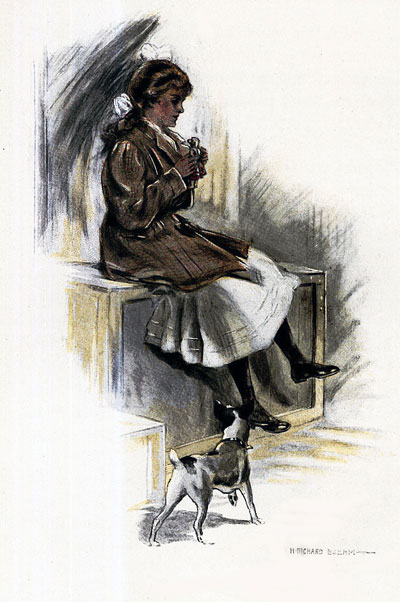
when Minkie came flying.
“Don’t stop,” she said, and skipped inside.
Jim thought Mam had sent her, but Jim
is always wrong when he imagines anything
about Minkie. The fact was, as she told me
afterwards, she had heard a lot of talk about
this Schwartz, and she felt that it would be
good for all parties if she took his measure
a few minutes ahead of the rest of the family;
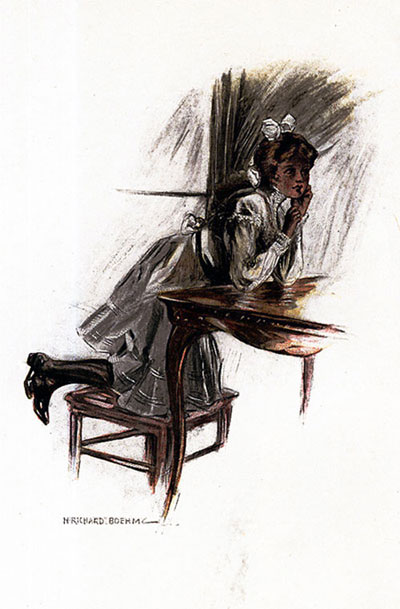
so she jammed on a pirate cap and Dorothy’s
fur coat, and slid across the lawn without
any one’s being the wiser, except Dan, and he
was sore with her on account of the escape
of the telegraph boy. He tried to take it out
of Tibbie, but she nipped up a tree, and the
parrot, who was watching him head downwards
through the drawing-room window,
yelled “Yah!” at him. That settled it.
He came after me and jumped up at my
bit.
“Race you to the station,” he said, pretending
he hadn’t seen Minkie.
“Right,” said I; “but, to make a match
of it, you ought to get Mole to harness you
to his little girl’s toy pram.”
This remark seemed to hurt his feelings,
but I didn’t know then about the rat-tatling
messenger boy. Anyhow, he met the doctor’s
poodle in the village, so he joined us at
the station in a good temper.
When the train arrived, it brought heaps
of people. It always puzzles me that folk
should gorge more at Christmas time than
any other. Every man, woman, and child
carried half-a-dozen parcels, and nearly every
parcel held something to eat. Some of the
men hugged long narrow boxes, which looked
as if they contained wax candles, but which
really held a bottle of whisky. I know, because
Jim....
“Mr. Grosvenor hasn’t come, miss,” said
Jim, when the crowd thinned.
“Who said he was coming?” asked Minkie.
“Well, Evangeline thought—”
“Evangeline never thinks. The doctor has
warned her against it. If ever she tries to do
anything of the kind the excitement will kill
her. No, Jim. Dad has told a Mr. Schwartz
to come on by this train, and make himself
at home until he joins him later. Schwartz
is German for black. Most Germans are
dumpy. But things often go by contraries.
Our green-grocer is named Brown, so Mr.
Schwartz should be a tall thin man, with
straw hair and white eyebrows.”
Nail my shoes, she wasn’t far out of it.
A humpbacked porter came along with a
couple of portmanteaux, followed by a heavy
swell who was up to specification except as
to the color of his hair, which was chestnut.
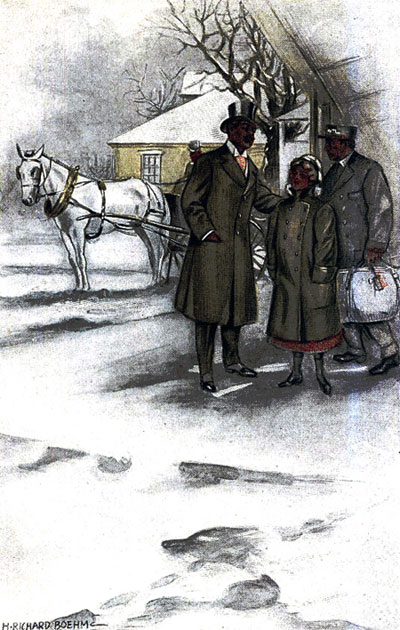
“This is Mr. Grosvenor’s carriage, sir,”
said the porter.
“Oh, indeed. And you are Miss Millicent,
I suppose?” said the newcomer, grinning at
Minkie.
“Are you Mr. Schwartz?” she asked, and Dan inspected his calf, because Minkie’s
tone told us she had taken a violent dislike
to the visitor at first sight.
“Yes,” he smirked, being so busy looking
at her that he paid no heed to the porter, who
was waiting for his tip.
“Well, if you give the porter a shilling I’ll
drive you to our place. Mother is expecting
you.”
“Are you particular as to the exact
amount?” he inquired, still grinning. In
fact, he was one of those silly men who believe
that you must laugh when you want to
be amiable; so please imagine Mr. Schwartz
always guffawing—at least, not always, because
he could scowl very unpleasantly at
times. Tickle my withers, we made him
scowl all right before we were through with
him.
“No,” said Minkie, giving the porter just
one little look. “As it is Christmas time,
you might make it half a crown.”
Schwartz got his hand down quick. Because
he was a rich man, he thought tuppence
would be ample. He produced a florin, but
Minkie spotted it.
“If you haven’t another sixpence I can
lend you one,” she said sweetly, and I saw
Dan licking his lips when he heard her speak
in that way.
“Don’t trouble,” said Schwartz, rather
shortly, and he handed the porter three shillings.
That was another of his queer ways.
He liked to impress people, but cheaply. He
wanted a girl of fourteen to realize what a
grand person he was, yet he was afraid she
would spring him up to a crown, or even half
a sovereign, if he didn’t make haste.
Then Minkie made room for him by her
side, and Dan hopped in too.
“Is that dog yours?” he inquired.
“Yes.”
“And does your father permit a beast with
muddy paws to sit in his carriage?”
“Not often,” said Minkie, looking at his
boots. “Dandy, you wicked imp, get out at
once.”
Dan took a header into the roadway, and ran
up alongside me, barking for all he was worth.
“Tell you what, Bob,” he cried, nearly
choking himself with joy, “this red-headed
Jew is going to find trouble. He is sure to
drop into the stable to-morrow. I’ll keep
you posted in affairs inside the house, and,
when I give you the office, you’ll let him have
both heels in the right place, eh?”
“I’ll do my best,” I coughed, and Jim
wondered what was the matter, as there are
no flies about in winter-time.
Meanwhile, Minkie took Schwartz in hand,
and my long ears were not given me for
amusement.
“We thought you were not coming until
next week,” she said, by way of being polite.
“I finished some business in Paris sooner
than I expected, and Mr. Grosvenor was
good enough to ask me to spend Christmas
and New Year at Dale End. I shall enjoy
the visit immensely, I am sure. I have not
had a Christmas at home for many years.”
“At home?” Minkie raised her large blue
eyes so innocently. I knew exactly how she
looked, and I rattled my harness to tell her I
was listening.
“Yes; in England, I mean.”
“Ah.”
“Don’t you call England ‘home,’ too?”
“Of course, but I live here.”
“So do I.”
“Sorry. I fancied you just said you had
been in some other country for a long time.”
“Well, I’m a bit of a cosmopolitan, I admit.
Do you know what a cosmopolitan is?”
“It means anything but English.”
Mr. Schwartz roared. “Gad!” he cried,
“that is not so far wrong.”
An old gentleman passed us in a mail
phaeton, drawn by a pair of fat cobs, your
bellows-to-mend and step-short sort. They
don’t like me, because I always make a point
of giving them the dust in summer, so one of
them snorted, “Station hack!”
“Going to have a shave?” I asked, quite
civilly, he being all of a lather.
Minkie gave the old gentleman a smile and
a bow. He was rather surprised, which was
reasonable enough, seeing that she usually
sails along without seeing anybody; but he
got his hat off in good time.
“Who is that?” inquired Schwartz.
“Jack’s uncle,” said Minkie.
“Jack is a friend of yours, eh?”
“Um, yes, but he—perhaps I shouldn’t
say anything about it. Jack is twenty-five,
you see.”
“Oh, is he?” Schwartz was not smiling
now. It was easy to guess that by his voice.
“I suppose he is better acquainted with your
sister than with you?”
“Yes, heaps.”
“What is his other name?”
“Percival Stanhope.”
“Mr. John Percival Stanhope, in fact?
Odd that I should not have heard of him, if
he is such a great friend of the family?”
“Dolly doesn’t say much about him. He’s
in India, and India is such a long way
off.”
“Jolly good job, too, or you would be
frizzling to-day.” Mr. Schwartz was brightening
up again.
“I think you are mistaken,” said Minkie,
quietly. “Jack says it is ever so cold in the
Punjab at Christmas-time.”
“Does he write to you, then?” demanded
Schwartz.
“No; that was in a letter to Dolly.”
“A recent letter?”
“He was talking about Christmas two years
ago. But please don’t mention him to her.
We have no right to discuss her affairs, have
we?”
“No, no; of course not. It was just by
way of conversation, eh?”
“That is the cemetery,” said Minkie,
pointing to a low tree-lined wall in the
distance. “Some day, if you like, I shall
take you there, and show you his mother’s
grave.”
“Thanks, but I am not fond of cemeteries,
as a rule.”
“Perhaps you would prefer to be cremated?”
“I haven’t considered the matter.”
“But you ought to. You are quite old,
nearly forty, and I saw in a pill advertisement
the other day that forty is a dangerous age if
your liver is out of order.”
“Here, young lady, not quite so fast, please.
How do you know I am forty, and why do
you think I have a diseased liver?”
“It said so in the paper.”
“The deuce it did.”
“Yes; in one of those little spicy bits, telling
you all about people, you know. It said:
‘Mr. Montague Schwartz is one of the Chosen
People.’ You are Mr. Montague Schwartz,
aren’t you?”
“Go on, do.”
“Oh, I remember every word ‘—one of
the Chosen People—’ that means you are a
Jew, doesn’t it?”
“Of Jewish descent, certainly.”
“Well, it went on: ‘His rise has been
meteoric. At twenty he quitted the paternal
fried fish shop in the Mile End Road, at
thirty he was running a saloon and other industries
at Kimberley, and at forty he is
building a mansion in Mayfair.’ There was
a lot more, but now you see how I knew your
age.”
“It is perfectly clear. There only remains
the liver.”
“I got that from the pill advertisement.
There are several sure signs of congestion,
and you have all of them in your face and
eyes. Shall I show it to you? Those pills
might cure you.”
“Really, you are too kind for words. May
I ask if your sister shares your knowledge
of my career and state of health?”
“Did I show her the paper, do you mean?”
“Yes.”
“No, I had forgotten all about it, but if you
would like her to see it—”
“Look here, Miss Millicent, you are a sharp
girl. Now, I’ll make a bargain with you.
Find that paper, say no more about the
paragraph—which, I may tell you, is rank
nonsense from start to finish—and your
Christmas box will be five sovereigns.”
“Done,” said Minkie, coolly. “And here
we are at Dale End. Mile End—Dale End.
Funny, isn’t it, how names run together that
way occasionally.”
Before Jim led me around to the stable I
heard Mam express her surprise that Mr.
Schwartz had come alone. She had expected
her husband by the same train. And she
did not know Millicent had gone in the victoria.
How on earth did the child recognise
Mr. Schwartz, as she had never seen him?
“I rather fancy your younger daughter
would pick me out in the Strand if she were
so minded,” explained the visitor, cheerfully.
“I hope she did not bore you by her chatter,”
said dear, innocent Mam. “Or perhaps
she was in one of her silent moods?”
“No. We got along famously; didn’t we,
Millicent?”
“It was a nice drive,” said Minkie, “not
too cold, and the village is quite gay.”
“Well, I find the air rather chilly,” said
Mam. “Why are we all standing here?
Come into the drawing-room, Mr. Schwartz.
Dorothy is there, and we shall have tea
brought a little earlier than usual. Evangeline,
tell James to take Mr. Schwartz’s portmanteaux
to the Blue Room.”
Of course, I should not have heard what
happened next if Tibbie had not looked in to
see me that night. As a matter of fact, the
gang does not miss much in the way of gossip.
One or other of us is always on hand. And
that parrot—though he is no friend of mine—is
a terror for picking up news. Jim hangs
his cage on a tree opposite my door every fine
morning, and the things he tells me are surprising.
He has hardly a good word for anybody,
but then, what a dull world it would
be if we only told the nice things about our
friends. Why, we should all be dumb soon.
Dan tried to sneak in behind Minkie, but
Mam had her eye on him.
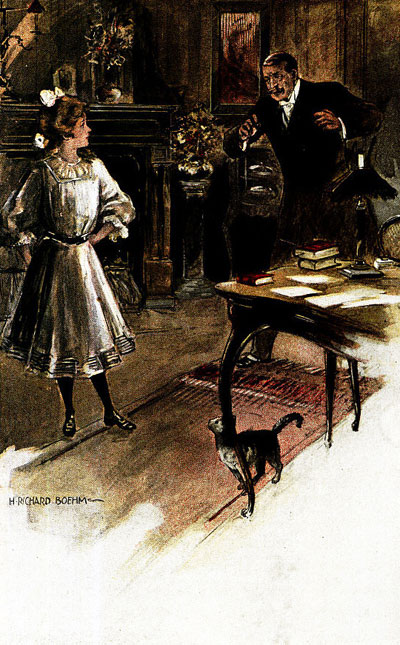
“I do believe that naughty Dandy has been
in the wars again,” she said. “Millicent, did
you see him fighting any other dog?”
“No, mother. He met the doctor’s poodle,
but there was no fight.” Minkie was always
strictly accurate.
“What a wonder! Anyhow, he is muddy
and wet. Ask cook to rub him over with a
damp cloth.”
Tibbie, pretending to be asleep, twitched
one ear as she saw Dan being led off to the
kitchen. “Gnar!” muttered Dan, who hates
damp cloths, “wait till I catch you in the
garden!” Tibbie just smiled. I must say
that cats take life easily; they are given the
best of everything, and do nothing. A friend
of mine, a regular old stager, who pulls near
in the Black Lion bus, tells me that Tibbie’s
method is the only way to get on, and he sees
a lot of different people at the inn, so he ought
to be a bit of a philosopher. “Make other
people work for you,” he says. “That’s the
ticket; when they bring you chaff tell ’em you
must have oats, an’ snap their heads off if
they don’t move quick enough. Bless your
hoof, they like it. You hear ’em say:
‘There’s blood for you, a born aristocrat, he
is,’ an’ they’ll do any mortal thing you want.”
Well, Tibbie curled up like a hedgehog,
and listened, because we don’t have many
strangers at Dale End. The talk turned on
Ostend—no, it’s as true as I’m standing on
four legs, but the very first place mentioned
had an “end” in it—where the Old Man
and Mam and Dorothy had been in the
summer. Minkie had measles, or something
spotty, so she was forbidden to travel, and we
had a ripping July all to ourselves. Eclipse
wasn’t in it; why, I had beer every day.
They met Mr. Schwartz at Ostend, it seems,
and he took such a fancy to Dolly that he
wanted to marry her straight off. She
wouldn’t do that, even if Mam and the Guv’nor
were agreeable, but she had not heard
from Jack for ages, and Schwartz was really
very attentive, besides being tremendously
rich. Now, we at Dale End find it difficult
to pay the hay and corn bills, so you see that
a wealthy son-in-law would be what the sale
catalogues call “a desirable acquisition.”
I have heard a lot of people in the village
say that Dolly is so pretty she ought to make
a good match. When she did a skirt dance
at the Cottage Hospital Bazaar, the local
paper spoke of her as “the beautiful Miss
Grosvenor.” She pretended to be very angry
about that, but Tibbie says she bought a
dozen papers and sent them to her girl friends,
so the rest of the report must have been suitable.
I suppose she is all right for a grownup.
For my part, I prefer Minkie, who has
a yellow mane, and blue eyes, and freckles.
She is as straight as a soldier, and has small
hands and feet, and the loveliest brown legs....
Eh, what? Well, say stockings, then,
but when I took first prize and the cup for
the best hackney in the show, everybody
admired my legs; so why not Minkie’s?
Anyhow, by the time tea was served,
Schwartz had further established himself in
Mam’s good graces. He was a clever chap
in his way, and he could say the right thing
to women occasionally, and he was wise
enough not to bother Dorothy too much,
though Tibbie saw, out of the tail of her eye,
that the girl could not move from one side of
the room to the other without Schwartz’s
watching her approvingly. Tibbie knew by
his eyes that he was saying to himself:
“She will look all right in Brook-street.”
Dan announced the postman while Dorothy
was pouring out the tea, and Minkie brought
in a heap of letters, mostly Christmas cards.
Minkie had a baker’s dozen to herself, and
five of them were addressed to “Minkie and
her Gang”; each of the five contained pictures
of a girl, a horse, a dog, a cat, and a
parrot. She soon made out by the postmark
and the handwriting who had sent every card,
even though the names were not given. One
seemed to puzzle her at first, and she slipped
it into her pocket. The others were handed
round, before Dorothy arranged them on the
mantel-piece with a number which had come
by earlier deliveries, and Mr. Schwartz admired
them immensely.
“It is so interesting to come back to the old
country and find these pleasant customs in
full swing,” he said. “I have neither sent
nor received a Christmas card for years. I
was telling Millicent on our way from the
station that, by chance, I have been out of England
at this season every year for ten years.”
“You did not mention the exact period, Mr.
Schwartz,” said Minkie. “I rather thought
that ten years ago you were in Kimberley?”
“Oh, one speaks in round numbers. By
the way, have you received a card from your
elderly friend—the man we met driving
the pair?”
“Driving a pair. Who was that, Millie?”
asked her mother.
“Mr. Stanhope, Jack’s uncle.”
Dorothy dropped a piece of toast, and Mam
bent over her letters, but she said quietly:
“I fear my girls will not be honored by any
such attention on his part, Mr. Schwartz.
Indeed, I think he is the only enemy we possess
in the neighborhood. How did you come
to describe him as a friend of yours,
Millie?”
“I didn’t.”
“Perhaps I was mistaken,” put in Schwartz,
who was beginning to hate Minkie, yet had
no wish to quarrel with her.
“I said Jack was my friend. Isn’t that
right, mother?”
“Oh, yes. I understand now. By the
way, dearie, are you going to meet your
father? It is nearly time to start. And be
careful to wrap up well.”
“The victoria will not be ready for another
five minutes. I have time to bring you that
paper if you would care to see it before dinner,
Mr. Schwartz.”
“Thanks. I shall be delighted—you
wretched little imp,” he added under his
breath, but Tibbie heard him.
Minkie brought the paper.
“That is the paragraph I told you of,” said
she, pointing very daintily to something on
one of the pages. I have seen her point that
way to a dead rat when she wished Jim or
Mole to throw it away.
“Much obliged. And here are the five
sovereigns I promised you as a Christmas
box.”
“Mr. Schwartz—” broke in Mam, but he
turned to her with his best manner.
“I beg of you to allow me to do this, Mrs.
Grosvenor. It is really a harmless joke
between Millicent and myself,” he said.
“But five pounds—” protested Mam.
“That was in the bond. Pray let me explain.
By chance, she mentioned some very
useful information which this newspaper contained;
I might not have heard of it otherwise.
So I am adding a little to her Christmas
present—that is all.”
“It seems a great deal of money,” sighed
Mam, who often wanted a fiver and had to
do without it, “but you two appear to have
the matter cut and dried, so I suppose it is all
right. What are you going to do with your
fabulous wealth, Millicent?”
“Make a corner in toffee. Make every kid
in Dale End pay a penny for a ha’penny-worth.
That is the proper thing, isn’t it,
Mr. Schwartz?”
“I don’t think I can teach you much,” he
replied with his usual grin.
“Oh yes, you can. Read the next paragraph,
the one beginning: ‘The unhappy
natives of the Upper Niger.’ It tells about
gas-pipe guns and coal-dust powder. Yes,
mother dear, going now.”
It was quite dark, of course, when I brought
Minkie to the station a second time. The
weather had changed, too, from what the
farmers call “soft” to a touch of frost, which
made both Jim and me pleased that my shoes
had been sharped by the blacksmith that
morning.
The train was rather late, so Minkie went
into the station and interviewed a porter.
He told her something which seemed to interest
her, so she asked the booking-clerk for
change of a sovereign and gave the man a
shilling.
She picked out her father the instant the
train drew up at the platform. He looked
worried, she told me afterwards, but that
passed when he saw her. He had the usual
number of parcels which people carry at
Christmas time, and Minkie grabbed all of
them, but he stopped her with a laugh.
“We can’t rush off in the orthodox way
to-night, Minkie,” he said. “Mr. Schwartz’s
servant is on this train, and I promised to
take him with us to the house. By the way,
is Dandy with you in the carriage?”
“No, father dear. Why do you ask?”
“Because this valet of Schwartz’s is a black
man, and Dandy might not approve of him
at first sight.”
“A black man.”
“Yes, polished ebony. Rather smart, too.
Speaks English perfectly. He came to me at
Waterloo and said—Oh, there he is. Hi,
you. Just follow me, will you.”
Minkie thought that the negro was an extraordinarily
fine fellow, and very well dressed.
It was odd that Schwartz had not mentioned
him, and she wondered where he would
sleep. Perhaps he curled up on a mat outside
his master’s room. In that case, she
must make Dan clearly understand that she
rather approved of the Ethiopian than otherwise.
His luggage appeared to be a small handbag.
He almost made the mistake of entering
the carriage with Minkie and her father,
but he showed his teeth in a good-natured
grin, and climbed to Jim’s side on the box.
I had a look at him as he passed the near
lamp, and he certainly did startle me; I am
quite sure I should have shifted him if Minkie
had not said quietly:
“All right, Bobby. Steady, old chap.”
On the way home I heard Minkie trying to
cheer up her father by telling him little bits
of village news, and he did his best to respond,
but both of us felt there was something
wrong, as the Guv’nor is likely enough
most days.
“Mr. Schwartz has arrived, of course?”
he inquired, soon after we quitted the station.“I forgot to ask
you sooner. I took it for granted when his servant turned up and told
me he had missed the earlier train.”
“Yes. He came according to your telegram.”
“How has he got on at home?”
“Oh, first rate. Mam and Dolly seemed
quite pleased to see him.”
“What do you think of him, Minkie?”
“I hardly know yet, father dear. I shall
tell you—let me see—on New Year’s Eve.”
“You demand seven days’ experience, eh?
Wise child. I wish some one had taught me
at your age to wait a bit before I formed my
opinions.”
“One might form them quickly enough,
but not express them.”
“Which means that you don’t like
Schwartz? Well, he is not exactly my sort,
I admit, but he is wealthy, Minkie, and one
must bow the knee before the golden calf
occasionally. And his repute stands high in
the city, so he might be a useful friend. We
must make the best of him, eh?”
“One always does that with one’s guests,
of course,” said Minkie, who could feel a
heavy assortment of gold and silver coins in
her pocket.
Minkie jumped out when I pulled up at
the front entrance. Dan was standing on
the top step and wondering what in the
world was sitting beside Jim on the box.
Before he could say a word, Minkie grabbed
him and whispered in his ear. But he was
very uneasy, because the black man sprang
down almost as promptly as Minkie, and
nearly frightened Evangeline into a fit when
she met him in the hall. He took his hat off
in quite an elegant way.
“I am Mr. Schwartz’s valet,” he said.
“Mr. Grosvenor was good enough to bring
me with him from London. Is my master in
his room now?”
“N-no, sir,” stuttered Evangeline. He
gave her the queerest feeling, she told Cookie
later.
“Well, if you will kindly show me to his
suite I will prepare his clothes for dinner,”
went on the negro, who appeared to be more
anxious to get to work than any of our servants.
Evangeline glanced at Minkie and the
Guv’nor; she was sure it must be all right, as
the negro had arrived in their company, but
she dared not go upstairs with him. Wild
horses would not drag her there, she said,
though I would back myself to haul her to
the top attic before she could say “knife.”
“It’s the Blue Room,” she said. “First on
the left in that corridor,” and she pointed to
the side of the house where Mr. Schwartz
was lodged. The big darky went up at
once. Evangeline helped to carry in some
of the parcels, and Minkie took her father’s
overcoat and hat, but kept an eye on Dan,
who was looking at the stairs anxiously.
Dolly came running to kiss the Old Man, and
Mam appeared.
“Where is Mr. Schwartz?” asked the
Guv’nor.
“Here I am,” said Schwartz, appearing in
the drawing-room doorway. “I am afraid
you had a cold journey from town. It was
exceedingly kind of you to send me on ahead.
My only regret is that you could not come
with me.”
“Business, my dear fellow. It pursues me
to the last hour, even in holiday time.”
“But that is good. It argues success.
Your idle man is rarely successful.”
“I fear it is possible for a busy man to score
a loss occasionally. I expect you have finished
tea long since? Can you squeeze the pot,
Mam?”
“It will be here in a minute, Tom,” said
Mam, smiling. “My husband hates to miss
his tea, Mr. Schwartz. He would drink three
cups now if I were to let him, though we dine
at seven.”
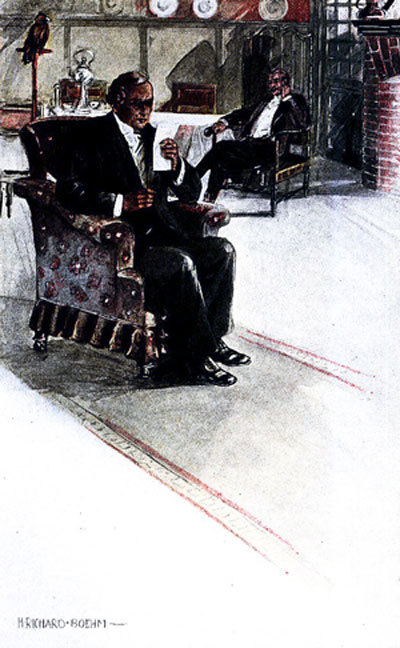
“By the way, that reminds me,” said the
Old Man, dropping into his regular chair in
the drawing-room. “I fell in with your servant
at Waterloo, Schwartz.”
“My servant!” said Schwartz, blankly, and
both Dan and Tibbie heard every word, as
Minkie had collected Dan again before she
took her usual perch on a hassock near her
father. If the Guv’nor had said he came
across Schwartz’s balloon at the Southwestern
terminus our visitor could not have put
more bewilderment into his voice.
“Yes, your black valet,” explained the
Guv’nor.
“My black valet! I don’t possess such an
article. I left my man at Brook-street, and
he is a Frenchman.”
Schwartz had risen to his feet. He looked
strangely pale—Minkie told me his face was
a flea-bitten grey. The Guv’nor jumped up,
too. So did Minkie, and Dan, and Tibbie.
You see, Mam and Dorothy knew nothing
about the gentleman who had gone to
Schwartz’s bedroom to arrange his dress suit
and put the studs in his shirt.
“Then who the blazes is the nigger who is
in your room upstairs at this moment?” said
the Old Man, forgetting that there were
ladies present.
“Nigger! My room!”
Schwartz’s voice cracked. He gasped as
though he had run a mile. He glared at the
Guv’nor and then glared at Minkie. Stifle
me, he thought it was some trick she had
played on him. But if the head of our family
was not much good at business he was in the
front row where prompt action was needed.
“Follow me, quick!” he shouted, and made
for the door. He was just a second too late.
The tall negro was coming downstairs three
at a time. He bounded across the hall and
had his hand on the latch just as the Guv’nor
rushed at him. Out went the black, out went
Mr. Grosvenor after him, with Minkie and
Dan a dead heat half a length behind, and
Schwartz whipping in. On the level the
nigger drew away; but Dan overhauled him
at the turn near the clump of rhododendrons,
and Dan never makes the mistake of advertising
his whereabouts when the matter is
serious. So he nailed the make-believe valet
by the ankle, and his teeth closed on bone
and sinew without ever a sound. Down went
the nigger with a crash and a yell. It was
pitch dark among the shrubs, but the Old
Man groped for him and got a knee in the
small of his back, bending his head upwards
at the same time by grabbing a handful of
wool. That is a good trick. It simply
paralyses the other fellow.
“I’ve got him,” he shouted, but Schwartz
just roared “Help!” at the top of his voice,
and kept to the open drive. Minkie heard
Dan sawing away, and growling a bit, now;
she closed in, clutched a loose leg that was
kicking wildly, and said:
“Are you all right, dad?”
“Yes. Tell James to fetch a stable lantern
and a rope.”
Minkie wasn’t going to leave her father
nor miss any of the fun. She sung out directions,
and Jim came along at a gallop. The
unfortunate nigger was screaming that the
dog was eating him, but, when they had tied
his hands behind his back, and Minkie pulled
Dan off, he seemed to be more frightened
than hurt. Polly told me next day that these
black fellows are always weak below the knee
joints, however gigantic they may be otherwise.
But the previous excitement was a small
affair compared with the row which sprang
up when Jim held the lantern so that Schwartz
could see the negro’s face.
“Gott in himmel!” he shrieked, in a kind
of frenzy, “it’s Prince John.”
“Yes—you thief!” said the prisoner, who
seemed to regain his self-possession and his
dignity when he set eyes on Schwartz.
“Where is it? Where is it? Give it to
me, or I’ll tear your liver out!” squealed the
other, dancing close up to him in an extraordinary
passion, being one of those men
who fly into a delirium when rage gets the
better of them.
“I have not got it,” said Prince John, if
that was his name. He turned to the Guv’nor.
“If you will take me back to the house, Mr.
Grosvenor,” he continued, “and keep that
dog off, I will explain everything, and trust
to your sense of justice to clear me of any
suspicion of wrong-doing. That man is the
thief, not me,” and he actually spat at Schwartz.
Jim said that it gave him a turn to hear a
buck nigger talking like that, but it took him
and the Guv’nor all their time to keep
Schwartz from using his nails on the man’s
eyes. Then the two began to shout at one
another, and it appeared that all the trouble
arose about a thing called a ju-ju, which the
black man said Schwartz had stolen from his
people, a tribe on the Upper Niger. Anyhow,
the Guv’nor marched his captive back to the
house, and Schwartz rushed upstairs. He
tore down again, more like a lunatic than ever,
as the ju-ju had gone from the dressing-case
in which he had left it.
He searched the negro, and was almost
ready to cut him open in case he had swallowed
it, but the ju-ju was not in the man’s
possession. Then he went out with Jim and
the lantern, and hunted every inch of the
drive and shrubbery, but could find nothing,
though it was easy enough to discover the
place where Dan had brought down his highness.
The odd thing was that he refused to send
for the police, and the more certain it became
that the ju-ju was missing, the more jubilant
grew Prince John’s face as he sat in the hall.
At last, there was nothing for it but the nigger
must be set at liberty. Schwartz wanted the
Guv’nor to lock him up all night. Of course,
that could not be done, as Surrey isn’t West
Africa, and the Old Man had come to the
conclusion that there was not much in the
dispute between them, anyhow.
So Prince John’s bonds were untied, and
the Guv’nor told him if he showed his black
muzzle inside our gateway again he would
be locked up. He was very polite and apologetic,
especially to the ladies, and the house
party went in to dinner greatly mystified by the
whole affair. Schwartz did not say much,
and his appetite was spoiled. After dinner
he had another hunt in his bedroom and
among the shrubs, but finally he gave up the
search until daylight, and came in and asked
for a whisky and soda.
Meanwhile, Minkie brought Dan to the
stable to see me. She came the back way,
and climbed to the hay-loft with Jim’s lantern.
Dan began to look around for a rat, but she
stopped him.
“Are you awake, Bobby?” she asked.
“Awake!” said I. “I should rather think
I am, after such goings on in the house.”
“Well,” said she, pulling a small black bag
from among the hay, “if you are a good horse,
and listen carefully, I will now tell you what
a ju-ju is. Come here, Dan. If it is alive, I
may want you to bite it.”
Skin me and sell my hide, what do you
think it was? Just a small chunk of ivory,
carved to represent a man with a monkey’s
head. It had a little coat of colored beads
tied where its waist was meant to be, and its
eyes were two shiny green stones. And that
was all.
“Well,” cried Minkie, “this is a surprise.
At first sight, I don’t think much of a ju-ju,
but that may be only my beastly ignorance,
as the man said when he tried to boil a china
egg.”
[Pg 39-41]