The Barbizon of 1850 was a very different place from the Barbizon of
to-day. The world fame of the men who passed a quiet and strenuous
existence in the little village has transformed it into a tourist
resort, with restaurants and cafés, the stopping-places for
waggonettes which in summer bring their daily load of sightseers,
eager to see the homes of the painters whose names are now household
words.
It would have been well-nigh impossible for the little band to have
chosen a more suitable spot for their labours. Rousseau and Millet,
much as they were drawn towards each other by the tie of a sympathetic
disposition and by their common interest in art, yet were widely
dissimilar from one another in their outlook upon art and their
methods of worship at the common shrine. Rousseau—one can see it from
every picture he painted—loved with all the yearning of a passionate
and restless temperament the inanimate in Nature. Observe with what
fidelity he draws his trees, with what caressing tenderness his clouds
and skies are treated; solitude appealed to him above all things, and
if here and there he was obliged to insert a few figures to complete
his composition, one instinctively feels that he would rather have
substituted a group of cattle or a flock of sheep. In the glades of
the forest, far from the busy haunts of men, with the glorious
sunlight penetrating from above, the breeze moaning through the
branches, he was happy. A wild and turbulent temperament such as his
not infrequently discovers exquisite enjoyment amidst such perfect
tranquillity.
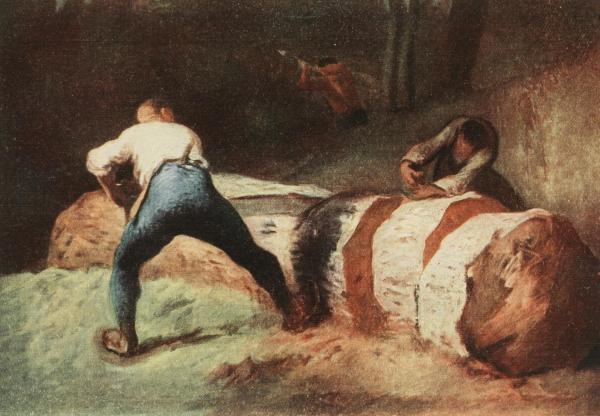
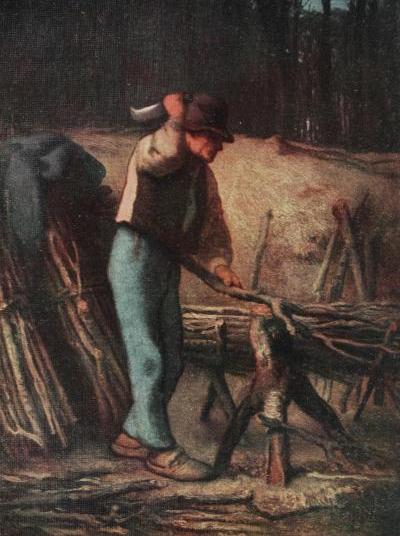
PLATE VII.—THE SAWYERS
(In the South Kensington Museum)
Very few of Millet’s works can rival this superb picture in vigour of
handling and magic of line. He has succeeded in infusing an enormous
amount of energy into the two figures, without sacrificing refinement.
The absolute stillness of the wood beyond is unbroken, save by the
monotonous hacking of the wood-cutter, who, axe in hand, is making a
determined onslaught upon a venerable tree. As an example of Millet’s
powers as a painter it would be hard to beat, and in it he has
preserved those rare qualities of freedom and rhythm of line we find
in his best drawings.
Barbizon, situated on the fringe of the great forest of Fontainebleau,
therefore, permitted Rousseau to come into daily contact with the
scenes which so appealed to him.
Millet, on the other hand, was absorbed in the peasant. The man who
tilled the soil and raised the produce humanity requires for its
subsistence by the sweat of his brow; the manifold duties of the
labourer, his life and sorrows, appealed to him with irresistible
force. An unpeopled track of wild and uncultivated land would not call
forth any emotion in him, no matter how sublime the scenery might be.
The life of the village, spreading itself into the vast and fertile
plain behind, held him absorbed; a peasant himself and living amongst
the people he so loved, he was in a position to bring before an
unthinking world the poignant monotony of their useful lives.
Upon their first arrival at Barbizon, the two artists put up at a
small inn, working all day in a tiny place they had rented from some
peasants and fitted up as a studio. The inconveniences of this
arrangement were soon apparent, and shortly afterwards Millet took a
small house which was destined to be his abode for the remainder of
his life; an old barn in the immediate vicinity meanwhile provided him
with an excellent studio.
From this period onward we must date the greatest productions of the
master, the works which have induced more thought than those of any
other peasant painter. A peasant among peasants, his life was of the
most rigid simplicity. Behind his little abode a large garden
stretched away almost to the fringe of the forest itself, and here he
was accustomed to work every morning, growing a portion of the food
necessary to the sustenance of his family. The afternoon he devoted to
painting, whilst the evening was given over to intercourse with his
little circle of friends. The simplicity and tranquillity of his life
aroused the whole of his powers to action, and surrounded with
everything he valued in life he was supremely happy.
The country around Barbizon appealed to him irresistibly. The
timber-studded plains, the gently undulating, highly cultivated
fields, presented a strange contrast to the wild and rugged country
amidst which he had spent his childhood, and no doubt conduced to the
development of a more refined and contemplative style than he would
otherwise have acquired. Upon his few visits to his native country he
appears to have been more impressed than ever with its austerity, and
the drawings which these journeys called forth bore ample evidence of
this feeling in him.
Lack of the necessary funds to carry on even his simple ménage was
ever the bane of Millet’s life. On many occasions Sensier, his
intimate friend and afterwards his biographer, informs us he dissuaded
him from suicide.
The sums that he owed, small though they were, rendered him in
constant fear of the brokers. With creditors so importunate in their
demands for satisfaction, and with the constant lack of recognition,
which was his lot, it is astonishing that Millet achieved so much. He
was relieved more than once by the kind-hearted and ever faithful
Rousseau, who when his friend was sorest pressed found some delicately
hidden means to relieve him. It was he who acquired for 4000 francs
the wonderful “Peasant grafting a Tree,” when the picture failed to
find a purchaser; and in order that Millet should not be aware of his
generosity, he made the offer in the name of an imaginary American.
This sort of goodness he repeated more than once, and it redounds
still more to his credit when we remember that Rousseau himself was
not infrequently in pecuniary difficulties.
A constant succession of important works made their appearance during
the first ten years Millet spent at Barbizon. The first was the
well-known “Sower,” which has ever been one of the most popular of his
pictures. Then came the far finer “Peasants going to Work,” which for
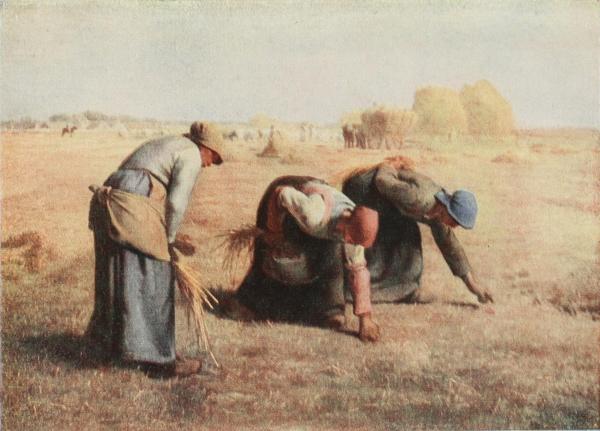
many years was in an English Collection. The “Gleaners,” perhaps the
noblest canvas the master ever painted, dates from 1857, in which year
it was seen at the Salon; the celebrated “Angelus” followed it two
years later. The prices which Millet obtained for this series of
remarkable works was fantastically small. The “Gleaners” brought him a
paltry 2000 francs, whilst he accounted himself lucky to encounter an
amateur who gave him the same sum for the small “Woman feeding Fowls.”
The “Angelus,” which was never exhibited, was sold in the year it was
painted to a Monsieur Feydeau, an architect, for 1800 francs. It then
passed through several hands before the late Monsieur Secrétan
competed up to 160,000 francs before he became possessed of the prize
at the John Wilson sale.
The purchase, however, proved a sound investment, for upon the
dispersal of his collection it was knocked down for 553,000 francs to
a Monsieur Proust, acting on behalf of the French Government. The
latter, however, when they gave the commission to buy the picture, had
no idea that such a high value would be placed upon it, and
consequently refused to ratify the sale; a syndicate now came upon the
scene, who took it to America. The price, however, proved greater than
even the millionaires of the States were prepared to give, and the
canvas again returned to France, where it found a resting-place in the
collection of Monsieur Chauchard, who paid the enormous sum of 800,000
francs for its possession.
In 1859 Millet sent two works to the Salon, a “Woman grazing her Cow,”
and “Death and the Woodman.” The latter, one of the most
philosophical of Millet’s pictures, which to-day is the principal
attraction of the Jacobsen Museum at Copenhagen, was rejected.
Disappointments of this kind came with such systematic regularity to
the painter that he must have become proof against them. He always had
bitter enemies amongst the critics, who never failed to pour abuse
upon his method and his subjects. Even a number of his fellow artists
joined in the chorus of disapproval. But the vehemence with which he
was attacked was striking evidence of the impression he was making and
the inward sense of his own powers; and the fact that he was working
out his destiny according to the dictates of his own genius supported
him against this outpouring of prejudice and malice. The social side
of life appealed to him more strongly as the years rolled on, and the
murmurings which had been heard in 1859 as to the socialistic
tendencies of “Death and the Woodman” swelled to a roar when the
stupendous “Man with the Hoe” was exhibited fourteen years later. The
latter, one of the most virile studies of depraved humanity which the
world has ever seen, has always been a favourite with social
reformers, and has inspired one remarkable poem. Even his most
implacable critics were disarmed before this canvas; its power was
magnetic; it was an inspiration, soul moving and trenchant.
His financial difficulties never completely dispersed. At one time, in
order to insure himself a little tranquillity, he made a contract with
two speculators, whereby they were to become possessors of all the
work he produced for three years, in consideration of their assuring
him a thousand francs a month. A great number of Millet’s finest
productions passed thus through their hands, including the “Return
from the Fields” and the “Man with the Hoe.” The partners were not
long in quarrelling, and after a lawsuit had been fought, Millet was
left in the hands of a man who frequently would not or could not pay
him in ready money, and whose bills he was frequently forced to
discount at considerable loss.
One little gleam of sunshine rendered his later days happy. This was a
commission from a Colmar banker, Monsieur Thomas by name, who required
four allegorical compositions representing the Seasons, to decorate
his rooms. The artist was overjoyed by this piece of good fortune,
and immediately commenced a most conscientious study of such mural
decoration as was within reach, in order that he might do full justice
to his patron. He paid frequent visits to Fontainebleau and the
Louvre, and even desired a friend to inquire if he could not obtain
reproductions of the frescoes at Herculaneum and Pompeii. In spite of
all this elaborate preparation, the subjects were not such as appealed
to his genius, and in spite of them being well and soundly painted, we
are told that they presented no features which called for special
comment.
He found, however, a much more genial occupation in accomplishing a
series of drawings ordered by a Monsieur Gavet, who paid the artist
1000, 700, and 450 francs each, according to their size. He made
altogether ninety-five drawings in this way, and it is said that this
gentleman had in his possession the finest work in black and white and
water-colour the artist ever executed.
Towards the latter end of his life the death of dear relatives and
friends cast a sorrowful gloom over him. Amongst the latter Rousseau,
who expired in his presence on the 22nd of December 1867, was
perhaps the loss which seemed to him hardest to bear. A staunch and
trusty friend, who was to be relied upon when his prospects seemed the
most hopeless, he had been one of the very few who had appreciated
Millet’s talents at their full worth, and who, moreover, scanty as his
own means were, was ever ready to stretch out his hand to assist his
struggling friend.
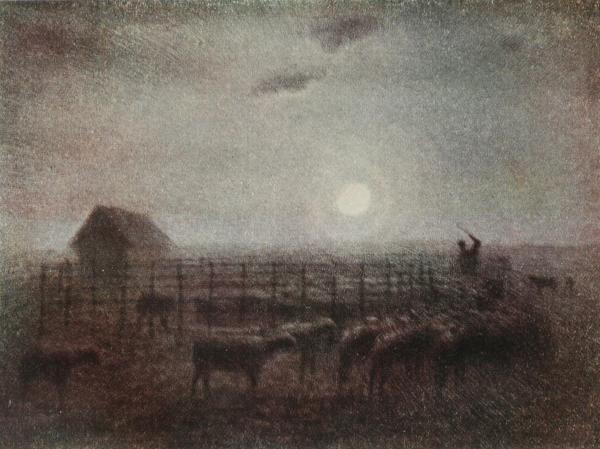
PLATE VIII.-THE SHEEP-FOLD
(In the Glasgow Corporation Art Galleries)
The poetry of moonlight has never been better realised than by Millet.
The lonely watch of the shepherd, the huddling together of the sheep,
the dreary mystical plain stretching away to the horizon, losing
itself finally in the vaporous atmosphere of the chilly night, are all
rendered with astonishing fidelity. It is in such works as these that
the master reveals his sympathy with the solitude of many phases of
peasant life.
Shortly afterwards Millet paid a visit to his patron, Herr Hartmann,
at Münster, and from here he went for a short time into Switzerland.
Upon his return he devoted himself with great earnestness to work, and
achieved a certain success at the Salons with his exhibits. The
outbreak of the war with Germany caused him to migrate with his family
to Cherbourg, where he thought he might continue to work, removed as
far as possible from the scenes of carnage and struggle which were
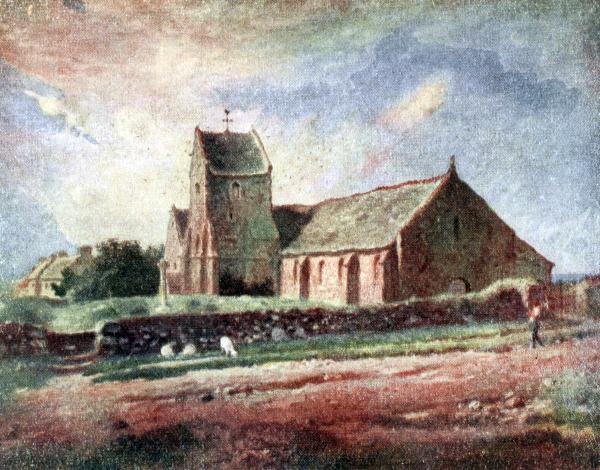
going on farther east. Transported once more amongst the scenes of his
childhood, he felt an increased impetus to production, and when he
returned to Barbizon late in 1871, he brought with him a number of
canvases of the highest quality; conspicuous amongst them was the
wonderful “Gréville Church,” now in the Louvre.
The anxieties of his troublous life were, however, beginning to show
their effect upon his constitution; a persistent cough developed, and
although an amelioration would occasionally occur, it was always
succeeded by a worse condition than before. His health suffered a
general decline, and he finally breathed his last on the 20th of
January 1875. He was buried in the little cemetery of Chailly, beside
his friend Rousseau, amidst the scenery they both loved so well.