"Look out of the window, Judith! Quick! Mrs. Avery is going away!"
Judith Windham, bending over the sewing-machine in her bedroom, started
as her little sister's voice came piping shrilly up the stairs, and
leaving her chair she leaned out of the old-fashioned casement window.
There were so few goings and comings in sleepy little Westbrooke, that
the passing of the village omnibus was an exciting event. With an
imposing rumble of yellow wheels it rattled up to Doctor Allen's gate
across the road. A trunk, a dress suit case, and numerous valises were
hoisted to the top of it, and the doctor's family flocked down to the
gate to watch the departure of the youngest member of their household,
Marguerite.
It had been four years since the first time they watched her go away, a
nineteen-year-old bride. Since then they had visited her, severally and
collectively, in her elegant apartments in Washington, but this had been
her first visit home. Judith, watching her flutter down the walk with
her hand in the old doctor's, thought she looked even prettier and more
girlish than on her wedding-day. Married life had been all roses for
Marguerite.
"She's the same dear old harum-scarum Daisy she always was, in spite of
the efforts of her Lord Chesterfield of a husband to reform her,"
thought Judith, fondly, as her old schoolmate, catching sight of her at
the window, waved her parasol so wildly that the staid old 'bus horses
began to plunge.
The girls had bidden each other good-bye the night before, but
Marguerite stopped in the midst of her final embracings to call out,
"Good-bye, again, Judith. Remember, I shall expect you the first of
February." Then the slender figure in its faultless tailor-made gown
disappeared into the omnibus. Her husband, a distinguished, scholarly
man, lifted his hat once more and stepped in after her. The door banged
behind them, and, creaking and swaying, the ancient vehicle moved off in
a cloud of dust.
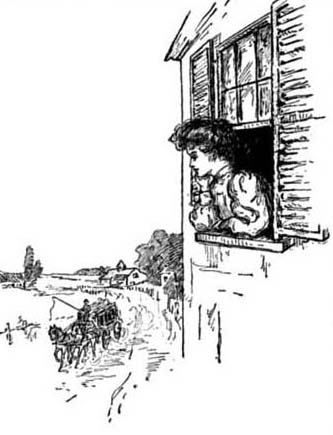
"THE PASSING OF THE VILLAGE OMNIBUS WAS AN EXCITING
EVENT."
Feeling that something very bright and interesting had dropped out of
her life, Judith went back to the sewing-machine. As she picked up her
work an involuntary sigh escaped her.
"That's a very sorry sound, Judith. Are you tired?"
It was a sympathetic voice that asked the question, and Judith looked up
with a smile. Her mother's cousin stood in the doorway—a prim little
old spinster, who had been their guest for several days. Like
Marguerite, she, too, had come back to her native village after an
absence of four years, but not to her father's house. She was all alone
in the world, save for a few distant relatives who called her Cousin
Barbara. After a short visit, she would go away for another long
absence, but not, like Marguerite, to a life full of many interests and
pleasures. She had only her music pupils in a little Pennsylvania mining
town, and a room in a boarding-house.
"Come in, Cousin Barbara," said Judith, cordially. "I was sighing over
Marguerite's departure. You know she was my best friend at school, and I
have missed her so much since her marriage. The other girls in our class
have all gone away to teach or take positions somewhere, except the two
who married and settled down here in Westbrooke; and they have such
different interests now. All they can talk about is their housekeeping
or their babies. Most of the boys have gone away, too. I don't wonder.
Anybody with any ambition would get away from such a place if it were
within the range of possibilities."
Cousin Barbara had seated herself in a low rocking-chair and was pulling
the basting threads from a finished garment. "Listen!" she said, "isn't
that Amy calling again?" An excited little voice came shrilly up the
stairs.
"Look, Judith! Mrs. Avery is coming back again! What do you suppose is
the matter?"
The omnibus dashing down the road stopped suddenly at the gate opposite.
The door burst open, and the dignified Mr. Avery, in undignified haste,
ran breathlessly toward the house, while Marguerite called out a
laughing explanation to her friend at the window.
"I left my watch on the dressing-table and my purse with my trunk keys
in it, and we've only six minutes to catch the train. Isn't that just my
way? Look at Algernon run! I wouldn't have believed it of him. Well, it
has given me another chance to remind you that you are to come to me in
February. You needn't shake your head. I'll not take 'no' for an answer.
You're so good at planning, Judith, I'm sure you can arrange it some
way."
Then as her husband returned, red-faced and breathless, she leaned out
of the 'bus, and laughingly blew an airy kiss from her fingertips.
"That's just like her!" exclaimed Judith. "She's as irresponsible and
careless as a child. She was always late to school, and losing her
pencils and forgetting her books. We used to call her 'Daisy
Dilly-dally.' She's such a dear little butterfly, though, and it doesn't
seem possible that we are the same age—twenty-three. I feel like a
patriarch beside her."
"So she has invited you to visit her in Washington," began Miss Barbara.
"I am glad of that. It will be such a fine change for you."
To her surprise, the gray eyes filled with tears, and in her effort to
wink them back Judith did not reply for a moment. Then she answered,
lightly, "Yes; it would be a golden opportunity if I could only afford
to accept, but the wolf is still at the door, Cousin Barbara. It has
stood in the way of everything I ever longed to do. Even when a child I
used to hear so much about it that I thought it was a veritable
flesh-and-blood wolf. Many a night I slipped out of bed and peered
through the curtain, all a-shiver. I wanted to see if its fiery eyeballs
were really watching at the door. I wanted to see them if they were
there, and yet was terrified to peep out for fear they were. Even now it
seems more than a mere figure of speech. Often I dream of having a
hand-to-hand struggle with it, but I always conquer it in the end—in my
dreams," she added, with a gay little laugh. "And that is a good omen."
That cheery laugh was the key-note of Judith's character, Miss Barbara
thought. All her life she had taken the pinch of poverty bravely for the
sake of her invalid mother and the three younger sisters whom she was
now helping through school. Gradually she had shouldered the heavy
responsibilities laid upon her, until she had settled down to a routine
of duty, almost hopeless in its monotony. Miss Barbara noted with keen
eyes that a careworn look had become the habitual expression of the
sweet girlish face, and she sat wishing with all her heart that she were
something herself besides a poorly paid little music teacher with the
wolf lurking at her own door. As she wound the basting threads on a
spool she planned the rose-coloured future Judith should have if it were
only in her power to give it.
Judith must have felt the unspoken sympathy, for presently she burst
forth: "If I could only go away, just once, and have a real good time,
like other girls, just once, while I am young enough to enjoy it, I
wouldn't ask anything more. I've never been ten miles outside of
Westbrooke, and I'm sure no one ever longed to travel more than I. I
never have any company of my own age. Our old set is all gone, and my
friends are either elderly people or the school-children who come to see
the girls. And they all are so absorbed in the trivial village
happenings and neighbourhood gossip.
"What I want is to meet people out in the world who really do
things,—men like Mr. Avery, for instance; Daisy is always entertaining
distinguished strangers, artists and authors and musicians. Friendship
with such cultured, interesting people would broaden the horizon of my
whole life. I have a feeling that if I could once get away, it would
somehow break the ice, and things would be different ever after." Then
she added, with a tinge of bitterness that rarely crept into her voice,
"I might as well plan to go to the moon. The round-trip ticket alone,
without the sleeping-car berth, would be at least forty dollars,
wouldn't it?"
Miss Barbara nodded. "Yes, fully that. It costs me almost that much to
go to Packertown and back, and that, you know, is a few hours this side
of Washington."
There was silence for several minutes, while Judith, already ashamed of
her outburst, stitched twice round the skirt she was making for Amy.
Then she said in a cheerful tone that somehow forbade any return to the
subject, "Tell me about Packertown, Cousin Barbara. How did you happen
to stray off there after a music class?"
The trip to Washington was mentioned no more that summer, but Miss
Barbara understood.
It was the middle of September when the old yellow omnibus rolled up for
Miss Barbara and her trunk. This time there was no returning in mad
haste after forgotten property. With a precision that was almost
fussiness, she had packed her trunk days before her departure, and her
bonnet was on an hour before train time.
"I can't help it," she said, calmly, when Judith remonstrated. "It's
just my way. I have a horror of keeping any one waiting. Habitual
disregard of punctuality in the keeping of an engagement or a promise is
a sort of dishonesty, in my opinion. I suppose I do carry it to an
extreme in minor matters, but it is better to do that than to cause
other people needless anxiety and trouble."
Miss Barbara was mounted on her hobby now, and she ambled vigorously
along until Amy, with a sigh of relief, announced that she heard wheels.
Amy had heard Cousin Barbara's views more than once, when a missing shoe
button, a torn glove, or an unanswered note, claimed immediate
attention.
"Remember, Judith," said Miss Barbara, at parting, "if anything should
happen to make it possible for you to go to Washington, be sure and let
me know. I want to arrange for you to stop with me a week on your way."
But even as Judith spoke her thanks, she shook her head. She had stopped
building air-castles.
Winter came early to Westbrooke. Mrs. Allen ran over occasionally with a
letter from Marguerite, who was an erratic correspondent, sometimes
sending interesting daily bulletins of sixteen or twenty pages,
sometimes breaking a month's silence by only a postal card. They rarely
heard from Miss Barbara, but, one snowy day late in January, Amy dashed
in from the post-office with a letter to Judith, addressed in her
unmistakable precise little hand. She wrote:
"The new year began for me with a great pleasure, Judith dear. An
old bill, which I had been unable to collect for so long that I
crossed it off my books two years ago, was paid very unexpectedly,
and I feel as if I had fallen heir to a dukedom.
"It is enough to enable you to make your visit to Washington and to
pay your board in the room next to mine for two weeks. Maybe there
will be enough to get the material for a simple evening gown, and
you can make it while you are here, or at home. It depends on
whether you go first to Mrs. Avery or to me. Write to her at once,
please, so that I may know when to expect you.
"Oh, my dear child, you do not know the unalloyed pleasure I have
already had in anticipating not only your visit to me, but your
good times in Washington. I feel that your enjoyment of the outing,
which I would have enjoyed so intensely at your age, will, in a
way, compensate me for my starved, unsatisfied girlhood, and I am
sure you are too generous to refuse me the pleasure.
"Enclosed you will find the check and a card on which I have
written all necessary directions as to railroad connections,
time-tables, etc."
No girl of fifteen could have been more enthusiastic in her rapturous
expressions of delight than Judith, as she danced into her mother's
room, waving the check. Amy looked on in amazement.
"I didn't know that sister could get so excited," she said to her
mother, afterwards.
"It is the first great pleasure she has ever had," said Mrs. Windham,
with a sigh. "It means far more to her than a trip to Europe would to
Marguerite. We all must help her to make the most of it."
It seemed to Judith that all Westbrooke had heard of her proposed
journey before night. Neighbours ran in to talk it over and proffer
their assistance. The little old trunk that had gone on her mother's
wedding journey was brought down, and the family dropped various
contributions into it, from Mrs. Windham's well-preserved black silk
skirt, to Edith's best stockings. Amy brought her coral pin and only
lace-trimmed handkerchief, begging Judith to wear them when she went to
the White House. "Then I can tell the girls they've seen the President
of the United States," she said, proudly.
Lillian, next in age to Judith, presented her outright with her
Christmas gloves. "Mittens are good enough for Westbrooke," she said.
"Just bring me a leaf from Mount Vernon and one from Arlington for my
memory book. I can hardly realize that you are really going to see such
famous places."
Marguerite's letter in response to Judith's news came promptly. She
named a long list of sights which she had planned for Judith to see,
and mentioned a noted violinist who was to visit Washington the
following month and had promised to play at the musicale she intended
giving on the sixteenth.
"I am sure you will like that better than anything," she wrote. "Make
your visit to Miss Barbara first. I wish I could have you come on the
first of February, as I invited you to do, but, unfortunately, Mr.
Avery's mother and sisters are with us just now, and they occupy all our
spare room. They do not expect to stay long after my cousin's reception
on the third, however, and I will write as soon as they leave, and let
you know just what day to come."
The first week of Judith's visit in Packertown fairly flew by. Miss
Barbara was away much of the time, both morning and afternoon, with her
music pupils, but Judith busied herself with the making of the dainty
white dinner gown, and wove happy day-dreams while she worked. In the
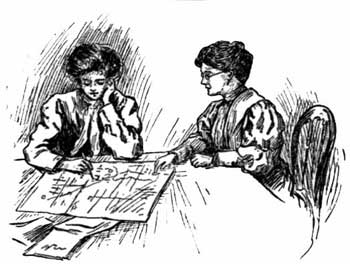
evenings she and Miss Barbara pored over a map of Washington until they
could locate all the prominent places of interest, and then Miss Barbara
brought out a pile of borrowed magazines in which were interesting
descriptions of those very places, and they took turns in reading
aloud.
"SHE AND MISS BARBARA PORED OVER A MAP OF WASHINGTON."
When the dress was completed they had a little jubilee. Judith wore it
one evening, with its dainty flutter of ribbons, for Miss Barbara to
admire, and they invited the landlady and her daughter in to have music
and toast marshmallows.
"You don't look a day over eighteen," Miss Barbara declared. "You ought
to wear white all the time."
"It is given only to saints and the 'lilies that toil not' to do that,"
answered Judith, gaily. "I am satisfied to be arrayed just on state
occasions." And then because she was so happy she seized the little
music teacher and waltzed her round and round before the mirror. "It's
all your doing, you blessed Cousin Barbara! See how you have
metamorphosed me."
Several days later she stood idly turning the calendar. "This is the day
of the reception," she said; "the Averys will certainly be going home
soon, and I ought to hear from Marguerite."
But no letter came the next day, nor the next, nor all the following
week, although she went to the post-office several times daily.
It grew dull waiting, with Miss Barbara gone so much, and with nothing
to do. She read the few books at her disposal, she paced up and down in
the two little back bedrooms that she and Miss Barbara occupied. She
took long walks alone, but the little mining town was even smaller than
Westbrooke, and she found scant material with which to fill her letters
home.
The two weeks for which she had been invited came to an end, and Judith
grew desperate over her fruitless trips to the post-office. She knew
that Miss Barbara had just made the payment that was due the Building
and Loan Association in which she was putting her little earnings, and
would be almost penniless until the end of another term. Besides, she
had accepted all that she was willing to take from the hard-worked
little music teacher.
"I have packed my trunk and am going home to-morrow, Cousin Barbara,"
she announced. "Mr. Avery's family have evidently stayed longer than
Daisy expected, and she can't have me. Maybe some of them are ill."
"Then she should have written and told you so," said Miss Barbara,
waxing so indignant over the neglect of her protégée that she grew
eloquent on the subject of her hobby—punctuality, especially in
correspondence.
"I suppose you wouldn't want to write again?" she suggested.
But Judith shook her head. "Oh, no, no!" she insisted; "Daisy
understands perfectly that I can stay here only two weeks. I explained
the situation fully in my letter. I mailed it myself, and I am sure that
she received it. And I couldn't thrust myself upon her, you know. She
has probably forgotten all about her invitation by this time; this visit
doesn't mean as much to her as to me."
"But I can't bear to be disappointed after going so far," said Miss
Barbara. "She'll surely write in a few days. You'll just have to stay
another week. I can arrange for that long. The landlady wants the room
after the twenty-first for a permanent boarder, but you can't go until
then."
In spite of all Judith's protestations, Miss Barbara kept her, and never
did a week drag by so slowly. It snowed incessantly. Miss Barbara was
unusually busy. Judith took a severe cold that confined her to the
house. Her eyes ached when she attempted to read, and all she could do
was to pace up and down the room and look out of the window, or watch
the clock in feverish impatience for Miss Barbara to return with the
mail.
But not until the sixteenth, the day of the musicale, did she lose hope.
When the hour came in which she should have been listening to the famous
violinist in Marguerite's elegant drawing-rooms, she threw herself on
the bed and cried as if her heart would break. It had been years since
she had given away to her emotions as she did then, but the
disappointment was a bitter one. She must go back home without even a
glimpse of the city of her dreams, and without meeting a single
interesting person. True, she had had a pleasant visit with Cousin
Barbara, but they both had thought of it as only the stepping-stone to
what lay beyond. Then at the thought of Miss Barbara's disappointment,
second only to her own, she cried again. And again for her mother's
disappointment and the girls', and her mortification when it should be
discussed in every house in Westbrooke. She sobbed so long that finally
she fell into a deep sleep of exhaustion.
Miss Barbara, coming in later in the twilight, found her lying on the
bed, with a feverish flush on her cheeks. The grieved, childlike droop
of the sensitive little mouth told its own story, and Miss Barbara set
her lips sternly together.
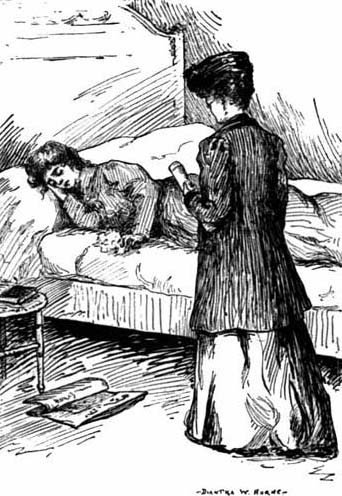
"I wish Daisy Avery could see her now," she muttered, savagely; "it's
cruel to disappoint any one so. I don't care what the cause is, it's
wickedly cruel to be so careless."
"'I WISH DAISY AVERY COULD SEE HER NOW,' SHE MUTTERED,
SAVAGELY."
Four days later Judith went home. In the course of a week a letter
was forwarded to her from Packertown. It was from Marguerite:
"How can you ever forgive my abominable carelessness? I intended to
answer immediately after our guests left, but Mr. Avery and I were
invited to a little house-party in the country, and I thought a few
days wouldn't make any difference to you. Then, after our return,
so many things interfered and the days slipped by so fast, that the
month was nearly gone before I realized it. But then I always have
been such a poor correspondent.
"I hope that it hasn't inconvenienced you any, and that you have
been having a good visit with Miss Barbara. You know my unfortunate
way of doing things, and I'm sure you'll forgive me, like the
darling you always were.
"We shall look for you to-morrow on the six o'clock train. Don't
disappoint us, for we both shall be at the station to meet you.
"Devotedly,
"Marguerite."
Judith read the letter aloud to the girls and then dropped it in the
fire, watching it without a word, as it curled up in the flame. How
long she had waited for that careless little letter! How anxiously she
had hoped for it! A few days sooner it would have brought untold
happiness. Now it was only a hollow mockery. Well, it was all over now.
Her hopes were in ashes like the letter. How high they had burned! And
the little evening gown she had taken such pleasure in making—there
would never be any occasion fit for its wearing in Westbrooke. She might
as well fold it away. The letter had come too late. And she was asked to
forgive it—the disappointment that would sting all her life
long—simply because it was Daisy's way.
The silence was growing uncomfortable. Amy kept casting frightened
glances at her sister's white, tense face. "Oh, dear," she sighed,
finally, "if this had only been in a story it wouldn't have ended so
dreadfully. Something nice would have happened just at the last minute
to make up for the disappointment."
"But it isn't in a story," said Judith, slowly, rising to leave the
room. "And nothing can compensate for such a disappointment. It will
hurt always."
As the door closed behind her the girls exchanged sympathizing glances.
"If there had even been a good reason," sighed Lillian, "but it was only
carelessness. And the trouble of it is, the world is full of Daisy
Averys."