"Horace, bring papa that newspaper that
lies on the table yonder," Mr. Dinsmore said
to his little son.
The child, seated in his own little chair by
his mother's side, was listlessly turning the
leaves of a picture-book. Elsie had just finished
her recitations for the morning, and was
now sitting on the other side of Rose, taking
a lesson in fancy-work.
Mr. Dinsmore had spoken in a pleasant
tone, rather of request than command, yet
Horace, though usually ready to obey promptly
and cheerfully, sat perfectly still, as if he
had not heard, or did not choose to heed.
"Horace, do you hear me? Go and
bring me that paper," said his father; and
this time the tone was one of stern command.
The child's face instantly assumed a stubborn,
sullen expression, while he neither
moved nor answered.
Elsie, pale and trembling with apprehension,
gave him an entreating, her father an
imploring look, which neither seemed to see.
Mr. Dinsmore was regarding his son with
a look of stern displeasure, and Horace's eyes
were on his book.
"Horace, dear, do as papa bids you," said
Rose, with gentle entreaty.
"Leave him to me, Rose," said her husband;
"I have given the order, and I am
the one to enforce it. Horace, obey me instantly
or I shall whip you till you do."
At that stern sentence Elsie almost cried
out in fear and dismay, for well she knew her
father's indomitable will, and she could perceive
that Horace, whom she so dearly loved,
that to see him suffer pain was far worse than
to have it inflicted upon herself, was just now
in a most stubborn, refractory mood.
Probably the state of the atmosphere had
something to do with it, for it was a rainy
day, close and sultry.
"Me don't want to," muttered the little
fellow, making no movement to obey; then
as he felt a not very gentle grasp upon his
arm, "Me won't!" he cried, with a defiant
look upon his father's face.
Mr. Dinsmore instantly administered a
pretty severe chastisement, Rose sitting by
pale and sad, Elsie with the tears streaming
over her cheeks.
Horace cried violently, but still refused
obedience to the reiterated command, "Go
and get that paper and bring it to me."
The punishment was repeated with added
severity, but he stubbornly persisted in his refusal,
and the battle went on till his mother,
unable to endure the sight, rose and left the
room, and Elsie so far forgot herself in her
darling little brother's pain that she ran to
the rescue, threw her arms about him, and
tried to drag him away from her father.
"Oh, papa, don't!" she sobbed; "please
don't whip him any more! I cannot bear it."
"Elsie! how dare you!" Mr. Dinsmore
exclaimed, in astonishment and wrath, putting
her forcibly aside as he spoke. "Leave
the room instantly," he added, in his sternest
tones and with a stamp of his foot.
She let go her hold of the child, but, lingering,
began again her entreaty, "Oh, papa,
please—"
"Will you compel me to punish you in
the same way?" he said, again stamping his
foot and pointing significantly to the door.
At that she hastened from the room and
sought her own, crying as if her heart would
break.
Horace yielded at last, when nearly exhausted
with the conflict, received a kiss of
reconciliation from his father, was then carried
to his mother, and wept himself to sleep in
her arms, her tears falling almost as fast as
his.
She had laid him in his crib and was bending
over him, tenderly smoothing back the
damp curls from his heated brow, when her
husband came softly to her side, and, putting
his arm about her waist, asked in low, moved
tones, "Do you blame me, my Rose? Do
you think me a cruel father?"
She did not answer for a moment, but
seemed struggling with emotion.
He sighed deeply.
"I—I think you were conscientious in it
all," she said at length, her voice tremulous
with feeling, "and that after beginning the
conflict it was necessary for you to conquer;
but I think the beginning it was a sad mistake."
"How do you mean? What would you
have had me do when my child refused to
obey a command so simple and easy to understand
and do?"
"My husband," she said, allowing him to
lead her to a sofa, where they sat down side
by side, "I do not like to seem to try to teach
you who are so much older and wiser than I;
but do you not think you would have spared
yourself and all of us a great deal of pain if
instead of compelling obedience you had simply
punished refusal to obey, and there let the
matter rest?"
"Would it have gone as far toward securing
obedience in the future?" he queried,
rather as if considering the question himself
than asking her opinion.
"I think so," she said. "Surely a child
will not be apt to disobey very often when he
finds that swift punishment is always meted
out in proportion to the magnitude of the
offence."
He sat silently meditating for some little
time, she anxiously watching the expression
of his face.
At length, turning to her, "I believe you
are right, my love," he said, "and I shall, if
possible, avoid such conflicts in the future, as
you advise, simply punishing the act of disobedience,
or refusal to obey. To-day that
course would, as you have suggested, have
saved us all a great deal of suffering; and oh,
what would it not have saved to Elsie and
myself if put into practice years ago!" He
sighed deeply as he added, "And the pain
occasioned by this unfortunate conflict is not
all over yet, for I have her to punish now."
"Elsie?" exclaimed Rose, looking at him
in great surprise; "what has she done?"
He told her what had occurred just as she
left the room where he was battling with
Horace, adding, "I must, of course, punish
her, for she was not only rebelling against my
authority herself, but upholding her brother
in doing the same."
"I suppose so," said Rose sadly, "but I
wish you could feel it right and wise to forgive
her."
"Not till I have inflicted some punishment,"
he said; "the offence was quite too
serious to be lightly passed over."
"But you will not be severe with her?"
Rose said pleadingly. "You know it was
only her great love for her little brother that
made her for a moment forgetful of her duty
to you. And I am sure she is repenting bitterly
now."
"I have no intention of inflicting corporal
punishment, if that is what you apprehend,"
he said; "but I think I ought to make her
aware, for a day or two at least, that she is in
disgrace with me."
"I am so sorry," sighed Rose; "for
though to some children that would be a very
slight punishment, I know that to her it will
be positively dreadful."
"Yes," he returned, echoing her sigh,
"she is extravagantly fond of her father's
caresses and endearments, but so is he of
hers, and I doubt if the punishment will be
more severe to the one than to the other of
us."
"What's de mattah, chile? What's de
mattah wid you an' little massa?" Aunt
Chloe asked, with an anxious, troubled look,
as Elsie rushed into her own apartments crying
very bitterly.
Amid heavy sobbing and floods of tears
the little girl related what had passed between
her father and brother, winding up with the
story of her interference and its result.
"Oh, darlin' chile, dat was bad!" exclaimed
Chloe. "You shouldn't neber do no
sich ting as dat! Dat be bery bad ting fo'
little massa, what you been an' gone an' done.
De Bible say chillens mus' min' dere fader
and mudder."
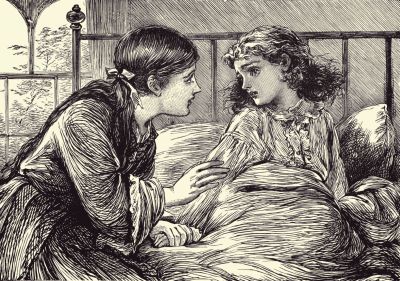
Elsie made no reply, but throwing herself
on a couch, half buried her face in a pillow in
the effort to shut out the sound of Horace's
cries, which penetrated even there.
Until they ceased she scarcely thought of
anything but that he was being hurt; but
when all grew quiet with the ending of the
conflict, she was suddenly struck with the
enormity of her offence and the dread certainty
that her father was greatly and justly
incensed at her unwarrantable interference between
him and her brother.
She was astonished at her own temerity,
and trembled at thought of the probable consequences.
That some sort of punishment
would be meted out to her she had not the
slightest doubt, and as her father was wont to
be prompt in action, she fully expected a visit
from him as soon as he was done disciplining
Horace.
She listened with a quaking heart for the
sound of his approaching footsteps; but the
minutes and the hours crept on and he came
not.
The dinner-bell rang, and Elsie started up
full of perplexity and alarm, doubting whether
she was or was not expected to obey its summons.
"Oh, mammy," she cried, "I don't
know what to do! I don't want to go to the
table. Please go and ask papa if I may be
excused. Tell him my head aches, for indeed
it does, and I'm not at all hungry."
"Co'se, chile, co'se you's got misery in
de head after all dat cryin'," replied Aunt
Chloe, putting down her knitting to go and
do the errand. "Don' cry no mo', honey;
maybe massa forgib you, ef you's right down
sorry."
"I am sorry, mammy," sobbed Elsie;
"oh, I am very sorry; but I know that papa
will punish me somehow or other, and I deserve
it."
"Maybe not, honey," responded Aunt
Chloe cheerfully, then hurried away to the
dining-room.
She returned in a few minutes, bringing a
very nice meal daintily arranged on a silver
waiter.
"What did papa say?" asked Elsie anxiously.
"Not much, honey; only, 'Bery well,
Aunt Chloe, you kin take her something
when she feels inclined to eat.'"
Elsie's tears burst forth afresh. Was it
then a matter of indifference to her father that
she was in pain? her father, who was usually
so full of loving anxiety at the slightest indication
of anything being amiss with her?
"Oh, mammy," she sobbed, "what if
papa shouldn't ever love me any more!"
"Ki, chile, dat a heap ob nonsense you's
talkin' now!" laughed Chloe. "Massa
couldn't neber help it; not a bit; you's jes'
de light ob his eyes. Dere now, don' cry no
mo', but jes' eat what your ole mammy fotch
fo' you."
There was some slight and temporary comfort
in the assurance her mammy expressed,
and the little girl found herself able, by its
help, to eat sparingly of the dainties she had
brought her.
"Did papa say I must stay in my rooms
till I got permission to leave them?" she
asked.
"No, honey, darlin', he didn't say nuffin'
't all 'bout dat; didn't gib no corrections,
but jes' 'bout gibin' you what you wants to
eat when you's ready fo' it. Dat don' soun'
so mighty bad fo' yo' case, chile, an' I respects
mass'll be comin' in 'rectly fo' to kiss
an' make up."
"No," Elsie said, shaking her head and
bursting into tears again, "he'll punish me
first; I am quite sure of that."
"Ki, chile! ef he gwine fo' to do dat,
what you 'spose he waitin' fo'?"
"I don't know," sobbed the little girl;
"but I'm afraid it will be a long while before
he will pet and fondle me again, or even give
me a kind look or word."
"Why you tink dat, honey?"
"Oh, because he looked so stern and
angry when he stamped his foot at me and
ordered me out of the room."
The afternoon passed very slowly in the
constant yet vain expectation of a visit from
her father or a summons to his presence.
Several times she was on the point of venturing
into it without being called, but her
heart failed her; she was not sure that it
might not be looked upon as an additional
offence; he had sent her out of the room
without saying how long he meant her banishment
to last.
Besides, she wanted to be sure of seeing
him alone; she would not have even Rose a
witness of the interview.
So she waited till the hour when the latter
would be engaged in seeing little Horace put
to bed for the night, then in much trepidation
went in search of her father. She felt quite
sure of finding him alone, for there were no
guests in the house, and as it was still storming,
there seemed no danger of any one calling.
She went first to the parlor, which was
their principal family room when alone. Yes,
there he was, sitting in an easy-chair by a
window, his back toward her, doubtless reading,
and quite alone.
She stole noiselessly to the back of his
chair, her heart beating very fast and loud.
She almost thought he must hear it; but he
seemed unaware of her approach, entirely absorbed
in his book.
She caught hold of the chair-back to
steady and support herself, for she was trembling
in every limb.
"Papa, I—" she began, her voice full of
tears.
"I have nothing to say to you, Miss Dinsmore,
except that I forbid you to address me
by that title or to call me father, or to take
any liberties with me that would be unsuitable
in a stranger guest in the house," he interrupted,
in a freezing tone, without turning
toward her, and with his eyes still upon his
book.
"Oh, I can't bear it! I can't bear it!"
she cried, with a burst of sobs and tears,
throwing herself at his feet. "I know I've
behaved very badly, but I'm—"
"Get up," he said sternly, again interrupting
her; "control yourself, or leave the
room till you can."
His look was as stern and cold as his
words.
She struggled to her feet and went back to
her own rooms, crying very bitterly.
"Oh, mammy, mammy," she sobbed,
"it's even worse than I expected, for I'm
forbidden to call him father or papa. Oh,
what shall I do? How can I call him anything
else? And I mustn't hug or kiss him
or sit on his knee; and—and he called me
'Miss Dinsmore.' Just think of it! Not
even Elsie, without the pet names I love so to
hear from his lips, but Miss Dinsmore, as if I
were a stranger he cared nothing about."
"'Tain't gwine to las' long, honey darlin',
dat ar ain't," said Chloe soothingly, taking
the weeper in her arms and caressing her
tenderly; "you' jes' de light ob massa's
eyes, like I tole you befo', an' de pet names
be sho' to come again fo' long. 'Sides, you'll
hab yo' ole seat on massa's knee, an' all de
hugs and kisses you wants."
"I'm afraid not for a long while, mammy,"
sobbed the little girl. "I think papa
has not been so displeased with me since that
dreadful time, so long ago, when we lived at
Roselands."
The tea-bell rang.
"Is you gwine to de table, darlin'?"
Chloe asked.
"Oh no, no, mammy!" Elsie exclaimed,
with a fresh burst of grief; "papa bade me
leave the room till I could control myself, and
I know I could not do that in his presence
yet; oh, how can I ever be with him and not
call him father or papa?"
As they sat down to the table Rose glanced
at the vacant seat, then at her husband. "I
fear the dear child is ill with grief and remorse,
Horace," she said, with a troubled,
anxious look; "she has such a tender conscience,
and so dearly loves the father whose
displeasure she has incurred."
"She is not ill; I saw her a few moments
since," he answered, with a sigh. "She is
distressed, I know, but it is the consequence
of her own wrong-doing, and she must endure
it for a time that she may learn never again
to encourage her brother in resistance to lawful
authority."
"Don't you think the lesson may be
already learned?" Rose said pleadingly.
"She has no stubbornness in her nature, but
is very easily subdued and made penitent."
"I am not so sure of that; she comes of
very stubborn stock, on one side at least," he
replied, with a rather melancholy attempt at
pleasantry.
"My dear husband, I wish you would forgive
her," pleaded the young step-mother.
"Surely you will before she goes to bed to-night?"
"Can you not be content to leave her to
me, my Rose?" he asked. "Do you not know
that I am a most doting father? that she is the
very light of my eyes, and core of my heart?
Ah, I sometimes fear she is her father's idol."
"No," Rose said, half-chokingly, and
with tears in her eyes, "I am sure your conscience
need not trouble you on that score so
long as you can find it in your heart to be so
severe with her faults."
"Not in my heart, love," he returned, a
little hurt, "but in the settled conviction that
I am acting for her good. It requires a
strong effort of my will to resist the promptings
of affection; love that urges me to send
for her at once, tell her she is forgiven, and
lavish the tenderest caresses upon her."
"That is just what I should rejoice to see
you do," said Rose.
"To-morrow or next day perhaps you
may," he answered, in a tone that seemed to
imply that he wished to hear no more on the
subject. And Rose, like the wise woman and
affectionate wife that she was, dropped it,
though her heart ached for Elsie.
After they had left the dining-room for
the parlor, she asked if she might go to the
little girl's apartments and see if she were
feeling quite well.
"I really don't like to claim so much authority
over my wife as to forbid her going
where she will about my house, which is her
own also," he said, with a slight smile, "but
I should prefer to have the child left to herself
for the present. I have not confined her
to her rooms, and she can join us when she
will. I only bade her leave my presence this
afternoon till she could control herself; and
she would understand from that that she was
at liberty to return to it when ready to comply
with the condition."
"How she will miss her good-night chat
seated upon her father's knee; the good-night
hug and kiss he has been wont to bestow upon
her!" sighed Rose.
"Yes," he said, in a moved tone, rising
and beginning to pace the room in a disturbed
way, "she will hardly know what to do without
them; nor shall I; but we must. Don't
make any further efforts to shake my resolve,
Rose, for I cannot, must not, pass lightly over
so serious a misdemeanor as she has been
guilty of in this instance."
Rose could but comply with his wishes,
so plainly and strongly expressed, and Elsie
passed the evening alone, except for the companionship
of her nurse; for she dared not
trust herself again in her father's presence till
she could hope to be able to maintain the self-control
he required.
As her hour for retiring drew near, Aunt
Chloe noted how she was listening for approaching
footsteps, at the same time glancing
frequently at her watch or the clock on the
mantel.
"Sho, honey, you's gwine to de parlor to
say good-night fo' you goes to bed?" she remarked
inquiringly.
Elsie shook her head, the tears rolling
down her cheeks. "How can I, mammy,
when I mustn't say father or papa?" she
sobbed. "I couldn't without crying, if at
all; and papa forbade me his presence till I
could control myself. There, my bedtime has
come, and papa hasn't. Oh, I could hardly
help hoping he did not mean to let me go to
bed unforgiven. There's never been a night
before since—since those dreadful days at
Roselands, that I've gone without his kiss, or
without being held close to his heart with
tender, loving words as if I were the dearest
thing to him in all the world."
"Don't you go for to fret yo' po' heart
out, blessed chile," Chloe said, taking her
nursling in her kind arms. "Yo' ole mammy
lubs you like her life; so does yo' pa
too; an' maybe he's gwine come in hyah
'bout de time you's ready fo' bed, to kiss an'
make up ef you promises neber to do so no
mo' as you been an' gone an' done dis hyah
mornin'."
"Oh no, never, never!" Elsie sobbed,
hiding her face for a moment on Aunt Chloe's
shoulder. "I don't know how I ever dared
to do it! I deserve to be punished very
severely; no wonder papa is so displeased
with me."
She was soon in bed, but did not, as usual
with her, fall asleep at once; she lay for a
good while listening to every sound, hoping
even against hope that her father would relent
and come to give her his forgiveness and a
loving kiss ere she slept; but he did not, and
at length she cried herself to sleep. It was
the same thing over again in the morning;
she hoped he would come to her to inquire of
her penitence and good resolutions for the
future, or send for her to go to him; but she
waited and wished in vain, breakfasted in her
own rooms—still too distrustful of her power
of self-control to venture to join her parents
in the breakfast-room—then prepared her task
for the day; yet could not find courage to
carry them to her father that he might hear
her recitations.
She was glad the weather continued such
as to keep visitors away; she hoped none
would come till this trouble of hers was over;
for how could she bear to have any one out of
the family—even good, kind Mr. Travilla—know
that she had so displeased her father?
And while his displeasure lasted, how impossible
it would be for any guest to fail to perceive
it.
She tried one employment after an other—needlework,
reading, music—but found no
interest in any of them, and every now and
then she would give way to a fit of violent
weeping.
"Oh," she said to herself, "how long is
it to last? Papa did not say, and I don't
know when he will think I have been punished
enough."
So the day wore wearily away, and night
came again without any change for the better.
Sadly mourning over her estrangement
from her father, and longing inexpressibly for
his forgiveness and loving favor, a thought
struck her.
"Ah, yes," she said half aloud, "I will
write to papa the confession and plea for pardon
he would not let me speak."
Opening her writing-desk, she selected a
sheet of paper, took up her pen and dipped it
in the ink; but, alas, how should she begin
her note? By what title address the father
who had forbidden her to call him that?
How impossible to call him anything else!
How disrespectful, how impertinent to omit a
title altogether!
She laid down her pen, pushed the paper
aside, and covering her face with her hands,
wept long and bitterly, Chloe watching her
with tear-dimmed eyes.
"Precious chile," she said at length,
"what kin yo' ole mammy do fo' her pet?"
"Nothing, mammy, unless you could persuade
my father to forgive and love me
again."
"Po' dear, he'll do dat befo' long; I'se
pow'ful sure ob dat. Massa so fond ob you
he kaint hole out much longer hisself. Was
you gwine write sumfin' to massa, honey?"
"Yes, but I can't, because he forbade me
to call him father or papa, and—and oh, I
don't know how to call him anything else.
Oh, mammy, I don't believe I can sleep at all
to-night without his forgiveness!"
"Den 'spose my chile go an' ax massa fo'
it."
"No, I dare not, because he forbade me
to take any greater liberty with him than a
stranger guest might, or to come into his presence
till I could be calm; and I know I could
not yet."
"Den yo' ole mammy gwine fo' you; an'
dis am de bes' time, kase I s'pect massa by
hisself in de parlor," she said, rising and leaving
the room.
As she had expected, she found Mr. Dinsmore
alone in the parlor. Dropping a courtesy,
she stood before him with folded hands,
waiting in respectful silence for an invitation
to speak.
"Well, Aunt Chloe, what is it?" he asked.
"Massa, my chile frettin' herself sick."
"She must not do that," he said, with a
touch of sternness in his tone.
"Please, sah, s'pose my chile kaint help
it?"
"She must help it. Tell her I say so."
"Oh, massa, ain't you gwine forgib my
chile? She am mighty sorry she been an'
gone an' done such t'ing; she ain't neber
gwine do de like ob dat no mo'."
"I trust not," he said; "I shall have to
be very severe with her if she does. No, I
am not ready to forgive her yet. Such conduct
as she has been guilty of cannot be
passed over with a trifling punishment. She
must be made to realize that her offence is a
very serious one."
A wave of his hand with the last word
gave Chloe to understand that the interview
was at an end.
Elsie's heart beat high betwixt hope and
fear as she sat waiting and listening for
Chloe's returning footsteps, and for her
father's, which might perhaps accompany or
precede them.
"Oh, mammy, what did he say? will he
forgive me? may I go to him now and call
him papa?" she asked, half-breathlessly and
with an eager, longing look, as her nurse came
in. Then reading the answer in Chloe's sad
and troubled countenance, she dropped her
face into her hands and sobbed aloud.
"Don't, chile; don't, honey darlin'; I'se
sho it all come right befo' long," Chloe said
tenderly, laying her hand caressingly on the
drooping head. "But massa he say you
mus' stop dis frettin' an' cryin'. I tole him
s'pose you couldn't, but he say bery sternly,
'She must.' Kin you do it, darlin'?"
"I'll try; I must obey my father," she
sighed, and lifting her head, wiped away her
tears, and by a strong and determined effort
stopped their flow and suppressed her sobs.
It was now time for her preparations for
bed. She went through them in silence, tears
now and again gathering in her eyes, but
none suffered to fall.
"Papa must be obeyed," she kept repeating
to herself.
She maintained her self-control for some
time after laying her head upon her pillow,
but sleep did not visit it, and as she lay there
turning restlessly from side to side, mental
distress again so overcame her that ere she was
aware of it she was wetting her pillow with
floods of tears and sobbing aloud.
It was now Mr. Dinsmore's own hour for
retiring, and he was in his room, the door of
communication with his little daughter's bedroom
open as usual, so that the sound of her
weeping came very distinctly to his ear.
The next moment Elsie felt herself lifted
from the bed and set upon her feet; then her
hand was taken in a close clasp and she led
into the adjoining room, her own dressing-room.
Here the moon shone brightly in at a window,
in front of which stood an easy-chair.
Toward that her father led her, and seating
himself therein was about to draw her to his
knee; but she fell at his feet sobbing, "Pa—oh,
I can't help forgetting and calling you
that, or crying because you are angry with me;
but I don't want to be disobedient, and I'm
so, so sorry for all my naughtiness. Please,
please forgive me; please let me call you
father, or my heart will break!"
"You may. I remove the prohibition,"
he said, in a moved tone, lifting her up and
drawing her to his breast; "and if you are
indeed very penitent on account of your very
bad behavior yesterday, and promise never to
do such a thing again, I will forgive and receive
you back into favor."
"Dear father, thank you," she sobbed,
clinging about his neck. "I think I was
never so sorry in all my life, and I am quite
resolved never, never to do such a thing
again; I am astonished at myself to think I
ever dared to do it."
"So am I," he said; "and I am afraid
you are hardly yet fully sensible of the enormity
of your offence. I want you to reflect
that in that act you were not only guilty of
high-handed rebellion yourself, but were encouraging
and upholding your brother in the
same. Do you wonder that I have felt it my
painful duty to punish you with some severity?"
"No, papa," she answered humbly, "I
feel that I have deserved it all, and a great
deal more. I wonder you didn't whip me too
then and there, that Horace might see how
very naughty you considered my interference,
and that I must obey just the same as he."
"I probably should have done just that
had you been a little younger," he said, "and
I am not altogether sure that I ought to have
suffered you to escape as it was. You may
be very sure," he added gravely and with
some sternness of tone, "that you will not, if
the offence is ever repeated."
"Oh, it shall not be, papa, it never, never
shall!" she exclaimed, holding up her face
for a kiss, which he gave very heartily.
"To make sure of that, if you see such a
conflict beginning (though I trust there will
be no more of them), leave the room at once,"
he said.
They were silent for a moment, she with
her head laid on his breast, her arm about his
neck, while he held her close, softly smoothing
the curls back from her brow with the
free hand, and gazing down tenderly into the
little pale face with its tear-swollen eyes.
"My poor darling, you have had a sad
time of it," he remarked presently. "You
have been crying a great deal, I see."
At that her face flushed painfully, and her
lip quivered. "Please, papa, don't be angry,"
she said in tremulous tones. "I tried
to stop as soon as you sent me word that I
must. I didn't shed any more tears till after
I got into bed; but then I was so, so hungry
for my good-night kiss that they would come
in spite of all I could do."
"Don't be afraid," he said; "I have forgiven
all your offences, and this is the seal,"
kissing her fondly several times.
"Dear papa, thank you. Oh, how dearly
I do love you! how sweet your caresses are
to me!" she exclaimed. Then after a moment's
silence, "Are mamma and Horace
quite well, papa?" she asked.
"Yes; both would have been in to see
you if their plans had met my approval.
Horace was much concerned when I explained
to him that because his sister was so very
naughty as to try to take him away from me
when I was punishing him for being stubborn
and disobedient, she had to be punished too;
and for that reason he could not see her."
"I am very much ashamed of having set
him so bad an example, papa," she said with
a sob, and blushing deeply.
"It was to neutralize that example, not to
mortify you, that I deemed it necessary to tell
him. Now, my love, my darling, it is high
time you were in bed and asleep," he added,
repeating his caresses; then setting her on
her feet again, he led her back to her bed,
laid her in it, and with a fatherly blessing and
a kiss on lip and cheek and forehead, left her
to her slumbers.
At first she seemed too full of joy and
thankfulness to close an eye; yet ere she was
aware of it the happy waking thoughts had
merged themselves in blissful dreams.