This chapter I translate from an admirable little work in German,
“Die Holländische Rindviehzucht und Milchwirthschaft im Königreich
Holland,” by Ellerbrock, a distinguished veterinary surgeon, professor
of cattle pathology and cattle-breeding in the Agricultural
Institute at Zeyst, in Holland.
—The cows are
turned to pasture early in spring, and stay there day
and night throughout the pasture-season. They are
milked daily in a particular part of the lot called the
milk-yard. This is kept in some instances permanently
in the same place; in others, it is changed about at
pleasure. A shady part of the pasture is generally
selected, and it is commonly enclosed with a board fence.
The cows are driven into this yard to be milked, when
not already there at the usual time. The milking is
done by male and female domestics,
who carry their pails,
cans, and dishes, hung on a
kind of wooden yoke, Fig.
84, neatly cut out, painted,
and set with copper nails. This
is swung over the shoulders, or else the dairy
utensils are carried on donkeys, ponies, or hand-carts;
or, where there is water communication, in boats, twice
a day, to the yard.
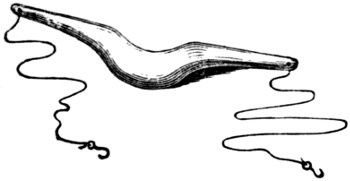
Fig. 84.
In the larger dairies the utensils in common use are
small wooden pails, Fig. 85, painted in variegated colors,
with bright brazen or iron hoops, and neatly washed;
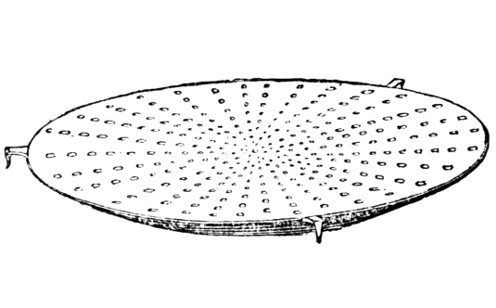
a strainer, Fig. 86, made of horse-hair; a large wooden
tunnel, Fig. 87, for pouring the milk into the cans
and casks; one or more buckets, Fig. 88, usually of
brass, lined with tin, large enough to hold the milk of
several cows together, or from twelve to eighteen
quarts. In many dairies they have wooden buckets,
Fig. 85, painted green or blue outside, with black stripes,
and with iron or brass handles, kept very bright. Here
the buckets are coated over inside with white oil-colors.
These are borne by the yoke (Fig. 84), or in some of
the ways indicated above.
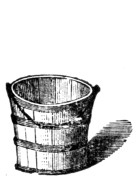
Fig. 85.
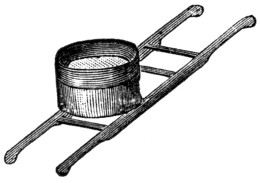
Fig. 86.
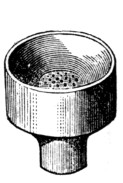
Fig. 87.
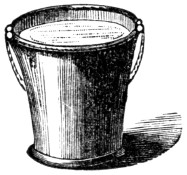
Fig. 88.
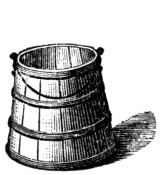
Fig. 89.
In many places, instead of buckets for keeping the
milk together, they use copper or brass cans lined inside
with tin, and in the form of antique vases or large
beer-jugs, Figs. 90 and 91, which are constantly kept
brightly polished. In other places, they use for holding
the milk smaller or larger barrels, Fig. 92, with
broad hoops also kept constantly polished.
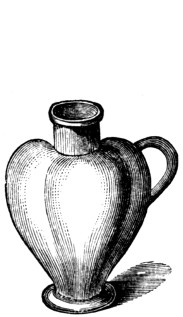
Fig. 90.
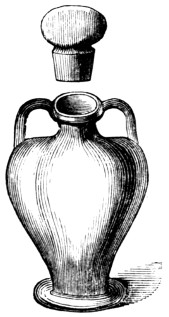
Fig. 91.
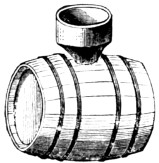
Fig. 92.
Instead of the yoke a soft cushion is also used, which
the dairymaids strap over their backs, so that they hang
down and rest over the hips and thighs. On this cushion
the cans are laid, and fastened with broad hempen
straps, that they may not press too heavily upon the
body. This band is called the milk-strap. Where the
milk is carried home on a hand-cart, neatly-woven
baskets are fastened upon little wagons in which the
cans are placed. If it is to be carried in casks, the same
arrangement is fixed upon a hand-cart. Two wooden
floats are laid upon the milk in the buckets, in order to
protect it from slopping over. One or more large milk-casks
or tubs, in which it may cool off properly, are also
used. The size of these tubs is different, as well as the
materials of which they are made. Where the cooling
is not left to the air alone, but is sought to be effected
by hanging the milk-tub into cold water, the vessels are
made of metal. The large vase-like jars are also used
for this purpose. These hold about thirty cans, or
twenty-six quarts. Wooden bowls are used, of different
sizes and forms, and earthen pans, rather deeper than
broad, Figs. 93 and 94,
in which the milk as it cools is
set for the cream to rise. A large pot for collecting the
cream until there is enough to churn, and wooden skimmers
for taking off the cream, are also used. The milker
sits upon a common four-legged, and sometimes one-legged
milking-stool, and milks either the teats on one
side, or one hind and one front teat, the pail being
held between the knees. The cows are milked regularly
at four or five o’clock in the morning, and at five
or six in the afternoon.
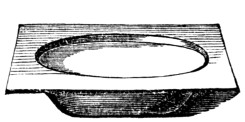
Fig. 93.
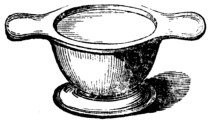
Fig. 94.
In West Friesland, North and South Holland, Utrecht,
and other places, it is customary to tie the tail to the
leg of the cow, that she may not annoy the milker.
Most cows do not resist this, being accustomed to it
from the beginning. They also pass a cord around the
horns and tie her to a post stuck in the ground during
the milking, as in Fig. 95. In many provinces only the
unruly cows are tied in this way.
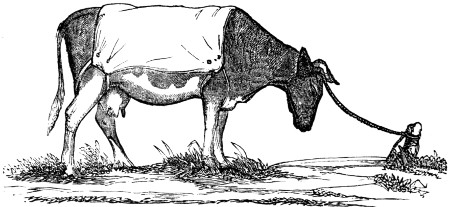
Fig. 95.
The milking takes place on the right side of the cow,
so that the milker sits on this side. In West Friesland
and North Holland there is an exception to this rule.
The cows are tied in pairs in the stalls, and one is
milked on one side and the other on the other, the
milker sitting with his back to the board partition, to
avoid annoyance from either animal.
When the milking is ended the milk is poured
through the hair strainer into the bucket, or through a
strainer or tunnel in the cans or casks, whichever are
used. The milk is taken to the dairy-house, without
delay, in some of the ways already mentioned. When
the yoke is used, one bucket is hung on the right side
and another on the left, each with a float on the top of
the milk to keep it from slopping over. The large
metallic milk-cans, with wooden stoppers, are borne
home on the cushions already described as being held
by shoulder-knots strapped round the waist. The
mode of transportation depends much on the distance
from the dairy-house and the quantity to be carried.
In winter, when the cows are in the barn, they are
likewise milked twice a day, and the milk is at once
strained through the hair strainer into casks made for
the purpose. These implements differ according to the
object pursued in the dairy; yet pans and pots are
mostly used for raising the cream to be made into
butter, since but few dairymen make cheese in winter.
All utensils necessary for milking, the preservation
of milk, and the making of butter and cheese, are kept
with the utmost neatness. Where a stream of running
water flows through the yard, the implements are generally
washed in that, and flowing water is preferred for
the purpose. But where the farm or dairy-house
stands at a distance from a stream, a shallow fountain,
or basin, is dug out in the earth, walled up, and so
arranged that the water can be taken from it and fresh
water substituted when it gets impure. In such a
basin, or in flowing water, all new wooden dairy utensils
are soaked for a long time before being used; but
those in daily use are washed, rinsed, and scoured out
with ashes, with the greatest care. None but cold,
clear, fresh fountain or flowing water is taken for cleansing
dairy implements. It is to be observed that, in
large dairies, the use of water which is covered with
newly-fallen honey-dew, for washing the dairy utensils,
is carefully avoided. When the milk-vessels have been
perfectly rinsed out in fresh water, they are, in many
dairies, put into a large kettle of water over the fire,
and properly scalded; after which they are again cleanly
washed with cold water, so that not the least particle
of milk or impurity is to be seen, nor the least smell of
it to be observed. The metallic milk-vessels and the
metal parts of the wooden ones are cleansed with equal
care and exactness, and kept polished. Dairymaids
feel a pride in always having the brightest, most
polished, and cleanest utensils, and each strives earnestly
to excel the others in this respect.
When the milk-vessels are scoured, scalded, and
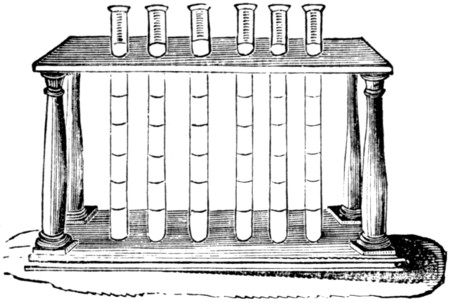
rinsed perfectly clean, they are hung on a stand of
laths and poles, made for the purpose, to be properly
dried. The round wooden milk-bowls, being made of
one piece, are very easily broken or split, and must be
handled with very great care in cleaning. To avoid
breaking, a peculiar table is used for scouring them.
The Dutch dairyman knows perfectly well that his
dairy can secure him the highest profit only when the
utmost cleanliness is the basis and groundwork of his
whole business; and so he keeps, with the most extraordinary
carefulness, and even with anxiety, the greatest
possible neatness in all parts of the dairy establishment.
—The Dutch cattle are, in general, renowned
for their dairy qualities; but especially so are the cows
of North Holland, which not only give a large quantity,
but also a very good quality, so that a yield of sixteen
to twenty-five cans[2] at every milking is not rare. Next
to these come the West Friesland and South Dutch
cows, from which from twenty to twenty-four cans of
milk may be calculated on. Though one could not
take a certain number and calculate surely what the
yield of each cow would be, yet he could come very
near the truth if he reckoned that a cow, in three hundred
days, or as long as she is milked, gives, on an
average, daily, from six to eight cans of milk, from
which the whole annual yield would be from one
thousand eight hundred to two thousand four hundred
cans. Of this the cow gives one half in the first four
months, one third in the next three, and in the
remainder one sixth. These superficial results cannot
be taken, however, as the fixed rule.
Professor Wilkins, in his Handbook of Agriculture,
gives the following estimates of the yield of milk: A
good West Friesland or Gröningen cow will, after calving,
give daily fourteen quarts of milk. This will, after
a while, be reduced to eight quarts. She may be milked
three hundred and twenty-three days in the year, and
her product in butter and cheese will amount to one
hundred güldens.
In Prof. Kop’s Magazine it is stated that a medium-sized
Friesland cow, which had had several calves, was
giving daily, on good feed, five and a half to six buckets,
or from twenty to twenty-two cans, and over. In South
Holland, also, this quantity is considered a good yield
of a cow. Of the cows of Gelderland, Overyssel, and
Utrecht, the yield cannot be reckoned higher than sixteen
cans daily, and that only during the first half of
their milking season.
—To get good
butter it is quite necessary that the fresh milk be
properly cooled before it is set for cream. In the great
dairies of North and South Holland, which not only
possess the best cattle, but may be given as models in
dairy husbandry, they manage as follows:
The milk, as it is brought from the pasture, is poured
from the buckets, cans, and casks, through a hair
strainer, into one vessel, the milk-kettle. These milk-kettles
are not everywhere of the same size, or of similar
form, but are always riveted together with strong
brass or copper bands, and lined with tin inside. The
most common milk-kettles hold sixteen cans; yet they
are found so large as to hold three barrels, or about six
hundred quarts. The peculiar kettle form is very rarely
found, but more frequently the cylindrical, or vase-shaped.
They are held either by two handles or one.
The number required depends on the number of cows
and the quantity of milk expected.
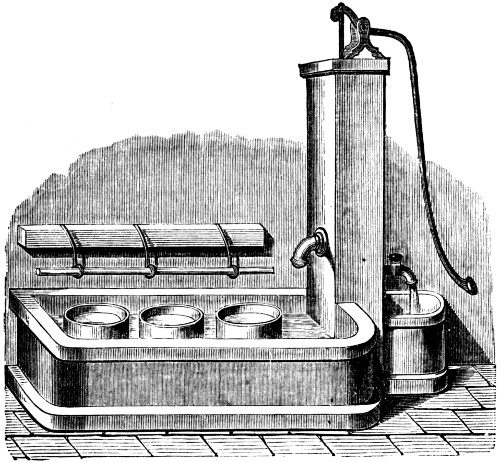
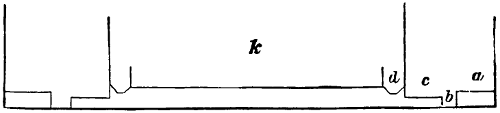
Fig. 96. Cool-bath.
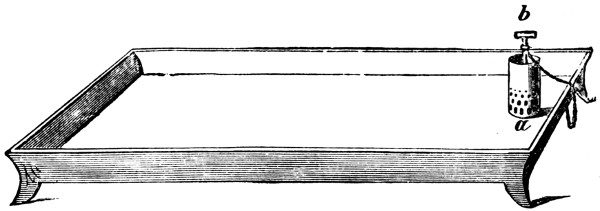
The milk-kettles, when filled, are set into a basin
with cold water, called the cool-bath, for the purpose of
cooling the milk. The cool-bath is frequently in the
kitchen, sometimes in the bauer-house, so called, or
directly before the cow-room, near the spring. The
latter is the most common and the most convenient
place. The water reservoir is dug in the ground, and
an oblong four-cornered form is preferred for it; the
sides of the excavation being walled up with hard-burnt
building-stones and cement, but the bottom is laid in
tiles, either red, hard-burnt, or white glazed. Richer
dairymen take finely-hewn blue stone or white marble
for it. The size of the reservoir is governed by the
number of milk-kettles to be put into it, and so is its
depth by their height, so that the rim of the kettle is on
a level with the top of the cool-bath, Fig. 96. The
sides of the cool-bath in the
kitchen project some feet over
the floor, yet are not so high
that the setting in and taking
out the milk-kettle will be attended
with great inconvenience and trouble. Where
it is desired to make the work of setting in or raising
up the milk-kettles from the cool-bath as easy as possible,
a beam is fixed along the side of the trough, and
iron props are firmly fixed, which extend out a little
over the edge of the trough, half-way down from the
beam. On these the operator can support himself in
lowering or raising heavy vessels. These stays, or
props, are sometimes fixed directly into the wall, along
which the cool-bath stands. Under the bottom of the
reservoir, on the other side from where the water
comes in, is an outlet, stopped with a tap or faucet, to
let off the water.
The cool-baths in the kitchen are, for the most part,
on the floor, and extend up a convenient height; whilst
those in the cow-barns, as a general rule, are dug down
and walled up, and their top is fastened to the floor of
the barn. They are deep enough to allow the water
for cooling the milk to come up to the rim of the milk-kettle;
but, in order to prevent men and cattle from
falling in, it is covered with a strong wooden lid to
shut down, as in Fig. 97.
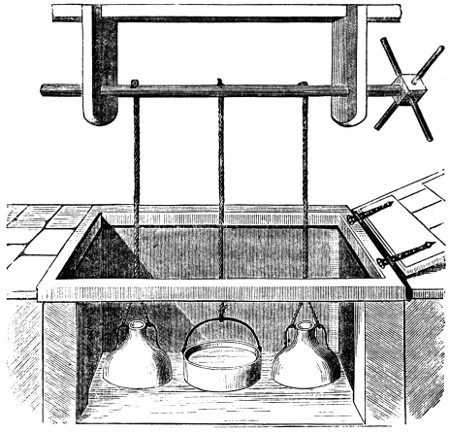
Fig. 97. Cool-bath.
Such a cool-bath is used in the cow-room only in
summer, when the heat is so great that it is difficult to
keep the milk cool in the kitchen. The cool-bath in the
cow-room is considered as only an auxiliary to that in
the kitchen, and to be used only in case of necessity.
The milk-kettles are hung by their handles, and let
down by means of a crank. When the platform is not
in use it is taken away from the cool-bath, and the cover
is let down and kept closed.
The milk is allowed to remain in the cool-bath until
the froth has disappeared, and there is no difference in
temperature between the water and the milk. The
milk of one milking must give place for the next, so
that it will be changed twice daily, morning and evening.
A very great importance is, everywhere in the
Dutch dairies, attached to this rapid cooling of the
milk, because it is known by experience that it is thus
greatly protected from turning sour.[3]
The milk, when properly cooled, is brought to the
milk-cellar, where it is immediately poured out of
the milk-kettles into vessels designed to receive it.
Wooden bowls or pans, or high earthen pots, are used
for holding it. The pans and pots are set on the table,
and a small ladder, or hand-barrow, is laid on there, on
which is placed the strainer, when the milk is poured
from the kettles. The wooden milk-pans are of several
forms, generally made of ash or of linden, and oval.
They are, on an average, three and a half feet long, and
half a foot broad, more or less; but their dimensions
vary.
It has been found, by experience, that the flatter and
shallower the pans, the quicker and better the cream
rises. The milk-pots are pretty large, but are rather
shallow than deep, glazed inside, of different forms, and
different capacities; but they are always broader on the
top than at the bottom, though they stand firmly on a
round, broad foot-piece. Milk pans and pots are rinsed
with cold water before the milk is poured into them.
When properly cleaned and filled, they are placed on
shelves made for the purpose, in regular rows. These
shelves are only a few feet high above the floor of the
cellar, and of suitable width; but, if there is not space
enough for the milk, the pans are placed on the bottom
of the cellar. The pots are also set along the walls, on
firm board shelves.
The milk-cellar, or rather the milk-room, Fig. 98, in
the North and South Dutch dairies, is placed on the
north side of the house, next to the kitchen, but a little
lower than the latter, so that there are usually three
steps down. The longer side, facing towards the
north, has one window, whilst the gable end, with its
two windows, faces towards the west. The windows
are generally kept shut, and are open only nights in
summer. The cellar is either arched or covered with
strongly boarded rafters, over which the so-called
cellar-chamber is situated. The floor of this room is
laid in lime or cement, with red or blue burnt tiles, so
that nothing can pass down through into the milk-cellar.
In the cellar itself are the above-mentioned shelves and
platforms for the milk-vessels along the walls, while
outside, in front of the cellar, linden and juniper trees
are planted, to prevent as much as possible the heat of
the sun from striking upon the walls. Cleanliness, the
fundamental principle of Dutch dairy husbandry, is
carried to its utmost extent in the cellar. Barrels of
meat, bacon, vegetables of every kind, and everything
which could possibly create a strong odor and infect
the air, or impart a flavor to the milk, butter, or cheese,
are carefully excluded.
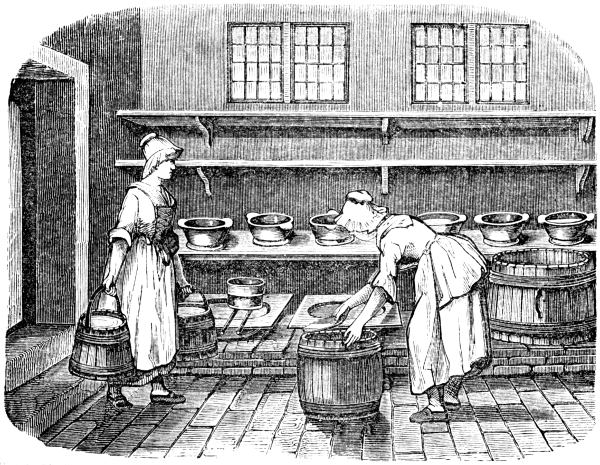
Fig. 98. Dutch dairy-room.
The vessels in which the milk is set remain standing
undisturbed in their places, that the formation of cream
may go on without interruption. Twenty-four hours,
on an average, are thought to be necessary for the milk
to stand, during which time the cream is twice taken
off, once at the end of each twelve hours. The morning’s
milk is skimmed in the evening, and the evening’s
on the next morning. But the milk always remains
quite still till the dairymaid thinks it time to skim,
which she decides by the taste. Long practice enables
her to judge with great certainty by this mode of trial.
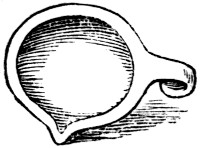
Fig. 99.
When the cream is ripe it is taken off
by the dairymaid with a shallow wooden
skimmer, Fig. 99, in the form of a deep
plate, and carefully placed in a particular
vessel—a bucket or cream-pot. The
cream-pot is generally washed very clean,
the staves very finely polished, striped with blue or
white outside, and held together by broad brass or
copper hoops, kept very bright. For closing the jar
they use an ashen cover, which is either simply laid
on by a common handle, or sometimes held on by
brass or copper hinges. Both cream-pot and cover
are always scoured quite white and clean. The cream
remains there till enough is got for churning, or till
it becomes of itself thick enough for butter. It is
known to be of the proper consistence for butter when
a long, slender, wooden spoon, thrust down into it, will
stand erect. When in summer the cream does not get
thick enough in season, they seek to hasten it by
putting in a little butter-milk; but in winter the ripening
of the cream is hastened by warming, either by
holding the cream-pot over a coal-pan, or on a hearth-plate.
The remainder, the skim-milk from the milk bowls
or pans, sour milk, or butter-milk, is poured into a particular
vessel, and made into spice-cheese.
Besides the methods here described for keeping milk
for butter, milk is used for other purposes. Sweet
milk cheese is made of the unskimmed milk; cream is
used in the house for coffee. Rennet is also added to
fresh milk, and the product is immediately sold, being
greatly relished by many. From skim-milk and butter-milk
put together is made an article called kramery
by cooking the mixture, putting it into a linen bag,
and hanging it in a cool part of the milk-cellar, or elsewhere,
when the liquid drops out and leaves a mass of
considerable consistence, called Hangebast.
As soon as the milk is taken from the vessels, they
are taken out of the cellar and carefully cleansed and
dried before being used again.
—Churning is the principal
operation in the manufacture of butter, for by it the
fatty particles are separated from the other constituents.
There are several methods in Holland of effecting
this separation of the butter globules. The oldest
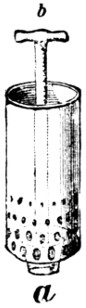
and simplest is that of putting the cream into an
upright churn, in which the cream is agitated by moving
a long dasher, pierced with holes, up and down, till
the object is accomplished.
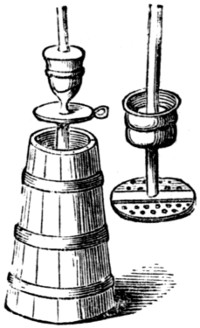
Fig. 100.
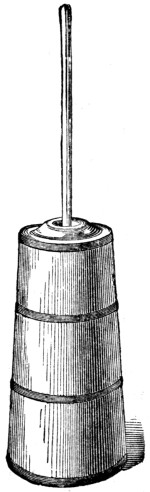
There are, strictly speaking, only two forms of the
churn which are used in all parts of the country. One
is broad at the bottom and narrow at the top. This
has been known from the earliest times, and is called
the old churn, Fig. 100.
This old churn is still used in many dairies, and it
has the preference over the other form,
because it is thought to bring the butter
quicker and more completely.
The other form is more like a beer or
brandy cask on end, being smaller at
each end than in the middle, and is
called the barrel-churn. Both kinds are
made of oak-wood, and have wooden or
broad metal hoops. In the one case
they are painted outside; in the other,
they remain of the natural color, but are the more
frequently scoured, so that the dark-colored oak-wood
gets a whitish color. The metallic hoops are always
kept polished bright.
Both kinds are of different sizes, according as the
quantity of cream is greater or less, or as they are to
be worked by hand or animal power simply, or by
machinery. In South Holland, where unquestionably
the most butter is made, the barrel-churn is at each
end about two feet and two inches in diameter, and
in the centre is seven inches broader, with two-inch
staves. The old churn, on the other hand, is usually
fourteen inches at the top and twenty-five at the bottom.
In North Holland and West Friesland, also, sizes are
found in which one hundred and fifty to two hundred
quarts of cream can be churned. The churns have each
a strong cover at the top, which fits into their rim about
the thickness of the hand, with a hole in the middle for
the dasher.
The churning is performed either by the hand motion
of the dasher, as in all small dairies, and in the smallest
churns, or by man-power with the help of certain
mechanical contrivances. The means for effecting this
are different, and so the churns have different names.
In many dairies, for instance, they have a lever connected
with the dasher; in other places they use a
flexible pole, fixed into the ceiling above, for facilitating
the motion of the dasher, or put a lever in motion
with the feet, which raises and sinks the dasher. There
are also complicated artificial butter-machines and
butter-mills, which are named after the inventor, the
manufacturer, or the motive power. The most known
and widely used are the turning-mills, the wheel-mills,
and the clock-work mills; as the Hand Butter-Mill of
Valk, Fürst’s churn, etc.
There are also still more elaborate machine-works
for moving the dasher, which are used in the larger
dairies on account of their convenience and economy.
Dog-power and horse-power churns are frequently met
with.
—The use of this
is well known. The dasher is moved up and down by
hand, with the churn full of cream, till the butter
particles are separated and collected together. The
operator keeps his body in equilibrium, to exercise the
power of moving the dasher regularly for agitating the
cream.
is very commonly used in South
Holland, Fig. 101. The churn itself is barrel-form,
as already described, and the dasher is put in motion
by a lever. The upper end is pierced with holes,
through which runs an iron pin. In a beam of the
ceiling two joists are firmly fixed, about a foot and
five inches long and four inches square, and several
inches apart. The longer arm of the lever is four
feet and seven inches; the shorter, three feet and six
inches. The churn stands under the short arm of the
lever, where the dasher is fixed. By drawing the
longer arm of the lever towards him, the operator
presses the dasher down through the cream. This
mode is far less wearisome than the hand-churn,
because by the lever, with less expense of power, a far
greater agitation is produced. A weight is sometimes
attached to the longer arm, by which the power required
is still further reduced.
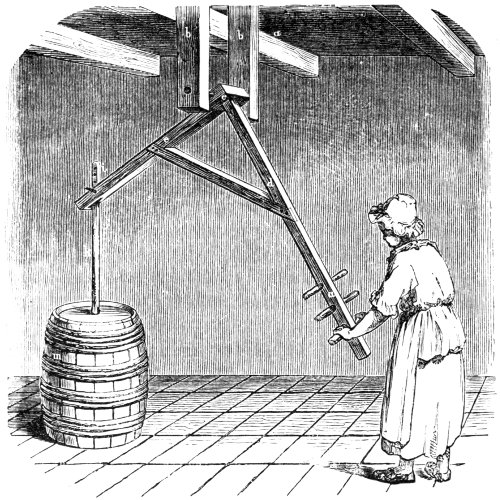
Fig. 101.
—The old-fashioned
churn is set in motion by the aid of another kind of
power, as seen in Fig. 102. A long, tough, flexible
stick is fastened into the cross-beam in the ceiling, so
that its larger end is held firm by two iron clasps. The
elasticity of the rod is such that, when the smaller end
is drawn down by hand, which, at the same time, moves
the dasher, it rebounds, and thus saves considerable
expenditure of power.
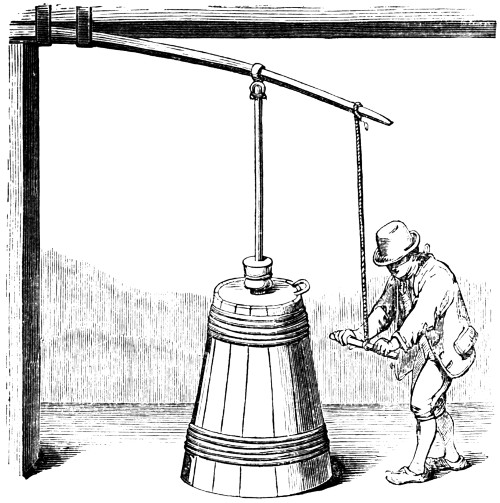
Fig. 102.
—In many
places the churn is put in motion by the feet, as in Fig.
103, where several levers are united to produce the
upward and downward motion of the dasher. The
longer arm of the lever is connected with the churn,
and the shorter is set in motion by a foot-board.
The foot-board lies on a roller, with its longer part
attached to the lever; and by throwing the weight of
the body upon this part the shorter arm of the lever
is drawn down, and the longer, attached to the churn-dasher,
is raised. The mode of operation is so plainly
seen in the cut as to need no explanation.
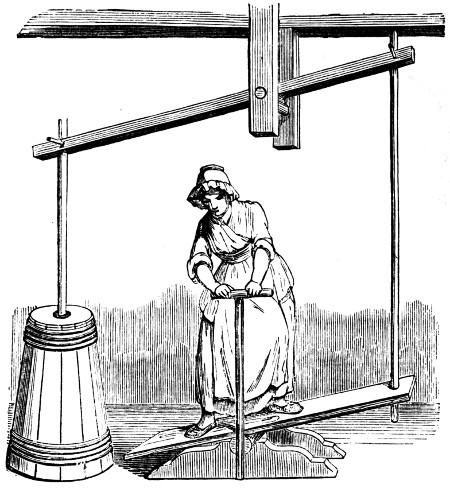
Fig. 103.
Among the more ingenious contrivances used for
churning in Holland belongs the churn invented by
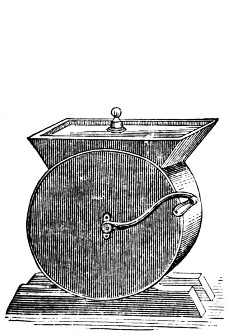
Fürst. The body is somewhat similar to the barrel-churn,
but is smaller; and it is of uniform diameter
throughout, as in Fig. 104. It is covered with a
wooden lid, furnished with a convenient handle, and
stands on a low platform, to which it is fixed, when in
use, by means of a screw, k. The motion is communicated
to the dasher by means of a wheel, or windlass,
and an endless cord.
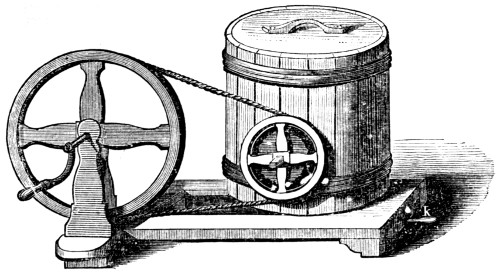
Fig. 104.
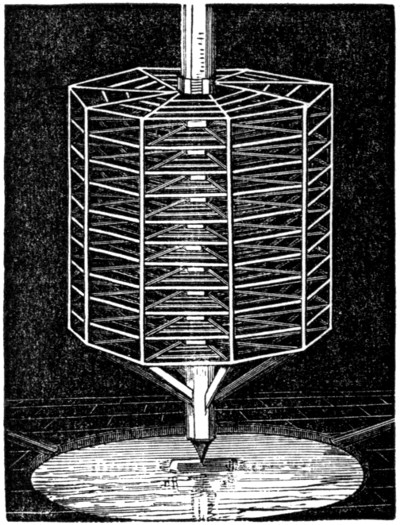
In the interior of the cylinder is placed a kind of
ventilator, Fig. 105. This consists of eight wooden
wings, pierced with holes, and motion is communicated
to it by means of the wheel, b, connected by the
cord to the larger windlass. The wings of the machine
when set in motion, strike incessantly in the cream, and
so powerfully that the whole mass is agitated, and in this
manner the separation of the butter particles is soon
effected. The motion is so rapid that it is often necessary
to turn the crank very slowly, especially just as the
butter is coming.
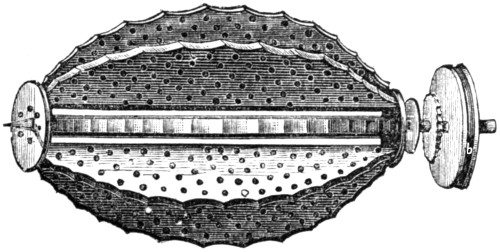
Fig. 105.
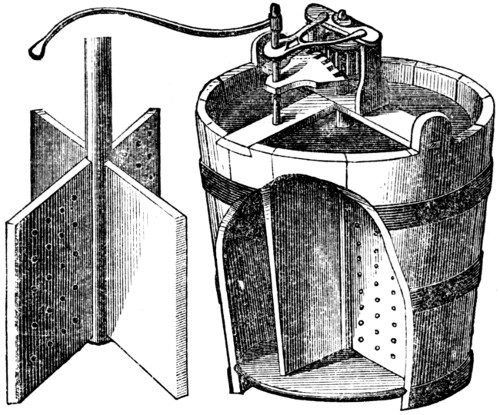
Fig. 106.
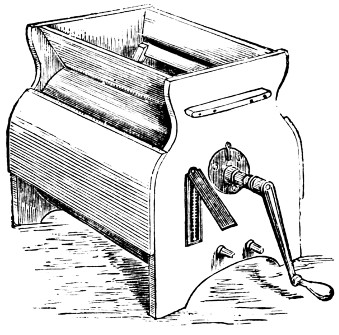
Valk’s Hand Butter-Mill, Fig. 106, has many advantages.
It is less fatiguing to work than the old-fashioned
churn, and even than Fürst’s, because the
motion of the body required is simple and less exacting.
And again, the churn takes up less room, and is
easily transported, which is an important consideration
in churning, on account of the influence of the temperature.
In summer the heat may delay, or render the
operation difficult, and in winter the coldness presents
obstacles. A transportable churn can be moved into a
cool place in summer, and a warm one in winter, when
it is desirable. The dasher of the churn is also seen
separate in the same figure.
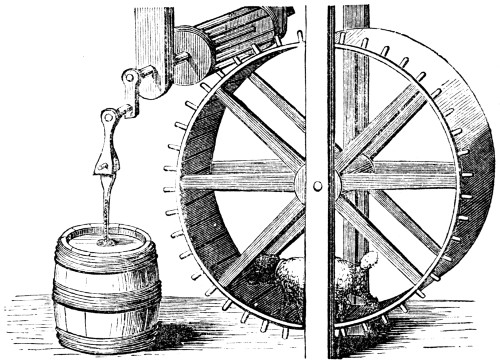
Fig. 107.
The Dog-power Churn, Fig. 107, economizes labor,
while, at the same time, more butter is obtained, on
account of the uniformity of the agitation produced. It
is in use in all the Dutch provinces. The form and size
of the churn are comparatively indifferent; but the
tread-wheel and direction of the moving power are the
important points. The diameter of the wheel is from
ten to twelve feet, and the rim or outer circumference
is made of boards two
feet wide. The weight
of the animal turns the
wheel and moves the
dasher by means of
cogs, as shown in the
figure.
Where there is a
sufficient supply of
moving power, a churn
with two dashers is
sometimes attached, as
shown in Fig. 108, in
which case one dasher
moves down while the
other is raised.
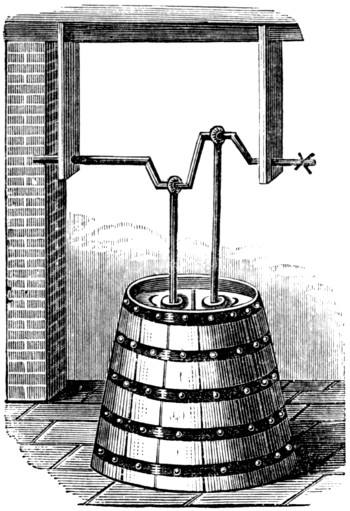
Fig. 108.
A large and strong
dog is required, and
he is easily taught to
keep to his work, by beginning with short trials, and
gradually lengthening them. A steady and uniform step
is necessary, and this will soon be acquired. The dog
is sometimes left free, and sometimes tied by a line.
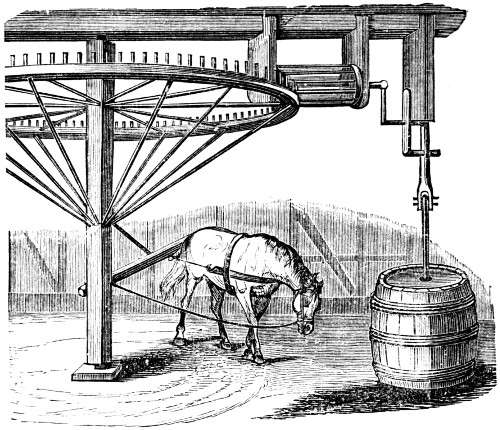
Fig. 109.
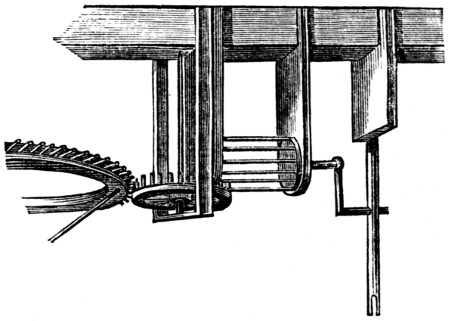
Fig. 110.
—On large farms and in
extensive dairies the churning is done by horse-power,
as shown in Fig. 109. The form of the churn itself
is optional in this case, also. The size of the wheel varies,
but it is seldom less than nine or ten feet in diameter,
furnished with cogs on the upper surface, which
are from four to six inches long, and play into a smaller
wheel, the axle of which is attached to the dasher of
the churn. A third and smaller wheel is sometimes
introduced, as in Fig. 110. A quick and regular step
is required of the animal, and a quiet and docile horse
is always preferred. A horse adapted to this work commands
a good price. Blinders are always used on the
horse while churning.
—In whatever way the
churning is performed, the result is always a separation
of the fatty particles from the other constituents of
the milk. As soon as the churning indicates that the
butter particles increase in size and collect together,
the motion of the dasher must be hastened till the butter
has come together in a large mass. Great care
should be taken to observe the appearance of this formation.
The Dutch dairymaids acquire great skill, by
long practice and experience, in judging of the proper
moment when the separation of the particles has completely
taken place. Very great importance is with
justice attached to this skill, for it is undoubtedly true
that one with this knowledge can get far more and
better butter from milk of the same quality, the same
quantity, and skimmed at the same time.
The cream taken from the milk of thirty-five cows,
after standing twenty-four hours, is generally churned
in summer in less than an hour, sometimes in three
quarters of an hour. In very hot weather the cream-pot
is frequently set into the cool-bath of fresh water
for five or six hours before the churning begins, and it
churns the easier for it. Cold water is never poured
into the churn with the cream. In winter, as well as in
cold weather in spring and fall, warm water is sometimes
poured in with the cream.
—When the
churning is finished, the dairy-woman
takes out the butter with a wooden
scoop, Fig. 111, and puts it into a
tub for further working. The tub,
Fig. 112, is a
broad, shallow vessel, open at the
top, and having an opening at the
bottom which is stopped by a
bung. The scoop is pierced with
holes, through which the butter-milk
drains. The butter put into the tub is now rinsed,
salted, and formed.
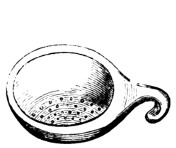
Fig. 111.
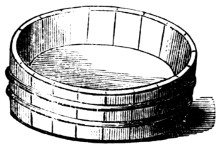
Fig. 112.
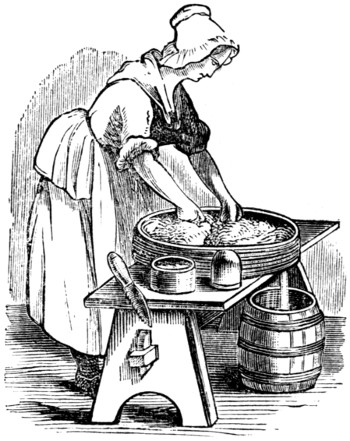
Fig. 113.
The tub is put upon a low, firm table, and the butter
is worked by the hands, or by a shallow, rather wide
and strong wooden ladle, until the butter is united into
one firm and entire mass. Many
dairy-women are accustomed to
work the butter out from the middle
towards all sides before bringing
the whole mass together in the
tub. Then very clear and pure
fresh cold water is poured
upon the butter, and
worked through it till all
the milky particles are
entirely removed. After
this is done in several
workings, the bung is
removed from the bottom
of the tub, and the watery
matter runs down through a little strainer, as in Fig. 113.
As a general rule, butter is washed with water and
worked over eleven or twelve times; yet the operator
must judge whether the butter contains any particles of
milk, and must work with water till, as it runs off, it is
no longer whitish, but perfectly clear. Butter sometimes
becomes too soft from too much working, if it is
all done at once; it is then worked over two or three
times, and allowed to stand in cold water after each
working, which preserves its hardness and texture.
This whole operation is called the washing of the butter.

Fig. 114.
When the washing is finished, the butter is cut with
a blunt, saw-toothed knife, Fig. 114, in every direction,
in order to remove all
hairs, or fibres of any
kind, which by any possibility
have got into it during the day. It is then
sprinkled over with white, finely-powdered salt, the
quantity of which is regulated by the taste; and this is
perfectly worked in, so that the whole is uniformly
salted. Most dairy-women determine the quantity of
salt by the eye and the taste, and acquire such facility
by continued practice that they always get the proper
quantity; but less experienced ones take the salt by
weight. The salting is not all done at once, but is continued
three or four days, twelve hours intervening
between each application, until all the salt has dissolved,
and not a crystal is to be found. If the butter has a
speckled and variegated appearance, it is a sign that the
salt is not completely worked in, and the neglect must
be remedied by working it over still more in the most
thorough manner. When the salt is all dissolved, the
butter is brought into single balls and got ready for
the next market-day, or the whole mass is put into a
particular keg, in order to be taken to market at some
subsequent time as firkin-butter.
—The form of the butter
is made by taking a suitable quantity and pressing
it into a mould, and then taking it out by knocking
on the mould. Many different forms of butter-moulds
are in use in the different sections of Holland, such as
are shown in Figs. 115, 116, and others.
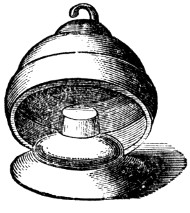
Fig. 115.
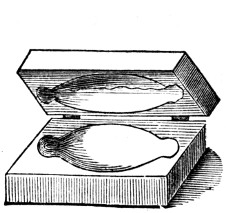
Fig. 116.
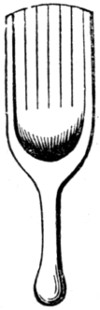
Fig. 117.
The figures impressed on the butter are given by the
mould, where it is deeply engraved; or they are made
after the butter is taken out of the mould, and for this purpose
a peculiar instrument is used, Fig. 117, a kind of flat
wooden spoon, with a short, convenient handle,
and long grooves in the broad, flat surface. Each
region has its own peculiar stamp, or special
figures, which are given to lump-butter, to which
particular attention is paid by the purchaser.
The butter-dealer knows exactly that in one
section butter is stamped in one way, in another
section in some other way; and that the butter
of one section, with its peculiar stamp, is worth
more than that of another.
The butter-moulds are generally made of linden-wood,
but must always be large enough to hold at least a certain
prescribed weight of butter; for all lump-butter
brought for sale to the weekly market must be of a
prescribed weight. This weight is very different, and
almost every city has different regulations and market
customs; yet, in most places, a pound is the legal
weight. Certain market-masters, or inspectors of butter,
are appointed, and watch that all the butter has its
proper weight. If too light, it is forfeited by the
seller, who is also punished for fraud. The butter
brought to market is generally covered with very clean
white cloths, and several sample lumps are put for
inspection in a large butter-bowl, basket, or shallow
box.
Many dairymen are accustomed in spring, when the
first grass butter is made, to send their regular customers
a few little lumps of fresh May or grass butter.
These presents generally have a peculiar form, and on
the specimens most carefully prepared some animal is
moulded, as a sheep lying down, a dog, &c., with a bunch
of green grass or buttercups in its mouth. The dairy-woman
herself usually presents this butter in a beautiful
milk-bowl adorned with grass and flowers, covered
with glittering white cloths.
—If
the butter packed in firkins and barrels is to be kept
a long time, experience and knowledge are required to
pack it so that it will not be injured. The form and
size of these casks are different in different sections and
provinces. Where butter-making forms a chief branch
of dairy business, the particular form and size which
have been used for a long time are adhered to, because
dairymen know very well that the public recognizes
their choice butter by the form and size of the casks,
and buys it the more readily. The greatest anxiety of
the Dutch butter-maker is to keep up the old, well-earned
reputation which Dutch butter has in every foreign
country, both for its intrinsic good qualities, the result
of the process of manufacture, and for its extraordinary
appearance as an article of commerce.
For the proper preservation of the good qualities of
butter, it is of the highest importance to have the casks
properly made and treated; but the mode of salting and
packing the butter in them is also of special importance,
since this is examined at the sale. The old and
customary forms and sizes of butter-casks are, therefore,
of great consequence to the butter-maker, because
every butter-dealer and judge of butter recognizes at
once, by the external form of the casks, from what section
the butter comes, and makes up his mind on the
money value of the article from these appearances.
It was not originally known what kinds of wood were
best for transporting butter long distances in, and preserving
its highest qualities; and butter-casks were
made of several kinds of wood, as oak, beech, willow,
etc. But it was for the interest of the government that
Dutch butter should maintain its reputation for extraordinary
qualities abroad, and the most rigid laws were
enacted, prescribing from what wood the casks should
be made, etc.; and now only oak is allowed to be used,
and the casks are all inspected and stamped according
to law. * * * *
Before the butter is packed the casks are properly
cleaned and prepared, for which practice and experience
are requisite.
Old butter-casks that have been previously used are
cleaned of every particle of fat and dirt remaining in
them, and scoured and washed out as carefully as possible,
and are placed for several days in running water
before they are used again. If no running water is at
hand, quite clean pond or spring water is taken, and all
impure water is carefully avoided. After they have lain
in the water five or six days, they are carefully scoured
out with good wood-ashes and sand, and again well
rinsed. After several scourings and soakings, they are
put into a kettle over a fire and carefully scalded; and
then, when cold, again scoured and rinsed, for which
the most judicious dairymen use milk instead of water,
and they are then placed to dry in the air. They are
fit for use only when everything has been done in the
most careful manner.
But new butter-casks require still more particular and
careful treatment before they can be filled with butter
without fear of injury. They are got ready for packing
in several different ways. Some dairymen let them
lie in pure water a whole summer and winter long, and
wash them out in lye, and then treat them just as they
do those that have been used. Others, however, who
give the new casks the preference over the old, but
who cannot wait for the soaking in lye over summer
and winter, treat them in the following manner: They
prepare a lye of good American potash, which generally
contains the most alkali, in a cask holding some three
hundred quarts, taking a pound of potash to twenty
pounds of water. For a cask of the size named fifteen
pounds of potash are used, which is prepared by pouring
boiling water upon it and stirring constantly, adding
a little more water as the potash dissolves. With
this lye, which will be about five degrees strong by
Beaumé’s aërometer, the butter-barrels are entirely
filled. The barrels stand two hours filled with lye, and
are then emptied and exposed to the air to dry, without
being scoured out with water or milk. The lye may be
used again for other new barrels, even though a part
of its strength may be gone. Potash is added, from
time to time, to keep up the specified degree of strength.
A solution of fifteen pounds of coarsely-powdered alum
is prepared in about three hundred quarts of hot water,
in a vessel as large as the lye-cask. The butter-barrels
are also filled full of the solution of alum, and allowed
to stand twenty-four hours. This alum solution must
also be of five degrees strength by Beaumé’s scale, and
it can be used over and over by adding more alum now
and then. After emptying out the alum and lye, they
are dried a day in the sun and air, and then rinsed out
in fresh, pure water, when they can be used for packing
butter without fear. Some add a little sulphate of
iron or green copperas to the alum, when the solution
is more powerful; yet the management of the butter-barrels
is then more troublesome, and requires more
experience. The effect of the copperas has also the
disadvantage that it blackens the barrels, which, though
it does not injure them, is not liked by the purchaser.
By this treatment the new butter-barrels are much
more quickly and cheaply cleansed, and got ready for
packing and transporting butter, than by the course
pursued with old barrels. The barrels, treated as above,
are not only quite water-tight, but the wood is stronger
and more durable. By means of the potash-lye and the
alum solution the tannin is taken from the oak-wood
used in the barrels, which, if it remained, would give a
disagreeable taste to the butter. The effect of the potash
and alum upon the wood of the barrels is quite
harmless, and does not impart the least unhealthy quality
to the butter.
When the old or new barrels have been cleansed and
prepared, in either of the ways indicated, suitably for
packing the butter, the bottom of the barrel is evenly
covered with salt. Then a layer of butter which has
been thoroughly washed and salted is made, and
another layer of salt, and so alternate layers of salt
and butter till the barrel is full, when a little brine of
salt and water is poured on top. The butter is now
ready to be laid in the cellar, and thence to be sold and
exported. When the dairy is not sufficiently large to
fill a barrel each day, the butter of several churnings
must be used, and the barrel filled from time to
time as it stands in the cellar. In that case the upper
layer of butter is left covered with salt, and the cover
of the barrel is closed down tight. In most large dairies
a barrel is generally filled at one churning, which is
considered better for the quality of the butter. The
butter is always packed in so firmly that no space is left
unfilled.
In doing up butter for sale at home, or at a neighboring
market, the lumps are worked into the form of half
a sphere, and put into little bright-hooped boxes, made
to fit into larger casks, which can be nicely covered and
closed up, as seen in Fig. 119, where the dairy-woman
holds a box in her hand. The covered casks are also
seen carefully nailed up.
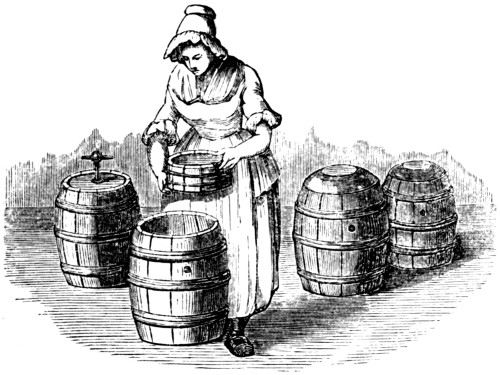
Fig. 119.
The buyer who wishes to try the butter uses a long
iron or steel borer, hollow inside, and furnished with a
handle, as also seen in the cut. This not only enables
him to test the quality but the uniformity of the butter
in the cask.
—The practice of coloring butter
is founded on the fact that we are accustomed to
form our judgment at once of the qualities of the article
from the whiteness or the yellowness of its color.
Whiter butter is less attractive generally than yellow
summer or grass-made butter. The color has come to
be important to the seller, and artificial means are found
to regulate it.
The coloring is made as follows: About a pound of
butter is melted, so that the heavier parts sink to the
bottom, when the light, clear fat on the top is poured
into another dish. In this fat thus poured off is put a
piece of annatto about the size of a walnut, wrapped
up in a linen cloth, and it is then again put over the
fire. The coloring matter of the annatto strains through
the linen cloth, and turns the butter brown red, when
it is allowed to cool off. When the butter is to be colored,
some of this brown red is melted, salted, and
mixed very carefully into the butter after washing. The
quantity of coloring matter used depends on the color
which the maker wants to impart to his butter, and a
little practice soon enables him to take the right quantity.
Others pour the coloring matter directly upon
the butter to attain the same end.
In coloring artificially it is important to get a uniformity
of color, which is the result of very thorough working.
Colored butter must not be marbled.
The cream is sometimes colored before churning.
The annatto is put into a clean beech-wood lye, and as
much of this colored and strained lye is taken as is
necessary to produce the desired color in the butter. It
is then churned as usual.
Turmeric is sometimes used instead of annatto for
coloring butter. It has no advantage, however, over
annatto.
In many sections the butter is colored with an extract
of saffron in water, or of marigold, or with the
juice of carrots, which is applied to the cream before
churning.
The coloring adds nothing to the quality or the taste.
It is done for the sake of the looks; but it gives the
butter a deceptive appearance.
—The butter-milk in the
churn is poured into a great cask, which in large
dairies, as a general rule, is painted blue outside and
white inside, with broad black iron hoops. It stands
generally in the kitchen covered with a wooden lid.
Butter-milk is used either in cooking, or for calves or
swine, or is sold.
Dairymen in the vicinity of large cities have barrels
with broad, bright brass hoops, in which they carry
their butter-milk to market. It is put into them
through a bung-hole, and when full the wooden bung
is wound with linen and driven in. In these barrels
the butter-milk is carried to Amsterdam, Rotterdam,
etc., sometimes by boats on the canals, sometimes on
wagons, and by yokes, and there sold to the grocers at
wholesale, to be again sold out by them. The butter-milk
thus brings an income by no means inconsiderable
to well-managed dairies.
—From time immemorial, cheese, as an article
of commerce, which has had a large sale, has brought
an extensive income to the cattle-breeders and dairymen
where its manufacture has been largely carried
on, as everywhere in West Friesland, North and South
Holland, and along the borders of the crooked Rhine in
Utrecht.
Dairymen are not the only ones who enjoy the advantage
which grows out of the cheese-trade; but a large
number of other people derive considerable profit from
it, and support themselves entirely by it. Even the
commonalty of the cities, where the weekly markets for
the sale of cheese are regularly held, derive a considerable
revenue from the small taxes for carriage and
market-dues, to which every seller has to submit.
The actual difference between the different kinds
of cheese made in Holland is due in part to the form
and size, and in part to the mode of making. Every sort
has also a name derived from its peculiarities, or from
the provinces or sections where it is made. The varieties
of cheese best known in the markets in South
Holland are the spice cheese, the sweet milk cheese,
known also under the name of Gouda cheese, the so-called
May cheese, the Council’s cheese, the Jews’
cheese, and the English cheese, made in many places.
Further up in North Holland, the North Dutch sweet
milk cheese, as it is commonly called in the province,
known in the foreign markets as Edam cheese, is almost
exclusively made. A kind of sweet milk cheese is made
to a limited extent, called Commissions’ cheese. In
West Friesland, Utrecht, and South Holland, but few
except sweet milk cheeses are made.
In making cheese, the utmost cleanliness is most carefully
observed in all the operations. Whoever is
intrusted with this work is required to display the
utmost neatness in his whole person, as well as in the
dairy-room; and the vats and other utensils are daily
scoured, washed with lye, and washed out in water and
rinsed. The greatest attention is also paid to the transport
of cheese to the weekly markets in the cities;
and in whatever way his load is carried, whether by
wagon or in little boats, the person intrusted with it is
always dressed in the so-called cheese-frock, a large white
linen, which is used exclusively for this purpose. At
the market itself the cheese is laid on a four-cornered
bench, two feet high, and exposed to view in a glittering
white linen cloth. But, in order to keep off all dust
and impurities, a sail-cloth is raised over the whole,
called the cheese-sail; or it is covered with a sail-cloth
covering, or sometimes with clean straw. But in other
places it is customary to carry the cheese on wagons,
in a white linen cloth, and covered with a woollen cover,
ready packed for sale at the markets.
—Spice cheese
from skim-milk, and sweet milk or Gouda cheese, are
the only kinds made to any extent in South Holland.
Spice cheese, which derived its name from the addition
of spices, is a firm, flat cheese, of about twenty pounds
weight, brought to market generally colored red. It is
three quarters of a foot thick, and one and a half feet in
diameter, and is made as follows:
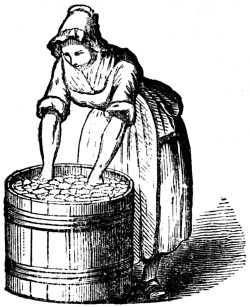
Fig. 120.
The skim-milk is poured from the milk-pans into large
tubs, and allowed to stand quiet till the cheesy matter
has settled to the bottom, which requires, perhaps, half
a day. Then the thin liquid on top is poured off very
carefully, without stirring up the rest, through a strainer,
into a large brass kettle, till it is full; but the thicker
substance at the bottom is left, and not put into the
kettle. Under this kettle a fire is made, and the milk
heated to a certain degree, regulated by the judgment
of the dairymaid, sufficient to warm other cold milk,
but it must not boil. The fire is made in the kitchen,
or in the summer-house, or in some other room called
the cheese-house. When the milk in the kettle is
properly heated, it is poured into the tub of milk which
has been heated and allowed to get cold. This tub is
an upright vat, open at the top, of uniform diameter,
bound with wooden hoops, and generally left of the natural
color of the wood; scoured very bright, but sometimes
painted blue and the
hoops black. It is seen in
Fig. 120.
When the quantity of milk
is large, the dairyman puts in
as much rennet as he thinks
necessary to curdle the milk
completely; but before and
during the addition of the
curd the whole is thoroughly
stirred, and this stirring is
continued until the stick or
wooden ladle used for the purpose
will stand erect in the curd. Then the dairy-woman
works the curd with her hands till no further
effect of the rennet in curding the milk is to be seen.
It is called the cheese-curd.
The rennet is prepared in the following manner: The
maw or fourth stomach of a newly-killed sucking calf is
taken from the other stomachs, carefully cleaned and
cut into strips two inches wide, and then hung up in
the chimney to be smoked and dried; or, in hot weather
in summer, it is hung up in the sun. Well smoked
and dried strips will keep a very long time. When
these are wanted for use, they are very carefully washed
and purified, and then laid in the salt brine from the
butter-barrels, or in lukewarm salt water to soak. The
liquid is put into bottles and laid in the cellar. For
curding milk as much is taken as is thought to be
necessary, which cannot be determined without considerable
practice and experience. If too little is taken,
the cheese is not fat enough; if more than the right
quantity, it gives a disgusting acid taste. It is difficult,
almost impossible, to state exactly how much rennet
should be used with a certain quantity of milk,
because this must be determined by its quality and its
strength. Something like the following quantity is,
however, taken: In a sixty-quart vat are placed about
fifty rennets, prepared by drying, washing, and cutting,
and a clear salt brine or butter-pickle of twenty to
twenty-five degrees strength is added. In smaller quantities
the proportion of rennet is about one and a half
quarts to a rennet, or even less. This dried maw can be
bought everywhere in packages of twenty-five pieces
each.
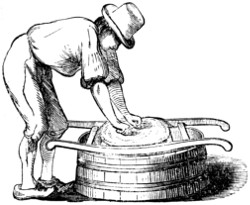
Fig. 121.
One great point in cheese-making is to have a sufficient
quantity of good rennet in store; for the older it
grows the more powerful and effective it becomes, and
the experienced cheese-makers, studying their own
interests, know very well how difficult, hurtful, and
time-wasting, it is to use fresh or new rennet. The assertion
sometimes made that they use muriatic acid instead
of rennet for curding the milk in Holland rests on an
error, at least so far as the present methods are concerned.
In earlier times, and for the poorest kinds, as
the Jews’ cheese, muriatic acid was more or less used.
At the present time,
the rennet for those
cheeses is prepared
from the stomachs of
calves some days old.
When the curd has
sufficiently come, and
has all been thoroughly
broken, the dairy-woman
puts a four-cornered
linen cloth,
called the cheese-cloth,
which is used only for this purpose, and is
only loosely woven, upon a small strong ladder laid
over the edges of a low tub, and puts upon the
cloth the proper quantity of curd, then ties up the
four corners of the cloth, and presses with her whole
strength, that the milk may drain off. This work is
also done by men who can apply great strength, Fig.
121. The corners of the cheese-cloth are brought
together, and the operator presses as hard as he can, in
order to remove all the milk from the curd. But, as
this is not possible with the hands alone, the whole is
placed under a plank-press, and by this means as much
of the milk as possible is pressed out. A strong cleat
is nailed to a pillar in the wall at a convenient height from
the floor,—say two feet,—so that the tub, ladder, and
cheese-cloth, can be put under the plank, when the
plank is pressed down upon the cloth and curd. At
the other end of the plank the operator sits and presses
down with the whole weight of his body, as seen in Fig.
122. The whey runs into the tub, and is generally used
as food for swine. The pressure is continued till no
more runs off.
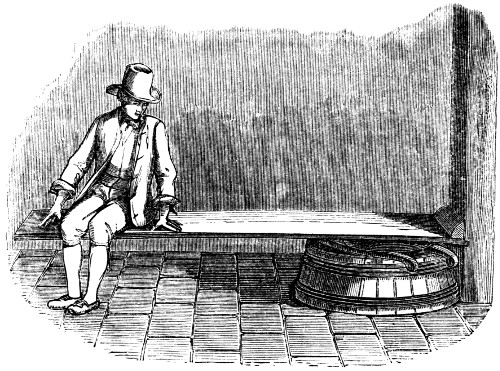
Fig. 122.
After the complete removal of the whey, the curd
remaining in the cloth has the form of the palms of the
hands, and is pressed so firmly that it holds together
when the cloth is removed. But it is again broken up,
and put for this purpose into the breaking-tub, a low
but broad, open tub, with wooden hoops, and made of
strong staves, and is here worked over by the bare but
cleanly-washed feet of the dairyman, or hired man. This
working with the feet is continued, just as in kneading
dough, till all is brought to a stiff paste.
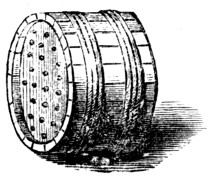
Fig. 123.
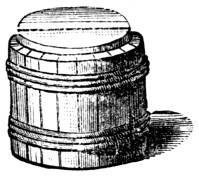
Fig. 124.
When it has come to this consistence the forming of
the cheese begins. The dairyman has for this purpose
a cheese-mould standing before him,
and lays on the bottom a layer of
cheese without spice, and this is
called the blind layer. The cheese
tub or mould, Figs. 123 and 124, is
used only for this first moulding. It
is a wooden vat, made of staves from
one to one and a half inches thick,
and is nine and a half to twelve and a half inches in
diameter, and about ten inches high, bound at the
bottom and top with stout hoops.
The bottom of oak-wood, put in
very carefully, is pierced with holes
for letting off any moisture that may
remain in the cheese. On the top of
the tub a cover is exactly fitted, to
sink down upon the cheese when
the pressure is applied. This cover
is of oak, one and a half inches thick, and has a cross-piece
three and a half inches thick, which serves as a
handle.
The first layer of cheese is quite firmly pressed down
or trodden into the mould with the hands or feet, and
then follows a layer of curd mixed with spices. The
mixture is made best by putting as much of the pasty
curd from the vat into a tub as will form one layer in
the mould. Over this the spice is strewn, caraway and
some pounded cloves, and the mass is then worked over,
when it is placed as a new layer into the mould. Upon
the second layer some coarsely-pounded cloves are
generally scattered, or they are stuck whole over the
surface. After that the second layer is pressed in like
the first, and the third follows, and so on till the mould
is full. On the uppermost and firmly pressed layer is
laid the cover. The mould thus carefully filled is now
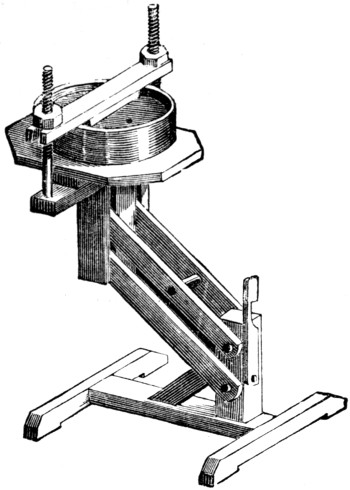
brought under a press, which, partly on account of its
length, is called the “long-press,” and sometimes the
“first” or “cheese press,” because the cheese first
comes under it. This press is seen in Fig. 125. It
stands on four short legs, and consists of upright beams
fixed upon a platform, and a long beam, acting as a lever,
with one end fastened by a rivet or bolt. The other
end is loaded with weights to any desirable extent, as
appears in the cut. The power of the press may also
be increased or diminished by shifting the end of the
lever to the lower or upper hole.
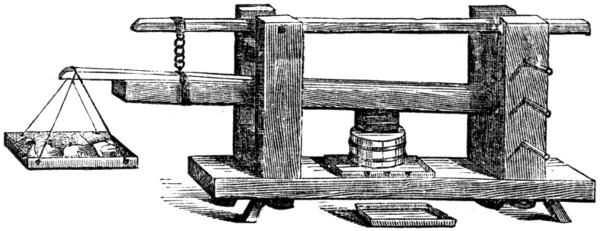
Fig. 125.
When the mould is put under the press it is set into
a shallow, four-cornered wooden box or pan on the foot-board.
This pan is furnished with grooves at the side,
through which the whey can escape. The pressure may
still further be increased by putting a block on the lid
of the mould, as appears in the press. It is this powerful
pressure which gives the cheese the high quality for
which it is distinguished above others. The whey still
remaining in the curd runs off through the holes in the
bottom of the mould, when the strong pressure is
applied, into the pan, and is caught in another pan which
sits under the press.
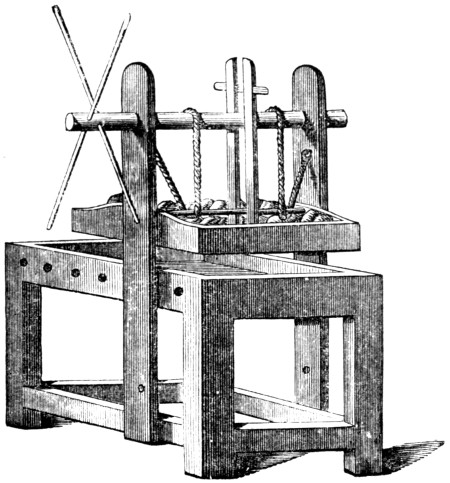
Fig. 126.
When the cheese has stood two hours under the
press, it is taken from the mould, surrounded by a clean
linen cloth, and again brought under the press. The
change of cloth is repeated once or twice after two or
three hours’ pressing, and the cheese is left standing in
the press over night. The next morning the cheese is
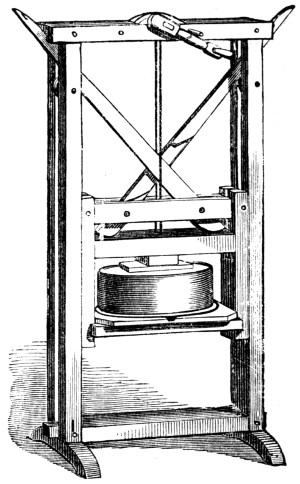
brought under another press, under which it is subjected
to still more powerful pressure, and receives its peculiar
form. This press is seen in Fig. 126, and consists of a
frame resting on four strong uprights, forming a kind
of firm table. On the plate of the table lie four or six
rollers, whose ends at both sides pass through holes
in the standard pieces, and serve merely to assist in
taking out the cheese. The pressure is obtained by
heavy weights let down and raised by a kind of windlass
fixed in two perpendicular
standards. The cheese
as it comes under this press
is not in the mould, but is
simply laid in a pan, as seen
in Fig. 127. Before the pressure begins, however, the
stamp or mark of the manufacturer, a key, a letter,
etc., in iron, is laid upon the cheese, and upon that a
square board. The pan and weight are lowered, so
that the pressure begins and the stamp is impressed on
the cheese, which becomes flatter, smoother, and firmer
than before. The cheese is left under this press till it
gets its final form, and the pressure in the pan is
increased or diminished, according to circumstances.
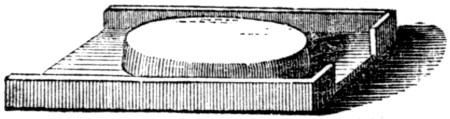
Fig. 127.
When the cheese, after being pressed in both machines,
has received its final form, it is placed in a long
trough, called the salt-trough, which is generally in the
cow-room behind the cow-stands. It has been already
said that the cow-stall is used as a cheese-room in summer,
when the cows are out to pasture. In this trough,
a space deep and wide enough for the diameter of the
cheese, from four to six cheeses can be laid. In the
salt-trough the cheeses are salted as long and as thoroughly
as is necessary. Observation and experience are
needed here to get the right quantity of salt and the
right time, that the cheese may receive a suitably firm
crust or rind.
When the cheese in the salt-trough is sufficiently
salted, it is put over a large tub, where it is properly
washed in cold, fresh water, trimmed with a cheese-knife,
and colored. For coloring, annatto boiled in water with
some potash is used. After the coloring the cheese is
rubbed with the beistings, or first milk of a cow newly-calved.
The spice cheese gets its red color and firm,
smooth rind in the coloring and washing in the beistings;
and this distinguishes it from other sorts.
The colored cheeses are now laid upon shelves made
for the purpose in the cow-stall used as a cheese-room,
and turned daily till properly dried. When dry they
are laid for sale in a cheese or store room. This room
is connected with the house, or separated from the
other rooms only by a thin board partition. This room,
as well as the cow-stall, is kept extraordinarily clean,—scoured
and aired, and used for nothing but the keeping
of cheese.
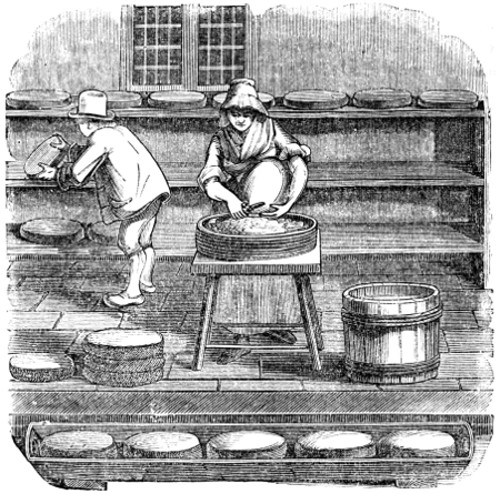
Fig. 128.
Fig. 128 represents the cow-stall used as a cheese-room,
in which the salt-trough is seen, and the dairyman
and dairy-woman are occupied in turning and trimming
the cheese.
—The best kind of sweet milk cheese is
made in the vicinity of the city of Gouda, and on the
gray and Dutch Yssel, from which circumstance it is
often known by the name of Gouda cheese.
The making of this cheese is less difficult than that
of spice cheese, but requires more attention and care,
because the rich sweet milk is used for it. It is as follows:
The milk as it comes fresh from the cow is
strained through a hair-strainer into a large wooden vat
or tub, or, in some large dairies, into a copper kettle,
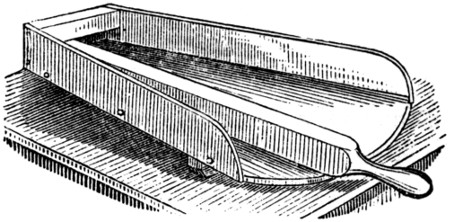
which stands on a peculiar tray or bench. This tray is
made of four to five inch posts, and its size is governed
by the quantity of milk of the tubs to be used;
but these tubs generally hold from one hundred to one
hundred and fifty cans. The milk is immediately set
with the requisite quantity of rennet, usually one quarter
of a can to one hundred cans of milk; and if it does
not “come” in a quarter of an hour, more rennet is
added.
When it has properly curdled, it is stirred in all directions
with a wooden ladle three or four times over, and
somewhat broken up, when it is allowed to stand three
or four minutes at rest. It is then gently and constantly
stirred again, with the ladle or the hands, and broken.
By too active stirring one gets more whey than cheese,
and very quick stirring must be avoided. The whey is
then allowed to stand some time, by which the curdled
cheese particles collect, and the whey appears on the
surface, and can be taken off and poured into a tub
made for the purpose. To the mass still remaining in
the kettle, which is now almost all cheesy matter, as
much hot water is added as is sufficient to warm it properly.
The addition of hot water must be made with
discretion, however, and must not exceed a certain
amount, which can be learned only by practice. The
more we add, the drier will the cheese become after a
while; and, though it may keep the better, and be better
for transportation, the taste is unquestionably injured by
it. The cold-made cheese is far more liable to injury
from keeping, but is much richer and more palatable,
on which account the best is generally eaten fresh. The
quantity of hot water to be added for warming the milk
must therefore he determined somewhat by the disposition
to be made of the cheese.
When the hot water has stood, say half an hour, on
the curd, it is taken off and poured into the whey. The
curd is now properly brought together by the hands or
a ladle, and again thoroughly worked and broken. After
standing at rest a short time, the water and whey are
turned off again, as completely as possible, in the whey-tub.
The mass of curd still remaining in the vat, now
called wrongel, is cut up into small pieces, which are
very carefully worked over, and then pressed into the
wooden cheese-mould. In order to get a very fine separation
of the curd, only a small quantity is taken at once
from the vat, which is rubbed in the hands, and then
pressed into the mould till it is quite full. The cheese-mould
is in the form of a bowl, made of willow wood,
with its lower part pierced with holes, so that the whey
can run off when the pressure is applied. The cheese
now formed is taken out carefully, rubbed with the
hands, and still further worked in the cheese-tub, and
again very firmly pressed into the mould with the hands.
To be able to press it into the mould with greater
power, an implement called the presser is used. It consists
of a short stick, with a kind of handle or cross-piece
on the upper end. On the lower end a disc is
fixed which fits into the cheese-mould. In using the
instrument, the disc is placed on the cheese to be pressed
into the mould, the handle or cross-piece is placed
against the chest or shoulders, and the operator presses
down at the same time with his hands, thrusting the
disc as deeply as possible into the cheese-mould. When
pressed enough on one side, it is turned round in the
mould, bringing the other side up, and the pressure is
again applied as strongly as possible. For saving the
whey in cheese-pressing, the mould is set into a pan only
a little larger than the mould itself, which catches the
whey running out from the mould. When the cheese
in the mould is properly pressed by hand, the cover is
put upon the mould, which is loaded gradually, in order
to bring down the greatest possible pressure. The
weight or pressure is greater or less according to the
size of the cheese; yet during the pressure the cheese
must be frequently turned, that it may get the right form.
The gradual increase of the pressure goes on for
twenty-four hours, when the cheese is taken from the
mould to be laid in a tub of salt-brine in the cellar; the
cellar must be kept cool. The cheese remains in the
brine twenty-four hours, but is turned once in that time.
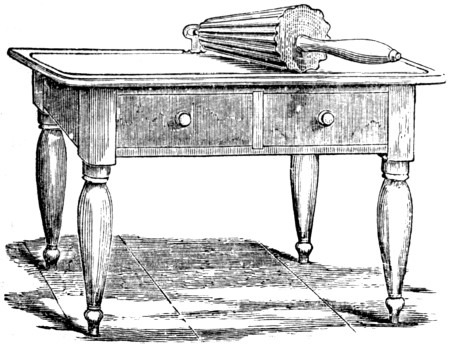
It is then taken out and put upon a table, the surface
of which is inclined, the legs of one end being longer
than those of the other. On both sides of the inclined
table run grooves in the direction of the inclination of
the surface, which unite at the lower end, and serve as a
way of escape for the brine or pickle into a tub below.
Here the cheese is rubbed with salt, and a handful of
salt, is scattered over the top, when it is left standing
for some time “in the salt.” If one side was rubbed
in the morning, it is turned at evening; and the other
side is served in the same manner as the first. A cheese
of from fifteen to sixteen pounds remains standing thus
four or five days, according to the temperature. If the
heat is great, it must stand the longer in the salt. When
sufficiently salted, it is washed off in hot water, and taken
to the cheese-room, where it is daily turned on dry, clean
shelves. If it is still greasy or dauby on the outside,
it is still further washed in water, and dried off with a
coarse linen towel.
The cheese-room is generally kept closed by day to
keep out the light and sun, which are not good for
cheese. It is opened in the morning and evening to let
in a little cooling air; yet a strong breeze is avoided by
opening all the doors and windows at the same time,
for the cheese will crack and break open if exposed to it.
Sweet milk cheese is fit for use at the age of four
weeks. Strongly salted cheese does not ripen up so
quickly as that which is salted less; but, if it takes
longer, the loss is less, and, on that account, it is preferred
for sending off to less salted cheese, which, on
the other hand, is richer, and has a little better taste.
In the daily turning of the cheese, great care is taken
to observe any little specks in it where the mites conceal
themselves. As soon as such places are discovered,
a hole is dug out with a knife as deep as they extend
into the cheese. The holes are left open till the next
day, when, if no more mites appear, they are stopped
up with other cheese. But, if they still appear, some
pounded pepper is put into the holes, which destroys
them. Rotten or moist spots on the cheese are treated
in the same way, but very deep holes have to be made
into the cheese, and it is best to cover them with
buckwheat-meal, when they dry up very quickly.
In very hot weather it sometimes happens that the
cheese swells up and begins to ferment. Then it is laid
on the cleanly-scoured pavement of the cheese-room,
where it is cooler; or, as many do, pierced pretty deeply
with holes with a knitting-needle, which often helps it.
With the decrease of the great heat of the sun, the
swelling also ceases. The cheese is not injured except
in appearance, the taste being improved. But, if the
swelling is very considerable, it makes the cheese hollow.
If the milk and cheese dishes are not very cleanly
washed and rinsed out, the cheese gets a wrinkled crust,
and begins to ferment.
Sweet milk cheese, three or four months old, is turned
and aired only once a week in dry weather. Many
cheese-makers also sprinkle the cheeses daily, for a week
or two after they are fourteen days old, with beer and
vinegar, or with vinegar in which saffron has been
extracted, by which it gets not only a beautiful yellow
color, but is also protected from flies.
—On
what remains of the milk devoted to the making of
sweet milk cheese in the manner above described, or the
whey which runs off in the pressing of the cheese,
there forms, after it has stood a few days, a fine creamy
skin, which is carefully taken off with a wooden spoon,
put in a clean jar, and stirred from time to time. This
cream is collected to make butter, and it can be done
once a week. This butter-whey is healthful and good,
to be sure; but, on the whole, is not so fine and delicate
flavored as good cream butter, and on this account is
cheaper.
The butter-milk which comes from the churning of
the cream of whey is a good food for swine. They
greatly relish it.
Whey is also sold as a beverage, and is called “sweet
whey.” When fresh and untainted, it is quite an agreeable
drink, very cooling, and good for the health in
spring, purifying the blood, though somewhat purgative
in its effect on the kidneys. Later in summer, when the
heat is very great, whey is thought to be rather injurious
to the health than otherwise. It is then used
exclusively for swine.
—In the early part of summer, when
the grass is best, sweet milk cheese is made in precisely
the same way as that described, yet of smaller size and
less weight. This is called May cheese, and is designed
for immediate use or sale when ripe, as it will not keep,
and easily loses its fine flavor.
—Another kind of sweet milk cheese
is the Jews’ cheese. It differs from common sweet milk
cheese in its form, which is flatter and thinner, and
partly in being less salted, and of a much looser texture.
It is but little made; but some dairies are devoted to it.
—This is made as the common
sweet milk cheese, only in much smaller moulds. It
has also a peculiar color. It is allowed to get rather
old before it is relished, and is then mostly given away.
—This is made in winter, when
the cows are in the stall. It is not so good as grass
cheese, which is made in summer, when the cows are at
pasture, and is less relished, and brings a lower price.
When the cows are brought to the barn late in the fall,
it can be made of very good quality for a few days;
but the longer the cow remains in the stall the more
the milk loses its good quality for cheese, on which
account but few of the larger dairies make cheese at all
in winter.
To make it appear to buyers more like grass-made
cheese, and to be able to sell it, it is colored with the
same material, and it is then often very difficult to distinguish
it, since great pains is taken to give the two
kinds the same form, hardness of rind, etc. The dairymen
have less to do with this deception than the dealers.
Hay cheese is rather better in quality for coloring,
since it gains in appearance and taste; but it never can
equal grass-made cheese in fine qualities.
—In the province
of North Holland sweet milk cheese is made almost
exclusively. From ancient times this particular branch
of farming has been carried to great extent; but it has
especially grown in importance since the province
gained a firm soil by artificial draining. At the present
time North Holland is the head-quarters of the cheese-trade;
and it is easily explained in the fact that no
other province has more or better cattle. The manufacture
of cheese is almost the only object of keeping
cattle, and the North Dutch dairy farmer applies himself
with the greatest possible zeal to the most careful
modes of cheese-making, in order to keep up the ancient
reputation of his cheeses, both in the domestic and
foreign markets, and to secure to himself all of the
advantages springing from it.
The quantity of cheese which is weekly sold in the
markets of Alkmaar, Hoorn, Edam, Purmerend, Medenblik,
Enkhuizen, etc., is enormous. We cite Alkmaar
alone as an example, where on the city scales there were
weighed no less than 23,859,258 Netherlandish pounds
(536,834,830 pounds, American), from 1758 to 1830.
Since that time the manufacture has increased, so that
from three to four million Netherland pounds are
annually brought to the Alkmaar market. But, besides
this, a large quantity of cheese does not come into the
market, but is sold at the dairy without passing through
the hands of the traders, and never comes to the city
scales.
In 1843 there were sold in the North Dutch cheese-markets
22,385,812 pounds, to say nothing of the large
quantity sold directly from the dairy. It is easy to
see, therefore, how important and extensive an interest
the manufacture of cheese has become for this province.
Of the twenty-two million pounds annually exported,
the value may be estimated as at least three million
Dutch guilders. The price and value of the cheese
vary, of course, with the markets.
The North Dutch cheese differs somewhat in quality
and money value, according to the section where it is
made; but in general that made in the region about
Hoorn is considered the best, as is very natural, since
in that vicinity are to be found the finest meadows and
pastures in the province. The villages of Oosterblokker,
Westerwoude, Hoogecarspel, and Twisk, are
distinguished above all others; and so are the pastures
of Beemster, Purmer, and Schermer, almost equally so.
The Dutch cheese-maker reckons twelve Netherland
cans of milk to a pound—two and a quarter
pounds American—of cheese, according to which a
cow in three hundred days would give from eighteen
hundred to two thousand cans of milk, or usually from
one hundred and fifty to one hundred and seventy-five
Netherland pounds of cheese, in a year.
are nearly the same as those already described for
saving the milk for butter, and those used in the
various processes of cheese-making in South Holland.
They are modified to some extent, to be sure, by the
taste, the pride, the wealth, or the caprice, of each dairyman.
Many a them are painted, wholly or in part, in
oil colors, for the sake of durability as well as cleanliness,
on which the North Dutch dairyman lays great
stress. They do not require much capital.
.—The North Dutch cheese is called sweet
milk cheese, and also, pretty commonly, white cheese,
where it is made; but in Germany it is called Edamer,
less because the best is made in the vicinity of this
city than because the largest trade in it is carried on
there.
All sweet milk cheese has not the same weight,
form, and size. Many kinds of it come into the market
under different names; as, for example, large cheese
of 20 to 24 pounds (45 to 54 pounds), Malbollen of
16 pounds (36 pounds), medium of 10 to 12 pounds (22
to 27 pounds), Commission’s of 6 or 7 pounds (14 to 16
pounds), and little ones of 4 pounds (9 pounds), to which
belong the Jews’ cheese. Besides this, the making of
English cheese is carried on. Malbollen is but little made.
It is of about twenty pounds weight. Fifty years ago
large quantities of it came into market, and were sold
mostly in North Brabant and the Rhine provinces. Of
the medium cheese the manufacture is pretty extensive
at the present time, and it is sold to go to North Brabant
chiefly. The price of these sorts is more frequently
fluctuating than that of the smaller ones; but less so
than that of Commission’s cheese, which is not much
made. These varieties in former years were very profitable,
since they were made with little labor, being light
and spongy from slight pressing and little salting, and
were sold green.
Dairy industry is now chiefly devoted to making
the varieties most known and sought for in Germany,
the Edam small sweet milk cheeses, which are sent in
enormous quantities to all parts of the world. There
are two varieties of Edam cheese in the market, one
with a white, the other with a red rind. The latter is
firm, more of a yellowish color inside, and colored outside.
The coloring matter is prepared in France for
this special purpose. By this treatment the cheese is
better adapted to transportation. The early red rind
cheese is the finest and best. It is made in spring from
milk fresh and warm from cows just turned to pasture,
and is exported mostly to Italy, Spain, and America.
That made later in summer is not so good, and goes to
France; the red rind, made still later in the fall, goes
to England and Brabant. Cheese that is injured, or
does not keep well, is sold mostly in Hamburg and
Brabant.
—The Edam is a rich sweet
milk cheese, that is made from fresh, unskimmed milk.
The milk, while still warm from the cow, is poured into
a large tub or a kettle through the strainer. In cold
weather, when it has cooled off in standing in the air,
it is warmed to a proper degree by adding milk heated
by the fire. The rennet is then added. This is prepared
in the following manner: The maw of the nursing-calf,
cut, into long strips, is soaked for twenty-four
hours in sweet whey, when it is made lukewarm over
a slow fire, whey and all, and three times the quantity
of cheese-brine, or solution of the salt of the cheese,
added. The mass is then allowed to stand four days,
when it is fit for use. An exact determination of the
quantity of rennet to be used cannot well be given,
since the quantity depends on the quality; but usually
about two hundred cans of milk to one fifth of a can
of rennet is the proportion, taking more or less, according
to the strength of the rennet.
The milk in the tub to which the rennet has been
added is covered over and allowed to stand till it is
curdled, or become hard, which usually requires a
quarter of an hour. The curdled milk is then called
“glib.” It is now slowly but regularly stirred, with a
shallow, long-handled cheese-spoon, in all directions.
Some cheese-makers treat the milk in the following
manner: They stir the milk, thrusting an inverted
cheese-ladle into the curdling mass every two or three
minutes after adding the rennet, by which the curdling
is much hastened. Now they move the ladle or cheese-stick
three or four times with considerable force through
the thickening milk, and lay it, inverted, on the surface
of the milk, covering the vat for ten or twelve minutes,
when the mass is again set in motion, and then again
allowed to stand. By this means the cheese particles
settle to the bottom, and the whey rises to the top.
When, after these alternate stirrings and rest of the
curdling milk, the solid particles have settled, and the
whey is collected on top, the latter is turned off, as carefully
as possible, into the whey-tub. In order the better
to settle the cheesy parts, and to cause the whey to come
up, the cheese-stick is loaded with weights or stones, by
which the whey is separated in the pressure upon the
curd. Some minutes after, the whey is again turned
off, the whole mass is properly stirred, and the curd is
collected with the cheese-stick and worked with the
hands, and the whey is again carefully turned off. The
curd, now become thick, is taken out of the vat, piece
by piece, and broken with the hands as finely as possible,
in order to fill as much into the cheese-moulds as
will just make a cheese. The moulds are set into the
cheese-vat, and the curd is worked and pressed closely in
with the hand, to remove the whey as much as possible.
The cheese is then taken out of the mould, and again very
finely crumbled in the vat, and, after the whey is again
turned off through the strainer, is pressed the second
time into the mould, so that it is as full of cheese as it
can possibly be. It is then turned in the mould so
that the upper side goes down, when it is again firmly
pressed in. The turning is repeated several times.
In the making of large and medium cheeses the
presser is used, while space left empty by the pressure
is again filled with curd, so that the mould is always
full, and the cheese gets its requisite size. In the
smaller or four-pound cheeses, the hands alone are used
for this pressing into the mould. The mould, now
pressed full, is put into a tub, properly washed in
whey, and cleansed of all remaining fat. By the washing
and smoothing the cheese must get a glossy and
smooth rind. After this is done, the cheese is again
taken out of the mould, wrapped in a clean linen cloth,
put in again, and covered over and brought under the
press, that it may become harder and firmer, and that
the whey may run off.
In hot weather the cheese is left under the press five
hours, from nine in the morning till two in the afternoon;
but, if it is cool, it must stand longer. There are
several different objects in view in deciding the continuance
of the pressure. Many think two or three
hours sufficient, whilst others press five hours. Cheese
designed for export is pressed longer, or twelve hours.
It takes from three to four hours, usually, from the
pouring in of the milk to the bringing of the cheese
under the press; but it can be done in two or two and
a half hours without injuring the cheese.
After the first pressing is finished, the cheese is put
into another mould, rounder than the first, and with
only one hole in the bottom, to lie in the salt. In many
places a long trough is used, in which several such
moulds are placed to be salted at the same time; and
for this either dry salt or pickle (brine, or salt in solution)
is used. The pickle is most commonly used, and
is thought best. When one side of the cheese has laid
some hours in the brine, it is turned, and the other side
is also salted. After a while it is salted or turned in
the brine but once a day. Small four-pound cheeses
remain nine days in hot weather, and in cold ten or
twelve days, in the salt; medium ones of ten to twelve
pounds must lie at least three weeks. In very hot
weather they are often salted twice a day. The moulds
with the salted cheese are placed, several together, into
the cheese-vat where the brine is, or on a salting-tray
where the brine is collected in a tub beneath. After
being finally salted, they are washed perfectly clean
with water or warm whey. Many put their cheeses
from the brine immediately in a kettle of hot whey for
some minutes, and wash them in it. All unevenness or
roughness got in pressing in the mould is now scraped
off with a knife.
After the washing, the cheeses are again perfectly
dried, and laid on the shelves in the cheese-room, where
they are daily turned, and remain from two to four, and
even five weeks. The cheese is now salable; but before
it is packed or delivered it is laid for some hours to
soak in pure, cold spring or well water, the smallest
for three hours, the medium four, and the largest five
hours. The cheese is then well cleaned with the cheese-brush,
laid on the shelf in the store-room, and turned a
week or more, daily. But, in order to give them a fine
yellow color, in damp weather, especially, the poorer
ones are, by many dairymen, laid a good ways apart,
and sprinkled or washed daily with new beer. When
the cheese is to be sold, it is properly washed still again
in hot whey, and rubbed with a woolen cloth a day
before sending to market, with hot or cold linseed-oil,
by which the outside of the cheese gets a fine glow;
but it must be rubbed till no fat or oil is to be felt.
—After the dairyman
has sold his cheese to the merchant, it is colored
by him quite red. It will not be uninteresting to many
readers to know some of the details of this peculiar
color.
Edam cheese is colored with what is called tournesol,
which is extracted from a plant (Croton tinctorium).
This is an annual, which grows wild in France, in great
abundance, in the vicinity of Montpelier, in Languedoc;
and around Aix, in Provence, large commons are
sown with it. The seed is sown in March and April.
From a white and straight tap root, it sends up a stalk
something like six inches high, which divides into many
branches. The leaves have very long stems, of a pale
green color. The flower-stalks spring up from between
the branches, and bear flowers in fan-shaped clusters.
The vegetation of the plant continues four months.
The preparation of the tournesol is as follows: The
plants are collected late in summer, the roots thrown
away, and the other parts taken to a mill, where they
are ground, and the juice pressed out. Into this juice
the rags of old hempen cloth are dipped till they
are soaked full, when they are hung up to dry in the
sun. When they are dry they are laid on a tray over
a tub filled with urine, in which carbonate of lime has
been dissolved, so that the edges hang over the rim of
the tub on which they rest. The vapor from the solution
of lime must penetrate the rags, and this gives
them a violet color, when they are taken off and dried
again, to be replaced till they are fully colored.
The tournesol rags have become an article of commerce,
for which France receives annually from Holland
from 100,000 to 200,000 guilders (from $38,000 to
$76,000).
To give the Edam cheeses the red rind, they are
rubbed with these tournesol rags, from which they got
the dark violet color; and after they are dried they are
again rubbed, which gives them a glowing red.
It is an excellent peculiarity of the tournesol rags
that they not only impart the color to Edam cheese, to
which people abroad are so accustomed, but that they
keep the insects from the cheese, whilst the coloring
matter does not penetrate inside, but remains on the
rind. Substitutes for it have been repeatedly sought,
but not found; nor have the attempts made to grow the
plant in Holland proved successful.
.—The whey obtained in making cheese in
North Holland is collected in large tubs. The sweet,
agreeable taste of the whey is soon lost when it is set
to obtain the fatty particles still remaining in it. The
cream which forms on it is daily taken off with a skimmer,
put into a cream-pot, and when it is collected in
sufficient quantity it is made into whey butter.