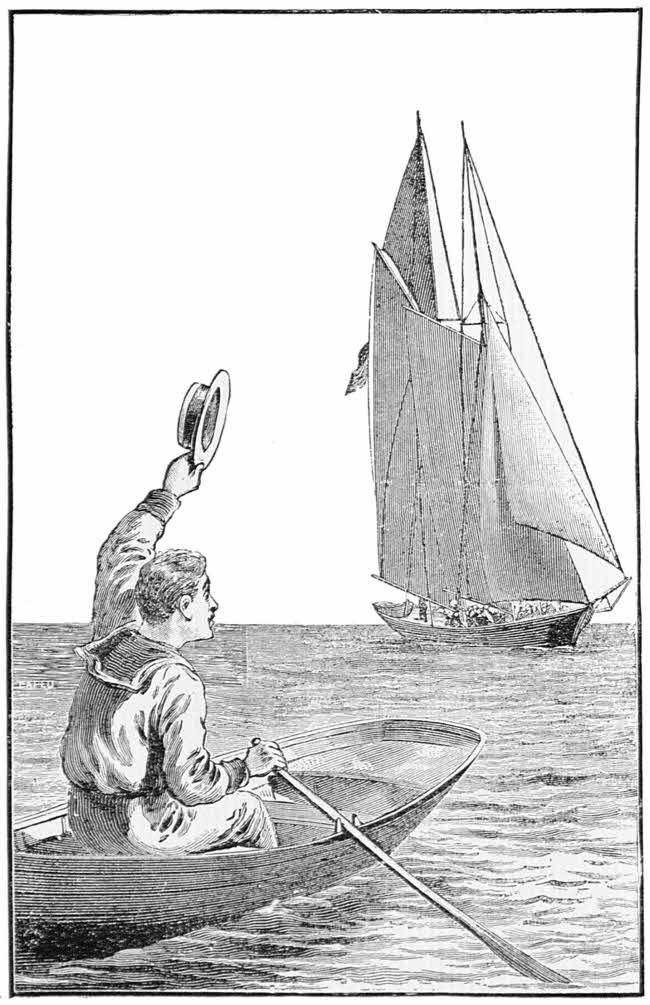
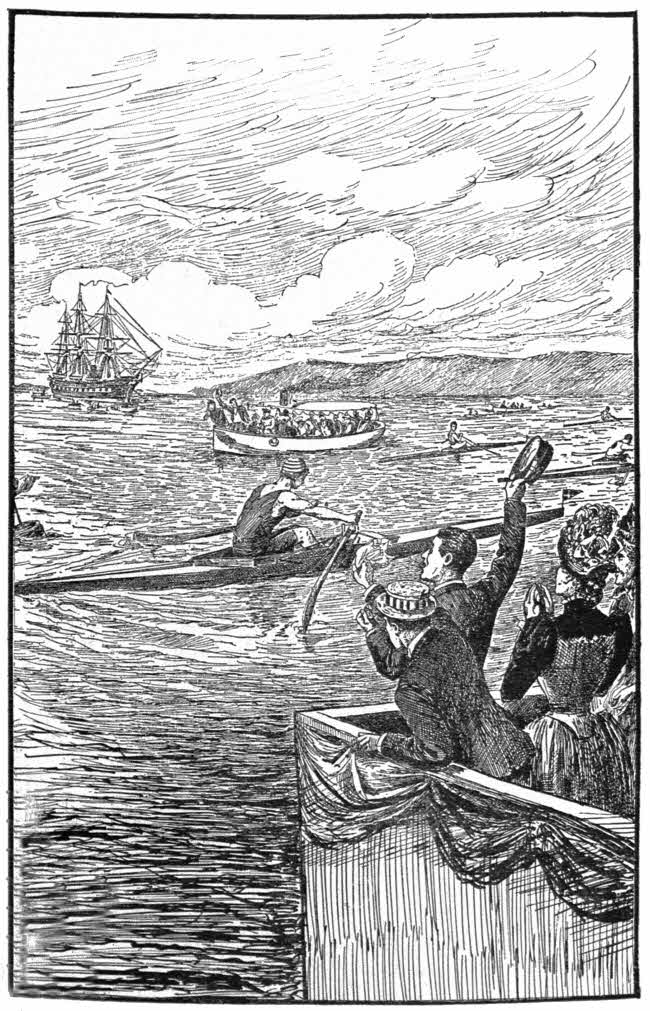
“The passengers and crew gave the young hero a rousing cheer as he
sped away.” (See page 45)
Midshipman Merrill
BY HENRY HARRISON LEWIS
AUTHOR OF
“Centre-Board Jim,” “Ensign Merrill,” etc.
PHILADELPHIA DAVID MCKAY, PUBLISHER 610 South Washington Square
Copyright, 1899,
By STREET & SMITH
CHAPTER I. THE WRECK OF THE TOY.
MIDSHIPMAN MERRILL.
“There comes that sea cub of Beacon Cliff, mates,
so let us clip his claws.”
“So say I, mates, for he’s too blue blooded to associate
with us, if he is only a fisher lad.”
“It’s the living in that old rookery, Cliff Castle, that
has turned his head and made him so conceited.”
“No, he’s been high-toned ever since he saved that
schooner from being wrecked in Hopeless Haven; but
I say let us take him down a peg or two, mates.”
“I’m with you.”
“So am I.”
“Me, too;” and all of a group of five lads joined in
with their leader to set upon a youth who was just running
for the shore in a trim little surf-skiff with a leg-of-mutton
sail.
The scene was at a small seaport upon the rugged,
though beautiful coast of Maine, and the lads, a wild
lot of reckless spirits, half-sailors, half-landsmen, stood
in front of an old-fashioned tavern fronting the water,
and from whence they had sighted the surf-skiff running
swiftly in toward the wharf, and had recognized
its occupant, a lad of sixteen.
He was neatly dressed in duck pants and a sailor
shirt with wide collar, in each corner of which was
embroidered an anchor in blue silk.
A blue tarpaulin sat jauntily upon his head, giving
him something of a rakish look, and a sash encircled
his slender waist.
But in spite of his rather picturesque attire, he had a
face of rare manliness for one so young, a face that was
bronzed by exposure, strong in character and stamped
with resolution and daring beyond his years.
He ran his little skiff in cleverly alongside the
wharf, lowered sail, and carefully taking up a toy ship,
stepped ashore and started toward the tavern.
The toy was a miniature ship, fully rigged and under
sail, an exquisite specimen of workmanship, for from
keel to truck there was nothing missing, and every rope
and sail, even to a tiny flag, the Stars and Stripes, was
in place.
He had nearly reached the group of youths, who had
threatened to lower his pride a peg or two, when a seaman
met him and called out:
“Ho, lad, who built that craft you have there?”
“I did, sir,” was the modest reply.
“Well, if you did you are a born sailor, that is all,
for I never saw a cleaner built craft, or a better rigged
one. Are you a deep water sailor, my lad?”
“I have been to sea, sir; but I am only a coaster
now.”
“And what are you going to do with that pretty
toy?”
“I am going to ask landlord Rich of the tavern to
buy it of me, sir.”
“Why do you sell it?”
The lad’s face flushed, and after a moment he said:
“Well, sir, my mother is ill, and I wish to have the
doctor go and see her, and sell the ship to get the
money to pay him and buy medicines with.”
“Well, lad, in spite of your fancy rig, your heart
lies in the right place, I see; but what do you want for
the craft?”
“It ought to be worth fifteen dollars, sir.”
“It is worth more, and I wish I had the money to
buy it; but if the landlord don’t buy it, I’ll see what I
can do.”
“I thank you, sir,” and the lad was going on, when
the group of youths, who had heard all that had passed,
laughed rudely, while one said: “Let me see your
boat, sea cub?”
The lad’s face flushed, but he knew that the speaker
was the son of a rich shipping merchant of the town,
and was a spendthrift, who might pay him a fancy
price for his toy, if he wished to do so, and he, therefore,
handed the ship to him without reply.
It was the same youth who had suggested to the others
to tease the lad, and looking critically at the ship,
he said:
“It looks fairly well to a landsman, but whoever
saw such a rig on a ship?”
“And the hull has no shape to it,” said another.
“Just look at the rake of the masts.”
“And the cut of her bow.”
“Whoever saw such a stern on anything but a mudscow.”
“If you do not wish to purchase the boat, Scott
Clemmons, give it back to me,” said Mark Merrill,
suppressing his anger.
“I’ll buy her, if she can stand a cyclone, sea cub,”
said Scott Clemmons insolently.
“Let’s see if she can, Scott,” another said.
“All right, Birney, hold out your arm.”
The youth addressed held his arms out firmly on a
level, and whirling suddenly around, with the boat
grasped in both hands, he brought it with full force
close to the deck against the outstretched arms of Ben
Birney.
The result was the wreck of the toy ship, for the
masts were broken, the decks swept clean.
But quickly as the act had been done, the movements
of the young sailor were quicker, for once, twice, his
blows fell full in the faces of the two destroyers, and
they dropped their length upon the pavement.
CHAPTER II. THE ARREST.
The three youths of the group who had not taken a
hand in the destruction of the toy ship had seemed at
first to regret their inability to also fret the young
sailor; but the moment that the two ringleaders, Scott
Clemmons and Ben Birney, had measured their length
upon the ground, falling with a force that seemed to
knock the breath out of them for a moment, the trio
appeared delighted that they had no hand in the breaking
of the little miniature ship, and stepped quickly
backward out of reach of the dangerous arm of Mark
Merrill.
But Scott Clemmons was not one to submit tamely
to a blow, and with his face bruised by a severe contact
with the fist of the sailor lad, he arose to his feet, and
whipping out his knife rushed upon his foe with a bitter
oath, and the threat:
“I’ll have your life for that blow, sea cub!”
Mark Merrill had boldly stood his ground, but seeing
his danger he quickly stooped, seized the hull of his
broken boat, and with a lightning-like movement
brought it down upon the head of his assailant with a
force that appeared to kill him, so motionless he lay
where he fell.
“Come, mates, he has killed Scott Clemmons, so
seize him!” shouted Ben Birney, and he sprung toward
the lad, followed by the other three who were made
bold by their numbers.
The sailor lad stood at bay now, his face pale, but
stern and determined, his eyes ablaze, while in his
hands he grasped the hull of his now badly-wrecked
ship, making it serve as a weapon of defense.
But ere Ben Birney had reached within arm’s length
a form suddenly sprung forward, and a ringing voice
cried:
“Back, you young cutthroats, for I’ll take a hand in
this unequal game.”
The four youths shrank back as though they had run
against a stone wall, for the sailor who had addressed
Mark Merrill upon landing now confronted them, and
more, he held a revolver in his hand, the muzzle covering
the group, his finger upon the trigger.
A crowd had now gathered, and among them the village
constable, to whom Ben Birney cried:
“Officer Roe, that fisher boy has killed Scott Clemmons—we
saw him do it.”
“It isn’t so, officer, for the fellow is not dead, only
stunned; and, besides, he attacked this brave lad with
a knife, after the young scamps had smashed his boat
to pieces. Arrest them, I say,” said the sailor.
Constable Roe was a politician, and owed his place
to the influence of the fathers of Scott Clemmons and
Ben Birney, so, of course, he saw the situation through
the spectacles of self-interest.
The sailor was a stranger in town, and Mark Merrill
was but a poor fisher lad, so he said:
“He meant to kill young Master Scott, if he didn’t
do it, so I’ll arrest him, and I’ll take you in, too, as I
saw you level a loaded pistol at these young men.”
The sailor laughed, and answered:
“You old fool, the weapon was just bought uptown,
and there’s no load in it; but trot me off to the lockup
if you wish, only let this poor lad go, as he has come
for a doctor to see his sick mother.”
“No, I’ll lock you both up, I guess, if the judge has
left his court—oh! Master Scott, you have come round,
I see,” and the constable turned to Scott Clemmons,
who just then arose to his feet, but with his face bleeding,
and a dazed look in his eyes.
“He tried to murder me, Roe,” he said deliberately.
“The young scamp lies like a marine, for he tried to
do the murdering; but take us to the judge, officer,
who, I guess, has got more sense than you have,” and
the sailor laughed.
The angry constable grasped an arm of the sailor
and the lad, and with a crowd at their heels led them
away toward the court, in the rear of which was the
jail.
The judge had just finished his last case for the day,
but took his seat, willing to hear the case, for he heard
several remark that it was nothing but persecution.
The constable made his report, and the sailor told his
story just as he had witnessed it, Mark Merrill remaining
silent and calm until called upon to testify.
Then he told his version of the affair in an unmoved,
dignified manner that impressed all, adding:
“If I am to be punished, your honor, I beg of you
to accept my pledge to return, after I have sent a physician
to my mother.”
Paying no attention to this remark the judge asked:
“Are there any witnesses in court who are willing
to testify in favor of these two prisoners?”
“I am, Judge Miller, if you will accept me as a witness,
for I saw and heard all.”
All started as a clear, sweet voice came from the rear
of the crowd, and there appeared a young girl of fourteen,
her beautiful face crimsoned from the glances
turned upon her, but her manner firm and half-defiant.
“Ah! Miss Virgene, it is you, is it? Yes, indeed, I’ll
accept your testimony with pleasure,” was the pleasant
response of the judge, and the crowd fell aside to allow
the pretty maiden to go to the front.
CHAPTER III. THE GIRL WITNESS.
Virgene Rich was the beauty of the little seaport
town of B——, notwithstanding that she had only been
a couple of years across the threshold of her “teens.”
She was the daughter of landlord Rich, of the
“Anchorage Tavern,” and every one in B—— loved
her, especially the lads.
Her most persistent admirer was Scott Clemmons,
though he could not boast of having been more favored
by her than others.
Now, as he saw her advance as a witness, his face
paled and flushed by turns, for what would she, a girl,
have to say of a quarrel among men, he wondered.
“Well, Miss Virgene, do you voluntarily appear in
this case?” asked the judge, with a kindly smile.
“I do, Judge Miller, because I deem it my duty to
do so, for if not I would not make myself appear so
forward,” was the low yet distinct response.
“Kiss the Book then, Miss Virgene, and let me hear
what you have to say.”
The girl obeyed, and then said in a voice that not one
failed to hear:
“I was seated in my room, sir, over the tavern parlor
when I saw a surf-skiff running for shore, and noticed
it particularly on account of its being so well handled.
“Right beneath stood five young men, whom I see
here now. Scott Clemmons recognized the occupant of
the skiff, that youth there, whose name I believe is
Mark Merrill.
“A plan was at once formed, as they expressed it, to
‘clip the sea cub’s claws,’ and as Master Merrill landed
they went toward him.
“He had a toy ship in his hand, and I heard him tell
a sailor, this gentleman here, who met him, that he
intended to sell it to my father, as he had to get money
to send the doctor to his mother, who was very ill.
“Then these five young gentlemen,” and Virgene’s
sarcastic reference to them made the five youths wince,
“met Master Mark Merrill, and at once began to sneer
at his boat, and Scott Clemmons took it from him, asking
if it could stand a cyclone.
“Then Scott Clemmons bade Ben Birney hold out
his arms, which he did, and turning quickly with the
boat at a level, he crushed it into a wreck.”
A murmur ran through the crowd at this, and the
accused did not like the look upon the face of the judge
as he said:
“Well, Miss Virgene, what else?”
“Why, Master Merrill at once knocked both Scott
Clemmons and Ben Birney down, as he ought to have
done, Judge Miller,” was the spirited reply of the
young girl.
“I agree with you, Miss Virgene—ahem! ahem!” and
the judge cut off his own decided unjudicial expression
of his private opinion with a loud cough.
Resuming her testimony, Virgene Rich said:
“Scott Clemmons rose quickly, sir, and drawing a
knife, rushed upon Master Merrill with a threat to kill
him, when he was struck a blow with the hull of the
wrecked boat that stunned him.”
“The prisoner, Mark Merrill, struck the blow?”
“Yes, Judge Miller, in self-defense; and the others
then, led by Ben Birney, were about to spring upon
him, when this gentleman frightened them off with
what seems was an unloaded weapon,” and Virgene’s
musical laughter was contagious, for many joined in
until the judge, checking the broad grin upon his own
face, commanded sternly:
“Silence in court!”
The judge was a terror to evil-doers, and was obeyed
with alacrity, while Virgene went on to tell the story
of the constable’s arrest of the wrong parties.
“Constable Roe, you should not allow self-interest
to lead you into error, sir, for the real culprits before
me are Scott Clemmons, Ben Birney, et al.
“Miss Virgene, I thank you for your clear testimony
of the facts, and discharge the accused, while I order
the arrest of these young men, and shall bind them
over to keep the peace, while you, Clemmons, must at
once pay this youth for his boat, or I shall send you to
jail.”
Then, turning to Mark Merrill, Judge Miller asked:
“Are you the lad who saved a schooner from being
wrecked in Hopeless Haven some months ago?”
“Yes, sir.”
“I am glad to know you, my lad, for you took desperate
chances for your own life to save others from
death. Ah, Mr. Clemmons, you are here, I suppose,
to pay your son’s just debt to this brave youth, and to
offer bail for your boy, who can congratulate himself
upon his escaping so lightly,” and Judge Miller turned
to a fine-looking old gentleman who had entered court,
hearing his son had been arrested.
“I am here, your honor, to do what is right,” was
the cold response of merchant Clemmons.
“He ought to have fifty dollars for the boat, for it
was worth it,” said the sailor bluntly.
“No, my price was only fifteen dollars, and I would
not take that from him were it not for my mother’s
being ill,” said Mark Merrill.
The amount was paid by merchant Clemmons, and
Mark Merrill hastened from the court room, accompanied
by his newly-made friend, Jack Judson, sailor.
CHAPTER IV. THE DWELLERS IN “SPOOK HALL.”
The youth, accompanied by Jack Judson, the sailor,
walked hastily up the main street of the little town,
until he came to a fine residence, before which hung a
sign bearing the legend:
“DR. STONE’S OFFICE.”
The physician had just returned home, and coming
by the court room had heard the story of the affray,
and from one who had sided with the sailor lad in the
affair.
He heard Mark’s story of his mother’s illness, and
at once said he would drive down that evening, and
received his fee in advance, which he made exceedingly
modest.
With a happy heart the lad then went to a store and
made a few purchases, after which he said:
“Now, sir, I must take time to go and thank that
pretty young girl for her kindness.”
“Well, I just think so, lad, for she’s one among a
thousand,” answered Jack Judson, and the two went
to “The Anchorage” and asked to see Miss Virgene
Rich.
But that young lady saw them coming, suspected
their errand, and ran off to the garret and hid, so they
were told that she must have gone out.
“That’s too bad, lad; but you’ll find her in port
some time; but, see here, it’s blowing a gale, and you
cannot start home now.”
“Oh, yes, sir; for it would worry my mother more
for me not to go.”
“Go by land?”
“It’s a walk of fifteen miles, and only a sail of
twelve, while the wind is fair for me.”
“If my craft was not going out in the morning I’d
go with you, for you are going to have it rough, lad.”
“I don’t mind that, sir, for my craft is a surf-skiff,
and I know how to handle her.”
“I saw that as you came in, my boy; but if you
must go I won’t detain you, so good-by, and don’t you
forget that Jack Judson is your friend.”
“I’ll remember you, sir, you may be sure,” was the
reply, and five minutes after the surf-skiff cast off and
started upon her really perilous voyage.
The sailor watched her departure, as many others
did, and shook his head ominously, while Virgene
Rich, having returned to her room, stood in the window,
and her innocent young face wore an anxious look
as she saw the little craft driving swiftly into the
heavy seas on her dangerous run.
In half an hour the surf-skiff was out of sight to the
watchers, and soon after rounded a point of land where
it felt the full force of the winds and waves.
But Mark Merrill showed his claim to the title he
had won as the boy pilot of the coast, and though the
shadows of night fell upon the waters, seemed to
instinctively know his way over the tempestuous sea.
At length a light gleamed from a cliff far ahead, and
the young sailor said aloud:
“Bless my dear, good mother! she has set the lamp
in the south window, sick as she is, to guide me home,
and it shows me that I was a trifle off my course.”
On sped the little craft, held firmly to her work until
she ran in under the shelter of a lofty overhanging cliff.
The sail was quickly lowered, the painter made fast,
and springing ashore, his arms full of the purchases he
had made, Mark Merrill hastened to climb a steep path
leading to the cliff above.
Here stood a large stone mansion, dark and gloomy,
except in one end, where there was a light, the one
which had flashed over the waters as a beacon to guide
the brave boy to a haven of safety.
Entering the wing the lad passed into a large room
where a woman lay upon a large old-fashioned bed.
Her face was a sad one, and her eyes were sunk with
suffering, but she smiled as she beheld her son, who
advanced and, bending over, kissed her forehead.
“The doctor will be down to-night, mother, for he
knows the way well, having attended the Vanloo family
when they lived here.”
“Heaven bless you, my noble boy; but what a rough
night it is, and my anxiety for you has made me feel
better, for I forgot myself.”
“Oh! you’ll soon come round all right, mother,”
was the hopeful reply.
“But Mark, how can you pay the doctor, for my illness
has kept you from making any money of late.”
“I sold my little model, mother, for I was tired of it,
you know.”
“No, I don’t know anything of the kind, Mark, for
you prized it most highly, and it took you a long time
to make it.”
“Why, mother, it was no use, and I got a good price
for it, so paid the doctor and bought some things we
needed, and old Peggy will be back to-morrow, so that
I can take a cruise and make some money.”
“I hope so, my son, and Peggy never overstays her
time; but I hear wheels without.”
“It is the doctor,” joyously said the lad.
It was the doctor, and he found the patient suffering
from a general breaking down.
He prescribed what he deemed best, left the medicines,
and as the youth followed him to his carriage,
said:
“Your mother has some sorrow to bear, my young
friend, and she must have perfect rest, the best of care,
and good food.”
“My old nurse, sir, Peggy, will return to-morrow,
for she has been absent for a few weeks on a yearly
visit to her son, and my mother has overworked herself,
I fear.”
“Well, I will see her again, and I understand your
situation exactly—nay, do not get angry, for I will
have my way, and all your mother needs she shall have,
and when you make money you can repay me, for I
shall keep an account of expenditures.
“But your mother has some heartache, and you must
brighten her life all you can.
“I visited the Vanloo’s when they dwelt here—where
is the heir to this property?”
“I do not know, sir; but the agent gave us permission
to occupy one wing of it to care for the place.”
“He might well do so, for money would buy no one
else to live here after the tragedies this old mansion has
seen.
“You and your mother are brave, indeed, to dwell
here; but good-night,” and the good physician entered
his carriage and drove rapidly away from the old mansion,
which had become known as “Spook Hall,” for
the superstitious country folk and the coast dwellers
vowed that the place was haunted—and certainly it was
by cruel memories of red deeds done there one stormy
night years before.
CHAPTER V. A BOLD RESOLVE.
It was several weeks after the attack on Mark Merrill,
on his visit to the town of B—— after the doctor,
and Mrs. Merrill had regained her health, old Peggy
had returned to her duties, and the young sailor lad
was thus able to resume his fishing and carrying the
mail each week to and from several little hamlets on
the coast.
By the sale of his fish and the mail carrying, both
most dangerous work in rough weather, the lad made
a fair living for his mother, old Peggy, and himself,
the only three dwellers in the once grand old mansion
of Cliff Castle, then the wonder and admiration of the
country folk, but for years left deserted and crumbling
to decay, its hundreds of surrounding acres allowed to
grow up with weeds and undergrowth.
The furniture all had been left after the fateful tragedy
beneath its roof, which had gained for it the name
of Spook Hall, and the place had been shunned as a
pestilence, until the moving into one wing of the Merrills,
who had set at defiance the weird stories of the old
mansion.
There was an unsolved mystery hanging over the
Merrills, for no one seemed to know who they were, or
from whence they had come.
The lad had visited B—— as one of a schooner’s crew,
and not long after had come with his mother and
Peggy, and sought a home in a cabin on the shore.
After a run to Boston, where he had seen the agent
of Cliff Castle, he had permission to move into the mansion,
and for over a year they had dwelt there, and that
was all that was known of them.
At the risk of his life the brave boy had gone out in a
storm one night and acted as pilot to a schooner that
was in a dangerous anchorage, and this had won him
fame along the coast, and the name of the boy pilot.
Again, he had sailed out in his surf-skiff to a vessel
adrift, and found it utterly deserted, so had gotten up
sail, as well as he could, and run the craft to a safe
anchorage.
He had given notice of the fact, but no one had come
to claim the pretty craft, which was a small schooner
yacht, and Mark had begun to regard her as his own
property.
One afternoon he was standing upon the cliff watching
the coming up of what threatened to be a terrible
storm.
The whole heavens to seaward were one mass of inky
clouds, which were rising higher and higher, and ominous
rumblings of thunder and vivid flashes of lightning
grew louder and brighter as the tempest came
sweeping on.
From his position on the cliff he could look down
into two basins, or bays.
In one lay the little schooner at anchor, and all ship-shape
to meet the coming tempest, and there, too, was
his surf-skiff with a couple of boats drawn up on the
beach.
The entrance to this bay was winding and dangerous
in the extreme, but these very dangers of running in
and out made it more sheltered and secure as a harbor.
The bay upon the other side of the cliff was larger
and by no means well sheltered from a wild sea, though
to an ordinary observer it appeared to be a safe anchorage
for a vessel.
The lad stood upon a rock overhanging the sea, and
commanding a grand view, seemingly unconscious that
a false step would hurl him into the waters eighty feet
below.
Suddenly he started, for around a point of land heavily
wooded a vessel came in sight, driving along under
reefed sails before the breeze which was the forerunner
of the storm.
“It is one of those beautiful yachts out of Boston;
but there can be no pilot on board, or he would have
run into Rover’s Roost.
“Why does she not stand out to sea for good room?”
said the lad anxiously.
Then he watched the vessel attentively, a large
schooner yacht of some two hundred tons burden,
painted white, which was driving along like a huge
thing of life seeking a place of refuge from the storm.
“Great Cæsar’s ghost! she is running into Hopeless
Haven in the very teeth of this storm. She will be
wrecked!” and the boy’s voice now rang out in dire
alarm for the safety of the beautiful vessel.
He saw her run, to what her skipper evidently
believed a safe anchorage; the anchors were let fall and
the sails furled.
Then Mark Merrill waited no longer, for from his lips
came the words:
“She is doomed unless I can save her! I have no
time to get my boat and run around the point, for the
storm would catch me halfway—yes, I must take the
chances and swim out to her!”
He paused for a few seconds, as though taking in the
whole situation, and then quickly ran around the edge
of the cliff to where there was a small arbor, in the top
of which had been a beacon in the early days of the
mansion.
Quickly divesting himself of his jacket, shoes, stockings
and hat, he began to descend the steep side of the
cliff with the agility of a cat.
He reached within twenty feet of the water’s edge,
and turning, gazed first out at the yacht, half a mile
distant, and then down into the surf, dashing with
thunderous roar against the base of the cliff.
“Now for it!” and as the words left his lips Mark
Merrill made the fateful spring into the surging breakers
on his daring swim out to the yacht in the face of
the coming storm.
CHAPTER VI. THE BOY PILOT.
The schooner yacht Midshipman was on a pleasure
cruise of several weeks with a distinguished party on
board.
She was a large, roomy and stanch craft, as well as
carrying the champion colors as a racer, won in showing
a clean pair of heels to the fleet pleasure boats when
a cup or purse was at stake.
Her distinguished owner, a millionaire Bostonian,
had invited a congenial party to become his guests for
a cruise from Fortress Monroe along the coast to the
St. Lawrence and back to Newport, and among the
guests were several who had won fame in the history
of their country in civil and military life.
The Honorable Secretary of the United States Navy,
gallant Commodore Lucien, and several others of lesser
note, accompanied by half a dozen ladies, comprised the
guests of General Peyton on the Midshipman.
The cruise had been greatly enjoyed, and the prow of
the yacht had been turned homeward, when suddenly
came up from out of the very sea, it seemed, the black
and ugly storm.
The ladies implored the skipper to head for the shore,
to seek refuge in some harbor, though he urged, as he
knew little of the coast just there, the open sea was the
safer.
“We will find some harbor, captain, so run in, where
you deem best,” General Peyton had said, for he did
not like the looks of the heavens, and night not far
off.
Around a point swept the yacht, and a cry of joy
came from many lips at what appeared to be a safe
anchorage before them.
Into the bay ran the Midshipman, and quickly her
anchors were let go, her sails furled, and all made ship-shape
to meet the rising tempest, which was growing
appalling in its magnitude and blackness.
“I don’t like this place, sir, and we had better fire a
gun to bring a pilot off in case we have to stand out,”
said the skipper to General Peyton.
“Do so, if you deem best, captain; but see, yonder
stands some one upon that cliff.”
All eyes were turned upon the cliff, and they wondered
to see the form of a man running at full speed
along the edge of the towering rocks.
He darted into an arbor, and in a short while reappeared,
and then his actions caused still greater surprise,
for he was seen to come boldly down the rocky
face of the cliff toward the sea.
All watched with deepest interest, momentarily forgetting
the storm in their wonderment at the actions of
the one on the cliff.
Suddenly a cry broke from every lip, for the form
was seen to suddenly spring into the foaming waters.
The ladies turned their faces away in awe, the men
watched the waters where the form had disappeared,
for it seemed that the fate of the stranger was ominous
of their own.
Suddenly from the inky clouds, trailing over the sea
to break upon the stone-bound coast, came a blinding
sheet of livid flame, followed by a crash of thunder
that vibrated through the yacht from stem to stern.
In the lull that followed came a voice out upon the
waters:
“Ahoy! ahoy, the yacht!”
It was faint, but distinct, and all heard it.
“Ahoy! ahoy! the yacht, ahoy!” came the hail
louder than before.
Brave men looked at each other with something like
awe in their faces, until General Peyton cried:
“It is the man who sprang from the cliff!”
“He is swimming out to us, brave fellow that he is.”
Seizing his trumpet he shouted back:
“Ay! ay! my man, I’ll send a boat for you!”
“No! no! I am all right, but your vessel is not. Get
up your anchors, and set sail!”
There was no mistaking these cool words, and a voice
cried:
“I see him!”
There, out upon the waters, swimming with powerful,
rapid strokes toward the yacht could be seen, every
moment as he rose on the crest of a wave, our bold
young swimmer.
A cheer broke from the crew forward, and was echoed
by the guests aft.
But again came from the daring young swimmer:
“You have no time to lose; get sail on your yacht
and your anchors up, for this bay is a death-trap!”
The skipper was a man of quick action, and the
warning from the swimmer but carried out his own
ideas, and he sent his crew flying to their posts, while
General Peyton stood by to throw a line to the one who
was now but a few yards away.
A minute more, and amid a ringing cheer the bold
swimmer stood upon the deck, a handsome, fearless-faced
youth, bareheaded, barefooted, and clad only in
duck pants and sailor shirt.
“Well, young man, who are you who so bravely
boards my craft almost in mid-ocean?” cried General
Peyton, as all gazed with admiration upon the lad.
The response came bluntly:
“I am not here, sir, to speak of myself, but to pilot
your vessel to a safe harbor, for you are in Hopeless
Haven, and yonder storm will wreck you here.”
“Hopeless Haven is it, my lad? Then are you a
hundred times welcome, and to one who has your nerve
I gladly yield the craft,” said Captain Saunders hastily,
and Mark Merrill stepped to the wheel just as the
anchors left the bottom, and the reefed sails went to
leeward with a jerk under a sudden squall.
But the boy pilot was unmoved, and, declining a
glass of liquor brought to him by the steward, at General
Peyton’s order, bent his every energy upon his work,
for now the rushing, furious storm was coming down
in an avalanche of winds and waves, and a roaring and
flaming like unto a mighty battle.
As though wild with fear the yacht drove furiously
on, heading to round the rocky reef off the cliff, her
crew at their posts, the guests crouched in the companionway
and cock-pit, and all eyes alternately turned
upon the young pilot, calm and fearless, and the storm
so near upon them.
It seemed like a mad race for life, for the boy pilot
had said:
“Anchors will not hold on this bottom, and we must
round that reef to reach safety.”
At last the order came in the boy’s clear voice:
“Slack off the sheets! steady now! hold hard all!”
And with the orders the howling storm was upon
them, and the gallant yacht went driving ahead with
furious speed, with all about her now darkness and
chaos.
How he knew his way, all asked, none knew, but his
orders came steadily to haul taunt, or slack off sheets,
until suddenly the giant waves ceased to follow, the
wind was broken by the lofty cliff, and the anchors
were let go in the secure haven of Beacon Cliff.
The first one to grasp the hand of the brave lad was
the Secretary of the Navy, and his voice had a tremor
in it as he said:
“My young friend, your courage this day has won
your right to serve your country in a position of honor,
and I pledge for you an appointment-at-large from the
President of the berth of a cadet midshipman.”
CHAPTER VII. THE CADET MIDSHIPMAN.
The day of work was at hand at the United States
Naval Academy, situated in that quaint, sleepy old
town of Annapolis, whose greatest attractions are its
antiquity and its sea school.
The time had come when the “future admirals,” the
“heroes in embryo” were to cease their flirting and
“bone” with all their hearts and heads in latitudes,
longitudes, parallelograms, tonnage, displacement, and
all the other studies necessary to make the greenhorn
a perfect sailor.
The middies had returned from their summer cruise,
the “academy” had awakened from its lazy slumber of
weeks, and all were looking forward to the year before
them with varied feelings of hopes and fears.
Those who had already served one or more terms at
the academy felt their superiority unquestioned to the
unfortunate “Plebe,” who was standing upon the
threshold in fear and trembling of what was before
him.
Standing on the sea-wall of the academy grounds
one afternoon a month or more after the bold act of
Mark Merrill in saving the yacht Midshipman from
destruction in Hopeless Haven, on the coast of Maine,
were a number of middies, unmindful of the beauties
of the scene about them, the old training ship with its
history of the past, waters of the Severn lashed into
foam under a gale that was blowing up the Chesapeake,
visible over a league away, tossing in angry
billows, a vessel of war anchored off in midstream, and
the ancient town of Annapolis to the right, with its
fleet of oyster boats fretting their cables as they
plunged and reeled on the incoming waves—I say
unmindful of the scene about them, the group of young
sailors had their eyes riveted upon a small schooner
which had shot around Bay Ridge Point at a tremendous
speed, jibed her sails to starboard most skillfully,
though she reeled low under the shock, and came tearing
up to the town in gallant style.
“There’s a bold skipper at the helm of that craft,”
said Cadet Captain Byrd Bascomb, of the first class,
with the air of one whose superior knowledge no one
could contradict.
“He is too bold, for he carries too much sail for
safety,” Midshipman Herbert Nazro responded, for he
observed that the little schooner was carrying only a
single-reefed mainsail.
“She’s one of those deep-keeled yachts that can stand
her canvas,” Cadet Lieutenant Frank Latrobe added.
“Yes, and her foolhardy skipper will carry the sticks
out of her yet before she reaches port,” put in Midshipman
Winslow Dillingham.
“I guess he knows his craft; if he does not, he’s a
fool,” was the decided opinion of Midshipman Harbor
Driggs.
“Ha! what did I tell you?” cried Captain Byrd
Bascomb, as a terrific squall struck the little vessel,
causing her to lay over until her keel was visible.
“Aha! well done that!”
“Wasn’t it beautiful!”
“That skipper knows himself and his ship, too!”
Such were the admiring expressions that went up
from the crowd of young sailors as the yacht was splendidly
rescued from her danger and sent along, as before,
in the same rushing style by her bold helmsman.
“Ah! he is heading for an anchorage off here!” said
Cadet Captain Byrd Bascomb, as the schooner’s sheets
were eased off and her prow headed away before the
wind.
On she flew, at the same mad speed, reeling, staggering,
rolling, until her boom ends dipped, but held on
unswervingly straight toward the vessel-of-war
anchored off the grounds in the Levern River.
“By Neptune’s beard, men, but that is a youngster
at the helm of that craft,” cried Byrd Bascomb, as he
put his glass to his eye.
It was not long before all could discover the truth of
this, and that three men were all else to be seen upon
the deck of the schooner, one of these forward, another
at the foresheet halyards, the third at the main sheet.
Like a rocket she sped under the stern of the vessel-of-war,
and then there came an order from the helmsman,
the sheets were hauled in and made fast, and
luffing up sharp, the anchor was let fall, the sails came
down on a run, and ten minutes after a boat left her
side and pulled for the shore.
The cadets lounged up to meet the single occupant of
the little boat, which was a surf-skiff, and though
tossed about upon the waves, was handled with a skill
which caused the middies to set the rower down as a
master of the oars.
The oarsman sprang ashore, touched his hat politely,
and asked nobody in particular:
“May I ask where I will find the commandant of the
Naval School?”
Then the innate deviltry of the juvenile tar asserted
itself, and a look of mischief flashed from eye to eye, a
sort of telegraphy, which said:
“Here’s fun for us.”
They saw before them a bronze-faced youth of seventeen,
perhaps, with a splendidly knit frame, clad in
spotless duck trousers, a sailor shirt, beneath the wide
collar of which a black silk scarf was knotted, and a
tarpaulin cocked on the side of his head in a kind of
devil-I-care way.
“Have you the oysters the commandant ordered?”
asked Midshipman Dillingham, with a look of intense
innocence.
The dark face of the young sailor flushed, but he
responded with dignity:
“My name is Mark Merrill, and I have orders to
report here to be examined for the berth of midshipman
in the United States Navy.”
CHAPTER VIII. A RUMOR AFLOAT.
There was quite a stir at the naval school, for a
strange rumor was afloat.
“Some one” had said that one of the officers had said
that there was to be a new cadet at the academy,
appointed under peculiar circumstances; that is, he had
no political status environing him.
He was to come bearing no congressman’s brand,
and no partisan motive had prompted the President to
appoint him as a “cadet midshipman-at-large.” The
reason of his appointment was what had leaked out
through this mysterious “some one.”
The rumor afloat had it that the newcomer had done
some meritorious act which deserved recognition from
the government, and he had received his orders to
report at the naval academy.
What this gallant service was no one seemed to
know, but, of course, all would discover as soon as the
honored youth arrived at the academy, as he would be
only too anxious to tell of his deeds of heroism.
The rumor also had it that the youth was a specimen
of the genus homo from the coast of Maine, and a fisher
lad from the State which in the past has so justly won
the title of “Nursery of the Navy.”
Of course the blue bloods among the cadet midshipmen
had their opinions as to what a fisher lad from the
coast of Maine would be like.
Hardly setting him down as being like the earlier
Florida coasters, half-horse, half-alligator, they still
supposed that he must be a long-pointed, two-headed,
web-footed, uncouth specimen of a youth who, if he
passed the surgeon for height, chest measure and perfect
health, would do so through a hope that he could in
time be built up into a man, while, when the examining
committee ran afoul of him with what the old
farmer called the Three R’s—“Reading, ’Riting and
’Rithmetic”—the youth from Maine would haul down
his colors at the first fire.
Human nature is said to be the same the world over,
and certainly boy nature is. The only safety-valve a
boy has for his extra flow of spirits is mischief, and
young tars and soldier lads are certainly no exception
to the rule, but, on the contrary, more given to pranks
than other youths, on account of their severe training,
for their fun must break forth when discipline unbends
for hours of leisure.
With this homily upon my young friends, gleaned
from having been “one of the same,” I will state that
there were great expectations among the boy tars at the
naval academy as to the newcomers in their midst,
especially regarding the lad from Maine.
They longed to have him pass the doctors and the
examining committee, for that would give them a
chance, and several regretted that they did not know
where to find him, that they might post him a little,
“get the moss off his back,” as one mildly expressed it.
There were other appointees to arrive, of course, but
the interest of these ancient mariners who had already
served one or more years at the academy centered in the
youth who was to come under circumstances out of the
usual routine, a simple appointment by the congressman
of his district.
The men of the third class were more particularly
interested in the newcomers, as they had so lately been
in the same predicament, while the older cadets of the
second and first classes looked down with supreme contempt
upon the “cubs,” only worthy of their attention
if any fun could be gotten out of them.
So a detail was made to keep an eye upon the
entrance gate to the academy grounds, where a marine
and his musket constantly paced, for the arrival of the
cubs, especially the lad from Maine.
The new appointees began to arrive on time, pale,
nervous, and with forebodings of the future, some of
them having read or heard that young gulls were
plucked of their feathers by those who had risen to the
height of sea eagles.
There was legendary lore on tap that new boys who
ran the gauntlet of the sawbones and examiners were
then taken in hand for instruction by the cadets by a
process called hazing.
Now, the new men held somewhat of a hazy view of
what hazing was exactly, as, though it was fun for the
hazers, it might be death to the hazed, and they stood
more in awe of their learned companions-to-be than they
did of the commandant and his whole crew of professors.
And they were right, as many a man can testify to-day.
One by one the new men arrived at Annapolis, and
turned their uneasy footsteps in the direction of the
mecca of their hopes and fears.
They passed by the grim sentinel at the gate, and he
knew them at a glance, try as they might to disguise
their identity as appointees.
They went, according to orders, to report to the commandant,
passed that ordeal, and faced another in the
surgeon, who was all business, and as merciless as a
guillotine.
Then they had reason to regret that they had not
studied harder at school and played less, that they had
not realized that spelling, reading, and a few other
things were necessary to education.
Their handwriting was a scrawl which horrified
them, and their pride took a tumble under the inquisition
of an examination that shattered their vanity to
atoms.
Some of them were undoubtedly greenhorns, others
were city boys, with an air of assurance which the first
broadside of their judges laid low, and others were
quiet, diffident fellows, with the look about them to go
in and win.
And while the cadets were watching and waiting for
the coming of the lad appointed for meritorious services,
they became interested in the splendid handling
of a schooner rushing into port in a gale, and to their
amazement the one at the helm landed and announced
himself as:
“Mark Merrill, the man from Maine.”
CHAPTER IX. GOING ASHORE.
Leaving Mark Merrill facing the crowd of midshipmen
who met him as he landed, I will ask my reader
to return with me until I explain the fact of his arrival
as helmsman of a schooner yacht, and his appointment
to a cadetship in the naval school.
It will be remembered that he had saved the yacht,
by a strange coincidence bearing the name of Midshipman,
and this every one on board realized.
He had driven her through a dangerous channel, with
reefs on every hand, in the darkness and storm, standing
coolly at his post and issuing his orders in a voice
that was firm and commanding, until he had brought
her into a basin as quiet as a mill pond, and said:
“Let go the anchor!”
The storm still raged outside, the waves thundered
against the rocky shore, and the winds howled among
the pines that crowned the hilltops.
But the yacht rocked gently upon the swell that was
driven in through the narrow channel; there was plenty
of water beneath her keel, and though lofty, vine-clad
cliffs were above them upon all sides, the crew knew
that their vessel was safe.
Realizing this, all the guests had gone into the large
and brilliantly lighted cabin, and thither General Peyton
had followed with the young pilot.
The youth had urged against it, saying that he was
wet, barefooted, and hardly more than half-dressed,
but General Peyton had said:
“The Secretary of the Navy wishes to see you.”
Standing in his wet clothing before that august
group gathered there, Mark Merrill was modest of
mien, yet not abashed.
“You wished to see me, sir?” he said, bowing to the
Secretary.
“Yes, my lad, sit down.”
“Ah, sir, I am not fit to be here, looking as I do;
and I am anxious to return home, as my mother will
be expecting me.”
“You live near here, then?”
“Yes, sir, upon the cliff.”
“And you have a mother living?”
“Yes, sir, she is all I have, except old Peggy, for
my father was lost at sea.”
“And what is your calling, my lad?”
“I fish for the market boats, and then I carry the
mail once each week along the coast.”
“In a boat, of course?”
“Yes, sir, in my surf-skiff.”
“Do you get liberal pay for this work, may I ask?”
“Not very, sir, for with the mail carrying and my
fish-selling I average about fifty dollars a month.”
“But your mother has other means of support?”
“No, sir; we pay no rent, as we live in Cliff Castle
free for keeping it, and I have a good garden, and there
is plenty of game and fish for the shooting and catching.”
“What do you do when it storms too hard to carry
the mail?”
“I always go, sir, for my skiff is a lifeboat, and
stands any weather.”
“How did you manage to come out to our aid?”
“I was on the cliff, sir, watching the storm, and saw
you round the point and run for an anchorage. I know
that anchors will not hold on the bottom of Hopeless
Haven, and the currents in the bay make the sea very
wild, so I determined to go out and pilot you into Cliff
Castle harbor.”
“And swam out to us in the face of that storm?”
“Well, sir, I had not time to go to the bay and run
out in my skiff, so I slipped down the bluff and jumped
in, for it was not a very long swim, sir.”
“Well, I should call it a very remarkable swim, my
lad, and I regard you as a phenomenal young sailor.
We all owe you our lives, I feel assured, and I shall
beg of the President a naval cadetship for you. We
have raised a purse, which we ask you to accept, with
our best wishes for your future success.”
The dark face of Mark Merrill flushed as with
shame, while he said, quickly:
“Oh, sir, I cannot accept money from you, though I
thank you all. I would not touch a dollar of money
for what I did if I was starving, but I will appreciate
your kind promise to make me a midshipman, and it
seems too much to hope for, sir.”
“I will not urge the acceptance of the purse, my
brave boy, if you do not wish it, and I pledge you the
appointment, and to-morrow morning we will call upon
your mother, and tell her she must be content to give
you up, as you will make a name she will be proud of.”
“I thank you, sir, and good-night, for I must go, as
mother is not well, and my long stay will worry her.”
He bowed low, seeming not to see that all wished to
shake hands with him, and left the cabin, General Peyton
following, and calling out:
“Captain, lower away a boat, and land our young
pilot.”
“Oh, sir, there’s no need of that, for I am all wet anyhow,
and it’s a short swim ashore.” And before a
hand could stay him the young pilot sprang upon the
rail of the yacht and leaped head first into the dark
waters of the little bay.
The startled cry of General Peyton at the youth’s
bold act brought Commodore Lucien, the Secretary,
and others upon the deck in some alarm.
“That fearless lad has leaped overboard and is swimming
ashore, Mr. Secretary,” he explained.
“Ahoy! ahoy! my lad!” shouted Commodore
Lucien.
“Ay, ay, sir!” came back in the clear voice of the
young pilot.
“Hail us when you reach shore, so we may know that
you are all right!” called the commodore.
“Ay, ay, sir.”
“That boy is all right, Peyton, so there is no need of
sending a boat after him,” the commodore said.
“He’s half fish,” growled the captain of the yacht.
Then all waited breathlessly, and soon came a faint
hail:
“Ahoy! the yacht!”
“Ay, ay!” answered Commodore Lucien.
“I’ve landed,” and the words were greeted with a
cheer from all on the deck of the Midshipman.
CHAPTER X. UNFATHOMED.
“My God! can my son have gone out in the face of
this terrible storm? It is the worst I have known upon
the coast for years,” and Mrs. Merrill pressed her face
against the window-glass, striving in vain to pierce the
blackness without.
No longer confined to her bed by illness, it could
now be seen that she was a handsome woman, hardly
more than thirty-five, and with the indelible stamp of
refinement upon her.
Her face wore a sad look, and no flush warmed the
marble-like complexion.
Her eyes were large and dreamy, seeming to be looking
backward into a past clouded with bitter memory
rather than lighted with hope for the future.
She was dressed in a close-fitting robe of mourning,
and a miniature breastpin, and band of gold upon her
wedding-finger were the only things that relieved the
severe plainness of her appearance.
Old Peggy, a woman who had lived here fifty years,
but was strong and active, sat in a chair before a blazing
pine knot, and in answer to the remark of Mrs.
Merrill, chimed in, like Job’s comforter, with:
“Well, it would be just like him; but never you fear
for him, miss, for he’s not born to be drowned, that boy
isn’t, and sometimes I almost fear he’s born to be
hanged, he does escape the dangers of the sea so constant.”
“Oh, Peggy, don’t speak so, for you fairly frighten
me,” and the slender, graceful form thrilled at the
thought.
“Well, Miss Gladys, he’s not one to be hanged,
either. He’s a boy who can take care of himself, come
what may, for you remember what the doctor told you,
how he went for rich Merchant Clemmons’ son and Ben
Birney?”
“Yes, Mark will not be imposed on, gentle as is his
nature; but I only wish I knew where he was.”
“So do I, miss, for the supper is getting cold waiting
for him.”
“Well, I’m hungry enough to eat it, if it’s cold as
ice,” said a cheery voice from the next room, and in
came Mark, dripping wet.
“Oh, Mark, where have you been? I——”
“Don’t touch me, mother, for I am as wet as a
drowned rat, for I’ve been overboard.”
“Ah! you were capsized?”
“Not a bit of it, mother, I’ve been swimming.”
“Where are your shoes and hat, Mark?”
“I’ll tell you all about it, mother, as soon as I have
slipped into some dry togs,” and the lad hastened away
to his own room.
But he was back again by the time Peggy had supper
upon the table, and the three sat down to eat, for,
though a servant, the old woman was a tried and
trusted friend, one who had been Mark’s nurse in babyhood.
His adventure had given the youth an appetite, and
his mother knew there was no hope of hearing what he
had to tell until he had eaten off the edge of his hunger,
so she wisely heaped his plate with edibles, and enjoyed
seeing them disappear.
At last he said:
“Mother, there’s a yacht in our bay.”
“A yacht, Mark?”
“Yes, and a beauty. She’s the largest pleasure craft I
ever saw.”
“But how did she get there, my son?”
“I played pilot, mother, and ran her in, and just in
time, too.”
“Those on board were indeed fortunate in finding so
good a pilot near at hand, Mark; but tell me of it, for
this is an ugly night for such work.”
Mark told his story in his modest way, taking no
credit to himself, and then added:
“Now they wanted to make a hero of me, mother, and
pay me for my services, offering me a purse, and it was
a well-filled one, too.”
“Which you, of course, refused?” quickly said the
mother.
“Oh, of course he did, for he’d refuse money if he
hadn’t two coppers to jingle together in his pocket,”
growled Peggy.
“I refused it, mother, but I am to get a reward.”
“Ah, Mark, what have you done?”
“Well, you see the yacht belonged to General Peyton,
a millionaire merchant of Boston, and he had as
guests on board some ladies, the Secretary of the Navy,
and Commodore Lucien, of whom I have often read,
you know.”
“Distinguished company, indeed!” said Mrs. Merrill.
“And rich enough to spare a few thousands and not
miss ’em,” Peggy ventured, with an eye to the fact
that the laborer was worthy of his hire.
“I got, or will get, what to me, Peggy, is worth far
more than thousands, for the Secretary promises me a
cadetship in the navy,” and Mark’s eyes flashed with
pride, while his mother kissed him, and murmured
“My brave, noble boy! at last! at last the clouds
have a silver lining.”
The next evening, true to their promise, the guests of
the yacht landed and strolled up to the mansion.
They gazed about them with interest, and Commodore
Lucien remembered having heard something of the
tragic history of “Spook Hall,” and told it to those
with him.
Mark joined them, and this time each one grasped
his hand.
He was dressed in his best sailor suit, for he wore
nothing else at any time, and looked very handsome.
The grand parlor of the old mansion had been thrown
open, and they were received there by Mrs. Merrill in a
dignified manner.
But there was that about her face which prevented
obtrusive questioning, and after half an hour all arose
to go, impressed with the idea that some mystery hung
about the Merrills which they were not willing to
attempt to fathom.
The Secretary renewed his promise to Mark, and the
lad volunteered his services to pilot the yacht out to sea,
which he did, returning in his surf-skiff, which had been
tossing astern.
It seemed news too good to be true to Mrs. Merrill to
feel that her son was going to have the advantages of a
naval education.
He had enjoyed several years of schooling before they
had moved to their coast home, and all else he knew she
had taught him.
Fortunately for the lonely woman, who possessed a
superior education, the library at Cliff Castle was well
stocked with books, and from these had Mark been
taught by her.
There were maps, histories and all that he could wish,
while the postmasters to whom he delivered mails were
wont to give him each week papers which they had read
and finished with, for though late in coming, it was all
news to the lad, his mother, and old Peggy.
In fact, for the latter’s benefit, Mark had to read even
the advertisements in the papers.
Some weeks after the departure of the yacht, Mark
sailed up to B—— on business he had in view.
He had an idea of selling the vessel he had picked
up, abandoned at sea, and fitting himself out for the
naval school with part, leaving the balance for his
mother’s use.
He decided to place the matter before good Judge
Miller, as to his claim to the craft, and, perhaps, to
consult Dr. Stone, who had seemed most friendly disposed
to him.
He was skimming swiftly along in his surf-skiff
when he beheld a small sailboat coming toward him.
There were two persons in it, and it did not take
Mark long to recognize in one of them pretty Virgene
Rich, and she held the tiller.
The other was a half-witted youth who hung about
the dock, making odd pennies as best he could, and
whom Mark had once rescued from a crowd of boys
who were persecuting him, thus winning the undying
friendship of poor Silly Sam, as he was called.
As a proof that they wished to speak to him, instead
of standing away upon a tack when discovering his
boat, Virgene brought her boat to and lay in the course
of the surf-skiff.
“Ahoy, Master Mark, and come alongside, for Miss
Virgie wishes to speak to you,” called out Silly Sam.
Mark obeyed promptly, doffing his tarpaulin respectfully
with one hand, while with the other he jammed
his tiller down and brought the surf-skiff alongside so
easily that the blow would not have crushed an egg.
“I am glad to see you, Miss Virgene, for I intended
stopping at the tavern to thank you for your great kindness
to me the other day when I got into trouble.
Hello, Sam, how are you?”
“I’m O. K., Master Mark, and I only wish I’d a been
’round ’tother day to punish them fellers for you,”
answered Sam.
“Master Mark seemed fully capable of taking care of
himself, Sam,” answered Virgene with a smile, and
then she continued:
“Are you not expecting a letter of importance, Master
Mark?”
“No, miss, no one writes to me.”
“Strange, for I have two for you—for, you know,
father is postmaster at B——, and I help him with the
mails, and these arrived some days ago, so I determined
to take them to you, as Sam offered to sail me there.’
“I’m sorry I started from home, miss, for my mother
would like to thank you for your kindness to me; but I
am obliged for the letters—ah! I know what they are
now,” and the lad’s face flushed as he beheld a large
official envelope bearing the stamp upon it:
“Navy Department.”
The other was a smaller letter, and had a flag in one
corner.
“I gave B—— as my address, Miss Virgene, and
I’ll tell you a secret, if you and Sam will keep it.”
“A girl never tells a secret,” said Virgene archly,
while Sam responded:
“Ef I telled what I know’d there would be a hundred
fights up in town; but I keeps my mouth shet, I does.”
“Well, I’ll tell you that this is an order for me to
report for examination at the United States Naval
Academy, to be examined for an appointment to a
cadetship in the navy,” said Mark, with pardonable
pride, as he handed over his orders to Virgene.
There was a note enclosed, which read:
“My Young Friend: I hereby redeem my promise
and forward the necessary papers for your cadetship.
I shall regard you as my protégé, and watch your
career with the greatest of interest, for I have no doubt
of your ability to go through.
“If you need aid—a loan, consider it, for you are self-confessedly
poor—do not hesitate to call upon me, as I
shall be more than pleased to respond. You can repay
it at your leisure.
“Yours faithfully, The Secretary.”
The other letter bore the flag of Commodore Lucien
upon envelope and paper head, and was as follows:
“My Dear Young Friend: I saw the Secretary
to-day, and he told me the President was pleased to
appoint you to a cadetship-at-large, and that your papers
would be forwarded immediately.
“I congratulate you with all my heart, and as there
will be some necessary expenses falling upon you, I
send herewith my check for one hundred dollars, which
please consider a loan until convenient for you to repay
it. I also take the liberty of ordering your kit, containing
your outfit complete, for I have no idea of your
failing to pass, and the amount I expend you can also
return at your convenience. Present my compliments
to your good mother, and regard me ever as
“Your friend, David Lucien.”
“Will you let me sail back in your boat, Miss Virgene,
and tow my own?” asked Mark, when he had read
the letters; and promptly came the answer:
“Yes, indeed, and I’m glad to have you.”
So the prow of the sailboat was pointed back for
B——.
CHAPTER XII. A PLOT THAT FAILED.
Secrets often leak out of a country post office, just
how no one knows, but still they do, and when Mark
called upon Judge Miller after arriving in B——, and
escorting Virgene home, that gentleman said:
“Well, my young friend, I suppose I am to congratulate
you upon receiving an appointment to the naval
school, and I am glad of it.”
Mark stood aghast, and the judge continued:
“Mr. Clemmons told me his son Scott had received
an appointment, and that a like official looking document
had come through the mails for you, and he supposed
it was also a cadet midshipman’s berth in our
navy, though he wondered how you had obtained, without
influence, what he had found no easy task to secure
for his son.”
“Yes, sir, I have orders to report for examination,
but I wished to keep it secret, for I may fail, you know,
sir.”
“Not you; but I suppose you won yours from having
saved a schooner from being wrecked some half a year
ago, and which made quite a hero of you, I remember.”
Mark saw that the judge was on the wrong track, so
he did not correct him as to how he had gotten his
appointment.
“Well, Mark, you came to see me for some purpose,
so out with it,” said the judge.
Mark told of his seeing the little schooner adrift at
sea, and going out in his boat had found her abandoned,
so sailed her into port.
He had taken from his meager savings enough to
advertise her in Boston, Portland and New York, but
no claimant had come, and so he wished to know if the
vessel belonged to him.
“You have a claim upon her, Mark, and can get
salvage, should her owner turn up; but there is just
such a craft needed, or will be within a couple of
months, for running around the islands with parties,
and my advice to you is to secure a skipper and a couple
of men and let them run the trips for you, for it will
bring in a snug income to your mother, while, should
her owner appear, you have the vessel to give up to him
upon the payment of salvage. Now, what do you think
of my advice, Mark?”
“I thank you for it, sir, and shall take it.”
“And your skipper can report to me, if you wish,
while you must tell your mother to come to me, if I
can in any way serve her, for I suppose she will move
up to B—— when you go?”
“No, sir, my mother will remain at Cliff Castle.”
“What, alone?”
“No, sir, she has old Peggy.”
“It is a dreary, weird place to dwell, Mark.”
“She likes it, and she prefers to remain, for we have
talked it over,” answered Mark.
Soon after making a few purchases for home, he went
on his way to his boat just as the sun was setting.
As he passed the tavern, Virgene Rich called to him,
and said:
“Mark, I have just learned that Scott Clemmons has
also an appointment to the naval academy. You must
beware of him, Mark, for he is your bitter foe now,
and mine, too, since I testified against him.”
“He is not dangerous, Miss Virgene,” replied Mark
indifferently.
“You mistake; for all snakes are dangerous, as they
strike from cover. I will see you before you go, will I
not?”
“Yes, miss, and I hope you will ride down to see my
mother, as you promised.”
“I certainly shall,” was the answer, as Mark
walked on.
At his boat stood Silly Sam, who said:
“See here, Mister Mark, I hain’t no bullfrog to croak,
but I seen a gang o’ fellers sail downstream an hour
ago who hain’t no friends o’ your’n.”
“Thank you, Sam, but it’s catching before hanging,
you know.” And with a light laugh Mark sprung into
his skiff and sped away just as twilight fell.
He had to beat down the inlet, and as he stood over
toward a point of land in the darkness, running on the
port tack with the wind blowing fresh, his little craft
suddenly gave a lurch and the next instant went over,
throwing him into the water.
As he rose he heard the sound of oars, and in the
darkness saw a large boat rowing toward him, while
he heard voices say:
“That rope settled him, as you said it would.”
“Yes, and we laid it just right; but do you see his
boat?”
“Yes, there she lies upset, and she’ll drive out to sea
with him on her, so that ends him.”
“But he is not on the boat.”
“Then he has drowned, for Silly Sam said he could
not swim a stroke.”
“Let us take up the net.”
“Oh, no, leave it down, for his boat seems caught in
it, and that will tell the whole story.”
The boat, a large fishing yawl with sails down, was
rowed up to the capsized skiff, and every eye was
turned over the dark waters, while several hailed to see
if a swimmer was near.
The surf-skiff was caught in the net, which had been
stretched to accomplish just what it had done, and, confident
that their victim had perished, sail was set on the
fishing yawl and it sailed away toward the town.
Then from out of the shadows swam Mark Merrill,
and going to his upturned boat he removed the slender
mast, righted the skiff, clambered in, and with his hat
threw the water out.
Then the mast was stepped once more, the wet sail
spread, and the surf-skiff held on her way homeward,
while Mark mused aloud:
“I know two of the three who were in that boat; but
I’ll not tell on them—oh, no! I’ll just keep my secret
for future reference.”
CHAPTER XIII. STUMBLING BLOCKS.
From a hint given him by Commodore Lucien, Mark
had devoted himself to certain studies, so that there
should be no chance of his failure to enter the academy
through ignorance.
His mother had helped him greatly, and in her mind
there was no doubt of his passing the examinations,
both physical and mental, severe though they might be.
As he had told Judge Miller, his mother had decided
to remain at Castle Cliff with old Peggy.
They had talked it all over, and as, for some reason,
Mrs. Merrill wished to shun the world, to live the life
almost of a recluse, they had all agreed that it was
best for her to remain where she was, and Peggy was
equally as content with the arrangement.
When Mark returned from his visit to B——, which,
but for his being a splendid swimmer, would have been
fatal to him, he did not tell his mother of the plot he
knew had been concocted to put an end to his life.
He simply told her that he had run upon a fishing net
where he had never expected to find one, and going
very rapidly, with a fresh breeze blowing, the surf-skiff
had capsized, throwing him and his purchases out.
His papers were all wet, but Peggy quickly dried them.
“But about this check, Mark, which Commodore
Lucien so kindly sent you?” asked his mother.
“I answered the letter at once, mother, returning the
check, and accepting the outfit, for which I shall pay
him at some future day.”
“That was right, my son.”
“Mother, I went to see Judge Miller about the
schooner, and he made a suggestion which I think it
would be well to follow. You know Jasper Crane has
no smack now, and is in hard luck, while he and his
two sons are the best seamen on the coast, so we can
put them on the schooner, as a crew, the old gentleman
being skipper. As it will also cost considerable for me
to reach the Naval School, I can make a cargo of the
raft that came ashore and run it to Norfolk, thence
going up the Chesapeake to the Naval Academy, while
Captain Jasper Crane brings the schooner back and
follows the advice of Judge Miller about putting her
on as a packet among the islands.
“He is very kind, my son, and I believe the plan is a
good one, as well as yours to run the lumber to Norfolk,
only you must give yourself ample time, so we
will begin preparations to-morrow.”
This was done, for Mark sailed down the coast to the
home of Captain Jasper Crane, who dwelt near where
the Merrills had first lived when coming to the coast,
and the old sailor and his sons were delighted with
a prospect of getting work to their liking.
Two weeks after the Venture, for such was the name
of the derelict schooner, set sail for Norfolk, Captain
Crane declaring that he would serve as first mate while
Mark was on board.
The run south was made in good time, and the lumber
brought sufficient to pay the crew liberally and
return to Mrs. Merrill several hundred dollars, while
Mark took sufficient for his own needs, and enough to
pay his debt to Commodore Lucien.
The rush of the Venture up the Severn River in a
gale, with Mark at the helm, whose masterly work won
the admiration of the middies, and we will now follow
the young sailor into the new world he had entered.
Mark had politely given his name to the cadets, and
asked the question as to how he would find the commandant,
expecting a civil response.
But here was a novelty for the fun-loving cadets.
Against all custom a new man had arrived in his
own craft by sea.
He had given them ocular demonstration that he was
not a greenhorn on the deck of a vessel, whatever he
might be in other things.
He came dressed as gorgeously as Ralph Rackstraw
of H. M. S. Pinafore, and he had not been abashed in
the presence of their marine highnesses.
This was all wrong, very wrong, in their eyes.
What right had a new man to know the stem from
the stern, the forecastle from the quarter-deck of a vessel,
when entering the academy?
He came there to find out, to be taught, and he must
start on even terms with all other verdant youths.
He attacked the academy from the sea, boarded, as it
were, the sacred grounds over their marine stone bulwarks,
giving the sentry at the gate the go-by, ignoring
the existence of the officer of the day, and, confronting
them with a natty tarpaulin set upon the side of his
head, with spotless duck trousers, a sailor shirt with
embroidered collar, and a sash about his slender waist,
had coolly said that his name was Mark Merrill, and
he wished to be directed to the quarters of the commandant.
This was too much for Winslow Dillingham, who
took it upon himself to play the part of “Smart Aleck,”
and he looked the stranger over with a cool, insolent
stare, and said, in a drawling way:
“Beg pardon, but you said your name was Jack
Hayseed, I believe?”
“I said that my name was Mark Merrill, and asked
to be directed to the quarters of the commandant,” and
Mark kept his temper admirably.
“Well, Mr. Pork Barrell, for such, I believe you said
your name was, I will answer for the commandant that
he wants no fish to-day.”
“Ah! then you are the commandant’s cook, so should
know; but as I never argue with servants, I’ll seek
your master.”
And Mark Merrill started on his way, when with a
bound Winslow Dillingham confronted him, his face
livid with rage.
CHAPTER XIV. FACING THE MUSIC.
The quick retort made by Mark Merrill to Winslow
Dillingham’s insulting words brought a general laugh,
for the cadets were quick to appreciate wit and sarcasm,
even if directed at one of their number.
Cadet Dillingham had offered the insult gratuitously,
and he had gotten a reply that offended him deeply.
The laugh of his comrades angered him the more,
and stung by the words of the stranger and their enjoying
them, he lost all control of himself, and sprang
before Mark Merrill in a threatening attitude.
Mark had not advanced a step since landing.
He stood upon the wall where he had stopped upon
ascending from his boat, and he simply paused to ask
a polite question, and received an insulting response.
The first insult he had accepted in silence, but the
second one he had been stung to reply to.
He saw at once that he would have to fight his way—that
whatever the “future admirals” might be considered
by outsiders, they were merciless to a stranger
who came into their midst.
Quickly over the crowd he had run his eyes, and he
discerned with intuition that his retort had put him in
favor with some of those who were lovers of fair play.
He had turned the laugh upon Midshipman Dillingham,
and he was satisfied and content to drop all ill-feeling.
But not so with the irate cadet.
His own attempt at smartness had gotten him worsted
thus far, and he must turn the laugh to protect himself
from his own comrades.
He knew well the position he held, that many stood
in awe of him on account of his brute strength and
admitted courage.
Now he was angry, and he intended to resent physically
what he felt he could not do in a war of words.
So he squared himself before Mark Merrill, and
hissed forth, while his eyes blazed with anger:
“Retract your insulting words, sir, or I shall chastise
you right here!”
“Do you mean it, mate?” Mark asked, in an innocent
way.
The crowd smiled audibly at this, and Winslow Dillingham
grew whiter with fury, while he savagely said:
“Yes, I do mean it. Ask my pardon, or take the
consequences, sir!”
“What are the consequences?”
“A thrashing.”
“Well, I don’t wish to be whipped, so if you retract
your insult to me, I’ll ask pardon for what I said.”
“I retract nothing.”
“And you will insist upon thrashing me?”
“Yes.”
“What with?”
This was too much for Cadet Dillingham, and he
aimed a savage blow at Mark’s face.
It was cleverly caught, and quicker than a flash Mark
Merrill had seized the cadet in his arms and hurled
him into the water with the words:
“You are too hot to argue with, so cool off!”
With a splash Cadet Dillingham went beneath the
surface, when the cry arose:
“He cannot swim a stroke,” and the laughter on
every lip was checked.
“Is that so that he cannot swim? Then I’ll haul
him out as I threw him in.” And with a bound Mark
Merrill went over the sea-wall and seized the drowning
youth in his strong arms, while he struck out for a
landing, with the words:
“All right, mate, the ducking has cooled off the temper
of both of us.”
Winslow Dillingham made no reply then; but as he
was hauled out by Herbert Nazro, a dark-faced, handsome
fellow of the first class, he said, as he turned to
Mark Merrill:
“I humbly ask your pardon, my friend, and will
escort you to the commandant and report my own rude
behavior and its just punishment.”
“I thought there was manhood in you, mate, but
there is no need of reporting anything. I have a dry
suit aboard my craft, and will soon rig up and return
ashore, when maybe some of these gentlemen will show
me my course.”
“We’ll march you there in force, sir, for somehow
you’ve caught on in great shape with us baby tars,”
said a cadet, stepping forward and offering his hand,
while he added:
“My name is Herbert Nazro, a first-class man.”
“And here’s my hand, sir, as a friend,” said Cadet
Captain Byrd Bascomb.
“Don’t overlook my extended grip,” cried Cadet Sergeant
Neil Carrol.
And so it went on until Cadet Lieutenant Frank
Latrobe seemed to be suddenly inspired with a thought
for he asked, eagerly:
“I say, my friend, are you not the youth who was
appointed by the President?”
“I was appointed at large, sir, yes.”
“And it was for services rendered, was it not?”
“It was from the kindness of the Secretary of the
Navy and Commodore Lucien, rather.”
“You are the man we have been told of. Go aboard
your flagship, put on your dry togs, and we’ll march
you to the commandant at a quick step.”
The cadets showed that this advice chimed in with
their humor, and springing into his boat, Mark sent it
flying back toward the schooner, while the dripping
Dillingham was surrounded by a squad of friends, to
hide his condition, and marched off to his room to also
get on dry clothes.
“Keep him there, Nazro, until I can get ready, for I
wish to be in the procession,” said Winslow Dillingham,
as he dove into his room to change his clothes,
glad to escape the argus-eyed officers about the buildings
and grounds.
CHAPTER XV. BOARDING THE VENTURE.
To Mark Merrill his salt-water bath with his clothes
on was nothing to speak of. He had lived so much in
his skiff, been overboard so often that he thought nothing
of it, though he did regret losing his temper with
Winslow Dillingham, who had shown himself such a
good fellow after all.
Of course he did not suppose that he would have
drowned, for there were too many manly fellows upon
the wall who could swim to allow that.
But, having placed his life in jeopardy himself, he
was the one to prevent any fatality therefrom.
The idea that the youth could not swim had never
entered his mind, for swimming like a fish himself
and never remembering when he could not do so, he
supposed it was the most ordinary accomplishment,
and, as he had said, he merely wished to cool the temper
of the one who had set upon him as a butt to be
made fun of.
“What’s the trouble ashore, my lad?” asked Captain
Jasper Crane, who was about to launch the schooner’s
yawl to come to the shore when he saw Mark returning.
“Oh! nothing to speak of, sir, only I had to stop
some funny business one of the boys played on me, and
finding he could not swim I leaped in after him.”
“Just like you, Master Mark, just like you,” said
Captain Crane, following the youth into the cabin.
“And I tells yer, lad, you’ll find more hard knocks
to put up with among them brass-buttoned gentry
ashore than you’d get as a foremast hand on a merchant
craft.
“My advice to yer would have been to stick to your
little craft here and make money; but then you is high-minded
and I knows it’s in yer to make a name for yerself,
if yer sets about it, only the course are a rough one
to sail. Maybe me and one o’ the boys better go ashore
with yer next time, for we is some handy with our
flukes when we is run afoul of.”
Mark laughed heartily, for it came into his mind
how he had seen the skipper and his sons run afoul of,
as he expressed it, one day in Portland, by a gang of
roughs, and had a fair demonstration of how “handy
they were with their flukes.”
To see him go ashore under an escort amused him
greatly, as he pictured the cadet-midshipman being
knocked about by the trio of salts from the Kennebec.
But he thanked the captain for his offer, and went
on with his toilet. Meanwhile the skipper was called
upon deck.
A boat had come alongside with a middy in command,
sent from the man-of-war, to have the skipper
of the strange schooner give an account of his seeking
an anchorage where he had.
Having heard of the trouble Mark had met with
ashore, Captain Crane gazed upon the spry young
middy with no friendly eye.
“Are you the sailing-master of this craft?” asked
the midshipman pompously.
“I am the mate, very much at your service, young
officer.”
“Where is the master?”
“The capting is down in his cabing; but if you wish
to see him I’ll send yer keerd, and maybe he’ll see yer,
maybe he won’t.”
The face of the youth flushed at this, and he asked
sternly:
“Is this a yacht on a pleasure cruise, my man?”
“Now, see here, my boy, I hain’t your man. I’m
my old woman’s man, and nobody else has a claim
on me, for I am o’ age.”
“Answer my question, sir.”
“Yes, it are a yacht on a cruise, but leetle pleasure
I’m thinking it will bring her capting by coming into
this port.”
“I wish the name of your vessel, her owner, and why
she is here.”
“I suppose ef I don’t tell yer, you’ll tarn yer big
guns on the craft; but as I said, I am only the mate,
and the captain will be on deck in a minute, for he is
down below changing his clothes, having just thrown
a young admiral in the drink, and then had to jump in
and pull him out to keep him from drowning, so you
better be uncommonly polite to him, as the water are
handy and real wet, too.”
The midshipman felt that he was being made fun of.
He saw the smiles on the lee side of the faces of his
boat’s crew, and he knew that they saw that he was
getting worsted.
His orders were simply to board the schooner and
ascertain her name and business in the anchorage she
had chosen.
That was all.
Much breath had been consumed thus far in conversation,
and he had discovered nothing.
He was getting angry, and yet it came to him that
disciplining himself was one of the first things taught
at the Naval School.
If he could not command himself, he certainly could
not expect to command men.
He saw that he had struck a rough old hulk, one
that could be towed, but not rowed, and he decided to
change his manner of attack by demanding to see the
owner or captain of the vessel.
CHAPTER XVI. UNDER CONVOY.
Just then out of the cabin came Mark Merrill,
dressed as before, in a very natty sailor costume.
He had heard all that had passed, and suppressing a
smile, politely saluted the midshipman, for he certainly
wished no more trouble upon his début as one of Uncle
Sam’s middies.
“There’s the capting now, Officer Buttons,” growled
Skipper Jasper Crane to the midshipman, pointing
toward Mark Merrill, as he stepped on deck.
“That!” exclaimed the middy, as he beheld a lad
not as old as himself, rigged up in a dandy style.
“Yes, that, and he’s more of a sailor to-day than
half your men-o’-war trained jim-cranks,” and turning
to Mark, the old skipper continued:
“Capting Merrill, this is a young gent from the big
gun craft yonder who sprung his catechism on me until
I got weary, so I tarns him over to you.”
“How can I serve you, sir?” asked Mark, with
extreme politeness.
“Do you own this schooner, sir?” asked the middy,
somewhat amazed at finding so youthful a skipper.
“I may say that I do, sir.”
“You are her captain?”
“At present, yes, sir, Mark Merrill, at your service;
but I expect to relinquish my vessel to good Captain
Crane here within an hour or so.”
“May I ask why you sought an anchorage here in
the Naval Academy harborage?”
“I am a stranger, sir, in this port, but came under
orders to report as a cadet midshipman, so ran my vessel
here to anchor. I trust I have broken no law, sir?”
The polite manner of Mark, his pleasant smile, quite
disarmed the young officer, while he was surprised at
his words that told he had come under orders as an
appointee to the academy.
“No, sir, you have broken no set law, only it is
uncommon for other than government vessels to run in
here. But I shall report who you are and the reason of
your coming.”
“Permit me also to say, sir, that my schooner will
put to sea to-night, so that she will remain here but a
couple of hours at the farthest.”
The midshipman bowed, then did the manly thing,
for he extended his hand and said:
“Allow me to welcome you to the academy, Mr.
Merrill, and hope that you will pass the ordeal of
entrance with flying colors. My name is Ernest
Rich.”
The name recalled the sweet face of Virgene Rich to
Mark, and he grasped the extended hand with real
warmth, while he said:
“I thank you for your kind wishes, Mr. Rich.”
Then he escorted the midshipman to his boat, told
him he was just going ashore to report, and soon after
the gig of the vessel of war pulled away he went over
the side into his surf-skiff.
“Don’t yer think we’d better go ashore with yer,
Master Mark?” asked Captain Crane dubiously.
“No, indeed, thank you.”
“These young fellers all seems practicing to scare
ordinary folks; but, Lord love ’em, they is a clever lot
o’ young sea cubs arter all, and in war times they can
outfight a shark.”
Leaving good skipper Crane moralizing upon cadet
midshipmen in general, Mark let fall his oars and sent
his skiff shoreward.
It was an off-duty time at the academy, and the
cadets were there whom he had left, with more who had
been summoned to swell the procession. It had leaked
out just who Mark Merrill was, for Commodore Lucien
had been on a visit to the commandant, and had told
of the pluck of the boy pilot of Hopeless Haven.
Then, too, the Secretary of the Navy had written a
personal letter to the commandant, so of course it went
the rounds that the “new man from Maine was a hero.”
Having made the discovery, Cadet Captain Byrd
Bascomb and his clique meant to give the sailor lad a
welcome, especially as they had found in him one who
was a square good fellow.
When Mark landed he was somewhat nonplussed at
the intention of the cadets to honor him.
They welcomed him with a hurrah, and Winslow
Dillingham was on hand, as he expressed it:
“As dry as a ship on the ways.”
He offered his hand cordially, and said:
“We are quits now, aren’t we?”
“Do not speak of it,” was the ready reply, and as
he could not help himself Mark’s arm was locked in
that of Cadet Captain Byrd Bascomb, who gave the
command as he took the head of the column:
“Column forward! march!”
Up to the commandant’s quarters they marched, a
line was formed, and the “great mogul,” as the lads
facetiously called their chief, supposed when he saw
them that they had some grievance to complain of.
When the commandant appeared the cadets saluted,
and waited for him to speak, Mark meanwhile, his
face flushed with embarrassment, standing by the side
of Byrd Bascomb and inwardly regretting that he had
ever decided to come to the Naval Academy.
“Don’t skedaddle at the first sight of the enemy,”
whispered Cadet Captain Byrd Bascomb, realizing how
Mark Merrill felt at such an introduction to the commandant
of the academy.
Under this advice Mark braced up, while the commandant
asked in his pleasant way:
“Well, Cadet Captain Bascomb, may I ask why I
am honored with this visit?”
This appealed to the young cadet officer, who prided
himself upon his speech-making, and was always glad
to get a chance to display his oratory, saluted, and
responded:
“We are here, most respected commander, to present
to you one who boarded the academy grounds by way
of the harbor and over the sea wall.
“‘We come as a convoy to conduct him to your presence, and I beg to
introduce him as Mr. Mark Merrill.’” (See page 69.)
CHAPTER XVII. JACK JUDSON’S MEMORY.
When the little schooner Venture was seen driving
up the bay and into the Severn River, the cadet midshipmen
ashore were not the only interested watchers
of her progress.
She had swept around the bluff, where now stands
the popular resort known as Bay Ridge, in a manner
that at once attracted every sailor’s eye who saw her.
The little fleet of stanch craft that found a safe harbor
in Annapolis, were anchored snugly in a sheltered
nook, all ship-shape to ride out the gale.
Each vessel had its crew on board in case there
should be dragging of anchors, and they were compelled
to get up sail, which all devoutly hoped would
not be the case.
Then ashore there was an interested crowd on the
oyster docks gazing with admiration upon the beautiful
craft driven along like the very wind, carrying an
amount of canvas which appeared foolhardy in the
extreme.
Over at the fort, on the opposite side of the river,
were groups of soldiers also observing the schooner’s
rush up the harbor, and officers were braving the fierce
wind to have a look at her.
The reviewing ship, and training ship for the middies,
also had their quota of observers, while upon the
stately vessel of war anchored in the stream the large
crew were riveting their gaze upon the Venture, while
the tars were commenting upon the manner in which
she was being handled in a manner most complimentary
to the helmsman, though with a belief that they
would see him come to grief before he reached an
anchorage.
Upon the quarter-deck of the vessel-of-war her officers
were chatting over the flying craft, and various
criticisms were made as to the skill and recklessness of
the helmsman.
They, of course, had their own ideas as to what was
good seamanship, and expressed them accordingly.
But it is forward, among the men, the bone and
sinew, the human machinery of the navy, that I will
ask my reader to accompany me.
Among a group of over a score of sailors leaning
over the port bulwarks forward was one who was gazing
with more than usual interest upon the schooner.
“Mates, I have seen that craft before,” he said
decidedly, making a glass of his two hands to look
through.
“When, coxswain, and whar?” asked an old salt,
with gray hair and a complexion like the hide of an
elephant.
“It was when I was on leave some months ago and
took a run in my brother’s schooner that trades on the
coast of Maine.
“I saw that craft, I am dead certain, come into the
port of B——, and she came then in a living gale, and
had only two men and a boy on board of her.
“The boy was at the helm, and ran her up to the
dock in great shape.
“I was told that he carried the mail between some of
the ports on the coast, and generally went in a surf-skiff
in any kind of weather, but sometimes came up
to the town with a load of fish, which he had that day.
“Several days after he came up to town in his surf-skiff
and I made his acquaintance, and if that’s his
craft then he’s the one as has the tiller.
“I’ll get my glass and take an observation,” and
Coxswain Jack Judson went below, but immediately
returned with a very handsome glass, which had been
presented to him by his brother of the trading schooner.
He took a steady look, and said decidedly:
“Mates, that’s the craft, for a month’s pay it is, and
it’s the boy at the helm for another!”
“Waal, what is he doin’ in these waters, coxswain?”
asked a seaman.
“I don’t know, but did you ever see a craft better
handled?” All admitted that they never had, while
an old sailor growled forth:
“He’s trying to show off, and he’ll carry his sticks
out of the craft yet before he can drop anchor. These
young sailors is allus fools.”
“No, he won’t hurt her, and he isn’t any fool, either,
for he knows the craft and what she’ll do when he puts
her to it.
“I don’t think he’s trying to show off, for that isn’t
like him, only he’s running under what sail he had up
when the gale struck him.
“You see now there are four men aboard, counting
the boy as a man.
“Every rope is where it belongs, the crew are at their
posts and they are not at all uneasy, from their looks,
while there is a gray-head among ’em.
“They all seem to be enjoying the run, looking at
the scenery and unmindful that they have got everybody
watching them.
“Mates, I’ll tell you a story of that lad, for I know
him now without looking through my glass.
“His name is Mark Merrill, and I saw him stand to
fight a gang of five young roughs who set upon him,”
and Jack Judson told the story of how Scott Clemmons
and Ben Birney had smashed the toy ship which Mark
Merrill had taken up to sell in B——, to get money to
pay the doctor for going to see his mother.
As he was talking the schooner swept by in splendid
style, winning a murmur of admiration from all on
board the vessel of war, and when she came to an
anchorage Jack Judson said with enthusiasm:
“He’s let go his mudhooks, and didn’t carry a stick
or inch of canvas away, either.
“Yes, he’s my lad, and I’m going to ask leave to go
and see him, too.”
CHAPTER XVIII. STRANGELY MET.
When Mark Merrill was presented to the commandant
of the Naval Academy he felt deeply embarrassed
at the publicity which had been given to his arrival.
He had sailed up to the academy from Norfolk to
save money on the railroads, and then he saw that
Shipper Crane and his sons had a lurking desire to see
where he was going to anchor for the next few years,
while cramming his head with all the cargo of learning
necessary to make a skilled naval officer.
And Mark had been anxious to have the skipper tell
his mother when he returned that he had left him at
his destination, and what he thought of his future
home.
He certainly had not intended to attract attention by
his arrival, but greatness had been forced upon him by
a combination of circumstances which he could not
avoid.
Although when the commandant had entered the
navy, back in the “Forties,” there had been no naval
school, except aboard ship, he had been a middy, and
was well aware that they had not changed much
since those days.
He understood that Cadet Captain Bascomb and his
mates had in some way gotten wind of the coming of
Mark Merrill, and had at once seized upon him as a
hero, the fact of his saving the yacht Midshipman having
leaked out.
There were a number of officers at headquarters, and
they, as well as the commandant, looked on with interest
at the introduction of the newly appointed lad.
Mark, though his face was flushed with embarrassment,
had doffed his tarpaulin and stepped forward
toward the commandant, and said:
“I am ordered to report to you, sir, but did not know
that I was breaking any rule in coming as I did by
water.”
“I am glad to meet you, Mr. Merrill, and to welcome
you to the Naval Academy, while I do not know
of any law against a cadet coming by water.” And
the commandant smiled, while, turning to the cadets,
he continued:
“You may leave Mr. Merrill in my charge now,
Captain Bascomb, and I am glad that you gave him
the welcome you did, as, from all accounts, he is
deserving of it.”
The cadets saluted, and were marched off by their
captain, while the commandant, in a kindly way,
invited Mark into his quarters.
To his surprise Mark beheld in the room, standing
by the window where he had seen all, no less a personage
than Scott Clemmons.
The latter had just arrived, and reported to the commandant.
He was most fashionably attired, wore a spotless
white silk tie around his standing collar, and held in
his hand a high hat, presenting a perfect specimen of
the youthful genus dude.
His face was pale, and his eyes had an angry look
as he turned them furtively upon Mark.
“Here is also a young gentleman from your State; in
fact, I believe you are neighbors, as you both hail from
B——. Mr. Merrill, Mr. Clemmons,” said the commandant,
introducing them.
Scott Clemmons, in a nervous way, half-stepped forward
with extended hand, but Mark simply bowed,
ignoring the hand, a fact which the keen eyes of the
commandant took in, and rather set down against
Mark, who said:
“Yes, sir, I have met Mr. Clemmons before.”
There was something in the tone and manner in
which it was said that convinced the commandant that
their meeting had not been a pleasant one, and Scott
Clemmons remarked in a supercilious way:
“Yes, commandant, but this young man does not
move in my circle at home, being only a fisher lad.”
The commandant almost gave a start, and his kindly
face changed so suddenly to a look of sternness that
even Scott Clemmons saw that he had made a mistake.
Had he not seen it, he was instantly made cognizant
of the fact, for the commandant turned directly toward
him, and said in a distinct way:
“Mr. Clemmons, I believe your father is a man of
great wealth and comes of an aristocratic family, but
you must distinctly learn at once that here, in this
Naval School, neither politics, riches, nor family connections
hold the slightest influence.
“There are no cliques; all who come here come as
young gentlemen, and though many are from the lowest
walks of life they must be gentlemen here.
“Mr. Merrill may have been a fisher lad, but I have
it from the best of authority that he made an honest
living and supported his mother, and he was appointed
here for having nobly risked his life to save the lives
of others.”
“I never heard of that, sir, and wondered how he got
appointed,” blustered out the confused Clemmons.
“You never heard how he saved the yacht Midshipman
from being wrecked, with the Secretary of the
Navy and other distinguished gentlemen on board?”
asked the commandant, with some surprise.
“No, sir, it was not known in our town.”
“Then, sir,” was the very decided answer, “Mr. Mark
Merrill is as modest as he is brave, not to have told of
his daring deed,” and he glanced at Mark, who replied
with a quiet dig at Scott Clemmons:
“I move in no social circle, sir, so had no one to tell
it to.”
The commandant turned his head away to hide a
satisfied smile, while Scott Clemmons felt that he had
made a sad mistake in his slur at Mark for being only
a fisher lad.
CHAPTER XIX. A THREAT.
Scott Clemmons was a remarkably politic young
man for one of his years.
He had seen the gathering of the cadets, and recognized
Mark Merrill in their midst, and it had made
him envious and hateful.
One whom he hated was coming under flying colors,
it seemed.
Wondering how Mark had gotten his appointment,
and angry because he had done so, he saw that he was
made a hero of from the start, or else why this popular
demonstration in his favor.
“Of course he will never pass the examinations, for
he is too ignorant for that,” he said to himself.
Then had the commandant re-entered with Mark
Merrill, and the vain youth had sneered at the sailor-boy
appearance of the lad, and thought what a far
greater impression he would make in his fine clothes
and polished manner.
It was in a pitying way he had referred to Mark’s
being a fisher lad, and he meant to condescend to shake
hands with him when introduced, but got the cut in
this from the one he intended to patronize.
Seeing that he had made a mistake, from the commandant’s
severe reproof, the cunning youth meant to
atone from policy, to give his actions an air of manliness,
so he quickly said:
“I really intended no slight, commandant, but something
occurred once of an unpleasant nature between
Merrill and myself, in which I am free to admit I was
at fault, so I frankly offer my hand now in friendship,
if he will accept it.”
The commandant seemed pleased at this, and glanced
at Mark.
He was a splendid reader of human nature, could
from his great experience tell the inner workings of the
heart, which the face was striving to hide, and he saw
that Mark Merrill had some bitter cause of quarrel
against Scott Clemmons, deeper by far than the latter
cared to admit or had implied. But the good nature of
the young sailor triumphed, and he said:
“I will accept Mr. Clemmons’ hand in friendship,
sir, if he means it in good faith.”
There was a world of meaning in the words: “If he
means it in good faith.”
The eyes of Mark Merrill looked unflinchingly upon
the face of Scott Clemmons, but he did not meet the
gaze, and his face flushed painfully.
This that keen observer, the commandant, saw, and
he read who had been the transgressor in the past.
“Now, Mr. Merrill, as Mr. Clemmons had just
reported when you were convoyed into port, as Cadet
Bascomb expressed it, I will hear what he was about
to say to me and then give my attention to you.”
Mark bowed, while the commandant read a letter
from Merchant Clemmons, whom he had once met, and
he took the liberty of inclosing a liberal check for the
use of his son—the same as he might have done had he
been sending him to boarding-school.
“I shall return this check to your father, Clemmons,
and explain the situation of a cadet here, after I have
heard whether you pass the examinations or not, which
are before you,” and the commandant seemed not over-pleased
with Merchant Clemmons’ letter.
Then he turned to Mark, and continued:
“Mr. Merrill, I am glad to welcome one to the academy
who comes as you do, and I only hope that you,
as well as Mr. Clemmons here, may not find the physical
and mental examination too great a stumbling-block
for you to surmount.
“Commodore Lucien has spoken of you to me, and
of what a devoted son you have been to your mother,
and it is just such boys that make the greatest men.
“The surgeon and examining committee are now
ready for you, and my orderly will conduct you to their
quarters.
“I wish you success, young gentlemen,” and the
commandant bowed the two youthful seekers after
fame out, placing them under the guidance of an
orderly.
Surgeon Du Bose received the appointees pleasantly,
there being one other youth in his quarters just drawing
on his coat after having learned the sad tidings
that his chest expansion was below the average, and
his general physical condition not such as to warrant
his being accepted as a cadet.
The poor fellow cast an envious look at the fine
forms of Mark Merrill and Scott Clemmons, and the
latter gave him a pitying look of almost contempt, as
though to wonder how he had dared anticipate being
accepted. Then the usual formula was gone through
with, Scott Clemmons being first examined, and his
confident smile showed that he knew that he, at
least, had “passed.”
Then came Mark’s turn, and as he stripped for the
ordeal the surgeon gave a low whistle, a decided
expression of admiration of the lad’s physique.
His name, age, height, weight, chest measure and
expansion were all taken, his muscular developments
noted, and the questions asked regarding having had
any broken bones and other injuries of a harmful character.
His bones were as straight as arrows, his eyesight
was put to a crucial test and marked as “phenomenal,”
and his health put down as perfect.
His pendulum of life, the heart, swung with the regularity
of clockwork, and not a flaw was found in his
teeth, which were white, even and firm.
A frown passed over the brow of Scott Clemmons as
he noted the fact that Mark Merrill had stood the test
better than he had, proud as he was of his fine form
and handsome face.
“It is seldom, if ever, I meet a youth of your perfection
of physique, Mr. Merrill,” said Surgeon Du Bose,
in a complimentary way, and Scott Clemmons turned
his head away to hide his plainly visible chagrin at the
praise bestowed upon the young sailor.
Assured that they had passed the physical ordeal the
two youths went to face the examining committee, who
were to decide as to what they did or did not know.
“Here he will fail,” muttered Scott Clemmons, with
malign hope that such would be the case.
Quickly they were put to the test, and when the
hours of alternate hope and despair were over each
knew that the other had passed, and Scott Clemmons
fairly ground his teeth with rage, as he heard Lieutenant
Briggs, one of the examiners, say in reference to
Mark Merrill’s very fine penmanship:
“I saw you run your schooner in, Mr. Merrill, and
you handle a pen as well as you do the tiller. I congratulate
you that no barrier is now between you and
your cadetship.”
“Curse him!” muttered Scott Clemmons. “He
passed better than I did; but he shall yet be dismissed
in disgrace—I swear it!”
CHAPTER XX. THE MIDSHIPMAN.
Having passed both his physical examination and
the one to discover how far he had progressed in “book
learning,” Mark Merrill felt happy at the thought that
there was no other barrier between him and his cadetship.
He had been asked by one of the committee where he
had attended school, for he was well up in all questions
asked, wrote an excellent hand, and answered
with a knowledge evidently not acquired for the occasion.
His reply had been a simple one, and truthful:
“My mother taught me all I know of books, sir, for
I never went to school.”
Reporting to the quartermaster of the post, Mark
found there the kit which Commodore Lucien had
gotten for him, and he discovered that it left no needs
to be filled.
His room was a pleasant one, and by a rare stroke of
good fortune he was given a first-rate fellow to be his
companion to share it. He had dreaded that, as Scott
Clemmons was also from Maine and known to be an
acquaintance, the two might be roomed together.
In such a case he hoped Clemmons would object, but if
he did not then he certainly should, for he could not
bring himself to like the youth who had shown such an
ugly humor toward him in the past.
The moment that he could get away Mark started to
go aboard his little schooner and bid farewell to Captain
Crane and his two sons, and also bring ashore the
few things he had brought with him from home.
As an act of duty he had sought Scott Clemmons
and said:
“Mr. Clemmons, my little schooner returns home
under Captain Jasper Crane, whom you must know,
and I will be glad to give him a letter for your people,
if you wish.”
Scott Clemmons was in his room, getting his things
to rights, and at the remark of Mark Merrill he laughed
rudely.
He was no longer under the piercing eye of the commandant,
and need not act for effect, as he had done
when at headquarters.
He had stood the ordeal put upon him, but little less
acceptably than had Mark Merrill.
He was a well-formed fellow, bright in his lessons
and all that, but did not take into consideration that,
with all his advantages, he had not done as well as the
“fisher lad” he had sneered at.
“Send a letter by a sailing ship, Merrill? Not I,
and you must live away back in the Dark Ages to
think of such a thing in these days of telegraphs and
railroads; but I forget that you know nothing of the
world, living as secluded as you have. No, thank you,
I have already telegraphed my father that I went
through with flying colors, and I congratulate you
upon having passed, even if it was by the skin of your
teeth, for, of course, they would not refuse you, Merrill.
Wait until the first year’s examination, which
you cannot hope to get through.”
Mark Merrill’s eyes flashed, but he controlled his
temper, and responded:
“I shall try hard to pass, Mr. Clemmons, for I came
here to fight hard to win my way against all odds that
I know are before me. Pardon me for disturbing you.
I did not know but that you might wish to see Captain
Crane and his boys, and send some word by them.”
“No, I do not associate with them at home, you
know, and the telegraph and mails will answer my
wants.”
Mark turned away, for he felt that he could not
much longer listen to Scott Clemmons’ insulting words
and patronizing manner.
“So he offered his friendship simply to blind the
commandant, did he? I wondered how he could be
guilty of such an act of manliness as he professed; but
it was for a purpose, not meant. Well, I know what
to expect from him now, and will govern myself accordingly;
but I have not forgotten a voice I heard one night
before I left home, when a net was set to drown me.
I think I shall send Silly Sam a letter by Captain
Crane, for the poor fellow is to be trusted, and is keen
enough in mind when he has an object in view.”
So Mark went on board his schooner to write his letters
and give the joyful news to his mother that she
could address his letters to:
“Cadet Midshipman Mark Merrill, U. S. Naval Academy Annapolis, M. D.”
CHAPTER XXI. SHAKING HANDS WITH THE PAST.
“Well, Master Mark, I congratulate you with all
my heart,” said Captain Jasper Crane, when the youth
told him that he had stood the first test, and crossed
the rubicon of his hopes and fears.
The two sons of the skipper also offered their congratulations
in their honest way, and the skipper
added:
“Well, it means we must sail back alone, and that
we’ll not see you for many a long day, Master Mark?”
“Not until my graduation leave, Captain Crane,
unless business may call you to this port or Baltimore
some time, when you must surely give me a call.”
“You won’t be too proud to wish to see an old coast
skipper, then, after you get your brass buttons on?”
said the skipper slyly.
“If I thought becoming an officer of the navy would
change my nature so as to make me forget old friends,
captain, I’d go back with you now and stick to the life
I have been always leading at home. No, my nature
won’t change, I assure you; but I hope the schooner
will earn a fair livelihood for you and mother, for I
hope to have her run on here with old Peggy some day
to see me, as I know she will wish to do.”
“I know she will, and I’ll make the schooner pay
every dollar she can; but there was a sailor here to see
you, Master Mark, and yonder comes a boat, and I
guess he’s coming back, for he said he would, as he
wished to see you.”
Mark turned to the gangway as the boat ran alongside,
and called out heartily:
“Jack Judson, my sailor friend of B——, how are
you?”
The sailor grasped the extended hand, and said,
warmly:
“Well, Master Mark Merrill, and glad to see you
again. I recognized you at the helm of the schooner
as she ran in, and I never saw a craft better handled.
Going to stay in port long, young mate?”
“I hope to remain some years, Mr. Judson, for I am
launched now as a cadet midshipman,” was the smiling
reply.
Jack drew himself up quickly and saluted, while he
said:
“Pardon me, sir, but I did not know that, or I would
no have made so bold; but I am a coxswain on the
cruiser yonder, and thought I’d come over to remind
you that I had not forgotten you and your plucky
fight in B——.”
“And I am glad to see you, Coxswain Jack, and I
have not forgotten your great kindness that day in
B——, either. But let me tell you that Scott Clemmons
is also a cadet.”
“Then look out for him, for he’s your foe,” blurted
out Jack Judson.
“I do not believe he is over friendly,” responded
Mark, while Jack said:
“I must be off, sir, for there’s a difference between
us now; but I wish you success, Master Mark, and if
you don’t win, I’ll be mistaken in my calculations.”
The coxswain saluted, when Mark again put out his
hand and said:
“Good-by, coxswain, I guess we’ll often meet now.”
The boat pulled away, the coxswain very thoughtful
now, for he remembered how he had once neglected his
advantages and thrown away the chance of an appointment
to the navy.
“I’d have been a lieutenant now, if I had gone in;
but I didn’t have the grit to study, and to-day I am
only a coxswain. But that youth has it in him to work
his way upward, and he will; but he must keep his
eye on Scott Clemmons, or he’ll foul him if he can.”
After the coxswain’s departure Mark went into the
cabin, wrote his letters, one to his mother and another
to Silly Sam, and he asked Captain Crane to hand the
letter to the youth in person.
“I do not know if he can read or not, Captain Crane,
but if he cannot, you please read it to him, and he’ll
understand it. The letter to my mother I know you
will deliver first, as you will run straight for Cliff
Castle harbor?”
“Yes, Master Mark, and if you get time some day
drop me a line to let me know how you are getting
along,” said the honest skipper.
“You shall hear from me, captain, and I’ll expect
you to see my mother as often as you can, for you know
her home is not a cheerful one, and she has only old
Peggy.”
“Yes, and more pluck than any man I know of, to
dwell in that old Spook Hall.”
Then Mark bade good-by to the captain and his boys,
sprang into the boat he had rowed out, and rested on
his oars while the crew got up anchor and hoisted sail.
He waved his hat as they went down the Severn,
Captain Crane dipping his colors to the farewell of the
youth.
For a long while the young sailor watched the
retreating vessel, then rowed ashore, and returned the
boat to where he had gotten it.
He sighed as he cast another lingering glance after
the little Venture, returning to the weird old home and
scenes he had loved so well, and murmured to himself:
“There goes the last link to bind me with my life of
the past few years. Now my career is to be so different!
The struggle begins—my hard fight for fame.
But I will win. I cannot afford not to do so, for Scott
Clemmons shall never rejoice over my failure.”
“Ah, Merrill, all broken up, I see, at parting with
your fisher friends—strange that you did not stick to
the low life that suited you so well.”
It was Scott Clemmons, and Mark felt as though he
would like to have struck him to the earth.
But instead he said, calmly:
“I have shaken hands with the past life, Clemmons,
and when I leave this academy you will be behind
me!”
“Never! mark my words, never!” and Scott Clemmons
uttered an oath at Mark’s threat to leave him
behind in the race for honors.
CHAPTER XXII. DISCIPLINING A “CAPTAIN.”
Mark Merrill entered upon his duties like one who
had gone in to win.
His modest nature recoiled at having been discovered
as a hero, for he had hoped to gain success without
there being one thing in his favor.
He had as a room mate a youth from South Carolina
by the name of Bemis Perry, a quiet, unassuming
youth, about Mark’s age, and who made a pleasant
companion.
“You knew Clemmons before you came here?” said
Bemis Perry, the day after the two had become mates.
“Yes, I had met him.”
“They say his father is awfully rich, and the king
bee of his part of the country.”
“Yes, Mr. Clemmons is said to be a very rich and
influential man.”
“And Scott is his only heir, I hear.”
“He has a sister, I have heard, who is younger than
he is.”
“What has Clemmons got against you?”
“I really do not know,” and Mark did not, for he
did not recall having ever done aught to cause Scott
Clemmons to dislike him.
“Well, I’ll tell you that he is not your friend, Merrill.”
“So I am aware, but it is a matter of utter indifference
to me.”
Entering upon his duties, Mark was naturally put in
the same “awkward squad” as Scott Clemmons.
The latter had been to a military school for a couple
of terms, and was thus priding himself upon his being
well up in drill.
He had, in fact, mentioned that he had been captain
of his company at the military school which he had
attended, and in various ways he had thrown out the
hint that his father was enormously rich, and a man of
great influence with the government authorities.
He had also taken occasion to say that Mark Merrill
was the son of a poor widow who, from the charity of
the agent in charge of a fine old house, was allowed to
live in one wing of it, while her son had been a mail-carrier
and fisher lad.
Now Herbert Nazro was the cadet midshipman who
had the drilling of the new men, and he had with rare
judgment taken in the characters of those under his
command.
He realized that they were all green, some exceedingly
modest and willing to admit their know-nothingness,
while others were determined to “cheek it
through.”
Mark reported for duty, and when the cadet officer
said: “Well, sir, what do you know?” he answered,
with extreme candor:
“Nothing whatever, sir.”
“Then you can be taught easily,” was the frank
reply.
“And you, sir?” he turned to Scott Clemmons.
“I do not understand you,” and Scott Clemmons
meant to overawe the cadet officer.
He made a mistake, and he soon realized it.
“Why were you not paying attention, so that you
should know?” was the stern question.
“You were not addressing me, sir.”
“I am now, and I ask you, what do you know?”
“About drilling?”
“Yes.”
“I am pretty well drilled, though perhaps a trifle
rusty from lack of practice.”
“I’ll get the rust off of you, never fear.”
“I was captain of my company.”
“In the army?”
“No.”
“When you address your superior always use the
expression ‘sir.’”
Scott Clemmons flushed at the rebuke, and Cadet
Officer Nazro asked:
“Where were you a captain?”
“At the military school which I attended.”
“What did I tell you about addressing your superior?
Be careful not to err again. Then you have
been to a military school?”
“Yes.”
“Yes what?”
“Yes, sir. Am I compelled to speak thus to you?”
“Go ask the commandant.”
“No, sir.”
“If you were a captain, you should have known as
much. I see I shall have a hard time with you, for it
is no easy task to teach an old dog new tricks. Fall
in line, sir, and take the position of a soldier.”
Mark Merrill really felt sorry for Clemmons, and the
little advice given the youth he decided to take to heart.
He had seen several military companies parading,
and that was all, but he meant to do his best.
He fell in line, and when shown the “position of a
soldier” by the splendid young drill-master, he determined
to keep his mind upon the duty before him.
In spite of his having been a “captain,” Scott Clemmons
was found more fault with than all the others of
the awkward squad.
“You are wrong, sir,” shouted Cadet Nazro. “Just
see how you stand. Your drill master must have been
a veteran of 1812. Now these men can learn, for they
know nothing; but you know it all, and like most
know-alls, you give no demonstration of your knowledge.
See Merrill there, how well he stands, and I
have not had to correct him a second time, nor Perry
either. Look to it, Captain Clemmons, that I don’t
have to correct you again.”
There were others of the greenhorns who got rebuffs,
also, but for some reason Officer Herbert Nazro seemed
to have picked upon Scott Clemmons for his especial
target of ill-natured flings.
“He has only himself to blame for it,” said Bemis
Perry to Mark, when the squad was dismissed, after
the hardest work the new men had ever known.
“Yes, he should have kept quiet about having been
captain of his company,” Mark returned.
“As I did; for I was three years at the military
school in Charleston, but to-day convinced me that the
drill there is nothing in comparison to this naval
school. We shall see stars here, Merrill.”
“I have become convinced of that,” was Mark’s
laughing response.
CHAPTER XXIII. A SECRET FOE.
Of course Scott Clemmons became a mortal enemy
of Herbert Nazro after his first drill in the awkward
squad, under the command of that most efficient young
officer.
He dared not come out in open rebellion, as he well
knew what that would mean to him; but he treasured
up for Nazro a bitter feeling and a hope of revenge in
the future when the chance should come in his way.
To be rebuked before Mark Merrill cut him deeper
than if it had been before the entire corps, for he had
tried to impress Mark with his importance.
He had watched Mark’s face for some sign of rejoicing,
but even his ill-nature had failed to detect there
any expression of triumph.
Fisher lad though Mark Merrill had been, the spoiled
and petted child of fortune, Scott Clemmons, was
intensely jealous of him.
He feared the reserve power of the youth who had
gotten an appointment to the naval school by his own
acts, when, with all his father’s influence, he had found
it no easy task to accomplish it.
Then, too, Mark had entered with a kind of hurrah,
and more, he had passed the surgeon and examining
committee under flying colors, while his first drill had
been marked by no grave error upon his part.
There were lads at the academy to toady to the riches
and influence of Scott Clemmons, and so that youth at
once found a following among them.
To his willing “satellites” Scott Clemmons, from a
knowledge of his own nature, judged Mark, believing
that the young sailor would inform his friends of
the affair of the toy ship and what followed. He had
told his version of the affair, and soon through the
corps went the story of enmity between the two “men
from Maine,” as they were called.
Had Scott Clemmons been less arrogant, Herbert
Nazro would not have been so severe upon him as he
was.
But all new cadets must expect hard times the first
year they enter into Uncle Sam’s service as baby tars.
In his studies Mark went to work with the determination
to win, and a feeling began to creep over the
class in which he was that he meant to be a dangerous
man in the race for honors.
Scott Clemmons understood this more keenly than
any one else, and he began to feel his inferiority in
spite of his vanity, so he decided that the only way to
beat Mark Merrill was to get him out of the academy.
He sized up the others of the class, and felt that,
with a struggle, he could lead for honors, but Mark
Merrill was dangerous, and intended to see to it that
his threat to leave him behind was carried out.
Demerits against a cadet would upset all standing
for good lessons, perfect drill and attention to duties,
and that these ugly little demerit marks could be readily
gotten from the slightest causes Scott Clemmons
soon discovered. He accordingly induced his roommate
to enter into a plot against the unsuspecting
young sailor.
When rigged out in his uniform Mark Merrill was
certainly a very handsome and striking-looking lad.
The corps tailor had complimented him by saying he
had never measured a finer formed lad for his clothes,
and seldom one his equal.
Fortunately for the new men, there had recently been
several dismissals from the academy of “hazers,” so
that no great indignities were heaped upon Mark and
the others.
Still they came in for their share of petty jokes
played upon them, all of which Mark submitted to as
really a part of the discipline of the institution.
He was universally good-natured, dignified, yet courteous
to all, and on duty and in study hours nothing
could move him from what he deemed right.
He was a favorite with the officers, popular with his
comrades, and yet for all that there seemed to be some
mysterious undercurrent working against him.
Once his cap was missing, and he was absent at roll
call, so a demerit went against him; but he did not
report that his cap had been cleverly taken from his
room by some one.
Another time he could not find his shoes for parade,
and again a demerit went down against his name.
A third time his handsome uniform was disfigured
by enormous ink stains, and he knew that he was no
more responsible for that than he had been for his missing
hat and shoes.
His books, too, became disfigured in some mysterious
way, and one morning he was reported as having been
caught out of his room at night when he had been fast
asleep in bed.
So Mark Merrill, without a word in his own defense,
had been put on the list for a reprimand and punishment.
These constant demerits were counting up sadly
against Mark, until he knew that by the end of his first
year they would be so formidable as to mean dismissal.
Yet what could he do to save himself?
He was innocent of wrong-doing, and though he suspected
his persecutor, he had no proof of it that he was
right in his suspicions, while, if he was, he had too
manly a nature to go and report him.
So he determined to suffer in silence, and trust to
some good fortune to make all things even in the end.
CHAPTER XXIV. A SECRET FRIEND.
The petty persecutions of Mark Merrill became so
persistent, so annoying, and so frequent that those who
knew how matters were going became confident that,
as they all counted against the young sailor and
not against unknown persecutors, he would not be able
to stay his year out at the academy.
It had leaked out that Mark Merrill had been a tough
citizen at home, and was nothing more than a coast
fisherman, until brought into a position above his station
by an appointment to the naval school.
In truth there were a number of rumors about the
academy detrimental to our young hero, and though
they reached his ears, often most unpleasantly from
hearing them himself, oftener from having them told
him by his devoted chum, Bemis Perry, he suffered in
silence, making no denials.
At length some who had been his friends grew cold
in their greetings of him, and his popularity began to
waver.
“You can’t make a silk purse out of a sow’s ear,”
said Scott Clemmons, one day, in speaking of Mark in
a crowd, who had been referring to his many demerits.
“No, and you can’t ward off the attack of a secret
assassin,” remarked Bemis Perry quietly.
All eyes turned upon the speaker, for he seldom
attracted attention by any outspoken words, and Scott
Clemmons, with angry face, asked:
“Do you mean that for me, sir?”
“I shot at random, Clemmons; and if you got in the
way it is your lookout, not mine.”
“I wish you to explain your ambiguous words,” said
Clemmons hotly.
“Permit me to do so,” was the response. “You
were pleased to apply an insulting application to my
roommate and friend, Mark Merrill, and as he has
suffered much secret persecution from one who would
stab him in the back, I say that one can no more protect
oneself from a secret assassin than you can make
a silk purse out of a sow’s ear. Now, if the shoe fits
you, put it on and wear it.”
“As it does not, there is no cause of quarrel between
us,” Scott Clemmons said, retreating through the exit
open to him.
“You are wise,” and with this Bemis Perry walked
away, and as he did so he muttered to himself:
“I will do it.”
An hour after found him in the presence of the commandant,
waiting to be heard by that august personage.
“Well, Mr. Perry, what is it?” said the commandant,
somewhat abruptly.
“I have no complaint to make, commandant, for
myself, but I have an explanation to offer in behalf of
another.”
“Well, Mr. Perry, I will hear you.”
The commandant had taken a fancy to the quiet,
reserved but brilliant youth who had become Mark
Merrill’s roommate, and he now saw that he had something
more than a favor to ask.
“I wish to make a statement, sir, and hope that you
will take what I have to say as though uttered under
oath.”
“So serious as that, is it, Mr. Perry?”
“Yes, sir; but as I said, it is not of myself that I
will speak.”
“Who, then?”
“Of my roommate, sir.”
“Ah! Has Merrill gotten out with you, too?”
“On the contrary, I wish to say that Merrill is the
noblest fellow I ever met. I have watched him closely,
when he little dreamed I was paying the slightest
attention to his acts, or the actions of others, and I wish
to say, commandant, that the day he missed roll call
on account of not finding his cap, some one had taken
it to cause him a demerit. The ink stains on his uniform
were put there by others, and the night that he
was reported as absent without leave from his room I
lay awake, unable to sleep, and he never got out of his
cot; but, whoever it was, gave the name of Merrill
instead of his own, and this I’ll take oath to, sir. In
a number of other cases, commandant, Merrill has been
accused and silently submitted, when I know he was
innocent, and thus the demerits roll up against him.
Against these demerits, sir, he stands perfect in lessons,
thorough in drill, and no complaint against the performance
of any duty he is put upon, which, I think,
sir, if you will pardon the expression of my opinion,
go to prove that where he has a chance to get perfect
marks he gets them, while others get the demerits
against him as one dangerous to have as a rival for
honors.”
“Ah! I see your reasoning, Mr. Perry; but may I
ask if Merrill knows of your coming to me?”
“No, sir, he has not a suspicion of it, for I come on
my own responsibility, knowing the facts.”
“It does you credit, let me say, Perry, and your
reasoning is so good that I shall look into the matter
myself.”
“Thank you, sir.”
“But what does Merrill say of the demerits he
receives?”
“I have only heard him express himself once, sir,
and then he said that it was not the plain sailing he
had hoped to have here, for in spite of his every effort
to win success he seemed to make a dead failure
of it.”
“I see; but do not speak of this visit to Merrill or
any one else, and I’ll see what explanation can be
arrived at of his many demerits.”
“Simply, sir, that he has a secret foe,” was the
almost blunt assertion of Bemis Perry.
“Then he is fortunate in having also a secret friend
in you, Mr. Perry,” was the commandant’s smiling
response; and Bemis Perry saluted and retired, satisfied
that he had acted as he should have done to save Mark
Merrill from an underhand foe, who meant his dismissal
from the academy.
CHAPTER XXV. A CLOUDED RECORD.
Weeks passed away and the strange fact presented
itself that the cadet midshipman, who was devotedly
studious, thorough in every duty devolving upon him,
perfect in drill and courteous to all, yet kept his list of
demerit marks steadily increasing against him, a circumstance
that could only end in one way.
Pranks were played, and time and again the guilty
one was said to be Mark Merrill, for he was the one
who seemed to be leading two lives, as it were, secretly
a wild one, openly a perfect one.
Half-smoked cigars were found by the officer of
inspection in his room, and when he asserted he never
smoked them, as proof against him was a box of perfectos
nearly empty.
Upon another occasion the inspector found a bottle
that had contained whisky in Merrill’s room, and there
was enough left in it to prove that it had contained the
real old beverage of the Kentucky colonels.
In many other ways had seeming proof been brought
against Mark Merrill that he was not all that he professed
to be, and many predicted that he would take his
departure from the United States Naval Academy
before very long.
But one afternoon the corps were assembled, and, to
the surprise of all, the demerits against the cadets were
read out openly.
Here and there a name was called which held no
demerit mark against it, but when the adjutant came
to the name of Mark Merrill he paused, and a moment
of suspense followed.
Then came the reading of the number which was
known as the “Fatal Figures.”
Beyond that number no cadet could go, and Mark
Merrill’s face became deadly pale as he heard the calling
out of the fatal figures. Other names followed,
until the whole roll of the corps had been called, and
no one else came within startling distance of the fatal
figures.
“Cadet Mark Merrill to the front!” came the adjutant’s
command, for that officer already had his orders.
Mark advanced promptly until halted.
White-faced but cool, with every eye upon him, he
stood awaiting what was to come as though he were to
hear his death warrant read.
To him it was worse, for he expected ignominious
dismissal from the corps.
“Cadet Merrill, the number of demerits against your
name has reached the limit, the fatal figures which
mean dismissal. The commandant desires to know
what you have to say in your defense?”
“Nothing, sir, for the demerits stand against me,
and I submit to the laws of the academy in silence.”
Every one heard the distinctly uttered reply of the
young cadet.
Then the commandant’s voice was heard:
“Adjutant, you are to cancel every demerit that
stands against the name of Cadet Midshipman Mark
Merrill.”
In spite of stern discipline a murmur ran down the
line, for such a command could not be understood.
But the explanation was not long delayed, for again
the stern voice of the commandant was heard:
“Cadet Merrill, I have reason to know that when you
failed to appear at roll call, from having lost your cap,
that it was taken from your room to bring about just
such trouble for you. I have reason to know that ink
stains were placed upon your uniform to get you into
trouble, and that the night when you were reported
absent from your room without leave, the one who
answered the officer of the guard was not you, but used
your name. The bottle found in your room, also the
cigars, were put there by those who meant to get you
into trouble. Against such acts, which are explained
away, you stand perfect in your lessons, in drill and all
duties devolving upon you. Hence I cancel these
demerits with the warning to your secret enemies that,
were they known, dismissal should at once follow the
discovery, and if like underhand acts against you, or
others, are perpetrated the guilty ones shall be hunted
down and the severest penalty shall be visited upon
them. Return to the ranks, Cadet Merrill, with your
record clear.”
There are no more manly youths in the world, taken
as a whole, than our baby tars of Annapolis and
boy soldiers of West Point, and none more ready to do
justice to one of their number wronged, and so it was
that the cadet midshipmen felt assured that the commandant
was doing only justice to Mark Merrill and
letting his persecutors down lightly.
So they gave three rousing cheers for Mark’s “clear
record,” and a groan for his secret foes.
If there were several in the corps who joined in the
cheers and groans it was to hide their own confusion
worse confounded.
CHAPTER XXVI. THE TELLTALE COIN.
Barney Breslin was not a popular youth in the
Naval School.
His nature was somewhat morose; it seemed to go
against him to salute his superiors, and he had never
won golden opinions for his studious habits and strict
attention to duty.
He had but one intimate in the corps of cadets, and
that one was Scott Clemmons, his roommate.
Many wondered how it was that Scott Clemmons
had gotten in with Barney Breslin, for, where the one
was an aristocrat, the other had just escaped being born
in the Emerald Isle, for his parents had set foot upon
the “land of the brave and the free” only a week when
Barney made his début in life.
The father of the youth had played his cards so well
in the metropolis that he had gotten to be a man of
wealth and a politician of influence, and it had been the
dream of the mother’s life to see her boy an admiral
before she died.
An only son, Barney had gone it a trifle rapid for a
youngster, and was sent to the Naval School for training.
As he passed his examinations he had the courage,
when a full-fledged cadet, to write to his father
of certain unpaid debts left behind in New York, and
they were promptly settled by the parent, but with an
admonition that not a dollar more should be received
from the Breslin bank account until he had graduated,
and if he failed to do this he had better ship before the
mast, and not show up again under the parental roof
tree.
Now, Barney was fond of a game of chance, and
when he could find a congenial spirit to play with, he
often indulged in gambling, generally to his sorrow,
for he soon had several I. O. U.’s for various amounts.
It was supposed that Scott Clemmons helped Barney
Breslin in his studies, for the former was bright and
stood splendidly in his classes.
In return it was hinted that Barney did many little
favors for Clemmons, mostly of a menial nature, however.
The inspector always found Clemmons’ wardrobe and
half of the room neat as a pin, while Barney was often
“spotted” for disorder.
Cadets generally “size up” a man very correctly,
and they decided that when examination day came and
Barney’s displacement was taken, his tonnage in knowledge
would fall short, even though aided by Scott Clemmons.
In other words, Barney could never “bone” hard
enough to step across the threshold into the third class.
“He’ll bilge, certain,” was the general way of putting
Barney’s prospects by his fellow cadets.
It may, therefore, be inferred that Barney Breslin
was as unpopular as his roommate, Scott Clemmons,
was popular, for the latter was looked upon as a “good
fellow all round,” though a trifle too haughty, perhaps.
From the first Barney had not liked Mark Merrill,
and he made no effort to disguise it.
A tall, heavily formed fellow, he possessed great
brute strength, and was brave from this very reason,
feeling his power over weaker mortals, and inclined to
be a bully from nature.
One afternoon the cadets assembled in considerable
force in the gymnasium, and many were giving exhibitions
of their prowess as athletes, and no mean exhibition
it was, either, for the training that they received
made iron physiques of the youths.
For some reason an unpleasant feeling rested upon
many, which soon became general when it was known
that Scott Clemmons had lost a valuable coin that
morning.
It was a rare coin, what is known as a fifty-dollar
gold piece, octagonal in shape, and always quoted at a
large premium on account of the scarcity of such issues
of money.
All who had seen Scott Clemmons with it knew that
he called it his “luck coin,” and that he prized it most
highly.
He had changed his clothes that morning, leaving
the coin in the pants he had taken off, and, going for it
an hour after, he found it gone.
Barney Breslin had expressed himself boldly about
one whom he believed had taken the coin, as he had
said that he met a cadet coming out of the room of
Scott Clemmons and himself, and unless the gold piece
was returned that night, he would make his accusation
public.
He would not give a hint as to whom he suspected,
but said:
“Wait until night, and then I shall accuse the one I
deem the thief,” and he turned away to perform an act
which he had won quite a reputation for, which was to
walk around the pedestrian track of the gymnasium on
his hands.
“Can you do that, Merrill?” asked Scott Clemmons,
who stood near him, and there was a sneer in his tone
and manner.
“I think so,” was the quiet response, and Mark Merrill
threw himself upon his hands and began to go
around the track, when suddenly, with a loud ring,
the missing gold-piece rolled from his pocket amid
almost a roar of amazement from his brother cadets.
CHAPTER XXVII. A DOUBLE ACCUSATION.
Barney Breslin had just completed his walk on
his hands around the track of the gymnasium, and the
applause with which he had been greeted had ceased,
when Scott Clemmons asked Mark Merrill if he could
accomplish a like feat.
When the gold coin fell from Mark’s pocket and the
loud murmur of amazement was heard, Barney Breslin
had sprang forward, and seizing the piece of gold cried:
“It is your luck coin, Clemmons, as I live!”
“It certainly is, but surely there must be some mistake,
for Merrill could not be guilty of——”
“I tell you now that he is the man I saw leaving our
room,” said Breslin, interrupting Clemmons.
And all this time, unheeding the dropping of the
coin from his pocket, Mark Merrill had continued his
hand-walk around the track, accomplishing the feat
with an ease far greater than Barney Breslin had done.
As he approached the group now, his face flushed
from his peculiar exercise, every eye was upon him,
and a death-like silence was upon all.
“You must speak, Clemmons, for this cannot be
allowed to go by,” said Breslin, breaking the silence.
“Merrill, it seems that you accomplished Breslin’s
feat, but you have also done something that he could
not and would not do,” said Scott Clemmons.
“What is that, may I ask, Mr. Clemmons?”
“You dropped something from your pocket awhile
since?”
“Yes, I heard it drop, but as I had no claim to it I
paid no attention to it.”
“You know what it was?”
“Ah! yes; an octagonal coin which Breslin stole
from you and placed in my pocket, hoping to prove me
the thief,” was the cool response.
“Ha! you dare accuse me of being a thief?” and,
like a mad bull, Barney Breslin rushed upon Mark
Merrill.
Some would have interfered had they had time, and
all expected to see Barney Breslin seize and crush
Mark Merrill in his iron grasp.
But instead, they saw the huge bully fly backward
with terrific force and measure his length upon the
track of the gymnasium.
He had been dealt a blow by Mark that half-stunned
him, and amazed all, for the young sailor had never
before shown what he could do with his fists, and his
latent strength was never once suspected, unless it was
by Scott Clemmons.
With a howl of rage Barney Breslin arose and
rushed again upon Mark, who cried out:
“Back, Breslin, or you will regret it!”
A cry of defiance was Breslin’s only answer, and as
the cadet struck up Mark’s guard, he was enabled to
seize him in his long, powerful arms.
But only for a moment did he retain his hold, for he
was raised bodily from his feet and dashed to the floor
with a force that shook the building, and he lay limp
and dazed from the fall.
Though astonished at Mark’s grand exhibition of
strength, and glad as many were to see Barney Breslin
punished, the cadets could not let the charge about the
gold coin go by, and several called out:
“Prove that you know nothing about that coin, Merrill,
or it will go hard with you.”
Mark was not in the least disturbed, as he faced those
who demanded an inquiry into the cruel charge against
him, and said in his quiet way, as he stood over the
fallen Breslin:
“I have nothing to say for myself, but shall ask Mr.
Dillingham to speak for me, after which Mr. Nazro can
speak.”
“Out with it, Dillingham, if you can say anything
to clear Merrill of this very nasty charge,” said Cadet
Captain Byrd Bascomb.
“I will only say that since we came into the gymnasium
here Merrill came up to me and said that he had
seen Clemmons’ lost gold piece in Breslin’s hand, and
that he appeared to be trying to slip it into his, Merrill’s
pocket, and asked me to watch him. I did so,
and I did see Breslin pass very near Merrill and appear
to drop something into his pocket, but what it was I
could not see.”
This testimony from Winslow Dillingham created a
sensation, which was added to when Herbert Nazro
said:
“And Merrill whispered to me:
“‘Watch Breslin and see what he is up to, for he has
haunted me ever since I came in.’
“I did watch him, and I distinctly saw him slip
something yellow into Merrill’s pocket, which now I will
swear was the gold piece which Clemmons lost. Now,
Clemmons, who is the one you accuse?” and Herbert
Nazro turned upon Scott Clemmons, who responded:
“I make no accusation, and yet I cannot doubt the
evidence of yourself and Dillingham.”
“And I ask you, Breslin, do you dare accuse me?”
The words were uttered in a low tone, yet all heard
them, and Mark Merrill faced Barney Breslin, who now
stood before him, his face white and bruised from the
blow he had received.
“Speak, sir!”
There was a very dangerous light in the eyes of
Mark Merrill now, and there followed his command a
chorus of voices, saying:
“Yes, speak!”
But Barney Breslin uttered no word, and his face
grew livid as his eyes roved over to where Scott Clemmons
stood.
He met only a cold stare from the man who had been
his friend, and placing his hand to his head in a dazed
sort of way, he walked slowly out of the gymnasium.
“He shall speak!” cried Mark, starting after him,
but a dozen hands held him back, while Byrd Bascomb
said:
“No need of it, Merrill; for he is the thief.”
“And worse, he well-nigh ruined you, Merrill,” added
Herbert Nazro.
“Forgive me, Merrill, but he accused you to me, and
it was his plot to have you walk on your hands that the
money might roll out of your pocket,” and Scott Clemmons
held out his hand.
But sharp and decisive came the response:
“No, Clemmons, I will not take your hand, for you
are no more my friend than Breslin has been—I pity
him, but despise you,” and Mark walked away with
Dillingham, Nazro and Byrd Bascomb.
CHAPTER XXVIII. THE STORY TOLD.
Mark Merrill’s first act was to go at once to the
officer of the day and report the occurrence at the
gymnasium.
Accompanied by Cadet Captain Byrd Bascomb, Herbert
Nazro and Winslow Dillingham, who were there
to vouch for the affair as stated, the officer of the day
suggested that the young cadet go immediately to the
commandant, and he would give no order of arrest
against Barney Breslin until he heard from headquarters.
It was decided then that Mark should go alone to the
commandant and tell his story, while the three cadets
whom he had as witnesses would hold themselves in
readiness to be called upon for their version of the
affair.
“There will be plenty more of us, Merrill, never fear,
to report the affair as it occurred,” said Byrd Bascomb.
“Yes, all there knew that you were attacked by Breslin,
which was reversing the old saying and adding
injury to insult, to attempt to annihilate you after he
had accused you of stealing; but, great Scott! what a
knock-down you gave him,” said Nazro, while Dillingham
responded:
“Oh, yes, Merrill can do it, as I have cause to
remember—he tumbled me into the drink,” and all three
laughed at the remembrance.
“It will go hard with Breslin even if he escapes
arrest for stealing, for Clemmons gave him an awful
ugly look when he saw that he was the thief—that it
was his room mate who had robbed him,” said Dillingham.
So Mark wended his way to headquarters, and the
commandant granting him an interview, he made a
clean breast of the whole occurrence.
The commandant listened with an attention that
revealed the deepest interest, for it was something so
thoroughly out of the usual run for one who was to
become an officer in the navy to be accused of theft.
Mischief untold, hazing, and even insubordination,
might be charged against the jolly young tars, but anything
against their honor was a stigma too serious to
be lightly thought of.
At last the commandant spoke, and in a low, earnest
tone:
“You requested Cadets Nazro and Dillingham to
watch Breslin’s movements?”
“I did, sir, as his actions toward me were curious,
and I caught him trying to slip something in my
pocket. It was done so slyly that had I not been on the
watch I would not have known it, but both Cadets
Nazro and Dillingham saw him do it, and, of course,
when I was challenged to do his feat I accepted and the
coin rolled out.”
“Did he challenge you?”
“No, sir, Clemmons did.”
“And who accused you?”
“I continued my hand-walk around the track, sir,
and Cadet Clemmons asked me to explain how it was I
had his luck coin.”
“And your answer?”
“I told him that I had no claim to it, as Breslin had
stolen it from him and slipped it into my pocket, a fact
corroborated by Cadets Dillingham and Nazro.”
“And he attacked you?”
“Yes, sir, and I knocked him down.”
“And then?”
“He arose and rushed upon me again.”
“No one interfered?”
“Yes, sir; but his movements were very quick,
and——”
“Contrary to his usual manner,” dryly said the commandant.
“As he rushed upon me a second time, sir, some one
struck my hand upward, and he grasped me, so I had
to throw him, and I did so with a force which I
intended should prevent a continuance of the fracas.”
“Then you acted only in self-defense?”
“Yes, sir.”
“How many cadets were in the gymnasium at the
time?”
“About one-third of the corps, I should say, sir.”
“Name others who were there?”
Mark did so, while the commandant jotted down the
names, until he had fully a score on the list, men from
the various classes, and some of them cadet officers,
who had witnessed the affair.
Then, after a few moments of silence, the commandant
said:
“Merrill, in what way have you ever offended Breslin?”
“I was not aware that I had done so, sir.”
“Yet he has never been friendly toward you?”
“No, sir.”
“You have done nothing to anger him?”
“I have seldom spoken to him, sir.”
“Did it ever strike you that he was one of your persecutors
when the demerits rolled up against you in the
earlier part of the year?”
“I have no evidence that he was.”
“And in what way have you wronged Clemmons?”
“I prefer not to speak of what occurred prior to my
coming to the academy, sir.”
“You admit that there was trouble between you?”
“Yes, sir, we had some trouble one day.”
“I desire to hear your statement of it.”
“It was of little moment, sir; but one day I went
up from my home to B—— to sell a toy ship I had
made, to get money needed for my mother, who was ill.
Clemmons and a few of his mates, in a spirit of amusement,
set upon me, and my ship was broken. This
angered me, and I used my fists, and we were
arrested.”
“With what result?”
“A seaman had taken my part, and he was also
arrested by the constable; but the judge made the lads
pay me for my toy ship, and released the sailor and
myself.”
“I am glad to see, Merrill, that you have told a very
modest and uncompromising story of the affair, for I
have here a letter from a witness, and he is not as
lenient toward the lads who assailed you,” and in a
quick glance at a letter which the commandant turned
back over a file to find, Mark saw the name of “Jack
Judson.”
Then the commandant continued:
“I have received several other letters from your old
home, all of them compromising, but as they were
anonymous I simply retain them for reference, as only
a coward will refuse to put his name to an accusation
against one he maligns. You can go to your quarters
now, to await further orders.”
Mark saluted and departed from headquarters, when
the commandant summoned an orderly and gave him
the list of the cadets whose names he had taken down,
ordering their presence before him.
CHAPTER XXIX. THE ALTERNATIVE.
So high is the standard of honor among Uncle Sam’s
cadets that one’s word is as good as his bond in all
things, and a man who would go wrong and do a
despicable thing is despised and ostracised by his comrades
at once.
Instances are very rare in naval and military life
where an officer goes wrong, though now and then one
does hear that a paymaster, quartermaster, or commissary
has gotten his accounts in a tangle, or that some
officer has been guilty of a “shady transaction” to get
out of debt; but, as I have said, the instances are so
rare that when they do occur they come as a shock upon
the whole service, afloat and ashore.
In the little world, then, at the Naval School, the
going wrong of Barney Breslin was a blow to the
cadets which all keenly felt.
It was like a disgrace upon them all to have one not
only be guilty of theft, but to try and place the dishonor
of his act upon a fellow cadet.
The young sailors gathered about in knots and discussed
the affair.
Not the shadow of a cloud rested upon Mark Merrill,
but sympathy was felt for him that he should have
been the victim of the thief.
Breslin had sent out an explanation of his act after
going to his room.
He had often borrowed the lucky coin and carried it
for days, and that day he had found it on the floor,
where Clemmons must have dropped it, and so had put
it in his pocket, intending later to return it.
Not seeing Clemmons until they had met in the gymnasium,
and then learning about his supposed loss, he
had said nothing about having it, and in a spirit of fun
had put it in Merrill’s pocket, intending to explain the
joke, as he called it, after it had been discovered who
had it.
But Merrill had accused him, Breslin, of being the
thief, and so in his anger he had resented it.
Such was Barney Breslin’s explanation, as written
by him, and read to the cadets by Scott Clemmons,
who was inclined to accept it as the truth.
But the cadets were not so lenient as was Scott
Clemmons.
They knew that Breslin had certainly allowed the
belief that Mark Merrill was the thief, and he had
offered no explanation then and there of his conduct.
They received his lame explanation as that of a man
who was drowning “catching at a straw.”
They knew that Mark Merrill had reported himself
as having struck a fellow cadet a blow, and that he had
doubtless given his reason for so doing, which they
adjudged a good one.
What the commandant would think remained to be
seen.
The commandant’s orderly had been “seen in the
land,” as they, the cadets, expressed it, and, as a
result, certain uniformed gentlemen from the different
classes were seen wending their way toward headquarters.
Byrd Bascomb gave his version of the affair in the
presence of several officers of the academy, but with no
cadet present other than himself.
The commandant’s secretary jotted down his testimony.
Then followed Herbert Nazro’s statement, Dillingham’s,
and so on until all had been heard, and no comment
was made in the presence of the cadets, but the
officers were left to discuss the case among themselves.
In the meanwhile the door of Breslin’s room was
closed against all admission, except the well-known
knock of Scott Clemmons.
That youth returned from making known his roommate’s
“explanation” to find him seated at his study
table, writing.
Breslin was very pale and nervous, and Scott Clemmons
wore a painfully anxious look, too.
“Well?” said Breslin, as Clemmons entered.
The latter threw himself into his chair and said:
“It won’t go.”
“You read it?”
“Yes.”
“What did they say?”
“Nothing.”
“That’s good.”
“That’s bad, for their silence is worse than their chin
music.”
“Have you seen Merrill?”
“He is in his room under orders.”
“Well, what am I to do?”
“Resign, I should say, and at once.”
“I half thought of it, and, in fact, had written a letter
to the commandant; but then——”
“What?”
“My father will not let me come home.”
“Try your mother.”
“It will do no good, for the old man runs the house.”
“There is one thing certain.”
“What is that?”
“If you don’t resign, you’ll be dismissed.”
“Oh, Lord!”
“If you were not, the cadets would cut you dead,
never speak to you except officially, for they have got a
standard of honor here which only an angel could hope
to attain to.”
“You had better resign, then, too.”
“Why?”
“You are no angel.”
“That’s rather good of you, Breslin; your trouble
seems to have sharpened your wit.”
“Well, if I resign you ought to do so too, or——”
“Or what?”
“I cannot go home.”
“Try it.”
“I will, but I know the old man.”
“Well, if you do not, get work and redeem yourself
in his opinion.”
“I have no money, as you know, so if I go you must
go, too, or——”
“Or what, Breslin?”
“Or support me,” and there was an ugly look came
over the face of the disgraced cadet.
“I do not understand,” faltered Scott Clemmons.
“Then I will make it so clear that you can grasp it.
I said that if I resign you must do the same, or you
must support me until I get a good position, when I
can take care of myself. Do you understand now,
Clemmons?”
It seemed that Scott Clemmons did, for his face
turned deadly pale at the alternative given him by the
cadet who now stood at bay.
CHAPTER XXX. NOT ACCEPTED.
Barney Breslin seemed to have turned at bay, for
he was no longer the obsequious toady of Scott Clemmons
that he had been.
What he had said, the alternative he had offered,
seemed to have deeply moved Clemmons, for he now
appeared more anxious-faced than did Breslin.
Thrice he essayed to speak, and each time the words
failed him.
He at last sat almost helpless before the other, wishing
him to break the silence.
Breslin paced up and down the room now with a
calmer mien.
The man had suddenly become the master.
What hold he had upon Clemmons he gave no utterance
to, but certainly he had a secret power to thus
move the other as he did.
“Yes, I shall resign. I shall take my resignation over
now to the commandant, for, after all I am tired of
study, and I hardly think I am cut out to be a naval
officer. The standard of excellence and honor are a
trifle too high for me to reach—you see I confess it,
Clemmons. So I’ll take a vacation, and as I have only
a few dollars, I’ll call on you for a loan, you know.
If you have not a large amount about you, give me an
order upon your father, for I must have money, Clemmons,
yes, I must have money, or——”
He paused as though hoping that Scott Clemmons
would ask:
“Or what?”
But Clemmons remained silent, and with a determined
look in his face, Breslin finished his sentence
with the words:
“Or—you go with me, Clemmons.”
Half an hour after Barney Breslin left his room, and
went to the commandant’s quarters.
He met an orderly at the door, who said politely:
“I was just going to seek you, sir, for the commandant
wishes to see you.”
The next moment Breslin crossed the threshold with
a look upon his face that expressed plainly his thought:
“He who enters here leaves Hope behind.”
The commandant was there, and so were a number
of officers, all wearing a serious look upon their faces.
Breslin saluted promptly and awaited the commandant’s
pleasure.
“Mr. Breslin, I sent for you, as an occurrence in the
gymnasium to-day demands a full inquiry,” said the
commandant sternly.
“I was on my way here, sir, when I met your
orderly. I am here now, sir, to make the statement
that I was wrong, that what I meant as a joke proved
serious; so serious, in fact, sir, that I hereby tender you
my resignation as a cadet midshipman.”
All heard the words distinctly, and they were
uttered without a tremor, though the face of the young
man was very pale.
“Mr. Breslin, you will please sit down at that table
and write and sign your explanation of this unfortunate
affair.”
The youth obeyed, writing the same explanation he
had sent through Scott Clemmons to the cadets.
The commandant read it aloud, and then said:
“This wholly exonerates Cadet Midshipman Mark
Merrill, as you intended it should?”
“From the charge of taking the luck coin. Yes,
sir.”
“From what else do you infer that he is not exonerated,
sir?” sternly asked the commandant.
“From the blow he gave me,” almost fiercely
answered the youth, whose revengeful nature was now
revealed in his face and words.
The commandant smiled, while he said:
“From all accounts, Mr. Breslin, you had better let
well enough alone, and certainly your charge was a
just provocation.”
“I never forget nor forgive an injury, sir,” said the
youth in a pompous manner.
“Then my decision was a wise one, just arrived at,
that you leave the Naval Academy at once.”
“And this is an acceptance of my resignation, sir?”
“On the contrary, Mr. Breslin, I decline to accept
your resignation.”
“I do not quite comprehend you, sir,” faltered the
young man.
“I decline your resignation, Mr. Breslin, to reserve
to myself the right to dismiss you, as you richly
deserved. Not only did you pilfer from the pockets of
your room mate, but to hide your theft, your ignominious
crime, you tried to fasten the guilt upon another,
a fellow cadet. Your explanation is an awkward one,
a lame one in the extreme, but it serves to exonerate
Mr. Merrill, and to stamp you, under your own signature,
as what you are. I shall at once send my decision
to the Secretary of the Navy for his approval, and
for the honor of this Naval Academy I trust that the
affair will not be blazoned abroad over the land. For
your own sake, you had best depart quietly from the
academy, for the charge against you is a most serious
one.”
The stern, indignant manner of the commandant
completely cowed the disgraced youth, and he departed
from the presence of his judges with a crestfallen air.
Returning to his room he found Scott Clemmons
there anxiously pacing the floor.
His look questioned Breslin, who dropped into a chair
with the words:
“He refused my resignation.”
“What?”
“He dismissed me.”
“And—and——”
“That is all,” said Breslin, with a reckless laugh,
and Scott Clemmons gave a deep sigh of relief.
CHAPTER XXXI. A SWIMMING MATCH.
Scott Clemmons was not the only one who gave a
sigh of relief when it was known that Barney Breslin
had to leave the academy.
Perhaps, however, the sigh of relief of the other cadets
was from a different motive than that which came
from the bosom of Scott Clemmons.
The decision of the commandant, forwarded by special
carrier to Washington, was promptly approved by
the Secretary of the Navy, and Barney Breslin, awaiting
at the hotel in Annapolis, found himself no longer
a cadet.
Not even Scott Clemmons dared call openly upon
him to wish him bon voyage upon the stormy sea of
life upon which he had embarked.
He left the town under cover of the darkness, and
the corps breathed more freely to know that the black
sheep of their flock was gone.
As though to atone for his unfortunate connection
with the accusation against Mark Merrill, Scott Clemmons
had sought out the wronged youth, and frankly
said:
“I say, Merrill, I’m deuced sorry for all that has happened,
I am, ’pon honor. Breslin was such an awkward
lad I felt sorry for him, but I had no idea that he
was crooked, and he deserved even worse than you
gave him. But say, old shipmate, let us bury the
hatchet between us and be friends. We are rivals, I
know, for first honors in our class, but that should not
make us foes, and here’s my hand in real friendship.”
This speech was delivered, for Clemmons was nothing,
if not rhetorical, oratorical and dramatic, in the
presence of a dozen fellow cadets.
He would have considered it as seed sown in barren
places, if he had made his little speech to Mark Merrill
alone.
The cadets present set it down as “very neat,”
“deuced clever,” and “quite the correct thing, you
know.”
But Mark Merrill did not seem in the least impressed.
He heard Clemmons with a patience and silence that
was almost embarrassing.
Then, without seeming to see the extended hand, he
responded in his quiet way:
“Clemmons, what Breslin did he has suffered for,
and your seemingly frank offer of friendship under other
circumstances I might appreciate; but I am no hypocrite,
and I will not profess a friendship I do not feel.
I shall treat you with respect, yes, and shall exact the
same treatment from you, but friendship between us is
not to be thought of, as in your heart, you know as
well as I do, that it is not sincere.”
Clemmons felt sorry that he had not gone to Merrill
in private, for the rejection of his proffered friendship
cut him to the quick.
His face flushed, then paled, and he said in a tone of
suppressed feeling:
“So be it, sir, if you desire it,” and he wheeled on
his heel and walked away.
The cadets present felt that there was an undercurrent
between the two, a feeling that they were not in
touch with, and somehow they decided that Mark Merrill’s
response left him master of the situation, notwithstanding
the very manly amende honorable of Scott
Clemmons, as it had at first seemed to them.
That Mark was jealous of Clemmons as a rival for
honors they did not for a moment believe.
He had some secret cause of bitterness against Clemmons,
and he was of too manly a nature to play the
hypocrite, they decided.
Of course the story of the friendly offer by Scott
Clemmons and its rejection by Mark Merrill became
known to the whole corps, and finally reached the ear
of the commandant.
A cadet who happened to be present when the commandant
heard the story, engaged in some work at a
table near, told what he had overheard.
The commandant had said:
“Merrill was wise; yes, and right, too.”
The manner in which Mark Merrill had shown himself
both a “slugger” and a wrestler in knocking out
and giving a fall to Barney Breslin, convinced the
corps that there was a latent power in the youth that
should not be allowed to lie dormant.
He had shown himself a most clever gymnast, but
always in a modest way, and when special attention
was attracted to him, cadets came to understand that
he was as thorough an athlete as he was a student.
This became an undisputed fact when the young
sailor quietly carried off the prizes from his class one
day for feats of strength, and captured the gold badge
as the “best-drilled man in his company.”
When the warm days of spring came, a swimming
match was arranged among a score of “champions,”
and Mark entered the contest, while, to the surprise of
all, Scott Clemmons went around among his fellows
quietly taking wagers in favor of the sailor lad from
Maine.
The result proved his wisdom, or that he had heard
the stories told of the “boy fish,” as the lad had been
called at home, for as far as Mark was concerned, it
was no race, as he swam nearly half the time under
water, rounded the turning stake and came back home
at an easy stroke, distancing all the others.
Scott Clemmons smiled blandly, and said to his
chum, Harbor Driggs:
“I told you to go on Merrill.”
“Yes, but Ferd Randall was in the race, and——”
“He was not in the race with Merrill, as you now
know. I tell you the fellow is a wonder in the water, and the
surgeon said he must have a double pair of lungs.”
“He certainly played with Ferd Randall.”
“He did not show what he could do. Why, at home
they called him the ‘boy fish.’”
“Say, Clemmons,” said Ferd Randall suddenly.
“Well?”
“I wonder if he’s going to do the same way in his
class at examination?”
“No, for I am in the class, you know,” was the conceited
response.
“That’s so, I hadn’t thought of that,” replied Randall,
and Clemmons wondered if he was in earnest or
sarcastic.
CHAPTER XXXII. THE “WATER WIZARD.”
Following the swimming races came rowing and
sailing matches and the fourth class pair of sculls, and
four and eight barges, had the temerity to offer a challenge,
open to all.
They promptly found acceptances, in other classes,
and it was found that Mark Merrill was one of a pair
of scullers, and held a seat in the four and eight-oared
barges, while he was also matched for an open to all
in single sculls.
“No need of betting against Merrill in single sculls,
for he is a fisherman, you know, and rowed in the surf
from boyhood,” said Scott Clemmons with a sneer.
“You intend to bet on him, then, Clemmons?” asked
Byrd Bascomb.
“Of course I do, for I know what the fellow could
do in a swimming match, and he is just as good with
oars.”
The day of the races for the championship came
round and the eight-oared barge was ahead, but crowded
by its nearest rival, when Mark’s oar snapped, and they
were passed.
But he seized the oar of one of the men who had
weakened, and they came in second amid tremendous
cheers.
All had to admit, but for the breaking of Merrill’s
oar, his boat would have led to the finish.
In the double-scull race Bemis Perry, his roommate,
was his partner, and, coached by Mark, the youth had
become a strong and skillful oarsman.
They dropped astern at the start, but pushed their
three rivals hard apace, which began to tell in the end,
and nearing the finish they slipped by, first one, then
the other, and at last left the first-class men astern,
winning by a strong and steady stroke.
The following day the race came off for single sculls,
and it was a foregone conclusion that Mark Merrill
would win.
When the word was given to go, Mark seemed not to
hear it, but the others started off like arrows.
Bemis Perry, Nazro, Dillingham, Clemmons, Ferd
Randall, and half a dozen more were in the race, and
they all started in a bunch, all except Mark.
At last he started, crossing the line just in the nick
of time to prevent being ruled out, and then seeming
as though willing to give up as the others had such a
long lead.
“I’ll bet my hat he’s jockeying,” cried Bascomb, and
as he spoke Mark’s oars went down with a mighty
sweep, and his boat clove the waters like a knife.
Randall was soon picked up, then came Neil Carroll,
Harbor Driggs, Frank Latrobe, and the rear contingent
were dropped astern.
A second squadron was just ahead, and in it were
Nazro, Dillingham, Swamsey, and Denton.
They were at the turning-stake and Mark Merrill
swept out beyond them, giving them ample room.
But when they settled for the pull home it was seen
that he had them astern, and he was rowing well, with
long, tremendous strokes that did not seem to distress
him. Ahead of him were three scullers, McNulty, the
champion of the year before, with Bemis Perry and
Scott Clemmons leading him by a length.
Clemmons was gradually drawing ahead of Perry,
but so slowly as to be almost imperceptible, and all had
their eyes upon the tremendous strokes of the racer
coming on astern.
The excitement now grew intense ashore as Mark
was seen to draw up even with McNulty.
“He can never catch the leaders,” yelled Bascomb.
“That boy is a wizard with the oars,” said a professor.
Then all saw Mark deliberately rest his oars a
second, raise his skull-cap to McNulty, and then shoot
on toward the leaders.
Such a yell as went up ashore made the buildings
ring.
Ahead Perry and Clemmons were struggling manfully,
the latter bending every energy to defeat Merrill,
whom he now had come to fear, for that raising of
his cap to McNulty showed that he had confidence in
his power to win.
On they swept, Clemmons leading Perry half a
length and Merrill three lengths behind the latter.
The finish was yet a third of a mile away, and the
pace was terrific, for all realized that Mark Merrill had
taken tremendous chances for losing by his play at the
start, for every one now knew that he had been purposely
playing.
Nearer came the goal, and Perry still held his place
on Clemmons’ quarter.
But Mark had lessened the daylight between them
until he was but a length astern.
“He is dropping back!” yelled Bascomb.
But no, he was only drawing off to one side to get
good passing room, for he did not like to pass too near
Scott Clemmons. He did lose half a length by this, but
he had a clear reach ahead of him.
Ashore the excitement was dreadful, the suspense
painful.
“Can mortal man do it?” was the question on every
lip.
The rear scullers had stopped rowing, and were
watching the race.
There were three prizes, and the three men ahead,
Clemmons, Perry and Merrill, in the order named,
could never be overhauled.
The others were not in the race, even McNulty knew
this.
The fourth class was winning the day, no matter
who held first at the finish of that superb trio.
With a grand spurt Mark Merrill leveled himself
with Perry, and a yell burst from every lip, as that
same performance was repeated—Mark raised his cap
to Perry.
Only a couple of hundred yards away was the finish.
Could he win it?
Clemmons was pulling forty strokes to the minute,
long, telling strokes they were, too, and the goal was
near.
Merrill was upon his quarter, then abreast, then his
sharp prow shot ahead amid the wildest enthusiasm,
while suddenly as though to show he knew his
strength and speed far better than all others he got daylight
between his rival so well that he sped like an
arrow across his bows, and with a quick turn again
fairly threw himself over the line, while the fact that
Bemis Perry had suddenly forged a quarter of a length
ahead of Clemmons and came in second, was hardly
noticed in the pandemonium that followed the triumph
of the “water wizard.”
“Mark Merrill crossed the line a winner.” (See page 132)
CHAPTER XXXIII. “HONORS EASY.”
The wild applause which greeted Mark Merrill as
the boat race ended with his shooting across the finish
a length in advance of Bemis Perry, who was a quarter
of his boat ahead of Scott Clemmons, lasted for
some time.
At last the cadets got the victor upon their shoulders
and carried him around in spite of his great desire to
hide himself from the furore his wonderful endurance
and phenomenal speed had created.
“Every record broken!” cried one.
“He is a marvel!”
“Why, he played with Clemmons!”
“He rows as he swims!”
“The fourth class has bagged the prizes this time.”
“Look out now that Merrill does not have honors
easy in the classrooms.”
Such were the expressions heard upon every side as
the enthusiastic cadets roamed about, talking over the
race.
As for Bemis Perry, he accepted the congratulations
in his quiet way, and remarked:
“I knew that Merrill would win, for you know I
have rowed often with him; but I feared he was playing
too much after we got started.
“He said to me that I would beat Clemmons, and I
did, I am glad to say; but Merrill is a wonder.”
“He is, indeed,” chimed in McNulty.
“He said as he passed me:
“‘Pardon me, McNulty, but I wish to catch up with
the procession.’”
“And he did,” said Bascomb.
“The trouble was the procession did not keep up with
the music Merrill played; the time was too rapid,”
Herbert Nazro said.
“How it cuts Clemmons.”
“Yes, he feels his defeat more keenly than Merrill
enjoys his victory—here comes Clemmons now.”
And Clemmons walked up, his face flushed from
exercise, and a look in his sunken eyes as of an overworked
man.
“Well, Clemmons, you got one of the prizes,” said
Byrd Bascomb.
“Give it to McNulty, for I take only first prize or
none,” was the ill-tempered response.
Bascomb’s face flushed, and he said:
“You would have won if it had not been for one
thing, Clemmons.”
“What was that?” eagerly asked Scott Clemmons,
catching at a straw of hope.
“You did not row fast enough.”
A laugh followed this, and Clemmons responded:
“Merrill crossed my bow and kept me back.”
“He did nothing of the kind.”
“He did not cross my bow?”
“Yes, he did that, and he gave you plenty of water,
as every man here will testify. The act was against
him, not you, for it retarded him; yet he recovered his
speed and landed ahead of you. He crossed Perry’s
bow also, and yet he makes no such claim as a foul.”
“I’ll admit he is a wonderful oarsman, and I said so
before the race; but still I hoped to beat him.”
“You are also a superb oarsman, Clemmons, as is
Perry, McNulty, and others, but Merrill is a wonder,
for he came in the freshest man of the lot.”
“He ought to row fast and long, for he is a fisherman,”
growled Clemmons.
“Was, my friend, not is; for he is now a cadet and
a gentleman, as all are supposed to be, though now and
then we catch a black sheep in the fold, like your roommate,
Breslin,” and Byrd Bascomb walked away after
delivering this shot, for all knew how sensitive Clemmons
was about his former friend, Barney Breslin.
Seeing that his ill-natured remarks about Mark’s
splendid victory would meet only with rebuke, Scott
Clemmons said:
“Well, I must give in that he is physically my
superior; but there are three things I will have a
chance to get even with him on.”
“What are they?” asked Herbert Nazro, in an interested
manner.
“Swordsmanship, pistol practice and the mental
examinations.”
“Well, we will see,” was the reply of Nazro, and as
he walked away with Dillingham he said:
“I would not be surprised if Clemmons did carry off
the honors of his class at examination, and he has the
name of being a dead shot and splendid hand with the
sword.”
The boat race was the talk of the cadets for some
days, and then the shadows of the final struggle for
mental supremacy occupied every mind.
The time was near at hand when the classes were to
face the dread ordeal of examination, and the cadets
were busy “boning” at every chance they got.
There was a certain reserve force in Mark Merrill
which caused his rivals to fear him.
He had never been boastful about his strength and
powers as an athlete, yet when put to the test he easily
took first place.
He had told no tales of the superb power he possessed
as a swimmer, and yet when matched in a race showed
what he could do.
It was the same in a boat race, for though he had a
fine, strong stroke, he only drew upon his hidden powers
when victory demanded it.
In his class he stood well in his studies, always knew
his lessons, no more; but would he not surprise all
when it came to the tug of war?
At last the time came round for this much mooted
question to be answered, and when the honor man of
the fourth class was called upon to come to the front,
his name was Mark Merrill.
“I told you so! it was honors easy for Merrill,” Byrd
Bascomb had muttered to Nazro, who whispered:
“Look at Clemmons.”
Opposite the name of Scott Clemmons stood “Number
Two;” but the look upon his face was such as a
man might wear who had dropped from hope to
despair.
CHAPTER XXXIV. A LETTER FROM HOME.
Mark Merrill had passed his first year in his fight
for fame, and he had won against every obstacle placed
in his path.
The humble fisher lad, “entered at large for gallant
services rendered,” but coming from the rock-bound
coast of Maine, the nursery of hero sailors, as is, in
fact, the whole coast of New England, had cast his
anchor to windward and thus kept himself off the
breakers.
It had held firm, and he had been landed as the master
mind of his class.
Thanks to a splendid physique he had passed the surgeon,
and his gratitude went out whole-souled to his
noble mother, because her teachings had enabled him
to know sufficient of books to enter upon his career as a
cadet.
Thanks to his splendid training as a sailor, a fisher
lad, and mail-carrier in the roughest weather, he had
the constitution, training and endurance to face every
hardship, and thus had won victory in sports as well
as in the study hall.
He possessed a soul too proud to fail after what the
Honorable Secretary of the Navy had done for him,
and the encouragement given him by Commodore
Lucien.
To that officer he had written, returning the money
he had paid for his “outfit,” and received a kind,
encouraging letter in return.
Though confident that the commandant, and other
officers of the academy, were his firm friends, he had
been most cautious never to abuse that friendship.
He had fought his way unaided, and he believed
that he had won the respect and friendship of his comrades,
or most of them, against every slur cast upon
him, every innuendo, every prophecy of failure.
Warmly came the congratulations of the cadets upon
his success, and going to his room with a happy heart,
he found there Bemis Perry, who said warmly as he
entered:
“Old man, you knocked Clemmons clean over the
ropes, and the Lord bless you for it. I just heard him
say that next year would tell a different story, so you
know what is before you. He is a bad man on even
terms.”
“Yes, he’s a dangerous rival, I admit; but being forewarned
is forearmed. Perry and I thank you for the
hint. Clemmons did splendidly, and I congratulate you
upon your standing number three—make it number
two next time, for I intend to be number one.”
“Well, Merrill, that is the first boast I ever heard
from your lips; but I’ll keep it dark and book it for
future reference.”
“Do so,” said Mark with a laugh.
“Ah! I nearly forgot to tell you that I receipted for
three express packages for you and put them in your
wardrobe.”
“Three express packages for me?” asked Mark, with
surprise.
“Yes, you will find them here,” and Bemis Perry
opened the wardrobe.
One was a box, a foot square, and marked:
“Valuable.
“CADET MIDSHIPMAN MARK MERRILL.”
The second was a small package also, bearing a value
mark, while the third was a money envelope addressed
in a graceful feminine hand which caused Mark to
exclaim:
“This is from my dear, good mother.”
He broke the seal, and within found a letter and one
hundred dollars.
The letter he hastily read. It was as follows:
“Cliff Castle, Thursday.
“My Own Dear Son: I have had you in my mind
ever since your last letter informing me of your triumphs
in the sports allowed at the academy, and your
determination to win the first honors of your class,
though, as you state, young Clemmons, of B——, may
be a dangerous rival.
“I fear that you will study too hard and make yourself
ill, for well I know your determined nature to stop
at no obstacle. My anxiety is such that I wish you to
telegraph me of your health the moment you receive
this, for I express my letter from B——, and have
arranged to have your message sent to me as soon as it
arrives. I shall be in suspense until I hear from you.
I send herewith one hundred dollars, knowing that you
will have use for money, now that your first year is
about ending, and I can readily spare it, as your venture
with your schooner has turned out most substantially,
as I hinted in a former letter.
“Captain Crane is as honest as the day is long, and
has paid me from the earnings of the schooner during
the past year twelve hundred dollars as my share, and
as the expenses of Peggy and myself are so modest,
one-third the sum supplies our wants. Then, too, I
have not had to touch the amount in bank, which you
sent to me from the cruise to Norfolk, so, you see you
can afford to use the money I send you. I have subscribed
for a New York daily and anxiously read in it
all naval news, so you see you are ever in my mind, my
dear son. I suppose you will go upon a cruise for the
summer, and I hope it will greatly benefit you after
your year of hard study, also giving you a chance to see
something of the world.
“Next year I shall try and pay you a visit. My
health is excellent and Peggy is positively getting fat.
Captain Crane and his boys always ask about you. I
had no idea how many warm friends you had in B——
until I came here to-day. I am writing this letter at
the hotel, and Miss Virgene, who is a lovely girl,
asks me to send her best wishes and regards.”
There was a little more about home affairs and then
Mark sprang to his feet.
“Perry, I must go and telegraph to my mother, as
she fears I am ill, so open those other two packages for
me, please.”
Then Mark hastened out of the room, obtained leave,
and sent the following dispatch:
“Letter received with money. Many thanks for
your kindness. Am in perfect health. Stood Number
One in my class. Regards to Peggy. With love.
“Mark.”
CHAPTER XXXV. THE MIDSHIPMAN’S REVERIE. — FOOTNOTE:
Having telegraphed his mother as requested, Mark
Merrill made his way back to the academy.
If he had sought for an opportunity to show his popularity
it could not have come to him any better, for at
the telegraph office the operator who read his message
said, pleasantly:
“Permit me to congratulate you, Mr. Merrill, upon
your success.”
The sergeant, at the entrance to the academy grounds
also had a polite and pleasant congratulation for him,
as did several of the officer’s wives whom he met,
while a group of cadets, as he went by, gave him a
salute and a hurrah.
Returning to his room he was greeted with a shout of
delight from Bemis Perry.
“Old man, you are a lucky dog! Behold!”
Upon the table before him lay a handsome watch
and chain.
Upon one side of the watch was engraved a yacht
scudding along in a storm, and at her helm a bareheaded,
barefooted boy.
The engraving was certainly most artistically done,
while beneath were the words:
“A BOY PILOT OUR ONLY HOPE.”
Upon the other side of the watch was engraved the
following:
“PRESENTED TO CADET MIDSHIPMAN MARK MERRILL,
as a souvenir of his heroism in risking his own life to
save others from death.”
Below was the date of the saving of the yacht Midshipman,
and the name of the Secretary of the Navy.
“There’s something for your grandchildren to be
proud of, Merrill,” cried Bemis Perry.
“Yes, I am proud of it myself; but it is more than
I deserve, Perry, as I did not risk my life, you know,
for I could have swam back to the shore if I found I
could not have reached the yacht, and I got my reward
in my appointment here; but here is a card,” and
Mark read aloud:
“Since your entrance to the Naval Academy my eye
has been upon you, my young friend, and I congratulate
you upon your success, and beg your acceptance of the
accompanying as a token of my appreciation of the
debt of gratitude I owe you.”
“Most neatly expressed, Merrill; but now look here,”
and Perry took from the box a superb, gold-mounted
sea-glass.
“How beautiful!” exclaimed Mark, as he had just
put his watch and chain in place.
“The commodore has got his eye on you, too, Merrill,”
said Perry, with a laugh, as he pointed to what
was engraved on the glasses:
“PRESENTED AS A TRIBUTE TO TRUE COURAGE
TO CADET MIDSHIPMAN MARK MERRILL, FROM David Lucien, Commodore U. S. Navy.”
Mark Merrill was deeply moved by these expressions
of gratitude and good will from such men as were the
donors of the magnificent gifts to him.
He walked to the window of his room, glass in hand,
and stood gazing listlessly out upon the scene before
him.
It was no dream, as he had often feared, for before
him was the ocular demonstration of the fact that he
was a naval cadet in the service of his country.
His thoughts went back to little more than a year,
when in his little surf-skiff he was carrying the mail
through sunshine and storm along the rugged coast.
Just then Scott Clemmons passed before him, and he
recalled the change since that meeting at B——, when
his toy ship had been broken.
Then Clemmons, the son of a rich man, coming of a
family of aristocrats, had seemed to tower far above
him.
But to-day how different, for Clemmons was his vanquished
rival.
Then he was, as his rival had so often said, a poor
fisher lad, unknown to all except the few who admired
his pluck as a young sailor.
Now he stood here a victor, honored by his commanders
and comrades, the recipient of costly gifts from
the head of the navy, and one high in rank.
Then, little over a year before he was poor, his
mother with scarcely the money to buy medicine, and
now she had sent him money and had plenty remaining—what
seemed a small fortune to her and to him,
for he was economical, though not mean, and not a dollar
of his pay had he squandered.
The past was behind him, the future opened brightly
before him.
Three more years[1] and he would win his fight for
fame, if all went well.
He had vowed to win, and that vow must be kept,
come what might, against all odds.
“Only death shall conquer me!” broke sternly from
his lips, as the midshipman finished his reverie and
turned again toward his roommate, whose very presence
he had forgotten.
[1] Before the making of the term six years at the Naval Academy.
The Author.
CHAPTER XXXVI. THE FIRST CRUISE.
At last the active days of preparation had passed, the
stormy scenes of hope and despair for the graduates
and those striving to stand at the head of their classes
had gone, and a calm had fallen upon the Naval
School.
A restful lull was upon all.
The graduates, those who had become full-fledged
officers, had gone off on their short leave to their homes,
to receive the congratulations of kindred and friends,
to enjoy a rest before returning to report for stern duty
afloat.
They had stepped from light-hearted boyhood with
all its joys, across the threshold of manhood with all
its cares and ambitions.
The first class and the third were busy preparing
for the annual cruise, the remainder of the cadets were
to stay behind and while the time away as best they
could between duty and the freedom allowed them.
Not as toy sailors were the cadets to go to sea, but in
the capacity of ordinary seamen.
Theirs was to be the duty of sailors before the mast,
and they were to be drilled and disciplined in all their
duties as such.
If they were to command men they must learn the
duties of those they were to order aloft, and, learning
to obey to perfection, they could the better learn to
thoroughly command.
Of course, having stepped up a grade and entered
upon a higher plane of study and work, Mark Merrill
was to go on the sea cruise.
Then, too, Scott Clemmons, Bemis Perry, and the
others of his grade were to go with him, along with
the men who had stepped into the places of those who
had emerged from the embryo state of the cadet into
the reality of the officer.
An old vessel of war of full rig, without steam, and
sail only as a propelling power, a ship with a record
away back two generations, was the craft that was to
become the sea school of the young sailors.
They sailed in joyous spirits, all anxious to rove the
deep blue sea.
“With a wet sheet,
And a flowing sea,
And a wind that follows fast.”
Mark Merrill was now like one in his true element.
He had been literally born upon the ocean, and from
his earliest remembrance had known how to row and
sail a boat, to swim and face the ocean in sunshine and
tempest.
All his companions could see that Mark’s learning
aboard ship had come from stern experience rather
than teaching, and here, too, Scott Clemmons felt his
inferiority, and it but added another cup of bitterness
to the draught he was forced daily to swallow, for still
did the “poor fisher lad” prove his right to be his master.
The voyage had been mapped out for the cadet
cruiser, and after a run down the beautiful Chesapeake
she rounded the capes, and began to roll upon the blue
waters of the Atlantic.
Her first port was to be New York, and thither all
letters had been ordered to meet her, while many of the
relatives and friends of the young sea-rovers were there
assembled to meet them and wish them a bon voyage
upon their cruise across the seas.
Hardly had the anchor been let fall in the North
River when a boat with one oarsman came off bearing
a visitor.
“Merrill, take an observation of that fellow and see
if it is not Barney Breslin,” said Bemis Perry, pointing
to the occupant of the boat.
“It certainly is; but can he be coming aboard here?”
asked Mark in surprise.
“He is; but if there’s a man aboard who speaks to
him he ought to be given the cut direct.”
Mark said nothing, and soon after the boat was
hailed by the officer of the deck.
“I have letters for Cadet Scott Clemmons, and it is
important for him to receive them at once,” was the
answer to the hail.
“Ay, ay, come alongside,” was the response of the
officer of the deck, as the boat ran up to the gangway.
The next moment Barney Breslin stepped on board,
and was in the presence of those who had been his companions
at the Naval School, face to face with those
who had known him as a thief.
His face was flushed, but it seemed rather from the
effects of drink than from shame, for his whole appearance
indicated that he led a dissipated life.
His dress was of the shabby genteel, and those who
knew something of his antecedents felt convinced that
his father had not taken him back into the bosom of
the family, or else, as the son of a rich man, why was
he looking so very seedy?
Scott Clemmons was below aiding the commander
in some work at the time he was sent for, and he was
excused to go on deck and meet his visitor.
Who that visitor was he had not the remotest idea,
and it flashed through his mind that it might be his
paternal ancestor.
Bemis Perry was not one to let him off without a
shot, so said:
“Clemmons, your old friend Barney Breslin has
called upon you, and from his looks I guess he wants
a loan.”
The face of Scott Clemmons flushed scarlet, and the
blood, as quickly retreating, left it as white as a corpse.
There stood Breslin, calmly gazing about the vessel,
with no show of emotion at the awkward predicament
he had placed himself in.
He had spoken to two cadets near him, calling them
by name, and addressing them in the free and easy
manner of an old friendship.
One of them was Bemis Perry, and he looked him
squarely in the face as he said:
“By what right, sir, do you dare to address a gentleman?”
With this he walked away and met Clemmons as
he came on deck.
Decatur Knowles, the other cadet to whom Breslin
had spoken, simply cut him dead in silence, and walked
away.
Just then, as Breslin, not in the least abashed, for
he gave a low, defiant laugh, turned and glanced over
the ship, Scott Clemmons came on deck and started
toward him, but all saw with no joy at beholding him.
Breslin said as he saw him:
“Ah, Clemmons, old boy, how are you?”
He held out his hand, but without taking it, Clemmons
responded in a low voice, quivering with anger,
but which several overheard:
“Why have you dared come here and ask for me?”
CHAPTER XXXVII. THE DEMAND.
In answer to the hail of the officer of the deck Barney
Breslin had asserted that he had important letters
for Scott Clemmons, and so had come on board.
His speaking to Bemis Perry and his rebuff, his cut
by Decatur Knowles, and the fact that a score of middies
took it into their heads to pass near him and make
no acknowledgment of his existence, did not appear to
distress him in the least.
“He has the gall of a book agent,” muttered a cadet,
in reference to him.
“The cheek of a Chinese idol,” another remarked.
“I pity him that he has fallen so low,” Mark Merrill
commented, for it did distress him to see one who
had once had the same opportunity they all had of making
a name for himself throw it away as he had done.
“Your heart is softer than your fist, Merrill,” Dillingham
returned with a smile.
“Hard as you can hit, Merrill, I do not believe you
could bruise that fellow’s cheek,” said Nazro.
Though not wishing to appear to watch his meeting
with Clemmons, all eyes turned surreptitiously upon
the two, and several who were nearest heard the very
decidedly uttered words of the cadet midshipman as to
why the disgraced youth had dared visit him aboard
ship.
But Breslin did not seem in the least disconcerted,
nor did he make an effort to hand over the “important
letters,” which he had said he brought with him.
He simply dropped his outstretched hand, which
Clemmons failed to take, and while his eyes flashed
with anger, replied:
“Ah! you, too, do not care to recognize me, Clemmons;
but I guess that you will have to do so, for I
came to see you and am not to be snubbed.”
“I was told I had a visitor, but had I known that it
was you, Breslin, I would not have seen you.”
“Indeed! but suppose I had insisted?”
“Come, say why you have come here, where not a
man will recognize you.”
“True; but what do I care for the recognition of my
foes so long as my dear friend Clemmons recognizes
me.”
“Will you tell me why you are here, for I am busy
in the captain’s cabin?”
“If you cannot find time to see me here, appoint an
hour ashore, for it is important.”
“It will be impossible for me to see you, Breslin.”
“See here, Clemmons, I wish to see you upon a matter
of importance, I tell you.”
“I cannot tell when I will come ashore.”
“Then I will appoint to-night at eight o’clock, at the
Astor House.”
“I cannot be there.”
“Very well, I shall take a trip to Maine to-morrow,
if you do not come.”
“What do I care where you go?”
“I believe you live in Maine.”
“I am a sailor, sir, my home being aboard ship.”
“Ah! grandiloquently said, my sea cub, my baby
tar, who is not yet out of Uncle Sam’s nursery for middies.
You do not live in Maine now?”
“No, sir.”
“Your father does.”
“Well?”
“I shall go there to see him.”
Scott Clemmons started, and asked quickly:
“And why?”
“Because I can get no satisfaction from you.”
“What do you wish from my father?”
“What I desire is from his son. I am poor, very
poor, and in distress, as I wrote you, and which letter,
with several others, you did not favor with a response.
But I know you got the last, for I sent it to your town
in Maine to be registered, and I got the return card
with your name on it as having received it. You
thought it was a money package from home, and found
it was a letter from your old chum whom you have
treated so badly. I told you that my parents had
refused to receive me at first, but relented, and I was
given a chance; but I lost heavily in gambling one
night, so got money to pay the debt by using my
father’s name, which is the same as my own, you
know, only I forgot to mention on the check that I was
my paternal’s junior, you know, and this little discrepancy
got me fired out of the home circle. Luck is
against me now, I’m down at the heels, and must have
money, so I came to my rich friend and bygone chum,
Scott Clemmons. I’ll be at the Astor House at eight
o’clock, and if you are not there I’ll be there again at
the same hour in the morning. Then if I miss you I’ll
start for Maine, and have a talk with Clemmons, senior—ta-ta,
Scotty—tra la-la, dear boy,” and Barney Breslin
made a mock salute and turned toward the gangway.
CHAPTER XXXVIII. KEEPING AN APPOINTMENT.
Scott Clemmons did not even walk to the gangway
with his visitor.
He saw him depart, and then walked aft to where a
group of cadets stood.
He knew he would have to face the music, so he
decided to meet the onslaught at once.
“I say, Clemmons, who was your seedy friend?”
asked one.
“What a loud suit he wears.”
“Yes, he is as striped as a zebra.”
“But the stripes run up and down.”
“True, and it makes a heap of difference to a man
which way he wears his stripes.”
“If I recognized the gentleman aright his home
should be an institution where the stripes should run
round him,” said Perry.
“You are right, Perry; for, as you all know, doubtless,
the fellow was my old chum, Barney Breslin,”
remarked Clemmons.
“Why did he not give you the letters he had for
you?”
“What letters?”
“He answered the hail of the officer of the deck with
the remark that he had most important letters for you.”
“Indeed! he said nothing to me about them. In
truth, that was a mere excuse to get aboard, for he
came to borrow money.”
“Ah! he had cheek to come here, and to get any
money was worse.”
“You don’t owe him any money, do you, Clemmons?”
innocently said one of the cadets.
“Owe him? I only wish I had what he owes me;
but he came and asked me for a loan, and I guess he
has gone to the bad utterly, for his father has cast him
off, he told me.”
“I didn’t see you lend him any.”
“No, and I told him never to cross my path again,”
and with this Clemmons returned to his work in the
captain’s cabin.
Later a number of midshipmen were given leave
ashore, and Scott Clemmons was among them. So, too,
were Mark Merrill and Bemis Perry.
The latter two went off for a sight-seeing expedition
alone, and a group of cadets also started on a “voyage
of discovery” together.
But Scott Clemmons separated from all the others,
saying that he had friends to visit, and punctually at
eight o’clock he entered the Astor House, the place of
his appointment with Barney Breslin.
New York is a large city, but yet people who are
friends will run upon each other there in a most unaccountable
manner. Two cadets were seated in the gentlemen’s
parlor and saw Clemmons when he came along
the hall.
A moment after they saw him joined by Barney
Breslin, and the two, after some parley, entered the
dining room together.
“Well, that looks friendly, Merrill.”
“It certainly does, Perry,” was the answer.
The appointment had been as faithfully kept by Barney
Breslin as by Scott Clemmons.
“Well, I have come,” said the latter.
“You are wise,” was the reply.
“What is it, now that I am here?”
“I am hungry, and cannot talk upon an empty stomach.
Come, let us have some dinner, and over it we
can come to some understanding.”
Clemmons frowned, but replied:
“Do I understand that this is an invitation for me
to dine with you?”
“On the contrary, I am to dine with you, for I have
not a dollar to my name.”
“Well, as this is to be our last meeting, Breslin, I
will honor you.”
They entered the dining room together, and a good
dinner with wine was ordered.
“Now, what do you wish to say, Breslin?” asked
Scott Clemmons, an hour after the dinner had been
dispatched, Breslin eating with a degree of relish that
showed he was, indeed, hungry, while Clemmons ate
sparingly, seeming nervous and ill at ease.
“I wish to go West and grow up with the country,
or go to South America and get a berth there, and I
need just one thousand dollars to go with,” said Breslin,
rendered bolder by the wine he had drank.
“Won’t your father give it to you?”
“Not a dollar.”
“Then I cannot see how you’ll get there.”
“I can.”
“How?”
“You will give it to me,” was the almost threatening
response.
“You were never more mistaken in your life.”
“Am I?”
“You are.”
“Then there is no need of further talk, for I can
work my way to B——, and hold an interview with
your father, who I believe will think it a small sum to
stand between his son and——”
“He will not give you a cent.”
“Then I shall work my way back to Baltimore,
tramp it, or beat the railroad, to Annapolis and see the
commandant of the Naval Academy, and when I have
had my interview with him somebody will find
that they have made a mistake—that is all,” and Breslin
arose to go.
“Hold, Breslin, and be reasonable. Now I know
you can make charges which you could not sustain;
but I wish to avoid a suspicion, and I’ll give you all
the money I have, but I cannot raise a thousand dollars.”
“How much have you?”
“Well, both of my parents have been liberal, as I
was going upon a foreign cruise, and I have some six
hundred dollars.”
“I’ll take it, so hand it over.”
“You are to give me a written pledge never to cross
my path again.”
“Of course.”
Pen, ink and paper were sent for, the written pledge
was given, the money handed over, and paying the shot
for the dinner, the two left the hotel to come face to
face upon Mark Merrill and Bemis Perry, who were
just about to enter and have dinner together, having
taken another stroll after seeing Clemmons and his
companion enter the dining room, as they did not wish
to be seen by them.
CHAPTER XXXIX. THE TELL TALE PAPER.
With six hundred dollars in his pocket, and made
so easily, and a bottle of wine beneath his vest, Barney
Breslin was feeling in a mood to be reckless.
He stopped short upon seeing Mark Merrill, stepping
directly in front of him, and in a very determined way.
As for Scott Clemmons his face flushed with shame
at being seen with Breslin, after what he had said
aboard ship, and he would have passed on.
So also would Merrill and Perry, but Breslin was not
thus inclined.
He had been in so many scrapes since the one that
disgraced him from the Naval Academy that he had
forgotten his affair with Mark, more than to recall that
he had some cause of hatred against him.
“I say, Merrill, do you intend to cut me, or do you
fail to recognize me?” he asked, in an insolent manner.
“I recognize you, yes, Breslin, and I desire to cut
you utterly,” was the cool response.
“Mark cleverly avoided Breslin’s attack, and with a well-directed
blow sent him to the floor.” (See page 156)
A crowd sprang toward the spot, and when Breslin
arose he shouted:
“Arrest that fellow for assault!”
Mark Merrill was not to be seen. He had been
quickly drawn aside by Bemis Perry.
A policeman, hearing that “a cadet had knocked the
gentleman down,” at once seized Scott Clemmons
against his earnest protests.
But from this predicament Breslin released him,
by coming to his rescue with the words:
“You are wrong, officer, that is not the man. But I
will show you the man.”
“No, I’d not arrest any one on your charge, Breslin,
for I know you now, and you doubtless insulted the
one who knocked you down,” and, turning to Clemmons,
he continued:
“You, sir, doubtless do not know this man, so I warn
you against him as a barroom loafer and dead beat
generally, who fleeces all strangers he can pick up.”
With this the officer walked off, while Scott Clemmons
felt as though he would like to sink into the floor
to hide himself, especially as he caught sight of a cadet
uniform vanishing from the crowd.
So he skulked away, as under the words of the officer
Breslin had quickly vanished.
In the meantime Mark and Perry had gone into the
dining room, and by a strange coincidence took a seat
at the same table where Clemmons and Breslin had had
dinner together.
“I beg pardon, sir, but are you from the cruising
ship now in port?” asked the waiter.
“We are, and we wish the best dinner you can give
two fresh young salts,” said Perry.
“I’ll give you a good dinner, sir; but the two gentlemen
who were here awhile since, one of them wearing
a uniform like yours, left this paper. I just picked it
up as you came in.”
Perry took the paper and said, after glancing at it:
“I will deliver it to the gentleman whose name is
here, for he is on our ship. Now, my man, we are
hungry, so do your best,” and a liberal fee was slipped
into the hand of the waiter.
“Oh, thank you, sir; but what wines will you
drink?”
“We will not take wine, my man.”
The waiter disappeared with a look of surprise upon
his face that any one in uniform ate dinner and drank
no wine.
“See here, Merrill, I am going to do perhaps a mean
thing, but I am curious to know a few things, and I
shall question that waiter.”
“What do you wish to know, Perry?”
“What he can tell me about Clemmons and Breslin,
for he took an inkstand, paper and pen off this table as
we came up, and here is the paper which the waiter
picked up—see!”
He held the piece of paper up, and Mark said:
“If it is Clemmons’, give it to him.”
“It does belong to Clemmons.”
“Then neither of us have a right to read it.”
“Pardon me, but I read it at a glance, and as it is
but a few lines I will read it to you, as I am sure it
concerns you.”
“Concerns me?”
Without reply Bemis Perry read aloud:
“In consideration of the sum of six hundred dollars,
received from Scott Clemmons, I hereby pledge myself
to never cross his path again, and to make no further
demand upon him for money.”
“Well, what do you think of that, Merrill?”
“It would seem that Breslin holds some claim upon
Clemmons; but it is none of our affair.”
“I think it is.”
“How do you mean?”
“I believe that the wrong man was dismissed from
the academy, that Breslin was simply the tool of Scott
Clemmons,” was the startling reply of the young South
Carolinian.
Mark fairly started at this, and yet made no response,
while Perry continued:
“Now I shall return this paper to Clemmons, and I
shall question this waiter to please myself, and then I
shall keep my eye upon that young man from Maine,
see if I do not, and if he means mischief toward you I
will play the same game.”
Mark still remained silent.
Whatever he might think of Scott Clemmons’ conduct
toward him he did not wish others to suspect him
of treachery, and he was really sorry that the paper had
been found.
But he knew that Bemis Perry was circumspect, and
would not act without discretion.
When the waiter returned Perry gave him another
fee, praised the dinner, and questioned him closely
about the two others who had dined at the table before
them.
Mark listened in silence to all that was said, and as
they walked away Bemis Perry remarked:
“I am right, Merrill. Breslin was simply the tool
of Scott Clemmons.”
CHAPTER XL. THREE REPORTS.
Captain De Long, the commander of the cruising
ship Constellation, was seated in his cabin smoking his
cigar before retiring, when Cadet Midshipman Mark
Merrill requested an interview, which was at once
granted by the genial commander.
“Well, Mr. Merrill, did you enjoy your run ashore?”
“Yes, sir, with the exception of an unfortunate meeting
with Barney Breslin, which I desire to report to
you.”
“Ah! have you had trouble with him?”
“Yes, sir, I regret to say, too, that it was in a public
place. Another cadet and myself went to the Astor
House for dinner, and met Breslin and a friend coming
out. The former stepped in front of me, and asked if
I recognized him and meant to cut his acquaintance.
I responded that I certainly did, when he aimed a blow
at me, which I parried, and at the same time knocked
him down. My cadet friend drew me out of the quickly
gathering crowd, and we had our dinner, sir; but I
deemed it best to report the affair to you.”
“You did right, Mr. Merrill, but who was your
comrade?”
“Must I make known his name, sir?”
“He was not involved in the affair?”
“No, sir.”
“Then tell me his name.”
“It was Mr. Perry.”
“That will do, Mr. Merrill,” and Mark saluted and
retired from the cabin.
The captain still continued his cigar, until a second
interruption came in a request from another cadet to see
him.
It was Scott Clemmons, his face flushed from the
wine he had been drinking.
“Well, Mr. Clemmons, you have just come off from
shore leave, I believe?”
“Yes, sir, and I desire to report to you, sir, an occurrence
ashore which may not reach your ears otherwise,
but which, for the good of the ship’s name, I deem it
my duty to make known.”
“I am ready to hear you, Mr. Clemmons,” said the
captain blandly.
“I went to dine at the Astor House, sir, and met there
Barney Breslin, who begged me for a loan, for he has
gone utterly to the bad, I fear. As I was talking to
him two cadet midshipmen came in and one of them
jostled up against Breslin, who had been drinking, and
a disgraceful knock-down followed, in which I was
seized by a policeman as the one who made the assault.
Of course Breslin cleared me of the charge, and I make
this report, sir, in case, should it reach your ear, that
you may understand my position in the affair.”
“Who were these cadets, Mr. Clemmons?”
“Do you command me to answer, sir?”
“I do.”
“Cadet Midshipmen Perry and Merrill, sir.”
“Which one of the two struck the blow?”
“Cadet Midshipman Mark Merrill, sir.”
“That will do, Mr. Clemmons.”
The next morning Bemis Perry was ordered to report
in the captain’s cabin.
He did so, and Captain De Long said:
“You were ashore yesterday, Mr. Perry?”
“Until six bells, yes, sir.”
“Who was your companion?”
“Mr. Merrill, sir.”
“You dined ashore?”
“Yes, sir, with Mr. Merrill at the Astor House.”
“Did you see any cadets there?”
“Mr. Clemmons, sir.”
“Who was he with?”
“Some friend, sir; not a cadet, however.”
“Did you know him?”
“Yes, sir,” said Perry hesitatingly, for he, like Mark
Merrill, did not care to say aught against Clemmons.
“It was the youth who was dismissed from the academy,
was it not?”
“Yes, sir; Breslin.”
“What did Merrill pick a quarrel with him for?”
“Merrill pick a quarrel with Breslin, sir?” asked
Perry, in amazement.
“Yes.”
“It was the opposite way, sir, for Merrill sought to
avoid him; but Breslin stepped directly in his path, and
demanded to know if he knew him and meant to cut
his acquaintance. Mr. Merrill responded in the affirmative,
and Breslin struck at him, but missed, and went
down with a suddenness and force that made his teeth
rattle. I drew Mr. Merrill quickly away, and that
ended it, sir.”
Captain De Long was silent for fully a minute.
He seemed to be arguing in his own mind the pros
and cons of the case.
At last he said:
“That is all I wished to know, Mr. Perry.”
The young sailor bowed, and was disappearing up the
companionway when Captain De Long called out:
“Send Mr. Clemmons to me, Mr. Perry.”
“Ay, ay, sir,” and with another salute Bemis Perry
departed from the cabin.
He at once went in search of Scott Clemmons, and
found him pacing to and fro amidships, looking a little
the worse for his dissipation ashore the day before.
“Mr. Clemmons, Captain De Long wishes to see
you.”
Scott Clemmons started.
“The captain wishes to see me?”
“So he informed me, sir, a minute ago.”
“I say, Perry, do I look as though I had been going
it rather deep?”
“You look a trifle bilged, Clemmons.”
“You do not know what he wants with me?”
“No.”
“Has he gotten hold of that row of Merrill’s ashore,
I wonder?”
“What row of Merrill’s ashore?”
“When he ran afoul of that beat Breslin.”
“Ah, your friend Breslin, whom he knocked down,
as he should have done; but then Breslin was well
tanked up after his dinner with you, and lost his reckoning
so far as to run across Merrill’s course, and foundered
under the blow; but when you have seen Captain
De Long, Mr. Clemmons, I desire a word with you,”
and Bemis Perry went on his way, while Scott Clemmons
sought the cabin of Captain De Long.
CHAPTER XLI. A LIFE ON THE OCEAN WAVE.
It was with considerable nervousness that Scott
Clemmons went into the cabin of his captain.
It may have been from the effects of his too liberal
“treats” of himself the night before, and, perhaps, from
a knowledge of the fact that he had yawed wide of his
course in telling his story about the affair ashore in
which Mark Merrill had been mixed up.
He, however, without a chance to “splice the main-brace”
to steady his nerves, braced up as best he could,
and reported himself to his commander.
“Mr. Clemmons, may I ask you if you actually saw
the occurrence ashore last evening in which Cadet Midshipman
Merrill and Breslin had a set-to?”
“Yes, sir, I was, as I said, talking to Breslin at the
time, for he was importuning me to give him some
money.”
“Then I beg to say, Mr. Clemmons, that for sixty
days you are allowed no leaves ashore, in ports we may
visit, as your condition at the time of the affair was
such that you could not see straight, or viewed it with
purposely biased eyes.”
“But Captain De Long, may I ask, sir, if this censure
of me is from having heard the report of others?”
“It is, sir; I have the facts from witnesses of the
affair. I have no more to say, Mr. Clemmons.”
Scott Clemmons felt crushed at the rebuke, but mustered
up courage to say:
“I beg, Captain De Long, that you will remember
that Merrill is not friendly toward me, sir, and his
statement——”
“Silence, sir! Mr. Merrill reported his act at once
to me, and did not even mention your name as having
been the friend of Breslin at the time, while you, on
the contrary, never friendly toward Mr. Merrill, saw
his actions only in a prejudiced way. I have no more
to say, Mr. Clemmons.”
Scott Clemmons dared say no more, so departed from
the cabin with the knowledge that he had made a mistake
in reporting an affair in which he had no concern.
Then, too, he recalled a disagreeable meeting before
him, as Bemis Perry had said that he desired to see
him.
That young sailor was awaiting his coming, aware,
seemingly, that the captain would not detain him long.
“You desired to see me, Perry?” he said, his face
flushed and angry.
“Yes, as I told you,” was the quiet response.
“May I ask if you reported to Captain De Long that
I was present yesterday in that disgraceful scene at the
Astor House?”
“See here, Clemmons,” and the words of the cadet
were spoken very quickly: “I am not a tattler, nor
am I an informer. Captain De Long sent for me, and
asked for my version of the affair.”
“Who first told him?”
“Merrill, like the man he is, reported his action
ashore, but never referred to you, and Captain De Long
asked who was Breslin’s companion, and I told him
that you were, for, as a fellow cadet, you certainly
would be willing to prove, as a witness, that Breslin
was the aggressor, and was justly punished. Since I
came aboard ship I learn that others saw the affair.”
“Ah!” and Clemmons started, and quickly asked:
“Do you know who they are?”
“I do not, for I overheard the affair being talked
about, and as neither Merrill nor myself referred to it,
and you doubtless did not, some of our fellows must
have seen it, though unseen by us. If the affair is
called up we will doubtless know who they are.”
Scott Clemmons looked uneasy, for he felt that his
version would differ from what all others had, or might
tell of the occurrence.
But he hoped that as he was already under punishment
he would hear no more of it, so he said coldly:
“You wished to see me, I believe?”
“Yes, I wished to return to you a paper which you
left on the dining table at the Astor House yesterday—the
waiter gave it to me.”
He handed over the telltale paper as he spoke, and
after a glance at it the face of Scott Clemmons crimsoned
to a painful extent, and then so suddenly grew
white that he seemed as though about to faint.
But he rallied quickly, and with a reckless laugh
said:
“Oh, yes, I had not missed it. It is the pledged
word of that scamp Breslin never to come near me
again, as I suppose you know?”
“Yes, I read it, I frankly confess, for it was handed
to me open; but you pay high for the loss of Breslin’s
society, Clemmons, and one would almost think he
blackmailed you. That was all I wished to see you
about,” and Perry walked away, leaving Scott Clemmons
in a very unenviable humor.
After a few days passed in the harbor of the metropolis
the good ship set sail and headed across the seas for
a run to English, French, Spanish, Italian, and Egyptian
ports, that the young sailors might have a glance
at other lands and also enjoy to its full extent
“A life on the ocean wave,
A home on the rolling deep.”
CHAPTER XLII. “MAN OVERBOARD!”
The cruiser is in midocean, bowling merrily along
over a dark sea, growing darker and rougher under the
approach of a storm and increasing wind.
As the breeze freshens a strong swell causes the ship
to roll heavily, and the barometer steadily going down,
causes the officer of the deck to keep his weather eye to
windward alow and aloft.
“Knowing ones,” old salts who have sailed the seas
over for a generation or more, also cock an eye to windward
now and then, but of course, feel only confidence
in their officers and the man who happens just at that
time to hold the ship’s destiny in his keeping.
The ship has been kept well crowded with sail, and
the wind being fair the run across promises to be a
phenomenal one, a promise that pleases all hands.
The middies have had their chance to work the ship
in fair weather and foul, but just now the falling
barometer promises a night of it that will blow great
guns, for the cloud-bank is steadily rising and the
wind comes in stronger and stronger squalls.
The ship is sticking her nose deep into huge white
billows, but surging ahead the while in splendid manner.
Suddenly a cadet comes aft and reports to the captain:
“The wind is freshening, sir.”
A few seconds after comes the ringing cry of the first
lieutenant:
“All hands ahoy to reef topsails.”
In an instant all is seemingly wild excitement on
board the good ship, and yet perfect order reigns, for
every man knows his duty.
The “executive” takes command, great coats are
donned, cap peaks pulled hard down over their eyes,
and the middies, acting as sailors, rush for their posts
of duty.
Then comes in trumpet tones the orders, issued in the
commanding tones the sailors love so well to hear, and
which fill their hearts with confidence in their commander:
“Reef topsails! Man the topsail clew lines and buntlines—weather
topsail braces! Stand by the lee braces,
bowlines and halyards!”
The young reefers obey with alacrity and seeming
recklessness, the orders being taken up and repeated,
the boatswain’s whistle piping merrily the while.
Soon comes another order in hoarse, manly tones
from the executive, and it is given to a mass of youthful
humanity huddled together at the foot of the
shrouds, and awaiting their turn with all the eagerness
of champions about to spring away upon a race of
life or death.
Loud came the orders:
“Haul out the reef tackles! Haul up the buntlines!
Aloft, topmen! Lay out!”
Away they go up the shrouds like a stampede of
monkeys, and out upon the slender yards and “lay
out.”
With strong hands they gather in the flapping,
heavy folds of canvas and reef close, while just as the
order is upon the lips of the officer: “Lay in, top men!”
one of the reefers, by a violent lurch of the ship, is torn
from his hold and goes downward, striking with a dull
thud the yard below in his fall, and thence downward
into the sea.
The command of the officer is heard and obeyed:
“Lay down from aloft!”
While a score of voices utter the thrilling cry:
“Man overboard!”
But all are startled by seeing a form run out on the
yard and spring into the sea. What does it mean?
The executive officer did not lose his head for an
instant, for his command came sharply, and with
promptness to lay the ship to and man the lifeboat.
At the order:
“Lay down from aloft!” came the young sailors at
a run, some of them fairly flying down the shrouds,
others sliding down the backstays, and getting to the
deck as best they can.
The good ship is “laying to,” and the life boat is
lowered and pulls back over her wake to pick up the
two men who have gone overboard, while the question
goes the rounds:
“Who are they?”
At last one answers who knows:
“It was Clemmons who was thrown from aloft, and
Merrill who sprang after him.”
The speaker was Bemis Perry, and he was at once
ordered before his captain, who asked:
“Do you know the men, Mr. Perry?”
“Yes, sir, the one who fell was Clemmons, and as
he struck the yard Merrill called out to me:
“‘He struck hard, so must be hurt. I will go after
him.’ And then he ran out on the yard and made the
leap, sir.”
For once discipline was cast to the winds, and such a
yell as rose from the midshipmen at this news had
never been heard on the good ship before.
But every eye now was upon the life boat, as it went
leaping over the seas, and again came a ringing cheer
as the executive called out:
“The boat is returning, sir.”
But had those on the boat given up the search in the
face of that terrible storm, threatening to break every
instant?
Had they found one?
Had they found both?
These questions could not be answered until the boat
returned.
The clouds grew blacker, the sea ran higher, and the
wind whistled more viciously.
Over the black waters, dimly seen, the bounding
light carried on board the lifeboat was seen to draw
nearer and nearer.
The ship’s lights were burning brightly to guide the
daring rescuers back to safety.
“They are pulling for their lives,” said the executive
officer, somewhat anxiously, and then came the low
response of Captain De Long:
“They have need to.”
Nearer and nearer came the leaping light in the boat,
and the storm was keeping pace with it, perhaps outracing
it, for so many believed.
Once it struck the ship before the lifeboat reached
it, and the rescuers would share the fate of those they
had risked their lives to rescue.
CHAPTER XLIII. A DEBT OF GRATITUDE.
The suspense on board of the cruiser was terrible,
the more so because perfect discipline kept it under, and
it could find no vent in words.
Men spoke in muffled tones, cadets hoped and feared,
and all awaited the result—life or death to the bold
rescuers.
No one yet knew whether the safety of his crew had
caused the gallant cadet officer at the helm of the lifeboat
to put back for the ship before the storm struck
them, or he had returned because he had accomplished
his perilous errand.
The ship plunged and keeled as she lay to, and the
eyes of all were alternately turned toward the inky-black
tempest roaring down upon them, and the lifeboat
struggling so manfully to reach the lee of the vessel
and safety.
“Ahoy, my brave fellows! pull for your lives!”
It was the voice of the gallant De Long thus sent
over the black, tempestuous waters.
The brave commander could stand the strain of suspense
no longer—he must speak.
Then came a faint cheer from the struggling oarsmen,
and a roar like mighty winds went up from the
ship’s deck in response.
“Pull! Pull for your lives, brave lads!” shouted
Captain De Long.
And back over the waters came the answer:
“Ay, ay, sir, we’ll make it!”
But would they?
Hushed were all for a moment more, and then the
leaping light shot up under the lee of the cruiser, the
men aboard cheered wildly, while those in the boat
were drawn on board by ready and willing hands.
The next instant the lifeboat was hung to its davits
and firmly lashed, while from it was taken a limp form
and carried below to the care of the ship’s surgeon.
The storm was upon them now, and the men sprang
to their stations, yet loud and ringing were the cheers
in honor of the gallant rescuers, for the lifeboat had
picked up those for whom they had risked their lives.
“Mr. Merrill, the captain wishes to see you aft, sir.”
It was an hour after the breaking of the storm, and
the good ship was driving along before the gale, and
directly on her course.
Stars were seen now in the black cloud-rifts, and all
knew that the hardest work was over.
Mark Merrill had not gone below to change his
clothes.
“What’s the use in this sea?” he had said, and he
reported at his station.
Now he was sent for to come aft, and he promptly
reported, saluting, though capless.
“Mr. Merrill, accept my congratulations upon as
plucky a deed as I ever beheld,” and Captain De Long
grasped the hand of the young midshipman.
“Thank you, sir; but I saw that he was hurt and
could not swim,” said Mark modestly.
“You found him readily, it seems?”
“Yes, sir, and he was unconscious, so I had no trouble
in keeping him up until the lifeboat took us in.”
“May I ask if you knew who it was when you made
your leap to the rescue?”
“Yes, sir.”
Just then a cadet came up and said:
“Pardon, sir, but the surgeon asks to see Mr. Merrill.”
“Go below, Mr. Merrill, and then you had better
turn in for the night. To-morrow morning report to
me at eight bells.”
Mark departed from the quarter-deck and sought the
surgeon’s quarters.
There he found Scott Clemmons, who had returned
to consciousness, with a gash upon his head, skillfully
dressed, and his left arm bound close to his side,
for his collar-bone was broken.
“Ah, Merrill, I wish to say that your plucky act
saved Clemmons, for he was stunned by the blow on
the head, and his collar-bone is fractured. He wishes
to see you.”
Mark’s hand had been warmly grasped by the ship’s
surgeon as he spoke, and now he stepped toward Scott
Clemmons.
“Say, old fellow, you did a manly thing, they tell
me, and I owe you my life. We haven’t been exactly
chummy in the past, but, of course, now you’ll believe
in my friendship for you?”
Mark Merrill would have given much could he have
escaped the thanks of Scott Clemmons.
He could understand how much it cost him of pain
and humiliation to say what he did.
But he said:
“Oh, we are good enough friends, Mr. Clemmons,
and what I did for you I would have done for any one
else, and you know I don’t mind a ducking and a swim
even in the sea.”
“I don’t recall any of it except that I lost my hold
and felt the dull thud as I struck the yard; but they
say you leaped from aloft and kept me afloat until the
lifeboat picked us up. Now I’m laid up in ordinary
for a few weeks, so come in and see me often.”
“You’ll be all right soon, Clemmons, and now you
need sleep, as the doctor will tell you,” and Mark Merrill
turned away and went to swing his hammock,
get on a dry rig, and turn in, for his struggle with the
sea even his iron frame could not help but feel.
The next morning all hands were mustered on deck,
and Captain De Long, in a few well-spoken words, complimented
Mark Merrill upon his noble act, and praised
the crew of the lifeboat for their gallant service.
Mark blushed like a girl under the words of the captain,
and to his brother midshipmen made light of his
act; but he got full credit for the deed all the same,
for all understood that there had been no love lost
between Scott Clemmons and himself.
And so on its way held the cruiser until the shores
of England hove in view, and the anchor was soon
after let fall in the Mersey.
Among the first to land were three midshipmen who
seemed to have some special mission ashore.
They were Herbert Nazro, Winslow Dillingham and
Bemis Perry, and they made their way directly to a
fashionable jewelry establishment, where an order was
left for some special work, with directions to forward
it by express to Lisbon by a certain time, when the
ship would touch there.
After a few days in port the cruiser again set sail,
and Scott Clemmons was again on duty, though there
was a red scar still visible upon his forehead.
But all noticed that, in spite of owing his life to
Mark Merrill, Scott Clemmons seemed rather to shun
the one to whom he owed his life than to seek his
company.
CHAPTER XLIV. THE PILOT MIDSHIPMAN.
From port to port went the cadet’s cruiser, saluting
the flags, forts, and ships of other nations and receiving
salutes in turn, while the young sailors were given
a run ashore to see something of the countries they
were visiting.
At length one night came the cry from aloft:
“Light ho!”
It was Cape Rosa Light, and on the vessel sails in
the coming dawn until all the cadets gather on deck to
behold the land of Portugal.
Lateen-rigged craft pass out, and other vessels are
met, one large bark flying the Stars and Stripes, which
brings a cheer of greeting from the young sailors.
The high crags of Cintra, with its castle and surrounding
fields, are passed, the old fort of St. Julian,
next frowning Fort Bugio, and thence onward into the
waters of the Tagus.
The tower of Beleur next looms up, with fortress-clad
cliffs, and the cadets soon after are called to their stations
as Lisbon, seated upon her many hills, rises in
terraces before them, telling them that the haven is
reached, for with a plunge the anchor is let fall.
Then up aloft is run a ball of bunting, which, when
shaken out, reveals the standard of Portugal, and gun
after gun thunders a salute from the cruiser to the old
city of Lisbon.
As the health officer has reported all safe on board,
a boat soon after goes ashore, and in it are the three
cadets who landed first at Liverpool, and visited the
jewelry establishment.
They now seek the offices of the Continental Express
Company, and there awaiting them is a small package.
The jeweler has kept his promise.
After a few days spent in Lisbon the cruiser sets sail
for the blue waters of the Mediterranean Sea, and once
the shores of Portugal are left astern a muster of all
hands on deck is called, and Captain De Long orders:
“Cadet Midshipman Merrill to the front!”
Mark Merrill promptly obeys, and then as the captain
takes from a morocco case a beautiful gold badge,
he, for the first time, realizes that he is to be the recipient
of a token as an appreciation of his services when
he leaped from the yardarm to save the life of Scott
Clemmons.
In a few well-chosen words the captain made the
presentation, in which occurred the following:
“This souvenir, Midshipman Merrill, is a unanimous
expression of the appreciation of your daring deed by
this ship’s crew, for from quarter-deck to forecastle
every one has insisted upon being a subscriber, with
the one exception of Mr. Clemmons, from whom the
intention was kept a secret as well as from yourself.
I pin it upon your breast for you to wear as a badge
which you may well feel proud of.”
As the captain spoke he pinned upon the jacket of
the young hero a beautiful emblem of his courage,
which was a massive anchor of solid gold, to which
was suspended a shield with bars of pearls, turquoises
and rubies to represent the colors red, white and blue,
while below was engraved:
“PRESENTED
BY THE OFFICERS AND MEN
OF The U. S. Cadet Cruising Ship Constellation TO CADET MIDSHIPMAN MARK MERRILL As an Appreciation of His Splendid Courage
in Leaping Overboard at Night
in a Storm to Save the Life of
a Shipmate.”
In what was certainly a very neat speech, though
taken unawares, Mark Merrill thanked Captain De
Long and all for their great kindness, and raised his
cap as three cheers were given for him.
A number of eyes were turned upon Scott Clemmons
during this scene, and it could be easily discovered
that he seemed ill at ease, though he stepped forward
and told his rescuer how glad he was of the honor
bestowed upon him, adding, with some feeling:
“Had I chipped in, Merrill, it would have spoiled
all, or had I suggested it, for my debt to you can never
be cancelled.”
Had Scott Clemmons overheard the criticism which
Bemis Perry made of his speech he would have been
overwhelmed with confusion, for though the young
South Carolinian said but one word, and used slang,
it was to the point, for he simply said:
“Rats!”
There was another criticism offered also, and by Herbert
Nazro, who said with a wicked little laugh:
“Go tell that to the marines, Clemmons.”
After this episode Clemmons seemed more constrained
than ever in his conduct toward Mark Merrill.
He seemed positively uneasy in his presence.
At last, after a visit to several ports in the Mediterranean
the prow of the cruiser was turned homeward,
for a stop was to be made upon the New England
coast.
It was a stormy passage home, keeping the young
tars constantly busy reefing, pulling, and setting more
sail, and giving them a thorough experience in the life
of a sailor.
In the last storm not far off the coast, the cruiser
had sprung her mainmast, but fortunately the gale
blew itself out, and a calm fell upon the sea. The next
morning the shores of New England were in view.
The weather was hazy and sultry, the barometer was
steadily falling, and Captain De Long and his lieutenants
viewed the weather with anxiety.
There was a huge black mass gathering to seaward,
and as the day passed it began to rise slowly, though
the deadest of calms still rested upon the sea.
The shore was a little over a league distant, and with
a breeze the good ship could readily work off, but
in the teeth of a storm, and with the mainmast sprung,
there were too many odds against her.
The afternoon passed, all eagerly watching for a cap
full of air, to bear the vessel into a haven of safety,
the Kennebec River.
But no ripple stirred the glass-like waters, and to
landward a wild and forbidding coast only was seen.
The charts were examined closely, but no harbor was
noted just there, and all wondered what was to be done,
for the sprung mast would never stand to beat out to
sea against such a tempest as was rising.
At last Captain De Long turned to Cadet Midshipman
Clemmons, and asked:
“Do you not live somewhere in this vicinity, Mr.
Clemmons?”
“Some leagues from here, sir.”
“And you know of no haven into which we could
tow with our boats!”
“I have heard of several harbors for fishing boats,
sir, but I do not know of them,” replied Scott Clemmons,
who would not say:
“But Merrill might know.”
He did not care to put another feather in the cap of
his rival—his rescuer though he had been.
“Pardon me, Captain De Long, but Mr. Merrill
pointed out to me a while ago with his glass his own
home, and he may know,” said Herbert Nazro, who
had heard the captain questioning Clemmons.
“Ah, yes, he is the very man! Send Mr. Merrill
here at once,” said the captain, with considerable eagerness.
Mark Merrill reported promptly.
“Mr. Merrill, your home is near here, I am told?”
“My mother dwells in the large mansion, sir, you
see on the cliff yonder, a league and a half away, but
it is not our own home, sir.”
“Do you know of any harborage in here which we
can tow into with our boats, for yonder seems like a
good anchorage ground?”
“That, sir, is a death trap with a storm from seaward,
for the coasters call it Hopeless Haven. Yonder,
where you see the cliff, is a harbor, and a safe one,
though small, and the entrance is dangerous.”
“Do you know these waters well?”
“Perfectly, sir,” was the response, and there was no
boasting in the reply.
“There is depth for this ship in the harbor you refer
to?”
“Yes, sir.”
“And you can pilot her in with the boats ahead, if
we can get there before the storm breaks?”
“It was there, sir, I took General Peyton’s yacht, the
Midshipman, sir, when the Secretary of the Navy and
Commodore Lucien were on board.”
“Ah, indeed! I have been told of that bold piloting
by the commodore himself; and it got you your appointment?”
“Yes, sir.”
“Then I will order the boats out ahead, and——”
“Pardon me, Captain De Long, but as the gale is
coming from seaward, I can run in, sir, if you will
order topmasts housed and set only lower sails, to save
the sprung mainmast,” said Mark modestly.
“Mr. Merrill, you are a born sailor, sir, and I give
the ship over to you as pilot,” said Captain De Long,
with frank acknowledgment of the youth’s skill and
nerve.
CHAPTER XLV. UNEXPECTED VISITORS.
Standing upon Beacon Cliff were three persons,
watching with interest and deep anxiety the cadets’
cruiser as she lay off the coast a league or more.
They were Mrs. Merrill, the mother of the gallant
middy, old Peggy, and a beautiful young girl whom the
reader will recall as Virgene Rich, the fair witness who
had testified so well in behalf of the young sailor in his
affray with Scott Clemmons, Ben Birney, and others
of like ilk at B——.
Mrs. Merrill read at a glance the danger of the vessel,
when she saw that she was becalmed and a storm
rising from seaward; but her anxiety would have been
far greater had she known that the craft was crippled
and might not be able to beat off the coast.
What her feelings would have been had she known
that her only son was on board the vessel can well
be imagined.
But though she saw that it was a vessel of war she did
not connect Mark with her, as she supposed that his
cruiser was in foreign seas, not having received his last
letter from Lisbon, in which he had told her what the
remainder of the voyage would be.
Mrs. Merrill looked several years younger than when
Mark had gone to the Naval School.
Her really beautiful face had almost lost its expression
of sadness and her form was still youthful and
graceful.
Virgene Rich, true to her promise, had often ridden
down to see Mrs. Merrill, and so attached had she
become to her that Landlord Rich had asked her to
become his daughter’s governess, and thus we find the
young girl also an inmate of “Spook Hall.”
Mrs. Merrill had kept up the flower garden, made the
wing in which she dwelt more comfortable, and, with
a horse and phaeton, which she had purchased, did not
seem near so far away from civilization as before.
Then, too, Skipper Jasper Crane, with the Venture,
was making a very snug living for her, and her bank
account steadily increased, while Mark was winning
his way in the world, as she well knew.
So the three stood watching the cruiser, the rising
storm, and the coming of night.
“It will be a terrible night, I fear,” Mrs. Merrill
said, with increased anxiety for the cruiser.
At length the deep rumbling of thunder was heard,
the lightning flashes rent the black clouds, and the roar
of the still distant tempest reached their ears.
Then there came a ripple upon the waters, and
instantly sail was set upon the cruiser, which, under its
influence, began to move ahead.
“She heads down the coast,” said Mrs. Merrill.
But the wind came in gusts, followed by calms, and
each squall was more severe.
Sail was shortened upon the cruiser at last, as the
storm was coming near, lights were set, and night,
black, threatening and dangerous, came upon land and
sea. But the three watchers upon the cliff had secured
wraps, and kept their places to watch the lights that
marked the position of the cruiser.
Louder burst the thunder crashes, more vivid flashed
the lightning, and wilder roared the winds as they bore
down upon the devoted ship.
“See, see! she heads in toward our harbor!”
“She is lost!” cried Mrs. Merrill, wringing her hands
in distress.
“Perhaps she has a pilot on board,” suggested Virgene.
“No! no! for the coasters shun this harbor, and only
Captain Crane and one of his boys know the channel
in.”
“Mark knows,” said old Peggy, in a very decided
way.
“Yes, but he is not here—see! the lights advance
steadily, and—Virgene, there is a pilot on board yonder
craft, for she has rounded Whaleback Rock and
passed between The Sentinels, and that was not chance,
surely.”
“And the storm is upon her now,” cried Virgene, as
the lurid glare upon the sea showed now the advance of
the tempest directly down upon the ship.
“Yes, but Whaleback Rock and The Sentinels will
break its force, while she has now gotten under the
lee of Castle Rock, and heads into the harbor.”
As Mrs. Merrill spoke the storm was seen to catch
the ship and hide the lights from view in an instant;
but the rocky islands she had spoken of broke its force,
and, though the cruiser was driven onward with a
rush, she was held firmly on her course, and a few minutes
after glided in under the lee of Beacon Cliff.
“She is safe!” cried Mrs. Merrill, as she saw the
lights reappear in the harbor, and the three were almost
blown by the wind to the mansion.
The storm howled savagely about the old mansion,
but all was comfort within, and old Peggy set about
getting supper, when all were startled by a loud knock.
“It must be some one from the ship,” said Mrs. Merrill,
and she and Virgene went to the door.
“Mother!” and a form clad in a greatcoat steps forward,
while other cloaked forms are behind him.
“My son!” cried Mrs. Merrill, as she was enfolded in
her son’s arms, but quickly released as the others
stepped in out of the storm, and Mark said:
“Mother, I wish to present my commander, Captain
De Long, Lieutenant Briggs, and my chum, Cadet
Midshipman Bemis Perry.”
Other introductions followed to Virgene, and Captain
De Long said:
“We found ourselves on your coast, Mrs. Merrill, in
distress, for we had a crippled mast, and your brave
son became our pilot, and ran us into a safe harborage.
Then I gave him leave to come ashore on condition that
he brought us with him.”
It was a pleasant evening that was passed there in
old “Spook Hall,” and old Peggy sat down to them one
of her most tempting suppers.
It was midnight before Captain De Long started
upon his return to his ship, but he gave Mark permission
to remain till after breakfast the following morning,
when, if the weather was not severe, the cruiser
would sail on her course once more, as, with his crippled
mast, the commander wished to reach Annapolis
as soon as possible, knowing that he would have to run
from port to port in good weather.
It was noon the next day when the cruiser sailed,
Mark again acting as pilot out to sea, and fair weather
and a stiff breeze held her on her way, until once
again she dropped anchor off the Naval School, and
the young sailors went ashore to “bone it” hard for
another long year, and to struggle for honors.
CHAPTER XLVI. A FORCED RESIGNATION.
The second year began with Mark Merrill in the
lead for honors.
He had not only won a badge for a gallant act at sea,
but he had received “honorable mention” for his services
as pilot under circumstances where only skill and
nerve alone could have saved the cruiser from a very
dangerous position.
Then, too, he held the honors of his class for the first
year, and that was in his favor.
He had enemies, of course—what really good fellow
has not?—yet he was generally popular, and the officers
all liked him.
Scott Clemmons was still distantly polite, and his
clique of toadies imbibed his manner toward Mark
Merrill.
But of their treatment Mark was severely indifferent.
Scott Clemmons had given out that he meant to win
the honors of his second year.
He had thrown this challenge, or rather defiance, in
the face of Merrill, and at once he set about his task to
win.
But those who made the situation a study were convinced
that Scott Clemmons would never stand number
one, though he had a strong chance for position number
two.
There were more who said it was very bad form for
him to attempt to take first honors away from a man to
whom he owed his life, but Mark Merrill seemed not to
regard it in that light.
One afternoon Mark received a letter which seemed
to give him a great deal of worry.
At last he sought Bemis Perry, and said:
“See here, Perry, you have got a very level head,
and I wish to ask your advice.”
“Fire away, old man, for I am at your service from
truck to keelson.”
“I have a letter here from Miss Virgene Rich, whom
you met at my mother’s.”
“Ah! I see; but you are over-young to marry yet,
Mark. Flirt all you wish to, have a sweetheart in
every port, which is a sailor’s prerogative, but don’t
let any girl get her grappling irons on you too securely
to shake off.”
“My dear Perry, you generally speak with the wisdom
of Solomon, but just now you are on the wrong
tack, so go about and know your course before you set
full sail.”
“My anchor’s down, Merrill, and hatches closed,”
and Perry dropped into his chair and placed his finger
upon his lips.
“It concerns Clemmons, and places me in an awkward
position.”
“Ah! more of his deviltry, eh?”
“I’ll read you Miss Virgene’s letter.” And taking
it from his pocket, Mark read aloud as follows:
“My Dear Mark: A letter from me will doubtless
surprise you, but I write for Silly Sam, who is not
gifted with a superior style of penmanship.
“Let me first tell you that all at Spook Hall jogs on
in the same easy way, and I am still under your sweet
mother’s kind charge, though I am spending Sunday,
to-day, at home with father, so I can send no message
from your mother, and, in fact, my letter to you is a
secret known only to the writer, Silly Sam, and the
recipient.
“Now to Sam’s letter. He begs me to say to you
that he is in the employ of Merchant Clemmons, and
that the other day, when asleep in the little room adjoining
the office, Mr. Clemmons came in, accompanied by
a young man whom he had met at his door.
“Sam did not make his presence known, and through
the door, he being back in the dark, he saw that the
young man presented a very seedy, dissipated look, but
had a very defiant air.
“Then, as near as I could get it from Sam, the young
man demanded money from the merchant, and was
refused.
“Then he told him that he would go to the Naval
Academy, where he had been a cadet, and make a clean
breast of it to the commandant that his son, Scott Clemmons,
had led him into a plot against you.
“Scott had paid him well for his services, said services
being to persecute you in any way in his power,
to cause you demerit marks, and that Scott Clemmons
had arranged a plan by which you should be found
with a gold fifty-dollar coin, which he, Clemmons, had
pretended was stolen from him.
“The plot did not turn out a success, as you had
thwarted him in some way, and he had been dismissed
from the academy.
“To keep him quiet and accept his dismissal, Scott
Clemmons had paid him well, and he had all the proofs
of what he said, and knew that it was the intention of
Scott Clemmons to get you dismissed from the academy
by some foul means, notwithstanding that you had
saved his life, for he treated you with the bitterest
venom.
“Then, Sam says, the visitor, who gave his name as
Barney Breslin, boldly demanded two thousand dollars
from Merchant Clemmons, or he would go to the commandant
and give proof of Scott’s villainy and have
him dismissed in disgrace.
“Sam says that Mr. Clemmons was deeply moved,
when convinced that the young man told the truth, and
told him that he would give him the money, and more,
on condition that he should give into his hands all
proofs and then leave the country.
“This the young man promised to do, and when Mr.
Clemmons sent to the bank for the money, he handed over
to him a bundle of papers, letters, which Scott Clemmons
had written, and other documents, which the merchant
seemed glad to get.
“Such is Sam’s story, and you now know what a foe
you have in Scott Clemmons, and can govern yourself
accordingly, Mark.”
Such was the letter, and Bemis Perry listened to
every word of it with the deepest attention.
“Now, Perry, you have the facts.”
“Yes, and you asked my advice?”
“I did, and I wish it, for, though I do not fear Clemmons’
open hostility, I do not care to be on guard constantly
against his blow in the dark, nor do I wish a
scandal, for of that there has been enough with Breslin.”
“So I think; but my idea is to save a scandal, and
to keep the secret between ourselves, while I force Clemmons
to resign, for it will come better from me than
from you. If you will trust me with that letter I will
act.”
Mark handed it over without a word, and, rising,
Bemis Perry went to his desk and took out a paper he
had locked therein.
“I will soon return,” he said, and he left the room.
He went straight to the quarters of Scott Clemmons,
whom he found alone.
Scott Clemmons looked up with some surprise as he
entered, for they were upon barely speaking terms; but
Perry gave him no time to consider, but said:
“I have come to see you, Clemmons, upon a matter
of vital importance to you, and we must be alone.”
“Well, sir, we are not likely to be disturbed.”
“Mr. Clemmons, I have come to ask you to do yourself
a favor.”
“In what way?”
“To resign.”
“What do you mean, sir?” angrily asked Clemmons.
“Be patient, extremely patient, and you shall know.
I am here to do you a favor, if you will so consider it;
to do my duty by the service, the academy, and my
brother cadets, if you do not obey my wishes.”
“Your words are inexplicable to me, sir!”
“Well, I’ll be more explicit than you can wish, sir.
You had as a friend here one Barney Breslin, a cadet
who became your tool, for you paid him well to persecute
Mark Merrill in every manner possible—hold! I
have here Breslin’s confession, and more, I hold other
papers to criminate you in that gold coin affair, which
you professed to have had stolen from you for the purpose
of disgracing Merrill. Now the paper I handed to
you, which you left upon the table in the Astor House,
I allowed three cadets to read, and I took a copy of it.
That shows that Breslin blackmailed you out of six
hundred dollars. He did not leave the country, but on
the contrary has forced money from your father, who
has feared to have you disgraced by his coming to the
commandant.”
“My father?” gasped Clemmons.
“Yes, your father paid him over two thousand dollars
to prevent his coming here, and so, as I hold all
proofs of your villainy——”
“Sir!”
“I repeat it, of your criminal scoundrelism toward
Merrill, I tell you, that if you do not this day send in
your resignation to the commandant I shall place the
whole matter before him, and the result will be your
utter disgrace. See, I am blackmailing you now,
threatening, forcing you to resign, for if you do not, I
shall do as I say; if you do, I shall keep your secret,
upon my honor. What will you do?”
“Resign,” and the word was hardly audible.
“When?”
“To-day.”
“You are wise.”
“You will keep my secret?”
“Yes; write your resignation now.”
It was done, and Bemis Perry said:
“Now, good-by, Clemmons; but permit me to say
that I pity one of your splendid attainments who was
not man enough to fight a rival openly.”
And Bemis Perry left the room, while soon after
Scott Clemmons went over to the quarters of the commandant
and handed in his resignation.
It was a surprise to the commandant, a wonder to all,
the resignation of Scott Clemmons, but all questioning
as to the cause went unanswered, for Bemis Perry kept
his word and the secret.
CHAPTER XLVII. A MIDNIGHT EXPEDITION.
Mark Merrill continued on in the even tenor of
his way through his second year, and once more stood
at the head of his class.
As for honors won the third year was but a repetition
of the other two, and he entered upon the last year of
his Naval School life with the goal of his ambition in
sight, the chance of becoming the “first honor man.”
When the last day rolled around, the one that was to
make or mar his hopes of winning or losing, he was
pale but calm.
He had held his popularity with all, and they all
wished him success.
He had held his place so well in his studies, his
deportment, and through every duty and drill, that
only a slip could send him to the rear.
There, among the visitors, was the Honorable Secretary
of the Navy, and there, too, was the gallant old sailor
who had been his friend, and who had been honored by
promotion, and now appeared as Rear-Admiral Lucien.
“I dare not fail in their presence,” Mark Merrill had
muttered to himself, and his face flushed as he suddenly
beheld two others there with their eyes upon him.
Those two were his mother and Virgene Rich, the
latter now grown into a beautiful young lady of twenty.
Dare he fail now? No, and he did not, for his name
stood at the head of the list as number one.
And more, he was praised in no measured terms, and
cheered in a manner that showed that his fellows were
glad in their inmost hearts.
And that night when he appeared at the Naval Ball
he was the cynosure of all eyes, and justly so, for a
splendid, handsome fellow was this daring young sailor
who had made such a brave fight for fame.
When Mrs. Merrill and Virgene returned homeward
they had as an escort the young naval officer, who was
on his “graduation leave” before being ordered away
on a three years’ cruise.
Arriving at Spook Hall, and mingling among those
who had known him in the past, the verdict of all was
that he was not in the least spoiled by the honors he
had won.
Asking about Scott Clemmons, Mark learned that he
had gone away from home upon an expedition to Cuba,
to fight with the Cuban patriots struggling to free the
“ever faithful isle” from the tyrannical yoke of Spain.
After a happy visit at home, where Herbert Nazro
came and visited him the last month of his leave, and
fell desperately in love with Virgene Rich, Mark
reported for duty, and was ordered on board the United
States steamer Frolic, which was to sail for the West
Indies.
Three months after, one dark and rainy night, the
Frolic lay at anchor in the harbor of Santiago de Cuba.
In the steerage a number of young officers were gathered
around a table, before which was spread a map of
the harbor and the town.
One was talking in low, earnest tone, and others were
listening with rapt attention.
The speaker was saying: “Now, gentlemen, these
prisoners have been placed in this prison—here it is
upon this map, and to-morrow they will be taken to the
fortress, where they will remain until Sunday, when,
with the others now condemned and captured on the
Commandatario, they will be shot by the Spaniards, for
Spain is merciless to her foes. If they are removed to
the fortress, then all hope for them is gone, so we must
act to-night. I have bribed a Spaniard to aid us, and
he is to secure the uniform of an aide to General
Buriel, and meet us at this point—here on this map.
He will have uniforms awaiting us, and we will march
to the outpost for the prisoners, while he states that he
has been sent to conduct them to the fortress, fearing
an attempt at rescue by the Cubans. The commandant
of the outpost prison is a new man, and his men have
just come from Havana, so that Buriel’s aides are not
known to them, and herein is our strength. Now I saw
these prisoners to-day, and every one of the seven are
Americans, whom, as our cruiser will not protect, we
must aid to escape. Nay, more, one of these prisoners
is the gallant Bascomb, who resigned after leaving the
academy, and accepted a position as commander of a
Cuban blockade runner. Another is Scott Clemmons,
also once a cadet, who was Bascomb’s lieutenant, and
the others are also brave American boys who must not
be shot to satiate Governor Buriel’s thirst for blood.
Are you with me?”
“To a man,” said Bemis Perry, and the others, eight
in number, held forth their hands and grasped that of
Mark Merrill, who continued:
“It is not law; I know, it is against naval discipline;
but it is justice, it is humanity, for if we do not save
those poor lads they are dead men within thirty-six
hours. Now we have leave to go on a special invitation
to our fellows of the Powhattan, so we’ll instead
pull ashore and meet my Spaniard.”
“We are ready,” said Perry, and soon after, muffled
in their great coats, the young officers entered a
cutter and were rowed away through the darkness and
rain.
They landed at a certain point on the shore where
there was a hut in which shone a light.
Here a Spaniard met them, and Spanish uniforms
were put on over their own, muskets were taken, and
they marched off.
The Spaniard was in the uniform of a captain, and
wore a cloak.
He led the way, and after a march of half a mile
they came to the outpost carcel, or prison.
The pretended Spanish officer gave the countersign,
and going into the carcel told what his orders were.
It seemed a long time for the waiting officers in their
disguise, but at last the clanking of chains was heard
and out marched the prisoners, seven in number, and
heavily ironed.
The pretended captain placed them in single file
between his men, and off they marched in the darkness
and storm. They did not return to the cabin, but continued
along the shore, until they came to a boat, and
dimly seen offshore was a small sailing craft.
“Now, señor, unlock these irons, and let the men go
aboard as quickly as possible, for their craft must be
well off the coast before dawn, and with this gale they
can be, for it blows straight out of the harbor. Then
see us back to the cabin, and your work is done,” said
Mark Merrill.
“I should know that voice among a thousand—by
heaven! you are Mark Merrill.”
“Yes, Bascomb, but breathe it not, for we are Spanish
soldiers this night of our Lord.”
“Ever the same noble, gallant fellow, Merrill, and
God knows I’ll never forget you for this, will we——”
“Come, you must be off, or you will undo all that
has been done. There is your craft and two men on
board, chartered for the cruise—please go.” And thus
urged the rescued men hastened into the boat, which at
once shoved off, while brave Bascomb cried:
“We’ll meet again, Merrill; God bless you and your
brave crew, whoever they be.”
“Now we must get out of this,” said Mark, and the
Spaniard led the way rapidly back to the hut.
When the uniforms were discarded Mark handed the
Spaniard the amount promised him, and getting into
their boat, it was headed back to the Frolic.
“Merrill,” said Bemis Perry, in a low tone.
“Yes?”
“You engineered the bravest act of your life to-night,
one which, dared it be known, would win you a name
that would never die. I am proud to have been with
you; but did you see that Clemmons skulked away
when Bascomb recognized you, that he uttered no
word?”
“Yes, he’s the same old Clemmons, Perry,” was the
reply.
The ship was reached, and when the next morning
came the news of the daring rescue of the prisoners
became known, but no one placed the daring deed
where it belonged, and that the call of the captured
men was a close one was proven by the deliberate and
cruel execution, as the murder was called, of scores of
gallant men who had volunteered to aid the patriot
cause of Cuba, and were doomed to death by the
butcher, Buriel.
Soon after the Frolic steamed away from the shores
of the ever faithful isle, and no one ever dreamed the
real truth of that midnight rescue of Americans led by
Mark Merrill.
CHAPTER XLVIII. CONCLUSION.
After her West Indian cruise the Frolic dropped
anchor in New York harbor, and, to his surprise, Mark
Merrill found a leave of absence granted him from active
duty.
A letter from his mother partly explained the situation.
She had begged the leniency of a leave for him.
Upon his arrival in B—— his mother met him, and
upon the drive home he learned the story, which I will
now let the reader know.
Mark’s father had been a wild, but not wicked, lad,
and his mother had married a second time.
The stepfather, Vance Vanloo, had treated the youth
so cruelly, wishing to get rid of him so that his own
son could get possession of his wife’s valuable estates,
that the lad had run away to sea.
He had the proper spirit in him, and had worked his
way up from the forecastle to the command of a fine
vessel, when he had fallen in love with a young girl
who was crossing the ocean with her invalid father.
The father had died, and was buried at sea, and the
daughter, falling in love also with the handsome young
captain, had married him.
And she it was who afterward became Mark Merrill’s
mother.
But soon after little Mark reached his twelfth year
the father was lost at sea, and his wife was left destitute,
for, as sorrows never come singly, what they had
saved up in bank was wiped out by the failure of the
bank.
So it was that Mark, born upon the sea and reared
upon his father’s vessel, turned his attention to the
water to earn a living for himself and mother.
They had sought the coast of Maine, near B——, and
afterward became dwellers, by the kindness of the
agent, in the grand old mansion known as Spook Hall.
But, better still, an inquiring attorney had sought out
the heirs of the estate, and of other large property coming
to them, and found them in Mrs. Merrill and her
son.
So the Vanloo mansion, old Spook Hall, was in
reality the home of Mrs. Merrill, who suddenly found
herself a very rich woman.
Such was the mystery hanging over the Merrills,
and hovering about Beacon Castle, and such was the
story told to the young naval officer during his drive to
the place so long dreaded as Spook Hall, but which had
been fitted up and refurnished by Mrs. Merrill to welcome
home its master.
A pleasant month did Mark spend at home, and while
there he gave away in marriage, for her father had
died the year before, pretty Virgene Rich to Herbert
Nazro, of the United States Navy, and a handsome
couple they were, too.
And Mark Merrill?
But if I say more I fear I will be pointing too directly
at the officer who has been my hero, and whom, perhaps,
too many already have recognized; so I will let
fall the curtain upon the gallant young sailor who won
the victory in his fight for fame.
THE END.
THE CREAM OF JUVENILE FICTION
THE BOYS’ OWN
LIBRARY
A Selection of the Best Books for Boys by the
Most Popular Authors
The titles in this splendid juvenile series have been selected
with care, and as a result all the stories can be relied
upon for their excellence. They are bright and sparkling; not
over-burdened with lengthy descriptions, but brimful of adventure
from the first page to the last—in fact they are just the
kind of yarns that appeal strongly to the healthy boy who is
fond of thrilling exploits and deeds of heroism. Among the
authors whose names are included in the Boys’ Own Library
are Horatio Alger, Jr., Edward S. Ellis, James Otis, Capt. Ralph
Bonehill, Burt L. Standish, Gilbert Patten and Frank H. Converse.
SPECIAL FEATURES OF THE
BOYS’ OWN LIBRARY
All the books in this series are copyrighted, printed on good
paper, large type, illustrated, printed wrappers, handsome cloth
covers stamped in inks and gold—fifteen special cover designs.
140 Titles—Price, per Volume, 75 cents
For sale by all booksellers, or sent, postpaid, on receipt of price
by the publisher,
DAVID McKAY,
610 SO. WASHINGTON SQUARE, PHILADELPHIA, PA.
HORATIO ALGER, Jr.
One of the best known and most popular writers. Good, clean,
healthy stories for the American Boy.
Adventures of a Telegraph Boy
Dean Dunham
Erie Train Boy, The
Five Hundred Dollar Check
From Canal Boy to President
From Farm Boy to Senator
Mark Stanton
Ned Newton
New York Boy
Tom Brace
Tom Tracy
Walter Griffith
Young Acrobat
C. B. ASHLEY.
One of the best stories ever written on hunting, trapping and adventure
in the West, after the Custer Massacre.
Gilbert, the Boy Trapper
ANNIE ASHMORE.
A splendid story, recording the adventures of a boy with smugglers.
Smuggler’s Cave, The
CAPT. RALPH BONEHILL.
Capt. Bonehill is in the very front rank as an author of boys’
stories. He writes also under the name of Stratemeyer and Winfield.
These are two of his best works.
Neka, the Boy Conjurer
Tour of the Zero Club
WALTER F. BRUNS.
An excellent story of adventure in the celebrated Sunk Lands of
Missouri and Kansas.
In the Sunk Lands
FRANK H. CONVERSE.
This writer has established a splendid reputation as a boys’ author,
and although his books usually command $1.25 per volume, we offer
the following at a more popular price.
Gold of Flat Top Mountain
Happy-Go-Lucky Jack
Heir to a Million
In Search of An Unknown Race
In Southern Seas
Mystery of a Diamond
That Treasure
Voyage to the Gold Coast
HARRY COLLINGWOOD.
One of England’s most successful writers of stories for boys. His
best story is
Pirate Island
GEORGE H. COOMER.
Two books we highly recommend. One is a splendid story of adventure
at sea, when American ships were in every port in the world,
and the other tells of adventures while the first railway in the Andes
Mountains was being built.
Boys in the Forecastle
Old Man of the Mountain
WILLIAM DALTON.
Three stories by one of the very greatest writers for boys. The
stories deal with boys’ adventures in India, China and Abyssinia.
These books are strongly recommended for boys’ reading, as they contain
a large amount of historical information.
Tiger Prince
War Tiger
White Elephant
EDWARD S. ELLIS.
These books are considered the best works this well-known writer
ever produced. No better reading for bright young Americans.
Arthur Helmuth
Check No. 2134
From Tent to White House
Perils of the Jungle
On the Trail of Geronimo
White Mustang
GEORGE MANVILLE FENN.
For the past fifty years Mr. Fenn has been writing books for boys
and popular fiction. His books are justly popular throughout the
English-speaking world. We publish the following select list of his
boys’ books, which we consider the best he ever wrote.
Commodore Junk
Dingo Boys
Golden Magnet
Grand Chaco
Weathercock
ENSIGN CLARKE FITCH, U. S. N.
A graduate of the U. S. Naval Academy at Annapolis, and thoroughly
familiar with all naval matters. Mr. Fitch has devoted himself
to literature, and has written a series of books for boys that every
young American should read. His stories are full of very interesting
information about the navy, training ships, etc.
Bound for Annapolis
Clif, the Naval Cadet
Cruise of the Training Ship
From Port to Port
Strange Cruise, A
WILLIAM MURRAY GRAYDON.
An author of world-wide popularity. Mr. Graydon is essentially a
friend of young people, and we offer herewith ten of his best works,
wherein he relates a great diversity of interesting adventures in various
parts of the world, combined with accurate historical data.
Butcher of Cawnpore, The
Camp in the Snow, The
Campaigning with Braddock
Cryptogram, The
From Lake to Wilderness
In Barracks and Wigwam
In Fort and Prison
Jungles and Traitors
Rajah’s Fortress, The
White King of Africa, The
LIEUT. FREDERICK GARRISON, U. S. A.
Every American boy takes a keen interest in the affairs of West
Point. No more capable writer on this popular subject could be found
than Lieut. Garrison, who vividly describes the life, adventures and
unique incidents that have occurred in that great institution—in these
famous West Point stories.
Off for West Point
Cadet’s Honor, A
On Guard
West Point Treasure, The
West Point Rivals, The
HEADON HILL.
The hunt for gold has always been a popular subject for consideration,
and Mr. Hill has added a splendid story on the subject in this
romance of the Klondyke.
Spectre Gold
HENRY HARRISON LEWIS.
Mr. Lewis is a graduate of the Naval Academy at Annapolis, and
has written a great many books for boys. Among his best works are
the following titles—the subjects include a vast series of adventures
in all parts of the world. The historical data is correct, and they
should be read by all boys, for the excellent information they contain.
Centreboard Jim
King of the Island
Midshipman Merrill
Ensign Merrill
Sword and Pen
Valley of Mystery, The
Yankee Boys in Japan
LIEUT. LIONEL LOUNSBERRY.
A series of books embracing many adventures under our famous
naval commanders, and with our army during the War of 1812 and
the Civil War. Founded on sound history, these books are written
for boys, with the idea of combining pleasure with profit; to cultivate
a fondness for study—especially of what has been accomplished by
our army and navy.
Cadet Kit Carey
Captain Carey
Kit Carey’s Protegé
Lieut. Carey’s Luck
Out With Commodore Decatur
Randy, the Pilot
Tom Truxton’s School Days
Tom Truxton’s Ocean Trip
Treasure of the Golden Crater
Won at West Point
BROOKS McCORMICK.
Four splendid books of adventure on sea and land, by this well-known
writer for boys.
Giant Islanders, The
How He Won
Nature’s Young Nobleman
Rival Battalions
WALTER MORRIS.
This charming story contains thirty-two chapters of just the sort of
school life that charms the boy readers.
Bob Porter at Lakeview Academy
STANLEY NORRIS.
Mr. Norris is without a rival as a writer of “Circus Stories” for
boys. These four books are full of thrilling adventures, but good,
wholesome reading for young Americans.
Phil, the Showman
Young Showman’s Rivals, The
Young Showman’s Pluck, The
Young Showman’s Triumph
LIEUT. JAMES K. ORTON.
When a boy has read one of Lieut. Orton’s books, it requires no
urging to induce him to read the others. Not a dull page in any of
them.
Beach Boy Joe
Last Chance Mine
Secret Chart, The
Tom Havens with the White Squadron
JAMES OTIS.
Mr. Otis is known by nearly every American boy, and needs no introduction
here. The following copyrights are among his best:
Chased Through Norway
Inland Waterways
Unprovoked Mutiny
Wheeling for Fortune
Reuben Green’s Adventures at Yale
GILBERT PATTEN.
Mr. Patten has had the distinction of having his books adopted by
the U. S. Government for all naval libraries on board our war ships.
While aiming to avoid the extravagant and sensational, the stories
contain enough thrilling incidents to please the lad who loves action
and adventure. In the Rockspur stories the description of their Baseball
and Football Games and other contests with rival clubs and teams
make very exciting and absorbing reading; and few boys with warm
blood in their veins, having once begun the perusal of one of these
books, will willingly lay it down till it is finished.
Boy Boomers
Boy Cattle King
Boy from the West
Don Kirke’s Mine
Jud and Joe
Rockspur Nine, The
Rockspur Eleven, The
Rockspur Rivals, The
ST. GEORGE RATHBORNE.
Mr. Rathborne’s stories for boys have the peculiar charm of
dealing with localities and conditions with which he is thoroughly
familiar. The scenes of these excellent stories are along the Florida
coast and on the western prairies.
Canoe and Camp Fire
Paddling Under Palmettos
Rival Canoe Boys
Sunset Ranch
Chums of the Prairie
Young Range Riders
Gulf Cruisers
Shifting Winds
ARTHUR SEWELL.
An American story by an American author. It relates how a
Yankee boy overcame many obstacles in school and out. Thoroughly
interesting from start to finish.
Gay Dashleigh’s Academy Days
CAPT. DAVID SOUTHWICK.
An exceptionally good story of frontier life among the Indians in
the far West, during the early settlement period.
Jack Wheeler
The Famous Frank Merriwell Stories.
BURT L. STANDISH.
No modern series of tales for boys and youths has met with anything
like the cordial reception and popularity accorded to the Frank
Merriwell Stories. There must be a reason for this and there is.
Frank Merriwell, as portrayed by the author, is a jolly whole-souled,
honest, courageous American lad, who appeals to the hearts of the
boys. He has no bad habits, and his manliness inculcates the idea
that it is not necessary for a boy to indulge in petty vices to be a hero.
Frank Merriwell’s example is a shining light for every ambitious lad
to follow. Six volumes now ready:
Frank Merriwell’s School Days
Frank Merriwell’s Chums
Frank Merriwell’s Foes
Frank Merriwell’s Trip West
Frank Merriwell Down South
Frank Merriwell’s Bravery
VICTOR ST. CLAIR.
These books are full of good, clean adventure, thrilling enough to
please the full-blooded wide-awake boy, yet containing nothing to
which there can be any objection from those who are careful as to the
kind of books they put into the hands of the young.
Cast Away in the Jungle
For Home and Honor
From Switch to Lever
Little Snap, the Post Boy
Zig-Zag, the Boy Conjurer
Zip, the Acrobat
MATTHEW WHITE, JR.
Good, healthy, strong books for the American lad. No more interesting
books for the young appear on our lists.
Adventures of a Young Athlete
Eric Dane
Guy Hammersley
My Mysterious Fortune
Tour of a Private Car
Young Editor, The
ARTHUR M. WINFIELD.
One of the most popular authors of boys’ books. He writes also
under the name of Bonehill and Stratemeyer. Here are three of his
best.
Mark Dale’s Stage Venture
Young Bank Clerk, The
Young Bridge Tender, The
GAYLE WINTERTON.
This very interesting story relates the trials and triumphs of a
Young American Actor, including the solution of a very puzzling
mystery.
Young Actor, The
ERNEST A. YOUNG.
This book is not a treatise on sports, as the title would indicate, but
relates a series of thrilling adventures among boy campers in the
woods of Maine.
Boats, Bats and Bicycles
DAVID McKAY, Publisher, Philadelphia.
Transcriber’s Notes:
Illustrations have been moved to paragraph breaks near where they are
mentioned.
Punctuation has been made consistent.
Variations in spelling and hyphenation were retained as they appear in
the original publication, except that obvious typographical errors
have been corrected.