Posting System and Manner of Travelling in the
Interior—Characteristics of the Norwegians—A
Day’s Carrioling—A Morning Walk—Rival
Innkeepers—Scenes in the Hay Fields—Our
Third Day’s Ride—Resting at Sande.
There are but few railways in Norway.
From Christiania are several short railroads to
places in the immediate vicinity; two lines go
into Sweden; and extending northward to
Throndhjem is the longest railroad in the country;
on the west coast a railroad extends inland
a distance of about sixty miles, both from Bergen
and Stavanger, and this completes the
railway system of Norway, which reaches but
a very small portion of its area.
Its well-organized system of steamers penetrates
far inland through the network of winding
fjords, forming a reliable and comfortable means
of communication, but in the country lying between
the fjords, and in immense tracts unreached
by steamers, the sole means of conveyance
are the stolkjærre and carriole, drawn by
the hardy Norwegian ponies.
The roads are built by the Government, but
are kept in order by the farmers through whose
land they pass, which must be quite a burden
upon them. Many of the roads are excellent,
though in the more mountainous districts they
are naturally rough and hilly. They are divided
into Skydsstationer (posting stations), at intervals
of from seven to twelve miles, at which the
farmers are obliged by law to have a certain
number of horses in readiness for travellers,
who enter their names in a book, the number of
horses wanted, and the station to which they
are going. There is a fixed charge, the distance
being reckoned in kilomètres (five-eighths of a
mile), which amounts to about seven cents per
mile; the distance from one station to another,
and the amount to be paid, are always given in
the station book.
The stations where they are bound by law to
give you a fresh horse within half an hour are
called fast, in distinction from others called slow,
where the farmers do not have the horses on
hand, but must send to the neighboring farms
for them, and the traveller is sometimes kept
waiting several hours. The charge at the slow
stations is a little over four cents a mile; the
horses are equally good and fast, but it is often
very tedious waiting for them. The slow stations
are now rarely found except in out-of-the-way
districts.
The station is generally a large farm house,
which in more frequented places has grown into
an inn or hotel; and at most of them one finds
good food and lodging, everything neat and comfortable,
and the charges extremely reasonable.
The stolkjærre is an open two-wheeled cart,
generally destitute of springs, with a seat accommodating
two persons. The baggage is of necessity
limited in quantity, and is placed in the rear,
with a bag of oats for the horse strapped on
top, and above all is perched the Skydsgut (post
boy) or Pige (girl), ranging from twelve to twenty
years old, and at times a woman or a man takes
the place of the boy or girl, who jump down to
open gates, walk up the hills, getting on again
with surprising ease, no matter how fast the
horse is going. Two persons in a stolkjærre
pay a fare and a half; if alone you pay a single
fare, and the boy or girl sit beside you and drive
if you desire them to, but they always offer you
the reins on starting. In case two ladies occupy
the stolkjærre, who are unaccustomed to driving,
the boy or girl drives from behind the seat. The
carrioles are genuine bachelor arrangements,
with a small seat for one person, the baggage
strapped on a bar behind, upon which sits the
boy. The carrioles are much easier riding than
the stolkjærre, and being lighter the horses
travel much faster, but they seem to be disappearing
from many sections, and the solitary
traveller is often forced to take a stolkjærre,
which is the same price for one person.
It is said that the natives themselves are giving
up the use of the carrioles, but their scarcity
is partly due to a firm of tourist purveyors in
Bergen, called Bennett, who have obtained control
of all the carrioles along many of the routes
of travel, and furnish carrioles of their own,
which are really superior to, and more comfortable
than, those belonging to the natives. You
must pay an extra charge for a Bennett carriole.
Many travellers rent them for their whole tour
through Norway, but they generally prove an
elephant which eats its own head off, from the
numerous charges for transportation across
fjords in row boats and steamers, and the expense
of returning them to the starting point
when the journey is finished.
Many ladies seem especially to enjoy carrioling,
and if they do not care to drive, the boy in
the rear drives for them.
The horses are small, generally of a light cream
color, the manes trimmed short and standing up
straight like a zebra’s; they are wonderfully sure
footed, and it is seldom that one shies, or that
the driver has any trouble or any accident occurs.
They are slow walkers and not very fast travellers,
five to seven miles per hour being the
average gait on a tolerably level road; they
travel much better when following a good leader
than when by themselves, and know at once
who holds the reins, showing better speed when
the boy or girl is driving and talking to them
in Norse, than when urged on with the whip by
a tourist talking in a foreign tongue. The
natives treat them very kindly and stop any
attempt at abuse or overdriving by strangers.
Towards the end of the travelling season the
horses naturally become tired and lazy, but you
are often given a fine animal which it is a
delight to drive.
By this old-fashioned way of travelling one
becomes quite well acquainted with the simple,
kind-hearted people, and their mode of living;
also in passing through the country in this
leisurely manner, its grand scenery and striking
characteristics are indelibly fixed upon memory.
There is a delightful feeling of independence,
and freedom from all hurry and anxiety;
when you come to a fine bit of scenery, or anything
of especial interest, you stop as long as
you desire; and in climbing the hills you have
plenty of time to enjoy the views, or a chance to
rest yourself by walking, if cramped from riding.
In fact, a journey by stolkjærre or carriole has
all the advantages of a pedestrian tour, without
the attendant fatigue.
But the greatest charm of a trip through
Norway lies in the people themselves. They
inherit their free, independent nature from the
Vikings and Norsemen of old, and are as democratic
in character as in government; they have
an independent parliament, regulating everything
pertaining to the affairs of the country,
and are like a republic owning allegiance to Sweden.
The absence among them of the servility
and obsequiousness that one finds among the
common people of most of the European nations
is refreshing, especially to an American; but
though they impress you with the feeling that
they are men, with rights and privileges which
should be respected, they are neither familiar
nor presuming in their intercourse with strangers.
They are as unsophisticated and genuine
as children, sincere and honest in their dealings,
and extortion is almost unknown.
They lack the outward politeness of the bowing
and fawning hotel keepers and waiters, so
often encountered among other nations, nor
have they an unending supply of polite words
and forms; but you are always received with a
true politeness, which is the expression of genuine
kindness coming from the heart, and the
best of everything available is placed at your
disposal. They are intelligent, well educated,
and uniformly religious, and to one who could
speak their language, the journey would have an
added pleasure, as they are very sociable and
communicative; even across the barrier of a
foreign language they send the impression of an
especial interest in you, and a desire that you
should be favorably impressed with their country;
those who can speak English, or who are
able to understand your feeble Norwegian, are
ever ready to impart information.
It seems to be the universal verdict of all
travellers in Norway, that its people are more
delightful and truer hearted than in any other
country in Europe; and many Englishmen, after
their first summer in Norway, return home to a
diligent study of Norwegian, and in successive
summers revisit the country, to become more intimately
acquainted with its people, who have
so deeply impressed them by their straightforward,
kindly nature.
Although of late years a great stream of
travel has flowed over Norway, yet its people
do not seem to have been spoiled by modern
civilization; and whoever goes to Norway
to-day, with a disposition to treat the people
with politeness and consideration, will receive
the kindest and most sincere attentions.
From Hellesylt we started on a three days’
drive of eighty miles across country to the
Sognefjord. As there were no carrioles to be
had, we selected, from the row of stolkjærres,
one having the most spring to the supports of
the seat, and entering our names in the station
book, paid for the horse to the second station,
twelve miles distant, the fixed price given in the
front of the book. On leaving the inn we
slowly wound up an ascent crowned with a picturesque
church, overlooking the sparkling fjord;
then the road mounted a rocky gorge, in whose
depths foamed a noisy river, until we came into
a mountainous region, with views of several
glaciers and deep valleys. The road was tolerably
smooth and hard, but extremely hilly; the
bright-eyed boy of fourteen perched on our baggage
behind jumped down to walk up all the
hills, and to open the numerous gates across
the way. As our horse was fresh and active,
the twelve miles were soon accomplished, and
we reached a forlorn station, where we gave the
boy a fee of five cents, and after shaking hands
he started back with his horse. We now
changed into two carrioles, with fresh horses,
and both of us had a Smuke Pige, a pretty little
maiden of twelve summers, sitting on behind.
Two stolkjærres started off at the same
time, one of them with a very fine horse leading.
I came next with a dilapidated carriole,
and a small, slab-sided animal, with a great
wound on one side, which in healing had drawn
the horse out of shape. His whole internal
arrangements seemed to be loose, for as he
travelled there was a most appalling rumbling
and rattling; he was stiff and lame, and broken-winded,
and was the greatest wreck of a horse
I had ever seen; nor did I ever come across
such a miserable one again while in Norway. I
refused at first to take him, but he was the only
one available, and as it was but five miles to the
next station, most of the way being down hill,
I thought he would be able to reach it. He
started out apparently with hardly strength
enough to keep himself from complete disorganization,
but the spirit and pluck of an old
race horse lay dormant, and was soon aroused;
he was determined to keep up with the spirited
leader, who was going at a tremendous pace,
and we tore down the steep hills as if the evil
one were after us. I could not hold him back,
and expected any moment that the rickety carriole
and wheezing horse would collapse. The
horse in the rear was pressing hard upon us,
and his mouth at times almost rested on the
golden-haired Pige’s head, which so filled her
with alarm that she shouted to the horse, serving
to increase his speed. Thinking he might
drop dead in the road if he continued at this
pace, I turned out at one side and let the others
pass, but even then I had hard work to keep
him down to a gait suited to his bodily infirmities,
and I arrived at the station not long after
the others.
We waited an hour for dinner, but the time
passed quickly, as the little village of Grodaas
is most charmingly situated, at the head of a
narrow fjord within a circle of the ever-beautiful
mountains. The distance to the next station
is six kilomètres, but the whole way being an
ascent of steep hills we were charged for eight,
this means being adopted to recompense the
farmers for the extra work and time of their
horses; in coming in the reverse direction only
six kilomètres are paid for.
The horse and Pige walked most of the way,
it being all the horse could do to pull us up, and
it soon became so steep that we likewise got
out and walked. The Pige was a demure little
girl, who modestly lowered her eyes every time
we spoke to her, and when we gave her a few
cents as she left us at the next station, she took
us timidly by the hand and dropped a pretty
courtesy.
Here we both started in carrioles for Faleide,
most of the way being a rapid descent. I had
a strong, sure-footed horse, which I at first held
back with a tight rein, as we descended a steep
hill strewed with rocks; but he behaved so
strangely that the boy looked over from behind
to see what was the matter, and taking the reins,
which he allowed to dangle at the horse’s side,
uttered a Viking yell, starting the horse almost
into a run, and down the hill we went as if
coasting down a toboggan slide. I held my
breath, thinking we might come to an untimely
end, but the horse never made a misstep. After
that I allowed the reins to lay loose, and the
horse took his own gait in descending the hills.
They really seem to enjoy going at their utmost
speed descending, but at the slightest rise they
settle into a walk.
At Faleide we found a modern hotel, built out
from a wall of rock high above the road, its
wide piazza commanding extensive views of the
fjord and the grand mountains, with glaciers
descending into the valleys. While waiting for
the arrival of two boatmen, for whom the landlord
sent to a neighboring farm, we had an
inviting supper, served by a maid in national
costume, with snow-white head-dress, in a dining
room whose windows looked out upon the beautiful
panorama of mountains and fjords; then
we were rowed, in an hour and a half, past the
numerous farm houses amid pleasant fields sloping
down to the water, to Utviken, which we
reached in the twilight hour, as a peaceful calm
rested on the dark mountains, and the rippling
fjord gleamed with the vanishing coloring of a
vivid sunset.
Leaving the little inn at six o’clock the next
morning, we started to walk to Red; between
the two places is a steep hill, over two thousand
feet high, which is so abrupt, that even the Norwegian
horses are obliged to descend from its
summit the greater part of the way at a walk,
instead of at their usual breakneck speed; so it
is more enjoyable to walk, and the distance can
be accomplished in less time than by stolkjærre.
We needed all the bracing effect of the morning
air, as we proceeded up the steep zigzags of
the well-made road, every few steps unfolding
more extended views of the fjord, with little
settlements dotting its green sides, and with its
rear guard of eternal mountains. We left the
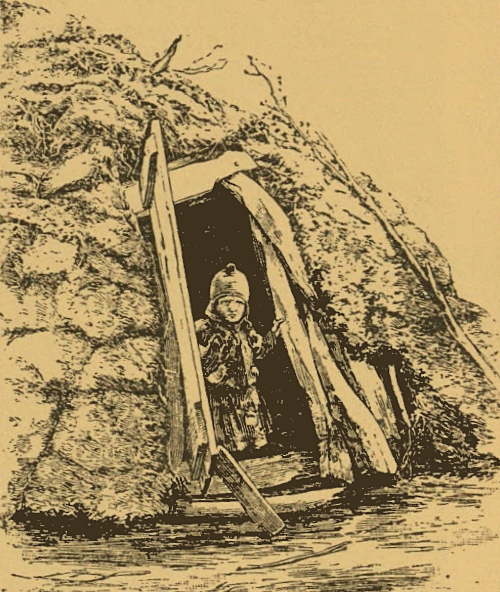
path and visited a cluster of sæters, but found
the rude huts deserted.
The summit of the hill is a dreary plateau
strewed with great boulders, from which is a
striking view of mountain peaks, with valleys
branching in various directions closed by glistening
glaciers, while gleaming among their
barren surroundings are lakes and fjords.
We sat down to eat the lunch that the innkeeper’s
thoughtful wife had placed in our pockets
on departing, but in the warm sunlight we
were surrounded by a swarm of flies, which
nearly devoured us, lunch and all; such blood-thirsty
and persistent flies we never encountered
before, and they fully demonstrated their ability
to accomplish their year’s work during the few
weeks of the short Norwegian summer.
At the little hamlet of Red we found two
rival hotels, the Victoria and the Wictory, the
proprietor of the latter being as mixed in his
orthography as was Sam Weller. The rival innkeepers
are engaged in a bitter warfare, which is
participated in by the guests of the hotels, for
in all the station books on the roads to and from
Red were comments of travellers, praising one
hotel, and denouncing the other. These comments
were so exaggerated and contradictory
that they defeated their object, and caused
one to decide, if possible, to give both hotels
a wide berth. We stopped at the Victoria, as
it was the first we came to, and ordered a
lunch and two boatmen to row us down the
lake, as the proprietor said there was no
steamer; no sooner had he disappeared than
the keeper of the Wictory across the way
walked over and informed us that his steamer
left in half an hour. We immediately countermanded
both the order for the lunch and the
boatmen, and giving the keeper of the Victoria
our opinion of him, embarked on the steamer,
concluding that the Wictory’s landlord must be
the saint, and the Victoria’s the sinner. This
was one of the few instances where we found the
Norwegians’ simple nature had been perverted;
whether by inherent depravity or by foreign
travellers we know not.
The steamer was a small craft manned by two
men, the captain combining every position on
board except that of engineer. It was a much
preferable way of making the journey to being
rowed ten miles across the lake. The rocky
cliffs and mountains rose to dizzy heights, and
numerous waterfalls leaped down their sides
into the clear waters of the lake.
Our next post by stolkjærre was an extremely
interesting one. The rough and hilly road led
through a narrow gorge thickly strewed with
huge blocks of rock, a small river dashed and
foamed below us, and shutting us in on both sides
were the lofty mountains. Then we came out
into a broad valley with views of several offshoots
of the great Jostedalsbræ, the largest glacier in
Norway, descending from an immense plateau
of snow and ice into the valley. The road skirts
the Jölster Lake, a beautiful expanse of clear
water, with its sides studded with farms. The
fields were full of haymakers, the girls dressed
in the pretty costume of blue homespun skirt,
white waist and bright bodice, some with their
flaxen hair coiled into a knot on the very top of
the head, others wearing jaunty peaked caps, all
being barefoot, with black gaiters buttoned
around the ankles.
The hay is dried on racks, like a section of
rail fence, composed of six or eight rails, sometimes
wire being substituted for the rails, built
at the sides and down the centre of the hay
fields; the grass is mown by hand, and much of
it, on account of the numerous rocks, has to be
cut, a handful at a time, with a sickle; the girls
hang the grass upon the rails of the racks so as
to allow a free circulation of air, which during
the cloudy days hastens the curing process, and
even after a long rain only the outside of the
grass on the upper rails is spoiled. The haymaking
is a long and laborious process, and as
there is much bad weather and rain, the haying
season extends through the greater part of the
Norwegian summer, and it is often weeks after
the grass is hung upon the racks before it is
sufficiently dried, and ready to be removed and
carted to the barns.
We frequently saw what is called the “hay
telegraph,” a stout wire stretching into the
valley from a clearing high above. The grass
is cut, dried, and made into bales, which are
attached to an iron ring, and sent down the
wire, high above the trees, into the valley below.
Wherever there is a level tract of land, and
grass and oats will grow, even though it is restricted
in dimensions and is located high up
the mountain side, there we would see the solitary
farm house. With what astonishment
must the Norwegians who yearly emigrate to
Wisconsin, Minnesota, and Dakota view the
level boundless prairies, after living on these
contracted farms, where only with much labor
can they gather a scanty crop from among the
rocks!
At the next post station we found every
horse out, for a prolific English vicar, accompanied
by his wife and seven daughters, the
long list of whose names—Deborah, Rachel,
Olivia, etc.—were entered in the station book,
had just passed through, sweeping away every
available horse. All the horses near by were
at work in the hay fields; the Pige refused to
go farther with her horse; and as it would
require an hour to send to a distant farm for
one, we decided to walk to the next station.
A beautiful, hard, level road extended along
the edge of the lake, through pleasant pastoral
scenes, with picturesque little villages with
rustic churches, and fields near the road from
which the haymakers sent us cordial greetings.
After our long ride the ten-mile walk was an
agreeable change, and with appetites such as
only the bracing and sweet scented air can give,
we arrived at sunset at Nedre Vassenden.
The inn was an old, rough house, unpainted
on the exterior, situated at the end of the lake,
with charming views of its placid water and
background of blue mountains; but the interior
was neat and inviting, and a motherly old
woman gave us a hearty welcome, and soon
served us with a supper of fried trout, fried
eggs, rich milk and cheese, some delicate marmalade,
and wheat, rye, and graham bread.
At all the inns in Norway we found three
kinds of bread, which were invariably good.
Our room overlooked the fine rapids formed
by a river flowing from the lake, and in comfortable
beds we were lulled to peaceful slumber,
by the sound of rushing waters. After a
substantial breakfast we left the dear old lady,
who had won our hearts by her kindness, as
well as by her culinary skill, and she gave us a
warm handshake as we paid our moderate bill
of three crowns (eighty cents) each.
An old farmer was perched on the back of the
stolkjærre, who was very talkative and the embodiment
of good nature, so that we regretted
more than ever our imperfect knowledge of the
language, and inability to understand him. The
road followed the banks of a river, and skirted
occasional lakes amid park-like scenery, with
beautiful waterfalls coming down among the
dark pine trees. Every few minutes the farmer
would point to the water and utter Mange Lax
(Many salmon), which to him was the chief
attraction. It began to rain and we put on our
rubber coats, which filled the farmer’s heart
with unbounded admiration, and as he reached
forward and softly stroked them with his hand,
he asked how much we paid for them, like a
simple unsophisticated child.
The rain came down in torrents as we drove
up to the inn at Forde, and we were glad to
avail ourselves of its shelter and treat the farmer
to beer. We then toiled up some terribly
steep hills, from which all views were obscured
by the thick clouds, and arrived at a rude station
where the farmer left us; it was a slow station,
and we were forced to wait in a miserable building
for over an hour, while a horse was sent for
to a distant farm. Starting once more, we drove
down a steep descent through the blinding rain,
till we came to Sande. We had intended continuing
our journey ten miles farther, to a pretentious
hotel at Vadheim, but the moment we
stepped inside the inn we fell in love with it,—the
impression was so cosy and homelike.
From the hall—which seemed like a reception
room, as no stairs were visible—opened through
wide doors, on one side the parlor, on the other
the dining room; ivy climbed over the doorways
and around the rooms; flowers and birds,
cases filled with English and Norwegian books,
racks with pipes and ornaments, tables covered
with English newspapers, near which were
drawn easy chairs, were about the rooms, and
everything was so neat and inviting, with such an
air of comfort and restfulness, that we decided at
once to remain several days. Herr Sivertsen, the
proprietor, although a University-educated man,
does not speak much English, but he made us
welcome and sent a maid to take our orders,
who had lived several years in America, and
who greeted us in our native tongue.
We were soon served with a good dinner and
met some pleasant people, as pleased with
the inn as ourselves, who on their arrival
intended simply to stop for dinner, but had remained
several days.
During four days it rained almost incessantly,
and we congratulated ourselves on being so
comfortably housed. The irregularity regarding
sleep which attends a tour in Norway, where
during the perpetual daylight one is led into
constant travelling and sight-seeing while the
weather is pleasant, calls for occasional periods
of rest, to enable one to “lay off,” and to store
up a fresh supply of sleep and strength, and
also to mentally digest the impressions and
information one gathers so abundantly.
We found Sande a perfect haven of rest;
our rooms and beds were clean and comfortable,
the food abundant and well cooked. The pleasant
acquaintances we made, and the genial home
feeling pervading the place, rendered our stay
there one of the most enjoyable of our experiences
in Norway. Often during the day travellers
would arrive, either to take fresh horses
and continue their journey, or to stop for a
meal or the night, which would call us from our
reading and writing, and animate the otherwise
quiet place. At one end of the house was a
room used as a shop, containing an assortment
of hardware, gingerbread, boots, soap, jewelry,
in fact everything to satisfy the moderate wants
of the natives, who drove up in their stolkjærres
to do their trading, their costumes and quaint
ways furnishing interesting studies.
One day as I was walking in the rain a
farmer stopped and spoke to me, then putting
his hands on my rubber coat, tried to unbutton
it; thinking he wished to know what time it
was, I opened my coat and showed him my
watch, at which he shook his head, and taking
my coat in his hands carefully examined it,
inside and out, and with a look of great admiration
uttered, Hvad koster det? (What did that
cost?). When I told him fifteen crowns, he
shook his head at such extravagance, and saying
something which far exceeded the bounds
of my Norwegian vocabulary, gave me a handshake
and went his way.
When the rain ceased and the sun reappeared,
we were more than ever charmed with the place,
for we then saw the beauty of its surroundings.
Across a swift, flowing river before the inn was
a range of low mountains flecked with snow;
while mountains towered in the rear, enclosing
the fertile valley with its fields and farm houses.
In every direction we found pleasant walks;
up the valleys extending among the mountains;
along the river’s bank by a road winding among
fragrant pines and up the mountain sides for the
extensive views. But the favorite excursion
was to a series of lakes flowing into each other,
and forming imposing waterfalls as the water
leaped over a high ledge into the lake below,
and seethed and foamed as it flowed onward for
another plunge.
Several of the guests were sportsmen, who
returned at night with a good supply of trout
caught in the lakes, and an occasional salmon
taken from the river,—which graced the breakfast
table.
In these delightful surroundings the days,
both sunny and rainy, flew quickly by, and we
were prepared to start with new zest for other
scenes.
ON AND ABOUT THE
SOGNEFJORD.