WE come now to the south-western corner of Middlesex, presenting a thick
fringe of beauty and interest along the crooked course of the Thames.
The beauty, indeed, is mainly artificial, the ground being in general
flat, traversed by sluggish streams, and often apt to revert to the
condition of a flooded marsh till banked in by dykes of habitation and
ornamentation that make most of this river-edge one line of garden
suburb. When we abuse London for defiling the country, let us not forget
how plain-featured country may be disguised and pranked out under the
fancy-dress of parks, gardens, pleasure-grounds and playgrounds, to be
reckoned among the manufactures of a great city. Here, indeed, a
champaign face of nature smiles rather for Pope and Bolingbroke than for
Wordsworth and Tennyson.
We have already touched the Thames at Brentford, and since inner London
ended with Hammersmith, something might have been said of the green
tongue of Chiswick and the quaint village of Strand-on-the-Green, below
Kew Bridge, only in part overlaid by an extension of suburban
Gunnersbury. Then above Syon Park and Isleworth Church, at one mouth of
the Crane, the villas of St. Margaret’s make a transpontine dependency
of Richmond, almost joined also to the spread of Twickenham. At this
latter town I take up my tale of the riverside.
Twickenham has been growing so fast along its tram-lines that it seems
in danger of becoming a commonplace extension of London; but it cannot
forget days of dignity when Queens, Princes, and poets were at home
here. Katherine of Aragon, Katherine Parr, and Katherine of Braganza are
supposed to have occupied the manor-house that once stood beside the
Church, where lie buried Pope, Sir Godfrey Kneller, Kitty Clive the
actress, and Admiral Byron, that “Foul-weather Jack” whose story of the
Wager’s wreck gave so many hints to his grandson’s verse. Queen Anne,
whose death is such a well-authenticated fact in history, was born at
Twickenham, as was her sister Queen Mary. The only one of Anne’s
seventeen children that struggled on to any prospect of surviving her,
the poor little Duke of Gloucester, was brought from Kensington to
Twickenham, as to the seaside, for change of air after an illness. In
the next century, Horace Walpole speaks of the place as the “Baiae of
Great Britain,” and quotes someone as declaring that “we have more
coaches here than in half France.” Among Pope’s noble neighbours was the
traveller of epistolary renown, Lady Mary Wortley Montagu, whose
friendship with the poet went so sour in the end. Some of the fine
cedars hereabouts are said to have been raised from cones sent by her
from the East. Another householder of rank was that Lord Ferrers, hanged
for murder, according to the legend, in a silk rope, driven to the
gallows in his own coach and six, which nowadays would probably have
taken the road to Broadmoor Asylum. Writers whose works are now in every
gentleman’s library, but not in Mudie’s, such as Richard Owen Cambridge,
who seemed to his contemporaries a universal genius, and that other poet
whose fortune was to be “born a Whitehead and baptized a Paul,” could
once be counted among the notabilities of a place which, under the
shadow of Pope’s renown, has housed more enduring names, from Fielding
to Dickens. But for the long list of its celebrities and associations,
the reader must be referred to such local chronicles as R. S. Cobbett’s
Memorials of Twickenham.
Some of the houses thus celebrated still stand, or their names at least
are preserved. Twickenham Park, at the Richmond Bridge end, a seat of
Lord Bacon, has given place to humbler homes. But Marble Hill, built for
the Countess of Suffolk, George II.‘s mistress, and at one time the home
of Mrs. Fitzherbert, another George’s left-handed wife, has been saved
from the jerry-builder to become a public pleasure-ground, that will not
debase the view from Richmond Hill. This house is haunted by the shades
of Pope, Swift, and Gay, as its neighbour by more

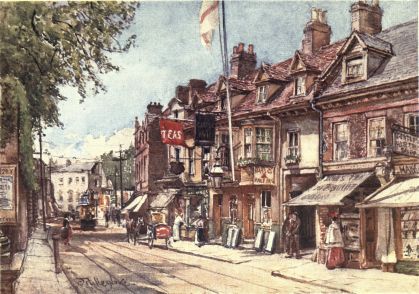 HIGH STREET, TWICKENHAM
recent memories of princely exiles. Orleans House was so renamed as
making an asylum for Louis Philippe, escaped from the storm of the
Revolution which Madame de Genlis had taught him to hail with youthful
enthusiasm. Half a century later, after his second banishment, this
mansion again gave refuge to the Orleans family; then for a time it was
turned into a club. Members of the same family have more than once
occupied the adjacent York House, whose earliest dignity was as home of
Lord Clarendon, by him given to his son-in-law, James II.; and so it
came to be the birthplace of two English Queens. It has now been bought
from the Duke of Orleans by a Parsee gentleman, son of the late Mr. Tata
of Bombay, that millionaire of princely public spirit who lies buried in
the next county.
This connection with our Eastern Empire is not altogether a new one for
York House. A visitor here in his day was the Brahmin reformer Rammohun
Roy, founder of the Brahmo-Somaj church, who is said to have designed
writing a philosophical dialogue with the scene laid on the terrace of
York House. For a good many years towards the end of the century it was
occupied by Sir Mountstuart Grant-Duff, ex-Governor of Madras, as will
be remembered by all readers of the later extracts from his Diaries,
published in more than a dozen volumes. These volumes, abridged as they
are, have been criticized as too voluminous; but they make excellent
reading for judicious skippers, and after a century or two, one can
imagine a further abridgment being treasured like Evelyn’s Diary or
Horace Walpole’s Letters. This diarist was a keen amateur of good
company and of good stories, which stud his pages like plums in a
pudding of political suet and botanical crumbs. His anecdotes were
collected from all quarters, even from the steps of the throne. There is
one, for instance, of a South African millionaire, whose accent led to
him being addressed in German by a very eminent personage: “Sind Sie
Baier?” “Not at present prices, your Majesty!” stammered the confused
courtier. In the same volume we are told how a whist player held
thirteen trumps, yet did not win a trick, for it was in the far West,
and his partner shot him dead as remonstrance against the trumping of
his own ace.
But one must not deck one’s pages with plumes borrowed from a writer
whom I met as fellow-member of two among his many clubs. I can recall a
wet afternoon we killed together shortly before his death, when, to
cheer what seemed a fit of depression, I told him all the stories I
could think of as likely to stir his sense of humour. Only afterwards
did it occur to me, in a flash of esprit d’escalier, that I had been
drawing on one of his own lately published volumes; and I shall never
know, on this side of Jordan, whether it were out of courtesy or
obliviousness that the old gentleman let himself appear to be amused.
With one maiden anecdote, however, now for the first time blushing in
print, I had been able to tickle him exceedingly, as it dealt with a
colonial governor, a kind of personage bulking as largely in his
interest as a schoolmaster did for Parson Adams. In the suite of such a
temporary potentate served an officer, whose wife told me how at home,
years later, making a third-class railway journey, they had brought
considerations to bear upon the guard that they should have the
compartment to themselves. But at one station he came to explain: “Very
sorry—train crowded—must put someone in with you—but I have picked
out a respectable couple—quite decent people; you won’t mind
them”—with which apology were bundled in the very decent couple my
friends had last seen viceregally enthroned in a distant clime. So much
for the transitoriness of official glory!
A tale which Grant-Duff might not have thought worth recording has been
told of Mr. Labouchere, but an older date is ascribed to it: that an
Englishman travelling in Germany, called upon to declare his Stand,
could describe himself by no other title than “Elector of Middlesex,”
then was astonished to be received with honours due to a prince. Mr.
Labouchere comes to mind here as for a time occupying Pope’s Villa, of
which the name survives, but little else, among the riverside mansions
at the further end of Twickenham. It stands above Eel-pie Island, a
leafy atoll of the Thames, that makes a screen or barrier-reef for this
town, and has at its lower end a ferry not unknown to song.
Pope’s nearest neighbour here was Lord Radnor, whose grounds are now
turned to public enjoyment. A little further on stands back from the
river the park of Strawberry Hill, where Horace Walpole’s “piecrust
battlements” succeeded Pope’s Villa as lion of the place. The once
famous collection of curiosities, after being dispersed, was in part
regathered into the present mansion, enlarged and improved from that
“Strawberry Hill Gothic” structure that became a proverb, not to say a
by-word, with more tasteful architects. The nucleus of it was “a little
plaything house,” which its dilettante owner, on removing there from his
“tub at Windsor,” described as “the prettiest bauble you ever saw. It is
set in enamelled meadows, with filigree hedges.... Richmond Hill and Ham
Walks bound my prospect; but, thank God! the Thames is between me and
the Duchess of Queensberry. Dowagers as plenty as flounders inhabit all
around, and Pope’s ghost is just now skimming under my window by a most
poetical moonlight. I have about land enough to keep such a farm as
Noah’s when he set up in the ark with a pair of each kind.... Lord John
Sackville pre-deceased me here, and instituted certain games called
cricketalia, which have been celebrated this very evening in honour of
him in a neighbouring meadow.” Still, of a summer evening, such
mysteries are celebrated on the lordly expanse of Twickenham Green; but
if this self-satisfied letter-writer’s ghost could come skimming under
what were once his own windows, Father Noah might find it no harder to
be at home in a toyshop ark than Walpole to recognize the “romance in
lath and plaster” that was his much-advertised work of half a century.
Behind Twickenham, amid more rural surroundings, stands, in a
transformed state, the mansion of Sir Godfrey
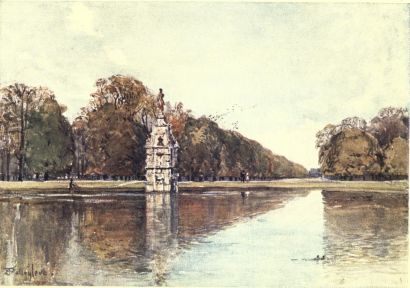 THE DIANA FOUNTAIN, BUSHEY PARK
Kneller the painter, which came to be a training-school for teachers,
with the late Archbishop Temple for one of its principals, but is now
the home of another muse as an academy for army bandsmen, whose
performances are open to the public once a week. Kneller Hall was
originally Whitton House, and not far off, on the south edge of
Hounslow, survives the name of Whitton Park, where bagpipes should once
have been practised; for, in the early part of the eighteenth century,
it was a seat of the Duke of Argyll who in its grounds did so much
towards introducing alien trees, to become naturalized citizens of our
groves and gardens. This was the Duke who served with distinction under
Marlborough and as victor over the Old Pretender’s forces in 1715; while
he may be best remembered as patron of “Jeanie Deans.”
In the famous view beheld by that heroine from Richmond Hill, Twickenham
is seen imperceptibly merging into Teddington, a parish of less fame,
but it, too, has had notable inhabitants, from William Penn the Quaker
to Peg Woffington the actress; and R. D. Blackmore, the novelist of our
own time, practised the moral of Candide in a market-garden here. Both
Upper and Lower Teddington are well populated now, the latter best known
to Londoners for the first full lock on Thames tide-water, the former as
an approach to Bushey Park. This is a royal demesne of over 1,000 acres,
public access to which was secured by a local Hampden, Timothy Bennett,
shoemaker, who in the eighteenth century fought the question of right
of way at his own expense, then, in 1900, was rewarded by a curious
memorial set up at one of the entrances to the park. The last royal
personage who lived here was William IV., as Duke of Clarence; and one
of the last acts of Queen Victoria was granting Bushey House to be a
National Physical Laboratory. The park is now practically a public one,
where a Sunday in May draws throngs of Londoners to admire the flowering
of the chestnuts on its renowned avenue. But “when the high midsummer
pomps are on,” too, and in the glories of autumn decay, and, indeed, at
all seasons, Bushey, with its fine timber, its stretches of bracken, its
ponds, and its herds of tame deer, makes a sight that no visitor to
London should miss. The main avenue, a straight and broad mile, leads
from Teddington to Hampton Court, on the other side approached from
Kingston Bridge through the glades of Hampton Park, to which one could
come round by the river and the villas of Hampton Wick.
The history of this palace is, of course, familiar to every British
schoolboy; but in case any of my readers should be more at home in
Versailles or the Vatican, I will treat them as M. Jourdain desired of
his master. Hampton Court was built by Cardinal Wolsey at the height of
his power and pride, that would have cast into shade the magnificence of
Canons Park, the household of the butcher’s son being nearly ten times
as numerous as that of Queen Anne’s Paymaster-General. Extensive as his
building was, Wolsey appears not to have completed its full design when
his power became endangered by the conflagration lit at Anne Boleyn’s
eyes. He hoped to avert Henry’s wrath by presenting that too ambitious
home to the King, who, in Diomedean exchange, gave him the manor of
Richmond, where soon there were harder dealings between Ego and Rex
meus. Henry pulled about the Cardinal’s architecture in his own
high-handed style, building the present hall and chapel; and he made
Hampton a hunting-palace, with several parishes around as preserves.
Edward VI. was born and partly brought up here. Here, too, Mary spent
her dark honeymoon—that unloved sovereign whose faults have been
excused by a schoolgirl on the plea of a temper soured under too many
stepmothers. Hampton was a favourite residence with Elizabeth also, and
with James, who held at it his famous conference of divines, from which
came our present translation of the Bible. Charles I. was much at home
at Hampton, and so in turn was Cromwell—a fact which may have caused
the mental confusion of that schoolboy quotation of him as exclaiming,
“Had I but served my God as I have served my King!” Charles II. and his
brother are found now and then at Hampton, to which William took a
special fancy, so that he had it restored and enlarged by Wren, to be a
home reminding him of Holland by its canals and gardens; and he met his
fatal fall from horseback in the park. Queen Anne’s sickly son, above
mentioned, was born at the palace, where the poet remarks how—
“Thou, great Anna, whom three realms obey,
Dost sometimes counsel take, and sometimes tea.”
The Georges seem rather to have neglected Hampton Court, which in the
last century or so occasionally housed royal guests, but has become
mainly a sort of aristocratic almshouse, the apartments being granted to
widows of distinguished public servants or ladies better born than
endowed. The inmates of these dignified quarters are liable to be
disturbed by the clatter of the adjacent barracks, by an uncertain ghost
of one or other of Henry’s wives, that does not fail to haunt here, and
most of all, perhaps, by the sightseers, who on holidays throng the
quiet courts, the galleries with their thousand pictures, the hall with
its tapestries, the gardens with their gigantic vine, the Long Walk by
the river, the banks of the Long Water in Hampton Park, and the Maze
near the Lion Gate, outside of which the palace is separated from Bushey
Park by a fair-ground of refreshment houses.
The station for Hampton Court is at Molesey, on the Surrey side of the
river, here making a string of shady islets and creeks well known to
boating parties. The tramways from London come to Hampton Green, such a
spacious and well-shaded area as beseems its royal neighbourhood. Along
this, or through the south-west corner of Bushey Park, one can pass on
to the village of Hampton, which touches the river at its rebuilt
Church; but the banks are much blocked by private residences, and soon
disfigured by huge water reservoirs. The most famous house here is
Garrick’s villa, that seems to have been designed as an understudy of
Pope’s. Besides this noble retreat, Garrick had a
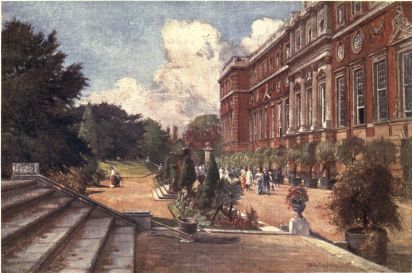 HAMPTON COURT PALACE: SOUTH FRONT
town-house at the Adelphi, and was lord of Hendon Manor; few actors have
managed to be so prudent, so prosperous, and so well off for “the things
that make death terrible,” as was Johnson’s comment on his old pupil’s
display. Sir Christopher Wren retired to a home on Hampton Green, about
which there remain several houses and gardens where wigs and ruffles
would look hardly out of place. New Hampton, to the north, is more
commonplace, where Hampton’s railway-station, on the Shepperton branch,
stands half an hour’s walk from the palace. About as far to the north of
this line is Hanworth, traversed by the artificial Queen’s or Cardinal’s
River formerly mentioned, and once distinguished by a Tudor
hunting-lodge which became the home of Henry VIII.‘s lucky widow.
By its Thames Street, Hampton straggles on towards Sunbury, where the
river is broken by eyots, weirs, and a deep shady cut on the Surrey
side. This village, too, contains good old-fashioned houses as well as
new ones, stretching back from its Church on the bank to the station a
mile behind, where another royal residence is believed to have stood in
Kempton Park, now degraded into a race-course. Close to Sunbury is Upper
Halliford, by which a road takes a straighter line into the neighbouring
parish of Shepperton, cutting across a bend of the river opposite
Walton-on-Thames. Shepperton is a more scattered place, containing
several hamlets and strings of villas connected by roads that seldom
want the true Middlesex wealth of hedgerow timber.
Here at last we seem to be getting into open country, and away from
riverside villas. A summer encampment at the end of Walton Bridge left
out of account, the next place reached on the river is the pretty group
of houses and inns called Lower Halliford, a little above the bridge.
This ford makes the scene of a hot antiquarian controversy as to whether
or no Cæsar here crossed the Thames, fortified against him by the Cowey
Stakes, which some take rather for an ancient fishing weir; and his
point of crossing is variously maintained to have been at Brentford,
Kingston, and Wallingford, while traces and traditions of Roman camps on
either side the river help out the case for Halliford. Non nostrum
tantas, etc. An authentic claim to note for Lower Halliford is as the
home of Thomas Love Peacock, an author too little known to the general
reader, though his humorous novels were spread out over nearly half a
century, from the days when he caricatured Shelley and Coleridge,
through the period of Brougham’s patronage of useful knowledge, to that
when competitive examinations gave him a fresh target for ridicule. By
an audience fit, though few, he is not forgotten; and for the sake of
his wit he may be forgiven such thoughtless gibes as that “Scotchmen
would be the best people in the world if there was nobody but themselves
to give them characters.” There is reason to believe, indeed, that even
before his deathbed this audacious writer repented the profanity with
which he bespattered our modern Athens. The plan, at least, of
Peacock’s books was revived for our generation in Mr. Mallock’s New
Republic; but Peacock strikes a note of more farcical fun, and his
satire seems seldom less jovial than the song put into the mouth of a
character in Crotchet Castle:
After careful meditation
And profound deliberation
On the various petty projects that have just been shown,
Not a scheme in agitation
For the world’s amelioration
Has a grain of common-sense in it, except my own!
Higher up on the bank comes the church core of Shepperton; then
Shepperton Lock is higher still, opposite the Thames end of Weybridge.
The village seems to have shifted its centre of gravity towards the
station and Shepperton Green, which stand further back, but best known
to strangers are the riverside inns and boathouses. To the right of a
road cutting across to Laleham by Shepperton Green lies the small parish
of Littleton, making perhaps the prettiest spot in this district, with
its ancient Church and timbered park, which once enclosed a celebrated
mansion destroyed by fire. This backwater of woodland, shading surely
the tiniest of Britain’s Exe or Esk streams, is pleasantly reached by a
field-path from the end of Chertsey Bridge; then the road by Littleton
goes on to less taking scenes about Feltham or Ashford.
At Shepperton Lock the tow-path crosses from the Surrey side, and
henceforth one can walk along the Middlesex bank, access to which has
hitherto been precarious. Truth to tell, one thus gains little beyond a
prospect of the stream flowing quietly between broad meadows, its bends
making an idle round off the straight road, by which little more than a
mile brings the cyclist from Shepperton to Chertsey Bridge. The green
flats have a beauty of quiet amplitude, which is at least a change after
Richmond’s manifold prospects and the tangled groves of Hampton; and
here a fine background is formed by the pine-bristled heights of Surrey,
edging the arena in which the Wey meets the Thames. William Black’s
rhapsodical pen can make no more of this scenery than “a peaceful
landscape, very English-looking; in the distance there was a low line of
wooded hill, with here and there a church spire appearing among the
trees.” A thunderstorm would get a good stage here, as did Mr. Wells’s
Martian giants when they came stalking across from Byfleet.
Beyond Chertsey Bridge the tow-path is joined by a road that leads on
along the wall of Lord Lucan’s Park to Laleham Ferry, opposite the site
of that once renowned Chertsey Abbey. The pretty village of Laleham,
with its much-patched church, is notable as the home where Dr. Arnold
took pupils in his early life. Matthew Arnold was born here, and is
buried, beside other members of the family, in the churchyard to which
his heart and his father’s always turned fondly.
Love lends life a little grace,
A few sad smiles, and then
Both are laid in one cold place.
The Rugby head master had to wrench himself away from Laleham, where,
indeed, his special admiration was called forth on the Surrey side by
the striking contrast of heath scenery mingling with rich valley lands.
He could no longer rejoice in the bank up to Staines as a walk “which,
though it be perfectly flat, has yet a great charm from its entire
loneliness, there being not a house anywhere near it; and the river here
has none of that stir of boats and barges upon it which makes it in many
places as public as the highroad.” Nowadays one must search far up the
Thames for an unstirred reach.
Arnold’s roomy house has vanished, and the quiet amenities of Laleham
seem threatened by architecture of another school, though it stands a
good two miles from either Shepperton or Staines station. But the
builder is hardly needed to populate the river banks in summer, as we
see after crossing the neck of Penton Hook, a most childish vagary of a
mile or so in which hoary Father Thames thinks fit to indulge himself so
far on in his career. This loop, on the Surrey side, is buckled by an
extraordinary gathering of bungalows, house-boats, tents, and shanties
that give airy and watery shelter to an encampment of respectable
gipsies from London, a sort of amphibious picnic life come into favour
in late years. Past this, the tow-path brings us round to the more
permanent riverside quarters of Staines, reached, as usual, less
deviously and pleasantly by a flat, straight road.
Staines is one of the oldest towns in Middlesex, here or hereabouts
appearing to have stood the Roman station Ad Pontes, by which the road
to Silchester and Bath crossed the river. The whole vicinity has been
found rich in Roman remains. The original town lies about its parish
church in the valley of the Colne, that works its mills; but the floods
of this sluggish delta have washed a later growth to the east, and it
shows a new red church on the Thames bank, where a terrace of dignity
looks across to the boathouses lining the Surrey side. A meaner quarter
straggles on to the dull flats of Staines Moor behind the railway, from
which High Street curves spaciously down to the bridge, for long the
nearest neighbour of London Bridge. In our great-grandfathers’ day
Staines Bridge was crossed by some three dozen coaches daily; and who
can count the myriad wheels that now make this short straight cut
through Middlesex into Surrey!
Near its bridge stands what is taken for the town’s godfather, London
Stone, marking from times immemorial the limit of the City’s
jurisdiction up the Thames, as ascertained and asserted by repeated
visits of the Lord Mayor and Corporation, which seem now to have fallen
into abeyance. Here I would call up the spirit of Matthew Arnold to
rebuke for me that young lion of the Daily Telegraph who, in
criticizing my book on Surrey, growled at its mention of a notable
Lord Mayor’s progress nearly three generations ago as made to Staines,
and not rather to Oxford. For once a critic is wrong: the goal of the
official journey was Staines, the circumgression to Oxford being tacked
on as an after-thought, or piece of by-play. Even thus let me conclude
this chapter with an excursus further up the river, to justify my
accuracy by giving a faithful account of that Thames Anabasis that
might have been forgotten but for the reverend Xenophon—his Lordship’s
chaplain, to wit—who enshrined the record in a leaden volume, now worth
its weight in silver.
The civic fathers, we are told, having resolved to assert the City’s
prerogative at Staines, were tempted by an invitation to connect with
that time-honoured ceremony a pleasure-trip to Oxford. To Oxford, then,
the Lord Mayor and Lady Mayoress travelled by land, and the first part
of the chronicle is taken up in describing most minutely the
circumstances of this extra jaunt. A whole page goes to the start,
including a description of the coachman’s countenance, “reserved and
thoughtful” as became his important charge, and the “four high-spirited
and stately horses” which, “having been allowed a previous day of
unbroken rest, ... chafed and champed exceedingly on the bits by which
their impetuosity was restrained.” But the murmurs of the admiring crowd
were “at length hushed by the opening of the hall door”; then, “as soon
as the female attendant of the Lady Mayoress had taken her seat, dressed
with becoming neatness, at the side of the well-looking coachman, the
carriage drove away—not, however, with that violent and extreme
rapidity which rather astounds than gratifies the beholders, but at that
steady and majestic pace which is always an indication of real
greatness.” The chaplain, our author, was of the party, though he
modestly keeps himself in a back seat. Thus he can assure us that the
roads were “in excellent order, and that the whole face of creation
gleamed with joy.” It is not every day that creation sees an actual Lord
Mayor faring forth over Middlesex roads.
At Hounslow a powder-mill happened to blow up, as if to salute the
passage of the City potentate; but without further excitement he reached
Oxford, joined there by several Aldermen and officials, who were
forthwith entertained by the local municipality, while “it must here be
mentioned that the Lady Mayoress and other ladies of the party, to the
number of eight, ordered dinner at the ‘Star,’ and spent the evening in
their own society.” But let us pass over a long account of the
illustrious strangers being fêted, lionized and addressed by Town and
Gown, and come to that great day, Thursday, July 27, 1826, when the City
Barge, having taken nearly a week to make the upward voyage, lay in
waiting by the banks of Christ Church meadow, with its ten splendid
scarlet silk banners waving gently in the rising sun, beside the shallop
of the Thames Navigation Committee and another large boat, in which came
his lordship’s Yeomen of the Household, together with that most
important functionary the cook, “who was at the time of embarkation
busily engaged in preparing a fire in a grate fixed in the bow of the
boat.” So at last, “amidst shouts of reiterated applause from the
surrounding multitudes, the City Barge, manned by the City watermen in
scarlet liveries, and all the other boats in attendance on his lordship,
were simultaneously launched on the broad bosom of the princely
Thames”—a sight not to be seen by this degenerate age unless on the
front page of its Illustrated London News.
Punch was not such a rare show in the country as a live Lord Mayor.
Crowds of people on the tow-path escorted the procession from Oxford;
then every town and village near the banks furnished a new contingent of
eager spectators. “Distant shouts of acclamation perpetually re-echoed
from field to field, as the various rustic parties, with their fresh and
blooming faces, were seen hurrying forth from their cottages and
gardens, climbing trees, struggling through copses, and traversing
thickets to make their shortest way to the water side.” No wonder the
children ran, for the Lord Mayor and Mr. Alderman Atkins scattered
handfuls of half-pence from their stately craft. At Caversham the
condescension of true greatness was still more markedly exhibited in a
moving incident recorded with long-drawn waggery, the gist of it being
the picking out of a most uncouth and ludicrous-looking rustic mounted
upon a “gaunt and rusty pony,” whom, flinging him a piece of money, his
Lordship overwhelmed with the honour of a commission to ride on to
Reading as his avant-courier.
Having started from Oxford at seven, the convoy reached Reading when
“the sun had whirled down his broad disk into the west; and the evening
twilight just served to show obscurely the tranquil stream of water over
which the vessel glided, and the shapeless forms of country by which it
was surrounded.” Here the voyagers spent the night at the “Bear Inn,”
re-embarking next morning amid the ringing of bells and the firing of
guns, not to speak of a band of music now taken on board. They dined at
Clieveden, which prompts the author to a homily on the shortcomings of
Dryden’s Buckingham, balanced by a seven-page eulogium on the virtues of
the late George III. The local gentry and officials did not fail to pay
their respects to the passing Admiral of the Thames, and were invited on
board “with all the usual forms of politeness.” As we have seen, the
distinguished tourists occasionally indulged themselves in mild
jocosity; but on the whole their mood was one of becoming admiration,
and their chaplain can assure us that “no recourse was had in any single
instance throughout the voyage either to cards or dice, or to any other
of those frivolous expedients to which the evening hours of life are
sacrificed.”
The next night was spent at Windsor, where some score of pages go to
celebrate the Castle apartments in a true “God bless the Regent and the
Duke of York!” spirit of British loyalty. Delayed till noon by
sight-seeing, the procession then got afloat for Staines, and whereas,
above Windsor, the state barge had almost stuck in the mud, it now made
better way in deeper water, and “left a long, undulating track behind”
as it passed beneath that royal abode, “lifting up its lordly pile as if
to receive the prostrate homage of the surrounding country.”
Hitherto the voyage had been more of a pleasure jaunt, but at Staines
came to be enacted the real business of this Lord Mayor’s show in
partibus. Duly arrayed in their robes and emblems of office, to the
music of national airs, amid multitudes of the surrounding inhabitants,
our City fathers descended to the shore, and three times solemnly
circumambulated their western landmark—let us trust in true course of
the sun, though on that pagan feature of the rite its reverend
chronicler is not explicit.
When the procession halted, the Lord Mayor took his station near
the City Boundary; and directed the City Sword to be placed on the
Stone, in token of his Lordship’s jurisdiction. It was also a part
of the ceremony—which, though important, is simple—that the City
Banner should wave over the Stone. At the request, therefore, of
the Lord Mayor, Lord Henry Beauclerk, a lad of very prepossessing
appearance, of the age of fourteen, dressed in naval uniform, and
brother to His Grace the Duke of St. Albans, mounted the Stone, and
held the City Banner during the performance of the ceremony. The
Lord Mayor now received a bottle of wine from one of the
attendants, and broke it, according to ancient custom, on the
Stone. The Water-Bailiff then handed his Lordship a glass of wine,
who drank, ‘May God preserve the City of London!’ In this he was
joined by the young nobleman and the assembled company. Orders were
then given that the following inscription should be engraven on the
pedestal which supported the Stone:
“The Right Honourable
WILLIAM VENABLES,
Lord Mayor of the City of London
and
Conservator of the River Thames,
Viewed the Western Boundary of the
City’s Jurisdiction on the said River,
Marked by the Ancient Stone
Raised upon this Pedestal,
Erected A.D. 1285,
On the 29th day of July, A.D. 1826.
God preserve the City of London!”
The Lord Mayor then scattered abroad some hundred newly-coined
sixpences, and after repeated cheering, returned on board the
barge.
We need not be surprised to hear that “at three o’clock the party sat
down in the cabin of the State Barge to a cold collation; after which
some speeches were made.” By half-past eight they landed at Richmond,
where the carriages were in waiting, and the sunburned Gilpins “returned
to their respective homes.” His lordship, it is recorded, reached the
Mansion House “a few minutes before ten” on this Saturday night; but
future ages are left to guess at what hour he went to bed. The worthy
chaplain, long laid to deeper rest, would surely turn in his grave could
he know how he had taken pains to put in a ludicrous light that truly
august Corporation, worshipful up and down the river for a hundred
miles, though its practical power be now in the farther-reaching hands
of the Thames Conservancy.
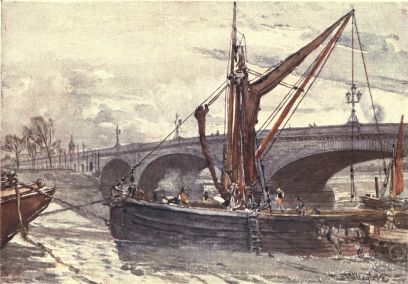 KEW BRIDGE FROM BRENTFORD
 IX BEATING THE BOUNDS
LIKE that corporation party, both writer and reader might now go home,
having reached the limit of their companionship. But one more ramble we
may take, if not tired of each other. We have viewed Middlesex from its
most familiar eminence, and we have radiated through it by its highroads
from London. There remains to bind up our short wayfarings by
perambulating the bounds of this little county, as some future Lord
Mayor may be able to do from his state-balloon.
A barge will not serve us all the way here so well as a broomstick. On
three sides Middlesex is enclosed by natural boundaries—the Thames on
the south, the Lea on the east, and the Colne on the west. It is on the
north side that the frontier becomes an arbitrary one, and, in fact,
presents such a jagged outline as sometimes to suggest that whoever
shore off this division of England must have been staggering from one
tap of strong ale or mead to the next in any direction. A more
creditable explanation refers such irregularity to spiritual rather than
spirituous influences, the lands of two bishops, we are told, having
thus dovetailed into each other in the days when bishops had power to
bind and loose on earth. Here it must be no trivial sport to beat the
parish bounds—on the outside coincident with those of the county—as to
which the oldest inhabitant could perhaps tell us how they were
literally beaten into his memory in boyhood by blows or stripes
administered at this or that spot, a custom that still may linger in
playful survivals. What the oldest inhabitant will not know is that the
rough custom of his youth seems to have been an attenuated form of
bloodier sacrifices, which went more than skin deep in the propitiation
of invisible spirits of term and boundary.
Something of the same irregularity, indeed, we find on beginning to
trace the Middlesex bounds from Staines, above which they wander for a
few miles as if confused among the delta of branches in which the Colne
reaches the Thames. The main stream, to which Ordnance Survey maps grant
the title, is that one crawling into Staines by the east side of the
Great Northern Railway branch from Uxbridge. Here the boundary has bent
a mile or two westwards, at one point touching the Colne Brook, as the
branch is called that, from the village of this name, straggles down to
the Thames opposite Egham. A pool in the Thames used to bear the
nickname of “Colnbrook Churchyard,” the point of the grim jest being
that this frontier village had no churchyard, and that the robbers who
infested the surrounding moors were in the way of flinging the bodies of
their victims into the river. “Moorish” is Spenser’s epithet for the
Colne, moor in this part of Britain having commonly implied marshy
rather than heathy ground; and behind Staines we get on an unlovely
river flat still bearing the name of Staines Moor. But if we incline to
hurry away from the Colne as sluggish and defiled by industries, let us
remember how dear its waters were to Milton, whose home in youth was at
Horton on the Bucks side, whence he had choice of wanderings among
“Meadows trim with daisies pied,
Shallow brooks and river wide.”
From Colnbrook the boundary bends back towards the Colne River, with
which it presently falls in along the reach from Yiewsley to Uxbridge,
where this stream skirmishes out on the western flank of the canal’s
straighter march. On the Middlesex side, here, the world is too much
with us, and we must not be tempted over to the woods and heaths of
Iver, in Bucks. So let us hasten up the canal bank to Uxbridge, where
the border takes a crook to the east along a stream known as the Shire
Ditch, then, recrossing the canal, once more follows the river as far as
the county’s north-western corner.
This upper half of the western boundary is more picturesque than the
flats below. Now the Colne runs through a real valley, shut in to the
east by a ridge of high ground, looking over to the Bucks village of
Denham, and other spots known to artists as well as to anglers. The
ridge itself, which a road mounts by the shrunken bounds of Uxbridge
Common, has several points both of beauty and interest. Over it for
nearly half a dozen miles extends the name of Harefield, associated with
that of the Newdigate family, which has such a good chance of fame
through their annual vates sacer at Oxford. One of them chose an “Adam
Bede” for land agent, whose daughter would widely renown, under an
alias, their Warwickshire seat, at which George Eliot had glimpses of
squirely life. Another of the Newdigates was well known to our
grandfathers as a Parliamentary Protestant champion. Their modern
mansion, Harefield Place, comes a couple of miles above Uxbridge, built
here to replace the old house, two or three miles further on, that had
been destroyed by fire. This was the seat of the Countess of Derby for
whom Milton wrote his Arcades, and whose tomb is the most sumptuous of
those ornamenting Harefield Church.
On the wooded bank behind the church the site of that defunct home is
picturesquely marked by a group of ponds and grand old trees. By what
seems to have been once an avenue, a path slopes on up the bank to
Breakspear, a still flourishing mansion, beautifully embowered, notable
because this manor is said to have belonged to the family of the one
English Pope, Adrian IV. Some few years ago, when a Catholic chapel was
being consecrated in the neighbourhood, the mason brought duly to wall
up the relics in its altar turned out to bear the name of Nicholas
Breakspear. At a social function which followed there was naturally some
talk of such a coincidence, and an inconsiderate Catholic suggested
that the man must be a descendant of his great namesake. “Don’t be
taking away a Pope’s character!” cried one jovial Irish priest; to which
another made response: “Faith! and it’s no character he had to lose
after selling us to the English.” This Pope, who gave Henry II. a title
to Ireland in consideration of the payment of Peter’s pence, has been
also claimed as a Hertford man; but if Breakspear were his cradle, it
stands a good mile within the Middlesex border, about as far to the west
of Ruislip reservoir.
Harefield Church, with its show of monuments, lies below its village,
beyond which, on the road to Rickmansworth, we come to Harefield Park
and Harefield Grove, or, descending into the river valley, we should
find a Harefield Moor and a Harefield Wharf on the canal. Harefield is
as yet a real country village with quiet inns and roomy green, but
ominous placards hold out a threat of “villa residences.” Nothing,
indeed, could at present be more unsuburban than the byroad which, at
the school-house, turns off along Harefield Park and by the hamlet of
Hillend, to wind shadily with westward bends till it drops steeply to
the canal, where a huge quarry has uncovered a chalk bank contrasting
with variegated disclosures. For at this corner, as at one other,
Middlesex shows its age in gouty knuckles of chalk as well as wrinkles
of sand.
To reach the extreme north-western nook of the county we must now leave
the ridge, to hold for a mile across the flat on which, alongside that
cart-horse canal, the Colne goes frisking and sliding in wayward
channels, by whose clear shallows the Miltons of to-day must beware how
they come angling after poetic images, as these are preserves for the
“True Waltonians” of Rickmansworth. At the ford on the further branch,
near the village of Mill End, we reach the border-line, which has been
kept in view west of the parallel ridge; but now it turns eastward,
making a dip to the south as it crosses the river flat, then soon
mounting to green bastions moated by the canal.
On this northern side it is that we may find it hard to know at any
point whether we are in Middlesex or in Herts. The line runs over high
ground a couple of miles south of Rickmansworth, passing between
Harefield Grove and Bishop’s Wood, then turning north along the road to
Batchworth Heath, that brings us past a large new consumptive hospital,
testimony to the airiness of this plateau, more than 300 feet above the
sea. The woods on either hand, with their sand-banks and pine-clumps,
are jealously fortified by wire and placards; but part of the heath is
still open, where we come to the gates of Moor Park, looking over such a
fine view southward and eastward. The border-line here passes through
the garden of the “Prince of Wales,” crosses the highroad mounting up
from Northwood, then for a little is roughly represented by the byroad
which drops from the Moor Park gates, making towards a height crowned by
the Oxhey Woods; but soon it bends back from this road, and to touch it
again we must take a path along the Metropolitan line, beside which we
should find it marked by a funereal obelisk, that seems a monument to
the rural charms of Northwood, here bleeding to death in red-brick
villas. A more prosaic explanation of such landmarks is as showing the
limits of the Port of London coal-tax, abolished in our time; but, like
the Father of History, I repeat this as told me, not as matter of faith.
From Northwood the border runs on to the bottom of the Oxhey woods,
thence trending northwards across the London and North Western line a
mile beyond Pinner Station, and keeping a little to the west of Grim’s
Dyke, as it mounts on to Harrow Weald Common, and from that to the
highest point of Middlesex at the edge of Bushey Heath. Its course now
is on the north-west side of Stanmore Common, to touch the Aldenham
reservoir, whence it ascends to Elstree, over a sweep of high ground
giving fine glimpses on either side, though I cannot make out from what
point, hereabouts, Defoe could have had the extensive prospect which set
his foreign companions exclaiming that England was all a garden.
They had there on the right Hand, the Town of St. Albans in their
View; and all the Spaces between, and further beyond it, look’d
indeed like a Garden. The enclos’d Corn-Fields made one grand
Parterre, the thick planted Hedge Rows, like a Wilderness or
Labyrinth, divided in Espaliers, the Villages interspers’d,
look’d like so many several Noble Seats of Gentlemen at a Distance.
In a Word it was all Nature, and yet look’d all like Art; on the
left Hand we see the West-End of London, Westminster-Abbey and
the Parliament-House, but the Body of the City was cut off by the
Hill, at which Hampstead intercepted the Sight on that side. More
to the South we had Hampton Court and S. W. Windsor, and
between both, all those most Beautiful Parts of Middlesex and
Surrey, on the Bank of the Thames, of which I have already said
so much.
From Elstree the border-line closely follows the road to Barnet as far
as the hamlet of Barnet Gate, where it turns south-east for its most
extraordinary vagaries. Holding straight on by the road north-eastward,
in little more than a mile we should strike it again across the mouth of
that inlet, miles deep, by which Herts flows into Middlesex about the
Great North Road. A little below Barnet Gate the line bends southward
towards Highwood, then again eastward in the dip between Totteridge and
Mill Hill, so as to bring the former ridge into Herts. On the road
mounting it, the boundary is marked by a half-buried post, economically
abbreviating our county’s style as D.D.X. I stray only some few hundred
yards from my diocese in pointing out the beautiful walk along this
ridge—a long mile of broad-swarded road, or stretched-out common,
bordered by ponds, farms, cottage gardens and trees, through which one
gets fine glimpses of Barnet to the north and Mill Hill to the south.
Then comes the village and its Church, opposite which Copped Hall was at
one time occupied by Bulwer Lytton; Cardinal Manning, Richard Baxter,
and Lady Rachael Russell being other names connected with this pretty
place, only a little blighted as yet by the suburban builder. Further
on, at the “Orange Tree,” opens the cottage-bordered green, an unusually
long one, from the foot of which run most rustic paths that would soon
bring us back into Middlesex, as does Totteridge Lane, holding eastward
across the Barnet line to Whetstone.
For here the eccentric boundary, after attaining its “furthest south”
near Woodside Park station, has taken another bend north beside the
Dollis Brook, so as to stretch out a tongue of Middlesex for some two
miles along the Great North Road, across which it strikes, then again
turns south by the Great Northern Railway, till it ends its maddest
deviation in this direction near Colney Hatch Asylum, only about eight
miles from the Thames. Crossing the railway beyond New Southgate
station, and walking on eastwards to the next cross roads, one reaches
the invisible head of this crook in a field still open to the north. The
boundary stones having disappeared, the exact run of the line, by a few
feet, is at present in question, a dispute of some consequence upon
ground now “ripe” for the builder, since building regulations differ in
the two counties.
Now, as if scared from the thickening suburbs, it turns back north to
enclose Southgate and Winchmore Hill in Middlesex, leaving the Barnets
in Herts with the valley of the Pymmes Brook, here tripping like a
younker and a prodigal, yet after a few miles more to creep so lamely
into the Lea over Tottenham Marshes. At Cock Fosters the wilful line
takes a westward course along Hadley Common, at the further end of which
it wanders round the outskirts of High Barnet, so as to fall in again
with the road from Elstree; but soon it starts off on a fresh northward
tack along the county’s north-eastern headland. It would now seem to be
tired of freakish tricks, and in the woods below North Mimms it bends
eastward to run pretty steadily on between Potter’s Bar and Northaw,
beside the first stage of the road to Enfield, then a little to the
north of White Webbs Park, by the south side of Theobald’s Park, across
the New River and the high-road entering Waltham Cross, a mile beyond
which it is brought up with a round turn by the Lea.
The sluggish crooks of the Lea make the county’s eastern boundary. But
alas for that once idyllic river, loved and lost by gentle piscators!
Amateurs of Dutch scenery might here and there find a bit to their
taste; and the Essex bank has heights that show to more advantage over
Middlesex flats, where one sees how this lower course of the Lea has
been fouled into a dull Lethe, suggesting few poetical images, unless
those of Browning’s “Childe Roland to the dark tower came.” Its meadows,
on which nowadays one will hardly find a “milkmaid singing like a
nightingale,” or “young Corydon, the shepherd, playing purely on his
oaten pipe,” are more fitly described as marshes; and the wandering and
branching stream is drained into the Lea Navigation, in part coinciding
with the river’s course, but more often holding aloof from it like a
prosperous and prosaic citizen from some ne’er-do-well idler of the
family.
Not that it is altogether idle, indeed, for as it creeps and twists to
its slimy mouth behind the forlorn Isle of Dogs, “the wanton Lea” has
been pressed into the service of London’s water-supply, stored and well
filtered, let us hope. Reservoir embankments ill adorn the river
scenery; nor does a new pea-green swimming-bath excite such curiosity as
did a towering pile of faggots or brushwood, once used as rifle-butts,
that made a landmark of Tottenham Marshes till the other day it lit them
up in its moment of glory as a gigantic bonfire. The cheerfullest sight
here is the football scrimmages of would-be Hotspurs, played on gateless
flats. The creeks and channels of the river-bed are still frequented by
local Izaak Waltons, in whose breasts springs eternal hope of roach or
dace. Very hot weather tempts venturesome youth to bathe in the Stygian
stream. The sophisticated main channel is ploughed by crews of athletic
East Enders who have little need to be admonished, “Eyes in the boat!”
This river was once capable of more serious navigation, if we may trust
the legend that a fleet of Danes sailed up it for twenty miles, settling
themselves in a camp from which Alfred diverted the stream, and set on
the bold Londoners to make havoc of that stranded fleet, so that, in
Drayton’s verse, “old Lea brags of the Danish blood.”
We are here skirting close to the high-road by which we came out through
Edmonton. “But I now see Tottenham Cross, and our short walk hither
shall put a period to my too long discourse.” It is as well we are not
bound to enter the County of London, since there the Lea would bring us
to Hackney Marsh, perhaps the most unlovely spot of Middlesex soil—one
which some examiners, indeed, might propose to bracket with Staines
Moor, that at least deserves a proxime accessit.
Such blotches, however, are exceptional, and between those dismal flats
on the most distant edges of the county so recklessly libelled as “all
ugly,” it has been shown how one can find much pleasant and not a little
charming scenery of a truly English type. If a jury of my
fellow-countymen and gentle readers be not now ready to give a verdict
of slander against Cobbett, let them go forth to examine with their own
eyes the evidence on which I have been able faithfully to discharge my
duty as advocate for Middlesex.
“To-morrow to fresh woods and pastures new!”
THE END
BILLING AND SONS, LTD., PRINTERS, GUILDFORD
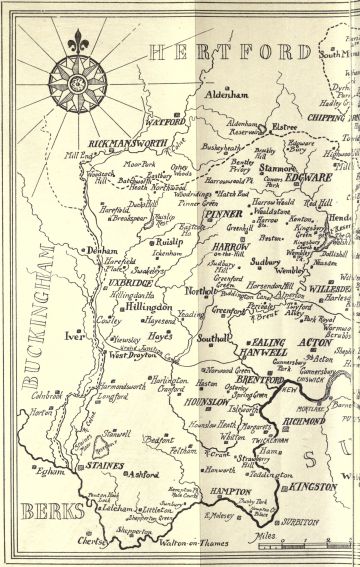
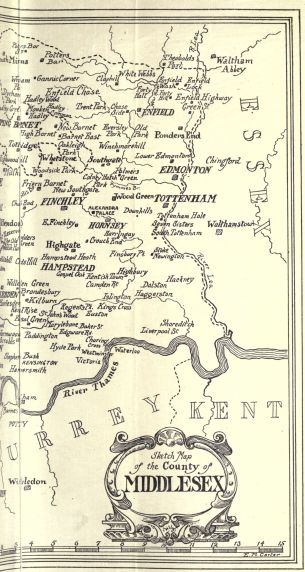 MAP ACCOMPANYING “MIDDLESEX.” PAINTED BY JOHN FULLEYLOVE,
R.I. DESCRIBED
MAP ACCOMPANYING “MIDDLESEX.” PAINTED BY JOHN FULLEYLOVE,
R.I. DESCRIBED
| Typographical errors corrected by the etext transcriber: |
|---|
| the the Alexandra Palace=> the Alexandra Palace {pg 44} |
| cotninuing the Green Lanes=> continuing the Green Lanes {pg 71} |
| surburban avenues=> suburban avenues {pg 106} |


