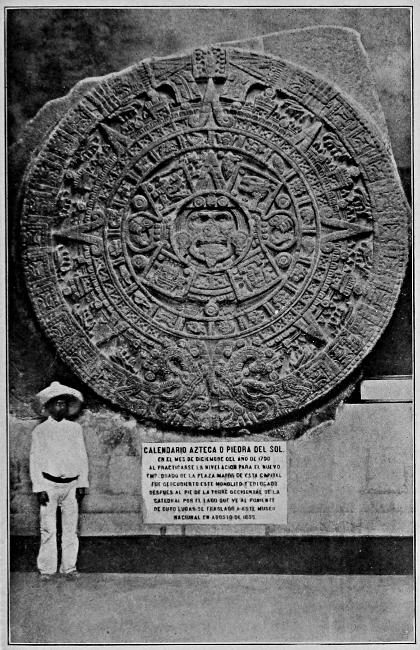
The City of Mexico represents progressive
Mexico. In it is concentrated the wealth, culture
and refinement of the republic. It is the
political, the educational, the social and the
commercial centre of the whole country. It is
to Mexico what Paris is to France. In fact
it would be Mexico as Paris would be France.
The same glare and glitter of a pleasure-loving
metropolis are found here, and within the same
boundaries may be seen the deepest poverty
and most abject degradation.
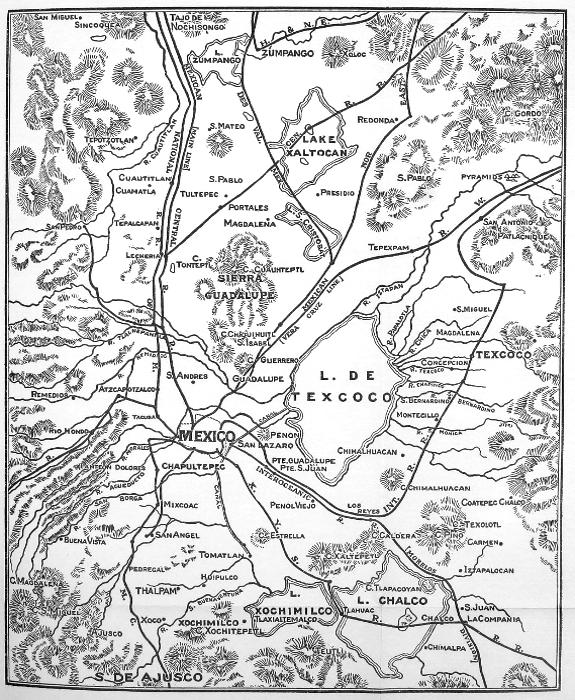
MAP OF THE VALLEY OF MEXICO
“Wait until you get to the City of Mexico,”
said an educated Mexican to me as we were
crossing the sparsely-settled tablelands of
northern Mexico, where the only inhabitants
are Indians. The Mexicans are proud of their
city and are pleased to have it likened to the
gay French capital, for their ideals and tastes
are fashioned after the Latin standard rather
than the American. The French, they say,
have the culture and can embrace a la Mexicana,
which is done by throwing an arm around
a friend whom they meet and patting him
heartily on the back. They prefer the easy-going,
wait-a-while style of existence to the
hurried, strenuous life of an American city.
No people love leisure and the pursuit of pleasure
more than our neighbours in the Mexican
metropolis. They work during the morning
hours, take a noon siesta, close up early in the
afternoon and are ready for pleasure in the
evening until a late hour.
In appearance the capital resembles Madrid
more than any other city I have ever seen.
The architecture is the Moorish-Spanish style,
into which some Aztec modifications have been
wrought by the new-world builders. The light,
airy appearance of an American city is absent
for there are no frame structures anywhere.
The square, flat-roofed buildings, with walls
thick enough to withstand any earthquake
shock, are two or three stories in height and
built round a patio, or courtyard, the centre
of which is open to the sky. The old architects
were not hampered by such paltry considerations
as the price of lots, and so they built
veritable palaces with wide corridors and rooms
lofty and huge. Through many of these rooms
you might easily drive a carriage. There are
parlours as large as public halls, and throughout
all one notes the grandiose ideas of the
race. The houses, of stone or brick covered
with stucco, are built clear up to the sidewalk
so that there is no tinge of green in front. The
Mexican is not particular about the exterior
of his home, but expends his thought and money
on the open court within. The plainness of the
outside is relieved only by the large gate, or
door, which is also the carriage drive-way, and
the neat little, iron-grated balconies on which
the windows open from the upper stories.
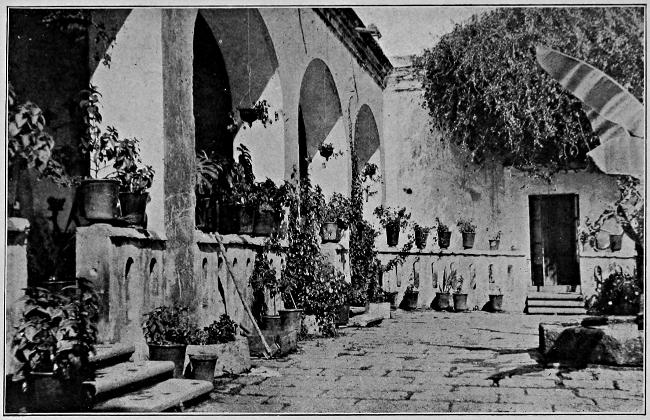
THE PATIO OF AN OLD RESIDENCE
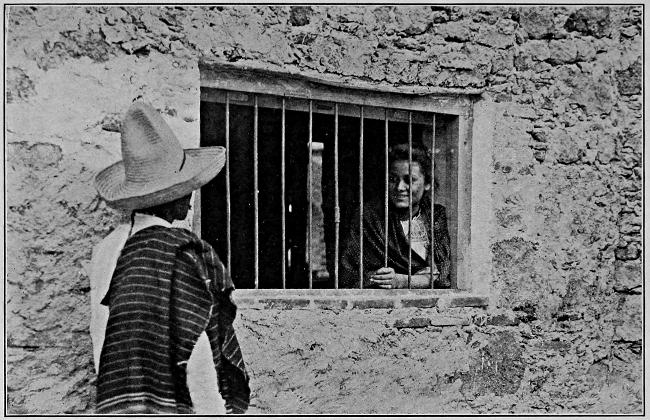
These balconies afford a convenient place for
the women of the household to see what is passing
on the street, and also for the señorita, or
young lady, to watch the restless pacing to and
fro of the love-stricken youth who is “playing
bear” in front of the house. The great doorway,
which is carefully barred and bolted at
night, and strictly guarded by the porter during
the day, is the only entrance to the patio, which,
in the better class of homes, is adorned with
pretty gardens, statuary and fountains. Many
of them contain an open plunge bath. Through
the wide windows one catches glimpses of fascinating
interiors, and through the broad doorways
the passer-by on the street gets many a
pretty view of the courtyards, and of these
miniature gardens. One or two rows of living-apartments
extend around and above the court,
with broad corridors in front handsomely
paved with tile, protected by balustrades and
adorned with flowers and vines. Above, the
red tiles of the roof add a little additional colour
to the scene. There are no cellars nor
chimneys. The latter were never introduced
because of the mildness of the climate. In the
courts protected from the winds, the people
keep on the sunny side when it is cool and hide
from the same orb when it is hot. Charcoal
fires are used for cooking and heat when it becomes
necessary. Cellars are made impossible
because of the marshy nature of the soil.
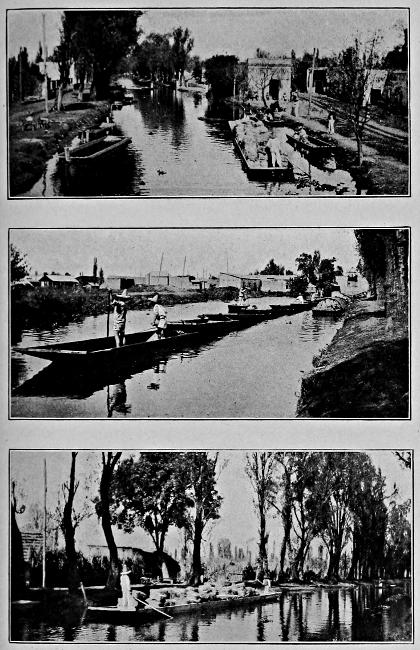
It will be recalled that Tenochtitlan, the Aztec
capital, has been called the New World
Venice, whose streets were once canals. It
must have been a gay and picturesque scene
when the fair surface of its waters was resplendent
with shining cities and flowering
islets. The waters have since receded until
Lake Texcoco, at its nearest point, is three
miles distant. Mexico is now a more prosaic
city of streets and cross-streets which extend
from north to south and from east to west.
Some of the principal thoroughfares are broad,
paved with asphalt and well kept; but many
are quite narrow, and especially is this true
of the streets called lanes, though devoted to
business. There is no exclusive residence section,
except in the new additions, and many of
the homes of the old families are found sandwiched
in between stores. It is a difficult matter
to become familiar with the names of the
streets, for they are more than nine hundred
in number, and a street generally has a different
name for each block. If several blocks have
the same name, as, for instance, Calle de San
Francisco, one of the finest streets, and on or
near which are some of the largest hotels, finest
stores and richest private dwellings, then it
is First San Francisco, Second San Francisco,
etc.
A few years ago the streets were re-named.
All the streets extending east and west were
called avenidas, and the north and south streets
calles, each continuous thoroughfare being
given but one name. The people, however, in
this land of legend and tradition, clung so tenaciously
to the former designations that they
have practically been restored. Some of the
old names of streets commemorated historical
events, as, for instance, the Street of the Cinco
de Mayo, which is in remembrance of the victory
of the Mexicans over the French at Puebla
in 1862. Others are named in honour of men
noted in the history of Mexico. Many religious
terms appear, such as the street of Jesus,
Sanctified Virgin, Holy Ghost, Sepulchres of
the Holy Sabbath, and the like. Others owe
their names to some incident or legend, which
is both interesting and mysterious. Of the
latter class may be mentioned the Street of the
Sad Indian, Lane of Pass if You Can, Street
of the Lost Child, Street of the Wood Owls,
Lane of the Rat, Bridge of the Raven and
Street of the Walking Priest. The Street of
the Coffin Makers is now known as the Street
of Death. It is a thoroughfare of one block,
and is one of the few streets that still preserves
its ancient caste, for it is devoted exclusively
to the makers of coffins. All of the coffins are
made by hand. It is a gloomy street and there
are cleaner spots on the face of the earth.
Mexico is a very cosmopolitan city. Its three
hundred and seventy-five thousand inhabitants
include representatives from nearly every nation
of the earth. The Indians are vastly in
the majority, and they are the pure and original
Mexicans. The Creoles, who are descendants
of Europeans, generally Spanish, call
themselves the Mexicans and rank second in
number. They form the real aristocratic body
from whom come the representative Mexicans.
They are not all dark, but a blonde is a rare
specimen. Most of them have an olive-brown
colour, thus showing the mixture of Indian
blood, for in early days it was not considered
a mesalliance for even a Spanish officer of high
rank to marry an Aztec maiden of the better
class.
The old families cling tenaciously to the
great estates, or haciendas, many of which have
remained intact for centuries. Quite a number
can even trace their estates back to the original
grants from the king of Spain. Many of these
hacendados, or landed proprietors, enjoy
princely incomes from their lands, and nearly
all of them own residences in the capital. They
maintain elaborate establishments and keep
four times as many servants as would be found
in an American house.
The average Mexican does not care for business.
Neither is he an inventor or originator,
for he is content to live as his ancestors have
lived. Nearly all lines of commerce and industry
are in the hands of foreigners. The Germans
monopolize the hardware trade; the
French conduct nearly all the dry goods stores;
the Spaniards are the country’s grocers; and
the Americans and English control the railroad,
electric and mining industries. All these
interests centre in the City of Mexico. Railroads
are not very numerous until you approach
the Valley of Mexico where they converge
from all directions. The hum of industry
is apparent here as nowhere else in the
whole republic. The Mexicans boast of their
capital, but they often forget the debt they owe
to foreigners, for all the modern improvements
have been installed by alien races and outside
capital. It is another foreign invasion but with
a pacific mission. The American colony alone
in that city numbers more than six thousand
persons, and the number is constantly increasing.
Hatred of the American has almost disappeared,
and the incomers are cordially welcomed.
There are two flourishing clubs around
which the social life of the expatriated Americans
centre.
The society of the capital, and indeed of the
whole country, is very diverse. What might be
said of one class would not apply to another.
The differences of dress and customs alone
make known the heterogeneousness of the population.
They all use the same language and all
classes are brought together on a common level
in their religion. No other nation has ever
made such complete conquests as Spain. She
not only subjugated the lands but forced her
language, as well as religion, upon the conquered
races. The English have succeeded in
extending their sway over a large part of the
world, but in no instance have they been able to
accomplish these two results with the native
population. The priests of Spain went hand
in hand with the conquistadores, and, within a
few generations after the conquest of Mexico
by Cortez, the Spanish language was universally
used and the Indians were at least nominal
Catholics.
The climate of the City of Mexico is delightful.
It is neither hot nor cold. It is too far
south to be cold and the altitude, seven thousand,
four hundred and thirty-four feet above
the level of the sea, is too great to be hot. The
temperature usually ranges from sixty-five to
eighty-five, but sometimes goes as high as
ninety, and as low as thirty-five, and frosts
occasionally are experienced. The mornings
and evenings are cool and at midday it is always
hot. There is a great difference in the
temperature between the sunny and shady side
of the street. Only dogs and Americans take
the sunny side, the Mexicans say. The rainy
and dry seasons occur with great regularity, the
former lasting from May to October. It is the
best season in the year although most visitors
go there in winter. The rains always occur in
the afternoon and usually cease before dark.
At this time, too, all nature takes on a beautiful
shade of green which replaces the rather dull
landscape of the dry season. There is also a
brisk, electric condition of the atmosphere that
is decidedly exhilarating and a good tonic.
This mildness of climate has greatly influenced
the life of the capital. The streets, except
during the noon siesta, are full of people
at all times. To judge from the crowds, one
might think the capital a city of a million people.
In the morning the women go to mass
garbed in black, generally wearing a black
shawl over the head. Occasionally a black lace
mantilla is seen half-concealing, half-exposing
the olive-brown face, and bright, sparkling eyes
of a señorita. Shoppers are out and business
is active. The women of the wealthier classes
sit in their carriages and have the goods
brought out to them, or go to a private room
where articles are exhibited by clerks. They
think that it is unbecoming to stand at the
counters, although the American plan of shopping
is becoming quite popular in recent years.
About the middle of the afternoon the crowds
again appear, and a little later the streets
begin to fill with carriages. Nowhere, not even
in Paris, have I observed so many carriages as
can be seen here on any pleasant afternoon.
They form one continuous, slow-moving line of
many miles. The procession moves out San
Francisco Street through the Alameda, along
the Paseo de la Reforma, and then into the
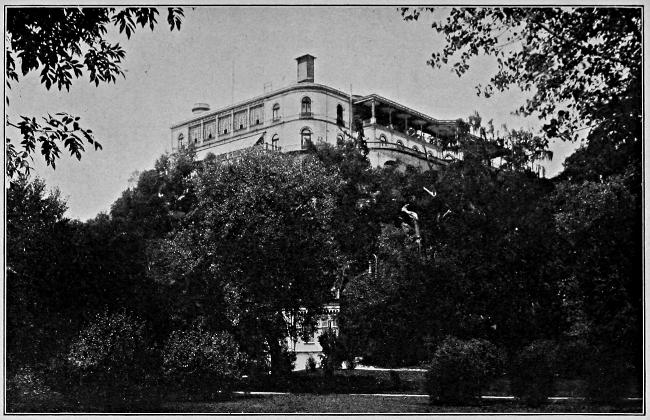
beautiful park surrounding the Castle of Chapultepec
which is set with great cypresses, said
to antedate the conquest. The cavalcade winds
around through the various drives at the base
of the rock, along the shores of the lake, past
the castle and back to the city. The carriages
go out on one side and return on the other,
leaving the central portion for riders. It is a
sight that never wearies for one to sit on a
bench and watch the motley throng of people
driving, riding on horseback and promenading.
An oriental exclusiveness is observed by ladies
of the upper class who always ride in closed carriages.
All kinds of vehicles are to be seen,
from fine equipages with liveried drivers and
footmen, to the poorest cab in the city with its
disreputable driver and broken-down horses,
fit only for the bull-ring.
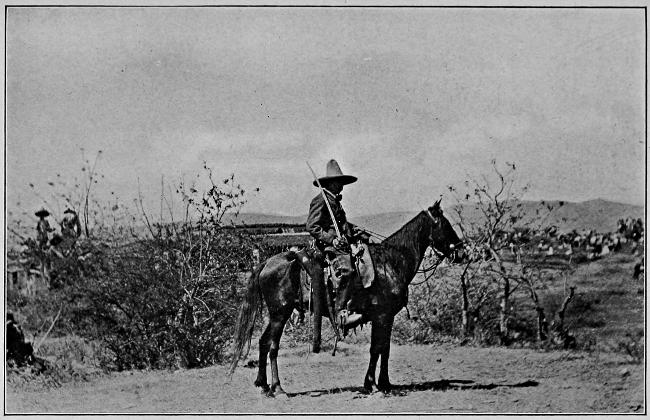
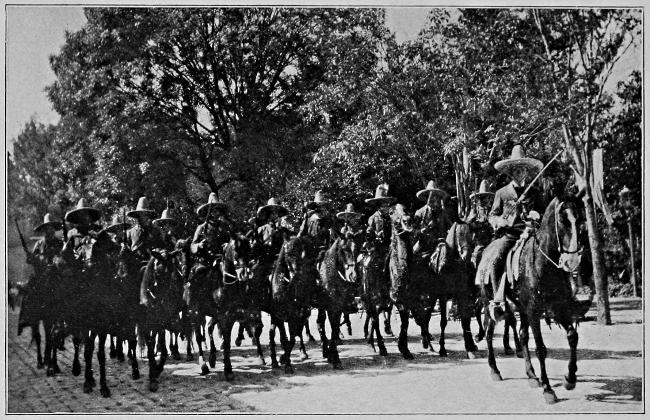
There are many horsemen and the Mexicans
are always excellent riders. Their horses are
Lilliputian in size but fast and enduring. The
saddle, bridle and trappings are frequently
gorgeous with their silver ornaments and immense
stirrups fancifully worked and shaped.
The rider is often a picture wonderful to behold
from the heavy silver spurs which he wears,
to the sombrero of brown or yellow felt with
a brim ten to fifteen inches wide and a crown
equally as high, the whole covered with heavy
gilt cord formed into a sort of rope. Then
there is the dude or fop, who is well named in
Mexico. He is called a “lajartija” which
means a “little lizard.” He used to dress in
such close-fitting and stiff costumes that he had
not much more freedom of motion than the
stiff little lizard. Now he is the dandy who is
generally seen standing on a public corner,
wearing a French cutaway suit, American
patent leather shoes and an English stovepipe
hat, with his fingers closed over the indispensable
cigarette.
In the evening the populace attend the theatre
or some social function. Sunday is the day
of all others for recreation, and, with the average
inhabitant of Mexico, is one continuous and
eternal round of pleasure. After morning
service the entire day is devoted to pleasure.
Band concerts are always given by the military
bands on the Plaza in the morning, in the Alameda
early in the afternoon, and at Chapultepec
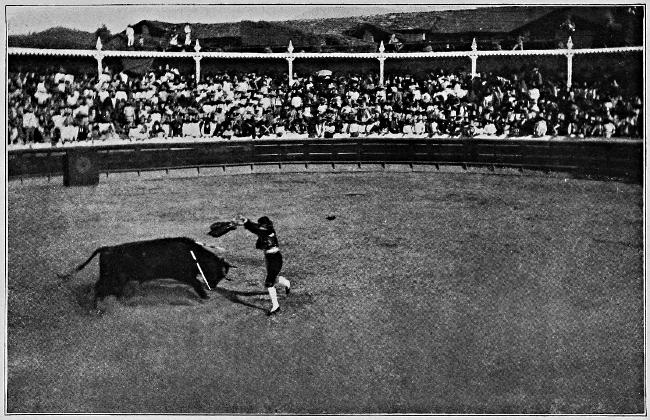
about five o’clock. Then there is the bull-fight
which occurs only on Sundays and holidays.
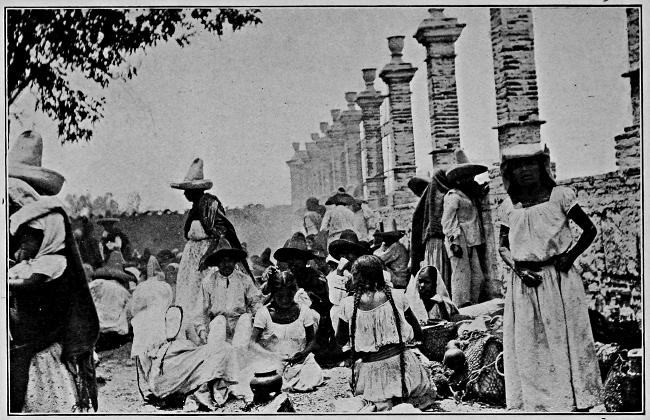
The average crowd in the City of Mexico is
a good natured and peaceable one. The city
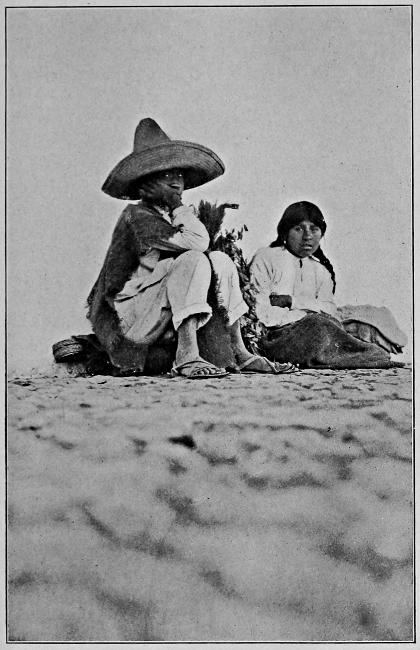
Indian and his country cousin, the peon from
the plantation, join the crowd on a feast day
with their numerous progeny. They are not
the pleasantest neighbours in the world for
both have the odour of garlic and pulque and
their baths are of the annual variety. That
the little brown man is a peon is no fault of
his. His uncleanliness is, in a measure, the
result of centuries of neglect, and more particularly
of a scarcity of water at his home.
It is possible that if he had the water his condition
would be just the same. Though he is
poor and down-trodden, there is nothing of the
anarchist about him. He is absolutely devoid
of envy or malice; and withal his spirits are
gay and he is as generous to his family or
friends as his finances permit. The artificial
refinements of modern civilization have not yet
spoiled him, and there is a pleasant, even if
malodorous, naturalness about him.
In no city do ancient and modern customs
come into such intimate contrast as in the City
of Mexico. Nowhere is a greater mixture of
races to be seen than here. There are many
tribes of Indians speaking scores of dialects,
and there are mestizos of various degrees of
mixture with African, American and European
blood. Types of four centuries can be seen in
any group on one of the plazas. The Plaza
Mayor is a great, imposing, central square of
fourteen acres in the centre of the city, and
on its walks all the types can be seen at their
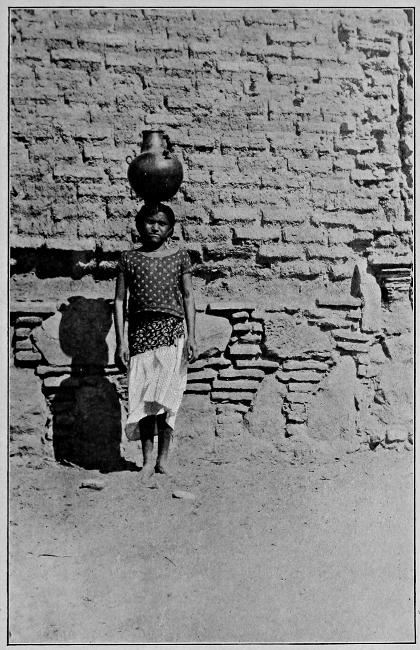
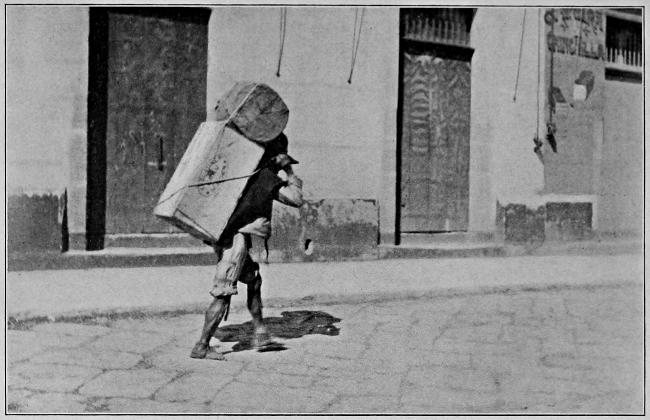
best. Men and women come into the city
through the streets lighted by electricity, bearing
immense loads on their heads and backs
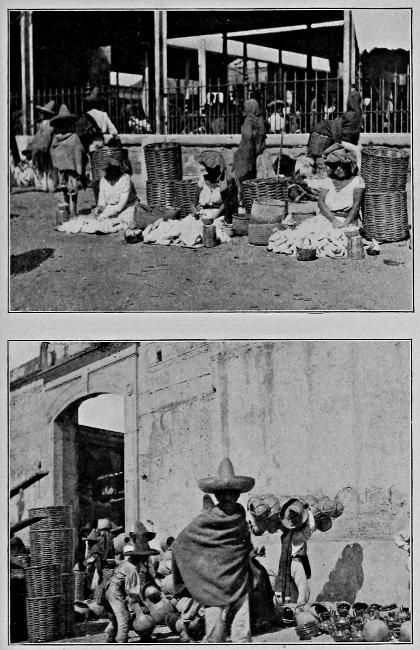
rather than use a wagon. Peddlers carry
around jars of water for sale just as in the
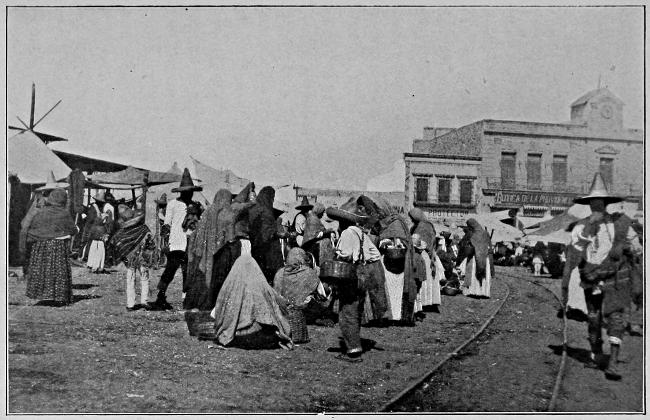
olden times. Indians, who are almost pure
Aztecs, pass along, taking the middle of the
street in Indian file. Well dressed men in black
broadcloth suits and wearing silk hats go by.
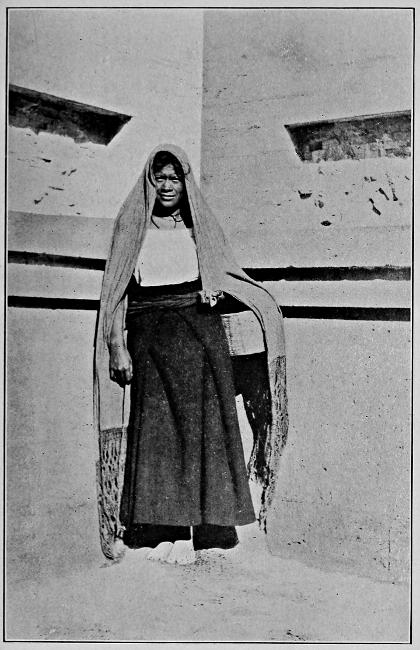
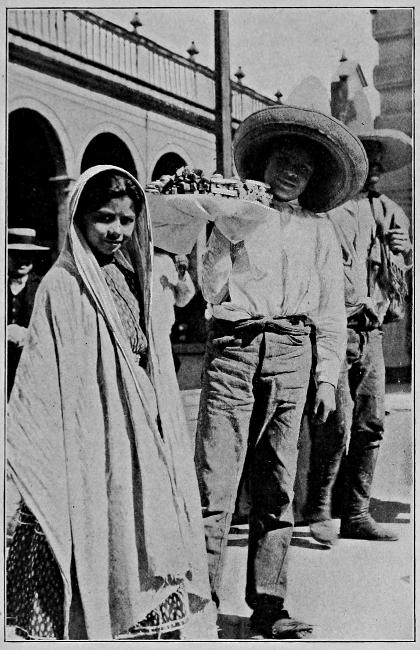
The women of the middle class add colour to
the scene with the red and blue rebosas, sometimes
covering the head, or tied across the chest
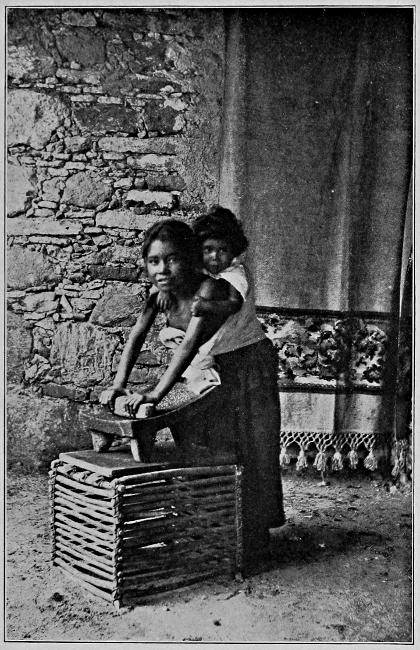
and holding an infant at the back. Nearly all
the passers-by show in their colour that they
can claim kinship with the hosts of Montezuma.
The general effect is kaleidoscopic but entertaining.
The great cathedral on the north side
of the Plaza is the one place where all are
brought together and class distinction obliterated.
Visit the cathedral any day and you
may see an Indian with his pack on his back
side by side with a young woman who may
inherit a dozen titles. There are no select,
high-priced, aristocratic pews for rent, but all
meet by a common genuflection before the sacred
altars. The poor Indian may not understand
all the pomp and ceremony, the music
of the vested choirs, or the solemn chanting by
the priests, but it fills a deep want in his nature
and he is satisfied.
At one side of the Plaza Mayor once stood
the great Aztec Teocalli, the Temple of Sacrifice.
This was a high imposing altar reached
by a flight of more than a hundred steps. From
the top was a magnificent view of the entire
valley, and it was from this point that the envious
eyes of Cortez looked out upon this beautiful
scene. The altar was dedicated to the
Aztec war god Huitzilopochtli, and here, to appease
the wrath of this terrible god, human sacrifices
were offered. The breast was cut open
and the heart, still palpitating, plucked out and
placed upon the altar. The bodies were cast
down to the ground, whence they were taken
and prepared for the banquet table.
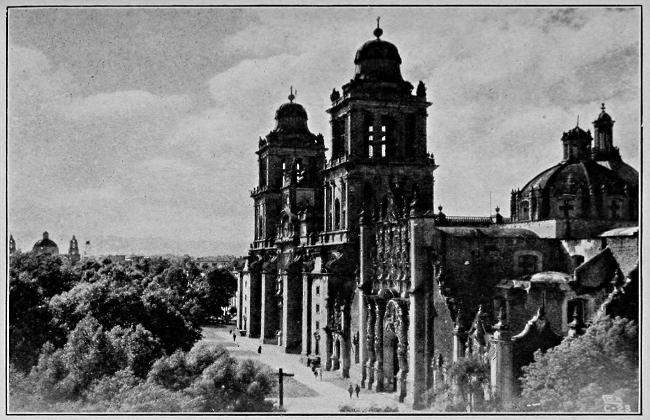
THE CATHEDRAL
A part of the space once covered by this
gruesome but majestic pile, is now occupied
by the Monte de Piedad, or “mountain of
mercy,” one of the most unique charities in
the world. It is nothing more or less than a
gigantic pawn-shop, but it is one of the most
beneficient institutions in the country. The
Count of Regla, a noted personage in Mexico,
founded this institution by a gift of three hundred
thousand dollars. He did this in order
that the poor and needy, and the impoverished
members of families once genteel, might secure
small sums upon personal property at low rates
of interest, instead of becoming involved in the
meshes of the blood-sucking vampires who prey
upon this class of unfortunates. About three-fourths
of the actual value of the property
pledged as fixed by appraisers, will be loaned.
If the interest is not paid, the property is kept
for seven months, when it is offered for sale
at a fixed price. If not disposed of in another
five months it is sold at auction.
The truly remarkable feature of this establishment
is, that if a greater sum is realized
than the amount of the loan and interest, the
excess is placed to the credit of the owner, or
his heirs, and will be kept for one hundred
years, after which time it reverts to the institution.
Many old heirlooms of former grandees,
Aztec curios, diamonds, gold ornaments
and even family gods have passed through this
organization of charity. For more than a century
it has existed, having survived all the civil
wars, revolutions and changes of government.
The original capital has been more than
doubled by the forfeitures, and many branches
of this parent institution are operated in the
capital and in several of the large cities of the
republic. It is an example that might be suggested
to some of our multi-millionaires who
do not know what to do with their vast accumulations
of wealth.
Even the funerals are conducted in a strange
way. With the exception of funerals among
the wealthy, the street cars are universally
used. The enterprising owner of the street car
system some years ago acting on the trust idea,
bought up all the hearses and introduced funeral
cars. After a short time the people
became accustomed to the new plan, which
seemed to give satisfaction. Now, trolley
funeral cars of the first, second and third class
are furnished at a price varying from five dollars
for the cheapest class, to a hundred dollars
or more for a first-class car. Some of the poor
rent coffins which are returned after the burial.
The very poor may be seen carrying their dead
on their shoulders to the Campo Santo, or holy
ground. Graves are usually sold only for a
certain number of years, after which, unless
the relatives pay the prescribed fee, the bones
are taken up and the ground made ready for a
new occupant. The dead are soon forgotten.
A pile of bones in a corner of the cemetery
represents all that is mortal of the generations
who passed away not many years ago. There
is an entire lack of reverence for the mortal
remains of the departed, such as one is accustomed
to find in our own country. One is reminded
of the couplet
“Rattle his bones over the stones,
He’s only a pauper, whom nobody owns.”
The City of Mexico is not the healthiest city
in the world. On the contrary the death rate
is unusually high. The average duration of
life is said to be only twenty-six years. This
is due in a great measure to infant mortality.
Typhoid and malarial fevers are prevalent because
of the accumulated drainage of centuries,
which lies just a few feet beneath the surface.
Pneumonia is common and regarded as very
dangerous because of the rarefied air, and patients
suffering from this disease are immediately
transported to lower altitudes for treatment.
The entire lack of hygiene and sanitary
conditions among the peon classes is in a great
measure responsible for the unusual percentage
of mortality. Few other cities in the world
have such a high rate of deaths compared with
the population.
Strange it is that the capital was ever built
on this low, marshy soil when higher land was
available and near at hand. It was one of the
great blunders of Cortez, for Mexico might
have been made a healthy city. No exigency
of commerce dictated its selection, for it is far
from the sea coast on either side and was difficult
of access before the day of railroads.
The new city was built on the site of the old,
and the temples of the Christian religion were
raised on the sites of the old pagan altars wherever
possible. A plan of moving the city to
higher ground was strongly agitated at one
time but the vested interests succeeded in killing
this project. It is hoped and believed that
when the plans for sewerage are completed, the
health conditions will be placed on a par with
that of most cities. The authorities are making
an honest and earnest effort to carry out these
commendable projects.
“Know ye not pulque,
Liquor divine,
The Angels in heaven
Prefer it to wine.”
Thus sings the lower class Mexican to whom
this liquor has become a curse. To it is due
much of his poverty and many of his crimes.
For it he will neglect his family and steal from
his employer. It does not contain a large percentage
of alcohol, but, taken in large quantities,
as is customary among these people, it
puts them in a dopy condition which they sleep
off. One railroad brings in a train-load each
day, and, besides, large quantities are brought
in by other lines. There are sixteen hundred
pulque saloons in the capital, but they are all
closed at six o’clock by a law which is strictly
enforced. The pulque-shop betrays itself by
its odour, as well as by the crowds of poorly
dressed and even filthy men and women who
surround its doors and press around the counter.
It is a gaily decorated affair and is oftentimes
adorned in flaring colours inside and out,
with reds, blues, greens and yellows predominating,
and frequently with a huge, rude painting
on the outside walls. In some of the shops
you will find a curious string knotted in a peculiar
manner or strung with shells. This is a survival
of the Aztec method of counting by means
of beads, or shells, strung together.
As one writer says, “the pulque shop, notwithstanding
its evil influence upon the life of
the people, presents a very picturesque appearance
to the tourist who has never seen anything
like it before. The dress of the people, the
curious, vivid colours of the walls of the building,
the semi-barbaric appearance of the decorations
within, the curious semi-symbolic pictures
upon the walls, the unaccustomed groupings
of the people, all combine to attract the
attention of the stranger in Mexico.”
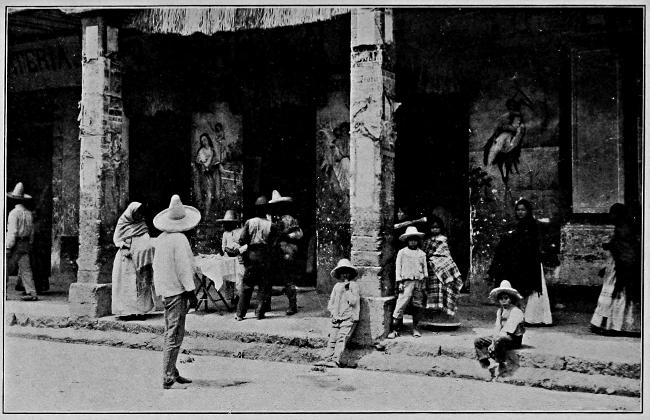
A PICTURESQUE PULQUE SHOP
In the naming of the pulque-dens the imagination
is allowed full play. I quote from a
Mexican periodical the names of some of these
resorts: A place in the suburbs of Mexico is
termed the “Delight of Bacchus.” One is
called “The Seventh Heaven,” another “The
Food of the Gods,” while still another bears
the euphonious title of “The Land of the Lotus.”
“A Night of Delight” is another place
near “The Heart’s Desire.” The above names
are commonplace by the side of the following:
“The Hang-out of John the Baptist,” “The
Retreat of the Holy Ghost,” “The Delight of
the Apostle,” “The Retreat of the Holy Virgin,”
“The Mecca of Delight,” and “The
Fountain of the Angels.” Nothing disrespectful
is intended by these appellations but they
sound very sacrilegious to us.
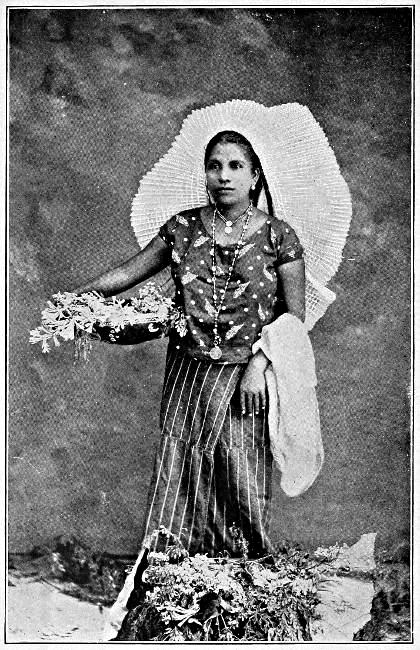
There is, however, a brighter side to the Indian
life in the City of Mexico. In one corner
of the Zocalo, and covering a part of the site
formerly occupied by the great sacrificial altar,
is the flower-market. This flower-market is
always attractive and a never-ending source
of interest to the tourist. Immense bouquets
of the choicest flowers are sold so cheap that
the price seems almost absurd. By judicious
bargaining a few cents will purchase a large
and varied supply of roses, violets and heliotrope,
which only dollars could buy from a
New York florist. No hot-houses are needed
here at any season, for in this climate flowers
bloom all the year round, and one crop succeeds
another in a never-ending succession. The
Mexican Indian is a lover of flowers. It is one
of the redeeming traits of his character. He
is not always particular as to his personal appearance;
he may be unkempt and untidy to
look upon; but he loves flowers, is prodigal in
his use of them and shows good taste in their
arrangement. This taste is innate, is no doubt
inherited from his Aztec ancestors, and has
survived the oppressions and exactions of the
succeeding centuries. This love for flowers
finds expression even in his worship, and it is
no uncommon thing to find flowers before the
image of the Virgin, and such an offering is one
of the expressions of his good will. When we
consider that our forefathers were taught to
worship God with the first fruits of their husbandry,
it is not surprising that this primitive
and ignorant race should still find use in their
worship for these beautiful products of a prodigal
nature.
The gardens and parks of the City of Mexico
attain a luxuriant growth that cannot be
equalled in our northern cities. These breathing-places
where one can sit amid scenes of
tropical verdure, and admire the bright tints
of the flowers while shielded from the hot sun
by the broad-leafed foliage of the plants, are
truly delightful spots for an American to visit.
They contrast so strongly with the cheerless
appearance of the streets. In the centre of the
large Plaza Mayor lies the Zocalo, a little green
oasis in the great paved waste. It is in the
very heart of the city’s throbbing life, and
everything either has its beginning or ending
on this imposing square.
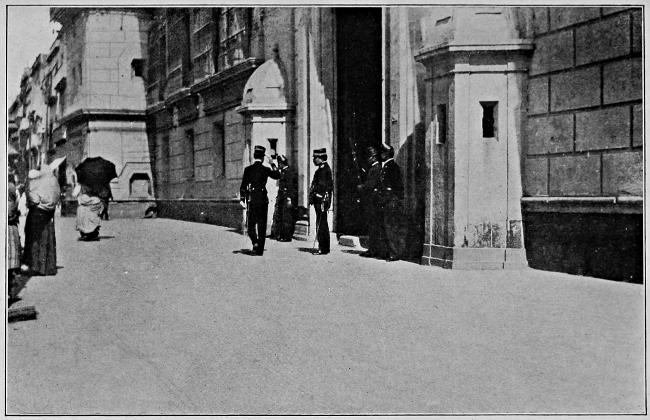
On one side of the Plaza lies the Palacio Nacional
which has stood there for more than
two centuries. It covers the site of the ancient
palace of Montezuma, and has an imposing
façade of nearly seven hundred feet. Over the
main entrance hangs the Liberty Bell of Mexico
which was rung by Hidalgo on the first call
to independence at Dolores, where it had so
often summoned the people to mass. The immense
windows which look out upon the Plaza
open into the various rooms where the official
business of the executive department of the
republic is transacted. Other parts of this
immense structure, for it is almost a square
building enclosing an open court, are occupied
by the legislative chambers and barrack rooms
for several regiments of soldiers.
A few blocks away from the Plaza lies the
Alameda, which is the park of the better
classes. Every city has an alameda, as the visitor
soon learns, but this is the alameda of
Mexico. It is a pretty place, and, with its beautiful
trees, flowers and fountains, forms a resort
for the fashionable people, who congregate
here on Sundays and feast days to listen to
the military bands. The visitor can almost lose
himself in this part, for the view is circumscribed
on every hand by the dense shrubbery.
It is on the subject of the Paseo de la Reforma
that the Mexican becomes enthusiastic.
This beautiful boulevard extends for a distance
of two miles from a place near the Alameda
to Chapultepec. It is a smooth thoroughfare
averaging five hundred feet in width, with
promenades on each side shaded by trees under
which are stone seats, and with paved driveways
in the centre. Here and there the Paseo
widens into circles, called glorietas, in the centre
of which are placed statues. Those already
erected include statues to Charles IV of Spain,
Columbus and Cuautemoc, the Aztec warrior
and emperor. To Maximilian is due the credit
for the Paseo, and a more beautiful boulevard
cannot be found in Europe or America.
I have purposely described the old features
of the city and the unique characteristics before
touching upon the more modern innovations.
The average visitor would follow that plan,
for he would be more interested in the unusual
than in that with which he is more or less
familiar. Like all capitals and large cities
affected by commercialism, the City of Mexico
is fast becoming cosmopolitan. The traveller
who visited it ten, or even five, years ago would
be astonished at the changes wrought by improvements.
The fine system of electric lights,
the excellent electric traction lines with modern,
cars, the asphalted streets
and the attractive new suburbs of an entirely
foreign architecture, link the old with the new,
the sixteenth with the twentieth century. A
city hindered by a racial conservatism, and
obstructed at every turn by tradition, does not
become entirely modern in a decade, but the
trend is there and its progress has been really
remarkable. It will never be a city of skyscrapers
for a hard stratum is not encountered
until a depth of a hundred and forty feet is
reached.
A new and modern hotel is more needed than
anything else. There are plenty of hotels of
the Mexican kind, where it is almost impossible
to find a room with an outside window. All
the rooms simply have an opening on the patio
which answers for both door and window. In
cool weather which is sometimes experienced
here, there is no means of heating these rooms
except by an open pan of coals, which is not
very satisfactory to one accustomed to modern
steam-heated hotels or a good stove.
The national government controls the federal
district within which is situated the City of
Mexico, much the same as the District of Columbia,
in our own land, and is assisted by a
city council. Plans have been drawn for fifty
million dollars’ worth of public buildings, many
of which are already under way. The fine new
post-office which has been building for several
years is now occupied by that department. It
is a beautiful structure of the medieval Spanish
style, and is a striking departure from the
other public buildings. It is four stories high,
equipped with every convenience and is finished
within and without in elaborate style.
A new legislative palace is under construction,
which is the most pretentious building
yet planned. Its estimated cost is $20,000,000.
Opposite the post-office a national theatre is
being erected to cater to the amusement lovers,
which is designed to be the finest theatre in
the new world. An entire block is being razed
to make room for the Panteon Nacional—a
resting place for Mexico’s illustrious dead.
Within the marble walls of this unique memorial
will rest all that is mortal of her heroes.
An army and navy building, a museum of art
and a department of public works are among
the other improvements planned for the capital.
These buildings are being scattered over the
city instead of following the group plan as designed
at Washington. The reason for this has
been a desire to have every section of the city
benefited and beautified by these public structures.
The year 1910 marked the centennial of
Mexican independence. The month of September
was almost wholly given up to celebrations
of this event in the capital. A number of public
buildings were dedicated during the celebrations.
Among these were a new insane asylum
and several fine new public school buildings,
which greatly added to the educational facilities
of the city. A magnificent new monument
to independence, recently erected on the Paseo,
was dedicated with great ceremony. A number
of gifts were made by foreign colonies and
governments. Not the least of these was a
monument to Washington, which was presented
by the resident Americans. The ceremonies
and functions of the centennial celebration
were very elaborate, and the capital has been
beautified in many ways as a result.