Larger versions of most illustrations
may be seen by right-clicking them and
selecting an option to view them separately, or by double-tapping
and/or stretching them.
Cover created by Transcriber, using artwork
from the original book, and placed in the
Public Domain.
Fig. 1. Chain of boys clearing the Osireion at Abydos.
41 feet deep.
METHODS & AIMS IN ARCHAEOLOGY
BY
W. M. FLINDERS PETRIE HON. D.C.L., LL.D., LIT.D., PH.D. : F.R.S. ; HON. F.S.A. (SCOT.) :
Member of the Imperial German Archaeological Institute;
Member of the Society of Northern Antiquaries;
Member of the Roman Society of Anthropology;
Edwards Professor of Egyptology, University College, London.
WITH 66 ILLUSTRATIONS
London MACMILLAN AND CO., Limited NEW YORK: THE MACMILLAN COMPANY
1904
All rights reserved
TO MY FRIENDS
F. LL. GRIFFITH,
E. A. GARDNER,
F. J. BLISS,
H. CARTER,
B. P. GRENFELL,
J. E. QUIBELL,
J. DUNCAN,
H. F. PETRIE,
N. DE O. DAVIES,
A. C. MACE,
D. RANDALL-MACIVER,
B. ORME,
A. E. WEIGALL,
M. A. MURRAY,
L. ECKENSTEIN,
H. STANNUS,
C. T. CURRELLY,
E. R. AYRTON,
WHO HAVE JOINED IN VARIOUS PORTIONS OF THE WORK HERE
DESCRIBED, 1884–1903.
PREFACE
Archaeology is the latest born of the sciences.
It has but scarcely struggled into freedom, out of
the swaddling clothes of dilettante speculations. It
is still attracted by pretty things, rather than by real
knowledge. It has to find shelter with the Fine
Arts or with History, and not a single home has yet
been provided for its real growth.
All other sciences deal with the things around us;
with subjects which may, or may not, affect us.
Even medical sciences are concerned with the
mechanical structure of the body, rather than with
the nature and abilities of the mind. But the science
which enquires into all the products and works of
our own species, which shows what man has been
doing in all ages and under all conditions, which
reveals his mind, his thoughts, his tastes, his feelings,—such
a science touches us more closely than any
other.
By this science, of which History forms a part,
we trace the nature of man, age after age,—his
capacities, his abilities; we learn where he succeeds,
where he fails, and what his possibilities
may be.
From another point of view the subject should be
considered; it gives a more truly “liberal education”
than any other subject, as at present taught. A
complete archaeological training would require a full
knowledge of history and art, a fair use of languages,
and a working familiarity with many sciences. The
one-sided growth of modern training, which produces
a B.A. who knows nothing of natural science, or else
a B.Sc. who knows nothing of human nature, is
assuredly not the ideal for a reasonable man.
Archaeology,—the knowledge of how man has
acquired his present position and powers—is one of
the widest studies, best fitted to open the mind, and
to produce that type of wide interests and toleration
which is the highest result of education.
Though this volume is a book of reference for
those engaged in actual work, yet it will also serve
to give the public a view of the way in which this
work is done, the mode in which results are obtained,
the ends which are pursued, and the important
questions which must be considered. We have
nothing here to do with the details of the facts
discovered; but deal only with the methods and aims,
which have been slowly learned in a quarter of a
century. Yet every year there are fresh methods to
add, and more clear views of the aims; and far more
might easily have been said about each of the
subjects here discussed.
If in this outline there is much more reference to
Egypt than to other countries, it is for the reason
that most of my own work has lain there; and there
is the more need to deal with that land, as more
exploration is going on there than elsewhere.
I have to thank my friends for six of the
photographs here used.
W. M. FLINDERS PETRIE.
University College, London.
CONTENTS
CHAPTER I
The Excavator
PAGE
Purpose, 1; Character, 2; Experience, 3; Organization, 5; Acquirements, 5; Demands of the work, 6
Systems of work, 122; Need of a corpus, 123; Example of corpus, 124; Utility, 125; Successive ages, 126; Sequences, 127; Sequence dates, 129; Conservation, 130; Buildings, 130; Lighting, 131; Grouping, 132; National Repository, 133
Individual rights, 169; Destruction, 170; Restoration, 172; Sacrifices, 173; Responsibility, 174; Rights of the future, 175; Rights of the past, 176; Duties, 178; Future of museums, 180; Publications, 182; State claims, 183; State rights, 184; Excavating laws, 187
In few kinds of work are the results so directly
dependent on the personality of the worker as they
are in excavating. The old saying that
a man finds what he looks for in a
subject, is too true; or if he has not enough insight
to ensure finding what he looks for, it is at least
sadly true that he does not find anything that he
does not look for. Whether it be inscriptions,
carvings, papyri, or mummies that excavators have
been seeking, they have seldom preserved or cared
for anything but their own limited object.
Of late years the notion of digging merely for
profitable spoil, or to yield a new excitement to the
jaded, has spread unpleasantly—at least in Egypt.
A concession to dig is sought much like a grant of
a monastery at the Dissolution: the man who has
influence or push, a title or a trade connection, claims
to try his luck at the spoils of the land. Gold
digging has at least no moral responsibility, beyond
the ruin of the speculator; but spoiling the past has
an acute moral wrong in it, which those who do it
may be charitably supposed to be too ignorant or
unintelligent to see or realise.
And some systematic outline of archaeological
methods and aims is needed, not only for those
whose moral sense is so untrained that they may
ruin a site, and say “I have done no wrong”; but
it may even profit those who take up the name of
archaeology when they mean solely art, or inscriptions,
or some single branch of the subject. The most
familiar teaching entitled archaeological is that of
Classical Archaeology, which in the ways of most
teachers means Greek sculpture and vase paintings.
In spite of all the professorships and schools of that
subject, we are still so profoundly ignorant of the
archaeology of Greece and Italy that there is scarcely
a single class of common objects of which any one
knows the history and transformations. Certainly
we know far less of the archaeology of classical lands
than we do of that of Egypt.
Character.
If, then, the character of the excavator thus
determines his results, our first step is to consider
that character, and to give some outline
of the aptitudes and acquirements—the
wit and the cunning, as our forefathers well distinguished
them—which are wanted in order to avoid
doing more harm than good.
Firstly in every subject there is the essential
division between those who work to live, and those
who live to work—the commercial, and the scientific
or artistic aim;—those who merely do what will best
provide them a living, and those whose work is their
honour and the end of their being. These two
halves of mankind are by no means to be found
ready labelled by their professions. The R.A. who
drops his aspirations because portraits pay best, the
scientific scholar who patents every invention he can,
are of the true commercial spirit, and verily they
have their reward. Rather let us honour the professed
dealer who will sooner sell a group to a
museum than make a larger profit by playing to the
wealthy dilettante and scattering things. Let us be
quit, in archaeology at least, of the brandy-and-soda
young man who manipulates his “expenses,” of the
adventurous speculator, of those who think that a title
or a long purse glorifies any vanity or selfishness.
Without the ideal of solid continuous work, certain,
accurate, and permanent,—archaeology is as futile
as any other pursuit. Money alone will not do the
work; brains are the first requisite. A hundred
pounds intelligently spent will do more good and
far less harm than ten thousand squandered in doing
damage. Mere money gives no moral right to upset
things according to the whim of one person. Even
scholarship is by no means all that is wanted; the
engineering training of mind and senses which Prof.
Perry advocates will really fit an archaeologist better
for excavating than book-work can alone. Best of
all is the combination of the scholar and the engineer,
the man of languages and the man of physics and
mathematics, when such can be found. So much
for the wit, and now of the cunning that is wanted.
Experience.
The most needful of all acquisitions is archaeological
experience. Without knowing well all the
objects that are usually met with in an
ancient civilisation, there is no possible
insight or understanding, the meaning of what is met
with cannot be grasped, and the most curious
mistakes are made. A cloud is “very like a whale,”
the pre-Christian cross is found everywhere, an arrow-straightener
is called a ceremonial staff, an oil-press
becomes a sacred trilithon, half a jackal is called a
locust, and lathe chucks become “coal money.” Of
course the needed experience has to be gradually
built up, and those who first explore a civilisation
must work through many mistakes. When I first
came to Egypt Dr. Birch begged me to pack and
send to him a box of pottery fragments from each
great town, on the chance that from the known
history of the sites some guess could be made as to
the age of the objects; so complete was the ignorance
of the archaeology a quarter of a century ago. But
when such knowledge has been once accumulated, it
is the first duty of any excavator to make himself
well acquainted with it before he attempts to discover
more. At present the archaeological experience
that should be acquired before doing any responsible
work in any country ought to cover the history of
the pottery century by century, the history of beads,
of tools and weapons, of the styles of art, of the
styles of inscriptions, of the burial furniture, and of
the many small objects which are now well known
and dated, better in Egypt than perhaps in any other
country.
Next to this is needed a good knowledge of the
history. Not only every dynasty, but every king of
whom anything is known, should be familiar. The
general course of the civilisation, the foreign influences
which affected the country, and the conditions at
different periods, should be clearly in mind. Without
such ideas the value and meaning of discoveries
cannot be grasped, and important clues and fresh
knowledge may be passed by.
Organization.
Organization, both of the plan of work, and of
the labourers, is very necessary. Scheming how to
extract all that is possible from a given
site, how to make use of all the conditions,
how to avoid difficulties; and training labourers,
keeping them all firmly in hand, making them all
friends without allowing familiarity, getting their full
confidence and their goodwill;—these requirements
certainly rank high in an excavator’s outfit.
Acquirements.
The power of conserving material and information;
of observing all that can be gleaned; of
noticing trifling details which may imply
a great deal else; of acquiring and
building up a mental picture; of fitting everything
into place, and not losing or missing any possible
clues;—all this is the soul of the work, and without
it excavating is mere dumb plodding.
Of more external subjects, such as may be deputed
to other helpers, drawing is mainly wanted; more in
mechanical exactitude of facsimile-copying than in
freehand or purely artistic work. Surveying and
practical mathematics, with plan drawing, are almost
always involved in dealing with any site. Photography
is incessantly in use, both during the course
of the working and for preparing publications. The
outlines of chemistry and physics and a good knowledge
of materials are necessary to avoid blunders
in handling objects and in describing them. The
ancient language of a country, all important as it is
in the study of remains, is yet in its critical aspects
not so essential during field-work. But the excavator
should at least be able to take the sense of all written
material which he finds; and in Egypt that should
include hieroglyphic, hieratic, demotic, Greek, and
Coptic writing. The spoken language of the country
should be fluently acquired for simple purposes, so
as to be able to direct workmen, make bargains, and
follow what is going on. To be dependent on a
cook, a dragoman, or a donkey boy, is very unsafe,
and prevents that close study of the workmen which
is needed for making the best use of them. And a
general eye to the safety and condition of everything,
both of work, antiquities, and stores, is incessantly
wanted if a camp is to be successful and prosperous.
Many of these requirements can well be undertaken
by different people; in fact, not a single living
person combines all of the requisite qualities for
complete archaeological work. But all of these
requirements must be fulfilled by different members
in a party, if they are to command success as well as
deserve it. In all points, imagination and insight,
the sense of all the possibilities of a case, is to be
the medium of thought both in theoretical and in
practical affairs.
Camp life, Abydos.
Fig. 4. Tent in desert.
Camp life, Abydos.
Fig. 5. Huts at temple.
Demands of the work.
In the externals of the work an excavator should
be always his own best workman. If he be the
strongest on the place, so much the
better; but at all events he should be
the most able in all matters of skill and ability.
Where anything is found it should be the hands of
the master that clear it from the soil; the pick and
the knife should be in his hands every day, and his
readiness should be shown by the shortness of his
finger-nails and the toughness of his skin. After a
week of work in the soil, feeling for delicate things
in a way that no tools can do, the skin almost wears
through, and the nails break down. But a week or
two more at it, and the excavator grows his gloves,
and is in a fit state for business, with the skin well
thickened, and ready to finger through tons of
grit and sand. Nothing can be a substitute for
finger-work in extracting objects, and clearing ground
delicately; and one might as well try to play the
violin in a pair of gloves as profess to excavate with
clean fingers and a pretty skin. It need hardly be
said that clothing must correspond to the work; and
there must never be a thought about clothes when
one kneels in wet mud, scrapes through narrow
passages, or sits waist deep in dust. To attempt
serious work in pretty suits, shiny leggings, or
starched collars, would be like mountaineering in
evening dress, or remind one of the old prints of
cricketers batting in chimney-pot hats. The man
who cannot enjoy his work without regard to appearances,
who will not strip and go into the water, or
slither on slimy mud through unknown passages,
had better not profess to excavate. Alongside of
his men he must live, in work hours and out; every
workman should come to him at all times for help
and advice. His courtyard must be the pay office
and the court of appeal for every one; and continual
attention should be freely given to the many little
troubles of those who are to be kept properly in
hand. To suppose that work can be controlled
from a distant hotel, where the master lives in state
and luxury completely out of touch with his men, is
a fallacy, like playing at farming or at stockbroking:
it may be amusing, but it is not business. And
whatever is not businesslike in archaeology is a waste
of the scanty material which should be left for those
who know how to use it. An excavator must make
up his mind to do his work thoroughly and truly,
or else to leave it alone for others who will take the
trouble which it deserves and requires.
Temple ruins.
Fig. 6. El Hibeh.
Temple ruins.
Fig. 7. Tanis, with obelisks.
CHAPTER II DISCRIMINATION
The observing of resemblances and differences, and
the memory of physical appearances required for
this, are absolute requisites for carrying on the duties
of excavating. Here we deal with the appearances
in a land of sun-dried brickwork, where the accumulations
are great, as in Egypt, Syria, and Mesopotamia.
In a rocky land, such as Greece, there is not the
same sheltering mud, and the appearances are therefore
very different.
Temples.
The nature of a site can be guessed pretty closely
from its aspect. A wide open space with mounds
around it is almost certainly a temple
site; and if there are stone chips strewn
over it, no doubt remains as to its nature (Figs. 6, 7).
The temples being of stone from the XIIth Dynasty
onwards, they were ruined by the removal of the
material in each age of disruption; but the houses
of the towns, being always of mud brick, continually
crumbled and decayed, and so filled up the ground
with rubbish. In Egypt mud-brick towns accumulate
at about 20 inches in a century; or in the
rainy Syrian climate at about 50 inches. Herodotus
describes walking on the roofs of the houses and
seeing down into the temple precincts; and in every
great site in Egypt, such as Tanis, Buto, Bubastis,
Memphis, or Koptos, the plain of temple ruins had
the house mounds far above it on all sides. The
temples were ruined both for building-stone and for
lime-burning. It is rare to get any portions of a
limestone building left; sandstone is often found,
and all the great temples which remain are of sandstone;
granite generally has lasted, except where it
has been split up in Roman times for millstones.
The search for limestone has led to whole buildings
being upset in order to extract the limestone foundations.
The basalt pavement of Khufu, the granite
pylon of Crocodilopolis, and probably the granite
temple of Iseum, have been overthrown thus.
Especially in the Delta, where no limestone hills are
accessible, this destructive search for lime has been
unrelenting in all ages; and it is seldom that
ancient limestone is now met with. Hence all that
can generally be seen of a temple site is a plain of
dust with a few tumbled blocks of granite, the exposed
tops of which are entirely weathered as
rounded masses. Five or ten feet down there may
be a rich harvest of carvings and inscriptions.
Fig. 8. Mounds of fort, Defeneh.
Fig. 9. Sarcophagi at Zuweleyn.
Towns.
A town site is always recognised (Fig. 8) by its
mounds of crumbling mud brick, strewn with potsherds
if in Upper Egypt, or with burnt
red bricks on the later mounds of the
Delta. Whenever a native begins to describe a site
in Lower Egypt, one inquires if there is red brick,
and if so there is no need to listen further. Generally
it is possible to date the latest age of a town by the
potsherds lying on the surface; and to allow a rate
of growth of 20 inches a century down to the visible
level; if that gives a long period we may further
carry down the certainly artificial level by 4 inches
in a century for the Nile deposits when in the
cultivated ground. For instance, there are mounds
in the Delta about 40 feet high, ending about
500 A.D.; this gives about 40 feet of rise, equal to
about 2400 years, or say 2000 B.C., for the age at
the present ground level. But the visible base was
about 5 feet lower at 500 A.D.; and the human
deposit rising at 20 inches a century has been overlaid
at the rate of 4 inches a century by the Nile
deposit. Hence the age may be reckoned by a
depth of 45 feet accumulated at 16 inches a century
before 500 A.D. or about 2900 B.C. No exact
conclusion could be based on this; but it is a
valuable clue to the age to which the yet unseen
foundation of a town may most likely belong.
Town mounds and ruins of buildings have generally
symmetrical forms, weathered away uniformly on all
sides. But around towns are often heaps of rubbish
thrown out, the best-known example of this being
the immense heaps behind Cairo; and such accumulations
usually show their nature by the two
slopes, the gradual walk-up slope, and the steep
thrown-down slope.
Cemeteries.
The cemetery sites on the desert have always
been more or less plundered anciently. A prehistoric
site may have no external
trace, as the blown sand may cover it
so evenly that there is no suspicion of anything
lying beneath. But on a gravel surface there are
generally some indications left of the hollows of the
graves, and scraps of broken pottery left about by
the plunderers (Fig. 9). The historic cemeteries
are generally easier to see, as they are in rising
ground, and the holes of the tomb pits show on the
surface. The difficulty is not to find the site of a
cemetery, but to find a grave in it which still
contains anything. As a rule, any tomb pit which
appears still undisturbed has been left either because
it belongs to an unfinished tomb with nothing in it,
or because the tomb has already been reached from
elsewhere. At Medum an untouched walling up of
a chamber had been left, because the plunderers had
tunnelled under the mass of the tomb and broken
through the floor of the chamber. At Dendereh
the floor of the chamber was entire, with the lid of
the sarcophagus sunk in it, yet untouched; it had
been left so because the plunderers had mined
through from the outside under the floor to the
sarcophagus, and broken through the side of it without
touching the chamber. Some untouched tombs
were left because the burials in them were known to
be so poor that they were not worth opening. All
this points to the plundering being mostly done
during the lifetime of those who saw the burial.
Usually only one tomb in ten contains anything
noticeable; and it is only one in a hundred that
repays the digging of the other ninety-nine.
Indications.
In general, on looking over a site every indication
must be observed. Sometimes there may be a slight
difference in vegetation, showing the
positions of walls or of pits. In colder
climates differences are shown by the melting of hoar
frost or snow; as in the square of S. Domenico at
Bologna, where some large patches—probably of
ashes—show through the cobble paving during a
thaw. A shower of rain will show much in drying;
and, after a rare storm in Egypt, there are two or
three precious hours when the buried walls show
clearly on the ground, and should be hurriedly scored
down before the hot sun removes the traces. A
driving wind will bare the ground so that the harder
walls show through the sand; or even a crowd of
people passing will tramp into the softer filling and
show the constructions. At sunrise or sunset ground
should be carefully looked over to pick out the variations
of level and slope, which will often show then,
though quite invisible in full light. Prehistoric camp
sites are noticed by the difference of tone of the
ground in walking over them; the ashes holding so
much air that the reverberation to the foot-step is
quite different from that on ordinary desert. The
appearance of the surface of disturbed desert differs
much from the undisturbed: there may be slight
hollows filled with sand, which are the traces of deep
pits; there may be pebbles from deep beds thrown
up, or fragments of limestone; or—best of all—chips
of worked stone or of hard rocks may tell the tale of
a building whose ruins lie beneath. The mastabas
of the XIIth Dynasty at Dahshur left scarcely any
surface trace, as the stone walls had been removed,
and the gravel filling had spread out and denuded
down to a level surface. The great wall of the camp
at Daphnae 40 feet thick, had been ploughed by denudation
until it was even lower than the desert on
either side of it, and the lines of it were only visible
by the absence of potsherds upon the site of the wall.
Mid, Late, Ist, IIIrd, VIth, XIIth, XVIIIth Dyn.
Prehistoric.
Fig. 10.—Development of copper and bronze adzes. 1:6.
Productions.
Besides the discrimination of sites there is a vast
subject in the discrimination of objects and of styles.
The first requisite acquirement of a
digger—his archaeological experience—consists
in discriminating and distinguishing the
differences between products of various dates. An
Egyptian copper adze (Fig. 10) of the ages of middle
prehistoric, late prehistoric, early dynastic, IIIrd,
VIth, XIIth, or XVIIIth Dynasties can be told at a
glance, and we only need more dated examples to be
able to separate them still more finely. A cutting-out
knife (Fig. 11), a pair of tweezers, a comb, can be
dated almost as certainly. But it is when we can look
not only to differences of form, but also to variations
of colour and texture, that we have the widest scope
for discrimination. The great variety of beads in
each country, the hundreds of details of form,
materials, and colour in Egypt alone, give them an
importance archaeologically above most other things.
In the prehistoric age there are a dozen materials,
and many different forms, not one of which can
be confounded with later products. In the Old
Kingdom new and distinctive styles are met with,
and a profusion of small amulets on necklaces. In
the XIth and XIIth Dynasties magnificent beads of
amethyst, green felspar, and carnelian outshine those
of every other age. In the XVIIIth Dynasty the
immense variety of glass and glazed beads defy
enumeration, and yet are sharply characteristic of
different reigns of that age. The later times of
degradation also produce new and distinctive forms
and colours; and when we reach the Roman period
a flood of glass work imitates the fashionable beryl,
amethyst, rock crystal, and other stones, with the
mimicry of a forger.
Fig. 11.—Development of cutting-out knives. XIIth–XIXth Dynasties.
A-A and B-B cutting edges.
Fig. 12.—One typical form of pottery of each period.
Pottery.
Pottery is, however, the greatest resource of the
archaeologist. For variety of form and texture, for
decoration, for rapid change, for its quick
fall into oblivion, and for its incomparable
abundance, it is in every respect the most important
material for study (Fig. 12), and it constitutes the
essential alphabet of archaeology in every land.
Think for a moment how few people know the
appearance of a common jug a century old, how the
crocks of Georgian times have all vanished, and new
forms are made. Even of decorated china not one
piece in a thousand in England is before the last
century, and not one in a million is three centuries
old; so rapidly does breakable ware perish, and
become unknown. This not only prevents its being
handed on from earlier times, as ornaments or weapons
may descend, but it prevents the copying of older
forms, and gives a free scope to rapid variation. No
doubt some standard forms may continue to be
made, because they are so simple, and so adapted to
common wants, that the same causes continue to
produce them. But it is only the simplest and least
characteristic types which thus continue; the more
detailed and specialised the form, the more rapidly it
changes, and gives way to new styles. In the
prehistoric age of Egypt alone there are about a
thousand different forms of pottery; and when the
historic times shall be as fully recorded, probably two
or three times as many will demand notice. In Italy
and Greece there is apparently as great a variety,
though—apart from painted vases—it is very far
from being fully placed on paper. And when we
come to know the archaeology of other lands, their
pottery will doubtless prove as varied and distinctive
in its styles. It is then in a thorough knowledge of
pottery that any sound archaeology must be based;
and there is no wider or more important field for discrimination.
With the brief view of Palestinian pottery
gained in a few weeks, on one site at Tell Hesy (Lachish),
I found it possible to ride over mounds of ruins
and see the age of them without even dismounting.
Style.
Beside the discrimination of broad physical differences
there is the more subtle observation of style.
This cannot be discussed, or even shown
to exist, without a very wide collection of
examples; yet in a trained observer a long series of
experience should result in an unexpressed—almost
intangible and incommunicable—sense of the style of
each country and each age, such that a piece of work
can at once be referred to its proper place, though
not a single exact comparison can be quoted for it.
Special motives, outlines, curves, tastes, belong to
various sources so certainly and characteristically
that they show their origin at a glance. A good
example of this is seen in the bronzes of Minusinsk in
Central Asia; this site is almost equidistant from the
North Sea, the Persian Gulf, and the China Sea, and
the style seems to recall by its details almost equally
the taste of Northmen, Persians, and Chinese. A
good practice for such discrimination is the analysis
of common ornament around us: a rug or a wall
pattern may be analysed into its sources—here a bit
from Assyria, there from Egypt, here from Japan,
there from Norway, all hashed together by the modern
designer. And until the common and obviously
distinctive patterns of each country can be named at
sight, and separated into their various sources, the
observer cannot hope to gain that far more essential
sense of the national taste of each people, and the
sympathetic feeling of the relationship of any form
or curve that may chance to be seen,—that conviction
of the family and source of each object, which is the
illumination of an archaeologist, the guide to fresh
suggestions and researches, the mental framework
which holds all memories in place.
Visual Memory.
But beside this sublimated use of the permanent
memory and discrimination, there is another very
crude and transient discrimination which is also needed
in actual work. A visual memory of the site and
excavations should be constantly in mind; the
master should be able to go over the
whole site, and every man at work on it,
entirely from memory; he should be able to realise
at once, on seeing the place next day, exactly how
every one of fifty different holes looked the day
before; and know at once where the work stood, and
what has been done since, so as to measure it up
without depending on any statements by the workmen.
If a boy comes with a message that Ibrahim
or Mutwali needs direction, the master should be able
to visualise the place, inquire what has been done,
and how each part now stands, and then give
sufficient temporary direction entirely from memory
of the site, and memory of what he expected to do,
or to prove, or to find, from that particular hole.
The extent of this visual memory is never realised
until one meets with some who are so unlucky as
not to possess such an apparatus, and who are therefore
unable to know what has been done, and have
to begin each day’s work as if they were strangers to
the place. Of all inherent mental qualifications there
is perhaps none more essential to a digger than this
permanent picture of a site in the mind. And the
transient memory from day to day should include the
appearance of every hole on all sides, the meaning
of it and the purpose for which it is being dug.
CHAPTER III THE LABOURERS
Quality.
In starting an excavation one of the first considerations
is the supply of labourers, and the selection of
them. In some places it is difficult to
persuade any one to work at first; either
from distrust, or from being unaccustomed to regular
employment. At Naukratis only a few men could
be persuaded to try the work in the first week or
two; but so soon as the villagers found that genuine
gold coin was to be had, they swarmed up, and some
five hundred demanded to be taken. The Egyptian
is good at steady work, but the Syrian is very
different, and it took some weeks at Tell Hesy to
educate men into continuous regular digging. They
would jump out of their holes every few minutes,
and squat on the edge for a talk with the next
man; and only a steady weeding out of about a third
of them every week, gradually brought up the best
of them into tolerable efficiency. In Greece such
difficulties are even greater, and rational regular hard
work cannot be reckoned upon, as in Egypt.
Fig. 13. Workers at Tanis.
Fig. 14. Workers at Tanis.
The best age for diggers is about 15 to 20 years.
After that many turn stupid, and only a small proportion
are worth having between 20 and 40. After
40 very few are of any use, though some robust men
will continue to about 50. The Egyptian ages
early; and men of 45 would be supposed to be 65
in England. The boys are of use for carrying from
about 10 years old; and they generally look mere
boys till over 20. The ornamental man with a good
beard is quite useless and lazy; and the best workers
are the scraggy under-sized youths, with wizened wiry
faces, though sometimes a well-favoured lad with
pleasing face will turn out very good (Fig. 13). In
choosing boys the broad face and square chin are
necessary tokens of stamina; and the narrow feminine
faces are seldom worth much.
Beside the mere physical strength of the fellow,
the face has to be studied for the character. The
only safe guide in selecting workers is the expression;
and no influence of recommendations or connections
should weigh in the least against the judgment of
the appearance. The qualities to be considered are,
first, the honesty, shown mostly by the eyes, and by
a frank and open bearing; next, the sense and
ability; and lastly, the sturdiness, and freedom from
nervous weakness and hysterical tendency to squabble.
Education.
When once selected, the education of the workers
begins. Often some oafs who will not understand
any directions, and have no sense to
work unless encouraged by watching, may
yet be brought up in a few months to be good
workers if associated with a skilful man. And almost
every boy and man will greatly improve by steady
work and control. The effect of selection and training
is astonishingly seen on comparing some old
hands, who have had five or ten years at the business,
side by side with new lads. There is as much difference
between their capacities as there is between the
fellah and an educated Englishman. A gang of
well-trained men need hardly any direction, especially
in cemetery work; and their observations and knowledge
should always be listened to, and will often
determine matters. The freshman from England is
their inferior in everything except in recording; and
at least a season’s experience is needed before any
one can afford to disregard the judgment of a well-trained
digger. The better class of these workers are
one’s personal friends, and are regarded much as old
servants are in a good household. Their feelings and
self-respect must be thought of, as among our own
equals, and they will not put up with any rudeness
or contempt. A man with landed property and cattle,
and an ancestry of a couple of centuries, can afford
to look down on most Englishmen who would bully
him. Such workers are of course entirely above
going into the usual Government or French work,
where the lash is used; and their good service and
skill is only given for friendly treatment.
Control.
Yet there is a danger in letting control slip away.
It is always needful to be firm, and to insist on
obedience to orders; and constant keeping
in hand is required, not only for the
rank and file but even for the best men. An
Egyptian cannot withstand temptations if often
repeated; and the fault of a collapse of character,
which befalls even the best, is mainly due to not
keeping sufficient hold and influence, and not taking
sufficient trouble to ensure control. The first rule
in managing the better class of men is not to let
any man get a habit or prerogative of doing any
kind of work for oneself: never let the same man
repeatedly go for purchases, or for money, or carry
things, or walk with the master, or explain phrases,
or boss anybody or anything. All such services
should be carefully spread over several men; and if
there be two parties—as from opposite sides of the
Nile—always keep them well balanced in your consideration.
Each will then keep a sharp lookout on
the opposition.
Beside men and boys, girls (Fig. 15) will work
very well in the Delta and in Syria, though not in
Upper Egypt. They do well at carrying; and as
they never ask for pick work they are, when well
grown, worth more than the boys. Not only will
they come from the village day by day, but they
will also camp out with their fathers and brothers in
camps at a distance from home. No difficulty or
unpleasantness has arisen in such mixed camps in
my work.
Substitutions.
A frequent trouble is from substitution of workers.
The fact of being chosen is worth something; and
the worker will try to sell his place to a
substitute, and then get in again soon
after on the plea of being an old hand. So long
as a substitute comes only for a day or so, he may
be tolerated. But if there arises a frequent plea of
“So-and-So is ill to-day, and wants me to work for
him,” it is needful to stamp on it by refusing all
substitutes, and replying, “If he is ill, I will take him
back when he is better.” One common cause is
that they wish to push in younger and younger
boys (Fig. 16), so that the fellow who was 14 or
16 at first, dwindles imperceptibly until he can
hardly carry a basket. An opposite cause is that
only boys are taken on in some places because the
men cannot be trusted; and then the supreme
object of the villains of the place is to get in as
substitutes for boys, so that they may learn what is
found and where to plunder at night. Most usually
when a substitute is refused the original boy turns
up as well as ever. I have known the village guards
come and call a lad out on a trumped-up charge,
with a friend of the guard following close by, quite
ready just to work for the accused.
Overseers.
Turning now to the organization, there are two
great choices to be made, with or without Overseers,
and by Day pay or Piecework. Each
system may be best under particular
conditions, and the suitability of each we will note
first, before entering on detail.
Overseers are almost always employed. They
remove much of the friction; they profess to drive
the men on, and be responsible for their regular
working; and they seem indispensable parts of the
business. The less a master knows of the men and
of their language the more essential an overseer
seems to be.
Fig. 15. Girls and boys in the work.
Fig. 16. Girls and boys in the work.
Yet all this usefulness is the best reason for
avoiding them. The more friction they save, the
less the master knows of his men, and the less
influence he has. The more they profess to drive
the men, the more hollow the fraud is, until the
overseer merely serves to give notice when the
master is coming. The more indispensable they
seem, the less desirable is it to have so to trust a
native. And the less a master knows of the men
and the language, the more dangerous it is to have
some one always acting in everything that goes on.
Moreover, there is nothing so demoralising to a
native as wandering about, without hard work, stick
in hand, to bully men who are quite as good as
himself. Even good men soon lose their character
in such conditions, and it is needful to have some
definite allotted manual work for even a leading
man.
The results of having overseers, or reises, are
instructive. In one case the reis took a third of all
the money given as rewards for things, threatening
to get any man dismissed who would not give this
up to him. In another case the overseers levied a
sixth of all the wages from the men, making ten
times their own pay by this extortion. Mariette’s
overseers used to go to a village with a Government
order for so many men, and demand the best men
they could venture on claiming. These bought
themselves off, each at a few shillings a month, and
lower men were taken, until most of the villagers
were paying heavy tribute. Reises will also bargain
with a shopkeeper to put on a third on the price of
all goods supplied, and compel any messenger sent
shopping to go to that shop. In another case a
museum reis was seen bowing down to the ground
and kissing the hand of the principal antika-dealer
of the place; doubtless for good consideration received.
In short, the dangers, losses, and troubles
that come from reises are so great that it is far
better to do without them.
Direct system.
The system which works best is to have a careful
distribution of the best men; and, in fact, work with
two or three dozen reises, all of whom
do pick-work themselves. Each well-trained
man can have half-a-dozen new hands placed
near him, and he can be ordered to see that they
follow instructions. By such a wide distribution of
the authority it does not deteriorate the men, as
there are too many rivals; and being each paid for
actual digging, they do not spoil with idleness.
Thus every man is directly under the master, all
instructions are given at first hand, and every one
is in close touch, and not fenced off by intermediate
intriguers. Doubtless, two or three men will come
to the front by their ability and character; but
though full use should be made of them, yet they
should always be kept nominally on the same terms
and work as every one else. Their reward consists
in being given all the more promising places, where
things are likely to be found, so that they may
reap much more profit than others.
In some different conditions of work overseers
may be a necessary evil. In Greece the large
distances of sites from each other in the Aegean and
political conditions are a bar to employing a regular
gang of men, although the Egyptian will readily
travel three or four hundred miles to his season’s
work, as far as Constantinople from Athens, and is
quite ready to do his work in spite of the scowls of
a bad neighbourhood. Fresh workers are engaged
at each place in Greece, and for their needful training
overseers are considered necessary. Also at
present, owing to the continual shifting of European
superintendence by changes of students, and less
frequent changes of Directors, permanent overseers
who will carry on the traditions of the modes of
working are requisite. But it is questionable whether
these needs would not be more safely met by carrying
about ten or a dozen picked workmen, who
would train local hands, and at the same time work
themselves. The Greek does not seem nearly as
capable of continuous hard work as is the Egyptian,
and moves much less earth in the day, and that at
about double the wages, while he is said to entirely
refuse piecework. But this difficulty would be reduced
if a small picked body of hard workers,
stimulated by good piece pay, were used as a nucleus
to set the tone of steady work at each place. The
Greek needs educating to regular work, which is
foreign to his nature.
In England about as much work may be done
per man as in Egypt, but at about five or six times
the cost. Hence the number employed is not so
large, twenty or thirty being a large gang, instead
of 150 or 200 as in Egypt. As they can follow
directions tolerably, an overseer or foreman is not
needed, the best of the workers usually taking the
lead.
Day pay.
The question between Day pay and Piece pay is
an open one. In cases where minute valuables may
be scattered anywhere in the soil, day
pay is needful to prevent undue hurry.
Or where the work is very irregular, and time needs
to be spent on moving stones, or heavy extras, day
pay must be given. But where the work is uniform,
and the objects expected are large or in known
positions, then piecework is far more suitable.
Though measuring up the cubic metres of work
done may take perhaps a quarter of the master’s
time, yet that is better than having to give the whole
time to spurring on the dawdling pace of day workers.
When working by the day it is needful to give
the signals for beginning and stopping work, and to
insist on regular and continuous digging. It is
impossible to be known to be away, as then no work
will go on effectively. An air of vigilant surprises
has to be kept up. A sunk approach to the work
behind higher ground is essential; and, if possible,
an access to a commanding view without being seen
going to and fro. A telescope is very useful to
watch if distant work is regular. At Tanis the
girls in a big pit were kept by the men walking up
and tipping baskets at the top; but the telescope
showed that the baskets were all the time empty.
The immediate dismissal of fourteen people was the
result. A telescope will also show if a boy is put
up to watch for the master’s coming. Various
approaches should be arranged from different directions,
and the course of work so planned that no
men can give notice to others. In this way a
pleasing group of musicians and dancers may be
found in the excavations, where picks and baskets
are lying idle; and the arrangement is closed by
requesting the boys to dance on their own resources,
and the transfer of your pay to other pockets. The
need of thus acting as mainspring, without which
the work goes on at an official pace, is wearing and
time-wasting; and it leaves no chance of doing
writing, drawing, etc., during work hours.
Piecework.
Working by the piece saves all this trouble, and
if the men are well trained, and the work is simple,
it goes on automatically and takes the
smallest possible amount of attention.
In detached small sites men may even be left unvisited
for two or three days, merely reporting each
evening how far they have worked. In one case
some lads were left to work at a great sarcophagus
for weeks unwatched, and came some miles to report
progress, and say when further attention was wanted.
The pay for that was given by contract, to cut and
lift a stone lid under water, for so many pounds.
In piecework it is always best to keep a record of
how long each piece has taken, as the time is one
element in pricing the work done.1 The ground
varies in hardness, the depth of throwing up continually
changes, or the presence of large stones
hinders the work; therefore any exact value by a
hard and fast rule is impossible. Each piece of
work done has to be judged, taking the most likely
scale of payment, and then tempering the result by
the amount of time occupied. The general rate of
pay in Egypt is ½ piastre a cubic metre for loose
surface sand, ⅔ for shallow work in harder earth, ¾
for work as deep as a man, and 1 piastre for deep
pits. At this scale a poor worker will barely earn
day pay and a fine worker will make from 1½ to 2
times day pay. The day pay in Upper Egypt is 2½
to 3 piastres (6d. to 7d.) a man, and 1½ to 2 (3½d.
to 5d.) for a boy, of fit and proper quality.
1 A useful notation is to use the letter of the week day, with an
hour-spot by it; thus .F is 7 A.M. Friday, M· is 2 P.M. Monday, Ẇ
is noon, Wednesday, and this spotted letter is noted in the accounts, for
the time of beginning any piece of work.
To take a practical case. A hole is, say, 2½
metres wide, 3½ long and 2 deep, say 18 cubic
metres. The rate will be at ¾, making 13½ piastres
or 2s. 9d. Large stones met with, or pillars or
buttresses of earth left to support objects in situ, are
counted as work done, as the trouble and inconvenience
of leaving them in the hole is quite equal
to the removal of so much earth. If the pit above-named
had taken a four-gang (two men and two
boys) less than a day, it might be cut to 12 piastres
or 2s. 6d.; or if much over a day, it might be raised
to 16 or 3s. 3d.; reckoning that a rate much
quicker or slower than the regular rate, shows that
the ground or conditions were better or worse than
usual. It is needful to measure with distinct and
visible care, as the men are very watchful to see that
they get fair measurement; and their confidence
should be gained by taking trouble to be fair and
punctilious in every detail, though never taking
notice of any wheedling or attempt to influence the
account.
Day and Piecework.
Where the earth has to be moved to any distance
beyond a few yards, then more carriers are needed
than one to each digger. The happiest
combination then is to go on paying
exactly the same rate by the metre, as if the men
were working a plain pit, but to supply them with
as many boys paid by the day as may be needful to
shift the earth away (Fig. 17). Sometimes two men
and two boys will have six more boys to run off the
earth to fifty yards away. Any common village
boys will do for this gang, and they may be enlisted
by the hundred, and distributed over the work. But
it is needful to allot these “locals” (as they are
called) specifically to known men, so that each pick-man
can answer for the time and the doings of each
of his own boys. Thus there is no smudge of irresponsibility;
but each boy belongs to a man, who
has for his own interest to get the work out of him.
Clearing the temple, Abydos.
Fig. 17. Lines of carriers.
Clearing the temple, Abydos.
Fig. 18. Heaps around area.
The local boys should all give the names of their
villages on enlistment, and be kept in lists according
to villages, so as to group them for payment in gold.
In case of any serious theft or trouble due to boys
from one village, all the rest from that village can be
dismissed as a warning. To keep them up to time
in arriving, it is best to dismiss for the day the two
or three who come latest, if they are not well up to
time. This soon enforces regularity. Any attempt
to leave before the sunset signal, is met by dismissing
altogether any boy who leaves too soon. It is best
not to allow any substitution on the plea of illness,
as if that is once allowed, it soon becomes a loophole
for all the selected boys to gradually sell their
places to less desirable fellows. A favourite plan of
the piecework men is to turn all their own basket-boys
into pick-boys, and then want more locals to
carry the stuff. Of course this has to be met by
deducting from the rate of pay, as the regular rates
are for cutting and throwing, and not for cutting
alone. The proportion of pay if the boys are set to
do pick-work, on a gang of two men and two boys,
goes as follows:—
pick
3
pick
3
pick
3
basket
2
pick
3
pick
3
pick
3
pick
3
pick
3
basket
2
basket
2
pick
3
A
10
B
11
C
12
2 baskets due
4
4 baskets due
8
15
20
Then if in a normal four-gang, A, one boy takes a
pick they become as in B, and only have 11/15 of the
piece pay, as the master has to supply the other two
baskets for the normal gang of equal numbers of picks
and baskets. Similarly if both boys take picks, as in
C, the pay is of course ⅗ of what it would normally
be; the other ⅖ being spent in supplying locals.
The one absolute rule, however, is that if there are
enough old trained hands to do the cutting, no local
shall be allowed to do pick-work, as his intelligence,
knowledge, and honesty are not to be trusted without
training. The combination of piece pay for
cutting and day pay for carrying is a happy one; as
the piecework keeps the men moving, and they stir
up the boys on day pay (Fig. 19).
In European countries this use of boys is scarcely
possible owing to the national education. In Greece
as in England the boys are required to go to school,
and their holidays there are not at a time suitable
for excavating, while in England the holidays are
occupied by the harvest. Hence all work has to be
done by men, at a higher rate of pay; and so
mechanical aids to moving earth would be more
profitable than they are in Egypt.
Fig. 19. Filling and carrying, at Abydos.
Fig. 20. Filling and carrying, at Abydos.
It may be mentioned that the workers are always
expected to provide their own picks and baskets in
Egypt; while ropes, crowbars, and other tools only
occasionally wanted are found by the master. If the
daily tools were also provided, they would soon be
spoiled, and need constant attention; it is bad
enough to have to check and take care of ropes and
special tools. The baskets brought up need to be
looked at for size, especially those of local boys.
When choosing boys, a fair size of basket should be
insisted on as a condition of employment; and if
small or broken baskets are brought up afterwards,
the boy should be turned off, in order to bring a
proper basket next day.
Rewards.
The two objects of excavations are (1) to obtain
plans and topographical information, and (2) to
obtain portable antiquities. For the
purpose of securing antiquities it is
necessary to guard against the ignorance, the carelessness,
and the dishonesty of the men employed.
The best way to protect the interests of the work is
to give rewards for all the things that are found,
commonly called “the bakhshish system.” If only
half-a-dozen men are employed, and the master will
take care to see that they never touch the work except
while he is watching them, it may be practicable to
do without bakhshish. But in the ordinary course of
having one or two hundred men and boys at work
over a large area, it is essential to pay partly by results,
at least in the East; in Greece, owing to the large
claims of the Government, this is scarcely practicable.
The actual amount given should be as much as a
travelling dealer would pay to the peasant, were he
buying the object. For small and very saleable
things a high rate should be given; for larger blocks,
difficult to move, a lesser rate; and for larger things
of some hundredweights a nominal present may be
given without any relation to the market value. On
the whole the bakhshish is usually 5 to 10 per cent
of the wages; and as it is only about 1s. in the
pound on the European values it is well worth while
to secure better work by giving it. Moreover, it is
not by any means overlooked in the estimate of the
worth of the work, but—like the prizes of gold
digging—it is more than discounted in the prospects
which induce desirable men to come. The tenth of
a chance of getting ten pounds is more attractive
than the certainty of getting one pound in wages;
so the extra payments secure willing workers, even
better than the same amount spread in regular pay.
It is by no means only as a safeguard to honesty.
The observation of things, and the care required to
avoid breakages, are two very necessary habits for
good workmen. Many a small thing would be overlooked
and lost if it were no benefit to the finder.
And digging carefully so as to avoid breakages,
makes a great difference to the returns obtained.
When giving bakhshish on a broken thing, it is well
to say how much more would have been given had
it been perfect. And if fragments are missing, a
large deduction should be made, and the balance
promised if the pieces can be found. A fine flint
knife, anciently broken, was produced with several
chips missing; I gave 4s. for it, but offered 16s.
more for the chips, which induced the men to sit
down and turn over twenty tons of earth by hand,
fingering every grain; nearly every scrap was found,
the men got the whole 20s., and I got the whole of
the largest flint knife known. In another case I
kept a lad sifting earth for three weeks, to find a
minute head which he had lost. Nothing can ensure
care better than paying for it; while any bad carelessness
or disobedience to orders is met by degrading
a man to unprofitable work or dismissing him.
The principle that the holder gets the bakhshish
must even be extended to cases where one man has
taken things from another man’s hole; the man who
has lost the things is merely told that he should have
taken better care of his work.
Accounts.
The account keeping is a serious matter, especially
when the men are working far from home, as then
they wish to be paid irregularly. There
is first the account of earnings, by day or
by piecework; second, the account of bakhshish;
third, the banking account of how much each man
has due to him, or, if he has just drawn gold, perhaps
a small balance against him; and fourth, the
advances for market and for drawing to send home.
The simplest way of paying is Schliemann’s, giving
a day’s pay to every man every night; but it requires
great quantities of change and a long time of
delay to the workers and the master. Weekly payments
are better, on the night before market day or
on market morning. The account is read through
to a man, his assent obtained to it; he is asked if he
wants to draw gold, and if not, the total is booked
to him, added to his previous balance. Then for
marketing, it is best to join the men in groups of
six or eight together, and give the chief man of each
group a sovereign to divide as they want it. After
market he states how much each has had, and it is
deducted from the balance of each man, while any
unspent cash is returned.
Thus the amounts which should balance in weekly
accounts are, for instance:—
Received.
£
Pt.
Spent.
£
Pt.
Total to 17th Feb.
168
77
Total to 17th Feb.
182
34
on 19th „
10
Wages to 24th „
34
16
on 22nd „
5
Locals to 24th „
9
83
on 24th „
20
80
House
39
Materials
64
Total received
204
59½
Personal drawings
5
Due to men
27
79
Balancing total
232
41
232
41
This, of course, being the paymaster account, as
apart from the accounts in chief, and from which the
accounts in chief are made up by the head of a party.
It is necessary to take trouble to gain the confidence
of the men; they must be convinced of the
master’s good faith and precision. Whenever there
is reasonable doubt on a point, they must always be
given the benefit of it; and plenty of patience is
needed to hear their complaints, and to understand
what is the real state of an objection. Some men
are so puzzle-headed that they cannot remember
their account clearly; and if so, it is best to make
them name some friend with whom all their accounts
are settled. If any man wants to go far back in
accounts—and sometimes they will raise a question
of four or five weeks before—then it is well to have
a friend as witness, who will see that it is right, and
close the matter, silencing any puzzled grumbling.
Egyptians will often dispute accounts against their
own interest, and remind the payer of amounts which
they have received that may have been overlooked.
But it is needful to show care and interest about the
smallest amounts, so as to maintain a sense of exactness
and precision with the men.
Some masters avoid going over accounts by giving
each man a card, and entering his account on it in
figures; but as the man cannot check it without
asking a reader, this hardly meets the case. Another
form of accounts is, however, understood and desired
by the men, in the form of a tally which every one
can check, and from which they can automatically
balance accounts at once. A piece of sheet zinc is
ruled in columns (Fig. 21), each of 20 squares for
the 20 piastres in each dollar; and every fifth column
is lined heavier, as marking a pound. All amounts
earned are marked by spots in the columns, and
amounts paid are scored through. Thus in this
example the earnings were 12, 2, 5, 9, 30, and 15
piastres; the drawings were 17, 14, 11, 4, 2, 1½, 6½
piastres; and the balance still due between the last
score and the last spot is 17 piastres, which any
man can count for himself. Such a tally will hold
five pounds of accounts, or ten if ruled on both sides.
Native ways.
It hardly needs saying that a small amount of
doctoring is continually wanted. Damages to hands
and limbs in moving heavy stones, bruises
and strains, sore eyes, malarial fever,
rheumatic headaches, indigestion, swellings and
gatherings, old sores, and many other small ailments
are of daily occurrence. A stock of medicines, and
some care in applying them, are necessary in any
excavations. But it is necessary to refuse to give
medicine to any one outside of the workmen: first,
because a gratis doctor would never have time to
do other work; second, on account of infection; and
third, because patients are an excuse for spies.
Fig. 21.—Account-card for native wages. Each square, one piastre. Each column,
one dollar. A spot at each amount due. A line through the squares paid up.
Having now noticed the men who are required,
something may be said of those who are not required.
The dealer and the spy are a constant plague. No
man must be allowed to loaf about the work, or to
lie watching it from a look-out point. And any
troublesome men are best dealt with by taking shoes
or head-shawl from them, and offering to send the
clothes to the man’s sheikh to be returned to him.
To get them he must give his name, and the name
of his sheikh; and that no man will do, as he can
then be dropped on by the police in future. Not a
single loafer will ever give his name and sheikh, and
so they are well kept at bay by confiscating clothing
or tools. Once I took the donkey of a troublesome
man, who had fled from me; and gave it up to his
sheikh, who came to intercede next day. Doubtless
it had to be redeemed by some blackmail to the
sheikh, and the needful lesson was taught. Dealers
are incessantly trying to get at the men, daily at
wells or as tobacco-sellers, and weekly in the market;
and so any unexplained persons who are seen about
should be moved on and kept at a distance.
It is supposed by some that there is a solidarity
in the family of an Egyptian, which ensures that a
man’s relatives know about his actions, and are
aware if he goes wrong. But various events have
shown that a man’s own relatives may be quite in
the dark about his doings, and that a chance outsider
may see, know, and tell things about a man
which are secret from his relatives living with him.
Hence the guarantee of a relative is worth practically
nothing, and every man must be taken on his own
merits. It must always be remembered that excavation
is for the sake of archaeology, and is not
undertaken in the interest of the workman. Hence
any doubt about a man’s character is sufficient reason
for not employing him. There is neither reason nor
use in making accusations, which after all it might
be impossible to prove. But an unostentatious weeding
out of men during the fluctuations of the work
is the best means of avoiding those who seem less
likely to be trustworthy.
A reason for not taking any man’s recommendations
is that the introduction to the work is sure to
be paid for; and if Ibrahim begs you to employ
Aly, and succeeds, Aly will have to give him a lump
sum or a share of the wages. Advice for a man
should therefore never be taken; though advice
against a man may be disinterested and useful.
A large site, such as that of a temple or a town,
may be attacked in several ways. The most cursory
method is by trial pits in various spots;
pits which, if they hit anything of importance,
are likely to injure it, and certain to
destroy its connection with other things. French
explorers have a love for faire quelques sondages, a
proceeding which often ruins a site for systematic
work, and which never shows the meaning of the
positions or the nature of the plan. If it is quite
uncertain whether there be remains in the ground,
the best examination is by parallel trenches, as such
give a good view of the soil, while the stuff can be
turned back and the trench filled behind if not
wanted. In case of tracing a building, trenches cut
along the lines of the walls are a good beginning;
and then if more is wanted, the plan is clear and
the rooms can be emptied with foresight.
Fig. 24. Cutting down from the top edge of the work.
A favourite method with the older explorers was
to clear out a whole area (Fig. 18) and throw the
stuff all round the site. This may be needful in
case of superimposed buildings, which must be
studied one by one, as only two or three periods
can be planned at once, and the upper have to be
removed before the lower can be cleared. But such
a method is a clumsy waste in dealing with a simple
group of buildings. The great difficulty of it is to
know where to place the stuff removed, so as not
to block future work. Before beginning any large
excavation, the amount to be shifted should be
gauged, and the position of the stuff settled beforehand.
The great clearance on the side of the
Medum pyramid, to expose the temple, was planned
out with the position and size of each waste heap
in the mind’s eye, and the system of paths by which
the stuff could be shifted with least fatigue. It is
needful to continually adjust the moving, so as to
avoid lifting the stuff more than really needed;
and any long run down of material, either towards
the digger or away from the thrower, should be
prevented, as it all has to be lifted again in some
shape. Working at the foot of a long run of stuff
is entirely wrong; such ground should be shifted in
successive levels, each level being discharged without
needing to raise the earth up again. Excavations
at the Sphinx were carried on by the Government
with two men filling baskets with sand, which ran
down 20 feet from the surface to the bottom of a
pit; and the baskets were then carried up by a
long train of children very slowly climbing up out
of the pit on a sand slope at the angle of running
sand. Thus nearly the whole labour was wasted by
not filling the baskets at the surface and carrying
them directly away. Whenever a large pit is needed
it should be begun of full size, and lowered equally
all over, so that nothing runs down during the
work.
Cemetery work
Fig. 25. Mounds, at Yehudiyeh.
Cemetery work
Fig. 26. Sarcophagi, Abydos.
For moving earth to a distance there is no way
so simple and adaptable as a line of carrier boys
(Fig. 22). Over flat ground this is the best way
up to distances of 50 or 100 yards; for longer discharges
it may be better to lay down a light railway
and use trucks. The line of boys is the only
practicable way if the stuff has to be carried up a
slope to discharge, or taken over irregular paths out
of the work, as is often the case. The railway
needs much time for rearranging different points of
collection and discharge; and must be in duplicate,
or else the work will be at a stand-still during rearrangement.
A boy will carry 20 to 30 lbs. in a
load, about 20 journeys an hour for 100 yards
discharge, thus moving about 2 tons a day. So
the cost is about a piastre a cubic metre for shifting
100 yards.
Turning over.
But far the more economical and rapid work is
that of turning over whenever practicable. If a site
has not been often rebuilt upon, the way
is to start by a long clearance at one
edge; and then a line of men steadily cut from one
side of the trench and throw back on the other (Fig. 24),
so that the trench moves across the whole site,
and every pound of earth is turned over. Each
man needs a frontage of between 4 and 6
metres in width; and the trench, if open along,
should have a clear bottom of at least 2 metres,
from back to front of the work. More usually it is
worked in compartments, each man clearing about
4 metres square, and throwing into his previous
hole; each hole is then gauged when empty and
the pay assessed. If a town is cleared (Fig. 23),
then it is done chamber by chamber, each being
emptied over the wall into the previous chamber.
The corners of the chambers can just be left visible
for making a plan afterwards. A great advantage
of this way is that the ground is finally left covered,
so there is no great waste heap, and the walls are
all covered over again to save them from future
destruction.
Raising earth.
Where a deep hollow has to be cleared out it is
a wasteful plan to let the boys walk out with the
basket of earth, as they have to raise the
body, which is about four times the
weight of their load. So soon as the rise is as steep
as one in four, it is best to form a fixed chain of boys
(Fig. 27), each standing in a permanent place, and
handing the baskets up from one to another. About
5 feet apart horizontally is as far as is useful; or
in case of steep work (as out of pits) the vertical
lift may be 3 or 4 feet (Fig. 1). A sufficient number
of collectors at the bottom and throwers at the
top are of course needed to keep the chain in full
work (Fig. 28). A well-proportioned gang should
not have any accumulations along it, and must be
quietly watched from time to time to see that all
parts work equally. If the baskets of earth lag at
any point and accumulate, the boys before the point
must be thinned, and those beyond it increased. A
favourite plan of the boys is to let a basket lie unshifted
and then stand upon it, as a full basket of
earth gives a pleasant footing, and there is one less
to keep moving. In this way most of the baskets
can be quietly suppressed and yet every one remains
as busy as they can be with the short stock of baskets
that remain. All such misuse of baskets must be
stopped at once; but old burst baskets may be used
thus with advantage.
Chains of workers.
Fig. 27. At tomb of Usertesen II.
Chains of workers.
Fig. 28. At tomb of King Den.
This system of lifting is also used in a surprising
way for vertical tomb pits. An Egyptian man will
stand all day with his feet on opposite sides of a pit
in foot-holes, and stoop down to take a full basket
from a man below at the level of his feet; then raise
himself, and lift the basket up at arms’ length above
his head, thus lifting it 6 or 7 feet. Three men
will thus empty out a pit to 20 feet deep; but
such men are usually old tomb-robbers, and must be
employed with circumspection. More usually ropes
are used, one tied to each handle of a basket, and
pulled up by a pair of men. The earth is best left
in the carrying basket, which is laid in the roped
basket at the bottom, and taken out of it at the
surface. If the pit is rotten and wide at the top, the
basket has to be swung across the top two or three
times, until on letting the ropes loose it flies out 10
or 20 feet to the side of the pit, where it is caught
by the emptying boy. Clever rope-men will let a
basket fly so as to catch on the top of the dump heap
and turn over, so that it only needs clearing loose to
let it go back again. The ropes need careful watching;
the men love to tie knots in them, to grip by,
whereby they wear through at the knots and drop to
pieces; also the ropes are dragged on the edge of the
pit, so as to serve as a friction-clutch when changing
hands, thus wearing the rope out in two days instead
of two months; the sides of the pit should be looked
at to see if there is any sawing by the rope, and if
so, the men must be stopped. They also cut off
pieces if the ropes are long; and it is best to have
all ropes in standard lengths of 8 metres, these when
doubled thrice over down to 1 metre length are
quickly tested for length, and then hanked in the
middle to put by. Lastly, if not regularly delivered
into store every night, the ropes are not returned
when a pit is finished; and then they vanish, and a
fresh pair is asked for when the next pit goes deep.
Another favourite misuse of ropes is to lash them
round blocks of stone which have to be dragged, and
thus cut the rope into scraps by wearing on the
ground. Ropes can generally be put round the sides
of a stone, and kept in place by some old scraps
passing beneath.
Tracing walls.
One of the most careful kinds of work, to which
only good men can be trained, is that of tracing out
unbaked brick walls buried in rubbish.
The surrounding earth is derived from
the crumbling and washing down of the earthen wall,
and therefore it is indistinguishable from the average
of the bricks themselves. Hence, if the bricks are
uniform in colour, and the mud mortar is like them,
the building and its débris are all alike. The best
way to examine brickwork is by scraping a face of
the wall, and then peeling it quite clean with a
dinner-knife; such a clean smooth surface seen in
shadow will show whatever can possibly be made out
of the differences of colour and texture. Vertical
joints are worth far more than horizontal, as often
fallen bricks may lie as if built together. If possible
the joints should be observed by differences of colour,
and the bricks measured for comparison with others;
as the sizes vary from 7 inches to 2 feet in length,
and but seldom range over half an inch in any one
building period, the size will go a long way in showing
a connection of age. If the bricks cannot be
distinguished even after leaving the face to dry for
some days, the earth should be searched by pecking
with a trowel or knife to see if there is dirt
in it: only in late times are pottery chips found
usually in bricks, and charcoal scraps are very rare,
hence pottery and charcoal almost prove the earth to
be mere wash and rubbish. The clearing back of
dirty earth to a vertical face of clean clay is a satisfactory
evidence of a wall. But sometimes the filling
is so clean that there is no difference between it and
the wall. Then the relative hardness will often serve
to distinguish one from the other; and this is a main
means of discrimination by the workmen, who will
often tell a wall entirely by the touch under the pick.
Failing all these tests, and the strata of dirt beds,
the film of stucco on the wall face will sometimes
show up, but may leave a doubt as to which side is
the wall. In the last resource the stuff should be
searched with a magnifier to see the hollows left by
decomposed straw dust: in kneaded brick these
hollows lie in every direction; in blown dust and
wash they lie nearly all horizontal. It is often needful
to spend half-an-hour testing and tracing out the
line of a wall, fixing the face and the top and base
of it; and such work may give the only evidence of
a temple or important building.
CHAPTER V RECORDING IN THE FIELD
Need of record.
After finding things the first consideration is to
record and preserve all the information about them.
The most ignorant dealer or plunderer
may be a very successful digger, but he
will not care for the value of a record. Recording
is the absolute dividing line between plundering and
scientific work, between a dealer and a scholar. The
most blue-blooded dilettante collector who digs to
possess fine things, but records no facts about them,
is below the level of the dealer who will publish an
illustrated priced catalogue, and state what was
found together, and the details of the discovery.
The unpardonable crime in archaeology is destroying
evidence which can never be recovered; and every
discovery does destroy evidence unless it is intelligently
recorded. Our museums are ghastly
charnel-houses of murdered evidence; the dry bones
of objects are there, bare of all the facts of grouping,
locality, and dating which would give them historical
life and value. And it is only the self-evident facts
of age that we already know, which can be observed
in such a useless condition. So ignorant are
curators that they will even divide up a tomb-group
of objects, which are the keys to knowledge, and
foolishly scatter them up and down the galleries
merely as second-rate specimens of what is already
there, without any date or history. This is actually
the case in the three largest national museums. It
is therefore imperative not only to record, but also
to publish, the facts observed; so that when in
future the elements of scientific management may
come to be understood, a fit curator may succeed in
reuniting the long-severed information, as is being
to some extent happily done at Dublin.
In recording, the first difficulty is to know what
to record. To state every fact about everything
found would be useless, as no one could wade
through the mass of statements. It would be like a
detective who would photograph and measure every
man on London Bridge to search for a criminal: the
complication would entirely defeat the object. It is
absolutely necessary to know how much is already
known before setting about recording more. In
some periods, such as the XVIIIth Dynasty, so much
is ascertained that it is seldom that new facts can be
brought to light; and only fine or unusual discoveries
are worth full publication. On the other hand, in
such an age as the early dynasties our only resource
lies in complete records of the levels or collocations
of hundreds of pots, whole or broken; and most
important historical conclusions may hang on a
single potsherd.
Value of record.
It is plain therefore that the accuracy and certainty
of the record is necessary. At the moment that a
fact is before the eye,—a fact which may never
be seen again, and perhaps never paralleled,—it is
needful for the observer to make certain
of all the details, to verify every point
which is of fresh value, and to record all that is new
with certainty and exactitude. Statements with a
query, or a doubt about them, are worth nothing in
themselves, and can only serve to add to the range
of similar facts that may be safely recorded from
elsewhere. Everything seen should be mentally
grasped, and its meaning and bearings comprehended
at the moment of discovery, so clearly that a
definitive statement can be made, which shall be as
certain and as absolute as anything can be which
depends on human senses. The observer should at
least feel no possible doubts or qualms about his
recorded facts; and what uncertainties there are
should only be those which lie beyond his perceptions.
It is well to work slowly over all the petty
details of an important discovery, perhaps for half
an hour, while considering all the facts and their
meaning, before finally and irrevocably removing the
main evidences of position. All this needs practice,
and a full knowledge of what is important and what
is trivial.
Resulting view.
And not only should such a record be made at
the time, but the record should be presented finally
in an intelligible form. To empty the
contents of note-books on a reader’s
head is not publishing. A mass of statements which
have no point, and do not appear to lead to any
conclusion or generalisation, cannot be regarded as
an efficient publication. The meaning of each fact
should be made apparent, and the relative importance
of the details should be kept in view, so as to
present the conclusions as a picture, in which each
touch is in its proper place, and where each point
adds to the whole without being disproportionately
treated. Thus the final result is a statement much
like what might have been written by a contemporary
of the times in question; proved and enforced at
each point by the various facts discovered.
In many cases our materials are not enough to
give such a picture; and then, either the blanks
must be noted and the limits of uncertainty stated,
or else, at the worst, the facts must be grouped, and
their results stated, leaving the question with two or
more solutions open to future settlement.
Thus the final result to be aimed at is a picture
full of detail and accuracy; and, where material is
insufficient, with the limits of doubt clearly laid
down, so that fresh material can at once be incorporated,
and its value seen and grasped, so soon
as it may be discovered.
Marking.
A very needful part of the recording is the
marking of the objects with their source. Generally
each part of a site is distinguished by a
letter, and each group of objects found
in that part by a number; thus a cemetery may be
E, another adjoining it on different ground F, yet
another G, a temple site T, and so on, sometimes
using up the whole alphabet on a varied district.
Then E 17, F 8, G 65, will be different tombs in
those cemeteries, as denoted in the note-book and on
the objects. Every bone of a skeleton should be
marked, and always on one fixed position for each
bone. It is best to trust to writing the reference
with China ink on the base or back of most objects;
for pottery and coarse things Brunswick black
thinned with turpentine is best; for dark stones
scratching the number is safest, and also for wet
pottery at the time it is found. Jewellers’ tag-labels
with strings are useful for small objects. It is very
unsafe to trust labelling only to the wrapping papers,
which may be all thrown away; separate labels
should be wrapped with the things if they cannot be
marked otherwise.
Nature of notes.
The nature of the notes must vary with each
kind of material and each period; but we may here
give some examples of the nature of
such records.
Town Plan.—Survey of every wall of each
house; thickness of each wall (easily neglected);
reveals of doorways; doorsills if of stone; sizes of
bricks; levels of top and base of each wall if any
rebuilt or superimposed; contents of each chamber,
note if on floor or in filling; objects buried in floors;
special note of position of exactly dated objects;
copies of any frescoes or decoration.
Tomb.—Position relative to other tombs. Size of
pit, direction, depth. Position of chamber. Filling
intact, or estimate of time that it has stood open
anciently by the weathering of the sides. Objects
found loose in filling. Chamber plan. Primary or
secondary burial. Position of body, head direction,
face direction, attitude of body and limbs. Position
of beads and small objects on body. Note if beads
follow any pattern or order; record order of as long
groups of beads as possible for rethreading; wrappings,
amount and nature. Coffin or cartonnage; inscription
and figures, if any, often need copying or photographing
before removal, as they may fall to pieces.
Skull and jaw to be removed for measurement; or,
if in rarer periods, whole skeleton to be preserved.
Position and nature of all offerings and objects
placed in the tomb. Copies of any inscriptions or
paintings on the walls of the tomb.
To such outlines of the usual character of records
are added any special details which are but rarely
found; but the above will serve to remind an excavator
of what must always be looked for.
Planning.
In making a plan of any large area, such as a
town, it is best to start with a rough key-plan divided
into a few dozen squares, each row of
squares lettered, each column of squares
numbered, so that every square is designated, as
B 5, etc. (Fig. 32). Then the detailed plan of each
square is to be made on one opening of a note-book
of squared paper, the openings running A 1, A 2,
A 3; B 1, B 2, B 3, etc. Thus any connection from
one page to another can be found at once by looking
for the next letter or number: the whole plan is
in the pocket, and can be added to, chamber by
chamber, as the clearing progresses. It need hardly
be said that every plan or detail should be
drawn north upwards in the note-book. Main lines
are of course to be connected together by long lines
of measurement.
As a general principle it is best to measure
positions of as many points as possible along one
single line of measurement, rather than take many
piecemeal short distances and add them together.
Thus (Fig. 29) a series of walls should be stated as,
66, 76, 201, 220, 257, 269, 330, 353, 434, 446
inches, rather than as lengths of 66, 10, 25, 19, 37,
12, 61, 23, 81, and 12 inches; for the total is more
accurate when measured all in one, the positions are
plotted quicker, and the comparison with any symmetric
lengths of the building are easier made on
the spot, so as to detect errors.
Fig. 29.—Example of a plan measured entirely from two bounding lines.
In the direct measurement of groups of walls, etc.,
it is the quicker and more accurate method to adopt
two outside sighting lines, say one along the north,
the other along the east, of the ground, marked out
by high walls or large stones always visible, and then
measure every point out to the two sighting lines at
right angles. Spaces of over 100 feet across can be
divided into separate groups.
The general use of instruments cannot be entered
upon here. But amongst the means of work the
divided rod is indispensable, and it is all that is
wanted for most small buildings that are met with.
The tape is the most practical for distances of 10 to
50 feet; and the steel tape for accurate measuring
of base lines, or long distances. The box-sextant is
for very broken ground, and isolated details, or if
working alone; and the theodolite for accurate work
anywhere between the accuracy of, say, 1 inch on
500 feet and the refinement of a ¼ of an inch
on a mile. The plane table may be convenient for
approximate plans, and is simple and rapid to use.
The prismatic compass is of use for the directions of
single blocks or fragments of wall, and is handy for
rough topography (generally with paced distances),
or for underground passages.
In considering the accuracy required, if dimensions
in figures are to be given, then minute measurement
is wanted, somewhat more accurate than the original
workmanship. But where only a plan is to be produced,
it is seldom practicable to show more accuracy
than 1/100th inch on a book page 10 inches high, or
1/1000th of the whole, and therefore it is of no use to
measure closer than 1 inch on a space of 200 feet
or so across.
Plotting.
It need hardly be said that the barbarous irregular
fractions, such as ⅜ of an inch to a foot or to
a mile, should never be used for plotting.
Simple decimal scales should alone be
used, and generally 1/100th is the most suitable and
easy for all plans of ordinary buildings, towns, etc.;
this is further reduced by photolithography to whatever
scale will best fit the size of publication.
Fig. 30.—Method of plotting a three-point survey, n, w, s, the three fixed points.
A the point to be found. B, C, centres of struck circles.
Though the ordinary methods of survey need not
be stated here, the box-sextant is so seldom seen that
some account should be given of its use. The
objection to its use on short distances, that parallax
between the direct and reflected ray causes errors,
can be avoided by overlapping the images about ¾
inch, the usual amount of the parallax. The main
use of the sextant is for three-point survey. Over
broken ground where many isolated points have to
be fixed, within a few inches on a few hundred feet,
there is no method so quick and useful as the nautical
three-point method, when improved by rigid plotting.
At any three points which shall be visible from the
whole of the ground, and within its general plane,
three signals are placed, best lettered by the quarter
of the horizon nearest to each, say n, s, w. The three
points must be so placed that the one circle passing
through them all shall not pass through points
needed in the survey; otherwise they may be in any
position, though best as a triangle of about equal
sides. The three angles and one side are to be
measured, thus defining the whole triangle. Then at
any point to be fixed, A, the two angles between
n to s and w to s are measured with the sextant,
and these suffice to fix the position. For plotting
(Fig. 30), lay down the triangle of the three fixed
points, say to scale 1/100th (the triangle with shaded
corners n, s, w), and the perpendiculars to each side
of it; this is most accurately done by a large protractor
with vernier, setting out the radii and perpendiculars
of the triangle from its centre. Then
tabulate the half of each base × cotan. angles observed
on that base, e.g.
logs.
n.n.
logs.
n.n.
logs.
n.n.
½ bases
n
·27314
s·36621
w·29223
n
x cotan. angles at places 1, 2, 3
{ 1
·43223
2·705
·26272
1·831
{ 2
·56671
3·687
·48214
3·035
{ 3
·41995
2·630
·67709
4·754
Here the log. half base n to s is ·27314; this added
to log. cotan. of angle subtended by n-s from station
1 is log. ·43223, giving a value 2·705 inches. From
station 1 the angle s-w was observed; and from
stations 2 and 3 the angle w-n was observed. All
this calculation can be rapidly done in this form, placing
the sheet upon the log. book, with the written log.
half base next below the printed log. cotan. angle,
and writing down the sum of the two against the
number of the station. Then on the plan, plot these
(½ base × cotan.) on the perpendiculars of their
respective bases as at B and C, marking the station
number to each. Then with compasses sweep an arc
from one centre B, with radius Bs equal to the distance
from the centre to its two points of the triangle.
The same from the other centre C that has the same
number of station. The intersection of the arcs is
the point A of that station on the plan.
Of course the prolonged perpendiculars (broken
lines) are used as often as the direct perpendiculars;
the aspect of the angle from the station, whether n-s
or s-n showing on which half of the perpendicular
we should lay off the centre. For angles over 90°
the complement of the angle should be used in calculation,
the centre then laid off on the wrong half
of the perpendicular, and the arc swept across the
right half. This mode of plotting gives the fullest
accuracy, such as is never possible with the use of
station-pointers, or trial and error devices which are
used in nautical survey. A field of 40 stations can
be easily calculated in an hour, and plotted in a
couple of hours more. If it is needful to work any
point with pure calculation instead of plotting, it can
be accurately done by the principle that the line
joining the two centres of arcs, B and C, forms with
their common point s an equal and opposite triangle
to that which they form with the survey point A.
It will be seen on looking at the diagram that w-s,
the angle by which B is plotted, is equal to the angle
w-s from A; and similarly the angle of the half
base n-s from C, is equal to n-s from A. Hence
the points n, s, w subtend from A, the observed
angles, and A is the point from which they must
have been observed.
For levelling, the handiest instrument is a short
rigid pendulum, with mirror attached, to hang truly
vertical. The reflection of the eye back to itself is
then a truly horizontal line, and can be sighted on to
any distance. The pendulum is best made about 5
inches long, with tetrahedral net of suspension thread,
to avoid twisting, passing through two eyes on the
mirror and two eyes on the holder, and a covering
tube to shield it from wind. With this, readings can
easily be taken to an inch on 100 feet, and this is
sufficient accuracy for most archaeological work.
CHAPTER VI COPYING
Paper squeezes.
A very needful branch of recording is the taking
impressions of inscriptions and flat reliefs. The
usual method is by wet squeezing of
paper, which may be made up of any
thickness, from a true mould to a slight surface
impression. If a mould is wanted for future casting,
a tough rag paper without much size should be
used; but good newspaper will do. The tougher the
paper is when wet, the better. The stone must be
thoroughly cleaned and soaked. The paper is cut
to the size, and, if less than the stone, in two or
more sheets. A sheet is then put in a basin of
water, rolled about to soak, and then gathered into a
ball and rolled between the hands to break the grain,
just short of pulping the surface; next shaken out
like a wet handkerchief, and then laid on the stone
with enough slack to go into all the hollows. It is
then gently beaten with a spoke-brush until it is
pushed into the hollows (Fig. 33). If they are deep
it is needful to use strips of paper soaked and pulped,
and laid by finger in the hollows, so as to nearly
fill them. Finally, a severe beating is given to the
whole, as violent as can be done without tearing the
paper. The paper should be pulped on the stone,
and driven into every crack and porosity; using a
second, and even a third, sheet to bind it together.
The pulp in the hollows should be kneaded in with
the sharp edge of the brush-back, using the whole
weight of the body to force it home. About 50
square feet of such work is as much as can be done
in a day. The precautions are: avoid bubbles of
water or air below the paper, beat quite straight
without dragging, and see that there is no creeping
of the paper or shifting on the stone. When quite
dry and hard the cast may be carefully peeled off.
After heating and waxing, plaster casts may be taken
from it, with a slight oiling between each using.
A slighter working is enough on shallow inscriptions;
but such squeezes generally need to be taken
off while wet, and allowed to dry alone, or else the
paper drags flat out of the hollows when contracting
in drying. This is specially the case on polished
granite, where there is no grip on the surface.
Surface impressions of incised carving may be
taken with a single sheet of paper beaten just enough
to catch the edges of the cutting; and such make
excellent bases for inking over to produce a facsimile
drawing (Fig. 31). The impression is so much better
on the inner side, that the inking is done on that,
and the figures are thus reversed in the plate.
Fig. 31.—Copy made by inking a paper squeeze, 1:8. A part of the Israel stele,
with the name Israel in the last line but one.
Fig. 32.—System of numbering sheets of connected drawings.
Dry squeezes.
But on all coloured work, and many kinds of
tender stones, wet squeezing is a crime, as it
destroys the original. Fatuous tourists
and brazen students have wrecked
innumerable monuments by wet squeezing, and it
is now necessarily prohibited in Egypt unless special
permission is obtained to do some object which
cannot be injured by it. Another system, that of
dry squeezing, I therefore introduced when doing
the Medum tombs. A sheet of thin paper is held
over the stone, and it is pressed over each edge of
the cutting so as to leave a bend in the surface.
Then, laid on a drawing-board, with an oblique
lighting, the bends are all drawn on with pencil,
checking by comparison with the stone. Sometimes
it is best to draw by lamplight, and check with the
stone afterwards. The drawing should always begin
at the bottom right hand, so as not to press out the
impression by the hand; and the sheets must not
be rolled before being pencilled. For small lines, a
piece of indiarubber should be used to press the
paper into the hollows. For the outlines of reliefs
the thumb nail must be used. This system is
quicker and more accurate than any reduced-scale
hand drawing. Over large wall surfaces the sheets
should be placed in regular rows, lettered A, B, C
(Fig. 32), and each sheet numbered in the row, so
that A 3, B 3, C 3, come one below the other. The
register of positions is kept by marking a minute
cross with pencil on the wall, so that the corners of
four sheets will fall between the four arms of the
cross. Thus each fresh sheet is placed exactly
to fit the sheets which have preceded it, in the
row and in the column. Any large blanks or
injuries should have their corresponding sheets duly
lettered (even if nothing is on them), and put with
the drawings, so that there shall be no hitch in
placing them all in one great sheet afterwards.
It may be convenient to join up the sheets,
and then redivide the drawings at suitable spaces
between the subjects for convenience of packing.
To join the sheets they must be laid together in
position, a slight cut then made with a knife to
mark two sheets across the joint; then turned back-up,
adjusted by the cut, and a strip of adhesive
paper put on the joint, dabbed down and not rubbed
along. Thus large sculptured walls can be copied
sheet by sheet, joined up, inked in, and then photolithographed
for plates. It is needful to remember
that the Postal Union will take rolls up to 60 centimetres
length and 21 cm. diameter, as ordinary
parcels up to 5 kilograms; or 75 cm. length if
not over 10 cm. diameter and 2 kilograms of weight,
by book post, open at ends.
Casting.
Fig. 33. Paper squeeze. XII Dyn. Goddess Nekheb.
Casting.
Fig. 34. Plaster cast from paper. Philistine. XX Dyn.
Casting.
Beside the direct material for publishing in plates,
it is often desirable to take casts and impressions,
both for future reference and also as a
step toward a photograph (Fig. 34).
The making of paper impressions or squeezes has
already been noted. Casting with plaster of Paris
is the principal mode of reproduction, and is such a
detailed business in itself that only a few notes can
be given here, such as might possibly be wanted in
field work. The fine work for museum purposes is
outside of our aim here. The main point in handling
wet plaster is rapidity; and for that everything must
be ready, and the exact plan of work and amount of
plaster settled beforehand. A basin should be used
with water equal to about two-thirds of the volume
of plaster required. Into this shake or sift dry
plaster rapidly, until the water is just filled up with
it, and no free water left on the top; it is then well
proportioned, and should be violently stirred with a
large flat spoon or slip of wood and poured out in
an even stream, beginning with the middle if a flat
mould, and flattening it out to the edges. It is best
to have rather too little than too much; as a fresh
lot can be mixed, with the hardened pieces of the
first lot, to serve for a backing; the first lot being,
of course, spread over the whole face to begin with.
Strings, or strips of butter-muslin, should be put
through the mass, if it is large, so as to prevent it
falling to pieces if broken later on. Excellent casts
are made with a thin skin of plaster on a backing of
muslin put on a frame; but this requires more skill
than plain work. About 10 minutes after casting
the back should be scraped down level, or planed
with a wide-mouthed hand plane, which is a very
useful tool in finishing casts. No cast of any large
size should be left without even support for some
hours after casting, as it will settle out of shape if
strained. Small quantities of plaster are best mixed
with a pocket knife in the palm of the hand.
Moulds for casting are usually of clay for a large
scale, but that is not likely to be used in the field-work.
The division of the clay is best done by
bedding threads along the face of the object at the
lines required, and then pulling them up to cut the
clay. The face of the object requires French chalk
(steatite powder) on it to prevent cohesion; oiling or
greasing spoils the face of the original. For field-work
paper moulds are best, and the preparation of
these as wet squeezes has been already described.
To fit the squeeze for use as a mould, it should be
heated and brushed with melted beeswax on the
face, without necessarily soaking it through. Any
places that are shiny when cold should be warmed
and rubbed with cotton wool, so that the face is the
true paper cast. Then slightly oil between each
plaster casting, or else the warmth of the setting
plaster will make the wax stick to it. Several
casts can be taken from one paper, if it is carefully
handled in peeling it from the plaster each time.
Paper impressions of cylinders are best made with
blotting-paper, unrolled wet, and left to dry. To
remove the cockling of drying, spread a thin coat of
stiff paste on card, and press the paper squeeze
lightly on it.
Guttapercha moulds are best if many copies are
required. To get a sharp impression in this tough
material a preliminary mould should be made, of the
right shape, but not sharp on the face. This should
be thoroughly cooled in water for an hour or more,
and then a small quantity of guttapercha from boiling
water should be laid in the hard mould and the
object pressed in very rapidly and with maximum
pressure. Thus the hot material is forced firmly
against every part and takes a brilliant impression.
Such moulds are used for electrotyping as well as
for plaster work. To produce a smooth face to a
lump of hot guttapercha, it should be pulled outwards
from the middle to all sides by thumbs and
fingers, so as to produce a fresh torn face over the
whole upper surface.
Sealing-wax is one of the handiest materials, and
is used professionally for all the coin reproductions
that are published. Only the best wax is of any
use for impressions. It should never be allowed to
burn or blaze, nor even to boil, but should be gently
heated until a large mass will fall quite readily.
The object should be wetted moderately just before
impressing. So soon as the wax is tough the object
should be lifted slightly to make certain that it has
not stuck, and then pressed down again till cold. If
it has stuck it must be pulled away at once, and the
wax picked off while tough. Sealing-wax casts must
be oiled before plaster is put to them; and oil does
not soften or deteriorate sealing-wax if left on for
years. Beeswax, or, better, the mixture called
“dentist’s wax,” makes good impressions, and may
be used for moulds.
Tin-foil is most useful for rapid impressions,
especially from a fragile or delicate object. The
thinnest should be used, such as is wrapped round
chocolate. To preserve the form of tin-foil it may
be squeezed into place with a back of beeswax, and
so form a facing to a wax mould for casting a
plaster positive. Or it may be pressed alone (forcing
it on with soft indiarubber or cotton wool), and
then floated, back up, on water, while blazing sealing-wax
is dropped into it to form a backing. This
mode is very handy for coin impressions, which will
travel safely in this form and look well. For round
objects, such as cylinders, a tin-foil impression should
be made, beating the foil in with a soft tooth-brush;
then the foil is to be uncoiled by rolling it upon
wax so that the curve is removed without flattening
the impression; it is then ready for a plaster casting,
giving a flat cast of the round cylinder. In all cases
thin gold-foil would be far better than tin-foil; and
such an impression might even be preferred to the
original object by some Oriental officials.
Drawing.
Drawing is still the main resource for illustration,
although photographic processes occupy so important
a place. Hand-work is essential for
plans, it is the more useful method for
inscriptions, and it is the more convenient method
for most small objects. There is generally some interpretation
needed, to show details which could not
possibly all be visible in one uniform lighting, as in
a photograph; and this can only be done by drawing
all that can be seen in varying lights and aspects.
Another superiority of outline drawings is that they
are far more easily looked over and referred to than
a much less distinct photograph. And lastly, they
cost a third or a quarter of the amount for publication.
The proper scope of photographs is stated in
the next section.
As drawing is almost always to be reproduced by
photolithography, or by zinc block, it is essential to
have it entirely in full black and white without any
grey or half tones. Hence the contrast should be
kept as strong as possible; and only China ink of
full blackness should be used for fine lines. In
wide, coarse work, as full-sized inscriptions from
walls, a common writing-ink evaporated to denser
quality may be used. Ebony stain, which some use,
has the disadvantage of spreading badly if it chances
to be wetted. A smooth, glazy-faced paper is good
for fine lines, and does not rag up under the pen.
Cardboard is pleasant to use, but is awkward to send
by post; whereas paper drawings roll up safely in a
tube.
A cardinal rule in drawing is that the finest line
should come out to 1/300 inch when the subject is reduced
to the plate size. Thus a drawing to be
reduced to ⅓ by photolithography should have its
finest lines 1/100 inch thick. This line of 1/300 inch
is the finest which is safe not to break up in reproducing;
and of course it spreads a little in the
printing. For very slight shade lines rather thinner
lines may be used, as it is no disadvantage if they
should break.
It is very desirable to have similar objects all reduced
to the same scale. For pottery ⅙ is a convenient
reduction; for stone vases ⅓; for metal tools
and small objects ½. The drawings of pottery and
stone vases are easiest to do on scales ¼ and ½, as the
measured diameters have to be laid off as radii from
the axis, needing halving throughout. The further
reduction is done when photographing for the lithographs;
and it is always best to have such a reduction
to ⅔, if not to ½, of the size of the drawing, in order to
make it come out more delicate than the hand-work.
A very useful system for recording groups of small
objects, especially such as are found together, is to
lay them out on a sheet (say double the plate size),
as arranged for the plate, and then run a pencil
round the outlines, and add as much detail as may
be needful to explain the objects; thus a pictorial
inventory is made quickly, and is far more useful and
easier for reference than any written inventory (Fig. 35).
The pencil should have the wood split off one
side of the lead, and be sharpened by cutting to a
chisel-edge on the opposite side. Thus the point is
vertically under the guiding side; and when held
carefully upright, outlines can well be run from
surfaces half an inch or even an inch above the paper.
The size of the sheet will, of course, depend on the
amount of reduction intended. For numbering the
figures printed numbers can be gummed on to the
drawing.
Fig. 35.—Part of an inventory sheet, recording pieces of ivory carving, 1:3.
For vases, block tints are more satisfactory than
outlines. So the drawing can be filled up with a
wash of ink. Or if section lines are wanted it is
best to draw the section line, and block out the
ground outside of the vase, leaving the vase white on
a black ground; then have this reversed, black for
white, in the photolithographing. The vases may be
printed in any colour which is suitable.
Fig. 36. Frame for drawing fragments of vases.
Fig. 37. Weathered grave-stone; unsanded, and sanded.
Restored forms.
The method for drawing a completed form of a
vase from fragments is to place the brim and the
base (the curves of which can be accurately
measured against a series of concentric
circles) into their true positions, to a vertical
axis; and then, if there is no complete connection, to
adjust their height on their axis so that their
curvatures (including other pieces which join them)
fall into one line. It is easier to do this with the
mouth downwards. A frame is made (Fig. 36), with
a vertical rod sliding up and down over the middle;
a card with concentric circles on it is placed on the
floor of the frame, and centred under the rod.
Taking a piece of a brim, it is rocked to and fro
until it touches the card all along the edge, and a
leg of wax is stuck on so as to keep it at that angle.
It is then slid about till the curve fits between the
concentric circles. A piece of base has its curvature
measured, by fitting a sheet of celluloid ruled with
concentric circles to the curve of it. It is then fixed
on the lower end of the vertical rod with some wax,
so that the rod is in its axis. Then the rod is slid
down in its grooves until the curves of the piece of
base and of the piece of brim fall into one line.
For drawing the form the radius of the brim and of
the base are already measured; the height is taken
as it stands in the frame, also the greatest radius at
the shoulder, the angle of the side with the base, and
sometimes the height from the brim to the curve at
several different radii, read off by sliding a graduated
square on the concentric circles to touch the curve.
After plotting all these dimensions the curve is drawn
in by freehand, looking carefully at the fragments in
position.
Copying inscriptions.
For hand copying inscriptions of a small size, a
good method is to fold over the paper at each line
that is done, and draw the signs one by
one on to the fresh edge of paper held side
by side on the stone; thus there is no strain or loss
of time by looking to and fro and finding the place,
no chance of omissions, and the facsimile is as
accurate as possible. This is especially for copying
ink writing and graffiti. When making a reduced
copy by hand it is best to have a sheet of card under
the paper ruled in squares (of ¼ or up to 2 inches),
with thick lines. These show through the paper,
and a frame of strings or threads is put over the
stone, of a larger size, agreeing to the scale of reduction
intended; e.g. for reducing a wall to ⅕, have
card ruled in 1 inch squares, and a frame of strings
5 inches apart over the wall. For lines or columns
of inscription it does to rule the column lines and
only have a long scale on a strip of wood put alongside
of the column which is being copied, so as to
tally with the lines seen through the paper.
CHAPTER VII PHOTOGRAPHING
Camera.
Photographs are essential for all objects of artistic
interest, and for expressing rounded forms for which
elaborate shading would otherwise be
needed. Views of the excavations and
buildings are also wanted. And it is desirable to
publish photographs as well as drawings of very important
carvings, in order to guarantee the accuracy
of the drawing, which is the more useful edition for
most purposes.
Though the ordinary knowledge of photography
must be taken for granted here, there are many
details and preferences which are special to this kind
of work. The bane of practical photography is the
rich amateur, who insists on useless luxury of apparatus,
and has set a fashion in fittings which is
absurdly complex. It is undesirable to have a
specially compact camera, as steadiness and convenience
in use are sacrificed for lightness and slightness,
which are no object in a fixed camp. An
old-fashioned bulky camera is better for stationary
work. I have long used a tin-plate camera with
plain draw-body in two pieces; the benefit when
enlarged photographs are needed is found by taking
it apart, and inserting a card tube, made up when
wanted to any length required for the enlargement.
Some very simple, adaptable camera is best, with a
large plate-magazine attached to it, so that some
dozens can be carried at once. For ordinary views
and small-scale objects a simple hand camera is
best. A pattern should be adopted which may be
the least liable to get out of order in a very dusty
and gritty climate; of the simplest mechanism, with
a plain thrown-down pattern, to carry a dozen flat
films. As to the size of camera, the ¼ plate is by
far the most useful, being right for lantern slides
and large enough for most objects. Enlargements
can be made to double size (or whole plate) quite as
good as collotype or net will reproduce them. The
time and work of using a whole-plate size are scarcely
ever repaid by the results for practical archaeology.
The fashion of wide-angle lenses is useless for
everything excepting architecture at close quarters.
And for most objects it is very detrimental to have
so short a focus, as it distorts and spoils the perspective.
It is best to use too long a focus in order
to get truer views of objects, at least 6 inches focus
for a ¼ plate. There does not seem to be any
appreciable gain in the newer patterns of lenses over
the older “rapid rectilinear” or “symmetrical”; and
the positive disadvantages of some recent lenses are
seen in the smaller aperture and lack of light for
focussing, and the distortion at extreme edges. The
iris diaphragm is a disadvantage, as it brings in
another variable, while the time of exposure can be
varied to any extent needed. It is best to stick to
one small stop, say f/100, and learn exposures
entirely on that basis; then in case of poor light
a larger stop, as f/25 or f/8, can be used proportionately
to shorten the time. Small stops can be made
out of a strip of tin plate or blackened card; and
the hand camera can be stopped down with a pinhole
stop stuck in front of the lens so as to work
at almost any nearness and scale with exposures of
½ or 1 minute in full sunshine.
Fig. 38. Throwing sand; drop-shutter view.
Fig. 39. Girls at rest; diagonal mirror view.
The instantaneous shutter is a useless article for
all fixed objects. It is far better to work with a
small stop which gives plenty of depth of focus, and
expose for 2 to 20 seconds, which is long enough
for f/100 on slow plates in Egypt. For direct enlargement
of objects a stop of f/200 is excellent,
and only needs 30 seconds exposure. If a shutter
is wanted a simple drop can easily be extemporised
(Fig. 38) fitting on to the front of the lens, and
such will give fine results. A diagonal mirror front
can be made out of any decent scrap of looking-glass,
without showing any double image (Fig. 39).
Rapid films are another fashion better avoided,
as for fixed objects there is no great hurry. The
slowest films made have never caused any practical
inconvenience in my work, and they are far safer
to keep and to develop. The skew-back is never
needed except for architecture; and in the few cases
where it is necessary, the effect can always be as
well obtained by taking the plate square, and then
copying it skewed in a skew-back camera. The
sliding and rising front is about the only complication
that is useful in serious work; and if a long
focus lens is used a large amount of slide can be
obtained; but a camera with a free-swinging lens
turning to any angle would be the best form.
Fig. 40. Ivory tablet of Zer; light half with black, dark half with white.
Fig. 41. Bronze hypocephalus, XXX Dyn.; filled in with white.
Dressing tombs for photographing.
Fig. 42. Wooden floor of Azab.
Dressing tombs for photographing.
Fig. 43. Naqada, prehistoric.
Preparing objects.
The preparation of the object is a very important
point. Any sunk carving or inscription of small size
should generally be filled in with whiting
(Fig. 41) or charcoal dust, according as
the material is dark or light, so as to give a strong
contrast (Fig. 40). In case of worn inscriptions on
impervious stone, such as rock crystal, the lines may
be marked with China ink, dried on, and then gently
wiped with damp fingers until only the faint hollows
retain the ink. What is hardly visible to the eye
can thus be brought up clearly. If hollows are slight
and smooth, so that they will not hold a powder,
brush over with stiff paste, wipe the face clean on
a damp handkerchief, and then press in the powder.
Only rather coarse powders should be used, in order
to avoid staining the object. In field-work objects
should also be carefully dressed. Reliefs upon
weathered stones (Fig. 37) should be dusted over
with sand, and then lightly wiped until just the
wrought relief is cleared, and the ground is left
smoothed with sand. Stones in building should be
brushed or scraped clean, so as to contrast with
the earth. Joints in walls should be picked out or
brushed so as to show clearly. Sometimes, as in a
flooring of wood (Fig. 42), the whole should be
entirely brushed clean, and then the joints packed
with the lightest-coloured sand so as to contrast well.
A grave needs hand-picking, and then every bone
brushing clean, and the ground between packing
with dark earth to give contrast. All pottery and
objects should be entirely cleaned around, and lifted
slightly so as to show a clear outline. The proper
dressing of a grave (Fig. 43) will easily occupy two
hours of work. Nothing which adds to the contrast
and clearness of an object should be neglected.
Sometimes for dark objects it is well to dust them
with very fine white powder, as with a puff-ball, so
as to give some light on the darker sides. And for
objects of mottled colour, such as carved porphyry,
a coat of flake-white water-colour is best, so as to
show the relief only and not the colour. For coins
and gems there is no method to compare with photographing
from plaster casts, which are always used
in serious work.
Lighting.
The lighting is the most important element in
photographing. No other requirement is so essential,
for with bad lighting nothing can be
done. The rule of the light coming
from the top left hand should always be followed
where no special direction is needed. Generally a
diagonal light is best for inscriptions, as most lines
are vertical or horizontal. An object should first be
held with a moderately oblique light on the face of
it, then quickly revolved in the plane of its face, so
as to see the changing effect of light from different
directions, observing what lines disappear in various
positions, and selecting the most effective direction.
On setting it up, with the sun (or other light) in the
best direction, the obliquity of the light should then
be tried, tilting the object more or less, until the
details are sufficiently shown without too heavy
shadows. In case of a human face the light should
be nearly vertical, and the obliquity of it sufficient
to bring out the cheek curves to the best. Of course,
the position of the object must be regulated entirely
by the direction of the light, and a figure may need
to be tilted in any position. A conical or cylindrical
object must be placed with its axis pointing a little
behind or below the light, so as to lighten the whole
side. For fixed objects, such as buildings, a timetable
of the best hours for each part should be
drawn up and followed.
Beside direct lighting, subsidiary lighting is very
useful. Any dark shadows should be lighted with
reflectors of white paper or card, or actual mirror.
Or during an exposure of several seconds, or more,
a transient mirror reflection can be played about the
shadow, so as not to show an edge to the light.
When looking at the image on the ground glass
each part should be searched to see if any detail is
lost by shadow, or if an outline is lost against an
equally dark background; if so, some difference of
lighting must be made. Various slips of card may
be fixed around the object, so as to cast shadows
which will make some part of a brightness differing
from its background, and other slips to cast lights
on any dead part. For photographing an ebony
statuette (Fig. 44) I searched in the camera for each
dead uniform surface, and then fixed a slip of card
so as to break the deadness with a reflection; half
a dozen such slips, at a foot or two distance, left the
figure without a single curve not brought out and
intelligible.
Lighting by reflection.
Fig. 44. Ebony negress. XVIII Dyn.
Lighting by reflection.
Fig. 45. Tomb of Sem-nefer. Gizeh.
Reflectors are also very useful for lighting dark
subjects. Three or four sheets of tin plate should
have the edges turned up to stiffen them, and be of
slightly different sizes so as to nest together for
carrying. One planted in the sunshine outside a
tomb will send a beam in, which may be reflected
again by another. With three successive reflections,
round two right angles, I have lighted an entirely
dark chamber (Fig. 45) enough to photograph with
five minutes exposure and full aperture. The
successive reflections so neutralise each other’s variations
that a very uniform lighting results.
If a flat surface with different colour is the object,
then a light exactly from behind the camera is best,
so as to avoid any shadows. A faint ink-writing on
rough pottery will appear with a back light when it
seems quite hopeless in a side light. For papyri two
equal electric arc lights are placed, one on each side
of the camera, so that there can be no shadows and
no reflections.
Arrangement of objects.
Backgrounds should be considered. For most
objects there is nothing so good as black velvet, as
a long exposure can be taken so as to
bring out the shadows on the object,
without any glare from the background. The
ground should extend far beyond the object, as any
bright surface near the object may make internal
reflections in the camera. In short, no bright
surface should be visible within 60° of the axis of
the lens. For dark objects of which the outline
alone is important a light ground might be used;
though even here probably a black ground and long
exposure would be better. A glass background with
light or dark surface some distance behind it is used
sometimes, so as to avoid all shadows from objects.
But in many cases a shadow is positively useful,
and adds to the intelligibility of the view.
The direction of the camera is too often horizontal.
For portable objects a vertical position is
generally better, and for groups it is essential
(Fig. 46). The background on which the objects
are laid can be tilted so as to get oblique light from
sun or window, and the camera tilted equally from
the vertical by shifting the legs. Scraps of wax
can be stuck on below objects, so as to keep them
in any exact position required for lighting or viewing,
or scraps of charcoal used as wedges which do
not show on the black backing. There is no need
to trouble about depth of focus, as the insertion of a
small stop, as f/100, is enough to bring up every
part sharp. I have taken a bracelet (Fig. 47) with
the sides at 7 and 9 inches from the lens both in
perfectly sharp focus. In fact, a subject may be
contracted into the plate by putting it out of focus,
and then focussed by the stop. For all cases of
large-scale photographs or enlargements it is best
to focus by shifting the distance from object to lens,
and not from lens to plate.
Fig. 46. Foundation deposit, laid out horizontally.
Fig. 47. Bracelet of King Zer, 7 and 9 ins. from lens.
In setting up the camera everything should be
done as far as possible before looking into it,—the
distance measured for the scale required, the camera
set square with the plane of the object in both
directions, and set so as to have the object upright
on the plate. All of this can be far better dealt
with from outside. The actual focussing and slight
adjustments can then be done when viewing the
ground glass. For skew positions it is best to hold
the camera in the hand where it ought to be, keeping
the legs turned up from the ground; and then drop
the legs one after another, so as to touch the ground
or some object; thus the camera will be left standing
in the required position. The stand should not
have the legs packed by folding sideways; but they
should be capable of being shortened to the single
length while fixed to the camera, as it is often needful
to support it only a foot from the ground. A
stand should be so made as to give the greatest
range of height. A common fault of beginners is
not covering the plate, but letting the image be
smaller than necessary. Unless working to some
uniform scale, an object should be shown as large as
the plate allows; always remembering that a lantern
slide will seldom take more than 3 inches diameter,
and hardly a full 3 inches square. It is convenient
to fill a ¼ plate with a group, of which the least
important objects are at the sides, and so can be
omitted in a lantern-slide print. A most troublesome
matter is taking a series of wall scenes so that
they will fit exactly together at the edges. Probably
it pays best to do them approximately in the
field, and then enlarge in a copying camera on to a
ruled ground, and so remove all irregularities of
scale and of skewness. For working to a uniform
scale it is best to fix it by keeping the focal length
unchanged and measuring the distance of the camera
from the object, and not to refer to the size on the
glass.
Stereographs.
Stereographic views are most useful for confused
masses of objects, such as a field of ruins. And if
there are no moving parts there is no
need to take them simultaneously. By
shifting the camera to one side, and taking a second
plate, a perfect stereograph is obtained; and whereever
the chance is not to be repeated, and two plates
are taken to ensure success, a shift should be made
so that both may be used together. The amount of
shift varies with the distance; for near objects the
distance between the eyes, 2½ or 3 inches, may
suffice; for a general view a foot or 2 feet is
better, so as to give more solidity than is naturally
seen. Small objects must not be shifted by rotating
the object if there are sharp shadows, as such are
falsified by the turning; otherwise a slight twist of
the object does for the second view.
Developing.
It is undesirable to leave developing till long
afterwards. In general all negatives should be
developed the evening after they are
exposed; thus the future exposures can
be regulated, any defective plates can be repeated,
and deterioration and risks due to keeping are
avoided. In the variety of developers the old
pyrogallic acid remains still one of the most reliable.
The fanciful instructions about proportions are exploded
at once by a glance at the table compiled by
Captain Abney. By adopting the mean proportions
of all the makers, which is 1 soda carbonate, 1 soda
sulphite, and 20 water, as a stock solution, and
adding about 3 grains per ¼ plate of pyrogallic when
using, very uniformly good results are obtained with
short exposures. Of course long exposures require
bromide; but that is very seldom needful. Extra
local developing by tilting the dish, or painting with
a brush, is useful in case of shadows. Tabloid
developers are best avoided, as they cause delay in
dissolving; and made-up solutions are cumbrous
and expensive. The quantities needed can always
be put out by guess, taking ¼ of an 8-ounce bottle
at a time of soda salts, and weighing pyrogallic for
once to know the look of it. For hyposulphite of
soda fill the bottle ⅓ full of crystals, and fill
up with water. If a less strong and more graded
picture is needed then glycin seems preferable to
pyrogallic acid.
No dark room is needed; developing can always
be done in the evening. A red paper envelope
split at the bottom and put round the chimney of
an ordinary lamp, will best screen the light. The
diffused light of a room will not hurt slow plates in
developing, and a sheet of brown paper over each
tray makes all safe. A first soak in weak pyrogallic
solution, to flatten the films, is best before developing.
For washing where water may be scarce it suffices
to have a row of six soup plates of water, and to
pass each film through each plate for five minutes,
so completing the washing of each in half an hour.
A zinc box with 6 or 8 divisions, shifting the negatives
forward through each division, will also work
well. For drying it is best to have a row of pins
along the edge of a shelf, and then to punch out a
small hole in a corner of the film and hang it up,
with the gelatine face under the shelf to keep dust
from it. A dusty evening in Egypt will leave each
film like a piece of sandpaper; and in case of this
the films can be afterwards rapidly washed under a
stream of water, wiping with a lump of cotton-wool.
This will be enough without resoaking the film.
Owing to the dryness of the air in Egypt films
generally curl up in drying, and if forcibly flattened
they are liable to strip. They are best packed in
lots of about 50, coiled up together as a cylinder,
and wrapped in a turn of paper. When in England
they can be flattened out by being left near an open
window in damp weather, or dipped in water and
left to dry. For quick drying, films may with care
be stood inside a fender before a fire, and finished
over a lamp chimney. I have thus dried them in
about twenty minutes.
CHAPTER VIII PRESERVATION OF OBJECTS
The preservation of the objects that are found is a
necessary duty of the finder. To disclose things
only to destroy them, when a more skilful or patient
worker might have added them to the world’s
treasures, is a hideous fault. And the excavator
must be ready for all emergencies, for all classes of
objects in all stages of decay, and deal with each
without delays, and often with scanty and unsuitable
means at hand for their treatment. Some familiarity
with chemistry and physics and properties of materials,
is one of the first requisites for an excavator. All
this applies in a lesser degree to the difficulties of
transport, which is also part of the preservation of
the antiquities.
As conditions so infinitely vary it is useless to
lay down any fixed rules for treatment. Such rules
would hinder the use of common sense, which is
essential to success. But examples of how different
materials are affected, and how difficulties have been
met, will lead to the excavator thinking out a fit
treatment for each case as it arises. In all this we
are stating field practice only, and not dealing with
museum methods, which differ by having far more
command of resources, and by not having to deal
with any of the troublesome cases which do not
survive to reach a museum.
Stone.
The great enemy of stonework is salt. In
Egypt this permeates the soil so that nothing is free
from it; and any object near the surface
has much salt accumulated in it by
evaporation. The effect of salt is to disintegrate
the stone, and make it flake or fall away in powder.
If there is the faintest taste of salt on a stone slab
it should be laid to dry, face down, on the ground;
for I have seen a fine block of sculpture entirely
destroyed by being left for a single day face upward.
When the stone is once dry it is safe in Egypt, but
in a damp country it may begin a course of slow
destruction by continual recrystallization of salt.
Sculptures have been entirely wrecked by being
cemented into the wall of a museum; the wet of
the cement brought all the salt to the face and
ruined it. The only treatment for salt in stone or
any other material is long soaking in water. If a
canal is at hand, stones may be sunk in it for some
weeks, face down. Or barrels or zinc trays may be
used, and the water changed every two or three
days, for five or six times. After such soaking the
stone must be left to dry face down, so that all the
remaining salt will come out on the back. Where
there is not much salt it would be best to lay the
stone back upwards to dry, brush off any salt which
comes out, and then wet the ground below, so that
more water may be drawn up to evaporate on the
back. If this was continued until no salt appeared
the stone would be cleaned, and the face could not
be injured. Sometimes a face is already flaking,
and then the stone must be kept quite flat in soaking
and drying, so that each flake will be left in place,
and can be stuck down afterwards. Granite is often
entirely disintegrated into separate crystals, if it has
lain near the surface. It is then even impossible to
turn the block over to copy it, as there is no cohesion
left in the mass. The only salvation possible for
such a block would be to make a thick plaster or
cement coat to the exposed parts, under cut, and
turn the whole over with a board beneath it, and
then saturate it hot with paraffin wax.
The face of limestone is often in tender condition,
and will not bear wet brushing to clean it. Dry
picking and brushing is then the only resource. If
long exposed to damp, limestone dissolves throughout
the body of it, so that it becomes spongy, and
like putty with the contained water. A large sarcophagus
lid in this state at Denderah was brought
up to the house, then covered with 3 or 4 inches
of sand, and left to dry slowly for some weeks;
otherwise it would have cracked to chips by contraction
on the face. When quite dry it was very
porous, but in safe state for copying and transport.
I have seen a slab of limestone in perfect condition,
reduced to a shapeless paste by a few minutes of
sharp rain.
The original stucco facing often remains on limestone,
and also the colour. If the carving has been
fine it is best to remove the stucco, which is generally
much less detailed. But if the stucco is an
improvement on the carving, and especially if there
is colour, it must be preserved. This is best done
by fixing it with thin tapioca water, just so thick
that it will soak into the stone without leaving any
glair when dry. This treatment also does for limestone
with a rotten face.
The same tapioca water may be used for fixing
colours on stucco, as I did on the Tell el Amarna
pavement (Fig. 48); and the thickness must be
graduated to the porosity, so that it will just soak
entirely into the material. Any film left on the
face will peel away.
Frescoes, Tell el Amarna.
Fig. 48. Plants and animals.
Frescoes, Tell el Amarna.
Fig. 49. The two princesses.
Pottery.
Pottery has not much to fear except salt, and
that should be soaked out as from stone. Glazed
pottery with salt in it is more difficult
to clear, as it takes so long to get any
change in and out of it. But a persistent soaking
will clear it in the course of some weeks; and, if
necessary, partly drying it in intervals, will bring
the salt out of the cracks, whence it can be dusted
off. The commonest failing of glazes is decomposition.
The green turn brown, by the decomposition
of the iron from green silicate to brown oxide; and
this may take place from the porous interior without
breaking the external face. The blue glazes go
white; and this can be partly remedied by warming
and soaking with paraffin wax, which fills the fine
cracks and displays the remaining colour again.
Sometimes the outer coat of clear glaze over faience
inlay is decomposed, without spoiling the faience
below. In this case it is like a picture of which the
varnish is gone brown,—it only needs cleaning.
The decomposed glaze can be scraped off, or rubbed
with fine emery paper, until the faience is clean, and
then a coat of paraffin wax clears the colour and
preserves it from decomposition. When glazed
ware, especially of the earliest times, is first found,
it is very tender and soft. It then needs the most
careful handling, and must not be brushed or cleaned
until it is quite dry and hardened.
Textiles.
Textiles are also often saturated with salt, especially
the Coptic garments which are in graves near
the surface. They may be safely soaked
to remove the salt and the organic
matter, and then dried by pressing in a towel and
laying between sheets of paper. The most tender
examples might perhaps be best treated by placing
with half a dozen sheets of blotting-paper over and
under, and keeping wet below while evaporating on
the top; this would carry the salt out to the top of
the blotting paper. In any long soaking of organic
stuffs a little carbolic acid is desirable, to prevent
souring and putrefaction of the material. In every
case the threads of textiles are liable to crumble,
and any great amount of washing will tend to reduce
a good deal to powder. Ironing is always desirable
to consolidate the stuff.
Wood.
Wood does not suffer so much from salt as from
rot and white ants. Any salt may be soaked out;
or, if the wood is tender and will not
bear that, a very stiff jelly should be
made, so that it will just melt at boiling: the wood
dropped in when the jelly liquefies, and left in the
jelly cold for a week or two. Then the salt will
dialyse out into the jelly, without any free water
softening the wood. On remelting the jelly the
wood can be removed, and the salt will be left in
the jelly. The gelatine will strengthen and improve
the wood. This process can be used excellently for
ivories or bones, which would be ruined by soaking
in water. Whole skeletons can be set in stiff size,
and taken out weeks after, freed from salt, as was
done to those from Medum, now in the College of
Surgeons.
Rotted wood is very tender to handle; and from
its continued contraction when exposed to the air
it will fall to pieces. If nearly dry, but rotted, the
best safeguard is to coat it with beeswax or paraffin
wax; if it can be lifted threads can be slipped round
it, and the whole dipped in hot wax until soaked.
Or it may have a rapid coat of wax chilled upon it,
which protects it and binds it together for travelling,
and which can be soaked into it by piecemeal heating
afterwards. If the wood will not bear lifting, it
may be coated by dashing on superheated paraffin
wax almost at boiling-point. This will soak deep
into the wood like hot water, and consolidate it so
that it can be moved quite safely. The same processes
apply also to stuccoed wood, which needs
such safeguards, as otherwise the stucco all falls off
by the continued shrinkage of the wood. The
great stuccoed sarcophagus at Hawara was preserved
by heating the surface with a wire dish of charcoal
burning about six inches above it, and flooding the
surface with melted wax so soon as it was enough
heated to absorb it. Perhaps superheated paraffin
wax would have carried enough heat with it to soak
in without the charcoal fire. For all heating of
wax it is best to use a cast-iron saucepan, as soldered
tins may give way before the wax boils. Another
treatment, especially suited for large objects, is painting
with several coats of wax dissolved in benzol.
Wood which is very wet is more difficult to
manage. It may be kept for long under water, like
the wood from the Glastonbury lake village. And
it may be consolidated with silicate solution, as has
been well done in examples from Silchester. Or it
may be removed from water and laid in glycerine
with the top exposed; thus the water will evaporate
and diffuse, and glycerine take its place.
Ivory.
Ivory is mainly liable to flaking, especially if in
wet soil. When any ivory is seen not in a firm
condition, the earth should be carefully
worked round so as to find the limits of
the ivory, be it a single piece or a collection together.
Then the mass should be under-cut down to a firm
stratum, and lifted out in a whole block of earth.
This should be left to dry slowly; and after a week
or two the earth should be gently brushed away with
a camel-hair brush, aided by picking with a stout pin.
As each piece of ivory is seen it should be carefully
followed, and if quite dry it may probably be removed
entire. If still liable to flake, it can then be
soaked in melted paraffin wax. If the ivory is too
rotted to be detached from the earth, then the whole
mass would have to be baked to rather over blood
heat, and saturated with paraffin wax. After that it
could be safely dissected by careful picking. In
case of finding large groups of ivories in the ground,
too extensive to take out in a block to dry, probably
it would do to isolate them, then lay a few inches of
sand on the top, and light a fire over them: after
slow burning for a few days the ground would be
baked dry below, and could be saturated with wax
before lifting the mass.
It sometimes happens that ivories in wet soil get
concreted crystalline carbonate of lime upon them,
which is much harder than the ivory. This being
crystalline is not saturated with wax when the ivory
is so treated. Hence after waxing the ivory the
surface should be cleaned with benzol or ether on
cotton-wool, and then painted with nitric acid to
dissolve the crystalline lime. Even strong nitric acid
will only dull the surface of waxed ivory, and not
remove any perceptible amount, while it dissolves
the concretion rapidly. Probably the darkening of the
ivory caused by soaking in wax can be mainly removed
by heating fuller’s earth to over boiling-point,
and then rapidly packing the ivory in the earth and
pressing it: the heat would melt the wax on the
surface, it will be absorbed by the earth, and the face
of the ivory will be left dry of wax. The ivories
from Nineveh were solidified with gelatine; but that
would probably break up very tender ivories by the
amount of water. In case however of much salt in
ivory the best way to treat it is to drop it in stiff
hot gelatine, cool it, and let it lie in the consolidated
mass for a week or two, for the salt to dialyse out.
Another way, if the mass is not much cut into
hollows, is to lash the ivory closely with thread or fine
twine, and then soak it in water to remove the salt;
the twine prevents it falling to pieces, and it can be
dipped in wax when dry, and the twine removed.
Papyri.
Papyri require most careful treatment at every
stage. They are often found in a very fragile state,
and if the roll has to be carried without special packing
in wool it is best to wrap it in a damp handkerchief
at once. For unrolling rolls, or
flattening out crushed papyri, damping is
needful. There is no need to steam them, as has
been done in museums. By dipping a towel or
handkerchief in water, and wringing it as dry as
possible, there is enough moisture to penetrate to a
papyrus closely wrapped in it. If there were many
turns then carbolised water would be best, so as to
avoid any decomposing during a long penetration of
the damp. Usually a single night is enough for
damping through half a dozen folds or turns, enough
to render the papyrus quite pliable. It can then be
unrolled, or uncreased with the fingers; and as each
inch of it is laid flat it should be secured by turning
down newspaper or blotting-paper over it and sliding
a board or book over the flattened part. After leaving
it between a dozen leaves of paper to absorb
the moisture for some days under pressure it is dry
and firm. Small pieces can well be carried in books,
and larger sheets in piles of paper between boards.
When the papyrus is too rotted to be damped, as
the crossed layers of it would part, then it can only
be cut to pieces with a sharp penknife at every fold
and turn; and each piece fastened down on a sheet
at once in place. This was the only possible way
to open the great Ptolemaic revenue papyrus over
40 feet long; even a single turn of the roll needed
to be cut into dozens of pieces.
For fastening down papyrus it is fatal to gum or
paste it on to a sheet of card, as the gradual contraction
of the gum will break up the layers of the
papyrus. The safest way of all for very rotted
papyri is to rub a sheet of glass with beeswax, lay
the papyrus on it, and press with a warm hand until
it sticks to the wax; then cover with another sheet
of glass. For ordinary firm papyri minute spots of
paste, as small as possible, should be put at every
inch or two round the edges, and farther apart in the
middle; then a sheet of thin soft paper should be
pressed on it, to serve as a backing. Thus there is
no wide space pasted which can contract in future;
and even if the papyrus has to be remounted the
paper can be torn to pieces behind it. The sheet
of mounting paper should be fixed under glass. But
it is a mistake to attach card to glass round the
edges, as it bags away by damp and warping, and
leaves a large air space, which is very detrimental.
It is best to place the mounting paper between two
sheets of glass; or, for the sake of lightness and
safety, the back may be of thin picture-back-board,
well baked dry, and free from cracks and knots. For
fastening the edges thin leather or linen may be
glued around.
Dealing with carbonised papyri is an art in itself.
So far as field work goes the main work is to remove
the earth entirely from the top of the papyrus, so as
to leave no weight upon it: then under-cut, and take
out the whole lump, with a block of earth under it.
The papyri must then, in the house, be carefully
separated, one document from another, by splitting
apart and lifting with an ivory paper knife or blunt
table knife, the lighter the better, so as to feel the
way with it. Each separate roll should then be
wrapped in soft paper (never cotton-wool) and packed
a few together, in small tin boxes. Thus they will
travel safely and without loss. The museum work is
outside of our scope; but broadly the Neapolitan plan
of holding the pieces in place with adhesive paper on
the back is not so good as separate treatment of
each piece, laying it down in position on a sheet of
glass with small touches of paste, or perhaps pressing
it on to waxed glass like the rotted papyri. Burnt
papyri are read by the difference of reflection of the
surface, and hence must be viewed with light from
behind the eye, or light reflected by a mirror placed
almost between the eye and the papyrus.
Bead-work.
Bead-work is often found in a state in which it
cannot be moved owing to rotting of the threads.
Elaborate decoration with the winged
scarab, four genii, inscriptions, etc., is
found on mummies of about the XXVth Dynasty.
But, if the threads are decayed, the beads are merely
lying in position, and will fall away if the mummy
be tilted or shaken. In such a case I have opened
the wooden coffin very gently, cutting out the pegs
by which it was fastened. Having melted a pot of
wax on a stove in the tomb, I then dashed spoonfuls
of it over the beads; it needs to be thrown sharply,
so as to splash out, or it runs off all in one line.
The wax must be only just barely liquid, or it will
penetrate to below the beads. When a sheet of wax
is thus put over all the beads, the sheet may be lifted
up, and the pattern is seen in a clean condition,
reversed on the under side. The sheet can then be
fixed with more wax into a tray of wood, so as to
keep it safely. If any of the beads are not firm they
can be heated and pressed farther into the wax.
Strings of beads are seldom found with the thread
strong enough to hold together. The earth should
be loosened with a penknife, and blown away, so as to
disclose as long a line as possible, then the order of
the beads should be noted for restringing them, in
the original pattern. The tracing out and noting of
a string of beads in a grave may often occupy an
hour or two hours, keeping the face close to the
ground so as to blew the dust away exactly, without
disturbing the beads.
Stucco.
Stucco on wood we have already noticed, under
the preservation of wood. However firm the stucco
may seem at first, the gradual contraction
of the wood will make it fall away; but
when once saturated with paraffin wax, this movement
is stopped, and the stucco is held on to the
basis.
Stucco on mud bricks is a difficult material to
preserve. Three instances may be given of dealing
with it. Where the coat was a mere whitewash on
mud plastering, as at Tell el Amarna (Fig. 49), I
removed the bricks behind it by cutting them gently
to pieces with a chisel; thus the coat of mud plaster
was left standing up a foot or more in air, although
it was entirely friable owing to white ants having
eaten out the straw from it. Then placing a box lid
covered with sheets of paper against the face, it was
firmly grasped behind, and turned over with the lid
to support it, face down. Lying on the box lid it
was taken to the house; a frame of parallel bars of
wood was made, each an inch wide and an inch
apart; each bar was coated with mud-and-sand
mortar, and then the frame was pressed gently on
the back of the fresco, and puddled in with mortar
between the bars. On then reversing the frame and
box lid, the fresco was left resting on the frame, with
a bedding which was perfectly true, and incapable
of warping or contraction. To pack this a sheet of
cotton wool was placed on the face, a thin board cut
to size placed over this, and string lashed tightly
round the face board and notches in the ends of the
frame bars. In this state it travelled quite safely,
although the material was so tender that a finger
would push through it anywhere; this was illustrated
by a museum attendant at Cairo, when ordered to
carry one of the frames of fresco.
Where the stucco is thicker, about 1/16 inch, but
wholly shattered into minute chips, none over ¼ inch
across, a different treatment was necessary, as at
Medum. The mass of plaster and stucco was laid
face down, the mud cut away behind it till about a
square inch of shattered plaster was bared at the
back; this was covered with a thin coat of fresh
plaster (mixed in the palm of the hand); then
another square inch was bared and coated, and so on,
until the whole of the mud was removed and the old
stucco all lay smeared with a thin coat of fresh
plaster on the back. A large slate was then cut to
size; a pudding of liquid plaster was poured on to
the stucco and pressed out as thin as could be with
the slate. When it was set, the old painted stucco
was thus securely cemented on to the slate; light,
tough, and portable, it travelled to America in perfect
state.
The third method is where the surfaces are curved.
By cutting away the back as thin as is safe, and
setting in a firm backing of cement, even this
difficult subject may be dealt with, and removed
safely.
Gold.
Metals do not require much treatment in the
field; but it is needful to understand the condition
of them in order to know how they can
be safely treated. Gold should be
cleaned as little as possible, as the old red surface
is the best appearance of it; a little brushing with
camel-hair brush and plain water to remove the dust
is generally enough. Where there is much silver in
it, as in electrum, the surface is dark with chloride of
silver; this may be removed with strong ammonia
or cyanide of potassium. Gold-foil often requires
straightening out into its former shape, but it must not
be burnished in so doing, as that expands the form.
Silver.
Silver is one of the most troublesome metals, as
it is so very readily attacked by chlorine and sulphur;
and, moreover, it undergoes a colloidal
rearrangement by which it breaks readily
into irregular curved grains, and it is in this state as
rotten as rotten brass. If deeply corroded nothing
can well be done to it; the lumpy crust shows more
of the original form than the metal would show if
bared. When the corrosion is but slight it may be
removed, either by solution in strong ammonia or
cyanide of potassium, or by reduction. To bring
the chloride into the state of porous metal, it is only
needful to place it with zinc or iron in a solution of
salt or weak vinegar or lemon juice, and in a few
hours the whole of the chlorine has gone over to the
fresh metal. The powdery silver left can be mainly
brushed away in water, and a little picking with a
bone point will loosen it entirely. Of course, the
whole of the silver removed has come out of the
body of the metal, which is left porous and tender,
although the face may be unbroken. It will not
bear, therefore, the same cleaning as new and strong
metal. In the case of silver coins in fine condition,
each coin should be reduced separately, and the
whole of the old silver weighed with it before cleaning
it away, so as to recover the original weight.
Silver must never be put bare in a tin box, as the
chlorine forms chloride of tin, which deliquesces, and
then attacks the iron and stains the silver with brown
rust. Often there is both chloride and lime on the
surface, and alternations of ammonia and weak acid
are required for cleaning.
Copper.
Copper objects are distinguished from bronze by
retaining usually their pliability. This renders them
much easier to clean, as they are seldom
deeply corroded, and the red oxide upon
them will generally flake off clean by blows, and
leave the original face in perfect condition. A very
light hammer should be used, and sharp scaling
blows be given, so as to flake off even half-an-inch
breadth of scale at once, without ever touching the
old face. In hollows which cannot so easily be
struck, an iron nail may be used as a punch, and
struck so as to crush the red oxide little by little.
A copper object which scales freely is a treat to
clean, as the old face can be entirely bared, and
appears of a beautiful red-brown colour with all the
detail quite perfect. Very thin copper may, however,
have entirely passed into green carbonate, if buried
in a damp soil; and in this case nothing can be
done except washing off the earth and dirt.
Bronze.
Bronze and brass need much more care than
copper, as they contain a mixture of alloys of very
different oxidability; hence much of the
material all through the mass will have
moved up to the surface and been corroded there,
while the form and size of the original may at
present contain only half the metal in a very porous
and brittle condition. In some cases bronzes may
be scaled by blows like copper, and they then
appear in their best condition. But more often they
are too brittle, or the corrosion adheres too tightly,
for it to be thus removed. For cleaning off small
quantities of green carbonate, vinegar left to stand
for some days does well. But the proper solvent of
both carbonate and oxide is dilute hydrochloric acid,
about 1 to 10 or 20 of water, as this will not attack
the metal, but only the corroded parts. The
objection to this solvent is that it leaves a thick mud
of white oxy-chloride of copper, which is difficult to
brush off, and which stains the skin green in handling.
The treatment is to brush off as much as can
be easily removed, and then pickle in hyposulphite
of soda, which dissolves the white coat; if used hot
and strong this will clean the metal to a bright
metallic condition. After all these solutions, a long
washing in many waters for two or three days is
needed to remove all trace of salts which might
afterwards make further corrosion. Minute traces of
chlorides are specially dangerous, as they decompose
with carbonic acid in the air, forming carbonate, and
liberating the chlorine to attack more metal; thus a
trace of chloride will eat through any amount of
copper. The extent to which bronzes should be
cleaned, should be ruled by the fullest display of
original workmanship: so long as more detail can
be shown more crust should be removed. But, if
possible, some of the coat of red oxide should be left
on plain parts as a guarantee of the age of the work.
To bare bronzes entirely, and then oil and smoke
them, is barbarous treatment, to be seen in some
museums. If something is desired over the bare
metal, the bronze may be left in a shallow pan of
water, soaking for some weeks, by which it will gain
a tinge of red oxide over it which is suitable and
pleasing. Another mode of scaling is to heat the
bronze over a fire or in melted lead, and then plunge
in cold water, which loosens the scale from it. It
often happens that a bronze has the original face
broken up by corrosion, and then no cleaning is of
any use, the mass of green carbonate shows more
than any other surface would do. This last and
worst state is indicated by cracks in the outer coat,
due to further expansion of the inner body. A
cracked bronze is best left alone.
A frequent disease of bronzes is the formation of
small granules of translucent bright green rust.
This is attributed to an organic growth, which is
infectious, and may spread through a collection.
One of the worst instances I dipped in carbolic acid,
and this absolutely stopped the attack, proving that
it is not due to action of chlorine. But we must not
take this as a certain proof of the organic nature
of the mischief, in view of the inhibitory effect of
anæsthetics, etc., in stopping electric and chemical
action.
Lead.
Lead is usually coated with white carbonate, the
outer face of which shows more than the metallic
surface beneath. It should therefore be
let alone; but if it shows signs of further
changes, due to salts in it acting with damp, then
soaking in several waters will probably make it safe.
If carbonate continued to be formed, I should try
saturating with paraffin wax.
Iron.
Iron can seldom be cleaned; but if it has only a
little superficial rust, this may be removed by placing
it in the strongest nitric acid, which dissolves
the oxide but renders the iron
passive. For ordinarily rusted iron all that can be
done is to arrest further changes. A long soaking
in water to remove all salts, and then baking dry
and saturating with wax, is a safe treatment and
always available.
Sorting.
Sorting and joining fragments is sometimes very
essential. In the royal tombs of the Ist Dynasty
we collected thousands of pieces of stone
bowls and vases. Only a very small
number out of such cartloads of fragments were of
value as they lay; but so far as they could be reconstructed
they gave an important series of forms.
To extract any result it was needful to place together
all the pieces that belonged to each separate vase;
and the same work frequently had to be done on
a lesser scale in dealing with groups of broken
stone and pottery. Taking the whole of the fragments
which can be supposed by their position to
belong together, they are first sorted over for quality,
making as many divisions as are quite safe to be
distinguished one from the other, so that there shall
be no chance of parts of one bowl being classed in
two different divisions. All the pieces of one
division, sometimes as many as 500 of one quality,
are then to be laid out on tables,—the pieces of
brim placed at the top of the tables, and classed
according to form and curvature; the pieces of
middle of the vase along the middle of the table, all
carefully laid with the axis vertical; the pieces of
base at the nearer edge of the table, classed according
to diameter. Taking then the first piece of
brim, it is held at each end of each other piece to
which it can possibly belong; every possible fit is
thus found. Each piece of brim is to be thus tried
with all that follow it, those before it having been
already tried with it. When all the possible junctions
of brim have been made, then a row of joined brim
pieces are to be laid on a board, and the angle which
each broken edge makes with the vertical is to be
looked for among all the broken sides of the middle
pieces, looking for such slope at both upper and
lower sides if the tops are not distinguishable from
the bottoms of the pieces. Thus, say the first
broken edge of brim slopes at
20°, every
piece broken at 20°
or
must be compared
to see if it will fit. At least twenty
different directions of fracture can be mentally distinguished,
and the slight curve and irregularities
increase this to at least fifty varieties, so that each
piece of brim only needs actual touching with about
2 per cent of the pieces of middle. When every
possible fit of brim to middle pieces is made, then
the bases can be similarly compared, having first
fitted them by sorting the curvatures. A load of
500 pieces will take several hours of this sorting, at
the end of which every possible fit will have been
made. Not more than half-an-hour or one hour
at a time can be usefully given to such sorting, as
the eye and attention become too much fatigued to
observe the fits. When finished, all the fragments
belonging to one bowl are to be wrapped together,
and a number given to the parcel; and the odd
pieces can be thrown away unless worth having
singly. The method for drawing the completed
forms has been described in the chapter on drawing.
CHAPTER IX PACKING — APPENDIX LIST OF TOOLS, ETC., TO BE PROVIDED FOR WORK
Blocks.
Before packing carved blocks it is generally best to
saw off the backs, so as to lighten the quantity. A
face should always be sawn from each
end up to the middle, leaving it about
twice as thick in the middle as at the ends, so
as to bear the strain of travelling. If a block is
so wide on the face that it is liable to be broken in
transit, the best course is to saw it in pieces, cutting
from the back through to ½ or 1 inch from the face,
and then snapping it, so that the face can be rejoined
perfectly. Limestone is sawn with a large
rip saw or stonemason’s saw, using a hammer and
chisel if any flinty portions are met with, and also
using some hammer dressing. Soft Silsileh sandstone
may be cut with pieces of tin plate, such as
petroleum tins or biscuit tins; or else with a thin
strip of wood set with wire nails to serve as teeth
of a saw. The harder stones must be moved as
found, for the cost of reducing the weight would be
more than that of carrying it.
Fig. 50.—Box for flat slab of stone, lid of diagonal bars.
Long objects.
In all questions of packing long objects, it must
be remembered that the best points of support for
equality of strains are at 21 per cent (say ⅕) from
each end. Any long stone must therefore be held
in its case by cross bars or thicker pads
or hay at ⅕ from each end. It is
impossible to reckon on a case being so rigid, and
so perfectly fitting, that it will give uniform support
all along, with a much smaller elasticity than that of
the stone. The utmost any case can do for stone
is to deaden blows and shocks, and to hold the stone
so that it is equally likely to break in the middle
or at the supports; and this is gained by the grip
at ⅕ from each end. A good packing for small
slabs that are not liable to break, is a shallow box
(Fig. 50), with the stone face down on dried fodder
or straw, and two cross bars parallel and diagonal
on the top, to hold the stone in. Such a box is
easily lifted by the bars, saves all Customs examination,
and will not tempt thieves. In all instances
remember that it is useless to put general softening
round stones in a box. The best points to take
the pressure should be considered, and then thick
pads nailed on the box to catch those best points
of contact.
Fig. 51.—Tray for carrying heavy blocks of stone, lashed on by ropes through
the holes.
Heavy stones.
The largest stones cannot usefully have any case;
as a case which would not be cracked up by the
weight in moving, would be so thick and
heavy that it would make the stone
far less moveable. If the stone is strong it only
needs three or four thicknesses of old clothes and
sacking tightly roped on, in order to travel safely.
If it has a tender face, a skin of board may be put
over that with some cotton-wool padding under the
sacking cover. It is best for blocks of 1 to 4
cwt. to make a tray (Fig. 51) with poles projecting
a foot at each corner to serve as handles, and then
lash the block firmly on the tray. This encourages
porters to lift it rather than throw it over. Such
things as granite columns or colossi need no cover,
but only softening of wood or pads, put under bearing
points during moving. On shipboard they
travel best laid at the bottom of a cargo of beans in
bulk or bales of cotton, which wedge them tight.
Pottery.
Pottery is the most troublesome stuff to pack.
The difficulty lies in keeping the packing material
at the right places, and preventing it
lumping together and so letting the
contacts become bare. All the larger hollows must
be filled with small pottery, or very light boxes, or
empty tins, so that the packing cannot shift together.
For large jars it is best to roll up straw in cloth to
form cushions 1 to 2 inches thick, and nail these
on the box at the points of contact; always observing
if the jar can get loose by skewing into the
diagonal. It is often needful to tie cotton stuff
over the mouths of jars to prevent the packing
working loose into the jar. For flat open forms,
such as dishes and wide bowls, a stack should be
made with the flattest below, so that each dish rests
solely on its centre, and all the edges are free. A
very little softening between them, and a firm block
(such as a round tin pot) in the top one to take the
pressure, will make them all travel with a solid
contact right through the centres, so that each brim
only carries its own weight. Even thin glass dishes
can be packed safely in stacks in this way.
Glazed pottery is sometimes very fragile and full
of cracks. To save it from falling apart it should
be wound with string crossing diagonally in every
direction, as tightly as it can be pulled. This firmly
binds the jar so that it cannot fall apart. A couple
of inches of tightly rammed softening all round it,
will make it then travel quite safely.
Softening.
The material for packing, or softening, varies with
the country and the season. In England there is
nothing so good as the fine shavings
known as “wood-wool.” In Egypt the
best stuff is helbeh, a dried green crop which is very
clinging, and holds in any position in which it is
thrust. Tibn, or chopped straw, is also useful for
ramming tight in small spaces. Firm cushions on
fixed bearing points are made by rolling up straw
in old cloth, and nailing the edges on the box, so
that the pressure can never reach the nails. Rough
country cotton can be had, but it is dear; and two
or three pounds of prepared cotton wool in sheets
should be taken for packing delicate things. Plenty
of whitey-brown kitchen paper should be taken for
wrapping; and some cartridge paper or brown
paper for parcels. Stocks of nested parcel-post
boxes are very useful; but sliding lids fall out loose
by contraction, and glued joints crack to pieces.
The domestic stock of biscuit boxes and food tins
of course all come in for varied use.
Cases.
The making of cases is little understood, and
least by professional case-makers. Cases are often
supplied in London with the grain
entirely running round them, and nothing
to prevent their splitting around and dropping in
two parts. The most perfect construction is that
with the grain running in all three directions (Fig. 52),
but such boxes have the disadvantage that the
lid cannot be entirely removed. The most practical
form is with internal corner-posts, and the sides
nailed to these with all the grain running around.
First the end boards are nailed on to the corner strips,
and then the side boards nailed on. All the nails
should be driven diagonally (Fig. 53), alternately one
way and the other, so that no board can be drawn
off without splitting the wood. And the end nails
should always be close to the edge, and rake deep
down into the comer strip, to avoid splitting the
end; thus the edge of the board cannot part off
with all the lid or bottom nailed to it. For as the
whole weight comes on the last inch of the sides
on to which the bottom is nailed, unless that is well
held on it often parts from the rest of the side. The
lid is of course nailed on with upright nails so as to
draw off; and a large number of short nails, projecting
only ¾ inch, is the best for this, as if large
nails are used the lid splits during opening and
leaves the nail in the side.
Fig. 52.—Box without cross bars, the grain running in all three dimensions.
If a case is long, it is best to have some other
upright strips down the sides. Partitions bearing
against these strips are good to keep weight from
riding down when the box is dropped on one end.
If objects vary much in density it is convenient to
pack a heavy compartment in the middle and a
light one at each end of a case. Any bars or
boards used to hold down heavy pieces from shifting
should not be nailed through the sides, as damage
is often done by the violence needed to loosen them
in unpacking. Such bars should be held in place by
side strips, or other solid articles in the packing. Tin
pots are very convenient to protect small and delicate
things, and to hold heavy objects from shifting about.
Fig. 53.—End of a box in course of making, to show the diagonal driving
of the nails.
Unpacking.
The packer must always remember that the unpacker
will not know the contents of a case, nor
any precautions that are needful. The
best arrangements, which may seem
infallible, may be entirely upset by the unpacker
opening the case at the bottom; hence no papers
of directions in a case should be relied upon. Also
the unpacking is generally left in museums to be
done by rough labourers, who may entirely overlook
needful precautions or even throw away most
valuable things in the boxes. It is dangerous,
therefore, to pack small objects in straw; nothing
under 100 cubic inches should be put separately
in the packing, anything less being put together in
paper parcels. It must always be remembered that
a careless unpacker may unwrap everything, and
throw away the papers; hence no labelling or
directions should be solely put on the wrappers.
Even labels with objects are not safe; as in several
museums the labels have been thrown away, or else
stacked in a pile together. Labels should have
printed on the back in big red letters, “To be kept
with the object.” Marking upon each object is
necessary, whenever possible. The best way to
learn the difficulties and fallacies of packing is to
carefully study the causes of any disasters found in
the unpacking.
Transport in Egypt.
Fig. 54. Two Nile boats; laden with straw.
Transport in Egypt.
Fig. 55. Camels starting at dawn. The return at noonday.
For Excavating.—Crowbars, ropes,2 large hammers,
cold-chisels, stone-saw, saw-files, sieves (fine wire), native
sieves.2
For Cleaning Objects, etc.—Dusting-brush, nail-brush,
tooth-brushes, paraffin wax.
For Packing.—Paper bags, jewellers’ tag labels, reams
of kitchen paper, nests of boxes, brush to mark boxes,
hammers, saws, chisels, brace and bits, pincers, stout pliers,
files, awls, spokeshave, screw-drivers, screws, wire nails,2
square, hone-stone.
For House.—Locks, hinges, bell.
For Copying and Planning.—Cartridge paper, thin
journal paper,2 rag paper for squeezes, spoke brush, paint
brushes for outlines, colours for colour copying, drawing
boards (several cheap ones, various sizes), tapes, 2-metre
rods for gauging work and planning, prismatic compass,
box sextant, vertical mirror level.
The final shape of the publication of the record has
to be borne in mind in all the progress of it. The
arrangement of the plates must precede
the writing of the details of the work. In
past generations the ideal was to define in words the
conclusions and speculations of an author, and, where
unavoidably necessary, to illustrate them by some
costly engravings. How inefficient such publication
may be, is seen at once in Greenwell’s British
Barrows, a work full of important detail, which has
to be painfully understood from hundreds of pages
of text, where plans—and little else—are needed.
Indeed the only means of using the information is to
reconstruct plans from the intricate text. As form
can now be almost as cheaply expressed as words,
the ideal is widely changed. The reader is to be
put first of all in possession of all the facts and
materials, and the author’s conclusions are only a
co-ordination, presented to enable the reader to
grasp the material, and to feel clearly the effect of it
on his sum of ideas, or organised sense of the nature
of things. Hence nowadays the main structure of
a book on any descriptive science is its plates, and
the text is to show the meaning and relation of the
facts already expressed by form. The plates, therefore,
are the first thing to prepare; and when they
are complete it is time to put in words the conclusions
which have been reached.
Plates.
The orderly arrangement of the material in plates
is the first duty. The drawings are each to be made
with the final scale in view, so that
the lines may be of proper thickness,
neither faint nor coarse. The material must be
classified according to its nature,—views, plans, inscriptions,
sculpture, small objects, pottery, etc. In
each class, the historical order must be followed,
objects that are to be compared placed together, and
the material arranged in an orderly shape, so that it
gives a clear impression, and can be easily found
again from memory. The details of the squareness
and alignment of the various drawings on a plate
are much more serious than might be supposed;
needless irregularity confuses and disappoints the
eye and starves the memory, distinctly detracting
from the use and value of the work. Obviously
every object on a plate must have a number for
reference; and in a long series it is best for the
numbers to run through several plates; so that
“sealing 157” or “mark 642” is a complete reference
and definition. A uniform scale should be
used throughout a plate, or a series of the same class,
and it should be stated in the heading of the plate.
Every plate should have stated in its heading the
source, nature, age, and scale of the objects; for
these render reference far easier, and also give a value
to loose plates apart from the volume. The use of
double-page plates is often desirable, in order to show
the whole of a large class at one view; the only
drawback to them is that objects are more difficult to
find in turning over the leaves. At every point it
must be remembered that nearly all foreign students,
and most English ones, will know the plates but not
the text; that the plates will be the material practically
used for comparison, and building up a view
of the subject; and therefore that they should be as
far as possible self-contained and self-explanatory,
with full lettering upon them, and should comprise
the main results of the work in diagram. To help
reference to the text, the list of plates should have
the page references to each plate stated, to show
where it is described and dealt with in the text.
The facility of using, remembering, and referring to
the plates should be the first consideration. It is
even well to remember to make the right-hand edge,
or outer edge, of each plate the strongest part, with
the most striking objects and best arrangement, and
let the other edge be a residual, as this ensures the
best eye-grasp in turning over the leaves.
The amount of plates must depend upon the
subject; but it is none too much if the area of plates
is double that of the text, or twice as many plates
as there are pages. Folding-out plates should be
avoided where possible; a double page on a deep
guard, so as to lie flat when the book is opened, is
the largest that should be ordinarily used. The
most absurdly inconvenient shape is to have wide
margins to a plate, and a fold at side and another at
base, to make it fit the book. It is best to remedy
such folly by taking the plates out, cutting them to
book size if margins allow, and resetting without
folds. The wild freaks of recent books in Egyptology
are incomprehensible. We see some with plates
which might be bound with text, yet printed with
gigantic margins and issued in an entirely different
size, so that they cannot be bound, or even stand on
the same shelf with the text; some plates put on
guards of tissue paper, so that they tear out of the
book in turning over; one serial in parts with the
plates starting fresh numbers with every separate
paper, thus one part has half a dozen “Plate 1” in
it, making printed references to the work quite impossible;
other publications with the plates all
renumbered and rearranged after printing, and
double references throughout; others with scattered
numbers of the plates issued, and intermediate
numbers to appear later, after many years or never;
some with plates without any numbers to the
objects, and stray references in the text showing that
they are usually counted by the author from the base
upward, and from right to left. Every absurdity
which want of design, forethought, and common
sense could perpetrate, seems to be found in these
monumental works.
Processes.
The processes used for plates vary greatly in cost
and quality. The cheapest is photolithography from
line drawings; but only black and
white can be given thus, without any
half-tones, and the illustrations must be all together
on a plate, and cannot be placed in the text. Yet
as it can be done at less than 2d. a square inch for 250,
or 6d. for 2000, it enables a much larger quantity of
illustration to be given than would be possible otherwise.
Relief process from line drawings costs 4d. a
square inch for the blocks alone, without printing on
paper; but as it can be placed with the text and
printed together, it has a great advantage, especially
for small subjects.
Collotype is next in cost, being 6d. a square inch
for 250, or 2s. for 2000, but less than this cost in
Germany. It has the same disadvantage in being
restricted to whole plates, and not mixable with text,
but it gives the half-tones well from photographs,
and in fine examples is almost as good as a silver
print. The finest I have seen were from Berlin. It
is best to supply glass positives to the collotyper,
and leave him to make such negatives as may suit
him. If negatives are sent they are often destroyed.
Net process gives half-tones, though with too coarse
a grain for very delicate details. The cost is about
double that of relief blocks, but as it reproduces
photographs which can be mixed with the text it has
an enormous use now, from cheap newspapers up to
art publications. A disadvantage is that it requires
a highly glazed paper to print upon, such as is unpleasant
to read, heavy to hold, and liable to decay.
Its duration therefore is distinctly ephemeral.
For special subjects the more costly processes are
requisite. Chromo-lithography may be expected to
cost about half as much again as photolithography
for each colour used. As seldom less than four
colours are efficient it costs at least six times as
much as the line plates; thus the cheapest colour
plate begins at the cost of the best net process; and
it may easily come to three or four times that
amount. But probably the three-colour photography
will soon abolish chromo-lithography, and work much
cheaper, perhaps at three or four times the price of
collotype.
The autotype, platinotype, heliogravure, Swan
electric engraving, and other processes all have their
place for special subjects, but seldom come into the
general run of archaeological illustration.
Editions.
A very successful policy for costly works of
research is to issue a magnificent edition for libraries,
book-collectors, and rich amateurs;
and then to have a much larger edition,
deficient in a few of the most costly and least
necessary plates, sold at a cheap rate for students
and the general public. Thus one great work of
coloured folio plates costs £20 or 3s. a plate for the
complete edition; whereas with a few plates deficient
it is only £6 or 1s. a plate. Thus the cost of production
is borne by those who demand magnificence,
and the results are yet within reach of students.
Another useful arrangement is to issue a public
edition for general reading, and an appendix of extra
plates for students, which would overweight a general
edition. Thus a 2000 edition of the popular half
of the plates may cost £400, and a 250 edition of
the students’ half of the plates may cost £100, so
saving £300, which would be uselessly spent on 1750
copies that are not wanted, and which would only be
a dead-weight to the main work.
Text.
In arrangement of the text the main necessity is
ready reference, and a form which can be remembered.
The way to this is by classifying the material, dividing
into chapters and paragraphs, each with a title,
and above all making a good index, which ought
to be about a tenth of the length of the
work. A list of plates should have
page references for each plate. Remember that
all smaller type, footnotes, and tables are far more
expensive than straightforward printing.
The general nature of the record of results has
been already dealt with under the recording; and
the need of giving an organic handling of the whole
has been pointed out.
Publishing.
As to publication, if any publisher will undertake
to issue a work of research at his own risk, well
and good. If the author gets a gradually
increasing royalty after the first 100
copies, that is as much as can be expected from this
class of literature. But in no case have any profit-sharing
agreement. Usually such a work will have
to be issued at the author’s risk, and a few of the
pitfalls of such arrangements may be noted. Let
the manuscript really be in final condition, down to
every stop, before it goes to the printer; consider
the details of headlines, paragraphing, insertion of
illustrations, arrangements of any tables or lists,
(counting the letters), and in short leave nothing
undefined. Have an agreement with the printer for
terms, including an average of, say, two author’s
alterations in every page, none to alter the length of
any page: this allows for inevitable small improvements,
without leaving an entire uncertainty in the
charges. Correct the proofs in red for the author’s
alterations, in black for the printer’s errors. If
alterations exceed the allowance, reckon on paying
for the resetting of the worst pages, so as to bring
the average to the allowance on the rest. Beside
the contract for printing and binding, have a contract
with the lithographer, another with the collotyper,
and another with the bookseller, for his terms
of commission on sales. Thus the author knows
exactly where he is, and no unpleasantness can arise
from unexpected charges.
After publication, the binder and plate-printer
should be asked for any blocks used; and to send
up any “overs” or spoilt plates; as such are often
valuable afterwards to cut up for special uses,
and may save spoiling copies of the book. All
photographs and drawings supplied to the plate- or
block-maker should also be asked for if not returned
at once.
CHAPTER XI SYSTEMATIC ARCHAEOLOGY
Systems of Work.
A science can hardly be said to exist until it has
a developed system of work, and its possibilities of
value for teaching purposes depend entirely
on the organization of its methods.
Geology was a chaos before the generalisation of the
successive order of the strata, and the method of
the determination of a stratum by its fossils, gave the
subject a working system. Astronomy was a maze
until the Newtonian laws produced methods of
analysis. Chemistry could not be said to have any
methods until the use of the balance and the theory
of atomic combination made possible the last century
of development. So far, archaeology cannot be said
to have systematised any working methods except
those of artistic comparison and of epigraphy, and
these can only cover a small part of the space and
time which need to be studied.
Two general modes of work, however, have been
begun, beside that of artistic comparison; and it only
needs that they should be fully carried out in order
to produce a thoroughly systematic archaeology.
These methods are (1) the complete definition of
facts by means of a corpus of all known varieties of
objects, in terms of which every object can be
defined; and (2) the arrangement of material in its
order of development by statistical methods and
comparison, which bring out the original sequence
of construction. These two methods of work may
prove to be, for archaeology, what the balance and
atomic theory have been for chemistry,—the necessary
foundation for systematic knowledge and exact
theory.
Need of a corpus.
The collection of known objects in a corpus was
well done by the early systematisers, especially
Montfaucon; and though his work is
nearly two centuries old, it has not yet
been superseded by better productions in every
department. Since that appeared, the mass of new
material which has been collected, especially in the
last fifty years, cannot be mastered by one man, if
he is ever to find time for original work; and the
whole subject is near coming to a standstill owing to
the dead weight of preparations which are required
before going further. Until a generation of systematisers
shall arise, archaeology can scarcely progress
without continual waste of material and loss by
duplication of work. Moreover, there is no general
reference work, and no notation efficient for recording
new discoveries.
What is now urgently needed is for some scholars
to each take one branch of work, to collect all that
is known, especially of dated material; and then to
publish all type examples, showing how the subject
varied from century to century, and to attach a
system of letters and numbers to every variety, so
that any specimen can be denoted merely by its
corpus number. This should be done at least for
all implements of stone and of metal, all pottery, all
stone and metal vases, all beads and personal ornaments,
jewellery, clothing, domestic utensils, and all
motives of design and ornamentation.
With such a definite notation once laid down, it
would be possible to record discoveries, and especially
groups of objects, rapidly and in a small compass.
It would also be possible to compile results of excavations
and the contents of museums in simple indices.
In order to work systematically in archaeology we
ought to be able to look in an index and find at
once where, and of what epoch, is every instance of
a particular object: say, of a key, type M 27, or of
a vase, type D 64. Such indices should be continued
by supplements issued every ten or twenty
years. At present, if one would ascertain the
parallels to a particular form, it is necessary to
search through hundreds of volumes and to visit
all the museums—a matter of months of work.
Progress in archaeology, as an exact science, is
practically impossible; it should be easy and rapid,
were all the known material always to be found at
once in a corpus and indices.
Example of corpus.
Only one corpus has yet been formed, and that
is restricted to only one country, one period, and
one material—the prehistoric pottery
of Egypt (see Nagada and Diospolis
Parva). An outline of the system there followed
will serve to show the actual working of a corpus,
though for each different subject the details will
need separate consideration. The whole of this
pottery comprises about a thousand varieties. Each
class of pottery is denoted by its initial letter; P for
polished, B for black-topped, etc. Each form in a
class is numbered, from 1 to 99, and each sub-variety
is lettered. Thus R 63 c means rough
pottery, type 63, variety c; and this completely
defines the example. The numbers are not always
continuous, but gaps in the series are left where
there is much difference between the forms. In
this manner it is possible to add new forms without
upsetting the system, and new sub-varieties can be
brought in by using small letters. The forms are
best classified by beginning with the most open and
flat dishes, and proceeding to the most closed forms,
with narrow necks ending. The point of reaching
verticality in the sides is a well-defined middle point.
Utility.
The practical utility of such a corpus is found at
once when excavating. Formerly it was needful to
keep dozens of broken specimens, which
were of no value except for the fact of
being found along with other vases. Now the
excavator merely needs to look over the corpus of
plates, and writes down on the plan of the tomb,
say, B 23, P 35 b, C 15, F 72, thus the whole record
is made, and not a single piece need be kept unless
it is a good specimen. How essential such a record
is for future progress we shall see below.
The most obvious step now would be to corporate
all the pottery of Italy. A corpus from Pompeii
would be the best starting-point, as being all of one
period and well dated; then a corpus of Constantinian
forms, a corpus of Republican forms, and a corpus of
each of the prehistoric periods. The early history
of the Forum at Rome hangs now upon the safety
of little groups of potsherds lying in a shed, yet
unclassed and unstudied, and certain to be swept
away some day by some one who does not value
them. Instead of this we ought to have a corpus
for reference, and then the contents of each of the
archaic wells could be at once denoted and published
by the numbers of the types; the historic material
would be safe, and could be studied at any future
time irrespective of the conservation of the heaps of
sherds. Carry this out in Greece, and, instead of
piles of pottery lying in the fields or on the terraces
of a classical site from the prehistoric town levels,
each piece could be noted by its number, and all
could be published to make the history of the site
accessible. Without a corpus such discoveries are
but a pathetic destruction of material; with corpus
notation they would form the basis of a thorough
history of the site and of all its changes.
All that is needed to produce a corpus from a
collection is a month or two of work by a draughtsman,
who has an accurate eye for form, working to
a uniform scale, and systematising the material
conveniently for future reference. Some subjects
would require collecting from many sources, but
generally all the pottery of one period can be found
together in one museum.
Successive ages.
We now turn to the second method for archaeological
research. This is the synthetical arrangement
of the material in the original order.
The most obvious arrangement is that
by contemporary dating, as by years named in a
chronicle or on coins, or by successive reigns of
kings. But outside of this method there yet lies
the greater part of human history, which can only
be reconstructed by some internal evidence of successive
periods.
A couple of generations ago there were laid
down the main divisions of successive ages of stone,
bronze, and iron; and then the division of the stone
age into palaeolithic and neolithic. After that followed
the separation of palaeolithic into four main
periods in France, more or less applicable to other
lands. Further definition was yet found to be
necessary, and the neolithic and bronze ages were
marked off into many classes, which had to be
distinguished by the names of places where they
were first found; and thus we reach a multitude of
names, such as Mycenaean, Hallstattian, the period
of La Tène, etc. Such a piecemeal plan is well
enough for a beginning; but it is not capable of
exact definition, it is cumbersome, and it does not
express the relation of one period to another.
Sequences.
Before we can think of subdividing a period into
a continuous notation, the first requisite is to be
able to place the material into its original
order or sequence. Let us suppose some
old country mansion, where it has been the habit to
close permanently any room in which an owner had
died, and leave everything in it undisturbed. If we
went through such a series of rooms we could not
doubt their order of date if we looked at their
contents. The William IV room could not be put
to the middle of George III’s reign; the George II
room could not be supposed to go between those of
James II and Anne. Each room full of furniture
would have some links of style with that of the
generation before, and of the generation after it,
and no real doubt could exist as to the sequence of
the whole series. What is true of a room full of
furniture is equally true of a grave full of pottery.
If we compare together a series of groups of pottery
which are not separated by any long time, there
will always be found some relationship between the
forms in different groups: one group will be seen to
fall between two others if it contains forms to be
found in each of the other groups, though these
others may have nothing in common together. A
fragment of the alphabet, K L M N O P, must fall
between H I J K L and O P Q R, and proves their
connection.
Thus if each form lasted in use for a uniform
length of time the problem would be fairly simple.
But it is complicated by the plainer forms lasting
far longer in use than the complex or highly
decorated forms; some may go on being made for
a thousand years, others may not have been made
for even ten years. Hence it is needful to resort to
various statistical modes of sorting, which differ in
each case. A complete instance of the process is
given in Diospolis Parva, pp. 4–8.
On the other hand, the sorting of material is
greatly helped by any clear series of forms derived
one from the other; especially a series of degradation,
and reduction of useful elements to mere
ornament. It is well, however, to have a check on
one end of a series, by connecting it to known times,
so as to prove which way it proceeds.
Sequence dates.
What notation should be used to express a series
of sequences must vary with conditions. Where we
can deal with a larger number—many
hundreds—of good graves, each containing
plenty of material, then a scale of equal numbers
of graves is perhaps the fairest that can be taken.
Thus for a scale of sequence dates, for the pottery
named above, I adopted 50 numbers, each representing
20 graves.
The final result is to express the time-range of
each type of pottery and of other objects in the
graves in terms of the scale of sequence of the
tombs. Thus the date of certain forms may be
stated as 33–42 sequence date; 37–70 sequence
date; 45–48 sequence date, etc. And when this is
once established it is easy to date all further graves
by arranging the dates of each object found in a
grave, for instance in actual cases:—
Sequence dates.
Sequence dates.
30–36
35–68
32–68
60–69
30–42
68–78
31–34
68–78
Limits
32–34
68
The larger the group the more closely it is dated,
by reason of the various forms having a very small
common ground of dating.
This system enables us to deal with material
which is entirely undated otherwise; and the larger
the quantity of it the more accurate are the results.
There is no reason now why prehistoric ages, from
which there are groups of remains, should not be
dealt with as surely and clearly as the historic ages
with recorded dates.
Conservation.
Yet another all-important matter for the systematic
archaeology of the future must be here
mentioned, especially as it greatly affects
the future schemes of field-work. The
first requirement for systematic work of study is
material sufficient to work on. And to provide this
there must be both discovery and conservation.
During the last century there has been a gradual
growth of archaeological perception; and in place
of only caring for beautiful and striking objects
there has arisen some interest in whatever can throw
light on the past civilisations. But unhappily the
ideas of conservation have not kept pace with the
work of discovery. The present system of museums
is the most serious bar to the progress of archaeology.
The building, which is the mere modern shell, of no
interest, and often of no beauty, is the master of the
collection, which is restrained and crippled by such
conditions that its use is impaired and its growth is
stopped. The past is vanishing before our modern
changes yearly and daily. There is ever less and
less to preserve. And everything possible must be
garnered before it has entirely vanished. The
present has its most serious duty to history in
saving the past for the benefit of the future.
Buildings.
In a museum the collection is the essential; the
building is the mere accident of the surroundings of
the collection, and it should completely
conform to all the requirements. Yet
can it be believed that, even in the last year or
two, enormous national museums—as at Cairo and
Brussels—have been built without the smallest regard
to the collection, or the opinions of the curators?
The result at Cairo is the most deplorable sacrifice
of the art and history of a great country to the
follies and childish vanity of an incompetent and
unsympathetic architect. We will not stay to detail
the entire unsuitability of that building in style,
form, size, and lighting; the constructive questions
of what is needed for a proper museum are our
subject.
Lighting.
After the common purpose of all buildings—security
from man and nature—the first requirements
in a museum are lighting and
grouping. Whatever interferes with
these is a detriment which should be avoided or
removed. Lighting must be (1) direct, not from
reflection by walls; (2) full, but not dazzling; (3)
in exactly the right direction. Of all the precious
statues of antiquity there is not one that has had a
tenth of its value spent on the best lighting possible.
Most are in hopelessly bad positions, as the
Aphrodite of Melos in a weak, diffused, sidelight;
and none have the simplest blinds to change the
direction of the light, so as to study the surface in
varying lighting. To know what a figure requires,
only take a fine statuette in the hand, and try what
can be made of it by the variation of direction,
obliquity, and amount of lighting. Then see how
hopeless it is to know a statue in one fixed lighting,
even if that be suitable. The only person competent
to arrange the lighting of objects, and especially
statuary, is a successful photographer who has well
practised the lighting of portable figures. An
almost vertical light is essential for all human
figures in the round or flat; but it needs most
delicate adjustment to bring out the more important
modelling, and many different directions of light to
shew all that there is in the work. What is true of
statuary is true in a lesser degree of every other
object. No other qualities can possibly atone for
defects of lighting in a museum. No building with
a bad light can be called properly a museum; it
may be an architect’s triumph, a civic ornament, a
costly patchwork, a marvel of folly, but a museum
it is not, if it is unfit for the first requirements of a
collection.
Grouping.
The second great requirement, that of grouping,
includes the intelligent display of objects so as to
shew their relation to each other in
development, their connection as found
together, the preservation of the whole of the
material that should be preserved, and its comparison
by means of casts.
The relation of objects in development requires
free space in a museum, and the absence of any
pinching consideration of how to utilise every square
foot. Their connection as found together in tombs
and groups also requires free space, more than is yet
to be had in any English museum. The preservation
of the whole of the needful material is still
more utterly beyond the limits of any of the present
museums. Every year a great deal of entirely
irreplaceable material is thrown away, or neglected
on the spot, because there is no hope whatever of
preserving it. In the British Museum space costs
several pounds a square foot, and only objects of
great value can be reasonably preserved there. We
are driven, then, to the conclusion that the progress
of archaeology and the preservation of the past, as it
comes into our hands year by year, is essentially a
question of free space. And that is practically
entirely a question of cheap space. To refuse to
preserve anything that is not worth some pounds per
square foot, is the death of archaeology; and yet such
are the necessary conditions in our present museums,
however much we may expand them in their costly
conditions. If we once think of what the condition
of affairs will be fifty years hence, when many
periods and places will be exhausted, and yet
nothing but showy objects are preserved, we see
that the future knowledge of archaeology is helplessly
bound up in the question of our immediate
expansion of conservation.
National Repository.
We see then how absolutely necessary for archaeology
and ethnology it is to have a National
Repository, where the cost of space shall
never be detrimental to the collection.
I need not enter on the details of how such a
repository could be carried out, as I have fully
discussed them at the British Association, and the
Society of Arts (see Jour. S. A. No. 2, 478, price 6d.);
but an outline of the conditions and cost will shew
the practicability of the proposal. All objects of
value to a thief should be kept in the strong custody
of city museums; but the great majority of specimens
that should be preserved are too bulky or too
unsaleable to be stolen, beside casts which no one
would steal, and such do not, therefore, need more
than general supervision. A square mile of land,
within an hour’s journey from London, should be
secured; and built over with uniform plain brickwork
and cement galleries, at the rate of 20,000 square feet
a year, so providing 8 miles of galleries 50 feet wide
in a century, with room yet for several centuries of
expansion at the same rate. A staff of about 30
persons would suffice to arrange the new material at
this rate; and having abundant space, no time would
be wasted by frequent shifting of old material.
Everything should be photographically registered as
it came in. Glass should be placed over all objects
which can deteriorate; but the amount of dirt would
be a minimum in the country, and with the air-supply
filtered from dust.
The total cost of land, building, materials, and
staff would be covered by a budget of £10,000 a
year. And this is the normal increase of the British
Museum budget every four years. Hence if the
British Museum were to find room by clearing out
objects which are not liable to be stolen, for a few
years, and placing them in the Repository, the cost
of the Repository would be paid for to all time. A
mere retardation of growth of the British Museum
for five or ten years would entirely make up for the
cost of the Repository twenty times its size. That
this provision is perfectly practicable is not denied;
that it would be far cheaper than continued expansion
in highly expensive conditions is certain; and
that it is essential for the growth of archaeology and
ethnology is sadly obvious. Let us hope that if we
are too hide-bound in England to grasp the new
conditions of research, that at least in America some
one will provide such a storehouse for all time;
where some day the history of the world may be
studied, when we have hopelessly lost the chance of
preserving what might at present be had for the
asking. If we are to make up our minds to ignore
and lose what is now being lost and destroyed every
year owing to our ignorance and blindness, we must
look to the New World to rescue from our misuse
the material we now throw away, and so preserve
the history of mankind.
CHAPTER XII ARCHAEOLOGICAL EVIDENCE
Nature of proof.
The nature of proof is more complex than it seems
to be at first sight. True enough, all proof is merely
a matter of common sense; it does not
appeal to any different faculty. And
though a proof may follow as simply as possible
from the facts, yet it cannot be understood by one
who is not familiar with the facts to begin with.
Trigonometry is the most obvious common sense to
any one familiar with the formulae; and the formulae
themselves are only common sense to any one who
takes the trouble to argue them through. Yet, for
all that, trigonometry is not obvious to the ignorant.
In the same way the evidences about the past of
man are simple and clear when the facts and methods
from which they are deduced are already known.
Yet it requires a good familiarity with the material before
the conclusions can be felt to be self-evident results.
Legal evidence.
To follow clearly what evidence and proof means,
it is best to refer to a class of evidence which is
most familiar to the reader. What is
commonly called legal evidence is the
best-known example, as it is met every day in law
cases and police reports. Evidence is based on the
same principles, in whatever subject it may be;
there is not one logic for the present, and a different
logic for the past. But the kind of evidence, the
exactitude, the certainty, which is considered enough
to determine a property or a life, is rightly looked
on as conclusive for all reasonable purposes. The
laws of such evidence have been threshed over for
generations past; and it is well known what kind of
proofs may be relied upon, and what are dubious. If
we then compare this class of evidence with that which
we accept in studying the past history of man, we shall
see more clearly what kinds of proof are admissible,
and how far it is reasonable to depend upon our results.
In examining legal evidence we see that it all
falls under one of four heads—(1) witnesses, (2)
material objects, (3) exhaustion, and (4) probabilities.
These four kinds of evidence are of very different
values; any one of them may be stronger than the
others in a given case, and each kind has its own
special weakness.
1. Witnesses provide the most clear and connected
proof, and the least liable to misunderstanding;
but yet a proof which is entirely dependent on
veracity, on intelligence, on absence of prejudice, and
on clear memory, and is hence the least dependable
kind of evidence in some cases.
2. Material facts, which may be very conclusive;
such as A’s footprint in B’s garden, or A’s chisel
left in B’s house, at a burglary. If the fact is certain,
the conclusion is proved; but the danger lies in
misunderstanding the fact.
3. Exhaustion, which may prove A guilty because
no one else could have done the deed; as when A
and B are seen in a railway carriage at one station,
and at the next stoppage B is found murdered and
A leaves the carriage. There may be not a trace of
other evidence, but this is enough.
4. Probability, as when A is last seen with B, and
B proceeds to deal with the property of murdered A.
This kind of evidence is enough to hang a man, solely
from presumption.
Now let us look at these kinds of evidence about
the past of man.
Witnesses.
1. Witnesses, the documents, which give a clear
and connected statement. They may be either
primary, as a stone inscription or an
autograph letter; or secondary, as compiled
histories or subsequent copies. No other kind
of evidence is so easy to follow; yet this is a proof
in which we are entirely at the mercy of the prejudices,
the ill-will, the frauds, and the blunders of
others, and it is hence the least dependable kind of
evidence in some cases. The speeches of Thucydides,
the bias of Suetonius, the wonders of Livy, the
romances of William of Malmesbury, and the forgery
called Richard of Cirencester, each plunge us deeper
and deeper into the doubtfulness of written documents;
to say nothing of the casket letters or Ossian.
Material facts.
2. Material facts, when rightly understood, are
the most conclusive evidence. They may be in a
single object, as a palaeolithic flint rechipped
over and over in later ages; or
a foreign ornament used on an object of dated style,
as a Maori tatued head in a daguerreotype would
prove the tatuing to be known between 1840 and
1860; or a restruck coin with one type over another,
as Barchocheb over Hadrian; or an added inscription,
so familiar on Egyptian statues. Or the
evidence may consist in a collocation of objects,
such as a group of things found together in a tomb;
or the superposition of strata of ruins in a town.
In the case of a single object there are few possibilities
of misunderstanding the evidence; but in
strata or tomb-groups there is a chance of older
things being reused. Such chances of error are, however,
extinguished by the recurrence of instances;
and the finding of certain things together in several
cases under different circumstances is one of the
strongest kinds of evidence, such, for instance, as
the name of Amenhotep III often found with the
Mykenaean pottery, both in Greece and in Egypt.
Exhaustion.
3. Exhaustion may prove a point; as, for instance,
the Iconoclasts in Greece or Reformers and Puritans
in England were the only destroyers of
images and pictures, or Akhenaten was
the only man who erased the name of Amen. Such
destructions therefore are evidence of the age and
the man.
Probabilities.
4. Probabilities, as, for instance, the fact that the
Saxons erased the Romano-Britons, makes
it probable that Silchester, Uriconium,
and other late Roman towns which were burnt, were
destroyed by the Saxons.
We see thus that each kind of proof which is
accepted legally is also used archaeologically, and is
subject to much the same failings. Legal evidence
may fail by mistaking the nature of the facts, such
as that some rabbit’s blood on a knife is human
blood; so may archaeology mistake by ignorance, as
when the Mykenaean treasure was called Byzantine.
Or legal evidence may fail by wrong inferences
from facts, such as that some human blood on a
knife is due to a murder, while it has come from the
owner’s finger. So archaeology erred from a wrong
inference in calling the treasure of Troy “the treasure
of Priam.”
Or legal evidence may fail owing to mere prejudice,
thus ignoring the truth. So archaeology has
suffered from the prejudice that nothing in Greece
can be older than the VIIIth century B.C.
Legal proof.
It is supposed sometimes, by those unfamiliar
with the subject, that archaeological evidence is so
doubtful or so slight that it cannot be
relied upon, and is not to be compared
with the certainties of legal proof. Let us see then
what legal proof is in important cases. In one case
a will was lost, and the mere memory of its contents,
stated by a survivor who had assisted in writing it,
was accepted as sufficient proof of what had been in
it, and the property was distributed accordingly.
In another case property was left by A to B, or
failing B to C; B also made a will leaving it to D.
A and B were killed together in an accident, and
the slightest observation of which moved last, determined
whether C or D had the property. Again,
there are innumerable cases of setting a will aside
because of the testator not being of a sound mind
for disposing of property; and various assertions of
irrelevant facts by various interested parties are held
to reveal the true mental capacity of a person to a
judge and jury. In a murder trial the question of
whether one or both of the assailants were guilty
was held proved by the deceased having been tied
by two different forms of knots. In another trial
the mere presumption due to concealing a body and
dealing with the property of a murdered person was
enough to hang a man. Such are some of the
evidences which are held good in law to settle
questions of life and property.
Happily archaeology is relieved from the terrible
dilemma of being bound to come to a conclusion at
once, as the law has to do. Questions can be left
pending, and it is not peremptorily needful to act
one way or another. An open mind can be kept on
difficult and obscure points; and a matter can be
discussed in fresh lights, without keeping a prisoner
standing in the dock the whole time. Legal conclusions
are often wrong; though, as the law can do
no wrong, a free pardon is all the sufferer gets when
his innocence is proved. But if legal proofs, arguments,
and conclusions were kept freely open to
revision for years; if they were printed in every textbook
for beginners; if all students were encouraged
to find fresh evidence, and to upset what was laid
down, and if the high-road to position lay in reversing
the decisions of past authorities, it seems only
too likely that there would be a greater wreckage of
bad cases and bad law than there now is of bad
archaeology.
Egypt and Europe.
For an example of the nature of archaeological
evidence it will be best to study the connections of
Egypt with early Europe. This subject
is not only a fascinating one historically,
but it includes a great variety of different kinds of
evidence,—from paintings, from groups found in
tombs, from remains of palaces, from objects exactly
dated by royal names, from objects dated by their
nature and style; and evidence which is of various
degrees of certainty. Moreover this evidence has
been more actively and continually attacked than
any other class of discoveries of late years, and hence
the most that can be argued against it is well known.
In XXVIth Dynasty.
Until 1883 nothing was known of the Greeks in
Egypt before the Ptolemaic age; the accounts of
Herodotus about the Greek mercenaries,
and their connection with the XXVIth
Dynasty, stood solely as a literary statement, without
a scrap of tangible evidence. At the close of that
year I bought an archaic Greek statuette in Cairo
(Fig. 56); and on enquiring about the source of it,
I heard of Nebireh, and hunted out the site in the
Western Delta. There I found the ground covered
with archaic Greek pottery dating throughout the
XXVIth Dynasty, and it was evident that a great
Greek city had existed there. Next year, at the
close of 1884, I began exploring it, and found on
the first day there, a decree of the people of Naukratis.
Here then the evidence of Greek occupation
depended upon the presence of thousands of pieces
of Greek pottery and sculpture; and to imagine that
these had all been imported by Egyptians was
beyond any possible supposition. A town containing
almost entirely Greek remains, and with only clumsy
imitations of Egyptian subjects, was certainly occupied
by Greeks. And as there is no instance or
probability of Greeks having imported great quantities
of vases made in earlier times, this place contained
good evidence for Greeks having lived there from the
VIIth century B.C. As such it was generally accepted;
but the dedication by the Naukratites was withheld
from the public for six months by over-cautious
authorities, for fear that something else might contradict
it. This is a case where what was undoubtedly
good evidence should rather have been
stated at once, with a reservation that it was very
improbable that the stone had been brought from
another site, or dedicated anywhere except in Naukratis.
The evidence of the pottery shewed that
Naukratis dated from the middle of the VIIth
century; and this agrees with the statement by
Athenaeus that a statue was dedicated there in the
23rd Olympiad, 688 B.C.
In the next season, the spring of 1886, I went
down to Defeneh, and there found a great mass of
Greek pottery of the same period as that of Naukratis.
Here again, then, the Greeks had inhabited the
site; and the evidence was clear that this was a
great camp of Greek mercenaries. The modern
name Defeneh so closely agrees to the ancient
Daphnae that no one hesitated to accept their
equivalence. Here the identification rests, then, not
on a contemporary inscription, but on a modern
Arabic name.
Important evidence about the manufactures of
these places is given by the pottery. Although the
two sites were occupied at the same period by
Ionian Greeks, yet the bulk of the pottery on one
site differs from that on the other. The conclusion
is that probably it was made locally by Greek
potters, and not brought by traders from Greek
towns, as trade would probably have imported from
the same sources to both sites. The evidence here
is from the difference of classes.
Another conclusion is drawn from the few varieties
of painted pottery which are found in common at
both sites. From the levels at which they were
found at Naukratis these varieties were dated at
various years between 610 and 550 B.C.; and such
varieties were found together in a chamber at Defeneh
with jar sealings bearing royal names of Psamtek II
and Aahmes, and therefore dated between 595 and
565 B.C., as the Greeks were removed from the
camp in the latter year. The evidence here is from
the collocation of objects; those dated by the levels
at which other things were found at Naukratis
agreeing with those dated by mixture with Egyptian
sealings at Defeneh.
The Greeks in Egypt.
Fig. 56. Warrior, in alabaster. Naukratis, XXVI Dyn.
The Greeks in Egypt.
Fig. 57. Graeco-Egyptian vases. Abydos, XVIII Dyn.
XVIIIth Dynasty paintings.
We now turn to the great group of dating of
the XVIIIth–XXth Dynasties; and as the nature of
the evidence is our present consideration
we shall classify it according to the
kind of source of the evidence. The most certain
dating is that of offerings painted on the walls of
tombs, as it is always agreed that such represent
objects which were in current use when the tomb
was decorated; they therefore are not older than
the tomb, nor can the paintings have been added
later. Of this class are the paintings of vases in
the tomb of Rekhmara, under Tahutmes III in
the XVIIIth Dynasty; these vases are shewn as
being brought in by the Kefti foreigners, and
strongly resemble the vases found in Cyprus,
Mykenae, and other Greek sites. Here the connection
of Egypt in the XVIIIth Dynasty with people
who made such vases is certain; but the vases might
be older than the scene, or such vases might continue
to be made to a later time, hence the connection
with any given epoch on Greek soil is only a strong
probability but not absolute. Another dated painting
is that of stirrup vases (to use a more convenient
word than “pseud-amphorae,” “false-necked vases,”
or “bügel kanne”) among the offerings in the paintings
on the tomb of Ramessu III of the XXth
Dynasty. That such forms were familiar at that
date is absolute; but they might be older vases
preserved in the Royal Treasury, or might be
imitations by Egyptians of older foreign forms, like
English repetition of Chinese patterns.
Burnt groups.
The next class of evidence is that of objects
which have been placed in such conditions that they
cannot have been disturbed after a given
date. This evidence is given by several
deposits of groups of vases, clothing, etc., which
were burnt in pits sunk in the floors of houses, and
then earthed over. Such groups cannot possibly
have been disturbed later on to insert objects, as the
charcoal and ashes are undisturbed, and the foreign
objects are likewise burnt. Hence the evidence of
the Egyptian objects if clearly dated must carry the
foreign objects to the same date. Several such
groups have been found at Gurob. In one were
many Egyptian objects all agreeing well to the date
of Amenhotep III, as fixed by a glazed pottery
kohl tube; in another a group agreeing with the
date of Tutankhamen, which was shewn by some
fragile pendants which could not have long survived
in use; another group agrees to the age of Ramessu
II, who is named on a pendant of glazed ware; and
a fourth group agrees to the rougher style of Sety
II, which is dated by a dish with his name. The
character of the Egyptian objects thus points to
each of these dated objects being contemporary
with the rest of their group, and therefore truly
dating the group. Now in these groups were first,
five well-made globular stirrup vases (see Fig. 59);
second, pieces of several stirrup vases of a later
form; third, the neck of a later and coarser
stirrup vase; and fourth, two much later coarse
and unpainted stirrup vases. Here the changes in
the character of the vases agree with the relative
dates given by the Egyptian objects. The stirrup
vases might be all older than the Egyptian dates,
but that is very improbable by the regular degradation
of them according with the dates; and the groups
cannot be later than the dated objects as they agree
well with the date of such Egyptian things fixed
in other cases. It is then extremely improbable
that the stirrup vases should not belong to the
periods of the Egyptian kings whose names are
found with them. Variation in either direction is
prohibited by these limitations.
We may add that there are two other burnt groups
without kings’ names, and the connection of stirrup
vases with Egyptian objects in these agrees well
with the connection shewn by the other groups.
Another such grouping was in a burial in open
ground at Abydos; there several examples of
Graeco-Egyptian ware (Fig. 57), two figures and a
ring vase with pomegranates and lotus flowers, were
found with Egyptian pottery and beads of the
XVIIIth Dynasty.
Rubbish mounds.
A somewhat similar grouping is afforded by the
rubbish mounds of the palace of Akhenaten at Tell
el Amarna. There the palace was
entirely deserted after the reign of his
successor, about 1360 B.C., and the town ruined
finally by Horemheb, 1330 B.C. It seems then
impossible to suppose anything later being mixed
up with the rubbish heaps, which contained nearly a
hundred dated objects, none later than 1360 B.C.
The supposition has even been suggested that some
unknown people, who left no other traces, have at
some later time come laden with hundreds of potsherds,
and dug over the rubbish mounds to mix
them together. Such are the wild fancies which
must be resorted to if the evidence is to be upset.
The rubbish mounds consist of some thousands of
tons of potsherds and dust; and among these,
entirely mixed with them, were found nearly a
hundred rings and objects of Akhenaten and his
successor, and over 1300 pieces of Aegean pottery,
representing probably 800 vases. The palace,
which was deserted after 1360 B.C., also contained
several pieces of the same pottery. Here the
great quantity of the material of all kinds precludes
all the suppositions that might be made
about isolated specimens. The mounds are too
large for later material to be mixed with them;
the dated objects are too many to be accidental,
or to have been older than the mounds; and the
Aegean vases are too many to have been preserved
from earlier times. The whole conditions
prove that all the objects were in common use
contemporaneously.
Houses.
A somewhat less certain dating is given by
remains found in houses. At the palace of
Akhenaten the definite date of its ruin
fairly shews the Aegean pottery in it to
be contemporary with his generation. In a house
at Gurob, Aegean pottery was found with wood-carving
of the XIXth Dynasty and a ring of the
late XVIIIth Dynasty, and also under the walls of
a house which was built at the close of the XVIIIth
Dynasty. These are not precise datings, and are
open to claims that the houses were later than the
evidence shews; but such connections give a strong
presumption.
Similar, but converse, evidence is given from the
Greek side. At Mykenae was found a figure of a
monkey in violet glaze (No. 4573 Athens); this is
of Egyptian work and bears the name of Amenhotep
II. A piece of glaze found in a building by the
lion gate has the name of Amenhotep III. A
scarab of Thyi, his queen, was found in the palace
of Mykenae. And three large jars of drab-coloured
Egyptian pottery (4569 Athens), such as is quite
unknown from Greek sources, were also found at
Mykenae. Now these examples prove the import
of Egyptian things of the XVIIIth and XIXth
Dynasties before the fall of Mykenae; they do
not give an exact dating as their time-connection
on the Greek side is unstated, and they might
belong to any part of the history of the town.
But their agreement in age gives a strong presumption
that the latter half of the XVIIIth
Dynasty was contemporary with some part of the
flourishing period of foreign trade at Mykenae.
Scarabs.
At this point we should notice an assertion often
made, that Egyptian objects, especially scarabs, often
bore the names of kings who were earlier
than the date of the manufacture. This
is sometimes the case, and on this ground it has
been attempted to discredit all evidence about
scarabs. Now an exactly similar case occurs in
Roman coinage, where at eight different periods
restorations of coins of earlier emperors took place,
no less than twenty emperors being thus commemorated.
Yet no one has impugned the evidence
of Roman coins in dating an excavation, on the
ground that as some were restored therefore none
are of certain value. Similarly seven kings restored
the scarabs of earlier times, twelve different kings
being thus commemorated; but that is no reason
for discrediting the age of the remaining ninety-nine
scarabs out of every hundred. The restorations,
say of the XIIth Dynasty kings by Tahutmes
III, are as obvious as the restorations of earlier
emperors by Gallienus. No doubt to a person
ignorant of coins the subject would seem uncertain and
confused; but then scientific evidence is not expected
to appeal to those who are ignorant of the subject,
whether it be coins or scarabs. We must then
credit the evidence of scarabs for dating, although
there are some restored in a different style, and
although some case might be found where a scarab
had been reused at a much later date than that of
its manufacture. Such exceptions are certainly not
one per cent of the whole, and cannot therefore
be invoked to explain away the whole of the
instances.
Tombs in Egypt.
The largest class of evidence is that from collocation
in tombs. The weak points of this are (1)
reuse of tombs so that primary and
secondary interments may be mixed;
this should be obvious in any properly conducted excavation,
and cannot be brought in as an hypothesis
unless some mixture of date can be otherwise
proved: (2) the tomb contents being older than
the dated object, and so brought to too low a
date, which is very unlikely, as a whole group of
things would not be preserved for long together:
(3) the dated object being older than the tomb,
which is practically the only danger. A few rare
examples have been seen of older objects being
reburied, but so rarely that only a very small proportion
of cases could be thus explained. The great
majority of things in hand at any one time belong
to within a generation or two. In our own time,
although we treasure older things more than did the
people of any past age, yet not one per cent of what
we have is over a hundred years old. In late Roman
coinage the waste was such that in a hundred years
only an eighth survived in use, and in half a
century more only a twenty-fifth remained. It is
very rarely that beads or pendants of very different
ages are mixed in ancient necklaces, or that
scarabs of reigns far apart are buried together. I
do not remember a mixture of more than two
contiguous reigns in any group of scarabs that I have
found. Hence this possibility of an older object
being reused may occur rarely, but cannot be called
upon in the whole of the cases, or even for any
perceptible proportion of them. In certainly nine
cases out of ten we must expect that a dated object
was buried within less than two or three generations
from its original period.
The tomb groups containing Aegean pottery are,
it so happens, not so well dated as the burnt groups;
and are therefore inferior to the burnt groups, both
on this account, as well as by the greater possibility
of mixture. The Maket tomb at Kahun is the
principal example. The dated objects in that are of
Tahutmes II and III; and though at first I supposed
it to be of later age on the strength of some beads
not then known before the XIXth or XXth Dynasty,
yet as such beads were afterwards found in a deposit
of Tahutmes III at Koptos, there is no reason for
questioning that the whole is of his age. Also the
experience of the past dozen years has shewn that
such a date agrees well to all the other objects in
the tomb. The absence of blue painted pottery does
not imply a date after the disuse of it in the XXth
Dynasty, but before that style came into use in the
middle of the XVIIIth Dynasty. In this tomb was
a fine Aegean vase (Fig. 58) with ivy-spray pattern,
which is thus dated to about 1500 B.C. The burials
were quite undisturbed and therefore the vase cannot
belong to a later date, but might possibly be earlier.
Other examples have not this precise dating.
At Kahun a burial in the open ground, and undisturbed,
had scarabs and objects of the style of the
middle or end of the XVIIIth Dynasty, with a stirrup
vase from the Aegean (Kahun, p. 32). The undisturbed
tomb at Gurob containing the beautiful wooden
statuette of Res, certainly of the XVIIIth Dynasty,
had in an opposite chamber a stirrup vase, which
must have been buried at the same period. Another
burial at Gurob had a piece of a stirrup vase with
beads exactly like those of Ramessu II. And at
Naqada a tomb which by the style of the painting,
must have belonged to the beginning or middle of
the XVIIIth Dynasty, had been so entirely plundered
that the only object left was a fine globular stirrup
vase. In these cases
there is no exact dating,
but a consensus of style
in each case of the
XVIIIth or early XIXth
Dynasty; and the connection
of the Aegean
pottery with it is in some
cases absolute and in
others only presumptive. The argument for date
of the pottery rests then in these cases on the
uniformity of the period connected with it, and the
absence of any discrepant dating.
Fig. 58.—Aegean vase of Tahutmes III.
Maket tomb. 1:3.
Tombs in Greece.
Now this argument is greatly reinforced if we can
shew that the same connection of period exists on
the other side. At Ialysos in Rhodes a
tomb with Aegean pottery contained a
scarab of Amenhotep III. At Mykenae, grave No.
49 contained also glazed ware of Amenhotep III.
At Enkomi in Cyprus in grave 93 a scarab of Queen
Thyi was found with Aegean pottery. And from
the same cemetery comes a metal ring of her son
Amenhotep IV. These cases therefore connect one
period of the Aegean remains with the Egyptian
reigns from 1414 to 1365 B.C. If on one hand it
might be supposed that the single Greek objects in
Egyptian tombs were older than the time of their
burial, here on the other hand the possibility is
reversed, and the single Egyptian objects in Greece
could only be older and not later than the group
with which they were buried. As on both sides the
dating is the same—the latter part of the XVIIIth
Dynasty—it shows that in both countries the groups
contained objects of contemporary date. If we were
to further refine on the question, and enquire whether
the differences of date of the reigns in Egypt correspond
to equal differences in Greece, we are met by
the lack of all relative dating yet assignable to the
Greek tombs; on that side we have only a vague
statement of “Mykenaean period,” or some such
generality; and it is therefore only that period in
general that we can assign to the XVIIIth–XIXth
Dynasty in Egypt.
Variation with date.
We may, however, see a little further into detail
on the Egyptian side by observing how the stirrup
vases vary in form and work. At Naqada,
probably under Tahutmes III, was a
globular form, with simple broad bands, and dull
face. At Gurob under Amenhotep III the vases
have more broad bands and a polished face (Fig. 59).
Under Tutankhamen there were fine lines appearing
between the bands. Under Ramessu II the form is
coarser. And under Sety II is only a coarse unpainted
imitation. Lastly, under Ramessu VI at
Tell el Yehudiyeh were some rude debased copies.
Here the relative style of the vases agrees with the
varying date of the objects found with each; and
hence we are justified in not only placing one general
period in Greece as contemporary with another period
in Egypt, but also in connecting the varied forms
with the reigns which are named with them. The
evidence which we gain from the mere general admixture,
without any proof of the objects originating
in the generation by which they were buried, is here
further carried on into evidence for the exact age
of each type by the sequence of style agreeing to
the sequence of the dated objects.
Fig. 59.—False-necked vases from Egypt.
XVIIIth Dyn. Amenhotep III. Tutankhamen.
XIXth Dyn. Ramessu II. Sety II.
XXth Dyn. Ramessu III. Ramessu VI.
Style.
We now turn to a question of style alone. In
grave 93 at Enkomi was found a gold collar of
Egyptian work with nine different patterns
in it; of these, eight are well known as
designs of the time of Amenhotep IV, and the ninth
is a variant of such. As these designs are not
known in such forms at a century later or earlier,
this collar cannot have been made far from 1400 B.C.;
and as it is of slight and tender fabric it cannot have
long been in use. Hence the date of its burial and
of the tomb must be in the fourteenth century B.C.
Of other examples of style, which may be quoted as
important, is a great group of blue glazed ware of
the same form, colour, and designs, as the vases of
Ramessu II, but found in grave 66 at Enkomi; a
gold pin, with a hole in the middle, of the XVIIIth–XIXth
Dynasty found at Gurob, like one from grave
66 at Enkomi; a group of bronze vases with lotus
handles found in the Idaean cave in Crete, exactly
of the fabric of those of the XVIIIth–XIXth Dynasty;
a figure of a swimming girl holding a dish, carved
in bone, from the Idaean cave, a favourite design in
the XVIIIth Dynasty; and some other instances of
similar style, ornament, and processes, which need
hardly reinforce the general argument.
Recapitulation.
To recapitulate the evidences of the XVIIIth–XXth
Dynasty:—
Evidence of paintings. Tombs of
Rekhmara and Ramessu III.
Result. Aegean objects possibly older than
the paintings.
Evidence of burnt groups. Four, from Amenhotep
III to Sety II.
Result. Aegean pottery possibly older than
the groups.
Evidence of rubbish heaps. Tell el Amarna.
Result. Aegean pottery certainly contemporary
with Amenhotep IV.
Evidence of houses. Tell el Amarna, Gurob,
Mykenae.
Result. Aegean pottery probably of XVIIIth
Dynasty. Greek houses probably of XVIIIth
Dynasty.
Evidence of tombs. Maket tomb; tombs at
Gurob, Mykenae, and Enkomi.
Result. Aegean pottery possibly older than
Tahutmes III; probably of XVIIIth–XIXth
Dynasty or possibly older; Greek tombs of
XVIIIth Dynasty, or possibly later.
Evidence of style. Gold collar. Idaean vases and
carving.
Result. Importations to Greece of XVIIIth
Dynasty, and perhaps XIXth; copy of
XVIIIth Dynasty design, possibly later.
The possible deviations from the probable results
are thus seen to balance one another, some leaving
the limit only open to earlier times and some only
to later times, so that change cannot be accepted in
either direction.
XIIth Dynasty, Kahun.
We now go back to an earlier stage in the
history, that of the XIIth Dynasty. Some ten years
ago the stage which we have already
discussed was the “fighting frontier” of
the subject; five years ago the XIIth Dynasty was
the fighting frontier; now this is almost pacified, and
the struggle against prepossessions is carried back to
the still earlier periods.
The view back to the XIIth Dynasty was first
opened out in excavating the rubbish mounds of the
town of Kahun. This town was entirely built at
one time for the workmen employed on the pyramid
of Usertesen II, this then is the starting date. While
the houses were fully occupied a large rubbish
mound was accumulated outside of the walls. When
the official work of building ceased at the finishing
of the pyramid, we may conclude that the town
began to dwindle, as I found many of the houses
and streets had been used as rubbish holes for waste
of the XIIth Dynasty. Therefore the less convenient
and accessible rubbish heap outside of the
walls is probably entirely of the reign of Usertesen II.
As it does not contain any Egyptian material that
could be dated later than that, the evidence of the
shrinkage of the town should be accepted as giving
a probable limit to the age of the outer heaps.
In these heaps the great bulk was of regular
Egyptian pottery of the XIIth Dynasty, filling up a
depth of 6 or 8 feet in parts, and therefore very
unlikely to become mixed with later objects dropped
by accident. Now with this pottery thus certified
as to its age, were found pieces of several kinds
hitherto entirely unknown. Black ware decorated
with white spiral lines, and with yellow and red lines
and circles of dots, red pottery with white returning
spirals, and with painting in red, white, and green.
The style was obviously of the Aegean family, so
much so that even the best authorities asserted that
these were pieces of Naukratite pottery of the
XXVIth Dynasty and shut their eyes to the great
difference of fabric and material. For some years
I protested that the evidence of finding was absolute
for the XIIth Dynasty date, and that no such pottery
was known at a later date to which this could be
compared. But some general resemblance to the
style of the XXVIth Dynasty was allowed to calm
the archaeological conscience of my friends into
ignoring all the positive evidence. No such pottery
was known on Greek soil at an early date; therefore
none existed; therefore this could not be of that
date. This argument is still in full favour for other
and earlier periods. But a shock of surprise came
when delicate black pottery with white painting and
red was found at Kamares in Crete, and published
by Mr. Myres in 1895; and later the same style
of pottery was so largely found that Messrs. Hogarth
and Welch write in 1901 that “so far from that
ware being a rarity, it is to be looked for in Crete
wherever any strata of remains underlie the Mykenaean.
It occurred in our digging at Knossos at all
points at which the early town was probed to the
rock” (J.H.S. xxi. 78). The pre-Mykenaean period
is now before us and is found to agree entirely
with the dating already reached on unimpeachable
grounds at Kahun. That we may recognise connections
between Greece and Egypt in the XIIth
Dynasty is now orthodox, and we may proceed to
see what further evidence appears for this dating.
XIIth Dynasty, Crete.
At Knossos was found a portion of an Egyptian
seated figure in diorite bearing an inscription of
Ab-nub-mes-uazet-user, which from the
style is probably of the XIIth Dynasty.
At Praesos were found several globular beads of
carnelian and of amethyst such as are well known
in the XIIth Dynasty, and the latter material is
not found dated to a later period in Egypt.
At Knossos was found a globular alabaster vase
of the regular type of the XIIth Dynasty; and also
the alabaster vase lid of King Khyan, whose date is
unfortunately not fixed on the Egyptian side, but
who is probably of the XVIth Dynasty, though
perhaps of the XIth.
The long period now known in Greece before
the civilization which is dated to the XVIIIth
Dynasty compels such a presumption of connection
with far earlier periods, and the connection is so
well shewn by the Kamares ware, that the evidence
for the XIIth Dynasty relationship scarcely needs
further support. It depends on identity of style of
highly decorated pottery, and of beads; and the
transport of two pieces of Egyptian work.
Pan graves.
Another connection of this age is shewn by the
“pan-grave” pottery found in Egypt. This class of
shallow circular graves is dated to the
close of the XIIth Dynasty by several
discoveries of worn and damaged objects of the
XIIth Dynasty in the graves, without anything that
could be fixed to a later date. In these graves is a
large class of non-Egyptian pottery; some of it
black and red, highly polished; others, rude thick
pottery with incised patterns. The similarity of the
black and red to the style of the prehistoric pottery
of Egypt is obvious; it is a later branch of the
same fabric. And when we consider from what
other land that may have come into Egypt, we
naturally look to the similar forms found in the
Celtic pottery of Southern Spain by Bonsor (Fig. 60),
as indicating that it belongs to the western
Libyan culture. Again, the rough incised pottery is
of the same Celtic family found in Spain, showing a
western source. The suggestion lately put forward
that these may have come into Egypt from the East
is wholly baseless. It is in Spain and the allied
Celtic pottery of Europe that we find the types
which were brought into Egypt by the rude invaders
at the close of the XIIth Dynasty. So that a connection
of the western barbaric culture of the bronze
age with the close of the XIIth Dynasty must be
concluded, from the evidence of similar pottery intruded
into Egypt, and associated in graves with the
objects of that age.
Fig. 60.—Celtic and pan-grave pottery and ornament.
Central Europe. Yorkshire. (J. Anth. Inst. xxxii., pl. xxvii.)
South Spain. (Rev. Arch. xxxv. 121–2.)
Diospolis, Egypt. (Diospolis, xxxviii., xl.)
It is probably then to the same invaders that we
should look for the source of the black incised ware
(Fig. 61) with patterns filled with white, and of
characteristically western—Italic or Greek—forms,
which is found in Kahun in the XIIth Dynasty, and
in burials at Khataaneh of the XIIIth Dynasty. It
is the latest stage of a class of imported pottery
which recurs at intervals from the early prehistoric
age onwards. A piece of this pottery was found in
one of the “pan graves,” thus linking it with the
other foreign pottery brought in at that period. It
has been found at Hissarlik in the lowest levels, in
Bosnia at Butmir, and of prehistoric to XIIIth
Dynasty age in Egypt.
Fig. 61.—Black incised pottery, with white filling.
Fig. 62.—Buttons of ivory, carnelian, glazed steatite, etc. VIIth Dyn.
The upper row with misapplied Egyptian designs.
The lower row with entirely un-Egyptian designs. 2:3.
VIth to IIIrd Dynasties.
On going back another stage to the Old Kingdom,
of the IVth to VIth Dynasties, we still find links
between Egypt and the West. In the
VIth dynasty is found a class of non-Egyptian
buttons (Fig. 62) with devices, which in
some cases may have been used as seals; more
than a hundred of these are now known, and in no
case are they of Egyptian fabric, as when an
Egyptian subject was copied it was always in a
mistaken manner. Now a close parallel to many of
the designs is found on Cretan engraved stones, and
it is therefore to that civilisation that we must look
for the source of a considerable foreign importation,
which probably accompanied a movement of population
at the overthrow of the civilisation of the Old
Kingdom. The actual incomers may have passed
by sea from the islands, or by land along Africa.
On turning to Crete we see in the noble lamp
with lotus capital found at Knossos, a type which
cannot have been derived from anything that we
know of the XIIth Dynasty in Egypt. The free
buds around the band had long since become lost
at that time; and even in the Vth Dynasty on the
Abusir capital they are less distinct. A form
belonging to the Vth Dynasty is the only one that
is at all likely to have been the origin of this fine
Cretan capital. Again a vase with two handles from
Knossos is certainly an exact copy in local stone,
of the regular Egyptian type of the Old Kingdom,
which was quite unknown later. And two pieces of
the brims of bowls, one of Egyptian diorite, the
other of liparite, are of exactly the type made in
the close of the IIIrd Dynasty at Medum, and in
the early IVth Dynasty at Gizeh; this might perhaps
last until the Vth Dynasty, but we could not suppose
it to come later, as it would have been quite out of the
run of later forms. The copying of motives and
forms which passed entirely out of use, is a strong
form of evidence; a single object might survive to
later times, but for a form to be copied it must be
the familiar and usual form at the time when the
copy is made. Hence we cannot place the familiarity
with these Egyptian types in Crete later than the
Vth or perhaps IVth Dynasty.
Still earlier, the Western influence on Egypt is
seen by the black incised bowls, of which one piece
was found inside a mastaba of the time of Sneferu
(end of IIIrd Dynasty), and another piece between
two mastabas of about the same age at Dendereh,
where it must have been buried in sand at the
period of the building. Another piece of such
black incised pottery was found in the tomb of
King Zer of the Ist Dynasty; see Fig. 61.
Ist Dynasty, Aegean.
This brings us back to a surprising series of
pieces of painted pottery from the Royal Tombs of
the Ist Dynasty (Fig. 63). The forms
are Aegean; the material, the facing, the
colouring, the varieties of pattern, all belong distinctively
to the Aegean. The opinion of Professors
Furtwängler and Wolters is that these belong to the
earliest type of Island pottery. Certainly there is
nothing like them found in Egypt, except the
confessedly Aegean pottery of later times. One
prehistoric Egyptian vase has been compared with
them, but it has no resemblance in form, material,
facing, or colouring, and only an approximation to
one of the patterns. They stand unquestionably in
line with other Aegean ware. These pieces are
found scattered in several of the Royal Tombs; and
those from the earlier tombs are of an earlier style.
Thus there is no absolute proof, but only a strong
presumption, that these belong to the age of the
tombs of the Ist Dynasty.
Further evidence is, however, given by a portion
of the original tomb offerings of King Zer, which
were left untouched by all the plunderers and
destroyers. In one corner-chamber of his tomb
were an alabaster vase of regular Ist Dynasty type,
four pottery jars of the same age, and nine jars of
foreign ware, different in forms, in material, and in
facing, from any Egyptian pottery of that age, but
agreeing in all these characteristics with Aegean
pottery, and including a vase of the same nature as
the painted pottery, but without decoration. The
whole group was cemented together by the burning
of the unguents which had been buried in the jars.
Fig. 63.—Pottery of earliest Aegean style. From Royal Tombs of the
Ist Dynasty, Egypt.
Here is then a case like that of the Kamares
pottery at Kahun. The evidence is clear, there is
no visible loophole for avoiding the archaeological
conclusion. And the only argument against it is
that no such pottery has been found in Greece, but
only more advanced styles of such fabric under
later conditions. Now that the Knossos finds
have led all those who see their value to grant a
connection in the IIIrd or IVth Dynasty, we may
soon see the fighting frontier pushed over to include
this great and distinctive group of the early Ist
Dynasty.
Ist Dynasty, Cretan.
Nor does this stand alone. This year another
class of foreign pottery has been found in the ruins
of the temple of Abydos, of the Ist
Dynasty, and perhaps somewhat before
it (Fig. 64). The material is unlike any in Egypt,
a dense black pottery; the facing of it
is usually highly burnished, unlike Egyptian
of that age; the forms are wholly
un-Egyptian, the long pointed amphora
with curved neck, and the hollow feet
to vases, being unmistakably of the
Greek family. Exactly similar pottery
in material and finish, is found in fragments
of the later Neolithic period at
Knossos; a piece from Egypt and one
from Knossos when seen side by side
seem as if they had been broken from
the same jar. The forms of the Cretan
examples are not yet re-established,
but some at least are the same as the
Egyptian examples. As most of the
cups of this type at Abydos had contained
a brilliant red haematite paint, it
is very likely that the pottery came
over as vehicles for trade products.
Yet again in the Ist Dynasty deposit of ivory
and glazed objects in the temple of Abydos, was a
cast copper figure of foreign style which is of the
same family as the copper figures found in the
Diktaean cave.
Fig. 64.—Polished
black pottery of Cretan origin. Temple of Abydos. Dyn. I.
Prehistoric.
And all this leads us back to the Egyptian prehistoric
age. There we see commonly painted on
the pottery, and on walls of a tomb, the
large ships then in use. Some had as
many as 60 oars, yet we see the greatest of the
Venetian fighting galleys had only 24 on a side.
A rowing ship is useless on the Nile, except for
sometimes getting down stream, as no rowing would
suffice to take a large vessel continuously up against
the current. But the rowing galley has been the
vessel of the Mediterranean, from the French navy
back to the Phoenician, and no one knows how long
before. These great vessels, which bore various
ensigns showing the ports from which they started,
must have been concerned in important business;
probably trading the oil and skins and wood one
way, and the dates and corn of Egypt in return.
Among their imports were probably the foreign
bowls of black incised ware, filled in with white,
which are found even as far back as near the
beginning of the prehistoric civilisation. They
clearly belong to that foreign class which is found
as far apart as Spain, Bosnia, and Troy; and the
original home of this pottery has yet to be found,
in that Mediterranean region about which we are just
beginning to discover our own ignorance.
If at present our evidence of connection between
Egypt and the West, before the XIIth Dynasty, rests
upon the identity of styles and fabrics, we must
remember how that same class of evidence in later
periods has been amply reinforced by dated objects
with inscriptions, found in most unequivocal positions.
And we may then at last reach the conception that
after all, civilisation started at much the same time
all round the Mediterranean, but advanced rather
sooner in Egypt than on the northern shores.
In this study of the facts which link together
the early history of Europe with that of Egypt, we
have now seen the varied sources and values of the
different kinds of archaeological evidence; and the
modes by which the accumulation of different evidences
may reinforce the conclusions, and render
them more exact.
CHAPTER XIII THE ETHICS OF ARCHAEOLOGY
Individual rights.
At first sight, ethics might not seem to have more
to do with archaeology than with chemistry or
astronomy. Yet even in those subjects
an entire monopoly of some useful
material, or the destruction of the only records of
irreplaceable observations, would bring in serious
questions of individual right. It is notorious what
a large element of conduct is involved in biology,
where species are being destroyed every year, where
the rabbit and the thistle have been wantonly made
the curse of a continent, and where a mixture is taking
place which will efface the results of ages of segregation.
In archaeology there is perhaps a greater
range of ethical questions, of the individual versus
the community, than in any other science. And
the results of action are the more serious as the
material is very limited, and perhaps no other chance
of observation may ever occur. In most sciences
the opportunity of experiment and observation is
unlimited. If an alloy is spoiled it can be remade
at once, if a star is not examined to-night it may
be next night, if a plant is not grown this year it
may be next year. But Theodoric’s gold armour
once melted, we shall never know what it was like;
the heads of the Parthenon statues once burnt to
lime, are gone for ever; or the Turin papyrus once
broken up, we can hardly hope ever to recover all
the history it contained.
Destruction.
The destruction that has gone on, and is now
going on continuously, seems as if it could leave
scarcely anything for the information of
future ages. Every year sees wiped out
the remains which have lasted for thousands of years
past. Now, in our own day, the antiquities of South
Africa and of Central and South America have been
destroyed as rapidly as they can be found. Elsewhere,
engineers of every nation use up buildings as
quarries or wreck them for the sake of temporary
profit, or for more legitimate purposes as in the
submersion of Philae and Nubia. Speculators, native
and European, tear to pieces every tomb they can
find in the East, and sell the few showy proceeds
that have thus lost their meaning and their history.
Governments set commissioners to look after things,
who leave the antiquities to be plundered while they
are living in useless ease. And the casual discoveries
that are made perish in a ghastly manner. The
Saxon regalia of Harold, the treasures of Thomas
à Becket’s shrine, the burial of Alfred, the burial of
Theodoric, and the summer palace of Pekin, have
within modern memory all gone the same way as
the wonders that perished in the French sack of
Rome or the Greek sack of Persia. However we
may deplore this, our present consideration is destruction
by archaeologists, and what their responsibilities
are in difficult situations. In all ages there has
been destruction for gold and valuables, and in the
Renascence a ruthless seizure of marbles and stone
work. To that succeeded destruction for the sake
of art, excavations in which everything was wrecked
for the chance of finding a beautiful statue. Then
in the last generation or two, inscriptions became
valued, and temple sites in Greece and in Egypt,
and palaces in Babylonia, have been turned over,
and nothing saved except a stone or a tablet which
was inscribed. At last a few people are beginning
to see that history is far wider than any one of these
former aims, and that, if ever we are to understand
the past, every fragment from it must be studied and
made to tell all it can.
But still there continues the plundering of sites
in the interest of show museums, where display is
thought of before knowledge, as is unhappily the
case in many national collections. To secure an
attractive specimen, a tomb will be wrecked, a wall
destroyed, a temple dragged to pieces and its history
lost, a cemetery cleared out with no record of its
burials. And when carefully authenticated and recorded
specimens reach museums, their fate is not
yet a safe one, especially in local museums. Stones
will be built into walls, and ruined by the damp
bringing salt out; objects are left to drop to pieces
from lack of chemical knowledge, or from the official
dread of the responsibility of doing right instead of
allowing wrong. Information is deliberately destroyed;
labels are thrown away or heaped together
out of the way in a glass case where the objects are
artistically displayed, with no more history than if
they had come from a dealer. Groups of things,
whose whole value consists in their collocation as
they were found, are scattered up and down a
museum as if they had no meaning. Or priceless
antiquities will be left out for years of exposure
to weather, as certain sculptures were in London,
until at last they received worthy safeguarding
in defiance of the Treasury. Unhappily far too
many of those who are responsible for keeping
the things which have at last reached a
haven, need educating in the elements of their
profession.
Restoration.
This leads to another difficult question, that of
restoration. The horrible destruction which has
gone on under that term is now somewhat
recognised, after much, or most, of
the original buildings of our ancestors have disappeared
beneath scraping and recutting, so that we
only possess a copy of what has been. And in
museums till within the last few years, statues were
so elaborately built up out of what was—or was not—to
be had, that it is often a difficult preliminary
study to set aside the shams. In the Louvre there
is the honesty of stating how much has been added
to the original; and the list is sometimes so long
that it is hard to make out what gave the first
idea to the restorer for building up his work. Yet
in many cases some mere supports are needful, and
the best museums now make such helps as distinct
as possible from the original. The only full solution
of the matter is the great extension of the use of
casts; and the ideal museum of sculpture would
have the originals untouched on one side of a gallery,
and the full restoration of casts of the same things
on the other side.
Sacrifices.
When we stand face to face with a problem like
that, of the Forum at Rome there rise a multitude
of questions which have intricate and
far-reaching solutions. The removal of
the latest of the pavements of the Forum has been
bitterly resented. The Sacred Way is gone, and
what is there for sentiment to dwell on! Yet who
would reasonably prefer the Lower Empire to the
Twelve Caesars? And then is not the Republic
still more interesting and less known? And then
the Kings hold a prerogative of glamour to every
schoolboy; and what was Rome before the Kings?
We see the inevitable result of such a crowd of
interests, in the honeycomb of pits and planks and
tunnels and iron girders which now bewilder the
visitor, where formerly he walked down the Sacred
Way and blessed his soul in romantic peace.
Now this elaborate treatment is most desirable,
but is scarcely attainable unless there is a strong
public interest, and a government willing to carry
out proper conservation. Let us turn to a different
set of conditions, as at the temple of Osiris at
Abydos. There were more than a dozen different
levels of building; all the lower ones only of mud
brick; the whole of the lower levels under the high
Nile, and certain to be a mud swamp so soon as the
Nile rose next summer. To treat such a place like
the Forum would have involved enormous iron
substructure layer under layer, and a wide drying
area for hundreds of yards around, at a cost of certainly
five figures. No one would be likely to give
a hundredth of the cost to attain that end. If any
part were left without clearing to the bottom, the
next high Nile would make entire pudding of it.
And so the permanent preservation of such a site
was impossible. All that could be done whenever
it was begun, was to dig it in as dry a season as
possible, when the water was at its lowest; to clear
it entirely to water level; and to make plans,
levelling, and records, of every wall and every detail,
removing everything that stood in the way of going
lower. Henceforward that temple site, instead of
existing in unseen layers of solid earth, exists only
on paper.
Responsibility.
Now here is a great responsibility. Whatever
is not done in such an excavation can never be done.
The site is gone for ever; and who knows
what further interests and new points
of research may be thought of in future, which ought
to have received attention. Are we justified morally
in thus destroying a temple site, a cemetery, a town,
while we may feel certain that others would see
more in it in future? If a site would continue untouched,
and always equally open to research, it
would be wrong to exhaust such places. But what
are the conditions? In Egypt sites are continually
passing under cultivation, and once cultivated no one
would ever know more about them. They are being
continually dug away for earth to spread on the
fields, and all that lies in them is scattered and lost.
The stonework is continually the prey of engineers
and lime-burners. The Nile is always rising, so
that every few centuries makes ground inaccessible
that was previously out of water. And the probable
movement of invention and appliances will most
likely bring under cultivation in future most of the
cemetery sites which are now bare desert. In the
last few years most of the cemetery and temple sites
of Nubia have been blotted out by the new lake for
irrigation. Further, on any site of cemetery, temple,
or town which is known to contain anything, the
native will dig by night if he cannot do so by day,
and will leave nothing but a wreck behind. It is
sadly unlikely that there will be anything left to
excavate in Egypt a century hence; all the known
sites will be exhausted in twenty years more at the
present rate. A thousand years hence—a trifle in
the history of Egypt—people will look back on these
present generations as the golden days when discoveries
came thickly year by year, and when there
was always something to be found. And therefore
the best thing that can be done under all these conditions
is to work with the fullest care and detail in
recording, to publish everything fully, and to then
trust the history of Egypt to a few hundred copies
of books instead of to solid walls and hidden cemeteries.
The destruction which is needful to attain
knowledge is justified if the fullest knowledge is
obtained by it, and if that is so safely recorded that
it will not again be lost. The only test of right is
the procuring the greatest amount of knowledge now
and in future.
Rights of the future.
Here we are landed in a question on which very
different positions are taken. What are the rights
of the future? Why should we limit
our action, or our immediate benefit or
interest, for the sake of the future? If ever this
question comes into practical dealings, it does so in
historical work. Any one who is above the immediate
consideration of food and starvation, does
consider the future. Our public buildings are preserved
for the use of coming generations; our libraries
and museums are largely for the benefit of those yet
unborn. Was not the future of England the great
charge, the inspiring aim of Alfred, of Edward I, of
William III? Do we not even now spend ungrudgingly
for the great future of our colonies? In every
direction we unquestioningly assume that the future
has its rights; that distant generations of our own
flesh and blood are far more to us than present
millions of other races; that the knowledge, the
possessions, the aims, that we have inherited are but
a trust to be passed on to the nation yet to be.
And to those who live not only in the present but
also in past ages by insight and association, the
transitory stewardship of things becomes the only
view possible. In this generation I possess a gem,
a scarab, a carving: it is almost indestructible, it
may be lost for a time but will reappear again a
thousand, five thousand, twenty thousand years hence
in some one else’s hands, and be again a delight and
a revelation of past thought, as it is to-day. We
have no right to destroy or suppress what happens
just for the present to be in our power. To do so is to
take the position of a Vandal in the sack of Rome.
Rights of the past.
The past also has its rights, though statues may
be misappropriated and churches be “restored.”
A work that has cost days, weeks, or
years of toil has a right to existence.
To murder a man a week before his time we call a
crime; what are we to call the murder of years of
his labour? Or, without touching life, what difference
is there between putting a man in prison for a year
so that he cannot work, and destroying a year’s work
when it is done? If anything, the balance is in
favour of preventing rather than destroying his
work. Every monument we see has been lovingly
intended, carefully carved, piously erected, in hopes
that it would last. And who are we to defeat all
that thought and labour? Every tablet, every little
scarab, is a portion of life solidified;—so much will,
so much labour, so much living reality. When we
look closely into the work we seem almost to watch
the hand that did it; this stone is a day, a week, of
the life of some living man. I know his mind, his
feeling, by what he has thought and done on this
stone. I live with him in looking into his work, and
admiring, and valuing it. Shall I then turn on him
like a wild beast and kill so much of his life?
Surely if we would draw back from wiping out a few
years of the life of some man with whom we have no
sympathies, far more should we shrink from even
hurting the beautiful and cherished result of the life
of a man whose mind we admire and honour in his
work. I give my life to do so much work in it, and
if I were to know that every night the work of the
day would be annihilated, I had rather be relieved of
the trouble of living. In all worth, in all realness,
the life of past men preserved to us has rights as
veritably as the life of present men.
The work of the archaeologist is to save lives;
to go to some senseless mound of earth, some hidden
cemetery, and thence bring into the comradeship of
man some portions of the lives of this sculptor, of
that artist, of the other scribe; to make their labour
familiar to us as a friend; to resuscitate them again,
and make them to live in the thoughts, the imaginations,
the longing, of living men and women; to
place so much of their living personality current side
by side with our own labours and our own thoughts.
And has not the past its rights, as well as the present
and the future?
What care then, what conscience, must be put
into the work of preserving as much as possible of
the past lives which those about us are wishing to
know and to share in. The mummy of Rameses
or of Thothmes, the portrait of the builder of the
great pyramid (Fig. 65), or of the Pharaoh of the
Exodus (Fig. 66) is a permanent mental possession
of all cultivated mankind, as long as our literature
shall last. The knowledge of the growth of the
great civilisation of Egypt, from the days of men
clad in goat-skins to the height of its power, has all
been reconstructed in the past ten years, and will be
part of the common stock of our knowledge of man,
so long as civilisation continues.
Fig. 65. The Builder of the Great Pyramid.
Fig. 66. The Pharaoh of the Exodus.
Duties.
With the responsibilities before us of saving and
caring for this past life of mankind, what must be
our ethical view of the rights and duties
of an archaeologist? Conservation must
be his first duty, and where needful even destruction
of the less important in order to conserve the more
important. To uncover a monument, and leave it
to perish by exposure or by plundering, to destroy
thus what has lasted for thousands of years and
might last for thousands to come, is a crime. Yet
it is the incessant failing of the thoughtless amateur,
who knows nothing of the business; and far too
often also the inexcusable malpractice of those who
know better. To wantonly destroy a monument by
cutting pieces out, whether to put them in a museum
or to hide them in a pile of curiosities, is unjustifiable
if the whole can be preserved entire. In the
case of only fragments remaining, a selection often
must be chosen; yet even then copies of the whole
of the material should be made and published all
together. To unearth whole tombs or chambers full
of objects, whether in an Egyptian cemetery or a
Roman camp, and neglect to record and publish the
facts of the position or groups of the objects, should
debar the inefficient explorer from ever touching
such places again. To remove things without ascertaining
all that is possible about their age, meaning,
and connections, is as inexcusable as it is easy. To
undertake excavating, and so take the responsibilities
for preserving a multitude of delicate and valuable
things, unless one is prepared to deal with them
efficiently, both mechanically and chemically, is like
undertaking a surgical operation in ignorance of
anatomy. To turn over a site without making any
plans, or recording the positions and relations of
things, may be plundering, but it is not archaeology.
To remove and preserve only the pretty and interesting
pieces, and leave the rest behind unnoticed, and
separated from what gave them a value and a
meaning, proves the spirit of a dealer and not that
of a scholar. To leave a site merely plundered,
without any attempt to work out its history, to see
the meaning of the remains found, or to publish
what may serve future students of the place or the
subject, is to throw away the opportunities which
have been snatched from those who might hate used
them property.
To suppose that excavating—one of the affairs
which needs the widest knowledge—can be taken up
by persons who are ignorant of most or all of the
technical requirements, is a fatuity which has led,
and still leads, to the most miserable catastrophes.
Far better let things lie a few centuries longer under
the ground, if they can be let alone, than repeat the
vandalisms of past ages without the excuse of being
a barbarian.
Future of Museums.
We must always have regard to what may be the
condition of sites and of knowledge five hundred or
five thousand years hence. For if you
will deal with thousands of years you
must take thousands of years into account. If a
site is certain to be destroyed by natural causes, or
the cupidity of man, then an imperfect examination
and a defective record of it is better than none.
But to ensure the fullest knowledge, and the most
complete preservation of things, in the long run,
should be the real aim. To raid the whole of past
ages, and put all that we think effective into museums,
is only to ensure that such things will perish in
course of time. A museum is only a temporary
place. There is not one storehouse in the world
that has lasted a couple of thousand years. Only
two or three bronze statues have come down to us
from classical times preserved by each generation.
A few pieces of gold work have been treasured for
a little over a thousand years, but only in North
Italy. And the whole of our present active clearance
of things, that have hitherto lasted safe underground
for six thousand years or more, practically ensures
that they shall not last one thousand longer. The
gold work will be the first thing to disappear, as
it is even now disappearing every few years from
museums into the melting-pot. And it is a serious
question whether we are morally justified in thus
ensuring its destruction by exposure. As a counsel
of perfection I should like to see twenty electrotypes
made of every bit of ancient gold and silver work,
and these dispersed over all countries. It might
then be considered whether it would not be a noble
act to bury the whole of the gold where it would
cost a national undertaking to recover it, say in a
hundred fathoms of water, and so preserve it for
future ages, when only a few wrecks of the electrotypes
would have survived. The future of the rest
of museum treasures cannot so certainly be anticipated.
Bronze is sure to disappear in warfare sooner
or later, especially as metals grow scarcer owing to
exhaustion of mines. Ivories will probably vanish,
like most fragile things, by mechanical damage.
Pottery and vases will go the same way as the
museum of Kertch, which was bashed to pieces by
a disappointed European soldiery. Stone carving
has a promise of longer life, especially if it is reused
in buildings, and so saved from exposure and wear;
for instance, whenever the Baptistry of Pisa may fall
to pieces, a mine of Latin inscriptions will come to
light. But, broadly speaking, there is no likelihood
that the majority of things now in museums will yet
be preserved anything like as long as they have
already lasted. The hordes of anarchy and of Asia
have never left Europe alone for more than a few
centuries.
Publications.
It is then to the written record, and the published
illustrations, that the future will have mainly to look.
Our books will probably not last more
than a few hundred years; and it will
be reprints of the most valued, and summaries of the
others that will be the sources of knowledge in the
future thousands. The wide spread of publications
in different countries, which are never likely to all
undergo eclipses simultaneously, is the best guarantee
for the permanence of knowledge. But by the time
the First Dynasty has doubled its age, we cannot
expect, that the greater part of our record of it will
still be known. Certainly the inefficient and inconclusive
books will vanish first; and the more compact
and generally used a work is, the longer are its
chances of life. We must always remember therefore
that in archaeological work we are removing what
would be as solid proof to future ages as it is now to
us; and we are trusting all future knowledge of the
facts to inflammable paper, and the goodwill of
successive generations, many of whom may have
very different interests. Had any past age of civilisation
dug up and removed every trace of the earlier
times, and committed all the results to their literature,
we should not be able to learn anything but some
brief summary, nor glean but a few trifling fragments,
which would have lost their meaning and connection.
State Claims.
And here we come against another large ethical
question of the rights of the individual against the
community, in the claim made by the state to
interfere with property in antiquities, in ways in
which it does not interfere with any
other property. From past ages the
English law has claimed for the Crown all treasure
accidentally discovered. Such a law is the best way
to ensure that no such discoveries are made known,
and to drive the finder to put all such treasures in
the melting pot. The actual gain to the Crown is
ignorably trivial, certainly not an average of a thousand
pounds a year; yet, in order to grab this trifle,
the law drove all such treasures to destruction. At
last an improvement was made by the Crown only
demanding specimens needed for the national collection,
and paying intrinsic value for them. Even
some old candlesticks, the proceeds of an XVIIIth
century burglary, were claimed when accidentally
found.
And when the state does not claim, the landlord
or tenant makes a claim, which is just as bad, as such
claims lead workmen always to conceal and sell
surreptitiously the antiquities which are continually
found in all working in old towns. The only law
which could act for the full preservation of antiquities
would be the grant of the entire rights to the finder
if he proclaims his find, but no rights in what he
does not proclaim. The actual average gains of
an average landlord per annum by discoveries of
antiquities are at present incalculably small, probably
not a farthing in the pound on the rental or anything
near that. Hence there would be no perceptible
loss by granting finds to the finder; and everything
would be saved and preserved as it was found. At
least a beginning could be made by landlords and
public bodies offering full intrinsic value for any gold
and silver found on their premises; they could not
lose by that, and they might gain large profits in
the archaeological value of things. To suppose that
(without great precautions) they can get the whole
value of finds by simply claiming them, is fatuous.
This same fatuous idea pervades many governments.
It is thought that by simply making a law,
digging can be prevented, or antiquities can be kept
in a country. Such laws merely enforce an extensive
illicit system, through which valuable and important
things can readily be removed in defiance of law,
whenever they are found. There is not a country
from which any antiquity could not be removed by
sufficient care in smuggling. Every national museum
has its underground feeders, knows how to defeat the
laws of other countries, and incessantly grows in
spite of laws. To seize property without paying
its real value is seldom a profitable proceeding in the
long run, and that is what every government tries
to do with antiquities. The Italian government has
confiscated a large part of the values of private
collections, by forbidding the exportation of any important
picture or statue. And yet such things can
and do leave Italy. The Greek government, as well
as the Turkish, forbid the exportation of any and
every kind of antiquity; yet fine things from both
lands continually come over to the West.
State Rights.
These confiscatory laws, these claims on private
property on behalf of the state, are more or less
illogical nibblings on a wide claim which
no state has ventured yet to formulate,—namely,
that all objects of past generations are
public property. This means, if fully carried out,
that no person can own any object of antiquity as
private property. No private collections would be
possible in such a condition, all would belong to the
state. Of course there is a huge amount of material
which is duplicate, and not needed in a national
collection; but the state claims would be maintained
if all collections must be placed in a public building,
(such as a local museum) where they could be seen.
The energy of collectors, the transfer of specimens
from one to another, would not be stopped, only the
objects would be compulsorily visible in a public
place. And everything wanted for a national
collection would be transferred. This condition of
things is slowly being reached by the state buying
important objects continually, when they are sold on
changing hands. But the logical outcome of the
present laws and present tendency would be this
nationalisation of all antiquities. Whether such a
result would be satisfactory at all points may be
doubted; but it is clearly a position to which all
changes at present tend. If fully and honourably
carried out by the state paying the finder full value
for all it took, and giving up confiscation of all sorts,
the result would probably be the best that could
happen for archaeology.
One great result of defining the position thus,
would be to prevent any ancient buildings being
destroyed or altered without state consent. If every
structure, say, over five hundred years old, needed
three months’ notice to an inspector before it could
be pulled down or dealt with, there would be a great
check on the present changes. Every cathedral and
church, every castle and manor-house, would need
special licence for changes in all parts older than the
prescribed limit. A notice of one week might be
required for the destruction of structures as yet not
known, which were unearthed in course of digging.
Such a protection of monuments would not affect
vested interests or property values nearly as much
as an ordinary railway bill that passes through
Parliament without a protest; and it seems not too
much to hope that such a protection of all monuments
of historic interest might be carried out.
The legal position might take the form of pronouncing
all ancient buildings, stone circles, and
earthworks the ultimate property of the Crown,
with the existing owners having full powers as
trustees for the Crown to preserve, use, and enjoy
such property, and to sell or devise such trusteeship
in every way as if the property was not
beyond the age limit of private property. Only
the right of destruction and alteration would be
reserved.
A state register of works of art is desired by
Professor Ernest Gardner, who proposes that (1) the
ownership of works of ancient art and sculptures
and pictures by great masters should be entered on
a register in charge of a public registrar; (2) the
registrar should have a right to see to the safety of
such objects; (3) any fairly qualified scholar may
apply to be entered on a register of students kept
by the registrar; (4) owners of registered works
must fix times for exhibition to students or to the
public, or else a registered student must be allowed
to see any work within a reasonable period; (5) the
owner, if absent, must appoint some one to preserve
and exhibit such works; (6) in case of sale of a
work to a foreign country, the government shall
have the option of retaining it at the price fixed for
the sale.
Excavating Laws.
The attitude of foreign governments regarding
scientific excavating has not been happy. Too
often the prohibitions have been used
not in the interests of archaeology, but
for promoting plundering. Because it is easy to
drop on an open excavation, all regular excavations
have been fenced with severe difficulties
and costs; while in Greece and Turkey none of
the proceeds have been allowed to the finder. On
the other hand, it is difficult to always drop on
a surreptitious native, and the sympathy of the
courts—in Egypt at least—is openly on the side
of the plundering native, who is seldom punished
for anything. Hence the curious situation is that
the whole values of the property have been solely
created by the labours and study of the archaeologist;
yet he is almost debarred from using the material
which an ignorant peasant may dig and destroy as
he pleases.
The form of law which is wanted is (1) the
punishment of all destruction or removal of antiquities,
by a special court, independent of local
sympathies or favouring of the plunderer; (2) the
rigid requirement of technical knowledge and ability
in those who excavate, with the condition that
everything is published promptly, and that nothing
found can be sold or pass except into a public
museum; (3) the right of the government of each
country to such objects as are necessary to the
national collection, on reimbursing whatever may
have been given as bakhshish to the finder, and
some proportion of the costs according to the
case.
CHAPTER XIV THE FASCINATION OF HISTORY
The love of past times, the craving for that which
is gone, is one of the more obscure instincts which
appears to be brought forward by the wider growth
of interests of the mind. It takes many forms; it
appeals to the intellect, to the curiosity, to the
affections; yet it is really a single instinct, and one
which, from its strength, must spring from a primal
cause.
The sense of loss touches us at every sunset,
and in anticipation tinges all the afternoon with the
sense of lengthening shadows. Even the things
that seem most common, least worthy, when in use,
all gain some being as time passes. Each little
thing, that carelessly we value not at first, grows
rich with store of years. As Antony says—
You all do know this mantle: I remember
The first time ever Caesar put it on;
’Twas on a summer’s evening in his tent,
That day he overcame the Nervii.
Still more do places gain their hold upon us,
unheeded at the time. A store of memories of
days spent amid strong associations, that stirred
and built the mind, are the truest riches in all after-life.
We dwell upon those portions of the past,
those days at Athens, or Florence, or in the Forum,
as on a treasure; they are a portion of our life
crystallised into the structure of our thoughts—a
haven of the imagination.
And how much deeper still is the sense of the
past when we turn to friends,—or even closer yet.
One whom perhaps we hardly heeded in our daily
life, is dignified at once by the irrevocable. But all
this is merely our personal regret: the direct, selfish,
individual interest.
But the tender grace of a day that is dead
Will never come back to me.
Let us step from this out into the past beyond
our personal touch. See now a churchyard, tall in
grass, with the dial on its stand, which each generation
has passed by—how full of memories of gone
years it is, how the eye clings to its weathered disc
and minds that so it was on the day of Trafalgar
or the Boyne; while by its side is the old carved
sarcophagus tomb of some Turkey merchant, silently
showing his virtues to each changing time, and
calming the mind with quiet age. We love such
for the sake of the past, which draws us to its
bosom to make one more link in the long chain.
And pass inside the church, where Tudor and
Edwardian, and Norman and Saxon, have each
poured out their souls; in which every stone seems
saturated with their longings; where pleadings and
rejoicings seem to mutely fill the dead air; where
the walls have echoed every bride and every infant
and every mourner through all the changing generations;
where Fæder ure has yielded to pater noster
before even our familiar supplications were ever
heard. This indeed holds us as if it were a place
where we can actually live with the past selves that
have made us, and be at one with those who would
have craved to see us in the ages beyond them.
And if past loves and hopes seem thus to give
their life to the lasting walls, how fearful is the
breath of terror that clings round every stone of the
Colosseum. One single mangled death there made
ten thousand fiends of men who sat on those benches;
and every year had its thousands of such agonies,
through all the centuries. The mass of horror
beyond all thought that dwells in that arena, is only
exceeded by the thousandfold fire of cruelty that
has burnt on those seats around. The place is hell
petrified.
And, within a stone’s throw of that, how the
whole past, from which our present ages have sprung,
lives before us in the Forum. The triumphs where
the beauty of Greek art served but to make the clumsy
westerner gape; where the noblest blood of other
lands,—Perseus, Caractacus, Zenobia,—has stood
abased; where the barbaric Goth has fiercely joyed
in splendid pillage of its wondrous wealth; where
Theodoric and Karl had each hoped to restore the
shattered decay, with the rough material of their own
kin, which needed yet a thousand years of hewing;
a space of greater hopes and dreads, greater successes
and failures, than any other acre that we know.
And yet, before all this, there passed age after
age of men, who built up civilisations which we
just begin to perceive. The golden splendour
of Mykenae, the earlier magnificence of Minoan
Knossos, the delicate wares of still older Crete, all
live with the same life as ourselves, all are precious
to us as if we had made them, all make us fellow
minds with those who thought and fashioned and
treasured such things in like manner to ourselves.
Turn now to our own land, and on a wide western
moor stand within a ring of grey stones, which our
own flesh and blood there placed in faith and trust,
for something greater than the cares of daily life;
so far from us in generations, so far from us in
thoughts, that we can hardly grasp the pulse of the
same life with them, and feel what they felt. Yet it
draws us like those sounds which were the first
music to man, the sough of the wind in the wood,
and the lap of the wave on the shore, ever the
sweetest yet to ourselves. And the grey stones still
touch us and bind our thoughts and our love of all
our forefathers to themselves in elemental memories.
What underlies all this fascination of the past?
What is it that thus moves men
In thinking of the days that are no more?
It is the same great attraction, whether it be a
personal memory, or the being of our forefathers, or a
page strong with past life in some history, or the
handling of the drinking bowls of the oldest kings of
the earth as they come from the dust of Egypt. It is
but one sense in varied forms. It is the love of life.
In primal seas first sprang that love of life,—of
preservation, of continuity of life. Even long before
man it led to the moral growth of self-sacrifice, of
affection, of social union. In man it led the Stoic on
to the brotherhood of all men, and the responsibility
of man for man. It has led the modern forward to
the brotherhood of all existing life, the responsibility
for the animal as well as the man. It now leads us
on to clinging to the life of our ancestors, their
being, and their natures; and beyond that to the
fascination of all history, as being the continuity of
life, the ever-shifting changes of the one great chain
which we see around us at its present stage, and of
which we form part. The man who knows and dwells
in history adds a new dimension to his existence;
he no longer lives in the one plane of present ways
and thoughts, he lives in the whole space of life, past,
present, and dimly future. He sees the present
narrow line of existence, momentarily fluctuating, as
one stage, like innumerable other stages that have
each been the all-important present to the short-sighted
people of their own day. He values the
present as the most complete age of history for study,
as explaining the past. He values the past as the
long continuity that has brought about the result of
the present, in which he happens to breathe. He
lives in all time; the ages are his, all live alike to
him; the present is not more real than the past, any
more than the room in which he sits is more real
than the rest of the world. Cleaving to that one
stream of life which branch by branch has flowed
through so many channels in all the ages, and still
runs on into the future, he can give account of the
Fascination of History.
ROYAL TOMBS OF FIRST DYNASTY. 68 plates, 25s. Quaritch.
DIOSPOLIS PARVA. 48 plates, 25s. Quaritch.
ROYAL TOMBS OF EARLIEST DYNASTIES. 63 plates,
25s.; 35 additional plates, 10s. Quaritch.
ABYDOS, Part I. 81 plates, 25s. Quaritch.
ABYDOS, Part II. 64 plates, 25s. Quaritch.
Of works out of print, a few copies can be had on application to the
Author, University College.
Edited by Professor Percy Gardner, Litt.D. of the University
of Oxford, and Professor F. W. Kelsey of Ann Arbor
University, Michigan.
Each volume will be the work of a thoroughly competent Author, and will
deal with some special Department of Ancient Life or Art in a manner suited
to the needs both of the scholar and of the educated general reader.
The Series will be characterised by the following features:—
(1) The size of the volumes will be Extra Crown Octavo; each volume
to contain not less than 200 pages.
(2) The illustrations, taken from works of ancient art, will be made
as complete and satisfactory as possible.
(3) Each volume will contain a concise bibliography, together with
complete indexes of Greek and Latin words and quotations, and of
subjects.
(4) Thus the volumes will together form a handy encyclopædia of
Archæology and Antiquities for the fields covered.
(5) The different treatises will not be uniform in respect to length or
price.
The following volumes have already been published, and others are in
preparation:—
THE ROMAN FESTIVALS OF THE PERIOD OF THE
REPUBLIC. An Introduction to the Study of Roman
Religion. By W. Warde Fowler, Lincoln College,
Oxford. 6s. [Ready.
SPECTATOR.—“This work is intended as an introduction to the study of the religion
of the Romans, and a very faithful and accurate piece of work it is, as indeed might be
expected by those who know Mr. Fowler’s previous studies of ancient life.”
LITERATURE.—“Mr. Fowler has admirably summed up the results of the folklore
school as far as Rome is concerned; and it is much to have a scholar’s unprejudiced opinion
on them. The book marks a distinct step in advance.”
GUARDIAN.—“A delightful volume which will attract and interest any educated and
thoughtful reader.”
SPEAKER.—“This delightful book, which leads us by the plain path of the calendar,
illuminating every step with now a curious parallel from Samoa, now a pretty tale from Ovid,
now an observation made in Oxfordshire. And it is not of every work that you can say with
truth that it is the work of a scholar, a gentleman, a philosopher, a naturalist, and an understanding
lover of the country.”
ACADEMY.—“A book with which every student of Roman religion will have to make
his account.... Alike as a storehouse of critically-sifted facts and as a tentative essay
towards the synthetic arrangement of these facts, Mr. Fowler’s book seems to us to mark a
very distinct advance upon anything that has yet been done.”
GREEK SCULPTURE. By Prof. Ernest A. Gardner, M.A.,
University College, London. Part. I. 5s. Part II. 5s.
Or in one volume. 10s. [Ready.
ATHENÆUM.—“The introduction alone, which runs to over forty pages, makes the
book indispensable to every student of the subject.”
CLASSICAL REVIEW.—“The good qualities which were conspicuous in the first part of
Prof Gardner’s handbook are as characteristic of the second, and it is not too much to say
that the whole book easily takes rank before all other English elementary treatises on
Greek sculpture.... There are few books of the kind which can be so freely recommended
as Prof. Gardner’s.”
GUARDIAN.—“Mr. Gardner’s book may be confidently recommended as the best and
most trustworthy sketch of Greek sculpture hitherto published in the English language.”
A HANDBOOK OF GREEK CONSTITUTIONAL HISTORY.
By A. H. J. Greenidge, M.A., Hertford College, Oxford.
With Map. 5s. [Ready.
CLASSICAL REVIEW.—“He can be original even in the treatment of the most familiar
themes; the style is fresh and vigorous, and the explanations are, as a rule, clear. The book
is, from its nature, mainly intended for beginners, by whom it is likely to be extensively
used, but at the same time more advanced students may gather not a few suggestive hints
from its pages.”
SPEAKER.—“A really valuable handbook on the constitutional history of Greece.”
SPECTATOR.—“This book will be of great use to teachers in schools where the language
and literature of Hellas are properly cultivated, as well as to University tutors, and is quite
within the intellectual grasp of ordinary undergraduates, to whom we earnestly recommend
it.”
A HANDBOOK OF GREEK AND ROMAN COINS. By
George F. Hill, M.A., British Museum. 9s. [Ready.
ATHENÆUM.—“Quite worthy of the traditions of the British Museum Coin Room....
We cannot too much praise the fifteen beautiful plates of photographic reproductions which
close this book. Mr. Hill has collected the flower of all Greek and Roman art in this small
compass.”
LITERATURE.—“Mr. Hill has succeeded very deftly in providing exactly the type of
information of which the student so often stands in need. The volume forms an admirable
conspectus of the monetary history of Greece and Rome in less than 800 pages.”
THE DESTRUCTION OF ANCIENT ROME: A History of the
Monuments. By Rodolfo Lanciani, University of Rome.
6s. [Ready.
GUARDIAN.—“We are glad to learn from the preface to this volume that the professor
has in contemplation an extensive work on the latter part of this subject, the ‘History of
the Excavations,’ and meanwhile the present instalment will be welcomed by all who have
felt the fascination of the story of the survival or destruction of the ancient monuments.”
WESTMINSTER BUDGET.—“A most enlightening little work, which gives a real
insight into the scholarly and scientific method on which modern excavation proceeds.”
ROMAN PUBLIC LIFE. By A. H. J. Greenidge, M.A.,
Hertford College, Oxford. 10s. 6d. [Ready.
SPECTATOR.—“Both logical in arrangement and lucid in exposition. And its subject
is most wisely chosen, because it is the public life of the Romans which has been an
example to all time.”
PILOT.—“The style of the book is throughout clear and interesting, and at the same
time many minute and debatable points are carefully discussed, and almost every statement
is supported by references to original authorities, or better still, by quotations from
them. It is a healthy sign that English scholarship is now able to produce such books as this.”
CHRISTIAN ART AND ARCHÆOLOGY. A Handbook to
the Monuments of the Early Church. By Walter
Lowrie, M.A., Late Fellow of the American School of
Classical Studies at Rome. 10s. 6d. [Ready.
PILOT.—“A most useful and judicious epitome of a difficult subject.... The volume
is likely to take its place among the most successful of the excellent series to which
it belongs.”
ATHENÆUM.—“Mr. Lowrie is to be thanked for a most interesting book, in which he
has collected a great amount of hitherto inaccessible information in a very convenient form....
This book should do much to diffuse knowledge about a subject that awakens a wide
and keen interest.”
GUARDIAN.—“The best handbook to the artistic monuments of the first six centuries
of the Christian Church which has appeared in English, perhaps in any language.”
MACMILLAN AND CO., Ltd., LONDON.
ANCIENT ATHENS. By Ernest Arthur Gardner, Yates Professor
of Archæology in University College, London; formerly
Director of the British School at Athens. With numerous Illustrations,
Plans, and Maps. 8vo. Gilt top. 21s. net.
LIFE IN ANCIENT EGYPT. By A. Erman. Translated by H.
M. Tirard. Illustrated. Super royal 8vo. 21s. net.
POMPEII: ITS LIFE AND ART. By Auguste Mau. Translated
by Francis W. Kelsey. New and cheaper edition. Illustrated.
Extra crown 8vo. 10s. 6d. net.
SCULPTURED TOMBS OF HELLAS. By Professor Percy
Gardner, Litt.D. With 30 Plates and 87 Engravings in the
text. Super royal 8vo. 25s. net.
SAMOS AND SAMIAN COINS: AN ESSAY. By the
Author. 8vo. 7s. 6d.
DR. SCHLIEMANN’S EXCAVATIONS AT TROY, TIRYNS,
MYCENÆ, ORCHOMENOS, ITHACA, IN THE LIGHT OF RECENT
KNOWLEDGE. By Dr. C. Schuchhardt. Translated by
Eugenie Sellers. With a Preface by Walter Leaf, Litt.D.
Illustrated. 8vo. 18s. net.
BYZANTINE ARCHITECTURE IN GREECE. THE MONASTERY
OF SAINT LUKE OF STIRIS IN PHOCIS, AND THE DEPENDENT
MONASTERY OF SAINT NICOLAS IN THE FIELDS,
NEAR SKRIPOU IN BŒOTIA. By Robert Weir Schultz and
Sidney Howard Barnsley. Imperial 4to. Three guineas net.
THE ANNUAL OF THE BRITISH SCHOOL AT ATHENS.
Crown 4to. No. I. Session 1894–1895. 3s. 6d. net. No. II.
Session 1895–1896. 10s. 6d. net. No. III. Session 1896–1897.
10s. 6d. net. No. IV. Session 1897–1898. 7s. 6d.
net. No. V. 1898–1899. 7s. 6d. net. No. VI. 1899–1900.
10s. 6d. net. No. VII. 1900–1901. 12s. 6d. net. No. VIII.
1901–1902. 17s. net.
MACMILLAN’S GUIDES. Neatly and Strongly Bound in Limp
Red Cloth, with Rounded Corners. Globe 8vo.
ITALY. Third Edition. With 51 Maps and Plans. Price 10s.
net.
THE WESTERN MEDITERRANEAN [Including Sicily]. With
21 Maps and Plans. Price 9s. net.
THE EASTERN MEDITERRANEAN [Including Greece and
the Greek Islands.] With 27 Maps and Plans. Price 9s. net.
LONDON: MACMILLAN AND CO., Limited.
Transcriber’s Notes
Punctuation, hyphenation, and spelling were made
consistent when a predominant preference was found
in the original book; otherwise they were not changed.
Inconsistencies between the main text and Index were
resolved in favor of the main text.
Simple typographical errors were corrected; unbalanced
quotation marks were remedied when the change was
obvious, and otherwise left unbalanced.
Illustrations in this eBook have been positioned
between paragraphs and outside quotations. In versions
of this eBook that support hyperlinks, the page
references in the List of Illustrations lead to the
corresponding illustrations.
Descriptions in the List of Illustrations often
are more informative than the captions printed
with the illustrations.
The half-page photographs were printed two to a
page, one above the other, and often with a shared
caption. In this eBook each photograph is shown
with its own caption.
Footnote 2 in the Appendix on page 112 originally
was two identical footnotes, because that
Appendix crossed a page boundary.
The index was not checked for proper alphabetization
or correct page references.
Page 124: “Nagada” may be a misprint for “Naqada”.
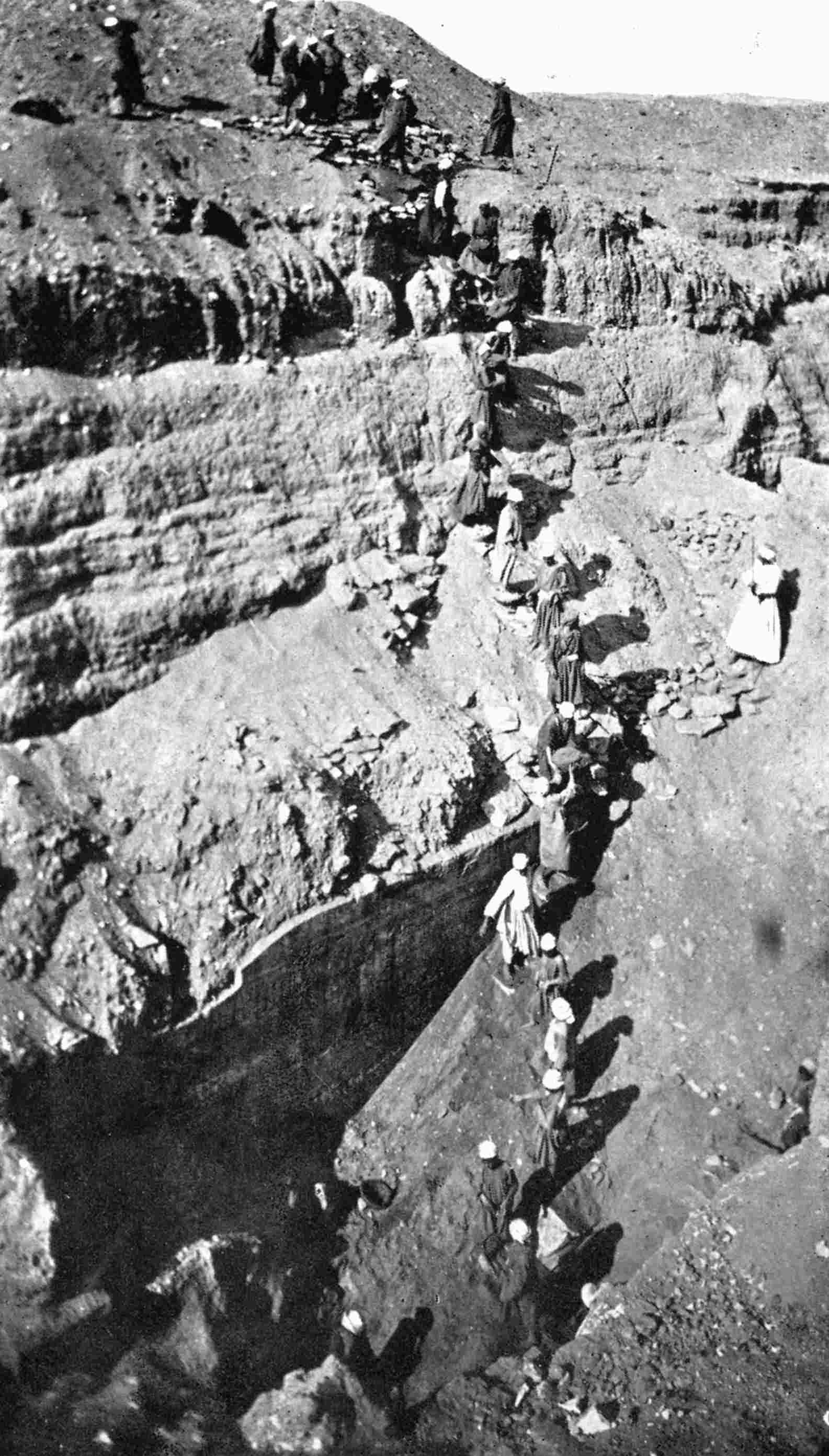
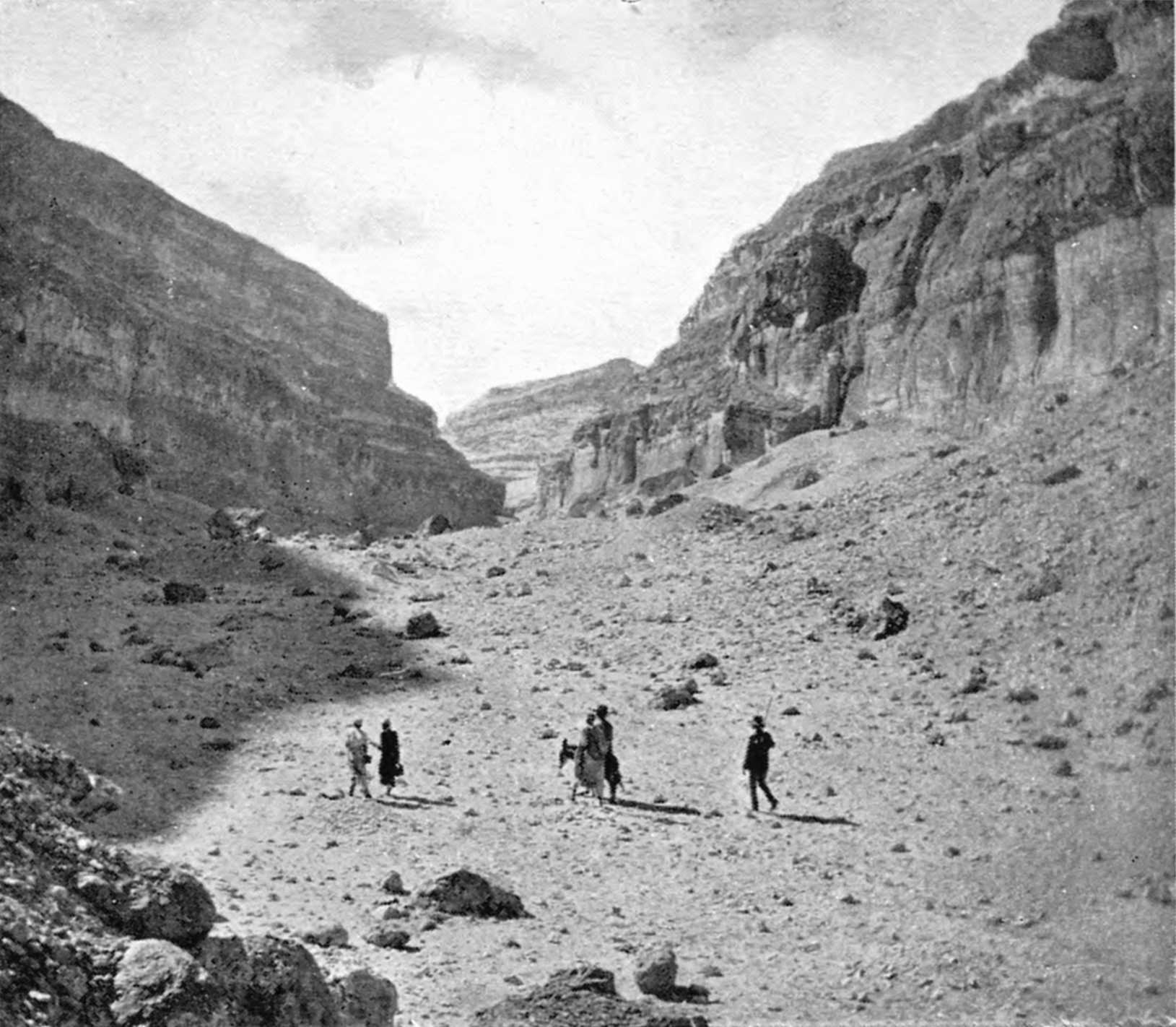
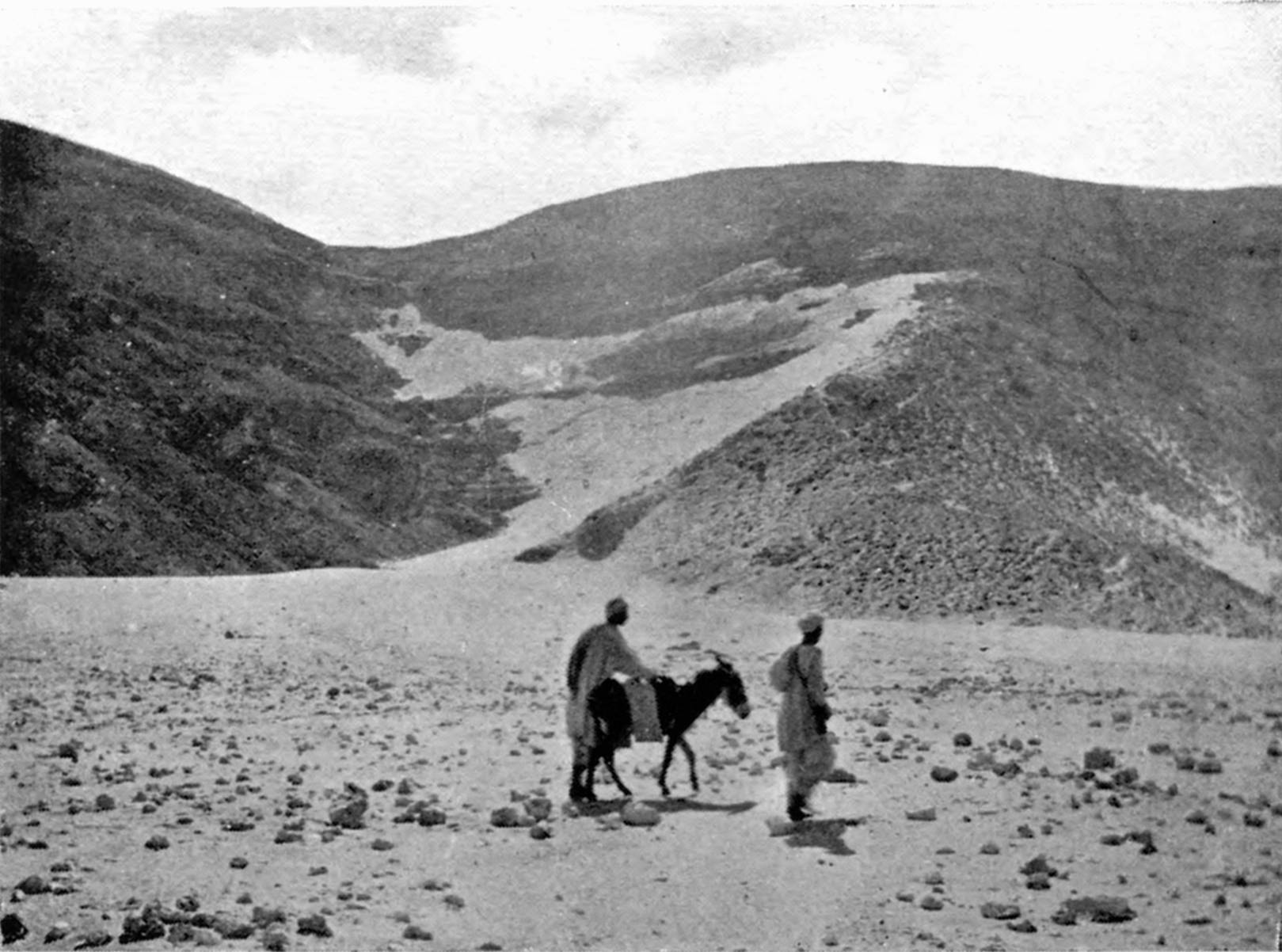
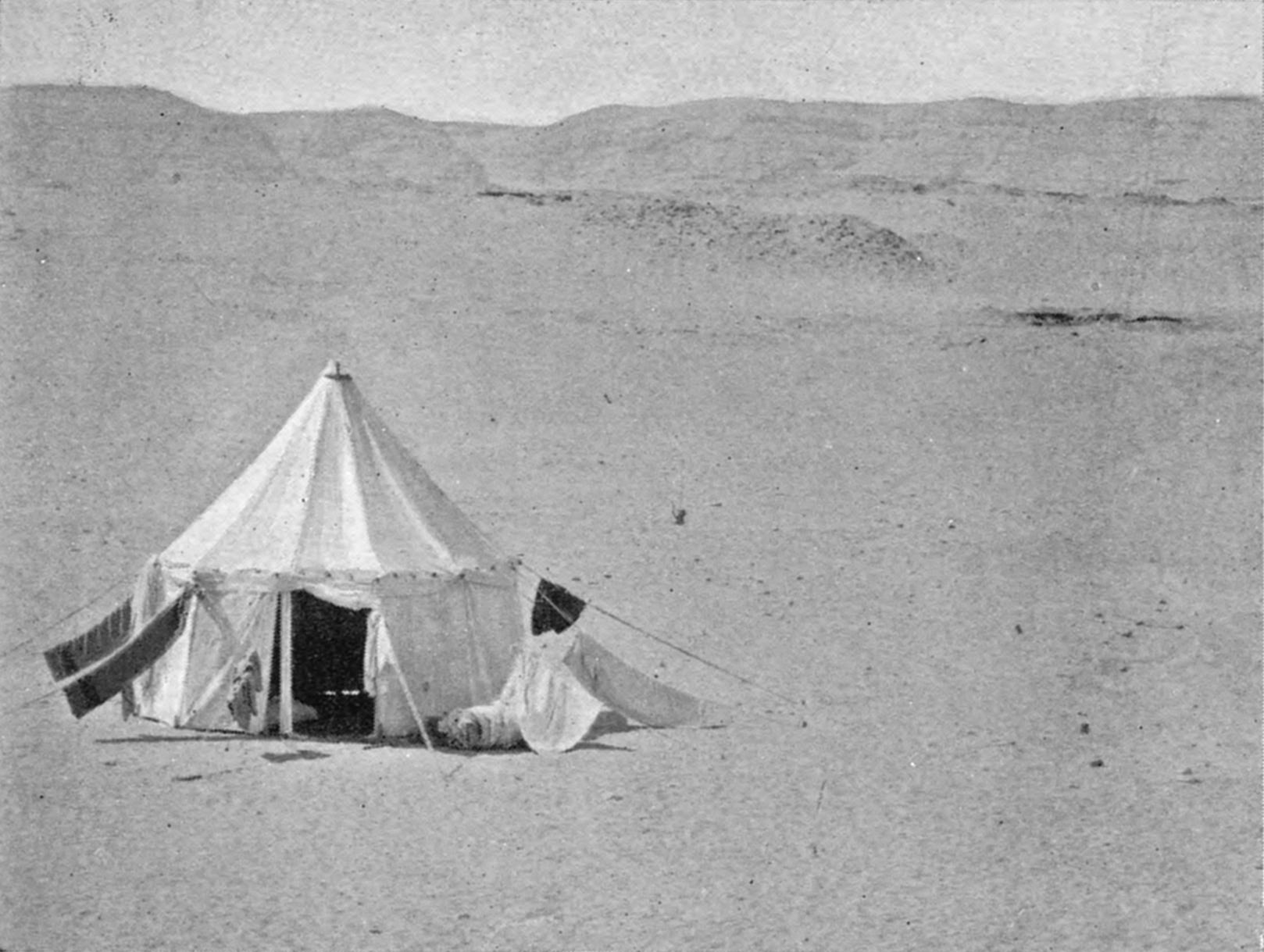
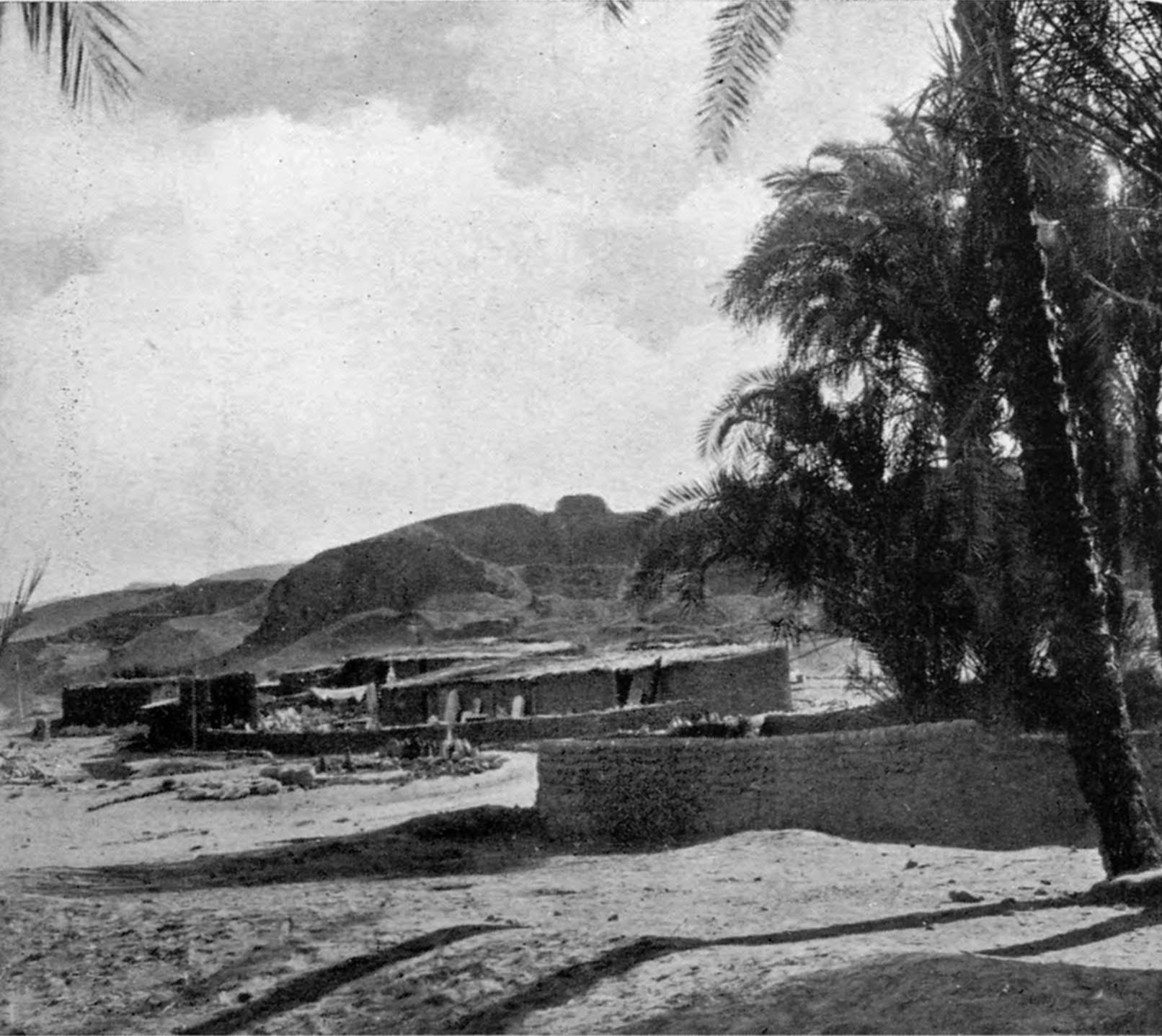
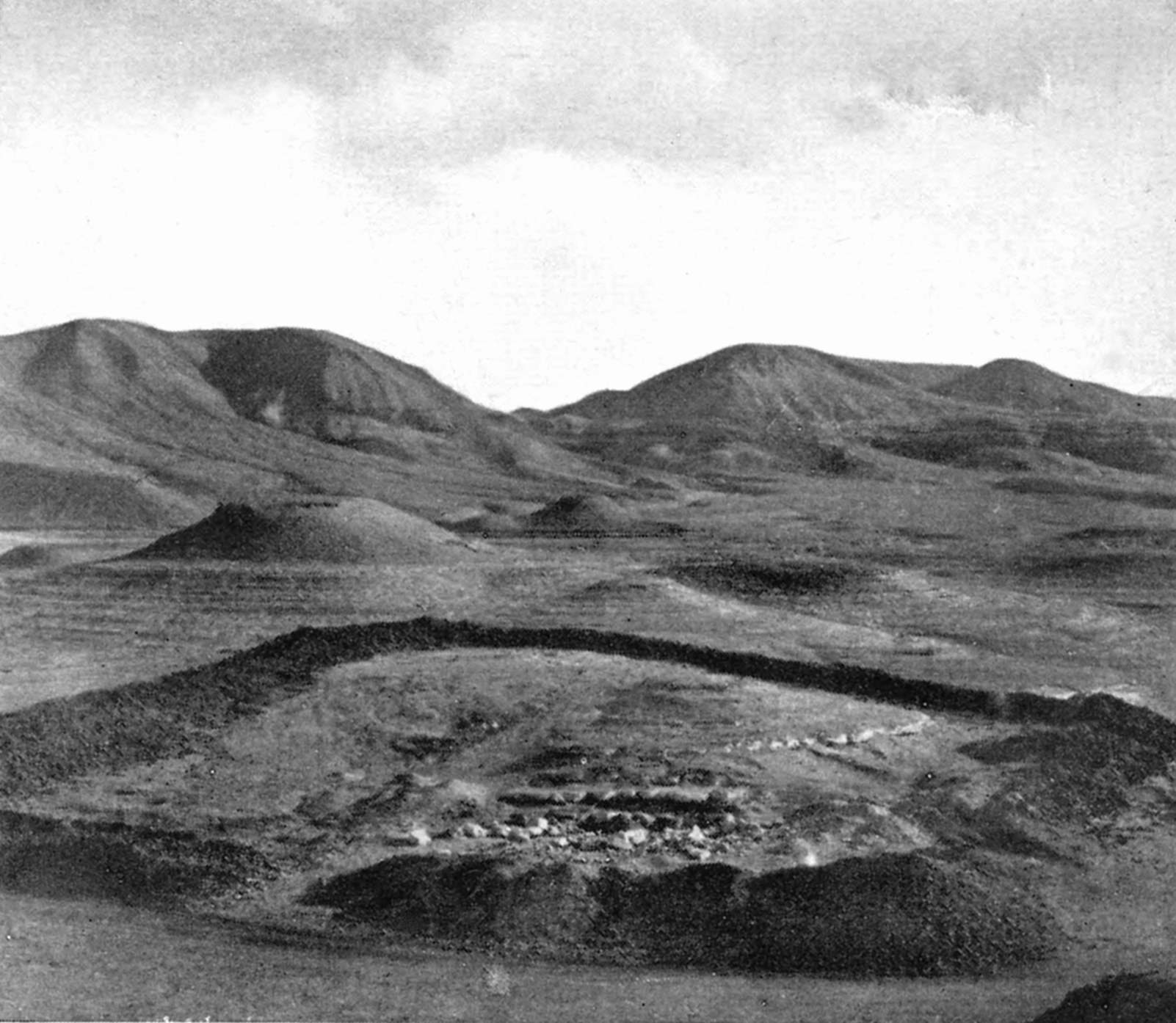
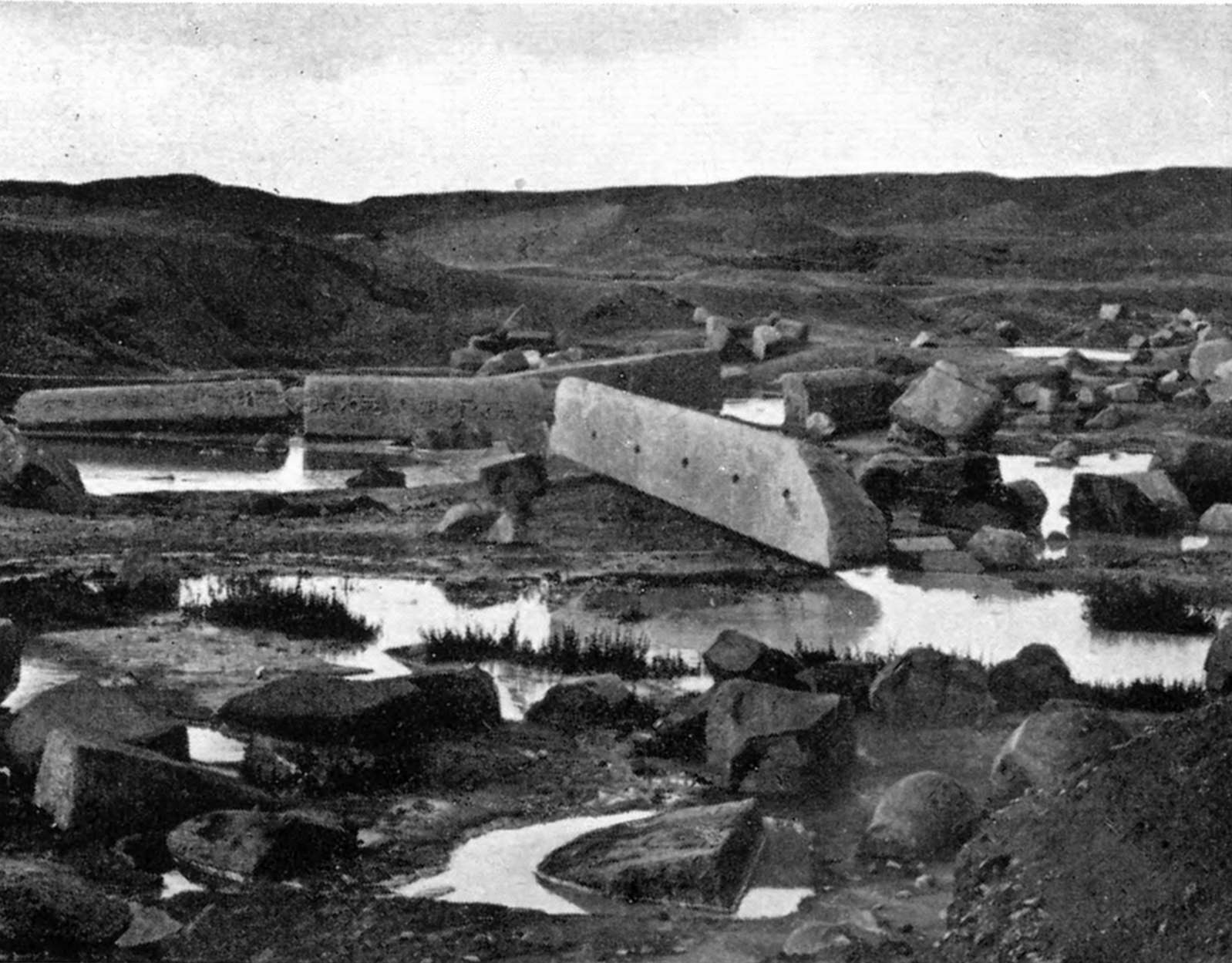
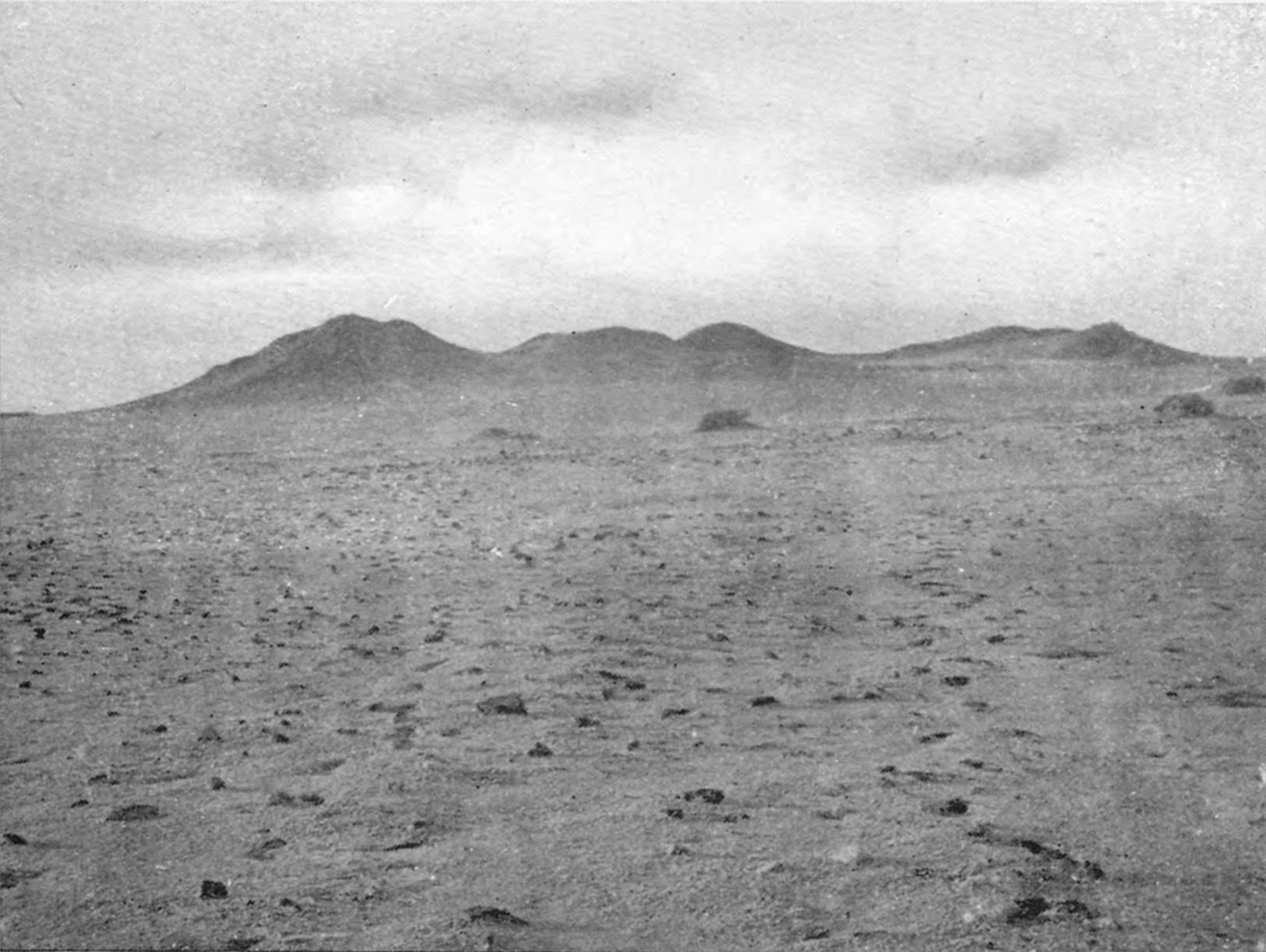
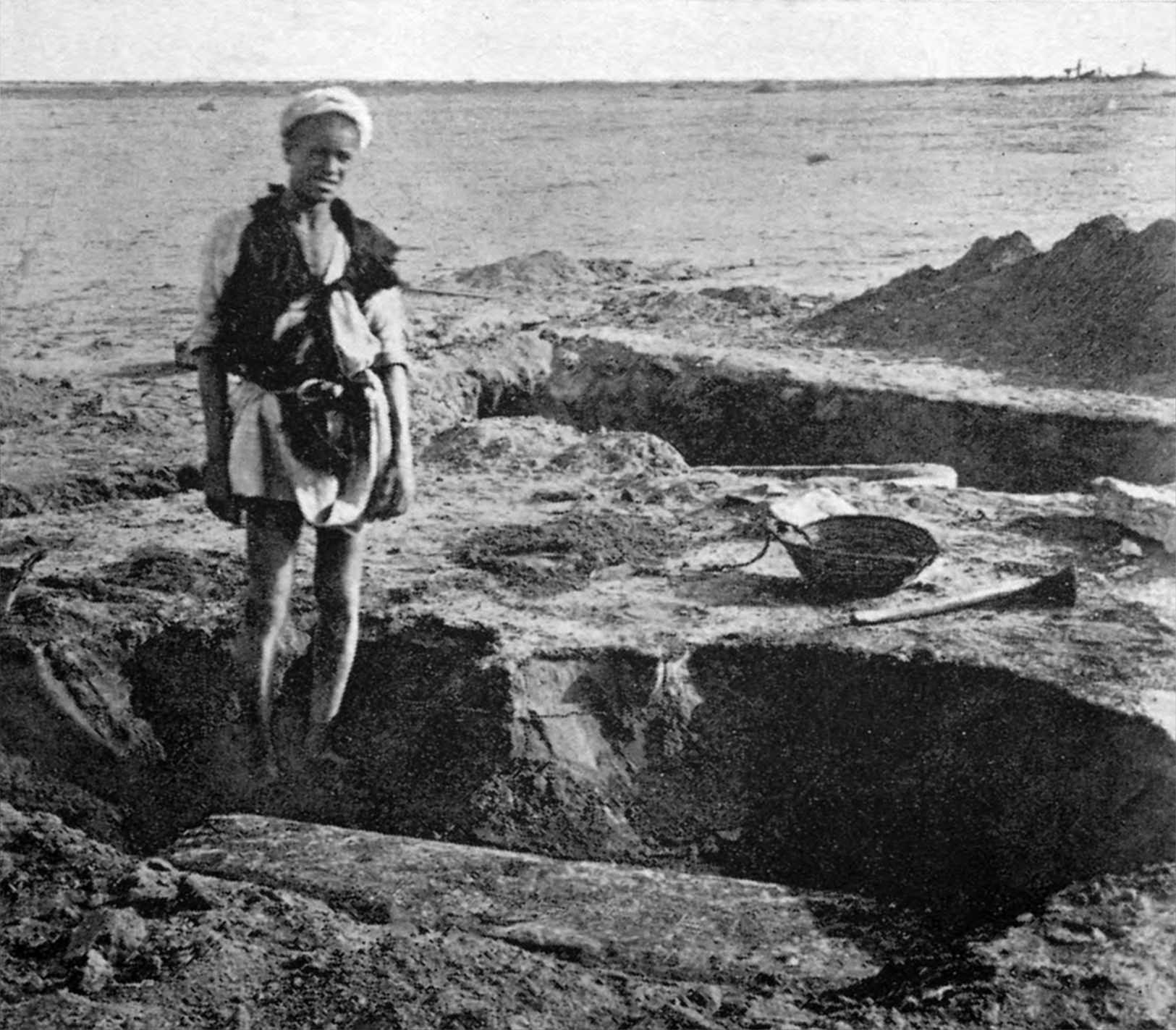
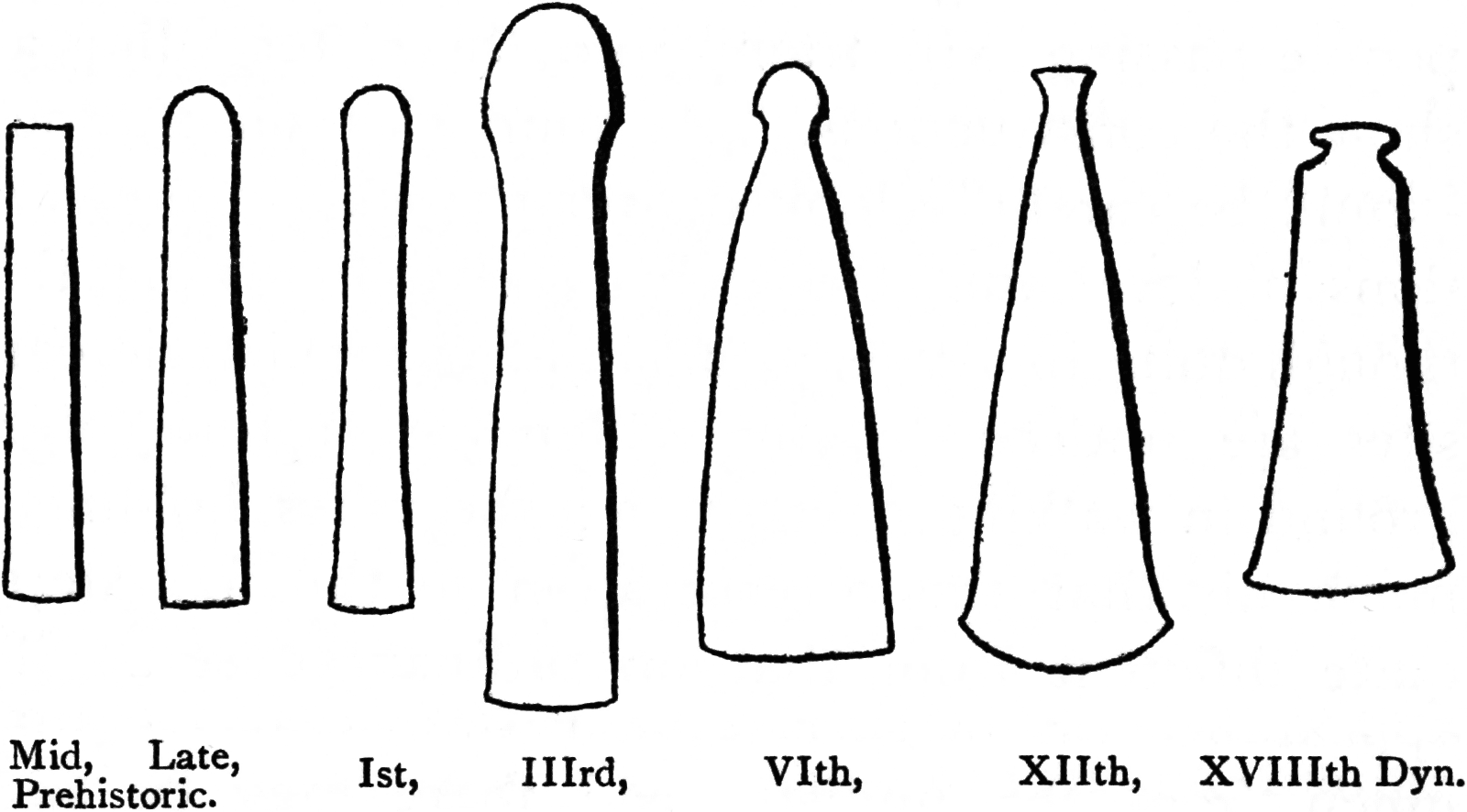
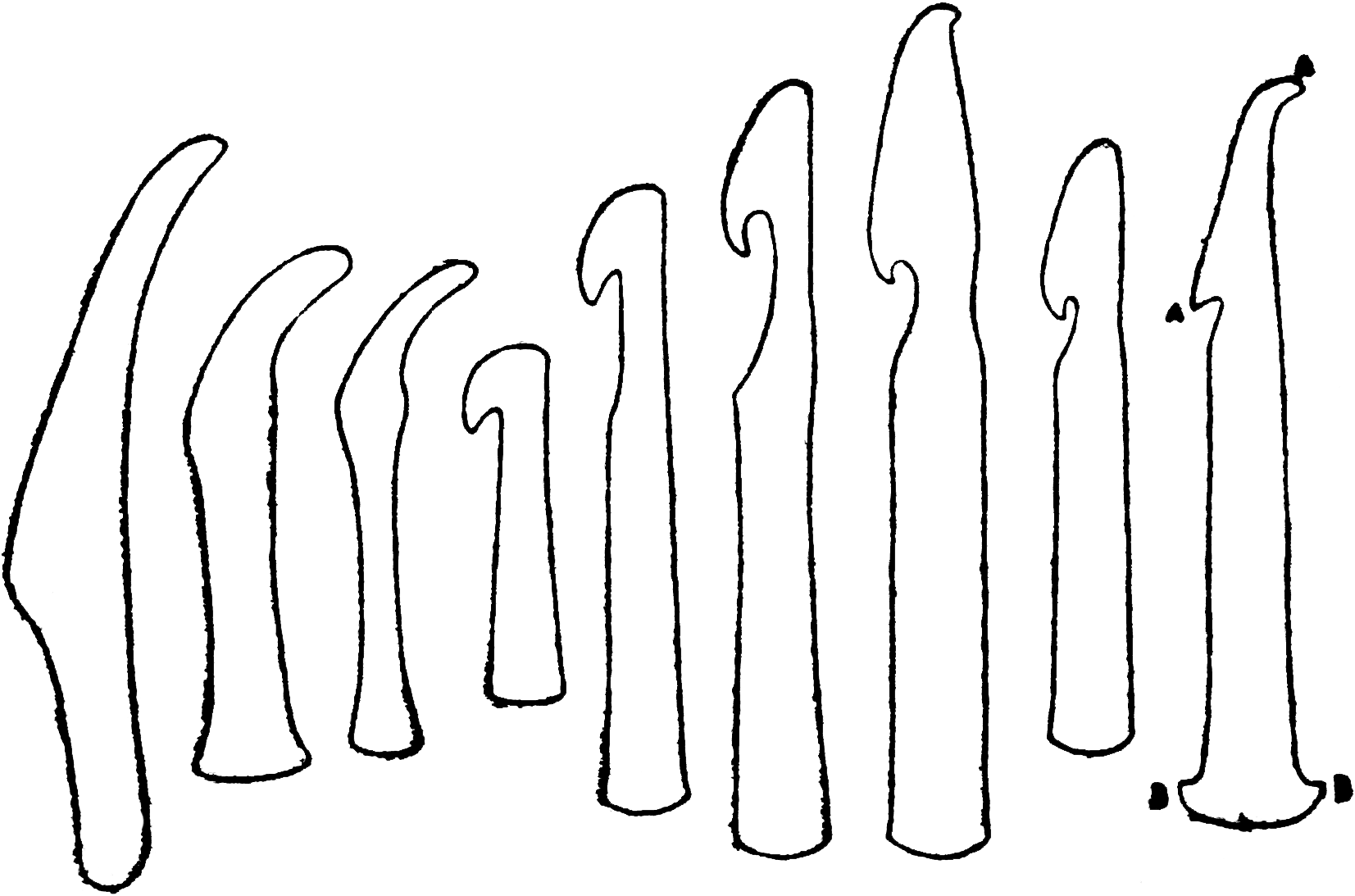
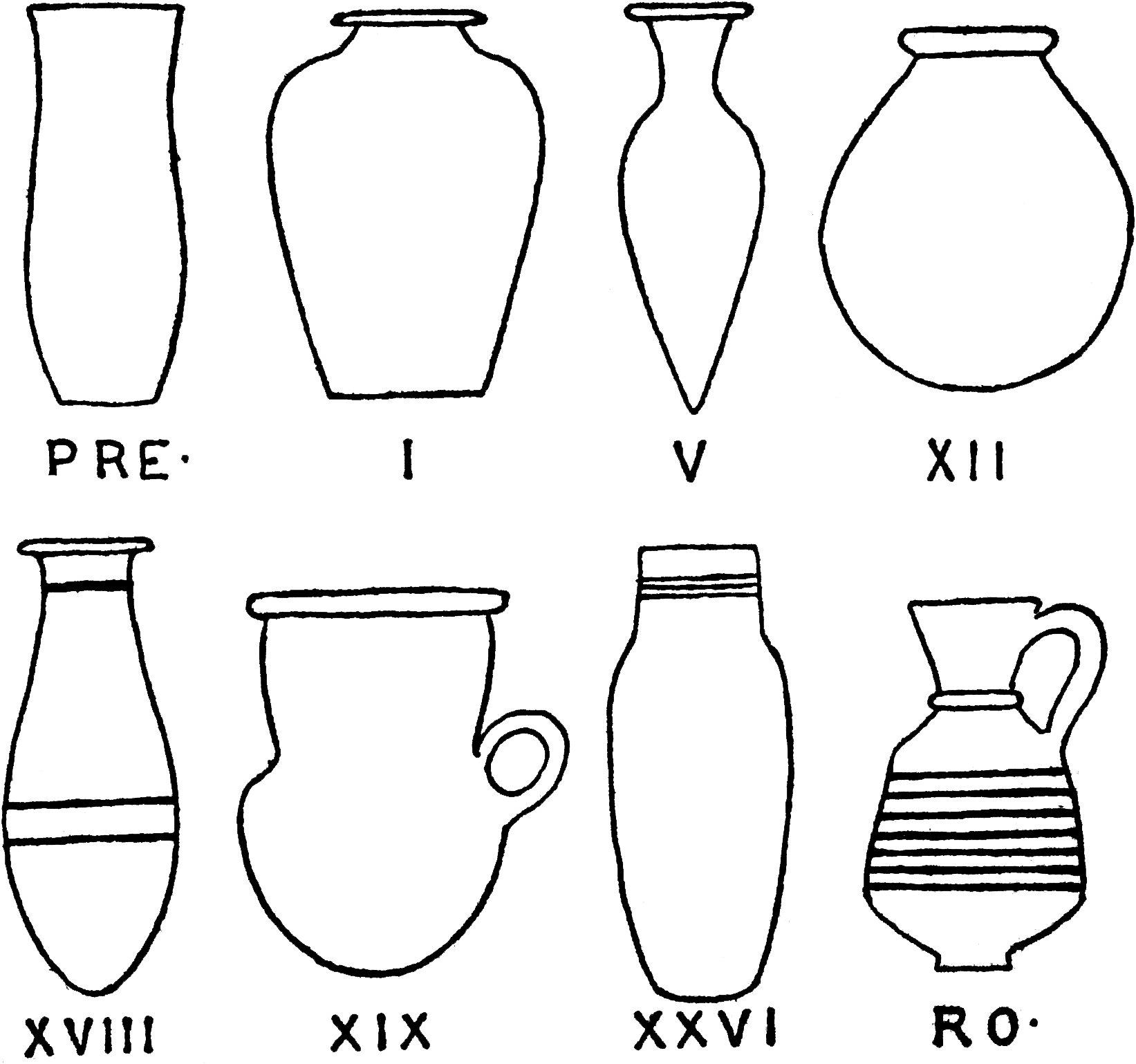
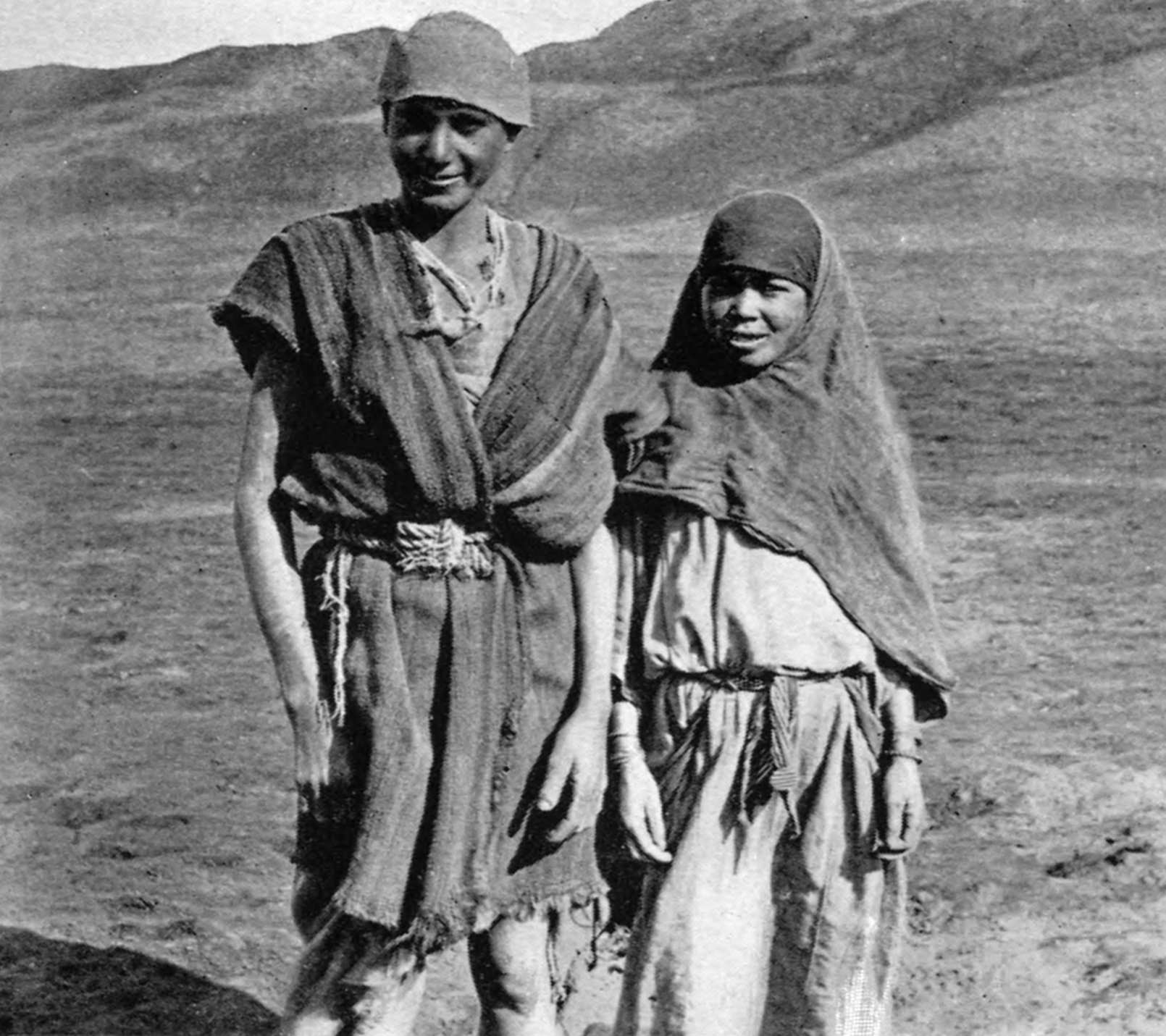
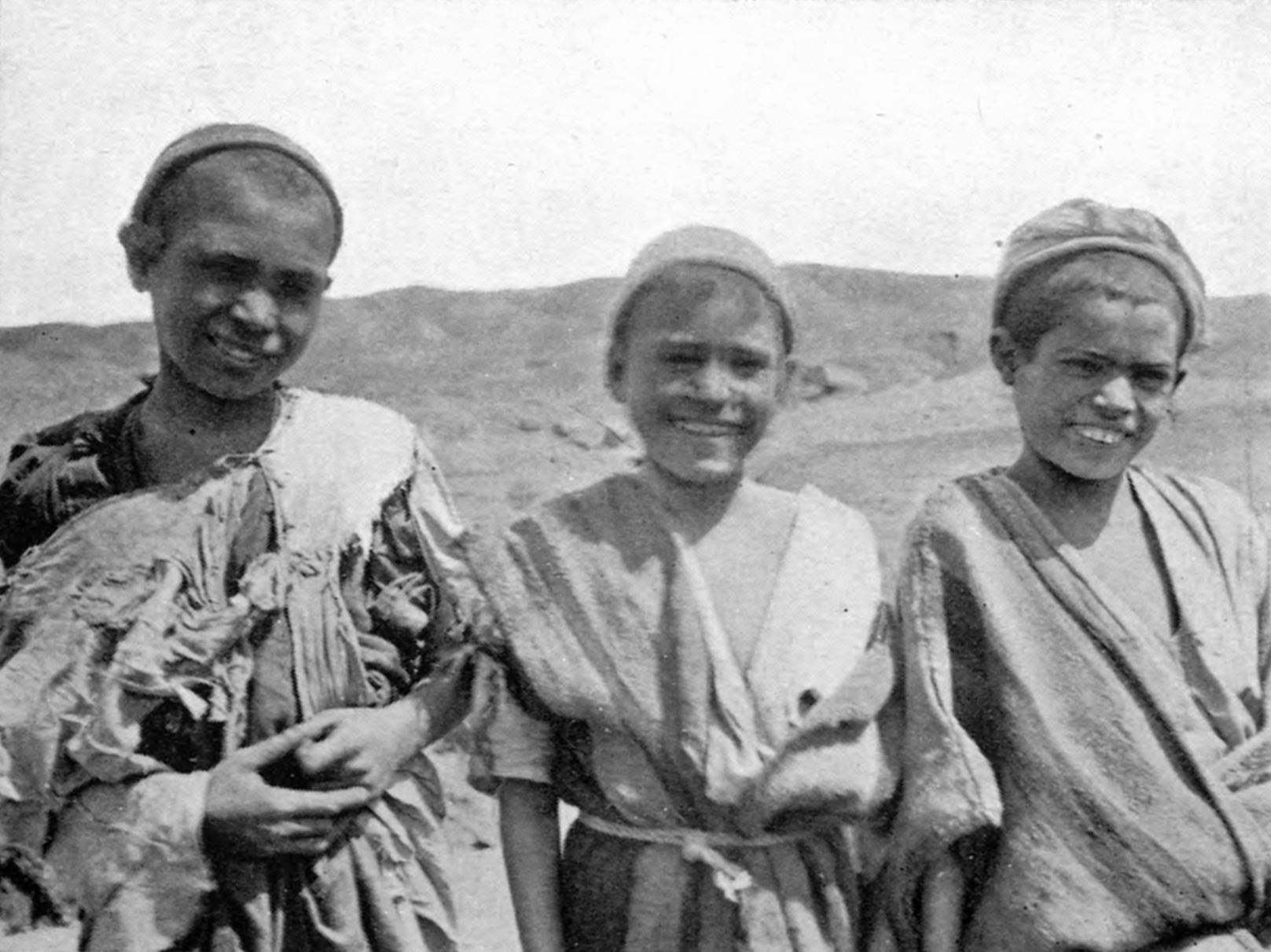
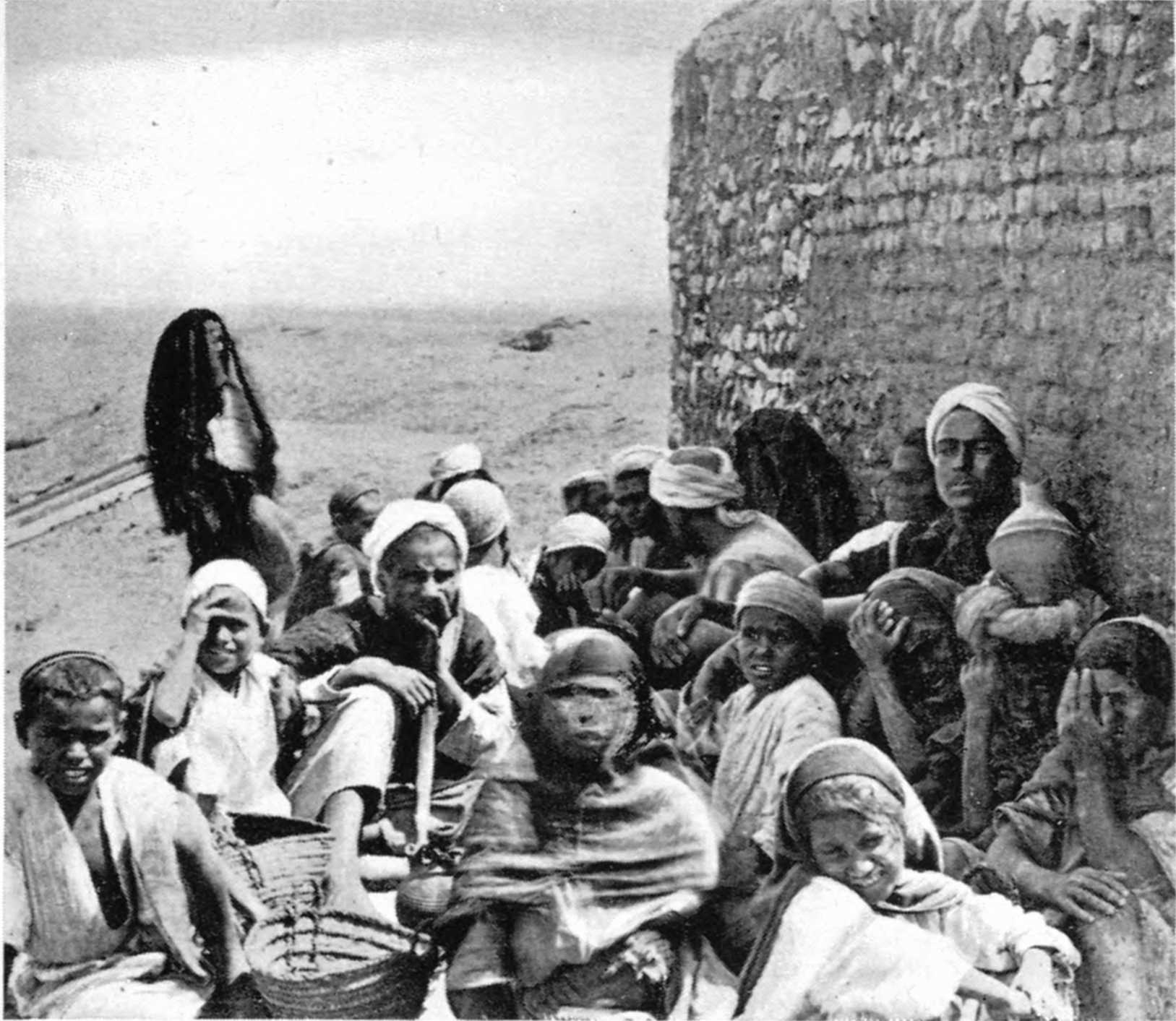
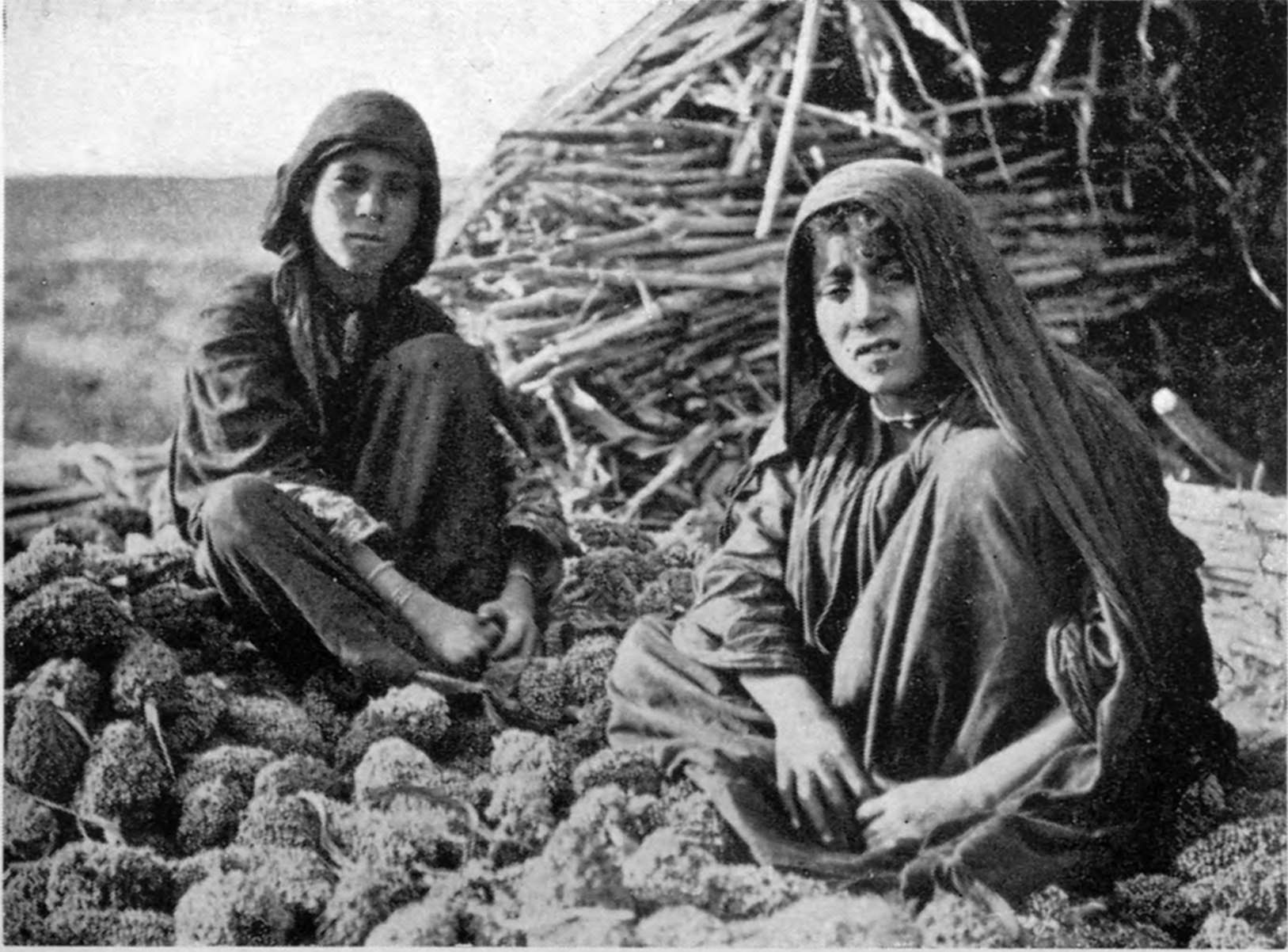
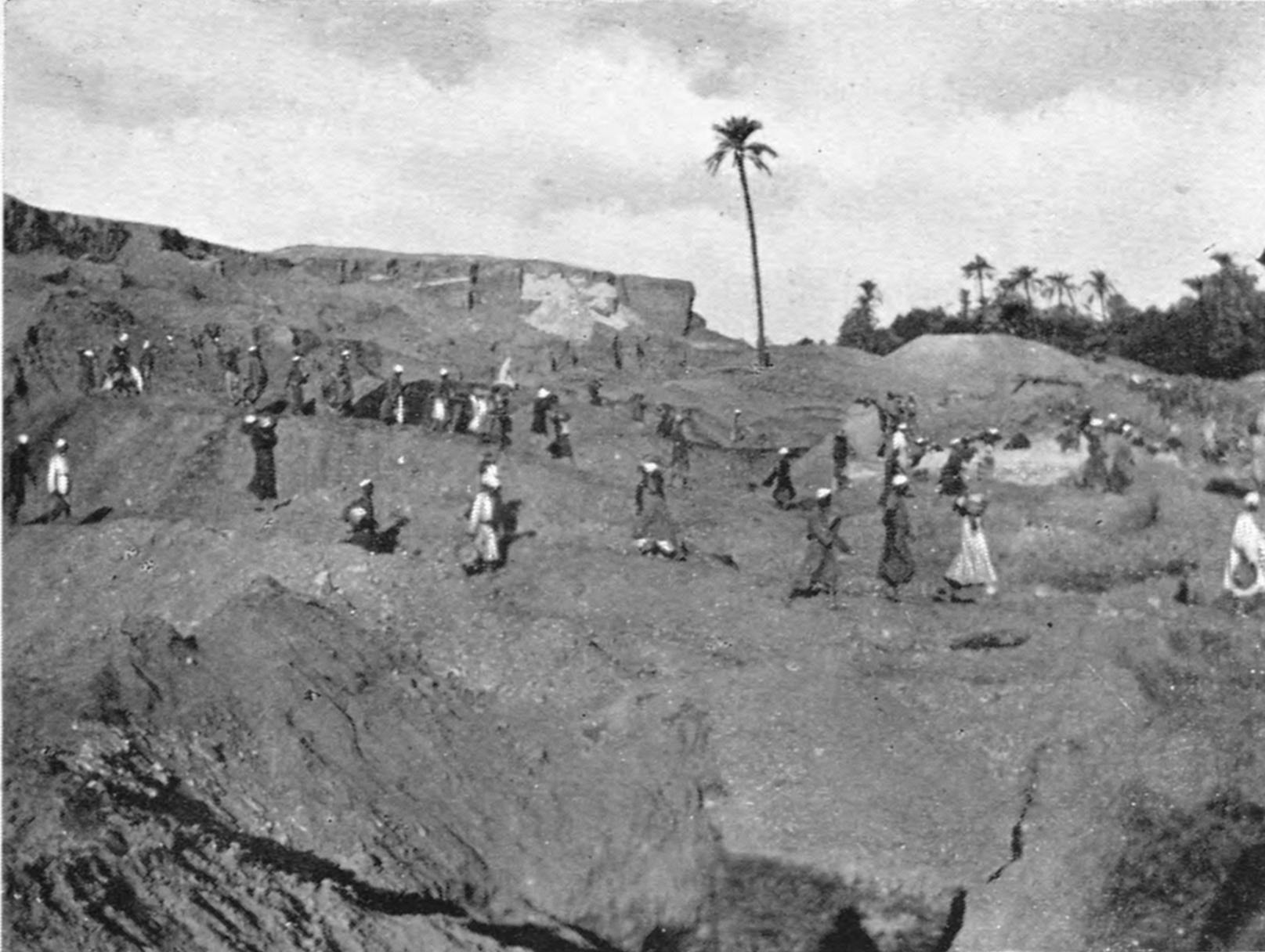
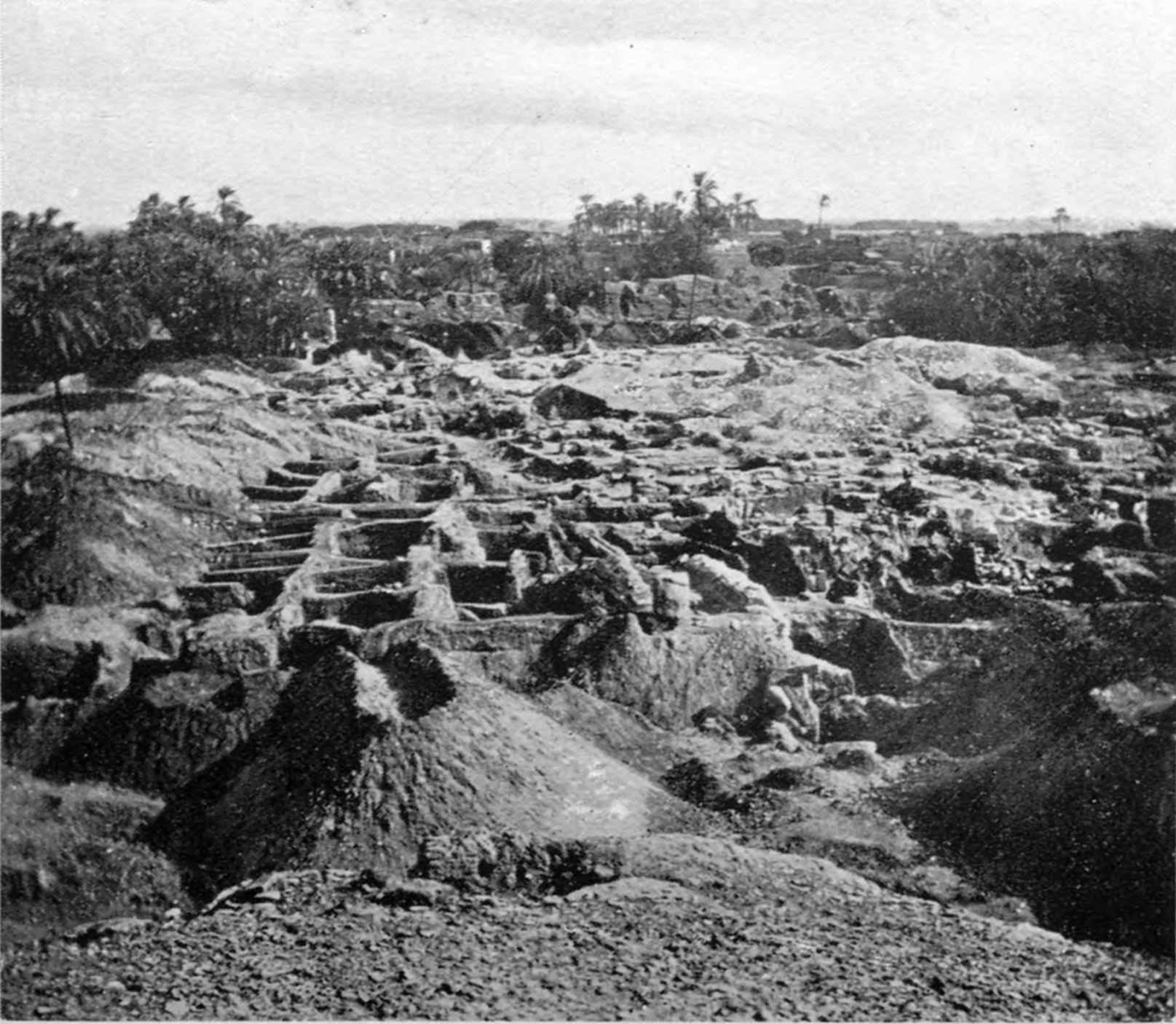


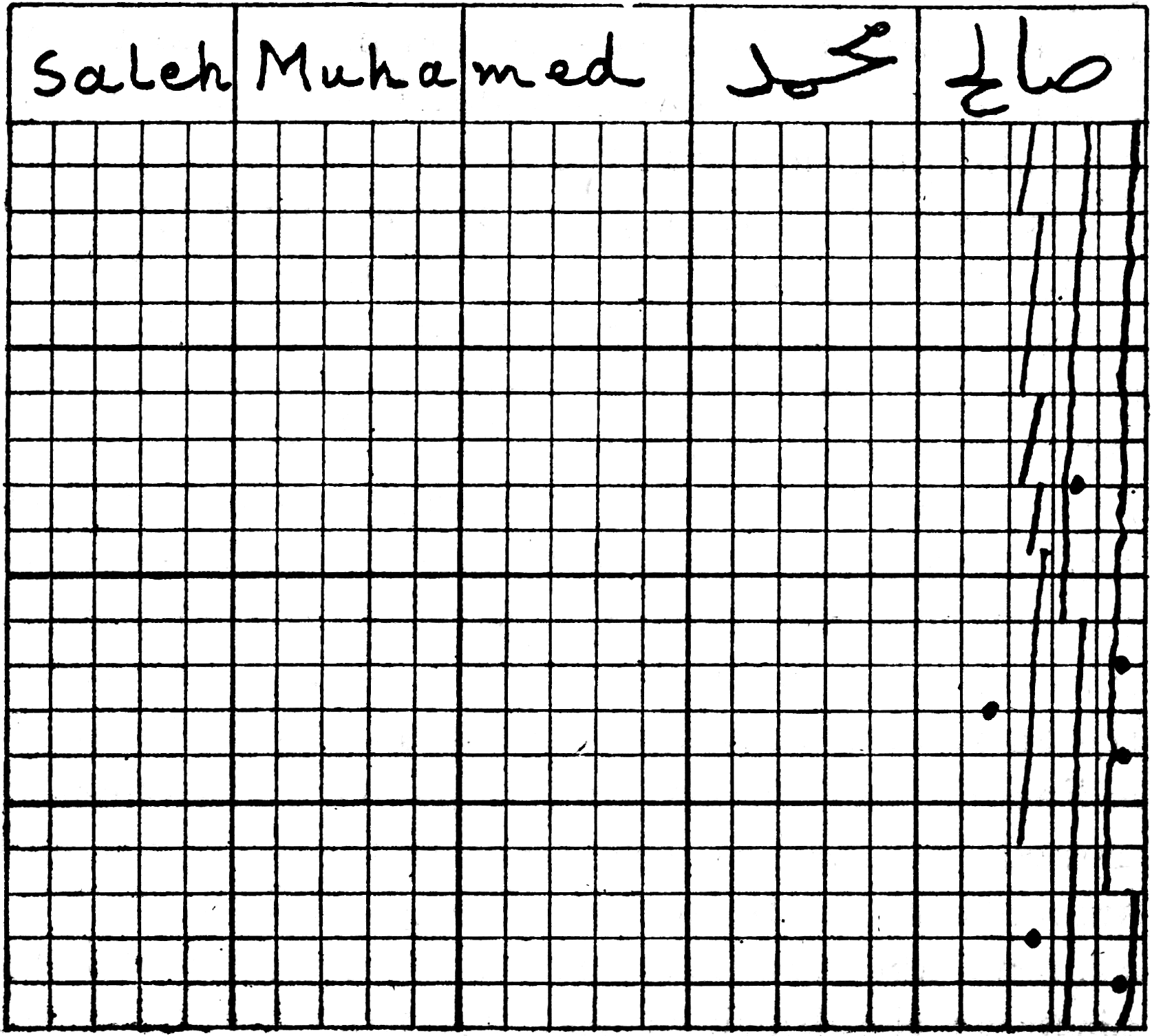
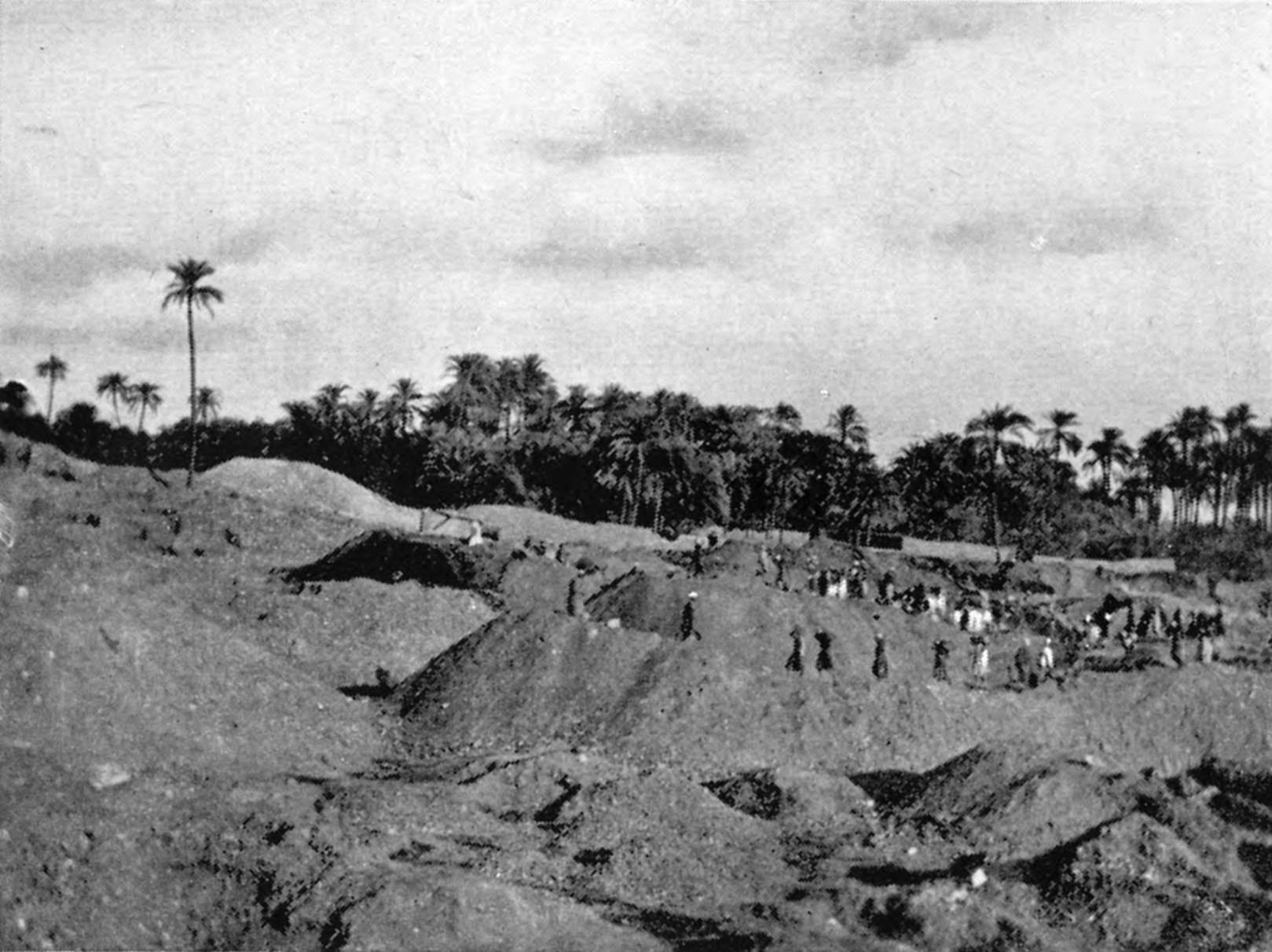
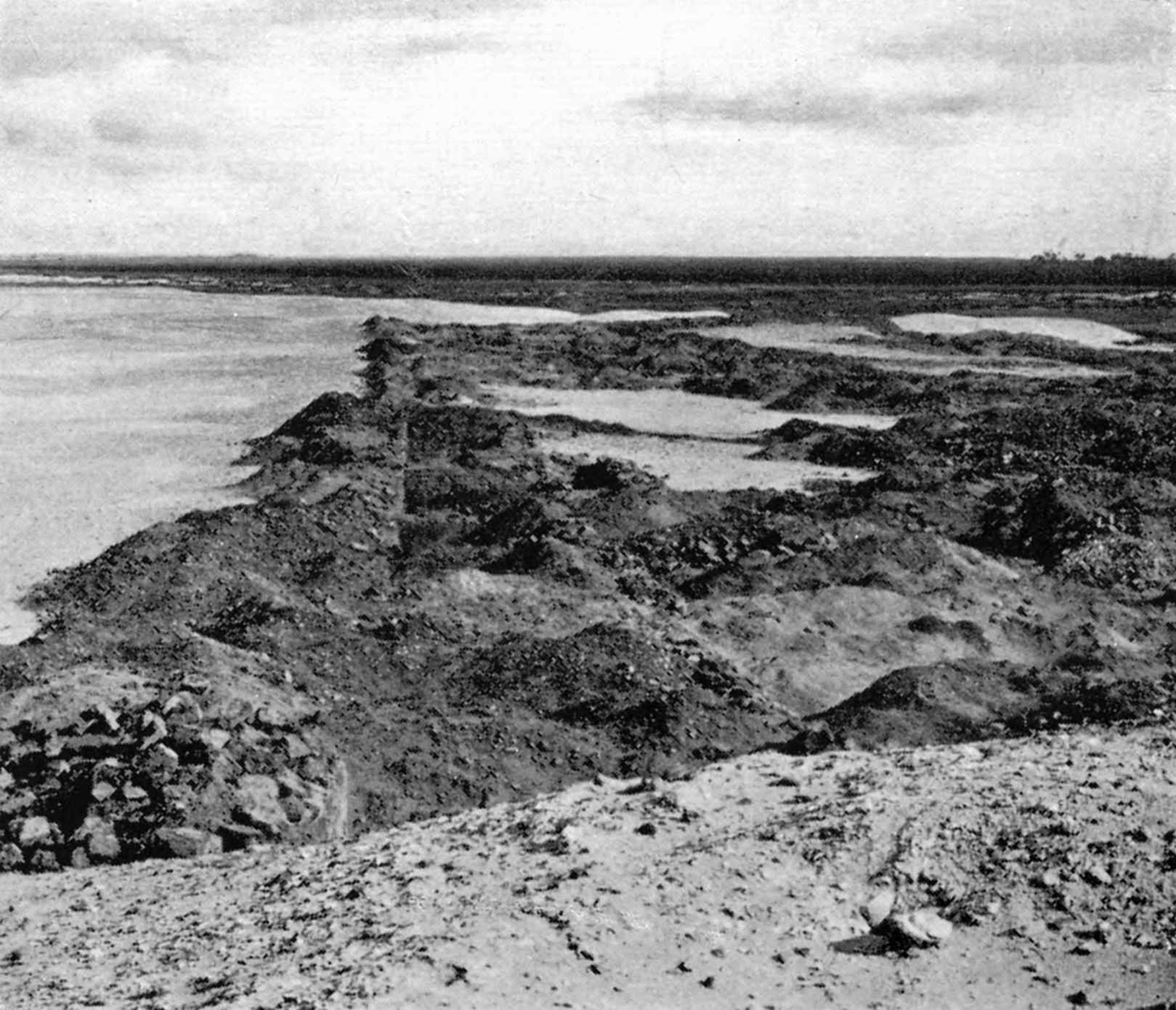
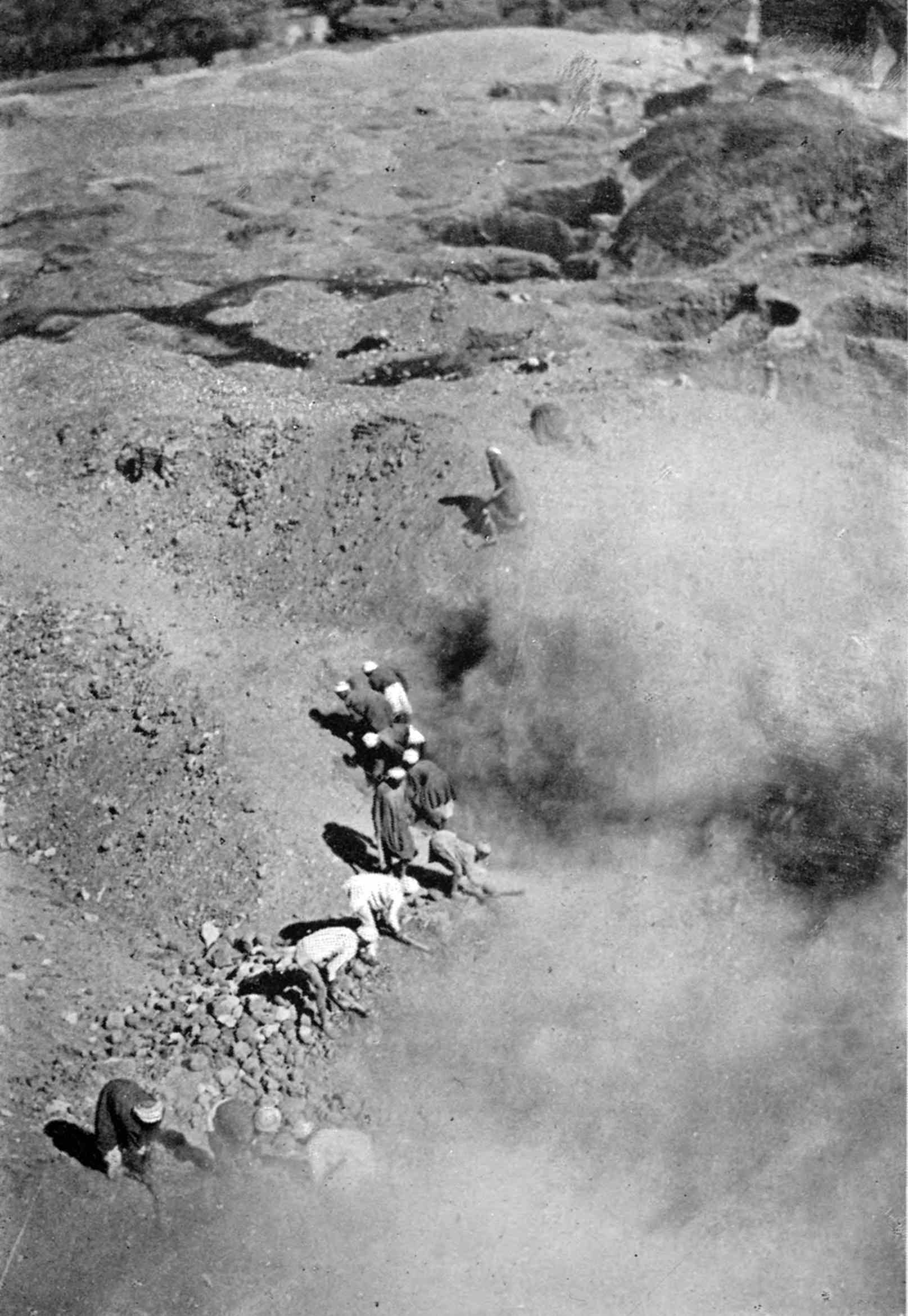
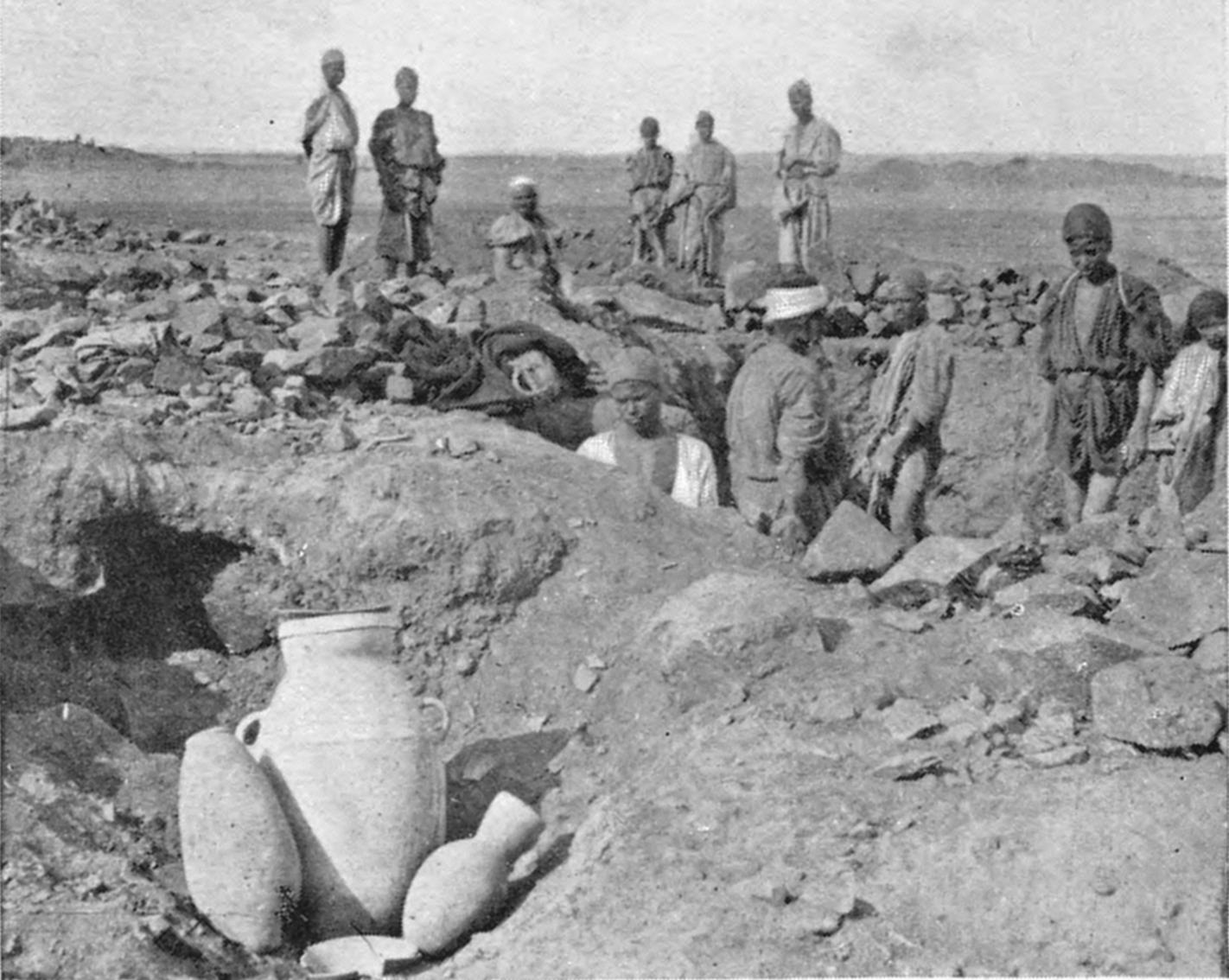
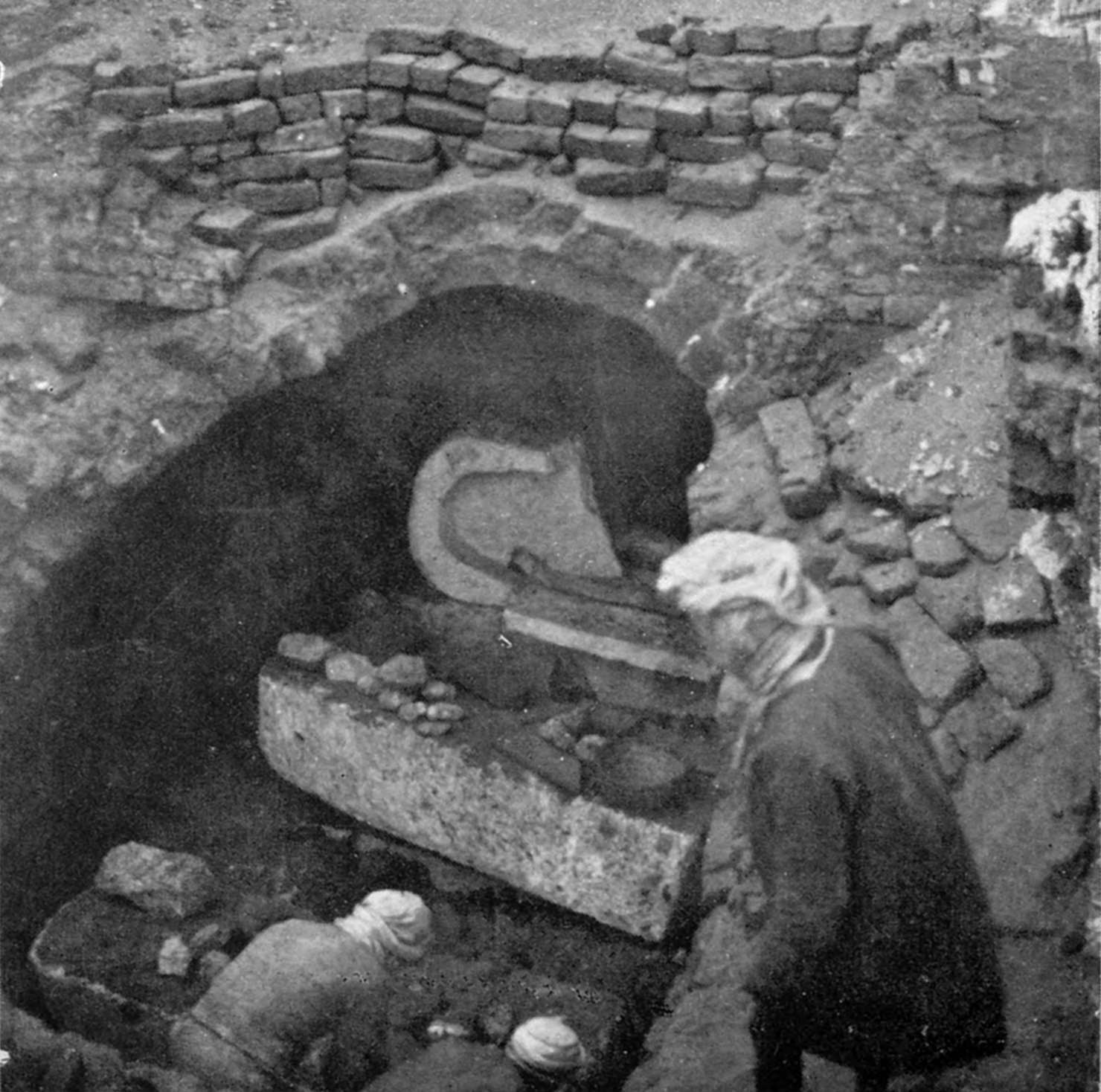
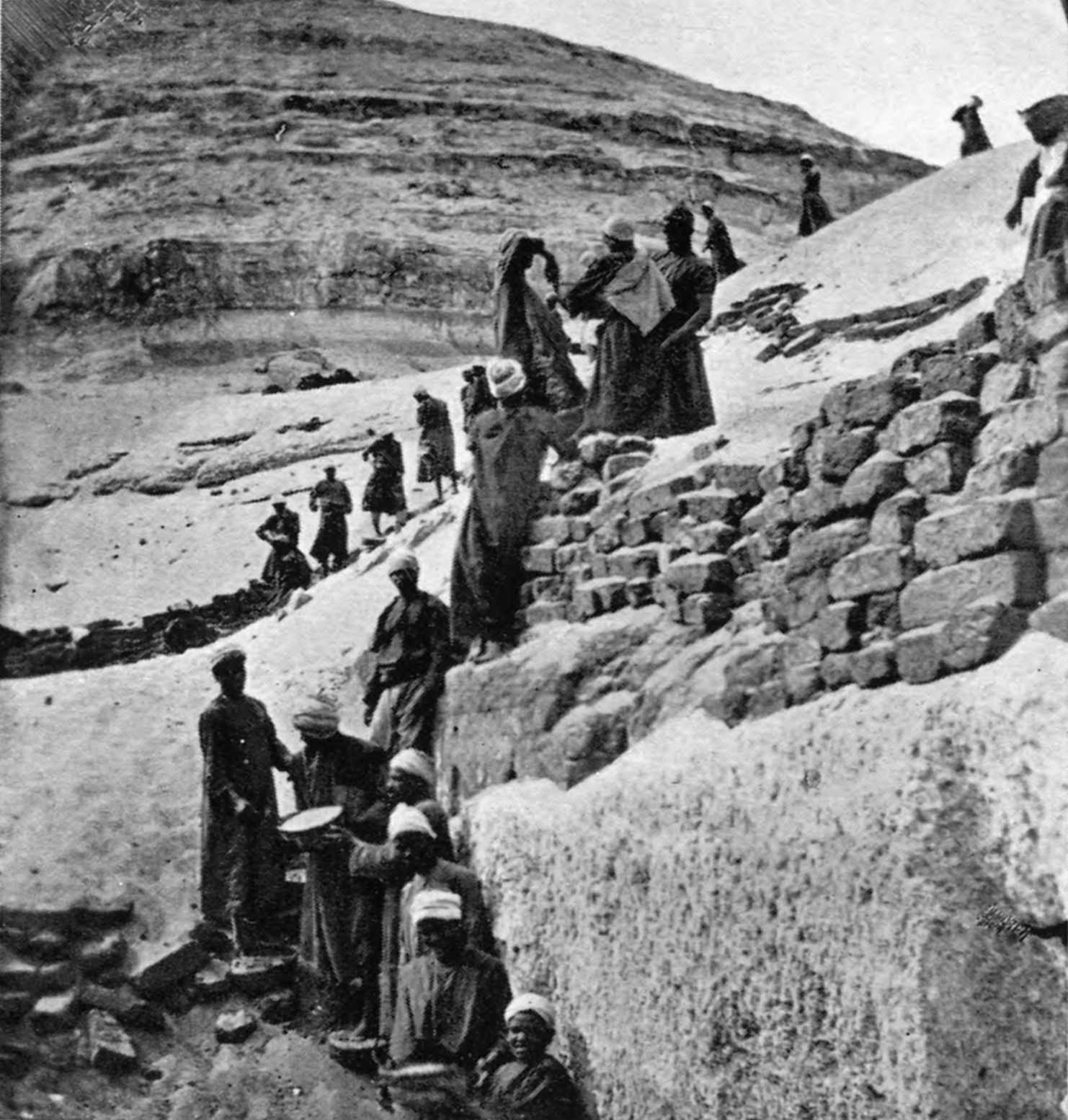
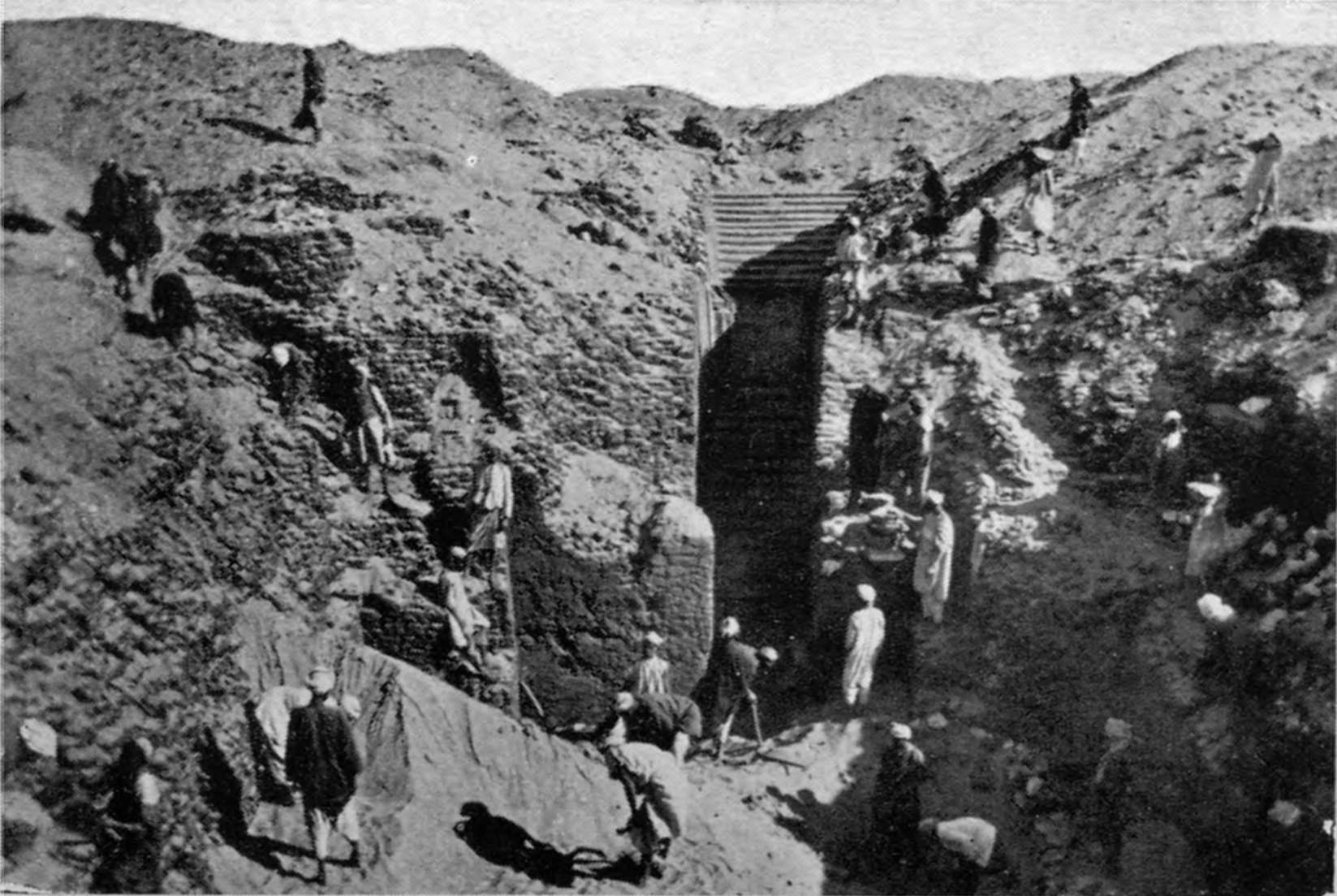
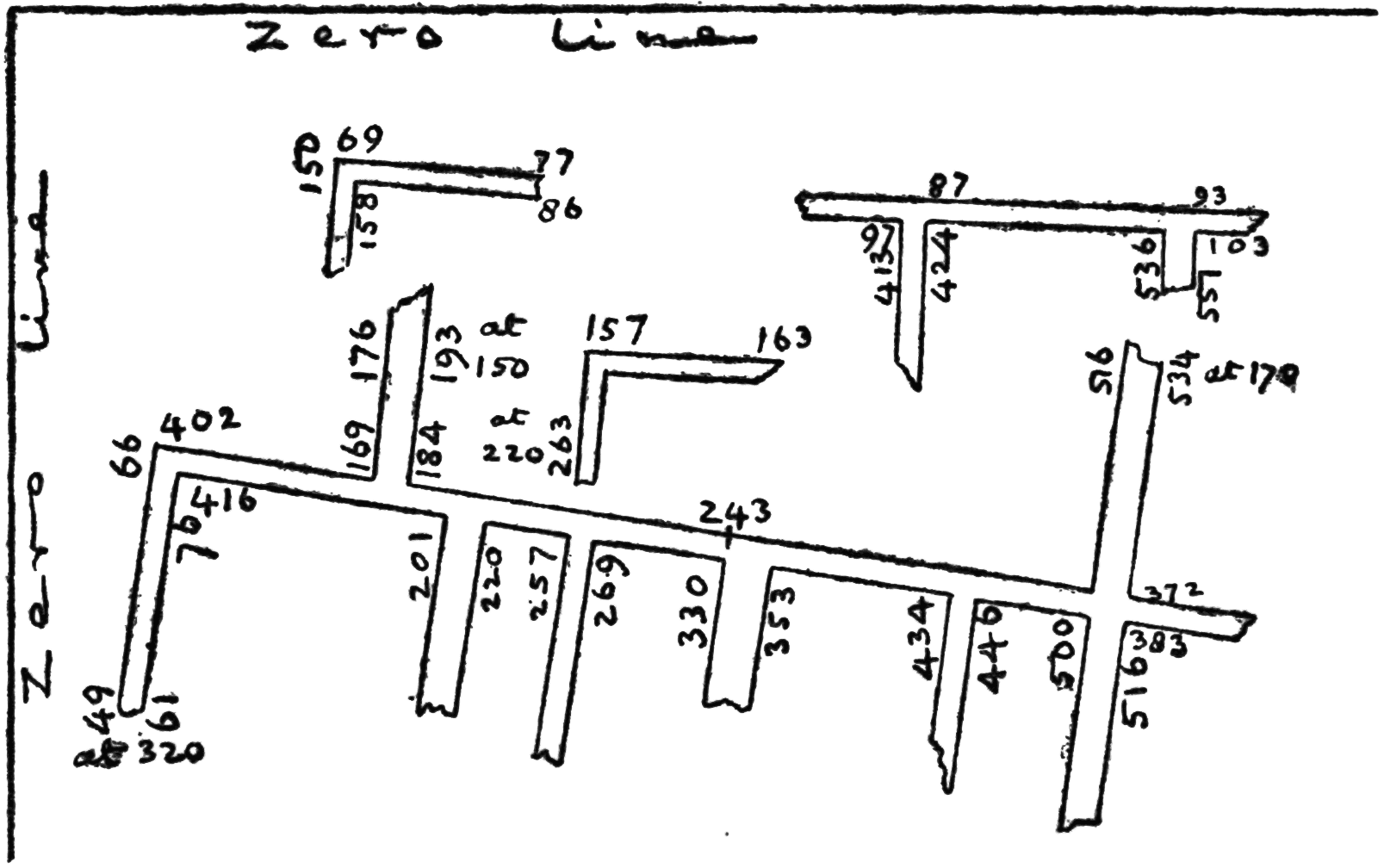
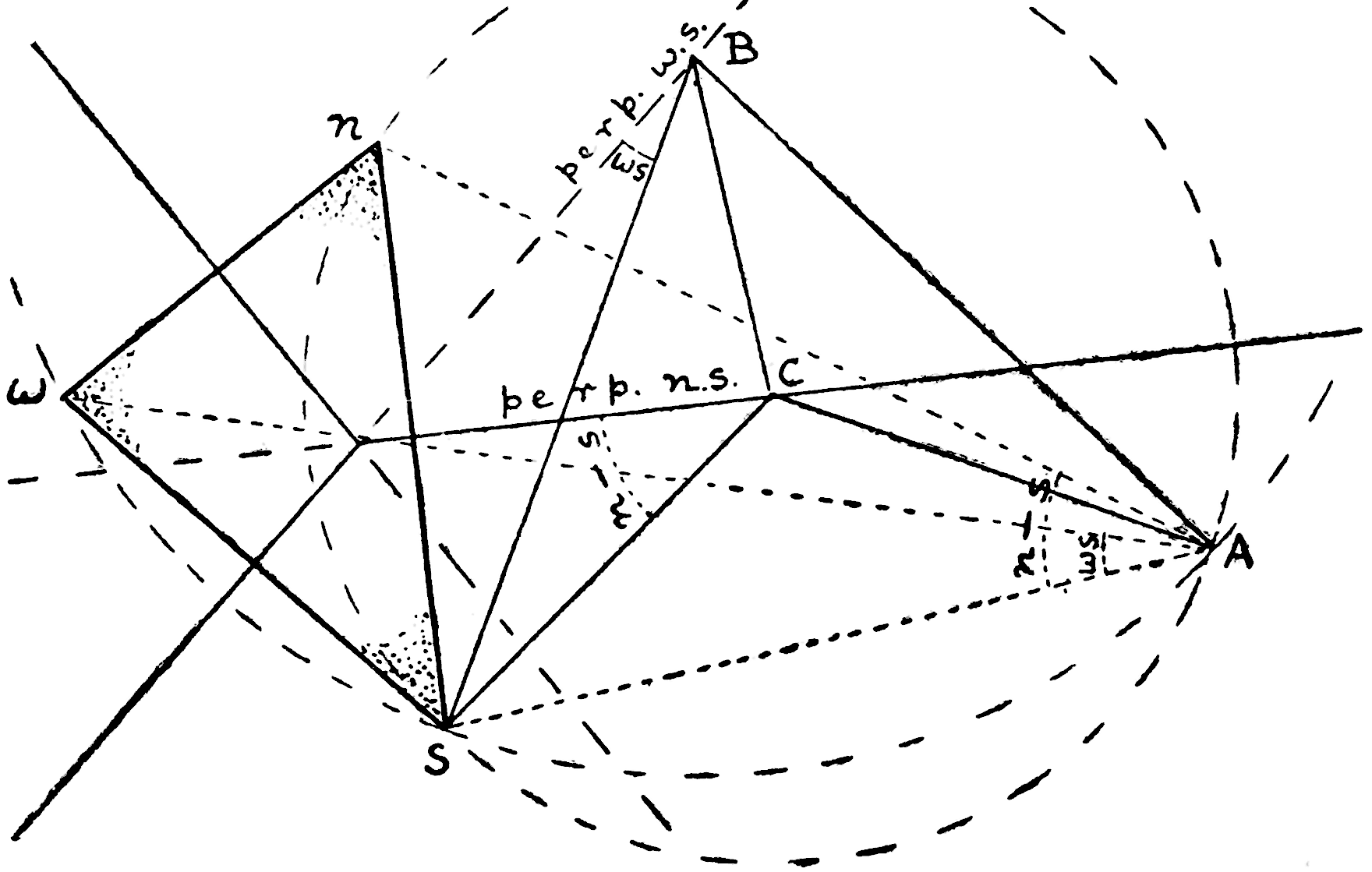
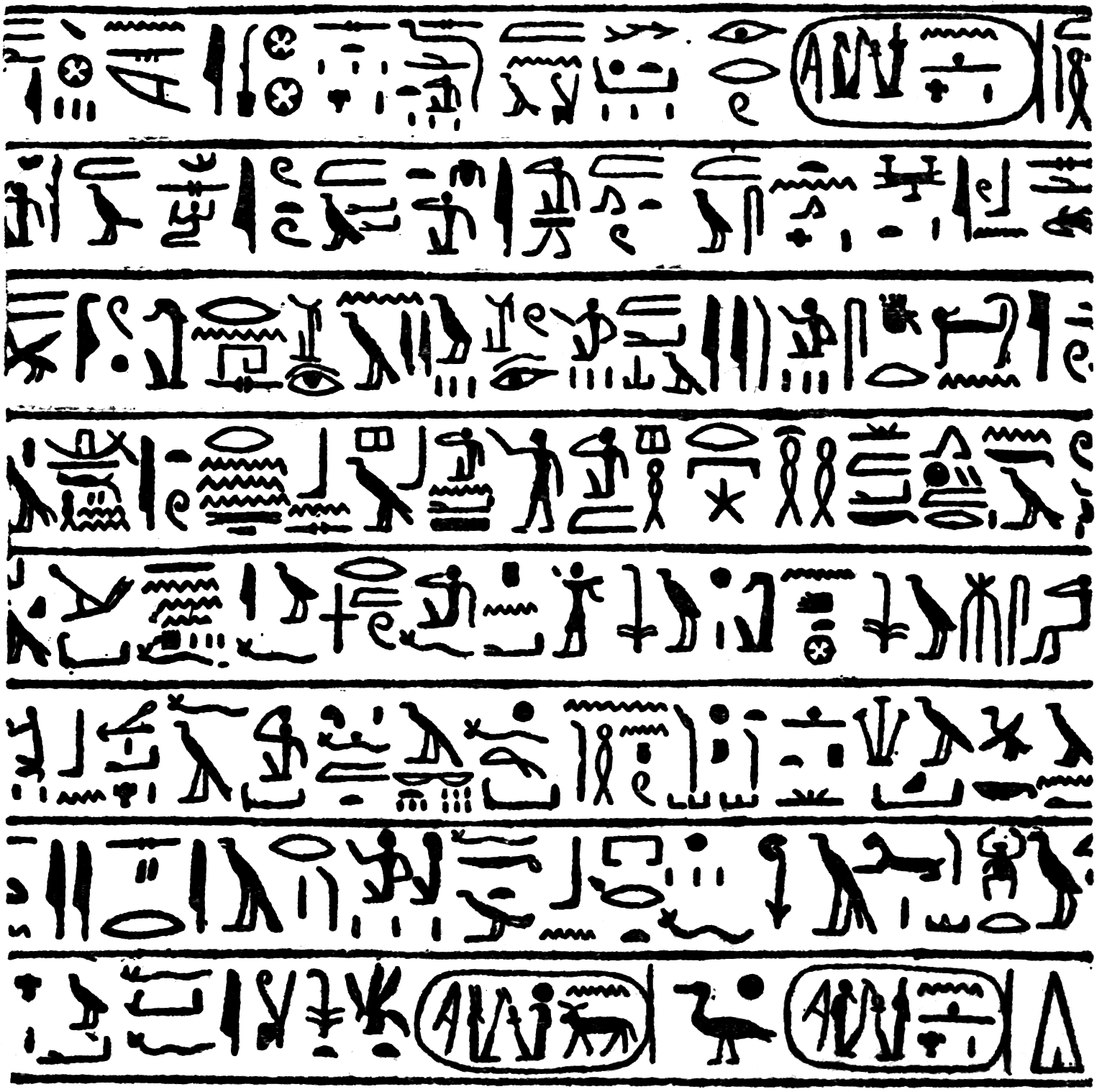
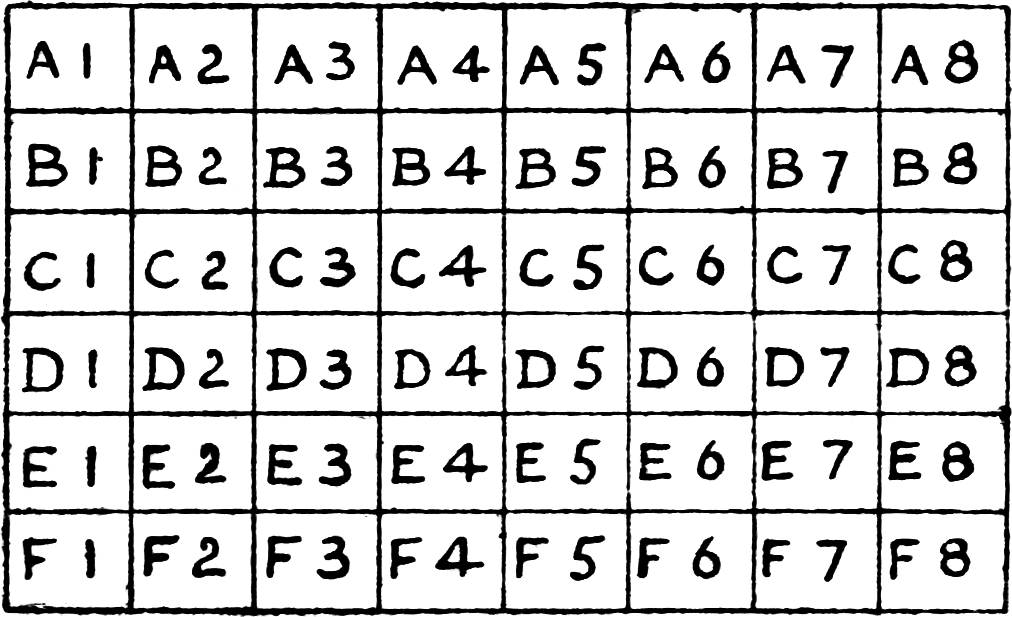
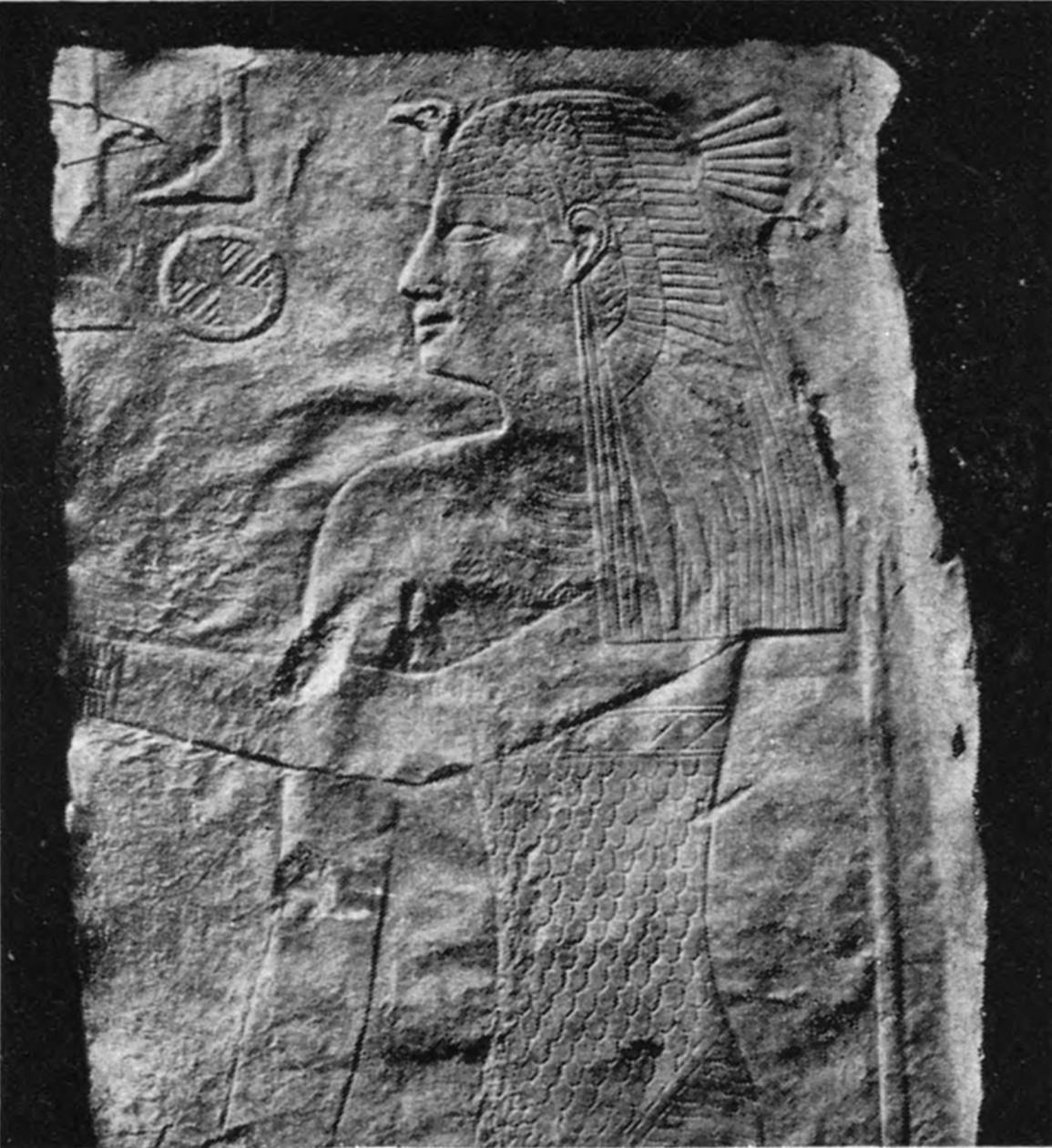
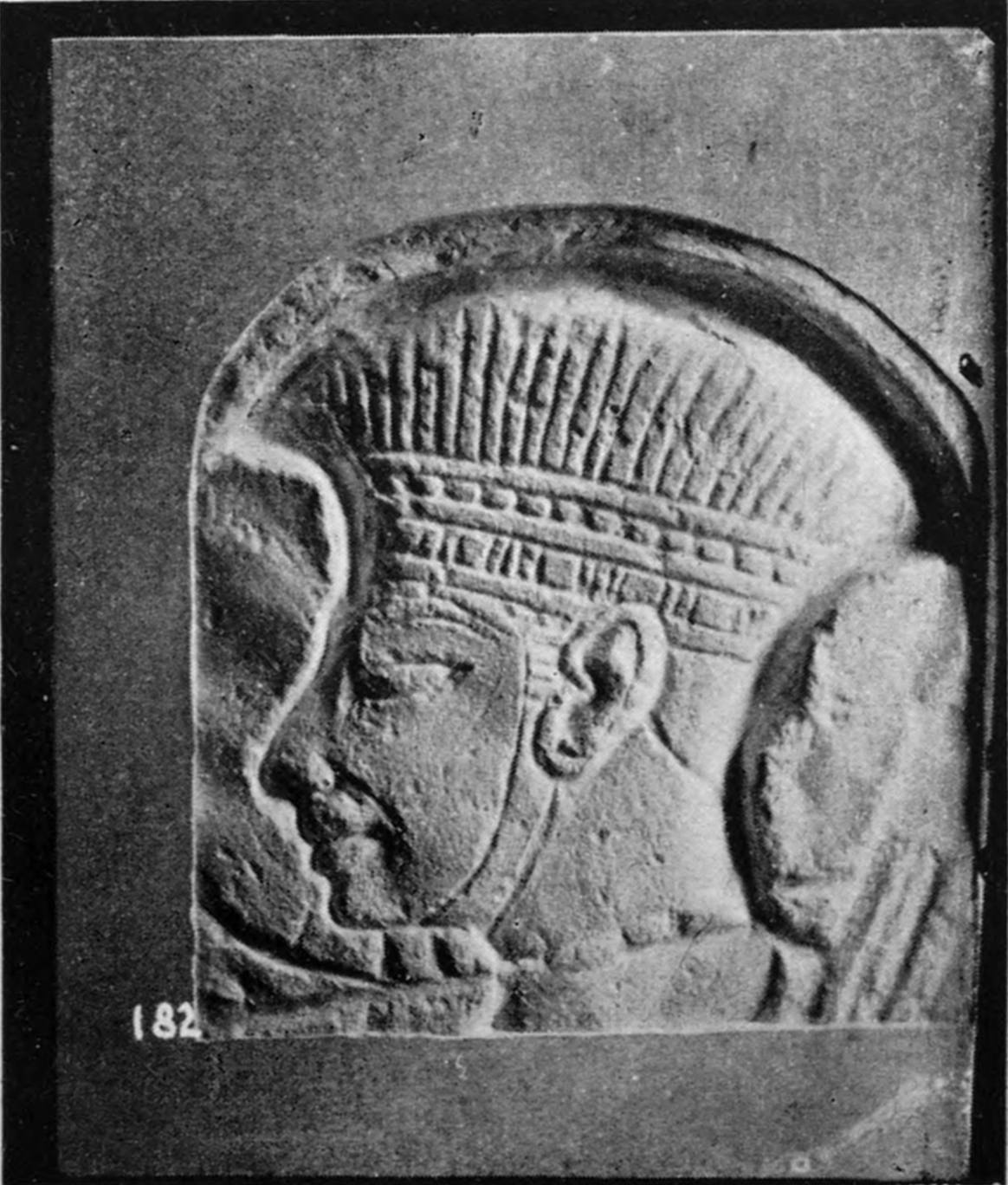
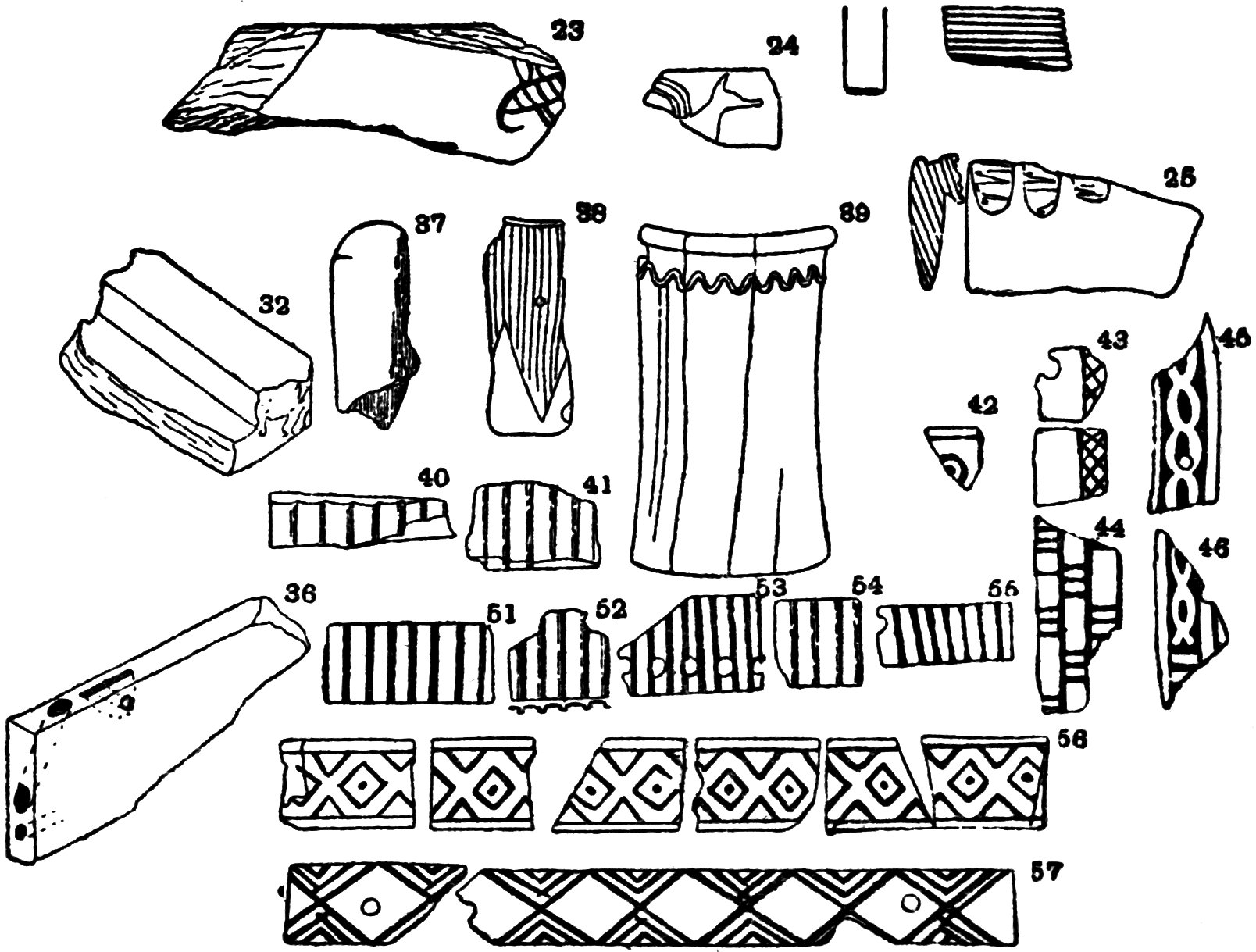
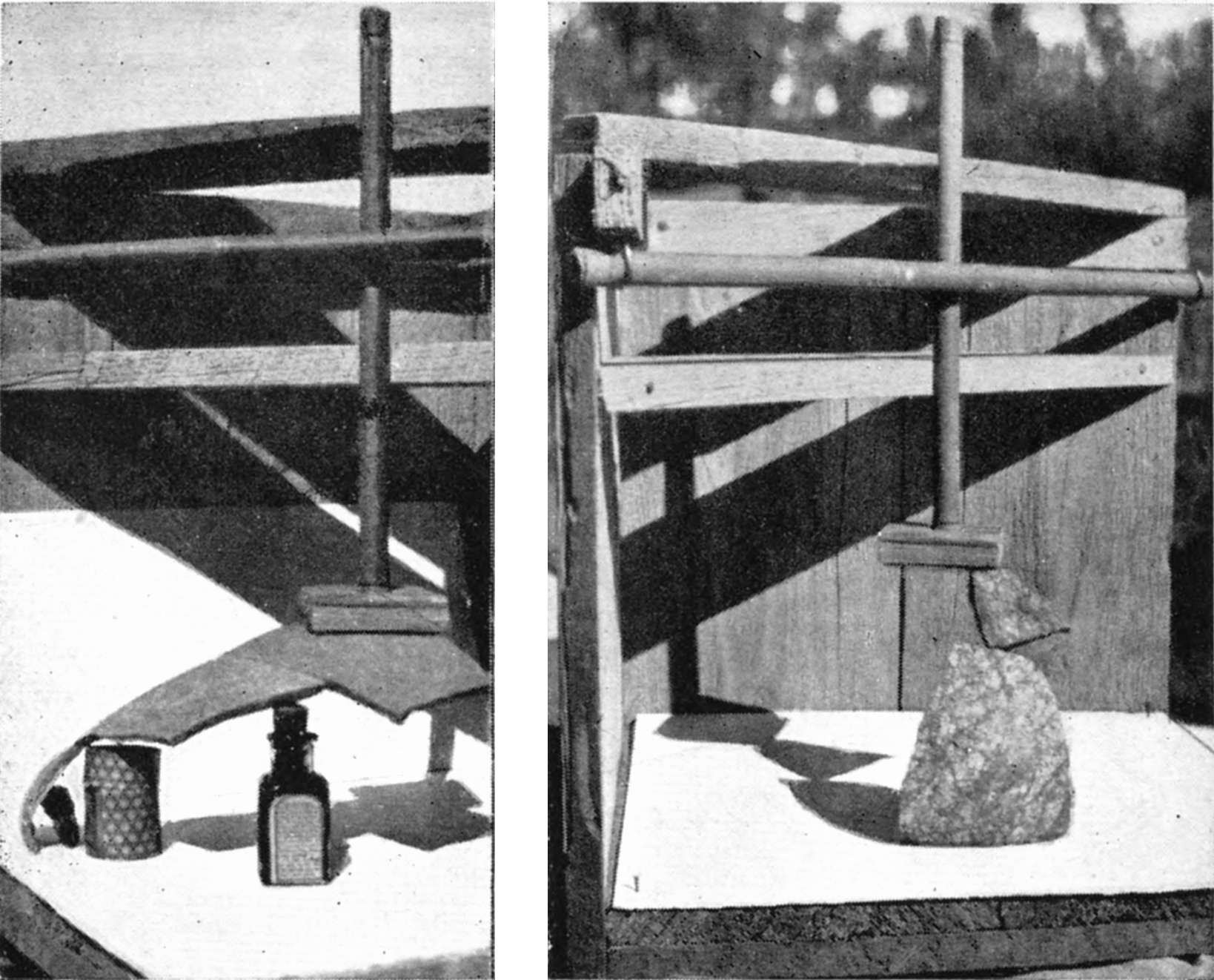
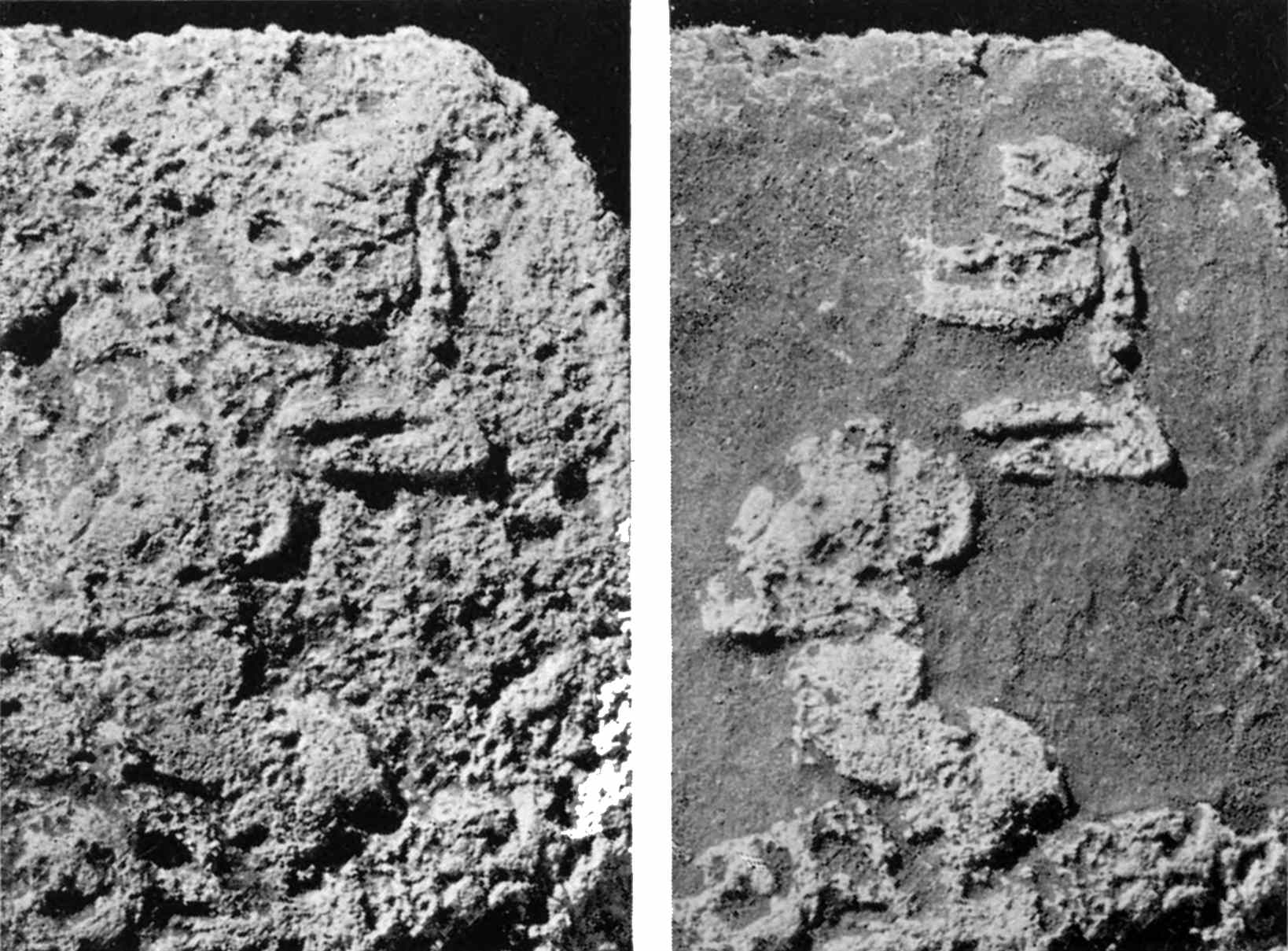
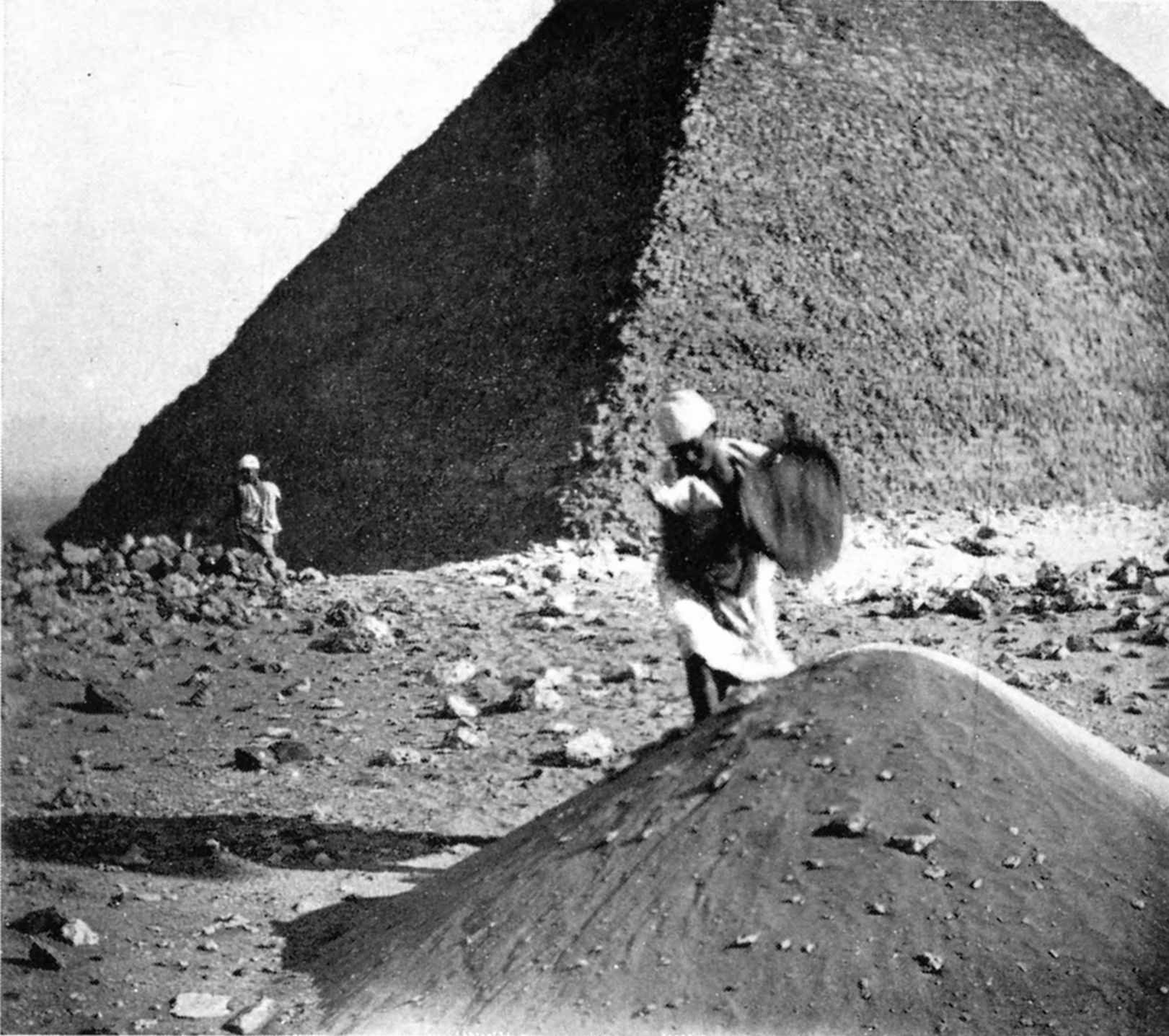
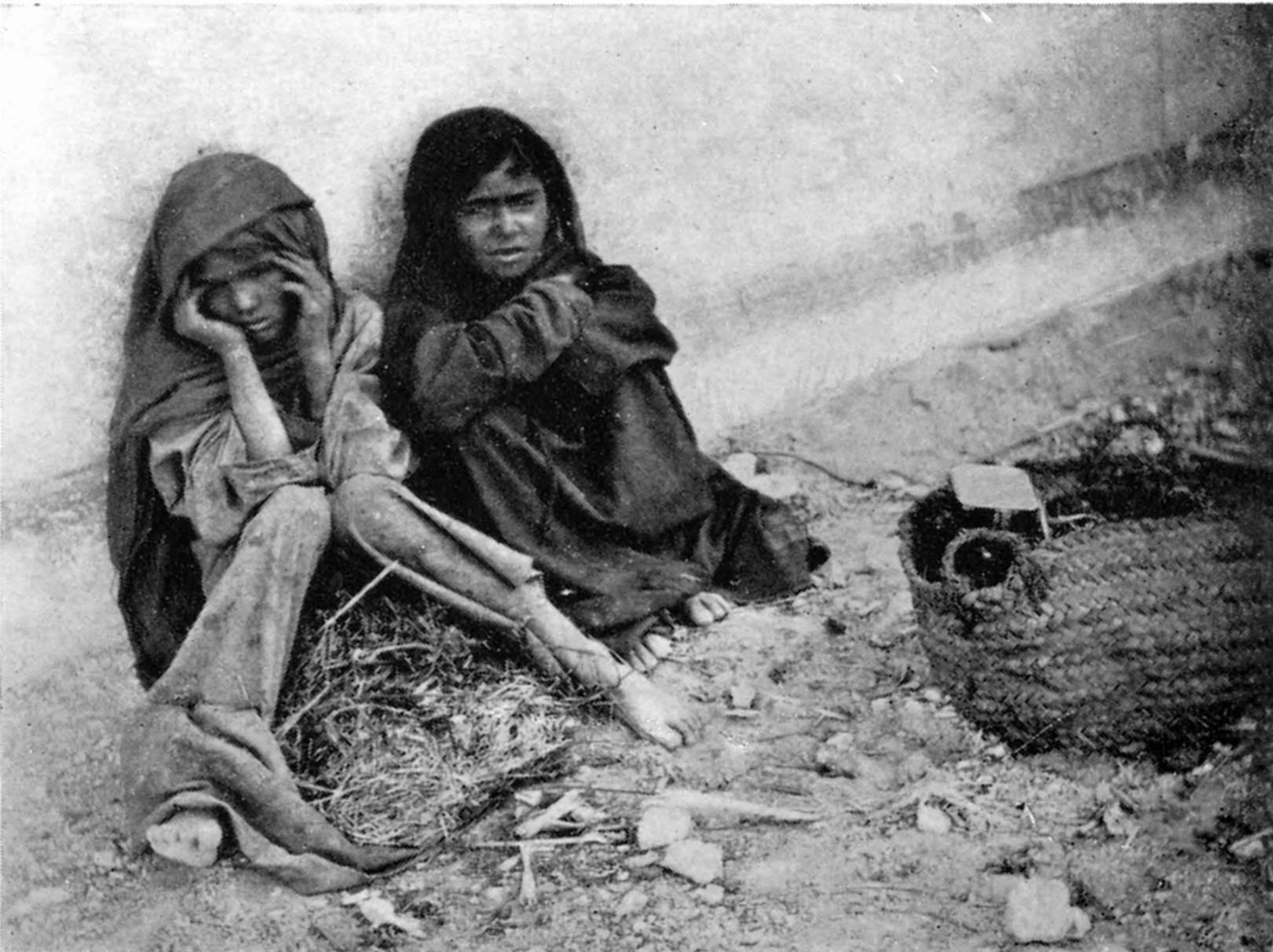
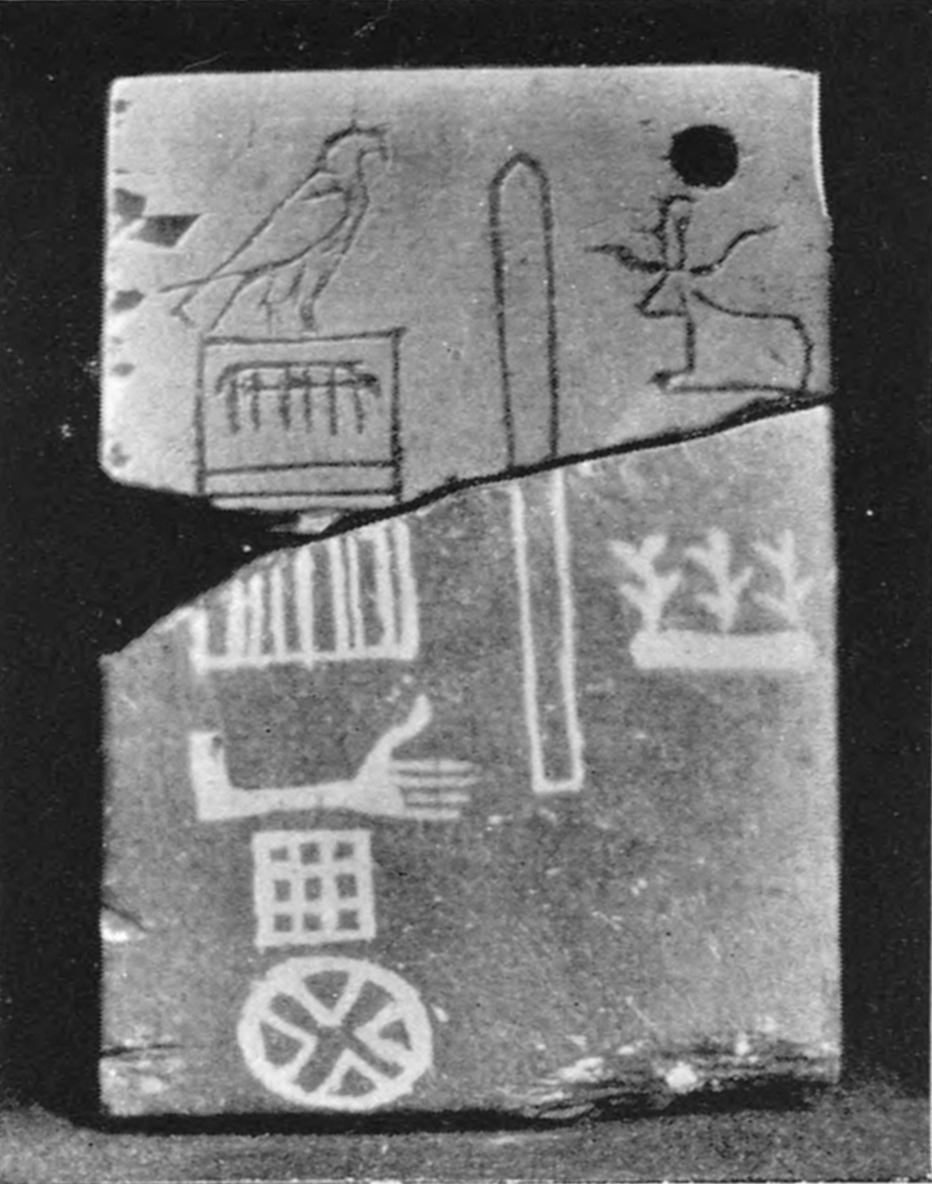
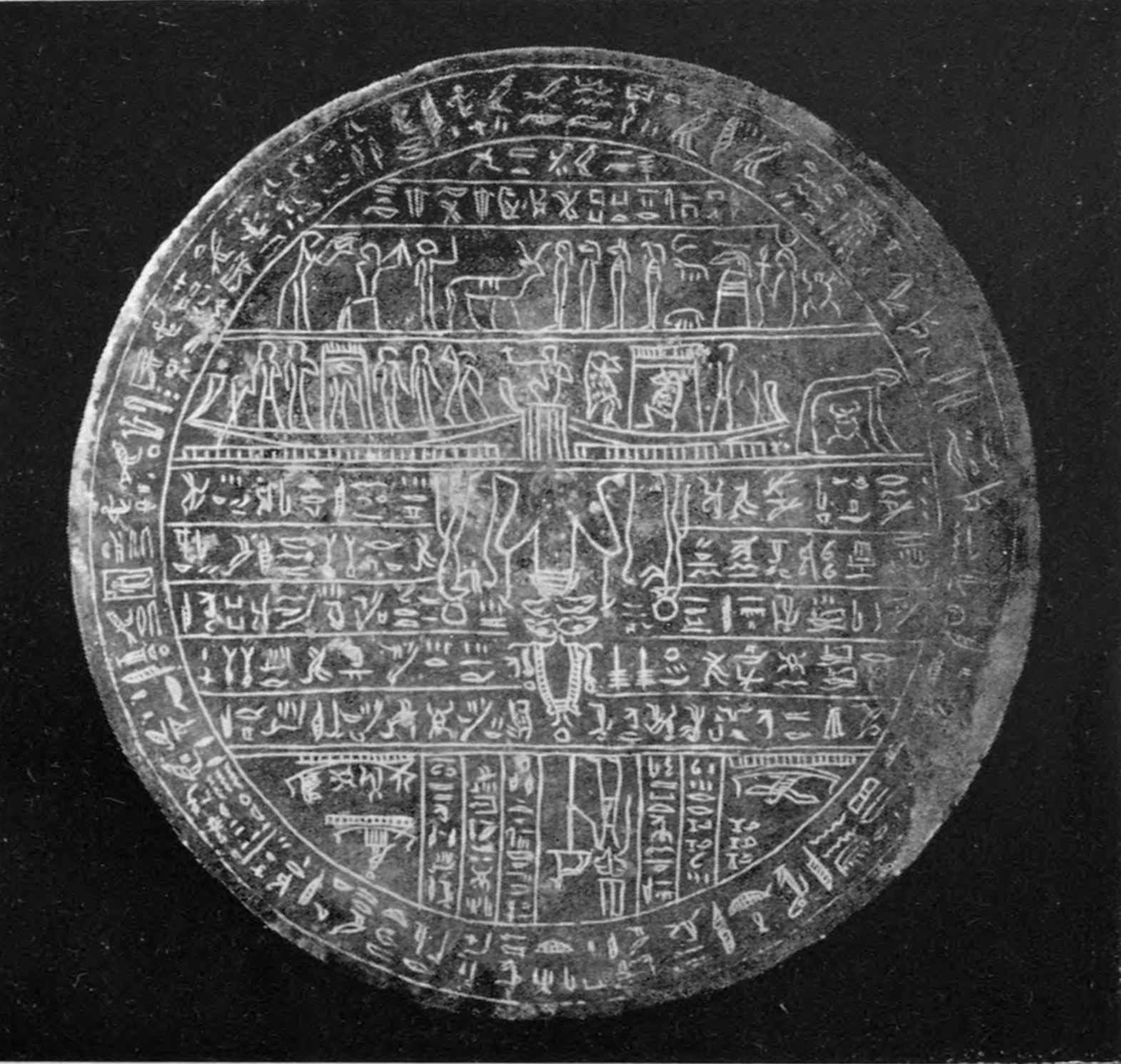
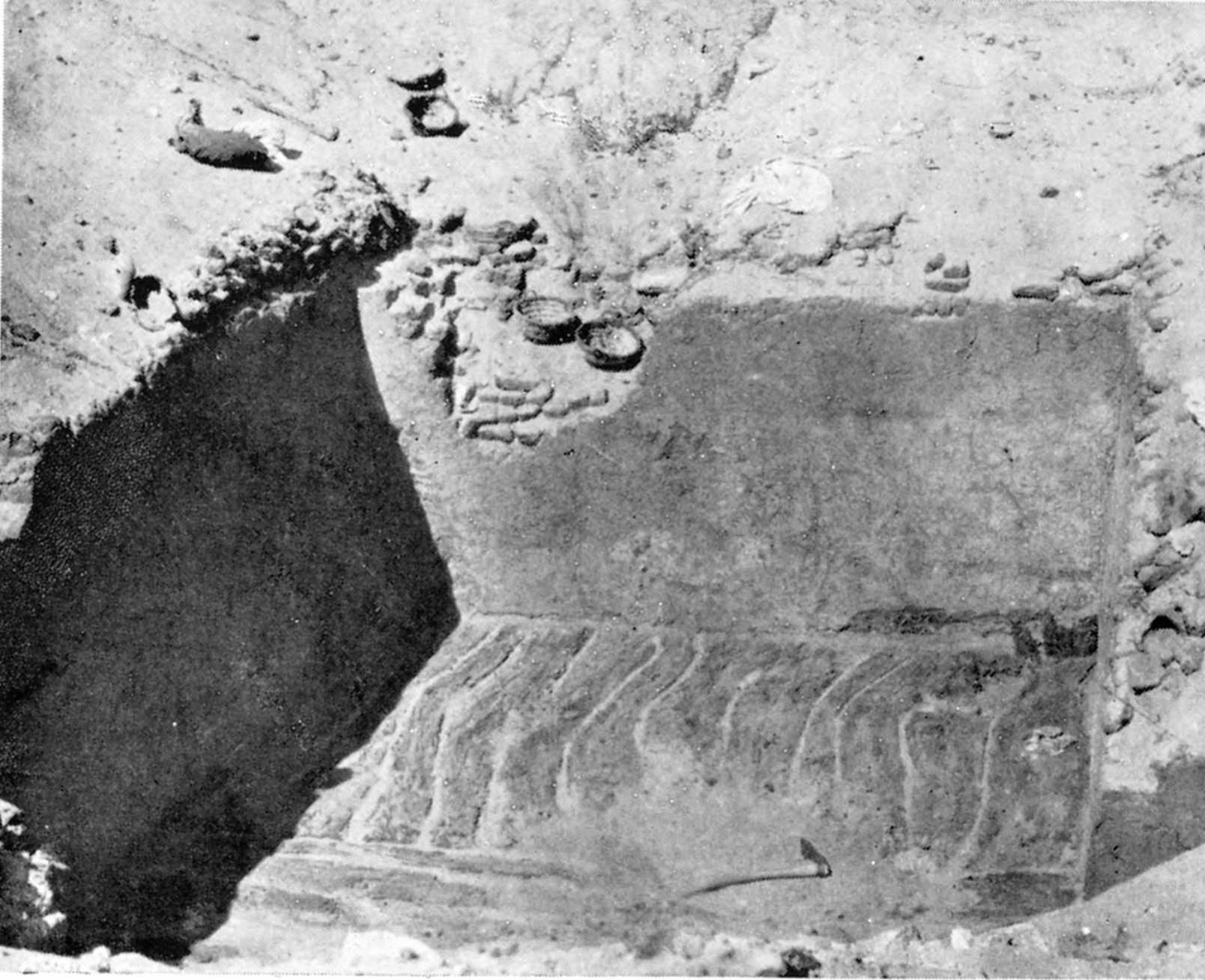
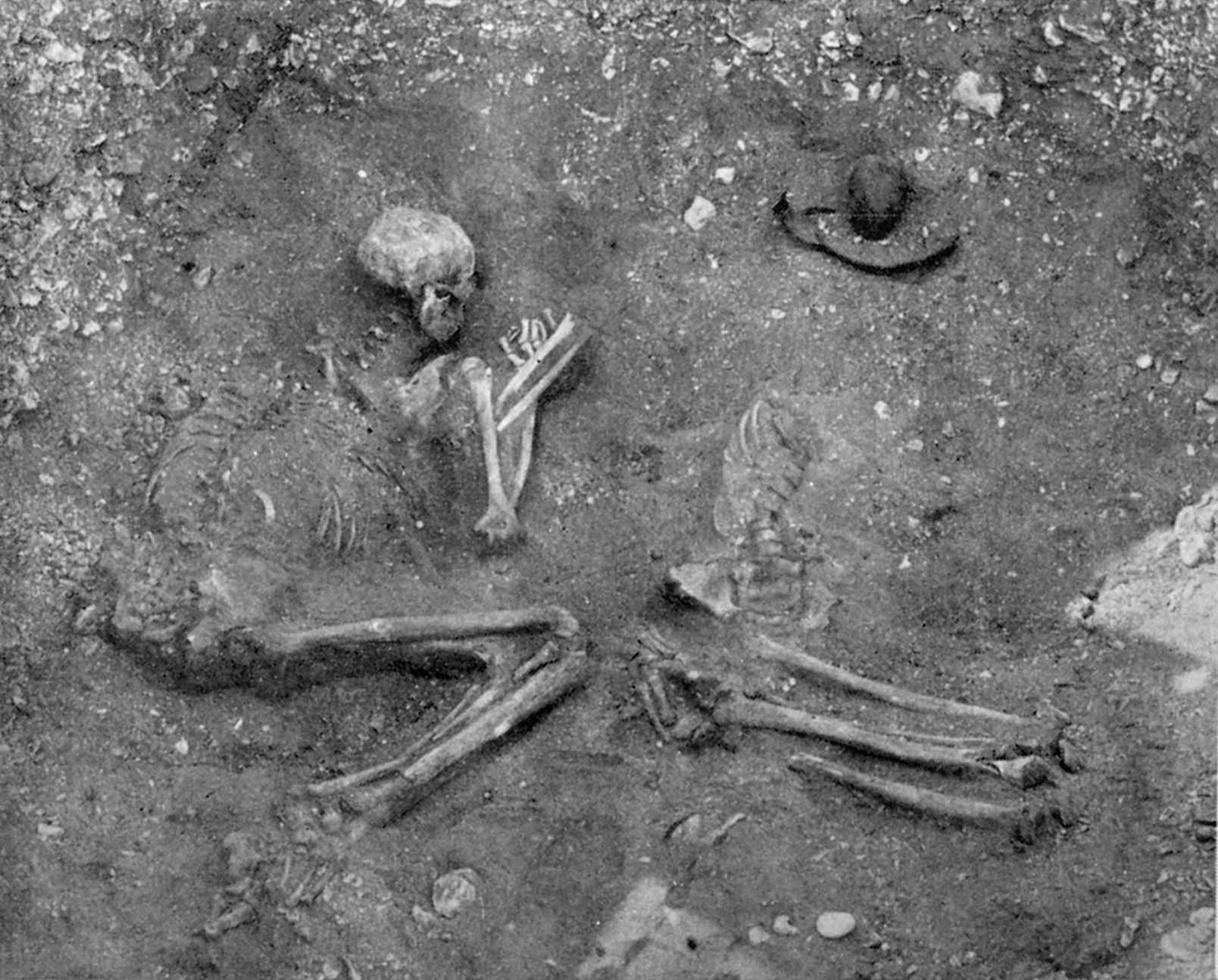
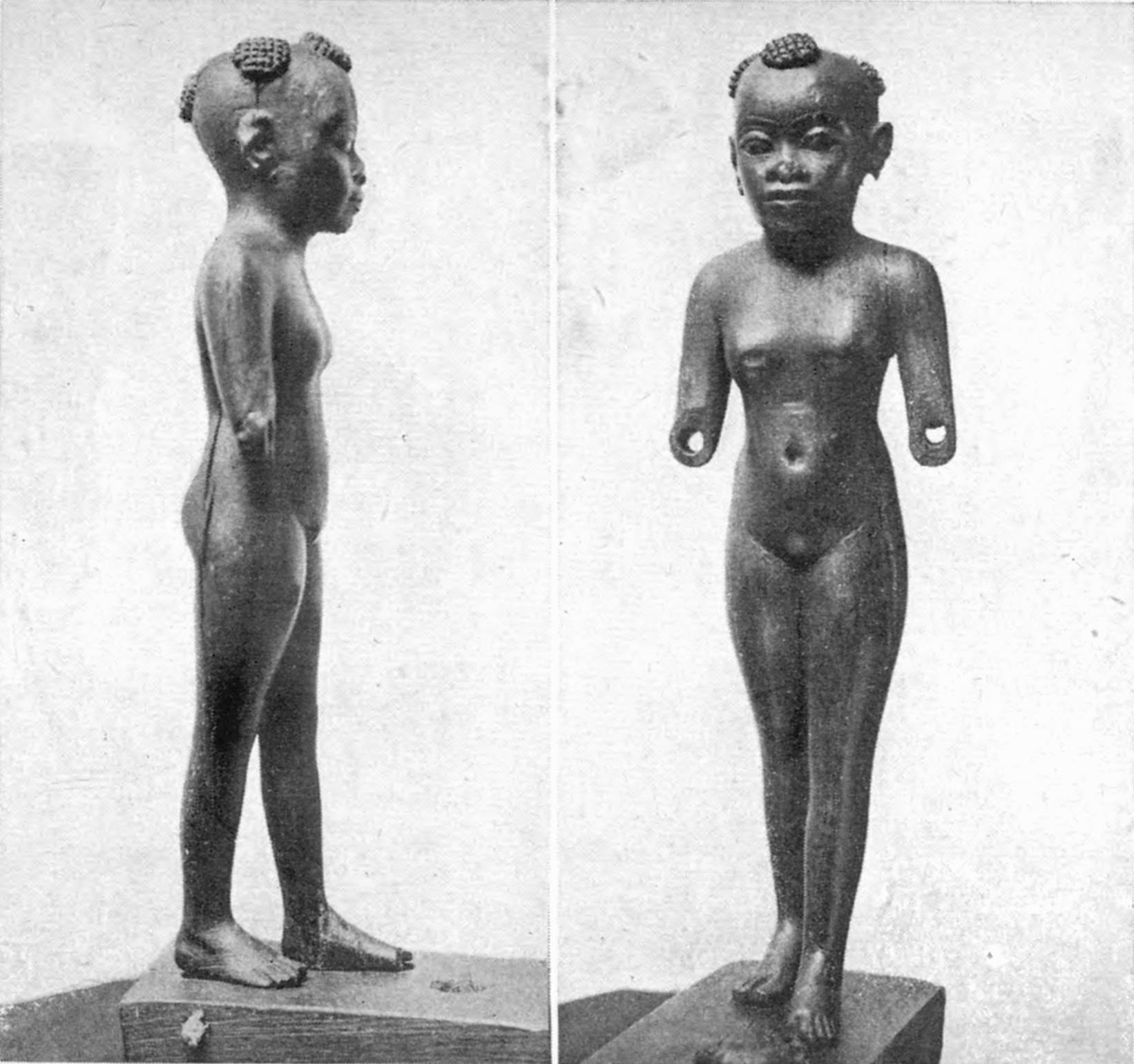
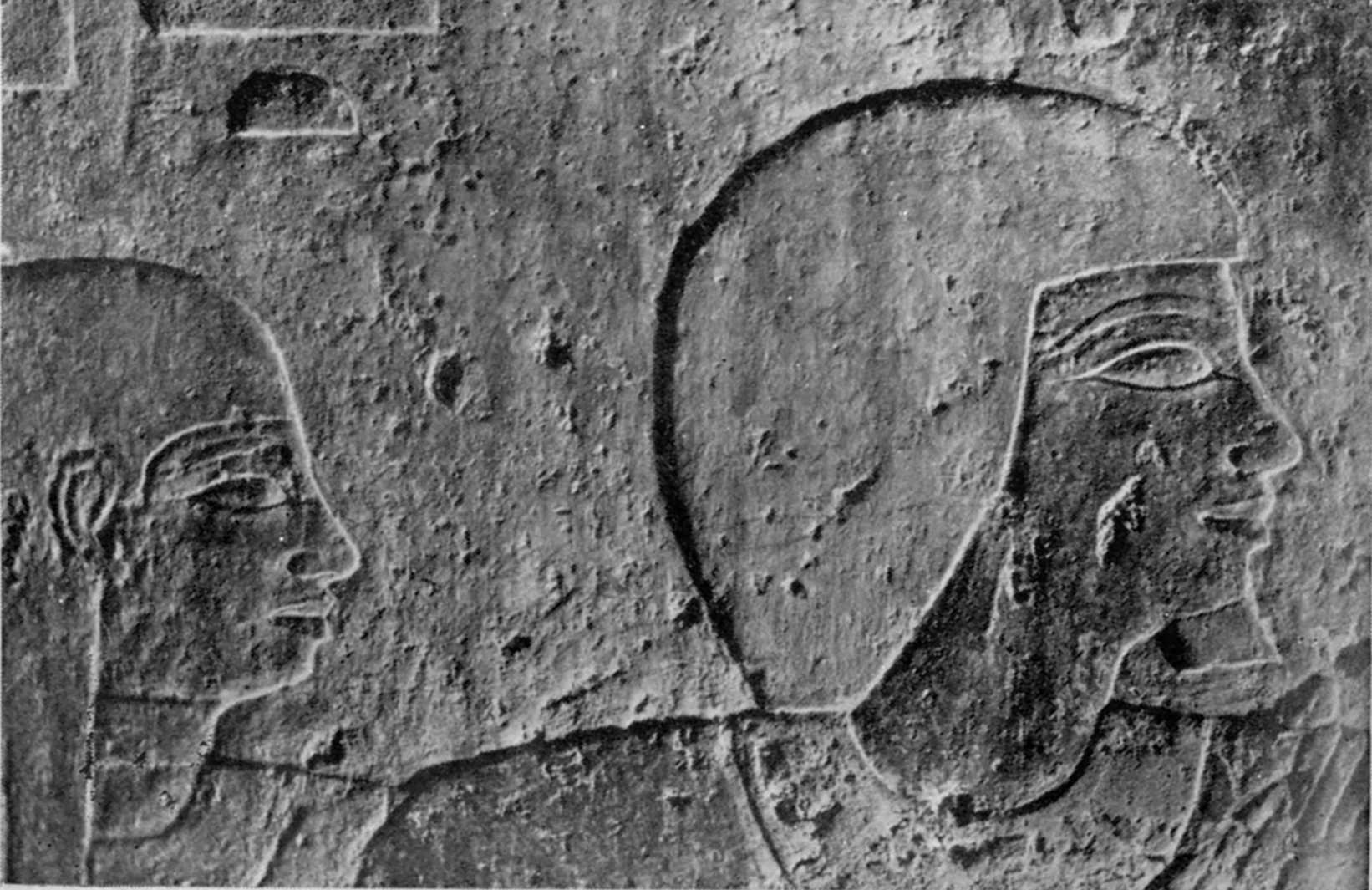
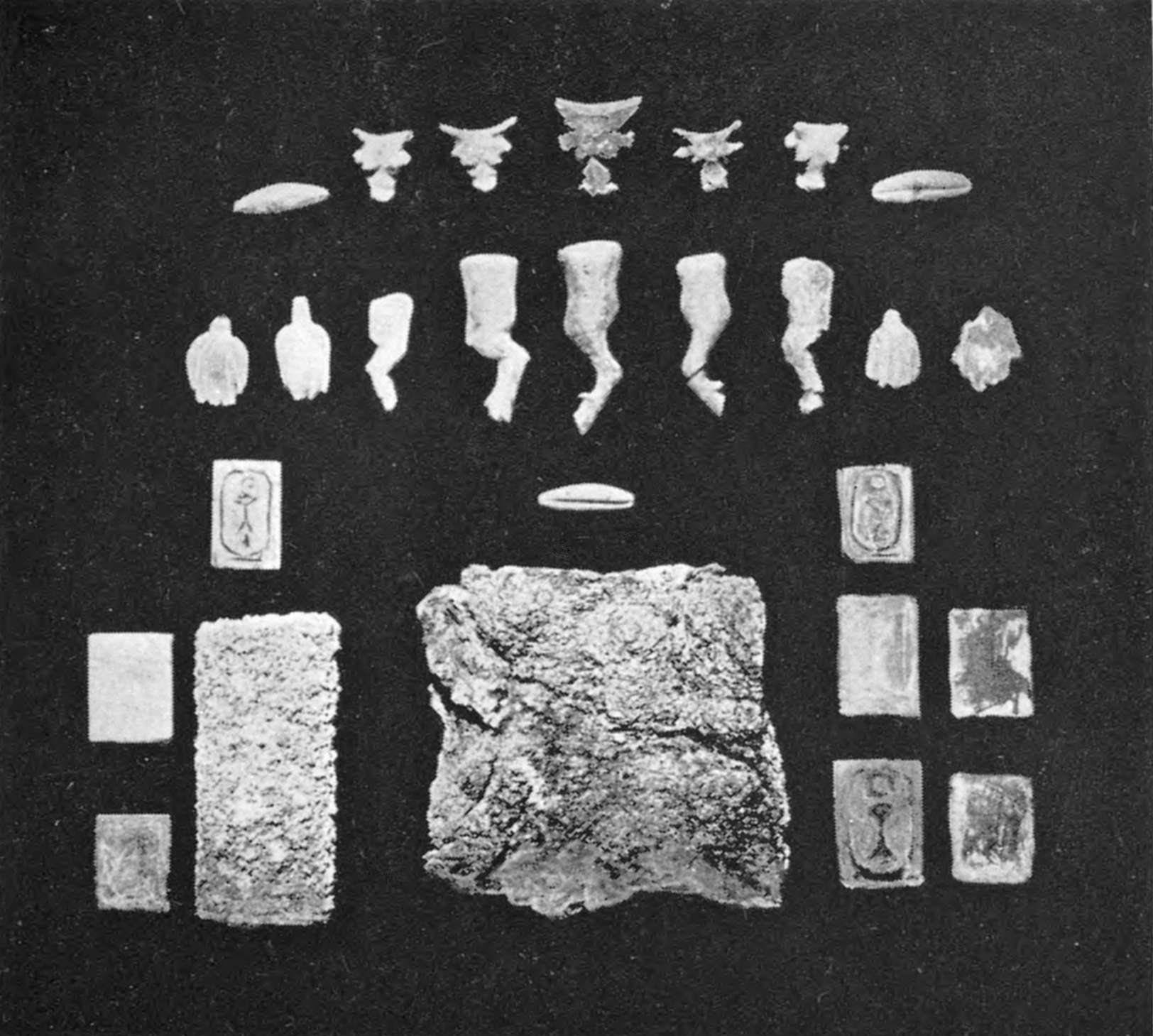
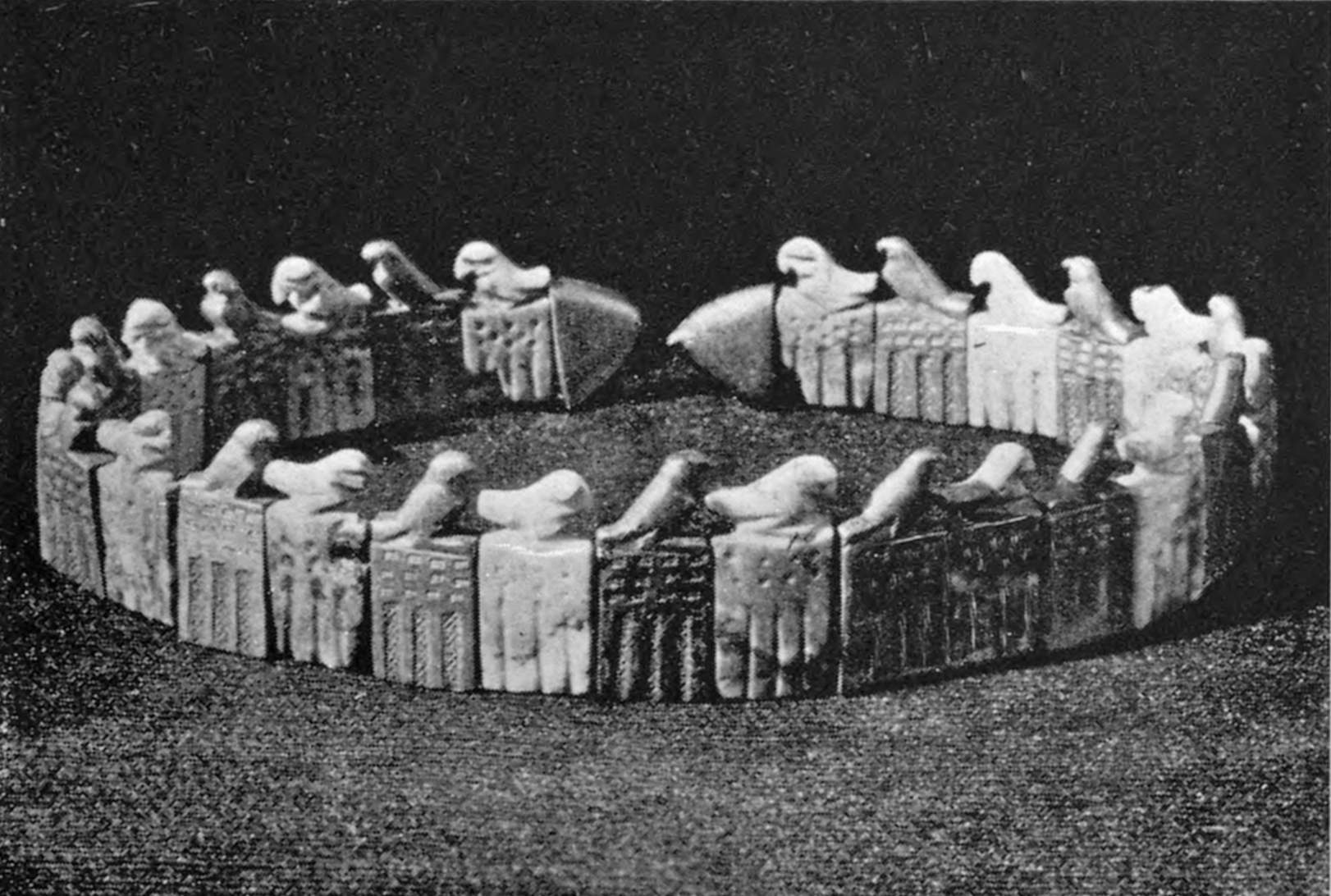
 20°, every
piece broken at 20°
 or
 must be compared
to see if it will fit. At least twenty
different directions of fracture can be mentally distinguished,
and the slight curve and irregularities
increase this to at least fifty varieties, so that each
piece of brim only needs actual touching with about
2 per cent of the pieces of middle. When every
possible fit of brim to middle pieces is made, then
the bases can be similarly compared, having first
fitted them by sorting the curvatures. A load of
500 pieces will take several hours of this sorting, at
the end of which every possible fit will have been
made. Not more than half-an-hour or one hour
at a time can be usefully given to such sorting, as
the eye and attention become too much fatigued to
observe the fits. When finished, all the fragments
belonging to one bowl are to be wrapped together,
and a number given to the parcel; and the odd
pieces can be thrown away unless worth having
singly. The method for drawing the completed
forms has been described in the chapter on drawing.