Absolute Extremes.—The highest and lowest values of a
meteorological element (especially temperature) that have
ever been recorded at a station; known, respectively, as the
absolute maximum and the absolute minimum. (The term
is sometimes improperly applied to the highest and lowest
values for a specified year.)
Aeroclinoscope.—A semaphore formerly used in Holland
for displaying weather signals.
Aerology.—The branch of meteorology dealing with the
“free” atmosphere; i. e., all parts of the atmosphere not near
the earth’s surface. Aerological investigations are made with
kites and balloons, and also include observations of clouds,
meteor trails, the aurora, etc.
Afterglow.—1. The glow in the western sky after sunset.
2. A renewal of rosy light on mountain peaks after the first
sunset illumination has faded; also called recoloration. This
is one stage of the Alpenglow.
After-summer.—A renewal of mild weather in the autumn;
called Indian summer in America, St. Martin’s summer, etc.,
in Europe.
Alpenglow.—Successive appearances and disappearances of
rosy light sometimes seen on mountain peaks in clear weather
after sunset or before sunrise.
Altimeter.—A barometer used for measuring altitude.
Alto-cumulus; Alto-stratus.—Forms of cloud. (See Chapter
VI.)
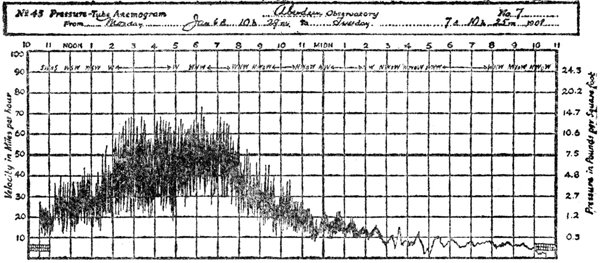
Anemogram.—The record traced by a self-registering
anemometer.
Anemometer.—An instrument for measuring the force or
speed of the wind.
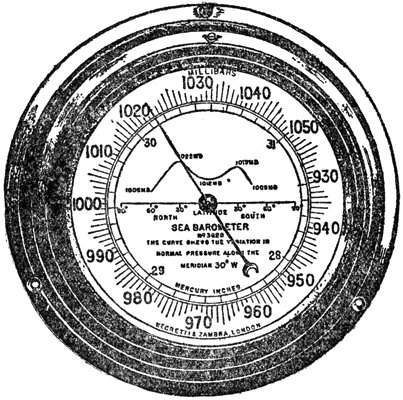
Aneroid Barometer.—A barometer consisting of a thin-walled
metal vacuum-box, which changes its shape with
changes of atmospheric pressure. The movements of the box
are communicated, by levers, to an index or (in the barograph)
to a recording pen.
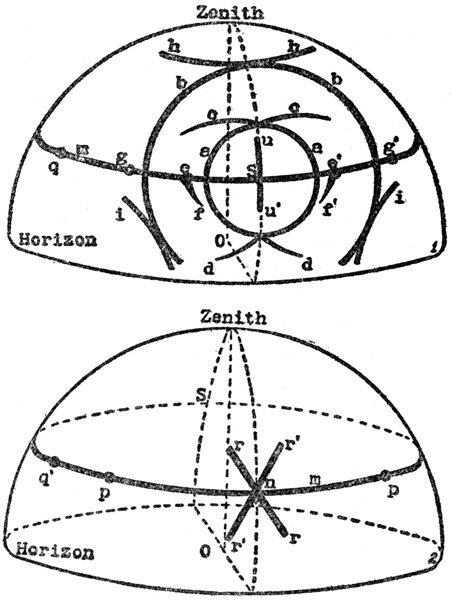
Anthelion.—A rare species of halo, consisting of a brilliant,
usually white image of the sun opposite the latter in azimuth.
(This term has also been applied to the glory, q. v.)
Anticrepuscular Rays.—The continuation of the crepuscular
rays converging toward a point in the sky opposite to the sun.
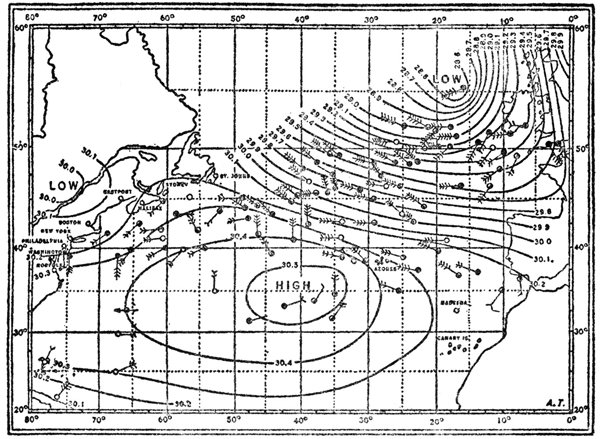
Anticyclone.—An area of high barometric pressure and its
attendant system of winds. (Cf. cyclone.)
Antitrades.—Term formerly applied to the prevailing
westerly winds of middle latitudes, but now more frequently
applied to the westerly return-currents lying over the trade
winds. Some writers prefer to call the former the antitrades
and the latter the countertrades.
Antitwilight Arch.—The pink or purplish zone of illumination
bordering the shadow of the earth (dark segment) in the
part of the sky opposite the sun after sunset and before sunrise.
Arcs of Lowitz.—A pair of rare halo phenomena. These arcs
are directed obliquely downward from the parhelia of 22 degrees
on either side of the sun toward the halo of 22 degrees.
Astraphobia.—A pathological condition experienced by certain
persons before and during thunderstorms.
Atmometer.—An instrument for measuring evaporation;
also called atmidometer, evaporimeter, etc.
Aureole.—(See corona. 1).
Aurora.—A luminous phenomenon due to electrical discharges
in the atmosphere; probably confined to the tenuous
air of high altitudes. It is most commonly seen in sub-Arctic
and sub-Antarctic latitudes. Called aurora borealis or aurora
australis, according to the hemisphere in which it occurs.
Observations with the spectroscope seem to indicate that a
faint “permanent aurora” is a normal feature of the sky in all
parts of the world.
“Backstays of the Sun.”—A sailor’s name for crepuscular
rays extending downward from the sun.
Baguio.—The name current in the Philippines for a tropical
cyclone.
Ballistic Wind.—A military term applied to a fictitious
wind which, if affecting a projectile throughout its flight,
would produce the same total effect in deflecting it from its
course and altering its range as do the various winds that it
actually encounters.
Ballon-sonde.—A sounding-balloon.
Bar.—A unit of pressure equal to 1,000,000 dynes per
square centimeter. A bar = 100 centibars = 1,000 millibars.
A barometric pressure of one bar is sometimes called a “C. G.
S. atmosphere,” and is equivalent to a pressure of 29.531
inches of mercury at 32 degree F. and in latitude 45 degrees.
Barisal Gun.—Same as brontide.
Barocyclonometer.—One of several instruments that have
been devised for locating tropical hurricanes without the aid
of a weather map.
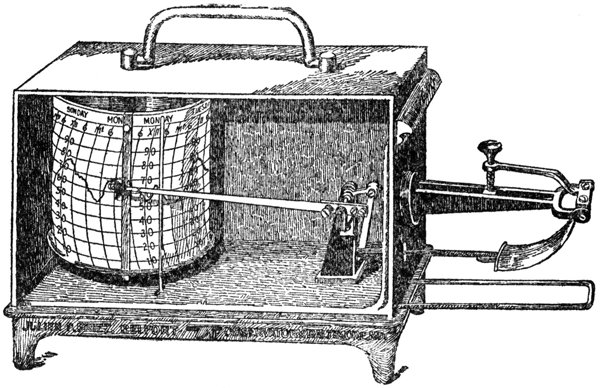
Barograph.—A self-registering barometer.
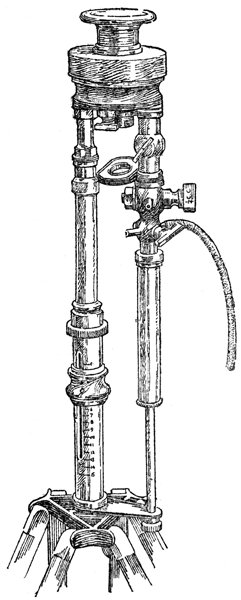
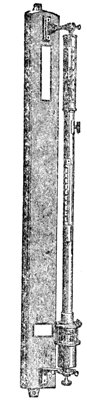
Barometer.—An instrument for measuring the pressure of
the atmosphere. The two principal types are the mercurial
and the aneroid. The microbarometer is used to show minute
changes of pressure. Certain forms of hygroscope are popularly
miscalled “barometers.”
Barometer Well.—Same as blowing well.
Barometric Tendency.—The change of barometric pressure
within a specified time (usually three hours) before one of
the regular observations.
Beaufort Scale.—A scale of wind force, originally devised for
use at sea, but now used also on land. The scale runs from 0 =
calm to = hurricane. Many other scales are similarly employed
in the noninstrumental observation of wind force.
Bioclimatic Law.—A phenological law, announced by Dr.
A. D. Hopkins, according to which periodical events of plant
and animal life advance over the United States at the rate
of 1 degree of latitude, 5 degrees of longitude, and 400 feet
of altitude every four days—northward, eastward, and up-ward
in spring, and southward, westward, and downward in
autumn.
Bishop’s Ring.—A large corona due to fine dust in the
atmosphere. It has been seen after certain great volcanic
eruptions, especially that of Krakatoa, in 1883.
Blizzard.—A violent, intensely cold wind, laden with snow.
Blowing Well.—A well which emits a strong current of air
from any small opening in its cover during a fall of barometric
pressure. During a rise of barometric pressure such wells are
sometimes observed to “suck.” Wells that are thus responsive
to barometric changes are sometimes called “barometer wells”
or “weather wells.”
Bora.—A cold wind of the northern Adriatic, blowing down
from the high plateaus to the northward. Also, a similar
wind on the northeastern coast of the Black Sea.
Brave West Winds.—The boisterous westerly winds blowing
over the ocean between latitudes 40 and 50 degrees S. This
region is known as the “roaring forties.”
Bright Segment.—The broad band of golden light that, in
clear weather, borders the western horizon just after sunset
and the eastern just before sunrise.
Brontide.—A sound resembling a distant muffled detonation,
usually indefinite as to direction. Brontides are rather common
in certain parts of the world. They are called mistpoeffers
on the Belgian coast, Barisal guns in the Ganges delta,
bulldag, desert sounds, or Hanley’s guns in parts of Australia,
gouffre in Haiti, Moodus noises at Moodus, Connecticut, Nebelzerteiler,
Seedonner, Seeschiessen, etc., in Germany, baturlio,
boniti, bombiti, etc., in Italy. These sounds are probably of
subterranean origin in most cases.
Bump.—An upward jolt experienced by an aviator, as if
running over an obstruction. A bump may be caused by any
condition that suddenly increases the lift of the machine, but
is perhaps most frequently due to rising air currents. Air in
which bumps are experienced is said to be “bumpy.” (Cf. hole
in the air.)
Callina.—A Spanish name for dry fog.
Calms of Cancer; Calms of Capricorn.—The belts of high
pressure lying north of the northeast trade winds and south
of the southeast trade winds, respectively.
Center of Action.—Any one of several large areas of high
and low barometric pressure, changing little in location, and
persisting through a season or through the whole year; e. g.,
the Iceland low, the Siberian winter high, etc. Changes in
the intensity and positions of these pressure systems are associated
with widespread weather changes.
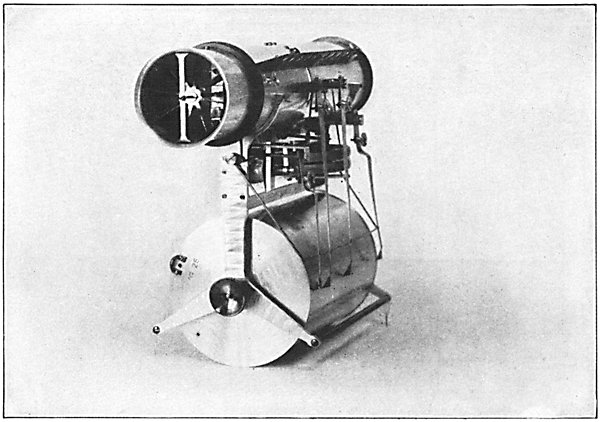
Ceraunograph.—A self-registering thunderstorm recorder.
Chinook, or Chinook Wind.—A foehn blowing down the
eastern slopes of the Rocky Mountains over the adjacent
plains, in the United States and Canada. In winter, this
warm, dry wind causes snow to disappear with remarkable
rapidity, and hence it has been nicknamed the “snow-eater.”
(Cf. foehn.) The “wet chinook” is a wind of a different
character, blowing from the Pacific Ocean over the northwestern
United States.
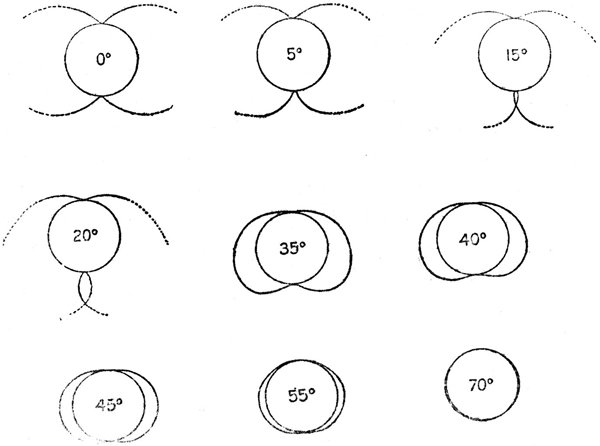
Circumscribed Halo.—A halo formed by the junction of the
upper and lower tangent arcs of the halo of 22 degrees, when
the luminary is about 40 degrees or more above the horizon.
As the altitude of the luminary increases, the circumscribed
halo gradually assumes an elliptical form and finally merges
into the halo of 22 degrees.
Circumzenithal Arc.—A rainbow-tinted halo, often very
bright, convex to the luminary and 46 degrees or a little more
above it. It is sometimes called the upper quasi-tangent arc
of the halo of 46 degrees, but the circumzenithal arc and the
halo of 46 degrees are rarely seen at the same time.
Cirro-cumulus; Cirro-stratus; Cirrus.—Forms of cloud.
(See Chapter VI.)
Cistern.—The cup, containing mercury, at the base of a
mercurial barometer.
Climatography.—1. Descriptive and statistical climatology.
2. An account of the climate of a particular place
or region.
Climatology.—1. The science of climate. 2. A body of
knowledge concerning the climate of any place or region; as,
“the climatology of Panama.”
Climograph.—A diagram introduced by Dr. Griffith Taylor,
of Australia, for showing the mean monthly values of wet-bulb
temperature and relative humidity at any place, and for
comparing such data as recorded at different places throughout
the world; especially with reference to the effects of climate
on mankind. Other pairs of elements can be used in
constructing climographs: e. g., the dry-bulb temperature and
the relative humidity.
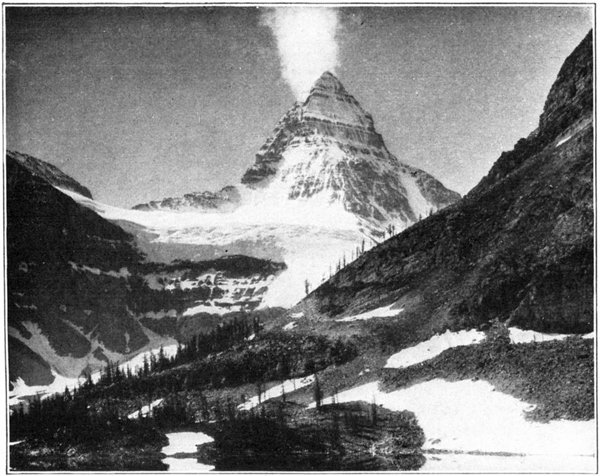
Cloud-banner.—A bannerlike cloud streaming off from a
mountain peak.
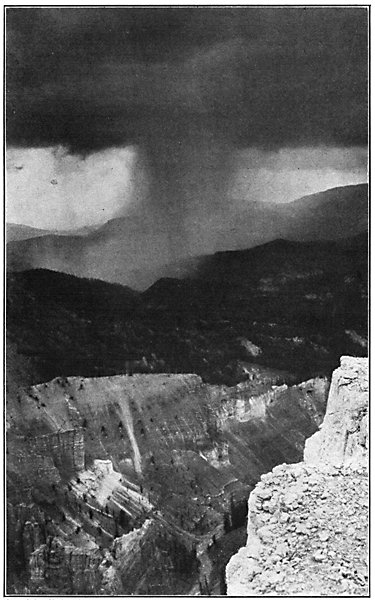
Cloud-burst.—A sudden and extremely heavy downpour of
rain; especially one in which the water falls in a continuous
stream rather than in drops. The term has been most commonly
applied to downpours in mountainous regions.
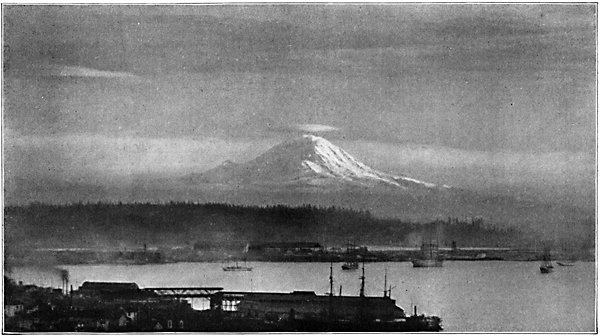
Cloud-cap.—A caplike cloud crowning (1) a mountain summit,
or (2) another cloud, especially a mass of cumulo-nimbus.
Col.—The neck of low pressure between two anticyclones;
also called a saddle.
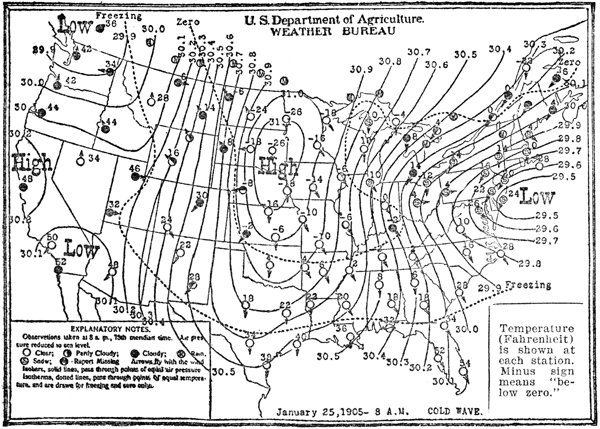
Cold Wave.—A rapid and marked fall of temperature during
the cold season of the year. The United States Weather
Bureau applies this term to a fall of temperature in 24 hours
equaling or exceeding a specified number of degrees and
reaching a specified temperature or lower; the specifications
varying for different parts of the country and for different
periods of the year.
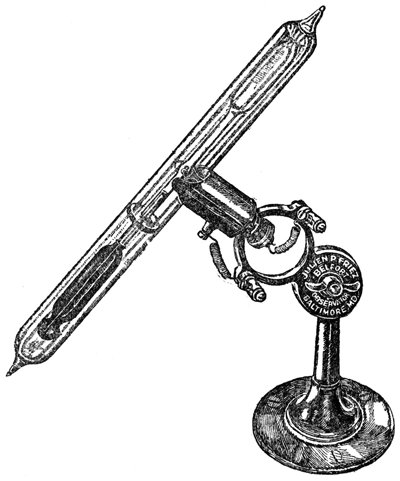
Collector.—A device used in measurements of atmospheric
electricity for determining the potential gradient.
Continental Climate.—The type of climate characteristic of
the interior of a continent. As compared with a marine
climate, a continental climate has a large annual and daily
range of temperature.
Corona.—1. A colored luminous circular area formed, by
diffraction; around the sun, moon, or other source of light
seen through clouds or dust haze. Coronas invariably show a
brownish-red inner ring, which, together with the bluish-white
inner field between the ring and the luminary, forms
the so-called aureole. Most frequently the aureole alone is
visible. Well developed coronas show one or more series of
spectral colors outside the aureole. 2. A luminous circle
formed by the apparent convergence of auroral beams about
the place in the sky toward which the dipping-needle points.
Corposant.—(See St. Elmo’s fire.)
Countertrades.—(See antitrades.)
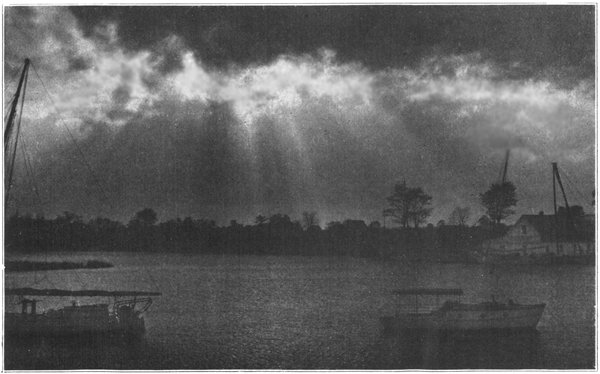
Crepuscular Rays.—Beams of light radiating from the sun,
seen both before and after sunrise and sunset. The beams are
made visible by the presence of water-drops or dust in the atmosphere,
and the intervening dark spaces are the shadows
of clouds. The beams are actually parallel; their apparent
divergence is the result of perspective.
Critical Period.—A period in the growth of a plant when it is
especially susceptible to the effects of atmospheric conditions.
Cumulo-nimbus; Cumulus.—Forms of cloud. (See Chapter
VI.)
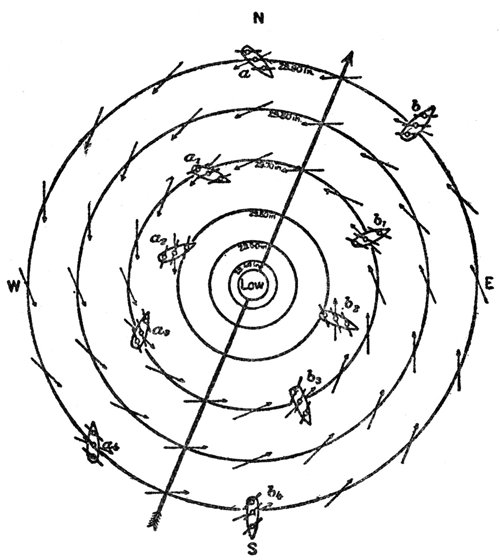
Cyclone.—An area of low barometric pressure with its
attendant system of winds. The cyclones of the region within
the tropics (tropical cyclones) are violent storms; those of
higher latitudes (extra-tropical cyclones) may be stormy or
otherwise. Tropical cyclones are also called hurricanes, typhoons
or baguios. Extra-tropical cyclones are commonly
known as lows or barometric depressions.
Cyclonopathy.—The abnormal sensitiveness of certain persons
to the weather changes attending the passage of barometric
depressions.
Cyclonoscope.—A pasteboard dial formerly used in the West
Indies for locating cyclones.
Dark Segment.—The shadow of the earth which, in clear
weather, rises from the eastern horizon at sunset and sinks
below the western horizon at sunrise.
Deperditometer.—An instrument devised by A. Piche for
measuring the cooling power of the atmosphere, with reference
to its physiological effects.
Depression.—A cyclonic area, or low.
Desert Sounds.—(See brontide.)
Devil.—The name applied to a dust whirlwind in India.
The term is also current in South Africa.
Dew.—Atmospheric moisture condensed, in liquid form,
upon objects cooler than the air, especially at night.
Dew-point.—The temperature at which, under ordinary
conditions, condensation of water vapor begins in a cooling
mass of air. It varies with the absolute humidity.
Dew Pond.—The name applied in southern England to certain
artificial ponds on the uplands. They contain water in the
driest weather, and are popularly supposed to be fed by dew.
“Doctor.”—A colloquial name for the sea breeze in tropical
climates. The name is sometimes applied to other cool, invigorating
breezes.
Doldrums.—The equatorial belt of calms or light, variable
winds, lying between the two trade-wind belts.
Drought.—A protracted period of dry weather. In the
United States a drought has been defined as a period of thirty
or more consecutive days during which precipitation to the
amount of 0.25 inch does not occur in twenty-four hours.
Other quantitative definitions have been used in other
countries.
Dry Fog.—A haze due to the presence of dust or smoke in
the air.
Dust-counter.—An instrument for determining approximately
the number of dust particles or condensation nuclei per
unit volume in a sample of air.
Dynamic Meteorology.—The branch of meteorology that
treats of the motions of the atmosphere and their relations to
other meteorological phenomena.
Earth-air Current.—The electrical current that passes between
the earth and the air on account of their difference of
potential.
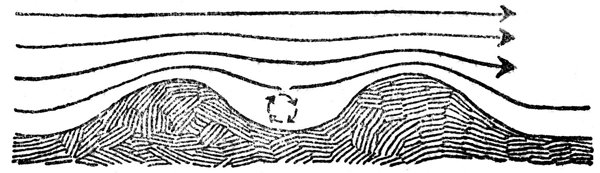
Eddy.—A more or less fully developed vortex in the atmosphere,
constituting a local irregularity in a wind. All winds
near the earth’s surface contain eddies, which at any given
place, produce “gusts” and “lulls.” Air containing numerous
eddies is said to be “turbulent.”
Electric Niagara.—(See hail rod.)
Evaporimeter.—(See atmometer.)
Eye of the Storm.—A calm region at the center of a tropical
cyclone, or a break in the clouds marking its location.
Fall Wind.—A wind blowing down a mountain-side; or any
wind having a strong downward component. Fall Winds include
the foehn, mistral, bora, etc.
False Cirrus.—Cirruslike clouds at the summit of a thundercloud;
probably identical in structure with true cirrus,
or cirro-stratus. Sometimes more appropriately called “thunderstorm
cirrus.”
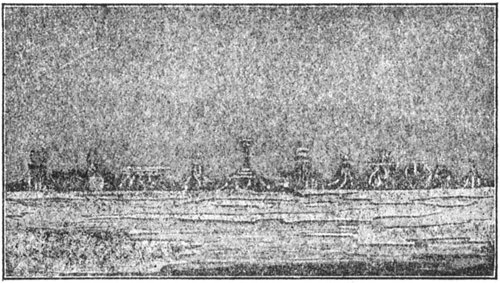
Fata Morgana.—A complex form of mirage, characterized
by marked distortion of images.
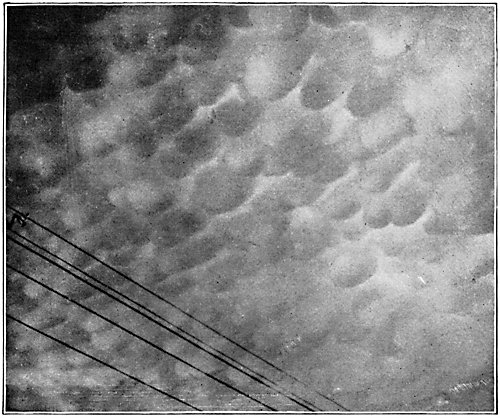
Festoon Cloud.—Mammato-cumulus.
Flashing Arcs.—Visible atmospheric sound waves, or explosion
waves.
Flat.—Featureless; said of weather maps.
Foehn.—A dry fall wind warm for the season, characteristic
of many mountainous regions. The air is cooled
dynamically in ascending the mountains, but this leads to
condensation, which checks the fall in temperature through
the liberation of latent heat. The wind deposits its moisture
as rain or snow. In descending the opposite slope it is
strongly heated dynamically and arrives in the valleys beyond
as a warm and very dry wind. Some writers apply this term
to any wind that is dynamically heated by descent; e. g., the
sinking air of an anticyclone.
Foehn-sickness.—Headache, lassitude, depression, etc.,
attributed, in the Alpine valleys, to the blowing of the foehn.
Foehn-wall (German: Föhnmauer).—A wall of cloud that
forms along the crest of a mountain ridge over which the
foehn is blowing.
Fog.—A cloud at or near the earth’s surface. A fog and a
cloud are identical in structure, though the former is due to
thermal conditions of the earth’s surface, while the latter is
most frequently clue to the dynamic cooling of ascending air.
In ordinary speech, the term “fog” generally implies an
obscurity of the atmosphere sufficiently great to interfere
with navigation or locomotion. (Cf. dry fog.)
Fogbow.—A rainbow, colorless or nearly so, formed in a
fog.
Fog-drip.—Moisture that is deposited on terrestrial objects
by fog, and drips from them to the ground.
Fracto-cumulus; Fracto-nimbus; Fracto-stratus.—Forms
of cloud. (See Chapter VI.)
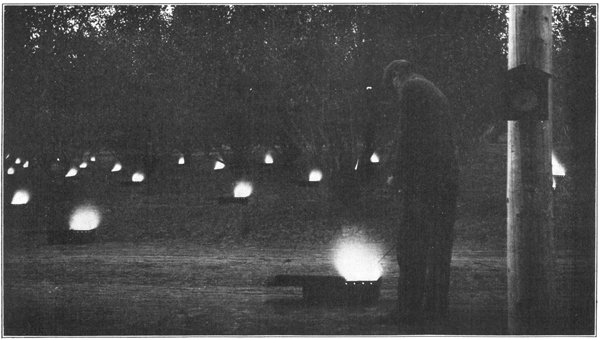
Freeze.—1. Freezing of plants without deposit of hoarfrost.
2. Freezing temperatures prevailing generally over a region;
not exclusively nocturnal and not confined to the air close to
the earth’s surface. (Cf. frost.)
Frost.—1. The act or state of freezing. In America, a
“frost” generally means the occurrence, near the beginning or
end of the growing season, of nocturnal temperatures low
enough to be injurious to vegetation; distinguished from a
“freeze,” which is more general and severe. The Weather
Bureau classifies frosts, according to their effects, as “light,”
“heavy,” and “killing.” 2. Atmospheric moisture condensed
upon terrestrial objects in the form of ice; sometimes frozen
dew. Also called hoarfrost.
Frost-smoke.—Frozen fog rising from the water.
Fulgurite.—A glassy tube formed in sandy soil or in rock
by the passage of lightning.
Garúa.—A wet fog of the west coast of South America.
Geocoronium.—The name applied by Dr. A. Wegener to
a hypothetical atmospheric gas, supposed to be much lighter
than any gas now known to chemists.
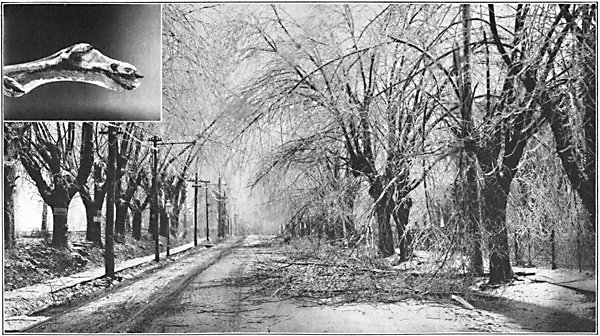
Glaze.—Term applied by the U. S. Weather Bureau to a
smooth coating of ice on terrestrial objects due to the freezing
of rain; often popularly called “sleet.” In Great Britain
such a deposit is called glazed frost. A deposit of glaze on
an extensive scale constitutes an “ice storm.”
Glory.—A series of concentric colored rings seen around
the shadow of the observer, or of his head only, cast upon a
cloud or fog bank. It is due to the diffraction of reflected light.
Gouffre.—(See brontide.)
Gradient.—Change of value of a meteorological element
per unit of distance. The gradients commonly discussed in
meteorology are the horizontal gradient of barometric pressure,
the vertical gradient of temperature, and the vertical
gradient of electric potential. British meteorologists now
prefer the term lapse-rate to vertical gradient.
Graupel.—A kind of granular snow, sometimes called soft
hail.
Green Flash.—A bright green coloration of the upper
edge of the sun’s disk, sometimes seen when the rest of the
disk is below the horizon, at sunrise or sunset.
Growing Season.—In agricultural meteorology, the interval
between the last killing frost in spring and the first killing
frost in autumn.
Gust.—A sudden brief increase in the force of the wind.
Most winds near the earth’s surface are made up of alternate
gusts and lulls, the majority of which are too brief to
be registered by an ordinary anemometer.
Hail.—Balls or irregular lumps of ice, often of considerable
size, having a complex structure; large hailstones generally
have a snowlike center, surrounded by layers of ice,
which may be alternately clear and cloudy. Hail falls al-most
exclusively in connection with thunderstorms. For so-called
“soft hail” see graupel. (Cf. sleet.)
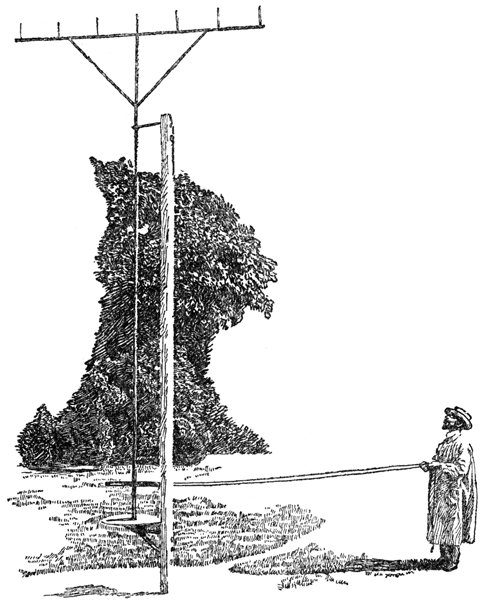
Hail Rod.—A device analogous to a lightning rod, supposed
to have the property of averting the fall of hail. Hail
rods have been especially popular in France, where they are
called paragrêles. Large hail rods of recent construction
are known as “electric Niagaras.”
Hail-shooting.—Bombarding the clouds to prevent
the fall of hail.
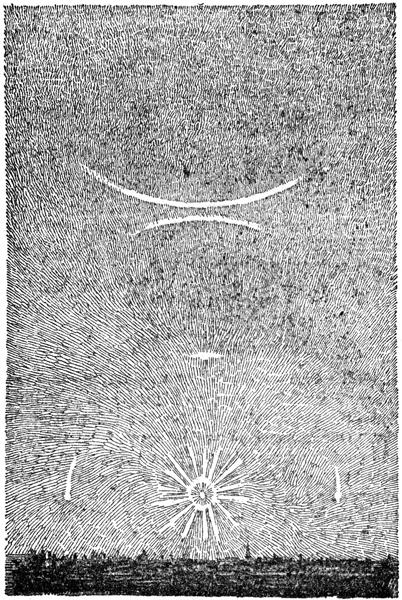
Halo.—A generic name for a large group of optical phenomena
caused by ice crystals in the atmosphere. The commonest
of these phenomena is the halo of 22 degrees (i. e.,
of 22 degrees radius) surrounding the sun or moon. The
halo of 46 degrees and the rare halo of 90 degrees, or halo
of Hevelius, also surround the luminary. Other forms of
halo are the tangent arcs, parhelia (or paraselenæ), parhelic
(or paraselenic) circle, anthelion, etc.
Harmattan.—A dry, dusty wind of the west coast of Africa,
blowing from the deserts.
Haze.—A lack of transparency in the atmosphere; sometimes
due to irregularities in the density of the air (optical
haze), sometimes to dust (dust haze, which when dense constitutes
dry fog), sometimes to fine particles of water or
ice (grading into true fog).
Helm and Bar.—A pair of clouds seen when the “helm
wind” is blowing over Crossfell, an English mountain; the
“helm” capping the mountain and the “bar” lying to leeward
of it.
High.—An area of high barometric pressure; an anticyclone.
Hoarfrost.—(See frost.)
Hole in the Air.—A colloquial name for any condition in
the atmosphere that suddenly decreases the lift of an aeroplane.
(Cf. bump.)
Horse Latitudes.—The regions of calms and variable winds
coinciding with the subtropical high-pressure belts lying
on the poleward sides of the trade winds. (The term has
generally been applied only to the northern of these two
regions, in the North Atlantic Ocean, or to the portion of it
near Bermuda.)
Hot Wave.—A period of abnormally high temperatures.
It has sometimes been defined, in the United States, as a
period of three or more consecutive days during each of
which the maximum temperature is 90 degrees F. or over.
Hot Wind.—A hot, parching wind characteristic of certain
continental interiors; especially Australia, northern India
and the prairie region of the United States.
Humidity.—The degree to which the air is charged with
water vapor; viz., the actual amount of water vapor present
(absolute humidity, which may be expressed in terms
of weight per unit volume or as vapor pressure), or the
ratio which this amount bears to the maximum amount the
air can contain at the prevailing temperature (relative
humidity, expressed in percentage).
Hurricane.—A tropical cyclone; especially one of the West
Indies region. (A cyclone originating in this region and
passing northward into the temperate zone is still called a
“West India hurricane,” even after it has assumed the character
of an extratropical cyclone, and, if sufficiently severe,
justifies the display of “hurricane warnings” at ports of the
United States. “Hurricane” is also the designation of the
highest wind force on the Beaufort scale, and is thus applied
to any wind exceeding about seventy-five miles an hour.)
Hygrograph.—A self-registering hygrometer.
Hygrometer.—Any instrument for measuring the humidity
of the air.
Hygroscope.—A device that gives a rough indication of the
relative humidity of the air. Most hygroscopes are mere toys.
Ice Rain.—1. A rain that causes a deposit of glaze.
2. Falling pellets of clear ice (called sleet by the U. S.
Weather Bureau).
Ice Saints.—A period of cold weather popularly reputed in
Europe to occur yearly about May 11–13 (or, in south-central
Europe, May 12–14); also, the saints whose days in the ecclesiastical
calendar fall on these dates.
Ice Storm.—(See glaze.)
Ignis Fatuus.—Will-o’-the-wisp. (See Chapter XXII.)
Indian Summer.—A period of mild, calm, hazy weather
occurring in autumn or early winter, especially in the United
States and Canada; popularly regarded as a definite event in
the calendar, but weather of this type is really of irregular
and intermittent occurrence. (Cf. St. Martin’s Summer.)
Instrument-shelter.—The American name of the cage or
screen in which thermometers are exposed at meteorological
stations. Called thermometer-screen in Great Britain.
Inversion.—More fully temperature inversion; an increase
of air temperature with increase of altitude, instead of the
normal decrease.
Ion-counter.—An instrument for determining the number
of ions present, per unit volume, in a sample of air.
Isobar.—A line of equal barometric pressure. (Isobars
are generally drawn on maps to show the horizontal distribution
of pressure reduced to sea level, or the pressure
at some specified altitude; but in a broader sense any line
on a chart or diagram drawn through places of equal pressure
is an isobar.)
Isohyet.—A line of equal rainfall.
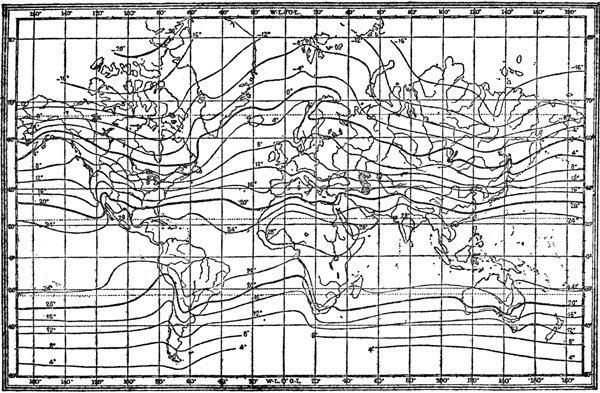
Isotherm.—A line of equal temperature.
Isothermal Layer.—(See stratosphere.)
January Thaw.—A period of mild weather popularly supposed
to recur each January, especially in New England.
Katathermometer.—A device consisting of a dry-bulb and
a wet-bulb thermometer, designed for measuring the cooling
power of the atmosphere, with reference to its physiological
effects. It was invented by Leonard Hill.
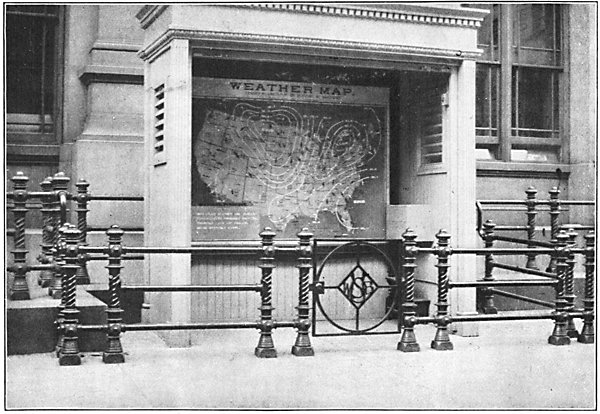
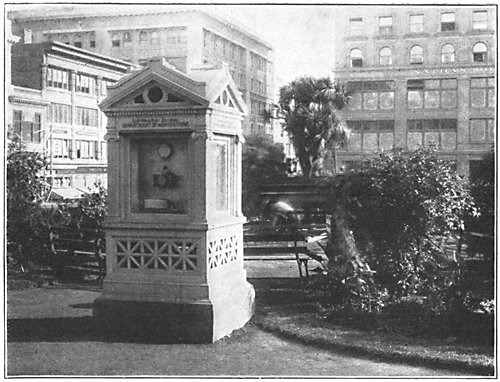
Kiosk.—The name given by the U. S. Weather Bureau
to a small street pavilion in which are displayed meteorological
instruments, maps, tables, etc.
Land and Sea Breezes. Land and Lake Breezes.—The
breezes that, on certain coasts and under certain conditions,
blow from the land by night and from the water by day.
Lenticular Cloud.—A cloud having approximately the
form of a double-convex lens, marking the position of a
standing wave in the atmosphere. (See Chapter VI.)
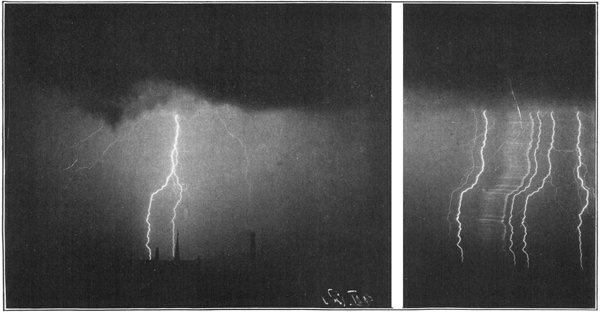
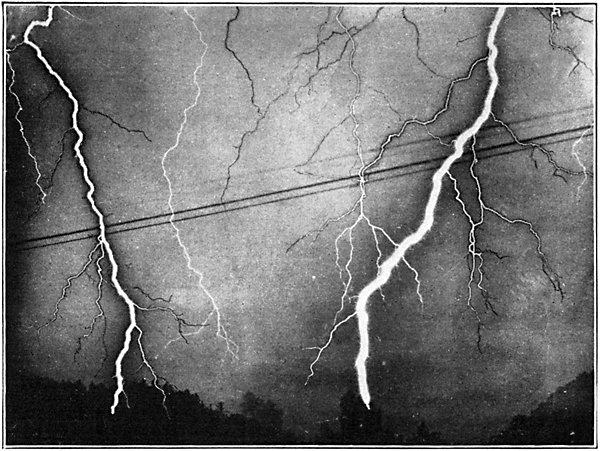
Lightning.—A disruptive electrical discharge in the atmosphere,
or, generally, the luminous phenomena attending
such a discharge. The various forms of lightning are named
and described in Chapter IX.
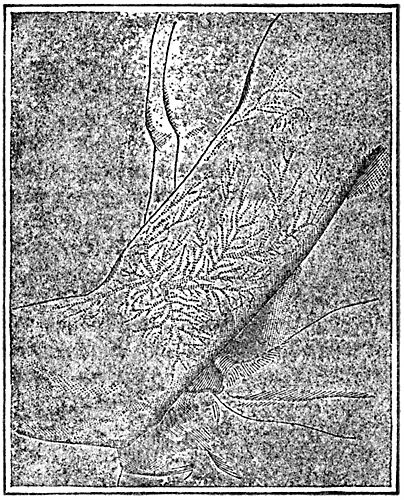
Lightning Print.—A collection of marks, often treelike in
form, sometimes found on the body of a person or animal
that has been struck by lightning.
Lightning Rod.—A metallic rod, connected with a suitable
“ground,” in earth or water, set up for the purpose of protecting
some structure from lightning.
Light-pillar.—A form of halo, consisting of a column of light,
vertical or nearly so, extending from or through the sun or
moon. Called a sun-pillar, or a moon-pillar, as the case may be.
Line-squall.—A more or less continuous line of squalls
and thunderstorms traveling broadside over the country.
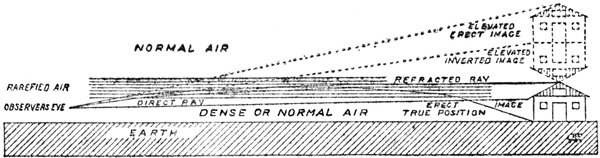
Looming.—An apparent elevation of distant objects by mirage.
Low.—An area of low barometric pressure, with its attendant
system of winds. Also called a barometric depression
or cyclone.
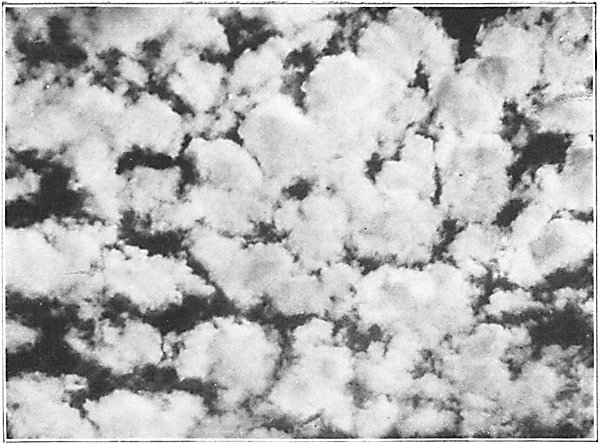
Mackerel Sky.—An area of sky covered with cirro-cumulus
clouds; especially when the clouds resemble the patterns
seen on the backs of mackerel.
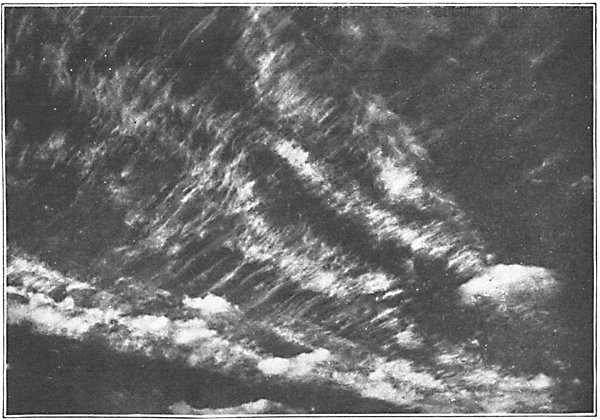
Mammato-cumulus.—A form of cloud showing pendulous
sacklike protuberances. (See Chapter VI.)
March.—The variation of a meteorological element in the
course of a day, year, or other interval of time; e. g., the
diurnal march of temperature; the annual march of barometric
pressure.
Mares’-tails.—Cirrus in long slender streaks.
Marine Climate.—A type of climate characteristic of the
ocean and oceanic islands. Its most prominent feature is
equability of temperature.
Meteorograph.—Autographic apparatus for recording
simultaneously two or more meteorological elements. Certain
types of meteorograph are connected, electrically or otherwise,
with some of the instruments at meteorological stations;
others are sent aloft attached to kites and balloons.
Meteorology.—The science of the atmosphere.
Millibar.—(See bar.)
Mirage.—An apparent displacement or distortion of distant
objects by abnormal atmospheric refraction. Sometimes
the images of objects are inverted, multiplied, etc.
Mist.—Generally, a wet fog or a very fine drizzle of rain;
hence the expression, “it is misting.” The “Scotch mist” of
mountainous or hilly regions is a combination of thick fog
and heavy drizzle; it has been suggested that this occurs
when the rain clouds actually rest on the earth.
Mistpoeffer.—(See brontide.)
Mistral.—Along the Mediterranean coast, from the mouth
of the Ebro to the Gulf of Genoa, a stormy, cold northerly
wind, blowing down from the mountains of the interior.
(The name is sometimes applied to northerly winds on the
Adriatic, in Greece, and in Algeria.)
Monsoon.—A wind that reverses its direction with the
season, blowing more or less steadily from the interior of a
continent toward the sea in winter, and in the opposite direction
in the summer.
Moon Dog.—A paraselene.
Mountain and Valley Breezes.—The breezes that, in
mountainous regions, normally blow up the slopes by day
(valley breeze) and down the slopes by night (mountain
breeze).
Nephoscope.—An instrument for measuring the movements
of clouds.
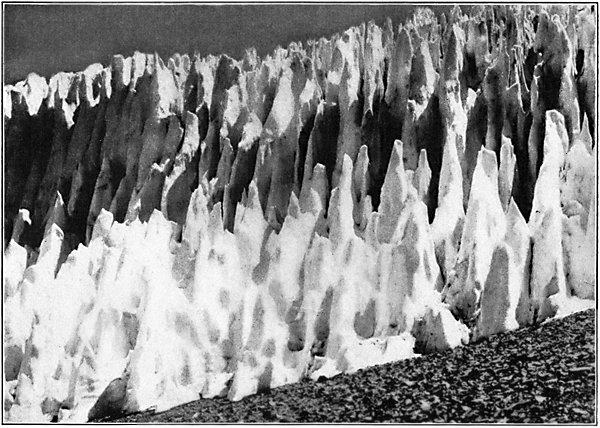
Nieve Penitente.—Fields of pinnacled snow found on certain
high mountains in tropical or subtropical regions.
Nimbus.—The rain cloud. (See Chapter VI.)
Noctilucent Clouds.—Luminous, cirruslike clouds sometimes
visible throughout the short nights of summer; supposed
to be clouds of dust at great altitudes shining with reflected
sunlight. Such clouds were observed during several
summers after the eruption of Krakatoa (1883) and are still
occasionally reported.
Normal.—The average value which, in the course of years,
any meteorological element is found to have on a specified
date or during a specified month or other portion of the year,
or during the year as a whole. Also used as an adjective in
such expressions as “normal temperature,” etc. Thus, for
any station at which records have been maintained for many
years, we may compute the normal temperature of January 1,
the normal pressure of February, the normal rainfall of the
year, etc. The normal serves as a standard with which values
occurring in a particular year may be compared in order to
determine the departure from the normal.
Nucleus.—A particle upon which condensation of water
vapor occurs in the free atmosphere in the form of a water
drop or an ice crystal.
Oblique Arcs of the Anthelion.—A rare form of halo, consisting
of intersecting arcs, usually white, passing through the anthelion
or the place where the anthelion would occur if visible.
Ozone.—An allotropic form of oxygen, which occurs transiently
in small quantities in the lower atmosphere, and is
supposed to be permanently present and relatively abundant
at high atmospheric levels.
Painter.—A dirty fog frequently experienced on the coast
of Peru. The brownish deposit from it is sometimes called
“Peruvian paint.”
Paragrêle.—A hail rod.
Paranthelion.—A halo phenomenon similar to a parhelion,
but occurring at a distance of 90 degrees or more in azimuth
from the sun. The solar distance of the ordinary paranthelia
is 120 degrees. (Analogous phenomena produced by the moon
as source of light are called parantiselenæ.)
Paraselene.—(Plu. paraselenæ.) (See parhelion.)
Paraselenic Circle.—(See parhelic circle.)
Parasitic Clouds.—The name formerly given to clouds capping
the summits of mountains.
Parhelic Circle.—A halo consisting of a white circle passing
through the sun and parallel to the horizon. A similar phenomenon
in connection with the moon is called a paraselenic
circle.
Parhelion.—A mock sun, or sun dog; a form of halo consisting
of a more or less distinctly colored image of the sun
at the same altitude as the latter above the horizon, and
hence lying on the parhelic circle, if present. The ordinary
parhelia are 22 degrees from the sun in azimuth, or a little
more, according to the altitude of the luminary. Parhelia
have occasionally been seen about 46 degrees from the sun.
Analogous phenomena seen in connection with the moon are
called paraselenæ, mock moons, or moon dogs.
Penetrating Radiation.—A form of radiation that has the
property of passing through a great extent of air without
being absorbed and of ionizing the air inside hermetically
sealed metal vessels. It is supposed to consist of a special
kind of Gamma rays and to come from the higher levels of
the atmosphere.
Phenology.—The study of the periodic phenomena of animal
and plant life and their relations to weather and climate.
Photochemical Climate.—The chemical activity of sunlight
characteristic of any place or region. The variations of this
feature of solar radiation are more or less strikingly different
from those of solar heat and the brightness of solar light.
Certain types of “chemical actinometer” are used in its
measurement.
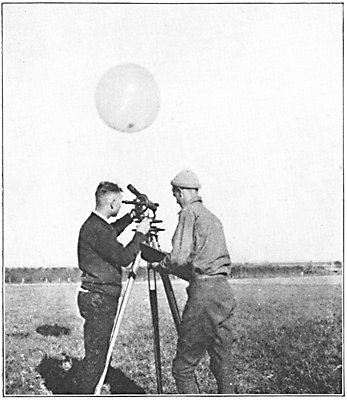
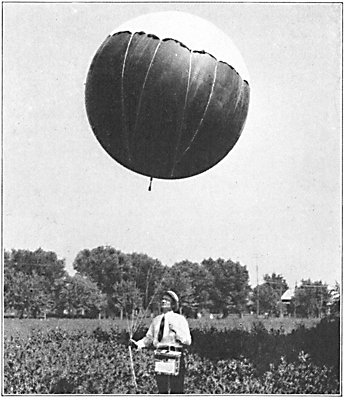
Pilot Balloon.—A small free balloon the drift of which, as
observed from the ground, indicates the movements of the
air aloft.
Pocky Cloud.—Mammato-cumulus.
Pogonip.—A fog, composed of fine needles of ice, which
occurs in mountainous regions of the western United States
and is reputed to be very injurious to the lungs.
Pollution Gauge.—A gauge for measuring soot and other
impurities found in the atmosphere.
Pontias.—A wind that blows by night from a narrow valley
at Nyons, France.
Potential Gradient.—(See gradient.)
Precipitation.—The collective name for deposits of atmospheric
moisture in liquid and solid form, including rain, snow,
hail, dew, hoarfrost, etc.
Pressure.—An elliptical expression, current in meteorological
literature, for atmospheric pressure, or barometric
pressure.
Prevailing Westerlies.—The belts of winds lying on the
poleward sides of the subtropical high-pressure belts.
Psuchrainometer.—An instrument devised by J. R. Milne
for measuring the cooling power of the atmosphere with reference
to physiological effects.
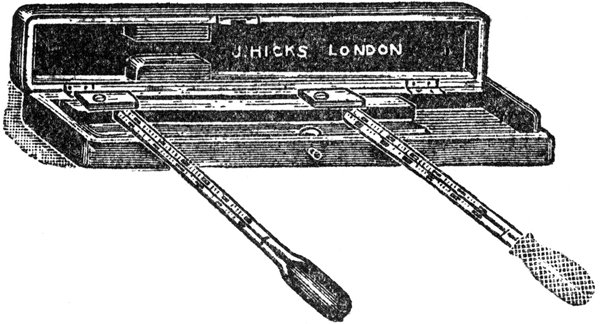
Psychrometer.—An instrument for measuring atmospheric
humidity, consisting usually of a dry-bulb thermometer and
a wet-bulb thermometer. The former is an ordinary mercurial
thermometer. The latter has its bulb covered with
muslin or other fabric, which is either permanently wet or is
wetted before use. In some psychrometers there is only one
thermometer, readings being taken both before and after
moistening the bulb.
Purple Light.—The purple or rosy glow observed over a
large area of the western sky after sunset and the eastern
sky before sunrise; it lies above the bright segment that
borders the horizon.
Pyrheliometer.—An instrument that measures solar radiation
by its heating effects.
Qobar.—A dry fog or heat haze of the upper Nile region.
(Also spelled kobar and gobar and occasionally applied to a
hazy condition of the atmosphere in other parts of the world.)
Rain Balls.—Mammato-cumulus.
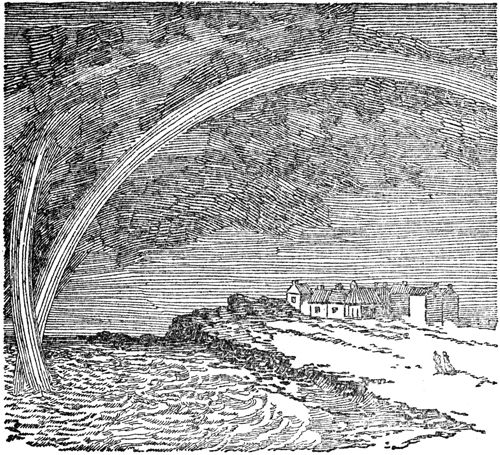
Rainbow.—A luminous arc formed by the refraction and
reflection of light in drops of water. (See Chapter X.)
Rainfall.—A term sometimes synonymous with rain, but
most frequently used in reference to amounts of precipitation
(including snow, hail, etc.).
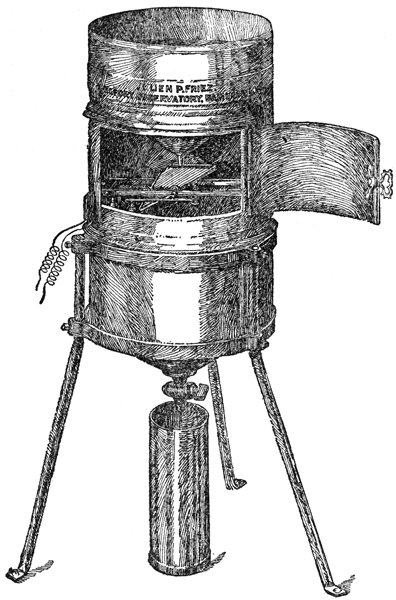
Rain Gauge.—An instrument for measuring rainfall.
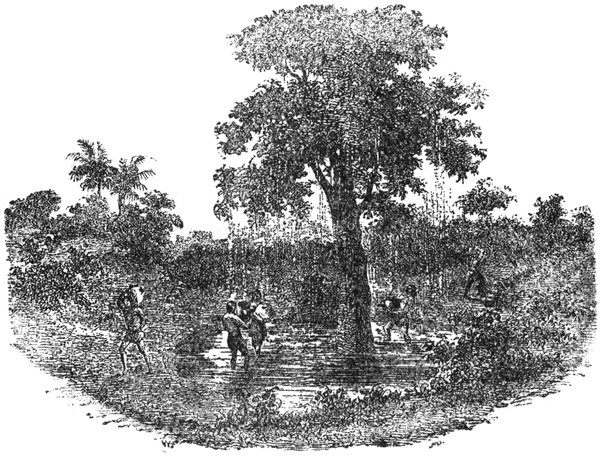
Rain Tree.—A mythical tree which is alleged to exude
copious showers of water even in the driest weather. (“Rain
tree” is also the common name of an ornamental tree
variously known to botanists as Albizzia saman, Pithecolobium
saman, Enterolobium saman, and Samanea saman.)
Recoloration.—(See afterglow.)
Recurrence.—The alleged tendency of any particular type
of weather to occur at about the same period every year, independently
of and generally in contrast to the regular march
of the seasons.
Refraction.—Astronomical refraction. Change in the apparent
position of a heavenly body, due to atmospheric
refraction. Terrestrial refraction. Change in the apparent
position of distant terrestrial objects, due to the same
cause.
Relative Wind.—In aeronautics, the motion of the air with
reference to an aeroplane or airship moving through it.
Réseau.—A collection of meteorological stations operating
under a common direction, or in the same territory. An
international réseau is a group of stations in different countries
cooperating for any purpose. The Réseau mondial is a
world-wide system of selected stations, the observations of
which may be utilized in studies of the meteorology of the
globe.
Rime.—1. Hoarfrost. 2. A rough or feathery coating of ice
deposited on terrestrial objects by fog. (The second meaning
is the one now used in technical literature.)
Roaring Forties.—(See brave west winds.)
Saddle.—(See col.)
Saint Elmo’s Fire.—A luminous brush discharge of electricity
from elevated objects, such as the masts and yardarms
of ships, lightning rods, steeples, etc., occurring in stormy
weather. Also called corposant.
St. Martin’s Summer.—One of several names given in
Europe to a mild period in autumn, corresponding approximately
to the Indian summer of North America.
Scarf Cloud.—A thin cirruslike cloud which often drapes
the summits of tall cumulo-nimbus clouds.
Scotch Mist.—(See mist.)
Scud.—Shreds or small detached masses of cloud moving
rapidly below a rain cloud or other heavy clouds.
Sea Breeze.—(See land and sea breezes.)
Secondary.—A small cyclone developed, or tending to
develop, on the border of a large one.
Sensible Temperature.—The temperature felt at the surface
of the human body; formerly identified, by some authorities,
with the temperature indicated by the wet-bulb thermometer.
Silence, Areas, Zones, or Regions of.—Regions within which
a sound is not heard, though heard in regions more distant
from the source.
Silver Thaw.—A term variously applied to rime, glaze, and
a thin coating of ice deposited on cold objects by a damp wind.
Simoom.—An intensely hot and dry wind of Asian and
African deserts; often described as a sand storm or dust
storm, but certain authorities state that the typical simoom
is free from sand or dust.
Sirocco.—A name applied to various types of warm wind
in the Mediterranean region. Some of these siroccos are
foehns. The term is also used as the generic name for winds
blowing from a warm region toward an area of low pressure
in a normally colder region.
Sleet.—1. Frozen or partly frozen rain; frozen raindrops
in the form of particles of clear ice. 2. Snow and rain
falling together. (Other definitions have been proposed and
the proper technical application of this term is still a
subject of controversy. In popular and engineering use the
word is often applied to a coating of glaze on trees, wires,
rails, etc.)
Snow Bin.—A large receptacle for collecting the snowfall
of an entire winter, or other long period, for measurement at
one time.
Snow Garland.—An elongated mass of snow suspended at
the ends and sagging in the middle.
Snow Mushroom.—An overhanging cap of snow resting on
a tree stump, post, or the like.
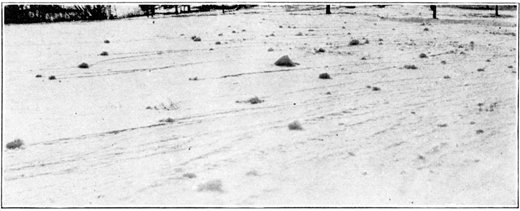
Snow Roller.—A mass of snow rolled by the wind; generally
muff-shaped.
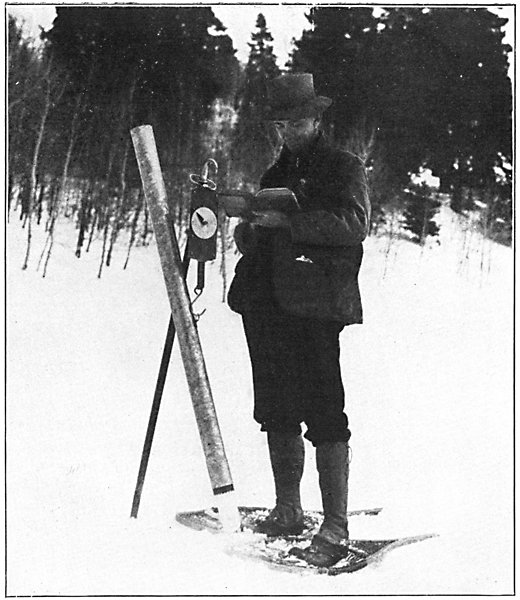
Snow Sampler.—A device for collecting a sample of snow,
cut vertically through a snowfield, for the purpose of determining
the depth and density of the snow.
Snow Survey.—A measurement of the total amount of snow
lying over a particular area, especially with a view to determining
the total amount of water it will yield, when melted,
for purposes of irrigation, etc.
Soft Hail.—Graupel.
Sounding Balloon.—A free, unmanned balloon carrying a
set of self-registering meteorological instruments.
Specter of the Brocken.—The shadow of an observer and of
objects in his immediate vicinity cast upon a cloud or fog
bank; sometimes attended by a series of colored rings, called
the glory or Brocken-bow.
Squall.—1. A sudden storm of brief duration; closely akin
to a thunderstorm but not necessarily attended by thunder
and lightning. 2. A sudden brief blast of wind, of longer
duration than a gust.
Squaw Winter.—In North America, a brief cold spell popularly
reputed to precede Indian summer.
Static.—(See stray.)
Storm Card.—A device intended for use on shipboard in
determining the direction of a storm center from the ship.
Storm Water.—The water resulting from a heavy and rapid
fall of rain; especially the portion that occurs as run-off.
(The term has been used mainly in connection with the subject
of sewers.)
Strato-cumulus.—A form of cloud. (See Chapter VI.)
Stratosphere.—The upper region of the atmosphere, formerly
called the isothermal layer, in which there is no marked
or systematic decrease of temperature with altitude. The
stratosphere is free from clouds (except occasional dust
clouds) and from strong vertical air currents, and its circulation
appears to be more or less independent of that of the
lower atmosphere. The height of its base, which varies with
latitude and otherwise, averages between 6 and 7 miles. (Cf.
troposphere.)
Stray.—A natural electromagnetic wave in the ether. The
term is used in reference to the effects of such waves in producing
erratic signals in radiotelegraphic receivers. Strays
are known collectively as static.
Summer Day.—A day in which the temperature reaches or
exceeds 77 degrees F.
Sun Dog.—A mock sun or parhelion.
“Sun Drawing Water.”—The sun popularly said to be
“drawing water” when crepuscular rays extend down from
it toward the horizon.
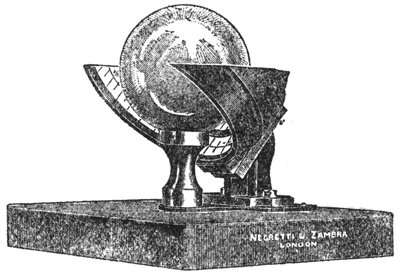
Sunshine Recorder.—An instrument for recording the
duration of sunshine; certain types also record the intensity
of sunshine.
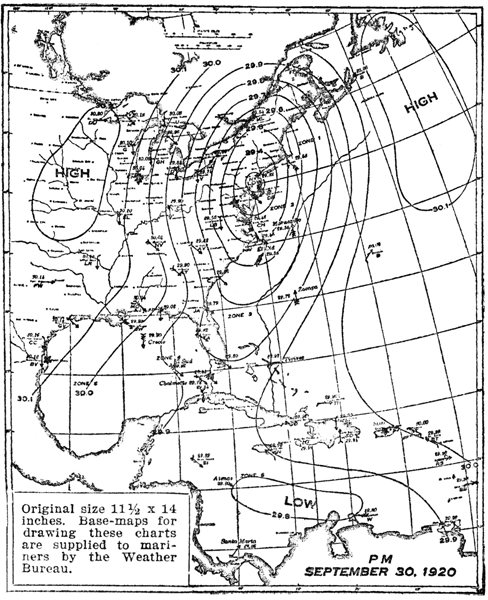
Synchronous Chart.—A form of synoptic chart, such as the
ordinary weather map, which shows the meteorological conditions
prevailing over any area at a given moment of time.
Synoptic Chart.—A chart showing the distribution of
meteorological conditions over an area at a given moment or
the average conditions during a given period of time, such
as a month or a year.
Table-cloth.—A sheet of cloud that sometimes spreads over
the flat top of Table Mountain, near Cape Town.
Tangent Arc.—Any halo that occurs as an arc tangent to
one of the heliocentric halos.
Term Hours.—Prescribed hours for taking meteorological
observations.
Thermal Belt.—A well-defined zone, found on some mountain-sides,
in which vegetation is particularly exempt from
frosts in spring and autumn. Also called verdant zone.
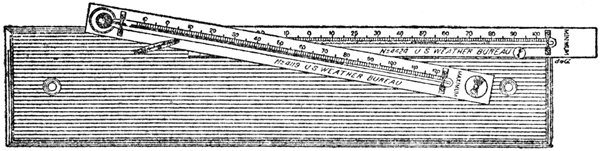
Thermograph.—A self-registering thermometer.
Thermometer.—An instrument for measuring temperature;
in meteorology, generally the temperature of the air.
Maximum and minimum thermometers indicate, respectively,
the highest and lowest temperatures occurring between the
times of setting the instruments. A wet-bulb thermometer is
used in measuring humidity. (See psychrometer.)
Thermometer Screen.—A cage, or sometimes merely a roof,
for protecting thermometers from direct sunshine and other
radiation that would cause the readings to indicate a temperature
different from that of the air. In the United States
generally called an instrument shelter.
Thunder.—The sound produced by a lightning discharge.
Thunderstorm.—A storm attended by thunder and lightning.
Thunderstorms are local disturbances, often occurring as
episodes of cyclones, and, in common with squalls, are marked
by abrupt variations in pressure, temperature, and wind.
Thunderstorm Recorder.—Any device that furnishes a record
of thunderstorms, either near or distant. Most thunderstorm
recorders register, by radiotelegraphy, the strays set
up by lightning discharges.
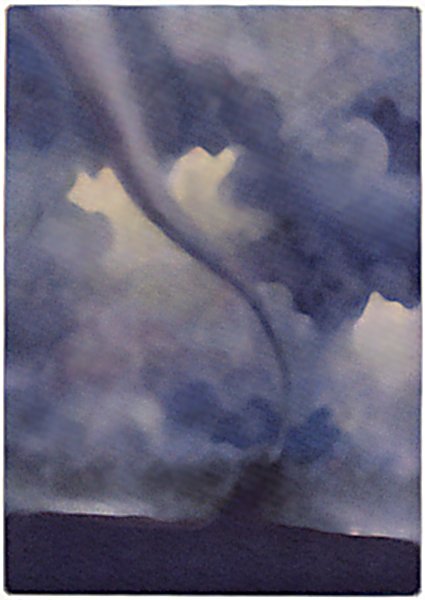
Tornado.—1. A violent vortex in the atmosphere, usually
attended by a pendulous, more or less funnel-shaped cloud.
2. In West Africa: A violent thundersquall.
Totalizer.—A form of snow gauge used chiefly in the Alps,
designed to be read only once a year. (French, totalisateur.)
Trade Winds.—Two belts of winds, one on either side of the
equatorial doldrums, in which the winds blow almost constantly
from easterly quadrants.
Troposphere.—The part of the atmosphere lying below the
stratosphere.
Trough.—1. A line drawn at right angles to the path of a
cyclonic area through all points at which the pressure has
reached a minimum and is about to rise. 2. An elongated
area of low barometric pressure.
Twilight.—Astronomical twilight is the interval between sunrise
or sunset and the total darkness of night. Civil twilight is
the period of time before sunrise and after sunset during which
there is enough daylight for ordinary outdoor occupations.
“Twister.”—A tornado; also, a small whirling dust storm.
Typhoon.—The name applied in the Far East to a tropical
cyclone.
Ulloa’s Ring.—1. A glory. 2. A halo (also called Bouguer’s
halo) surrounding a point in the sky diametrically opposite
the sun; sometimes described as a “white rainbow.”
Vane.—A device that shows which way the wind blows;
also called weather vane or wind vane.
Variability.—Interdiurnal variability is the mean difference
between successive daily means of a meteorological element.
Verdant Zone.—(See thermal belt.)
Visibility.—The transparency and illumination of the
atmosphere as affecting the distance at which objects can be
seen. It is often expressed on a numerical scale. (This term
was formerly applied by British meteorologists to a state of
unusual clearness of the atmosphere, regarded as a weather
prognostic.)
V-shaped Depression.—A trough of low barometric pressure
bounded on the weather map by V-shaped isobars.
Waterspout.—A tornadolike vortex and cloud occurring
over a body of water.
Weather Well.—(See blowing well.)
Wedge.—A wedge-shaped area of high barometric pressure.
Wet-bulb thermometer.—(See psychrometer.)
Wind.—Moving air; especially a mass of air having a common
direction of motion. The term is generally limited to air
moving horizontally, or nearly so; vertical streams of air are
usually called “currents.”
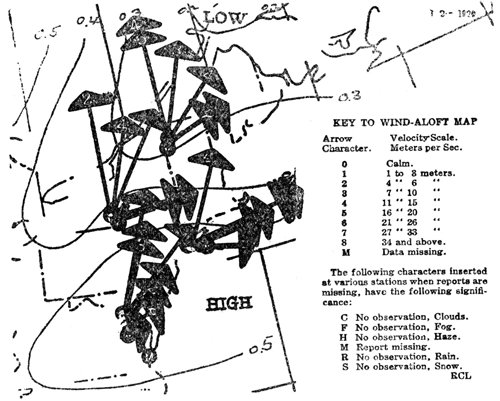
Wind Aloft.—The wind blowing at high levels as distinguished
from that near the earth’s surface.
Wind Rose.—1. A diagram showing the relative frequency
and sometimes also the average strength of the winds blowing
from different directions in a specified region. 2. A diagram
showing the average relation between winds from different
directions and the occurrence of other meteorological phenomena.
Winter Day.—A day on which the temperature does not at
any time rise above the freezing point.
Wool-pack Cloud.—Cumulus.