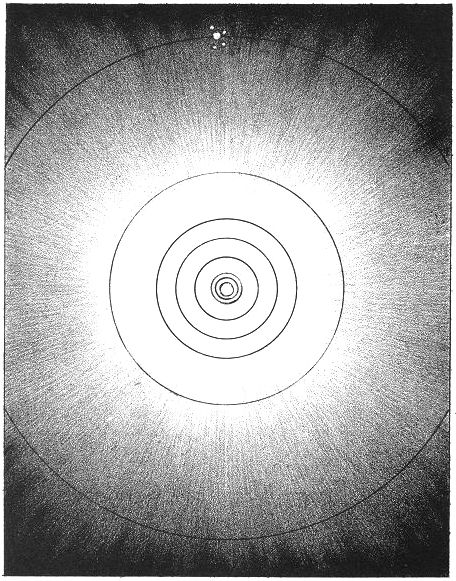
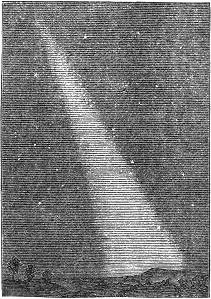
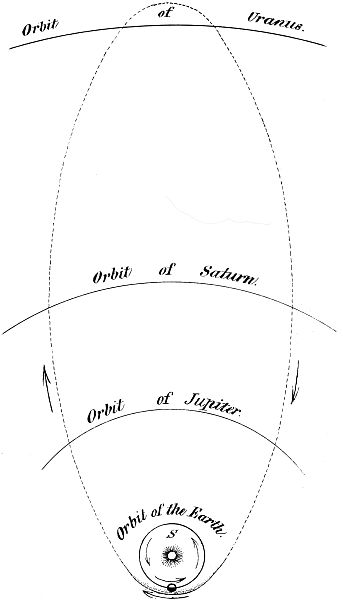
It is now well known that much greater variety
obtains in the structure of the solar system than was
formerly supposed. This is true, not only in regard
to the magnitudes and densities of the bodies composing
it, but also in respect to the forms of their
orbits. The whole number of planets, primary and
secondary, known to the immortal author of the
Mecanique Celeste, was only 29. This number has
been more than quadrupled in the last quarter of a
century. In Laplace's view, moreover, all comets
were strangers within the solar domain, having entered
it from without. It is now believed that a
large proportion originated in the system and belong
properly to it.
The gradation of planetary magnitudes, omitting
such bodies as differ but little from those given, is
presented at one view in the following table:
| Name. |
Diameter in miles. |
| Jupiter |
90,000 |
| Uranus |
35,000 |
| The Earth |
7,926 |
| Mercury |
3,000 |
| The Moon |
2,160 |
| Rhea, Saturn's 5th satellite |
1,200 |
| Dione Saturn's 4th satellite |
500 |
| Vesta10 |
260 |
| Juno |
104 |
| Melpomene |
52 |
| Polyhymnia |
35 |
| Isis |
25 |
| Atalanta |
20 |
| Hestia |
15 |
The diminution doubtless continues indefinitely below
the present limit of optical power. If, however,
the orbits have small eccentricity, such asteroids
could not become known to us unless their mean distances
were nearly the same with that of the earth.
But from the following table it will be seen that the
variety is no less distinctly marked in the forms of
the orbits:
| Name. |
Eccentricity. |
| Venus |
0·00683 |
| The Earth |
0·01677 |
| Jupiter |
0·04824 |
| Metis |
0·12410 |
| Mercury |
0·20562 |
| Pallas |
0·24000 |
| Polyhymnia |
0·33820 |
| Faye's comet |
0·55660 |
| D'Arrest's comet |
0·66090 |
| Biela's comet |
0·75580 |
| Encke's comet |
0·84670 |
| Halley's comet |
0·96740 |
| Fourth comet of 1857 |
0·98140 |
| Fifth comet of 1858 (Donati's) |
0·99620 |
| Third comet of 1827 |
0·99927 |
Were the eccentricities of the nearest asteroids equal
to that of Faye's comet, they would in perihelion
intersect the earth's orbit. Now, in the case of both
asteroids and comets, the smallest are the most
numerous; and as this doubtless continues below
the limit of telescopic discovery, the earth ought to
encounter such bodies in its annual motion. It
actually does so. The number of cometoids thus encountered
in the form of meteoric stones, fire-balls, and
shooting-stars in the course of a single year amounts
to many millions. The extremely minute, and such
as consist of matter in the gaseous form, are consumed
or dissipated in the upper regions of the atmosphere.
No deposit from ordinary shooting-stars
has ever been known to reach the earth's surface.
But there is probably great variety in the physical
constitution of the bodies encountered; and though
comparatively few contain a sufficient amount of
matter in the solid form to reach the surface of our
planet, scarcely a year passes without the fall of
meteoric stones in some part of the earth, either
singly or in clusters. Now, when we consider how
small a proportion of the whole number are probably
observed, it is obvious that the actual occurrence
of the phenomenon can be by no means rare.11
Although numerous instances of the fall of aerolites
had been recorded, some of them apparently
well authenticated, the occurrence long appeared too
marvelous and improbable to gain credence with
scientific men. Such a shower of rocky fragments
occurred, however, on the 26th of April, 1803, at
L'Aigle, in France, as forever to dissipate all doubt
on the subject. At one o'clock P.M., the heavens
being almost cloudless, a tremendous noise, like that
of thunder, was heard, and at the same time an immense
fire-ball was seen moving with great rapidity
through the atmosphere. This was followed by a
violent explosion which lasted several minutes, and
which was heard not only at L'Aigle, but in every
direction around it to the distance of seventy miles.
Immediately after a great number of meteoric stones
fell to the earth, generally penetrating to some distance
beneath the surface. The largest of these
fragments weighed 17½ pounds. This occurrence
very naturally excited great attention. M. Biot,
under the authority of the government, repaired to
L'Aigle, collected the various facts in regard to the
phenomenon, took the depositions of witnesses, etc.,
and finally embraced the results of his investigations
in an elaborate memoir.
It would not comport with the design of the present
treatise to give an extended list of these phenomena.
The following account, however, includes
the most important instances of the fall of aerolites,
and also of the displays of meteoric fire-balls.
1. According to Livy a number of meteoric stones
fell on the Alban Hill, near Rome, about the year
654 B.C. This is the most ancient fall of aerolites
on record.
2. 468 B.C., about the year in which Socrates was
born. A mass of rock, described as "of the size of
two millstones," fell at Ægos Potamos, in Thrace.
An attempt to rediscover this meteoric mass, so
celebrated in antiquity, was recently made, but without
success. Notwithstanding this failure, Humboldt
expressed the hope that, as such a body would be difficult
to destroy, it may yet be found, "since the
region in which it fell is now become so easy of
access to European travelers."
3. 921 A.D. An immense aerolite fell into the
river (a branch of the Tiber) at Narni, in Italy. It
projected three or four feet above the surface of the
water.
4. 1492, November 7th. An aerolite, weighing
two hundred and seventy-six pounds, fell at Ensisheim,
in Alsace, penetrating the earth to the depth
of three feet. This stone, or the greater portion of
it, may still be seen at Ensisheim.
5. 1511, September 14th. At noon an almost total
darkening of the heavens occurred at Crema. "During
this midnight gloom," says a writer of that
period, "unheard-of thunders, mingled with awful
lightnings, resounded through the heavens. * * *
On the plain of Crema, where never before was seen
a stone the size of an egg, there fell pieces of rock
of enormous dimensions and of immense weight. It
is said that ten of these were found weighing a hundred
pounds each." A monk was struck dead at
Crema by one of these rocky fragments. This terrific
meteoric display is said to have lasted two hours,
and 1200 aerolites were subsequently found.
6. 1637, November 29th. A stone, weighing fifty-four
pounds, fell on Mount Vaison, in Provence.
7. 1650, March 30th. A Franciscan monk was
killed at Milan by the fall of a meteoric stone.
8. 1674. Two Swedish sailors were killed on ship-board
by the fall of an aerolite.
9. 1686, July 19th. An extraordinary fire-ball
was seen in England; its motion being opposite to
that of the earth in its orbit. Halley pronounced
this meteor a cosmical body. (See Philos. Transact.,
vol. xxix.)
10. 1706, June 7th. A stone weighing seventy-two
pounds fell at Larissa, in Macedonia.
11. 1719, March 19th. Another great meteor was
seen in England. Its explosion occurred at an elevation
of 69 miles. Notwithstanding its height,
however, the report was like that of a broadside, and
so great was the concussion that windows and doors
were violently shaken.
12. 1751, May 26th. Two meteoric masses, consisting
almost wholly of iron, fell near Agram, the
capital of Croatia. The larger fragment, which
weighs seventy-two pounds, is now in Vienna.
13. 1756. The concussion produced by a meteoric
explosion threw down chimneys at Aix, in Provence,
and was mistaken for an earthquake.
14. 1771, July 17th. A large meteor exploded
near Paris, at an elevation of 25 miles.
15. 1783, August 18th. A fire-ball of extraordinary
magnitude was seen in Scotland, England, and
France. It produced a rumbling sound like distant
thunder, although its elevation above the earth's
surface was 50 miles at the time of its explosion.
The velocity of its motion was equal to that of the
earth in its orbit, and its diameter, according to Sir
Charles Blagden, was about half a mile.
16. 1790, July 24th. Between nine and ten o'clock
at night a very large igneous meteor was seen near
Bourdeaux, France. Over Barbotan a loud explosion
was heard, which was followed by a shower of meteoric
stones of various magnitudes.
17. 1794, July. A fall of about a dozen aerolites
occurred at Sienna, Tuscany.
18. 1795, December 13th. A large meteoric stone
fell near Wold Cottage, in Yorkshire, England.
The following account of the phenomenon is taken
from Milner's Gallery of Nature, p. 134: "Several
persons heard the report of an explosion in the air,
followed by a hissing sound; and afterward felt a
shock, as if a heavy body had fallen to the ground
at a little distance from them. One of these, a plowman,
saw a huge stone falling toward the earth, eight
or nine yards from the place where he stood. It threw
up the mould on every side; and after penetrating
through the soil, lodged some inches deep in solid
chalk rock. Upon being raised, the stone was found
to weigh fifty-six pounds. It fell in the afternoon of a
mild but hazy day, during which there was no thunder
or lightning; and the noise of the explosion was
heard through a considerable district."
19. 1796, February 19th. A stone of ten pounds'
weight fell in Portugal.
20. 1798, March 12th. A stone weighing twenty
pounds fell at Sules, near Ville Franche.
21. 1798, March 17th. An aerolite weighing about
twenty pounds fell at Sale, Department of the Rhone.
22. 1798, December 19th. A shower of meteoric
stones fell at Benares, in the East Indies. An interesting
account of the phenomenon was given by J.
Lloyd Williams, F.R.S., then a resident in Bengal.
The sky had been perfectly clear for several days.
At eight o'clock in the evening a large meteor appeared,
which was attended with a loud rumbling
noise. Immediately after the explosion a sound was
heard like that of heavy bodies falling in the neighborhood.
Next morning the fresh earth was found
turned up in many places, and aerolites of various
sizes were discovered beneath the surface.
23. 1803, April 26th. The shower at L'Aigle,
previously described.
24. 1807, December 14th. A large meteor exploded
over Weston, Connecticut. The height,
direction, velocity, and magnitude of this body
were ably discussed by Dr. Bowditch in a memoir
communicated to the American Academy of Arts
and Sciences in 1815. The following condensed
statement of the principal facts, embodied in Dr.
Bowditch's paper, is extracted from the People's
Magazine for January 25th, 1834:
"The meteor of 1807 was observed about a quarter-past
six on Monday morning. The day had just
dawned, and there was little light except from the
moon, which was just setting. It seemed to be half
the diameter of the full moon; and passed, like a
globe of fire, across the northern margin of the sky.
It passed behind some clouds, and when it came out
it flashed like heat lightning. It had a train of
light, and appeared like a burning fire-brand carried
against the wind. It continued in sight about half a
minute, and, in about an equal space after it faded,
three loud and distinct reports, like those of a four-pounder
near at hand, were heard. Then followed
a quick succession of smaller reports, seeming like
what soldiers call a running fire. The appearance
of the meteor was as if it took three successive throes,
or leaps, and at each explosion a rushing of stones
was heard through the air, some of which struck the
ground with a heavy fall.
"The first fall was in the town of Huntington,
near the house of Mr. Merwin Burr. He was standing
in the road, in front of his house, when the stone
fell, and struck a rock of granite about fifty feet from
him, with a loud noise. The rock was stained a
dark-red color, and the stone was principally shivered
into very small fragments, which were thrown
around to a distance of twenty feet. The largest
piece was about the size of a goose egg, and was still
warm.
"The stones of the second explosion fell about
five miles distant, near Mr. William Prince's residence,
in Weston. He and his family were in bed
when they heard the explosion, and also heard a
heavy body fall to the earth. They afterward found a
hole in the earth, about twenty-five feet from the
house, like a newly dug post-hole, about one foot in
diameter, and two feet deep, in which they found a
meteoric stone buried, which weighed thirty-five
pounds. Another mass fell half a mile distant, upon
a rock, which it split in two, and was itself shivered
to pieces. Another piece, weighing thirteen
pounds, fell a half a mile to the northeast, into a
plowed field.
"At the last explosion, a mass of stone fell in a
field belonging to Mr. Elijah Seely, about thirty rods
from the house. This stone falling on a ledge, was
shivered to pieces. It plowed up a large portion of
the ground, and scattered the earth and stones to the
distance of fifty or a hundred feet. Some cattle that
were near were very much frightened, and jumped
into an inclosure. It was concluded that this last
stone, before being broken, must have weighed about
two hundred pounds. These stones were all of a
similar nature, and different from any commonly
found on this globe. When first found, they were
easily reduced to powder by the fingers, but by exposure
to the air they gradually hardened."
25. 1859, November 15th. Between nine and ten
o'clock in the morning, an extraordinary meteor was
seen in several of the New England States, New
York, New Jersey, the District of Columbia, and
Virginia. The apparent diameter of the head was
nearly equal to that of the sun, and it had a train,
notwithstanding the bright sunshine, several degrees
in length. Its disappearance on the coast of the
Atlantic was followed by a series of the most terrific
explosions. It is believed to have descended into
the water, probably into Delaware Bay. A highly
interesting account of this meteor, by Prof. Loomis,
may be found in the American Journal of Science and
Arts for January, 1860.
26. 1860, May 1st. About twenty minutes before
one o'clock P.M., a shower of meteoric stones—one
of the most extraordinary on record—fell in the S.
W. corner of Guernsey County, Ohio. Full accounts
of the phenomena are given in Silliman's Journal
for July, 1860, and January and July, 1861, by Professors
E. B. Andrews, E. W. Evans, J. L. Smith,
and D. W. Johnson. From these interesting papers
we learn that the course of the meteor was about 40°
west of north. Its visible track was over Washington
and Noble Counties, and the prolongation of
its projection, on the earth's surface, passes directly
through New Concord, in the S. E. corner of Muskingum
County. The height of the meteor, when
seen, was about 40 miles, and its path was nearly
parallel with the earth's surface. The sky, at the
time, was, for the most part, covered with clouds
over northwestern Ohio, so that if any portion of the
meteoric mass continued on its course, it was invisible.
The velocity of the meteor, in relation to the
earth's surface, was from 3 to 4 miles per second; and
hence its absolute velocity in the solar system was
from 20 to 21 miles per second. This would indicate
an orbit of considerable eccentricity.
"At New Concord,12 Muskingum County, where
the meteoric stones fell, and in the immediate neighborhood,
there were many distinct and loud reports
heard. At New Concord there were first heard in
the sky, a little southeast of the zenith, a loud detonation,
which was compared to that of a cannon fired
at the distance of half a mile. After an interval of
ten seconds another similar report. After two or
three seconds another, and so on with diminishing
intervals. Twenty-three distinct detonations were
heard, after which the sounds became blended together
and were compared to the rattling fire of an
awkward squad of soldiers, and by others to the
roar of a railway train. These sounds, with their
reverberations, are thought to have continued for
two minutes. The last sounds seemed to come from
a point in the southeast 45° below the zenith. The
result of this cannonading was the falling of a large
number of stony meteorites upon an area of about
ten miles long by three wide. The sky was cloudy,
but some of the stones were seen first as 'black
specks,' then as 'black birds,' and finally falling to
the ground. A few were picked up within twenty
or thirty minutes. The warmest was no warmer
than if it had lain on the ground exposed to the sun's
rays. They penetrated the earth from two to three
feet. The largest stone, which weighed one hundred
and three pounds, struck the earth at the foot of a
large oak tree, and, after cutting off two roots, one
five inches in diameter, and grazing a third root, it
descended two feet ten inches into hard clay. This
stone was found resting under a root that was not
cut off. This would seemingly imply that it entered
the earth obliquely."
Over thirty of the stones which fell were discovered,
while doubtless many, especially of the smaller, being
deeply buried beneath the soil, entirely escaped observation.
The weight of the largest ten was four
hundred and eighteen pounds.
27. 1864, May 14th. Early in the evening a very
large and brilliant meteor was seen in France, from
Paris to the Spanish border. At Montauban, and
in the vicinity, loud explosions were heard, and
showers of meteoric stones fell near the villages of
Orgueil and Nohic. The principal facts in regard to
this meteor are the following:
| Elevation when first seen, over |
55 miles. |
| Elevation at the time of its explosion |
20 miles. |
| Inclination of its path to the horizon |
20° or 25° |
| Velocity per second, about |
20 miles, |
or equal to that of the earth's orbital motion. "This
example," says Prof. Newton, "affords the strongest
proof that the detonating and stone-producing meteors
are phenomena not essentially unlike."
The foregoing list contains but a small proportion
even of those meteoric stones the date of whose fall
is known. But besides these, other masses have
been found so closely similar in structure to aerolites
whose descent has been observed, as to leave no
doubt in regard to their origin. One of these is a
mass of iron and nickel, weighing sixteen hundred
and eighty pounds, found by the traveler Pallas, in
1749, at Abakansk, in Siberia. This immense aerolite
may be seen in the Imperial Museum at St.
Petersburg. On the plain of Otumpa, in Buenos
Ayres, is a meteoric mass 7½ feet in length, partly
buried in the ground. Its estimated weight is thirty-three
thousand six hundred pounds. A specimen of
this stone, weighing fourteen hundred pounds, has
been removed and deposited in one of the rooms of
the British Museum. A similar block, of meteoric
origin, weighing twelve or thirteen thousand pounds,
was discovered some years since in the Province of
Bahia, in Brazil.
Some of the inferences derived from the examination
of meteoric stones, and the consideration of
the phenomena attending their fall, are the following:
1. R. P. Greg, Esq., of Manchester, England, who
has made luminous meteors a special study, has
found that meteoric stone-falls occur with greater
frequency than usual on or about particular days. He
calls attention especially to five aerolite epochs, viz.:
February 15th–19th; May 19th; July 26th; November
29th, and December 13th.
2. It is worthy of remark that no new elements
have been found in meteoric stones. Humboldt, in
his Cosmos, called attention to this interesting fact.
"I would ask," he remarks, "why the elementary
substances that compose one group of cosmical
bodies, or one planetary system, may not in a great
measure be identical? Why should we not adopt
this view, since we may conjecture that these planetary
bodies, like all the larger or smaller agglomerated
masses revolving round the sun, have been
thrown off from the once far more expanded solar
atmosphere, and have been formed from vaporous
rings describing their orbits round the central
body?"13
3. But while aerolites contain no elements but
such as are found in the earth's crust, the manner in
which these elements are combined and arranged is
so peculiar that a skillful mineralogist will readily
distinguish them from terrestrial substances.
4. Of the eighteen or nineteen elements hitherto
observed in meteoric stones, iron is found in the
greatest abundance. The specific gravities vary from
1·94 to 7·901: the former being that of the stone of
Alais, the latter, that of the meteorite of Wayne
County, Ohio, described by Professor J. L. Smith in
Silliman's Journal for November, 1864, p. 385. In
most cases, however, the specific gravity is about 3
or 4.
5. The contemplation of the heavenly bodies has
often produced in thoughtful minds an intense desire
to know something of their nature and physical constitution.
This curiosity is gratified in the examination
of aerolites. To handle, weigh, inspect, and
analyze bodies that have wandered unnumbered
ages through the planetary spaces—perhaps approaching
in their perihelia within a comparatively
short distance of the solar surface, and again receding
in their aphelia to the limits of the planetary
system—must naturally excite a train of pleasurable
emotions.
6. It is highly probable that in pre-historic times,
before the solar system had reached its present stage
of maturity, those chaotic wanderers were more numerous
in the vicinity of the earth's orbit than in recent
epochs. Even now the interior planets, Mercury
and Venus, appear to be moving through the masses
of matter which constitute the zodiacal light. It
would seem probable, therefore, that they are receiving
from this source much greater accretions of
matter than the earth.
7. As Mercury's orbit is very eccentric, he is beyond
his mean distance during much more than half
his period. Hence, probably, the greater increments
of meteoric matter are derived from such portions of
the zodiacal light as have a longer period than Mercury
himself. If so, the tendency would be to diminish
slowly the planet's mean motion. Such a
lengthening of the period has been actually discovered.14