An account of some recently observed Psychical Phenomena
produced in the presence of Doctor Maxwell and
Professor Charles Richet. Arranged by the Translator
from notes furnished by Dr. Maxwell.[17]
During the last two years exceptional opportunities
have been offered Professor Richet and Dr. Maxwell
of observing a medium—whom we will call Meurice—who
has furnished Dr. Maxwell with many of his most
important examples of psychical phenomena. I refer to
phenomena spoken of on pp. 74, 81-2, 101-3, 136-7,
152-5, 160-2, 195-9, 201-2, 250.
Dr. X.—a friend of Professor Richet—who does not
wish his name to be mentioned, having been present
with Professor Richet and Dr. Maxwell at some of their
experiments, has sent Dr. Maxwell a few notes concerning
those seances at which he was present. Dr.
Maxwell has authorised me to put these notes in order,
and to add to them a few extracts from letters written by
Dr. Maxwell to Professor Richet and myself.
These notes and letters were written either during
or immediately after the seances, if I may so call the
impromptu occasions on which the phenomena to be
spoken of were obtained.
There is, in these notes, a miscellaneous stream of
evidence, the complexity and importance of which may
be presumed, when it is pointed out that a useful combination
of two orders of research has been at work
therein. Dr. Maxwell was chiefly interested in the
study of the facts concomitant with the phenomena,
whatever they might be, whilst Professor Richet devoted
himself to the analysis of the personifications, and to the
study of the manifestations from a purely psychological
point of view.
Evidence is the touchstone of truth, and though
the reading of parts of this chapter may sound more
like pages out of a fantastic story than the words
of savants, yet the publication of these facts has been
judged necessary by Professor Richet and Dr. Maxwell,
in their belief that no one is justified in setting aside
facts which have been well attested. These facts have
been observed—let it not be forgotten—in a spirit of
pure scientific curiosity.
It is, therefore, hoped that this chapter will receive
the thoughtful consideration of many; and that careful
analysis will be especially given to those very parts, the
unreal-like romantic nature of which seems to render
them, at a random glance, unworthy of serious thought.
An acute analysis of a medium is of primary
importance in the examination and appreciation of his
phenomena, therefore we will first of all dwell a little on
the personality of M. Meurice, the medium in question.
He is a friend of Dr. Maxwell’s—a friend of some
years’ standing.
He is a slightly built man, the reverse of robust,
but endowed with remarkable vitality and recuperative
powers. He is thirty-two years of age; he is unmarried.
He is highly sensitive and reserved in disposition, and
forms quick but lasting sympathies and antipathies.
He gives one the impression of being always in a state
of hypertension; his nervous system is most finely
strung, and he appears to experience an irresistible need
of constant physical movement. He passes easily from
the extremes of joy to the extremes of sadness. Highly
nervous though he be, Dr. Maxwell has never observed
any signs of hysteria, or any symptoms of a lack of
equilibrium in the medium’s mentality. He is not
amenable to the hypnotic sleep, but Dr. Maxwell says
he has sometimes thought that he might eventually
succeed in inducing that state. The few attempts so
far made in this direction have given no results; moreover,
M. Meurice does not care to submit himself to
this kind of experimentation. His cutaneous and other
sensibilities are normal; his reflexes also are normal.
He suffers occasionally from violent headaches and
neuralgia; and has frequent gastric attacks, notably after
the production of telekinetic phenomena. Otherwise his
health is good. During the production of phenomena,
M. Meurice often acknowledges to a sinking sensation
in the epigastric region, and says it is as though something
material were being drawn out of him at such
moments.
He is well read in every branch of literature, and has
a most retentive memory. One has the notion that this
medium, to a great extent, has under his conscious
control a large range of what is generally submerged
faculty.
Subliminal operation is, no doubt, constantly going
on with us all, but it is most apparent in M. Meurice.
One feels with him that his unconscious memory is always
on the alert.
Amnesia appears to follow rapidly in the footsteps of
his visions, but several things seem to indicate that this
amnesia is only apparent.[18]
Dr. Maxwell says he always thought he had a psychic
in his friend. However, notwithstanding his medical
studies, and wide range of knowledge of things in
general, M. Meurice was ignorant of metapsychical
phenomena, and averse to becoming acquainted with the
practices of spiritism or anything of that nature. Little
by little Dr. Maxwell induced his friend to take some
interest in these phenomena, and one day he persuaded
him to put his hands on a table with a view to seeing
whether the two of them together could obtain any
phenomena. Raps were immediately forthcoming; they
resounded on the floor. The medium was startled by
the unusual noise and quickly rose from the table.
Nothing more was received on that occasion or for
some time afterwards. Then, for two years, M. Meurice
reluctantly and irregularly yielded to Dr. Maxwell’s
persuasions to develop his medianity.
For some time he could not be made to see the importance
of his phenomena, and Dr. Maxwell refused
to give weight to his words by appealing to technical
literature. He was desirous of keeping his friend
in ignorance of current notions on these phenomena,
thinking the results would be of greater value if the soil
they sprang from were virgin.
M. Meurice has done all in his power to throw light
upon his own phenomena. His co-operation has been
precious, for often his fine intelligence and well-trained
powers of observation have enabled him to bring into
the research valuable analyses of his sensations and
impressions. For this medium not only does not lose
consciousness during the production of his phenomena,
he is often at such moments more thoroughly ‘all
there’—to use a Scotch expression—than in his unproductive
moments of abstraction. True, there have been
a few exceptions, but, as a rule, he is keenly alive to
all that is going on when phenomena is forthcoming.
The passages I have indicated in Dr. Maxwell’s work
will acquaint the reader with the order and degree of
phenomena presented by M. Meurice, when Professor
Richet made his acquaintance. Dr. Maxwell had studied,
almost exclusively, the physical aspect of the facts he
received, and did not encourage phenomena of an intellectual
order. This scientific attitude, however, had not
prevented the manifestation of the phenomenon of personification;
and the ‘raps’ speedily put forth the claims
common to spiritualistic beliefs—in spite of the medium’s
ignorance of them. When Professor Richet began to
experiment with M. Meurice, the ‘raps’ had already
claimed to emanate from ‘John King,’ ‘Chappe d’Auteroche,’
a group of four entities calling themselves the
‘good fairies,’ and, lastly, from two of Dr. Maxwell’s
deceased friends.
As the capital interest of this chapter lies in the
intelligent aspect of the phenomena, there is a fact of
paramount importance to be pointed out with emphasis.
Our medium is very amenable to influence, and his
phenomena constantly show the effects of suggestion and
influence. I do not, by any means, wish to infer that
M. Meurice is like wax in the hands of his friends; on
the contrary, if it were only a question of personal
consciousness, we might say he is almost impervious
to the action of extraneous influences. His ways of
thinking and acting bear the stamp of independence,
and if he yields occasionally to the wishes of his
friends, it is out of pure friendship and with deliberation.
When, however, we are endeavouring to make a
psychological study of a medium, we strive to reach the
lower strata at once; the surface is of little interest when
we know that the secret lies below. Therefore, when
I say that M. Meurice is most amenable to influence, I
am bearing in mind that profound region, his general
consciousness. The personal consciousness may be
rebellious to influence, but the subliminal is reached by
subtler means than is its grosser envelope, and is
remarkably amenable to the charm of suggestion and the
voice of sympathy. In all probability the reader will
find sufficient evidence of the accuracy of my assertion
in the phenomena to be spoken of in the course of this
chapter; therefore, I will not dwell any further upon
this point, although it be an important one.
When experimenting with Eusapia Paladino, Professor
Richet had remarked and called attention to the synchronism
which existed between her phenomena and her
movements or muscular contractions. Dr. Maxwell, in
his turn, also remarked it, and forthwith bent his studies
in that direction. The conclusion appears to be evident
that a profound and far-reaching importance lies in the
synchronism between the movements of the experimenters
and the phenomena. It was observed that Dr. Maxwell
was indeed able to produce phenomena of raps and
telekinesis [of very feeble intensity, it is true] by tapping
the medium on his hands or shoulder, by firmly
squeezing the hands, joined in a circle above the table,
or by the simple contraction of his own muscles.
En passant, it may be useful to note that Dr. X. was
opposed to the idea that synchronism always existed
between the phenomena and the movements of the
experimenters, that is to say, that muscular contraction
was alone responsible for the phenomena. Dr. X. was
so opposed to this notion, that his presence at seances
where this synchronism was being demonstrated, has
often been observed to cause all manifestations to cease—to
nullify the results. If Dr. X. was able to exercise
this power over one centre, it is highly probable that his
presence would exercise a like inhibitory influence over
other centres of energy, where like experiments were
being conducted.
Though Dr. Maxwell had obtained not a few
phenomena showing intelligence (e.g. raps claiming to
emanate from various personifications), yet, as he says
in his book, pages 26, 28, and 83, he did not feel
drawn towards that order of research, and did his best
to keep the phenomena on physical lines. But since
Professor Richet has experimented with M. Meurice, the
phenomena have developed rapidly along the lines of
intellectuality: a result which may, it is true, be due to
our medium’s good-nature in allowing his power to be
used as was desired, or which may be the effect of
influence and suggestion. We are inclined to think
the latter is nearer the truth, an opinion which is supported
by the fact that when Dr. X. and Professor
Richet were present—that is to say, within a few days
after Dr. X.’s appearance in the circle—synchronous
phenomena could rarely be obtained.[19]
Now, all unknown to Dr. Maxwell, Professor Richet
had passed the previous three years in the study of these
same phenomena from a psychological standpoint, and
at the moment of his first visit to Bordeaux, he was
particularly absorbed in the research and analysis of
intelligent messages received by means of a physical
phenomenon. His desire, for the time being, was to
receive messages—of identity or otherwise—by means of
raps without contact.
Already familiar with the fact of synchronism—which
a little experience suffices to show is not due to self-suggestion
or endosomatic activity—Professor Richet
wished to get on to fresh ground; as before said, he
wanted intellectuality in a physical phenomenon, and it
was not long before he got what he wanted with the
medium in question.
And, à propos, perhaps I may be allowed to briefly
relate at once the first phenomenon containing intelligence,
which Professor Richet obtained with M.
Meurice. A short time after having made his acquaintance,
the professor and Dr. X. thought they
would try to obtain a ‘test.’ Supposing, for a moment,
that an entity, who has several times claimed to be communicating
with Professor Richet, really existed, they
‘evoked’ him, and asked him to give them a sign through
M. Meurice, which would denote that he had been
listening to a certain conversation held two hours previously.
The medium and Dr. Maxwell were unaware
that this entity had a speciality of communicating in
Latin or Greek. A few hours afterwards, during
dinner, raps were heard on the table and other furniture
in the vicinity of M. Meurice; when the question was
asked as to who was rapping, the Christian name of the
entity was given, followed by the word Confide. No word,
it appears, could have borne more directly upon the conversation
in question. There was difficulty in obtaining
these two words, the raps—in such abundance when not
requested to ‘work’—came laboriously, as though some
one were picking his steps among brambles, so to speak.
The medium himself spelt out the alphabet on this
occasion.
......
Dr. Maxwell has given an analysis of the raps obtained
with M. Meurice, and we especially refer the reader to
pages 79-82 and 250.
When raps without contact delay in coming, M.
Meurice takes a lead-pencil, holds it in his hands, and
presses one end against the table or on an experimenter
according to desire; the raps then resound at the end
touching the experimenter or the table.
Anæsthesia is observed only in the hand and arm
holding the pencil. “Once or twice,” says Dr. X., “I
have observed something like cramp seize the hand and
arm, and extend along the shoulder blade, to the nape
of the neck. On these occasions, I saw the whole arm
vibrate after each rap, like the rebounding of an elastic
band, and I have sometimes thought it looked as though
the ‘fluid’ passed down the nerves of the arm into the
pencil, as though it were flowing through a clear open
channel, until it reached the point of the pencil, when
a jerk of some kind appeared to force it out on to the
wood; not that the pencil or arm moves when the rap
resounds, but one has the impression of an interior jerk
of some kind when, in moments of cramp, the rap is
heard; this rebounding movement appears to be almost
simultaneous with the rap. Though the medium keeps
his personality alive, as a rule, it seems to me,” continues
Dr. X. (whose opinion is shared by Professor Richet),
“to undergo a diminution of some kind, on these occasions;
ideation appears to be slower and more difficult.
But, because his arm hurt him when this cramp came
on, we have always begged him to cease; therefore we
cannot say whether, the experiment courageously continued,
complete anæsthesia would eventually set in,
accompanied by psychical phenomena.”
It is of importance to point out that both Professor
Richet and Dr. X. (though Dr. Maxwell does not
altogether share their opinion on this point) are inclined
to believe that M. Meurice can tell when raps are going
to be given, when phenomena will be forthcoming
and when they will not be forthcoming; a conclusion
which is drawn from many observations.
Some of the messages given in this chapter were
obtained, when out walking with the medium. On
such occasions, M. Meurice would put his hand on a
walking-stick or on an umbrella; he preferred the
latter. “The raps on the open umbrella are extremely
curious,” writes Dr. X. “We have heard raps on the
woodwork and on the silk at one and the same time; it
is easy to perceive that the shock actually occurs in the
wood—that the molecules of the latter are set in motion.
The same thing occurs with the silk; and here observation
is even more interesting still; each rap looks like a
drop of some invisible liquid falling on the silk from a
respectable height. The stretched silk of the umbrella
is quickly and slightly but surely dented in; sometimes
the force with which the raps are given is such as to
shake the umbrella. Nothing is more absorbing than
the observation of an apparent conversation—by means
of the umbrella—between the medium’s personifications.
Raps, imitating a burst of laughter in response to the
observer’s remarks, resound on the silk like the rapid
play of strong but tiny fingers. When raps on the
umbrella are forthcoming, M. Meurice either holds the
handle of the umbrella, or some one else does, whilst he
simply touches the handle very lightly with his open
palm. He never touches the silk.
“Raps without contact appear to require more force,
and are not so frequently forthcoming, as raps with
contact—which seem to be always at the medium’s
command; consequently—and particularly as the tenor
of the messages received constituted the chief interest
for the time being—the use of the pencil or umbrella
has been encouraged.”
All the messages given in this chapter, except where
the contrary is expressly stated, have been received by
contact with a pencil or umbrella—with what Chappe,
the chief personification, calls his telephone.
A marked trait in the phenomena is their spontaneity.
Months will pass away without the production of a
single phenomenon worth mentioning—raps through the
pencil can generally be obtained, however. After the
attraction of the fan (pages 357-8), nine months
elapsed before another telekinetic phenomenon occurred.
At other times, the energy is so abundant that
while it lasts, that is to say for two or three weeks,
the medium may truly be said to live in a world
of phenomena in more senses than one; for, at
such periods, phenomena are constantly forthcoming.
Regular seances are not of much avail with M. Meurice;
it is better not to seek, but to know how to receive,
which means to know how to wait patiently and
attentively.
......
A brief analysis of the personifications is necessary
before laying bare their work. The first to manifest
was ‘John King.’ Subliminal labour is very transparent
herein. M. Meurice had heard not a little of Eusapia
Paladino’s secondary personality, which calls itself ‘John
King.’
Then the raps announced the presence of a group of
four entities calling themselves the ‘fairies’—les bonnes
fées. In fact, the latter were the first to make their
presence felt by M. Meurice, though John King was
the first to manipulate the raps. The fairies gave the
names of Miriam, Yolande, Liliane, and Brigitte; the
latter remained but a short time; she said she had to
go away somewhere; she was replaced by ‘Wicki,’ who
claims to be an ancestor of Dr. Maxwell’s, and to have
lived in Ireland during the fifteenth century. The
medium associates the odour of jasmine with the fairies.
Perhaps the following may suggest a clue to the origin
of these entities:—
Some years ago, before Dr. Maxwell had commenced
experimenting with his friend, he was in the habit of
bidding him good-bye with the words, ‘Que les très bonnes
vous protègent.’ When the fairies—les bonnes fées—appeared,
they at once claimed to have been the means
of bringing about the meeting of Dr. Maxwell with
M. Meurice, and of having fostered their friendship.
As for the odour of jasmine: on one occasion, soon
after experimentation had begun, the medium was
talking to the doctor about good influences; and he
remarked that he sometimes perceived the odour of
jasmine without being able to explain it normally. The
next time the doctor saw his friend, the raps dictated
that the odour of jasmine was the signal of the presence
of the good fairies.
The next personification to manifest was said to be
S., a very dear friend of Dr. Maxwell’s (see pages
160-1). The genesis of this personification is easy to
follow. S. was one of the leading men in Bordeaux,
where he occupied a very prominent position; he was
extremely well known—though M. Meurice did not
know him, and says he never saw him. M. Meurice
witnessed Dr. Maxwell’s grief when S. died, and heard
the former say that he had been very fond of S. I
again refer the reader to pages 160-1 for further consideration
of the S. personification.
For a few months, the phenomena claimed to emanate
chiefly from the fairies—John King gradually fading
away. Then ‘Chappe d’Auteroche’ came on the scene,
and has ever since kept the field pretty much to himself,—though
he permits of the presence of the personalities
already mentioned and a few others if introduced by him.
His first appearance took the form of a vision in the
crystal. The medium saw him in a foreign land, amidst
large red flowers, savage tribes and queer-looking boats
on canals; he gave his name, the exact day, month
and year of his death, and the cause of his death; he
described what his work on earth had been—all things
which M. Meurice did not consciously know. Everything,
which was verifiable, was found to be correct.
Some time after this, Chappe gave a long and
coherent message by means of tilts of a table without
contact—in daylight; on this occasion, he gave his
Christian name as ‘Adhémar,’ which is, probably, an
error, as biographies do not mention it.
Chappe is, doubtless, a subliminal entity; but his
evolution is more difficult to explain than any of the
medium’s other personifications. Perhaps M. Meurice—an
avide reader—has come across some articles in
periodicals, concerning the measurements of the solar
parallax, by means of the crossing of the sun’s surface
by the disc of the planet Venus. Chappe was one of
the best-known observers; he went to Siberia in 1761,
and to California in 1769, to observe those passages.
His name must certainly have been mentioned in the
newspapers, when the last crossings took place—that is
in 1874 and 1882. But on these occasions, M. Meurice
was only three and eleven years old! Has he seen the
biographical notice of Chappe in Larousse’s dictionary?
He has no conscious recollection of having read this, nor
does he remember ever having heard of Chappe the
astronomer. And there, for the present, the matter
must stand.
Another personification—H. B.—made its irruption
towards the end of 1903. M. Meurice was certainly
aware of Dr. Maxwell’s profound esteem and affection
for H. B.; but for further consideration of this personification,
we refer the reader to Dr. Maxwell’s notes
thereon, pages 287 and following.
......
I perceive I am about to end these remarks on the
medium and his phenomena without having said a word
upon a vital point, one which many specialists would
require to be satisfactorily settled before consenting to
listen to an account of the phenomena. I mean the
medium’s honesty. Professor Richet, Dr. Maxwell, and
Dr. X. say that, for diverse reasons, they cannot doubt
this particular medium’s honourability. As for raps and
telekinetic phenomena, there can be no shadow of doubt
about their genuineness; the excellent conditions of light,
sight and touch which always prevail when his phenomena
are forthcoming, joined to the intelligent co-operation
of M. Meurice, who is as much interested in and
capable of examining his own phenomena as are the
observers, put mystification out of the question.
Is there any evidence of identity, of survival, of
intelligent forces other than human, in this chapter?
Each one will answer this question after his own manner
of thinking. Some will say ‘No.’ If we could forget
the extraordinary romance at the end of this chapter—Series
C—we too might answer categorically ‘No.’
Though we have given all the leading details of the case,
family reasons have necessitated the omission of much
valuable material in this ‘romance,’ and perhaps readers
will not see so much in it as those who watched its
development. But even as it stands, it presents some
baffling difficulties. It really seems to indicate that
there is activity in the metethereal environment, and
that the spirit can act in that environment. What
matter, therefore, if it be the spirit of the living or of
the dead? If one can demonstrate its independence of
the body, why not the other?
It may be useful to give one or two of our medium’s
visions. If these simple phenomena—where so much of
the personal consciousness seems at play—be studied,
some idea may be gained of how far, if at all, the subliminal
is responsible for the production of this particular
medium’s more intricate phenomena, such as intelligent
messages given by means of raps without contact.
......
M. Meurice was once visiting Paris. He dined at
my house on the evening of his arrival. This was the
first time I met him. During dinner, an hour or so
after his arrival, the medium said he saw a vision near
me, and described a personage ‘dressed in white and
gold-embroidered robes, who looks like a priest of
ancient times.’ The only interest in this is that it
corroborates what two other sensitives, unknown to our
medium and to each other, have on two different
occasions told me.
M. Meurice also claimed to recognise in me and
this bedecked personage, two persons who figured in a
dream-vision he had had, three years previous to meeting
me. We give this dream chiefly for the sake of its rich
symbolism.
The medium wrote an account of the dream at the
time, at Dr. Maxwell’s request, the latter being struck
by its oddity. Here is the vision:—
“I dreamt I was sleeping in a bed, the framework
of which nearly touched the ground; the bed was raised
on a kind of platform. I was in a large hall, which
looked like a church. Suddenly a tall, fair woman,
dressed in black, entered. A man wearing long, white,
ancient-looking garments, embroidered all over in gold,
followed her. Then Dr. Maxwell entered. The man in
white read aloud out of the book, which the fair woman
held open before him. I was suddenly overcome
with emotion. I wept, and wept, and wept. My
tears caused the flowers embroidered on the counterpane
to spring into life; they grew and multiplied with
amazing rapidity, completely covering the bed and,
finally, burying me beneath their abundance and
weight. The fair woman then said: ‘We must seek
for him,’ and set to work to remove the flowers.
During this operation, Dr. Maxwell stepped on my
body; I screamed with pain and awoke.”
When M. Meurice awoke, he was suffering from
colic; this fact may explain parts of the vision.
......
One day in December 1903, at the close of a seance
when some fine raps at a distance had been obtained,
M. Meurice wrote a few German words. He does not
know German. At the same time he saw, in the crystal,
the words: ‘Kolbe, chimiste, mort à Leipzig 1730.’ A
few hours after this seance, the medium had a vision of
the personification Chappe, who said, ‘Vous ne savez
donc lire? C’est “mort à Leipzig le 25 Novembre
1884,” et pas “1730.”’
Kolbe the chemist died at Leipzig on the 25th of
November 1884. This information is to be found in
Larousse’s dictionary.
......
The following is an experiment in the transmission of
thought which Dr. Maxwell tried with the medium:—
“I gave my hand to M. Meurice, to hold, and said to
him—we had been talking, in a vague, general manner
of the plurality of existences—‘Try and see how I died
in my previous existence.’
“Unknown to the medium, I wrote down on paper the
words:—Fall from a horse!
“M. Meurice answered: ‘I see your life, then you
fade away into nothingness; you die from an accident;
a carriage—no, a horse accident. I see you wearing a
shield. You fall from your horse, he crushes you to
death.’”
......
The medium very often sees the same vision repeat
itself in the crystal. This is the vision of a procession
of individuals clothed in flowing robes; they follow a
long narrow path, which loses itself in a tunnel, into
which the procession passes. The vision never varies,
save that at times after the procession has disappeared
into the tunnel, the path seems to be strewn with the
bones of skeletons.
This vision has also been seen, in the same crystal,
by our medium’s youngest sister, a girl of twenty, who
is absolutely ignorant of spiritistic phenomena. She
attributed her vision to an optical illusion.
......
It has been observed with M. Meurice that the last
vision sometimes precedes veridical hallucinations.
This and other facts would lead one to think that
very probably, for a medium, there is no test which can
discriminate between falsidical and veridical hallucinations.
The psychological process appears to be the
same, viz. dramatisation and concrete images, instead
of abstract concepts or ideas.
Mediums, as a rule, possess parasitic personalities
which act in the same way as the normal personality;
this feature of hallucinatory phenomena is difficult to
analyse, and introduces into the problem a number of
unknown factors.
In the case of the medium in question, the secondary
personalities are weak. They are always felt and objectived
by the normal personality, which is never expelled
from the scene—a circumstance which is precious for the
observer as the visions are sometimes vivid to a degree.
With M. Meurice the unknown factors, though existing,
are reduced to a sort of minimum, and the psychological
analysis is perhaps less difficult than in the generality of
cases. In this fact lies the value of his intellectual
phenomena, though it is a drawback indeed from another
point of view, the persistency of the normal consciousness,
of the normal will, and even of the normal powers
of attention, being probably the cause of the impurities
which so frequently stain his intellectual phenomena.
“H. B. died at a very advanced age. He was a man
of great kindness of heart, and of deep intelligence. He
had received a solid, classical education. He was born
in a foreign country, went, when a young man, to a
North American state, where he lived for some time.
He married, and finally came to Bordeaux—a town to
which his wife and all her family belonged. H. B. lived
for many years at Bordeaux; but during the last six
years of his life he was paralysed. He died at a time
when the medium was twenty years of age, and was
pursuing his studies in a hospital at Bordeaux. H. B.
lived a very retired life, confined to the house because of
his infirmity.
“There is every probability that M. Meurice had
never heard of H. B. Although I had known my friend
for some time before the irruption of this personification,
I had been extremely careful to avoid giving him the
slightest detail concerning H. B. He had, however,
heard me say that H. B. had been one of my dearest
friends.
“I had been experimenting for about two years
with M. Meurice, when the personification H. B.
first manifested. His emergence took place on the
2nd October 1903, in the form of a vision, which my
friend had as he was going to bed. On the following
day—during a dark seance we were holding in the hopes
of obtaining luminous phenomena—M. Meurice described
his vision of the previous night. His description vividly
recalled H. B. to my mind. I was careful to say nothing,
however. During the seance, the personification Chappe
signified his presence by means of abundant and loud
raps; at the same time M. Meurice told me he saw a
face, and certain letters written above it; these letters
formed a name, which indicated to me the presence of
H. B. Thereupon I asked M. Meurice to give me the
Christian and surnames of the vision he claimed to be
looking at; in reply, the surname was instantly spelt out
by raps without contact; the Christian name was given
in French first of all, then it was correctly given in
H. B.’s maternal tongue.[20]
“H. B.’s first appearances occurred in M. Meurice’s
bedroom. From the indications given, I said I had
quickly recognised H. B. Unfortunately, under the
necessity in which I find myself placed of not bringing
H. B.’s family into view, I am unable to mention the
principal details. May it suffice to say that I recognised
H. B. I may also add that the description of the
hair, eyes, beard, stature were exactly and unhesitatingly
given.
“I may also mention one important detail: M. Meurice
described the vision he saw as being seated in an armchair
with a blue plaid shawl—with a long fringe—wrapped
about his legs. I did not recognise the chair—though
I well remember the chair in which H. B. passed
the last six years of his life—but the shawl was absolutely
correctly described. This is a detail which, I affirm,
M. Meurice could not possibly have known; and I
consider it highly improbable that fraud could have
found it out.
“So much for the first appearance of this personification.
“The visions continued. M. Meurice saw H. B. at
different periods of his existence, at times infirm, at
other times younger and standing upright. When he
appeared young, he wore his beard in a certain fashion;
when he appeared aged, he wore his beard differently;
these details were correct.
“The vision at first did not speak, and simply looked
kindly at him, said M. Meurice.
“The hallucination used to build itself up in the following
manner: the medium saw a bluish cloud floating
about near a particular armchair in his bedroom; the
cloud or shadow remained ill defined, ‘as though several
veils were being successively removed’; and only one
feature at a time—at a vision—seemed to be distinctly
shown, e.g. at one time, the eyes were well shown, the
rest of the vision being very indistinct; at another time,
the nose was the prominent feature, or the mouth, the
hair or the beard, etc.; as though the personification
wished to impress one thing at a time upon the medium’s
perception.
“Finally on the 6th October 1903, in a short journey
which M. Meurice made one day to Arcachon, H. B.
appeared to him in broad daylight, in an avenue of the
forest through which the medium was driving.
“M. Meurice saw, on the roadway a short distance
ahead, a person walking very slowly and peculiarly: ‘he
limped as though the right leg was shorter than the left.’
He was a stout man with a round, clean-shaven face.
He had a peculiar mark near one of his eyes. He was
wearing a tall straw hat, a high collar, the ends rising and
meeting in points under the chin, a yellowish walking-stick,
the handle of which was made of ivory and fastened
to the stick by a silver band; the personage was reading
a newspaper, the title of which was in Gothic lettering
‘like the Matin.’ He was wearing a thick gold chain
and trinkets. M. Meurice thought he was looking
upon a real individual, and it was not until the carriage
had driven past, and my friend saw the supposed man
suddenly disappear, leaving but a ‘whitish blur on the
ground,’ that he recognised H. B. and the hallucinatory
character of his perception.
“I saw M. Meurice about five hours after he had had
this vision, when he gave me the above details; I recognised
the following as being correct:—
“1. The walk.
“2. A peculiar mark near one of the eyes.
“3. The newspaper; H. B. took in the Temps, the title
of which is in Gothic lettering like the Matin.
“4. The walking-stick, every detail being exact.
“5. The description of the collar was correct.
“6. H. B. used to wear a straw hat.
“7. ‘A stout man with a round, clean-shaven face’
applies to H. B. before his infirmity made an invalid of
him.
“The watch-chain and trinkets were imaginary.
“A few remarks about details 1 and 2: H. B. had twice
broken his right leg; the right leg was, as a result of
these two accidents, shorter than the left leg. He had
therefore a very peculiar and characteristic walk. When
M. Meurice was relating the above vision to me, he
imitated the walk to perfection. Let it be remembered
that H. B. had not walked a step for six years previous
to his death; when he was attacked by paralysis,
M. Meurice was but fourteen years of age, and was not
then living in Bordeaux.
“2. H. B. had a small and peculiar skin mark
near his left eye. Now, when M. Meurice related his
vision, I told him that he had not localised this mark
accurately enough. Thereupon, raps resounded simultaneously
on his chair, on the floor, and on a table
standing a foot away from M. Meurice and myself;
while these raps were resounding M. Meurice said he
saw H. B., and remarked that he was pointing to the
sign in question. M. Meurice then correctly localised
the mark.
“Further, I told M. Meurice that he had made a mistake
when speaking of a gold watch-chain and trinkets.
The next vision my friend had of H. B., the latter
showed himself with a black silk ribbon attached to his
watch; this, I recognised as correct. H. B. always wore
a black silk ribbon for a watch-chain.[21]
“In subsequent visions, H. B. showed the medium
successively certain correct details in his costume,
notably:—
“1. Cravats, dark blue with white spots.
“2. Shoes of a peculiar make, without heels and with
elastic sides.
“3. White stockings.
“M. Meurice tells me he feels that H. B. very often
tries to make himself visible to him; when he fails to do
so, he hears him say impatiently: ‘Thut! thut! thut!’—a
curious coincidence, for this was a most characteristic
habit of H. B.’s when impatient.
“From that time the personification H. B. has continued
to mingle actively in our medium’s life. His
intervention is manifested daily. It would be impossible
to give a full account of this personification’s manifestations;
I will simply confine myself to indicating the
principal. It is to be pointed out, first of all, that
H. B. appears literally to ‘haunt’ M. Meurice’s house,
especially the room above the latter’s bedroom.[22]
“The phenomena are of several kinds:—
“A. Sonorous phenomena.
“1. Footsteps.
- “(a) A loud, quick, decided footstep, which M.
Meurice attributes to the personification
Chappe.
- “(b) An unequal step, as though one leg rested
more heavily than the other; the imitation
which M. Meurice made before me of this
step recalled to my mind H. B.’s step.
- “(c) A slow step as of a person who dragged his
feet along: a movement attributed by M.
Meurice to, and which I recognised as characteristic
of, one of my deceased friends.[23]
- “(d) A quick, light step, like the step of a big bird.
“These footsteps are heard in the corridor of
the second story of the house; a story which is not
inhabited. Then the door of a bedroom, immediately
above M. Meurice’s bedroom, seems to open and the
footsteps resound in the room. M. Meurice has often
got up—these noises occur at about two o’clock in the
early morning—but he has never seen anything or any
one.
“The same noises are also heard in M. Meurice’s own
bedroom.
“2. The opening of doors and windows.
“Before hearing footsteps in the bedroom on the second
floor, M. Meurice hears the door of that room open.
The noise of the opening of the door is always preceded
by a noise similar to that made by a hand searching in
the dark for the door handle.
“M. Meurice hears the same sounds on his bedroom
door. There are three doors to M. Meurice’s bedroom:
one leads into a dressing-room, one into a clothes-room,
the third into a study; it is at this third door that
the above-mentioned phenomena occur.
“Sometimes M. Meurice hears the window of his
own bedroom, as well as that of the room upstairs,
open and shut. He has got up repeatedly, and gone
upstairs to see what was happening, but has always found
the door closed, which he fancied he had heard being
opened. Whenever, on returning to his bedroom, he
left the door of the room upstairs open, the noise of
footsteps would begin again as soon as he had left, but
without the sound of the opening and shutting of the
bedroom door.
“3. Noises as of furniture being moved about. The
medium hears the chairs and tables of the room above
him move about; his faculties of observation are well
developed, and he believes he recognises:—
- “(a) Accompanying the noise of the displacement of
chairs and tables, Chappe’s footstep.
- “(b) H. B.’s footsteps, on the contrary, are accompanied
by the noise a heavy person might
make when sitting on a bed. The medium
hears the mattress creaking.
- “(c) Lastly, he hears a noise similar to what would
be produced by a person lying back in an
armchair.
“4. Noises of material objects other than furniture:
these noises are like:—
- “(a) A bag of corn or nuts emptied on to the floor
of the bedroom upstairs.
- “(b) Something hard striking the floor: these sounds
are given rhythmically upon request.
- “(c) Wings beating the air. M. Meurice compares
these sounds to the flapping of the wings of
a turkey.
- “(d) The rubbing of paper.
“5. Diverse human noises:—
- “(a) Sighs.
- “(b) Heavy breathing.
“Are these sonorous phenomena subjective? I have
never been in the house at the hour, when these
sounds are said to be heard; and the noises I have
heard from time to time are not sufficiently pronounced
for me to be able to form any conclusion. I have assured
myself that no water-pipes exist in the upper stories of
the house; the latter is isolated, but any loud noises
made in a neighbouring house can be heard in M.
Meurice’s house.
“No one sleeps in the second story. A domestic, who
occupies a room on the same floor as M. Meurice, has
heard the noise of footsteps, and has often got up out
of bed and gone upstairs to see who was moving about.
Never finding any one, the domestic attributes these
sounds to rats: an insufficient explanation. Moreover,
a close examination of the house, repeated on several
occasions, has revealed to me no signs of rats.
“A sister of M. Meurice’s frequently pays him visits;
she then occupies a room on the same floor as her brother.
On three different occasions she has been awakened out
of sleep by sounds of footsteps, and a fumbling noise on
the door of her room, as though some one were feeling
for the handle. She has got up, gone into her brother’s
room, thinking it was he, searched about the house, but
has never seen anything which could explain the noises,
neither has she heard the noises while thus moving
about.[24]
“She has also heard the flapping of birds’ wings, in
the daytime, in different parts of the house.
“B. Phenomena of touch.
“M. Meurice sometimes feels a hand gently stroke
him on the head. On one occasion, when he was suffering
from a violent headache, he felt a hand move about on
his head and forehead; the pain went away, and he fell
asleep.
“C. Visual phenomena.
“Sonorous and tactile phenomena nearly always precede
an apparition, which is generally that of H. B., either
alone or with the Chappe personification.
“The following are a few examples of the visions
relating to H. B.:—
“1. On the 31st October 1903 M. Meurice returned
home from a visit to the neighbouring village—Arcachon,
the same village, near which H. B. had appeared
to him (p. 290). When he entered his bedroom,
he perceived H. B. seated in a chair, holding on his arm
a mortuary wreath made of black beads.
“On the morrow—All Souls’ Day—M. Meurice related
this vision to me. I was surprised—but concealed my
surprise; for, as a matter of fact, I did not understand
what a wreath of black beads could mean. At certain
epochs I am in the habit of laying a wreath on H. B.’s
tomb, but it is always composed of what were his
favourite flowers. M. Meurice began to write automatically;
he wrote: ‘Bring me what you are in the
habit of bringing me; the other wreath was for T.
Bring him one too, for his family have almost forgotten
him.’ (I understood T. to be the initial letter of a great
friend of H. B.’s.) My surprise did not diminish,
because I know for a fact that T.’s family cherish his
memory profoundly.
“However, following my usual custom, I treated the
personification H. B. as he desired to be treated and
executed his commission. I then made the following
discovery: T. is buried in a vault over which lies
a sort of platform. The vault belongs to his own
family and the family of a near relation. There were
fresh flowers on the side of the vault belonging to his
relations; there were none on the side reserved for his
family.
“I believe this circumstance, as well as the friendship
which existed between H. B. and T., was unknown to
M. Meurice; but I am obliged to admit that my belief
rests upon no proof.
“Let me add, in order to finish at once with the T.
incident, that, on the eve of my visit to T.’s tomb, I
had asked M. Meurice to give me the Christian and
surnames of the person about whom H. B. was supposed
to be talking. The surname was given; a curious
mistake was made before the Christian name was correctly
given: the name of T.’s son was given, and then came
T.’s own name. These indications were obtained in
broad daylight, by means of raps without direct contact.
The raps resounded upon a table on which I had placed
a shawl, one corner of which was held by M. Meurice.
“2. A few days afterwards a seance was held in M.
Meurice’s bedroom. A portable cabinet had been used,
which M. Meurice had not taken the trouble to remove
before going to bed. During the night he was awakened
by taps on the head; he heard diverse noises, and saw
the door of the cabinet open. H. B. appeared, leaning
on two of the ‘fairies’; the two other ‘fairies’
followed. These personages presented the appearance
of living people, said M. Meurice the next day when
describing the vision to me. They rolled an armchair
into the middle of the room; H. B. sat down in it;
the fairies placed a shawl over his knees, and two of them
sat down on the arms of his chair; the other two sat
down on chairs. H. B. spoke about my health, and
then bade M. Meurice tell me that I would be able
to find all necessary documents on the history of
religions in my cousin Y.’s library. The Christian
names were correctly given, the surname approximately;
but the approximation was such (the initial letter of the
name being the only incorrect one) that I had no difficulty
in recognising the name.
“It is exact that my cousin Y. possesses documents on
the history of religions. M. Meurice knew that the
question interested me; but it is extremely improbable,
that he should have known of the existence of my cousin
Y., who lives in the strictest seclusion; it is still more
improbable, that he should have known the contents of
his library. I cannot, however, affirm these two points,
but I can at least affirm that M. Meurice does not know
my cousin Y.
“The personification H. B. shows a spirit of fatherly
protection towards M. Meurice; for example:—
“The medium was once out driving; a rather serious
accident happened, in which his carriage was caught
between a cart and a tram; the coachman was thrown
from his seat and wounded. As the tram struck the
carriage, M. Meurice felt himself seized by the arms,
and carried out of the carriage on to the footpath by
H. B.[25]
“The air of protection which this personification
assumes is never absent; it is difficult, M. Meurice says,
to convey an idea of the strange, fantastic impression
which he feels, in presence of the frequent intervention
of H. B., and other personifications.
“This impression is the less easily understood, in so
much as M. Meurice is not a spiritualist, and has received
a scientific education. He refuses to accept the explanations
which the personifications offer of themselves: they
claim to be human beings who have once lived on earth.
Up to the present they have never pretended to give us
any information touching the life beyond the tomb; the
indications they have given rather tend to direct our
experiments, and to try to formulate premonitions.
H. B. seems to have given himself the task, chiefly,
of establishing his identity; this desire appears to be
his leading—I scarcely dare to say generating—idea.
And we are obliged to admit that from this point of
view he has given some curious details. These facts constitute
the intellectual phenomena, which are the dominant
ones in the H. B. personification, although raps and
movements without contact are also said to emanate from
him sometimes.
“I have given some examples of psycho-sensorial
messages in the visions which I have described. These
are far from being the most interesting. H. B.
manifests also by automatic writing, and has given some
messages of a highly interesting character in this manner.
I cite the following as being the most characteristic:—
“On the 27th of November 1903, towards the close of
a seance, I mentally asked H. B. where I happened to be,
when he was laid up with a certain serious illness. The
medium wrote: ‘You were a young magistrate at Blaye,
near Bordeaux.’ M. Meurice knows what my career
has been, but it is extremely improbable, he should have
known about the illness—much less the time of the
illness—of which I was thinking. At all events, the
reply given to my mental question was correct. Neither
the conversation nor previous facts could have given
the slightest clue to my question. On another occasion,
automatic writing made an extremely characteristic
allusion to one of H. B.’s most inveterate habits: a glass
of brandy and water every afternoon at half-past five,
punctually.[26]
“Finally, on the occasion of the death of the last
surviving member of his family, H. B. on the 5th of
October 1904 wrote: ‘Poor L., no one is left now.
It is a consolation for you to feel me near you.... Very
often those left behind cannot see us.’ (Pauvre L., il ne
reste plus personne maintenant, c’est une consolation pour
vous de me sentir près de vous. Souvent les survivants ne
peuvent pas nous voir.)
“This message was interesting because the last relative
to die was not L. but C. L. died before C.; but L. had
been H. B.’s favourite brother. It is quite correct that
no one was left of H. B.’s generation after C.’s death.[27]
“At this same seance, H. B. mentioned a very private
detail in connection with L. This fact, which raisons de
convenance prevent me from fully relating, defines the
nature of the intercourse which had existed between
H. B. and his brother L. The circumstances which
the writing recalled were known only to H. B. and a
few near relations.
“I am fully aware that the above details have no
demonstrative value, for I knew them all, and the
hypothesis of thought transmission can explain them
quite as well as the spirit hypothesis. Here is, however,
a case which is less easily explained:—
“One of my friends is related to a lady, who lives with
her husband in Paris. My friend told me that this
cousin of his had amused herself one day with table-turning;
and he added that the table had followed her
without any one touching it. I had spoken of this
incident to M. Meurice, but without mentioning names.
The incident of the table following the novice the first
time she had tried table-turning was the only thing
mentioned.
“Quite recently, while pursuing my inquiry upon
mediums’ eyes, H. B., through automatic writing, told
me that the afore-mentioned friend would be able to
give me some information on the subject; the writing
then named his cousin, but called her by her maiden
name, giving the name correctly.
“Now two or three days afterwards, M. Meurice had
a vision or a dream—often he cannot tell whether it be
one or the other; he saw an aged lady sitting before
a large table, on the top of which a doll’s table was
standing; two younger women were with her; one of
these latter made the small doll’s table turn round three
times without touching it. The room in which these
ladies were sitting was large, and M. Meurice thought it
was in a country-house. The curtains were of rose-coloured
velvet.
“The scene described was the one my friend had
related to me, but I pointed out to M. Meurice that one
detail at least was certainly incorrect: viz. the doll’s
table. H. B. immediately wrote: ‘He has not made
a mistake, it was the small table which moved, and
not the large one.’ (Il ne se trompe pas, c’est bien le
mouvement d’une petite table qui a eu lieu, et non celui d’une
grande.) I saw my friend the next day, and I related
this incident to him. He assured me it was quite a
mistake, that it was a large table, and not a doll’s
table, which had moved. I saw him again a few days
later, when he told me he had made further inquiries
about the table-turning incident, and had found out that
it was indeed a doll’s table placed upon the large table,
which had effected the movements in question.
“The vision was therefore exact on this point; it was
also exact concerning the number and age of the persons
present, but the room in which the seance took place
was in Paris and not in the country; the description of
the room was incorrect.
“In this case, automatic writing confirmed the details
seen hallucinatorily, or in dream; these details were
most certainly unknown to M. Meurice as well as to
myself. I will add that even had I mentioned my
friend’s name, which I can affirm I did not do, that
name would have been of no assistance to M. Meurice,
inasmuch as he does not know my friend, much less
his cousin in Paris.
“This is the most precise case, in which M. Meurice
has given me correct details unknown to myself.
“If we examine in a general manner the character of
the H. B. personification, we are, perhaps, obliged to
admit that it presents a spiritistic appearance. This
appearance is all the more singular, in that it manifests
in a centre where the spiritistic hypothesis is looked
upon with disfavour. I am well aware of the fact, that
tendencies opposed to those of the normal personality
are often observed in secondary personalities.
“Young girls of a most timid and reserved disposition,
normally, sometimes show obscene parasitic personalities,
under the influence of which they give utterance to the
most filthy language, and perform most indecent acts.
The processes of the sixteenth and seventeenth centuries
are most instructive from this point of view, especially
those of Loudun and Louviers. It is not surprising,
therefore, to see personifications calling themselves
spirits emerge in a non-spiritistic centre; it is probably
a phenomenon comparable to that of the secondary
personalities just spoken of. A different synthesis of
psychological elements is formed, which follows an
opposite bent to the one normally followed. It is as
though the poles were changed, and a secondary personality
reveals itself as the very reverse of the first
personality.
“The interesting point to seek for, however, is not the
genesis of the personification, for there are so many
hypotheses which might explain it, but to determine
which explanation concerning the personification best
suits the particular circumstances.
“My observations upon the H. B. personification—the
most thorough I have so far been able to make—do not
permit me to form a definite conclusion; at the same
time, they do not tend to make me look favourably
upon the spirit hypothesis. If we resume the details
given by H. B.:—
- “A. About himself, his person, we find:
- “1. 2. Two ways of wearing his beard.
- “3. A peculiar mark near the eye.
- “4. 5. A very peculiar walk: right leg shorter
than the left.
- “6. The hair was fairly well described.
- “7. The eyes were not well described.
- “B. Details about his clothes and habits:
- “8. An unusual shape of slipper.
- “9. The shape and colour of his cravats.
- “10. His walking-stick.
- “11. The manner in which he passed the last six
years of his life in an armchair.
- “12. The shawl which habitually covered his legs.
- “13. His habit of taking a glass of brandy and
water every afternoon at 5.30.
- “14. His allusions to his brother L. and to his death.
- “15. A gold chain and pendants which he never
possessed: followed, however, by the
rectification of the error.
- “16. The detail of the Temps.
“That is to say: two inexact, two doubtful, and
twelve accurate details.
“It may be of interest to draw attention to the process
employed by this personification to prove his identity;
it is worthy of some attention, because it touches on
precise details. Those particular signs which are of
capital importance in the identification of persons, we
find in details 1, 2, 3, 4, 5, 10, 13, 14, and it would be
most unjust to refuse to recognise in these indications
at least an appearance of volition and intelligence.
“The character of volition has been decidedly indicated.
The H. B. personification began to manifest itself by
giving details concerning his physical appearance and
his habits. When M. Meurice saw H. B., he frequently
perceived the apparition very indistinctly, with the exception
of the particular point which the personification
appeared to be desirous of impressing upon him; this
occurred particularly with details 1, 2, 4, 5, 9, and for
the rectification of the watch-chain incident—15.
“The character of intelligence has not been less marked
than the character of volition. The personification gives
the impression of having deliberately chosen the signs,
by which he desired to prove his identity. Everybody
knows how difficult it is to recognise such or such a
person by the mere description of features; definite
details and peculiar marks are, on the contrary, of the
greatest value for purposes of identification: and these
are precisely the details which H. B. seems to have
chosen; these are the kind of details he seems to have
shown with the greatest persistence.
“Such facts as these plead in favour of the spirit
hypothesis; it would be unfair to deny it.
“In the first place, there are some inaccuracies, e.g. 15.
Can we attribute this to the iconogenical activity of the
medium? This is the theory which Dr. Hodgson has
so finely developed, and the arguments he appeals to
are very serious. The sensorial or motor message is due
either to the medium himself, or to an intelligence
distinct from that of the medium, or to the combined
action of the two intelligences. Notwithstanding Dr.
Hodgson’s weighty arguments, this explanation can only
be considered, at present, as a working hypothesis. It
is rather difficult to understand why an extraneous intelligence
could give twelve accurate details, and make a
mistake in two or three other important details; it is still
more difficult to understand, if the identity in question be
present, why he should commit such mistakes; and it
seems to me that the personal action of the medium
explains these errors even less satisfactorily.
“Nevertheless, we must admit that even if we accept
the hypothesis of the personal action of the medium
troubling the extrinsical action of a foreign intelligence,
this simultaneous blending of true and false details is
little made to bring about a conviction of the intervention
of an active intelligence, other than that of the
medium.
“Finally, even in admitting as proven the intervention
of an intelligence non-human, nothing permits us to
affirm that it is really the person in question who is
manifesting and not an impersonation. This distinction
has been well put forward by theologians, though the
rules they give for the discernment of spirits appear to
us to be most puerile.
“To sum up, the case of H. B. has an appearance which
is, frankly speaking, spiritistic; but it is not possible to
consider as certain, or even as probable, the pretensions
manifested by this interesting personification.”
I propose gathering together, for the first part of
this series, a few interesting things scattered here and
there among the notes before me.
On one occasion Chappe dictated by means of raps
without contact—in broad daylight—that 760 copies of
a work of Dr. Maxwell’s had been sold. Four days
later, in the same manner, he said that 958 copies of the
said work had been sold; incorrect information as the
following proves: the day after the seance in which
Chappe had announced the sale of 958 copies, Dr.
Maxwell received a letter from the publisher of the
work in question telling him that 800 copies had left
him, including the press service.
......
“We had some good phenomena on Tuesday afternoon,”
writes Dr. Maxwell. “I was talking to M. Meurice about
my bibliographical researches, and of the best plan to
adopt for the analytical indexes. A small mahogany table
was near us, one leg of the table was touching a rug on
which M. Meurice was sitting. Raps resounded on the
table; Chappe’s signal was given, followed by some
advice concerning the subject of our conversation. Telekinetic
phenomena were also forthcoming—the table
gliding towards us and then away from us according
to request, travelling a distance of from three to five
inches.
“Then I tried an experiment, one I have been wishing
to try for some time: I bade M. Meurice sit in an
armchair and lie perfectly still. I placed his arm at
about one foot from the table, and told him to fancy he
lifted his arm and struck the table, without, of course,
making the slightest movement.
“We obtained some excellent raps in this way. This
is a fine experiment, for it shows clearly the production
of raps by the will—the direct, conscious and personal
will.
“We tried three series of experiments; six raps in
each series were willed; we received four raps in each,
that is to say, 66 per cent. of success. The raps were
loud, one was double. The medium nearly fainted after
this experiment, but came round quickly, though he
has not been well since.
“His sensations were: (1) absence of sensation in the
arm with which we were experimenting; (2) a kind of
breeze issuing from his shoulder. After willing the
raps he was never sure of success, he did not feel the
wood had been touched. Sensibility appeared to be
exteriorised.”
......
In another of Dr. Maxwell’s letters we note the
following:—
“For our seance yesterday we obtained, as usual, a
quantity of raps through the lead-pencil. I succeeded in
provoking them upon myself. Sensation produced:
when M. Meurice put the pencil on bone I had a
sensation of a slight electric current; it produced no
contractions in the muscles traversed; the sensation was
at its maximum on bone, probably because of the greater
conductibility offered by solids to vibration.
“I have tried the raps upon several substances with the
following result:—
- the finger: good.
- wood: very good, maximum.
- ivory: good.
- iron: bad.
“Sensibility appears to be exteriorised during the
production of raps through a pencil. Yesterday there
was sensibility at a distance of four centimetres from the
periphery of the hand, which was holding the pencil, when
the raps were forthcoming.
“I asked Chappe to indicate in one word why it
was easier to obtain raps with a lead-pencil. He
dictated the answer, ‘Localisent.’
“Before we separated we received the following message
by raps without contact: ‘Jeanne Bordes morte 7 octobre
1859 à St. Pierre Martinique, demeurant 37 rue St.
Jacques.’ I do not know of any Jeanne Bordes, though
a family of that name lives at St. Pierre. I have
questioned some people who have lived in that town,
but they do not recollect any Jeanne Bordes....”
In another letter the doctor writes:—
“Towards four o’clock this afternoon, in broad daylight,
some very fine raps resounded on a table standing
thirteen feet away from M. Meurice and myself. It was
said to be H. B. who was rapping. M. Meurice
became nervous, and the experiment only lasted for five
minutes. It was magnificent as an example of raps at
a distance.”
......
The following extracts are taken from Dr. X.’s notes:—
“On one occasion Professor Richet and I were speaking
about a relation of the professor’s, A. R., who
was supposed to have communicated with him through
M. Meurice. The latter could not have overheard
our conversation, for the simple reason that he was
at least ten miles away from where we happened to be
at that moment. Five or six hours afterwards, when
Professor Richet was out walking with M. Meurice, raps
suddenly resounded on the latter’s walking-stick, and
the following words were dictated: ‘Suis avec vous.’
(Who are you?) ‘A. R. Je ne vous ai jamais abandonné.’
“In the course of the morning’s conversation, the
remark had been passed that the persistency of this
personification’s manifestations would be looked upon by
some as a sign of survival, and I had made use of the
words: ‘I wonder if he—A. R.—has been near you lately.’
......
“The medium was aware of certain experiments I
had made with a sensitive at Nancy. He often heard
me discuss with Professor Richet and Dr. Maxwell, the
phenomena I witnessed there. One day, in presence
of Professor Richet and myself, Chappe dictated that
he followed me about sometimes, upon which I said:
‘Were you with me in Nancy?’ He replied (by
means of raps without contact): ‘Oui. D. s’attire des
ennuis en groupant autour de lui des influences inférieures.
Défiez-vous de la domestique. Fraude. Il y a eu autrefois
un fort médium, Henri Dubuc, à Nancy. S. n’est pas
un médium à matérialisations.’
“This communication was given in broad daylight, by
means of raps without any contact whatsoever. The
raps resounded on a table which was standing near,
but which was not touched, either directly or indirectly,
by the medium. From time to time Professor Richet
and I leant on the table, but not with a view to aiding
the phenomena—I mean to furnishing ‘force.’ Our
touching the table or not seemed to make no difference
to the rapping intelligence. The message was dictated
with precision and rapidity.
“It is to be noted, that M. Meurice held a decided
opinion concerning the experiments at Nancy; he was
not at all inclined to admit their authenticity. The
group, at whose seances I had been permitted to be
present, know of no Henry Dubuc.
“While the preceding communication was being given,
one of the observers made the remark, sotto voce, that
he had a headache, and wondered if Chappe could
suggest a remedy: immediately the somewhat laconic
reply, ‘Dormez,’ was rapped out.”
......
The following message contains an incident of a
certain interest, if the reader will kindly compare it
with the efforts, related in Series C, page 359, to
obtain a particular name.
“A letter had been received from Professor Richet,
in which reference had been made to a curious occurrence
at Carqueiranne, very much like an orthodox
haunting. During lunch, I spoke about this to the
medium. As often happened when the conversation
turned on these grounds, raps mingled freely with our
conversation. Thereupon I asked who was rapping,
and received the reply that C. R. (Professor Richet’s
grandfather) was present; whereupon the following
conversation between this personification and myself
took place:—
“Question: Can you explain the haunting at Carqueiranne?
“C. R.: Oui.
“Question: Who is it who haunts the place?
“C. R.: Mère.
“Question: Whose mother?
“C. R.: Grandmother Jacques.
Mère Charles.
“(Jacques is the name of the boy to whom the incident
in question occurred.)
“Question: What is her name?
“C. R.: Eugénie.
“This name ‘Eugénie’ is the one we had tried in vain
to obtain four months previously.[28] It was now given without
any hesitation whatsoever, by raps without contact.
“Following this word ‘Eugénie,’ the raps predicted
the death of one of my brothers in a month’s time from
an automobile accident. The prediction, happily, remains
unfulfilled. When this message was received, I
did not know if my brother ever rode in motor cars; and,
for several reasons, I did not consider it at all likely;
but three weeks afterwards, I had a letter from him asking
me to procure him several catalogues, as he had the
intention of buying a motor car. My brother lives in
California. The medium knew I had relations in
California, but did not know about my brother, much
less his name.”
In the following messages, the raps were obtained
with and without contact.
“I had been anxious about my youngest brother, and
had openly spoken of my anxiety, saying I had reason
to fear that my brother and his tutor did not get on
well together. One evening, during dinner, Chappe
rapped out the signal intimating his presence; the raps
resounded on the table close to where I was sitting,
and at a distance of about three feet from the medium.
Asked if he had anything to say, Chappe dictated: Il
faut laisser le petit en repos loin de son tuteur. I wish to
draw attention to the last word, for it marks a curious
error. When speaking to the medium of my brother, I
always made use of the word tuteur, whereas, in French,
I should have said précepteur. The two words have
quite a different meaning; my brother was not with
a tuteur in the French sense of the word, but with a
précepteur.
“Now, a short time before, my brother had shown
symptoms of a cardiac affection, and was undergoing
a special treatment. Neither the medium nor Dr.
Maxwell knew of this; they thought my brother was in
the best of health, as indeed he appeared to be.
“After the last communication had been received, I
asked Chappe if my brother’s health was good. My
question was: Est-ce que sa santé est bonne? The
answer came: Arythmie du cœur; séparez-le de son
tuteur.
“At the time, I myself did not know the precise
nature of the weakness. I simply knew that my brother
had had two attacks of spasms of the heart; but, I
repeat, I had not mentioned this fact to any one. A
fortnight after receiving the foregoing communication,
I had a letter from the doctor charged to watch over
my brother, in which letter the term ‘arythmie’ was
employed for the first time, in connection with him.
“My family thought of sending my brother to the
Pyrenees for a few months’ rest and change. I asked
Chappe if he could tell me what was contemplated; he
replied: Peut-être ferez-vous bien de garaer Raoul auprès
de vous; dans deux mois, Paris, campagne, Hyères, Ile,
Arcachon; all so many efforts, one would say, to read
my thoughts—but without success.
......
“A seance had been arranged for at which Dr.
Maxwell, Professor Richet and I were to be present.
Much had been expected from this seance, for there
were many signs of ample force. The raps were
certainly excellent, and, with a great show of dignity,
asked: Permettez-vous à un ami de (mentioning my
name) de venir? Permission being given, it was announced
that “Georges R.” wished to speak with me.
“I know of no Georges R.; the medium, however, was
aware of the fact that R. is one of my family names.
“The raps (‘Georges R.’) continued: Votre père
a eu un accident de voiture; foie très contusionné; soaisr
chute; (soir sa chute?).
“No accident of any kind has happened to my father
either at the time of receiving the above message, or
since.
“The rapping ceased abruptly, when this last message
was given, and no further phenomena occurred at this
particular seance.
......
“At a short seance at which Dr. Maxwell and I were
present, the medium said he could see Chappe walking
about the room with a lady on his arm; the lady
was dressed in mourning. Raps accompanied the
medium’s words and, the name of the lady in mourning
being asked for, the word ‘Marguerite’ was dictated.
Asked why she was in mourning, the raps replied that
it was for identity’s sake, because ‘Marguerite’ was in
mourning when she died. (Signe identité—en deuil quand
elle est morte.) Asked for the name of the person for
whom Marguerite was in mourning, when she died, the
raps replied: ‘Katey.’
“Now, a favourite aunt of mine died a few years ago,
whose name was Marguerite. My mother died a few
weeks before my aunt; consequently my aunt was in
mourning for my mother, when she died. My mother’s
name was Kate, but my aunt always called her Katey.
“I can affirm never having spoken of these details
either to Dr. Maxwell or to the medium.
“During this seance it was Dr. Maxwell who spelt out
the alphabet.”
......
I will give one more quotation from Dr. X.’s notes:—“Chappe
was rapping so noisily and abundantly one
morning that, in default of other phenomena being
forthcoming, I asked him if he would kindly tell me
what was man’s occupation after death. My exact
question was: Qu’est-ce qu’on fait dans l’Au delà?
Very quickly and unhesitatingly the raps answered:
On est dans ravissement profond, et occupé uniquement de
faire le bonheur de tous ceux qui sont chers et le souci
d’apporter des preuves d’une vie future.”
......
In the exposition of the few facts in this, as well as in
the other series, we are trying to throw every light in our
power upon the agency operating behind these messages.
This necessitates personal details here and there which,
we hope, the reader will forgive. On every occasion,
unless the reverse has been stated, M. Meurice was
thoroughly wide-awake. It was often he who spelt out
the alphabet, especially when the observers had reason to
suspect a name—or the nature of the message to be given.
He always permitted a constant and careful scrutiny of
his every movement, when the raps were produced with
contact. When raps were forthcoming without contact,
they were given wherever requested, e.g. on a chair, the
floor, the centre of the table or under such or such an
observer’s hand; in these cases the vibration was easily
perceived. When the pencil was used, care was taken—by
holding M. Meurice’s hand and the pencil—to make
sure of the fact that neither hand nor pencil stirred,
while the raps were being produced.
There can be no doubt whatever of the authenticity of
the raps, which gave the messages laid before the reader
in this chapter.
All things considered, the chances seem great that
these raps are not accidental, but significant of some
fact in the complex and obscure structure of human
personality—dare we say in the structure even of the
Cosmos?
The following is Dr. Maxwell’s compte rendu of some
telekinetic phenomena, which were forthcoming on the
25th and 26th July 1903. These notes were written
immediately after the phenomena occurred.
“25th July 1903; 4.30 P.M.
“M. Meurice and I were working in a small study in
the former’s house. The room is about eight feet
long by eight feet wide. On the NE. side is a
window; SW. a door; NW. a glass door. The
window was closed, and the shutters were half closed on
account of the excessive heat and glaring light. The
furniture consists of: a writing-table in the E. corner;
a divan against the NE. wall; a low chair in the
S. corner; a rectangular table in front of the couch
or divan; a small hexagonal table near the rectangular
table; a gilt cane chair in front of the window; a
wooden stool in the W. corner; a chimney-piece in
the N. corner; an armchair in front of the rectangular
table; a small gilt chair was between the latter table and
the divan. It was drawn under the table.
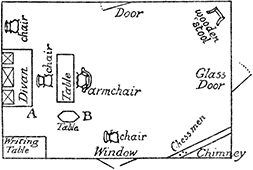
“M. Meurice and I had been writing (correcting
proof sheets) on the hexagonal table. M. Meurice was
sitting on the edge A of the divan, I was at B opposite
him, when raps were heard on the writing-table—with
which M. Meurice had no contact. I measured a
distance of two feet between him and the writing-table.
At the same time, raps in quantity, but of feeble tonality,
resounded on the hexagonal table.
“We removed our writing materials on to the rectangular
table, for the sake of more room. The raps gradually
ceased; they died out altogether on the writing-table and
began, though very feebly, to resound on the rectangular
table. We worked for an hour and then rested a while.
M. Meurice sat back on the couch, putting one of his
feet on the chair between the divan and the table. Raps
immediately resounded on the chair. I went and sat
down beside my friend, and observed that the raps
appeared to come from his foot; I found that they were
synchronous with our movements; they also responded
correctly to my mental and spoken request.
“I left the couch and sat on the armchair in front of
the rectangular table. M. Meurice drew his legs under
him and sat on the divan, tailor-fashion. We decided
to try to move the gilt chair standing between the divan
and the table. There was a space of fourteen inches
between the divan and the chair. I sat on the armchair.
M. Meurice brought his hands towards the chair, palms
facing the chair; he kept his hands still at a distance of
seven to eight inches from the back of the chair; I stretched
out my arms above the table towards the chair. When I
contracted my muscles, the arms and hands extended, the
chair moved. The amplitude of the movement was very
small, scarcely a quarter of an inch, but the movement
was abrupt and decided. It was a jerk, which took place
shortly after the muscular contraction.
“This movement was reproduced three times under the
same conditions.
“Then M. Meurice and I changed places. I sat on the
couch in the same way as he had sat; M. Meurice
made the same movements I had made. The chair
moved twice; the amplitude of the movement was much
greater than with me; the chair was displaced an inch
each time. After the second movement was produced,
M. Meurice said he felt tired; he lifted his arms above
his head and stretched himself; that is to say, he pulled
himself upwards; his feet did not go near the table.
While stretching himself, the chair suddenly—for the
third time—displaced itself a distance of an inch. The
latter movement coincided with the extension of the
back, at the moment when the muscles of the grooves
and lombo-sacré contracted.
“The direction of these movements was from the table
towards the couch; the chair receded from the table,
whether M. Meurice or I sat on the couch.
“Seeing how easily these movements without contact
were being obtained, we went downstairs into the dining-room
with the object of trying to obtain some phenomena,
which M. Meurice had obtained when alone the
previous day; namely, the attraction of wine-glasses.
“I took a liqueur-glass, and put it on the mantelpiece
in the dining-room. M. Meurice made some passes
around the glass, then put his two hands together
meeting them at the finger-tips; he drew his hands
slowly away, the glass followed his hands by jerks.
“We then returned to the study. I sat down
on the divan and prepared to resume my writing.
M. Meurice was standing near the mantelpiece. In a
few minutes I heard him say he was attracting the chessmen.
I got up and watched carefully. His hands were
in the position described above in connection with the
liqueur-glass; he drew his hands slowly backwards,
and the red king followed his hands; this tiny piece
is about half an inch in height and a quarter of an inch
in diameter. The movement was slow and gliding.
M. Meurice tried to reproduce the phenomena but
failed. He said he was tired and would rest a while.
In a few minutes he renewed his efforts. I stood
close beside him; again failure. After a few more
minutes of rest, he tried again—I watching him closely
all the while—and, this time, succeeded in attracting
the same piece—the red king. The piece followed
the direction of his fingers, as before, slowly and
smoothly.
“M. Meurice again complained of feeling tired, and
I urged him not to try for any more phenomena, but
to lie down and rest. I went to my writing once more,
but M. Meurice was restless, and told me he wanted to
try to move an empty beer-bottle, which was standing
on the mantelpiece.
“He took it from the mantelpiece and put it on
the wooden stool. He knelt down in front of the
stool, and made the same manœuvres with his hands
as for the liqueur-glass and the chessman. I remained
sitting on the divan, a distance of nearly seven feet from
the stool. M. Meurice, after the above-mentioned
manœuvres, i.e. passing his hands several times round
the bottle, joined his hands together at the finger-tips,
and drew them gently backwards as before. The bottle
moved four times, each time from two to three inches.
“M. Meurice then said he felt sea-sick; and he was
obliged to lie down for a while. He soon rose up,
however, and said he wanted to make something else
move. He took a piece of sealing-wax, tried several
times, but failed to move it. Thereupon I persuaded
him to cease making further attempts.”
“26th July.
“Phenomena of attraction similar to yesterday, occurred
this afternoon. We were in M. Meurice’s bedroom. It
was four o’clock, the window was open, the shutters were
ajar; the light was excellent.
“The mantelpiece is covered with plush. On one
corner there is a statuette in porcelain representing the
Thorn; the child is seated on a chair, and is pulling
a thorn out of his foot; the statuette is five inches
high. M. Meurice told me that he was going to
make this statuette move. I stood near him, with
one hand on his back; I stooped down, and looked
fixedly and narrowly at the statuette during the whole
operation. M. Meurice proceeded exactly as in the
preceding experiments, and when his hands—joined
together at the finger-tips—were at a distance of six
inches from the statuette, the latter swayed, bent slowly
forward, and fell over. I affirm most positively, that
there was no hair or thread or normal link of any
kind whatsoever between the statuette and the medium’s
hands. I passed my hand all round the statuette, before
the movement, during the movement, and after the
movement; I thus verified by touch, what my eyes
were witnessing.
“Now, after M. Meurice had made some passes with
his hands around the statuette (without touching it, be
it remembered), and when, after putting his hands
together at the finger-tips, he slowly withdrew them,
I heard a slight noise, like the rubbing of a hair on
the statuette; at the same time the latter swayed; this
creaking sound did not continue, and only accompanied
the first movements of the statuette. Again I affirm,
that there was no hair or thread whatsoever connecting
the medium’s hands with the statuette.
“After the production of this phenomenon, we decided
to have a dark seance, for the purpose of trying to
obtain luminous phenomena. I closed the shutters and
pulled down a dark blind, especially constructed for
dark seances. While I was doing this, M. Meurice
continued trying to attract various articles on the
chimney-piece. Seeing this I drew the dark blind
away again and let in more light, in order to be able
to see clearly. I took a stick of sealing-wax, broke
off a piece and put it on a small mirror, which
was lying on the mantelpiece. In this case M. Meurice
did not make any preliminary passes as with the
statuette, beer-bottle and liqueur-glass; he simply
joined his hands together in front of the sealing-wax;
the sealing-wax followed his hands several times, in
fact every backward movement drew the wax after the
hands; he finally drew the sealing-wax to the edge of
the mantelpiece, when it fell to the floor.
“The seance which followed was unproductive. A few
raps were heard, but that was all. After the seance, we
lighted up the room, opened the window, and M. Meurice
again tried to move the sealing-wax. He succeeded with
great facility, the sealing-wax following every movement
of his fingers.
“By sight and touch, I assured myself of the absence
of any link between the wax and M. Meurice’s hands.
I solemnly affirm that no such link of any kind existed.
“I desired to write a letter, and, thinking that the
phenomena were probably exhausted for the time being,
I begged M. Meurice to allow me to get off my letter.
I was in the act of writing, when he said he felt he
could move another article. I watched him: he took
up another statuette, which stands a foot high; he put
this statuette on a small table which was near me; he
kept his hands open, palms turned towards the object
in question. He moved his hands slowly backwards
and forwards, and I observed the statuette bend forward
when his hands receded, and bend backwards when his
hands approached it. His hands were never nearer than
ten inches to the object.
“M. Meurice then complained of feeling unwell, and
threw himself on his bed. His hands touched the head
of the bed, on the woodwork of which raps at once
resounded. Chappe gave his signal, and dictated:
‘B. MENAGEZ.’ Questioned as to what he meant, he
said to take care of the medium, and not to take
advantage of the power. We ceased experimenting,
therefore.
“I have a few remarks to make concerning the
above phenomena. When I held my friend’s hands,
I obtained nothing. M. Meurice says he saw a
thread, or rather a sheath of filaments, pass from his
fingers on to the object of experimentation. As a rule,
he made passes over the object he wished to move, as
though he were putting a thread of some kind around
it. He did not always do this, e.g. if the object to
be moved were light and small, he made no passes
over it.
“This movement would be very suspicious, if observation
were superficial; but apart from the purely scientific
spirit in which M. Meurice views his own phenomena,
the severe control I exercised demonstrated the absence
of any material link whatever.”
More Extracts from Dr. Maxwell’s Notes
“3rd June 1903.
“A movement without contact was forthcoming this
afternoon. I placed a table upside down upon a linen
sheet. M. Meurice and I put our hands on the sheet,
some distance away from the table. The latter turned
completely over; the movement was performed slowly
and gently. It was at four o’clock, the sunlight was
streaming in through the open window.
“We also obtained the movement of a heavy wooden
stool with slight contact. M. Meurice and I were
sitting on a couch, the stool was near us; abundant
raps were heard on the stool. M. Meurice took up a
piece of linen, put one end on the stool, putting a framed
picture on top of it to keep it in place; he put the other
end on his knees. In a few minutes, the stool swayed
about and finally moved a distance of three inches away
from M. Meurice. I watched him well and can affirm
he moved neither hand nor foot during the production
of this phenomena.
“M. Meurice experienced much fatigue after this
movement. It occurred at half-past four; the light, I
repeat, was excellent.”
“11th June 1903.
“It appears that M. Meurice attracted several objects—pieces
of bread, forks, etc.—yesterday during lunch.
But he could not reproduce the phenomena in my
presence. We had, however, raps and numerous slight
movements without contact—raps almost ad libitum.
Automatic writing followed, but contained nothing of
interest; it was impossible to obtain replies to mental
questions: subjectivity.
“P.S.—I am adding a postscript to my letter from the
medium’s house; for we have just received some fine
phenomena. The raps were, as usual, very abundant;
but we also received two fine series of parakinetic
movements.
“1. I brought a small mahogany table up to the sofa
on which M. Meurice had thrown himself. I sat down
beside him, taking a shawl which I threw over him
and the table. Instantly, raps resounded on the table.
M. Meurice could not possibly have touched the table
without my noticing it.
“The table swayed about, now on this side, now on
that; and then dragged itself towards me by jerks, first
one side, then the other. When I squeezed M. Meurice’s
hand or gave him a slight tap on the shoulder, there was
a synchronous movement in the table. The latter also
moved in response to request. Then it gently raised
itself up on the two feet which were nearest to me; this
side lost contact with the floor and rose to a height of
four inches.
“2. We were both carefully watching this interesting
phenomenon, when I heard raps on another table which
was about a foot away from the sofa and two feet away
from the table with which we were experimenting.
This second table had no contact whatsoever either with
the sofa or with the shawl: it was isolated. Hearing
the raps, I looked at the table and saw it rise up, or to
be more correct, sway about—only three of its legs
touching the ground. M. Meurice had not noticed
this phenomenon; when I drew his attention to it, he
became suddenly nervous, and complained of feeling
tired. I pointed out to him how much this sensation of
fatigue was subjective and out of all proportion with the
energy expended. But new or unexpected phenomena
always upset him; he experiences a sort of anguish
blended with something like fear in presence of a new
phenomenon.
“These movements of the second table lasted for
several minutes; they were synchronous with our own
movements and muscular contractions, but were also
forthcoming at request. We were operating in broad
daylight. Chappe informed us, by raps, that he was
the operator on this occasion.”
“11th July 1904.
“I was obliged to make an early call on our medium
this morning. Lucky visit! for he was in a working
mood and gave two fine movements without contact.
We began by sitting at a table, where we received raps
by means of the lead-pencil; the words: Put yourselves
against the daylight were rapped out. We did not
understand what this meant, and ceased experimenting.
We went downstairs and walked about in the garden for
a few minutes. When we went back to the study, we
resumed our seance. M. Meurice sat down on the
divan and I in front of him. Raps without contact
dictated: Lie down for a while, we want to try for a
physical effect.
“The raps directed that I was to lie down on the sofa
and M. Meurice was to take my place. We followed
these directions.
“M. Meurice said he felt ‘queer’; that his hands
seemed to be full of hair, or rather of spider’s web, and
he tried to rub the feeling away. I got up and took
down from the mantelpiece the statuette of St. John,
the history of which you know.[29] He tried to attract it,
but without results. We waited, the spider’s web sensation
returned, and this time I prevented him from rubbing
it off; he drew his hands together over and then in front
of the statuette and—his fingers at a distance of five
inches from the object—attracted it to him. The
statuette moved two inches.
“M. Meurice felt ill after this movement, and was
obliged to lie down for a while. He soon got up, and
tried again. But I stopped him, fearing he might over-tire
himself; though the statuette did not move forward
this time, it swayed about.”
“18th July 1904.
“On Thursday morning, M. Meurice again succeeded
in attracting the statuette of St. John. He told me he
felt the cobwebby sensation, which—in his case—coincides
with telekinetic phenomena; he took the statuette
in question and placed it on a table. He then proceeded
as though he were putting something behind the
object, making several passes with his hands all round
it. As he was drawing his hands away from the statuette—they
had reached a distance of nine inches—I heard
something like the crackling of a hair or silken thread on
the wood of the statuette, and then the latter moved.
“The excellent conditions of light under which the
experiment took place, the control of sight and touch
which I most carefully exercised, the proximity of the
statuette to my eyes, all this renders the absence of any
hair or thread most certain for me. This is the second
time I have heard this scraping sound.
“M. Meurice was extremely fatigued after the production
of this phenomenon, and fainted. On recovering
himself, he insisted on trying once more, and succeeded
in making the statuette sway about.
“The day following this experience, he attracted
several small articles—wine-glasses, bread, etc.—near his
reach on the luncheon-table. I was not present, however.
“You perceive how very suspicious the phenomena
sometimes appear to be. Nothing short of actual observation
could demonstrate the absence of a connecting
link of some kind between the medium’s hands and
the object in movement.”
“For about eighteen months, Dr. Maxwell has been
endeavouring to turn the phenomena in the direction of
luminosities or materialisations.
“With that object in view, he has had a light portable
cabinet constructed. This fragile apparatus consists of
eight pieces of pinewood fitting into one another by
means of hooks. When put together, there is just
enough space inside the cabinet to allow of the introduction
of a small, straight-backed chair; a person sitting
thereon, finds himself in contact with the back and sides
of the cabinet, and his knees against the door. A large
curtain of purple cloth has been made, which is thrown
over the cabinet, covering it completely. The curtain is
buttoned over the door.
“The luminous phenomena already obtained with this
medium and spoken of by Dr. Maxwell on pages 152-5,
were sufficient grounds for hoping that patience and
perseverance might, finally, obtain happy results capable
of being repeated.
“For more than a year nothing demonstratively
objective was forthcoming. In the darkness, one often
imagined one could see clouds of vapour moving about
near the cabinet; but there was nothing to prove that
this appearance was anything more than an optical
illusion. On these occasions, the medium frequently
complained of a disagreeable sensation on his hands
and face, as though he were caught in a spider’s web.
He has also said, that he perceived from time to time
an odour of phosphorus or ozone in the cabinet; the
medium has been the only one of the experimenters to
notice this odour, so far.
“Whenever I have been present at these attempts,
I have observed that they were accompanied by complete
cessation of all other phenomena, such as visions, raps,
telekinesis. Until November 1904, this apparently
negative result was about all that was obtained at these
dark seances.
“During the first week in November, the medium
being in good form, and the ‘force’ abundant, it was
decided to devote a few days, which Professor Richet
was able to dispose of, to an effort to obtain luminous
phenomena.
“Three seances in all were held. There were present,
Professor Richet, Dr. Maxwell, M. Meurice, and myself.
The seances were held in a very small room on the top
floor of the medium’s house.
“The following is a diagram showing the disposition of
the room in which the three seances, of which I am
giving the compte rendu, took place.
“The door, which was shut, leads into another room,
the two doors of which—leading into a corridor—were
locked during the experiment. The window and
shutters of this adjoining room were closed, and the
room darkened, so that no light therefrom could penetrate
under the door of the seance-room.
“The seances were held between 5 and 6.30 o’clock in
the afternoon. Total darkness was obtained by closing
the outside shutters and the window, and by hanging a
large black curtain—kept for the purpose—across the
window. No ray of light was visible on the sides of the
window; the position of the latter could be guessed at
during the seance—simply because we knew where it
was—but could not be perceived. The darkness was
profound. A candle and box of matches were placed on
table A. When the experimenters were seated, the
candle was blown out.
“Results.—Tuesday, 1st November 1904. The four
experimenters were seated around the table (see
diagram); the medium (who is not marked on the
diagram, because he was in the cabinet whenever
phenomena were forthcoming) was seated between Dr.
Maxwell (M) and Professor Richet (R), with his back
to the cabinet: No results—nothing whatever—neither
raps nor anything else.
“The medium goes into the cabinet. After an interval
of a quarter of an hour, M and X think they see milky-looking
clouds floating about near the cabinet, but they
are unable to affirm the objectivity of this appearance.
At the close of the seance, feeble raps are heard on the
table; the raps dictate that Professor Richet is to sit in
the cabinet on the following day.”
......
Second Seance
“Wednesday, 2nd November 1904.
“Professor Richet sits in the cabinet. The medium
sits at the spot marked M on the diagram; Dr.
Maxwell sits at R. After sitting in this way for a
quarter of an hour—during which time nothing occurred—the
medium asked to be allowed to go into the
cabinet. Professor Richet then sits at R, and Dr.
Maxwell at M. Almost immediately M and X see a
phosphorescent, milky-looking, amorphous light, of about
six inches in diameter in parts, floating about outside
the door of the cabinet. It was decidedly objective,
lasted for about one minute, and gradually disappeared.
“R did not see the light.
“[From an experiment made on the following day, we
have all three reason to believe, that Professor Richet
did not see the luminosities at this seance because of
his position. Let it be borne in mind that X was in
direct line of vision with the door of the cabinet, and
that M was also favourably placed for observation.
These facts did not strike us until the seance was over,
and R’s inability to see what M and X affirmed were
objective lights was incomprehensible at the time
being.]
“When the medium took Professor Richet’s place in
the cabinet, he said the latter appeared to him to be all
lighted up; when Dr. Maxwell and I saw the light
outside the cabinet, the medium declared he was in utter
darkness. During the production of this phenomenon,
M. Meurice was heard to breathe heavily; he said he did
not know why he felt obliged to do this; he complained
of feeling suddenly very cold; at the same time, a cold
perspiration broke out on his forehead. He also said
that he felt the need of stretching himself and yawning.
“An interval of ten minutes now passed. Then M
and X saw an amorphous luminosity gradually form in
front of the cabinet, and make slight movements in the
direction of the table at which the experimenters were
sitting. M, by the light of this luminosity, sees the
curtain slowly open, and close again as the light
disappears.
“R sees nothing definite. He thinks he sees a cloud-like
substance, but is not sure of its objectivity (because
of his position?).
“As in the case of the first luminosity, so for this
second one, M. Meurice declares that the cabinet is
lighted up within, becoming dark when M and X see the
light. He has the same sensations of cold. In addition,
he says he feels tired, and asks to be allowed to discontinue
the seance.
“No odour of phosphorus was perceptible, although
the lights we observed had something of a phosphorescent
appearance; but I think it would be more
correct were I to compare what I saw on this occasion
with the Milky Way; in fact, these luminosities presented
an appearance almost exactly similar to that
presented by the Orion nebulæ, when seen through the
telescope.
“The medium looked pale and tired, when we closed
the seance, but he quickly recovered his vitality, and
during dinner—scarcely an hour later—some fine telekinetic
movements of a heavy walnut dining-table were
forthcoming in, of course, full light. Seeing the table
move, apparently of its own accord, we joined hands
two feet above the table, and succeeded in making it
follow the direction our hands took: now an inch
to the right, now three inches to the left, etc.; we had,
finally, a strong, rotatory movement of six inches. The
medium’s knees and feet were under Professor Richet’s
observation, while these movements were being
produced.”
Third Seance
“Thursday, 3rd November 1904.
“For this seance, because of Professor Richet’s inability
to see the lights, which were visible to M and X at the
preceding seance, the experimenters change their places,
and sit in the following manner:—
“Professor Richet goes into the cabinet at the medium’s
request, the latter takes R’s place at the table. After
an interval of ten minutes, the medium goes into the
cabinet and R takes his new place at the table.
“Almost immediately, lights are seen moving about on
the door of the cabinet. R, M, and X all see these
lights. M does not see the first two lights, which R
and X mention seeing. He moves closer to R, and
then sees distinctly. R has the impression that a ray of
light from twelve to eighteen inches long, and varying
from one to three inches wide, is placed at the opening
in the curtains; he thinks he sees the curtains held open,
so to say, by the light.
“The ray of light appears broader to X than to R and
M. X says he distinctly sees the curtains move, and
open; he has the same impression as R, namely that of
the light holding the curtains apart.
“This luminous ray was shown six times, at intervals
of a few seconds only. Its duration varied from ten
seconds to a minute. In form, it was constantly
changing, though the long ray remained. R, M, and X
had the impression that the luminosity was forming
around the ray. A long, vertical streak of light was
shown first of all; the succeeding lights appeared to be
built up around this ray, which always remained the centre
of luminosity; i.e. the light, strong in the centre, died
away to right and left, leaving no distinct outline to
the luminosity which, besides being amorphous, was
extremely mobile, though in a sense, fairly stationary.
R, M, and X saw slight differences in the shape of the
lights, a fact which was perhaps due to their relative
positions; but all three agreed as to the vertical ray
and the general shape the luminosity appeared to be
assuming.
“From time to time, M. Meurice complained of an
oppressive, suffocating sensation, and said that he felt he
must open the curtains, for a few seconds. Whenever
he opened the curtains, no lights were visible. M and
X took hold of his hands when he opened the curtains,
and closed the latter themselves, when M. Meurice said
he felt better.
“At this seance, as before, the medium prepared us
for each phenomenon, by announcing beforehand, that
his cabinet was suddenly illuminated, and as suddenly
darkened; the darkness inside corresponded to a
luminosity outside the cabinet.
“The six lights above mentioned were very distinct,
and very luminous (phosphorescent).
“The phenomena ceased for a few minutes. M.
Meurice then asked to be allowed to change places with
X. This is done; X remains a quarter of an hour in the
cabinet, during which time M. Meurice says he sees an
oval-shaped light, about three times the size of an egg,
floating about on the curtains of the cabinet. R and M
see nothing. The medium returns to the cabinet, and X
resumes his seat. Immediately, large triangular-shaped
luminosities are seen by M and R outside the cabinet.
X has suddenly fallen asleep.
“M and R then see very mobile, amorphous lights,
varying from three to nine inches in diameter, floating
about X’s head for a few seconds; their luminosity
is less great than that of the lights seen on the
curtains, but is sufficiently pronounced to light up X’s
forehead.
“The phenomena again cease. X awakens. M.
Meurice asks Dr. Maxwell to change places with him.
The doctor remains in the cabinet for ten minutes: no
phenomena; M. Meurice returns to the cabinet, and M
resumes his place at Professor Richet’s left.
“Very quickly, the same phenomena as before occur.
The luminous ray assumes a broad, oval-shaped appearance;
it measures about ten or twelve inches by about
fifteen inches; it advances a few inches towards the table,
and then disappears, to show itself, a few seconds later,
larger, rounder in shape, and more brilliant. M and X
think they can distinguish the outlines of a human face
in this luminosity, but R says it appears amorphous to
him.
“Shortly after this, M and X see a faintly luminous ball
of about six inches in diameter, form outside the cabinet,—on
the curtain—approach and float over the table above
the experimenters’ hands. R sees this also, but compares
it to a luminous fog. R cannot affirm the correctness of
his last perception.
“Thereupon the seance terminated.
“During the production of these phenomena, M.
Meurice complained of excessive cold; we heard him
shivering, and his teeth chattering. He yawned frequently,
and stretched himself repeatedly; he breathed
heavily, and constantly complained of feelings of oppression
and sea-sickness.
“When the seance was over, he complained of intense
thirst and drank several glasses of water.
“The weather on these three days was very fine, dry,
and fresh.
“The conclusions arrived at by those who were present
at these three seances, are:—
“1. That the above-described luminosities were decidedly
objective.
“2. That no oversight, no error of observation can
explain them.”
The above compte rendu was drawn up by Professor
Richet, Dr. Maxwell and Dr. X. at the end of the
seances.
The reader will, perhaps, kindly forgive a few probably
uninteresting but necessary details, before we
enter upon the last series of these psycho-physical
phenomena.
Many reasons, chiefly of a family nature, have rendered
a substitution of names imperative. In other respects,
and as far as the phenomena themselves are concerned,
this series, like the foregoing, adheres most strictly to
the facts as they occurred.
Early in 1903 a gentleman, whom we will call Mr.
Stephens, a man occupying a high official position in
Europe, wished to marry a young Swedish girl. Mr.
Stephens’s parents having, it appears, made other matrimonial
arrangements for their son, were most strongly
opposed to his wishes. Mr. Stephens decided to follow
his own inclinations, and was quietly married to Miss
Marie H. in the beginning of the year 1903. He did
not inform his family of the step he had taken, trusting
to time and events for the strained relations between
himself and his people to disappear.
A short time after his marriage, he received a peremptory
call to a foreign country. It was impossible for his
wife to accompany him, for three excellent reasons:
1. Mr. Stephens was not supposed to have a wife. 2. The
spot he was ordered to is not a spot for a woman to visit—not
being as yet civilised in the European sense of the
word. 3. Mrs. Stephens had reason to believe she might
become a mother. Moreover, Mr. Stephens did not
anticipate a longer absence than that of six months.
Mr. and Mrs. Stephens had passed the interval
between their marriage and the former’s departure for
abroad in Paris. They lived very quietly, and had
trusted their secret to no one. In the dilemma into
which this foreign mission plunged them, Mr. Stephens
decided to make a confidant of a particular friend, certain
as he was that his secret would be in safe custody. This
friend was Professor Richet.
......
Dr. X. writes:—“Mr. Stephens was anxious not to
leave his wife alone in Paris, during his absence, and
knowing that Professor Richet intended making a long
series of experiments with Dr. Maxwell at W., he
decided, for diverse reasons, to send his wife to the
same locality. Thus it came about that Mrs. Stephens
was invited by Professor Richet to join the investigating
circle, a circle which it had been intended should be
strictly limited to Dr. Maxwell, Professor Richet, the
medium [M. Meurice] and myself. No one, save
Professor Richet, knew of the foregoing details.
“When Mrs. Stephens arrived—her husband came with
her, but only remained a couple of days—we saw a tall,
slight, fair woman of twenty-two or twenty-three years
of age,—a quiet, gentle, refined-looking woman. As
she was, curiously enough, a spiritist, and even possessed
‘intuitive’ faculties of a pretty marked character,—she
had had several veridical hallucinations, and occasionally
indulged in spectrum gazing with fair results—her
addition to the circle was looked upon by the other
three members as having been decided by Professor
Richet, because of her nascent psychical powers. No suspicion
of her situation—of which even Mrs. Stephens herself
was as yet uncertain—ever dawned across our minds.
She was an early riser, a good walker, and apparently
enjoyed the best of health. The most practical medical
eye could have detected nothing abnormal in her health.
“Very much had been expected from this particular
series of experiments; but, for reasons which are beyond
our comprehension, comparatively little was received.
There was every evidence of abundant force, and the
medium was, at times, almost unnerved by our systematic
lack of success.
“Throughout the whole of this particular series, more
than ever did the agency manipulating the energy act
like an independent intelligence, giving striking evidence
of power when it cared to do so and, when not disposed
to communicate, shutting off all communication most
decidedly and completely.”
We propose setting forth succinctly, but in detail, the
results, both mediocre and superior—and just as they
occurred—of these few weeks of experimentation, leaving
it to the reader to bestow an acute analysis upon them in
his own guise. It was only as the time allotted this series
drew to a close, that the phenomena took a personal turn,
and bore so directly, and so intimately, upon Mrs.
Stephens’s life.
The notes which are quoted in this series by Dr. X.
are, without exception, Professor Richet’s.
......
First Seance. Time 8 to 10.30 p.m.
“Before sitting down,” continues Dr. X., “Dr.
Maxwell had placed on the table a small cardboard box,
in which were two amethyst crystal balls.
“The small table was six inches away from M. Meurice,
and three inches away from Professor Richet. Contact
had been purposely established between the two tables by
means of a small white cloth—which did not interfere
in any way with the control of eyesight. A bright,
electric light was burning.
“Several visions were described; they offered little
interest. Then the small table moved abruptly; it
approached the seance table in jerks, covering, in this
manner, a distance of two and a half inches. It was verified
that no contact whatever existed, save that with the
white cloth; the latter was not touched by M. Meurice.
Then for nearly an hour there was complete cessation of
all phenomena, with the exception of perpetual rapping
without intelligence. Thinking nothing more would be
forthcoming, Dr. Maxwell and Professor Richet rose from
the table, and went out on to the balcony of the room in
which the seance was being held. Mrs. Stephens, the
medium, and I remained at the table. I asked M. Meurice
how he proceeded when he wished to attract articles—up
to that moment I had not witnessed this interesting
phenomenon. He replied, ‘I have an odd sensation in
my fingers, and I do this’—accompanying his words by
certain hand movements; that is, he drew his hands
together in front of and quite close to the cardboard
box still lying on the table; he withdrew his hands—joined
together at the finger-tips—very slowly, and,
when the tips of his fingers were at a distance of
six inches from the box, the latter began to move. It
moved slowly and smoothly, without any jerking whatsoever,
exactly as though it were being dragged across
the table by a cord. I thought I perceived a tiny
ray of light—something like a dewy spider’s web
with the sunlight gleaming through it—connecting M.
Meurice’s fingers with the box, but this was probably
an illusion, as there was nothing palpable to the touch.
I passed my hands around the box, and all over the
medium’s hands and arms, but there was no thread of
any kind whatever. M. Meurice said he had not seen
the box move, though I observed he appeared to be
gazing fixedly at it during the operation, and though
the box travelled a distance of six inches.
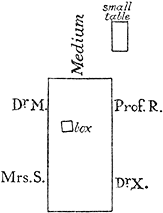
“Without leaving my seat I called in Dr. Maxwell
and Professor Richet, and told them what had happened.
M. Meurice was asked to try again, while Professor
Richet put out some of the lights, thinking thus to help
the force, which might have been too severely tried by
its last efforts. I take the following extract from Professor
Richet’s notes:—
“‘The same phenomenon was reproduced in my presence,
but with less light—quite sufficient, however, to see
everything, and every movement distinctly. The box,
slowly and without any apparent jerking, followed the
medium’s fingers. I saw the box slowly displace itself,
and drag itself over the plush-covered table, for a
distance of nearly five inches. There was absolutely
no contact of any kind whatsoever, either mediate or
immediate. A strong gastric attack, quickly over,
seized the medium after this experience.’[30]
“On resuming the seance the raps were asked, ‘Who
is rapping?’
“Reply: ‘Antion.’ ‘Is it Antoine?’
“Reply: ‘Yes, Antoine Br.’ We arrested the communication
at the letter r, understanding it to mean
Antoine B. of A Complex Case, p. 214. The raps then
predicted the death of Madame B.’s second husband to
take place in March 1904.”
[This premonition was not realised. The gentleman
in question is in remarkably good health to-day,
April 1905; but, at that time, Professor Richet
was anxious about him. Dr. L. was utterly prostrated
by the sudden death of his wife Madame B.
Neither Dr. Maxwell nor the medium knew that
Antoine B.’s widow had married a second time; nor
were they aware of Professor Richet’s anxiety concerning
Dr. L.’s health.[31]—Note by the Translator.]
“The communicating intelligence, purporting to be
Antoine B., was then asked: ‘What was the nature
of Madame B.’s illness?’ Reply: ‘Ness, foie.’ (The
doctors who attended Madame B. when she died have
not been able to agree as to what the malady was, though
they think it was probably of a tubercular nature.)
“We asked Antoine B. for another sign of identity,
and received the word ‘Carlos.’ (Professor Richet considers
it highly probable that every one present knew that
Antoine B. called him by that name.)
“‘When the raps dictated the name of Antoine B., the
medium said he saw standing near me a young man of
about thirty years of age; he had very soft blue eyes,
and a short pointed beard. As far as it goes, this applies
to my friend Antoine B.’, says Professor Richet.
......
“This first seance gave some fair results. We were
now destined to pass several weeks without receiving
a single phenomenon worth mentioning. We cannot
account for this; though Dr. Maxwell is inclined to
think, that the energy was spent in efforts made to obtain
psychic photographs. The weather was excellent, every
one was in good, even exuberant, health and spirits;
the circle was very homogeneous; no a priori conditions
had been laid down. Great things had been promised,
but the great things were not forthcoming; and the
‘force’ did not deign to explain why, though it gave
occasional signs of being to the fore, and ready to work
if it cared to do so. For example, it would rap out as
many airs and rhythms as requested, but took refuge in
complete silence, or disorder, or pleaded fatigue, if asked
for telekinetic phenomena or intelligent messages. It
acted like a lazy child asked to accomplish a possible
but difficult task.
......
“Photography was tried, but without success. On one
of these occasions, when M. Meurice was re-entering his
room after having sat for photography, he heard footsteps
beside him, and had the vision of a form which
interposed itself between himself and the door, as though
desirous of preventing him from entering his room.
He heard the words: ‘Pardon, je n’ai qu’un moment,
vous avez déjà entendu parler de moi; je suis Antoine.
Je viens voir mon fils.’ ... He then perceived the
form of an old man, clean-shaven save for short
whiskers; he was wearing the crimson robe of a
magistrate. The hallucination quickly disappeared.
“No one, save Professor Richet, knew that this day was
the anniversary of the death of his maternal grandfather,
whose father’s name happened to be Antoine. But we
were all aware that Professor Richet had received various
communications purporting to emanate from these two
ancestors of his. It was also known that his grandfather
had presided over the law-courts at Paris.
......
“On one occasion, we had all five made an excursion
into the country: and here I quote from Professor
Richet’s notes:—‘Coming home—it was moonlight,
and still twilight—we got down from the carriage—a
private omnibus—to walk a while. Dr. Maxwell and
M. Meurice lagged behind, and Dr. X., Mrs. S., and I
got into the carriage again, before they had caught us up.
As she was stepping in, Mrs. S. told me she felt as
though a woman were running behind her, and were
helping her into the carriage; seated, Mrs. S. continued
to perceive this vision; it was wearing a hood on its
head, and a cross on its breast; the vision bent its head
over Mrs. S.’s hand, pressing its teeth on it “as though
to show she had died in agony, stabbed to death,” said
Mrs. S. When Dr. Maxwell and M. Meurice rejoined
us, the former told me, in an undertone, that M. Meurice
had just had a vision of a woman running behind Mrs. S.;
the vision was wearing a hood on its head. M. Meurice
and Mrs. S. continued to see this vision for above five
minutes longer, when they both saw it disappear into a
clump of trees. M. Meurice and Mrs. S. communicated
their impressions to Dr. Maxwell and myself
respectively.
“‘A few minutes afterwards, they both had another
simultaneous vision. Mrs. S. saw a man astride one of
the carriage-horses; M. Meurice, with an identical description
of dress, saw a man not seated on, but running
beside, the same horse holding the reins. He thought it
was Chappe. Then everything disappeared.
“‘Neither visionary communicated their impressions
to the other.’
......
“Exception made of the attractions of the box and
table, the foregoing results will probably be considered
as demonstrative of nothing in particular. We were
now to receive something more interesting.
“Let it be said, en passant, that Mrs. Stephens never
once saw the medium alone. There had not been
the slightest break in her reserve. And all, save
Professor Richet and herself, continued to think she had
been invited by Professor Richet solely because of her
psychical powers. M. Meurice sometimes remarked,
seeking a reason for the inexplicable failure of the
experiments, that he believed the cause lay in a super-abundance
of power, that the psychic force was too
great, that Mrs. S. gave forth too much power, etc.
“Now, early one morning, three weeks after we had
begun this series, Mrs. Stephens remarked to Professor
Richet that [I again quote from Professor Richet’s
notes] ‘during the night she had been thinking a great
deal about the Christ, and had said to herself, if the
spirits of the deceased can appear to man, why not
the Christ? And she said she had asked for a sign to
be given her that this could be. Mrs. Stephens had
scarcely pronounced these words, when Dr. Maxwell
came into the sitting-room and said: “I have just seen
M. Meurice, he had a vision while I was conversing with
him. He said he perceived the form of a man with
short hair and beard; a halo of light behind him, a circle
of gold on his head; he was dressed in white; M. Meurice
says it was the Christ. With an imperious air, the form
showed him a thick yellow manuscript—a papyrus—covered
with writing. As M. Meurice was trying to
decipher the characters for me, the vision disappeared.
M. Meurice was suddenly exhausted, and had a fit of
weeping before recovering his normal condition.”
“‘A few mornings afterwards the medium had another
vision. This time it was Chappe who came, it appears,
to tell him that it was not the Christ whom he had seen,
but a Christ.’[32]
......
“I must pause a while. It seems that Mrs. Stephens
did not care about returning to Paris during her husband’s
absence; and—in the event of her hopes being well
founded—had expressed to Professor Richet her great
desire of passing the rest of the year near Biarritz, a
place for which she had a great liking. She begged
Professor Richet to write for her to a house agent to
procure her a villa in that town. It seems also, that
Mrs. Stephens—though her manner had never betrayed
this—had taken a fancy to the medium and his family;
one of his sisters is an experienced hospital nurse, and
Mrs. Stephens was wondering—in quiet conversation
with Professor Richet only—if it would be possible to
persuade her to come and live with her at Biarritz.
Upon this conversation Professor Richet obtained the
address of an agent, and wrote to him according to
Mrs. Stephens’s wishes. He showed the letter to Mrs.
Stephens. The latter said [again I quote from Professor
Richet’s notes]: ‘Since I spoke to you about Biarritz,
Chappe has told me something. He wants me to go
to Bordeaux. Do not post that letter yet, let me wait
a little while; if my intuition be correct, if the idea
of Bordeaux really came from the spirits, they are quite
capable of finding a way of indicating it to M. Meurice
and Dr. Maxwell. I do not wish to speak of it myself
to M. Meurice; this must come from the spirits
themselves....’
“[We are endeavouring to give a faithful account of
what actually occurred, and beg to be forgiven the
unscientific language, which is occasionally unavoidable,
if we are to convey a correct notion of the physiognomy
of the phenomena.]
“Now the morning (a Thursday) following the day on
which the above conversation had taken place, Mrs.
Stephens came to Professor Richet, and told him she had
passed a very strange and perturbed night. She said
that, towards eleven o’clock, she was suddenly awakened
by a sensation that some one was in her room; she was
filled with fear. She turned on the light, but saw
nothing. She kept the light burning, but still felt
unaccountably frightened. She heard raps on the head
of her bed. Gradually her fear quieted down, and she
said she began to feel as though there were a host of
spirits in her room, and a Great Presence was among
them. ‘And she imagined,’ writes Professor Richet,
‘that a voice spoke to her in these terms: “A powerful
spirit is here, be not afraid; it is the child’s guide; your
child will be a boy; he has a great destiny before him, he
will be a reformer. We counsel you not to force his
inclinations, to choose no career for him, but to let yourself
be guided by the child himself, when the time comes
to think of his education.”
“‘Mrs. Stephens was still speaking of her night’s
experience, when Dr. Maxwell came into the room, and
handed me,’ continues Professor Richet, ‘some verses
which, he said, had just been written by M. Meurice—a
kind of quasi-automatism—in a state of semi-somnolence.
He could not understand what it meant, and simply
stated the fact without offering any comment on it.’”
Here are the verses. For the sake of brevity we
omit five of them, they are in the same strain as those
given. We believe the reader will prefer to see these
verses in the original:—
Quand un enfant vient au monde,
Vient au monde d’ici-bas,
Il faut qu’un ange en réponde,
Et le suive pas à pas.
Pas à pas il faut qu’il guide
La petite âme en chemin,
La petite âme timide,
Qu’il doit prendre par la main.
Et les anges se querellent
Autour des bébés naissants,
S’ils sont de ceux-là qu’appellent
Vers la Clarté les Puissants.
Dans la foule qui l’assaille
La petite âme choisit;
Elle est émue et tressaille,
Et la crainte la saisit.
Il faut qu’autour de la mère,
De la mère qui l’attend,
Seuls les anges de lumière
Guettent le petit enfant.
“During the course of the day, Professor Richet said to
Mrs. S. that it would perhaps be well if she spoke to the
medium about his sister; but Mrs. Stephens answered:
‘No. Wait a little longer. I would have spoken to
M. Meurice, had I been encouraged to do so by the
spirits; but I think it better to let the spirits tell them.’
“Thursday passed away without any further incident,
and nothing was said to Dr. Maxwell concerning Mrs.
Stephens’s experiences in the night, or the concomitant
nature of the automatic script with those experiences.
“On Friday morning, Dr. Maxwell told Professor
Richet that he had just obtained more automatic writing
through M. Meurice. This writing purported to be
a communication from Chappe. The communication
concerned Mrs. Stephens, said Dr. Maxwell, but was
not to be given to her for the time being. Chappe
asked that a sitting might be arranged for on the same
afternoon, as he had something to say. The sitting took
place; it lasted from two to six o’clock, during the whole
of which time Chappe did not once make use of his
well-known subterfuges of ‘fatigue,’ ‘silence,’ ‘no power,’
etc.; and, though as the seance wore on M. Meurice
was very visibly fatigued, the operating agency manifested
absolute indifference to such fatigue. It was as though
Chappe had indeed something to say and meant to say
it. The messages were given by means of raps without
contact to begin with, but in order to diminish the
chances of fatigue to the medium, we begged him to use
the pencil as a rapping instrument. The light was
strong,—an afternoon summer sunlight shining into the
room; the pencil did not move when the raps were
heard. The latter were given with force and without
any hesitation; they were as strong at the end of the
seance as at the beginning.”
(In order to afford the reader every assistance in his
appreciation and analysis of these messages, we will give
them in the original.)
“Chappe gave his special signal intimating he was
present.
“Observer: ‘You wish to speak with us, Chappe?’
“Chappe: ‘Je veux demander à vos amis la permission
de vous parler de ce qui vous intéresse.’
“Acting on the advice of Chappe, we then traced the
‘magic circle’ in order to prevent, as Chappe said, the
intervention of too many influences, and to preserve
purity in the phenomena.
“Observer, after an interval of ten minutes: ‘Are
you ready, Chappe?’
“Much confusion in the raps, and impossibility of
obtaining an intelligent answer; after half an hour of
confusion came the laboriously spelt out message:—
“Chappe: ‘Peut-être que vous êtes isolés.’
“Observer: ‘Why?’
“Chappe: ‘Parce que vous les avez renvoyés, cercle
magique.’
“We were led to understand by this that the magic
circle had had too good an effect, and prevented even
Chappe from communicating with his companions. Once
more we followed his instructions, inviting our ‘friends’
into the circle. It was then announced that Robert, one
of Mrs. Stephens’s deceased relatives, was present and
wished to speak. When asked what he had to say, we
received:—
“Robert: ‘Bonnes fées qui entourent et qui m’empêchent
de vous rejoindre.’
“We begged the ‘good fairies’ to be so kind as to
allow this friend to communicate. The raps indicated
that the favour was accorded, and that our friend could
now communicate with us.
“Robert: ‘VOS ESPÉRANCES SONT REÇUES AVEC JOIE
PAR TOUS.’
“Observer: ‘What do you mean? Give one significative
word.’
“Robert: ‘ENFANT PRÉDESTINÉ À FAIRE SCIENTIFIQUEMENT
DE GRANDES CHOSES.’
“Mrs. Stephens: ‘What child?’
“Robert: ‘Le vôtre; il arrivera, il faut être heureuse,
vous aurez tant de bonheur.’
“Observer: ‘Have you anything more to say?’
“Robert: ‘Appelle ton enfant Chétien Alexandre.’
“Observer: ‘Is Chétien Alexandre correct?’
“Robert: ‘Alexandre Chrétien.’[33]
“Observer: ‘Can you predict on what day he will be
born?’
“Robert: ‘Oui. Épiphanie.’[34]
“Mrs. Stephens: ‘Do you know who the child’s
guide is?’
“Robert: ‘Oui.’
“Mrs. Stephens: ‘What is his name?’
“Robert: ‘Réponse plus tard.’
“Observer: ‘Have you anything more to say?’
“Robert: ‘Prudence.’ For whom? ‘Marie’ (Mrs.
Stephens). ‘Au revoir.’
“At the end of the above seance Dr. Maxwell handed
Professor Richet the automatic script he had received in
the morning. It read: ‘... (Mrs. Stephens) est en
voie de famille. Elle désire aller à Biarritz et que (the
name of the medium’s sister) l’accompagne. Mais dites
lui d’aller à Bordeaux, où elle sera mieux soignée et où
les influences sont bonnes.’
......
“A few days after the above messages had been received,
the raps again signified their desire to communicate. The
following conversation then took place.
“Observer: ‘Who is here?’
“Reply: ‘Robert. Ménagez Marie. Marie ...
Aesotheu ...’ (change of tonality, and Chappe’s signal
was given).
“Chappe: ‘Restez un moment tranquille. Il y a
trop de monde.’
“(Another change of tonality in the raps, followed by
C. R.’s signal—Professor Richet’s grandfather.)
“C. R. ‘Quelque force mauvaise m’empêche de vous
parler.’ (Confusion for some time; raps of various
tonalities and in great number resound on the woodwork
of the foot of the medium’s bed—we were holding the
seance in his room by Chappe’s express desire.)
“Chappe: ‘Je ne veux pas qu’on se serve de cette
chambre.’
“Observer: ‘Why?’
“Chappe: ‘Parce que Meurice y couche.’
“Observer: ‘Where shall we go then?’
“Chappe: ‘Où vous voudrez.’
“This was not by any means the first time we had held
a seance in M. Meurice’s room, no objection had ever
been made to this proceeding before, which, in fact, had
been recommended by Chappe.
“It was impossible to obtain another sign of any nature
whatsoever. Professor Richet, Mrs. Stephens, and I
went out of the room, leaving Dr. Maxwell and the
medium alone. We had scarcely left when the latter,
it appears, turned to Dr. Maxwell and said: ‘I see
Professor Richet tearing up some printed matter and
burning it. I think it is the bad influence Chappe was
speaking about.’
“We three alone, commenting upon these messages,
laid stress upon the excuse of ‘bad influences,’ and
thought it was probably one of Chappe’s tricks to
avoid working, when it did not suit him to work. But
suddenly Professor Richet remembered a piece of newspaper
which he had put into his inner breast coat-pocket
early that same morning, and on which was the name of
a man who had been drowned the previous week—drowned
before our eyes. This event had left a great
impression on us all, every one had made strenuous
efforts to save the man, and the medium in particular
had striven hard to restore life. Professor Richet,
coming across the man’s name in a newspaper, had cut it
out, and put the slip into his pocket-book, for reference
sake, in case the phenomena should turn upon the drowned
man. No one was near or could possibly have seen
Professor Richet do this; he also took the precaution of
destroying the paper from which he had taken the
announcement.
“Now Professor Richet took the cutting out of his
pocket-book, tore it up and burnt it before Mrs.
Stephens and myself, laughingly saying: ‘Let us see
if that will destroy the bad influence.’
“It was not till some hours afterwards, that he was
told of what M. Meurice had said relative to the
‘burning of printed matter,’ etc.
......
“The next day, M. Meurice gave a fine phenomenon
of attraction in presence of Professor Richet and Dr.
Maxwell. It was two o’clock in the afternoon; the
two latter were playing chess; M. Meurice was lying
on the floor reading; a fan was on the floor near
him. He said: ‘I begin to feel the cobwebby
sensation in my fingers; let us see if I can attract this
fan.’ Dr. Maxwell and Professor Richet left the table,
and knelt down on the floor beside M. Meurice; the
latter proceeded, first of all, as though he were
enveloping the fan with something; then, meeting his
hands at the finger-tips, he drew them back very slowly.
When his fingers were about six inches away from the
fan, the latter moved, and slowly followed his fingers for
a distance of five inches. Professor Richet and Dr.
Maxwell assured themselves by sight and touch, that
the fan was not normally connected with the medium.
The latter had a violent gastric attack immediately after
the production of this phenomenon.
......
“Professor Richet’s birthday occurred during these
investigations, and, when the day arrived, we ventured
to express a hope that he might be favoured with some
good phenomena. We tried, and received abundant
signs of energy in the shape of raps. Chappe was asked
if he had not something to say or offer Professor Richet
as a birthday present.
“Reply: ‘Depuis votre naissance vous avez grandi!
Vous aurez des communications plus intéressantes, que
celles que vous avez reçues.’
“At this point some one asked the medium if he felt
tired, and Chappe at once dictated:—
“‘Il faut pour un moment se reposer si on est fatigué.’
However, no notice was taken of this advice.
“Prof. R: ‘Why has my mother never communicated?’
“Chappe: ‘Parce que vous ne l’avez jamais appelée.’[35]
“Here the raps indicate that ‘C. R.’ wishes to communicate.
“C. R. (Prof. Richet’s grandfather): ‘Je suis très
content d’être avec vous.’ Much confusion and meaningless
rapping. ‘Ici.’
“Chappe: ‘G. ne vous reverra pas.’
“Prof. R.: ‘Can you tell me my mother’s name?’
“Chappe: ‘Je pourrai le dire quand je le saurai.’
“There was a brief silence, during which Chappe was
supposed to be asking C. R. for the desired name.
“Chappe: ‘Adèle.’ Wrong. But it was known that
this was a family name.
“C. R.: ‘Veux-tu voir ta mère? Fais attention.
Cette nuit elle t’apparaîtra en rêve.’ This promise was
not fulfilled.
“Prof. R.: ‘Try again for my mother’s name.’
“C. R.: ‘A—o—a—m—e; Marig; Antoine;
ther.’
“There was no approach to the desired name. There
was plenty of energy, and the raps flowed quickly and
without hesitation in certain instances, such as ‘Veux-tu
voir ta mère?’
“Chappe: ‘Prudence.’
“Observer: ‘Why?’
“Observer: ‘Can you now give the name of the
child’s guide?’
“Chappe: ‘Plus tard. Adieu.’
“The communicating intelligence frequently manifests—a
fact which was particularly noticeable during this
series of experiments—a supreme indifference to scientific
aspirations, to furnishing proofs of identity or of
any desire to meet the investigator halfway, and help
him in his researches.
“Since the communications concerning Mrs. Stephens
had been received, whenever it was intimated that ‘they’
had something to say, that something was generally the
word ‘Prudence’ or terms of a like signification.
“The agency at work allowed it to be clearly seen
that—for the time being at least—it interested itself in
no one save in Mrs. Stephens. This solicitude was
continued up to the last; time after time the word
‘Prudence’ was uttered, so often in fact as to lose all
meaning from sheer force of repetition; and no out-of-the-way
heed was taken of the advice.
“This series of experiments came to an end.
“Mrs. Stephens took a villa on the outskirts of
Bordeaux, where the medium’s sister joined her.
......
“It appears that Mrs. Stephens looked forward with
unusual joy to the coming event, and was much opposed
to the idea of a wet nurse. I was now at Bordeaux; I
often saw Mrs. Stephens, and it is highly probable that
M. Meurice, like myself, knew of Mrs. Stephens’s very
legitimate desire. Now Chappe had, for some time,
given no sign of his presence; but one day, when M.
Meurice, Mrs. S., and I were out walking, sharp raps
suddenly resounded on the medium’s walking-stick.
Mrs. S. begged him to touch the handle of her umbrella—which
was open; raps were then given on the outstretched
silk. With loud decided raps, Chappe quickly dictated:
‘Retenez bien ceci, il ne faut pas laisser Marie allaiter.’
We asked the wherefore, but the silence was complete;
do what we would, not another rap could be
obtained.
“On another occasion, when raps were forthcoming,
we asked Chappe for a word which would portray the
state of mind of those present, and received the very
appropriate reply: ‘Paix absolue.’ This message was
given on the silk of the open umbrella, M. Meurice
lightly touching the handle only.
“As the 6th of January drew near, Chappe began to
get nervous about the fate of the prediction, and, by
means of automatic writing, he indicated that we were
to remember, that it was not he, but Robert, who had
predicted that the birth would take place on the 6th
January. Thereupon, he added that the event would
not occur before the 15th of January—that it would
take place on the night of the 14th-15th January.
During the last fortnight this was often referred to by
Chappe, by means of automatic writing—which perhaps
gives more scope for the play of the subliminal. Chappe
washed his hands, so to say, of Robert and his
doings.
“Towards the 20th of December, Mrs. Stephens
received news that her husband was on his way home,
but was feeling rather unwell. In the letter, the word
‘néphrite’ was made use of. Mrs. S. did not mention
this to any one; she said, however, that her husband
had a slight kidney worry. The next day, the following
communication, bearing upon Mr. S.’s anticipated arrival
in Bordeaux, was received from Chappe by raps through
the pencil:—
“‘Il faut que vous l’empêchiez de se mettre en route
pour Bordeaux.’
“Why? ‘Maladie sérieuse s’il avait froid.’ What is
he suffering from? ‘Néphrite. Recommandez repos
absolu; bonsoir.’
“On another occasion, always referring to the same
subject, Mr. S.’s indisposition, Chappe said: ‘Pas sage
de faire le trajet de Londres à Bordeaux. Rassurez-vous.
Maladie pas grave.’
“The child—a boy—was born at 2.15 on the afternoon
of the 5th January, that is, on the eve of the
Epiphany—and not on the Epiphany as was predicted
(page 355).[36]
......
“Mrs. Stephens desired to add the name of Quentin to
the names of Alexandre Chrétien. I happened to mention
this to M. Meurice, and by so doing awakened Chappe
and a salvo of raps. He would not say what he wanted,
and M. Meurice remarked: ‘We are to go into Mrs.
Stephens’s bedroom.’ We were admitted. M. Meurice
stood near the head of the bed, but did not touch it.
The raps resounded on the wood of the bed. Chappe
dictated: ‘Il ne faut pas appeler Quentin.’ The force
was abundant, and this message had been given quickly
and with decision; yet, when we asked why the child
should not be called Quentin, we could get no reply.
It was for all the world as though a distinct intelligence
was behind those raps, one, who, like ourselves, knew,
on occasion, how to say: ‘I have said; let that
suffice.’
“For a week, all went well with mother and child.
Seven days after the child’s birth, Mrs. Stephens was
seized with a violent and inexplicable fever. The following
day, a thoughtless servant handed her a telegram;
the telegram announced the death of her husband. The
fever regained possession, and Mrs. Stephens died the
same night.
“Perhaps in conclusion, and as our only comment on
this history, it may not be out of place to recall to mind
Chappe’s oft-repeated word, ‘Prudence.’”
......
And now, lest in the relation of the foregoing
experiences, say rather in this simple registration of a
few ascertained facts, we be reproached for a language
which carries associations from which certain minds of
a scientific bent may shrink, may we be permitted to say
that there is more appearance than reality in our backsliding—if
backsliding there be. We have given an
exposition of facts, touching upon unknown forces
and arduous problems; the magnitude and complexity
of which we realise but too deeply—problems which
cannot be solved by academic methods. Time and
patient constancy of research are needed to bring them
to a successful issue.