The cover image was created by the transcriber and is placed in the public domain.
BY
ELEANOR L. SKINNER
TEACHER OF ENGLISH, NORTH HIGH SCHOOL
COLUMBUS, OHIO
AND
ADA M. SKINNER
ST. AGATHA SCHOOL, CITY OF NEW YORK
AMERICAN BOOK COMPANY
NEW YORK
CINCINNATI
CHICAGO
Copyright, 1915, by
ELEANOR L. SKINNER
AND
ADA M. SKINNER.
E. P. I.
FOREWORD
5
From a knowledge and love of children both
extending through many years, I wish to speak of
the pleasure and profit they will derive from reading
and possessing Merry Tales.
To keep children sane and sweet they must be
given bright and cheery stories to read. They will
find them in Merry Tales. Early in life they
should learn something of myths and folklore.
These tales are founded on these old treasures, but
are charmingly adapted to the understanding of
present-day children. I have read few books for
children possessing such literary value and yet using
words that children can master without difficulty,
thereby being able to enjoy their own reading.
I hope that Merry Tales will find a place not
only in the schoolroom for that time of delight in
a well-taught school,—“the period for supplementary
reading,”—but that parents may find the book
out to place it in the child’s own library, a thing
that a child must have if it is ever to have in later
life the joys of a genuine booklover.
MARGARET W. SUTHERLAND,
Principal of the Columbus Normal School.
PREFACE
6
The stories in this collection have been chosen,
first, because they are stories children have always
loved, and second, because they are free from much
of the grewsome or grotesque which figures in so
many of the folk tales and fables of the past. Although
there are elements of surprise and danger
in the adventures of the various characters, yet each
story ends happily. The little book is intended as
a supplementary reader for children in the third or
fourth year of school and the vocabulary has been
carefully graded to meet that need. Some of the
stories have dramatic qualities and will be found to
lend themselves readily to dramatization.
For permission to reprint, or to use in adapted
form, certain copyrighted and valuable material in
this volume, the following acknowledgments are
made:
To Sturgis and Walton Company, for “The
Stone Lion,” by Captain W. P. O’Connor, from
Story Telling in School and Home, copyright, 1912, by
Sturgis and Walton Company;
To Carolyn Sherwin Bailey and the publishers
of Good Housekeeping, for “The Story of Li’l’ Hannibal,”
reprinted by permission of Good Housekeeping;
To the Grolier Society, publishers of The Book of
Knowledge, for “How Olaf Brought the Brownie
Back”;
To George H. Doran Company, for “The Overturned
Cart” from Cap O’Yellow, by Agnes Crozier
Herbertson;
To Frances Fox and The Outlook Company, for
“Making the Best of It”;
10To Elizabeth Grierson and Frederick A. Stokes
Company, publishers of Scottish Fairy Tales, for
“The Brownie of Blednock”;
To F. Cushing and G. P. Putnam’s Sons for
“The Poor Little Turkey Girl” from Zuñi Folk
Tales; and
To T. Fisher Unwin for “True Friendship.”
THE MONKEY AND THE CROCODILE
11
“It is no use trying to live
here any longer,” thought
the monkey, looking
down, from his home in
the tree, at a big crocodile
sleeping on the sunlit
bank of the river.
“Whenever that creature
opens his great mouth, I shudder to think
what might happen if I were near.”
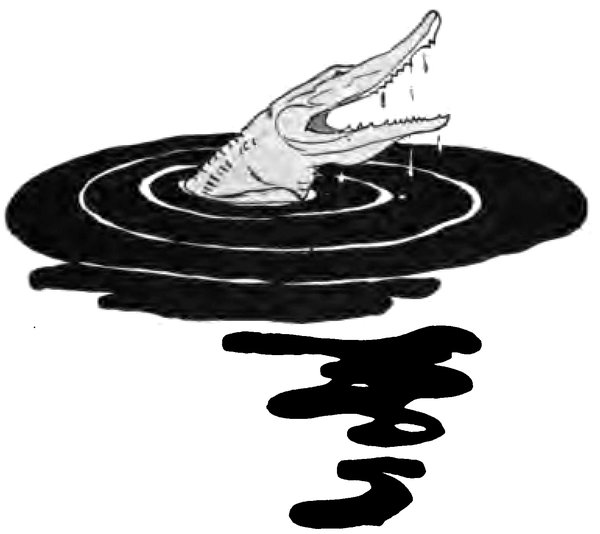
Just then the crocodile yawned. Wider
and wider and wider he opened his mouth.
Away whisked the monkey to the topmost
branch of the tree.
“This very day I shall move farther down
the river!” he said.
So the monkey slipped away to a tree about
12half a mile distant. There he lived peaceably
for some time. He was delighted with his
new home. The water was cool and clear.
In the middle of the stream was an island
covered with fruit trees.
It was very easy to reach the little island.
One leap from his tree brought the monkey
to the end of a large rock which jutted out
into the river; another leap brought him to
the island, where he could get a fine feast and
frisk about all the day long. In the evening
he went back to his home in the great tree
on the river’s bank.
One day he stayed later than usual on the
island. When he came to the water’s edge,
he looked and blinked and looked and
blinked! “How strange that rock looks!”
he said to himself. “Surely it was never so
high before! What can be the matter with
it?” Suddenly the monkey’s heart beat very
fast. The crocodile was lying on the top of
that rock!
“Oho! Mr. Crocodile,” thought the
monkey, “I see I must put my wits to work
13very, very quickly indeed if I am to escape
from you!”
“Good evening, Big Rock,” he called.
The crocodile lay very still.
“This is a fine evening, Big Rock!” called
the monkey.
The crocodile lay very, very still.
“What is the matter, Big Rock? You
have always been a good friend of mine.
Why are you so silent this evening?”
Then the crocodile thought, “Now I see
I must pretend to be the rock, or the monkey
may not come this way to-night.” So with
his mouth shut he mumbled as best he could,
“Good evening, Mr. Monkey.”
“Oh! Is that you, Mr. Crocodile?” said
the monkey, pleasantly. “I’m afraid I have
awakened you!”
“Never mind that,” said the crocodile,
raising his head. “Come, make your leap!
You cannot escape me this time.”
“No, I’m afraid not,” said the monkey,
meekly.
And all the time he was thinking, “Crocodiles
14shut their eyes when they open their
mouths wide.”
“Come along and make haste, Monkey,”
said the crocodile.
“I’m caught, that is sure, for I must
leap your way. Well, as you say, I cannot
escape you, Crocodile. Open your mouth.
Oh, wider than that, please, if I am to leap
into it. Wider! There! Here I go! Ready!”
Before the crocodile knew what was happening,
the monkey gave three bounds—first
to the top of the crocodile’s head,—then to
the bank,—then to his tree. Away he
whisked to the topmost branch.
“Thank you, Mr. Crocodile,” he called.
THE HILLMAN AND THE HOUSEWIFE
15
One day a hillman knocked
at the door of a selfish
housewife.
“Can you lend me a
saucepan, good mother?”
said he. “There’s a
wedding in the hill, and
all the pots are in use.”
“Is he to have one?” asked the servant
girl who had opened the door.
“Ay, to be sure,” said the housewife. But
when the maid was taking a saucepan from
the shelf, the housewife whispered slyly to
her, “Do not lend him a good pan; get the
old one out of the cupboard. It leaks, and
the hillmen are so neat and such nimble
workers that they are sure to mend it before
they send it home. So one does a good turn
and saves sixpence from the tinker.”
16The maid fetched the old saucepan which
had been laid by till the tinker’s next visit
and gave it to the dwarf, who thanked her
and went away.
The saucepan was soon returned neatly
mended and ready for use. At supper time
the maid filled the pan with milk and set it
on the fire for the children’s supper, but in a
few minutes the milk was so burned and
smoked that no one could touch it. Even
the pigs would not drink the wash into which
the milk was thrown.
“Ah, you good-for-nothing girl!” cried
the housewife as this time she filled the pan
herself. “Your careless ways would ruin the
richest. There’s a whole quart of milk spoiled
at once.”
“A quart of milk costs twopence!” cried
a queer small voice from the chimney corner.
The housewife had not left the saucepan
for two minutes when the milk boiled over
and was all burned and smoked as before.
“The pan must be dirty,” cried the housewife
in a rage; “and there are two full quarts
17of milk as good as thrown to the dogs. Oh,
what dreadful waste!”
“Two quarts of milk cost fourpence!”
cried the queer small voice.
After a long scrubbing, the saucepan was
once more filled with milk and set on the fire,
but in a little while the milk was burned and
smoked again.
The housewife burst into tears at the waste,
and cried out, “Never before did such a thing
happen to me since I kept house! Three
quarts of milk burned for one meal.”
“Three quarts of milk cost sixpence!”
cried the queer small voice. “You didn’t
save the tinker after all!”
Then the hillman himself came tumbling
down the chimney and went off laughing
through the door. But from that time the
saucepan was as good as any other.
THE FISHING PARTY
18
One clear, warm evening
about sunset Brother Rabbit
was walking down a
road which led to the old
mill. He was saying to
himself: “It has been a
week or more since I
have had any fun. I do
wish something would happen to make times
a little livelier. I’m—”
“A fine sunset, Brother Rabbit! A penny
for your thoughts. I do believe you would
have passed me without speaking.”
“Good evening, Brother Terrapin,” said
the rabbit, stopping and holding out his hand
in a most cordial way. “I am very glad to
see you, for I like your opinion immensely.
I’ll tell you what I was thinking about, my
friend. I was planning a little fishing party.
Come, let us sit down here on the roadside
and talk it over.”
19
21Brother Terrapin replied: “A fishing party!
That will be fine sport. We should become
very dull indeed in this neighborhood, Brother
Rabbit, if it were not for your plans. Have
you decided whom to invite?”
“Well,” said Brother Rabbit, “I think it
unwise to invite too many. Perhaps five, including
ourselves, are enough, because, you see,
we must keep very quiet, and if the party is
large, there is danger of too much merriment.
Have you any particular friend who enjoys
fishing?”
“Oh, yes, indeed. Brother Bear is very
quiet and sensible, and he loves to fish for mud
turtles,” replied Brother Terrapin.
“Well, I have in mind Brother Fox and
Brother Wolf. Look, here they come! What
good luck! Let us see what they think about
the plan.” And the rabbit danced away up
the road to meet his friends and tell them
about the fishing party.
“Exactly the kind of sport I enjoy most,”
22said Brother Wolf, interrupting Brother Rabbit.
“I’ll fish for hornyheads. Come,
Brother Fox, what do you say?”
“First, I wish to thank Brother Rabbit for
his kind invitation,” said Brother Fox, politely.
“Of course, you all know that I shall fish for
perch, and I think I shall use a dip net. Good
evening, Brother Terrapin. What an interesting
party ours will be. What will you fish for?”
“Oh,” laughed Brother Terrapin, “minnows
suit my taste very well.”
“All right,” said Brother Rabbit. “Now
let us meet at the mill pond about eight o’clock
this evening. Brother Terrapin, may I trouble
you to bring the bait? The others will each
bring a hook and line, and, Brother Fox, please
do not forget your fine dip net. About twelve
o’clock you are all invited to a fish supper at my
house. Don’t forget the time and place of
meeting. Farewell.”
All hurried away to prepare for the evening’s
amusement, and, at the appointed time, the five
merry brothers met at the mill pond.
Brother Rabbit was very anxious to begin;
23so he baited his hook and stepped up to the
very edge of the water. Then he stopped
suddenly, looked straight down into the pond,
dropped his fishing pole, and scratched his head.
“Mercy!” said Brother Fox. “What in the
world is the matter with Brother Rabbit?
Let us slip up to him and see what is the
trouble. Come, all together.”
But Brother Rabbit turned and walked
toward them, shook his head seriously, and
said: “No fishing to-night, my friends. We
might as well go home.”
“What is it? What did you see?” began
the bear, the fox, and the wolf. Brother
Terrapin crept up to the edge of the pond,
looked straight into the water, jumped back,
and said, “Tut, tut, tut! To be sure! To
be sure!”
“Come, come, tell us. We cannot bear
this suspense,” snapped the fox.
Then Brother Rabbit said slowly, “The
moon has dropped into the mill pond, and
if you don’t believe me, go and look for
yourselves.”
24“Impossible!” cried Brother Bear.
They all crept up to the edge of the pond
and looked in and there they saw the golden
moon right down in the clear water.
“Isn’t that too bad?” said Brother Wolf.
“Well, well, well,” sighed Brother Fox;
and Brother Bear shook his head slowly and
said, “The impossible has happened!”
“Now, I’ll tell you something,” began the
rabbit, who was not to be easily daunted,
“we must get that moon out of the water
before we begin to fish. I tell you truly no
fish will bite while that great golden ball is
near.”
“Well, Brother Rabbit,” said the wolf,
“can’t you make a suggestion in this matter?
You usually know what to do.”
“I have it, my friends,” said the rabbit
jumping up and down. “I have it! I know
where I can borrow a sieve. I’ll run and get
it and then we can dip up the moon in no
time. We’ll have our fishing party yet!” and
off he ran.
Brother Terrapin was thinking. In a little
25while he looked up and said, “My friends,
I have often heard that there is a pot of gold
in the moon.”
“What’s that?” said Brother Fox, quickly.
“I was saying that my grandmother has
often told me that there is a pot of gold in
the moon. But here comes Brother Rabbit
with the sieve.”
“My good friend,” said Brother Fox,
“you were kind enough to go after that
sieve and now you must let Brother Bear,
Brother Wolf, and myself do the work. No,
don’t take off your coat. You are such a
little fellow that it would be dangerous for
you to go into the water. You and Brother
Terrapin stand here on the bank and watch
us. Come, give me the sieve.”
So Brother Terrapin and Brother Rabbit
stood on the bank and watched the others
wade into the pond.
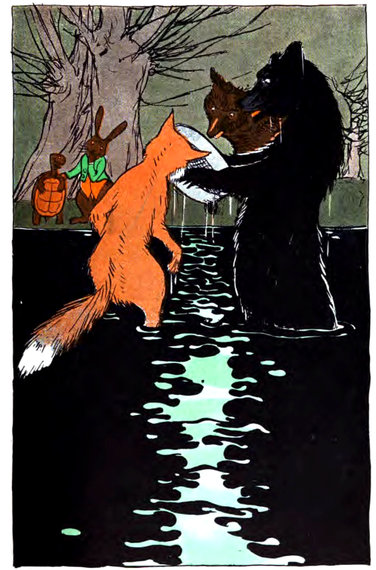
They dipped the sieve down once. “No
moon,” said Brother Bear.
Again they dipped. “No moon,” said
Brother Wolf.
26“Come,” said Brother Fox, “we must
go farther in.”
“Oh, do be careful, my friends,” called the
rabbit, “you are near a very deep hole.”
Buzz, buzz! The water was roaring in
Brother Bear’s ears and he shook his head
violently. Down went the sieve again.
“No moon,” sighed Brother Fox. “A
little farther out, friends. Now, down again
with the sieve.”
Splash! Splash! Splash! Down they
all went with the sieve. They kicked and
tumbled and splashed as if they would throw
all the water out of the mill pond. Then
they swam for the shore and all came out
dripping wet. “No moon,” said Brother
Fox, sulkily. “What! No moon? Well,
well, well!” said Brother Rabbit.
“Too bad! Too bad!” said Brother
Terrapin.
“My friends,” said the rabbit, seriously, “I
think you ought to go home and put on some
dry clothes. I do, indeed. And I hope we
shall have better luck next time. Good night.”
THE FOREST BAILIFF
27
Once upon a time a peasant
owned a cat which
was so disagreeable and
mischievous that all the
neighbors complained
about him. Finally the
peasant became impatient
and said to his wife, “I
have decided to get rid of our cat. He is
such a nuisance that I feel we ought not to
keep him any longer.”
“I do not blame you,” replied his wife.
“My patience, too, is worn out listening to the
stories told about that mischievous animal.”
In a few days the peasant put the cat into
a large sack and walked far into a leafy forest.
Then he opened the sack and let the cat
bound away. How many interesting things
there were in the depths of the beautiful wood!
28After wandering about for a few hours the cat
began to feel quite at home, especially when
he found a little deserted cabin where he took
up his abode and dined bountifully on mice
and birds.
One day when Master Cat was walking
proudly along a path which led to a pond, he
met Miss Fox, who looked at him with great
interest and curiosity. When she came close
enough to be heard, she said, “Your pardon,
good sir, but may I ask who you are, and
why you are walking in the forest?”
Master Cat raised his head very high and
replied proudly: “I am the bailiff of the forest.
My name is Ivan, and I have been sent from
Siberia to become governor of this vast wood.”
“Oh, indeed,” said Miss Fox. “Dear
Master Bailiff, will you not honor me with
your presence at dinner? I shall be most
proud to entertain such a distinguished guest.”
“Lady, I accept your invitation,” replied
Master Cat, making a profound bow.
Now Miss Fox knew well how to entertain.
She not only provided the greatest delicacies
29for her table, but she chatted in the merriest
fashion and told the bailiff many interesting
things about life in the forest.
“My dear Sir Bailiff, do have another serving
of this savory pie. The forest, you know,
gives one a good appetite,” said she, with a
side glance at her visitor.
“Thank you, dear lady,” returned Master
Ivan. “It is indeed delicious. I have tasted
nothing so good for weeks. What a cozy
home you have here.”
“It is very comfortable,” replied Miss Fox.
“But I am often a little lonely. May I ask,
sir, are you married or single?”
“I am single,” replied Mr. Bailiff.
“Why, so am I,” said his companion, dropping
her eyes shyly. “Master Ivan, the
Bailiff, will you not marry me?”
The guest was a little astonished, but he
finally consented to marry Miss Fox. Their
wedding was attended with much ceremony,
and the bailiff came to live in his wife’s cozy
home.
A few days after their marriage Ivan said:
30“Madam, I am very hungry. Go on a little
hunting trip and bring me home a fine dinner.”
Away went the wife toward a deep hollow.
She had not gone very far when she met her
old friend the wolf.
“Good morning, my dear friend,” he began.
“I have been looking in vain for you in the
forest. Do tell me where you have been.”
Madam Fox replied coyly: “Oh, I am
married, you know. My husband is the bailiff
of the forest.”
“Indeed,” said the wolf. “How I should
like to see his honor, your husband.”
“That can be managed if you will follow my
advice closely. You see, my husband is very
ferocious, and unless you do as I say he might
devour you. However, I’ll see what can be
done. Let me see. You had better get a lamb
and place it on our doorstep. Then hide in
the bushes which grow near. When my husband
opens the door, you can get a very good
look at him,” said Madam Fox, proudly.
The wolf ran away in search of a lamb, and
Madam continued on her way. In a short
31time she met a bear. “Good day, my good
friend,” he said. “I have missed you for
some time. May I ask where you have been?”
“Oh,” said Madam, “is it possible you
have not heard of my marriage with Ivan,
the bailiff of the forest?”
“Is it true? Then I offer you my sincere
congratulations! The bailiff of the forest,
you say?” said the bear, in a puzzled tone.
“Madam, it would give me the greatest pleasure
to see his honor, your husband.”
“Yes,” said Madam, “that would be a
great privilege, but I must tell you that the
bailiff is very fierce. In fact, he is likely to
devour anyone who does not please him. But
perhaps I can help you out a little. Let me
see. You had better procure an ox. And be
sure to offer your gift very humbly. The
wolf, who is also most anxious to see my husband,
is going to bring a lamb for a present.”
Away went the bear in search of his gift,
which he soon found; then he hurried clumsily
along, and in a little while he met the wolf
with a lamb.
32“Good day to you, my friend,” began the
wolf. “May I ask where you are going
with such a burden?”
“I am going to see the husband of Madam
Fox, to whom I shall give this ox. Will you
tell me where you are going?” said the bear.
“Why, I am bound for the same place, my
friend. Madam Fox told me her husband is
terrible. He devours anyone who displeases
him, so I am taking a lamb for a present.”
The wolf’s voice trembled a little as he continued,
“I do hope he will take kindly to me.”
The friends went on their way, and in a short
time they came to the house of the cat. The
wolf pushed the bear a little ahead and
whispered, “Go, my good comrade, knock
on the door and say to the husband of Madam
Fox that we have brought an ox and a lamb
as gifts.”
“Oh,” shivered the bear, “I dare not!
I am so filled with fear. Indeed, indeed, I
cannot. You go, good wolf! Do.”
“Impossible,” returned the wolf, in a quaking
voice. “I am trembling all over. I
33haven’t strength enough to walk there much
less to rap on the door. Come, let us hide
ourselves and bide our time.”
So the wolf hid himself under some dry
leaves, and the bear jumped into a tree and
carefully hid himself among the branches.
In a few moments Madam Fox and her husband,
who had been walking in the forest, came
home.
“How very small the bailiff is,” whispered
the wolf.
“He is, indeed,” gasped the bear, a little
scornfully.
The cat now saw the ox and leaped to the
step saying, “Oh, a small meal for me.”
“A small meal,” said the bear, with surprise.
“How very, very hungry the bailiff must be!
And he is so small, too. Why, a bull is a good
meal for four bears. What an immense
appetite he must have!”
The wolf was too much frightened to answer.
There was a slight rustling sound in the dry
leaves and, thinking a mouse was hidden there,
the cat gave a bound and fastened his claws
34in the snout of the wolf. With a gasp of fear
the wolf leaped up and ran away as fast as he
could go. Now, the cat was very much afraid
of a wolf, and so he gave one leap into the
tree where the bear lay hidden. “Oh, mercy,
mercy!” cried the bear. “The cat is after me.
He will devour me. Oh, help, help!” and
down the tree scrambled the bear. Off he
ran, as fast as he could go, after the wolf.
Madam Fox screamed out: “My husband is
terrible! He will devour you! He will
devour you!”
Away sped the wolf and the bear, and they
told their adventure to the other animals of
the forest, who took good care to stay far away
from the terrible bailiff. Meanwhile the cat
and the fox were very happy, and they had
plenty to eat for a long time.
BRUIN AND REYNARD PARTNERS
35
Once upon a time Bruin
and Reynard were to
plant a field in common
and to share the crops
in a fair way. “If you’ll
have the root, I’ll take
the top,” said Reynard.
Bruin thought that plan
would do very well.
The first year they sowed rye. But when
they had thrashed out the crop, Reynard got
all the grain and Bruin got nothing but roots
and rubbish. He did not like that at all, but
Reynard said that was how they had agreed
to share the crop, and it was fair and right.
“The tops come to me this year,” said Reynard,
“but next year it will be your turn.
Then you will have the tops and I shall have
to put up with the roots.”
36Spring came and it was time to sow again.
Sly Reynard asked Bruin what he thought of
sowing turnip seed for the second year’s crop.
“Yes, yes,” said Bruin, “we will have turnips.
Turnips are better food than rye.”
Reynard agreed with him. Harvest time
came. “We will divide the crops as is fair
and right,” said Reynard. “I get the roots
this time and you get the tops.” So Reynard
got all the turnip roots and Bruin the turnip
tops. When Bruin saw what Reynard had
done, he was very angry, and he put an end
to his partnership with him at once.
38
THE THREE WISHES
39
Once upon a time in the
heart of a forest lived a
woodcutter and his wife.
They were very poor indeed.
Their little cabin,
built of rough-hewn logs,
had only one room, which
was very scantily and
poorly furnished. One day the woodcutter
said to his wife,
“How miserable we are! We work all
day, and we have barely enough food to keep
life in our bodies! Surely there are few who
work as hard as we do and have so little!”
The housewife replied, “Yes, indeed, we are
very miserable.”
“Well, I’m off for another day’s work,”
sighed the husband. “My lot is too hard.”
He picked up his ax and made his way to
40the place in the forest where he was to perform
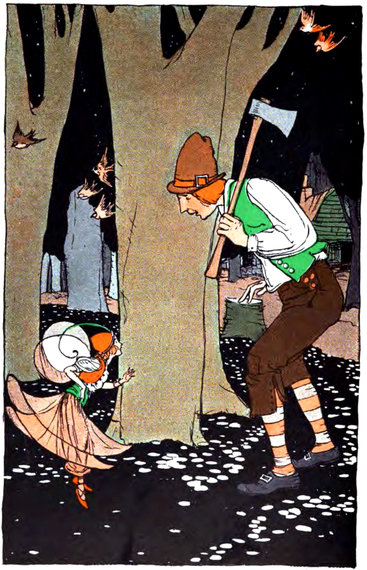
his task. Suddenly, a dear little fairy
whose face was wreathed in smiles danced into
the path and stood before him.
“I am the wishing fairy,” she began. “I
heard what you said about your work and
your life, and my heart aches for you. Now,
because I am a fairy, it is in my power to
grant you three wishes. Ask for any three
things you desire and your wishes shall be
granted.” The fairy disappeared in the twinkling
of an eye, and the woodcutter was left
standing alone in the forest. Was he dreaming?
He couldn’t believe his own senses!
He thought of a thousand wishes all in an
instant. He would go home and talk the
matter over with his wife. He turned in his
path and retraced his steps to the cabin.
“Art thou ill?” demanded his wife, who
came to the door.
“Oh, no, indeed, I am not ill; I am very,
very happy!” he burst forth. “I met a fairy
in the forest. She told me that she was very,
very sorry for me, and that she would help me
41by granting three wishes. Think of it! Any
three wishes in the world will be granted by
the charming fairy.”
“Wonderful!” responded the housewife.
“Oh, how happy the very thought of it
makes me! Come, let us sit down and talk
the matter over; for I assure you it is not easy
to come to a decision. I am indeed, very,
very happy.”
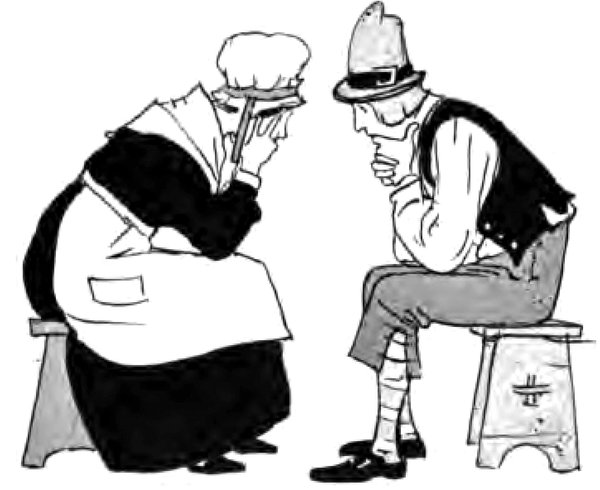
They drew up their chairs to the little table
and sat down.
“I am so hungry,” began the woodcutter.
“Let us have dinner, and then, while we are
eating, we can talk about our wishes and see
which three are nearest our hearts’ desires.”
They began their humble meal immediately,
and the husband continued: “Of course one
of our wishes must be great riches. What do
you say?”
“Oh, yes, indeed,” said his wife. “I
should love a beautiful house to live in, also
carriages and fine clothes, and servants and—”
“Oh, for that matter,” said the husband,
“we could wish for an empire.”
42“Or rich jewels, such as great numbers of
pearls and diamonds! What a wish that
would be,” said the wife, whose face was all
aglow.
“I have it,” burst forth the woodman, “let
us wish for a fine large family, five sons and
five daughters, What say you to that?”
“Oh!” returned his wife, “I think I prefer
six sons and four daughters.”
So they continued weighing one wish with
another until they seemed almost in despair
about coming to a decision regarding which
three wishes would be the wisest and best.
They finally stopped talking and ate their
simple food in silence. The woodcutter did
not seem to relish his soup and dry bread.
“Oh,” he cried out suddenly, “how I wish
I had some nice savory sausage for dinner!”
No sooner had the words fallen from his lips
than a large dish of fine sausages appeared on
the table. What a surprise! The two were
so astonished that for a few moments they
could not speak. Then the wife said impatiently:
43“What do you mean by making such a
foolish wish? Do you not see that this dish
of sausage means that one wish has been
granted and that there are but two left?
How could you make such a stupid, stupid
wish?”
“Well,” replied the husband, “to be sure I
have been foolish. I really did not think
what I was saying. However, we may still
wish for great riches and an empire.”
“Humph!” grumbled the wife, “we may
wish for riches and an empire, but what about
a fine large family? You have certainly been
foolish in wishing for that horrid sausage. I
suppose, however, you prefer sausage to a
fine family;” and she burst out into tears of
lamentation, crying: “How could you? How
could you be so foolish? Oh, dear! Oh,
dear! How very foolish and stupid you have
been.”
Finally her husband lost all patience and
cried out: “I’m tired of your grumbling! I
wish the sausage were on the end of your
nose!”
44In an instant the sausage was fastened to the
end of the poor woman’s nose. How comical
she did look! The husband and wife were
so astonished that they could not speak. The
poor woman again burst into tears.
“Oh!” she cried. “How could you?
How could you? First, you wished for
sausage, and second, you wished that the
sausage were fastened to my poor nose. It is
terrible. It is cruel. Two wishes have been
granted. There remains but one! Oh,
dear, dear!”
The husband, who now saw what a dreadful
mistake he had made, said meekly,
“We may still wish for great riches.”
“Riches indeed!” snapped his wife.
“Here I am with this great sausage fastened
to the end of my nose. What good would
riches do me? How ridiculous I am. It is
all your fault. I was so happy at the thought
of great riches, beautiful jewels, and a fine
family, and now I am sad and miserable.”
She continued to weep so pitifully that her
husband’s heart was touched.
45“I wish with all my heart that the sausage
were not on your nose,” he said. In an instant
the sausage disappeared. There the two sat
lamenting; but as the three wishes had been
granted there is nothing further to be said.
46
THE PIGTAIL
There lived a sage in days of yore,
And he a handsome pigtail wore;
But wondered much and sorrowed more
Because it hung behind him.
He mused upon the curious case,
And vowed he’d change the pigtail’s place,
And have it hanging at his face,
Not dangling there behind him.
Says he, “The mystery I’ve found.
I’ll turn me round,”—He turned him round,—
But still it hung behind him.
Then round and round and out and in,
All day the puzzled sage did spin
In vain; it mattered not a pin,
The pigtail hung behind him.
47And up and down and in and out
He turned, but still the pigtail stout
Hung dangling there behind him;
And though his efforts never slack,
And though he twist and twirl and tack,
Alas! still faithful to his back
The pigtail hangs behind him.
THE STONE LION
48
Once there were two
brothers who lived with
their mother in a large
house on a farm. Their
father was dead. The
older brother was clever
and selfish, but the
younger was kind and
gentle. The older brother did not like the
younger because he was so honest that he
never could get the best of a bargain. One
day he said to him: “You must go away.
I cannot afford to support you any longer.”
So the younger brother packed all his belongings,
and went to bid his mother good-by.
When she heard what the older brother had
done, she said, “I will go with you, my son.
I will not live here any longer with so hard-hearted
a man as your brother.”
49The next morning the mother and the
younger brother started out together. Toward
night when they reached the foot of the hill,
they came to a hut with nothing in it except
an ax which stood behind the door. But
they managed to get their supper and stayed
in the hut all night.
In the morning they saw that on the side
of the hill near the hut was a great forest.
The son took the ax, went up on the hillside
and chopped enough wood for a load
to carry to the town on the other side of the
hill. He easily sold it, and with a happy heart
brought back food and some clothing to make
his mother and himself comfortable.
“Now, mother,” he said, “I can earn enough
to keep us both, and we shall be happy here
together.”
One day, in search of timber, the boy went
farther up the hill than he had ever gone before.
As he climbed up the steep hillside, he
suddenly came upon a lion carved from stone.
“Oh,” thought the boy, “this must be the
guardian spirit of the mountain. I will make
50him some offering to-morrow morning without
fail.”
That night he bought two candles and carried
them to the lion. He lighted them,
put one on each side of the lion, and asked
that his own good fortune might continue.
As he stood there, suddenly, the lion opened
his great stone mouth and said:
“What are you doing here?”
The boy told him how cruel the elder
brother had been; how the mother and himself
had been obliged to leave home and live
in a hut at the foot of the hill. When he had
heard all of the story, the lion said:
“If you will bring a bucket here to-morrow
and put it under my mouth, I will fill it
with gold for you.”
The next day the boy brought the bucket.
“You must be very careful to tell me when
it is nearly full,” said the lion, “for if even
one piece of gold should fall to the ground,
great trouble would be in store for you.”
The boy was very careful to do exactly as
the lion told him, and soon he was on his way
51home to his mother with a bucketful of gold.
They were so rich now that they bought a
beautiful farm and went there to live.
At last the hard-hearted brother heard of
their good fortune. He had married since
his mother and brother had gone away, so he
took his wife and went to pay a visit to his
younger brother. It was not long before he
had heard the whole story of their good
fortune, and how the lion had given them all
the gold.
“I will try that, too,” he said.
He and his wife went to the same hut his
brother had lived in, and there they passed
the night.
The next morning he started out with a
bucket to visit the stone lion. When he had
told the lion his errand, the lion said:
“I will grant your wish, but you must be
very careful to tell me when the bucket is
nearly full; for if even one little piece of gold
touches the ground, great misery will surely
fall upon you.”
Now the elder brother was so greedy that
52he kept shaking the bucket to get the gold
pieces closer together. And when the bucket
was full he did not tell the lion, as the
younger brother had done, for he wanted all
he could possibly get.
Suddenly one of the gold pieces fell upon
the ground.
“Oh,” cried the lion, “a big piece of gold
is stuck in my throat. Put your hand in and
get it out. It is the largest piece of all.”
The greedy man thrust his hand at once
into the lion’s mouth and the lion snapped his
jaws together! And there the man stayed, for
the lion would not let him go. And the gold
in the bucket turned into earth and stones.
When night came and the husband did not
return, the wife became anxious and went out
to search for him. At last she found him with
his arm held fast in the lion’s mouth. He was
tired and cold and hungry.
“Alas!” she said, “I wish we had not tried
to get the gold. There is no food in the hut
for us and we shall have to die.”
The lion was listening to all that was said,
53and he was so pleased at their misfortune that
he began to laugh at them, “Ha, ha, ha!”
As he laughed, he opened his mouth and the
greedy man quickly drew out his hand, before
the lion had a chance to close his jaws again.
They were glad enough to get away, and they
went to their brother’s house once more. The
brother was sorry for them and gave them
enough money to buy a home.
The younger brother and his mother lived
very happily in their beautiful home, but they
always remembered the Stone Lion on the
hillside, who gave them their good fortune.
THE STORY THAT HAD NO END
54
Once upon a time there
was a king who was so
fond of hearing stories
told that he would listen
to them all day long.
He cared for no other
kind of amusement and
he was always angry
when the story came to an end. “Your
stories are too short,” he said to the many
story-tellers who tried to amuse him. Indeed
no one had ever been found who was able to
tell him a story that lasted long enough.
All the people of his court had tried again
and again to please him. Some had told
stories that lasted three months, some had
told stories that lasted six months, and a few
courtiers had been able to carry on their stories
for one whole year. Still the king complained,
for sooner or later the story was sure
to come to an end.
55
57At last he sent out the following proclamation
to all the people of his kingdom:
PROCLAMATION
TO THE MAN WHO WILL TELL ME A STORY
WHICH SHALL LAST FOREVER, I WILL GIVE THE
PRINCESS, MY DAUGHTER, IN MARRIAGE; ALSO,
I WILL MAKE THE SUCCESSFUL ONE MY HEIR
AND HE SHALL BE KING AFTER ME. BUT MARK,
LET NO MAN PRETEND THAT HE CAN DO SO,
AND FAIL; FOR, IF THE STORY COMES TO AN
END, THE STORY-TELLER SHALL BE THROWN
INTO PRISON. THE KING.
The king’s daughter was a very beautiful
princess, and there were many suitors in the
kingdom who came to the court in hope of
winning such a prize. But it was all of no
use. Each tried as hard as he could to spin
the story out, but sooner or later it came to
an end and the unfortunate one met the fate
the king had threatened.
This grieved the princess very much, and
each time she begged the king to lighten the
punishment of the poor story-teller who had
risked so much for her sake.
58At last one man sent word to the king that
he had a story which would last forever and
ever, and that he was ready to come to the
court at once. On hearing this the princess
sent for the man and warned him of his
danger. She begged him not to be so rash as
to try the king’s patience, for no one had
ever pleased his majesty, and she feared he
would meet the fate of all those who had
tried and failed. But he said he was not
afraid, and he asked to be taken at once before
the king.
“So you are the man who is to tell me a
story that will have no end?” said the king.
“If it please your majesty,” answered the
man.
“If you can do this, you shall be king after
me, and you shall marry the princess, my
daughter. But if you fail, you shall be cast
into prison.”
“I understand, O king. I have a story
about locusts which I shall be pleased to tell
you.”
“Very well. Begin the story.”
59The story-teller began his tale.
“O king, there was once a ruler who was
a great tyrant. He wished to be the richest
in the land, so he seized all the corn and
grain in his kingdom and had it stored away.
Year after year he did this until all his granaries
were filled full. But one year there came
a swarm of locusts and they discovered where all
the grain had been stored. After a long search,
they found near the top of the granary a
very small hole that was just large enough for
one locust at a time to pass through. So one
locust went in and carried off one grain of
corn; then another locust went in and carried
off one grain of corn; then another locust
went in and carried off one grain of corn;
then another locust went in and carried off
one grain of corn—”
Thus the story-teller went on day after
day, week after week, from morning till night.
After hearing about the locusts for nearly a
year the king became rather tired of them,
patient though he was, and one day he interrupted
the story-teller with:
60“Yes, yes, we’ve had enough of those locusts.
Let us take for granted that they got
all the grain they wanted. Now go on with
the story. What happened afterwards?”
“If it please your majesty, I cannot tell
you what happened afterwards until I have
told you all that took place in the beginning.
I go on with the story. Then another locust
went in and carried off one grain of corn;
then another locust went in and carried off
one grain of corn.”
Another month passed by. At the end of
this time the king asked impatiently, “Come,
sir, how long will it take those locusts to
carry away all the corn?”
“O king, I cannot tell. They have
cleared away but a small space round the inside
of the hole, and there are still thousands
and thousands of locusts on the outside.
Have patience, O king, there are enough
grains for each locust to have one, and in
time they, no doubt, will all pass in and each
in turn carry away one grain of corn. Permit
me, O king, to go on with my story.
61Then another locust went in and carried off
one grain of corn; then another locust went
in and carried off one grain of corn—”
“Stop, stop,” called out the king at last.
“I cannot stand those locusts any longer.
Take my kingdom, be king after me, marry
my daughter, take everything, only never let
me hear about those ridiculous locusts again.”
So the story-teller married the princess and
succeeded to the throne upon the death of the
king.
THE KING’S RABBIT KEEPER
62
Once upon a time a king
wanted a good rabbit
keeper. He made it
known throughout the
country that he would
give not only good pay,
but also the hand of the
princess, to any youth
who could take good care of his wonderful
rabbits.
Now it happened that an old farmer had
three very lazy sons, Jan, Hans, and Olaf.
They disliked the work on the farm and spent
most of their time amusing themselves, or
doing as they pleased. When Jan heard that
the king wanted a rabbit keeper, he told his
father he would go to the palace and try to
get the place.
“What!” cried the old man. “The king
63does not want an idler. The rabbits are brisk
and lively and need care every moment. A
lazybones like you could never be His Majesty’s
rabbit keeper.”
“Well, I am determined to go. I should
like the work better than the farm drudgery,”
replied Jan. He filled a bag with things
to eat, and a few clothes, and started to the
palace of the king. After he had traveled
a few miles he heard a voice calling him:
“Help! Help!” Jan hurried toward the
sound and came to a deep pit. He looked
down into it, and there was a shriveled old
woman. She spoke very sharply to him.
“Pull me up! Pull me up!” she cried.
“I have been here for one year, and have had
no food in all that time. Pull me up!”
“Not I,” replied Jan. “Only a witch
could live a year in such a place without food.
I’ll have nothing to do with you,” and on he
went.
At length he came to the palace of the
king and asked to serve as rabbit keeper.
The delighted king said, “He who guards
64the rabbits well and lets none escape shall have
fine food, good pay, and perhaps the hand of
a beautiful princess.”
The next day Jan took the rabbits into a
large field to browse. During the daytime
they nibbled the tender grass and stayed together,
but when the sun began to set, they
darted toward a wood which bordered a
meadow and they soon became lost in the
shadows of the trees. Jan called to them and
ran after them until he was out of breath, but
he could not bring them together. He rested
awhile and tried again. It was of no use;
they had scattered in every direction. Surely
they were playing hide and seek, and Jan was
not in the game. When he reached the palace,
he told his story to the king, who burst into a
rage and banished Jan from the country.
In a short time the king got another warren
of rabbits and again made it known that he
wanted a keeper. Jan’s brother, Hans, now
determined that he would try to serve the
king and perhaps gain the rich reward. Off he
walked. He passed the pit and heard the old
65woman calling for help, but he hurried on without
even stopping to see what was the matter
with her.
The king made him keeper of the rabbits,
but the first time he took them out to browse
he failed in his work. All was well during
the day, but when the sun sank, the rabbits
scurried away to the woods, and no matter
what he did, Hans could not gather them together
again. When he returned to the palace
without a single rabbit, the furious king banished
him, too, from the country.
A third time the king got beautiful rabbits
and made it known that he wanted a keeper.
“Father,” said Olaf, the youngest of the
three brothers, “it is my turn to try. I am
sure I could guard the king’s rabbits.”
“It will be the same old story,” said the
farmer. “If you take no better care of the
rabbits than you do of the calves, you will
share your brothers’ fate.”
“At any rate I mean to try,” replied Olaf.
Throwing his bag over his shoulder, he set out
for the palace of the king.
66“Help! Help!” called a voice from the
field near the road. Olaf ran in the direction of
the sound and saw the old woman in the pit.
“What can I do for you, my good
woman?” he asked.
“Please reach me your hand and help me
out. I’ve had nothing to eat for a year and
I can’t get out without help.”
Olaf willingly reached down and pulled
the old woman up. Then he gave her food
from his bag and brought her water from
a spring. She ate a large share of Olaf’s
store while he good-naturedly looked on.
When she had finished, she drew from her
pocket a magic horn.
“Take this for your pains,” said she. “It
is a wonderful horn and will help you in
many ways. If you blow into the small end
of it, you will scatter to the four winds whatever
you wish away from you. If you blow
into the large end of it, you will bring near
you whatever you wish. If you should lose
it, or if by chance it should be stolen from
you, a wish will bring it back again.”
67“A wonderful help it will be to me,” said
Olaf, as he took it eagerly from the old
woman’s hand.
He sauntered on again, and after some time
he came to the palace of the king. The rabbits
were put into his charge, and Olaf’s heart
beat high when he thought of the princess
he might win.
The next morning he took the rabbits out
into the meadow. They danced about in
high glee for several hours. But about noon,
Olaf noticed two of them scamper away to
the woods. These two were soon followed
by others. “Very well,” said Olaf, “go
away from me if you like.” He blew into
the small end of the magic horn, and then
cried out, “Be off, every one of you!” and
away they scattered in every direction.
Olaf then ate his noonday lunch and
stretched himself out for a nap on the soft
green bank. When he awoke, the sun was
low in the west. He took up the magic
horn and blew into the large end of it. From
every direction came the frisky rabbits dancing
68and hopping about him. Olaf counted
them and was well pleased to find exactly the
right number. When he reached the palace
with the rabbits, he saw that the king, the
queen, and the princess were on the lookout
for him. Also he noticed that each one
counted the rabbits and then glanced at the
others in wonder.
“Alas!” sighed the princess, “how I
wish he were of noble birth! But a farmer’s
lad! Dear me!”
Day after day Olaf took the rabbits out
to browse in the meadow. At noon he
scattered them in the deep wood, and when
the sun began to sink behind a distant hill, he
gathered them together and led them back
to the palace.
The king was very much puzzled and
determined to send a servant to spy upon
Olaf. With greatest care the servant slipped
into the field and noticed Olaf asleep on
the soft green bank near the edge of the
wood. The servant hid himself in the low
underbrush of the wood and waited until
69evening. At sunset, Olaf awoke, drew out
his magic horn, gathered together the rabbits,
and led them back to the palace. The
servant explained to the king what he had
seen, and the king told his queen and the
princess. “I shall steal his horn while he
is asleep in the meadow,” said the princess,
“for I am determined not to marry a common
farmer’s son.”
The next day she stole carefully to Olaf’s
side while he lay asleep and took the magic
horn from his pocket. She had not reached
the palace before Olaf awoke and thought
of his rabbits. But where was his horn?
He searched about the banks in vain. “Oh,
how I wish I had my magic horn!” he
cried. No sooner had he made his wish
than he found the horn in his hands. He
blew into the larger end of it and again the
rabbits danced and frisked about him ready
to return.
Now the queen thought she would try
her skill in getting Olaf’s horn. She had
no trouble in getting it from his pocket, but
70as she neared the palace, the horn slipped
away from her. In the evening, Olaf returned
with his flock as usual.
“I see that I must do the thing myself,”
muttered the king. “That farmer’s lad
shall not outwit me. I’ll tie the horn in
one of my hunting bags to make sure of
it.”
Anxiously the queen and princess awaited
the king’s return. At last he came, untied
the bag, and reached in for the horn. Alas!
it had disappeared. And there in the distance
came Olaf and the rabbits. The king
sent word for Olaf to appear before the
royal family. “Tell me about that horn of
yours. Where did you get it? Hasn’t it
magic power?” said the king, impatiently.
“Sire, it is a magic horn,” began Olaf.
“Prove it,” said the king.
“I would rather not,” said Olaf.
“Do as I bid you, without a word!” roared
the king, becoming red with anger.
Olaf raised the little end of his horn to
his lips and blew a strong blast, while secretly
71he made a wish. In a moment the royal family
scattered in all directions.
“Bring us back! Bring us back! How
dare you? I’ll have you punished for this!”
roared the king, as he tumbled into the
distance.
Olaf blew into the big end of his horn
and instantly the royal family were back at
the palace. The king, in a rage, tried to seize
Olaf, but just then the rabbit keeper raised
the small end of the horn to his lips.
“Hold, hold!” cried the king. “I will
do you no harm if you will keep that wicked
horn from your lips. I would rather give
up half my kingdom than take another flighty
trip. You are a wonderful lad and the best of
rabbit keepers. The reward is yours.”
In a short time there was a beautiful
wedding at the palace. Olaf had won the
princess.
THE LEAPING MATCH
72
A flea, a grasshopper,
and a frog once wanted to
see which one of them
could jump the highest.
So they made a festival
and invited the whole
world and everybody else
besides, who would like
to come, to see the frolic. When the people
assembled to see the contest they all admitted
that these three famous jumpers were indeed
well worth seeing.
“I will give the princess, my daughter, to
the one who can jump the highest,” said the
king. “The champion in such a trial of skill
must be rewarded.”
The flea was the first to come forward.
His manners were perfect and he bowed to
the company on every side, for noble blood
flowed in his veins; and, besides, he had been
accustomed to associating with human beings,
which was much to his advantage.
74
75The grasshopper came next. The green
uniform, which he always wore, set off his
figure very well. He carried himself with
great dignity, for he belonged to a very old
Egyptian family, he said, and was highly
thought of in the house in which he lived.
In fact when he was brought out of the
fields he was put into a card house, three
stories high. The colored sides of the cards
were turned in and the doors and windows
were cut out of the Queen of Hearts. “It
was built on purpose for me,” he said, “and
I sing so well that sixteen crickets who had
chirped all their life, and still had no card
house to live in, were so angry at hearing me
that they grew thinner than they ever had
been before.”
In this way the flea and the grasshopper
went on with their long praises, each thinking
himself quite an excellent match for the
princess.
76The frog said nothing, but his silence only
made the people think he knew a great deal,
and the house dog who sniffed at him walked
away with an air of approval.
The old counselor who had issued three
orders for keeping quiet, said at last, that the
frog was a prophet, for one could tell from
his back whether the coming winter would be
severe or mild. Such wisdom could never be
gained from the back of the man who writes
almanacs.
“I shall say nothing,” said the king, “but
I have my own opinion; for I see everything.”
And now the leaping match began. The
flea jumped first. He jumped so high that
no one could see what had become of him.
So the people said he did not jump at all.
How shameful it was of him after all his
boasting!
The grasshopper jumped only half as high;
but he jumped right into the king’s face. This
act the king thought extremely rude.
The frog stood still for a long time; some
77began to think that he did not mean to
jump at all.
“Perhaps he’s ill,” said the house dog; so
he went up to sniff at the frog again; when
“pop” he made a side jump which landed
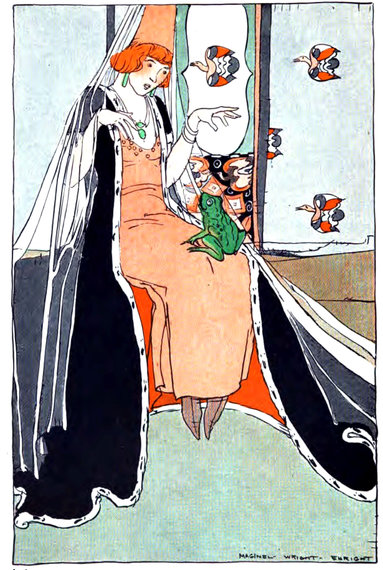
him right into the lap of the princess, who
was sitting on a little golden stool.
“There is nothing in the world higher
than my daughter,” called out the king.
“The frog has made the highest jump that
can be made. Only one who has a good
mind could have done anything so clever as
that.” And so the leaping frog won the
princess.
“I jumped the highest,” said the flea, “in
spite of what the king said, but the decision
does not matter to me. The princess may
have that heavy, stiff-legged, ugly creature if
he’s to her taste. Dullness and heaviness win
in this stupid world. I’m too light and airy.”
So the flea went into foreign lands.
The grasshopper sat down upon a green
bank and thought about the world and its
ways. “Yes,” he said to himself, “dullness
78and heaviness do win in this stupid world.
People care most about fine looks nowadays.”
Then he began to sing in the grasshopper way;
and from his song we have taken this little
story.
THE CLEVER TURTLE
79
A turtle lay upon a
large rock sunning himself.
His eyes were
turned toward the palace
of the king which overlooked
the beautiful river.
He could hear the merry
voices of the little princes
playing in the royal courtyard.
“What happy times they have!” thought
the turtle. “I have heard that there is a
lovely little lake in the princes’ playground,
where they have fine fun, swimming and sailing
tiny boats. How dull it is living out here
on the rocks! I’m sure I should be happier
if I lived in a royal courtyard.”
At that moment the turtle was startled by
the voices of two men who were carrying
fishing nets and large buckets to the river.
80He slipped under the rock and lay very still
and listened.
“You see,” said one of the men, “we are
to put the fishes into the courtyard lake and
surprise the young princes. His majesty,
the king, heard them wish that fishes swam
in their lake, and he decided to surprise them.”
“How happy they will be in the morning!”
replied the other man. “Come, let us climb
to the edge of these rocks and throw our nets
into the river. Then we will draw them in,
empty the fishes into those buckets, and carry
them to the courtyard lake this evening.”
When the turtle heard that some of his
neighbors were to live in the royal courtyard,
he was very jealous indeed!
“Fishes are such stupid creatures!” he said
to himself. “How much more delight a
turtle would give those young princes. I’ll
not live on this rock any longer. I’ll slip
very quietly into one of those buckets, and the
men will carry me into the royal courtyard.
They will never notice me. Fishes for the
delight of royalty! It is absurd!”
81The next morning the little princes took
their sailboats and ran to the lake in the courtyard.
“See, see!” cried one of them. “Our
wish has come true! There are fishes swimming
about in the water. Oh, what fun?”
“Come away! Come, come, brother!”
shouted the other little prince in terror. “See,
there is a demon on the bank! Perhaps the
fishes belong to him! Come!”
To the turtle’s great surprise off ran the lads,
crying out, “A demon has come to live on the
bank of our lake!”
When the king saw how frightened the
princes were, he ordered an attendant to capture
the demon and bring him to the palace.
So, before the poor turtle could make up
his mind what to do, he was caught and
brought before the king.
“How shall we kill him?” asked an attendant.
“Throw him into the fire,” said one.
“Drop a large rock on his head and crush
him,” said another.
82“Oh, that would not do,” said one of the
princes. “See! He has pulled his head inside
that shell back of his. Perhaps his back is
too strong to be crushed by a rock.”
“I have it,” said an old servant who was
afraid of the water, “let us fling him over
the rocks into the river. Then he will be
swept away into the sea and drowned.”
In a twinkling out came the turtle’s head.
“My friends,” he said, “pray do not throw
me into the river that flows to the great wide
sea! Of all your plans to punish me, that is
the worst! Burn me, or crush me if you will,
but do not throw me into the river that flows
to the great wide sea! I shudder at the
thought of it.”
“Take the demon to the rocks and throw
him into the river,” said the king.
“Ha! ha! ha!” laughed the turtle when
he whirled about in the water and swam back
to the friendly rocks where he had lived so
long.
ROBIN GOODFELLOW
83
From Oberon, in fairy land,
The king of ghosts and shadows there,
Mad Robin, I, at his command,
Am sent to view the night sports here.
What revel rout
Is kept about
In every corner where I go,
I will o’ersee
And merry be,
And make good sport, with ho, ho, ho!
More swift than lightning can I fly
About this airy welkin soon;
And, in a minute’s space, descry
Each thing that’s done below the moon.
There’s not a hag
Or ghost shall wag
84Or cry, ‘ware goblins! where I go;
But, Robin, I,
Their feats will spy
And send them home with ho, ho, ho!
Whene’er such wanderers I meet,
As from their night sports they trudge home,
With counterfeiting voice I greet,
And call them on with me to roam;
Through woods, through lakes,
Through bogs, through brakes,
Or else, unseen, with them I go,
All in the nick
To play some trick,
And frolic it, with ho, ho, ho!
Sometimes I meet them like a man,
Sometimes an ox, sometimes a hound;
And to a horse I turn me can,
To trip and trot about them round.
But if to ride,
My back they stride,
More swift than wind away I go,
O’er hedge and lands
Through pools and ponds
I hurry laughing, ho, ho, ho!
85By wells and rills in meadows green
We nightly dance our heyday guise;
And to our fairy King and Queen
We chant our moonlight minstrelsies.
When larks ‘gin sing
Away we fling;
And babes new born steal as we go;
And elf in bed,
We leave instead,
And wend us, laughing ho, ho, ho!
From hag-bred Merlin’s time have I
Thus nightly revel’d to and fro;
And for my pranks men call me by
The name of Robin Goodfellow.
Fiends, ghosts, and sprites
Who haunt the nights,
The hags and goblins do me know;
And beldames old
My feats have told,
So vale, vale, ho, ho, ho!
MERLIN’S CRAG
86
One evening the master
of a fine estate and a
farm laborer were walking
over the fields.
The master said, “To-morrow
I want the peat
cut from yonder crag,
which rises at the
end of the moorland.”
“Do you mean Merlin’s Crag, master?”
asked the laborer.
“You have been here but a short time.
How did you learn that name?” said the
master in surprise.
“One of the old servants told me about it,
sir. He said that long, long ago an enchanter
named Merlin lived there. And, master, there
is a haunted cave under the crag where—”
“Nonsense! Pay no attention to the
87stories servants tell, but see to it that the peat
is cut to-morrow,” said the owner impatiently.
The next afternoon the laborer began to cut
the peat which covered the curiously shaped
crag. He was about to lift up a piece of turf
when, suddenly, there appeared before him the
daintiest little creature he had ever seen. She
was twelve inches tall and was dressed in a
gown of sparkling green. She wore red stockings
and dainty red sandals with jeweled
buckles. On her head was a tiny, dazzling
coronet. Her lovely golden hair rippled down
under the crown and over her shoulders.
The laborer stopped his work and in
amazement gazed silently at this exquisite
little queen. She raised her tiny wand in
warning and said in a silvery small voice:
“Now tell me, pray, what would you
think if I should send one of my people to
unroof your home? I am out of patience
with you mortals! I am, indeed. You are
selfish creatures. You do anything that pleases
you and you consider no one but yourselves.”
88Here she stamped her tiny sandaled foot and
continued, “Now listen to me! Put back
that turf this instant, or I declare you shall rue
the day that you disturbed the roof of Merlin’s
Crag.” Then she vanished.
The poor bewildered laborer could hardly
believe his senses. He put back the turf exactly
where it belonged, took up his spade,
and went back to his master.
“Why, where is the peat?” began the
landlord.
“O master,” said the poor man, “the
fairies live in Merlin’s Crag! I have seen
the queen, and she warned me not to take the
turf from the top. May I cut the peat from
the other side of the moor?”
“What do you mean? I believe your
senses are wandering, or you would not say
such stupid things,” replied the master. “Go
back immediately and cut all the peat from
Merlin’s Crag. Even if the old wizard himself
appears, you must do as I command.”
The poor laborer was obliged to obey, so
he went back to the crag and cut the peat.
89His heart beat very fast, for every minute
he expected the fairy to reappear and upbraid
him, but strange to say, nothing of the
kind happened.
Exactly one year from the day when the peat
was cut from the top of Merlin’s Crag, the
laborer started on his way home across the fields.
The master had given him a present of a can of
milk and some cheese for his wife and children;
so he whistled a merry tune as he hurried along.
In the distance he noticed the queerly-shaped
outline of Merlin’s Crag against a pale amber
sky and his thoughts wandered back to the
day one year ago. How strange that he had
never again seen the exquisite little fairy!
What a funny threat she had made! As he
drew near the crag he began to feel strangely
tired. He seemed to drag his leaden feet,
and his eyelids grew heavier and heavier.
“I must rest a bit,” he thought. “How
long the road seems this evening!” So he
sat down in a shadow near the crag and fell
into a deep sleep.
When he awoke, the soft silvery moonlight
90flooded the fields, and he heard distinctly the
village bell striking the midnight hour.
Then there floated to his ears the happiest
ripple of laughter. He rubbed his eyes and
aroused himself. He heard a sweet, small
voice singing:
“Come, follow, follow me
Ye fairy elves that be,
Which circle on the green,
Come follow Mab, your queen;
Hand in hand, let’s dance around,
For the place is fairy ground.”
And a fairy chorus answered:
“O’er tops of dewy grass
So nimbly do we pass,
The young and tender stalk
Ne’er bends when we do walk;
Yet in the morning may be seen
Where we the night before have been.”
Ringed about him was a host of dainty fairies
singing and dancing, and laughing and pointing
wee elfin fingers at him as if he were
the funniest object in the whole world. What
could it all mean?
91
93He determined to break through their
circle and make for home, but, when he rose
and tried to walk away, the magic green ring
and the dancing fairies accompanied him and
held him prisoner. How the wee folks enjoyed
his dilemma! They fairly shrieked
with laughter. In a little while the queen,
whom he had met before, danced forward and
said slyly, “Wilt thou not tread a measure, O
mortal? Come, thou mayest have our loveliest
maiden for a partner. Join our sport, do.
Then thou wilt not be so eager to depart.”
She waved her wand to the circle of fairies,
and a charming little creature flitted up to
him. Before the poor man realized what
was happening the wee dancer took one of his
fingers in each of her tiny hands and away they
went, swinging, whirling, waltzing about in
the gayest manner. The little people shrieked
again and again with elfin laughter at the sight
of this strange couple treading a measure. All
night long the merriment continued.
Finally the moon set behind the dark crag,
and rosy streaks broke through the gray
94curtain in the east. Then the queen held up
her tiny wand and said, “Come, the cock is
welcoming the dawn.” She led the way
and the other fairies forced our friend to accompany
them. As she drew near the crag
a mysterious door opened and the fairies
trooped through into a beautiful hall carpeted
with velvet moss and dimly lighted by glow-worms.
On tiny couches the wee people soon
fell asleep. Our friend the countryman sat
on a fragment of rock in the corner of the
hall.
When the fairies woke each went, about
some special task. Some mixed wonderful
colors for flower petals, birds’ eggs, and delicate
shells, others powdered gold dust for
pollen and spun gossamer threads, while still
others mixed the most delicious odors for
violets, wild roses, and hyacinths.
The countryman was so charmed with the
sight that he desired nothing more than the
joy of watching these elfin people forever.
Toward evening the queen touched his arm
with her wand and said,
95“Your punishment is over.”
“What do you mean?” asked our friend.
She replied, “The turf you cut from the
roof of Merlin’s Crag has grown again. Once
more the roof of our hall is whole. You
may go back to your friends now. But first
you must take a solemn oath that you will
never disclose to mortal ears where you have
been, or what you have seen. Do you
promise?”
“I promise,” said the countryman.
Then the fairy led the way to the cave’s
door which opened of its own accord, and he
passed out into the fields.
As he made his way to the village, he
noticed that the people looked at him in astonishment.
When he reached his cottage
his wife, who came to the door, drew back
in fear and wonder.
“Is it indeed you, my husband?” she
cried out. “Where have you been so long?”
“So long?” the dazed countryman echoed.
“So long? What do you mean? I don’t
understand. Where are the children?”
96“There they are,” said his wife, pointing
to a well-grown boy and girl. “You have
been gone from us seven years. No wonder
you do not know us.”
“Seven years!” he exclaimed. “Seven
years do you say? Let me think.”
Then suddenly he knew what the fairy
queen meant by his punishment. He had
been imprisoned seven long years by the wee
folk of fairyland.
He was besieged with questions when the
village people learned about his return, but
he shook his head and said nothing.
He never explained the mystery of his
long absence, but many noticed that there
was one name which always made him hasten
to change the subject, and that name was—Merlin’s
Crag.
THE STORY OF LI’L’ HANNIBAL
97
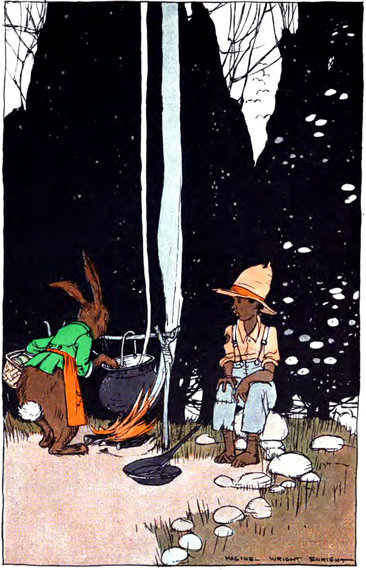
Once on a time, ‘way
down South, there lived
a little boy named Hannibal,
Li’l’ Hannibal.
He lived along with his
gran’mammy and his
gran’daddy in a li’l’ one-story
log cabin that was
set right down in a cotton field. Well, from
morning until night, Li’l’ Hannibal’s gran’mammy
kept him toting things. As soon
as he woke up in the morning it was:
“Oh, Li’l’ Hannibal, fetch a pine knot and
light the kitchen fire.”
“Oh, Li’l’ Hannibal, fetch the teakettle to
the well and get some water for the tea.”
“Oh, Li’l’ Hannibal, mix a li’l’ hoecake
for your gran’daddy’s brea’fus’.”
“Oh, Li’l’ Hannibal, take the bunch of
98turkeys’ feathers and dust the ashes off the
hearth.”
And from morning until night, Li’l’ Hannibal’s
gran’daddy kept him toting things, too.
“Oh, Li’l’ Hannibal,” his gran’daddy
would say, “fetch the corn and feed the
turkeys.”
“Oh, Li’l’ Hannibal, take your li’l’ ax and
chop some lightwood for gran’mammy’s fire.”
“Oh, Li’l’ Hannibal, run ‘round to the
store and buy a bag of flour.”
“Oh, Li’l’ Hannibal, fetch your basket and
pick a li’l’ cotton off the edge of the field.”
So they kept poor little Hannibal toting
‘most all day long, and he had only four or
five hours to play.
Well, one morning when Li’l’ Hannibal
woke up, he made up his mind to something.
Before they could ask him to light the kitchen
fire, or fill the teakettle, or mix the hoecake,
or dust the hearth, or feed the turkeys, or
chop any wood, or go to the store, or pick
any cotton, he had made up his mind that he
was not going to tote for his gran’mammy and
99his gran’daddy any longer. He was going to
run away!
So Li’l’ Hannibal got out of bed very
quietly. He put on his li’l’ trousers, and his
li’l’ shirt, and his li’l’ suspenders, and his li’l’
shoes—he never wore stockings. He pulled
his li’l’ straw hat down tight over his ears, and
then Li’l’ Hannibal ran away!
He went down the road past all the cabins.
He went under the fence and across the cotton
fields. He went through the pine grove past
the schoolhouse, stooping down low—so the
schoolmistress couldn’t see him—and then he
went ‘way, ‘way off into the country.
When he was a long way from town, Li’l’
Hannibal met a possum loping along by the
edge of the road, and the possum stopped and
looked at Li’l’ Hannibal.
“How do? Where you goin’, Li’l’
Hannibal?” asked the possum.
Li’l’ Hannibal sat down by the side of the
road and took off his straw hat to fan himself,
for he felt quite warm, and he said,
“I done run away, Br’er Possum, my gran’mammy
100and my gran’daddy kept me totin’,
totin’ for them all the time. I don’t like to
work, Br’er Possum.”
“Po’ Li’l’ Hannibal!” said the possum,
sitting up and scratching himself. “Any
special place you bound for?”
“I don’t reckon so,” said Li’l’ Hannibal,
for he was getting tired, and he had come
away without any breakfast.
“You come along with me, Li’l’ Hannibal,”
said the possum; “I reckon I kin take you
somewhere.”
So the possum and Li’l’ Hannibal went
along together, the possum loping along by
the side of the road and Li’l’ Hannibal going
very slowly in the middle of the road, for his
shoes were full of sand and it hurt his toes.
They went on and on until they came, all at
once, to a sort of open space in the woods
and then they stopped. There was a big
company there—Br’er Rabbit and Br’er Partridge,
and Br’er Jay Bird and Br’er Robin,
and Ol’ Miss Guinea Hen.
“Here’s po’ Li’l’ Hannibal come to see
101you,” said the possum. “Li’l’ Hannibal done
run away from his gran’mammy and gran’daddy.”
Li’l’ Hannibal hung his head as if he was
ashamed, but nobody noticed him. They
were all as busy as they could be, and so he
just sat down on a pine stump and watched
them.
Each one had his own special work and he
was keeping at it right smart. Br’er Robin
was gathering all the holly berries from the
south side of the holly tree and singing as he
worked:
“Cheer up, cheer-u-up!”
Br’er Partridge was building a new house
down low in the bushes. As he hurried back
and forth with twigs, he would stop and drum
a little, he felt so happy to be busy.
Br’er Jay Bird was taking corn down below.
You know that is what Br’er Jay Bird
does all the time. He takes one kernel of
corn in his bill to the people down below and
then comes back for another. It is a very
long trip to take with one kernel of corn, but
102Br’er Jay Bird doesn’t seem to mind how
hard he works.
Ol’ Miss Guinea Hen was almost the busiest
of the whole company, for she was laying
eggs. As soon as ever she laid one she would
get up on a low branch and screech, “Catch
it! Catch it! Catch it!” like to deafen
everybody.
But Li’l’ Hannibal was most interested to
see what Br’er Rabbit was doing. Br’er Rabbit
had on a li’l’ apron, and he kept bringing
things in his market basket. Then he cooked
the things over a fire back in the bushes, and
when it got to be late in the afternoon, he
spread a tablecloth on a big stump and then
he pounded on his stewpan with his soup
ladle. “Supper’s ready,” said Br’er Rabbit.
Then Br’er Robin, and Br’er Partridge, and
Br’er Jay Bird, and Br’er Possum, and Ol’
Miss Guinea Hen all scrambled to their
places at the table and Li’l’ Hannibal tried to
find a place to sit at, but there wasn’t any.
“Po’ Li’l’ Hannibal!” said Br’er Rabbit
as he poured the soup. “Doesn’t like work!
103Doesn’t like to tote for his gran’mammy.
Can’t have no supper!”
“Catch him! Catch him!” said Ol’ Miss
Guinea Hen, but no one did it. They were
all too busy eating.
They had a grand supper. There was
breakfast strip, and roast turkey, and fried
chicken, and mutton and rice, and hominy
and sweet potatoes, and peas and beans, and
baked apples, and cabbage, and hoe cake, and
hot biscuits, and corn muffins, and butter cakes
and waffles and maple syrup.
When they were through eating, it was
dark, and they all went home, and they left
Li’l’ Hannibal all by himself.
Well, after a while it began to get darker.
Br’er Mocking Bird came out, and he looked
at Li’l’ Hannibal and then he began to
scream, just like Ol’ Miss Guinea Hen,
“Catch him! Catch him! Catch him!”
Br’er Screech Owl looked down from a tree
and he said very hoarsely:
“Who! Who! Who-oo!”
Then all the frogs began to say, loud and
104shrill, “Li’l’ Hannibal! Li’l’ Hannibal!” like
they thought he was deaf.
So Li’l’ Hannibal got up from his pine
stump and he said, “I reckon I better go
home to my gran’mammy.”
Well, Li’l’ Hannibal started for home
slowly, because his feet hurt and he was hungry.
When he came to the pine grove by
the schoolhouse the shadows came out from
behind the trees and followed him, and that
was much worse than seeing the schoolmistress.
But Li’l’ Hannibal got away from
them all right. He crawled under the fence
and ran across the cotton field, and there in
the door of the cabin was his gran’daddy
with a lantern. His gran’daddy had been
out looking for Li’l’ Hannibal.
“Why, Li’l’ Hannibal, where you been all
day?” asked his gran’daddy.
“Oh, Li’l’ Han’,” said his gran’mammy,
“here’s your corn mush. I kep’ it warm on
the hearth, but afore you eat your supper, Li’l’
Han, jus’ take your li’l’ basket and run ‘round
to the chicken house for a couple of eggs.”
105So Li’l’ Hannibal took his li’l’ basket, and
he started for those eggs singing all the way.
You see, he reckoned he was mighty glad to
be at home, and toting again.
HOW TIMOTHY WON THE PRINCESS
106
Once upon a time a poor
widow and her son
Timothy lived in a little
cottage near a village.
One day Tim’s mother
said: “Tim, my boy,
the landlord’s rent must
be paid and I haven’t a
bit of money in the house. I’ve made up
my mind to sell one of our three cows.”
Tim replied: “All right! I’ll take the old
red cow to the fair in the morning, and sell her
for a good price, mother mine.”
Bright and early Tim was ready. It was
a fine spring morning, and the birds sang
merrily in the trees. The hedgerows were
white with May blossoms. Tim drove the
old cow along the mossy green lanes until he
107came to the village, where a fair was being
held.
A great crowd had gathered in a ring near the
main road, and Timothy hurried there to see
what caused the excitement. In the middle of
this ring, on a tiny platform, was a little man with
a tiny harp and a tiny stool. The dwarf reached
down deep into his pocket and brought out a
bee, all dressed up in a blue suit of clothes with
bright buttons and gold braid. Perched on
one side of his head was a cunning little cap
which matched his suit. Again the little man
reached down into his pocket and drew out a
cockroach and a tiny mouse.
The cockroach was dressed in a very full
skirt of flowered silk, a lace bodice, and bright
panniers of velvet. On her head was a dainty
bit of a hat wreathed with flowers.
The little mouse wore a dress suit and a tall
silk hat. At a sign from the little man, the
bee jumped on the stool and began to play a
tune on the harp. Then Mr. Mouse bowed to
Miss Cockroach. She courtesied gracefully,
and the two began to waltz to the music.
108Now the moment they began to dance
every man and woman, youth and maid, joined
them. Soon everything in sight, pots and
pans, pigs and cows, ducks and hens, began to
reel about as if they had all gone mad! The
old cow began to whirl round and round, and
then Timothy started. His feet kept time to
the music which grew louder and faster as
the sport proceeded. In a short time the
little man picked up the harp, stool, and
animals and put them back into his pocket.
Instantly, everybody and everything came
to a standstill! Then such a roar of laughter
burst forth as was never heard before. The
people laughed until their sides ached, and
Timothy’s voice was heard above all the
others. The little man walked up to him.
“What do you think of that for sport?”
he asked.
“Oh, indeed, it was fine fun, sir,” answered
Tim.
“And how would you like to own my
little animals?”
110
111“Like to own them, sir? Indeed I should,
but I have no money, nor have I any way of
getting it.”
“I’ll tell you how to make a good bargain
though,” said the little man, coming closer.
“I’ll trade you the harp and my musician, the
bee, for the cow you’ve brought to the fair to
sell. Come, what do you say to that?”
“Oh, how I should like to have them,
sir! But mother must have money for the
landlord. She is very sad and downhearted
because we cannot pay the rent.”
“Yes, yes, but think how the tiny musician
will make her laugh, my boy. She needs
cheering,” persuaded the little man.
“So she does, sir,” said Tim. “I’ll trade
with you.”
The little man took the cow and disappeared,
and Timothy put the harp, the stool,
and the bee into his pocket and went home.
“You’ve sold the cow, my boy?” said his
mother, anxiously. “How much money did
you get for her?”
“Money, mother! I got something much
better than money,” said Tim, excitedly.
112Then out of his pocket he took the harp,
the stool, and the bee, and set them on the
floor. After a deep bow the bee seated himself
on the stool, cocked his head on one side,
and began to play a lively tune. The little
fellow looked so comical that Timothy’s
mother couldn’t keep a straight face. She
burst into a peal of laughter. The lad joined
her, and then the pots and the pans, the table
and chairs, everything in the house began to
reel and jig. Tim and his mother began to
hop up and down in the funniest manner.
This kept on for some time, and then Tim
took up the harp, the stool, and the bee, and
put them into his pocket. In a second, everything
quieted down. Tim’s mother, however,
kept on laughing for some minutes.
Finally she stopped, and then she grew very
angry.
“What a foolish bargain you’ve made!”
she cried. “Here we are without food or
money, and you have traded the red cow for
such worthless toys! Oh, what shall I do?
You must go back to the fair and sell the
113white cow, I suppose. See that you keep
your wits about you this time.”
Early next morning Timothy started to the
fair, driving the white cow. They soon arrived,
and there in the main road he saw a
big crowd gathered. He pushed forward to
see what was going on. In the middle of
the ring stood the little man with twinkling
eyes. His mouth was screwed up in a very
queer way, and he was whistling. The mouse
and the cockroach were dancing an Irish jig;
bowing, reeling, scraping, courtesying in the
finest manner. Tim’s heart beat fast at the
sight. Soon everybody and everything in
the fair began to imitate the movements of
the queer little creatures. Men and women,
youths and maidens, pots and pans, carts and
gigs, all hopped about and jigged exactly like
the mouse and the cockroach; even the stalls
and the buildings seemed to hop up and down
in time with the music. In a little while the
tiny man stopped whistling, picked up the
little animals, and put them into his pocket.
Then there was no more dancing, but everybody
114burst into a hearty roar of laughter.
How they did laugh! The little man now
spied Tim.
“Ah, my lad,” he said, “wouldn’t you
like to own those wonderful little creatures?”
“Indeed I should, sir, but I have no
money,” said Tim, shaking his head.
“Oh! that makes no difference, I’ll trade
with you again. Give me the old white cow,
and I’ll give you the mouse.”
“Indeed I can’t, sir. Mother is so sad because
we can’t pay our rent or buy any food.
I must get money to pay the landlord,” replied
Tim, looking longingly at the little
man’s pocket.
“Oh, stuff and nonsense! Better be lighthearted
than rich! What will cheer her like
the sight of my little gentleman mouse dancing
to the music of your musician, the bee?”
“All right, sir,” answered Tim, meekly,
and he traded the white cow for the mouse.
When he reached home, his mother cried
out, “You’ve sold the cow, my boy?”
“Yes, mother.”
115“How much money did you get?”
Timothy said not one word, but took the
mouse, the harp, and the bee out of his
pocket and put them on the floor. Tim began
to whistle. The bee accompanied him
with beautiful chords on the harp. After a
grand sweeping bow the mouse fell into a
gay Irish jig. Soon everything in the house
seemed to be hopping and jigging about.
Even Tim and his mother could not hold
their feet still. In a little while Tim took
up the mouse, the bee, and the harp and put
them into his pocket. Then everything
quieted down except the peals of laughter
which his mother could not stop. She
laughed and laughed until her sides ached.
After some time she began to look serious;
then she grew very, very angry.
“Tim, you are the most foolish boy in the
whole world,” she began. “How could you
take such worthless toys for our fine old white
cow? Oh, dear. What shall I do? There
is no money, and the landlord will turn us
out. The old spotted cow must go, I see.
116Take her to the fair to-morrow and see you
bring back nothing but money.”
“I’ll do that mother,” said Tim. His intentions
were good, but alas! when he
reached the fair, there was the little man
again with the cockroach. He was whistling
merrily and the whole fair went jigging
and dancing about, all led by the lively cockroach.
Soon the little man put the tiny,
graceful dancer into his pocket. Then, as
before, the dancing stopped. But the
laughter! You should have heard the merry
peals in every direction.
“Ha, my boy! Here again! You’ve
brought me the spotted cow, I see! Good!
You ought to have the cockroach to complete
your wonders. Take her along.”
“But, sir, I promised mother,” began Tim,
“that——”
“See her pretty bright dress. Master
Mouse and she make a charming couple.
How your mother will be cheered when she
sees them dancing together. There is no
sight like it. Here you are.” Carefully he
117lifted the cockroach, and Tim could not resist
the offer of such a wonderful little
creature. He put her into his pocket, and
the little man disappeared with the spotted
cow.
Tim hurried home. He slipped into the
house. He took out of his pocket Miss
Cockroach, Master Mouse, Musician Bee,
the harp, and the stool, and arranged them
in a corner of the room, telling them to remain
quiet until he came back. Then he
went into the kitchen.
“Tim, my boy,” cried the mother, “how
much money did you get?”
“Mother,” replied Tim, “don’t talk about
money. Come with me.”
He led her into the next room. The
minute they entered, Tim began to whistle.
The bee joined him with a lively tune on the
harp; the mouse made a deep bow, hat in
hand, and the cockroach courtesied most gracefully.
Then the two danced toward each
other and began a real Irish jig, keeping excellent
time to the music. Everything in the
118house joined in the merriment, pots and pans,
chairs and tables, forks and spoons, all went
hopping and jigging about in the most
comical way. Tim clapped his hands. His
mother nodded her head in time with the
music and a broad smile spread over her face,
although she tried and tried to frown. Finally
Tim took up the tiny dancers, the musician,
and the harp, and put them into his pocket.
In an instant everything quieted down.
Then how Tim’s mother did laugh! She
laughed until the tears streamed down her
cheeks. After some time she quieted herself;
then she frowned and grew very angry.
“Oh! you foolish, foolish boy,” she began;
“you’ve traded away all my cows for those
worthless things. Where shall I get money
to pay the rent? We are much worse off than
before. Oh, dear! Oh, dear!”
Tim couldn’t bear to hear her cry, and so
he took his hat and hastened out of doors.
He was strolling down the lane toward the
distant hills when suddenly he saw a tiny
woman who held up her finger in a very
119mysterious way. Tim politely raised his hat
and bowed.
“Good morning!” she said pleasantly. “I
thought all gallant youths were at the palace
of the king.”
“And why should they be there?” asked
Tim astonished.
“Oh, haven’t you heard that the king is in
great trouble about his beautiful daughter, the
princess? She is so sad and downhearted that
the court physicians fear she will die. She
hasn’t laughed for years, and the king has sent
word throughout the land that he will give
the princess in marriage to any youth who
can make her laugh three times.”
Tim didn’t wait to hear another word. He
darted away and ran as fast as he could to the
palace. After a time he reached the outer
gates, and told the guards who were stationed
there why he had come.
“You had better think twice before you
try,” said one of them, “for the king casts all
who fail into a dungeon.”
“No matter, I shall try,” said Timothy.
120Word was sent to the king that a new suitor
had arrived at the palace. The king commanded
the newcomer to appear immediately.
“You know the penalty if you fail to make
the princess laugh three times?” said his
majesty.
“I do, most gracious sire,” replied Tim,
bowing very humbly.
“Then, in a short time, be ready to make
your trial.” With a gesture the king dismissed
him.
In a few minutes a messenger brought word
that the king, the queen, the sad princess, and
attendants were ready for the trial. Tim took
out of his pocket the mouse, the cockroach,
the bee, the harp, and the stool. He tied
them all together with a long string. Then
he marched into the king’s room, holding the
end of the string in his hand. All the queer
menagerie followed after him. He looked so
comical as he approached that the king, the
queen, and the courtiers burst into a hearty
laugh. This made the princess lift her
bowed head and look. When her eyes fell
121on Tim and his string of queer little followers,
she threw back her head and laughed heartily.
“That’s once,” nodded Tim.
Then he untied the string. Musician Bee
at once took his place on the stool near the
harp. Mr. Mouse made his deepest bow.
Miss Cockroach courtesied deep and long.
Tim began to whistle. The bee tuned the
harp and joined him with silvery chords.
The mouse and the cockroach stepped gracefully
in time to the music until they came
near each other. Then they began to perform
their merry Irish jig. The sight was too
much for the king and queen and courtiers.
They all burst into such a merry laugh that the
castle walls rang. The princess tried to look
serious but she couldn’t! She joined the
others and they all laughed heartily.
“That’s twice,” said Tim smiling.
Then he began to whistle faster; the bee
followed him in time. The mouse and the
cockroach bowed and jigged and reeled and
whirled,—all to no purpose. The king, queen,
and courtiers laughed heartily, but the princess
122kept a grave expression. Finally the mouse
whirled around on one heel three times, and
on the last turn his tail swept right into the
cockroach’s mouth. The cockroach started to
cough violently. She coughed and coughed,
and took out her tiny bit of a handkerchief
to hold to her mouth. When the princess
and her ladies saw this, they threw back their
heads and shrieked with laughter.
“That’s thrice,” said Timothy. “I’ve
won the Princess.”
The king now ordered the courtiers to take
Timothy to a royal dressing room. There he
was dressed in a satin suit with gold lace trimmings
and beautiful ornaments. He looked
so handsome in his new clothes that the
Princess fell in love with him. A glorious
wedding feast was prepared. Timothy’s
mother came in a wonderful coach drawn by
six beautiful white horses. At the wedding,
the bee furnished the music; the mouse and
the cockroach led the dancing; and such was
the merriment that the peals of laughter are
still ringing in the valley around the palace.
THE OVERTURNED CART
123
One day, as Oh-I-Am, the
wizard, went over Three-Tree
Common, his shoe
became untied, and he
bent down to refasten it.
Then he saw Wry-Face,
the gnome, hiding among
the bracken and looking
as mischievous as anything. In one hand he
held a white fluff-feather. Now these feathers
are as light as anything, and will blow in the
wind; and whatever they are placed under,
whether light or heavy, they are bound to
topple over as soon as the wind blows.
As Oh-I-Am tied his shoe he saw Wry-Face
place his fluff-feather carefully in the
roadway, and at the same moment there came
along One-Eye, the potato wife, with her cart
full of potatoes. The cart went rumble,
124crumble, crack, crack, crack, over the leaves
and twigs, and One-Eye sang to her donkey:
“Steady, steady,
We’re always ready,—”
in a most cheerful voice.
Then the cart came to the fluff-feather, and
over it went—crash, bang, splutter; and the
potatoes flew everywhere, like rain.
Wry-Face, the gnome, laughed to himself so
that he ached, and he rolled over the ground
with mirth. Then he flew away, laughing
as he went.
But One-Eye, the potato wife, was not laughing.
Her tears went drip-drip as she started
to gather her potatoes together. And as to
getting her cart straight again, she did not
know how she was to do it.
But, when she turned round from gathering
together the potatoes, she found that the cart
was all right again, since Oh-I-Am the wizard
had straightened it for her, and the donkey
was standing on his legs, none the worse for
his fall.
125Oh-I-Am looked stern and straight in his
brown robe which trailed behind him. He said,
“One-Eye, have you got all your potatoes
together?”
One-Eye still wept. She said, “No, I have
not found all of them, for some have wandered
far. And I must not seek further, for this is
market day, and I must away to the town.”
And she began to gather up the potatoes,
and drop them into the cart, thud, thud, thud.
Oh-I-Am stooped then, and he, too, gathered
up the potatoes; and he threw them into the
cart, splish, splash, splutter!
“Alas!” said One-Eye, “if you throw
them into the cart, splish, splash, splutter, you
will bruise and break them. You must throw
them in gently, thud, thud, thud.”
So Oh-I-Am held back his anger, and he
threw the potatoes in gently, thud, thud, thud.
But, when the potato wife had gone on her
way, he flew to his Brown House by the Brown
Bramble; and he began to weave a spell.
He put into it a potato, and a grain of earth,
and a down from a pillow, and a pearl and an
126apple pip from a pie. And when the spell
was ready, he lay down, and fell asleep.
Wry-Face had gone round to all the
neighbors to tell them the grand joke about
One-Eye, the potato wife. Sometimes he
told it through the window, and sometimes
he stood at the door. Sometimes he told it
to a gnome who was fine and feathery, and
sometimes to one who was making bread.
But all the time he laughed, laughed,
laughed, till he was scarcely fit to stand.
Now he did not call at Oh-I-Am’s fine
house to tell him, not he! And it was quite
unnecessary, since Oh-I-Am knew the joke
already, every bit.
Oh-I-Am had hidden the spell in his cupboard.
When it was evening time, he stole
out and laid it by Wry-Face’s door. Then
he went home, and went to bed.
Wry-Face was making a pie for his supper.
Suddenly the room became as dark as dark.
The darkness was not night coming on, for
this was summer time and night never came
on as quickly as all that.
127
129“Dear me, what can be the matter?”
thought Wry-Face; for he could barely see
to finish making his pie.
Then he heard a little voice from his
window, crying, “Here I am, Wry-Face,
here I am!” But he could not go out to see
what it was yet awhile.
When the apple pie was finished and in the
oven, Wry-Face ran outside as fast as he could.
But he did not see the spell which Oh-I-Am
had placed by his door.
What he did see was a great potato plant
which had sprung up suddenly close to his
window, and was springing up further still,
high, high, and higher.
“Good gracious me!” cried Wry-Face in a
rage, “I never planted a potato plant there, not
in my whole life! Now I should just like to
know what you are doing by my window?”
The potato plant took no notice, but went on
climbing high, high, and higher, and, ever so
far above, he heard a tiny faint voice crying,
“Here I am, Wry-Face, here I am!”
“Well, I never did!” cried Wry-Face, and
130he began to weep; for he saw that the potato
plant would climb up to his roof and round
his chimney and he would never be able to
get rid of it.
And he wept and wept.
At last he went in, and took his pie out of
the oven, and set it in the pantry, for it was
quite done. And he found a spade, and went
out, and began to dig and dig at the root of
the potato plant. But his digging did not
seem to make any difference, and the evening
began to grow darker.
Wry-Face fetched his little lamp, which is
named Bright Beauty and which always burns
without flickering. Then he went on digging,
and he dug and dug and dug.
And when he had dug for hours and hours,
so that he was very, very tired, the potato
plant began suddenly to dwindle and dwindle.
It dwindled as fast as anything, the leaves
disappeared and the stem disappeared and all
the horrid stretching arms. They sank down,
down, and down, till at last there was nothing
left at all but—a big brown potato!
131“Well, I do declare!” cried Wry-Face.
“I should like to know what you have to do
with my fine garden.”
The potato replied, “I jumped here from
the cart of One-Eye, the potato wife, and it
is quite certain that unless I am taken back
to her immediately, I shall start again, growing
and growing and growing.”
“Dear potato, you must not start growing
again,” cried Wry-Face, in a great way.
“To-night I am so tired, I cannot do anything,
but if you will but wait till to-morrow
I will take you back to One-Eye, the potato
wife—I will, indeed.”
At first the potato would not listen to this
at all; but after a while it said, “Well, well,
I will wait till to-morrow. But remember,
if you do not carry me home to One-Eye, the
potato wife, to-morrow, I shall grow into a
potato tree, without a doubt.”
So Wry-Face carried the potato into his
house, and stored it in his bin. But he never
noticed the spell which Oh-I-Am had placed
by his door.
132“I am so tired, I can scarcely yawn,” said
Wry-Face. “It is quite time for me to have
my supper and go to bed.”
So he fetched the apple pie from the pantry
and set it upon the table, and presently he sat
down to his meal.
And he forgot for a moment how tired he
was, thinking how delightful it was to sit
down to a supper of apple pie.
Then he lifted his knife and fork to cut
off a large piece, but alas, the fork stuck fast.
As for the knife, it would not move either,
not an inch. Wry-Face began to weep.
“Alack, what has happened to my apple pie?”
cried he, and his tears fell, round as round.
Then he got upon his feet, and he caught
hold of the knife and fork and pulled and
pulled and pulled. And with the last pull
the top of the apple pie came off, sticking to
the knife and fork, and Wry-Face saw that
within the pie there was not one piece of
apple, but—a big brown potato!
Wry-Face wept again with horror at the
sight.
133“I should like to know,” cried he, “what
you are doing in my fine apple pie?”
The brown potato replied, as cool as cool,
“I am one of the potatoes belonging to One-Eye,
the potato wife, and I turned the apples
out, that I might hide here awhile. But this
I must tell you, Wry-Face, unless you take
me home to the potato wife immediately,
here, in this pie dish, I intend to remain.”
“Alas!” cried Wry-Face, “to-night I am
so tired I could never find One-Eye; but if you
will but wait till to-morrow, I will carry you
home to the potato wife—I will, indeed.”
At first the potato would not agree to
this at all, but after a while it said, “Very
well, I will wait till to-morrow. But remember,
my Wry-Face, if you do not carry me
home to One-Eye to-morrow, I will creep into
every pie you make; and you will die at last
of starvation without a doubt.”
So Wry-Face stored the potato in the potato
bin and went supperless to bed. And he
knew nothing of the spell which Oh-I-Am
had placed by his door.
134Now he got into bed, and thought he
would go to sleep; but oh, how hard the
mattress was! Wry-Face lay this way, then
that, but no matter which way he lay, he
found a great hump just beneath him which
was as hard as hard, and as nobbly as could be.
Wry-Face tossed and tossed till it was
nearly morning; and his bones were so sore
that he could lie no longer.
Then he pulled the mattress from the bed
and cut a great hole in it, and when he had
searched and searched he found in the middle
of the mattress—a big brown potato!
“This,” cried Wry-Face, “is why I have
not slept the whole night through!” And he
wept like anything.
But the potato was as cool as cool.
“I belong,” it said, “to One-Eye, the potato
wife; and let me tell you, my little
gnome, unless you take me to her immediately,
I shall climb into your mattress again,
and there I shall remain.”
“Alas,” cried Wry-Face, “I have tossed
about for hours and hours and am too tired
135to do anything. But if you will wait till to-morrow,
dear potato, I will carry you to One-Eye,
the potato wife—I will, indeed.”
At first the potato was unwilling to listen
to this, but after a while it said, “Very well,
then, I will wait till the morning. But this
much I know, my Wry-Face, if you do not
carry me then to One-Eye, the potato wife,
I shall get into your mattress and you shall
roll again every night.”
So Wry-Face put the potato in the bin.
When he had done that he went to bed, and
slept and slept.
When the sun was shining he awoke, and
he remembered that he had to carry the potatoes
back to One-Eye, the potato wife; and
he was as cross as anything.
“Well, I suppose I must,” he said. And
when he had had his breakfast, he went to his
cupboard to get a sack.
Then he found that his sack was full of
pearls which he had gathered together for
Heigh-Heavy, the giant, whose daughter,
So-Small, he wished to marry.
136So he thought, “First of all I will carry
the pearls to Heigh-Heavy, for that is more
important.” And away he went with the sack
upon his back. And he never saw the spell
which Oh-I-Am had placed beside his door.
When he reached the Most Enormous
House of Heigh-Heavy, the Giant, there the
giant was sitting in his parlor lacing his shoes.
So Wry-Face cried out in a gay little voice,
“Here I am, Heigh-Heavy, here I am. And
here is a bag of pearls which I have brought
you in exchange for your beautiful daughter,
So-Small.”
When Heigh-Heavy heard this, he stopped
lacing his shoes, and said, “You must bring
me in exchange for my daughter So-Small as
many pearls as will cover my palm.”
Then Wry-Face ran forward and he tipped
up the sack; and, standing high upon his toes,
he shook out all that it held into the hand of
Heigh-Heavy, the Giant.
Now all that it held was—one brown
potato!
Wry-Face the gnome stared and stared and
137stared, his eyes growing rounder and rounder;
but he had no time to weep, on account of
Heigh-Heavy the giant who had fallen into a
rage terrible to see.
“Now there is one thing quite certain,”
said Heigh-Heavy, “and that is that you shall
never marry my daughter So-Small, for, my
Wry-Face, I will turn you into a brown potato,
and a brown potato you shall remain your
whole life through.”
When Wry-Face heard this terrible threat
he took to his heels, and ran from the Most
Enormous House of Heigh-Heavy, the giant.
He ran, and ran, till his coat was torn and his
ears were red; and he never rested till he
reached his cottage door, and got inside.
Heigh-Heavy laughed till he cried to see
the little gnome run. “He will play no
tricks on me!” said he. And he went in and
shut the door.
But Wry-Face said to himself, as he carried
the potatoes, weeping, to the potato-wife:
“I will never play a trick on anyone
again, not as long as I live!”
CHANTICLEER
138
Once upon a time a
widow and her two
daughters lived in a little
cottage near a grove.
They were so poor that
it took the most careful
managing to earn a
humble living. Their
meals were very simple; indeed, they often had
nothing but milk and brown bread, and once
in a while a bit of bacon and an egg or two.
Around the cottage was a henyard, fenced
in with sticks and a dry ditch, and here the
old widow kept a handsome rooster called
Chanticleer. His match for crowing could
not be found; his voice was merrier than the
merry organ heard in the church on Mass days,
and the wonder of it was one could tell the
hour of the day by his crowing! His comb
139was redder than fine coral, and all notched
like a castle wall. His bill was black and
shone like jet, his legs and his toes were like
azure, his nails whiter than the lily flower,
and his feathers the color of burnished gold.
Chanticleer lived a happy life. He had
with him seven plump wives, all very much
like him in color, but by far the cheeriest
companion among them was Demoiselle Partlet,
who was not only beautiful but also wise
and courteous. Chanticleer loved her dearly.
What joy it was to hear them sing together
at sunrise,
“My love is far away.”
Early one morning when Chanticleer and
his seven hens sat on the perch, Partlet, who
was beside her lord, heard a loud groan.
“My dear,” she said, astonished and alarmed,
“what can be the matter with you? For
shame, to wake us all up in this way!”
“Madam,” replied the rooster, “do not be
anxious about me. It was only a dream, but
it has frightened me almost beyond words. I
thought I was roaming up and down the yard,
140when suddenly I saw a beast somewhat like a
hound ready to spring at me. He was between
yellow and red in color, his tail and ears were
tipped with black, his nose was small and his
eyes glowed like fire. I almost died of fright!
That is what made me groan.”
“Fie for shame!” retorted Partlet. “Do
you admit to your love that anything could
fill your heart with fear? Alas! Alas! You
know that dreams mean nothing. Let me
explain what causes them. Overeating creates
too much black humor, and in consequence
one is likely to dream that black bears,
or black bulls, or even devils will catch him.
Then again, if one has too much red humor
he may dream of arrows, of fire with red
blazes, or of great and small whelps that will
bite. I could go on, but further talk is unnecessary.
Dearest, when we fly down from
these rafters I will point out to you herbs and
berries that will cure you; also for a day or
two you shall have a light diet of worms.
Cheer up, I say, and in a little while all will
be well. Should this occur again, remember
141the words of the wise Cato: ‘Take no heed
of dreams!’”
“Thank you for your excellent advice, my
dear,” replied Chanticleer. “I know that
Cato had much wisdom, but I can give you
examples of other very wise men who did not
agree with him. Do you not remember the
story of Daniel in the Old Testament? Did
he think dreams mean nothing? Also read
the story of Joseph and you will see that a
dream held warnings of future things. Recall
for a moment Pharaoh, King of Egypt, his
baker and his butler! See what they thought
about the meaning of dreams. Wonderful
stories on this subject I could point out to
you, so do not be surprised that this dream of
mine makes me anxious. But now, my dearest
Partlet, let us talk about merrier things, for,
when I see the beauty of your face and the
lovely scarlet hue about your eyes, all my fears
leave me. I am so full of joy and comfort in
your company that I forget dreams.”
Daybreak had come and the rooster and his
seven wives flew down from the perch.
142“Cluck! Cluck!” he called gayly when he
found a tidbit in the yard. Behold Chanticleer
in all his glory! Brave as a lion, he
roamed proudly on his tiptoes up and down
the henyard, never dreaming that an enemy
was watching him with cunning interest.
Now it happened that a wicked fox had
lived for three years in the grove near the
cottage. All this time he had been watching
his chance to fall upon the handsome rooster.
During the night of Chanticleer’s dream, the
fox had pushed slyly through the hedge into
the garden and had carefully hidden himself
among the vegetables.
The sun was shining gloriously! Partlet
and her sisters were bathing merrily in the
warm sand! Gallant Chanticleer, singing
merrier than a mermaid, was watching a butterfly
flitting about in the sunshine among the
herbs when suddenly his eye caught sight of
the fox lying low among the leaves! Terror
seized him. The song died in his throat.
“Cok! Cok!” he gasped. In a moment
he would have fled, but the fox began right
143away to speak to him in a very persuasive
tone.
“Gentle sir, I hope you are not afraid of
me, your own good friend. Certainly I should
be worse than a fiend if I harmed you.
Indeed I did not come here to spy upon you,
but, pardon me, to hear your glorious voice.
No angel in heaven could sing sweeter than
you do. How well I remember my lord,
your father, and my lady, your honorable
mother. They have been guests at my house
many times. Shall I ever again hear a voice
as beautiful as your father’s when he greeted
the sunrise! I remember exactly how he
looked. He stood on his tiptoes, shut his
eyes tightly, stretched out his long slender
neck and then poured forth his glorious song.
He was indeed a wonder. Also, he was very
wise and careful. I have heard it said that no
one could surpass him in song or wisdom. I
wonder, kind sir, if your voice is as beautiful
as your father’s. For sweet charity’s sake, will
you not sing one song for me and let me
compare the two voices?”
144How could Chanticleer refuse one so kind
and courteous? He began to flap his wings.
He stood on tiptoe. He closed his eyes.
He stretched his long, slender neck and began
to crow. Snap! In a twinkling the fox
seized Chanticleer by the throat, swung him
across his back, and was off to the woods with
him.
Never was there such a commotion! The
hens screamed and cried pitifully. Partlet
shrieked at the top of her voice. This
brought the widow and her daughters to the
door, and then they saw the wicked fox with
Chanticleer across his back making for the
wood. “Help! Help! A fox! A fox!” they
cried, and started after him as fast as they could
go. Men snatched up sticks and joined them.
The dog Coll ran yelping and barking. Malkin
started with the distaff in her hand. The
cow and the calf ran. The hogs, frightened
at the loud barking of the dogs and the
screaming of the people, set up a squealing
like fiends and followed in the chase. The
ducks quacked as if they were being murdered,
the geese in terror took flight over the tree
tops. The hideous deafening noise started a
swarm of bees forth from their hive. Soon
other people followed with horns of brass,
wood, and bone. They blew, they bellowed,
they cried, they screamed, they whooped, they
shrieked, and made such a bedlam that it seemed
the very heavens would fall. And on ran the
fox with the rooster on his back.
146
147Now Chanticleer in all his breathless terror
was rapidly turning over in his mind how
he could help his friends to rescue him. Controlling
his fright as best he could, he said,
“Sir, if I were you, I’d scoff at these followers.
Say to them, ‘Turn back you proud
churls! A plague upon you! The rooster
is mine and I’ll soon be where I can eat
him.’”
“In faith,” replied the fox, “I’ll do what
you say.” As soon as the fox opened his mouth,
Chanticleer flew high up into a tree which
stood near. Now the fox saw his mistake, but
was not ready to give up.
“Alas, alas, Chanticleer,” he began, “I’ve
148done you a great wrong. I seized you and
carried you entirely too roughly. Forgive me
for frightening you. Come now, fly down a
moment and let me explain.”
“No thank you,” crowed Chanticleer.
“Your flattery will not catch me a second time,
and make me sing again with my eyes closed.
For no good can come to anyone who closes
his eyes when they should be open.”
“Bad luck to the one who talks when he
should hold his peace,” grumbled the fox.
THE JACKAL AND THE ALLIGATOR
149
A little Jackal, who
was very fond of crabs and
bits of fish and whatever
else he could find, went
down to the riverside
one morning in search
of something for his
dinner. He ran up and down the bank, here
and there, but he could find nothing to eat.
At last, near some tall bulrushes and under
clear, shallow water he saw a little crab who
was sidling along as fast as his legs could carry
him. The little jackal was so very hungry
that, without looking, he put his paw into
the water after the crab. “Snap!” A great
big alligator who lived in the river, had the
paw in his jaws.
“Oh, dear,” thought the little jackal, “a
150big alligator has my paw in his mouth. In
another minute he will drag me down under
the water and swallow me. What can I
do?” Then a thought came to the little
jackal, “I’ll fool that old alligator and get
away from him.” So he called out in a very
cheerful voice, “Clever Alligator! Clever
Alligator! To catch hold of that bulrush root
for my paw! I hope you will find it very
tender.”
The old alligator was so hidden among the
bulrushes that he could scarcely see anything.
On hearing the little jackal call out he said to
himself, “Dear me, I thought I had caught
hold of the jackal’s paw; but there he is calling
out in a cheerful voice. I suppose I
have made a mistake.” So saying he opened
his mouth and let the little jackal go.
The jackal ran away as fast as he could.
When he was at a safe distance he called out,
“O wise Alligator! O wise Alligator! So
you let me go again.” The alligator was
very angry, but the little jackal had run too
far away to be caught.
151The next day the jackal returned to the
riverside to get his dinner as before. The
old alligator was nowhere to be seen, but
the little jackal thought it best not to take
any chances, so he called out, “Wherever I
go to look for my dinner, I search for the
nice little fat crabs that come peeping up
through the mud. Then I put my paw down
and catch them. I wish I could see one
now.”
The old alligator was down in the mud at
the bottom of the river, and he heard every
word the jackal said. He thought to himself,
“Aha! I’ll just show the tip of my nose up
through the mud. He’ll take it for a little
fat crab and put his paw in to catch me. As
soon as he does so, I’ll gobble him up!” So
he popped the little point of his nose out of
the mud and waited. No sooner did the
jackal see the tip of the alligator’s nose than
he called out, “O Friend Alligator, so there
you are. No dinner for me here, thank you.”
And off he ran and fished for his dinner a
long, long way from that place. The old
152alligator snapped his jaws again and again.
He was very angry at missing his dinner a
second time, and he made up his mind not to
let the jackal escape again.
The following day, the little jackal went
down to the waterside as usual to look for
crabs. He was rather afraid to go too near
the river’s edge, for he felt sure the old enemy
was hiding somewhere. So he stayed back
at a safe distance and called out,
“Where are all the little crabs gone?
There is not one here and I am very hungry.
When I don’t see them on the shore or peeping
up through the mud I see them blowing
bubble, bubble, bubble, and all the little
bubbles go pop! pop! pop!” The old alligator
lying low in the mud heard this and he
said to himself, “I can fool that little jackal
easy enough this time. I’ll pretend to be a
little crab.” Then he began to blow, puff,
puff! Bubble, bubble, bubble! And all the
great bubbles rushed to the top of the river,
and burst there, and the water whirled and
whirled round and round just above the place
153where the old alligator lay hidden. It didn’t
take the jackal long to know who was underneath
those bubbles, and off he ran, as fast as
he could go, calling out,
“Thank you, kind Alligator, thank you,
thank you! Indeed it is very kind of you to
show me just where you are.”
The old alligator was furious at being deceived
by the little jackal once more. “Next
time I will be very cunning,” he said. So,
for a long time he waited and waited for the
jackal, to come to the riverside, but the jackal
never returned.
“I shall be caught and eaten by that wicked
old alligator some day if I am not careful. I
must content myself to do without crabs.” He
went no more to the river, but stayed in the
jungle and ate wild figs and roots which he
dug up with his paws.
When the alligator found this out he was
angry again, and he determined to try to
catch the jackal on land. So he crawled over
the ground to a place where the largest of the
wild fig trees grew. He made a great heap
154of the fallen figs and hid himself under it, and
there he waited for the jackal. No sooner
did the cunning little animal spy the great
pile of figs than he thought, “Oh, ho, that
looks much like my friend the alligator. I’ll
see.” So he called out,
“The little wild figs I like best always
tumble down from the tree, and roll here
and there as the wind drives them. That
great heap of figs is quite still. They can
not be good figs. I will not eat one of
them.”
The old alligator thought, “Oh, ho! How
suspicious this jackal is. I will make the figs
roll about a little, then he will come and eat
them.”
So the great beast shook himself and all the
little figs went roll, roll, roll, this way and that,
farther than the most blustering wind could
have driven them. The jackal knew who
was under the heap. Away he scampered,
calling back, “Thank you, Mr. Alligator,
for letting me know you are there! I should
scarcely have guessed it.” The alligator hearing
155this was so angry that he ran after the
jackal, but the jackal ran away too quickly
to be caught.
The old alligator was now in a rage. “I
will not let him make fun of me another time
and then run away out of my reach. I will
show him I can be more cunning than he
thinks,” he declared.
Early the next morning he crawled as fast
as he could till he came to the little jackal’s
den. The jackal was away, and so he crept
in and hid himself to wait until the little
animal should return. By and by the jackal
came home. He looked all about the place,
for the ground around his house was torn up
as though some very heavy animal had been
crawling there.
“Dear me,” he said. Then he saw that the
earth on each side of the door of his den had
been knocked down as if something very big
had tried to squeeze through it.
“I certainly will not go inside until I know
who has gone in there.” So he called out,
“Little house, why do you not give me an answer
156when I call? You always call out to me
if all is safe and right. Is anything wrong
that you do not speak?”
Then the alligator who was inside thought,
“I must pretend to be the little house and call
out. He will not come in unless he thinks
all is right in here.” So he called out in
as pleasant a voice as he could, “Sweet little
Jackal.” When the little jackal heard that
he was frightened indeed.
“So that dreadful old alligator is in my
house. I must try to kill him if I can, or
he will certainly make an end of me some
day.”
Then he answered, “Thank you, my dear
little house. I like to hear your pretty voice.
I am coming in a minute, but first I must
collect some firewood to cook my dinner.”
As fast as he could, he gathered all the dry
branches and bits of sticks and piled them up
close to the mouth of the den. The old alligator
inside kept as quiet as a mouse, but he
could not help laughing a little to himself,
“So I have deceived that little jackal at last.
157In a few minutes he will run in here, and then,
won’t I snap him up!”
When the jackal had gathered as many
sticks as he could find, he ran back and placed
the sticks all round the outside of his den.
Then he set fire to them. The great fire
blazed up, and the smoke filled the den and
smothered that wicked old alligator.
FINN AND THE FAIRY SHOEMAKER
158
Finn O’Shea’s grandmother
knew more about
fairies than anyone else in
the village. One afternoon
when the sun was
shining on the tops of the
Nine Hills, which rose
up a few fields beyond the
edge of the village, Finn and his grandmother
were coming home from a walk. Suddenly
the old woman darted forward and picked up
the tiniest bit of a gray feather. Her sharp eyes
had spied it under the shadow of a foxglove.
“What is it, Granny?” asked Finn.
“An owl’s feather, lad. It fell out of one of
their wee red caps,” said she, laughing quietly.
“They had a fine revel in the fields last night,
my boy, for it was Midsummer Eve. That
is the time when the wee folks are gayest,
you know.”
159“I wish I could see them dancing,” said
Finn.
“Ah, my lad, no mortal can see them so
long as they keep their wee red caps on,”
said grandmother. “Sometimes in their
revels they toss their caps aside, but you see
the frogs are always on the lookout to warn
the fairies if mortal steps are near. These
tiny elves are very clever. Do you see those
three circles of green which are a little lighter
in color than the rest of the grass? That is
where they danced until the village cocks
began to crow. Then they made off to the
Nine Hills. Ah! It would be a wonderful
sight to see the wee folks whirling and gliding
about in the white moonlight to the sweetest
fairy music. But as I said, few mortals have
ever seen them.”
“Do they dance every night, grandmother?”
“Every night, Finn. If the weather is fine
they frolic on the green, especially if the moon
is bright. When the nights are wet and
stormy they keep inside the hills, where there
is an elfin village.”
160Finn look very serious. “Grandmother,”
he said, “these wee folks must wear out a
good many pairs of shoes.”
“That they do, my lad. I’m sure I don’t
know what they would do without little Leprechaun,
the Fairy Shoemaker. He is the
only industrious one among them.”
“Tell me about him, Granny,” said Finn.
Grandmother sat down on a large stone
and looked toward the Nine Hills.
“The Fairy Shoemaker is very rich, Finn,
richer than my lord O’Toole who lives in the
castle by the sea. Indeed, there is no one in
all Ireland who has as much gold as this elfin
shoemaker who spends his days working for
the fairies. All kinds of shoes he makes,—stout
little brogans and buskins, high hunting
boots, bits of satin slippers that you could
stand on a penny, tiny sandals with silver
laces and diamond buckles,—all kinds of
shoes. O Finn, my lad, he is a wonderful
wee old man.”
“Where does he keep his money, Granny?”
“Why, what a question, my lad! Do you
161think this sly little Elf would let any mortal
know that secret? Not he!”
“I wonder if anyone has ever seen him,”
said Finn.
“My lad, your great-grandmother O’Shea
knew a poor farmer who found a pot of gold
buried in one of his fields. The villagers always
believed that the man had in some way
caught little Leprechaun, and made him point
out the spot where his gold was hidden.”
“Granny,” said Finn, “I’d like to catch
the Fairy Shoemaker. One pot of his gold
would make us very rich, wouldn’t it?”
“Catch little Leprechaun, Finn! My lad,
you couldn’t do it.”
“He is very tiny, grandmother. I’m sure
I could hold him easily.”
“You would have to catch him, first, Finn.
He is the trickiest Elf of all. No one can
see him as long as he wears his wee red cap!
And if you should chance to find him without
it, you wouldn’t dare take your eyes off him
for one second or away he would go. Some
people say bad luck is sure to come to mortals
162who meddle with the fairies,” said grandmother,
looking about cautiously. “It is
better to earn your pot of gold, my lad. But
come, the sun has gone behind the hills.”
Finn was very quiet all the way home.
He was wondering how he could catch the
Fairy Shoemaker and make the little Elf tell
where his treasure crocks were hidden. He
would begin the search in good earnest the
very next day.
In the morning when Finn drove the cow
to the pasture, he peeped carefully among the
low willows that bordered the brook. He
looked all around the big stones in the
meadow. Several times he stopped and
listened! Once he felt sure he caught the
clicking sound of an elfin hammer. It
seemed to come from the direction of a tall
ragweed, but when Finn drew near, the sound
stopped suddenly and he could see nothing.
Patiently each day he searched for the little
Leprechaun. One afternoon when he was
sauntering through a shady glen near the Nine
Hills he stooped down to quench his thirst at
a tiny spring of clear water. He fancied he
heard a faint clicking sound! “Tip-tap, tip-tap.”
Finn raised his head quickly and listened!
163
165“Rip-rap-tip-tap
Tick-a-tack-too;
Tip-tap-tip,
Rip-rap-rip,
Tick-tack-too.”
The sound came from behind a large stone
near the spring. Soon the tapping stopped
and the shrill voice sang out:
“Tip-a tap-tip
And tick-a-tack-too,
Every stitch helps
To finish a shoe.”
Finn could hear his heart beat. He crept
cautiously along and peeped around the stone.
There, on a tiny stool, sat the Fairy Shoemaker
hammering away at a wee hunting boot of
scarlet leather, which he held between his
knees. And his bit of a red cap was hanging
on a spear of tall grass! Finn leaped to his
166feet, faced little Leprechaun, seized the red
cap, and said, “Good day, sir.”
Instantly the little Elf jumped up and
looked sharply through his spectacles at Finn.
He was about twelve inches tall and his queer
little face was full of wrinkles. A long gray
beard reached to the top of a leathern apron
which almost covered his brown suit.
“Good day, sir,” repeated Finn.
“Humph!” grunted Leprechaun.
Finn went closer, grasped the little Elf’s
shoulder, held him tightly, and stared sharply
at him.
“You’d better be off,” said the Fairy Shoemaker;
“I have work to do.”
Finn kept his eyes fixed on the wee man,
and said, “Come, now, where do you keep
your treasure crocks? I shall not let you go
until you tell me.”
“Oh! Is that all you want?” laughed the
Elf. “Well, come along with me.”
Finn was delighted. The old man seemed
very easy to manage. Leprechaun looked up
pleasantly and said, “Your pardon, sir.” He
167pulled out a tiny gold snuffbox, took a pinch
and offered some to Finn. “Snuff, sir?” he
said with a smile.
“Why, how friendly he seems,” thought
Finn, taking a pinch.
“Pouf-f!!” The Fairy Shoemaker blew
all the snuff right into Finn’s face.
“Tshoo-oo!—Tshoo-oo! A-a-a-tshoo-oo-oo!”
sneezed Finn, shutting his eyes! In a
twinkling the wee man had snatched his red
cap and was gone!
Finn went home a little discouraged.
“Why didn’t I remember what Granny told
me about his tricks?” he said to himself.
“I’ll try again, and he shall not catch me a
second time.”
One afternoon a few weeks later, Finn walked
as far as the Nine Hills. He was very tired, so
he lay down on one of the grassy slopes to rest.
How quiet it was on the shady hillside!
“Tip-a-tap-tip
And tick-a-tack-too,
Rip-rap-rip
Tick-tack-too.”
168The sound came from the crest of the hill.
After a little pause a shrill voice sang:
“A wedding feast to-night
And dancing on the green!
In moonbeams’ silver light
Gay fairies will be seen!
Tiny satin sandals
To grace the dainty bride;
Stitch away Leprechaun
They must be your pride.”
It was the voice of little Leprechaun! The
Fairy Shoemaker was working away near the
crest of the hill. Finn crept up the grassy
slope, and there in the shadow of some low
bushes sat the tiny Elf. He was putting a
high heel on the daintiest white satin sandal.
And beside him lay his wee red cap!
“Tip-tap-rip-rap
Tick-a-tack-too.”
The elfin hammer was working busily—busily!
Finn slipped up quietly, and grasping the
red cap in one hand laid hold of the wee
169man’s shoulder with the other. Up jumped
the Elf. He looked round quickly for his cap.
“Good day, sir,” said Finn.
Leprechaun made a deep bow.
“You are busy, I see.”
“Always busy, sir,” answered the wee man.
“Always busy.”
“I suppose you like to make shoes, especially
such dainty ones?” And all the time Finn
kept his eyes on the little Elf’s face and held
him fast.
“I like to work” said the Fairy Shoemaker
slyly. “Come, now, do you?”
Finn felt a little confused at this last question,
but he answered,
“You have plenty of gold and some to
spare, I should think. Come, tell me where
you keep your treasure crocks.”
“I will show you where I keep one of
them,” answered Leprechaun.
“All right,” answered Finn. “If you’ll
lead me to the spot where one crock of gold
is buried, I’ll not bother you again.”
“Come, then,” said the Elf.
170“Mind that you keep your snuffbox in
your pocket,” said Finn. “You shan’t catch
me that way again.”
“This way,” laughed the wee man.
Down the hillside and over the fields
hurried the Fairy Shoemaker, leading Finn
along at a good pace. It was wonderful to
see this queer Elf skip across the ditches and
hedges, and hop over the stones and rough
places in the meadow. Finn was becoming very
tired. “How much farther is it?” he asked.
“Come along, come along,” laughed little
Leprechaun.
Finally they came to a field full of ragweed.
The Fairy Shoemaker stopped suddenly.
Then pointing with his tiny finger, he said,
“If you dig deep under the roots of this weed,
you’ll find one of my treasure crocks filled to
the brim with gold.”
“But I can’t dig without a spade,” said
Finn excitedly.
“Of course not,” answered Leprechaun.
“But now that you know the spot you can
get the gold whenever you like.”
171“I shall get it to-day,” said Finn. “I’ll
run home now and get my spade. But I’d
better mark the weed, I think.”
“That would be a good plan,” said the
Shoemaker. “Here I have a bit of bright
red string in my pocket. Let us tie it around
the stem near the top.”
How deftly the elfin fingers tied the mark!
“Thank you very kindly,” said Finn.
“Is there anything else I can do for you,
sir?” asked Leprechaun.
“You will promise not to touch the string?”
“I promise not to touch it, sir. Also I assure
you no one else shall touch it,” said
Leprechaun.
“Well, then, you may go. Here is your
red cap. I thank you very much for your
kindness. Good day!” said Finn pleasantly.
“Good day, sir,” said the Fairy Shoemaker,
and off he scampered, chuckling to himself.
You may be sure Finn hurried away to fetch
his spade. How surprised Granny would be
to hear that he had caught the Fairy Shoemaker.
He would not tell her until he
172carried home the treasure. In breathless haste
he got his spade and hurried back to the field
of ragweed. Then Finn stood still and
looked! A bit of bright red string was tied
around every ragweed in the field! The
Fairy Shoemaker had tricked him again!
He thought he heard a low chuckling laugh.
Finn listened carefully. From among the
weeds he heard a faint voice singing,
“How does the little Leprechaun
Fill treasure crocks with gold?
The live long day he works away
From far-off times of old.”
MAKING THE BEST OF IT
173
“What a pretty day this is!”
said the old gray goose to
the brown hen, as they
stood at the henhouse
window and watched the
falling snow which covered
every nook and
corner of the farmyard.
“Yes, indeed,” said the brown hen; “I
would be almost willing to be made into
chicken pie on such a day.”
She had scarcely stopped talking, when the
Pekin duck said, fretfully, “I am dreadfully
hungry,” and a little flock of speckled chickens
all huddled together wailed in sad chorus,
“And we’re so thirsty!”
In fact, the feathered folks in the henhouse
were very much inclined to be cross and discontented.
174Since the farmer’s boy fed them,
early in the morning, they had been given
nothing to eat or drink, and, as hour after
hour went by, and the cold winter wind
howled around their house, it is no wonder
they felt deserted.
The handsome white rooster, however, appeared
quite as happy as usual, and that is saying
a great deal, for a jollier, better-natured
old fellow than he never graced a farmyard.
Sunshine, rain, or snow were all the same to
him, and he crowed quite as lustily in stormy
weather as in fair.
“Well,” he said, laughing heartily, as his
bright eyes glanced about the henhouse, “you
all seem to be having a fit of the dumps.”
Nobody answered the white rooster, but a
faint cluck or two came from some hens
who immediately put their heads back under
their wings, as if ashamed of having spoken
at all.
This was quite too much for the white
rooster, who, standing first on one yellow foot
and then on the other, said: “Well, we are a
175lively set! Anyone would think, to look in
here, that we were surrounded by a band of
hungry foxes.”
Just then a daring little white bantam
rooster hopped down from his perch, and,
strutting pompously over to the big rooster,
created quite a stir among the feathered folk
by saying,
“We’re all lively enough when our crops
are full, but when we’re starving the wonder
is that we can hold our heads up at all. If I
ever see that farmer’s boy again, I’ll—I’ll
peck his foot!”
“You won’t see him until he feeds us,” said
the white rooster, “and then I think you will
peck his corn.”
“Oh, oh!” moaned the brown hen, “don’t
mention a peck of corn.”
“Madam,” remarked the white rooster,
bowing politely, “your trouble is my own—that
is, I’m hungry, too. But we might be
worse off; we might be on our way to market
in a box. Then, too, suppose we haven’t had
enough to eat to-day, at least we have room
176enough to stretch our wings and a good, quiet
place to sleep in.”
“Why, that is a fact,” answered the brown
hen; and all the feathered family—the smallest
chickens included—stretched their wings,
preened their feathers, and looked a trifle more
animated.
“Now then,” went on the rooster, “suppose
we have a little music to cheer us and help
pass the hours until roosting time. We will
all crow—there, I beg your pardon, ladies; I
am sorry you can’t crow—we will sing a merry
song. Will you be kind enough to start a
lively tune, Mrs. Brown Hen?”
The brown hen shook herself proudly,
tossed her head back, and began: “Cut-cut-cut-ca-dak-cut,”
and in less than two minutes
every one in the henhouse had joined her.
Now the horses, cows, and sheep were not
far away, and, hearing the happy voices in the
henhouse, they, too, joined in the grand chorus,
while the pigs did their best to sing louder
than all the rest. Higher and higher, stronger
and stronger, rose the chorus; louder and
177louder quacked the ducks, and shriller and
shriller squealed the pigs. At length even
the dogs barked merrily.
They were all so happy that they quite forgot
their hunger until the door of the henhouse
burst open, and in came three chubby children,
each carrying a dish full of steaming chicken
food.
“Don’t stop your music, Mr. Rooster,” said
the little girl, who was so snugly bundled up
that you could scarcely see her dear little face.
“You see, we were so lonesome that we didn’t
know what to do; but when we heard all you
folks singing out here in your house, we
laughed and laughed until we almost cried.
Then we went to tell Jack about you; he was
lonesome, too—poor Jack sick with a sore
throat—and he said, ‘Why, those poor hens;
they haven’t been fed since morning!’”
“Cock-a-doodle-do!” said the white rooster.
“This comes of making the best of things.
Cock-a-doodle-do!” And nobody asked him
to stop his crowing.
THE BROWNIE OF BLEDNOCK
178
Did you ever hear how a
Brownie came to the
village of Blednock and
was frightened away
again?
It was one November
evening, just when the
milking was done and
before the children were put to bed. The
people of the village were standing by their
doorsteps talking about their bad harvest and
the turnips, and what chances there were of a
good price for their cattle at the coming fair.
All at once the queerest humming noise
seemed to come up from the riverside. It
came nearer and nearer, and all the good people
stopped talking and began to look down the
road. And, indeed, it was no wonder that
they stared, for there, coming up the middle
179of the highway, was the strangest little creature
that human eyes had ever seen.
He looked like a wee, wee man. He had
a long blue beard which almost touched the
ground. His legs were twisted, his knees
knocked together as he walked, and his arms
were so long that his hands trailed in the mud
as he came along. He seemed to be humming
something over and over. As he came nearer,
the good people of the village could make out
the words:
“Have ye work for Aiken-Drum?
Any work for Aiken-Drum?”
Oh, how frightened the people were! The
children screamed and hid their faces in their
mothers’ gowns and the milkmaids threw down
the pails of milk they were carrying. Even
the dogs crept in behind the doors, whining
and hiding their tails between their legs.
Some of the men who were not too frightened
to look the wee man in the face, laughed and
hooted at him.
“Did you ever see such eyes?” cried one.
“His mouth is so big he could swallow the
180moon and never even notice it,” said the
other.
“Look at his long blue beard!” said a third.
And still the poor little man came slowly
up the road, crying:
“Have ye work for Aiken-Drum?
Any work for Aiken-Drum?”
Good Grannie Duncan, the kindest old
woman in the village, called out at last: “He’s
just a Brownie, a simple, kindly Brownie. I’ve
heard tell of Brownies before. Many a long
day’s work will they do for the people who
treat them well.”
Gathering courage from her words, all the
village folk crowded around the little man.
When they were close to him, they saw that
his face was kind and gentle and that his tiny
eyes had a merry twinkle in them.
“Strange little creature,” said an old man,
“tell us what you want and where you came
from?”
182
183“I cannot well tell thee whence I came,”
said the wee man. “My country is a nameless
land and is very different from this land
of yours. For there we all learn to serve,
while here every one wishes to be served.
When there is no work for us to do at home,
we sometimes set out to visit thy land to see
if there is any work we can do there. If
thou wilt, I will stay here awhile. I do not
wish anyone to wait on me, for I want no
wages, nor clothes, nor bedding. All I ask for
is a corner of the barn to sleep in, and a bowl
of broth set down on the floor at bedtime.
If no one meddles with me, I shall be ready to
help any one who needs me. I’ll gather your
sheep on the hill. I’ll take in the harvest by
moonlight. I’ll sing your bairns to sleep in
their cradles. You’ll find that the bairns
all love Aiken-Drum. And, good housewives,
I’ll churn for you and bake your bread on a
busy day. The men folk, too, may find me
useful when there is corn to thrash, or untamed
colts in the stables, or when the waters are
out in flood.”
No one knew quite what to say in answer to
the little creature’s strange request. It was an
unheard-of thing for anyone to come and offer
184his services for nothing. Some thought it
could not be true; others said it were better
to have nothing to do with the little creature.
Then up spoke good Grannie Duncan again:
“He’s but a Brownie, I tell you, a harmless
Brownie. Many a story I’ve heard in my
young days about the work that a Brownie
can do, if he be treated well and let alone.
Have we not all been complaining about bad
times, small wages, and the hard work we all
have to do? And now, when a workman
comes ready to your hand, you will have nothing
to do with him just because he is strange
looking. And I’ve heard that a Brownie can
stalk a whole ten-acre field in a single night!
Shame on you, say I!”
“A ten-acre field in a single night!” cried
out all the men of the village at once. “A
ten-acre field!” repeated one. “And in a
single night!” added another. That settled
the matter. The miller at once offered the
Brownie a corner of his barn to sleep in, and
good Grannie Duncan promised to make him
some broth at bedtime and to send her grandchild,
185wee Janie, down to the barn with it
every evening. Then all the people of the
village said, “Good night,” and went to their
homes. But they were careful to look over
their shoulders once in a while, for fear that
the strange little man was following them.
But if they were afraid of him that night,
they had a very different story to tell about
him before a week had passed. Whatever he
was or wherever he came from, he was the
most wonderful little worker that these people
had ever known. And the strange thing was
that he did most of the work at night. Village
folk came from all parts of the countryside to
catch a glimpse of this queer little worker,
but they were never successful, for he was never
to be seen when one looked for him. They
might have gone to the miller’s barn twenty
times a day, and twenty times a day they would
have found nothing but a heap of straw and
an empty broth bowl.
But whenever there was work to be done,
whether it was a tired child to be sung to, or
a house to be made tidy, or a batch of bread
186to be worked up, or a flock of sheep to be
gathered together on a stormy night, Aiken-Drum
always knew of it and appeared ready
to help just at the right time.
Many a time some poor mother who had
been up all night with a crying child would
sit down with it on her lap in front of the fire
in the morning and fall asleep. When she
awoke she would find that Aiken-Drum had
made a visit to her house; for the floor would
be scrubbed and the dishes washed, the fire
made up and the kettle put on to boil. But
the little Brownie would have slipped away as
if he were afraid of being thanked.
The little children were the only ones who
ever saw him when he was not working, and,
oh, how they loved him! When school was
out you could see them away down by the
stream crowding around the little dark brown
figure, and you could hear the sound of low,
sweet singing; for Aiken-Drum knew all the
songs that children love well.
By and by the name of Aiken-Drum came
to be a household word among the good people
187of the village, for, although they seldom saw
him near at hand, they loved him like one of
their own people.
And he would never have gone away if
every one in the village had remembered what
good Grannie Duncan told them about Brownies.
“A Brownie works for love,” she had
said to them over and over again. “He will
not work for pay. If anyone tries to pay him,
the wee creature’s feelings will be hurt, and he
will vanish in the night.”
But a good man of the village and his wife
forgot all that had been said, and one day they
planned to make something for Aiken-Drum.
“He should not work for nothing,” said
the good man.
“He has already worn out his coat and
trousers slaving for us,” said his wife.
So one day they made him a little pair of
green trousers and a little brown coat. That
night the two good people laid a parcel by
the side of the bowl of broth in the miller’s
barn.
In the middle of the night some one heard
188the Brownie saying to himself, “A nice pair
of green trousers and a little brown coat for
me. I can come here no more till one of the
children of this village travels the world over
and finds me first.”
So this strange little creature had to go
away. He vanished in the night as any
Brownie is sure to do if some one tries to pay
him.
And all the good people of Blednock talked
of the kind deeds of the little strange man
who came one evening into their midst, and
they wondered and wondered if he would ever
come back to them again.
HOW OLAF BROUGHT THE BROWNIE BACK
189
Did you ever hear how
Olaf, one of the village
children, went in search
of the Brownie and
brought him back to the
good people of Blednock?
It came about in this
way.
Olaf’s father had often told him of the
Brownie that had once lived in the village
and had helped all the village people to do
their work.
“The little lively thing would come night
after night and clean the floor, and scrub the
table, and wash the dishes, and keep the
whole house as clean as a new pin. But one
night he went away and he never came back.”
“Why did he go away, father?” asked
Olaf.
190“Well,” said his father, “there’s great
pride in Brownies. They’ll work their
fingers off for love, but you must never thank
them, nor give them anything, or away they
will go. Good Grannie Duncan had told us
that over and over again, but your mother
and I forgot all about her wise words. We
thought that the little thing ought not to
work for nothing. So we bought a piece of
green cloth and a piece of brown cloth and
your mother sat up all night cutting and
stitching. By morning she had made as neat
a pair of little trousers and as fine a coat as
ever she made for you.
“That night we laid the clothes in a little
parcel beside the bowl of broth, and we heard
the little thing saying to himself:
“‘A nice pair of green trousers and a little
brown coat for me. I can come here no
more—no more—till one of the children of
the village travels the world over and finds
me first.’
“And the strange little creature vanished
in the night and no one has seen or heard
191of him since though we have missed him
very, very much.”
Olaf thought about the Brownie all day.
He felt that, although the world away from
the village might be very dangerous, he was
quite willing to travel in it if, by so doing,
he could bring the Brownie back to Blednock.
Olaf asked each person in the village where
to find the Brownie. Also, he asked the
oldest apple tree in the orchard, but it said
nothing. He asked the cows, but they said
nothing. He asked the dog, but he barked
about other things. Only the sheep helped
him. They said nothing, but they looked as
if they knew. Olaf tended the sheep and
the young lambs throughout the year, and
he wondered and wondered if the lambs
learned from the old sheep where the Brownie
was hidden.
“I will not come back until a child of this
village travels the world over and finds me
first,—travels the world over and finds me
first,” Olaf kept saying to himself over and
over.
192At last one summer evening, as he was
coming home from the sheepfolds, he heard
the faint sound of bagpipes very near. He
heard it again the next night, and the next,
and the night after that, and every night,
until, at last, he made up his mind to follow
the sound and find out who it was that played
the pipes so sweetly.
He left the sheep path and followed the
music, walking carefully lest he should lose
it. The soft sweet notes seemed to come from
a mass of rocks which lay on the moor behind
him. As he came near the rocks he knew the
music was directly above it, so he started to
climb up. Halfway up the path was easy to
climb, and he soon won his way up to a little
tree which thrust itself out of the side of the
pile. He twisted himself over the tree and
rested there, wondering how he could get up
the rest of the way, for he saw six feet of
smooth rock up to the top.
All the time the music of the bagpipes,
scarcely louder than a concert of bees and
crickets, sounded close above his head. “Oho,
193there!” shouted Olaf at last. The music
stopped suddenly. A little brown face with
a long blue beard looked eagerly over the top
of the rocks.
“So it is you, is it?” said a voice. “Here,
take hold of my wrist and then pull.”
Olaf caught sight of a long brown arm
stretched down toward him. He caught
hold of the wrist and pulled, and the next
moment Olaf found himself scrambling over
a thick mass of heather on to the top of the
rocks. He lay sprawling on the edge of a little
cleft in the rock with high walls on the sides.
In one of these walls there was a little cave,
and just in front of the cave was a little three-legged
stool that had been upset, and a little
set of bagpipes was lying on the ground beside
it.
“So here you are!” said the little brown
creature as he helped Olaf to his feet. “I’ve
been waiting for you a long time. Look!”
He ran into the cave and came out dragging
a broom behind him, and holding a stone so
polished that even in the dim light Olaf
194could see his face in it. And Olaf wondered
and wondered.
“Look! I’ve worn out two hundred and
thirty of these brooms, and polished that
rough stone smooth—all for want of proper
work, since I had to leave the village.”
“Are you the Brownie?” asked Olaf, joyfully.
“Yes,” was the answer.
“Are you Aiken-Drum?”
“Yes,” came the answer again.
“I’ve been looking for you ever since I
can remember. That was why the sheep
knew,—because you live on the moor.”
“Yes,” said the Brownie, “the sheep
know me.”
“Will you come back to the village, now?”
asked Olaf.
“Not yet,” said the Brownie. “You and I
must travel the world together. Then I’ll
go back. Your father should have known
better than to pay a Brownie. He should
have known that we work for love. Here
I have been all this time wearing out brooms
195on these rocks and polishing a stone, waiting
for the village child to find me. And you’ve
come!” said the Brownie, as he danced into
the cave. He soon returned carrying a little
wooden cage with a big cockroach inside.
He opened the cage and took the cockroach
on his finger.
“You’ve found me,” he kept saying,
“you’ve found me! Now there’s nothing left
but the travels. Fly, cockroach,” he cried,
“fly fast and straight, and tell my brothers
that Olaf has come. Tell them to launch
the boat. Tell them we are coming—Olaf
and I.”
He let the cockroach fly from his hand
and it boomed away in the still air of the
summer night. Olaf heard a kr-r-r-r-r-r in
the pine woods. It might, he thought, be
the Brownies launching the little boat.
And that is how Olaf found the Brownie
and came to make his travels with him.
They sailed away—away to Glittering Harbor
where great ships lay close together in
the golden sunset; they won the marvelous
196horse and they found the white flower that
can be bought only for love—like the
Brownies’ services.
By and by their travels were over and
Aiken-Drum returned with Olaf to the village
of Blednock. And that is why the kitchen
floors of these village people are so wonderfully
scrubbed and why the pans shine
brighter than those in any other kitchens of
the country side. And Aiken-Drum has a
merry life as he scrubs the pans and washes
the dishes, and he is very, very happy to know
that he will never be paid for it.
THE POOR LITTLE TURKEY GIRL
197
All alone in a very old
cottage near the border
of a village lived a little
girl who herded turkeys
for a living. She was
very, very poor. Her
clothes were patched and
tattered. Little was ever
given to her except the food she lived on
from day to day, and now and then a piece
of old worn-out clothing.
But the child had a winning face and
bright eyes. She had also a very loving disposition.
She was always kind to the turkeys
which she drove to and from the plains every
day, giving to them the affection she longed
for but which she herself never received from
anyone. The turkeys loved their little mistress
in return. They would come immediately
198at her call and they would go willingly
anywhere she wished to send them.
One day as the little girl went along, driving
her turkeys to the plains, she heard a great
commotion in the village. She stopped to see
the cause of the excitement and found it to
be a herald who was proclaiming from the
house top, “The great festival will take place
in four days. Come youths and maidens.
Come one, come all. Join in the Dance of
the Sacred Bird!”
Now this child had never been permitted
to join in or even watch this great festivity of
the people, and she longed with all her heart
to see it.
“My dear turkeys, how I should love to
watch this blessed festival, particularly the
Dance of the Sacred Bird!” It was her custom
to talk matters over with her turkeys, for
they were the child’s only companions. She
told them day after day of the wonderful
festival that was to be, and how happy she
would feel if she could join in the dance
with the others. “But it is impossible, my
beloved turkeys, ugly and ill-clad as I am,”
she would say, when she saw the people of
the village busy in cleaning their houses and
preparing their clothes, laughing and talking
as they made ready for the greatest holiday
of the year.
199
201The poor child never dreamed that her
turkeys understood every word she said to
them. But they did, and more.
The fourth day came, and all the people of
the village went to join in the festivities. All
but one, and that one was the poor little
turkey girl who wandered about alone with
her beloved flock. Soon she sat down upon
a stone to rest, for she was sad at the thought
of all the merrymaking while she was alone
on the plains.
Suddenly it seemed to the little girl that
one of her big gobblers, making a fan of his
tail, and skirts of his wings, strutted up to
her and, stretching out his neck said, “Little
Mother, we know what your thoughts and
wishes are and we are truly sorry for you.
We wish that you, like all the other people
202of the village, might enjoy this holiday.
Many times we have said to ourselves at
night, after you had safely placed us in our
house, that you are as worthy to enjoy these
gayeties as anyone in the village. Little
Mother, would you like to see this dance and
even join in it and be merry with the rest?”
The poor child was at first surprised, then it all
seemed so very natural that her turkeys should
talk to her as she had always done to them,
that she looked up and said, “My dear Gobbler,
how glad I am that we may speak together.
But tell me what it all means.”
“Listen well, then, for I speak the speech
of my people. If you will drive us in early
this afternoon, when the dance is most gay
and the people are happiest, we will help you
to make yourself so pretty and so beautifully
dressed that no man, woman, or child
among all those assembled at the dance will
know you. Are you willing to do as we
turkeys say?”
“Oh, my dear turkeys, why should you
tell me of things that you well know I long
203to do but cannot by any possible means in the
world?”
“Trust in us,” said the old gobbler. “When
we begin to call and gobble and gobble and
turn toward home, follow us and we will show
you what we can do for you: Only let me
tell you one thing. Much happiness and good
fortune may come to you through the chance
for pleasure which we turkeys are going to
give you. But if, through your own great
happiness, you forget us, who are your friends
and who depend so much upon you, we shall
think that our Little Mother, though so humble
and poor, deserves her hard life. We shall
think that, since good fortune came to her, she
does unto others as others now do to her.”
“Come, then,” said the old gobbler, and the
little girl followed him. All the turkeys of
their own accord followed the old gobbler
and their Little Mother homeward. They
knew their places well and ran to them as
soon as they could. When they had all gone
into their home the old gobbler called out,
“Come in.” The little girl went in. “Now
204sit down and give me and my companions
your articles of clothing one by one. You
will see what we can do with them.”
The little girl took off the ragged old shawl
that covered her shoulders and laid it upon
the ground in front of the old gobbler. He
seized it in his beak and spread it out. Then
he picked and picked at it and trod upon it,
and, lowering his wings, strutted back and
forth, back and forth over the old worn-out
garment. Once more he took it in his beak
and strutted and puffed and puffed and strutted,
until he finally laid it at the feet of the little
girl—a beautiful white cloak, all silk-embroidered.
Then another gobbler came forward and
took an article of the little girl’s clothing
which he made over into a beautiful gown of
golden cloth. Then another gobbler came,
and another and another, until each garment
the little girl had worn was new and more
beautiful than any owned by the richest
woman of the land.
The little girl began to dress herself in the
205beautiful clothes, but before she finished her
turkeys circled around her, singing and singing
and clucking and clucking, and brushing her
with their wings until she was clean and her
face was as smooth and bright as that of the
fairest maiden in the village. Her hair was
soft and wavy and her cheeks were full of
dimples and her eyes danced with smiles, for
now she knew how true were the words of her
beloved turkeys. At last one old turkey
came forward and said, “You shall have rich
jewels, Little Mother; we turkeys have keen
eyes and have picked up many valuable things
in our wanderings. Wait a moment.” He
spread out his wings and strutted off, but he
soon returned with a beautiful necklace in his
beak. “See, this is for you.” The little girl
could scarcely believe her own eyes. “And
this, too,” said another turkey, as he came up
and laid a pair of earrings in her hand.
With these beautiful things the Little
Mother decorated herself and, after thanking
her beloved turkeys again and again, she started
to go. As she did so all the turkeys seemed to
206call out in one voice: “Oh, Little Mother,
we love you and we would bring you to good
fortune. Leave our door open, for who knows
whether you will remember your turkeys when
your fortunes are changed. Perhaps you will
grow ashamed that you have been our Little
Mother. Remember us and do not tarry too
long.”
“I will surely remember, O my turkeys,”
and with that she was on her way to the great
festival. Hastily she ran down the river path
toward the village until she came to a long
covered way that led into the great dance
court. When she came just inside the court
she could see the crowd of villagers making
merry in the great dance. She drew nearer
as if to join the others, when every eye at once
seemed to catch sight of her beauty and the
richness of her dress. “Who is this beautiful
maiden?” they asked one another. “Where
did she come from?”
“She is the most beautiful maiden I have
ever seen,” said a prince. “She shall lead the
dance with me.”
207With a smile and a toss of her hair over her
eyes the little girl accepted the prince’s invitation
and stepped forward into the circle.
Her heart became light and her feet merry,
and she danced and danced until the sun sank
low in the west. But alas! so great was her
own happiness that she thought little about
her turkeys at home and her promise to
them. “Why should I go away from all
this pleasure, to my flock of gobbling turkeys?”
she said to herself. “I will stay a
little longer at least. Just before the sun
sets I’ll run back to them. Then these people
will never know who I am, and I shall like
to hear them talk day after day and wonder
who the little girl was who joined in their
dance.”
So the time sped on and another dance was
called, and another, and never a moment did
the little girl stop. At last she noticed that
the sun had set. Then, suddenly breaking
away, she ran out of the dance court down
the long covered way, up the river path
toward home, before any one could see where
208she had gone or which path she had taken. All
breathless, she arrived at the door of the turkeys’
house and looked in. Not one turkey
was there. The little girl called and called
them. She ran into their house, she looked
around, but not one of her beloved turkeys was
to be seen. “Where are they?” she kept saying
to herself, at the same time calling them
with all the voice she had, “Come my turkeys,
come, come.” But there was no answer.
“I must trail them. Perhaps they have gone
back to the plains.” She ran to the plains,
then on to the valley, but her flock of turkeys
was far, far away.
After a long, long trail over the plains, up
and down the valleys, she came within sound
of their voices. “I hear them, I hear my
turkeys.” Faster and faster ran the little girl
until she caught sight of her beloved flock
hurrying away toward the woods, round the
mountain and on up the valley. She could
hear them saying something over and over
again. As she drew nearer she called and
called to them, but it was all of no use.
209They only quickened their steps and spread
their wings to help them along. “She has
forgotten us,” they kept saying. “She is not
worthy of better things than those she has
been accustomed to. Let us go to the mountains.
Our Little Mother is not as good and
true as we once thought her.” Then they
spread their wings and fluttered away over the
plains above and were soon lost from sight.
The poor little turkey girl put her hands over
her face, then she looked down at her dress.
Alas! what did she see? Her old clothes,
patched and tattered. She was a poor little
turkey girl again. Sad at heart she looked
toward the valley and gave one loud call,
“Oh, my turkeys come back to me, come
back.”
“Gobble, gobble, gobble,” she heard beside
her. The poor little girl sat up, rubbed her
eyes and looked about her. There were her
beloved turkeys gathered around her calling
“Gobble, gobble, gobble!” They wanted to
go home, for the sun was ready to set and the
village people were returning from the festival.
210“Oh, my beloved turkeys,” said the little
girl, when she understood it all. “I would
not part with you for all the fine dresses and
festivals in the whole world. How glad I
am it was only a dream!”
One fine morning at sunrise,
two strong young
men were sauntering
along through the fields.
As they journeyed toward
the east the gray morning
mist cleared away in the
distance, and there on a
very high hill stood a beautiful castle with
sparkling windows and glistening towers all
bathed in the morning light.
“Come,” said one of the youths eagerly,
“let us go over to it!”
“What!” exclaimed the other, who was
a lazy fellow, “do you not know that it is
miles away? I am sure I cannot walk so
far.”
“Try,” said a sweet strange voice.
On turning about they saw a lovely fairy
214dressed in gauzy white, holding a golden
wand in her hand. She was standing on a
magic crystal ball which rolled along with
her toward the distant castle. As she passed
the travelers, she pointed with her wand
toward the east smilingly, and said, “Follow
me!”
“That would be easy to do,” mumbled the
lazy youth, “if one could roll along as you
do with no effort.” He then threw himself
down on the grass to rest.
His companion, however, started off after
the fairy as fast as he could run, and catching
hold of her floating robe he cried, “Who
are you?”
“I am Fortune,” she answered. “Yonder
is my castle. Follow me there. Waste no
time, and if you reach the castle before midnight
I’ll receive you as a friend. But remember!
If you come one moment after
the last stroke of midnight, the door will be
closed against you.”
With these words the fairy drew her robe
about her and rolled swiftly on in the morning
215breeze. And the crystal ball sparkled,
sparkled in the sunlight.
The youth now hurried back to his companion
and said breathlessly, “Yonder is the
Castle of Fortune. Come! Let us go!”
“What nonsense!” said the lazy youth.
“With a good horse one might get there
easily, but for my part I don’t intend to try to
walk all that way.”
“Farewell, then,” said his friend, and away
he started briskly with his eyes fixed steadily
on the distant towers. The lazy youth sighed
wearily and threw himself down on the soft
grass. “If only good luck would show me
an easy way to get there,” he murmured.
“How beautiful the castle looks!” He then
stretched himself out and fell fast asleep. In
a little while he was awakened by something
like a warm breeze blowing in his ear. He
slowly rubbed his eyes and yawned aloud.
Then he heard the neighing of a horse, and
turning, he saw standing near a beautiful
milk white steed all saddled and bridled!
“Good luck,” he cried. “Come here, my
216fine friend. You and I will soon reach the
castle.” Then he jumped into the saddle
and started off at a fine gait.
He soon passed his comrade and called out,
“What do you think of my steed?”
The other did not speak, but nodded cheerily
and kept on at a steady pace.
About midday the horse and rider reached
the summit of a hill. In the distance the
castle towers shone brightly against the clear
blue sky. Presently the horse turned into a
shady grove on the hillside and stopped.
“A very good idea!” exclaimed the lazy
man. “‘Make haste slowly’ is good wisdom.
This shady slope is a fine place to rest awhile,
and my appetite is keen enough to enjoy the
luncheon I have in my pocket.” So, jumping
off, he found a cool shady nook and stretched
himself out on the grass.
After he had eaten his savory sandwich he
felt so drowsy that he soon fell into a sound
sleep. What a pleasant sleep he had! He
dreamed he was in Castle Fortune resting on
downy cushions. Every wish he had was
217granted! Soft strains of music soothed him,
while brilliant fireworks all crimson and gold
were set off in his honor. This continued for
some time, when suddenly the explosion of a
beautiful Roman candle awoke him. He sat
up rubbing his eyes. In the west the sun was
sinking, and he could hear the song of a
traveler in the valley below! “I must have
been asleep a long while!” he murmured.
“It is high time to be off. Ready, my steed!
Where are you?”
He whistled and shouted again and again,
but no steed came. An old bony gray donkey
browsing on the hilltop was the only creature
in sight. “Better a donkey than nothing,”
the lazy man thought. So he walked slowly
over to the place where the beast was grazing,
and mounted him.
After some urging, the donkey set off at a
slow jog. The lazy man soon found that this
kind of traveling was very uncomfortable.
The donkey trudged slowly on. Soon it began
to grow dark. In the distance he could
see that the castle was being lighted up. How
218beautiful it looked. He was becoming anxious.
If only the donkey would move a little
faster. But instead he seemed to be going
slower and slower, slower and slower, until
in the midst of a thick wood the beast stood
still and refused to move. The rider coaxed
and threatened and urged and kicked. It
was of no use. The donkey refused to move.
At last the lazy man was thoroughly aroused.
He struck the beast a hard blow with his fist,
screaming, “Get on, I say.” Up went the
donkey’s heels and over his head into the
briers and stones went the rider. What a
plight to be in! He was bruised and sore
and bewildered. He sat up and tried to collect
his thoughts. Ah! There in the distance
the lights were shining in Castle Fortune.
Oh, for a soft comfortable couch on
which to rest his aching bones. The stubborn
old donkey! Where could he be?
He crept about in every direction, hoping
to find his donkey, but after tearing his clothes
and bruising himself he gave up the search.
Suddenly his hand struck something that
219felt a little like a saddle. It was mounted on
something soft and slimy.
He hesitated. Castle Fortune’s clock was
striking. He counted the strokes. “Eleven
o’clock!” he exclaimed in amazement. He
threw himself into the queer saddle. “This
is rather comfortable,” he exclaimed as he
leaned against a high back. How slowly
the creature moved. At last they reached a
clearing, where a long straight road led directly
to Castle Fortune with its beautiful
towers and its windows ablaze with lights.
The sight of the castle filled him with
longing. He turned his attention for a
minute to the strange creature he was riding.
Horror! He was mounted on a huge snail,
quite as large as a calf. No wonder they had
crept along at a snail’s pace.
One! The great clock struck the first
stroke of the midnight hour. He pushed
both heels into his steed’s soft sides. In an
instant the snail drew his head into the shell
and rolled over on the ground.
Two! struck the great clock. Had the
220lazy man taken to his heels he might even
now have reached the castle before the last
stroke of the great clock. But no! There
he stood filled with regret and fear. “A
beast! A beast!” he cried, “Oh, for any
kind of a beast to carry me to the castle!”
Three! What was moving near him?
Was it the long lost steed? Without further
thought he jumped into something like a low
saddle. His heart leaped as he looked up!
There in the open door of Castle Fortune
stood his friend waving his cap and beckoning
to him.
Four! chimed the great clock. The
queer steed began to rouse himself.
Five! The creature moved slowly forward.
Six! What an awkward steed it was.
Seven! Which way were they going?
Eight! What! Were they moving backward?
Impossible! He would jump off and
run.
Nine! To our rider’s great surprise he
found he was held fast by the creature’s claws
221which extended on all sides. Horror! He
was riding on a giant crab!
Ten! Backward they moved!
Eleven! Farther and farther they were
going away from the castle.
TWELVE! The castle doors shut with a
clang. Castle Fortune’s doors were closed
forever to the lazy man.
A LITTLE DUTCH GARDEN
222
I passed by a garden, a little Dutch garden,
Where useful and pretty things grew;
Heartsease and tomatoes, and pinks and potatoes,
And lilies and onions and rue.
I saw in that garden, that little Dutch garden,
A chubby Dutch man with a spade;
And a rosy Dutch frau with a shoe like a scow,
And a flaxen-haired little Dutch maid.
There grew in that garden, that little Dutch garden,
Blue flag flowers lovely and tall;
And early blush roses, and little pink posies,
And Gretchen was fairer than all.
223My heart’s in that garden, that little Dutch garden,
It tumbled right in as I passed,
‘Mid ‘wildering mazes of spinach and daisies,
And Gretchen is holding it fast.
TRUE FRIENDSHIP
224
Down yonder by the
thrashing floors, where
the husbandmen thrash
out their corn, some
large black ants once established
themselves and
built their nests. They
settled themselves in that
place in order to be near good and wholesome
food, such as wheat, barley, and maize,
which they carried off whether the farmers
liked it or not.
These ants prospered and became so numerous
that they formed themselves into a
kingdom, and had their own king.
The king, who was an old ant, was very
wise and courageous. As he was a real king,
he wore a golden crown upon his head and
held a golden scepter in his hand.
225His crown was a small piece of round gold
wire, which fitted his head splendidly. His
soldiers in one of their raids had found it in
a country maiden’s casket. They took possession
of it, and presented it to their sovereign.
In the same way they had come across the
scepter, which they saw one day on the
thrashing floor, and appropriated in like
manner. It was nothing more than a little
gold watch key which had dropped off the
chain of the village steward, but that was of
no consequence, because as soon as the royal
hand grasped it, it derived value from that
circumstance alone.
The king had his own carriage. It was
made out of a nutshell, and was drawn by
two swift and well-harnessed beetles, who,
like all royal horses, were well trained. The
king generally drove out, because his majesty
was now so aged that he had become quite
white and feeble.
So you see that he had every blessing, and
his people loved him very much. But he
was not happy for he was weary and no longer
226found pleasure in anything. Perhaps this was
because he had so much.
One day there was a great tumult in the
ant kingdom. A regiment of soldiers, which
had gone out upon an excursion, returned
after a brilliant victory, and brought back
great spoils, and also four prisoners.
The king, from the balcony of his palace,
with his crown on his head and his scepter in
his hand, greeted his army as it marched before
him in great order, saluting him with,
“Long live the King!” Then he ordered
that the four prisoners should be brought before
him, that he might try them.
The first captive was a spider.
“What is your name?” asked the king.
“Spider,” she answered humbly, and did
homage with her two forelegs.
“Where were you born?” said the king.
“I was born in the mill’s dark cellar.”
After many other questions the king again
said, “What art do you know?”
“I know how to weave,” said the spider.
“No one can surpass me in weaving. I am
227the very, very best weaver in the whole wide
world.”
“Good!” said the king. “You shall
weave some cloth for my palace, and if your
work is satisfactory, I will set you free; if
not, I shall hand you over to my soldiers to
be cut to pieces. Shut her up in prison and
let her begin at once.”
As the king decreed this, he lowered his
scepter and struck it on the ground, when
immediately soldiers dragged off the spider
by her feet, and put her in a cell.
The second prisoner, which was a bee, was
then brought forward. The king in like
manner questioned her. She said her name
was “Bee,” and did him obeisance. Upon
his inquiring where she was born, she replied,
“In a hive, which was a house built for a
number of bees to live in.”
“Do you know any trade or profession?”
inquired the king.
“Certainly, your majesty, I know how to
make a most delicious food. No one can
excel me.”
228“Good!” said the king. “You shall
make all the sweetmeats that are required at
the forthcoming festival, when the peasants
spread their thrashing floors. If I am pleased
with them, I shall release you; but if not, I
shall order my soldiers to cut off your head.
Shut her up in prison, and let her begin at
once.”
Again he knocked with his scepter, and
the detachment of soldiers led the bee off to
prison. Then the king said: “Bring in the
two other prisoners together, that we may
finish with them; for I have other business
of the kingdom on hand.”
The third and fourth captives were brought
in together. One was a grasshopper, and the
other a cricket.
When they were asked the customary questions
as to their places of birth, the first replied,
“At the roots of a bush of thyme.”
And the other, “In the air!”
Then the king proceeded with: “And
what arts do you know?”
“I know how to sing,” cried the cricket.
229“And I, how to dance,” said the grasshopper.
“Splendid arts, truly, both the one and the
other,” called out the king in a rage, and he
knocked with his scepter so loudly that all
his courtiers and soldiers, as well as the two
prisoners, were frightened. “Since you know
nothing, you are plainly of no use. I shall
have you cut up, the pair of you.”
“Please, your majesty,” said the cricket
boldly, while the grasshopper trembled with
fear, “can we do nothing? Do we know
nothing? Because this lady and myself cannot
weave like the spider or make sweetmeats
like the bee? We are worthy people, and
the whole world loves us. We amuse all the
insects on both hill and plain; we make life
in the long summer days when the sun is hot
a little less wearisome; then I sing, and she
dances, and for those who see and hear us
time soon passes. Allow us the same privilege
before your majesty, and you can then
judge if we be deserving of freedom or
death.”
230The king was not hard-hearted, and after
hearing this plea of the cricket, he said, “I
grant your request. I have a little time in
which to divert myself, and if you can succeed
in giving me pleasure in a short space of
time, I will give you both your liberty, and
grant you each any favor that you may ask.”
He gave orders to release them. The
cricket then began to sing with all the skill
that she possessed, and the grasshopper danced
at the same time. Neither the king nor any
of his courtiers or soldiers had ever heard so
sweet a voice, or seen so artistic a dance. His
majesty was delighted; his old face beamed
all over, and he struck merrily with his
scepter, and shouted: “Well done! Bravo!
I’ll free you—I’ll free you. I only request
that whenever you have the time or the inclination,
you will come and amuse me and
my subjects a little. Labor is good, but
life wants some few pleasures also. I told
you that I would grant you any favor that
you asked for. Ask now what you will.”
Then the cricket said pleadingly, “Your
231majesty, I ask this favor—that the poor
spider may be released.”
“You have a good heart,” answered the
king; “be it so.” And he turned to the
grasshopper. “And what favor do you ask,
madam dancer?”
“May it please your majesty to release the
bee?”
“And you, too, have a good heart; your
wish is granted.” And the king ordered the
release of the prisoners.
They were immediately set free, and all
the ants conducted them out of the ant hills,
while the cricket, full of joy, sang along
the road:
“Zi zi zi and zi zi zi,
May our lord the king live joyfully,
And all his people as well as he.”
232Merry have we met,
And merry have we been;
Merry let us part,
And merry meet again.
Old Rime.
TRANSCRIBER’S NOTES
Silently corrected typographical errors.
Retained anachronistic and non-standard spellings as printed.