ONCE upon a time there was a little girl.
Her name was Merrimeg.
Sometimes she was good, and sometimes she
was naughty. But she was always merry.
One morning her mother gave her a little
broom and told her to sweep the kitchen floor and
her mother said, “Now, Merrimeg, be sure to
sweep all the dust neatly into the dustpan, and
carry it out to the cabbage garden. Will you
do that?”
“Yes, mother,” said Merrimeg.
“Don’t sweep any dust into the corners,” said
her mother; and she left Merrimeg in the
kitchen, and went into the front room to make
the beds.
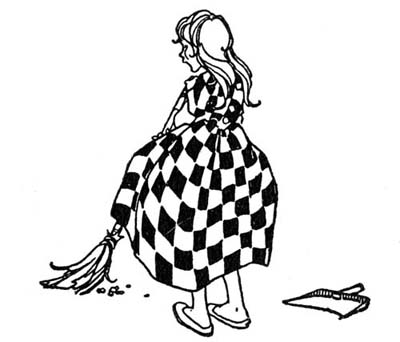
Merrimeg swept and swept with her little
broom, and she made up a little song and sang
it out loud, keeping time with the broom.
Every little while her mother would call to her
from the next room and say,——
“Have you finished yet, Merrimeg?”
“Not yet, mother!” Merrimeg would say, and
then she would go on with her sweeping and
singing.
She was very happy, but this wasn’t her day
to be good; for she was in a great hurry to be
out in the garden in the sunshine, and she forgot
all about what her mother had said to her; so
instead of wasting time on the dustpan, she
swept all the dust into the nice clean fireplace,
a very large fireplace, big enough to roast a
pig in. An iron pot was hanging there, but there
wasn’t any fire, and her mother had just cleaned
off the hearth so that it was as spotless as new
brick.
She swept the dust from under the table and
chairs, and out of the corners, and everywhere.
And every single bit of the dust she swept into
the fireplace, and piled it up at the back on
the clean bricks, out of sight. And all the while
she kept on singing.
She was stooping down into the fireplace,
with her head right at the back, under the chimney,
when her mother called to her from the
next room and said,——
“Have you finished now, Merrimeg?”
“Yes, mother!” said Merrimeg. “I’m going
out into the garden now!”
But she didn’t go out into the garden. Instead
of that,—just as she said, “I’m going out
into the garden now,” whack! she was knocked
against the iron pot, and bang! she was tossed
against the back of the fireplace, and whoof!
she was whirled up into that black dirty chimney
like a leaf in a wind.
And it was a wind, too! She was sucked up in
a wind that was rushing up the chimney,—and
such a wind! Never had she been caught in a
wind like that, not even in the wildest March
weather. Before she knew it, she was high up
inside the chimney in the pitch dark, stuck fast,
and the wind began to die down.
“Mother!” she cried, at the top of her voice.
But her mother couldn’t hear her; and all that
Merrimeg heard was a sound as if a great many
people were laughing at her, a long way off.
It was pitch dark. But all around her, in the
black soot of the chimney, were little sparks, like
the sparks you see in the soot at the back of the
fireplace when the fire is crackling on the hearth,—thousands
of tiny sparks, and all of them getting
dimmer as the wind died down more and
more.
Suddenly the wind sprang up again, stronger
and stronger, and the harder the wind blew the
brighter the sparks burned. Merrimeg had to
hold on fast with her feet and back to keep from
being blown out of the top of the chimney.
She could see better now, and she saw what
these sparks were. There were thousands of
little black imps, sitting along the edges of the
bricks in the walls of the chimney; and each
spark was the head of a little black imp. She
had to look close to see them, they were so tiny,
but there they were, sure enough. She could
hear them laughing, and it sounded as if a great
crowd of grown-up people were laughing fit to
kill, a long, long way off.
Every one of them was holding in his hands a
wee mite of a bag with two handles, and when he
would press these handles together a strong wind
would come out of the bag and blow on his head,
and make it burn bright like a spark of fire; and
when he stopped pressing the handles of his wind
bag his head would grow dim again. They were
working away at a great rate, keeping their
heads alive, and the wind they made nearly blew
Merrimeg up out of the chimney.
She didn’t have much time to think about it,
for all at once the imps stopped working at their
wind bags, and the wind began to go down and
their heads to grow dim, and before she knew
what was coming Merrimeg felt these little imps,
thousands of them, pounce on her, all over her,
as thick as flies on honey, over her hair, and face,
and arms, and legs, and dress, everywhere, and
they were scratching and pinching, so that she
screamed out in fright, and nearly fell down the
chimney, for there was no wind now to hold her
up.
But just then, when all the sparks had nearly
gone out, the terrible little creatures suddenly
stopped scratching and pinching and began to
pump away at their wind bags like mad; for in
another second their sparks would have been
out, and that would have been the end of
them.
That was what saved Merrimeg. The wind
that sprang up from the wind bags was twice as
strong as it has been before. It caught her, and
tore her loose, and picked her up, and whirled
her up the chimney, right up to the top of it and
out.
There she was, standing in the bright sunshine,
on the roof of her own house, looking
down into the cabbage garden.
It was a little house, only one story high, but
it was too high for her to jump down to the
ground; so she crawled to the edge of the roof,
and sure enough there was the garden ladder
standing against the front wall of the house, and
it didn’t take her more than a minute to clamber
down the ladder and run to the door.
She knocked on the door and waited for her
mother to let her in.
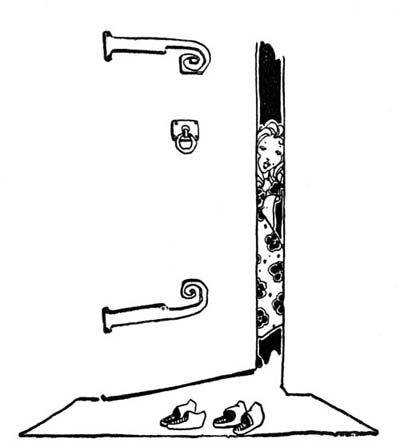
The door opened, and her mother stood in the
doorway looking at her. When she saw the
little girl who was waiting on the step she raised
both her hands in astonishment and opened her
mouth wide.
“Oh, mother!” cried Merrimeg. “Let me in,
quick! I’m terrible sorry, and I’ve been up the
chimney, and I’ll never, never do so any more,
indeed I won’t!”
“Why, child,” said her mother, “who are
you?”
“Let me in, mother!”
“Who are you, child?”
“Who am I? I’m Merrimeg, of course! Let
me in!”
Her mother laughed. “Merrimeg!” she
cried, and laughed louder than before. “You!
The idea! You must be crazy! Why, child,
you’re as black as ink! My Merrimeg is as fair
as a lily! I never saw you before!”
“Oh, mother!” cried Merrimeg. “I’m not
black. I’m Merrimeg, and I want to come
in!”
“Run away, child,” said her mother. “I’ve
no time to bother with strange children now.
Run away home to your mother. I’m too busy
to bother with you now.”
When she had said that, she went back into the
house, and closed the door after her. Merrimeg
knocked at the door again and again, but it was
no use. Her mother would not pay any
attention.
She cried to herself and walked away down
the village street. No one knew her. She
stopped two or three times, when she met children
whom she knew, but they laughed at her
and mocked her. They called her “Black face!
Black face!” and she ran away.
She came to the end of the village street and
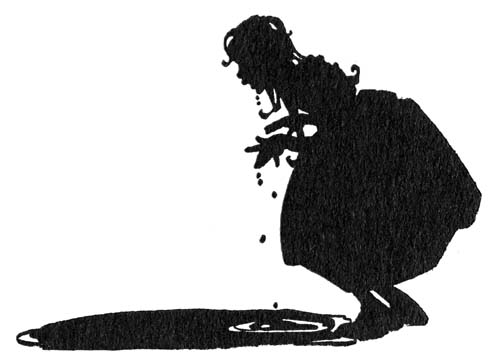
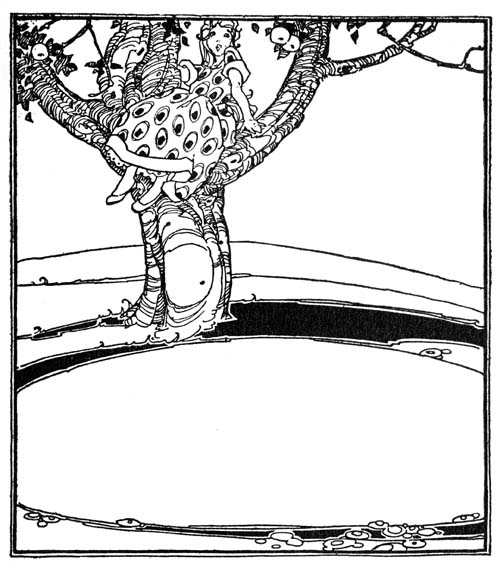
went into the woods. She sat down beside a pool
of clear water, to rest. She looked down into
the pool. She was black.
Her dress was black too. Wherever the imps
had touched her (and they had touched her all
over) she was as black as chimney soot. She
lay down on the grass and cried.
Then she jumped up and stooped over the pool
to wash her face in the clear water. She
scrubbed her face hard, and looked at it again in
the water; and then she cried again, harder than
before. Her face was still black; it wouldn’t
wash off!
She went on further into the woods, and she
really didn’t care what became of her; she
wouldn’t care if she got lost and never came
home any more; and if she never came home
any more, oh! wouldn’t her mother be sorry!
She stopped to cry for a few minutes, but she
went on again pretty soon, and after a long, long
while she found herself in a part of the woods
where she had never been before.
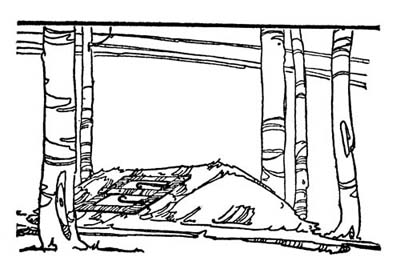
She came to a place where there was a great
bank of bright green moss under the trees. It
was higher in the middle, something like a roof,
and it was very soft and cool-looking, and Merrimeg
was very tired.
She threw herself down on the bed of moss.
“How soft it is!” she said to herself.
As she said this, she sank down deep into the
moss. Down she sank, deeper and deeper. She
was frightened, and tried to jump up; but it was
too late. The moss closed all over her, and she
sank out of sight. She was gone.
Where do you think she was? She was in a
little house under the ground. The moss was
the roof of the house, and she fell right down
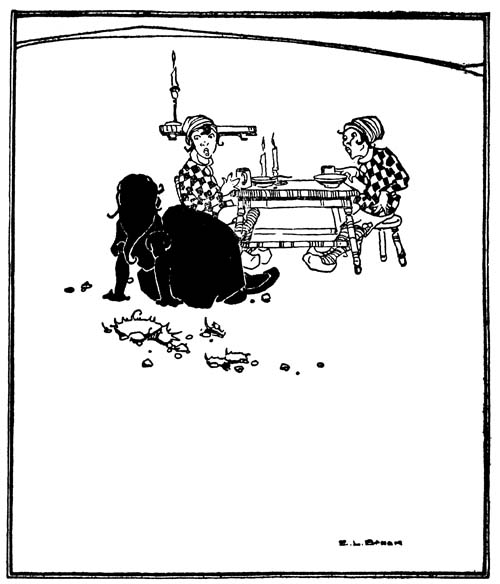
through it into a little kitchen, where two gnomes
were sitting at a table eating their dinner. She
sat down plump on the floor, and stared at the
gnomes.
“BLESS MY SOUL!” SAID ONE OF
THE GNOMES
“Bless my soul!” said one of the gnomes.
“Bless my soul too, brother!” said the other
gnome.
“I’ll tell you what it is, brother Nibby,” said
the first gnome, “the roof’s broken in again.”
“I believe you’re right, brother Malkin, I believe
you’re right,” said the other gnome.
“What’ll we do with her?” said the gnome
called Malkin.
“Whatever you say, brother,” said the gnome
called Nibby. “You always know best.”
“She’s all black,” said the first gnome.
“So she is, brother, so she is,” said the other
gnome.
“But not quite all black,” said the first gnome.
“No, not quite,” said the other one. “How
clever you are, brother Malkin.”
“I see a white place behind her ear,” said
brother Malkin.
“There’s a white place behind her ear, sure
enough,” said brother Nibby. “I wouldn’t have
noticed it myself.”
“Then why isn’t she white all over?” said
brother Malkin.
“Ah! that’s the point!” said brother Nibby.
“Why isn’t she?”
“Because she’s never been thrown onto the
Great Snow Mountain,” said Malkin.
“That’s it, that’s it, just what I was going to
say,” said Nibby.
“Then we’d better throw her onto the Great
Snow Mountain,” said Malkin.
“That’s a very clever idea, brother,” said
Nibby. “I don’t know why I didn’t think of it
myself.”
“But suppose she doesn’t want to be white?”
said Malkin.
“That’s so,” said the other. “I never
thought of that.”
“How will we find out?” said brother Malkin.
“That’s the trouble,” said Nibby. “How are
we ever going to find out?”
“How would it do to ask her?” said Malkin.
“That’s a very good idea,” said brother
Nibby. “How you do think of things!”
“Which one of us had better ask her?” said
Malkin.
“Oh, that should be you, brother,” said Nibby.
“I think you should be the one,” said Malkin.
“Oh, no indeed, brother Malkin, no, no, no,
no, no,——”
“I’ll tell you!” cried Merrimeg, jumping to
her feet, out of all patience with these gnomes.
“I do want to be white! I do! I do!”
“I believe she wants to be white,” said brother
Malkin.
“I’m pretty sure of it,” said Nibby.
“Then you’d better tell her to come along with
us,” said Malkin.
“Oh dear no, brother, I think you should be
the one to tell her,” said brother Nibby.
“No, you should be the one,” said Malkin.
“No, you, brother Malkin.”
“No, no; you, brother Nibby.”
“Goodness gracious me!” cried Merrimeg,
more and more out of patience. “For mercy’s
sake come along! Don’t let’s stay here talking
all day! Let’s hurry, hurry!”
“She’s not very polite, brother,” said Malkin.
“Not very, indeed,” said Nibby. “I noticed
it myself.”
Each of the gnomes took a lighted candle from
the table; then they opened a door in the floor
of the kitchen and went down a ladder, and
Merrimeg went down after them.
When they were at the bottom, in a dark
tunnel, lit only by the candles carried by the
gnomes, Malkin stopped and said:
“We mustn’t forget to have that roof fixed.”
“No, we mustn’t forget that,” said Nibby.
“Oh, bother the roof,” said Merrimeg to herself.
“I wish we would get on.”
“Did you hear what she said?” said Malkin.
“It sounded to me like something rude.”
“That’s the way it sounded to me, too,” said
Nibby.
“I think we ought to ask her if she’s rude or
not,” said Malkin.
“Yes, we ought to know that,” said Nibby.
“Because if she is, we oughtn’t to be out alone
in the dark with her,” said Malkin.
“No,” said Nibby, “it wouldn’t be safe.”
“Then suppose you ask her if she’s rude,”
said Malkin.
“You’re the one to ask her, brother,” said
Nibby.
“Oh, dear me!” said Merrimeg. “You don’t
need to ask me. I’m not rude. Only sometimes
maybe I am, but I don’t mean it, and I wish
you’d please hurry.”
“I guess it’s all right, brother Nibby,” said
Malkin.
They came to a stream of water, flowing along
underground in the dark, and a little boat was
tied to a stake in the stream. Merrimeg sat
down at the back end of the boat, and the two
gnomes sat down before her, each one with a
paddle in his hand. The paddles began to dip in
the water, and the little boat began to go swiftly
up the stream.
“A little faster, brother,” said Malkin.
“Very good, brother, very good,” said Nibby.
With that, they began to paddle so fast that
Merrimeg positively could not see their paddles,
and the candles went out, and then she could not
see anything at all. She felt that she was rushing
along like lightning, and she had to hold on
to the sides of the boat.
“It’s getting colder now,” said Malkin.
“So it is, brother, so it is,” said Nibby.
Merrimeg was so cold by this time that her
teeth chattered.
“We ought to have asked her if she’d mind
being cold,” said Malkin. “We forgot to ask
her that.”
“Yes, we forgot to ask her that,” said Nibby.
“But it’s too late now.”
Merrimeg’s legs and arms were nearly frozen.
They were so stiff that she could not move them.
She thought that she was freezing to death.
“We’re going up now,” said Malkin.
“We are, sure enough, brother,” said Nibby.
“Now for a good push up over the waterfall,
and we’ll be there,” said Malkin.
“Yes, now for a good push,” said Nibby.
They were going up and up, and Merrimeg
was getting stiffer and stiffer. She couldn’t
move at all by this time.
A great roar of falling water came to her from
just ahead, and “Now!” cried Malkin, and “All
right!” cried Nibby, and the boat turned straight
up and climbed the side of the waterfall like
an arrow, with the gnomes paddling for dear
life.
“Here we are!” cried Malkin, and “Here we
are, brother!” cried Nibby, and they came out
of the side of the earth and paddled on quietly
up the stream through a wide field of ice under a
dark cloudy sky.
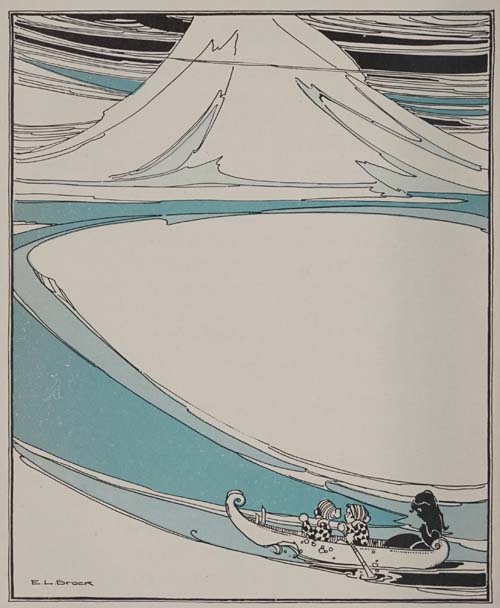
IN FRONT OF THEM ROSE A GREAT MOUNTAIN OF
SNOW....
In front of them rose the top of a great mountain
of snow.
“I don’t believe she can move,” said Malkin.
“I’m pretty sure she can’t,” said Nibby.
The boat stopped, and the gnomes got out on
the ice and lifted out Merrimeg between them.
She could hear and see, but she was frozen so
stiff that she could not move.
“Do you think we can throw that far?” said
Malkin.
“You’re so strong, brother, you’re so strong,”
said Nibby.
“Then let’s try it,” said Malkin.
They looked over at the top of the Great Snow
Mountain, and picked Merrimeg up and swung
her back and forth several times. Then Malkin
cried “Now!” and they gave her a mighty toss
and fling and away she flew through the air
towards the mountain of snow; and she lit on the
very top of it, and sank down and down in the
soft snow until she was out of sight.
“We mustn’t forget to fix the roof,” said Malkin.
“We’d better put some boards under the
moss.”
“I suppose so, brother; you always know
best,” said Nibby.
“Then let’s go home and attend to it,” said
Malkin.
Up on the mountain top, Merrimeg sank down
deeper and deeper into the soft snow. It seemed
to her that she was falling for hours, and that she
would never come to the bottom; but at last she
broke through the bottom of the snow, and
underneath was a dark river, and in it were floating
blocks of thick ice, and Merrimeg dropped
right onto one of these blocks of ice as it was
going along under her, and it carried her away
down the dark stream, with a roof of snow over
her head. Then she grew so dizzy that she really
didn’t know anything for a long time.
When she came to herself, she was floating
along quietly on her block of ice through the
woods, and the sun was shining and the birds
were singing; and the ice had melted away so
much that it would scarcely hold her. It was
only a thin film under her, and she was getting
wetter and wetter; and in another moment the
ice struck a stone in the bottom and broke, and
she was standing in the water up to her
knees.
The water was cool and pleasant, and she was
surprised to find that she wasn’t cold any longer,
and that she could move as well as ever. She
waded to the shore and walked on into the woods;
and she had not walked very far when she saw a
bright green patch of moss under the trees. She
knew that it was the roof of the gnomes’ house,
and she wanted to see them again, for she was
afraid she hadn’t been very polite to them, and
she knew she ought to thank them. She threw
herself down on the bed of moss, but it wouldn’t
give way under her. The gnomes must have put
something strong underneath to hold it up.
Anyway, she couldn’t break through.
She knew where she was now, and it didn’t
take her long to reach the pool where she had
tried to wash the black off her face. She stooped
down over the pool and looked at herself in the
clear water.
She was fair as a lily, and her cheeks were red
as roses.
She jumped up singing and ran towards the
village where she lived.
As she skipped down the village street, she was
singing over and over again, “The mountain has
made me white again! The mountain has made
me white again!” And all the children playing
in the street stopped to stare at her, wondering
what she meant, and some of them called after
her, “Merrimeg! Merrimeg!” But she paid no
attention. She ran home, skipping and dancing,
and hurried through the cabbage garden and in
at the kitchen door. Her little broom was lying
on the floor where she had left it. At the back of
the fireplace was the pile of dust, exactly where
she had swept it. She thought it was queer that
the wind which had drawn her up the chimney
hadn’t blown away the dust; but there
it was. Probably those chimney imps wanted
to leave it where her mother would be sure to
see it.
She snatched up the broom and swept the dust
into the dustpan, and you can believe that she
didn’t put her head into the fireplace, either;
she reached in and swept the dust out into the
dustpan and carried it out to the cabbage garden
and emptied it. And as she came back into the
kitchen her mother came in from the front room
and said,——
“Oh, here you are. Where have you been so
long? While you were out there was a funny
little black girl who came to the door and said
she was Merrimeg!”
“Yes’m,” said Merrimeg.
MERRIMEG AND THE CLOP-CLOP SHOES
MERRIMEG AND THE CLOP-CLOP SHOES
IT was Sunday morning, and Merrimeg was
always good on Sunday.
Everybody was in church,—everybody but
Merrimeg. Her mother had let her stay at home
as a reward, because she had done her sweeping
so neatly.
The house was empty, and there was not a soul
in the village street.
Merrimeg was sitting at the front window,
looking at pictures in a book and telling herself
stories about them. Sometimes she would gaze
out of the open window at the sunshine.
After a while she stopped talking to herself,
and looked up and listened. She was sure that
she heard a sound in the street. It was a kind of
clop-clop! and it seemed to be coming nearer.
She peeped around the corner of the window
and looked out.
Two pairs of wooden shoes, quite small, were
coming down the street side by side, towards her
house. Each pair of wooden shoes was walking
along in the usual way, but the astonishing thing
was that there were no feet in them. There was
nobody at all in them. They were walking along
all by themselves.
Merrimeg opened her eyes wide. She had
never seen such a sight as that before. Clop-clop!
went the wooden shoes on the hard ground,
just as if two people were stepping down the
street. But no, there was nothing anywhere in
the street but those two pairs of shoes, coming
along clop-clop!
Merrimeg held her breath and watched to see
the shoes go by her window. Clop-clop! they
came, sounding plainer and plainer; clop-clop!
right up to the door of her house; and when they
came to the door, there they stopped.
Merrimeg drew her head back a little, getting
ready to run if she had to, but she watched them
with both eyes.
“I think this is a house,” said a voice.
“I believe it is, brother, I believe it is,” said
another voice.
Merrimeg looked all around, but she could see
nobody. The voices seemed to be coming from
the spot where the shoes were standing.
“What if she should be cross to-day?” said the
first voice.
“Then she wouldn’t help us, brother,” said the
other voice, “and what on earth would we do
then?”
“But it’s Sunday,” said the first voice, “and
they aren’t cross on Sunday, hardly ever.”
“That’s so, brother, that’s so,” said the other
voice. “You do think of everything.”
“How would it do to knock?” said the first
voice.
“I was just thinking about that myself,” said
the other voice.
Merrimeg was listening with both ears, and
she heard, as plain as could be, three knocks on
the front door; but what it was that was knocking
at the door, she couldn’t see. All that
she could see was that two pairs of wooden
shoes moved up onto the doorstep, and stood
there.
While she was wondering about it the knock
sounded again, and without stopping to think
any more she jumped up and ran to the door and
opened it, not very wide, and looked down at the
shoes.
“It’s herself, brother Nibby,” said a voice in
the doorway.
“So it is, brother Malkin, so it is,” said the
other voice.
“Why, it’s the two gnomes!” cried Merrimeg.
“But where are you?”
“She can’t see us, of course,” said the first
voice.
“No, of course not,” said the second voice.
“I forgot that.”
“If you’re there,” said Merrimeg, “come in!”
and she opened the door wide.
The two pairs of shoes stepped into the room,
and stood with their toes towards Merrimeg.
“Do you suppose she’ll be willing to help us?”
said the voice of Malkin the gnome.
“Just what I’m wondering, brother,” said the
voice of Nibby.
“Of course I’ll help you!” said Merrimeg.
“What’s the matter?”
“She’s pretty good to-day,” said Malkin’s
voice.
“I can see that, brother,” said Nibby’s
voice.
“I can’t see anything at all!” cried Merrimeg.
“Where are you, anyway? Are you here, or
where?”
“Of course she doesn’t know what the witch
has done to us,” said the voice of Malkin.
“No, she doesn’t know that the witch has taken
away our bodies,” said the voice of Nibby.
“And we want to get them back,” said Malkin’s
voice.
“And we want her to help us,” said Nibby’s
voice.
“It’s a frightful nuisance being without a
body,” said Malkin’s voice.
“She ought to know that without being told, I
should think,” said Nibby’s voice.
“How can I help you?” said Merrimeg. “I’ll
do anything I can.”
“She isn’t cross at all to-day,” said Malkin’s
voice.
“No, it’s Sunday,” said Nibby’s voice.
“She’d better come along with us at once,
then,” said Malkin’s voice.
“Yes,” said Nibby’s voice, “they’ll throw our
bodies down the well if we don’t hurry.”
“Suppose you tell her, then.”
“Oh, no, brother, you’re the one to tell her.”
“Oh dear no, brother Nibby, you are the one
to——”
“I’ll come!” said Merrimeg. “Never mind
telling me. Go ahead, and I’ll follow you!”
The two pairs of wooden shoes turned and
went out of the open door, and Merrimeg followed
them as they went clop-clopping down the
street.
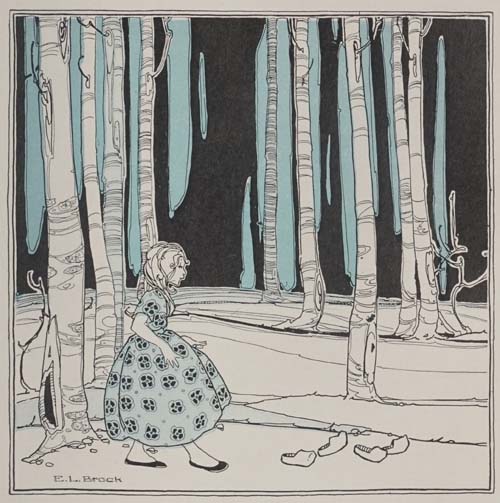
THE CLOP-CLOP SHOES WENT ON INTO THE
WOODS
They left the village and went into the woods.
They found a path which Merrimeg had never
seen before, and they walked along this path,
under the trees and bushes, and across little
streams, for a long, long time; and the woods
grew thicker and thicker, so that at last they
could not see the sun, and it was very dark; and
all the while the two pairs of little shoes went on
before, and Merrimeg followed behind.
“I suppose we’d better tell her the right word
now,” said the voice of Malkin, “before we meet
old Verbum Sap.”
“Yes, before we meet old Sappy,” said Nibby’s
voice.
“Dear me!” said Malkin’s voice. “Blest if
I haven’t forgotten the word myself!”
“Oh, mercy on us, whatever will we do now?”
said Nibby’s voice.
“Oh dear, oh dear!” said Malkin’s voice. “If
I could only remember the word! Isn’t it something
like cat-tails?”
“No, no, brother, nothing like that!”
“Can’t you remember the word, brother
Nibby?”
“Oh, me? Oh dear yes, brother, I know what
the word is. But you’ve forgotten it, brother
Malkin! Whatever shall we do now? We’ll
never get our bodies back without the word,
never, never!”
“But don’t you know what it is, brother
Nibby?”
“Oh yes, brother Malkin, but what good will
that do, if you don’t know what it is?”
“That’s so, that’s so. I never thought of that.
Oh dear me, I’m sure I don’t know what we’re
going to do about it.”
Merrimeg very nearly lost all patience at
this.
“Why don’t you tell him what it is, then?” she
said.
“I do hope she isn’t going to be cross,” said
Malkin’s voice. “But anyway, that’s a pretty
good idea. Suppose you tell me what the word
is? Isn’t it something like cat-tails?”
“Nothing like that, brother, nothing like
that!”
“What is it, then?”
“It’s kitten-tails!”
“Then we’d better tell her now, before old
Sappy comes up, so she’ll know the word.”
“Which one of us had better tell her?”
“I think you should be the one to tell her,
brother Nibby——”
“Oh bother!” said Merrimeg. “I know
what the word is now. It’s kitten-tails.”
“She’s getting cross, she’s getting cross,
brother Nibby,” said Malkin’s voice. “Do you
think we’d better go back?”
“I’m not cross,” said Merrimeg. “Please excuse
me. I won’t speak so any more.”
“I believe it’s all right, brother Nibby,” said
Malkin’s voice. “Now you’d better tell her
about the word. Whatever they say to her, she
must use that word, and she mustn’t use any
other; tell her that, brother Nibby. She mustn’t
say anything else to them, because if she does
they’ll take her body away from her too, and
we’ll never get our bodies back; tell her that,
brother Nibby. And we mustn’t speak at all,
because that would spoil everything. And whatever
she does, she mustn’t let them take her shoes
off. Tell her, brother.”
“Excuse me,” said Merrimeg, very politely,
“I heard what you said, so he needn’t tell me, if
you please.”
“Now that’s what I call very clever of her,”
said Malkin’s voice.
“Very, very,” said Nibby’s voice.
In a few minutes they came to a place where
the vines and brambles hung down so low over
the path that Merrimeg had to crawl on her
hands and knees; and just then Malkin said, in
a very low voice:
“There’s old Sappy.”
Right in the middle of the path before them
stood a great gray owl, staring at them with his
big round eyes. The shoes stopped still, and
Merrimeg sat up on her heels. The owl seemed
to be staring straight at her. He opened his
beak, and a hoarse voice came out of his mouth,
sounding as if he had a bad cold, and the voice
said:
“What do you want here, child?”
“Kitten-tails,” said Merrimeg, remembering
that she wasn’t on any account to say anything
else.
The owl ruffled his feathers and winked one of
his eyes, very slowly. He stared at Merrimeg
for a moment, then he turned around and walked
off down the path before them. The wooden
shoes stepped along after him, and Merrimeg
followed on her hands and knees.
Old Sappy, if that was his name, led them a
long way under the vines and brambles, and
stopped at the end of the path before a green
wall of leaves, very tall, made of vines matted
thick together. At the bottom of this leafy wall
was a little opening, and after looking behind
him for a moment old Sappy went in, and after
him stepped the two pairs of shoes, and last of
all in crawled Merrimeg.
When she was inside, she stood up. She was
standing on a floor which looked like green
marble, very hard and shiny, and as she moved
her feet on it her shoes began to pinch her feet
painfully. All around her, in a circle, was the
high wall of green leaves, and overhead the
branches of the trees hung down, making a green
roof.
On one of these branches was perched a great
black ugly bird, very like a buzzard. Its little
sharp eyes were looking hard at Merrimeg.
Around the walls, on the ground, was a row of
gray owls,—dozens of them, all staring at Merrimeg
with their big round eyes.
In the middle of the floor was a dark opening,
like the mouth of a well; and alongside of it were
lying the bodies of the two gnomes, on their
backs, with their eyes closed. They had no shoes
on their feet. The two pairs of wooden shoes
walked across the floor and stood beside the
bodies.
Old Sappy stopped beside the well and looked
up at the ugly black bird over his head, and
ruffled his feathers as if he were shivering.
The bird overhead perked its head down side-wise,
and gave a croak and said:
“It’s nearly time!”
“Time for what? Time for what?” croaked
all the owls together.
“Time to put the bodies in the well!” said the
ugly bird.
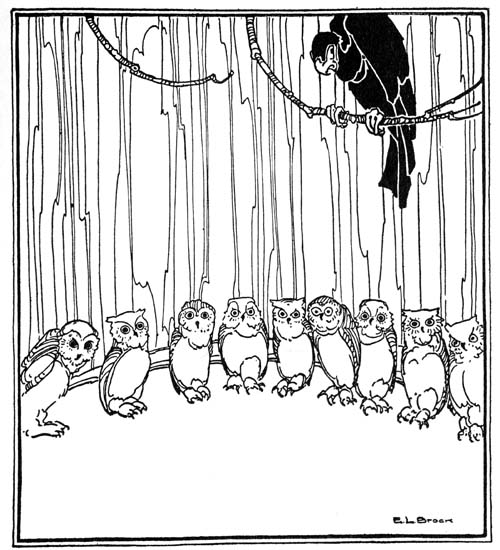
AROUND THE WALLS WAS A ROW
OF GRAY OWLS
“What shall we do first?” said the owls
together.
“Get me another body for the well!” said the
bird overhead.
“There are only two bodies!” sang out the
owls.
“I see another, I see another!” said the bird
on the branch.
Then the bird in the tree began to croak and
grumble to itself, and old Sappy stared at Merrimeg
and said:
“What must she do?”
“She must come to the well!” said all the owls
together.
“How must she come?”
“She must walk! She must walk!”
“Who’ll take off her shoes?” said old Sappy.
“We will, we will!” cried all the owls together,
and they all ran towards her, opening their beaks
and squawking as they crowded in around her
feet.
But Merrimeg kicked out right and left and
scattered them in every direction. She found
herself standing before the well and the ugly
black bird overhead gave an angry screech.
“What shall we do with her?” said old
Sappy.
“The riddle! The riddle!” screamed the ugly
black bird overhead.
“The riddle! The riddle!” sang out all the
owls together.
“Answer the riddle!” said old Sappy. But
as he said it he gave a slow wink with his right
eye. “Answer the riddle, and answer it right!
Or else,—or else,—off come your shoes, off come
your shoes!”
“What is the riddle?” cried all the owls.
“This is the riddle, and answer it right,” said
old Sappy. “What is it that has no feet and
runs away on four feet and is chased by the same
four feet, and lives on food and drink and never
eats nor drinks?”
“What is it? What is it?” croaked all the
owls.
“Kitten-tails!” said Merrimeg, sobbing with
fright as she said it.
The black bird overhead gave a piercing
scream, spread its wings, and tried to fly away.
But before it could fly, while it was flapping and
struggling, a change came over it, and in its place
was a horrible little old woman, hanging on to
the branch and kicking and screaming, and trying
to keep from falling down out of the tree.
She was much heavier than the bird had been,
and the branch was not strong enough to bear
her; it snapped in half under her, and down she
fell, still kicking, directly into the opening of
the well. She was gone.
Merrimeg heard a splash far down in the well,
and at the same time the green walls disappeared,
and the well-opening was covered over,
and the green marble floor turned into soft
green moss, raised in the middle like a roof, and
the owls flew away among the trees.
Merrimeg looked down at the bodies of the
two gnomes, lying on the bright green moss. One
of them opened his eyes and yawned and
stretched his arms; and the other yawned and
stretched his arms and opened his eyes; and they
both got up together, and looked down at their
feet.
“I suppose we’d better put on our shoes,” said
one of them.
“I suppose we had, brother,” said the other
one.
They put on their wooden shoes quickly, and
then they noticed Merrimeg.
“Oh, yes,” said one of the gnomes, “I remember
everything now. Brother Nibby, we
ought to thank her for helping us get our bodies
back.”
“That we ought, brother, that we ought, indeed,”
said Nibby.
“Which one of us should tell her?” said
Malkin.
“I think you could do it much better,” said
Nibby. “You’re always so clever.”
“Please don’t bother about thanking me,” said
Merrimeg. “I’m so glad I could help you.”
“Really, she isn’t rude at all to-day,” said
Malkin.
“Not a bit, brother Malkin, not a bit,” said
Nibby.
“Then we’d better go home,” said Malkin.
“Why, bless me, we’re home right now! This is
the roof of our own house!”
“Now it’s queer I didn’t notice that before,”
said Nibby. “How you do notice everything,
brother!”
“Good-by,” said Merrimeg. “I must get
home before mother comes back from church.
Good-by.”
“Brother Nibby,” said Malkin, “will you ask
her to stay and have dinner with us in our own
house?”
“I’m sorry,” said Merrimeg, “but I can’t
stay now. Thank you ever so much. I must
hurry home. Good-by.”
She didn’t wait for an answer. Away she ran,
and it wasn’t very long before she was in the
village street again. In a few minutes she was
sitting quietly at the front window of her house
with the picture book on her knee, and there she
was sitting when her mother came home from
church.
“That’s what I call a good little girl,” said
her mother, “—sitting there quietly with your
book, just as I left you.”
“Yes’m,” said Merrimeg.
MERRIMEG AND THE STARLIGHT FAIRIES
MERRIMEG AND THE STARLIGHT
FAIRIES
MERRIMEG was asleep in her little bed,
and Merrimeg’s mother was asleep in
her big bed.
It was late at night, and everybody in the
village was asleep. All the houses were dark,
and the stars were shining overhead.
Merrimeg woke up, and listened. She thought
she heard a sound as if someone were crying.
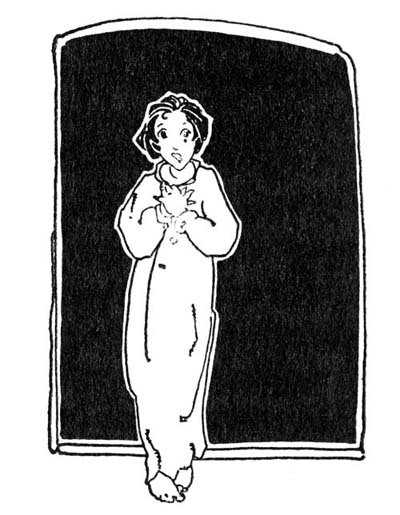
She got up out of bed in her white nightgown,
and tiptoed over to her mother and looked at
her. Her mother was fast asleep, but she still
heard the sound of crying.
She decided that it must be outside in the
street, so she opened the front door and peeped
out.
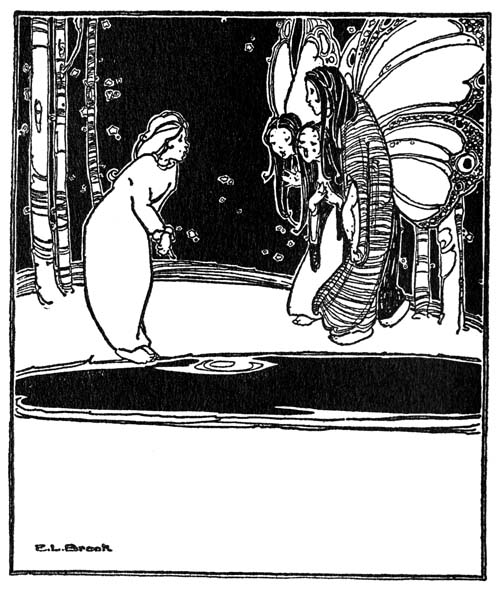
In the street before the door were three beautiful
children, and one of them was crying.
They were all of about the same size as Merrimeg,
and they were dressed in long dark blue
gowns, fine as spider webs, which rippled around
them in the cool air. They were barefoot and
bareheaded. Each one had long black hair
streaming down to her waist, and a pair of great
wide wings standing out straight from her
shoulders, like the wings of an enormous butterfly,
all blue and silver.
One of the children had her arms about the
one who was crying. They all looked up at
Merrimeg as she opened the door.
“You’re Merrimeg, aren’t you?” said the one
who had her arms about the other.
Merrimeg stepped out into the street under
the stars.
“Yes,” said she. “What is she crying about?
Are you lost?”
“You’d—better—tell her—who we are, Pennie,”
said the one who had been crying, choking
back her sobs.
“We aren’t lost,” said the one who hadn’t yet
spoken. “We’re looking for our star.”
“We’ve lost it,” said the one who had been
crying, breaking out into sobs again.
“Don’t cry, Winnie,” said the one who had
her arms about her. “She’ll help us find it, I
know she will.”
“Why is she crying?” said Merrimeg again.
“She’s Winnie, and I’m Florrie,” said the
one who had just spoken, “and this one’s Pennie.
Don’t you know who we are?”
“No,” said Merrimeg.
“We’re the starlight fairies,” said Florrie.
“Now do you know?”
“No,” said Merrimeg.
“I thought everybody knew,” said Florrie.
“Every evening at dark we fly along the sky
up there and hang out the stars. Haven’t you
ever seen us?”
“No,” said Merrimeg.
“I suppose they can’t see us from down here,
and we’ve never been away from the stars
before.”
“I wish we’d never come,” said Winnie, crying
again.
“I’ll tell you,” said Pennie. “To-night we
were hanging out the stars, and Winnie—poor
Winnie!”
“I didn’t mean to,” sobbed Winnie. “I didn’t
mean to!”
“What did she do?” said Merrimeg.
“She dropped one of her stars,” said Pennie.
“It’s gone!” sobbed Winnie. “And I can’t
go back without it!”
“It fell and fell and fell and fell,” said Florrie,
“and then we couldn’t see it any more. It
dropped down here, somewhere near here, we’re
sure of it.”
“Do you see up there?” said Pennie. “Up
there where there’s a wide dark space between
the stars?” She pointed to the sky, directly
overhead. There was a space there, about as big
as a blanket, without any star.
“Yes, I see,” said Merrimeg.
“That’s where the star belongs,” said Pennie.
“We’ll never find it!” said Winnie, putting
her face down on Florrie’s shoulder.
“I’m sure we shall,” said Florrie, “if Merrimeg
will only help us. We don’t know anything
about this dreadful earth place, but she
knows.”
“Will you help us?” said Pennie.
“If I can,” said Merrimeg.
“Then come along,” said Pennie.
“Can’t I put on my clothes first?” said
Merrimeg.
“There’s no time,” said Pennie. “Suppose
daylight should come before we find it? What
would we do?”
“Let’s go, then,” said Florrie; and she moved
away lightly down the street, drawing Winnie
along by the hand, their wings waving gently in
the air.
“Where shall we go?” said Pennie.
A thought came into Merrimeg’s mind. She
would take them to the gnomes’ house, and the
two brothers would surely tell them how to find
the star.
“I’ll take you,” said she, pushing on ahead
towards the woods beyond the village. She was
used to going barefoot, and she didn’t mind the
rough ground. It was a warm night, and she
soon forgot that she was only in her nightgown.
They went into the woods.
“It’s so gloomy,” said Winnie, in a whisper.
“I don’t like these strange earth places. I wish
we were at home among the stars.”
“We’ll be home before morning, never fear,”
said Florrie.
They stopped beside the pool where Merrimeg
had once tried to wash the black from her face.
The trees were wide apart here, and Merrimeg,
looking up, could see the bare spot in the sky
directly overhead, where the lost star belonged.
“Where are you taking us?” said Pennie.
“I’m taking you to the gnomes’ house,” said
Merrimeg. “We’ll soon be there. It’s two
gnomes who’ve been very good to me; I know
where they live. They’re the ones to help
us.”
“Is one of them named Malkin?” said
Florrie.
“And the other one Nibby?” said Pennie.
“Yes,” said Merrimeg.
“LOOK!” SHE CRIED
“Then it’s no use,” said Pennie. “We’ve
been there already.”
“They were asleep,” said Florrie, “and we
woke them up, and they didn’t like it a bit. They
wouldn’t get up for any foolish old star,—that’s
what they said. But they told us about you, and
that’s how we came to hunt you up. But the
horrid gnomes wouldn’t do a thing for us; they
wouldn’t even get up.”
“They’re not horrid,” said Merrimeg. “Oh
dear, I don’t know what we’re going to do
now.”
She looked down sadly into the dark water
of the pool, trying to think what to do next. She
gave a little jump of surprise, and looked
harder. Far, far down, away down deep under
the water of the pool,——
She saw a star.
“Look!” she cried, and pointed her finger at
it.
The starlight fairies leaned over, and looked
down into the pool.
“That’s it!” cried Florrie.
“It’s my star!” cried Winnie.
“It’s our lost star!” cried Pennie. “Dropped
down from the sky to the bottom of this pool.”
“Then,” said Merrimeg, “you’d better go
down and get it.”
“Oh no! oh no! oh no!” cried the three fairies
together.
“We mustn’t get our wings wet!” said
Pennie.
“We’d never be able to fly home if our wings
got wet,” said Winnie.
“But you have no wings,” said Florrie to
Merrimeg.
“No, she has no wings,” said Pennie.
“She shall go down for our star,” said
Winnie. “You will, won’t you?”
“The water’s deep and dark,” said Merrimeg.
“But you have no wings,” said Florrie.
“The water’s cold and gloomy,” said
Merrimeg.
“But you have no wings,” said Pennie.
“I wonder if I could do it,” said Merrimeg.
“Oh please!” cried Winnie. “Oh dearest
Merrimeg, please get my star.”
“I’ll see how deep it is,” said Merrimeg, and
she threw a stone into the middle of the pool.
The water rippled away as the stone sank, and
the star could not be seen any longer.
“Oh!” cried Winnie. “Now you’ve sent my
star away! It’s gone!”
But the water became quiet in a moment, and
there was the star again, shining bright at the
bottom of the pool.
At that instant, they heard a splash in the
water, and a shrill voice, like the voice of an
angry boy, cried out:
“Who breaks my glass? Who breaks my
glass?”
“What can that be?” whispered Merrimeg.
“I don’t know,” said Florrie. “Throw
another stone, and perhaps we’ll hear it
again.”
Merrimeg tossed another stone into the pool,
and when the ripples had died away they heard
the same voice again. This time it said:
“Who strikes my children? Who strikes my
children?”
“Throw another,” whispered Pennie, and
Merrimeg cast in another stone.
This time there was a loud wail, and the voice
cried:
“My children! My children! I’m coming!
I’m coming!”
Then there was a splash, and nothing more.
They waited a long time, but they heard nothing
more.
“I’m going to see,” said Merrimeg. “I may
have hurt somebody. I can see better from the
end of that log.”
There was a dead log, the trunk of a fallen
tree, lying out from the bank of the pool into
the water, and Merrimeg stepped onto it and
getting down on her hands and knees crawled
out to the end of it. It was slippery, and she
had to hold on very carefully to keep from falling
off into the water.
She leaned over as far as she could and looked
down into the pool. She looked everywhere for
the star, but she couldn’t see it; there seemed to
be some dark thing under the water between
herself and the star.
“The star is gone!” she said to the others, in
a whisper.
As she said this, a hand came up out of the
water and seized her wrist and pulled her off
the log. Over she went into the pool, down,
down, far down. The hand never once let go of
her wrist. It pulled her down and down, faster
and faster. At first she thought she was going
to choke with the water, but in a moment she
was all right again, only wet, very wet. And
in another moment she was at the bottom, and
the hand let go of her wrist. She stood up on
her two feet on a floor of what looked like glass.
There was a pale light shining all about her
through the water, and she saw that it came
from the star, lying on the floor nearby. Just
over her head was a roof of glass, and it was
badly broken in three or four places. Around
her were walls of glass. She was in a little house
of glass, with a broken roof, and full of water.
A hand took hold suddenly of her arm, and
she was dragged across the floor in a great
hurry, by the creature who had pulled her down
from the log. It was a sprite; a water sprite,
whose head just reached to her shoulder; full-grown,
evidently, in spite of being so small; with
pointed ears, and no hair on his head, and long
green water grass trailing around him.
He dragged Merrimeg straight to the star,
and picked it up by a kind of sling that it was
meant to hang by. It flashed and glittered as
he snatched it up.
He pointed to the floor, and Merrimeg saw,
lying there side by side, three tiny sprites,
babies, no bigger than kittens, and exactly like
the grown one who was holding her arm. They
looked as if they were asleep, but on the forehead
of each one was a black and blue bruise,
and Merrimeg knew that she must have hurt
them with her stones, as well as broken the glass
of their little home.
Their father, if it was their father, motioned
to her to pick them up. She gathered them up
in her arms, and the sprite, carrying the star
in one hand, seized her hair with the other hand
and sprang up towards the holes in the broken
glass roof; and in another instant she was being
dragged upward through the water as fast
as she had been pulled down.
UPWARD THROUGH THE WATER ...
She almost dropped the little mites she was
holding in her arms, but she hugged them
tighter, and when they came to the surface of
the pool she was holding them safe in her
arms.
They came out dripping on the bank of the
pool, and there were the three starlight fairies.
“Oh!” cried Winnie. “She’s brought my
star!”
The water sprite dragged Merrimeg onto the
dry grass, and took the three babies from her
arms and laid them down on the grass.
“Now! now! now!” he cried. It was plain
that he was very angry. He was trembling all
over. “What are you going to do about it?
Look what you’ve done.”
“Why,” said Merrimeg, “why——”
“First comes this horrible star and breaks in
the roof of my house and lets in all the water!
And then—oh you wicked creatures!—you throw
down your ’bom’nable stones and break my roof
all to pieces and kill my children—my poor children—look
at ’em—look at ’em, will you?—look
at those bumps on their foreheads—oh my poor
children—You ’bom’nable creatures, you! You
perfectly awful wicked ’bom’nable——”
“Oh!” said Florrie. “It’s too bad. I’m so
sorry.”
“We didn’t mean to do any harm,” said
Pennie.
“And after he was so kind as to bring our star
back to us, too,” said Winnie.
“Is this your star?” cried out the water
sprite.
“Yes, yes! It’s mine!” said Winnie.
“Then you’ll never get it! You shan’t have
it!” cried the water sprite, angrier than ever.
“You’ll see what I’m going to do with it! You’ll
never get it again! Ah! there she goes!”
He swung the star by the sling in his hand,
and gave it a great fling, and away it flew over
the tree tops, in a beautiful bright curve, higher
and higher, and then lower and lower.
But he was greatly mistaken if he thought he
could get rid of the star in any such way as that.
Quick as a flash all three of the starlight fairies
were in the air, and off like three arrows over
the tree tops after the star. Before Merrimeg
knew what was happening they were out of
sight, and the star was gone.
The water sprite was so astonished that he
forgot he was angry.
“Who are they?” he said, in a kind of
whisper.
“They’re the starlight fairies,” said Merrimeg.
“They hang out the stars each night, and
to-night they dropped that star by accident, and
it fell into your pool. If they don’t get it back
they can’t go home.”
“But they killed my children and——”
At that moment the lost star appeared over
the tree tops, coming on towards them in a streak
of white light, and in another moment the three
starlight fairies stood on the ground, and Winnie
was swinging the star in her hand.
“Oh! oh!” she said, and began to laugh and
cry at the same time. She couldn’t say another
word, for joy.
“We’ve got it!” cried Florrie. “We can go
home now!”
“But what about these poor babies?” said
Merrimeg. “Can’t we do anything for them?”
The three fairies knelt around the three tiny
bodies on the ground, and looked closely at their
foreheads.
“Why,” said Pennie, “it’s nothing but a
bruise!”
“So it is,” said Winnie and Florrie together.
“Is that all?” said Merrimeg.
“Is that all?” said the water sprite, looking
very helpless and pitiful.
“Yaa! yaa!” came a little piping cry from the
grass, and the water sprite dropped to the
ground beside the babies.
“He’s crying!” sang out the water sprite.
“His eyes are open!”
Another little cry and another came from the
grass, and the water sprite sang out again:
“They’re all crying! They’re all coming to!
They’re all right! Hurrah!”
He picked up the three babies and bundled
them in his arms, and without another word gave
a leap into the water and splash! went down and
out of sight, babies and all.
Florrie laughed, Winnie laughed, and Pennie
and Merrimeg laughed too.
“But I’m sorry his house is ruined,” said
Merrimeg.
“Oh, he’ll mend it in no time,” said Florrie.
“But see, Merrimeg, you’re all wet!”
“Goodness!” said Merrimeg. “I’d forgotten
all about it.”
“Stand here,” said Florrie, and she and the
other two fairies placed Merrimeg in the middle
and turned their backs to her.
Their wings began to flutter gently, and then
began to move faster and faster, making a strong
breeze which blew all over Merrimeg. Fanned
in this way by the great butterfly wings, she was
soon dry.
“Good-by, Merrimeg,” said Florrie.
“Good-by, dear Merrimeg,” said each of the
others.
“Thank you for my star,” said Winnie.
“You must think of us whenever you look up
at the stars.”
“Indeed I will,” said Merrimeg.
The starlight fairies stood on tiptoe for a moment,
and fluttered their wings; and then they
rose quietly in the air, and flew straight up.
When they were above the tree tops, they began
to circle round and round, going higher and
higher; far, far up through the night they went
on circling; and long after Merrimeg could see
them no more, she could see the star, bright as
a diamond, go circling up and up....
She ran away home, and crept in quietly at
the front door, and lay down in her bed and
snuggled under the covers. Her mother was
still asleep. She must have gone to sleep herself
presently; she woke up and thought of the
lost star, and remembered that she had not
waited to see if it was in its place. She got out
of bed and tiptoed to the window, and putting
her head out looked up.
A star was sparkling just overhead, where
there had been none before. The star was in its
place.
“I’m glad of that,” she said out loud.
“What did you say?” said her mother, waking
up.
“I was only saying—only saying——”
“Never mind what you were saying. Go back
to bed, and go to sleep. You’ll catch your death
of cold.”
“Yes, mother,” said Merrimeg.
MERRIMEG AND THE ECHO DWARFS
MERRIMEG AND THE ECHO DWARFS
“NOW, Merrimeg,” said Merrimeg’s mother,
“take this basket and go to the brook in
the woods, and bring me back a basketful of
water cress for supper. And be sure to come
straight back.”
“Yes, mother,” said Merrimeg. And she
went off down the village street singing, with
her basket on her arm. But first she put in her
pocket the blue saltcellar from the kitchen, full
of salt.
She walked a long way into the woods, and
at last she came to a little brook running along
over the stones. There in the clear water she
found plenty of fresh green water cress growing.
She pulled it up by the handful and filled
her basket with it.
She knew that she ought to go straight home,
but this was not one of her days for being good.
She left the basket on the grass, and took out
of her pocket the saltcellar with the salt in it.
Then she looked around for birds.
A blue bird came hopping by on the ground,
and Merrimeg stole up behind it on tiptoe, and
sprinkled a little salt right down over its tail.
But just at that minute the bird flew up into a
tree, and Merrimeg was too late.
Off went the bird from tree to tree, and Merrimeg
ran after it as fast as she could, holding
out her saltcellar. Pretty soon the bird hopped
down onto the ground again, and Merrimeg tiptoed
up behind it and sprinkled her salt down
over its tail. But she was just a bit too late, and
the bird flew up into a tree.
Merrimeg followed the bird a long, long way,
and whenever it hopped down onto the ground
she tried to sprinkle a little salt on its tail; but
she was always just a wee bit too late.
At last, when she was at the foot of a hill that
rose up out of the woods, she stamped her foot
and cried out:
“Oh, you good-for-nothing naughty bird!”
“Naughty bird!” came back her own voice to
her from the top of the hill.
Merrimeg was astonished. She had never
heard an echo before.
She thought she would try it again, so she
called out:
“Oh, you naughty bird, come down here!”
Her own voice came back to her from the
same place up the hill, but it didn’t quite repeat
her words; it said:
“Come on down!”
The echo must have made a mistake. Merrimeg
was more than ever astonished. She waited
a minute, and then the same voice came down to
her from the top of the hill, and it said:
“Down here!”
The echo had got it right this time. Evidently
it must have been a very young echo indeed.
Merrimeg forgot all about the blue bird, and
she began to climb the hill to find out who it was
that was mocking her.
She didn’t know it, but there was an Echo
Dwarf who lived in a cave near the top of the
hill, and there lived with him his little boy, a
very little boy, who was just learning how to
make echoes. Big Hark was the father’s name.
Little Hark was the little boy’s name. Big Hark
had a great deal of trouble in teaching Little
Hark to make echoes, for Little Hark often forgot,
and instead of calling back the same words
he had heard, he would often call back words of
his own. Besides, if the words he had to call
back were big words, he always got them mixed
up. His father never knew when he was going
to make a mess of everything. And when he
did that, it made Big Hark so angry he could
hardly speak.
Merrimeg went on up the hill, and pretty soon
she called out again:
“Why couldn’t I catch the bird with my
salt?”
“Too slow!” came back the voice from the top
of the hill.
Merrimeg couldn’t understand this at all. She
listened for a minute, and then she heard
another voice up above her:
“OXTRAGOB BORGS, GOOBLIK!”
“My salt! Oxtragob borgs, gooblik!”
This was Little Hark’s father, and when he
said “Oxtragob borgs, gooblik!” he meant, in
the private language of the Echo Dwarfs,
“Wrong again, stupid!”
Big Hark and Little Hark were standing in
front of their cave, and Big Hark was letting
Little Hark practice at making echoes, as Merrimeg
came up the hill. Not many people came
that way, and Big Hark was glad of the chance
to give his little boy a lesson.
Merrimeg came on further and further up the
hill, and after a while she stopped and called out
again:
“Are you still there?”
“Still there!” came back the voice.
This made her quite angry. She did not like
to be mocked every time she opened her mouth.
She cried out:
“Stop mocking me!”
“Mocking me!” came back the voice.
This made her very angry indeed. Without
saying anything more she clambered on up the
hill and stopped all out of breath on a little ledge
before the mouth of a cave. There a little further
on along the path was standing Little Hark
himself, with his hands up to his mouth, all
ready to shout back an echo. His father had
gone inside the cave.
Little Hark was very small indeed, and Merrimeg
looked quite like a giant beside him. She
ran to him and stood over him and shook her
finger at him and said:
“What do you mean by mocking me all the
time?”
“All the time?” said Little Hark, looking very
much frightened.
“Yes, all the time!” said Merrimeg. “What
do you mean by it?”
“Mean by it?” said the little Echo Dwarf.
“Don’t you dare repeat everything I say to
you!” cried Merrimeg. “You naughty thing,
you’re mocking me!”
“You’re mocking me!” said Little Hark, beginning
to cry.
“HOW DARE YOU SAY SUCH A THING? HOW
DARE YOU?”
“Why, you awful little thing, I’m not!” cried
Merrimeg. “How dare you say such a thing?
How dare you?”
“How dare you?” said Little Hark, crying
harder.
This made Merrimeg very angry, so angry
that she could not say another word. She seized
hold of Little Hark’s arm and shook him.
There she was shaking him, pretty hard too, and
Little Hark was bawling out loud, when Big
Hark, his father, came out of the cave and
hurried towards them to see what was the
matter.
Big Hark was very strong, though he was not
very big. He threw his arms around Merrimeg
and dragged her away from Little Hark and
hauled her along to the cave and pulled her into
it. Before she knew it her arms were bound up
tight with tough vines which Big Hark had
snatched down from the wall.
Big Hark made her sit down on the floor with
her back against the wall, and he and Little
Hark stood before her. Little Hark looked at
his father and said:
“Kormsdee lokspit calliper?”
This meant, in the private language of the
Echo Dwarfs, “What are you going to do with
her?”
“Lokspit meegs,” said Big Hark, “doomdog
askbiddle beddagog diskorfunjax krissmuss.”
This meant, “I am going to keep her here for
seven Christmases, for you to practice your echo
lessons on.”
“Snexterbean?” asked Little Hark. This
meant, “What then?”
“Lokspit snexter,” said Big Hark, “flambilly
noformikin beskeem.” This meant, as you may
imagine, “I am then going to give her to the
Fire Bubbles at the back of the cave.”
Merrimeg tried to get her arms loose, and
cried out:
“I want to go home! I want to go home!”
Big Hark nudged Little Hark, reminding him
to practice his echo, and Little Hark said:
“Go home!”
“All right, then, I will!” cried Merrimeg, and
she struggled to her feet and started to run towards
the mouth of the cave. But Big Hark
caught her and held her, and she cried out:
“Let me go! Let me go!”
“Go!” said Little Hark, echoing her words,
and Merrimeg cried:
“I can’t! He won’t let me!”
Now Little Hark should have said “Let me!”
But he forgot all about echoing her words, and
he shouted out two words of his own.
“Run back!” he cried, and this was what gave
Merrimeg her chance to escape. For Big Hark
was so angry at Little Hark’s forgetting to echo
back Merrimeg’s own words, and calling back
words of his own instead, which was strictly forbidden,
that he let go of Merrimeg and turned
round on Little Hark and shook his finger at
him and shouted, “Let me! Oxtragob borgs,
gooblik!” and boxed Little Hark’s ears with all
his might and main.
Little Hark broke out crying, and Merrimeg
dashed away into the dark at the back of the
cave, and ran on faster and faster into the darkness.
Pretty soon she heard Big Hark shout
out something in his own language, and she
knew that he was running after her. So she ran
on faster than before, and in a moment she
struck against a wall in the dark, and feeling it
with her hands she turned a corner and
saw something which almost made her stop
breathing.
It was a stream of sparkling red fire, running
across the ground right in her path.
As she looked at it, an enormous bubble, like
a soap bubble, but red-hot and shining like fire,
rose from the stream and floated up in the air
towards her. She crouched down, and the Fire
Bubble floated up to the ceiling and burst with
a loud crack and a shower of sparks; and then
another one rose from the stream and floated
towards her and broke against the ceiling; and
then another and another, one right after the
other.
Merrimeg was frightened so that she couldn’t
move. She didn’t dare to go on, and she didn’t
dare to go back. She heard the voice of Big
Hark behind her in the dark, crying out: “Sdig!
sdig!” And at that moment she——
Well, she heard another voice, from the other
side of the Fire Bubbles, and it said:
“I believe it is, brother, I believe it is.”
Merrimeg clapped her hands with joy and
cried: “Here I am! Help me! Help me!”
Big Hark’s voice behind her echoed her words,
“Help me!” and the other voice, on the far side
of the Fire Bubbles, said:
“I suppose we’d better help her, brother
Nibby.”
“I’m quite of your opinion, brother, quite,”
said the voice of brother Nibby.
“Quite,” said Big Hark, in echo, just behind
Merrimeg. As he said this he threw his arms
around her and began to drag her back into the
cave. Little Hark came running up, and he
tugged at his father’s coat and said, “Skeems
non doogdag, himpotter,” which meant, “Please
don’t hurt her, father.”
But he hadn’t any more than said these words
than Malkin and Nibby, the two gnomes, rushed
across the stream of fire, knocking the Fire
Bubbles right and left with their hands, and
Malkin picked up Little Hark, slung him on his
shoulder, and ran back with him across the
stream of fire, knocking the Fire Bubbles right
and left as he ran.
“Ishkameerz! O ishkameerz!” cried Big
Hark, and he let go of Merrimeg and rushed
down to the stream of fire, holding out his hands
towards the little boy on the other side. But
he did not dare go near the fire.
“I believe now maybe he’ll give her up,” said
Malkin from the other side of the fire.
“Give her up!” said Little Hark, struggling
on Malkin’s shoulder.
“Fee skimble fen bitkin, fee skimble fen
moklin!” shouted Big Hark, which meant, “If
you’ll give up the boy, I’ll give up the maiden!”
“Good!” cried Malkin.
“Good!” said Little Hark.
Nibby the gnome ran to Merrimeg and unfastened
the vines that bound her arms, and
lifted her up and carried her across the stream
of fire, knocking the Fire Bubbles away with his
hand, so that she wasn’t harmed in the least;
and at the same time brother Malkin crossed the
stream of fire and put down Little Hark beside
his father.
“Hurry! hurry!” cried Merrimeg, and pulled
the two gnomes away into the darkness beyond
the fire.
“Farewell!” cried Malkin.
“Good-by!” called back Little Hark, and his
father shook him by the shoulder and said,
“Oxtragob borgs, gooblik!” which meant, as you
know, “Wrong again, stupid!”
“Take me home quick,” said Merrimeg as she
went on between the two gnomes deeper and
deeper into the darkness.
“She’s not very polite to-day, brother,” said
Malkin.
“Not very, brother, not very, indeed,” said
Nibby. “She really ought to say ‘Please,’ I
think.”
“Maybe something’s happened to bother her,”
said Malkin.
“Maybe so, maybe so,” said Nibby. “I wonder
what it could be.”
They went down into the earth for a long
way, and then they went up under the earth for
a long way, and at last they stopped.
“Here we are, brother Nibby,” said Malkin,
and he appeared to be opening a door.
“Home again, brother Malkin,” said Nibby,
and the three of them climbed a ladder, and
Nibby raised a door overhead, and the next
minute they were in the gnomes’ kitchen.
Malkin and Nibby sat themselves down at
their little table, where a candle was burning,
and Malkin said:
“I suppose we’d better ask her to stay to supper,
brother.”
“Just what I was thinking,” said Nibby.
“But which one of us will ask her?”
“Oh, you must be the one to do that, brother.”
“Oh, no, you can do it so much better, brother
Malkin. You must——”
“Goodness gracious me!” said Merrimeg.
“You don’t need to ask me. I can’t stay anyway.”
“Not very polite to-day, brother, not very
polite,” said Malkin.
“I’m afraid not, brother, I’m afraid not,”
said Nibby.
“Oh, I’m so sorry,” said Merrimeg. “Please
excuse me. I really have to go home. And I’m
ever so much obliged to you.”
She climbed the ladder to the ceiling and went
up through the little door there, and calling
down good-by she stepped out onto the roof of
the gnomes’ house, and closed down the door
after her.
She ran as fast as she could through the woods,
until she came to the brook where she had left
her basket. There it was, full of water cress,
just as she had left it. She snatched it up and
ran all the way home.
When she came in at the kitchen door of her
house, her mother was rummaging in the cupboard,
as if she were looking for something she
had lost.
“Well, Merrimeg, you’ve been a precious long
time getting a little basketful of water cress.
I’ve lost my blue saltcellar with the salt in it.
Do you think you can find it?”
Merrimeg suddenly found that the saltcellar
was no longer in her pocket. She must have lost
it somewhere in the woods.
“No, mother,” said she.
MERRIMEG AND THE RAG-BONE MAN
MERRIMEG AND THE RAG-BONE MAN
“RAGS! bones! old iron!”
Merrimeg put her head out of the front
window and looked down the street.
A queer man with a dirty face was coming
along, and he was bending down under a heavy
sack which he was carrying on his back.
“Rags! bones! old iron!” he cried, and all the
children who were playing in the street ran indoors
in a fright.
It was the Rag-Bone Man. Everybody said
that if you didn’t look sharp he’d snatch you up
and stuff you in his sack and carry you off and
never, never bring you back any more; so all
the children in that village were terribly afraid
of him, and whenever they saw him coming they
simply took to their heels and fled.
“Rags! bones! old iron!” cried the Rag-Bone
Man.
“Oh, pshaw,” said Merrimeg, “I’m not
afraid.”
She went out into the street and watched him
coming. He came on nearer and nearer. He
reached the house next door and stopped there
and stared at Merrimeg.
“Rags! bones! old iron!” he shouted out, at
the top of his voice, and quick as a wink Merrimeg
sprang back into the house and banged the
door and bolted it and ran to her room and
buried her head under the pillows. It was a
long time before she came out again.
When she did come out, she didn’t go into the
street, because the Rag-Bone Man was still there,
probably. She went into the cabbage garden,
where her mother was hanging up clothes.
“Where are you going, Merrimeg?” said her
mother.
“Nowhere,” said Merrimeg.
“You’d better go over to Tish’s house now.
They’re expecting you to have supper with them.
And don’t get your dress soiled, and don’t stay
too late.”
“No’m,” said Merrimeg.
“Before you go, take these handkerchiefs and
spread them out on the rose bushes in the sun
to dry.”
“Yes’m,” said Merrimeg.
Her mother kissed her, and went into the kitchen;
and Merrimeg, carrying the wet handkerchiefs,
walked over to the apple orchard, thinking
about apples, and forgetting all about the
rose bushes. She always liked to eat apples just
before meals.
In the orchard she stopped under a tree and
reached up towards the lowest branch, and just
at that moment she heard the sound of some one
crying. It seemed to come from the other side
of the tree. She tiptoed around the tree to see
who it was.
It was the Rag-Bone Man. He was sitting
on the ground, with his back against the tree,
and his sack beside him, and he was crying
to himself pretty loud, and sniffling and
wiping away the tears with the back of his
hand.
Merrimeg was so frightened that she could
not move.
“GIMME A HANDKERCHIEF QUICK,” SAID THE
RAG-BONE MAN
“Gimme a handkerchief, quick,” said the
Rag-Bone Man, and he snatched the handkerchiefs
out of her hand and put one of them to
his nose.
“Oh!” he said, and threw the handkerchiefs
down. “They’re wet! They won’t do! What
good is a wet handkerchief? Haven’t you got a
dry one?”
“No, sir,” said Merrimeg, in a shaky little
voice.
“Then it’s no use,” said the Rag-Bone Man.
“I reckon I’ll have to stop crying. You can’t
cry without a handkerchief. Why didn’t you
bring me a dry one?”
“I didn’t know you wanted one,” said Merrimeg.
“Well, you didn’t think I could cry into a
wet one, did you? You don’t expect me to do
that, do you? Do you, or don’t you?”
“No, sir,” said Merrimeg.
“The next time you come around me when
I’m crying, you bring me a dry one, d’you
understand?”
“Yes, sir,” said Merrimeg.
“Don’t say ‘yes, sir’ and ‘no, sir’ all the
time. Why don’t you ask me what I’m crying
about?”
“Yes, sir,” said Merrimeg, twisting her apron.
“I mean—if you please——”
“I’m crying about—I’m crying about—oh,
dear! I’m going to cry again, I know I am!
And I never have any handkerchief!”
He burst into tears again, and Merrimeg began
to feel sorry for him.
“Yes, sir?” said she.
He wiped his face with the back of his hand,
and smeared the dirt all over it most terribly.
“It’s—it’s—about the children,” he said, crying
out louder than before. “I can’t—I can’t—help
it. It’s because they—they won’t come
near me—they’re afraid of me—they won’t
speak to me—they won’t let me tell ’em about
Rags—they run away from me—oh, it’s too hard,
it’s too hard!”
He sniffled and gulped. Merrimeg felt very
sorry for him indeed.
“Please, sir,” said she, “do you want——”
“I want a handkerchief. Look in that bag
and see if you can find one. Oh, dear! If the
children would only let me speak to ’em! Then
I could tell ’em all about Rags! Why don’t you
hurry? Can’t you see I need a handkerchief?
Will you, or won’t you?”
Merrimeg quickly opened the sack. She put
her head down into it and looked in; and before
she knew what was going on her heels were lifted
up and she was plopped down head first into the
bag, and there she was, tied up tight inside the
rag-bone sack.
She kicked and screamed, but it wasn’t any
use. The Rag-Bone Man slung the sack on his
back and made off through the orchard as fast
as he could go.
Merrimeg stopped kicking, when she found it
wasn’t any use, and after a long time she came
down on the ground with a bump, and she heard
the Rag-Bone Man call out, “Open the door!”
The sack was untied, and she stood up. She
was standing before a little house in the woods,
and the trees about it were dark and gloomy, and
the sun had gone down.
The door of the little house opened, and a little
girl, smaller than Merrimeg, stood in the doorway.
She was a very ragged little girl, and her
face was dirty and sad. She looked at Merrimeg
with big solemn eyes.
“I’ve brought you one at last!” cried the
Rag-Bone Man. “Here she is! I’ve got one for
you at last! Somebody to play with! Here she
is, and she’s going to stay with you and play
with you, and never go home any more! Now
we’ve got her we’ll keep her. Now you’ll have
company! Ain’t she a pretty one, though?
Ain’t I a good father? Come in, come on
in!”
He seized the two little girls by the hand and
ran into the house with them.
It was a tiny house, with only two rooms, one
in front and one behind. The Rag-Bone Man
began to get out plates and knives and forks and
set them about on a table in the front room.
The two little girls stood staring at each other.
“What’s your name?” said the Rag-Bone
Man’s little girl.
“Merrimeg,” said she.
“My name is Rags. That’s my father. He’s
been trying for a long, long time to bring me
somebody to live with me here and play with
me, but they always ran away from him. You’re
the first. Are you lonely?”
“No,” said Merrimeg.
“I am. But I won’t be any longer. I’ve got
you to play with me now.”
“Can’t I—ever—go home—any more?” said
Merrimeg.
“Oh, father!” said little Rags. “She wants
to go home already!”
“Go home?” cried the Rag-Bone Man. “Are
you talking about going home already? Oh,
dear, don’t make me cry again! If you talk like
that, I’ll cry, I know I will! You can’t leave
us! It wouldn’t do! No, no! Sit down and eat
your supper. Oh, dear, she wants to go home!”
They sat down at the table, but Merrimeg
couldn’t eat; and after supper Rags and Merrimeg
went to bed together in a little bed in the
back room. The stars shone in through the
window.
“To-morrow,” said Rags, pulling the covers
up over Merrimeg, “we’ll have a grand play in
the woods all day. Oh, won’t I be happy,
though! I know where there’s a lot of wild
strawberries, and a brook with crawly things on
the bottom, and—oh, I’m so glad you’ve come!
And father won’t ever let you leave me as long
as you live! Oh, isn’t it jolly! I’ll never be
lonely any more!”
She sighed with happiness, and nestled her
head down on the pillow, and went to sleep.
But Merrimeg didn’t go to sleep. She thought
about her mother, and what would happen if she
never went home any more, and how she would
miss her mother, and what the other children
in the village would say after she’d been away
for years and years, and—she sat up in bed.
The little house was very still. She made up her
mind that if she was ever going to get home, she
had better try to steal away now. She got up
quietly and dressed herself, and opened the door
of the front room on a crack and peeked in.
A candle was burning on the table in there,
and the Rag-Bone Man was over at the other
side of the room, opening the drawers of a bureau
one after another, and rummaging about inside.
He was sniffling dreadfully.
“I can’t find ’em,” he was saying to himself.
“Where are the plaguey handkerchiefs, anyway?
To think that after I’ve tried so hard,
and brought one of ’em here at last, she wants
to go right away home, before she’s been here ten
minutes! They’re all alike, that’s what it is.
They don’t like me, and they run away from me,
and when one of ’em comes here at last she wants
to go right off home again. There ain’t one of
’em can abide the sight of me, and it’s a cruel
shame, that’s what it is. It’s cruel. Oh, dear,
I’m going to cry again—I just know I am—it’s
coming on—I can feel it—where are those handkerchiefs,
anyway?”
“I CAN SEE HER PEEKING IN THROUGH
THE DOOR.”
He opened another drawer, and rummaged
about inside, and then sat down on a chair with
his head on his hands.
“Plague take it,” said he, “I just know I’m
going to cry. And there’s no handkerchiefs in
the house. Why do they all run away from me?
And she wants to go home before she’s been here
ten minutes, and there’s no handkerchiefs in the
house—boo-hoo-hoo!”
“I believe he’s crying,” said a voice outside.
“I believe he is, brother, I believe he is,” said
another voice.
“How would it do to go in?” said the first
voice.
“That’s a very clever idea, brother, very
clever,” said the other voice.
The front door opened, and in walked the two
gnomes.
“I believe she’s here, too, brother Nibby,”
said Malkin. “I can see her peeking in through
the door.”
“Then,” said brother Nibby, “I wonder why
she doesn’t come in?”
“I will come in,” said Merrimeg. “Oh, but
I’m glad you’ve come!” And she stepped into
the room.
“But she wants to go home!” said the Rag-Bone
Man, wiping his eyes and nose with the
back of his hand. “Have you got a dry
handkerchief?”
“Have you got a handkerchief, brother
Nibby?” said Malkin.
“Oh dear no,” said Nibby. “I always forget
it.”
“Do you know where you left it, brother?”
said Malkin.
“Oh dear yes,” said Nibby. “In the ice box
under the kitchen sink.”
“Then please!” said the Rag-Bone Man.
“Please! Take me there and give it to me! Oh,
oh! When I think of all the children running
away from me, and now she wants to go home,
and no handkerchiefs in the house,—I’m going
to cry again, I’m going to cry again, I just know
it!” And sure enough, he began to cry, harder
than ever.
“Maybe he’d feel better,” said Malkin, “if
we took him home and got him a handkerchief.”
“Maybe he would, there’s something in that,”
said Nibby.
“Then let’s do it,” said Malkin.
“But oh, dear!” said the Rag-Bone Man,
pointing at Merrimeg. “I can’t leave her here.
She’d run away.”
“Then we’d better take her with us, brother
Nibby,” said Malkin. “What do you say?”
“Just what I was thinking,” said Nibby.
“You took the words out of my mouth.”
“All right,” said the Rag-Bone Man. “When
I’ve gotten the handkerchief I’ll bring her back
again. Now then,” said he to Merrimeg, picking
up his bag, “jump into the sack. Quick.
Will you, or won’t you?”
“No, no!” said Merrimeg. “I don’t like the
sack. I won’t!”
“Not very polite to-day, brother Nibby,” said
Malkin. “I think she ought to do what the
gentleman says.”
“You’re right, brother, you’re always right,”
said Nibby.
“Well,” said Merrimeg, “if you say I ought
to do it, I will. But I don’t want to.”
She stepped into the bag, and at that moment
a voice sounded from the back door. “No, no!
Don’t go away!”
It was little Rags, in her nightgown. She ran
to Merrimeg and threw her arms around her and
clung to her tight.
“Don’t go, don’t go!” cried little Rags.
“Don’t leave me! Stay and play with me! Oh
please, oh please!”
“She’s coming back,” said her father. “I’ll
bring her back as soon as I get the handkerchief.
She’d run away if I left her here. She’ll be
back.”
Merrimeg put her arm around little Rags and
kissed her.
“Good-by,” said she. “Don’t cry. I’ve got
to go now. Don’t cry. Good-by.”
The Rag-Bone Man pulled the sack up over
Merrimeg and hoisted it up on his back.
“Don’t go, don’t go!” said little Rags, and
put her head down on her arm.
The door closed behind the Rag-Bone Man
and his sack, and the two gnomes; and little
Rags in her nightgown stood all alone in the
room, weeping.
The Rag-Bone Man walked so far and so long
that Merrimeg fell asleep in the sack. When
she woke up she was standing on the mossy roof
of the gnomes’ house, rubbing her eyes; and in
a moment they were all four going down the
ladder into the gnomes’ kitchen.
Nibby ran to the ice box under the sink, and
put his hand in.
“It’s no use, brother, it isn’t here,” said
Nibby.
“Then we’d better look somewhere else,
brother,” said Malkin.
They looked in the coffeepot, and the bread
box, and in the oven, and everywhere; but they
couldn’t find the handkerchief.
“Oh, dear!” said the Rag-Bone Man. “It’s
enough to make a person cry his eyes out, that’s
what it is. Oh, what a day I’ve had! What are
you going to do now?”
“I’ll tell you,” said Merrimeg. “I left a lot
of them in the apple orchard at home, and
they’re all dry by now. Let’s go there!”
“Do you think they’re dry?” said the Rag-Bone
Man.
“Of course they are!” said Merrimeg. “Come
along! Hurry!”
She led them up the ladder, and when they
were outside she got into the sack again. The
Rag-Bone Man swung her onto his back, and before
very long she was dropped to the ground
with a bump, and she got out of the sack. They
were standing in the apple orchard behind her
house, and there on the ground were the handkerchiefs,
where the Rag-Bone Man had thrown
them.
The Rag-Bone Man picked them up. They
were wet.
“Oh, dear! oh, dear!” he cried. “They’re all
wet! I knew they wouldn’t be dry! They’re no
earthly good! What’ll I do? No handkerchiefs,
and all the children running away from me, and—Oh,
dear! I’m going to cry again! Oh, what
a day I’ve had! What’ll I do? What’ll
I do?”
“Bless my soul, brother Nibby,” said Malkin.
“I know where our handkerchief is. I put it
there myself. It’s in the handkerchief box on
the bureau. I wonder why we didn’t think to
look for it there?”
“I believe you’re right, brother,” said Nibby.
“It’s the last place I would have thought of
looking for it.”
“Then we’d better take him back to get it
before he cries again,” said Nibby. “Let’s go.”
“Oh, dear!” said the Rag-Bone Man. “Such
a lot of running back and forth in the middle of
the night! Come along,” he said to Merrimeg,
“jump into the sack again, and let’s go back.
Oh, dear! So much trouble, nothing but trouble!
Quick, jump into the sack.”
“No, no!” cried Merrimeg, starting to run.
“I’m home now. I’m not going back! Good-by!”
And she ran away as fast as her feet
would carry her, through the apple orchard,
across the cabbage garden, and in at the kitchen
door.
“Funny how we came to bring her back right
to her own home, brother,” said Malkin.
“Very funny, very funny indeed,” said Nibby.
“Oh! oh! oh!” said the Rag-Bone Man.
“What’ll my poor little Rags do now? Oh,
what a terrible day I’ve had! Oh, dear! oh,
dear!”
He put his head down and burst out crying,
and the two gnomes led him away.
In the front room, Merrimeg’s mother was sitting
at the window sewing.
“Well,” she said. “I thought you were never
coming home! I told you not to stay at Tish’s
so late. Did you have a nice supper? Get ready
for bed, and next time don’t stay so long.”
“Yes, mother,” said Merrimeg.
MERRIMEG AND THE APPLE-SEED ELF
MERRIMEG AND THE APPLE-SEED ELF
MERRIMEG was sitting in an apple tree
in the orchard. She sat there as still as
a mouse.
Her mother came to the kitchen door and
called: “Merrimeg!”
But Merrimeg sat in the apple tree as quiet
as a mouse; and answered never a word.
“Merrimeg!” called her mother. “Where are
you?”
Still Merrimeg said nothing. It was not one
of her days to be good.
“Come dry the dishes! Come dry the dishes!”
called her mother.
But Merrimeg did not want to dry dishes,
so she sat in the apple tree among the green
leaves and red apples, and said never a word.
Her mother went back into the kitchen, and
closed the door behind her.
Then Merrimeg reached out her hand and
plucked the biggest and reddest apple near her,
and took a great bite out of it.
“Oh, you naughty child!” piped up a little
thin squeaking voice. “Are you trying to bite
my head off?”
She looked at the apple in her hand, and there,
in the place where she had bitten it, was a tiny
head with little black eyes.
“Let me out!” cried the voice again. “Suppose
you’d bitten my head off, what then, eh?”
Merrimeg held up the apple and looked close
at the tiny head.
“I’m sorry,” said she. “How can I let you
out?”
“Why, you stupid thing,” said the little creature,
“eat me out, of course!”
“Oh!” said Merrimeg, and she carefully ate
all around the outside of the apple, and out came
into her hand the tiniest little man in the world,
no bigger than an apple core, and dressed in a
coat made of apple seeds all fastened together.
“I heard your mother calling you!” said this
little elf. “First you won’t answer your mother,
and then you nearly bite my head off. What do
you mean by it?”
MERRIMEG WAS SITTING IN AN
APPLE TREE
“I don’t like to dry dishes,” said Merrimeg.
“Oh, she doesn’t like to dry dishes! Oh, no
indeed! She mustn’t do anything she doesn’t
want to do! Not she! I’ll tell you what; I suppose
you’d like to do nothing all day but eat
and be outdoors, and never have to bother about
washing and dressing and sweeping and dusting
and running errands,—I suppose that’s what
you’d like?”
“Well,” said Merrimeg, “I would like it
pretty well. I hate to sweep and——”
“All right!” cried the Apple-Seed Elf, and
he sprang from her hand onto a branch near her
shoulder. “I’ll fix it for you! I’ll see to it!
You’ll never have to dress or do any lessons any
more,—now then! Caterpillar! Go away, child,
and come up, caterpillar! Come up, caterpillar!
Come, come, come!”
As he finished saying this, Merrimeg disappeared.
There was no little girl sitting on the
branch any longer, but in her place was a fat
yellow caterpillar, wriggling along the bark. She
was turned into a caterpillar, and she would
never have to dress herself or learn any lessons
any more.
The Apple-Seed Elf hopped down behind the
caterpillar and pushed it with his foot.
“Ha, ha, ha!” he laughed. “No more dishes
to dry for you! Ha, ha!”
At that moment a blackbird swooped down
over the caterpillar and made a dart at it with
his beak and nearly got it. But he missed it,
just, and if he hadn’t missed it that would surely
have been the end of Merrimeg forever.
She wasn’t out of danger, however. The
blackbird meant to have that caterpillar, and he
came back directly, and this time he swooped
down straight over it and opened his beak and—— But
at that instant he was knocked sideways
by something which shot out at him from
among the branches.
It was a tiny lady with gauzy wings, a sparkling
little lady, not quite so big as the blackbird,
and she darted at the bird with a flash like
the flash of diamonds, and knocked him sideways
just as he was about to snap up the caterpillar.
“Ha, ha, ha!” laughed the Apple-Seed Elf,
still standing on the branch behind the caterpillar.
He seemed to be having a thoroughly
good time.
The blackbird wasn’t going to give up so soon.
He dashed at the caterpillar again, and the
sparkling little lady dashed at the blackbird;
and she knocked him sideways, and he flew off
and turned round and came back again. He was
the stubbornest blackbird in the world. He
came back a dozen times. And each time the
sparkling lady, with her wings buzzing like a
bumblebee’s, knocked him sideways and sent
him off. But the thirteenth time she missed him.
Just as he was pouncing on the caterpillar she
flashed by him, too late. She wheeled around
and cried out, “Go away, caterpillar! Come up,
butterfly!” And the caterpillar turned instantly
into a beautiful butterfly, and the butterfly
floated away off the branch just in time.
The blackbird snatched up the Apple-Seed
Elf in its beak by the back of his coat, and dashed
off with him. The elf screamed and kicked, but
it wasn’t any use; the blackbird flew off with him
out of sight among the trees, and did not come
back any more.
Merrimeg was a butterfly, a beautiful butterfly,
with pointed wings all white and blue and
brown. It fluttered here and there in the sunshine
for a moment, then it sailed out from the
orchard as if it knew where it was going, and
floated off across the cabbage garden to the kitchen
window, and in through the kitchen window
straight into the kitchen, where Merrimeg’s
mother was washing the dishes.
“Oh!” said Merrimeg’s mother. “What a
beautiful butterfly! I must try to catch it for
Merrimeg.”
The butterfly sailed round the kitchen, and
Merrimeg’s mother held up her apron and tiptoed
after it, and almost caught it, but not quite.
It flew off into the front room, and when Merrimeg’s
mother came in it was resting quietly on
Merrimeg’s bed, fluttering its wings. Oh, if that
butterfly could only have said one word!
Merrimeg’s mother held her apron over it, but
it rose in the air, and as she ran after it it flew
out of the front window into the street and was
gone. Merrimeg’s mother went back to her
washing in the kitchen.
“I wonder where that Merrimeg is,” said she,
and she went to the kitchen door and called,
“Merrimeg!” But there was no answer, and she
turned back into the kitchen again, and threw
her hands up and said, “Why, bless me, there’s
that butterfly again!”
Sure enough, the butterfly was hovering
around, here and there, quite as if it could not
make up its mind to go away. Merrimeg’s
mother held up her apron again and tried to
catch it; but she only drove it into the front
room, and when she followed it there, waving
her apron, it flew out of the window into the
street.
“Oh, pshaw,” she said, “I can’t bother with
you all day.” And she closed the window.
The butterfly rose higher and sailed off down
the street in the direction of the woods.
Merrimeg’s mother went back to her washing.
Now it happened, after a while, that the two
gnomes, brother Malkin and brother Nibby,
were sitting on the moss beside the roof of their
house, with their back against a tree. A butterfly,
with pointed wings all white and blue and
brown, came fluttering towards them through
the woods.
It alighted on a bush directly before them, and
rested there for a long time, waving its wings
up and down. The gnomes sat staring at it.
Oh, if that butterfly could only have said one
word!
Suddenly Malkin looked up at the sky and
said:
“What’s that blackbird carrying, brother?”
“Why, I believe it’s—it’s——” began Nibby.
A blackbird was flying just above them, and
as they spoke something dropped from its beak
right down onto the bush beside the butterfly.
It was the Apple-Seed Elf.
“Bless my soul, brother,” said Malkin in surprise,
but before he could say anything else the
Apple-Seed Elf hopped over to the butterfly and
rubbed his tiny hands quickly over its beautiful
wings, all white and blue and brown.
“Oh, the wicked little villain!” cried Malkin,
and the two gnomes made a dash at the Elf; but
he skipped away in a hurry, laughing “Ha, ha,
ha!” and disappeared from sight under the bush.
The butterfly flapped its wings, trying to fly,
but it couldn’t. All the powder, the soft delicate
powder with its beautiful colors, which
covered its wings, was brushed off; and without
this powder on its wings the butterfly could not
fly.
The gnomes looked about carefully, and on the
leaves of the bush they found the powder, and
they dusted it off into an acorn cup. But they
didn’t know how to put it on again.
“What’ll we do about it?” said Nibby.
“We’d better go to the Paint Shop,” said
Malkin.
“That’s a good idea, brother,” said Nibby.
“I declare you do think of everything.”
“Then let’s go,” said Malkin, and he picked
up the poor butterfly gently. It wasn’t beautiful
any longer, and it couldn’t fly.
“I’ll carry the powder,” said Nibby, and he
took the acorn cup in his hands, full of a powder
all white and blue and brown, mixed up together.
They made off through the woods as fast as
they could. By and by they came to a brook,
and on the other side of the brook, among the
trees, was a tiny house, with an open door no
taller than the gnomes, and over the door was a
sign, and it said:
“Butterflies Painted Here.”
The gnomes crossed the brook and went in
at the little door; and as they did so a big butterfly,
gorgeously painted, came flying out.
Inside, in a little room, a little old man with
a long white beard and goggle-eyes was sitting
behind a little table. On the table before him
was row after row of acorn cups, hundreds of
them, each one filled with a colored powder, and
every color different from all the others. The
little old man was a Painter of Butterflies. He
dipped a tiny hair brush into one of the cups
of powder, and said:
“Wait a minute, please. I’ve got to finish
this wing.”
A butterfly was lying on the table before him,
all finished except for a spot on one wing; and
dozens of other butterflies were waiting their
turns on a bench by the wall; these last had no
colors on their wings at all.
The Painter of Butterflies touched up the
wing before him with an orange-colored powder,
and said:
“Now you’ll do. Off with you!”
The butterfly fluttered, rose in the air, and
sailed out through the door.
“You’re next,” said the Painter.
Malkin put down his butterfly on the table,
and Nibby laid down his cup of powder.
“Aha!” said the Painter. “Let me look at
that butterfly! Something queer about that
butterfly! Wait a minute!”
He put on a pair of thick shiny spectacles and
bent down over the butterfly.
“Aha!” he said. “I thought so! This isn’t
a butterfly. I ought to know a butterfly when
I see one. This is something else entirely.
Did you ever see a butterfly with a pink
sash?”
He took off his spectacles and gave them to
the gnomes, and they looked at the butterfly
through the spectacles, one after the other.
There, around the butterfly’s body, was a thread
of pink ribbon, tied with a bow. When they
took the spectacles off they couldn’t see it any
longer.
“Bless my soul, brother Nibby,” said Malkin,
“I believe it’s——”
“I believe it is, brother, I believe it is,” said
Nibby. “I’ve seen her wear a pink sash. However
did she get changed into a butterfly?”
The little old Painter picked up the acorn cup
which Nibby had brought, and looked into it.
“Aha!” he said. “White and blue and brown.
She must have had a white skin and blue eyes
and brown hair. Wait a minute.”
He poured the powder from the cup onto the
table, and held his brush over it.
“White, white, come up!” he said; and all the
white powder flew up onto the brush. He
painted the butterfly’s wings with this, so that
they became white all over.
“Blue, blue, come up!” he said, and all the
blue powder flew up onto the brush. With this
he painted a round blue eye on each wing.
“Brown, brown, come up!” he said, and the
brown powder flew up on to the brush. With
this he painted brown streaks like hair on each
wing.
“Now,” he said, “fly!”
The butterfly rose and flew around the room,
and then settled down on Nibby’s shoulder.
“That’s done,” said the Painter, “now we’d
better go and see old Sappy the Owl about it.”
THE TWO GNOMES FOLLOWED HIM OUT OF
THE DOOR
He got up, and the two gnomes followed him
out of the door, the butterfly coming along on
Nibby’s shoulder.
They came, after a while, to a great hollow
oak tree in the woods, and the Painter stuck his
head into a hole at the bottom of the tree and
shouted up inside: “Sappy! Come down!”
Then he stood up, and in a moment a large gray
owl was standing in the opening at the bottom
of the tree.
“Here’s a butterfly with a pink sash,” said
the Painter.
“We’d better tell him, brother,” said Malkin,
“about the Elf with the apple-seed coat, who
brushed all the powder off the butterfly’s
wings.”
“Suppose you tell him, brother,” said Nibby.
But Sappy didn’t wait to be told; he had evidently
heard all he needed to hear. He gave a
slow wink with one eye, ruffled his feathers, and
flew away among the trees without a word.
“He’ll be back,” said the Painter, and in a
little while old Sappy came back, and he was
carrying in his beak the Apple-Seed Elf.
“Let me go!” cried the Elf, kicking and
squirming, and owl dropped him to the ground
and stood over him.
“What do you want?” piped the Elf, evidently
frightened almost to death.
“Say the words!” growled the owl, in a deep
hoarse voice. “Say the words that’ll change the
butterfly back again, and say ’em before I count
ten, or else I’ll eat you. One, two, three,
four,——”
The Apple-Seed Elf started to scamper off
through the grass, but the owl put his foot on
him, quick as a wink.
“Five, six, seven,——”
“Let me go!” cried the Elf, struggling to get
loose.
“Eight, nine,——”
“Go away, butterfly!” cried the Elf, in his
shrill voice. “Come up, child! Go away, butterfly!
Come up, child!”
The minute he had said this, Nibby cried out,
“My stars, brother, here’s a go!” And there,
on Nibby’s shoulder, in place of the butterfly, sat
Merrimeg herself, with her feet dangling to the
ground.
“Let me go!” screamed the Apple-Seed Elf,
and Sappy the Owl gave him a kick with his
foot and sent him off scampering through the
grass.
“I believe she’s here, brother,” said Malkin.
“I’m sure of it, brother, I’m sure of it,” said
Nibby, as Merrimeg slipped from his shoulder
and stood on her feet.
“Take me home!” said Merrimeg. “Take me
home quick! Don’t stand there all day, I want
to go home!”
“Not very polite to-day, brother Nibby,” said
Malkin.
“Not very, indeed,” said Nibby.
“Excuse me,” said Merrimeg, “but my
mother’s been calling me, and I mustn’t keep
her waiting.”
“Well,” said the little old Painter of Butterflies,
“I guess I’d better get back to my work.”
“Why don’t you go, then?” growled Sappy
the Owl.
“I must go,” said Merrimeg. “Mother wants
me to help her with the dishes, and there’s some
sweeping to be done, too, and——”
“Come along, brother,” said Malkin, and the
two gnomes led Merrimeg away in the direction
of their house.
When they reached it, Merrimeg thanked
them, very politely, and ran away home; and
when she opened the kitchen door her mother
was peeling the potatoes for supper.
“Why, Merrimeg!” said her mother.
“Wherever have you been? I’ve been looking
for you everywhere. Will you sit down and
finish peeling these potatoes for me?”
“Yes, mother,” said Merrimeg.
MERRIMEG AND THE MAY-DEW
MERRIMEG AND THE MAY-DEW
“DON’T be long,” said Merrimeg’s mother.
“No, mother,” said Merrimeg, and she
ran off down the village street, into the woods.
It was May-day, and she was going May-dewing.
You know if you wash your face with dew,
early on May-morning, it will keep you fair and
sweet to look on, almost forever. That is what
she was going to do.
She didn’t do it at once, however, because she
had to run after a good many rabbits and squirrels.
She stopped out of breath beside a pretty
little brook, and then she bethought herself that
she hadn’t yet washed her face with May-dew.
The woods were all about her, and the brook was
dropping down over its stones between moss and
ferns. It was singing a little song to itself.
Merrimeg stopped to listen. She dipped her bare
foot in the water, and as she did so she noticed
that there was a waterfall, quite a tall one, a
little way up the stream, pouring down smoothly
into a pool.
She thought she might as well wash her face
now with dew, and she stooped down. At that
moment the song of the brook became quite loud,
and she looked up in surprise. From the pool
at the bottom of the waterfall a head was looking
out at her, the head of a little girl.
The head nodded at her. Merrimeg stared
with both eyes. The head rose up, and the next
moment the little girl that it belonged to was
standing in shallow water to her knees. She
was singing. She was making precisely the same
sound as the brook itself, only louder.
She was smaller than Merrimeg. If she
hadn’t been so pale, she would have been very
pretty indeed. What looked like the stubs of two
wings stuck out a trifle from her shoulder-blades.
Her little slim body was glistening wet.
She stopped singing, and the instant she did
so the brook stopped singing too. It positively
fell silent as a pond.
“I know who you are,” said the little girl.
“You’re Merrimeg.”
“Are you—?” said Merrimeg. “Are you
a—?”
“Yes, of course. I live under the waterfall.
I’m Myrma. I’m the fairy of this brook. I’m
the one that makes it sound as if the brook was
singing. You know the brook can’t sing, really;
it’s me. Do you want to hear me do it?”
Merrimeg said “Yes,” and came closer to her.
Myrma the fairy opened her mouth, and the
sound she made was exactly the little song of a
brook, and it seemed to come from the brook
itself. She stopped, and the brook was silent
again.
“It’s terribly tiresome,” said Myrma, “but I
only have to do it when there’s somebody around
to hear it. You don’t think the brook sings all
the time, do you?”
“I didn’t know,” said Merrimeg.
“When there’s nobody to hear it, what’s the
use? But I’m supposed to keep it up as long
as there’s anybody around. Oh, dear, I get so
tired hiding away behind the waterfall when
people come. I just couldn’t help coming out to
see you. Do you like me?”
“Yes,” said Merrimeg.
“I like you too. Would you—do you think
you could—kiss me?”
Merrimeg waded in to her and kissed her on
the cheek. She gave a great sigh.
“Now you’ve made me warm all over. I wish
you’d stay with me. I can show you things, lots
of things. Wouldn’t you like to see them?”
“What kind of things?”
“Oh, all kinds. But you haven’t washed your
face with May-dew yet, have you?”
“No.”
“Because that would spoil it. Give me your
hand, and I’ll take you back there behind the
waterfall.”
“Oh,” said Merrimeg. “I couldn’t—I—”
“Come along. Back of the waterfall I’ll show
you lots of things. Hold my hand tight. That’s
right. Here we go.”
She pulled Merrimeg along to the waterfall.
“Stoop down,” she said, and pulled Merrimeg
head-foremost into it. The water pounded on
Merrimeg’s back, and she gasped for breath.
The next moment she was through on the other
side.
“Oh!” she cried. “I mustn’t! I must go
back!”
“Please do come along with me,” said Myrma,
and held her hand tight.
It was pitch dark. Merrimeg was rather
frightened, but she was very curious too. She
let herself be led onward, and in a few moments
they began to go down hill. For a long, long
time they walked down hill, in the pitch dark.
The way became steeper and steeper. “I’m
afraid,” whispered Merrimeg. “Why, it’s perfectly
safe,” said Myrma. “I only hope nobody’ll
come to the brook while I’m away.”
They were deep, deep down in the earth when
they stopped. Myrma seemed to push against
something, and in a moment a door opened, and
she drew Merrimeg through.
On the other side—really, it didn’t seem possible
there could be such a place, so deep underground.
It was a long and beautiful valley, with
a blue roof high overhead, exactly like the sky.
A road ran down the valley between meadows all
spangled with daisies and buttercups. The light
that spread everywhere was the soft light of
early morning. Here and there in the meadows
were blossoming trees, a lovely mass of pink and
white. The scent of honeysuckle came on the
cool breeze.
“Isn’t it lovely!” said Merrimeg.
“Of course,” said Myrma. “It’s always
lovely in springtime. I think he’ll be here in a
minute.”
“Who?” said Merrimeg.
“Old Porringer. He runs the stage-coach.
He ought to be here by this time—Here he
comes!”
Down the road came a little glass coach, drawn
by a pair of tiny white ponies. On the coachman’s
seat was a little old man with a white
beard. “Whoa!” he piped up, and drew in the
ponies. Merrimeg laughed at the sight of this
little coach, made all of glass, and the cunning
little ponies, and the funny little old coachman.
“Anything to laugh at?” said the old coachman,
sitting up straight.
“Never mind, Porringer,” said Myrma. “We
want to take a trip with you.”
“Where do you want to stop?” said Old Porringer.
“At number fifteen, number thirty-five, and
number eighty,” said Myrma.
“Jump in then,” said Old Porringer, and
flourished his little whip.
Myrma opened the door of the glass coach, and
the two little girls got in and sat down. The
ponies pranced, the coachman touched them up
with his whip, and away they went at a smart
trot down the road. Merrimeg laughed with
glee.
“Now aren’t you glad you came with me?”
said Myrma.
“Do you suppose he’d let us drive the ponies?”
said Merrimeg.
“Oh no,” said Myrma. “He has to be very
careful. There are bad creatures along the road,
and they try to break the glass, and he has to
watch out for them. If they break it to pieces
before he gets to the end of the road, it’ll be a
bad thing for you. They do, sometimes. You
never can tell.”
“Oh!” said Merrimeg, a little alarmed.
“All you have to do is to have a good time,
and leave it to him. He always has to start out
each time with a new coach, because the old one
is broken to pieces by the time he gets to the end
of the road. But the less you think about it the
better. Just look at those buttercups in the
meadow! I know how to tell whether you like
butter.”
The coach sped merrily along, and the little
girls chattered gaily. Once there sprang up beside
the road an ugly little imp with big ears, who
threw a stone after them; but Old Porringer
whipped up the ponies, and the stone missed the
coach. The little girls laughed.
Merrimeg grew drowsy after a while, with the
easy motion of the coach and the soft spring air,
and at last she put her head back and went to
sleep. She was awakened once by the sound of
breaking glass, and she found that a stone had
come through a corner of the coach; but it didn’t
seem to matter, and she went to sleep again.
The next thing she knew, Myrma was shaking
her arm. “We’re going to stop now,” said
Myrma, and Merrimeg sat up and rubbed her
eyes.
She found she was looking into a mirror,
which she hadn’t noticed before, hanging opposite
her in the coach. She saw herself in it. She
was a grown girl, seemingly about fifteen years
old, and her hair was done in a pigtail, and her
dress was down to her ankles. She was carrying
school-books in her arm.
She wasn’t the least bit surprised, strange to
say. It seemed as if she had always been as old
as that. She didn’t realize that it must have
been years and years since she started on this
journey. Could she have been asleep all that
time? However, all she was thinking about was,
that if you multiplied a + b by a - b, what was
the answer? She was about to open one of her
school books, when the coach stopped, and they
got out before a large building which had a sign
on it with the number “15.”
Boys and girls of her own age were going into
this building. Myrma followed her in, but Merrimeg
quite forgot about her companion. She
seemed to know exactly what to do. She
walked down a hall and into a schoolroom, and
sat down at a desk. Other boys and girls were
at their desks, and the teacher, a tall lady with
spectacles, was writing with chalk on a blackboard.
Merrimeg felt a tug at her pigtail, and she
turned round quickly. The boy at the desk behind
her was gazing hard at a book in his hand.
He was a jolly-looking boy.
“Did you pull my hair, Peter Prawn?” she
said to him, in great indignation.
The boy looked up innocently. “Who, me?”
he said.
“Yes, you,” she said. “If you do that once
more, I’ll—I’ll— You’re just horrid, and I
wish you wouldn’t ever speak to me again. So
there.”
Master Peter laughed, and this made her
angrier still. But she couldn’t help thinking
what a jolly laugh it was.
“Order!” said the teacher. “The class in
algebra will come to order. Answer to your
names as I call the roll.”
Chalk, blackboard, a + b, x - y, teacher handing
out papers, boys playing tricks, girls passing
notes,—all this dragged on forever and forever,
and there didn’t seem to be any hope of ever
getting out; but a bell rang at last, and school
was over.
The glass coach was waiting outside. Merrimeg
noticed that it was broken in several places.
Myrma took her hand, and they sat down inside
the coach. Old Porringer touched up his ponies,
and away they ran, faster than before.
“What’s the matter with your hair?” said
Myrma.
Merrimeg looked at the end of her pigtail, and
it was all green.
“Oh, it’s that horrid boy,” she said. “He’s
dipped it in his ink-well. I’ll never never speak
to him again.”
The ponies trotted much faster down the
valley now. The blossoms had dropped from
the trees, and the air was warmer and the
light brighter. Merrimeg yawned and closed
her eyes. “I think I’ll take a little nap,” she
said.
When she woke up, the mirror was before her
again, and she looked at herself in it. She was a
grown woman. Her hair was coiled at the back
of her head. She was tall and slender, and her
head nearly touched the roof of the coach. She
looked as if she might have been about thirty-five
years old. Myrma looked very tiny beside
her. The coach was badly broken, in many
places.
“Now we’re going to get out,” said Myrma,
and the coach stopped before a pretty little cottage
covered with vines. Over the door was the
number, “35.”
“I’ll wait for you here,” said Myrma, and
Merrimeg gathered up her skirts and ran to the
cottage door.
“Peter!” she cried; and the door opened, and
a jolly-looking young man, of about her own age,
opened the door and took her into his arms. He
had very nice laughing eyes.
“Dearest!” he said.
“Oh, Peter!” she said. “Is he better
now?”
“Yes, darling, it’s only measles. Nothing to
worry about.”
“Mother! Mother!” came two voices from inside,
and a boy of ten and a girl of seven ran
out and threw their arms about her. She kissed
them both, and they all went in together.
A little boy of three or four was lying in his
crib, in a darkened room, and she leaned over
him and squeezed his hot little hand.
“Mother,” he said, “I want a drink of water.”
“You shall have it, darling,” she said; but
Peter, her husband, had already gone for it, and
when he brought it, she said to him:
“Now, Peter, you and the children must stay
out of this room. Has Maggie brought the clean
sheets yet?”
“She never does,” said Peter, “not unless you
go after them first.”
“Then I’ll just go and get them; and remember
to keep the children out of here while I’m
gone.”
“Hadn’t I better go for you?”
“No, I want to see her about the napkins too.
I won’t be long.”
She kissed him, and patted the little boy in
the crib, and waved good-bye to the other two
children, and ran out to the coach.
“Good-bye, dear little family!” she cried, and
got into the coach. “I’ll be back directly!”
Old Porringer touched up his ponies, and they
bounded away.
“I’ll tell him where to stop,” said Merrimeg
to Myrma. “I wonder why it is that washerwomen
are always so unreliable.”
It was very hot in the valley now. The weeds
by the roadside were tall, and bees were buzzing
over the clover in the fields. It was midsummer.
The valley was narrower than before; hills were
rising more abruptly on either side. The ponies
ran faster and faster.
“It does get so hot here in the summer,”
said Merrimeg. “It’s very trying for the children,
especially when they’re sick.” She
yawned. “I’ve been up so much lately with the
baby. But I mustn’t go to sleep.” She closed
her eyes, just to keep the light out; the motion of
the coach was very soothing; her head fell forward
on her breast; she was sound asleep.
She must have slept a long, long while. She
awoke with a shiver. It was snowing. The glass
coach was broken, almost to pieces. The cold
wind blew the snow in upon her. It was growing
dark, but she could make out that high and
gloomy mountains hemmed in the road closer and
closer on each side. The ponies sped so swiftly
that they seemed to be flying.
She looked at herself in the mirror opposite.
She was old, very old. Her face was wrinkled,
but there was something sweet about it, too.
Her hair was snow-white, brushed smoothly
from a part in the middle. Her hands were
knotted and trembling, and they rested together
on the head of a cane. She wore a dress of plain
black silk, with lace about the neck. She was
quite small and bent. How many years she must
have been asleep in the coach! But she didn’t
think of that.
“We’re nearly at the end of the road,” said
Myrma.
“Yes, yes, my child,” said Merrimeg. “It’s
good to be there at last.”
“We have to pass the giant, and then we’ll be
safe,” said Myrma.
As she said this, a great dark figure rose up
beside the road, and hurled with both hands a
mighty rock straight at the coach. The mirror
and all the front of the coach were struck into a
thousand splinters. Merrimeg laughed gently.
“Nothing can harm me,” she said.
“That’s the last,” said Myrma. “Now we’ve
escaped them all. We’ll get to the end of the
road in safety.”
“I can’t help thinking,” said the old lady,
“that it’s rather a frail coach for such a hard
journey. It really ought to be made of iron.”
She smiled, as though she were alluding to the
mistake of a careless child. It was plain that she
was not at all unhappy about it.
The coach stopped. A great wall of rock rose
up darkly, just ahead. It was the end of the
road.
They stepped out onto the snowy ground, and
Merrimeg turned round to say good-bye. The
old coachman touched his cap with his whip.
The ponies arched their necks and bowed and
pawed the ground. There was nothing left of
the coach’s body except the seats.
Myrma took the old lady’s hand, and pointed
towards a lighted window which glowed in the
darkness.
“Yes, I know,” said Merrimeg.
They stood before an old, old house, with a
knocker on the door. Over the knocker was the
number “80.”
“Come in,” said Myrma, and she opened the
door.
Inside was a warm and cosy room. Candles
were glimmering on a polished table, and a
fire was sparkling on the open hearth. A
grandfather’s clock was going tick-tock in
the corner.
Merrimeg gave a sigh of contentment. She sat
down in an easy chair before the fire, and sat
there nodding her head at it and smiling to herself.
Her cane was resting against her knee.
Her old hands were folded in her lap.
“Bring them in,” she said, and Myrma went
out through a rear door.
In a moment there were children’s voices in
the room, crying “Grandmother!” and half a
dozen boys and girls, big and little, were sitting
round her on the floor, looking up at her fondly.
She laid her hand on the head of the littlest, and
smoothed his curls. But she kept nodding at
the fire all the while, as if her thoughts were
far off.
“Mother,” said some grown-up voices, and two
young men and a young woman stood beside her,
leaning down to her fondly. Still she kept smiling
at the fire, as if she were thinking of something
else.
“It’s time for Peter to come,” she said in a
low voice, as if to herself. “He ought to be with
me now.”
The grownups looked at each other and shook
their heads.
“I remember,” she said, “how he used to tease
me in school. Once he dipped my hair in the
green ink. Well, well. I used to get very angry
with him. But I think I was only pretending.”
Her head sank down a little on her breast.
“He had such nice laughing eyes when he was
a boy. I suppose that’s what made me love him
first.”
She folded her hands again in her lap, and her
head sank lower on her breast.
“There’s no need to worry about the baby,
Peter. I’ll sit up with him to-night. You must
go to bed now. You won’t be fit for anything to-morrow
if you don’t.”
Her voice was not more than a whisper now.
“No, I’m not sorry about anything. Everything’s
been all right. I’ve had you, and that’s
enough. No, you mustn’t say that. Trouble?
Yes, but love makes even that beautiful too.”
She raised her head and gazed into the fire,
and then closed her eyes.
“He’ll be here in time. He won’t leave me at
the end of the road alone. I’m there now, Peter.
Yes. I do see you. It’s all right now.”
Her head began to droop down, little by little,
onto her breast; and as it was sinking, sinking,
a new voice sounded in the room, and it
said:
“I believe it is, brother, I believe it is.”
“You’re always right, brother,” said another
voice.
“Have you got the May-dew?” said the first
voice.
“Right here, in the little bottle.”
“Then pour it out in my hand.”
It was Malkin and Nibby, the gnomes, and
brother Nibby was holding out a little bottle
filled with what looked like water. He poured
out a little into the hollow of brother Malkin’s
hand. Brother Malkin rubbed it gently on the
old lady’s cheek.
“HAVE YOU GOT THE MAY-DEW?”
As he did so, all the others faded away out of
sight, and left the gnomes and Merrimeg alone
in the room.
Brother Nibby poured out more of the May-dew
into brother Malkin’s hand, and Malkin
rubbed it gently over the poor wrinkled old face.
The face began to take on color, and the wrinkles
began to disappear.
“More, brother,” said Malkin.
In another moment the May-dew was all used
up. The instant it was gone—well, Merrimeg
herself, a little girl, her own little self, rosy-cheeked,
barefoot, lively as a lark, was sitting
in the chair before the fire. She jumped down
and cried out:
“What have you been doing to me, you
naughty gnomes?”
“Rather cross to-day,” said Malkin.
“No, please, tell me! I’m sorry,” said Merrimeg.
“You tell her,” said Malkin.
“I think you’re the one to tell her, brother,”
said Nibby. “You’re so—”
“What did you have in that bottle?” said Merrimeg,
rather impatiently.
“I thought she knew we had May-dew in it,”
said Malkin.
“Yes, I certainly thought she knew that,” said
Nibby.
“Have you been washing my face with May-dew?”
said Merrimeg.
“I should think she’d know that without being
told; wouldn’t you, brother Nibby?” said
Malkin.
“I should certainly think so, if you ask me,”
said Nibby.
“Then let’s start home at once!” cried Merrimeg.
“Mother will be worried if I’m later
than usual. Come along!”
Through the rear door they found their way
to a cave in the mountain, and at the end of this
cave they found an underground stream, and
beside this stream they found the gnomes’ canoe.
They were in it in a jiffy, and in another jiffy
the gnomes were paddling up stream for dear
life.
“Here we are,” said Malkin at last, and they
got out at the bottom of a ladder that climbed
the wall of their tunnel. At the top of the ladder
Malkin pushed open a trapdoor, and they all
went up through the opening into the gnomes’
kitchen.
“I suppose we ought to invite her to stay and
rest,” said Malkin.
“Just what I was going to say, if you hadn’t
taken the words out of my mouth,” said Nibby.
“Suppose you—”
“Oh no, thank you, I can’t,” said Merrimeg.
“But I’m ever so much obliged to you, just the
same, and now I’ve got to run home in a hurry.”
“Quite polite, after all, brother,” said Malkin.
“Just what I was thinking,” said Nibby.
“Good-bye!” cried Merrimeg, and went up the
ladder to the trapdoor in the ceiling and out into
the world. The sun was shining and the squirrels
were scampering up the trees and the birds
were singing and— Away she flew as fast as
her feet would carry her, through the woods and
down the village street and in at the back door of
her own house.
“Well!” said her mother, taking her hands
out of the dough. “You must have gone to the
end of the world and back!”
“Yes’m,” said Merrimeg.
“Did you get your face washed with May-dew?”
“Yes, mother,” said Merrimeg.
TRANSCRIBER’S NOTES:
Obvious typographical errors have been corrected.
Inconsistencies in hyphenation have been standardized.