The text of this e-book has mostly been preserved in its original
form. One spelling error was corrected (considertion → consideration)
and a few missing full stops inserted, but inconsistent hyphenation
was left unchanged. To help readers navigate the book more easily,
hyperlinks have been added to footnotes, the table of contents, and
internal cross-references. Footnotes have been numbered and moved to
the end of the book.
The text contains tables and symbols that might not
display faithfully on small reading devices.
The cover image of the book was created by the
transcriber and is placed in the public domain.
MENDEL’S
PRINCIPLES OF HEREDITY
London: C. J. CLAY AND SONS,
CAMBRIDGE UNIVERSITY PRESS WAREHOUSE,
AVE MARIA LANE,
AND
H. K. LEWIS, 136, GOWER STREET, W.C.
Glasgow: 50, WELLINGTON STREET. Leipzig: F. A. BROCKHAUS. New York: THE MACMILLAN COMPANY. Bombay and Calcutta: MACMILLAN AND CO., Ltd.
[All Rights reserved.]
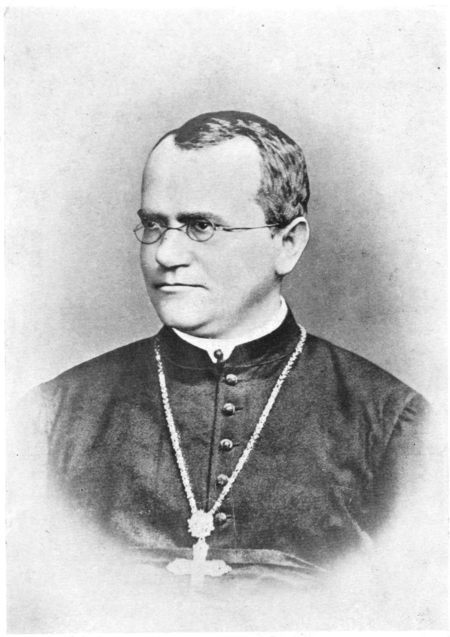
GREGOR MENDEL
Abbot of Brünn
Born 1822. Died 1884.
From a photograph kindly supplied by the Very Rev. Dr Janeischek,
the present Abbot.
BY
W. BATESON, M.A., F.R.S.
WITH A TRANSLATION OF MENDEL’S ORIGINAL
PAPERS ON HYBRIDISATION.
CAMBRIDGE:
AT THE UNIVERSITY PRESS.
1902
Cambridge: PRINTED BY J. AND C. F. CLAY,
AT THE UNIVERSITY PRESS.
PREFACE.
In the Study of Evolution progress had well-nigh
stopped. The more vigorous, perhaps also
the more prudent, had left this field of science
to labour in others where the harvest is less precarious
or the yield more immediate. Of those who
remained some still struggled to push towards truth
through the jungle of phenomena: most were content
supinely to rest on the great clearing Darwin made
long since.
Such was our state when two years ago it was
suddenly discovered that an unknown man, Gregor
Johann Mendel, had, alone, and unheeded, broken off
from the rest—in the moment that Darwin was at
work—and cut a way through.
This is no mere metaphor, it is simple fact. Each
of us who now looks at his own patch of work sees
Mendel’s clue running through it: whither that clue
will lead, we dare not yet surmise.
It was a moment of rejoicing, and they who had
heard the news hastened to spread them and take the
instant way. In this work I am proud to have borne
my little part.
But every gospel must be preached to all alike.
It will be heard by the Scribes, by the Pharisees, by
Demetrius the Silversmith, and the rest. Not lightly
do men let their occupation go; small, then, would
be our wonder, did we find the established prophet
unconvinced. Yet, is it from misgiving that Mendel
had the truth, or merely from indifference, that no
naturalist of repute, save Professor Weldon, has risen
against him?
In the world of knowledge we are accustomed to
look for some strenuous effort to understand a new
truth even in those who are indisposed to believe.
It was therefore with a regret approaching to indignation
that I read Professor Weldon’s criticism1.
Were such a piece from the hand of a junior it
might safely be neglected; but coming from Professor
Weldon there was the danger—almost the certainty—that
the small band of younger men who are thinking
of research in this field would take it they had learnt
the gist of Mendel, would imagine his teaching exposed
by Professor Weldon, and look elsewhere for
lines of work.
In evolutionary studies we have no Areopagus.
With us it is not—as happily it is with Chemistry,
Physics, Physiology, Pathology, and other well-followed
sciences—that an open court is always
sitting, composed of men themselves workers, keenly
interested in every new thing, skilled and well versed
in the facts. Where this is the case, doctrine is soon
tried and the false trodden down. But in our sparse
and apathetic community error mostly grows unheeded,
choking truth. That fate must not befall
Mendel now.
It seemed imperative that Mendel’s own work
should be immediately put into the hands of all who
will read it, and I therefore sought and obtained the
kind permission of the Royal Horticultural Society to
reprint and modify the translation they had already
caused to be made and published in their Journal.
To this I add a translation of Mendel’s minor paper
of later date. As introduction to the subject, the
same Society has authorized me to reprint with
alterations a lecture on heredity delivered before
them in 1900. For these privileges my warm thanks
are due. The introduction thus supplied, composed
originally for an audience not strictly scientific, is far
too slight for the present purpose. A few pages are
added, but I have no time to make it what it should
be, and I must wait for another chance of treating
the whole subject on a more extended scale. It will
perhaps serve to give the beginner the slight
assistance which will prepare him to get the most
from Mendel’s own memoir.
The next step was at once to defend Mendel from
Professor Weldon. That could only be done by
following this critic from statement to statement in
detail, pointing out exactly where he has gone wrong,
what he has misunderstood, what omitted, what introduced
in error. With such matters it is easy to
deal, and they would be as nothing could we find in his
treatment some word of allusion to the future; some
hint to the ignorant that this is a very big thing;
some suggestion of what it all may mean if it be
true.
Both to expose each error and to supply effectively
what is wanting, within the limits of a brief article,
written with the running pen, is difficult. For simplicity
I have kept almost clear of reference to facts
not directly connected with the text, and have foregone
recital of the now long list of cases, both of plants
and animals, where the Mendelian principles have
already been perceived. These subjects are dealt
with in a joint Report to the Evolution Committee of
the Royal Society, made by Miss E. R. Saunders and
myself, now in the Press. To Miss Saunders who
has been associated with me in this work for several
years I wish to express my great indebtedness. Much
of the present article has indeed been written in
consultation with her. The reader who seeks fuller
statement of facts and conceptions is referred to the
writings of other naturalists who have studied the
phenomena at first hand (of which a bibliography is
appended) and to our own Report.
I take this opportunity of acknowledging the
unique facilities generously granted me, as representative
of the Evolution Committee, by Messrs
Sutton and Sons of Reading, to watch some of the
many experiments they have in progress, to inspect
their admirable records, and to utilise these facts for
the advancement of the science of heredity. My
studies at Reading have been for the most part
confined to plants other than those immediately the
subject of this discussion, but some time ago I availed
myself of a kind permission to examine their stock of
peas, thus obtaining information which, with other
facts since supplied, has greatly assisted me in treating
this subject.
I venture to express the conviction, that if the
facts now before us are carefully studied, it will become
evident that the experimental study of heredity,
pursued on the lines Mendel has made possible, is
second to no branch of science in the certainty and
magnitude of the results it offers. This study has
one advantage which no other line of scientific inquiry
possesses, in that the special training necessary for
such work is easily learnt in the practice of it, and
can be learnt in no other way. All that is needed is
the faithful resolve to scamp nothing.
If a tenth part of the labour and cost now devoted
by leisured persons, in this country alone, to the
collection and maintenance of species of animals and
plants which have been collected a hundred times
before, were applied to statistical experiments in
heredity, the result in a few years would make a
revolution not only in the industrial art of the breeder
but in our views of heredity, species and variation.
We have at last a brilliant method, and a solid basis
from which to attack these problems, offering an
opportunity to the pioneer such as occurs but seldom
even in the history of modern science.
We have been told of late, more than once, that
Biology must become an exact science. The same is
my own fervent hope. But exactness is not always
attainable by numerical precision: there have been
students of Nature, untrained in statistical nicety,
whose instinct for truth yet saved them from perverse
inference, from slovenly argument, and from misuse
of authorities, reiterated and grotesque.
The study of variation and heredity, in our ignorance
of the causation of those phenomena, must be
built of statistical data, as Mendel knew long ago;
but, as he also perceived, the ground must be prepared
by specific experiment. The phenomena of
heredity and variation are specific, and give loose and
deceptive answers to any but specific questions. That
is where our exact science will begin. Otherwise we
may one day see those huge foundations of “biometry”
in ruins.
But Professor Weldon, by coincidence a vehement
preacher of precision, in his haste to annul this first
positive achievement of the precise method, dispenses
for the moment even with those unpretending forms
of precision which conventional naturalists have usefully
practised. His essay is a strange symptom of
our present state. The facts of variation and heredity
are known to so few that anything passes for evidence;
and if only a statement, or especially a conclusion, be
negative, neither surprise nor suspicion are aroused.
An author dealing in this fashion with subjects commonly
studied, of which the literature is familiar and
frequently verified, would meet with scant respect.
The reader who has the patience to examine Professor
Weldon’s array of objections will find that almost all
are dispelled by no more elaborate process than a
reference to the original records.
With sorrow I find such an article sent out to
the world by a Journal bearing, in any association,
the revered name of Francis Galton, or under the
high sponsorship of Karl Pearson. I yield to no one
in admiration of the genius of these men. Never
can we sufficiently regret that those great intellects
were not trained in the profession of the naturalist.
Mr Galton suggested that the new scientific firm
should have a mathematician and a biologist as
partners, and—soundest advice—a logician retained
as consultant2. Biologist surely must one partner be,
but it will never do to have him sleeping. In many
well-regulated occupations there are persons known
as “knockers-up,” whose thankless task it is to rouse
others from their slumber, and tell them work-time is
come round again. That part I am venturing to play
this morning, and if I have knocked a trifle loud, it is
because there is need.
March, 1902.
CONTENTS.
INTRODUCTION.
The Problems of Heredity and their Solution, pp. 1–39.
Preliminary statement of Mendel’s principles, 8. Relation
of Mendel’s discovery to the law of Ancestral
Heredity, 19. Heterozygote and Homozygote, 23. New
conceptions necessitated by Mendel’s discovery, 26. Simple
alternative characters, or allelomorphs, 27. Compound
allelomorphs and their components, 29. Analytical Variations, 29.
Relation of Mendel’s principle to continuous
variation, 32. Dominance, 32. Non-Mendelian phenomena, 33.
False hybrids of Millardet, 34. Brief historical
notice, 36.
MENDEL’S EXPERIMENTS IN PLANT HYBRIDISATION, pp. 40–95.
Introductory Remarks, 40. Selection of Experimental
Plants, 42. Division and Arrangement of Experiments, 44.
Characters selected, 45. Number of first crosses, 47.
Possible sources of error, 47. Forms of the Hybrids, 49.
Dominant and recessive, 49.
First generation bred from the Hybrids, 51. Numbers
of each form in offspring, 52. Second generation bred from
the Hybrids, 55. Subsequent generations bred from the
Hybrids, 57.
Offspring of Hybrids in which several differentiating
characters are associated, 59. The reproductive cells of
the Hybrids, 66. Statement of Mendel’s essential deductions, 67.
Experiments to determine constitution of germ-cells, 68.
Statement of purity of germ-cells, 72.
Experiments with Phaseolus, 76. Compound characters, 80.
Concluding Remarks, 84.
The facts in regard to Dominance of Characters in
Peas, 119.
The normal characters: colours of cotyledons and seed-coats, 120.
Shape, 122. Stability and variability, 124.
Results of crossing in regard to seed-characters: normal and
exceptional, 129. Analysis of exceptions, 132. The “mule”
or heterozygote, 133.
IV.
Professor Weldon’s collection of “Other evidence
concerning Dominance in Peas.”
B. Seed-coats and Shapes. 1. Seed-coats, 148. 2. Seed-shapes:
(a) Rimpau’s cases, 150. (b) Tschermak’s cases, 152.
3. Other phenomena, especially regarding seed-shapes, in
the case of “grey” peas. Modern evidence, 153.
p. 22, par. 3, line 2, for “falls” read “fall.”
p. 63, line 12, for “AabbC” read “AaBbc.”
p. 66, in heading, for “OF HYBRIDS” read “OF THE HYBRIDS.”
Note to p. 125. None of the yellow seeds produced by Laxton’s
Alpha germinated, though almost all the green seeds sown gave
healthy plants. The same was found in the case of Express, another
variety which bore some yellow seeds. In the case of Blue Peter, on
the contrary, the yellow seeds have grown as well as the green ones.
Few however were wholly yellow. Of nine yellow seeds produced by
crossing green varieties together (p. 131), six did not germinate,
and three which did gave weak and very backward plants. Taken
together, this evidence makes it scarcely doubtful that the yellow colour
in these cases was pathological, and almost certainly due to exposure
after ripening.
THE PROBLEMS OF HEREDITY AND THEIR SOLUTION 3 .
An exact determination of the laws of heredity will
probably work more change in man’s outlook on the
world, and in his power over nature, than any other
advance in natural knowledge that can be clearly foreseen.
There is no doubt whatever that these laws can be
determined. In comparison with the labour that has been
needed for other great discoveries we may even expect
that the necessary effort will be small. It is rather
remarkable that while in other branches of physiology
such great progress has of late been made, our knowledge
of the phenomena of heredity has increased but little;
though that these phenomena constitute the basis of
all evolutionary science and the very central problem
of natural history is admitted by all. Nor is this due
to the special difficulty of such inquiries so much as to
general neglect of the subject.
It is in the hope of inducing others to follow these
lines of investigation that I take the problems of heredity
as the subject of this lecture to the Royal Horticultural
Society.
No one has better opportunities of pursuing such
work than horticulturists and stock breeders. They are
daily witnesses of the phenomena of heredity. Their
success also depends largely on a knowledge of its laws,
and obviously every increase in that knowledge is of
direct and special importance to them.
The want of systematic study of heredity is due
chiefly to misapprehension. It is supposed that such
work requires a lifetime. But though for adequate study
of the complex phenomena of inheritance long periods
of time must be necessary, yet in our present state of
deep ignorance almost of the outline of the facts, observations
carefully planned and faithfully carried out for
even a few years may produce results of great value. In
fact, by far the most appreciable and definite additions
to our knowledge of these matters have been thus
obtained.
There is besides some misapprehension as to the
kind of knowledge which is especially wanted at this
time, and as to the modes by which we may expect to
obtain it. The present paper is written in the hope that
it may in some degree help to clear the ground of these
difficulties by a preliminary consideration of the question,
How far have we got towards an exact knowledge of
heredity, and how can we get further?
Now this is pre-eminently a subject in which we
must distinguish what we can do from what we want
to do. We want to know the whole truth of the matter;
we want to know the physical basis, the inward and
essential nature, “the causes,” as they are sometimes
called, of heredity: but we want also to know the laws
which the outward and visible phenomena obey.
Let us recognise from the outset that as to the essential
nature of these phenomena we still know absolutely
nothing. We have no glimmering of an idea as to what
constitutes the essential process by which the likeness
of the parent is transmitted to the offspring. We can
study the processes of fertilisation and development in
the finest detail which the microscope manifests to us,
and we may fairly say that we have now a considerable
grasp of the visible phenomena; but of the nature of
the physical basis of heredity we have no conception
at all. No one has yet any suggestion, working hypothesis,
or mental picture that has thus far helped in
the slightest degree to penetrate beyond what we see.
The process is as utterly mysterious to us as a flash of
lightning is to a savage. We do not know what is the
essential agent in the transmission of parental characters,
not even whether it is a material agent or not. Not only
is our ignorance complete, but no one has the remotest
idea how to set to work on that part of the problem.
We are in the state in which the students of physical
science were, in the period when it was open to anyone
to believe that heat was a material substance or not, as
he chose.
But apart from any conception of the essential modes
of transmission of characters, we can study the outward
facts of the transmission. Here, if our knowledge is
still very vague, we are at least beginning to see how
we ought to go to work. Formerly naturalists were
content with the collection of numbers of isolated instances
of transmission—more especially, striking and peculiar
cases—the sudden appearance of highly prepotent forms,
and the like. We are now passing out of that stage.
It is not that the interest of particular cases has in
any way diminished—for such records will always have
their value—but it has become likely that general expressions
will be found capable of sufficiently wide application
to be justly called “laws” of heredity. That this
is so was till recently due almost entirely to the work of
Mr F. Galton, to whom we are indebted for the first
systematic attempt to enuntiate such a law.
All laws of heredity so far propounded are of a
statistical character and have been obtained by statistical
methods. If we consider for a moment what is actually
meant by a “law of heredity” we shall see at once why
these investigations must follow statistical methods. For
a “law” of heredity is simply an attempt to declare
the course of heredity under given conditions. But if
we attempt to predicate the course of heredity we have
to deal with conditions and groups of causes wholly
unknown to us, whose presence we cannot recognize,
and whose magnitude we cannot estimate in any particular
case. The course of heredity in particular cases
therefore cannot be foreseen.
Of the many factors which determine the degree
to which a given character shall be present in a given
individual only one is usually known to us, namely,
the degree to which that character is present in the
parents. It is common knowledge that there is not that
close correspondence between parent and offspring which
would result were this factor the only one operating;
but that, on the contrary, the resemblance between the
two is only an uncertain one.
In dealing with phenomena of this class the study
of single instances reveals no regularity. It is only by
collection of facts in great numbers, and by statistical
treatment of the mass, that any order or law can be
perceived. In the case of a chemical reaction, for instance,
by suitable means the conditions can be accurately reproduced,
so that in every individual case we can predict
with certainty that the same result will occur. But with
heredity it is somewhat as it is in the case of the rainfall.
No one can say how much rain will fall to-morrow in
a given place, but we can predict with moderate accuracy
how much will fall next year, and for a period of years
a prediction can be made which accords very closely with
the truth.
Similar predictions can from statistical data be made as
to the duration of life and a great variety of events, the
conditioning causes of which are very imperfectly understood.
It is predictions of this kind that the study of
heredity is beginning to make possible, and in that sense
laws of heredity can be perceived.
We are as far as ever from knowing why some characters
are transmitted, while others are not; nor can anyone yet
foretell which individual parent will transmit characters to
the offspring, and which will not; nevertheless the progress
made is distinct.
As yet investigations of this kind have been made in
only a few instances, the most notable being those of
Galton on human stature, and on the transmission of
colours in Basset hounds. In each of these cases he has
shown that the expectation of inheritance is such that a
simple arithmetical rule is approximately followed. The
rule thus arrived at is that of the whole heritage of the
offspring the two parents together on an average contribute
one half, the four grandparents one-quarter, the eight
great-grandparents one-eighth, and so on, the remainder
being contributed by the remoter ancestors.
Such a law is obviously of practical importance. In
any case to which it applies we ought thus to be able to
predict the degree with which the purity of a strain may
be increased by selection in each successive generation.
To take a perhaps impossibly crude example, if a
seedling show any particular character which it is desired
to fix, on the assumption that successive self-fertilisations
are possible, according to Galton’s law the expectation of
purity should be in the first generation of self-fertilisation
1 in 2, in the second generation 3 in 4, in the third 7 in 8,
and so on4.
But already many cases are known to which the rule in
any simple form will not apply. Galton points out that
it takes no account of individual prepotencies. There are,
besides, numerous cases in which on crossing two varieties
the character of one variety almost always appears in each
member of the first cross-bred generation. Examples of
these will be familiar to those who have experience in such
matters. The offspring of the Polled Angus cow and the
Shorthorn bull is almost invariably polled or with very
small loose “scurs.” Seedlings raised by crossing Atropa
belladonna with the yellow-fruited variety have without
exception the blackish-purple fruits of the type. In several
hairy species when a cross with a glabrous variety is made,
the first cross-bred generation is altogether hairy5.
Still more numerous are examples in which the characters
of one variety very largely, though not exclusively, predominate
in the offspring.
These large classes of exceptions—to go no further—indicate
that, as we might in any case expect, the principle
is not of universal application, and will need various
modifications if it is to be extended to more complex cases
of inheritance of varietal characters. No more useful work
can be imagined than a systematic determination of the
precise “law of heredity” in numbers of particular cases.
Until lately the work which Galton accomplished stood
almost alone in this field, but quite recently remarkable
additions to our knowledge of these questions have been
made. In the year 1900 Professor de Vries published
a brief account6 of experiments which he has for several
years been carrying on, giving results of the highest value.
The description is very short, and there are several
points as to which more precise information is necessary
both as to details of procedure and as to statement of
results. Nevertheless it is impossible to doubt that the
work as a whole constitutes a marked step forward, and
the full publication which is promised will be awaited with
great interest.
The work relates to the course of heredity in cases
where definite varieties differing from each other in some
one definite character are crossed together. The cases are
all examples of discontinuous variation: that is to say,
cases in which actual intermediates between the parent
forms are not usually produced on crossing7. It is shown
that the subsequent posterity obtained by self-fertilising
these cross-breds or hybrids, or by breeding them with each
other, break up into the original parent forms according to
fixed numerical rule.
Professor de Vries begins by reference to a remarkable
memoir by Gregor Mendel8, giving the results of his
experiments in crossing varieties of Pisum sativum. These
experiments of Mendel’s were carried out on a large scale,
his account of them is excellent and complete, and the
principles which he was able to deduce from them will
certainly play a conspicuous part in all future discussions
of evolutionary problems. It is not a little remarkable
that Mendel’s work should have escaped notice, and been
so long forgotten.
For the purposes of his experiments Mendel selected
seven pairs of characters as follows:—
1. Shape of ripe seed, whether round; or angular and
wrinkled.
2. Colour of “endosperm” (cotyledons), whether some
shade of yellow; or a more or less intense green.
3. Colour of the seed-skin, whether various shades of
grey and grey-brown; or white.
4. Shape of seed-pod, whether simply inflated; or
deeply constricted between the seeds.
5. Colour of unripe pod, whether a shade of green; or
bright yellow.
6. Nature of inflorescence, whether the flowers are
arranged along the axis of the plant; or are terminal and
form a kind of umbel.
7. Length of stem, whether about 6 or 7 ft. long, or
about 3/4 to 1 1/2 ft.
Large numbers of crosses were made between Peas differing
in respect of one of each of these pairs of characters.
It was found that in each case the offspring of the cross
exhibited the character of one of the parents in almost
undiminished intensity, and intermediates which could not
be at once referred to one or other of the parental forms
were not found.
In the case of each pair of characters there is thus
one which in the first cross prevails to the exclusion of the
other. This prevailing character Mendel calls the dominant
character, the other being the recessivecharacter9.
That the existence of such “dominant” and “recessive”
characters is a frequent phenomenon in cross-breeding, is
well known to all who have attended to these subjects.
By letting the cross-breds fertilise themselves Mendel
next raised another generation. In this generation were
individuals which showed the dominant character, but also
individuals which presented the recessive character. Such
a fact also was known in a good many instances. But
Mendel discovered that in this generation the numerical
proportion of dominants to recessives is on an average of
cases approximately constant, being in fact as three to one.
With very considerable regularity these numbers were
approached in the case of each of his pairs of characters.
There are thus in the first generation raised from the
cross-breds 75 per cent. dominants and 25 per cent.
recessives.
These plants were again self-fertilised, and the offspring
of each plant separately sown. It next appeared that the
offspring of the recessives remained pure recessive, and
in subsequent generations never produced the dominant
again.
But when the seeds obtained by self-fertilising the
dominants were examined and sown it was found that
the dominants were not all alike, but consisted of two
classes, (1) those which gave rise to pure dominants, and
(2) others which gave a mixed offspring, composed partly
of recessives, partly of dominants. Here also it was found
that the average numerical proportions were constant, those
with pure dominant offspring being to those with mixed
offspring as one to two. Hence it is seen that the 75 per
cent. dominants are not really of similar constitution, but
consist of twenty-five which are pure dominants and fifty
which are really cross-breds, though, like the cross-breds
raised by crossing the two original varieties, they only
exhibit the dominant character.
To resume, then, it was found that by self-fertilising
the original cross-breds the same proportion was always
approached, namely—
Like the pure recessives, the pure dominants are
thenceforth pure, and only give rise to dominants in all
succeeding generations studied.
On the contrary the fifty cross-breds, as stated above,
have mixed offspring. But these offspring, again, in their
numerical proportions, follow the same law, namely, that
there are three dominants to one recessive. The recessives
are pure like those of the last generation, but the dominants
can, by further self-fertilisation, and examination or cultivation
of the seeds produced, be again shown to be made
up of pure dominants and cross-breds in the same proportion
of one dominant to two cross-breds.
The process of breaking up into the parent forms is
thus continued in each successive generation, the same
numerical law being followed so far as has yet been
observed.
Mendel made further experiments with Pisum sativum,
crossing pairs of varieties which differed from each other
in two characters, and the results, though necessarily much
more complex, showed that the law exhibited in the simpler
case of pairs differing in respect of one character operated
here also.
In the case of the union of varieties AB and ab
differing in two distinct pairs of characters, A and a,
B and b, of which A and B are dominant, a and b
recessive, Mendel found that in the first cross-bred generation
there was only one class of offspring, really AaBb.
But by reason of the dominance of one character of
each pair these first crosses were hardly if at all distinguishable
from AB.
By letting these AaBb’s fertilise themselves, only four
classes of offspring seemed to be produced, namely,
AB
showing
both dominant characters.
Ab
"
dominant A and recessive b.
aB
"
recessive a and dominant B.
ab
"
both recessive characters a and b.
The numerical ratio in which these classes appeared
were also regular and approached the ratio
9AB : 3Ab : 3aB : 1ab.
But on cultivating these plants and allowing them to
fertilise themselves it was found that the members of the
Ratios
1
ab class produce only ab’s.
3
1
aB class may produce either all aB’s,
2
or both aB’s and ab’s.
3
1
Ab class may produce either all Ab’s,
2
or both Ab’s and ab’s.
9
1
AB class may produce either all AB’s,
2
or both AB’s and Ab’s,
2
or both AB’s and aB’s,
4
or all four possible classes again, namely,
AB’s, Ab’s, aB’s, and ab’s,
and the average number of members of each class will
approach the ratio 1 : 3 : 3 : 9 as indicated above.
The details of these experiments and of others like
them made with three pairs of differentiating characters are
all set out in Mendel’s memoir.
Professor de Vries has worked at the same problem in
some dozen species belonging to several genera, using pairs
of varieties characterised by a great number of characters:
for instance, colour of flowers, stems, or fruits, hairiness,
length of style, and so forth. He states that in all these
cases Mendel’s principles are followed.
The numbers with which Mendel worked, though large,
were not large enough to give really smooth results10; but
with a few rather marked exceptions the observations are
remarkably consistent, and the approximation to the numbers
demanded by the law is greatest in those cases where
the largest numbers were used. When we consider, besides,
that Tschermak and Correns announce definite confirmation
in the case of Pisum, and de Vries adds the evidence of his
long series of observations on other species and orders,
there can be no doubt that Mendel’s law is a substantial
reality; though whether some of the cases that depart
most widely from it can be brought within the terms of
the same principle or not, can only be decided by further
experiments.
One may naturally ask, How can these results be
brought into harmony with the facts of hybridisation
hitherto known; and, if all this is true, how is it that
others who have carefully studied the phenomena of hybridisation
have not long ago perceived this law? The
answer to this question is given by Mendel at some length,
and it is, I think, satisfactory. He admits from the first
that there are undoubtedly cases of hybrids and cross-breds
which maintain themselves pure and do not break up.
Such examples are plainly outside the scope of his law.
Next he points out, what to anyone who has rightly
comprehended the nature of discontinuity in variation is
well known, that the variations in each character must be
separately regarded. In most experiments in crossing,
forms are taken which differ from each other in a multitude
of characters—some continuous, others discontinuous,
some capable of blending with their contraries, while others
are not. The observer on attempting to perceive any
regularity is confused by the complications thus introduced.
Mendel’s law, as he fairly says, could only appear
in such cases by the use of overwhelming numbers, which
are beyond the possibilities of practical experiment. Lastly,
no previous observer had applied a strict statistical method.
Both these answers should be acceptable to those who
have studied the facts of variation and have appreciated
the nature of Species in the light of those facts. That
different species should follow different laws, and that the
same law should not apply to all characters alike, is exactly
what we have every right to expect. It will also be
remembered that the principle is only explicitly declared
to apply to discontinuous characters11. As stated also
it can only be true where reciprocal crossings lead to the
same result. Moreover, it can only be tested when there
is no sensible diminution in fertility on crossing.
Upon the appearance of de Vries’ paper announcing the
“rediscovery” and confirmation of Mendel’s law and its
extension to a great number of cases two other observers
came forward almost simultaneously and independently
described series of experiments fully confirming Mendel’s
work. Of these papers the first is that of Correns, who
repeated Mendel’s original experiment with Peas having
seeds of different colours. The second is a long and very
valuable memoir of Tschermak, which gives an account of
elaborate researches into the results of crossing a number
of varieties of Pisum sativum. These experiments were in
many cases carried out on a large scale, and prove the
main fact enuntiated by Mendel beyond any possibility of
contradiction. The more exhaustive of these researches
are those of Tschermak on Peas and Correns on several
varieties of Maize. Both these elaborate investigations
have abundantly proved the general applicability of Mendel’s
law to the character of the plants studied, though both
indicate some few exceptions. The details of de Vries’
experiments are promised in the second volume of his most
valuable Mutationstheorie. Correns in regard to Maize
and Tschermak in the case of P. sativum have obtained
further proof that Mendel’s law holds as well in the case of
varieties differing from each other in two pairs of characters,
one of each pair being dominant, though of course a more
complicated expression is needed in such cases12.
That we are in the presence of a new principle of the
highest importance is manifest. To what further conclusions
it may lead us cannot yet be foretold. But both
Mendel and the authors who have followed him lay stress
on one conclusion, which will at once suggest itself to
anyone who reflects on the facts. For it will be seen that
the results are such as we might expect if it be imagined
that the cross-bred plant produced pollen grains and egg-cells,
each of which bears only one of the alternative varietal
characters and not both. If this were so, and if on an
average the same number of pollen grains and egg-cells
transmit each of the two characters, it is clear that on a
random assortment of pollen grains and egg-cells Mendel’s
law would be obeyed. For 25 per cent. of “dominant”
pollen grains would unite with 25 per cent. “dominant”
egg-cells; 25 per cent. “recessive” pollen grains would
similarly unite with 25 per cent. “recessive” egg-cells;
while the remaining 50 per cent. of each kind would unite
together. It is this consideration which leads both Mendel
and those who have followed him to assert that these facts
of crossing prove that each egg-cell and each pollen grain
is pure in respect of each character to which the law
applies. It is highly desirable that varieties differing in
the form of their pollen should be made the subject of
these experiments, for it is quite possible that in such a
case strong confirmation of this deduction might be obtained.
[Preliminary trials made with reference to this
point have so far given negative results. Remembering
that a pollen grain is not a germ-cell, but only a bearer of
a germ-cell, the hope of seeing pollen grains differentiated
according to the characters they bear is probably remote.
Better hopes may perhaps be entertained in regard to
spermatozoa, or possibly female cells.]
As an objection to the deduction of purity of germ-cells,
however, it is to be noted that though true intermediates
did not generally occur, yet the intensity in which the
characters appeared did vary in degree, and it is not easy
to see how the hypothesis of perfect purity in the reproductive
cells can be supported in such cases. Be this,
however, as it may, there is no doubt we are beginning to
get new lights of a most valuable kind on the nature of
heredity and the laws which it obeys. It is to be hoped
that these indications will be at once followed up by
independent workers. Enough has been said to show how
necessary it is that the subjects of experiment should be
chosen in such a way as to bring the laws of heredity to a
real test. For this purpose the first essential is that the
differentiating characters should be few, and that all avoidable
complications should be got rid of. Each experiment
should be reduced to its simplest possible limits. The
results obtained by Galton, and also the new ones especially
described in this paper, have each been reached by restricting
the range of observation to one character or group of characters,
and it is certain that by similar treatment our
knowledge of heredity may be rapidly extended.
To the above popular presentation of the essential facts,
made for an audience not strictly scientific, some addition,
however brief, is called for. First, in regard to the law of
Ancestry, spoken of on p. 5. Those who are acquainted with
Pearson’s Grammar of Science, 2nd ed. published early in
1900, the same author’s paper in Proc. R. S. vol. 66, 1900,
p. 140, or the extensive memoir (pubd. Oct. 1900), on the
inheritance of coat-colour in horses and eye-colour in man
(Phil. Trans. 195, A, 1900, p. 79), will not need to be told
that the few words I have given above constitute a most
imperfect diagram of the operations of that law as now developed.
Until the appearance of these treatises it was,
I believe, generally considered that the law of Ancestral
Heredity was to be taken as applying to phenomena like
these (coat-colour, eye-colour, &c.) where the inheritance
is generally alternative, as well as to the phenomena
of blended inheritance.
Pearson, in the writings referred to, besides withdrawing
other large categories of phenomena from the scope of its
operations, points out that the law of Ancestral Heredity
does not satisfactorily express the cases of alternative
inheritance. He urges, and with reason, that these classes
of phenomena should be separately dealt with.
The whole issue as regards the various possibilities of
heredity now recognized will be made clearer by a very brief
exposition of the several conceptions involved.
If an organism producing germ-cells of a given constitution,
uniform in respect of the characters they bear, breeds
with another organism13 bearing precisely similar germ-cells,
the offspring resulting will, if the conditions are
identical, be uniform.
In practice such a phenomenon is seen in pure-breeding.
It is true that we know no case in nature where all the
germ-cells are thus identical, and where no variation takes
place beyond what we can attribute to conditions, but we
know many cases where such a result is approached, and
very many where all the essential features which we regard
as constituting the characters of the breed are reproduced
with approximate certainty in every member of the pure-bred
race, which thus closely approach to uniformity.
But if two germ-cells of dissimilar constitution unite
in fertilisation, what offspring are we to expect14? First
let us premise that the answer to this question is known
experimentally to differ for many organisms and for many
classes of characters, and may almost certainly be in part
determined by external circumstances. But omitting the
last qualification, certain principles are now clearly detected,
though what principle will apply in any given case can only
be determined by direct experiment made with that case.
This is the phenomenon of cross-breeding. As generally
used, this term means the union of members of dissimilar
varieties, or species: though when dissimilar gametes15 produced
by two individuals of the same variety unite in
fertilisation, we have essentially cross-breeding in respect
of the character or characters in which those gametes differ.
We will suppose, as before, that these two gametes bearing
properties unlike in respect of a given character, are borne
by different individuals.
In the simplest case, suppose a gamete from an individual
presenting any character in intensity A unite in
fertilisation with another from an individual presenting
the same character in intensity a. For brevity’s sake we
may call the parent individuals A and a, and the resulting
zygote Aa. What will the structure of Aa be in regard to
the character we are considering?
Up to Mendel no one proposed to answer this question
in any other way than by reference to the intensity of the
character in the progenitors, and primarily in the parents,
A and a, in whose bodies the gametes had been developed.
It was well known that such a reference gave a very poor
indication of what Aa would be. Both A and a may come
from a population consisting of individuals manifesting the
same character in various intensities. In the pedigree of
either A or a these various intensities may have occurred
few or many times. Common experience leads us to expect
the probability in regard to Aa to be influenced by this
history. The next step is that which Galton took. He
extended the reference beyond the immediate parents of
Aa, to its grandparents, great-grandparents, and so on, and
in the cases he studied he found that from a knowledge of
the intensity in which the given character was manifested
in each progenitor, even for some few generations back, a
fairly accurate prediction could be made, not as to the
character of any individual Aa, but as to the average
character of Aa’s of similar parentage, in general.
But suppose that instead of individuals presenting one
character in differing intensities, two individuals breed
together distinguished by characters which we know to be
mutually exclusive, such as A and B. Here again we may
speak of the individuals producing the gametes as A and
B, and the resulting zygote as AB. What will AB be
like? The population here again may consist of many like
A and like B. These two forms may have been breeding
together indiscriminately, and there may have been many
or few of either type in the pedigree of either A or B.
Here again Galton applied his method with remarkable
success. Referring to the progenitors of A and B, determining
how many of each type there were in the direct
pedigree of A and of B, he arrived at the same formula as
before, with the simple difference that instead of expressing
the probable average intensity of one character in several
individuals, the prediction is given in terms of the probable
number of A’s and B’s that would result on an average
when particular A’s and B’s of known pedigree breed
together.
The law as Galton gives it is as follows:—
“It is that the two parents contribute between them
on the average one-half, or (0·5) of the total heritage of
the offspring; the four grandparents, one-quarter, or (0·5)2;
the eight great-grandparents, one-eighth, or (0·5)3, and so
on. Then the sum of the ancestral contributions is expressed
by the series
{(0·5) + (0·5)2 + (0·5)3, &c.},
which, being equal to 1, accounts for the whole heritage.”
In the former case where A and a are characters which
can be denoted by reference to a common scale, the law
assumes of course that the inheritance will be, to use
Galton’s term, blended, namely that the zygote resulting
from the union of A with a will on the average be more
like a than if A had been united with A; and conversely
that an Aa zygote will on the average be more like A than
an aa zygote would be.
But in the case of A’s and B’s, which are assumed to
be mutually exclusive characters, we cannot speak of
blending, but rather, to use Galton’s term, of alternative
inheritance.
Pearson, finding that the law whether formulated thus,
or in the modified form in which he restated it16, did not
express the phenomena of alternative inheritance known
to him with sufficient accuracy to justify its strict application
to them, and also on general grounds, proposed that
the phenomena of blended and alternative inheritance
should be treated apart—a suggestion17 the wisdom of
which can scarcely be questioned.
Now the law thus imperfectly set forth and every
modification of it is incomplete in one respect. It deals
only with the characters of the resulting zygotes and
predicates nothing in regard to the gametes which go to
form them. A good prediction may be made as to any
given group of zygotes, but the various possible constitutions
of the gametes are not explicitly treated.
Nevertheless a definite assumption is implicitly made
regarding the gametes. It is not in question that differences
between these gametes may occur in respect of the heritage
they bear; yet it is assumed that these differences will be
distributed among the gametes of any individual zygote in
such a way that each gamete remains capable, on fertilisation,
of transmitting all the characters (both of the parent-zygote
and of its progenitors) to the zygote which it then
contributes to form (and to the posterity of that zygote) in
the intensity indicated by the law. Hence the gametes of
any individual are taken as collectively a fair sample of all
the racial characters in their appropriate intensities, and this
theory demands that there shall have been no qualitative
redistribution of characters among the gametes of any
zygote in such a way that some gametes shall be finally
excluded from partaking of and transmitting any specific
part of the heritage. The theory further demands—and
by the analogy of what we know otherwise not only of
animals and plants, but of physical or chemical laws,
perhaps this is the most serious assumption of all—that
the structure of the gametes shall admit of their being
capable of transmitting any character in any intensity
varying from zero to totality with equal ease; and that
gametes of each intensity are all equally likely to occur,
given a pedigree of appropriate arithmetical composition.
Such an assumption appears so improbable that even
in cases where the facts seem as yet to point to this
conclusion with exceptional clearness, as in the case of
human stature, I cannot but feel there is still room for
reserve of judgment.
However this may be, the Law of Ancestral Heredity,
and all modifications of it yet proposed, falls short in the
respect specified above, that it does not directly attempt
to give any account of the distribution of the heritage among
the gametes of any one individual.
Mendel’s conception differs fundamentally from that
involved in the Law of Ancestral Heredity. The relation
of his hypothesis to the foregoing may be most easily
shown if we consider it first in application to the phenomena
resulting from the cross-breeding of two pure
varieties.
Let us again consider the case of two varieties each displaying
the same character, but in the respective intensities
A and a. Each gamete of the A variety bears A, and
each gamete of the a variety bears a. When they unite in
fertilisation they form the zygote Aa. What will be its
characters? The Mendelian teaching would reply that
this can only be known by direct experiment with the two
forms A and a, and that the characters A and a perceived
in those two forms or varieties need not give any indication
as to the character of the zygote Aa. It may display the
character A, or a, or a character half way between the two,
or a character beyond A or below a. The character of Aa
is not regarded as a heritage transmitted to it by A and by
a, but as a character special and peculiar to Aa, just as
NaCl is not a body half way between sodium and chlorine,
or such that its properties can be predicted from or easily
stated in terms of theirs.
If a concrete case may help, a tall pea A crossed with
a dwarf a often produces, not a plant having the height of
either A or a, but something taller than the pure tall
variety A.
But if the case obeys the Mendelian principles—as does
that here quoted—then it can be declared first that the
gametes of Aa will not be bearers of the character proper to
Aa; but, generally speaking, each gamete will either bear
the pure A character or the pure a character. There will
in fact be a redistribution of the characters brought in by
the gametes which united to form the zygote Aa, such that
each gamete of Aa is pure, as the parental gametes were.
Secondly this redistribution will occur in such a way that,
of the gametes produced by such Aa’s, on an average
there will be equal numbers of A gametes and of a
gametes.
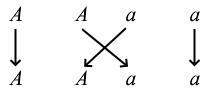
Consequently if Aa’s breed together, the new A gametes
may meet each other in fertilisation, forming a zygote AA,
namely, the pure A variety again; similarly two a gametes
may meet and form aa, or the pure a variety again. But if
an A gamete meets an a it will once more form Aa, with
its special character. This Aa is the hybrid, or “mule”
form, or as I have elsewhere called it, the heterozygote, as
distinguished from AA or aa the homozygotes.
Similarly if the two gametes of two varieties distinguished
by characters, A and B, which cannot be described
in terms of any common scale (such as for example the
“rose” and “single” combs of fowls) unite in fertilisation,
again the character of the mule form cannot be predicted.
Before the experiment is made the “mule” may present any
form. Its character or properties can as yet be no more
predicted than could those of the compounds of unknown
elements before the discovery of the periodic law.
But again—if the case be Mendelian—the gametes borne
by AB will be either A’s or B’s18, and the cross-bred
AB’s breeding together will form AA’s, AB’s and BB’s.
Moreover, if as in the normal Mendelian case, AB’s bear on
an average equal numbers of A gametes and B gametes, the
numerical ratio of these resulting zygotes to each other will be
1 AA : 2 AB : 1 BB.
We have seen that Mendel makes no prediction as to
the outward and visible characters of AB, but only as
to the essential constitution and statistical condition of its
gametes in regard to the characters A and B. Nevertheless
in a large number of cases the character of AB is known
to fall into one of three categories (omitting mosaics).
(1) The cross-bred may almost always resemble one
of its pure parents so closely as to be practically
indistinguishable from that pure form, as in the
case of the yellow cotyledon-colour of certain varieties
of peas when crossed with green-cotyledoned varieties;
in which case the parental character, yellow, thus
manifested by the cross-bred is called “dominant”
and the parental character, green, not manifested, is
called recessive.
(2) The cross-bred may present some condition
intermediate between the two parental forms, in
which case we may still retain the term “blend”
as applied to the zygote.
Such an “intermediate” may be the apparent mean
between the two parental forms or be nearer to one
or other in any degree. Such a case is that of a
cross between a rich crimson Magenta Chinese Primrose
and a clear White, giving a flower of a colour
appropriately described as a “washy” magenta.
(3) The cross-bred may present some form quite
different from that of either pure parent. Though,
as has been stated, nothing can be predicted of an unknown
case, we already know a considerable number
of examples of this nature in which the mule-form
approaches sometimes with great accuracy to that of
a putative ancestor, near or remote. It is scarcely
possible to doubt that several—though perhaps not
all—of Darwin’s “reversions on crossing” were of
this nature.
Such a case is that of the “wild grey mouse” produced
by the union of an albino tame mouse and a piebald
Japanese mouse19. These “reversionary” mice bred
together produce the parental tame types, some other
types, and “reversionary” mice again.
From what has been said it will now be clear that the
applicability of the Mendelian hypothesis has, intrinsically,
nothing whatever to do with the question of the inheritance
being blended or alternative. In fact, as soon as the relation
of zygote characters to gamete characters is appreciated, it is
difficult to see any reason for supposing that the manifestation
of characters seen in the zygotes should give any
indication as to their mode of allotment among the gametes.
On a previous occasion I pointed out that the terms
“Heredity” and “Inheritance” are founded on a misapplication
of metaphor, and in the light of our present
knowledge it is becoming clearer that the ideas of “transmission”
of a character by parent to offspring, or of there
being any “contribution” made by an ancestor to its posterity,
must only be admitted under the strictest reserve,
and merely as descriptive terms.
We are now presented with some entirely new conceptions:—
(1) The purity of the gametes in regard to certain
characters.
(2) The distinction of all zygotes according as they are or
are not formed by the union of like or unlike gametes.
In the former case, apart from Variation, they breed
true when mated with their like; in the latter case
their offspring, collectively, will be heterogeneous.
(3) If the zygote be formed by the union of dissimilar
gametes, we may meet the phenomenon of (a) dominant
and recessive characters; (b) a blend form;
(c) a form distinct from either parent, often
reversionary20.
But there are additional and even more significant deductions
from the facts. We have seen that the gametes are
differentiated in respect of pure characters. Of these pure
characters there may conceivably be any number associated
together in one organism. In the pea Mendel detected at
least seven—not all seen by him combined in the same
plant, but there is every likelihood that they are all capable
of being thus combined.
Each such character, which is capable of being dissociated
or replaced by its contrary, must henceforth be conceived
of as a distinct unit-character; and as we know that the
several unit-characters are of such a nature that any one
of them is capable of independently displacing or being displaced
by one or more alternative characters taken singly,
we may recognize this fact by naming such unit-characters
allelomorphs. So far, we know very little of any allelomorphs
existing otherwise than as pairs of contraries, but this is
probably merely due to experimental limitations and the
rudimentary state of our knowledge.
In one case (combs of fowls) we know three characters,
pea comb, rose comb and single comb; of which pea and
single, or rose and single, behave towards each other as a
pair of allelomorphs, but of the behaviour of pea and rose
towards each other we know as yet nothing.
We have no reason as yet for affirming that any
phenomenon properly described as displacement of one
allelomorph by another occurs, though the metaphor may
be a useful one. In all cases where dominance has been
perceived, we can affirm that the members of the allelomorphic
pair stand to each other in a relation the nature
of which we are as yet wholly unable to apprehend or
illustrate.
To the new conceptions already enumerated we may
therefore add
(4) Unit-characters of which some, when once arisen by
Variation, are alternative to each other in the constitution
of the gametes, according to a definite system.
From the relations subsisting between these characters,
it follows that as each zygotic union of allelomorphs is resolved
on the formation of the gametes, no zygote can give
rise to gametes collectively representing more than two characters
allelomorphic to each other, apart from new variation.
From the fact of the existence of the interchangeable
characters we must, for purposes of treatment, and to complete
the possibilities, necessarily form the conception of an
irresoluble base, though whether such a conception has any
objective reality we have no means as yet of determining.
We have now seen that when the varieties A and B
are crossed together, the heterozygote, AB, produces
gametes bearing the pure A character and the pure B
character. In such a case we speak of such characters as
simple allelomorphs. In many cases however a more
complex phenomenon happens. The character brought in
on fertilisation by one or other parent may be of such a
nature that when the zygote, AB, forms its gametes, these
are not individually bearers merely of A and B, but of a
number of characters themselves again integral, which in,
say A, behaved as one character so long as its gametes
united in fertilisation with others like themselves, but on
cross-fertilisation are resolved and redistributed among the
gametes produced by the cross-bred zygote.
In such a case we call the character A a compound
allelomorph, and we can speak of the integral characters
which constitute it as hypallelomorphs. We ought to write
the heterozygote (A A′ A″ . . .) B and the gametes produced
by it may be of the form A, A′, A″, A‴, . . . B. Or the
resolution may be incomplete in various degrees, as we
already suspect from certain instances; in which case we
may have gametes A, A′ A″, A‴ A″″, A′ A″ Av, . . . B, and
so on. Each of these may meet a similar or a dissimilar
gamete in fertilisation, forming either a homozygote, or a
heterozygote with its distinct properties.
In the case of compound allelomorphs we know as yet
nothing of the statistical relations of the several gametes.
Thus we have the conception
(5) of a Compound character, borne by one gamete,
transmitted entire as a single character so long as
fertilisation only occurs between like gametes, or is,
in other words, “symmetrical,” but if fertilisation
take place with a dissimilar gamete (or possibly by
other causes), resolved into integral constituent characters,
each separately transmissible.
Next, as, by the union of the gametes bearing the
various hypallelomorphs with other such gametes, or with
gametes bearing simple allelomorphs, in fertilisation, a
number of new zygotes will be formed, such as may not have
been seen before in the breed: these will inevitably be
spoken of as varieties; and it is difficult not to extend the
idea of variation to them. To distinguish these from other
variations—which there must surely be—we may call them
(6) Analytical variations in contradistinction to
(7) Synthetical variations, occurring not by the
separation of pre-existing constituent-characters but
by the addition of new characters.
Lastly, it is impossible to be presented with the fact
that in Mendelian cases the cross-bred produces on an
average equal numbers of gametes of each kind, that is to
say, a symmetrical result, without suspecting that this fact
must correspond with some symmetrical figure of distribution
of those gametes in the cell-divisions by which they are
produced.
At the present time these are the main conceptions—though
by no means all—arising directly from Mendel’s
work. The first six are all more or less clearly embodied
by him, though not in every case developed in accordance
with modern knowledge. The seventh is not a Mendelian
conception, but the facts before us justify its inclusion in
the above list though for the present it is little more than
a mere surmise.
In Mendelian cases it will now be perceived that all
the zygotes composing the population consist of a limited
number of possible types, each of definite constitution,
bearing gametes also of a limited and definite number of
types, and definite constitution in respect of pre-existing
characters. It is now evident that in such cases each
several progenitor need not be brought to account in
reckoning the probable characters of each descendant;
for the gametes of cross-breds are differentiated at each
successive generation, some parental (Mendelian) characters
being left out in the composition of each gamete produced
by a zygote arising by the union of bearers of opposite
allelomorphs.
When from these considerations we return to the
phenomena comprised in the Law of Ancestral Heredity,
what certainty have we that the same conceptions are not
applicable there also?
It has now been shown that the question whether in the
cross-bred zygotes in general the characters blend or are
mutually exclusive is an entirely subordinate one, and
distinctions with regard to the essential nature of heredity
based on these circumstances become irrelevant.
In the case of a population presenting continuous
variation in regard to say, stature, it is easy to see how
purity of the gametes in respect of any intensities of
that character might not in ordinary circumstances be
capable of detection. There are doubtless more than
two pure gametic forms of this character, but there may
quite conceivably be six or eight. When it is remembered
that each heterozygous combination of any two
may have its own appropriate stature, and that such a
character is distinctly dependent on external conditions,
the mere fact that the observed curves of stature give
“chance distributions” is not surprising and may still be
compatible with purity of gametes in respect of certain
pure types. In peas (P. sativum), for example, from
Mendel’s work we know that the tall forms and the extreme
dwarf forms exhibit gametic purity. I have seen
at Messrs Sutton’s strong evidence of the same nature
in the case of the tall Sweet Pea (Lathyrus odoratus)
and the dwarf or procumbent “Cupid” form.
But in the case of the Sweet Pea we know at least one
pure form of definitely intermediate height, and in the
case of P. sativum there are many. When the extreme
types breed together it will be remembered the heterozygote
commonly exceeds the taller in height. In the next
generation, since there is, in the case of extremes, so much
margin between the types of the two pure forms, the return
of the offspring to the three forms of which two are homozygous
and one heterozygous is clearly perceptible.
If however instead of pure extreme varieties we were to
take a pair of varieties differing normally by only a foot or
two, we might, owing to the masking effects of conditions,
&c., have great difficulty in distinguishing the three forms
in the second generation. There would besides be twice as
many heterozygous individuals as homozygous individuals
of each kind, giving a symmetrical distribution of heights,
and who might not—in pre-Mendelian days—have accepted
such evidence—made still less clear by influence of conditions—as
proof of Continuous Variation both of zygotes
and gametes?
Suppose, then, that instead of two pure types, we had
six or eight breeding together, each pair forming their own
heterozygote, there would be a very remote chance of such
purity or fixity of type whether of gamete or zygote being
detected.
Dominance, as we have seen, is merely a phenomenon
incidental to specific cases, between which no other common
property has yet been perceived. In the phenomena of
blended inheritance we clearly have no dominance. In the
cases of alternative inheritance studied by Galton and
Pearson there is evidently no universal dominance. From
the tables of Basset hound pedigrees there is clearly no
definite dominance of either of the coat-colours. In the case
of eye-colour the published tables do not, so far as I have
discovered, furnish the material for a decision, though it is
scarcely possible the phenomenon, even if only occasional,
could have been overlooked. We must take it, then, there
is no sensible dominance in these cases; but whether there
is or is not sensible gametic purity is an altogether different
question, which, so far as I can judge, is as yet untouched.
It may perfectly well be that we shall be compelled to
recognize that in many cases there is no such purity, and
that the characters may be carried by the gametes in any
proportion from zero to totality, just as some substances
may be carried in a solution in any proportion from zero
to saturation without discontinuous change of properties.
That this will be found true in some cases is, on any
hypothesis, certain; but to prove the fact for any given
case will be an exceedingly difficult operation, and I scarcely
think it has been yet carried through in such a way as to
leave no room for doubt.
Conversely, the absolute and universal purity of the
gametes has certainly not yet been determined for any
case; not even in those cases where it looks most likely
that such universal purity exists. Impairment of such
purity we may conceive either to occur in the form of
mosaic gametes, or of gametes with blended properties.
On analogy and from direct evidence we have every right
to believe that gametes of both these classes may occur in
rare and exceptional cases, of as yet unexplored nature21,
but such a phenomenon will not diminish the significance
of observed purity.
We have now seen the essential nature of the Mendelian
principles and are able to appreciate the exact relation in
which they stand to the group of cases included in the Law
of Ancestral Heredity. In seeking any general indication
as to the common properties of the phenomena which are
already known to obey Mendelian principles we can as yet
point to none, and whether some such common features
exist or not is unknown.
There is however one group of cases, definite though
as yet not numerous, where we know that the Mendelian
principles do not apply. These are the phenomena upon
which Mendel touches in his brief paper on Hieracium.
As he there states, the hybrids, if they are fertile at all,
produce offspring like themselves, not like their parents.
In further illustration of this phenomenon he cites Wichura’s
Salix hybrids. Perhaps some dozen other such illustrations
could be given which rest on good evidence. To these
cases the Mendelian principle will in nowise apply, nor is it
easy to conceive any modification of the law of ancestral
heredity which can express them. There the matter at
present rests. Among these cases, however, we perceive
several more or less common features. They are often,
though not always, hybrids between forms differing in
many characters. The first cross frequently is not the
exact intermediate between the two parental types, but
may as in the few Hieracium cases be irregular in this
respect. There is often some degree of sterility. In the
absence of fuller and statistical knowledge of such cases
further discussion is impossible.
Another class of cases, untouched by any hypothesis of
heredity yet propounded, is that of the false hybrids of
Millardet, where we have fertilisation without transmission
of one or several parental characters. In these not only
does the first cross show, in some respect, the character or
characters of one parent only, but in its posterity no reappearance
of the lost character or characters is observed.
The nature of such cases is still quite obscure, but we have
to suppose that the allelomorph of one gamete only developes
after fertilisation to the exclusion of the corresponding allelomorph
of the other gamete, much—if the crudity of the
comparison may be pardoned—as occurs on the female side
in parthenogenesis without fertilisation at all.
To these as yet altogether unconformable cases we can
scarcely doubt that further experiment will add many more.
Indeed we already have tolerably clear evidence that many
phenomena of inheritance are of a much higher order of
complexity. When the paper on Pisum was written
Mendel apparently inclined to the view that with modifications
his law might be found to include all the phenomena
of hybridisation, but in the brief subsequent paper on
Hieracium he clearly recognized the existence of cases of
a different nature. Those who read that contribution will
be interested to see that he lays down a principle which
may be extended from hybridisation to heredity in general,
that the laws of each new case must be determined by
separate experiment.
As regards the Mendelian principles, which it is the
chief aim of this introduction to present clearly before the
reader, a professed student of variation will easily be able
to fill in the outline now indicated, and to illustrate the
various conceptions from phenomena already familiar. To
do this is beyond the scope of this short sketch. But
enough perhaps has now been said to show that by the
application of those principles we are enabled to reach and
deal in a comprehensive manner with phenomena of a
fundamental nature, lying at the very root of all conceptions
not merely of the physiology of reproduction
and heredity, but even of the essential nature of living
organisms; and I think that I used no extravagant words
when, in introducing Mendel’s work to the notice of readers
of the Royal Horticultural Society’s Journal, I ventured to
declare that his experiments are worthy to rank with those
which laid the foundation of the Atomic laws of Chemistry.
As some biographical particulars of this remarkable
investigator will be welcome, I give the following brief
notice, first published by Dr Correns on the authority
of Dr von Schanz: Gregor Johann Mendel was born on
July 22, 1822, at Heinzendorf bei Odrau, in Austrian
Silesia. He was the son of well-to-do peasants. In 1843
he entered as a novice the “Königinkloster,” an Augustinian
foundation in Altbrünn. In 1847 he was ordained priest.
From 1851 to 1853 he studied physics and natural science
at Vienna. Thence he returned to his cloister and became
a teacher in the Realschule at Brünn. Subsequently he
was made Abbot, and died January 6, 1884. The experiments
described in his papers were carried out in the
garden of his Cloister. Besides the two papers on hybridisation,
dealing respectively with Pisum and Hieracium,
Mendel contributed two brief notes to the Verh. Zool. bot.
Verein, Wien, on Scopolia margaritalis (1853, III., p. 116)
and on Bruchus pisi (ibid. 1854, IV., p. 27). In these
papers he speaks of himself as a pupil of Kollar.
Mendel published in the Brünn journal statistical
observations of a meteorological character, but, so far
as I am aware, no others relating to natural history.
Dr Correns tells me that in the latter part of his life
he engaged in the Ultramontane Controversy. He was
for a time President of the Brünn Society22.
For the photograph of Mendel which forms the frontispiece
to this work, I am indebted to the Very Rev. Dr
Janeischek, the present Abbot of Brünn, who most kindly
supplied it for this purpose.
So far as I have discovered there was, up to 1900, only
one reference to Mendel’s observations in scientific literature,
namely that of Focke, Pflanzenmischlinge, 1881, p. 109,
where it is simply stated that Mendel’s numerous experiments
on Pisum gave results similar to those obtained
by Knight, but that he believed he had found constant
numerical ratios among the types produced by hybridisation.
In the same work a similar brief reference is made to the
paper on Hieracium.
It may seem surprising that a work of such importance
should so long have failed to find recognition and to become
current in the world of science. It is true that the journal
in which it appeared is scarce, but this circumstance has
seldom long delayed general recognition. The cause is
unquestionably to be found in that neglect of the experimental
study of the problem of Species which supervened
on the general acceptance of the Darwinian doctrines. The
problem of Species, as Kölreuter, Gärtner, Naudin, Wichura,
and the other hybridists of the middle of the nineteenth
century conceived it, attracted thenceforth no workers. The
question, it was imagined, had been answered and the
debate ended. No one felt much interest in the matter.
A host of other lines of work were suddenly opened up, and
in 1865 the more original investigators naturally found
those new methods of research more attractive than the
tedious observations of the hybridisers, whose inquiries
were supposed, moreover, to have led to no definite result.
Nevertheless the total neglect of such a discovery is
not easy to account for. Those who are acquainted with
the literature of this branch of inquiry will know that the
French Academy offered a prize in 1861 to be awarded in
1862 on the subject “Étudier les Hybrides végétaux au
point de vue de leur fécondité et de la perpétuité de leurs
caractères.” This subject was doubtless chosen with
reference to the experiments of Godron of Nancy and
Naudin, then of Paris. Both these naturalists competed,
and the accounts of the work of Godron on Datura and
of Naudin on a number of species were published in the
years 1864 and 1865 respectively. Both, especially the
latter, are works of high consequence in the history of the
science of heredity. In the latter paper Naudin clearly
enuntiated what we shall henceforth know as the Mendelian
conception of the dissociation of characters of cross-breds
in the formation of the germ-cells, though apparently he
never developed this conception.
In the year 1864, George Bentham, then President of
the Linnean Society, took these treatises as the subject of
his address to the Anniversary meeting on the 24 May,
Naudin’s work being known to him from an abstract, the
full paper having not yet appeared. Referring to the
hypothesis of dissociation which he fully described, he said
that it appeared to be new and well supported, but required
much more confirmation before it could be held as proven.
(J. Linn. Soc., Bot., VIII., Proc., p. XIV.)
In 1865, the year of Mendel’s communication to the
Brünn Society, appeared Wichura’s famous treatise on his
experiments with Salix to which Mendel refers. There are
passages in this memoir which come very near Mendel’s
principles, but it is evident from the plan of his experiments
that Mendel had conceived the whole of his ideas before
that date.
In 1868 appeared the first edition of Darwin’s Animals
and Plants, marking the very zenith of these studies, and
thenceforth the decline in the experimental investigation
of Evolution and the problem of Species has been steady.
With the rediscovery and confirmation of Mendel’s work
by de Vries, Correns and Tschermak in 1900 a new era
begins.
That Mendel’s work, appearing as it did, at a moment
when several naturalists of the first rank were still occupied
with these problems, should have passed wholly unnoticed,
will always remain inexplicable, the more so as the Brünn
Society exchanged its publications with most of the
Academies of Europe, including both the Royal and
Linnean Societies.
Naudin’s views were well known to Darwin and are
discussed in Animals and Plants (ed. 1885, II., p. 23); but,
put forward as they were without full proof, they could not
command universal credence. Gärtner, too, had adopted
opposite views; and Wichura, working with cases of
another order, had proved the fact that some hybrids breed
true. Consequently it is not to be wondered at that
Darwin was sceptical. Moreover, the Mendelian idea of
the “hybrid-character,” or heterozygous form, was unknown
to him, a conception without which the hypothesis of dissociation
of characters is quite imperfect.
Had Mendel’s work come into the hands of Darwin, it
is not too much to say that the history of the development
of evolutionary philosophy would have been very different
from that which we have witnessed.
EXPERIMENTS IN PLANT- HYBRIDISATION 23 . — Selection of the Experimental Plants. — Division and Arrangement of the Experiments. — The Forms of the Hybrids. 31 — The First Generation [Bred] from the Hybrids. — The Second Generation [Bred] from the Hybrids. — The Subsequent Generations [Bred] from the Hybrids. — The Offspring of Hybrids in which Several Differentiating Characters are Associated. — The Reproductive Cells of Hybrids. — Experiments with Hybrids of other Species of Plants. — Concluding Remarks.
By Gregor Mendel.
(Read at the Meetings of the 8th February
and 8th March, 1865.)
Introductory Remarks.
Experience of artificial fertilisation, such as is effected
with ornamental plants in order to obtain new variations
in colour, has led to the experiments which will here be
discussed. The striking regularity with which the same
hybrid forms always reappeared whenever fertilisation took
place between the same species induced further experiments
to be undertaken, the object of which was to follow up the
developments of the hybrids in their progeny.
To this object numerous careful observers, such as
Kölreuter, Gärtner, Herbert, Lecoq, Wichura and others,
have devoted a part of their lives with inexhaustible
perseverance. Gärtner especially, in his work “Die Bastarderzeugung
im Pflanzenreiche” (The Production of
Hybrids in the Vegetable Kingdom), has recorded very
valuable observations; and quite recently Wichura published
the results of some profound investigations into the hybrids
of the Willow. That, so far, no generally applicable law
governing the formation and development of hybrids has
been successfully formulated can hardly be wondered at by
anyone who is acquainted with the extent of the task, and
can appreciate the difficulties with which experiments of
this class have to contend. A final decision can only be
arrived at when we shall have before us the results of
detailed experiments made on plants belonging to the most
diverse orders.
Those who survey the work done in this department
will arrive at the conviction that among all the numerous
experiments made, not one has been carried out to such an
extent and in such a way as to make it possible to determine
the number of different forms under which the offspring of
hybrids appear, or to arrange these forms with certainty
according to their separate generations, or to definitely
ascertain their statistical relations24.
It requires indeed some courage to undertake a labour
of such far-reaching extent; it appears, however, to be the
only right way by which we can finally reach the solution
of a question the importance of which cannot be over-estimated
in connection with the history of the evolution
of organic forms.
The paper now presented records the results of such
a detailed experiment. This experiment was practically
confined to a small plant group, and is now, after eight
years’ pursuit, concluded in all essentials. Whether the
plan upon which the separate experiments were conducted
and carried out was the best suited to attain the desired
end is left to the friendly decision of the reader.
The value and utility of any experiment are determined
by the fitness of the material to the purpose for which it is
used, and thus in the case before us it cannot be immaterial
what plants are subjected to experiment and in what manner
such experiments are conducted.
The selection of the plant group which shall serve for
experiments of this kind must be made with all possible
care if it be desired to avoid from the outset every risk of
questionable results.
The experimental plants must necessarily—
1. Possess constant differentiating characters.
2. The hybrids of such plants must, during the
flowering period, be protected from the influence of all
foreign pollen, or be easily capable of such protection.
The hybrids and their offspring should suffer no marked
disturbance in their fertility in the successive generations.
Accidental impregnation by foreign pollen, if it occurred
during the experiments and were not recognized,
would lead to entirely erroneous conclusions. Reduced
fertility or entire sterility of certain forms, such as occurs in
the offspring of many hybrids, would render the experiments
very difficult or entirely frustrate them. In order to discover
the relations in which the hybrid forms stand towards
each other and also towards their progenitors it appears to
be necessary that all members of the series developed in
each successive generation should be, without exception,
subjected to observation.
At the very outset special attention was devoted to the
Leguminosæ on account of their peculiar floral structure.
Experiments which were made with several members of this
family led to the result that the genus Pisum was found to
possess the necessary conditions.
Some thoroughly distinct forms of this genus possess
characters which are constant, and easily and certainly
recognisable, and when their hybrids are mutually crossed
they yield perfectly fertile progeny. Furthermore, a disturbance
through foreign pollen cannot easily occur, since
the fertilising organs are closely packed inside the keel and
the anther bursts within the bud, so that the stigma
becomes covered with pollen even before the flower opens.
This circumstance is of especial importance. As additional
advantages worth mentioning, there may be cited the easy
culture of these plants in the open ground and in pots, and
also their relatively short period of growth. Artificial
fertilisation is certainly a somewhat elaborate process, but
nearly always succeeds. For this purpose the bud is
opened before it is perfectly developed, the keel is removed,
and each stamen carefully extracted by means of forceps,
after which the stigma can at once be dusted over with the
foreign pollen.
In all, thirty-four more or less distinct varieties of Peas
were obtained from several seedsmen and subjected to a
two years’ trial. In the case of one variety there were
remarked, among a larger number of plants all alike, a few
forms which were markedly different. These, however, did
not vary in the following year, and agreed entirely with
another variety obtained from the same seedsmen; the
seeds were therefore doubtless merely accidentally mixed.
All the other varieties yielded perfectly constant and
similar offspring; at any rate, no essential difference was
observed during two trial years. For fertilisation twenty-two
of these were selected and cultivated during the whole
period of the experiments. They remained constant without
any exception.
Their systematic classification is difficult and uncertain.
If we adopt the strictest definition of a species, according
to which only those individuals belong to a species which
under precisely the same circumstances display precisely
similar characters, no two of these varieties could be referred
to one species. According to the opinion of experts,
however, the majority belong to the species Pisum sativum;
while the rest are regarded and classed, some as sub-species
of P. sativum, and some as independent species, such as
P. quadratum, P. saccharatum, and P. umbellatum. The
positions, however, which may be assigned to them in a
classificatory system are quite immaterial for the purposes
of the experiments in question. It has so far been found
to be just as impossible to draw a sharp line between the
hybrids of species and varieties as between species and
varieties themselves.
If two plants which differ constantly in one or several
characters be crossed, numerous experiments have demonstrated
that the common characters are transmitted unchanged
to the hybrids and their progeny; but each pair of
differentiating characters, on the other hand, unite in the
hybrid to form a new character, which in the progeny of the
hybrid is usually variable. The object of the experiment
was to observe these variations in the case of each pair of
differentiating characters, and to deduce the law according
to which they appear in the successive generations. The
experiment resolves itself therefore into just as many
separate experiments as there are constantly differentiating
characters presented in the experimental plants.
The various forms of Peas selected for crossing showed
differences in the length and colour of the stem; in the
size and form of the leaves; in the position, colour, and
size of the flowers; in the length of the flower stalk; in the
colour, form, and size of the pods; in the form and size of
the seeds; and in the colour of the seed-coats and the
albumen [cotyledons]. Some of the characters noted do
not permit of a sharp and certain separation, since the
difference is of a “more or less” nature, which is often
difficult to define. Such characters could not be utilised
for the separate experiments; these could only be confined
to characters which stand out clearly and definitely in the
plants. Lastly, the result must show whether they, in
their entirety, observe a regular behaviour in their hybrid
unions, and whether from these facts any conclusion can
be come to regarding those characters which possess a
subordinate significance in the type.
The characters which were selected for experiment relate:
1. To the difference in the form of the ripe seeds. These
are either round or roundish, the wrinkling, when such occurs
on the surface, being always only shallow; or they are
irregularly angular and deeply wrinkled (P. quadratum).
2. To the difference in the colour of the seed albumen
(endosperm)25. The albumen of the ripe seeds is either
pale yellow, bright yellow and orange coloured, or it
possesses a more or less intense green tint. This difference
of colour is easily seen in the seeds as their coats are
transparent.
3. To the difference in the colour of the seed-coat.
This is either white, with which character white flowers
are constantly correlated; or it is grey, grey-brown, leather-brown,
with or without violet spotting, in which case the
colour of the standards is violet, that of the wings purple,
and the stem in the axils of the leaves is of a reddish tint.
The grey seed-coats become dark brown in boiling water.
4. To the difference in the form of the ripe pods. These
are either simply inflated, never contracted in places; or
they are deeply constricted between the seeds and more or
less wrinkled (P. saccharatum).
5. To the difference in the colour of the unripe pods.
They are either light to dark green, or vividly yellow, in
which colouring the stalks, leaf-veins, and calyx participate26.
6. To the difference in the position of the flowers.
They are either axial, that is, distributed along the main
stem; or they are terminal, that is, bunched at the top of
the stem and arranged almost in a false umbel; in this
case the upper part of the stem is more or less widened in
section (P. umbellatum)27.
7. To the difference in the length of the stem. The
length of the stem28 is very various in some forms; it is,
however, a constant character for each, in so far that healthy
plants, grown in the same soil, are only subject to unimportant
variations in this character.
In experiments with this character, in order to be able to
discriminate with certainty, the long axis of 6–7 ft. was
always crossed with the short one of 3/4 ft. to 1 1/2 ft.
Each two of the differentiating characters enumerated
above were united by cross-fertilisation. There were made
for the
1st
trial
60
fertilisations
on
15
plants.
2nd
"
58
"
"
10
"
3rd
"
35
"
"
10
"
4th
"
40
"
"
10
"
5th
"
23
"
"
5
"
6th
"
34
"
"
10
"
7th
"
37
"
"
10
"
From a larger number of plants of the same variety only
the most vigorous were chosen for fertilisation. Weakly
plants always afford uncertain results, because even in the
first generation of hybrids, and still more so in the subsequent
ones, many of the offspring either entirely fail to
flower or only form a few and inferior seeds.
Furthermore, in all the experiments reciprocal crossings
were effected in such a way that each of the two varieties
which in one set of fertilisations served as seed-bearers in
the other set were used as pollen plants.
The plants were grown in garden beds, a few also
in pots, and were maintained in their naturally upright
position by means of sticks, branches of trees, and strings
stretched between. For each experiment a number of pot
plants were placed during the blooming period in a greenhouse,
to serve as control plants for the main experiment
in the open as regards possible disturbance by insects.
Among the insects29 which visit Peas the beetle Bruchus
pisi might be detrimental to the experiments should it
appear in numbers. The female of this species is known
to lay the eggs in the flower, and in so doing opens the
keel; upon the tarsi of one specimen, which was caught in
a flower, some pollen grains could clearly be seen under a
lens. Mention must also be made of a circumstance which
possibly might lead to the introduction of foreign pollen.
It occurs, for instance, in some rare cases that certain parts
of an otherwise quite normally developed flower wither,
resulting in a partial exposure of the fertilising organs. A
defective development of the keel has also been observed,
owing to which the stigma and anthers remained partially
uncovered30. It also sometimes happens that the pollen
does not reach full perfection. In this event there occurs
a gradual lengthening of the pistil during the blooming
period, until the stigmatic tip protrudes at the point of the
keel. This remarkable appearance has also been observed
in hybrids of Phaseolus and Lathyrus.
The risk of false impregnation by foreign pollen is,
however, a very slight one with Pisum, and is quite
incapable of disturbing the general result. Among more
than 10,000 plants which were carefully examined there
were only a very few cases where an indubitable false
impregnation had occurred. Since in the greenhouse such
a case was never remarked, it may well be supposed that
Bruchus pisi, and possibly also the described abnormalities
in the floral structure, were to blame.
Experiments which in previous years were made with
ornamental plants have already afforded evidence that the
hybrids, as a rule, are not exactly intermediate between
the parental species. With some of the more striking
characters, those, for instance, which relate to the form
and size of the leaves, the pubescence of the several parts,
&c., the intermediate, indeed, was nearly always to be
seen; in other cases, however, one of the two parental
characters was so preponderant that it was difficult, or
quite impossible, to detect the other in the hybrid.
This is precisely the case with the Pea hybrids. In
the case of each of the seven crosses the hybrid-character
resembles32 that of one of the parental forms so closely that
the other either escapes observation completely or cannot
be detected with certainty. This circumstance is of great
importance in the determination and classification of the
forms under which the offspring of the hybrids appear.
Henceforth in this paper those characters which are transmitted
entire, or almost unchanged in the hybridisation,
and therefore in themselves constitute the characters of
the hybrid, are termed the dominant, and those which
become latent in the process recessive. The expression
“recessive” has been chosen because the characters thereby
designated withdraw or entirely disappear in the hybrids,
but nevertheless reappear unchanged in their progeny, as
will be demonstrated later on.
It was furthermore shown by the whole of the experiments
that it is perfectly immaterial whether the dominant
character belong to the seed-bearer or to the pollen parent;
the form of the hybrid remains identical in both cases. This
interesting fact was also emphasised by Gärtner, with the
remark that even the most practised expert is not in a
position to determine in a hybrid which of the two parental
species was the seed or the pollen plant33.
Of the differentiating characters which were used in the
experiments the following are dominant:
1. The round or roundish form of the seed with or
without shallow depressions.
2. The yellow colouring of the seed albumen [cotyledons].
3. The grey, grey-brown, or leather-brown colour of
the seed-coat, in connection with violet-red blossoms and
reddish spots in the leaf axils.
4. The simply inflated form of the pod.
5. The green colouring of the unripe pod in connection
with the same colour in the stems, the leaf-veins and the calyx.
6. The distribution of the flowers along the stem.
7. The greater length of stem.
With regard to this last character it must be stated
that the longer of the two parental stems is usually exceeded
by the hybrid, which is possibly only attributable to the
greater luxuriance which appears in all parts of plants
when stems of very different length are crossed. Thus, for
instance, in repeated experiments, stems of 1 ft. and 6 ft.
in length yielded without exception hybrids which varied
in length between 6 ft. and 7 1/2 ft.
The hybrid seeds in the experiments with seed-coat are
often more spotted, and the spots sometimes coalesce into
small bluish-violet patches. The spotting also frequently
appears even when it is absent as a parental character.
The hybrid forms of the seed-shape and of the albumen
are developed immediately after the artificial fertilisation
by the mere influence of the foreign pollen. They can,
therefore, be observed even in the first year of experiment,
whilst all the other characters naturally only appear in the
following year in such plants as have been raised from the
crossed seed.
In this generation there reappear, together with the
dominant characters, also the recessive ones with their full
peculiarities, and this occurs in the definitely expressed
average proportion of three to one, so that among each
four plants of this generation three display the dominant
character and one the recessive. This relates without
exception to all the characters which were embraced in
the experiments. The angular wrinkled form of the seed,
the green colour of the albumen, the white colour of the
seed-coats and the flowers, the constrictions of the pods,
the yellow colour of the unripe pod, of the stalk of the
calyx, and of the leaf venation, the umbel-like form of the
inflorescence, and the dwarfed stem, all reappear in the
numerical proportion given without any essential alteration.
Transitional forms were not observed in any experiment.
Once the hybrids resulting from reciprocal crosses are
fully formed, they present no appreciable difference in their
subsequent development, and consequently the results [of
the reciprocal crosses] can be reckoned together in each
experiment. The relative numbers which were obtained for
each pair of differentiating characters are as follows:
Expt. 1. Form of seed.—From 253 hybrids 7,324 seeds
were obtained in the second trial year. Among them were
5,474 round or roundish ones and 1,850 angular wrinkled
ones. Therefrom the ratio 2·96 to 1 is deduced.
Expt. 2. Colour of albumen.—258 plants yielded 8,023
seeds, 6,022 yellow, and 2,001 green; their ratio, therefore,
is as 3·01 to 1.
In these two experiments each pod yielded usually both
kinds of seed. In well-developed pods which contained on
the average six to nine seeds, it often occurred that all the
seeds were round (Expt. 1) or all yellow (Expt. 2); on the
other hand there were never observed more than five angular
or five green ones in one pod. It appears to make no
difference whether the pods are developed early or later in
the hybrid or whether they spring from the main axis or
from a lateral one. In some few plants only a few seeds
developed in the first formed pods, and these possessed
exclusively one of the two characters, but in the subsequently
developed pods the normal proportions were maintained
nevertheless.
As in separate pods, so did the distribution of the
characters vary in separate plants. By way of illustration
the first ten individuals from both series of experiments
may serve34.
Experiment 1.
Experiment 2.
Form of Seed.
Colour of Albumen.
Plants.
Round.
Angular.
Yellow.
Green.
1
45
12
25
11
2
27
8
32
7
3
24
7
14
5
4
19
10
70
27
5
32
11
24
13
6
26
6
20
6
7
88
24
32
13
8
22
10
44
9
9
28
6
50
14
10
25
7
44
18
As extremes in the distribution of the two seed characters
in one plant, there were observed in Expt. 1 an instance
of 43 round and only 2 angular, and another of 14 round
and 15 angular seeds. In Expt. 2 there was a case of 32
yellow and only 1 green seed, but also one of 20 yellow
and 19 green.
These two experiments are important for the determination
of the average ratios, because with a smaller
number of experimental plants they show that very considerable
fluctuations may occur. In counting the seeds,
also, especially in Expt. 2, some care is requisite, since in
some of the seeds of many plants the green colour of the
albumen is less developed, and at first may be easily
overlooked. The cause of the partial disappearance of the
green colouring has no connection with the hybrid-character
of the plants, as it likewise occurs in the parental variety.
This peculiarity is also confined to the individual and is
not inherited by the offspring. In luxuriant plants this
appearance was frequently noted. Seeds which are damaged
by insects during their development often vary in colour
and form, but, with a little practice in sorting, errors are
easily avoided. It is almost superfluous to mention that the
pods must remain on the plants until they are thoroughly
ripened and have become dried, since it is only then that
the shape and colour of the seed are fully developed.
Expt. 3. Colour of the seed-coats.—Among 929 plants
705 bore violet-red flowers and grey-brown seed-coats; 224
had white flowers and white seed-coats, giving the proportion
3·15 to 1.
Expt. 4. Form of pods.—Of 1,181 plants 882 had them
simply inflated, and in 299 they were constricted. Resulting
ratio, 2·95 to 1.
Expt. 5. Colour of the unripe pods.—The number of
trial plants was 580, of which 428 had green pods and 152
yellow ones. Consequently these stand in the ratio 2·82 to 1.
Expt. 6. Position of flowers.—Among 858 cases 651
blossoms were axial and 207 terminal. Ratio, 3·14 to 1.
Expt. 7. Length of stem.—Out of 1,064 plants, in 787
cases the stem was long, and in 277 short. Hence a mutual
ratio of 2·84 to 1. In this experiment the dwarfed plants
were carefully lifted and transferred to a special bed. This
precaution was necessary, as otherwise they would have
perished through being overgrown by their tall relatives.
Even in their quite young state they can be easily picked
out by their compact growth and thick dark-green foliage.
If now the results of the whole of the experiments be
brought together, there is found, as between the number
of forms with the dominant and recessive characters, an
average ratio of 2·98 to 1, or 3 to 1.
The dominant character can have here a double signification—viz.
that of a parental-character, or a hybrid-character35.
In which of the two significations it appears
in each separate case can only be determined by the following
generation. As a parental character it must pass over
unchanged to the whole of the offspring; as a hybrid-character,
on the other hand, it must observe the same
behaviour as in the first generation.
Those forms which in the first generation maintain the
recessive character do not further vary in the second
generation as regards this character; they remain constant
in their offspring.
It is otherwise with those which possess the dominant
character in the first generation [bred from the hybrids].
Of these two-thirds yield offspring which display the
dominant and recessive characters in the proportion of
3 to 1, and thereby show exactly the same ratio as the
hybrid forms, while only one-third remains with the dominant
character constant.
The separate experiments yielded the following results:—
Expt. 1.—Among 565 plants which were raised from
round seeds of the first generation, 193 yielded round seeds
only, and remained therefore constant in this character;
372, however, gave both round and angular seeds, in the
proportion of 3 to 1. The number of the hybrids, therefore,
as compared with the constants is 1·93 to 1.
Expt. 2.—Of 519 plants which were raised from seeds
whose albumen was of yellow colour in the first generation,
166 yielded exclusively yellow, while 353 yielded yellow
and green seeds in the proportion of 3 to 1. There resulted,
therefore, a division into hybrid and constant forms in the
proportion of 2·13 to 1.
For each separate trial in the following experiments
100 plants were selected which displayed the dominant
character in the first generation, and in order to ascertain
the significance of this, ten seeds of each were cultivated.
Expt. 3.—The offspring of 36 plants yielded exclusively
grey-brown seed-coats, while of the offspring of 64 plants
some had grey-brown and some had white.
Expt. 4.—The offspring of 29 plants had only simply
inflated pods; of the offspring of 71, on the other hand,
some had inflated and some constricted.
Expt. 5.—The offspring of 40 plants had only green
pods; of the offspring of 60 plants some had green, some
yellow ones.
Expt. 6.—The offspring of 33 plants had only axial
flowers; of the offspring of 67, on the other hand, some
had axial and some terminal flowers.
Expt. 7.—The offspring of 28 plants inherited the long
axis, and those of 72 plants some the long and some the
short axis.
In each of these experiments a certain number of the
plants came constant with the dominant character. For
the determination of the proportion in which the separation
of the forms with the constantly persistent character results,
the two first experiments are of especial importance, since
in these a larger number of plants can be compared. The
ratios 1·93 to 1 and 2·13 to 1 gave together almost exactly
the average ratio of 2 to 1. The sixth experiment has a
quite concordant result; in the others the ratio varies more
or less, as was only to be expected in view of the smaller
number of 100 trial plants. Experiment 5, which shows
the greatest departure, was repeated, and then in lieu of
the ratio of 60 and 40 that of 65 and 35 resulted. The
average ratio of 2 to 1 appears, therefore, as fixed with
certainty. It is therefore demonstrated that, of those forms
which possess the dominant character in the first generation,
in two-thirds the hybrid character is embodied, while one-third
remains constant with the dominant character.
The ratio of 3 to 1, in accordance with which the
distribution of the dominant and recessive characters
results in the first generation, resolves itself therefore in
all experiments into the ratio of 2 : 1 : 1 if the dominant
character be differentiated according to its significance as
a hybrid character or a parental one. Since the members
of the first generation spring directly from the seed of the
hybrids, it is now clear that the hybrids form seeds having
one or other of the two differentiating characters, and of
these one-half develop again the hybrid form, while the other
half yield plants which remain constant and receive the dominant
or recessive characters [respectively] in equal numbers.
The proportions in which the descendants of the hybrids
develop and split up in the first and second generations
presumably hold good for all subsequent progeny. Experiments
1 and 2 have already been carried through six
generations, 3 and 7 through five, and 4, 5, and 6 through
four, these experiments being continued from the third
generation with a small number of plants, and no departure
from the rule has been perceptible. The offspring of the
hybrids separated in each generation in the ratio of 2 : 1 : 1
into hybrids and constant forms.
If A be taken as denoting one of the two constant
characters, for instance the dominant, a, the recessive,
and Aa the hybrid form in which both are conjoined, the
expression
A + 2Aa + a
shows the terms in the series for the progeny of the hybrids
of two differentiating characters.
The observation made by Gärtner, Kölreuter, and others,
that hybrids are inclined to revert to the parental forms, is
also confirmed by the experiments described. It is seen
that the number of the hybrids which arise from one
fertilisation, as compared with the number of forms which
become constant, and their progeny from generation to
generation, is continually diminishing, but that nevertheless
they could not entirely disappear. If an average
equality of fertility in all plants in all generations be
assumed, and if, furthermore, each hybrid forms seed of
which one-half yields hybrids again, while the other half
is constant to both characters in equal proportions, the
ratio of numbers for the offspring in each generation is
seen by the following summary, in which A and a denote
again the two parental characters, and Aa the hybrid
forms. For brevity’s sake it may be assumed that each
plant in each generation furnishes only 4 seeds.
Ratios.
Generation
A
Aa
a
A
:
Aa
:
a
1
1
2
1
1
:
2
:
1
2
6
4
6
3
:
2
:
3
3
28
8
28
7
:
2
:
7
4
120
16
120
15
:
2
:
15
5
496
32
496
31
:
2
:
31
n
2n-1
:
2
:
2n-1
In the tenth generation, for instance, 2n-1 = 1023.
There result, therefore, in each 2,048 plants which arise in
this generation 1,023 with the constant dominant character,
1,023 with the recessive character, and only two hybrids.
In the experiments above described plants were used
which differed only in one essential character36. The next
task consisted in ascertaining whether the law of development
discovered in these applied to each pair of differentiating
characters when several diverse characters are united
in the hybrid by crossing. As regards the form of the
hybrids in these cases, the experiments showed throughout
that this invariably more nearly approaches to that one of
the two parental plants which possesses the greater number
of dominant characters. If, for instance, the seed plant has
a short stem, terminal white flowers, and simply inflated
pods; the pollen plant, on the other hand, a long stem,
violet-red flowers distributed along the stem, and constricted
pods; the hybrid resembles the seed parent only in
the form of the pod; in the other characters it agrees with
the pollen parent. Should one of the two parental types
possess only dominant characters, then the hybrid is
scarcely or not at all distinguishable from it.
Two experiments were made with a larger number of
plants. In the first experiment the parental plants differed
in the form of the seed and in the colour of the albumen;
in the second in the form of the seed, in the colour of the
albumen, and in the colour of the seed-coats. Experiments
with seed characters give the result in the simplest and
most certain way.
In order to facilitate study of the data in these experiments,
the different characters of the seed plant will be
indicated by A, B, C, those of the pollen plant by a, b, c,
and the hybrid forms of the characters by Aa, Bb, and Cc.
Expt. 1.—AB,
seed parents;
ab,
pollen parents;
A,
form round;
a,
form angular;
B,
albumen yellow.
b,
albumen green.
The fertilised seeds appeared round and yellow like those
of the seed parents. The plants raised therefrom yielded
seeds of four sorts, which frequently presented themselves
in one pod. In all 556 seeds were yielded by 15 plants,
and of these there were:—
315 round and yellow,
101 angular and yellow,
108 round and green,
32 angular and green.
All were sown the following year. Eleven of the round
yellow seeds did not yield plants, and three plants did not
form seeds. Among the rest:
38 had round yellow seeds
AB
65 round yellow and green seeds
ABb
60 round yellow and angular yellow seeds
AaB
138 round yellow and green, angular yellow
and green seeds
AaBb.
From the angular yellow seeds 96 resulting plants bore
seed, of which:
28 had only angular yellow seeds
aB
68 angular yellow and green seeds
aBb.
From 108 round green seeds 102 resulting plants fruited,
of which:
35 had only round green seeds
Ab
67 round and angular green seeds
Aab.
The angular green seeds yielded 30 plants which bore seeds
all of like character; they remained constant ab.
The offspring of the hybrids appeared therefore under
nine different forms, some of them in very unequal numbers.
When these are collected and co-ordinated we find:
38
plants
with
the sign
AB
35
"
"
"
Ab
28
"
"
"
aB
30
"
"
"
ab
65
"
"
"
ABb
68
"
"
"
aBb
60
"
"
"
AaB
67
"
"
"
Aab
138
"
"
"
AaBb.
The whole of the forms may be classed into three
essentially different groups. The first embraces those with
the signs AB, Ab, aB, and ab: they possess only constant
characters and do not vary again in the next generation.
Each of these forms is represented on the average thirty-three
times. The second group embraces the signs ABb,
aBb, AaB, Aab: these are constant in one character and
hybrid in another, and vary in the next generation only
as regards the hybrid character. Each of these appears on
an average sixty-five times. The form AaBb occurs 138
times: it is hybrid in both characters, and behaves exactly
as do the hybrids from which it is derived.
If the numbers in which the forms belonging to these
classes appear be compared, the ratios of 1, 2, 4 are unmistakably
evident. The numbers 32, 65, 138 present very
fair approximations to the ratio numbers of 33, 66, 132.
The developmental series consists, therefore, of nine
classes, of which four appear therein always once and are
constant in both characters; the forms AB, ab, resemble
the parental forms, the two others present combinations
between the conjoined characters A, a, B, b, which combinations
are likewise possibly constant. Four classes
appear always twice, and are constant in one character
and hybrid in the other. One class appears four times,
and is hybrid in both characters. Consequently the
offspring of the hybrids, if two kinds of differentiating
characters are combined therein, are represented by the
expression
AB + Ab + aB + ab + 2ABb + 2aBb + 2AaB + 2Aab + 4AaBb.
This expression is indisputably a combination series in
which the two expressions for the characters A and a, B
and b, are combined. We arrive at the full number of the
classes of the series by the combination of the expressions:
A + 2 Aa + a B + 2 Bb + b.
Second Expt.
ABC,
seed parents;
abc,
pollen parents;
A,
form round;
a,
form angular;
B,
albumen yellow;
b,
albumen green;
C,
seed-coat grey-brown.
c,
seed-coat white.
This experiment was made in precisely the same way as
the previous one. Among all the experiments it demanded
the most time and trouble. From 24 hybrids 687 seeds
were obtained in all: these were all either spotted, grey-brown
or grey-green, round or angular37. From these in
the following year 639 plants fruited, and, as further
investigation showed, there were among them:
8
plants
ABC.
22
plants
ABCc.
45
plants
ABbCc.
14
"
ABc.
17
"
AbCc.
36
"
aBbCc.
9
"
AbC.
25
"
aBCc.
38
"
AaBCc.
11
"
Abc.
20
"
abCc.
40
"
AabCc.
8
"
aBC.
15
"
ABbC.
49
"
AaBbC.
10
"
aBc.
18
"
ABbc.
48
"
AaBbc.
10
"
abC.
19
"
aBbC.
7
"
abc.
24
"
aBbc.
14
"
AaBC.
78
"
AaBbCc.
18
"
AaBc.
20
"
AabC.
16
"
Aabc.
The whole expression contains 27 terms. Of these 8
are constant in all characters, and each appears on the
average 10 times; 12 are constant in two characters, and
hybrid in the third; each appears on the average 19 times;
6 are constant in one character and hybrid in the other
two; each appears on the average 43 times. One form
appears 78 times and is hybrid in all of the characters.
The ratios 10, 19, 43, 78 agree so closely with the ratios
10, 20, 40, 80, or 1, 2, 4, 8, that this last undoubtedly
represents the true value.
The development of the hybrids when the original
parents differ in three characters results therefore according
to the following expression:
Here also is involved a combination series in which the
expressions for the characters A and a, B and b, C and c,
are united. The expressions
A + 2 Aa + a B + 2 Bb + b C + 2 Cc + c
give all the classes of the series. The constant combinations
which occur therein agree with all combinations which are
possible between the characters A, B, C, a, b, c; two thereof,
ABC and abc, resemble the two original parental stocks.
In addition, further experiments were made with a
smaller number of experimental plants in which the remaining
characters by twos and threes were united as
hybrids: all yielded approximately the same results. There
is therefore no doubt that for the whole of the characters
involved in the experiments the principle applies that the
offspring of the hybrids in which several essentially different
characters are combined represent the terms of a series of
combinations, in which the developmental series for each pair
of differentiating characters are associated. It is demonstrated
at the same time that the relation of each pair of
different characters in hybrid union is independent of the
other differences in the two original parental stocks.
If n represent the number of the differentiating characters
in the two original stocks, 3n gives the number of terms
of the combination series, 4n the number of individuals
which belong to the series, and 2n the number of unions
which remain constant. The series therefore embraces, if
the original stocks differ in four characters, 34 = 81 of classes,
44 = 256 individuals, and 24 = 16 constant forms; or, which
is the same, among each 256 offspring of the hybrids there
are 81 different combinations, 16 of which are constant.
All constant combinations which in Peas are possible by
the combination of the said seven differentiating characters
were actually obtained by repeated crossing. Their number
is given by 27 = 128. Thereby is simultaneously given the
practical proof that the constant characters which appear in
the several varieties of a group of plants may be obtained in
all the associations which are possible according to the
[mathematical] laws of combination, by means of repeated
artificial fertilisation.
As regards the flowering time of the hybrids, the experiments
are not yet concluded. It can, however, already
be stated that the period stands almost exactly between
those of the seed and pollen parents, and that the constitution
of the hybrids with respect to this character
probably happens in the same way as in the case of the
other characters. The forms which are selected for experiments
of this class must have a difference of at least twenty
days from the middle flowering period of one to that of the
other; furthermore, the seeds when sown must all be placed
at the same depth in the earth, so that they may germinate
simultaneously. Also, during the whole flowering period,
the more important variations in temperature must be taken
into account, and the partial hastening or delaying of the
flowering which may result therefrom. It is clear that this
experiment presents many difficulties to be overcome and
necessitates great attention.
If we endeavour to collate in a brief form the results
arrived at, we find that those differentiating characters
which admit of easy and certain recognition in the
experimental plants, all behave exactly alike in their
hybrid associations. The offspring of the hybrids of each
pair of differentiating characters are, one-half, hybrid again,
while the other half are constant in equal proportions having
the characters of the seed and pollen parents respectively.
If several differentiating characters are combined by cross-fertilisation
in a hybrid, the resulting offspring form the
terms of a combination series in which the permutation
series for each pair of differentiating characters are united.
The uniformity of behaviour shown by the whole of the
characters submitted to experiment permits, and fully
justifies, the acceptance of the principle that a similar
relation exists in the other characters which appear less
sharply defined in plants, and therefore could not be
included in the separate experiments. An experiment
with peduncles of different lengths gave on the whole a
fairly satisfactory result, although the differentiation and
serial arrangement of the forms could not be effected with
that certainty which is indispensable for correct experiment.
The results of the previously described experiments
induced further experiments, the results of which appear
fitted to afford some conclusions as regards the composition
of the egg and pollen cells of hybrids. An important matter
for consideration is afforded in Pisum by the circumstance
that among the progeny of the hybrids constant forms
appear, and that this occurs, too, in all combinations of the
associated characters. So far as experience goes, we find
it in every case confirmed that constant progeny can only
be formed when the egg cells and the fertilising pollen are
of like character, so that both are provided with the material
for creating quite similar individuals, as is the case with the
normal fertilisation of pure species38. We must therefore
regard it as essential that exactly similar factors are at work
also in the production of the constant forms in the hybrid
plants. Since the various constant forms are produced in
one plant, or even in one flower of a plant, the conclusion
appears logical that in the ovaries of the hybrids there are
formed as many sorts of egg cells, and in the anthers as
many sorts of pollen cells, as there are possible constant
combination forms, and that these egg and pollen cells
agree in their internal composition with those of the
separate forms.
In point of fact it is possible to demonstrate theoretically
that this hypothesis would fully suffice to account for the
development of the hybrids in the separate generations, if
we might at the same time assume that the various kinds
of egg and pollen cells were formed in the hybrids on the
average in equal numbers39.
In order to bring these assumptions to an experimental
proof, the following experiments were designed. Two forms
which were constantly different in the form of the seed and
the colour of the albumen were united by fertilisation.
If the differentiating characters are again indicated as
A, B, a, b, we have:
AB,
seed parent;
ab,
pollen parent;
A,
form round;
a,
form angular;
B,
albumen yellow.
b,
albumen green.
The artificially fertilised seeds were sown together with
several seeds of both original stocks, and the most vigorous
examples were chosen for the reciprocal crossing. There
were fertilised:
1. The hybrids
with the
pollen of
AB.
2. The hybrids
"
"
ab.
3. AB
"
"
the hybrids.
4. ab
"
"
the hybrids.
For each of these four experiments the whole of the
flowers on three plants were fertilised. If the above theory
be correct, there must be developed on the hybrids egg and
pollen cells of the forms AB, Ab, aB, ab, and there would
be combined:—
1. The egg cells AB, Ab, aB, ab with the pollen
cells AB.
2. The egg cells AB, Ab, aB, ab with the pollen
cells ab.
3. The egg cells AB with the pollen cells AB, Ab,
aB, ab.
4. The egg cells ab with the pollen cells AB, Ab,
aB, ab.
From each of these experiments there could then result
only the following forms:—
1. AB, ABb, AaB, AaBb.
2. AaBb, Aab, aBb, ab.
3. AB, ABb, AaB, AaBb.
4. AaBb, Aab, aBb, ab.
If, furthermore, the several forms of the egg and pollen
cells of the hybrids were produced on an average in equal
numbers, then in each experiment the said four combinations
should stand in the same ratio to each other. A perfect
agreement in the numerical relations was, however, not to
be expected, since in each fertilisation, even in normal
cases, some egg cells remain undeveloped or subsequently
die, and many even of the well-formed seeds fail to
germinate when sown. The above assumption is also
limited in so far that, while it demands the formation of
an equal number of the various sorts of egg and pollen
cells, it does not require that this should apply to each
separate hybrid with mathematical exactness.
The first and second experiments had primarily the
object of proving the composition of the hybrid egg cells,
while the third and fourth experiments were to decide that of
the pollen cells40. As is shown by the above demonstration
the first and second experiments and the third and fourth
experiments should produce precisely the same combinations,
and even in the second year the result should be partially
visible in the form and colour of the artificially fertilised
seed. In the first and third experiments the dominant
characters of form and colour, A and B, appear in each
union, and are also partly constant and partly in hybrid
union with the recessive characters a and b, for which
reason they must impress their peculiarity upon the whole
of the seeds. All seeds should therefore appear round and
yellow, if the theory be justified. In the second and fourth
experiments, on the other hand, one union is hybrid in
form and in colour, and consequently the seeds are round
and yellow; another is hybrid in form, but constant in the
recessive character of colour, whence the seeds are round
and green; the third is constant in the recessive character
of form but hybrid in colour, consequently the seeds are
angular and yellow; the fourth is constant in both recessive
characters, so that the seeds are angular and green. In
both these experiments there were consequently four sorts
of seed to be expected—viz. round and yellow, round and
green, angular and yellow, angular and green.
The crop fulfilled these expectations perfectly. There
were obtained in the
1st
Experiment,
98
exclusively
round
yellow
seeds;
3rd
"
94
"
"
"
"
In the 2nd Experiment, 31 round and yellow, 26 round
and green, 27 angular and yellow, 26 angular and green seeds.
In the 4th Experiment, 24 round and yellow, 25 round
and green, 22 angular and yellow, 27 angular and green
seeds.
A favourable result could now scarcely be doubted; the
next generation must afford the final proof. From the seed
sown there resulted for the first experiment 90 plants, and
for the third 87 plants which fruited: these yielded for the—
1st Exp.
3rd Exp.
20
25
round yellow seeds
AB
23
19
round yellow and green seeds
ABb
25
22
round and angular yellow seeds
AaB
22
21
round and angular green and yellow seeds
AaBb
In the second and fourth experiments the round and
yellow seeds yielded plants with round and angular yellow
and green seeds, AaBb.
From the round green seeds plants resulted with round
and angular green seeds, Aab.
The angular yellow seeds gave plants with angular
yellow and green seeds, aBb.
From the angular green seeds plants were raised which
yielded again only angular and green seeds, ab.
Although in these two experiments likewise some seeds
did not germinate, the figures arrived at already in the
previous year were not affected thereby, since each kind of
seed gave plants which, as regards their seed, were like each
other and different from the others. There resulted therefore
from the
2nd Exp.
4th Exp.
31
24
plants
of
the form
AaBb
26
25
"
"
Aab
27
22
"
"
aBb
26
27
"
"
ab
In all the experiments, therefore, there appeared all the
forms which the proposed theory demands, and also in
nearly equal numbers.
In a further experiment the characters of floral colour
and length of stem were experimented upon, and selection
so made that in the third year of the experiment each
character ought to appear in half of all the plants if the
above theory were correct. A, B, a, b serve again as
indicating the various characters.
A,
violet-red flowers.
a,
white flowers.
B,
axis long.
b,
axis short.
The form Ab was fertilised with ab, which produced the
hybrid Aab. Furthermore, aB was also fertilised with ab,
whence the hybrid aBb. In the second year, for further
fertilisation, the hybrid Aab was used as seed parent, and
hybrid aBb as pollen parent.
Seed parent, Aab.
Pollen parent, aBb.
Possible egg cells, Abab.
Pollen cells, aBab.
From the fertilisation between the possible egg and
pollen cells four combinations should result, viz.:—
AaBb + aBb + Aab + ab.
From this it is perceived that, according to the above
theory, in the third year of the experiment out of all the
plants
Half
should
have
violet-red flowers (Aa),
Classes
1, 3
"
"
"
white flowers (a)
"
2, 4
"
"
"
a long axis (Bb)
"
1, 2
"
"
"
a short axis (b)
"
3, 4
From 45 fertilisations of the second year 187 seeds
resulted, of which only 166 reached the flowering stage in
the third year. Among these the separate classes appeared
in the numbers following:—
Class.
Colour of flower.
Stem.
1
violet-red
long
47
times
2
white
long
40
"
3
violet-red
short
38
"
4
white
short
41
"
There consequently appeared—
The
violet-red
flower
colour
(Aa)
in 85
plants.
"
white
"
"
(a)
in 81
"
"
long stem
(Bb)
in 87
"
"
short "
(b)
in 79
"
The theory adduced is therefore satisfactorily confirmed in
this experiment also.
For the characters of form of pod, colour of pod, and
position of flowers experiments were also made on a small
scale, and results obtained in perfect agreement. All
combinations which were possible through the union of the
differentiating characters duly appeared, and in nearly
equal numbers.
Experimentally, therefore, the theory is justified that
the pea hybrids form egg and pollen cells which, in their
constitution, represent in equal numbers all constant forms
which result from the combination of the characters when
united in fertilisation.
The difference of the forms among the progeny of the
hybrids, as well as the respective ratios of the numbers in
which they are observed, find a sufficient explanation in the
principle above deduced. The simplest case is afforded by
the developmental series of each pair of differentiating
characters. This series is represented by the expression
A + 2Aa + a, in which A and a signify the forms with
constant differentiating characters, and Aa the hybrid
form of both. It includes in three different classes four
individuals. In the formation of these, pollen and egg
cells of the form A and a take part on the average equally
in the fertilisation; hence each form [occurs] twice, since
four individuals are formed. There participate consequently
in the fertilisation—
The pollen cells A + A + a + a
The egg cells A + A + a + a.
It remains, therefore, purely a matter of chance which
of the two sorts of pollen will become united with each
separate egg cell. According, however, to the law of
probability, it will always happen, on the average of many
cases, that each pollen form A and a will unite equally
often with each egg cell form A and a, consequently one
of the two pollen cells A in the fertilisation will meet with
the egg cell A and the other with an egg cell a, and so
likewise one pollen cell a will unite with an egg cell A,
and the other with egg cell a.
Pollen cells
Egg cells
The result of the fertilisation may be made clear by
putting the signs for the conjoined egg and pollen cells in
the form of fractions, those for the pollen cells above and
those for the egg cells below the line. We then have
A/A + A/A + a/a + a/a.
In the first and fourth term the egg and pollen cells are of
like kind, consequently the product of their union must be
constant, viz. A and a; in the second and third, on the
other hand, there again results a union of the two differentiating
characters of the stocks, consequently the forms
resulting from these fertilisations are identical with those
of the hybrid from which they sprang. There occurs
accordingly a repeated hybridisation. This explains the
striking fact that the hybrids are able to produce, besides
the two parental forms, offspring which are like themselves;
A/A and a/a both give the same union Aa, since, as already
remarked above, it makes no difference in the result of
fertilisation to which of the two characters the pollen or
egg cells belong. We may write then—
A/A + A/A + a/a + a/a = A + 2Aa + a.
This represents the average result of the self-fertilisation
of the hybrids when two differentiating characters are
united in them. In solitary flowers and in solitary plants,
however, the ratios in which the forms of the series are produced
may suffer not inconsiderable fluctuations41. Apart
from the fact that the numbers in which both sorts of egg
cells occur in the seed vessels can only be regarded as equal
on the average, it remains purely a matter of chance which
of the two sorts of pollen may fertilise each separate egg
cell. For this reason the separate values must necessarily
be subject to fluctuations, and there are even extreme cases
possible, as were described earlier in connection with the
experiments on the form of the seed and the colour of the
albumen. The true ratios of the numbers can only be
ascertained by an average deduced from the sum of as
many single values as possible; the greater the number
the more are merely chance elements eliminated.
The developmental series for hybrids in which two
kinds of differentiating characters are united contains
among sixteen individuals nine different forms, viz.,
AB + Ab + aB + ab + 2ABb + 2aBb + 2AaB + 2Aab + 4AaBb.
Between the differentiating characters of the original stocks
Aa and Bb four constant combinations are possible, and
consequently the hybrids produce the corresponding four
forms of egg and pollen cells AB, Ab, aB, ab, and each
of these will on the average figure four times in the
fertilisation, since sixteen individuals are included in the
series. Therefore the participators in the fertilisation are—
Pollen cells
AB + AB + AB + AB + Ab + Ab + Ab + Ab +
aB + aB + aB + aB + ab + ab + ab + ab.
Egg cells
AB + AB + AB + AB + Ab + Ab + Ab + Ab +
aB + aB + aB + aB + ab + ab + ab + ab.
In the process of fertilisation each pollen form unites on an
average equally often with each egg cell form, so that each
of the four pollen cells AB unites once with one of the
forms of egg cell AB, Ab, aB, ab. In precisely the same
way the rest of the pollen cells of the forms Ab, aB, ab
unite with all the other egg cells. We obtain therefore—
AB + ABb + AaB + AaBb + ABb + Ab + AaBb + Aab + AaB + AaBb + aB + aBb + AaBb + Aab + aBb + ab = AB + Ab + aB + ab + 2ABb + 2aBb + 2AaB + 2Aab + 4AaBb42.
In precisely similar fashion is the developmental series
of hybrids exhibited when three kinds of differentiating
characters are conjoined in them. The hybrids form eight
various kinds of egg and pollen cells—ABC, ABc, AbC,
Abc, aBC, aBc, abC, abc—and each pollen form unites
itself again on the average once with each form of egg cell.
The law of combination of different characters which
governs the development of the hybrids finds therefore its
foundation and explanation in the principle enunciated,
that the hybrids produce egg cells and pollen cells which
in equal numbers represent all constant forms which result
from the combinations of the characters brought together
in fertilisation.
It must be the object of further experiments to ascertain
whether the law of development discovered for Pisum
applies also to the hybrids of other plants. To this end
several experiments were recently commenced. Two minor
experiments with species of Phaseolus have been completed,
and may be here mentioned.
An experiment with Phaseolus vulgaris and Phaseolus
nanus gave results in perfect agreement. Ph. nanus had
together with the dwarf axis simply inflated green pods.
Ph. vulgaris had, on the other hand, an axis 10 feet to
12 feet high, and yellow coloured pods, constricted when
ripe. The ratios of the numbers in which the different
forms appeared in the separate generations were the same
as with Pisum. Also the development of the constant
combinations resulted according to the law of simple combination
of characters, exactly as in the case of Pisum.
There were obtained—
Constant combinations
Axis
Colour of the unripe pods.
Form of the ripe pods.
1
long
green
inflated
2
"
"
constricted
3
"
yellow
inflated
4
"
"
constricted
5
short
green
inflated
6
"
"
constricted
7
"
yellow
inflated
8
"
"
constricted
The green colour of the pod, the inflated forms, and the
long axis were, as in Pisum, dominant characters.
Another experiment with two very different species of
Phaseolus had only a partial result. Phaseolus nanus, L.,
served as seed parent, a perfectly constant species, with
white flowers in short racemes and small white seeds in
straight, inflated, smooth pods; as pollen parent was used
Ph. multiflorus, W., with tall winding stem, purple-red
flowers in very long racemes, rough, sickle-shaped crooked
pods, and large seeds which bore black flecks and splashes
on a peach-blood-red ground.
The hybrids had the greatest similarity to the pollen
parent, but the flowers appeared less intensely coloured.
Their fertility was very limited; from seventeen plants,
which together developed many hundreds of flowers, only
forty-nine seeds in all were obtained. These were of
medium size, and were flecked and splashed similarly to
those of Ph. multiflorus, while the ground colour was not
materially different. The next year forty-four plants were
raised from these seeds, of which only thirty-one reached
the flowering stage. The characters of Ph. nanus, which
had been altogether latent in the hybrids, reappeared in
various combinations; their ratio, however, with relation
to the dominant characters was necessarily very fluctuating
owing to the small number of trial plants. With certain
characters, as in those of the axis and the form of pod, it
was, however, as in the case of Pisum, almost exactly 1 : 3.
Insignificant as the results of this experiment may be as
regards the determination of the relative numbers in which
the various forms appeared, it presents, on the other hand,
the phenomenon of a remarkable change of colour in the
flowers and seed of the hybrids. In Pisum it is known
that the characters of the flower- and seed-colour present
themselves unchanged in the first and further generations,
and that the offspring of the hybrids display exclusively the
one or the other of the characters of the original stocks43.
It is otherwise in the experiment we are considering. The
white flowers and the seed-colour of Ph. nanus appeared, it
is true, at once in the first generation [from the hybrids]
in one fairly fertile example, but the remaining thirty
plants developed flower colours which were of various
grades of purple-red to pale violet. The colouring of the
seed-coat was no less varied than that of the flowers. No
plant could rank as fully fertile; many produced no fruit
at all; others only yielded fruits from the flowers last produced,
which did not ripen. From fifteen plants only were
well-developed seeds obtained. The greatest disposition
to infertility was seen in the forms with preponderantly
red flowers, since out of sixteen of these only four yielded
ripe seed. Three of these had a similar seed pattern to
Ph. multiflorus, but with a more or less pale ground colour;
the fourth plant yielded only one seed of plain brown tint.
The forms with preponderantly violet coloured flowers had
dark brown, black-brown, and quite black seeds.
The experiment was continued through two more generations
under similar unfavourable circumstances, since even
among the offspring of fairly fertile plants there were still
some which were less fertile or even quite sterile. Other
flower- and seed-colours than those cited did not subsequently
present themselves. The forms which in the
first generation [bred from the hybrids] contained one or
more of the recessive characters remained, as regards these,
constant without exception. Also of those plants which
possessed violet flowers and brown or black seed, some did
not vary again in these respects in the next generation;
the majority, however, yielded, together with offspring
exactly like themselves, some which displayed white flowers
and white seed-coats. The red flowering plants remained
so slightly fertile that nothing can be said with certainty
as regards their further development.
Despite the many disturbing factors with which the
observations had to contend, it is nevertheless seen by this
experiment that the development of the hybrids, with
regard to those characters which concern the form of the
plants, follows the same laws as does Pisum. With regard
to the colour characters, it certainly appears difficult to
perceive a substantial agreement. Apart from the fact
that from the union of a white and a purple-red colouring
a whole series of colours results, from purple to pale violet
and white, the circumstance is a striking one that among
thirty-one flowering plants only one received the recessive
character of the white colour, while in Pisum this occurs
on the average in every fourth plant.
Even these enigmatical results, however, might probably
be explained by the law governing Pisum if we might
assume that the colour of the flowers and seeds of Ph.
multiflorus is a combination of two or more entirely
independent colours, which individually act like any other
constant character in the plant. If the flower colour A
were a combination of the individual characters A1 + A2 + . . .
which produce the total impression of a purple colouration,
then by fertilisation with the differentiating character,
white colour, a, there would be produced the hybrid unions
A1a + A2a + . . . and so would it be with the corresponding
colouring of the seed-coats44. According to the above
assumption, each of these hybrid colour unions would be
independent, and would consequently develop quite independently
from the others. It is then easily seen that
from the combination of the separate developmental series
a perfect colour-series must result. If, for instance,
A = A1 + A2, then the hybrids A1a and A2a form the
developmental series—
A1 + 2A1a + a A2 + 2A2a + a.
The members of this series can enter into nine different
combinations, and each of these denotes another colour45—
1 A1A2
2 A1aA2
1 A2a
2 A1A2a
4 A1aA2a
2 A2aa
1 A1a
2 A1aa
1 aa.
The figures prescribed for the separate combinations
also indicate how many plants with the corresponding
colouring belong to the series. Since the total is sixteen,
the whole of the colours are on the average distributed
over each sixteen plants, but, as the series itself indicates,
in unequal proportions.
Should the colour development really happen in this
way, we could offer an explanation of the case above
described, viz. that the white flowers and seed-coat colour
only appeared once among thirty-one plants of the first
generation. This colouring appears only once in the series,
and could therefore also only be developed once in the
average in each sixteen, and with three colour characters
only once even in sixty-four plants.
It must, however, not be forgotten that the explanation
here attempted is based on a mere hypothesis, only supported
by the very imperfect result of the experiment just described.
It would, however, be well worth while to follow
up the development of colour in hybrids by similar experiments,
since it is probable that in this way we might learn
the significance of the extraordinary variety in the colouring
of our ornamental flowers.
So far, little at present is known with certainty beyond
the fact that the colour of the flowers in most ornamental
plants is an extremely variable character. The opinion has
often been expressed that the stability of the species is
greatly disturbed or entirely upset by cultivation, and
consequently there is an inclination to regard the development
of cultivated forms as a matter of chance devoid of
rules; the colouring of ornamental plants is indeed usually
cited as an example of great instability. It is, however,
not clear why the simple transference into garden soil
should result in such a thorough and persistent revolution
in the plant organism. No one will seriously maintain
that in the open country the development of plants is ruled
by other laws than in the garden bed. Here, as there,
changes of type must take place if the conditions of life be
altered, and the species possesses the capacity of fitting
itself to its new environment. It is willingly granted that
by cultivation the origination of new varieties is favoured,
and that by man’s labour many varieties are acquired
which, under natural conditions, would be lost; but nothing
justifies the assumption that the tendency to the formation
of varieties is so extraordinarily increased that the species
speedily lose all stability, and their offspring diverge into
an endless series of extremely variable forms. Were the
change in the conditions of vegetation the sole cause of
variability we might expect that those cultivated plants
which are grown for centuries under almost identical conditions
would again attain constancy. That, as is well
known, is not the case, since it is precisely under such
circumstances that not only the most varied but also the
most variable forms are found. It is only the Leguminosæ,
like Pisum, Phaseolus, Lens, whose organs of fertilisation
are protected by the keel, which constitute a noteworthy
exception. Even here there have arisen numerous varieties
during a cultural period of more than 1000 years; these
maintain, however, under unchanging environments a stability
as great as that of species growing wild.
It is more than probable that as regards the variability
of cultivated plants there exists a factor which so far has
received little attention. Various experiments force us to
the conclusion that our cultivated plants, with few exceptions,
are members of various hybrid series, whose
further development in conformity with law is changed and
hindered by frequent crossings inter se. The circumstance
must not be overlooked that cultivated plants are mostly
grown in great numbers and close together, affording
the most favourable conditions for reciprocal fertilisation
between the varieties present and the species itself. The
probability of this is supported by the fact that among the
great array of variable forms solitary examples are always
found, which in one character or another remain constant,
if only foreign influence be carefully excluded. These forms
develop precisely as do those which are known to be members
of the compound hybrid series. Also with the most susceptible
of all characters, that of colour, it cannot escape
the careful observer that in the separate forms the inclination
to vary is displayed in very different degrees. Among
plants which arise from one spontaneous fertilisation there
are often some whose offspring vary widely in the constitution
and arrangement of the colours, while others furnish forms of
little deviation, and among a greater number solitary examples
occur which transmit the colour of the flowers unchanged
to their offspring. The cultivated species of Dianthus
afford an instructive example of this. A white-flowered
example of Dianthus caryophyllus, which itself was derived
from a white-flowered variety, was shut up during its
blooming period in a greenhouse; the numerous seeds
obtained therefrom yielded plants entirely white-flowered
like itself. A similar result was obtained from a subspecies,
with red flowers somewhat flushed with violet, and one
with flowers white, striped with red. Many others, on the
other hand, which were similarly protected, yielded progeny
which were more or less variously coloured and marked.
Whoever studies the colouration which results in ornamental
plants from similar fertilisation can hardly escape
the conviction that here also the development follows a
definite law which possibly finds its expression in the
combination of several independent colour characters.
It can hardly fail to be of interest to compare the
observations made regarding Pisum with the results arrived
at by the two authorities in this branch of knowledge,
Kölreuter and Gärtner, in their investigations. According
to the opinion of both, the hybrids in outer appearance
present either a form intermediate between the original
species, or they closely resemble either the one or the other
type, and sometimes can hardly be discriminated from it.
From their seeds usually arise, if the fertilisation was
effected by their own pollen, various forms which differ
from the normal type. As a rule, the majority of individuals
obtained by one fertilisation maintain the hybrid form,
while some few others come more like the seed parent,
and one or other individual approaches the pollen parent.
This, however, is not the case with all hybrids without
exception. With some the offspring have more nearly
approached, some the one and some the other, original
stock, or they all incline more to one or the other side;
while with others they remain perfectly like the hybrid and
continue constant in their offspring. The hybrids of varieties
behave like hybrids of species, but they possess greater variability
of form and a more pronounced tendency to revert to
the original type.
With regard to the form of the hybrids and their
development, as a rule an agreement with the observations
made in Pisum is unmistakable. It is otherwise with the
exceptional cases cited. Gärtner confesses even that the
exact determination whether a form bears a greater resemblance
to one or to the other of the two original species
often involved great difficulty, so much depending upon
the subjective point of view of the observer. Another
circumstance could, however, contribute to render the
results fluctuating and uncertain, despite the most careful
observation and differentiation; for the experiments plants
were mostly used which rank as good species and are
differentiated by a large number of characters. In addition
to the sharply defined characters, where it is a question of
greater or less similarity, those characters must also be
taken into account which are often difficult to define in
words, but yet suffice, as every plant specialist knows, to
give the forms a strange appearance. If it be accepted
that the development of hybrids follows the law which is
valid for Pisum, the series in each separate experiment
must embrace very many forms, since the number of the
components, as is known, increases with the number of
the differentiating characters in cubic ratio. With a
relatively small number of experimental-plants the result
therefore could only be approximately right, and in single
cases might fluctuate considerably. If, for instance, the
two original stocks differ in seven characters, and 100 and
200 plants were raised from the seeds of their hybrids to
determine the grade of relationship of the offspring, we can
easily see how uncertain the decision must become, since
for seven differentiating characters the combination series
contains 16,384 individuals under 2187 various forms;
now one and then another relationship could assert its
predominance, just according as chance presented this or
that form to the observer in a majority of cases.
If, furthermore, there appear among the differentiating
characters at the same time dominant characters, which
are transferred entire or nearly unchanged to the hybrids,
then in the terms of the developmental series that one of
the two original stocks which possesses the majority of
dominant characters must always be predominant. In the
experiment described relative to Pisum, in which three
kinds of differentiating characters were concerned, all the
dominant characters belonged to the seed parent. Although
the terms of the series in their internal composition
approach both original stock plants equally, in this experiment
the type of the seed parent obtained so great a
preponderance that out of each sixty-four plants of the
first generation fifty-four exactly resembled it, or only
differed in one character. It is seen how rash it may be
under such circumstances to draw from the external resemblances
of hybrids conclusions as to their internal nature.
Gärtner mentions that in those cases where the development
was regular among the offspring of the hybrids the
two original species were not reproduced, but only a few
closely approximating individuals. With very extended
developmental series it could not in fact be otherwise.
For seven differentiating characters, for instance, among
more than 16,000 individuals—offspring of the hybrids—each
of the two original species would occur only once. It
is therefore hardly possible that these should appear at all
among a small number of experimental plants; with some
probability, however, we might reckon upon the appearance
in the series of a few forms which approach them.
We meet with an essential difference in those hybrids
which remain constant in their progeny and propagate
themselves as truly as the pure species. According to
Gärtner, to this class belong the remarkably fertile hybridsAquilegia atropurpurea canadensis, Lavatera pseudolbia
thuringiaca, Geum urbano-rivale, and some Dianthus
hybrids; and, according to Wichura, the hybrids of the
Willow species. For the history of the evolution of plants
this circumstance is of special importance, since constant
hybrids acquire the status of new species. The correctness
of this is evidenced by most excellent observers, and cannot
be doubted. Gärtner had opportunity to follow up Dianthus
Armeria deltoides to the tenth generation, since it regularly
propagated itself in the garden.
With Pisum it was shown by experiment that the
hybrids form egg and pollen cells of different kinds, and that
herein lies the reason of the variability of their offspring.
In other hybrids, likewise, whose offspring behave similarly
we may assume a like cause; for those, on the other hand,
which remain constant the assumption appears justifiable
that their fertilising cells are all alike and agree with the
foundation-cell [fertilised ovum] of the hybrid. In the
opinion of renowned physiologists, for the purpose of
propagation one pollen cell and one egg cell unite in
Phanerogams46 into a single cell, which is capable by
assimilation and formation of new cells to become an
independent organism. This development follows a constant
law, which is founded on the material composition
and arrangement of the elements which meet in the cell
in a vivifying union. If the reproductive cells be of the
same kind and agree with the foundation cell [fertilised
ovum] of the mother plant, then the development of the
new individual will follow the same law which rules the
mother plant. If it chance that an egg cell unites with a
dissimilar pollen cell, we must then assume that between
those elements of both cells, which determine the mutual
differences, some sort of compromise is effected. The
resulting compound cell becomes the foundation of the
hybrid organism, the development of which necessarily
follows a different scheme from that obtaining in each of the
two original species. If the compromise be taken to be a
complete one, in the sense, namely, that the hybrid embryo
is formed from cells of like kind, in which the differences
are entirely and permanently accommodated together, the
further result follows that the hybrids, like any other stable
plant species, remain true to themselves in their offspring.
The reproductive cells which are formed in their seed
vessels and anthers are of one kind, and agree with the
fundamental compound cell [fertilised ovum].
With regard to those hybrids whose progeny is variable
we may perhaps assume that between the differentiating
elements of the egg and pollen cells there also occurs a
compromise, in so far that the formation of a cell as
foundation of the hybrid becomes possible; but, nevertheless,
the arrangement between the conflicting elements
is only temporary and does not endure throughout the life
of the hybrid plant. Since in the habit of the plant no
changes are perceptible during the whole period of vegetation,
we must further assume that it is only possible for
the differentiating elements to liberate themselves from the
enforced union when the fertilising cells are developed. In
the formation of these cells all existing elements participate
in an entirely free and equal arrangement, in which it
is only the differentiating ones which mutually separate
themselves. In this way the production would be rendered
possible of as many sorts of egg and pollen cells as there
are combinations possible of the formative elements.
The attribution attempted here of the essential difference
in the development of hybrids to a permanent or temporary
union of the differing cell elements can, of course, only
claim the value of an hypothesis for which the lack of
definite data offers a wide field. Some justification of the
opinion expressed lies in the evidence afforded by Pisum
that the behaviour of each pair of differentiating characters
in hybrid union is independent of the other differences
between the two original plants, and, further, that the
hybrid produces just so many kinds of egg and pollen
cells as there are possible constant combination forms.
The differentiating characters of two plants can finally,
however, only depend upon differences in the composition
and grouping of the elements which exist in the foundation-cells
[fertilised ova] of the same in vital interaction47.
Even the validity of the law formulated for Pisum
requires still to be confirmed, and a repetition of the more
important experiments is consequently much to be desired,
that, for instance, relating to the composition of the hybrid
fertilising cells. A differential [element] may easily escape
the single observer48, which although at the outset may
appear to be unimportant, may yet accumulate to such
an extent that it must not be ignored in the total result.
Whether the variable hybrids of other plant species observe
an entire agreement must also be first decided experimentally.
In the meantime we may assume that in material
points a difference in principle can scarcely occur, since the
unity in the developmental plan of organic life is beyond
question.
In conclusion, the experiments carried out by Kölreuter,
Gärtner, and others with respect to the transformation of
one species into another by artificial fertilisation merit
special mention. A special importance has been attached
to these experiments, and Gärtner reckons them among
“the most difficult of all in hybridisation.”
If a species A is to be transformed into a species B,
both must be united by fertilisation and the resulting
hybrids then be fertilised with the pollen of B; then, out
of the various offspring resulting, that form would be
selected which stood in nearest relation to B and once
more be fertilised with B pollen, and so continuously until
finally a form is arrived at which is like B and constant in
its progeny. By this process the species A would change
into the species B. Gärtner alone has effected thirty such
experiments with plants of genera Aquilegia, Dianthus,
Geum, Lavatera, Lychnis, Malva, Nicotiana, and Œnothera.
The period of transformation was not alike for all species.
While with some a triple fertilisation sufficed, with others
this had to be repeated five or six times, and even in the
same species fluctuations were observed in various experiments.
Gärtner ascribes this difference to the circumstance
that “the specific [typische] force by which a species, during
reproduction, effects the change and transformation of the
maternal type varies considerably in different plants, and
that, consequently, the periods within which the one species
is changed into the other must also vary, as also the number
of generations, so that the transformation in some species
is perfected in more, and in others in fewer generations.”
Further, the same observer remarks “that in these transformation
experiments a good deal depends upon which type
and which individual be chosen for further transformation.”
If it may be assumed that in these experiments the
constitution of the forms resulted in a similar way to that
of Pisum, the entire process of transformation would find
a fairly simple explanation. The hybrid forms as many
kinds of egg cells as there are constant combinations
possible of the characters conjoined therein, and one of
these is always of the same kind as the fertilising pollen
cells. Consequently there always exists the possibility with
all such experiments that even from the second fertilisation
there may result a constant form identical with that of the
pollen parent. Whether this really be obtained depends in
each separate case upon the number of the experimental
plants, as well as upon the number of differentiating
characters which are united by the fertilisation. Let us,
for instance, assume that the plants selected for experiment
differed in three characters, and the species ABC is to
be transformed into the other species abc by repeated
fertilisation with the pollen of the latter; the hybrids
resulting from the first cross form eight different kinds of
egg cells, viz.:
ABC, ABc, AbC, aBC, Abc, aBc, abC, abc.
These in the second year of experiment are united again
with the pollen cells abc, and we obtain the series
Since the form abc occurs once in the series of eight
components, it is consequently little likely that it would be
missing among the experimental plants, even were these
raised in a smaller number, and the transformation would
be perfected already by a second fertilisation. If by chance
it did not appear, then the fertilisation must be repeated
with one of those forms nearest akin, Aabc, aBbc, abCc.
It is perceived that such an experiment must extend the
farther the smaller the number of experimental plants and
the larger the number of differentiating characters in the
two original species; and that, furthermore, in the same
species there can easily occur a delay of one or even of two
generations such as Gärtner observed. The transformation
of widely divergent species could generally only be completed
in five or six years of experiment, since the number of
different egg cells which are formed in the hybrid increases
in square ratio with the number of differentiating characters.
Gärtner found by repeated experiments that the respective
period of transformation varies in many species, so that
frequently a species A can be transformed into a species B
a generation sooner than can species B into species A. He
deduces therefrom that Kölreuter’s opinion can hardly be
maintained that “the two natures in hybrids are perfectly
in equilibrium.” It appears, however, that Kölreuter does
not merit this criticism, but that Gärtner rather has overlooked
a material point, to which he himself elsewhere
draws attention, viz. that “it depends which individual is
chosen for further transformation.” Experiments which in
this connection were carried out with two species of Pisum
demonstrated that as regards the choice of the fittest
individuals for the purpose of further fertilisation it may
make a great difference which of two species is transformed
into the other. The two experimental plants differed in
five characters, while at the same time those of species A
were all dominant and those of species B all recessive.
For mutual transformation A was fertilised with pollen of
B, and B with pollen of A, and this was repeated with
both hybrids the following year. With the first experiment
B/A there were eighty-seven plants available in the third
year of experiment for the selections of individuals for
further crossing, and these were of the possible thirty-two
forms; with the second experiment A/B seventy-three plants
resulted, which agreed throughout perfectly in habit with
the pollen parent; in their internal composition, however,
they must have been just as varied as the forms of the
other experiment. A definite selection was consequently
only possible with the first experiment; with the second
some plants selected at random had to be excluded. Of
the latter only a portion of the flowers were crossed with
the A pollen, the others were left to fertilise themselves.
Among each five plants which were selected in both
experiments for fertilisation there agreed, as the following
year’s culture showed, with the pollen parent:—
1st Experiment.
2nd Experiment.
2 plants
—
in
all
characters
3 "
—
"
4
"
—
2 plants
"
3
"
—
2 "
"
2
"
—
1 plant
"
1
character
In the first experiment, therefore, the transformation
was completed; in the second, which was not continued
further, two more fertilisations would probably have been
required.
Although the case may not frequently occur that the
dominant characters belong exclusively to one or the other
of the original parent plants, it will always make a difference
which of the two possesses the majority. If the pollen parent
shows the majority, then the selection of forms for further
crossing will afford a less degree of security than in the
reverse case, which must imply a delay in the period of
transformation, provided that the experiment is only
considered as completed when a form is arrived at which
not only exactly resembles the pollen plant in form, but
also remains as constant in its progeny.
Gärtner, by the results of these transformation experiments,
was led to oppose the opinion of those naturalists
who dispute the stability of plant species and believe in a
continuous evolution of vegetation. He perceives in the
complete transformation of one species into another an
indubitable proof that species are fixed within limits
beyond which they cannot change. Although this opinion
cannot be unconditionally accepted we find on the other
hand in Gärtner’s experiments a noteworthy confirmation
of that supposition regarding variability of cultivated
plants which has already been expressed.
Among the experimental species there were cultivated
plants, such as Aquilegia atropurpurea and canadensis,
Dianthus caryophyllus, chinensis, and japonicus, Nicotiana
rustica and paniculata, and hybrids between these species
lost none of their stability after four or five generations49.
ON HIERACIUM-HYBRIDS OBTAINED BY ARTIFICIAL FERTILISATION
Although I have already undertaken many experiments
in fertilisation between species of Hieracium, I have only
succeeded in obtaining the following 6 hybrids, and only
from one to three specimens of them.
The difficulty of obtaining a larger number of hybrids
is due to the minuteness of the flowers and their peculiar
structure. On account of this circumstance it was seldom
possible to remove the anthers from the flowers chosen for
fertilisation without either letting pollen get on to the
stigma or injuring the pistil so that it withered away.
As is well known, the anthers are united to form a tube,
which closely embraces the pistil. As soon as the flower
opens, the stigma, already covered with pollen, protrudes.
In order to prevent self-fertilisation the anther-tube must
be taken out before the flower opens, and for this purpose
the bud must be slit up with a fine needle. If this
operation is attempted at a time when the pollen is mature,
which is the case two or three days before the flower opens,
it is seldom possible to prevent self-fertilisation; for with
every care it is not easily possible to prevent a few pollen
grains getting scattered and communicated to the stigma.
No better result has been obtained hitherto by removing
the anthers at an earlier stage of development. Before the
approach of maturity the tender pistil and stigma are exceedingly
sensitive to injury, and even if they are not actually
injured, they generally wither and dry up after a little
time if deprived of their protecting investments. I hope
to obviate this last misfortune by placing the plants after
the operation for two or three days in the damp atmosphere
of a greenhouse. An experiment lately made with H.
Auricula treated in this way gave a good result.
To indicate the object with which these fertilisation
experiments were undertaken, I venture to make some
preliminary remarks respecting the genus Hieracium. This
genus possesses such an extraordinary profusion of distinct
forms that no other genus of plants can compare with it.
Some of these forms are distinguished by special peculiarities
and may be taken as type-forms of species, while all the
rest represent intermediate and transitional forms by which
the type-forms are connected together. The difficulty in
the separation and delimitation of these forms has demanded
the close attention of the experts. Regarding no other
genus has so much been written or have so many and such
fierce controversies arisen, without as yet coming to a
definite conclusion. It is obvious that no general understanding
can be arrived at, so long as the value and
significance of the intermediate and transitional forms is
unknown.
Regarding the question whether and to what extent
hybridisation plays a part in the production of this wealth
of forms, we find very various and conflicting views held
by leading botanists. While some of them maintain that
this phenomenon has a far-reaching influence, others, for
example, Fries, will have nothing to do with hybrids in
Hieracia. Others take up an intermediate position; and
while granting that hybrids are not rarely formed between
the species in a wild state, still maintain that no great
importance is to be attached to the fact, on the ground
that they are only of short duration. The [suggested]
causes of this are partly their restricted fertility or complete
sterility; partly also the knowledge, obtained by experiment,
that in hybrids self-fertilisation is always prevented if
pollen of one of the parent-forms reaches the stigma. On
these grounds it is regarded as inconceivable that Hieracium
hybrids can constitute and maintain themselves as fully
fertile and constant forms when growing near their progenitors.
The question of the origin of the numerous and constant
intermediate forms has recently acquired no small interest
since a famous Hieracium specialist has, in the spirit of
the Darwinian teaching, defended the view that these
forms are to be regarded as [arising] from the transmutation
of lost or still existing species.
From the nature of the subject it is clear that without
an exact knowledge of the structure and fertility of the
hybrids and the condition of their offspring through several
generations no one can undertake to determine the possible
influence exercised by hybridisation over the multiplicity
of intermediate forms in Hieracium. The condition of
the Hieracium hybrids in the range we are concerned with
must necessarily be determined by experiments; for we do
not possess a complete theory of hybridisation, and we may
be led into erroneous conclusions if we take rules deduced
from observation of certain other hybrids to be Laws of
hybridisation, and try to apply them to Hieracium without
further consideration. If by the experimental method we
can obtain a sufficient insight into the phenomenon of
hybridisation in Hieracium, then by the help of the experience
which has been collected respecting the structural
relations of the wild forms, a satisfactory judgment in
regard to this question may become possible.
Thus we may express the object which was sought after
in these experiments. I venture now to relate the very
slight results which I have as yet obtained with reference
to this object.
1. Respecting the structure of the hybrids, we have
to record the striking phenomenon that the forms hitherto
obtained by similar fertilisation are not identical. The
hybrids H. præaltum ♀ x H. aurantiacum ♂ and H. Auricula
♀ x H. aurantiacum ♂ are each represented by two,
and H. Auricula ♀ x H. pratense ♂ by three individuals,
while as to the remainder only one of each has been
obtained.
If we compare the individual characters of the hybrids
with the corresponding characters of the two parent types,
we find that they sometimes present intermediate structures,
but are sometimes so near to one of the parent characters
that the [corresponding] character of the other has receded
considerably or almost evades observation. So, for instance,
we see in one of the two forms of H. Auricula ♀ x H.
aurantiacum ♂ pure yellow disc-florets; only the petals
of the marginal florets are on the outside tinged with red
to a scarcely noticeable degree: in the other on the contrary
the colour of these florets comes very near to H. aurantiacum,
only in the centre of the disc the orange red passes into a
deep golden-yellow. This difference is noteworthy, for the
flower-colour in Hieracium has the value of a constant
character. Other similar cases are to be found in the
leaves, the peduncles, &c.
If the hybrids are compared with the parent types as
regards the sum total of their characters, then the two
forms of H. præaltum ♀ x H. aurantiacum ♂ constitute
approximately intermediate forms which do not agree in
certain characters. On the contrary in H. Auricula ♀ x H.
aurantiacum ♂ and in H. Auricula ♀ x H. pratense ♂ we
see the forms widely divergent, so that one of them is
nearer to the one and the other to the other parental type,
while in the case of the last-named hybrid there is still a
third which is almost precisely intermediate between them.
The conviction is then forced on us that we have here
only single terms in an unknown series which may be
formed by the direct action of the pollen of one species on
the egg-cells of another.
2. With a single exception the hybrids in question
form seeds capable of germination. H. echioides ♀ x H.
aurantiacum ♂ may be described as fully fertile; H. præaltum
♀ x H. flagellare ♂ as fertile; H. præaltum ♀ x H.
aurantiacum ♂ and H. Auricula ♀ x H. pratense ♂ as
partially fertile; H. Auricula ♀ x H. Pilosella ♂ as slightly
fertile, and H. Auricula ♀ x H. aurantiacum ♂ as unfertile.
Of the two forms of the last named hybrid, the red-flowered
one was completely sterile, but from the yellow-flowered
one a single well-formed seed was obtained. Moreover it
must not pass unmentioned that among the seedlings of the
partially fertile hybrid H. præaltum ♀ x H. aurantiacum ♂
there was one plant which possessed full fertility.
[3.] As yet the offspring produced by self-fertilisation
of the hybrids have not varied, but agree in their characters
both with each other and with the hybrid plant from which
they were derived.
From H. præaltum ♀ x H. flagellare ♂ two generations
have flowered; from H. echioides ♀ x H. aurantiacum ♂,
H. præaltum ♀ x H. aurantiacum ♂, H. Auricula ♀ x H.
Pilosella ♂ one generation in each case has flowered.
4. The fact must be declared that in the case of the
fully fertile hybrid H. echioides ♀ x H. aurantiacum ♂ the
pollen of the parent types was not able to prevent self-fertilisation,
though it was applied in great quantity to the
stigmas protruding through the anther-tubes when the
flowers opened.
From two flower-heads treated in this way seedlings
were produced resembling this hybrid plant. A very
similar experiment, carried out this summer with the
partially fertile H. præaltum ♀ x H. aurantiacum ♂ led to
the conclusion that those flower-heads in which pollen
of the parent type or of some other species had been
applied to the stigmas, developed a notably larger number
of seeds than those which had been left to self-fertilisation
alone. The explanation of this result must only be sought
in the circumstance that as a large part of the pollen-grains
of the hybrid, examined microscopically, show a defective
structure, a number of egg-cells capable of fertilisation do
not become fertilised by their own pollen in the ordinary
course of self-fertilisation.
It not rarely happens that in fully fertile species in the
wild state the formation of the pollen fails, and in many
anthers not a single good grain is developed. If in these
cases seeds are nevertheless formed, such fertilisation must
have been effected by foreign pollen. In this way hybrids
may easily arise by reason of the fact that many forms
of insects, notably the industrial Hymenoptera, visit the
flowers of Hieracia with great zeal and are responsible for
the pollen which easily sticks to their hairy bodies reaching
the stigmas of neighbouring plants.
From the few facts that I am able to contribute it
will be evident the work scarcely extends beyond its first
inception. I must express some scruple in describing in
this place an account of experiments just begun. But the
conviction that the prosecution of the proposed experiments
will demand a whole series of years, and the uncertainty
whether it will be granted to me to bring the same to a
conclusion have determined me to make the present
communication. By the kindness of Dr Nägeli, the
Munich Director, who was good enough to send me species
which were wanting, especially from the Alps, I am in a
position to include a larger number of forms in my
experiments. I venture to hope even next year to be able
to contribute something more by way of extension and confirmation
of the present account.
If finally we compare the described result, still very
uncertain, with those obtained by crosses made between
forms of Pisum, which I had the honour of communicating
in the year 1865, we find a very real distinction.
In Pisum the hybrids, obtained from the immediate
crossing of two forms, have in all cases the same type,
but their posterity, on the contrary, are variable and
follow a definite law in their variations. In Hieracium
according to the present experiments the exactly opposite
phenomenon seems to be exhibited. Already in describing
the Pisum experiments it was remarked that there are
also hybrids whose posterity do not vary, and that, for
example, according to Wichura the hybrids of Salix
reproduce themselves like pure species. In Hieracium
we may take it we have a similar case. Whether from
this circumstance we may venture to draw the conclusion
that the polymorphism of the genera Salix and Hieracium
is connected with the special condition of their hybrids is
still an open question, which may well be raised but not
as yet answered.
A DEFENCE OF MENDEL’S PRINCIPLES OF HEREDITY. — Introductory. — I. The Mendelian Principle of Purity of Germ-Cells and the Laws of Heredity Based on Ancestry. — II. Mendel and the Critic’s Version of him. — III. The Facts in regard to Dominance of Characters in Peas. — IV. Professor Weldon’s collection of “Other Evidence concerning Dominance in Peas.” — V. Professor Weldon’s quotations from Laxton. — VI. The Argument Built on Exceptions. — VII. The question of absolute purity of germ-cells. — Conclusion.
“The most fertile men of science have made blunders, and their
consciousness of such slips has been retribution enough; it is
only their more sterile critics who delight to dwell too often
and too long on such mistakes.” Biometrika, 1901.
On the rediscovery and confirmation of Mendel’s Law by
de Vries, Correns, and Tschermak two years ago, it became
clear to many naturalists, as it certainly is to me, that we
had found a principle which is destined to play a part in
the Study of Evolution comparable only with the achievement
of Darwin—that after the weary halt of forty years
we have at last begun to march.
If we look back on the post-Darwinian period we
recognize one notable effort to advance. This effort—fruitful
as it proved, memorable as it must ever be—was
that made by Galton when he enuntiated his Law of
Ancestral Heredity, subsequently modified and restated
by Karl Pearson. Formulated after long and laborious
inquiry, this principle beyond question gives us an
expression including and denoting many phenomena in
which previously no regularity had been detected. But
to practical naturalists it was evident from the first that
there are great groups of facts which could not on any
interpretation be brought within the scope of Galton’s
Law, and that by no emendation could that Law be
extended to reach them. The existence of these phenomena
pointed to a different physiological conception of
heredity. Now it is precisely this conception that Mendel’s
Law enables us to form. Whether the Mendelian principle
can be extended so as to include some apparently Galtonian
cases is another question, respecting which we have as yet
no facts to guide us, but we have certainly no warrant for
declaring such an extension to be impossible.
Whatever answer the future may give to that question,
it is clear from this moment that every case which obeys
the Mendelian principle is removed finally and irretrievably
from the operations of the Law of Ancestral Heredity.
At this juncture Professor Weldon intervenes as a
professed exponent of Mendel’s work. It is not perhaps
to a devoted partisan of the Law of Ancestral Heredity
that we should look for the most appreciative exposition of
Mendel, but some bare measure of care and accuracy in
representation is demanded no less in justice to fine work,
than by the gravity of the issue.
Professor Weldon’s article appears in the current number
of Biometrika, Vol. I. Pt. II. which reached me on Saturday,
Feb. 8. The paper opens with what purports to be a
restatement of Mendel’s experiments and results. In this
“restatement” a large part of Mendel’s experiments—perhaps
the most significant—are not referred to at all.
The perfect simplicity and precision of Mendel’s own
account are destroyed; with the result that the reader of
Professor Weldon’s paper, unfamiliar with Mendel’s own
memoir, can scarcely be blamed if he fail to learn the
essence of the discovery. Of Mendel’s conception of the
hybrid as a distinct entity with characters proper to itself,
apart from inheritance—the most novel thing in the
whole paper—Professor Weldon gives no word. Upon this
is poured an undigested mass of miscellaneous “facts”
and statements from which the reader is asked to conclude,
first, that a proposition attributed to Mendel regarding
dominance of one character is not of “general”52 application,
and finally that “all work based on Mendel’s method” is
“vitiated” by a “fundamental mistake,” namely “the
neglect of ancestry53.”
To find a parallel for such treatment of a great theme
in biology we must go back to those writings of the orthodox
which followed the appearance of the “Origin of Species.”
On 17th December 1900 I delivered a Report to the
Evolution Committee of the Royal Society on the experiments
in Heredity undertaken by Miss E. R. Saunders and
myself. This report has been offered to the Society for
publication and will I understand shortly appear. In it we
have attempted to show the extraordinary significance of
Mendel’s principle, to point out what in his results is
essential and what subordinate, the ways in which the
principle can be extended to apply to a diversity of more
complex phenomena—of which some are incautiously cited
by Professor Weldon as conflicting facts—and lastly to
suggest a few simple terms without which (or some equivalents)
the discussion of such phenomena is difficult.
Though it is impossible here to give an outline of facts and
reasoning there set out at length, I feel that his article
needs an immediate reply. Professor Weldon is credited
with exceptional familiarity with these topics, and his paper
is likely to be accepted as a sufficient statement of the case.
Its value will only be known to those who have either
worked in these fields themselves or have been at the
trouble of thoughtfully studying the original materials.
The nature of Professor Weldon’s article may be most
readily indicated if I quote the summary of it issued in a
paper of abstracts sent out with Review copies of the Part.
This paper was most courteously sent to me by an editor
of Biometrika in order to call my attention to the article
on Mendel, a subject in which he knew me to be interested.
The abstract is as follows.
“Few subjects have excited so much interest in the last
year or two as the laws of inheritance in hybrids. Professor
W. F. R. Weldon describes the results obtained by Mendel by
crossing races of Peas which differed in one or more of seven
characters. From a study of the work of other observers, and
from examination of the ‘Telephone’ group of hybrids, the
conclusion is drawn that Mendel’s results do not justify any
general statement concerning inheritance in cross-bred Peas. A
few striking cases of other cross-bred plants and animals are
quoted to show that the results of crossing cannot, as Mendel
and his followers suggest, be predicted from a knowledge of the
characters of the two parents crossed without knowledge of the
more remote ancestry.”
Such is the judgment a fellow-student passes on this
mind
“Voyaging through strange seas of thought alone.”
The only conclusion which most readers could draw
from this abstract and indeed from the article it epitomizes,
is that Mendel’s discovery so far from being of
paramount importance, rests on a basis which Professor
Weldon has shown to be insecure, and that an error has
come in through disregard of the law of Ancestral Heredity.
On examining the paper it is perfectly true that Professor
Weldon is careful nowhere directly to question Mendel’s
facts or his interpretation of them, for which indeed in
some places he even expresses a mild enthusiasm, but there
is no mistaking the general purpose of the paper. It must
inevitably produce the impression that the importance of
the work has been greatly exaggerated and that supporters
of current views on Ancestry may reassure themselves.
That this is Professor Weldon’s own conclusion in the
matter is obvious. After close study of his article it is
evident to me that Professor Weldon’s criticism is baseless
and for the most part irrelevant, and I am strong in the
conviction that the cause which will sustain damage from
this debate is not that of Mendel.
Professor Weldon’s article is entitled “Mendel’s Laws
of Alternative Inheritance in Peas.” This title expresses
the scope of Mendel’s work and discovery none too
precisely and even exposes him to distinct misconception.
To begin with, it says both too little and too much.
Mendel did certainly determine Laws of Inheritance in
peas—not precisely the laws Professor Weldon has been
at the pains of drafting, but of that anon. Having done
so, he knew what his discovery was worth. He saw, and
rightly, that he had found a principle which must govern
a wide area of phenomena. He entitles his paper therefore
“Versuche über Pflanzen-Hybriden,” or, Experiments in
Plant-Hybridisation.
Nor did Mendel start at first with any particular
intention respecting Peas. He tells us himself that he
wanted to find the laws of inheritance in hybrids, which
he suspected were definite, and that after casting about
for a suitable subject, he found one in peas, for the reasons
he sets out.
In another respect the question of title is much more
important. By the introduction of the word “Alternative”
the suggestion is made that the Mendelian principle applies
peculiarly to cases of “alternative” inheritance. Mendel
himself makes no such limitation in his earlier paper,
though perhaps by rather remote implication in the second,
to which the reader should have been referred. On the
contrary, he wisely abstains from prejudicial consideration
of unexplored phenomena.
To understand the significance of the word “alternative”
as introduced by Professor Weldon we must go back a
little in the history of these studies. In the year 1897
Galton formally announced the Law of Ancestral Heredity
referred to in the Introduction, having previously “stated
it briefly and with hesitation” in Natural Inheritance,
p. 134. In 1898 Professor Pearson published his modification
and generalisation of Galton’s Law, introducing a
correction of admitted theoretical importance, though it is
not in question that the principle thus restated is fundamentally
not very different from Galton’s54. It is an
essential part of the Galton-Pearson Law of Ancestral
Heredity that in calculating the probable structure of each
descendant the structure of each several ancestor must be
brought to account.
Professor Weldon now tells us that these two papers
of Galton and of Professor Pearson have “given us an
expression for the effects of blended inheritance which
seems likely to prove generally applicable, though the
constants of the equations which express the relation
between divergence from the mean in one generation, and
that in another, may require modification in special cases.
Our knowledge of particulate or mosaic inheritance, and of
alternative inheritance, is however still rudimentary, and
there is so much contradiction between the results obtained
by different observers, that the evidence available is difficult
to appreciate.”
But Galton stated (p. 401) in 1897 that his statistical
law of heredity “appears to be universally applicable to
bi-sexual descent.” Pearson in re-formulating the principle
in 1898 made no reservation in regard to “alternative”
inheritance. On the contrary he writes (p. 393) that “if
Mr Galton’s law can be firmly established, it is a complete
solution, at any rate to a first approximation, of the whole
problem of heredity,” and again (p. 412) that “it is highly
probable that it [this law] is the simple descriptive statement
which brings into a single focus all the complex
lines of hereditary influence. If Darwinian evolution be
natural selection combined with heredity, then the single
statement which embraces the whole field of heredity must
prove almost as epoch-making as the law of gravitation
to the astronomer55.”
As I read there comes into my mind that other fine
passage where Professor Pearson warns us
“There is an insatiable desire in the human breast
to resume in some short formula, some brief
statement, the facts of human experience. It leads
the savage to ‘account’ for all natural phenomena
by deifying the wind and the stream and the tree.
It leads civilized man, on the other hand, to express
his emotional experience in works of art, and his
physical and mental experience in the formulae or
so-called laws of science56.”
No naturalist who had read Galton’s paper and had
tried to apply it to the facts he knew could fail to see
that here was a definite advance. We could all perceive
phenomena that were in accord with it and there was no
reasonable doubt that closer study would prove that accord
to be close. It was indeed an occasion for enthusiasm,
though no one acquainted with the facts of experimental
breeding could consider the suggestion of universal application
for an instant.
But two years have gone by, and in 1900 Pearson
writes57 that the values obtained from the Law of Ancestral
Heredity
“seem to fit the observed facts fairly well in the case of
blended inheritance. In other words we have a
certain amount of evidence in favour of the
conclusion: That whenever the sexes are equipotent,
blend their characters and mate pangamously, all
characters will be inherited at the same rate,”
or, again in other words, that the Law of Ancestral Heredity
after the glorious launch in 1898 has been home for a
complete refit. The top-hamper is cut down and the vessel
altogether more manageable; indeed she looks trimmed
for most weathers. Each of the qualifications now introduced
wards off whole classes of dangers. Later on (pp.
487–8) Pearson recites a further list of cases regarded as
exceptional. “All characters will be inherited at the same
rate” might indeed almost be taken to cover the results in
Mendelian cases, though the mode by which those results
are arrived at is of course wholly different.
Clearly we cannot speak of the Law of Gravitation now.
Our Tycho Brahe and our Kepler, with the yet more distant
Newton, are appropriately named as yet to come58.
But the truth is that even in 1898 such a comparison
was scarcely happy. Not to mention moderns, these high
hopes had been finally disposed of by the work of the
experimental breeders such as Kölreuter, Knight, Herbert,
Gärtner, Wichura, Godron, Naudin, and many more. To
have treated as non-existent the work of this group of
naturalists, who alone have attempted to solve the problems
of heredity and species—Evolution, as we should now say—by
the only sound method—experimental breeding—to
leave out of consideration almost the whole block of
evidence collected in Animals and Plants—Darwin’s finest
legacy as I venture to declare—was unfortunate on the
part of any exponent of Heredity, and in the writings of a
professed naturalist would have been unpardonable. But
even as modified in 1900 the Law of Ancestral Heredity
is heavily over-sparred, and any experimental breeder could
have increased Pearson’s list of unconformable cases by as
many again.
But to return to Professor Weldon. He now repeats
that the Law of Ancestral Heredity seems likely to prove
generally applicable to blended inheritance, but that the
case of alternative inheritance is for the present reserved.
We should feel more confidence in Professor Weldon’s
exposition if he had here reminded us that the special
case which fitted Galton’s Law so well that it emboldened
him to announce that principle as apparently “universally
applicable to bi-sexual descent” was one of alternative
inheritance—namely the coat-colour of Basset-hounds.
Such a fact is, to say the least, ominous. Pearson, in
speaking (1900) of this famous case of Galton’s, says that
these phenomena of alternative inheritance must be treated
separately (from those of blended inheritance)59, and for
them he deduces a proposed “law of reversion,” based of
course on ancestry. He writes, “In both cases we may
speak of a law of ancestral heredity, but the first predicts
the probable character of the individual produced by a
given ancestry, while the second tells us the percentages
of the total offspring which on the average revert to each
ancestral type60.”
With the distinctions between the original Law of
Ancestral Heredity, the modified form of the same law,
and the Law of Reversion, important as all these considerations
are, we are not at present concerned.
For the Mendelian principle of heredity asserts a
proposition absolutely at variance with all the laws of
ancestral heredity, however formulated. In those cases to
which it applies strictly, this principle declares that the
cross-breeding of parents need not diminish the purity of
their germ-cells or consequently the purity of their offspring.
When in such cases individuals bearing opposite
characters, A and B, are crossed, the germ-cells of the
resulting cross-bred, AB, are each to be bearers either
of character A or of character B, not both.
Consequently when the cross-breds breed either together
or with the pure forms, individuals will result of the forms
AA, AB, BA, BB61. Of these the forms AA and BB,
formed by the union of similar germs, are stated to be as
pure as if they had had no cross in their pedigree, and
henceforth their offspring will be no more likely to depart
from the A type or the B type respectively, than those of
any other originally pure specimens of these types.
Consequently in such examples it is not the fact that
each ancestor must be brought to account as the Galton-Pearson
Law asserts, and we are clearly dealing with a
physiological phenomenon not contemplated by that Law
at all.
Every case therefore which obeys the Mendelian principle
is in direct contradiction to the proposition to which Professor
Weldon’s school is committed, and it is natural that
he should be disposed to consider the Mendelian principle
as applying especially to “alternative” inheritance, while
the law of Galton and Pearson is to include the phenomenon
of blended inheritance. The latter, he tells us, is “the
most usual case,” a view which, if supported by evidence,
might not be without value.
It is difficult to blame those who on first acquaintance
concluded Mendel’s principle can have no strict application
save to alternative inheritance. Whatever blame there is
in this I share with Professor Weldon and those whom he
follows. Mendel’s own cases were almost all alternative;
also the fact of dominance is very dazzling at first. But
that was two years ago, and when one begins to see clearly
again, it does not look so certain that the real essence of
Mendel’s discovery, the purity of germ-cells in respect of
certain characters, may not apply also to some phenomena
of blended inheritance. The analysis of this possibility
would take us to too great length, but I commend to those
who are more familiar with statistical method, the consideration
of this question: whether dominance being absent,
indefinite, or suppressed, the phenomena of heritages
completely blended in the zygote, may not be produced
by gametes presenting Mendelian purity of characters.
A brief discussion of this possibility is given in the
Introduction, p. 31.
Very careful inquiry would be needed before such a
possibility could be negatived. For example, we know
that the Laws based on Ancestry can apply to alternative
inheritance; witness the case of the Basset-hounds. Here
there is no simple Mendelian dominance; but are we sure
there is no purity of germ-cells? The new conception goes
a long way and it may well reach to such facts as these.
But for the present we will assume that Mendel’s
principle applies only to certain phenomena of alternative
inheritance, which is as far as our warrant yet runs.
No close student of the recent history of evolutionary
thought needs to be told what the attitude of Professor
Weldon and his followers has been towards these same
disquieting and unwelcome phenomena of alternative
inheritance and discontinuity in variation. Holding at
first each such fact for suspect, then treating them as rare
and negligible occurrences, he and his followers have of
late come slowly to accede to the facts of discontinuity a
bare and grudging recognition in their scheme of evolution62.
Therefore on the announcement of that discovery which
once and for all ratifies and consolidates the conception of
discontinuous variation, and goes far to define that of
alternative inheritance, giving a finite body to what before
was vague and tentative, it is small wonder if Professor
Weldon is disposed to criticism rather than to cordiality.
We have now seen what is the essence of Mendel’s
discovery based on a series of experiments of unequalled
simplicity which Professor Weldon does not venture to
dispute.
The “Law of Dominance.”
I proceed to the question of dominance which Professor
Weldon treats as a prime issue, almost to the virtual concealment
of the great fact of gametic purity.
Cross-breds in general, AB and BA, named above,
may present many appearances. They may all be indistinguishable
from A, or from B; some may appear A’s
and some B’s; they may be patchworks of both; they may
be blends presenting one or many grades between the two;
and lastly they may have an appearance special to themselves
(being in the latter case, as it often happens, “reversionary”),
a possibility which Professor Weldon does not stop to
consider, though it is the clue that may unravel many
of the facts which mystify him now.
Mendel’s discovery became possible because he worked
with regular cases of the first category, in which he was able
to recognize that one of each of the pairs of characters
he studied did thus prevail and was “dominant” in the
cross-bred to the exclusion of the other character. This
fact, which is still an accident of particular cases, Professor
Weldon, following some of Mendel’s interpreters, dignifies
by the name of the “Law of Dominance,” though he
omits to warn his reader that Mendel states no “Law of
Dominance” whatever. The whole question whether one or
other character of the antagonistic pair is dominant though
of great importance is logically a subordinate one. It
depends on the specific nature of the varieties and individuals
used, sometimes probably on the influence of
external conditions and on other factors we cannot now
discuss. There is as yet no universal law here perceived
or declared.
Professor Weldon passes over the proof of the purity
of the germ-cells lightly enough, but this proposition of
dominance, suspecting its weakness, he puts prominently
forward. Briefest equipment will suffice. Facing, as he
supposes, some new pretender—some local Theudas—offering
the last crazy prophecy,—any argument will do
for such an one. An eager gathering in an unfamiliar
literature, a scrutiny of samples, and he will prove to
us with small difficulty that dominance of yellow over
green, and round over wrinkled, is irregular even in peas
after all; that in the sharpness of the discontinuity exhibited
by the variations of peas there are many grades;
that many of these grades co-exist in the same variety;
that some varieties may perhaps be normally intermediate.
All these propositions are supported by the production
of a collection of evidence, the quality of which we
shall hereafter consider. “Enough has been said,” he
writes (p. 240), “to show the grave discrepancy between the
evidence afforded by Mendel’s own experiments and that
obtained by other observers, equally competent and trustworthy.”
We are asked to believe that Professor Weldon has
thus discovered “a fundamental mistake” vitiating all that
work, the importance of which, he elsewhere tells us, he
has “no wish to belittle.”
Professor Weldon refers to no experiments of his own
and presumably has made none. Had he done so he would
have learnt many things about dominance in peas, whether
of the yellow cotyledon-colour or of the round form, that
might have pointed him to caution.
In the year 1900 Messrs Vilmorin-Andrieux & Co. were
kind enough to send to the Cambridge Botanic Garden on
my behalf a set of samples of the varieties of Pisum and
Phaseolus, an exhibit of which had greatly interested me
at the Paris Exhibition of that year. In the past summer
I grew a number of these and made some preliminary
cross-fertilizations among them (about 80 being available
for these deductions) with a view to a future study of
certain problems, Mendelian and others. In this work
I had the benefit of the assistance of Miss Killby of
Newnham College. Her cultivations and crosses were
made independently of my own, but our results are almost
identical. The experience showed me, what a naturalist
would expect and practical men know already, that a great
deal turns on the variety used; that some varieties are
very sensitive to conditions while others maintain their
type sturdily; that in using certain varieties Mendel’s
experience as to dominance is regularly fulfilled, while in
the case of other varieties irregularities and even some
contradictions occur. That the dominance of yellow
cotyledon-colour over green, and the dominance of the
smooth form over the wrinkled, is a general truth for
Pisum sativum appears at once; that it is a universal
truth I cannot believe any competent naturalist would
imagine, still less assert. Mendel certainly never did.
When he speaks of the “law” or “laws” that he has
established for Pisum he is referring to his own discovery
of the purity of the germ-cells, that of the statistical
distribution of characters among them, and the statistical
grouping of the different germ-cells in fertilization, and
not to the “Law of Dominance” which he never drafted
and does not propound.
The issue will be clearer if I here state briefly what, as
far as my experience goes, are the facts in regard to the
characters cotyledon-colour and seed-shapes in peas. I have
not opportunity for more than a passing consideration of
the seed-coats of pure forms63; that is a maternal character,
a fact I am not sure Professor Weldon fully appreciates.
Though that may be incredible, it is evident from many
passages that he has not, in quoting authorities, considered
the consequences of this circumstance.
The normal characters: colour of cotyledons
and seed-coats.
Culinary peas (P. sativum, omitting purple sorts) can
primarily be classified on colour into two groups, yellow
and green. In the green certain pigmentary matters
persist in the ripe seed which disappear or are decomposed
in the yellow as the seed ripens. But it may be observed
that the “green” class itself is treated as of two
divisions, green and blue. In the seedsmen’s lists the
classification is made on the external appearance of the
seed, without regard to whether the colour is due to the
seed-coat, the cotyledons, or both. As a rule perhaps
yellow coats contain yellow cotyledons, and green coats
green cotyledons, though yellow cotyledons in green coats
are common, e.g. Gradus, of which the cotyledons are yellow
while the seed-coats are about as often green as yellow (or
“white,” as it is called technically). Those called “blue”
consist mostly of seeds which have green cotyledons seen
through transparent skins, or yellow cotyledons combined
with green skins. The skins may be roughly classified into
thin and transparent, or thick and generally at some stage
pigmented. In numerous varieties the colour of the cotyledon
is wholly yellow, or wholly green. Next there are
many varieties which are constant in habit and other
properties but have seeds belonging to these two colour
categories in various proportions. How far these proportions
are known to be constant I cannot ascertain.
Of such varieties showing mixture of cotyledon-colours
nearly all can be described as dimorphic in colour. For
example in Sutton’s Nonpareil Marrowfat the cotyledons
are almost always either yellow or green, with some piebalds,
and the colours of the seed-coats are scarcely less distinctly
dimorphic. In some varieties which exist in both colours
intermediates are so common that one cannot assert any
regular dimorphism64.
There are some varieties which have cotyledons green
and intermediate shading to greenish yellow, like Stratagem
quoted by Professor Weldon. Others have yellow and
intermediate shading to yellowish green, such as McLean’s
Best of all65. I am quite disposed to think there may be
truly monomorphic varieties with cotyledons permanently
of intermediate colour only, but so far I have not seen
one66. The variety with greatest irregularity (apart from
regular dimorphism) in cotyledon-colour I have seen is a
sample of “mange-tout à rames, à grain vert,” but it was a
good deal injured by weevils (Bruchus), which always cause
irregularity or change of colour.
Lastly in some varieties there are many piebalds or
mosaics.
From what has been said it will be evident that the
description of a pea in an old book as having been green,
blue, white, and so forth, unless the cotyledon-colour is
distinguished from seed-coat colour, needs careful consideration
before inferences are drawn from it.
Shape.
In regard to shape, if we keep to ordinary shelling peas,
the facts are somewhat similar, but as shape is probably
more sensitive to conditions than cotyledon-colour (not
than seed-coat colour) there are irregularities to be perhaps
ascribed to this cause. Broadly, however, there are two
main divisions, round and wrinkled. It is unquestioned
that between these two types every intermediate occurs.
Here again a vast number of varieties can be at once
classified into round and wrinkled (the classification
commonly used), others are intermediate normally. Here
also I suspect some fairly clear sub-divisions might be
made in the wrinkled group and in the round group too,
but I would not assert this as a fact.
I cannot ascertain from botanists what is the nature of
the difference between round and wrinkled peas, though no
doubt it will be easily discovered. In maize the round
seeds contain much unconverted starch, while in the
wrinkled or sugar-maize this seems to be converted in
great measure as the seed ripens; with the result that,
on drying, the walls collapse. In such seeds we may
perhaps suppose that the process of conversion, which in
round seeds takes place on germination, is begun earlier,
and perhaps the variation essentially consists in the premature
appearance of the converting ferment. It would be
most rash to suggest that such a process may be operating
in the pea, for the phenomenon may have many causes;
but however that may be, there is evidently a difference of
such a nature that when the water dries out of the seed on
ripening, its walls collapse67; and this collapse may occur
in varying degrees.
In respect of shape the seeds of a variety otherwise
stable are as a rule fairly uniform, the co-existence of
both shapes and of intermediates between them in the
same variety is not infrequent. As Professor Weldon has
said, Telephone is a good example of an extreme case of
mixture of both colours and shapes. William I. is another.
It may be mentioned that regular dimorphism in respect
of shape is not so common as dimorphism in respect
of colour. Of great numbers of varieties seen at Messrs
Suttons’ I saw none so distinctly dimorphic in shape as
William I. which nevertheless contains all grades commonly.
So far I have spoken of the shapes of ordinary English
culinary peas. But if we extend our observations to the
shapes of large-seeded peas, which occur for the most part
among the sugar-peas (mange-touts), of the “grey” peas
with coloured flowers, etc., there are fresh complications
to be considered.
Professor Weldon does not wholly avoid these (as
Mendel did in regard to shape) and we will follow him
through his difficulties hereafter. For the present let me
say that the classes round and wrinkled are not readily
applicable to those other varieties and are not so applied
either by Mendel or other practical writers on these
subjects. To use the terms indicated in the Introduction,
seed-shape depends on more than one pair of allelomorphs—possibly
on several.
Stability and Variability.
Generally speaking peas which when seen in bulk are
monomorphic in colour and shape, will give fairly true and
uniform offspring (but such strict monomorphism is rather
exceptional). Instances to the contrary occur, and in my
own brief experience I have seen some. In a row of Fill-basket
grown from selected seed there were two plants of
different habit, seed-shape, etc. Each bore pods with seeds
few though large and round. Again Blue Peter (blue and
round) and Laxton’s Alpha (blue and wrinkled), grown in
my garden and left to nature uncovered, have each given
a considerable proportion of seeds with yellow cotyledons,
about 20% in the case of Laxton’s Alpha. The distribution
of these on the plants I cannot state. The plants bearing
them in each case sprang from green-cotyledoned seeds
taken from samples containing presumably unselected green
seeds only. A part of this exceptional result may be due
to crossing, but heterogeneity of conditions68 especially in
or after ripening is a more likely cause, hypotheses I hope
to investigate next season. Hitherto I had supposed the
crossing, if any, to be done by Bruchus or Thrips, but
Tschermak also suspects Megachile, the leaf-cutter bee,
which abounds in my garden.
Whatever the cause, these irregularities may undoubtedly
occur; and if they be proved to be largely independent of
crossing and conditions, this will in nowise vitiate the truth
of the Mendelian principle. For in that case it may simply
be variability. Such true variation, or sporting, in the
pea is referred to by many observers. Upon this subject I
have received most valuable facts from Mr Arthur Sutton,
who has very kindly interested himself in these inquiries.
He tells me that several highly bred varieties, selected with
every possible care, commonly throw a small but constant
proportion of poor and almost vetch-like plants, with short
pods and small round seeds, which are hoed out by experienced
men each year before ripening. Other high-class
varieties always, wherever grown, and when far from other
sorts, produce a small percentage of some one or more
definite “sports.” Of these peculiar sports he has sent me
a collection of twelve, taken from as many standard varieties,
each “sport” being represented by eight seeds, which though
quite distinct from the type agree with each other in almost
all cases.
In two cases, he tells me, these seed-sports sown
separately have been found to give plants identical with
the standard type and must therefore be regarded as sports
in seed characters only; in other cases change of plant-type
is associated with the change of seed-type.
In most standard varieties these definite sports are not
very common, but in a few they are common enough to
require continual removal by selection69.
I hope before long to be able to give statistical details
and experiments relating to this extraordinarily interesting
subject. As de Vries writes in his fine work Die Mutationstheorie
(I. p. 580), “a study of the seed-differences of
inconstant, or as they are called, ‘still’ unfixed varieties, is
a perfect treasure-house of new discoveries.”
Let us consider briefly the possible significance of these
facts in the light of Mendelian teaching. First, then, it is
clear that as regards most of such cases the hypothesis is
not excluded that these recurring sports may be due to the
fortuitous concurrence of certain scarcer hypallelomorphs,
which may either have been free in the original parent
varieties from which the modern standard forms were
raised, or may have been freed in the crossing to which the
latter owe their origin (see p. 28). This possibility raises
the question whether, if we could make “pure cultures” of
the gametes, any variations of this nature would ever occur.
This may be regarded as an unwarrantable speculation, but
it is not wholly unamenable to the test of experiments.
But variability, in the sense of division of gonads into
heterogeneous gametes, may surely be due to causes other
than crossing. This we cannot doubt. Cross-fertilization
of the zygote producing those gametes is one of the causes
of such heterogeneity among them. We cannot suppose it
to be the sole cause of this phenomenon.
When Mendel asserts the purity of the germ-cells of
cross-breds he cannot be understood to mean that they are
more pure than those of the original parental races. These
must have varied in the past. The wrinkled seed arose
from the round, the green from the yellow (or vice versâ,
if preferred), and probably numerous intermediate forms
from both.
The variations, or as I provisionally conceive it, that
differentiant division among the gametes of which variation
(neglecting environment) is the visible expression, has arisen
and can arise at one or more points of time, and we have
no difficulty in believing it to occur now. In many cases
we have clear evidence that it does. Crossing,—dare we
call it asymmetrical fertilization?—is one of the causes of
the production of heterogeneous gametes—the result of
divisions qualitatively differentiant and perhaps asymmetrical70.
There are other causes and we have to find them.
Some years ago I wrote that consideration of the causes
of variation was in my judgment premature71. Now that
through Mendel’s work we are clearing our minds as to the
fundamental nature of “gametic” variation, the time is
approaching when an investigation of such causes may be
not unfruitful.
Of variation as distinct from transmission why does
Professor Weldon take no heed? He writes (p. 244):
“If Mendel’s statements were universally valid, even among
Peas, the characters of the seeds in the numerous hybrid races
now existing should fall into one or other of a few definite
categories, which should not be connected by intermediate
forms.”
Now, as I have already pointed out, Mendel made no
pretence of universal statement: but had he done so, the
conclusion, which Professor Weldon here suggests should
follow from such a universal statement, is incorrectly
drawn. Mendel is concerned with the laws of transmission
of existing characters, not with variation, which he does
not discuss.
Nevertheless Professor Weldon has some acquaintance
with the general fact of variability in certain peas, which
he mentions (p. 236), but the bearing of this fact on the
difficulty he enuntiates escapes him.
Results of crossing in regard to seed characters:
normal and exceptional.
The conditions being the same, the question of the
characters of the cross-bred zygotes which we will call
AB’s depends primarily on the specific nature of the
varieties which are crossed to produce them. It is unnecessary
to point out that if all AB’s are to look alike,
both the varieties A and B must be pure—not in the
common sense of descended, as far as can be traced,
through individuals identical with themselves, but pure in
the Mendelian sense, that is to say that each must be at that
moment producing only homogeneous gametes bearing the
same characters A and B respectively. Purity of pedigree
in the breeder’s sense is a distinct matter altogether. The
length of time—or if preferred—the number of generations
through which a character of a variety has remained pure,
alters the probability of its dominance, i.e. its appearance
when a gamete bearing it meets another bearing an antagonistic
character, no more, so far as we are yet aware, than
the length of time a stable element has been isolated alters
the properties of the chemical compound which may be
prepared from it.
Now when individuals (bearing contrary characters),
pure in the sense indicated, are crossed together, the
question arises, What will be the appearance of the first
cross individuals? Here again, generally speaking, when
thoroughly green cotyledons are crossed with thoroughly
yellow cotyledons, the first-cross seeds will have yellow
cotyledons; when fully round peas are crossed with fully
wrinkled the first result will generally speaking be round,
often with slight pitting as Mendel has stated. This has
been the usual experience of Correns, Tschermak, Mendel,
and myself72 and, as we shall see, the amount of clear
and substantial evidence to the contrary is still exceedingly
small. But as any experienced naturalist would
venture to predict, there is no universal rule in the
matter. As Professor Weldon himself declares, had there
been such a universal rule it would surely have been
notorious. He might further have reflected that in
Mendel’s day, when hybridisation was not the terra
incognita it has since become, the assertion of such universal
propositions would have been peculiarly foolish.
Mendel does not make it; but Professor Weldon perceiving
the inherent improbability of the assertion conceives at
once that Mendel must have made it, and if Mendel
doesn’t say so in words then he must have implied it.
As a matter of fact Mendel never treats dominance as
more than an incident in his results, merely using it as
a means to an end, and I see no reason to suppose he
troubled to consider to what extent the phenomenon is or
is not universal—a matter with which he had no concern.
Of course there may be exceptions. As yet we cannot
detect the causes which control them, though injury,
impurity, accidental crossing, mistakes of various kinds,
account for many. Mendel himself says, for instance, that
unhealthy or badly grown plants give uncertain results.
Nevertheless there seems to be a true residuum of exceptions
not to be explained away. I will recite some
that I have seen. In my own crosses I have seen green ×
green give yellow four times. This I incline to attribute
to conditions or other disturbance, for the natural pods of
these plants gave several yellows. At Messrs Suttons’ I saw
second-generation seeds got by allowing a cross of Sutton’s
Centenary (gr. wr.) × Eclipse (gr. rd.) to go to seed; the
resulting seeds were both green and yellow, wrinkled and
round. But in looking at a sample of Eclipse I found
a few yellow seeds, say two per cent., which may perhaps
be the explanation. Green wrinkled × green round may
give all wrinkled, and again wrinkled × wrinkled may give
round73. Of this I saw a clear case—supposing no mistake
to have occurred—at Messrs Suttons’. Lastly we have
the fact that in exceptional cases crossing two forms—apparently
pure in the strict sense—may give a mixture
in the first generation. There are doubtless examples also
of unlikeness between reciprocals, and of this too I have
seen one putative case74.
Such facts thus set out for the first cross-bred
generation may without doubt be predicated for subsequent
generations.
What then is the significance of the facts?
Analysis of exceptions.
Assuming that all these “contradictory” phenomena
happened truly as alleged, and were not pathological or
due to error—an explanation which seems quite inadequate—there
are at least four possible accounts of such diverse
results—each valid, without any appeal to ancestry.
1. That dominance may exceptionally fail—or in other
words be created on the side which is elsewhere recessive.
For this exceptional failure we have to seek exceptional
causes. The artificial creation of dominance (in a character
usually recessive) has not yet to my knowledge been demonstrated
experimentally, but experiments are begun by which
such evidence may conceivably be obtained.
2. There may be what is known to practical students
of evolution as the false hybridism of Millardet, or in other
words, fertilisation with—from unknown causes—transmission
of none or of only some of the characters of one pure
parent. The applicability of this hypothesis to the colours
and shapes of peas is perhaps remote, but we may notice that
it is one possible account of those rare cases where two
pure forms give a mixed result in the first generation, even
assuming the gametes of each pure parent to be truly
monomorphic as regards the character they bear. The
applicability of this suggestion can of course be tested by
study of the subsequent generations, self-fertilised or fertilised
by similar forms produced in the same way. In the
case of a genuine false-hybrid the lost characters will not
reappear in the posterity.
3. The result may not be a case of transmission at all
as it is at present conceived, but of the creation on crossing
of something new. Our AB’s may have one or more
characters peculiar to themselves. We may in fact have
made a distinct “mule” or heterozygote form. Where this
is the case, there are several subordinate possibilities we
need not at present pursue.
4. There may be definite variation (distinct from that
proper to the “mule”) consequent on causes we cannot
yet surmise (see pp. 125 and 128).
The above possibilities are I believe at the present time
the only ones that need to be considered in connexion with
these exceptional cases75. They are all of them capable
of experimental test and in certain instances we are
beginning to expect the conclusion.
The “mule” or heterozygote.
There can be little doubt that in many cases it is to
the third category that the phenomena belong. An indication
of the applicability of this reasoning will generally be found
in the fact that in such “mule” forms the colour or the
shape of the seeds will be recognizably peculiar and proper
to the specimens themselves, as distinct from their parents,
and we may safely anticipate that when those seeds are
grown the plants will show some character which is
recognizable as novel. The proof that the reasoning may
apply can as yet only be got by finding that the forms in
question cannot breed true even after successive selections,
but constantly break up into the same series of forms76.
This conception of the “mule” form, or “hybrid-character”
as Mendel called it, though undeveloped, is
perfectly clear in his work. He says that the dominant
character may have two significations, it may be either a
parental character or a hybrid-character, and it must be
differentiated according as it appears in the one capacity
or the other. He does not regard the character displayed
by the hybrid, whether dominant or other, as a thing
inherited from or transmitted by the pure parent at all, but
as the peculiar function or property of the hybrid. When
this conception has been fully understood and appreciated
in all its bearings it will be found to be hardly less fruitful
than that of the purity of the germ-cells.
The two parents are two—let us say—substances77
represented by corresponding gametes. These gametes
unite to form a new “substance”—the cross-bred zygote.
This has its own properties and structure, just as a chemical
compound has, and the properties of this new “substance”
are not more strictly traceable to, or “inherited” from,
those of the two parents than are those of a new chemical
compound “inherited” from those of the component
elements. If the case be one in which the gametes are
pure, the new “substance” is not represented by them,
but the compound is again dissociated into its components,
each of which is separately represented by gametes.
The character of the cross-bred zygote may be anything.
It may be something we have seen before in one or other of
the parents, it may be intermediate between the two, or it
may be something new. All these possibilities were known
to Mendel and he is perfectly aware that his principle is
equally applicable to all. The first case is his “dominance.”
That he is ready for the second is sufficiently shown by his
brief reference to time of flowering considered as a character
(p. 65). The hybrids, he says, flower at a time almost
exactly intermediate between the flowering times of the
parents, and he remarks that the development of the
hybrids in this case probably happens in the same way as
it does in the case of the other characters78.
That he was thoroughly prepared for the third possibility
appears constantly through the paper, notably in the
argument based on the Phaseolus hybrids, and in the
statement that the hybrid between talls and dwarfs is
generally taller than the tall parent, having increased
height as its “hybrid-character.”
All this Professor Weldon has missed. In place of it
he offers us the sententia that no one can expect to
understand these phenomena if he neglect ancestry. This
is the idle gloss of the scribe, which, if we erase it not
thoroughly, may pass into the text.
Enough has been said to show how greatly Mendel’s
conception of heredity was in advance of those which
pass current at the present day; I have here attempted
the barest outline of the nature of the “hybrid-character,”
and I have not sought to indicate the conclusions that we
reach when the reasoning so clear in the case of the hybrid
is applied to the pure forms and their own characters.
In these considerations we reach the very base on which
all conceptions of heredity and variation must henceforth
rest, and that it is now possible for us to attempt any such
analysis is one of the most far-reaching consequences of
Mendel’s principle. Till two years ago no one had made
more than random soundings of this abyss.
I have briefly discussed these possibilities to assist the
reader in getting an insight into Mendel’s conceptions.
But in dealing with Professor Weldon we need not make
this excursion; for his objection arising from the absence of
uniform regularity in dominance is not in point.
The soundness of Mendel’s work and conclusions would
be just as complete if dominance be found to fail often
instead of rarely. For it is perfectly certain that varieties
can be chosen in such a way that the dominance of one
character over its antagonist is so regular a phenomenon
that it can be used in the way Mendel indicates. He chose
varieties, in fact, in which a known character was regularly
dominant and it is because he did so that he made his
discovery79. When Professor Weldon speaks of the existence
of fluctuation and diversity in regard to dominance as
proof of a “grave discrepancy” between Mendel’s facts and
those of other observers80, he merely indicates the point at
which his own misconceptions began.
From Mendel’s style it may be inferred that if he had
meant to state universal dominance in peas he would
have done so in unequivocal language. Let me point out
further that of the 34 varieties he collected for study, he
discarded 12 as not amenable to his purposes81. He tells
us he would have nothing to do with characters which
were not sharp, but of a “more or less” description. As
the 34 varieties are said to have all come true from seed,
we may fairly suppose that the reason he discarded twelve
was that they were unsuitable for his calculations, having
either ill-defined and intermediate characters, or possibly
defective and irregular dominance.
A. In regard to cotyledon colour: Preliminary.
I have been at some pains to show how the contradictory
results, no doubt sometimes occurring, on which Professor
Weldon lays such stress, may be comprehended without
any injury to Mendel’s main conclusions. This excursion
was made to save trouble with future discoverers of
exceptions, though the existence of such facts need
scarcely disturb many minds. As regards the dominance
of yellow cotyledon-colour over green the whole number of
genuine unconformable cases is likely to prove very small
indeed, though in regard to the dominance of round shape
over wrinkled we may be prepared for more discrepancies.
Indeed my own crosses alone are sufficient to show that
in using some varieties irregularities are to be expected.
Considering also that the shapes of peas depend unquestionably
on more than one pair of allelomorphs I
fully expect regular blending in some cases.
As however it may be more satisfactory to the reader
and to Professor Weldon if I follow him through his
“contradictory” evidence I will endeavour to do so. Those
who have even a slight practical acquaintance with the
phenomena of heredity will sympathize with me in the
difficulty I feel in treating this section of his arguments
with that gravity he conceives the occasion to demand.
In following the path of the critic it will be necessary
for me to trouble the reader with a number of details of a
humble order, but the journey will not prove devoid of
entertainment.
Now exceptions are always interesting and suggestive
things, and sometimes hold a key to great mysteries. Still
when a few exceptions are found disobeying rules elsewhere
conformed to by large classes of phenomena it is not an
unsafe course to consider, with such care as the case permits,
whether the exceptions may not be due to exceptional
causes, or failing such causes whether there may be any
possibility of error. But to Professor Weldon, an exception
is an exception—and as such may prove a very serviceable
missile; so he gathers them as they were “smooth stones
from the brook.”
Before examining the quality of this rather miscellaneous
ammunition I would wish to draw the non-botanical reader’s
attention to one or two facts of a general nature.
For our present purpose the seed of a pea may be
considered as consisting of two parts, the embryo with its
cotyledons, enclosed in a seed-coat. It has been known for
about a century that this coat or skin is a maternal structure,
being part of the mother plant just as much as the pods
are, and consequently not belonging to the next generation
at all. If then any changes take place in it consequent on
fertilisation, they are to be regarded not as in any sense a
transmission of character by heredity, but rather as of the
nature of an “infection.” If on the other hand it is desired
to study the influence of hereditary transmission on seed-coat
characters, then the crossed seeds must be sown and
the seed-coats of their seeds studied. Such infective changes
in maternal tissues have been known from early times, a
notable collection of them having been made especially by
Darwin; and for these cases Focke suggested the convenient
word Xenia. With this familiar fact I would not for a
moment suppose Professor Weldon unacquainted, though it
was with some surprise that I found in his paper no reference
to the phenomenon.
For as it happens, xenia is not at all a rare occurrence
with certain varieties of peas; though in them, as I believe
is generally the case with this phenomenon, it is highly
irregular in its manifestations, being doubtless dependent
on slight differences of conditions during ripening.
The coats of peas differ greatly in different varieties,
being sometimes thick and white or yellow, sometimes
thick and highly pigmented with green or other colours,
in both of which cases it may be impossible to judge the
cotyledon-colour without peeling off the opaque coat; or
the coats may be very thin, colourless and transparent, so
that the cotyledon-colour is seen at once. It was such a
transparent form that Mendel says he used for his experiments
with cotyledon-colour. In order to see xenia a pea
with a pigmented seed-coat should be taken as seed-parent,
and crossed with a variety having a different cotyledon-colour.
There is then a fair chance of seeing this
phenomenon, but much still depends on the variety. For
example, Fillbasket has green cotyledons and seed-coat
green except near the hilar surface. Crossed with Serpette
nain blanc (yellow cotyledons and yellow coat) this variety
gave three pods with 17 seeds in which the seed-coats were
almost full yellow (xenia). Three other pods (25 seeds),
similarly produced, showed slight xenia, and one pod with
eight seeds showed little or none.
On the other hand Fillbasket fertilised with nain de
Bretagne (yellow cotyledons, seed-coats yellow to yellowish
green) gave six pods with 39 seeds showing slight xenia,
distinct in a few seeds but absent in most.
Examples of xenia produced by the contrary proceeding,
namely fertilising a yellow pea with a green, may indubitably
occur and I have seen doubtful cases; but as by the nature
of the case these are negative phenomena, i.e. the seed-coat
remaining greenish and not going through its normal
maturation changes, they must always be equivocal, and
would require special confirmation before other causes were
excluded.
Lastly, the special change (xenia) Mendel saw in “grey”
peas, appearance or increase of purple pigment in the thick
coats, following crossing, is common but also irregular.
If a transparent coated form be taken as seed-parent
there is no appreciable xenia, so far as I know, and such a
phenomenon would certainly be paradoxical82.
In this connection it is interesting to observe that
Giltay, whom Professor Weldon quotes as having obtained
purely Mendelian results, got no xenia though searching
for it. If the reader goes carefully through Giltay’s
numerous cases, he will find, almost without doubt, that
none of them were such as produce it. Reading Giant, as
Giltay states, has a transparent skin, and the only xenia
likely to occur in the other cases would be of the peculiar
and uncertain kind seen in using “grey” peas. Professor
Weldon notes that Giltay, who evidently worked with extreme
care, peeled his seeds before describing them, a course
which Professor Weldon, not recognizing the distinction
between the varieties with opaque and transparent coats,
himself wisely recommends. The coincidence of the peeled
seeds giving simple Mendelian results is one which might
have alarmed a critic less intrepid than Professor Weldon.
Bearing in mind, then, that the coats of peas may be
transparent or opaque; and in the latter case may be
variously pigmented, green, grey, reddish, purplish, etc.;
that in any of the latter cases there may or may not be
xenia; the reader will perceive that to use the statements
of an author, whether scientific or lay, to the effect that on
crossing varieties he obtained peas of such and such colours
without specifying at all whether the coats were transparent
or whether the colours he saw were coat- or cotyledon-colours
is a proceeding fraught with peculiar and special risks.
(1) Gärtner’s cases. Professor Weldon gives, as exceptions,
a series of Gärtner’s observations. Using several
varieties, amongst them Pisum sativum macrospermum,
a “grey” pea, with coloured flowers and seed-coats83,
he obtained results partly Mendelian and partly, as
now alleged, contradictory. The latter consist of seeds
“dirty yellow” and “yellowish green,” whereas it is
suggested they should have been simply yellow.
Now students of this department of natural history will
know that these same observations of Gärtner’s, whether
rightly or wrongly, have been doing duty for more than
half a century as stock illustrations of xenia. In this
capacity they have served two generations of naturalists.
The ground nowadays may be unfamiliar, but others have
travelled it before and recorded their impressions. Darwin,
for example, has the following passage84:
“These statements led Gärtner, who was highly sceptical on
the subject, carefully to try a long series of experiments; he
selected the most constant varieties, and the results conclusively
showed that the colour of the skin of the pea is modified when
pollen of a differently coloured variety is used.” (The italics are
mine.)
In the true spirit of inquiry Professor Weldon doubtless
reflected,
“’Tis not Antiquity nor Author,
That makes Truth Truth, altho’ Time’s Daughter”;
but perhaps a word of caution to the reader that another
interpretation exists would have been in place. It cannot
be without amazement therefore that we find him appropriating
these examples as referring to cotyledon-colour,
with never a hint that the point is doubtful.
Giltay, without going into details, points out the
ambiguity85. As Professor Weldon refers to the writings
both of Darwin and Giltay, it is still more remarkable
that he should regard the phenomenon as clearly one of
cotyledon-colour and not coat-colour as Darwin and many
other writers have supposed.
Without going further it would be highly improbable
that Gärtner is speaking solely or even chiefly of the
cotyledons, from the circumstance that these observations
are given as evidence of “the influence of foreign pollen on
the female organs”; and that Gärtner was perfectly aware of
the fact that the coat of the seed was a maternal structure
is evident from his statement to that effect on p. 80.
To go into the whole question in detail would require
considerable space; but indeed it is unnecessary to labour
the point. The reader who examines Gärtner’s account
with care, especially the peculiar phenomena obtained in
the case of the “grey” pea (macrospermum), with specimens
before him, will have no difficulty in recognizing that
Gärtner is simply describing the seeds as they looked in
their coats, and is not attempting to distinguish cotyledon-characters
and coat-characters. If he had peeled them,
which in the case of “grey” peas would be absolutely
necessary to see cotyledon-colour, he must surely have
said so.
Had he done so, he would have found the cotyledons
full yellow in every ripe seed; for I venture to assert that
anyone who tries, as we have, crosses between a yellow-cotyledoned
“grey” pea, such as Gärtner’s was, with any
pure green variety will see that there is no question
whatever as to absolute dominance of the yellow cotyledon-character
here, more striking than in any other case.
If exceptions are to be looked for, they will not be found
there; and, except in so far as they show simple dominance
of yellow, Gärtner’s observations cannot be cited in this
connection at all.
(2) Seton’s case. Another exception given by Professor
Weldon is much more interesting and instructive.
It is the curious case of Seton86. Told in the words of
the critic it is as follows:—
“Mr Alexander Seton crossed the flowers of Dwarf Imperial,
‘a well-known green variety of the Pea,’ with the pollen of
‘a white free-growing variety.’ Four hybrid seeds were obtained,
‘which did not differ in appearance from the others
of the female parent.’ These seeds therefore did not obey the
law of dominance, or if the statement be preferred, greenness
became dominant in this case. The seeds were sown, and
produced plants bearing ‘green’ and ‘white’ seeds side by
side in the same pod. An excellent coloured figure of one of
these pods is given (loc. cit. Plate 9, Fig. 1), and is the only
figure I have found which illustrates segregation of colours in
hybrid Peas of the second generation.”
Now if Professor Weldon had applied to this case the
same independence of judgment he evinced in dismissing
Darwin’s interpretation of Gärtner’s observations, he might
have reached a valuable result. Knowing how difficult it
is to give all the points in a brief citation, I turned up the
original passage, where I find it stated that the mixed
seeds of the second generation “were all completely either
of one colour or the other, none of them having an intermediate
tint, as Mr Seton had expected.” The utility of
this observation of the absence of intermediates, is that it
goes some way to dispose of the suggestion of xenia as a
cause contributing to the result.
Moreover, feeling perfectly clear, from the fact of the
absence of intermediates, that the case must be one of
simple dominance in spite of first appearances, I suggest
the following account with every confidence that it is
the true one. There have been several “Imperials,”
though Dwarf Imperial, in a form which I can feel sure
is Seton’s form, I have not succeeded in seeing; but
from Vilmorin’s description that the peas when ripe are
“franchement verts” I feel no doubt it was a green pea
with a green skin. If it had had a transparent skin this
description would be inapplicable. Having then a green
skin, which may be assumed with every probability of truth,
the seeds, even though the cotyledons were yellow, might,
especially if examined fresh, be indistinguishable from those
of the maternal type. Next from the fact of the mixture
in the second generation we learn that the semi-transparent
seed-coat of the paternal form was dominant as a plant-character,
and indeed the coloured plate makes this fairly
evident. It will be understood that this explanation is
as yet suggestive, but from the facts of the second generation,
any supposition that there was real irregularity in
dominance in this case is out of the question87.
(3) Tschermak’s exceptions. These are a much more
acceptable lot than those we have been considering.
Tschermak was thoroughly alive to the seed-coat question
and consequently any exception stated as an unqualified
fact on his authority must be accepted. The nature of these
cases we shall see. Among the many varieties he used,
some being not monomorphic, it would have been surprising
if he had not found true irregularities in dominance.
(3 a) Buchsbaum case. This variety, growing in the
open, gave once a pod in which every seed but one was green.
In stating this case Professor Weldon refers to Buchsbaum
as “a yellow-seeded variety.” Tschermak88, however, describes
it as having “gelbes, öfters gelblich-grünes Speichergewebe”
(cotyledons); and again says the cotyledon-colour
is “allerdings gerade bei Buchsbaum zur Spontanvariation
nach gelb-grün neigend!” The (!) is Tschermak’s. Therefore
Professor Weldon can hardly claim Buchsbaum as
“yellow-seeded” without qualification.
Buchsbaum in fact is in all probability a blend-form
and certainly not a true, stable yellow. One of the green
seeds mentioned above grew and gave 15 yellows and three
greens, and the result showed pretty clearly, as Tschermak
says, that there had been an accidental cross with a tall
green.
On another occasion Telephone ♀ (another impure
green) × Buchsbaum gave four yellow smooth and two green
wrinkled, but one [? both: the grammar is obscure] of the
greens did not germinate89.
(3 b) Telephone cases.Telephone, crossed with at least
one yellow variety (Auvergne) gave all or some green or
greenish. These I have no doubt are good cases of
“defective dominance” of yellow. But it must be noted
that Telephone is an impure green. Nominally a green, it
is as Professor Weldon has satisfied himself, very irregular
in colour, having many intermediates shading to pure yellow
and many piebalds. It is the variety from which alone
Professor Weldon made his colour-scale. I desire therefore
to call special attention to the fact that Telephone, though
not a pure green, Tschermak’s sample being as he says
“gelblichweiss grün,” a yellowish-white-green in cotyledon-colour,
is the variety which has so far contributed the
clearest evidence of the green colour dominating in its
crosses with a yellow; and that Buchsbaum is probably a
similar case. To this point we shall return. It may not
be superfluous to mention also that one cross between
Fillbasket (a thorough green) and Telephone gave three
yellowish green seeds (Tschermak, (36), p. 501).
(3 c) Couturier cases. This fully yellow variety in
crosses with two fully green sorts gave seeds either yellow
or greenish yellow. In one case Fillbasket ♀ fertilised by
Couturier gave mixed seeds, green and yellow. For any
evidence to the contrary, the green in this case may have
been self-fertilised. Nevertheless, taking the evidence
together, I think it is most likely that Couturier is a
genuine case of imperfect dominance of yellow. If so, it is
the only true “exception” in crosses between stable forms.
We have now narrowed down Professor Weldon’s
exceptions to dominance of cotyledon-colour to two varieties,
one yellow (Couturier), and one yellow “tending to green”
(Buchsbaum), which show imperfect dominance of yellow;
and one variety, Telephone, an impure and irregular green,
which shows occasional but uncertain dominance of green.
What may be the meaning of the phenomenon shown
by the unstable or mosaic varieties we cannot tell; but I
venture to suggest that when we more fully appreciate the
nature and genesis of the gametes, it will be found that
the peculiarities of heredity seen in these cases have more
in common with those of “false hybridism” (see p. 34)
than with any true failure of dominance.
Before, however, feeling quite satisfied in regard even
to this residuum of exceptions, one would wish to learn
the subsequent fate of these aberrant seeds and how their
offspring differed from that of their sisters. One only of
them can I yet trace, viz. the green seed from Telephone ♀
× Buchsbaum ♂, which proved a veritable “green dominant.”
As for the remainder, Tschermak promises in his first
paper to watch them. But in his second paper the only
passage I can find relating to them declares that perhaps
some of the questionable cases he mentioned in his first
paper “are attributable to similar isolated anomalies in
dominance; some proved themselves by subsequent cultivation
to be cases of accidental self-fertilisation; others failed to
germinate90.” I may warn those interested in these questions,
that in estimating changes due to ripening, dead
seeds are not available.
B. Seed-coats and shapes.
1. Seed-coats. Professor Weldon lays some stress on
the results obtained by Correns91 in crossing a pea having
green cotyledons and a thin almost colourless coat (grüne
späte Erfurter Folger-erbse) with two purple-flowered
varieties. The latter are what are known in England
as “grey” peas, though the term grey is not generally
appropriate.
In these varieties the cotyledon-colour is yellow and
the coats are usually highly coloured or orange-brown.
In reciprocal crosses Correns found no change from the
maternal seed-coat-colour or seed-shape. On sowing these
peas he obtained plants bearing peas which, using the
terminology of Mendel and others, he speaks of as the “first
generation.”
These peas varied in the colour of their seed-coats
from an almost colourless form slightly tinged with green
like the one parent to the orange-brown of the other
parent. The seeds varied in this respect not only from
plant to plant, but from pod to pod, and from seed to seed,
as Professor Correns has informed me.
The peas with more highly-coloured coats were sown and
gave rise to plants with seeds showing the whole range of
seed-coat-colours again.
Professor Weldon states that in this case neither the
law of dominance nor the law of segregation was observed;
and the same is the opinion of Correns, who, as I understand,
inclines to regard the colour-distribution as indicating
a “mosaic” formation. This is perhaps conceivable;
and in that case the statement that there was no
dominance would be true, and it would also be true that
the unit of segregation, if any, was smaller than the individual
plant and may in fact be the individual seed.
A final decision of this question is as yet impossible.
Nevertheless from Professor Correns I have learnt one
point of importance, namely, that the coats of all these
seeds were thick, like that of the coloured and as usual
dominant form. There is no “mosaic” of coats like one
parent and coats like the other, though there may be a
mosaic of colours. In regard to the distribution of colour
however the possibility does not seem to me excluded that
we are here dealing with changes influenced by conditions.
I have grown a “grey” pea and noticed that the seed-coats
ripened in my garden differ considerably and not quite
uniformly from those received from and probably ripened
in France, mine being mostly pale and greyish, instead
of reddish-brown. We have elsewhere seen (p. 120) that
pigments of the seed-coat-colour may be very sensitive to
conditions, and slight differences of moisture, for example,
may in some measure account for the differences in colour.
Among my crosses I have a pod of such “grey” peas fertilised
by Laxton’s Alpha (green cotyledons, coat transparent).
It contained five seeds, of which four were red-brown on
one side and grey with purple specks on the other. The
fifth was of the grey colour on both sides. I regard this
difference not as indicating segregation of character but
merely as comparable with the difference between the two
sides of a ripe apple, and I have little doubt that Correns’
case may be of the same nature92. Phenomena somewhat
similar to these will be met with in Laxton’s case of the
“maple” seeded peas (see p. 161).
2. Seed-shapes. Here Professor Weldon has three sets
of alleged exceptions to the rule of dominance of round
shape over wrinkled. The first are Rimpau’s cases, the
second are Tschermak’s cases, the third group are cases of
“grey” peas, which we will treat in a separate section (see
pp. 153 and 158).
(a) Rimpau’s cases. Professor Weldon quotes Rimpau
as having crossed wrinkled and round peas93 and found
the second hybrid generation dimorphic as usual. The
wrinkled peas were selected and sown and gave wrinkled
peas and round peas, becoming “true” to the wrinkled
character in one case only in the fifth year, while in the
second case—that of a Telephone cross—there was a mixture
of round and wrinkled similarly resulting from wrinkled
seed for two years, but the experiment was not continued.
These at first sight look like genuine exceptions. In
reality, however, they are capable of a simple explanation. It
must be remembered that Rimpau was working in ignorance
of Mendel’s results, was not testing any rule, and was not
on the look out for irregularities. Now all who have
crossed wrinkled and round peas on even a moderate scale
will have met with the fact that there is frequently some
wrinkling in the cross-bred seeds. Though round when compared
with the true wrinkled, these are often somewhat more
wrinkled than the round type, and in irregular degrees.
For my own part I fully anticipate that we may find rare
cases of complete blending in this respect though I do not
as yet know one.
Rimpau gives a photograph of eight peas (Fig. 146)
which he says represent the wrinkled form derived from
this cross. It is evident that these are not from one pod
but a miscellaneous selection. On close inspection it will
be seen that while the remainder are shown with their
cotyledon-surfaces upwards, the two peas at the lower end
of the row are represented with their hilar-surfaces
upwards. Remembering this it will be recognized that
these two lower peas are in fact not fully wrinkled peas
but almost certainly round “hybrids,” and the depression
is merely that which is often seen in round peas (such as
Fillbasket), squared by mutual pressure. Such peas, when
sown, might of course give some round.
As Tschermak writes ((37), p. 658), experience has
shown him that cross-bred seeds with character transitional
between “round” and “wrinkled” behave as hybrids, and
have both wrinkled and round offspring, and he now reckons
them accordingly with the round dominants.
Note further the fact that Rimpau found the wrinkled
form came true in the fifth year, while the round gave at
first more, later fewer, wrinkleds, not coming true till the
ninth year. This makes it quite clear that there was
dominance of the round form, but that the heterozygotes
were not so sharply distinguishable from the two pure
forms as to be separated at once by a person not on the
look-out for the distinctions. Nevertheless there was
sufficient difference to lead to a practical distinction of
the cross-breds both from the pure dominants and from
the pure recessives.
The Telephone case may have been of the same nature;
though, as we have seen above, this pea is peculiar in its
colour-heredity and may quite well have followed a different
rule in shape also. As stated before, the wrinkled offspring
were not cultivated after the third year, but the
round seeds are said to have still given some wrinkleds in
the eighth year after the cross, as would be expected in a
simple Mendelian case.
(b) Tschermak’s cases. The cases Professor Weldon
quotes from Tschermak all relate to crosses with Telephone
again, and this fact taken with the certainty that the
colour-heredity of Telephone is abnormal makes it fairly
clear that there is here something of a really exceptional
character. What the real nature of the exception is, and
how far it is to be taken as contradicting the “law of
dominance,” is quite another matter.
3. Other phenomena, especially regarding seed-shapes,
in the case of “grey” peas. Modern evidence. Professor
Weldon quotes from Tschermak the interesting facts about
the “grey” pea, Graue Riesen, but does not attempt to
elucidate them. He is not on very safe ground in adducing
these phenomena as conflicting with the “law of dominance.”
Let us see whither we are led if we consider these cases.
On p. 124 I mentioned that the classes round and wrinkled
do not properly hold if we try to extend them to large-seeded
sorts, and that these cases require separate consideration.
In many of such peas, which usually belong
either to the classes of sugar-peas (mange-touts) or “grey”
peas (with coloured flowers), the seeds would be rather
described as irregularly indented, lumpy or stony94, than by
any use of the terms round or wrinkled. One sugar-pea
(Debarbieux) which I have used has large flattish, smooth,
yellow seeds with white skins, and this also in its crossings
follows the rules about to be described for the large-seeded
“grey” peas.
In the large “grey” peas the most conspicuous feature
is the seed-coat, which is grey, brownish, or of a bright
reddish colour. Such seed-coats are often speckled with
purple, and on boiling these seed-coats turn dark brown.
They are in fact the very peas used by Mendel in making
up his third pair of characters. Regarding them Professor
Weldon, stating they may be considered separately, writes
as follows:—
“Tschermak has crossed Graue Riesen with five races of
P. sativum, and he finds that the form of the first hybrid seeds
follows the female parent, so that if races of P. sativum with
round smooth seeds be crossed with Graue Riesen (which has
flattened, feebly wrinkled seeds) the hybrids will be round and
smooth or flattened and wrinkled, as the P. sativum or the
Graue Riesen is used as female parent95. There is here a more
complex phenomenon than at first sight appears; because if the
flowers of the first hybrid generation are self-fertilised, the
resulting seeds of the second generation invariably resemble
those of the Graue Riesen in shape, although in colour they
follow Mendel’s law of segregation!”
From this account who would not infer that we have
here some mystery which does not accord with the
Mendelian principles? As a matter of fact the case is
dominance in a perfectly obvious if distinct form.
Graue Riesen, a large grey sugar-pea, the pois sans
parchemin géant of the French seedsmen, has full-yellow
cotyledons and a highly coloured seed-coat of varying tints.
In shape the seed is somewhat flattened with irregular
slight indentations, lightly wrinkled if the term be preferred.
Tschermak speaks of it in his first paper as “Same flach,
zusammengedrückt”—a flat, compressed seed; in his second
paper as “flache, oft schwach gerunzelte Cotyledonen-form,”
or cotyledon-shape, flat, often feebly wrinkled, as Professor
Weldon translates.
First-crosses made from this variety, each with a different
form of P. sativum, are stated on the authority of
Tschermak’s five cases, to follow exclusively the maternal
seed-shape. From “schwach gerunzelte,” “feebly wrinkled,”
Professor Weldon easily passes to “wrinkled,” and tells us
that according as a round sativum or the Graue Riesen is
used as mother, the first-cross seeds “will be round and
smooth or flattened and wrinkled.”
As a matter of fact, however, the seeds of Graue Riesen
though slightly wrinkled do not belong to the “wrinkled”
class; but if the classification “wrinkled” and “round” is
to be extended to such peas at all, they belong to the round.
Mendel is careful to state that his round class are “either
spherical or roundish, the depressions on the surface, when
there are any, always slight”; while the “wrinkled” class
are “irregularly angular, deeply wrinkled96.”
On this description alone it would be very likely that
Graue Riesen should fall into the round class, and as such
it behaves in its crosses, being dominant over wrinkled
(see Nos. 3 and 6, below). I can see that in this case
Professor Weldon has been partly misled by expressions
of Tschermak’s, but the facts of the second generation
should have aroused suspicion. Neither author notices
that as all five varieties crossed by Tschermak with Graue
Riesen were round, the possibilities are not exhausted.
Had Tschermak tried a really wrinkled sativum with Graue
Riesen he would have seen this obvious explanation.
As some of my own few observations of first-crosses bear
on this point I may quote them, imperfect though they are.
I grew the purple-flowered sugar-pea “Pois sans parchemin
géant à très large cosse,” a soft-podded “mange-tout”
pea, flowers and seed-coats coloured, from Vilmorin’s,
probably identical with Graue Riesen.
1. One flower of this variety fertilised with Pois très
nain de Bretagne (very small seed; yellow cotyledons; very
round) gave seven seeds indistinguishable (in their coats)
from those of the mother, save for a doubtful increase in
purple pigmentation of coats.
2. Fertilised by Laxton’s Alpha (green; wrinkled; coats
transparent), two flowers gave 11 seeds exactly as above,
the purple being in this case clearly increased.
In the following the purple sugar-pea was father.
3. Laxton’s Alpha (green; wrinkled; coats transparent)
fertilised by the purple sugar-pea gave one pod of four
seeds with yellow cotyledons and round form.
4. Fillbasket (green; smooth but squared; coats
green) fertilised by the purple sugar-pea gave one pod
with six seeds, yellow cotyledons97; Fillbasket size and
shape; but the normally green coat yellowed near the hilum
by xenia.
5. Express (“blue”-green cotyledons and transparent
skins; round) fertilised with purple sugar-pea gave one
pod with four seeds, yellow cotyledons, shape round, much
as in Fillbasket.
6. British Queen (yellow cotyledons, wrinkled, white
coats) ♀ × purple sugar-pea gave two pods with seven seeds,
cotyledons yellow, coats tinged greenish (xenia?), all round.
So much for the “Purple” sugar-pea.
I got similar results with Mange-tout Debarbieux. This
is a soft-podded Mange-tout or sugar-pea, with white flowers,
large, flattish, smooth seeds, scarcely dimpled; yellow cotyledons.
7. Debarbieux fertilised by Serpette nain blanc (yellow
cotyledons; wrinkled; white skin; dwarf) gave one pod
with six seeds, size and shape of Debarbieux, with slight
dimpling.
8. Debarbieux by nain de Bretagne (very small; yellow
cotyledons; very round) gave three pods, 12 seeds, all
yellow cotyledons, of which two pods had eight seeds identical
in shape with Debarbieux, while the third had four
seeds like Debarbieux but more dimpled. The reciprocal
cross gave two seeds exactly like nain de Bretagne.
But it may be objected that the shape of this large
grey pea is very peculiar98; and that it maintains its type
remarkably when fertilised by many distinct varieties
though its pollen effects little or no change in them; for,
so long as round varieties of sativum are used as mothers,
this is true as we have seen. But when once it is understood
that in Graue Riesen there is no question of wrinkling,
seeing that the variety behaves as a round variety, the
shape and especially the size of the seed must be treated
as a maternal property.
Why the distinction between the shape of Graue
Riesen and that of ordinary round peas should be a matter
of maternal physiology we do not know. The question is
one for the botanical chemist. But there is evidently very
considerable regularity, the seeds borne by the cross-breds
exhibiting the form of the “grey” pea, which is then a
dominant character as much as the seed-coat characters
are. And that is what Tschermak’s Graue Riesen crosses
actually did, thereby exhibiting dominance in a very clear
form. To interject these cases as a mystery without pointing
out how easily they can be reconciled with the “law of
dominance” may throw an unskilled reader into gratuitous
doubt.
Finally, since the wrinkled peas, Laxton’s Alpha and
British Queen, pollinated by a large flat mange-tout, witness
Nos. 3 and 6 above, became round in both cases where this
experiment was made, we here merely see the usual dominance
of the non-wrinkled character; though of course if a
round-seeded mother be used there can be no departure
from the maternal shape, as far as roundness is concerned.
Correns’ observations on the shapes of a “grey” pea
crossed with a round shelling pea, also quoted by Professor
Weldon as showing no dominance of roundness, are of
course of the same nature as those just discussed.
C. Evidence of Knight and Laxton.
In the last two sections we have seen that in using
peas of the “grey” class, i.e. with brown, red, or purplish
coats, special phenomena are to be looked for, and also
that in the case of large “indented” peas, the phenomena
of size and shape may show some divergence from that
simple form of the phenomenon of dominance seen when
ordinary round and wrinkled are crossed. Here the fuller
discussion of these phenomena must have been left to await
further experiment, were it not that we have other evidence
bearing on the same questions.
The first is that of Knight’s well-known experiments,
long familiar but until now hopelessly mysterious. I have
not space to quote the various interpretations which Knight
and others have put upon them, but as the Mendelian
principle at once gives a complete account of the whole,
this is scarcely necessary, though the matter is full of
historical interest.
Crossing a white pea with a very large grey purple-flowered
form Knight (21) found that the peas so produced
“were not in any sensible degree different from those
afforded by other plants of the same [white] variety;
owing, I imagine, to the external covering of the seed (as
I have found in other plants) being furnished entirely by
the female99.” All grew very tall100, and had colours of
male parent101. The seeds they produced were dark grey102.
“I had frequent occasion to observe, in this plant [the
hybrid], a stronger tendency to produce purple blossoms,
and coloured seeds, than white ones; for when I introduced
the farina of a purple blossom into a white one, the whole
of the seeds in the succeeding year became coloured [viz.
DR × D giving DD and DR]; but, when I endeavoured
to discharge this colour, by reversing the process, a part
only of them afforded plants with white blossoms; this
part sometimes occupying one end of the pod, and being at
times irregularly intermixed with those which, when sown,
retained their colour” [viz. DR × R giving DR and RR]
(draws conclusions, now obviously erroneous103).
In this account we have nothing not readily intelligible
in the light of Mendel’s hypothesis.
The next evidence is supplied by an exceptionally
complete record of a most valuable experiment made by
Laxton104. The whole story is replete with interest, and as
it not only carries us on somewhat beyond the point
reached by Mendel, but furnishes an excellent illustration
of how his principles may be applied, I give the whole
account in Laxton’s words, only altering the paragraphing
for clearness, and adding a commentary. The paper appears
in Jour. Hort. Soc. N.S. III. 1872, p. 10, and very
slightly abbreviated in Jour. of Hort.XVIII. 1870, p. 86.
Some points in the same article do not specially relate to
this section, but for simplicity I treat the whole together.
It is not too much to say that two years ago the
whole of this story would have been a maze of bewildering
confusion. There are still some points in it
that we cannot fully comprehend, for the case is one of far
more than ordinary complexity, but the general outlines
are now clear. In attempting to elucidate the phenomena
it will be remembered that there are no statistics (those
given being inapplicable), and the several offspring are
only imperfectly referred to the several classes of seeds.
This being so, our rationale cannot hope to be complete.
Laxton states that as the seeds of peas are liable to change
colour with keeping, for this and other reasons he sent to
the Society a part of the seeds resulting from his experiment
before it was brought to a conclusion.
“The seeds exhibited were derived from a single experiment.
Amongst these seeds will be observed some of several remarkable
colours, including black, violet, purple-streaked and spotted,
maple, grey, greenish, white, and almost every intermediate tint,
the varied colours being apparently produced on the outer coat
or envelope of the cotyledons only.
The peas were selected for their colours, &c., from the third
year’s sowing in 1869 of the produce of a cross in 1866 of the
early round white-seeded and white-flowered garden variety
“Ringleader,” which is about 2 1/2 ft. in height, fertilised by the
pollen of the common purple-flowered “maple” pea, which is
taller than “Ringleader,” and has slightly indented seeds.
I effected impregnation by removing the anthers of the seed-bearer,
and applying the pollen at an early stage. This cross
produced a pod containing five round white peas, exactly like
the ordinary “Ringleader” seeds105.
In 1867 I sowed these seeds, and all five produced tall
purple-flowered purplish-stemmed plants106, and the seeds, with
few exceptions, had all maple or brownish-streaked envelopes
of various shades; the remainder had entirely violet or deep
purple-coloured envelopes107: in shape the peas were partly indented;
but a few were round108. Some of the plants ripened off
earlier than the “maple,” which, in comparison with “Ringleader,”
is a late variety; and although the pods were in many
instances partially abortive, the produce was very large109.
In 1868 I sowed the peas of the preceding year’s growth, and
selected various plants for earliness, productiveness, &c. Some
of the plants had light-coloured stems and leaves; these all
showed white flowers, and produced round white seeds110. Others
had purple flowers, showed the purple on the stems and at the
axils of the stipules, and produced seeds with maple, grey,
purple-streaked, or mottled, and a few only, again, with violet-coloured
envelopes. Some of the seeds were round, some partially
indented111. The pods on each plant, in the majority of instances,
contained peas of like characters; but in a few cases the peas in
the same pod varied slightly, and in some instances a pod or
two on the same plant contained seeds all distinct from the
remainder112. The white-flowered plants were generally dwarfish,
of about the height of “Ringleader”; but the coloured-flowered
sorts varied altogether as to height, period of ripening, and
colour and shape of seed113. Those seeds with violet-coloured
envelopes produced nearly all maple- or parti-coloured seeds,
and only here and there one with a violet-coloured envelope;
that colour, again, appeared only incidentally, and in a like
degree in the produce of the maple-coloured seeds114.
In 1869 the seeds of various selections of the previous year
were again sown separately; and the white-seeded peas again
produced only plants with white flowers and round white seeds115.
Some of the coloured seeds, which I had expected would produce
purple-flowered plants, produced plants with white flowers and
round white seeds only116; the majority, however, brought plants
with purple flowers and with seeds principally marked with
purple or grey, the maple- or brown-streaked being in the
minority117. On some of the purple-flowered plants were again
a few pods with peas differing entirely from the remainder on
the same plant. In some pods the seeds were all white, in
others all black, and in a few, again, all violet118; but those plants
which bore maple-coloured seeds seemed the most constant and
fixed in character of the purple-flowered seedlings119, and the
purplish and grey peas, being of intermediate characters, appeared
to vary most120. The violet-coloured seeds again produced
almost invariably purplish, grey, or maple peas, the clear violet
colour only now and then appearing, either wholly in one pod or
on a single pea or two in a pod. All the seeds of the purple-flowered
plants were again either round or only partially indented;
and the plants varied as to height and earliness. In
no case, however, does there seem to have been an intermediate-coloured
flower; for although in some flowers I thought I found
the purple of a lighter shade, I believe this was owing to light,
temperature, or other circumstances, and applied equally to the
parent maple. I have never noticed a single tinted white flower
nor an indented white seed in either of the three years’ produce.
The whole produce of the third sowing consisted of seeds of the
colours and in the approximate quantities in order as follows,—viz.:
1st, white, about half; 2nd, purplish, grey, and violet
(intermediate colours), about three-eighths; and, 3rd, maple,
about one-eighth.
From the above I gather that the white-flowered white-seeded
pea is (if I may use the term) an original variety well
fixed and distinct entirely from the maple, that the two do not
thoroughly intermingle (for whenever the white flower crops out,
the plant and its parts all appear to follow exactly the characters
of the white pea), and that the maple is a cross-bred variety
which has become somewhat permanent and would seem to
include amongst its ancestors one or more bearing seeds either
altogether or partly violet- or purple-coloured; for although
this colour does not appear on the seed of the “maple,” it is
very potent in the variety, and appears in many parts of the
plant and its offspring from cross-fertilised flowers, sometimes
on the external surface or at the sutures of the pods of the
latter, at others on the seeds and stems, and very frequently on
the seeds; and whenever it shows itself on any part of the
plant, the flowers are invariably purple. My deductions have
been confirmed by intercrosses effected between the various
white-, blue-, some singularly bright green-seeded peas which I
have selected, and the maple- and purple-podded and the purple-flowered
sugar peas, and by reversing those crosses.
I have also deduced from my experiments, in accordance
with the conclusions of the late Mr Knight and others, that the
colours of the envelopes of the seeds of peas immediately
resulting from a cross are never changed121. I find, however,
that the colour and probably the substance of the cotyledons
are sometimes, but not always, changed by the cross fertilisation
of two different varieties; and I do not agree with Mr Knight
that the form and size of the seeds produced are unaltered122;
for I have on more than one occasion observed that the cotyledons
in the seeds directly resulting from a cross of a blue
wrinkled pea fertilised by the pollen of a white round variety
have been of a greenish-white colour123, and the seeds nearly
round124 and larger or smaller according as there may have been
a difference in the size of the seeds of the two varieties125.
I have also noticed that a cross between a round white and
a blue wrinkled pea will in the third and fourth generations
(second and third years’ produce) at times bring forth blue
round, blue wrinkled, white round and white wrinkled peas in
the same pods, that the white round seeds, when again sown,
will produce only white round seeds, that the white wrinkled
seeds will, up to the fourth or fifth generation, produce both
blue and white wrinkled and round peas, that the blue round
peas will produce blue wrinkled and round peas, but that the
blue wrinkled peas will bear only blue wrinkled seeds126. This
would seem to indicate that the white round and the blue
wrinkled peas are distinct varieties derived from ancestors
respectively possessing one only of those marked qualities; and,
in my opinion, the white round peas trace their origin to a
dwarfish pea having white flowers and round white seeds, and
the blue wrinkled varieties to a tall variety, having also white
flowers but blue wrinkled seeds. It is also noticeable, that from
a single cross between two different peas many hundreds of
varieties, not only like one or both parents and intermediate,
but apparently differing from either, may be produced in the
course of three or four years (the shortest time which I have
ascertained it takes to attain the climax of variation in the
produce of cross-fertilised peas, and until which time it would
seem useless to expect a fixed seedling variety to be produced127),
although a reversion to the characters of either parent, or of
any one of the ancestors, may take place at an earlier period.
These circumstances do not appear to have been known to
Mr Knight, as he seems to have carried on his experiments by
continuing to cross his seedlings in the year succeeding their
production from a cross and treating the results as reliable;
whereas it is probable that the results might have been materially
affected by the disturbing causes then in existence arising from
the previous cross fertilisation, and which, I consider, would, in
all cases where either parent has not become fixed or permanent,
lead to results positively perplexing and uncertain, and to variations
almost innumerable. I have again selected, and intend
to sow, watch, and report; but as the usual climax of variation
is nearly reached in the recorded experiment, I do not anticipate
much further deviation, except in height and period of ripening—characters
which are always very unstable in the pea. There
are also important botanical and other variations and changes
occurring in cross-fertilised peas to which it is not my
province here to allude; but in conclusion I may, perhaps, in
furtherance of the objects of this paper, be permitted to inquire
whether any light can, from these observations or other means,
be thrown upon the origin of the cultivated kinds of peas,
especially the “maple” variety, and also as to the source whence
the violet and other colours which appear at intervals on the
seeds and in the offspring of cross-fertilised purple-flowered peas
are derived.”
The reader who has closely followed the preceding
passage will begin to appreciate the way in which the new
principles help us to interpret these hitherto paradoxical
phenomena. Even in this case, imperfectly recorded as it
is, we can form a fairly clear idea of what was taking place.
If the “round” seeds really occurred as a distinct class, on
the heterozygotes as described, it is just possible that the
fact may be of great use hereafter.
We are still far from understanding maternal seed-form—and
perhaps size—as a dominant character. So far,
as Miss Saunders has pointed out to me, it appears to be
correlated with a thick and coloured seed-coat.
We have now seen the nature of Professor Weldon’s
collection of contradictory evidence concerning dominance
in peas. He tells us: “Enough has been said to show the
grave discrepancy between the evidence afforded by Mendel’s
experiments and that obtained by observers equally trustworthy.”
He proceeds to a discussion of the Telephone and
Telegraph group and recites facts, which I do not doubt
for a moment, showing that in this group of peas—which
have unquestionably been more or less “blend” or “mosaic”
forms from their beginning—the “laws of dominance and
segregation” do not hold. Professor Weldon’s collection
of the facts relating to Telephone, &c. has distinct value,
and it is the chief addition he makes to our knowledge
of these phenomena. The merit however of this addition
is diminished by the erroneous conclusion drawn from it, as
will be shown hereafter. Meanwhile the reader who has
studied what has been written above on the general questions
of stability, “purity,” and “universal” dominance, will easily
be able to estimate the significance of these phenomena and
their applicability to Mendel’s hypotheses.
D. Miscellaneous cases in other plants and animals.
Professor Weldon proceeds:
“In order to emphasize the need that the ancestry of the
parents, used in crossing, should be considered in discussing the
results of a cross, it may be well to give one or two more examples
of fundamental inconsistency between different competent
observers.”
The “one or two” run to three, viz. Stocks (hoariness
and colour); Datura (character of fruits and colour of
flowers); and lastly colours of Rats and Mice. Each of
these subjects, as it happens, has been referred to in the
forthcoming paper by Miss Saunders and myself. Datura
and Matthiola have been subjected to several years’ experiment
and I venture to refer the reader who desires to see
whether the facts are or are not in accord with Mendel’s
expectation and how far there is “fundamental inconsistency”
amongst them to a perusal of our work.
But as Professor Weldon refers to some points that
have not been explicitly dealt with there, it will be safer
to make each clear as we proceed.
1. Stocks (Matthiola). Professor Weldon quotes
Correns’ observation that glabrous Stocks crossed with
hoary gave offspring all hoary, while Trevor Clarke thus
obtained some hoary and some glabrous. As there are
some twenty different sorts of Stocks128 it is not surprising
that different observers should have chanced on different
materials and obtained different results. Miss Saunders
has investigated laws of heredity in Stocks on a large
scale and an account of her results is included in our
forthcoming Report. Here it must suffice to say that the
cross hoary ♀ × glabrous ♂ always gave offspring all hoary
except once: that the cross glabrous ♀ × hoary ♂ of several
types gave all hoary; but the same cross using other
hoary types did frequently give a mixture, some of the
offspring being hoary, others glabrous. Professor Weldon
might immediately decide that here was the hoped for
phenomenon of “reversed” dominance, due to ancestry,
but here again that hypothesis is excluded. For the
glabrous (recessive) cross-breds were pure, and produced
on self-fertilisation glabrous plants only, being in fact,
almost beyond question, “false hybrids” (see p. 34), a
specific phenomenon which has nothing to do with the
question of dominance.
Professor Weldon next suggests that there is discrepancy
between the observations as to flower-colour. He tells us
that Correns found violet Stocks crossed with “yellowish
white” gave violet or shades of violet flaked together.
According to Professor Weldon
“On the other hand Nobbe crossed a number of varieties of
M. annua in which the flowers were white, violet, carmine-coloured,
crimson or dark blue. These were crossed in various
ways, and before a cross was made the colour of each parent was
matched by a mixture of dry powdered colours which was preserved.
In every case the hybrid flower was of an intermediate
colour, which could be matched by mixing the powders which
recorded the parental colours. The proportions in which the
powders were mixed are not given in each [any] case, but it is
clear that the colours blended129.”
On comparing Professor Weldon’s version with the
originals we find the missing explanations. Having served
some apprenticeship to the breeding of Stocks, we, here,
are perhaps in a better position to take the points, but
it is to me perfectly inexplicable how in such a simple
matter as this he can have gone wrong.
Note then
(1) That Nobbe does not specify which colours he
crossed together, beyond the fact that white was crossed
with each fertile form. The crimson form (Karmoisinfarbe),
being double to the point of sterility, was not used. There
remain then, white, carmine, and two purples (violet, “dark
blue”). When white was crossed with either of these,
Nobbe says the colour becomes paler, whichever sort gave
the pollen. Nobbe does not state that he crossed carmine
with the purples.
(2) Professor Weldon gives no qualification in his
version. Nobbe however states that he found it very
difficult to distinguish the result of crossing carmine with
white from that obtained by crossing dark blue or violet
with white130, thereby nullifying Professor Weldon’s statement
that in every case the cross was a simple mixture of
the parental colours—a proposition sufficiently disproved by
Miss Saunders’ elaborate experiments.
(3) Lately the champion of the “importance of small
variations,” Professor Weldon now prefers to treat the
distinctions between established varieties as negligible
fluctuations instead of specific phenomena131. Therefore
when Correns using “yellowish white” obtained one result
and Nobbe using “white” obtained another, Professor
Weldon hurries to the conclusion that the results are
comparable and therefore contradictory. Correns however
though calling his flowers gelblich-weiss is careful to state
that they are described by Haage and Schmidt (the seed-men)
as “schwefel-gelb” or sulphur-yellow. The topics
Professor Weldon treats are so numerous that we cannot
fairly expect him to be personally acquainted with all;
still had he looked at Stocks before writing, or even at the
literature relating to them, he would have easily seen that
these yellow Stocks are a thoroughly distinct form132; and
in accordance with this fact it would be surprising if they
had not a distinctive behaviour in their crosses. To use
our own terminology their colour character depends almost
certainly on a compound allelomorph. Consequently there
is no evidence of contradiction in the results, and appeal to
ancestry is as unnecessary as futile.
2. Datura. As for the evidence on Datura, I must
refer the reader again to the experiments set forth in our
Report.
The phenomena obey the ordinary Mendelian rules with
accuracy. There are (as almost always where discontinuous
variation is concerned) occasional cases of “mosaics,” a
phenomenon which has nothing to do with “ancestry.”
3. Colours of Rats and Mice. Professor Weldon
reserves his collection of evidence on this subject for the
last. In it we reach an indisputable contribution to the
discussion—a reference to Crampe’s papers, which together
constitute without doubt the best evidence yet published,
respecting colour-heredity in an animal. So far as I have
discovered, the only previous reference to these memoirs is
that of Ritzema Bos133, who alludes to them in a consideration
of the alleged deterioration due to in-breeding.
Now Crampe through a long period of years made an
exhaustive study of the peculiarities of the colour-forms of
Rats, white, black, grey and their piebalds, as exhibited in
Heredity.
Till the appearance of Professor Weldon’s article
Crampe’s work was unknown to me, and all students of
Heredity owe him a debt for putting it into general
circulation. My attention had however been called by
Dr Correns to the interesting results obtained by von
Guaita, experimenting with crosses originally made between
albino mice and piebald Japanese waltzing mice. This
paper also gives full details of an elaborate investigation
admirably carried out and recorded.
In the light of modern knowledge both these two
researches furnish material of the most convincing character
demonstrating the Mendelian principles. It would be a useful
task to go over the evidence they contain and rearrange
it in illustration of the laws now perceived. To do this here
is manifestly impossible, and it must suffice to point out
that the albino is a simple recessive in both cases (the
waltzing character in mice being also a recessive), and that
the “wild grey” form is one of the commonest heterozygotes—there
appearing, like the yellow cotyledon-colour of peas,
in either of two capacities, i.e. as a pure form, or as the
heterozygote form of one or more combinations134.
Professor Weldon refers to both Crampe and von
Guaita, whose results show an essential harmony in the
fact that both found albino an obvious recessive, pure
almost without exception, while the coloured forms show
various phenomena of dominance. Both found heterozygous
colour-types. He then searches for something that
looks like a contradiction. Of this there is no lack in the
works of Johann von Fischer (11)—an authority of a very
different character—whom he quotes in the following
few words:
“In both rats and mice von Fischer says that piebald rats
crossed with albino varieties of their species, give piebald young
if the father only is piebald, white young if the mother only is
piebald.”
But this is doing small justice to the completeness of
Johann von Fischer’s statement, which is indeed a proposition
of much more amazing import.
That investigator in fact began by a study of the cross
between the albino Ferret and the Polecat, as a means of
testing whether they were two species or merely varieties.
The cross, he found, was in colour and form a blend of the
parental types. Therefore, he declares, the Ferret and the
Polecat are two distinct species, because, “as everybody
ought to know,”
“The result of a cross between albino and normal [of
one species] is always a constant one, namely an offspring
like the father at least in colour135,”
whereas in crosses (between species) this is not the case.
And again, after reciting that the Ferret-Polecat crosses
gave intermediates, he states:
“But all this is not the case in crosses between albinos and
normal animals within the species, in which always and without
any exception the young resemble the father in colour136.”
These are admirable illustrations of what is meant by
a “universal” proposition. But von Fischer doesn’t stop
here. He proceeds to give a collection of evidence in proof
of this truth which he says “ought to be known to everyone.”
He has observed the fact in regard to albino mole,
albino shrew (Sorex araneus), melanic squirrel (Sciurus
vulgaris), albino ground-squirrel (Hypudaeus terrestris),
albino hamster, albino rats, albino mice, piebald (grey-and-white
or black-and-white) mice and rats, partially
albino sparrow, and we are even presented with two cases
in Man. No single exception was known to von Fischer137.
In his subsequent paper von Fischer declares that from
matings of rats in which the mothers were grey and the
fathers albino he bred 2017 pure albinos; and from albino
mothers and grey fathers 3830 normal greys. “Not a
single individual varied in any respect, or was in any way
intermediate.”
With piebalds the same result is asserted, save that
certain melanic forms appeared. Finally von Fischer
repeats his laws already reached, giving them now in this
form: that if the offspring of a cross show only the colour
of the father, then the parents are varieties of one species;
but if the colour of the offspring be intermediate or different
from that of the father, then the parents belong to distinct
species.
The reader may have already gathered that we have
here that bane of the advocate—the witness who proves
too much. But why does Professor Weldon confine von
Fischer to the few modest words recited above? That
author has—so far as colour is concerned—a complete
law of heredity supported by copious “observations.”
Why go further?
Professor Weldon “brings forth these strong reasons”
of the rats and mice with the introductory sentence:
“Examples might easily be multiplied, but as before, I have
chosen rather to cite a few cases which rest on excellent authority,
than to quote examples which may be doubted. I would only
add one case among animals, in which the evidence concerning
the inheritance of colour is affected by the ancestry of the
varieties used.”
So once again Professor Weldon suggests that his laws
of ancestry will explain even the discrepancies between
von Fischer on the one hand and Crampe and von Guaita
on the other but he does not tell us how he proposes to
apply them.
In the cross between the albino and the grey von Fischer
tells us that both colours appear in the offspring, but always,
without exception or variation, that of the father only, in
5847 individuals.
Surely, the law of ancestry, if he had a moment’s
confidence in it, might rather have warned Professor
Weldon that von Fischer’s results were wrong somewhere,
of which there cannot be any serious doubt. The precise
source of error is not easy to specify, but probably carelessness
and strong preconception of the expected result were
largely responsible, though von Fischer says he did all the
recording most carefully himself.
Such then is the evidence resting “on excellent
authority”: may we some day be privileged to see the
“examples which may be doubted”?
The case of mice, invoked by Professor Weldon, has
also been referred to in our Report. Its extraordinary
value as illustrating Mendel’s principles and the beautiful
way in which that case may lead on to extensions of those
principles are also there set forth (see the present
Introduction, p. 25). Most if not all of such “conflicting”
evidence can be reconciled by the steady application of
the Mendelian principle that the progeny will be constant
when—and only when138—similar gametes meet in fertilisation,
apart from any question of the characters of the
parent which produces those gametes.
In support of his conclusions Professor Weldon adduces
two passages from Laxton, some of whose testimony we
have just considered. This further evidence of Laxton
is so important that I reproduce it in full. The first
passage, published in 1866, is as follows:—
“The results of experiments in crossing the Pea tend to show
that the colour of the immediate offspring or second generation
sometimes follows that of the female parent, is sometimes
intermediate between that and the male parent, and is sometimes
distinct from both; and although at times it partakes of the
colour of the male, it has not been ascertained by the experimenter
ever to follow the exact colour of the male parent139. In shape,
the seed frequently has an intermediate character, but as often
follows that of either parent. In the second generation, in a
single pod, the result of a cross of Peas different in shape and
colour, the seeds are sometimes all intermediate, sometimes
represent either or both parents in shape or colour, and
sometimes both colours and characters, with their intermediates,
appear. The results also seem to show that the third generation
or the immediate offspring of a cross, frequently varies from its
parents in a limited manner—usually in one direction only,
but that the fourth generation produces numerous and wider
variations140; the seed often reverting partly to the colour and
character of its ancestors of the first generation, partly partaking
of the various intermediate colours and characters, and partly
sporting quite away from any of its ancestry.”
Here Professor Weldon’s quotation ceases. It is unfortunate
he did not read on into the very next sentence
with which the paragraph concludes:—
“These sports appear to become
fixed and permanent in the next and succeeding generations;
and the tendency to revert and sport thenceforth seems to
become checked if not absolutely stopped141.”
Now if Professor Weldon instead of leaving off on the
word “ancestry” had noticed this passage, I think his article
would never have been written.
Laxton proceeds:—
“The experiments also tend to show that the height of the
plant is singularly influenced by crossing; a cross between two
dwarf peas, commonly producing some dwarf and some tall
[? in the second generation]; but on the other hand, a cross
between two tall peas does not exhibit a tendency to diminution
in height.
“No perceptible difference appears to result from reversing
the parents; the influence of the pollen of each parent at the
climax or fourth generation producing similar results142.”
The significance of this latter testimony I will presently
discuss.
Professor Weldon next appeals to a later paper of
Laxton’s published in 1890. From it he quotes this passage:
“By means, however, of cross-fertilisation alone, and unless it
be followed by careful and continuous selection, the labours of
the cross-breeder, instead of benefiting the gardener, may lead
to utter confusion,”
Here again the reader would have gained had Professor
Weldon, instead of leaving off at the comma, gone on to
the end of the paragraph, which proceeds thus:—
“because, as I have previously stated,
the Pea under ordinary conditions is much given to sporting
and reversion, for when two dissimilar old or fixed varieties
have been cross-fertilised, three or four generations at least
must, under the most favourable circumstances, elapse before
the progeny will become fixed or settled; and from one such
cross I have no doubt that, by sowing every individual Pea
produced during the three or four generations, hundreds of
different varieties may be obtained; but as might be expected,
I have found that where the two varieties desired to be
intercrossed are unfixed, confusion will become confounded143,
and the variations continue through many generations, the
number at length being utterly incalculable.”
Professor Weldon declares that Laxton’s “experience
was altogether different from that of Mendel.” The reader
will bear in mind that when Laxton speaks of fixing a
variety he is not thinking particularly of seed-characters,
but of all the complex characters, fertility, size, flavour,
season of maturity, hardiness, etc., which go to make a
serviceable pea. Considered carefully, Laxton’s testimony
is so closely in accord with Mendelian expectation that
I can imagine no chance description in non-Mendelian
language more accurately stating the phenomena.
Here we are told in unmistakable terms the breaking
up of the original combination of characters on crossing,
their re-arrangement, that at the fourth or fifth generation
the possibilities of sporting [sub-division of compound
allelomorphs and re-combinations of them?] are exhausted,
that there are then definite forms which if selected are
thenceforth fixed [produced by union of similar gametes?]
that it takes longer to select some forms [dominants?]
than others [recessives?], that there may be “mule”
forms144 or forms which cannot be fixed at all145 [produced
by union of dissimilar gametes?].
But Laxton tells us more than this. He shows us that
numbers of varieties may be obtained—hundreds—“incalculable
numbers.” Here too if Professor Weldon had
followed Mendel with even moderate care he would have
found the secret. For in dealing with the crosses of
Phaseolus Mendel clearly forecasts the conception of
compound characters themselves again consisting of definite
units, all of which may be separated and re-combined in
the possible combinations, laying for us the foundation of
the new science of Analytical Biology.
How did Professor Weldon, after reading Mendel, fail
to perceive these principles permeating Laxton’s facts?
Laxton must have seen the very things that Mendel saw,
and had he with his other gifts combined that penetration
which detects a great principle hidden in the thin mist of
“exceptions,” we should have been able to claim for him
that honour which must ever be Mendel’s in the history of
discovery.
When Laxton speaks of selection and the need for it,
he means, what the raiser of new varieties almost always
means, the selection of definite forms, not impalpable
fluctuations. When he says that without selection there
will be utter confusion, he means—to use Mendelian terms—that
the plant which shows the desired combination of
characters must be chosen and bred from, and that if this
be not done the grower will have endless combinations
mixed together in his stock. If however such a selection
be made in the fourth or fifth generation the breeder may
very possibly have got a fixed form—namely, one that will
breed true146. On the other hand he may light on one
that does not breed true, and in the latter case it may be
that the particular type he has chosen is not represented
in the gametes and will never breed true, though selected
to the end of time. Of all this Mendel has given us the
simple and final account.
At Messrs Sutton and Sons, to whom I am most
grateful for unlimited opportunities of study, I have seen
exactly such a case as this. For many years Messrs Sutton
have been engaged in developing new strains of the Chinese
Primrose (Primula sinensis, hort.). Some thirty thoroughly
distinct and striking varieties (not counting the Stellata
or “Star” section) have already been produced which
breed true or very nearly so. In 1899 Messrs Sutton
called my attention to a strain known as “Giant Lavender,”
a particularly fine form with pale magenta or lavender
flowers, telling me that it had never become fixed. On
examination it appeared that self-fertilised seed saved from
this variety gave some magenta-reds, some lavenders, and
some which are white on opening but tinge with very faint
pink as the flower matures.
On counting these three forms in two successive years
the following figures appeared. Two separately bred
batches raised from “Giant Lavender” were counted in
each year.
Magenta red
Lavender
White faintly tinged
1901
1st
batch
19
27
14
"
2nd
"
9
20
9
1902
1st
"
12
23
11
"
2nd
"
14
26
11
—
—
—
54
96
45
The numbers 54 : 96 : 45 approach the ratio 1 : 2 : 1
so nearly that there can be no doubt we have here a simple
case of Mendelian laws, operating without definite dominance,
but rather with blending.
When Laxton speaks of the “remarkably fine but
unfixable pea Evolution” we now know for the first time
exactly what the phenomenon meant. It, like the “Giant
Lavender,” was a “mule” form, not represented by germ-cells,
and in each year arose by “self-crossing.”
This is only one case among many similar ones seen in
the Chinese Primrose. In others there is no doubt that
more complex factors are at work, the subdivision of
compound characters, and so on. The history of the
“Giant Lavender” goes back many years and is not
known with sufficient precision for our purposes, but
like all these forms it originated from crossings among
the old simple colour varieties of sinensis.
So much for the enormous advance that the Mendelian
principles already permit us to make. But what does
Professor Weldon offer to substitute for all this? Nothing.
Professor Weldon suggests that a study of ancestry
will help us. Having recited Tschermak’s exceptions and
the great irregularities seen in the Telephone group, he
writes:
“Taking these results together with Laxton’s statements,
and with the evidence afforded by the Telephone group of
hybrids, I think we can only conclude that segregation of seed-characters
is not of universal occurrence among cross-bred peas,
and that when it does occur, it may or may not follow Mendel’s
law.”
Premising that when pure types are used the exceptions
form but a small part of the whole, and that any supposed
absence of “segregation” may have been variation, this
statement is perfectly sound. He proceeds:—
“The law of segregation, like the law of dominance,
appears therefore to hold only for races of particular
ancestry [my italics]. In special cases, other formulae expressing
segregation have been offered, especially by De Vries and by
Tschermak for other plants, but these seem as little likely to
prove generally valid as Mendel’s formula itself.
“The fundamental mistake which vitiates all work based
upon Mendel’s method is the neglect of ancestry, and the
attempt to regard the whole effect upon offspring, produced by
a particular parent, as due to the existence in the parent of
particular structural characters; while the contradictory results
obtained by those who have observed the offspring of parents
identical in certain characters show clearly enough that not
only the parents themselves, but their race, that is their ancestry,
must be taken into account before the result of pairing them can
be predicted.”
In this passage the Mendelian view is none too precisely
represented. I should rather have said that it was from
Mendel, first of all men, that we have learnt not to regard
the effects produced on offspring “as due to the existence
in the parent of particular structural characters.” We
have come rather to disregard the particular structure of
the parent except in so far as it may give us a guide as to
the nature of its gametes.
This indication, if taken in the positive sense—as was
sufficiently shown in considering the significance of the
“mule” form or “hybrid-character”—we now know may
be absolutely worthless, and in any unfamiliar case is very
likely to be so. Mendel has proved that the inheritance
from individuals of identical ancestry may be entirely
different: that from identical ancestry, without new
variation, may be produced three kinds of individuals
(in respect of each pair of characters), namely, individuals
capable of transmitting one type, or another type, or both:
moreover that the statistical relations of these three classes
of individuals to each other will in a great number of cases
be a definite one: and of all this he shows a complete
account.
Professor Weldon cannot deal with any part of this
phenomenon. He does little more than allude to it in
passing and point out exceptional cases. These he suggests
a study of ancestry will explain.
As a matter of fact a study of ancestry will give little
guide—perhaps none—even as to the probability of the
phenomenon of dominance of a character, none as to the
probability of normal “purity” of germ-cells. Still less
will it help to account for fluctuations in dominance, or
irregularities in “purity.”
Ancestry and Dominance.
In a series of astonishing paragraphs (pp. 241–2) Professor
Weldon rises by gradual steps, from the exceptional facts
regarding occasional dominance of green colour in Telephone
to suggest that the whole phenomenon of dominance may be
attributable to ancestry, and that in fact one character has no
natural dominance over another, apart from what has been
created by selection of ancestry. This piece of reasoning,
one of the most remarkable examples of special pleading to
be met with in scientific literature, must be read as a whole.
I reproduce it entire, that the reader may appreciate this
curious effort. The remarks between round parenthetical
marks are Professor Weldon’s, those between crotchets are
mine.
“Mendel treats such characters as yellowness of cotyledons
and the like as if the condition of the character in two given
parents determined its condition in all their subsequent offspring147.
Now it is well known to breeders, and is clearly shown
in a number of cases by Galton and Pearson, that the condition
of an animal does not as a rule depend upon the condition of any
one pair of ancestors alone, but in varying degrees upon the
condition of all its ancestors in every past generation, the
condition in each of the half-dozen nearest generations having
a quite sensible effect. Mendel does not take the effect of
differences of ancestry into account, but considers that any
yellow-seeded pea, crossed with any green-seeded pea, will behave
in a certain definite way, whatever the ancestry of the green and
yellow peas may have been. (He does not say this in words,
but his attempt to treat his results as generally true of the
characters observed is unintelligible unless this hypothesis be
assumed.) The experiments afford no evidence which can be
held to justify this hypothesis. His observations on cotyledon
colour, for example, are based upon 58 cross-fertilised flowers,
all of which were borne upon ten plants; and we are not even
told whether these ten plants included individuals from more
than two races.
“The many thousands of individuals raised from these ten
plants afford an admirable illustration of the effect produced
by crossing a few pairs of plants of known ancestry; but while
they show this perhaps better than any similar experiment,
they do not afford the data necessary for a statement as to the
behaviour of yellow-seeded peas in general, whatever their
ancestry, when crossed with green-seeded peas of any ancestry.
[Mendel of course makes no such statement.]
“When this is remembered, the importance of the exceptions
to dominance of yellow cotyledon-colour, or of smooth and
rounded shape of seeds, observed by Tschermak, is much increased;
because although they form a small percentage of his
whole result, they form a very large percentage of the results
obtained with peas of certain races. [Certainly.] The fact that
Telephone behaved in crossing on the whole like a green-seeded
race of exceptional dominance shows that something other than
the mere character of the parental generation operated in this case.
Thus in eight out of 27 seeds from the yellow Pois d’Auvergne ♀
× Telephone ♂ the cotyledons were yellow with green patches;
the reciprocal cross gave two green and one yellow-and-green
seed out of the whole ten obtained; and the cross Telephone ♀
× (yellow-seeded) Buchsbaum148 ♂ gave on one occasion two green
and four yellow seeds.
“So the cross Couturier(orange-yellow) ♀ × the green-seeded
Express ♂ gave a number of seeds intermediate in colour. (It
is not clear from Tschermak’s paper whether all the seeds were
of this colour, but certainly some of them were.) The green
Plein le Panier[Fillbasket] ♀ × Couturier ♂ in three crosses
always gave either seeds of colour intermediate between green
and yellow, or some yellow and some green seeds in the same
pod. The cross reciprocal to this was not made; but Express ♀
× Couturier ♂ gave 22 seeds of which four were yellowish
green149.
“These facts show first that Mendel’s law of dominance
conspicuously fails for crosses between certain races, while it
appears to hold for others; and secondly that the intensity of a
character in one generation of a race is no trustworthy measure
of its dominance in hybrids. The obvious suggestion is that the
behaviour of an individual when crossed depends largely upon
the characters of its ancestors150. When it is remembered that
peas are normally self-fertilised, and that more than one named
variety may be selected out of the seeds of a single hybrid pod,
it is seen to be probable that Mendel worked with a very definite
combination of ancestral characters, and had no proper basis for
generalisation about yellow and green peas of any ancestry”
[which he never made].
Let us pause a moment before proceeding to the climax.
Let the reader note we have been told of two groups of
cases in which dominance of yellow failed or was irregular.
(Why are not Gärtner’s and Seton’s “exceptions”
referred to here?) In one of these groups Couturier was
always one parent, either father or mother, and were it
not for Tschermak’s own obvious hesitation in regard to
his own exceptions (see p. 148), I would gladly believe
that Couturier—a form I do not know—may be an exceptional
variety. How Professor Weldon proposes to
explain its peculiarities by reference to ancestry he omits
to tell us. The Buchsbaum case is already disposed of,
for on Tschermak’s showing, it is an unstable form.
Happily, thanks to Professor Weldon, we know rather
more of the third case, that of Telephone, which, whether
as father or mother, was frequently found by Tschermak to
give either green, greenish, or patchwork-seeds when crossed
with yellow varieties. It behaves, in short, “like a green-seeded
pea of exceptional dominance,” as we are now told.
For this dominant quality of Telephone’s greenness we are
asked to account by appeal to its ancestry. May we not
expect, then, this Telephone to be—if not a pure-bred green
pea from time immemorial—at least as pure-bred as other
green peas which do not exhibit dominance of green at all?
Now, what is Telephone? Do not let us ask too much.
Ancestry takes a lot of proving. We would not reject him
“parce qu’il n’avait que soixante & onze quartiers, & que le
reste de son arbre généalogique avait été perdu par l’injure
du tems.”
But with stupefaction we learn from Professor Weldon
himself that Telephone is the very variety which he takes
as his type of a permanent and incorrigible mongrel, a
character it thoroughly deserves.
From Telephone he made his colour scale! Tschermak
declares the cotyledons to be “yellowish or whitish green,
often entirely bright yellow151.” So little is it a thorough-bred
green pea, that it cannot always keep its own self-fertilised
offspring green. Not only is this pea a parti-coloured
mongrel, but Professor Weldon himself quotes
Culverwell that as late as 1882 both Telegraph and
Telephone “will always come from one sort, more especially
from the green variety”; and again regarding a supposed
good sample of Telegraph that “Strange to say, although
the peas were taken from one lot, those sown in January
produced a great proportion of the light variety known as
Telephone. These were of every shade of light green up to
white, and could have been shown for either variety,” Gard.
Chron. 1882 (2), p. 150. This is the variety whose green,
it is suggested, partially “dominates” over the yellow of
Pois d’Auvergne, a yellow variety which has a clear lineage
of about a century, and probably more. If, therefore, the
facts regarding Telephone have any bearing on the significance
of ancestry, they point the opposite way from that
in which Professor Weldon desires to proceed.
In view of the evidence, the conclusion is forced upon
me that the suggestion that “ancestry” may explain the
facts regarding Telephone has no meaning behind it, but is
merely a verbal obstacle. Two words more on Telephone.
On p. 147 I ventured to hint that if we try to understand
the nature of the appearance of green in the offspring of
Telephone bred with yellow varieties, we are more likely to
do so by comparing the facts with those of false hybridisation
than with fluctuations in dominance. In this
connection I would call the reader’s attention to a point
Professor Weldon misses, that Tschermak also got yellowish-green
seeds from Fillbasket (green) crossed with Telephone.
I suggest therefore that Telephone’s allelomorphs may be
in part transmitted to its offspring in a state which needs
no union with any corresponding allelomorph of the other
gamete, just as may the allelomorphs of “false hybrids.”
It would be quite out of place here to pursue this reasoning,
but the reader acquainted with special phenomena of
heredity will probably be able fruitfully to extend it.
It will be remembered that we have already seen the
further fact that the behaviour of Telephone in respect to
seed-shape was also peculiar (see p. 152).
Whatever the future may decide on this interesting
question it is evident that with Telephone (and possibly
Buchsbaum) we are encountering a specific phenomenon,
which calls for specific elucidation and not a case simply
comparable with or contradicting the evidence of dominance
in general.
In this excursion we have seen something more of the
“exceptions.” Many have fallen, but some still stand,
though even as to part of the remainder Tschermak entertains
some doubts, and, it will be remembered, cautions his
reader that of his exceptions some may be self-fertilisations,
and some did not germinate152. Truly a slender basis to
carry the coming structure!
But Professor Weldon cannot be warned. He told us
the “law of dominance conspicuously fails for crosses
between certain races.” Thence the start. I venture to
give the steps in this impetuous argument. There are
exceptions153—a fair number if we count the bad ones—there
may be more—must be more—are more—no doubt many
more: so to the brink. Then the bold leap: may there
not be as many cases one way as the other? We have not
tried half the sorts of Peas yet. There is still hope.
True we know dominance of many characters in some
hundreds of crosses, using some twenty varieties—not to
speak of other plants and animals—but we do know some
exceptions, of which a few are still good. So dominance
may yet be all a myth, built up out of the petty facts those
purblind experimenters chanced to gather. Let us take
wider views. Let us look at fields more propitious—more
what we would have them be! Let us turn to eye-colour:
at least there is no dominance in that. Thus Professor
Weldon, telling us that Mendel “had no proper basis for
generalisation about yellow and green peas of any ancestry,”
proceeds to this lamentable passage:—
“Now in such a case of alternative inheritance as that of
human eye-colour, it has been shown that a number of pairs of
parents, one of whom has dark and the other blue eyes, will
produce offspring of which nearly one half are dark-eyed, nearly
one half are blue-eyed, a small but sensible percentage being
children with mosaic eyes, the iris being a patch-work of
lighter and darker portions. But the dark-eyed and light-eyed
children are not equally distributed among all families; and it
would almost certainly be possible, by selecting cases of marriage
between men and women of appropriate ancestry, to demonstrate
for their families a law of dominance of dark over light eye-colour,
or of light over dark. Such a law might be as valid for the
families of selected ancestry as Mendel’s laws are for his peas
and for other peas of probably similar ancestral history, but it
would fail when applied to dark and light-eyed parents in
general,—that is, to parents of any ancestry who happen to
possess eyes of given colour.”
The suggestion amounts to this: that because there
are exceptions to dominance in peas; and because by some
stupendous coincidence, or still more amazing incompetence,
a bungler might have thought he found dominance of
one eye-colour whereas really there was none154; therefore
Professor Weldon is at liberty to suggest there is a fair
chance that Mendel and all who have followed him have
either been the victims of this preposterous coincidence not
once, but again and again; or else persisted in the same
egregious and perfectly gratuitous blunder. Professor
Weldon is skilled in the Calculus of Chance: will he
compute the probabilities in favour of his hypothesis?
Ancestry and purity of germ-cells.
To what extent ancestry is likely to elucidate dominance
we have now seen. We will briefly consider how laws
derived from ancestry stand in regard to segregation of
characters among the gametes.
For Professor Weldon suggests that his view of ancestry
will explain the facts not only in regard to dominance and
its fluctuations but in regard to the purity of the germ-cells.
He does not apply this suggestion in detail, for its error
would be immediately exposed. In every strictly Mendelian
case the ancestry of the pure extracted recessives or
dominants, arising from the breeding of first crosses, is
identical with that of the impure dominants [or impure
recessives in cases where they exist]. Yet the posterity of
each is wholly different. The pure extracted forms, in
these simplest cases, are no more likely to produce the
form with which they have been crossed than was their
pure grandparent; while the impure forms break up again
into both grand-parental forms.
Ancestry does not touch these facts in the least. They
and others like them have been a stumbling-block to all
naturalists. Of such paradoxical phenomena Mendel now
gives us the complete and final account. Will Professor
Weldon indicate how he proposes to regard them?
Let me here call the reader’s particular attention to
that section of Mendel’s experiments to which Professor
Weldon does not so much as allude. Not only did Mendel
study the results of allowing his cross-breds (DR’s) to
fertilise themselves, giving the memorable ratio
1 DD : 2 DR : 1 RR,
but he fertilised those cross-breds (DR’s) both with the
pure dominant (D) and with the pure recessive (R)
varieties reciprocally, obtaining in the former case the ratio
1 DD : 1 DR
and in the latter the ratio
1 DR : 1 RR.
The DD group and the RR group thus produced giving
on self-fertilisation pure D offspring and pure R offspring
respectively, while the DR groups gave again
1 DD : 2 DR : 1 RR.
How does Professor Weldon propose to deal with these
results, and by what reasoning can he suggest that
considerations of ancestry are to be applied to them?
If I may venture to suggest what was in Mendel’s mind
when he applied this further test to his principles it
was perhaps some such considerations as the following.
Knowing that the cross-breds on self-fertilisation give
1 DD : 2 DR : 1 RR
three explanations are possible:
(a) These cross-breds may produce pure D germs of
both sexes and pure R germs of both sexes on an
average in equal numbers.
(b) Either the female, or the male, gametes may be
alone differentiated according to the allelomorphs,
into pure D’s, pure R’s, and crosses DR or RD, the
gametes of the other sex being homogeneous and
neutral in regard to those allelomorphs.
(c) There may be some neutralisation or cancelling
between characters in fertilisation occurring in such
a way that the well-known ratios resulted. The
absence of and inability to transmit the D character
in the RR’s, for instance, might have been due
not to the original purity of the germs constituting
them, but to some condition incidental to or connected
with fertilisation.
It is clear that Mendel realized (b) as a possibility, for
he says DR was fertilised with the pure forms to test the
composition of its egg-cells, but the reciprocal crosses were
made to test the composition of the pollen of the hybrids.
Readers familiar with the literature will know that both
Gärtner and Wichura had in many instances shown that
the offspring of crosses in the form (a × b) ♀ × c ♂ were less
variable than those of crosses in the form a ♀ × (b × c) ♂,
&c. This important fact in many cases is observed, and
points to differentiation of characters occurring frequently
among the male gametes when it does not occur or is much
less marked among the maternal gametes. Mendel of
course knew this, and proceeded to test for such a possibility,
finding by the result that differentiation was the
same in the gametes of both sexes155.
Of hypotheses (b) and (c) the results of recrossing with
the two pure forms dispose; and we can suggest no
hypothesis but (a) which gives an acceptable account of the
facts.
It is the purity of the “extracted” recessives and the
“extracted” dominants—primarily the former, as being
easier to recognize—that constitutes the real proof of the
validity of Mendel’s principle.
Using this principle we reach immediately results of
the most far-reaching character. These theoretical deductions
cannot be further treated here—but of the
practical use of the principle a word may be said. Where-ever
there is marked dominance of one character the
breeder can at once get an indication of the amount of
trouble he will have in getting his cross-bred true to either
dominant or recessive character. He can only thus forecast
the future of the race in regard to each such pair of
characters taken severally, but this is an immeasurable
advance on anything we knew before. More than this, it
is certain that in some cases he will be able to detect the
“mule” or heterozygous forms by the statistical frequency
of their occurrence or by their structure, especially when
dominance is absent, and sometimes even in cases where
there is distinct dominance. With peas, the practical
seedsman cares, as it happens, little or nothing for those
simple characters of seed-structure, &c. that Mendel dealt
with. He is concerned with size, fertility, flavour, and
numerous similar characters. It is to these that Laxton
(invoked by Professor Weldon) primarily refers, when he
speaks of the elaborate selections which are needed to fix
his novelties.
We may now point tentatively to the way in which
some even of these complex cases may be elucidated by an
extension of Mendel’s principle, though we cannot forget
that there are other undetected factors at work.
The value of the appeal to Ancestry.
But it may be said that Professor Weldon’s appeal to
ancestry calls for more specific treatment. When he
suggests ancestry as “one great reason” for the different
properties displayed by different races or individuals, and
as providing an account of other special phenomena of
heredity, he is perhaps not to be taken to mean any
definite ancestry, known or hypothetical. He may, in
fact, be using the term “ancestry” merely as a brief
equivalent signifying the previous history of the race or
individual in question. But if such a plea be put forward,
the real utility and value of the appeal to ancestry is
even less evident than before.
Ancestry, as used in the method of Galton and Pearson,
means a definite thing. The whole merit of that method
lies in the fact that by it a definite accord could be proved
to exist between the observed characters and behaviour
of specified descendants and the ascertained composition
of their pedigree. Professor Weldon in now attributing
the observed peculiarities of Telephone &c. to conjectural
peculiarities of pedigree—if this be his meaning—renounces
all that had positive value in the reference to ancestry.
His is simply an appeal to ignorance. The introduction of
the word “ancestry” in this sense contributes nothing.
The suggestion that ancestry might explain peculiarities
means no more than “we do not know how peculiarities are
to be explained.” So Professor Weldon’s phrase “peas of
probably similar ancestral history156” means “peas probably
similar”; when he speaks of Mendel having obtained his
results with “a few pairs of plants of known ancestry157,” he
means “a few pairs of known plants” and no more; when
he writes that “the law of segregation, like the law of
dominance appears to hold only for races of particular
ancestry158,” the statement loses nothing if we write simply
“for particular races.” We all know—the Mendelian, best
of all—that particular races and particular individuals
may, even though indistinguishable by any other test,
exhibit peculiarities in heredity.
But though on analysis those introductions of the word
“ancestry” are found to add nothing, yet we can feel that
as used by Professor Weldon they are intended to mean a
great deal. Though the appeal may be confessedly to
ignorance, the suggestion is implied that if we did know
the pedigrees of these various forms we should then have
some real light on their present structure or their present
behaviour in breeding. Unfortunately there is not the
smallest ground for even this hope.
As Professor Weldon himself tells us159, conclusions from
pedigree must be based on the conditions of the several
ancestors; and even more categorically (p. 244), “The
degree to which a parental character affects offspring depends
not only upon its development in the individual parent, but
on its degree of development in the ancestors of that parent.”
[My italics.] Having rehearsed this profession of an older
faith Professor Weldon proceeds to stultify it in his very
next paragraph. For there he once again reminds us that
Telephone, the mongrel pea of recent origin, which does not
breed true to seed characters, has yet manifested the peculiar
power of stamping the recessive characters on its cross-bred
offspring, though pure and stable varieties that have
exhibited the same characters in a high degree for
generations have not that power. As we now know, the
presence or absence of a character in a progenitor may be
no indication whatever as to the probable presence of the
character in the offspring; for the characters of the latter
depend on gametic and not on zygotic differentiation.
The problem is of a different order of complexity from
that which Professor Weldon suggests, and facts like these
justify the affirmation that if we could at this moment
bring together the whole series of individuals forming the
pedigree of Telephone, or of any other plant or animal
known to be aberrant as regards heredity, we should have
no more knowledge of the nature of these aberrations; no
more prescience of the moment at which they would begin,
or of their probable modes of manifestation; no more
criterion in fact as to the behaviour such an individual
would exhibit in crossing160, or solid ground from which to
forecast its posterity, than we have already. We should
learn then—what we know already—that at some particular
point of time its peculiar constitution was created,
and that its peculiar properties then manifested themselves:
how or why this came about, we should no more comprehend
with the full ancestral series before us, than we can
in ignorance of the ancestry. Some cross-breds follow
Mendelian segregation; others do not. In some, palpable
dominance appears; in others it is absent.
If there were no ancestry, there would be no posterity.
But to answer the question why certain of the posterity
depart from the rule which others follow, we must know,
not the ancestry, but how it came about either that at a
certain moment a certain gamete divided from its fellows in
a special and unwonted fashion; or, though the words are
in part tautological, the reason why the union of two particular
gametes in fertilisation took place in such a way that
gametes having new specific properties resulted161. No one
yet knows how to use the facts of ancestry for the elucidation
of these questions, or how to get from them a truth
more precise than that contained in the statement that a
diversity of specific consequences (in heredity) may follow
an apparently single specific disturbance. Rarely even can
we see so much. The appeal to ancestry, as introduced by
Professor Weldon, masks the difficulty he dare not face.
In other words, it is the cause of variation we are here
seeking. To attack that problem no one has yet shown the
way. Knowledge of a different order is wanted for that
task; and a compilation of ancestry, valuable as the
exercise may be, does not provide that particular kind
of knowledge.
Of course when once we have discovered by experiment
that—say, Telephone—manifests a peculiar behaviour in
heredity, we can perhaps make certain forecasts regarding
it with fair correctness; but that any given race or
individual will behave in such a way, is a fact not
deducible from its ancestry, for the simple reason that
organisms of identical ancestry may behave in wholly
distinct, though often definite, ways.
It is from this hitherto hopeless paradox that Mendel
has begun at last to deliver us. The appeal to ancestry is
a substitution of darkness for light.
But let us go back to the cases of defective “purity”
and consider how the laws of ancestry stand in regard to
them. It appears from the facts almost certain that purity
may sometimes be wanting in a character which elsewhere
usually manifests it.
Here we approach a question of greater theoretical
consequence to the right apprehension of the part borne
by Mendelian principles in the physiology of heredity.
We have to consider the question whether the purity of
the gametes in respect of one or other antagonistic character
is or is likely to be in case of any given character a
universal truth? The answer is unquestionably—No—but
for reasons in which “ancestry” plays no part162.
Hoping to interest English men of science in the
Mendelian discoveries I offered in November 1900 a paper
on this subject to “Nature.” The article was of some
length and exceeded the space that the Editor could grant
without delay. I did not see my way to reduce it without
injury to clearness, and consequently it was returned to
me. At the time our own experiments were not ready for
publication and it seemed that all I had to say would
probably be common knowledge in the next few weeks, so
no further attempt at publication was made.
In that article I discussed this particular question of
the absolute purity of the germ-cells, showing how, on
the analogy of other bud-variations, it is almost certain
that the germ-cells, even in respect to characters normally
Mendelian, may on occasion present the same mixture of
characters, whether apparently blended or mosaic, which
we know so well elsewhere. Such a fact would in nowise
diminish the importance of Mendel’s discovery. The fact
that mosaic peach-nectarines occur is no refutation of the
fact that the total variation is common. Just as there
may be trees with several such mosaic fruits, so there may
be units, whether varieties, individual plants, flowers or
gonads, or other structural units, bearing mosaic egg-cells
or pollen grains. Nothing is more likely or more in
accordance with analogy than that by selecting an individual
producing germs of blended or mosaic character,
a race could be established continuing to produce such
germs. Persistence of such blends or mosaics in asexual
reproduction is well-known to horticulturists; for example
“bizarre” carnations, oranges streaked with “blood”-orange
character, and many more. In the famous paper of
Naudin, who came nearer to the discovery of the Mendelian
principle than any other observer, a paper quoted by
Professor Weldon, other examples are given. These forms,
once obtained, can be multiplied by division; and there is
no reason why a zygote formed by the union of mosaic or
blended germs, once arisen, should not in the cell-divisions
by which its gametes are formed, continue to divide in a
similar manner and produce germs like those which united
to form that zygote. The irregularity, once begun, may
continue for an indefinite number of divisions.
I am quite willing to suppose, with Professor Weldon
(p. 248), that the pea Stratagem may, as he suggests, be
such a case. I am even willing to accept provisionally as
probable that when two gametes, themselves of mosaic or
blended character, meet together in fertilisation, they are
more likely to produce gametes of mosaic or blended
character than of simply discontinuous character. Among
Messrs Sutton’s Primulas there are at least two striking
cases of “flaked” or “bizarre” unions of bright colours
and white which reproduce themselves by seed with fair
constancy, though Mendelian purity in respect of these
colours is elsewhere common in the varieties (I suspect
mosaics of “false hybridism” among allelomorphs in some
of these cases). Similarly Galton has shown that though
children having one light-eyed and one dark-eyed parent
generally have eyes either light or dark, the comparatively
rare medium eye-coloured persons when they mate together
frequently produce children with medium eye-colour.
In this connection it may be worth while to allude to a
point of some practical consequence. We know that when
pure dominant—say yellow—is crossed with pure recessive—say
green—the dominance of yellow is seen; and we
have every reason to believe this rule generally (not
universally) true for pure varieties of peas. But we notice
that in the case of a form like the pea, depending on
human selection for its existence, it might be possible in
a few years for the races with pure seed characters to be
practically supplanted by the “mosaicized” races like the
Telephone group, if the market found in these latter some
specially serviceable quality. In the maincrop peas I
suspect this very process is taking place163. After such a
revolution it might be possible for a future experimenter to
conclude that Pisum sativum was by nature a “mosaicized”
species in these respects, though the mosaic character may
have arisen once in a seed or two as an exceptional
phenomenon. When the same reasoning is extended to
wild forms depending on other agencies for selection, some
interesting conclusions may be reached.
But in Mendelian cases we are concerned primarily not
with the product of gametes of blended character, but with
the consequences of the union of gametes already discontinuously
dissimilar. The existence of pure Mendelian
gametes for given characters is perfectly compatible with
the existence of blended or mosaic gametes for similar
characters elsewhere, but this principle enables us to form
a comprehensive and fruitful conception of the relation of
the two phenomena to each other. As I also pointed
out, through the imperfection of our method which does
not yet permit us to see the differentiation among the
gametes though we know it exists, we cannot yet as a
rule obtain certain proof of the impurity of the gametes
(except perhaps in the case of mosaics) as distinct from
evidence of imperfect dominance. If however the case be
one of a “mule” form, distinct from either parent, and
not merely of dominance, there is no a priori reason why
even this may not be possible; for we should be able to
distinguish the results of breeding first crosses together
into four classes: two pure forms, one or more blend or
mosaic forms, and “mule” forms. Such a study could as
yet only be attempted in simplest cases: for where we are
concerned with a compound allelomorph capable of resolution,
the combinations of the integral components become
so numerous as to make this finer classification practically
inapplicable.
But in many cases—perhaps a majority—though by
Mendel’s statistical method we can perceive the fluctuations
in the numbers of the several products of fertilisation, we
shall not know whether abnormalities in the distribution of
those products are due to a decline in dominance, or to
actual impurity of the gametes. We shall have further to
consider, as affecting the arithmetical results, the possibility
of departure from the rule that each kind of gamete is
produced in equal numbers164; also that there may be
the familiar difficulties in regard to possible selection and
assortative matings among the gametes.
I have now shown how the mosaic and blend-forms are
to be regarded in the light of the Mendelian principle.
What has Professor Weldon to say in reference to them?
His suggestion is definite enough—that a study of ancestry
will explain the facts: how, we are not told.
In speaking of the need of study of the characters of
the race he is much nearer the mark, but when he adds
“that is their ancestry,” he goes wide again. When
Telephone does not truly divide the antagonistic characters
among its germ-cells this fact is in nowise simply traceable
to its having originated in a cross—a history it shares with
almost all the peas in the market—but to its own peculiar
nature. In such a case imperfect dominance need not
surprise us.
What we need in all these phenomena is a knowledge
of the properties of each race, or variety, as we call it in
peas. We must, as I have often pleaded, study the properties
of each form no otherwise than the chemist does the
properties of his substances, and thus only can we hope to
work our way through these phenomena. Ancestry holds
no key to these facts; for the same ancestry is common to
own brothers and sisters endowed with dissimilar properties
and producing dissimilar posterity. To the knowledge of
the properties of each form and the laws which it obeys
there are no short cuts. We have no periodic law to guide
us. Each case must as yet be separately worked out.
We can scarcely avoid mention of a further category of
phenomena that are certain to be adduced in opposition to
the general truth of the purity of the extracted forms. It
is a fact well known to breeders that a highly-bred stock
may, unless selections be continued, “degenerate.” This
has often been insisted on in regard to peas. I have been
told of specific cases by Messrs Sutton and Sons, instances
which could be multiplied. Surely, will reply the supporters
of the theory of Ancestry, this is simply impurity in the
extracted stocks manifesting itself at last. Such a conclusion
by no means follows, and the proof that it is
inapplicable is obtained from the fact that the “degeneration,”
or variation as we should rather call it, need not
lead to the production of any proximate ancestor of the
selected stock at all, but immediately to a new form, or to
one much more remote—in the case of some high class peas,
e.g., to the form which Mr Sutton describes as “vetch-like,”
with short pods, and a very few small round seeds,
two or three in a pod. Such plants are recognized by their
appearance and are rigorously hoed out every year before
seeding.
To appreciate the meaning of these facts we must go
back to what was said above on the nature of compound
characters. We can perceive that, as Mendel showed, the
integral characters of the varieties can be dissociated and
re-combined in any combination. More than that; certain
integral characters can be resolved into further integral
components, by analytical variations. What is taking
place in this process of resolution we cannot surmise, but
we may liken the consequences of that process to various
phenomena of analysis seen elsewhere. To continue the
metaphor we may speak of return to the vetch-like type as
a synthetical variation: well remembering that we know
nothing of any substance being subtracted in the former
case or added in the latter, and that the phenomenon is
more likely to be primarily one of alteration in arrangement
than in substance.
A final proof that nothing is to be looked for from an
appeal to ancestry is provided by the fact—of which the
literature of variation contains numerous illustrations—that
such newly synthesised forms, instead of themselves
producing a large proportion of the high class variety which
may have been their ancestor for a hundred generations,
may produce almost nothing but individuals like themselves.
A subject fraught with extraordinary interest will be the
determination whether by crossing these newly synthesised
forms with their parent, or another pure form, we may not
succeed in reproducing a great part of the known series of
components afresh. The pure parental form, produced, or
extracted, by “analytical” breeding, would not in ordinary
circumstances be capable of producing the other components
from which it has been separated; but by crossing it with
the “synthesised” variety it is not impossible that these
components would again reappear. If this can be shown
to be possible we shall have entirely new light on the nature
of variation and stability.
I trust what I have written has convinced the reader that
we are, as was said in opening, at last beginning to move.
Professor Weldon declares he has “no wish to belittle the
importance of Mendel’s achievement”; he desires “simply
to call attention to a series of facts which seem to him to
suggest fruitful lines of inquiry.” In this purpose I venture
to assist him, for I am disposed to think that unaided he
is—to borrow Horace Walpole’s phrase—about as likely to
light a fire with a wet dish-clout as to kindle interest in
Mendel’s discoveries by his tempered appreciation. If I
have helped a little in this cause my time has not been
wasted.
In these pages I have only touched the edge of that new
country which is stretching out before us, whence in ten
years’ time we shall look back on the present days of our
captivity. Soon every science that deals with animals and
plants will be teeming with discovery, made possible by
Mendel’s work. The breeder, whether of plants or of
animals, no longer trudging in the old paths of tradition,
will be second only to the chemist in resource and in
foresight. Each conception of life in which heredity bears
a part—and which of them is exempt?—must change before
the coming rush of facts.
BIBLIOGRAPHY. — FOOTNOTES:
1. Correns, C. G. Mendel’s Regel über das Verhalten der
Nachkommenschaft der Rassenbastarde, Ber. deut. bot.
Ges., XVIII., 1900, p. 158.
2. —— Gregor Mendel’s “Versuche über Pflanzen-Hybriden”
und die Bestätigung ihrer Ergebnisse durch die neuesten
Untersuchungen, Bot. Ztg., 1900, p. 229.
3. —— Ueber Levkoyenbastarde zur Kenntniss der Grenzen
der Mendel’schen Regeln, Bot. Cblt., 1900, Vol. LXXXIV.,
p. 97.
4. —— Bastarde zwischen Maisrassen, mit besonderer Berücksichtigung
der Xenien, Bibliotheca Botanica, Hft. 53,
1901.
5. Crampe. Kreuzungen zwischen Wanderratten verschiedener
Farbe, Landwirths. Jahrb., VI., 1877, p. 384.
6. —— Zucht-Versuche mit zahmen Wanderratten. 1. Resultate
der Zucht in Verwandtschaft, ibid., XII., 1883,
p. 389. 2. Resultate der Kreuzung der zahmen Ratten
mit wilden, ibid., XIII., 1884, p. 699.
7. —— Die Gesetze der Vererbung der Farbe, ibid., XIV.,
p. 539.
8. Darwin, C.Variation of Animals and Plants under
Domestication, ed. 2, I., pp. 348 and 428.
9. Fischer, Johann von. Die Säugethiere des St Petersburger
Gouvernements, Zool. Garten, X., 1869, p. 336.
10. —— Iltis (Mustela putorius) und Frett (Mustela furo),
ibid., XIV., 1873, p. 108.
11. Fischer, Johann von. Beobachtungen über Kreuzungen
verschiedener Farbenspielarten innerhalb einer Species,
ibid., XV., 1874, p. 361.
12. Focke, W. O.Die Pflanzen-Mischlinge, Bornträger, Berlin,
1881.
14. Galton, F.Natural Inheritance, Macmillan and Co.,
London, 1889.
15. —— The Average Contribution of each several Ancestor
to the total Heritage of the Offspring, Proc. Roy. Soc.,
LXI., 1897, p. 401.
16. Gärtner, C. F. von.Versuche und Beobachtungen über
die Bastarderzeugung im Pflanzenreich, Stuttgart,
1849.
17. Gitay, E. Ueber den directen Einfluss des Pollens auf
Frucht- und Samenbildung, Pringsheim’s JB. d. wiss.
Bot., XXV., 1893, p. 489.
18. Godron, D. A. Des Hybrides Végétaux, etc. Ann. Sci.
Nat. Bot., Ser. 4, XIX., 1863, p. 135, and a series of
papers in Mém. Acad. Stanislas, Nancy, 1864, 1865, and
especially 1872.
19. Guaita, G. von. Versuche mit Kreuzungen von verschiedenen
Rassen der Hausmaus, Ber. d. naturf.
Ges. Freiburg, X., 1898, p. 317.
20. —— Zweite Mittheilung, etc., ibid., XI., 1900, p. 131.
21. Knight, T. A. An account of some experiments on the
Fecundation of Vegetables, Phil. Trans., 1799, Pt. II.,
p. 195.
122. Küster, E. Die Mendel’schen Regeln, ihre ursprüngliche
Fassung und ihre moderne Ergänzungen, Biol. Cblt.,
XXII., 1902, p. 129.
23. Laxton, T. Observations on the variations effected by
crossing in the colour and character of the seed of Peas,
Internat. Hort. Exhib. and Bot. Congr., Report, 1866,
p. 156.
24. —— Notes on some Changes and Variations in the
Offspring of Cross-fertilized Peas, Jour. Hort. Soc.,
N.S. III., 1872, p. 10.
25. Laxton, T. Improvement amongst Peas, Jour. Hort. Soc.,
1890, XII., 1, p. 29.
26. Mendel, Gregor Johann. Versuche über Pflanzen-Hybriden,
Verh. naturf. Ver. in Brünn, Band IV., 1865,
Abhandlungen, p. 1; reprinted in Flora, 1901, and
in Ostwald’s Klassiker d. exakten Wiss. English translation
in Jour. R. Hort. Soc., 1901, XXVI.
27. —— Ueber einige aus künstlicher Befruchtung gewonnenen
Hieracium-Bastarde, ibid., VIII., 1869, Abhandlungen,
p. 26.
28. Millardet. Note sur l’hybridation sans croisement, ou
fausse hybridation, Mém. Soc. Sci. Bordeaux, Ser. 4,
IV., 1894, p. 347.
29. C. Naudin. Nouvelles recherches sur l’Hybridité dans les
Végétaux, Nouv. Arch. Mus., I., 1865, p. 25.
30. —— Ann. sci. nat., Bot., Ser. 4, XIX., p. 180.
31. Pearson, Karl. On the Law of Ancestral Heredity, Proc.
Roy. Soc., LXII., 1898, p. 386.
32. —— On the Law of Reversion, ibid., LXVI., 1900, p.
140.
33. —— The Grammar of Science, second edition, London,
A. and Charles Black, 1900.
34. —— Mathematical Contributions to the Theory of Evolution.
VIII. On the Inheritance of Characters not
capable of exact Measurement, Phil. Trans. Roy. Soc.,
1900, Vol. 195, p. 79.
36. Tschermak, E. Ueber künstliche Kreuzung bei Pisum
sativum, Ztschrft. f. d. landwirths. Versuchswesen in
Oesterr., 1900, III., p. 465.
37. —— Weitere Beiträge über Verschiedenwerthigkeit der
Merkmale bei Kreuzung von Erbsen and Bohnen, ibid.,
1901, IV., 641; abstract in Ber. deut. bot. Ges., 1901,
XIX., p. 35.
38. Tschermak, E. Ueber Züchtung neuer Getreiderassen
mittelst künstlicher Kreuzung, ibid., 1901, IV., p. 1029.
40. Vries, H. de. Sur la loi de disjonction des hybrides,
Comptes Rendus, 26 March, 1900.
41. —— Das Spaltungsgesetz der Bastarde, Ber. deut. bot.
Ges., 1900, XVIII., p. 83.
42. —— Ueber erbungleiche Kreuzungen, ibid., p. 435.
43. —— Sur les unités des caractères spécifiques et leur
application à l’étude des hybrides, Rev. Gén. de Bot.,
1900, XII., p. 257. See also by the same author, Intracellulare
Pangenesis, Jena, 1889, in which the conception
of unit-characters is clearly set forth.
44. —— Die Mutationstheorie, Vol. I., Leipzig, 1901.
45. Weldon, W. F. R. Mendel’s Laws of Alternative Inheritance
in Peas, Biometrika, I., Pt. ii., 1902, p. 228.
46. Wichura, Max. Die Bastardbefruchtung im Pflanzenreich,
erläutert an den Bastarden der Weiden, Breslau,
1865.
Received as this sheet goes to press:—
Correns, C. Die Ergebnisse der neuesten Bastardforschungen
für die Vererbungslehre, Ber. deut. bot. Ges., XIX., Generalversammlungs-Heft
1.
—— Ueber den Modus und den Zeitpunkt der Spaltung der
Anlagen bei den Bastarden vom Erbsen-Typus, Bot. Ztg.,
1902, p. 65.
3
The first half of this paper is reprinted with additions and
modifications from the Journal of the Royal Horticultural Society,
1900, vol. XXV., parts 1 and 2. Written almost immediately after
the rediscovery of Mendel, it will be seen to be already in some
measure out of date, but it may thus serve to show the relation
of the new conceptions to the old.
4
See later. Galton gave a simple diagrammatic representation of
his law in Nature, 1898, vol. LVII. p. 293.
5
These we now recognize as examples of Mendelian ‘dominance.’
6Comptes Rendus, March 26, 1900, and Ber. d. Deutsch. Bot.
Ges. xviii. 1900, p. 83.
7
This conception of discontinuity is of course pre-Mendelian.
8
‘Versuche üb. Pflanzenhybriden’ in the Verh. d. Naturf. Ver.
Brünn, iv. 1865.
9
Note that by these novel terms the complications involved by
use of the expression “prepotent” are avoided.
10
Professor Weldon (p. 232) takes great exception to this statement,
which he considerately attributes to “some writers.” After
examining the conclusions he obtained by algebraical study of Mendel’s
figures I am disposed to think my statement not very far out.
12
Tschermak’s investigations were besides directed to a re-examination
of the question of the absence of beneficial results on cross-fertilising
P. sativum, a subject already much investigated by Darwin,
and upon this matter also important further evidence is given in
great detail.
13
For simplicity the case of self-fertilisation is omitted from this
consideration.
14
In all the cases discussed it is assumed that the gametes are
similar except in regard to the “heritage” they bear, and that no
original variation is taking place. The case of mosaics is also left
wholly out of account (see later).
15
The term “gamete” is now generally used as the equivalent of
“germ-cell,” whether male or female, and the term “zygote” is here
used for brevity to denote the organism resulting from fertilisation.
16
In Pearson’s modification the parents contribute 0·3, the grandparents
0·15, the great-grandparents ·075.
18
This conception was clearly formed by Naudin simultaneously
with Mendel, but it was not worked out by him and remained a mere
suggestion. In one place also Focke came very near to the same idea
(see Bibliography).
19
See von Guaita, Ber. naturf. Ges. Freiburg X. 1898 and XI. 1899,
quoted by Professor Weldon (see later).
20
This fact sufficiently indicates the difficulties involved in a
superficial treatment of the phenomenon of reversion. To call such
reversions as those named above “returns to ancestral type” would
be, if more than a descriptive phrase were intended, quite misleading.
It is not the ancestral type that has come back, but something else
has come in its guise, as the offspring presently prove. For the first
time we thus begin to get a rationale of “reversion.”
21
It will be understood from what follows, that the existence of
mosaic zygotes is no proof that either component gamete was mosaic.
22
A few additional particulars are given in Tschermak’s edition.
23
[This translation was made by the Royal Horticultural Society,
and is reprinted with modifications and corrections, by permission.
The original paper was published in the Verh. naturf. Ver. in Brünn,
Abhandlungen, IV. 1865, which appeared in 1866.]
24
[It is to the clear conception of these three primary necessities
that the whole success of Mendel’s work is due. So far as I know
this conception was absolutely new in his day.]
25
[Mendel uses the terms “albumen” and “endosperm” somewhat
loosely to denote the cotyledons, containing food-material, within the
seed.]
26
One species possesses a beautifully brownish-red coloured pod,
which when ripening turns to violet and blue. Trials with this
character were only begun last year. [Of these further experiments
it seems no account was published. Correns has since worked with
such a variety.]
27
[This is often called the Mummy Pea. It shows slight fasciation.
The form I know has white standard and salmon-red wings.]
28
[In my account of these experiments (R.H.S. Journal, vol. xxv.
p. 54) I misunderstood this paragraph and took “axis” to mean the
floral axis, instead of the main axis of the plant. The unit of
measurement, being indicated in the original by a dash (′), I carelessly
took to have been an inch, but the translation here given is
evidently correct.]
29
[It is somewhat surprising that no mention is made of Thrips,
which swarm in Pea flowers. I had come to the conclusion that this
is a real source of error and I see Laxton held the same opinion.]
31
[Mendel throughout speaks of his cross-bred Peas as “hybrids,”
a term which many restrict to the offspring of two distinct species.
He, as he explains, held this to be only a question of degree.]
32
[Note that Mendel, with true penetration, avoids speaking of
the hybrid-character as “transmitted” by either parent, thus escaping
the error pervading modern views of heredity.]
34
[It is much to be regretted that Mendel does not give the
complete series individually. No one who repeats such experiments
should fail to record the individual numbers, which on seriation are
sure to be full of interest.]
35
[This paragraph presents the view of the hybrid-character as
something incidental to the hybrid, and not “transmitted” to it—a
true and fundamental conception here expressed probably for the
first time.]
36
[This statement of Mendel’s in the light of present knowledge is
open to some misconception. Though his work makes it evident that
such varieties may exist, it is very unlikely that Mendel could have
had seven pairs of varieties such that the members of each pair
differed from each other in only one considerable character (wesentliches
Merkmal). The point is probably of little theoretical or practical
consequence, but a rather heavy stress is thrown on “wesentlich.”]
37
[Note that Mendel does not state the cotyledon-colour of the
first crosses in this case; for as the coats were thick, it could not
have been seen without opening or peeling the seeds.]
38
[“False hybridism” was of course unknown to Mendel.]
39
[This and the preceding paragraph contain the essence of the
Mendelian principles of heredity.]
40
[To prove, namely, that both were similarly differentiated, and
not one or other only.]
41
[Whether segregation by such units is more than purely fortuitous
could probably be determined by seriation.]
42
[In the original the sign of equality (=) is here represented
by +, evidently a misprint.]
43
[This is the only passage where Mendel can be construed as
asserting universal dominance for Pisum; and even here, having
regard to the rest of the paper, it is clearly unfair to represent him as
predicating more than he had seen in his own experiments. Moreover
in flower and seed-coat colour (which is here meant), using his
characters dominance must be almost universal, if not quite.]
44
[It appears to me clear that this expression is incorrectly given,
and the argument regarding compound characters is consequently not
legitimately developed. The original compound character should be
represented as A1A2A3 . . . which when fertilised by a1 gives A1A2A3 . . . a
as the hybrid of the first generation. Mendel practically tells us
these were all alike, and there is nothing to suggest that they were
diverse. When on self-fertilisation, they break up, they will produce
the gametes he specifies; but they may also produce A1A1 and A2A2,
A1A2a, &c., thereby introducing terms of a nature different from any
indicated by him. That this point is one of the highest significance,
both practical and theoretical, is evident at once.]
45
[It seems very doubtful if the zygotes are correctly represented by
the terms A1aA2a, A2aa, A1aa; for in the hybrids A1a, &c. the allelomorphs
A1 and a, &c. should by hypothesis be separated in the gametes.]
46
In Pisum it is placed beyond doubt that for the formation of the
new embryo a perfect union of the elements of both fertilising cells
must take place. How could we otherwise explain that among the
offspring of the hybrids both original types reappear in equal numbers
and with all their peculiarities? If the influence of the egg cell upon
the pollen cell were only external, if it fulfilled the rôle of a nurse
only, then the result of each artificial fertilisation could be no other
than that the developed hybrid should exactly resemble the pollen
parent, or at any rate do so very closely. This the experiments so far
have in no wise confirmed. An evident proof of the complete union
of the contents of both cells is afforded by the experience gained on
all sides that it is immaterial, as regards the form of the hybrid,
which of the original species is the seed parent or which the pollen
parent.
47
“Welche in den Grundzellen derselben in lebendiger Wechselwirkung
stehen.”
48
“Dem einzelnen Beobachter kann leicht ein Differenziale entgehen.”
49
[The argument of these two last paragraphs appears to be that
though the general mutability of natural species might be doubtful,
yet among cultivated plants the transference of characters may be
accomplished, and may occur by integral steps until one species is
definitely “transformed” into the other.]
50
[Published in Verh. naturf. Ver. Brünn, Abhandlungen, VIII. 1869,
p. 26, which appeared in 1870.]
51
The plant used in this experiment is not exactly the typical
H. echioides. It appears to belong to the series transitional to
H. præaltum, but approaches more nearly to H. echioides and for
this reason was reckoned as belonging to the latter.
52
The words “general” and “universal” appear to be used by
Professor Weldon as interchangeable. Cp. Weldon, p. 235 and
elsewhere, with Abstract given below.
53
These words occur p. 252: “The fundamental mistake which
vitiates all work based upon Mendel’s method is the neglect of
ancestry, and the attempt to regard the whole effect upon offspring produced
by a particular parent, as due to the existence in the parent of
particular structural characters, &c.” As a matter of fact the view
indicated in these last words is especially repugnant to the Mendelian
principle, as will be seen.
54
I greatly regret that I have not a precise understanding of the
basis of the modification proposed by Pearson. His treatment is in
algebraical form and beyond me. Nevertheless I have every confidence
that the arguments are good and the conclusion sound. I trust it
may not be impossible for him to provide the non-mathematical reader
with a paraphrase of his memoir. The arithmetical differences between
the original and the modified law are of course clear.
55
I have searched Professor Pearson’s paper in vain for any considerable
reservation regarding or modification of this general statement.
Professor Pearson enuntiates the law as “only correct on
certain limiting hypotheses,” but he declares that of these the most
important is “the absence of reproductive selection, i.e. the negligible
correlation of fertility with the inherited character, and the absence
of sexual selection.” The case of in-and-in breeding is also reserved.
56
K. Pearson, Grammar of Science, 2nd ed. 1900, p. 36.
59
“If this be done, we shall, I venture to think, keep not only our
minds, but our points for observation, clearer; and further, the failure
of Mr Galton’s statement in the one case will not in the least affect
its validity in the other.” Pearson (32), p. 143.
60Grammar of Science, 1900, p. 494. See also Pearson, Proc. Roy.
Soc. 1900, LXVI. pp. 142–3.
61
On an average of cases, in equal numbers, as Mendel found.
62
Read in this connexion Pearson, K., Grammar of Science, 2nd
ed. 1900, pp. 390–2.
Professor Weldon even now opens his essay with the statement—or
perhaps reminiscence—that “it is perfectly possible and indeed
probable that the difference between these forms of inheritance
[blended, mosaic, and alternative] is only one of degree.” This may be
true; but reasoning favourable to this proposition could equally be
used to prove the difference between mechanical mixture and chemical
combination to be a difference of degree.
63
The whole question as to seed-coat colour is most complex.
Conditions of growth and ripening have a great effect on it. Mr
Arthur Sutton has shown me samples of Ne Plus Ultra grown in
England and abroad. This pea has yellow cotyledons with seed-coats
either yellow or “blue.” The foreign sample contained a much
greater proportion of the former. He told me that generally speaking
this is the case with samples ripened in a hot, dry climate.
Unquestionable Xenia appears occasionally, and will be spoken of
later. Moreover to experiment with such a plant-character an extra
generation has to be sown and cultivated. Consequently the evidence
is meagre.
64
Knowing my interest in this subject Professor Weldon was
so good as to forward to me a series of his peas arranged to
form a scale of colours and shapes, as represented in his Plate I.
I have no doubt that the use of such colour-scales will much facilitate
future study of these problems.
65
I notice that Vilmorin in the well-known Plantes Potagères,
1883, classifies the intermediate-coloured peas with the green.
66
Similarly though tall and dwarf are Mendelian characters, peas
occur of all heights and are usually classified as tall, half-dwarfs, and
dwarfs.
67
Wrinkling must of course be distinguished further from the
squaring due to the peas pressing against each other in the pod.
In connexion with these considerations I may mention that
Vilmorin makes the interesting statement that most peas retain their
vitality three years, dying as a rule rapidly after that time is passed,
though occasionally seeds seven or eight years old are alive; but
that wrinkled peas germinate as a rule less well than round, and
do not retain their vitality so long as the round. Vilmorin-Andrieux,
Plantes Potagères, 1883, p. 423. Similar statements regarding the
behaviour of wrinkled peas in India are made by Firminger, Gardening
for India, 3rd ed. 1874, p. 146.
68
Cotyledon-colour is not nearly so sensitive to ordinary changes
in conditions as coat-colour, provided the coat be uninjured. But
even in monomorphic green varieties, a seed which for any cause has
burst on ripening, has the exposed parts of its cotyledons yellow.
The same may be the case in seeds of green varieties injured by
Bruchus or birds. These facts make one hesitate before denying the
effects of conditions on the cotyledon-colour even of uninjured
seeds, and the variation described above may have been simply
weathering. The seeds were gathered very late and many were
burst in Laxton’s Alpha. I do not yet know they are alive.
69
It is interesting to see that in at least one case the same—or
practically the same—variety has been independently produced by
different raisers, as we now perceive, by the fortuitous combination
of similar allelomorphs. Sutton’s Ringleader and Carter’s First Crop
(and two others) are cases in point, and it is peculiarly instructive to
see that in the discussion of these varieties when they were new, one
of the points indicating their identity was taken to be the fact that
they produced the same “rogues.” See Gard. Chron. 1865, pp. 482 and
603; 1866, p. 221; 1867, pp. 546 and 712.
Rimpau quotes Blomeyer (Kultur der Landw. Nutzpflanzen, Leipzig,
1889, pp. 357 and 380) to the effect that purple-flowered plants with
wrinkled seeds may spring as direct sports from peas with white
flowers and round seeds. I have not seen a copy of Blomeyer’s
work. Probably this “wrinkling” was “indentation.”
70
The asymmetries here conceived may of course be combined in
an inclusive symmetry. Till the differentiation can be optically
recognized in the gametes we shall probably get no further with this
part of the problem.
71Materials for the Study of Variation, 1894, p. 78.
72
The varieties used were Express, Laxton’s Alpha, Fillbasket,
McLean’s Blue Peter, Serpette nain blanc, British Queen, très nain
de Bretagne, Sabre, mange-tout Debarbieux, and a large “grey”
sugar-pea, pois sans parchemin géant à très large cosse. Not counting
the last two, five are round and three are wrinkled. As to cotyledons,
six have yellow and four have green. In about 80 crosses I saw no
exception to dominance of yellow; but one apparently clear case of
dominance of wrinkled and some doubtful ones.
73
Professor Weldon may take this as a famous blow for Mendel,
till he realizes what is meant by Mendel’s “Hybrid-character.”
74
In addition to those spoken of later, where the great difference
between reciprocals is due to the maternal characters of the seeds.
75
I have not here considered the case in which male and female
elements of a pure variety are not homologous and the variety is a
permanent monomorphic “mule.” Such a phenomenon, when present,
will prove itself in reciprocal crossing. I know no such case in
peas for certain.
76
It will be understood that a “mule” form is quite distinct from
what is generally described as a “blend.” One certain criterion of
the “mule” form is the fact that it cannot be fixed, see p. 25.
There is little doubt that Laxton had such a “mule” form when he
speaks of “the remarkably fine but unfixable pea, Evolution.” J. R.
Hort. Soc.XII. 1890, p. 37 (v. infra).
78
“Ueber die Blüthezeit der Hybriden sind die Versuche noch nicht
abgeschlossen. So viel kann indessen schon angegeben werden, dass
dieselbe fast genau in der Mitte zwischen jener der Samen- und
Pollenpflanze steht, und die Entwicklung der Hybriden bezüglich
dieses Merkmales wahrscheinlich in der nämlichen Weise erfolgt, wie es
für die übrigen Merkmale der Fall ist.” Mendel, p. 23.
79
As has been already shown the discovery could have been
made equally well and possibly with greater rapidity in a case in
which the hybrid had a character distinct from either parent. The
cases that would not have given a clear result are those where there
is irregular dominance of one or other parent.
85
“Eine andere Frage ist jedoch, ob der Einfluss des Pollens auf
den Keim schon äusserlich an diesen letzteren sichtbar sein kann.
Darwin führt mehrere hierher gehörige Fälle an, und wahrscheinlich
sind auch die Resultate der von Gärtner über diesen Gegenstand ausgeführten
Experimente hier zu erwähnen, wenn es auch nicht ganz
deutlich ist, ob der von Gärtner erwähnte directe Einfluss des Pollens
sich nur innerhalb der Grenzen des Keimes merklich macht oder nicht.”
p. 490.
86
Appendix to paper of Goss, Trans. Hort. Soc. v. 1822, pub.
1824 (not 1848, as given by Professor Weldon), p. 236.
87
Since the above passage was written I find the “Imperials”
described in “Report of Chiswick Trials,” Proc. R. Hort. Soc. 1860,
I. p. 340, as “skin thick”; and on p. 360 “skin thick, blue”; which
finally disposes of this “exception.”
89
Professor Weldon should have alluded to this. Dead seeds
have no bearing on these questions, seeing that their characters may
be pathological. The same seeds are later described as “wie
Telephone selbst,” so, apart from the possibility of death, they may
also have been self-fertilised.
90
“Vielleicht sind einige der l.c. 507 bis 508 erwähnten fraglichen
Fälle auf ähnliche vereinzelte Anomalien der Merkmalswerthigkeit
zu beziehen; einige erwiesen sich allerdings beim Anbau als Producte
ungewollter Selbstbefruchtung, andere keimten nicht.”
91
Regarding this case I have to thank Professor Correns for a
good deal of information which he kindly sent me in response to my
inquiry. I am thus able to supplement the published account in
some particulars.
92
Mr Hurst, of Burbage, tells me that in varieties having coats
green or white, e.g. American Wonder, the white coats are mostly
from early, the green from later pods, the tints depending on
conditions and exposure.
93
In the first case Knight’s Marrow with Victoria, both ways; in
the second Victoria with Telephone, both ways.
94
Gärtner’s macrospermum was evidently one of these, though
from the further account (p. 498) it was probably more wrinkled.
There are of course mange-touts which have perfectly round seeds.
Mendel himself showed that the mange-tout character, the soft
constricted pod, was transferable. There are also mange-touts with
fully wrinkled seeds and “grey” peas with small seeds (see Vilmorin-Andrieux,
Plantes Potagères, 1883).
96
“Entweder kugelrund oder rundlich, die Einsenkungen, wenn
welche an der Oberfläche vorkommen, immer nur seicht, oder sie sind
unregelmässig kantig, tief runzlig (P. quadratum).”
97
The colour is the peculiarly deep yellow of the “grey” mange-tout.
98
It is certainly subject to considerable changes according to
conditions. Those ripened in my garden are without exception much
larger and flatter than Vilmorin’s seeds (now two years old) from
which they grew. The colour of the coats is also much duller. These
changes are just what is to be expected from the English climate—taken
with the fact that my sample of this variety was late sown.
99
Thus avoiding the error of Seton, see p. 144. There is no xenia
perhaps because the seed-coat of mother was a transparent coat.
102
Dominance of the grey coat as a maternal character.
103
Sherwood’s view (J. R. Hort. Soc.XXII. p. 252) that this was the
origin of the “Wrinkled” pea, seems very dubious.
104
It will be well known to all practical horticulturalists that
Laxton, originally of Stamford, made and brought out a large number
of the best known modern peas. The firm is now in Bedford.
105
A round white ♀ × grey ♂ giving the usual result, round, “white”
(yellow) seeds.
106
Tall heterozygotes, with normal dominance of purple flowers.
107
Here we see dominance of the pigmented seed-coat as a maternal
character over white seed-coat. The colours of the seed-coats are
described as essentially two: maple or brown-streaked, and violet, the
latter being a small minority. As the sequel shows, the latter are
heterozygotes, not breeding true. Now Mendel found, and the fact
has been confirmed both by Correns and myself, that crossing a grey
pea which is capable of producing purple leads to such production as
a form of xenia.
We have here therefore in the purple seeds the union of dissimilar
gametes, with production of xenia. But as the brown-streaked seeds
are also in part heterozygous, the splitting of a compound allelomorph
has probably taken place, though without precise statistics and
allotment of offspring among the several seeds the point is uncertain.
The colour of seed-coats in “grey” peas and probably “maples” also
is, as was stated on p. 150, sensitive to conditions, but the whole
difference between “maples” and purple is too much to attribute
safely to such irregularity. “Maple” is the word used to describe
certain seed-coats which are pigmented with intricate brown mottlings
on a paler buff ground. In French they are perdrix.
108
This is not, as it stands, explicable. It seems from this point
and also from what follows that if the account is truly given, some
of the plants may have been mosaic with segregation of characters in
particular flowers; but see subsequent note.
110
Recessive in flower-colour, seed-coat colour, and in seed-shape
as a maternal character: pure recessives as the sequel proved.
111
These are then a mixture of pure dominants and cross-bred
dominants, and are now inextricably confused. This time the round
seeds may have been all on particular plants—showing recessive seed-shape
as a maternal character. It seems just possible that this
fact suggested the idea of “round” seeds on the coloured plants in
the last generation. Till that result is confirmed it should be
regarded as very doubtful on the evidence. But we cannot at the
present time be sure how much difference there was between these
round seeds and the normal maples in point of shape; and on the
whole it seems most probable that the roundness was a mere fluctuation,
such as commonly occurs among the peas with large indented
seeds.
112
Is this really evidence of segregation of characters, the flower
being the unit? In any case the possibility makes the experiment
well worth repeating, especially as Correns has seen a phenomenon
conceivably similar.
113
Being a mixture of heterozygotes (probably involving several
pairs of allelomorphs) and homozygotes.
114
This looks as if the violet colour was merely due to irregularity
of xenia.
118
This seems almost certainly segregation by flower-units, and is
as yet inexplicable on any other hypothesis. Especially paradoxical
is the presence of “white” seeds on these plants. The impression is
scarcely resistible that some remarkable phenomenon of segregation
was really seen here.
121
The nature of this mistake is now clear; for as stated above
xenia is only likely to occur when the maternal seed-coat is pigmented.
The violet coats in this experiment are themselves cases of xenia.
122
Knight, it was seen, crossed round ♀ × indented ♂ and consequently
got no change of form.
125
This is an extraordinary statement to be given as a general
truth. There are sometimes indications of this kind, but certainly
the facts are not usually as here stated.
126
If we were obliged to suppose that this is a matured conclusion
based on detailed observation it would of course constitute the most
serious “exception” yet recorded. But it is clear that the five
statements are not mutually consistent. We have dominance of
round white in first cross.
In the second generation blue wrinkled give only blue wrinkled,
and blue round give blue wrinkled and round, in accordance with
general experience. But we are told that white round give only
white round. This would be true of some white rounds, but not,
according to general experience, of all. Lastly we are told white
wrinkled give all four classes. If we had not been just told by
Laxton that the first cross showed dominance of white round, and
that blue wrinkled and blue round give the Mendelian result, I should
hesitate in face of this positive statement, but as it is inconsistent with
the rest of the story I think it is unquestionably an error of statement.
The context, and the argument based on the maple crosses show
clearly also what was in Laxton’s mind. He plainly expected the
characters of the original pure varieties to separate out according to
their original combinations, and this expectation confused his
memory and general impressions. This, at least, until any such
result is got by a fresh observer, using strict methods, is the only
acceptable account.
Of the same nature is the statement given by the late Mr Masters
to Darwin (Animals and Plants, I. p. 318) that blue round, white round,
blue wrinkled, and white wrinkled, all reproduced all four sorts during
successive years. Seeing that one sort would give all four, and two
would give two kinds, without special counting such an impression
might easily be produced. There are the further difficulties due to
seed-coat colour, and the fact that the distinction between round and
wrinkled may need some discrimination. The sorts are not named,
and the case cannot be further tested.
128
The number in Haage and Schmidt’s list exceeds 200, counting
colour-varieties.
129
The original passage is in Landwirths. Versuchstationen, 1888,
XXXV. [notXXXIV.], p. 151.
130
“Es ist sogar sehr schwierig, einen Unterschied in der Farbe der
Kreuzungsprodukte von Karmin und Weiss gegenüber Dunkelblau oder
Violett und Weiss zu erkennen.”
131
See also the case of Buchsbaum, p. 146, which received similar
treatment.
132
One of the peculiarities of most double “sulphur” races is that
the singles they throw are white. See Vilmorin, Fleurs de pleine
Terre, 1866, p. 354, note. In Wien. Ill. Gartenztg. 1891, p. 74,
mention is made of a new race with singles also “sulphur,” cp.
Gartenztg. 1884, p. 46. Messrs Haage and Schmidt have kindly
written to me that this new race has the alleged property, but that
six other yellow races (two distinct colours) throw their singles white.
134
The various “contradictions” which Professor Weldon suggests
exist between Crampe, von Guaita and Colladon can almost certainly
be explained by this circumstance. For Professor Weldon “wild-coloured”
mice, however produced, are “wild-coloured” mice and
no more (see Introduction).
135
“Das Resultat einer Kreuzung zwischen Albino- und Normal-form
ist stets, also, constant, ein dem Vater mindestens in der
Färbung gleiches Junge.” This law is predicated for the case in
which both parents belong to the same species.
136
“Dieses Alles ist aber nie der Fall bei Kreuzungen unter
Leucismen und normalen Thieren innerhalb der Species, bei denen
stets und ohne jede Ausnahme die Jungen in Färbung dem Vater
gleichen.”
137
He even withdraws two cases of his own previously published,
in which grey and albino mice were alleged to have given mixtures,
saying that this result must have been due to the broods having
been accidentally mixed by the servants in his absence.
139
This is of course on account of the maternal seed characters.
Unless the coat-characters are treated separately from the cotyledon-characters
Laxton’s description is very accurate. Both this and the
statements respecting the “shape” of the seeds, a term which as used
by Laxton means much more than merely “wrinkled” and “smooth,”
are recognizably true as general statements.
141
The combinations being exhausted. Perhaps Professor Weldon
thought his authority was here lapsing into palpable nonsense!
142
Laxton constantly refers to this conception of the “climax” of—as
we now perceive—analytical variation and recombination. Many
citations could be given respecting his views on this “climax” (cp.
p. 167).
143
Further subdivision and recombination of hypallelomorphs.
144
For instance the talls produced by crossing dwarfs are such
“mules.” Tschermak found in certain cases distinct increase in
height in such a case, though not always (p. 531).
145
“The remarkably fine but unfixable pea Evolution.” Laxton,
p. 37.
146
Apart from fresh original variations, and perhaps in some cases
imperfect homozygosis of some hypallelomorphs.
147
Mendel, on the contrary, disregards the “condition of the
character” in the parent altogether; but is solely concerned with the
nature of the characters of the gametes.
150
Where was that “logician,” the “consulting-partner,” when
this piece of reasoning passed the firm?
151
“Speichergewebe gelblich—oder weisslich—grün, manchmal auch
vollständig hellgelb.” Tschermak (36), p. 480.
152
In his latest publication on this subject, the notes to the
edition of Mendel in Ostwald’s Klassiker (pp. 60–61), Tschermak,
who has seen more true exceptions than any other observer, thus
refers to them. As to dominance:—“Immerhin kommen vereinzelt
auch zweifellose Fälle von Merkmalmischung, d. h. Uebergangsformen
zwischen gelber und grüner Farbe, runder und runzeliger Form vor,
die sich in weiteren Generationen wie dominantmerkmalige Mischlinge
verhalten.” As to purity of the extracted recessives:—Ganz vereinzelt
scheinen Ausnahmsfälle vorzukommen."
Küster (22) also in a recent note on Mendelism points out, with
reason, that the number of “exceptions” to dominance that we
shall find, depends simply on the stringency with which the supposed
“law” is drawn. The same writer remarks further that Mendel
makes no such rigid definition of dominance as his followers have
done.
153
If the “logician-consulting-partner” will successfully apply this
Fallacia acervalis, the “method of the vanishing heap,” to dominant
peas, he will need considerable leisure.
154
I have no doubt there is no universal dominance in eye-colour.
Is it quite certain there is no dominance at all? I have searched
the works of Galton and Pearson relating to this subject without
finding a clear proof. If there is in them material for this decision
may perhaps be pardoned for failing to discover it, since the tabulations
are not prepared with this point in view. Reference to the
original records would soon clear up the point.
160
Beyond an indication as to the homogeneity or “purity” of its
gametes at a given time.
161
May there be a connection between the extraordinary fertility
and success of the Telephone group of peas, and the peculiar frequency
of a blended or mosaic condition of their allelomorphs? The conjecture
may be wild, but it is not impossible that the two phenomena
may be interdependent.
162
This discussion leaves “false hybridism” for separate consideration.
163
Another practical point of the same nature arises from the great
variability which these peas manifest in plant- as well as seed-characters.
Mr Hurst of Burbage tells me that in e.g.William the
First, a pea very variable in seed-characters also, tall plants may be
so common that they have to be rogued out even when the variety is
grown for the vegetable market, and that the same is true of several
such varieties. It seems by no means improbable that it is by such
roguing that the unstable mosaic or blend-form is preserved. In a
thoroughly stable variety such as Ne Plus Ultra roguing is hardly
necessary even for the seed-market.
Mr N. N. Sherwood in his useful account of the origin and races
of peas (Jour. R. Hort. Soc.XXII. 1899, p. 254) alludes to the great
instability of this class of pea. To Laxton, he says, “we are indebted
for a peculiar type of Pea, a round seed with a very slight indent, the
first of this class sent out being William the First, the object being to
get a very early blue-seeded indented Pea of the same earliness as the
Sangster type with a blue seed, or in other words with a Wrinkled Pea
flavour. This type of Pea is most difficult to keep true on account of
the slight taint of the Wrinkled Pea in the breed, which causes it to
run back to the Round variety.”
164
In dealing with cases of decomposition or resolution of compound
characters this consideration is of highest importance.
Read Mendel's principles of heredity (1902) by William Bateson — Full Text Online Free | Open Old Books