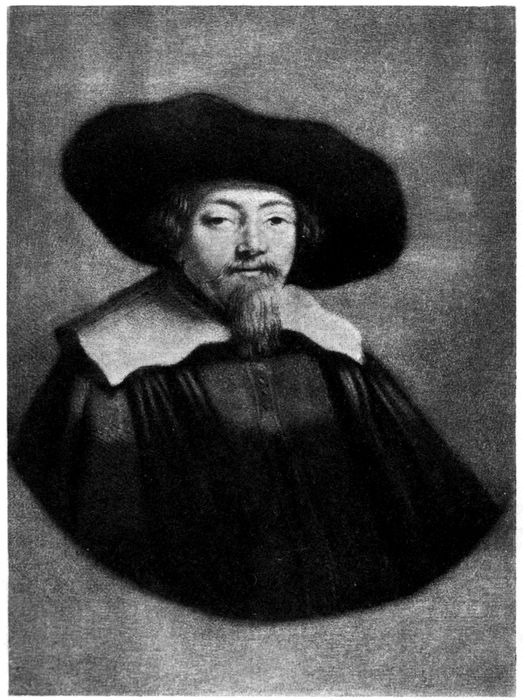
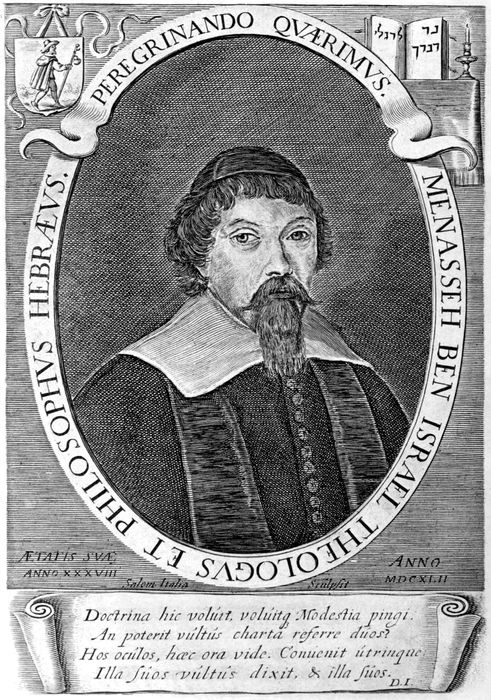
INTRODUCTION — THE RETURN OF THE JEWS TO ENGLAND — I. Days of Exile — II. The Hope of Israel — III. Cromwell’s Policy — IV. The Appeal to the Nation — V. Cromwell’s Action — VI. The Real “Vindiciæ” — VII. Documents — TO THE Parliament, The Supream Court of England , And to the Right Honourable the Councell of State , Menasseh Ben Israel, prayes God to give Health, and all Happinesse : — Menasseh Ben Israel , To the Courteous Reader. — The Translator to the Reader. — The Authors of other Nations, which are quoted in this Treatise. — THE RELATION OF ANTONY MONTEZINUS . — The Hope of Israel . — SECT. 1. — SECT. 2. — SECT. 3. — SECT. 4. — SECT. 5. — SECT. 6. — SECT. 7. — SECT. 8. — SECT. 9. — SECT. 10. — SECT. 11. — SECT. 12. — SECT. 13. — SECT. 14. — SECT. 15. — SECT. 16. — SECT. 17. — SECT. 18. — SECT. 19. — SECT. 20. — SECT. 21. — SECT. 22. — SECT. 23. — SECT. 24. — SECT. 25. — SECT. 26. — SECT. 27. — SECT. 28. — SECT. 29. — SECT. 30. — SECT. 31. — SECT. 32. — SECT. 33. — SECT. 34. — SECT. 35. — SECT. 36. — SECT. 37. — SECT. 38. — SECT. 39. — SECT. 40. — SECT. 41. — CONSIDERATIONS Upon the Point of the CONVERSION OF THE JEWES: — To the Translator of Menasseh ; Ben Israels spes Israelis .
xi
Shrouded in the fogs of the North Sea,
the British Isles were, for two centuries
after the Great Expulsion by Edward I.,
little more than a bitter memory to the
Jewish people. In other lands they came
and went, but England was as securely closed
against them as was the Egypt of Danaus to the Greeks.
With the exception of a few adventurous pilgrims who
trickled into the country to enjoy the hospitality of the
Domus Conversorum, they ceased gradually to think of the
land which had been so signal a scene of their mediæval
prosperity and sufferings. The Jewish chroniclers of this
period, while dealing with the politics of other European
countries, have scarcely a word to say of England.
Towards the beginning of the sixteenth century the fogs
began to lift, and England once again appeared as a possible
haven to the “tribe of the wandering foot and weary
breast.” The gigantic expulsions from Spain by Ferdinand
and Isabella had created a new Jewish Diaspora under conditions
of the most thrilling romance. The Jewish martyrs
“trekked” in their thousands to all the points of the compass,
fringing the coasts of the Mediterranean with a new
industrious population, founding colonies all over the
xiiLevant as far as the Mesopotamian cradle of their race,
penetrating even to Hindostan in the East, and throwing
outposts on the track of Columbus towards the fabled west.
But this was only the beginning of a more remarkable dispersion.
The men and women who took up the pilgrim’s
staff at the bidding of Torquemada could only go where
Jews were tolerated, for they refused to bear false witness
to their ancient religion. They left behind them in Spain
and Portugal a less scrupulous contingent of their race—wealthy
Jews who were disinclined to make sacrifices for
the faith of their fathers, and who accepted the conditions
of the Inquisition rather than abandon their rich
plantations in Andalusia and their palaces in Saragossa,
Toledo, and Seville. They embraced Christianity, but their
conversion was only simulated, and for two centuries they
preserved in secret their allegiance to Judaism. These
Crypto-Jews, in their turn, gradually spread all over Europe,
penetrating in their disguise into countries and towns and
even guilds which the Church had jealously guarded against
all heretical intrusion. It was chiefly through them that
the modern Anglo-Jewish community was founded.[1]
The Iberian Crypto-Jews, or Marranos,[2] as they were
called, represented one of the strangest and most romantic
movements in the religious history of Europe. Marranism
was an attempt by the Jews to outwit the Jesuits with their
own weapons. Both sides acted on the principle that the
end justified the means, and each employed the most unscrupulous
guile to defend itself against the other. The
Inquisition was ruthless in its methods to stamp out Judaism,
xiiithe Marranos were equally unprincipled in preserving their
allegiance to their proscribed religion. Abandoning their
ceremonial, abandoning even the racial limitation on marriage,
the Jewish tradition was maintained by secret conventicles
chiefly composed of males, and thus Jewish blood
and the Jewish heresy became distributed all over the
peninsula, and crept into the highest ranks of the nation.
The Court, the Church, the army, even the dread tribunals
of the Holy Office itself were not free from the taint.[3] A
secretary to the Spanish king, a vice-chancellor of Aragon,
nearly related to the Royal House, a Lord High Treasurer,
a Court Chamberlain, and an Archdeacon of Coimbra figure
in the lists of discovered Marranos preserved by the Inquisition.[4]
At Rome the Crypto-Jews commissioned a
secret agent supplied with ample funds, who bribed the
Cardinals, intrigued against the Holy Office, and frequently
obtained the ear of the Pontiff.[5] Some idea of the social
ramifications of the Marranos is afforded by the careers of
the early members of the Amsterdam Jewish community.
Many of them were men of high distinction who had
escaped from Spain and Portugal in order to throw off
the burden of their imposture. Such were the ex-monk
Vicente de Rocamora, who had been confessor to the Empress
of Germany when she was the Infanta Maria; the
ex-Jesuit father, Tomas de Pinedo, one of the leading
philologists of his day; Enriquez de Paz, a captain in the
army, a Knight of San Miguel, and a famous dramatist;
Colonel Nicolas de Oliver y Fullana, poet, strategist, and
royal cartographer; Don Francesco de Silva, Marquis of
Montfort, who had fought against Marshal de Créqui under
the Emperor Leopold; and Balthasar Orobio de Castro,
physician to the Spanish Court, professor at the University
xivof Salamanca, and a Privy Councillor.[6] It was by Jews
of this class that the congregations of Amsterdam, Hamburg,
and Antwerp were founded, and it was largely through
them that those towns in the sixteenth and seventeenth centuries
were enabled to wrest from Spain her primacy in the
colonial trade.
At a very early epoch Marranos reached England. We
hear of them, almost immediately after the expulsion from
Spain, figuring in a lawsuit in London.[7] In 1550 a Marrano
physician was discovered living in London. Another,
Roderigo Lopes, was court physician to Queen Elizabeth,
and the original of Shakespeare’s Shylock.[8] When the Earl
of Essex, after the sacking of Cadiz in 1596, brought the
Spanish Resident, Alonzo de Herrera, a prisoner to England,
he turned out to be a Marrano. After his liberation, this
descendant of the great Captain Gonsalvo de Cordova proceeded
to Amsterdam, entered the synagogue, and spent
his old age in the compilation of cabalistical treatises.[9]
Amador de los Rios states that the Marranos founded secret
settlements in London, Dover, and York;[10] and it has been
shown that they possessed a secret synagogue in London
early in the seventeenth century, if not before.[11] As in
Amsterdam and Antwerp, they were largely concerned in
the development of the Spanish trade, in the importation of
bullion, and in the promotion of commercial relations with
the Levant and the New World.
While the people of England were unconscious of this
immigration, it could not have been altogether unknown in
the continental Jewries. That no trace of this knowledge
xvis to be found in printed Hebrew literature is not strange,
since the keeping of the secret was a common Jewish interest.
It no doubt helped to stimulate Jewish hopes of a return to
England, which more public circumstances had already
founded. The Reformation in England first turned Jewish
eyes towards the land from which they had been so long
excluded. They were especially interested by Henry
VIII.’s appeal to Jewish scholars during his conflict with
the Papacy in regard to his divorce from Catherine of
Aragon.[12] Still more deeply must their feelings have
been stirred by Elizabeth’s struggle with Spain. All over
Europe, indeed, Jewish sympathies were with Elizabeth.
The secret negotiations carried on by Roderigo Lopes,
through his influential Marrano relatives, with the Grand
Turk and with the Hebrew bankers of Antwerp and Leghorn,
have yet to be made public; but it is certain that
they played an important part in the story which culminated
in the confusion of the Great Armada. But it was the
increasing Hebraism of English religious thought, as represented
by the Puritan movement, which chiefly attracted
the Jews. This movement sent not a few Englishmen and
Englishwomen to the continental ghettos to seek instruction
at the feet of Hebrew Rabbis, and even to obtain
entrance to the synagogue as proselytes.[13] When the Commonwealth,
with its pronounced Judaical tendencies, emerged
from this movement, the Jews could not fail to be impressed.
The more mystical among them began to dream
of the Golden Age. Indeed the doctrines of the Fifth
Monarchy Men, carried to Smyrna by Puritan merchants,
paved the way for the rise of the pseudo-Messiah, Sabbethai
Zevi.[14] The more practical saw that the time had
arrived when it might be reasonably hoped to obtain the
revocation of Edward I.’s edict of banishment.
xviTowards the end of 1655, the question of the readmission
of the Jews to England was brought to a climax by
Menasseh ben Israel’s famous mission to Oliver Cromwell.
The story of this mission has been briefly narrated by
Menasseh himself in the Vindiciæ Judæorum, one of the
tracts printed in the present volume.[15] As my object in
this preliminary essay is to set forth the story more fully,
and to endeavour to elucidate its obscurities, I cannot do
better than take as my text this authoritative, though somewhat
vague, statement by the chief actor in the events with
which I am dealing. Here is what Menasseh wrote under
date of April 10, 1656:—
“The communication and correspondence I have held for
some years since, with some eminent persons of England, was
the first originall of my undertaking this design. For I alwayes
found by them, a great probability of obtaining what I now
request, whilst they affirmed that at this time the minds of men
stood very well affected towards us, and that our entrance into
this Island would be very acceptable and well pleasing unto them.
And from this beginning sprang up in me a semblable affection,
and desire of obtaining this purpose. For, for seven yeares
on this behalf, I have endeavoured and sollicited it, by letters
and other means, without any intervall. For I conceived that our
universall dispersion was a necessary circumstance, to be fulfilled
before all that shall be accomplished which the Lord hath promised
to the people of the Jewes, concerning their restauration,
and their returning again into their own land, according to those
words, Dan. 12,7: When we shall have accomplished to scatter
the power of the holy people, all these things shall be finished. As
also, that this our scattering, by little, and little, should be amongst
all people, from the one end of the earth even unto the other, as it
is written Deut. 28,64: I conceived that by the end of the earth
might be understood this Island. And I knew not, but that the
Lord who often works by naturall meanes, might have design’d
and made choice of me for the bringing about this work. With
these proposals therefore, I applyed my self, in all zealous affection
to the English Nation, congratulating their glorious liberty which
at this day they enjoy; together with their prosperous peace.
xviiAnd I entituled my book named The Hope of Israel, to the first
Parliament, and the Council of State. And withall declared my
intentions. In order to which they sent me a very favorable
passe-port. Afterwards I directed my self to the second, and
they also sent me another. But at that juncture of time my
coming was not presently performed, for that my kindred and
friends, considering the checquered, and interwoven vicissitudes,
and turns of things here below, embracing me, with pressing importunity,
earnestly requested me not to part from them, and
would not give over, till their love constrained me to promise,
that I would yet awhile stay with them. But notwithstanding all
this, I could not be at quiet in my mind (I know not but that it
might be through some particular divine providence) till I had
anew made my humble addresses to his Highnesse the Lord Protector
(whom God preserve), and finding that my coming over
would not be altogether unwelcome to him, with those great hopes
which I conceived, I joyfully took my leave of my house, my friends,
my kindred, all my advantages there, and the country wherein I
have lived all my lifetime, under the benign protection, and favour
of the Lords, the States Generall, and Magistrates of Amsterdam;
in fine (I say) I parted with them all, and took my voyage for
England. Where, after my arrivall, being very courteously received,
and treated with much respect, I presented to his most
Serene Highnesse a petition, and some desires, which for the
most part, were written to me by my brethren the Jewes, from
severall parts of Europe, as your worship may better understand
by former relations. Whereupon it pleased His Highnesse to
convene an Assembly at Whitehall, of Divines, Lawyers, and
Merchants, of different persuasions, and opinions. Whereby
men’s judgements, and sentences were different. Insomuch, that
as yet, we have had no finall determination from his most Serene
Highnesse. Wherefore those few Jewes that were here, despairing
of our expected successe, departed hence. And others who
desired to come hither, have quitted their hopes, and betaken
themselves some to Italy, some to Geneva, where that Commonwealth
hath at this time, most freely granted them many, and
great privileges.”
xviii
The first point in Menasseh’s story which needs elucidation
is his statement that he was originally induced to
move in the question of the resettlement of the Jews by
the assurances of “some eminent persons of England,”
that “the minds of men stood very well affected towards
us.” How had this philo-Semitic sentiment arisen, and
who were the men who had communicated it to the Amsterdam
Rabbi?
The evolution of English thought which rendered
Menasseh ben Israel’s enterprise possible is of considerable
complexity, but its main features are easily distinguishable.
The idea of Religious Liberty in England was
due, in its broader aspects, to the struggle between the
Baptists and the Calvinists. The Reformation established
only a restricted form of Religious Liberty, and it was not
until the Baptists found themselves persecuted as the Reformers
had been before them, that the cry arose for a
liberty of conscience which would embrace all religions. In
the Separatist Churches, founded by English refugees in
Amsterdam and Geneva, the idea grew and strengthened.
The earliest noteworthy tract on the subject—Leonard
Busher’s “Religious Peace, or a Plea for Liberty of Conscience,”
published in 1614—was written under the influence
of these exiles, and it is noteworthy that already in
that work the extension of religious liberty to Jews was
specifically demanded.[16] Amsterdam was at that time the
seat of a flourishing Jewish community, some of whose
members came into contact with the philo-Jewish refugees.
In this way they probably learnt to understand the political
significance of the successive rise of the Puritans and Independents,
for at the very beginning of the Civil War the
Royalist spies in Holland noted that the Jews sympathised
xixwith the Republicans, and even alleged that they had offered
them “considerable sums of money to carry on their designs.”[17]
The progress of Religious Liberty in the seventeenth
century reached its highest point, when in 1645 the Independents
captured the Army under the scheme known
as the “New Model.” Meanwhile Roger Williams, the
famous Baptist, who had already founded in America a
community based on unrestricted liberty of conscience, had
published his “Bloudy Tenent of Persecution,” in which
he generously pleaded for the Jews.[18] In 1646 a reprint of
Leonard Busher’s pamphlet was published in London, much
to the joy of the Separatists in Amsterdam,[19] and a year
later Hugh Peters, one of Cromwell’s Army Chaplains,
wrote his “Word for the Army and Two Words for the
Kingdom,” in which he proposed that “strangers, even
Jews [be] admitted to trade and live with us.”[20] The
question of the readmission of the Jews was, however, still
far from taking practical shape. Although frequently referred
to, it had only been raised incidentally as an illustration
of the advanced tendencies of the advocates of Religious
Liberty.
In December 1648, the Independents contrived the
famous “Pride’s Purge,” which put an end to the Presbyterian
domination of Parliament. The hopes of the advocates
of Religious Liberty ran high, and the Jewish question
at once came to the front. The Council of Mechanics,
meeting at Whitehall, marked their sense of the meaning
of the coup d’état by immediately voting “a toleration of
all religions whatsoever, not excepting Turkes, nor Papists,
xxnor Jewes.”[21] To this the Council of Army Officers responded
with a resolution, the text of which has, unfortunately,
not been preserved, in which they favoured the
widest scheme of Religious Liberty. It was, indeed,
rumoured at the time that the Jews were specifically mentioned
in the resolution.[22] However that may be, it is
certain that in the following month two Baptists of Amsterdam,
Johanna Cartwright and her son Ebenezer, were
encouraged to present a petition to Lord Fairfax and the
General Council of Officers, in which they asked that “the
statute of banishment” against the Jews might be repealed.
The petition, we are told, was “favourably received, with
a promise to take it into speedy consideration when the
present more public affairs are dispatched.”[23]
Unfortunately, the “more public affairs” obstructed the
triumph of Religious Liberty, and with it the Jewish cause,
for a good many years. In the same month that Mrs. Cartwright’s
petition was considered, Charles I. was beheaded,
and the chiefs of the Revolution, with a great work of
reconstruction before them, felt that they must proceed
cautiously. Toleration of the Jews meant unrestricted
liberty of conscience, and this was held by the extreme Independents
to imply not only the abolition of an Established
Church, but a licence to the multitude of sects—many of
them of the maddest and most blasphemous tendencies—which
had been hatched by Laudian persecution and the
reaction of the Civil War. Cromwell and his advisers were
resolved to pursue a more conservative policy, and the toleration
plans of the Independents were accordingly shelved.
For a hundred years—until, indeed, Pelham’s “Jew Bill”
in 1753—they were not heard of in this purely secular
shape again.
xxiThe cause of Religious Liberty was, however, not the
only force which was working in the country for the readmission
of the Jews. The religious fervour of the nation
had been stirred to a high pitch, and there were few men
whose minds had not become influenced by Messianic and
other mystical beliefs. It is curious indeed to note that
this current of thought ran parallel with the evolution of
the secular idea of Toleration. Seven years after the first
publication of Leonard Busher’s famous Toleration pamphlet,
Mr. Sergeant Finch wrote anonymously a book
entitled “The Calling of the Jewes” (1621), with a prefatory
epistle in Hebrew, in which he invited the children
of Israel to realise the prophecies by asserting their national
existence in Palestine. At the same time he called upon
all Christian princes to do homage to the Jewish nation.
This early manifestation of Zionism did not meet with
much sympathy in high places, for James I. was so incensed
at it that he clapped its publisher into jail.[24] The book,
however, was a symptom, and the movement it represented
only derived strength from persecution. The gloomier the
lot of the sectaries, the more intense became their reliance
on the Messianic prophecies. Even after the triumph of
the Puritan cause, the sanest Independents held to them
firmly side by side with their belief in Religious Liberty;
and in the Cartwright petition we find both views expounded.
Extremists like the Fifth Monarchy Men made them the
pivots for fresh outbursts of Sectarianism. Judaical sects
arose, the members of which endeavoured to live according
to the Levitical Law, even practising circumcision. Prosecutions
for such practices may be traced back to 1624.[25]
Some of the saints, like Everard the Leveller, publicly called
themselves Jews;[26] others went to Amsterdam, and were
formally received into the synagogue.[27] Colchester was the
xxiiheadquarters of one of these Judaical sects, but there were
others in London and in Wales.[28] The practical effect of
this movement was not only the production of a very widespread
philo-Semitism, but a strong conviction that, inasmuch
as the conversion of the Jews was an indispensable
preliminary of the Millennium, their admission to England,
where they might meet the godliest people in the world,
was urgently necessary.
It was this feeling which, on the collapse of the Toleration
movement in 1649, began to make itself most loudly
heard. Edward Nicholas, John Sadler, John Dury, Henry
Jessey, Roger Williams, and even Thomas Fuller, who was
far from being a mystic, urged this view on the public, and
an agitation for the Readmission of the Jews, as a religious
duty outside the problem of Religious Liberty, was set on
foot. This mystical agitation found a response in what to us
must at first sight appear a strangely inappropriate quarter.
It brought forth from Amsterdam a Latin pamphlet,
entitled “Spes Israelis,” with a prefatory address “To the
Parliament, the Supreme Court of England,” the author of
which was Menasseh ben Israel, one of the Rabbis of the
congregation. This pamphlet illustrates the inception of
the enterprise for the Resettlement of the Jews in England,
which its author endeavoured to carry out six years later.
Menasseh ben Israel was the son of a Marrano of Lisbon,
who had suffered at the hands of the Inquisition, and had,
as a result, taken up his abode in Amsterdam. Menasseh
was educated under the care of Rabbi Isaac Uziel, and, at
the age of eighteen, was ordained a Rabbi. He was an indefatigable
student, became a mine of learning, an accomplished
linguist, a fluent writer, and a voluble preacher.
His attainments made considerable noise in the world, at a
time when public attention was riveted on Biblical prophecy,
xxiiiand the question of its fulfilment through the Jews.
His voluminous writings obtained for him a high reputation
as a scholar, and the readiness with which he
afforded information to all who corresponded with him
made him many influential friends, who spread his fame
far and wide. The secret of the distinction Menasseh
secured for himself, in spite of the weaknesses of his character
and the eccentricity of his mental tendency, lies in the
fact that the world in which he lived was very largely given
over to philo-Semitism, and to the special form of mysticism
to which he had yielded himself. His alliance with a scion
of the Abarbanel family, in whose tradition of Davidic
descent he was a firm believer, inspired him with the idea
that he was destined to promote the coming of the Messiah;
and hence the wild dreams of the English Millenarians
appealed to him with something of a personal force. It was
not, however, until the triumph of the Republican cause in
England that he resolved to throw in his lot with the
Puritan mystics, and even then he had some difficulty, as
we may readily believe, in adopting an attitude which would
at once conciliate the English Conversionists, and harmonise
with his allegiance to the synagogue.[29]
At first his sympathies, like those of most of the leading
members of the Amsterdam community, seem to have been
Royalist, for in 1642 we find him extolling the queen of
Charles I. in an oration.[30] In 1647 he was still far from
recognising in the Puritan revolt a movement calling for
his Messianic sympathy; for, writing to an English friend
in that year, he described the Civil War, not, as he afterwards
believed it to be, as a struggle of the godly against the
xxivungodly, but as a Divine punishment for the expulsion of
his co-religionists from Britain in the thirteenth century.[31]
This letter is interesting as showing that his mind was
then already beginning to be exercised by the Resettlement
question; but he evidently had as yet no definite idea of
taking any practical action. In the autumn of 1649 a
method of action was suggested to him by a letter he received
from the well-known English Puritan, John Dury,
whose acquaintance he had made in Amsterdam five years
previously.
A friend of John Dury, one Thomas Thorowgood, was
deeply interested in the missionary labours of the famous
evangelist, John Eliot, among the American Indians; and
in order to prevail upon the philo-Jewish public to provide
money for the support of the mission, had compiled a
treatise showing that the American Indians were the Lost
Tribes. This work was largely founded on the conjectures
of the early Spanish missionaries, who had up to that time
a monopoly of this solution of the Ten Tribes problem.
It was written in 1648, and dedicated to the King, but the
renewal of the Civil War in that year prevented its publication.[32]
Thorowgood thereupon sent the proofs of the
first part of the work to John Dury to read. It happened
that Dury, while at the Hague in 1644, had heard
some stories about the Ten Tribes which had very much
interested him. One was to the effect that a Jew, named
Antonio de Montezinos, or Aaron Levy, had, while travelling
in South America, met a race of savages in the Cordilleras,
who recited the Shema,[33] practised Jewish ceremonies,
and were, in short, Israelites of the Tribe of Reuben.
Montezinos had related his story to Menasseh ben Israel,
xxvand had even embodied it in an affidavit executed under
oath before the chiefs of the Amsterdam Synagogue. As
soon as Dury received Thorowgood’s treatise, he remembered
this story, and at once wrote to Menasseh ben Israel
for a copy of the affidavit. The courteous Rabbi sent it to
him by return of post,[34] and it was printed for the first time
as an appendix to an instalment of Thorowgood’s treatise,
which, at Dury’s instance, was published in January 1650.[35]
This incident, coupled with some letters he received
from the notorious Millenarian, Nathaniel Holmes, came
as a ray of light to Menasseh. For five years he had had
Montezinos’s narrative by him, and had not regarded it as of
sufficient importance to publish. He had, perhaps, doubted
the wisdom of publishing it, seeing that it tended to substantiate
a theory of purely Jesuitical origin, for which
no sanction could be found in Jewish records or legend.
Moreover, he had no strong views on the prophetical bearing
of the question, as we may see by a letter he addressed to
Holmes as late as the previous summer, in which he stated
that he had grave doubts as to the time and manner of the
coming of the Messiah.[36] Now, however, the question began
to grow clear to him, and it dawned upon him that the long-neglected
narrative of Montezinos might be used for a
better purpose than the support of Christian missions in
New England. The story was, if true, a proof of the increasing
dispersion of Israel. Daniel had foretold that the
scattering of the Holy People would be the forerunner of
their Restoration, and a verse in Deuteronomy had explained
that the scattering would be “from one end of
the earth even to the other end of the earth.” It was clear
from Montezinos and other travellers that they had already
reached one end of the earth. Let them enter England
xxviand the other end would be attained. Thus the promises
of the Almighty would be fulfilled, and the Golden Age
would dawn. “I knew not,” he wrote later on, “but that
the Lord who often works by naturall meanes, might have
design’d, and made choice of me, for bringing about this
work.”[37] In this hope he wrote the famous מקוה ישראל which
in 1650 burst on the British public under the title of the
“Hope of Israel.”
The central idea of this booklet did not occur to
Menasseh immediately on receiving John Dury’s letter.
His first intention, as he explained in a letter dated November
25, 1649, was to write a treatise on the Dispersion of
the Ten Tribes for the information of Dury and his friends.
The volume, however, grew under his pen, and a week later
he announced to Dury his larger plan. His letter gives a
complete synopsis of the work, and he finishes up by informing
Dury that “I prove at large that the day of the
promised Messiah unto us doth draw near.”[38] Thus he had
already made up his mind on a question which, only a few
months before, he had assured Holmes was “uncertain,”
and was intended to be uncertain. Holmes was at the
time unaware of his conversion, for, on December 24, he
wrote to him an expostulatory letter, in which, curiously
enough, he advised him to study the Danielic Prophecies.[39]
Still, Menasseh does not seem to have fully grasped the
application of his treatise to the Resettlement question, for
neither in the body of the work nor in the Spanish edition
does he refer to it. It was only when he composed the
Latin edition that his scheme reached maturity. To that
edition he prefixed a dedication to the English Parliament,
eulogising its stupendous achievements, and supplicating
“your favour and good-will to our nation now scattered
almost all over the earth.”
xxviiThe tract produced a profound impression throughout
England. That an eminent Jewish Rabbi should bless the
new Republican Government, and should bear testimony to
its having “done great things valiantly,” was peculiarly
gratifying to the whole body of Puritans. To the Millenarians
and other sectaries it was a source of still deeper
satisfaction, for their wild faith now received the sanction
of one of the Chosen People, a sage of Israel, of the Seed
of the Messiah. Besides the Latin edition which Dury distributed
among all the leading Puritans, and which was
probably read in Parliament, two English editions issued
anonymously by Moses Wall were rapidly sold. Nevertheless,
its effect proved transitory. Sober politicians, who
still recognised that the new-fledged Republic had, as Fairfax
said, “more public affairs” to despatch than the Jewish
question, had begun to fear lest their hands might be forced
by Menasseh’s coup. This feeling was strikingly reflected
in a tract by Sir Edward Spencer, one of the members of
Parliament for Middlesex. Addressing himself with feline
affection “to my deare brother, Menasseh ben Israel, the
Hebrewe Philosopher,” he expressed his readiness to agree
to the admission of the Jews on twelve conditions artfully
designed to strengthen the hands of the sectaries who believed
that, besides the dispersion of the Jews, their conversion
was also a necessary condition of the Millennium.[40]
Spencer’s tract was the signal for a revulsion of feeling.
Sadler, afterwards one of Menasseh’s firmest friends, threw
doubts on the authenticity of Montezinos’s story,[41] and Fuller
xxviiidid not scruple to criticise the Zionist theory on practical
grounds.[42] Even the faithful Jessey held his peace in tacit
sympathy with Spencer’s scheme. As for Menasseh, he
showed no disposition to acquiesce in Spencer’s proposals.
The result was that the sensation gradually died away,
though a few stalwart Tolerationists like Hugh Peters still
clamoured for unconditional Readmission.[43]
Thus both the Toleration and Messianic movements
proved unavailing for the purposes of the Jewish Restoration.
There remained a third view of the question which
made less noise in the world, but which was destined to
bring about gradually and silently a real and lasting solution—the
view of Political Expediency.
The statesmen of the Commonwealth, who knew so
well how to conjure with human enthusiasm, were essentially
practical men. To imagine that they were the slaves of
the great religious revival which had enabled them to overcome
the loyalist inspiration of the cavaliers is entirely to
misconceive their character and aims. The logical outcome
of that revival, and of the triumph of the Puritan arms,
would have been the Kingdom of Saints, but Cromwell’s
ambition aimed at something much more conventional.
Imperial expansion and trade ascendency filled a larger
place in his mind than the Other-worldly inspirations which
had carried him to power.
With the unrestricted Toleration principles of the Baptists
he had no sympathy, and still less with the Messianic
phantasies of the Fifth Monarchy Men which Menasseh
ben Israel had virtually embraced. His ideas on Religious
Liberty were certainly large and far in advance of his
xxixtimes,[44] but they were essentially the ideas of a churchman.
Their limits are illustrated by his ostentatious patronage
in 1652 of Owens’ scheme of a Toleration confined to
Christians.[45] Still he was not the slave of these limits.
The ingenious distinction he drew between the Papistry of
France and that of Spain, when it became necessary for him
to choose between them, and his complete disregard of the
same principles in the case of the Portuguese alliance, show
how readily he subordinated his strongest religious prejudices
to political exigencies. As for the mystics and
ultra-democrats, his views were set forth very clearly in
his speech to the new Parliament in September 1651, when
he opposed the Millenarians, the Judaisers, and the
Levellers by name.[46] It is impossible for any one reading
this speech side by side with Menasseh ben Israel’s tracts
to believe that the author of it had any sympathy with the
wilder motives actuating the Jewish Rabbi.
What was it, then, that brought these two different
characters so closely together? That the Readmission of
the Jews to England was one of Cromwell’s own schemes—part
and parcel of that dream of Imperial expansion
which filled his latter days with its stupendous adumbration
and vanished so tragically with his early death—it
is impossible to doubt. We have no record of his views
on the subject, beyond a short and ambiguous abstract of
his speech at the Whitehall Conferences, but there is ample
evidence that he was the mainspring of the whole movement,
and that Menasseh was but a puppet in his hands.
His main motives are not difficult to guess. Cromwell’s
statecraft was, as I have said, not entirely or even essentially
governed by religious policy. He desired to make England
xxxgreat and prosperous, as well as pious and free, and for
these purposes he had to consider the utility of his subjects
even before he weighed their orthodoxy. Now the Jews
could not but appeal to him as very desirable instruments
of his colonial and commercial policy. They controlled
the Spanish and Portuguese trade; they had the Levant
trade largely in their hands; they had helped to found the
Hamburg Bank, and they were deeply interested in the
Dutch East and West Indian companies. Their command
of bullion, too, was enormous, and their interest in shipping
was considerable.[47] Moreover, he knew something personally
of the Jews, for he was acquainted with some of the
members of the community of Marranos then established
in London, and they had proved exceedingly useful to him
as contractors and intelligencers.[48] There is, indeed, reason
to believe that some of these Marranos had been brought
into the country by the Parliamentary Government as early
as 1643 with the specific object of supplying the pecuniary
necessities of the new administration.[49]
Until the end of 1651 the Readmission question presented
no elements of urgency, because there was a chance of
its favourable solution without its being made the object of
a special effort on the part of the Government or the legislature.
By the treaty of coalition proposed to the Netherlands
by the St. John mission early in 1651, the Jewish
question would have solved itself, for the Hebrew merchants
of Amsterdam would have ipso facto acquired in England
the same rights as they enjoyed in Holland. That proposal,
however, broke down, and as a result the famous
Navigation Act was passed. The object of that measure
was to exclude foreign nations from the colonial trade, and
to dethrone the Dutch from their supremacy in the carrying
xxxiand distributing traffic of Europe. Consequently it supplied
a strong inducement to Jewish merchants—especially
those of Amsterdam who were then trading with Jamaica
and Barbados—to transfer their counting-houses to London.
As such an immigration would have well served the policy
embodied in the Navigation Act, it became desirable that
some means of legalising Jewish residence in England should
be found, and hence the question of Readmission was
brought within the field of practical politics. This was
the new form in which it presented itself. It was no
longer a question of Religious Toleration or of the hastening
of the Millennium, but purely a question of political
expediency.
It appears that the St. John mission, when its failure
became probable, was instructed to study the Jewish question,
and probably to enter into negotiations with leading
Jews in Amsterdam. Certain it is that its members saw a
great deal of Menasseh ben Israel during their sojourn in
Holland, and that Cromwell’s benevolent intentions were conveyed
to him. Thurloe, who was secretary to the mission,
had several conferences with the Rabbi, and the Synagogue
entertained the members of the mission, notwithstanding
that public opinion ran high against them.[50] Strickland,
the colleague of St. John, and formerly ambassador at the
Hague, was ever afterwards regarded as an authority on the
Jewish question, for he served on most of the Committees
appointed to consider Menasseh’s petitions. Still more significant
is the fact that within a few weeks of the return of
the Embassy a letter, the text of which has not been preserved,
was received from Menasseh by the Council of State,
and an influential committee, on which Cromwell himself
served, was at once appointed to peruse and answer it.[51]
Towards the end of the following year two passes couched
xxxiiin flattering terms were issued to the Rabbi to enable him
to come to England.[52]
Meanwhile, the long-feared war broke out, and negotiations
were perforce suspended. From 1652 to 1654 the
popular agitation for the Readmission of the Jews spluttered
weakly in pamphlets and broadsheets. In 1653 there was a
debate in Parliament on the subject, but no conclusion was
arrived at.[53] In the following year, shortly after the conclusion
of peace, a new element was introduced into the
question by the appearance on the scene of a fresh petitioner
from Holland, one Manuel Martinez Dormido, a brother-in-law
of Menasseh ben Israel, and afterwards well known
in England as David Abarbanel Dormido.
The mission of Dormido was clearly a continuation of
Menasseh’s enterprise, and it was probably undertaken on
the direct invitation of the Protector. With the restoration
of peace on terms which rendered persistence in the
policy of the Navigation Act indispensable, Cromwell must
have been anxious to take the Jewish question seriously in
hand. The negotiations opened by Thurloe with Menasseh
in 1651 were probably resumed, and an intimation was
conveyed to the Jewish Rabbi that the time was ripe for
him to come to England and lay his long-contemplated
prayer before the Government of the Commonwealth.
Menasseh’s reasons for not accepting the invitation in
person are not difficult to understand. He doubtless refers
to them in the passage from the Vindiciæ I have already
quoted, where he says he was entreated by his kindred and
friends, “considering the chequered and interwoven vicissitudes
and turns of things here below, not to part from
them.”[54] His kindred and friends were wise. Owing to
his quarrels with his colleagues in the Amsterdam Rabbinate
his situation had become precarious, and it might have
xxxiiibecome hopelessly and disastrously compromised had he, in
the then incensed state of Dutch feeling against England—a
feeling in which the leading Jews of the Netherlands participated—undertaken
a mission to the Protector. Hence
the delegation of the work to his brother-in-law. An indication
of Menasseh’s interest in the new mission is afforded
by the fact that his only surviving son, Samuel ben Israel,
was associated with Dormido, and accompanied him to
London.
Unlike his distinguished relative, Dormido had nothing
to lose by approaching Cromwell. A Marrano by birth, a
native of Andalusia, where he had enjoyed great wealth and
held high public office, he had been persecuted by the Inquisition,
and compelled to fly to Holland. There he had
made a fortune in the Brazil trade, and had become a leading
merchant of Amsterdam, and one of the chiefs of the
Synagogue. The conquest of Pernambuco by the Portuguese
early in 1654 had ruined him, and he found himself
compelled to begin life afresh.[55] He saw his opportunity
in the mission confided to him by Menasseh. It opened
to him the chance of a new career under the powerful protection
of the greatest personality in Christendom. Unlike
his brother-in-law, he had no Millenarian delusions. The
Jewish question appealed to him in something of the same
practical fashion that it appealed to Cromwell. While the
Protector was seeking the commercial interests of the
Commonwealth, Dormido was anxious to repair his own
shattered fortunes.
On the 1st September he arrived in London, and at
once set about drafting two petitions to Cromwell.[56] In the
first of these documents he recited his personal history, the
story of his sufferings at the hands of the Inquisition, and
of the confiscation of his property by the Portuguese in
Pernambuco. He expressed his desire to become a resident
xxxivin England and a subject of the Commonwealth, and wound
up by praying the Protector to use his good offices with the
King of Portugal for the restitution of his fortune. The
second petition was a prayer for the Readmission of the
Jewish people to England, “graunting them libertie to come
with theire famillies and estates, to bee dwellers here with
the same eaquallnese and conveniences wch yr inland borne
subjects doe enjoy.” The petition, after a violent tirade
against the Inquisition and the intolerance of the Apostolical
Roman Church, pointed out that the Readmission of
the Jews would be to the advantage of trade and industry,
and would vastly increase the public revenues. These adroit
appeals to the chief motives of the Protector’s statecraft
were followed by a suggestion that in the event of the
prayer being granted the petitioner might be appointed to
the control and management of the new community, with,
of course, appropriate compensation for his services.
Despite their obviously selfish motives, Cromwell received
these petitions with significant graciousness. They
were at once sent to the Council, with an endorsement,
stating that “His Highnes is pleased in an especiall
manner to recommend these two annexed papers to the
speedy consideracion of the Councell, that the Peticion may
receive all due satisfacion and withall convenient speed.”
It is impossible not to be struck by the pressing nature of
this recommendation, when it is considered that the chief
petition dealt with a very large and important political
question, and that its signatory was a man wholly unknown
in England. Cromwell’s action can only be explained by
the theory that he was, as I have suggested, the instigator
of the whole movement. Whether the Council were aware
of this or not is impossible to say. They had as yet no
decided opinions on the subject, but they saw that it was a
large and difficult question, that its bearings were imperfectly
known, and that its decision, either one way or the
other, involved a very serious responsibility at a time when
xxxvthe religious element wielded so much power in the country,
and withal so capriciously. At the personal instigation of
the Protector, however, they consented to appoint a committee
to consider the petitions. A month later, taking
advantage of a meeting at which Cromwell was not present,
the committee verbally reported, and the Council resolved,
that it “saw no excuse to make any order.”[57]
That Cromwell was disappointed by this result he
speedily made clear. In regard to the Resettlement petition,
he did not care to take the responsibility of giving a
decision; but on the other petition he took immediate
steps to afford satisfaction to Dormido, in spite of the refusal
of the Council to have anything to do with it. He
addressed an autograph letter to the King of Portugal,
asking him as a personal favour to restore Dormido’s property,
or to make him full compensation for his losses.[58]
Seeing that Dormido was an alien, and had absolutely no
claim on the British Government, this personal intervention
by Cromwell on his behalf affords a further strong presumption
of his privity to the Jewish mission. It is also
not a little significant that a few months later the Protector
granted a patent of denization to Antonio Fernandez
Carvajal, the chief of the little Marrano community in
London, and his two sons.[59]
The question was, however, not allowed to rest here.
Cromwell wanted an authoritative decision, which would
enable him to do more than merely protect individual Jews,
and it was clear that this could not be obtained unless a more
important person than Dormido were induced to take the
matter in hand. The question had to be raised to a higher
level, and for this purpose it was necessary that it should
make some noise in the country. Only one European Jew
had sufficient influence in England to stimulate the popular
xxxviimagination, and to justify the Government in taking serious
steps for the solution of the question. That man was
the author of the “Hope of Israel.” In May 1655 it was
decided to send Samuel ben Israel back to Amsterdam to
lay the case before his father, and persuade him to come to
London.[60] There is no mystery as to who suggested this
step. Menasseh in his diplomatic way merely tells us he
was informed that his “coming over would not be altogether
unwelcome to His Highness the Lord Protector.”[61] There
is, however, a letter extant from John Sadler to Richard
Cromwell, written shortly after Oliver’s death, in which it
is definitely stated that Menasseh was invited “by some
letters of your late royall father.”[62] Sadler no doubt spoke
from personal knowledge, for in 1654 he was acting as
private secretary to the Protector, and the endorsement on
Dormido’s petitions recommending them to the Council
bears his signature.[63] Under these circumstances we can
well understand that Menasseh was induced, as he says, to
“conceive great hopes,” and that he resolved to undertake
the journey. In October he arrived in London with the
MS. of his famous “Humble Addresses” in his pocket.
During the five months that Menasseh was preparing
for his journey, Cromwell was not idle. Colonial questions
were occupying his mind very largely, and on these questions
he was in the habit of receiving advice from one at
least of the London Marranos, Simon de Caceres, a relative
of Spinoza, and an eminent merchant who had large interests
in the West Indies, and had enjoyed the special favour of
the King of Denmark and the Queen of Sweden.[64] It was
no doubt at the instigation of De Caceres that in April
1655 Cromwell sent a Jewish physician, Abraham de
xxxviiMercado, with his son Raphael to Barbados.[65] Later in the
year he was deep in consultation with De Caceres in regard
to the defences of the newly acquired island of Jamaica, and
a plan for the conquest of Chili.[66] The most important
result of these confabulations was a scheme for colonising
Surinam (which since 1650 had been a British colony) with
the Jewish fugitives from Brazil, who had been obliged to
leave Pernambuco and Recife through the Portuguese
reoccupation of those towns. The idea was, no doubt,
suggested by Dormido, himself one of the victims of the
Portuguese conquest. In order to attract the Jews, they
were granted a charter in which full liberty of conscience was
secured to them, together with civil rights, a large measure
of communal autonomy, and important land grants.[67]
Thus a beginning was made in the solution of the Jewish
question by their admission as citizens to one of the colonial
dependencies of Great Britain. This was the first important
step achieved by Cromwell, and it illustrates at
once his deep interest in the Jewish question, and the practical
considerations which actuated him in seeking its
solution.
On his arrival in London, Menasseh, with his retinue of
three Rabbis,[68] was lodged with much ceremony in one
of the houses opposite the New Exchange, in the then
xxxviiifashionable Strand, the Piccadilly of its day. These houses
were frequented by distinguished strangers who desired to
be near the centre of official life at Whitehall, and the fact
that Menasseh with his slender purse took up his abode
in one of them, instead of seeking hospitality with his
brother-in-law or his Marrano co-religionists in the city,
shows at once the importance with which his mission was
invested.[69] He was the guest of the Protector, bidden to
London to discuss high affairs of state, and as such it was
obviously inadmissible that he should be hidden away in
some obscure address in an East-End Alsatia.
His first task after he had settled down in his “study”
in the Strand was to print his “Humble Addresses,” in
which he appealed to the Protector and the Commonwealth
to readmit the Jews, and stated the grounds of his petition.
This tract was written and translated into English long
before he left Amsterdam. It had probably been prepared
three years before, when he first received his passes for
England. That it was in existence at a time when his
final mission was uncontemplated is proved by its mention
in a list of his works he sent to Felgenhauer in February
1655 (N.S.).[70] The title is there given as De Fidelitate
et Utilitate Judaicæ Gentis, and it is described as Libellus
Anglicus. This was nine months before he arrived in
London, and three and a half months before his brother-in-law
sent for him. My impression is that the tract was
prepared at the time of the St. John mission in 1651, and
that Menasseh had drafted it in accordance with the advice
of Thurloe, who had pointed out that the faithfulness and
profitableness of the Jewish people were likely to weigh
more with Cromwell than the relation of their dispersion
to the Messianic Age.
At any rate, the style and matter of the pamphlet
xxxixare in welcome contrast to the fantastical theories of the
“Hope of Israel,” resembling more the matter-of-fact
petition of Dormido. The Danielic prophecy is, it is true,
still asserted, but only as an aside, the case for the Readmission
being argued almost exclusively on grounds of
political expediency. Incidentally certain floating calumnies
against the Jews—such as their alleged usury, the slaying
of infants for the Passover, and their conversion of Christians—are
discussed and refuted. In regard to the conversion
of Christians, Menasseh had completely changed
his attitude since writing the “Hope of Israel,” for in that
work he had boasted of the conversions made by the Jews
in Spain.[71] The prudent restraints Menasseh had imposed
upon himself in the composition of this pamphlet are the
more marked, since we know that he had in no way
modified his original views as expounded in the “Hope
of Israel.” This is shown by a letter he wrote to Felgenhauer
early in the year, thanking him for dedicating to him
the Bonum Nuncium Israeli, one of the maddest rhapsodies
ever written.[72] In this letter he reiterated all his former
views, with the exception of his belief in the imminence
of the Millennium. Nor had he adopted any idea of compromising
the question of the Readmission to meet the
prejudices or fears of the various political and religious
factions in England. His demand was for absolute freedom
of ingress and settlement for all Jews and the unfettered
exercise of their religion, “whiles we expect with you the
Hope of Israel to be revealed.” The necessity of such a
privilege had been the more impressed upon him by the
renewal of the persecutions of his co-religionists in Poland,
which had sent a great wave of destitute Jews westward.
It was primarily for them and for the Marranos of Spain
and Portugal that he hoped to find an unrestricted asylum
in England.[73]
xlUntil the publication of the “Humble Addresses,”
there are but scanty clues in the printed literature of
the time to the frame of mind in which Menasseh’s mission
found the English public. It would seem, from the silence
of the printing-presses, that the nearer the people approached
the Readmission question as a problem of practical politics,
the less enthusiastic they became for its solution. This is
not difficult to understand. The secular Tolerationists
were unable to make headway against the dangers of unlimited
sectarianism, to which their doctrines seemed calculated
to open the door. Of their chief exponents, Roger
Williams was in America, John Sadler was muzzled by the
responsibilities of office, and Hugh Peters was without
an influential following. Moreover, the prosecutions of
James Naylor and Biddle were then prominently before
the public as a lesson that Toleration had yet to triumph
within the Christian pale. The Conversionists and Millenarians,
who formed the great majority of the Judeophils,
and who included all Menasseh’s own friends except
Sadler, attached no importance to the terms on which the
Jews might be admitted, and were quite willing to acquiesce
in legislative restrictions provided only they were admitted.
The Economists and Political Opportunists, represented
by Cromwell, Thurloe, Blake, and Monk,[74] did not dare to
confess their true motives, since their worldly aims would
on the one hand have been condemned by all the religious
partisans of the Readmission, and on the other, would
have alarmed the merchants of London, who had no desire
for the commercial competition of a privileged colony of
Hebrew traders.
This discouraging state of affairs was aggravated by
foreign and Royalist intrigues. From the moment Menasseh’s
mission was thought of, the Embassies in London and
the Royalist agents set to work to defeat it. The Embassies,
especially that of Holland, opposed it on its true grounds,
xlias a development of the policy of the Navigation Act.[75]
The Royalists were anxious to defeat it because, as Whitelock
says, “it was a business of much importance to the
Commonwealth, and the Protector was earnestly set upon
it.”[76] Moreover, they had hoped to attract the Jews to
their own cause, and they had been encouraged in this
hope by the substantial assistance already rendered to them
by wealthy Hebrews, like the Da Costas and Coronels.[77]
An intercepted letter from Sir Edward Nicholas, Secretary
to the exiled King, shows that the highest Royalist circles
took a profound interest in the Jewish question, and made
it their business to be well informed as to its progress.
Nicholas, indeed, seems to have known all about the negotiations
which preceded Menasseh’s journey to England.[78]
As soon as Menasseh reached London, he found himself
the object of a host of calumnious legends, clearly
designed by the Royalists and foreign agents to disturb the
public mind. The story that the Jews had offered to buy
St. Paul’s Cathedral and the Bodleian Library, which had
been circulated unheeded in 1649, was revived.[79] One of
Menasseh’s retinue was accused of wishing to identify
Cromwell as the Jewish Messiah, and it was circumstantially
stated that he had investigated the Protector’s pedigree in
order to prove his Davidic descent.[80] It was declared that
Cromwell harboured a design to hand over to the Jews the
xliifarming of the customs.[81] At the same time their character
was painted in the darkest colours.[82] One of the most insidious
forms that this campaign took was an attempt to show
that the hope of converting the Jews, by which the larger
number of the friends of the Readmission were actuated, was
illusory, and that so far from becoming Christians, the Jews
would “stone Christ to death.” For this purpose the pen
of a converted Jew, named Paul Isaiah, who had served as
a trooper in Rupert’s Horse, was requisitioned.[83] It was a
hazardous experiment to employ Isaiah, for he might easily
have been hailed by the Conversionists as a proof of the
convertibility of the Jews. It was, however, notorious that
he had learnt the ethics of the wilder Cavalier swashbucklers
only too well,[84] and he was consequently regarded rather
as an “awful example” of the sort of Jew who might be
expected to listen to the Gospel than as an encouragement
to hope for the salvation of the whole people.
The publication of the “Humble Addresses” only
aggravated these popular misgivings. While the clerical
and commercial Anti-Semites disputed all the propositions
of Menasseh’s pamphlet, the visionaries and friends of
Israel strongly resented the “sinfulness” of its insistence
on the profitableness of the Jews. The bias of public
feeling, as revealed by the tracts to which the “Humble
Addresses” gave rise, was distinctly less favourable than
in 1649, and was overwhelmingly hostile to an unreserved
acquiescence in the terms of the Jewish petition.
In 1649 an honest attempt to understand Judaism was
made, as we may see by the publication of Chilmead’s
translation of Leo de Modena’s Historia dei riti ebraici.
There is no trace of an appeal to this or any similarly
xliiiauthoritative work in 1655–56, except in a stray passage
of an isolated protest against the calumnies heaped on the
Jews.[85] On the contrary, the efforts of the new students
of Judaism, like Alexander Ross, were devoted to proving
that the Jews had nothing in common with Christians,
and that their religion “is not founded on Moses and the
Law, but on idle and foolish traditions of the Rabbins”—that
it was, in fact, a sort of Paganism.[86] The historical
attacks on the Jews were the most powerful that had yet
been made, while the replies to them were few and by
obscure writers.[87] What is most significant, however, is that
the chief friends of the Jews—the men who had encouraged
Menasseh six years before—were now either silent or openly
in favour of restrictions which would have rendered the
Readmission a barren privilege. Sadler did not reiterate
the Judeophil teachings of his “Rights of the Kingdom”;
there was no echo of Hugh Peters’s “Good Work for a
Good Magistrate,” with its uncompromising demand for
liberty of conscience; and the pseudonymous author of
“An Apology for the Honourable Nation of Jews,” which
had so strongly impressed the public in 1648, was dumb.
John Dury, who had practically started the first agitation
in favour of the Jews, was now studying Jewish disabilities
at Cassel, with a view to their introduction into England;[88]
and Henry Jessey, the author of “The Glory of Judah and
Israel,” to the testimonies of which Menasseh confidently
appealed in the closing paragraph of his “Humble Addresses,”
had been won over to the necessity of restrictions.[89]
Not a single influential voice was raised in England in
support of Menasseh’s proposals, either on the ground of
xlivlove for the Jews or religious liberty. The temper of the
unlettered people, especially the mercantile classes, is sufficiently
illustrated by the fact that only a few months before
a Jewish beggar had been mobbed in the city, owing to
the inflammatory conduct of a merchant, who had followed
the poor stranger about the Poultry shouting, “Give him
nothing; he is a cursed Jew.”[90]
Undeterred by the inhospitable attitude of the public,
Menasseh formally opened his negotiations with the Government
of the Commonwealth. His first step was to pay a
visit to Whitehall, and present copies of his “Humble
Addresses” to the Council of State. He was unfortunate
in the day he selected for this visit, for it happened to be
one of the rare occasions when Cromwell was not present at
the Council’s deliberations. The result was that, as on
the similar occasion of the consideration of the report on
Dormido’s petition, the Council felt itself free to take no
action. It contented itself with instructing its clerk, Mr.
Jessop, “to go forth and receive the said books,” and then
proceeded with other business.[91]
That the Council had no desire to assume the responsibility
of deciding the thorny Jewish question soon became
manifest. A fortnight after Menasseh’s abortive visit to
Whitehall, Cromwell brought down to the Council a petition
which had been handed to him by the Jewish Rabbi,
in which were set forth categorically the several “graces
and favours” by which it was proposed that the Readmission
of the Jews should be effected.[92] The Protector evidently
felt none of the misgivings of his advisers. It is
probable, indeed, that in his masterful way he misunderstood
the trend of public feeling. He had convinced himself
that, as an act of policy, some concession to the Jews
was desirable. His strong instinct for religious liberty
xlvinclined him favourably to the more academic aspects of
the question, and his profound sympathy with persecuted
peoples had been stirred by the accounts Menasseh had
personally given him of the dire straits of the Jews in
Poland, Sweden, and the Holy Land, and of the cruelties
inflicted on them in Spain and Portugal.[93] Moreover, his
patriotism revolted at the idea that Protestant England
should be particeps criminis in a policy of oppression which
was so peculiarly identified with Papistical error. Thus
impressed, he cared little for the outcries of the pamphleteers
or the nervous scruples of his councillors, and he set himself
to force on a prompt solution. At his instance a
motion was made “That the Jews deserving it may be
admitted into this nation to trade and traffic and dwell
amongst us as Providence shall give occasion,”[94] and this,
together with the petition of Menasseh and his “Humble
Addresses,” was at once referred to a Committee. At the
same time it was made clear to that body that the Protector
expected an early report.[95]
So much is evident from the fact that the Committee
met the same afternoon and reported the next morning.
Its task was not an easy one. The feeling of the Council
was by no means hostile to the Jews, but it had no
enthusiasm for their cause, and it probably felt that an extension
of official toleration beyond the limits of Christianity
was a hazardous experiment. On the other hand,
it was no longer possible for it to express this feeling in
the same unceremonious fashion as had been done in the
case of Dormido. The Jewish question had become the
question of the day owing to Menasseh’s visit. Public
feeling had been deeply stirred by it, and Cromwell had
placed it in the forefront of his personal solicitude. Some
action was necessary. The Committee seems to have discreetly
resolved that the wisest course to pursue was one
xlviwhich would absolve it of responsibility, and leave Cromwell
and the outside public to fight it out between them. Accordingly
it reported that it felt itself incompetent to offer
any advice to the Council, and it suggested that the views
of the nation should be ascertained by the summoning of a
Conference of representative Englishmen who might assist
it in framing a report.
This resolution was duly reported to the Council on
the following day, when Cromwell was again present. How
little the Protector estimated the difficulties in his path is
shown by the fact that the Committee’s recommendation
was at once acted upon. John Lisle, Sir Charles Wolseley,
and Sir Gilbert Pickering, three members of the Committee
notoriously devoted to Cromwell, were instructed
to meet the Lord President the same afternoon, and draw
up a list of the personages to be summoned to the proposed
Conference.[96] The list was duly presented to the Council
on the following morning, and, under the vigilant eye of
the Protector, approved. At the same time the terms of a
circular convening the Conference were agreed upon, and
the 4th December was fixed for the meeting.[97]
Nothing is more significant than the rapidity with which
these steps were taken. On Tuesday the 13th November
Menasseh’s petition was sprung on the reluctant Council.
On the following Thursday summonses to a National Conference
were being sent out from Whitehall, the Council having
meanwhile held three meetings, at all of which the Jewish
question was discussed, and a Committee specially charged
with the question having held two further meetings. In all this
we may clearly trace the personal insistence of the Protector.
Bruited abroad through the congregations of the divines
and the constituents of the politicians and merchants to
whom the summonses to the Conference had been addressed,
the question of the Readmission of the Jews now came to
xlviithe forefront of national politics. Amid considerable
popular excitement, the Conference met in the Council
Chamber at Whitehall[98] on the first Tuesday in December.
It was a notable gathering—one of the most notable in
the whole history of the Commonwealth. The statesmen
present were the most eminent on the active list of the
moment. There was Henry Lawrence, the Lord President,
with four of his civilian colleagues on the Council, Sir
Gilbert Pickering, Sir Charles Wolseley, Lisle the regicide,
and Francis Rous. Close by was Walter Strickland, the
diplomatist, who had represented the Commonwealth at
the Hague, and had shared with Oliver St. John the
honours and mortifications of the famous mission of 1651.
In the same inner circle were John Lambert, “the army’s
darling,” and one of the most brilliant of Cromwell’s
veterans, and William Sydenham, one of the founders of
the Protectorate. The law was represented by Sir John
Glynne, Chief Justice of the Upper Bench, and William
Steele, Chief Baron of the Exchequer. Lord Chief Justice
St. John had also been invited, but he astutely stayed away.
Those who knew St. John must have regarded his absence
as ominous. On behalf of the mercantile community there
appeared Alderman Dethick, the Lord Mayor of London,
Alderman Cressett of the Charterhouse, Alderman Riccards,
and Sheriff Thompson. These men were official nonentities,
for the real representatives of Commerce were Sir
Christopher Pack, the late Lord Mayor and the leading
mercantile authority in the country, William Kiffen, the
wealthy merchant-parson, and the regicide Owen Rowe,
now deputy-governor of the Bermuda Company.
It was, however, on the religious side that the Conference
was strongest. Sixteen theologians and divines, the flower
of Puritan piety and learning, responded to Cromwell’s
invitation. There was Dr. Cudworth, Regius Professor
of Hebrew, the philosophic opponent of atheism, whose
xlviii“Intellectual System” is an English classic. There, too,
were Dr. Owen, most famous of Independent divines and
most fearless of the champions of religious liberty, and
John Caryll, the great Puritan Bible commentator. Oxford
University sent Dr. Goodwin, President of Magdalen
College, and Henry Wilkinson, Canon of Christ Church.
Cambridge appeared in the person of the learned Dr.
Whitchcote, Provost of King’s. Among the preachers
were William Bridge of Yarmouth; Daniel Dyke, one of
Cromwell’s chaplains in ordinary; Henry Jessey, the Baptist
Judeophil and friend of Menasseh; Thomas Manton,
mildest and most genial of Presbyterians, “the prelate of
the Commonwealth,” as Wood calls him; Dr. Newcomen,
one of the authors of “Smectymnuus”; Philip Nye, the
sturdy Independent and champion of toleration; Anthony
Tuckney, one of the most prominent divines of the Westminster
Assembly, and three lesser lights, William Benn of
Dorchester, Walter Craddock of All Hallows the Great,
London, and Samuel Fairclough. John Carter, the vehement
enemy of Presbyterianism and monarchy, could not attend,
for he was on his deathbed at Norwich when the invitation
reached him.[99]
It is not difficult to see that the Conference had been
carefully organised with a view to a decision favourable to
the Jews. The great majority of the members were conspicuous
for their attachment to the cause of religious
toleration, while not a few of the laymen were equally
notorious for their devotion—some for their subservience—to
Cromwell. And yet its upshot proved very different
from what the Protector anticipated.[100]
The first meeting was chiefly concerned with the legal
problem. After the proposals of Menasseh ben Israel had
been read, Cromwell himself laid down the programme of
the proceedings in two questions.
xlix(1) Whether it be lawful to receive the Jews?
(2) If it be lawful, then upon what terms is it meet to
receive them?[101]
The first question was purely technical, and only the
lawyers were competent to pronounce an opinion on it.
Accordingly, the two Judges present, Glynne and Steele,
were called upon to speak. After an elaborate review of
the status of the Jews in the pre-expulsion period, and
the circumstances under which they were banished in 1290,
both expressed the opinion that “there was no law which
forbad the Jews’ return into England.”[102] The grounds of
this decision are nowhere stated. It was probably based
on the fact that the banishment in 1290 was an exercise of
the royal prerogative in regard to the personal “chattels”
of the King and not an Act of Parliament, and that the
force of the decree expired with the death of Edward I.
At any rate, Cromwell had gained his first point,[103] and he
joyfully adjourned the Conference to the following Friday,
adjuring the divines meanwhile to ponder well the second
question.[104]
What happened at the two following meetings, which
were held on the 7th and 12th December,[105] we do not know
in detail. The records of the time only afford us scanty
glimpses of the opinions expressed, without any indication
of the days on which they were respectively uttered. It is
clear, however, that the feeling of the clergy turned out to
be on the whole unfavourable to Menasseh’s petition. The
calumnies of the pamphleteers had done their work. The
idea of public religious services at which Christ might be
blasphemed stayed the hands of the most tolerant. Others
lfeared that unrestricted liberty of Jewish worship would
create in the Synagogue a nucleus round which the Judaical
sectaries would rally. Dr. Newcomen drew a harrowing
picture of English converts to Judaism joining the immigrants
in offering children to Moloch.[106] The moderate
majority, impressed, probably, by a weighty and elaborate
opinion drawn up by Dr. Barlow, librarian of the Bodleian,
and presented to the Conference by Dr. Goodwin,[107] were
strongly in favour of an admission under severe restrictions.
Even the level-headed Nye, who was ready to tolerate all
religious follies so long as they were peaceable, asked for
“due cautions warranted by Holy Scripture.”[108] It was in
vain that Lawrence and Lambert, supported by the learned
commentator Caryll, combated these opinions.[109]
On the eve of the third meeting Cromwell sought to
strengthen the Judeophils by adding to the Conference
Hugh Peters, the oldest of the advocates of unrestricted
Readmission, together with his favourite chaplain, Peter
Sterry, and Mr. Bulkeley, the Provost of Eton.[110] This,
however, did not improve matters, for Peters had meanwhile
heard something of the Marranos in London and
their papistical dissimulation of their religion, and he
vigorously denounced the Jews as “a self-seeking generation”
who “made but little conscience of their own
principles.”[111] This discourse seems to have produced a considerable
liimpression on the Conference, for Thurloe,
writing to Henry Cromwell on the 17th, expressed the
shrewd opinion that “nothing will be done.”[112]
So far, however, the essential point for which Cromwell
had been striving had not been jeopardised. He was desirous
of securing the admission of the Jews on liberal terms,
but at a pinch he would no doubt have agreed to religious
and civil restrictions, provided the commercial activity of
the immigrants was not unduly fettered. Hence the terms
favoured by the majority of the clergy did not trouble him
very seriously.
At the final meeting, which was held on the 18th
December,[113] the commercial question was broached. On
this occasion the doors of the Council Chamber were, for some
sinister reason, thrown open to the public,[114] and an excited
crowd, armed with copies of Prynne’s newly published tract
on the Jewish question,[115] collected to hear the debate. The
proceedings were tempestuous from the beginning, and
gradually they took the form of a vehement demonstration
against the Jews. Merchant after merchant rose and
violently protested against any concessions, declaring that
the Hebrews were a mean and vicious people, and that
their admission would enrich foreigners and impoverish the
natives.[116] Even strangers took part in these tirades, and a
Mr. Lloyd, who was not a member of the Conference,
distinguished himself by a “fierce” harangue.[117] The climax
was reached when Sir Christopher Pack, the most eminent
citizen of his day, and a devoted adherent of the Protector,
ranged himself with the opponents of Menasseh, in an
liiaddress which is said to have been the most impressive
delivered during the whole course of the Conference.[118]
The advocates of out-and-out exclusion were, however,
as little likely to carry the day as the champions of unrestricted
admission, for the majority of the members of the
Conference were divines who were anxious that the Jews
should be converted, and for that reason desired that they
should be somehow or other brought into the country.
Moreover, since the decision of the Judges, the question was
no longer whether exclusion should be persisted in, but
only on what terms admission should be sanctioned. This
was probably pointed out to the merchants, and an attempt
to arrive at a compromise was made. After some private
confabulations, Henry Jessey rose to announce the terms
that had been agreed upon. The appearance of Jessey, the
profound Rabbinical student, the friend of Menasseh, and
one of the veterans of the Readmission cause, seemed to
betoken a Jewish victory. What must have been the
astonishment of his friends when he stated, with naïve
satisfaction, that the basis of the compromise was that the
Jews should only be admitted to decayed ports and towns,
and that they should pay double customs duties on their
imports and exports![119]
Cromwell now saw his whole scheme crumbling to
pieces. That, if put to the vote, Jessey’s compromise
would be adopted by an overwhelming majority was patent
to everybody. In that case not only would the commercial
design which Cromwell had at heart be defeated, but the
Marranos in London, who had served him so well, would be
practically banished. At all hazards a vote had to be prevented.[120]
Cromwell acted with characteristic promptness
and audacity. Rising from the chair of state, he addressed
liiithe Assembly. Ingeniously ignoring the proposed compromise,
he began his speech with a review of the differences
of opinion revealed by the various speakers. They were, he
scornfully declared, a babel of discordances. He had hoped
that the Preachers would have given him some clear and
practical advice, but they had only multiplied his doubts.
Protesting that he had no engagements to the Jews but
what the Scriptures held forth, he insisted that “since there
was a promise of their conversion, means must be used to
that end, which was the preaching of the Gospel, and that
could not be done unless they were permitted to dwell
where the Gospel was preached.” Then, turning to the
merchants, he harped sarcastically on the accusations they had
brought against the Jews. “You say they are the meanest
and most despised of all people. So be it. But in that
case what becomes of your fears? Can you really be afraid
that this contemptible and despised people should be able
to prevail in trade and credit over the merchants of England,
the noblest and most esteemed merchants of the whole
world?” It was clear, he added sharply, that no help was
to be expected from the Conference, and that he and the
Council would have to take their own course. He hoped
he should do nothing foolishly or rashly, and he asked now
only that the Conference would give him the benefit of
their prayers, so that he might be directed to act for the
glory of God and the good of the nation.[121] So saying, he
vacated the chair in token that the proceedings were at
an end.
The speech was a fighting speech, delivered with great
animation, and is said to have been one of the best Cromwell
ever made.[122] It achieved its object, for the Conference
broke up without a word of protest, and the crowds dispersed
livin cowed silence. Cromwell left the Council Chamber
in a towering passion, and it was some days before he
recovered his equanimity.[123]
The battle was, however, not yet over. Cromwell had
dismissed the Conference, but the Committee of the
Council of State had yet to report. It could not well, in
sober writing, take the view of the Protector’s strategic
speech, nor could it ignore the instruction of the Council
to which it owed its existence. Accordingly it set itself to
the drafting of a report which should express the obvious
views of the Conference without conflicting too violently
with Cromwell’s equally obvious design. The report
accepted the view of the Judges that there was no law
against the Readmission, and then proceeded to set forth
under six heads the views urged by the Conference, including
the view of the merchants, that “great prejudice is likely
to arise to the natives of this Commonwealth in matters of
trade.” Finally, it laid down seven conditions, apparently
borrowed from Barlow’s opinion,[124] by which the Readmission
should be governed. The Jews should have no
autonomous jurisdiction; they should be forbidden from
blaspheming Christ; they should not profane the Christian
Sabbath; they should have no Christian servants; they
should be ineligible for public office; they should print
nothing against Christianity, and they should not discourage
those who might attempt to convert them, while the
making of converts by them should be prohibited. No
restriction on their trading was suggested.[125]
What became of this document is not clear. A clean
copy of it, undated and unendorsed, is preserved in the
lvState Papers, but there is no reference to it in the Order
Book of the Council of State.[126] And yet it is certain that the
Committee presented it to the Council, for the Conference
was only a means of enlightening the Committee, and the
Council still looked to it for advice. It is probable that
it was never formally accepted by the Council. When
it was in due course brought up, Cromwell most likely
objected to its presentation. After his experience of the
Conference, it was clear to him that whatever was done
would have to be done more or less unofficially. The
acceptance of the report would have involved legislation, in
which case the proceedings of the Conference would have
been repeated in a form far more difficult to control, and
perhaps impossible to defeat. Gratified by the omission
of trade restrictions from the report, and feeling the necessity
of retaining the support of the Council in the further
steps he might take, the Protector probably assured them
that he was in agreement with them on most points, and
that he would do nothing unwarranted by the views they
had expressed. At the same time he doubtless pointed
out that many other important questions claimed the
attention of Parliament, and that it would be well if men’s
minds were not further disturbed by the Jewish question.
Accordingly he advised that the report should be ignored
and the matter allowed to drop.[127]
Here the question rested at the end of 1655. The
result was not encouraging, but at any rate one important
point had been gained. The prevailing idea that the incoming
of Jews and their sojourn in the land were illegal
lvihad been completely and finally shattered. This was the
thin end of the wedge, and it had been so securely driven
in, that John Evelyn entered in his Diary under date of
December 14th: “Now were the Jews admitted.”[128]
Had the Diarist waited until the close of the Whitehall
Conferences he would probably have modified his opinion.
Although the technical question of the right of incoming
had been decided, the cause of the Readmission had not
been materially advanced. The universal demand for restrictions
rendered it impossible for the Jews to avail themselves
of their legal right without an assurance of protection
from the Government. As late as the following April no
complete settlement on this point had been reached, for in
the passage from the Vindiciæ already quoted, Menasseh
wrote on the 10th of that month, “As yet we have had
no finall determination from his most Serene Highnesse.”[129]
What happened after the Conferences is somewhat
obscure, owing to the reticence of the public records on
the Jewish question. It is certain, however, that before
Cromwell’s death a favourable decision was arrived at,
and that an organised Jewish community came into the
light of day in London, protected by definite rights of
residence, worship, and trade. This is proved by the
petitions for the re-expulsion of the Jews presented to
Charles II. on his arrival in London in 1660, and especially
by a statement in a petition of the Lord Mayor and
Aldermen of the City of London, that “in that grand
Complicacon of mischeifs brought on yor Maties good
subjects by ye corrupt interest of the late usurper ye admission
of Jews to a free cohabition and trade in these dominions
was found to be a most heavy pressure on yor Peticonrs.”[130]
lviiHow had this free settlement been brought about? It
is not altogether impossible to reconstruct the story, although
the materials are scanty and vague.
Cromwell’s parting speech to the Whitehall Assembly,
and the continued residence of Menasseh in London, must
have excited apprehension among the extreme Judeophobes.
The decision of the Judges and the Protector’s threat that
he and the Council would take their own course rendered a
formal proclamation of Readmission by no means improbable.
On the other hand, the great bulk of the nation had
shown itself unfavourable to the scheme, and there was
just a chance that this might stay Cromwell’s hand. This
popular ill-feeling the anti-Semitic pamphleteers now set
themselves to inflame. It was probably hoped by this
means, if not to intimidate the Protector, at any rate to
strengthen the Council in their resistance to his original
programme.
The new year had scarcely dawned when the indefatigable
pen of Prynne was again at work on an enlarged
edition of his “Demurrer.” In this work he especially
devoted himself to the legal question, amplifying by some
twenty pages his argument that the expulsion by Edward I.
remained valid, and could only be reversed by an Act of
Parliament. In February he published Part II. of the
“Demurrer,” containing a further instalment of documents
relating to the history of the Jews in England in the twelfth
and thirteenth centuries. The object of this work, which is
a monument of research, and which until a generation ago
was the chief printed source of our knowledge of the
mediæval history of the English Jews, was to show that
the Jews had never lived in England except under severe
disabilities, and that they were a people of phenomenal
viciousness, clippers of coin, crucifiers of children, and
the blaspheming devotees of a ghastly blood cultus. Less
learned, but not less virulent, was Alexander Ross, whose
calumnious “View of the Jewish Religion” was published
lviiiabout the same time. Several anonymous pamphleteers
followed suit. The campaign does not seem to have excited
much agitation, but it probably had the effect of
deciding Cromwell not to attempt a public solution of
the question in the sense of his own private wishes and
of Menasseh’s petition.
All that was urgent he had, indeed, already done.
Shortly after the termination of the Whitehall Conferences
he had verbally assured the London Marranos of his personal
protection, and had given them permission to celebrate
divine worship after the Jewish fashion, on condition
that the services were held in private houses.[131] These
favours were conveyed through John Sadler, no doubt in
order to avoid any further apprehensions of a reopening of
the Jewish question that might be aroused by granting an
audience to Menasseh. The restriction in regard to the
privacy of the services shows that Cromwell had definitely
resolved to adhere to his compromise with the Council and
to respect the spirit of their report. Legally the Jews were
entitled to celebrate divine worship in public, for, by the
repeal of the Recusancy Acts by the Long Parliament in
1650, the practice of every kind of religious duty, “either
of prayer, preaching, reading or expounding the Scriptures,”
had been legalised, the celebration of mass being alone excepted.[132]
It would, however, have been dangerous for the
Jews to claim this right, and Cromwell no doubt pointed
out to them that, in that case, it would be necessary to
apply to Parliament for legislation, which could only have
taken the form of enacting the oppressive recommendations
of the Whitehall Conferences. Under these circumstances
the Marranos could not but acquiesce. That their desire
for synagogue services was entirely due to their Jewish
piety, or was animated by a craving for martyrdom, is,
lixmoreover, very unlikely. The outbreak of war with Spain
had rendered it impossible for them to continue, in their
guise of Nuevos Cristianos, to attend the services in the
Spanish Ambassador’s chapel, and as they were bound by
the Act of 1650 to resort to some place “where the service
or worship of God is exercised,” they were confronted by
the necessity of either posing as pseudo-Protestants or
frankly practising Judaism. The former course was out of
the question, especially after Hugh Peters’s condemnation
of their hypocrisy at Whitehall. Hence their request to
be permitted to worship as Jews. By Cromwell’s acquiescence
in this request and his promise of protection
a secret beginning in the way of Readmission had been
informally accomplished.
This arrangement was, however, not destined to endure.
It was an evasion of the will of the Whitehall Conferences—an
attempt, as Graetz has well said, to readmit the Jews
“nicht durch das grosse Portal sondern durch eine Hinterthür.”[133]
It was condemned to failure, too, because its
secret could not be kept. Even before the end of 1655
Cromwell’s intentions were known. In a scrap of a
Royalist letter of intelligence, dated December 31, and
preserved in the State Papers, the writer says, “The Jews,
we hear, will be admitted by way of connivancy, though
the generality oppose.”[134] The secret arrangement with
regard to divine worship was also soon bruited abroad. In
a despatch dated January 28, 1656, Salvetti, the diplomatic
agent of the Grand Duke of Tuscany, informed his master
that “the affair of the Jews continues in the state I have
already described; meanwhile they may meet privately in
their houses, but they have not yet established a synagogue.”[135]
In a later despatch (February 4) he confirms
lxthis information and amplifies it. “It is thought,” he
writes, “that the Protector will not make any declaration in
their favour, but tacitly he will connive at their holding
private conventicles, which they already do, in their houses
in order to avoid public scandal.”[136]
From the Royalist spies and the diplomatists the news
was quickly conveyed to the anti-Semites in the City.
Although the dangers of a Jewish immigration en masse
and the scandal of a public synagogue had been averted,
the enemies of the Jews—especially their competitors in
trade—were not inclined to acquiesce without a struggle in
the tacit toleration of even a small community of Hebrew
merchants. But what could be done? As Jews the position
of the intruders was legal, and any attempt to persecute
them in that capacity would probably be resented in a
disagreeable fashion by the masterful Protector. Moreover,
as the most serious evils of the Jewish problem had been
provided against, and the public mind was preoccupied
with the war with Spain, it might be difficult to enlist
a large measure of support in an agitation against the
strangers. An opportunity for showing their teeth soon
presented itself to the City merchants, and they were not
slow to avail themselves of it.
Early in March 1656 a proclamation was issued by the
Privy Council declaring all Spanish monies, merchandise,
and shipping to be lawful prize. The ink of this document
was scarcely dry—indeed it had not been formally
published—when, on the denunciation of an informer, the
house of Don Antonio Rodrigues Robles, a wealthy
Spanish merchant and Marrano of Duke’s Place, City, was
entered by bailiffs armed with a Privy Council warrant
instructing them to “seize, secure, and keep under safe
lxicustody all the goods and papers therein found.” On the
same day the Commissioners of Customs, acting under a
similar warrant, took possession of two ships in the Thames,
the Two Brothers and the Tobias, which were believed
to be Robles’s property.[137] On the face of it, this action
seemed to have no connection with the Jewish question.
The fact that the information on which the warrants were
based was presented to the Council by so staunch a friend
of the Jews as Thurloe suffices to show that its Jewish
bearing was at first quite unsuspected. It was apparently
the private enterprise of a perfidious scrivener named
Francis Knevett, who, after obtaining the confidence of
several members of the Marrano community in his professional
capacity, had discovered that under the new proclamation
he might betray them with advantage to himself.[138]
This seems also to have been the view of Robles, for in
a petition he immediately addressed to the Protector he
disputed the validity of the seizures on the purely legal
ground that he was a Portuguese and not a Spaniard, and
that his rights as a Merchant Stranger, which were consequently
unaffected by the war with Spain, had been
unjustly invaded.[139] On this point the Council, to whom the
petition was referred, ordered an inquiry, and one of its
members, Colonel Jones, was deputed to take evidence.
Meanwhile some suspicion that the case was aimed at the
newly acquired privileges of the Marranos seems to have got
abroad. Many of the Jews in London were of Spanish
birth, and others, though natives of Portugal, were probably
endenizened Spaniards, since in their guise of Nuevos
Cristianos they had held high office under the King of Spain.[140]
It was clear, then, that if the case against Robles was established
other prosecutions would follow, and in that way the
lxiismall Jewish community would be broken up. The danger
was all the greater since the protection and privileges so recently
acquired by the Jews had only been granted verbally,
and might easily be repudiated if public opinion proved too
strong for the Protector. There was, however, no immediate
reason why the leading Marranos, who had hitherto
been in negotiation with Cromwell, should take up Robles’s
cudgels, for he belonged to a party in the Synagogue which
had imbibed strong Royalist sympathies in Holland and
France, and which, consequently, had kept itself aloof from
Menasseh’s Readmission campaign. They accordingly confined
themselves to the presentation of a petition to the
Protector, in which they asked that the “favours and protection”
accorded to them, including the right of worship,
might be confirmed in writing. At the same time they
prayed for a license to acquire ground for a Jewish cemetery.
This document was signed by Menasseh ben Israel, Antonio
Fernandez Carvajal, and five other Marranos, but Robles
was not among its signatories.[141]
Cromwell at once referred this petition to the Council,
but the Lord President, apparently recognising that the
Jewish question was coming up in a new form, held it
back until the Robles case had been dealt with.[142] The
fact that Robles was a Jew had, indeed, already been
ascertained, and the belief that the prosecution was
aimed at all his co-religionists was gaining ground owing
to a new outburst of activity on the part of the anti-Semites.
The anxiety of the Marranos at the shelving
of their petition became accentuated by this agitation,
and especially by the doubts which it seemed to be producing
in the minds of some of their best friends. The
wavering feeling in high places was made disagreeably
manifest to them by a letter addressed to Menasseh ben
Israel by John Sadler, in which that friend of the Jews
lxiiipointed out that the charges of ritual murder and quasi
idolatry preferred by Prynne and Ross were being widely
discussed, and that a public answer to them was urgently
necessary.[143] Before Menasseh’s reply was written Colonel
Jones presented an interim report to the Council, from
which it appeared inter alia that Knevett had filed a further
information denouncing other Marranos as Spanish subjects.[144]
It was now no longer possible to ignore the existence of
an anti-Jewish conspiracy. The first action of the Jews was
to hurry forward the publication of Menasseh’s reply to
Prynne and Ross. This took the form of the famous
Vindiciæ Judæorum—the third tract printed in the present
volume. It was described merely as “A Letter in Answer
to certain Questions propounded by a Noble and Learned
Gentleman touching the reproaches cast on the Nation of
the Jewes.” The date of its appearance, however, fixes its
relation to the Robles crisis, for it was published ten days
after Colonel Jones’s report, while the seriousness of that
crisis is strikingly illustrated by the urgent and earnest tone
of the pamphlet. Menasseh evidently felt that not only
his own grandiose idea of a new asylum for Israel was at
stake, but that even the small progress that had been
achieved towards that end was threatened by a more rigid
exclusion of the Hebrew nation. He threw his whole
soul into this fresh vindication of his people and their
claims. Nothing, indeed, that had come from his facile
pen had been more dignified, more impressive, more convincing.
The vanity, the superficiality, the pretentious
mysticism of his former works had gone. He was no
longer playing a part even to himself. He was merely
lxivthe champion of his people in a moment of their sore
trial, writing from a heart whose every throb was for
their welfare and their honour. The simple eloquence of
this essay, its naïve garrulousness, the glimpses it yields of
a pious, gentle, self-denying character, made it one of the
most effective vindications of the Jews ever written. The
best tribute to its value is afforded by the fact that it has
since been frequently reprinted in all parts of Europe when
the calumnies it denounced have been revived.
The Vindiciæ Judæorum was a fitting prelude to the
dénouement that followed. With this certificate in their
hands the Marranos felt that they might risk claiming their
legal rights as Jews, and thus at once repudiate their Spanish
nationality and challenge a settlement of their status in the
country. The decision was a bold one, but there was shrewd
method in its apparent rashness. If the Marranos were
technically Spanish subjects, they were in reality testimonies
to the intolerance of Spain which made that country, in
Cromwell’s words, “the natural, the providential enemy of
England,”[145] and which was one of the grounds of the war.
Like the Protestant traders whose liberty of conscience had
been trampled on in Spain they also had been persecuted,
though in a worse form. They were fugitives from the
Inquisition, and consequently had a peculiar claim on the
indulgence and consistency of the English people, who at
that moment were filled with righteous horror at the religious
policy of the “Popish enemy.”
In pursuance of this idea Robles now addressed a fresh
petition to the Protector, which reached the Council of State
on the 15th April,[146] five days after the publication of the
Vindiciæ. In this document the purely legal question of
nationality was dropped, and Robles confined himself to
reciting how he and his kindred had been persecuted by the
Inquisition in Portugal and Spain, how his father had died
lxvunder torture, how his mother had been crippled for life,
and other members of his family burnt or sent to the galleys
because they were Jews. He related that he had sought
refuge in England, “intending therein to shelter himselfe
from those tiranicall Proceedings and injoy those Beneffitts
and Kindnesse which this Com̄onwth ever aforded to aflicted
strangers.” He appealed to Cromwell’s notorious sympathy
for “afflicted ones,” and especially “owr nation the
Jews,” and skilfully suggested that a continuance of his
prosecution would be tantamount to the introduction of the
Inquisition into England. A week later affidavits confirming
the statements in this petition were signed by all the
leading Marranos and handed to Colonel Jones.[147] Thus the
Crypto-Jews threw off their disguise. In the investigations
which followed, the existence of over twenty Jewish
families in London was revealed, and it was given in
evidence that many of them had resided for years in the
country.
These tactics produced dismay in the ranks of the anti-Semites.
Knevett made a last despairing effort to construct
a fresh case against the Jews by trying to bribe
Robles’s servants to assist him in framing a new information.
In this he failed.[148] The case was now quickly disposed
of. On April 25th the Council of State, still anxious
to avoid responsibility for a decision, sent all the papers to
the Admiralty Commissioners, with a request for a prompt
report. On May 11th the Commissioners summoned the
witnesses before them, but extracted little else from them
than that Robles was believed to be Portuguese, and that
they were all victims of the Inquisition. On May 14th the
Commissioners reported that they were unable to give a
definite opinion on the question of nationality. Two days
later the Council screwed up their courage to a decision,
lxviand, without giving any reasons, ordered all the warrants to
be discharged, and reinstated Robles in the possession of his
goods, premises, and ships.[149]
The Jewish battle was won, and nothing now remained
but to secure the fruits of victory in an inexpugnable form.
What followed is, in detail, a matter of conjecture, but
the broad lines of the settlement we know from the
petition of the Corporation of the City of London, already
quoted. Rights of “cohabitation and trade in these
dominions” were formally accorded to the Jews in writing.[150]
That this happened before the end of 1656 we may
gather from a statement of Cromwell’s intimate friend,
Samuel Richardson, who, in his “Plain Dealing,” published
in that year, says of the Protector, “He hath
owned the poor despised people of God, and advanced many
of them to a better way and means of living.”[151] The first
steps were probably taken on the 26th June, when the longdeferred
petition of the Marranos for a license to acquire a
burial-ground and for a confirmation in writing of their
rights of residence and worship came up for consideration.[152]
The Council, still reluctant to engage their responsibility,
made no entry of the discussion in their Order Book, and
it was probably arranged that Cromwell should personally
confirm the Jewish right of residence, subject to an understanding
that the spirit of the recommendations presented
to the Council after the Whitehall Conferences should be
lxviiobserved. The right to acquire a cemetery was certainly
granted. Cromwell probably further engaged himself to
instruct the London city authorities to place no impediments
in the way of the Jews trading on an equality with
other citizens.[153] On their side, the Marranos must have
agreed not to assist in an indiscriminate immigration of their
co-religionists, not to obtrude their worship and ceremonies
on the public, not to engage in religious controversy, and
not to make converts.[154] The restriction with regard to worshipping
in private houses was also probably revised, and
the maintenance of a synagogue, subject to the other conditions,
sanctioned.[155] In February 1657 Antonio de
Carvajal and another leading Marrano, Simon de Caceres,
signed the lease for a Jewish cemetery in Mile End.[156]
Shortly afterwards another result of the settlement was
made public. Solomon Dormido, a son of David Abarbanel
Dormido and nephew of Menasseh ben Israel, was
admitted to the Royal Exchange as a duly licensed broker
of the City of London, the authorities waiving in his
favour the Christological oath essential to the induction
of all brokers.[157] As wholesale trading in the City was
lxviiitransacted exclusively through brokers, the admission of a
Jew to that limited fraternity is a substantial proof of the
acquisition of untrammelled trading rights by the new
community.
The victory, it will be observed, secured to the local
Marranos all they required, and in a measure realised the
aims of Cromwell’s own policy. To Menasseh ben Israel,
however, it was no victory: it was a compromise of a
purely selfish nature, which left his idea of a proclamation
of a free asylum to the persecuted and scattered remnants
of Israel as remote as ever. We may be certain that he did
not hide his grief or his indignation. There is indeed
abundant reason for believing that he quarrelled over it
with the new Jewish community. His hopes of returning
to his old position in Amsterdam were shattered, for the
Dutch Jews, who had always shared the Stuart sympathies
of their Christian compatriots, had formally abandoned
him when they found they had nothing to gain from his
mission, and had opened negotiations on their own behalf
with the exiled king at Bruges.[158] He might, perhaps, have
secured his future by becoming Rabbi of the London community
had he been content to abide by the terms of the
new settlement. This, however, he sturdily refused, and
although he was deserted by all his friends, and his monetary
resources were exhausted, he continued from his lodging in
the Strand to urge on Cromwell the issue of the proclamation
on which he had set his heart.
That he must have quarrelled with the London Marranos
immediately after the settlement is shown by a letter
he addressed to Cromwell towards the end of 1656, in
which he asked for pecuniary help, and stated that he (the
Protector) was “the alone succourer of my life in this land
of strangers.”[159] Cromwell responded with a gift of £25,
lxixand in the following March granted him a pension of £100
a year, dating from February, and payable quarterly.[160] Unfortunately
this pension was never paid, and Menasseh became
overwhelmed with cares.[161] Nevertheless, for six months
longer he doggedly pursued his mission. In September
1657 his only surviving son, Samuel ben Israel, who had
remained with him in England, died.[162] Then his spirit
broke. Begging a few pounds from the Protector[163] he
turned his steps homewards, carrying with him the corpse
of his son.
A broken and beggared man he met his family at
Middelburg, in Zeeland. He was now bent with premature
age. The comely, good-tempered face, with its
quizzing eyes and dandyish moustache, so familiar to
us in Rembrandt’s etching, had become hollow-cheeked
and hollow-eyed. From the crow’s-feet under the temples
the whiskers had grown wildly until they formed a white
patriarchal beard.[164] It was the wintering touch of the
hand of death. Two months later Menasseh died of a
broken heart at the house of his brother-in-law, Ephraim
Abarbanel, in the fifty-third year of his age.[165]
One more question remains to be elucidated. How
did the seemingly precarious settlement of the London
Jews manage to survive the wreck of the Commonwealth?
Both Menasseh and Cromwell had builded more solidly
than they knew. If the solution of the Jewish question
arrived at towards the end of 1656 was not wholly satisfactory,
lxxit was precisely in that fact that its real strength
lay. Experimental compromise is the law of English
political progress. From the strife of wills represented
in its extremer forms by Cromwell’s lofty conception of
religious liberty on the one hand, and by the intolerance
of the sectaries on the other, had emerged a compromise
which conformed to this law, and which consequently made
the final solution of the question an integral part of English
political evolution. The great merit of the settlement was
that while it disturbed little, it gave the Jews a future in
the country on the condition that they were fitted to
possess it.
The fact that in its initial stage it disturbed so little
rendered it easy for Charles II. to connive at it. Had
Menasseh ben Israel’s idea been realised in its entirety, the
task of the restored Monarchy would have been more difficult.
London would have been overrun by destitute Polish
and Bohemian Jews driven westward by persecution, some
fanaticised by their sufferings, others plying the parasitic
trades into which commercial and industrial disabilities
had driven the denizens of the Central European Jewries.[166]
Many of them would have become identified with the wild
Judaical sectaries who were the bitterest enemies of the
Stuarts, while the others would have given new life to
the tradition of Jewish usury, which for nearly four hundred
years had been only an historical reminiscence in the
country. Under these circumstances, we can well conceive
that a re-expulsion of the Jews might have been one of the
first tasks of the Restoration.
From this calamity England and the Jews were saved
by the restricted character of the compromise of 1656.
When the Commonwealth fell to pieces the Jewish community
of London consisted only of some forty or fifty
families of wealthy and enterprising merchants, scarcely
lxxidistinguishable in their bearing and mode of life from the
best kinds of merchant-strangers hailing from Amsterdam,
Bordeaux, Lisbon, Cadiz, and Leghorn.
Nevertheless, efforts to procure their expulsion were
not wanting. Royalists who recognised in them a relic
of the hated Commonwealth, merchants whose restricted
economic science resented their activity and success, and
informers who imagined that their toleration was a violation
of English law, set to work early to denounce them.
These manœuvres began, indeed, as soon as the breath was
out of Cromwell’s body. Only a few weeks after the
Protector’s death a petition was presented to Richard
Cromwell demanding the expulsion of the Jews and the
confiscation of their property.[167] At the same time, Thomas
Violet, the notorious informer and pamphleteer, made a
collection of documents bearing on the illegality of the
Jewish settlement, which he submitted to Mr. Justice
Tyril, together with an application that the law should
be set in motion against the intrusive community. The
worthy Justice shrewdly suggested to Mr. Violet that in
the then confused political situation he would do well to
take no action. It would, he opined, be only prudent to
await the establishment of a stable Government before
moving in so serious a matter.
A few months later Charles II. re-entered London, and
the Commonwealth was at an end. Naturally, everybody
looked to the new régime to redress the particular grievance
or grievances he harboured against “the late execrable
Usurper,” and the anti-Jewish party was particularly prompt
in its representations under this head. Scarcely had Charles
arrived in the Metropolis when the Lord Mayor and Aldermen
of the City of London presented to him a humble
petition, bitterly complaining of the action of Cromwell in
permitting the Jews to re-enter the land, and asking the
lxxiiKing “to cause the former laws made against the Jews to
be put in execution, and to recommend to your two Houses
of Parliament to enact such new ones for the expulsion of
all professed Jews out of your Majesty’s dominions, and to
bar the door after them with such provisions and penalties,
as in your Majesty’s wisdom should be found most agreeable
to the benefits of religion, the honour of your Majesty,
and the good and welfare of your subjects.”[168] The long
pent-up wrath of the City found full expression in this
petition, which must be read in its entirety to be appreciated.
Thomas Violet followed with another petition, which
was equally violent.[169] He declared that by law it was a
felony for any Jew to be found in England. He did not,
however, propose their expulsion, as he did not think that
would be the best way of turning them to profitable
account. His suggestion was in the first place that all
their estates and properties should be confiscated, and then
that they should be cast into prison and kept there until
ransomed by their wealthy brethren abroad. A third petition,
dated November 30, 1660, is preserved among the
Domestic State Papers, but the names of the authors are
not given. It runs very much on the lines of the City
petition, but it admits the hypothesis of Jews residing in
England under license, provided they were heavily taxed.[170]
No direct reply to any of these petitions is recorded.
The views of the new Government are, however, no mystery.
In the first place, there was no real Jewish question in the
country, inasmuch as the Jews were very few, their character
was above reproach, and the practice of their religion was
conducted with so much tact and prudence that it was
impossible in sober truth to be moved by Violet’s impassioned
complaint of “a great dishonour of Christianity and
public scandal of the true Protestant religion.”[171] Consequently
lxxiiithe Government were free to consider the question
exclusively from the point of view of secular politics.
Once regarded in this light the conclusion could not be
long in doubt. Cromwell’s maritime and commercial
policy had been adopted by the statesmen of the Restoration,
and the success of this policy—represented by the
re-enacted Navigation Act—depended to no inconsiderable
extent on toleration of the Jews.
Moreover, Charles was under personal obligations to the
Jews, and had assured them of his protection even before
he came by his own. The Jews of Amsterdam, and some
of the wealthier Jews in London, had assisted him during
his exile, especially the great family of Mendez da Costa
and Augustin Coronel, the agent for Portugal and a personal
friend of Monk.[172] Shortly after the mission of Menasseh
ben Israel to Cromwell these Jews had approached Charles II.
at Bruges and had assured him that they had neither assisted
nor approved the Rabbi’s negotiations. Thereupon General
Middleton had been instructed to treat with them for their
support to the Royalist cause, and Charles had promised
that “they shall find when God shall restore his Majesty
that he would extend that protection to them which they
could reasonably expect, and abate that rigour of the law
which was against them in his several dominions.”[173] That
these negotiations were not without practical result is beyond
question, for the Da Costas and Coronels, as well as several
other Jewish families, were exceedingly active on Charles’s
behalf during the last few years of the Commonwealth.
It must not be imagined that this Royalist activity represented
any double-dealing on the part of the Jews. Those
who, like Carvajal and De Caceres, had fled direct from
the Inquisition to England, were faithful to Cromwell to
the end. The Royalist Jews were men who had acquired
their Cavalier sympathies in France and Holland, and shared
lxxivthem with their Christian fellow-citizens in those countries.
None of them were parties to the negotiations with Cromwell
in 1655–56, and none had ever affected Puritan
sympathies. They probably had conscientious objections
to Republicanism, for they were of the aristocratic Sephardi
branch of Israel, with some of the bluest blood of Spain in
their veins and immense wealth in their strong-boxes. Their
dissent from their Puritan brethren was an early illustration
of the falsity of the hypothesis of Jewish political solidarity,
which is to this day a cherished delusion of the anti-Semites.
Charles II. did not confine himself to ignoring the anti-Semitic
petitions. Having made up his mind that the Jews
should be protected, he sought, like Cromwell, to throw the
responsibility for his decision on the Constitutional Government.
Before the end of 1660 an Order of the Lords in
Council was sent to the House of Commons, recommending
that measures should be taken for the protection of the
Jews.[174] There is no record of any such measures having
been adopted. It was probably felt that the most convenient
course to pursue was to continue the policy of personal
connivance inaugurated by Cromwell, as by that means men’s
minds would be least disturbed, and an experiment which was
likely to produce good results would not be hampered. Moreover,
should the experiment fail, it would be all the easier to
deal with it if it had not received any legislative sanction.
Accordingly, the Jews passed from the personal protection
of Cromwell to that of Charles. In 1664, when an
attempt was made by the Earl of Berkshire and Mr. Ricaut
to obtain their expulsion, the King in Council disavowed
the scheme, and assured the Jews “that they may promise
themselves the effects of the same favour as formerly they
have had so long as they demean themselves peaceably and
quietly with due obedience to his Majesty’s laws and without
scandal to his Government.[175]” A similar course was
lxxvtaken by the Privy Council in 1673 and 1685, when
attempts were made by informers to prosecute the Jews for
the exercise of their religion.[176] Finally the King marked his
personal gratitude to the Jews by knighting Coronel soon
after the Restoration, and by a generous distribution of
patents of denization among the members of the Synagogue.[177]
Thus the Cromwellian settlement was confirmed, and
the path was definitely opened by which the Jews might
win their way to the citizenship of the United Kingdom.
How that path was successfully trodden is a story which
cannot be told in detail here. Its main feature, however,
must be briefly referred to, for it supplies the justification
for the campaign which Menasseh ben Israel
and Oliver Cromwell waged so gallantly on behalf of the
Hebrew people in the first half of the seventeenth century.
The Jews won their way to English citizenship not
because they remained the servi cameræ, which had been
their status under the Norman and Angevin kings, and
which they had practically resumed under the Protectorate
and the Restoration, but because they literally realised the
portraiture of the Hebrew citizen which Menasseh ben
Israel vainly placed before the British nation in 1655 in
his tract, De Fidelitate et utilitate Judaicæ Gentis. In this
way they gradually substituted for the personal protection
of the Crown the sympathy and confidence of the nation.
Their old enemies in the City of London were their
first converts. The wealth they brought into the country,
and their fruitful commercial activity, especially in the
colonial trade, soon revealed them as an indispensable
element of the prosperity of the City.[178] As early as 1668
Sir Josiah Child, the millionaire governor of the East
lxxviIndia Company, pleaded for their naturalisation on the
score of their commercial utility.[179] For the same reason
the City found itself compelled at first to connive
at their illegal representation on ’Change, and then to
violate its own rules by permitting them to act as brokers
without previously taking up the Freedom.[180] At this period
they controlled more of the foreign and colonial trade than
all the other alien merchants in London put together. The
momentum of their commercial enterprise and stalwart
patriotism proved irresistible. From the Exchange to the
City Council Chamber, thence to the Aldermanic Court,
and eventually to the Mayoralty itself, were inevitable
stages of an emancipation to which their large interests
in the City and their high character entitled them. Finally
the City of London—not only as the converted champion
of religious liberty but as the convinced apologist of the
Jews—sent Baron Lionel de Rothschild to knock at the
doors of the unconverted House of Commons as parliamentary
representative of the first city in the world.
Jewish emancipation in England was, in short, the work
of the English democracy—almost of the same democracy
which in the thirteenth century had spued the Hebrews
forth, when their kingly protectors had made their residence
in the land conditional on their acting as the usurious instruments
of the Royal Exchequer, and which in the seventeenth
had resented their readmission under the influence of deeply
rooted prejudices, inherited from that dark age. It was no
mere homage to the abstract principle of Religious Liberty
like the emancipations on the Continent which, in the name
of the Rights of Man, suddenly called forth the oppressed
Jews from their Ghettos and bade them take up a new life,
from which they were sundered by centuries of mediæval
seclusion. Religious Liberty in England broadened on
more cautious lines. Dissenters, Roman Catholics, and
lxxviiJews have each been taken into the bosom of the nation
by separate legislative action, and as the result of practical
demonstrations of the futility, nay, the disadvantage, of their
exclusion. The gradual emancipation of the English Jews,
first socially and then in the municipalities, enabled them
to show that their civic qualities entitled them to the fullest
rights of citizenship; and it was the realisation of this
fact—not by statesmen or philosophers, but by their neighbours
and fellow-citizens themselves—that eventually gave
them the position they now enjoy.
The story of Jewish emancipation in England is the true
Vindiciæ Judæorum—the avenging of Menasseh’s broken
heart and the vindication of his touching trust in his
people. It is something more. It is one of many justifications
of that fine conception of statecraft, deeply
rooted in infinite sympathy with human freedom, which
is the secret of Britain’s greatness, and of which Oliver
Cromwell must ever be regarded as the typical exponent
in English history.
The following is a selection of the documents referred
to in the foregoing narrative. They have been selected
chiefly on account of their personal bearing on Menasseh’s
efforts:—
1. Fragment of a letter from Menasseh ben Israel to an
unknown correspondent in London (Harl. Miscel., vol. vii.
p. 623). The original was probably in French or Latin:—
“Amsterdam, September 5407 [1647].
“Senhor, no pueda enar! that is, sir, I cannot express the joy that
I have when I read your letters, full of desires to see your country
prosperous, which is heavily afflicted with civil wars, without doubt
by the just judgment of God. And it should not be in vain to
attribute it to the punishment of your predecessor’s faults, committed
against ours; when ours being deprived of their liberty under deceitfulness,
lxxviiiso many men were slain only because they kept close under
the tenets of Moses, their legislator.”
2. Abstract of a letter relating to the “Hope of Israel”
from Menasseh ben Israel to John Dury (Thorowgood,
“Jews in America,” 1650, p. xvii). The original seems
to have been in French:—
“Amsterdam, November 25, [1649].
“By the occasion of the questions you propose unto me concerning
this adjoyned Narrative of Mr. Antonio Montezinos, I, to give
you satisfaction, have written instead of a Letter a Treatise, which
I shortly will publish & whereof you shall receive so many copies
as you desire. In this Treatise I handle of the first inhabitants of
America which I believe were of the ten Tribes; moreover that
they are scattered also in other Countries, & that they keep their
true Religion, as hoping to returne againe into the Holy Land in
due time.”
3. Portion of a letter on the same subject from Menasseh
ben Israel to John Dury (Thorowgood, ibid.). Like the
foregoing, the original was in French:—
“Amsterdam, December 23, 1649.
“[In my Treatise] I declare how that our Israelites were the first
finders out of America; not regarding the opinions of other men,
which I thought good to refute in few words onely; and I thinke
that the ten Tribes live not onely there, but also in other lands
scattered every where; these never did come backe to the second
Temple, & they keep till this day still the Jewish Religion, seeing
all the Prophecies which speake of their bringing backe unto their
native soile must be fulfilled: So then at their appointed time, all
the Tribes shall meet from all the parts of the world into two provinces,
namely Assyria and Egypt, nor shall their kingdome be any
more divided, but they shall have one Prince the Messiah the Sonne
of David. I do also set forth the Inquisition of Spaine, and rehearse
diuers of our Nation, & also of Christians, Martyrs, who in our
times have suffered seuerall sorts of torments, & then having
shewed with what great honours our Jews have been graced also by
severall Princes who professe Christianity. I proue at large, that
the day of the promised Messiah unto us doth draw neer, upon
which occasion I explaine many Prophecies.”
lxxix4. Letter from Menasseh ben Israel to Paul Felgenhauer
(Bonum Nuncium Israeli, pp. 87 et seq.):—
“D. Paulo Felgenhauer,
Salutem & Benedictionem, à
Deo Israelis reprecatur,
Menasseh Ben Israel.
“Bonum istud, in novissimis & afflictissimis hisce temporibus
populo Israeli à te, Vir spectatissime, allatum Nuncium, tanto fuit
animo meo gratius, quo, post tot seculorum aerumnas & tam diu
protractas spes nostras, flagrantius idipsum exoptare non desino;
modò præ rei magnitudine verbis tuis fides constare possit. Siccine,
Bonarum rerum Nuncie bone, in procinctune jam est, ut adveniat
Deus noster, Miserator Nostrum, utque nobis Desiderium tot seculorum,
Messiam caput nostrum, tam brevi sit missurus? Siccine
tempus illud imminere ais, quo Deus; hactenus offensus & aversus
à nobis, iterum Populum suum consolabitur, & redimet non solum
â Captivitate hac plusquam Babylonicâ, à servitute plusquam
Ægyptiacâ in qua jam elanguit præ morâ, sed & ab iniquitatibus
suis, in quibus quasi consumptus est! Vtinam tam Verum esset,
quam Bonum Nuncium tuum, tibique, tam Credere possem quàm
vellem! Utcunque quæ ad gaudii nostri confirmationem ex scriptis
Propheticis Signa adfers Adventus Messiæ (ut fatear quod res est)
lubens amplector; & quo plus animo meo volvuntur ea, hoc magis
spes mihi inde aliqua affulgere videtur.
“Ad Primum quod attinet, apud nostros Rabbinos id signum in
confesso est: quum enim necesse sit Imperia hujus mundi omnia
corruere, antequam Regnum & Potestas & Magnitudo Regni detur
Populo sanctorum Altissimi, cui omnes Reges servire & obedire oportet,
inde non obscure sequitur, immediatè ante adventum illum Messiæ &
Instaurationem Regni ipsius, magnas Conturbationes, Tumultus, seditiones,
intestina & crudelissima Bella, Regnorum & Populorum hinc inde
devastationes præcedere debere; Quæres quod brevi sit effectum sortitura,
ex præsenti Imperiorum Mundi facie vero haud dissimile videtur.
“De Elia, secundo Adventus Messiæ nostri signo, quod ais, non
diffitemur, quin & gaudemus maxime, quod in eo nos Judæi cum
selectissimis Christiani Nominis Viris, in unam eandemque sententiam
concurrimus, fore illum ex nostrâ Gente oriundum. Verum enim
vero Elias ille cum nondum comparuerit nobis, eo usque saltem
suspendatur spes nostra necesse est: adeo ut, donec illum Deus nobis
revelaverit, certi & indubitati quicquam de Messiæ Adventu statuere
minus tuum videatur.
lxxx“De Tertio isto Adventus Messiæ signo quod ais, nempe de hac
Regni Israelis per totum Terrarum orbem prædicatione, id mihi non
solum verisimile videtur, sed & tale quid jam in lucem prorumpere
& effectum sortiri haud obscurè videmus: quin & Prædicatorem
istorum haud contemnendus numerus mihi ipsi per literas innotuit,
qui ex diversis mundi partibus ad consolandum Sionem prodierunt;
inter alios Viros Nobilitate & Doctrinâ insignes, qui ad manum
jam sunt. En ex Silesia habemus Abrahamum à Frankenberg, ex
Borussiâ Joh. Mochingerum, ex Galliâ Autorem Libelli Gallico
idiomate editi, Du rappel des Juifs. Ex Angliâ quos non? Nuper
auctoritate publicâ Nathanael Homerius, SS. Theol. Doctor, librum
in folio edidit anglico idiomate, de hac ipsa materiâ; & D. Henricus
Jesse, nobis librum Belgico idiomate de Gloriâ Jehudæ & Israelis;
publicè dedicavit. Plures allegare possem, qui instar Nubeculæ istius
1 Reg. 18 (quam Elias ascendentem de mari vidit, & subito in tantam
molem excrevit ut totum Cœli expansum contegeret) Indies numero
& virtute accrescunt, donec tandem totum Terrarum ambitum
prædicatione suâ sint completuri: Vt autē aliquod hajus rei specimen,
ad testimonium tuum confirmandum tibi, mi Paule prebeam; selegi
tibi aliquot Virorum istorum ad me literas, quæ jam præ manibus
habebam, quas legere poteris, & mecum gaudere, de ijs qui dicunt
nobis, Ibimus in domum Domini, stabunt adhuc pedes nostri in atriis
tuis Ierusalem; qui ad cor Ierusalem loquuntur, prædicantes salutem
& dicentes Sioni, Deus tuus Regnabit.
“Sed præter hæc mitto quoque ad Te, Vir Doctissime, autographum
Panegyrici cujusdam quem meo Nomini inscripsit D.
Immanuel Bocarus Frances y Rosales alias Jacobus Rosales Hebræus,
Mathematicus & Medicinæ Doctor eximius, quem Imperator Nobilitatis
Insignibus & Comitis Palatini dignitate donavit; idque eâ
potissimum intentione mitto, ut videat Dominus exstare adhuc &
discerni ad hunc usque diem surculos ex stirpe Davidicâ ortum
ducentes. Denique ut desiderio tuo faciam satis, en quoque Catalogum
librorum, quos vel in lucem edidi jam, vel edendos penes me
in parato habeo, sive Latino sive Hispanico idiomate. Hisce te
Deo Patrum nostrorum ejusque gratiæ & benignitati animitus commendo,
Datum Amsterodami An. 1655, die 1 Febr.”
5. Enclosures in the foregoing, being a letter from
Nathaniel Holmes, with a postscript by Henry Jessey (Bonum
Nuncium Israeli, pp. 103–106):—
“Nunc sequitur Clarissimi Viri, Nathanaelis Homesii SS. Theol.
lxxxiDoctoris Anglici ad me Epistolium, datum 24 Decemb. An. 1649,
cum Subscriptione Reverendi D. Henrici Jesse ei annexâ.”
“Animus mihi fuit, citius adte scribendi, Vir egregie, otium
non fuit, Nec hodie ita mihi vacat, ut menti meæ, tantisque tuis
scriptis (quamvis expectatione paucioribus) satisfaciam. Nondum
de loco decem Tribuum, ex tuis literis responsum accepi; quod in
meis desideratum fuit; non astu, vel curiositate. Veritatem insequor,
ne Impostores pro Ebræis nobis obstrudantur. Scripsit quidam
nuperime, Innodos Novæ Angliæ decem Tribubus esse prognatos.
Alii Tartyros esse contendunt. Alii alios. Discrucior animi, ne
fallar, usque dum literas tuæ me fecerint certiorem. Delectari
videris D. Nicolai Apologiâ. Spero (ne glorier) te plura (ne dicam
majora) visurum, meo de Mille Annis prodeunte tractatu. Quod
opus ita me tenet occupatum, ut meæ ad te ituræ morentur literæ.
Martyres in tuis literis vox est; quæ, ni fallor, veteri Testamento
haud innotuit. Verum sub Novo, viri celebres, Christum, ejusque
Evangelium, ad mortem asserentes, primi illud nomen obtinuerunt.
Facilè tamen concedo, quoslibet veritatis alicujus testes, Martyres
Græce dictos fuisse. Sed (parcatur nostræ libertati Conscientiæ, quam
lubentissimè tibi inter scribendum indulsero) nec pontificii jam post
Concilium Tridentinum ullatenus habeantur propriè Christiani: nec
Martyrium esse mihi videatur, pro hodiernâ Legis Mosaicæ observatione
animam deponere. Quippe Lex illa quoad usum, ex plurimis
veteris Testamenti suffragiis, ante hoc abolenda esset. Deut. 18,
v. 18, 19. Psal. 50. v. 6–15, 23. Iesaiæ 66, v. 1–3. Vt olim
multis jam annis transactis, Iudei ubi maxima indulgetur libertas
non sacrificantes, vosmetipsos tamen vere Deum colere arbitramini,
Libet tamen, non obstanti hâc dicendi libertate nos edoceri, dedocerique,
quâ in re â veritate subsidimus, vel hallucinamur. Tractatum
itaque quem nominas De debito Christianorum erga Ebræos affectu,
mittas; ut quantum in me est, typis mandetur, & in publicum
promoveamus. De tempore adventus Messiæ quod incertum pronuncias,
idque incertum comprobares experientiâ; in promptu est
responsio; Illud Danieli prius ignoranti, tandem revelatum est;
idque ex libris illius, nobis. Et quamvis nonnulli (quos nominas)
computando hallucinantes, in errorum gyris, & labyrintho sunt involuti;
non tamen hâc ratione deponendæ sunt de eâ re (tanquam
nullius usus) Prophetiæ. Quippe quod expectamus, Danielis more
cap. 9. v. 2 & v. 21. ut jam Vesperi ætatem, quo propius accedunt
lxxxiiliberationum periodi, eo clarius elucescant revelationes ad easdem
spectantes. Ægyptii Ethnicorum barbariores (te teste Egregie Vir)
nascendum Mosen præsentiscebant, nescientibus tunc Israelitis
natum Liberatorem. Quidni etiam Christiani Scripturas amplexi,
adventum vestræ Messiæ secundum præviderent? In cujus adventu,
(pace eruditionis vestræ asserentis, quod stupens mirabar,
Vestram salutem in ejus Adventu non esse sitam) fundatur nostra, præsertim
vestra æterna salus. Si enim verum foret, eum nondum
venisse, & posthæc illum venturum ambigitur, labitur omnis prophetiarum
Compages, totumque veteris Testamenti Systema ruit.
Et ita de Scripturarum veritate actum est; ut de salute tum nostrâ,
tum vestrâ actum est. Quæ si quippiam asserere videantur, Christi
Messiæ passionem (Psal. 22. Isa. 53) resurrectionem (Psal. 16)
ascensionem (Psal. 68) sessionem ad dextram Patris (Psal. 110)
potestatem super omnia regnantem, more Adami novissime creati
(Psal. 2. Psal. 8) omnino asserunt. Quæ omnia acurate comparata,
Messiæ Filii Davidis adventum, abitumque, reditumque, elenchicè
satis demonstrant. Non novum urgeo Testamentum, quod æquis
miraculorum portentis nobis commendatum fuit, ut vetus Israeli.
Vobis tamen Hebræis libentissimè favemus, utinamque plus multò
favere possemus; quamvis nec Meritum, nec pro merito (vox Bibliis
ignota) quicquam expectamus. Merces ex gratiâ datur non merito.
Malum possumus, qui perfecte peccamus, mereri; bonum in quo
omnimodo deficimus. Malum itaque pro nostro, bonum pro Christi
merito (si voce utar) nobis compensatur. Hominum (fateor) alter
de altero mereri dicatur, ut egomet tibi (vir Candidissime) pro tuis
literis me multum debere agnosco. Quin & universa vestræ Nationi,
flexis genibus servire molior, ut sive Nos Vobis, Vosvè Nobis facti
Proselytæ utrique juxta Isaiam, & Ezechielem, cæterosque Prophetas,
in unam coeamus ecclesiam. Nec non (confido) dilectissimus noster
Iesseus idem meditatur; cui literas communicavi tuas, ad me missas.
Pudet multum me tamdiu siluisse, verum tibi rescribenti, duplâ
quoad possim diligentiâ compensabitur.
“Tuis hisce ex animo attestatur, assentitur, negociis à scribendo
jam detentus, qui Sionis pulverem commiseratur, qui hæc propriâ
manu subscripsi
6. Original French text of Menasseh ben Israel’s demands
lxxxiiion behalf of the Jews presented to Oliver Cromwell
(S. P., Dom. Inter., ci. 115).
“Ce sont icy les graces et les faveurs qu’au nom de ma nation
hebreue moy, Menasseh ben Israel, requiers a vostre serenissime altesse
que dieu fasse prosperer et donne heureux succez en toutes ses entreprises
comme son humble serviteur lui souhaitte et desire.
“I. La premiere chose que je demande a vostre Altesse est que
nostre nation hebreue sont reçeue et admise en cestee puissant republique
sous la protection et garde de vostre altesse comme les cittoiens
mesmes et pour plus grande securité au temps advenir je supplie votre
altesse de faire jurer (si elle l’a pour aggréable) à tous ses chefs et generaux
d’armes de nous deffendre en toutes occasions.
“II. Quil plaise a vostre altesse nous permettre synagogues publiques
non seulement en Angleterre, mais aussi en touts austres lieux
de conqueste qui sont sous la puissance de Vostre Altesse et d’observer
en tout nostre religion comme nous devons.
“III. Que nous puissions avoir un lieu ou cimetiere hors la ville
pour enterrer nos morts sans estre molestes d’aucun.
“IV. Qu’il nos soit permis de trafiquer librement en toute sorte
de marchandise comme les autres.
“V. Que (afin que ceux qui vendront soyent pour l’utilité des
citoyens et viven san porter prejudice à aucun ni donner scandale)
vostre serenissime Altesse elise un personne de qualité pour informer
et recevoir passeport de ceux qui entreront, les quels estant arrivez le
faira scavoir et les obligera de jurer et garder fidélité a vostre Altesse
en ce peix.
“VI. Et pour n’estre point à charge aux juges du peix touchaut
les contestations et differents qui peuvent arriver entre ceux de nostre
nation que vostre serenissime Altesse donne licence aux chef de la
synagogue de prendre avec soy deux ausmoniers de sa nation pour
accorder et juger tous les differents de procez conforme à la loy
Mosayque avec liberté toutefois d’appeler de leur sentence aux juges
civils déposant premierement la somme à laquelle la partye aurait esté
condamnée.
“VII. Que si paradventure il y avait quelques loix contraires à
nostre nation juifve que premierement et avant toutes choses elles
soient revoquées affin que par ce moien la nous puissons demeurer avec
plus grande securité sous la sauvegarde et protection de vostre serenissime
Altesse.
“Lesquelles choses nous concedant vostre serenissime Altesse nous
demeurerons toujours les très affectionnés et obligez à prier Dieu pour
lxxxivla prospérité de vostre Altesse et de vostre illustre et très sage conseil.
Qu’il luy plaise donner heureux succez à toutes lés enterprises de vostre
Serenissime Altesse Amen.”
7. Circular issued by Cromwell’s Council convening the
Whitehall Conference (S.P. Dom. Inter., i. 76, 1655, pp.
378–79).
“Sir,—His Highness the Lord Protector and the Council having
determined of a certain number of persons (whereof yourself is one)
to meet with a Committee of the Council on Tuesday the fourth of
December next in ye afternoon neare the Council Chambers in
Whitehall to the intent some proposalls made to his Highness in
reference to the nation of the Jewes may be considered of you are
therefore desired by his Highness & the Council to take notice
thereof & so meet at the said time and place for the purpose aforesaid.
Signed in the name &
by order of the Council
He. Lawrence
Presidt
Whitehall,
16 Novem. 1655.”
8. Report of the Sub-Committee of the Council of
State after the Conferences at Whitehall (S. P., Dom.
Inter., ci. 118).
“That the Jewes deservinge it may be admitted into this nation to
trade and trafficke and dwel amongst us as providence shall give occasion.[181]
“That as to poynt of conscience we judge lawfull for the magistrate
to admit in case such materiall and weighty considerations as
hereafter follow be provided for, about which till we are satisfyed we
cannot but in conscience suspend our resolution in this case.
“1. That the motives and grounds upon which Menasseh ben
Israel in behalfe of the rest of his nation in his booke lately printed
in this English tongue desireth their admission in this commonwealth
are such as we conceave to be very sinfull for this or any
Christian state to receave them upon.
lxxxv“2. That the danger of seducinge the people of this nation by
their admission in matters of religion is very great.
“3. That their havinge of synagogues or any publicke meetings
for the exercise of their worship or religion is not only evill in itselfe,
but likewise very scandalous to other Christian churches.
“4. That their customes and practices concerninge marriage and
divorce are unlawfull and will be of very evill exemple amongst us.
“5. That principles of not makinge concience of oathes made and
injuryes done to Christians in life, chastity, goods or good name have
bin very notoriously charged upon them by valuable testimony.
“6. That great prejudice is like to arise to the natives of this commonwealth
in matter of trade, which besides other dangers here mentioned
we find very commonly suggested by the inhabitants of the
city of London.
“7. We humbly represent.
“I. That they be not admitted to have any publicke Judicatoryes,
whether civill or ecclesiasticall, which were to grant them
terms beyond the condition of strangers.
“II. That they be not admitted eyther to speake or doe anythinge
to the defamation or dishonour of the name of our Lord Jesus
Christ or of the Christian religion.
“III. That they be not permitted to doe any worke or anythinge
to the prophanation of the Lord’s Day or Christian sabbath.
“IV. That they be not admitted to have Christians to dwell
with them as their servants.
“V. That they bear no publicke office or trust in this commonwealth.
“VI. That they be not allowed to print anything which in the
least opposeth the Christian religion in our language.
“VII. That so farre as may be not suffered to discourage any of
their owne from usinge or applyinge themselves to any which may
tend to convince them of their error and turn them to Christianity.
And that some severe penalty be imposed upon them who shall
apostatize from Christianity to Judaisme.”
9. Petition of the London Marranos to Oliver Cromwell
(S. P., Dom. Inter., cxxv. 58):—
“To His Highnesse Oliver Lord Protector of the Com̄onwelth
of England, Scotland & Ireland & the Dominions thereof.
“The Humble Petition of The Hebrews at Present Residing in
this citty of London whose names ar vnderwritten
lxxxvi“Humbly sheweth
“That Acknolledging The manyfold favours and Protection yor
Highnesse hath bin pleased to graunt vs in order that wee may with
security meete priuatley in owr particular houses to our Deuosions,
And being desirous to be favoured more by yor Highnesse wee pray
with all Humblenesse yr by the best meanes which may be such
Protection may be graunted vs in Writting as that wee may therewth
meete at owr said priuate deuosions in owr Particular houses without
feere of Molestation either to owr persons famillys or estates, owr
desires Being to Liue Peacebly under yo Highnes Gouernement, And
being wee ar all mortall wee allsoe Humbly pray yor Highnesse to
graunt vs License that those which may dey of owr nation may be
buryed in such place out of the cittye as wee shall thineke conuenient
with the Proprietors Leaue in whose Land this place shall be, and
soe wee shall as well in owr Lifetyme, as at owr death be highly
fauoured by yor Highnesse for whose Long Lyfe and Prosperity wee
shall continually pray To the allmighty God.”
Menasseh Ben Israel.
David Abrabanel.
Abraham Israel Caruajal.
Abraham Coen Gonzales.
Jahacob De Caceres.
Abraham Israel De Brito.
Isak Lopes Chillon.
Oliver P.
Wee doe referr this Peticon
to the Consideracon of yr Councill.
March ye 24th
1655⁄6.
(Endorsement)
Hebrews
ye 25 March 1656
dd by the Lord Presidt
Gentlemen ye 26
June 1656.”
10. Petition of Menasseh ben Israel to Oliver Cromwell,
probably written at the end of 1656 (S. P., Dom.
Inter., cliii. 122):—
“To his Highness the Lord Protector.
“May it please your Highnesse, what modestie forbidds necessitie
(that ingens telum) compells; that having bene long time very
lxxxviisickly (an expensive condition) I make my moan to your Highnesse,
as the alone succourer of my life, in this land of strangers, to help in
this present exigence. I shall not presume to prescribe to your Highnesse
but havinge had great experience of your greatnesse in compassions
as well as in majestie, I lay myselfe at your feet, that am your
infinit obliged supplicant & servant
11. Further petition from Menasseh ben Israel to Oliver
Cromwell. It is endorsed “17 Sep. 1657” (S. P., Dom.
Inter., clvi. 89):—
“To his Highnesse, the Lord Protector, the humble petition of
Menasseh Ben Israel.
“May it please your Highnesse, my only sonne, being now dead
in my house, who before his departure, engaged me to accompany
his corps to Holland, & I indebted here, I know not which way to
turn mee but (under God) to your Highnesse for help in this condition,
emploring your bowells of compassion (which I know are
great & tender) to supply me with three hundred pounds, & I shall
surrender my pension seal & never trouble or charge your Highnesse
any more, I am very sensible considering your great past kindnesse
(which with all thankfullnesse I acknowledge) how highly-bold this
my petition is, but the necessitie of my present exigence & my
experience of your admirable graciousnesse to mee have layd mee
prostrat at your feet, crying, Help, most noble prince, for God’s sake,
your most humble supplicant
12. Petition on behalf of the widow of Menasseh ben
Israel, addressed to Richard Cromwell by John Sadler
(S. P., Dom. Inter., cc. 8):—
“To his Highness the Lord Protector the humble petition of
John Sadler.
“Sheweth that although your petitioner being often pressed to
present petitions in behalf of the Jewes did rather dissuade their
comming hither, yet by some letters of your late royall father &
others of note in this nation some of their synagogs were encouraged
to send hither one of their cheife rabbines, Menasseh Ben Israel, for
admittance & some freedome of trade in some of these ilands. And
when he had stayed heere so long, that he was allmost ashamed to
lxxxviiireturne to those that sent him or to exact their maintenance heere
where they found so little success after so many hopes, it pleased his
Highnes & the councell to setle on the said Menasseh a pension of
100£ a yeare which ere long he offered to resigne for 300£ for
present satisfaction of debts & other pressures which lay so heavy on
him that at length he submitted to resigne his former pension for a
new grant of 200£ to be presently paid as the councell ordered.
“But notwithstanding his stay & expense in procuring several
seales, he never gott one penny of the said 200£ but at length with
his heart ever broken with griefe on losing heer his only sonne and
his presious time with all his hopes in this iland he got away with
so much breath as lasted, till he came to Midleburg & then he dyed.
Leaving a poore desolate widow (with other relations) who solemnly
professed she had not money enough to lay him in the sepulchres of
his fathers, but for the charity of some that lent or gave them money.
It pleased allso your Highess late father to receive one or 2 of the
same poore widowes letters to your petitioner (whom they both
trusted in that business) & with his owne hands to commit them to
the especiall care of Mr. secretary Thurloe who hath also divers
times minded the same, but your Highness exchequer is so charged
that there is little hope of obteining it there.
“May it please your Highnesse in compassion to the said poore
widow & relations of a man so eminent & famous in his owne &
meny other nations & for the honour of Christian religion with
many other reasons, to order the said 200£ out of the contingencies
for the councell or some other treasure where it may be speedily
had and without fees allso if it may be according to former orders.
“And your petitioner shall desire to pray.”
1
THE
HOPE OF ISRAEL
Written
By MENASSEH BEN ISRAEL,
An Hebrew Divine, and
Philosopher.
Newly extant, and Printed at Amsterdam,
and Dedicated by the Author, to
the High Court, the Parliament of England,
and to the Councell of State,
The second Edition corrected and amended.
Whereunto are added,
In this second Edition, some Discourses
upon the point of the Conversion of the
JEWES.
By Moses Wall.
LONDON
Printed by R. I. for Livewell Chapman at the Crowne in Popes-Head Alley, 1652.
3
It is not one cause alone (most renowned Fathers)
which useth to move those, who desire
by their Meditations to benefit Mankind, and
to make them come forth in publique, to dedicate
their Books to great Men; for some,
and those the most, are incited by Covetousnesse, that
they may get money by so doing, or some peece of
Plate of gold, or Silver; sometimes also that they may
obtaine their Votes, and suffrages to get some place for
themselves, or their friends. But some are moved thereto
by meere and pure friendship, that so they may publickly
testifie that love and affection, which they bear them,
whose names they prefixe to their Books; let the one, and
the other, please themselves, according as they delight in
the reason of the Dedication, whether it be good or bad;
for my part, I best like them, who do it upon this ground,
that they may not commend themselves, or theirs, but
what is for publick good.
As for me (most renowned Fathers) in my dedicating
4this Discourse to you, I can truly affirm, that I am induced
to it upon no other ground then this, that I may gain
your favour and good will to our Nation, now scattered
almost all over the earth; neither think that I do this, as if
I were ignorant how much you have hitherto favored our
Nation; for it is made known to me, and to others of our
Nation, by them who are so happy as near at hand, to
observe your apprehensions, that you do vouchsafe to help
us, not onely by your prayers; yea, this hath compelled
me to speak to you publickly, and to give you thanks for
that your charitable affection towards us, and not such
thanks which come only from the tongue, but as are conceived
by a grateful mind.
Give me leave therefore (most renowned Fathers) to
supplicate you, that you would stil favor our good, and farther
love us. Truly, we men doe draw so much the nearer
to Divine nature, when by how much we increase, by
so much we cherish, and defend the small, and weak ones;
and with how much diligence doe you performe this, most
renowned Fathers? who though you seem to be arrived
to the highest top of felicity, yet you do not only not despise
inferior men, but you so wish well to them, that you
seem sensible of their calamity; you knowing how acceptable
to God you are by so doing, who loves to do good to
them who doe good. And truly it is from hence, that of
late you have done so great things valiantly, and by an unusuall
attempt, and things much to be observed among
the Nations. The whole world stands amazed at these
things, and the eies of all are turned upon you, that they
may see whither all these things do tend, which the great
Governour of all things seems to bring upon the world by
so great changes, so famously remarkable, of so many Nations;
and so all those things which God is pleased to
5have fore-told by the Prophets, do, and shall obtain their
accomplishment. All which things of necessity must bee
fulfilled, that so Israel at last being brought back to his
owne place; peace which is promised under the Messiah,
may be restored to the world; and concord, which is the
only Mother of al good things. These things I handle more
largely in this Treatise, which I dedicate to you (most renowned
Fathers) you cannot be ignorant, that it is not only
not unprofitable, but very useful for States and Statesmen,
to fore-see the issue (which yet is ever in Gods
hand) of humaine Councells, that so they may observe,
and understand from Divine truth, the events of things to
come, which God hath determined by his Spirit in his
holy Prophets. I know that this my labour will not be
unacceptable to you, how mean soever it be, which I trust
you will chearfully receive, because that you love our Nation,
and as part of it, the Author of this Discourse. But
I intreat you be certain, that I pour out continual prayers
to God for your happinesse. Farewell, most renowned
Fathers, and flourish most prosperously.
6

There are as many minds as men, about the originall of
the people of America and of the first Inhabitants of the
new World, and of the West Indyes; for how many men
soever they were or are, they came of those two, Adam,
and Eve; and consequently of Noah, after the Flood, but
that new World doth seem wholly separated from the old,
therefore it must be that some did passe thither out of one (at least) of
the three parts of the world sc. Europe, Asia, and Africa; but the doubt
is, what people were those, and out of what place they went. Truly,
the truth of that must be gathered, partly out of the ancient Hystories,
and partly from conjectures; as their Habit, their Language,
their Manners, which yet doe vary according to mens dispositions;
so that it is hard to finde out the certainty. Almost all
who have viewed those Countryes, with great diligence, have been
of different judgements: Some would have the praise of finding out
America, to be due to the Carthaginians, others to the Phenicians, or
the Canaanites; others to the Indians, or people of China; others
to them of Norway, others to the Inhabitants of the Atlantick Islands,
others to the Tartarians, others to the ten Tribes. Indeed, every one
grounds his opinion not upon probable arguments, but high conjectures,
as will appeare farther by this Booke. But I having curiously
examined what ever hath hitherto been writ upon this subject
doe finde no opinion more probable, nor agreeable to reason, then
that of our Montezinus, who saith, that the first inhabitants of America,
were the ten Tribes of the Israelites, whom the Tartarians
conquered, and drove away; who after that (as God would have it)
hid themselves behind the Mountaines Cordilleræ. I also shew,
that as they were not driven out at once from their Country, so
also they were scattered into divers Provinces, sc. into America,
into Tartary, into China, into Media, to the Sabbaticall River, and
into Æthiopia. I prove that the ten Tribes never returned to the
second Temple, that they yet keepe the Law of Moses, and our sacred
7Rites; and at last shall return into their Land, with the
two Tribes, Judah, and Benjamin; and shall be governed by one
Prince, who is Messiah the Son of David; and without doubt that
time is near, which I make appear by divers things; where, Reader,
thou shalt finde divers Histories worthy of memory, and many
Prophesies of the old Prophets opened with much study, and care.
I willingly leave it to the judgement of the godly, and learned, what
happy worth there is in this my Book, and what my own Nation owes
me for my paines: It is called, The Hope of Israel; which name
is taken from Jerem. 14.8. O the hope of Israel, the Saviour thereof.
For the scope of this Discourse is, to show, that the hope in which
we live, of the comming of the Messiah is of a future, difficult, but infallible
good, because it is grounded upon the absolute Promise of the
blessed God.
And because I intend a continuation of Josephus his History of
the Jewes, our famous Historian; I intreat, and beseech all Learned
men, in what part of the world soever they live (to whom I
hope that shortly this Discourse will come) that if they have any
thing worthy of posterity, that they would give me notice of it in time;
for though I have collected many Acts of the Jewes, and many
Hystories out of the Hebrewes, the Arabians, the Grecians, the Latines,
and other Authors of other Nations; yet I want many things for
this my enterprize, all which I am willing to performe, that I may
please my Nation; but rather to the glory of the blessed God, whose
Kingdome is everlasting, and his Word infallible.
8
This discourse of a Jew comming to my hand, and
having perused it, I thought it not inconvenient
to make it speake English; for the benefit of my
Country-men, who wait for the redemption of Israel;
and at the same time of the Gentiles also. That
the Author is a Jew, ought to be no scandall to us (though
some of us Christian Gentiles are ignorant of, and scandalized at
the notion of the conversion of the Jewes, as the Jewes of old
were, concerning our being converted, and grafted into the true
Stock, as in Acts 11.3.) for though God hath rejected them,
yet not for ever: Rom. 11.25, 26. And also the many prophesies
both in the Old, and New Testament, which concern their being
received againe to grace, gathered from their dispersion,
and settled in their own Land; and their flourishing estate under,
now our, and then their and our Prince, Jesus Christ the
Messiah, who will then triumph gloriously, and all his people
with him; these and many more Promises would want a fulfilling
(which the God of Truth wil never suffer) if there should
not be the revolution of a time, in which they shall be converted,
and grace and peace be poured out upon Jewes and Gentiles;
though first upon the Jew, then the Gentile. But besides this, the
Author expresseth so much learning that he deserveth honour
of all; so much ingenuity, and (so far as his light reacheth) so
great a measure of the knowledge and fear of God, that he may
wel be set for a pattern to us Christians, who profess much better
than he, but live much worse. One thing is very remarkable in
him, that wheras many of us (like them who canot see Wood for
Trees) though inviorned with mercies in these late revolutions,
(I speake not to them who measure mercies only, or chiefly, by
plentiful tables, ful purses, rich accoutrements, and the like; that
wretched Generation is unworthy of the name of Men, much
more of Christians) yet will unthankfully cry out, What have
we got by all these troubles? and what hath been done? surely
9this Jew shall rise up in judgement against such unchristian
Christians; for he in his Epistle Dedicatory says, The whole world
stands amazed at what the Parliament hath done; besides he cordially
and openly owns the Parliament, who as far as I know never did
him nor his Nation any further good then to pray for them;
(though we hope, and pray, that their favour may extend to realities, towards
that people to whom certainly God hath made many, and great
Promises, and shortly will give answerable performances:) but
many among us who injoy peace under them, and many other
blessings, (too many for an unthankfull Generation) doe refuse
to acknowledge them, doe curse them whom God hath
blessed, and even in their prayers to that God who cannot be
deceived, or imposed upon; doe vent themselves against this
present Government, in expressions so wilde and false, that
such Language would be accounted most unworthy, in our
addresse to any considerable person, much more then to the
great God. I shall only adde this, sc. Do not think that I aime
by this Translation, to propagate or commend Iudaisme (which
its no wonder if the Author doth so much favour, especially in
his thirtieth Section) no, through Grace I have better learned the
truth, as it is in Jesus, but to give some discovery of what apprehensions,
and workings there are at this day in the hearts of the
Jewes; and to remove our sinfull hatred from off that people,
whose are the Promises, and who are beloved for their Fathers
sakes; and who of Jewes, we shall hear to be, ere long, reall Christians.
10
- A
- Abrahamus Ortelius
- Agathias
- Augustinus
- Alexis Vanegas
- Alfonsus Cemedro
- Alonsus Augustianus
- Alonsus de Erzilla
- Alonsus Venerus
- Arias Montanus.
- B
- Baronius
- Berosus
- Boterus
- Bozius.
- C
- Constantinus.
- D
- Diodorus Siculus
- Dion
- Duretus.
- E
- Eselius Geradus
- Eusebius Cesariensis.
- F
- Famianus Strada
- Franciscus de Ribera
- Franciscus lopez de
- Gomara.
- G
- Garcilassus dela Vega
- Genebrardus
- Goropius
- Guil. Postellus
- Guilielmus Blawius
- Guil. Schilkardus.
- H
- Henricus Alangre
- Hugo Grotius.
- J
- Jacobus Verus
- Joan. de Castillanos
- Joan. de Bairos
- Joan. Roman
- Joan. de Laet
- Joan. Huarte
- Josephus d’ Acosta
- Joan. Linscboten.
- L
- Lescarbotus
- Lucanus.
- M
- Manuel Sa.
- Marcilius Facinus
- Marinus.
- N
- Nicolaus Trigautius.
- O
- Origines
- Orosius
- Osorius Lusitanus.
- P
- Petrus de Cleza
- Plancius
- Petrus Simon
- Petrus Hernandes de Quiros
- Petrus Teixera
- Pineda
- Plato
- Plinius
- Pomarius
- Proclus
- Porphyrius
- Possevinus
- Plutarchus
- Picus Mirandulanus
- Ptolomæus.
- S
- Semuel Bochardus
- Solinus
- Strabo
- Suetonius Tranquillus.
- T
- Tacitus
- Thomas Malvenda.
- X
- Xenophon.
- Z
- Zarate.
The Hebrew Bookes, and Authors.
- Talmud Hierosolymitanum
- Talmud Babylonicum
- Paraphrasis Chaldaica
- R. Simhon ben Johay
- Seder Holam
- Rabot
- Jalkot
- Tanhuma
- Joseph ben Gurion
- R. Sehadia Gaon
- R. Moseh de Egypto
- R. Abraham Aben Ezra
- R. Selomoh Jarhi
- Eldad Danita
- R. David Kimhi
- R. Benjamin Tudelensis
- R. Moseh Gerundensis
- R. Abraham bar R. Hiya
- Don Shac Abarbanel
- R. Joseph Coen
- R. Abraham Friscoll
- R. Mordechay Japhe
- R. Mordechay Reato
- R. Hazarya a-Adomi.
11
In the 18th. of the Month of Elul: the 5404 year
from the Worlds creation, and according to common
compute, in 1644. Aaron Levi, otherwise
called Antonius Montezinus came into this City
Amsterdam, and related to the Sieur Menasseh ben
Israel, and other cheifetains of the Portugal Nation,
Inhabitants of the same City, these things which follow.
That it was two years and a halfe, since that he going from
the Port Honda in the West-Indies, to the Papian jurisdiction, he
conducted some Mules of a certaine Indian, whose name was Franciscus
Castellanus, into the Province of Quity, and that there was
one in company with him and other Indians, whose name was Francis,
who was called by all Cazicus. That it happened that as they
went over the Mountaines Cordilleræ, a great tempest arose, which
threw the loaden Mules to the ground. The Indians being afflicted
by the sore tempest, every one began to count his losses;
yet confessing that all that and more grievous punishments were but
just, in regard of their many sins. But Francis bad them take it patiently,
for that they should shortly injoy rest: the others answered, that
they were unworthy of it; yea that the notorious cruelty used by the
Spaniards towards them, was sent of God, because they had so ill treated
his holy people, who wer of al others the most innocent: now then,
they determined to stay all night upon the top of the Mountain.
And Montezinus tooke out of a Box some Bread, and Cheese,
and Jonkets, and gave them to Francis, upbraiding him, that he
had spoken disgracefully of the Spaniards; who answered, that he
had not told one halfe of the miseries and calamities inflicted by a
12cruell, and inhumane people; but they should not goe unrevenged,
looking for helpe from an unknown people.
After this Conference, Montezinus went to Carthagenia, a City
of the Indians, where he being examined, was put in Prison; and
while he prayed to God, such words fell from him; Blessed be the
name of the Lord, that hath not made me an Idolater, a Barbarian,
a Black-a-Moore, or an Indian; but as he named Indian, he was
angry with himselfe, and said, The Hebrewes are Indians; then he
comming to himselfe againe; confessed that he doted, and added,
Can the Hebrewes be Indians? which hee also repeated a second, and
a third time; and he thought that it was not by chance that he had
so much mistaken himselfe.
He thinking farther, of what he had heard from the Indian, and
hoping that he should find out the whole truth; therefore as soon as
he was let out of Prison, he sought out Franciscus beleeving that hee
would repeat to him againe what he had spoken; he therefore being
set at liberty, through Gods mercy went to the Port
Honda, and according to his desire, found him, who said; He
remembred all that he had spoken, when he was upon the Mountaine;
whom Montezinus asked, that he would take a journy with
him, offering him all courtesies, giving him three peeces of Eight,
that he might buy himselfe necessaries.
Now when they were got out of the City, Montezinus confessed
himselfe to be an Hebrew, of the Tribe of Levi, and that the Lord
was his God; and he told the Indian, that all other gods were but
mockeries; the Indian being amazed, asked him the name of his
Parents; who answered Abraham, Isaac, and Jacob; but said he,
have you no other Father? who answered, yes, his Fathers name
was Ludovicus Montezinus; but he not being yet satisfied, I am
glad (saith he) to heare you tell this, for I was in doubt to beleeve
you, while you seemed ignorant of your Parents: Montezinus swearing,
that he spoke the truth, the Indian asked him, if he were not
the Son of Israel, and thereupon began a long discourse; who when
he knew that he was so, he desired him to prosecute what he had
begun, and added, that he should more fully explaine himselfe, for
that formerly he had left things so doubtfull, that he did not seem
at all assured of any thing. After that both had sate downe
together, and refreshed themselves, the Indian thus began: If you
have a minde to follow me your Leader, you shall know what ever
13you desire to know, only let me tell you this, whatsoever the journey
is, you must foot it, and you must eate nothing but parched Mayz,
and you must omit nothing that I tell you; Montezinus answered
that he would doe all.
The next day being Munday, Cazicus came againe, and bid
him throw away what he had in his Knapsack to put on shooes made
of linnen packthred, and to follow him, with his staffe; whereupon
Montezinus leaving his Cloake, and his Sword, and other things
which he had about him, they began the journey, the Indian carrying
upon his back three measures of Mayz, two ropes, one of which
was full of knots, to climbe up the Mountaine, with an hooked fork;
the other was so loose, for to passe over Marshes, and Rivers, with
a little Axe, and shooes made of linnen pack-thred. They being
thus accoutred, travelled the whole weeke, unto the Sabbath Day;
on which day they resting, the day after they went on, till Tuesday,
on which day about eight a clock in the morning, they came to a River
as bigge as Duerus; then the Indian said, Here you shall see your
Brethren, and making a signe with the fine linnen of Xylus, which
they had about them instead of a Girdle; thereupon on the other
side of the River they saw a great smoke, and immediately after,
such another signe made as they had made before; a little after
that, three men, with a woman, in a little Boat came to them, which
being come neare, the woman went ashore, the rest staying in the
Boat; who talking a good while with the Indian, in a Language
which Montezinus understood not; she returned to the Boat, and told
to the three men what she had learned of the Indian; who alwayes
eying him, came presently out of the Boat, and embraced Montezinus,
the woman after their example doing the like; after which, one
of them went back to the Boat, and when the Indian bowed downe to
the feet of the other two, and of the woman, they embraced him
courteously, and talked a good while with him. After that, the
Indian bid Montezinus to be of good courage, and not to looke that
they should come a second time to him, till he had fully learned the
things which were told him at the first time.
Then those two men comming on each side of Montezinus, they
spoke in Hebrew, the 4th. ver. of Deut. 6. Semah Israel, adonai Elohenu
adonai ehad; that is, Heare O Israel, the Lord our God is one God.
Then the Indian Interpreter being asked, how it was in Spanish,
they spoke what followes to Montezinus, making a short pause between
every particular.
141 Our Fathers are Abraham, Isaac, Jacob, and Israel, and
they signified these foure by the three fingers lifted up; then they
joyned Reuben, adding another finger to the former three.
2 We will bestow severall places on them who have a minde to
live with us.
3 Joseph dwels in the midst of the Sea, they making a signe by
two fingers put together, and then parted them.
4 They said (speaking fast) shortly some of us will goe forth to
see, and to tread under foot; at which word they winked, and stamped
with their feet.
5 One day we shall all of us talke together, they saying, Ba, ba,
ba; and we shall come forth as issuing out of our Mother the earth.
6 A certaine Messenger shall goe forth.
7 Franciscus shall tell you somewhat more of these things, they
making a signe with their finger, that much must not be spoken.
8 Suffer us that we may prepare ourselves; and they turning their
hands and faces every way, thus prayed to God, DO NOT STAY
LONG.
9 Send twelve men, they making a signe, that they would have
men that had beards, and who are skilfull in writing.
The Conference being ended, which lasted a whole day, the same
men returned on Wednesday, and Thursday, and spake the same
things againe, without adding a word; at last Montezinus being
weary that they did not answer what he asked them, nor would
suffer him to goe over the river, he cast himselfe into their Boat;
but he being forced out againe, fell into the River, and was in danger
to be drowned, for he could not swim; but being got out of the
water, the rest being angry, said to him; attempt not to passe the
River, nor to enquire after more then we tel you; which the Indian
interpreted to him, the rest declaring the same things both by signs,
and words.
You must observe, that all those three dayes the Boat stayed not
in the same place, but when those foure who came went away, other
foure came, who all as with one mouth, repeated all the fore-mentioned
nine particulars, there came and went about three hundred.
Those men are somewhat scorched by the Sun, some of them
weare their haire long, downe to their knees, other of them shorter,
and others of them much as we commonly cut it. They were comely
of body, well accoutred, having ornaments on their feet, and
15leggs, and their heads were compassed about with a linnen cloath.
Montezinus saith, that when he was about to be gone, on Thursday
evening, they shewed him very much courtesie, and brought
him whatever they thought fit for him in his journey, and they
said, that themselves were well provided with all such things, (sc.
meats, garments, flocks, and other things) which the Spaniards in
India call their owne.
The same day, when they came to the place where they had
rested, the night before they came to the River, Montezinus said to
the Indian; You remember Francis, that my Brethren told me, that
you should tell me something, therefore I entreat you, that you
would not thinke much to relate it. The Indian answered, I will
tell you what I know, only doe not trouble me, and you shall know
the truth, as I have received it from my fore-fathers; but if you
presse me too much, as you seeme to doe, you will make me tell you
lyes; attend therefore I pray, to what I shall tell you.
Thy Brethren are the Sons of Israel, and brought thither by the
providence of God, who for their sake wrought many Miracles,
which you will not beleeve, if I should tell you what I have learned
from my Fathers; we Indians made war upon them in that place,
and used them more hardly then we now are by the Spaniards; then
by the instigation of our Magicians (whom we call Mohanes) we
went armed to that place where you saw your Brethren, with an
intent to destroy them; but not one of all those who went thither,
came back againe; whereupon we raised a great Army, and set
upon them, but with the same successe, for againe none escaped;
which hapned also the third time, so that India was almost bereft
of all inhabitants, but old men, and women, the old men therefore:
and the rest who survived, beleeving that the Magicians used
false dealing, consulted to destroy them all, and many of them being
killed those who remained promised to discover somewhat that
was not knowne; upon that they desisted from cruelty, and they
declared such things as follow:
That the God of those Children of Israel is the true God, that all
that which is engraven upon their stones is true; that about the end
of the World they shall be Lords of the world; that some shall
come who shall bring you much good, and after that they have
enriched the earth with all good things, those Children of Israel going
forth out of their Country, shall subdue the whole World to
16them, as it was subject to them formerly; you shall be happy if you
make a League with them.
Then five of the chiefe Indians (whom they call Cazici) who
were my Ancestors, having understood the Prophesie of the Magicians,
which they had learned of the Wise men of the Hebrewes,
went thither, and after much entreaty, obtained their desire, having
first made knowne their minde to that woman, whom you saw
to be for an Interpreter, (for your Brethren will have no commerce
with our Indians) and whosoever of ours doth enter the
Country of your Brethren, they presently kill him; and none of your
Brethren doe passe into our Country. Now by the help of that
Woman we made this agreement with them.
1 That our five Cazici should come to them, and that alone at
every seventy moneths end.
2 That he to whom secrets should be imparted, should be above
the age of three hundred Moones, or Months.
3 And that such things should be discovered to none in any place
where people are, but only in a Desart, and in the presence of the
Cazici; and so (said the Indian) we keep that secret among our
selves, because that we promise our selves great favour from them,
for the good offices which we have done to our Brethren, it is not
lawfull for us to visite them, unlesse at the seventy months end: Or
if there happens any thing new, and this fell out but thrice in my
time; First, when the Spaniards came into this Land; also, when
Ships came into the Southerne Sea; and thirdly, when you came,
whom they long wished for, and expected. They did much rejoyce
for those three new things, because that they said, the Prophesies were
fulfilled.
And Montezinus also said, that three other Cazici were sent to
him by Franciscus, to Honda, yet not telling their names, till he had
said, you may speake to them freely, they are my fellowes in my
Function of whom I have told you, the fifth could not come for
age, but those three did heartily embrace him; and Montezinus
being asked of what Nation he was, he answered, an Hebrew, of
the Tribe of Levi, and that God was his God, &c. which when
they had heard, they embraced him againe, and said: Upon a time
you shall see us, and shall not know us; We are all your Brethren, by
Gods singular favour; and againe, they both of them bidding farewell,
departed, every one saying, I goe about my businesse; therefore
17none but Franciscus being left, who saluting Montezinus as a
Brother, then bade him farewell, saying, farewell my Brother, I
have other things to doe, and I goe to visite thy Brethren, with other
Hebrew Cazici. As for the Country, be secure, for we rule all
the Indians; after we have finished a businesse which we have with
the wicked Spaniards, we will bring you out of your bondage, by Gods
help; not doubting, but he who cannot lye, will help us; according to
his Word; endeavour you in the meane while that those men may
come.
It is hard to say what is certaine among the so many,
and so uncertaine opinions concerning the
originall of the Indians of the new World. If
you aske, what is my opinion upon the relation
of Montezinus, I must say, it is scarce possible
to know it by any Art, since there is no demonstration,
which can manifest the truth of it;
much lesse can you gather it from Divine, or humane Writings; for
the Scriptures doe not tell what people first inhabited those Countries;
neither was there mention of them by any, til Christop. Columbus,
Americus, Vespacius, Ferdinandus, Cortez, the Marquesse
Del Valle, and Franciscus Pizarrus went thither; and though hitherto
I have been of this minde, that I would speake only of solid,
and infallible things, (as those things are which concerne our Law)
and the obscurity of the matter, making me doubt, whether it would
be worth a while for me to attempt it; yet at last I was content to be
perswaded to it, not that I looke to get credit by it, but that my
friends, and all who seeke for truth, that have put me upon this
work, may see how very desirous I am to please them.
I shall speake somewhat in this Discourse, of the divers opinions
which have been, and shall declare in what Countries it is thought
18the ten Tribes are; and I shall close, after that I have brought them
into their owne Country, which I shall prove by good reasons, following
the Revelations of the holy Prophets, who I beleeve cannot be
expounded otherwise, whatever some thinke; yet I intend not to dispute
these things, but according to my custome, shall lay down fairly,
and faithfully, the opinions of the Jewes only.
You must know therefore, that Alexis Vanegas saith, that the
first Colonies of the West-Indies were of the Carthaginians, who
first of all inhabited New-Spaine, and as they encreased, spread to
the Island Cuba; from thence to the continent of America; and after
that towards Panama, New-Spaine, and the Isle of Peru. And
he grounds himselfe on that reason, that as the Carthaginians (who
of old did most use the Seas) so those of Peru, and the Inhabitants of
New-Spaine, did make use of Pictures instead of Letters.
But this opinion doth not satisfie, because they anciently were
white men, bearded, and civill in converse; but contrarily those of
Panama, St. Martha, and the Isles in Cuba, and Barlovent, went
naked. Further-more, who can thinke that the language which he
saith, they first spoke, should be so soone changed, that it should be
wholly another; and there is no agreement between the one and the
other. The learned Arias Montanus thinkes, that the Indians of
New-Spaine, and Peru, are the Off-spring of Ophir the sonne of
Jokton, the nephew of Heber. And he backes his opinion, by the
name Ophir, which by transposition of letters, is the same with Peru;
and he adds, that the name Parvaim in the duall number, doth signifie
the Istmus between New-Spaine and Peru, which first was
called Ophir, then Peru; and that these Countries are that Peru,
from whence King Solomon brought Gold, precious Stones, &c., as
in 1 King. chap. 9. v. 10. & 2 Chron. 9.21. This opinion seems
more probable than the other, and may be backed by another name of
the River Piru, which according to Gomoras, lyes in the second degree
from the Equinoctiall line, from Panama 222. miles; as also
by the name of the Province Jucatan, which may be derived from
Joktan the father of Ophir. But besides that this notation is somewhat
farre fetcht, it crosses what Josephus Acosta affirmes in 1. Histor.
of Jud. c. 13. who saith, that the name Peru was unknowne to
the Indians themselves before those Spaniards gave that name. Add
19to this what Garcillasso de la Vega in the first part of his Commentary
on Peru, c. 4. saith, that when a certaine Spanyard, Basco Nunnez
de Balboa, lived in that Country, and asked a Fisher-man, what
was the name of that Province, he answered Beru; (which was the
Fisher-mans owne name, he thinking that was the question) and he
farther said, that the name of the River where he fished, was called
Pelu. Hence you may see, that Peru is made of both those words;
which also many Spanyards besides him, we have mentioned, doe
testifie. Besides, who can thinke that Solomon neglecting the East-Indies,
a place so rich, and abounding with all things, should send a
Fleet so farre off as to the West-Indies. Also we read in 1 King. 9.
that Solomon made ships in Ezion-Geber on the shoare of the red
Sea, which also Jehosaphat did, with Ahaziah, as Ezra saith, in
2 Chron. 20. and it is certaine that those of those Countries went that
ordinary way to India. And it will not follow, that because the holy
Scripture sometimes saith, that they went to Tarsis, and sometimes;
that they went to Ophir, that therefore both those places are the same;
since that Tarsis is not, as some thinke Carthage, or Tunes in Africa
for that the Navie of Solomon did not set sayle from Joppa, a port of
the Mediterranean, but from Ezion-Geber, a Port of the red Sea,
from whence they could not sayle to Carthage, but to the East-Indies.
The answer of Isaac Abarbanel to that argument, cannot be admitted,
who saith, that an arme of Nilus did run into the red Sea, and
another arme ran into the Mediterranean, by Alexandria in Ægypt;
since it was never heard, that ships of great burden, did swim in those
rivers; and would not he then have built his Navie in the Port of Alexandria?
It is more true that Tarsis is the Ocean, or Indian Sea;
and because they came into the Ocean, after that they had sayled over
the red Sea, which is but narrow, therefore the Scripture saith, They
Sayled to Tarsis. Rabbi Jonathan ben Uziel followes this opinion,
who in his Paraphrase, for Tarsis, puts (the Sea.) The same saith
Franciscus de Ribera, in his Comment. on Jonah, and also Rabbinus
Josephus Coen, in his Chronology; who ascribe the word Tarsis, to
the Indian Sea; because that Ophir is the same Country, which of
old is called, The Golden Chersonesus; and by Josephus, The Golden
Land; and at this day Malacca; from whence they brought
Ivory, for the great number of Elephants which are there; none of
which are in the West-Indies, and Solomons Navie stayed in those
Ports of India three yeares, because they traded with the Inhabitants!
20I know that learned Grotius, and famous de Laet thinke
differently; as also those quoted by them; but I shall not insist
in confuting their opinions because I study brevity. I doe like of, in
part, the opinion of the Spaniards who dwell in the Indies, who
by common consent doe affirme that the Indians come of the
ten Tribes. And truly they are not altogether mistaken, because in
my opinion, they were the first planters of the Indies; as also other
people of the East-Indies came by that Streight which is between
India, and the Kingdome of Anian. But that people, according to
our Montezinus, made warre upon those Inhabitants the Israelites,
whom they forced up unto the mountaines, and the in-land Countries,
as formerly the Brittaines were driven by the Saxons into
Wales.
The first ground of that opinion is taken from 2 Esdra. 13. v.
40. &c. (which we quote as ancient, though it be Apocryphall)
where it’s said, that the ten Tribes which Salmanaster carried
captive in the reigne of Hoseas, beyond Euphrates, determined
to goe into Countries farre remote, in which none dwelt, whereby
they might the better observe their Law. And as they passed over
some branches of Euphrates, God wrought Miracles, stopping the
course of the Floud, till they had passed over; and that Country is
called Arsareth. From whence we may gather, that the ten Tribes
went to New-Spaine, and Peru, and possessed those two Kingdoms,
till then without Inhabitants. Genebrardus, quoting Esdras concerning
that wandring of the ten Tribes, saith, that Arsareth is Tartaria
the greater, and from thence they went to Greenland, for that
America is lately found to be on that side farther from Sea, than it is
upon other sides, being almost an Island, and they might passe from
Greenland by the streight of Davis into the Country Labrador,
which is now called India, being fifty miles distant from thence, as
Gomoras saith in his History. The same journying of the ten Tribes
into India, is confirmed by that which P. Malvenda reports, That
Arsareth is that Promontory which is neare to Scythia, or Tartary,
neare the Sea, called by Pliny, Tabis, where America is parted
from the Country of Anian by a narrow Sea; which also on that side
parts China, or Tartary from America; so that there might be an
easie passage for the ten Tribes through Arsareth, or Tartary into
21the Kingdomes of Anian, and Quivira; which in time might plant
the new world, and firme land; which in bignesse equals Europe,
Asia, and Africa put together; Alonsus Augustinianus counting
from the shoare of the North Sea, from the Country of Labrador
3928 miles, and from Sur 3000. miles; but Gomaras counts from
India by the South, and Sur, 9300. miles; which space is bigge enough
for the ten Tribes, that they may there spread in places hitherto
unknowne.
He strengthens this opinion, that in the Isle St. Michael, which
belongs to the Azores, the Spaniards found Sepulchres under
ground, with very ancient Hebrew letters, which Genebrardus hath
Printed, in lib. 1. chro. p. 159. From whence we gather, that in that
inscription there is a mistake of the letter (T.) so that the sense of it
is, How perfect is God. Sehalbin is dead. Know God. Unlesse you
will have them to be proper Names, and to signifie him that is dead,
and his Father, in which sense for (M) you must read (B) and then
the sense will be, Meetabel seal, the Son of Matadel; such names
ending in (el) are common in Scripture, as Raphael, Immanuel, and
the like. Let it suffice him who is pleased with neither of those conjectures,
that Hebrew Letters were found there. And though that
Island is remote from the West-Indies, yet it might be by accident
that they might put in thither.
That seemes to be to the purpose which Garcillassos de la Voga
saith in his Comment. on Peru, lib. 3. c. 1. That in Tiahuanacu
a Province of Collai, among other Antiquities, this is worthy of
memory, (being scituated at the Lake which the Spaniards call
Chutuytu) That among the great buildings which are there, one
was to be seene of a very great pile, which hath a Court 15. fathoms
broad; a wall that compasseth it, 2 furlongs high; on one
side of the Court is a Chamber 45 foot long, and 22 broad; and
the Court, the Wall, the Pavement, the Chamber, the Roofe of it,
the entrance, the posts of the 2 gates of the Chamber, and of the entrance,
are made only of one stone; the three sides of the Wall are an
ell thick; the Indians say, that that House is dedicated to the
Maker of the World. I conjecture that building to be a Synagogue,
22built by the Israelites; for the Authors who writ about the Indies,
tell us, that the Indians never use Iron, or Iron weapons. Also the
Indians were Idolaters, and therefore it could not be that they should
build an house to God. P. Acosta in lib. 6. Ind. histor. c. 14.
mentions such buildings as are in that place; and he reports that he
measured a stone which was 38. foot long, 18 foot broad, and sixe
foot thick. Petrus Cieza in his first part of his Chronicles of Peru, c.
87. relates, That in the City Guamanga, which is scituated by the river
Vinaque, there is a vast building, which because then it seemed
almost ruined by time, it therefore had lasted many yeares. He asking
the neighbouring Indians, Who built that great Pile? He learnt,
that it was made by a people (who were bearded, and white as the
Spaniards) who came thither a long time before (and staid some
time after) the Indians raigned there; and the Indians said, that
they had received it from their Fathers by Tradition. The same Cieza,
cap. 10. 5. of the Antiquity of Tiguanac, saith, that what the
Indians boast to be very ancient, can by no meanes be compared with
that Ancient building, and other things. From all which you may
well gather, that the first Inhabitants of that place were the Israelites
of the ten Tribes, because they were white, and bearded.
To this opinion adde an argument taken from what Logicians
call a simili; for he that will compare the Lawes and Customes
of the Indians and Hebrewes together, shall finde them agree
in many things; whence you may easily gather, That the Indians
borrowed those of the Hebrewes (who lived among them) before,
or after they went to the unknowne Mountaines. The Indians of
Jucatan, and the Acuzainitenses doe circumcise themselves. The
Totones of New Spaine, and Mexicans (as Roman and Gomaza
in the generall History of the Indians testifie) rend their garments, if
there happen any sudden misfortune or the death of any. Gregorius
Gracias in Monarchia Ingasonum, an Isle of Peru, saith, that
Guainacapacus hearing that his sonne Atagualpa fled for feare of
the Army of his enemy, he rent his garments. The Mexicans, and
Totones, or the Totonacazenses kept continually fire upon their Altars,
as God commands in Leviticus. Those of Peru doe the same,
in their Temples dedicated to the Sun. The Nicaraguazenses doe
forbid their women who were lately brought a bed, to enter their
23Temples, till they are purified. The inhabitants of Hispaniola thinke
those doe sin, who lye with a woman a little after her childe-birth.
And the Indians of new Spaine doe severely punish Sodomie. Many
of the Indians doe bury their dead on the Mountaines; which also
is the Jewish custome; and Garcias saith, the name Chanan is found
in those Countries. You may wonder at this, that the Indians doe
every fifty yeares celebrate a Jubilee, with great pomp, in Mexico, the
Metropolis of the whole Province. Also that on the Sabbath day all
are bound to be present in the Temple, to performe their Sacrifices,
and Ceremonies. They also were divorced from their wives, if they
were not honest. The Indians of Peru, New-Spaine, and Guatemala
did marry the Widdowes of their dead Brethren. May not you
judge from these things, that the Jewes lived in those places, and that
the Gentiles learned such things of them? Adde also to what hath
been said, that the knowledge which the Indians had, of the Creation
of the world, and of the universall Flood, they borrowed from the
Israelites.
The fourth ground of this opinion is, that the Indians are of a
browne colour, and without beards; but in the new world,
white, and bearded men were found, who had never commerce
with the Spaniards; and whom you cannot affirme to be any
other than Israelites; because also as they could never be overcome,
so shall they never be fully knowne, as appeares by what followes.
Petrus Simon a Franciscan, in his History of finding out the firme
Land, saith, that in the reigne of Charles the fifth, he commanded one
called Philippus de Utre thither, to discover, and plant those Countries;
that he found them unknowne toward the North of America
about five degrees, in the Province of Omeguas, which is neare the
Province of Venezuela, and now is called Garracas. And he having
learned of their neighbours, the greatnesse of that people both in
wealth, and in war, he determined to war upon them. Who when
they had marched a good way, at last found a rich City, full of people,
and faire buildings; and not farre off two Husband-men tilling the
ground; whom they would have made Prisoners, that they might
be their interpreters. But when they saw themselves set on, they fled
apace towards the City; but Philippus d’Utre and his Souldiers
followed them hard on Horse-back, and had almost taken them;
24whereupon the Husband-men stood still, and with their Speares
wounded Philip in the breast, piercing through his Brest-plate made
of wooll to keep off Arrowes. He wondering at the dexterity of that
people, judged it a wiser course, not to make war upon that Province,
and people so expert in warre, and who dared to resist armed
men. Therefore he retreated with his Company. And to this day
none goe to that people, neither is it knowne which way to goe to
them. It is probable that they are Israelites whom God preserves
in that place against the day of redemption. Alonsus de Erzilla
testifies the same thing, in 2. part. Sua Araucaniæ. Cant. 27. where
describing those places, he thus speakes in Spanish.
Some Countries there, so populous are seen,
As one continued City; which have been
Never as yet discovered; but unknowne
To other Nations; have laine hid alone;
Not found by forreigne sword, nor forreigne trade
Doe either seeke, nor suffer to be made,
But unacquainted live, till God shall please
To manifest his secrets: shew us these.
Ioannes Castilianus Vicarius living in the City Pampelona of
Nova Granada in Peru, saith, that when Gonzalus Pisarrus had
revolted from his people, he sent some to search out new Countries
of the Indians who lived East-ward, whose number could never be
knowne, because that (as some say) their Country is above two
thousand miles in length, if you compute from the head of the river
Maragnon, which runs neare Andes of Cusco, unto the place where
it runs into the Sea, where therefore the River began to be navigable,
Petrus d’Orsna being a Captaine, went by water, and his Souldiers
with him, in Vessels called Canows; which when they were too
small for the force of the streame, he built Brigandines, on the banke of
the River Guariaga, which washing the Province Chachapoyas, runs
into Maragnon. He was scarce gone aboard his Brigandines, when
one of his own Souldiers named Aquirre, a stout man, killed him, who
by common consent succeeded the slaine. When they had gone a
little way, they found a plaine without a mountaine, where many
houses stood on each side of the banke of Maragnon, being built by
25the Indians. They still went on for forty eight houres together, and
saw nothing but tall, and white houses, which they feared to goe into,
because the Inhabitants were numerous, and because they heard the
noyse of Hammers; for which cause they thought the Inhabitants to
be Gold-smiths. They went on still, and now sayled in the North
Sea, but alwayes neare to the shoare of the Province of Margareta,
where Aquirre was catcht by the Inhabitants and hanged; for they
heard that he had killed his Captaine Petrus de Orsua.
Caspar Bergarensis (whom I have oft spoke with) went from
the City Laxa, which is in the Province of Quiti in Peru, and
accompanied the Colonell Don Diego Vaca de la Vega going to seeke
a new Country.
In the yeare 1622. they came to the Province Jarguasongo, which
had been discovered by Captaine Salines; and they passed the Mountaines
Cordilleræ, where the River Maragnon is not above a stones
cast over. In the Province of the Inde Mainenses they built a City,
whose name was St. Franciscus de Borja, at Esquilache. In his company
were one hundred Spaniards in Canows. Having conquered those
Indians, and compelling them to sweare fealty to the King of Spaine;
the Colonell being instructed by the Mainenses, went to other places,
after he had put a Garrison into his new City. Having sailed fifty
leagues in the River (he found some Cottages of the Indians which
there hid themselves) by favour of many Rivers which there run into
Maragnon. When they had sayled into the River Guariaga, where
Petrus de Orsua had built his Brigandines, and was killed by Aquirre;
they asked the Indians whom they had taken (who were
called Guariaga, from the Rivers name) what people doe live on the
Rivers side? they told the Colonell, that five dayes journey off, there
live men of tall stature, comely in presence, and have as great beards
as the Spaniards have, valiant, and warlike, who are not skilled in
Canowes, though the rest of the Indians use no other; he presently
returned the same way he came.
In Farnambuc about forty yeares since, eight Tabaiares had a
minde to looke out new Countries, and to see whether the Land
that was beyond, and unknowne, were inhabited. They having spent
26foure moneths in travelling Westward, they came to mountaines, to
whose top they got with difficulty, and found a plaine which a pleasant
river doth compasse, by whose banke side dwelt a people who
loved commerce, they were white, and bearded; and this five of the
Tabaires (for three perished by the way, and only five returned)
told to the Brasilians after nine moneths.
In our time, under King Philip the third, Captaine Ferdinades
de Queiros being returned out of India (where he had spent most
of his life) to Rome, he shewed a Table of Lands yet undiscovered.
From thence he went to Madrid, and five ships were given him by
the Governour of Panama (to whom he was sent) to perfect his
designe. He began his journey, and was scarcely entred the South Sea,
but he found Land, which he called, The Isle of Solomon, and Hierusalem,
for reasons which he told me. He in his course of sayling alwayes
kept close to the shoare of those Islands; he saw those Islanders
of a browne colour, and took many; others dwelt in greater Islands,
and more fruitfull; these were white, and wore long garments
of silk; and the Pilot being bid to bring his Ship neare the shoare, he
split his Ship upon a Rock, (and the Islanders running greedily to the
sight) which being sunke, the Captaine went thence, looking for the
firme Land, which he found to be forty degrees beyond; and he went
three hundred miles neare the shoare; and when he perceived the
Country to be inhabited by the smoke which he saw, and would put
into a Port on the side of the River, there ran to him many white men,
of yellow haire, tall like Giants, richly cloathed, and of long beards.
But one of the Vessels being wracked in the Havens mouth, he was
forced to put out to Sea; whereupon the Islanders sent two Chaloffi
of a browne colour, (as the inhabitants were of the first Island)
with sheep, and other provisions, and fruits, but desiring, and threatning
them, if they did not depart: The Captaine brought those Chaloffi
into Spaine, from whom the Spaniards could learne nothing but
by signes; and instead of answers, (when they were asked) would
shew their beards, as if such those were, who were their Lords, and
had sent them, and if they were asked about Religion, they would
hold up their fingers to Heaven, implying, that they worshipped but
one God. A little while after, they dyed in Spaine. The Captaine returned
to Panama, having left his two Ships which were wracked;
27and when the Governour sued him, by meanes of the Senators, who
are over the Indian affaires, he was dismissed, and returned with his
Ships into Spaine, where he abode two yeares before his matters were
dispatched. But the King created him Marquesse of the Countries
found out by him, and commanded to give him a good Army,
where-with to compasse his designes. But he scarce got to Panama,
when he dyed, not without suspition of being poysoned by the Governour.
That which I am about to tell, shall serve for a proofe of that
which I said of the West-Indians. A Dutch Mariner told
me, that not long since he was with his ship in America, seven degrees
towards the North between Maragnon, and great Para, and
he put into an Harbour in a pleasant River, where he found some Indians
who understood Spanish, of whom he bought Meats, and Dywood;
after he had stayed there six moneths, he understood that that
River extended eighteen leagues towards the Carybes Indians, as far
as the ship could goe; and that the River is divided there into three
branches, and they sayling two months on the left hand, there met
them white men, and bearded, well bred, well cloathed, and abounding
with gold and silver; they dwelt in Cities enclosed with wals,
and full of people; and that some Indians of Oronoch went thither,
and brought home much gold, silver, and many precious stones,
Which he having understood, sent thither some Sea-men; but the
Indian dyed by the way, who was their guide, and so they did not
proceed, but stayed there two months, and trucked with the Indians
who were sixty leagues from Sea. That Province is called Jisbia, and
is subject to Zealand; they have no commerce with the Spaniards,
and the inhabitants travell securely every way. I heard that story
by accident from that Dutch Master of the Ship; whence some of
us guessing them to be Israelites, had purposed to send him againe
to enquire more fully. But he dyed suddenly the last yeare, whence
it seemes that God doth not permit that those purposes should take
any effect till the end of dayes.
Yet I give more credit to our Montezinus, being a Portingal,
and a Jew of our Order; borne in a City of Portingal, called
28Villefleur, of honest and known Parents, a man about forty yeares
old, honest, and not ambitious. He went to the Indies, where he was
put into the Inquisition, as the successor of many who were borne in
Portingal, and descended from them, whom the King of Portingal,
Don Manuel forced to turne Christians: (O wicked, and unjust
action, saith Osorius; and a little after, This was done neither according
to Law, nor Religion,) and yet to this day they privately
keep their Religion, which they had changed, being forced thereto.
He being freed from the Inquisition, very diligently sought out these
things, and oft spoke with those men, and then was not quiet till he
came hither, and had told us that good newes. He endured much in
that journey, and was driven to great want, so that no house would
give him food, or give him money for his worke. I my selfe was well
acquainted with him for six months together that he lived here; and
sometimes I made him take an Oath in the presence of honest men,
that what he had told, was true. Then he went to Farnambuc, where
two yeares after he dyed, taking the same Oath at his death. Which
if it be so, why should not I beleeve a man that was vertuous, and having
all that which men call gaine. And who knowes but that shortly
the truth of that Prognostick may appeare, which our Montezinus
learned from the Mohanes; answerable to that which Jacobus Verus
an Astrologer of Prague writ after the apparition of the Comet in
Ann. 1618. and dedicated to his Highnesse the Prince Palatine,
where he thus discourseth: The Comet going towards the South,
doth intimate that the Cities and Provinces which God doth threaten,
are those of the West-Indies, which shall revolt from the King of
Spaine, who will finde that losse greater then he imagined, not that the
Indians rebell against him of themselves, but that they are provoked
to it being stirred up by others. Neither did the Comet only fore-tell
that, but the eclipse of the Sun, which was in that Country the yeare
before. Thus far the Astrologer. Our ancient Rabbins say, though
we doe not beleeve the Astrologers in all things, yet we doe not
wholly reject them, who sometimes tell truth.
Thus farre of the West-Indies, of which Isaiah may be understood
(because it lyes in the midst of the Sea, and also hath
many Islands) in Isa. 60.9. The isles shall waite for me, and
the ships of Tarshish first, to bring their Sons from far, their silver
29and their gold with them, Jer. 31.10. Heare the Word of the
Lord O ye Nations, and declare it in the isles afar off, and say, He
that scattereth Israel will gather him, Psal. 97.1. The Lord reigneth,
let the earth rejoyce, and the multitude of isles be glad.
Where part of the ten Tribes doe dwell unknown to this day.
You must know that all the ten Tribes were not carried away at
the same time. Pul the King of Assyria (as I shew in the second
part of my Reconciler) conquered, and carried away the Tribes
of Reuben, Gad, and halfe Manasseh, in the reigne of Peka, as you
may see in 1 Chron. 5.26. and Josephus in li. 9. c. 11. Tiglahpileser
eight yeares after took Ijon, Abel-beth-maachah, Hazor-Gilead,
Galilee, all the land of Naphtali, and he carryed away all
the Captives into Assyria, in 2 King. 15.29. At last Shalmaneser
King of Assyria, nine yeares after, in the reign of Hoshea the Son of
Elah, besieged Samaria three yeares; which being taken, he carried
away. Hoshea, with the rest of the Tribes, in 2 King. 17.6. Of those
three times the Prophet Isaiah speakes, Isa. 9.1. saying, the first
captivity was gentle, if you compare it with the last, which was
grievous, and unsufferable, when the Kingdome and Monarchy of
Israel ceased.
The ten Tribes being conquered at severall times, we must
thinke they were carried into severall places. As we beleeve
they went to the West-Indies by the strait of Anian, so we
thinke that out of Tartary they went to China, by that famous wall
in the confines of both. Our argument to prove it, is taken from the
authority of two Jesuites, who erected their Colledges in those Countries.
Nicholaus Trigantius a Dutch-man in his discourse of the
Christian expedition under-taken by the Jesuites to Sina, saith, We
finde that in former time the Jewes came into these Kingdomes. And
when that society had for some yeares seated it selfe in the Court of
the Pequinenses, a certaine Jew came to P. Matthæus Riccius; he
was borne in Chamfamfu the metropolis of the Province Honan, and
was surnamed Ogay; and now being licensed to the degree of a Doctor,
he went to Pequin. But when he read in a certaine Booke writ
by a Doctor of China, concerning the European affaires, That our
30fathers are not Sarazens, and know no God but the Lord of Heaven
and Earth; and would perswade himselfe that ours did professe the
Law of Moses, he went into the Church with P. Matthæas Riccius.
On an Altar there was the effigies of the Virgin Mary, and the
childe Jesus, whom St. John his fore-runner worshipped with bended
knees; now that day was the Holy-day of John the Baptist. The
Jew thinking it was the effigies of Rebecca, and her two Sons, Jacob
and Esau, he bowed also to the Image, but with this Apology, that
he worshipped no Images, but that he could not but honour these
who were the Parents of our Nation. And he asking if the foure Evangelists
on both sides of the Altar, were not foure of the twelve
sons of Jacob; the Jesuite answered, Yes, thinking he had asked of
the twelve Apostles. But afterward the Jew acknowledged to the
Jesuite that he was an Israelite; and he found the Kings Bible, and
acknowledged the Hebrew Letters, though he could not read them.
By this occasion our people learnt, that ten or twelve families of Israelites
were there, and had built a very neat Synagogue which cost
ten thousand Crownes, in which they have kept the five Bookes of
Moses with great veneration for six hundred yeares. He also affirmed,
that in Hamcheu the Metropolis of the Province Chequiona,
there are farre more Families, with a Synagogue; and else-where that
many Families live without a Synagogue, because that by little and
little they are extinguished. He relating many things out of the Old
Testament, he differed but little in pronouncing those names. He
said, that some among them were not ignorant of the Hebrew
Tongue, but that himselfe had neglected it, having studied the China
Tongue from a Childe. For which cause he was counted almost unworthy
of their society, by the Ruler of the Synagogue. But he chiefly
looked after this, that he might get to be Doctor. Three yeares after
P. Matthæus Riccius sent one of our brethren to that Metropolis,
who found all those things true. He compared the beginnings, and
endings of the Bookes which the Jewes keep in their Synagogue,
with our Pentateuch, and saw no difference, this only, that those had
no pricks. The other Jesuite is Alfonsus Cimedro, who likewise
saith, that there is a great number of Jewes in the Province of Oroensis,
on the West part of China, who know nothing of the comming,
and suffering of Jesus. And he from thence gathers, that they are of
the ten Tribes, (which opinion I also am of) because those Chineses
observe many Jewish Rites, which you may see in a manuscript, which
31the noble Jaochimus Wicofortius hath. And why might not some of
them saile from China to New-Spaine, through the streight between
China, and Anian, and Quivira, which doe border upon New-Spaine;
and from thence they went to the Isles of Panama, Peru,
and those thereabouts. These in my judgement are those Chineses of
whom Isaiah speakes, Chap. 49. vers. 12. (treating about Israels
returne to his Country.) Behold, these shall come from afarre, and
these from the North, and from the West, and these from the
Land of Sinim. And so Ptolomy in lib. 7. c. 3. tab. 11. cals it The
country of Sinim, or Sina; and this is the true sense of the words;
Aben Ezra therefore is mistaken, who derives it of Sene, a bush or
wood, which he placeth in Ægypt.
I Could easily beleeve, that the ten Tribes as they increased in number,
so they spread into more Provinces before-mentioned, and
into Tartary. For Abraham Ortelius in his Geography of the
World, and Map of Tartary, he notes the place of the Danites which
he cals the Hord, which is the same which the Hebrew Jerida, signifying
A descent. And lower, he mentions the Hord of Naphtali,
possessed by Peroza in the yeare 476. Schikhardus in his Tarich or
series of the Kings of Persia, amplifies the History of this War, where
ex lib. 4. of Agathias, he thus saith, A little after, when they
were eased of that Plague, (sc. 7. yeares drought) in the time of
the Emperour Zeno, Firuz made a double warre with Naphtali, in
which at last he was destroyed. For first of all he was brought to the
streights of places unknowne; who then sought for peace upon this
condition (and obtained it) that he should sweare that he would
never after provoke them; and that he should doe reverence to this
Conquerour in token of subjection: which afterward by the counsell
of the Magicians he performed craftily, for he bowed towards
the Eastern Sun, that his owne people might thinke that he bowed
rather to the Sun (after his Country custom) then to honour his
Enemy. But he did not truly performe that first agreement, though
confirmed by Letters Patents; who because he could not digest the
disgrace of bowing to his Enemy, he prepared a new Army and
went against them; but a second time he being entrapped by the
badnesse of the Country, he lost his life; and many with him, in a
Gulf which the Naphthalites had prepared for him, having dressed
32it over with reeds, and some earth throwne a top; they having left
in the middle some high grounds, and trees where their Scouts
were, that their stratagem might not be found, and that the Persians
might more confidently attempt the ditch. Thus a rash King
paid for his perfidy, he excelling more in daring, then in counsell,
as Agathias saith. The patent by which peace had been agreed, was
hung upon a speare, and might be seene of him at distance, that he
might remember his Oath, repent, and desist from his enterprise;
but he cared little for that. But when by his unexpected fall he
saw he should dye, it is said that he pulled off from his right eare a
pearle of huge bignesse, and whitenesse, and least any after him
should finde it (more likely that his corps should not be knowne) he
threw it a great way off. The same Author askes, who those Naphthalites
were, and by many arguments he proves that they are the relicks
of the Jewes; saith he, I doe wholly thinke that they are the
relicks of the Jewes of the Tribe of Naphtali, whom Triglath Pilesser
the Assyrian carried into those places, in 2 King. 15.29. For 1. The
name, in the best copies of Agathias, which Lewenclavius hath
mended, is the same fully; in other Bookes it wants nothing but an
(h) now it is scarce possible that in a word of many syllables that
should fall out by chance. 2. Their countenance discovers it, for
as Procopious I. C. saith, they are not blacke, or foule in their
countenance, as the Auns are among whom they live, but the only
white men of that Country; that it may evidently appeare that
they came from some other place thither. 3. Their manners agree,
for the same Author saith, that they are not Nomades, as
the Huns who are unconstant in their dwelling, and eate up one place
after another; but they inhabite one certaine place. Besides, they
observe Law and equity, as the Romans; and have pollicy, being
well governed by their Prince: both which is rare among their
neighbour Nations. Also they doe not lay abroad their dead, as
the Barbarians doe, but they decently cover them with earth. Lastly,
their jornalls doe testifie that many Jewes live there, especially
in the mountaines, who have searched to the mid-land countries of
East-Asia, R. Benjamin, f. 23. From thence (the coast of Persia)
is 28. dayes journey to the mountaines Nisebor, which are neare the
river Gozan. The Israelites which come from thence into Persia,
say, that there in the Cities of Nisebor, are four Tribes (sc. Dan,
Zebulon, Asor, Naphtali,) of the first captivity, which Shalmaneser
33the Assyrian carried thither, as in 2 King. 17.6. he brought them
to Habor, and Halah, the river Gozan and the Mountaines of
Media. The compasse of that Country is twenty dayes journey; and
they possesse Cities, and Castles upon the Mountaines, by one side
of which, runs the river Gozan; neither are they subject to the
Nations, but have a Governour over them, by name R. Joseph
Amarkela a Levite, and there are among them some who study
wisdome. They sow, and reap; yea they wage war to the Country
of Cuth. In the same place Ortelius adds, in the Country Tabor,
or Tibur (which Solinus commends, in c. 49.) they dwell a
people, who though they have lost the holy writings, they obey
one King, who came into France, in Ann. 1530. and spoke with
Francis the first, was burnt at Mantua by the command of the
Emperour Charles the fifth, because that he did privately teach
Judaism to Christian Princes, and to the Emperour himselfe. Boterus
saith the same in his relations of the farthest part of Tartary.
But both these were deceived; for Rabbinus Josephus Cohon, a
man worthy to be beleeved, relates this more truly in his Chronology,
saying, that the Jew who came out of that Country, was the
brother of the King of the Israelites, was called David the Reubenite;
and having seene India in his passage, he came to Portugal,
where he converted the Kings Secretary to Judaism, who fled from
thence with him, taking the name of Selomoh Molho; he in
short time was so well versed in the Law, yea in the Cabala it selfe,
that he made all Italy admire him. The Secretary together with the
Reubenite, endevoured to draw the Pope, Charles the fifth, and
Francis the first to Judaism. Selomoh Molho was taken at Mantua,
and burnt alive, in the yeare 1540. He yet was offered his life, if
he would turne Christian. The Reubenite was by Charles the fifth
carried prisoner into Spaine, where he shortly after dyed. Abraham
Frisol Orchotolam remembers the Reubenite, saying, Forty five years
agone David Reubenita, a Prince of the Israelites, came from Tabor,
a Province of Tartary, into Europe, who said that two Tribes
are there; and other Tribes a little farther, under their Kings, and
Princes, and also an unspeakable number of people. Perhaps the Province
Tabor is the same that Habor; which is mentioned in 2 King.
17.6. that the ten Tribes were brought by Salmaneser to Habor,
and Halah; now the Hebrew letters (h) and (t) are neere in fashion.
Eldad Danita of the Tribe of Dan, came out of those Countries
34five hundred yeares agone (a letter from whom, which we call
Sephar Eldad Danita, is kept to this day) and being examined by
the Rabbins, was found an approved man. The learned Rabbi David
Kimhi, who lived 450. yeares since, in etymol. suo in the word Segiah,
he saith, Rabbi Jonah writes of the name of Rabbi Juda Aben
Karis, that he heard Eldad Danita say, &c. And so what I said is
true, as appeares by the testimonies produced.
Part of the ten Tribes also live in Ethiopia, in the Habyssin Kingdome;
as divers Habyssins reported at Rome. Boterus in his relations
speakes the same thing, that two potent Nations doe live neare
Nilus, and that one of them is that of the Israelites, who are governed
by a mighty King. A Cosmographer who hath added notes to
Ptolomyes tables, saith thus in his table of New Africa; that part
of New Africk was unknowne of old, the head of Nilus not being
knowne, which is in the Mountaines of the Moone, as the Ancients
call them; where there dwels a great number of Israelites, paying
tribute to Prester John. Rabbi Abraham Frisol in the Book already
quoted, saith, that in his time some who had been in those Countries,
reported the same to Hercules the Duke of Ferraria. And without
question from hence the Habyssins learned Circumcision, the observation
of the Sabbath, and many more Jewish rites. Of these Isaiah
seemes to speake, in Isa. 18.1, 2. Woe to the Land which under
the shadow of sails doth saile beyond the rivers of Ethiopia, by
whom (the Prophet saith) are sent Ambassadors in ships of Bulrushes,
(such as the Æthiopians use, commonly called Almadiæ.)
Bring back a people driven out of their Country, and torn, and
more miserable then any among us. Gifts shal be brought to the Lord
of Sebaoth, in the place where the name of the Lord of Sebaoth is
worshipped, in the mount Sion. The Prophet Zephany saith the same,
in Zeph. 3.9, 10. Then will I give to the people that they speaking
a pure language, may all call upon the name of God, whom they
shall serve with reverence; from beyond the rivers of Ethiopia they
shall bring to me for a gift, Hatray the daughter of my dispersed
ones, (that is, the Nations of Æthiopia.) Which agrees with that
of Isa. And your Brethren, (which are the ten Tribes) shall bring
gifts to the Lord.
35
And without doubt they also dwell in Media; from thence they
passed Euphrates, whither they were first brought, as in 2 King.
17.24 and in the book of Tobit. Josephus also speakes of them in
the Preface of his Book of the War of the Jewes, that the Jewes did
think that their brethren, who dwelt beyond Euphrates, and farther,
would rebell against the Romans. Agrippa in his Oration to the
people of Jerusalem, that they would not rebell against the Romans,
speakes thus; What associates doe ye expect to joyne with you in
your rebellion, and war? doth not all the knowne world pay tribute
to the Romans? Perhaps some of ye hope to have help from them
beyond Euphrates. And in lib. 2. Antiquit. c. 5. speaking of those
who in the time of Ezra returned from Babylon to Jerusalem, he
saith, All Israel dwelt in Media; for two Tribes only dwelt in Asia,
and Europe, and lived subject to the Romans; as the other ten
on the other side Euphrates, where they are so many, that they cannot
be counted. It is not therefore to be doubted, the people encreasing
after their first transportation, they sought out new places, which
we have formerly mentioned.
Lastly, all thinke, that part of the ten Tribes dwell beyond the river
Sabbathian, or sabbaticall. Rabbi Johanan the Author of
the Jerusalem Talmud, who lived 160. yeares after the destruction
of the second Temple, saith in his treatise of the Sanhedrim, cap. 17.
That the ten Tribes were carryed into three places, sc. to the Sabbaticall
river, to Daphne the suburbs of Antioch, and thither where a
cloud comes downe and covers them: And that they shall be redeemed
from those three places; for so he opens that place of Isa. Cha.
49.9. That they may say to the Captives, Goe forth, (sc. to them
who are at the Sabbaticall river) to them that are in darknesse, shew
your selves, (sc. to them who are compassed with the cloud) and to
all, they shall be refreshed in the wayes, (sc. to them who live in
Daphne of Antioch which is in Syria.) Whence you may observe,
that the learned man l’ Empereur translated it ill, at the sides of
Antioch, whereas Daphne is the proper name of a pleasant Grove near
Antioch. Sedar olam makes mention of that cloud, and calls them
mountaines of obscurity, And in Talmud tractat. Sanhedr. c. 11.
36R. Jonathan ben Uziel, who lived a hundred yeares before the destruction
of the second Temple, in Exod. 34.10. where the Lord
saith, I will doe wonders before all thy people, such as was never
done in the whole earth, or in any Nation, &c. and he refers all those
things to the transportation of the people. He shall draw them to
the rivers of Babylon: and shall carry them to the Sabbaticall river,
and shall teach them, that those miracles were never performed
to any Nation of the known world.
Our ancient Rabins in Beresit Rabba (no mean book) in Perasach,
do say that Tornunsus asking how it should appeare that the day
which we keep, is the seventh day, on which God rested after the creation
of the world; Rabbi Aquebah (who lived 52 yeares after the
destruction of the second Temple) answered by an argument taken from
the stones of the Sabbatical River, which in the six dayes are tossed
up and down with a continuall motion, but do rest on the Sabbath day
and move not. The same is said in the Babylonian Talmud, tractat.
Sanhed. c. 7. & in Tanuh Perasach. c. 9. In eodem Beresit Raba, in
Perasach 37. Rabbi Simon saith, The ten Tribes were carried to the
Sabbaticall river but Juda and Benjamin are dispersed into all Countrys.
In Asirim Raba, the last verse of the Song, its said, Our bed
is flourishing; that it is meant the ten Tribes, which were carryed
to the Sabbaticall river; and that river running all the week, doth
cause the ten Tribes there remaining to be shut up; for though on the
seventh day the river doth rest, yet it is forbidden by our Law to take
a journey then; and for that reason they remained there miraculously,
as lost, and concealed from us. So that of Isa. 49. That they say to
the prisoners, go forth, is interpreted of them in Jalcut. R. Aquebah
after the same manner explains that of Levit. 36.38. And ye shal
perish among the heathen. And that of Isa. 27. ult. And they shall
come, who were ready to perish in Assyria. Because they are remote
from the rest, therefore another Rabbi in Bamibar Raba
Parasa 16. applyes to them that of Isaiah 49.12. Behold them
who come from farre: that so all those Authors mention that
River.
The testimony of Josephus is famous, lib. 7. de Bel. Jud. cap. 24.
saying, The Emperour Titus passing between Arca, and Raphanea,
Cities of King Agrippa, he saw the wonderfull river, which though
it be swift, yet it is dry on every seventh day; and that day being
past, it resumes its ordinary course, as if it had no change; and it
37always observes this order. It is called Sabbaticall; from the
solemne feast of the Jews, because it imitates their rest every
seventh day. I know some do otherwise expound those words of Josephus,
but they hit not his meaning, as appears by this, that he calls
the River, Sabbathio, or sabbaticall: which word cannot be derived
but from Sabbath; and who doth not see that it ceaseth to flow, or
move, on the Sabbath day; and so Josephus must be understood according
to my sense. Pliny also confirms this opinion, lib. 1. Nat. hist.
c. 2. he saith, In Judea a River lies dry every Sabbath; yet I think
Pliny is deceived and ill informed, when he saith it is a River in Judea;
neither is to be found in Judea, but in another place, where many
Jewes live. R. Selomoh Jarchi who lived 540. years since mentions
that River in Comment. Talm. saying, The stones, and sand of
that River do continually move all the six dayes of the week, until the
seventh. R. Mardochus Japhe in his learned book Jephe Thoar
saith, The Arabians derive Sabbathion from the Sabbath, who use
to adde the particle (ion) to adjectives. The same saith, that it was
told him of an hour-glasse filled with the sand of Sabbathion, which
ranne all the weeke till the Sabbath. And I heard the same from
my father; which testimony I account as good, as if I saw it my selfe;
(for fathers do not use to impose upon their sons.) He told me that
there was an Arabian at Lisborn, who had such an hour-glasse; and
that every Friday at evening he would walk in the street called the new
street, and shew this glasse to Jewes who counterfeited Christianity,
and say, Ye Jewes, shut up your shops, for now the Sabbath comes.
Another worthy of credit, told me of another hour-glasse, which he
had some years before, before the Port Mysketa. The Cadi, or Judge
of that place, saw him by chance passing that way, and asked him,
what it was? he commanded it to be taken away; rebuking the Mahomitans,
that by this, they did confirme the Jewish Sabbath. I
should not speak of these glasses, if the authority of such a man whom
I have alledged, did not move me; though I beleeve that God did
not only work that miracle, that he might keep part of the ten Tribes
there, but other also, as you may see in Esdras. R. Moses Gerundensis
a learned Cabalist, and Interpreter of the Law in Parasa Aazinu,
thinks the River Sabbathion to be the same with Gozan, of Guz, which
signifies to snatch away, because except the seventh day, on all the
other, it carryes with it, by its swiftnesse, the very stones. Of this
there is mention in 2 King. whither the King of Assyria led his captives;
38and so relates Benjamin Tudelensis in his journall, that part
of the ten Tribes dwelt at the bank of that River. But I know not
where the River Gozan is. In the year 5394, that is, 15 years agon in
the City Lubin, two Polonians after they had travelled long, they wrot
in Dutch a book of the originiall of the Sabbaticall River, but the Senate
commanded it to be burnt at the Mart of Breslaw, by the perswasion
of the Jesuites. Abraham Frisal in his Orchot Olam. c. 26.
will have this river to be in India, he saith, The head of the Sabbaticall
river is in the country of Upper India, among the rivers
of Ganges. And a little after, The Sabbaticall river hath its originall
from the other side of Kalikout (which lyes far above the bound
of Lamik, which he placeth beyond the sinus Barbaricus) and it parts
the Indians from the Kingdome of the Jewes, which river you may
certainly find there, Though he takes Gozan for Ganges, for some
nearnesse of writing; yet its not to be doubted that in that place there
are many Jewes, witnesse Johannes de Bairos in his Decads. Eldad
Danita speaking of the four Tribes: which he placeth at Gozan saith,
The Sabbaticall river is among them. Josephus saith, that Titus
saw the Sabbathion between Arca and Raphanea. Which testimony
seems the truer, because its not to be thought that Josephus would tel a
lie of him, by whom he might be rebuked. I think that ye must look
for it not far from the Caspian Sea: and I am not alone in this opinion.
What ever it be it appeares that this river is somewhere, and
that part of the ten Tribes are hid there; and I may say with Moses
in Deut. 29.28, 29. And the Lord cast them out of their Land in
anger, and in wrath; Secret things belong to the Lord our God.
For it is not known when they shall return to their Countrey; neither
can it perfectly be shewed where they are, God suffering it, as its said
in Deut. 32.26. I determined to cast them forth unto the ends of
the earth, and to make their remembrance cease from among men.
As if he should say, I wil cast them unto the furthest places of the world
that none may remember them; and therefore they are truly in Scripture
called imprisoned, and lost.
Neither is there weight in the Argument which some have
brought to me, if they be in the world, why doe we not know
them better? There are many things which we know, and yet know not
their original; are we not to this day ignorant of the heads of the four
39Rivers, Nilus, Ganges, Euphrates, and Tegris? also there are many
unknown Countryes. Besides, though some live in knowne and neighbour
Countrys, yet they are unknown by being behind Mountains;
so it happened under the reign of Ferdinand, and Isabel, that some
Spaniards were found out by accident, at Batueca, belonging to the
Duke of Alva, which place is distant but ten miles from Salamanca,
and near to Placentia, whither some Spaniards fled, when the Moors
possessed Spaine, and dwelt there 800 years. If therefore a people
could lie hid so long in the middle of Spaine, why may we not say
that those are hid, whom God will not have any perfectly to know,
before the end of days?
And these things we have gathered concerning the habitations of
the ten Tribes, who, we beleeve, do still keep the Jewish Rites, as in
2 King. 17.26. when the Israelites were carryed captive by Salmaneser,
and those of Cuthah came in their stead, an Israelitish Priest
was sent by the King, to teach them, because Lyons infested them, for
that they were ignorant that there was another worship used in the
land: but when the Priest saw that it was impossible to take that people
wholly off from Idolatry, he permitted them to worship divers gods, so
that they would acknowledge one, to be the mover of all things. The
same is also sufficiently proved out of all the Histories which we have
alledged. And our brethren do keep the law more zealously out of their
land, then in it, as being neither ambitious, nor contentious (which
hath sometimes happened with the family of David) by which means
they might easily erre in the true Religion, not acknowledge Jerusalem,
and withdraw that obedience, which is due to the Lord, and
to his Temple.
Wee learne out of the first of Ezra, that none of the ten Tribes
entred the second Temple; for it is said that only some of the
Tribe of Judah, and some of Benjamin did returne. Ezra also saith
the same in the first of Chronicles, that Salmaneser carryed the ten
Tribes to Hala, Habor, and Hara, and to the river Gozan to this day:
so that you may gather that at that time they were there. So likewise
Josephus in Antiq; Ind. lib. 11. c. 5.
Perhaps some will say, since Media and Persia, are near to Babylon,
why did they not return to Jerusalem with the two Tribes? I
answer, because so few of the two neighbouring Tribes did return from
40thence to Jerusalem, for that they were wel seated in Babylon; or else
because they heard the Prophets say, that they must not look for any
redemption but that which was to be at the end of dayes. How then
can we thinke that they who were more remote, and also had learnt
the same things of the Prophets, should leave their place, perhaps to
suffer new miseries, and calamities? Besides, we doe not read that
Cyrus gave leave to any to return, but only to the two Tribes of Juda
and Benjamin. And also it is probable (as some Authors affirme)
that they could not goe up from thence, because they had continually
Wars with the neighbour people.
Hitherto we have shewed that the ten Tribes are in divers places,
as in the West-Indies, in Sina; in the confines of Tartary, beyond
the river Sabbathion, and Euphrates, in Media, in the Kingdome
of the Habyssins; of all which the Prophet Isaiah is to be
understood, in Isa. 11.11. It shall come to passe in that day, that
the Lord shall set his hand the second time to recover the remnant
of his people, which shall be left from Assyria, from Egypt, from
Pathros, from Ethiopia, from Elam, from Sinear, from Hamath, and
from the Islands of the Sea. From whence you may gather, that it
is meant of those places where the ten Tribes dwell. Syria and Ægypt
shall be the two places of their generall meeting; as more fully
hereafter.
Pathros, is not Pelusium, nor Petra, but Parthia, neare to the
Caspian Sea, where I thinke, with many others, the Sabbaticall river
is. Although there is a Pathros in Ægypt, as the learned Samuel
Bochardus saith in his holy Geography.
Chus, according to common opinion, is Æthiopia, as is proved
out of Jer. 13.23. and in this place of Jeremy are meant the Israelites,
who live in the Country of the Abyssins.
Elam, is a Province in Persia, as it appeares in Dan. 8.2.
where are desert places, in which, perhaps, the remnant of the ten
Tribes is.
Shinar, is a Province about Babylon, as in Gen. 10.10. where
Babel is said to be in Shinar; and Dan. 1.2. it is said, that Nebuchadnezzar
carryed the holy Vessels to the Land of Shinar.
Hamath, there are many Hamaths mentioned in the Scripture, many
understand it of Antioch; but because Geographers reckon up 12
41places named Antioch, therefore we can affirme nothing for certain;
but I thinke, that that is meant, which is placed in Sythia. The seventy
Interpreters by Hamath, understand the Sun, from Hamath
the Sun; and they translate it, From the rising of the Sun; and I
thinke it is no ill translation; for hereby all the Israelites who are in
greater Asia, India, and Sina, may be understood.
The Islands of the Sea; so almost all translate it; but I thinke it
is to be rendred The Islands of the West, for (jam) in holy Scripture
signifies The West, as in Gen. 28.14. and in many other places; and
upon this account those Israelites are implyed, who are Westward
from the Holy Land, among whom the Americans are.
The Prophet adds in Isa. 11.12. And he shall set up a signe for
the Nations, and he shall assemble the out-casts of Israel, and
gather together the dispersed of Judah from the foure quarters of
the earth. Where he notes two things; 1. That he cals the Israelites
out-casts, but the Iewes scattered; and the reason is, because
the ten Tribes are not only farre off from the Holy Land, but also they
live in the extremities and ends of Countries; from whence the Prophet
cals them cast-out. But he doth not say, that the Israelites are
to be gathered from the foure quarters of the Earth, because they are
not so dispersed through the World, as the Tribe of Iudah is, which
now hath Synagogues, not only in three parts of the World, but also in
America. The Prophet adds in ver. 13, The envy also of Ephraim
shall depart, and the adversaries of Judah shall be cut off. For then
there shall be no contention between Iudah, and the ten Tribes, which
are comprehended under the name of Ephraim, because their first King
Jeroboam was of that Tribe. And then, as it is in Ezek. 37.22.
One King shall be King over them all, and they shall be no more two
Nations, neither shall they be divided any more into two Kingdoms.
There shall be one King to them both, of the family of David. Also
the Lord at that redemption will dry up Nilus, and Euphrates, and
will divide it into seven streames (answerable to his drying up the
red Sea when they came out of Ægypt) perhaps that the seven
Tribes, which are in those parts, may goe over it; as they passe into
their Country, as Isaiah saith in ch. 27.12, 13. And it shall be in that
day, and he shall shake off from the bank of the river, (some understand
Euphrates) unto the river of Egypt (Nilus) and ye, O children of
Israel, shall be gathered one by one. Which was never done in the captivity
of Babylon.
42The Prophet Isaiah saith in chap. 11.11. that he will return them
the second time, &c. Now the redemption from Babilon, cannot be
called such an one, because all of them were not brought back to their
Country. But the redemption shall be universall to all the Tribes, as it
was when they went out of Ægypt, which redemption shall be like the
first in many things, as I shewed in the third part of my Reconciler; and
so it may be called the second, in reference to that first from Ægypt.
Whence Jeremiah saith, Cha. 23.7, 8. That then it shall not be said, He
that brought Israel out of Egypt, but from the North, and from all
Countries, whither he had driven them. That they shall not mention
their departure from Ægypt, for the cause fore-mentioned.
The same Prophet, sc. Isa. 43.5, 6. saith, I will bring thy seed
from the East, and will gather thee from the West: I will say
to the North, Give up; and to the South, Keep not back; bring
my Sons from farre, and my Daughters from the ends of the earth.
For Media, Persia, and China, lye on the East; Tartary and
Scythia on the North; the Kingdome of the Abyssins on the South;
Europe on the West, from the Holy Land. But when he saith, Bring
ye my sons from farre, he understands America; so that in those
verses he understands all those places, in which the Tribes are detained.
Also in Chap. 49. from ver. 7. to the end of the Chapter, he
saith, that that returne shall be most happy. And in ch. 56. vers. 8.
God saith, He that gathers the out-casts of Israel. And the Prophet
Jeremiah, in ch. 33. ver. 16. In those dayes shall Juda be saved,
and Jerusalem shall dwell safely. It is certaine, and Jerome assents
to all our Authors, that when Judah is joyned with Israel, by
Israel the ten Tribes are meant. The same adds in chap. 31. ver. 15.
in the comforting of Rachel, who wept for the carrying away her sons,
Joseph, and Benjamin, the first by Salmaneser into Assyria, the last
by Nebuchadnezzar into Babilon, he saith, in vers. 16. Refraine thy
voyce from weeping, and thine eyes from teares, for thy work shall
be rewarded. And it followes in Chap. 33. ver. 7. And I will cause
the captivity of Judah, and the captivity of Israel to returne, and I
will build them up as at the first. Ezekiel saith the same in Chap.
34.13. and in Chap. 37.16. under the figure of two sticks, on
which were written the names of Judah, and Ephraim, by which he
proves the gathering together of the twelve Tribes to be subject to
43Messiah the Son of David, in ver. 22. he saith, And one King shall
be King to them all; according as Hosea saith in Chap. 2. So
also saith Amos, in chap. 9. vers. 14, 15. And I will bring againe
the captivity of my people Israel, and they shall build the wast Cities,
and inhabite them; and they shall plant vine-yards, and
drink the wine thereof: they shall make gardens, and eate the fruit of
them. And they shall be no more pulled up out of their Land, which
I have given them, saith the Lord thy God. So also Mica. in cha.
2.12. I will surely assemble, O Jacob, all of thee, I will gather the
remnant of Israel, I will also place him as the flock in the sheep-fold.
For that in the captivity of Babilon all were not gathered together.
The Prophet Zechariah in chap. 8.7. and in chap. 10.6. and all the
rest of the Prophets do witnesse the same thing.
But which way that redemption shall be, no man can tell; but only
so farre as we may gather out of the Prophets. That at that time
the ten Tribes shall come to Jerusalem under the leading of a Prince,
whom some Rabbins in the Talmud, and in some places of the
Chaldy Paraphrase, doe call Messiah the Son of Joseph; and elsewhere
Messiah the Son of Ephraim; who being slaine in the last
War of Gog and Magog, shall shew himselfe to be Messiah the
sonne of David, who shall be, as Ezekiel, and Hosea say, The everlasting
Prince of all the twelve Tribes. Our wise men doe, in many
places, especially in the Babilonian Talmud, in tract. suca: c. 5. make
mention of that Messiah the sonne of Ephraim; where they say, that
he shall dye in the last war of Gog, and Magog; and they so expound
that of Zach. 12.10. And they shall looke upon me whom
they have pierced, and they shall mourne for him, as one mourneth
for his only sonne. They adde also, that the foure Captaines, of
whom the same Prophet speakes in chap. 11. are, Messiah the son of
David, Messiah the son of Joseph, the Prophet Elias, and the high
Priest; which foure are those dignities, which shall shew their power
in that blessed age. Observe, that sometime they call Messiah the
son of Ephraim, sometime of Joseph; for he shall come out of the
Tribe of Ephraim, and shall be Captaine of all the ten Tribes, who
gave their name to Ephraim, because that their first King Jeroboam
was of that Tribe. Not without cause doe they call him the son of
Joseph, for he was the true type of the house of Israel, in his imprisonment,
44and future happinesse. Adde to this, that he was so long hid
from his brethren, that they did not know him: as in like manner the
ten Tribes are at this day, who are led captive, but hereafter shall
come to the top of felicity, in the same manner as Joseph did. That
Messiah of Joseph shall dye in the battel of Gog, and Magog, and
afterward shall rise againe, that he may enjoy the dignity, not of a
Kingly Scepter, but the office only of a Vice-roy, as Joseph in Ægypt;
for that the Empire of the house of Israel fell under the reigne
of Hosea the son of Elah; as the Prophet Amos saith in chap. 5.2.
Therefore the Kingdome of the ten Tribes shall not be restored, as
Ezekiel saith in Chap. 37. under the reigne of Messiah the son of
David, who shall be everlasting; and by the death of Messiah the
son of Joseph, the ten Tribes shall see, that God will not that they
should have more Kings then one. As its already spoken.
Those Tribes then shall be gathered from all quarters of the earth,
into Countries neare to the Holy Land; namely, into Assyria, and
Ægypt; and from thence they shall goe into their Country; of
which Isaiah speakes, in chap. 27.13. And it shall be in that day,
that the great trumpet shall be blown, and they who were lost, shall
come into the Land of Assyria; and they who were cast out, into
Egypt; and shall worship the Lord in the holy mount at Jerusalem.
As if he should say, as trumpets sound, to call any army together:
so they shall come together, who were dead (that is, dispersed
through all Asia) into Assyria; and the out-casts (that is, which
are in America) shall come by the Mediterranean Sea to Alexandria
of Ægypt; and in the like manner those who are in Africa,
when Nilus shall be dried up, and Euphrates shall be divided; as
we have already said. And because the gathering together of the captivity,
shall begin at those who are in America, therefore Isaiah
saith, The Islands shall trust in me, and the ships of Tarsis (that is of
the Ocean) first of all, that they may bring thy sons from farre, and
with them, their silver, and gold. They shall then come with speed
from those Countries, prostrating themselves at the mountaine of the
Lord in Jerusalem, as the Prophet Hosea saith of that redemption
in chap. 11.11. They shall come as birds out of Egypt, and as
Doves out of Assyria; so saith Isaiah in Chap. 60.8. Who are
those that fly as a cloud, and as Doves to their nests? They which
45come first, shall also partake of this joy, to see others to come to them
every moment; for which cause the same Prophet saith, Lift up thine
eyes round about, and behold them who gather themselves to thee.
And because the two Countrys of Assyria and Egypt, shall first
of all kindly receive the people of Israel, and shall know the truth,
first of all imbracing the Religion of the Jewes, sacrificing and praying
to God, therefore the prophet Isaiah saith, in c. 19.25. Blessed be
Egypt my people, and Assyria the worke of my hands; but Israel
is my inheritance. For so those words are to be understood.
All those are the sayings of the holy Prophets, from whence
doth appeare the returne of Israel into their Country. It is
given to none to know the time thereof, neither is it revealed to Rabby
Simeon ben Johay, the Author of the Zoar; because that God
hath reserved that mystery to himself, as Moses saith. It is hid with me.
And Isaiah in ch. 63.4. For the day of vengeance is in my heart,
and the year in which the redemption shall come. Which the Rabbins
thus interpret, I have reveiled it to my heart and not to Angells:
and elsewhere, If any man tell you when Messiah shall
come, beleeve him not. So also the Angel saith to Daniel ch. 12.9.
All things are closed up and sealed to the time of the end. Therefore
all those, who search after that time, as Rabbi Seadiah, Moses
Egyptius, Moses Gerundensis, Selomoh Jarchi, Abraham bar
Ribi Hijah, Abraham Zacculo, Mordehai Reato, and Isaac Abarbanel,
have been mistaken; for that they would go beyond humane
capacity, and reveale that, which God concealed. And even
to Daniel himselfe (to whom was made knowne the secret of the
change of the four Monarchies) it was so revealed to him, that hee
confessed he did not understand it. Our Ancients did point at this
from the Letter (m) in Isa. 9.7. where he saith, Of the increase of
his government: which (m) in the Hebrew, being such an (m) which
they write onely in the end of words, and a close letter, yet is put in
the middle of the word, against common practise: because that the
time of the fifth Monarchy shall be hid, till the time when it shall
begin.
46
Yet this I can affirm, that it shall be about the end of this age;
and so the Prophet speaks of that age about the end of dayes: and
that after many labours, and a long captivity. So Balaam prophesies,
Numb. 24.17. I see, but not now; I behold, but not near; a Star
shall come out of Jacob. Isa. 24.22. They shall be cast into prison,
and they shall be visited after many daies. And Isa. 49.14. And
Sion said, The Lord hath forsaken me, and my Lord hath forgotten
me. Hos. 3.4, 5. The children of Israel shall be many days
without a King, and without a Prince: And after that they shall
seek the Lord their God, and David their King. The King and
Prophet complains of that delay, in Psa. 44. Psa. 69. Psa. 74. Psa. 77.
Psal. 83. And after that in Psal. 89.50.51. he thus concludes, Remember,
O God, the reproach of thy servants, who suffer so many
injuries of so many people: wherewith they have reproached the
steps of thy Messiah. As yet at this day it is said, that ALTHOUGH
THE MESSIAH WERE LAME, HE MIGHT HAVE COME
BY THIS TIME. Though we cannot exactly shew the time of
our redemption, yet we judge it to be near. For,
1 We see many prophesies fulfilled, and others also which are subservient
to a preparation for the same redemption; and it appears by
this, that during that long and sore captivity, many calamities are
fore-told us under the four Monarchies. David saith in Psal. 120.7.
Lord when I speake of peace, they speake of war. And elsewhere,
We are slaine all the day for thy name, and are accounted
for sheep which are slain. In Isa. 53.7. He shall be led as a sheep to
the slaughter, and as a lamb before his shearers: he shall be dumb,
and shall not open his mouth. O how have we seen these things in the
banishments of England, France and Spaine! and how have they
proved those crimes, which most false men have said that ours did
commit! Behold they have slaine them, not for wickednesses, which
they did not commit, but for their riches which they had. O how
have we seen all those things done by divine providence, for that those
misfortunes for the most part happened on the ninth day of the month
Ab, an ominous, and unhappy day, on which the first, and second
Temple were burnt, and the spies wept without a cause.
47
What shall we say of that horrible monster, the Spanish Inquisition,
what cruelty hath not daily been used against a company
of miserable ones, innocents, old men, and children, of every
sex and age, who were slaine, because they could not divine who was
their secret accuser? But let us see, why in al those places (in which that
Spanish tyrannicall Empire rules,) they were slain, who would observe
the law of Moses; and by how many, and how great miracles hath
that law been confirmed; and what unrighteousnesse is there in it?
We daily see examples of constancy in ours, worthy of all praise, who
for the sanctifying of Gods name, have been burnt alive. Truly many
who are still living, can witnesse all those things. In the year 1603.
At Lisbone, Diogo d’Assumean, a Monk of 24. years, was burnt
alive, who defended himselfe in the Inquisition against some, who
would have reduced him to Christianity, who was born a Christian,
and made a Jew; which all wonder at; the Inquisitors being grieved
that they had published the reasons which he had alledged, would
have recalled their sentence; but it was then too late; for it was divulged
through the world, which I my selfe have by me. Also the
Lord Lope de Veray Alacron deserves the praise of Martyrdome, who
being born of a noble, and eminent Family, and very learned in the
Hebrew, and Latine tongues, did imbrace our Religion; neither
thought it sufficient to be such himselfe, but discovered himselfe to
many others; thereupon in Ann. 1644 in the twentieth of this age,
he being imprisoned at Valladolid, though he lived in the darke, yet
he discovered light to many; neither could the great number of Doctors,
nor the greater affliction of his parents, move him from his
enterprise, either by tears or by promises. He circumcised himself
in prison (O strange act, and worthy of all praise!) and named himselfe
beleeving Judas; and at last, as a second Isaac, offered himselfe
to the flames, contemning life, goods, and honours, that hee
might obtain immortall life, and good things that cannot perish; in
the 25th yeer of his age. Now though those were not of the family
of Israel, yet they obtained an immortall glory, which is better then
this life.
Also we have many examples of our own, which did equalize them,
of which that is one, which is done in our time, and is worthy to be
remembred; Isaac Castrensis Tartas (whom I knew, and spoke
48with) a learned young man, and versed in the Greek, and Latine;
he being but newly come to Fernambuc, was taken by the Portugese,
and carryed to Lisbone, and burnt alive; he was a young man
of 24. years old; scorning riches, and honours, which were offered
to him, if he would turne Christian. They who say he was a traytor,
do lye egregiously; for he did defend that place where he was Governour,
most valiantly; as ours do deport themselves in those fortified
places which are committed to their charge. The same Martyrdom
was undergone at Lima, by Eli Nazarenus, in Ann. 1639. Janu. 23.
who after he had lived 14 whole years in prison, all which time hee
eat no flesh, lest he should defile his mouth; he called himselfe by
that name, after he had circumcised himselfe. Such a Martyr also,
this year, was Thomas Terbinon in the City of Mexico.
If the Lord fulfilled his word in calamities, he will fulfill it also in
felicities. Therefore Rabbi Aquibah laughed, when hee saw a
Fox run out of the Temple being destroyed, though his companions
wept; he saying, Now is fulfilled that prophecy of Jeremiah,
Lament. 5.18. And the foxes shall run therein; and he added, and
those blessings also shall follow, which the Lord hath promised. We
see all the curses of God come to passe, which are mentioned in Leviticus
and Deuteronomy; as well as those, which concerne our
being scattered to the ends of the earth (which is Portugall) and those
concerning the calamities of the Inquisition; and those of our banishments,
as I have opened in my booke, De termino vitæ; from
whence it appears, that all the happy prophesies shall be fulfilled.
And as we have perished, so also shall Bozra (that is, Rome) perish.
See Isa. 34.6.
Secondly; The argument which we bring from our Constancy under
so many evills, cannot be eluded, that therefore God doth
reserve us for better things. Moses in Levit. 26.44. saith, Though
they be in the land of their enemies, yet I will not cast them away,
neither will I abhor them to destroy them utterly, and to breake
my covenant with them, for I am the Lord their God. And truly
these things are now fulfilled, for that in this captivity, and among
the many reproaches which we Jewes suffer, yet many of ours are
49honourably entertained by Princes, with a singular affection. So D.
Ishac Abarbanel, who comes of Davids line, is Counsellor to the
King of Spaine, and Portugall. By this also he hath got a great name,
for that he composed the differences, which arose beene the King of
Portugall, and the Republique of Venice. And from that Family of
Äbarbanel (which I note by the by) doe proceed my Children, by
my wives side. And in the house of his sonne, D. Samuel Abarbanel,
and of his wife Benuenida, the Lady Leonora de Toledo, was brought
up at Naples, who is the Daughter of D. Peter de Toledo, the
Vice-roy of Naples; who afterwards was married to the most eminent
Duke Cosmus de Medicis, and having obtained the Dukedome
of Toscani, she honoured Benuenida with as much honour, as if she
were her mother.
That peace, which the Venetians made with the Emperour Sultan
Selim, 75. yeares agone, was made, and ratified by a certaine
Jew Don Selomo Rophe, who was sent Ambassadour to Venice, and
received with great pomp, by the Venetians. At Constantinople D.
Ben Jaese, Anaucas, and Sonsinos are of great authority with the
Turk. In Ægypt the Jewes were alwayes Saraph baxas, and also
at this day is D. Abraham Alholn. Who knowes not that D. Josephus
Nassi, otherwise called Joannes Michesius, about the 66. yeare
of the former age, was Duke of Naccia, Lord of Milum, and of the
seven Islands, of whom see Famian. Strada in Histor. Belgic. part.
1. lib. 5. He was raised to these honours by Sultan Selim. As also
by Sultan Amurat, Jacob Aben Jaes, otherwise called Alvoro
Mendez, was made Governour of Tyberias; witnesse Boterus in
Relation, part. 3. lib. 2. in Barbary, the Lords Rutes were always
Governours of Sekes, Phes, and Taradanta. In Ann. 1609. D. Samuel
Palaxe was sent Ambassadour to the States, by Mulai Zidan
the King of Maracco. But he dyed at the Haghe in Anno. 1616.
And the most eminent Prince Maurice, and the Nobles, were at his
Funerall. In Persia who knowes not of what account they are? There,
thirty years since, Elhazar was second to the King, and as it were Governour.
Now David Jan succeeds him, to whom others also being
joyned, they live in the Court. And that must not be forgot, that
when the most eminent Duke of Holstein sent Otto Burchmannus
Ambassadour to Persia, in Ann. 1635. he desired commendatory
letters from our Jewes at Hamburgh, to them, who (as we have
already told you) doe live there in the Court, that they would
50make way there, for him that was a stranger: that he might dispatch
his affaires: Which was also performed. By which means ours, who
are in Persia, dismissed Burchmannus, with rich gifts, and with
Letters to the most eminent Duke of Holstein, which the twelve
Chuzæ, or Princes, had subsigned. A copy of which Letters the most
excellent D. Benjamin Mussapha, one familiar with the Prince helped
me to. Also Claudius Duretu en son thresor des langues, fol.
302. saith, that there are almost an infinite number of Jewes in Asia,
especially in India, and that King Cochini is their great favourer.
Yea Linschotes saith (where he treats of Cochini) that they have
Synagogues there, and that some of them are of the Kings Counsell.
At Prague, Mordocheas Maisel had Armes given him by the Emperour
Matthias, who also knighted him. Which honour Iacob
Bathsebah also had, under the Reigne of Ferdinand; and many other
Families are graced with other honours. And in this very captivity
(who could thinke it) they are so wealthy, that (Gods providence
favouring them) they may challenge to themselves a place among
the most Noble.
Who can enumerate the number of ours, who are renowned
by fame, and learning? The learned R. Moses bar Maimon
was Phisician to Saladin the King of Ægypt. Moses Amon to
the Emperour Sultan Bajaseth. Elias Montalto to the most eminent
Queen of France, Loysia de Medicis; and was also her Counsellor.
At Padua Elias Cretensis read Philosophy; and R. Abraham
de Balmas, the Hebrew Grammer. And how much honour had
Elias Grammaticus at Rome? And almost all the Princes of Italy
honoured him with all kinde of honour, Abraham Kolorni; as appeares
by a Letter writ to him by Thomas Garzoni nella sua piazza
universale del mundo. Picus Mirandula (who useth to say, That
he had but small understanding, who only looked after his owne
things, and not after other mens) and others, had Hebrew teachers.
David de Pomis dedicated his Book to Pope Sextus the fifth, who
lovingly, and courteously received both the Author, and work. So at
this day we see many desirous to learne the Hebrew tongue of our
men. Hence may be seene that God hath not left us; for if one persecute
us, another receives us civilly, and courteously; and if this Prince
treats us ill, another treats us well; if one banisheth us out of his country,
51another invites us by a thousand priviledges; as divers Princes of
Italy have done, the most eminent King of Denmarke, and the mighty
Duke of Savoy in Nissa. And doe we not see, that those Republiques
doe flourish, and much increase in Trade, which admit
the Israelites?
Moses saith in his last song, that God would revenge the bloud
of his people who are scattered. And Ieremiah saith, in chap.
2.3. Israel is the Lords holy thing, the first fruits of his increase;
all who devoure him shall be found guilty; evill shall come upon
them, saith the Lord. And that the Histories of divers times, even
from Nebuchadnezzar to these very times, doe testifie. Have not
the Monarchies of great Princes been destroyed? Consider with me
the miserable ends of Antiochus, of Pompey, of Sisibuthus, of Philip
the King of France, of Alonsus the sonne of Iohn the second. And
we may remember, how King Sebastian with his fourth Generation,
and with all his Nobles, was slaine in a battell of Africa, in that same
place, in which he had caused the Iews to be banished. Ferdinand,
and Isabel were the great Persecutors of our Nation, but how did both
he, and she dye? as for him his Son-in-law, and his owne Subjects
did persecute him; and his only sonne dyed (leaving no issue) on his
Wedding-day, being seventeen yeares old. His daughter being Heire
of the Kingdome, and of her Fathers hatred, would not marry to Emanuel
King of Portugal, unlesse he would compell us to be banished,
and change our Religion. But she dyed in Child-birth of her Sonne
Saragoci, and also her Son, before he was halfe a yeare old; and the
succession was devolved upon the Kingdome of Spaine. It is not long
since, that the Spaniards exercised upon us at Mantua, what ever
cruelties they could invent; what shall we say of that at Madrid
in the yeare 1632, was done by the Inquisition, the King, and Princes
of the Kingdome concurring; but in the very same month dyed the
Infant Charles, and their Kingdome declined. What wonder is it if
God hath chastised divers Kingdomes by sundry wayes: but of this I
treat farther in my History of the Iewes. Let us conclude therefore,
that that good, which God hath promised, will shortly come, since we
see that we have suffered those evils, which he hath threatned us with,
by the Prophets.
52
3ly,
The shortnesse of time (when we beleeve our redemption
shall appeare) is confirmed by this, that the Lord hath
promised that he will gather the two Tribes, Iudah, and
Benjamin, out of the foure quarters of the World, calling them
Nephussim. From whence you may gather, that for the fulfilling of
that, they must be scattered through all the corners of the World; as
Daniel saith, Dan. 12.7. And when the scattering of the holy people
shall have an end, all those things shall be fulfilled. And this appeares
now to be done, when as our Synagogues are found in
America.
4ly,
To these, let us adde that, which the same Prophet speakes,
in ch. 12. ver. 4. That knowledge shall be encreased; for
then the prophecies shall better be understood, the meaning
of which we can scarce attaine to, till they be fulfilled. So after the
Otteman race began to flourish, we understood the prophesie of the
two leggs of the Image of Nebuchadnezzar, which is to be overthrowne
by the fifth Monarchy, which shall be in the World. So Jeremiah
after he had handled in Chap. 30. the redemption of Israel,
and Judah, and of the war of Gog, and Magog (of which Daniel
also speakes in ch. 12.) when he treats of the Scepter of the Messiah
the son of David, of the ruine of the Nations, of the restoration of
Judah, of holy Jerusalem, and of the third Temple, he adds in ver.
24. The fierce anger of the Lord shall not returne, till he hath executed
it, and till he hath performed the intents of his heart; in
the latter dayes ye shall understand it. From whence followes what
we have said, that the time of redemption is at hand. And because
Jeremiah in that Chapter makes an abridgement of all things that
shall be, therefore it is said in ver. 2. Write thee all the words which
I have spoken to thee in a book. By this meane making the Prophecie
clearer, by relating in a cleare style, whatever the Prophets had
fore-told; imitating Moses, the last words of whose song are, Sing, O
ye Nations, with his people, in Deut. 32.43. Also the last words
which he spake, after that he had blessed the Tribes, are these, Happy
art thou, O Israel: who is like to thee, O people? saved by the Lord,
who is the sheild of thy help, and the sword of thy excellency; and
53thine enemies shall be found lyars to thee, and thou shalt tread upon
their high places, in Deut. 33.29. From whence it appeares,
that God will revenge the bloud of Israel, which had been shed.
Joel confirmes the same in ch. 3.19. Ægypt shall be a desolation,
and Edom shall be a filthy desert, for the violence, and injury offered
to the Jewes, and because they have shed innocent bloud in their
Land. And as they shall be punished by the just judgement of God,
who wish us evill: so also God will give blessings upon them who favour
us. And those are the trees of the field which then shall rejoyce.
So God saith to Abraham, in Gen. 12.3. I will blesse them
who blesse thee, and curse them that curse thee.
These are the things which I could gather concerning this matter,
which hath not been heretofore handled; from whence these
consequences may be deduced.
1. That the West-Indies, were anciently inhabited by a part of
the ten Tribes, which passed thither out of Tartary, by the Streight
of Anian.
2. That the Tribes are not in any one place, but in many; because
the Prophets have fore-told their return shall be into their Country,
out of divers places; Isaiah especially saith it shall be out of eight.
3. That they did not returne to the second Temple.
4. That at this day they keep the Jewish Religion.
5. That the prophecies concerning their returne to their Country,
are of necessity to be fulfilled.
6. That from all coasts of the World they shall meet in those two
places, sc. Assyria, and Ægypt; God preparing an easie, pleasant
way, and abounding with all things, as Isaiah saith, ch. 49. and from
thence they shall flie to Jerusalem, as birds to their nests.
7. That their Kingdome shall be no more divided; but the twelve
Tribes shall be joyned together under one Prince, that is under Messiah
the Son of David; and that they shall never be driven out of their
Land.
I returne to the relation of our Montezinus, which I prefer before
the opinions of all others as most true for that Peru should be derived
from the name Ophir, as Gulielmus Postellus, Goropius in Ortelius,
54Bozius de signis Eccles. lib. 2. c. 3. Marinus in arca Noah, P.
Sa. in 3. Reg. Pomarius in his Lexicon, and Possevinus lib. 2. Biblith.
c. 8. do think, cannot be proved; as Pineda hath wel observed, in Job,
c. 28. p. 500. for we have said out of Garcilasso de la Vega, that that
name was unknown to them of Peru. Ophir then is East-India, if we
beleeve Josephus, lib. 8. Antiquit. Judaic. c. 6. & Acosta in lib. 1.
Histor. Ind. from whence Solomon fetched gold, and precious stones.
But what Gomara in part 1. hist. Ind. fol. 120. and Zarate in proæm.
hist. Peru, would have, that ours did passe over that famous, and much
praised Island (by Plato in Critia, and Timæus) of Atlantis, and so
went into the neighbour Islands of Barlovent, and from thence to the
firm land, and at last to the Kingdom of Peru, and New-Spain; it is deservedly
exploded as fabulous; and Acosta laughs at it, in lib. 1. hist.
Ind. c. 22. But Marcilius Ficinus in comment. in Timeum, c. 4. &
Critia, that he might defend Plato, thinkes (and his Disciples, Porphiry,
Origen, and Proclus doe follow him) that all that which is in
Critia, and in Timæus, is to be understood allegorically. And who
will beleeve Lescarbotus, who saith that they are the Canaanites,
who fled thither for feare of Joshua? For I cannot be perswaded that
they sought out Countries so far remote. They who will have them
of Peru to have come out of Norwey, or Spain, may be confuted by
their very form, manners and the unlikenesse of their Languages. But
that is more false, that they are Israelites, who have forgot circumcision,
and their rites. For they are of a comly body, and of a good wit, as
saith Doct. Johannes Huarte, in his book which is called, Examen ingenior.
c. 14. But contrarily all men know that the Indians are deformed,
dul, and altogether rude. And we have abundantly shown, with
how great study, and zeal, the Israelites have kept their Language, and
Religion, out of their Country.
Montezinus then speaks most likely; that as other people forced
the Israelites to betake them to the mountains: so America being
first of all inhabited by the persecuting Tartars, they were driven
to the mountains of Cordillere, where at last they were hid, as God
would have it. Truly, comparing the Israelites themselves, or their
Laws, with other people, I see not anything that comes nearer truth.
Perhaps also America was not of old contiguous to Asia on the
North side. It doth not seeme to me such an absurdity, to say, that the
55Israelites went out of Tartary into America by land; and afterward,
that God, to preserve his, among other miracles, also wrought this, to
make that a Sea, where now is the streight of Anian. Yea that might
be don without a miracle, by accident, as we know that more than once,
the Sea by a violent storm hath carryed away the Land, and made Islands.
Xenophon in suis æquivoc. mentions the inundations of Ægypt,
which happened in the days of Prometheus, and Hercules. Also Berosus
in lib. 5. and Diodorus li. 6. mentions the inundation of Attica,
in which Athens stands. Pliny in lib. 2. c. 85. & lib. 13. c. 11. Strabo
in l. 1. & l. 12. and Plutarch in Alexandr. relate the drowning of the
Isle Pharaonica; of which Luther speaks so elegantly in lib. ultimo.
Besides, who knows not how many, and how great Cities have at divers
times been almost wholly ruined by several earthquakes? Sueton,
in Tiberio, c. 48. writes, that under Tiberius, twelve Cities in Asia
have been by this means ruined. Orosius lib. 7. c. 4. and Dion Cassius lib.
57. do affirm the same, though they differ about the time. Tacitus
in lib. 14, and Eusebius in Chron. relate the destruction of that
famous and rich City of Laodicea. Origen tom. 28. in Joan and Baronius
tom. 2. Annal. Ecclesiast, Ann. 340: do speak of other earthquakes,
which have destroyed divers, and very many men, and Cities.
And P. Alonsus in suo manual. tempor. relates, that the same
hath happened in our dayes; saith he, In the year 1638. A great
Earthquake happened in the Islands of the Terceræ, but especially
in St. Michael, where the Governour dwells; for that unheard
of shaking of the earth, and houses, struck so great terror into
the Inhabitants, that al fled out of their houses & lived in the fields,
a little after, two miles from thence, they saw the Sea vomit up abundance
of fiery matter, which made a very thicke smoake,
which covered the very clouds; and it cast up many great stones
which seemed like rocks; part whereof falling downe againe, made
an Island in the Sea which was halfe a mile over, and sixty fathom
high, & an hundred & fifty fathom deep. That hot exhalation which
that fiery mountain sent forth, pierced the very waters, and stifled so
many fishes, that two Indian ships could not carry them. The same
Island two years after, was swallowed up again of the Sea.
Hee that doth seriously weigh those things, may (I think) well
gather, that the Sea of the Streight of Anian was an inundation.
By affirming which, this doubt may be answered, sc. That after
56the universall Flood, man-kinde encreased againe, and all beasts,
which had been preserved in the Arke. But how could so many kinds
of beasts, (which come by propagation, and are not bred out of the
earth) be found in those Countries? Some did swim thither, some
were brought thither by some huntsmen, some were bred out of
the earth, as Austin thinks it happened in the first Creation. But
what Land-beast can swim over so great a Sea? And would Huntsmen
carry Lyons thither, and other such kind of beasts, oftentimes to
the great hazzard of their lives? And if God would have created those
beasts out of the earth, he would not have commanded Noah to have
kept them in the Ark. I am fully perswaded, that the beasts which
are found there passed that way into America; unlesse any thinks that
this new world is joyned to the old, on some other side, as Herrera beleeves
Dec. 3. lib. 11. c. 10.
As for the other things in the relation of our Montezinus, they
say nothing which savours of falshood. For their saying that the
Semah, truly it is the custom of our people, in what part soever of the
world they live; and it is the abridgement of the confession and religion
of the Jewes. That revelation of the Magicians whom they call Mohanes,
it agrees with those things which in 2 Esdras you may see,
concerning the Miracles which God wrought for the Israelites, as they
passed over Euphrates, concerning those conditions of not revealing
secrets to any, but such an one who hath seen three hundred Moons,
(which make twenty five years) it appeares to be true, by what
the famous De Laet tells in many parts of America, that the Indians
do compute their years by Moones. That a secret must be told
in the Field, doth not that argue a Jewish custome, which the ancients
have observed in Jacob? who being about to depart from Laban, he
called his Wives into the field.
I now conclude this discourse, in which this only was in my intention,
that I might briefly, and compendiously declare mine, and the
Rabbies opinion, concerning those things which I have handled. I
hope that this my indeavor will not be unacceptable, being desired by
many men famous both for Birth, and for Learning; not unprofitable,
having therein explained the relation of Montezinus, with what brevity
I could. The Name of God be blessed for ever. Amen.
57

God hath promised to doe great things in these last
days, as namely, to subdue all his Enemies, to releive
his people, to destroy all Tyranny and Oppression
both civil and ecclesiasticall, and to ampliate
the Bounds of Christs Kingdom, by a plentifull pouring
forth of his spirit, and by converting the multitudes both of Jews
and Gentiles. Herein he doth what the Ruler of the Feast said to the
Bridegroome in John 2.10. he keepes the best wine till the last;
he makes the last Act, the best part of the Comedy. Whereas the
method of the Devill, and the World, is contrary; represented by
Nebuchadnezzars image, whose head, or beginning, was of gold;
but the feet, or ending, was of iron, and clay. And of these great good
things (we being now upon the borders of the long-looked-for-Canaan)
God hath given us some earnest (which is a small proportion,
with the whole for kind) a bunch of grapes; Og, and the Amorites
subdued. For he hath in our days arrested the Turks greatnesse; abated
the formidablenesse of the German-Austrian Beast; revealed
in good measure the hypocrisie and lies of the false Prophet, who hath
his seat at Rome; and hath brought to light the subtilties of Satan,
who had shifted himselfe into severall dresses of pretended Reformation.
Hee is risen up like a mighty Gyant, against his enemies among
58us, and elsewhere, and hath pleaded his peoples cause so signally,
that all but those whose judgement it is to be wilfully blind, will
say, The Lord is on our side. He hath also scattered Light, and Truth
in an unwonted measure, among all sorts of people; he hath given
forth his owne good Spirit more plentifully than formerly (except in
those extraordinary primitive times of Christianism;) and hath instated
us into liberty for our spirits; which though too many abuse, and
turne into licentiousnesse, or a liberty to sinne, yet that is no dispraise,
but a commendation to the thing; for it is a signe that liberty is exceeding
good in itselfe, seeing the corruption or abuse of it, is a thing
so bad, but so hedged in by severall Fences, as it hath pleased God in
much mercy to direct the wisdome of our State to, it is a choyse
mercy, and such as is suitable to our Principles both Humane, and
Christian; Thus we have a Day-star to tell us that day is at hand;
something prodromous concerning almost all the great things promised,
and looked for, as might be more largely showne, if that were my
proper work. But yet nothing concerning the returning of the Shulamite,
in Cant. 6. ult. which Mr. Brightman interprets to be the
Jewes turning Christian, the clock of their conversion hath not yet given
warning; it is as midnight with them still, as it was a thousand
yeares agone. Upon which, some ground the hopelesnesse of their repentance,
but I dare not owne that Logick, but rather conclude thus;
That therefore their Conversion shall be the work of God (of which
more anon) with whom all difficulties are no hinderance; and though
Israel be bond-men in Ægypt, and sealed up to it by the darknesse
of a midnight, yet let but God speake, and they are immediately at
liberty, and sent away without waiting for the comming of the day.
Now we ought much to minde their Conversion, exercising thereupon
our faith, our prayers, and also our enquiries, and that for these
following reasons:
First, because they have the same Humane nature with us; from
this ground we should wish well to all men, whether Jew, or Gentile;
which is the precept of the Apostle, in 2 Pet. 1.7. To adde
love to brotherly kindnesse; that is, not only to love Saints, but to
love Men (though the Saints with a choyse, and peculiar love.) Yea
it is Gods owne practise, in Mat. 5.45. There is a φιλανθρωπία in
God (as Paul saith to Titus) a love to Man-kinde. Plutarch
could observe that God is not called φίλιππος, he beares another manner
59of love to men, than to horses; so ought we to doe, and even upon
this generall account, to love the Jewish Nation.
Secondly, because of their extraction; Their root is holy, though
now the Branches be degenerate and wilde; so in Rom. 11. vers. 16,
17. Some good turnes are due to the bad children of good Parents
for the Parents sake; and this Paul expresly urgeth, in Rom. 11.28.
that they are beloved for the Fathers sake; yea the chief root, or head
of their Nation, Abraham is mystically our substituted Father, as
in Gal. 4 last; If ye be Christs, then are ye Abrahams seed, and
heires according to the promise. The Jewes are children, and
heires of the flesh of Abraham, but we of his faith; they by the
Bond-woman, but we by the Free; but notwithstanding, Abraham
is our common Father, and therefore we should love as brethren.
Thirdly, because Gods covenant with the Jewes is not nulled, or
broken, but only suspended. It is with them as it was with Nebuchadnezzars
tree, the leaves, fruit, and boughes were all scattered
and broken, yet there was a chaine of brasse upon the root, to reserve
that for future hopes; so though all true fruitfulnesse, beauty, and
symptoms of life are long since gone, yet there is a root, a seed, which
shall bring forth in Gods time; and this seemes a maine scope of Paul
in Rom. 11. To this purpose may that be alledged of Mat. 24.22.
Except those dayes should be shortned, no flesh should be saved,
but for the Elects sake those dayes shall be shortned; that is, so great
shall the slaughter of the Jewes be, at the destruction of Jerusalem,
that if those destroying dayes should last a little longer, their whole
Nation would faile, and be cut off; which shall not be, because God
hath elect ones to be borne of that People in future times. Hence you
see, that in their lowest ebbe, that is, in the midst of their greatest
guilt, and sorest punishments, God hath still an eye upon a number of
elect ones of that Nation; and Gods Covenant was never so with
them, or with any People, as to take the whole of them for his inheritance.
In Jer. 31.36, 37. Gods Covenant with Israel is surer
than the Lawes of Nature (which we know, remaine unviolable to the
Worlds end) and he saith, that must come to passe, before he will
cast off the Seed of Israel, for all that they have done; yea in Isa.
54.9, 10. God confirmes it to Israel, not only by the firmenesse of
the Lawes of Nature, but also by an Oath; now what God ratifies
with an Oath, is his absolute and positive Wil, that which makes the
conclusion immutable; as in Heb. 6.18. And in this case God is ever
60too strong for all hardnesse of heart, disobedience, unbeleefe, and any
impediments that can be. See also that full place of Levit. 26.42.
44. and ver. 45. for I beleeve that place Propheticall, of times, and
things not yet fulfilled.
Fourthly, We Gentiles were gainers by their casting away, the
whirlwind of Gods wrath that threw them downe, brought us
much profit, even salvation itselfe, Rom. 11.12. The fall of them becomes
the riches of the World, ver. 15. The casting away of them
is the reconciling of the World; implying, that we Gentiles were
poore, and miserable, till made rich, and happy by the Jewes spoyles,
who by this meanes are as wretched as we formerly had been. Which
consideration must needs move an ingenuous spirit, to pitty those so
undone. Our Lord saith to a Gentile, in Mark, 7.27. Let the
Children first be filled, for it is not meet to take the Childrens
bread and to cast it to the Doggs: They were Children, and we were
Doggs, and we Doggs have got the Childrens meat before their bellies
were full; which, as it should make us not to be high-minded;
so also to pitty them, whose bread being taken away, and given to us,
are brought to a starving condition.
Fifthly, We shall be gainers by their receiving againe; it should
be motive sufficient to us, that God shall be gainer by it, and that
not only by the accession of a whole Nation to him, and also of that
Nation, which is as the lost Sheep, the finding of which is a matter of
great joy, Luke 15. But also because as it is said in Psal. 102.16.
When the Lord shall build up Zion, he shall appeare in his glory.
Now glory is a manifestation of excellency, and at that time Gods
excellency shall shine forth, which is now much hid, and vailed; the
excellency of his mercy, of his truth and faithfulnesse, to remember
an ancient Covenant made about foure thousand yeares since, and his
old friend Abraham, and the Patriarks; all which have seemed to
be asleep for many Generations together. So also in Isa. chap. 12.
compared with chap. 11. But not only God (which might have
been a distinct reason) but we also shall receive great advantages
thereby; for then there shall be not only an enlargement of good to us
Gentiles, as a concomitant and synchronism with the Jewes conversion
(the mistake about which, hath, and doth cause black thoughts in
some) as in Apoc. 7.9. after the sealing of the hundred, and forty,
and foure thousand (which relates to the time of the forty two
moneths) a great multitude, and innumerable, of all Nations,
61Kindred, Tongues, and people stood before the Lambe, and were
cloathed with white Robes; now these numbers of all Gentile-Nations
are to be converted at that time when the Jewes are to be brought
home; for it is to be at the sounding of the seventh Trumpet. But
beside, the Jewes conversion shall in some sort be the cause of it,
else what meanes the Apostle in Rom. 11.12. How much more shall
their fulnesse be the riches of the Gentiles? and in vers. 15. What
shall the receiving of the Jewes be (to the Gentiles) but life from
the dead? The Apostle heightens the expression of the benefit by
their receiving, to an higher degree than what we got by their fall.
It is observable, that the Gospel did in some sense, first goe out of
Sion, for the Spirit who enabled the Disciples to preach and propagate
it was there given; and Micah speaking of the times yet looked
for, saith in Mic. 4.2. The Law shall goe forth out of Sion, and the
Word of the Lord out of Jerusalem; that is, the fulnesse of the
Spirit, and knowledge of Christ shall streame through the Jewes to
the Gentiles. So that as it was in the first giving of the holy Spirit, he
was first given to the Jewes, then to the Gentiles; yea by the Jewes
to the Gentiles; so shall it be in the last dayes, fulfilling what Paul
saith in Rom. 2. to the Jew first, and also to the Gentile, When God
shall be reconciled to Israel, their condition wil be greatly changed; for
they who are now actually the most accursed people, then as in Mic.
5.7. The remnant of Jacob shall be in the midst of many people as
dew from the Lord; as the showres upon the grasse, that tarry not
for man, nor waite for the sons of men. Dew, and Showers in those
hot Countries are Heavens bounty, a cornucopia of all good things;
such shall the Jewes be to the places where they shall be, when they
shall owne the Lord Jesus.
Sixthly, They were Gods first Wife (as I may say); for a considerable
time they were a faithfull people; and many of them have
been Martyrs for God. And these things God will thinke on, though
we may sleight them.
They were Gods first Wife. Did God ever assay to take any Nation
before them, to be his owne people? Yea, did he take any beside
them, for two thousand yeares together? In Isa. 54.6. I have
called thee as a woman forsaken, and grieved in spirit, and a wife of
youth, when thou wast refused, saith the Lord; and what follows,
vers. 7. For a small moment have I forsaken thee, but with great
mercies will I gather thee. And in verse 8. With everlasting kindnesse
62will I have mercy upon thee. We see God forgets not, though
men may, and doe.
They were a faithfull people. As great was their unfaithfulnesse;
so there were times when great was their faithfulnesse. In Jer. 2.2.
I remember thee, the kindnesse of thy youth, the love of thy espousals,
when thou wentest after me in the Wildernesse, in a Land that
was not sowne. It was something to follow God in such a Country
forty years; and for so long a time to expose themselves, wives, and
children daily to almost al sorts of deaths; and you see, God remembers
it in after times; and if he did in Jeremiahs time, when those who in
person had been so faithfull, had been long dead; and that race of the
Jewes then were very provoking, and corrupt; why not also now, in
this present succeeding generation of them:
They were Martyrs for God. To prove this, read the History of
the Maccabees, and if we like not so farre to owne what is Apocryphall,
turne to Heb. 11. which is a booke of the Jewish Martyrs, a
Catalogue of them that suffered under Antiochus, and those Syrian
Tyrants. And they were not few that suffered, but many; nor light
punishments, but unspeakeable torments. Now God takes it so kindly
that we give up our lives to torments, and to death for his Name,
that commonly he owes that person a good turne in his posterity. And
if upon these accounts God hath an eye upon them, we also should be
like minded, and love them too.
Seventhly, It is a duty which we owe to Gods expresse command,
for so I take that in the literall sence, in Isa. 62.6, 7. Ye that make
mention of the Lord, keep not silence, and give him no rest, till he
establish, and till he make Jerusalem a praise in the earth. This
duty the Prophet himselfe performed in vers. 1. For Sions sake I will
not hold my peace, and for Jerusalems sake I will not rest, till the
righteousnesse thereof goe forth as brightnesse, &c. And also the
Church in her affliction, Psal. 137.5, 6. And now that Sion is in the
dust, if we that beleeve among the Gentiles, did pitty her, and compassionate
her in her ruines, it were an argument that God is about to
arise, and have mercy upon her; as may be urged from Psalme 102.13,
14.
Lastly, They minded our conversion to God. This appeares in
the writings of almost all their Prophets, especially in the Psalmes,
Isaiah, Jeremiah, Hoseah, Malachi. Now then for us to love
the notion, and in what we may, help forward their returne,
63what is it but an honest and just retaliation?
Having dispatched the Reasons, two things yet remaine about their
Conversion, which I must speake somewhat to, and those are the
Time, and the Manner; as for the time when, the determining of
that is hard, though not impossible. I beleeve that it is punctually set
downe in Scripture, and God wil be as criticall in looking after times
as things; but all the difficulty of knowing it is from the darknesse,
and defects of our understanding, and not from a supposed uncertainty
in the thing. So that I am equally adverse as to the common practise
of the Jewes, who because they are unwilling to owne Gods accomplishments,
doe therefore dis-allow his computations, and expressly
hold that man accursed who busieth himselfe in that study. So to the
too common opinion of those who say, That oft in such computations
God puts a certaine number for an uncertaine. No, there is an infallibility
in the set times of Scripture; only the Well is deep, and
the cord to our Bucket is but short! yet this difficulty should not
cause despondency, but quicken our industry. All that I shall now
say to it is this, I judge the time not farre off; this present age will
see those things fulfilled which we have waited and prayed for. R.
Maimonides saith of Jesus Christ, That since Moses his time none
so like to the Messiah as the Christ of the Christians; so I say, since
Christ, no period of time so like to be that, in which the Jewes shall
be called, as this in which we live. And perhaps it is nearer than we
are aware of, being the more comfortably perswaded of it, by that
excellent Treatise called, The Revelation revealed, newly published
by a Gentleman of an indefatigable Spirit for God and publick good,
Mr. S. Hartlib, in which Apocalypticall computations are explained
the most harmoniously, and clearly, that I have read in any discourse
of that nature. He saith positively, that at the ending of the last yeare
of 1655. the seventh Trumpet shall sound; whose effect will be as
much good to Gods elected ones, whether Jewes, or Gentiles, as
our hearts can wish for. I shall adde this, The age in which we live,
hath been eyed by many Generations past, for the time wherein the
Iewes shall be received to mercy; many of their owne Writers, and
also of Christian Authors have pitched upon it; And I beleeve that
God will be as gracious to them in this their last, and greatest restauration,
as he was to them in that of their returne out of Babylon; now
concerning that there were three computations and epochaes of the
beginning (and consequently of the ending) of the seventy yeares of
64captivity; and observe, that those seventy yeares ended, and the
Iewes returned, not at the latest computation, but with the first, for
there were but seventy yeares from Jechoniahs carrying to Babylon,
(which was the first Captivity) to the release by the Proclamation of
Cyrus. And as God ended that Captivity with the soonest, so I
hope that he will doe this; especially considering, that speaking of
these mercies to them, in Isa. 60. in verse last, he saith, I the Lord
will hasten it in its time; which he should not doe, if he should
stay the longest calculation, and utmost period of time. O let us be
Gods Remembrancers to put him in minde of this his promise.
For the manner how, and meanes whereby their conversion shall
be compassed; this also is a depth equall to the former. And as it is
in things Propheticall, the event will best determine it; yet I shall say
something to it, according to what I have attained. That of the ordinary
way of Christianizing a person, or people, seemes to me not of
use here; which hath been by Discourses, written or printed Books,
Preachers, or the will and command of a Conquerour; for all these
have had their efficacy in (at least a seeming and out-side) conversion
of many Nations. But after the application of these to the Jewes, for
many ages together, yet we must say as Gehazi did to Elisha, when he
had laid his staffe on the Shunamite her Son, thereby to bring him
to life; The childe is not awaked. I then conclude, that their conversion
shall be in an extraordinary way, it shall be the worke of our
Lord Jesus, and of his good Spirit. As Paul was turned by the appearing
of Christ to him; so shall they. He will manifest himselfe to
them eminently, powerfully, and graciously, to forme them to be a
people to himselfe. Whether this his presence to them shall be personall,
or only in the Spirit, I will not now say, but leave the Reader
to make a judgement, as he sees most cause, out of the Scriptures
which I bring. Consider that of Mat. 23.38, 39. Behold your house
is left unto you desolate, for I say unto you, ye shall not see me
hence-forth, till ye shall say, Blessed is he that comes in the name
of the Lord. Here you have their doome fore-told, their house shall
be desolate, the Temple and Jerusalem shall be destroyed; also
their conversion, in those words, their saying, Blessed is he that
comes, &c. the medium to compasse it, cf. their seeing Iesus
Christ; ye shall not see me, &c. In the order of causes, Christs discovering
himselfe to them shall be first, and shall produce their relenting
towards him. And for a further proofe, let those two places be joyned
65together, as bearing the same sence; that of Mat. 24.30, 31. and
of Apoc. 1.7. both which are taken out of Zechar. 12.10. And
all three not to be understood of Christs appearing to Judgement;
for here, saving repentance is the effect of his appearance; but repentance
will be then too late when the Judge is come; that shall be a
night to all sinners, in which no worke can be done. Againe, there are
but three grand periods mentioned in Mat. 24. namely, the destruction
of Jerusalem, Christs comming (when, and whereby the
Jewes shall be converted, who though they have resisted him, when
he came in the flesh, yet they shall not, they cannot, when he comes
in the Spirit) and the end of the World. Now the signes of the first
of these are in vers. 14, 15.21, 22. Of the second in vers. 29, 30, 31,
&c. And of the last, in vers. 36, &c. So that this of ver. 30, 31. must
concerne some other thing than the end of the World. And that the
three fore-named Scriptures are properly to be understood of the
Jews, the texts doe show; for that of Zechariah, (from whence the
other two places are taken) expresly saith, I will poure upon the
house of David, and the inhabitants of Jerusalem, &c. and other
passages to the same purpose in vers. 11, 12, 13. of Zechar. 12. And in
the two places of Mat. 24. and Apoc. 1. it is expresly applyed to the
Jewes; for in Mat. it is, All the Tribes of the earth shall mourn,
and see him; that is, All the twelve Tribes scattered upon the face
of the whole earth, and these shall be gathered by the Angels from
the foure winds. And that of Apoc. 1.7. is clearly to be applyed also
to them, for it is said, They that pierced him, shall see him; that is,
the Jewes; and All the Tribes (for so the word φυλαὶ ought to be
rendred) of the earth shall waile; that is, the twelve Tribes scattered
throughout all places. Now the meane whereby these Jewes shall
be converted, is, And they shall see him; that is, Jesus Christ,
for those words are in all the three Scriptures. It shall be such a sight,
as the Israelites had of the Brazen Serpent in the Wildernesse, it was
healing to them. Such a sight as Paul had of Christ in Heaven, upon
which he saith, that he had seene the Lord. For particularities
about this sight. I shall leave them, knowing that secret things doe
belong to God.
And because after that I had published in English, about last
Autumne, the Booke of Menasseh Ben Israel, called, The Hope
of Israel, I received a Letter from an Honourable Person, concerning
that Booke, to which I wrote an Answer, and both containe
66some further discourse about the Jewes, and their Conversion;
therefore I thought good to give you them, and they are these
which follow.
I Desire to be acquainted with you, because we have both fallen
upon one Booke, with the same intentions to convert the Jewes,
though we take not one way; I desire therefore to conferre with you,
to see who taketh the rightest way. You by your Translation seeme
to me to prize the learned Jewes writing too much, which will beget
pride, and not humility in him, without which he will not turne,
repent, and be saved. Therefore for his good, and also for the Christians,
and for the credit of us who are Parliamentarians, I would
not see them too much yeelded unto. You justly perstringe him in
his thirtieth Section, wherein he talkes so wildly of his goodly
Martyrs, and truly if you marke him in his Discourse upon the
Sabatticall River, which where it is he knownes not, you will finde
him as faulty and dangerous, if we have any of the race of the
Thraskytes left among us; but Sir, in that you thinke that the
Jewes shall now be called as a Nation, and not only by particulars,
and would have them have an earthly Kingdome againe; you doe
more for the ten Tribes then he would have himselfe, Sect. 25.
p. 79. 80. and for the other two, of Judah, and Benjamin, it is not so
likely they should have a second Call, seeing that Christ and his
Apostles preached to them, and all that were of the Election were
then converted, as you may see by many texts, and after their rejection
of the Gospell, their Country-men, Paul, and Peter turned
to the Gentiles. Therefore those two Tribes who Crucified our
Lord, and persecuted his Apostles, are not so likely to be called
againe as the ten Tribes who did neither, except some few who returned
into the holy Land; neither did many of them so much as
heare of it, you might see your owne sentence fulfilled then. First,
67the Jew was called, and then the Gentile. But now looke not for it,
but for their single conversions, though numbers may be called upon
one day, one Sermon as they were heretofore; but they must not exalt
themselves as a Nation, for they must be ingrafted againe upon
that branch, or Vine, Christ Jesus, and we must have one
Shepheard, and be one flock. See Rom. 11. ver. 31. which you cite.
Through your mercy they may also obtain mercy; I had writ it (shall)
but it is only (may:) see the place to which this relates, Isa. 59. v.
19, 20, 21. where you shall finde that all their hope is in eternalls,
not in temporalls; and looke upon Rom. 11.24. concerning the engrafting,
and clearly, (unlesse you be a Millenarian) you will finde
no such Nationall glory of the Jewes; therefore I pray you take
heed you fall not into the same snare wherein the Jewes are, to looke
for a temporall reigne, which you seeme to intimate, and too many
were, and are of that opinion. Assure your selfe that Christ will
come to such as a theife in the night, though his comming will be
very glorious, yet it will be suddaine; the learned Jew can finde no
text punctuall in all his Booke, but whatsoever he citeth, the same
Chapter makes against him, and speakes not of temporallity, but of
eternity, and the new Jerusalem. I rest, desirous of your friendship.
Postscript.
I Have it from a good hand, that Master Jo. Dury is the
Translator of that Booke, and I have some Arguments to beleeve
it to be so, because he seemes to be of the same minde in his Epistolicall
Discourse before Mr. Thorowgoods pious Booke, which I
have gained since I wrote this Letter. But truly if it be so, I must
move Mr. Dury both to amend his Translation from grosse faults,
and to make some retractions upon that Epistle, which upon conference
I shall most plainely shew him, and in the meane time I desire
him, that he will read a Booke of a most reverend and pious
man, called, The Revelation unrevealed; and thereby I beleeve he
will be convinced, and not looke for a fifth generall Monarchy upon
earth; for Christ reignes now, and hath so done ever since his
Ascension, and so shall to the end of the World, untill he deliver
the Kingdome to the Father.
Octob. 25. 1650.
68SIR: The answer to the Letter.
I Received a Letter directed, To the Translator of Spes Israelis,
which worke thus corrected, as I here-with present to you, I confesse
mine. I left it with a friend to see it printed, my selfe going into
the Country; but his occasions called him from the City also, when
it should have been reviewed; which is the reason that though there
be many Errata’s in the Booke, that they are not gathered up at the
end. At my owne reading of it, I found many, and mended those I
found; and now I know that it hath farre fewer then it had, and may
passe tollerably; though neither I, nor what I doe, can be said faultlesse.
Concerning your desire of converting the Jewes, it is truly
Christian, and a worke that shall not loose its reward. But you say,
We disagree about the way, that is very possible, for apprehensions
are various, and men must thinke, not as others doe, but as themselves
can, taking what is truth to them, to be their guide. But the
quære is, Who lights on the best way. For my part, I pretend not
to any way to convert them, for I verily thinke that when it shall be
done, it will be Gods worke, and not mans; as much as Pauls conversion
was wholly of God; which himselfe makes the type, or patterne
of the conversion of his Country-men; as Mr. Mede saith upon
1 Tim. 1.16. in his Fragmenta sacra, which I know not whether
they be in print, or no. You say, I prize the learned Iewes writing
too much, and that it will beget pride in them (Sir, pardon me, if
I doe not recant till I see my errour; but then I shall freely doe it. I
confesse, I doe prize the Learned, whether Iew, or Gentile, for
though I am not σοφὸς, yet I am φιλόσοφος and I doe beleeve the
Author of Spes Israelis to be a very learned man; and I have it from
those who are acquainted with him, that he is a very ingenuous and
civill man; and others there are, and have been among them, not
wanting a name for good learning. As for the fomenting their pride)
truly that vice is of evill, that I would not cherish it, neither in myself,
nor in others. But Sir, whether is a more likely way to gaine upon
men, to use them civilly, and with the spirit of meeknesse, or to be
supercilious and tart towards them? What got Austine the Monke
by using the Brittaines of Bangor so Lordly as he did? and (to come
to latter dayes) did Mr. Broughton gaine upon a learned Rabbi, in a
Conference at Dort, where Mr. Forbes was Moderator, by his high
and peremptory language? This he reaped, to set the Iew at a greater
distance from Christianisme, and an abating of his owne esteeme, in
69the judgement of wise men. As for Menasseh’s Sabbaticall river, I
know many Authors have said it, but whether true, or false, that is
nothing to the Translator; and I am as farre from beleeving that story,
as I am from the wilde opinions of Mr. Thrask. But these are of lesse
concernment; you fall upon the maine of your judgement which relates
to them, and pardon me if I deale as roundly in my answer; for
I desire to have respect to Truth, and not to man. I doe firmly beleeve,
and feare not to professe it; That the Jewes shall be called as a
Nation, both Judah and Israel, and shall returne to their owne Land,
and have an earthly Kingdome againe. For the proofe of which, I
could say much, but shall now but little; and if possibly I cite any
thing which Menasseh Ben Israel brings for himselfe, beleeve me that
I have it not from him, but from my owne observations out of Scripture,
some yeares since. There is weight in that place of Mic. 4.8.
The first dominion, the Kingdome shall come to the daughter of Jerusalem;
and this is spoken of times after Christs incarnation, and
not yet performed. See that of Zech. 10.6, 7, 8, 9, 10. there is
Judah and Ephraim fore-told to be brought to Gilead, and Lebanon,
and they shall so encrease, that they shall want room. Say not this
was done in the returne of those now from the Captivity of Babylon;
for those of the ten Tribes that then returned, were but some gleanings
of them; and of Judah it selfe, there returned but about one halfe:
now God doth not promise Mountaines, and performe but Mole-hils;
yea in vers. 6. God will save and strengthen the house of Judah, and
of Joseph, and they shall be as though I had not cast them off.
Which, if since that Prophesie, it hath been made good of Judah, yet be
sure not of Joseph. And in v. 7. They of Ephraim shall be like a mighty
man, but since the captivity of Salmanassar to this day, what
might hath Ephraim shown? yea is he not poore, weak, scattered,
and unknowne? And in ver. 8. I will gather them, and they shall
encrease as they have encreased; hath this been fulfilled of Ephraim?
Where is his fruitfulnesse, which his name imports? much lesse
hath there been a time since their great captivity, in which they have
encreased to their numbers and strength, mentioned in the dayes of
Moses, Joshua, David, Solomon, and under their owne Kings, after
the defection from the house of David. See that noted place of
Ezek. 37.16, 17. 22.24, 25. Sir, in good earnest, hath this Scripture
been fulfilled? hath Judah and Ephraim been but one stick
in Gods hand, but one Nation, so that they shall be no more two Nations,
70as in ver. 22. Surely to this day they have been from their last
dispersion not only two, but many Nations. Neither will it be an answer
to say, That now they are no Nation, therefore they are not two;
yes, Historians report them many Nations; though perhaps scarce after
the just rules of Nations. And that phrase hath not a negative, but
a positive sence, not that they should be nothing, but that they should
be one Nation. More-over, in ver. 24. Judah and Ephraim were so to
be one Nation, that David (that is Jesus Christ) was to be King over
them: And when did Judah and Israel ever to this day, as a Nation
acknowledge the Soveraignty of Jesus Christ? and he to be their
Prince for ever, as in ver. 25. But I must not too much enlarge. I
shall only adde this; That as many places of the Old, so many in the
New Testament agree thereto, as Rom. 11. ver. 12. 15. 25, 26. 28.
Though this of the Romans, chiefly proves one point, sc. their generall
or Nationall conversion. Give me leave briefly to answer your
objections. You say, The call of Judah and Benjamin is not so likely,
because Christ and the Apostles preached to them already. I answer;
that by their preaching, all of those living, who were elected, were converted;
but after-ages have a new race, and God hath his number among
them too; yea the words run high, then All Israel shall be saved.
You say, those two Tribes who crucified Christ, not so likely to
be converted. I answer, by how much their sin is greater, by so much
the greater will Gods mercy be; Et Dei novissima erunt optima, &
maxima. You say, Their conversion shall be single, that is answered
already; but I adde, that Isaiah is contrary to it, in Isa. 66.7, 8.
which Chapter I doubt not but it points to times after our Saviour. As
for their being engraffed upon the Vine Christ, or being brought to
one sheep-fold, what doth that hinder but that they may be a Nation
of Converts brought to their owne Land? You object that of Rom.
11.31. That through your mercy they may obtaine mercy. I answer,
that I beleeve the maine of their conversion will be from Heaven,
and extraordinary; though the Gentiles by provoking them to emulation,
and also by their gifts and graces, may some way be auxiliary
to them. After this you are pleased to put the term Millenarian upon
me; which, though for what I have writ, I need not owne, yet I
will not disclaime; they are not Names that affright me, but reall falsities.
The term Chiliast, as it congregates the many odde, and false
opinions of them of old, I explode; though to beleeve those thousand
yeares in Apoc. 20. to be yet unfulfilled, that, I willingly owne. To
71put that sense upon them, as that they imply the thousand yeares of
eternity, I can thinke little lesse of it then to be a contradiction. Againe,
if the thousand yeares be the eternity in Heaven, what meanes that in
ver. 3. Till the thousand yeares be fulfilled, and after that he must
be loosed for a little season; I pray, what little season is that that is
after eternity? neither doth Christs comming suddenly in the night
as a theife, hinder, but that when he doth come, he may stay a thousand
yeares. But whether that time be ante, in, or post diem judicii, is
not my taske to determine, or maintaine. As for what you adde in the
Post-script, not to looke for a fifth Monarchy, because Christ reignes
now. I answer, that though he reignes de jure, yet not de facto; for
expresly in Scripture the Devill is called κοσμοκράτωρ he is the grand
Tyrant, and great Usurper, and the whole world κεῖται ἐν πὁ πονηρῶ
yet I am farre from denying to Christ a Kingdome now in being, sc.
Spirituall, and Invisible, but I looke for a visible one to come. In the
close (as also at the beginning) you are pleased to desire my acquaintance;
but Sir, I look not upon my self as a Star of so considerable a
magnitude, as to present my selfe to your eyes; but if I might be so
happy as to be capable to serve you really, none should be more desirous
of it (both as you are a Gentleman of Learning, by which you
have obliged the publick; and also a Member of that House which I so
much honour) than Sir,
Your most humble Servant
M. W.
I doe now very highly esteeme of my interest in your conversation,
and thanke you very much for your kinde visitations, which I
shal endeavour to repay, and desire by these you will tell me where, if
you be in town; I shall continue in town till monday noone be passed,
and will meet you at the Stationers, or any where else you shall appoint;
very necessary, and too urgent occasions hindred my comming
to —— untill last night. I have somewhat thought with my self of the
faire proposition of re-printing what concernes Ben Israel, the conversion
and generall call of the Jewish Nation, to which I now more
perceive our serious endeavours and hopes doe encline. But I must
needs say, that Ben Israels Booke gives very small hopes of his conversion;
Of which notwithstanding neither you nor my selfe ought
72to despaire, for Saul the learned Jew from a severe Persecutor became
a Paul, a holy and remarkable Saint; I shall not at present
enlarge my selfe unto you, least I should prove troublesome, or impertinent
till things be ripened between us by a conference, but if it
be necessary you should print againe before I see you, I only desire this
Letter of mine should be printed. For I embrace your candor and
ingenuity as much as you doe mine, and I hope love and knowledge
will still encrease between us, and I shall say with the Psalmist,
Let the righteous smite me friendly, and reprove me, but let not their
precious balme breake my head; I have no desire to gaine applause
of those who are without, or hazard their censure in that which
more learned men, but not so loving, may say, that I write slight
things, but I had rather first shew them that I can write serious
things as well as slight, by translation of some part of Peter Galatine
& Reuchlin, which is now my travaile, as I in part shewed
you; I remaine,
| Febr. 21. 1650. |
Your friend in the truest interest of Christian love. |
In the second Epist. p. 2. l. 8. dele happy, in the 3 Epist. p. 1. l. 28. r. invironed, p.
2. l. 3. r. Carthagena, p. 3. l. 12. dele so, p. 6, l. 21. r. thy, p. 18. l. 19. r. hating, p. 19. l.
16. r. away Hoshea, p. 22. l. 23. r. Hunni, p. 23. l. 10. r. there, p. 26. l. 3. r. were, p. 40.
l. 27. r. honoured Abraham Kolorni, with p. 44. l. 24. r. for these, p. 46. l. 16. dele the,
p. 49. l. 34. & he saith, those must be nulled before.